KR20180098472A - Chemically strengthened glass and method for manufacturing chemically strengthened glass - Google Patents
Chemically strengthened glass and method for manufacturing chemically strengthened glass Download PDFInfo
- Publication number
- KR20180098472A KR20180098472A KR1020177016470A KR20177016470A KR20180098472A KR 20180098472 A KR20180098472 A KR 20180098472A KR 1020177016470 A KR1020177016470 A KR 1020177016470A KR 20177016470 A KR20177016470 A KR 20177016470A KR 20180098472 A KR20180098472 A KR 20180098472A
- Authority
- KR
- South Korea
- Prior art keywords
- glass
- mpa
- tempered glass
- less
- value
- Prior art date
- Legal status (The legal status is an assumption and is not a legal conclusion. Google has not performed a legal analysis and makes no representation as to the accuracy of the status listed.)
- Granted
Links
Images





Classifications
-
- C—CHEMISTRY; METALLURGY
- C03—GLASS; MINERAL OR SLAG WOOL
- C03C—CHEMICAL COMPOSITION OF GLASSES, GLAZES OR VITREOUS ENAMELS; SURFACE TREATMENT OF GLASS; SURFACE TREATMENT OF FIBRES OR FILAMENTS MADE FROM GLASS, MINERALS OR SLAGS; JOINING GLASS TO GLASS OR OTHER MATERIALS
- C03C21/00—Treatment of glass, not in the form of fibres or filaments, by diffusing ions or metals in the surface
-
- C—CHEMISTRY; METALLURGY
- C03—GLASS; MINERAL OR SLAG WOOL
- C03C—CHEMICAL COMPOSITION OF GLASSES, GLAZES OR VITREOUS ENAMELS; SURFACE TREATMENT OF GLASS; SURFACE TREATMENT OF FIBRES OR FILAMENTS MADE FROM GLASS, MINERALS OR SLAGS; JOINING GLASS TO GLASS OR OTHER MATERIALS
- C03C21/00—Treatment of glass, not in the form of fibres or filaments, by diffusing ions or metals in the surface
- C03C21/001—Treatment of glass, not in the form of fibres or filaments, by diffusing ions or metals in the surface in liquid phase, e.g. molten salts, solutions
- C03C21/002—Treatment of glass, not in the form of fibres or filaments, by diffusing ions or metals in the surface in liquid phase, e.g. molten salts, solutions to perform ion-exchange between alkali ions
-
- C—CHEMISTRY; METALLURGY
- C03—GLASS; MINERAL OR SLAG WOOL
- C03C—CHEMICAL COMPOSITION OF GLASSES, GLAZES OR VITREOUS ENAMELS; SURFACE TREATMENT OF GLASS; SURFACE TREATMENT OF FIBRES OR FILAMENTS MADE FROM GLASS, MINERALS OR SLAGS; JOINING GLASS TO GLASS OR OTHER MATERIALS
- C03C3/00—Glass compositions
- C03C3/04—Glass compositions containing silica
- C03C3/076—Glass compositions containing silica with 40% to 90% silica, by weight
- C03C3/083—Glass compositions containing silica with 40% to 90% silica, by weight containing aluminium oxide or an iron compound
-
- C—CHEMISTRY; METALLURGY
- C03—GLASS; MINERAL OR SLAG WOOL
- C03C—CHEMICAL COMPOSITION OF GLASSES, GLAZES OR VITREOUS ENAMELS; SURFACE TREATMENT OF GLASS; SURFACE TREATMENT OF FIBRES OR FILAMENTS MADE FROM GLASS, MINERALS OR SLAGS; JOINING GLASS TO GLASS OR OTHER MATERIALS
- C03C3/00—Glass compositions
- C03C3/04—Glass compositions containing silica
- C03C3/076—Glass compositions containing silica with 40% to 90% silica, by weight
- C03C3/083—Glass compositions containing silica with 40% to 90% silica, by weight containing aluminium oxide or an iron compound
- C03C3/085—Glass compositions containing silica with 40% to 90% silica, by weight containing aluminium oxide or an iron compound containing an oxide of a divalent metal
-
- C—CHEMISTRY; METALLURGY
- C03—GLASS; MINERAL OR SLAG WOOL
- C03C—CHEMICAL COMPOSITION OF GLASSES, GLAZES OR VITREOUS ENAMELS; SURFACE TREATMENT OF GLASS; SURFACE TREATMENT OF FIBRES OR FILAMENTS MADE FROM GLASS, MINERALS OR SLAGS; JOINING GLASS TO GLASS OR OTHER MATERIALS
- C03C3/00—Glass compositions
- C03C3/04—Glass compositions containing silica
- C03C3/076—Glass compositions containing silica with 40% to 90% silica, by weight
- C03C3/083—Glass compositions containing silica with 40% to 90% silica, by weight containing aluminium oxide or an iron compound
- C03C3/085—Glass compositions containing silica with 40% to 90% silica, by weight containing aluminium oxide or an iron compound containing an oxide of a divalent metal
- C03C3/087—Glass compositions containing silica with 40% to 90% silica, by weight containing aluminium oxide or an iron compound containing an oxide of a divalent metal containing calcium oxide, e.g. common sheet or container glass
-
- C—CHEMISTRY; METALLURGY
- C03—GLASS; MINERAL OR SLAG WOOL
- C03C—CHEMICAL COMPOSITION OF GLASSES, GLAZES OR VITREOUS ENAMELS; SURFACE TREATMENT OF GLASS; SURFACE TREATMENT OF FIBRES OR FILAMENTS MADE FROM GLASS, MINERALS OR SLAGS; JOINING GLASS TO GLASS OR OTHER MATERIALS
- C03C3/00—Glass compositions
- C03C3/04—Glass compositions containing silica
- C03C3/076—Glass compositions containing silica with 40% to 90% silica, by weight
- C03C3/089—Glass compositions containing silica with 40% to 90% silica, by weight containing boron
- C03C3/091—Glass compositions containing silica with 40% to 90% silica, by weight containing boron containing aluminium
-
- C—CHEMISTRY; METALLURGY
- C03—GLASS; MINERAL OR SLAG WOOL
- C03C—CHEMICAL COMPOSITION OF GLASSES, GLAZES OR VITREOUS ENAMELS; SURFACE TREATMENT OF GLASS; SURFACE TREATMENT OF FIBRES OR FILAMENTS MADE FROM GLASS, MINERALS OR SLAGS; JOINING GLASS TO GLASS OR OTHER MATERIALS
- C03C3/00—Glass compositions
- C03C3/04—Glass compositions containing silica
- C03C3/076—Glass compositions containing silica with 40% to 90% silica, by weight
- C03C3/089—Glass compositions containing silica with 40% to 90% silica, by weight containing boron
- C03C3/091—Glass compositions containing silica with 40% to 90% silica, by weight containing boron containing aluminium
- C03C3/093—Glass compositions containing silica with 40% to 90% silica, by weight containing boron containing aluminium containing zinc or zirconium
-
- C—CHEMISTRY; METALLURGY
- C03—GLASS; MINERAL OR SLAG WOOL
- C03C—CHEMICAL COMPOSITION OF GLASSES, GLAZES OR VITREOUS ENAMELS; SURFACE TREATMENT OF GLASS; SURFACE TREATMENT OF FIBRES OR FILAMENTS MADE FROM GLASS, MINERALS OR SLAGS; JOINING GLASS TO GLASS OR OTHER MATERIALS
- C03C3/00—Glass compositions
- C03C3/04—Glass compositions containing silica
- C03C3/076—Glass compositions containing silica with 40% to 90% silica, by weight
- C03C3/097—Glass compositions containing silica with 40% to 90% silica, by weight containing phosphorus, niobium or tantalum
-
- C—CHEMISTRY; METALLURGY
- C03—GLASS; MINERAL OR SLAG WOOL
- C03C—CHEMICAL COMPOSITION OF GLASSES, GLAZES OR VITREOUS ENAMELS; SURFACE TREATMENT OF GLASS; SURFACE TREATMENT OF FIBRES OR FILAMENTS MADE FROM GLASS, MINERALS OR SLAGS; JOINING GLASS TO GLASS OR OTHER MATERIALS
- C03C4/00—Compositions for glass with special properties
- C03C4/18—Compositions for glass with special properties for ion-sensitive glass
-
- Y—GENERAL TAGGING OF NEW TECHNOLOGICAL DEVELOPMENTS; GENERAL TAGGING OF CROSS-SECTIONAL TECHNOLOGIES SPANNING OVER SEVERAL SECTIONS OF THE IPC; TECHNICAL SUBJECTS COVERED BY FORMER USPC CROSS-REFERENCE ART COLLECTIONS [XRACs] AND DIGESTS
- Y02—TECHNOLOGIES OR APPLICATIONS FOR MITIGATION OR ADAPTATION AGAINST CLIMATE CHANGE
- Y02P—CLIMATE CHANGE MITIGATION TECHNOLOGIES IN THE PRODUCTION OR PROCESSING OF GOODS
- Y02P40/00—Technologies relating to the processing of minerals
- Y02P40/50—Glass production, e.g. reusing waste heat during processing or shaping
- Y02P40/57—Improving the yield, e-g- reduction of reject rates
Landscapes
- Chemical & Material Sciences (AREA)
- Life Sciences & Earth Sciences (AREA)
- Engineering & Computer Science (AREA)
- Chemical Kinetics & Catalysis (AREA)
- General Chemical & Material Sciences (AREA)
- Geochemistry & Mineralogy (AREA)
- Materials Engineering (AREA)
- Organic Chemistry (AREA)
- Ceramic Engineering (AREA)
- Surface Treatment Of Glass (AREA)
- Glass Compositions (AREA)
Abstract
본 발명의 일 형태는, 두께 t가 2mm 이하인 화학 강화 유리이며, 유리 표면으로부터 90㎛의 깊이 부분의 압축 응력값(CS90)이 25MPa 이상이며, 대면각의 압자 각도가 60°인 사각뿔 다이아몬드 압자로 5kgf 내지 10kgf의 범위에서의 하중을 15초간 유지하는 조건에서의 압자 압입 시험에 의한 파괴 시험에 있어서, 25mm×25mm의 사이즈 내에 발생하는 파편의 수가 20개 이하이고, 상기 화학 강화 유리의 모 조성을 갖는 유리판이며, 유리 전이점보다 30℃ 내지 50℃ 높은 온도 T℃로부터, (T-300)℃까지 0.5℃/분으로 서냉시킨 두께 1mm의 유리판에 대하여, KNO3, NaNO3, 또는 KNO3과 NaNO3의 혼합염을 포함하는 400℃의 용융염에 의해, 1시간의 이온 교환 처리를 행했을 때의 압축 응력층 깊이(DOL)가 50㎛ 이상이 되는 화학 강화 유리에 관한 것이다.One aspect of the present invention is a chemical tempered glass having a thickness t of 2 mm or less and having a compressive stress value (CS 90 ) of 90 mu m at a depth of 90 mu m from the glass surface of 25 MPa or more and a square- In a fracture test by an indentation indentation test under the condition that a load in the range of 5 kgf to 10 kgf is maintained for 15 seconds, the number of fragments generated within a size of 25 mm x 25 mm is 20 or less, a glass plate having, and from 30 ℃ to 50 ℃ high temperature T ℃ than the glass transition point, (T-300) against the glass plate having a thickness of 1mm it was gradually cooled to 0.5 ℃ / min, up to ℃ KNO 3, NaNO 3, or KNO 3 by molten salt of 400 ℃ comprising a mixed salt of NaNO 3, it relates to a chemical strengthening glass compression stress layer depth (DOL) is to be at least 50㎛ when performing the ion exchange treatment for one hour.
Description
본 발명은, 화학 강화 유리 및 화학 강화 유리의 제조 방법에 관한 것이다.The present invention relates to a chemical strengthened glass and a process for producing the chemical strengthened glass.
최근 들어, 휴대 전화, 스마트폰, 휴대 정보 단말기(PDA), 태블릿 단말기 등의 모바일 기기의 디스플레이 장치 보호 및 미관을 높이기 위해서, 화학 강화 유리를 포함하는 커버 유리가 사용되고 있다.In recent years, a cover glass including a chemically tempered glass has been used to enhance the protection and aesthetics of a display device of a mobile device such as a mobile phone, a smart phone, a PDA, and a tablet terminal.
특히 스마트폰 등의 모바일 기기는, 잘못해서 낙하시켰을 때에, 모래 등의, 각도가 작은 충돌 부분을 갖는 충돌물(이하, 예각물이라고도 함)에 충돌하여 깊은 흠집이 발생하는 것, 또한 흠집이 생긴 상태에서 유리 표면에 인장 응력이 발생하여 흠집이 진전되는 일이 일어나기 쉬우며, 커버 유리로서의 화학 강화 유리가 파손되어버릴 기회가 비교적 높다. 따라서, 예각물에 충돌된 경우에도 파손되기 어려운(이하, 예각물 흠집 강도가 높다라고도 함) 화학 강화 유리가 요구되고 있다.Particularly, a mobile device such as a smart phone has a problem in that when it drops by mistake, it collides with an impact object (hereinafter also referred to as an acute angle object) having a collision portion with a small angle, such as sand, to cause deep scratches, The tensile stress is generated on the glass surface in the state of the glass surface, and the scratches are likely to be developed, and the possibility that the chemical tempered glass as the cover glass is broken is relatively high. Therefore, there is a demand for chemically strengthened glass which is hard to be broken even when it is hit by an acute angle (hereinafter, also referred to as high acute angle scratch strength).
예각물 흠집 강도가 높은 유리로서는 압축 응력층(DOL)이 깊은 화학 강화 유리가 유리하다고 생각할 수 있지만, 생산 효율을 높이기 위해서, 이온 교환 속도가 큰 유리가 요구되고 있다.As a glass having a high acute angle scratch strength, a chemically tempered glass having a deep compression stress layer (DOL) is considered to be advantageous. However, in order to increase production efficiency, a glass having a high ion exchange rate is required.
여기서, 특허 문헌 1에는, 압축 응력층의 깊이(DOL)가 큰 화학 강화 유리는, #180 샌드페이퍼를 사용한 낙하 시험에 있어서 파괴 내성이 높은 것이 개시되어 있다.Here,
또한, 특허 문헌 2에는, 이온 교환 속도가 빠른 리튬알루미노규산 유리가 개시되어 있다.
또한, 특허 문헌 1에는, 유리 중의 Na 이온을 K 이온과 교환하는 Na-K 교환과, 유리 중의 Li 이온을 Na 이온과 교환하는 Li-Na 교환의 양방을 이용한 화학 강화 유리가 개시되어 있다.
그러나, 본 발명자들이 예의 검토를 진행한 결과, 노상 등의 실용적인 장면에서 스마트폰 등의 모바일 기기를 잘못해서 낙하시켰을 때에, 모래 등의 예각물과의 충돌에 의해 커버 유리에 발생하는 흠집의 깊이는, #180 샌드페이퍼를 사용한 낙하 시험에 있어서 발생하는 흠집의 깊이보다도 깊은 것이 판명되었다. 따라서, 화학 강화 유리를 포함하는 커버 유리에 있어서는, 실용적인 장면에서는, 특허 문헌 1에 기재와 같은 #180 샌드페이퍼를 사용한 낙하 시험에 있어서 발생하는 흠집에 기인하는 파괴에 대한 내성으로는, 반드시 충분한 것은 아니다. 또한, 특허 문헌 1에 기재와 같은 Na-K 교환을 이용하는 화학 강화 유리에서는, 100㎛ 초과 등 큰 압축 응력층 깊이를 얻기 위해서는 10시간 이상 등의 긴 이온 교환 처리 시간을 요한다.However, as a result of intensive investigations by the present inventors, it has been found that when a mobile device such as a smart phone is dropped by mistake in a practical scene such as a roadway, the depth of scratches generated on the cover glass due to collision with acute- , And the depth of the scratches generated in the drop test using the # 180 sandpaper. Therefore, in the case of a cover glass including a chemically tempered glass, resistance to breakage caused by a scratch in a drop test using a # 180 sandpaper as described in
또한, 특허 문헌 2에는, 이온 교환 속도가 빠른 리튬알루미노규산 유리가 개시되어 있지만, 예각물 흠집 강도에 대한 고강도화를 위한 지침이 불분명하다.
이상과 같이, 종래에는, 예각물 흠집 강도를 높이기 위한 구체적인 방법이 명확하지 않았다. 높은 예각물 흠집 강도를 충족시키기 위해서는, 압축 응력층의 깊이가 보다 깊고, 압축 응력층의 압축 응력값이 보다 큰 유리가 필요하다. 또한, 만일 파괴되어도 유리의 파쇄수가 적고, 안전성이 높을 것이, 동시에 요구된다. 그러한 유리를 얻기 위해서는, 화학 강화에 필요한 이온 교환 속도가 큰 유리가 요망된다.As described above, in the past, a specific method for increasing the strength of the acute angle scratch has not been clarified. In order to satisfy the high acute water scratch strength, a glass having a deeper depth of the compressive stress layer and a higher compressive stress value of the compressive stress layer is required. It is also required that the number of crushing of glass is small and safety is high even if it is broken. In order to obtain such a glass, a glass having a high ion exchange rate necessary for chemical strengthening is desired.
따라서, 본 발명은, 예각물 흠집 강도가 우수함과 동시에, 파쇄시의 안전성이 높고, 이온 교환 속도가 빠른 화학 강화 유리를 제공하는 것을 하나의 목적으로 한다.Accordingly, it is an object of the present invention to provide a chemically tempered glass having excellent acute angle scratch strength, high safety at the time of crushing, and high ion exchange rate.
또한, 커버 유리는, 낙하시나 물질과의 충돌에 의해 발생하는 표면 인장 응력이 원인이 되어 파괴에 이르는 것, 또한 표면과 예각물의 충돌 등에 의한 흠집이 원인으로 파괴에 이르는 것이 알려져 있고, 강도 향상을 위해서는, 굽힘 강도와, 예각물로 흠집난 후의 굽힘 강도(이하, 흠집 후 굽힘 강도라고도 함)의 양방을 높일 필요가 있다. 여기서, 굽힘 강도와 흠집 후 굽힘 강도의 양방을 높이기 위해서는, (1) 유리의 최표면에 가능한 한 큰 압축 응력을 도입할 것, 또한 (2) 유리에 가능한 한 깊은 압축 응력층을 도입할 것, (3) 유리의 가능한 한 내부에 가능한 한 큰 압축 응력을 도입할 것, 및 (2)와 (3)을 달성하기 위해서 (4) 이온 교환 속도가 클 것이라는 4가지가 필요하다.Further, it is known that the cover glass is broken due to the surface tensile stress caused by collision with the material or dropping, and it is known that the cover glass is broken due to scratches caused by collision of the surface with the acute angle, etc., It is necessary to increase both the bending strength and the bending strength after being scratched with an acute angle (hereinafter also referred to as bending strength after scratching). Here, in order to increase both the bending strength and the bending strength after scratches, it is necessary to (1) introduce a compressive stress as large as possible into the outermost surface of the glass, (2) introduce a compressive stress layer as deeper into the glass as possible, (3) introduce as much compressive stress as possible into the glass as much as possible, and (4) achieve high ion exchange rates to achieve (2) and (3).
여기서, 특허 문헌 1에서는, Na-K 교환 및 Li-Na 교환의 양방을 이용하여, 상기 (1), (2) 및 (4)를 달성하고 있지만, 상기 (3)의 면에서 불충분하였다.Here, in
상기 종래의 문제점을 감안하여, 본 발명은, 높은 굽힘 강도와 높은 흠집 후 굽힘 강도를 겸비하는 화학 강화 유리, 및 그 화학 강화 유리의 제조 방법을 제공하는 것을 하나의 목적으로 한다.SUMMARY OF THE INVENTION In view of the above problems, it is an object of the present invention to provide a chemically tempered glass having both a high bending strength and a high bending strength after scratches, and a method for producing the chemically tempered glass.
본 발명의 일 형태는, 두께 t가 2mm 이하인 화학 강화 유리이며,An aspect of the present invention is a chemical tempered glass having a thickness t of 2 mm or less,
유리 표면으로부터 90㎛의 깊이 부분의 압축 응력값(CS90)이 25MPa 이상이며,A compressive stress value (CS 90 ) at a depth of 90 mu m from the glass surface is 25 MPa or more,
대면각의 압자 각도가 60°인 사각뿔 다이아몬드 압자로 5kgf 내지 10kgf의 범위에서의 하중을 15초간 유지하는 조건에서의 압자 압입 시험에 의한 파괴 시험에 있어서, 25mm×25mm의 사이즈 내에 발생하는 파편의 수가 20개 이하이고,In the fracture test by the indenter indentation test under the condition that the load in the range of 5 kgf to 10 kgf was maintained for 15 seconds with a quadrangular diamond indenter with an indentation angle of 60 °, 20 or less,
상기 화학 강화 유리의 모 조성을 갖는 유리판이며, 유리 전이점보다 30℃ 내지 50℃ 높은 온도 T℃로부터, (T-300)℃까지 0.5℃/분으로 서냉시킨 두께 1mm의 유리판에 대하여, KNO3, NaNO3, 또는 KNO3과 NaNO3의 혼합염을 포함하는 400℃의 용융염에 의해, 1시간의 이온 교환 처리를 행했을 때의 압축 응력층 깊이(DOL)가 50㎛ 이상이 되는 화학 강화 유리에 관한 것이다.The glass plate having all the composition of a glass reinforcement of the chemical, from 30 ℃ to 50 ℃ high temperature T ℃ than the glass transition point, (T-300) thick was annealed with 0.5 ℃ / min to ℃ respect to 1mm of the glass plate, KNO 3, NaNO 3, KNO 3 and NaNO or by a molten salt of 400 ℃ including three mixed salt, chemical strengthened compressive stress layer depth (DOL) when performing the ion exchange treatment for one hour or more is that this
또한, 두께 t가 2mm 이하인 화학 강화 유리이며,Further, a chemical tempered glass having a thickness t of 2 mm or less,
유리 표면으로부터 90㎛의 깊이 부분의 압축 응력값(CS90)이 25MPa 이상이며,A compressive stress value (CS 90 ) at a depth of 90 mu m from the glass surface is 25 MPa or more,
대면각의 압자 각도가 60°인 사각뿔 다이아몬드 압자로 5kgf 내지 10kgf의 범위에서의 하중을 15초간 유지하는 조건에서의 압자 압입 시험에 의한 파괴 시험에 있어서, 25mm×25mm의 사이즈 내에 발생하는 파편의 수가 20개 이하이고,In the fracture test by the indenter indentation test under the condition that the load in the range of 5 kgf to 10 kgf was maintained for 15 seconds with a quadrangular diamond indenter with an indentation angle of 60 °, 20 or less,
상기 화학 강화 유리의 모 조성을 갖는 유리이며, 유리 전이점보다 30℃ 내지 50℃ 높은 온도 T℃로부터, (T-300)℃까지 0.5℃/분으로 서냉시킨 두께 1mm의 유리판에 대하여, KNO3, NaNO3, 또는 KNO3과 NaNO3의 혼합염을 포함하는 425℃의 용융염에 의해, 1시간의 이온 교환 처리를 행했을 때의 압축 응력층 깊이(DOL)가 70㎛ 이상인 화학 강화 유리에 관한 것이기도 하다.A glass plate having a glass transition temperature of 30 ° C to 50 ° C higher than the glass transition point and having a glass transition temperature of 0.5 ° C / min from (T-300) ° C to a glass plate having a thickness of 1 mm, KNO 3 , NaNO 3, KNO 3, or by the molten salt of 425 ℃ comprising a mixed salt of NaNO 3, of the substance glass or higher compressive stress layer depth (DOL) is 70㎛ when performing the ion exchange treatment for one hour It is also.
상기 화학 강화 유리에 있어서는, 흠집 후의 굽힘 강도 σa, σb, σc 중 어느 것이 150MPa 이상인 것이 바람직하다. 흠집 후의 굽힘 강도 σa, σb, σc는, 다이아몬드 압자(대면각의 압자 각도: 110°)를 각각 하중 0.5Kgf, 1Kgf, 2Kgf로 하여 15초간 누른 후, 유리 표면을 흠집낸 후에, 하부 스팬 30mm, 상부 스팬 10mm, 크로스헤드 속도 0.5mm/분의 조건에서 4점 굽힘 시험을 행함으로써 얻어지는 파괴 응력값(굽힘 강도, 단위: MPa)이다. 스마트폰 낙하시에 커버 유리 표면에 발생하는 인장 응력의 크기는 150MPa 정도이고, σa, σb, σc 중 어느 것이 150MPa 이상이면, 예각물에 의한 흠집이 일어난 후에도 낙하에 의한 발생 응력에 의한 파괴를 방지할 수 있다.In the chemically tempered glass, it is preferable that the bending strengths aa, b, and c after scratching is 150 MPa or more. The bending strengths sigma a, sigma b and sigma c after the scratches were measured by pressing the diamond indenter (angle of incidence of the facing angle: 110 deg.) At a load of 0.5 Kgf, 1 Kgf, and 2 Kgf for 15 seconds, scratching the glass surface, (Bending strength, unit: MPa) obtained by performing a four-point bending test under conditions of an upper span of 10 mm and a crosshead speed of 0.5 mm / min. The magnitude of the tensile stress on the surface of the cover glass when the smartphone falls is about 150 MPa, and when σa, σb, or σc is 150 MPa or more, even after the scratch by the acute angle occurs, can do.
상기 화학 강화 유리에 있어서는, CS90과, 유리 표면으로부터 100㎛의 깊이 부분의 압축 응력값(CS100)을 사용하여, 하기 식에 의해 산출되는 ΔCS100 -90(단위: MPa/㎛)이 0.4 이상인 것이 바람직하다.In the chemically tempered glass, Δ CS 100 -90 (unit: MPa / μm) calculated by the following equation was calculated as 0.4 (unit: MPa / μm) using CS 90 and a compressive stress value (CS 100 ) Or more.
ΔCS100-90=(CS90-CS100)/(100-90) ΔCS 100-90 = (CS 90 -CS 100 ) / (100-90)
ΔCS100-90(단위: MPa/㎛)은 또한, 4.0 이하인 것이 바람직하다.? CS 100-90 (unit: MPa / 占 퐉) is also preferably 4.0 or less.
또한, 상기 화학 강화 유리에 있어서는, DOL로부터 20㎛ 유리 표면측의 깊이에 있어서의 압축 응력값 CSDOL -20을 사용하여 하기 식에 의해 산출되는 ΔCSDOL -20(단위: MPa/㎛)이 0.4 이상인 것이 바람직하다.In the above chemically tempered glass,? CS DOL- 20 (unit: MPa / 占 퐉) calculated by the following equation using a compressive stress value CS DOL- 20 at a depth of 20 占 퐉 from the DOL on the glass surface side was 0.4 Or more.
ΔCSDOL -20=CSDOL -20/20ΔCS DOL -20 = CS DOL -20 / 20
ΔCSDOL -20은, 4.0 이하가 바람직하다.DELTA CS DOL -20 is preferably 4.0 or less.
상기 화학 강화 유리에 있어서는, 표면 압축 응력값(CS)이 300MPa 이상인 것이 바람직하다.In the chemically tempered glass, the surface compressive stress CS is preferably 300 MPa or more.
상기 화학 강화 유리에 있어서는, 압축 응력층 깊이(DOL)가 100㎛ 이상인 것이 바람직하다.In the chemically tempered glass, the depth of compressive stress layer (DOL) is preferably 100 mu m or more.
상기 화학 강화 유리에 있어서는, 두께 t가 0.9mm 이하인 것이 바람직하다.In the chemically tempered glass, the thickness t is preferably 0.9 mm or less.
상기 화학 강화 유리에 있어서는, 압축 응력층의 면적 Sc(MPa·㎛)가 20000MPa·㎛ 이상인 것이 바람직하다.In the chemically tempered glass, it is preferable that the area Sc (MPa 占 퐉) of the compressive stress layer is 20,000 MPa 占 퐉 or more.
상기 화학 강화 유리에 있어서는, 압축 응력층의 면적 Sc(MPa·㎛)를 두께 t(㎛)로 나눈 값 Sc/t(MPa)가 28MPa 이상인 것이 바람직하다.In the chemically tempered glass, the value Sc / t (MPa) of the compressive stress layer divided by the area Sc (MPa 占 퐉) by the thickness t (占 퐉) is preferably 28 MPa or more.
상기 화학 강화 유리에 있어서는, 화학 강화 유리의 모 조성이, 산화물 기준의 몰 백분율 표시로, SiO2를 50 내지 80%, Al2O3을 1 내지 30%, B2O3을 0 내지 6%, P2O5를 0 내지 6%, Li2O를 0 내지 20%, Na2O를 0 내지 20%, K2O를 0 내지 10%, MgO를 0 내지 20%, CaO를 0 내지 20%, SrO를 0 내지 20%, BaO를 0 내지 15%, ZnO를 0 내지 10%, TiO2를 0 내지 5%, ZrO2를 0 내지 8%를 함유하는 것이 바람직하다.In the above-described chemical strengthening glass, as the base composition of the chemical strengthened glass, the molar percentage display of the oxide basis,
상기 화학 강화 유리의 모 조성에 있어서는, 산화물 기준의 몰 백분율 표시에 의한 ZrO2의 함유량이 1.2% 이하인 것이 바람직하다.In the parent phase of the chemically tempered glass, it is preferable that the content of ZrO 2 based on the mole percentage based on oxide is 1.2% or less.
또한, 산화물 기준의 몰 백분율 표시에 의한 Na2O의 함유량이 3% 이상인 것이 바람직하다.Further, it is preferable that the content of Na 2 O based on the oxide percentage based on mole percentage is 3% or more.
또한, 산화물 기준의 몰 백분율 표시에 의한 K2O의 함유량이 0.5% 이상인 것이 바람직하다.Further, it is preferable that the content of K 2 O based on the oxide percentage based on mole percentage is 0.5% or more.
또한, 산화물 기준의 몰 백분율 표시에 의한 B2O3의 함유량이 1% 이하인 것이 바람직하다.Further, it is preferable that the content of B 2 O 3 based on the oxide percentage based on mole percentage is 1% or less.
또한, 산화물 기준의 몰 백분율 표시에 의한 Al2O3의 함유량이 11% 이하인 것이 바람직하다.Further, it is preferable that the content of Al 2 O 3 based on the mole percentage based on oxide is 11% or less.
또한, 본 발명의 다른 일 형태는, 하기 식(1) 및 (2)를 충족시키는 화학 강화 유리에 관한 것이다.Another aspect of the present invention relates to a chemically tempered glass which satisfies the following formulas (1) and (2).
NM/Nh≥1.8 (1)NM / Nh > (One)
KM/Kh≥3 (2)KM / Kh? 3 (2)
(여기서, NM, Nh, KM 및 Kh는, 각각 이하를 나타낸다.(Where NM, Nh, KM and Kh respectively represent the following.
NM: EPMA에 의해 측정되는 상기 화학 강화 유리의 판 두께 방향의 Na 이온 농도 프로파일에 있어서의 최댓값을 Na2O(중량%)로 환산한 값NM: value obtained by converting the maximum value in the Na ion concentration profile in the plate thickness direction of the chemically tempered glass measured by EPMA into Na 2 O (wt%)
Nh: EPMA에 의해 측정되는 상기 화학 강화 유리의 판 두께 방향의 Na 이온 농도 프로파일에 있어서의 판 두께의 중심값을 Na2O(중량%)로 환산한 값Nh: value obtained by converting the center value of the plate thickness in the Na ion concentration profile in the plate thickness direction of the chemically tempered glass measured by EPMA into Na 2 O (% by weight)
KM: EPMA에 의해 측정되는 상기 화학 강화 유리의 판 두께 방향의 K 이온 농도 프로파일에 있어서의 최댓값을 K2O(중량%)로 환산한 값KM: value obtained by converting the maximum value in the K ion concentration profile in the plate thickness direction of the chemically tempered glass measured by EPMA into K 2 O (wt%)
Kh: EPMA에 의해 측정되는 상기 화학 강화 유리의 판 두께 방향의 K 이온 농도 프로파일에 있어서의 판 두께의 중심값을 K2O(중량%)로 환산한 값)Kh: a value obtained by converting the center value of the plate thickness in the K ion concentration profile in the thickness direction of the chemically tempered glass measured by EPMA into K 2 O (weight%))
상기 화학 강화 유리는, 추가로 하기 식(3)을 충족시키는 것이 바람직하다.It is preferable that the chemically tempered glass further satisfies the following formula (3).
N0/Nh≥0.8 (3)N0 / Nh? 0.8 (3)
(여기서, N0은, 이하를 나타낸다.(Where N0 represents the following.
N0: EPMA에 의해 측정되는 상기 화학 강화 유리의 판 두께 방향의 Na 이온 농도 프로파일에 있어서의 최표면에서의 값을 Na2O(중량%)로 환산한 값)N0: a value converted to a value at the outermost surface of the Na ion concentration profile in the thickness direction of the chemically tempered glass which is measured by the EPMA to Na 2 O (wt.%))
상기 화학 강화 유리는, 추가로 하기 식(4)를 충족시키는 것이 바람직하다.It is preferable that the chemically tempered glass satisfies the following formula (4).
N0/NM≥0.4 (4)N0 / NM? 0.4 (4)
(여기서, N0은, 이하를 나타낸다.(Where N0 represents the following.
N0: EPMA에 의해 측정되는 상기 화학 강화 유리의 판 두께 방향의 Na 이온 농도 프로파일에 있어서의 최표면에서의 값을 Na2O(중량%)로 환산한 값)N0: a value converted to a value at the outermost surface of the Na ion concentration profile in the thickness direction of the chemically tempered glass which is measured by the EPMA to Na 2 O (wt.%))
또한, 본 발명이 다른 일 형태는, 하기 식(5) 및 (6)을 충족시키는 화학 강화 유리에 관한 것이다.Further, another aspect of the present invention relates to a chemically tempered glass which satisfies the following formulas (5) and (6).
NM-Nh≥2.2(wt%) (5)NM-Nh? 2.2 (wt%) (5)
KM-Kh≥3(wt%) (6)KM-Kh? 3 (wt%) (6)
(여기서, NM, Nh, KM 및 Kh는, 각각 이하를 나타낸다.(Where NM, Nh, KM and Kh respectively represent the following.
NM: EPMA에 의해 측정되는 상기 화학 강화 유리의 판 두께 방향의 Na 이온 농도 프로파일에 있어서의 최댓값을 Na2O(중량%)로 환산한 값NM: value obtained by converting the maximum value in the Na ion concentration profile in the plate thickness direction of the chemically tempered glass measured by EPMA into Na 2 O (wt%)
Nh: EPMA에 의해 측정되는 상기 화학 강화 유리의 판 두께 방향의 Na 이온 농도 프로파일에 있어서의 판 두께의 중심값을 Na2O(중량%)로 환산한 값Nh: value obtained by converting the center value of the plate thickness in the Na ion concentration profile in the plate thickness direction of the chemically tempered glass measured by EPMA into Na 2 O (% by weight)
KM: EPMA에 의해 측정되는 상기 화학 강화 유리의 판 두께 방향의 K 이온 농도 프로파일에 있어서의 최댓값을 K2O(중량%)로 환산한 값KM: value obtained by converting the maximum value in the K ion concentration profile in the plate thickness direction of the chemically tempered glass measured by EPMA into K 2 O (wt%)
Kh: EPMA에 의해 측정되는 상기 화학 강화 유리의 판 두께 방향의 K 이온 농도 프로파일에 있어서의 판 두께의 중심값을 K2O(중량%)로 환산한 값)Kh: a value obtained by converting the center value of the plate thickness in the K ion concentration profile in the thickness direction of the chemically tempered glass measured by EPMA into K 2 O (weight%))
상기 화학 강화 유리는, 추가로 하기 식(7)을 충족시키는 것이 바람직하다.It is preferable that the chemically tempered glass satisfies the following formula (7).
N0-Nh≥-0.4(wt%) (7)N0-Nh? -0.4 (wt%) (7)
(여기서, N0은, 이하를 나타낸다.(Where N0 represents the following.
N0: EPMA에 의해 측정되는 상기 화학 강화 유리의 판 두께 방향의 Na 이온 농도 프로파일에 있어서의 최표면에서의 값을 Na2O(중량%)로 환산한 값)N0: a value converted to a value at the outermost surface of the Na ion concentration profile in the thickness direction of the chemically tempered glass which is measured by the EPMA to Na 2 O (wt.%))
상기 화학 강화 유리는, 추가로 하기 식(8)을 충족시키는 것이 바람직하다.It is preferable that the chemically tempered glass satisfies the following formula (8).
N0-NM≥-3.5(wt%) (8)N0-NM? -3.5 (wt%) (8)
(여기서, N0은, 이하를 나타낸다.(Where N0 represents the following.
N0: EPMA에 의해 측정되는 상기 화학 강화 유리의 판 두께 방향의 Na 이온 농도 프로파일에 있어서의 최표면에서의 값을 Na2O(중량%)로 환산한 값)N0: a value converted to a value at the outermost surface of the Na ion concentration profile in the thickness direction of the chemically tempered glass which is measured by the EPMA to Na 2 O (wt.%))
상기 화학 강화 유리는, 유리 표면으로부터 20㎛의 깊이 부분의 압축 응력값(CS20)이 60MPa 이상인 것이 바람직하다.The chemical tempered glass preferably has a compressive stress value (CS 20 ) at a depth of 20 mu m from the glass surface of 60 MPa or more.
상기 화학 강화 유리는, 유리 표면으로부터 40㎛의 깊이 부분의 압축 응력값(CS40)이 60MPa 이상인 것이 바람직하다.The chemical tempered glass preferably has a compressive stress value (CS 40 ) at a depth of 40 탆 from the glass surface of 60 MPa or more.
상기 화학 강화 유리는, 굽힘 강도가 400MPa 이상인 것이 바람직하다.The chemical strengthened glass preferably has a bending strength of 400 MPa or more.
상기 화학 강화 유리는, 표면 압축 응력(CS)이 400MPa 이상인 것이 바람직하다.The chemical tempered glass preferably has a surface compressive stress (CS) of 400 MPa or more.
상기 화학 강화 유리는, 압축 응력층 깊이(DOL)가 100㎛ 이상인 것이 바람직하다.The chemical tempered glass preferably has a compressive stress layer depth (DOL) of 100 mu m or more.
상기 화학 강화 유리는, 판 두께 t가 2mm 이하인 판 형상인 것이 바람직하다.It is preferable that the chemically tempered glass has a plate shape having a plate thickness t of 2 mm or less.
상기 화학 강화 유리는, 대면각(60)°의 사각뿔 다이아몬드 압자로 5kgf 내지 10kgf의 범위에서의 하중을 15초간 유지하는 조건에서의 압자 압입 시험에 의한 파괴 시험에 있어서, 25mm×25mm의 사이즈 내에 발생하는 파편의 수가 20개 이하인 것이 바람직하다.The chemical tempered glass was produced within a size of 25 mm x 25 mm in a fracture test by an indentation indentation test under the condition that a load in the range of 5 kgf to 10 kgf was maintained for 15 seconds with a quadrangular pyramid diamond indenter with a face angle (60) It is preferable that the number of the fragments is 20 or less.
상기 화학 강화 유리에 있어서는, 화학 강화 유리의 모 조성이, 산화물 기준의 몰 백분율 표시로, SiO2를 50 내지 80%, Al2O3을 1 내지 30%, B2O3을 0 내지 5%, P2O5를 0 내지 4%, Li2O를 3 내지 20%, Na2O를 0 내지 8%, K2O를 0 내지 10%, MgO를 3 내지 20%, CaO를 0 내지 20%, SrO를 0 내지 20%, BaO를 0 내지 15%, ZnO를 0 내지 10%, TiO2를 0 내지 1%, ZrO2를 0 내지 8%를 함유하는 것이 바람직하다.In the above-described chemical strengthening glass, as the base composition of the chemical strengthened glass, the molar percentage display of the oxide basis,
상기 화학 강화 유리의 모 조성에 있어서는, 산화물 기준의 몰 백분율 표시에 의한 ZrO2의 함유량이 1.2% 이하인 것이 바람직하다.In the parent phase of the chemically tempered glass, it is preferable that the content of ZrO 2 based on the mole percentage based on oxide is 1.2% or less.
또한, 산화물 기준의 몰 백분율 표시에 의한 Na2O의 함유량이 3% 이상인 것이 바람직하다.Further, it is preferable that the content of Na 2 O based on the mole percent based on oxide is 3% or more.
또한, 산화물 기준의 몰 백분율 표시에 의한 K2O의 함유량이 0.5% 이상인 것이 바람직하다.Further, it is preferable that the content of K 2 O based on the oxide percentage based on mole percentage is 0.5% or more.
또한, 산화물 기준의 몰 백분율 표시에 의한 B2O3의 함유량이 1% 이하인 것이 바람직하다.Further, it is preferable that the content of B 2 O 3 based on the oxide percentage based on mole percentage is 1% or less.
또한, 산화물 기준의 몰 백분율 표시에 의한 Al2O3의 함유량이 11% 이하인 것이 바람직하다.Further, it is preferable that the content of Al 2 O 3 based on the mole percentage based on oxide is 11% or less.
또한, 본 발명은, 유리에 적어도 2단계의 이온 교환 처리를 행하는 것을 포함하는, 상기 화학 강화 유리의 제조 방법이며, 1단째의 이온 교환 처리에 사용되는 용융염 중의 KNO3 농도가 60중량% 이상이고, 또한 2단째의 이온 교환 처리에 사용되는 용융염 중의 NaNO3 농도가 5중량% 이상인, 화학 강화 유리의 제조 방법에 관한 것이기도 하다.The present invention also provides a method for producing a chemically tempered glass including at least two stages of ion exchange treatment on a glass, wherein the concentration of KNO 3 in the molten salt used for the first stage ion exchange treatment is 60 wt% , And the concentration of NaNO 3 in the molten salt used in the second-stage ion exchange treatment is 5 wt% or more.
본 발명의 화학 강화 유리의 일 형태는, 예각물 흠집 강도가 우수함과 동시에, 파쇄시의 안전성이 높고, 이온 교환 시간이 짧다.One form of the chemically tempered glass of the present invention has excellent acute angle scratch strength, high safety at breakage, and short ion exchange time.
본 발명의 화학 강화 유리의 일 형태는, 높은 굽힘 강도와 높은 흠집 후 굽힘 강도를 겸비한다.One form of the chemically tempered glass of the present invention combines a high bending strength and a high bending strength after scratching.
도 1은, 화학 강화 유리의 표면 압축 응력(CS)을 측정하기 위한 샘플을 제작하는 모습을 나타내는 개요도이며, (a)는 연마 전의 샘플을 나타내고, (b) 연마 후의 박편화된 샘플을 나타낸다.
도 2는, CS(표면 압축 응력값), DOL(표면 압축 응력층 깊이), CT(내부 인장 응력) 및 St(내부 인장 응력층의 면적)를 설명하기 위한 화학 강화 유리의 응력 프로파일을 나타내는 개념도다.
도 3은, 모래 위 낙하 시험의 시험 방법을 나타내는 모식도를 나타낸다.
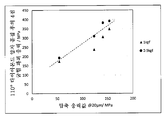
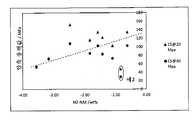
도 4는, 각 예의 화학 강화 유리에 관한, 유리 표면으로부터 90㎛의 깊이 부분의 압축 응력값 CS90(단위: MPa)과 평균 균열 높이(단위: mm)의 관계를 플롯한 그래프이다.
도 5는, 예 4, 6, 8 내지 10 및 15의 화학 강화 유리에 관한, ΔCS100 -90(단위: MPa/㎛)과 각 흠집 조건에 있어서의 파괴 응력(MPa)의 관계를 플롯한 그래프이다.
도 6은, 하중 0.5Kgf 또는 1Kgf의 조건에서 흠집낸 후의 굽힘 강도와 CS20의 관계를 플롯한 그래프를 나타낸다.
도 7은, 하중 0.5Kgf 또는 1Kgf의 조건에서 흠집낸 후의 굽힘 강도와 CS40의 관계를 플롯한 것을 나타낸다.
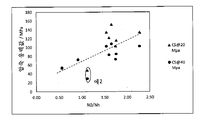
도 8은, NM/Nh와, CS20 또는 CS40의 관계를 플롯한 그래프를 나타낸다.
도 9는, N0/Nh와, CS20 또는 CS40의 관계를 플롯한 그래프를 나타낸다.
도 10은, N0/NM과, CS20 또는 CS40의 관계를 플롯한 그래프를 나타낸다.
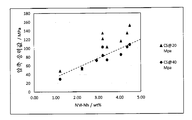
도 11은, NM-Nh(단위: wt%)와, CS20 또는 CS40의 관계를 플롯한 그래프를 나타낸다.
도 12는, N0-Nh와, CS20 또는 CS40의 관계를 플롯한 그래프를 나타낸다.
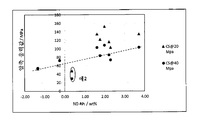
도 13은, N0-NM과, CS20 또는 CS40의 관계를 플롯한 그래프를 나타낸다.BRIEF DESCRIPTION OF THE DRAWINGS FIG. 1 is a schematic view showing a sample for producing a sample for measuring the surface compressive stress (CS) of a chemically tempered glass, wherein (a) shows a sample before polishing and (b) shows a flaked sample after polishing.
2 is a view showing a stress profile of a chemical tempered glass for explaining CS (surface compressive stress value), DOL (surface compressive stress layer depth), CT (internal tensile stress) and St Do.
3 is a schematic view showing a test method of the sand drop test.
Figure 4 is a compressive stress value of the depth portion of the 90㎛ from the glass surface on each of the Examples Chemicals glass CS 90 (unit: MPa) and the average crack Height: a graph that plots the relationship between the (in mm).
5 is a graph plotting the relationship between ΔCS 100 -90 (unit: MPa / μm) and the fracture stress (MPa) at each scratch condition for the chemically tempered glass of Examples 4, 6, 8 to 10 and 15 to be.
6 shows a plot the relationship between the bending strength and the CS 20 graph after embellish scratches under the conditions of load or 0.5Kgf 1Kgf.
Fig. 7 shows plots of the relationship between the bending strength and the CS 40 after scratching under the condition of a load of 0.5 kgf or 1 kgf.
FIG. 8 is a graph plotting the relationship between NM / Nh and CS 20 or CS 40 .
Figure 9 shows a plot of the relationship between N0 / Nh and, CS 20 or CS 40 graph.
Figure 10 shows a plot of the relationship between N0 / NM and, CS 20 or CS 40 graph.
11 is a graph plotting the relationship between NM-Nh (unit: wt%) and CS 20 or CS 40 .
Figure 12 shows a graph plotting the relationship between N0 and-Nh, CS 20 or CS 40.
Figure 13 shows a graph plotting the relationship between N0 and NM-, CS 20 or CS 40.
이하에 있어서, 본 발명의 화학 강화 유리에 대하여 상세하게 설명한다.Hereinafter, the chemically tempered glass of the present invention will be described in detail.
본 발명의 화학 강화 유리는, 이하에 설명하는 화학 강화 유리 I 또는 후술하는 화학 강화 유리 II이다.The chemically tempered glass of the present invention is the chemically tempered glass I described below or the chemically tempered glass II described below.
본 발명의 화학 강화 유리 I은, 유리 표면으로부터 90㎛의 깊이 부분의 압축 응력값(CS90)이 25MPa 이상이며, 대면각의 압자 각도가 60°인 사각뿔 다이아몬드 압자로 5kgf 내지 10kgf의 범위에서의 하중을 15초간 유지하는 조건에서의 압자 압입 시험에 의한 파괴 시험에 있어서, 25mm×25mm의 사이즈 내에 발생하는 파편의 수가 20개 이하이다.The chemical tempered glass I of the present invention is a quartz-crystal diamond indenter having a compressive stress value (CS 90 ) at a depth of 90 탆 from a glass surface of 25 MPa or more and an indenter angle of 60 °, In the fracture test by the indentation indentation test under the condition that the load is maintained for 15 seconds, the number of fragments generated within the size of 25 mm x 25 mm is 20 or less.
본 발명의 화학 강화 유리 I은, 표면에 화학 강화 처리(이온 교환 처리)에 의해 형성된 압축 응력층을 갖는다. 화학 강화 처리에서는, 유리의 표면을 이온 교환하고, 압축 응력이 잔류하는 표면층을 형성시킨다. 구체적으로는, 유리 전이점 이하의 온도에서의 이온 교환에 의해, 유리판 표면 부근에 존재하는 이온 반경이 작은 알칼리 금속 이온(전형적으로는, Li 이온 또는 Na 이온)을, 이온 반경이 보다 큰 알칼리 이온(전형적으로는, Li 이온에 대해서는 Na 이온 또는 K 이온이며, Na 이온에 대해서는 K 이온)으로 치환된다. 이에 의해, 유리의 표면에 압축 응력이 잔류하고, 유리의 강도가 향상된다.The chemically tempered glass I of the present invention has a compressive stress layer formed on its surface by chemical strengthening treatment (ion exchange treatment). In the chemical strengthening treatment, the surface of the glass is ion-exchanged to form a surface layer in which compressive stress remains. Concretely, alkali metal ions (typically, Li ion or Na ion) having a small ionic radius in the vicinity of the surface of the glass plate are ion-exchanged at a temperature not higher than the glass transition point to an alkali ion (Typically, Na ions or K ions for Li ions and K ions for Na ions). Thereby, a compressive stress remains on the surface of the glass, and the strength of the glass is improved.
본 발명의 화학 강화 유리 I은, 표면 압축 응력값(CS)이 300MPa 이상인 것이 바람직하다. 화학 강화 유리의 CS가 300MPa 이상이면, 스마트폰이나 태블릿 PC의 커버 유리로서, 양호한 강도를 가지므로 바람직하다. 이러한 유리의 굽힘 강도는 350MPa 이상이다.The chemical strengthened glass I of the present invention preferably has a surface compressive stress CS of not less than 300 MPa. If the CS of the chemically tempered glass is 300 MPa or more, it is preferable that it is a cover glass of a smartphone or a tablet PC because it has good strength. The bending strength of such a glass is 350 MPa or more.
스마트폰이나 태블릿 PC를 낙하시켰을 때에는, 둔각물이나 둥그스름한 돌기물과의 충돌에 의해, 커버 유리 이면에는 큰 인장 응력이 발생하고, 그 크기는 350MPa 정도에 달한다. 이 때, CS가 300MPa 이상이면, 350MPa 정도의 인장 응력에 견딜 수 있으므로 바람직하다. 화학 강화 유리의 CS는, 보다 바람직하게는 350MPa 이상이며, 더욱 바람직하게는 400MPa 이상이며, 보다 더욱 바람직하게는 450MPa 이상이다.When a smartphone or a tablet PC is dropped, a large tensile stress is generated on the back surface of the cover glass due to collision with an obtuse angle or a rounded protrusion, and the magnitude reaches about 350 MPa. At this time, if CS is 300 MPa or more, tensile stress of about 350 MPa can be tolerated, which is preferable. The CS of the chemically strengthened glass is more preferably 350 MPa or more, still more preferably 400 MPa or more, even more preferably 450 MPa or more.
한편, 화학 강화 유리 I의 CS의 상한은 특별히 한정되는 것은 아니지만, 파괴시의 안전상의 관점에서는, 예를 들어 2000MPa 이하이고, 바람직하게는 1500MPa 이하이며, 보다 바람직하게는 1000MPa 이하이고, 더욱 바람직하게는 800MPa 이하이다.On the other hand, the upper limit of the CS of the chemically strengthened glass I is not particularly limited, but is preferably 2000 MPa or less, preferably 1500 MPa or less, more preferably 1000 MPa or less, Is 800 MPa or less.
또한, 화학 강화 유리의 CS는, 화학 강화 조건이나 유리의 조성 등을 조정함으로써, 적절히 조정할 수 있다.Further, the CS of the chemically tempered glass can be appropriately adjusted by adjusting chemical strengthening conditions, glass composition, and the like.
또한, 본 발명의 화학 강화 유리 I의 CS는, 하기 2종류의 측정 방법에 의한 값 CSF 및 CSA에 의해, 다음과 같이 정의된다. 유리 표면으로부터 x㎛의 깊이 부분의 압축 응력값(CSx)에 대해서도 동일하다.The CS of the chemically tempered glass I of the present invention is defined as follows by the values CS F and CS A by the following two kinds of measuring methods. The same applies to the compressive stress value (CS x ) at the depth portion of x mu m from the glass surface.
CS=CSF=1.28×CSA CS = CS F = 1.28 × CS A
여기서, CSF는 오리하라 세이사꾸쇼사제의 표면 응력계 FSM-6000에 의해 측정되고, 표면 응력계의 부속 프로그램 FsmV에 의해 구해지는 값이다.Wherein, CS F is a value measured by the surface tension of the type FSM-6000 ohrihara Seisakusho Co., Ltd., obtained by the sub-program FsmV of surface stress system.
또한, CSA는 가부시키가이샤 도쿄 인스트루먼츠제 복굴절 이미징 시스템 Abrio-IM을 사용하여 이하의 수순으로 측정되는 값이다. 도 1에 도시한 바와 같이, 10mm×10mm 사이즈 이상, 두께 0.2 내지 2mm 정도의 화학 강화 유리의 단면을 150 내지 250㎛의 범위로 연마하여 박편화를 행한다. 연마 수순으로서는 #1000 다이아 전착 지석에 의해 목적으로 하는 두께의 플러스 50㎛ 정도까지 연삭하고, 그 후 #2000 다이아 전착 지석을 사용하여 목적으로 하는 두께의 플러스 10㎛ 정도까지 연삭하며, 마지막으로 산화세륨에 의한 경면 가공을 행하여 목적으로 하는 두께로 한다. 이상과 같이 제작된 200㎛ 정도로 박편화된 샘플에 대하여, 광원으로 λ=546nm의 단색광을 사용하여, 투과광에서의 측정을 행하고, 복굴절 이미징 시스템에 의해, 화학 강화 유리가 갖는 위상차(리타데이션)의 측정을 행하며, 얻어진 값과 하기 식(9)를 사용함으로써 응력을 산출한다.CS A is a value measured by the following procedure using Abrio-IM, a double refractive-index imaging system manufactured by Tokyo Instruments Incorporated. As shown in Fig. 1, a cross-section of a chemically tempered glass having a size of 10 mm x 10 mm or more and a thickness of 0.2 to 2 mm is polished in a range of 150 to 250 mu m to make it thin. As the polishing procedure, a grinding process was performed to a desired thickness of about 50 mu m with a # 1000 dielectrolytic grinding stone and then to a desired thickness of about 10 mu m using a # 2000 dielectrophoretic grinding stone. Finally, To obtain a desired thickness. For the sample thinned to about 200 占 퐉 produced as described above, monochromatic light of? = 546nm was used as a light source, measurement was performed on the transmitted light, and the birefringence imaging system was used to measure the retardation And the stress is calculated by using the obtained value and the following equation (9).
F=δ/(C×t')ㆍㆍㆍ식(9)F =? / (C x t ') Equation (9)
식(9) 중, F는 응력(MPa), δ는 위상차(리타데이션)(nm), C는 광탄성 상수(nm cm-1MPa), t'는 샘플의 두께(cm)를 나타낸다.In the formula (9), F represents the stress (MPa), delta represents the retardation (nm), C represents the photoelastic constant (nm cm -1 MPa), and t 'represents the thickness (cm) of the sample.
본 발명의 화학 강화 유리 I은, 유리 표면으로부터 90㎛의 깊이 부분의 압축 응력값(CS90)이 25MPa 이상이다. CS90을 25MPa 이상으로 함으로써, 예각물 흠집 강도를 높일 수 있다. CS90은, 바람직하게는 30MPa 이상이며, 보다 바람직하게는 35MPa 이상이고, 더욱 바람직하게는 40MPa 이상이며, 특히 바람직하게는 45MPa 이상이고, 가장 바람직하게는 50MPa 이상이다.In the chemically tempered glass I of the present invention, the compressive stress value (CS 90 ) at a depth of 90 탆 from the glass surface is 25 MPa or more. By setting the CS 90 to 25 MPa or more, the strength of the acute angle scratch can be increased. CS 90 is preferably 30 MPa or more, more preferably 35 MPa or more, further preferably 40 MPa or more, particularly preferably 45 MPa or more, and most preferably 50 MPa or more.
한편, CS90의 상한은 특별히 한정되는 것은 아니지만, 파괴시의 안전성의 관점에서는, 예를 들어 250MPa 이하이고, 바람직하게는 200MPa 이하이며, 더욱 바람직하게는 150MPa 이하이고, 특히 바람직하게는 100MPa 이하이며, 가장 바람직하게는 75MPa 이하이다.On the other hand, the upper limit of CS 90 is not particularly limited, but is preferably 250 MPa or less, preferably 200 MPa or less, more preferably 150 MPa or less, particularly preferably 100 MPa or less , And most preferably not more than 75 MPa.
또한, 본 발명의 화학 강화 유리 I은, 예각물 흠집 강도 향상의 관점에서, 유리 표면으로부터 100㎛의 깊이 부분의 압축 응력값(CS100)이 15MPa 이상인 것이 바람직하다. CS100은, 바람직하게는 20MPa 이상이고, 보다 바람직하게는 23MPa 이상이며, 더욱 바람직하게는 26MPa 이상이고, 특히 바람직하게는 30MPa 이상이며, 가장 바람직하게는 33MPa 이상이다.The chemical strengthening glass I of the present invention preferably has a compressive stress value (CS 100 ) of not less than 15 MPa at a depth of 100 mu m from the glass surface in view of improvement of acute angle scratch strength. CS 100 is preferably 20 MPa or more, more preferably 23 MPa or more, further preferably 26 MPa or more, particularly preferably 30 MPa or more, and most preferably 33 MPa or more.
한편, CS100의 상한은 특별히 한정되는 것은 아니지만, 파괴시의 안전성의 관점에서는, 예를 들어 200MPa 이하이고, 바람직하게는 150MPa 이하이며, 더욱 바람직하게는 100MPa 이하이고, 특히 바람직하게는 75MPa 이하이며, 가장 바람직하게는 50MPa 이하이다.On the other hand, the upper limit of CS 100 is not particularly limited, but is preferably 200 MPa or less, preferably 150 MPa or less, more preferably 100 MPa or less, particularly preferably 75 MPa or less , And most preferably 50 MPa or less.
또한, 화학 강화 유리의 CS90이나 CS100은, CS와 동일하게, 화학 강화 조건이나 유리의 조성 등을 조정함으로써, 적절히 조정할 수 있다.Further, CS 90 or CS 100 of the chemically tempered glass can be appropriately adjusted by adjusting chemical strengthening conditions, glass composition, and the like in the same manner as CS.
또한, 본 발명의 화학 강화 유리 I에 있어서는, CS90과 CS100을 사용하여 하기 식에 의해 산출되는 ΔCS100 -90(단위: MPa/㎛)이 0.4 이상인 것이 바람직하다.Further, in the chemically tempered glass I of the present invention, it is preferable that? CS 100 -90 (unit: MPa / 占 퐉) calculated by the following equation using CS 90 and CS 100 is 0.4 or more.
ΔCS100 -90=(CS90-CS100)/(100-90)? CS 100 -90 = (CS 90 -CS 100 ) / (100-90)
ΔCS100 -90을 0.4 이상으로 함으로써, 예각물로 흠집낸 후의 굽힘 강도(흠집 후 굽힘 강도)를 높게 할 수 있다. ΔCS100 -90은, 보다 바람직하게는, 이하 단계적으로, 0.5 이상, 0.6 이상, 0.7 이상, 0.8 이상, 0.9 이상, 1.0 이상, 1.2 이상, 1.4 이상, 1.6 이상, 1.8 이상, 2.0 이상이다. 한편, ΔCS100 -90의 상한은 특별히 한정되는 것은 아니지만, 파쇄의 안전성의 관점에서는, 예를 들어 4.0 이하이고, 이하 단계적으로, 3.0 이하, 2.0 이하, 1.8 이하, 1.6 이하, 1.4 이하인 것이 바람직하다.By setting? CS 100 -90 to 0.4 or more, the bending strength (bending strength after scratching) after scratching with an acute angle can be increased. ? CS 100? 90 is more preferably 0.5 or more, 0.6 or more, 0.7 or more, 0.8 or more, 0.9 or more, 1.0 or more, 1.2 or more, 1.4 or more, 1.6 or more, 1.8 or more or 2.0 or more. On the other hand, the upper limit of? CS 100 -90 is not particularly limited, but from the viewpoint of safety of crushing, it is preferably not more than 4.0, for example, not more than 3.0, not more than 2.0, not more than 1.8, .
또한, 본 발명의 화학 강화 유리에 있어서는, DOL로부터 20㎛ 유리 표면측의 깊이에 있어서의 압축 응력값 CSDOL -20을 사용하여 하기 식에 의해 산출되는 ΔCSDOL -20(단위: MPa/㎛)이 0.4 이상인 것이 바람직하다.In the chemically tempered glass of the present invention, ΔCS DOL- 20 (unit: MPa / μm), which is calculated from the following equation using a compressive stress value CS DOL -20 at a depth of 20 μm on the glass surface side from DOL , Is preferably 0.4 or more.
ΔCSDOL -20=CSDOL -20/20ΔCS DOL -20 = CS DOL -20 / 20
ΔCSDOL -20을 0.4 이상으로 함으로써, 예각물로 흠집낸 후의 굽힘 강도(흠집 후 굽힘 강도)를 높일 수 있다. ΔCSDOL -20은, 보다 바람직하게는, 이하 단계적으로, 0.5 이상, 0.6 이상, 0.7 이상, 0.8 이상, 0.9 이상, 1.0 이상, 1.2 이상, 1.4 이상, 1.5 이상이다. 한편, ΔCSDOL -20의 상한은 특별히 한정되는 것은 아니지만, 파쇄의 안전성의 관점에서는, 예를 들어 4.0 이하이고, 바람직하게는 3.0 이하, 보다 바람직하게는 2.0 이하, 더욱 바람직하게는 1.7 이하, 전형적으로는 1.6 이하이다.By setting ΔCS DOL -20 to 0.4 or more, it is possible to increase the bending strength (bending strength after scratching) after scratching with acute angle water. More preferably,? CS DOL -20 is 0.5 or more, 0.6 or more, 0.7 or more, 0.8 or more, 0.9 or more, 1.0 or more, 1.2 or more, 1.4 or more, or 1.5 or more. On the other hand, the upper limit of? CS DOL -20 is not particularly limited. However, from the viewpoint of safety of crushing, for example, 4.0 or less, preferably 3.0 or less, more preferably 2.0 or less, Is 1.6 or less.
또한, 본 발명의 화학 강화 유리 I에 있어서는, 압축 응력층 깊이(DOL)가 100㎛ 이상인 것이 바람직하다. DOL이 100㎛ 이상이면, 모래 위에 낙하시켰을 때 등, 예각물 흠집에 의한 균열 내성이 향상된다. DOL은, 화학 강화 유리의 강도를 높이기 위해서, 바람직하게는 100㎛ 이상이며, 보다 바람직하게는, 이하 단계적으로, 110㎛ 이상, 120㎛ 이상, 130㎛ 이상, 140㎛ 이상, 150㎛ 이상, 160㎛ 이상이다.Further, in the chemically tempered glass I of the present invention, it is preferable that the compressive stress layer depth (DOL) is 100 mu m or more. When the DOL is 100 mu m or more, the crack resistance due to the acute angle scratches is improved, for example, when the DOL is dropped on the sand. The DOL is preferably at least 100 mu m, more preferably at least 110 mu m, at least 120 mu m, at least 130 mu m, at least 140 mu m, at least 150 mu m, at least 160 mu m Mu m or more.
한편, DOL의 상한은 특별히 한정되는 것은 아니지만, 파괴시의 안전성의 관점에서는, 예를 들어 200㎛ 이하이고, 바람직하게는 190㎛ 이하이며, 더욱 바람직하게는 180㎛ 이하이고, 특히 바람직하게는 150㎛ 이하이다.On the other hand, the upper limit of the DOL is not particularly limited, but is preferably 200 탆 or less, preferably 190 탆 or less, more preferably 180 탆 or less, and particularly preferably 150 Mu m or less.
또한, DOL은, 화학 강화 조건이나 유리의 조성 등을 조정함으로써 적절히 조정할 수 있다.The DOL can be appropriately adjusted by adjusting chemical strengthening conditions, glass composition, and the like.
본 명세서에 있어서, DOL은 응력 프로파일 중에서 응력이 제로가 되는 부분의 유리 표면으로부터의 깊이이며, 오리하라 세이사꾸쇼사제의 표면 응력계 FSM-6000에 의해 측정되며 부속 프로그램 FsmV에 의해 해석되는 값이다. 또한, 가부시키가이샤 도쿄 인스트루먼츠제 복굴절 이미징 시스템 Abrio-IM을 사용하고, 도 1의 (b)에 나타낸 바와 같은 박편화 샘플을 사용하여 측정할 수도 있다.In the present specification, DOL is the depth from the glass surface of the portion where the stress becomes zero in the stress profile, and is a value measured by the surface stress system FSM-6000 manufactured by Orihara Seisakusho and interpreted by the adjunct program FsmV. It is also possible to measure using a thin-film sample as shown in Fig. 1 (b) by using Abrio-IM, a double refractive-index imaging system manufactured by Tokyo Instruments Co., Ltd.
본 발명의 화학 강화 유리 I에 있어서는, 압축 응력층의 면적 Sc(MPa·㎛)의 값은 20000MPa·㎛ 이상인 것이 바람직하다. Sc가 20000MPa·㎛ 이상이면, 예각물에 의해 흠집이 난 상태에서도 높은 굽힘 강도를 유지할 수 있다. Sc는 20000MPa·㎛ 이상인 것이 바람직하고, 이하 단계적으로, 22000MPa·㎛ 이상, 24000MPa·㎛ 이상, 26000MPa·㎛ 이상, 28000MPa·㎛ 이상, 30000MPa·㎛ 이상, 32000MPa·㎛ 이상, 34000MPa·㎛ 이상, 36000MPa·㎛ 이상, 38000MPa·㎛ 이상인 것이 보다 바람직하다. 한편, Sc의 상한은, 특별히 한정되는 것은 아니지만, 파쇄의 안전성의 관점에서는, 예를 들어 50000MPa·㎛ 이하이고, 바람직하게는 45000MPa·㎛ 이하이다.In the chemically tempered glass I of the present invention, the value of the area Sc (MPa 占 퐉) of the compressive stress layer is preferably 20000 MPa 占 퐉 or more. If Sc is 20000 MPa 占 퐉 or more, a high bending strength can be maintained even in the state of being scratched by an acute angle product. Sc is preferably 20,000 MPa 占 퐉 or more and is preferably 20,000 to 10,000 MPa 占 퐉 or more, 24,000 to 30,000 MPa 占 퐉 or more, 26,000 MPa 占 퐉 or more, 28,000 MPa 占 퐉 or more, 30000 MPa 占 퐉 or more, 32000 MPa 占 퐉 or more, Mu m or more, and more preferably 38000 MPa · m or more. On the other hand, the upper limit of Sc is not particularly limited, but is, for example, 50000 MPa 占 퐉 or smaller, preferably 45000 MPa 占 퐉 or smaller, from the viewpoint of safety of crushing.
또한, 본 발명의 화학 강화 유리 I의 Sc(MPa·㎛)는, 하기 2종류의 측정 방법에 의한 값 ScF 및 ScA에 의해, 다음과 같이 정의된다.The Sc (MPa 占 퐉) of the chemically tempered glass I of the present invention is defined as follows by the values Sc F and Sc A by the following two kinds of measuring methods.
Sc=ScF=1.515×ScA Sc = Sc F = 1.515 × Sc A
여기서, ScF는 오리하라 세이사꾸쇼사제의 표면 응력계 FSM-6000에 의해 측정되며 부속 프로그램 FsmV에 의해 해석되는 값을 사용하여 산출한 값이며, ScA는 상술한 CSA 측정과 동일한 방법인, 복굴절 이미징 시스템 Abrio-IM 및 박편화 샘플을 사용한 측정에 의해 얻어지는 값이다.Here, Sc F is measured by a surface stress based FSM-6000 of ohrihara Seisakusho Co., Ltd., and the value calculated by using the value that is interpreted by the attached program FsmV, Sc A is the same method as the above-described CS A measurement, Values obtained by measurement using the birefringent imaging system Abrio-IM and the flaking sample.
또한, 본 발명의 화학 강화 유리 I의 내부 인장층의 면적 St(MPa·㎛)는, 하기 2종류의 측정 방법에 의한 값 StF 및 StA에 의해, 다음과 같이 정의된다.The area St (MPa 占 퐉) of the inner tensile layer of the chemically tempered glass I of the present invention is defined by the values St F and St A by the following two kinds of measuring methods as follows.
St=StF=1.515×StA St = St F = 1.515 × St A
여기서, StF는 오리하라 세이사꾸쇼사제의 표면 응력계 FSM-6000에 의해 측정되며 부속 프로그램 FsmV에 의해 해석되는 값을 사용하여 산출한 값이며, StA는 상술한 CSA 측정과 동일한 방법인, 복굴절 이미징 시스템 Abrio-IM 및 박편화 샘플을 사용한 측정에 의해 얻어지는 값이다. 상기와 동일하게 이수법(二手法)에 의해 응력 프로파일을 작성하고, StF 또는 StA를 산출하여, St를 얻을 수 있다.Here, St F is a value measured by a surface stress system FSM-6000 manufactured by Orihara Seisakusho Co., Ltd. and calculated by using a value interpreted by the adjunct program FsmV. St A is the same method as the CS A measurement described above, Values obtained by measurement using the birefringent imaging system Abrio-IM and the flaking sample. As described above, the stress profile is created by this method (two-hand method), and St F or St A is calculated to obtain St.
도 2에 Sc와 St의 개념도를 나타낸다. Sc와 St는 원리적으로 동등한 값이며, 0.95<Sc/St<1.05가 되도록 산출하는 것이 바람직하다.Fig. 2 is a conceptual diagram of Sc and St. Sc and St are theoretically equivalent, and it is preferable to calculate such that 0.95 < Sc / St < 1.05.
또한, 본 발명의 화학 강화 유리 I에 있어서는, 압축 응력층의 면적 Sc(MPa·㎛)를 판 두께 t(㎛)로 나눈 값 Sc/t(MPa)가 28MPa 이상인 것이 바람직하다. Sc/t가 28MPa 이상이면, 모래 위에 낙하시켰을 때 등, 예각물 흠집에 의한 균열 내성이 향상된다. Sc/t는, 보다 바람직하게는 30MPa 이상이며, 더욱 바람직하게는, 이하 단계적으로, 32MPa 이상, 34MPa 이상, 36MPa 이상, 38MPa 이상, 40MPa 이상, 42MPa 이상, 44MPa 이상, 46MPa 이상, 48MPa 이상, 50MPa 이상이다. 한편, Sc/t의 상한은, 특별히 한정되는 것은 아니지만, 파쇄의 안전성의 관점에서는, 예를 들어 60MPa 이하이고, 바람직하게는 55MPa 이하이다.In the chemically tempered glass I of the present invention, the value Sc / t (MPa) obtained by dividing the area Sc (MPa 占 퐉) of the compressive stress layer by the plate thickness t (占 퐉) is preferably 28 MPa or more. When Sc / t is 28 MPa or more, crack resistance due to acute angle scratches is improved, for example, when the steel is dropped on sand. More preferably 40 MPa or more, 42 MPa or more, 44 MPa or more, 46 MPa or more, 48 MPa or more, 50 MPa or more, more preferably 30 MPa or more, more preferably 30 MPa or more, and still more preferably 35 MPa or more, 34 MPa or more, 36 MPa or more, 38 MPa or more, 40 MPa or more, Or more. On the other hand, the upper limit of Sc / t is not particularly limited, but is, for example, 60 MPa or less, preferably 55 MPa or less, from the viewpoint of safety of crushing.
또한, 본 발명의 화학 강화 유리 I은, 대면각의 압자 각도가 60°인 사각뿔 다이아몬드 압자로 5kgf 내지 10kgf의 범위에서의 하중을 15초간 유지하는 조건에서의 압자 압입 시험에 의한 파괴 시험에 있어서, 25mm×25mm의 사이즈 내에 발생하는 파편의 수가 20개 이하이다. 당해 압자 압입 시험에 의한 파괴 시험에 있어서의 파편의 수(파쇄수)가 20개 이하이면, 만일 파괴되었다고 해도, 높은 안전성을 확보할 수 있다. 당해 파쇄수는, 바람직하게는 10개 이하이고, 보다 바람직하게는 5개 이하이다.The chemical strengthening glass I of the present invention is characterized in that in the fracture test by the indentation indentation test under the condition that the load in the range of 5 kgf to 10 kgf is maintained for 15 seconds with the quadrangular pyramid diamond indenter with the indenter angle of 60, The number of fragments that occur within a size of 25 mm x 25 mm is 20 or less. If the number of pieces (number of crushed pieces) in the fracture test by the indentation indentation test is 20 or less, high safety can be secured even if it is destroyed. The number of such crushing is preferably 10 or less, more preferably 5 or less.
또한, 본 발명의 화학 강화 유리 I은, 흠집 후의 굽힘 강도가 150MPa 이상인 것이 바람직하다. 스마트폰 낙하시에 커버 유리 표면에 발생하는 인장 응력의 크기는 150MPa 정도이고, 당해 굽힘 강도가 150MPa 이상이면, 예각물에 의한 흠집이 생긴 후에도 낙하에 의한 발생 응력에 의한 파괴를 방지할 수 있다. 흠집 후의 굽힘 강도는, 바람직하게는 200MPa 이상이며, 보다 바람직하게는 250MPa 이상이다. 흠집을 내는 방법으로서는, 다이아몬드 압자(대면각의 압자 각도: 110°)를 누르는 압자 압입 시험 등을 사용할 수 있다.It is preferable that the chemical strengthened glass I of the present invention has a bending strength after scratch of 150 MPa or more. The magnitude of the tensile stress generated on the surface of the cover glass at the time of dropping the smartphone is about 150 MPa, and if the bending strength is 150 MPa or more, it is possible to prevent breakage due to the stress caused by falling even after the scratches are caused by the acute angle water. The bending strength after scratching is preferably 200 MPa or more, and more preferably 250 MPa or more. As a method of scratching, an indentation indentation test in which a diamond indenter (angle of indenter of face angle: 110 DEG) is pressed can be used.
본 발명의 화학 강화 유리 I은, 다이아몬드 압자(대면각의 압자 각도: 110°)를 하중 0.5Kgf로 하여 15초간 누름으로써, 유리 표면을 흠집낸 후에, 하부 스팬 30mm, 상부 스팬 10mm, 크로스헤드 속도 0.5mm/분의 조건에서 4점 굽힘 시험을 행함으로써 얻어지는 파괴 응력값 σa(굽힘 강도, 단위: MPa)가, 150MPa 이상인 것이 바람직하다. σa는, 바람직하게는 200MPa 이상이며, 보다 바람직하게는 250MPa 이상, 더욱 바람직하게는 300MPa 이상이다.The chemically tempered glass I of the present invention was obtained by pressing the diamond indenter (angle of incidence of the face angle: 110 deg.) At a load of 0.5 Kgf for 15 seconds to scratch the glass surface and then measuring the
본 발명의 화학 강화 유리 I은, 다이아몬드 압자(대면각의 압자 각도: 110°)를 하중 1Kgf로 하여 15초간 누름으로써, 유리 표면을 흠집낸 후에, 하부 스팬 30mm, 상부 스팬 10mm, 크로스헤드 속도 0.5mm/분의 조건에서 4점 굽힘 시험을 행함으로써 얻어지는 파괴 응력값 σb(굽힘 강도, 단위: MPa)가, 150MPa 이상인 것이 바람직하다. σb는, 바람직하게는 200MPa 이상이며, 보다 바람직하게는 250MPa 이상, 더욱 바람직하게는 300MPa 이상이다.The chemical tempered glass I of the present invention was obtained by pressing a glass indenter with a load of 1 kgf with a diamond indenter (angle of incidence of facing angle: 110 deg.) For 15 seconds so that the glass surface was scratched and then the
본 발명의 화학 강화 유리 I은, 다이아몬드 압자(대면각의 압자 각도: 110°)를 하중 2Kgf로 하여 15초간 누름으로써, 유리 표면을 흠집낸 후에, 하부 스팬 30mm, 상부 스팬 10mm, 크로스헤드 속도 0.5mm/분의 조건에서 4점 굽힘 시험을 행함으로써 얻어지는 파괴 응력값 σc(굽힘 강도, 단위: MPa)가, 150MPa 이상인 것이 바람직하다. σc는, 바람직하게는 200MPa 이상이며, 보다 바람직하게는 250MPa 이상, 더욱 바람직하게는 300MPa 이상이다.The chemically tempered glass I of the present invention was prepared by pressing a diamond indenter (angle of incidence of the face angle: 110 deg.) At a load of 2 kgf for 15 seconds to scratch the glass surface and then measuring the
이어서, 본 발명의 화학 강화 유리 II에 대하여 상세하게 설명한다.Next, the chemically tempered glass II of the present invention will be described in detail.
일 실시 형태의 화학 강화 유리 II는, 하기 식(1) 및 (2)를 충족시키는 화학 강화 유리이다.One embodiment of the chemical strengthening glass II is a chemical strengthening glass that satisfies the following formulas (1) and (2).
NM/Nh≥1.8 (1)NM / Nh > (One)
KM/Kh≥3 (2)KM / Kh? 3 (2)
여기서, NM, Nh, KM 및 Kh는, 각각 이하를 나타낸 것으로 한다.Here, it is assumed that NM, Nh, KM, and Kh respectively are as follows.
NM: EPMA에 의해 측정되는 화학 강화 유리의 판 두께 방향의 Na 이온 농도 프로파일에 있어서의 최댓값을 Na2O(중량%)로 환산한 값NM: The value obtained by converting the maximum value in the Na ion concentration profile in the plate thickness direction of the chemically tempered glass measured by EPMA into Na 2 O (% by weight)
Nh: EPMA에 의해 측정되는 화학 강화 유리의 판 두께 방향의 Na 이온 농도 프로파일에 있어서의 판 두께의 중심값을 Na2O(중량%)로 환산한 값Nh: the value obtained by converting the center value of the plate thickness in the Na ion concentration profile in the plate thickness direction of the chemically tempered glass measured by EPMA into Na 2 O (wt%)
KM: EPMA에 의해 측정되는 화학 강화 유리의 판 두께 방향의 K 이온 농도 프로파일에 있어서의 최댓값을 K2O(중량%)로 환산한 값KM: value obtained by converting the maximum value in the K ion concentration profile in the plate thickness direction of the chemically tempered glass measured by EPMA into K 2 O (% by weight)
Kh: EPMA에 의해 측정되는 화학 강화 유리의 판 두께 방향의 K 이온 농도 프로파일에 있어서의 판 두께의 중심값을 K2O(중량%)로 환산한 값Kh: a value obtained by converting the center value of the plate thickness in the K ion concentration profile in the plate thickness direction of the chemically tempered glass measured by EPMA into K 2 O (% by weight)
또한, EPMA란, Electron Probe Micro Analyzer(전자선 마이크로 애널라이저)를 의미한다.EPMA refers to an Electron Probe Micro Analyzer.
또한, EPMA에 의해 측정되는 상기 화학 강화 유리의 판 두께 방향의 Na 이온 농도 프로파일에 있어서의 판 두께의 중심값을 Na2O(중량%)로 환산한 값(Nh)이란, 판 두께의 중심에 있어서의 Na 이온 농도를 Na2O(중량%)로 환산한 값이며, 예를 들면 판 두께가 0.8mm인 화학 강화 유리이면, 표면으로부터 0.4mm의 위치에 있어서의 Na 이온 농도를 Na2O(중량%)로 환산한 값이다. Kh에 대해서도, 동일하게 정의되는 것으로 한다.The value (Nh) obtained by converting the center value of the plate thickness in the Na ion concentration profile in the plate thickness direction of the chemically tempered glass measured by EPMA into Na 2 O (wt%) means a value in the ion concentration of Na is a value converted into Na 2 O (wt.%), for example, if the chemical strengthening glass plate thickness 0.8mm, the Na ion concentration in the position of 0.4mm from the surface Na 2 O ( Weight%). The same shall apply to Kh.
(NM/Nh≥1.8 (1))(NM / Nh? 1.8 (One))
후술하는 실시예에 있어서도 나타낸 바와 같이, 본 발명자들의 지견에 의하면, 유리 표면으로부터 20 내지 40㎛의 깊이 부분의 압축 응력값과 흠집 후 굽힘 강도의 사이에는 강한 상관이 있고, 유리 표면으로부터 20 내지 40㎛의 깊이 부분의 압축 응력값이 높을수록, 높은 흠집 후 굽힘 강도가 얻어지는 경향이 있다.According to the knowledge of the present inventors, as shown in the following examples, there is a strong correlation between the compressive stress value at the depth of 20 to 40 mu m from the glass surface and the bending strength after scratching, and from 20 to 40 The higher the compressive stress value in the depth portion of 占 퐉, the higher the bending strength after high scratches is obtained.
또한, NM/Nh가 커질수록, 유리 표면으로부터 20 내지 40㎛의 깊이 부분의 압축 응력값이 높아지는 경향이 있다. 본 발명에 있어서, 커버 유리의 고장률을 개선하기 위해 충분한 흠집 후 굽힘 강도로 하기 위해서는, NM/Nh가 1.8 이상인 것이 필요하고, 이하 단계적으로, 2 이상, 2.2 이상, 2.4 이상, 2.6 이상, 2.8 이상, 3 이상, 3.2 이상, 3.4 이상인 것이 바람직하다. 한편, NM/Nh의 상한값은 특별히 한정되지 않지만, 파쇄시의 안전성의 관점에서는, 예를 들어 5 이하인 것이 바람직하고, 보다 바람직하게는 4.5 이하, 더욱 바람직하게는 4 이하이다.Further, as NM / Nh becomes larger, the compressive stress value at a depth of 20 to 40 mu m from the glass surface tends to increase. In order to improve the bending strength after sufficient scratches in order to improve the failure rate of the cover glass in the present invention, it is necessary that NM / Nh is 1.8 or more, and stepwise is 2 or more, 2.2 or more, 2.4 or more, 2.6 or more, 2.8 or more , 3 or more, 3.2 or more, and 3.4 or more. On the other hand, the upper limit value of NM / Nh is not particularly limited, but is preferably 5 or less, more preferably 4.5 or less, further preferably 4 or less, from the viewpoint of safety at the time of crushing.
(N0/Nh≥0.8 (3))(N0 / Nh? 0.8 (3)
또한, 본 실시 형태의 화학 강화 유리에 있어서는, EPMA에 의해 측정되는 화학 강화 유리의 판 두께 방향의 Na 이온 농도 프로파일에 있어서의 최표면에서의 값을 Na2O(중량%)로 환산한 값인 N0과, 상기 Nh의 비인 N0/Nh가 0.8 이상인 것이 바람직하다.In the chemically tempered glass of the present embodiment, the value at the outermost surface in the Na ion concentration profile in the plate thickness direction of the chemically tempered glass measured by EPMA is converted into Na 2 O (weight%), And N0 / Nh, which is the ratio of Nh, is 0.8 or more.
본 발명자들의 지견에 의하면, N0/Nh가 커질수록, 유리 표면으로부터 20 내지 40㎛의 깊이 부분의 압축 응력값이 높아지는 경향이 있다. 본 실시 형태에 있어서, 커버 유리의 고장률을 개선하기 위해 충분한 흠집 후 굽힘 강도로 하기 위해서는, N0/Nh가 0.8 이상인 것이 바람직하고, 이하 단계적으로, 1 이상, 1.2 이상, 1.4 이상, 1.6 이상, 1.8 이상, 2 이상, 2.2 이상, 2.4 이상, 2.6 이상, 2.8 이상, 3 이상인 것이 보다 바람직하다. 한편, N0/Nh의 상한값은 특별히 한정되지 않지만, 파쇄의 안전성의 관점에서는, 예를 들어 5 이하인 것이 바람직하고, 보다 바람직하게는 4.5 이하, 더욱 바람직하게는 4 이하이다.According to the knowledge of the present inventors, the larger the N0 / Nh, the higher the compressive stress value at the depth of 20 to 40 mu m from the glass surface. In the present embodiment, it is preferable that N0 / Nh is 0.8 or more in order to make the bending strength after sufficient scratches to improve the failure rate of the cover glass, and it is preferably 1 or more, 1.2 or more, 1.4 or more, 1.6 or more, 1.8 More preferably 2 or more, 2.2 or more, 2.4 or more, 2.6 or more, 2.8 or more, or 3 or more. On the other hand, the upper limit value of N0 / Nh is not particularly limited, but is preferably 5 or less, more preferably 4.5 or less, further preferably 4 or less, from the viewpoint of safety of crushing.
(N0/NM≥0.4 (4))(N0 / NM? 0.4 (4))
또한, 본 실시 형태의 화학 강화 유리에 있어서는, 상술한 N0과, 상술한 NM의 비인 N0/NM이 0.4 이상인 것이 바람직하다.Further, in the chemically tempered glass of the present embodiment, it is preferable that N0 / NM, which is the ratio between N0 and the above-described NM, is 0.4 or more.
본 발명자들의 지견에 의하면, N0/NM이 커질수록, 유리 표면으로부터 20 내지 40㎛의 깊이 부분의 압축 응력값이 높아지는 경향이 있다. 본 실시 형태에 있어서, 커버 유리의 고장률을 개선하기 위해 충분한 흠집 후 굽힘 강도로 하기 위해서는, N0/NM이 0.4 이상인 것이 바람직하고, 이하 단계적으로, 0.5 이상, 0.6 이상, 0.7 이상, 0.8 이상, 0.9 이상, 0.95 이상인 것이 보다 바람직하다.According to the knowledge of the present inventors, the larger the N0 / NM, the higher the compressive stress value in the depth portion of 20 to 40 mu m from the glass surface. In the present embodiment, it is preferable that N0 / NM is 0.4 or more in order to obtain the bending strength after sufficient scratches for improving the failure rate of the cover glass. Or more and 0.95 or more.
(KM/Kh≥3 (2))(KM / Kh? 3 (2))
본 실시 형태의 화학 강화 유리 II에 있어서는, 유리 중의 Na 이온을 K 이온과 교환하는 Na-K 교환에 의해 유리 표층에 큰 압축 응력을 도입하여, 굽힘 강도를 높이고 있다. 여기서, 커버 유리의 강도 신뢰성 향상의 관점에서는, 굽힘 강도로서는 400MPa 이상인 것이 바람직하고, 이것을 달성하기 위해서는, KM/Kh는 3 이상인 것이 필요하며, 이하 단계적으로, 3.5 이상, 4 이상, 4.5 이상, 5 이상, 5.5 이상, 6 이상, 6.5 이상, 7 이상인 것이 보다 바람직하다.In the chemically tempered glass II of the present embodiment, a large compressive stress is introduced into the glass surface layer by Na-K exchange in which Na ions in the glass are exchanged with K ions to increase the bending strength. From the viewpoint of improving the strength reliability of the cover glass, it is preferable that the bending strength is 400 MPa or more. To attain this, KM / Kh must be 3 or more, and stepwise from 3.5 to 4, Or more, 5.5 or more, 6 or more, 6.5 or more, or 7 or more.
또한, 다른 일 실시 형태의 화학 강화 유리 II는, 하기 식(5) 및 (6)를 충족시키는 화학 강화 유리이다.In addition, chemical strengthening glass II of another embodiment is chemically strengthened glass satisfying the following formulas (5) and (6).
NM-Nh≥2.2(wt%) (5)NM-Nh? 2.2 (wt%) (5)
KM-Kh≥3(wt%) (6)KM-Kh? 3 (wt%) (6)
(NM-Nh≥2.2(wt%) (5))(NM-Nh? 2.2 (wt%)) (5)
NM-Nh가 커질수록, 유리 표면으로부터 20 내지 40㎛의 깊이 부분의 압축 응력값이 높아지는 경향이 있다. 본 실시 형태에 있어서, 커버 유리의 고장률을 개선하기 위해 충분한 흠집 후 굽힘 강도로 하기 위해서는, NM-Nh가 2.2wt% 이상인 것이 필요하고, 이하 단계적으로, 2.4wt% 이상, 2.6wt% 이상, 2.8wt% 이상, 3wt% 이상, 3.2wt% 이상, 3.4wt% 이상, 3.6wt% 이상, 3.8wt% 이상, 4wt% 이상, 4.2wt% 이상, 4.4wt% 이상, 4.6wt% 이상, 4.8wt% 이상, 5wt% 이상인 것이 바람직하다. 한편, NM-Nh의 상한값은 특별히 한정되지 않지만, 파쇄시의 안전성의 관점에서는, 예를 들어 7wt% 이하인 것이 바람직하고, 보다 바람직하게는 6.5wt% 이하, 더욱 바람직하게는 6wt% 이하이다.As NM-Nh becomes larger, the compressive stress value at a depth of 20 to 40 mu m from the glass surface tends to increase. In order to improve the bending strength after sufficient scratches in order to improve the failure rate of the cover glass in the present embodiment, it is necessary that the content of NM-Nh is 2.2 wt% or more and is set to 2.4 wt% or more, 2.6 wt% at least 3 wt%, at least 3.2 wt%, at least 3.4 wt%, at least 3.6 wt%, at least 3.8 wt%, at least 4 wt%, at least 4.2 wt%, at least 4.4 wt%, at least 4.6 wt% Or more and 5 wt% or more. On the other hand, the upper limit value of NM-Nh is not particularly limited, but is preferably 7 wt% or less, more preferably 6.5 wt% or less, and still more preferably 6 wt% or less, from the viewpoint of safety at the time of crushing.
(N0-Nh≥-0.4(wt%) (7))(N0-Nh-0.4 (wt%)) (7)
또한, 본 실시 형태의 화학 강화 유리 II에 있어서는, EPMA에 의해 측정되는 화학 강화 유리의 판 두께 방향의 Na 이온 농도 프로파일에 있어서의 최표면에서의 값을 Na2O(중량%)로 환산한 값인 N0과, 상기 Nh의 차인 N0-Nh가 -0.4wt% 이상인 것이 바람직하다.In the chemically tempered glass II of the present embodiment, the value at the outermost surface in the Na ion concentration profile in the plate thickness direction of the chemically tempered glass measured by EPMA is converted into Na 2 O (weight%) N0 and N0-Nh, which is the difference between Nh and Nh, is -0.4 wt% or more.
본 발명자들의 지견에 의하면, N0-Nh가 커질수록, 유리 표면으로부터 20 내지 40㎛의 깊이 부분의 압축 응력값이 높아지는 경향이 있다. 본 실시 형태에 있어서, 커버 유리의 고장률을 개선하기 위해 충분한 흠집 후 굽힘 강도로 하기 위해서는, N0-Nh가 -0.4wt% 이상인 것이 바람직하고, 이하 단계적으로, 0wt% 이상, 0.5wt% 이상, 1wt% 이상, 1.5wt% 이상, 2wt% 이상, 2.5wt% 이상, 3wt% 이상, 3.5wt% 이상, 4wt% 이상, 4.5wt% 이상, 5wt% 이상인 것이 보다 바람직하다. 한편, N0-Nh의 상한값은 특별히 한정되지 않지만, 파쇄의 안전성의 관점에서는, 예를 들어 7wt% 이하인 것이 바람직하고, 보다 바람직하게는 6.5wt% 이하, 더욱 바람직하게는 6wt% 이하이다.According to the knowledge of the present inventors, the larger the N0-Nh, the higher the compressive stress value at the depth portion of 20 to 40 mu m from the glass surface. In the present embodiment, it is preferable that N0-Nh is -0.4 wt% or more in order to make the bending strength after sufficient scratches to improve the failure rate of the cover glass, and it is preferable that the following is satisfied: 0 wt% or more, 0.5 wt% , More preferably 1.5 wt% or more, 2 wt% or more, 2.5 wt% or more, 3 wt% or more, 3.5 wt% or more, 4 wt% or more, 4.5 wt% or more and 5 wt% or more. On the other hand, the upper limit value of N0-Nh is not particularly limited, but is preferably 7 wt% or less, more preferably 6.5 wt% or less, and still more preferably 6 wt% or less, from the viewpoint of safety of crushing.
(N0-NM≥-3.5(wt%) (8))(N0-NM > = 3.5 (wt%)) (8))
또한, 본 실시 형태의 화학 강화 유리 II에 있어서는, 상술한 N0과 상술한 NM의 차인 N0-NM이, -3.5wt% 이상인 것이 바람직하다.Further, in the chemically tempered glass II of the present embodiment, it is preferable that N0-NM which is the difference between N0 and the above-described NM is -3.5 wt% or more.
본 발명자들의 지견에 의하면, N0-NM이 커질수록, 유리 표면으로부터 20 내지 40㎛의 깊이 부분의 압축 응력값이 높아지는 경향이 있다. 본 실시 형태에 있어서, 커버 유리의 고장률을 개선하기 위해 충분한 흠집 후 굽힘 강도로 하기 위해서는, N0-NM이 -3.5wt% 이상인 것이 바람직하고, 이하 단계적으로, -3wt% 이상, -2.5wt% 이상, -2wt% 이상, -1.5wt% 이상, -1wt% 이상, -0.5wt% 이상, -0.25wt% 이상, -0.1wt% 이상인 것이 보다 바람직하다.According to the knowledge of the present inventors, the larger the N0-NM, the higher the compressive stress value at a depth of 20 to 40 mu m from the glass surface. In the present embodiment, it is preferable that the N0-NM is -3.5 wt% or more in order to improve the bending strength after sufficient scratches to improve the failure rate of the cover glass, and it is preferable to set -3 wt% or more, -2.5 wt% or more , -2 wt% or more, -1.5 wt% or more, -1 wt% or more, -0.5 wt% or more, -0.25 wt% or more, or -0.1 wt% or more.
(KM-Kh≥3(wt%) (6))(KM-Kh? 3 (wt%)) (6)
본 실시 형태의 화학 강화 유리 II에 있어서는, 유리 중의 Na 이온을 K 이온과 교환하는 Na-K 교환에 의해 유리 표층에 큰 압축 응력을 도입하여, 굽힘 강도를 높이고 있다. 여기서, 커버 유리의 강도 신뢰성 향상의 관점에서는, 굽힘 강도로서는 400MPa 이상인 것이 바람직하고, 이것을 달성하기 위해서는, KM-Kh는 3wt% 이상인 것이 필요하고, 이하 단계적으로, 3.5wt% 이상, 4wt% 이상, 4.5wt% 이상, 5wt% 이상, 5.5wt% 이상, 6wt% 이상, 6.5wt% 이상, 7wt% 이상, 7.5wt% 이상, 8wt% 이상, 8.5t% 이상, 9wt% 이상, 9.5wt% 이상, 10wt% 이상인 것이 바람직하다.In the chemically tempered glass II of the present embodiment, a large compressive stress is introduced into the glass surface layer by Na-K exchange in which Na ions in the glass are exchanged with K ions to increase the bending strength. From the viewpoint of improving the strength reliability of the cover glass, it is preferable that the bending strength is 400 MPa or more. To achieve this, KM-Kh needs to be 3 wt% or more, and stepwise, 3.5 wt% or more, 4 wt% At least 5 wt%, at least 5 wt%, at least 6 wt%, at least 6.5 wt%, at least 7 wt%, at least 7.5 wt%, at least 8 wt%, at least 8.5 tt%, at least 9 wt% And more preferably 10 wt% or more.
본 발명의 화학 강화 유리 II는, 표면 압축 응력(CS)이 400MPa 이상인 것이 바람직하다. 여기서, 커버 유리의 강도 신뢰성 향상을 위해서는 유리의 굽힘 강도가 400MPa 이상인 것이 바람직하다. 화학 강화 유리의 CS가 400MPa 이상이면, 유리의 굽힘 강도가 400MPa 이상이 된다. 화학 강화 유리의 CS는, 보다 바람직하게는 500MPa 이상이며, 더욱 바람직하게는 600MPa 이상이다.The chemical strengthened glass II of the present invention preferably has a surface compressive stress (CS) of 400 MPa or more. Here, in order to improve the reliability reliability of the cover glass, it is preferable that the bending strength of the glass is 400 MPa or more. If the CS of the chemically tempered glass is 400 MPa or more, the bending strength of the glass becomes 400 MPa or more. The CS of the chemically tempered glass is more preferably 500 MPa or more, and still more preferably 600 MPa or more.
한편, 화학 강화 유리 II의 CS의 상한은 특별히 한정되는 것은 아니지만, 파괴시의 안전상의 관점에서는, 예를 들어 2000MPa 이하이고, 바람직하게는 1500MPa 이하이며, 보다 바람직하게는 1000MPa 이하이고, 더욱 바람직하게는 800MPa 이하이다.On the other hand, the upper limit of the CS of the chemically strengthened glass II is not particularly limited, but is preferably 2000 MPa or less, preferably 1500 MPa or less, more preferably 1000 MPa or less, Is 800 MPa or less.
또한, 화학 강화 유리의 CS는, 화학 강화 조건이나 유리의 조성 등을 조정함으로써, 적절히 조정할 수 있다.Further, the CS of the chemically tempered glass can be appropriately adjusted by adjusting chemical strengthening conditions, glass composition, and the like.
또한, 본 발명의 화학 강화 유리 II의 CS는, 하기 2종류의 측정 방법에 의한 값 CSF 및 CSA에 의해, 다음과 같이 정의된다. 유리 표면으로부터 x㎛의 깊이 부분의 압축 응력값(CSx)에 대해서도 동일하다.Further, the CS of the chemically tempered glass II of the present invention is defined by the values CS F and CS A by the following two kinds of measurement methods as follows. The same applies to the compressive stress value (CS x ) at the depth portion of x mu m from the glass surface.
CS=CSF1.28×CSA CS = CS F 1.28 x CS A
여기서, CSF는 오리하라 세이사꾸쇼사제의 표면 응력계 FSM-6000에 의해 측정되며 표면 응력계의 부속 프로그램 FsmV에 의해 구해지는 값이다.Wherein, CS F is a value measured by the surface tension of the type FSM-6000 manufactured by kkusyo three directors ohrihara is obtained from the sub-program of the system FsmV surface stress.
또한, CSA는 가부시키가이샤 도쿄 인스트루먼츠제 복굴절 이미징 시스템 Abrio-IM을 사용하여 상술한 수순으로 측정되는 값이다.CS A is a value measured by the procedure described above using Abrio-IM, a double refractive index imaging system manufactured by Tokyo Institute of Technology.
본 발명의 화학 강화 유리 II는, 흠집 후의 굽힘 강도가 200MPa 이상이 되는 것이 바람직하다. 스마트폰이나 태블릿 PC를 낙하시켰을 때에는, 커버 유리 표면에는 인장 응력이 발생하고, 그 크기는 200MPa 정도에 달한다. 커버 유리 표면에는 예각물과의 충돌 등에 의해 흠집이 발생하기 때문에, 흠집이 있는 상태에 있어서도 굽힘 강도가 200MPa 이상이면, 커버 유리의 고장률을 개선할 수 있다.The chemical strengthened glass II of the present invention preferably has a bending strength after scratch of 200 MPa or more. When a smartphone or a tablet PC is dropped, a tensile stress is generated on the surface of the cover glass, and its size reaches about 200 MPa. Since the cover glass surface is scratched by collision with an acute angle object or the like, when the bending strength is 200 MPa or more even in the state of scratches, the failure rate of the cover glass can be improved.
여기서, 당해 흠집 후 굽힘 강도란, 다이아몬드 압자(대면각의 압자 각도: 110°)를 하중 0.5, 또는 1kgf로 하여 15초간 누름으로써, 유리 표면을 흠집낸 후에, 하부 스팬 30mm, 상부 스팬 10mm, 크로스헤드 속도 0.5mm/분의 조건에서 4점 굽힘 시험을 행함으로써 얻어지는 파괴 응력값(굽힘 강도, 단위: MPa)을 나타낸다.Here, the bending strength after the scratch was measured by pressing the diamond indenter (angle of incidence of the facing angle: 110 deg.) At a load of 0.5 or 1 kgf for 15 seconds to scratch the glass surface, and then the
본 발명의 화학 강화 유리 II는, 유리 표면으로부터 20㎛의 깊이 부분의 압축 응력값(CS20)이 60MPa 이상인 것이 바람직하다. CS20이 60MPa 이상이면, 흠집 후 굽힘 시험 강도를 200MPa 이상으로 할 수 있고, 커버 유리의 고장률이 개선된다. CS20은, 보다 바람직하게는 80MPa 이상이며, 더욱 바람직하게는, 이하 단계적으로, 100MPa 이상, 120MPa 이상, 140MPa 이상, 160MPa 이상, 180MPa 이상, 200MPa 이상, 220MPa 이상, 240MPa 이상, 260MPa 이상, 280MPa 이상, 300MPa 이상이다.In the chemically tempered glass II of the present invention, it is preferable that a compressive stress value (CS 20 ) at a depth of 20 mu m from the glass surface is 60 MPa or more. When CS 20 is 60 MPa or more, the bending test strength after scratching can be made 200 MPa or more, and the failure rate of the cover glass is improved. CS 20 is more preferably 80 MPa or more and more preferably 100 MPa or more, 120 MPa or more, 140 MPa or more, 160 MPa or more, 180 MPa or more, 200 MPa or more, 220 MPa or more, 240 MPa or more, 260 MPa or more, 280 MPa or more , 300 MPa or more.
한편, CS20의 상한은 특별히 한정되는 것은 아니지만, 파쇄의 안전성의 관점에서는, 예를 들어 500MPa 이하이고, 바람직하게는 400MPa 이하이며, 더욱 바람직하게는 350MPa 이하이고, 특히 바람직하게는 320MPa 이하이다.On the other hand, the upper limit of the CS 20 is not particularly limited, but is preferably 500 MPa or less, preferably 400 MPa or less, more preferably 350 MPa or less, particularly preferably 320 MPa or less, from the viewpoint of safety of crushing.
본 발명의 화학 강화 유리 II는, 유리 표면으로부터 40㎛의 깊이 부분의 압축 응력값(CS40)이 60MPa 이상인 것이 바람직하다. CS40이 60MPa 이상이면, 흠집 후 굽힘 시험 강도를 200MPa 이상으로 할 수 있고, 커버 유리의 고장률이 개선된다. CS40은, 보다 바람직하게는, 이하 단계적으로, 70MPa 이상, 80MPa 이상, 90MPa 이상, 100MPa 이상, 110MPa 이상, 120MPa 이상, 130MPa 이상, 150MPa 이상, 160MPa 이상, 170MPa 이상, 180MPa 이상이다.In the chemically tempered glass II of the present invention, it is preferable that a compressive stress value (CS 40 ) at a depth of 40 mu m from the glass surface is 60 MPa or more. When CS 40 is 60 MPa or more, the bending test strength after scratching can be made 200 MPa or more, and the failure rate of the cover glass is improved. CS 40 is more preferably 70 MPa or more, 80 MPa or more, 90 MPa or more, 100 MPa or more, 110 MPa or more, 120 MPa or more, 130 MPa or more, 150 MPa or more, 160 MPa or more, 170 MPa or more or 180 MPa or more.
한편, CS40의 상한은 특별히 한정되는 것은 아니지만, 파쇄의 안전성의 관점에서는, 예를 들어 300MPa 이하이고, 바람직하게는 250MPa 이하이고, 더욱 바람직하게는 200MPa 이하이다.On the other hand, the upper limit of CS 40 is not particularly limited, but is, for example, 300 MPa or less, preferably 250 MPa or less, more preferably 200 MPa or less, from the viewpoint of safety of crushing.
또한, 화학 강화 유리의 CS20이나 CS40은, CS와 동일하게, 화학 강화 조건이나 유리의 조성 등을 조정함으로써, 적절히 조정할 수 있다.Further, CS 20 or CS 40 of the chemically tempered glass can be appropriately adjusted by adjusting chemical strengthening conditions, glass composition, and the like, like CS.
또한, 본 발명의 화학 강화 유리 II에 있어서는, 압축 응력층 깊이(DOL)가 100㎛ 이상인 것이 바람직하다. DOL이 100㎛ 이상이면, 모래 위에 낙하시킨 경우 등 예각물에 의한 흠집으로 인한 파괴에 대하여, 현저한 강도 향상이 가능해진다. DOL은, 보다 바람직하게는 110㎛ 이상이고, 더욱 바람직하게는 130㎛ 이상이며, 특히 바람직하게는 150㎛ 이상이다.In the chemically tempered glass II of the present invention, it is preferable that the compressive stress layer depth (DOL) is 100 mu m or more. When the DOL is 100 mu m or more, remarkable strength improvement can be achieved against breakage caused by scratches caused by acute angles such as dropping on sand. The DOL is more preferably 110 탆 or more, further preferably 130 탆 or more, and particularly preferably 150 탆 or more.
한편, DOL의 상한은 특별히 한정되는 것은 아니지만, 파괴시의 안전성의 관점에서는, 예를 들어 200㎛ 이하이고, 바람직하게는 180㎛ 이하이며, 더욱 바람직하게는 160㎛ 이하이다.On the other hand, the upper limit of the DOL is not particularly limited, but is 200 탆 or less, preferably 180 탆 or less, more preferably 160 탆 or less, from the viewpoint of safety at the time of fracture.
또한, DOL은, 화학 강화 조건이나 유리의 조성 등을 조정함으로써, 적절히 조정할 수 있다.The DOL can be appropriately adjusted by adjusting chemical strengthening conditions, glass composition, and the like.
또한, 본 발명의 화학 강화 유리 II의 DOL은 응력 프로파일 중에서 응력이 제로가 되는 부분의 유리 표면으로부터의 깊이이고, 오리하라 세이사꾸쇼사제의 표면 응력계 FSM-6000에 의해 측정되며 부속 프로그램 FsmV에 의해 해석되는 값이다. 또한, 가부시키가이샤 도쿄 인스트루먼츠제 복굴절 이미징 시스템 Abrio-IM을 사용하고, 도 1의 (b)에 나타낸 바와 같은 박편화 샘플을 사용하여 측정할 수도 있다.The DOL of the chemical strengthened glass II of the present invention is the depth from the glass surface of the portion where the stress becomes zero in the stress profile and is measured by the surface stress system FSM-6000 manufactured by Orihara Seisakusho Co., This value is interpreted. It is also possible to measure using a thin-film sample as shown in Fig. 1 (b) by using Abrio-IM, a double refractive-index imaging system manufactured by Tokyo Instruments Co., Ltd.
또한, 본 발명의 화학 강화 유리 II는, 대면각의 압자 각도가 60°인 사각뿔 다이아몬드 압자로 5kgf 내지 10kgf의 범위에서의 하중을 15초간 유지하는 조건에서의 압자 압입 시험에 의한 파괴 시험에 있어서, 25mm×25mm의 사이즈 내에 발생하는 파편의 수가 20개 이하이다. 당해 압자 압입 시험에 의한 파괴 시험에 있어서의 파편의 수(파쇄수)가 20개 이하이면, 만일 파괴되었다고 해도, 높은 안전성을 확보할 수 있다. 당해 파쇄수는, 바람직하게는 30개 이하이고, 보다 바람직하게는 40개 이하이다.In the fracture test by the indentation indentation test under the condition that the load in the range of 5 kgf to 10 kgf is maintained for 15 seconds with a quadrangular diamond indenter with an indentation angle of 60 degrees at the facing angle of the chemical strengthened glass II of the present invention, The number of fragments that occur within a size of 25 mm x 25 mm is 20 or less. If the number of pieces (number of crushed pieces) in the fracture test by the indentation indentation test is 20 or less, high safety can be secured even if it is destroyed. The number of such crushing is preferably 30 or less, and more preferably 40 or less.
계속해서, 본 발명에 있어서의, 화학 강화 유리의 모 조성에 대하여 설명한다.Next, the parent phase of the chemically tempered glass according to the present invention will be described.
본 명세서에 있어서, 화학 강화 유리의 모 조성이란, 화학 강화 전의 유리(이하, 모 유리라고 하는 경우가 있고, 또한 화학 강화용 유리라고 하는 경우가 있음)의 조성을 말한다. 여기서, 화학 강화 유리의 인장 응력을 갖는 부분(이하, 인장 응력 부분이라고도 함)은 이온 교환되지 않은 부분이라고 생각할 수 있다. 그래서, 화학 강화 유리의 인장 응력 부분은, 모 유리와 동일한 조성을 갖고 있으며, 인장 응력 부분의 조성을 모 조성으로 볼 수 있다.In this specification, the chemical composition of the chemically tempered glass refers to a composition of glass before chemical strengthening (hereinafter sometimes referred to as mother glass and sometimes referred to as chemical strengthening glass). Here, the portion having the tensile stress of the chemically tempered glass (hereinafter also referred to as the tensile stress portion) can be considered as a portion not subjected to ion exchange. Thus, the tensile stress portion of the chemically tempered glass has the same composition as the parent glass, and the composition of the tensile stress portion can be regarded as the parent composition.
이하에 있어서, 화학 강화 유리의 모 조성에 함유될 수 있는 각 성분의 적합한 함유량에 대하여 설명한다. 또한, 각 성분의 함유량은, 특별히 언급하지 않는 한, 산화물 기준의 몰 백분율 표시로 표현된 것으로 한다.Hereinafter, suitable contents of each component that can be contained in the parent glass of the chemically tempered glass will be described. Incidentally, the content of each component is expressed as a mole percentage based on oxide unless otherwise specified.
유리의 조성은, 간이적으로는 형광 엑스선법에 의한 반정량 분석에 의해 구하는 것도 가능하지만, 보다 정확하게는, ICP 발광 분석 등의 습식 분석법에 의해 측정할 수 있다.The composition of the glass can be obtained simply by semi-quantitative analysis by the fluorescent X-ray method, but more precisely, by wet analysis such as ICP emission analysis.
본 발명의 화학 강화용 유리용의 조성(본 발명의 화학 강화 유리의 모 조성)으로서는, 예를 들어 SiO2를 50 내지 80%, Al2O3을 1 내지 30%, B2O3을 0 내지 5%, P2O5를 0 내지 4%, Li2O를 3 내지 20%, Na2O를 0 내지 8%, K2O를 0 내지 10%, MgO를 3 내지 20%, CaO를 0 내지 20%, SrO를 0 내지 20%, BaO를 0 내지 15%, ZnO를 0 내지 10%, TiO2를 0 내지 1%, ZrO2를 0 내지 8%를 함유하는 것을 들 수 있다.Examples of the composition for the chemical strengthening glass of the present invention (parent phase of the chemically tempered glass of the present invention) include 50 to 80% of SiO 2 , 1 to 30% of Al 2 O 3 , 0 to 30% of B 2 O 3 0 to 4% of P 2 O 5 , 3 to 20% of Li 2 O, 0 to 8% of Na 2 O, 0 to 10% of K 2 O, 3 to 20% of MgO,
예를 들어, SiO2를 63 내지 80%, Al2O3을 7 내지 30%, B2O3을 0 내지 5%, P2O5를 0 내지 4%, Li2O를 5 내지 15%, Na2O를 4 내지 8%, K2O를 0 내지 2%, MgO를 3 내지 10%, CaO를 0 내지 5%, SrO를 0 내지 20%, BaO를 0 내지 15%, ZnO를 0 내지 10%, TiO2를 0 내지 1%, ZrO2를 0 내지 8%를 함유하고, Ta2O5, Gd2O3, As2O3, Sb2O3을 함유하지 않는 유리를 들 수 있다.For example, 63 to 80% of SiO 2 , 7 to 30% of Al 2 O 3 , 0 to 5% of B 2 O 3 , 0 to 4% of P 2 O 5 , 5 to 15% of Li 2 O, 4 to 8% of Na 2 O, 0 to 2% of K 2 O, 3 to 10% of MgO, 0 to 5% of CaO, 0 to 20% of SrO, 0 to 15% of BaO, 0 to 0% of ZnO, Glass containing 0 to 1% of TiO 2 and 0 to 8% of ZrO 2 and containing no Ta 2 O 5 , Gd 2 O 3 , As 2 O 3 or Sb 2 O 3 have.
SiO2는 유리의 골격을 구성하는 성분이다. 또한, 화학적 내구성을 높이는 성분이며, 유리 표면에 흠집(압흔)이 생겼을 때의 크랙 발생을 저감시키는 성분이며, SiO2의 함유량은 50% 이상인 것이 바람직하다. SiO2의 함유량은, 보다 바람직하게는, 이하 단계적으로, 54% 이상, 58% 이상, 60% 이상, 63% 이상, 66% 이상, 68% 이상이다. 한편, SiO2의 함유량이 80% 초과하면, 용융성이 현저하게 저하된다. SiO2의 함유량은 80% 이하이고, 보다 바람직하게는 78% 이하, 더욱 바람직하게는 76% 이하, 특히 바람직하게는 74% 이하, 가장 바람직하게는 72% 이하이다.SiO 2 is a component constituting the skeleton of glass. Further, it is a component for increasing the chemical durability and is a component for reducing the occurrence of cracks when scratches (indentations) are formed on the glass surface, and the content of SiO 2 is preferably 50% or more. The content of SiO 2 is more preferably 54% or more, 58% or more, 60% or more, 63% or more, 66% or more, or 68% or more. On the other hand, if the content of SiO 2 exceeds 80%, the melting property is remarkably lowered. The content of SiO 2 is 80% or less, more preferably 78% or less, further preferably 76% or less, particularly preferably 74% or less, and most preferably 72% or less.
Al2O3은 화학 강화 유리의 파쇄성을 향상시키는 성분이다. 여기서 유리의 파쇄성이 높다는 것은, 유리가 균열되었을 때의 파편수가 적은 것을 말한다. 파쇄성이 높은 유리는, 파괴되었을 때에 파편이 비산되기 어렵기 때문에, 안전성이 높다고 할 수 있다. 또한, Al2O3은 화학 강화시의 이온 교환 성능을 향상시키고, 강화 후의 표면 압축 응력을 크게 하기 위해 유효한 성분이므로, Al2O3의 함유량은 1% 이상인 것이 바람직하다. Al2O3의 함유량은, 보다 바람직하게는, 이하 단계적으로, 3% 이상, 5% 이상, 7% 이상, 8% 이상, 9% 이상, 10% 이상, 11% 이상, 12% 이상, 13% 이상이다. 한편, Al2O3의 함유량이 30% 초과하면, 유리의 내산성이 저하되거나, 또는 실투 온도가 높아진다. 또한, 유리의 점성이 증대되며 용융성이 저하된다. Al2O3의 함유량은, 바람직하게는 30% 이하이고, 보다 바람직하게는 25% 이하, 더욱 바람직하게는 20% 이하, 특히 바람직하게는 18% 이하, 가장 바람직하게는 15% 이하이다. 한편, Al2O3의 함유량이 큰 경우에는, 유리 용융시의 온도가 높아져 생산성이 저하된다. 유리의 생산성을 고려할 경우에는, Al2O3의 함유량은 바람직하게는 11% 이하이고, 이하 단계적으로, 10% 이하, 9% 이하, 8% 이하, 7% 이하인 것이 바람직하다.Al 2 O 3 is a component that improves the fracture resistance of the chemically tempered glass. The high fracture property of the glass means that the number of fragments when the glass is cracked is small. Glass having high crushability can be said to have high safety because fragments are hardly scattered when they are destroyed. Furthermore, since Al 2 O 3 is an effective component for improving the ion exchange performance during chemical strengthening and increasing the surface compressive stress after strengthening, the content of Al 2 O 3 is preferably 1% or more. The content of Al 2 O 3 is more preferably 3% or more, 5% or more, 7% or more, 8% or more, 9% or more, 10% or more, 11% or more, 12% %. On the other hand, when the content of Al 2 O 3 exceeds 30%, the acid resistance of the glass is lowered or the melting temperature is increased. Further, the viscosity of the glass is increased and the melting property is lowered. The content of Al 2 O 3 is preferably not more than 30%, more preferably not more than 25%, further preferably not more than 20%, particularly preferably not more than 18%, and most preferably not more than 15%. On the other hand, when the content of Al 2 O 3 is large, the temperature at the time of melting the glass is increased and the productivity is lowered. When the productivity of glass is considered, the content of Al 2 O 3 is preferably 11% or less, and it is preferable that the content is 10% or less, 9% or less, 8% or less, or 7% or less.
B2O3은, 화학 강화용 유리 또는 화학 강화 유리의 칩핑 내성을 향상시키고, 또한 유리의 용융성을 향상시키는 성분이다. B2O3은 필수적이지는 않지만, B2O3을 함유시킬 경우의 함유량은, 용융성을 향상시키기 위해 바람직하게는 0.5% 이상이며, 보다 바람직하게는 1% 이상, 더욱 바람직하게는 2% 이상이다. 한편, B2O3의 함유가 5%를 초과하면, 용융시에 맥리가 발생하여 화학 강화용 유리의 품질이 떨어지기 쉽다. B2O3의 함유량은, 보다 바람직하게는 4% 이하, 더욱 바람직하게는 3% 이하이고, 특히 바람직하게는 1% 이하이다. 내산성을 높이기 위해서는 함유하지 않는 것이 바람직하다.B 2 O 3 is a component that improves the chipping resistance of chemical strengthening glass or chemically strengthened glass and also improves the melting property of glass. Although B 2 O 3 is not essential, the content of B 2 O 3 in the case of containing B 2 O 3 is preferably 0.5% or more, more preferably 1% or more, still more preferably 2% or more, Or more. On the other hand, if the content of B 2 O 3 is more than 5%, the quality of the glass for chemical strengthening tends to deteriorate due to the generation of fissures during melting. The content of B 2 O 3 is more preferably 4% or less, further preferably 3% or less, particularly preferably 1% or less. But it is preferably not contained in order to improve the acid resistance.
P2O5는, 이온 교환 성능 및 칩핑 내성을 향상시키는 성분이다. P2O5는 함유시키지 않아도 되지만, P2O5를 함유시킬 경우의 함유량은, 바람직하게는 0.5% 이상이며, 보다 바람직하게는 1% 이상, 더욱 바람직하게는 2% 이상이다. 한편, P2O5의 함유량이 4% 초과하면, 유리의 파쇄성이 현저하게 저하되고, 또한 내산성이 현저하게 저하된다. P2O5의 함유량은, 바람직하게는 4% 이하, 보다 바람직하게는 3% 이하, 더욱 바람직하게는 2% 이하, 특히 바람직하게는 1% 이하이다. 내산성을 높이기 위해서는 함유하지 않는 것이 바람직하다.P 2 O 5 is a component for improving ion exchange performance and chipping resistance. P 2 O 5 is not required to be contained, but when P 2 O 5 is contained, the content is preferably 0.5% or more, more preferably 1% or more, and still more preferably 2% or more. On the other hand, when the content of P 2 O 5 is more than 4%, the fracture resistance of the glass is significantly lowered and the acid resistance is remarkably lowered. The content of P 2 O 5 is preferably 4% or less, more preferably 3% or less, further preferably 2% or less, particularly preferably 1% or less. But it is preferably not contained in order to improve the acid resistance.
Li2O는, 이온 교환에 의해 표면 압축 응력을 형성시키는 성분이며, 화학 강화 유리의 파쇄성을 개선하는 성분이다.Li 2 O is a component that forms a surface compressive stress by ion exchange and is a component that improves the fracture resistance of the chemically tempered glass.
유리 표면의 Li 이온을 Na 이온으로 교환하고, 상기 CS40이 60MPa 이상이 되도록 화학 강화 처리를 행하는 경우, Li2O의 함유량은, 바람직하게는 3% 이상이며, 보다 바람직하게는 4% 이상, 더욱 바람직하게는 5% 이상, 특히 바람직하게는 6% 이상, 전형적으로는 7% 이상이다. 한편, Li2O의 함유량이 20% 초과하면 유리의 내산성이 현저하게 저하된다. Li2O의 함유량은, 20% 이하인 것이 바람직하고, 보다 바람직하게는 18% 이하, 더욱 바람직하게는 16% 이하, 특히 바람직하게는 15% 이하, 가장 바람직하게는 13% 이하이다.When the chemical strengthening treatment is performed such that the Li ions on the glass surface are exchanged with Na ions and the CS 40 is 60 MPa or more, the content of Li 2 O is preferably 3% or more, more preferably 4% , More preferably at least 5%, particularly preferably at least 6%, and typically at least 7%. On the other hand, if the content of Li 2 O exceeds 20%, the acid resistance of the glass is markedly lowered. The content of Li 2 O is preferably 20% or less, more preferably 18% or less, further preferably 16% or less, particularly preferably 15% or less, and most preferably 13% or less.
한편, 유리 표면의 Na 이온을 K 이온으로 교환하고, 상기 CS40이 60MPa 이상이 되는 화학 강화 처리를 행하는 경우, Li2O의 함유량이 3% 초과하면, 압축 응력의 크기가 저하되고, CS40이 60MPa 이상을 달성하기가 어려워진다. 이 경우, Li2O의 함유량은, 3% 이하인 것이 바람직하고, 보다 바람직하게는 2% 이하, 더욱 바람직하게는 1% 이하, 특히 바람직하게는 0.5% 이하이며, 가장 바람직하게는 Li2O를 실질적으로 함유하지 않는다.On the other hand, in the case of performing the chemical strengthening treatment in which the Na ions of the glass surface are exchanged with K ions and the CS 40 is 60 MPa or more, when the content of Li 2 O exceeds 3%, the compressive stress decreases and the CS 40 It becomes difficult to achieve 60 MPa or more. In this case, the content of Li 2 O is preferably 3% or less, more preferably 2% or less, further preferably 1% or less, particularly preferably 0.5% or less, and most preferably Li 2 O It does not substantially contain it.
또한, 본 명세서에 있어서 「실질적으로 함유하지 않는다」는 것은, 원재료 등에 포함되는 불가피한 불순물을 제외하여 함유하지 않는, 즉, 의도적으로 함유시킨 것은 아닌 것을 의미한다. 구체적으로는, 유리 조성 중의 함유량이, 0.1몰% 미만인 것을 가리킨다.In the present specification, " substantially not contained " means not containing the unnecessary impurities contained in the raw material or the like, that is, not intentionally contained. Specifically, it indicates that the content in the glass composition is less than 0.1 mol%.
Na2O는 이온 교환에 의해 표면 압축 응력층을 형성시키고, 또한 유리의 용융성을 향상시키는 성분이다.Na 2 O is a component which forms a surface compressive stress layer by ion exchange and also improves the melting property of glass.
유리 표면의 Li 이온을 Na 이온으로 교환하고, 상기 CS40이 60MPa 이상이 되도록 화학 강화 처리를 행하는 경우, Na2O는 함유하지 않아도 되지만, 유리의 용융성을 중시하는 경우에는 함유해도 된다. Na2O를 함유시킬 경우의 함유량은 1% 이상이면 바람직하다. Na2O의 함유량은, 보다 바람직하게는 2% 이상, 더욱 바람직하게는 3% 이상이다. 한편, Na2O의 함유량이 8% 초과하면, 이온 교환에 의해 형성되는 표면 압축 응력이 현저하게 저하된다. Na2O의 함유량은, 바람직하게는 8% 이하이고, 보다 바람직하게는 7% 이하, 더욱 바람직하게는 6% 이하, 특히 바람직하게는 5% 이하, 가장 바람직하게는 4% 이하이다.When the chemical strengthening treatment is carried out such that the Li ions on the glass surface are exchanged with Na ions and the CS 40 is 60 MPa or more, Na 2 O may not be contained, but may be included in the case of emphasizing the glass melting property. When Na 2 O is contained, the content is preferably 1% or more. The content of Na 2 O is more preferably 2% or more, and still more preferably 3% or more. On the other hand, when the content of Na 2 O exceeds 8%, the surface compressive stress formed by ion exchange is remarkably lowered. The content of Na 2 O is preferably 8% or less, more preferably 7% or less, further preferably 6% or less, particularly preferably 5% or less, and most preferably 4% or less.
한편, 유리 표면의 Na 이온을 K 이온으로 교환하고, 상기 CS40이 60MPa 이상이 되도록 화학 강화 처리를 행하는 경우에는 Na는 필수이며, 그 함유량은 5% 이상이다. Na2O의 함유량은, 바람직하게는 5% 이상이며, 보다 바람직하게는 7% 이상, 더욱 바람직하게는 9% 이상, 특히 바람직하게는 11% 이상, 특히 바람직하게는 12% 이상이다. 한편, Na2O의 함유량이 20% 초과하면, 유리의 내산성이 현저하게 저하된다. Na2O의 함유량은, 바람직하게는 20% 이하이고, 보다 바람직하게는 18% 이하, 더욱 바람직하게는 16% 이하, 특히 바람직하게는 15% 이하, 가장 바람직하게는 14% 이하이다.On the other hand, in the case of performing the chemical strengthening treatment such that the Na ions on the glass surface are exchanged with K ions and the CS 40 is 60 MPa or more, Na is essential and its content is 5% or more. The content of Na 2 O is preferably 5% or more, more preferably 7% or more, further preferably 9% or more, particularly preferably 11% or more, particularly preferably 12% or more. On the other hand, if the content of Na 2 O exceeds 20%, the acid resistance of the glass is remarkably lowered. The content of Na 2 O is preferably 20% or less, more preferably 18% or less, further preferably 16% or less, particularly preferably 15% or less, and most preferably 14% or less.
질산칼륨과 질산나트륨의 혼합 용융염에 침지시키는 등의 방법에 의해, 유리 표면의 Li 이온과 Na 이온, Na 이온과 K 이온을 동시에 이온 교환할 경우에는, Na2O의 함유량은, 바람직하게는 10% 이하이고, 보다 바람직하게는 9% 이하, 더욱 바람직하게는 7% 이하, 특히 바람직하게는 6% 이하, 가장 바람직하게는 5% 이하이다. 또한, Na2O의 함유량은, 바람직하게는 2% 이상, 보다 바람직하게는 3% 이상, 더욱 바람직하게는 4% 이상이다.When the Li ion and Na ion, Na ion and K ion of the glass surface are ion-exchanged at the same time by a method such as immersing in a mixed molten salt of potassium nitrate and sodium nitrate, the content of Na 2 O is preferably Is 10% or less, more preferably 9% or less, further preferably 7% or less, particularly preferably 6% or less, and most preferably 5% or less. The content of Na 2 O is preferably 2% or more, more preferably 3% or more, further preferably 4% or more.
K2O는, 이온 교환 성능을 향상시키거나 하기 위해 함유시켜도 된다. K2O를 함유시킬 경우의 함유량은, 바람직하게는 0.5% 이상이며, 보다 바람직하게는 1% 이상, 더욱 바람직하게는 2% 이상, 특히 바람직하게는 3% 이상이다. 한편, K2O의 함유량이 10% 초과이면, 화학 강화 유리의 파쇄성이 저하되기 때문에, K2O의 함유량은 10% 이하인 것이 바람직하다. K2O의 함유량은, 보다 바람직하게는 8% 이하이고, 더욱 바람직하게는 6% 이하이며, 특히 바람직하게는 4% 이하이고, 가장 바람직하게는 2% 이하이다.K 2 O may be added to improve ion exchange performance. The content of K 2 O is preferably 0.5% or more, more preferably 1% or more, further preferably 2% or more, particularly preferably 3% or more. On the other hand, if the content of K 2 O exceeds 10%, the fracture property of the chemically tempered glass is lowered. Therefore, the content of K 2 O is preferably 10% or less. The content of K 2 O is more preferably 8% or less, still more preferably 6% or less, particularly preferably 4% or less, and most preferably 2% or less.
MgO는, 화학 강화 유리의 표면 압축 응력을 증대시키는 성분이고, 파쇄성을 개선하는 성분이며, 함유시키는 것이 바람직하다. MgO를 함유시킬 경우의 함유량은, 바람직하게는 3% 이상이며, 보다 바람직하게는, 이하 단계적으로, 4% 이상, 5% 이상, 6% 이상, 7% 이상, 8% 이상이다. 한편, MgO의 함유량이 20% 초과하면, 화학 강화용 유리가 용융시에 실투되기 쉬워진다. MgO의 함유량은 20% 이하인 것이 바람직하고, 보다 바람직하게는, 이하 단계적으로, 18% 이하, 15% 이하, 14% 이하, 13% 이하, 12% 이하, 11% 이하, 10% 이하이다.MgO is a component for increasing the surface compressive stress of the chemically tempered glass and is a component for improving the fracture resistance and is preferably contained. The content of MgO is preferably 3% or more, and more preferably 4% or more, 5% or more, 6% or more, 7% or more, or 8% or more. On the other hand, if the content of MgO is more than 20%, the glass for chemical strengthening tends to be easily released upon melting. The content of MgO is preferably 20% or less, and more preferably 18% or less, 15% or less, 14% or less, 13% or less, 12% or less, 11% or less, or 10% or less.
CaO는, 화학 강화용 유리의 용융성을 향상시키는 성분이고, 화학 강화 유리의 파쇄성을 개선하는 성분이며, 함유시켜도 된다. CaO를 함유시킬 경우의 함유량은, 바람직하게는 0.5% 이상이며, 보다 바람직하게는 1% 이상, 더욱 바람직하게는 2% 이상이며, 특히 바람직하게는 3% 이상, 특히 바람직하게는 5% 이상이다. 한편, CaO의 함유량이 20% 초과하면, 이온 교환 성능이 현저하게 저하되기 때문에 20% 이하가 바람직하다. CaO의 함유량은, 보다 바람직하게는 14% 이하이고, 더욱 바람직하게는 10% 이하, 8% 이하, 6% 이하, 3% 이하, 1% 이하가 바람직하다.CaO is a component that improves the melting property of the glass for chemical strengthening and is a component for improving the fracture resistance of the chemical strengthened glass. The content of CaO is preferably at least 0.5%, more preferably at least 1%, even more preferably at least 2%, particularly preferably at least 3%, particularly preferably at least 5% . On the other hand, when the content of CaO exceeds 20%, the ion exchange performance remarkably decreases, so that it is preferably 20% or less. The content of CaO is more preferably 14% or less, further preferably 10% or less, 8% or less, 6% or less, 3% or less, or 1% or less.
SrO는, 화학 강화용 유리의 용융성을 향상시키는 성분이고, 화학 강화 유리의 파쇄성을 개선하는 성분이며, 함유시켜도 된다. SrO를 함유시킬 경우의 함유량은, 바람직하게는 0.5% 이상이고, 보다 바람직하게는 1% 이상, 더욱 바람직하게는 2% 이상이며, 특히 바람직하게는 3% 이상, 특히 바람직하게는 5% 이상이다. 한편, SrO의 함유량이 20% 초과하면, 이온 교환 성능이 현저하게 저하되기 때문에 20% 이하가 바람직하다. SrO의 함유량은, 보다 바람직하게는 14% 이하이고, 더욱 바람직하게는 10% 이하, 8% 이하, 6% 이하, 3% 이하, 1% 이하가 바람직하다.SrO is a component that improves the melting property of the glass for chemical strengthening and is a component for improving the fracture resistance of the chemical strengthened glass. The content of SrO is preferably 0.5% or more, more preferably 1% or more, still more preferably 2% or more, particularly preferably 3% or more, particularly preferably 5% or more . On the other hand, when the content of SrO is more than 20%, the ion exchange performance remarkably decreases, so that it is preferably 20% or less. The content of SrO is more preferably 14% or less, further preferably 10% or less, 8% or less, 6% or less, 3% or less, or 1% or less.
BaO는, 화학 강화용 유리의 용융성을 향상시키는 성분이고, 화학 강화 유리의 파쇄성을 개선하는 성분이며, 함유시켜도 된다. BaO를 함유시킬 경우의 함유량은, 바람직하게는 0.5% 이상이고, 보다 바람직하게는 1% 이상, 더욱 바람직하게는 2% 이상이며, 특히 바람직하게는 3% 이상, 특히 바람직하게는 5% 이상이다. 한편, BaO의 함유량이 15% 초과하면, 이온 교환 성능이 현저하게 저하된다. BaO의 함유량은 15% 이하인 것이 바람직하고, 보다 바람직하게는, 이하 단계적으로, 10% 이하, 8% 이하, 6% 이하, 3% 이하, 1% 이하이다.BaO is a component that improves the melting property of the glass for chemical strengthening and is a component for improving the fracture resistance of the chemical strengthened glass. The content of BaO is preferably at least 0.5%, more preferably at least 1%, further preferably at least 2%, particularly preferably at least 3%, particularly preferably at least 5% . On the other hand, when the content of BaO exceeds 15%, the ion exchange performance remarkably decreases. The content of BaO is preferably 15% or less, more preferably 10% or less, 8% or less, 6% or less, 3% or less, or 1% or less.
ZnO는 유리의 용융성을 향상시키는 성분이며, 함유시켜도 된다. ZnO를 함유시킬 경우의 함유량은, 바람직하게는 0.25% 이상이며, 보다 바람직하게는 0.5% 이상이다. 한편, ZnO의 함유량이 10%를 초과하게 되면, 유리의 내후성이 현저하게 저하된다. ZnO의 함유량은 10% 이하인 것이 바람직하고, 보다 바람직하게는 7% 이하, 더욱 바람직하게는 5% 이하이며, 특히 바람직하게는 2% 이하이고, 가장 바람직하게는 1% 이하이다.ZnO is a component for improving the melting property of glass and may be contained. The content of ZnO is preferably 0.25% or more, and more preferably 0.5% or more. On the other hand, when the content of ZnO exceeds 10%, the weather resistance of the glass is remarkably lowered. The content of ZnO is preferably 10% or less, more preferably 7% or less, further preferably 5% or less, particularly preferably 2% or less, and most preferably 1% or less.
TiO2는, 화학 강화 유리의 파쇄성을 개선하는 성분이며, 함유시켜도 된다. TiO2를 함유시킬 경우의 함유량은, 바람직하게는 0.1% 이상이며, 보다 바람직하게는 0.15% 이상, 더욱 바람직하게는 0.2% 이상이다. 한편, TiO2의 함유량이 5% 초과하면, 용융시에 실투되기 쉬워지고, 화학 강화 유리의 품질이 떨어질 우려가 있다. TiO2의 함유량은 1% 이하인 것이 바람직하고, 보다 바람직하게는 0.5% 이하, 더욱 바람직하게는 0.25% 이하이다.TiO 2 is a component for improving the fracture resistance of the chemically tempered glass and may be contained. When TiO 2 is contained, the content is preferably 0.1% or more, more preferably 0.15% or more, and still more preferably 0.2% or more. On the other hand, if the content of TiO 2 exceeds 5%, the glass tends to be easily melted and the quality of the chemically tempered glass may deteriorate. The content of TiO 2 is preferably 1% or less, more preferably 0.5% or less, further preferably 0.25% or less.
ZrO2는, 이온 교환에 의한 표면 압축 응력을 증대시키는 성분이며, 화학 강화용 유리의 파쇄성을 개선하는 효과가 있고, 함유시켜도 된다. ZrO2를 함유시킬 경우의 함유량은, 바람직하게는 0.5% 이상이며, 보다 바람직하게는 1% 이상이다. 한편, ZrO2의 함유량이 8% 초과하면, 용융시에 실투되기 쉬워지고, 화학 강화 유리의 품질이 떨어질 우려가 있다. ZrO2의 함유량은 8% 이하인 것이 바람직하고, 보다 바람직하게는 6% 이하, 더욱 바람직하게는 4% 이하이며, 특히 바람직하게는 2% 이하이고, 가장 바람직하게는 1.2% 이하이다.ZrO 2 is a component for increasing the surface compressive stress by ion exchange and has an effect of improving the fracture resistance of the chemical strengthening glass and may be contained. When ZrO 2 is contained, the content is preferably 0.5% or more, and more preferably 1% or more. On the other hand, if the content of ZrO 2 exceeds 8%, it is liable to be disintegrated at the time of melting, and the quality of the chemically tempered glass may be deteriorated. The content of ZrO 2 is preferably 8% or less, more preferably 6% or less, further preferably 4% or less, particularly preferably 2% or less, and most preferably 1.2% or less.
Y2O3, La2O3, Nb2O5는, 화학 강화 유리의 파쇄성을 개선하는 성분이며, 함유시켜도 된다. 이들 성분을 함유시킬 경우의 각각의 함유량은, 바람직하게는 0.5% 이상이며, 보다 바람직하게는 1% 이상, 더욱 바람직하게는 1.5% 이상이고, 특히 바람직하게는 2% 이상, 특히 바람직하게는 2.5% 이상이다. 한편, Y2O3, La2O3, Nb2O5의 함유량은 각각 8% 초과하면, 용융시에 유리가 실투되기 쉬워져 화학 강화 유리의 품질이 떨어질 우려가 있다. Y2O3, La2O3, Nb2O5의 함유량은 각각, 8% 이하인 것이 바람직하고, 보다 바람직하게는 6% 이하, 더욱 바람직하게는 5% 이하이며, 특히 바람직하게는 4% 이하이고, 가장 바람직하게는 3% 이하이다.Y 2 O 3 , La 2 O 3 and Nb 2 O 5 are components that improve the fracture resistance of the chemically tempered glass and may be contained. The content of each of these components is preferably 0.5% or more, more preferably 1% or more, still more preferably 1.5% or more, particularly preferably 2% or more, particularly preferably 2.5% %. On the other hand, if the contents of Y 2 O 3 , La 2 O 3 , and Nb 2 O 5 are more than 8%, the glass tends to be easily fused during melting, which may lower the quality of the chemically tempered glass. The content of Y 2 O 3 , La 2 O 3 and Nb 2 O 5 is preferably 8% or less, more preferably 6% or less, further preferably 5% or less, particularly preferably 4% or less , And most preferably 3% or less.
Ta2O5, Gd2O3은, 화학 강화 유리의 파쇄성을 개선하기 위해 소량 함유해도 되지만, 굴절률이나 반사율이 높아지므로 1% 이하가 바람직하고, 0.5% 이하가 보다 바람직하며, 함유하지 않는 것이 더욱 바람직하다.Ta 2 O 5 and Gd 2 O 3 may be contained in a small amount to improve the fracture resistance of the chemically tempered glass. However, since the refractive index and the reflectance increase, it is preferably 1% or less, more preferably 0.5% or less, Is more preferable.
또한, 유리에 착색을 행하여 사용할 때는, 원하는 화학 강화 특성의 달성을 저해하지 않는 범위에서 착색 성분을 첨가해도 된다. 착색 성분으로서는, 예를 들어 Co3O4, MnO2, Fe2O3, NiO, CuO, Cr2O3, V2O5, Bi2O3, SeO2, TiO2, CeO2, Er2O3, Nd2O3 등을 적합한 것으로서 들 수 있다.When the glass is colored and used, the coloring component may be added within a range that does not hinder the achievement of the desired chemical strengthening property. Examples of the coloring component include Co 3 O 4 , MnO 2 , Fe 2 O 3 , NiO, CuO, Cr 2 O 3 , V 2 O 5 , Bi 2 O 3 , SeO 2 , TiO 2 , CeO 2 , Er 2 O 3 , Nd 2 O 3 , and the like.
착색 성분의 함유량은, 산화물 기준의 몰 백분율 표시로, 합계로 7% 이하의 범위가 바람직하다. 7%를 초과하면, 유리가 실투되기 쉬워져 바람직하지 않다.The content of the coloring component is preferably in the range of 7% or less in total based on the molar percentage based on the oxide. If it is more than 7%, glass tends to be unstable, which is not preferable.
이 함량은 바람직하게는 5% 이하이고, 보다 바람직하게는 3% 이하이며, 더욱 바람직하게는 1% 이하이다. 유리의 가시광 투과율을 우선시키는 경우에는, 이들 성분은 실질적으로 함유하지 않는 것이 바람직하다.This content is preferably 5% or less, more preferably 3% or less, further preferably 1% or less. In the case where the visible light transmittance of the glass is preferentially given, it is preferable that these components are substantially free from each other.
유리의 용융시의 청징제로서, SO3, 염화물, 불화물 등을 적절히 함유해도 된다. As2O3은 함유하지 않는 것이 바람직하다. Sb2O3을 함유하는 경우에는, 0.3% 이하가 바람직하고, 0.1% 이하가 보다 바람직하며, 함유하지 않는 것이 가장 바람직하다.SO 3 , chloride, fluoride and the like may suitably be contained as the refining agent when the glass is melted. It is preferable that As 2 O 3 is not contained. When Sb 2 O 3 is contained, the content is preferably not more than 0.3%, more preferably not more than 0.1%, most preferably not containing.
또한, 본 발명의 화학 강화 유리는, 나트륨 이온, 은 이온, 칼륨 이온, 세슘 이온 및 루비듐 이온으로 이루어지는 군에서 선택되는 적어도 1종을 표면에 갖는 것이 바람직하다. 이에 의해, 표면에 압축 응력이 유기되어 유리가 고강도화된다. 또한, 은 이온을 표면에 가짐으로써, 항균성을 부여할 수 있다.It is also preferable that the chemically tempered glass of the present invention has at least one species selected from the group consisting of sodium ion, silver ion, potassium ion, cesium ion and rubidium ion on its surface. As a result, a compressive stress is induced on the surface, so that the strength of the glass is increased. In addition, antimicrobiality can be imparted by having silver ions on the surface.
또한, 본 발명에 있어서는, 화학 강화 유리의 모 조성을 갖고, 하기 조건에서 서냉시킨 두께 1mm의 유리판에 대하여, KNO3, NaNO3, 또는 KNO3과 NaNO3의 혼합염을 포함하는 400℃의 용융염을 사용하여 1시간의 이온 교환 처리를 행했을 때에, DOL이 50㎛ 이상이 되도록 화학 강화 유리의 모 조성을 선택하는 것이 바람직하다. 여기서, 서냉은, 유리 전이점보다 30℃ 내지 50℃ 높은 온도 T℃로부터, (T-300)℃까지 0.5℃/분의 냉각 속도로 행하는 것으로 한다.Further, the molten salt of 400 ℃ to in the present invention, has all the composition of the chemical strengthened glass, to about the glass sheet having a thickness of 1mm was slowly cooled under the conditions, comprises a mixed salt of KNO 3, NaNO 3, or KNO 3 and NaNO 3 It is preferable to select the parent phase of the chemically tempered glass so that the DOL becomes 50 mu m or more. Here, the gradual cooling is performed at a cooling rate of 0.5 deg. C / minute from a temperature T DEG C which is 30 DEG C to 50 DEG C higher than the glass transition point to (T-300) DEG C.
또한, 본 발명에 있어서는, 화학 강화 유리의 모 조성을 갖고, 하기 조건에서 서냉시킨 두께 1mm의 유리판에 대하여, KNO3, NaNO3, 또는 KNO3과 NaNO3의 혼합염을 포함하는 425℃의 용융염에 의해, 1시간의 이온 교환 처리를 행했을 때에, DOL이 70㎛ 이상이 되는 화학 강화 유리의 모 조성을 선택하는 것이 바람직하다. 여기서, 서냉은, 유리 전이점보다 30℃ 내지 50℃ 높은 온도 T℃로부터, (T-300)℃까지 0.5℃/분의 냉각 속도로 행하는 것으로 한다.In the present invention, it has all the composition of the chemical strengthened glass, to about the glass sheet having a thickness of 1mm was slowly cooled in the condition, a molten salt of 425 ℃ comprising a mixed salt of KNO 3, NaNO 3, or KNO 3 and NaNO 3 It is preferable to select the chemical composition of the chemically tempered glass having a DOL of 70 mu m or more when the ion exchange treatment is performed for one hour. Here, the gradual cooling is performed at a cooling rate of 0.5 deg. C / minute from a temperature T DEG C which is 30 DEG C to 50 DEG C higher than the glass transition point to (T-300) DEG C.
이러한 모 조성이면, 이온 교환 속도가 빠르고, 단시간에 화학 강화시킬 수 있다.With such a parent phase, the ion exchange rate is fast and can be chemically strengthened in a short time.
본 발명의 화학 강화 유리는, 판 형상(유리판)일 경우, 그 판 두께(t)는, 특별히 한정되는 것은 아니지만, 화학 강화에 의해 현저한 강도 향상을 가능하게 한다는 관점에서는, 예를 들어 2mm 이하이고, 바람직하게는 1.5mm 이하이며, 보다 바람직하게는 1mm 이하이고, 더욱 바람직하게는 0.9mm 이하이며, 특히 바람직하게는 0.8mm 이하이고, 가장 바람직하게는 0.7mm 이하이다. 또한, 당해 판 두께는, 화학 강화 처리에 의한 충분한 강도 향상의 효과를 얻는 관점에서는, 예를 들어 0.1mm 이상이고, 바람직하게는 0.2mm 이상이며, 보다 바람직하게는 0.4mm 이상이고, 더욱 바람직하게는 0.5mm 이상이다.When the chemically tempered glass of the present invention is in the form of a plate (glass plate), the thickness t thereof is not particularly limited, but is preferably 2 mm or less from the viewpoint of remarkable strength enhancement by chemical strengthening Preferably 1.5 mm or less, more preferably 1 mm or less, further preferably 0.9 mm or less, particularly preferably 0.8 mm or less, and most preferably 0.7 mm or less. The thickness of the plate is preferably 0.1 mm or more, preferably 0.2 mm or more, more preferably 0.4 mm or more, and still more preferably 0.4 mm or more from the viewpoint of achieving a sufficient strength improvement effect by the chemical strengthening treatment Is 0.5 mm or more.
또한, 본 발명의 화학 강화 유리는, 적용되는 제품이나 용도 등에 따라서, 판 형상 이외의 형상, 예를 들어 외주의 두께가 다른 테를 두른 형상 등을 갖고 있어도 된다. 또한, 상기 유리판은, 2개의 주면과, 이들에 인접하여 판 두께를 형성하는 단부면을 갖고, 2개의 주면은 서로 평행한 평탄면을 형성하고 있어도 된다. 단, 유리판의 형태는 이것으로 한정되지 않고, 예를 들어 2개의 주면은 서로 평행하지 않아도 되고, 또한 2개 주면의 한쪽 또는 양쪽의 전부 또는 일부가 곡면이어도 된다. 보다 구체적으로는, 유리판은, 예를 들어 휨이 없는 평판 형상의 유리판이어도 되고, 또한 만곡된 표면을 갖는 곡면 유리판이어도 된다.The chemical tempered glass of the present invention may have a shape other than a plate shape, for example, a shape having a different outer circumferential thickness depending on a product to be applied, an application, and the like. The glass plate may have two main surfaces and an end surface forming a thickness adjacent thereto, and the two main surfaces may form flat surfaces parallel to each other. However, the shape of the glass plate is not limited to this, and for example, the two principal surfaces may not be parallel to each other, and all or a part of one or both of the two main surfaces may be curved. More specifically, the glass plate may be, for example, a flat glass plate without warping, or a curved glass plate having a curved surface.
또한, 본 발명에 있어서는, 화학 강화용 유리의 영률이 70GPa 이상임과 동시에, 화학 강화 유리의 최표면에 있어서의 압축 응력값(CS0)과 유리 표면으로부터 1㎛의 깊이 부분의 압축 응력값(CS1)의 차가 50MPa 이하인 것이 바람직하다. 이와 같이 하면, 화학 강화 처리 후에 유리 표면의 연마 처리를 행했을 때의 휨이 발생하기 어려우므로 바람직하다.In the present invention, the Young's modulus of the chemical strengthening glass is 70 GPa or more, and the compressive stress value (CS 0 ) at the outermost surface of the chemically tempered glass and the compressive stress value CS 1 ) is preferably 50 MPa or less. This is preferable because it is difficult for the glass surface to undergo warping when the glass surface is polished after the chemical strengthening treatment.
화학 강화용 유리의 영률은, 보다 바람직하게는 74GPa 이상, 특히 바람직하게는 78GPa 이상, 더욱 바람직하게는 82GPa 이상이다. 영률의 상한은 특별히 한정되는 것은 아니지만, 예를 들어 90GPa 이하이고, 바람직하게는 88GPa 이하이다. 영률은, 예를 들어 초음파 펄스법에 의해 측정할 수 있다.The Young's modulus of the glass for chemical strengthening is more preferably 74 GPa or more, particularly preferably 78 GPa or more, and further preferably 82 GPa or more. The upper limit of the Young's modulus is not particularly limited, but is, for example, 90 GPa or less, and preferably 88 GPa or less. The Young's modulus can be measured by, for example, an ultrasonic pulse method.
또한, CS0과 CS1의 차는, 바람직하게는 50MPa 이하이고, 보다 바람직하게는 40MPa 이하이며, 더욱 바람직하게는 30MPa 이하이다.The difference between CS 0 and CS 1 is preferably 50 MPa or less, more preferably 40 MPa or less, and further preferably 30 MPa or less.
또한, CS0은, 바람직하게는 300MPa 이상이고, 보다 바람직하게는 350MPa 이상이며, 더욱 바람직하게는 400MPa 이상이다. 한편, CS0의 상한은 특별히 한정되는 것은 아니지만, 예를 들면 1200MPa 이하이고, 바람직하게는 1000MPa 이하이며, 더욱 바람직하게는 800MPa 이하이다.Further, CS 0 is preferably 300 MPa or more, more preferably 350 MPa or more, and further preferably 400 MPa or more. On the other hand, the upper limit of CS 0 is not particularly limited, but is, for example, 1200 MPa or less, preferably 1000 MPa or less, more preferably 800 MPa or less.
또한, CS1은, 바람직하게는 250MPa 이상이고, 보다 바람직하게는 300MPa 이상이며, 더욱 바람직하게는 350MPa 이상이다. 한편, CS1의 상한은 특별히 한정되는 것은 아니지만, 예를 들면 1150MPa 이하이고, 바람직하게는 1100MPa 이하이며, 더욱 바람직하게는 1050MPa 이하이다.Further, CS 1 is preferably 250 MPa or more, more preferably 300 MPa or more, and further preferably 350 MPa or more. On the other hand, the upper limit of CS 1 is not particularly limited, but is, for example, 1150 MPa or less, preferably 1100 MPa or less, and more preferably 1050 MPa or less.
본 발명의 화학 강화 유리는, 예를 들어 이하와 같이 하여 제조할 수 있다. 또한, 하기 제조 방법은, 판 형상의 화학 강화 유리를 제조하는 경우의 예이다.The chemically tempered glass of the present invention can be produced, for example, as follows. In addition, the following manufacturing method is an example in the case of producing plate-like chemically tempered glass.
먼저, 상술한 화학 강화 처리에 제공되는 유리(화학 강화용 유리)를 준비한다. 예를 들어, 유리의 각 성분의 원료를 조합하고, 유리 용융 가마에서 가열 용융시킨다. 그 후, 버블링, 교반, 청징제의 첨가 등에 의해 유리를 균질화하고, 종래 공지된 성형법에 의해 소정의 두께의 유리판으로 성형하며, 서냉시킨다.First, a glass (glass for chemical strengthening) provided in the chemical strengthening treatment described above is prepared. For example, the raw materials of each component of the glass are combined and heated and melted in a glass melting furnace. Thereafter, the glass is homogenized by adding bubbling, stirring, and a refining agent, and is formed into a glass plate having a predetermined thickness by a conventionally known molding method, followed by slow cooling.
유리의 성형법으로서는, 예를 들어 플로트법, 프레스법, 퓨전법 및 다운드로우법을 들 수 있다. 특히, 대량 생산에 적합한 플로트법이 바람직하다. 또한, 플로트법 이외의 연속 성형법, 즉, 퓨전법 및 다운드로우법도 바람직하다.Examples of the glass molding method include a float method, a pressing method, a fusion method, and a down-draw method. Particularly, a float method suitable for mass production is preferable. Further, the continuous molding methods other than the float method, that is, the fusion method and the down-draw method are also preferable.
그 후, 성형된 유리를 필요에 따라서 연삭 및 연마 처리하여, 유리 기판을 형성한다. 또한, 유리 기판을 소정의 형상 및 크기로 절단하거나, 유리 기판의 모따기 가공을 행하는 경우, 후술하는 화학 강화 처리를 실시하기 전에, 유리 기판의 절단이나 모따기 가공을 행하면, 그 후의 화학 강화 처리에 의해 단부면에도 압축 응력층이 형성되기 때문에, 바람직하다.Thereafter, the molded glass is subjected to grinding and polishing as necessary to form a glass substrate. In the case where the glass substrate is cut into a predetermined shape and size or chamfering of the glass substrate is performed, cutting or chamfering of the glass substrate is performed before the chemical strengthening treatment described later is performed, Since a compressive stress layer is also formed on the end face.
그리고, 형성된 유리 기판에 화학 강화 처리를 실시한 후, 세정 및 건조시킴으로써, 본 발명의 화학 강화 유리를 제조할 수 있다.Then, the formed glass substrate is subjected to chemical strengthening treatment, followed by washing and drying, whereby the chemically tempered glass of the present invention can be produced.
화학 강화 처리에 있어서는, 큰 이온 반경의 금속 이온(전형적으로는, Na 이온 또는 K 이온)을 포함하는 금속염(예를 들어, 질산칼륨)의 융액에, 침지 등에 의해 유리를 접촉시킴으로써, 유리 중의 작은 이온 반경의 금속 이온(전형적으로는, Na 이온 또는 Li 이온)이 큰 이온 반경의 금속 이온으로 치환된다.In the chemical strengthening treatment, glass is contacted by immersion or the like in a melt of a metal salt (for example, potassium nitrate) containing a metal ion of a large ionic radius (typically, Na ion or K ion) A metal ion (typically, Na ion or Li ion) having an ionic radius is substituted with a metal ion having a large ionic radius.
화학 강화 처리(이온 교환 처리)는 특별히 한정되는 것은 아니지만, 예를 들어 360 내지 600℃로 가열된 용융염 중에, 유리를 0.1 내지 500시간 침지시킴으로써 행할 수 있다. 또한, 용융염의 가열 온도로서는, 375 내지 500℃가 바람직하고, 또한 용융염 중으로의 유리의 침지 시간은, 0.3 내지 200시간인 것이 바람직하다.The chemical strengthening treatment (ion exchange treatment) is not particularly limited, but can be carried out, for example, by immersing the glass in a molten salt heated to 360 to 600 캜 for 0.1 to 500 hours. The heating temperature of the molten salt is preferably 375 to 500 ° C, and the immersion time of the glass in the molten salt is preferably 0.3 to 200 hours.
화학 강화 처리를 행하기 위한 용융염으로서는, 질산염, 황산염, 탄산염, 염화물 등을 들 수 있다. 이 중 질산염으로서는, 질산리튬, 질산나트륨, 질산칼륨, 질산세슘, 질산은 등을 들 수 있다. 황산염으로서는, 황산리튬, 황산나트륨, 황산칼륨, 황산세슘, 황산은 등을 들 수 있다. 탄산염으로서는, 탄산리튬, 탄산나트륨, 탄산칼륨 등을 들 수 있다. 염화물로서는, 염화리튬, 염화나트륨, 염화칼륨, 염화세슘, 염화은 등을 들 수 있다. 이들 용융염은 단독으로 사용해도 되고, 복수종을 조합하여 사용해도 된다.Examples of the molten salt for performing the chemical strengthening treatment include nitrates, sulfates, carbonates, and chlorides. Examples of the nitrate include lithium nitrate, sodium nitrate, potassium nitrate, cesium nitrate, silver nitrate and the like. Examples of the sulfate include lithium sulfate, sodium sulfate, potassium sulfate, cesium sulfate, silver sulfate and the like. Examples of the carbonate include lithium carbonate, sodium carbonate, potassium carbonate and the like. Examples of the chloride include lithium chloride, sodium chloride, potassium chloride, cesium chloride, and silver chloride. These molten salts may be used alone or in combination of plural kinds.
본 발명에 있어서, 화학 강화 처리의 처리 조건은, 특별히 한정되지 않고 유리의 특성·조성이나 용융염의 종류, 및 최종적으로 얻어지는 화학 강화 유리에 요구되는 표면 압축 응력(CS)이나 압축 응력층의 깊이(DOL) 등의 화학 강화 특성 등을 고려하여 적절한 조건을 선택하면 된다.In the present invention, the treatment condition of the chemical strengthening treatment is not particularly limited, and the surface compressive stress (CS) required for the finally obtained chemical tempered glass or the depth of the compressive stress layer ( DOL) and the like, and the like.
또한, 본 발명에 있어서는, 화학 강화 처리를 1회만 행해도 되고, 또는 2 이상의 다른 조건에서 복수회의 화학 강화 처리(다단 강화)를 행해도 된다. 여기서, 예를 들어, 1단계째의 화학 강화 처리로서, CS가 상대적으로 낮아지는 조건에서 화학 강화 처리를 행한 후에, 2단계째의 화학 강화 처리로서, CS가 상대적으로 높아지는 조건에서 화학 강화 처리를 행하면, 화학 강화 유리의 최표면 CS를 높이면서, 압축 응력층에 발생하는 압축 응력의 적산값을 조금 낮게 억제할 수 있고, 결과적으로 내부 인장 응력(CT)을 조금 낮게 억제할 수 있다.Further, in the present invention, the chemical strengthening treatment may be performed only once, or the chemical strengthening treatment (multi-stage strengthening) may be performed a plurality of times under two or more different conditions. Here, for example, as the first chemical strengthening treatment, the chemical strengthening treatment is performed under the condition that the CS is relatively lowered, and then the chemical strengthening treatment is performed under the condition that the CS is relatively high as the second chemical strengthening treatment It is possible to suppress the integrated value of the compressive stress generated in the compressive stress layer to a little lower while increasing the outermost surface CS of the chemically tempered glass, and consequently to suppress the internal tensile stress CT to a little low.
특히, 빠른 이온 교환 속도로 화학 강화 처리를 행하기 위해서는, 유리 중의 Li 이온을 Na 이온과 교환하는 것(Li-Na 교환)이 바람직하다.Particularly, in order to perform the chemical strengthening treatment at a high ion exchange rate, it is preferable to exchange Li ions in the glass with Na ions (Li-Na exchange).
본 발명의 화학 강화 유리 II의 제조 방법으로서는, 흠집 후 굽힘 강도 향상의 관점에서는, 적어도 2단계의 이온 교환 처리를 행하는 화학 강화 유리의 제조 방법이며, 1단째의 이온 교환 처리에 사용되는 용융염 중의 KNO3 농도가 60중량% 이상이고, 또한 2단째의 이온 교환 처리에 사용되는 용융염 중의 NaNO3 농도가 5중량% 이상인 것이 바람직하다.The method for producing the chemically tempered glass II of the present invention is a method for producing chemically tempered glass in which at least two stages of ion exchange treatment are performed from the viewpoint of improving the bending strength after scratching, It is preferable that the KNO 3 concentration is 60% by weight or more, and the NaNO 3 concentration in the molten salt used in the second-stage ion exchange treatment is 5% by weight or more.
흠집 후 굽힘 강도 향상의 관점으로부터, 1단째의 이온 교환 처리에 사용되는 용융염 중의 KNO3 농도는, 60중량% 이상인 것이 바람직하고, 이하 단계적으로, 70중량% 이상, 80중량% 이상, 90중량% 이상인 것이 보다 바람직하다. 또한, 그 상한은 특별히 한정되는 것은 아니고, 예를 들어 100중량%, 즉, KNO3만 포함하는 용융염이어도 된다. 여기서, 이 1단째의 이온 교환 처리에 의하면, 주로 유리 중의 Na 이온을 K 이온으로 교환하는 Na-K 교환이 행해진다.From the viewpoint of improving the bending strength after scratching, the KNO 3 concentration in the molten salt used in the first-stage ion exchange treatment is preferably at least 60% by weight, and preferably at least 70% by weight, at least 80% % Or more. The upper limit is not particularly limited, and may be, for example, a molten salt containing 100 wt%, that is, KNO 3 alone. Here, according to this first-stage ion-exchange treatment, Na-K exchange is performed in which Na ions in the glass are mainly exchanged with K ions.
또한, 흠집 후 굽힘 강도 향상의 관점으로부터, 2단째의 이온 교환 처리에 사용되는 용융염 중의 NaNO3 농도는, 5중량% 이상인 것이 바람직하고, 이하 단계적으로, 10중량% 이상, 20중량% 이상, 30중량% 이상, 40중량% 이상, 50중량% 이상, 60중량% 이상, 70중량% 이상, 80중량% 이상, 90중량% 이상인 것이 보다 바람직하다. 또한, 그 상한은 특별히 한정되는 것은 아니고, 예를 들어 100중량%, 즉, NaNO3만 포함하는 용융염이어도 된다. 여기서, 이 2단째의 이온 교환 처리에 의하면, 적어도, 유리 중의 Li 이온을 Na 이온과 교환하는 Li-Na 교환이 행해진다.From the viewpoint of improving the bending strength after scratching, the NaNO 3 concentration in the molten salt used in the second-stage ion exchange treatment is preferably 5 wt% or more, and is preferably 10 wt% or more, 20 wt% More preferably 30% by weight or more, 40% by weight or more, 50% by weight or more, 60% by weight or more, 70% by weight or more, 80% by weight or more and 90% by weight or more. The upper limit is not particularly limited, and may be, for example, a molten salt containing 100 wt%, i.e., NaNO 3 alone. Here, according to the second-stage ion-exchange treatment, at least Li-Na exchange for exchanging Li ions in the glass with Na ions is performed.
본 발명의 화학 강화 유리는, 휴대 전화, 스마트폰, 휴대 정보 단말기(PDA), 태블릿 단말기 등의 모바일 기기 등에 사용되는 커버 유리로서, 특히 유용하다. 또한, 휴대를 목적으로 하지 않는, 텔레비전(TV), 퍼스널 컴퓨터(PC), 터치 패널 등의 디스플레이 장치의 커버 유리, 엘리베이터 벽면, 가옥이나 빌딩 등의 건축물의 벽면(전체면 디스플레이), 창 유리 등의 건축용 자재, 테이블톱, 자동차나 비행기 등의 내장 등이나 그들의 커버 유리로서, 또한 굽힘 가공이나 성형에 의해 판 형상이 아닌 곡면 형상을 갖는 하우징 등의 용도에도 유용하다.The chemically tempered glass of the present invention is particularly useful as a cover glass used for mobile devices such as mobile phones, smart phones, PDAs, tablet terminals and the like. In addition, it is also possible to use a cover glass of a display device such as a television (TV), a personal computer (PC), or a touch panel, an elevator wall, a wall surface of a building such as a house or a building A table top, a built-in interior of an automobile or an airplane, a cover glass thereof, and a housing having a curved surface shape which is not a plate shape by bending or molding.
실시예Example
이하, 본 발명을 실시예에 의해 설명하지만, 본 발명은 이들에 의해 한정되는 것은 아니다. 또한, 표 중의 각 측정 결과에 대해서, 공란은 미측정인 것을 나타낸다.Hereinafter, the present invention will be described by way of examples, but the present invention is not limited thereto. In addition, for each measurement result in the table, the blank indicates that the measurement is unmeasured.
(화학 강화 유리의 제작)(Production of chemical tempered glass)
표 2에 나타낸 예 1 내지 예 15의 유리를, 이하와 같이 하여 제작하였다.The glasses of Examples 1 to 15 shown in Table 2 were produced as follows.
먼저, 표 1에 산화물 기준의 몰 백분율 표시로 나타낸 조성을 갖는 유리 1, 유리 3, 유리 4, 유리 6, 유리 7의 유리판을 백금 도가니 용융으로써 제작하였다. 산화물, 수산화물, 탄산염 또는 질산염 등 일반적으로 사용되고 있는 유리 원료를 적절히 선택하고, 유리로서 1000g이 되도록 칭량하였다. 계속해서, 혼합한 원료를 백금 도가니에 넣고, 1500 내지 1700℃의 저항 가열식 전기로에 투입하여 3시간 정도 용융시키며, 탈포, 균질화하였다. 얻어진 용융 유리를 형재(型材)에 유입시키고, 유리 전이점+50℃의 온도에 있어서 1시간 유지한 후, 0.5℃/분의 속도로 실온까지 냉각시켜, 유리 블록을 얻었다. 얻어진 유리 블록를 절단, 연삭하고, 마지막으로 양면을 경면으로 가공하여, 원하는 형상의 판 형상 유리를 얻었다. 또한, 판 두께 t(mm)는 표 2에 나타내었다.First, a glass plate of
표 1에 산화물 기준의 몰 백분율 표시로 나타낸 유리 2, 유리 5의 조성을 갖는 유리판을, 플로트 가마에서 제작하였다. 산화물, 수산화물, 탄산염 또는 질산염 등 일반적으로 사용되고 있는 유리 원료를 적절히 선택하여 용해 가마에서 용해시키고, 플로트법으로 판 두께가 1.1 내지 1.3mmt가 되도록 성형하였다. 얻어진 판유리를 절단, 연삭하고, 마지막으로 양면을 경면으로 가공하여, 원하는 형상의 판 형상 유리를 얻었다. 또한, 판 두께 t(mm)는 표 2에 나타내었다.A glass plate having a composition of

계속해서, 유리 1 내지 유리 4에 대하여, 표 2에 기재된 조건에서 화학 강화 처리를 행함으로써, 예 1 내지 예 15의 화학 강화 유리를 얻었다.Subsequently, the glass-reinforced glasses of Examples 1 to 15 were obtained by performing the chemical strengthening treatment on the
유리 6, 유리 7에 대하여, 표 3에 기재된 조건에서 화학 강화 처리를 행함으로써, 예 31 내지 예 38의 화학 강화 유리를 얻었다.Glass 6 and glass 7 were subjected to chemical strengthening treatment under the conditions described in Table 3 to obtain the chemically tempered glass of Examples 31 to 38. [
또한, 예 1 내지 9 및 예 31 내지 38은 본 발명의 화학 강화 유리 I의 실시예이며, 예 10 내지 15가 비교예이다.Examples 1 to 9 and Examples 31 to 38 are examples of the chemically tempered glass I of the present invention, and Examples 10 to 15 are comparative examples.
또한, 유리 1 또는 유리 5에 대하여, 표 4에 기재된 조건에서 화학 강화 처리를 행함으로써, 예 16 내지 26의 화학 강화 유리를 얻었다.Further, the glass-reinforced glass of Examples 16 to 26 was obtained by subjecting
이하에 있어서, 예 1 내지 예 15 및 예 31 내지 예 38의 화학 강화 유리에 대하여 설명한다.Hereinafter, the chemical tempered glasses of Examples 1 to 15 and Examples 31 to 38 will be described.
화학 강화 유리에 대해서, 표면 압축 응력 CS(단위: MPa), 압축 응력층의 두께 DOL(단위:㎛), 내부 인장 응력 CT(단위: MPa), 유리 표면으로부터 x㎛의 깊이 부분의 압축 응력값 CSx(단위: MPa), 압축 응력층의 면적 Sc(단위: MPa·㎛), Sc/t(단위: MPa), 내부 인장층의 면적 St(단위: MPa·㎛), St/t(단위: MPa), ΔCS100-90(단위: MPa/㎛), CSDOL-20(단위: MPa) 및 ΔCSDOL-20(단위: MPa/㎛)을 측정 내지 산출하였다.The compressive stress value CS (unit: MPa), the compressive stress layer thickness DOL (unit: 占 퐉), the internal tensile stress CT (unit: MPa), and the compressive stress value (Unit: MPa 占 퐉), St / t (unit: MPa), CS 占 (unit: MPa), the area of the compressive stress layer Sc : MPa), ΔCS 100-90 (unit: MPa / ㎛), CS DOL -20 ( unit: was calculated to measure MPa / ㎛): MPa) and a ΔCS DOL-20 (unit.
또한, CS는, 하기 2종류의 측정 방법에 의한 값 CTF 및 CSA에 의해, 다음과 같이 정의된다. 유리 표면으로부터 x㎛의 깊이 부분의 압축 응력값(CSx)에 대해서도 동일하다.CS is defined by the values CT F and CS A by the following two types of measurement methods as follows. The same applies to the compressive stress value (CS x ) at the depth portion of x mu m from the glass surface.
CS=CSF=1.28×CSA CS = CS F = 1.28 × CS A
여기서, CSF는 오리하라 세이사꾸쇼사제의 표면 응력계 FSM-6000에 의해 측정되며 표면 응력계의 부속 프로그램 FsmV에 의해 구해지는 값이다. 또한, CSA는 상술한 가부시키가이샤 도쿄 인스트루먼츠제 복굴절 이미징 시스템 Abrio-IM 및 박편 샘플을 사용한 수법으로 측정되는 값이다.Wherein, CS F is a value measured by the surface tension of the type FSM-6000 manufactured by kkusyo three directors ohrihara is obtained from the sub-program of the system FsmV surface stress. Further, CS A is a value measured by Abrio-IM, a birefringent imaging system made by Tokyo Institute of Technology mentioned above, and a method using a flake sample.
또한, CT는 하기 2종류의 측정 방법에 의한 값 CTF 및 CTA에 의해, 다음과 같이 정의된다.CT is defined as follows by the values CT F and CT A by the following two kinds of measurement methods.
CT=CTF=1.28×CTA CT = CT F = 1.28 × CT A
여기서, CTF는 오리하라 세이사꾸쇼사제의 표면 응력계 FSM-6000에 의해 측정되며 표면 응력계의 부속 프로그램 FsmV에 의해 구해지는 값이다. 또한, CTA는 상술한 가부시키가이샤 도쿄 인스트루먼츠제 복굴절 이미징 시스템 Abrio-IM 및 박편 샘플을 사용한 수법으로 측정되는 값이다.Here, CT F is a value measured by a surface stress system FSM-6000 manufactured by Orihara Seisakusho Co., Ltd. and is a value obtained by the attached program FsmV of the surface stress meter. CT A is a value measured by Abrio-IM, a birefringent imaging system manufactured by Tokyo Institute of Technology mentioned above, and a method using a flake sample.
또한, St값은 오리하라 세이사꾸쇼사제의 표면 응력계 FSM-6000에 의해 측정되며 부속 프로그램 FsmV에 의해 해석되는 값 StF, 또는 복굴절 이미징 시스템 Abrio-IM 및 박편화 샘플을 사용한 측정에 의해 얻어지는 값 StA를 사용하여 다음과 같이 정의된다.Further, the St value is a value St F measured by a surface stress system FSM-6000 manufactured by Orihara Seisakusho Co., Ltd. and interpreted by the accessory program FsmV, or a value obtained by measurement using a birefringent imaging system Abrio-IM and a flaked sample St A is defined as follows.
St=StF=1.515×StA St = St F = 1.515 × St A
(압자 압입 시험)(Indenter indentation test)
25mm×25mm×두께 0.8mm(800㎛)의 사이즈를 갖는 화학 강화 유리에 대하여, 대면각의 압자 각도 60도를 갖는 다이아몬드 압자를 사용하여, 5 내지 10kgf의 하중을 15초간 유지하는 압자 압입 시험에 의해, 화학 강화 유리를 파괴시켜, 파괴 후의 유리의 파편수(파쇄수)를 계측하였다. 이들의 결과를 표 2에 나타낸다.A chemical indentation glass having a size of 25 mm x 25 mm x 0.8 mm (800 m) in thickness was subjected to an indentation indentation test in which a load of 5 to 10 kgf was maintained for 15 seconds by using a diamond indenter having an indenter angle of 60 deg. , The chemical tempered glass was destroyed, and the number of pieces of glass (the number of crushed pieces) after destruction was measured. The results are shown in Table 2.
이들 결과로부터, 예 1 내지 예 9 및 예 11 내지 예 14의 화학 강화 유리는, 당해 압자 압입 시험에 의한 파괴 시험에 있어서의 파쇄수가 20개 이하이고, 파괴되었을 때의 안전성이 높은 유리였다. 한편, 예 10 및 예 15의 화학 강화 유리는 파쇄수가 20개를 크게 초과하였고, 파괴되었을 때의 안전성이 부족한 유리였다.From these results, the chemically tempered glass of Examples 1 to 9 and Examples 11 to 14 was a glass having high safety at breakage of 20 or less in the fracture test by the indenter indentation test. On the other hand, the chemically tempered glass of Examples 10 and 15 greatly exceeded the number of crushing water of 20, and was poor in safety when broken.
(모래 위 낙하 시험)(Sand drop test)
계속해서, 화학 강화 유리에 대해서, 이하의 시험 방법에 의해 모래 위 낙하 시험을 행하여, 평균 균열 높이(단위: mm)를 측정하였다.Subsequently, the chemical tempered glass was subjected to a sand drop test by the following test method, and the average crack height (unit: mm) was measured.
도 3에 모래 위 낙하 시험의 시험 방법을 나타내는 모식도를 나타낸다.Fig. 3 is a schematic view showing a test method of the sand dropping test.
먼저, 경질 나일론제의 MOC판(11)(50mm×50mm×두께 18mm, 중량: 54g)에 화학 강화 유리(13)(50mm×50mm×두께 0.8(mm))를 스펀지 양면 테이프(12)(세끼스이 가가꾸사제의 #2310, 50mm×50mm×두께 3mm)를 통해 접합시켜, 측정 시료(1)를 제작하였다. 이어서, 15cm×15cm 사이즈의 SUS판(21) 상에, 1g의 규사(22)(다께오리사제 제5호 규사)를 균일하게 뿌리고, 제작된 측정 시료(1)를, 화학 강화 유리(13)를 아래로 하여, 규사(22)가 뿌려진 SUS판(21)의 표면에 소정의 높이(낙하 높이)로부터 낙하시켰다. 낙하 시험은, 낙하 높이: 10mm으로부터 개시하여, 10mm씩 높이를 높여 실시하며, 화학 강화 유리(13)가 균열된 높이를 균열 높이(단위mm)로 하였다. 낙하 시험은 각 예에 대해서 5 내지 10회 실시하고, 낙하 시험에서의 균열 높이의 평균값을, 평균 균열 높이(단위: mm)로 하였다. 이들 결과를 표 2에 나타낸다.First, a chemically tempered glass 13 (50 mm x 50 mm x thickness 0.8 mm) was placed on a sponge double-sided tape 12 (50 mm x 50 mm x thickness 18 mm, weight 54 g) made of hard nylon, (# 2310 made by Sui Kagaku Co., Ltd., 50 mm x 50 mm x thickness 3 mm) to prepare a measurement specimen (1). 1 g of silica sand 22 (silica sand No. 5) was uniformly sprayed on a
도 4에, 화학 강화 유리에 관한, 유리 표면으로부터 90㎛의 깊이 부분의 압축 응력값 CS90(단위: MPa)과 평균 균열 높이(단위: mm)의 관계를 플롯한 그래프를 나타낸다.4, a, a compressive stress value of the depth portion of the CS 90 90㎛ from the glass surface of the substance glass shows a graph plotting the relationship:: (mm unit) (in MPa) and the average height of the crack.
도 4로부터, 평균 균열 높이는 내부의 압축 응력 CS90과의 상관성이 높은 것을 알 수 있다. CS90이 25MPa 이상이면, 평균 균열 높이가 300mm 정도 이상으로 되어, 대폭적인 강도(예각물 흠집 강도)의 향상을 달성할 수 있음을 알 수 있다. From FIG. 4, it can be seen that the average crack height has a high correlation with the internal compressive stress CS 90 . When the CS 90 is 25 MPa or more, the average crack height becomes about 300 mm or more, and it can be understood that a remarkable improvement in strength (acute angle scratch strength) can be achieved.
또한, 표 2로부터, 압축 응력층의 면적 Sc(MPa·㎛)를 판 두께 t(㎛)로 나눈 값 Sc/t(MPa)가 28 이상인 경우, 평균 균열 높이가 300mm 정도 이상으로 되어, 대폭적인 강도(예각물 흠집 강도)의 향상을 달성할 수 있음을 알 수 있다.From Table 2, when the value Sc / t (MPa) obtained by dividing the area Sc (MPa 占 퐉) of the compressive stress layer by the plate thickness t (占 퐉) is 28 or more, the average crack height becomes about 300 mm or more, It can be seen that an improvement in strength (acute water scratch strength) can be achieved.
<흠집 후 또는 미흠집시의 4점 굽힘 시험>≪ Four-point bending test at the time of scratching or scratching >
40mm×5mm×두께 0.8(mm)의 사이즈를 갖는 화학 강화 유리에 대하여, 흠집내지 않거나, 또는 다이아몬드 압자(대면각의 압자 각도: 110°)를 하중 0.5Kgf, 1Kgf 또는 2Kgf로 하여 15초간 누름으로써, 유리 표면에 흠집내었다. 이어서, 하부 스팬 30mm, 상부 스팬 10mm, 크로스헤드 속도 0.5mm/분의 조건에서 4점 굽힘 시험을 행하고, 미흠집 시 및 각 흠집 조건에 있어서의 파괴 응력(MPa)을 측정하였다. 미흠집시 및 각 흠집 조건에 있어서의 4점 굽힘 시험을 행한 경우의 파괴 응력값(굽힘 강도, 단위: MPa)을 표 2에 나타낸다.The chemical tempered glass having a size of 40 mm x 5 mm x thickness 0.8 mm was not flawed or pressed for 15 seconds at a load of 0.5 Kgf, 1 Kgf or 2 Kgf of a diamond indenter (angle of incidence of the face angle: 110 °) , Scratching the glass surface. Then, a four-point bending test was carried out under the conditions of a lower span of 30 mm, an upper span of 10 mm, and a crosshead speed of 0.5 mm / min, and the fracture stress (MPa) at the time of non-scratching and each scratch condition was measured. Table 2 shows the fracture stress values (bending strength, unit: MPa) when the four-point bending test was performed at the time of scratching and each scratch condition.
도 5에, 예 4, 6, 8 내지 10 및 15의 화학 강화 유리에 관한, ΔCS100 -90(단위: MPa/㎛)과 각 흠집 조건에 있어서의 파괴 응력(MPa)의 관계를 플롯한 그래프를 나타낸다.FIG. 5 is a graph plotting the relation between the ΔCS 100 -90 (unit: MPa / μm) and the fracture stress (MPa) under the respective scratch conditions with respect to the chemically tempered glass of Examples 4, 6, 8 to 10 and 15 .
상술한 바와 같이, 스마트폰 낙하시에는 유리 표면에 150MPa 정도의 인장 응력이 발생한다. 흠집 후에도 150MPa 이상의 파괴 응력을 가지면 낙하시의 커버 유리 균열을 방지할 수 있다. 도 5로부터, ΔCS100 -90이 0.4 이상인 경우, 하중 0.5Kgf, 1Kgf에서의 흠집 후의 굽힘 응력이 150MPa 이상이 되는 것을 알 수 있다. 또한, ΔCS100 -90이 0.9 이상인 경우, 2Kgf에서의 흠집 후의 굽힘 응력이 150MPa 이상이 되는 것을 알 수 있다.As described above, when the smartphone is dropped, a tensile stress of about 150 MPa is generated on the glass surface. If the sample has a breaking stress of 150 MPa or more even after the scratches, it is possible to prevent cracking of the cover glass upon falling. From FIG. 5, it can be seen that when? CS 100 -90 is 0.4 or more, the bending stress after scratching at a load of 0.5 Kgf and 1 Kgf becomes 150 MPa or more. Further, when? CS 100 -90 is 0.9 or more, it is found that the bending stress after scratching at 2 Kgf is 150 MPa or more.
(이온 교환 속도)(Ion exchange rate)
유리 1 내지 유리 4에 대하여, 표 2의 하단에 기재된 화학 강화 처리 조건에서 화학 강화 처리를 행하고, 각각의 경우에 있어서의 DOL(㎛)을 측정하였다. 그들의 결과를 표 2에 함께 나타낸다. 또한, 예를 들어 「1mmt KNO3 400℃ 1시간 강화시의 DOL(㎛)」이란, 두께가 1mm인 유리에 대하여, KNO3의 용융염을 사용하여 400℃, 1시간의 조건에서 화학 강화 처리를 행한 경우의 DOL(㎛)을 나타낸다.

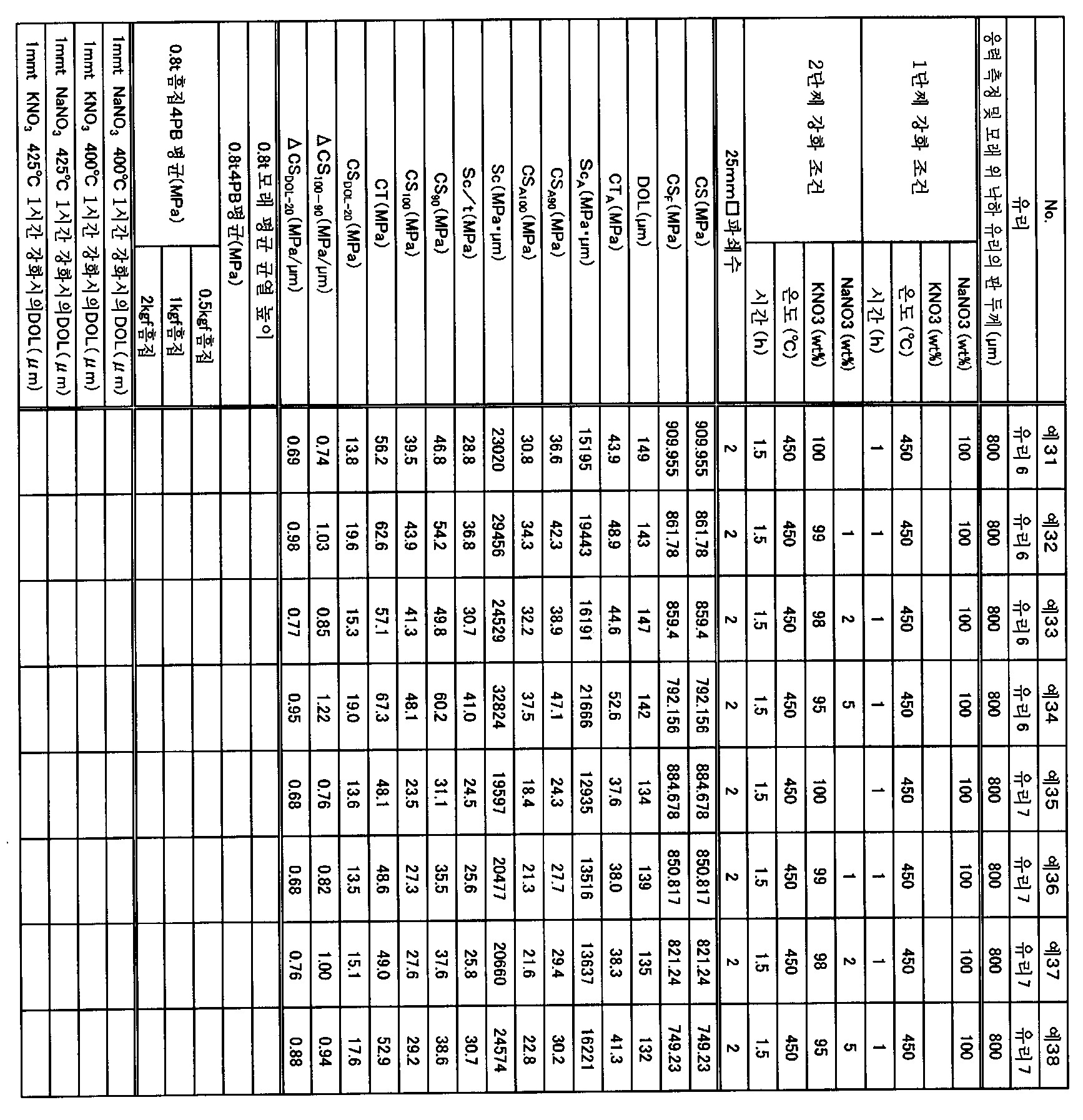
이하에 있어서, 예 16 내지 예 25의 화학 강화 유리에 대하여 설명한다.Hereinafter, the chemically tempered glass of Examples 16 to 25 will be described.
(CSx의 측정)(Measurement of CS x )
예 16 내지 25의 각 화학 강화 유리에 대해서, 유리 표면으로부터 x㎛의 깊이 부분의 압축 응력값 CSx(단위: MPa)를, 상술한 가부시키가이샤 도쿄 인스트루먼츠제 복굴절 이미징 시스템 Abrio-IM 및 박편 샘플을 사용한 방법에 의해 측정하였다. 이들의 결과를 표 4에 나타낸다. 또한, 예 26의 화학 강화 유리에 대해서는, 표면 응력계(오리하라 세이사꾸쇼제, FSM-6000)에 의해 CS 및 DOL을 측정하였다. CS는 95.7MPa, DOL은 34.6㎛였다.For each of the chemically tempered glasses of Examples 16 to 25, the compressive stress value CS x (unit: MPa) at the depth portion of x m from the glass surface was measured using the above-described birefringent imaging system Abrio-IM manufactured by Tokyo Instruments Co., Was used. The results are shown in Table 4. For the chemically tempered glass of Example 26, CS and DOL were measured by a surface stress meter (FSH-6000 manufactured by Orihara Seisakusho Co., Ltd.). CS was 95.7 MPa, and DOL was 34.6 mu m.
(EPMA에 의한 측정)(Measured by EPMA)
화학 강화 유리에 대해서, 전자선 마이크로 애널라이저(Electron Probe Micro Analyzer: EPMA)를 사용하여 취득한 Na 이온 농도 프로파일, K 이온 농도 프로파일로부터, 하기의 N0, NM, Nh, K0, KM 및 Kh를 각각 산출하고, 표 1에 나타내었다. 각 화학 강화 유리 단면을 경면 연마하고, C를 약 30nm 코팅하여 EPMA 분석에 제공하였다. EPMA는, 니혼덴시제 JXA-8500F를 사용하여, 가속 전압 15kV, 프로브 전류 30nA, 프로브 직경 1㎛φ, 스텝 간격 1㎛, 측정 시간 1s, 분광 결정 TAPH(Na Kα선, 피크 위치: 129.55mm), PETH(K Kα선, 피크 위치: 119.75mm)로 각 원소의 특성 X선 카운트수의 프로파일을 취득하였다. 추가로 시료의 판 두께 중심의 각 원소의 카운트수를 시료 조성 중의 중량%로 환산하여 이온 농도 프로파일로 하였다.The following N0, NM, Nh, K0, KM and Kh are calculated from the Na ion concentration profile and the K ion concentration profile obtained using the electron probe micro analyzer (EPMA) for the chemically tempered glass, Table 1 shows the results. Each chemically tempered glass section was mirror polished and coated with about 30 nm of C for EPMA analysis. EPMA was measured with an accelerating voltage of 15 kV, a probe current of 30 nA, a probe diameter of 1 mu m phi, a step interval of 1 mu m, a measurement time of 1 s, a spectroscopic crystal TAPH (Na K alpha line, peak position: 129.55 mm) using JXA- , And PETH (K K? Line, peak position: 119.75 mm) to obtain the profile of the characteristic X-ray count number of each element. Further, the count number of each element at the center of the plate thickness of the sample was converted into the weight percentage in the sample composition to obtain an ion concentration profile.
N0: EPMA에 의해 측정되는 상기 화학 강화 유리의 판 두께 방향의 Na 이온 농도 프로파일에 있어서의 최표면에서의 값을 Na2O(중량%)로 환산한 값N0: a converted value at the outermost surface of the Na ion concentration profile in the thickness direction of the chemically tempered glass which is measured by the EPMA to Na 2 O (wt.%) Values
NM: EPMA에 의해 측정되는 상기 화학 강화 유리의 판 두께 방향의 Na 이온 농도 프로파일에 있어서의 최댓값을 Na2O(중량%)로 환산한 값NM: value obtained by converting the maximum value in the Na ion concentration profile in the plate thickness direction of the chemically tempered glass measured by EPMA into Na 2 O (wt%)
Nh: EPMA에 의해 측정되는 상기 화학 강화 유리의 판 두께 방향의 Na 이온 농도 프로파일에 있어서의 판 두께의 중심값을 Na2O(중량%)로 환산한 값Nh: value obtained by converting the center value of the plate thickness in the Na ion concentration profile in the plate thickness direction of the chemically tempered glass measured by EPMA into Na 2 O (% by weight)
K0: EPMA에 의해 측정되는 상기 화학 강화 유리의 판 두께 방향의 K 이온 농도 프로파일에 있어서의 최표면에서의 값을 K2O(중량%)로 환산한 값K0: value obtained by converting the value at the outermost surface in the K ion concentration profile in the thickness direction of the chemically tempered glass measured by EPMA into K 2 O (wt%)
KM: EPMA에 의해 측정되는 상기 화학 강화 유리의 판 두께 방향의 K 이온 농도 프로파일에 있어서의 최댓값을 K2O(중량%)로 환산한 값 KM: value obtained by converting the maximum value in the K ion concentration profile in the plate thickness direction of the chemically tempered glass measured by EPMA into K 2 O (wt%)
Kh: EPMA에 의해 측정되는 상기 화학 강화 유리의 판 두께 방향의 K 이온 농도 프로파일에 있어서의 판 두께의 중심값을 K2O(중량%)로 환산한 값Kh: a value obtained by converting the center value of the plate thickness in the K ion concentration profile in the plate thickness direction of the chemically tempered glass measured by EPMA into K 2 O (% by weight)
또한, 상기 결과로부터, N0/Nh, NM/Nh, N0/NM, N0-Nh, NM-Nh, N0-NM, K0/Kh, KM/Kh, K0/KM 및 KM-Kh를 각각 산출하여, 표 1에 나타내었다.From the above results, it is possible to calculate N0 / Nh, NM / Nh, N0 / NM, N0-Nh, NM-Nh, N0-NM, K0 / Kh, KM / Kh, K0 / KM and KM- Table 1 shows the results.
(흠집 후 또는 미흠집시의 4점 굽힘 시험)(Four-point bending test after scratching or scratching)
화학 강화 유리에 대하여, 다이아몬드 압자(대면각의 압자 각도: 110°)를 하중 0.5Kgf, 1Kgf, 1.5Kgf 또는 2Kgf로 하여 15초간 누름으로써, 유리 표면을 흠집내었다. 이어서, 하부 스팬 30mm, 상부 스팬 10mm, 크로스헤드 속도 0.5mm/분의 조건에서 4점 굽힘 시험을 행하고, 각 흠집 조건에 있어서의 파괴 응력(MPa)을 측정하였다. 미흠집시 및 각 압자 압입 하중시의 4점 굽힘 시험을 행한 경우의 파괴 응력값(굽힘 강도, 단위: MPa)을 표 1에 나타낸다.The glass surface was scratched by pressing a diamond indenter (angle of incidence of facing angle: 110 deg.) With a load of 0.5 Kgf, 1 Kgf, 1.5 Kgf or 2 Kgf for 15 seconds against the chemically tempered glass. Then, a four-point bending test was carried out under the conditions of a lower span of 30 mm, an upper span of 10 mm, and a crosshead speed of 0.5 mm / min, and the fracture stress (MPa) under the respective scratch conditions was measured. Table 1 shows the fracture stress values (bending strength, unit: MPa) at the time of four-point bending test at the time of non-scratching and indentation indentation load.
(모래 위 낙하 시험)(Sand drop test)
또한, 화학 강화 유리에 대해서, 상술한 시험 방법에 의해 모래 위 낙하 시험을 행하고, 평균 균열 높이(단위: mm)를 측정하였다. 결과를 표 4에 나타낸다.Further, the chemical tempered glass was subjected to the sand drop test by the above-mentioned test method, and the average crack height (unit: mm) was measured. The results are shown in Table 4.
예 16, 18, 21, 22, 24, 25에 대해서, 각 예 모두 DOL이 100㎛ 이상이며, 상기 모래 위 낙하 시험에 있어서의 평균 균열 높이가 모두 300mm 이상이었다. 예 26에서는 DOL이 100㎛ 이하이고, 평균 균열 높이가 129mm였다. DOL이 100㎛ 이상이면, 모래 위 낙하 시험 내성으로 강도 향상되는 것을 나타내고 있고, 커버 유리에 필요한 예각물 흠집에 의한 파괴에 대한 강도 향상을 기대할 수 있음을 알 수 있다.For Examples 16, 18, 21, 22, 24, and 25, the DOL was 100 mu m or more in all examples, and the average crack height in the sand drop test was 300 mm or more. In Example 26, the DOL was 100 탆 or less and the average crack height was 129 mm. When the DOL is 100 mu m or more, it is shown that the strength is improved by sand drop test resistance, and it can be expected that the strength against fracture caused by the sharp angle scratch on the cover glass can be expected to be improved.
(압자 압입 시험)(Indenter indentation test)
25mm×25mm×판 두께 0.8mm의 사이즈를 갖는 화학 강화 유리에 대하여, 대면각의 압자 각도 60도를 갖는 다이아몬드 압자를 사용하여, 3 내지 10kgf의 하중을 15초간 유지하는 압자 압입 시험에 의해, 화학 강화 유리를 파괴시켜, 파괴 후의 화학 강화 유리의 파쇄수를 계측하였다. 이들의 결과를 표 4에 나타낸다.A chemical indentation glass having a size of 25 mm x 25 mm x plate thickness of 0.8 mm was subjected to an indentation test in which a load of 3 to 10 kgf was maintained for 15 seconds using a diamond indenter having an indenter angle of 60 deg. The tempered glass was destroyed, and the number of fractures of the chemically tempered glass after the fracture was measured. The results are shown in Table 4.
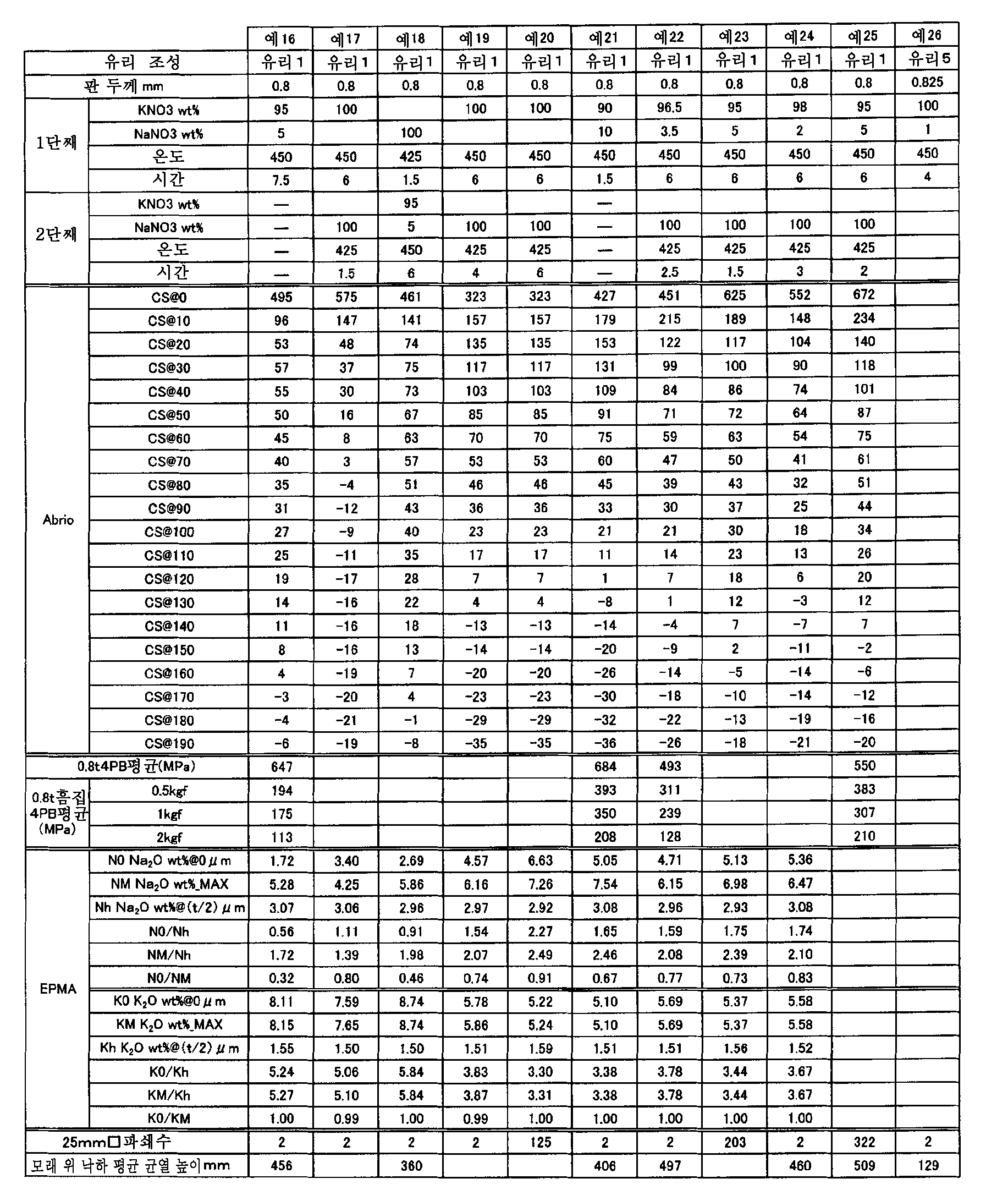
도 6에, 하중 0.5Kgf 또는 1Kgf의 조건에서 흠집낸 후의 굽힘 강도와 CS20의 관계를 플롯한 그래프를 나타낸다. 또한, 도 7에, 하중 0.5Kgf 또는 1Kgf의 조건에서 흠집낸 후의 굽힘 강도와 CS40의 관계를 플롯한 것을 나타낸다. 상술한 바와 같이, 이들의 흠집 후 굽힘 강도가 200MPa 이상이면, 스마트폰이나 태블릿 PC의 커버 유리로서 사용한 경우의 고장률을 개선할 수 있다. 도 6 및 도 7로부터도 알 수 있는 바와 같이, 유리 표면으로부터 20 내지 40㎛의 깊이 부분의 압축 응력값(CS20 내지 CS40)과 흠집 후 굽힘 강도의 사이에는 강한 상관이 있으며, 유리 표면으로부터 20 내지 40㎛의 깊이 부분의 압축 응력값이 높을수록, 높은 흠집 후 굽힘 강도가 얻어지는 경향이 있다. 그리고, CS20이나 CS40이 60MPa 이상이면, 200MPa 이상의 흠집 후 굽힘 강도를 달성할 수 있음을 알 수 있다.FIG. 6 is a graph plotting the relationship between the bending strength and the CS 20 after being scratched under the conditions of a load of 0.5 kgf or 1 kgf. 7 shows a plot of the relationship between the bending strength and the CS 40 after being scratched under the condition of a load of 0.5 kgf or 1 kgf. As described above, when the bending strength after scratching is 200 MPa or more, the failure rate when used as a cover glass of a smartphone or a tablet PC can be improved. As can be seen from Figs. 6 and 7, there is a strong correlation between the compressive stress values (CS 20 to CS 40 ) at a depth of 20 to 40 탆 from the glass surface and the bending strength after scratches, The higher the compressive stress value at the depth portion of 20 to 40 占 퐉, the higher the bending strength after high scratches is likely to be obtained. When CS 20 or CS 40 is 60 MPa or more, it can be understood that the bending strength can be attained after scratches of 200 MPa or more.
또한, 도 8에, NM/Nh와, CS20 또는 CS40의 관계를 플롯한 그래프를 나타낸다. 이에 의하면, NM/Nh가 커질수록 CS20이나 CS40이 증대되는 경향이 있고, NM/Nh가 1.8 이상이면, CS20이나 CS40을 60MPa 이상으로 할 수 있으며, 즉, 200MPa 이상의 흠집 후 굽힘 강도를 달성할 수 있음을 알 수 있다.8 is a graph plotting the relationship between NM / Nh and CS 20 or CS 40 . According to this, CS 20 or CS 40 tends to increase as NM / Nh increases. When NM / Nh is 1.8 or more, CS 20 or CS 40 can be made to be 60 MPa or more, that is, bending strength Can be achieved.
또한, 도 9에, N0/Nh와, CS20 또는 CS40의 관계를 플롯한 그래프를 나타낸다. 이에 의하면, N0/Nh가 커질수록 CS20이나 CS40이 증대되는 경향이 있고, N0/Nh가 0.8 이상이면, CS20이나 CS40을 60MPa 이상으로 할 수 있으며, 즉, 200MPa 이상의 흠집 후 굽힘 강도를 달성할 수 있음을 알 수 있다.Further, in FIG. 9 shows a plot of the relationship between N0 / Nh and, CS 20 or CS 40 graph. With this structure, N0 / if Nh is large The CS 20 and CS 40 this tends to increase, N0 / Nh is more than 0.8, CS 20 or may be the CS 40 to more than 60MPa, that is, the bending strength after scratch than 200MPa Can be achieved.
또한, 도 10에, N0/NM과, CS20 또는 CS40의 관계를 플롯한 그래프를 나타낸다. 이에 의하면, N0/NM이 커질수록 CS20이나 CS40이 증대되는 경향이 있고, N0/NM이 0.4 이상이면, CS20이나 CS40을 60MPa 이상으로 할 수 있으며, 즉, 200MPa 이상의 흠집 후 굽힘 강도를 달성할 수 있음을 알 수 있다.Further, in Figure 10, it shows a plot of the relationship between N0 / NM and, CS 20 or CS 40 graph. According to this, CS 20 or CS 40 tends to increase as
또한, 예 16, 21 및 22의 화학 강화 유리는, KM/Kh가 3 이상이며, 커버 유리 강도 확보의 관점에서 필요해지는 400MPa 이상의 굽힘 강도를 갖고 있었다.The chemically tempered glass of Examples 16, 21 and 22 had a KM / Kh of 3 or more and a bending strength of 400 MPa or more, which is necessary from the viewpoint of securing the cover glass strength.
또한, 도 11에, NM-Nh(단위: wt%)와, CS20 또는 CS40의 관계를 플롯한 그래프를 나타낸다. 이에 의하면, NM-Nh가 커질수록 CS20이나 CS40이 증대되는 경향이 있고, NM-Nh가 2.2wt% 이상이면, CS20이나 CS40을 60MPa 이상으로 할 수 있으며, 즉, 200MPa 이상의 흠집 후 굽힘 강도를 달성할 수 있음을 알 수 있다.11 is a graph plotting the relationship between NM-Nh (unit: wt%) and CS 20 or CS 40 . According to this, CS 20 or CS 40 tends to increase as NM-Nh becomes larger. When NM-Nh is 2.2 wt% or more, CS 20 or CS 40 can be made to be 60 MPa or more, It can be understood that the bending strength can be achieved.
또한, 도 12에, N0-Nh와, CS20 또는 CS40의 관계를 플롯한 그래프를 나타낸다. 이에 의하면, N0-Nh가 커질수록 CS20이나 CS40이 증대되는 경향이 있고, N0-Nh가 -0.4wt% 이상이면, CS20이나 CS40을 60MPa 이상으로 할 수 있으며, 즉, 200MPa 이상의 흠집 후 굽힘 강도를 달성할 수 있음을 알 수 있다.Further, in Fig. 12, N0-Nh and shows a graph that plots the relationship between the CS 20 or CS 40. With this structure, if N0-Nh becomes greater the more CS 20 and CS 40 is increased, and this trend, N0-Nh is more than -0.4wt% is, it is possible to the CS 20 and CS 40 to more than 60MPa, i.e., 200MPa or more flaws It can be seen that the post bending strength can be achieved.
또한, 도 13에, N0-NM과, CS20 또는 CS40의 관계를 플롯한 그래프를 나타낸다. 이에 의하면, N0-NM이 커질수록 CS20이나 CS40이 증대되는 경향이 있고, N0-NM이 -3.5wt% 이상이면, CS20이나 CS40을 60MPa 이상으로 할 수 있으며, 즉, 200MPa 이상의 흠집 후 굽힘 강도를 달성할 수 있음을 알 수 있다.In addition, 13 to, N0-NM and shows a graph that plots the relationship between the CS 20 or CS 40. According to this, CS 20 or CS 40 tends to increase with increasing N0-NM. When N0-NM is -3.5 wt% or more, CS 20 or CS 40 can be made 60 MPa or more, It can be seen that the post bending strength can be achieved.
또한, 예 16, 21 및 22의 화학 강화 유리는, KM-Kh가 3wt% 이상이며, 커버 유리 강도 신뢰성 확보의 관점에서 필요해지는 400MPa 이상의 굽힘 강도를 갖고 있었다.Further, the chemically tempered glass of Examples 16, 21 and 22 had a KM-Kh of 3 wt% or more and a bending strength of 400 MPa or more, which is necessary from the viewpoint of securing the reliability of the cover glass strength.
본 발명을 특정 형태를 참조하여 상세하게 설명하였지만, 본 발명의 정신과 범위를 벗어나지 않고 다양한 변경 및 수정이 가능한 것은, 당업자에 있어서 명확하다.While the invention has been described in detail with reference to specific embodiments thereof, it will be apparent to one skilled in the art that various changes and modifications can be made therein without departing from the spirit and scope of the invention.
또한, 본 출원은, 2016년 1월 21일자로 출원된 일본 특허 출원(일본 특허 출원 2016-010002), 2016년 10월 18일자로 출원된 일본 특허 출원(일본 특허 출원 2016-204746) 및 2016년 10월 18일자로 출원된 일본 특허 출원(일본 특허 출원 2016-204747)에 기초하고 있으며, 그 전체가 인용에 의해 원용된다.This application is also related to Japanese Patent Application (Japanese Patent Application 2016-010002) filed on January 21, 2016, Japanese Patent Application (Japanese Patent Application 2016-204746) filed on October 18, 2016, (Japanese Patent Application No. 2016-204747) filed on October 18, and is entirely cited by reference.
1 측정 시료
11 MOC판
12 스펀지 양면 테이프
13 화학 강화 유리
21 SUS판
22 규사1 measurement sample
11 MOC version
12 sponge double-sided tape
13 Chemical tempered glass
21 SUS board
22 Silos
Claims (25)
유리 표면으로부터 90㎛의 깊이 부분의 압축 응력값(CS90)이 25MPa 이상이며,
대면각의 압자 각도가 60°인 사각뿔 다이아몬드 압자로 5kgf 내지 10kgf의 범위에서의 하중을 15초간 유지하는 조건에서의 압자 압입 시험에 의한 파괴 시험에 있어서, 25mm×25mm의 사이즈 내에 발생하는 파편의 수가 20개 이하이고,
상기 화학 강화 유리의 모 조성을 갖는 유리판이며, 유리 전이점보다 30℃ 내지 50℃ 높은 온도 T℃로부터, (T-300)℃까지 0.5℃/분으로 서냉시킨 두께 1mm의 유리판에 대하여, KNO3, NaNO3, 또는 KNO3과 NaNO3의 혼합염을 포함하는 400℃의 용융염에 의해, 1시간의 이온 교환 처리를 행했을 때의 압축 응력층 깊이(DOL)가 50㎛ 이상이 되는 화학 강화 유리.A chemical tempered glass having a thickness t of 2 mm or less,
A compressive stress value (CS 90 ) at a depth of 90 mu m from the glass surface is 25 MPa or more,
In the fracture test by the indenter indentation test under the condition that the load in the range of 5 kgf to 10 kgf was maintained for 15 seconds with a quadrangular diamond indenter with an indentation angle of 60 °, 20 or less,
The glass plate having all the composition of a glass reinforcement of the chemical, from 30 ℃ to 50 ℃ high temperature T ℃ than the glass transition point, (T-300) thick was annealed with 0.5 ℃ / min to ℃ respect to 1mm of the glass plate, KNO 3, NaNO 3, KNO 3 and NaNO or by a molten salt of 400 ℃ including three mixed salt, chemical strengthened compressive stress layer depth (DOL) when performing the ion exchange treatment for one hour or more is that this glass 50㎛ .
상기 CS90과, 유리 표면으로부터 100㎛의 깊이 부분의 압축 응력값(CS100)을 사용하여 하기 식에 의해 산출되는 ΔCS100 -90(단위: MPa/㎛)이 0.4 이상인 화학 강화 유리.
ΔCS100-90=(CS90-CS100)/(100-90)The method according to claim 1,
Wherein the CS 90 and the? CS 100 -90 (unit: MPa / 占 퐉) calculated by the following equation using a compressive stress value (CS 100 ) at a depth of 100 占 퐉 from the glass surface are 0.4 or more.
ΔCS 100-90 = (CS 90 -CS 100 ) / (100-90)
상기 ΔCS100 -90(단위: MPa/㎛)이 4.0 이하인 화학 강화 유리.3. The method of claim 2,
Wherein the? CS 100 -90 (unit: MPa / 占 퐉) is 4.0 or less.
DOL로부터 20㎛ 유리 표면측의 깊이에 있어서의 압축 응력값 CSDOL -20을 사용하여 하기 식에 의해 산출되는 ΔCSDOL -20(단위: MPa/㎛)이 0.4 이상인 화학 강화 유리.
ΔCSDOL-20=CSDOL-20/204. The method according to any one of claims 1 to 3,
ΔCS DOL -20 generated by the compression stress value of the depth from the surface side to DOL 20㎛ glass using a CS -20 DOL formula (Unit: MPa / ㎛) of 0.4 or more chemical strengthened glass.
? CS DOL-20 = CS DOL-20 /20
상기 ΔCSDOL-20(단위: MPa/㎛)이 4.0 이하인 화학 강화 유리.5. The method of claim 4,
Wherein the? CS DOL-20 (unit: MPa / 占 퐉) is 4.0 or less.
다이아몬드 압자(대면각의 압자 각도: 110°)를 하중 0.5Kgf로 하여 15초간 누름으로써, 유리 표면을 흠집낸 후에, 하부 스팬 30mm, 상부 스팬 10mm, 크로스헤드 속도 0.5mm/분의 조건에서 4점 굽힘 시험을 행함으로써 얻어지는 파괴 응력값 σa(굽힘 강도, 단위: MPa)가 150MPa 이상인 화학 강화 유리.6. The method according to any one of claims 1 to 5,
The surface of the glass was scratched by pressing the diamond indenter (angle of incidence of the facing angle: 110 °) at a load of 0.5 Kgf for 15 seconds, and then the surface was scratched to obtain 4 points at the lower span 30 mm, upper span 10 mm, crosshead speed 0.5 mm / (Bending strength, unit: MPa) obtained by performing a bending test is 150 MPa or more.
다이아몬드 압자(대면각의 압자 각도: 110°)를 하중 2Kgf로 하여 15초간 누름으로써, 유리 표면을 흠집낸 후에, 하부 스팬 30mm, 상부 스팬 10mm, 크로스헤드 속도 0.5mm/분의 조건에서 4점 굽힘 시험을 행함으로써 얻어지는 파괴 응력값 σc(굽힘 강도, 단위: MPa)가 150MPa 이상인 화학 강화 유리.6. The method according to any one of claims 1 to 5,
After the glass surface was scratched by pressing the diamond indenter (angle of incidence of the facing angle: 110 °) at a load of 2 Kgf for 15 seconds, the glass surface was subjected to 4-point bending under the conditions of a lower span of 30 mm, an upper span of 10 mm, and a crosshead speed of 0.5 mm / (Bending strength, unit: MPa) of 150 MPa or more obtained by performing the test.
표면 압축 응력값이 300MPa 이상인 화학 강화 유리.8. The method according to any one of claims 1 to 7,
Chemical tempered glass having a surface compressive stress value of 300 MPa or more.
압축 응력층 깊이(DOL)가 100㎛ 이상인 화학 강화 유리.9. The method according to any one of claims 1 to 8,
A chemical tempered glass having a compressive stress layer depth (DOL) of at least 100 mu m.
상기 두께 t가 0.9mm 이하인 화학 강화 유리.10. The method according to any one of claims 1 to 9,
Wherein the thickness t is 0.9 mm or less.
압축 응력층의 면적 Sc(MPa·㎛)가 20000MPa·㎛ 이상인 화학 강화 유리.11. The method according to any one of claims 1 to 10,
Wherein the area of the compressive stress layer Sc (MPa 占 퐉) is 20,000 MPa 占 퐉 or more.
압축 응력층의 면적 Sc(MPa·㎛)를 두께 t(㎛)로 나눈 값 Sc/t(MPa)가 28MPa 이상인 화학 강화 유리.12. The method according to any one of claims 1 to 11,
Wherein a value Sc / t (MPa) of an area Sc (MPa 占 퐉) of the compressive stress layer divided by a thickness t (占 퐉) is 28 MPa or more.
NM/Nh≥1.8 (1)
KM/Kh≥3 (2)
(여기서, NM, Nh, KM 및 Kh는, 각각 이하를 나타낸다.
NM: EPMA에 의해 측정되는 상기 화학 강화 유리의 판 두께 방향의 Na 이온 농도 프로파일에 있어서의 최댓값을 Na2O(중량%)로 환산한 값
Nh: EPMA에 의해 측정되는 상기 화학 강화 유리의 판 두께 방향의 Na 이온 농도 프로파일에 있어서의 판 두께의 중심값을 Na2O(중량%)로 환산한 값
KM: EPMA에 의해 측정되는 상기 화학 강화 유리의 판 두께 방향의 K 이온 농도 프로파일에 있어서의 최댓값을 K2O(중량%)로 환산한 값
Kh: EPMA에 의해 측정되는 상기 화학 강화 유리의 판 두께 방향의 K 이온 농도 프로파일에 있어서의 판 두께의 중심값을 K2O(중량%)로 환산한 값)A chemical tempered glass satisfying the following formulas (1) and (2).
NM / Nh? 1.8 (1)
KM / Kh? 3 (2)
(Where NM, Nh, KM and Kh respectively represent the following.
NM: value obtained by converting the maximum value in the Na ion concentration profile in the plate thickness direction of the chemically tempered glass measured by EPMA into Na 2 O (wt%)
Nh: value obtained by converting the center value of the plate thickness in the Na ion concentration profile in the plate thickness direction of the chemically tempered glass measured by EPMA into Na 2 O (% by weight)
KM: value obtained by converting the maximum value in the K ion concentration profile in the plate thickness direction of the chemically tempered glass measured by EPMA into K 2 O (wt%)
Kh: a value obtained by converting the center value of the plate thickness in the K ion concentration profile in the thickness direction of the chemically tempered glass measured by EPMA into K 2 O (weight%))
추가로 하기 식(3)을 충족시키는 화학 강화 유리.
N0/Nh≥0.8 (3)
(여기서, N0은, 이하를 나타낸다.
N0: EPMA에 의해 측정되는 상기 화학 강화 유리의 판 두께 방향의 Na 이온 농도 프로파일에 있어서의 최표면에서의 값을 Na2O(중량%)로 환산한 값)14. The method of claim 13,
A chemically tempered glass further satisfying the following formula (3).
N0 / Nh? 0.8 (3)
(Where N0 represents the following.
N0: a value converted to a value at the outermost surface of the Na ion concentration profile in the thickness direction of the chemically tempered glass which is measured by the EPMA to Na 2 O (wt.%))
추가로 하기 식(4)를 충족시키는 화학 강화 유리.
N0/NM≥0.4 (4)
(여기서, N0은, 이하를 나타낸다.
N0: EPMA에 의해 측정되는 상기 화학 강화 유리의 판 두께 방향의 Na 이온 농도 프로파일에 있어서의 최표면에서의 값을 Na2O(중량%)로 환산한 값)The method according to claim 13 or 14,
A chemically tempered glass further satisfying the following formula (4).
N0 / NM? 0.4 (4)
(Where N0 represents the following.
N0: a value converted to a value at the outermost surface of the Na ion concentration profile in the thickness direction of the chemically tempered glass which is measured by the EPMA to Na 2 O (wt.%))
NM-Nh≥2.2(wt%) (5)
KM-Kh≥3(wt%) (6)
(여기서, NM, Nh, KM 및 Kh는, 각각 이하를 나타낸다.
NM: EPMA에 의해 측정되는 상기 화학 강화 유리의 판 두께 방향의 Na 이온 농도 프로파일에 있어서의 최댓값을 Na2O(중량%)로 환산한 값
Nh: EPMA에 의해 측정되는 상기 화학 강화 유리의 판 두께 방향의 Na 이온 농도 프로파일에 있어서의 판 두께의 중심값을 Na2O(중량%)로 환산한 값
KM: EPMA에 의해 측정되는 상기 화학 강화 유리의 판 두께 방향의 K 이온 농도 프로파일에 있어서의 최댓값을 K2O(중량%)로 환산한 값
Kh: EPMA에 의해 측정되는 상기 화학 강화 유리의 판 두께 방향의 K 이온 농도 프로파일에 있어서의 판 두께의 중심값을 K2O(중량%)로 환산한 값)A chemical tempered glass satisfying the following formulas (5) and (6).
NM-Nh? 2.2 (wt%) (5)
KM-Kh? 3 (wt%) (6)
(Where NM, Nh, KM and Kh respectively represent the following.
NM: value obtained by converting the maximum value in the Na ion concentration profile in the plate thickness direction of the chemically tempered glass measured by EPMA into Na 2 O (wt%)
Nh: value obtained by converting the center value of the plate thickness in the Na ion concentration profile in the plate thickness direction of the chemically tempered glass measured by EPMA into Na 2 O (% by weight)
KM: value obtained by converting the maximum value in the K ion concentration profile in the plate thickness direction of the chemically tempered glass measured by EPMA into K 2 O (wt%)
Kh: a value obtained by converting the center value of the plate thickness in the K ion concentration profile in the thickness direction of the chemically tempered glass measured by EPMA into K 2 O (weight%))
추가로 하기 식(7)을 충족시키는 화학 강화 유리.
N0-Nh≥-0.4(wt%) (7)
(여기서, N0은, 이하를 나타낸다.
N0: EPMA에 의해 측정되는 상기 화학 강화 유리의 판 두께 방향의 Na 이온 농도 프로파일에 있어서의 최표면에서의 값을 Na2O(중량%)로 환산한 값)17. The method of claim 16,
A chemically tempered glass further satisfying the following formula (7).
N0-Nh? -0.4 (wt%) (7)
(Where N0 represents the following.
N0: a value converted to a value at the outermost surface of the Na ion concentration profile in the thickness direction of the chemically tempered glass which is measured by the EPMA to Na 2 O (wt.%))
추가로 하기 식(8)을 충족시키는 화학 강화 유리.
N0-NM≥-3.5(wt%) (8)
(여기서, N0은, 이하를 나타낸다.
N0: EPMA에 의해 측정되는 상기 화학 강화 유리의 판 두께 방향의 Na 이온 농도 프로파일에 있어서의 최표면에서의 값을 Na2O(중량%)로 환산한 값)18. The method according to claim 16 or 17,
A chemically tempered glass further satisfying the following formula (8).
N0-NM? -3.5 (wt%) (8)
(Where N0 represents the following.
N0: a value converted to a value at the outermost surface of the Na ion concentration profile in the thickness direction of the chemically tempered glass which is measured by the EPMA to Na 2 O (wt.%))
상기 화학 강화 유리의 굽힘 강도가 400MPa 이상인 화학 강화 유리.19. The method according to any one of claims 13 to 18,
Wherein the chemical strengthening glass has a bending strength of 400 MPa or more.
상기 화학 강화 유리의 표면 압축 응력(CS)이 400MPa 이상인 화학 강화 유리.20. The method according to any one of claims 13 to 19,
Wherein the chemical strengthening glass has a surface compressive stress (CS) of 400 MPa or more.
상기 화학 강화 유리의 압축 응력층 깊이(DOL)가 100㎛ 이상인 화학 강화 유리.21. The method according to any one of claims 13 to 20,
Wherein the chemical strengthening glass has a compressive stress layer depth (DOL) of 100 mu m or more.
상기 화학 강화 유리는 판 두께 t가 2mm 이하인 판 형상인 화학 강화 유리.22. The method according to any one of claims 13 to 21,
Wherein the chemically tempered glass is a plate-like plate having a plate thickness t of 2 mm or less.
상기 화학 강화 유리는, 대면각 60°의 사각뿔 다이아몬드 압자로 5kgf 내지 10kgf의 범위에서의 하중을 15초간 유지하는 조건에서의 압자 압입 시험에 의한 파괴 시험에 있어서, 25mm×25mm의 사이즈 내에 발생하는 파편의 수가 20개 이하인 화학 강화 유리.24. The method according to any one of claims 13 to 22,
The above-mentioned chemical tempered glass was subjected to a fracture test by an indentation indentation test under the condition that a load in the range of 5 kgf to 10 kgf was maintained for 15 seconds with a quadrangular pyramid diamond indenter with a face angle of 60 degrees, Lt; RTI ID = 0.0 > 20 < / RTI >
상기 화학 강화 유리의 모 조성이, 산화물 기준의 몰 백분율 표시로, SiO2를 50 내지 80%, Al2O3을 1 내지 30%, B2O3을 0 내지 5%, P2O5를 0 내지 4%, Li2O를 3 내지 20%, Na2O를 0 내지 8%, K2O를 0 내지 10%, MgO를 3 내지 20%, CaO를 0 내지 20%, SrO를 0 내지 20%, BaO를 0 내지 15%, ZnO를 0 내지 10%, TiO2를 0 내지 1%, ZrO2를 0 내지 8%를 함유하는 화학 강화 유리.24. The method according to any one of claims 1 to 23,
The base composition of the chemically tempered glass, a molar percentage display of the oxide basis, 50 to 80% the SiO 2, 1 to 30% of Al 2 O 3, 0 to 5% of B 2 O 3, the P 2 O 5 0 to 4% of Li 2 O, 0 to 8% of Na 2 O, 0 to 10% of K 2 O, 3 to 20% of MgO, 0 to 20% of CaO, 0 to 20% of SrO, 20%, BaO 0 to 15%, ZnO 0 to 10%, TiO 2 0 to 1% and ZrO 2 0 to 8%.
유리에 적어도 2단계의 이온 교환 처리를 행하는 것을 포함하는, 화학 강화 유리의 제조 방법이며,
1단째의 이온 교환 처리에 사용되는 용융염 중의 KNO3 농도가 60중량% 이상이고, 또한 2단째의 이온 교환 처리에 사용되는 용융염 중의 NaNO3 농도가 5중량% 이상인, 화학 강화 유리의 제조 방법.25. The method according to any one of claims 1 to 24,
1. A method of manufacturing a chemically tempered glass, comprising at least two stages of ion exchange treatment on the glass,
Wherein the KNO 3 concentration in the molten salt used in the first-stage ion-exchange treatment is 60 wt% or more, and the NaNO 3 concentration in the molten salt used in the second-stage ion-exchange treatment is 5 wt% or more .
Applications Claiming Priority (7)
| Application Number | Priority Date | Filing Date | Title |
|---|---|---|---|
| JP2016010002 | 2016-01-21 | ||
| JPJP-P-2016-010002 | 2016-01-21 | ||
| JPJP-P-2016-204746 | 2016-10-18 | ||
| JP2016204747 | 2016-10-18 | ||
| JP2016204746 | 2016-10-18 | ||
| JPJP-P-2016-204747 | 2016-10-18 | ||
| PCT/JP2017/001742 WO2017126605A1 (en) | 2016-01-21 | 2017-01-19 | Chemically strengthened glass and method for manufacturing chemically strengthened glass |
Related Child Applications (1)
| Application Number | Title | Priority Date | Filing Date |
|---|---|---|---|
| KR1020187016952A Division KR20180098546A (en) | 2016-01-21 | 2017-01-19 | Chemically strengthened glass and method for manufacturing chemically strengthened glass |
Publications (2)
| Publication Number | Publication Date |
|---|---|
| KR20180098472A true KR20180098472A (en) | 2018-09-04 |
| KR101927013B1 KR101927013B1 (en) | 2018-12-07 |
Family
ID=59362250
Family Applications (3)
| Application Number | Title | Priority Date | Filing Date |
|---|---|---|---|
| KR1020177016470A Active KR101927013B1 (en) | 2016-01-21 | 2017-01-19 | Chemically strengthened glass and method for manufacturing chemically strengthened glass |
| KR1020197016736A Active KR102205919B1 (en) | 2016-01-21 | 2017-01-19 | Chemically strengthened glass and method for manufacturing chemically strengthened glass |
| KR1020187016952A Withdrawn KR20180098546A (en) | 2016-01-21 | 2017-01-19 | Chemically strengthened glass and method for manufacturing chemically strengthened glass |
Family Applications After (2)
| Application Number | Title | Priority Date | Filing Date |
|---|---|---|---|
| KR1020197016736A Active KR102205919B1 (en) | 2016-01-21 | 2017-01-19 | Chemically strengthened glass and method for manufacturing chemically strengthened glass |
| KR1020187016952A Withdrawn KR20180098546A (en) | 2016-01-21 | 2017-01-19 | Chemically strengthened glass and method for manufacturing chemically strengthened glass |
Country Status (5)
| Country | Link |
|---|---|
| US (3) | US11390560B2 (en) |
| JP (2) | JP6536697B2 (en) |
| KR (3) | KR101927013B1 (en) |
| CN (2) | CN108473369B (en) |
| WO (1) | WO2017126605A1 (en) |
Families Citing this family (55)
| Publication number | Priority date | Publication date | Assignee | Title |
|---|---|---|---|---|
| WO2017126605A1 (en) * | 2016-01-21 | 2017-07-27 | 旭硝子株式会社 | Chemically strengthened glass and method for manufacturing chemically strengthened glass |
| KR102073143B1 (en) * | 2016-01-21 | 2020-02-04 | 에이지씨 가부시키가이샤 | Chemically strengthened glass and glass for chemical strengthening |
| WO2018056168A1 (en) * | 2016-09-21 | 2018-03-29 | 旭硝子株式会社 | Glass capable of being chemically reinforced, and chemically reinforced glass |
| WO2018074335A1 (en) | 2016-10-18 | 2018-04-26 | 旭硝子株式会社 | Glass for chemical strengthening, chemically strengthened glass and method for manufacturing chemically strengthened glass |
| CN110191864B (en) * | 2017-01-09 | 2022-05-10 | 康宁股份有限公司 | Ion-exchangeable glass with low coefficient of thermal expansion |
| US11691911B2 (en) * | 2017-04-13 | 2023-07-04 | Samsung Display Co., Ltd. | Reinforced window member and method of manufacturing the same |
| JP2020532481A (en) * | 2017-09-04 | 2020-11-12 | ショット グラス テクノロジーズ (スゾウ) カンパニー リミテッドSchott Glass Technologies (Suzhou) Co., Ltd. | Sheet glass with improved bendability and chemical toughness |
| EP3743394B1 (en) * | 2018-01-24 | 2021-12-15 | Corning Incorporated | Glass-based articles having high stress magnitude at depth |
| CN111670172A (en) * | 2018-02-05 | 2020-09-15 | Agc株式会社 | Glass for chemical strengthening |
| JP7268673B2 (en) | 2018-02-27 | 2023-05-08 | Agc株式会社 | Three-dimensional crystallized glass, three-dimensional chemically strengthened glass, and methods for producing the same |
| CN111954647A (en) | 2018-04-04 | 2020-11-17 | Agc株式会社 | Glass for chemical strengthening |
| CN112166091A (en) * | 2018-06-01 | 2021-01-01 | 日本电气硝子株式会社 | Tempered glass and tempered glass |
| CN112399964B (en) * | 2018-07-03 | 2022-11-15 | Agc株式会社 | Chemically strengthened glass and method for producing same |
| US10829412B2 (en) * | 2018-07-13 | 2020-11-10 | Corning Incorporated | Carriers for microelectronics fabrication |
| CN109293234A (en) * | 2018-09-25 | 2019-02-01 | 中国南玻集团股份有限公司 | Aluminosilicate glass and preparation method, protective glass for electronic display screen |
| WO2020069259A1 (en) * | 2018-09-28 | 2020-04-02 | Corning Incorporated | Enhanced ion exchange methods |
| DE112018008220T5 (en) | 2018-12-21 | 2021-09-02 | Ohara Inc. | CRYSTALLIZED GLASS SUBSTRATE |
| TWI817970B (en) * | 2018-12-26 | 2023-10-11 | 日商小原股份有限公司 | Crystallized glass substrate |
| JP7400738B2 (en) | 2019-01-18 | 2023-12-19 | Agc株式会社 | Chemically strengthened glass and its manufacturing method |
| WO2020161949A1 (en) | 2019-02-08 | 2020-08-13 | Agc株式会社 | Crystallized glass, chemically strengthened glass, and semiconductor substrate |
| CN110128008B (en) * | 2019-05-16 | 2021-09-10 | 重庆鑫景特种玻璃有限公司 | Low-curvature-radius ultrathin tempered glass, preparation method thereof, glass device and mother glass |
| KR102642606B1 (en) | 2019-05-30 | 2024-03-05 | 삼성디스플레이 주식회사 | Window and manufacturing method for the same |
| JP7533456B2 (en) | 2019-06-03 | 2024-08-14 | Agc株式会社 | Glass, chemically strengthened glass and method for producing same |
| WO2020261711A1 (en) * | 2019-06-26 | 2020-12-30 | Agc株式会社 | Chemically strengthened glass and manufacturing method therefor |
| CN114096490B (en) * | 2019-06-27 | 2023-12-19 | Agc株式会社 | Strengthened glass plate and method of manufacturing same |
| CN112142342B (en) * | 2019-06-28 | 2022-04-29 | 华为技术有限公司 | Chemically strengthened glass and preparation method and terminal thereof |
| CN118047533A (en) * | 2019-07-17 | 2024-05-17 | Agc株式会社 | Glass, chemically strengthened glass and protective glass |
| DE102019121147A1 (en) | 2019-08-05 | 2021-02-11 | Schott Ag | Disc-shaped, chemically toughened glass articles and process for their manufacture |
| DE102019121146A1 (en) | 2019-08-05 | 2021-02-11 | Schott Ag | Heat-formed chemically toughenable glass article with a low crystal content, in particular disk-shaped chemically toughened glass article, as well as method and device for its production |
| DE102019121144A1 (en) * | 2019-08-05 | 2021-02-11 | Schott Ag | Disc-shaped glass article, its manufacture and use |
| JP7234856B2 (en) * | 2019-08-20 | 2023-03-08 | Agc株式会社 | Manufacturing method of lithium aluminosilicate glass and float glass plate |
| KR102741536B1 (en) * | 2019-12-18 | 2024-12-11 | 엘지전자 주식회사 | Antibacterial glass composition and method of manufactruing antibacterial glass powder using the same and domestic appliance including the same |
| JP7492681B2 (en) | 2019-12-23 | 2024-05-30 | 日本電気硝子株式会社 | How to measure the strength of tempered glass |
| CN111116040A (en) * | 2020-01-20 | 2020-05-08 | 科立视材料科技有限公司 | Toughened glass product with non-single surface compressive stress slope and preparation method thereof |
| WO2021235547A1 (en) * | 2020-05-22 | 2021-11-25 | Agc株式会社 | Chemically strengthened glass article and manufacturing method thereof |
| JP2021195278A (en) | 2020-06-12 | 2021-12-27 | Agc株式会社 | Protective member and communication terminal device including the same |
| KR20230038186A (en) * | 2020-07-10 | 2023-03-17 | 에이지씨 가부시키가이샤 | glass and chemically tempered glass |
| CN114075046B (en) * | 2020-08-18 | 2023-01-24 | 重庆鑫景特种玻璃有限公司 | Tempered glass with high pressure stress and high safety and processing method thereof |
| CN114075044B (en) * | 2020-08-18 | 2023-01-24 | 重庆鑫景特种玻璃有限公司 | A kind of tempered glass with safe stress state and its processing method |
| CN112592056A (en) * | 2020-10-30 | 2021-04-02 | 重庆鑫景特种玻璃有限公司 | Safety reinforced glass with low-variation-amplitude tensile stress area, and preparation method and application thereof |
| CN116802161A (en) * | 2020-11-30 | 2023-09-22 | 康宁股份有限公司 | Ion-exchangeable glass with high fracture toughness |
| JP7722389B2 (en) * | 2020-12-04 | 2025-08-13 | Agc株式会社 | Chemically strengthened glass and electronic equipment housings |
| CN112794653B (en) * | 2021-02-08 | 2022-03-08 | 清远南玻节能新材料有限公司 | Aluminosilicate strengthened glass and preparation method thereof |
| JP7136947B2 (en) * | 2021-02-17 | 2022-09-13 | 株式会社オハラ | crystallized glass substrate |
| CN113125270A (en) * | 2021-03-31 | 2021-07-16 | 彩虹集团(邵阳)特种玻璃有限公司 | Device for testing actual state of cover plate glass after internal tensile stress is broken and using method |
| CN117062788A (en) * | 2021-04-07 | 2023-11-14 | Agc株式会社 | Chemically strengthened glass and manufacturing method thereof |
| US12454479B2 (en) | 2021-06-18 | 2025-10-28 | Corning Incorporated | Gold containing silicate glass |
| US11667562B2 (en) | 2021-06-18 | 2023-06-06 | Corning Incorporated | Colored glass articles having improved mechanical durability |
| US11634354B2 (en) | 2021-06-18 | 2023-04-25 | Corning Incorporated | Colored glass articles having improved mechanical durability |
| US12378152B2 (en) | 2021-06-18 | 2025-08-05 | Corning Incorporated | Colored glass articles having improved mechanical durability |
| US12304858B2 (en) | 2021-06-18 | 2025-05-20 | Corning Incorporated | Colored glass articles having improved mechanical durability |
| US12054422B2 (en) | 2021-06-18 | 2024-08-06 | Corning Incorporated | Colored glass articles having improved mechanical durability |
| US12240782B2 (en) | 2022-05-31 | 2025-03-04 | Corning Incorporated | Ion exchangeable yellow glass articles |
| CN116023025B (en) * | 2023-01-19 | 2024-06-28 | 清远南玻节能新材料有限公司 | Aluminoborosilicate glass for ion exchange and preparation method and application thereof |
| CN116040939A (en) * | 2023-01-19 | 2023-05-02 | 华南理工大学 | Low melting point borosilicate glass and its preparation method and application |
Citations (2)
| Publication number | Priority date | Publication date | Assignee | Title |
|---|---|---|---|---|
| JP2013520385A (en) | 2010-02-26 | 2013-06-06 | ショット グラス テクノロジーズ (スゾウ) カンパニー リミテッド | Thin lithium aluminosilicate glass for 3D precision molding |
| US20150259244A1 (en) | 2014-02-24 | 2015-09-17 | Corning Incorporated | Strengthened glass with deep depth of compression |
Family Cites Families (48)
| Publication number | Priority date | Publication date | Assignee | Title |
|---|---|---|---|---|
| US3433611A (en) * | 1965-09-09 | 1969-03-18 | Ppg Industries Inc | Strengthening glass by multiple alkali ion exchange |
| US4156755A (en) * | 1978-04-19 | 1979-05-29 | Ppg Industries, Inc. | Lithium containing ion exchange strengthened glass |
| JPS60180936A (en) | 1984-02-27 | 1985-09-14 | Nippon Electric Glass Co Ltd | Production of heat resistant glass product having high strength |
| US5674790A (en) | 1995-12-15 | 1997-10-07 | Corning Incorporated | Strengthening glass by ion exchange |
| FR2761978B1 (en) | 1997-04-11 | 1999-05-07 | Saint Gobain Vitrage | GLASS COMPOSITION AND CHEMICALLY TEMPERED GLASS SUBSTRATE |
| GB2335423A (en) | 1998-03-20 | 1999-09-22 | Pilkington Plc | Chemically toughenable glass |
| SG99350A1 (en) | 2000-02-17 | 2003-10-27 | Hoya Corp | Glass for cathode-ray tube, strengthened glass, method for the production thereof and use thereof |
| JP2001302278A (en) | 2000-02-17 | 2001-10-31 | Hoya Corp | Glass for cathode-ray tube, glass panel for cathode ray tube and method for production thereof |
| JP2002174810A (en) * | 2000-12-08 | 2002-06-21 | Hoya Corp | Glass substrate for display, manufacturing method for the same and display using the same |
| JP3995902B2 (en) | 2001-05-31 | 2007-10-24 | Hoya株式会社 | Glass substrate for information recording medium and magnetic information recording medium using the same |
| JP2004131314A (en) * | 2002-10-09 | 2004-04-30 | Asahi Glass Co Ltd | Chemically tempered glass substrate with transparent conductive film and method for producing the same |
| US7727917B2 (en) | 2003-10-24 | 2010-06-01 | Schott Ag | Lithia-alumina-silica containing glass compositions and glasses suitable for chemical tempering and articles made using the chemically tempered glass |
| US7566673B2 (en) * | 2003-10-31 | 2009-07-28 | Konica Minolta Opto, Inc. | Glass substrate for an information recording medium and information recording medium employing it |
| JP2006083045A (en) | 2004-09-17 | 2006-03-30 | Hitachi Ltd | Glass member |
| US8304078B2 (en) | 2005-09-12 | 2012-11-06 | Saxon Glass Technologies, Inc. | Chemically strengthened lithium aluminosilicate glass having high strength effective to resist fracture upon flexing |
| JP5605736B2 (en) | 2006-05-25 | 2014-10-15 | 日本電気硝子株式会社 | Tempered glass and manufacturing method thereof |
| CN101454252A (en) | 2006-05-25 | 2009-06-10 | 日本电气硝子株式会社 | Tempered glass and method for producing same |
| WO2007142324A1 (en) | 2006-06-08 | 2007-12-13 | Hoya Corporation | Glass for use as substrate for information recording medium, substrate for information recording medium, information recording medium, and their production methods |
| EP2321230A4 (en) * | 2008-07-29 | 2012-10-10 | Corning Inc | Dual stage ion exchange for chemical strengthening of glass |
| JP5670901B2 (en) | 2008-08-08 | 2015-02-18 | コーニング インコーポレイテッド | Tempered glass article and manufacturing method thereof |
| JP5429684B2 (en) * | 2008-11-11 | 2014-02-26 | 日本電気硝子株式会社 | Tempered glass substrate and manufacturing method thereof |
| JP5622069B2 (en) | 2009-01-21 | 2014-11-12 | 日本電気硝子株式会社 | Tempered glass, tempered glass and method for producing tempered glass |
| EP2483216A1 (en) * | 2009-09-30 | 2012-08-08 | Apple Inc. | Techniques for strengthening glass covers for portable electronic devices |
| JP5483262B2 (en) * | 2009-12-04 | 2014-05-07 | 日本電気硝子株式会社 | Laminated glass |
| DE102010009585B4 (en) * | 2010-02-26 | 2012-04-19 | Schott Ag | High modulus lithium aluminosilicate glass, process for its preparation and use |
| DE102010009584B4 (en) | 2010-02-26 | 2015-01-08 | Schott Ag | Chemically toughened glass, process for its preparation and use thereof |
| US8778820B2 (en) | 2010-05-27 | 2014-07-15 | Corning Incorporated | Glasses having low softening temperatures and high toughness |
| JP2010202514A (en) | 2010-06-10 | 2010-09-16 | Hoya Corp | Glass substrate for mobile liquid crystal display and method for producing the same, and mobile liquid crystal display using the same |
| JP2012020921A (en) * | 2010-06-18 | 2012-02-02 | Asahi Glass Co Ltd | Glass for display device and glass plate |
| US20120052271A1 (en) * | 2010-08-26 | 2012-03-01 | Sinue Gomez | Two-step method for strengthening glass |
| FR2964655B1 (en) | 2010-09-13 | 2017-05-19 | Saint Gobain | GLASS SHEET |
| JP2012232882A (en) * | 2011-04-18 | 2012-11-29 | Asahi Glass Co Ltd | Method for producing chemically tempered glass, and glass for chemical tempering |
| US9156725B2 (en) | 2012-05-30 | 2015-10-13 | Corning Incorporated | Down-drawable chemically strengthened glass for information storage devices |
| US9139469B2 (en) | 2012-07-17 | 2015-09-22 | Corning Incorporated | Ion exchangeable Li-containing glass compositions for 3-D forming |
| US11079309B2 (en) * | 2013-07-26 | 2021-08-03 | Corning Incorporated | Strengthened glass articles having improved survivability |
| TWI729925B (en) * | 2014-06-19 | 2021-06-01 | 美商康寧公司 | Glasses having non-frangible stress profiles |
| JP2016028000A (en) * | 2014-07-10 | 2016-02-25 | 日本電気硝子株式会社 | Tempered glass and method for producing the same |
| JP2016044119A (en) * | 2014-08-19 | 2016-04-04 | 日本電気硝子株式会社 | Strengthened glass and method for producing the same |
| CN115536270A (en) * | 2014-11-04 | 2022-12-30 | 康宁股份有限公司 | Deep non-fragile stress curve and method of making the same |
| TWI739442B (en) * | 2015-12-11 | 2021-09-11 | 美商康寧公司 | Fusion-formable glass-based articles including a metal oxide concentration gradient |
| KR20180095559A (en) * | 2015-12-17 | 2018-08-27 | 코닝 인코포레이티드 | Ion exchangeable glass with fast diffusion |
| WO2017120424A1 (en) * | 2016-01-08 | 2017-07-13 | Corning Incorporated | Chemically strengthenable lithium aluminosilicate glasses with inherent damage resistance |
| KR102073143B1 (en) * | 2016-01-21 | 2020-02-04 | 에이지씨 가부시키가이샤 | Chemically strengthened glass and glass for chemical strengthening |
| WO2017126605A1 (en) * | 2016-01-21 | 2017-07-27 | 旭硝子株式会社 | Chemically strengthened glass and method for manufacturing chemically strengthened glass |
| KR20200091500A (en) | 2016-04-08 | 2020-07-30 | 코닝 인코포레이티드 | Glass-based articles including a stress profile comprising two regions, and methods of making |
| US11453612B2 (en) * | 2016-04-20 | 2022-09-27 | Corning Incorporated | Glass-based articles including a metal oxide concentration gradient |
| US11059744B2 (en) * | 2016-06-14 | 2021-07-13 | Corning Incorporated | Glasses having improved drop performance |
| JP2019123658A (en) * | 2018-01-19 | 2019-07-25 | Agc株式会社 | Manufacturing method of chemically reinforced glass, and chemically reinforced glass |
-
2017
- 2017-01-19 WO PCT/JP2017/001742 patent/WO2017126605A1/en not_active Ceased
- 2017-01-19 JP JP2017562886A patent/JP6536697B2/en active Active
- 2017-01-19 CN CN201780007517.5A patent/CN108473369B/en active Active
- 2017-01-19 CN CN201910516206.2A patent/CN110217983B/en active Active
- 2017-01-19 KR KR1020177016470A patent/KR101927013B1/en active Active
- 2017-01-19 KR KR1020197016736A patent/KR102205919B1/en active Active
- 2017-01-19 KR KR1020187016952A patent/KR20180098546A/en not_active Withdrawn
-
2018
- 2018-07-11 US US16/032,566 patent/US11390560B2/en active Active
-
2019
- 2019-05-30 JP JP2019101364A patent/JP6891921B2/en active Active
- 2019-06-13 US US16/440,305 patent/US11365149B2/en active Active
-
2022
- 2022-05-18 US US17/747,664 patent/US20220274869A1/en not_active Abandoned
Patent Citations (2)
| Publication number | Priority date | Publication date | Assignee | Title |
|---|---|---|---|---|
| JP2013520385A (en) | 2010-02-26 | 2013-06-06 | ショット グラス テクノロジーズ (スゾウ) カンパニー リミテッド | Thin lithium aluminosilicate glass for 3D precision molding |
| US20150259244A1 (en) | 2014-02-24 | 2015-09-17 | Corning Incorporated | Strengthened glass with deep depth of compression |
Also Published As
| Publication number | Publication date |
|---|---|
| US20190292099A1 (en) | 2019-09-26 |
| KR20180098546A (en) | 2018-09-04 |
| CN110217983A (en) | 2019-09-10 |
| JP6891921B2 (en) | 2021-06-18 |
| US20180319706A1 (en) | 2018-11-08 |
| US11365149B2 (en) | 2022-06-21 |
| WO2017126605A1 (en) | 2017-07-27 |
| CN108473369A (en) | 2018-08-31 |
| US11390560B2 (en) | 2022-07-19 |
| CN108473369B (en) | 2022-11-22 |
| US20220274869A1 (en) | 2022-09-01 |
| KR101927013B1 (en) | 2018-12-07 |
| JPWO2017126605A1 (en) | 2018-11-08 |
| KR20190071830A (en) | 2019-06-24 |
| KR102205919B1 (en) | 2021-01-21 |
| JP6536697B2 (en) | 2019-07-03 |
| CN110217983B (en) | 2022-09-06 |
| JP2019147738A (en) | 2019-09-05 |
Similar Documents
| Publication | Publication Date | Title |
|---|---|---|
| KR101927013B1 (en) | Chemically strengthened glass and method for manufacturing chemically strengthened glass | |
| JP7260041B2 (en) | chemically strengthened glass | |
| KR102569434B1 (en) | Chemically strengthened glass and glass for chemical strengthening | |
| TWI718556B (en) | Glass-based articles including a stress profile comprising two regions, and methods of making | |
| KR20200023304A (en) | Chemical Tempered Glass, Manufacturing Method and Chemical Tempered Glass | |
| CN114929641A (en) | Chemically strengthened glass article and method for producing same | |
| JPWO2017026267A1 (en) | Chemically tempered glass | |
| JPWO2020121889A1 (en) | Glass, chemically strengthened glass and electronic devices containing it | |
| CN115605448A (en) | Chemically strengthened glass article and method of manufacturing the same | |
| TW202334047A (en) | Fusion formable high fracture toughness glasses |
Legal Events
| Date | Code | Title | Description |
|---|---|---|---|
| A201 | Request for examination | ||
| PA0105 | International application |
Patent event date: 20170615 Patent event code: PA01051R01D Comment text: International Patent Application |
|
| PA0201 | Request for examination | ||
| A302 | Request for accelerated examination | ||
| PA0302 | Request for accelerated examination |
Patent event date: 20170616 Patent event code: PA03022R01D Comment text: Request for Accelerated Examination |
|
| E902 | Notification of reason for refusal | ||
| PE0902 | Notice of grounds for rejection |
Comment text: Notification of reason for refusal Patent event date: 20180430 Patent event code: PE09021S01D |
|
| A107 | Divisional application of patent | ||
| PA0104 | Divisional application for international application |
Comment text: Divisional Application for International Patent Patent event code: PA01041R01D Patent event date: 20180615 |
|
| AMND | Amendment | ||
| PG1501 | Laying open of application | ||
| E601 | Decision to refuse application | ||
| PE0601 | Decision on rejection of patent |
Patent event date: 20180917 Comment text: Decision to Refuse Application Patent event code: PE06012S01D Patent event date: 20180430 Comment text: Notification of reason for refusal Patent event code: PE06011S01I |
|
| AMND | Amendment | ||
| PX0901 | Re-examination |
Patent event code: PX09011S01I Patent event date: 20180917 Comment text: Decision to Refuse Application Patent event code: PX09012R01I Patent event date: 20180618 Comment text: Amendment to Specification, etc. |
|
| PX0701 | Decision of registration after re-examination |
Patent event date: 20181120 Comment text: Decision to Grant Registration Patent event code: PX07013S01D Patent event date: 20181017 Comment text: Amendment to Specification, etc. Patent event code: PX07012R01I Patent event date: 20180917 Comment text: Decision to Refuse Application Patent event code: PX07011S01I Patent event date: 20180618 Comment text: Amendment to Specification, etc. Patent event code: PX07012R01I |
|
| X701 | Decision to grant (after re-examination) | ||
| GRNT | Written decision to grant | ||
| PR0701 | Registration of establishment |
Comment text: Registration of Establishment Patent event date: 20181203 Patent event code: PR07011E01D |
|
| PR1002 | Payment of registration fee |
Payment date: 20181203 End annual number: 3 Start annual number: 1 |
|
| PG1601 | Publication of registration | ||
| PR1001 | Payment of annual fee |
Payment date: 20211126 Start annual number: 4 End annual number: 4 |
|
| PR1001 | Payment of annual fee |
Payment date: 20221125 Start annual number: 5 End annual number: 5 |