KR20180098270A - A nonwoven fabric for an outer sheet of an absorbent article, and an absorbent article comprising the nonwoven fabric as an outer sheet - Google Patents
A nonwoven fabric for an outer sheet of an absorbent article, and an absorbent article comprising the nonwoven fabric as an outer sheet Download PDFInfo
- Publication number
- KR20180098270A KR20180098270A KR1020187018018A KR20187018018A KR20180098270A KR 20180098270 A KR20180098270 A KR 20180098270A KR 1020187018018 A KR1020187018018 A KR 1020187018018A KR 20187018018 A KR20187018018 A KR 20187018018A KR 20180098270 A KR20180098270 A KR 20180098270A
- Authority
- KR
- South Korea
- Prior art keywords
- nonwoven fabric
- fiber
- absorbent article
- sheet
- thermoplastic resin
- Prior art date
- Legal status (The legal status is an assumption and is not a legal conclusion. Google has not performed a legal analysis and makes no representation as to the accuracy of the status listed.)
- Granted
Links
Images



Classifications
-
- A—HUMAN NECESSITIES
- A61—MEDICAL OR VETERINARY SCIENCE; HYGIENE
- A61F—FILTERS IMPLANTABLE INTO BLOOD VESSELS; PROSTHESES; DEVICES PROVIDING PATENCY TO, OR PREVENTING COLLAPSING OF, TUBULAR STRUCTURES OF THE BODY, e.g. STENTS; ORTHOPAEDIC, NURSING OR CONTRACEPTIVE DEVICES; FOMENTATION; TREATMENT OR PROTECTION OF EYES OR EARS; BANDAGES, DRESSINGS OR ABSORBENT PADS; FIRST-AID KITS
- A61F13/00—Bandages or dressings; Absorbent pads
- A61F13/15—Absorbent pads, e.g. sanitary towels, swabs or tampons for external or internal application to the body; Supporting or fastening means therefor; Tampon applicators
- A61F13/51—Absorbent pads, e.g. sanitary towels, swabs or tampons for external or internal application to the body; Supporting or fastening means therefor; Tampon applicators characterised by the outer layers of the pads
- A61F13/514—Backsheet, i.e. the impermeable cover or layer furthest from the skin
- A61F13/51474—Backsheet, i.e. the impermeable cover or layer furthest from the skin characterised by its structure
- A61F13/51484—Backsheet, i.e. the impermeable cover or layer furthest from the skin characterised by its structure being inhomogeneous in the plane of the sheet, i.e. having zones of different properties or structures
-
- A—HUMAN NECESSITIES
- A61—MEDICAL OR VETERINARY SCIENCE; HYGIENE
- A61F—FILTERS IMPLANTABLE INTO BLOOD VESSELS; PROSTHESES; DEVICES PROVIDING PATENCY TO, OR PREVENTING COLLAPSING OF, TUBULAR STRUCTURES OF THE BODY, e.g. STENTS; ORTHOPAEDIC, NURSING OR CONTRACEPTIVE DEVICES; FOMENTATION; TREATMENT OR PROTECTION OF EYES OR EARS; BANDAGES, DRESSINGS OR ABSORBENT PADS; FIRST-AID KITS
- A61F13/00—Bandages or dressings; Absorbent pads
- A61F13/15—Absorbent pads, e.g. sanitary towels, swabs or tampons for external or internal application to the body; Supporting or fastening means therefor; Tampon applicators
- A61F13/15203—Properties of the article, e.g. stiffness or absorbency
-
- A—HUMAN NECESSITIES
- A61—MEDICAL OR VETERINARY SCIENCE; HYGIENE
- A61F—FILTERS IMPLANTABLE INTO BLOOD VESSELS; PROSTHESES; DEVICES PROVIDING PATENCY TO, OR PREVENTING COLLAPSING OF, TUBULAR STRUCTURES OF THE BODY, e.g. STENTS; ORTHOPAEDIC, NURSING OR CONTRACEPTIVE DEVICES; FOMENTATION; TREATMENT OR PROTECTION OF EYES OR EARS; BANDAGES, DRESSINGS OR ABSORBENT PADS; FIRST-AID KITS
- A61F13/00—Bandages or dressings; Absorbent pads
- A61F13/15—Absorbent pads, e.g. sanitary towels, swabs or tampons for external or internal application to the body; Supporting or fastening means therefor; Tampon applicators
- A61F13/45—Absorbent pads, e.g. sanitary towels, swabs or tampons for external or internal application to the body; Supporting or fastening means therefor; Tampon applicators characterised by the shape
- A61F13/49—Absorbent pads, e.g. sanitary towels, swabs or tampons for external or internal application to the body; Supporting or fastening means therefor; Tampon applicators characterised by the shape specially adapted to be worn around the waist, e.g. diapers, nappies
- A61F13/494—Absorbent pads, e.g. sanitary towels, swabs or tampons for external or internal application to the body; Supporting or fastening means therefor; Tampon applicators characterised by the shape specially adapted to be worn around the waist, e.g. diapers, nappies characterised by edge leakage prevention means
- A61F13/49406—Absorbent pads, e.g. sanitary towels, swabs or tampons for external or internal application to the body; Supporting or fastening means therefor; Tampon applicators characterised by the shape specially adapted to be worn around the waist, e.g. diapers, nappies characterised by edge leakage prevention means the edge leakage prevention means being at the crotch region
- A61F13/49413—Absorbent pads, e.g. sanitary towels, swabs or tampons for external or internal application to the body; Supporting or fastening means therefor; Tampon applicators characterised by the shape specially adapted to be worn around the waist, e.g. diapers, nappies characterised by edge leakage prevention means the edge leakage prevention means being at the crotch region the edge leakage prevention means being an upstanding barrier
-
- A—HUMAN NECESSITIES
- A61—MEDICAL OR VETERINARY SCIENCE; HYGIENE
- A61F—FILTERS IMPLANTABLE INTO BLOOD VESSELS; PROSTHESES; DEVICES PROVIDING PATENCY TO, OR PREVENTING COLLAPSING OF, TUBULAR STRUCTURES OF THE BODY, e.g. STENTS; ORTHOPAEDIC, NURSING OR CONTRACEPTIVE DEVICES; FOMENTATION; TREATMENT OR PROTECTION OF EYES OR EARS; BANDAGES, DRESSINGS OR ABSORBENT PADS; FIRST-AID KITS
- A61F13/00—Bandages or dressings; Absorbent pads
- A61F13/15—Absorbent pads, e.g. sanitary towels, swabs or tampons for external or internal application to the body; Supporting or fastening means therefor; Tampon applicators
- A61F13/51—Absorbent pads, e.g. sanitary towels, swabs or tampons for external or internal application to the body; Supporting or fastening means therefor; Tampon applicators characterised by the outer layers of the pads
- A61F13/514—Backsheet, i.e. the impermeable cover or layer furthest from the skin
-
- A—HUMAN NECESSITIES
- A61—MEDICAL OR VETERINARY SCIENCE; HYGIENE
- A61F—FILTERS IMPLANTABLE INTO BLOOD VESSELS; PROSTHESES; DEVICES PROVIDING PATENCY TO, OR PREVENTING COLLAPSING OF, TUBULAR STRUCTURES OF THE BODY, e.g. STENTS; ORTHOPAEDIC, NURSING OR CONTRACEPTIVE DEVICES; FOMENTATION; TREATMENT OR PROTECTION OF EYES OR EARS; BANDAGES, DRESSINGS OR ABSORBENT PADS; FIRST-AID KITS
- A61F13/00—Bandages or dressings; Absorbent pads
- A61F13/15—Absorbent pads, e.g. sanitary towels, swabs or tampons for external or internal application to the body; Supporting or fastening means therefor; Tampon applicators
- A61F13/51—Absorbent pads, e.g. sanitary towels, swabs or tampons for external or internal application to the body; Supporting or fastening means therefor; Tampon applicators characterised by the outer layers of the pads
- A61F13/514—Backsheet, i.e. the impermeable cover or layer furthest from the skin
- A61F13/51456—Backsheet, i.e. the impermeable cover or layer furthest from the skin characterised by its properties
- A61F13/51458—Backsheet, i.e. the impermeable cover or layer furthest from the skin characterised by its properties being air-pervious or breathable
-
- A—HUMAN NECESSITIES
- A61—MEDICAL OR VETERINARY SCIENCE; HYGIENE
- A61F—FILTERS IMPLANTABLE INTO BLOOD VESSELS; PROSTHESES; DEVICES PROVIDING PATENCY TO, OR PREVENTING COLLAPSING OF, TUBULAR STRUCTURES OF THE BODY, e.g. STENTS; ORTHOPAEDIC, NURSING OR CONTRACEPTIVE DEVICES; FOMENTATION; TREATMENT OR PROTECTION OF EYES OR EARS; BANDAGES, DRESSINGS OR ABSORBENT PADS; FIRST-AID KITS
- A61F13/00—Bandages or dressings; Absorbent pads
- A61F13/15—Absorbent pads, e.g. sanitary towels, swabs or tampons for external or internal application to the body; Supporting or fastening means therefor; Tampon applicators
- A61F13/51—Absorbent pads, e.g. sanitary towels, swabs or tampons for external or internal application to the body; Supporting or fastening means therefor; Tampon applicators characterised by the outer layers of the pads
- A61F13/514—Backsheet, i.e. the impermeable cover or layer furthest from the skin
- A61F13/51474—Backsheet, i.e. the impermeable cover or layer furthest from the skin characterised by its structure
- A61F13/51476—Backsheet, i.e. the impermeable cover or layer furthest from the skin characterised by its structure being three-dimensional, e.g. embossed, textured, pleated, or with three-dimensional features, like gathers or loops
-
- A—HUMAN NECESSITIES
- A61—MEDICAL OR VETERINARY SCIENCE; HYGIENE
- A61F—FILTERS IMPLANTABLE INTO BLOOD VESSELS; PROSTHESES; DEVICES PROVIDING PATENCY TO, OR PREVENTING COLLAPSING OF, TUBULAR STRUCTURES OF THE BODY, e.g. STENTS; ORTHOPAEDIC, NURSING OR CONTRACEPTIVE DEVICES; FOMENTATION; TREATMENT OR PROTECTION OF EYES OR EARS; BANDAGES, DRESSINGS OR ABSORBENT PADS; FIRST-AID KITS
- A61F13/00—Bandages or dressings; Absorbent pads
- A61F13/15—Absorbent pads, e.g. sanitary towels, swabs or tampons for external or internal application to the body; Supporting or fastening means therefor; Tampon applicators
- A61F13/51—Absorbent pads, e.g. sanitary towels, swabs or tampons for external or internal application to the body; Supporting or fastening means therefor; Tampon applicators characterised by the outer layers of the pads
- A61F13/514—Backsheet, i.e. the impermeable cover or layer furthest from the skin
- A61F13/51474—Backsheet, i.e. the impermeable cover or layer furthest from the skin characterised by its structure
- A61F13/51478—Backsheet, i.e. the impermeable cover or layer furthest from the skin characterised by its structure being a laminate, e.g. multi-layered or with several layers
- A61F13/5148—Backsheet, i.e. the impermeable cover or layer furthest from the skin characterised by its structure being a laminate, e.g. multi-layered or with several layers having an impervious inner layer and a cloth-like outer layer
-
- A—HUMAN NECESSITIES
- A61—MEDICAL OR VETERINARY SCIENCE; HYGIENE
- A61L—METHODS OR APPARATUS FOR STERILISING MATERIALS OR OBJECTS IN GENERAL; DISINFECTION, STERILISATION OR DEODORISATION OF AIR; CHEMICAL ASPECTS OF BANDAGES, DRESSINGS, ABSORBENT PADS OR SURGICAL ARTICLES; MATERIALS FOR BANDAGES, DRESSINGS, ABSORBENT PADS OR SURGICAL ARTICLES
- A61L15/00—Chemical aspects of, or use of materials for, bandages, dressings or absorbent pads
- A61L15/16—Bandages, dressings or absorbent pads for physiological fluids such as urine or blood, e.g. sanitary towels, tampons
- A61L15/22—Bandages, dressings or absorbent pads for physiological fluids such as urine or blood, e.g. sanitary towels, tampons containing macromolecular materials
- A61L15/225—Mixtures of macromolecular compounds
-
- B—PERFORMING OPERATIONS; TRANSPORTING
- B32—LAYERED PRODUCTS
- B32B—LAYERED PRODUCTS, i.e. PRODUCTS BUILT-UP OF STRATA OF FLAT OR NON-FLAT, e.g. CELLULAR OR HONEYCOMB, FORM
- B32B5/00—Layered products characterised by the non- homogeneity or physical structure, i.e. comprising a fibrous, filamentary, particulate or foam layer; Layered products characterised by having a layer differing constitutionally or physically in different parts
- B32B5/22—Layered products characterised by the non- homogeneity or physical structure, i.e. comprising a fibrous, filamentary, particulate or foam layer; Layered products characterised by having a layer differing constitutionally or physically in different parts characterised by the presence of two or more layers which are next to each other and are fibrous, filamentary, formed of particles or foamed
- B32B5/24—Layered products characterised by the non- homogeneity or physical structure, i.e. comprising a fibrous, filamentary, particulate or foam layer; Layered products characterised by having a layer differing constitutionally or physically in different parts characterised by the presence of two or more layers which are next to each other and are fibrous, filamentary, formed of particles or foamed one layer being a fibrous or filamentary layer
- B32B5/26—Layered products characterised by the non- homogeneity or physical structure, i.e. comprising a fibrous, filamentary, particulate or foam layer; Layered products characterised by having a layer differing constitutionally or physically in different parts characterised by the presence of two or more layers which are next to each other and are fibrous, filamentary, formed of particles or foamed one layer being a fibrous or filamentary layer another layer next to it also being fibrous or filamentary
-
- D—TEXTILES; PAPER
- D04—BRAIDING; LACE-MAKING; KNITTING; TRIMMINGS; NON-WOVEN FABRICS
- D04H—MAKING TEXTILE FABRICS, e.g. FROM FIBRES OR FILAMENTARY MATERIAL; FABRICS MADE BY SUCH PROCESSES OR APPARATUS, e.g. FELTS, NON-WOVEN FABRICS; COTTON-WOOL; WADDING ; NON-WOVEN FABRICS FROM STAPLE FIBRES, FILAMENTS OR YARNS, BONDED WITH AT LEAST ONE WEB-LIKE MATERIAL DURING THEIR CONSOLIDATION
- D04H1/00—Non-woven fabrics formed wholly or mainly of staple fibres or like relatively short fibres
- D04H1/40—Non-woven fabrics formed wholly or mainly of staple fibres or like relatively short fibres from fleeces or layers composed of fibres without existing or potential cohesive properties
- D04H1/54—Non-woven fabrics formed wholly or mainly of staple fibres or like relatively short fibres from fleeces or layers composed of fibres without existing or potential cohesive properties by welding together the fibres, e.g. by partially melting or dissolving
- D04H1/541—Composite fibres, e.g. sheath-core, sea-island or side-by-side; Mixed fibres
-
- D—TEXTILES; PAPER
- D04—BRAIDING; LACE-MAKING; KNITTING; TRIMMINGS; NON-WOVEN FABRICS
- D04H—MAKING TEXTILE FABRICS, e.g. FROM FIBRES OR FILAMENTARY MATERIAL; FABRICS MADE BY SUCH PROCESSES OR APPARATUS, e.g. FELTS, NON-WOVEN FABRICS; COTTON-WOOL; WADDING ; NON-WOVEN FABRICS FROM STAPLE FIBRES, FILAMENTS OR YARNS, BONDED WITH AT LEAST ONE WEB-LIKE MATERIAL DURING THEIR CONSOLIDATION
- D04H1/00—Non-woven fabrics formed wholly or mainly of staple fibres or like relatively short fibres
- D04H1/40—Non-woven fabrics formed wholly or mainly of staple fibres or like relatively short fibres from fleeces or layers composed of fibres without existing or potential cohesive properties
- D04H1/54—Non-woven fabrics formed wholly or mainly of staple fibres or like relatively short fibres from fleeces or layers composed of fibres without existing or potential cohesive properties by welding together the fibres, e.g. by partially melting or dissolving
- D04H1/541—Composite fibres, e.g. sheath-core, sea-island or side-by-side; Mixed fibres
- D04H1/5412—Composite fibres, e.g. sheath-core, sea-island or side-by-side; Mixed fibres sheath-core
-
- D—TEXTILES; PAPER
- D04—BRAIDING; LACE-MAKING; KNITTING; TRIMMINGS; NON-WOVEN FABRICS
- D04H—MAKING TEXTILE FABRICS, e.g. FROM FIBRES OR FILAMENTARY MATERIAL; FABRICS MADE BY SUCH PROCESSES OR APPARATUS, e.g. FELTS, NON-WOVEN FABRICS; COTTON-WOOL; WADDING ; NON-WOVEN FABRICS FROM STAPLE FIBRES, FILAMENTS OR YARNS, BONDED WITH AT LEAST ONE WEB-LIKE MATERIAL DURING THEIR CONSOLIDATION
- D04H1/00—Non-woven fabrics formed wholly or mainly of staple fibres or like relatively short fibres
- D04H1/40—Non-woven fabrics formed wholly or mainly of staple fibres or like relatively short fibres from fleeces or layers composed of fibres without existing or potential cohesive properties
- D04H1/54—Non-woven fabrics formed wholly or mainly of staple fibres or like relatively short fibres from fleeces or layers composed of fibres without existing or potential cohesive properties by welding together the fibres, e.g. by partially melting or dissolving
- D04H1/541—Composite fibres, e.g. sheath-core, sea-island or side-by-side; Mixed fibres
- D04H1/5418—Mixed fibres, e.g. at least two chemically different fibres or fibre blends
-
- D—TEXTILES; PAPER
- D04—BRAIDING; LACE-MAKING; KNITTING; TRIMMINGS; NON-WOVEN FABRICS
- D04H—MAKING TEXTILE FABRICS, e.g. FROM FIBRES OR FILAMENTARY MATERIAL; FABRICS MADE BY SUCH PROCESSES OR APPARATUS, e.g. FELTS, NON-WOVEN FABRICS; COTTON-WOOL; WADDING ; NON-WOVEN FABRICS FROM STAPLE FIBRES, FILAMENTS OR YARNS, BONDED WITH AT LEAST ONE WEB-LIKE MATERIAL DURING THEIR CONSOLIDATION
- D04H1/00—Non-woven fabrics formed wholly or mainly of staple fibres or like relatively short fibres
- D04H1/40—Non-woven fabrics formed wholly or mainly of staple fibres or like relatively short fibres from fleeces or layers composed of fibres without existing or potential cohesive properties
- D04H1/54—Non-woven fabrics formed wholly or mainly of staple fibres or like relatively short fibres from fleeces or layers composed of fibres without existing or potential cohesive properties by welding together the fibres, e.g. by partially melting or dissolving
- D04H1/559—Non-woven fabrics formed wholly or mainly of staple fibres or like relatively short fibres from fleeces or layers composed of fibres without existing or potential cohesive properties by welding together the fibres, e.g. by partially melting or dissolving the fibres being within layered webs
-
- A—HUMAN NECESSITIES
- A61—MEDICAL OR VETERINARY SCIENCE; HYGIENE
- A61F—FILTERS IMPLANTABLE INTO BLOOD VESSELS; PROSTHESES; DEVICES PROVIDING PATENCY TO, OR PREVENTING COLLAPSING OF, TUBULAR STRUCTURES OF THE BODY, e.g. STENTS; ORTHOPAEDIC, NURSING OR CONTRACEPTIVE DEVICES; FOMENTATION; TREATMENT OR PROTECTION OF EYES OR EARS; BANDAGES, DRESSINGS OR ABSORBENT PADS; FIRST-AID KITS
- A61F13/00—Bandages or dressings; Absorbent pads
- A61F13/15—Absorbent pads, e.g. sanitary towels, swabs or tampons for external or internal application to the body; Supporting or fastening means therefor; Tampon applicators
- A61F13/15203—Properties of the article, e.g. stiffness or absorbency
- A61F2013/15284—Properties of the article, e.g. stiffness or absorbency characterized by quantifiable properties
- A61F2013/15406—Basis weight
-
- A—HUMAN NECESSITIES
- A61—MEDICAL OR VETERINARY SCIENCE; HYGIENE
- A61F—FILTERS IMPLANTABLE INTO BLOOD VESSELS; PROSTHESES; DEVICES PROVIDING PATENCY TO, OR PREVENTING COLLAPSING OF, TUBULAR STRUCTURES OF THE BODY, e.g. STENTS; ORTHOPAEDIC, NURSING OR CONTRACEPTIVE DEVICES; FOMENTATION; TREATMENT OR PROTECTION OF EYES OR EARS; BANDAGES, DRESSINGS OR ABSORBENT PADS; FIRST-AID KITS
- A61F13/00—Bandages or dressings; Absorbent pads
- A61F13/15—Absorbent pads, e.g. sanitary towels, swabs or tampons for external or internal application to the body; Supporting or fastening means therefor; Tampon applicators
- A61F13/15203—Properties of the article, e.g. stiffness or absorbency
- A61F2013/15284—Properties of the article, e.g. stiffness or absorbency characterized by quantifiable properties
- A61F2013/15544—Permeability
- A61F2013/1556—Water permeability
-
- A—HUMAN NECESSITIES
- A61—MEDICAL OR VETERINARY SCIENCE; HYGIENE
- A61F—FILTERS IMPLANTABLE INTO BLOOD VESSELS; PROSTHESES; DEVICES PROVIDING PATENCY TO, OR PREVENTING COLLAPSING OF, TUBULAR STRUCTURES OF THE BODY, e.g. STENTS; ORTHOPAEDIC, NURSING OR CONTRACEPTIVE DEVICES; FOMENTATION; TREATMENT OR PROTECTION OF EYES OR EARS; BANDAGES, DRESSINGS OR ABSORBENT PADS; FIRST-AID KITS
- A61F13/00—Bandages or dressings; Absorbent pads
- A61F13/15—Absorbent pads, e.g. sanitary towels, swabs or tampons for external or internal application to the body; Supporting or fastening means therefor; Tampon applicators
- A61F13/45—Absorbent pads, e.g. sanitary towels, swabs or tampons for external or internal application to the body; Supporting or fastening means therefor; Tampon applicators characterised by the shape
- A61F13/49—Absorbent pads, e.g. sanitary towels, swabs or tampons for external or internal application to the body; Supporting or fastening means therefor; Tampon applicators characterised by the shape specially adapted to be worn around the waist, e.g. diapers, nappies
- A61F13/494—Absorbent pads, e.g. sanitary towels, swabs or tampons for external or internal application to the body; Supporting or fastening means therefor; Tampon applicators characterised by the shape specially adapted to be worn around the waist, e.g. diapers, nappies characterised by edge leakage prevention means
- A61F2013/4948—Absorbent pads, e.g. sanitary towels, swabs or tampons for external or internal application to the body; Supporting or fastening means therefor; Tampon applicators characterised by the shape specially adapted to be worn around the waist, e.g. diapers, nappies characterised by edge leakage prevention means the edge leakage prevention means being elastic
-
- A—HUMAN NECESSITIES
- A61—MEDICAL OR VETERINARY SCIENCE; HYGIENE
- A61F—FILTERS IMPLANTABLE INTO BLOOD VESSELS; PROSTHESES; DEVICES PROVIDING PATENCY TO, OR PREVENTING COLLAPSING OF, TUBULAR STRUCTURES OF THE BODY, e.g. STENTS; ORTHOPAEDIC, NURSING OR CONTRACEPTIVE DEVICES; FOMENTATION; TREATMENT OR PROTECTION OF EYES OR EARS; BANDAGES, DRESSINGS OR ABSORBENT PADS; FIRST-AID KITS
- A61F13/00—Bandages or dressings; Absorbent pads
- A61F13/15—Absorbent pads, e.g. sanitary towels, swabs or tampons for external or internal application to the body; Supporting or fastening means therefor; Tampon applicators
- A61F13/51—Absorbent pads, e.g. sanitary towels, swabs or tampons for external or internal application to the body; Supporting or fastening means therefor; Tampon applicators characterised by the outer layers of the pads
- A61F2013/51002—Absorbent pads, e.g. sanitary towels, swabs or tampons for external or internal application to the body; Supporting or fastening means therefor; Tampon applicators characterised by the outer layers of the pads with special fibres
- A61F2013/51007—Absorbent pads, e.g. sanitary towels, swabs or tampons for external or internal application to the body; Supporting or fastening means therefor; Tampon applicators characterised by the outer layers of the pads with special fibres characterized by the orientation of fibres
-
- A—HUMAN NECESSITIES
- A61—MEDICAL OR VETERINARY SCIENCE; HYGIENE
- A61F—FILTERS IMPLANTABLE INTO BLOOD VESSELS; PROSTHESES; DEVICES PROVIDING PATENCY TO, OR PREVENTING COLLAPSING OF, TUBULAR STRUCTURES OF THE BODY, e.g. STENTS; ORTHOPAEDIC, NURSING OR CONTRACEPTIVE DEVICES; FOMENTATION; TREATMENT OR PROTECTION OF EYES OR EARS; BANDAGES, DRESSINGS OR ABSORBENT PADS; FIRST-AID KITS
- A61F13/00—Bandages or dressings; Absorbent pads
- A61F13/15—Absorbent pads, e.g. sanitary towels, swabs or tampons for external or internal application to the body; Supporting or fastening means therefor; Tampon applicators
- A61F13/51—Absorbent pads, e.g. sanitary towels, swabs or tampons for external or internal application to the body; Supporting or fastening means therefor; Tampon applicators characterised by the outer layers of the pads
- A61F2013/51002—Absorbent pads, e.g. sanitary towels, swabs or tampons for external or internal application to the body; Supporting or fastening means therefor; Tampon applicators characterised by the outer layers of the pads with special fibres
- A61F2013/51019—Absorbent pads, e.g. sanitary towels, swabs or tampons for external or internal application to the body; Supporting or fastening means therefor; Tampon applicators characterised by the outer layers of the pads with special fibres being cellulosic material
-
- A—HUMAN NECESSITIES
- A61—MEDICAL OR VETERINARY SCIENCE; HYGIENE
- A61F—FILTERS IMPLANTABLE INTO BLOOD VESSELS; PROSTHESES; DEVICES PROVIDING PATENCY TO, OR PREVENTING COLLAPSING OF, TUBULAR STRUCTURES OF THE BODY, e.g. STENTS; ORTHOPAEDIC, NURSING OR CONTRACEPTIVE DEVICES; FOMENTATION; TREATMENT OR PROTECTION OF EYES OR EARS; BANDAGES, DRESSINGS OR ABSORBENT PADS; FIRST-AID KITS
- A61F13/00—Bandages or dressings; Absorbent pads
- A61F13/15—Absorbent pads, e.g. sanitary towels, swabs or tampons for external or internal application to the body; Supporting or fastening means therefor; Tampon applicators
- A61F13/51—Absorbent pads, e.g. sanitary towels, swabs or tampons for external or internal application to the body; Supporting or fastening means therefor; Tampon applicators characterised by the outer layers of the pads
- A61F2013/51002—Absorbent pads, e.g. sanitary towels, swabs or tampons for external or internal application to the body; Supporting or fastening means therefor; Tampon applicators characterised by the outer layers of the pads with special fibres
- A61F2013/51023—Absorbent pads, e.g. sanitary towels, swabs or tampons for external or internal application to the body; Supporting or fastening means therefor; Tampon applicators characterised by the outer layers of the pads with special fibres being polymeric fibres
- A61F2013/51026—Absorbent pads, e.g. sanitary towels, swabs or tampons for external or internal application to the body; Supporting or fastening means therefor; Tampon applicators characterised by the outer layers of the pads with special fibres being polymeric fibres being in thermoplastic material
-
- A—HUMAN NECESSITIES
- A61—MEDICAL OR VETERINARY SCIENCE; HYGIENE
- A61F—FILTERS IMPLANTABLE INTO BLOOD VESSELS; PROSTHESES; DEVICES PROVIDING PATENCY TO, OR PREVENTING COLLAPSING OF, TUBULAR STRUCTURES OF THE BODY, e.g. STENTS; ORTHOPAEDIC, NURSING OR CONTRACEPTIVE DEVICES; FOMENTATION; TREATMENT OR PROTECTION OF EYES OR EARS; BANDAGES, DRESSINGS OR ABSORBENT PADS; FIRST-AID KITS
- A61F13/00—Bandages or dressings; Absorbent pads
- A61F13/15—Absorbent pads, e.g. sanitary towels, swabs or tampons for external or internal application to the body; Supporting or fastening means therefor; Tampon applicators
- A61F13/51—Absorbent pads, e.g. sanitary towels, swabs or tampons for external or internal application to the body; Supporting or fastening means therefor; Tampon applicators characterised by the outer layers of the pads
- A61F2013/51002—Absorbent pads, e.g. sanitary towels, swabs or tampons for external or internal application to the body; Supporting or fastening means therefor; Tampon applicators characterised by the outer layers of the pads with special fibres
- A61F2013/51038—Absorbent pads, e.g. sanitary towels, swabs or tampons for external or internal application to the body; Supporting or fastening means therefor; Tampon applicators characterised by the outer layers of the pads with special fibres being a mixture of fibres
-
- A—HUMAN NECESSITIES
- A61—MEDICAL OR VETERINARY SCIENCE; HYGIENE
- A61F—FILTERS IMPLANTABLE INTO BLOOD VESSELS; PROSTHESES; DEVICES PROVIDING PATENCY TO, OR PREVENTING COLLAPSING OF, TUBULAR STRUCTURES OF THE BODY, e.g. STENTS; ORTHOPAEDIC, NURSING OR CONTRACEPTIVE DEVICES; FOMENTATION; TREATMENT OR PROTECTION OF EYES OR EARS; BANDAGES, DRESSINGS OR ABSORBENT PADS; FIRST-AID KITS
- A61F13/00—Bandages or dressings; Absorbent pads
- A61F13/15—Absorbent pads, e.g. sanitary towels, swabs or tampons for external or internal application to the body; Supporting or fastening means therefor; Tampon applicators
- A61F13/51—Absorbent pads, e.g. sanitary towels, swabs or tampons for external or internal application to the body; Supporting or fastening means therefor; Tampon applicators characterised by the outer layers of the pads
- A61F13/514—Backsheet, i.e. the impermeable cover or layer furthest from the skin
- A61F13/51401—Backsheet, i.e. the impermeable cover or layer furthest from the skin characterised by the material
- A61F2013/51441—Backsheet, i.e. the impermeable cover or layer furthest from the skin characterised by the material being a fibrous material
- A61F2013/51443—Backsheet, i.e. the impermeable cover or layer furthest from the skin characterised by the material being a fibrous material being impervious to fluids and being air permeable
-
- A—HUMAN NECESSITIES
- A61—MEDICAL OR VETERINARY SCIENCE; HYGIENE
- A61F—FILTERS IMPLANTABLE INTO BLOOD VESSELS; PROSTHESES; DEVICES PROVIDING PATENCY TO, OR PREVENTING COLLAPSING OF, TUBULAR STRUCTURES OF THE BODY, e.g. STENTS; ORTHOPAEDIC, NURSING OR CONTRACEPTIVE DEVICES; FOMENTATION; TREATMENT OR PROTECTION OF EYES OR EARS; BANDAGES, DRESSINGS OR ABSORBENT PADS; FIRST-AID KITS
- A61F13/00—Bandages or dressings; Absorbent pads
- A61F13/15—Absorbent pads, e.g. sanitary towels, swabs or tampons for external or internal application to the body; Supporting or fastening means therefor; Tampon applicators
- A61F13/51—Absorbent pads, e.g. sanitary towels, swabs or tampons for external or internal application to the body; Supporting or fastening means therefor; Tampon applicators characterised by the outer layers of the pads
- A61F13/514—Backsheet, i.e. the impermeable cover or layer furthest from the skin
- A61F13/51401—Backsheet, i.e. the impermeable cover or layer furthest from the skin characterised by the material
- A61F2013/51441—Backsheet, i.e. the impermeable cover or layer furthest from the skin characterised by the material being a fibrous material
- A61F2013/51452—Backsheet, i.e. the impermeable cover or layer furthest from the skin characterised by the material being a fibrous material being nonwovens
Landscapes
- Health & Medical Sciences (AREA)
- Engineering & Computer Science (AREA)
- General Health & Medical Sciences (AREA)
- Epidemiology (AREA)
- Veterinary Medicine (AREA)
- Public Health (AREA)
- Life Sciences & Earth Sciences (AREA)
- Animal Behavior & Ethology (AREA)
- Vascular Medicine (AREA)
- Heart & Thoracic Surgery (AREA)
- Biomedical Technology (AREA)
- Textile Engineering (AREA)
- Dermatology (AREA)
- Hematology (AREA)
- Chemical & Material Sciences (AREA)
- Materials Engineering (AREA)
- Absorbent Articles And Supports Therefor (AREA)
- Laminated Bodies (AREA)
- Nonwoven Fabrics (AREA)
- Orthopedics, Nursing, And Contraception (AREA)
Abstract
본 개시는, 착용자가 흡수성 물품과 착의 사이에 습기가 차는 것을 느끼기 어려운, 흡수성 물품의 외장 시트용 부직포를 제공하는 것을 목적으로 한다.
본 개시의 부직포는 이하의 구성을 가진다: 투습성을 갖는 액 불투과성 시트(5)를 구비하는 흡수성 물품(1)의 외장 시트(6)용 부직포(13)로서, 부직포(13)가, 두께 방향(T) 및 평면 방향(P), 및 제1 면(15) 및 제2 면(17)을 갖고, 부직포(13)가, 열가소성 수지 섬유(19)와, 셀룰로오스계 섬유(21)로서, 그 적어도 일부가, 복수의 섬유 덩어리(23)를 구성하고 있는 셀룰로오스계 섬유(21)를 포함하고, 부직포(13)가, 복수의 섬유 덩어리(23)의 각각의, 제1 면(15)과 마주보는 제1 영역(25)에 인접하는, 복수의 공극부(27)를 구비하고, 복수의 섬유 덩어리(23)의 각각이 열가소성 수지 섬유(29)와 접합되어 있지 않은 부직포(13).It is an object of the present disclosure to provide a nonwoven fabric for an outer sheet of an absorbent article in which the wearer hardly senses moisture between the absorbent article and garment.
The nonwoven fabric 13 of the present disclosure has the following constitution: the nonwoven fabric 13 for the outer sheet 6 of the absorbent article 1 having the water-impermeable liquid-impermeable sheet 5, The nonwoven fabric 13 has the thermoplastic resin fibers 19 and the cellulose fibers 21 in the plane direction T and the planar direction P and the first surface 15 and the second surface 17, At least a part of the plurality of fiber agglomerations includes cellulose fibers 21 constituting a plurality of fiber agglomerations 23 and the nonwoven fabric 13 is sandwiched between the first faces 15 of the plurality of fiber agglomerations 23, A nonwoven fabric (13) having a plurality of voids (27) adjacent to a first region (25) to be viewed, wherein each of the plurality of fiber masses (23) is not bonded to the thermoplastic resin fibers (29).
Description
본 개시는, 흡수성 물품의 외장 시트용 부직포, 및 상기 부직포를 외장 시트로서 포함하는 흡수성 물품에 관한 것이다.The present disclosure relates to a nonwoven fabric for an outer sheet of an absorbent article, and an absorbent article comprising the nonwoven fabric as an outer sheet.
일회용 기저귀, 생리용 냅킨 등의 흡수성 물품에 있어서, 천연 소재에 의한 안심감을 얻는 것 등을 위해, 흡수성 물품을 구성하는 자재로서 천연 섬유인 코튼을 포함하는 부직포가 검토되어 있다.BACKGROUND ART [0002] In an absorbent article such as a disposable diaper or a sanitary napkin, a nonwoven fabric containing cotton, which is a natural fiber, is studied as a material constituting an absorbent article, in order to obtain a sense of security with a natural material.
그러한 부직포로서, 예컨대, 특허문헌 1에는, 소수성 섬유와 상기 소수성 섬유보다 짧은 친수성 섬유를 포함하고, 상기 소수성 섬유는 서로 열융착되며, 또한 상기 친수성 섬유의 적어도 일부가, 집합체로 되어 시트 내에 분산되고, 상기 집합체의 친수성 섬유의 적어도 일부가 상기 소수성 섬유의 표면에 융착되어 있는 표면층, 및 상기 표면층을 포함하는 흡수성 물품이 기재되어 있다.As such a nonwoven fabric, for example,
특허문헌 1에 기재된 표면층은, 다량의 액체는 흡수층에 투과하기 쉽고, 게다가 소량의 액체에 대해서는 표면층 내에 유지하기 쉽게 하여, 착용자의 피부에 습윤감을 부여하기 어렵고, 장착 감촉이 양호한 흡수성 물품을 제공하는 것을 목적으로 하고 있으며, 주로 액체의 유지에 착안하여 이루어진 발명으로, 인례 1에는, 상기 표면층을 외장 시트로서 이용하는 것에 관한 기재는 없다.The surface layer described in
본 개시는, 액 불투과성 시트로부터 습기를 배출시킴과 함께, 습기를 외장 시트 내에 봉입함으로써, 착용자가 흡수성 물품과 착의 사이에 습기가 차는 것을 느끼기 어려운, 흡수성 물품의 외장 시트용 부직포를 제공하는 것을 목적으로 한다.The present disclosure is to provide a nonwoven fabric for an external sheet of an absorbent article in which moisture is discharged from a liquid impervious sheet and moisture is sealed in the external sheet so that the wearer hardly senses moisture between the absorbent article and the garment The purpose.
본 개시자들은, 투습성을 갖는 액 불투과성 시트를 구비하는 흡수성 물품의 외장 시트용 부직포로서, 상기 부직포가, 두께 방향 및 평면 방향, 및 제1 면 및 제2 면을 갖고, 상기 부직포가, 열가소성 수지 섬유와, 셀룰로오스계 섬유로서, 그 적어도 일부가 복수의 섬유 덩어리를 구성하고 있는 셀룰로오스계 섬유를 포함하고, 상기 부직포가, 상기 복수의 섬유 덩어리의 각각의, 제1 면과 마주보는 제1 영역에 인접하는 복수의 공극부를 구비하고, 상기 복수의 섬유 덩어리의 각각이 상기 열가소성 수지 섬유와 접합되어 있지 않은 부직포를 발견했다.The present applicants disclose a nonwoven fabric for an exterior sheet of an absorbent article having a moisture-impermeable liquid-impermeable sheet, wherein the nonwoven fabric has a thickness direction and a plane direction, and a first surface and a second surface, Wherein the nonwoven fabric comprises cellulose fibers and at least a part of the cellulose fibers constitute a plurality of fiber agglomerations, wherein the nonwoven fabric comprises a first region facing the first face of each of the plurality of fiber agglomerations, And the plurality of fiber agglomerations are not bonded to the thermoplastic resin fibers.
본 개시의, 흡수성 물품의 외장 시트용 부직포는, 액 불투과성 시트로부터 습기를 배출시킴과 함께, 습기를 외장 시트 내에 봉입함으로써, 착용자가 흡수성 물품과 착의 사이에 습기가 차는 것을 느끼기 어렵다.The nonwoven fabric for an outer sheet of the absorbent article of the present disclosure is difficult to feel moisture between the absorbent article and garment by the wearer by discharging the moisture from the liquid impervious sheet and enclosing the moisture in the outer sheet.
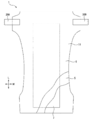
도 1은, 제1 실시형태에 따르는 부직포를 외장 시트(6)로서 포함하는 흡수성 물품(1)의 정면측의 전개도이다.
도 2는, 제1 실시형태에 따르는 부직포를 외장 시트(6)로서 포함하는 흡수성 물품(1)의 배면측의 전개도이다.
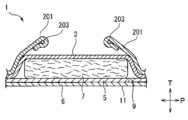
도 3은, 도 1의 Ⅲ-Ⅲ 단면에 있어서의 부분 단면도이다.
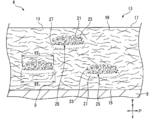
도 4는, 도 3의 외장 시트(6)의 부분 확대도이다.
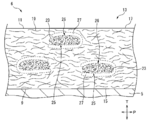
도 5는, 본 개시의 다른 실시형태(제2 실시형태)에 따르는 부직포(13)를 설명하기 위한 도면이다.
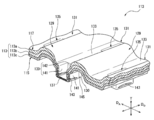
도 6은, 제3 실시형태에 따르는, 부형된 부직포(113)의 사시도이다.
도 7은, 부형된 부직포(113)의 평면도이다.
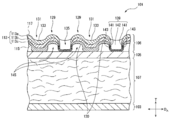
도 8은, 도 7의 Ⅷ-Ⅷ 단면에 있어서의 단면도이다.
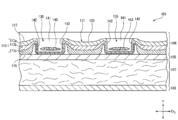
도 9는, 도 7의 Ⅸ-Ⅸ 단면에 있어서의 단면도이다.
도 10은, 도 7의 Ⅹ-Ⅹ 단면에 있어서의 단면도이다.
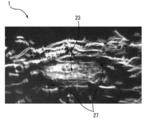
도 11은, 제조예 1에 있어서 제조된 부직포 No.1의, 3차원 계측 X선 CT 장치로 촬영된 화상이다.Fig. 1 is a developed view of the front side of an
Fig. 2 is a developed view of the back surface side of the
3 is a partial cross-sectional view taken along line III-III in Fig.
4 is a partially enlarged view of the
5 is a view for explaining the
6 is a perspective view of the formed
7 is a plan view of the formed
8 is a cross-sectional view taken along a section VIII-VIII in FIG.
Fig. 9 is a cross-sectional view taken along section IX-IX of Fig. 7; Fig.
10 is a cross-sectional view taken along the line X-X of Fig.
11 is an image photographed by the three-dimensional measuring X-ray CT apparatus of the nonwoven fabric No. 1 produced in Production Example 1. Fig.
[정의][Justice]
·「외면」 및 「내면」· "Outside" and "inside"
본 명세서에서는, 「외면」 및 「내면」은, 단일의 부재에 관하여 사용되는 용어이고, 각각, 착용 시를 기준으로 하여, 착용자의 피부로부터 먼 면 및 착용자의 피부에 가까운 면을 의미한다.In this specification, the terms " outer surface " and " inner surface " are used with respect to a single member and refer to a surface far from the wearer's skin and a surface close to the wearer's skin, respectively,
·섬유 덩어리 및 열가소성 수지 섬유의 「접합」에 관하여· On "bonding" of fiber lumps and thermoplastic resin fibers
본 명세서에서는, 섬유 덩어리 및 열가소성 수지 섬유에 관한 「접합」 및 「접합되어 있는」의 용어는, 『융착』 및 『융착되어 있는』 것을 의미한다. 따라서, 「복수의 섬유 덩어리의 각각이 열가소성 수지 섬유와 접합되어 있지 않은」 것은, 『복수의 섬유 덩어리의 각각이 열가소성 수지 섬유와 융착되어 있지 않은』 것을 의미한다.In the present specification, the terms "bonding" and "bonding" with respect to the fiber agglomerate and the thermoplastic resin fiber mean "fusion bonding" and "fusion bonding". Thus, " each of the plurality of fiber agglomerations is not bonded to the thermoplastic resin fibers " means that " each of the plurality of fiber agglomerations is not fused with the thermoplastic resin fibers ".
따라서, 섬유 덩어리를 구성하는 셀룰로오스계 섬유와, 매트릭스를 구성하는 열가소성 수지 섬유 및/또는 셀룰로오스계 섬유와의 사이의 교락(교락되어 있는)은, 상기 「접합(접합되어 있는)」에 포함되지 않고, 본 개시의 부직포는, 섬유 덩어리를 구성하는 셀룰로오스계 섬유와, 매트릭스를 구성하는 열가소성 수지 섬유 및/또는 셀룰로오스계 섬유와의 사이의 교락을 포함할 수 있다.Therefore, the intertwining (entangled) between the cellulose fiber constituting the fiber agglomerate and the thermoplastic resin fiber and / or the cellulose fiber constituting the matrix is not included in the above-described " joined (joined) , The nonwoven fabric of the present disclosure may include entanglement between the cellulose fiber constituting the fiber agglomerate and the thermoplastic resin fiber and / or the cellulose fiber constituting the matrix.
또, 상기 교락에는, 섬유 덩어리를 구성하는 셀룰로오스계 섬유가, 매트릭스를 구성하는 열가소성 수지 섬유 및/또는 셀룰로오스계 섬유와 융착되지 않고, 매트릭스 중에 들어가 있는 것, 매트릭스를 구성하는 열가소성 수지 섬유 및/또는 셀룰로오스계 섬유가, 섬유 덩어리를 구성하는 셀룰로오스계 섬유와 융착되지 않고, 섬유 덩어리에 들어가 있는 것 등을 들 수 있다.It is preferable that the intertwining is such that the cellulose fibers constituting the fiber agglomerate are not fused with the thermoplastic resin fibers and / or the cellulose fibers constituting the matrix and are contained in the matrix, the thermoplastic resin fibers constituting the matrix and / And cellulose fibers are not fused with the cellulose fibers constituting the fiber agglomerate and enter the fiber agglomerate.
·열가소성 수지 섬유끼리의 「접합」에 관하여· About "bonding" of thermoplastic resin fibers
본 명세서에서는, 열가소성 수지 섬유에 관한 「접합」 및 「접합되어 있는」의 용어는, 섬유 덩어리 및 열가소성 수지 섬유의 경우와 동일하게, 『융착』 및 『융착되어 있는』 것을 의미한다.In the present specification, the terms "bonded" and "bonded" with respect to the thermoplastic resin fiber mean "fused" and "fused" as in the case of the fiberglass and the thermoplastic resin fiber.
본 개시는, 이하의 양태에 관한 것이다.The present disclosure relates to the following aspects.
[양태 1][Mode 1]
투습성을 갖는 액 불투과성 시트를 구비하는 흡수성 물품의 외장 시트용 부직포로서, A nonwoven fabric for an external sheet of an absorbent article comprising a liquid-impermeable sheet having moisture permeability,
상기 부직포가, 두께 방향 및 평면 방향, 및 제1 면 및 제2 면을 갖고, Wherein the nonwoven fabric has a thickness direction and a plane direction, and a first surface and a second surface,
상기 부직포가, 열가소성 수지 섬유와, 셀룰로오스계 섬유로서, 그 적어도 일부가 복수의 섬유 덩어리를 구성하고 있는 셀룰로오스계 섬유를 포함하고, Wherein the nonwoven fabric comprises a thermoplastic resin fiber and a cellulose-based fiber, wherein at least a part of the cellulose fiber comprises a plurality of fiber agglomerates,
상기 부직포가, 상기 복수의 섬유 덩어리의 각각의, 제1 면과 마주보는 제1 영역에 인접하는 복수의 공극부를 구비하고, Wherein the nonwoven fabric has a plurality of void portions adjacent to a first region facing the first face of each of the plurality of fiber agglomerations,
상기 복수의 섬유 덩어리의 각각이 상기 열가소성 수지 섬유와 접합되어 있지 않은, 상기 부직포.Wherein each of the plurality of fiber agglomerations is not bonded to the thermoplastic resin fiber.
상기 부직포는, 셀룰로오스계 섬유의 섬유 덩어리와, 상기 섬유 덩어리의 제1 영역에 인접하는 공극부를 구비하기 때문에, 비가압하에서, 흡수체로부터 방출되고, 투습성을 갖는 액 불투과성 시트를 투과하여, 흡수성 물품의 외측으로 배출되고자 하는 습기를, 섬유 덩어리가, 공극부를 통해, 집중적(스폿적)으로 흡수 및 유지하기 때문에, 부직포의 평면 방향에 있어서, 습기를 유지하는 부분의 면적을 작게 할(스폿적으로 할) 수 있다. 따라서, 흡수체로부터 방출된 습기를, 투습성을 갖는 액 불투과성 시트를 투과시켜 배출시키면서도, 상기 부직포를 투과하여, 흡수성 물품의 외측으로 배출되는 습기의 양을 적게 할 수 있다.Since the nonwoven fabric has a fiber agglomerate of cellulose-based fibers and a void portion adjacent to the first region of the fiber agglomerate, the nonwoven fabric is discharged from the absorber under a reduced pressure, permeates the liquid-impermeable sheet having moisture permeability, Since the fiber mass absorbs and retains the moisture to be discharged to the outside of the nonwoven fabric in a concentrated (spot) manner through the air gap portion, the area of the portion for holding the moisture in the plane direction of the nonwoven fabric is reduced can do. Therefore, it is possible to reduce the amount of moisture that permeates through the nonwoven fabric and is discharged to the outside of the absorbent article while allowing the moisture released from the absorbent article to permeate and discharge the moisture-impermeable liquid-impermeable sheet.
또한, 체압 등의 가압하에서도, 공극부가, 섬유 덩어리보다 우선적으로 압축되기 때문에, 섬유 덩어리가, 흡수체로부터 방출되고, 투습성을 갖는 액 불투과성 시트를 투과하여, 흡수성 물품의 외측으로 배출되고자 하는 습기를, 잔존하는 공극부를 통해, 집중적(스폿적)으로 흡수 및 유지하기 때문에, 부직포의 평면 방향에 있어서, 습기를 유지하는 부분의 면적을 작게 할(스폿적으로 할) 수 있다. 따라서, 가압하에서도, 흡수체로부터 방출된 습기를, 투습성을 갖는 액 불투과성 시트를 투과시켜 배출시키면서도, 상기 부직포를 투과하여, 흡수성 물품의 외측으로 배출되는 습기의 양을 적게 할 수 있다.In addition, even under pressure such as a pressure of the water, since the void portion is preferentially compressed before the fiber agglomerate, the fiber agglomerations are released from the absorbent body and permeate through the moisture-impermeable liquid impermeable sheet, Is absorbed and held intensively (spotwise) through the remaining void portion, so that the area of the moisture retaining portion in the plane direction of the nonwoven fabric can be made small (as a spot). Therefore, even under pressure, the moisture released from the absorbent article through the nonwoven fabric and discharged to the outside of the absorbent article can be reduced while permeating and discharging the moisture-impermeable liquid-impermeable sheet.
이상으로부터, 상기 부직포는, 비가압하 및 가압하에서, 기체인 습기를, 흡수체로부터 흡수성 물품의 외측으로 배출시키기 어렵고, 흡수성 물품과 착용자의 착의 사이, 즉, 흡수성 물품의 외측 또한 착용자의 착의의 내측의 영역에, 습기가 차는 것을 막을 수 있어, 착용자가 습기가 차는 것을 느끼기 어렵다.From the above, it is difficult for the nonwoven fabric to discharge moisture, which is a gas, from the absorber to the outside of the absorbent article under the non-pressing and pressing conditions. It is preferable that the absorbent article and the wearer's garment, that is, the outside of the absorbent article, It is possible to prevent the area from getting wet, and it is difficult for the wearer to feel the moisture getting cold.
상기 부직포는, 비가압하에서, 셀룰로오스계 섬유의 섬유 덩어리가, 흡수체로부터 방출되고, 투습성을 갖는 액 불투과성 시트를 투과하여, 흡수성 물품의 외측으로 배출되고자 하는 액체가 존재하는 경우에, 상기 액체를 흡수 및 유지할 수 있다. 또한, 외기온이 낮은 경우에, 높은 투습성을 갖는 액 불투과성 시트를 투과한 습기가, 액 불투과성 시트의 외면에서 응결하여, 결로수를 생성할 때가 있지만, 셀룰로오스계 섬유의 섬유 덩어리가, 상기 액체를 흡수 및 유지할 수 있다. 상기 섬유 덩어리는, 열가소성 수지 섬유와 접합되어 있지 않고, 상기 섬유 덩어리는, 공극부 내를, 두께 방향(제1 면을 향하여)으로 주로 이동할 수 있기 때문에, 섬유 덩어리가, 열가소성 수지 섬유와 접한 상태를 긴 시간에 걸쳐 유지하기 어렵고, 섬유 덩어리가 유지하고 있는 액체가, 열가소성 수지 섬유를 지나, 부직포의 외면(외장 시트의 외면)으로 이동하기 어렵다. 따라서, 상기 부직포는, 착용자에게, 외장 시트의 외면에 습윤감을 지각시키기 어렵다.The nonwoven fabric is characterized in that when the fibrous mass of the cellulose-based fiber is released from the absorber and permeates through the liquid-impermeable sheet and the liquid to be discharged to the outside of the absorbent article exists, Absorption and retention. In addition, when the outside air temperature is low, the moisture permeated through the liquid-impermeable sheet having high moisture permeability sometimes condenses on the outer surface of the liquid-impermeable sheet to generate condensation water, but the fiber lumps of the cellulose- Can be absorbed and retained. The fibrous mass is not bonded to the thermoplastic resin fiber, and the fibrous mass can mainly move in the thickness direction (toward the first surface) within the air gap portion, so that the fibrous mass is in contact with the thermoplastic resin fibers And it is difficult for the liquid retained by the fiber agglomerate to pass through the thermoplastic resin fiber and move to the outer surface of the nonwoven fabric (the outer surface of the outer sheet). Therefore, it is difficult for the nonwoven fabric to perceive the wearer's feeling of wetness on the outer surface of the outer sheet.
또한, 상기 부직포는, 가압하에서, 공극부가, 섬유 덩어리보다 우선적으로 압축되기 때문에, 섬유 덩어리가 찌부러지기 어렵고, 섬유 덩어리가 유지하고 있는 액체가, 섬유 덩어리의 밖으로 압출되기 어렵다. 또한, 섬유 덩어리가, 열가소성 수지 섬유와 접합되어 있지 않기 때문에, 섬유 덩어리로부터 압출된 액체가, 열가소성 수지 섬유를 지나 부직포의 외면(외장 시트의 외면)으로 이동하기 어렵다.Further, in the above-mentioned nonwoven fabric, under pressure, the void portion is preferentially compressed with respect to the fiber lump, so that the fiber lump is hardly collapsed and the liquid retained by the fiber lump is hard to be extruded out of the fiber lump. Further, since the fiber agglomerates are not bonded to the thermoplastic resin fibers, the liquid extruded from the fiber agglomerates is difficult to move through the thermoplastic resin fibers to the outer surface (outer surface of the outer sheet) of the nonwoven fabric.
따라서, 상기 부직포는, 비가압하 및 가압하에서, 액체를, 외장 시트의 외면으로 이동시키기 어렵고, 착용자가 흡수성 물품의 외면에 습윤감을 지각하기 어렵다.Therefore, it is difficult for the nonwoven fabric to move the liquid to the outer surface of the outer sheet under the non-pressing and pressing conditions, and it is difficult for the wearer to perceive the wet feeling on the outer surface of the absorbent article.
[양태 2][Mode 2]
상기 부직포가, 상기 열가소성 수지 섬유를 적어도 포함하는 매트릭스와, 상기 매트릭스 중에 분산되어 있는 상기 복수의 섬유 덩어리를 포함하는, 양태 1에 기재된 부직포.The nonwoven fabric according to
상기 부직포에서는, 열가소성 수지 섬유를 포함하는 매트릭스 중에 분산되어 있는 섬유 덩어리가, 부직포를 투과하여, 흡수체로부터 흡수성 물품의 내측으로 배출되고자 하는 습기를, 공극부를 통해, 부직포 전체에서 효율적으로 흡수 및 유지할 수 있어, 흡수체로부터 방출된 습기를, 투습성을 갖는 액 불투과성 시트를 투과시켜 배출시키면서도, 상기 부직포를 투과하여, 흡수성 물품의 외측으로 배출되는 습기의 양을 적게 할 수 있다.In the above nonwoven fabric, it is possible to efficiently absorb and retain moisture in the entire nonwoven fabric through the air gap portion, through which the fiber mass dispersed in the matrix containing the thermoplastic resin fibers permeates the nonwoven fabric and is discharged from the absorber to the inside of the absorbent article The moisture released from the absorber can be reduced through the nonwoven fabric and discharged to the outside of the absorbent article while allowing the moisture released from the absorber to permeate and discharge the moisture-permeable liquid-impermeable sheet.
[양태 3][Mode 3]
상기 공극부의, 상기 평면 방향에 있어서의 바깥 가장자리가, 상기 섬유 덩어리의, 상기 평면 방향에 있어서의 바깥 가장자리보다 외측에 존재하는, 양태 1 또는 2에 기재된 부직포.The nonwoven fabric according to either of
상기 부직포에서는, 공극부의 바깥 가장자리가, 섬유 덩어리의 바깥 가장자리보다 외측에 있고, 섬유 덩어리가, 그 제1 영역의 전체로부터, 공극부를 통해, 흡수체로부터 방출되고, 투습성을 갖는 액 불투과성 시트를 투과하여, 흡수성 물품의 외측으로 배출되고자 하는 습기를 흡수 및 유지할 수 있다. 따라서, 흡수체로부터 방출된 습기를, 투습성을 갖는 액 불투과성 시트를 투과시켜 배출시키면서도, 상기 부직포를 투과하여, 흡수성 물품의 외측으로 배출되는 습기의 양을 적게 할 수 있다.In the nonwoven fabric, the outer edge of the air gap portion is located on the outer side of the outer edge of the fiber agglomerate, and the fiber agglomerate is released from the absorber through the entirety of the first region and through the air gap portion, So that moisture to be discharged to the outside of the absorbent article can be absorbed and retained. Therefore, it is possible to reduce the amount of moisture that permeates through the nonwoven fabric and is discharged to the outside of the absorbent article while allowing the moisture released from the absorbent article to permeate and discharge the moisture-impermeable liquid-impermeable sheet.
또한, 상기 부직포에서는, 공극부의 바깥 가장자리가, 섬유 덩어리의 바깥 가장자리보다 외측에 있기 때문에, 섬유 덩어리가, 공극부 내를 두께 방향(제1 면을 향하여)으로 움직이기 쉽고, 가압하 및 비가압하의 양쪽에 있어서, 섬유 덩어리가 유지하는 액체가, 열가소성 수지 섬유를 지나, 부직포의 외면(외장 시트의 외면)으로 이동하기 어렵다.Further, in the nonwoven fabric, since the outer edge of the air gap portion is located on the outer side of the outer edge of the fiberglass mass, the fiber mass easily moves in the thickness direction (toward the first surface) It is difficult for the liquid retained by the fiber agglomerate to move through the thermoplastic resin fibers to the outer surface of the nonwoven fabric (the outer surface of the outer sheet).
[양태 4][Mode 4]
상기 부직포가, 상기 복수의 섬유 덩어리의 적어도 일부의, 제2 면과 마주보는 제2 영역에 인접하는 공극부를 추가로 구비하는, 양태 1∼3 중 어느 한 항에 기재된 부직포.The nonwoven fabric according to any one of
상기 부직포는, 복수의 섬유 덩어리의 적어도 일부의, 제2 면과 마주보는 제2 영역에 인접하는 공극부를 추가로 구비하기 때문에, 비가압하에서, 섬유 덩어리가, 그 제1 영역 및 제2 영역으로부터, 공극부를 통해, 흡수체로부터 방출되고, 투습성을 갖는 액 불투과성 시트를 투과하여, 흡수성 물품의 외측으로 배출되고자 하는 습기를 흡수 및 유지할 수 있다. 따라서, 흡수체로부터 방출된 습기를, 투습성을 갖는 액 불투과성 시트를 투과시켜 배출시키면서도, 상기 부직포를 투과하여, 흡수성 물품의 외측으로 배출되는 습기의 양을 적게 할 수 있다.Since the nonwoven fabric further comprises void portions adjacent to the second region facing at least a part of the plurality of fiber agglomerates facing the second face, it is preferable that the fiber agglomerates are separated from the first region and the second region Impermeable sheet that is discharged from the absorber and permeable to moisture through the air gap so as to absorb and retain moisture to be discharged to the outside of the absorbent article. Therefore, it is possible to reduce the amount of moisture that permeates through the nonwoven fabric and is discharged to the outside of the absorbent article while allowing the moisture released from the absorbent article to permeate and discharge the moisture-impermeable liquid-impermeable sheet.
또한, 상기 부직포에서는, 가압하에서, 섬유 덩어리의 제1 영역 및 제2 영역에 인접하는 공극부가, 섬유 덩어리보다 우선적으로 압축되기는 하지만, 이들 공극을 유지하기 쉽다. 따라서, 상기 부직포는, 흡수체로부터 방출되고, 투습성을 갖는 액 불투과성 시트를 투과하여, 흡수성 물품의 외측으로 배출되고자 하는 습기를, 보다 잔존하기 쉬운 공극부를 통해 흡수 및 유지할 수 있다. 따라서, 흡수체로부터 방출된 습기를, 투습성을 갖는 액 불투과성 시트를 투과시켜 배출시키면서도, 상기 부직포를 투과하여, 흡수성 물품의 외측으로 배출되는 습기의 양을 적게 할 수 있다.Further, in the nonwoven fabric, the voids adjacent to the first region and the second region of the fiber agglomerate under pressure are preferentially compressed with respect to the fiber agglomerate, but these voids are easily retained. Therefore, the nonwoven fabric can absorb and retain moisture, which is released from the absorber and permeates the liquid-impermeable sheet having moisture permeability, to be discharged to the outside of the absorbent article through a gap portion that is more likely to remain. Therefore, it is possible to reduce the amount of moisture that permeates through the nonwoven fabric and is discharged to the outside of the absorbent article while allowing the moisture released from the absorbent article to permeate and discharge the moisture-impermeable liquid-impermeable sheet.
또한, 상기 부직포에서는, 복수의 섬유 덩어리의 적어도 일부의, 제2 면과 마주보는 제2 영역에 인접하는 공극부를 추가로 구비하기 때문에, 섬유 덩어리가, 공극부 내를 두께 방향(제1 면 및 제2 면을 향하여)으로 움직이기 쉽고, 가압하 및 비가압하의 양쪽에 있어서, 섬유 덩어리가 유지하는 액체가, 열가소성 수지 섬유를 지나, 부직포의 외면(외장 시트의 외면)으로 이동하기 어렵다.Further, in the nonwoven fabric, at least a part of the plurality of fiber agglomerations further includes the air gap portion adjacent to the second region facing the second face, so that the fiber agglomerates the inside of the air gap portion in the thickness direction The liquid retained by the fiber agglomerates is hard to move to the outer surface (outer surface of the outer sheet) of the nonwoven fabric after passing through the thermoplastic resin fiber at both of the pressurized and non-pressurized conditions.
[양태 5][Mode 5]
상기 열가소성 수지 섬유끼리가 접합되어 있는, 양태 1∼4 중 어느 한 항에 기재된 부직포.The nonwoven fabric according to any one of
상기 부직포에서는, 부직포의 매트릭스를 구성하고 있는 열가소성 수지끼리가 접합되어 있기 때문에, 상기 매트릭스와, 셀룰로오스계 섬유의 섬유 덩어리와의 사이에 형성된 공극부가 그 형상을 유지하기 쉬워, 전술한 효과를 보다 발휘하기 쉽다.In the nonwoven fabric, since the thermoplastic resin constituting the matrix of the nonwoven fabric is bonded to each other, the void portion formed between the matrix and the fiber agglomerates of the cellulose-based fibers can easily maintain the shape thereof, easy to do.
[양태 6][Mode 6]
상기 부직포가 상기 셀룰로오스계 섬유를 3∼35 질량%의 비율로 포함하는, 양태 1∼5 중 어느 한 항에 기재된 부직포.The nonwoven fabric according to any one of
상기 부직포는, 셀룰로오스계 섬유를 소정의 비율로 포함하기 때문에, 셀룰로오스계 섬유의 섬유 덩어리가, 흡수체로부터 방출되고, 투습성을 갖는 액 불투과성 시트를 투과하여, 흡수성 물품의 외측으로 배출되고자 하는 습기를, 공극부를 통해, 집중적(스폿적)으로 흡수 및 유지하기 쉬워져, 부직포의 평면 방향에 있어서, 습기를 유지하는 부분의 면적을 작게 할(스폿적으로 할) 수 있다. 따라서, 흡수체로부터 방출된 습기를, 투습성을 갖는 액 불투과성 시트를 투과시켜 배출시키면서도, 상기 부직포를 투과하여, 흡수성 물품의 외측으로 배출되는 습기의 양을 적게 할 수 있다.Since the nonwoven fabric contains cellulose fibers at a predetermined ratio, the fiber lumps of the cellulose-based fibers are released from the absorbent body and permeate through the liquid-impermeable sheet having moisture permeability to absorb the moisture to be discharged to the outside of the absorbent article (Spot) of the nonwoven fabric through the gap portion, so that the area of the moisture retaining portion in the plane direction of the nonwoven fabric can be made smaller (as a spot). Therefore, it is possible to reduce the amount of moisture that permeates through the nonwoven fabric and is discharged to the outside of the absorbent article while allowing the moisture released from the absorbent article to permeate and discharge the moisture-impermeable liquid-impermeable sheet.
[양태 7][Mode 7]
상기 셀룰로오스계 섬유가 상기 열가소성 수지 섬유보다 짧은 평균 섬유 길이를 갖는, 양태 1∼6 중 어느 한 항에 기재된 부직포.The nonwoven fabric according to any one of
상기 부직포에서는, 셀룰로오스계 섬유가 열가소성 수지 섬유보다 짧은 섬유 길이를 갖기 때문에, 부직포 내에서, 셀룰로오스계 섬유의 섬유 덩어리가 열가소성 수지 섬유의 매트릭스와 분리되고, 매트릭스 중에서 분산된 상태로 존재하기 쉬워져, 전술한 효과를 보다 발휘하기 쉬워진다.In the nonwoven fabric, since the cellulose fibers have a fiber length shorter than that of the thermoplastic resin fibers, the fiber agglomerations of the cellulose fibers are separated from the matrix of the thermoplastic resin fibers in the nonwoven fabric and are easily dispersed in the matrix, The above-mentioned effect can be more easily exerted.
[양태 8][Mode 8]
상기 셀룰로오스계 섬유가 오가닉 코튼을 포함하는, 양태 1∼7 중 어느 한 항에 기재된 부직포.The nonwoven fabric according to any one of
상기 부직포에서는, 셀룰로오스계 섬유가 오가닉 코튼을 포함하기 때문에, 이용자가 안심감을 지각하기 쉽다. 또한, 상기 부직포에서는, 셀룰로오스계 섬유가 오가닉 코튼을 포함하기 때문에, 셀룰로오스계 섬유가 열가소성 수지 섬유보다 짧은 섬유 길이를 갖기 쉬워, 상기 부직포가 전술한 효과를 보다 발휘하기 쉬워진다.In the above-mentioned nonwoven fabric, since the cellulose-based fiber includes organic cotton, it is easy for the user to feel the relief. Further, in the nonwoven fabric, since the cellulose-based fiber includes organic cotton, the cellulose-based fiber tends to have a shorter fiber length than the thermoplastic resin fiber, and the nonwoven fabric can more easily exhibit the above-described effect.
[양태 9][Mode 9]
상기 셀룰로오스계 섬유가 히르수툼(Hirsutum)종 코튼을 포함하는, 양태 1∼8 중 어느 한 항에 기재된 부직포.The nonwoven fabric according to any one of
상기 부직포에서는, 셀룰로오스계 섬유가 히르수툼종 코튼을 포함하기 때문에, 이용자가 안심감을 지각하기 쉽다. 또한, 상기 부직포에서는, 셀룰로오스계 섬유가 히르수툼종 코튼을 포함하기 때문에, 셀룰로오스계 섬유가 열가소성 수지 섬유보다 짧은 섬유 길이를 갖기 쉬워, 상기 부직포가 전술한 효과를 발휘하기 쉬워진다.In the non-woven fabric, since the cellulose-based fiber includes hyssuvornum cotton, it is easy for the user to feel relief. In addition, in the nonwoven fabric, since the cellulose-based fibers include hyursunum cotton, the cellulose-based fibers tend to have a shorter fiber length than the thermoplastic resin fibers, and the nonwoven fabric is more likely to exhibit the above-described effects.
[양태 10][Mode 10]
상기 부직포가 착의 접촉면을 갖는 착의측 층을 포함하는 복층 구조를 갖고, 상기 부직포가 상기 복수의 섬유 덩어리를 상기 착의측 층 이외의 층에 구비하는, 양태 1∼9 중 어느 한 항에 기재된 부직포.The nonwoven fabric according to any one of
상기 부직포에서는, 섬유 덩어리가, 부직포의 착의측 층 이외의 층에 존재하기 때문에, 사용 시에, 셀룰로오스계 섬유의 섬유 덩어리가 탈락하기 어렵다. 또한, 상기 부직포에서는, 섬유 덩어리가, 부직포의 착의측 층 이외의 층에 존재하고 있기 때문에, 셀룰로오스계 섬유의 섬유 덩어리에 흡수 및 유지되어 있는 액체가, 착용자와 접촉하기 어렵고, 착용자가 불쾌감을 지각하기 어렵다.In the nonwoven fabric, since the fiber agglomerates are present in the layers other than the side layer of the nonwoven fabric, the fiber agglomerates of the cellulose-based fibers are hardly dropped off at the time of use. Further, in the nonwoven fabric, since the fiber agglomerations are present in the layers other than the garment side layer of the nonwoven fabric, the liquid absorbed and retained by the fiber agglomerations of the cellulosic fibers is hard to come into contact with the wearer, It is difficult to do.
[양태 11][Mode 11]
상기 부직포가, 제1 면으로부터 제2 면의 방향으로 돌출되어 있는 복수의 돌상부(突狀部)와, 제2 면으로부터 제1 면의 방향으로 움패어 있는 복수의 패임부를 구비하고, 상기 복수의 돌상부의 각각과 상기 복수의 패임부의 각각이 상기 두께 방향으로 중복되어 있는, 양태 1∼10 중 어느 한 항에 기재된 부직포.Wherein the nonwoven fabric has a plurality of protruding portions protruding in a direction of a second surface from a first surface and a plurality of depressions protruding in a direction of the first surface from the second surface, The nonwoven fabric according to any one of
상기 부직포는, 제2 면에 있어서 움패어 있는, 복수의 패임부를 갖기 때문에, 외장 시트로서 이용된 경우에, 제2 면의 패임부와 액 불투과성 시트 사이에 이격 영역이 형성된다. 따라서, 흡수체로부터 방출되고, 투습성을 갖는 액 불투과성 시트를 투과하여, 흡수성 물품의 외측으로 배출되고자 하는 습기를, 부직포의 셀룰로오스계 섬유, 특히 그 섬유 덩어리가 흡수 및 유지함과 함께, 섬유 덩어리에 인접하는 공극부, 및 상기 이격 영역에 있어서 습기의 상태로 머물게 하기 때문에(즉, 공극부 및 이격 영역을 고습 상태로 하기 때문에), 이격 영역 내의 습기(기상)와, 흡수체에 흡수 및 유지되어 있는 액체(액상) 사이에서, 기액 평형과 같은 상태가 형성되어, 흡수체로부터 그 이상의 습기가 방출되는 것이 억제된다. 따라서, 착용자가, 흡수성 물품의 외측 또한 착의의 내측의 영역에 습기가 차는 것을 느끼기 어려워진다.Since the nonwoven fabric has a plurality of depressions on the second surface, when used as an external sheet, a spacing region is formed between the depressed portion of the second surface and the liquid-impermeable sheet. Therefore, the moisture, which is emitted from the absorber and permeates through the liquid-impermeable liquid-impermeable sheet to be discharged to the outside of the absorbent article, is absorbed and retained by the cellulose fibers of the nonwoven fabric, particularly the fiber lumps, (Vapor phase) in the spacing region and the liquid (vapor phase) absorbed and held in the absorber, because the gap portion and the spacing region in which the gap portion and the spacing region are made to remain in the moisture state (Liquid phase), a state similar to vapor-liquid equilibrium is formed, and further moisture is prevented from being discharged from the absorber. Therefore, it becomes difficult for the wearer to feel moisture on the outer side of the absorbent article and on the inner area of the garment.
[양태 12][Mode 12]
상기 복수의 돌상부의 각각이 일방향으로 연장되는 이랑부를 구성하고 있고, Wherein each of the plurality of protruding portions constitutes a depression portion extending in one direction,
상기 부직포가 인접하는 상기 이랑부 사이에 홈 바닥부를 갖는 복수의 홈부를 구비하고, And a plurality of groove portions having groove bottom portions between the adjacent ridges of the nonwoven fabric,
상기 복수의 홈부의 각각이, 상기 홈 바닥부에, 상기 일방향으로 간헐적으로 배치된, 제1 면으로부터 제2 면의 방향으로 움패어 있는, 복수의 오목부로서, 그 각각이 바닥부를 갖는 것을 구비하는, 양태 11에 기재된 부직포.Wherein each of the plurality of grooves is provided with a plurality of recesses which are intermittently arranged in the one direction in the groove bottom in the direction from the first surface to the second surface, By weight based on the total weight of the nonwoven fabric.
상기 부직포는, 외장 시트로서 이용되었을 때에, 외장 시트와 액 불투과성 시트 사이에 이격 영역을 형성할 수 있다. 구체적으로는, 상기 부직포는, 액 투과성 시트로서 이용되었을 때에, 외장 시트의 패임부와 흡수체 사이에 이격 영역을 형성할 수 있다. 또한, 상기 부직포는, 가압하에서 부직포가 일시적으로 찌부러지고, 그에 따라 이격 영역이 일시적으로 찌부러진 경우라도, 비가압하에서 그 형상이 원래로 되돌아가기 쉽고, 이격 영역이 복원되기 쉽다. 따라서, 상기 부직포는 양태 11의 부직포보다 장시간에 걸쳐 착용자가 흡수성 물품의 외측 또한 착의의 내측의 영역에 습기가 차는 것을 느끼기 어려워진다.When the nonwoven fabric is used as an external sheet, a spacing region can be formed between the external sheet and the liquid-impermeable sheet. More specifically, when the nonwoven fabric is used as a liquid-permeable sheet, a spacing region can be formed between the depressed portion of the outer sheet and the absorbent body. Also, in the nonwoven fabric, even if the nonwoven fabric temporarily collapses under pressure and accordingly the spacing region is temporarily crushed, the shape of the nonwoven fabric easily returns to its original shape under a reduced pressure, and the spacing region is liable to be restored. Therefore, the wearer is less likely to feel moisture on the outer side of the absorbent article and on the inner region of the garment than on the nonwoven fabric of the
[양태 13][Mode 13]
액 투과성 시트와, 액 불투과성 시트와, 흡수체와, 외장 시트를, 이 순서로 포함하는 흡수성 물품으로서, Absorbent article comprising a liquid-pervious sheet, a liquid-impermeable sheet, an absorbent body, and an external sheet in this order,
상기 외장 시트가 양태 1∼12 중 어느 한 항에 기재된 부직포인, 상기 흡수성 물품.The absorbent article as set forth in any one of
상기 흡수성 물품은, 전술한 효과를 갖는다.The absorbent article has the above-described effects.
[양태 14][Mode 14]
상기 부직포의 제2 면이 상기 외장 시트의 외면을 구성하고 있는, 양태 12에 기재된 흡수성 물품.The absorbent article according to embodiment 12, wherein the second surface of the nonwoven fabric constitutes an outer surface of the outer sheet.
상기 흡수성 물품에서는, 부직포의 제1 면이 외장 시트의 내면을 구성하고 있기 때문에, 공극부가, 섬유 덩어리의 제1 면 측, 즉, 액 불투과성 시트 측에 배치되게 된다. 따라서, 가압하 및 비가압하의 양쪽에 있어서, 섬유 덩어리가, 흡수체로부터 방출되고, 투습성을 갖는 액 불투과성 시트를 투과하여, 흡수성 물품의 외측으로 배출되고자 하는 습기를, 액 불투과성 시트 측에 존재하는 공극부를 통해, 집중적(스폿적)으로 흡수 및 유지할 수 있어, 흡수체로부터 방출된 습기를, 투습성을 갖는 액 불투과성 시트를 투과시켜 배출시키면서도, 상기 부직포를 투과하여, 흡수성 물품의 외측으로 배출되는 습기의 양을 적게 할 수 있다.In the absorbent article, since the first surface of the nonwoven fabric forms the inner surface of the outer sheet, the air gap is disposed on the first surface side of the fiber agglomerate, i.e., on the liquid-impermeable sheet side. It is therefore possible to prevent the moisture of the fiber mass from being discharged from the absorber and permeable to the moisture-impermeable liquid-impermeable sheet to be discharged to the outside of the absorbent article, both on the liquid-impermeable sheet side Permeable sheet having a moisture permeable property and is discharged through the nonwoven fabric to the outside of the absorbent article while being discharged through the liquid-impermeable sheet having the moisture-permeable property The amount of moisture can be reduced.
[양태 15][Mode 15]
상기 액 투과성 시트가 양태 1∼12 중 어느 한 항에 기재된 부직포인, 양태 13 또는 14에 기재된 흡수성 물품.The absorbent article according to
상기 흡수성 물품에서는, 액 투과성 시트 및 외장 시트가 전술한 부직포이기 때문에, 흡수체로부터 배출된 습기를, 흡수성 물품의 외측뿐만 아니라, 흡수성 물품의 내측으로도 배출시키기 어렵고, 착용자가, 흡수성 물품의 외측 또한 착의의 내측의 영역과, 흡수성 물품의 내측의 영역의 양쪽에 있어서, 습기가 차는 것을 지각하기 어렵다.In the absorbent article, since the liquid-permeable sheet and the outer sheet are the nonwoven fabric described above, it is difficult to discharge the moisture discharged from the absorbent article not only to the outer side of the absorbent article but also to the inner side of the absorbent article, It is difficult to perceive that the moisture becomes cold in both the inner region of the garment and the inner region of the absorbent article.
본 개시의 흡수성 물품의 외장 시트용 부직포를 이하 상세히 설명하는데, 설명을 위해, 상기 부직포가 흡수성 물품의 외장 시트로서 이용된 상태로 설명한다.The nonwoven fabric for the outer sheet of the absorbent article of the present disclosure will be described in detail below. For the sake of explanation, the nonwoven fabric is described as an outer sheet of the absorbent article.
도 1은, 본 개시의 일실시형태(제1 실시형태)에 따르는 부직포를 외장 시트(6)로서 포함하는 흡수성 물품(1), 구체적으로는, 테이프형의 일회용 기저귀의 전개도이다. 도 2는, 제1 실시형태에 따르는 부직포를 외장 시트(6)로서 포함하는 흡수성 물품(1)의 배면도이다. 도 3은, 도 1의 Ⅲ-Ⅲ 단면에 있어서의 부분 단면도이다. 도 4는, 도 3의 외장 시트(6) 근방의 부분 확대도이다. 또, 도 4는, 외장 시트(6)(부직포(13))에 있어서의, 열가소성 수지 섬유(19), 셀룰로오스계 섬유(21)의 섬유 덩어리(23), 공극부(27) 등의 관계를 모식적으로 설명하기 위한 도면이고, 본 개시가 한정적으로 해석되는 것을 의도하는 것은 아니다.1 is an exploded view of an
제1 실시형태에 있어서, 흡수성 물품(1)은, 액 투과성 시트(3)와, 액 불투과성 시트(5)와, 흡수체(7), 외장 시트(6)를, 이 순서로 포함한다. 흡수성 물품(1)은, 길이 방향(L) 및 폭 방향(W)을 갖는다.In the first embodiment, the
또, 제1 실시형태에서는, 도 1에 도시된 바와 같이, 흡수성 물품(1)이, 탄성 부재(203)를 포함하는 한쌍의 누설 방지 벽(201), 누설 방지 벽(201)을 액 투과성 시트(3)에 고정하기 위한 고정부(205), 탄성 부재(207), 테이프 파스너(209) 등을 갖지만, 이들은 당 기술분야에서 공지된 것이기 때문에, 설명을 생략한다.1, the
제1 실시형태에 있어서, 외장 시트(6)는, 착용자의 피부 측에 위치하는 피부측 면(9)과, 피부측 면(9)의 반대측의 면이고, 착용자의 착의에 접촉하는 착의 접촉면(11)을 포함한다. 또, 외장 시트(6)의 피부측 면(9)은, 액 불투과성 시트(5)에 접합되어 있다.In the first embodiment, the
도 4에 도시된 바와 같이, 외장 시트(6)를 구성하는 부직포(13)는, 두께 방향(T) 및 평면 방향(P), 및 제1 면(15) 및 제2 면(17)을 갖고, 제1 면(15)이, 외장 시트(6)의 피부측 면(9)을 형성하고, 그리고 제2 면(17)이, 외장 시트(6)의 착의 접촉면(11)을 형성하고 있다. 또, 도 4는, 설명을 위해, 도 3과, 상하 방향을 역으로 하여 도시되어 있는, 즉, 외장 시트(6)가 상측에, 그리고 액 불투과성 시트(5)가 하측에 오도록 도시되어 있다.4, the
부직포(13)는, 열가소성 수지 섬유(19)와, 셀룰로오스계 섬유(21)를 포함하고, 셀룰로오스계 섬유(21)가, 복수의 섬유 덩어리(23)를 형성하고, 그리고 복수의 섬유 덩어리(23)가, 열가소성 수지 섬유(19)의 매트릭스 중에서 간격을 두고 배치되어 있는, 즉, 복수의 섬유 덩어리(23)가, 열가소성 수지 섬유(19)의 매트릭스에 분산되어 있다.The
부직포(13)는 또한, 복수의 섬유 덩어리(23)의 각각의, 제1 면(15)과 마주보는 제1 영역(25)에 인접하는, 복수의 공극부(27)를 구비한다.The
섬유 덩어리(23)는, 구체적으로는, 섬유 덩어리(23)를 구성하는 셀룰로오스계 섬유(21)는, 매트릭스를 구성하는 열가소성 수지 섬유(19)와 접합되어 있지 않다.Concretely, the
도 4에 도시된 바와 같이, 부직포(13)에서는, 공극부(27)의, 평면 방향(P)에 있어서의 바깥 가장자리(EE1)가, 섬유 덩어리(23)의, 평면 방향(P)에 있어서의 바깥 가장자리(EE2)보다 외측에 존재한다. 그렇게 함으로써, 섬유 덩어리(23)가, 제1 영역(25)의 전체로부터, 공극부(27)를 통해, 흡수체(7)로부터 방출되고, 투습성을 갖는 액 불투과성 시트(5)를 투과하여, 흡수성 물품(1)의 외측으로 배출되고자 하는 습기를 흡수 및 유지할 수 있다. 따라서, 흡수체(7)로부터 방출된 습기를, 투습성을 갖는 액 불투과성 시트(5)를 투과시켜 배출시키면서도, 부직포(13)를 투과하여, 흡수성 물품(1)의 외측으로 배출되는 습기의 양을 적게 할 수 있다.4, in the
또한, 부직포(13)에서는, 공극부(27)의 바깥 가장자리(EE1)가, 섬유 덩어리(23)의 바깥 가장자리(EE2)보다 외측에 있기 때문에, 섬유 덩어리(23)가, 공극부(27) 내를 두께 방향(T)(제1 면(15)을 향하여)으로 움직이기 쉽고, 가압하 및 비가압하의 양쪽에 있어서, 섬유 덩어리(23)가 유지하는 액체가, 열가소성 수지 섬유(19)를 지나, 부직포(13)의 외면(외장 시트(6)의 외면)으로 이동하기 어렵다.In the
도 5는, 본 개시의 다른 실시형태(제2 실시형태)에 따르는 부직포(13)를 설명하기 위한 도면이고, 도 4에 상당하는 단면도이다. 또, 도 5도 또한, 도 4와 동일하게, 열가소성 수지 섬유(19), 셀룰로오스계 섬유(21)의 섬유 덩어리(23), 공극부(27) 등의 관계를 모식적으로 설명하기 위한 도면이고, 본 개시가 한정적으로 해석되는 것을 의도하는 것은 아니다.Fig. 5 is a view for explaining the
제2 실시형태에 따르는 부직포(13)는, 복수의 섬유 덩어리(23)의 각각의, 부직포(13)의 제2 면(17)과 마주보는 제2 영역(26)에 인접하는 공극부(27)를 추가로 구비한다. 구체적으로는, 개개의 섬유 덩어리(23)에 있어서, 제1 영역(25)에 인접하는 공극부(27)와, 제2 영역(26)에 인접하는 공극부(27)가 연결되어 있다. 그 밖의 부분은, 제1 실시형태에 따르는 부직포와 동일하기 때문에, 설명을 생략한다.The
제1 실시형태 및 제2 실시형태에서는, 부직포(13)는, 단층 구조를 갖고 있지만, 본 개시의 부직포는, 복층 구조, 예컨대, 착의 접촉면을 갖는 착의측 층과, 착의측 층보다 피부 측에 배치된 피부측 층의 2층 구조, 착의 접촉면을 갖는 착의측 층과, 착의측 층보다 피부 측에 배치된 피부측 층과, 이들 사이의 중간층의 3층 구조를 가질 수 있다. 그러한 부직포로는, 부직포 자체가 복층 구조를 갖는 것, 부직포를 형성하기 전의 웨브가 복층 구조를 갖고 있었던 것 등을 들 수 있다.In the first and second embodiments, the
그러한 실시형태에서는, 셀룰로오스계 섬유의 섬유 덩어리는, 착의측 층에는 포함되지 않고, 착의측 층 이외의 층에 포함되는 것이 바람직하다. 구체적으로는, 본 개시의 부직포가 착의측 층 및 피부측 층의 2층 구조를 갖는 경우에는, 셀룰로오스계 섬유의 섬유 덩어리는, 착의측 층에는 포함되지 않고, 피부측 층에 포함되는 것이 바람직하다. 본 개시의 부직포가, 착의측 층, 중간층 및 피부측 층의 3층 구조를 갖는 경우에는, 셀룰로오스계 섬유의 섬유 덩어리는, 착의측 층에는 포함되지 않고, 중간층 및/또는 피부측 층에 포함되는 것이 바람직하다.In such an embodiment, it is preferable that the fiber agglomerations of the cellulose-based fibers are not included in the garment side layer but are included in the layer other than the garment side layer. Specifically, when the nonwoven fabric of the present disclosure has a two-layer structure of a garment side layer and a skin side layer, it is preferable that the fiber agglomerates of the cellulose-based fibers are not included in the garment side layer but are included in the skin side layer . In the case where the nonwoven fabric of the present disclosure has a three-layer structure of a garment side layer, an intermediate layer and a skin side layer, the fiber agglomerates of the cellulosic fibers are not contained in the garment side layer but are contained in the intermediate layer and / .
섬유 덩어리의 부직포로부터의 이탈 어려움의 관점에서이다. 또, 셀룰로오스계 섬유의 섬유 덩어리에 흡수 및 유지된 액체가, 흡수체의 외면에서 착용자에게 접촉하기 어려워지기 때문에, 착용자에게 젖은 상태를 지각시키기 어렵고, 착용자에게 불쾌감을 부여하기 어렵다. 또한, 본 개시의 부직포의 착의측 층이 셀룰로오스계 섬유를 포함하지 않음으로써, 셀룰로오스계 섬유, 예컨대, 코튼에 의한 촉감의 저하, 유연성의 저하 등을 막을 수 있고, 본 개시의 부직포가 우수한 촉감 및 유연성을 가질 수 있다.From the viewpoint of difficulty in separation of the fiber agglomerates from the nonwoven fabric. Further, since the liquid absorbed and held by the fiber agglomerations of the cellulose-based fibers hardly comes into contact with the wearer at the outer surface of the absorbent body, it is difficult for the wearer to perceive the wet state, and it is difficult to impart discomfort to the wearer. In addition, since the covering layer of the nonwoven fabric of the present disclosure does not include cellulose fibers, it is possible to prevent the deterioration of the soft feeling due to the cellulose fibers, for example, the cotton and the deterioration of the softness, It can have flexibility.
제1 실시형태 및 제2 실시형태에서는, 부직포(13)는, 제1 면(15) 및 제2 면(17)의 양쪽이 평탄한, 평탄 부직포이지만, 본 개시의 부직포는, 부형 구조를 갖는 부형된 부직포여도 좋다.In the first and second embodiments, the
본 개시의 부직포가 부형 구조를 갖는, 부형된 부직포인 실시형태로서, 부직포가, 제1 면으로부터 제2 면의 방향으로 돌출되어 있는(제2 면에 있어서 돌출되어 있는) 복수의 돌상부와, 제2 면으로부터 제1 면의 방향으로 움패어 있는(제1 면에 있어서 움패어 있는) 복수의 패임부를 구비하고, 복수의 돌상부의 각각과 복수의 패임부의 각각이 부직포의 두께 방향으로 중복되어 있는 것을 들 수 있다. 그렇게 함으로써, 제2 면 측에 액 불투과성 시트가 배치된 경우(부형된 부직포의 제2 면이 액 불투과성 시트에 접합된 경우)에, 패임부가, 흡수체와의 사이에서, 전술한 이격 영역을 형성할 수 있다.As an embodiment in which the nonwoven fabric of the present disclosure has a negative structure, the nonwoven fabric may include a plurality of the upper portions (protruded on the second side) protruding from the first surface in the direction of the second surface, And a plurality of depressions (protruding on the first surface) protruding from the second surface in the direction of the first surface, wherein each of the plurality of depressions and the plurality of depressions overlap each other in the thickness direction of the nonwoven fabric . By doing so, when the liquid-impermeable sheet is disposed on the second surface side (in the case where the second surface of the formed nonwoven fabric is bonded to the liquid-impermeable sheet), the depressed portion is separated from the absorber in the above- .
도 6∼도 10은, 본 개시의 다른 실시형태(제3 실시형태)에 따르는, 부형된 부직포(113), 및 부형된 부직포(113)를 외장 시트(106)로서 포함하는 흡수성 물품(101)을 설명하기 위한 도면이다.Figs. 6 to 10 are diagrams showing an
구체적으로는, 도 6은, 제3 실시형태에 따르는, 부형된 부직포(113)의 사시도이다. 도 7은, 부형된 부직포(113)의 평면도이다. 도 8은, 도 7의 Ⅷ-Ⅷ 단면에 있어서의 단면도이다. 도 9는, 도 7의 Ⅸ-Ⅸ 단면에 있어서의 단면도이다. 도 10은, 도 7의 Ⅹ-Ⅹ 단면에 있어서의 단면도이다. 또, 도 6 및 도 7은, 부형된 부직포(113)가 도시되어 있고, 도 8∼도 10은, 흡수성 물품(101)이 도시되어 있다. 또, 도 8∼도 10은, 외장 시트(106)가 상측에 오도록 도시되어 있다.Specifically, Fig. 6 is a perspective view of the formed
부형된 부직포(113)는, 착의 접촉면을 갖는 착의측 층(113a)과, 피부측 층(113c)과, 착의측 층(113a) 및 피부측 층(113c) 사이의 중간층(113b)의 3층 구조를 갖는다. 착의측 층(113a)이, 열가소성 수지 섬유로 형성되고, 중간층(113b) 및 피부측 층(113c)의 각각이, 열가소성 수지 섬유와, 셀룰로오스계 섬유로서, 그 적어도 일부가 복수의 섬유 덩어리를 구성하고 있는 셀룰로오스계 섬유를 포함한다.The formed
부형된 부직포(113)는, 흡수성 물품(101)에 있어서, 액 불투과성 시트(105) 측의 면을 구성하는 제1 면(115)과, 착의 접촉면을 구성하는 제2 면(117)을 갖는다.The formed
부형된 부직포(113)에서는, 복수의 돌상부의 각각이, 제1 면(115)으로부터 제2 면(117)의 방향으로 돌출되고, 일방향(DO)으로 연장되어 있는, 이랑부(129)를 형성하고 있다. 또한, 부형된 부직포(113)는, 이랑부(129)를 따라, 제2 면(117)으로부터 제1 면(115)의 방향으로 움패어 있는, 복수의 패임부(130)를 구비한다. 또, 복수의 이랑부(129)의 각각과, 복수의 패임부(130)는, 부형된 부직포(113)의 두께 방향(T)에 있어서 중복되어 있다.Of the
부형된 부직포(113)는, 일방향(DO)과 직교하는 타방향(DA)으로 인접하는 2개의 이랑부(129) 사이에, 복수의 홈부(131)로서, 각각이 홈 바닥부(133)를 갖는 것을 구비한다. 복수의 홈부(131)의 각각은, 홈 바닥부(133)에, 일방향(DO)으로 간헐적으로 배치되고, 제2 면으로부터 제1 면의 방향으로 움패어 있는, 복수의 오목부(135)로서, 각각이 바닥부(137)를 갖는 것을 구비한다.The embroidered
복수의 오목부(135)의 각각은, 바닥부(137)와, 홈 바닥부(133) 및 바닥부(137)를 연결하는 주벽부(139)로 구성되어 있다. 주벽부(139)는, 일방향(DO)을 따르도록 배치된, 한쌍의 제1 주벽부(141)와, 타방향(DA)을 따르도록 배치된, 한쌍의 제2 주벽부(142)로 구획된다.Each of the plurality of
일방향(DO)을 따르도록 배치된, 한쌍의 제1 주벽부(141)의 각각은, 제1 면(115)으로부터 제2 면(117)으로 관통하고 있는 구멍부(143)를 구비한다.Each of the pair of first
복수의 오목부(135)의 각각에 있어서, 바닥부(137)는, 부형된 부직포(113) 중에서, 가장 섬유 밀도가 높다. 그렇게 함으로써, 예컨대, 외기온이 낮은 경우에, 높은 투습성을 갖는 액 불투과성 시트(105)를 투과한 습기가, 액 불투과성 시트(105)의 외면에서 응결하여, 결로수를 형성할 때가 있지만, 상기 결로수가, 섬유 밀도가 높은 바닥부(137)에 포착되고, 결로수가, 외장 시트(106)(부형된 부직포(113))의 바닥부(137)에 머물러, 흡수성 물품의 외측으로 배출되기 어려워진다.In each of the plurality of
외장 시트(106)(부형된 부직포(113))는, 액 불투과성 시트(105)와의 사이에, 이격 영역(145)을 갖는다. 구체적으로는, 외장 시트(106)(부형된 부직포(113))는, 패임부(130)와 흡수체(107) 사이에 이격 영역(145)을 갖는다. 따라서, 흡수체(107)에 흡수 및 유지된 액체가, 증발 등에 의해 습기로서 흡수체(107)로부터, 투습성을 갖는 액 불투과성 시트(105)를 투과하여 외장 시트(106) 내로 배출된 경우에, 외장 시트(106)(부형된 부직포(113))의 중간층(113b) 및 피부측 층(113c)에 포함되는 셀룰로오스계 섬유(도시하지 않음)가, 상기 습기를 흡수 및 유지함과 함께, 이격 영역(145) 내에서 습기의 상태로 머물게 하기 때문에(즉, 이격 영역(145)을 고습 상태로 하기 때문에), 이격 영역(145) 내의 습기(기상)와 흡수체(107)에 흡수 및 유지되어 있는 액체(액상) 사이에서 기액 평형과 같은 상태가 형성되어, 흡수체(107)로부터, 투습성을 갖는 액 불투과성 시트(105)를 투과시켜, 습기를 배출시키면서도, 습기를 외장 시트(106)보다 외측으로 배출시키지 않고, 흡수성 물품(101)의 외측 또한 착용자의 착의의 내측의 영역에, 습기가 차는 것을 막을 수 있다. 따라서, 착용자가 습기가 차는 것을 느끼기 어렵다.The outer sheet 106 (the formed nonwoven fabric 113) has a
외장 시트(106)(부형된 부직포(113))에서는, 패임부(130)가, 액 불투과성 시트(105)에 접합되어 있지 않고, 홈부(131)의 제1 면(115) 측의 부분이, 액 불투과성 시트(105)에, 접착제(도시하지 않음)에 의해 접합되어 있다. 또한, 부형된 부직포(113)에서는, 홈부(131)의 홈 바닥부(133)의 제1 면(115) 측의 부분이, 액 불투과성 시트(105)에, 접착제(도시하지 않음)에 의해 접합되어 있다.In the case of the outer sheet 106 (the formed nonwoven fabric 113), the
외장 시트(106)(부형된 부직포(113))는, 이랑부(129)의 위치에서, 제2 면(117) 측으로 돌출되어 있는 만곡 형상을 갖고, 그리고 홈부(131)의 위치에서, 제1 면(115) 측으로 돌출되어 있는 만곡 형상을 갖고 있다. 즉, 부형된 부직포는, 타방향(DA)으로, 요철이 교대로 반복되는 대략 파형의 단면을 갖는다.The outer sheet 106 (the formed nonwoven fabric 113) has a curved shape protruding toward the
본 개시의 부직포가 부형된 부직포인 실시형태에서는, 부형 구조가, 흡수체와, 흡수성 물품의 두께 방향으로 중복되는 중복 영역뿐만 아니라, 흡수체와, 흡수성 물품의 두께 방향으로 중복되어 있지 않은 비중복 영역에 갖고 있어도 좋다. 그렇게 함으로써, 흡수체의 옆 가장자리로부터 방출되는 습기를, 액 불투과성 시트와 부형된 부직포 사이의 이격 영역에 봉입할 수 있다.In the embodiment wherein the nonwoven fabric of the present disclosure is formed of a nonwoven fabric, the negative structure is formed not only in the overlapping region overlapping with the absorbent body in the thickness direction of the absorbent article, but also in the region where the absorbent body is not overlapped in the thickness direction of the absorbent article You can have it. By doing so, the moisture released from the side edge of the absorbent body can be sealed in the spaced-apart region between the liquid-impermeable sheet and the formed nonwoven fabric.
이랑부(129)의, 타방향(DA)에 있어서의 피치는, 바람직하게는 0.25∼5.0 mm, 보다 바람직하게는 0.5∼3.0 mm, 그리고 더욱 바람직하게는 0.75∼2.0 mm이다. 상기 피치가 0.25 mm 미만이면, 부형된 부직포의 부형 구조가 지나치게 미세하여, 부형된 부직포와 착용자의 피부와의 접촉 면적을 그다지 감소시킬 수 없고, 부형된 부직포의 촉감이 저하되는 경우가 있다. 상기 피치가 5.0 mm를 초과하면, 부형 구조를 살린 유연한 촉감이 얻어지기 어려워진다.The pitch of the
홈부(131)의 홈 바닥부(133)로부터, 이랑부(129)의 정상부까지의 높이(부직포의 두께 방향(T)의 높이)는, 바람직하게는 0.25∼5.0 mm, 보다 바람직하게는 0.5∼3.0 mm, 그리고 더욱 바람직하게는 0.75∼2.0 mm이다. 상기 높이가 0.25 mm 미만이면, 이랑부의 돌출이 작고, 부형 구조를 살린 유연한 촉감이 얻어지기 어려워진다. 상기 높이가 5.0 mm를 초과하면, 이랑부의 돌출이 크고, 유연한 촉감이 얻어지기 어려워진다.The height from the
오목부(135)의 깊이, 즉, 홈부(131)의 홈 바닥부(133)로부터, 오목부(135)의바닥부(137)까지의 거리는, 바람직하게는 0.05∼2.0 mm, 보다 바람직하게는 0.075∼1.5 mm, 그리고 더욱 바람직하게는 0.1∼1.0 mm이다. 상기 거리가 0.05 mm 미만이면, 바닥부(137)의 강성이 확보되기 어려워지고, 부직포의 두께 방향의 강도가 부족하기 쉬운 경향이 있다. 한편, 상기 거리가 2.0 mm를 초과하면, 부형된 부직포의 두께 방향의 강도가 부족하기 쉬운 경향이 있다.The depth of the
제3 실시형태에 따르는 부형된 부직포(113)는, 특정한 부형 구조, 즉, 복수의 이랑부(129)와, 홈 바닥부(133)를 구비한 복수의 홈부(131)와, 각 홈 바닥부(133)에 간헐적으로 배치된, 복수의 오목부(135)를 구비하는 구조를 갖기 때문에, 부형된 부직포(113)의 제2 면(117) 측으로부터 가해지는, 부형된 부직포(113)의 두께 방향(T)의 힘을 완충할 수 있고, 두께 방향(T)으로 힘이 가해져, 그 부형 구조가 일시적으로 찌부러진 경우라도, 힘이 제거되면, 그 부형 구조가 복원되기 쉽다.The formed
또한, 제3 실시형태에 따르는 부형된 부직포(113)는, 특정한 부형 구조를 갖고, 부형된 부직포(113)의 제2 면(117) 측으로부터 가해지는, 부형된 부직포(113)의 두께 방향(T)의 힘을 완충할 수 있기 때문에, 부형된 부직포(113)가, 셀룰로오스계 섬유, 예컨대, 코튼을 포함하는 것이어도, 충분히 유연성을 확보할 수 있다.The embossed
제3 실시형태에 따르는 부형된 부직포는, 일본 특허 제5829326호 공보, 특허 제5829327호 공보, 특허 제5829349호 공보 등에 기재된 방법에 따라 제조될 수 있다.The formed nonwoven fabric according to the third embodiment can be produced according to the methods described in Japanese Patent No. 5829326, Japanese Patent No. 5829327, Japanese Patent No. 5829349, and the like.
본 개시의 부직포에서는, 열가소성 수지 섬유는, 열가소성 수지로 이루어지는 섬유이면 특별히 제한되지 않고, 상기 열가소성 수지로는, 예컨대, 올레핀계 수지, 예컨대, 폴리에틸렌(PE), 폴리프로필렌(PP), 에틸렌-아세트산비닐 공중합체(EVA); 폴리에스테르계 수지, 예컨대, 폴리에틸렌테레프탈레이트(PET), 폴리락트산(PLA); 폴리아미드계 수지, 예컨대, 6-나일론; 및 이들의 임의의 조합을 들 수 있다. 상기 열가소성 수지 섬유는, 친수성 또는 소수성일 수 있고, 그리고 친수화제에 의해 친수화되어 있어도 좋다.In the nonwoven fabric of the present disclosure, the thermoplastic resin fiber is not particularly limited as long as it is a fiber composed of a thermoplastic resin. Examples of the thermoplastic resin include olefin resins such as polyethylene (PE), polypropylene (PP), ethylene- Vinyl copolymers (EVA); Polyester resins such as polyethylene terephthalate (PET), polylactic acid (PLA); Polyamide based resins such as 6-nylon; And any combination thereof. The thermoplastic resin fiber may be hydrophilic or hydrophobic, and may be hydrophilized by a hydrophilic agent.
상기 열가소성 수지 섬유의 섬도는, 특별히 제한되지 않지만, 부직포의 강도, 유연성, 촉감, 액 투과성 등의 면에서, 일반적으로는 1.1∼8.8 dtex, 바람직하게는 1.5∼4.6 dtex의 범위에 있다.The fineness of the thermoplastic resin fiber is not particularly limited, but is generally in the range of 1.1 to 8.8 dtex, preferably 1.5 to 4.6 dtex in terms of strength, flexibility, touch, liquid permeability and the like of the nonwoven fabric.
상기 열가소성 수지 섬유의 평균 섬유 길이는, 특별히 제한되지 않지만, 부직포의 강도, 유연성, 액 투과성 등의 면에서, 통상 20∼100 mm, 바람직하게는 35∼65 mm의 범위에 있다.The average fiber length of the thermoplastic resin fibers is not particularly limited, but is usually in the range of 20 to 100 mm, preferably 35 to 65 mm in terms of strength, flexibility and liquid permeability of the nonwoven fabric.
또한, 본 개시의 부직포가 복층 구조를 갖는 경우에는, 셀룰로오스계 섬유를 포함하는 층에 포함되는 열가소성 수지 섬유의 섬유 직경이, 셀룰로오스계 섬유를 포함하지 않는 층의 열가소성 수지 섬유의 섬유 직경보다 가는 것이 바람직하다. 셀룰로오스계 섬유를 포함하는 층에 포함되는 섬유 직경이 가는 열가소성 수지 섬유가 셀룰로오스계 섬유를 포함하는 층의 셀룰로오스계 섬유, 및 셀룰로오스계 섬유를 포함하지 않는 층의 열가소성 수지 섬유와 교락하기 쉬워지고, 열가소성 수지 섬유와 셀룰로오스계 섬유의 해리에 따르는 층내 박리, 층간 박리 등이 생기기 어려워지고, 부직포가 우수한 강도를 유지할 수 있다.In the case where the nonwoven fabric of the present disclosure has a multilayer structure, the fiber diameter of the thermoplastic resin fibers contained in the layer containing the cellulose-based fibers is smaller than the fiber diameter of the thermoplastic resin fibers of the layer not containing the cellulosic fibers desirable. The thermoplastic resin fibers having a small fiber diameter contained in the layer containing the cellulose-based fibers are easily entangled with the thermoplastic resin fibers of the cellulose-based fibers in the layer containing the cellulose-based fibers and the layer not containing the cellulose-based fibers, Layer separation and delamination due to dissociation of the resin fiber and the cellulose fiber are less likely to occur and the nonwoven fabric can maintain excellent strength.
본 개시의 부직포에서는, 셀룰로오스계 섬유는, 셀룰로오스를 포함하는 섬유이면 특별히 제한되지 않고, 예컨대, 천연 셀룰로오스 섬유, 재생 셀룰로오스 섬유, 정제 셀룰로오스 섬유 및 반합성 셀룰로오스 섬유를 들 수 있다.In the nonwoven fabric of the present disclosure, the cellulose-based fiber is not particularly limited as long as it is a fiber containing cellulose, and examples thereof include natural cellulose fibers, regenerated cellulose fibers, refined cellulose fibers and semi-synthetic cellulose fibers.
상기 천연 셀룰로오스 섬유로는, 식물 섬유, 예컨대, 종자모 섬유(예컨대, 코튼), 인피 섬유(예컨대, 마), 엽맥 섬유(예컨대, 마닐라마), 과실 섬유(예컨대, 야자)를 들 수 있다.Examples of the natural cellulosic fibers include plant fibers such as seed parent fibers (e.g., cotton), bast fibers (e.g., hemp), vein fibers (e.g., Manila hemp), and fruit fibers (e.g.
상기 코튼으로는, 히르수툼종 코튼(예컨대, 업랜드 코튼), 바르바덴세(Barbadense)종 코튼, 아르보레움(Arboreum)종 코튼 및 헤르바케움(Herbaceum)종 코튼을 들 수 있다.Examples of the cotton include Hiruzumun cotton (for example, Upland Cotton), Barbadense Cotton, Arboreum Cotton and Herbaceum Cotton.
또한, 상기 코튼은, 오가닉 코튼, 프리오가닉 코튼(상표)일 수 있다.Further, the cotton may be organic cotton or pre-oronic cotton (trademark).
오가닉 코튼은, GOTS(Global Organic Textile Standard)에 의한 인증을 받은 코튼을 의미한다.Organic cotton means Cotton certified by GOTS (Global Organic Textile Standard).
상기 재생 셀룰로오스 섬유로는, 레이온, 예컨대, 비스코스로부터 얻어지는 비스코스 레이온, 폴리노직 및 모달, 셀룰로오스의 구리암모니아염 용액으로부터 얻어지는 구리암모니아 레이온(「큐프라」라고도 함) 등의 섬유를 들 수 있다.Examples of the regenerated cellulose fibers include rayon such as viscose rayon obtained from viscose, polynosic and fibers such as copper ammonia rayon (also referred to as cupra) obtained from a modal, cellulose solution of copper ammonium salt.
상기 정제 셀룰로오스 섬유로는, 리오셀, 구체적으로는, 펄프를, N-메틸모르폴린N-옥사이드의 수용액에 용해시켜 방사 원액(도프)으로 하고, N-메틸모르폴린N-옥사이드의 희박 용액 중에 압출하여 섬유로 한 것을 들 수 있다. 상기 정제 셀룰로오스는, 예컨대, 텐셀(상표)로서 시판되고 있다.As the above-mentioned purified cellulose fiber, a lyocell, specifically pulp, is dissolved in an aqueous solution of N-methylmorpholine N-oxide to prepare a spinning solution (dope), and a dilute solution of N-methylmorpholine N- Extruded and formed into a fiber. The refined cellulose is commercially available, for example, as TENCEL (trademark).
상기 반합성 섬유로는, 반합성 셀룰로오스, 예컨대, 아세테이트 섬유, 예컨대, 트리아세테이트 및 디아세테이트 등의 섬유를 들 수 있다.Examples of the semisynthetic fiber include semi-synthetic cellulose such as acetate fibers such as triacetate and diacetate.
본 개시의 부직포에서는, 셀룰로오스계 섬유는, 열가소성 수지 섬유보다 짧은 평균 섬유 길이를 갖는 것이 바람직하다. 부직포의 제조 시에, 셀룰로오스계 섬유의 개섬을 억제하여, 셀룰로오스계 섬유의 섬유 덩어리가 형성되기 쉬워지고, 그 결과, 부직포 내에서, 열가소성 수지 섬유의 매트릭스 중에, 셀룰로오스계 섬유의 섬유 덩어리가 분산된 상태로 존재하기 쉬워지기 때문이다.In the nonwoven fabric of the present disclosure, the cellulose-based fiber preferably has an average fiber length shorter than that of the thermoplastic resin fiber. It is possible to suppress the opening of the cellulose-based fibers at the time of production of the nonwoven fabric and to easily form a fiber agglomer of the cellulose-based fibers. As a result, in the nonwoven fabric, the fiberglass of the cellulose- And it is easy to exist in the state.
상기 셀룰로오스계 섬유는, 열가소성 수지 섬유보다 짧은 평균 섬유 길이를 갖는 것이 바람직하고, 보다 바람직하게는 10∼50 mm, 그리고 더욱 바람직하게는 20∼28 mm의 평균 섬유 길이를 갖는다. 또, 셀룰로오스계 섬유가 코튼인 경우에는, 평균 섬유 길이가 20.6∼25.4 mm인 코튼은, 중섬유면이라고 하고, 그리고 평균 섬유 길이가 26.2∼27.8 mm인 코튼은, 중장섬유면이라고 한다.The cellulose-based fiber preferably has an average fiber length shorter than that of the thermoplastic resin fiber, more preferably 10 to 50 mm, and still more preferably 20 to 28 mm. When the cellulose fiber is cotton, the cotton having an average fiber length of 20.6 to 25.4 mm is referred to as a middle fiber surface, and the cotton having an average fiber length of 26.2 to 27.8 mm is referred to as a medium fiber surface.
상기 셀룰로오스계 섬유는, 천연 셀룰로오스 섬유인 것이 바람직하고, 코튼인 것이 보다 바람직하고, 코튼인 것이 더욱 바람직하고, 그리고 히르수툼종 코튼인 것이 더욱더 바람직하다. 천연 소재에 의한 안심감, 액체의 흡수성 및 유지성 등의 관점에서이다.The cellulose-based fiber is preferably a natural cellulose fiber, more preferably a cotton, more preferably a cotton, and even more preferably a hy- drogenated cotton. From the viewpoints of safety by natural materials, absorbency of liquid, and retention.
본 개시에서는, 섬유의 평균 섬유 길이는, JIS L 1015:2010의 부속서 A의 「A7.1 섬유 길이의 측정」의 「A7.1.1 A법(표준법) 눈금이 부여된 유리판 상에서 개개의 섬유의 길이를 측정하는 방법」에 따라 측정된다.In the present disclosure, the average fiber length of the fibers is determined by measuring the length of individual fibers on a glass plate having a scale (A7.1.1 A method (standard method) scale) of "A7.1 Measurement of fiber length" in Annex A of JIS L 1015: 2010 Quot ;, " method for measuring the "
또, 상기 방법은, 1981년에 발행된 ISO 6989에 상당하는 시험 방법이다.The above method is a test method corresponding to ISO 6989 issued in 1981.
본 개시의 부직포는 셀룰로오스계 섬유를, 바람직하게는 3∼35 질량%, 보다 바람직하게는 3∼20 질량%, 그리고 더욱 바람직하게는 3∼10 질량% 포함한다. 셀룰로오스계 섬유의 섬유 덩어리가, 흡수체로부터 방출되고, 투습성을 갖는 액 불투과성 시트를 투과하여, 흡수성 물품의 외측으로 배출되고자 하는 습기를, 공극부를 통해, 집중적(스폿적)으로 흡수 및 유지하기 쉬워져, 부직포의 평면 방향에 있어서, 습기를 유지하는 부분의 면적을 작게 하는(스폿적으로 하는) 관점에서이다. 그렇게 함으로써, 흡수체로부터 방출된 습기를, 투습성을 갖는 액 불투과성 시트를 투과시켜 배출시키면서도, 상기 부직포를 투과하여, 흡수성 물품의 외측으로 배출되는 습기의 양을 적게 할 수 있다.The nonwoven fabric of the present disclosure preferably comprises 3 to 35 mass%, more preferably 3 to 20 mass%, and more preferably 3 to 10 mass% of the cellulosic fibers. The fiber mass of the cellulose-based fiber is easily absorbed and retained in a concentrated (spot) manner through the air gap, which is discharged from the absorber and permeates through the water-impermeable liquid-impermeable sheet to be discharged to the outside of the absorbent article In view of minimizing the area of the moisture retaining portion in the plane direction of the nonwoven fabric (making it spot-like). By doing so, it is possible to reduce the amount of moisture permeated through the nonwoven fabric and discharged to the outside of the absorbent article, while allowing the moisture released from the absorbent article to permeate and discharge the moisture-impermeable liquid-impermeable sheet.
본 개시의 부직포가, 열가소성 수지 섬유와, 셀룰로오스계 섬유로 이루어지는 경우에는, 열가소성 수지 섬유 및 셀룰로오스계 섬유를, 바람직하게는 65∼97 질량% 및 3∼35 질량%, 보다 바람직하게는 80∼97 질량% 및 3∼20 질량%, 그리고 더욱 바람직하게는 90∼97 질량% 및 3∼10 질량%의 비율로 포함한다.When the nonwoven fabric of the present disclosure comprises thermoplastic resin fibers and cellulose fibers, the thermoplastic resin fibers and the cellulose fibers are preferably contained in an amount of 65 to 97 mass% and 3 to 35 mass%, and more preferably 80 to 97 mass% By mass and 3 to 20% by mass, and more preferably 90 to 97% by mass and 3 to 10% by mass.
또, 본 개시의 부직포는, 열가소성 수지 섬유 및 셀룰로오스계 섬유 외에, 제3의 섬유를 포함할 수 있다.The nonwoven fabric of the present disclosure may contain a third fiber in addition to the thermoplastic resin fiber and the cellulose fiber.
본 개시의 부직포에서는, 셀룰로오스계 섬유의 섬유 덩어리 이외의 부분에 있어서, 열가소성 수지 섬유끼리가 접합되어 있는 접합점을 갖는 것이 바람직하다. 상기 접합점으로는, 접착제에 의한 접합점, 열가소성 수지 섬유의 융착점 등을 들 수 있다.In the nonwoven fabric of the present disclosure, it is preferable that the thermoplastic resin fibers have a bonding point where the thermoplastic resin fibers are bonded to each other in the portion other than the fiber agglomerations of the cellulose-based fibers. Examples of the bonding point include a bonding point by an adhesive and a fusion point of thermoplastic resin fibers.
또한, 본 개시의 부직포에서는, 셀룰로오스계 섬유는, 셀룰로오스계 섬유의 섬유 덩어리 이외의 부분, 예컨대, 열가소성 수지 섬유의 매트릭스 중에 포함되어 있어도 좋다.In the nonwoven fabric of the present disclosure, the cellulose-based fiber may be contained in a portion other than the fiber agglomer of the cellulose-based fiber, for example, in a matrix of the thermoplastic resin fiber.
본 개시의 부직포는, 투습성을 갖는 액 불투과성 시트를 구비하는 흡수성 물품의 외장 시트용 부직포이고, 상기 액 불투과성 시트는, 바람직하게는 1,500∼4,500 g/m2/24h, 보다 바람직하게는 2,000∼4,000 g/m2/24h, 그리고 더욱 바람직하게는 2,500∼3,800 g/m2/24h의 투습도를 갖는다. 본 개시의 효과의 관점에서이다.The nonwoven fabric of the present disclosure is a nonwoven fabric for a covering sheet of an absorbent article having a moisture-impermeable liquid-impermeable sheet, and the liquid-impermeable sheet preferably has a thickness of 1,500 to 4,500 g / m 2 / 24h, more preferably 2,000 and more preferably ~4,000 g / m 2 / 24h, has a water vapor transmission rate of 2,500~3,800 g / m 2 / 24h. In view of the effect of the present disclosure.
상기 투습도는, JIS Z 0208:1976의 「방습 포장 재료의 투습도 시험 방법(컵법)」에 따라 측정한 값을 채용하지만, 하기의 점에서 JIS Z 0208:1976과 상이하다.The above-mentioned moisture permeability is a value measured in accordance with JIS Z 0208: 1976 "moisture permeability test method (cup method) of moisture-proof packaging material", but is different from JIS Z 0208: 1976 in the following points.
(ⅰ) 투습 컵에, 염화칼슘 대신에 20 g의 물을 충전하는 점(I) filling the breathable cup with 20 g of water instead of calcium chloride
(ⅱ) 온도 40℃ 및 상대 습도 60%의 항온 항습실에서 투습도를 측정하는 점(Ii) a point at which the moisture permeability is measured in a constant temperature and humidity chamber at a temperature of 40 DEG C and a relative humidity of 60%
(ⅲ) 24시간 정치한 후의, 컵의 질량 증가가 아니라, 20 g의 물의 질량 감소(배출량)를 측정하는 점(Iii) the point at which the mass decrease (discharge) of 20 g of water is measured, rather than the increase in the mass of the cup after standing for 24 hours
상기 액 불투과성 시트로는, 필름, 예컨대, 폴리올레핀계 필름, 부직포, 예컨대, 스펀 본드 또는 스펀 레이스 등의 부직포를 들 수 있다. 액 불투과성 시트가 필름인 경우에는, 투습성을 갖는 것, 예컨대, 투습성 필름인 것이 바람직하다.As the liquid-impermeable sheet, a film, for example, a nonwoven fabric such as a polyolefin film, a nonwoven fabric such as a spunbond or a spun lace can be mentioned. When the liquid-impermeable sheet is a film, it is preferable that the liquid-impermeable sheet has moisture permeability, for example, a moisture-permeable film.
또, 상기 액 불투과성 시트는, 통액성을 갖지 않는 것이 바람직하다.It is preferable that the liquid-impermeable sheet has no liquid-permeability.
본 개시의 부직포는, 일반적으로는 10∼100 g/m2, 바람직하게는 15∼75 g/m2, 그리고 보다 바람직하게는 20∼50 g/m2의 범위의 평량을 갖는다. 본 개시의 효과의 관점에서이다.The nonwoven of the present disclosure has a basis weight in the range of generally 10 to 100 g / m 2 , preferably 15 to 75 g / m 2 , and more preferably 20 to 50 g / m 2 . In view of the effect of the present disclosure.
또한, 본 개시의 부직포는, 특별히 제한되지 않지만, 통상은 0.1∼5.0 mm, 바람직하게는 0.5∼3.0 mm, 그리고 보다 바람직하게는 0.8∼2.0 mm의 두께를 갖는다. 본 개시의 효과의 관점에서이다. 또, 본 개시의 부직포가 부형된 부직포인 경우에는, 상기 두께는, 부형 전의 부직포의 두께를 의미한다.The nonwoven fabric of the present disclosure is not particularly limited, but usually has a thickness of 0.1 to 5.0 mm, preferably 0.5 to 3.0 mm, and more preferably 0.8 to 2.0 mm. In view of the effect of the present disclosure. In the case where the nonwoven fabric of the present disclosure is a nonwoven fabric having a shape, the thickness means the thickness of the nonwoven fabric before the forming.
본 명세서에 있어서, 부직포의 두께(mm)는 이하와 같이 측정된다.In the present specification, the thickness (mm) of the nonwoven fabric is measured as follows.
주식회사 다이에이 과학 정기 제작소 제조 FS-60DS[측정면 44 mm(직경), 측정압 3 g/cm2]를 준비하고, 표준 상태(온도 23±2℃, 상대 습도 50±5%) 하에서, 흡수체의 상이한 5개의 부위를 가압하고, 각 부위에 있어서의 가압 10초 후의 두께를 측정하고, 5개 측정치의 평균치를 흡수체의 두께로 한다.Under the standard condition (
본 개시의 부직포에서는, 셀룰로오스계 섬유의 섬유 덩어리는 부직포 내에서 분산되어 있는 것이 바람직하고, 그리고 본 개시의 부직포가 부직포를 구성하는 매트릭스와 상기 매트릭스 중에 분산되어 있는 셀룰로오스계 섬유의 섬유 덩어리를 포함하는 것이 보다 바람직하다. 흡수체로부터 방출되고, 투습성을 갖는 액 불투과성 시트를 투과하여 배출되고자 하는 습기를, 셀룰로오스계 섬유의 섬유 덩어리의 위치에서 집중적(스폿적)으로 흡수 및 유지하여, 부직포의 면 방향에 있어서, 습기를 흡수 및 유지하는 부분의 면적을 작게 할(스폿적으로 할) 수 있기 때문에, 흡수체로부터 방출된 습기를, 투습성을 갖는 액 불투과성 시트를 투과시켜 배출시키면서도, 상기 부직포를 투과하여, 흡수성 물품의 외측으로 배출되는 습기의 양을 적게 할 수 있기 때문이다.In the nonwoven fabric of the present disclosure, it is preferable that the fiber agglomerates of the cellulose-based fibers are dispersed in the nonwoven fabric, and the nonwoven fabric of the present disclosure comprises a matrix constituting the nonwoven fabric and a fiber agglomerate of cellulose- Is more preferable. Impermeable sheet that is discharged from the absorber and permeates through the water-impermeable liquid-impermeable sheet is absorbed and held intensively (spotwise) at the position of the fiber agglomerations of the cellulose-based fiber, Permeable sheet having the moisture permeable property is permeable to the moisture-permeable sheet while being permeated through the non-woven fabric, so that the outer side of the absorbent article is absorbed and retained, It is possible to reduce the amount of moisture to be discharged to the outside.
또, 상기 매트릭스는, 본 개시의 부직포가 포함하는 섬유로 구성될 수 있고, 예컨대, 열가소성 수지 섬유 및 셀룰로오스계 섬유로 구성될 수 있고, 그리고 열가소성 수지 섬유로 구성되는 것이 바람직하다. 본 개시의 효과의 관점에서이다.The matrix may be composed of fibers contained in the nonwoven fabric of the present disclosure, and may be composed of, for example, thermoplastic resin fibers and cellulose fibers, and is preferably composed of thermoplastic resin fibers. In view of the effect of the present disclosure.
본 개시의 부직포, 예컨대, 착의 접촉면을 갖는 착의측 층과, 착의측 층보다 피부 측에 배치된 피부측 층의 2층 구조를 갖는 부직포는, 이하의 제조방법에 따라 제조될 수 있다. 또, 이하의 제조방법은, 본 개시의 부직포의 제조방법의 일례로서, 본 개시의 부직포는, 임의의 방법으로 제조될 수 있다.The nonwoven fabric of the present disclosure, for example, a nonwoven fabric having a two-layer structure of a garment side layer having a garment contact surface and a skin side layer disposed on the skin side of the garment side layer can be produced according to the following production method. The following production method is an example of the production method of the nonwoven fabric of the present disclosure, and the nonwoven fabric of the present disclosure can be produced by an arbitrary method.
(1) 시트상 부재를, 그 텐션을 조정하면서 반송 가능한 반송 벨트를 구비하고, 상기 반송 벨트를 따라, 제1 단의 카딩 장치와, 제2 단의 카딩 장치와, 에어스루 방식의 가열 장치와, 한쌍의 앤빌 롤을 구비하는 압축 장치와, 가열 수단을 갖는 부피 회복 장치(두께 회복 장치)를, 이 순서로 구비하는 부직포 제조 장치를 준비한다.(1) A sheet conveying device comprising: a conveying belt capable of conveying a sheet-like member while adjusting the tension thereof; and a conveying device for conveying the sheet-like member along the conveying belt with a carding device at a first end, a carding device at a second end, A compression apparatus having a pair of anvil rolls, and a volume recovery apparatus (thickness recovery apparatus) having a heating means in this order.
(2) 제1 단의 카딩 장치에, 코어/시스(core/sheath)형의 열가소성 수지 섬유 및 셀룰로오스계 섬유를 공급하고, 열가소성 수지 섬유 및 셀룰로오스계 섬유를 개섬하여, 피부측 층을 형성할 수 있는, 제1 웨브를, 반송 벨트 상에 형성한다. 또, 셀룰로오스계 섬유의 평균 섬유 길이를, 열가소성 수지 섬유의 평균 섬유 길이보다 짧게 함으로써, 셀룰로오스계 섬유의 개섬을 억제하여, 제1 웨브 중에, 셀룰로오스계 섬유의 섬유 덩어리를 잔존하기 쉽게 할 수 있다.(2) The core-sheath type thermoplastic resin fiber and the cellulose-based fiber are supplied to the carding device of the first stage, and the thermoplastic resin fiber and the cellulose-based fiber are carded, Is formed on the conveyance belt. In addition, by making the average fiber length of the cellulose-based fibers shorter than the average fiber length of the thermoplastic resin fibers, it is possible to suppress the carding of the cellulose-based fibers and to make the fiber clusters of the cellulose-based fibers easily remain in the first web.
(3) 제2 단의 카딩 장치에, 코어/시스형의 열가소성 수지 섬유 및 셀룰로오스계 섬유를 공급하고, 열가소성 수지 섬유 및 셀룰로오스계 섬유를 개섬하여, 착의측 층을 형성할 수 있는, 제2 웨브를, 반송 벨트의 제1 웨브 상에 중첩하여, 중첩 웨브를 형성한다.(3) A method for manufacturing a carding machine comprising the steps of feeding a core / sheath type thermoplastic resin fiber and a cellulose-based fiber to a carding device at a second stage, and thermally fusing the thermoplastic resin fiber and the cellulosic- Is superimposed on the first web of the conveyance belt to form an overlapping web.
(4) 중첩 웨브를, 에어스루 방식의 가열 장치에 반송하고, 중첩 웨브를, 코어/시스형의 열가소성 수지 섬유의 시스 부분의 융점보다 높은 온도에서 가열하고, 제1 웨브 및 제2 웨브 내의 열가소성 수지 섬유끼리를 열융착시켜, 가공할 부직포를 형성한다.(4) The superimposing web is conveyed to a heating device of the air through type, and the superimposing web is heated at a temperature higher than the melting point of the sheath portion of the core / sheath type thermoplastic resin fiber, and the thermoplastic The resin fibers are thermally fused together to form a nonwoven fabric to be processed.
(5) 가공할 부직포를, 압축 장치의 한쌍의 앤빌 롤을 이용하여, 그 두께 방향으로 압축하여, 가공할 부직포의 두께를, 예컨대, 10∼40%(= 100×압축된 부직포의 두께/가공할 부직포의 두께) 정도로 압축하고, 열가소성 수지 섬유를 주체로 하는 매트릭스와, 셀룰로오스계 섬유의 섬유 덩어리를 압축함으로써, 압축된 부직포를 형성한다.(5) The nonwoven fabric to be processed is compressed in the thickness direction thereof by using a pair of anvil rolls of the compression apparatus to adjust the thickness of the nonwoven fabric to be processed to 10 to 40% (= 100 x thickness of compressed nonwoven fabric / The thickness of the nonwoven fabric to be cut), compressing the matrix of the thermoplastic resin fiber as a main component and the fiber clusters of the cellulosic fiber to form a compressed nonwoven fabric.
또, 압축된 부직포를 롤에 권취함으로써, 압축된 부직포를 추가로 압축해도 좋다. 롤에 권취하는 경우에는, 압축된 부직포의 두께를, 30∼50%로 추가로 압축하는 것이 바람직하다.Further, the compressed nonwoven fabric may be further compressed by winding the compressed nonwoven fabric on a roll. In the case of winding on a roll, it is preferable to further compress the thickness of the compressed nonwoven fabric to 30 to 50%.
(6) 압축된 부직포에, 반송 방향의 텐션을 강하게 부여함으로써, 열가소성 수지 섬유와, 셀룰로오스계 섬유의 섬유 덩어리와의 사이에 형성되어 있던 융착부를 절단하고, 셀룰로오스계 섬유와 섬유 덩어리 사이의 융착부가 절단된 부직포를 형성한다.(6) The fused portion formed between the thermoplastic resin fiber and the fiber agglomer of the cellulose-based fiber is cut by strongly imparting tension to the compressed nonwoven fabric in the carrying direction, and the fused portion between the cellulose- To form a cut nonwoven fabric.
(7) 셀룰로오스계 섬유와 섬유 덩어리 사이의 융착부가 절단된 부직포를, 부피 회복 장치에 반송하고, 상기 부직포를 가열하여, 상기 부직포의 두께를, 예컨대, 130∼200%(= 100×본 개시의 부직포의 두께/셀룰로오스계 섬유와 섬유 덩어리 사이의 융착부가 절단된 부직포)로 회복함으로써, 두께를 회복하기 쉬운 열가소성 수지 섬유와, 두께를 회복하기 어려운 섬유 덩어리와의 사이에 공극을 형성하여, 본 개시의 부직포를 형성한다.(7) The nonwoven fabric cut between the cellulose fibers and the fiber agglomerates is transferred to a bulk recovery device, and the nonwoven fabric is heated to adjust the thickness of the nonwoven fabric to, for example, 130 to 200% A nonwoven fabric in which the thickness of the nonwoven fabric / the nonwoven fabric in which the fused portion between the cellulose fiber and the fiberglass is cut) is formed so as to form a gap between the thermoplastic resin fiber which tends to recover its thickness and the fiberglass which is difficult to recover its thickness, To form a nonwoven fabric.
또, 본 개시의 부직포가, 착의 접촉면을 갖는 착의측 층과, 피부 측에 배치된 피부측 층과, 이들 사이의 중간층의 3층 구조를 갖는 경우에는, 제2 단의 카딩 장치와, 에어스루 방식의 가열 장치 사이에, 제3 단의 카딩 장치를 배치할 수 있다.When the nonwoven fabric of the present disclosure has a three-layer structure of a garment side layer having a garment contact surface, a skin side layer disposed on the skin side, and an intermediate layer therebetween, the carding device of the second stage, The carding apparatus of the third stage can be disposed between the heating apparatuses of the first and second embodiments.
또, 각 층의 웨브의 형성 방법은, 전술한 방법에 한정되지 않고, 예컨대, 습식법을 채용해도 좋다. 또한, 부직포의 형성 방법은, 전술한 방법에 한정되지 않고, 예컨대, 수류 교락법이나 니들 펀치법 등을 채용해도 좋다.The method of forming the web of each layer is not limited to the above-described method, and a wet method may be employed, for example. The method for forming the nonwoven fabric is not limited to the above-described method, and for example, a water flow delamination method, a needle punching method, or the like may be employed.
또한, 공정(7)의 후에, 일본 특허 제5829326호 공보, 특허 제5829327호 공보, 특허 제5829349호 공보 등에 기재된 방법에 따라, 부직포의 부형 공정을 형성해도 좋다.After the step (7), the non-woven fabric foaming step may be formed according to the method described in Japanese Patent No. 5829326, Japanese Patent No. 5829327, Japanese Patent No. 5829349, and the like.
본 개시의 부직포는, 흡수성 물품의 외장 시트용으로 적합하고, 상기 흡수성 물품으로는, 특별히 한정되지 않고, 예컨대, 일회용 기저귀, 뇨 흡수 패드, 생리용 냅킨, 팬티 라이너 등을 들 수 있다.The nonwoven fabric of the present disclosure is suitable for use as an external sheet of an absorbent article. The absorbent article is not particularly limited, and examples thereof include a disposable diaper, a urine absorbent pad, a sanitary napkin, and a panty liner.
실시예Example
이하, 예를 들어 본 개시를 설명하지만, 본 개시는 이들 예에 한정되지 않는다.Hereinafter, for example, the present disclosure will be described, but the present disclosure is not limited to these examples.
[제조예 1][Production Example 1]
<부직포의 제조> ≪ Production of nonwoven fabric &
제1 단의 카딩 장치에, 섬도가 상이한 2종류의 PET/PE 코어/시스형 복합 섬유(복합 섬유 A: 섬도 2.2 dtex, 평균 섬유 길이 45 mm, 복합 섬유 B: 섬도 1.7 dtex, 평균 섬유 길이 45 mm)와, 히르수툼종 코튼(평균 섬유 길이 약 27 mm)을 공급하고, 이들 섬유를 개섬하여, 제1 웨브(피부측 층, 평량: 13 g/m2, 복합 섬유 A 및 복합 섬유 B의 평량: 10 g/m2, 히르수툼종 코튼의 평량: 3 g/m2)를 형성했다.Two types of PET / PE core / sheath type composite fibers (composite fiber A: fineness 2.2 dtex, average fiber length 45 mm, composite fiber B: fineness 1.7 dtex, average fiber length 45 (a skin side layer, basis weight: 13 g / m < 2 >, of a composite fiber A and a composite fiber B) Basis weight: 10 g / m < 2 >, and a basis weight of hyosunum cotton: 3 g / m < 2 >
제2 단의 카딩 장치에, 열가소성 수지 섬유로서의 PET/PE 코어/시스형 복합 섬유(섬도 2.8 dtex, 평균 섬유 길이 45 mm)를 공급하고, PET/PE 코어/시스형 복합 섬유를 개섬하여, 제2 웨브(착의측 층, 평량: 20 g/m2)를, 제1 웨브 상에 형성하여, 중첩 웨브를 형성했다.The PET / PE core / sheath type conjugate fiber (fineness of 2.8 dtex, average fiber length of 45 mm) as the thermoplastic resin fiber was fed to the carding device of the second stage to open the PET / PE core / 2 webs (garment side layer, basis weight: 20 g / m 2 ) were formed on the first web to form an overlapping web.
중첩 웨브를, 에어스루 방식의 가열 장치에 반송하고, 가열 장치 내에서, 각 웨브 내 및 웨브 사이의 PET/PE 코어/시스형 복합 섬유를 열융착시킴으로써, 가공할 부직포 No.1을 얻었다.The nonwoven fabric No. 1 to be processed was obtained by conveying the overlapped web to a heating device of the air through type and thermally fusing the PET / PE core / sheath type conjugate fiber in each web and between the webs in the heating device.
가공할 부직포 No.1을, 한쌍의 앤빌 롤로, 그 두께 방향으로 압축하여, 그 두께를, 대략 20% 정도로 압축했다. 계속해서, 가공할 부직포 No.1을, 평면 방향의 텐션을 가하고, 그리고 가열에 의해 그 두께를 회복함으로써, 부직포 No.1을 형성했다.The nonwoven fabric No. 1 to be processed was compressed in its thickness direction by a pair of anvil rolls, and its thickness was compressed to about 20%. Subsequently, the nonwoven fabric No. 1 to be processed was subjected to tension in the plane direction, and the thickness thereof was recovered by heating to form the nonwoven fabric No. 1.
부직포 No.1을, 3차원 계측 X선 CT 장치(야마토 과학(주) 제조 TDM-1000-IS/SP)로 스캔하여, 섬유 덩어리 부근의 3차원 화상을 얻었다. 상기 화상을, 도 11에 나타낸다. 도 11로부터, 섬유 덩어리(23)에 인접하여, 공극부(27)가 존재하는 것을 알 수 있다.The nonwoven fabric No. 1 was scanned with a three-dimensional measuring X-ray CT apparatus (TDM-1000-IS / SP manufactured by Yamato Scientific Co., Ltd.) to obtain a three-dimensional image in the vicinity of the fiber agglomerate. The above image is shown in Fig. 11, it can be seen that the
<일회용 기저귀의 제조> ≪ Preparation of disposable diaper >
평량: 220 g/m2의 펄프와, 평량: 156 g/m2의 고흡수성 폴리머(SAP)를 혼합한 흡수성 재료를, 평량 10 g/m2의 티슈로 피복하여 흡수체를 얻었다. 얻어진 흡수체의 한쪽의 면에, 액 투과성 시트로서, 부직포 No.1을, 제1 면(제1 웨브로 형성된 착의측 층)이 흡수체와 접하도록 접합하고, 흡수체의 다른쪽의 면에, 평량 15 g/m2의 투습성 필름(투습도: 약 3,000 g/m2/24h)을, 액 불투과성 시트로서 접합하고, 투습성 필름의 외측에, 부직포 No.1을, 외장 필름으로서 접합하여, 적층물을 얻었다. 또, 이들의 접합에는, 핫멜트형의 접착제(도포량: 3 g/m2)를 이용했다.An absorbent material was obtained by coating an absorbent material having a basis weight of 220 g / m 2 and a superabsorbent polymer (SAP) having a basis weight of 156 g / m 2 with a tissue of a basis weight of 10 g / m 2 . A nonwoven fabric No. 1 as a liquid permeable sheet was bonded to one side of the obtained absorbent body such that the first side (a side layer formed of the first web) was in contact with the absorbent body, and a basis weight of 15 g / m 2 of a moisture-permeable films: a (water vapor permeability of about 3,000 g / m 2 / 24h), as a liquid non-permeable sheet is bonded, on the outside of the moisture-permeable film, a nonwoven fabric No.1, by joining a casing film, the laminate . A hot-melt type adhesive (coating amount: 3 g / m 2 ) was used for bonding.
그리고, 얻어진 적층물을, 일회용 기저귀의 소정 형상으로 절단함으로써, 일회용 기저귀 No.1을 작성했다.Then, the obtained laminate was cut into a predetermined shape of the disposable diaper to produce the disposable diaper No. 1.
[제조예 2][Production Example 2]
제조예 1에 있어서 제조된 부직포 No.1을, 일본 특허 제5829326호 공보에 기재된 방법에 따라, 부형 처리하고, 부직포 No.2를 제조했다.The nonwoven fabric No. 1 produced in Production Example 1 was subjected to an embedding treatment according to the method described in Japanese Patent No. 5829326 to prepare a nonwoven fabric No. 2.
계속해서, 액 투과성 시트 및 외장 필름을, 부직포 No.1로부터 부직포 No.2로 변경한 것 이외에는, 제조예 1과 동일하게 하여, 일회용 기저귀 No.2를 제조했다. 또, 부직포 No.2는, 액 투과성 시트로는, 제1 면(제1 웨브로 형성된 착의측 층)이 흡수체와 접하도록, 그리고 외장 필름으로는, 제1 면(제1 웨브로 형성된 착의측 층)이 액 불투과성 시트와 접하도록 접합되었다.Subsequently, the disposable diaper No. 2 was produced in the same manner as in Production Example 1, except that the liquid-permeable sheet and the outer film were changed from the nonwoven fabric No. 1 to the nonwoven fabric No. 2. In the nonwoven fabric No. 2, the liquid-permeable sheet is formed such that the first side (the side of the garment layer formed by the first web) is in contact with the absorbent body and the side of the first side Layer) was brought into contact with the liquid-impermeable sheet.
[비교 제조예 1][Comparative Production Example 1]
제1 웨브(평량: 10 g/m2)를, 섬도가 상이한 2종류의 PET/PE 코어/시스형 복합 섬유(섬도: 2.2 dtex, 평균 섬유 길이: 45 mm의 복합 섬유 A와, 섬도: 1.7 dtex, 평균 섬유 길이: 45 mm의 복합 섬유 B)의 혼합물로 형성한 것 이외에는, 제조예 1과 동일하게 하여, 부직포 No.3을 형성했다. 또한, 투과성 시트 및 외장 필름을, 부직포 No.1로부터 부직포 No.3으로 변경한 것 이외에는, 제조예 1과 동일하게 하여, 일회용 기저귀 No.3을 제조했다.(Composite fiber A having a fineness of 2.2 dtex and an average fiber length of 45 mm and a fineness of 1.7) having a different fineness from the first web (basis weight: 10 g / m 2 ) dtex, and an average fiber length: 45 mm), a nonwoven fabric No. 3 was formed in the same manner as in Production Example 1. The disposable diaper No. 3 was produced in the same manner as in Production Example 1 except that the transparent sheet and the sheath film were changed from the nonwoven fabric No. 1 to the nonwoven fabric No. 3.
[실시예 1 및 2, 및 비교예 1][Examples 1 and 2, and Comparative Example 1]
일회용 기저귀 No.1∼No.3에 있어서, 인공뇨를 흡수한 후, 소정 시간마다의 증산율(蒸散率)(질량%)을 평가했다. 결과를 표 1에 나타낸다.In the disposable diapers No. 1 to No. 3, the transpiration rate (% by mass) at the predetermined time after the absorption of artificial urine was evaluated. The results are shown in Table 1.
[증산율의 측정 방법][Measurement method of the rate of evaporation]
(1) 주위 환경에 의한 영향을 배제하기 위해, 샘플을, 온도: 20℃, 습도 60% RH의 항온 항습조 내에서, 5일간(120시간) 정치한다.(1) In order to exclude the influence of the surrounding environment, the sample is allowed to stand for 5 days (120 hours) in a constant temperature and humidity bath at a temperature of 20 占 폚 and a humidity of 60% RH.
(2) 항온 항습조로부터 샘플을 꺼내고, 샘플의 초기 질량: A0(g)을 측정한다.(2) Take a sample from the constant temperature and humidity bath and measure the initial mass of the sample: A 0 (g).
(3) 수평면을 갖는 시험대 상에, 샘플을, 액 투과성 시트가 상면이 되도록 펼치고, 액 투과성 시트 상에, 내경 60 mm의 원통을 설치한다.(3) On the test stand having a horizontal plane, the sample is spread out so that the liquid permeable sheet is the upper surface, and a cylinder having an inner diameter of 60 mm is provided on the liquid permeable sheet.
(4) 원통 내에, 인공뇨 80 mL를 10초에 적하한다.(4) Drain 80 mL of artificial urine into the cylinder in 10 seconds.
또, 인공뇨는, 이온 교환수 10 L에, 우레아 200 g, 염화나트륨 80 g, 황산마그네슘 8 g, 염화칼슘 3 g 및 색소(청색 1호) 약 1 g을 용해시킴으로써 조제한다.Artificial urine is prepared by dissolving 200 g of urea, 80 g of sodium chloride, 8 g of magnesium sulfate, 3 g of calcium chloride and about 1 g of coloring matter (blue No. 1) in 10 L of ion-exchanged water.
(5) 원통 내의 인공뇨가 샘플에 전부 흡수된 것을 확인한 후, 액 투과성 시트 상으로부터 원통을 제거하고, 인공뇨를 흡수한 후의 샘플의 질량: A1(g)을 즉시 측정한다.(5) After confirming that all the artificial urine in the cylinder has been absorbed, remove the cylinder from the liquid permeable sheet and immediately measure the mass of the sample: A 1 (g) after absorbing artificial urine.
(6) 인공뇨 흡수 후의 샘플을 일정한 분위기하에서 방치하고, 상기 (5)에 있어서 표면 시트 상으로부터 원통을 제거한 시점으로부터, 1시간 후, 3시간 후, 5시간 후, 8시간 후 및 21시간 후의 샘플의 질량: W1, W3, W5, W8 및 W21(g)을 각각 측정한다.(6) A sample after artificial urine absorption was left under a constant atmosphere, and 1 hour, 3 hours, 5 hours, 8 hours, and 21 hours after the cylinder was removed from the topsheet in (5) The masses of the samples: W 1 , W 3 , W 5 , W 8 and W 21 (g) are respectively measured.
(7) 샘플의 각 경과 시간마다의 증산율: E1, E3, E5, E8 및 E21(질량%)을 다음 식(1)에 의해 산출한다.(7) Percentage of evaporation of each sample at each elapsed time: E 1 , E 3 , E 5 , E 8 and E 21 (mass%) are calculated by the following equation (1).
EN(질량%) = 100×(A1-WN)/(A1-A0)E N (mass%) = 100 x (A 1 -W N ) / (A 1 -A 0 )
(식 중, N은, 1, 3, 5, 8 또는 21이다)(Wherein, N is 1, 3, 5, 8 or 21)

표 1에 개시된 바와 같이, 일회용 기저귀 No.1 및 No.2는, 일회용 기저귀 No.3과 비교하여, 인공뇨 흡수 후의 증산율이 낮아, 젖은 상태, 습기가 차는 것 등이 발생하기 어려운 것을 알 수 있었다. 특히, 일회용 기저귀 No.1 및 No.2는, 인공뇨를 흡수하고 8시간 후 및 21시간 후의 증산율이 낮아, 장시간에 걸쳐 젖은 상태나 습기가 차는 것 등이 발생하기 어려운 것을 알 수 있었다.As shown in Table 1, the disposable diapers No. 1 and No. 2 had lower rate of transpiration after artificial urine absorption than those of disposable diapers No. 3, and it was found that it was hard to generate a wet state, I could. Particularly, disposable diapers No. 1 and No. 2 showed that the rate of evaporation after 8 hours and 21 hours after absorbing artificial urine was low, and it was found that the wet state and moisture were not easily generated over a long period of time.
또한, 일회용 기저귀 No.1∼No.3에 있어서, 액 투과성 시트를, 당 기술분야에서 일반적인 에어스루 부직포로 변경한 바, 실시예 1 및 실시예 2, 및 비교예 1에서 얻어진 결과와 마찬가지의 증산율의 경향이 얻어졌다.In the disposable diapers No. 1 to No. 3, when the liquid-permeable sheet was changed to an air-through nonwoven fabric common in the art, the same results as those obtained in Examples 1 and 2 and Comparative Example 1 The tendency of the rate of evaporation was obtained.
1: 흡수성 물품, 3: 액 투과성 시트, 5: 액 불투과성 시트, 6: 외장 시트, 7: 흡수체, 9: 피부측 면, 11: 착의 접촉면, 13: 부직포, 15: 제1 면, 17: 제2 면, 19: 열가소성 수지 섬유, 21: 셀룰로오스계 섬유, 23: 섬유 덩어리, 25: 제1 영역, 26: 제2 영역, 27: 공극부, 101: 흡수성 물품, 103: 액 투과성 시트, 105: 액 불투과성 시트, 106: 외장 시트, 107: 흡수체, 113: 부형된 부직포, 113a: 착의측 층, 113b: 중간층, 113c: 피부측 층, 115: 제1 면, 117: 제2 면, 129: 이랑부, 130: 패임부, 131: 홈부, 133: 홈 바닥부, 135: 오목부, 137: 바닥부, 139: 주벽부, 141: 제1 주벽부, 142: 제2 주벽부, 143: 구멍부, 145: 이격 영역, 201: 누설 방지 벽, 203: 탄성 부재, 205: 고정부, 207: 탄성 부재, 209: 테이프 파스너, T: 두께 방향, P: 평면 방향, EE1, EE2: 바깥 가장자리, DO: 일방향, DA: 타방향1: absorptive article, 3: liquid permeable sheet, 5: liquid impermeable sheet, 6: outer sheet, 7: absorber, 9: skin side, 11: The present invention relates to a thermosetting resin composition which comprises a thermoplastic resin fiber and a thermoplastic resin fiber which are laminated on a surface of a thermoplastic resin fiber, A liquid-impermeable sheet 106: an external sheet 107: an absorbent 113: a nonwoven fabric 113: a
Claims (15)
상기 부직포가, 두께 방향 및 평면 방향, 및 제1 면 및 제2 면을 갖고,
상기 부직포가, 열가소성 수지 섬유와, 셀룰로오스계 섬유로서, 그 일부 또는 전부가 복수의 섬유 덩어리를 구성하고 있는 셀룰로오스계 섬유를 포함하고,
상기 부직포가, 상기 복수의 섬유 덩어리의 각각의, 제1 면과 마주보는 제1 영역에 인접하는 복수의 공극부를 구비하고,
상기 복수의 섬유 덩어리의 각각이 상기 열가소성 수지 섬유와 접합되어 있지 않은, 상기 부직포.A nonwoven fabric for an external sheet of an absorbent article comprising a liquid-impermeable sheet having moisture permeability,
Wherein the nonwoven fabric has a thickness direction and a plane direction, and a first surface and a second surface,
Wherein the nonwoven fabric comprises a thermoplastic resin fiber and a cellulosic fiber as a part of or all of which constitute a plurality of fiber agglomerations,
Wherein the nonwoven fabric has a plurality of void portions adjacent to a first region facing the first face of each of the plurality of fiber agglomerations,
Wherein each of the plurality of fiber agglomerations is not bonded to the thermoplastic resin fiber.
상기 부직포가, 인접하는 상기 이랑부 사이에 홈 바닥부를 갖는 복수의 홈부를 구비하고,
상기 복수의 홈부의 각각이, 상기 홈 바닥부에, 상기 일방향으로 간헐적으로 배치된, 제1 면으로부터 제2 면의 방향으로 움패어 있는, 복수의 오목부로서, 그 각각이 바닥부를 갖는 것을 구비하는 것인 부직포.12. The image forming apparatus according to claim 11, wherein each of the plurality of protruding portions constitutes a depression portion extending in one direction,
Wherein the nonwoven fabric has a plurality of groove portions having groove bottom portions between the adjacent ridges,
Wherein each of the plurality of grooves is provided with a plurality of recesses which are intermittently arranged in the one direction in the groove bottom in the direction from the first surface to the second surface, Nonwoven fabric.
상기 외장 시트가 제1항 또는 제2항에 기재된 부직포인, 상기 흡수성 물품.Absorbent article comprising a liquid-pervious sheet, a liquid-impermeable sheet, an absorbent body, and an external sheet in this order,
The absorbent article as set forth in any one of claims 1 to 3, wherein the outer sheet is a nonwoven fabric.
Applications Claiming Priority (3)
| Application Number | Priority Date | Filing Date | Title |
|---|---|---|---|
| JPJP-P-2015-257476 | 2015-12-28 | ||
| JP2015257476A JP6093002B1 (en) | 2015-12-28 | 2015-12-28 | Nonwoven fabric for exterior sheet of absorbent article, and absorbent article comprising the nonwoven fabric as an exterior sheet |
| PCT/JP2016/080408 WO2017115523A1 (en) | 2015-12-28 | 2016-10-13 | Non-woven fabric for outer covering sheet of absorbent article, and absorbent article which includes said non-woven fabric as outer covering sheet |
Publications (2)
| Publication Number | Publication Date |
|---|---|
| KR20180098270A true KR20180098270A (en) | 2018-09-03 |
| KR102403028B1 KR102403028B1 (en) | 2022-05-26 |
Family
ID=58261926
Family Applications (1)
| Application Number | Title | Priority Date | Filing Date |
|---|---|---|---|
| KR1020187018018A Active KR102403028B1 (en) | 2015-12-28 | 2016-10-13 | A nonwoven fabric for an exterior sheet of an absorbent article, and an absorbent article comprising the nonwoven fabric as an exterior sheet |
Country Status (13)
| Country | Link |
|---|---|
| US (1) | US11026850B2 (en) |
| EP (1) | EP3381427B1 (en) |
| JP (1) | JP6093002B1 (en) |
| KR (1) | KR102403028B1 (en) |
| CN (1) | CN108472181B (en) |
| AU (1) | AU2016381713B2 (en) |
| BR (1) | BR112018013366B1 (en) |
| CA (1) | CA3009936A1 (en) |
| EA (1) | EA035337B1 (en) |
| MY (1) | MY185377A (en) |
| PH (1) | PH12018550103A1 (en) |
| TW (1) | TWI690305B (en) |
| WO (1) | WO2017115523A1 (en) |
Cited By (1)
| Publication number | Priority date | Publication date | Assignee | Title |
|---|---|---|---|---|
| KR20200045461A (en) * | 2018-09-07 | 2020-05-04 | 카오카부시키가이샤 | Air-through non-woven fabric for absorbent articles |
Families Citing this family (5)
| Publication number | Priority date | Publication date | Assignee | Title |
|---|---|---|---|---|
| JP6524189B2 (en) * | 2017-10-03 | 2019-06-05 | 花王株式会社 | Absorbent body and absorbent article |
| RU2763679C2 (en) * | 2017-10-03 | 2021-12-30 | Као Корпорейшн | Absorbent and absorbent product |
| JP6523412B1 (en) * | 2017-11-28 | 2019-05-29 | 花王株式会社 | Absorbent body and absorbent article |
| JP6824948B2 (en) * | 2018-12-13 | 2021-02-03 | 花王株式会社 | Absorbents and absorbent articles |
| JP7713766B2 (en) * | 2019-03-22 | 2025-07-28 | 大王製紙株式会社 | Moisture-absorbing sheet, disposable wearable article, and method of manufacturing the same |
Citations (5)
| Publication number | Priority date | Publication date | Assignee | Title |
|---|---|---|---|---|
| JP2002000651A (en) | 2000-06-19 | 2002-01-08 | Uni Charm Corp | Absorptive goods |
| KR20020039634A (en) * | 2000-11-21 | 2002-05-27 | 다카하라 게이이치로 | Absorbent article |
| KR20020041319A (en) * | 2000-11-27 | 2002-06-01 | 다카하라 게이이치로 | Absorbent article |
| JP2007130178A (en) * | 2005-11-09 | 2007-05-31 | Kao Corp | Solid sheet for absorbent articles |
| WO2015167815A1 (en) * | 2014-04-28 | 2015-11-05 | 3M Innovative Properties Company | Self-bonded cellulosic nonwoven web and method for making |
Family Cites Families (15)
| Publication number | Priority date | Publication date | Assignee | Title |
|---|---|---|---|---|
| JPS5829326B2 (en) | 1977-06-08 | 1983-06-22 | 財団法人日本化学繊維研究所 | Surface modification method of polyvinyl alcohol-based materials using dialdehyde starch |
| JPS5829349B2 (en) | 1980-12-26 | 1983-06-22 | 川鉄化学株式会社 | Coke uniform cooling method and cooling tower in coke dry extinguishing equipment |
| JPS5829327B2 (en) | 1981-09-29 | 1983-06-22 | 日東電工株式会社 | Polytetrafluoroethylene porous sheet |
| US5015245A (en) | 1990-04-30 | 1991-05-14 | The Procter & Gamble Company | Disposable sanitary articles |
| EP0729335B1 (en) | 1993-11-16 | 2006-07-12 | The Procter & Gamble Company | Absorbent article having blended multi-layer absorbent structure with improved integrity |
| US6025050A (en) * | 1994-06-15 | 2000-02-15 | Bba Nonwovens Simpsonville, Inc. | Thermally appertured nonwoven laminates for wipes and coverstock for hygienic articles |
| US7091140B1 (en) * | 1999-04-07 | 2006-08-15 | Polymer Group, Inc. | Hydroentanglement of continuous polymer filaments |
| MX2008013029A (en) * | 2006-04-10 | 2008-10-31 | First Quality Nonwovens Inc | Cotendered nonwoven/pulp composite fabric and method for making the same. |
| JP4996766B2 (en) | 2010-11-30 | 2012-08-08 | ユニ・チャーム株式会社 | Liquid-permeable sheet and method for producing the same |
| JP5818738B2 (en) | 2010-11-30 | 2015-11-18 | ユニ・チャーム株式会社 | Liquid permeable sheet |
| JP6128790B2 (en) | 2012-10-15 | 2017-05-17 | 株式会社リブドゥコーポレーション | Absorbent articles |
| JP5829327B1 (en) | 2014-12-26 | 2015-12-09 | ユニ・チャーム株式会社 | Nonwoven fabric for absorbent articles |
| JP5829326B1 (en) * | 2014-12-26 | 2015-12-09 | ユニ・チャーム株式会社 | Nonwoven fabric for absorbent articles |
| JP5829349B1 (en) | 2015-05-29 | 2015-12-09 | ユニ・チャーム株式会社 | Nonwoven fabric for absorbent articles |
| JP6074470B2 (en) | 2015-08-25 | 2017-02-01 | 大王製紙株式会社 | Absorbent article sheet material and absorbent article using the same |
-
2015
- 2015-12-28 JP JP2015257476A patent/JP6093002B1/en active Active
-
2016
- 2016-10-13 CA CA3009936A patent/CA3009936A1/en not_active Abandoned
- 2016-10-13 EP EP16881503.3A patent/EP3381427B1/en active Active
- 2016-10-13 KR KR1020187018018A patent/KR102403028B1/en active Active
- 2016-10-13 MY MYPI2018001110A patent/MY185377A/en unknown
- 2016-10-13 US US16/066,694 patent/US11026850B2/en active Active
- 2016-10-13 BR BR112018013366-3A patent/BR112018013366B1/en active IP Right Grant
- 2016-10-13 CN CN201680076674.7A patent/CN108472181B/en active Active
- 2016-10-13 AU AU2016381713A patent/AU2016381713B2/en active Active
- 2016-10-13 EA EA201891536A patent/EA035337B1/en not_active IP Right Cessation
- 2016-10-13 WO PCT/JP2016/080408 patent/WO2017115523A1/en not_active Ceased
- 2016-10-24 TW TW105134304A patent/TWI690305B/en active
-
2018
- 2018-06-27 PH PH12018550103A patent/PH12018550103A1/en unknown
Patent Citations (5)
| Publication number | Priority date | Publication date | Assignee | Title |
|---|---|---|---|---|
| JP2002000651A (en) | 2000-06-19 | 2002-01-08 | Uni Charm Corp | Absorptive goods |
| KR20020039634A (en) * | 2000-11-21 | 2002-05-27 | 다카하라 게이이치로 | Absorbent article |
| KR20020041319A (en) * | 2000-11-27 | 2002-06-01 | 다카하라 게이이치로 | Absorbent article |
| JP2007130178A (en) * | 2005-11-09 | 2007-05-31 | Kao Corp | Solid sheet for absorbent articles |
| WO2015167815A1 (en) * | 2014-04-28 | 2015-11-05 | 3M Innovative Properties Company | Self-bonded cellulosic nonwoven web and method for making |
Cited By (1)
| Publication number | Priority date | Publication date | Assignee | Title |
|---|---|---|---|---|
| KR20200045461A (en) * | 2018-09-07 | 2020-05-04 | 카오카부시키가이샤 | Air-through non-woven fabric for absorbent articles |
Also Published As
| Publication number | Publication date |
|---|---|
| BR112018013366B1 (en) | 2022-12-06 |
| US20190000692A1 (en) | 2019-01-03 |
| CA3009936A1 (en) | 2017-07-06 |
| TW201729768A (en) | 2017-09-01 |
| BR112018013366A2 (en) | 2018-12-04 |
| US11026850B2 (en) | 2021-06-08 |
| AU2016381713B2 (en) | 2020-10-22 |
| EP3381427A4 (en) | 2018-10-24 |
| MY185377A (en) | 2021-05-12 |
| JP6093002B1 (en) | 2017-03-08 |
| TWI690305B (en) | 2020-04-11 |
| EA201891536A1 (en) | 2019-01-31 |
| KR102403028B1 (en) | 2022-05-26 |
| AU2016381713A1 (en) | 2018-08-02 |
| CN108472181B (en) | 2021-01-29 |
| EA035337B1 (en) | 2020-05-29 |
| CN108472181A (en) | 2018-08-31 |
| WO2017115523A1 (en) | 2017-07-06 |
| EP3381427B1 (en) | 2020-04-08 |
| PH12018550103A1 (en) | 2019-07-15 |
| EP3381427A1 (en) | 2018-10-03 |
| JP2017119024A (en) | 2017-07-06 |
Similar Documents
| Publication | Publication Date | Title |
|---|---|---|
| KR102367874B1 (en) | A nonwoven fabric for a liquid-permeable sheet of an absorbent article, and an absorbent article comprising the nonwoven fabric as a liquid-permeable sheet | |
| US8373016B2 (en) | Absorbent member and method of producing the same | |
| CN110478133B (en) | Absorbent article | |
| KR102403028B1 (en) | A nonwoven fabric for an exterior sheet of an absorbent article, and an absorbent article comprising the nonwoven fabric as an exterior sheet | |
| KR101223832B1 (en) | Absorbent articles | |
| KR102557595B1 (en) | absorbent article | |
| JP6166884B2 (en) | Absorbent articles | |
| CN105073078A (en) | Absorbent article | |
| US20160213526A1 (en) | Absorbent article | |
| JP7190883B2 (en) | absorbent article | |
| TWI763882B (en) | Non-woven fabrics and non-woven fabric rolls for liquid-permeable sheets of absorbent articles | |
| JP6222627B2 (en) | Absorbent articles |
Legal Events
| Date | Code | Title | Description |
|---|---|---|---|
| PA0105 | International application |
St.27 status event code: A-0-1-A10-A15-nap-PA0105 |
|
| PG1501 | Laying open of application |
St.27 status event code: A-1-1-Q10-Q12-nap-PG1501 |
|
| P22-X000 | Classification modified |
St.27 status event code: A-2-2-P10-P22-nap-X000 |
|
| PN2301 | Change of applicant |
St.27 status event code: A-3-3-R10-R13-asn-PN2301 St.27 status event code: A-3-3-R10-R11-asn-PN2301 |
|
| PN2301 | Change of applicant |
St.27 status event code: A-3-3-R10-R13-asn-PN2301 St.27 status event code: A-3-3-R10-R11-asn-PN2301 |
|
| A201 | Request for examination | ||
| A302 | Request for accelerated examination | ||
| PA0201 | Request for examination |
St.27 status event code: A-1-2-D10-D11-exm-PA0201 |
|
| PA0302 | Request for accelerated examination |
St.27 status event code: A-1-2-D10-D17-exm-PA0302 St.27 status event code: A-1-2-D10-D16-exm-PA0302 |
|
| E902 | Notification of reason for refusal | ||
| PE0902 | Notice of grounds for rejection |
St.27 status event code: A-1-2-D10-D21-exm-PE0902 |
|
| P11-X000 | Amendment of application requested |
St.27 status event code: A-2-2-P10-P11-nap-X000 |
|
| P13-X000 | Application amended |
St.27 status event code: A-2-2-P10-P13-nap-X000 |
|
| E701 | Decision to grant or registration of patent right | ||
| PE0701 | Decision of registration |
St.27 status event code: A-1-2-D10-D22-exm-PE0701 |
|
| GRNT | Written decision to grant | ||
| PR0701 | Registration of establishment |
St.27 status event code: A-2-4-F10-F11-exm-PR0701 |
|
| PR1002 | Payment of registration fee |
St.27 status event code: A-2-2-U10-U12-oth-PR1002 Fee payment year number: 1 |
|
| PG1601 | Publication of registration |
St.27 status event code: A-4-4-Q10-Q13-nap-PG1601 |
|
| P22-X000 | Classification modified |
St.27 status event code: A-4-4-P10-P22-nap-X000 |
|
| PR1001 | Payment of annual fee |
St.27 status event code: A-4-4-U10-U11-oth-PR1001 Fee payment year number: 4 |
|
| U11 | Full renewal or maintenance fee paid |
Free format text: ST27 STATUS EVENT CODE: A-4-4-U10-U11-OTH-PR1001 (AS PROVIDED BY THE NATIONAL OFFICE) Year of fee payment: 4 |