KR20180098259A - Polycarbonate resin composition - Google Patents
Polycarbonate resin composition Download PDFInfo
- Publication number
- KR20180098259A KR20180098259A KR1020187017471A KR20187017471A KR20180098259A KR 20180098259 A KR20180098259 A KR 20180098259A KR 1020187017471 A KR1020187017471 A KR 1020187017471A KR 20187017471 A KR20187017471 A KR 20187017471A KR 20180098259 A KR20180098259 A KR 20180098259A
- Authority
- KR
- South Korea
- Prior art keywords
- polycarbonate
- polyorganosiloxane
- group
- carbon atoms
- polyorganosiloxane copolymer
- Prior art date
- Legal status (The legal status is an assumption and is not a legal conclusion. Google has not performed a legal analysis and makes no representation as to the accuracy of the status listed.)
- Granted
Links
Classifications
-
- C—CHEMISTRY; METALLURGY
- C08—ORGANIC MACROMOLECULAR COMPOUNDS; THEIR PREPARATION OR CHEMICAL WORKING-UP; COMPOSITIONS BASED THEREON
- C08L—COMPOSITIONS OF MACROMOLECULAR COMPOUNDS
- C08L69/00—Compositions of polycarbonates; Compositions of derivatives of polycarbonates
-
- C—CHEMISTRY; METALLURGY
- C08—ORGANIC MACROMOLECULAR COMPOUNDS; THEIR PREPARATION OR CHEMICAL WORKING-UP; COMPOSITIONS BASED THEREON
- C08G—MACROMOLECULAR COMPOUNDS OBTAINED OTHERWISE THAN BY REACTIONS ONLY INVOLVING UNSATURATED CARBON-TO-CARBON BONDS
- C08G64/00—Macromolecular compounds obtained by reactions forming a carbonic ester link in the main chain of the macromolecule
- C08G64/04—Aromatic polycarbonates
-
- C—CHEMISTRY; METALLURGY
- C08—ORGANIC MACROMOLECULAR COMPOUNDS; THEIR PREPARATION OR CHEMICAL WORKING-UP; COMPOSITIONS BASED THEREON
- C08G—MACROMOLECULAR COMPOUNDS OBTAINED OTHERWISE THAN BY REACTIONS ONLY INVOLVING UNSATURATED CARBON-TO-CARBON BONDS
- C08G64/00—Macromolecular compounds obtained by reactions forming a carbonic ester link in the main chain of the macromolecule
- C08G64/18—Block or graft polymers
- C08G64/186—Block or graft polymers containing polysiloxane sequences
-
- C—CHEMISTRY; METALLURGY
- C08—ORGANIC MACROMOLECULAR COMPOUNDS; THEIR PREPARATION OR CHEMICAL WORKING-UP; COMPOSITIONS BASED THEREON
- C08G—MACROMOLECULAR COMPOUNDS OBTAINED OTHERWISE THAN BY REACTIONS ONLY INVOLVING UNSATURATED CARBON-TO-CARBON BONDS
- C08G77/00—Macromolecular compounds obtained by reactions forming a linkage containing silicon with or without sulfur, nitrogen, oxygen or carbon in the main chain of the macromolecule
- C08G77/42—Block-or graft-polymers containing polysiloxane sequences
- C08G77/448—Block-or graft-polymers containing polysiloxane sequences containing polycarbonate sequences
-
- C—CHEMISTRY; METALLURGY
- C08—ORGANIC MACROMOLECULAR COMPOUNDS; THEIR PREPARATION OR CHEMICAL WORKING-UP; COMPOSITIONS BASED THEREON
- C08L—COMPOSITIONS OF MACROMOLECULAR COMPOUNDS
- C08L83/00—Compositions of macromolecular compounds obtained by reactions forming in the main chain of the macromolecule a linkage containing silicon with or without sulfur, nitrogen, oxygen or carbon only; Compositions of derivatives of such polymers
- C08L83/10—Block- or graft-copolymers containing polysiloxane sequences
-
- C—CHEMISTRY; METALLURGY
- C08—ORGANIC MACROMOLECULAR COMPOUNDS; THEIR PREPARATION OR CHEMICAL WORKING-UP; COMPOSITIONS BASED THEREON
- C08L—COMPOSITIONS OF MACROMOLECULAR COMPOUNDS
- C08L2205/00—Polymer mixtures characterised by other features
- C08L2205/02—Polymer mixtures characterised by other features containing two or more polymers of the same C08L -group
- C08L2205/025—Polymer mixtures characterised by other features containing two or more polymers of the same C08L -group containing two or more polymers of the same hierarchy C08L, and differing only in parameters such as density, comonomer content, molecular weight, structure
-
- C—CHEMISTRY; METALLURGY
- C08—ORGANIC MACROMOLECULAR COMPOUNDS; THEIR PREPARATION OR CHEMICAL WORKING-UP; COMPOSITIONS BASED THEREON
- C08L—COMPOSITIONS OF MACROMOLECULAR COMPOUNDS
- C08L2205/00—Polymer mixtures characterised by other features
- C08L2205/03—Polymer mixtures characterised by other features containing three or more polymers in a blend
-
- C—CHEMISTRY; METALLURGY
- C08—ORGANIC MACROMOLECULAR COMPOUNDS; THEIR PREPARATION OR CHEMICAL WORKING-UP; COMPOSITIONS BASED THEREON
- C08L—COMPOSITIONS OF MACROMOLECULAR COMPOUNDS
- C08L2205/00—Polymer mixtures characterised by other features
- C08L2205/03—Polymer mixtures characterised by other features containing three or more polymers in a blend
- C08L2205/035—Polymer mixtures characterised by other features containing three or more polymers in a blend containing four or more polymers in a blend
Landscapes
- Chemical & Material Sciences (AREA)
- Health & Medical Sciences (AREA)
- Chemical Kinetics & Catalysis (AREA)
- Medicinal Chemistry (AREA)
- Polymers & Plastics (AREA)
- Organic Chemistry (AREA)
- Compositions Of Macromolecular Compounds (AREA)
- Polyesters Or Polycarbonates (AREA)
Abstract
특정한 반복 단위를 포함하고, 폴리오르가노실록산 블록의 평균 사슬 길이가 20 이상 60 미만인 폴리카보네이트-폴리오르가노실록산 공중합체 (A-1) 과, 특정한 반복 단위를 포함하고, 폴리오르가노실록산 블록의 평균 사슬 길이가 60 이상 500 미만인 폴리카보네이트-폴리오르가노실록산 공중합체 (A-2) 와, 폴리카보네이트-폴리오르가노실록산 공중합체 (A-1) 및 폴리카보네이트-폴리오르가노실록산 공중합체 (A-2) 이외의 폴리카보네이트계 수지 (A-3) 을 포함하고, 상기 (A-1), (A-2) 및 (A-3) 의 합계 중량에 있어서의, 폴리카보네이트계 수지 (A-3) 의 비율이 10 질량% 이상인 것을 특징으로 하는, 폴리카보네이트계 수지 조성물.A polycarbonate-polyorganosiloxane copolymer (A-1) containing a specific repeating unit and having an average chain length of the polyorganosiloxane block of 20 or more and less than 60, and a polyorganosiloxane block A polycarbonate-polyorganosiloxane copolymer (A-1) and a polycarbonate-polyorganosiloxane copolymer (A-2) having an average chain length of 60 or more and less than 500, (A-1), (A-2) and (A-3) in the total weight of the polycarbonate resin (A- 3) is not less than 10% by mass based on the total amount of the polycarbonate resin composition.
Description
본 발명은 내충격성, 투명성 및 내열성이 우수한 폴리카보네이트계 수지 조성물에 관한 것이다.The present invention relates to a polycarbonate resin composition excellent in impact resistance, transparency and heat resistance.
폴리카보네이트-폴리오르가노실록산 공중합체 (이하, 「PC-POS 공중합체」 라고 약기하는 경우가 있다) 는, 그 높은 내충격성, 내약품성, 및 난연성 등의 우수한 성질로부터 주목받고 있다. 그 때문에, 전기·전자 기기 분야, 자동차 분야 등의 다양한 분야에 있어서 폭넓게 이용이 기대되고 있다. 특히, 휴대 전화, 모바일 퍼스널 컴퓨터, 디지털 카메라, 비디오 카메라, 전동 공구 등의 케이싱, 및 그 밖의 일용품으로의 이용이 넓어지고 있다. Polycarbonate-polyorganosiloxane copolymers (hereinafter sometimes abbreviated as "PC-POS copolymers") are attracting attention from their excellent properties such as high impact resistance, chemical resistance, and flame retardancy. Therefore, it is expected to be widely used in various fields such as electric and electronic devices, automobiles, and the like. Particularly, it is widely used as a casing for mobile phones, mobile personal computers, digital cameras, video cameras, power tools, and other daily necessities.
통상적으로, 대표적인 폴리카보네이트로는, 원료의 2 가 페놀로서, 2,2-비스(4-하이드록시페닐)프로판 [통칭:비스페놀 A] 를 사용한 호모폴리카보네이트가 일반적으로 사용되고 있다. 이 호모폴리카보네이트의 난연성이나 내충격성 등의 물성을 개량하기 위해서, 폴리오르가노실록산을 공중합 모노머로서 사용한 폴리카보네이트-폴리오르가노실록산 공중합체를 상기 호모폴리카보네이트에 혼합하여, 폴리카보네이트계 수지 조성물로 하는 것이 알려져 있다 (특허문헌 1).As typical polycarbonates, homopolycarbonates using 2,2-bis (4-hydroxyphenyl) propane (commonly known as bisphenol A) as a raw divalent phenol are generally used. In order to improve physical properties such as flame retardance and impact resistance of the homopolycarbonate, a polycarbonate-polyorganosiloxane copolymer using a polyorganosiloxane as a copolymerization monomer is mixed with the homopolycarbonate to prepare a polycarbonate resin composition (Patent Document 1).
폴리카보네이트-폴리오르가노실록산 공중합체의 내충격성, 특히 저온하에서의 내충격성을 개선하는 경우에는, 특허문헌 2 에 개시하는 바와 같이, 사슬 길이가 긴 폴리오르가노실록산을 공중합체의 원료로서 사용하는 방법이 알려져 있다. 그러나, 이 방법에서는, 투명성이 저하된다는 문제가 있었다. In order to improve the impact resistance of the polycarbonate-polyorganosiloxane copolymer, particularly the impact resistance at low temperatures, there is a method of using a polyorganosiloxane having a long chain length as a raw material for the copolymer, as disclosed in Patent Document 2 Is known. However, this method has a problem that the transparency is deteriorated.
반대로, 폴리카보네이트-폴리오르가노실록산 공중합체의 투명성을 보다 개선하기 위해서는, 비교적 사슬 길이가 짧은 폴리오르가노실록산을 공중합체의 원료로서 사용하는 방법이 알려져 있다 (특허문헌 3, 4 참조). 이 방법에서는, 내충격성이 저하된다는 문제가 있었다.On the other hand, in order to further improve the transparency of the polycarbonate-polyorganosiloxane copolymer, a method of using a polyorganosiloxane having a relatively short chain length as a raw material for a copolymer is known (see Patent Documents 3 and 4). This method has a problem that the impact resistance is lowered.
본 발명은, 내충격성, 특히 저온 내충격성이 우수함과 함께 투명성 및 내열성이 우수한 폴리카보네이트계 수지 조성물을 제공하는 것을 목적으로 한다.An object of the present invention is to provide a polycarbonate resin composition which is excellent in impact resistance, particularly low-temperature impact resistance, and excellent in transparency and heat resistance.
우수한 내충격성, 특히 저온하에서의 내충격성을 갖는, 사슬 길이가 긴 폴리오르가노실록산 블록을 갖는 폴리카보네이트-폴리오르가노실록산 공중합체의 투명성을 개선하기 위해서, 투명성이 높은 호모폴리카보네이트계 수지와 혼합한 경우이더라도, 투명성의 향상 효과에는 아직 개선점이 남는다. In order to improve the transparency of the polycarbonate-polyorganosiloxane copolymer having a polyorganosiloxane block having a long chain length and having excellent impact resistance, particularly impact resistance at low temperature, it is preferable to use a mixture of a homopolycarbonate resin Even if this is the case, improvements in the transparency remain to be improved.
본 발명자 등은, 예의 검토한 결과, 단사슬 길이의 폴리카보네이트-폴리오르가노실록산 공중합체와, 장사슬 길이의 폴리카보네이트-폴리오르가노실록산과, 그 밖의 폴리카보네이트 수지를 포함하는 특정한 폴리카보네이트계 수지 조성물로 함으로써, 이러한 과제를 해결하는 것을 알아내었다.As a result of intensive studies, the present inventors have found that a polycarbonate-polyorganosiloxane copolymer having a short-chain length, a polycarbonate-polyorganosiloxane having a long-chain length, and a specific polycarbonate- It has been found out that these problems can be solved.
즉, 본 발명은 하기 [1] ∼ [19] 에 관한 것이다.That is, the present invention relates to the following [1] to [19].
[1] 하기 일반식 (I) 로 나타내는 반복 단위로 이루어지는 폴리카보네이트 블록 및 하기 일반식 (II) 로 나타내는 반복 단위를 포함하는 폴리오르가노실록산 블록을 포함하고, 상기 폴리오르가노실록산 블록의 평균 사슬 길이가 20 이상 60 미만인 폴리카보네이트-폴리오르가노실록산 공중합체 (A-1) 과,[1] A polyorganosiloxane block comprising a polycarbonate block comprising a repeating unit represented by the following general formula (I) and a polyorganosiloxane block including a repeating unit represented by the following general formula (II) A polycarbonate-polyorganosiloxane copolymer (A-1) having a length of 20 or more and less than 60,
하기 일반식 (I) 로 나타내는 반복 단위로 이루어지는 폴리카보네이트 블록 및 하기 일반식 (II) 로 나타내는 반복 단위를 포함하는 폴리오르가노실록산 블록을 포함하고, 상기 폴리오르가노실록산 블록의 평균 사슬 길이가 60 이상 500 미만인 폴리카보네이트-폴리오르가노실록산 공중합체 (A-2) 와,A polyorganosiloxane block comprising a polycarbonate block comprising a repeating unit represented by the following general formula (I) and a repeating unit represented by the following general formula (II), wherein the polyorganosiloxane block has an average chain length of 60 (A-2) having a number average molecular weight of less than 500 and a polycarbonate-polyorganosiloxane copolymer
폴리카보네이트-폴리오르가노실록산 공중합체 (A-1) 및 폴리카보네이트-폴리오르가노실록산 공중합체 (A-2) 이외의 폴리카보네이트계 수지 (A-3) The polycarbonate resin (A-3) other than the polycarbonate-polyorganosiloxane copolymer (A-1) and the polycarbonate-polyorganosiloxane copolymer (A-2)
을 포함하고,/ RTI >
폴리카보네이트-폴리오르가노실록산 공중합체 (A-1), 폴리카보네이트-폴리오르가노실록산 공중합체 (A-2) 및 폴리카보네이트계 수지 (A-3) 의 합계 중량에 있어서의, 폴리카보네이트계 수지 (A-3) 의 비율이 10 질량% 이상인 것을 특징으로 하는, 폴리카보네이트계 수지 조성물.Based on the total weight of the polycarbonate-polyorganosiloxane copolymer (A-1), the polycarbonate-polyorganosiloxane copolymer (A-2) and the polycarbonate resin (A-3) (A-3) is 10% by mass or more based on the total amount of the polycarbonate resin composition.
[화학식 1] [Chemical Formula 1]

[식 중, R1 및 R2 는 각각 독립적으로, 할로겐 원자, 탄소수 1 ∼ 6 의 알킬기 또는 탄소수 1 ∼ 6 의 알콕시기를 나타낸다. X 는, 단결합, 탄소수 1 ∼ 8 의 알킬렌기, 탄소수 2 ∼ 8 의 알킬리덴기, 탄소수 5 ∼ 15 의 시클로알킬렌기, 탄소수 5 ∼ 15 의 시클로알킬리덴기, 플루오렌디일기, 탄소수 7 ∼ 15 의 아릴알킬렌기, 탄소수 7 ∼ 15 의 아릴알킬리덴기, -S-, -SO-, -SO2-, -O- 또는 -CO- 를 나타낸다. R3 및 R4 는 각각 독립적으로, 수소 원자, 할로겐 원자, 탄소수 1 ∼ 6 의 알킬기, 탄소수 1 ∼ 6 의 알콕시기 또는 탄소수 6 ∼ 12 의 아릴기를 나타낸다. a 및 b 는, 각각 독립적으로 0 ∼ 4 의 정수를 나타낸다.] [Wherein R 1 and R 2 each independently represent a halogen atom, an alkyl group having 1 to 6 carbon atoms, or an alkoxy group having 1 to 6 carbon atoms. X represents a single bond, an alkylene group having 1 to 8 carbon atoms, an alkylidene group having 2 to 8 carbon atoms, a cycloalkylene group having 5 to 15 carbon atoms, a cycloalkylidene group having 5 to 15 carbon atoms, An arylalkylene group having 7 to 15 carbon atoms, -S-, -SO-, -SO 2 -, -O- or -CO-. R 3 and R 4 each independently represent a hydrogen atom, a halogen atom, an alkyl group having 1 to 6 carbon atoms, an alkoxy group having 1 to 6 carbon atoms, or an aryl group having 6 to 12 carbon atoms. a and b each independently represent an integer of 0 to 4.]
[2] 폴리카보네이트-폴리오르가노실록산 공중합체 (A-1), 폴리카보네이트-폴리오르가노실록산 공중합체 (A-2) 및 폴리카보네이트계 수지 (A-3) 의 합계 중량에 있어서의, 폴리카보네이트-폴리오르가노실록산 공중합체 (A-1) 의 비율이 70 질량% 이하인, 상기 [1] 에 기재된 폴리카보네이트계 수지 조성물.The total weight of the polycarbonate-polyorganosiloxane copolymer (A-1), the polycarbonate-polyorganosiloxane copolymer (A-2) and the polycarbonate resin (A-3) The polycarbonate resin composition according to the above [1], wherein the ratio of the carbonate-polyorganosiloxane copolymer (A-1) is 70 mass% or less.
[3] 폴리카보네이트-폴리오르가노실록산 공중합체 (A-1), 폴리카보네이트-폴리오르가노실록산 공중합체 (A-2) 및 폴리카보네이트계 수지 (A-3) 의 합계 중량에 있어서의, 폴리카보네이트계 수지 (A-3) 의 비율이 20 질량% 이상인, 상기 [1] 또는 [2] 에 기재된 폴리카보네이트계 수지 조성물.The total weight of the polycarbonate-polyorganosiloxane copolymer (A-1), the polycarbonate-polyorganosiloxane copolymer (A-2) and the polycarbonate resin (A-3) The polycarbonate resin composition according to the above [1] or [2], wherein the ratio of the carbonate resin (A-3) is 20 mass% or more.
[4] 폴리카보네이트-폴리오르가노실록산 공중합체 (A-1), 폴리카보네이트-폴리오르가노실록산 공중합체 (A-2) 및 폴리카보네이트계 수지 (A-3) 의 합계 중량에 있어서의, 폴리카보네이트계 수지 (A-3) 의 비율이 45 질량% 미만인, 상기 [1] ∼ [3] 중 어느 하나에 기재된 폴리카보네이트계 수지 조성물.The total weight of the polycarbonate-polyorganosiloxane copolymer (A-1), the polycarbonate-polyorganosiloxane copolymer (A-2) and the polycarbonate resin (A-3) The polycarbonate resin composition according to any one of [1] to [3], wherein the proportion of the carbonate resin (A-3) is less than 45 mass%.
[5] 폴리카보네이트-폴리오르가노실록산 공중합체 (A-1), 폴리카보네이트-폴리오르가노실록산 공중합체 (A-2) 및 폴리카보네이트계 수지 (A-3) 의 합계 중량에 있어서의, 폴리카보네이트-폴리오르가노실록산 공중합체 (A-2) 의 비율이 10 질량% 이상인, 상기 [1] ∼ [4] 중 어느 하나에 기재된 폴리카보네이트계 수지 조성물.[5] The resin composition according to any one of [1] to [4], wherein the total weight of the polycarbonate-polyorganosiloxane copolymer (A-1), the polycarbonate-polyorganosiloxane copolymer (A- The polycarbonate resin composition according to any one of the above [1] to [4], wherein the ratio of the carbonate-polyorganosiloxane copolymer (A-2) is 10 mass% or more.
[6] 폴리카보네이트-폴리오르가노실록산 공중합체 (A-1), 폴리카보네이트-폴리오르가노실록산 공중합체 (A-2) 및 폴리카보네이트계 수지 (A-3) 의 합계 중량에 있어서의, 폴리카보네이트-폴리오르가노실록산 공중합체 (A-2) 의 비율이 15 질량% 이상인, 상기 [1] ∼ [5] 중 어느 하나에 기재된 폴리카보네이트계 수지 조성물.[6] The resin composition according to any one of [1] to [4], wherein the total weight of the polycarbonate-polyorganosiloxane copolymer (A-1), the polycarbonate-polyorganosiloxane copolymer (A- The polycarbonate resin composition according to any one of the above [1] to [5], wherein the ratio of the carbonate-polyorganosiloxane copolymer (A-2) is 15 mass% or more.
[7] 폴리카보네이트-폴리오르가노실록산 공중합체 (A-1) 과 폴리카보네이트-폴리오르가노실록산 공중합체 (A-2) 의 중량비 (A-1)/(A-2) 가, 10/90 ∼ 99/1 인, 상기 [1] ∼ [6] 중 어느 하나에 기재된 폴리카보네이트계 수지 조성물.(A-1) / (A-2) of the polycarbonate-polyorganosiloxane copolymer (A-1) and the polycarbonate-polyorganosiloxane copolymer (A- To 99/1 of the polycarbonate resin composition according to any one of [1] to [6].
[8] 폴리카보네이트-폴리오르가노실록산 공중합체 (A-1) 과 폴리카보네이트-폴리오르가노실록산 공중합체 (A-2) 의 중량비 (A-1)/(A-2) 가, 60/40 ∼ 99/1 인, 상기 [1] ∼ [7] 중 어느 하나에 기재된 폴리카보네이트계 수지 조성물.(A-1) / (A-2) of the polycarbonate-polyorganosiloxane copolymer (A-1) and the polycarbonate-polyorganosiloxane copolymer (A- To 99/1 of the polycarbonate resin composition according to any one of [1] to [7].
[9] 폴리카보네이트-폴리오르가노실록산 공중합체 (A-1) 과 폴리카보네이트-폴리오르가노실록산 공중합체 (A-2) 의 중량비 (A-1)/(A-2) 가, 72/28 ∼ 99/1 인, 상기 [1] ∼ [8] 중 어느 하나에 기재된 폴리카보네이트계 수지 조성물.[9] The toner according to the item [1] or [2], wherein the weight ratio (A-1) / (A-2) of the polycarbonate-polyorganosiloxane copolymer (A-1) and the polycarbonate-polyorganosiloxane copolymer (A- To 99/1 of the polycarbonate resin composition according to any one of [1] to [8].
[10] 폴리카보네이트-폴리오르가노실록산 공중합체 (A-1) 중의 폴리오르가노실록산 양이 1 ∼ 20 질량% 인, 상기 [1] ∼ [9] 중 어느 하나에 기재된 폴리카보네이트계 수지 조성물.[10] The polycarbonate resin composition according to any one of [1] to [9], wherein the amount of the polyorganosiloxane in the polycarbonate-polyorganosiloxane copolymer (A-1) is 1 to 20 mass%.
[11] 폴리카보네이트-폴리오르가노실록산 공중합체 (A-2) 중의 폴리오르가노실록산 양이 1 ∼ 45 질량% 인, 상기 [1] ∼ [10] 중 어느 하나에 기재된 폴리카보네이트계 수지 조성물.[11] The polycarbonate resin composition according to any one of [1] to [10], wherein the amount of the polyorganosiloxane in the polycarbonate-polyorganosiloxane copolymer (A-2) is 1 to 45 mass%.
[12] 폴리카보네이트계 수지 (A-3) 이 하기 일반식 (III) 으로 나타내는 반복 단위만으로 이루어지는 폴리카보네이트 수지인, 상기 [1] ∼ [11] 중 어느 하나에 기재된 폴리카보네이트계 수지 조성물.[12] The polycarbonate resin composition according to any one of [1] to [11], wherein the polycarbonate resin (A-3) is a polycarbonate resin consisting solely of the repeating units represented by the following formula (III).
[화학식 2] (2)
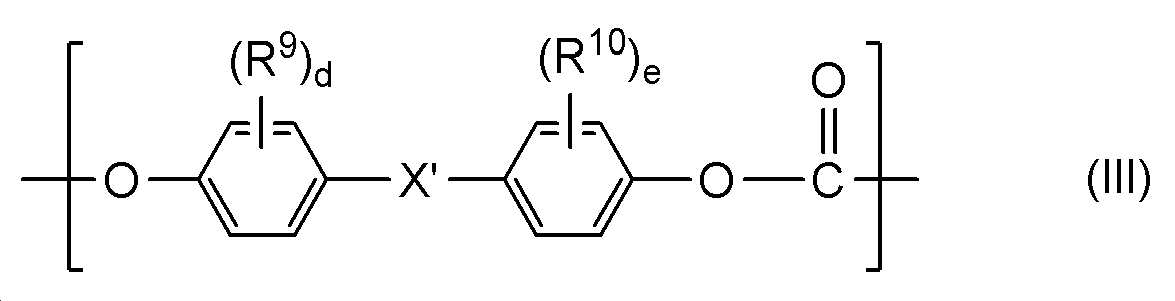
[식 중, R9 및 R10 은, 각각 독립적으로, 할로겐 원자, 탄소수 1 ∼ 6 의 알킬기 또는 탄소수 1 ∼ 6 의 알콕시기를 나타낸다. X' 는 단결합, 탄소수 1 ∼ 8 의 알킬렌기, 탄소수 2 ∼ 8 의 알킬리덴기, 탄소수 5 ∼ 15 의 시클로알킬렌기, 탄소수 5 ∼ 15 의 시클로알킬리덴기, -S-, -SO-, -SO2-, -O- 또는 -CO- 를 나타낸다. d 및 e 는, 각각 독립적으로 0 ∼ 4 의 정수를 나타낸다.] [Wherein R 9 and R 10 each independently represent a halogen atom, an alkyl group having 1 to 6 carbon atoms, or an alkoxy group having 1 to 6 carbon atoms. X 'represents a single bond, an alkylene group having 1 to 8 carbon atoms, an alkylidene group having 2 to 8 carbon atoms, a cycloalkylene group having 5 to 15 carbon atoms, a cycloalkylidene group having 5 to 15 carbon atoms, -S-, -SO-, -SO 2 -, represents a -O- or -CO-. d and e each independently represent an integer of 0 to 4.]
[13] 상기 폴리카보네이트계 수지 조성물 중의 폴리오르가노실록산 양이 1 ∼ 20 질량% 인, 상기 [1] ∼ [12] 중 어느 하나에 기재된 폴리카보네이트계 수지 조성물.[13] The polycarbonate resin composition according to any one of [1] to [12], wherein the amount of the polyorganosiloxane in the polycarbonate resin composition is 1 to 20% by mass.
[14] 상기 폴리카보네이트계 수지 조성물 중의 점도 평균 분자량이 12,000 ∼ 30,000 인, 상기 [1] ∼ [13] 중 어느 하나에 기재된 폴리카보네이트계 수지 조성물.[14] The polycarbonate resin composition according to any one of [1] to [13], wherein the polycarbonate resin composition has a viscosity average molecular weight of 12,000 to 30,000.
[15] 상기 폴리카보네이트계 수지 조성물의 점도 평균 분자량이 18,000 ∼ 22,000 인, 상기 [1] ∼ [14] 중 어느 하나에 기재된 폴리카보네이트계 수지 조성물.[15] The polycarbonate resin composition according to any one of [1] to [14], wherein the polycarbonate resin composition has a viscosity average molecular weight of 18,000 to 22,000.
[16] 폴리카보네이트-폴리오르가노실록산 공중합체 (A-1) 의 점도 평균 분자량이 12,000 ∼ 30,000 인, 상기 [1] ∼ [15] 중 어느 하나에 기재된 폴리카보네이트계 수지 조성물.[16] The polycarbonate resin composition according to any one of [1] to [15], wherein the polycarbonate-polyorganosiloxane copolymer (A-1) has a viscosity average molecular weight of 12,000 to 30,000.
[17] 폴리카보네이트-폴리오르가노실록산 공중합체 (A-2) 의 점도 평균 분자량이 12,000 ∼ 30,000 인, 상기 [1] ∼ [16] 중 어느 하나에 기재된 폴리카보네이트계 수지 조성물.[17] The polycarbonate resin composition according to any one of [1] to [16], wherein the polycarbonate-polyorganosiloxane copolymer (A-2) has a viscosity average molecular weight of 12,000 to 30,000.
[18] 폴리카보네이트계 수지 (A-3) 의 점도 평균 분자량이 12,000 ∼ 50,000 인, 상기 [1] ∼ [17] 중 어느 하나에 기재된 폴리카보네이트계 수지 조성물.[18] The polycarbonate resin composition according to any one of [1] to [17], wherein the polycarbonate resin (A-3) has a viscosity average molecular weight of 12,000 to 50,000.
[19] 폴리카보네이트계 수지 (A-3) 의 점도 평균 분자량이 19,000 ∼ 30,000 인, 상기 [1] ∼ [18] 중 어느 하나에 기재된 폴리카보네이트계 수지 조성물.[19] The polycarbonate resin composition according to any one of [1] to [18], wherein the polycarbonate resin (A-3) has a viscosity average molecular weight of 19,000 to 30,000.
본 발명에 의하면, 저온 내충격성을 포함하는 내충격성, 투명성 및 내열성이 우수한 폴리카보네이트계 수지 조성물을 제공할 수 있다.According to the present invention, it is possible to provide a polycarbonate resin composition excellent in impact resistance, transparency and heat resistance including low temperature impact resistance.
이하, 본 발명의 폴리카보네이트계 수지 조성물에 대해 상세하게 설명한다. 또한, 본 명세서에 있어서, 바람직하다고 알려져 있는 규정은 임의로 채용할 수 있으며, 바람직한 것끼리의 조합은 보다 바람직하다고 말할 수 있다. 또, 본 명세서에 있어서, 「XX ∼ YY」 의 기재는, 「XX 이상 YY 이하」 를 의미한다.Hereinafter, the polycarbonate resin composition of the present invention will be described in detail. It is to be noted that, in the present specification, a rule known to be preferable may be arbitrarily adopted, and it can be said that a combination of preferable ones is more preferable. In the present specification, the description of "XX to YY" means "XX to YY".
본 발명은, 하기 일반식 (I) 로 나타내는 반복 단위로 이루어지는 폴리카보네이트 블록 및 하기 일반식 (II) 로 나타내는 반복 단위를 포함하는 폴리오르가노실록산 블록을 포함하고, 상기 폴리오르가노실록산 블록의 평균 사슬 길이가 20 이상 60 미만인 폴리카보네이트-폴리오르가노실록산 공중합체 (A-1) 과, The present invention relates to a polyorganosiloxane block comprising a polycarbonate block comprising a repeating unit represented by the following general formula (I) and a polyorganosiloxane block including a repeating unit represented by the following general formula (II) A polycarbonate-polyorganosiloxane copolymer (A-1) having a chain length of 20 or more and less than 60,
하기 일반식 (I) 로 나타내는 반복 단위로 이루어지는 폴리카보네이트 블록 및 하기 일반식 (II) 로 나타내는 반복 단위를 포함하는 폴리오르가노실록산 블록을 포함하고, 상기 폴리오르가노실록산 블록의 평균 사슬 길이가 60 이상 500 미만인 폴리카보네이트-폴리오르가노실록산 공중합체 (A-2) 와,A polyorganosiloxane block comprising a polycarbonate block comprising a repeating unit represented by the following general formula (I) and a repeating unit represented by the following general formula (II), wherein the polyorganosiloxane block has an average chain length of 60 (A-2) having a number average molecular weight of less than 500 and a polycarbonate-polyorganosiloxane copolymer
폴리카보네이트-폴리오르가노실록산 공중합체 (A-1) 및 폴리카보네이트-폴리오르가노실록산 공중합체 (A-2) 이외의 폴리카보네이트계 수지 (A-3) The polycarbonate resin (A-3) other than the polycarbonate-polyorganosiloxane copolymer (A-1) and the polycarbonate-polyorganosiloxane copolymer (A-2)
을 포함하고,/ RTI >
폴리카보네이트-폴리오르가노실록산 공중합체 (A-1), 폴리카보네이트-폴리오르가노실록산 공중합체 (A-2) 및 폴리카보네이트계 수지 (A-3) 의 합계 중량에 있어서의, 폴리카보네이트계 수지 (A-3) 의 비율이 10 질량% 이상인 것을 특징으로 하는, 폴리카보네이트계 수지 조성물에 관한 것이다:Based on the total weight of the polycarbonate-polyorganosiloxane copolymer (A-1), the polycarbonate-polyorganosiloxane copolymer (A-2) and the polycarbonate resin (A-3) (A-3) is not less than 10% by mass based on the total amount of the polycarbonate resin composition.
[화학식 3] (3)

[식 중, R1 및 R2 는 각각 독립적으로, 할로겐 원자, 탄소수 1 ∼ 6 의 알킬기 또는 탄소수 1 ∼ 6 의 알콕시기를 나타낸다. X 는, 단결합, 탄소수 1 ∼ 8 의 알킬렌기, 탄소수 2 ∼ 8 의 알킬리덴기, 탄소수 5 ∼ 15 의 시클로알킬렌기, 탄소수 5 ∼ 15 의 시클로알킬리덴기, 플루오렌디일기, 탄소수 7 ∼ 15 의 아릴알킬렌기, 탄소수 7 ∼ 15 의 아릴알킬리덴기, -S-, -SO-, -SO2-, -O- 또는 -CO- 를 나타낸다. R3 및 R4 는 각각 독립적으로, 수소 원자, 할로겐 원자, 탄소수 1 ∼ 6 의 알킬기, 탄소수 1 ∼ 6 의 알콕시기 또는 탄소수 6 ∼ 12 의 아릴기를 나타낸다. a 및 b 는, 각각 독립적으로 0 ∼ 4 의 정수를 나타낸다.] [Wherein R 1 and R 2 each independently represent a halogen atom, an alkyl group having 1 to 6 carbon atoms, or an alkoxy group having 1 to 6 carbon atoms. X represents a single bond, an alkylene group having 1 to 8 carbon atoms, an alkylidene group having 2 to 8 carbon atoms, a cycloalkylene group having 5 to 15 carbon atoms, a cycloalkylidene group having 5 to 15 carbon atoms, An arylalkylene group having 7 to 15 carbon atoms, -S-, -SO-, -SO 2 -, -O- or -CO-. R 3 and R 4 each independently represent a hydrogen atom, a halogen atom, an alkyl group having 1 to 6 carbon atoms, an alkoxy group having 1 to 6 carbon atoms, or an aryl group having 6 to 12 carbon atoms. a and b each independently represent an integer of 0 to 4.]
[폴리카보네이트-폴리오르가노실록산 공중합체] [Polycarbonate-polyorganosiloxane copolymer]
본 발명의 폴리카보네이트계 수지 조성물 중에 포함되는 (A-1) 및 (A-2) 성분인 폴리카보네이트-폴리오르가노실록산 공중합체는, 상기 서술한 바와 같이, 하기 일반식 (I) 로 나타내는 반복 단위로 이루어지는 폴리카보네이트 블록 및 하기 일반식 (II) 로 나타내는 반복 단위를 포함하는 폴리오르가노실록산 블록을 포함한다:The polycarbonate-polyorganosiloxane copolymer which is a component (A-1) and (A-2) contained in the polycarbonate resin composition of the present invention, as described above, And a polyorganosiloxane block comprising a repeating unit represented by the following general formula (II): < EMI ID =
[화학식 4][Chemical Formula 4]

상기 일반식 (I) 중, R1 및 R2 가 각각 독립적으로 나타내는 할로겐 원자로는, 불소 원자, 염소 원자, 브롬 원자, 및 요오드 원자를 들 수 있다.In the general formula (I), examples of the halogen atom represented by R 1 and R 2 each independently include a fluorine atom, a chlorine atom, a bromine atom, and an iodine atom.
R1 및 R2 가 각각 독립적으로 나타내는 알킬기로는, 메틸기, 에틸기, n-프로필기, 이소프로필기, 각종 부틸기 (「각종」 이란, 직사슬형 및 모든 분기 사슬형의 것을 포함하는 것을 나타내며, 이하 동일하다.), 각종 펜틸기, 및 각종 헥실기를 들 수 있다. R1 및 R2 가 각각 독립적으로 나타내는 알콕시기로는, 알킬기 부위가 상기 알킬기인 경우를 들 수 있다.Examples of the alkyl group represented by R 1 and R 2 each independently include a methyl group, an ethyl group, an n-propyl group, an isopropyl group, and various butyl groups ("various" , The same applies hereinafter), various pentyl groups, and various hexyl groups. Examples of the alkoxy group represented by R 1 and R 2 each independently include the case where the alkyl group is the above alkyl group.
X 가 나타내는 알킬렌기로는, 예를 들어, 메틸렌기, 에틸렌기, 트리메틸렌기, 테트라메틸렌기, 헥사메틸렌기 등을 들 수 있으며, 탄소수 1 ∼ 5 의 알킬렌기가 바람직하다. X 가 나타내는 알킬리덴기로는, 에틸리덴기, 이소프로필리덴기 등을 들 수 있다. X 가 나타내는 시클로알킬렌기로는, 시클로펜탄디일기나 시클로헥산디일기, 시클로옥탄디일기 등을 들 수 있으며, 탄소수 5 ∼ 10 의 시클로알킬렌기가 바람직하다. X 가 나타내는 시클로알킬리덴기로는, 예를 들어, 시클로헥실리덴기, 3,5,5-트리메틸시클로헥실리덴기, 2-아다만틸리덴기 등을 들 수 있으며, 탄소수 5 ∼ 10 의 시클로알킬리덴기가 바람직하고, 탄소수 5 ∼ 8 의 시클로알킬리덴기가 보다 바람직하다. X 가 나타내는 아릴알킬렌기의 아릴 부위로는, 페닐기, 나프틸기, 비페닐기, 안트릴기 등의 고리 형성 탄소수 6 ∼ 14 의 아릴기를 들 수 있다. X 가 나타내는 아릴알킬리덴기의 아릴 부위로는, 페닐기, 나프틸기, 비페닐기, 안트릴기 등의 고리 형성 탄소수 6 ∼ 14 의 아릴기를 들 수 있다. Examples of the alkylene group represented by X include a methylene group, an ethylene group, a trimethylene group, a tetramethylene group and a hexamethylene group, and an alkylene group having 1 to 5 carbon atoms is preferable. Examples of the alkylidene group represented by X include an ethylidene group and an isopropylidene group. Examples of the cycloalkylene group represented by X include a cyclopentanediyl group, a cyclohexanediyl group, and a cyclooctanediyl group, and a cycloalkylene group having 5 to 10 carbon atoms is preferable. Examples of the cycloalkylidene group represented by X include a cyclohexylidene group, a 3,5,5-trimethylcyclohexylidene group, a 2-adamantylidene group and the like, and a cycloalkylidene group having 5 to 10 carbon atoms Group is preferable, and a cycloalkylidene group having 5 to 8 carbon atoms is more preferable. Examples of the aryl moiety of the arylalkylene group represented by X include an aryl group having 6 to 14 ring-forming carbon atoms such as a phenyl group, a naphthyl group, a biphenyl group, and an anthryl group. Examples of the aryl moiety of the arylalkylidene group represented by X include an aryl group having 6 to 14 ring-forming carbon atoms such as a phenyl group, a naphthyl group, a biphenyl group, and an anthryl group.
a 및 b 는, 각각 독립적으로 0 ∼ 4 의 정수를 나타내며, 바람직하게는 0 ∼ 2, 보다 바람직하게는 0 또는 1 이다. a and b each independently represent an integer of 0 to 4, preferably 0 to 2, more preferably 0 or 1.
그 중에서도, a 및 b 가 0 이고, X 가 단결합 또는 탄소수 1 ∼ 8 의 알킬렌기인 것, 또는 a 및 b 가 0 이고, X 가 탄소수 3 의 알킬렌기, 특히 이소프로필리덴기인 것이 적합하다.Among them, it is preferable that a and b are 0, X is a single bond or an alkylene group having 1 to 8 carbon atoms, or a and b are 0 and X is an alkylene group having 3 carbon atoms, especially isopropylidene group.
상기 일반식 (II) 중, R3 또는 R4 가 각각 독립적으로 나타내는 할로겐 원자로는, 불소 원자, 염소 원자, 브롬 원자, 및 요오드 원자를 들 수 있다. R3 또는 R4 가 각각 독립적으로 나타내는 알킬기로는, 메틸기, 에틸기, n-프로필기, 이소프로필기, 각종 부틸기, 각종 펜틸기, 및 각종 헥실기를 들 수 있다. R3 또는 R4 가 각각 독립적으로 나타내는 알콕시기로는, 알킬기 부위가 상기 알킬기인 경우를 들 수 있다. R3 또는 R4 가 각각 독립적으로 나타내는 아릴기로는, 페닐기, 나프틸기 등을 들 수 있다. Examples of the halogen atom represented by R 3 or R 4 in the general formula (II) independently include a fluorine atom, a chlorine atom, a bromine atom and an iodine atom. Examples of the alkyl group represented by R 3 or R 4 each independently include a methyl group, ethyl group, n-propyl group, isopropyl group, various butyl groups, various pentyl groups, and various hexyl groups. Examples of the alkoxy group represented by R 3 or R 4 each independently include the case where the alkyl group is the above-mentioned alkyl group. Examples of the aryl group represented by R 3 or R 4 each independently include a phenyl group and a naphthyl group.
또한, R3 및 R4 가 모두 수소 원자, 탄소수 1 ∼ 6 의 알킬기, 탄소수 1 ∼ 6 의 알콕시기 또는 탄소수 6 ∼ 12 의 아릴기를 나타내는 것이 바람직하고, 모두 메틸기를 나타내는 것이 보다 바람직하다.It is preferable that R 3 and R 4 all represent a hydrogen atom, an alkyl group having 1 to 6 carbon atoms, an alkoxy group having 1 to 6 carbon atoms, or an aryl group having 6 to 12 carbon atoms, more preferably a methyl group.
상기 일반식 (II) 로 나타내는 반복 단위를 포함하는 폴리오르가노실록산 블록은, 보다 구체적으로는, 하기 일반식 (II-I) ∼ (II-III) 으로 나타내는 단위를 갖는 것이 바람직하다.More specifically, it is preferable that the polyorganosiloxane block containing the repeating unit represented by the general formula (II) has units represented by the following general formulas (II-I) to (II-III).
[화학식 5] [Chemical Formula 5]
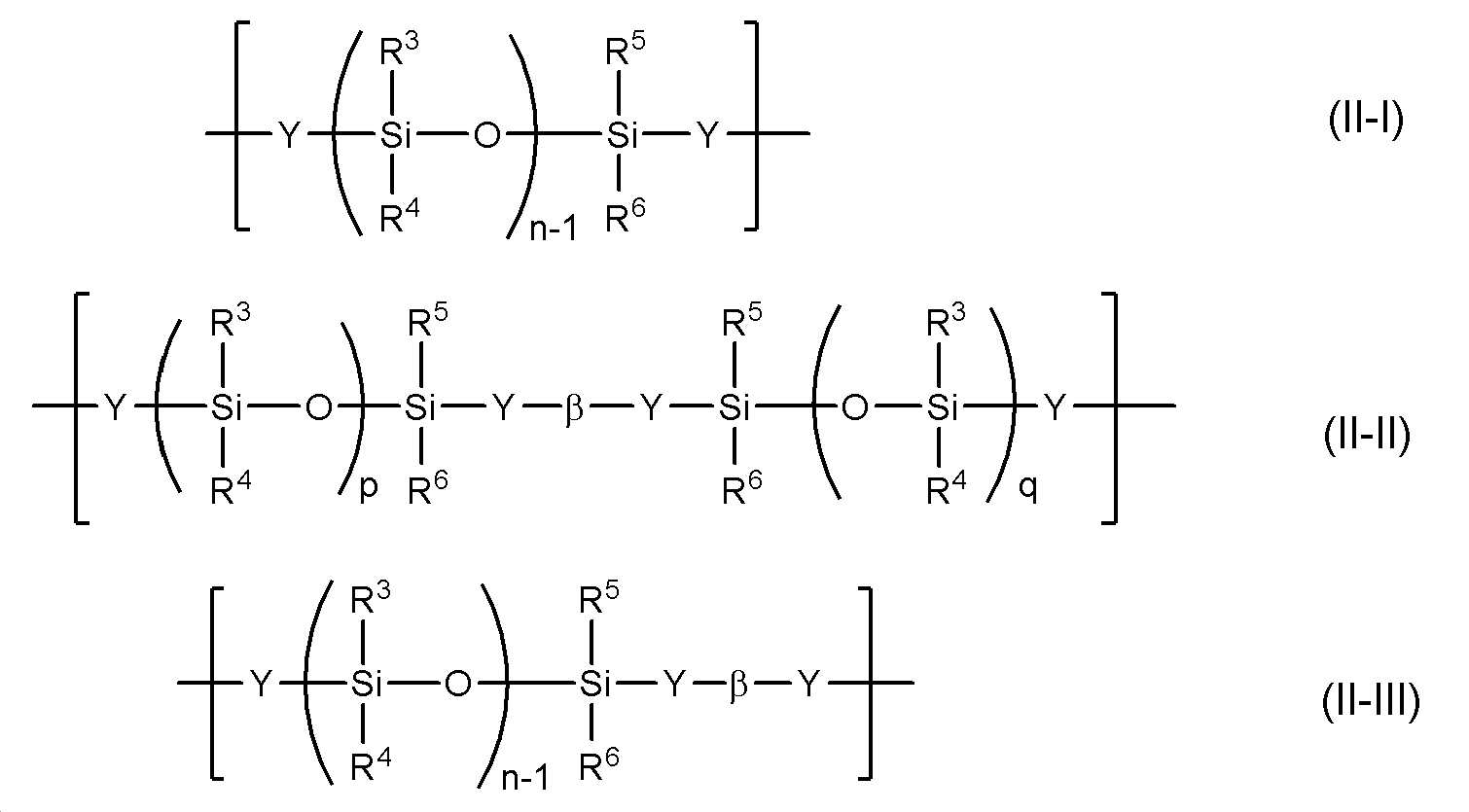
[식 중, R3 ∼ R6 은, 각각 독립적으로, 수소 원자, 할로겐 원자, 탄소수 1 ∼ 6 의 알킬기, 탄소수 1 ∼ 6 의 알콕시기 또는 탄소수 6 ∼ 12 의 아릴기를 나타내며, 복수의 R3 ∼ R6 은, 서로 동일해도 되고 상이해도 된다. Y 는 -R7O-, -R7COO-, -R7NH-, -R7NR8-, -COO-, -S-, -R7COO-R9-O-, 또는 -R7O-R10-O- 를 나타내며, 복수의 Y 는, 서로 동일해도 되고 상이해도 된다. 상기 R7 은, 단결합, 직사슬, 분기 사슬 혹은 고리형 알킬렌기, 지방족기 및 방향족기를 포함하는 2 가의 유기 잔기, 치환 또는 무치환의 아릴렌기, 또는 디아릴렌기를 나타낸다. R8 은, 알킬기, 알케닐기, 아릴기, 또는 아르알킬기를 나타낸다. R9 는, 디아릴렌기를 나타낸다. R10 은, 직사슬, 분기 사슬 혹은 고리형 알킬렌기, 또는 디아릴렌기를 나타낸다. β 는, 디이소시아네이트 화합물 유래의 2 가의 기, 또는 디카르복실산 혹은 디카르복실산의 할로겐화물 유래의 2 가의 기를 나타낸다. n 은 폴리오르가노실록산의 평균 사슬 길이를 나타낸다. p 와 q 는 각각 1 이상의 정수이며, p 와 q 의 합은 n-2 이다.] [Wherein, R 3 ~ R 6 are, each independently, a hydrogen atom, a halogen atom, an alkyl group having 1 to 6 carbon atoms, represents an aryl group having 1 to 6 carbon atoms an alkoxy group or having 6 to 12, a plurality of R 3 ~ R 6 may be the same or different. Y is -R 7 O-, -R 7 COO-, -R 7 NH-, -R 7 NR 8 -, -COO-, -S-, -R 7 COO-R 9 -O-, or -R 7 OR 10 -O-, and a plurality of Ys may be the same or different. R 7 represents a divalent organic residue containing a single bond, a linear chain, a branched chain or a cyclic alkylene group, an aliphatic group and an aromatic group, a substituted or unsubstituted arylene group, or a diarylene group. R 8 represents an alkyl group, an alkenyl group, an aryl group or an aralkyl group. R 9 represents a diarylene group. R 10 represents a linear, branched or cyclic alkylene group or a diarylene group. represents a divalent group derived from a diisocyanate compound or a divalent group derived from a halide of a dicarboxylic acid or a dicarboxylic acid. and n represents the average chain length of the polyorganosiloxane. p and q are each an integer of 1 or more, and the sum of p and q is n-2.
R3 ∼ R6 이 각각 독립적으로 나타내는 할로겐 원자로는, 불소 원자, 염소 원자, 브롬 원자, 및 요오드 원자를 들 수 있다. R3 ∼ R6 이 각각 독립적으로 나타내는 알킬기로는, 메틸기, 에틸기, n-프로필기, 이소프로필기, 각종 부틸기, 각종 펜틸기, 및 각종 헥실기를 들 수 있다. R3 ∼ R6 이 각각 독립적으로 나타내는 알콕시기로는, 알킬기 부위가 상기 알킬기인 경우를 들 수 있다. R3 ∼ R6 이 각각 독립적으로 나타내는 아릴기로는, 페닐기, 나프틸기 등을 들 수 있다.Examples of the halogen atom represented by R 3 to R 6 each independently include a fluorine atom, a chlorine atom, a bromine atom and an iodine atom. Examples of the alkyl group represented by R 3 to R 6 each independently include a methyl group, an ethyl group, a n-propyl group, an isopropyl group, various butyl groups, various pentyl groups and various hexyl groups. Examples of the alkoxy group represented by R 3 to R 6 each independently include the case where the alkyl group is the above-mentioned alkyl group. Examples of the aryl group represented by R 3 to R 6 each independently include a phenyl group and a naphthyl group.
R3 ∼ R6 으로는, 모두, 바람직하게는, 수소 원자, 탄소수 1 ∼ 6 의 알킬기, 탄소수 1 ∼ 6 의 알콕시기 또는 탄소수 6 ∼ 12 의 아릴기이다.R 3 to R 6 are preferably a hydrogen atom, an alkyl group having 1 to 6 carbon atoms, an alkoxy group having 1 to 6 carbon atoms, or an aryl group having 6 to 12 carbon atoms.
일반식 (II-I), (II-II) 및/또는 (II-III) 중의, R3 ∼ R6 이 모두 메틸기인 것이 보다 바람직하다.It is more preferable that all of R 3 to R 6 in the general formulas (II-I), (II-II) and / or (II-III) are methyl groups.
Y 가 나타내는 -R7O-, -R7COO-, -R7NH-, -R7NR8-, -COO-, -S-, -R7COO-R9-O-, 또는 -R7O-R10-O- 에 있어서의 R7 이 나타내는 직사슬 또는 분기 사슬 알킬렌기로는, 탄소수 1 ∼ 8, 바람직하게는 탄소수 1 ∼ 5 의 알킬렌기를 들 수 있으며, 고리형 알킬렌기로는, 탄소수 5 ∼ 15, 바람직하게는 탄소수 5 ∼ 10 의 시클로알킬렌기를 들 수 있다.R 7 O-, -R 7 COO-, -R 7 NH-, -R 7 NR 8 -, -COO-, -S-, -R 7 COO-R 9 -O-, or -R The linear or branched alkylene group represented by R 7 in OR 10 -O- includes an alkylene group having 1 to 8 carbon atoms, preferably 1 to 5 carbon atoms, and as the cyclic alkylene group, And a cycloalkylene group having 5 to 15 carbon atoms, preferably 5 to 10 carbon atoms.
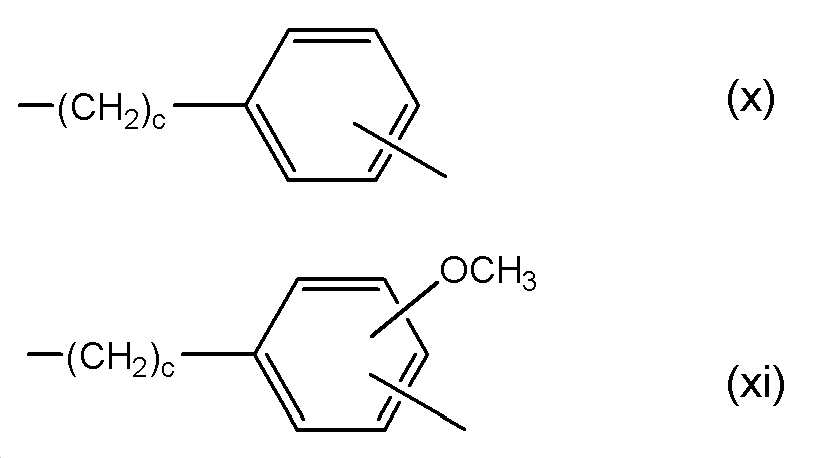
R7 이 나타내는 지방족기 및 방향족기를 포함하는 2 가의 유기 잔기는, 방향고리에 알콕시기, 알킬기와 같은 치환기를 추가로 갖고 있어도 되며, 그 구체적 구조로는, 예를 들어, 하기의 일반식 (x) 또는 (xi) 의 구조를 나타낼 수 있다. 또한, 하기 일반식의 경우 알킬렌기가 Si 에 결합하고 있다.The divalent organic residue containing an aliphatic group and an aromatic group represented by R 7 may further have a substituent such as an alkoxy group or an alkyl group in the aromatic ring. Specific examples of the divalent organic residue include a group represented by the following general formula (x ) Or (xi). Further, in the general formula shown below, an alkylene group is bonded to Si.
[화학식 6][Chemical Formula 6]

(식 중 c 는 양의 정수를 나타내고, 통상적으로 1 ∼ 6 의 정수이다) (Wherein c represents a positive integer, and is usually an integer of 1 to 6)
R7, R9 및 R10 이 나타내는 디아릴렌기란, 2 개의 아릴렌기가 직접, 또는 2 가의 유기 기를 개재하여 연결된 기를 말하며, 구체적으로는 -Ar1-W-Ar2- 로 나타내는 구조를 갖는 기이다. 여기서, Ar1 및 Ar2 는, 아릴렌기를 나타내며, W 는 단결합, 또는 2 가의 유기 기를 나타낸다. W 가 나타내는 2 가의 유기 기는, 예를 들어 이소프로필리덴기, 메틸렌기, 디메틸렌기, 트리메틸렌기이다. The diarylene group represented by R 7 , R 9 and R 10 is a group in which two arylene groups are linked directly or via a divalent organic group, specifically a group having a structure represented by -Ar 1 -W-Ar 2 - to be. Here, Ar 1 and Ar 2 represent an arylene group, and W represents a single bond or a divalent organic group. The divalent organic group represented by W is, for example, an isopropylidene group, a methylene group, a dimethylene group, or a trimethylene group.
R7, Ar1 및 Ar2 가 나타내는 아릴렌기로는, 페닐렌기, 나프틸렌기, 비페닐렌기, 안트릴렌기 등의 고리 형성 탄소수 6 ∼ 14 의 아릴렌기를 들 수 있다. 이들 아릴렌기는, 알콕시기, 알킬기 등의 임의의 치환기를 추가로 갖고 있어도 된다.Examples of the arylene group represented by R 7 , Ar 1 and Ar 2 include an arylene group having 6 to 14 ring-forming carbon atoms such as a phenylene group, a naphthylene group, a biphenylene group and an anthrylene group. These arylene groups may further have arbitrary substituents such as an alkoxy group and an alkyl group.
R8 이 나타내는 알킬기로는 탄소수 1 ∼ 8, 바람직하게는 1 ∼ 5 의 직사슬 또는 분기 사슬의 것이다. 알케닐기로는, 탄소수 2 ∼ 8, 바람직하게는 2 ∼ 5 의 직사슬 또는 분기 사슬의 것을 들 수 있다. 아릴기로는 페닐기, 나프틸기 등을 들 수 있다. 아르알킬기로는, 페닐메틸기, 페닐에틸기 등을 들 수 있다.The alkyl group represented by R 8 is a linear or branched chain having 1 to 8 carbon atoms, preferably 1 to 5 carbon atoms. The alkenyl group includes straight chain or branched chain groups of 2 to 8 carbon atoms, preferably 2 to 5 carbon atoms. Examples of the aryl group include a phenyl group and a naphthyl group. Examples of the aralkyl group include a phenylmethyl group and a phenylethyl group.
R10 이 나타내는 직사슬, 분기 사슬 혹은 고리형 알킬렌기는, R7 과 동일하다.The linear, branched or cyclic alkylene group represented by R 10 is the same as R 7 .
Y 로는, 바람직하게는 -R7O- 로서, R7 이 지방족기 및 방향족기를 포함하는 2 가의 유기 잔기이고, 특히 -R7O- 는 알킬기를 갖는 페놀계 화합물의 2 가의 잔기이고, 예를 들어 알릴페놀 유래의 2 가의 유기 잔기나 오이게놀 유래의 2 가의 유기 잔기가 보다 바람직하고, 구체적으로는 다음 식으로 나타낸다.Y is preferably -R 7 O-, R 7 is a divalent organic residue comprising an aliphatic group and an aromatic group, in particular -R 7 O- is a divalent residue of a phenolic compound having an alkyl group, More preferred are divalent organic residues derived from allyl phenol and divalent organic residues derived from oiogenol, and specifically represented by the following formulas.
[화학식 7](7)
(식 중 c 는 양의 정수를 나타내며, 통상적으로 1 ∼ 6 의 정수이다) (Wherein c represents a positive integer and is usually an integer of 1 to 6)
또한, 식 (II-II) 중의 p 및 q 에 대해서는, p = q, 즉, p = (n ― 2)/2, q = (n ― 2)/2 인 것이 바람직하다.P and q in the formula (II-II) are preferably p = q, that is, p = (n - 2) / 2 and q = (n - 2) / 2.
또, β 는, 디이소시아네이트 화합물 유래의 2 가의 기 또는 디카르복실산 또는 디카르복실산의 할로겐화물 유래의 2 가의 기를 나타내며, 예를 들어, 이하의 일반식 (xiii) ∼ (xvii) 로 나타내는 2 가의 기를 들 수 있다.Represents a divalent group derived from a diisocyanate compound or a divalent group derived from a halide of a dicarboxylic acid or a dicarboxylic acid and is represented by the following general formula (xiii) to (xvii). And a divalent group.
[화학식 8][Chemical Formula 8]

[폴리카보네이트-폴리오르가노실록산 공중합체 (A-1)] [Polycarbonate-polyorganosiloxane copolymer (A-1)]
본 발명의 수지 조성물에 포함되는 폴리카보네이트-폴리오르가노실록산 공중합체 (A-1) 은, 상기 (II) 로 나타내는 폴리오르가노실록산 블록의 평균 사슬 길이가 20 이상 60 미만인 것을 필요로 한다. 즉, 식 (II-I) 및 (II-III) 중의 n 이 20 이상 60 미만이 되고, (II-II) 인 경우에는 p 와 q 의 합에 2 를 더한 수가 상기 범위가 된다. 그 평균 사슬 길이는 핵 자기 공명 (NMR) 측정에 의해 산출된다. 당해 사슬 길이는, 바람직하게는 25 ∼ 55, 보다 바람직하게는 30 ∼ 45 이다. 폴리카보네이트-폴리오르가노실록산 공중합체 (A-1) 의 평균 사슬 길이가 20 이상 60 미만이면, 우수한 투명성이 얻어진다.The polycarbonate-polyorganosiloxane copolymer (A-1) contained in the resin composition of the present invention requires that the average chain length of the polyorganosiloxane block represented by the above (II) is 20 or more and less than 60. [ That is, when n in the equations (II-I) and (II-III) is 20 or more and less than 60 and (II-II), the number obtained by adding 2 to the sum of p and q is in the above range. The average chain length is calculated by nuclear magnetic resonance (NMR) measurement. The chain length is preferably 25 to 55, more preferably 30 to 45. When the average chain length of the polycarbonate-polyorganosiloxane copolymer (A-1) is 20 or more and less than 60, excellent transparency is obtained.
상기 폴리카보네이트-폴리오르가노실록산 공중합체 (A-1) 중에 포함되는 폴리오르가노실록산 양 (상기 식 (II) 로 나타내는 폴리오르가노실록산 블록 함유율. 이하 동일.) 은, 바람직하게는 1 ∼ 20 질량%, 보다 바람직하게는 1.5 ∼ 10 질량% 이다. 폴리카보네이트-폴리오르가노실록산 공중합체 (A-1) 중의 폴리오르가노실록산 양이 상기 범위이면, 우수한 투명성을 갖는 폴리카보네이트계 수지 조성물을 얻을 수 있다.The amount of the polyorganosiloxane contained in the polycarbonate-polyorganosiloxane copolymer (A-1) (the content of the polyorganosiloxane block represented by the formula (II), hereinafter the same) is preferably 1 to 20 Mass%, more preferably 1.5 to 10 mass%. When the amount of the polyorganosiloxane in the polycarbonate-polyorganosiloxane copolymer (A-1) is within the above range, a polycarbonate resin composition having excellent transparency can be obtained.
폴리카보네이트-폴리오르가노실록산 공중합체 (A-1) 의 점도 평균 분자량은, 바람직하게는 12,000 ∼ 30,000, 보다 바람직하게는 15,000 ∼ 25,000, 더욱 바람직하게는 16,000 ∼ 19,000 이다. 점도 평균 분자량의 산출 방법은, 후술한다.The viscosity average molecular weight of the polycarbonate-polyorganosiloxane copolymer (A-1) is preferably 12,000 to 30,000, more preferably 15,000 to 25,000, and still more preferably 16,000 to 19,000. The method of calculating the viscosity average molecular weight will be described later.
[폴리카보네이트-폴리오르가노실록산 공중합체 (A-2)] [Polycarbonate-polyorganosiloxane copolymer (A-2)]
본 발명의 수지 조성물에 포함되는 폴리카보네이트-폴리오르가노실록산 공중합체 (A-2) 는, 상기 (II) 로 나타내는 폴리오르가노실록산 블록의 평균 사슬 길이가 60 이상 500 미만인 것을 필요로 한다. 즉, 식 (II-I) 및 (II-III) 중의 n 이 60 이상 500 미만이 되고, (II-II) 인 경우에는 p 와 q 의 합에 2 를 더한 수가 상기 범위가 된다. 그 평균 사슬 길이는 핵 자기 공명 (NMR) 측정에 의해 산출된다. 당해 사슬 길이는, 바람직하게는 70 ∼ 300, 보다 바람직하게는 80 ∼ 200 이다. 폴리카보네이트-폴리오르가노실록산 공중합체 (A-2) 의 사슬 길이가 60 이상 500 미만이면, 우수한 내충격성이 얻어진다.The polycarbonate-polyorganosiloxane copolymer (A-2) contained in the resin composition of the present invention requires that the average chain length of the polyorganosiloxane block represented by the above (II) is from 60 to less than 500. That is, when n in the formulas (II-I) and (II-III) is 60 or more and less than 500 and (II-II), the number obtained by adding 2 to the sum of p and q is in the above range. The average chain length is calculated by nuclear magnetic resonance (NMR) measurement. The chain length is preferably 70 to 300, more preferably 80 to 200. When the chain length of the polycarbonate-polyorganosiloxane copolymer (A-2) is 60 or more and less than 500, excellent impact resistance is obtained.
상기 폴리카보네이트-폴리오르가노실록산 공중합체 (A-2) 중에 포함되는 폴리오르가노실록산 양은, 바람직하게는 1 ∼ 45 질량%, 보다 바람직하게는 1.5 ∼ 35 질량%, 더욱 바람직하게는 2 ∼ 10 질량% 이다. 폴리카보네이트-폴리오르가노실록산 공중합체 (A-2) 중의 폴리오르가노실록산 양이 상기 범위이면, 우수한 내충격성을 갖는 폴리카보네이트계 수지 조성물을 얻을 수 있다.The amount of the polyorganosiloxane contained in the polycarbonate-polyorganosiloxane copolymer (A-2) is preferably 1 to 45% by mass, more preferably 1.5 to 35% by mass, further preferably 2 to 10% Mass%. When the amount of the polyorganosiloxane in the polycarbonate-polyorganosiloxane copolymer (A-2) is within the above range, a polycarbonate resin composition having excellent impact resistance can be obtained.
폴리카보네이트-폴리오르가노실록산 공중합체 (A-2) 의 점도 평균 분자량은, 바람직하게는 12,000 ∼ 30,000, 보다 바람직하게는 15,000 ∼ 25,000, 더욱 바람직하게는 16,000 ∼ 19,000 이다. 점도 평균 분자량의 산출 방법은 후술한다.The viscosity average molecular weight of the polycarbonate-polyorganosiloxane copolymer (A-2) is preferably 12,000 to 30,000, more preferably 15,000 to 25,000, and still more preferably 16,000 to 19,000. The calculation method of the viscosity average molecular weight will be described later.
[폴리카보네이트계 수지 (A-3)] [Polycarbonate resin (A-3)]
본 발명의 폴리카보네이트계 수지 조성물 중에는, 또한 (A-1) 및 (A-2) 이외의 폴리카보네이트계 수지 (A-3) 을 포함한다. 그 폴리카보네이트계 수지 (A-3) 은 바람직하게는 방향족 폴리카보네이트계 수지이고, 보다 바람직하게는 하기 일반식 (III) 으로 나타내는 반복 단위만으로 이루어지는 방향족 폴리카보네이트계 수지이다.The polycarbonate resin composition of the present invention further includes a polycarbonate resin (A-3) other than (A-1) and (A-2). The polycarbonate resin (A-3) is preferably an aromatic polycarbonate resin, more preferably an aromatic polycarbonate resin comprising only a repeating unit represented by the following formula (III).
[화학식 9] [Chemical Formula 9]
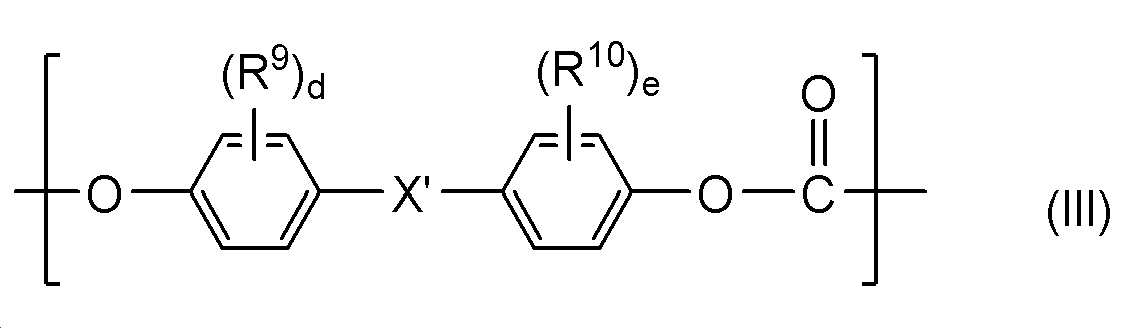
[식 중, R9 및 R10 은, 각각 독립적으로, 할로겐 원자, 탄소수 1 ∼ 6 의 알킬기 또는 탄소수 1 ∼ 6 의 알콕시기를 나타낸다. X' 는 단결합, 탄소수 1 ∼ 8 의 알킬렌기, 탄소수 2 ∼ 8 의 알킬리덴기, 탄소수 5 ∼ 15 의 시클로알킬렌기, 탄소수 5 ∼ 15 의 시클로알킬리덴기, -S-, -SO-, -SO2-, -O- 또는 -CO- 를 나타낸다. d 및 e 는, 각각 독립적으로 0 ∼ 4 의 정수를 나타낸다.] [Wherein R 9 and R 10 each independently represent a halogen atom, an alkyl group having 1 to 6 carbon atoms, or an alkoxy group having 1 to 6 carbon atoms. X 'represents a single bond, an alkylene group having 1 to 8 carbon atoms, an alkylidene group having 2 to 8 carbon atoms, a cycloalkylene group having 5 to 15 carbon atoms, a cycloalkylidene group having 5 to 15 carbon atoms, -S-, -SO-, -SO 2 -, represents a -O- or -CO-. d and e each independently represent an integer of 0 to 4.]
R9 및 R10 의 구체예로는, 상기 R1 및 R2 와 동일한 것을 들 수 있으며, 바람직한 것도 동일하다. R9 및 R10 으로는, 보다 바람직하게는, 탄소수 1 ∼ 6 의 알킬기 또는 탄소수 1 ∼ 6 의 알콕시기이다. X' 의 구체예로는, 상기 X 와 동일한 것을 들 수 있으며, 바람직한 것도 동일하다. d 및 e 는, 각각 독립적으로, 바람직하게는 0 ∼ 2, 보다 바람직하게는 0 또는 1 이다.Specific examples of R < 9 > and R < 10 > include the same ones as R < 1 > and R < 2 > R 9 and R 10 are more preferably an alkyl group having 1 to 6 carbon atoms or an alkoxy group having 1 to 6 carbon atoms. Specific examples of X 'include the same ones as the above-mentioned X, and preferable ones are also the same. d and e are each independently preferably 0 to 2, more preferably 0 or 1.
폴리카보네이트계 수지 (A-3) 의 점도 평균 분자량은, 바람직하게는 12,000 ∼ 50,000, 보다 바람직하게는 15,000 ∼ 35,000, 더욱 바람직하게는 17,000 ∼ 33,000, 특히 바람직하게는 19,000 ∼ 30,000 이다. 점도 평균 분자량의 산출 방법은 후술한다.The viscosity average molecular weight of the polycarbonate resin (A-3) is preferably 12,000 to 50,000, more preferably 15,000 to 35,000, still more preferably 17,000 to 33,000, and particularly preferably 19,000 to 30,000. The calculation method of the viscosity average molecular weight will be described later.
본 발명의 폴리카보네이트계 수지 조성물은, 폴리카보네이트-폴리오르가노실록산 공중합체 (A-1), 폴리카보네이트-폴리오르가노실록산 공중합체 (A-2) 및 폴리카보네이트계 수지 (A-3) 의 합계 중량에 있어서의, 폴리카보네이트계 수지 (A-3) 의 비율이 10 질량% 이상인 것을 필요로 한다. 폴리카보네이트계 수지 (A-3) 의 비율이 상기 10 질량% 이상이면, 폴리카보네이트계 수지 조성물의 우수한 투명성 및 내열성을 얻을 수 있다. 상기 3 성분의 합계 중량에 있어서의 폴리카보네이트계 수지 (A-3) 의 비율은 바람직하게는 20 질량% 이상이다. 또, 상기 3 성분의 합계 중량에 있어서의 폴리카보네이트계 수지 (A-3) 의 비율은 바람직하게는 45 질량% 미만, 보다 바람직하게는 43 질량% 이하, 더욱 바람직하게는 40 질량% 이하이다.The polycarbonate resin composition of the present invention is a polycarbonate resin composition comprising a polycarbonate-polyorganosiloxane copolymer (A-1), a polycarbonate-polyorganosiloxane copolymer (A-2) and a polycarbonate resin (A- It is necessary that the ratio of the polycarbonate resin (A-3) in the total weight is 10 mass% or more. When the ratio of the polycarbonate resin (A-3) is 10% by mass or more, excellent transparency and heat resistance of the polycarbonate resin composition can be obtained. The ratio of the polycarbonate resin (A-3) in the total weight of the three components is preferably 20 mass% or more. The proportion of the polycarbonate resin (A-3) in the total weight of the three components is preferably less than 45% by mass, more preferably 43% by mass or less, and still more preferably 40% by mass or less.
또, 본 발명에 있어서의 상기 3 성분 중 폴리카보네이트-폴리오르가노실록산 공중합체 (A-1) 과 폴리카보네이트-폴리오르가노실록산 공중합체 (A-2) 에 대해서는 이하의 양 범위가 각각 독립적으로 바람직하고, 이 범위이면, 폴리카보네이트-폴리오르가노실록산 공중합체 (A-1), 폴리카보네이트-폴리오르가노실록산 공중합체 (A-2) 및 폴리카보네이트계 수지 (A-3) 의 합계 중량이 100 이 되는 범위에서, 각각 임의의 값을 취할 수 있다.The following ranges of the polycarbonate-polyorganosiloxane copolymer (A-1) and the polycarbonate-polyorganosiloxane copolymer (A-2) among the three components in the present invention are independently The total weight of the polycarbonate-polyorganosiloxane copolymer (A-1), the polycarbonate-polyorganosiloxane copolymer (A-2) and the polycarbonate resin (A-3) 100, it is possible to take an arbitrary value.
상기 3 성분의 합계 중량에 있어서의 폴리카보네이트-폴리오르가노실록산 공중합체 (A-1) 의 비율이 70 질량% 이하로 하는 것이 바람직하다. 폴리카보네이트-폴리오르가노실록산 공중합체 (A-1) 의 비율이 70 질량% 이하이면, 폴리카보네이트계 수지 조성물의 우수한 투명성을 유지함과 함께 우수한 내충격성을 유지할 수 있다.The proportion of the polycarbonate-polyorganosiloxane copolymer (A-1) in the total weight of the three components is preferably 70% by mass or less. When the ratio of the polycarbonate-polyorganosiloxane copolymer (A-1) is 70% by mass or less, excellent transparency of the polycarbonate resin composition can be maintained and excellent impact resistance can be maintained.
상기 3 성분의 합계 중량에 있어서의 폴리카보네이트-폴리오르가노실록산 공중합체 (A-2) 의 비율은 10 질량% 이상으로 하는 것이 바람직하고, 보다 바람직하게는 15 질량% 이상이다. 폴리카보네이트-폴리오르가노실록산 공중합체 (A-2) 의 비율이 10 질량% 이상이면, 폴리카보네이트계 수지 조성물의 우수한 내충격성을 유지할 수 있다.The proportion of the polycarbonate-polyorganosiloxane copolymer (A-2) in the total weight of the three components is preferably 10% by mass or more, and more preferably 15% by mass or more. When the ratio of the polycarbonate-polyorganosiloxane copolymer (A-2) is 10% by mass or more, excellent impact resistance of the polycarbonate resin composition can be maintained.
폴리카보네이트-폴리오르가노실록산 공중합체 (A-1) 과 폴리카보네이트-폴리오르가노실록산 공중합체 (A-2) 의 중량비 (A-1)/(A-2) 는, 바람직하게는 10/90 ∼ 99/1, 보다 바람직하게는 60/40 ∼ 99/1, 더욱 바람직하게는 72/28 ∼ 99/1, 특히 바람직하게는 75/25 ∼ 99/1 이다. 중량비 (A-1)/(A-2) 가 상기 범위가 됨으로써, 저온 내충격성을 포함하는 우수한 내충격 특성과, 우수한 투명성을 충분히 얻을 수 있다.The weight ratio (A-1) / (A-2) of the polycarbonate-polyorganosiloxane copolymer (A-1) and the polycarbonate-polyorganosiloxane copolymer (A-2) is preferably 10/90 To 99/1, more preferably 60/40 to 99/1, further preferably 72/28 to 99/1, particularly preferably 75/25 to 99/1. When the weight ratio (A-1) / (A-2) falls within the above range, excellent impact resistance including low-temperature impact resistance and excellent transparency can be sufficiently obtained.
본 발명의 폴리카보네이트계 수지 조성물 중의 폴리오르가노실록산 양은, 바람직하게는 1 ∼ 20 질량%, 보다 바람직하게는 1.5 ∼ 15 질량, 더욱 바람직하게는 2 ∼ 10 질량% 이다. 폴리카보네이트계 수지 조성물 중의 폴리오르가노실록산 양이 1 ∼ 20 질량% 이면, 보다 우수한 투명성 및 내충격성을 얻을 수 있다.The amount of the polyorganosiloxane in the polycarbonate resin composition of the present invention is preferably from 1 to 20 mass%, more preferably from 1.5 to 15 mass%, and still more preferably from 2 to 10 mass%. When the amount of the polyorganosiloxane in the polycarbonate resin composition is 1 to 20 mass%, more excellent transparency and impact resistance can be obtained.
본 발명의 폴리카보네이트계 수지 조성물의 점도 평균 분자량 Mv 는 사용되는 용도나 제품에 따라, 목적으로 하는 분자량이 되도록 분자량 조정제 등을 사용함으로써 적절히 조정할 수 있지만, 바람직하게는 12,000 ∼ 30,000, 보다 바람직하게는 15,000 ∼ 25,000, 더욱 바람직하게는 18,000 ∼ 22,000, 특히 바람직하게는 18,400 ∼ 22,000 이다. 점도 평균 분자량이 12,000 이상이면, 충분한 성형품의 강도를 얻을 수 있다. 30,000 이하이면, 열 열화를 일으키지 않는 온도에서 사출 성형이나 압출 성형을 실시할 수 있다.The viscosity average molecular weight Mv of the polycarbonate resin composition of the present invention can be appropriately adjusted by using a molecular weight adjuster or the like so as to have a desired molecular weight depending on the intended use and the product to be used, but is preferably 12,000 to 30,000, 15,000 to 25,000, more preferably 18,000 to 22,000, and particularly preferably 18,400 to 22,000. When the viscosity average molecular weight is 12,000 or more, sufficient strength of the molded product can be obtained. If it is 30,000 or less, injection molding or extrusion molding can be carried out at a temperature that does not cause thermal deterioration.
상기 점도 평균 분자량 (Mv) 은, 20 ℃ 에 있어서의 염화메틸렌 용액 (농도:g/ℓ) 의 극한 점도 [η] 를 측정하고, 하기의 Schnell 식으로부터 산출한 값이다.The viscosity average molecular weight (Mv) is a value calculated from the following Schnell equation by measuring the intrinsic viscosity [?] Of a methylene chloride solution (concentration: g / l) at 20 占 폚.

[폴리카보네이트-폴리오르가노실록산 공중합체의 제법] [Preparation of polycarbonate-polyorganosiloxane copolymer]
본 발명의 폴리카보네이트계 수지 조성물 중의 성분 (A-1) 및 (A-2) 에 상당하는 상기 폴리카보네이트-폴리오르가노실록산 공중합체는, 계면 중합법 (포스겐법), 피리딘법, 에스테르 교환법 등의 공지된 제조 방법에 의해 제조할 수 있다. 특히 계면 중합법의 경우에, PC-POS 공중합체를 포함하는 유기상과, 미반응물이나 촉매 잔류물 등을 포함하는 수상의 분리 공정이 용이해지고, 또 알칼리 세정, 산 세정, 순수 세정에 의한 각 세정 공정에 있어서의 PC-POS 공중합체를 포함하는 유기상과 수상의 분리가 용이해진다. 그 때문에, 효율적으로 PC-POS 공중합체가 얻어진다. PC-POS 공중합체를 제조하는 방법으로서, 예를 들어, 일본 공개특허공보 2005-60599호 등에 기재된 방법을 참조할 수 있다.The polycarbonate-polyorganosiloxane copolymer corresponding to the components (A-1) and (A-2) in the polycarbonate resin composition of the present invention can be produced by an interfacial polymerization method (phosgene method), a pyridine method, Can be produced by a known production method. Particularly, in the case of the interfacial polymerization method, the separation process of the aqueous phase including the PC-POS copolymer and the aqueous phase including the unreacted product and the catalyst residue is facilitated, and the separation process by the alkali cleaning, acid cleaning, Separation of the organic phase and the water phase including the PC-POS copolymer in the process becomes easy. Therefore, a PC-POS copolymer can be efficiently obtained. As a method for producing a PC-POS copolymer, for example, Japanese Patent Application Laid-Open No. 2005-60599 and the like can be referred to.
구체적으로는, 후술하는 미리 제조된 방향족 폴리카보네이트 올리고머와, 폴리오르가노실록산을, 비수용성 유기 용매 (염화메틸렌 등) 에 용해시키고, 2 가 페놀계 화합물 (비스페놀 A 등) 의 알칼리성 화합물 수용액 (수산화나트륨 수용액 등) 을 첨가하고, 중합 촉매로서 제 3 급 아민 (트리에틸아민 등) 이나 제 4 급 암모늄염 (트리메틸벤질암모늄클로라이드 등) 을 사용하고, 말단 정지제 (p-t-부틸페놀 등의 1 가 페놀) 의 존재하, 계면 중축합 반응시킴으로써 제조할 수 있다. 또, PC-POS 공중합체는, 폴리오르가노실록산과, 2 가 페놀과, 포스겐, 탄산에스테르 또는 클로로포르메이트를 공중합시킴으로써도 제조할 수 있다.Specifically, the aromatic polycarbonate oligomer prepared in advance and the polyorganosiloxane, which will be described later, are dissolved in a water-insoluble organic solvent (such as methylene chloride) and an aqueous solution of an alkaline compound of a divalent phenol compound (bisphenol A, etc.) Sodium tertiary amine (triethylamine, etc.) or quaternary ammonium salt (trimethylbenzylammonium chloride, etc.) is used as the polymerization catalyst and an end terminator (monovalent phenol such as pt-butylphenol ) In the presence of an acid catalyst. The PC-POS copolymer can also be produced by copolymerizing a polyorganosiloxane, a divalent phenol, phosgene, a carbonate ester, or a chloroformate.
원료가 되는 폴리오르가노실록산으로는, 이하의 일반식 (i), (ii) 및/또는 (iii) 에 나타내는 것을 사용할 수 있다.As the polyorganosiloxane to be used as a raw material, those represented by the following general formulas (i), (ii) and / or (iii) can be used.
[화학식 10] [Chemical formula 10]
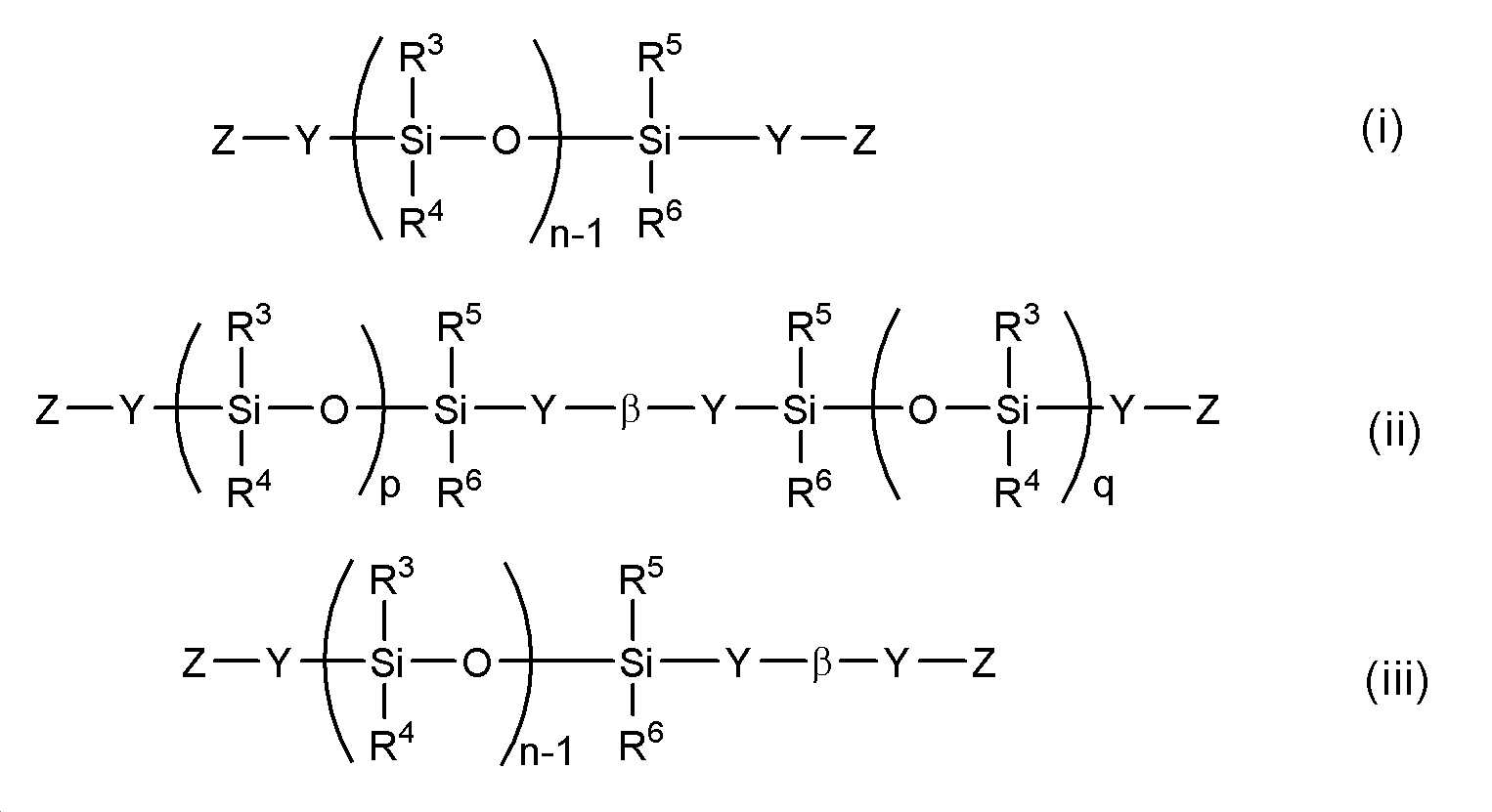
식 중, R3 ∼ R6, Y, β, n-1, p 및 q 는 상기한 바와 같고, 구체예 및 바람직한 것도 동일하다.In the formula, R 3 to R 6 , Y, β, n-1, p and q are as defined above, and specific examples and preferred ones are also the same.
Z 는, 수소 원자 또는 할로겐 원자를 나타내며, 복수의 Z 는, 서로 동일해도 되고 상이해도 된다.Z represents a hydrogen atom or a halogen atom, and a plurality of Zs may be the same or different.
예를 들어, 일반식 (i) 로 나타내는 폴리오르가노실록산으로는, 이하의 일반식 (i-i) ∼ (i-xi) 의 화합물을 들 수 있다.Examples of the polyorganosiloxane represented by the general formula (i) include compounds represented by the following general formulas (i-i) to (i-xi).
[화학식 11](11)

상기 일반식 (i-i) ∼ (i-xi) 중, R3 ∼ R6, n 및 R8 은 상기 정의한 바와 같고, 바람직한 것도 동일하다. c 는 양의 정수를 나타내며, 통상적으로 1 ∼ 6 의 정수이다.In the general formulas (ii) to (i-xi), R 3 to R 6 , n and R 8 are the same as defined above, and preferable ones are also the same. c represents a positive integer, and is usually an integer of 1 to 6.
이들 중에서도, 중합의 용이함의 관점에 있어서는, 상기 일반식 (i-i) 로 나타내는 페놀 변성 폴리오르가노실록산이 바람직하다. 또, 입수의 용이함의 관점에 있어서는, 상기 일반식 (i-ii) 로 나타내는 화합물 중의 일종인 α,ω-비스[3-(o-하이드록시페닐)프로필]폴리디메틸실록산, 상기 일반식 (i-iii) 으로 나타내는 화합물 중의 일종인 α,ω-비스[3-(4-하이드록시-3-메톡시페닐)프로필]폴리디메틸실록산이 바람직하다.Of these, phenol-modified polyorganosiloxanes represented by the above-mentioned formula (i-i) are preferable from the viewpoint of easiness of polymerization. From the viewpoint of ease of availability, α, ω-bis [3- (o-hydroxyphenyl) propyl] polydimethylsiloxane, which is one kind of compounds represented by the general formula (i-ii) ? -? - [3- (4-hydroxy-3-methoxyphenyl) propyl] polydimethylsiloxane, which is one of the compounds represented by the formula:
그 외, 폴리오르가노실록산 원료로서 이하의 일반식 (xii) 를 갖는 것을 사용해도 된다.In addition, a polyorganosiloxane material having the following general formula (xii) may be used.
[화학식 12] [Chemical Formula 12]

식 중, R3 및 R4 는 상기 서술한 것과 동일하다. 일반식 (xii) 로 나타내는 폴리오르가노실록산 블록의 평균 사슬 길이는 (r × m) 이 되고, (r × m) 의 범위는 상기 n 과 동일하다.Wherein R 3 and R 4 are the same as those described above. The average chain length of the polyorganosiloxane block represented by formula (xii) is (r x m), and the range of (r x m) is the same as n.
상기 (xii) 를 폴리오르가노실록산 원료로서 사용한 경우에는, 폴리오르가노실록산 블록 (II) 는 하기 일반식 (II-IV) 로 나타내는 단위를 갖는 것이 바람직하다.When (xii) is used as the raw material of the polyorganosiloxane, the polyorganosiloxane block (II) preferably has a unit represented by the following formula (II-IV).
[화학식 13] [Chemical Formula 13]
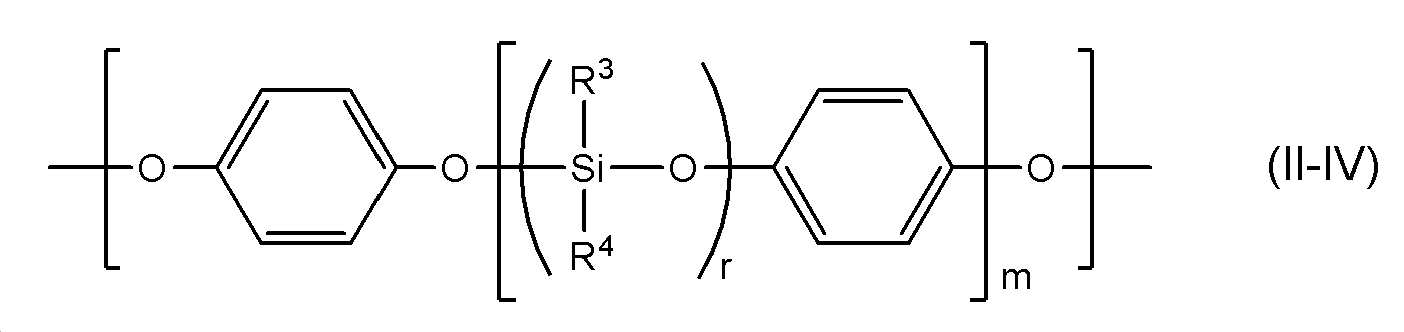
[식 중의 R3, R4, r 및 m 은 상기 서술한 바와 같다] [Wherein R 3 , R 4 , r and m are as defined above]
상기 폴리오르가노실록산의 제조 방법은 특별히 한정되지 않는다. 예를 들어, 일본 공개특허공보 평11-217390호에 기재된 방법에 의하면, 시클로트리실록산과 디실록산을 산성 촉매 존재하에서 반응시켜, α,ω-디하이드로젠오르가노펜타실록산을 합성하고, 이어서, 하이드로실릴화 반응용 촉매의 존재하에, 그 α,ω-디하이드로젠오르가노펜타실록산에 페놀성 화합물 (예를 들어 2-알릴페놀, 4-알릴페놀, 오이게놀, 2-프로페닐페놀 등) 등을 부가 반응시킴으로써, 미정제 폴리오르가노실록산을 얻을 수 있다. 또, 일본 특허공보 제2662310호에 기재된 방법에 의하면, 옥타메틸시클로테트라실록산과 테트라메틸디실록산을 황산 (산성 촉매) 의 존재하에서 반응시키고, 얻어진 α,ω-디하이드로젠오르가노폴리실록산을 상기와 마찬가지로, 하이드로실릴화 반응용 촉매의 존재하에 페놀성 화합물 등을 부가 반응시킴으로써, 미정제 폴리오르가노실록산을 얻을 수 있다. 또한, α,ω-디하이드로젠오르가노폴리실록산은, 그 중합 조건에 따라 그 사슬 길이 n 을 적절히 조정하여 사용할 수도 있고, 시판되는 α,ω-디하이드로젠오르가노폴리실록산을 사용해도 된다.The production method of the polyorganosiloxane is not particularly limited. For example, according to the method described in JP-A-11-217390, an α, ω-dihydrogen organopentasiloxane is synthesized by reacting a cyclotrisiloxane and a disiloxane in the presence of an acidic catalyst, (For example, 2-allylphenol, 4-allylphenol, augenol, 2-propenylphenol, etc.) is added to the?,? - dihydrogenorganopentasiloxane in the presence of a catalyst for hydrosilylation reaction ), And the like, to obtain a crude polyorganosiloxane. According to the method described in Japanese Patent Publication No. 2662310, octamethylcyclotetrasiloxane and tetramethyldisiloxane are reacted in the presence of sulfuric acid (acidic catalyst), and the obtained?,? - dihydrogenorganopolysiloxane is reacted with Likewise, the addition of a phenolic compound or the like in the presence of a catalyst for hydrosilylation reaction gives a crude polyorganosiloxane. The?,? - dihydrogen organopolysiloxane may be used by appropriately adjusting its chain length n according to the polymerization conditions, or a commercially available?,? - dihydrogen organopolysiloxane may be used.
상기 하이드로실릴화 반응용 촉매로는, 천이 금속계 촉매를 들 수 있지만, 그 중에서도 반응 속도 및 선택성의 점에서 백금계 촉매가 바람직하게 사용된다. 백금계 촉매의 구체예로는, 염화백금산, 염화백금산의 알코올 용액, 백금의 올레핀 착물, 백금과 비닐기 함유 실록산의 착물, 백금 담지 실리카, 백금 담지 활성탄 등을 들 수 있다.As the catalyst for the hydrosilylation reaction, a transition metal-based catalyst may be mentioned, but a platinum-based catalyst is preferably used from the viewpoints of the reaction rate and selectivity. Specific examples of the platinum-based catalyst include chloroplatinic acid, an alcohol solution of chloroplatinic acid, an olefin complex of platinum, a complex of platinum and a vinyl group-containing siloxane, platinum-supported silica, and platinum-supported activated carbon.
미정제 폴리오르가노실록산을 흡착제와 접촉시킴으로써, 미정제 폴리오르가노실록산 중에 포함되는, 상기 하이드로실릴화 반응용 촉매로서 사용된 천이 금속계 촉매에서 유래하는 천이 금속을, 흡착제에 흡착시켜 제거하는 것이 바람직하다.It is preferable to adsorb and remove the transition metal derived from the transition metal catalyst used as the catalyst for hydrosilylation reaction contained in the crude polyorganosiloxane by bringing the crude polyorganosiloxane into contact with the adsorbent Do.
흡착제로는, 예를 들어, 1000 Å 이하의 평균 세공 (細孔) 직경을 갖는 것을 사용할 수 있다. 평균 세공 직경이 1000 Å 이하이면, 미정제 폴리오르가노실록산 중의 천이 금속을 효율적으로 제거할 수 있다. 이와 같은 관점에서, 흡착제의 평균 세공 직경은, 바람직하게는 500 Å 이하, 보다 바람직하게는 200 Å 이하, 더욱 바람직하게는 150 Å 이하, 보다 더욱 바람직하게는 100 Å 이하이다. 또 동일한 관점에서, 흡착제는 다공성 흡착제인 것이 바람직하다.As the adsorbent, for example, those having an average pore diameter of 1000 Å or less can be used. If the average pore diameter is 1000 Å or less, the transition metal in the crude polyorganosiloxane can be efficiently removed. From such a viewpoint, the average pore diameter of the adsorbent is preferably 500 angstroms or less, more preferably 200 angstroms or less, still more preferably 150 angstroms or less, even more preferably 100 angstroms or less. From the same viewpoint, it is preferable that the adsorbent is a porous adsorbent.
흡착제로는, 상기의 평균 세공 직경을 갖는 것이면 특별히 한정되지 않지만, 예를 들어 활성 백토, 산성 백토, 활성탄, 합성 제올라이트, 천연 제올라이트, 활성 알루미나, 실리카, 실리카-마그네시아계 흡착제, 규조토, 셀룰로오스 등을 사용할 수 있으며, 활성 백토, 산성 백토, 활성탄, 합성 제올라이트, 천연 제올라이트, 활성 알루미나, 실리카 및 실리카-마그네시아계 흡착제로 이루어지는 군에서 선택되는 적어도 1 종인 것이 바람직하다.The adsorbent is not particularly limited as long as it has an average pore diameter as described above. Examples of the adsorbent include activated clay, acid clay, activated carbon, synthetic zeolite, natural zeolite, activated alumina, silica, silica-magnesia adsorbent, diatomaceous earth, cellulose, And it is preferably at least one selected from the group consisting of activated clay, acid clay, activated carbon, synthetic zeolite, natural zeolite, activated alumina, silica and silica-magnesia-based adsorbent.
미정제 폴리오르가노실록산 중에 포함되는 천이 금속을 흡착제에 흡착시킨 후, 흡착제는 임의의 분리 수단에 의해 폴리오르가노실록산으로부터 분리할 수 있다. 폴리오르가노실록산으로부터 흡착제를 분리하는 수단으로는, 예를 들어 필터나 원심 분리 등을 들 수 있다. 필터를 사용하는 경우에는, 멤브레인 필터, 소결 금속 필터, 유리 섬유 필터 등의 필터를 사용할 수 있지만, 특히 멤브레인 필터를 사용하는 것이 바람직하다.After adsorbing the transition metal contained in the crude polyorganosiloxane to the adsorbent, the adsorbent can be separated from the polyorganosiloxane by any separation means. Examples of means for separating the adsorbent from the polyorganosiloxane include a filter and a centrifugal separator. When a filter is used, a filter such as a membrane filter, a sintered metal filter, or a glass fiber filter can be used. In particular, it is preferable to use a membrane filter.
천이 금속의 흡착 후에 흡착제를 폴리오르가노실록산으로부터 분리하는 관점에서, 흡착제의 평균 입자경은, 통상적으로 1 ㎛ ∼ 4 ㎜, 바람직하게는 1 ∼ 100 ㎛ 이다. From the viewpoint of separating the adsorbent from the polyorganosiloxane after adsorption of the transition metal, the average particle diameter of the adsorbent is usually 1 to 4 mm, preferably 1 to 100 占 퐉.
상기 흡착제를 사용하는 경우에는, 그 사용량은 특별히 한정되지 않는다. 미정제 폴리오르가노실록산 100 질량부에 대하여, 바람직하게는 1 ∼ 30 질량부, 보다 바람직하게는 2 ∼ 20 질량부 범위의 양의 다공성 흡착제를 사용할 수 있다.The amount of the adsorbent to be used is not particularly limited. A porous adsorbent in an amount of preferably from 1 to 30 parts by mass, more preferably from 2 to 20 parts by mass, per 100 parts by mass of the crude polyorganosiloxane can be used.
또한, 처리하는 미정제 폴리오르가노실록산의 분자량이 높기 때문에 액체 상태가 아닌 경우에는, 흡착제에 의한 흡착 및 흡착제의 분리를 실시할 때에, 폴리오르가노실록산이 액체 상태가 되는 온도로 가열해도 된다. 또는, 염화메틸렌이나 헥산 등의 용제에 녹여 실시해도 된다.When the crude polyorganosiloxane to be treated has a high molecular weight and therefore is not in a liquid state, it may be heated to a temperature at which the polyorganosiloxane becomes a liquid state when adsorbing by the adsorbent and separation of the adsorbent are carried out. Alternatively, it may be dissolved in a solvent such as methylene chloride or hexane.
폴리카보네이트 올리고머는, 염화메틸렌, 클로로벤젠, 클로로포름 등의 유기 용제 중에서, 2 가 페놀과 포스겐이나 트리포스겐과 같은 카보네이트 전구체와의 반응에 의해 제조할 수 있다. 또한, 에스테르 교환법을 이용하여 폴리카보네이트 올리고머를 제조할 때에는, 2 가 페놀과 디페닐카보네이트와 같은 카보네이트 전구체와의 반응에 의해 제조할 수도 있다.The polycarbonate oligomer can be prepared by reacting a divalent phenol with a carbonate precursor such as phosgene or triphosgene in an organic solvent such as methylene chloride, chlorobenzene, or chloroform. In addition, when the polycarbonate oligomer is prepared by using the ester exchange method, it may be prepared by reacting a carbonate precursor such as divalent phenol and diphenyl carbonate.
2 가 페놀로는, 하기 일반식 (iv) 로 나타내는 2 가 페놀을 사용하는 것이 바람직하다.As the divalent phenol, it is preferable to use a divalent phenol represented by the following general formula (iv).
[화학식 14] [Chemical Formula 14]
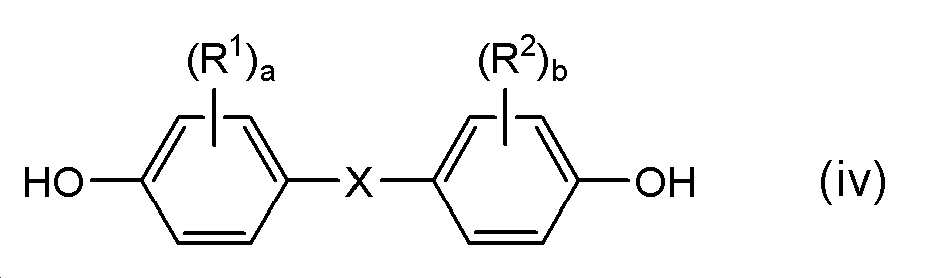
식 중, R1, R2, a, b 및 X 는 상기 서술한 바와 같다.Wherein R 1 , R 2 , a, b and X are as described above.
상기 일반식 (iv) 로 나타내는 2 가 페놀로는, 예를 들어, 2,2-비스(4-하이드록시페닐)프로판 [비스페놀 A], 비스(4-하이드록시페닐)메탄, 1,1-비스(4-하이드록시페닐)에탄, 2,2-비스(4-하이드록시-3,5-디메틸페닐)프로판 등의 비스(하이드록시페닐)알칸계, 4,4'-디하이드록시디페닐, 비스(4-하이드록시페닐)시클로알칸, 비스(4-하이드록시페닐)옥사이드, 비스(4-하이드록시페닐)술파이드, 비스(4-하이드록시페닐)술폰, 비스(4-하이드록시페닐)술폭시드, 비스(4-하이드록시페닐)케톤 등을 들 수 있다. 이들 2 가 페놀은, 1 종을 단독으로 사용해도 되고, 2 종 이상을 혼합하여 사용해도 된다.Examples of the divalent phenol represented by the general formula (iv) include 2,2-bis (4-hydroxyphenyl) propane [bisphenol A], bis (4-hydroxyphenyl) Bis (hydroxyphenyl) alkane compounds such as bis (4-hydroxyphenyl) ethane and 2,2-bis (4-hydroxy-3,5-dimethylphenyl) Bis (4-hydroxyphenyl) sulfone, bis (4-hydroxyphenyl) sulfone, bis (4-hydroxyphenyl) ) Sulfoxide, bis (4-hydroxyphenyl) ketone, and the like. These divalent phenols may be used singly or in combination of two or more kinds.
이들 중에서도, 비스(하이드록시페닐)알칸계 2 가 페놀이 바람직하고, 비스페놀 A 가 보다 바람직하다. 2 가 페놀로서 비스페놀 A 를 사용한 경우, 상기 일반식 (I) 에 있어서, X 가 이소프로필리덴기이고, 또한 a = b = 0 의 PC-POS 공중합체가 된다.Among these, bis (hydroxyphenyl) alkane divalent phenols are preferable, and bisphenol A is more preferable. When bisphenol A is used as the divalent phenol, a PC-POS copolymer having X = isopropylidene group and a = b = 0 in the general formula (I) is obtained.
비스페놀 A 이외의 2 가 페놀로는, 예를 들어, 비스(하이드록시아릴)알칸류, 비스(하이드록시아릴)시클로알칸류, 디하이드록시아릴에테르류, 디하이드록시디아릴술파이드류, 디하이드록시디아릴술폭시드류, 디하이드록시디아릴술폰류, 디하이드록시디페닐류, 디하이드록시디아릴플루오렌류, 디하이드록시디아릴아다만탄류 등을 들 수 있다. 이들 2 가 페놀은, 1 종을 단독으로 사용해도 되고, 2 종 이상을 혼합하여 사용해도 된다.Examples of the dihydric phenols other than bisphenol A include dihydric phenols such as bis (hydroxyaryl) alkanes, bis (hydroxyaryl) cycloalkanes, dihydroxyaryl ethers, dihydroxydiarylsulfides, Dihydroxydiarylsulfone, dihydroxydiphenyls, dihydroxydiarylfluorenes, dihydroxydiaryladamantanes, and the like can be given. These divalent phenols may be used singly or in combination of two or more kinds.
비스(하이드록시아릴)알칸류로는, 예를 들어 비스(4-하이드록시페닐)메탄, 1,1-비스(4-하이드록시페닐)에탄, 2,2-비스(4-하이드록시페닐)부탄, 2,2-비스(4-하이드록시페닐)옥탄, 비스(4-하이드록시페닐)페닐메탄, 비스(4-하이드록시페닐)디페닐메탄, 2,2-비스(4-하이드록시-3-메틸페닐)프로판, 비스(4-하이드록시페닐)나프틸메탄, 1,1-비스(4-하이드록시-3-t-부틸페닐)프로판, 2,2-비스(4-하이드록시-3-브로모페닐)프로판, 2,2-비스(4-하이드록시-3,5-디메틸페닐)프로판, 2,2-비스(4-하이드록시-3-클로로페닐)프로판, 2,2-비스(4-하이드록시-3,5-디클로로페닐)프로판, 2,2-비스(4-하이드록시-3,5-디브로모페닐)프로판 등을 들 수 있다.Examples of bis (hydroxyaryl) alkanes include bis (4-hydroxyphenyl) methane, 1,1-bis (4-hydroxyphenyl) ethane, 2,2- Butane, 2,2-bis (4-hydroxyphenyl) octane, bis (4-hydroxyphenyl) phenylmethane, bis (4-hydroxyphenyl) propane, 2,2-bis (4-hydroxy-3-t-butylphenyl) propane, Propane, 2,2-bis (4-hydroxy-3-chlorophenyl) propane, 2,2- (4-hydroxy-3,5-dichlorophenyl) propane, and 2,2-bis (4-hydroxy-3,5-dibromophenyl) propane.
비스(하이드록시아릴)시클로알칸류로는, 예를 들어 1,1-비스(4-하이드록시페닐)시클로펜탄, 1,1-비스(4-하이드록시페닐)시클로헥산, 1,1-비스(4-하이드록시페닐)-3,5,5-트리메틸시클로헥산, 2,2-비스(4-하이드록시페닐)노르보르난, 1,1-비스(4-하이드록시페닐)시클로도데칸 등을 들 수 있다. 디하이드록시아릴에테르류로는, 예를 들어 4,4'-디하이드록시디페닐에테르, 4,4'-디하이드록시-3,3'-디메틸페닐에테르 등을 들 수 있다. Examples of bis (hydroxyaryl) cycloalkanes include 1,1-bis (4-hydroxyphenyl) cyclopentane, 1,1-bis (4-hydroxyphenyl) cyclohexane, (4-hydroxyphenyl) -3,5,5-trimethylcyclohexane, 2,2-bis (4-hydroxyphenyl) norbornane, 1,1-bis . The dihydroxyaryl ethers include, for example, 4,4'-dihydroxydiphenyl ether and 4,4'-dihydroxy-3,3'-dimethylphenyl ether.
디하이드록시디아릴술파이드류로는, 예를 들어 4,4'-디하이드록시디페닐술파이드, 4,4'-디하이드록시-3,3'-디메틸디페닐술파이드 등을 들 수 있다. 디하이드록시디아릴술폭시드류로는, 예를 들어 4,4'-디하이드록시디페닐술폭시드, 4,4'-디하이드록시-3,3'-디메틸디페닐술폭시드 등을 들 수 있다. 디하이드록시디아릴술폰류로는, 예를 들어 4,4'-디하이드록시디페닐술폰, 4,4'-디하이드록시-3,3'-디메틸디페닐술폰 등을 들 수 있다.Examples of the dihydroxy diaryl sulfide include 4,4'-dihydroxydiphenyl sulfide and 4,4'-dihydroxy-3,3'-dimethyl diphenyl sulfide . Examples of the dihydroxy diaryl sulfoxide include 4,4'-dihydroxydiphenyl sulfoxide and 4,4'-dihydroxy-3,3'-dimethyl diphenyl sulfoxide. . Examples of the dihydroxy diarylsulfone include 4,4'-dihydroxydiphenyl sulfone and 4,4'-dihydroxy-3,3'-dimethyl diphenyl sulfone.
디하이드록시디페닐류로는, 예를 들어 4,4'-디하이드록시디페닐 등을 들 수 있다. 디하이드록시디아릴플루오렌류로는, 예를 들어 9,9-비스(4-하이드록시페닐)플루오렌, 9,9-비스(4-하이드록시-3-메틸페닐)플루오렌 등을 들 수 있다. 디하이드록시디아릴아다만탄류로는, 예를 들어 1,3-비스(4-하이드록시페닐)아다만탄, 2,2-비스(4-하이드록시페닐)아다만탄, 1,3-비스(4-하이드록시페닐)-5,7-디메틸아다만탄 등을 들 수 있다.Dihydroxydiphenyls include, for example, 4,4'-dihydroxydiphenyl. Examples of the dihydroxydialylfluorenes include 9,9-bis (4-hydroxyphenyl) fluorene, 9,9-bis (4-hydroxy-3-methylphenyl) have. Dihydroxydiadamantanthruloses such as 1,3-bis (4-hydroxyphenyl) adamantane, 2,2-bis (4-hydroxyphenyl) adamantane, 1,3-bis (4-hydroxyphenyl) -5,7-dimethyladamantane and the like.
상기 이외의 2 가 페놀로는, 예를 들어 4,4'- [1,3-페닐렌비스(1-메틸에틸리덴)]비스페놀, 10,10-비스(4-하이드록시페닐)-9-안트론, 1,5-비스(4-하이드록시페닐티오)-2,3-디옥사펜탄 등을 들 수 있다.Examples of the divalent phenol other than the above include 4,4'- [1,3-phenylenebis (1-methylethylidene)] bisphenol, 10,10-bis (4-hydroxyphenyl) -9 -Anthrone, 1,5-bis (4-hydroxyphenylthio) -2,3-dioxapentane, and the like.
얻어지는 PC-POS 공중합체의 분자량을 조정하기 위해서, 말단 정지제를 사용할 수 있다. 말단 정지제로는, 예를 들어, 페놀, p-크레졸, p-tert-부틸페놀, p-tert-옥틸페놀, p-쿠밀페놀, p-노닐페놀, m-펜타데실페놀 및 p-tert-아밀페놀 등의 1 가 페놀을 들 수 있다. 이들 1 가 페놀은, 1 종을 단독으로 사용해도 되고, 2 종 이상을 조합하여 사용해도 된다.An end terminator may be used to adjust the molecular weight of the resulting PC-POS copolymer. Examples of the terminal terminator include phenol, p-cresol, p-tert-butylphenol, p-tert-octylphenol, p-cumylphenol, p-nonylphenol, m-pentadecylphenol and p- And monohydric phenols such as phenol. These monohydric phenols may be used singly or in combination of two or more kinds.
상기 계면 중축합 반응 후, 적절히 정치 (靜置) 하여 수상과 유기 용매상으로 분리 [분리 공정], 유기 용매상을 세정 (바람직하게는 염기성 수용액, 산성 수용액, 물의 순서로 세정) [세정 공정], 얻어진 유기상을 농축 [농축 공정], 및 건조 [건조 공정] 시킴으로써, PC-POS 공중합체를 얻을 수 있다.After the interfacial polycondensation reaction, the reaction mixture is appropriately left to separate into an aqueous phase and an organic solvent phase (separation step), and the organic solvent phase is washed (preferably in the order of basic aqueous solution, acidic aqueous solution and water) , The obtained organic phase is concentrated (concentration step), and dried (dried step) to obtain a PC-POS copolymer.
[폴리카보네이트계 수지 (A-3) 의 제법] [Production method of polycarbonate resin (A-3)] [
상기 방향족 폴리카보네이트계 수지 (A-3) 은, 예를 들어, 반응에 불활성인 유기 용매와 알칼리 수용액의 존재하, 2 가 페놀계 화합물과 포스겐을 반응시킨 후, 제 3 급 아민 혹은 제 4 급 암모늄염 등의 중합 촉매를 첨가하여 중합시키는 계면 중합법이나, 2 가 페놀계 화합물을 피리딘 또는 피리딘과 불활성 용매와의 혼합 용액에 용해하고, 포스겐을 도입하여 직접 제조하는 피리딘법 등 종래의 폴리카보네이트의 제조법에 의해 얻을 수 있다. 상기 반응시에, 필요에 따라, 분자량 조절제 (말단 정지제), 분기화제 등이 사용된다.The aromatic polycarbonate resin (A-3) can be prepared by, for example, reacting a divalent phenol compound with phosgene in the presence of an organic solvent inert to the reaction and an aqueous alkali solution, An ammonium salt or the like, or a method in which a dibasic phenol compound is dissolved in a mixed solution of pyridine or pyridine and an inert solvent, and a pyridine method in which phosgene is directly introduced to prepare a polycarbonate Can be obtained by a manufacturing method. In the above reaction, a molecular weight regulator (terminal terminator), a branching agent and the like are used, if necessary.
또한, 상기 2 가 페놀계 화합물로는, 하기 일반식 (v) 로 나타내는 것을 들 수 있다.Examples of the dihydric phenol compound include those represented by the following general formula (v).
[화학식 15] [Chemical Formula 15]
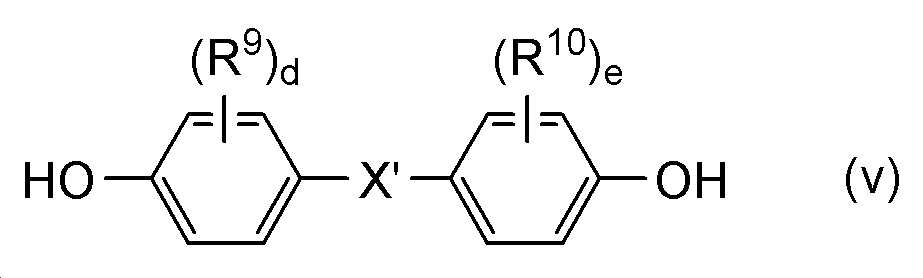
[식 중, R9, R10, X', d 및 e 는 상기 정의한 바와 같고, 바람직한 것도 동일하다.] [Wherein R 9 , R 10 , X ', d and e are the same as defined above, and preferred ones are the same]
그 2 가 페놀계 화합물의 구체예로는, 폴리카보네이트-폴리오르가노실록산 공중합체 (A-1) 및 (A-2) 의 제조 방법에서 상기 서술한 것을 들 수 있으며, 바람직한 것도 동일하다. 그 중에서도, 비스(하이드록시페닐)알칸계 2 가 페놀이 바람직하고, 비스페놀 A 가 보다 바람직하다.Specific examples of the divalent phenol compound include those described above in the process for producing the polycarbonate-polyorganosiloxane copolymer (A-1) and (A-2), and preferable ones are also the same. Among them, bis (hydroxyphenyl) alkane divalent phenols are preferable, and bisphenol A is more preferable.
<그 밖의 성분>≪ Other components >
본 발명의 폴리카보네이트계 수지 조성물에는, 본 발명의 효과를 저해하지 않는 범위에서, 그 밖의 첨가제를 포함시킬 수 있다. 그 밖의 첨가제로는, 난연제나 난연 보조제, 이형제, 보강재, 충전제, 내충격성 개량용의 엘라스토머, 염료, 안료 등을 들 수 있다.The polycarbonate resin composition of the present invention may contain other additives insofar as the effect of the present invention is not impaired. Examples of other additives include a flame retardant, a flame retardant auxiliary, a releasing agent, a reinforcing material, a filler, an elastomer for improving impact resistance, a dye, and a pigment.
본 발명의 폴리카보네이트계 수지 조성물은, 상기의 각 성분을 상기 비율로, 또한 필요에 따라 사용되는 각종 임의 성분을 적당한 비율로 배합하고, 혼련함으로써 얻어진다.The polycarbonate resin composition of the present invention is obtained by blending each of the above components in the above ratios, and optionally adding various optional components in an appropriate ratio, and kneading.
배합 및 혼련은, 통상적으로 사용되고 있는 기기, 예를 들어, 리본 블렌더, 드럼 텀블러 등으로 예비 혼합하여, 헨셀 믹서, 밴버리 믹서, 단축 스크루 압출기, 2 축 스크루 압출기, 다축 스크루 압출기 및 코니더를 사용하는 방법으로 실시할 수 있다. 혼련시의 가열 온도는, 통상적으로 240 ∼ 320 ℃ 의 범위에서 적절히 선택된다. 이 용융 혼련으로는, 압출기, 특히, 벤트식 압출기의 사용이 바람직하다.The compounding and kneading may be carried out by preliminarily mixing with a commonly used apparatus such as a ribbon blender or a drum tumbler and then using a Henschel mixer, a Banbury mixer, a single screw extruder, a twin screw extruder, a multiaxial screw extruder and a conider . ≪ / RTI > The heating temperature at the time of kneading is appropriately selected in the range of usually 240 to 320 占 폚. For this melt kneading, the use of an extruder, in particular a vented extruder, is preferred.
[성형품] [Molded article]
상기의 용융 혼련한 본 발명의 폴리카보네이트계 수지 조성물, 또는 얻어진 펠릿을 원료로 하여, 사출 성형법, 사출 압축 성형법, 압출 성형법, 블로우 성형법, 프레스 성형법, 진공 성형법 및 발포 성형법 등에 의해 각종 성형체를 제조할 수 있다. 특히, 용융 혼련에 의해 얻어진 펠릿을 사용하여, 사출 성형 및 사출 압축 성형에 의한 사출 성형체의 제조에 적합하게 사용할 수 있다.Various molded articles can be produced by the above melt-kneaded polycarbonate resin composition of the present invention or obtained pellets as raw materials by an injection molding method, an injection compression molding method, an extrusion molding method, a blow molding method, a press molding method, a vacuum molding method and a foam molding method . Particularly, the pellets obtained by melt kneading can be suitably used for the production of injection-molded products by injection molding and injection compression molding.
본 발명의 PC 수지 조성물로 이루어지는 성형품은, 예를 들어, 텔레비전, 라디오 카세트, 비디오 카메라, 비디오 테이프 레코더, 오디오 플레이어, DVD 플레이어, 에어 컨디셔너, 휴대 전화, 디스플레이, 컴퓨터, 레지스터, 전자식 탁상 계산기, 복사기, 프린터, 팩시밀리 등의 전기·전자 기기용 부품의 케이싱 등, 자동차 및 건재 (建材) 의 부품으로서 적합하게 사용할 수 있다.The molded article made of the PC resin composition of the present invention can be used in various applications such as a television, a radio cassette, a video camera, a video tape recorder, an audio player, a DVD player, an air conditioner, a mobile phone, a display, a computer, a register, , A casing of a component for electric / electronic equipments such as a printer and a facsimile, and the like.
실시예Example
다음으로, 본 발명을 실시예에 의해 더욱 구체적으로 설명하는데, 본 발명은 이들 예에 의해 조금도 한정되는 것은 아니다. 또한, 각 예에 있어서의 특성값, 평가 결과는, 이하의 요령에 따라서 구하였다.Next, the present invention will be described more specifically with reference to examples, but the present invention is not limited to these examples at all. In addition, the characteristic values and the evaluation results in the examples were obtained according to the following methods.
(1) 폴리디메틸실록산 사슬 길이 및 함유량(1) Polydimethylsiloxane chain length and content
NMR 측정에 의해, 폴리디메틸실록산의 메틸기의 적분값비에 의해 산출하였다.NMR was measured by the integral value ratio of the methyl group of the polydimethylsiloxane.
<폴리디메틸실록산의 사슬 길이의 정량 방법><Method for Determining Chain Length of Polydimethylsiloxane>
1H-NMR 측정 조건 1 H-NMR measurement conditions
NMR 장치:(주) JEOL RESONANCE 제조 ECA500 NMR apparatus: manufactured by JEOL RESONANCE Co., Ltd. ECA500
프로브:50TH5AT/FG2 Probe: 50TH5AT / FG2
관측 범위:―5 ∼ 15 ppm Observation range: -5 to 15 ppm
관측 중심:5 ppm Observation center: 5 ppm
펄스 반복 시간:9 초 Pulse repetition time: 9 seconds
펄스 폭:45° Pulse width: 45 °
NMR 시료관:5 φNMR sample tube: 5?
샘플량:30 ∼ 40 ㎎ Sample volume: 30 to 40 mg
용매:중클로로포름 Solvent: Chloroform
측정 온도:실온 Measuring temperature: room temperature
적산 횟수:256 회 Accumulation count: 256 times
알릴페놀 말단 폴리디메틸실록산의 경우For allylphenol-terminated polydimethylsiloxanes
A:δ-0.02 ∼ 0.5 부근에 관측되는 디메틸실록산부의 메틸기의 적분값A: the integral value of the methyl group in the dimethylsiloxane moiety observed in the vicinity of? -0.02 to 0.5
B:δ2.50 ∼ 2.75 부근에 관측되는 알릴페놀의 메틸렌기의 적분값B: the integral value of the methylene group of allylphenol observed in the vicinity of? 2.50 to 2.75
폴리디메틸실록산의 사슬 길이 = (A/6)/(B/4) Chain length of polydimethylsiloxane = (A / 6) / (B / 4)
오이게놀 말단 폴리디메틸실록산의 경우In the case of the polydimethylsiloxane terminated with an organolithium
A:δ-0.02 ∼ 0.5 부근에 관측되는 디메틸실록산부의 메틸기의 적분값A: the integral value of the methyl group in the dimethylsiloxane moiety observed in the vicinity of? -0.02 to 0.5
B:δ2.40 ∼ 2.70 부근에 관측되는 오이게놀의 메틸렌기의 적분값B: the integral value of the methylene group of the oregenol observed in the vicinity of 2.40 to 2.70
폴리디메틸실록산의 사슬 길이 = (A/6)/(B/4) Chain length of polydimethylsiloxane = (A / 6) / (B / 4)
<PC-POS 공중합체 중의 폴리디메틸실록산 함유량의 정량 방법><Method for Determining the Polydimethylsiloxane Content in PC-POS Copolymer>
예) 알릴페놀 말단 폴리디메틸실록산을 공중합한 PTBP 말단 폴리카보네이트 중의 폴리디메틸실록산 공중합량의 정량 방법 Example) A method for quantifying the amount of polydimethylsiloxane copolymerized in PTBP-terminated polycarbonate copolymerized with allyl phenol-terminated polydimethylsiloxane
NMR 장치:(주) JEOL RESONANCE 제조 ECA500 NMR apparatus: manufactured by JEOL RESONANCE Co., Ltd. ECA500
프로브:TH5 5 φ NMR 시료관 대응Probe: TH5 5 NMR sample tube support
관측 범위:―5 ∼ 15 ppm Observation range: -5 to 15 ppm
관측 중심:5 ppm Observation center: 5 ppm
펄스 반복 시간:9 초 Pulse repetition time: 9 seconds
펄스 폭:45° Pulse width: 45 °
적산 횟수:256 회 Accumulation count: 256 times
NMR 시료관:5 φNMR sample tube: 5?
샘플량:30 ∼ 40 ㎎ Sample volume: 30 to 40 mg
용매:중클로로포름 Solvent: Chloroform
측정 온도:실온Measuring temperature: room temperature
A:δ1.5 ∼ 1.9 부근에 관측되는 BPA 부의 메틸기의 적분값A: the integral value of the methyl group in the BPA portion observed in the vicinity of? 1.5 to 1.9
B:δ-0.02 ∼ 0.3 부근에 관측되는 디메틸실록산부의 메틸기의 적분값B: the integral value of the methyl group in the dimethylsiloxane moiety observed in the vicinity of? -0.02 to 0.3
C:δ1.2 ∼ 1.4 부근에 관측되는 p-tert-부틸페닐부의 부틸기의 적분값 C: Integral value of the butyl group of p-tert-butylphenyl moiety observed in the vicinity of 1.2 to 1.4
a = A/6a = A / 6
b = B/6b = B / 6
c = C/9c = C / 9
T = a + b + cT = a + b + c
f = a/T × 100f = a / T x 100
g = b/T × 100g = b / T x 100
h = c/T × 100h = c / T x 100
TW = f × 254 + g × 74.1 + h × 149TW = f x 254 + g x 74.1 + h x 149
PDMS (wt%) = g × 74.1/TW × 100PDMS (wt%) = g x 74.1 / TW x 100
(2) 폴리카보네이트-폴리오르가노실록산 공중합체 및 폴리카보네이트계 수지 조성물의 점도 평균 분자량 (2) Viscosity-average molecular weight of polycarbonate-polyorganosiloxane copolymer and polycarbonate resin composition
점도 평균 분자량 (Mv) 은, 우베로데형 점도계를 사용하여, 20 ℃ 에 있어서의 염화메틸렌 용액 (농도:g/ℓ) 의 점도를 측정하고, 이로부터 극한 점도 [η] 를 구하고, 다음 식 (Schnell 식) 으로 산출하였다.The viscosity average molecular weight (Mv) was determined by measuring the viscosity of a methylene chloride solution (concentration: g / l) at 20 占 폚 by using a Uberothe type viscometer and obtaining intrinsic viscosity [?] Schnell equation).

<폴리카보네이트 올리고머의 제조>≪ Preparation of polycarbonate oligomer >
5.6 질량% 수산화나트륨 수용액에 나중에 용해되는 비스페놀 A (BPA) 에 대하여 2000 ppm 의 아2티온산나트륨을 첨가하고, 이것에 비스페놀 A 농도가 13.5 질량% 가 되도록 비스페놀 A 를 용해하고, 비스페놀 A 의 수산화나트륨 수용액을 조제하였다. 2000 ppm of sodium dithionite was added to a bisphenol A (BPA) which was dissolved in 5.6 mass% sodium hydroxide aqueous solution, bisphenol A was dissolved therein to give a bisphenol A concentration of 13.5% by mass, Sodium aqueous solution was prepared.
이 비스페놀 A 의 수산화나트륨 수용액 40 ℓ/hr, 염화메틸렌 15 ℓ/hr 의 유량으로, 포스겐을 4.0 ㎏/hr 의 유량으로 내경 6 ㎜, 관 길이 30 m 의 관형 (管型) 반응기에 연속적으로 통과시켰다.This phosgene was continuously passed through a tubular reactor having an inner diameter of 6 mm and a tube length of 30 m at a flow rate of 4.0 kg / hr at a flow rate of 40 l / hr of sodium hydroxide aqueous solution of bisphenol A and 15 l / hr of methylene chloride .
관형 반응기는 재킷 부분을 갖고 있으며, 재킷에 냉각수를 통과시켜 반응액의 온도를 40 ℃ 이하로 유지하였다.The tubular reactor had a jacket portion, and cooling water was passed through the jacket to maintain the temperature of the reaction solution at 40 캜 or lower.
관형 반응기를 나온 반응액은 후퇴날개를 구비한 내용적 40 ℓ 의 배플이 부착된 조형 (槽型) 반응기에 연속적으로 도입되고, 여기에 또한 비스페놀 A 의 수산화나트륨 수용액 2.8 ℓ/hr, 25 질량% 수산화나트륨 수용액 0.07 ℓ/hr, 물 17 ℓ/hr, 1 질량% 트리에틸아민 수용액을 0.64 ℓ/hr 첨가하여 반응을 실시하였다.The reaction liquid exiting the tubular reactor was continuously introduced into a tank type reactor equipped with a 40 L internal baffle equipped with a retreating wing, and an aqueous solution of sodium hydroxide of bisphenol A (2.8 L / hr, 25 mass% The reaction was carried out by adding 0.07 l / hr of an aqueous solution of sodium hydroxide, 17 l / hr of water and 0.64 l / hr of a 1% by mass triethylamine aqueous solution.
조형 반응기로부터 넘쳐 나오는 반응액을 연속적으로 발출하고, 정치함으로써 수상을 분리 제거하고, 염화메틸렌상을 채취하였다.The reaction liquid overflowing from the molding reactor was continuously withdrawn, and the water phase was separated and removed by standing to obtain a methylene chloride phase.
이와 같이 하여 얻어진 폴리카보네이트 올리고머는, 농도 338 g/ℓ, 클로로포르메이트기 농도 0.70 ㏖/ℓ였다.The polycarbonate oligomer thus obtained had a concentration of 338 g / l and a chloroformate group concentration of 0.70 mol / l.
<폴리카보네이트-폴리오르가노실록산 공중합체 (A-1)>≪ Polycarbonate-polyorganosiloxane copolymer (A-1) >
방해판, 패들형 교반 날개 및 냉각용 재킷을 구비한 50 ℓ 조형 반응기에, 상기 조제예 1 에서 제조한 폴리카보네이트 올리고머 용액 15 ℓ, 염화메틸렌 7.7 ℓ, 폴리디메틸실록산의 평균 사슬 길이 n 이 40 인 o-알릴페놀 말단 변성 폴리디메틸실록산 (PDMS) 390 g 및 트리에틸아민 8.3 ㎖ 를 투입하고, 교반하에서 여기에 수산화나트륨 84 g 을 순수 966 ㎖ 에 녹인 수산화나트륨 수용액 1389 g 을 첨가하고, 20 분간 폴리카보네이트 올리고머와 알릴페놀 말단 변성 PDMS 의 반응을 실시하였다.15 L of the polycarbonate oligomer solution prepared in Preparation Example 1, 7.7 L of methylene chloride, and 40 L of an average chain length n of polydimethylsiloxane were added to a 50 L molding reactor equipped with a stirrer, a paddle type stirring blade and a cooling jacket 390 g of o-allylphenol-terminated polydimethylsiloxane (PDMS) and 8.3 ml of triethylamine were charged, 1389 g of an aqueous sodium hydroxide solution in which 84 g of sodium hydroxide was dissolved in 966 ml of pure water was added thereto, The reaction of carbonate oligomer with allyl phenol end-modified PDMS was carried out.
이 중합액에, p-t-부틸페놀 (PTBP) 의 염화메틸렌 용액 (PTBP 145 g 을 염화메틸렌 2.0 ℓ 에 용해한 것), 비스페놀 A 의 수산화나트륨 수용액 (수산화나트륨 546 g 과 아2티온산나트륨 2.1 g 을 순수 8.0 ℓ 에 용해한 수용액에 비스페놀 A 1029 g 을 용해시킨 것) 을 첨가하고, 40 분간 중합 반응을 실시하였다.To this polymerization solution was added a methylene chloride solution of PTBP (145 g of PTBP dissolved in 2.0 L of methylene chloride), an aqueous solution of sodium hydroxide of bisphenol A (546 g of sodium hydroxide and 2.1 g of sodium dithionite, Which had been obtained by dissolving 1029 g of bisphenol A in an aqueous solution dissolved in 8.0 L of pure water) was added and polymerization reaction was carried out for 40 minutes.
희석을 위해 염화메틸렌 13 ℓ 를 첨가하고 20 분간 교반한 후, 폴리카보네이트-폴리디메틸실록산 공중합체 (PC-PDMS 공중합체) 를 포함하는 유기상과 과잉의 비스페놀 A 및 수산화나트륨을 포함하는 수상으로 분리하고, 유기상을 단리하였다.13 L of methylene chloride was added for dilution and stirred for 20 minutes. Then, the organic phase containing the polycarbonate-polydimethylsiloxane copolymer (PC-PDMS copolymer) was separated from the aqueous phase containing excess bisphenol A and sodium hydroxide , And the organic phase was isolated.
이렇게 하여 얻어진 PC-PDMS 공중합체의 염화메틸렌 용액을, 그 용액에 대하여 순차, 15 용적% 의 0.03 ㏖/ℓ 수산화나트륨 수용액, 0.2 몰/ℓ 염산으로 세정하고, 이어서 세정 후의 수상 중의 전기 전도도가 5 μS/㎝ 이하가 될 때까지 순수로 세정을 반복하였다.The methylene chloride solution of the PC-PDMS copolymer thus obtained was washed sequentially with 15 vol% aqueous solution of 0.03 mol / l sodium hydroxide and 0.2 mol / l hydrochloric acid, and then the electroconductivity in the aqueous phase after washing was 5 Washing with pure water was repeated until it became less than / S / cm.
세정에 의해 얻어진 PC-PDMS 공중합체의 염화메틸렌 용액을 농축·분쇄하고, 얻어진 플레이크를 감압하 120 ℃ 에서 건조시키고, PC-PDMS 공중합체 (A-1) 을 제조하였다.The methylene chloride solution of PC-PDMS copolymer obtained by washing was concentrated and pulverized, and the resulting flakes were dried at 120 캜 under reduced pressure to prepare a PC-PDMS copolymer (A-1).
얻어진 PC-PDMS 공중합체 (A-1) 의 NMR 에 의해 구한 PDMS 블록 부분의 함유량은 6.0 질량%, 점도 수는 47.5, 점도 평균 분자량 Mv 는 17,700 이었다.The content of the PDMS block portion determined by NMR of the obtained PC-PDMS copolymer (A-1) was 6.0% by mass, the viscosity number was 47.5, and the viscosity average molecular weight Mv was 17,700.
<폴리카보네이트-폴리오르가노실록산 (A-2)>≪ Polycarbonate-polyorganosiloxane (A-2) >
제조예 1 에 있어서, 폴리디메틸실록산의 평균 사슬 길이 n 이 90 인 o-알릴페놀 말단 변성 PDMS 를 사용한 것 이외에는, 제조예 1 과 동일하게 하여, PC-PDMS 공중합체 (A-2) 를 제조하였다.PDMS copolymer (A-2) was prepared in the same manner as in Production Example 1, except that o-allylphenol-terminated PDMS having an average chain length n of polydimethylsiloxane of 90 was used in Production Example 1 .
얻어진 PC-PDMS 공중합체 (A-2) 의 핵 자기 공명 (NMR) 에 의해 구한 PDMS 블록 부분의 함유량은 6.0 질량%, 점도 수는 47.5, 점도 평균 분자량 Mv 는 17,700 이었다.The content of the PDMS block portion determined by nuclear magnetic resonance (NMR) of the obtained PC-PDMS copolymer (A-2) was 6.0% by mass, the viscosity number was 47.5, and the viscosity average molecular weight Mv was 17,700.
<(A-3):방향족 폴리카보네이트 수지>≪ (A-3): Aromatic polycarbonate resin >
방향족 호모폴리카보네이트 수지 [이데미츠 흥산 (주) 제조, 타플론 FN1700 (상품명), 점도 평균 분자량 = 17,700] Aromatic homopolycarbonate resin (Tarpron FN1700 (trade name, manufactured by Idemitsu Kosan Co., Ltd., viscosity average molecular weight = 17,700)
방향족 호모폴리카보네이트 수지 [이데미츠 흥산 (주) 제조, 타플론 FN1900 (상품명), 점도 평균 분자량 = 19,100] Aromatic homopolycarbonate resin (Tarpron FN1900 (trade name, manufactured by Idemitsu Kosan Co., Ltd., viscosity average molecular weight = 19,100)
방향족 호모폴리카보네이트 수지 [이데미츠 흥산 (주) 제조, 타플론 FN2200 (상품명), 점도 평균 분자량 = 21,200] Aromatic homopolycarbonate resin (Taflon FN2200 (trade name, manufactured by Idemitsu Kosan Co., Ltd., viscosity average molecular weight = 21,200)
방향족 호모폴리카보네이트 수지 [이데미츠 흥산 (주) 제조, 타플론 FN2500 (상품명), 점도 평균 분자량 = 23,400]Aromatic homopolycarbonate resin (Tarpron FN2500 (trade name, manufactured by Idemitsu Kosan Co., Ltd., viscosity average molecular weight = 23,400)
방향족 호모폴리카보네이트 수지 [이데미츠 흥산 (주) 제조, 타플론 FN3000 (상품명), 점도 평균 분자량 = 29,800] Aromatic homopolycarbonate resin (Taflon FN3000 (trade name, manufactured by Idemitsu Kosan Co., Ltd., viscosity average molecular weight = 29,800)
실시예 1 ∼ 24, 비교예 1 ∼ 9 및 참고예 1 ∼ 3Examples 1 to 24, Comparative Examples 1 to 9, and Reference Examples 1 to 3
표 1 및 2 에 나타내는 비율로 각 성분을 혼합하고, 벤트식 2 축 압출기 (토시바 기계 주식회사 제조, TEM35B) 에 공급하고, 스크루 회전수 150 rpm, 토출량 20 ㎏/hr, 수지 온도 295 ∼ 300 ℃ 에서 용융 혼련하고, 평가용 펠릿 샘플을 얻었다. 이 평가용 펠릿 샘플을 120 ℃ 에서 8 시간 건조시킨 후, 사출 성형기 (닛세이 수지 공업 주식회사 제조, NEX110, 스크루 직경 36 ㎜φ) 를 사용하여, 실린더 온도 280 ℃, 금형 온도 80 ℃ 에서, 사출 성형하여 Izod 시험을 실시하기 위한 시험편 (63 × 13 × 3.2 ㎜ 시험편 2 개) 및 HDT 시험편 (126 × 13 × 3.2 ㎜) 을 제조하였다. 또한 건조시킨 평가용 펠릿 샘플을 사출 성형기 (주식회사 니이가타 머신 테크노 제조, MD50XB, 스크루 직경 30 ㎜φ) 를 사용하여 전광선 투과율의 측정을 실시하기 위한 시험편 (3 단 플레이트 90 ㎜ × 50 ㎜, 3 ㎜ 두께 부분 45 ㎜ × 50 ㎜, 2 ㎜ 두께 부분 22.5 ㎜ × 50 ㎜, 1 ㎜ 두께 부분 22.5 ㎜ × 50 ㎜) 을 제조하였다.The components were mixed at the ratios shown in Tables 1 and 2 and fed to a vent type twin screw extruder (TEM35B, manufactured by TOSHIBA MACHINERY CO., LTD.) At a screw rotation speed of 150 rpm, a discharge amount of 20 kg / And melt-kneaded to obtain a pellet sample for evaluation. The evaluation pellet sample was dried at 120 DEG C for 8 hours and then subjected to injection molding at a cylinder temperature of 280 DEG C and a mold temperature of 80 DEG C using an injection molding machine (NEX110, manufactured by Nissei Plastic Industries Co., Ltd., screw diameter 36 mm) (63 × 13 × 3.2 mm test pieces) and HDT test pieces (126 × 13 × 3.2 mm) were prepared for Izod test. Further, a test piece (three-stage plate: 90 mm x 50 mm, thickness: 3 mm) for measuring the total light transmittance using an injection molding machine (MD50XB manufactured by Niigata Machine Techno Co., Ltd., screw diameter 30 mm? A part 45 mm 50 mm, a 2 mm thickness part 22.5 mm 50 mm, and a 1 mm thickness part 22.5 mm 50 mm).
또한, 참고예 1 ∼ 3 은, (A) 성분으로서, (A-1) ∼ (A-3) 성분을 각각 단독으로 사용하여 각 시험편을 제조한 경우의 결과를 나타낸다.Reference Examples 1 to 3 show the results when each of the test pieces was produced using each of the components (A-1) to (A-3) as the component (A) alone.


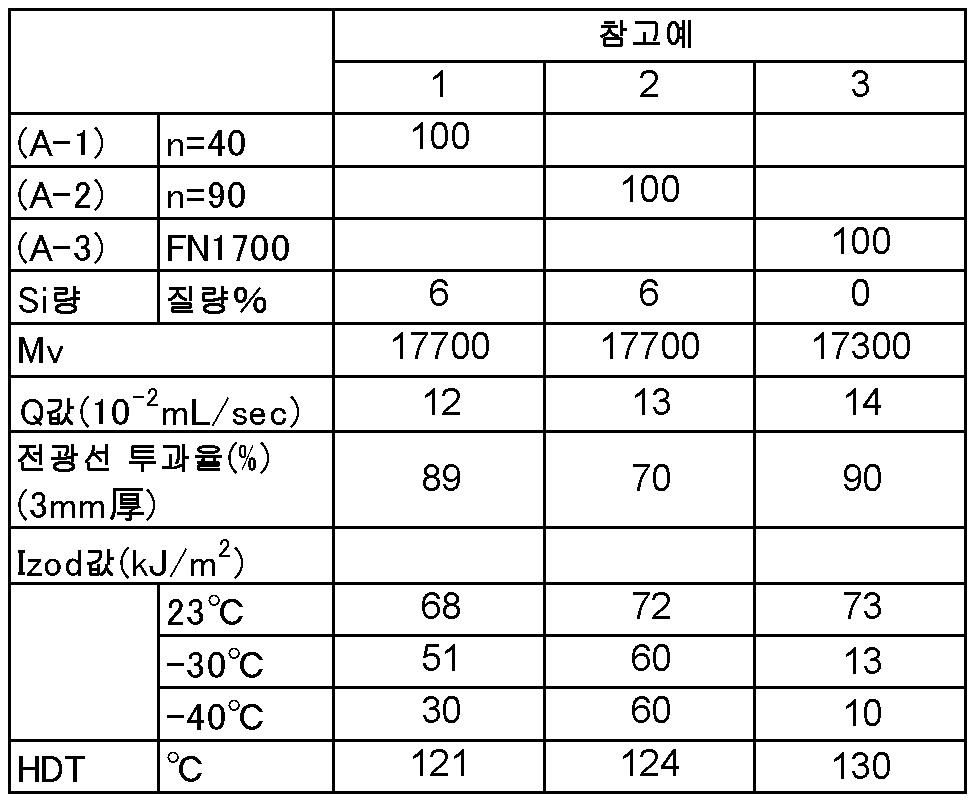
[평가 시험] [Evaluation test]
<아이조드 (Izod) 충격 강도><Izod Impact Strength>
전술한 Izod 시험을 실시하기 위한 시험편에 후 가공으로 노치를 부여한 시험편을 사용하여, ASTM 규격 D-256 에 준거하여, ―40 ℃, ―30 ℃ 및 23 ℃ 에 있어서의 노치가 부착된 아이조드 충격 강도를 측정하였다.The test piece for performing the Izod test described above was subjected to post-machining notch, and a test piece having notched Izod impact strength at -40 DEG C, -30 DEG C, and 23 DEG C according to ASTM standard D-256 Were measured.
<전광선 투과율 (%)><Total light transmittance (%)>
전광선 투과율은, ISO14782 에 준거하여 측정하였다. 측정 장치로는, 닛폰 전색 공업 주식회사 제조의 NDH2000 을 사용하였다. 시험편은, 상기 서술한 투명성의 평가 시험용 시험편을 사용하였다.The total light transmittance was measured in accordance with ISO14782. As a measuring apparatus, NDH2000 manufactured by Nippon Seimei Kogyo Co., Ltd. was used. As the test piece, the test piece for evaluation test of transparency described above was used.
<Q 값 (흐름값) [단위;10-2 ㎖/초]><Q value (flow value) [unit: 10 -2 ml / second]>
상기 펠릿을 사용하여, JIS K7210 에 준거하여, 고가식 (高架式) 플로우 테스터를 사용하여, 280 ℃, 15.7 ㎫ 의 압력하에서, 직경 1 ㎜, 길이 10 ㎜ 의 노즐로부터 유출하는 용융 수지량 (× 10-2 ㎖/초) 을 측정하였다. Q 값은 단위 시간당 유출량을 나타내고 있으며, 수치가 높을수록 유동성이 좋은 것을 나타낸다.Using the above pellets, the amount of molten resin (x) flowing out from a nozzle having a diameter of 1 mm and a length of 10 mm under a pressure of 280 MPa and a pressure of 15.7 MPa was measured using a high-flow tester in accordance with JIS K7210 10 -2 ml / sec). The Q value represents the flow rate per unit time, and the higher the value, the better the fluidity.
<HDT (열 변형 온도)>≪ HDT (heat distortion temperature) >
ASTM D648 에 준거하여, 하중 1.83 ㎫ 로 측정하였다. HDT 는, 내열성의 기준을 나타내는 것이며, 그 판단 기준으로서 120 ℃ 이상이면, 충분한 내열성을 갖고 있는 것을 나타낸다.A load of 1.83 MPa was measured in accordance with ASTM D648. HDT indicates a standard of heat resistance, and indicates that it has sufficient heat resistance when the temperature is 120 占 폚 or higher as a judgment criterion.
산업상 이용가능성Industrial availability
본 발명에 의하면, 단사슬 길이의 폴리카보네이트-폴리오르가노실록산 공중합체와, 장사슬 길이의 폴리카보네이트-폴리오르가노실록산과, 그 밖의 폴리카보네이트 수지를 포함하는 특정한 폴리카보네이트계 수지 조성물로 함으로써, 저온 내충격성을 포함하는 내충격성, 투명성 및 내열성이 우수한 폴리카보네이트계 수지 조성물을 제공할 수 있다.According to the present invention, by using a specific polycarbonate resin composition comprising a polycarbonate-polyorganosiloxane copolymer having a single-chain length, polycarbonate-polyorganosiloxane having a long-chain length, and other polycarbonate resins, A polycarbonate resin composition excellent in impact resistance, transparency and heat resistance including low temperature impact resistance can be provided.
Claims (19)
하기 일반식 (I) 로 나타내는 반복 단위로 이루어지는 폴리카보네이트 블록 및 하기 일반식 (II) 로 나타내는 반복 단위를 포함하는 폴리오르가노실록산 블록을 포함하고, 상기 폴리오르가노실록산 블록의 평균 사슬 길이가 60 이상 500 미만인 폴리카보네이트-폴리오르가노실록산 공중합체 (A-2) 와,
폴리카보네이트-폴리오르가노실록산 공중합체 (A-1) 및 폴리카보네이트-폴리오르가노실록산 공중합체 (A-2) 이외의 폴리카보네이트계 수지 (A-3)
을 포함하고,
폴리카보네이트-폴리오르가노실록산 공중합체 (A-1), 폴리카보네이트-폴리오르가노실록산 공중합체 (A-2) 및 폴리카보네이트계 수지 (A-3) 의 합계 중량에 있어서의, 폴리카보네이트계 수지 (A-3) 의 비율이 10 질량% 이상인 것을 특징으로 하는, 폴리카보네이트계 수지 조성물.
[화학식 1]
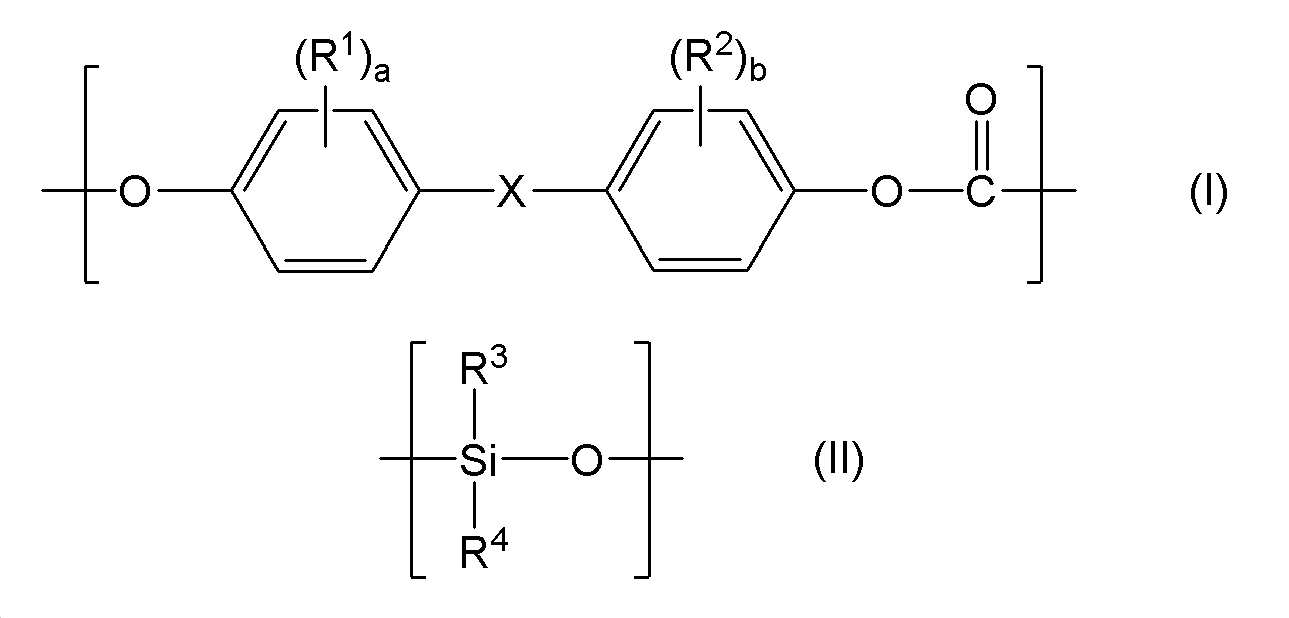
[식 중, R1 및 R2 는 각각 독립적으로, 할로겐 원자, 탄소수 1 ∼ 6 의 알킬기 또는 탄소수 1 ∼ 6 의 알콕시기를 나타낸다. X 는, 단결합, 탄소수 1 ∼ 8 의 알킬렌기, 탄소수 2 ∼ 8 의 알킬리덴기, 탄소수 5 ∼ 15 의 시클로알킬렌기, 탄소수 5 ∼ 15 의 시클로알킬리덴기, 플루오렌디일기, 탄소수 7 ∼ 15 의 아릴알킬렌기, 탄소수 7 ∼ 15 의 아릴알킬리덴기, -S-, -SO-, -SO2-, -O- 또는 -CO- 를 나타낸다. R3 및 R4 는 각각 독립적으로, 수소 원자, 할로겐 원자, 탄소수 1 ∼ 6 의 알킬기, 탄소수 1 ∼ 6 의 알콕시기 또는 탄소수 6 ∼ 12 의 아릴기를 나타낸다. a 및 b 는, 각각 독립적으로 0 ∼ 4 의 정수를 나타낸다.] A polyorganosiloxane block comprising a polycarbonate block comprising a repeating unit represented by the following general formula (I) and a repeating unit represented by the following general formula (II), wherein the polyorganosiloxane block has an average chain length of 20 (A-1) having a weight-average molecular weight of not less than 60 and a polycarbonate-polyorganosiloxane copolymer
A polyorganosiloxane block comprising a polycarbonate block comprising a repeating unit represented by the following general formula (I) and a repeating unit represented by the following general formula (II), wherein the polyorganosiloxane block has an average chain length of 60 (A-2) having a number average molecular weight of less than 500 and a polycarbonate-polyorganosiloxane copolymer
The polycarbonate resin (A-3) other than the polycarbonate-polyorganosiloxane copolymer (A-1) and the polycarbonate-polyorganosiloxane copolymer (A-2)
/ RTI >
Based on the total weight of the polycarbonate-polyorganosiloxane copolymer (A-1), the polycarbonate-polyorganosiloxane copolymer (A-2) and the polycarbonate resin (A-3) (A-3) is 10% by mass or more based on the total amount of the polycarbonate resin composition.
[Chemical Formula 1]
[Wherein R 1 and R 2 each independently represent a halogen atom, an alkyl group having 1 to 6 carbon atoms, or an alkoxy group having 1 to 6 carbon atoms. X represents a single bond, an alkylene group having 1 to 8 carbon atoms, an alkylidene group having 2 to 8 carbon atoms, a cycloalkylene group having 5 to 15 carbon atoms, a cycloalkylidene group having 5 to 15 carbon atoms, An arylalkylene group having 7 to 15 carbon atoms, -S-, -SO-, -SO 2 -, -O- or -CO-. R 3 and R 4 each independently represent a hydrogen atom, a halogen atom, an alkyl group having 1 to 6 carbon atoms, an alkoxy group having 1 to 6 carbon atoms, or an aryl group having 6 to 12 carbon atoms. a and b each independently represent an integer of 0 to 4.]
폴리카보네이트-폴리오르가노실록산 공중합체 (A-1), 폴리카보네이트-폴리오르가노실록산 공중합체 (A-2) 및 폴리카보네이트계 수지 (A-3) 의 합계 중량에 있어서의, 폴리카보네이트-폴리오르가노실록산 공중합체 (A-1) 의 비율이 70 질량% 이하인, 폴리카보네이트계 수지 조성물.The method according to claim 1,
Of the total weight of the polycarbonate-polyorganosiloxane copolymer (A-1), the polycarbonate-polyorganosiloxane copolymer (A-2) and the polycarbonate resin (A-3) Wherein the proportion of the organosiloxane copolymer (A-1) is 70% by mass or less.
폴리카보네이트-폴리오르가노실록산 공중합체 (A-1), 폴리카보네이트-폴리오르가노실록산 공중합체 (A-2) 및 폴리카보네이트계 수지 (A-3) 의 합계 중량에 있어서의, 폴리카보네이트계 수지 (A-3) 의 비율이 20 질량% 이상인, 폴리카보네이트계 수지 조성물.3. The method according to claim 1 or 2,
Based on the total weight of the polycarbonate-polyorganosiloxane copolymer (A-1), the polycarbonate-polyorganosiloxane copolymer (A-2) and the polycarbonate resin (A-3) (A-3) is not less than 20% by mass.
폴리카보네이트-폴리오르가노실록산 공중합체 (A-1), 폴리카보네이트-폴리오르가노실록산 공중합체 (A-2) 및 폴리카보네이트계 수지 (A-3) 의 합계 중량에 있어서의, 폴리카보네이트계 수지 (A-3) 의 비율이 45 질량% 미만인, 폴리카보네이트계 수지 조성물.4. The method according to any one of claims 1 to 3,
Based on the total weight of the polycarbonate-polyorganosiloxane copolymer (A-1), the polycarbonate-polyorganosiloxane copolymer (A-2) and the polycarbonate resin (A-3) (A-3) is less than 45 mass%.
폴리카보네이트-폴리오르가노실록산 공중합체 (A-1), 폴리카보네이트-폴리오르가노실록산 공중합체 (A-2) 및 폴리카보네이트계 수지 (A-3) 의 합계 중량에 있어서의, 폴리카보네이트-폴리오르가노실록산 공중합체 (A-2) 의 비율이 10 질량% 이상인, 폴리카보네이트계 수지 조성물.5. The method according to any one of claims 1 to 4,
Of the total weight of the polycarbonate-polyorganosiloxane copolymer (A-1), the polycarbonate-polyorganosiloxane copolymer (A-2) and the polycarbonate resin (A-3) Wherein the proportion of the organosiloxane copolymer (A-2) is 10% by mass or more.
폴리카보네이트-폴리오르가노실록산 공중합체 (A-1), 폴리카보네이트-폴리오르가노실록산 공중합체 (A-2) 및 폴리카보네이트계 수지 (A-3) 의 합계 중량에 있어서의, 폴리카보네이트-폴리오르가노실록산 공중합체 (A-2) 의 비율이 15 질량% 이상인, 폴리카보네이트계 수지 조성물.6. The method according to any one of claims 1 to 5,
Of the total weight of the polycarbonate-polyorganosiloxane copolymer (A-1), the polycarbonate-polyorganosiloxane copolymer (A-2) and the polycarbonate resin (A-3) Wherein the proportion of the organosiloxane copolymer (A-2) is not less than 15% by mass.
폴리카보네이트-폴리오르가노실록산 공중합체 (A-1) 과 폴리카보네이트-폴리오르가노실록산 공중합체 (A-2) 의 중량비 (A-1)/(A-2) 가, 10/90 ∼ 99/1 인, 폴리카보네이트계 수지 조성물.7. The method according to any one of claims 1 to 6,
(A-1) / (A-2) of the polycarbonate-polyorganosiloxane copolymer (A-1) and the polycarbonate-polyorganosiloxane copolymer (A- 1, < / RTI > polycarbonate resin composition.
폴리카보네이트-폴리오르가노실록산 공중합체 (A-1) 과 폴리카보네이트-폴리오르가노실록산 공중합체 (A-2) 의 중량비 (A-1)/(A-2) 가, 60/40 ∼ 99/1 인, 폴리카보네이트계 수지 조성물.8. The method according to any one of claims 1 to 7,
(A-1) / (A-2) of the polycarbonate-polyorganosiloxane copolymer (A-1) and the polycarbonate-polyorganosiloxane copolymer (A- 1, < / RTI > polycarbonate resin composition.
폴리카보네이트-폴리오르가노실록산 공중합체 (A-1) 과 폴리카보네이트-폴리오르가노실록산 공중합체 (A-2) 의 중량비 (A-1)/(A-2) 가, 72/28 ∼ 99/1 인, 폴리카보네이트계 수지 조성물.9. The method according to any one of claims 1 to 8,
(A-1) / (A-2) of the polycarbonate-polyorganosiloxane copolymer (A-1) and the polycarbonate-polyorganosiloxane copolymer (A- 1, < / RTI > polycarbonate resin composition.
폴리카보네이트-폴리오르가노실록산 공중합체 (A-1) 중의 폴리오르가노실록산 양이 1 ∼ 20 질량% 인, 폴리카보네이트계 수지 조성물.10. The method according to any one of claims 1 to 9,
Wherein the amount of the polyorganosiloxane in the polycarbonate-polyorganosiloxane copolymer (A-1) is 1 to 20% by mass.
폴리카보네이트-폴리오르가노실록산 공중합체 (A-2) 중의 폴리오르가노실록산 양이 1 ∼ 45 질량% 인, 폴리카보네이트계 수지 조성물.11. The method according to any one of claims 1 to 10,
Wherein the amount of the polyorganosiloxane in the polycarbonate-polyorganosiloxane copolymer (A-2) is 1 to 45% by mass.
폴리카보네이트계 수지 (A-3) 이 하기 일반식 (III) 으로 나타내는 반복 단위만으로 이루어지는 폴리카보네이트 수지인, 폴리카보네이트계 수지 조성물.
[화학식 2]
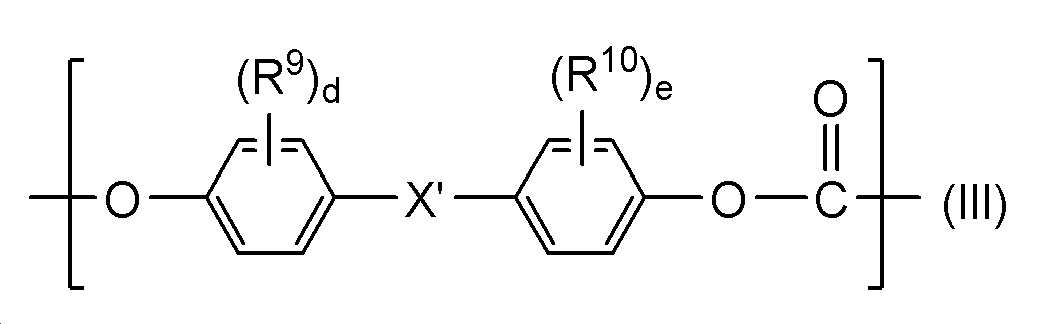
[식 중, R9 및 R10 은, 각각 독립적으로, 할로겐 원자, 탄소수 1 ∼ 6 의 알킬기 또는 탄소수 1 ∼ 6 의 알콕시기를 나타낸다. X' 는 단결합, 탄소수 1 ∼ 8 의 알킬렌기, 탄소수 2 ∼ 8 의 알킬리덴기, 탄소수 5 ∼ 15 의 시클로알킬렌기, 탄소수 5 ∼ 15 의 시클로알킬리덴기, -S-, -SO-, -SO2-, -O- 또는 -CO- 를 나타낸다. d 및 e 는, 각각 독립적으로 0 ∼ 4 의 정수를 나타낸다.] 12. The method according to any one of claims 1 to 11,
Wherein the polycarbonate resin (A-3) is a polycarbonate resin comprising only a repeating unit represented by the following formula (III).
(2)
[Wherein R 9 and R 10 each independently represent a halogen atom, an alkyl group having 1 to 6 carbon atoms, or an alkoxy group having 1 to 6 carbon atoms. X 'represents a single bond, an alkylene group having 1 to 8 carbon atoms, an alkylidene group having 2 to 8 carbon atoms, a cycloalkylene group having 5 to 15 carbon atoms, a cycloalkylidene group having 5 to 15 carbon atoms, -S-, -SO-, -SO 2 -, represents a -O- or -CO-. d and e each independently represent an integer of 0 to 4.]
상기 폴리카보네이트계 수지 조성물 중의 폴리오르가노실록산 양이 1 ∼ 20 질량% 인, 폴리카보네이트계 수지 조성물.13. The method according to any one of claims 1 to 12,
Wherein the amount of the polyorganosiloxane in the polycarbonate resin composition is 1 to 20% by mass.
상기 폴리카보네이트계 수지 조성물의 점도 평균 분자량이 12,000 ∼ 30,000 인, 폴리카보네이트계 수지 조성물.14. The method according to any one of claims 1 to 13,
Wherein the polycarbonate resin composition has a viscosity average molecular weight of 12,000 to 30,000.
상기 폴리카보네이트계 수지 조성물의 점도 평균 분자량이 18,000 ∼ 22,000 인, 폴리카보네이트계 수지 조성물.15. The method according to any one of claims 1 to 14,
Wherein the polycarbonate resin composition has a viscosity average molecular weight of 18,000 to 22,000.
폴리카보네이트-폴리오르가노실록산 공중합체 (A-1) 의 점도 평균 분자량이 12,000 ∼ 30,000 인, 폴리카보네이트계 수지 조성물.16. The method according to any one of claims 1 to 15,
Wherein the polycarbonate-polyorganosiloxane copolymer (A-1) has a viscosity average molecular weight of 12,000 to 30,000.
폴리카보네이트-폴리오르가노실록산 공중합체 (A-2) 의 점도 평균 분자량이 12,000 ∼ 30,000 인, 폴리카보네이트계 수지 조성물.17. The method according to any one of claims 1 to 16,
Wherein the polycarbonate-polyorganosiloxane copolymer (A-2) has a viscosity average molecular weight of 12,000 to 30,000.
폴리카보네이트계 수지 (A-3) 의 점도 평균 분자량이 12,000 ∼ 50,000 인, 폴리카보네이트계 수지 조성물.18. The method according to any one of claims 1 to 17,
Wherein the polycarbonate resin (A-3) has a viscosity average molecular weight of 12,000 to 50,000.
폴리카보네이트계 수지 (A-3) 의 점도 평균 분자량이 19,000 ∼ 30,000 인, 폴리카보네이트계 수지 조성물.19. The method according to any one of claims 1 to 18,
Wherein the polycarbonate resin (A-3) has a viscosity average molecular weight of 19,000 to 30,000.
Applications Claiming Priority (3)
| Application Number | Priority Date | Filing Date | Title |
|---|---|---|---|
| JPJP-P-2015-250579 | 2015-12-22 | ||
| JP2015250579 | 2015-12-22 | ||
| PCT/JP2016/087121 WO2017110598A1 (en) | 2015-12-22 | 2016-12-13 | Polycarbonate resin composition |
Publications (2)
| Publication Number | Publication Date |
|---|---|
| KR20180098259A true KR20180098259A (en) | 2018-09-03 |
| KR102892430B1 KR102892430B1 (en) | 2025-11-27 |
Family
ID=59090223
Family Applications (1)
| Application Number | Title | Priority Date | Filing Date |
|---|---|---|---|
| KR1020187017471A Active KR102892430B1 (en) | 2015-12-22 | 2016-12-13 | polycarbonate resin composition |
Country Status (7)
| Country | Link |
|---|---|
| US (1) | US11066556B2 (en) |
| JP (1) | JP6913028B2 (en) |
| KR (1) | KR102892430B1 (en) |
| CN (1) | CN108431137B (en) |
| DE (1) | DE112016005898T5 (en) |
| TW (1) | TWI737661B (en) |
| WO (1) | WO2017110598A1 (en) |
Cited By (1)
| Publication number | Priority date | Publication date | Assignee | Title |
|---|---|---|---|---|
| KR20210027282A (en) * | 2018-07-03 | 2021-03-10 | 이데미쓰 고산 가부시키가이샤 | Polycarbonate resin composition and molded article thereof |
Families Citing this family (9)
| Publication number | Priority date | Publication date | Assignee | Title |
|---|---|---|---|---|
| US11345132B2 (en) | 2017-09-29 | 2022-05-31 | Sumitomo Bakelite Co., Ltd. | Optical sheet and optical component |
| JP6508279B2 (en) * | 2017-09-29 | 2019-05-08 | 住友ベークライト株式会社 | Optical sheet and optical component |
| JP6539880B2 (en) * | 2017-09-29 | 2019-07-10 | 住友ベークライト株式会社 | Optical sheet and optical component |
| JP6536712B2 (en) * | 2017-09-29 | 2019-07-03 | 住友ベークライト株式会社 | Optical sheet and optical component |
| EP3733736A4 (en) * | 2017-12-28 | 2021-09-22 | Idemitsu Kosan Co.,Ltd. | COPOLYMER POLYCARBONATE - POLYORGANOSILOXANE |
| KR102197159B1 (en) * | 2018-07-26 | 2020-12-31 | 롯데첨단소재(주) | Thermoplastic resin composition and article produced therefrom |
| CN114746472A (en) * | 2019-12-06 | 2022-07-12 | 出光兴产株式会社 | Polycarbonate-polyorganosiloxane copolymer and resin composition comprising the same |
| CN113201127B (en) * | 2021-06-21 | 2022-09-16 | 万华化学集团股份有限公司 | Polysiloxane-polycarbonate copolymer, method for producing same, and polycarbonate resin |
| US20250145819A1 (en) * | 2022-02-17 | 2025-05-08 | Idemitsu Kosan Co.,Ltd. | Polycarbonate-based resin composition |
Citations (8)
| Publication number | Priority date | Publication date | Assignee | Title |
|---|---|---|---|---|
| JPH05140461A (en) | 1991-11-15 | 1993-06-08 | Idemitsu Petrochem Co Ltd | Polycarbonate resin composition |
| JPH0881620A (en) | 1994-07-15 | 1996-03-26 | Idemitsu Petrochem Co Ltd | Polycarbonate resin composition |
| KR20050107443A (en) * | 2003-02-21 | 2005-11-11 | 제너럴 일렉트릭 캄파니 | Transparent and high-heat polycarbonate-polysiloxane copolymers and transparent blends with polycarbonate and a process for preparing same |
| JP2006523243A (en) * | 2003-02-21 | 2006-10-12 | ゼネラル・エレクトリック・カンパニイ | Translucent thermoplastic resin composition, method for producing the same, and molded product |
| JP2008280490A (en) * | 2007-05-14 | 2008-11-20 | Idemitsu Kosan Co Ltd | Polycarbonate copolymer, coating liquid, and electrophotographic photosensitive member |
| JP2011046911A (en) | 2009-07-29 | 2011-03-10 | Teijin Chem Ltd | Polycarbonate/polydiorganosiloxane copolymer, molding and method for producing the same |
| JP2012246430A (en) | 2011-05-30 | 2012-12-13 | Idemitsu Kosan Co Ltd | Polycarbonate resin composition for battery pack, and battery pack |
| KR20140077164A (en) * | 2011-10-03 | 2014-06-23 | 이데미쓰 고산 가부시키가이샤 | Polycarbonate resin composition |
Family Cites Families (6)
| Publication number | Priority date | Publication date | Assignee | Title |
|---|---|---|---|---|
| US4335032A (en) | 1980-12-31 | 1982-06-15 | General Electric Company | Polycarbonate resin impact modified with polyolefins and containing polyorganosiloxane fluids |
| CN101687986B (en) * | 2007-05-08 | 2012-12-19 | 出光兴产株式会社 | Polycarbonate polymer, coating liquid, and electrophotographic photoreceptor |
| JP5547953B2 (en) | 2009-12-10 | 2014-07-16 | 出光興産株式会社 | Polycarbonate-polyorganosiloxane copolymer, process for producing the same, and polycarbonate resin containing the copolymer |
| WO2011155490A1 (en) | 2010-06-09 | 2011-12-15 | 出光興産株式会社 | Polycarbonate-based resin composition and molded article thereof |
| EP3004249B1 (en) | 2013-05-31 | 2022-04-06 | SHPP Global Technologies B.V. | Polycarbonate-siloxane copolymer compositions with improved appearance properties |
| JP6313971B2 (en) * | 2013-12-26 | 2018-04-18 | 出光興産株式会社 | Molded body for outdoor installation |
-
2016
- 2016-12-13 DE DE112016005898.5T patent/DE112016005898T5/en active Pending
- 2016-12-13 JP JP2017558052A patent/JP6913028B2/en active Active
- 2016-12-13 WO PCT/JP2016/087121 patent/WO2017110598A1/en not_active Ceased
- 2016-12-13 CN CN201680074785.4A patent/CN108431137B/en active Active
- 2016-12-13 KR KR1020187017471A patent/KR102892430B1/en active Active
- 2016-12-13 US US16/064,055 patent/US11066556B2/en active Active
- 2016-12-20 TW TW105142191A patent/TWI737661B/en active
Patent Citations (8)
| Publication number | Priority date | Publication date | Assignee | Title |
|---|---|---|---|---|
| JPH05140461A (en) | 1991-11-15 | 1993-06-08 | Idemitsu Petrochem Co Ltd | Polycarbonate resin composition |
| JPH0881620A (en) | 1994-07-15 | 1996-03-26 | Idemitsu Petrochem Co Ltd | Polycarbonate resin composition |
| KR20050107443A (en) * | 2003-02-21 | 2005-11-11 | 제너럴 일렉트릭 캄파니 | Transparent and high-heat polycarbonate-polysiloxane copolymers and transparent blends with polycarbonate and a process for preparing same |
| JP2006523243A (en) * | 2003-02-21 | 2006-10-12 | ゼネラル・エレクトリック・カンパニイ | Translucent thermoplastic resin composition, method for producing the same, and molded product |
| JP2008280490A (en) * | 2007-05-14 | 2008-11-20 | Idemitsu Kosan Co Ltd | Polycarbonate copolymer, coating liquid, and electrophotographic photosensitive member |
| JP2011046911A (en) | 2009-07-29 | 2011-03-10 | Teijin Chem Ltd | Polycarbonate/polydiorganosiloxane copolymer, molding and method for producing the same |
| JP2012246430A (en) | 2011-05-30 | 2012-12-13 | Idemitsu Kosan Co Ltd | Polycarbonate resin composition for battery pack, and battery pack |
| KR20140077164A (en) * | 2011-10-03 | 2014-06-23 | 이데미쓰 고산 가부시키가이샤 | Polycarbonate resin composition |
Cited By (1)
| Publication number | Priority date | Publication date | Assignee | Title |
|---|---|---|---|---|
| KR20210027282A (en) * | 2018-07-03 | 2021-03-10 | 이데미쓰 고산 가부시키가이샤 | Polycarbonate resin composition and molded article thereof |
Also Published As
| Publication number | Publication date |
|---|---|
| CN108431137B (en) | 2021-11-05 |
| CN108431137A (en) | 2018-08-21 |
| US20180355178A1 (en) | 2018-12-13 |
| DE112016005898T5 (en) | 2018-09-13 |
| JP6913028B2 (en) | 2021-08-04 |
| TW201731952A (en) | 2017-09-16 |
| JPWO2017110598A1 (en) | 2018-10-11 |
| US11066556B2 (en) | 2021-07-20 |
| KR102892430B1 (en) | 2025-11-27 |
| WO2017110598A1 (en) | 2017-06-29 |
| TWI737661B (en) | 2021-09-01 |
Similar Documents
| Publication | Publication Date | Title |
|---|---|---|
| KR102892430B1 (en) | polycarbonate resin composition | |
| US9365683B2 (en) | Polycarbonate-polyorganosiloxane copolymer and method for producing same | |
| KR102543776B1 (en) | Polycarbonate resin composition and molded article thereof | |
| JP7081883B2 (en) | Polycarbonate resin composition and its molded product | |
| CN107922624B (en) | Manufacturing method of polycarbonate-polyorganosiloxane copolymer | |
| CN107406668B (en) | Polycarbonate resin composition and molded body thereof | |
| CN110366574B (en) | Polycarbonate-polyorganosiloxane copolymer, flame-retardant polycarbonate-based resin composition containing the copolymer, and molded article thereof | |
| CN107429049A (en) | Polycarbonate resin composition and molded article thereof | |
| KR20190067166A (en) | Polycarbonate-based resin composition and molded article | |
| CN118696094A (en) | Polycarbonate resin composition |
Legal Events
| Date | Code | Title | Description |
|---|---|---|---|
| PA0105 | International application |
St.27 status event code: A-0-1-A10-A15-nap-PA0105 |
|
| PG1501 | Laying open of application |
St.27 status event code: A-1-1-Q10-Q12-nap-PG1501 |
|
| R18-X000 | Changes to party contact information recorded |
St.27 status event code: A-3-3-R10-R18-oth-X000 |
|
| A201 | Request for examination | ||
| PA0201 | Request for examination |
St.27 status event code: A-1-2-D10-D11-exm-PA0201 |
|
| E902 | Notification of reason for refusal | ||
| PE0902 | Notice of grounds for rejection |
St.27 status event code: A-1-2-D10-D21-exm-PE0902 |
|
| T11-X000 | Administrative time limit extension requested |
St.27 status event code: U-3-3-T10-T11-oth-X000 |
|
| R17-X000 | Change to representative recorded |
St.27 status event code: A-3-3-R10-R17-oth-X000 |
|
| T11-X000 | Administrative time limit extension requested |
St.27 status event code: U-3-3-T10-T11-oth-X000 |
|
| P11-X000 | Amendment of application requested |
St.27 status event code: A-2-2-P10-P11-nap-X000 |
|
| P13-X000 | Application amended |
St.27 status event code: A-2-2-P10-P13-nap-X000 |
|
| E601 | Decision to refuse application | ||
| PE0601 | Decision on rejection of patent |
St.27 status event code: N-2-6-B10-B15-exm-PE0601 |
|
| T11-X000 | Administrative time limit extension requested |
St.27 status event code: U-3-3-T10-T11-oth-X000 |
|
| T13-X000 | Administrative time limit extension granted |
St.27 status event code: U-3-3-T10-T13-oth-X000 |
|
| R17-X000 | Change to representative recorded |
St.27 status event code: A-3-3-R10-R17-oth-X000 |
|
| E13-X000 | Pre-grant limitation requested |
St.27 status event code: A-2-3-E10-E13-lim-X000 |
|
| P11-X000 | Amendment of application requested |
St.27 status event code: A-2-2-P10-P11-nap-X000 |
|
| F13 | Ip right granted in full following pre-grant review |
Free format text: ST27 STATUS EVENT CODE: A-3-4-F10-F13-REX-PX0701 (AS PROVIDED BY THE NATIONAL OFFICE) |
|
| PX0701 | Decision of registration after re-examination |
St.27 status event code: A-3-4-F10-F13-rex-PX0701 |
|
| F11 | Ip right granted following substantive examination |
Free format text: ST27 STATUS EVENT CODE: A-2-4-F10-F11-EXM-PR0701 (AS PROVIDED BY THE NATIONAL OFFICE) |
|
| PR0701 | Registration of establishment |
St.27 status event code: A-2-4-F10-F11-exm-PR0701 |
|
| PR1002 | Payment of registration fee |
St.27 status event code: A-2-2-U10-U12-oth-PR1002 Fee payment year number: 1 |
|
| U12 | Designation fee paid |
Free format text: ST27 STATUS EVENT CODE: A-2-2-U10-U12-OTH-PR1002 (AS PROVIDED BY THE NATIONAL OFFICE) Year of fee payment: 1 |
|
| PG1601 | Publication of registration |
St.27 status event code: A-4-4-Q10-Q13-nap-PG1601 |
|
| Q13 | Ip right document published |
Free format text: ST27 STATUS EVENT CODE: A-4-4-Q10-Q13-NAP-PG1601 (AS PROVIDED BY THE NATIONAL OFFICE) |