KR20180098003A - Polyamideimide copolymers and polyamideimide film comprising the same - Google Patents
Polyamideimide copolymers and polyamideimide film comprising the same Download PDFInfo
- Publication number
- KR20180098003A KR20180098003A KR1020170024908A KR20170024908A KR20180098003A KR 20180098003 A KR20180098003 A KR 20180098003A KR 1020170024908 A KR1020170024908 A KR 1020170024908A KR 20170024908 A KR20170024908 A KR 20170024908A KR 20180098003 A KR20180098003 A KR 20180098003A
- Authority
- KR
- South Korea
- Prior art keywords
- monomer
- mol
- aromatic
- polyamideimide
- copolymer
- Prior art date
- Legal status (The legal status is an assumption and is not a legal conclusion. Google has not performed a legal analysis and makes no representation as to the accuracy of the status listed.)
- Granted
Links
Images
Classifications
-
- C—CHEMISTRY; METALLURGY
- C08—ORGANIC MACROMOLECULAR COMPOUNDS; THEIR PREPARATION OR CHEMICAL WORKING-UP; COMPOSITIONS BASED THEREON
- C08G—MACROMOLECULAR COMPOUNDS OBTAINED OTHERWISE THAN BY REACTIONS ONLY INVOLVING UNSATURATED CARBON-TO-CARBON BONDS
- C08G73/00—Macromolecular compounds obtained by reactions forming a linkage containing nitrogen with or without oxygen or carbon in the main chain of the macromolecule, not provided for in groups C08G12/00 - C08G71/00
- C08G73/06—Polycondensates having nitrogen-containing heterocyclic rings in the main chain of the macromolecule
- C08G73/10—Polyimides; Polyester-imides; Polyamide-imides; Polyamide acids or similar polyimide precursors
- C08G73/1042—Copolyimides derived from at least two different tetracarboxylic compounds or two different diamino compounds
-
- C—CHEMISTRY; METALLURGY
- C08—ORGANIC MACROMOLECULAR COMPOUNDS; THEIR PREPARATION OR CHEMICAL WORKING-UP; COMPOSITIONS BASED THEREON
- C08G—MACROMOLECULAR COMPOUNDS OBTAINED OTHERWISE THAN BY REACTIONS ONLY INVOLVING UNSATURATED CARBON-TO-CARBON BONDS
- C08G73/00—Macromolecular compounds obtained by reactions forming a linkage containing nitrogen with or without oxygen or carbon in the main chain of the macromolecule, not provided for in groups C08G12/00 - C08G71/00
- C08G73/06—Polycondensates having nitrogen-containing heterocyclic rings in the main chain of the macromolecule
- C08G73/10—Polyimides; Polyester-imides; Polyamide-imides; Polyamide acids or similar polyimide precursors
-
- C—CHEMISTRY; METALLURGY
- C08—ORGANIC MACROMOLECULAR COMPOUNDS; THEIR PREPARATION OR CHEMICAL WORKING-UP; COMPOSITIONS BASED THEREON
- C08G—MACROMOLECULAR COMPOUNDS OBTAINED OTHERWISE THAN BY REACTIONS ONLY INVOLVING UNSATURATED CARBON-TO-CARBON BONDS
- C08G73/00—Macromolecular compounds obtained by reactions forming a linkage containing nitrogen with or without oxygen or carbon in the main chain of the macromolecule, not provided for in groups C08G12/00 - C08G71/00
- C08G73/06—Polycondensates having nitrogen-containing heterocyclic rings in the main chain of the macromolecule
- C08G73/10—Polyimides; Polyester-imides; Polyamide-imides; Polyamide acids or similar polyimide precursors
- C08G73/1039—Polyimides; Polyester-imides; Polyamide-imides; Polyamide acids or similar polyimide precursors comprising halogen-containing substituents
-
- C—CHEMISTRY; METALLURGY
- C08—ORGANIC MACROMOLECULAR COMPOUNDS; THEIR PREPARATION OR CHEMICAL WORKING-UP; COMPOSITIONS BASED THEREON
- C08G—MACROMOLECULAR COMPOUNDS OBTAINED OTHERWISE THAN BY REACTIONS ONLY INVOLVING UNSATURATED CARBON-TO-CARBON BONDS
- C08G73/00—Macromolecular compounds obtained by reactions forming a linkage containing nitrogen with or without oxygen or carbon in the main chain of the macromolecule, not provided for in groups C08G12/00 - C08G71/00
- C08G73/06—Polycondensates having nitrogen-containing heterocyclic rings in the main chain of the macromolecule
- C08G73/10—Polyimides; Polyester-imides; Polyamide-imides; Polyamide acids or similar polyimide precursors
- C08G73/1067—Wholly aromatic polyimides, i.e. having both tetracarboxylic and diamino moieties aromatically bound
-
- C—CHEMISTRY; METALLURGY
- C08—ORGANIC MACROMOLECULAR COMPOUNDS; THEIR PREPARATION OR CHEMICAL WORKING-UP; COMPOSITIONS BASED THEREON
- C08G—MACROMOLECULAR COMPOUNDS OBTAINED OTHERWISE THAN BY REACTIONS ONLY INVOLVING UNSATURATED CARBON-TO-CARBON BONDS
- C08G73/00—Macromolecular compounds obtained by reactions forming a linkage containing nitrogen with or without oxygen or carbon in the main chain of the macromolecule, not provided for in groups C08G12/00 - C08G71/00
- C08G73/06—Polycondensates having nitrogen-containing heterocyclic rings in the main chain of the macromolecule
- C08G73/10—Polyimides; Polyester-imides; Polyamide-imides; Polyamide acids or similar polyimide precursors
- C08G73/14—Polyamide-imides
-
- C—CHEMISTRY; METALLURGY
- C08—ORGANIC MACROMOLECULAR COMPOUNDS; THEIR PREPARATION OR CHEMICAL WORKING-UP; COMPOSITIONS BASED THEREON
- C08J—WORKING-UP; GENERAL PROCESSES OF COMPOUNDING; AFTER-TREATMENT NOT COVERED BY SUBCLASSES C08B, C08C, C08F, C08G or C08H
- C08J5/00—Manufacture of articles or shaped materials containing macromolecular substances
- C08J5/18—Manufacture of films or sheets
-
- C—CHEMISTRY; METALLURGY
- C08—ORGANIC MACROMOLECULAR COMPOUNDS; THEIR PREPARATION OR CHEMICAL WORKING-UP; COMPOSITIONS BASED THEREON
- C08J—WORKING-UP; GENERAL PROCESSES OF COMPOUNDING; AFTER-TREATMENT NOT COVERED BY SUBCLASSES C08B, C08C, C08F, C08G or C08H
- C08J2379/00—Characterised by the use of macromolecular compounds obtained by reactions forming in the main chain of the macromolecule a linkage containing nitrogen with or without oxygen, or carbon only, not provided for in groups C08J2361/00 - C08J2377/00
- C08J2379/04—Polycondensates having nitrogen-containing heterocyclic rings in the main chain; Polyhydrazides; Polyamide acids or similar polyimide precursors
- C08J2379/08—Polyimides; Polyester-imides; Polyamide-imides; Polyamide acids or similar polyimide precursors
-
- C—CHEMISTRY; METALLURGY
- C08—ORGANIC MACROMOLECULAR COMPOUNDS; THEIR PREPARATION OR CHEMICAL WORKING-UP; COMPOSITIONS BASED THEREON
- C08J—WORKING-UP; GENERAL PROCESSES OF COMPOUNDING; AFTER-TREATMENT NOT COVERED BY SUBCLASSES C08B, C08C, C08F, C08G or C08H
- C08J2479/00—Characterised by the use of macromolecular compounds obtained by reactions forming in the main chain of the macromolecule a linkage containing nitrogen with or without oxygen, or carbon only, not provided for in groups C08J2461/00 - C08J2477/00
- C08J2479/04—Polycondensates having nitrogen-containing heterocyclic rings in the main chain; Polyhydrazides; Polyamide acids or similar polyimide precursors
- C08J2479/08—Polyimides; Polyester-imides; Polyamide-imides; Polyamide acids or similar polyimide precursors
Landscapes
- Chemical & Material Sciences (AREA)
- Health & Medical Sciences (AREA)
- Chemical Kinetics & Catalysis (AREA)
- Medicinal Chemistry (AREA)
- Polymers & Plastics (AREA)
- Organic Chemistry (AREA)
- Engineering & Computer Science (AREA)
- Manufacturing & Machinery (AREA)
- Materials Engineering (AREA)
- Macromolecular Compounds Obtained By Forming Nitrogen-Containing Linkages In General (AREA)
- Manufacture Of Macromolecular Shaped Articles (AREA)
Abstract
본 발명은 폴리아미드이미드 공중합체 및 이를 포함하는 무색 투명한 폴리아미드이미드 공중합체 필름에 관한 것이다. 본 발명에 따른 폴리아미드이미드 공중합체는 우수한 내스크래치성 및 기계적 물성을 나타내면서 UV 차폐 기능이 개선된 폴리아미드이미드 필름의 제공을 가능케 한다.The present invention relates to a polyamideimide copolymer and a colorless transparent polyamideimide copolymer film containing the same. The polyamide-imide copolymer according to the present invention makes it possible to provide a polyamide-imide film improved in UV-shielding function while exhibiting excellent scratch resistance and mechanical properties.
Description
본 발명은 폴리아미드이미드 공중합체 및 이를 포함하는 폴리아미드이미드 필름에 관한 것이다.The present invention relates to a polyamideimide copolymer and a polyamideimide film comprising the same.
방향족 폴리이미드 수지는 대부분 비결정성 구조를 갖는 고분자로서, 강직한 사슬 구조로 인해 뛰어난 내열성, 내화학성, 전기적 특성, 및 치수 안정성을 나타낸다. 이러한 폴리이미드 수지는 전기/전자 재료로 널리 사용되고 있다.The aromatic polyimide resin is a polymer having mostly an amorphous structure and exhibits excellent heat resistance, chemical resistance, electrical properties, and dimensional stability due to its rigid chain structure. Such a polyimide resin is widely used as an electric / electronic material.
그러나, 폴리이미드 수지는 이미드 사슬 내에 존재하는 π 전자들의 CTC (charge transfer complex) 형성으로 인해 짙은 갈색을 띠는 한계가 있기 때문에 사용상 많은 제한이 따른다.However, the polyimide resin has many limitations in its use because it has a dark brown limit due to the formation of a charge transfer complex (CTC) of π electrons present in the imide chain.
상기 제한을 해소하고 무색 투명한 폴리이미드 수지를 얻기 위해, 트리플루오로메틸(-CF3) 그룹과 같은 강한 전자 끌게 그룹을 도입하여 π전자의 이동을 제한하는 방법; 주사슬에 설폰(-SO2-) 그룹, 에테르(-O-) 그룹 등을 도입하여 굽은 구조를 만들어 상기 CTC의 형성을 줄이는 방법; 또는 지방족 고리 화합물을 도입하여 π전자들의 공명 구조 형성을 저해하는 방법 등이 제안되었다.To solve the above limitation, and to obtain a colorless and transparent polyimide resin, a strong electron withdrawing, such as methyl (-CF 3) group, trifluoromethyl group, the introduction of restricting the movement of π electrons; A method of reducing the formation of the CTC by introducing a sulfone (-SO 2 -) group, an ether (-O-) group or the like into the main chain to form a bending structure; Or introducing an aliphatic cyclic compound to inhibit the formation of resonance structures of? Electrons have been proposed.
하지만, 상기 제안들에 따른 폴리이미드 수지는 굽은 구조 또는 지방족 고리 화합물에 의해 충분한 내열성을 나타내기 어렵고, 이를 사용하여 제조된 필름은 열악한 기계적 물성을 나타내는 한계가 여전히 존재한다.However, the polyimide resin according to the above proposals is difficult to exhibit sufficient heat resistance by a bending structure or an aliphatic cyclic compound, and a film produced using the polyimide resin still has a limit to exhibit poor mechanical properties.
이에, 최근에는 폴리이미드의 내스크래치성을 개선하기 위하여 폴리아미드 단위구조를 도입한 폴리아미드이미드 공중합체가 개발되고 있다.Accordingly, in recent years, a polyamideimide copolymer having a polyamide unit structure introduced to improve the scratch resistance of polyimide has been developed.
하지만, 폴리이미드에 폴리아미드 단위구조를 도입하는 경우 내스크래치성은 향상되나 UV 차폐 기능 확보에는 한계가 있어 왔다.However, when a polyamide unit structure is introduced into polyimide, the scratch resistance is improved, but there is a limit to securing the UV shielding function.
따라서, 내스크래치성 및 기계적 물성을 향상시킴과 동시에 UV 차폐 기능을 개선할 수 있는 폴리아미드이미드 공중합체의 개발이 여전히 요구되고 있다.Therefore, development of a polyamideimide copolymer that can improve the scratch resistance and mechanical properties and improve the UV shielding function is still required.
본 발명은 우수한 내스크래치성 및 기계적 물성을 나타내면서 UV 차폐 기능이 개선된 폴리아미드이미드 공중합체를 제공하기 위한 것이다.The present invention is to provide a polyamideimide copolymer improved in UV shielding function while exhibiting excellent scratch resistance and mechanical properties.
그리고, 본 발명은 상기 폴리아미드이미드 공중합체를 포함하는 폴리아미드이미드 필름을 제공하기 위한 것이다.The present invention further provides a polyamideimide film comprising the polyamideimide copolymer.
본 발명에 따르면, 방향족 다이아민 모노머, 방향족 다이안하이드라이드 모노머 및 방향족 다이카르보닐 모노머가 공중합된 폴리아믹산의 이미드화물로서,According to the present invention, as an imide of an aromatic diamine monomer, an aromatic dianhydride monomer and an aromatic dicarbonyl monomer-copolymerized polyamic acid,
상기 방향족 다이카르보닐 모노머는 상기 방향족 다이안하이드라이드 모노머 및 상기 방향족 다이카르보닐 모노머의 총 몰에 대하여 51 몰% 이상으로 포함되고,Wherein the aromatic dicarbonyl monomer is contained in an amount of 51 mol% or more based on the total moles of the aromatic dianhydride monomer and the aromatic dicarbonyl monomer,
상기 방향족 다이카르보닐 모노머는 10 내지 50 몰%의 4,4'-비페닐다이카르보닐 클로라이드(4,4'-biphenyldicarbonyl chloride), 10 내지 30 몰%의 아이소프탈로일 클로라이드(isophthaloyl chloride) 및 40 내지 60 몰%의 테레프탈로일 클로라이드(terephthaloyl chloride)로 이루어진, 폴리아미드이미드 공중합체가 제공된다.The aromatic dicarbonyl monomer comprises 10 to 50 mole% of 4,4'-biphenyldicarbonyl chloride, 10 to 30 mole% of isophthaloyl chloride, And 40 to 60 mol% of terephthaloyl chloride.
또한, 본 발명에 따르면, 상기 폴리아미드이미드 공중합체를 포함하는 폴리아미드이미드 필름이 제공된다.According to the present invention, there is also provided a polyamideimide film comprising the polyamideimide copolymer.
이하, 발명의 구현 예들에 따른 폴리아미드이미드 공중합체 및 이를 포함하는 폴리아미드이미드 필름에 대해 상세히 설명하기로 한다.Hereinafter, a polyamideimide copolymer and a polyamideimide film containing the same according to embodiments of the present invention will be described in detail.
그에 앞서, 본 명세서에서 명시적인 언급이 없는 한, 전문용어는 단지 특정 실시예를 언급하기 위한 것이며, 본 발명을 한정하는 것을 의도하지 않는다.Prior to that, unless explicitly stated to the contrary, the terminology is used merely to refer to a specific embodiment and is not intended to limit the invention.
본 명세서에서 사용되는 단수 형태들은 문구들이 이와 명백히 반대의 의미를 나타내지 않는 한 복수 형태들도 포함한다. The singular forms as used herein include plural forms as long as the phrases do not expressly contradict it.
본 명세서에서 사용되는 "포함"의 의미는 특정 특성, 영역, 정수, 단계, 동작, 요소 및/또는 성분을 구체화하며, 다른 특정 특성, 영역, 정수, 단계, 동작, 요소, 성분 및/또는 군의 존재나 부가를 제외시키는 것은 아니다.Means that a particular feature, region, integer, step, operation, element and / or component is specified, and that other specific features, regions, integers, steps, operations, elements, components, and / And the like.
I. 폴리아미드이미드 공중합체I. Polyamideimide copolymer
발명의 일 구현 예에 따르면,According to one embodiment of the invention,
방향족 다이아민 모노머, 방향족 다이안하이드라이드 모노머 및 방향족 다이카르보닐 모노머가 공중합된 폴리아믹산의 이미드화물로서,As an imide of an aromatic diamine monomer, an aromatic dianhydride monomer and an aromatic dicarbonyl monomer-copolymerized polyamic acid,
상기 방향족 다이카르보닐 모노머는 상기 방향족 다이안하이드라이드 모노머 및 상기 방향족 다이카르보닐 모노머의 총 몰에 대하여 51 몰% 이상으로 포함되고,Wherein the aromatic dicarbonyl monomer is contained in an amount of 51 mol% or more based on the total moles of the aromatic dianhydride monomer and the aromatic dicarbonyl monomer,
상기 방향족 다이카르보닐 모노머는 10 내지 50 몰%의 4,4'-비페닐다이카르보닐 클로라이드(4,4'-biphenyldicarbonyl chloride), 10 내지 30 몰%의 아이소프탈로일 클로라이드(isophthaloyl chloride) 및 40 내지 60 몰%의 테레프탈로일 클로라이드(terephthaloyl chloride)로 이루어진, 폴리아미드이미드 공중합체가 제공된다.The aromatic dicarbonyl monomer comprises 10 to 50 mole% of 4,4'-biphenyldicarbonyl chloride, 10 to 30 mole% of isophthaloyl chloride, And 40 to 60 mol% of terephthaloyl chloride.
본 발명자들의 계속적인 연구 결과, 방향족 다이아민 모노머, 방향족 다이안하이드라이드 모노머 및 방향족 다이카르보닐 모노머를 사용한 폴리아미드이미드 공중합체의 형성시, 특정 조성의 방향족 다이카르보닐 모노머를 적용할 경우 우수한 내스크래치성 및 높은 기계적 물성을 나타내면서 UV 차폐 기능이 우수한 공중합체를 제조할 수 있음이 확인되었다.As a result of continuous research by the inventors of the present invention, it has been found that when aromatic dicarbonyl monomers having a specific composition are applied to form a polyamideimide copolymer using an aromatic diamine monomer, an aromatic dianhydride monomer and an aromatic dicarbonyl monomer, It has been confirmed that a copolymer having excellent UV shielding ability can be produced while exhibiting high mechanical strength and high mechanical properties.
즉, 발명의 구현 예에 따라 처방된 특정 조성의 상기 방향족 다이카르보닐 모노머는, 가계적 물성뿐만 아니라 UV-cut 기울기를 증가시키면서도 무색의 투명한 폴리아미드이미드 공중합체의 형성을 가능하게 한다.That is, the aromatic dicarbonyl monomer of the specified composition prescribed according to embodiments of the invention allows the formation of a colorless transparent polyamideimide copolymer with increased physical properties as well as UV-cut slope.
일 구현 예에 따르면, 상기 폴리아미드이미드 공중합체는 상기 방향족 다이아민 모노머, 상기 방향족 다이안하이드라이드 모노머 및 상기 방향족 다이카르보닐 모노머가 공중합된 폴리아믹산의 이미드화물이다.According to one embodiment, the polyamideimide copolymer is an imide of the aromatic diamine monomer, the aromatic dianhydride monomer and the aromatic dicarbonyl monomer copolymerized with the polyamic acid.
상기 폴리아믹산은 블록 공중합체 또는 랜덤 공중합체일 수 있다.The polyamic acid may be a block copolymer or a random copolymer.
예를 들어, 폴리아믹산 블록 공중합체는, 상기 방향족 다이아민 모노머와 상기 방향족 다이안하이드라이드 모노머의 공중합으로부터 유래한 제 1 단위구조와; 및 상기 방향족 다이아민 모노머와 상기 방향족 다이카르보닐 모노머의 공중합으로부터 유래한 제 2 단위구조를 포함할 수 있다.For example, the polyamic acid block copolymer may comprise a first unit structure derived from copolymerization of the aromatic dianhydride monomer and the aromatic dianhydride monomer; And a second unit structure derived from copolymerization of the aromatic diamine monomer and the aromatic dicarbonyl monomer.
그리고, 폴리아믹산 랜덤 공중합체는, 상기 상기 폴리아미드이미드 공중합체는 상기 방향족 다이아민 모노머, 상기 방향족 다이안하이드라이드 모노머 및 상기 방향족 다이카르보닐 모노머가 각각 아미드 결합을 형성하며 랜덤하게 공중합된 단위구조를 포함할 수 있다.In the polyamic acid random copolymer, the polyamideimide copolymer may have a unit structure in which the aromatic diamine monomer, the aromatic dianhydride monomer, and the aromatic dicarbonyl monomer each form an amide bond and are randomly copolymerized .
이러한 폴리아믹산은 이미드화에 의해 이미드 결합과 아미드 결합을 동시에 갖는 폴리아미드이미드 공중합체를 형성한다.This polyamic acid forms a polyamideimide copolymer having imide bond and amide bond simultaneously by imidization.
이때, 상기 방향족 다이카르보닐 모노머는 상기 방향족 다이안하이드라이드 모노머 및 상기 방향족 다이카르보닐 모노머의 총 몰에 대하여 51 몰% 이상으로 포함된다. 상기 방향족 다이카르보닐 모노머가 상기 방향족 다이안하이드라이드 모노머 및 상기 방향족 다이카르보닐 모노머의 총 몰에 대하여 51 몰% 미만으로 포함되는 경우, 상대적으로 수소결합력이 감소되면서 표면 경도, 탄성계수, 인장강도 등의 기계적 물성 및 황색 지수, 투과도 등의 광학물성이 저하될 수 있다. At this time, the aromatic dicarbonyl monomer is contained in an amount of 51 mol% or more based on the total moles of the aromatic dicyanhydride monomer and the aromatic dicarbonyl monomer. When the aromatic dicarbonyl monomer is contained in an amount of less than 51 mol% based on the total moles of the aromatic dianhydride monomer and the aromatic dicarbonyl monomer, the surface hardness, elastic modulus, tensile strength, etc. The optical properties such as mechanical properties, yellow index and transmittance may be deteriorated.
바람직하게는, 상기 방향족 다이카르보닐 모노머는 상기 방향족 다이안하이드라이드 모노머 및 상기 방향족 다이카르보닐 모노머의 총 몰에 대하여 60 몰% 이상, 65 몰% 이상, 67 몰% 이상, 또는 70몰% 이상으로 포함될 수 있다.Preferably, the aromatic dicarbonyl monomer is at least 60 mol%, at least 65 mol%, at least 67 mol%, or at least 70 mol%, based on the total moles of the aromatic dianhydride monomer and the aromatic dicarbonyl monomer .
다만, 상기 방향족 다이카르보닐 모노머가 과량으로 사용될 경우 내흡습성이 저하되거나 불투명해지는 등의 문제점이 나타날 수 있다. 그러므로, 상기 방향족 다이카르보닐 모노머는 상기 방향족 다이안하이드라이드 모노머 및 상기 방향족 다이카르보닐 모노머의 총 몰에 대하여 90 몰% 이하, 혹은 85 몰% 이하, 혹은 80 몰% 이하로 포함되는 것이 바람직하다.However, when the aromatic dicarbonyl monomer is used in an excessive amount, problems such as low hygroscopicity or opacity may appear. Therefore, it is preferable that the aromatic dicarbonyl monomer is contained in an amount of 90 mol% or less, or 85 mol% or less, or 80 mol% or less based on the total molar amount of the aromatic dianhydride monomer and the aromatic dicarbonyl monomer.
특히, 일 구현 예에 따르면, 상기 방향족 다이카르보닐 모노머는 4,4'-비페닐다이카르보닐 클로라이드(4,4'-biphenyldicarbonyl chloride, BPC), 아이소프탈로일 클로라이드(isophthaloyl chloride, IPC) 및 테레프탈로일 클로라이드(terephthaloyl chloride, TPC)로 이루어진다.In particular, according to one embodiment, the aromatic dicarbonyl monomer is selected from the group consisting of 4,4'-biphenyldicarbonyl chloride (BPC), isophthaloyl chloride (IPC) and And terephthaloyl chloride (TPC).
상기 아이소프탈로일 클로라이드(IPC) 및 테레프탈로일 클로라이드(TPC)는 중심의 페닐렌 그룹에 대하여 메타 또는 파라의 위치에 두 개의 카르보닐 그룹이 결합된 화합물이다. The isopthaloyl chloride (IPC) and the terephthaloyl chloride (TPC) are compounds in which two carbonyl groups are bonded at the position of meta or para to the central phenylene group.
이러한 아이소프탈로일 클로라이드(IPC) 및 테레프탈로일 클로라이드(TPC)를 방향족 다이카르보닐 모노머로 사용하는 경우 공중합체 내의 메타 결합에 기인한 가공성의 향상과 파라 결합에 기인한 기계적 물성의 향상에 유리한 효과를 나타낼 수 있지만, UV-cut 성능 확보에는 한계가 있어 왔다. When such isophthaloyl chloride (IPC) and terephthaloyl chloride (TPC) are used as the aromatic dicarbonyl monomer, it is advantageous to improve the processability due to the meta bond in the copolymer and to improve the mechanical properties due to the para bond , But there is a limit to securing the UV-cut performance.
이에, 방향족 다이카르보닐 모노머로 중심의 바이페닐렌 그룹에 파라 위치로 두 개의 카르보닐기가 결합된 화합물인 상기 4,4'-비페닐다이카르보닐 클로라이드(BPC)를 추가적으로 사용하는 경우, 상기 4,4'-비페닐다이카르보닐 클로라이드(BPC)가 아이소프탈로일 클로라이드(IPC) 및 테레프탈로일 클로라이드(TPC) 보다 높은 결정성을 가짐에 따라, 폴리아미드이미드 공중합체의 경도를 더욱 향상시키면서 동시에 UV-cut 기울기를 증가시킬 수 있다. When 4,4'-biphenyldicarbonyl chloride (BPC), which is a compound in which two carbonyl groups are bonded to a central biphenylene group in a para position with an aromatic dicarbonyl monomer, is further used, As the 4'-biphenyldicarbonyl chloride (BPC) has a higher crystallinity than isopthaloyl chloride (IPC) and terephthaloyl chloride (TPC), the hardness of the polyamideimide copolymer is further improved The UV-cut slope can be increased.
나아가, 일 구현 예에 따르면, 상기 방향족 다이카르보닐 모노머는 10 내지 50 몰%의 4,4'-비페닐다이카르보닐 클로라이드(BPC), 10 내지 30 몰%의 아이소프탈로일 클로라이드(IPC) 및 40 내지 60 몰%의 테레프탈로일 클로라이드(TPC)로 이루어진다.Further, according to one embodiment, the aromatic dicarbonyl monomer comprises 10 to 50 mol% of 4,4'-biphenyldicarbonyl chloride (BPC), 10 to 30 mol% of isophthaloyl chloride (IPC) And 40 to 60 mol% terephthaloyl chloride (TPC).
즉, 상기 방향족 다이카르보닐 모노머를 이루는 4,4'-비페닐다이카르보닐 클로라이드(BPC), 아이소프탈로일 클로라이드(IPC) 및 테레프탈로일 클로라이드(TPC), 상기 몰 비에서 폴리아미드이미드 공중합체의 투명성과 황색도를 유지하면서도, 경도 및 기계적 물성을 향상시키고 자외선 차폐 기능을 개선할 수 있다. That is, the aromatic dicarbonyl monomer (4,4'-biphenyldicarbonyl chloride (BPC), isophthaloyl chloride (IPC) and terephthaloyl chloride (TPC) It is possible to improve the hardness and mechanical properties and improve the ultraviolet shielding function while maintaining the transparency and yellowness of the coalescence.
특히, 상기 4,4'-비페닐다이카르보닐 클로라이드(BPC)가 상기 방향족 다이카르보닐 모노머의 총 몰에 대하여 10 몰% 미만으로 포함되는 경우, 내스크래칭성 및 기계적 물성 향상 효과가 미비하며, 50 몰% 초과로 포함되는 경우, 코팅 및 경화 후 필름의 헤이즈가 높다는 문제가 있을 수 있다. Particularly, when the 4,4'-biphenyldicarbonyl chloride (BPC) is contained in an amount of less than 10 mol% based on the total molar amount of the aromatic dicarbonyl monomer, the scratch resistance and mechanical properties are not effectively improved. If it is contained in an amount exceeding 50 mol%, there may be a problem that the haze of the film after coating and curing is high.
따라서, 상기 4,4'-비페닐다이카르보닐 클로라이드(BPC)는 상기 방향족 다이카르보닐 모노머의 총 몰에 대하여 10 몰% 이상, 12 몰% 이상, 또는 14 몰% 이상; 그리고, 50 몰% 이하, 또는 45 몰% 이하로 포함될 수 있다. Accordingly, the 4,4'-biphenyldicarbonyl chloride (BPC) is present in an amount of 10 mol% or more, 12 mol% or more, or 14 mol% or more, based on the total moles of the aromatic dicarbonyl monomer. And 50 mol% or less, or 45 mol% or less.
또한, 상기 아이소프탈로일 클로라이드(IPC)는 상기 방향족 다이카르보닐 모노머의 총 몰에 대하여 10 몰% 이상, 또는 14 몰% 이상; 그리고, 30 몰% 이하로 포함될 수 있다. Also, the isophthaloyl chloride (IPC) is present in an amount of 10 mol% or more, or 14 mol% or more, based on the total moles of the aromatic dicarbonyl monomer. And may be contained in an amount of 30 mol% or less.
또한, 상기 테레프탈로일 클로라이드(TPC)는 상기 방향족 다이카르보닐 모노머의 총 몰에 대하여 40 몰% 이상, 또는 42 몰% 이상; 그리고, 60 몰% 이하, 또는 58 몰% 이하로 포함될 수 있다.Also, the terephthaloyl chloride (TPC) may be at least 40 mol%, or at least 42 mol%, based on the total moles of the aromatic dicarbonyl monomer. And 60 mol% or less, or 58 mol% or less.
나아가, 일 구현 예에 따르면, 상기 폴리아미드이미드 공중합체에서 (상기 방향족 다이아민 모노머) : (상기 방향족 다이안하이드라이드 모노머 및 상기 방향족 다이카르보닐 모노머)의 몰비가 1:0.95 내지 1 : 1.05일 수 있다. 구체적으로, 상기 폴리아미드이미드 공중합체에서 (상기 방향족 다이아민 모노머) : (상기 방향족 다이안하이드라이드 모노머 및 상기 방향족 다이카르보닐 모노머)의 몰비는 1:1일 수 있다.Further, according to one embodiment, the molar ratio of (aromatic dianhydride monomer) to (aromatic dianhydride monomer) and (aromatic dianecarbonyl monomer) in the polyamideimide copolymer is from 1: 0.95 to 1: 1.05 have. Specifically, the molar ratio of the aromatic dianhydride monomer to the aromatic dicarbonyl monomer in the polyamide-imide copolymer (the aromatic diamine monomer) may be 1: 1.
상술한 바와 같이, 일 구현 예에 따른 폴리아미드이미드 공중합체에서 상기 방향족 다이카르보닐 모노머의 조성이 아래의 두 가지 조건을 동시에 충족해야만 우수한 경도 및 기계적 물성, 우수한 내스크래치성(높은 등급의 연필 경도) 및 뛰어난 UV 차폐 기능을 나타낼 수 있다. As described above, in the polyamide-imide copolymer according to one embodiment, the composition of the aromatic dicarbonyl monomer must satisfy both of the following two conditions: excellent hardness and mechanical properties, excellent scratch resistance (high-grade pencil hardness ) And excellent UV shielding capability.
(i) 상기 방향족 다이카르보닐 모노머는 상기 방향족 다이안하이드라이드 모노머 및 상기 방향족 다이카르보닐 모노머의 총 몰에 대하여 51 몰% 이상으로 포함될 것 (i) the aromatic dicarbonyl monomer is contained in an amount of at least 51 mol% based on the total moles of the aromatic dianhydride monomer and the aromatic dicarbonyl monomer
(ii) 상기 방향족 다이카르보닐 모노머는 10 내지 50 몰%의 4,4'-비페닐다이카르보닐 클로라이드(BPC), 10 내지 30 몰%의 아이소프탈로일 클로라이드(IPC) 및 40 내지 60 몰%의 테레프탈로일 클로라이드(TPC)로 이루어질 것.(ii) the aromatic dicarbonyl monomer comprises 10 to 50 mol% 4,4'-biphenyldicarbonyl chloride (BPC), 10 to 30 mol% isophthaloyl chloride (IPC) and 40 to 60 mol % Terephthaloyl chloride (TPC).
한편, 일 구현 예에 따르면, 상기 방향족 다이아민 모노머는 2,2'-비스(트리플루오로메틸)-4,4'-바이페닐다이아민(2,2'-bis(trifluoromethyl)-4,4'-biphenyldiamine, TFDB), 사이클로헥산디아민(1,3-cyclohexanediamine, 13CHD), 또는 m-메틸렌디아민(meta-methylenediamine, mMDA)일 수 있다. 이 중 상기 방향족 다이아민 모노머로 2,2'-비스(트리플루오로메틸)-4,4'-바이페닐다이아민(TFDB)을 사용하는 것이 경도 향상 및 낮은 황색 지수 유지 측면에서 바람직하다.According to one embodiment, the aromatic diamine monomer is 2,2'-bis (trifluoromethyl) -4,4'-bis (trifluoromethyl) -4,4'- '-biphenyldiamine, TFDB), 1,3-cyclohexanediamine (13CHD), or m-methylenediamine (mMDA). Of these, use of 2,2'-bis (trifluoromethyl) -4,4'-biphenyldiamine (TFDB) as the aromatic diamine monomer is preferable in view of improvement in hardness and maintenance of low yellow index.
그리고, 상기 방향족 다이안하이드라이드 모노머는 3,3',4,4'-디페닐테트라카르복실릭 애씨드 다이안하이드라이드(3,3',4,4'-biphenyltetracarboxylic acid dianhydride, BPDA), 사이클로부탄 테트라카르복실릭 다이안하이드라이드(cyclobutane-1,2,3,4-tetracarboxylic dianhydride, CBDA), 또는 2,2-비스(3,4-디카르복시페닐)헥사플루오로프로판 디안하이드라이드(2,2'-bis(3,4-dicarboxyphenyl)hexafluoropropane dianhydride, 6FDA)일 수 있다. 이 중 상기 방향족 다이안하이드라이드 모노머로 3,3',4,4'-디페닐테트라카르복실릭 애씨드 다이안하이드라이드(BPDA)를 사용하는 것이 경도, UV 차폐성, UV 내후성 및 화학적 이미드화 가공성 향상 측면에서 바람직하다.The aromatic dianhydride monomer may be 3,3 ', 4,4'-diphenyltetracarboxylic acid dianhydride (3,3', 4,4'-biphenyltetracarboxylic acid dianhydride), cyclobutane tetra Bis (3,4-dicarboxyphenyl) hexafluoropropane dianhydride (2,2 ', 3'-tetracarboxylic dianhydride, CBDA) -bis (3,4-dicarboxyphenyl) hexafluoropropane dianhydride, 6FDA). Among them, the use of 3,3 ', 4,4'-diphenyltetracarboxylic acid dianhydride (BPDA) as the aromatic dianhydride monomer improves the hardness, UV shielding, UV weatherability and chemical imidization processability .
상기 방향족 다이아민 모노머인 2,2'-비스(트리플루오로메틸)-4,4'-바이페닐다이아민(2,2'-bis(trifluoromethyl)-4,4'-biphenyldiamine)과 상기 방향족 다이안하이드라이드 모노머인 3,3',4,4'-디페닐테트라카르복실릭 애씨드 다이안하이드라이드(3,3',4,4'-biphenyltetracarboxylic acid dianhydride)는, 4,4'-비페닐다이카르보닐 클로라이드(BPC), 아이소프탈로일 클로라이드(IPC) 및 테레프탈로일 클로라이드(TPC)로 이루어진 방향족 다이카르보닐 모노머와의 공중합에 의해 상술한 특성을 발현시키는데 유리하다.Bis (trifluoromethyl) -4,4'-biphenyldiamine, which is an aromatic dianimine monomer, and an aromatic dianhydride monomer such as 2,2'-bis (trifluoromethyl) -4,4'- The 3,3 ', 4,4'-diphenyltetracarboxylic acid dianhydride (3,3', 4,4'-biphenyltetracarboxylic acid dianhydride), which is a hydride monomer, Is copolymerized with an aromatic dicarbonyl monomer consisting of vinyl chloride (BPC), isophthaloyl chloride (IPC) and terephthaloyl chloride (TPC).
한편, 상기 방향족 다이아민 모노머, 방향족 다이안하이드라이드 모노머 및 방향족 다이카르보닐 모노머가 공중합된 폴리아믹산을 형성하는 중합 조건은 특별히 제한되지 않는다. On the other hand, the polymerization conditions for forming the polyamic acid copolymerized with the aromatic diamine monomer, the aromatic dianhydride monomer and the aromatic dicarbonyl monomer are not particularly limited.
바람직하게는, 상기 폴리아믹산의 형성을 위한 중합은 불활성 분위기의 0 내지 100 ℃ 하에서 용액 중합으로 수행될 수 있다.Preferably, the polymerization for the formation of the polyamic acid can be carried out by solution polymerization under an inert atmosphere at 0 to 100 캜.
상기 폴리아믹산의 형성을 위한 용매로는 N,N-디메틸포름아미드, 디메틸아세트아미드, 디메틸설폭사이드, 아세톤, N-메틸-2-피롤리돈, 테트라하이드로퓨란, 클로로포름, 감마-부티로락톤 등이 사용될 수 있다.Examples of the solvent for forming the polyamic acid include N, N-dimethylformamide, dimethylacetamide, dimethylsulfoxide, acetone, N-methyl-2-pyrrolidone, tetrahydrofuran, chloroform, gamma-butyrolactone Can be used.
상기 폴리아믹산의 형성 후의 이미드화는 열적으로 또는 화학적으로 수행될 수 있다. 예를 들어, 화학적 이미드화에는 아세틱 안하이드라이드(acetic anhydride), 피리딘(pyridine)과 같은 화합물이 사용될 수 있다.Imidization after the formation of the polyamic acid can be performed thermally or chemically. For example, compounds such as acetic anhydride, pyridine may be used for chemical imidization.
일 구현 예에 따르면, 상기 폴리아미드이미드 공중합체는 10,000 내지 1,000,000 g/mol, 혹은 50,000 내지 1,000,000 g/mol, 혹은 50,000 내지 500,000 g/mol, 혹은 50,000 내지 300,000 g/mol의 중량 평균 분자량을 가질 수 있다.According to one embodiment, the polyamideimide copolymer may have a weight average molecular weight of from 10,000 to 1,000,000 g / mol, alternatively from 50,000 to 1,000,000 g / mol, alternatively from 50,000 to 500,000 g / mol, alternatively from 50,000 to 300,000 g / mol have.
이러한 폴리아미드이미드 공중합체는 우수한 내스크래치성 및 높은 기계적 물성을 나타내면서 UV 차폐 기능이 개선된 폴리아미드이미드 필름의 제공을 가능케 한다.Such a polyamideimide copolymer enables to provide a polyamideimide film having improved UV shielding function while exhibiting excellent scratch resistance and high mechanical properties.
구체적으로, 상기 폴리아미드이미드 공중합체는 ASTM D3363에 의거하여 25 내지 55 ㎛의 두께를 갖는 시편에 대해 측정한 연필 경도(Pencil Hardness)가 2H 등급 이상일 수 있다. Specifically, the polyamideimide copolymer may have a pencil hardness of at least 2H, as measured according to ASTM D3363 for a specimen having a thickness of 25 to 55 mu m.
또한, 상기 폴리아미드이미드 공중합체는 ASTM D638에 의거하여 25 내지 55 ㎛의 두께를 갖는 시편에 대해 측정한 인장강도가 180 MPa 이상일 수 있다. 바람직하게는, 상기 인장강도는 190 MPa 이상, 200 MPa 이상, 또는 220 MPa 이상일 수 있다. 상기 인장강도가 높을수록 기계적 물성이 우수한 것이어서 그 상한에 제한은 없으나, 일례로 300 MPa 이하, 280 MPa 이하, 또는 270 MPa 이하일 수 있다. Also, the polyamideimide copolymer may have a tensile strength of 180 MPa or more measured on a specimen having a thickness of 25 to 55 μm according to ASTM D638. Preferably, the tensile strength may be at least 190 MPa, at least 200 MPa, or at least 220 MPa. The higher the tensile strength is, the better the mechanical properties are, and the upper limit is not limited. For example, it may be 300 MPa or less, 280 MPa or less, or 270 MPa or less.
또한, 상기 폴리아미드이미드 공중합체는 ASTM D638에 의거하여 25 내지 55 ㎛의 두께를 갖는 시편에 대해 측정한 인장신율이 18% 이상일 수 있다. 바람직하게는, 상기 인장신율은 20% 이상, 22% 이상, 또는 25% 이상일 수 있다. 상기 인장신율이 높을수록 기계적 물성이 우수한 것이어서 그 상한에 제한은 없으나, 일례로 35% 이하, 33% 이하, 또는 30% 이하일 수 있다. Also, the polyamideimide copolymer may have a tensile elongation of 18% or more as measured on a specimen having a thickness of 25 to 55 탆 according to ASTM D638. Preferably, the tensile elongation may be 20% or more, 22% or more, or 25% or more. The higher the tensile elongation is, the better the mechanical properties are, and the upper limit is not limited. For example, it may be 35% or less, 33% or less, or 30% or less.
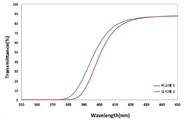
또한, 상기 폴리아미드이미드 공중합체는 ASTM E424에 25 내지 55 ㎛의 두께를 갖는 시편에 대해 측정한 UV-cut 기울기(dT/dλ)는 투과도 10 내지 80% 범위에서 2.80 이상일 수 있다. 또한, 이때 UV-cut off 파장(투과도 1% 미만일 때의 파장)은 353 nm 내지 355 nm일 수 있다. 구체적으로, 후술하는 실시예 및 비교예에서 확인할 수 있는 바와 같이, 4,4'-비페닐다이카르보닐 클로라이드(BPC), 아이소프탈로일 클로라이드(IPC) 및 테레프탈로일 클로라이드(TPC)로 이루어진 방향족 다이카르보닐 모노머의 조합을 사용한 폴리아미드이미드 공중합체가 상기 방향족 다이카르보닐 모노머의 조합을 사용하지 않은 폴리아미드이미드 공중합체에 비하여 높은 UV-cut 기울기(dT/dλ)를 나타낼 수 있다. 이러한 UV-cut 기울기(dT/dλ) 및 UV-cut off 파장은 파장에 대한 투과도를 측정한 후 그 결과 그래프를 통해 확인 가능하다.Also, the polyamide-imide copolymer may have a UV-cut slope (dT / d?) Measured on a specimen having a thickness of 25 to 55 占 퐉 according to ASTM E424 of 2.80 or more in a transmittance range of 10 to 80%. At this time, the UV-cut off wavelength (wavelength when the transmittance is less than 1%) may be 353 nm to 355 nm. Specifically, as can be seen in Examples and Comparative Examples to be described later, it is preferable to use a mixture of 4,4'-biphenyldicarbonyl chloride (BPC), isophthaloyl chloride (IPC) and terephthaloyl chloride (TPC) A polyamideimide copolymer using a combination of aromatic dicarbonyl monomers can exhibit a high UV-cut slope (dT / d?) As compared with a polyamideimide copolymer not using a combination of the aromatic dicarbonyl monomer. The UV-cut slope (dT / dλ) and the UV-cut off wavelength can be measured by measuring the transmittance to the wavelength and then viewing the result.
II. 폴리아미드이미드 필름II. Polyamideimide film
발명의 다른 일 구현 예에 따르면, 상술한 폴리아미드이미드 공중합체를 포함하는 무색 투명한 폴리아미드이미드 필름이 제공된다.According to another embodiment of the present invention, there is provided a colorless transparent polyamideimide film comprising the above-mentioned polyamideimide copolymer.
상술한 바와 같이, 본 발명자들의 계속적인 연구 결과, 방향족 다이아민 모노머, 방향족 다이안하이드라이드 모노머 및 방향족 다이카르보닐 모노머를 사용한 폴리아미드이미드 공중합체의 형성시, 특정 조성의 방향족 다이카르보닐 모노머를 적용할 경우 우수한 내스크래치성 및 기계적 강도를 가지면서 동시에 UV 차폐 기능이 개선된 공중합체를 형성할 수 있음이 확인되었다.As described above, the inventors of the present invention have found that when forming a polyamideimide copolymer using an aromatic diamine monomer, an aromatic dianhydride monomer, and an aromatic dicarbonyl monomer, an aromatic dicarbonyl monomer having a specific composition is applied , It was confirmed that a copolymer having excellent scratch resistance and mechanical strength and improved UV shielding function can be formed.
이로써, 상기 폴리아미드이미드 공중합체를 포함하는 필름은 UV 차폐 기능과 함께 높은 내스크래치성이 요구되는 다양한 성형품의 재료로 사용될 수 있다. 예를 들어, 상기 폴리아미드이미드 필름은 디스플레이용 기판, 디스플레이용 보호 필름, 터치 패널 등에 적용될 수 있다.As a result, the film containing the polyamideimide copolymer can be used as a material of various molded articles requiring high scratch resistance together with a UV shielding function. For example, the polyamideimide film may be applied to a substrate for a display, a protective film for a display, a touch panel, or the like.
상기 폴리아미드이미드 필름은 상기 폴리아미드이미드 공중합체를 사용하여 건식법, 습식법과 같은 통상적인 방법에 의해 제조될 수 있다. 예컨대, 상기 폴리아미드이미드 필름은, 상기 공중합체를 포함하는 용액을 임의의 지지체 상에 코팅하여 막을 형성하고, 상기 막으로부터 용매를 증발시켜 건조하는 방법으로 얻어질 수 있다. 필요에 따라, 상기 폴리아미드이미드 필름에 대한 연신 및 열 처리가 수행될 수 있다.The polyamide-imide film can be produced by a conventional method such as a dry method or a wet method using the polyamide-imide copolymer. For example, the polyamideimide film may be obtained by coating a solution containing the copolymer on an arbitrary support to form a film, and drying the film by evaporating the solvent from the film. If necessary, stretching and heat treatment for the polyamideimide film may be performed.
본 발명에 따른 폴리아미드이미드 공중합체는 우수한 내스크래치성 및 기계적 물성을 나타내면서 UV 차폐 기능이 개선된 폴리아미드이미드 필름의 제공을 가능케 한다.The polyamide-imide copolymer according to the present invention makes it possible to provide a polyamide-imide film improved in UV-shielding function while exhibiting excellent scratch resistance and mechanical properties.
도 1은, 실시예 2 및 비교예 1에서 제조한 폴리아미드이미드 필름의 파장에 따른 투과도 측정 결과이다.Fig. 1 shows the results of measurement of the transmittance of the polyamide-imide films prepared in Example 2 and Comparative Example 1 according to the wavelengths.
이하, 발명의 이해를 돕기 위하여 바람직한 실시예들을 제시한다. 그러나 하기의 실시예들은 발명을 예시하기 위한 것일 뿐, 발명을 이들만으로 한정하는 것은 아니다.BRIEF DESCRIPTION OF THE DRAWINGS Fig. However, the following embodiments are intended to illustrate the invention, but the invention is not limited thereto.
(폴리아미드이미드 공중합체의 제조)(Production of polyamideimide copolymer)
제조예 1Production Example 1
반응기로써 교반기, 질소주입장치, 적하깔때기, 온도조절기 및 냉각기를 부착한 100 mL 4-neck 둥근 플라스크(반응기)에 질소를 통과시키면서 N,N-디메틸아세타아미드(DMAc) 42.5 g을 채운 후, 반응기의 온도를 25℃로 맞춘 후 2,2'-비스(트리플루오로메틸)-4,4'-바이페닐다이아민(TFDB) 4.3025 g(0.01343 mol)을 투입 및 용해하여 이 용액을 25℃로 유지하였다. 42.5 g of N, N-dimethylacetamide (DMAc) was charged into a 100 mL 4-neck round flask (reactor) equipped with a stirrer, a nitrogen injection device, a dropping funnel, a temperature controller and a condenser while passing nitrogen through the reactor, After adjusting the temperature of the reactor to 25 ° C, 4.3025 g (0.01343 mol) of 2,2'-bis (trifluoromethyl) -4,4'-biphenyldiamine (TFDB) was added and dissolved, Respectively.
여기에 3,3',4,4'-디페닐테트라카르복실릭 애씨드 다이안하이드라이드(BPDA) 1.1859 g(0.00403 mol)을 함께 투입 후, 일정 시간 동안 교반하여 용해 및 반응 시켰다. 이 때 용액의 온도는 25℃로 유지하였다. Then, 1.1859 g (0.00403 mol) of 3,3 ', 4,4'-diphenyltetracarboxylic acid dianhydride (BPDA) was added thereto, followed by dissolution and reaction with stirring for a certain period of time. The temperature of the solution was maintained at 25 占 폚.
그리고 용액의 온도를 -10℃로 냉각시킨 후, 비페닐다이카르보닐 클로라이드(BPC) 0.375 g(0.00134 mol), 테레프탈로일 클로라이드(TPC) 1.0911g(0.00537 mol)과 아이소프탈로일 클로라이드(IPC) 0.5455g(0.00269 mol)을 각각 첨가하여 교반하여 주었다. 고형분의 농도는 15 중량%인 폴리아믹산 용액을 얻었다. After the temperature of the solution was cooled to -10 ° C, 0.375 g (0.00134 mol) of biphenyldicarbonyl chloride (BPC), 1.0911 g (0.00537 mol) of terephthaloyl chloride (TPC), and isopthaloyl chloride (0.00269 mol) were respectively added and stirred. A polyamic acid solution having a solid content of 15% by weight was obtained.
상기 폴리아믹산 용액에 DMAc를 투입하여 고형분 함량 5% 이하로 묽혀 이를 메탄올 10 L로 침전시키고, 침전된 고형분을 여과한 후, 100℃에서 진공으로 6시간 이상 건조하여 고형분 형태의 폴리아미드이미드 공중합체를 얻었다 (중량 평균 분자량 약 121,441 g/mol).DMAc was added to the polyamic acid solution to dilute the solution to a solid content of 5% or less and precipitate it with 10 L of methanol. The precipitated solid was filtered and dried at 100 DEG C under vacuum for 6 hours to obtain a polyamideimide copolymer (Weight average molecular weight: about 121,441 g / mol).
제조예 2Production Example 2
반응기로써 교반기, 질소주입장치, 적하깔때기, 온도조절기 및 냉각기를 부착한 100 mL 4-neck 둥근 플라스크(반응기)에 질소를 통과시키면서 N,N-디메틸아세타아미드(DMAc) 42.5 g을 채운 후, 반응기의 온도를 25℃로 맞춘 후 2,2'-비스(트리플루오로메틸)-4,4'-바이페닐다이아민(TFDB) 4.2446 g(0.01325 mol)을 투입 및 용해하여 이 용액을 25℃로 유지하였다.42.5 g of N, N-dimethylacetamide (DMAc) was charged into a 100 mL 4-neck round flask (reactor) equipped with a stirrer, a nitrogen injection device, a dropping funnel, a temperature controller and a condenser while passing nitrogen through the reactor, After adjusting the temperature of the reactor to 25 캜, 4.2446 g (0.01325 mol) of 2,2'-bis (trifluoromethyl) -4,4'-biphenyldiamine (TFDB) was added and dissolved, Respectively.
여기에 3,3',4,4'-디페닐테트라카르복실릭 애씨드 다이안하이드라이드(BPDA) 1.17 g(0.003983 mol)을 함께 투입 후, 일정 시간 동안 교반하여 용해 및 반응 시켰다. 이 때 용액의 온도는 25℃로 유지하였다.Then, 1.17 g (0.003983 mol) of 3,3 ', 4,4'-diphenyltetracarboxylic acid dianhydride (BPDA) was added thereto, followed by stirring and dissolution for a predetermined time. The temperature of the solution was maintained at 25 占 폚.
그리고 용액의 온도를 -10℃로 냉각시킨 후, 비페닐다이카르보닐 클로라이드(BPC) 0.740 g(0.00265 mol), 테레프탈로일 클로라이드(TPC) 0.8073g(0.00397 mol)과 아이소프탈로일 클로라이드(IPC) 0.5382g(0.00265 mol)을 각각 첨가하여 교반하여 주었다. 고형분의 농도는 15 중량%인 폴리아믹산 용액을 얻었다.After cooling the temperature of the solution to -10 캜, 0.740 g (0.00265 mol) of biphenyldicarbonyl chloride (BPC), 0.8073 g (0.00397 mol) of terephthaloyl chloride (TPC) (0.00265 mol) were respectively added and stirred. A polyamic acid solution having a solid content of 15% by weight was obtained.
상기 폴리아믹산 용액에 DMAc를 투입하여 고형분 함량 5% 이하로 묽혀 이를 메탄올 10 L로 침전시키고, 침전된 고형분을 여과한 후, 100℃에서 진공으로 6시간 이상 건조하여 고형분 형태의 폴리아미드이미드 공중합체를 얻었다 (중량 평균 분자량 약 97,447 g/mol).DMAc was added to the polyamic acid solution to dilute the solution to a solid content of 5% or less and precipitate it with 10 L of methanol. The precipitated solid was filtered and dried at 100 DEG C under vacuum for 6 hours to obtain a polyamideimide copolymer (Weight average molecular weight: about 97,447 g / mol).
제조예Manufacturing example 3 3
반응기로써 교반기, 질소주입장치, 적하깔때기, 온도조절기 및 냉각기를 부착한 100 mL 4-neck 둥근 플라스크(반응기)에 질소를 통과시키면서 N,N-디메틸아세타아미드(DMAc) 42.5 g을 채운 후, 반응기의 온도를 25℃로 맞춘 후 2,2'-비스(트리플루오로메틸)-4,4'-바이페닐다이아민(TFDB) 4.1883 g(0.01308 mol)을 투입 및 용해하여 이 용액을 25℃로 유지하였다.42.5 g of N, N-dimethylacetamide (DMAc) was charged into a 100 mL 4-neck round flask (reactor) equipped with a stirrer, a nitrogen injection device, a dropping funnel, a temperature controller and a condenser while passing nitrogen through the reactor, After adjusting the temperature of the reactor to 25 ° C, 4.1883 g (0.01308 mol) of 2,2'-bis (trifluoromethyl) -4,4'-biphenyldiamine (TFDB) was added and dissolved, Respectively.
여기에 3,3',4,4'-디페닐테트라카르복실릭 애씨드 다이안하이드라이드(BPDA) 1.1544 g(0.003924 mol)을 함께 투입 후, 일정 시간 동안 교반하여 용해 및 반응 시켰다. 이 때 용액의 온도는 25℃로 유지하였다.Then, 1.1544 g (0.003924 mol) of 3,3 ', 4,4'-diphenyltetracarboxylic acid dianhydride (BPDA) was added thereto, followed by dissolving and reacting with stirring for a certain period of time. The temperature of the solution was maintained at 25 占 폚.
그리고 용액의 온도를 -10℃로 냉각시킨 후, 비페닐다이카르보닐 클로라이드(BPC) 1.0952 g(0.00392 mol), 테레프탈로일 클로라이드(TPC) 0.7966g(0.00392 mol)과 아이소프탈로일 클로라이드(IPC) 0.2655g(0.001308 mol)을 각각 첨가하여 교반하여 주었다. 고형분의 농도는 15 중량%인 폴리아믹산 용액을 얻었다.After cooling the temperature of the solution to -10 ° C, 1.0952 g (0.00392 mol) of biphenyldicarbonyl chloride (BPC), 0.7966 g (0.00392 mol) of terephthaloyl chloride (TPC) and isophthaloyl chloride (0.001308 mol) were added, respectively, and the mixture was stirred. A polyamic acid solution having a solid content of 15% by weight was obtained.
상기 폴리아믹산 용액에 DMAc를 투입하여 고형분 함량 5% 이하로 묽혀 이를 메탄올 10 L로 침전시키고, 침전된 고형분을 여과한 후, 100℃에서 진공으로 6시간 이상 건조하여 고형분 형태의 폴리아미드이미드 공중합체를 얻었다 (중량 평균 분자량 약 88,736 g/mol).DMAc was added to the polyamic acid solution to dilute the solution to a solid content of 5% or less and precipitate it with 10 L of methanol. The precipitated solid was filtered and dried at 100 DEG C under vacuum for 6 hours to obtain a polyamideimide copolymer (Weight average molecular weight: about 88,736 g / mol).
비교제조예 1 Comparative Preparation Example 1
반응기로써 교반기, 질소주입장치, 적하깔때기, 온도조절기 및 냉각기를 부착한 100 mL 4-neck 둥근 플라스크(반응기)에 질소를 통과시키면서 N,N-디메틸아세타아미드(DMAc) 42.5 g을 채운 후, 반응기의 온도를 25℃로 맞춘 후 TFDB 4.3619 g(0.0136 mol)을 투입 및 용해하여 이 용액을 25℃로 유지하였다.42.5 g of N, N-dimethylacetamide (DMAc) was charged into a 100 mL 4-neck round flask (reactor) equipped with a stirrer, a nitrogen injection device, a dropping funnel, a temperature controller and a condenser while passing nitrogen through the reactor, The temperature of the reactor was adjusted to 25 ° C., and 4.3619 g (0.0136 mol) of TFDB was then added and dissolved to maintain the solution at 25 ° C.
여기에 BPDA 1.2023 g(0.00408 mol)을 함께 투입 후, 일정 시간 동안 교반하여 용해 및 반응 시켰다. 이 때 용액의 온도는 25℃로 유지하였다. 그리고 용액의 온도를 -10℃로 냉각시킨 후, TPC 1.3827g(0.00681mol)과 IPC 0.5531 g(0.00272 mol)을 각각 첨가하여 교반하여 주었다. 고형분의 농도는 15 중량%인 폴리아믹산 용액을 얻었다. 1.2023 g (0.00408 mol) of BPDA was added thereto, followed by stirring for a predetermined time to dissolve and react. The temperature of the solution was maintained at 25 占 폚. After the temperature of the solution was cooled to -10 캜, 1.3827 g (0.00681 mol) of TPC and 0.5531 g (0.00272 mol) of IPC were added and stirred. A polyamic acid solution having a solid content of 15% by weight was obtained.
상기 폴리아믹산 용액에 DMAC를 투입하여 고형분 함량 5% 이하로 묽혀 이를 메탄올 10 L로 침전시키고, 침전된 고형분을 여과한 후, 100℃에서 진공으로 6시간 이상 건조하여 고형분 형태의 폴리아미드이미드 공중합체를 얻었다 (중량 평균 분자량 약 88,147 g/mol).DMAC was added to the polyamic acid solution to dilute the solution to a solid content of 5% or less and precipitate it with 10 L of methanol. The precipitated solids were filtered and dried at 100 DEG C under vacuum for 6 hours to obtain a polyamideimide copolymer (Weight average molecular weight: about 88,147 g / mol).
비교제조예 2 Comparative Production Example 2
반응기로써 교반기, 질소주입장치, 적하깔때기, 온도조절기 및 냉각기를 부착한 100 mL 4-neck 둥근 플라스크(반응기)에 질소를 통과시키면서 N,N-디메틸아세타아미드(DMAc) 42.5 g을 채운 후, 반응기의 온도를 25℃로 맞춘 후 TFDB 4.1334 g(0.01290 mol)을 투입 및 용해하여 이 용액을 25℃로 유지하였다. 42.5 g of N, N-dimethylacetamide (DMAc) was charged into a 100 mL 4-neck round flask (reactor) equipped with a stirrer, a nitrogen injection device, a dropping funnel, a temperature controller and a condenser while passing nitrogen through the reactor, The temperature of the reactor was adjusted to 25 占 폚, and 4.1334 g (0.01290 mol) of TFDB was then added and dissolved to maintain the solution at 25 占 폚.
여기에 BPDA 1.1393 g(0.003872 mol)을 함께 투입 후, 일정 시간 동안 교반하여 용해 및 반응 시켰다. 이 때 용액의 온도는 25℃로 유지하였다. 1.1393 g (0.003872 mol) of BPDA was added thereto together, and the mixture was stirred for a certain period of time to dissolve and react. The temperature of the solution was maintained at 25 占 폚.
그리고 용액의 온도를 -10℃로 냉각시킨 후, BPC 1.4411 g(0.0051631 mol), TPC 0.2621 g(0.001290 mol)과 IPC 0.5241 g(0.002581 mol)을 각각 첨가하여 교반하여 주었다. 고형분의 농도는 15 중량%인 폴리아믹산 용액을 얻었다. After cooling the solution to -10 ° C, 1.4411 g (0.0051631 mol) of BPC, 0.2621 g (0.001290 mol) of TPC and 0.5241 g (0.002581 mol) of IPC were added and stirred. A polyamic acid solution having a solid content of 15% by weight was obtained.
상기 폴리아믹산 용액에 DMAC를 투입하여 고형분 함량 5% 이하로 묽혀 이를 메탄올 10 L로 침전시키고, 침전된 고형분을 여과한 후, 100℃에서 진공으로 6시간 이상 건조하여 고형분 형태의 폴리아미드이미드 공중합체를 얻었다 (중량 평균 분자량 약 101,851 g/mol).DMAC was added to the polyamic acid solution to dilute the solution to a solid content of 5% or less and precipitate it with 10 L of methanol. The precipitated solids were filtered and dried at 100 DEG C under vacuum for 6 hours to obtain a polyamideimide copolymer (Weight average molecular weight: about 101,851 g / mol).
비교제조예 3Comparative Production Example 3
반응기로써 교반기, 질소주입장치, 적하깔때기, 온도조절기 및 냉각기를 부착한 100 mL 4-neck 둥근 플라스크(반응기)에 질소를 통과시키면서 N,N-디메틸아세타아미드(DMAc) 42.5 g을 채운 후, 반응기의 온도를 25℃로 맞춘 후 2,2'-비스(트리플루오로메틸)-4,4'-바이페닐다이아민(TFDB) 4.3320 g(0.01352 mol)을 투입 및 용해하여 이 용액을 25℃로 유지하였다.42.5 g of N, N-dimethylacetamide (DMAc) was charged into a 100 mL 4-neck round flask (reactor) equipped with a stirrer, a nitrogen injection device, a dropping funnel, a temperature controller and a condenser while passing nitrogen through the reactor, After adjusting the temperature of the reactor to 25 ° C, 4.3320 g (0.01352 mol) of 2,2'-bis (trifluoromethyl) -4,4'-biphenyldiamine (TFDB) was added and dissolved, Respectively.
여기에 3,3',4,4'-디페닐테트라카르복실릭 애씨드 다이안하이드라이드(BPDA) 1.1940 g(0.00406 mol)을 함께 투입 후, 일정 시간 동안 교반하여 용해 및 반응 시켰다. 이 때 용액의 온도는 25℃로 유지하였다.Then, 1.1940 g (0.00406 mol) of 3,3 ', 4,4'-diphenyltetracarboxylic acid dianhydride (BPDA) was added thereto, followed by dissolution and reaction with stirring for a certain period of time. The temperature of the solution was maintained at 25 占 폚.
그리고 용액의 온도를 -10℃로 냉각시킨 후, 비페닐다이카르보닐 클로라이드(BPC) 0.1888 g(0.00068 mol), 테레프탈로일 클로라이드(TPC) 1.0986g(0.00541 mol)과 아이소프탈로일 클로라이드(IPC) 0.686g(0.00338 mol)을 각각 첨가하여 교반하여 주었다. 고형분의 농도는 15 중량%인 폴리아믹산 용액을 얻었다.After cooling the temperature of the solution to -10 ° C, 0.1888 g (0.00068 mol) of biphenyldicarbonyl chloride (BPC), 1.0986 g (0.00541 mol) of terephthaloyl chloride (TPC) and isopthaloyl chloride (0.00338 mol) were added and stirred. A polyamic acid solution having a solid content of 15% by weight was obtained.
상기 폴리아믹산 용액에 DMAc를 투입하여 고형분 함량 5% 이하로 묽혀 이를 메탄올 10 L로 침전시키고, 침전된 고형분을 여과한 후, 100℃에서 진공으로 6시간 이상 건조하여 고형분 형태의 폴리아미드이미드 공중합체를 얻었다 (중량 평균 분자량 약 79,171 g/mol).DMAc was added to the polyamic acid solution to dilute the solution to a solid content of 5% or less and precipitate it with 10 L of methanol. The precipitated solid was filtered and dried at 100 DEG C under vacuum for 6 hours to obtain a polyamideimide copolymer (Weight average molecular weight: about 79,171 g / mol).
하기 표 1에 상기 제조예 1 내지 3 및 비교제조예 1 내지 3에서 제조시 사용된 모노머의 함량을 정리하였다.The contents of the monomers used in the preparation examples 1 to 3 and the comparative preparation examples 1 to 3 were summarized in Table 1 below.
BPC+IPC+TPC)의
몰비(TFDB): (BPDA +
BPC + IPC + TPC)
Mole ratio
총 몰 기준)(BPDA + BPC + IPC + TPC
Based on total moles)
총 몰 기준)(BPC + IPC + TPC
Based on total moles)
(몰%)BPDA
(mole%)
(몰%)BPC
(mole%)
(몰%)IPC
(mole%)
(몰%)TPC
(mole%)
(몰%)BPC
(mole%)
(몰%)IPC
(mole%)
(몰%)TPC
(mole%)
제조예 1compare
Production Example 1
제조예 2compare
Production Example 2
제조예 3compare
Production Example 3
(폴리아미드이미드 필름의 제조)(Preparation of polyamideimide film)
실시예 1Example 1
상기 제조예 1에서 얻은 폴리아미드이미드 공중합체를 디메틸아세트아미드(dimethylacetamide)에 녹여 약 25 % (w/V)의 고분자 용액을 제조하였다. 상기 고분자 용액을 유리 기판에 붓고 필름 어플리케이터를 이용하여 고분자 용액의 두께를 균일하게 조절한 후, 70℃에서 5 분 및 100 ℃에서 10 분 동안 진공 오븐에서 건조한 후 형성된 필름을 박리하였다.The polyamide-imide copolymer obtained in Preparation Example 1 was dissolved in dimethylacetamide to prepare a polymer solution of about 25% (w / v). The polymer solution was poured onto a glass substrate and the thickness of the polymer solution was uniformly adjusted using a film applicator. The polymer solution was then dried in a vacuum oven at 70 DEG C for 5 minutes and at 100 DEG C for 10 minutes, and the formed film was peeled off.
박리된 필름을 진공 오븐의 프레임에 고정한 후 질소를 흘려주면서 250 ℃에서 30 분 동안 경화하여 53.2 ㎛ 두께의 폴리아미드이미드 필름을 얻었다.The peeled film was fixed to the frame of the vacuum oven and cured at 250 캜 for 30 minutes while flowing nitrogen, thereby obtaining a polyamideimide film having a thickness of 53.2 탆.
실시예 2, 실시예 3 및 비교예 1 내지 3Example 2, Example 3 and Comparative Examples 1 to 3
상기 제조예 1에서 얻은 폴리아미드이미드 공중합체 대신 제조예 2, 제조예 3 및 비교제조예 1 내지 3에서 얻은 폴리아미드이미드 공중합체를 각각 사용한 것을 제외하고는, 실시예 1과 동일한 방법을 사용하여 하기 표 1에 기재된 두께의 폴리아미드이미드 필름을 얻었다.Except that the polyamideimide copolymers obtained in Preparation Example 2, Preparation Example 3 and Comparative Preparation Examples 1 to 3 were used in place of the polyamideimide copolymer obtained in Preparation Example 1, respectively, A polyamideimide film having a thickness shown in Table 1 below was obtained.
시험예Test Example
상기 실시예 1 내지 3 및 비교예 1 내지 3에서 제조한 폴리아미드이미드 필름을 하기의 방법으로 물성을 평가하였고, 그 결과를 하기 표 2에 나타내었고, 이 중 실시예 2 및 비교예 1의 투과도 그래프를 도 1에 나타내었다. The properties of the polyamide-imide films prepared in Examples 1 to 3 and Comparative Examples 1 to 3 were evaluated by the following methods. The results are shown in Table 2 below. The permeability of Example 2 and Comparative Example 1 The graph is shown in Fig.
(1) 연필 경도(1) Pencil Hardness
Pencil Hardness Tester를 이용하여 ASTM D3363의 측정법에 따라 필름의 연필 경도를 측정하였다. 구체적으로, 상기 테스터에 다양한 경도의 연필을 고정하여 상기 필름에 긁은 후, 상기 필름에 흠집이 발생한 정도를 육안이나 현미경으로 관찰하여, 총 긁은 횟수의 70 % 이상 긁히지 않았을 때, 그 연필의 경도에 해당하는 값을 상기 필름의 연필 경로 평가하였다.The pencil hardness of the film was measured according to the measurement method of ASTM D3363 using Pencil Hardness Tester. Specifically, when a pencil having various hardnesses is fixed to the tester and scratches on the film, the degree of occurrence of scratches on the film is visually observed by a microscope or a microscope. When the scratches are not scratched by more than 70% of the total number of scratches, The corresponding values were evaluated for the pencil path of the film.
(2) 탄성계수(Elastic Modulus), 인장강도(Tensile Strength) 및 인장신율(Tensile Elongation)(2) Elastic Modulus, Tensile Strength, and Tensile Elongation
인장강도 측정기(제조사: Instron, 모델명: 3345 UTM)를 이용하여 IPC-TM-650의 측정법에 따라 필름의 탄성계수, 인장강도 및 인장신율을 측정하였다. The elastic modulus, tensile strength and tensile elongation of the film were measured according to the measurement method of IPC-TM-650 using a tensile strength tester (manufacturer: Instron, Model: 3345 UTM).
(3) 황색 지수(Y.I.)(3) yellow index (Y.I.)
COH-400 Spectrophotometer (NIPPON DENSHOKU INDUSTRIES)를 이용하여 ASTM E313의 측정법에 따라 필름의 황색 지수(Y.I.)를 측정하였다.The yellow index (Y.I.) of the film was measured according to the method of ASTM E313 using a COH-400 Spectrophotometer (NIPPON DENSHOKU INDUSTRIES).
(4) 투과도(T)(4) Transmittance (T)
UV-VIS-NIR Spectrophotometer (SolidSpec-3700, SHIMADZU)를 이용하여 필름의 전 광선 투과도를 측정하였고, 550 nm 파장의 가시광선에 대한 투과도 값을 하기 표 2에 나타내었다.The total light transmittance of the film was measured using a UV-VIS-NIR Spectrophotometer (SolidSpec-3700, SHIMADZU), and the transmittance values for visible light at a wavelength of 550 nm are shown in Table 2 below.
(5) UV-cut off 파장(λ) 및 UV-cut 기울기(dT/dλ)(5) UV-cut off wavelength (λ) and UV-cut slope (dT / dλ)
UV-Vis 분광 광도계(제조사: Shimadzu, 모델명: UV2600)를 이용하여 ASTM E424의 측정법에 따라 필름의 UV-cut off 파장(λ) 및 UV-cut 기울기(dT/dλ)를 측정하였다. UV-cut 기울기(dT/dλ)는 투과도 10 내지 80% 범위에서 측정하였으며 UV-cut off는 투과도 1% 미만일 때의 파장으로 나타내었다.The UV-cut off wavelength (λ) and UV-cut slope (dT / dλ) of the film were measured according to ASTM E424 using a UV-Vis spectrophotometer (manufacturer: Shimadzu, model name: UV2600). The UV-cut slope (dT / dλ) was measured in the range of 10 to 80% transmittance and the UV-cut off was expressed as the wavelength at which the transmittance was less than 1%.
(㎛)thickness
(탆)
계수
(GPa)Shout
Coefficient
(GPa)
강도
(MPa)Seal
burglar
(MPa)
신율
(%)Seal
Elongation
(%)
(%)T
(%)
(nm)λ
(nm)
dλdT /
dλ
(몰%)BPC
(mole%)
(몰%)IPC
(mole%)
(몰%)TPC
(mole%)
불가Measure
Impossible
불가Measure
Impossible
불가Measure
Impossible
불가Measure
Impossible
불가Measure
Impossible
상기 표 2 및 도 1을 참고하면, BPC 함량이 높은 비교예 2에 따른 필름은 헤이즈하여 광학 관련 물성의 측정이 불가능한 반면, 적정 함량의 BPC가 사용된 실시예에 따른 필름은 비교예에 따른 필름에 비하여 연필 경도가 높아 내스크래치성이 개선되었을 뿐 아니라, 기계적 물성이 우수하고 UV-cut 기울기가 증가되었음을 확인할 수 있다.Referring to Table 2 and FIG. 1, the film according to Comparative Example 2, which has a high BPC content, was haze-free to measure the optical-related properties, whereas the film according to the Example in which a proper amount of BPC was used, , The scratch resistance was improved, the mechanical properties were improved, and the UV-cut slope was increased.
Claims (7)
상기 방향족 다이카르보닐 모노머는 상기 방향족 다이안하이드라이드 모노머 및 상기 방향족 다이카르보닐 모노머의 총 몰에 대하여 51 몰% 이상으로 포함되고,
상기 방향족 다이카르보닐 모노머는 10 내지 50 몰%의 4,4'-비페닐다이카르보닐 클로라이드(4,4'-biphenyldicarbonyl chloride), 10 내지 30 몰%의 아이소프탈로일 클로라이드(isophthaloyl chloride) 및 40 내지 60 몰%의 테레프탈로일 클로라이드(terephthaloyl chloride)로 이루어진,
폴리아미드이미드 공중합체.
As an imide of an aromatic diamine monomer, an aromatic dianhydride monomer and an aromatic dicarbonyl monomer-copolymerized polyamic acid,
Wherein the aromatic dicarbonyl monomer is contained in an amount of 51 mol% or more based on the total moles of the aromatic dianhydride monomer and the aromatic dicarbonyl monomer,
The aromatic dicarbonyl monomer comprises 10 to 50 mole% of 4,4'-biphenyldicarbonyl chloride, 10 to 30 mole% of isophthaloyl chloride, And 40 to 60 mol% of terephthaloyl chloride.
Polyamideimide copolymer.
상기 방향족 다이아민 모노머는 2,2'-비스(트리플루오로메틸)-4,4'-바이페닐다이아민(2,2'-bis(trifluoromethyl)-4,4'-biphenyldiamine)인, 폴리아미드이미드 공중합체.
The method according to claim 1,
The aromatic diamine monomer is a polyamide which is 2,2'-bis (trifluoromethyl) -4,4'-biphenyldiamine. Lt; / RTI >
상기 방향족 다이안하이드라이드 모노머는 3,3',4,4'-디페닐테트라카르복실릭 애씨드 다이안하이드라이드(3,3',4,4'-biphenyltetracarboxylic acid dianhydride)인, 폴리아미드이미드 공중합체.
The method according to claim 1,
Wherein the aromatic dianhydride monomer is 3,3 ', 4,4'-diphenyltetracarboxylic acid dianhydride (3,3', 4,4'-biphenyltetracarboxylic acid dianhydride).
ASTM D3363에 의거하여 25 내지 55 ㎛의 두께를 갖는 시편에 대해 측정한 연필 경도가 2H 등급 이상인, 폴리아미드이미드 공중합체.
The method according to claim 1,
Wherein the pencil hardness measured for a specimen having a thickness of 25 to 55 占 퐉 according to ASTM D3363 is 2H grade or higher.
ASTM D638에 의거하여 25 내지 55 ㎛의 두께를 갖는 시편에 대해 측정한 인장강도가 180 MPa 이상인, 폴리아미드이미드 공중합체.
The method according to claim 1,
Wherein the tensile strength measured for a specimen having a thickness of 25 to 55 占 퐉 according to ASTM D638 is 180 MPa or more.
ASTM E424에 의거하여 25 내지 55 ㎛의 두께를 갖는 시편에 대해 측정한 UV-cut 기울기(dT/dλ)가 투과도 10 내지 80% 범위에서 2.80 이상인, 폴리아미드이미드 공중합체.
The method according to claim 1,
Wherein the UV-cut slope (dT / d?) Measured on a specimen having a thickness of 25 to 55 占 퐉 according to ASTM E424 is 2.80 or more in a transmittance range of 10 to 80%.
Priority Applications (7)
| Application Number | Priority Date | Filing Date | Title |
|---|---|---|---|
| KR1020170024908A KR102078762B1 (en) | 2017-02-24 | 2017-02-24 | Polyamideimide copolymers and polyamideimide film comprising the same |
| EP18737488.9A EP3392295B1 (en) | 2017-02-24 | 2018-01-31 | Polyamideimide copolymer and polyamideimide film containing same |
| US16/079,810 US11326025B2 (en) | 2017-02-24 | 2018-01-31 | Polyamideimide copolymer and polyamideimide film comprising the same |
| PCT/KR2018/001346 WO2018155830A1 (en) | 2017-02-24 | 2018-01-31 | Polyamideimide copolymer and polyamideimide film containing same |
| CN201880001115.9A CN108738325B (en) | 2017-02-24 | 2018-01-31 | Polyamideimide copolymer and polyamideimide film comprising the same |
| JP2018545216A JP6578581B2 (en) | 2017-02-24 | 2018-01-31 | Polyamideimide copolymer and polyamideimide film containing the same |
| TW107104221A TWI654223B (en) | 2017-02-24 | 2018-02-07 | Polyamidoquinone copolymer and polyamidoximine film comprising the same |
Applications Claiming Priority (1)
| Application Number | Priority Date | Filing Date | Title |
|---|---|---|---|
| KR1020170024908A KR102078762B1 (en) | 2017-02-24 | 2017-02-24 | Polyamideimide copolymers and polyamideimide film comprising the same |
Publications (2)
| Publication Number | Publication Date |
|---|---|
| KR20180098003A true KR20180098003A (en) | 2018-09-03 |
| KR102078762B1 KR102078762B1 (en) | 2020-02-19 |
Family
ID=63252772
Family Applications (1)
| Application Number | Title | Priority Date | Filing Date |
|---|---|---|---|
| KR1020170024908A Active KR102078762B1 (en) | 2017-02-24 | 2017-02-24 | Polyamideimide copolymers and polyamideimide film comprising the same |
Country Status (7)
| Country | Link |
|---|---|
| US (1) | US11326025B2 (en) |
| EP (1) | EP3392295B1 (en) |
| JP (1) | JP6578581B2 (en) |
| KR (1) | KR102078762B1 (en) |
| CN (1) | CN108738325B (en) |
| TW (1) | TWI654223B (en) |
| WO (1) | WO2018155830A1 (en) |
Cited By (6)
| Publication number | Priority date | Publication date | Assignee | Title |
|---|---|---|---|---|
| WO2020085869A1 (en) * | 2018-10-26 | 2020-04-30 | 주식회사 엘지화학 | Cover window for flexible display device, and display device |
| KR20200090043A (en) * | 2019-01-18 | 2020-07-28 | 주식회사 엘지화학 | Preparing method of polyamideimide block copolymer, polyamideimide block copolymer and polymer resin film using the same |
| KR20210001902A (en) * | 2019-06-28 | 2021-01-06 | 에스케이씨 주식회사 | Polyamide-imide film, preparation method thereof, and cover window and display device comprising same |
| US12031028B2 (en) | 2019-02-01 | 2024-07-09 | Lg Chem, Ltd. | Polyamide resin film and resin laminate using the same |
| US12180340B2 (en) | 2018-11-05 | 2024-12-31 | Lg Chem, Ltd. | Polyamide resin, preparation method therefof, and polyamide film and resin laminate comprising the same |
| US12522729B2 (en) | 2019-04-09 | 2026-01-13 | Lg Chem, Ltd. | Polyamide-imide block copolymers, preparation method thereof and polyamide-imide film comprising the same |
Families Citing this family (6)
| Publication number | Priority date | Publication date | Assignee | Title |
|---|---|---|---|---|
| KR102350095B1 (en) * | 2018-01-03 | 2022-01-11 | 주식회사 엘지화학 | Poly(amide-imide) copolymer film and preparation method of the same |
| TWI730820B (en) * | 2019-06-28 | 2021-06-11 | 南韓商Skc股份有限公司 | Polymer film |
| JP7623817B2 (en) * | 2019-10-31 | 2025-01-29 | 住友化学株式会社 | Optical film and flexible display device |
| WO2021085284A1 (en) * | 2019-10-31 | 2021-05-06 | 住友化学株式会社 | Optical film and flexible display device |
| CN110845345B (en) * | 2019-11-26 | 2021-11-09 | 中国科学院长春应用化学研究所 | Aromatic diamine monomer and preparation method thereof |
| CN113105627A (en) * | 2021-04-13 | 2021-07-13 | 中国科学院宁波材料技术与工程研究所 | High-modulus low-thermal-expansion-coefficient transparent polyimide film and preparation method and application thereof |
Citations (4)
| Publication number | Priority date | Publication date | Assignee | Title |
|---|---|---|---|---|
| KR20130029129A (en) * | 2011-05-18 | 2013-03-22 | 삼성전자주식회사 | Poly(amide-imide) block copolymer, article including same, and display device including the article |
| KR20130071650A (en) * | 2011-12-21 | 2013-07-01 | 코오롱인더스트리 주식회사 | Transparent polyamide-imide film and method for producing same |
| US20130203937A1 (en) * | 2012-02-07 | 2013-08-08 | Samsung Electronics Co., Ltd. | Poly(amide-imide) block copolymer, article including same, and display device including the article |
| KR20150065975A (en) * | 2013-12-02 | 2015-06-16 | 삼성전자주식회사 | Poly(imide-amide) copolymer, article including poly(imide-amide) copolymer, and display device including the article |
Family Cites Families (16)
| Publication number | Priority date | Publication date | Assignee | Title |
|---|---|---|---|---|
| JPH0741559A (en) | 1993-07-29 | 1995-02-10 | Toray Ind Inc | Polyamide imide film |
| JPH07165915A (en) | 1993-12-13 | 1995-06-27 | Toray Ind Inc | Aromatic polyamide-imide film |
| JP3405022B2 (en) | 1995-10-26 | 2003-05-12 | 東レ株式会社 | Aromatic polyamide composition |
| JPH11158268A (en) | 1997-11-28 | 1999-06-15 | Mitsui Chem Inc | Polyamide |
| ES2456691T3 (en) * | 2006-12-12 | 2014-04-23 | Toyobo Co., Ltd. | Polyamide resin, flexible, colorless and transparent metallic sheet material obtained from it and circuit board |
| EP2376571B1 (en) | 2008-12-22 | 2018-02-28 | Saint-Gobain Performance Plastics Corporation | Modified perfluoropolymer sheet material and methods for making same |
| US9457496B2 (en) | 2011-03-23 | 2016-10-04 | Akron Polymer Systems, Inc. | Aromatic polyamide films for transparent flexible substrates |
| US9796816B2 (en) * | 2011-05-18 | 2017-10-24 | Samsung Electronics Co., Ltd. | Poly(amide-imide) block copolymer, article including same, and display device including the article |
| KR101459178B1 (en) * | 2011-09-30 | 2014-11-07 | 코오롱인더스트리 주식회사 | Co-polymerized polyamide-imide film and method of producing the co-polmerized polyamide-imide |
| JP2016056358A (en) | 2014-09-11 | 2016-04-21 | 住友ベークライト株式会社 | Method for producing polyamide |
| EP3045490A1 (en) * | 2015-01-02 | 2016-07-20 | Samsung Electronics Co., Ltd | Window for display device and display device including the same |
| KR20160083738A (en) * | 2015-01-02 | 2016-07-12 | 삼성전자주식회사 | Windows for display device and display device including the same |
| KR102304106B1 (en) | 2015-01-30 | 2021-09-23 | 삼성전자주식회사 | Composition of preparing article contatining poly(imide-amide), method of preparing same, and article contatining poly(imide-amid) |
| KR102251516B1 (en) | 2015-06-30 | 2021-05-12 | 코오롱인더스트리 주식회사 | Polyimide-polybenzoxazole precursor solution, polyimide-polybenzoxazole films, and process for producing thereof |
| KR102497848B1 (en) * | 2015-11-09 | 2023-02-08 | 삼성전자주식회사 | Poly(amide-imide) copolymer, method of preparing poly(amide-imede) copolymer, and article including poly(amide-imide)copolymer |
| KR102075734B1 (en) * | 2017-01-24 | 2020-02-10 | 주식회사 엘지화학 | Polyamideimide copolymers and colorless and transparent polyamideimide film comprising the same |
-
2017
- 2017-02-24 KR KR1020170024908A patent/KR102078762B1/en active Active
-
2018
- 2018-01-31 US US16/079,810 patent/US11326025B2/en active Active
- 2018-01-31 WO PCT/KR2018/001346 patent/WO2018155830A1/en not_active Ceased
- 2018-01-31 EP EP18737488.9A patent/EP3392295B1/en active Active
- 2018-01-31 CN CN201880001115.9A patent/CN108738325B/en active Active
- 2018-01-31 JP JP2018545216A patent/JP6578581B2/en active Active
- 2018-02-07 TW TW107104221A patent/TWI654223B/en active
Patent Citations (4)
| Publication number | Priority date | Publication date | Assignee | Title |
|---|---|---|---|---|
| KR20130029129A (en) * | 2011-05-18 | 2013-03-22 | 삼성전자주식회사 | Poly(amide-imide) block copolymer, article including same, and display device including the article |
| KR20130071650A (en) * | 2011-12-21 | 2013-07-01 | 코오롱인더스트리 주식회사 | Transparent polyamide-imide film and method for producing same |
| US20130203937A1 (en) * | 2012-02-07 | 2013-08-08 | Samsung Electronics Co., Ltd. | Poly(amide-imide) block copolymer, article including same, and display device including the article |
| KR20150065975A (en) * | 2013-12-02 | 2015-06-16 | 삼성전자주식회사 | Poly(imide-amide) copolymer, article including poly(imide-amide) copolymer, and display device including the article |
Cited By (13)
| Publication number | Priority date | Publication date | Assignee | Title |
|---|---|---|---|---|
| CN112203853B (en) * | 2018-10-26 | 2022-11-18 | 株式会社Lg化学 | Cover window for flexible display device and flexible display device |
| KR20200047127A (en) * | 2018-10-26 | 2020-05-07 | 주식회사 엘지화학 | Cover window for flexible display device and flexible display device |
| WO2020085869A1 (en) * | 2018-10-26 | 2020-04-30 | 주식회사 엘지화학 | Cover window for flexible display device, and display device |
| US11958987B2 (en) | 2018-10-26 | 2024-04-16 | Lg Chem, Ltd. | Cover window for flexible display device and flexible display device |
| CN112203853A (en) * | 2018-10-26 | 2021-01-08 | 株式会社Lg化学 | Cover window for flexible display device and flexible display device |
| US12466917B2 (en) | 2018-11-05 | 2025-11-11 | Lg Chem, Ltd. | Polyamide resin, and polymer film, resin laminate using the same |
| US12180340B2 (en) | 2018-11-05 | 2024-12-31 | Lg Chem, Ltd. | Polyamide resin, preparation method therefof, and polyamide film and resin laminate comprising the same |
| US12466916B2 (en) | 2018-11-05 | 2025-11-11 | Lg Chem, Ltd. | Polyamide resin, and polymer film, resin laminate using the same |
| KR20200090043A (en) * | 2019-01-18 | 2020-07-28 | 주식회사 엘지화학 | Preparing method of polyamideimide block copolymer, polyamideimide block copolymer and polymer resin film using the same |
| US12031028B2 (en) | 2019-02-01 | 2024-07-09 | Lg Chem, Ltd. | Polyamide resin film and resin laminate using the same |
| US12466951B2 (en) | 2019-02-01 | 2025-11-11 | Lg Chem, Ltd. | Polyamide resin film and resin laminate using the same |
| US12522729B2 (en) | 2019-04-09 | 2026-01-13 | Lg Chem, Ltd. | Polyamide-imide block copolymers, preparation method thereof and polyamide-imide film comprising the same |
| KR20210001902A (en) * | 2019-06-28 | 2021-01-06 | 에스케이씨 주식회사 | Polyamide-imide film, preparation method thereof, and cover window and display device comprising same |
Also Published As
| Publication number | Publication date |
|---|---|
| US20210189067A1 (en) | 2021-06-24 |
| CN108738325B (en) | 2020-10-27 |
| TWI654223B (en) | 2019-03-21 |
| US11326025B2 (en) | 2022-05-10 |
| EP3392295B1 (en) | 2020-01-08 |
| JP2019510847A (en) | 2019-04-18 |
| CN108738325A (en) | 2018-11-02 |
| EP3392295A4 (en) | 2019-04-10 |
| TW201831567A (en) | 2018-09-01 |
| JP6578581B2 (en) | 2019-09-25 |
| WO2018155830A1 (en) | 2018-08-30 |
| KR102078762B1 (en) | 2020-02-19 |
| EP3392295A1 (en) | 2018-10-24 |
Similar Documents
| Publication | Publication Date | Title |
|---|---|---|
| KR102078762B1 (en) | Polyamideimide copolymers and polyamideimide film comprising the same | |
| EP3315534B1 (en) | Polyamide-imide precursor, polyamide-imide film, and display device comprising same | |
| KR102017196B1 (en) | Polyamideimide copolymers and colorless and transparent polyamideimide film comprising the same | |
| KR102121440B1 (en) | Poly(amide-imide) copolymers composition and colorless and transparent polyamideimide film comprising the same | |
| KR101593267B1 (en) | Polyimide resin and film thereof | |
| KR101831598B1 (en) | Polyimide resin composition and Film thereof | |
| EP3257888B1 (en) | Polyamic acid, polyimide resin and polyimide film | |
| KR20180076178A (en) | Plastic laminated film | |
| KR102072219B1 (en) | Polyamideimide block copolymers and colorless and transparent polyamideimide film comprising the same | |
| KR102261849B1 (en) | Preparation method of polyamideimide copolymers | |
| KR20180090671A (en) | Polyamideimide copolymers and polyamideimide film comprising the same | |
| KR102075734B1 (en) | Polyamideimide copolymers and colorless and transparent polyamideimide film comprising the same | |
| KR102111606B1 (en) | Polyimide precursor composition, prepataion method of polyimide film and polyimide film using the same | |
| KR102252882B1 (en) | Polyamideimide copolymers and colorless and transparent polyamideimide film comprising the same | |
| KR20190056172A (en) | Plastic laminated film | |
| KR20180103350A (en) | Poly(amide-imide) copolymer and polymer film | |
| KR102339091B1 (en) | Polyamic acid composition, polyamideimide film thereof and method for preparing the polyamindeimide film | |
| KR20170100792A (en) | Polyamic acid, Polyimide Resin, Polyimide Film and Display Device Comprising Thereof | |
| KR20180075311A (en) | Polyamideimide copolymers and film comprising the same | |
| KR102843165B1 (en) | Polyamideimide copolymers and optical film comprising the same |
Legal Events
| Date | Code | Title | Description |
|---|---|---|---|
| PA0109 | Patent application |
St.27 status event code: A-0-1-A10-A12-nap-PA0109 |
|
| A201 | Request for examination | ||
| PA0201 | Request for examination |
St.27 status event code: A-1-2-D10-D11-exm-PA0201 |
|
| PG1501 | Laying open of application |
St.27 status event code: A-1-1-Q10-Q12-nap-PG1501 |
|
| R18-X000 | Changes to party contact information recorded |
St.27 status event code: A-3-3-R10-R18-oth-X000 |
|
| R18-X000 | Changes to party contact information recorded |
St.27 status event code: A-3-3-R10-R18-oth-X000 |
|
| E902 | Notification of reason for refusal | ||
| PE0902 | Notice of grounds for rejection |
St.27 status event code: A-1-2-D10-D21-exm-PE0902 |
|
| R18-X000 | Changes to party contact information recorded |
St.27 status event code: A-3-3-R10-R18-oth-X000 |
|
| E701 | Decision to grant or registration of patent right | ||
| PE0701 | Decision of registration |
St.27 status event code: A-1-2-D10-D22-exm-PE0701 |
|
| GRNT | Written decision to grant | ||
| PR0701 | Registration of establishment |
St.27 status event code: A-2-4-F10-F11-exm-PR0701 |
|
| PR1002 | Payment of registration fee |
St.27 status event code: A-2-2-U10-U11-oth-PR1002 Fee payment year number: 1 |
|
| PG1601 | Publication of registration |
St.27 status event code: A-4-4-Q10-Q13-nap-PG1601 |
|
| PR1001 | Payment of annual fee |
St.27 status event code: A-4-4-U10-U11-oth-PR1001 Fee payment year number: 4 |
|
| PR1001 | Payment of annual fee |
St.27 status event code: A-4-4-U10-U11-oth-PR1001 Fee payment year number: 5 |
|
| PR1001 | Payment of annual fee |
St.27 status event code: A-4-4-U10-U11-oth-PR1001 Fee payment year number: 6 |
|
| PR1001 | Payment of annual fee |
St.27 status event code: A-4-4-U10-U11-oth-PR1001 Fee payment year number: 7 |
|
| U11 | Full renewal or maintenance fee paid |
Free format text: ST27 STATUS EVENT CODE: A-4-4-U10-U11-OTH-PR1001 (AS PROVIDED BY THE NATIONAL OFFICE) Year of fee payment: 7 |