KR20160080098A - Manufacturing method of lithium complex oxide, and lithium complex oxide made by the same - Google Patents
Manufacturing method of lithium complex oxide, and lithium complex oxide made by the same Download PDFInfo
- Publication number
- KR20160080098A KR20160080098A KR1020160078639A KR20160078639A KR20160080098A KR 20160080098 A KR20160080098 A KR 20160080098A KR 1020160078639 A KR1020160078639 A KR 1020160078639A KR 20160078639 A KR20160078639 A KR 20160078639A KR 20160080098 A KR20160080098 A KR 20160080098A
- Authority
- KR
- South Korea
- Prior art keywords
- temperature
- composite oxide
- period
- lithium
- section
- Prior art date
- Legal status (The legal status is an assumption and is not a legal conclusion. Google has not performed a legal analysis and makes no representation as to the accuracy of the status listed.)
- Abandoned
Links
Images

Classifications
-
- H—ELECTRICITY
- H01—ELECTRIC ELEMENTS
- H01M—PROCESSES OR MEANS, e.g. BATTERIES, FOR THE DIRECT CONVERSION OF CHEMICAL ENERGY INTO ELECTRICAL ENERGY
- H01M4/00—Electrodes
- H01M4/02—Electrodes composed of, or comprising, active material
- H01M4/36—Selection of substances as active materials, active masses, active liquids
- H01M4/48—Selection of substances as active materials, active masses, active liquids of inorganic oxides or hydroxides
- H01M4/485—Selection of substances as active materials, active masses, active liquids of inorganic oxides or hydroxides of mixed oxides or hydroxides for inserting or intercalating light metals, e.g. LiTi2O4 or LiTi2OxFy
-
- C—CHEMISTRY; METALLURGY
- C01—INORGANIC CHEMISTRY
- C01D—COMPOUNDS OF ALKALI METALS, i.e. LITHIUM, SODIUM, POTASSIUM, RUBIDIUM, CAESIUM, OR FRANCIUM
- C01D15/00—Lithium compounds
- C01D15/02—Oxides; Hydroxides
-
- H—ELECTRICITY
- H01—ELECTRIC ELEMENTS
- H01M—PROCESSES OR MEANS, e.g. BATTERIES, FOR THE DIRECT CONVERSION OF CHEMICAL ENERGY INTO ELECTRICAL ENERGY
- H01M4/00—Electrodes
- H01M4/02—Electrodes composed of, or comprising, active material
- H01M4/36—Selection of substances as active materials, active masses, active liquids
- H01M4/48—Selection of substances as active materials, active masses, active liquids of inorganic oxides or hydroxides
- H01M4/52—Selection of substances as active materials, active masses, active liquids of inorganic oxides or hydroxides of nickel, cobalt or iron
- H01M4/525—Selection of substances as active materials, active masses, active liquids of inorganic oxides or hydroxides of nickel, cobalt or iron of mixed oxides or hydroxides containing iron, cobalt or nickel for inserting or intercalating light metals, e.g. LiNiO2, LiCoO2 or LiCoOxFy
-
- Y—GENERAL TAGGING OF NEW TECHNOLOGICAL DEVELOPMENTS; GENERAL TAGGING OF CROSS-SECTIONAL TECHNOLOGIES SPANNING OVER SEVERAL SECTIONS OF THE IPC; TECHNICAL SUBJECTS COVERED BY FORMER USPC CROSS-REFERENCE ART COLLECTIONS [XRACs] AND DIGESTS
- Y02—TECHNOLOGIES OR APPLICATIONS FOR MITIGATION OR ADAPTATION AGAINST CLIMATE CHANGE
- Y02E—REDUCTION OF GREENHOUSE GAS [GHG] EMISSIONS, RELATED TO ENERGY GENERATION, TRANSMISSION OR DISTRIBUTION
- Y02E60/00—Enabling technologies; Technologies with a potential or indirect contribution to GHG emissions mitigation
- Y02E60/10—Energy storage using batteries
-
- Y02E60/122—
Landscapes
- Chemical & Material Sciences (AREA)
- Inorganic Chemistry (AREA)
- Engineering & Computer Science (AREA)
- Materials Engineering (AREA)
- Organic Chemistry (AREA)
- Chemical Kinetics & Catalysis (AREA)
- Electrochemistry (AREA)
- General Chemical & Material Sciences (AREA)
- Inorganic Compounds Of Heavy Metals (AREA)
- Battery Electrode And Active Subsutance (AREA)
Abstract
본 발명은 리튬 복합 산화물의 제조 방법 및 상기 제조 방법에 의하여 제조된 리튬 복합 산화물에 관한 것으로서, 더욱 상세하게는 전이 금속 전구체를 제조하는 단계, 상기 전이 금속 전구체와 리튬 화합물을 혼합하는 단계, 및 상기 혼합물을 소성하는 단계를 포함하는 리튬 복합 산화물 제조 방법에 있어서, 상기 혼합물을 소성하는 단계는 승온 구간, 제 1 온도 유지 구간, 제 2 온도 유지 구간, 및 냉각 구간으로 구성되며, 상기 제 2 온도 유지 구간은 20 부피% 내지 99 부피%의 산소 함유 분위기에서 소성되는 것인 리튬 복합 산화물의 제조 방법 및 이에 의하여 제조된 리튬 복합 산화물에 관한 것이다.The present invention relates to a method for producing a lithium composite oxide and a lithium composite oxide produced by the method. More particularly, the present invention relates to a method for producing a lithium composite oxide, which comprises the steps of: preparing a transition metal precursor; mixing the transition metal precursor and a lithium compound; And calcining the mixture, wherein the step of calcining the mixture comprises a temperature rising section, a first temperature holding section, a second temperature holding section, and a cooling section, and the second temperature maintaining And the section is fired in an oxygen-containing atmosphere of 20 vol% to 99 vol%. The present invention also relates to a method for producing a lithium composite oxide and a lithium composite oxide produced thereby.
Description
본 발명은 리튬 복합 산화물의 제조방법 및 상기 제조 방법에 의하여 제조된 리튬 복합 산화물에 관한 것으로서, 더욱 상세하게는 전이 금속 전구체를 제조하고, 리튬 화합물을 혼합한 후, 소성 과정을 승온 구간, 제 1 온도 유지 구간, 제 2 온도 유지 구간, 및 냉각 구간으로 구성하여 특정 구간에서 소성하는 것을 특징으로 하는 리튬 복합 산화물의 제조 방법 및 이에 의하여 제조된 리튬 복합 산화물에 관한 것이다.The present invention relates to a method for producing a lithium composite oxide and a lithium composite oxide produced by the method. More particularly, the present invention relates to a lithium composite oxide prepared by preparing a transition metal precursor, mixing a lithium compound, A second temperature holding period, and a cooling period, and firing is performed in a specific section. The present invention also relates to a lithium composite oxide produced by the method.
모바일 기기에 대한 기술과 수요가 증가함에 따라 에너지원으로서 이차전지의 수요가 급격히 증가하고 있고, 그러한 이차전지 중 높은 에너지 밀도와 작동 전위를 나타내고, 사이클 수명이 길며, 자기 방전율이 낮은 리튬 이차전지가 상용화되어 널리 사용되고 있다.As the technology and demand for mobile devices increase, the demand for secondary batteries as energy sources is rapidly increasing. Lithium secondary batteries, which exhibit high energy density and operating potential, long cycle life and low self-discharge rate among such secondary batteries, It has been commercialized and widely used.
리튬 이차전지의 양극 활물질로는 리튬 함유 코발트 산화물(LiCoO2)이 주로 사용되고 있고, 그 외에 층상 결정 구조의 LiMnO2, 스피넬 결정구조의 LiMn2O4 등의 리튬 함유 망간 산화물과, 리튬 함유 니켈 산화물(LiNiO2)의 사용도 고려되고 있다.Lithium-containing cobalt oxide (LiCoO 2 ) is mainly used as a positive electrode active material of a lithium secondary battery, and a lithium-containing manganese oxide such as LiMnO 2 having a layered crystal structure and LiMn 2 O 4 having a spinel crystal structure, (LiNiO 2 ) is also being considered.
상기 양극 활물질들 중 LiCoO2은 수명 특성 및 충방전 효율이 우수하여 가장 많이 사용되고 있지만, 구조 안정성이 떨어지고, 원료로서 사용되는 코발트의 자원적 한계로 인해 고가이므로 전기자동차 등과 같은 중대형 전지분야의 동력원으로 대량 사용하기에는 가격 경쟁력에 한계가 있다는 단점이 있다. LiMnO2, LiMn2O4 등의 리튬 망간 산화물은 원료로서 사용되는 망간의 자원이 풍부하여 가격이 저렴하고, 환경 친화적이며, 열적 안전성이 우수하다는 장점이 있지만, 용량이 작고, 고온 특성 및 사이클 특성 등이 열악하다는 문제점이 있다.Of the above cathode active materials, LiCoO 2 is most widely used because of its excellent lifetime characteristics and charge / discharge efficiency. However, LiCoO 2 has a low structural stability and is expensive due to the limited resource of cobalt used as a raw material. There is a disadvantage that price competitiveness is limited for mass use. Lithium manganese oxides such as LiMnO 2 and LiMn 2 O 4 are advantageous in that they are rich in resources of manganese used as a raw material, are inexpensive, environmentally friendly, and excellent in thermal stability. However, they are small in capacity, And the like.
이러한 리튬 복합 산화물을 제조하는 방법은 일반적으로 전이 금속 전구체를 제조하고, 상기 전이 금속 전구체와 리튬 화합물을 혼합한 후, 상기 혼합물을 소성하는 단계를 포함한다. 이때, 상기 리튬 화합물로는 LiOH 및 Li2CO3로 이루어진 군에서 선택되는 하나 이상인 것이 바람직하다. 생산 비용의 절감을 위해서는 Li 화합물로 보다 저가인 Li2CO3를 사용하는 것이 더욱 바람직하다.The method for preparing such a lithium composite oxide generally comprises preparing a transition metal precursor, mixing the transition metal precursor with a lithium compound, and then calcining the mixture. At this time, the lithium compound is preferably at least one selected from the group consisting of LiOH and Li 2 CO 3 . In order to reduce the production cost, it is more preferable to use Li 2 CO 3 which is lower in cost as a Li compound.
그러나, 일반적으로 Li2CO3를 Li 화합물로 사용하는 경우, Li2CO3 가 분해되면서 CO2를 발생시켜 반응을 위한 Li2CO3의 추가적인 분해가 열역학적으로 방해될 수 있기 때문에, 더 이상 반응이 진행되지 않아, 반응 후 Li2CO3가 잔류하게 되는 문제가 있다. 특히, 이러한 잔류 Li2CO3는 전지 내에서 전해액 등과 반응하여 가스 발생 및 스웰링(swelling) 현상을 유발함으로써, 고온 안전성이 심각하게 저하되는 문제를 야기시킨다.However, when Li 2 CO 3 is generally used as a Li compound, Li 2 CO 3 There is a problem that since the decomposition of CO 2 generates CO 2 and further decomposition of Li 2 CO 3 for the reaction may be thermodynamically disturbed, the reaction does not proceed any more and Li 2 CO 3 remains after the reaction. Particularly, such residual Li 2 CO 3 reacts with an electrolyte or the like in the battery to cause gas generation and swelling phenomenon, thereby causing a problem that the high-temperature safety is severely deteriorated.
본 발명은 상기와 같은 종래 기술의 문제점을 해결하기 위하여 잔류 리튬을 줄이면서 양극활물질 특성을 향상시키면서 동시에 경제적인 리튬 복합 산화물의 제조 방법 및 상기 제조 방법에 의하여 제조된 리튬 복합 산화물을 제공하는 것을 목적으로 한다. DISCLOSURE OF THE INVENTION It is an object of the present invention to provide an economical method for producing a lithium composite oxide and a lithium composite oxide produced by the production method while improving the characteristics of a cathode active material while reducing residual lithium .
본 발명은 상기와 같은 종래 기술의 문제점을 해결하기 위하여 전이 금속 전구체를 제조하는 단계; 상기 전이 금속 전구체와 리튬 화합물을 혼합하는 단계; 및 상기 혼합물을 소성하는 단계; 를 포함하는 리튬 복합 산화물 제조 방법에 있어서, 상기 혼합물을 소성하는 단계는 승온 구간, 제 1 온도 유지 구간, 제 2 온도 유지 구간, 및 냉각 구간으로 구성되며, 상기 제 1 온도 유지 구간의 온도 및 상기 제 2 온도 유지 구간의 온도는 700℃ 내지 800℃에서 각각 6시간 동안 유지되고, 상기 제 1 온도 유지 구간의 온도 및 상기 제 2 온도 유지 구간의 온도는 동일하고, 상기 제 2 온도 유지 구간은 20 부피% 내지 99 부피%의 산소 함유 분위기에서 소성되며, 상기 냉각 구간은 냉각 속도가 90℃/h 내지 110℃/h로 제어되는 것인 리튬 복합 산화물의 제조 방법을 제공한다.Disclosure of Invention Technical Problem [8] Accordingly, the present invention has been made to solve the above-mentioned problems occurring in the prior art, Mixing the transition metal precursor and a lithium compound; And calcining the mixture; Wherein the step of firing the mixture comprises a temperature rising section, a first temperature holding section, a second temperature holding section, and a cooling section, wherein the temperature of the first temperature holding section and the temperature The temperature of the second temperature holding section is maintained at 700 ° C to 800 ° C for 6 hours, the temperature of the first temperature holding section and the temperature of the second temperature holding section are the same, By volume in an oxygen-containing atmosphere of from 1% by volume to 99% by volume, and the cooling rate is controlled in the range of 90 ° C / h to 110 ° C / h in the cooling section.
일 실시예에 있어서, 상기 제 2 온도 유지 구간과 상기 냉각 구간은 20 부피% 내지 99 부피%의 산소 함유 분위기에서 소성되고, 상기 승온 구간과 제 1 온도 유지 구간은 공기 분위기에서 소성되는 것인 리튬 복합 산화물의 제조 방법을 제공한다.In one embodiment, the second temperature maintaining period and the cooling period are fired in an oxygen-containing atmosphere of 20% by volume to 99% by volume, and the temperature rising period and the first temperature holding period are lithium A method for producing a composite oxide is provided.
일 실시예에 있어서, 상기 승온 구간은 승온 속도가 30℃/h 내지 300℃/h로 제어되는 것인 리튬 복합 산화물의 제조 방법을 제공한다.In one embodiment, the temperature raising rate is controlled at a rate of temperature increase of 30 ° C / h to 300 ° C / h.
본 발명은 또한, 본 발명의 제조 방법에 의하여 제조된 리튬 복합 산화물을 제공한다. The present invention also provides a lithium composite oxide produced by the production method of the present invention.
일 실시예에 있어서, 상기 리튬 복합 산화물은 산화물 전체 중량을 기준으로 LiOH의 함량이 0.5 중량% 미만, Li2CO3의 함량이 1 중량% 미만인 리튬 복합 산화물을 제공한다.In one embodiment, the lithium composite oxide has a LiOH content of less than 0.5 wt% and a Li 2 CO 3 content of less than 1 wt% based on the total weight of the oxide.
일 실시예에 있어서, 상기 리튬 복합 산화물은 아래의 화학식 1로 표시되는 리튬 복합 산화물을 제공한다.In one embodiment, the lithium composite oxide provides a lithium complex oxide represented by the following formula (1).
[화학식 1] LixNi1-y-zCoyMzO2 [Chemical Formula 1] LixNi1-y-zCoyMzO 2
(0.98≤x≤1.1, 0.1≤y≤0.35, 0.03≤z≤0.35, M은 Al, Zn, Ti, V, Cr, Mn, Fe 및 Y로 이루어지는 군으로부터 선택되는 적어도 일종의 금속 원소이다)(Wherein M is at least one kind of metal element selected from the group consisting of Al, Zn, Ti, V, Cr, Mn, Fe and Y)
본 발명에 의한 리튬 복합 산화물의 제조방법에 의하면, 소성 공정에서 산소 투입 구간을 특정함으로써 Li 화합물로서 Li2CO3를 사용하는 경우에도, 특정한 반응 조건에 의해 층상 결정 구조가 안정적으로 유지되므로, 고온에서 소결 공정을 수행할 수 있으며, 잔류 Li의 양이 최소화된 양극 활물질을 제조할 수 있다.According to the method for producing a lithium composite oxide according to the present invention, since the layered crystal structure is stably maintained under specific reaction conditions even when Li 2 CO 3 is used as the Li compound by specifying the oxygen injection period in the firing step, And a cathode active material in which the amount of residual Li is minimized can be produced.
또한, 본 발명에 의한 리튬 복합 산화물의 제조방법에 의하면, 소성 온도를 동일하게 유지하면서 산소 투입 구간을 구분함으로써 경제적으로 리튬 복합 산화물을 제조할 수 있다.In addition, according to the method for producing a lithium composite oxide according to the present invention, a lithium composite oxide can be economically produced by dividing an oxygen introduction section while maintaining the same firing temperature.
도 1은 본 발명의 일 실시예에 의해 잔류 리튬의 양을 측정하기 위한 것으로, 알칼리 정량법인 Warder method를 적용한 것이다.FIG. 1 is a view for measuring the amount of residual lithium according to an embodiment of the present invention, and is a Warder method which is an alkaline determination method.
이하 본 발명을 아래 실시예에 의하여 더욱 상세하게 설명한다. 그러나, 본 발명이 아래 실시예에 의하여 한정되는 것은 아니다. Hereinafter, the present invention will be described in more detail with reference to the following examples. However, the present invention is not limited by the following examples.
<실시예 1> NCA 계열 리튬 복합 산화물 제조≪ Example 1 > NCA-based lithium composite oxide production
공침반응에 의하여 NiCoAlOH 전구체를 제조하였다. 상기 제조된 NiCoAlOH 전구체에 Li2CO3 를 첨가하고, 공기를 2L/min 의 속도로 공급하면서 100℃/h의 속도로 750℃ 까지 승온시킨 후, 6시간 동안 750℃에서 소성하였다. 이후 산소를 첨가한 공기를 10 L/min의 속도로 공급하면서 6시간 동안 750℃에서 소성하였다. 냉각 구간에서 산소를 첨가한 공기를 10 L/min의 속도로 6시간 동안 공급하면서, 100℃/h의 냉각 속도로 냉각시켜서 Ni, Co, 및 Al 을 포함하는 리튬 복합 산화물을 제조하였다.A NiCoAlOH precursor was prepared by coprecipitation reaction. Li 2 CO 3 was added to the prepared NiCoAlOH precursor, and the temperature was raised to 750 ° C at a rate of 100 ° C / h while air was supplied at a rate of 2L / min, followed by baking at 750 ° C for 6 hours. Then, oxygen-added air was supplied at a rate of 10 L / min and calcined at 750 ° C for 6 hours. In the cooling section, oxygen-added air was supplied at a rate of 10 L / min for 6 hours while cooling at a cooling rate of 100 ° C / h to prepare a lithium composite oxide including Ni, Co, and Al.
<실시예 2> NCA 계열 리튬 복합 산화물 제조≪ Example 2 > NCA-based lithium composite oxide production
승온 구간, 제 1 온도 유지 구간, 제 2 온도 유지 구간, 및 냉각 구간 등 전 구간에서 산소를 10 L/min의 속도로 공급한 점을 제외하고는 상기 실시예 1과 동일한 방법으로 Li[Ni0.80Co0.15Al0.05]O2 를 제조하였다.Except that the oxygen was supplied at a rate of 10 L / min in all the sections including the temperature rise period, the first temperature holding period, the second temperature holding period, and the cooling period, Li [Ni 0.80 Co 0.15 Al 0.05 ] O 2 .
<비교예 1>≪ Comparative Example 1 &
상기 실시예 1에서, 제 2 온도 유지 구간을 포함하는 전체 구간에서 산소 공급을 실시하지 않은 것을 제외하고는 상기 실시예 1과 동일한 방법으로 Li[Ni0.80Co0.15Al0.05]O2 를 제조하였다.Li [Ni 0.80 Co 0.15 Al 0.05 ] O 2 was prepared in the same manner as in Example 1, except that oxygen was not supplied in the entire section including the second temperature holding period in Example 1.
<비교예 2>≪ Comparative Example 2 &
상기 실시예 1에서, 제 1 온도 유지 구간 및 냉각 구간에서 산소를 적용한 것을 제외하고는 상기 실시예 1과 동일한 방법으로 Li[Ni0.80Co0.15Al0.05]O2 를 제조하였다.In the same manner as in Example 1 except that oxygen was used in the first temperature holding period and the cooling period in Example 1, Li [Ni 0.80 Co 0.15 Al 0.05 ] O 2 .
<실험예> 잔류 리튬 측정<Experimental Example> Residual lithium measurement
잔류 리튬의 양은 알칼리 정량법인 Warder method를 적용하여 측정하였다. 구체적으로, 약 10g의 양극활물질을 250mL 비이커에 투입한 후 탈이온수(DIW) 약 100g을 비이커에 투입하였다. 이때, 투입된 양극활물질과 DIW의 정확한 중량을 측정 및 기록하였다. 상기 양극활물질이 담지된 비이커를 15분간 교반 후 거름 종이를 이용하여 침전물을 걸러낸 여과액을 얻었다. 약 50g의 상기 여과액을 정밀 적정 시험 장치인 Auto-titrator에 투입하였다. 0.1N HCl 용액과 상기 여과액이 투입되는 동시에 교반이 되며, 투입되는 HCl의 양과 pH가 나타난다. pH가 3 이하가 될 때 적정 실험을 마무리하였다.The amount of residual lithium was measured by applying the Warder method, an alkaline quantitative method. Specifically, about 10 g of the cathode active material was put into a 250 mL beaker, and about 100 g of DIW was added to the beaker. At this time, the precise weight of the charged cathode active material and DIW was measured and recorded. The beaker carrying the positive electrode active material was stirred for 15 minutes, and the precipitate was filtered using a filter paper to obtain a filtrate. About 50 g of the filtrate was put into an Auto-titrator, which is a precision titration apparatus. The 0.1N HCl solution and the filtrate are added and agitated, and the amount of HCl introduced and pH are displayed. When the pH reached 3 or less, the titration experiment was completed.
도 1에 나타내 그래프를 이용 및 실험을 통하여 pH가 급격히 변하는 EQP1과 EQP2를 측정하고, 잔류 LiOH와 Li2CO3를 얻었다.Shown in Figure 1 and through the use of experimental graphs, and the pH is measured with extreme changes in EQP1 EQP2, to obtain a residual LiOH and Li 2 CO 3.
즉, 도 1에서 시료 여과액에 HCl 용액 투입량(X축)이 증가할수록 pH(Y축)는 검은 실선처럼 감소하며 pH가 급격히 변하는 EQP1과 EQP2를 다음 계산식에 적용하여 잔류 LiOH와 Li2CO3 를 결정하였다. That is, the more the HCl solution injection rate (X axis) in the sample filtrate was increased from 1 pH (Y-axis) is reduced as a black solid line, and the residual LiOH and Li 2 CO 3 by applying EQP1 and EQP2 pH is rapidly changed to the following formula .

상기 두 식에서 각각이 나타내는 바는 다음과 같다. Each of the above two expressions is as follows.
Q1: HCl 투입량 (mL, EQP1)Q1: HCl input (mL, EQP1)
Q2: HCl 투입량 (mL, EQP2-EQP1)Q2: HCl input (mL, EQP2-EQP1)
LiOH M.W.: LiOH 분자량 (g/mol)LiOH M.W .: LiOH molecular weight (g / mol)
Li2CO3 M.W.: Li2CO3 분자량 (g/mol)Li 2 CO 3 MW: Li 2 CO 3 Molecular weight (g / mol)
HCl con.: 적정에 사용된 HCl 용액의 농도 (mol/liter)HCl con .: concentration of the HCl solution used in the titration (mol / liter)
DIW: DIW 투입량 (g)DIW: DIW Input (g)
Solution: 적정에 사용된 여과액 중량 (g)Solution: Weight of filtrate used in titration (g)
Powder: 적정에 사용된 양극 시료의 중량 (g)Powder: weight of cathode sample used in titration (g)
실시예 1 및 2와 비교예 1 및 2에서 수행한 실험 조건 및 그 결과를 하기 표 1에 나타내었다. The experimental conditions and the results of the tests performed in Examples 1 and 2 and Comparative Examples 1 and 2 are shown in Table 1 below.
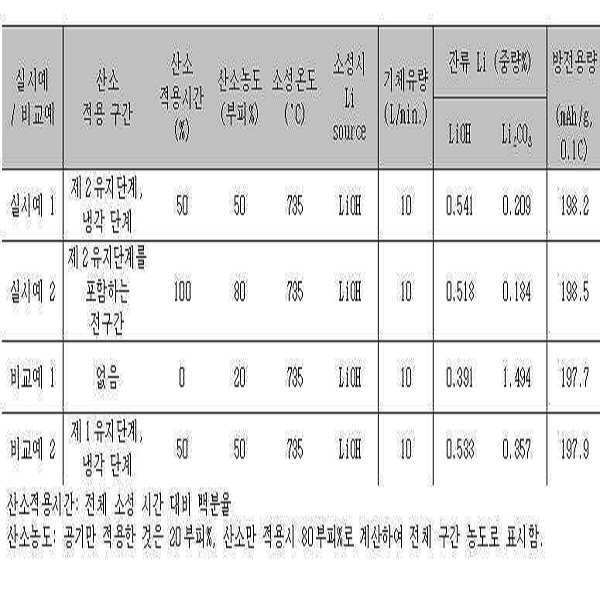
상기 표 1에서 나타낸 바와 같이, 제 2 온도 유지 단계에 산소를 적용한 실시예 1 및 2의 경우 잔류 리튬 및 방전 용량 특성이 모두 우수하게 나타남을 확인할 수 있었다.As shown in Table 1, in Examples 1 and 2 in which oxygen was applied to the second temperature holding step, it was confirmed that the residual lithium and discharge capacity characteristics were excellent.
<< 실시예Example 3> 3> NCMNCM 계열 리튬 복합 산화물 제조 Lithium complex oxide production
공침반응에 의하여 NiCoMnOH 전구체인 Ni0 . 6Co0 . 2Mn0 . 2(OH)2 를 제조하였다. 상기 제조된 Ni0 . 6Co0 . 2Mn0 .2(OH)2 전구체에 Li2CO3를 첨가하고, 공기를 10 L/min의 속도로 공급하면서 120℃/h의 속도로 850℃까지 승온시킨 후, 제 1 온도 유지 구간에서 공기를 10 L/min의 속도로 공급하였다. 제 2 온도 유지 구간의 후반부 50%의 시간 동안 산소를 10 L/min으로 공급하였다. 냉각 구간에서는 공기를 10L/min 의 속도로 공급하면서, 120℃/h 의 냉각 속도로 자연 냉각시켜서 Ni, Co, 및 Mn 을 포함하는 리튬 복합 산화물 Li[Ni0.6Co0.2Mn0.2]O2를 제조하였다. The NiCoMnOH precursor, Ni 0 . 6 Co 0 . 2 Mn 0 . 2 (OH) 2 . The Ni 0 . 6 Co 0 . Li 2 CO 3 was added to the 2 Mn 0 .2 (OH) 2 precursor, and the temperature was raised to 850 ° C. at a rate of 120 ° C./h while supplying air at a rate of 10 L / min. Air was supplied at a rate of 10 L / min. Oxygen was supplied at 10 L / min for 50% of the latter half of the second temperature holding period. In the cooling section, air was naturally cooled at a cooling rate of 120 ° C / h while supplying air at a rate of 10 L / min to produce a lithium composite oxide Li [Ni 0.6 Co 0.2 Mn 0.2 ] O 2 containing Ni, Co, and Mn Respectively.
<< 실시예Example 4> 4> NCMNCM 계열 리튬 복합 산화물 제조 Lithium complex oxide production
상기 실시예 3에서, 승온 구간 및 제 1 온도 유지구간에서 air를 10 L/min으로 공급하여 소성 후, 제2 온도 유지 구간에서 산소를 10 L/min 공급하면서 소성 한 공정을 수행한 것을 제외하고는 상기 실시예 3과 동일한 방법으로 리튬 복합 산화물 Li[Ni0.6Co0.2Mn0.2]O2를 제조하였다. Except that the step of firing while feeding air at a rate of 10 L / min in the temperature-raising section and the first temperature-maintaining section in the third embodiment and supplying oxygen at a rate of 10 L / min in the second temperature holding section was performed Lithium composite oxide Li [Ni 0.6 Co 0.2 Mn 0.2 ] O 2 was prepared in the same manner as in Example 3.
<< 실시예Example 5> 5> NCMNCM 계열 리튬 복합 산화물 제조 Lithium complex oxide production
상기 실시예 3에서, 승온 구간, 제 1 온도 유지 구간, 제 2 온도 유지 구간, 및 냉각 구간에서 산소를 10 L/min의 속도로 공급한 점을 제외하고는 상기 실시예 3과 동일한 방법으로 Li[Ni0.80Co0.15Al0.05]O2 를 제조하였다.In the same manner as in Example 3, except that oxygen was supplied at a rate of 10 L / min in the temperature rising section, the first temperature holding section, the second temperature holding section and the cooling section in Example 3, Li [Ni 0.80 Co 0.15 Al 0.05 ] O 2 .
* < 비교예 3> & Lt; Comparative Example 3 >
상기 실시예 3에서, 전체 구간에서 산소 공급 공정을 수행하지 않은 것을 제외하고는 상기 실시예 3과 동일한 방법으로 리튬 복합 산화물 Li[Ni0.6Co0.2Mn0.2]O2를 제조하였다. In Example 3, a lithium composite oxide Li [Ni 0.6 Co 0.2 Mn 0.2 ] O 2 was prepared in the same manner as in Example 3, except that the oxygen supply process was not performed in the entire section.
<< 비교예Comparative Example 4> 4>
상기 실시예 3에서, 제 1 온도 유지 구간에서만 산소를 10 L/min으로 공급하면서 소성 공정을 수행한 것을 제외하고는 상기 실시예 3과 동일한 방법으로 리튬 복합 산화물 Li[Ni0.6Co0.2Mn0.2]O2를 제조하였다. The lithium composite oxide Li [Ni 0.6 Co 0.2 Mn 0.2 ] was prepared in the same manner as in Example 3, except that the sintering process was performed while supplying oxygen at a rate of 10 L / min only in the first temperature holding period. O 2 .
상기 실시예 3 내지 5, 비교예 3 및 4의 실험 조건 및 결과를 하기 표 2에 나타내었다. The experimental conditions and results of Examples 3 to 5 and Comparative Examples 3 and 4 are shown in Table 2 below.

Claims (3)
상기 전이 금속 전구체와 리튬 화합물을 혼합하는 단계; 및
상기 혼합물을 소성하는 단계;
를 포함하는 리튬 복합 산화물 제조 방법에 있어서,
상기 혼합물을 소성하는 단계는 승온 구간, 제 1 온도 유지 구간, 제 2 온도 유지 구간, 및 냉각 구간으로 구성되며,
상기 제 1 온도 유지 구간의 온도 및 상기 제 2 온도 유지 구간의 온도는 700℃ 내지 800℃에서 각각 6시간 동안 유지되고,
상기 제 1 온도 유지 구간의 온도 및 상기 제 2 온도 유지 구간의 온도는 동일하고,
상기 제 2 온도 유지 구간은 20 부피% 내지 99 부피%의 산소 함유 분위기에서 소성되며,
상기 냉각 구간은 냉각 속도가 90℃/h 내지 110℃/h로 제어되는 것인 리튬 복합 산화물의 제조 방법.
Preparing a transition metal precursor;
Mixing the transition metal precursor and a lithium compound; And
Calcining the mixture;
A lithium composite oxide,
The step of firing the mixture includes a temperature rising section, a first temperature holding section, a second temperature holding section, and a cooling section,
The temperature of the first temperature holding period and the temperature of the second temperature holding period are maintained at 700 ° C to 800 ° C for 6 hours,
The temperature of the first temperature holding period and the temperature of the second temperature holding period are the same,
The second temperature holding period is fired in an oxygen-containing atmosphere of 20% by volume to 99% by volume,
Wherein the cooling period is controlled at a cooling rate of 90 占 폚 / h to 110 占 폚 / h.
상기 제 2 온도 유지 구간과 상기 냉각 구간은 20 부피% 내지 99 부피%의 산소 함유 분위기에서 소성되고, 상기 승온 구간과 제 1 온도 유지 구간은 공기 분위기에서 소성되는 것인 리튬 복합 산화물의 제조 방법.
The method according to claim 1,
Wherein the second temperature maintaining period and the cooling period are fired in an oxygen containing atmosphere of 20 vol% to 99 vol%, and the temperature rising period and the first temperature holding period are fired in an air atmosphere.
상기 승온 구간은 승온 속도가 30℃/h 내지 300℃/h로 제어되는 것인 리튬 복합 산화물의 제조 방법.
The method according to claim 1,
Wherein the temperature rising rate is controlled at a rate of temperature increase of 30 占 폚 / h to 300 占 폚 / h.
Priority Applications (1)
| Application Number | Priority Date | Filing Date | Title |
|---|---|---|---|
| KR1020160078639A KR20160080098A (en) | 2016-06-23 | 2016-06-23 | Manufacturing method of lithium complex oxide, and lithium complex oxide made by the same |
Applications Claiming Priority (1)
| Application Number | Priority Date | Filing Date | Title |
|---|---|---|---|
| KR1020160078639A KR20160080098A (en) | 2016-06-23 | 2016-06-23 | Manufacturing method of lithium complex oxide, and lithium complex oxide made by the same |
Related Parent Applications (1)
| Application Number | Title | Priority Date | Filing Date |
|---|---|---|---|
| KR1020150100957A Division KR20150091026A (en) | 2015-07-16 | 2015-07-16 | Manufacturing method of lithium complex oxide, and lithium complex oxide made by the same |
Publications (1)
| Publication Number | Publication Date |
|---|---|
| KR20160080098A true KR20160080098A (en) | 2016-07-07 |
Family
ID=56499844
Family Applications (1)
| Application Number | Title | Priority Date | Filing Date |
|---|---|---|---|
| KR1020160078639A Abandoned KR20160080098A (en) | 2016-06-23 | 2016-06-23 | Manufacturing method of lithium complex oxide, and lithium complex oxide made by the same |
Country Status (1)
| Country | Link |
|---|---|
| KR (1) | KR20160080098A (en) |
-
2016
- 2016-06-23 KR KR1020160078639A patent/KR20160080098A/en not_active Abandoned
Similar Documents
| Publication | Publication Date | Title |
|---|---|---|
| KR101292757B1 (en) | Cathod active material of full gradient, method for preparing the same, lithium secondary battery comprising the same | |
| KR101567039B1 (en) | Manufacuring method of cathode active material for lithium rechargeable battery, and cathode active material made by the same | |
| KR20230098502A (en) | Single-crystal type multi-component cathode material and manufacturing method and application thereof | |
| KR101612601B1 (en) | Cathod active material for lithium rechargeable battery | |
| KR101378580B1 (en) | Cathod active material, lithium rechargeble battery including the same, and method of activiting the same | |
| CN101809788A (en) | Positive electrode active material for nonaqueous electrolyte secondary battery and nonaqueous electrolyte secondary battery using same | |
| CN106410186A (en) | Preparation method and application of lithium-rich layered oxide cathode material | |
| CN109796052B (en) | Cathode material, preparation method thereof and lithium ion battery | |
| KR20140119621A (en) | Precusor for lithium rich active material and lithium rich active material made by the same | |
| JP2019512450A (en) | Method of manufacturing lithium secondary battery positive electrode active material and lithium secondary battery positive electrode active material manufactured thereby | |
| KR20150080199A (en) | Manufacturing method of positive active material for lithium rechargeable batteries and positive active material made by the same | |
| CN109786734A (en) | A kind of preparation method of the nickelic positive electrode of lithium secondary battery | |
| KR102131738B1 (en) | Method for producing positive electrode active material | |
| WO2020152910A1 (en) | Oxide-based positive electrode active material for solid-state lithium-ion batteries, method for producing precursor of oxide-based positive electrode active material for solid-state lithium-ion batteries, method for producing oxide-based positive electrode active material for solid-state lithium-ion batteries, and solid-state lithium-ion battery | |
| CN118811877A (en) | A three-fired ternary positive electrode material and its preparation method and application | |
| KR101762282B1 (en) | High capacity cathode material improved thermal stability for lithium ion battery and a method of manufacturing the same | |
| JP6624631B2 (en) | Lithium transition metal composite oxide and method for producing the same | |
| KR20140087319A (en) | Manufacturing method of lithium complex oxide, and lithium complex oxide made by the same | |
| CN112582587A (en) | Core-shell structure high-nickel cathode material with single crystal as core and preparation method thereof | |
| KR20190107555A (en) | Oxide based cathode active material for lithium ion battery, method for manufacturing oxide based cathode active material precursor for lithium ion battery, method for manufacturing oxide based cathode active material for lithium ion battery, and lithium ion battery | |
| KR102027460B1 (en) | Manufacuring method of cathode active material for lithium rechargeable battery, and cathode active material made by the same | |
| JP2008103100A (en) | Positive electrode active material for non-aqueous electrolyte secondary battery and firing jig thereof | |
| KR20150091026A (en) | Manufacturing method of lithium complex oxide, and lithium complex oxide made by the same | |
| KR20050047291A (en) | Cathode material for lithium secondary battery and method for preparing the same | |
| KR20160080098A (en) | Manufacturing method of lithium complex oxide, and lithium complex oxide made by the same |
Legal Events
| Date | Code | Title | Description |
|---|---|---|---|
| A107 | Divisional application of patent | ||
| A201 | Request for examination | ||
| PA0107 | Divisional application |
Comment text: Divisional Application of Patent Patent event date: 20160623 Patent event code: PA01071R01D Filing date: 20150716 Application number text: 1020150100957 |
|
| PA0201 | Request for examination | ||
| N231 | Notification of change of applicant | ||
| PG1501 | Laying open of application | ||
| PN2301 | Change of applicant |
Patent event date: 20160707 Comment text: Notification of Change of Applicant Patent event code: PN23011R01D |
|
| E902 | Notification of reason for refusal | ||
| PE0902 | Notice of grounds for rejection |
Comment text: Notification of reason for refusal Patent event date: 20160720 Patent event code: PE09021S01D |
|
| E902 | Notification of reason for refusal | ||
| PE0902 | Notice of grounds for rejection |
Comment text: Notification of reason for refusal Patent event date: 20170328 Patent event code: PE09021S01D |
|
| E701 | Decision to grant or registration of patent right | ||
| PE0701 | Decision of registration |
Patent event code: PE07011S01D Comment text: Decision to Grant Registration Patent event date: 20171026 |
|
| NORF | Unpaid initial registration fee | ||
| PC1904 | Unpaid initial registration fee |