KR20120028362A - Crystalline forms of 6-(1h-imidazol-1-yl)-2-phenylquinazoline - Google Patents
Crystalline forms of 6-(1h-imidazol-1-yl)-2-phenylquinazoline Download PDFInfo
- Publication number
- KR20120028362A KR20120028362A KR1020127000282A KR20127000282A KR20120028362A KR 20120028362 A KR20120028362 A KR 20120028362A KR 1020127000282 A KR1020127000282 A KR 1020127000282A KR 20127000282 A KR20127000282 A KR 20127000282A KR 20120028362 A KR20120028362 A KR 20120028362A
- Authority
- KR
- South Korea
- Prior art keywords
- imidazol
- spectrum
- phenylquinazolin
- xrpd
- dsc thermogram
- Prior art date
- Legal status (The legal status is an assumption and is not a legal conclusion. Google has not performed a legal analysis and makes no representation as to the accuracy of the status listed.)
- Ceased
Links
- CSZGXYBGYFNSCO-UHFFFAOYSA-N 6-imidazol-1-yl-2-phenylquinazoline Chemical compound C1=NC=CN1C1=CC=C(N=C(N=C2)C=3C=CC=CC=3)C2=C1 CSZGXYBGYFNSCO-UHFFFAOYSA-N 0.000 title claims abstract description 104
- 239000013078 crystal Substances 0.000 claims abstract description 59
- 238000000034 method Methods 0.000 claims abstract description 48
- 239000008194 pharmaceutical composition Substances 0.000 claims abstract description 21
- 150000001875 compounds Chemical class 0.000 claims abstract description 13
- 238000000634 powder X-ray diffraction Methods 0.000 claims description 123
- 239000000047 product Substances 0.000 claims description 78
- 239000000203 mixture Substances 0.000 claims description 72
- 238000001228 spectrum Methods 0.000 claims description 67
- 238000006243 chemical reaction Methods 0.000 claims description 59
- 239000000725 suspension Substances 0.000 claims description 56
- 238000001157 Fourier transform infrared spectrum Methods 0.000 claims description 51
- OKKJLVBELUTLKV-UHFFFAOYSA-N Methanol Chemical compound OC OKKJLVBELUTLKV-UHFFFAOYSA-N 0.000 claims description 51
- CSCPPACGZOOCGX-UHFFFAOYSA-N Acetone Chemical compound CC(C)=O CSCPPACGZOOCGX-UHFFFAOYSA-N 0.000 claims description 48
- LFQSCWFLJHTTHZ-UHFFFAOYSA-N Ethanol Chemical compound CCO LFQSCWFLJHTTHZ-UHFFFAOYSA-N 0.000 claims description 44
- 238000003756 stirring Methods 0.000 claims description 44
- XEKOWRVHYACXOJ-UHFFFAOYSA-N Ethyl acetate Chemical compound CCOC(C)=O XEKOWRVHYACXOJ-UHFFFAOYSA-N 0.000 claims description 43
- YMWUJEATGCHHMB-UHFFFAOYSA-N Dichloromethane Chemical compound ClCCl YMWUJEATGCHHMB-UHFFFAOYSA-N 0.000 claims description 29
- 238000010992 reflux Methods 0.000 claims description 29
- KFZMGEQAYNKOFK-UHFFFAOYSA-N Isopropanol Chemical compound CC(C)O KFZMGEQAYNKOFK-UHFFFAOYSA-N 0.000 claims description 26
- 238000002844 melting Methods 0.000 claims description 25
- 230000008018 melting Effects 0.000 claims description 25
- WEVYAHXRMPXWCK-UHFFFAOYSA-N Acetonitrile Chemical compound CC#N WEVYAHXRMPXWCK-UHFFFAOYSA-N 0.000 claims description 24
- 239000002904 solvent Substances 0.000 claims description 23
- ZWEHNKRNPOVVGH-UHFFFAOYSA-N 2-Butanone Chemical compound CCC(C)=O ZWEHNKRNPOVVGH-UHFFFAOYSA-N 0.000 claims description 22
- CVRCPVCCSHDQPN-UHFFFAOYSA-N butanedioic acid;6-imidazol-1-yl-2-phenylquinazoline Chemical compound OC(=O)CCC(O)=O.C1=NC=CN1C1=CC=C(N=C(N=C2)C=3C=CC=CC=3)C2=C1 CVRCPVCCSHDQPN-UHFFFAOYSA-N 0.000 claims description 20
- XLYOFNOQVPJJNP-UHFFFAOYSA-N water Substances O XLYOFNOQVPJJNP-UHFFFAOYSA-N 0.000 claims description 20
- 239000000243 solution Substances 0.000 claims description 19
- 230000000694 effects Effects 0.000 claims description 18
- RTZKZFJDLAIYFH-UHFFFAOYSA-N Diethyl ether Chemical compound CCOCC RTZKZFJDLAIYFH-UHFFFAOYSA-N 0.000 claims description 17
- QXFIIPBQSKGHJH-BTJKTKAUSA-N (z)-but-2-enedioic acid;6-imidazol-1-yl-2-phenylquinazoline Chemical compound OC(=O)\C=C/C(O)=O.C1=NC=CN1C1=CC=C(N=C(N=C2)C=3C=CC=CC=3)C2=C1 QXFIIPBQSKGHJH-BTJKTKAUSA-N 0.000 claims description 14
- ZMXDDKWLCZADIW-UHFFFAOYSA-N N,N-Dimethylformamide Chemical compound CN(C)C=O ZMXDDKWLCZADIW-UHFFFAOYSA-N 0.000 claims description 14
- WYURNTSHIVDZCO-UHFFFAOYSA-N Tetrahydrofuran Chemical compound C1CCOC1 WYURNTSHIVDZCO-UHFFFAOYSA-N 0.000 claims description 14
- 238000002425 crystallisation Methods 0.000 claims description 13
- 230000008025 crystallization Effects 0.000 claims description 13
- 238000004519 manufacturing process Methods 0.000 claims description 13
- IAZDPXIOMUYVGZ-UHFFFAOYSA-N Dimethylsulphoxide Chemical compound CS(C)=O IAZDPXIOMUYVGZ-UHFFFAOYSA-N 0.000 claims description 12
- FAPWRFPIFSIZLT-UHFFFAOYSA-M Sodium chloride Chemical compound [Na+].[Cl-] FAPWRFPIFSIZLT-UHFFFAOYSA-M 0.000 claims description 12
- VLKZOEOYAKHREP-UHFFFAOYSA-N n-Hexane Chemical compound CCCCCC VLKZOEOYAKHREP-UHFFFAOYSA-N 0.000 claims description 12
- DOVFPQNKPMPDFJ-UHFFFAOYSA-N 6-imidazol-1-yl-2-phenylquinazoline;hydrate;dihydrochloride Chemical compound O.Cl.Cl.C1=NC=CN1C1=CC=C(N=C(N=C2)C=3C=CC=CC=3)C2=C1 DOVFPQNKPMPDFJ-UHFFFAOYSA-N 0.000 claims description 10
- JMMWKPVZQRWMSS-UHFFFAOYSA-N isopropanol acetate Natural products CC(C)OC(C)=O JMMWKPVZQRWMSS-UHFFFAOYSA-N 0.000 claims description 10
- 229940011051 isopropyl acetate Drugs 0.000 claims description 10
- 230000008569 process Effects 0.000 claims description 10
- 238000011282 treatment Methods 0.000 claims description 10
- 230000007170 pathology Effects 0.000 claims description 9
- BZLVMXJERCGZMT-UHFFFAOYSA-N Methyl tert-butyl ether Chemical compound COC(C)(C)C BZLVMXJERCGZMT-UHFFFAOYSA-N 0.000 claims description 7
- 239000000706 filtrate Substances 0.000 claims description 7
- 230000002757 inflammatory effect Effects 0.000 claims description 7
- YLQBMQCUIZJEEH-UHFFFAOYSA-N tetrahydrofuran Natural products C=1C=COC=1 YLQBMQCUIZJEEH-UHFFFAOYSA-N 0.000 claims description 7
- QXFIIPBQSKGHJH-WLHGVMLRSA-N (e)-but-2-enedioic acid;6-imidazol-1-yl-2-phenylquinazoline Chemical compound OC(=O)\C=C\C(O)=O.C1=NC=CN1C1=CC=C(N=C(N=C2)C=3C=CC=CC=3)C2=C1 QXFIIPBQSKGHJH-WLHGVMLRSA-N 0.000 claims description 6
- RYHBNJHYFVUHQT-UHFFFAOYSA-N 1,4-Dioxane Chemical compound C1COCCO1 RYHBNJHYFVUHQT-UHFFFAOYSA-N 0.000 claims description 6
- 208000002193 Pain Diseases 0.000 claims description 6
- 238000001914 filtration Methods 0.000 claims description 6
- DQSFYTNPZKLYPQ-UHFFFAOYSA-N 6-imidazol-1-yl-2-phenylquinazoline;phosphoric acid Chemical compound OP(O)(O)=O.C1=NC=CN1C1=CC=C(N=C(N=C2)C=3C=CC=CC=3)C2=C1 DQSFYTNPZKLYPQ-UHFFFAOYSA-N 0.000 claims description 5
- 238000000354 decomposition reaction Methods 0.000 claims description 5
- 239000000546 pharmaceutical excipient Substances 0.000 claims description 5
- BUZVIRDRMZJESH-UHFFFAOYSA-N 6-imidazol-1-yl-2-phenylquinazoline;hydrochloride Chemical compound Cl.C1=NC=CN1C1=CC=C(N=C(N=C2)C=3C=CC=CC=3)C2=C1 BUZVIRDRMZJESH-UHFFFAOYSA-N 0.000 claims description 4
- MUGWMPDUWFYVOK-UHFFFAOYSA-N 6-imidazol-1-yl-2-phenylquinazoline;oxalic acid Chemical compound OC(=O)C(O)=O.C1=NC=CN1C1=CC=C(N=C(N=C2)C=3C=CC=CC=3)C2=C1 MUGWMPDUWFYVOK-UHFFFAOYSA-N 0.000 claims description 4
- 238000001816 cooling Methods 0.000 claims description 4
- 238000001035 drying Methods 0.000 claims description 4
- ZAFNJMIOTHYJRJ-UHFFFAOYSA-N Diisopropyl ether Chemical compound CC(C)OC(C)C ZAFNJMIOTHYJRJ-UHFFFAOYSA-N 0.000 claims description 3
- 239000012296 anti-solvent Substances 0.000 claims description 3
- 230000001684 chronic effect Effects 0.000 claims description 3
- 238000004821 distillation Methods 0.000 claims description 3
- 208000000094 Chronic Pain Diseases 0.000 claims description 2
- 208000020401 Depressive disease Diseases 0.000 claims description 2
- GUBGYTABKSRVRQ-QKKXKWKRSA-N Lactose Natural products OC[C@H]1O[C@@H](O[C@H]2[C@H](O)[C@@H](O)C(O)O[C@@H]2CO)[C@H](O)[C@@H](O)[C@H]1O GUBGYTABKSRVRQ-QKKXKWKRSA-N 0.000 claims description 2
- CTQNGGLPUBDAKN-UHFFFAOYSA-N O-Xylene Chemical compound CC1=CC=CC=C1C CTQNGGLPUBDAKN-UHFFFAOYSA-N 0.000 claims description 2
- 208000005298 acute pain Diseases 0.000 claims description 2
- 239000012141 concentrate Substances 0.000 claims description 2
- 230000001747 exhibiting effect Effects 0.000 claims description 2
- 239000008101 lactose Substances 0.000 claims description 2
- 239000008096 xylene Substances 0.000 claims description 2
- 238000001938 differential scanning calorimetry curve Methods 0.000 claims 33
- FBPFZTCFMRRESA-KVTDHHQDSA-N D-Mannitol Chemical compound OC[C@@H](O)[C@@H](O)[C@H](O)[C@H](O)CO FBPFZTCFMRRESA-KVTDHHQDSA-N 0.000 claims 2
- 229930195725 Mannitol Natural products 0.000 claims 2
- GWYFCOCPABKNJV-UHFFFAOYSA-N isovaleric acid Chemical compound CC(C)CC(O)=O GWYFCOCPABKNJV-UHFFFAOYSA-N 0.000 claims 2
- 239000000594 mannitol Substances 0.000 claims 2
- 235000010355 mannitol Nutrition 0.000 claims 2
- GSNUFIFRDBKVIE-UHFFFAOYSA-N DMF Natural products CC1=CC=C(C)O1 GSNUFIFRDBKVIE-UHFFFAOYSA-N 0.000 claims 1
- OAICVXFJPJFONN-UHFFFAOYSA-N Phosphorus Chemical compound [P] OAICVXFJPJFONN-UHFFFAOYSA-N 0.000 claims 1
- 150000004683 dihydrates Chemical class 0.000 claims 1
- 239000000644 isotonic solution Substances 0.000 claims 1
- 238000010899 nucleation Methods 0.000 claims 1
- 229910052698 phosphorus Inorganic materials 0.000 claims 1
- 239000011574 phosphorus Substances 0.000 claims 1
- 229920000747 poly(lactic acid) Polymers 0.000 claims 1
- 239000004626 polylactic acid Substances 0.000 claims 1
- 150000003839 salts Chemical class 0.000 abstract description 38
- 239000012458 free base Substances 0.000 abstract description 22
- 239000012453 solvate Substances 0.000 abstract description 17
- 239000002585 base Substances 0.000 abstract description 8
- 150000004677 hydrates Chemical class 0.000 abstract description 5
- 230000001225 therapeutic effect Effects 0.000 abstract description 3
- 238000011170 pharmaceutical development Methods 0.000 abstract 1
- 238000002360 preparation method Methods 0.000 description 39
- 238000000113 differential scanning calorimetry Methods 0.000 description 23
- 238000002835 absorbance Methods 0.000 description 21
- VZCYOOQTPOCHFL-UPHRSURJSA-N maleic acid Chemical compound OC(=O)\C=C/C(O)=O VZCYOOQTPOCHFL-UPHRSURJSA-N 0.000 description 18
- 238000004090 dissolution Methods 0.000 description 16
- 239000000825 pharmaceutical preparation Substances 0.000 description 14
- 238000004458 analytical method Methods 0.000 description 13
- 235000019439 ethyl acetate Nutrition 0.000 description 13
- 229940126534 drug product Drugs 0.000 description 12
- 238000009472 formulation Methods 0.000 description 12
- VZCYOOQTPOCHFL-UHFFFAOYSA-N trans-butenedioic acid Natural products OC(=O)C=CC(O)=O VZCYOOQTPOCHFL-UHFFFAOYSA-N 0.000 description 12
- KFNPURNIZVXVPJ-UHFFFAOYSA-N 6-imidazol-1-yl-2-phenylquinazoline;hydrate Chemical compound O.C1=NC=CN1C1=CC=C(N=C(N=C2)C=3C=CC=CC=3)C2=C1 KFNPURNIZVXVPJ-UHFFFAOYSA-N 0.000 description 11
- 239000004480 active ingredient Substances 0.000 description 11
- 238000003801 milling Methods 0.000 description 11
- VEXZGXHMUGYJMC-UHFFFAOYSA-N Hydrochloric acid Chemical compound Cl VEXZGXHMUGYJMC-UHFFFAOYSA-N 0.000 description 10
- 150000003890 succinate salts Chemical group 0.000 description 10
- 150000003892 tartrate salts Chemical group 0.000 description 10
- 238000010521 absorption reaction Methods 0.000 description 9
- BDERNNFJNOPAEC-UHFFFAOYSA-N propan-1-ol Chemical compound CCCO BDERNNFJNOPAEC-UHFFFAOYSA-N 0.000 description 9
- 230000004580 weight loss Effects 0.000 description 9
- IJGRMHOSHXDMSA-UHFFFAOYSA-N Atomic nitrogen Chemical compound N#N IJGRMHOSHXDMSA-UHFFFAOYSA-N 0.000 description 8
- FEWJPZIEWOKRBE-JCYAYHJZSA-N Dextrotartaric acid Chemical compound OC(=O)[C@H](O)[C@@H](O)C(O)=O FEWJPZIEWOKRBE-JCYAYHJZSA-N 0.000 description 8
- 230000008859 change Effects 0.000 description 8
- 125000002962 imidazol-1-yl group Chemical group [*]N1C([H])=NC([H])=C1[H] 0.000 description 8
- 238000005481 NMR spectroscopy Methods 0.000 description 7
- 239000007864 aqueous solution Substances 0.000 description 7
- 239000002775 capsule Substances 0.000 description 7
- GWYFCOCPABKNJV-UHFFFAOYSA-M isovalerate Chemical compound CC(C)CC([O-])=O GWYFCOCPABKNJV-UHFFFAOYSA-M 0.000 description 7
- VZCYOOQTPOCHFL-OWOJBTEDSA-N Fumaric acid Chemical group OC(=O)\C=C\C(O)=O VZCYOOQTPOCHFL-OWOJBTEDSA-N 0.000 description 6
- BRUUBZYPEBMPOD-KMKQWAGMSA-N O.O.OC(=O)[C@H](O)[C@@H](O)C(O)=O.C1=NC=CN1C1=CC=C(N=C(N=C2)C=3C=CC=CC=3)C2=C1 Chemical compound O.O.OC(=O)[C@H](O)[C@@H](O)C(O)=O.C1=NC=CN1C1=CC=C(N=C(N=C2)C=3C=CC=CC=3)C2=C1 BRUUBZYPEBMPOD-KMKQWAGMSA-N 0.000 description 6
- URLKBWYHVLBVBO-UHFFFAOYSA-N Para-Xylene Chemical group CC1=CC=C(C)C=C1 URLKBWYHVLBVBO-UHFFFAOYSA-N 0.000 description 6
- OFOBLEOULBTSOW-UHFFFAOYSA-N Propanedioic acid Natural products OC(=O)CC(O)=O OFOBLEOULBTSOW-UHFFFAOYSA-N 0.000 description 6
- YXFVVABEGXRONW-UHFFFAOYSA-N Toluene Chemical compound CC1=CC=CC=C1 YXFVVABEGXRONW-UHFFFAOYSA-N 0.000 description 6
- 238000010438 heat treatment Methods 0.000 description 6
- 239000011976 maleic acid Substances 0.000 description 6
- 239000000463 material Substances 0.000 description 6
- 239000000843 powder Substances 0.000 description 6
- 239000007787 solid Substances 0.000 description 6
- FGQWBAYKGKVXRA-LREBCSMRSA-N (2r,3r)-2,3-dihydroxybutanedioic acid;6-imidazol-1-yl-2-phenylquinazoline Chemical compound OC(=O)[C@H](O)[C@@H](O)C(O)=O.C1=NC=CN1C1=CC=C(N=C(N=C2)C=3C=CC=CC=3)C2=C1 FGQWBAYKGKVXRA-LREBCSMRSA-N 0.000 description 5
- 238000005160 1H NMR spectroscopy Methods 0.000 description 5
- -1 2-phenylquinazoline succinate Chemical compound 0.000 description 5
- 238000005033 Fourier transform infrared spectroscopy Methods 0.000 description 5
- 241000700159 Rattus Species 0.000 description 5
- 230000035699 permeability Effects 0.000 description 5
- 229940095064 tartrate Drugs 0.000 description 5
- 238000002411 thermogravimetry Methods 0.000 description 5
- QCQCHGYLTSGIGX-GHXANHINSA-N 4-[[(3ar,5ar,5br,7ar,9s,11ar,11br,13as)-5a,5b,8,8,11a-pentamethyl-3a-[(5-methylpyridine-3-carbonyl)amino]-2-oxo-1-propan-2-yl-4,5,6,7,7a,9,10,11,11b,12,13,13a-dodecahydro-3h-cyclopenta[a]chrysen-9-yl]oxy]-2,2-dimethyl-4-oxobutanoic acid Chemical group N([C@@]12CC[C@@]3(C)[C@]4(C)CC[C@H]5C(C)(C)[C@@H](OC(=O)CC(C)(C)C(O)=O)CC[C@]5(C)[C@H]4CC[C@@H]3C1=C(C(C2)=O)C(C)C)C(=O)C1=CN=CC(C)=C1 QCQCHGYLTSGIGX-GHXANHINSA-N 0.000 description 4
- 230000000202 analgesic effect Effects 0.000 description 4
- 230000015572 biosynthetic process Effects 0.000 description 4
- 238000002474 experimental method Methods 0.000 description 4
- 229910052757 nitrogen Inorganic materials 0.000 description 4
- 239000008363 phosphate buffer Substances 0.000 description 4
- RAXXELZNTBOGNW-UHFFFAOYSA-N 1H-imidazole Chemical compound C1=CNC=N1 RAXXELZNTBOGNW-UHFFFAOYSA-N 0.000 description 3
- WVDDGKGOMKODPV-UHFFFAOYSA-N Benzyl alcohol Chemical compound OCC1=CC=CC=C1 WVDDGKGOMKODPV-UHFFFAOYSA-N 0.000 description 3
- BFUHAIPOEFXKSY-UACZKNEHSA-N O.OC(=O)[C@H](O)[C@@H](O)C(O)=O.C1=NC=CN1C1=CC=C(N=C(N=C2)C=3C=CC=CC=3)C2=C1 Chemical compound O.OC(=O)[C@H](O)[C@@H](O)C(O)=O.C1=NC=CN1C1=CC=C(N=C(N=C2)C=3C=CC=CC=3)C2=C1 BFUHAIPOEFXKSY-UACZKNEHSA-N 0.000 description 3
- MUBZPKHOEPUJKR-UHFFFAOYSA-N Oxalic acid Chemical compound OC(=O)C(O)=O MUBZPKHOEPUJKR-UHFFFAOYSA-N 0.000 description 3
- 238000009835 boiling Methods 0.000 description 3
- 238000012512 characterization method Methods 0.000 description 3
- 238000011161 development Methods 0.000 description 3
- 239000002270 dispersing agent Substances 0.000 description 3
- 210000001035 gastrointestinal tract Anatomy 0.000 description 3
- 239000012729 immediate-release (IR) formulation Substances 0.000 description 3
- 238000005259 measurement Methods 0.000 description 3
- 230000007935 neutral effect Effects 0.000 description 3
- 150000003891 oxalate salts Chemical group 0.000 description 3
- 235000010482 polyoxyethylene sorbitan monooleate Nutrition 0.000 description 3
- 229920000053 polysorbate 80 Polymers 0.000 description 3
- 238000012552 review Methods 0.000 description 3
- 235000012976 tarts Nutrition 0.000 description 3
- VDDAVZWCRBHDLQ-UHFFFAOYSA-N 2-phenylquinazoline Chemical compound C1=CC=CC=C1C1=NC=C(C=CC=C2)C2=N1 VDDAVZWCRBHDLQ-UHFFFAOYSA-N 0.000 description 2
- OKTJSMMVPCPJKN-UHFFFAOYSA-N Carbon Chemical compound [C] OKTJSMMVPCPJKN-UHFFFAOYSA-N 0.000 description 2
- 208000000112 Myalgia Diseases 0.000 description 2
- LRHPLDYGYMQRHN-UHFFFAOYSA-N N-Butanol Chemical compound CCCCO LRHPLDYGYMQRHN-UHFFFAOYSA-N 0.000 description 2
- PXHVJJICTQNCMI-UHFFFAOYSA-N Nickel Chemical compound [Ni] PXHVJJICTQNCMI-UHFFFAOYSA-N 0.000 description 2
- 229910019142 PO4 Inorganic materials 0.000 description 2
- NBIIXXVUZAFLBC-UHFFFAOYSA-N Phosphoric acid Chemical group OP(O)(O)=O NBIIXXVUZAFLBC-UHFFFAOYSA-N 0.000 description 2
- DKGAVHZHDRPRBM-UHFFFAOYSA-N Tert-Butanol Chemical compound CC(C)(C)O DKGAVHZHDRPRBM-UHFFFAOYSA-N 0.000 description 2
- 239000008186 active pharmaceutical agent Substances 0.000 description 2
- 230000001430 anti-depressive effect Effects 0.000 description 2
- 230000003110 anti-inflammatory effect Effects 0.000 description 2
- 239000000935 antidepressant agent Substances 0.000 description 2
- 229940005513 antidepressants Drugs 0.000 description 2
- 229940027991 antiseptic and disinfectant quinoline derivative Drugs 0.000 description 2
- 238000004807 desolvation Methods 0.000 description 2
- 229940079593 drug Drugs 0.000 description 2
- 239000003814 drug Substances 0.000 description 2
- 238000001704 evaporation Methods 0.000 description 2
- 230000008020 evaporation Effects 0.000 description 2
- 230000004927 fusion Effects 0.000 description 2
- 230000002496 gastric effect Effects 0.000 description 2
- 239000010439 graphite Substances 0.000 description 2
- 229910002804 graphite Inorganic materials 0.000 description 2
- 238000002329 infrared spectrum Methods 0.000 description 2
- 239000000314 lubricant Substances 0.000 description 2
- HQKMJHAJHXVSDF-UHFFFAOYSA-L magnesium stearate Chemical compound [Mg+2].CCCCCCCCCCCCCCCCCC([O-])=O.CCCCCCCCCCCCCCCCCC([O-])=O HQKMJHAJHXVSDF-UHFFFAOYSA-L 0.000 description 2
- 229940049920 malate Drugs 0.000 description 2
- BJEPYKJPYRNKOW-UHFFFAOYSA-L malate(2-) Chemical compound [O-]C(=O)C(O)CC([O-])=O BJEPYKJPYRNKOW-UHFFFAOYSA-L 0.000 description 2
- 150000002688 maleic acid derivatives Chemical class 0.000 description 2
- FPYJFEHAWHCUMM-UHFFFAOYSA-N maleic anhydride Chemical compound O=C1OC(=O)C=C1 FPYJFEHAWHCUMM-UHFFFAOYSA-N 0.000 description 2
- 239000000155 melt Substances 0.000 description 2
- 238000002156 mixing Methods 0.000 description 2
- 208000013465 muscle pain Diseases 0.000 description 2
- 239000002547 new drug Substances 0.000 description 2
- 229940126701 oral medication Drugs 0.000 description 2
- 230000036407 pain Effects 0.000 description 2
- 230000000144 pharmacologic effect Effects 0.000 description 2
- NBIIXXVUZAFLBC-UHFFFAOYSA-K phosphate Chemical compound [O-]P([O-])([O-])=O NBIIXXVUZAFLBC-UHFFFAOYSA-K 0.000 description 2
- 239000010452 phosphate Substances 0.000 description 2
- 230000002980 postoperative effect Effects 0.000 description 2
- 238000012545 processing Methods 0.000 description 2
- 230000005855 radiation Effects 0.000 description 2
- 229910052594 sapphire Inorganic materials 0.000 description 2
- 239000010980 sapphire Substances 0.000 description 2
- 230000035945 sensitivity Effects 0.000 description 2
- 238000001179 sorption measurement Methods 0.000 description 2
- 238000004611 spectroscopical analysis Methods 0.000 description 2
- 238000003860 storage Methods 0.000 description 2
- 239000000126 substance Substances 0.000 description 2
- KDYFGRWQOYBRFD-UHFFFAOYSA-N succinic acid Chemical compound OC(=O)CCC(O)=O KDYFGRWQOYBRFD-UHFFFAOYSA-N 0.000 description 2
- LNAZSHAWQACDHT-XIYTZBAFSA-N (2r,3r,4s,5r,6s)-4,5-dimethoxy-2-(methoxymethyl)-3-[(2s,3r,4s,5r,6r)-3,4,5-trimethoxy-6-(methoxymethyl)oxan-2-yl]oxy-6-[(2r,3r,4s,5r,6r)-4,5,6-trimethoxy-2-(methoxymethyl)oxan-3-yl]oxyoxane Chemical compound CO[C@@H]1[C@@H](OC)[C@H](OC)[C@@H](COC)O[C@H]1O[C@H]1[C@H](OC)[C@@H](OC)[C@H](O[C@H]2[C@@H]([C@@H](OC)[C@H](OC)O[C@@H]2COC)OC)O[C@@H]1COC LNAZSHAWQACDHT-XIYTZBAFSA-N 0.000 description 1
- RNLYVRKMBPOHNI-UNDPIUDWSA-N (2s)-5-(diaminomethylideneamino)-n-[11-[4-[4-[4-[11-[[2-[4-[(2r)-2-hydroxypropyl]triazol-1-yl]acetyl]amino]undecanoyl]piperazin-1-yl]-6-[2-[2-(2-prop-2-ynoxyethoxy)ethoxy]ethylamino]-1,3,5-triazin-2-yl]piperazin-1-yl]-11-oxoundecyl]-2-[4-[(2s)-2-methylbut Chemical compound N1=NC(C[C@@H](C)CC)=CN1[C@@H](CCCN=C(N)N)C(=O)NCCCCCCCCCCC(=O)N1CCN(C=2N=C(N=C(NCCOCCOCCOCC#C)N=2)N2CCN(CC2)C(=O)CCCCCCCCCCNC(=O)CN2N=NC(C[C@@H](C)O)=C2)CC1 RNLYVRKMBPOHNI-UNDPIUDWSA-N 0.000 description 1
- MMCRTZBSRCXUJW-WLHGVMLRSA-N (e)-but-2-enedioic acid;quinazoline Chemical compound OC(=O)\C=C\C(O)=O.N1=CN=CC2=CC=CC=C21 MMCRTZBSRCXUJW-WLHGVMLRSA-N 0.000 description 1
- BRUUBZYPEBMPOD-UHFFFAOYSA-N 2,3-dihydroxybutanedioic acid;6-imidazol-1-yl-2-phenylquinazoline;dihydrate Chemical compound O.O.OC(=O)C(O)C(O)C(O)=O.C1=NC=CN1C1=CC=C(N=C(N=C2)C=3C=CC=CC=3)C2=C1 BRUUBZYPEBMPOD-UHFFFAOYSA-N 0.000 description 1
- BFUHAIPOEFXKSY-UHFFFAOYSA-N 2,3-dihydroxybutanedioic acid;6-imidazol-1-yl-2-phenylquinazoline;hydrate Chemical compound O.OC(=O)C(O)C(O)C(O)=O.C1=NC=CN1C1=CC=C(N=C(N=C2)C=3C=CC=CC=3)C2=C1 BFUHAIPOEFXKSY-UHFFFAOYSA-N 0.000 description 1
- GUBGYTABKSRVRQ-XLOQQCSPSA-N Alpha-Lactose Chemical compound O[C@@H]1[C@@H](O)[C@@H](O)[C@@H](CO)O[C@H]1O[C@@H]1[C@@H](CO)O[C@H](O)[C@H](O)[C@H]1O GUBGYTABKSRVRQ-XLOQQCSPSA-N 0.000 description 1
- YHLPVASKTHWKMQ-UHFFFAOYSA-N C(C=C1)C=CN1c(cc1)cc2c1nc(-c1ccccc1)nc2 Chemical compound C(C=C1)C=CN1c(cc1)cc2c1nc(-c1ccccc1)nc2 YHLPVASKTHWKMQ-UHFFFAOYSA-N 0.000 description 1
- 206010058019 Cancer Pain Diseases 0.000 description 1
- VEXZGXHMUGYJMC-UHFFFAOYSA-M Chloride anion Chemical compound [Cl-] VEXZGXHMUGYJMC-UHFFFAOYSA-M 0.000 description 1
- 206010009900 Colitis ulcerative Diseases 0.000 description 1
- 208000011231 Crohn disease Diseases 0.000 description 1
- 201000004624 Dermatitis Diseases 0.000 description 1
- 206010015150 Erythema Diseases 0.000 description 1
- 238000004566 IR spectroscopy Methods 0.000 description 1
- 102000009032 Imidazoline Receptors Human genes 0.000 description 1
- 108010049134 Imidazoline Receptors Proteins 0.000 description 1
- 102000010909 Monoamine Oxidase Human genes 0.000 description 1
- 108010062431 Monoamine oxidase Proteins 0.000 description 1
- CICSGUAUMYMOAO-ILKQHERXSA-N O.O.O.O.OC(=O)[C@H](O)[C@@H](O)C(O)=O.C1=NC=CN1C1=CC=C(N=C(N=C2)C=3C=CC=CC=3)C2=C1 Chemical compound O.O.O.O.OC(=O)[C@H](O)[C@@H](O)C(O)=O.C1=NC=CN1C1=CC=C(N=C(N=C2)C=3C=CC=CC=3)C2=C1 CICSGUAUMYMOAO-ILKQHERXSA-N 0.000 description 1
- YZXJRJYHAXYNAK-QNSVNVJESA-N O[C@H](C(/C(/O)=[O]/c1cc2nc(-c3ccccc3)ncc2cc1-[n]1cncc1)O)C(O)=O Chemical compound O[C@H](C(/C(/O)=[O]/c1cc2nc(-c3ccccc3)ncc2cc1-[n]1cncc1)O)C(O)=O YZXJRJYHAXYNAK-QNSVNVJESA-N 0.000 description 1
- 206010065016 Post-traumatic pain Diseases 0.000 description 1
- 208000004550 Postoperative Pain Diseases 0.000 description 1
- XBDQKXXYIPTUBI-UHFFFAOYSA-M Propionate Chemical compound CCC([O-])=O XBDQKXXYIPTUBI-UHFFFAOYSA-M 0.000 description 1
- 201000004681 Psoriasis Diseases 0.000 description 1
- 238000001069 Raman spectroscopy Methods 0.000 description 1
- FEWJPZIEWOKRBE-UHFFFAOYSA-N Tartaric acid Natural products [H+].[H+].[O-]C(=O)C(O)C(O)C([O-])=O FEWJPZIEWOKRBE-UHFFFAOYSA-N 0.000 description 1
- 201000006704 Ulcerative Colitis Diseases 0.000 description 1
- 238000002441 X-ray diffraction Methods 0.000 description 1
- 238000000441 X-ray spectroscopy Methods 0.000 description 1
- KXKVLQRXCPHEJC-UHFFFAOYSA-N acetic acid trimethyl ester Natural products COC(C)=O KXKVLQRXCPHEJC-UHFFFAOYSA-N 0.000 description 1
- DPXJVFZANSGRMM-UHFFFAOYSA-N acetic acid;2,3,4,5,6-pentahydroxyhexanal;sodium Chemical compound [Na].CC(O)=O.OCC(O)C(O)C(O)C(O)C=O DPXJVFZANSGRMM-UHFFFAOYSA-N 0.000 description 1
- 230000002378 acidificating effect Effects 0.000 description 1
- 230000009471 action Effects 0.000 description 1
- 230000001154 acute effect Effects 0.000 description 1
- 229940035676 analgesics Drugs 0.000 description 1
- 239000000730 antalgic agent Substances 0.000 description 1
- 239000002260 anti-inflammatory agent Substances 0.000 description 1
- 229940121363 anti-inflammatory agent Drugs 0.000 description 1
- 239000008135 aqueous vehicle Substances 0.000 description 1
- 208000010668 atopic eczema Diseases 0.000 description 1
- 238000005102 attenuated total reflection Methods 0.000 description 1
- 235000019445 benzyl alcohol Nutrition 0.000 description 1
- 229960000074 biopharmaceutical Drugs 0.000 description 1
- 239000008280 blood Substances 0.000 description 1
- 210000004369 blood Anatomy 0.000 description 1
- 238000007707 calorimetry Methods 0.000 description 1
- 239000001768 carboxy methyl cellulose Substances 0.000 description 1
- 239000000919 ceramic Substances 0.000 description 1
- 230000001427 coherent effect Effects 0.000 description 1
- 230000000295 complement effect Effects 0.000 description 1
- 238000007906 compression Methods 0.000 description 1
- 230000006835 compression Effects 0.000 description 1
- 235000008504 concentrate Nutrition 0.000 description 1
- 238000011109 contamination Methods 0.000 description 1
- 230000007547 defect Effects 0.000 description 1
- 230000018044 dehydration Effects 0.000 description 1
- 238000006297 dehydration reaction Methods 0.000 description 1
- 238000001514 detection method Methods 0.000 description 1
- PCHPORCSPXIHLZ-UHFFFAOYSA-N diphenhydramine hydrochloride Chemical compound [Cl-].C=1C=CC=CC=1C(OCC[NH+](C)C)C1=CC=CC=C1 PCHPORCSPXIHLZ-UHFFFAOYSA-N 0.000 description 1
- 201000010099 disease Diseases 0.000 description 1
- 208000037265 diseases, disorders, signs and symptoms Diseases 0.000 description 1
- 239000006185 dispersion Substances 0.000 description 1
- 239000012153 distilled water Substances 0.000 description 1
- 229940088679 drug related substance Drugs 0.000 description 1
- 239000000839 emulsion Substances 0.000 description 1
- 231100000321 erythema Toxicity 0.000 description 1
- 238000011049 filling Methods 0.000 description 1
- 239000012530 fluid Substances 0.000 description 1
- 239000001530 fumaric acid Substances 0.000 description 1
- 239000008187 granular material Substances 0.000 description 1
- 238000005469 granulation Methods 0.000 description 1
- 230000003179 granulation Effects 0.000 description 1
- 238000000589 high-performance liquid chromatography-mass spectrometry Methods 0.000 description 1
- 230000036571 hydration Effects 0.000 description 1
- 238000006703 hydration reaction Methods 0.000 description 1
- 239000001866 hydroxypropyl methyl cellulose Substances 0.000 description 1
- 235000010979 hydroxypropyl methyl cellulose Nutrition 0.000 description 1
- 229920003088 hydroxypropyl methyl cellulose Polymers 0.000 description 1
- 229960003943 hypromellose Drugs 0.000 description 1
- 239000003112 inhibitor Substances 0.000 description 1
- 239000007972 injectable composition Substances 0.000 description 1
- 238000001990 intravenous administration Methods 0.000 description 1
- 239000003446 ligand Substances 0.000 description 1
- 206010025135 lupus erythematosus Diseases 0.000 description 1
- ZLNQQNXFFQJAID-UHFFFAOYSA-L magnesium carbonate Chemical compound [Mg+2].[O-]C([O-])=O ZLNQQNXFFQJAID-UHFFFAOYSA-L 0.000 description 1
- 239000001095 magnesium carbonate Substances 0.000 description 1
- 229910000021 magnesium carbonate Inorganic materials 0.000 description 1
- 235000019359 magnesium stearate Nutrition 0.000 description 1
- 229920000609 methyl cellulose Polymers 0.000 description 1
- 239000001923 methylcellulose Substances 0.000 description 1
- 150000007522 mineralic acids Chemical class 0.000 description 1
- 238000012544 monitoring process Methods 0.000 description 1
- 150000004682 monohydrates Chemical class 0.000 description 1
- 208000004296 neuralgia Diseases 0.000 description 1
- 208000021722 neuropathic pain Diseases 0.000 description 1
- 229910052759 nickel Inorganic materials 0.000 description 1
- LYGJENNIWJXYER-UHFFFAOYSA-N nitromethane Chemical compound C[N+]([O-])=O LYGJENNIWJXYER-UHFFFAOYSA-N 0.000 description 1
- 150000007524 organic acids Chemical class 0.000 description 1
- 150000002894 organic compounds Chemical class 0.000 description 1
- 201000008482 osteoarthritis Diseases 0.000 description 1
- 235000006408 oxalic acid Nutrition 0.000 description 1
- 238000007911 parenteral administration Methods 0.000 description 1
- 239000002245 particle Substances 0.000 description 1
- 229940127557 pharmaceutical product Drugs 0.000 description 1
- 239000002831 pharmacologic agent Substances 0.000 description 1
- 238000011458 pharmacological treatment Methods 0.000 description 1
- 239000006187 pill Substances 0.000 description 1
- 102000054765 polymorphisms of proteins Human genes 0.000 description 1
- 230000001376 precipitating effect Effects 0.000 description 1
- 238000001556 precipitation Methods 0.000 description 1
- 230000009467 reduction Effects 0.000 description 1
- 230000001105 regulatory effect Effects 0.000 description 1
- 210000002345 respiratory system Anatomy 0.000 description 1
- 206010039073 rheumatoid arthritis Diseases 0.000 description 1
- 238000000926 separation method Methods 0.000 description 1
- 238000004467 single crystal X-ray diffraction Methods 0.000 description 1
- 235000019812 sodium carboxymethyl cellulose Nutrition 0.000 description 1
- 229920001027 sodium carboxymethylcellulose Polymers 0.000 description 1
- 239000011780 sodium chloride Substances 0.000 description 1
- 238000009987 spinning Methods 0.000 description 1
- KDYFGRWQOYBRFD-UHFFFAOYSA-L succinate(2-) Chemical compound [O-]C(=O)CCC([O-])=O KDYFGRWQOYBRFD-UHFFFAOYSA-L 0.000 description 1
- 239000001384 succinic acid Substances 0.000 description 1
- 235000020357 syrup Nutrition 0.000 description 1
- 239000006188 syrup Substances 0.000 description 1
- 239000003826 tablet Substances 0.000 description 1
- 239000000454 talc Substances 0.000 description 1
- 229910052623 talc Inorganic materials 0.000 description 1
- 239000011975 tartaric acid Substances 0.000 description 1
- 235000002906 tartaric acid Nutrition 0.000 description 1
- 238000010998 test method Methods 0.000 description 1
- 238000002460 vibrational spectroscopy Methods 0.000 description 1
Images


Classifications
-
- C—CHEMISTRY; METALLURGY
- C07—ORGANIC CHEMISTRY
- C07D—HETEROCYCLIC COMPOUNDS
- C07D403/00—Heterocyclic compounds containing two or more hetero rings, having nitrogen atoms as the only ring hetero atoms, not provided for by group C07D401/00
- C07D403/02—Heterocyclic compounds containing two or more hetero rings, having nitrogen atoms as the only ring hetero atoms, not provided for by group C07D401/00 containing two hetero rings
- C07D403/04—Heterocyclic compounds containing two or more hetero rings, having nitrogen atoms as the only ring hetero atoms, not provided for by group C07D401/00 containing two hetero rings directly linked by a ring-member-to-ring-member bond
-
- A—HUMAN NECESSITIES
- A61—MEDICAL OR VETERINARY SCIENCE; HYGIENE
- A61P—SPECIFIC THERAPEUTIC ACTIVITY OF CHEMICAL COMPOUNDS OR MEDICINAL PREPARATIONS
- A61P25/00—Drugs for disorders of the nervous system
- A61P25/04—Centrally acting analgesics, e.g. opioids
-
- A—HUMAN NECESSITIES
- A61—MEDICAL OR VETERINARY SCIENCE; HYGIENE
- A61P—SPECIFIC THERAPEUTIC ACTIVITY OF CHEMICAL COMPOUNDS OR MEDICINAL PREPARATIONS
- A61P25/00—Drugs for disorders of the nervous system
- A61P25/24—Antidepressants
-
- A—HUMAN NECESSITIES
- A61—MEDICAL OR VETERINARY SCIENCE; HYGIENE
- A61P—SPECIFIC THERAPEUTIC ACTIVITY OF CHEMICAL COMPOUNDS OR MEDICINAL PREPARATIONS
- A61P29/00—Non-central analgesic, antipyretic or antiinflammatory agents, e.g. antirheumatic agents; Non-steroidal antiinflammatory drugs [NSAID]
-
- A—HUMAN NECESSITIES
- A01—AGRICULTURE; FORESTRY; ANIMAL HUSBANDRY; HUNTING; TRAPPING; FISHING
- A01N—PRESERVATION OF BODIES OF HUMANS OR ANIMALS OR PLANTS OR PARTS THEREOF; BIOCIDES, e.g. AS DISINFECTANTS, AS PESTICIDES OR AS HERBICIDES; PEST REPELLANTS OR ATTRACTANTS; PLANT GROWTH REGULATORS
- A01N43/00—Biocides, pest repellants or attractants, or plant growth regulators containing heterocyclic compounds
- A01N43/48—Biocides, pest repellants or attractants, or plant growth regulators containing heterocyclic compounds having rings with two nitrogen atoms as the only ring hetero atoms
- A01N43/54—1,3-Diazines; Hydrogenated 1,3-diazines
-
- A—HUMAN NECESSITIES
- A61—MEDICAL OR VETERINARY SCIENCE; HYGIENE
- A61K—PREPARATIONS FOR MEDICAL, DENTAL OR TOILETRY PURPOSES
- A61K31/00—Medicinal preparations containing organic active ingredients
- A61K31/33—Heterocyclic compounds
- A61K31/395—Heterocyclic compounds having nitrogen as a ring hetero atom, e.g. guanethidine or rifamycins
- A61K31/495—Heterocyclic compounds having nitrogen as a ring hetero atom, e.g. guanethidine or rifamycins having six-membered rings with two or more nitrogen atoms as the only ring heteroatoms, e.g. piperazine or tetrazines
- A61K31/505—Pyrimidines; Hydrogenated pyrimidines, e.g. trimethoprim
- A61K31/517—Pyrimidines; Hydrogenated pyrimidines, e.g. trimethoprim ortho- or peri-condensed with carbocyclic ring systems, e.g. quinazoline, perimidine
Landscapes
- Health & Medical Sciences (AREA)
- Chemical & Material Sciences (AREA)
- Organic Chemistry (AREA)
- Life Sciences & Earth Sciences (AREA)
- General Health & Medical Sciences (AREA)
- Veterinary Medicine (AREA)
- Public Health (AREA)
- Medicinal Chemistry (AREA)
- Animal Behavior & Ethology (AREA)
- Pharmacology & Pharmacy (AREA)
- Engineering & Computer Science (AREA)
- General Chemical & Material Sciences (AREA)
- Chemical Kinetics & Catalysis (AREA)
- Nuclear Medicine, Radiotherapy & Molecular Imaging (AREA)
- Pain & Pain Management (AREA)
- Neurology (AREA)
- Neurosurgery (AREA)
- Bioinformatics & Cheminformatics (AREA)
- Biomedical Technology (AREA)
- Agronomy & Crop Science (AREA)
- Pest Control & Pesticides (AREA)
- Plant Pathology (AREA)
- Dentistry (AREA)
- Wood Science & Technology (AREA)
- Zoology (AREA)
- Environmental Sciences (AREA)
- Epidemiology (AREA)
- Psychiatry (AREA)
- Rheumatology (AREA)
- Pharmaceuticals Containing Other Organic And Inorganic Compounds (AREA)
- Plural Heterocyclic Compounds (AREA)
- Medicinal Preparation (AREA)
Abstract
본 발명은 6-(1H-이미다졸-1-일)-2-페닐퀴나졸린 (I)의 고체 상태, 및 이의 염기의 신규한 결정 형태 및 이의 약제학적으로 허용되는 염 및 용매화물, 및 이들을 제조하는 방법 및 이들 각각의 약제학적 제형 및 이들의 치료 용도에 관한 것이다:

화학식(I)의 화합물은 5 가지의 상이한 결정 형태, 세 가지의 다형체 형태 및 두 가지의 수화물로 유리 염기로서 얻을 수 있다. 약제학적 개발을 위해서 허용되는 물리화학적 특성을 지니는 화학식(I)의 화합물의 일부 약제학적으로 허용되는 염이 얻어졌으며, 각각의 다형체 형태 및/또는 수화물이 특성화된다.The present invention relates to a novel crystalline form of 6- (1H-imidazol-1-yl) -2-phenylquinazolin (I), and bases thereof and pharmaceutically acceptable salts and solvates thereof, and to To methods of making and their respective pharmaceutical formulations and their therapeutic uses:
Compounds of formula (I) can be obtained as free base in five different crystal forms, three polymorphic forms and two hydrates. Some pharmaceutically acceptable salts of compounds of formula (I) have been obtained that have acceptable physicochemical properties for pharmaceutical development, and each polymorphic form and / or hydrate is characterized.
Description
본 발명은 6-(1H-이미다졸-1-일)-2-페닐퀴나졸린, CR4056의 신규한 결정 형태, 이의 약제학적으로 허용되는 염 및 용매화물, 및 이를 제조하는 방법에 관한 것이다. 6-(1H-이미다졸-1-일)-2-페닐퀴나졸린은 신규의 효능적인 진통, 소염 및 항우울제이다. 따라서, 본 발명은 또한 CR4056의 결정 형태, 이의 대표적인 염 및 용매화물의 약제학적 제형, 이들의 제조 및 만성 또는 습성 통증의 치료, 염증 특성의 병리의 치료, 우울증의 치료에서 이들 약제학적 형태의 용도에 관한 것이다.The present invention relates to 6- (1H-imidazol-1-yl) -2-phenylquinazolin, a novel crystalline form of CR4056, pharmaceutically acceptable salts and solvates thereof, and methods of making the same. 6- (1H-imidazol-1-yl) -2-phenylquinazolin is a novel and effective analgesic, anti-inflammatory and antidepressant. Accordingly, the present invention also provides pharmaceutical forms of CR4056, representative salts and solvates thereof, their preparation and the use of these pharmaceutical forms in the treatment of chronic or wet pain, in the treatment of inflammatory pathologies, in the treatment of depression. It is about.
도입Introduction
본 발명자들은 특허 출원 WO 2008/014 822 (Preparation of 6-(1H-imidazo)-quinazoline and -quinoline derivatives as analgesics and anti-inflammatory agents)에서 효능적인 진통 및 소염 활성을 지니는 6-(1H-이미다졸-1-일)-2-아릴퀴나졸린 유도체의 군을, 이들이 염증 병리, 예컨대, 류마티스 관절염, 및 골관절염, 호흡기관의 염증 특성의 병리, 피부 병리, 예컨대, 홍반루푸스, 습진 및 건선, 및 위장관의 염증성 병리, 예컨대, 궤양 대장염, 크론 질환(Crohn's disease) 및 수술후 염증성 합병증을 치료하기 위한 최적의 약리학적 제제임을 전제로 하여 이전에 보고하였다. The inventors have disclosed that 6- (1H-imidazole having effective analgesic and anti-inflammatory activity in patent application WO 2008/014 822 (Preparation of 6- (1H-imidazo) -quinazoline and -quinoline derivatives as analgesics and anti-inflammatory agents). Groups of -1-yl) -2-arylquinazolin derivatives include those in which inflammatory pathologies such as rheumatoid arthritis, and osteoarthritis, pathologies of inflammatory properties of the respiratory tract, skin pathologies such as erythema lupus, eczema and psoriasis, and gastrointestinal tract It has been previously reported on the premise that it is an optimal pharmacological agent for the treatment of inflammatory pathologies, such as ulcerative colitis, Crohn's disease and postoperative inflammatory complications.
또한, 이들의 고도의 진통 작용에 의해서, 이들 화합물은 급성 및 만성 통증, 예컨대, 수술후 및 외상후 통증, 섬근육통을 포함한 근육 통증, 신경병성 통증 및 암-관련 통증의 치료에 사용될 수 있다.In addition, by their highly analgesic action, these compounds can be used for the treatment of acute and chronic pain, such as postoperative and post-traumatic pain, muscle pain including islet muscle pain, neuropathic pain and cancer-related pain.
2008년 6월 20일자 선행 특허 출원 PCT/EP 2008/057 908호(6-(1H-imidazo)-quinazoline and -quinoline derivatives, New MAO-A inhibitors and Imidazoline receptor ligands)는 동일한 군의 6-(1H-이미다졸-1-일)-2-아릴퀴나졸린 유도체에 대해서, 우울증이 상기 논의된 만성 병리에서 무시할 수 없는 부작용이기 때문에, 상기 기재된 진통 활성과 병합되는 경우에, 이들 생성물에 유리한 약리학적 특성을 부여하는 상당한 항우울 활성을 기재하고 있다. Prior Patent Application No. PCT / EP 2008/057 908 dated June 20, 2008 (6- (1H-imidazo) -quinazoline and -quinoline derivatives, New MAO-A inhibitors and Imidazoline receptor ligands) was found to be 6- (1H) in the same group. For imidazol-1-yl) -2-arylquinazolin derivatives, pharmacological properties advantageous to these products when combined with the analgesic activity described above because depression is a negligible side effect in the chronic pathologies discussed above. It has been described that significant antidepressant activity confers.
상기된 6-(1H-이미다졸-1-일)-2-아릴퀴나졸린 유도체 중에서, 6-(1H-이미다졸-1-일)-2-페닐퀴나졸린, CR4056는 상당한 종합적인 약리 특성을 나타내는 것으로 입증되고 있다.Among the 6- (1H-imidazol-1-yl) -2-arylquinazolin derivatives described above, 6- (1H-imidazol-1-yl) -2-phenylquinazolin, CR4056, has significant comprehensive pharmacological properties. It is proven to show.
약제학적 활성 요소(API)의 고체 상태의 물리화학적 특성은 약물 제품의 개발에 아주 중요한데, 그 이유는 이들이 생체 이용성, 안정성 및 활성 요소 및 상응하는 약제 형태 둘 모두의 가공성에 영향을 줄 수 있기 때문이다. The physicochemical properties of the solid state of pharmaceutically active ingredients (APIs) are very important for the development of drug products because they can affect the bioavailability, stability and processability of both the active ingredient and the corresponding pharmaceutical form. to be.
많은 경우에, 이러한 활성 요소는 결정 및 비정질 형태의 고체 상태로 존재할 수 있으며, 결정 형태의 경우에, 다양한 용매화물 및 다형체가 가능함이 공지되어 있다.In many cases, it is known that such active elements can exist in the solid state in crystalline and amorphous forms, and in the case of crystalline forms, various solvates and polymorphs are possible.
따라서, 다형 현상은 하나 이상의 형태로 결정화하는 물질의 능력으로 이루어지며, 각각의 형태는 결정 격자에서의 상이한 분자 배열에 특징이 있으며, 용매화물을 생성시키는 능력은 정확한 위치에서 규정된 화학양론에 따라서 물 또는 용매 분자를 결정 격자 내로 혼입시키는 가능성으로 이루어진다.Thus, polymorphisms consist of the ability of a substance to crystallize into more than one form, each form characterized by a different molecular arrangement in the crystal lattice, and the ability to generate solvates depends on the stoichiometry defined at the exact location. It consists of the possibility of incorporating water or solvent molecules into the crystal lattice.
따라서, 다형 현상은 ICH Q6A (International Conference on Harmonisation, Topic Q6A, May 2000)에 기재된 바와 같이 이해되며, 그에 따라서, 용어 "API의 결정 형태"는 본원에서 다형체 또는 용매화물인 고체 상태의 특정의 형태를 의미한다. 상이한 다형체 및 용매화물은 상이한 용해도, 상이한 안정성, 상이한 흡습성 및 상이한 기계적 성질, 예를 들어, 여과성 및 유동성을 지닐 수 있다.Thus, polymorphism is understood as described in ICH Q6A (International Conference on Harmonisation, Topic Q6A, May 2000), and accordingly, the term “crystal form of API” is used herein to determine the specific state of the solid state that is a polymorph or solvate. It means form. Different polymorphs and solvates may have different solubility, different stability, different hygroscopicity and different mechanical properties such as filterability and flowability.
용해도 특성이 약물 제품의 생체 이용성에 중요할 수 있지만, 다른 물리 화학적 및 기계적 특성이 활성 요소 및 약제 형태 둘 모두의 안정성 및 가공성을 결정하는데 중요하며, 그에 따라서, 제품의 품질 및 비용에 상당한 영향을 미칠 수 있다. 치료 용도, 투여 경로 및 또한 제형의 유형에 따라서, 동일한 활성 요소에 다양한 제형 요건에 적합한 적응성(adaptability)을 부여하기 위해서 그러한 활성 요소에 상이한 물리화학적 특성을 지니게 하는 것이 필요할 수 있다. While solubility properties may be important for the bioavailability of the drug product, other physicochemical and mechanical properties are important in determining the stability and processability of both the active ingredient and the drug form, and thus have a significant impact on the quality and cost of the product. Can be crazy Depending on the therapeutic use, the route of administration, and also the type of formulation, it may be necessary to have different physicochemical properties on such active components in order to give them the same adaptability to various formulation requirements.
이에 따라, 다형 현상은 이러한 요건들을 만족시키기 위한 유리한 기회일 수 있다. 예를 들어, 속방출 경구 제형 또는 비경구 제형의 경우에, 활성 요소의 용해도는 치료 효능, 또는 이러한 투여 경로를 이용할 가능성을 결정하는데 중요할 수 있다. 6-(1H-이미다졸-1-일)-2-페닐퀴나졸린, CR4056은 용매화물 및 다형체를 포함한 다양한 결정 형태에서 유리 염기로서 결정화하는데 놀라운 능력을 나타내는데, 이는 적절하게 조절되지 않는 경우에, 활성 요소의 물리화학적 성질의 일관성을 방해하여 상기에서 논의된 문제점들을 발생시킬 수 있다. 특히, WO 2008/014 822 및 PCT/EP 2008/057908호에 보고된 방법에 따른 생성물의 결정화는 다형체 및 용매화물의 혼합물을 형성시킬 수 있다.Accordingly, polymorphism may be an advantageous opportunity to meet these requirements. For example, in the case of immediate release oral or parenteral formulations, the solubility of the active ingredient may be important in determining the therapeutic efficacy, or the likelihood of using such a route of administration. 6- (1H-imidazol-1-yl) -2-phenylquinazolin, CR4056, shows an amazing ability to crystallize as a free base in various crystalline forms, including solvates and polymorphs, which if not properly controlled As a result, the problems discussed above can be generated by disturbing the consistency of the physicochemical properties of the active element. In particular, the crystallization of the product according to the method reported in WO 2008/014 822 and PCT / EP 2008/057908 can form mixtures of polymorphs and solvates.
경구로 투여된 약물 제품의 흡수는 두 가지의 중요한 인자, 즉 위장벽을 가로질러 확산하는 능력인 투과능력, 및 위장액에 용해되는 능력인 용해도에 의해 결정된다.The absorption of orally administered drug products is determined by two important factors: permeability, the ability to diffuse across the gastrointestinal wall, and solubility, the ability to dissolve in gastrointestinal fluids.
이러한 두 개의 인자를 고려하기 위하여, BCS (Biopharmaceutical Classification System) (GL Amidon et al., Pharm. Res. 1995, 12: 413-419)로서 공지된 바와 같은 약물 제품의 분류가 도입된다. 6-(1H-이미다졸-1-일)-2-페닐퀴나졸린은 양호한 투과능력 및 낮은 용해도가 제공되기 때문에, BCS 시스템의 클래스 II(높은 투과능력, 낮은 용해도)에 속한다. 이러한 클래스의 약물 제품에 대하여, 용해도는 이들의 흡수를 결정하는데 중요하다. 약제학적으로 허용 가능한 염의 제조는 일반적으로 난용성 생성물의 용해도를 증가시키기 위한 수단을 나타내고, 양호한 투과능력이 제공된 생성물의 경우에, 이들의 생체 이용성을 증가시키기 위한 적합한 수단이다.To take these two factors into consideration, a classification of drug products as known as the Biopharmaceutical Classification System (BCS) (GL Amidon et al., Pharm. Res. 1995, 12: 413-419) is introduced. 6- (1H-imidazol-1-yl) -2-phenylquinazolin is a class II (high permeability, low solubility) of the BCS system because it provides good permeability and low solubility. For this class of drug products, solubility is important in determining their absorption. The preparation of pharmaceutically acceptable salts generally represents a means for increasing the solubility of poorly soluble products and, in the case of products provided with good permeability, is a suitable means for increasing their bioavailability.
그러나, 용해도, 안정성 및 가공성과 같은 적합한 성질이 부여된 염을 수득하는 것이 항상 가능한 것은 아니다. 심지어 유기 화합물의 염이 다형체 및 용매화물을 형성시킬 수 있기 때문에, 고려사항 하에서 필요성을 만족시키는 약제학적 제형의 제조를 위해 적합하게 사용할 수 있는 상기 성질을 지닌 염 또는 용매화물의 적합한 결정 형태를 확인하는 것이 가끔씩 가능하다. 예를 들어, 활성 요소 및 상응하는 약제 제형의 제조 사이클 동안에 필수적인 다양한 저장 조건 하에서의 결정 형태의 안정성은 약물 제품의 품질, 균등성, 및 성질의 일관성을 확보하기 위해 필수적인 조건이다.However, it is not always possible to obtain salts endowed with suitable properties such as solubility, stability and processability. Since salts of organic compounds may even form polymorphs and solvates, suitable crystal forms of salts or solvates with the above properties that can be suitably used for the preparation of pharmaceutical formulations that meet the needs under consideration are considered. It is sometimes possible to check. For example, the stability of the crystalline form under the various storage conditions necessary during the manufacturing cycle of the active ingredient and the corresponding pharmaceutical formulation is an essential condition to ensure consistency of the quality, uniformity, and properties of the drug product.
또한, 제조 사이클 동안에, 결정 형태의 흡습성 또는 낮은 안정성에 의해 특별히 공지된 예방조치의 사용을 회피하는 것은 대부분의 경우에, 제조 비용을 현저하게 감소시킬 수 있다. 기계적 응력에 대한 결정 형태의 안정성은 약제학적 제품의 제조 사이클, 예를 들어 제형 (유동성) 및 용해 요건 모두에 대한 적절한 입자 크기를 얻는데 필수적인 밀링(milling), 제형화된 제품에서 활성 성분의 균질성을 확보하는데 필수적인 혼합, 및 정제의 제조를 위해 필수적인 압축에서 대개 사용되는 모든 공정을 위해 중요하다. In addition, during the manufacturing cycle, avoiding the use of specially known precautions by hygroscopicity or low stability of the crystalline form can in most cases significantly reduce the manufacturing cost. The stability of the crystalline form against mechanical stress is critical to the homogeneity of the active ingredients in the milling, formulated product which is necessary for obtaining the appropriate particle size for both the manufacturing cycle of the pharmaceutical product, eg formulation (fluidity) and dissolution requirements. It is important for all processes that are usually used in the mixing necessary to ensure and the compression necessary for the manufacture of tablets.
결정 형태의 확인 및 특징분석은 종종 사소하지 않은(non-trivial) 공정일 수 있다 [Giron Danielle, Monitoring polymophism of drugs, an on-going challenge - part 2. American Pharmaceutical Review (2008), 11(3), 86-90]. 여러 보완적인 분석 기술, 예를 들어 X-선 회절, 열량측정(calorimetry) 및 진동 분광법의 사용은 대부분의 경우에서 제공된 결정 형태를 확인하고 명료하게 특징분석하는 것을 가능하게 한다.Identification and characterization of crystalline forms can often be a non-trivial process [Giron Danielle, Monitoring polymophism of drugs, an on-going challenge-
종종 시차주사열량분석(DSC)과 결합된 열중량 분석(TGA)은 수화물 또는 용매화물의 존재를 증명하기 위해 매우 유용하다. DSC는 또한 흔히 다형체 및 관련된 열적 성질을 위해 필수적인 기술이다. 진동 분광 기술 중에서, 적외선 분광법(FT-IR)은 종종 다형체의 확인을 가능하게 할 수 있으며, 이러한 것이 가능하지 않을 때에는, 라만 분광법이 요망되는 정보를 제공할 수 있다.Often thermogravimetric analysis (TGA) combined with differential scanning calorimetry (DSC) is very useful to verify the presence of a hydrate or solvate. DSC is also often an essential technique for polymorphs and related thermal properties. Among vibrational spectroscopy techniques, infrared spectroscopy (FT-IR) can often enable the identification of polymorphs, and when this is not possible, Raman spectroscopy can provide the desired information.
수화물의 경우에 및 화합물의 흡습성을 연구하기 위하여, DVS(Differential Vapour Sorption)가 중요한 기술이다. 그러나, 다형체 또는 용매화물이든지 간에, 결정 형태의 특징분석을 위한 선택된 방법은 X-선 분광법이다. 이러한 비교적 간단한 기술은, 분말 회절 실험(XRPD)의 물질일 때, 대부분의 경우에서 결정 형태 및 상대적 결정도를 명확하게 확인하는 것을 가능하게 한다[Harry G. Brittain, X-ray powder diffraction of pharmaceutical materials, American Pharmaceutical Review 2002, 5(1), 74-76].In the case of hydrates and to study the hygroscopicity of the compounds, differential vapor sorption (DVS) is an important technique. However, whether polymorphs or solvates, the selected method for characterization of crystalline forms is X-ray spectroscopy. This relatively simple technique makes it possible to clearly identify the crystal form and relative crystallinity in most cases when it is a material of powder diffraction experiments (XRPD) [Harry G. Brittain, X-ray powder diffraction of pharmaceutical materials, American Pharmaceutical Review 2002, 5 (1), 74-76.
다형체의 확인 및 특징분석의 공정 동안에 일반적인 사용에서 매우 높은 감도로 다형체 형태의 순도를 결정하기 위해(Stephen R. Byrn, Regulatory aspects of X-ray powder diffraction, American Pharmaceutical Review 2005, 8(3), 55-59) 적합한 보정 후에 XRPD가 사용될 수 있지만, 이러한 기술은 일반적으로 5 내지 10%의 수준의 감도로 다른 결정 형태의 존재를 검출할 수 있다.To determine the purity of polymorphic forms with very high sensitivity in normal use during the process of identification and characterization of polymorphs (Stephen R. Byrn, Regulatory aspects of X-ray powder diffraction, American Pharmaceutical Review 2005, 8 (3)). XRPD may be used after appropriate calibration, but such techniques can generally detect the presence of other crystal forms with a sensitivity of 5-10%.
결정 형태를 확인하고 특징분석하는 최고의 방법은 단결정 X-선 회절분광법(SC-XR)이다. 이는 단위 셀의 타입 및 치수를 확인하여 결정 형태의 타입을 특징분석하는 것을 가능하게 하고, 이에 따라 이들의 화학양론을 명확하게 밝히고 이들의 성질을 이해하기 위해, 다형체 또는 용매화물, 및 염의 경우에서와 같은 형태를 규정하기 위한 가정 적합한 방법이다.The best way to identify and characterize crystal forms is single crystal X-ray diffraction spectroscopy (SC-XR). This makes it possible to characterize the type of the crystalline form by identifying the type and dimensions of the unit cell, thus in the case of polymorphs or solvates, and salts, in order to clarify their stoichiometry and to understand their properties. This is a hypothetical suitable way to define the form as in.
상당한 기술적 발전이 이루어졌음에도 불구하고, 이러한 기술의 주된 한계는 제한된 수의 결함을 지지면서 적합한 치수의 분석될 형태의 결정을 획득할 가능성에서 여전히 나타나며, 이러한 결정의 획득은 항상 용이하거나 심지어 가능한 것은 아니다.Although significant technological advances have been made, the main limitations of these techniques still appear in the possibility of obtaining a crystal of the form to be analyzed of suitable dimensions with a limited number of defects, which is always easy or even possible. no.
발명의 설명DESCRIPTION OF THE INVENTION
본 발명은 유리 염기로서 및 안정하고 약제학적으로 허용되는 염의 형태로 6-(1H-이미다졸-1-일)-2-페닐퀴나졸린의 고체 상태에 관한 것이다. 본원에서 기재된 유리 염기 및 이의 염의 다양한 결정 형태의 적절한 사용에 의해서, 활성 요소의 물리화학적 성질의 일관성을 확보하는 것뿐만 아니라, 다양한 형태, 예컨대, 경구 및 비경구 형태로 이를 투여하는 것이 가능하다. The present invention relates to the solid state of 6- (1H-imidazol-1-yl) -2-phenylquinazolin as a free base and in the form of stable and pharmaceutically acceptable salts. By appropriate use of the various crystalline forms of the free bases and salts thereof described herein, it is possible not only to ensure consistency of the physicochemical properties of the active elements, but also to administer them in various forms, such as oral and parenteral forms.
특히, 본 발명은 활성 요소 6-(1H-이미다졸-1-일)-2-페닐퀴나졸린 (I), CR4056의 고체 상태, 특히, 유리 염기, 및 이의 약제학적으로 허용되는 염 및 용매화물의 결정 형태에 관한 것이며, 또한, 이들 다형체, 염 및 용매화물을 제조하는 방법에 관한 것이고, 또한 약제학적 제형의 제조를 위한 유리 염기의 상기 다형체 및 용매화물, 또는 이의 염 또는 상응하는 용매화물의 용도에 관한 것이다. 본 발명은 또한 이러한 화합물에 의한 앞서 논의된 염증 특성의 병 및 통증의 약리학적 치료를 위한 약제학적 제형의 용도에 관한 것이다:In particular, the present invention relates to the active state 6- (1H-imidazol-1-yl) -2-phenylquinazolin (I), the solid state of CR4056, in particular the free base, and pharmaceutically acceptable salts and solvates thereof And to methods for preparing these polymorphs, salts and solvates, and also to said polymorphs and solvates of the free base, or salts or corresponding solvents thereof, for the preparation of pharmaceutical formulations. It relates to the use of the cargo. The invention also relates to the use of pharmaceutical formulations for the pharmacological treatment of the diseases and pains of the inflammatory properties discussed above by such compounds:
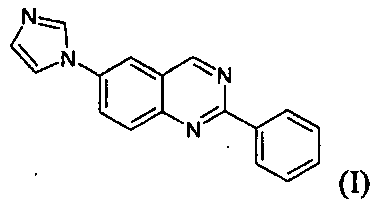
특히, 본 발명의 한 가지 양태는 비-염화된 염기(non-salified base)로서의 및 비-용매화된 형태로의 6-(1H-이미다졸-1-일)-2-페닐퀴나졸린의 다형체에 관한 것이다.In particular, one aspect of the invention relates to the use of 6- (1H-imidazol-1-yl) -2-phenylquinazoline as a non-salified base and in a non-solvated form. It's about shape.
더욱 특히, 이러한 양태는, 품질면에서 현재 유효한 규정(ICH Q10, Pharmaceutical Quality System, June 2008)을 충족시킬 수 있는 적합한 약제학적 제형의 제조에 사용되는 것이 가능하도록, 생체 이용성, 안정성 및 흡습성 특징 및 기계적 성질이 있으며, 재현 가능하게 제조될 수 있는 실질적으로 순수한 다형체 결정 형태를 포함한다.More particularly, this embodiment provides bioavailability, stability, and hygroscopic properties, and makes it possible to be used in the manufacture of suitable pharmaceutical formulations that can meet current effective regulations in quality (ICH Q10, Pharmaceutical Quality System, June 2008). It has mechanical properties and includes substantially pure polymorphic crystal forms that can be produced reproducibly.
표현 "실질적으로 순수한 결정 형태"은 여기서 및 이하의 설명에서 다른 결정 형태과 관련한 단지 미량의 시그널을 함유하는 XRPD에 특징이 있는 결정 형태를 의미한다. 바람직하게는 그러한 시그널의 존재는 시스템(XRPD)의 검출 한계이거나 그 미만이고, 그에 따라서, 본원에서 기재된 경우의 대부분에서, 용어 "실질적으로 순수한 형태"는 90% 이상의 순도를 지닌 결정 형태를 의미한다.The expression “substantially pure crystalline form” means a crystalline form that is characteristic of XRPD containing only traces of signals with respect to other crystalline forms herein and in the description below. Preferably the presence of such a signal is at or below the detection limit of the system (XRPD), and accordingly, in most of the cases described herein, the term "substantially pure form" means a crystalline form having a purity of at least 90%. .
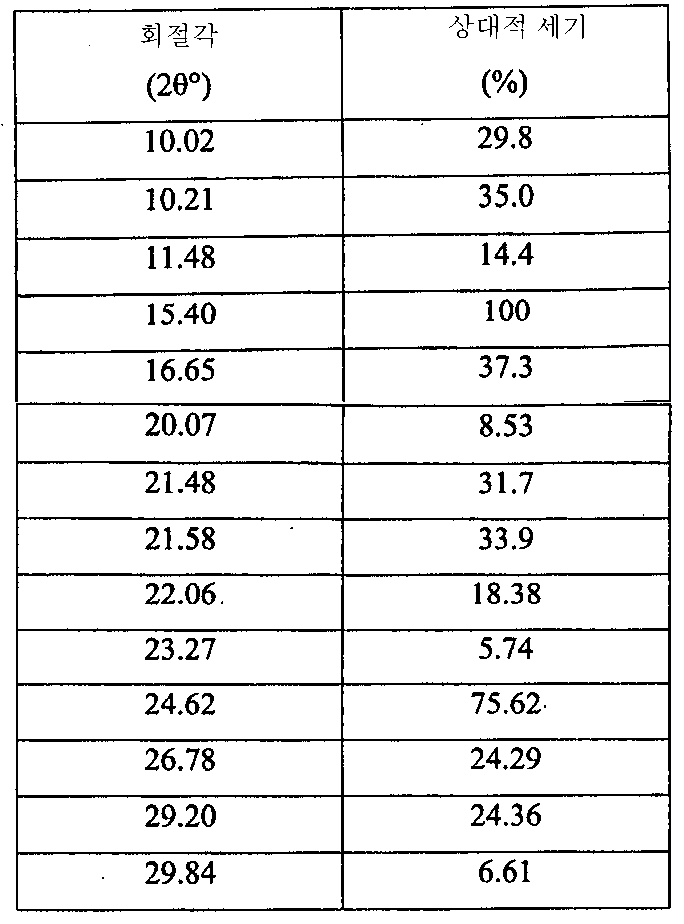
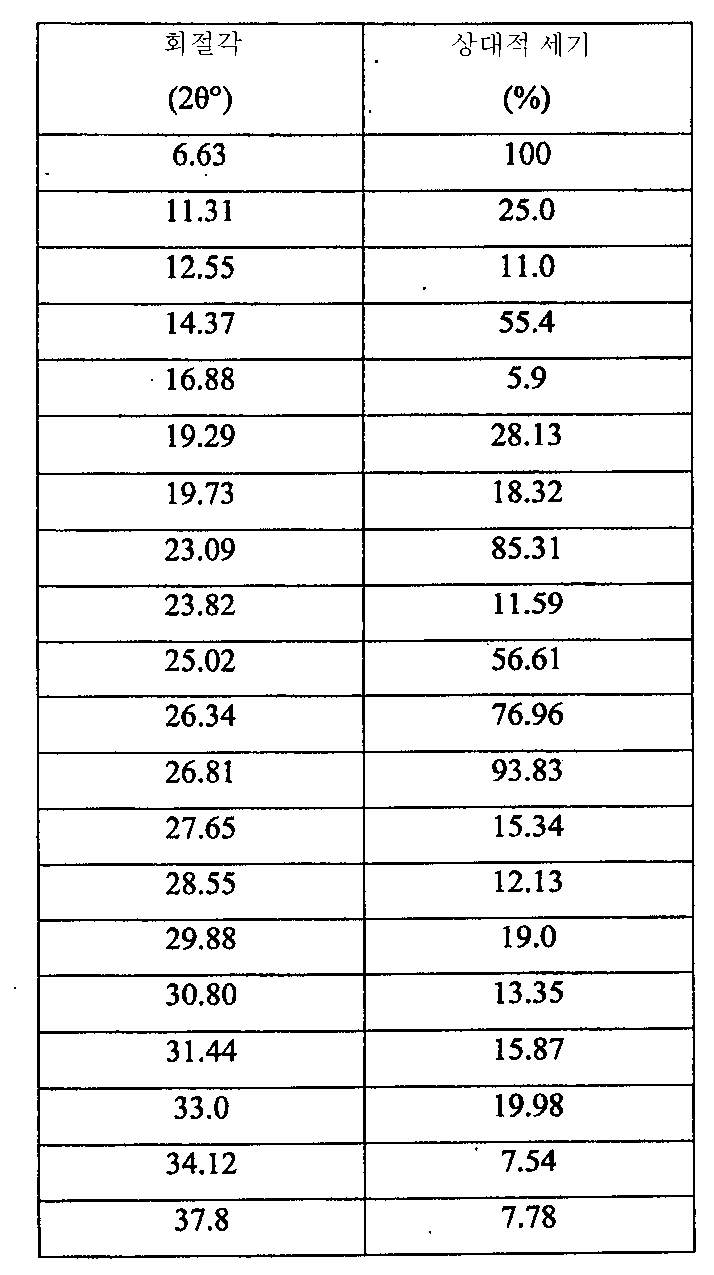
- 도 1에 도시된 X-레이 분말 회절(X-ray powder diffraction (XRPD)) 스펙트럼이 특징이고, 표 1에 주어진 주 피크(main peak)를 포함하는 6-(1H-이미다졸-1-일)-2-페닐퀴나졸린 (C17H12N4)의 결정 형태(유리 염기 다형체 A)6- (1H-imidazol-1-yl, characterized by the X-ray powder diffraction (XRPD) spectrum shown in FIG. 1 and comprising the main peak given in Table 1 Crystal form (free base polymorph A) of 2-phenylquinazoline (C 17 H 12 N 4 )
용어 "주 피크"는 여기서 및 이하 설명에서 상대적인 세기가 > 5%인 피크를 의미한다. 본원에서 기재된 XRPD 디프렉토그램(diffractogram)은 Cu Kα에 의한 조사(irradiation) 및 데이타 처리를 위한 XPERT-PRO의 사용에 의해서 얻어진다.The term "main peak" means a peak where the relative intensity is> 5% here and in the description below. The XRPD diffractogram described herein is obtained by the use of XPERT-PRO for irradiation and data processing with Cu Kα.
더욱 특히, 본원에서 주어진 분말 회절 스텍트럼은 X'Pert PRO 회절장치 (PANalytical) 및 데이타 획득 및 처리를 위한 하기 파라미터를 사용함으로써 획득되었다:More particularly, the powder diffraction spectrum given herein was obtained by using the X'Pert PRO diffractometer (PANalytical) and the following parameters for data acquisition and processing:
애노드: Cu (유형: 세라믹 회절 X-레이 튜브, Long Line Focus, PW3373/00 Cu LFF)Anode: Cu (Type: Ceramic Diffraction X-Ray Tube, Long Line Focus, PW3373 / 00 Cu LFF)
촛점 치수: 12 mm x 0.4 mmFocus dimension: 12 mm x 0.4 mm
촛점 품질(Focus quality): COCIR spec까지.Focus quality: up to COCIR spec.
Be 윈도우 직경(Be window diameter): 14 mm, Be 윈도우 두께: 300 μmBe window diameter: 14 mm, Be window thickness: 300 μm
발전기 설정: 40 mA, 40KVGenerator setting: 40 mA, 40KV
파장: Kα1 = 1.54060 ÅWavelength: Kα1 = 1.54060 Å
Kα2 = 1.54443 ÅKα2 = 1.54443 Å
Kβ = 1.39225 ÅKβ = 1.39225 Å
Kα1/ Kα2 ratio: 0.50000Kα1 / Kα2 ratio: 0.50000
Kα = 1.541874 Å Kα = 1.541874 Å
Kβ = 1.392250 Å Kβ = 1.392250 Å
입사 빔 경로 반경(mm): 240.0Incident beam path radius (mm): 240.0
PW3050/60 X’Pert PRO 표준 해상도 고니어미터(Standard Resolution Goniometer)PW3050 / 60 X’Pert PRO Standard Resolution Goniometer
고니어미터 반경: 240.00 mm (X’Pert PRO MPD systems)Gonimeter radius: 240.00 mm (X’Pert PRO MPD systems)
분배 촛점-발산 슬릿(Dist. Focus-diverg. Slit): 91.00 mmDisp. Focus-diverg. Slit: 91.00 mm
스피닝(Spinning): 1°/secSpinning: 1 ° / sec
출발 위치: 2θ° = 3.0084Starting position: 2θ ° = 3.0084
종료 위치: 2θ° = 39.9834End position: 2θ ° = 39.9834
스텝 크기(Step Size): 2θ° = 0.0170Step Size: 2θ ° = 0.0170
스캔 스텝 시간(Scan step time)(s): 12.9218Scan step time (s): 12.9218
스캔 타입(Scan Type): 연속식Scan Type: Continuous
PSD 모드: 스캐닝PSD Mode: Scanning
PSD 길이: 2θ° = 2.12PSD Length: 2θ ° = 2.12
오프셋(Offset): 2θ° = 0.000Offset: 2θ ° = 0.000
발산 슬릿 크기: 0.2393°Dissipation Slit Size: 0.2393 °
시료 길이: 10.00 mmSample length: 10.00 mm
페이스-회절면(face-diffraction plane) 150 mmFace-
필터: 니켈 (0.020 mm)Filter: Nickel (0.020 mm)
검출기명: X'CeleratorDetector Name: X'Celerator
타입: RTMS 검출기Type: RTMS Detector
PHD - 하부 수준 (%): 39.5PHD-Lower Level (%): 39.5
PHD - 상부 수준 (%): 80.0PHD-Upper Level (%): 80.0
모드: 스캐닝Mode: Scanning
활성 길이(°): 2.122Active Length (°): 2.122
본 발명에서 설명된 그 밖의 모든 디프렉토그램은 동일한 방식으로 얻어졌다:All other diffractograms described in the present invention were obtained in the same way:
표 1TABLE 1
6-(1H-이미다졸-1-일)-2-페닐퀴나졸린의 이러한 결정 형태(유리 염기 다형체 A)는 또한 약 180℃에서 용융에 상응하는 흡열 반응이 개시됨을 나타내는 도 2에 도시된 시차주사열량분석 (DSC)이 특징이다.This crystalline form of 6- (1H-imidazol-1-yl) -2-phenylquinazolin (free base polymorph A) is also shown in FIG. 2 which shows that an endothermic reaction corresponding to melting at about 180 ° C. is initiated. It is characterized by differential scanning calorimetry (DSC).
본원에서 보고된 모든 DSC 스펙트럼은 10°/min의 스캐닝 속도에서 획득되었다.All DSC spectra reported herein were obtained at a scanning speed of 10 ° / min.
6-(1H-이미다졸-1-일)-2-페닐퀴나졸린의 결정 형태(유리 염기 다형체 A)은 또한, 3086, 1587, 1155, 1169, 1185, 851 및 836 cm-1에서 특징적인 흡광도를 나타내는 도 3에 도시된 FT-IR 스펙트럼(ATR)(FT-IR/ATR: 감쇄된 전체 반사 모드(attenuated total reflection mode)에서의 푸리에 변환 적외선 분광분석(Fourier Transform Infrared Spectroscopy))이 특징이다.The crystalline form of 6- (1H-imidazol-1-yl) -2-phenylquinazolin (free base polymorph A) is also characteristic at 3086, 1587, 1155, 1169, 1185, 851 and 836 cm −1 . FT-IR spectrum (ATR) (FT-IR / ATR: Fourier Transform Infrared Spectroscopy in attenuated total reflection mode) shown in FIG. .
6-(1H-이미다졸-1-일)-2-페닐퀴나졸린 (C17H12N4)의 결정 형태(유리 염기 다형체 A)는 본 제품의 열역학적으로 더욱 안정한 형태이며; 이는 형태 A의 도 2의 DSC 스펙트럼을 도 5 및 도 8과 관련한 상응하는 다형체 D 및 E의 스펙트럼과 비교함으로써 명확히 알 수 있다. 형태 A가 높은 융점(약 180℃)이 특징이며, 다른 두 형태는 더 낮은 온도(각각 약 160℃ 및 약 162℃)에서 용융됨을 주지해야 하며; 또한, DSC 스펙트럼으로부터, 다른 형태의 융합 열은 형태 A의 융합 열보다 낮으며, 형태 D 및 E 둘 모두는 형태 A로 재결정됨을 주지해야 한다. 형태 D 및 E에 비한 형태 A의 더 높은 안정성은 또한 실시예 21 및 실시예 26에서 보고된 실험에 의해서 입증된다. 또한, 실시예 3에서의 실험은 명확하게 형태들의 혼합물이 더욱 안정한 형태 A로 변형되는 것이 가능함을 나타내고 있다.The crystalline form of the 6- (1H-imidazol-1-yl) -2-phenylquinazolin (C 17 H 12 N 4 ) (free base polymorph A) is the thermodynamically more stable form of this product; This can be clearly seen by comparing the DSC spectrum of FIG. 2 of Form A with the spectra of corresponding polymorphs D and E with respect to FIGS. 5 and 8. It should be noted that Form A is characterized by a high melting point (about 180 ° C.) and the other two forms melt at lower temperatures (about 160 ° C. and about 162 ° C., respectively); It should also be noted from the DSC spectrum that the other forms of fusion heat are lower than the heat of fusion of Form A, and both Forms D and E are recrystallized into Form A. The higher stability of Form A over Forms D and E is also evidenced by the experiments reported in Examples 21 and 26. In addition, the experiments in Example 3 clearly show that it is possible for the mixture of forms to be transformed into a more stable Form A.
경구 약물 제품의 개발에서, 적절한 결정 형태의 선택은 일반적으로 활성 요소의 효능 및 가공성(processability) 둘 모두를 최적화시키는데 기본이다.In the development of oral drug products, the selection of the appropriate crystalline form is generally the basis for optimizing both the potency and processability of the active ingredient.
형태 A는 비록 중성 pH에서 최적의 용해도에 특징이 있는 것은 아니지만, 이는 위의 pH에서의 허용가능한 용해도(실시예 7) 및 허용 가능한 생체 이용성(실시예 8)을 나타낸다. 다형체 A는 열역학적으로 더욱 안정한 형태이기 때문에, 이는 화학적으로 및 다른 형태로의 전환과 관련하여 더욱 큰 안정성을 나타낸다. 또한, 이러한 다형체는 특히 기계적인 스트레스(실시예 6)와 관련하여 안정하여, 제품의 유동성 및 흡습성을 종종 손상시키며 제형 과정 동안 유해한 다른 형태로 전환되지 않거나 비정질 물질을 형성시키지 않는다. 따라서, 형태 A는 특히 6-(1H-이미다졸-1-일)-2-페닐퀴나졸린의 약제학적 제형, 예컨대, 즉방형(immediate-release) 정제 및 캡슐의 제조에 필요하다. Although Form A is not characterized by optimal solubility at neutral pH, it exhibits acceptable solubility (Example 7) and acceptable bioavailability (Example 8) at the above pH. Since Polymorph A is in a thermodynamically more stable form, it shows greater stability with respect to conversion into chemical and other forms. In addition, these polymorphs are particularly stable with regard to mechanical stress (Example 6), often impairing the fluidity and hygroscopicity of the product and do not convert to other harmful forms or form amorphous materials during the formulation process. Thus, Form A is particularly necessary for the preparation of pharmaceutical formulations of 6- (1H-imidazol-1-yl) -2-phenylquinazolin, such as immediate-release tablets and capsules.
경구 약물 제품의 개발에서, 활성 요소는 생체 이용성, 물리화학적 및 기계적 성질, 예컨대, 유동성 및 밀도, 및 또한 약물 제품의 성질을 확실히 하기 위한 활성 요소의 안정성의 일관성을 확실히 하기 위해서, 명확하고 일정한 결정 형태로 투여되는 것이 절대적으로 필요하다(ICH, Q6A: Test Procedures and Acceptance Criteria for New Drug substances and New Drug products, May 2000). In the development of oral drug products, the active element is a clear and consistent decision to ensure the consistency of bioavailability, physicochemical and mechanical properties such as fluidity and density, and also the stability of the active element to ensure the properties of the drug product. It is absolutely necessary to administer it in the form (ICH, Q6A: Test Procedures and Acceptance Criteria for New Drug substances and New Drug products, May 2000).
6-(1H-이미다졸-1-일)-2-페닐퀴나졸린은 다형체 및 수화물의 형태의 혼합물로서 결정화되는 놀라운 성향을 보였으며, 이때, 결정화 과정은 적절하고 규정된 과정에 따라서 수행되지 않아서, 다형체 및 수화물의 조합에서 상이한 성질에 특징이 있는 활성 요소를 생성시킨다. 이는 상기 논의된 것과 대조를 이루며 약물 제품의 제조에서 상당한 가공성 및 일관성 문제를 유도할 수 있다.6- (1H-imidazol-1-yl) -2-phenylquinazolin has shown a surprising tendency to crystallize as a mixture in the form of polymorphs and hydrates, in which the crystallization process is not carried out according to an appropriate and prescribed procedure. Thus, the combination of polymorphs and hydrates results in active elements characterized by different properties. This is in contrast to the above discussed and can lead to significant processability and consistency issues in the manufacture of drug products.
실시예 1, 실시예 2, 및 실시예 3에서 기재된 바와 같은 6-(1H-이미다졸-1-일)-2-페닐퀴나졸린의 결정화는 높은 순도 및 일관성으로 형태 A를 생성시키는 것을 가능하게 한다. 또한 이의 열적 안정성에 의해서, 이러한 제품을 건조시키는 과정은 보다 적은 주위를 필요로 하고, 그에 따라서, 다른 기재된 형태의 것들에 비해서 용이하고 비용이 덜 든다.Crystallization of 6- (1H-imidazol-1-yl) -2-phenylquinazolin as described in Examples 1, 2, and 3 makes it possible to produce Form A with high purity and consistency do. Also by virtue of its thermal stability, the process of drying these products requires less ambient and, accordingly, is easier and less expensive than those of other described forms.
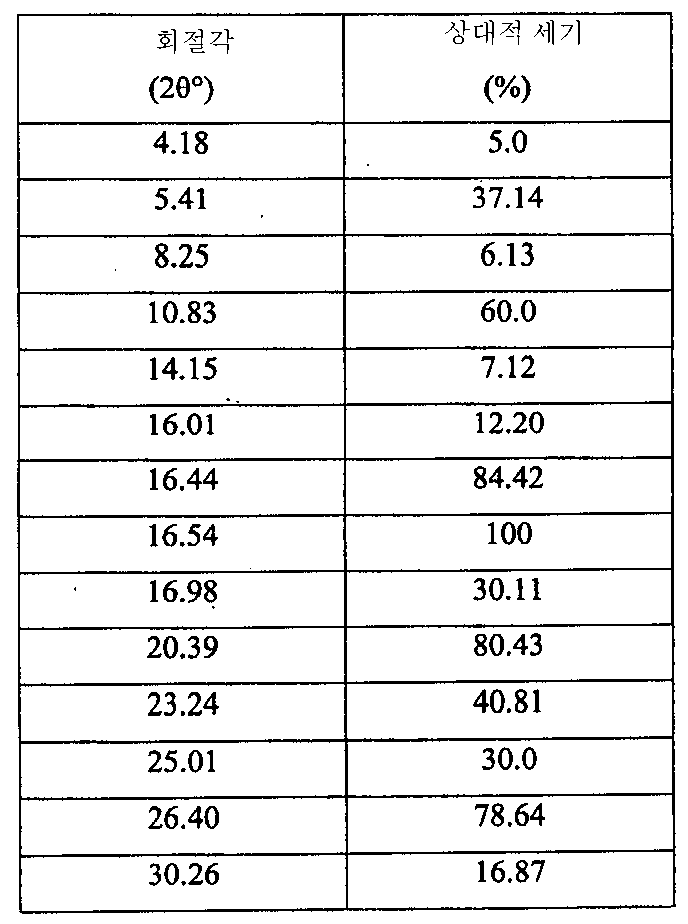
- 도 4에 도시된 XRPD 스펙트럼에 특징이 있으며 표 2에 주어진 주 피크를 포함하는 6-(1H-이미다졸-1-일)-2-페닐퀴나졸린(C17H12N4)의 결정 형태(유리 염기 다형체 D)-Crystalline form of 6- (1H-imidazol-1-yl) -2-phenylquinazolin (C 17 H 12 N 4 ) characterized by the XRPD spectrum shown in FIG. 4 and comprising the main peaks given in Table 2 (Free base polymorph D)
표 2Table 2
6-(1H-이미다졸-1-일)-2-페닐퀴나졸린 (유리 염기 다형체 D)의 이러한 결정 형태은 또한, 약 160℃에서 개시되는 용융에 상응하는 흡열 반응, 형태 A의 결정화에 상응하는 발열 반응 및 약 180℃에서 개시되는 형태 A의 용융에 상응하는 흡열 반응을 나타내는, 도 5에 도시된 DSC 스펙트럼에 특징이 있다..This crystalline form of 6- (1H-imidazol-1-yl) -2-phenylquinazolin (free base polymorph D) also corresponds to the endothermic reaction corresponding to melting initiated at about 160 ° C., crystallization of Form A Is characterized in the DSC spectrum shown in FIG. 5, showing an exothermic reaction and an endothermic reaction corresponding to melting of Form A, initiated at about 180 ° C.
6-(1H-이미다졸-1-일)-2-페닐퀴나졸린(유리 염기 다형체 D)의 이러한 결정 형태은 또한, 3096, 1579, 1586, 1556 및 1247 cm-1에서 특징적인 흡수를 나타내는, 도 6에 도시된 FT-IR 스펙트럼(ATR)에 특징이 있다.This crystalline form of 6- (1H-imidazol-1-yl) -2-phenylquinazolin (free base polymorph D) also shows characteristic absorption at 3096, 1579, 1586, 1556 and 1247 cm −1 , It is characterized by the FT-IR spectrum (ATR) shown in FIG.
결정 형태 A는 강한 산성이 아닌 pH에서 양호한 용해도를 나타내지 않는다. 특정의 경우에, 약물 제품의 흡수는 pH가 중성 또는 염기성인 장관(intestinal tract)에서 수행되는 것이 필요하다. 장용 제형이 종종 이를 수행하기 위해서 사용된다. 일부의 경우에, 난용성 활성 요소의 용해도는 활성 요소의 비정질화 및 습윤성을 증가시키지 않으며 분산 및 붕해 작용을 하는 적합한 부형제중의 비정질 제품의 분산에 의해서 증가될 수 있다. 이러한 비정질화는 활성 요소를 부형제와 함께 밀링함으로써 수행되는 공정이 특히 유리하다. 이의 안정성 특성을 고려하면, 다형체 형태 D는, 6-(1H-이미다졸-1-일)-2-페닐퀴나졸린 형태 중에서, 이러한 유형의 용도에 최상이 되게 하는 형태이다.Crystal Form A does not exhibit good solubility at pH other than strong acidity. In certain cases, the absorption of the drug product needs to be carried out in an intestinal tract whose pH is neutral or basic. Enteric formulations are often used to accomplish this. In some cases, the solubility of poorly soluble active elements can be increased by the dispersion of the amorphous product in a suitable excipient that does not increase the amorphousness and wettability of the active element and has a dispersing and disintegrating action. This amorphous is particularly advantageous in the process carried out by milling the active element with excipients. In view of its stability properties, polymorph Form D is of the 6- (1H-imidazol-1-yl) -2-phenylquinazolin form that is best suited for this type of use.
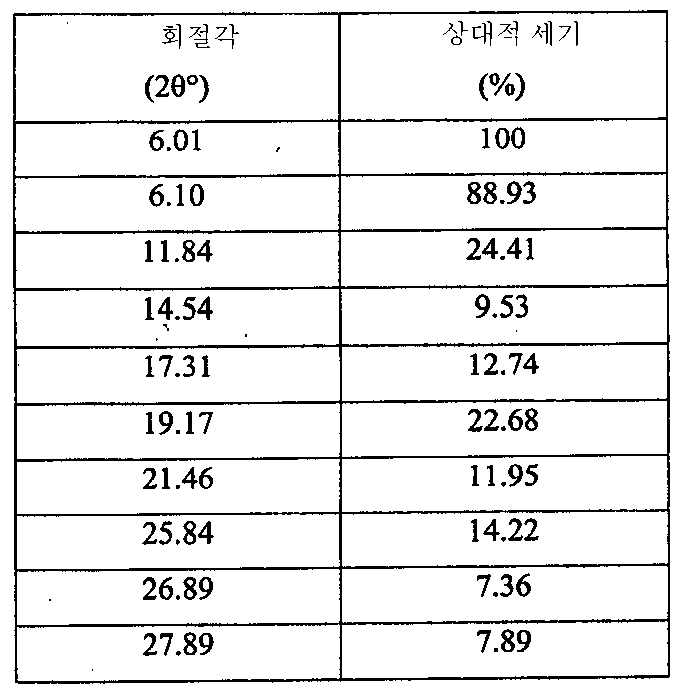
- 도 7에 도시된 XRPD 스펙트럼에 특징이 있으며 표 3에 주어진 주 피크를 포함하는 6-(1H-이미다졸-1-일)-2-페닐퀴나졸린 (C17H12N4)의 결정 형태(유리 염기 다형체 E).-Crystal form of 6- (1H-imidazol-1-yl) -2-phenylquinazolin (C 17 H 12 N 4 ), characterized by the XRPD spectrum shown in FIG. 7 and comprising the main peaks given in Table 3 (Free base polymorph E).
표 3TABLE 3

이러한 결정 형태의 6-(1H-이미다졸-1-일)-2-페닐퀴나졸린(유리 염기 다형체 E)은 또한, 약 162℃에서 개시되는 용융에 상응하는 흡열 반응, 형태 A의 결정화에 상응하는 발열 반응 및 약 181℃에서 개시되는 형태 A의 용융에 상응하는 흡열 반응을 나타내는, 도 8에 도시된 DSC 스펙트럼에 특징이 있다.6- (1H-imidazol-1-yl) -2-phenylquinazoline (free base polymorph E) of this crystal form also undergoes an endothermic reaction corresponding to melting initiated at about 162 ° C., crystallization of Form A. Characterized in the DSC spectrum shown in FIG. 8, which shows a corresponding exothermic reaction and an endothermic reaction corresponding to melting of Form A initiated at about 181 ° C. FIG.
이러한 결정 형태의 6-(1H-이미다졸-1-일)-2-페닐퀴나졸린(유리 염기 다형체 E)은 또한, 3122, 1577, 1338, 1174, 1146, 1071 및 1057 cm-1에서 특징적인 흡수를 나타내는, 도 9에 도시된 FT-IR 스펙트럼(ATR)에 특징이 있다.This crystalline form of 6- (1H-imidazol-1-yl) -2-phenylquinazolin (free base polymorph E) is also characterized at 3122, 1577, 1338, 1174, 1146, 1071 and 1057 cm −1 . It is characterized by the FT-IR spectrum (ATR) shown in FIG.
결정 형태 A는 강한 산성이 아닌 pH에서 양호한 용해도를 나타내지 않는다. 특정의 경우에, 약물 제품의 흡수는 pH가 중성 또는 염기성인 장관(intestinal tract)에서 수행되는 것이 필요하다. 비-산성 pH에서의 결정 형태 E는 형태 A의 용해도의 두 배인 용해도를 나타내며, 형태 D보다 더 안정하고, 그에 따라서, 장용 캡슐로의 6-(1H-이미다졸-1-일)-2-페닐퀴나졸린의 약제학적 제형에 최상의 후보물질이다.Crystal Form A does not exhibit good solubility at pH other than strong acidity. In certain cases, the absorption of the drug product needs to be carried out in an intestinal tract whose pH is neutral or basic. Crystalline Form E at non-acidic pH shows solubility twice that of Form A, and is more stable than Form D, and thus 6- (1H-imidazol-1-yl) -2- into enteric capsules. It is the best candidate for pharmaceutical formulation of phenylquinazoline.
또한 형태 E는, 이의 낮은 결정성 및 가소성으로 인해서, 서방형(slow-release) 약제학적 제형의 제조에 사용될 수 있으며, 형태 D에 대해서 기재된 바와 같이, 활성 요소의 비정질화 및 비정질 제품의 분산이 부형제와 함께 밀링함으로써 얻어지는 약제학적 형태의 제조에 사용될 수 있다.Form E may also be used in the manufacture of slow-release pharmaceutical formulations because of its low crystalline and plasticity, and as described for Form D, It can be used in the manufacture of pharmaceutical forms obtained by milling together with excipients.
다형체 E는 실시예 25에 주어진 방법에 따라서 높은 수율로 일관되게 얻어질 수 있다.Polymorph E can be obtained consistently with high yield according to the method given in Example 25.
본 발명의 또 다른 양태에서, 본 발명은 비-염화 염기로서 및 용매화된 형태로의 6-(1H-이미다졸-1-일)-2-페닐퀴나졸린의 다형체에 관한 것이다. 더욱 특히, 이러한 양태는, 재현 가능한 방법으로 제조될 수 있으며, 생체 이용성, 안정성 및 흡습성 특징 및 기계적 성질을 나타내어, 상기 논의된 바와 같은 적합한 약제학적 제형의 제조에 사용될 수 있게 하는 6-(1H-이미다졸-1-일)-2-페닐퀴나졸린 하이드레이트의 실질적으로 순수한 다형체 결정 형태를 포함한다. In another aspect of the invention, the invention relates to polymorphs of 6- (1H-imidazol-1-yl) -2-phenylquinazolin as a non-chloride base and in solvated form. More particularly, such embodiments can be prepared in a reproducible manner, exhibiting bioavailability, stability and hygroscopic characteristics and mechanical properties, allowing 6- (1H-) to be used in the preparation of suitable pharmaceutical formulations as discussed above. Substantially pure polymorphic crystalline forms of imidazol-1-yl) -2-phenylquinazolin hydrate.
- 도 10에 주어진 XRPD 스펙트럼에 특징이 있으며 표 4에 주어진 주 피크를 포함하는 6-(1H-이미다졸-1-일)-2-페닐퀴나졸린 모노하이드레이트의 결정 형태(C17H12N4.H2O)(유리 염기 형태 B).Crystalline form of 6- (1H-imidazol-1-yl) -2-phenylquinazolin monohydrate (C 17 H 12 N 4 ) characterized by the XRPD spectrum given in FIG. 10 and comprising the main peaks given in Table 4. .H 2 O) (free base Form B).
표 4Table 4
이러한 결정 형태의 6-(1H-이미다졸-1-일)-2-페닐퀴나졸린 모노하이드레이트 (유리 염기 형태 B)는 또한, 약 40 내지 100℃ 범위에서의 탈용매화에 상응하는 흡열 반응, 약 156℃에서 개시되는 용융에 상응하는 흡열 반응, 형태 A의 결정화에 상응하는 발열 반응 및 약 178℃에서 개시되는 형태 A의 용융에 상응하는 흡열 반응을 나타내는, 도 11에 도시된 DSC 스펙트럼에 특징이 있다.This crystalline form of 6- (1H-imidazol-1-yl) -2-phenylquinazolin monohydrate (free base Form B) also has an endothermic reaction corresponding to desolvation in the range of about 40 to 100 ° C., about Characterized in the DSC spectrum shown in FIG. 11, which shows an endothermic reaction corresponding to melting initiated at 156 ° C., an exothermic reaction corresponding to crystallization of Form A, and an endothermic reaction corresponding to melting of Form A initiated at about 178 ° C. have.
이러한 결정 형태의 6-(1H-이미다졸-1-일)-2-페닐퀴나졸린 모노하이드레이트 (유리 염기 형태 B)는 또한, 1327, 1310, 1174, 1146, 1103, 901 및 878 cm-1에서 특징적인 흡수를 나타내는, 도 12에 도시된 FT-IR 스펙트럼(ATR)에 특징이 있다.6- (1H-imidazol-1-yl) -2-phenylquinazolin monohydrate (free base Form B) in this crystal form is also found at 1327, 1310, 1174, 1146, 1103, 901 and 878 cm −1 . Characterized by the FT-IR spectrum (ATR) shown in FIG. 12, which shows characteristic absorption.
- 도 13에 주어진 XRPD 스펙트럼에 특징이 있으며 표 5에 주어진 주 피크를 포함하는 6-(1H-이미다졸-1-일)-2-페닐퀴나졸린 모노하이드레이트의 결정 형태 (C17H12N4.H2O)(유리 염기 형태 C).Crystalline form of 6- (1H-imidazol-1-yl) -2-phenylquinazolin monohydrate (C 17 H 12 N 4 ) characterized by the XRPD spectrum given in FIG. 13 and comprising the main peaks given in Table 5 .H 2 O) (free base form C).
표 5Table 5

이러한 결정 형태의 6-(1H-이미다졸-1-일)-2-페닐퀴나졸린 모노하이드레이트 (유리 염기 형태 C)는 또한 약 30 내지 80℃ 범위에서의 탈용매화에 상응하는 흡열 반응, 약 163℃에서 개시되는 용융에 상응하는 흡열 반응, 형태 A의 결정화에 상응하는 발열 반응 및 약 179℃에서 개시되는 형태 A의 용융에 상응하는 흡열 반응을 나타내는, 도 14에 도시된 DSC 스펙트럼에 특징이 있다.This crystalline form of 6- (1H-imidazol-1-yl) -2-phenylquinazolin monohydrate (free base Form C) also has an endothermic reaction corresponding to desolvation in the range from about 30 to 80 ° C., about 163 Characterized in the DSC spectrum shown in FIG. 14, which shows an endothermic reaction corresponding to melting initiated at ° C., an exothermic reaction corresponding to crystallization of Form A, and an endothermic reaction corresponding to melting of Form A initiated at about 179 ° C. .
이러한 결정 형태의 6-(1H-이미다졸-1-일)-2-페닐퀴나졸린 모노하이드레이트 (유리 염기 형태 C)는 또한 1566, 1520, 1323, 1175, 1146 및 1110 cm-1에서 특징적인 흡수를 나타내는, 도 15에 도시된 FT-IR 스펙트럼(ATR)에 특징이 있다.This crystalline form of 6- (1H-imidazol-1-yl) -2-phenylquinazolin monohydrate (free base Form C) also has characteristic absorption at 1566, 1520, 1323, 1175, 1146 and 1110 cm −1 . It is characterized by the FT-IR spectrum (ATR) shown in FIG.
안정성 이유 때문에 수화된 형태의 활성 요소를 개발하는 것이 일반적으로 바람직하지 않지만, 6-(1H-이미다졸-1-일)-2-페닐퀴나졸린의 경우에, 수화된 형태 및 특히 형태 C는 주위 조건하에서 놀라운 안정성을 나타내며, 실시예 10 내지 실시예 14에 각각 주어진 방법에 따라서 최적의 수율 및 순도로 제조될 수 있다.Although it is generally not desirable to develop active elements in hydrated form for stability reasons, in the case of 6- (1H-imidazol-1-yl) -2-phenylquinazolin, the hydrated form and especially Form C It shows remarkable stability under conditions and can be prepared in optimum yields and purity according to the methods given in each of Examples 10-14.
6-(1H-이미다졸-1-일)-2-페닐퀴나졸린의 다형체의 것들과 유사한 용해도에 특징이 있지만, 수화된 형태의 습윤성은 다형체의 습윤성보다 크고, 그에 따라서, 이들 수화된 형태는 활성 요소의 습윤성을 증가시킬 수 있는 부형제의 사용을 포함하지 않는 약제학적 제형의 제조에 유용하다. 또한, 물을 함유한 6-(1H-이미다졸-1-일)-2-페닐퀴나졸린의 다형체의 처리는 이들 수화된 형태를 생성시키기 때문에, 이들은 과립화 과정 또는 다른 작업에서 물의 사용을 포함하는 모든 약제학적 과정에서 유용하다.Although characterized by solubility similar to that of polymorphs of 6- (1H-imidazol-1-yl) -2-phenylquinazolin, the wettability of the hydrated form is greater than the wettability of the polymorphs, and therefore these hydrated Forms are useful for the preparation of pharmaceutical formulations that do not include the use of excipients that can increase the wettability of the active ingredient. In addition, since the treatment of polymorphs of 6- (1H-imidazol-1-yl) -2-phenylquinazoline with water produces these hydrated forms, they prevent the use of water in the granulation process or other operations. It is useful in all pharmaceutical processes, including.
다형체 및 수화물을 포함하며 비-염화된 염기와 관련된 6-(1H-이미다졸-1-일)-2-페닐퀴나졸린에 대해서 보고된 다양한 결정 형태의 XRPD 스펙트럼이 도 16에서 비교되고 있다. 이러한 경우에도, XRPD 방법이 그 자체로 이들 형태를 확인하기에 충분한데, 그 이유는 이들이 항상 가장 강한 피크를 나타내며 다양한 형태중에서 잘 분리되어, 개별적인 형태의 XRPD 스펙트럼으로부터 발견될 수 있는 바와 같이, 또한, 적합한 순도를 보장하기 때문이다. XRPD spectra of the various crystal forms reported for 6- (1H-imidazol-1-yl) -2-phenylquinazolin, including polymorphs and hydrates and associated with non-chlorinated bases, are compared in FIG. 16. Even in this case, the XRPD methods are sufficient to identify these forms by themselves, because they always show the strongest peaks and are well separated among the various forms, as can be found from the individual forms of XRPD spectra, This is because it ensures proper purity.
본 발명의 또 다른 양태는, 무수 또는 용매화된 형태로, 유기 또는 무기 산과의 염화(salification)에 의해서 얻어질 수 있는 6-(1H-이미다졸-1-일)-2-페닐퀴나졸린의 결정 형태에 관한 것이다. 더욱 특히, 이들 양태는 재현 가능한 방법으로 제조될 수 있으며, 일관된 생체 이용성, 안정성 및 흡습성 특징 및 기계적 성질을 나타내어, 상기 논의된 바와 같은 적합한 약제학적 제형의 제조에 사용될 수 있게 하는 6-(1H-이미다졸-1-일)-2-페닐퀴나졸린의 염의 실질적으로 순수한 다형체 결정 형태를 포함한다. Another aspect of the invention relates to the preparation of 6- (1H-imidazol-1-yl) -2-phenylquinazoline, which can be obtained by salification with an organic or inorganic acid, in anhydrous or solvated form. It relates to the crystalline form. More particularly, these embodiments can be prepared in a reproducible manner and exhibit consistent bioavailability, stability and hygroscopic characteristics and mechanical properties, allowing 6- (1H-) to be used in the preparation of suitable pharmaceutical formulations as discussed above. Substantially pure polymorphic crystal forms of salts of imidazol-1-yl) -2-phenylquinazolin.
- 도 17에 주어진 XRPD 스펙트럼에 특징이 있으며 표 6에 주어진 주 피크를 포함하는 6-(1H-이미다졸-1-일)-2-페닐퀴나졸린 디하이드로클로라이드 모노하이드레이트의 결정 형태(C17H12N4.2HCl.H2O)(디하이드로클로라이드 염 형태 A).Crystalline form of 6- (1H-imidazol-1-yl) -2-phenylquinazolin dihydrochloride monohydrate (C 17 H), characterized by the XRPD spectrum given in FIG. 17 and comprising the main peaks given in Table 6 12 N 4 .2HCl.H 2 O) (dihydrochloride salt form A).
표 6Table 6
이러한 결정 형태의 6-(1H-이미다졸-1-일)-2-페닐퀴나졸린 디하이드로클로라이드 모노하이드레이트(하이드로클로라이드 염 형태 A)는 또한 약 144℃에서 개시되는 흡열 반응 및 약 226℃에서 개시되는 제 2 흡열 반응을 나타내는, 도 18에 도시된 DSC 스펙트럼에 특징이 있다.This crystalline form of 6- (1H-imidazol-1-yl) -2-phenylquinazoline dihydrochloride monohydrate (hydrochloride salt Form A) also started at about 144 ° C. and endothermic reaction at about 226 ° C. It is characterized by the DSC spectrum shown in Fig. 18, showing the second endothermic reaction.
이러한 결정 형태의 6-(1H-이미다졸-1-일)-2-페닐퀴나졸린 디하이드로클로라이드 모노하이드레이트(하이드로클로라이드 염 형태 A)는 또한 도 19a에 도시된 FT-IR 스펙트럼 (ATR)에 특징이 있다.This crystalline form of 6- (1H-imidazol-1-yl) -2-phenylquinazolin dihydrochloride monohydrate (hydrochloride salt form A) is also characterized by the FT-IR spectrum (ATR) shown in FIG. 19A. There is this.
용해도는 6-(1H-이미다졸-1-일)-2-페닐퀴나졸린과 같이 양호한 투과성을 나타내는 약물 제품의 흡수를 측정하는데 기초적인 인자이다. 염기가 허용되는 생체 이용성을 입증하고 있다는 사실에도 불구하고, 난용성이 이의 생체 이용성을 증가시키기에 양호한 경계이다. 일반적으로, 염의 형성이 본 목적을 위해서 이용되지만, 종종, 약한 염기, 예컨대, 6-(1H-이미다졸-1-일)-2-페닐퀴나졸린의 염은 불안정한 흡습성이고, 불량한 기계적 성질을 지닌다. 흡습성이어서 분리 문제가 발생되는 것으로 밝혀진 모노하이드로클로라이드와는 달리, 6-(1H-이미다졸-1-일)-2-페닐퀴나졸린 디하이드로클로라이드 모노하이드레이트는 비-흡습성(실시예 32)이며, 적합한 저장 및 건조 조건하에 열적으로 안정(실시예 30)하고, 기계적인 스트레스와 관련하여 안정(실시예 31)하고, 높은 용해 및 생체 이용성(실시예 33 및 실시예 34)인 것으로 입증되고 있다.Solubility is a fundamental factor in determining the absorption of drug products that exhibit good permeability, such as 6- (1H-imidazol-1-yl) -2-phenylquinazolin. Despite the fact that the base demonstrates acceptable bioavailability, poor solubility is a good boundary to increase its bioavailability. In general, the formation of salts is used for this purpose, but often salts of weak bases such as 6- (1H-imidazol-1-yl) -2-phenylquinazolin are unstable hygroscopic and have poor mechanical properties. . Unlike monohydrochloride, which has been found to be hygroscopic, resulting in separation problems, 6- (1H-imidazol-1-yl) -2-phenylquinazolin dihydrochloride monohydrate is non-hygroscopic (Example 32), It has been proven to be thermally stable (Example 30) under suitable storage and drying conditions, stable with respect to mechanical stress (Example 31), and high dissolution and bioavailability (Examples 33 and 34).
따라서, 이러한 염은 정제 및 캡슐의 형태로 즉방형 약제학적 제형을 제조하기에 적합하다. 또한, 이러한 염은 활성 요소의 높은 용해도를 확보하는 것이 필요한 시럽 및 비경구 제형과 같은 활성 요소의 약제학적 제형에 적합하다. Thus, such salts are suitable for preparing immediate release pharmaceutical formulations in the form of tablets and capsules. In addition, these salts are suitable for pharmaceutical formulations of the active ingredient, such as syrups and parenteral formulations, which need to ensure high solubility of the active ingredient.
- 도 20에 주어진 XRPD 스펙트럼에 특징이 있으며 표 7에 주어진 주 피크를 포함하는 6-(1H-이미다졸-1-일)-2-페닐퀴나졸린 하이드로클로라이드의 결정 형태(C17H12N4?HCl)(하이드로클로라이드 염 형태 B).Crystalline form of 6- (1H-imidazol-1-yl) -2-phenylquinazolin hydrochloride (C 17 H 12 N 4 ) characterized by the XRPD spectrum given in FIG. 20 and comprising the main peaks given in Table 7 HCl) (hydrochloride salt form B).
표 7Table 7
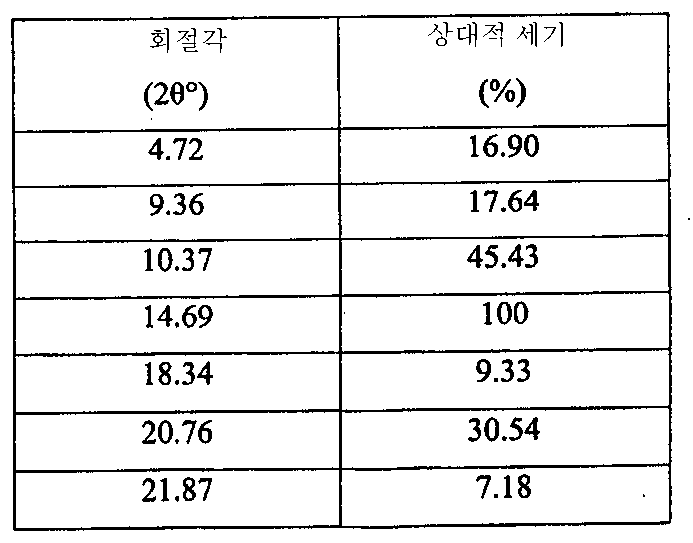
이러한 결정 형태의 6-(1H-이미다졸-1-일)-2-페닐퀴나졸린 모노하이드로클로라이드(하이드로클로라이드 염 형태 B)는 또한, 약 240℃에서의 분해에 의한 용융에 특징이 있다.This crystalline form of 6- (1H-imidazol-1-yl) -2-phenylquinazolin monohydrochloride (hydrochloride salt Form B) is also characterized by melting by decomposition at about 240 ° C.
- 도 21a에 도시된 XRPD 스펙트럼에 의하면 셀 파라미터 a = 8.0152 (6) Å, b = 5.9038 (4) Å, c = 33.127 (3) Å, α: 90°, β = 93.280° (8), γ = 90°, V = 1565.0 (2) Å3의, 공간 그룹(space group) P21/c의 단사정계에 특징이 있으며 표 8에 주어진 주 피크를 포함하는 6-(1H-이미다졸-1-일)-2-페닐퀴나졸린 석시네이트의 결정 형태(C17H12N4?0.5C4H6O4)(석시네이트 염 형태 A). SC-XR를 통해서 얻은 결정 형태의 3차원 구조가 도 21b에 도시되어 있으며, 얻은 구조를 기반으로 하여 계산된 분말 디프렉토그램과 실험 XRPD의 비교가 도 21c에 도시되어 있다.-Cell parameters a = 8.0152 (6) Å, b = 5.9038 (4) Å, c = 33.127 (3) Å, α: 90 °, β = 93.280 ° (8), γ according to the XRPD spectrum shown in FIG. 21A = 90 °, V = 1565.0 (2) 6- (1H-imidazol-1-yl, characterized by the monoclinic system of space group P21 / c of Å 3 and comprising the main peaks given in Table 8 Crystal form (C 17 H 12 N 4 -0.5 C 4 H 6 O 4 ) (-2-succinate salt form A) of 2-phenylquinazoline succinate. The three-dimensional structure of the crystalline form obtained through SC-XR is shown in FIG. 21B and a comparison of the powder diffractogram and experimental XRPD calculated based on the obtained structure is shown in FIG. 21C.
표 8Table 8

이러한 결정 형태의 6-(1H-이미다졸-1-일)-2-페닐퀴나졸린 석시네이트(석시네이트 염 형태 A)는 또한 약 150℃에서 개시되는 흡열 반응 및 약 183℃에서 개시되는 용융에 상응하는 제 2 흡열 반응을 나타내는, 도 22에 도시된 DSC 스펙트럼에 특징이 있다.This crystalline form of 6- (1H-imidazol-1-yl) -2-phenylquinazoline succinate (succinate salt form A) is also subjected to endothermic reactions starting at about 150 ° C. and melting starting at about 183 ° C. It is characterized by the DSC spectrum shown in FIG. 22, which shows the corresponding second endothermic reaction.
이러한 결정 형태의 6-(1H-이미다졸-1-일)-2-페닐퀴나졸린 석시네이트(석시네이트 염 형태 A)는 또한 도 23에 도시된 FT-IR 스펙트럼 (ATR)에 특징이 있다.This crystalline form of 6- (1H-imidazol-1-yl) -2-phenylquinazolin succinate (succinate salt form A) is also characterized by the FT-IR spectrum (ATR) shown in FIG.
- 도 24에 도시된 XRPD 스펙트럼에 특징이 있으며 표 9에 주어진 주 피크를 포함하는 6-(1H-이미다졸-1-일)-2-페닐퀴나졸린 석시네이트의 결정 형태 (C17H12N4?C4H6O4)(석시네이트 염 형태 B).Crystalline form of 6- (1H-imidazol-1-yl) -2-phenylquinazolin succinate characterized by the XRPD spectrum shown in FIG. 24 and comprising the main peaks given in Table 9 (C 17 H 12 N 4 C 4 H 6 O 4 ) (succinate salt form B).
표 9Table 9
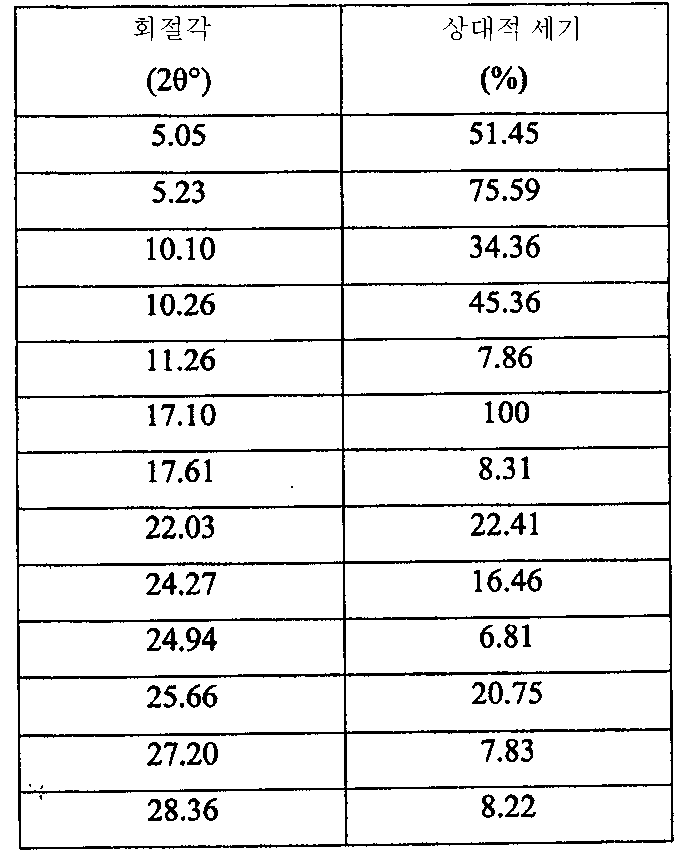
이러한 결정 형태의 6-(1H-이미다졸-1-일)-2-페닐퀴나졸린 석시네이트(석시네이트 염 형태 B)는 또한 약 108℃에서 개시되는 흡열 반응 및 약 181℃에서 개시되는 용융에 상응하는 제 2 흡열 반응을 나타내는 도 25에 도시된 DSC 스펙트럼에 특징이 있다.This crystalline form of 6- (1H-imidazol-1-yl) -2-phenylquinazolin succinate (succinate salt form B) is also subjected to endothermic reactions starting at about 108 ° C. and melting starting at about 181 ° C. Characterized in the DSC spectrum shown in FIG. 25 showing the corresponding second endothermic reaction.
이러한 결정 형태의 6-(1H-이미다졸-1-일)-2-페닐퀴나졸린 석시네이트(석시네이트 염 형태 B)는 또한 도 26에 도시된 FT-IR 스펙트럼(ATR)에 특징이 있다.This crystalline form of 6- (1H-imidazol-1-yl) -2-phenylquinazolin succinate (succinate salt form B) is also characterized by the FT-IR spectrum (ATR) shown in FIG. 26.
- 도 27에 도시된 XRPD 스펙트럼에 특징이 있으며 표 10에 주어진 주 피크를 포함하는 6-(1H-이미다졸-1-일)-2-페닐퀴나졸린 석시네이트(석시네이트 염 형태 C).6- (1H-imidazol-1-yl) -2-phenylquinazoline succinate (succinate salt form C) characterized by the XRPD spectrum shown in FIG. 27 and comprising the main peaks given in Table 10.
표 10Table 10
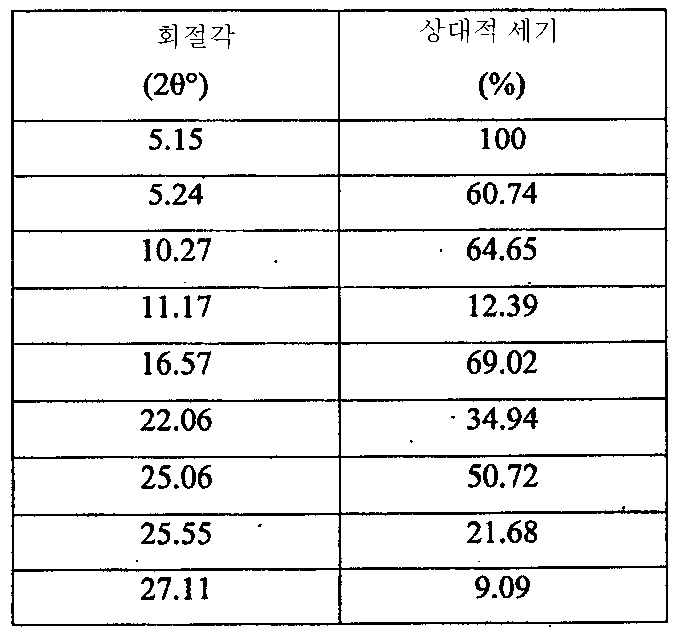
이러한 결정 형태의 6-(1H-이미다졸-1-일)-2-페닐퀴나졸린 석시네이트 (석시네이트 염 형태 C)는 또한 약 119℃에서 개시되는 흡열 반응 및 약 184℃에서 개시되는 용융에 상응하는 제 2 흡열 반응을 나타내는 도 28에 도시된 DSC 스펙트럼에 특징이 있다.This crystalline form of 6- (1H-imidazol-1-yl) -2-phenylquinazolin succinate (succinate salt form C) is also subjected to endothermic reactions starting at about 119 ° C. and melting starting at about 184 ° C. Characterized in the DSC spectrum shown in FIG. 28 showing the corresponding second endothermic reaction.
이러한 결정 형태의 6-(1H-이미다졸-1-일)-2-페닐퀴나졸린 석시네이트(석시네이트 염 형태 C)는 또한 도 29에 도시된 FT-IR 스펙트럼(ATR)에 특징이 있다.This crystalline form of 6- (1H-imidazol-1-yl) -2-phenylquinazolin succinate (succinate salt form C) is also characterized by the FT-IR spectrum (ATR) shown in FIG. 29.
염 6-(1H-이미다졸-1-일)-2-페닐퀴나졸린 석시네이트, 특히 형태 A가 과도한 용해성은 아니지만, 상응하는 염기보다 더 용해성이며, 또한 보다 극적인 조건하에도 흡습성의 부재로 인한 양호한 기계적 안정성에 특징이 있다. 따라서, 이의 결정 형태 A로의 이러한 염은 특별한 기계적 스트레스 또는 과도한 수분 노출과 연루되는 약제학적 제형의 제조에 유용하다.Salt 6- (1H-imidazol-1-yl) -2-phenylquinazoline succinate, especially Form A, is not excessively soluble but is more soluble than the corresponding base and also due to the absence of hygroscopicity under more dramatic conditions It is characterized by good mechanical stability. Thus, these salts into their crystalline Form A are useful for the preparation of pharmaceutical formulations that involve special mechanical stress or excessive moisture exposure.
- 도 31에 도시된 XRPD 스펙트럼에 특징이 있으며 표 11에 주어진 주 피크를 포함하는 6-(1H-이미다졸-1-일)-2-페닐퀴나졸린 (L)-타르트레이트 디하이드레이트 의 결정 형태(C17H12N4?C4H6O6?2H2O)(타르트레이트 염 형태 A).Crystalline form of 6- (1H-imidazol-1-yl) -2-phenylquinazolin (L) -tartrate dihydrate characterized by the XRPD spectrum shown in FIG. 31 and comprising the main peaks given in Table 11 (C 17 H 12 N 4 -C 4 H 6 O 6 -2H 2 O) (tartrate salt form A).
표 11Table 11
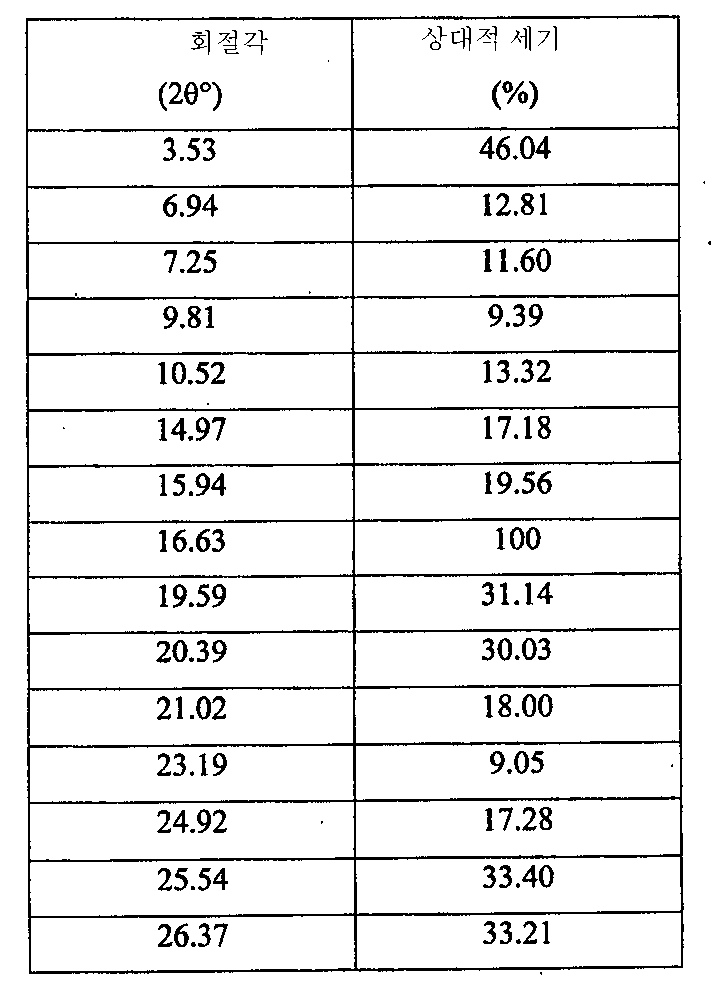
이러한 결정 형태의 6-(1H-이미다졸-1-일)-2-페닐퀴나졸린 (L)-타르트레이트 디하이드레이트(타르트레이트 염 형태 A)는 또한 약 60 내지 95℃ 범위에서의 흡열 반응, 약 103℃에서 개시되는 결정화에 상응하는 발열 반응, 및 약 190℃에서 개시되는 분해에 의한 용융에 상응하는 제 2 흡열 반응을 나타내는, 도 32에 도시된 DSC 스펙트럼에 특징이 있다.This crystalline form of 6- (1H-imidazol-1-yl) -2-phenylquinazolin (L) -tartrate dihydrate (tartrate salt form A) also has an endothermic reaction in the range of about 60 to 95 ° C, It is characterized by the DSC spectrum shown in FIG. 32, showing an exothermic reaction corresponding to crystallization starting at about 103 ° C., and a second endothermic reaction corresponding to melting by decomposition starting at about 190 ° C. FIG.
이러한 결정 형태의 6-(1H-이미다졸-1-일)-2-페닐퀴나졸린 (L)-타르트레이트 디하이드레이트(타르트레이트 염 형태 A)는 또한 도 33에 도시된 FT-IR 스펙트럼(ATR)에 특징이 있다.This crystalline form of 6- (1H-imidazol-1-yl) -2-phenylquinazolin (L) -tartrate dihydrate (tartrate salt form A) also shows the FT-IR spectrum (ATR) shown in FIG. ) Is characteristic.
- 도 35에 도시된 XRPD 스펙트럼에 특징이 있으며 표 12에 주어진 주 피크를 포함하는 6-(1H-이미다졸-1-일)-2-페닐퀴나졸린 (L)-타르트레이트 테트라하이드레이트의 결정 형태(C17H12N4?C4H6O6?4H2O)(타르트레이트 염 형태 B).Crystal form of 6- (1H-imidazol-1-yl) -2-phenylquinazolin (L) -tartrate tetrahydrate, characterized by the XRPD spectrum shown in FIG. 35 and comprising the main peaks given in Table 12 (C 17 H 12 N 4 -C 4 H 6 O 6 -4H 2 O) (tartrate salt form B).
표 12Table 12

이러한 결정 형태의 6-(1H-이미다졸-1-일)-2-페닐퀴나졸린 (L)-타르트레이트 테르라하이드레이트(타르트레이트 염 형태 B)는 또한 약 36 내지 100℃ 범위에서의 네 개의 H2O 분자의 손실에 의한 흡열 반응, 약 114℃에서의 피크에 의한 결정화에 상응하는 발열 반응, 및 약 187℃에서 개시되는 분해에 의한 용융에 상응하는 제 2 흡열 반응을 나타내는 도 36에 도시된 DSC 스펙트럼에 특징이 있다.6- (1H-imidazol-1-yl) -2-phenylquinazoline (L) -tartrate terrahydrate (tartrate salt form B) of this crystal form also contains four in the range of about 36 to 100 ° C. 36 shows an endothermic reaction due to loss of H 2 O molecules, an exothermic reaction corresponding to crystallization by peaks at about 114 ° C., and a second endothermic reaction corresponding to melting by decomposition initiated at about 187 ° C. Is characterized in the DSC spectrum.
이러한 결정 형태의 6-(1H-이미다졸-1-일)-2-페닐퀴나졸린 (L)-타르트레이트 테르라하이드레이트(타르트레이트 염 형태 B)는 또한 도 37에 도시된 FT-IR 스펙트럼 (ATR)에 특징이 있다.This crystalline form of 6- (1H-imidazol-1-yl) -2-phenylquinazolin (L) -tartrate terrahydrate (tartrate salt form B) is also shown in the FT-IR spectrum shown in FIG. ATR).
- 도 38에 도시된 XRPD 스펙트럼에 특징이 있으며, 표 13에 주어진 주 피크를 포함하는 6-(1H-이미다졸-1-일)-2-페닐퀴나졸린 (L)-타르트레이트 모노하이드레이트의 결정 형태(C17H12N4?C4H6O6?H2O)(타르트레이트 염 형태 C).Crystals of 6- (1H-imidazol-1-yl) -2-phenylquinazolin (L) -tartrate monohydrate characterized by the XRPD spectrum shown in FIG. 38 and comprising the main peaks given in Table 13. Form (C 17 H 12 N 4 -C 4 H 6 O 6 -H 2 O) (tartrate salt form C).
표 13Table 13

이러한 결정 형태의 6-(1H-이미다졸-1-일)-2-페닐퀴나졸린 (L)-타르트레이트 모노하이드레이트(타르트레이트 염 형태 C)는 또한 약 42℃에서 개시되는 흡열 반응, 약 130℃에서의 발열 반응 및 약 180℃에서 개시되는 제 2 흡열 반응을 나타내는 도 39에 도시된 DSC 스펙트럼에 특징이 있다.This crystalline form of 6- (1H-imidazol-1-yl) -2-phenylquinazolin (L) -tartrate monohydrate (tartrate salt Form C) is also endothermic, initiated at about 42 ° C., about 130 It is characterized by the DSC spectrum shown in FIG. 39 which shows an exothermic reaction at ° C and a second endothermic reaction initiated at about 180 ° C.
이러한 결정 형태의 6-(1H-이미다졸-1-일)-2-페닐퀴나졸린 (L)-타르트레이트 모노하이드레이트 (타르트레이트 염 형태 C)는 또한 도 40에 도시된 FT-IR 스펙트럼 (ATR)에 특징이 있다.This crystalline form of 6- (1H-imidazol-1-yl) -2-phenylquinazolin (L) -tartrate monohydrate (tartrate salt form C) is also shown in the FT-IR spectrum (ATR) shown in FIG. ) Is characteristic.
- 도 41에 도시된 XRPD 스펙트럼에 특징이 있으며, 표 14에 주어진 주 피크를 포함하는 6-(1H-이미다졸-1-일)-2-페닐퀴나졸린 (L)-타르트레이트의 결정 형태(C17H12N4?C4H6O6)(타르트레이트 염 형태 D).The crystalline form of 6- (1H-imidazol-1-yl) -2-phenylquinazolin (L) -tartrate, characterized by the XRPD spectrum shown in FIG. 41 and comprising the main peaks given in Table 14 C 17 H 12 N 4 -C 4 H 6 O 6 ) (tartrate salt form D).
표 14Table 14

이러한 결정 형태의 6-(1H-이미다졸-1-일)-2-페닐퀴나졸린 (L)-타르트레이트, 즉, 형태 D는 또한 약 189℃에서 개시되는 분해에 의한 용융에 상응하는 흡열 반응을 나타내는 도 42에 도시된 DSC 스펙트럼에 특징이 있다.This crystalline form of 6- (1H-imidazol-1-yl) -2-phenylquinazolin (L) -tartrate, ie Form D, also has an endothermic reaction corresponding to melting by decomposition initiated at about 189 ° C. Characterized in the DSC spectrum shown in FIG.
이러한 결정 형태의 6-(1H-이미다졸-1-일)-2-페닐퀴나졸린 (L)-타르트레이트, 즉, 형태 D는 또한 도 43에 도시된 FT-IR 스펙트럼 (ATR)에 특징이 있다.This crystalline form of 6- (1H-imidazol-1-yl) -2-phenylquinazolin (L) -tartrate, ie Form D, is also characterized by the FT-IR spectrum (ATR) shown in FIG. have.
6-(1H-이미다졸-1-일)-2-페닐퀴나졸린 타르트레이트 모노하이드레이트의 염(형태 A)는 흡습성이 아니며(실시예 45)이며, 기계적인 스트레스와 관련하여 안정(실시예 44)하고, 양호한 용해도(실시예 46) 및 최적의 생체 이용성(실시예 47)을 지닌다. 이러한 염은 적합한 용해도, 안정성 및 가공성 특징을 지니기 때문에 경구 제형, 예컨대, 캡슐 및 정제용으로 사용될 수 있을 뿐만 아니라, 이의 양호한 용해도로 인해서 또한 비경구 제형에 사용될 수 있는데, 그 이유는 이의 용액, 또한 고도로 농축된 용액의 pH가 상응하는 하이드로클로라이드 또는 디하이드로클로라이드의 pH보다 훨씬 더 생리학적 조화성이기 때문이다.The salt of Form 6- (1H-imidazol-1-yl) -2-phenylquinazoline tartrate monohydrate (Form A) is not hygroscopic (Example 45) and is stable with respect to mechanical stress (Example 44). ) And good solubility (Example 46) and optimum bioavailability (Example 47). Such salts can be used not only for oral formulations, such as capsules and tablets, because of their suitable solubility, stability and processability characteristics, but also because of their good solubility and also for parenteral formulations, because their solutions, as well as This is because the pH of the highly concentrated solution is much more physiologically compatible than the pH of the corresponding hydrochloride or dihydrochloride.
- 도 44a에 도시된 XRPD 스펙트럼에 의하면 셀 파라미터 a = 10.7980 (8) Å, b = 11.6643 (7) Å, c = 13.0888 (11) Å, α: 90°, β = 106.842° (8), γ = 90°, V = 1577.8 (2) Å3, 공간 그룹 P21/c의 단사정계에 특징이 있으며 표 15에 주어진 주 피크를 포함하는 6-(1H-이미다졸-1-일)-2-페닐퀴나졸린 푸마레이트의 결정 형태(C17H12N4?0.5C4H4O4)(푸마레이트 염 형태 A).According to the XRPD spectrum shown in FIG. 44A the cell parameters a = 10.7980 (8) Å, b = 11.6643 (7) Å, c = 13.0888 (11) Å, α: 90 °, β = 106.842 ° (8), γ = 90 °, V = 1577.8 (2) Å 3 , 6- (1H-imidazol-1-yl) -2-phenyl, characterized by the monoclinic system of space group P21 / c and comprising the main peaks given in Table 15 Crystalline form of quinazoline fumarate (C 17 H 12 N 4 -0.5C 4 H 4 O 4 ) (fumarate salt form A).
표 15Table 15

SC-XR를 통해서 얻은 이러한 결정 형태의 3차원 구조가 도 44b에 도시되어 있으며, 얻은 구조를 기반으로 하여 계산된 분말 디프렉토그램과 실험 XRPD의 비교가 도 44c에 도시되어 있다.The three-dimensional structure of this crystal form obtained through SC-XR is shown in FIG. 44B and a comparison of the powder diffractogram and experimental XRPD calculated based on the obtained structure is shown in FIG. 44C.
이러한 결정 형태의 6-(1H-이미다졸-1-일)-2-페닐퀴나졸린 푸마레이트(푸마레이트 염 형태 A)는 또한 약 190℃에서 개시되는 흡열 반응, 약 209℃에서 개시되는 제 2 흡열 반응, 및 약 240℃에서 개시되는 제 3 흡열 반응(이들 반응에 상응하는 중량 손실은 말레산 무수물의 손실에 상응함: TGA-FT-IR)을 나타내는 도 45에 도시된 DSC 스펙트럼에 특징이 있다.This crystalline form of 6- (1H-imidazol-1-yl) -2-phenylquinazoline fumarate (fumarate salt form A) is also an endothermic reaction initiated at about 190 ° C., a second initiated at about 209 ° C. Characterized in the DSC spectrum shown in FIG. 45, which shows an endothermic reaction and a third endothermic reaction initiated at about 240 ° C. (weight loss corresponding to these reactions corresponds to loss of maleic anhydride: TGA-FT-IR). have.
이러한 결정 형태의 6-(1H-이미다졸-1-일)-2-페닐퀴나졸린 푸마레이트(푸마레이트 염 형태 A)는 또한 도 46에 도시된 FT-IR 스펙트럼(ATR)에 특징이 있다.This crystalline form of 6- (1H-imidazol-1-yl) -2-phenylquinazolin fumarate (fumarate salt form A) is also characterized by the FT-IR spectrum (ATR) shown in FIG. 46.
- 도 47a에 도시된 XRPD 스펙트럼에 의하면 셀 파라미터 a = 8.9412 (5) Å, b = 9.8081 (5) Å, c = 10.5922 (6) Å, α: 90.517° (4), β = 101.969° (5), γ = 99.132° (4), V = 896.34 (8) Å3, 공간 그룹 P-1의 삼사정계에 특징이 있으며, 표 16에 주어진 주 피크를 포함하는 6-(1H-이미다졸-1-일)-2-페닐퀴나졸린 말레이트(C17H12N4?C4H4O4)(말레이트 염 형태 A). SC-XR를 통해서 얻은 이러한 결정 형태의 3차원 구조가 도 47b에 도시되어 있으며, 얻은 구조를 기반으로 하여 계산된 분말 디프렉토그램과 실험 XRPD의 비교가 도 47c에 도시되어 있다.According to the XRPD spectrum shown in FIG. 47A the cell parameters a = 8.9412 (5) Å, b = 9.8081 (5) Å, c = 10.5922 (6) Å, α: 90.517 ° (4), β = 101.969 ° (5 ), γ = 99.132 ° (4), V = 896.34 (8) Å 3 , 6- (1H-imidazole-1, characterized by the triclinic system of spatial group P-1, comprising the main peak given in Table 16 -Yl) -2-phenylquinazoline maleate (C 17 H 12 N 4 -C 4 H 4 O 4 ) (maleate salt form A). The three-dimensional structure of this crystal form obtained through SC-XR is shown in FIG. 47B and a comparison of the powder diffractogram and experimental XRPD calculated based on the obtained structure is shown in FIG. 47C.
표 16Table 16
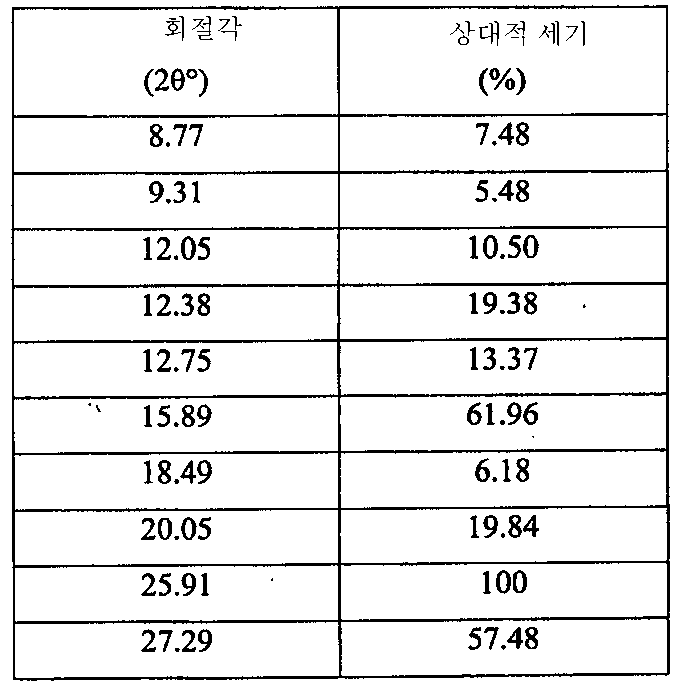
이러한 결정 형태의 6-(1H-이미다졸-1-일)-2-페닐퀴나졸린 말레이트(말레이트 염 형태 A)는 또한 약 156℃에서 개시되는 흡열 반응 및 약 243℃에서 개시되는 제 2 흡열 반응(이들 반응에 상응하는 중량 손실은 말레산 무수물의 손실에 상응함: TGA-FT-IR)을 나타내는 도 48에 도시된 DSC 스펙트럼에 특징이 있다.This crystalline form of 6- (1H-imidazol-1-yl) -2-phenylquinazolin malate (maleate salt Form A) also has an endothermic reaction that starts at about 156 ° C. and a second that starts at about 243 ° C. The DSC spectrum shown in FIG. 48 is representative of the endothermic reaction (weight loss corresponding to these reactions corresponds to loss of maleic anhydride: TGA-FT-IR).
이러한 결정 형태의 6-(1H-이미다졸-1-일)-2-페닐퀴나졸린 말레이트(말레이트 염 형태 A)는 또한 도 49에 도시된 FT-IR 스펙트럼 (ATR)에 특징이 있다.This crystalline form of 6- (1H-imidazol-1-yl) -2-phenylquinazolin malate (maleate salt form A) is also characterized by the FT-IR spectrum (ATR) shown in FIG. 49.
- 도 50에 도시된 XRPD 스펙트럼에 특징이 있으며, 표 17에 주어진 주 피크를 포함하는 6-(1H-이미다졸-1-일)-2-페닐퀴나졸린 말레이트(C17H12N4?C4H4O4?1/2H2O)(말레이트 염 형태 B).50- (1H-imidazol-1-yl) -2-phenylquinazoline maleate (C 17 H 12 N 4 ?) Characterized by the XRPD spectrum shown in FIG. 50 and comprising the main peaks given in Table 17; C 4 H 4 O 4 ½ 1/2 H 2 O) (maleate salt form B).
표 17Table 17

이러한 결정 형태의 6-(1H-이미다졸-1-일)-2-페닐퀴나졸린 말레이트 헤미하이드레이트(말레이트 염 형태 B)는 또한 약 83℃에서의 피크에 의한 흡열 반응, 약 153℃에서 개시되는 흡열 반응 및 약 228℃에서 개시되는 흡열 반응을 나타내는 도 51에 도시된 DSC 스펙트럼에 특징이 있다.This crystalline form of 6- (1H-imidazol-1-yl) -2-phenylquinazoline maleate hemihydrate (maleate salt form B) is also endothermic with a peak at about 83 ° C., at about 153 ° C. Characterized by the DSC spectrum shown in FIG. 51 showing the endothermic reaction initiated and the endothermic reaction initiated at about 228 ° C.
이러한 결정 형태의 6-(1H-이미다졸-1-일)-2-페닐퀴나졸린 말레이트 헤미하이드레이트(말레이트 염 형태 B)는 또한 도 52에 도시된 FT-IR 스펙트럼 (ATR)에 특징이 있다.This crystalline form of 6- (1H-imidazol-1-yl) -2-phenylquinazoline maleate hemihydrate (maleate salt form B) is also characterized by the FT-IR spectrum (ATR) shown in FIG. 52. have.
6-(1H-이미다졸-1-일)-2-페닐퀴나졸린의 말레이트 및 특히 이의 결정 형태 A는, 이러한 제품을 위해서 얻은 안정한 염 중에서도, 과도한 용해도를 나타내지는 않지만(실시예 58), 최상의 생체 이용성을 보이는(실시예 59) 형태이다. 또한, 6-(1H-이미다졸-1-일)-2-페닐퀴나졸린 말레이트 형태 A는 전체적으로 비-흡습성(실시예 57)이며, 기계적인 스트레스와 관련하여 비교적 안정한(실시예 56) 것으로 밝혀졌다. 따라서, 이러한 형태는 즉방형 경구용 약제학적 형태, 예컨대, 정제 및 캡슐의 제조에 아주 유용한데, 그 이유는 이것이 적합한 용해도, 안정성 및 가공성 특징을 지니기 때문이다. 또한, 이의 양호한 용해도로 인해서, 이는 주사 가능한 제형에 또한 사용될 수 있는데, 그 이유는 이의 용액, 또한 고도로 농축된 용액의 pH가 상응하는 하이드로클로라이드 또는 디하이드로클로라이드의 pH보다 훨씬 더 생리학적 조화성이기 때문이다. Maleates of 6- (1H-imidazol-1-yl) -2-phenylquinazolin and in particular its crystalline Form A, although not showing excessive solubility, among the stable salts obtained for these products (Example 58), In the form of the best bioavailability (Example 59). In addition, 6- (1H-imidazol-1-yl) -2-phenylquinazolin malate Form A is overall non-hygroscopic (Example 57) and is relatively stable with respect to mechanical stress (Example 56). Turned out. Thus, these forms are very useful for the preparation of immediate oral pharmaceutical forms such as tablets and capsules because they have suitable solubility, stability and processability characteristics. In addition, due to its good solubility, it can also be used in injectable formulations, since the pH of its solution, also a highly concentrated solution, is much more physiologically compatible than the pH of the corresponding hydrochloride or dihydrochloride. to be.
- 도 53에 도시된 XRPD 스펙트럼에 특징이 있으며, 표 18에 주어진 주 피크를 포함하는 6-(1H-이미다졸-1-일)-2-페닐퀴나졸린 포스페이트의 결정 형태(C17H12N4?H2PO4)(포스페이트 염 형태 A).Crystalline form of 6- (1H-imidazol-1-yl) -2-phenylquinazolin phosphate (C 17 H 12 N), characterized by the XRPD spectrum shown in FIG. 53 and comprising the main peaks given in Table 18; 4 HH 2 PO 4 ) (phosphate salt form A).
표 18Table 18
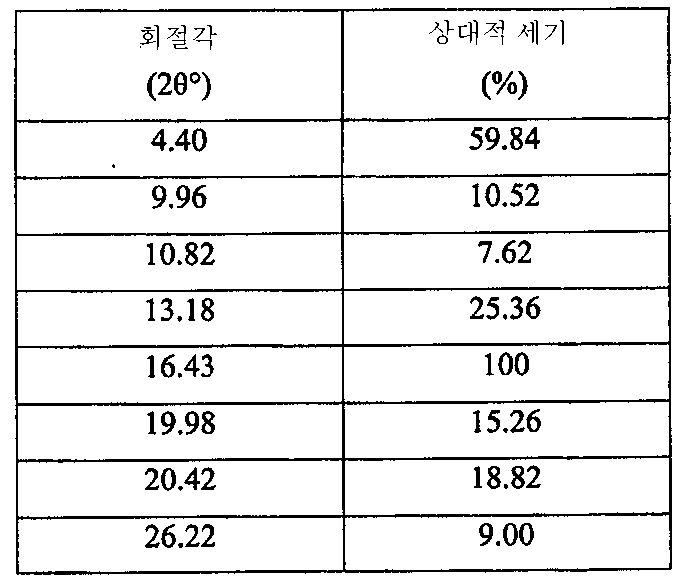
이러한 결정 형태의 6-(1H-이미다졸-1-일)-2-페닐퀴나졸린 포스페이트(포스페이트 염 형태 A)는 융점 242-246℃에 특징이 있다.This crystalline form of 6- (1H-imidazol-1-yl) -2-phenylquinazolin phosphate (phosphate salt Form A) is characterized at a melting point of 242-246 ° C.
- 도 54에 도시된 XRPD 스펙트럼에 특징이 있으며, 표 10에 주어진 주 피크를 포함하는 6-(1H-이미다졸-1-일)-2-페닐퀴나졸린 옥살레이트 (C17H12N4?C2H2O4)(옥살레이트 염 형태 A)의 결정 형태.54- (1H-imidazol-1-yl) -2-phenylquinazoline oxalate (C 17 H 12 N 4 ?) Characterized by the XRPD spectrum shown in FIG. 54 and comprising the main peaks given in Table 10; C 2 H 2 O 4 ) (oxalate salt form A).
표 19Table 19
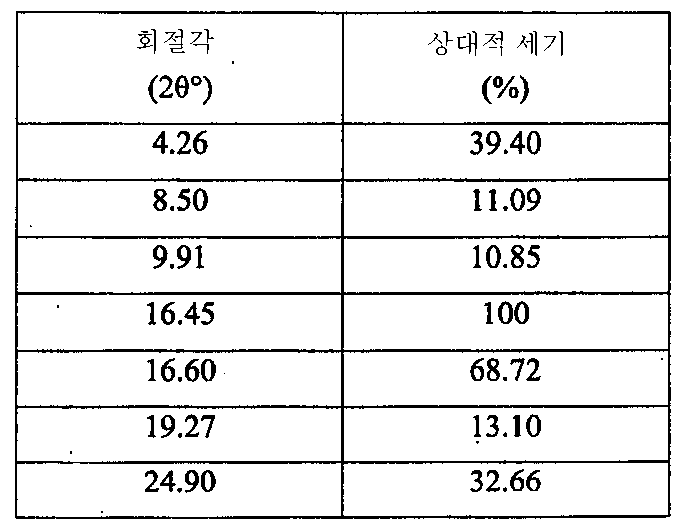
이러한 결정 형태의 6-(1H-이미다졸-1-일)-2-페닐퀴나졸린 옥살레이트(옥살레이트 염 형태 A)는 도한 약 229℃에서 개시되는 흡열 반응을 나타내는 도 55에 도시된 DSC 스펙트럼에 특징이 있다.This crystalline form of 6- (1H-imidazol-1-yl) -2-phenylquinazoline oxalate (oxalate salt form A) also shows the DSC spectrum shown in FIG. 55 showing an endothermic reaction initiated at about 229 ° C. It is characterized by.
이러한 결정 형태의 6-(1H-이미다졸-1-일)-2-페닐퀴나졸린 옥살레이트(옥살레이트 염 형태 A)는 또한 도 56에 도시된 FT-IR 스펙트럼(ATR)에 특징이 있다.This crystalline form of 6- (1H-imidazol-1-yl) -2-phenylquinazoline oxalate (oxalate salt form A) is also characterized by the FT-IR spectrum (ATR) shown in FIG. 56.
본 발명의 화합물의 제조 및 이들 성질의 측정에 대한 대표적인 실시예가 이하 기재된다.Representative examples for the preparation of the compounds of the invention and the measurement of these properties are described below.
실시예Example 1: 6-(1H- 1: 6- (1H- 이미다졸Imidazole -1-일)-2--1-yl) -2- 페닐퀴나졸린Phenylquinazoline , (, ( CC 1717 HH 1212 NN 44 ), ), 다형체Polymorph A의 제조(방법 A) Preparation of A (Method A)
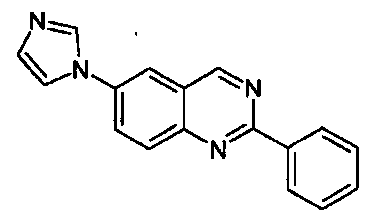
6-(1H-이미다졸-1-일)-2-페닐퀴나졸린(2.7 g)을 아세토니트릴(300 mL)에 현탁시키고, 현탁액을 가열 환류시키고, 혼합물을 고온인 동안에 여과하고, 여액을 40℃로 냉각시키고, 대략 절반의 용매를 약한 진공하에 증류 제거하고, 에틸 아세테이트를 서서히 첨가하였다(150ml). 혼합물을 실온으로 냉각시키고, 이를 3 시간 동안 그 온도에서 교반하고, 여과하고, 50℃, 25 mmHg에서 6 시간 동안 건조시켰다. 2.1 g(78%)의 오커-옐로우(ochre-yellow) 생성물을 얻었다. KF < 0.5%, XRPD: 다형체 A. m.p.: 180.4℃ (DSC), TGA: 범위 40-180℃에서 중량 손실이 관찰되지 않음. C17H12N4에 대한 계산치: C 74.98, H 4.44, N 20.57; 실측치: C 74.82, H 4.41, N 20.68. 1H NMR (DMSO-d6) 9.72 (s, 1H), 8.39-8.63 (m, 5H), 8.23 (d, 1H), 8.00 (s, 1H), 7.58-7.62 (m, 3H), 7.23 (s, 1H). 다형체 A가 디메틸포름아미드 (DMF)/에틸 아세테이트, DMF/아세톤, DMF/메틸 에틸 케톤, 디클로로메탄 (DCM)/에틸 아세테이트 또는 DCM/아세톤으로부터 유사하게 얻어질 수 있다.6- (1H-imidazol-1-yl) -2-phenylquinazolin (2.7 g) is suspended in acetonitrile (300 mL), the suspension is heated to reflux, the mixture is filtered while hot and the filtrate is 40 Cool to 占 폚, approximately half of the solvent was distilled off under slight vacuum and ethyl acetate was added slowly (150 ml). The mixture was cooled to rt, which was stirred at that temperature for 3 hours, filtered and dried at 50 ° C., 25 mm Hg for 6 hours. 2.1 g (78%) of ocher-yellow product was obtained. KF <0.5%, XRPD: Polymorph A. mp: 180.4 ° C. (DSC), TGA: no weight loss was observed in the range 40-180 ° C. Calcd for C 17 H 12 N 4 : C 74.98, H 4.44, N 20.57; Found: C 74.82, H 4.41, N 20.68. 1 H NMR (DMSO-d 6 ) 9.72 (s, 1H), 8.39-8.63 (m, 5H), 8.23 (d, 1H), 8.00 (s, 1H), 7.58-7.62 (m, 3H), 7.23 ( s, 1 H). Polymorph A can similarly be obtained from dimethylformamide (DMF) / ethyl acetate, DMF / acetone, DMF / methyl ethyl ketone, dichloromethane (DCM) / ethyl acetate or DCM / acetone.
실시예Example 2: 6-(1H- 2: 6- (1H- 이미다졸Imidazole -1-일)-2--1-yl) -2- 페닐퀴나졸린Phenylquinazoline , (, ( C17H12N4C17H12N4 ), ), 다형체Polymorph A의 제조(방법 B) Preparation of A (Method B)
6-(1H-이미다졸-1-일)-2-페닐퀴나졸린, 236 g을 250 mL의 환류 메탄올에 용해시키고, 고온의 용액을 여과하고, 교반하면서, 40 내지 50℃에서 1.5L의 아세톤에 첨가하고, 생성된 현탁액을 30 내지 40℃에서 약한 진공하에 그 용적을 절반으로 농축시키고, 이어서, 실온으로 냉각시키고, 실온에서 밤새 교반하였다. 혼합물을 여과하고, 생성물을 아세톤으로 세척하고, 50℃, 25 mmHg에서 12시간 동안 건조시켰다. 208g (88%)의 오커-옐로우 생성물을 얻었다. KF < 0.5%, XRPD: 다형체 A. 다형체 A가 메탄올/에틸 아세테이트로부터 유사하게 얻어질 수 있다.236 g of 6- (1H-imidazol-1-yl) -2-phenylquinazolin, dissolved in 250 mL of reflux methanol, the hot solution is filtered and stirred while 1.5 L of acetone at 40-50 ° C. The resulting suspension was concentrated in half at 30-40 ° C. under slight vacuum, then cooled to room temperature and stirred at room temperature overnight. The mixture was filtered and the product was washed with acetone and dried at 50 ° C., 25 mm Hg for 12 hours. 208 g (88%) of ocher-yellow product was obtained. KF <0.5%, XRPD: Polymorph A. Polymorph A can similarly be obtained from methanol / ethyl acetate.
실시예Example 3: 6-(1H- 3: 6- (1H- 이미다졸Imidazole -1-일)-2--1-yl) -2- 페닐퀴나졸린Phenylquinazoline , (, ( CC 1717 HH 1212 NN 44 ), ), 다형체Polymorph A의 제조(형태 A로의 다른 결정 형태의 전환에 의해서) Preparation of A (by Switching Other Crystal Forms to Form A)
6-(1H-이미다졸-1-일)-2-페닐퀴나졸린 (2,6 g)을 250 mL을 환류 DCM에 용해시키고, 고온의 용액을 여과하고, 교반하면서, 40 내지 50℃에서 1.5L의 아세톤에 첨가하였다. 생성되는 현탁액을 30 내지 40℃에서 약한 진공하에 그 용적을 대략 절반으로 농축시키고, 이어서, 5℃로 냉각시키고, 그러한 온도에서 1 시간 동안 교반하였다. 혼합물을 여과하고, 생성물을 아세톤으로 세척하고, 40℃, 20 mmHg에서 8시간 동안 건조시켰다. 2.08 g (80%)의 오커-옐로우 생성물을 얻었다. XRPD: 다형체 A+C의 혼합물. 얻은 혼합물을 실온에서 100 mL의 에틸 아세테이트에 현탁시키고, 그러한 온도에서 3일 동안 교반하고, 여과하고, 40℃, 20 mmHg에서 8시간 동안 건조시켰다. 1.73 g (83%)의 오커-옐로우 생성물을 얻었다. KF < 0.5%, XRPD: 다형체 A. 상기 기재된 바와 유사한 방법으로, 결정 형태 A, B, C, D, E의 두 가지 또는 세 가지 혼합물이 하기 용매중 하나의 현탁액을 교반시킴으로서 다형체 A로 전환될 수 있다: 아세토니트릴, 3차-부틸 메틸 에테르 (TBME), 디에틸 에테르, 에틸 아세테이트, 이소프로필 아세테이트, 이소프로필 에테르, 헥산. 현탁액중의 교반은 또한, 사용된 용매 및 전환되는 다형체 혼합물의 조성에 따라서, 7일 동안 계속되어야 한다.250 mL of 6- (1H-imidazol-1-yl) -2-phenylquinazolin (2,6 g) was dissolved in reflux DCM and the hot solution was filtered and 1.5 at 40-50 ° C. with stirring. Was added to L of acetone. The resulting suspension was concentrated to approximately half its volume at 30-40 ° C. under light vacuum, then cooled to 5 ° C. and stirred at that temperature for 1 hour. The mixture was filtered and the product was washed with acetone and dried at 40 ° C., 20 mm Hg for 8 hours. 2.08 g (80%) of ocher-yellow product was obtained. XRPD: Mixture of Polymorph A + C. The resulting mixture was suspended in 100 mL of ethyl acetate at room temperature, stirred at that temperature for 3 days, filtered and dried at 40 ° C., 20 mm Hg for 8 hours. 1.73 g (83%) of ocher-yellow product was obtained. KF <0.5%, XRPD: Polymorph A. In a manner similar to that described above, two or three mixtures of Crystal Forms A, B, C, D, and E were converted to Polymorph A by stirring a suspension of one of the following solvents: Can be converted: acetonitrile, tert-butyl methyl ether (TBME), diethyl ether, ethyl acetate, isopropyl acetate, isopropyl ether, hexane. Stirring in the suspension should also continue for 7 days, depending on the solvent used and the composition of the polymorph mixture to be converted.
실시예Example 4: 4: 현탁액중의In suspension 형태 A의 안정성 Form A Stability
6-(1H-이미다졸-1-일)-2-페닐퀴나졸린 다형체 A(150 mg)를 5mL의 용매에 현탁시키고, 25±5℃에서 7일 동안 현탁시키고, 이어서, 여과하고, 여액을 XRPD 분석에 가하였다.6- (1H-imidazol-1-yl) -2-phenylquinazolin polymorph A (150 mg) is suspended in 5 mL of solvent, suspended at 25 ± 5 ° C. for 7 days, then filtered and filtrate Was added to the XRPD analysis.
형태 A는 실온에서 하기 용매중에 현탁시키는 경우에 안정한 것으로 밝혀졌다: DCM, 프로판올, 에틸 에테르, 3차-부틸 메틸 에테르, 아세톤, 에틸 아세테이트, 이소프로필 아세테이트, 톨루엔, 헥산.Form A was found to be stable when suspended in the following solvents at room temperature: DCM, propanol, ethyl ether, tert-butyl methyl ether, acetone, ethyl acetate, isopropyl acetate, toluene, hexane.
실시예Example 5: 열적 안정성. 5: thermal stability.
다형체 A는, 가열하는 경우, 40℃, RH 85%에서, 5일 이상 동안 안정한 것으로 밝혀졌으며, 또한, 90℃에서 가열하는 경우 12일 이상 동안 안정하였으며; 사실, 다른 형태의 형성(XRPD) 및 다형체 A 이외의 피크가 어떠한 경우에서도 발견되지 않았다.Polymorph A was found to be stable for at least 5 days at 40 ° C.,
실시예Example 6: 기계적 스트레스( 6: mechanical stress ( 밀링milling )에 대한 형태 A의 안정성Stability of Form A to
6-(1H-이미다졸-1-일)-2-페닐퀴나졸린, 다형체 A를 Retsch MM 200 밀(mill)에 의해서 50 Hz에서 5분 동안 밀링하고, 생성되는 생성물을 XRPD에 의해서 분석하였다. 형태 A의 디프렉토그램을 다른 결정 형태의 어떠한 오염 없이 얻었으며, 밀링 동안 인지 가능한 비정질 물질의 형성이 검출되지 않았다.6- (1H-imidazol-1-yl) -2-phenylquinazolin, Polymorph A, was milled by
실시예Example 7: 형태 A의 안정성 7: stability of Form A
6-(1H-이미다졸-1-일)-2-페닐퀴나졸린, 다형체 A (150 mg)의 샘플을 현탁액을 얻기 위해서 500 rpm에서 및 24 시간 동안 37℃에서 pH 7.4 (8 mL)의 포스페이트 완충액중에서 교반시켰다. 이어서, 현탁액을 여과하고, 용해된 생성물의 농도를 260nm에서 UV 흡광도를 측정함으로써 측정하였다. 용해도는 0.1 mg/mL(0.02-0.06 mg/mL) 미만이다. 6-(1H-이미다졸-1-일)-2-페닐퀴나졸린, 다형체 A (250 mg)의 샘플을 현탁액을 얻기 위해서 500 rpm에서 및 24 시간 동안 37℃에서 pH 2 (2 mL)의 포스페이트 완충액중에서 교반하였다. 이어서, 현탁액을 여과하고, 용해된 생성물의 농도를 260nm에서 UV 흡광도를 측정함으로써 측정하였다. 용해도는 1.8 mg/mL이었다.A sample of 6- (1H-imidazol-1-yl) -2-phenylquinazoline, polymorph A (150 mg) was obtained at pH 7.4 (8 mL) at 500 rpm and at 37 ° C. for 24 hours to obtain a suspension. Stir in phosphate buffer. The suspension was then filtered and the concentration of dissolved product was measured by measuring UV absorbance at 260 nm. Solubility is less than 0.1 mg / mL (0.02-0.06 mg / mL). A sample of 6- (1H-imidazol-1-yl) -2-phenylquinazolin, polymorph A (250 mg) was prepared at pH 2 (2 mL) at 500 rpm and at 37 ° C. for 24 hours to obtain a suspension. Stir in phosphate buffer. The suspension was then filtered and the concentration of dissolved product was measured by measuring UV absorbance at 260 nm. Solubility was 1.8 mg / mL.
실시예Example 8: 8: 다형체Polymorph A의 생체 이용성 Bioavailability of A
6-(1H-이미다졸-1-일)-2-페닐퀴나졸린, 다형체 A의 약물 동력학적 특징을 래트에서 경구 투여(10 mg/Kg, 히프로멜로즈(Hypromellose) 0.5%, 트윈 80(Tween 80) 0.4%, 벤질 알콜(benzyl alcohol) 0.9%, 염화나트륨 0.9%, 증류수 중)를 정맥내 투여(5 mg/kg, DMSO/Tween 80/0.9% NaCl 10:10:80)와 비교함으로써 평가하였으며, 이때, 혈액 샘플은 5, 15, 30, 60, 120, 240, 360, 480 및 720분의 시점에 수집되었다. 샘플을 HPLC-MS에 의해서 분석하여 내부 표준으로서 디페닐하이드라민 하이드로클로라이드를 사용함으로써 6-(1H-이미다졸-1-일)-2-페닐퀴나졸린의 함량을 측정하였다. 측정된 약물 동력학이 이하 요약되어 있다: 고려중의 다형체가 낮은 용해도를 지닌다는 사실에도 불구하고, 생체 이용성(F%)이 전체적으로 허용됨을 주지해야 한다.6- (1H-imidazol-1-yl) -2-phenylquinazolin, pharmacokinetic characteristics of Polymorph A in oral administration in rats (10 mg / Kg, Hypromellose 0.5%, Tween 80 ( Tween 80) 0.4%, benzyl alcohol 0.9%, sodium chloride 0.9%, in distilled water) evaluated by intravenous administration (5 mg / kg, DMSO /
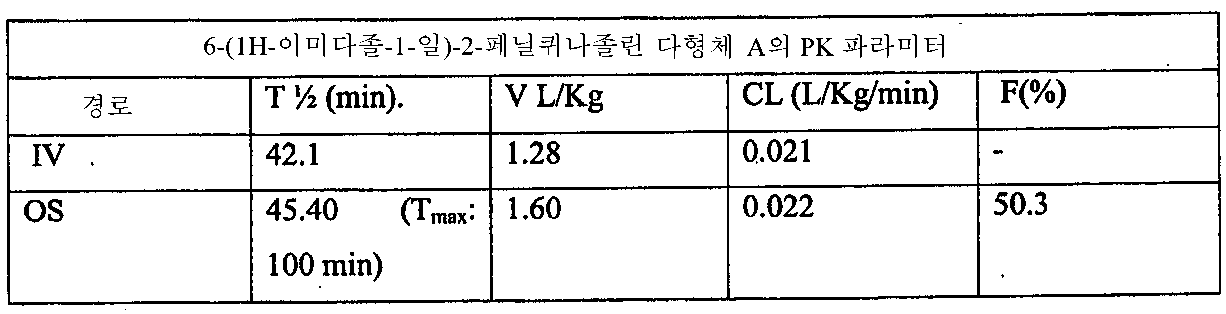
실시예Example 9: 6-(1H- 9: 6- (1H- 이미다졸Imidazole -1-일)-2--1-yl) -2- 페닐퀴나졸린Phenylquinazoline 모노하이드레이트Monohydrate ( ( CC 1717 HH 1212 NN 44 ?H? H 22 O), 형태 B의 제조(방법 A).O), Preparation of Form B (Method A).

50 mg의 6-(1H-이미다졸-1-일)-2-페닐퀴나졸린을 70℃에서 몇 분 동안 가열하고, 이어서, 여과하고, 안정적으로 실온에서 서서히 증발시켰다. 생성된 결정을 분석하였다. XRPD: 형태 B. TGA: 중량 손실: 6.8% (C17H12N4?H2O에 대한 이론치: 6.2%), 방출된 증기에 대한 H2O의 스펙트럼에 따른 TGA-IR. 형태 B가 n-프로판올로부터 및 에탄올로부터 유사하게 얻어질 수 있다.50 mg of 6- (1H-imidazol-1-yl) -2-phenylquinazolin was heated at 70 ° C. for several minutes, then filtered and slowly evaporated at room temperature stably. The resulting crystals were analyzed. XRPD: Form B. TGA: Weight Loss: 6.8% (Theoretical for C 17 H 12 N 4 -H 2 O: 6.2%), TGA-IR according to the spectrum of H 2 O for released vapors. Form B can be similarly obtained from n-propanol and from ethanol.
실시예Example 10: 6-(1H- 10: 6- (1H- 이미다졸Imidazole -1-일)-2--1-yl) -2- 페닐퀴나졸린Phenylquinazoline 모노하이드레이트Monohydrate ( ( CC 1717 HH 1212 NN 44 ?H? H 22 O), 형태 B의 제조(방법 B).O), Preparation of Form B (Method B).
2.5 g의 6-(1H-이미다졸-1-일)-2-페닐퀴나졸린을 200 mL의 이소프로판올에 현탁시키고, 현탁액을, 교반시키면서, 30분 동안 환류 가열하고, 이어서, 혼합물을 고온일 때 여과하고, 용매를 약한 진공하에 75℃에서 약 50 내지 80mL의 용적으로 증발 제거하고, 이어서, 생성되는 혼합물을 5℃에서 약 2 시간 동안 약하게 교반하면서 냉각시켰다. 생성된 고형물을 여과하고, 차가운 이소프로판으로 세척하고, 40℃, 20 mmHg에서 12 시간 동안 건조시켰다. 2.2 g (88%)의 오커-옐로우 생성물을 얻었다. XRPD: 형태 B. KF: 6.5%, C17H12N4?H2O에 대한 계산치: C 70.33, H 4.86, N 19.30; 실측치 C 70.22, H 4.91, N 19.25. 1H NMR (DMSO-d6) 9.72 (s, 1H), 8.39-8.63 (m, 5H), 8.23 (d, 1H), 8.00 (s, 1H), 7.58-7.62 (m, 3H), 7.23 (s, 1H); 형태 B가 n-프로판올, 부탄올, t-부탄올로부터 유사하게 제조될 수 있다.2.5 g of 6- (1H-imidazol-1-yl) -2-phenylquinazolin is suspended in 200 mL of isopropanol, the suspension is heated to reflux for 30 minutes with stirring, and then the mixture is hot The solvent was evaporated off at 75 ° C. in a volume of about 50-80 mL under mild vacuum, and the resulting mixture was then cooled with gentle stirring at 5 ° C. for about 2 hours. The resulting solid was filtered, washed with cold isopropane and dried at 40 ° C., 20 mm Hg for 12 hours. 2.2 g (88%) of ocher-yellow product was obtained. XRPD: Form B. KF: 6.5%, calcd for C 17 H 12 N 4 -H 2 O: C 70.33, H 4.86, N 19.30; Found C 70.22, H 4.91, N 19.25. 1 H NMR (DMSO-d 6 ) 9.72 (s, 1H), 8.39-8.63 (m, 5H), 8.23 (d, 1H), 8.00 (s, 1H), 7.58-7.62 (m, 3H), 7.23 ( s, 1 H); Form B can be similarly prepared from n-propanol, butanol, t-butanol.
실시예Example 11: 열적 안정성. 11: thermal stability.
형태 B를 40℃, RH 85%에서 7일 동안 가열하였다: XRPD 스펙트럼에서 형태 E의 시그널이 나타남을 주지해야 한다. 가변 온도 실험(VT-XRPD)에서, 형태 B는, 40℃ 내지 180℃ 사이로 가열되는 경우, 180℃의 온도에 도달하기 전에 형태 E로 전환됨을 나타낸다. 전환은 융점을 통과하지 않으면서 수행되지만, 이는 범위 40 내지 80℃에서 이미 매우 두드러지며, 120-130℃에서 이미 실질적으로 완료된다. 실온으로 냉각시키면, 형성된 다형체 E가 안정하다.Form B was heated at 40 ° C.,
실시예Example 12: 형태 B의 용해도. 12: Solubility of Form B.
6-(1H-이미다졸-1-일)-2-페닐퀴나졸린, 형태 B (50 mg)의 샘플을 현탁액을 얻기 위해서 500rpm에서 및 37℃에서 24 시간 동안 pH 7.4 (2 mL)의 포스페이트 완충액중에서 교반하였다. 이어서, 현탁액을 여과하고, 용해된 생성물의 농도를 260nm에서 UV 흡광도를 측정함으로써 측정하였다. 용해도는 약 0.1 mg/mL (0.08-0.12 mg/mL)이었다.Samples of 6- (1H-imidazol-1-yl) -2-phenylquinazolin, Form B (50 mg) were phosphate buffered at pH 7.4 (2 mL) for 24 hours at 500 rpm and 37 ° C. to obtain a suspension. Stir in the middle. The suspension was then filtered and the concentration of dissolved product was measured by measuring UV absorbance at 260 nm. Solubility was about 0.1 mg / mL (0.08-0.12 mg / mL).
실시예Example 13: 6-(1H- 13: 6- (1H- 이미다졸Imidazole -1-일)-2--1-yl) -2- 페닐퀴나졸린Phenylquinazoline 모노하이드레이트Monohydrate ( ( CC 1717 HH 1212 NN 44 ?H? H 22 O), 형태 C의 제조(방법 A).O), Preparation of Form C (Method A).

50 mg의 6-(1H-이미다졸-1-일)-2-페닐퀴나졸린을 2 mL의 메탄올에 현탁시키고, 현탁액을 몇 분 동안 환류 가열하고, 이어서, 여과하고, 안정적으로 실온에서 서서히 증발시켰다. 생성된 결정을 분석하였다. XRPD: 형태 C. TGA: 중량 손실: 6.32 % (C17H12N4?H2O에 대한 이론치: 6.2%), 방출된 증기에 대한 H2O의 IR 스펙트럼과 일치하는 TGA-IR.50 mg of 6- (1H-imidazol-1-yl) -2-phenylquinazolin is suspended in 2 mL of methanol, the suspension is heated to reflux for several minutes, then filtered and slowly evaporated slowly at room temperature I was. The resulting crystals were analyzed. XRPD: Form C. TGA: Weight Loss: 6.32% (Theoretical for C 17 H 12 N 4 -H 2 O: 6.2%), TGA-IR consistent with IR spectrum of H 2 O for emitted vapors.
실시예Example 14: 6-(1H- 14: 6- (1H- 이미다졸Imidazole -1-일)-2--1-yl) -2- 페닐퀴나졸린Phenylquinazoline 모노하이드레이트Monohydrate ( ( CC 1717 HH 1212 NN 44 ?H? H 22 O), 형태 C의 제조(방법 B).O), Preparation of Form C (Method B).
1.5 g의 6-(1H-이미다졸-1-일)-2-페닐퀴나졸린을 15 mL의 메탄올에 현탁시키고, 현탁액을 5분 동안 환류 가열하고, 이어서, 여과하고, 교반하면서 0℃로 냉각하고, 10 mL의 3차-부틸 메틸 에테르를 교반하면서 첨가하고, 0℃에서 추가의 5분 동안 교반을 계속하고, 이어서, 생성물을 여과해 내고, 40℃, 20 mmHg에서 12 시간 동안 건조시켰다. 1g (68%)의 생성물을 황색 결정의 형태로 얻었다. 생성된 결정을 분석하였다. XRPD: 형태 C. KF: 6.4%, C17H12N4?H2O에 대한 계산치: C 70.33, H 4.86, N 19.30; 실측치 C 70.29, H 4.88, N 19.31. 1H NMR (DMSO-d6) 9.72 (s, 1H), 8.39-8.63 (m, 5H), 8.23 (d, 1H), 8.00 (s, 1H), 7.58-7.62 (m, 3H), 7.23 (s, 1H); 형태 C가 역용매(anti-solvent)로서 에틸 에테르 또는 테트라하이드로푸란을 사용함으로써 유사한 방법으로 얻어진다.1.5 g of 6- (1H-imidazol-1-yl) -2-phenylquinazolin is suspended in 15 mL of methanol and the suspension is heated to reflux for 5 minutes, then filtered and cooled to 0 ° C. with stirring. 10 mL of tert-butyl methyl ether was added with stirring, stirring was continued for an additional 5 minutes at 0 ° C., then the product was filtered off and dried at 40 ° C., 20 mm Hg for 12 hours. 1 g (68%) of the product was obtained in the form of yellow crystals. The resulting crystals were analyzed. XRPD: Form C. KF: 6.4%, Calcd for C 17 H 12 N 4 -H 2 O: C 70.33, H 4.86, N 19.30; Found C 70.29, H 4.88, N 19.31. 1 H NMR (DMSO-d 6 ) 9.72 (s, 1H), 8.39-8.63 (m, 5H), 8.23 (d, 1H), 8.00 (s, 1H), 7.58-7.62 (m, 3H), 7.23 ( s, 1 H); Form C is obtained in a similar manner by using ethyl ether or tetrahydrofuran as anti-solvent.
실시예Example 15: 6-(1H- 15: 6- (1H- 이미다졸Imidazole -1-일)-2--1-yl) -2- 페닐퀴나졸린Phenylquinazoline 모노하이드레이트( Monohydrate ( CC 1717 HH 1212 NN 44 ?H? H 22 O), 형태 C의 제조(방법 C).O), Preparation of Form C (Method C).
3 g의 6-(1H-이미다졸-1-일)-2-페닐퀴나졸린을 80 mL의 에탄올에 현탁시키고, 현탁액을 10분 동안 환류 가열하고, 이어서, 고온인 동안 여과하고, 생성 용액을 실온에서 80mL의 물에 교반하면서 첨가하고, 교반을 추가의 5분 동안 계속하고, 이어서, 혼합물을 여과하고, 20℃, 10 mmHg에서 12 시간 동안 건조시켰다. 2.3 g (75%)의 생성물을 황색 분말의 형태로 얻었다. 생성된 결정을 분석하였다. XRPD: 형태 C. 형태 C가 메탄올/H2O로부터 생성물을 침전시킴으로써 유사하게 얻어진다.3 g of 6- (1H-imidazol-1-yl) -2-phenylquinazolin is suspended in 80 mL of ethanol, the suspension is heated to reflux for 10 minutes, then filtered while hot, and the resulting solution Stirring was added to 80 mL of water at room temperature with stirring, and stirring was continued for an additional 5 minutes, then the mixture was filtered and dried at 20 ° C., 10 mmHg for 12 hours. 2.3 g (75%) of the product were obtained in the form of a yellow powder. The resulting crystals were analyzed. XRPD: Form C. Form C is similarly obtained by precipitating the product from methanol / H 2 O.
실시예Example 16: 16: 현탁액중의In suspension 형태 C의 안정성. Stability of Form C.
6-(1H-이미다졸-1-일)-2-페닐퀴나졸린 다형체 C(150 mg)를 5 mL의 용매에 현탁시키고, 25±5℃에서 7일 동안 교반하고, 이어서, 여과하고, 여액을 XRPD 분석에 가하였는데, 그러한 분석은 스펙트럼의 일관성으로부터 안정성을 확인시킨다. 형태 C는 실온에서 현탁액 중에서 교반하는 경우에 H2O중에서 안정하지만, 다음 용매: 에틸 에테르, 디메틸 3차-부틸 에테르, DCM, 아세톤, 에틸 아세테이트, 이소프로필 아세테이트중에서는, 형태 A로 전환되었다. 형태 A, B, D 및 E는 교반하면서 H2O 중에서 25±5℃에서 7일 동안 현탁되는 경우에 형태 C로 전환되었다.6- (1H-imidazol-1-yl) -2-phenylquinazolin polymorph C (150 mg) is suspended in 5 mL of solvent, stirred at 25 ± 5 ° C. for 7 days, then filtered, The filtrate was subjected to XRPD analysis, which confirms stability from the consistency of the spectrum. Form C is stable in H 2 O when stirred in suspension at room temperature, but converted to Form A in the following solvents: ethyl ether, dimethyl tert-butyl ether, DCM, acetone, ethyl acetate, isopropyl acetate. Forms A, B, D and E were converted to Form C when suspended for 7 days at 25 ± 5 ° C. in H 2 O with stirring.
실시예Example 17: 열적 안정성 17: thermal stability
형태 C를 40℃, RH 85%에서 5일 동안 가열되며, 형태 C는 이들 조건하에 안정한데, 그 이유는 XRPD 스펙트럼에서 다른 시그날이 나타남이 주지되지 않기 때문이다. 90℃에서 3시간 동안 가열된 형태 C는 형태 E로의 완전한 전환을 나타냈다(XRPD). 실온으로 냉각시키면, 형성된 다형체 E는 안정하다.Form C is heated at 40 ° C.,
실시예Example 18: 형태 C의 용해도 18: Solubility of Form C
6-(1H-이미다졸-1-일)-2-페닐퀴나졸린, 형태 C(30mg)의 샘플을 현탁액을 얻기 위해서 500rpm에서 및 37℃ 24시간 동안 pH 7.4 (2 mL)의 포스페이트 완충액중에서 교반하였다. 이어서, 현탁액을 여과하고, 용해된 생성물의 농도를 260nm에서 UV 흡광도를 측정함으로써 측정하였다. 용해도는 약 0.1 mg/mL(0.06-0.10 mg/mL)이었다.A sample of 6- (1H-imidazol-1-yl) -2-phenylquinazolin, Form C (30 mg) was stirred in phosphate buffer at pH 7.4 (2 mL) at 500 rpm and for 24 hours at 37 ° C. to obtain a suspension. It was. The suspension was then filtered and the concentration of dissolved product was measured by measuring UV absorbance at 260 nm. Solubility was about 0.1 mg / mL (0.06-0.10 mg / mL).
실시예Example 19: 6-(1H- 19: 6- (1H- 이미다졸Imidazole -1-일)-2--1-yl) -2- 페닐퀴나졸린Phenylquinazoline ( ( CC 1717 HH 1212 NN 44 ), ), 다형체Polymorph D의 제조(방법 A). Preparation of D (Method A).
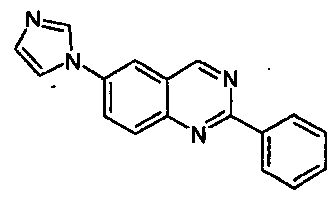
50 mg의 6-(1H-이미다졸-1-일)-2-페닐퀴나졸린을 15 mL의 3차-부틸 메틸 에테르에 현탁시키고, 현탁액을 몇 분 동안 환류 가열하고, 이어서, 여과하고, 안정적으로 실온에서 서서히 증발시켰다. 생성된 결정을 분석하였다: XRPD: 다형체 D, TGA: 범위 40-180℃에서 중량 손실이 관찰되지 않았다.50 mg of 6- (1H-imidazol-1-yl) -2-phenylquinazolin is suspended in 15 mL tert-butyl methyl ether and the suspension is heated to reflux for several minutes, then filtered and stable Evaporated slowly at room temperature. The resulting crystals were analyzed: XRPD: Polymorph D, TGA: No weight loss was observed in the range 40-180 ° C.
실시예Example 20: 6-(1H- 20: 6- (1H- 이미다졸Imidazole -1-일)-2--1-yl) -2- 페닐퀴나졸린Phenylquinazoline ( ( CC 1717 HH 1212 NN 44 ), ), 다형체Polymorph D의 제조(방법 B). Preparation of D (Method B).
1.2 g의 6-(1H-이미다졸-1-일)-2-페닐퀴나졸린을 150 mL의 이소프로필 아세테이트에 현탁시키고, 형탁액을 교반하면서 30분 동안 환류 가열하고, 이어서, 고온인 동안 여과하고, 약한 진공하에 70℃에서 농축시켰다. 용적이 약 50mL인 때에, 증류를 중단하고, 혼합물을 70-60℃에서 추가로 5분 동안 교반하고, 이어서, 여과하고, 40℃, 20 mmHg에서 6 시간 동안 건조시켰다. 560 mg(47%)의 생성물을 연노랑 결정의 형태로 얻었다. 생성된 결정을 분석하였다. XRPD: 다형체 D. 1H NMR (DMSO-d6) 9.72(s, 1H), 8.39-8.63(m, 5H), 8.23 (d, 1H), 8.00 (s, 1H), 7.58-7.62 (m, 3H), 7.23 (s, 1H); 유사한 방법을 수행하지만, 5℃로 냉각시키고, 그러한 온도에서 여과함으로써, 다형체 D 및 형태 C의 혼합물이 얻어진다. 무수 에틸 에테르에 현탁되고 실온에서 6일 동안 교반된 이러한 결정 형태의 혼합물이 순수한 다형체 D로 전환된다. 순수한 형태 D가 또한 상기 기재된 바와 같이 수행하는데, 약 2 시간에 걸쳐서 실온으로 냉각시키고 실온에서 여과함으로써 얻어진다. 순수한 형태 D는 또한 상기 기재된 바와 같이 수행하는데, 용매로서 메틸 에틸 케톤 (MEK)을 사용함으로써 얻어진다.1.2 g of 6- (1H-imidazol-1-yl) -2-phenylquinazolin is suspended in 150 mL of isopropyl acetate, heated to reflux for 30 minutes with stirring, and then filtered while hot And concentrated at 70 ° C. under light vacuum. When the volume was about 50 mL, distillation was stopped and the mixture was stirred for an additional 5 minutes at 70-60 ° C., then filtered and dried at 40 ° C., 20 mmHg for 6 hours. 560 mg (47%) of the product were obtained in the form of light yellow crystals. The resulting crystals were analyzed. XRPD: Polymorph D. 1 H NMR (DMSO-d 6 ) 9.72 (s, 1H), 8.39-8.63 (m, 5H), 8.23 (d, 1H), 8.00 (s, 1H), 7.58-7.62 (m , 3H), 7.23 (s, 1 H); A similar method is carried out but by cooling to 5 ° C. and filtration at such a temperature, a mixture of Polymorph D and Form C is obtained. A mixture of these crystal forms suspended in anhydrous ethyl ether and stirred for 6 days at room temperature is converted to pure polymorph D. Pure Form D is also performed as described above, obtained by cooling to room temperature and filtering at room temperature over about 2 hours. Pure Form D is also performed as described above, obtained by using methyl ethyl ketone (MEK) as solvent.
실시예Example 21: 열적 안정성. 21: thermal stability.
형태 D는 40℃, RH 85%에서 7일 동안 가열되며, 형태 D는 그러한 조건하에 안정한데, 그 이유는 XRPD 스펙트럼에서 다른 시그날이 나타남이 주지되지 않기 때문이다. 90℃에서 3 시간 동안 가열된 형태 D는 안정한 것으로 입증된다(XRPD). 160℃로 추가로 가열하면, 형태 D는 용융되고 형태 A로 결정화된다(XRPD).Form D is heated for 7 days at 40 ° C.,
실시예Example 22: 형태 D의 용해도. 22: Solubility of Form D.
6-(1H-이미다졸-1-일)-2-페닐퀴나졸린, 형태 D (50 mg)의 샘플을 현탁시키기 위해서 500rpm에서 및 37℃에서 24시간 동안 pH 7.4 (2 mL)의 포스페이트 완충액에 현탁시키고, 이어서, 현탁액을 여과하고, 용해된 생성물의 농도를 260nm에서 UV 흡광도를 측정함으로써 측정하였다. 용해도는 약 0.1 mg/mL (0.04-0.06 mg/mL)이었다.To suspend a sample of 6- (1H-imidazol-1-yl) -2-phenylquinazolin, Form D (50 mg) in phosphate buffer at pH 7.4 (2 mL) for 24 hours at 500 rpm and 37 ° C. After suspension, the suspension was then filtered and the concentration of dissolved product was measured by measuring UV absorbance at 260 nm. Solubility was about 0.1 mg / mL (0.04-0.06 mg / mL).
실시예Example 23. 6-(1H- 23. 6- (1H- 이미다졸Imidazole -1-일)-2--1-yl) -2- 페닐퀴나졸린Phenylquinazoline ( ( CC 1717 HH 1212 NN 44 ), ), 다형체Polymorph E이 제조(방법 A). E is prepared (method A).

50 mg의 6-(1H-이미다졸-1-일)-2-페닐퀴나졸린을 6 mL의 p-자일렌에 현탁시키고, 현탁액을 몇 분 동안 환류 가열하고, 이어서, 여과하고, 안정적으로 실온에서 서서히 증발시켰다. 생성된 결정을 분석하였다. XRPD: 다형체 E. TGA: 범위 40-180℃에서 중량 손실이 관찰되지 않았다.50 mg of 6- (1H-imidazol-1-yl) -2-phenylquinazolin is suspended in 6 mL of p-xylene and the suspension is heated to reflux for several minutes, then filtered and stably at room temperature Evaporated slowly at The resulting crystals were analyzed. XRPD: Polymorph E. TGA: No weight loss was observed in the range 40-180 ° C.
실시예Example 24: 6-(1H- 24: 6- (1H- 이미다졸Imidazole -1-일)-2--1-yl) -2- 페닐퀴나졸린Phenylquinazoline , , 다형체Polymorph E의 제조(방법 B). Preparation of E (Method B).
250 mg의 6-(1H-이미다졸-1-일)-2-페닐퀴나졸린을 20 mL의 DCM에 현탁시키고, 현탁액을 몇 분 동안 환류 가열하고, 이어서, 여과하고, 약한 진공하에 실온에서 서서히 증발시켰다. 생성된 결정을 분석하였다. XRPD: 다형체 E.250 mg of 6- (1H-imidazol-1-yl) -2-phenylquinazolin is suspended in 20 mL of DCM, the suspension is heated to reflux for several minutes, then filtered and slowly at room temperature under slight vacuum. Evaporated. The resulting crystals were analyzed. XRPD: Polymorph E.
실시예Example 25: 6-(1H- 25: 6- (1H- 이미다졸Imidazole -1-일)-2--1-yl) -2- 페닐퀴나졸린Phenylquinazoline , , 다형체Polymorph E의 제조(방법 C). Preparation of E (Method C).
1.5 g의 6-(1H-이미다졸-1-일)-2-페닐퀴나졸린을 15 mL의 메탄올에 현탁시키고, 현탁액을 5분 동안 환류 가열하고, 이어서, 고온인 동안 여과하고, 교반하면서 120℃로 가열된 150 mL의 p-자일렌에 서서히 첨가하고, 이어서, 메탄올을 증발시키고, 혼합물을 교반하면서 50-60℃로 냉각하고, 약한 진공을 적용함으로써 용적을 약 100mL로 감소시키고, 생성 혼합물을 추가로 30분 동안 서서히 교반하고, 이어서, 여과하고, 자일렌으로 세척하고, 60℃, 10 mmHg에서 24시간 동안 건조시켰다. 1.4 g (98%)의 생성물을 황색 결정의 형태로 얻었다. 생성된 결정을 분석하였다, XRPD: 다형체 E. 1H NMR (DMSO-d6) 9.72 (s, 1H), 8.39-8.63 (m, 5H), 8.23 (d, 1H), 8.00 (s, 1H), 7.58-7.62 (m, 3H), 7.23 (s, 1H). 유사한 방법으로 수행하지만 톨루엔 및 p-자일렌을 사용함으로써 다형체 A + E의 혼합물이 얻어진다.1.5 g of 6- (1H-imidazol-1-yl) -2-phenylquinazolin is suspended in 15 mL of methanol, the suspension is heated to reflux for 5 minutes, then filtered while hot, and stirred while 120 Slowly add to 150 mL of p-xylene heated to < RTI ID = 0.0 > C, < / RTI > then evaporate the methanol, cool the mixture to 50-60 [deg.] C. with stirring, reduce the volume to about 100 mL by applying a slight vacuum and produce the resulting mixture Was further stirred for an additional 30 minutes, then filtered, washed with xylene and dried at 60 ° C., 10 mmHg for 24 hours. 1.4 g (98%) of the product was obtained in the form of yellow crystals. The resulting crystals were analyzed, XRPD: Polymorph E. 1 H NMR (DMSO-d 6 ) 9.72 (s, 1H), 8.39-8.63 (m, 5H), 8.23 (d, 1H), 8.00 (s, 1H ), 7.58-7.62 (m, 3 H), 7.23 (s, 1 H). A mixture of polymorphs A + E is obtained in a similar manner but using toluene and p-xylene.
실시예Example 26: 열적 안정성. 26: thermal stability.
40℃, RH 85%에서 7일 동안 가열된 형태 E는 이들 조건하에 안정한데, 그 이유는 다른 시그날이 나타남이 주지되지 않기 때문이다(XRPD). 90℃에서 3 시간 동안 가열된 형태 E가 안정한 것으로 입증되었다(XRPD). 162-165℃로 추가로 가열하면, 형태 E는 용융되며, 형태 A로 재결정된다(XRPD).Form E heated at 40 ° C.,
실시예Example 27: 형태 E의 용해도 27: Solubility of Form E
6-(1H-이미다졸-1-일)-2-페닐퀴나졸린, 형태 E (80 mg)의 샘플을 현탁액을 얻기 위해서 500rpm에서 및 37℃에서 24시간 동안 pH 7.4 (3 mL)의 포스페이트 완충액중에서 현탁시키고, 이어서, 현탁액을 여과하고, 용해된 생성물의 농도를 260nm에서 UV 흡광도를 측정함으로써 측정하였다. 용해도는 약 0.2 mg/mL (0.24-0.21 mg/mL)이었다.A sample of 6- (1H-imidazol-1-yl) -2-phenylquinazolin, Form E (80 mg) was phosphate buffered at pH 7.4 (3 mL) for 24 hours at 500 rpm and 37 ° C. to obtain a suspension. In suspension, and then the suspension was filtered and the concentration of dissolved product was measured by measuring UV absorbance at 260 nm. Solubility was about 0.2 mg / mL (0.24-0.21 mg / mL).
실시예Example 28: 6-(1H- 28: 6- (1H- 이미다졸Imidazole -1-일)-2--1-yl) -2- 페닐퀴나졸린Phenylquinazoline 디하이드로클로라이드Dihydrochloride 모mother 노하이드레이트 (Nohydrate ( 하이드로클로라이드Hydrochloride 염 형태A)의 제조 Preparation of Salt Form A)

6-(1H-이미다졸-1-일)-2-페닐퀴나졸린, 500 mg (1.8 mmol)을 20 mL의 에탄올에 현탁시키고, 혼합물을 교반하면서 60℃로 가열하고, 4.5 mL의 1N 염산을 첨가하고, 혼합물을 몇 분 동안 교반하고, 그 용적을 반으로 농축시키고, 실온으로 냉각시키고, 생성 현탁액을 5℃에서 밤새 교반하고, 이어서 혼합물을 여과하고, 생성물을 아세톤으로 세척하고, 20℃, 20 mmHg에서 12시간 동안 건조시켰다. 660 mg (97%)의 비-흡습성의 황색 결정을 얻었다. XRPD 형태 A. KF: 4.7 % 1H NMR (d6-DMSO + D2O) δ: 9.96 (d, 1H), 9.83 (m, 1H), 8.72 (d, 1H), 8.5 (m, 1H), 8.30-7.92 (m, 3H), 7.60-7.25 (m, 5H). C17H12N4?2HCl?H2O에 대한 계산치: C 56.21, H 4.44, N 15.42, Cl 19.52; 실측치, C 56.18, H 4.53, N 15.48, Cl 19.48. 형태 A가 메탄올, 이소프로판올, 물 (10 mL/g), 및 에탄올/H2O 또는 메탄올/H2O 혼합물 또는 메탄올 또는 에탄올과 아세톤, 디옥산 또는 테트라하이드로푸란(THF)의 혼합물로부터 유사한 방법으로 얻어질 수 있다.500 mg (1.8 mmol) of 6- (1H-imidazol-1-yl) -2-phenylquinazolin, suspended in 20 mL of ethanol, the mixture was heated to 60 ° C. with stirring and 4.5 mL of 1N hydrochloric acid Add the mixture, stir the mixture for several minutes, concentrate the volume in half, cool to room temperature, stir the resulting suspension overnight at 5 ° C., then filter the mixture, wash the product with acetone, Dry at 20 mmHg for 12 hours. 660 mg (97%) of non-hygroscopic yellow crystals were obtained. XRPD Form A. KF: 4.7% 1 H NMR (d 6 -DMSO + D 2 O) δ: 9.96 (d, 1H), 9.83 (m, 1H), 8.72 (d, 1H), 8.5 (m, 1H) , 8.30-7.92 (m, 3 H), 7.60-7.25 (m, 5 H). Calcd for C 17 H 12 N 4 -2HCl-H 2 O: C 56.21, H 4.44, N 15.42, Cl 19.52; Found, C 56.18, H 4.53, N 15.48, Cl 19.48. Form A was prepared in a similar manner from methanol, isopropanol, water (10 mL / g), and an ethanol / H 2 O or methanol / H 2 O mixture or a mixture of methanol or ethanol with acetone, dioxane or tetrahydrofuran (THF). Can be obtained.
실시예Example 29: 29: 현탁액중의In suspension 형태 A의 안정성. Stability of Form A.
6-(1H-이미다졸-1-일)-2-페닐퀴나졸린 디하이드로클로라이드 모노하이드레이트, 형태 A (60 mg)를 1 mL의 용매에 현탁시키고, 25±5℃에서 7일 동안 교반하고, 이어서, 여과하고, 여액을 XRPD 분석에 가하였다. 형태 A는 실온의 현탁액중에서 7일 동안 하기 용매: DCM, 에틸 에테르, 3차-부틸 메틸 에테르, 아세톤, 에틸 아세테이트, 이소프로필 아세테이트, THF, 헥산중에서 교반되는 경우에 안정하다.6- (1H-imidazol-1-yl) -2-phenylquinazoline dihydrochloride monohydrate, Form A (60 mg) is suspended in 1 mL of solvent and stirred at 25 ± 5 ° C. for 7 days, Then it was filtered and the filtrate was added to XRPD analysis. Form A is stable when stirred in the following solvents: DCM, ethyl ether, tert-butyl methyl ether, acetone, ethyl acetate, isopropyl acetate, THF, hexane for 7 days in a suspension at room temperature.
실시예Example 30: 열적 안정성. 30: thermal stability.
형태 A는 40℃, RH 85%에서 7일 동안 안정하고; 또한, 90℃에서 수 시간 동안 안정하다. 사실, 모노하이드로클로라이드의 형성이 36 시간 후에만 주지되며, 모노하이드로클로라이드로의 완전한 전환이, 도 19b(VT-XRPD)에서 알 수 있는 바와 같이, 90℃에서 48 시간 후에만 주지된다.Form A is stable at 40 ° C.,
실시예Example 31: 기계적 스트레스( 31: mechanical stress ( 밀링milling )에 대한 형태 A의 안정성.Stability of Form A with respect to).
6-(1H-이미다졸-1-일)-2-페닐퀴나졸린 디하이드로클로라이드 모노하이드레이트 형태 A는 Retsch MM 200 밀에 의해서 50Hz에서 5분 동안 밀링에 주어졌으며, 얻어진 생성물을 XRPD 분석에 가하였다. 참조 실시예에 대해서 존재하는 비정질 생성물의 양에서의 증가가 없을 뿐만 아니라, 다른 형태에 기인한 외래 시그날이 없음이 형태 A의 스펙트럼에서 밝혀졌다.6- (1H-imidazol-1-yl) -2-phenylquinazolin dihydrochloride monohydrate Form A was subjected to milling at 50 Hz for 5 minutes by
실시예Example 32: 수분에 대한 형태 A의 안정성. 32: Stability of Form A with moisture.
6-(1H-이미다졸-1-일)-2-페닐퀴나졸린 디하이드로클로라이드 모노하이드레이트 형태 A의 샘플을 DVS(시차 증기 흡착: Differential Vapour Sorption) 분석에 가하였다. 미량 천칭위에 놓인 샘플을, 25℃의 조절된 흡도의 챔버에서, 수화(습도를 증가시킴, 적색선) 및 탈수(습도를 감소시킴, 청색선) 사이클에 가하였다. 변화가 도 19c에 도시되어 있다. 범위 30-80% 상대 습도(RH)에서, 생성물은 특별히 흡습성이 아닌데, 그 이유는 물 함량이 약 5%(모노하이드레이트에 대응하는 값)로 유지되기 때문이다.Samples of 6- (1H-imidazol-1-yl) -2-phenylquinazoline dihydrochloride monohydrate Form A were subjected to DVS (Differential Vapor Sorption) analysis. Samples placed on trace balances were subjected to hydration (increased humidity, red line) and dehydration (reduced humidity, blue line) cycles in a chamber of controlled absorbance at 25 ° C. The change is shown in FIG. 19C. In the range 30-80% relative humidity (RH), the product is not particularly hygroscopic because the water content is maintained at about 5% (value corresponding to monohydrate).
실시예Example 33: 형태 A의 안정성. 33: Stability of Form A.
6-(1H-이미다졸-1-일)-2-페닐퀴나졸린 디하이드로클로라이드 모노하이드레이트, 형태 A (450 mg)의 샘플을 현탁액을 얻기 위해서 500rpm에서 및 37℃에서 24시간 동안 NaCl 0.9% (2 mL)의 수용액에서 교반하고, 이어서, 현탁액을 여과하고, 용해된 생성물의 농도를 260nm에서 UV 흡광도를 측정함으로써 측정하였다. 용해도는 138 mg/mL이었다. 용해 속도는 37℃에서 40mL의 물에 2mg의 생성물을 첨가하고, 500rpm으로 교반하고, 0.05분 마다 260nm에서 흡광도를 측정함으로써 측정하며; 용해 속돈는 2.17×10⁻³ g/min인 것으로 밝혀졌다.A sample of 6- (1H-imidazol-1-yl) -2-phenylquinazoline dihydrochloride monohydrate, Form A (450 mg) was diluted with NaCl 0.9% (at 24 rpm and 24 ° C. for 24 hours to obtain a suspension). 2 mL) in aqueous solution, then the suspension was filtered and the concentration of the dissolved product was measured by measuring UV absorbance at 260 nm. Solubility was 138 mg / mL. The dissolution rate was measured by adding 2 mg of product to 40 mL of water at 37 ° C., stirring at 500 rpm, and measuring the absorbance at 260 nm every 0.05 minutes; The dissolution fasting was found to be 2.17 × 10 −3 g / min.
실시예Example 34: 형태 A의 생체 이용성. 34: Bioavailability of Form A.
6-(1H-이미다졸-1-일)-2-페닐퀴나졸린 디하이드로클로라이드 모노하이드레이트, 형태 A의 약물 동력학적 특징을 실시예 8에 기재된 바와 같이 수행하여 래트에서 평가하였다. 측정된 약물 동력학 파라미터가 하기 요약되어 있다: 고려중인 염이 최적의 생체 이용성(F%)을 지님을 주지해야 한다.The pharmacokinetic characteristics of 6- (1H-imidazol-1-yl) -2-phenylquinazoline dihydrochloride monohydrate, Form A, were evaluated in rats by performing as described in Example 8. The measured pharmacokinetic parameters are summarized below: It should be noted that the salt under consideration has optimal bioavailability (F%).

실시예Example 35: 6-(1H- 35: 6- (1H- 이미다졸Imidazole -1-일)-2--1-yl) -2- 페닐퀴나졸린Phenylquinazoline 하이드로클로라이드Hydrochloride ( ( 하이드로클로라이드Hydrochloride 염 형태 B)의 제조 Preparation of Salt Form B)
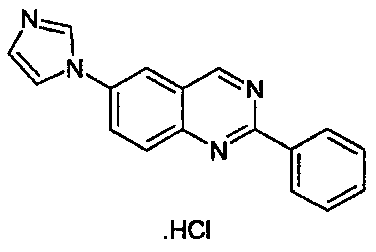
6-(1H-이미다졸-1-일)-2-페닐퀴나졸린, 500 mg (1.8 mmol)을 20 mL의 아세토니트릴에 현탁시키고, 이어서, 교반하면서, 50℃에서 10분 동안 가열하고, 실온으로 냉각시키고, 4mL의 HCl-포화된 이소프로필 에테르를 첨가하고, 혼합물을 몇 분 동안 교반하고, 건조한 상태로 농축시키고, 잔류물을 교반하면서 실온에[서 2 시간 동안 10mL의 아세토니트릴에 용해시키고, 이어서, 혼합물을 여과하고, 생성물을 아세톤으로 세척하고, 20℃, 20 mmHg에서 12 시간 동안 건조시켰다. 730 mg (99%)의 흡습성 생성물을 황색 결정 형태로 얻었다. XRPD 형태 B. KF: 1.2 %. 1H NMR (200 MHz, d6-DMSO + D2O) δ: 9.96 (d, 1H), 9.83 (m, 1H), 8.72 (d, 1H), 8.5 (m, 1H), 8.30-7.92 (m, 3H), 7.60-7.25 (m, 5H). C17H12N4에 대한 계산치: C 66.13, H 4.24, N 18.14, Cl 11.48; 실측치, C 60.38, H 4.48, N 17.98, Cl 11.26.500 mg (1.8 mmol) of 6- (1H-imidazol-1-yl) -2-phenylquinazolin, suspended in 20 mL of acetonitrile, then heated at 50 ° C. for 10 minutes with stirring, and at room temperature After cooling, 4 mL of HCl-saturated isopropyl ether are added, the mixture is stirred for several minutes, concentrated to dryness, the residue is dissolved in 10 mL of acetonitrile for 2 hours at room temperature with stirring and The mixture was then filtered and the product washed with acetone and dried at 20 ° C., 20 mm Hg for 12 hours. 730 mg (99%) of hygroscopic product was obtained in the form of yellow crystals. XRPD Form B. KF: 1.2%. 1 H NMR (200 MHz, d 6 -DMSO + D 2 O) δ: 9.96 (d, 1H), 9.83 (m, 1H), 8.72 (d, 1H), 8.5 (m, 1H), 8.30-7.92 ( m, 3H), 7.60-7.25 (m, 5H). Calcd for C 17 H 12 N 4 : C 66.13, H 4.24, N 18.14, Cl 11.48; Found, C 60.38, H 4.48, N 17.98, Cl 11.26.
실시예Example 36. 6-(1H- 36. 6- (1H- 이미다졸Imidazole -1-일)-2--1-yl) -2- 페닐퀴나졸린Phenylquinazoline 석시네이트(석시네이트 염 Succinate (succinate salt 형태 A)의 제조Preparation of Form A)

6-(1H-이미다졸-1-일)-2-페닐퀴나졸린, 500 mg (1.8 mmol)을 40 mL의 에탄올(EtOH)에 현탁시키고, 혼합물을 교반하면서 60℃로 가열하고, 220 mg의 석신산을 첨가하고, 혼합물을 몇 분 동안 교반하고, 20 mL의 에틸 아세테이트(EtOAc)를 서서히 첨가하고, 혼합물을 실온으로 냉각시키고, 생성 현탁액을 25℃에서 밤새 교반하고, 이어서, d여과하고, EtOAc로 세척하고, 25℃, 20 mmHg에서 8 시간 동안 건조시켰다. 670 mg (95%)의 비-흡습성의 황색 결정을 얻었다. KF < 0.5%, XRPD: 형태 A. 형태 A가 아세톤 또는 이소프로필 아세테이트와의 혼합물로서의 메탄올 또는 이소프로판올로부터 유사한 방법으로 얻어질 수 있다. 셀 구조의 측정(SC-XR)을 위한 결정을 끓는 EtOH (2 mL)중에 50 mg의 6-(1H-이미다졸-1-일)-2-페닐퀴나졸린 석시네이트를 용해시키고, 이어서, 실온에서 정치시켜서 몇 개의 결정을 얻음으로써 얻었다. SC-XR에 사용된 하나는 약 0.4 x 0.4 x 0.02 mm의 치수를 지녔다. 형태 A는 40℃, 85% RH에서 7일 동안 가열함으로써 안정한 것으로 밝혀졌으며(일관된 XRPD), 90℃에서 12 시간 이상 동안 가열함으로써 안정하였다. SC-XR 측정은 그라파이트 모노크로메터(graphite monochromator) 및 사파이어 CCD 검출기(Sapphire CCD detector)가 장착된 Oxford Xcalibur S radiation Mo-K 굴절계, λ = 0.71073Å를 사용함으로써 실온에서 수행되었다.500 mg (1.8 mmol) of 6- (1H-imidazol-1-yl) -2-phenylquinazolin, suspended in 40 mL of ethanol (EtOH), the mixture was heated to 60 ° C. with stirring and 220 mg of Succinic acid is added, the mixture is stirred for a few minutes, 20 mL of ethyl acetate (EtOAc) is added slowly, the mixture is cooled to room temperature, the resulting suspension is stirred at 25 ° C. overnight, then d filtered, Washed with EtOAc and dried at 25 ° C., 20 mmHg for 8 hours. 670 mg (95%) of non-hygroscopic yellow crystals were obtained. KF <0.5%, XRPD: Form A. Form A can be obtained in a similar manner from methanol or isopropanol as a mixture with acetone or isopropyl acetate. Dissolve 50 mg of 6- (1H-imidazol-1-yl) -2-phenylquinazolin succinate in boiling EtOH (2 mL) for determination of cell structure (SC-XR) and then room temperature It was obtained by leaving some decisions by politics at. One used for the SC-XR had dimensions of about 0.4 x 0.4 x 0.02 mm. Form A was found to be stable by heating at 40 ° C., 85% RH for 7 days (coherent XRPD) and stable by heating at 90 ° C. for at least 12 hours. SC-XR measurements were performed at room temperature using an Oxford Xcalibur S radiation Mo-K refractometer, λ = 0.71073 kV, equipped with a graphite monochromator and a Sapphire CCD detector.
실시예Example 37: 기계적인 스트레스( 37: mechanical stress ( 밀링milling )에 대한 형태 A의 안정성.Stability of Form A with respect to).
6-(1H-이미다졸-1-일)-2-페닐퀴나졸린 석시네이트 형태 A를 Retsch MM 200 밀에 의해서 50Hz에서 5분 동안 밀링에 가하고, 얻은 생성물을 XRPD 분석에 가하였다. 얻은 디프랙토그램은 형태 A가 어떠한 결정 형태의 변화가 진행되기 않았고 비정질 생성물의 존재가 나타나지 않음을 보여주고 있다.6- (1H-imidazol-1-yl) -2-phenylquinazolin succinate Form A was added by milling at 50 Hz for 5 minutes with
실시예Example 38: 수분에 대한 형태 A의 안정성. 38: Stability of Form A with moisture.
6-(1H-이미다졸-1-일)-2-페닐퀴나졸린 석시네이트 형태 A의 샘플을 DVS 분석(실시예 32에 기재된 바와 같음)에 가하였다. 변화가 도 30에 주어져 있다. 생성물은 전체적으로 흡습성이 아니며 약 90%RH에서만 상당히 적은 물의 흡수가 있음을 주지해야 한다. A sample of 6- (1H-imidazol-1-yl) -2-phenylquinazoline succinate Form A was added to DVS analysis (as described in Example 32). The change is given in FIG. It should be noted that the product as a whole is not hygroscopic and there is considerably less water absorption at only about 90% RH.
실시예Example 39: 형태 A의 용해도. 39: Solubility of Form A.
6-(1H-이미다졸-1-일)-2-페닐퀴나졸린 석시네이트 형태 A의 샘플을 현탁액을 얻기 위해서 500rpm에서 및 37℃에서 24시간 동안 NaCl 0.9%의 수용액에서 교반하고, 이어서, 현탁액을 여과하고, 용해된 생성물의 농도를 260nm에서 UV 흡광도를 측정함으로써 측정하였다. 용해도는 0.6 mg/mL이었다. 용해 속도는 2 mg의 생성물을 37℃에서 40mL의 물에 첨가하고, 500 rpm에서 교반하고, 0.05분 마다 260nm에서 흡광도를 측정하였고; 용해 속도는 3.53×10⁻⁵ g/min인 것으로 밝혀졌다.A sample of 6- (1H-imidazol-1-yl) -2-phenylquinazoline succinate Form A was stirred in an aqueous solution of 0.9% NaCl for 24 hours at 500 rpm and 37 ° C. to obtain a suspension, and then the suspension Was filtered and the concentration of dissolved product was measured by measuring UV absorbance at 260 nm. Solubility was 0.6 mg / mL. The dissolution rate was added 2 mg of product to 40 mL of water at 37 ° C., stirred at 500 rpm, and the absorbance measured at 260 nm every 0.05 min; The dissolution rate was found to be 3.53 × 10 −5 g / min.
실시예 40: 형태 A의 생체 이용성. Example 40 Bioavailability of Form A.
6-(1H-이미다졸-1-일)-2-페닐퀴나졸린 석시네이트, 형태 A의 약물 동력학적 특징을 실시예 8에 기재된 바와 같이 래트에서 평가하였고, 측정된 약물 동력학 파라미터가 이하 요약된다: 고려중인 염이, 최적의 용해도를 지니지 않는다는 사실에도 불구하고, 생체 이용성(F%)이 유리 염기의 생체 이용성보다 우수하다.The pharmacokinetic characteristics of 6- (1H-imidazol-1-yl) -2-phenylquinazoline succinate, Form A, were evaluated in rats as described in Example 8, and the measured pharmacokinetic parameters are summarized below. : The bioavailability (F%) is superior to the bioavailability of the free base, despite the fact that the salt under consideration does not have optimal solubility.

실시예Example 41: 6-(1H- 41: 6- (1H- 이미다졸Imidazole -1-일)-2--1-yl) -2- 페닐퀴나졸린Phenylquinazoline 석시네이트Succinate ( ( 석시네이트Succinate 염 형태 B)의 제조 Preparation of Salt Form B)
6-(1H-이미다졸-1-일)-2-페닐퀴나졸린, 500 mg (1.8 mmol)을 40 mL의 EtOH에 현탁시키고, 이어서, 혼합물을 추가로 30분 동안 환류 가열하고, 용매(150mL)를증류 제거하면서 디옥산(200mL)을 첨가하고, 얻은 현탁액을 얼음조에서 냉각하고, 여과하고, 디옥산으로 세척하고, 25℃, 20 mmHg에서 20시간 동안 건조시켰다. 580 mg (865%)의 비-흡습성 결정이 얻어졌다. KF < 0.5%, XRPD: 형태 B. C17H12N4?C4H6O4에 대한 계산치: C 64.61, H 4.65, N 14.35, 실측치: C 64.02, H 4.67, N 14.44; 1H-NMR (d6-DMSO) δ: 9.75 (s, 1H), 8.58 (m, 2H), 8.46 (d, 2H), 8.38 (d, 1H), 8.21 (d, 1H), 8.0 (s, 1H), 7.59 (m, 3H), 7.21 (s, 1H), 2.40 (s, 4H). 형태 B가 90℃에서 가열함으로써 형태 A로 전환될 수 있다.500 mg (1.8 mmol) of 6- (1H-imidazol-1-yl) -2-phenylquinazolin, are suspended in 40 mL of EtOH, and then the mixture is heated to reflux for an additional 30 minutes and the solvent (150 mL). Dioxane (200 mL) was added with distillation), and the resulting suspension was cooled in an ice bath, filtered, washed with dioxane and dried at 25 ° C., 20 mmHg for 20 hours. 580 mg (865%) of non-hygroscopic crystals were obtained. KF <0.5%, XRPD: Form B. Calcd for C 17 H 12 N 4 -C 4 H 6 O 4 : C 64.61, H 4.65, N 14.35, Found: C 64.02, H 4.67, N 14.44; 1 H-NMR (d 6 -DMSO) δ: 9.75 (s, 1H), 8.58 (m, 2H), 8.46 (d, 2H), 8.38 (d, 1H), 8.21 (d, 1H), 8.0 (s , 1H), 7.59 (m, 3H), 7.21 (s, 1H), 2.40 (s, 4H). Form B can be converted to Form A by heating at 90 ° C.
실시예Example 42: 6-(1H- 42: 6- (1H- 이미다졸Imidazole -1-일)-2--1-yl) -2- 페닐퀴나졸린Phenylquinazoline 석시네이트Succinate ( ( 석시네이트Succinate 염 salt 현태Status C)의 제조 C) manufacture
6-(1H-이미다졸-1-일)-2-페닐퀴나졸린 석시네이트 형태 A, 250 mg을 40 mL의 n-프로판올에 용해시키고, 용액을 약한 진공, 50 mmHg하에 실온에서 증발시켰다. 생성되는 생성물, 황색 결정은 흡습성이 아니며, XRPD 분석은 이것이 형태 C인 것으로 나타냈다. 유사한 결과가 n-프로판올 대신에 EtOH를 사용함으로써 얻어졌다. 형태 C는 90℃로 가열시에 안정하였다.250 mg of 6- (1H-imidazol-1-yl) -2-phenylquinazoline succinate Form A, was dissolved in 40 mL of n-propanol and the solution was evaporated at room temperature under slight vacuum, 50 mmHg. The resulting product, yellow crystals, is not hygroscopic, and XRPD analysis indicated that it was Form C. Similar results were obtained by using EtOH instead of n-propanol. Form C was stable upon heating to 90 ° C.
실시예Example 43: 6-(1H- 43: 6- (1H- 이미다졸Imidazole -1-일)-2--1-yl) -2- 페닐퀴나졸린Phenylquinazoline (L) (L) 타르트레이트Tartrate 디하이D Hai 드레이트 (Drate ( 타르트레이트Tartrate 염 형태 A)의 제조 Preparation of Salt Form A)

6-(1H-이미다졸-1-일)-2-페닐퀴나졸린, 500 mg (1.8 mmol)을 40 mL의 EtOH에 현탁시키고, 현탁액을 교반하면서 가열 환류시키고, 50℃로 냉각시키고, 300 mg의 L-타르타르산을 첨가하고, 혼합물을 몇 분 동안 교반하고, 20 mL의 MEK를 서서히 첨가하고, 이어서, 혼합물을 실온으로 냉각시키고, 생성 현탁액을 0℃에서 밤새 교반하고, 이어서, 여과하고, MEK로 세척하고, 20℃, 20 mmHg에서 12시간 동안 건조시켰다. 730 mg (96%)의 비-흡습성의 황색 결정을 얻었다. XRPD 형태 A. KF = 8.25% 계산됨. C17H12N4?C4H6O6: C 55.02, H 4.84, N 12.22; 실측치: C 54.78, H 4.92, N 12.18. 형태 A가 아세톤 또는 디옥산 또는 THF와의 혼합물로서 메탄올 또는 이소프로판올 또는 물로부터 얻어질 수 있다. 40℃, 70%RH에서 7일 동안 가열된 형태 A는 안정하였지만, 90℃에서 12 시간 동안 가열되는 경우 비정질 형태를 생성시켰다(XRPD).500 mg (1.8 mmol) of 6- (1H-imidazol-1-yl) -2-phenylquinazolin, suspended in 40 mL of EtOH, heated to reflux with stirring, cooled to 50 ° C., 300 mg L-tartaric acid was added, the mixture was stirred for a few minutes, 20 mL of MEK was added slowly, then the mixture was cooled to room temperature and the resulting suspension was stirred at 0 ° C. overnight, then filtered, MEK Washed with and dried at 20 ° C., 20 mmHg for 12 hours. 730 mg (96%) of non-hygroscopic yellow crystals were obtained. XRPD Form A. KF = 8.25% calculated. C 17 H 12 N 4 -C 4 H 6 O 6 : C 55.02, H 4.84, N 12.22; Found: C 54.78, H 4.92, N 12.18. Form A can be obtained from methanol or isopropanol or water as a mixture with acetone or dioxane or THF. Form A, heated for 7 days at 40 ° C., 70% RH, was stable, but produced an amorphous form when heated at 90 ° C. for 12 hours (XRPD).
실시예Example 44: 기계적인 스트레스( 44: mechanical stress ( 밀링milling )에 대한 형태 A의 안정성Stability of Form A to
6-(1H-이미다졸-1-일)-2-페닐퀴나졸린 L-타르트레이트 디하이드레이트, 형태 A를 Retsch MM 200 밀에 의해서 50 Hz에서 5분 동안 밀링하고, 얻은 생성물을 XRPD 분석에 가하였다. 얻은 디프렉토그램(diffractogram)은 형태 A가 결정 형태의 어떠한 변화를 진행하지 않으며 비정질 생성물의 존재에서의 약간의 증가를 나타냄을 보이고 있다.6- (1H-imidazol-1-yl) -2-phenylquinazolin L-tartrate dihydrate, Form A, was milled with
실시예Example 45: 수분에 대한 형태 A의 안정성. 45: Form A stability to moisture.
6-(1H-이미다졸-1-일)-2-페닐퀴나졸린 L-타르트레이트 디하이드레이트, 형태 A의 샘플을 DVS 분석에 가하였다. 변화가 도 34에 도시되어 있다. 생성물은 범위 25-70% RH에서 흡습성이 아니지만, 75% RH에서 변화점을 보이고 80% RH 초과의 값에서만 아주 흡습성이 됨을 주지해야 한다. A sample of 6- (1H-imidazol-1-yl) -2-phenylquinazolin L-tartrate dihydrate, Form A, was added to DVS analysis. The change is shown in FIG. 34. It should be noted that the product is not hygroscopic in the range 25-70% RH, but shows a point of change at 75% RH and is very hygroscopic only at values above 80% RH.
실시예Example 46: 형태 A의 용해도 46: Solubility of Form A
6-(1H-이미다졸-1-일)-2-페닐퀴나졸린 L-타르트레이트 디하이드레이트, 형태 A의 샘플을 현탁액(8 mL중 85 mg)을 얻기 위해서 500 rpm에서 및 37℃에서 24시간 동안 NaCl 0.9%의 수용액중에서 교반하였다. 이어서, 현탁액을 여과하고, 용해된 생성물의 농도를 260nm에서 UV 흡광도를 측정함으로써 측정하였다. 용해도는 2.5 mg/mL이었다. 용해 속도는 37℃에서 40mL의 물에 2mg의 생성물을 첨가하고, 500rpm에서 교반하고, 260nm에서 0.05분 마다 흡광도를 측정함으로써 측정하였고; 용해 속도는 1.04×10⁻³ g/min인 것으로 밝혀졌다.A sample of 6- (1H-imidazol-1-yl) -2-phenylquinazolin L-tartrate dihydrate, Form A, was obtained at 24 rpm and at 37 ° C. for 24 hours to obtain a suspension (85 mg in 8 mL). Stirred in an aqueous solution of 0.9% NaCl. The suspension was then filtered and the concentration of dissolved product was measured by measuring UV absorbance at 260 nm. Solubility was 2.5 mg / mL. The dissolution rate was measured by adding 2 mg of product to 40 mL of water at 37 ° C., stirring at 500 rpm, and measuring the absorbance at 260 nm every 0.05 minutes; The dissolution rate was found to be 1.04 × 10 −3 g / min.
실시예Example 47: 형태 A의 생체 이용성 47: Bioavailability of Form A
6-(1H-이미다졸-1-일)-2-페닐퀴나졸린 타르트레이트 디하이드레이트, 형태 A의 약물 동력학적 특징을 실시예 8에 기재된 바와 같이 래트에서 평가하고, 측정된 약물 동력학적 파라미터를 이하 요약하였다: 고려중인 염이 최적의 생체 이용성(F%)을 지님을 주지해야 한다.The pharmacokinetic characteristics of 6- (1H-imidazol-1-yl) -2-phenylquinazoline tartrate dihydrate, Form A, were evaluated in rats as described in Example 8, and the measured pharmacokinetic parameters were evaluated. It is summarized below: It should be noted that the salt under consideration has an optimal bioavailability (F%).

실시예Example 47: 6-(1H- 47: 6- (1H- 이미다졸Imidazole -1-일)-2--1-yl) -2- 페닐퀴나졸린Phenylquinazoline (L) (L) 타르트레이트Tartrate ( ( 타르트Tarts 레이트 염 형태 B)의 제조Preparation of Rate Salt Form B)
6-(1H-이미다졸-1-일)-2-페닐퀴나졸린, 50 mg (0.18 mmol)을 4 mL의 아세토니트릴에 현탁시키고, 이어서, 혼합물을 추가로 30분 동안 환류 가열하고, 여과하고, 이어서, 0℃로 냉각시키고, 생성 현탁액을 25℃에서 3일 동안 교반하고, 이어서, 여과하고, 20℃, 20 mmHg에서 12시간 동안 건조시켰다. 30 mg의 생성물을 황색 결정의 형태로 얻었다. KF = 14.67%, C17H12N4?C4H6O6?4H2O에 대한 계산치: C 51.01, H 5.30, N 11.33, 실측치: C 50.64, H 5.41, N 11.28. XRPD 형태 B. 40℃, 85% RH에서 7일 동안 가열된 형태 B가 안정하였지만(XRPD), 90℃에서 12시간 동안 가열되는 경우 비정질 형태로 변화되었다.50 mg (0.18 mmol) of 6- (1H-imidazol-1-yl) -2-phenylquinazolin, suspended in 4 mL of acetonitrile, then the mixture was heated to reflux for an additional 30 minutes, filtered and Then it was cooled to 0 ° C. and the resulting suspension was stirred at 25 ° C. for 3 days, then filtered and dried at 20 ° C., 20 mmHg for 12 hours. 30 mg of the product was obtained in the form of yellow crystals. KF = 14.67%, calcd for C 17 H 12 N 4 -C 4 H 6 O 6 -4H 2 O: C 51.01, H 5.30, N 11.33, Found: C 50.64, H 5.41, N 11.28. XRPD Form B. Form B heated for 7 days at 40 ° C., 85% RH was stable (XRPD), but changed to amorphous form when heated at 90 ° C. for 12 hours.
실시예Example 48: 6-(1H- 48: 6- (1H- 이미다졸Imidazole -1-일)-2--1-yl) -2- 페닐퀴나졸린Phenylquinazoline (L) (L) 타르트레이트Tartrate ( ( 타르트Tarts 레이트 염 형태 C)의 제조Preparation of Rate Salt Form C)
6-(1H-이미다졸-1-일)-2-페닐퀴나졸린, 500 mg (1.8 mmol)을 40 mL의 이소프로판올에 현탁시키고, 이어서, 혼합물을 교반하면서 환류 가열하고, 300 mg의 타르타르산을 첨가하고, 혼합물을 몇 분 동안 교반하고, 여과하고, 여액을 50℃로 가열하여 약한 감압하에 용매를 약 1/3의 용적으로 증발 제거하고, 이어서, 0℃로 냉각시키고, 밤새 교반하고, 이어서, 여과하고, 소량의 이소프로판올로 세척하고, 20℃, 20 mmHg에서 24시간 동안 건조시켰다. 120 mg의 생성물을 황색 결정의 형태로 얻었다. KF = 5.2%, TG-IR LOD 4.93%, IR 스펙트럼은 H2O의 손실을 확인시킨다. XRPD 형태 C. 500 mg (1.8 mmol) of 6- (1H-imidazol-1-yl) -2-phenylquinazolin, are suspended in 40 mL of isopropanol, and then the mixture is heated to reflux with stirring and 300 mg of tartaric acid are added. The mixture is stirred for several minutes, filtered, the filtrate is heated to 50 ° C. and the solvent is evaporated off at about 1/3 the volume under mild pressure reduction, then cooled to 0 ° C., stirred overnight, and then Filter, wash with a small amount of isopropanol and dry at 20 ° C., 20 mmHg for 24 hours. 120 mg of the product were obtained in the form of yellow crystals. KF = 5.2%, TG-IR LOD 4.93%, IR spectrum confirms the loss of H 2 O. XRPD Mode C.
C17H12N4?C4H6O6?H2O에 대한 계산치: C 57.27, H 4.58, N 12.72, 실측치: C 57.16, H 4.61, N 12.68.Calcd for C 17 H 12 N 4 -C 4 H 6 O 6 -H 2 O: C 57.27, H 4.58, N 12.72, found: C 57.16, H 4.61, N 12.68.
40℃, 85% RH에서 7일 동안 가열된 형태 C는 안정하였고(XRPD), 또한, 90℃에서 12시간 동안 가열되는 때에도 안정하였다.Form C heated for 7 days at 40 ° C., 85% RH was stable (XRPD) and also stable when heated at 90 ° C. for 12 hours.
실시예Example 49: 6-(1H- 49: 6- (1H- 이미다졸Imidazole -1-일)-2--1-yl) -2- 페닐퀴나졸린Phenylquinazoline (L) (L) 타르트레이트Tartrate ( ( 타르트Tarts 레이트 염 형태 D)의 제조Preparation of Rate Salt Form D)
6-(1H-이미다졸-1-일)-2-페닐퀴나졸린, 500 mg (1.8 mmol)을 50 mL의 니트로메탄중에 환류하에 교반하면서 및 질소 스트림하에 용해시키고, 300 mg의 L-타르타르산을 첨가하고, 혼합물을 몇 분 동안 교반하고, 이를 질소하에 여과하고, 여액을 60℃로 가열하고, 약한 진공하에 교반하면서 및 질소 스트림하에 용매를 약 1/2 용적으로 증발 제거하고, 이어서, 질소 하에 0℃로 냉각시키고, 실온에서 밤새 교반하고, 이어서, 여과하고, 30℃, 20 mmHg에서 24 시간 동안 건조시켰다. 520mg의 생성물을 황색 결정의 형태로 얻었다. KF < 0.5%, C17H12N4?C4H6O6에 대한 계산치: C 59.71, H 4.30, N 13.26, 실측치: C 59.76, H 4.34, N 13.22. XRPD 형태 D. 40℃, 85% RH에서 7일 동안 가열된 형태 D는 형태 A에 상응하는 XRPD를 생성시켰고, 90℃에서 12시간 동안 가열되는 경우 비정질 생성물을 생성시켰다.500 mg (1.8 mmol) of 6- (1H-imidazol-1-yl) -2-phenylquinazolin, dissolved in 50 mL of nitromethane under reflux and under a stream of nitrogen, 300 mg of L-tartaric acid Add, stir the mixture for several minutes, filter it under nitrogen, heat the filtrate to 60 ° C., stir under light vacuum and evaporate off the solvent in about 1/2 volume under nitrogen stream and then under nitrogen Cool to 0 ° C., stir overnight at room temperature, then filter and dry for 24 h at 30 ° C., 20 mmHg. 520 mg of product was obtained in the form of yellow crystals. KF <0.5%, calcd for C 17 H 12 N 4 -C 4 H 6 O 6 : C 59.71, H 4.30, N 13.26. Found: C 59.76, H 4.34, N 13.22. XRPD Form D. Form D heated for 7 days at 40 ° C., 85% RH produced XRPD corresponding to Form A, and produced an amorphous product when heated at 90 ° C. for 12 hours.
실시예Example 50: 6-(1H- 50: 6- (1H- 이미다졸Imidazole -1-일)-2--1-yl) -2- 페닐퀴나졸린Phenylquinazoline 푸마레이트Fumarate ( ( 푸마레이트Fumarate 염 형태 A)의 제조 Preparation of Salt Form A)
6-(1H-이미다졸-1-일)-2-페닐퀴나졸린, 500 mg (1.8 mmol)을 교반하면서 40℃에서 200mL의 EtOH에 용해시키고, 용액이 투명하게 되는 때에, 220 mg의 푸마르산을 첨가하고, 생성 혼합물을 15 분 동안 교반하고, 이어서, 약한 진공을 적용하면서 침전점으로 서서히 농축시켰다.500 mg (1.8 mmol) of 6- (1H-imidazol-1-yl) -2-phenylquinazolin, are dissolved in 200 mL of EtOH at 40 ° C. with stirring, and 220 mg of fumaric acid is added when the solution becomes clear. The resulting mixture was stirred for 15 minutes and then concentrated slowly to the precipitation point while applying a slight vacuum.
얻은 현탁액을 실온에서 2 시간 동안 교반하고, 이어서, 여과하였다. 얻은 비-흡습성 생성물을 20℃, 20 mmHg에서 12 시간 동안 건조시켰다. 541 mg의 생성물을 얻었다. KF < 0.5%, XRPD 형태 A. C17H12N4?1/2C4H4O4에 대한 계산치: C 67.93, H 4.24, N 16.25, 실측치: C 67.53, H 4.27, N 16.09; H-NMR (d6-DMSO) δ: 9.71 (d. 1H), 8.59-8.56 (m, 3H), 8.49 (m, 1H), 8.46 (d, 1H), 8.21 (d, 1H), 7.97 (s, 1H), 7.95-7.57 (m, 3 H), 6.61 (s, 1H). 셀 구조의 측정(SC-XR)을 위한 결정을 끓는 EtOH (2 mL)중에 50mg의 6-(1H-이미다졸-1-일)-2-페닐퀴나졸린 푸마레이트를 용해시킴으로써 얻었고, 몇 개의 결정을 얻었다. SC-XR에 사용된 하나는 약 0.3 x 0.2 x 0.2 mm의 치수를 지녔다. 형태 A가 40℃, 85% RH에서 7일 동안 가열되는 경우에 안정한 것으로 입증되었다(XRPD). SC-XR 측정은 그라파이트 모노크로메터(graphite monochromator) 및 사파이어 CCD 검출기(Sapphire CCD detector)가 장착된 Oxford Xcalibur S radiation Mo-K 굴절계, λ = 0.71073Å를 사용함으로써 실온에서 수행되었다.The resulting suspension was stirred at rt for 2 h and then filtered. The resulting non-hygroscopic product was dried at 20 ° C., 20 mmHg for 12 hours. 541 mg of product were obtained. KF <0.5%, XRPD Form A. Calcd for C 17 H 12 N 4 -1 / 2C 4 H 4 O 4 : C 67.93, H 4.24, N 16.25, Found: C 67.53, H 4.27, N 16.09; H-NMR (d 6 -DMSO) δ: 9.71 (d. 1H), 8.59-8.56 (m, 3H), 8.49 (m, 1H), 8.46 (d, 1H), 8.21 (d, 1H), 7.97 ( s, 1 H), 7.95-7.57 (m, 3H), 6.61 (s, 1H). Crystals for determination of cell structure (SC-XR) were obtained by dissolving 50 mg of 6- (1H-imidazol-1-yl) -2-phenylquinazoline fumarate in boiling EtOH (2 mL) and several crystals Got. One used for the SC-XR had dimensions of about 0.3 × 0.2 × 0.2 mm. Form A proved to be stable when heated at 40 ° C., 85% RH for 7 days (XRPD). SC-XR measurements were performed at room temperature using an Oxford Xcalibur S radiation Mo-K refractometer, λ = 0.71073 kV, equipped with a graphite monochromator and a Sapphire CCD detector.
실시예Example 51: 형태 A의 용해도 51: Solubility of Form A
6-(1H-이미다졸-1-일)-2-페닐퀴나졸린 푸마레이트 형태 A의 샘플을 현탁액(4 mL중의 100 mg)을 얻기 위해서 500 rpm에서 및 37℃에서 24 시간 동안 NaCl 0.9%의 수용액중에서 교반하였다. 이어서, 현탁액을 여과하고, 용해된 생성물의 농도를 260nm에서 UV 흡광도를 측정함으로써 측정하였다. 용해도는 1.2 mg/mL이었다. 용해 속도는 37℃에서 40mL의 물에 2mg의 생성물을 첨가하고, 500rpm에서 교반하고, 260nm에서 0.05분 마다 흡광도를 측정함으로써 측정하였고; 용해 속도는 2.67×10⁻⁵g/min인 것으로 밝혀졌다.Samples of 6- (1H-imidazol-1-yl) -2-phenylquinazoline fumarate Form A were obtained with 0.9% NaCl for 24 hours at 500 rpm and 37 ° C. to obtain a suspension (100 mg in 4 mL). It stirred in aqueous solution. The suspension was then filtered and the concentration of dissolved product was measured by measuring UV absorbance at 260 nm. Solubility was 1.2 mg / mL. The dissolution rate was measured by adding 2 mg of product to 40 mL of water at 37 ° C., stirring at 500 rpm, and measuring the absorbance at 260 nm every 0.05 minutes; The dissolution rate was found to be 2.67 × 10 −5 g / min.
실시예Example
52: 6-(1H- 52: 6- (1H-
이미다졸Imidazole
-1-일)-2--1-yl) -2-
페닐퀴나졸린Phenylquinazoline
말레에이트(말레에이트 염 Maleate (maleate salt
형태 A)의 제조, 방법 1Preparation of Form A),
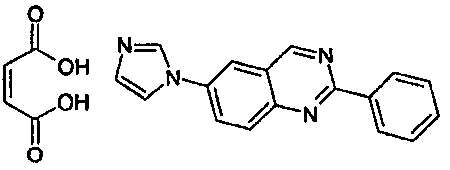
6-(1H-이미다졸-1-일)-2-페닐퀴나졸린, 2.7 g (0.01 mol)을 환류 하에 교반하면서 65 mL의 아세톤에 용해시키고, 아세톤 (13 mL)중의 1.16 g (0.01 mol)의 말레산의 고온 용액을 첨가하고, 혼합물을 실온으로 냉각시키고, 생성 현탁액을 실온에서 밤새 교반하고, 이어서, 혼합물을 여과하고, 생성물을 아세톤으로 세척하고, 60℃, 20 mmHg에서 12 시간 동안 건조시켰다. 2.68 g (69%)의 비-흡습성 생성물을 얻었다. XRPD 형태 A. KF < 0.5 %. C17H12N4?C4H4O4에 대한 계산치: C 64.94, H 4.15, N 14.43, 실측치: C 64.51, H 4.20, N 14.45; H-NMR (d6-DMSO) δ: 9.74 (s, 1H), 8.83 (s, 1H), 8.59-8.71 (m, 2H), 8.51 (d, 1H), 8.42 (d, 1H), 8.09 (s, 1H), 7.61-7.58 (m, 3 H), 7.59 (s, 1H), 6.19 (s, 2H). 2.7 g (0.01 mol) of 6- (1H-imidazol-1-yl) -2-phenylquinazolin, dissolved in 65 mL of acetone with stirring under reflux, and 1.16 g (0.01 mol) in acetone (13 mL) Hot solution of maleic acid was added, the mixture was cooled to room temperature, the resulting suspension was stirred at room temperature overnight, then the mixture was filtered, the product was washed with acetone and dried at 60 ° C., 20 mmHg for 12 hours. I was. 2.68 g (69%) of non-hygroscopic product was obtained. XRPD Form A. KF <0.5%. Calcd for C 17 H 12 N 4 -C 4 H 4 O 4 : C 64.94, H 4.15, N 14.43, found: C 64.51, H 4.20, N 14.45; H-NMR (d 6 -DMSO) δ: 9.74 (s, 1H), 8.83 (s, 1H), 8.59-8.71 (m, 2H), 8.51 (d, 1H), 8.42 (d, 1H), 8.09 ( s, 1H), 7.61-7.58 (m, 3H), 7.59 (s, 1H), 6.19 (s, 2H).
실시예Example
53: 6-(1H- 53: 6- (1H-
이미다졸Imidazole
-1-일)-2--1-yl) -2-
페닐퀴나졸린Phenylquinazoline
말레에이트Maleate
( (
말레에이트Maleate
염 형태 A), 방법 2 Salt Form A),
6-(1H-이미다졸-1-일)-2-페닐퀴나졸린, 2.7 g (0.01 mol)을 환류하에 교반하면서 EtOH (75 mL)에 용해시키고, 이어서, 1.16 g (0.01 mol)의 말레산을 첨가하고, 혼합물을 30분 동안 교반하고, 이어서, 실온으로 냉각시키고, 생성 용액을 실온에서 밤새 교반하고, 이어서, 여과하고, 소량의 EtOH로 세척하고, 60℃, 20 mmHg에서 12시간 동안 건조시켰다. 2.4 g (62%)의 비-흡습성 생성물을 얻었다. XRPD 형태 A. KF < 0.5 %. 형태 A는 메탄올, 이소프로판올 또는 아세토니트릴로부터 유사하게 제조될 수 있다. 셀 구조의 측정(SC-XR)을 위한 결정은 끓는 EtOH (4 mL)중에 68mg의 6-(1H-이미다졸-1-일)-2-페닐퀴나졸린 말레에이트를 용해시킴으로써 유사한 방법으로 얻었고, 이어서, 혼합물을 실온 및 대기압에서 서서히 증발시켜서 몇 개의 결정을 얻었다. SC-XR에 사용된 하나는 약 0.2 x 0.08 x 0.08 mm의 치수를 지녔다.6- (1H-imidazol-1-yl) -2-phenylquinazolin, 2.7 g (0.01 mol) is dissolved in EtOH (75 mL) with stirring under reflux, followed by 1.16 g (0.01 mol) maleic acid Was added, the mixture was stirred for 30 minutes, then cooled to room temperature, the resulting solution was stirred overnight at room temperature, then filtered, washed with a small amount of EtOH and dried at 60 ° C., 20 mmHg for 12 hours. I was. 2.4 g (62%) of non-hygroscopic product was obtained. XRPD Form A. KF <0.5%. Form A can be similarly prepared from methanol, isopropanol or acetonitrile. Crystals for determination of cell structure (SC-XR) were obtained by a similar method by dissolving 68 mg of 6- (1H-imidazol-1-yl) -2-phenylquinazolin maleate in boiling EtOH (4 mL), The mixture was then slowly evaporated at room temperature and atmospheric pressure to give several crystals. One used for the SC-XR had dimensions of about 0.2 x 0.08 x 0.08 mm.
실시예Example
54: 6-(1H- 54: 6- (1H-
이미다졸Imidazole
-1-일)-2--1-yl) -2-
페닐퀴나졸린Phenylquinazoline
말레에이트Maleate
( (
말레에이트Maleate
염 형태 A)의 제조, 방법 3 Preparation of Salt Form A),
6-(1H-이미다졸-1-일)-2-페닐퀴나졸린, 5.44 g (0.021 mol)을 환류하에 교반하면서 이소프로필 아세테이트/이소프로필 알콜의 1/1 혼합물(75mL)중에 용해시키고, 2.9 g (0.025 mol)의 말레산을 첨가하고, 혼합물을 15분 동안 교반하고, 실온으로 냉각시키고, 생성 용액을 실온에서 밤새 교반하고, 이어서, 여과하고, 이소프로필 아세테이트로 세척하고, 60℃, 20 mmHg에서 12 시간 동안 건조시켰다. 5.5 g (77%)의 비-흡습성 생성물을 얻었다. XRPD 형태 A. KF < 0.5 %. 형태 A가 에틸 아세테이트, 또는 메틸 아세테이트, 또는 DCM, 또는 THF, 또는 메틸 에틸 케톤, 또는 디옥산과의 에탄올의 혼합물로부터 유사하게 제조될 수 있다.5.44 g (0.021 mol) of 6- (1H-imidazol-1-yl) -2-phenylquinazolin, dissolved in a 1/1 mixture of isopropyl acetate / isopropyl alcohol (75 mL) with stirring under reflux, and 2.9 g (0.025 mol) maleic acid are added, the mixture is stirred for 15 minutes, cooled to room temperature, the resulting solution is stirred overnight at room temperature, then filtered, washed with isopropyl acetate, 60 ° C., 20 Drying in mmHg for 12 hours. 5.5 g (77%) of non-hygroscopic product was obtained. XRPD Form A. KF <0.5%. Form A can be similarly prepared from ethyl acetate, or methyl acetate, or DCM, or THF, or methyl ethyl ketone, or a mixture of ethanol with dioxane.
실시예Example
55: 6-(1H- 55: 6- (1H-
이미다졸Imidazole
-1-일)-2--1-yl) -2-
페닐퀴나졸린Phenylquinazoline
말레에이트 (말레에이트 염 형태 A)의 제조, 방법 4. Preparation of Maleate (Maleate Salt Form A),
6-(1H-이미다졸-1-일)-2-페닐퀴나졸린, 147 g (0.54 mol)을 환류하에 아세톤 (3.5 L)과 메탄올 (350 mL)의 혼합물에 용해시키고, 혼합물은 교반하면서 30℃에서 고온인 동안 여과하고, 59.7 g (0.514 mol)의 말레산을 첨가하고, 생성 혼합물을 고온의 아세톤(300mL)에 용해시키고, 이를 40℃에서 30분 동안 교반하고, 이어서, 실온으로 냉각시키고, 생성 현탁액을 실온에서 밤새 교반하고, 이어서, 여과하고, 차가운 아세톤(200mL)으로 세척하고, 60℃, 20 mmHg에서 12 시간 동안 건조시켰다. 180 g (98%)의 비-흡습성 생성물을 얻었다. XRPD 형태 A. KF < 0.5 %. 40℃, 70% RH에서 7일 동안 가열된 형태 A는 안정하였지만, 그러한 형태 A는 90℃에서 12 시간 동안 가열되는 경우이다.147 g (0.54 mol) of 6- (1H-imidazol-1-yl) -2-phenylquinazolin, are dissolved in a mixture of acetone (3.5 L) and methanol (350 mL) under reflux, and the mixture is stirred with 30 Filter while hot at ° C, add 59.7 g (0.514 mol) maleic acid, dissolve the resulting mixture in hot acetone (300 mL), stir at 40 ° C for 30 min, then cool to room temperature The resulting suspension was stirred at rt overnight, then filtered, washed with cold acetone (200 mL) and dried at 60 ° C., 20 mmHg for 12 h. 180 g (98%) of non-hygroscopic product was obtained. XRPD Form A. KF <0.5%. Form A heated at 40 ° C., 70% RH for 7 days was stable, but such Form A was heated at 90 ° C. for 12 hours.
실시예Example 56: 기계적 스트레스( 56: mechanical stress ( 밀링milling )에 대한 형태 A의 안정성.Stability of Form A with respect to).
6-(1H-이미다졸-1-일)-2-페닐퀴나졸린 말레에이트, 형태 A를 Retsch MM 200 밀에 의해서 50Hz에서 5분 동안 밀링시키고, 얻은 생성물을 XRPD 분석에 가하였다. 얻은 디프렉토그램은 형태 A가 결정 형태의 어떠한 변화를 진행하지 않았지만, 정치시에 수 시간 내에 재결정화되는 비정질 생성물의 존재에서 약간의 증가가 나타남을 보이고 있다.6- (1H-imidazol-1-yl) -2-phenylquinazolin maleate, Form A, was milled by
실시예Example 57: 수분에 대한 형태 A의 안정성. 57: Stability of Form A with moisture.
6-(1H-이미다졸-1-일)-2-페닐퀴나졸린 말레에이트, 형태 A의 샘플을 DVS 분석에 가하였다. 변화가 도 50에 도시되어 있다. 생성물은 범위 0-85% RH에서 흡습성이 아니며, 유사하게 85% RH 초과의 값에서도 특별히 흡습성이 아님을 주지해야 한다.A sample of 6- (1H-imidazol-1-yl) -2-phenylquinazolin maleate, Form A was added to the DVS analysis. The change is shown in FIG. It should be noted that the product is not hygroscopic in the range 0-85% RH and similarly is not particularly hygroscopic even at values above 85% RH.
실시예Example 58: 형태 A의 용해도. 58: Solubility of Form A.
6-(1H-이미다졸-1-일)-2-페닐퀴나졸린 말레에이트, 형태 A의 샘플을 현탁액(4 mL중의 150 mg)을 얻기 위해서 500 rpm에서 및 37℃에서 24 시간 동안 NaCl 0.9%의 수용액에서 교반하였다. 이어서, 현탁액을 여과하고, 용해된 생성물의 농도를 260nm에서 UV 흡광도를 측정함으로써 측정하였다. 용해도는 7.9 mg/mL이었다. 용해 속도는 37℃에서 40 mL의 물에 2mg의 생성물을 첨가하고, 500rpm에서 교반하고, 260nm에서 0.05분 마다 흡광도를 측정함으로써 측정하였고; 용해 속도는 1.45×10⁻³ g/min인 것으로 밝혀졌다.Sample of 6- (1H-imidazol-1-yl) -2-phenylquinazoline maleate, Form A, 0.9% NaCl for 24 hours at 500 rpm and 37 ° C. to obtain a suspension (150 mg in 4 mL). It was stirred in an aqueous solution of. The suspension was then filtered and the concentration of dissolved product was measured by measuring UV absorbance at 260 nm. Solubility was 7.9 mg / mL. The dissolution rate was measured by adding 2 mg of product to 40 mL of water at 37 ° C., stirring at 500 rpm and measuring absorbance every 0.05 minutes at 260 nm; The dissolution rate was found to be 1.45 × 10 −3 g / min.
실시예Example 59: 형태 A의 생체 이용성. 59: Bioavailability of Form A.
6-(1H-이미다졸-1-일)-2-페닐퀴나졸린 말레에이트, 형태 A의 약물 동력학적 특징을 실시예 8에 기재된 바와 같이 래트에서 평가하였다. 측정된 약물 동력학적 파라미터가 이하 요약되어 있다: 고려중인 염이 최적의 생체 이용성(F%)을 지님을 주지해야 한다.The pharmacokinetic characteristics of 6- (1H-imidazol-1-yl) -2-phenylquinazolin maleate, Form A, were evaluated in rats as described in Example 8. The pharmacokinetic parameters measured are summarized below: It should be noted that the salt under consideration has optimal bioavailability (F%).

실시예Example 60: 6-(1H- 60: 6- (1H- 이미다졸Imidazole -1-일)-2--1-yl) -2- 페닐퀴나졸린Phenylquinazoline 말레에이트Maleate , 형태 A/B의 제조Manufacture of Mode A / B
6-(1H-이미다졸-1-일)-2-페닐퀴나졸린, 136 mg (0.5 mmol)을 50℃에서 환류하에 교반하면서 이소프로판올 (15 mL)과 물(0.5 mL)의 혼합물에 용해시키고, 60 mg (0.5 mmol)의 말레산을 첨가하고, 혼합물을 30 분 동안 교반하고, 이어서, 0℃로 냉각시키고, 생성 현탁액을 0℃에서 수 분 동안 교반하고, 여과하고, 차가운 이소프로판올로 세척하고, 30℃, 20 mmHg에서 5 시간 동안 건조시켰다. 120 mg의 생성물을 얻었다. XRPD: 도 51에서와 같은 형태 A + 형태 B.136 mg (0.5 mmol), 6- (1H-imidazol-1-yl) -2-phenylquinazolin, are dissolved in a mixture of isopropanol (15 mL) and water (0.5 mL) with stirring at reflux at 50 ° C., 60 mg (0.5 mmol) maleic acid are added, the mixture is stirred for 30 minutes, then cooled to 0 ° C., the resulting suspension is stirred at 0 ° C. for several minutes, filtered, washed with cold isopropanol, Dry at 30 ° C., 20 mmHg for 5 hours. 120 mg of product were obtained. XRPD: Form A + Form B as in FIG. 51.
실시예Example 61: 6-(1H- 61: 6- (1H- 이미다졸Imidazole -1-일)-2--1-yl) -2- 페닐퀴나졸린Phenylquinazoline 말레에이트Maleate ( ( 말레에이트Maleate 염 형태 B)의 제조 Preparation of Salt Form B)
6-(1H-이미다졸-1-일)-2-페닐퀴나졸린, 136 mg (0.5 mmol)을 환류하에 이소프로판올 (15 mL)과 물 (0,5 mL)의 혼합물에 용해시키고, 60 mg (0.5 mmol)의 말레산을 첨가하고, 혼합물을 40℃에서 30분 동안 교반하고, 이어서, 실온으로 냉각시키고, 용액을 서서히 증발시키면서 3일 동안 정치시키고, 생성 물질을 여과하고, 차가운 이소프로판올로 세척하고, 30℃, 20 mmHg에서 5 시간 동안 건조시켰다. 180 mg의 생성물을 얻었다. XRPD: 형태 B. KF: 2.03%. 40℃, RH 85%에서 7일 동안 가열된 형태 B는 형태 A로 부분적으로 전환되었다(XRPD). 90℃에서 12 시간 동안 가열된 형태 B는 형태 A로 전환되었다.136 mg (0.5 mmol) of 6- (1H-imidazol-1-yl) -2-phenylquinazolin, are dissolved in a mixture of isopropanol (15 mL) and water (0,5 mL) under reflux and 60 mg ( 0.5 mmol) maleic acid is added and the mixture is stirred at 40 ° C. for 30 minutes, then cooled to room temperature, the solution is allowed to stand for 3 days with slow evaporation, the resulting material is filtered off, washed with cold isopropanol and Dried at 30 ° C., 20 mmHg for 5 hours. 180 mg of product was obtained. XRPD: Form B. KF: 2.03%. Form B heated for 7 days at 40 ° C.,
실시예Example 62: 6-(1H- 62: 6- (1H- 이미다졸Imidazole -1-일)-2--1-yl) -2- 페닐퀴나졸린Phenylquinazoline 포스페이트Phosphate , 형태 A의 제조Manufacture of Form A

6-(1H-이미다졸-1-일)-2-페닐퀴나졸린, 275 mg (1 mmol)을 환류하에 EtOH (15 mL)에 용해시키고, 100 mg (1 mmol)의 인산을 첨가하고, 혼합물을 30분 동안 교반하고, 이어서, 실온으로 냉각시키고, 용액을 서서히 증발시키면서 3일 동안 정치시키고, 생성되는 물질을 여과하고, 30℃, 20 mmHg에서 8 시간 동안 건조시켰다. 270 mg의 생성물을 얻었다. XRPD: 형태 A. TGA: 250℃까지 중량 손실이 없었다. C17H12N4?H3PO4에 대한 계산치: C 48.59, H 4.13, N 15.84, 실측치: C 57.22, H 4.22, N 15.84; H-NMR (d6-DMSO) δ: 9.72 (s, 1H), 8.60-8.50 (m, 2H), 8.48 (d, 1H), 8.41 (d, 1H), 8.23 (d, 1H), 8.21 (s, 1H), 7.98-7.58 (m, 3 H), 7.22 (s, 1H).6- (1H-imidazol-1-yl) -2-phenylquinazolin, 275 mg (1 mmol) is dissolved in EtOH (15 mL) under reflux, 100 mg (1 mmol) phosphoric acid are added and the mixture The mixture was stirred for 30 minutes, then cooled to room temperature, the solution was allowed to stand for 3 days while slowly evaporating, and the resulting material was filtered and dried at 30 ° C., 20 mmHg for 8 hours. 270 mg of product were obtained. XRPD: Form A. TGA: No weight loss up to 250 ° C. Calcd for C 17 H 12 N 4 -H 3 PO 4 : C 48.59, H 4.13, N 15.84, found: C 57.22, H 4.22, N 15.84; H-NMR (d 6 -DMSO) δ: 9.72 (s, 1H), 8.60-8.50 (m, 2H), 8.48 (d, 1H), 8.41 (d, 1H), 8.23 (d, 1H), 8.21 ( s, 1 H), 7.98-7.58 (m, 3H), 7.22 (s, 1H).
실시예Example 63: 형태 A의 용해도 63: Solubility of Form A
6-(1H-이미다졸-1-일)-2-페닐퀴나졸린 포스페이트, 형태 A의 샘플을 현탁액(2 mL중의 50 mg)을 얻기 위해서 500 rpm에서 및 37℃에서 24 시간 동안 NaCl 0.9%의 수용액중에서 교반하였다. 이어서, 현탁액을 여과하고, 용해된 생성물의 농도를 260nm에서 UV 흡광도를 측정함으로써 측정하였다. 용해도는 6.2 mg/mL이었다. 용해 속도는 37℃에서 40 mL의 물에 2mg의 생성물을 첨가하고, 500rpm에서 교반하고, 260nm에서 0.05분 마다 흡광도를 측정함으로써 측정하였고; 용해 속도는 1.73×10⁻⁴ g/min인 것으로 밝혀졌다.A sample of 6- (1H-imidazol-1-yl) -2-phenylquinazoline phosphate, Form A, was obtained with 0.9% NaCl for 24 hours at 500 rpm and 37 ° C. to obtain a suspension (50 mg in 2 mL). It stirred in aqueous solution. The suspension was then filtered and the concentration of dissolved product was measured by measuring UV absorbance at 260 nm. Solubility was 6.2 mg / mL. The dissolution rate was measured by adding 2 mg of product to 40 mL of water at 37 ° C., stirring at 500 rpm and measuring absorbance every 0.05 minutes at 260 nm; The dissolution rate was found to be 1.73 × 10 −4 g / min.
실시예Example 64: 6-(1H- 64: 6- (1H- 이미다졸Imidazole -1-일)-2--1-yl) -2- 페닐퀴나졸린Phenylquinazoline 옥살레이트Oxalate , 형태 A의 제조Manufacture of Form A
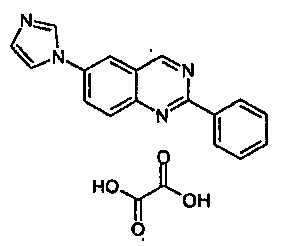
6-(1H-이미다졸-1-일)-2-페닐퀴나졸린, 275 mg (1 mmol)을 환류하에 EtOH (15 mL)에 용해시키고, 90 mg (1 mmol)의 옥살산을 첨가하고, 혼합물을 30분 동안 교반하고, 이어서, 실온으로 냉각하고, 용액을 서서히 증발시키면서 3일 동안 정치시키고, 생성 물질을 여과하고, 30℃, 20 mmHg에서 8 시간 동안 건조시켰다. 180 mg의 생성물을 얻었다. XRPD: 형태 A. TGA: 230℃까지 중량 손실이 없었다. H-NMR (d6-DMSO) δ: 9.73 (s, 1H), 8.60-8.58 (m, 2H), 8.48 (d, 1H), 8.43 (d, 1H), 8.24 (d, 1H), 8.00 (s, 1H), 7.60-7.58 (m, 3 H), 7.24 (s, 1H). 6- (1H-imidazol-1-yl) -2-phenylquinazolin, 275 mg (1 mmol) is dissolved in EtOH (15 mL) under reflux, 90 mg (1 mmol) oxalic acid are added and the mixture The mixture was stirred for 30 minutes, then cooled to room temperature, the solution was allowed to stand for 3 days with evaporation slowly, and the resulting material was filtered and dried at 30 ° C., 20 mm Hg for 8 hours. 180 mg of product was obtained. XRPD: Form A. TGA: No weight loss up to 230 ° C. H-NMR (d 6 -DMSO) δ: 9.73 (s, 1H), 8.60-8.58 (m, 2H), 8.48 (d, 1H), 8.43 (d, 1H), 8.24 (d, 1H), 8.00 ( s, 1H), 7.60-7.58 (m, 3H), 7.24 (s, 1H).
실시예Example 65: 형태 A의 용해도 65: Solubility of Form A
6-(1H-이미다졸-1-일)-2-페닐퀴나졸린 포스페이트, 형태 A의 샘플을 현탁액(2 mL중의 70 mg)을 얻기 위해서 500 rpm에서 및 37℃에서 24 시간 동안 NaCl 0.9%의 수용액중에서 교반하였다. 이어서, 현탁액을 여과하고, 용해된 생성물의 농도를 260nm에서 UV 흡광도를 측정함으로써 측정하였다. 용해도는 3.6 mg/mL이었다. 용해 속도는 37℃에서 40 mL의 물에 2mg의 생성물을 첨가하고, 500rpm에서 교반하고, 260nm에서 0.05분 마다 흡광도를 측정함으로써 측정하였고; 용해 속도는 1.9×10⁻⁴ g/min인 것으로 밝혀졌다.A sample of 6- (1H-imidazol-1-yl) -2-phenylquinazoline phosphate, Form A, was obtained with 0.9% NaCl for 24 hours at 500 rpm and 37 ° C. to obtain a suspension (70 mg in 2 mL). It stirred in aqueous solution. The suspension was then filtered and the concentration of dissolved product was measured by measuring UV absorbance at 260 nm. Solubility was 3.6 mg / mL. The dissolution rate was measured by adding 2 mg of product to 40 mL of water at 37 ° C., stirring at 500 rpm and measuring absorbance every 0.05 minutes at 260 nm; The dissolution rate was found to be 1.9 × 10 −4 g / min.
약제학적 제형Pharmaceutical formulation
상기 기재된 본발명의 화합물은 경구 또는 비경구 투여될 수 있는 약제학적 제형의 제조에 사용될 수 있다. 본원에서 논의된 모든 제형의 경우에, 화합물은 바람직하게는 약 0.1 내지 약 20mg/kg의 양으로 나타난 병리의 치료에 투여될 것이다. 일일 투여의 최적의 양 및 수는 치료되는 병리의 특성 및 중증도에 의해서 결정된다.The compounds of the present invention described above can be used in the preparation of pharmaceutical formulations that can be administered orally or parenterally. For all formulations discussed herein, the compound will preferably be administered for the treatment of pathologies indicated in amounts of about 0.1 to about 20 mg / kg. The optimal amount and number of daily administrations is determined by the nature and severity of the pathology being treated.
본 발명은 도한 적합한 분산제, 윤활제 및/또는 용매와 함께 약리학적 활성 양의 본 발명의 화합물을 함유하는 약제학적 제제를 포함한다.The present invention also encompasses pharmaceutical formulations containing a pharmaceutically active amount of a compound of the present invention together with a suitable dispersant, lubricant and / or solvent.
본 발명의 화합물은 다양한 경구용 약제 형태, 예컨대, 캡슐, 정제, 환제, 과립으로 제조될 수 있다. 그러한 제형에 적절한 분산제 및 윤활제는 탄산마그네슘, 스테아르산마그네슘, 탈크, 락토오스, 메틸셀룰로오즈, 소듐 카르복시메틸셀룰로오즈를 포함하지만, 이로 제한되는 것은 아니다. 그러한 제형을 제조하기 위해서 사용되는 기술은 활성 요소와 분산제의 혼합, 과립화 및 타정, 또는 캡슐의 충전을 포함한다.The compounds of the present invention can be prepared in various oral pharmaceutical forms, such as capsules, tablets, pills, granules. Suitable dispersants and lubricants for such formulations include, but are not limited to, magnesium carbonate, magnesium stearate, talc, lactose, methylcellulose, sodium carboxymethylcellulose. Techniques used to prepare such formulations include mixing, granulating and tableting, or filling capsules of the active ingredient with a dispersant.
본 발명의 화합물은 미리 충전된 바이알 또는 주사기의 형태로 비경구 투여용으로 제형화될 수 있다. 활성 요소는 수성 비히클에 용해되거나 오일성 에멀션의 형태일 수 있다.The compounds of the present invention may be formulated for parenteral administration in the form of prefilled vials or syringes. The active element may be dissolved in an aqueous vehicle or in the form of an oily emulsion.
Claims (27)
i) 도 1에 도시된 바와 같고/거나 표 1에 열거된 주 피크(main peak)를 포함하는 X-레이 분말 회절 스펙트럼(XRPD);
ii) 약 180℃에서 개시되는 융점 및 도 2에 도시된 DSC 온도기록도와 실질적으로 일치하는 DSC 온도기록도;
iii) 도 3에 도시된 FT-IR 스펙트럼과 실질적으로 일치하는 FT-IR 스펙트럼;
중 하나 이상이 특징인 6-(1H-이미다졸-1-일)-2-페닐퀴나졸린의 다형체 형태.Following features:
i) X-ray powder diffraction spectrum (XRPD) as shown in FIG. 1 and / or comprising a main peak listed in Table 1;
ii) a DSC thermogram substantially consistent with the melting point starting at about 180 ° C. and the DSC thermogram shown in FIG. 2;
iii) an FT-IR spectrum substantially coincident with the FT-IR spectrum shown in FIG. 3;
Polymorphic form of 6- (1H-imidazol-1-yl) -2-phenylquinazolin, characterized by one or more of.
i) 도 4에 도시된 바와 같고/거나 표 2에 열거된 주 피크를 포함하는 X-레이 분말 회절 스펙트럼(XRPD);
ii) 약 160℃에서 개시되는 융점 및 도 5에 도시된 DSC 온도기록도와 실질적으로 일치하는 DSC 온도기록도;
iii) 도 6에 도시된 FT-IR 스펙트럼과 실질적으로 일치하는 FT-IR 스펙트럼;
중 하나 이상이 특징인 6-(1H-이미다졸-1-일)-2-페닐퀴나졸린의 다형체 형태.Following features:
i) X-ray powder diffraction spectrum (XRPD) as shown in FIG. 4 and / or comprising the main peaks listed in Table 2;
ii) a DSC thermogram substantially consistent with the melting point starting at about 160 ° C. and the DSC thermogram shown in FIG. 5;
iii) an FT-IR spectrum substantially coincident with the FT-IR spectrum shown in FIG. 6;
Polymorphic form of 6- (1H-imidazol-1-yl) -2-phenylquinazolin, characterized by one or more of.
i) 도 7에 도시된 바와 같고/거나 표 3에 열거된 주 피크를 포함하는 X-레이 분말 회절 스펙트럼(XRPD);
ii) 약 162℃에서 개시되는 융점 및 도 8에 도시된 DSC 온도기록도와 실질적으로 일치하는 DSC 온도기록도;
iii) 도 9에 도시된 FT-IR 스펙트럼과 실질적으로 일치하는 FT-IR 스펙트럼;
중 하나 이상이 특징인 6-(1H-이미다졸-1-일)-2-페닐퀴나졸린의 다형체 형태.Following features:
i) X-ray powder diffraction spectrum (XRPD) as shown in FIG. 7 and / or comprising the main peaks listed in Table 3;
ii) a DSC thermogram substantially consistent with the melting point starting at about 162 ° C. and the DSC thermogram shown in FIG. 8;
iii) an FT-IR spectrum substantially coincident with the FT-IR spectrum shown in FIG. 9;
Polymorphic form of 6- (1H-imidazol-1-yl) -2-phenylquinazolin, characterized by one or more of.
i) 도 10에 도시된 바와 같고/거나 표 4에 열거된 주 피크를 포함하는 X-레이 분말 회절 스펙트럼(XRPD);
ii) 약 40 내지 100℃의 범위에서 흡열 반응, 약 156℃에서 개시되는 흡열 반응, 약 178℃에서 개시되는 흡열 반응을 나타내는 도 11에 도시된 DSC 온도기록도와 실질적으로 일치하는 DSC 온도기록도;
iii) 도 12에 도시된 FT-IR 스펙트럼과 실질적으로 일치하는 FT-IR 스펙트럼;
중 하나 이상이 특징인 6-(1H-이미다졸-1-일)-2-페닐퀴나졸린의 수화된 형태.Following features:
i) X-ray powder diffraction spectrum (XRPD) as shown in FIG. 10 and / or comprising the main peaks listed in Table 4;
ii) a DSC thermogram substantially consistent with the DSC thermogram shown in FIG. 11 showing an endothermic reaction in the range of about 40 to 100 ° C., an endothermic reaction starting at about 156 ° C., and an endothermic reaction starting at about 178 ° C .;
iii) an FT-IR spectrum substantially coincident with the FT-IR spectrum shown in FIG. 12;
Hydrated form of 6- (1H-imidazol-1-yl) -2-phenylquinazolin, characterized by one or more of.
i) 도 13에 도시된 바와 같고/거나 표 5에 열거된 주 피크를 포함하는 X-레이 분말 회절 스펙트럼(XRPD);
ii) 약 30 내지 80℃의 범위에서 흡열 반응, 약 163℃에서 개시되는 흡열 반응, 약 179℃에서 개시되는 흡열 반응을 나타내는 도 14에 도시된 DSC 온도기록도와 실질적으로 일치하는 DSC 온도기록도;
iii) 도 15에 도시된 FT-IR 스펙트럼과 실질적으로 일치하는 FT-IR 스펙트럼;
중 하나 이상이 특징인 6-(1H-이미다졸-1-일)-2-페닐퀴나졸린의 수화된 형태.Following features:
i) X-ray powder diffraction spectrum (XRPD) as shown in FIG. 13 and / or comprising the main peaks listed in Table 5;
ii) a DSC thermogram substantially consistent with the DSC thermogram shown in FIG. 14 showing an endothermic reaction in the range of about 30 to 80 ° C., an endothermic reaction starting at about 163 ° C., and an endothermic reaction starting at about 179 ° C .;
iii) an FT-IR spectrum substantially coincident with the FT-IR spectrum shown in FIG. 15;
Hydrated form of 6- (1H-imidazol-1-yl) -2-phenylquinazolin, characterized by one or more of.
i) 도 17에 도시된 바와 같고/거나 표 6에 열거된 주 피크를 포함하는 X-레이 분말 회절 스펙트럼(XRPD);
ii) 약 144℃에서 개시되는 융점 및 도 18의 영역 130 내지 280℃와 일치하는 DSC 온도기록도;
iii) 도 19a에 도시된 FT-IR 스펙트럼과 실질적으로 일치하는 FT-IR 스펙트럼;
중 하나 이상이 특징인 6-(1H-이미다졸-1-일)-2-페닐퀴나졸린의 수화된 형태.Following features:
i) X-ray powder diffraction spectrum (XRPD) as shown in FIG. 17 and / or comprising the main peaks listed in Table 6;
ii) DSC thermogram consistent with melting point starting at about 144 ° C. and region 130 to 280 ° C. of FIG. 18;
iii) an FT-IR spectrum substantially consistent with the FT-IR spectrum shown in FIG. 19A;
Hydrated form of 6- (1H-imidazol-1-yl) -2-phenylquinazolin, characterized by one or more of.
i) 도 20에 도시된 바와 같고/거나 표 7에 열거된 주 피크를 포함하는 X-레이 분말 회절 스펙트럼(XRPD);
ii) 약 240℃에서 분해와 함께 나타나는 융점;
중 하나 이상이 특징인 6-(1H-이미다졸-1-일)-2-페닐퀴나졸린 하이드로클로라이드의 결정 형태.Following features:
i) X-ray powder diffraction spectrum (XRPD) as shown in FIG. 20 and / or comprising the main peaks listed in Table 7;
ii) melting point with decomposition at about 240 ° C .;
Crystalline form of 6- (1H-imidazol-1-yl) -2-phenylquinazoline hydrochloride characterized by one or more of.
i) 도 21a에 도시된 바와 같고/거나 표 8에 열거된 주 피크를 포함하는 X-레이 분말 회절 스펙트럼(XRPD);
ii) 도 22에 도시된 DSC 온도기록도와 일치되게, 약 150℃에서 개시되는 흡열 효과 및 약 183℃에서 개시되는 제 2 흡열 효과를 나타내는 DSC 온도기록도;
iii) 도 23에 도시된 FT-IR 스펙트럼과 실질적으로 일치하는 FT-IR 스펙트럼;중 하나 이상이 추가의 특징인 6-(1H-이미다졸-1-일)-2-페닐퀴나졸린 석시네이트의 결정 형태.Cell parameters a = 8.0152 (6) Å, b = 5.9038 (4) Å, c = 33.127 (3) Å, α: 90 °, β = 93.280 ° (8), γ = 90 °, V = 1565.0 (2) Å 3 , characterized by a monoclinic system representing a space group P21 / c, with the following features:
i) X-ray powder diffraction spectrum (XRPD) as shown in FIG. 21A and / or comprising the main peaks listed in Table 8;
ii) a DSC thermogram showing an endothermic effect starting at about 150 ° C. and a second endothermic effect starting at about 183 ° C., consistent with the DSC thermogram shown in FIG. 22;
iii) an FT-IR spectrum substantially consistent with the FT-IR spectrum shown in FIG. 23; wherein at least one of 6- (1H-imidazol-1-yl) -2-phenylquinazolin succinate is an additional feature. Crystalline form.
i) 도 24에 도시된 바와 같고/거나 표 9에 열거된 주 피크(main peak)를 포함하는 X-레이 분말 회절 스펙트럼(XRPD);
ii) 도 25에 도시된 DSC 온도기록도와 일치되게, 약 108℃에서 개시되는 흡열 효과 및 약 181℃에서 개시되는 제 2 흡열 효과를 나타내는 DSC 온도기록도;
iii) 도 26에 도시된 FT-IR 스펙트럼과 실질적으로 일치하는 FT-IR 스펙트럼;중 하나 이상이 특징인 6-(1H-이미다졸-1-일)-2-페닐퀴나졸린 석시네이트의 결정 형태.Following features:
i) X-ray powder diffraction spectrum (XRPD) as shown in FIG. 24 and / or comprising a main peak listed in Table 9;
ii) a DSC thermogram showing an endothermic effect starting at about 108 ° C. and a second endothermic effect starting at about 181 ° C., consistent with the DSC thermogram shown in FIG. 25;
iii) FT-IR spectrum substantially consistent with the FT-IR spectrum shown in FIG. 26; crystal form of 6- (1H-imidazol-1-yl) -2-phenylquinazolin succinate characterized by at least one of .
i) 도 27에 도시된 바와 같고/거나 표 10에 열거된 주 피크(main peak)를 포함하는 X-레이 분말 회절 스펙트럼(XRPD);
ii) 도 28에 도시된 DSC 온도기록도와 일치되게, 약 119℃에서 개시되는 흡열 효과 및 약 184℃에서 개시되는 제 2 흡열 효과를 나타내는 DSC 온도기록도;
iii) 도 29에 도시된 FT-IR 스펙트럼과 실질적으로 일치하는 FT-IR 스펙트럼;중 하나 이상이 특징인 6-(1H-이미다졸-1-일)-2-페닐퀴나졸린 석시네이트의 결정 형태.Following features:
i) X-ray powder diffraction spectrum (XRPD) as shown in FIG. 27 and / or comprising a main peak listed in Table 10;
ii) a DSC thermogram showing an endothermic effect starting at about 119 ° C. and a second endothermic effect starting at about 184 ° C., consistent with the DSC thermogram shown in FIG. 28;
iii) FT-IR spectrum substantially consistent with the FT-IR spectrum shown in FIG. 29; crystal form of 6- (1H-imidazol-1-yl) -2-phenylquinazoline succinate characterized by at least one of .
i) 도 31에 도시된 바와 같고/거나 표 11에 열거된 주 피크를 포함하는 X-레이 분말 회절 스펙트럼(XRPD);
ii) 도 32에 도시된 DSC 온도기록도와 일치되게, 약 60℃에서 개시되는 흡열 효과, 약 103℃에서 개시되는 발열 효과 및 약 190℃에서 개시되는 제 2 흡열 효과를 나타내는 DSC 온도기록도;
iii) 도 33에 도시된 FT-IR 스펙트럼과 실질적으로 일치하는 FT-IR 스펙트럼;중 하나 이상이 특징인 6-(1H-이미다졸-1-일)-2-페닐퀴나졸린 (L)-타르트레이트의 디하이드레이트 결정 형태.Following features:
i) X-ray powder diffraction spectrum (XRPD) as shown in FIG. 31 and / or comprising the main peaks listed in Table 11;
ii) a DSC thermogram showing an endothermic effect starting at about 60 ° C., an exothermic effect starting at about 103 ° C., and a second endothermic effect starting at about 190 ° C., consistent with the DSC thermogram shown in FIG. 32;
iii) an FT-IR spectrum substantially consistent with the FT-IR spectrum shown in FIG. 33; 6- (1H-imidazol-1-yl) -2-phenylquinazolin (L) -tart, characterized by at least one of Dihydrate crystal form of late.
i) 도 35에 도시된 바와 같고/거나 표 12에 열거된 주 피크를 포함하는 X-레이 분말 회절 스펙트럼(XRPD);
ii) 도 36에 도시된 DSC 온도기록도와 실질적으로 일치되게, 약 36 내지 100℃ 범위에서의 흡열 반응 및 약 187℃에서 개시되는 제 2 흡열 반응을 나타내는 DSC 온도기록도;
iii) 도 37에 도시된 FT-IR 스펙트럼과 실질적으로 일치하는 FT-IR 스펙트럼;중 하나 이상이 특징인 6-(1H-이미다졸-1-일)-2-페닐퀴나졸린 (L)-타르트레이트의 테트라하이드레이티드(tetrahydrated) 결정 형태.Following features:
i) X-ray powder diffraction spectrum (XRPD) as shown in FIG. 35 and / or comprising the main peaks listed in Table 12;
ii) a DSC thermogram showing an endothermic reaction in the range of about 36 to 100 ° C. and a second endothermic reaction starting at about 187 ° C., substantially consistent with the DSC thermogram shown in FIG. 36;
iii) an FT-IR spectrum substantially consistent with the FT-IR spectrum shown in FIG. 37; 6- (1H-imidazol-1-yl) -2-phenylquinazolin (L) -tart, characterized by one or more of Tetrahydrated crystalline form of late.
i) 도 38에 도시된 바와 같고/거나 표 13에 열거된 주 피크를 포함하는 X-레이 분말 회절 스펙트럼(XRPD);
ii) 도 39에 도시된 DSC 온도기록도와 실질적으로 일치되게, 약 42℃에서 개시되는 흡열 반응 및 약 180℃에서 개시되는 제 2 흡열 반응을 나타내는 DSC 온도기록도;
iii) 도 40에 도시된 FT-IR 스펙트럼과 실질적으로 일치하는 FT-IR 스펙트럼;중 하나 이상이 특징인 6-(1H-이미다졸-1-일)-2-페닐퀴나졸린 (L)-타르트레이트의 모노하이드레이티드(monohydrated) 결정 형태.Following features:
i) X-ray powder diffraction spectrum (XRPD) as shown in FIG. 38 and / or comprising the main peaks listed in Table 13;
ii) a DSC thermogram showing an endothermic reaction starting at about 42 ° C. and a second endothermic reaction starting at about 180 ° C., substantially consistent with the DSC thermogram shown in FIG. 39;
iii) an FT-IR spectrum substantially consistent with the FT-IR spectrum shown in FIG. 40; 6- (1H-imidazol-1-yl) -2-phenylquinazolin (L) -tart characterized by at least one of Monohydrated crystalline form of late.
i) 도 41에 도시된 바와 같고/거나 표 14에 열거된 주 피크를 포함하는 X-레이 분말 회절 스펙트럼(XRPD);
ii) 도 42에 도시된 DSC 온도기록도와 실질적으로 일치되게, 약 189℃에서의 흡열 효과를 나타내는 DSC 온도기록도;
iii) 도 43에 도시된 FT-IR 스펙트럼과 실질적으로 일치하는 FT-IR 스펙트럼;중 하나 이상이 특징인 6-(1H-이미다졸-1-일)-2-페닐퀴나졸린 (L)-타르트레이트, 형태 D의 결정 형태.Following features:
i) X-ray powder diffraction spectrum (XRPD) as shown in FIG. 41 and / or comprising the main peaks listed in Table 14;
ii) a DSC thermogram showing an endothermic effect at about 189 ° C., substantially consistent with the DSC thermogram shown in FIG. 42;
iii) an FT-IR spectrum substantially consistent with the FT-IR spectrum shown in FIG. 43; 6- (1H-imidazol-1-yl) -2-phenylquinazolin (L) -tart, characterized by one or more of Rate, the crystalline form of Form D.
i) 도 47a에 도시된 바와 같고/거나 표 16에 열거된 주 피크를 포함하는 X-레이 분말 회절 스펙트럼(XRPD);
ii) 도 48에 도시된 DSC 온도기록도와 일치되게, 약 156℃에서 개시되는 흡열 효과 및 약 243℃에서 개시되는 제 2 흡열 효과를 나타내는 DSC 온도기록도;
iii) 도 49에 도시된 FT-IR 스펙트럼과 실질적으로 일치하는 FT-IR 스펙트럼;중 하나 이상이 추가의 특징인 6-(1H-이미다졸-1-일)-2-페닐퀴나졸린 말레에이트의 결정 형태.Cell parameters a = 8.9412 (5) Å, b = 9.8081 (5) Å, c = 10.5922 (6) Å, α: 90.517 ° (4), β = 101.969 ° (5), γ = 99.132 ° (4), V = 896.34 (8) Å 3 , characterized by a triclinic system representing space group P-1, with the following characteristics:
i) X-ray powder diffraction spectrum (XRPD) as shown in FIG. 47A and / or comprising the main peaks listed in Table 16;
ii) a DSC thermogram showing an endothermic effect starting at about 156 ° C. and a second endothermic effect starting at about 243 ° C., consistent with the DSC thermogram shown in FIG. 48;
iii) an FT-IR spectrum substantially consistent with the FT-IR spectrum shown in FIG. 49; at least one of 6- (1H-imidazol-1-yl) -2-phenylquinazolin maleate, which is an additional feature. Crystalline form.
i) 도 50에 도시된 바와 같고/거나 표 17에 열거된 주 피크를 포함하는 X-레이 분말 회절 스펙트럼(XRPD);
ii) 도 51에 도시된 DSC 온도기록도와 실질적으로 일치되게, 약 83℃에서의 피크로 나타나는 흡열 반응, 약 153℃에서 개시되는 흡열 반응 및 약 228℃에서 개시되는 흡열 반응을 나타내는 DSC 온도기록도;
iii) 도 52에 도시된 FT-IR 스펙트럼과 실질적으로 일치하는 FT-IR 스펙트럼;중 하나 이상이 특징인 6-(1H-이미다졸-1-일)-2-페닐퀴나졸린 말레에이트의 헤미하이드레이티드(hemihydrated) 결정 형태.Following features:
i) X-ray powder diffraction spectrum (XRPD) as shown in FIG. 50 and / or comprising the main peaks listed in Table 17;
ii) DSC thermogram showing an endothermic reaction exhibiting a peak at about 83 ° C., an endothermic reaction starting at about 153 ° C. and an endothermic reaction starting at about 228 ° C., substantially consistent with the DSC thermogram shown in FIG. 51. ;
iii) FT-IR spectrum substantially consistent with the FT-IR spectrum shown in FIG. 52; hemihydrate of 6- (1H-imidazol-1-yl) -2-phenylquinazolin maleate characterized by one or more of Hemihydrated crystal form.
i) 도 44a에 도시된 바와 같고/거나 표 15에 열거된 주 피크를 포함하는 X-레이 분말 회절 스펙트럼(XRPD);
ii) 도 45에 도시된 DSC 온도기록도와 일치되게, 약 199℃에서 개시되는 흡열 효과, 약 200℃에서 개시되는 흡열 효과 및 약 240℃에서 개시되는 제 3 흡열 효과를 나타내는 DSC 온도기록도;
iii) 도 46에 도시된 FT-IR 스펙트럼과 실질적으로 일치하는 FT-IR 스펙트럼;중 하나 이상이 특징인 6-(1H-이미다졸-1-일)-2-페닐퀴나졸린 푸마레이트의 결정 형태.Cell parameters a = 10.7980 (8) Å, b = 11.6643 (7) Å, c = 13.0888 (11) Å, α: 90 °, β = 106.842 ° (8), γ = 90 °, V = 1577.8 (2) Å 3 , characterized by a monoclinic system representing the space group P21 / c, with the following characteristics:
i) X-ray powder diffraction spectrum (XRPD) as shown in FIG. 44A and / or comprising the main peaks listed in Table 15;
ii) a DSC thermogram showing an endothermic effect starting at about 199 ° C., an endothermic effect starting at about 200 ° C., and a third endothermic effect starting at about 240 ° C., consistent with the DSC thermogram shown in FIG. 45;
iii) FT-IR spectrum substantially consistent with the FT-IR spectrum shown in FIG. 46; crystal form of 6- (1H-imidazol-1-yl) -2-phenylquinazolin fumarate characterized by at least one of .
i) 도 53에 도시된 바와 같고/거나 표 18에 열거된 주 피크를 포함하는 X-레이 분말 회절 스펙트럼(XRPD);
ii) 242 내지 246℃의 융점;중 하나 이상이 특징인 6-(1H-이미다졸-1-일)-2-페닐퀴나졸린 포스페이트의 결정 형태.Following features:
i) X-ray powder diffraction spectrum (XRPD) as shown in FIG. 53 and / or comprising the main peaks listed in Table 18;
ii) a melting point between 242 and 246 ° C .; crystal form of 6- (1H-imidazol-1-yl) -2-phenylquinazolin phosphate characterized by one or more of.
i) 도 54에 도시된 바와 같고/거나 표 19에 열거된 주 피크를 포함하는 X-레이 분말 회절 스펙트럼(XRPD);
ii) 도 55에 도시된 DSC 온도기록도와 일치되게, 약 229℃에서 개시되는 흡열 효과를 나타내는 DSC 온도기록도;
iii) 도 56에 도시된 FT-IR 스펙트럼과 실질적으로 일치하는 FT-IR 스펙트럼;중 하나 이상이 특징인 6-(1H-이미다졸-1-일)-2-페닐퀴나졸린 옥살레이트의 결정 형태.Following features:
i) X-ray powder diffraction spectrum (XRPD) as shown in FIG. 54 and / or comprising the main peaks listed in Table 19;
ii) a DSC thermogram showing an endothermic effect starting at about 229 ° C., consistent with the DSC thermogram shown in FIG. 55;
iii) FT-IR spectrum substantially consistent with the FT-IR spectrum shown in FIG. 56; crystal form of 6- (1H-imidazol-1-yl) -2-phenylquinazoline oxalate characterized by at least one of .
40℃ 내지 환류 온도 사이로 구성된 온도에서 용매, 예컨대, 아세토니트릴, DMF, 메탄올, 에탄올 또는 DCM중에 6-(1H-이미다졸-1-일)-2-페닐퀴나졸린을 용해시키고, 얻은 용액을 고온인 동안 여과하고, 여액을 역용매(anti-solvent), 예컨대, 에틸 아세테이트, 아세톤 또는 메틸 에틸 케톤에 첨가함을 포함하며; 사용된 용매가 메탄올 또는 에탄올인 경우에는, 상기 용매의 대부분이 50℃ 내지 환류 온도 사이로 구성된 온도에서 증류에 의해서 제거되어야 하고; 다형체의 결정화가 얻은 용액을 8 내지 36 시간 동안 교반함으로써 30℃ 내지 20℃ 사이로 구성된 온도에서 수행되는 방법.As a method for preparing 6- (1H-imidazol-1-yl) -2-phenylquinazolin,
Dissolving 6- (1H-imidazol-1-yl) -2-phenylquinazolin in a solvent such as acetonitrile, DMF, methanol, ethanol or DCM at a temperature comprised between 40 ° C. and reflux temperature, and the resulting solution was hot Filtering over phosphorus and adding the filtrate to an anti-solvent such as ethyl acetate, acetone or methyl ethyl ketone; If the solvent used is methanol or ethanol, most of the solvent must be removed by distillation at a temperature comprised between 50 ° C. and reflux temperature; Wherein the crystallization of the polymorph is carried out at a temperature comprised between 30 ° C. and 20 ° C. by stirring the solution obtained for 8 to 36 hours.
용매, 예컨대, 아세토니트릴, 에틸 아세테이트, 이소프로필 아세테이트, TBME, 디에틸 에테르, 이소프로필 에테르 또는 헥산중에서, 15℃ 내지 35℃ 사이로 구성된 온도에서 24 시간 내지 7일로 구성된 시간 동안, 제 20항의 방법에 의해서 얻은 100mg 이상의 제 1항의 다형체의 씨딩의 존재하에, 제 1항 내지 제 5항에 기재된 6-(1H-이미다졸-1-일)-2-페닐퀴나졸린의 결정 형태의 어떠한 조합의 혼합물을 현탁액으로 교반함을 포함하는 방법.A method for preparing 6- (1H-imidazol-1-yl) -2-phenylquinazoline according to claim 1,
The process of claim 20 in a solvent such as acetonitrile, ethyl acetate, isopropyl acetate, TBME, diethyl ether, isopropyl ether or hexane for a time consisting of 24 hours to 7 days at a temperature comprised between 15 ° C. and 35 ° C. A mixture of any combination of the crystalline forms of 6- (1H-imidazol-1-yl) -2-phenylquinazoline according to claims 1 to 5, in the presence of at least 100 mg seeding of the polymorph of claim 1. Stirring with a suspension.
60℃ 내지 환류 온도 사이로 구성된 온도에서 이소프로필 아세테이트 또는 MEK 중에 생성물을 용해시키고, 얻은 용액을 여과하고, 용액을 60℃ 내지 환류 온도 사이로 구성된 온도에서 적절한 결정화 용적으로 농축시키고, 60℃ 내지 70℃에서 결정화 동안 용액을 교반하고, 70℃ 내지 25℃ 사이로 구성된 온도에서 결정화로부터 2 시간 이하의 시간 이내에 다형체를 여과함을 포함하는 방법.A method for preparing 6- (1H-imidazol-1-yl) -2-phenylquinazoline according to claim 2,
Dissolve the product in isopropyl acetate or MEK at a temperature comprised between 60 ° C. and reflux temperature, filter the resulting solution, concentrate the solution to an appropriate crystallization volume at a temperature comprised between 60 ° C. and reflux temperature, and at 60 ° C. to 70 ° C. Stirring the solution during crystallization and filtering the polymorph within 2 hours or less from the crystallization at a temperature comprised between 70 ° C and 25 ° C.
자일렌으로부터 생성물을 결정화시키고, 이를 50℃ 내지 90℃ 사이로 구성된 온도에서 여과함을 포함하는 방법.A method for preparing 6- (1H-imidazol-1-yl) -2-phenylquinazoline according to claim 3,
Crystallizing the product from xylene and filtering it at a temperature comprised between 50 ° C and 90 ° C.
50℃ 내지 환류 온도 사이로 구성된 온도에서 용매, 예컨대, 메탄올, 에탄올, 이소프로판올, 또는 물중에 염기를 용해시키고, 수성 HCl로 산성화시키고, 임의로 역용매, 예컨대, 아세톤, 디옥산 또는 테트라하이드로푸란을 첨가하고, 5℃로 냉각시키고, 적어도 3 내지 4 시간 동안 얻은 현탁액을 교반하고, 여과하고, 20 mmHg이하의 진공하에 20℃ 내지 30℃에서 건조시키는 것으로 이루어지는 방법.A process for preparing the 6- (1H-imidazol-1-yl) -2-phenylquinazolin dihydrochloride monohydrate according to claim 6,
Dissolve the base in a solvent such as methanol, ethanol, isopropanol, or water at a temperature comprised between 50 ° C. and reflux temperature, acidify with aqueous HCl, and optionally add an antisolvent such as acetone, dioxane or tetrahydrofuran , Cooling to 5 ° C. and stirring the obtained suspension for at least 3 to 4 hours, filtering and drying at 20 ° C. to 30 ° C. under vacuum below 20 mmHg.
Applications Claiming Priority (2)
| Application Number | Priority Date | Filing Date | Title |
|---|---|---|---|
| ITTO2009A000424 | 2009-06-04 | ||
| ITTO2009A000424A IT1395963B1 (en) | 2009-06-04 | 2009-06-04 | CRYSTALLINE FORMS OF 6- (1H-IMIDAZOL-1-IL) -2-FENYL CHINAZOLIN AND OF ITS SALTS |
Related Child Applications (1)
| Application Number | Title | Priority Date | Filing Date |
|---|---|---|---|
| KR1020167022691A Division KR101939145B1 (en) | 2009-06-04 | 2010-06-04 | Crystalline forms of 6-(1H-imidazol-1-yl)-2-phenylquinazoline |
Publications (1)
| Publication Number | Publication Date |
|---|---|
| KR20120028362A true KR20120028362A (en) | 2012-03-22 |
Family
ID=41527692
Family Applications (2)
| Application Number | Title | Priority Date | Filing Date |
|---|---|---|---|
| KR1020167022691A Expired - Fee Related KR101939145B1 (en) | 2009-06-04 | 2010-06-04 | Crystalline forms of 6-(1H-imidazol-1-yl)-2-phenylquinazoline |
| KR1020127000282A Ceased KR20120028362A (en) | 2009-06-04 | 2010-06-04 | Crystalline forms of 6-(1h-imidazol-1-yl)-2-phenylquinazoline |
Family Applications Before (1)
| Application Number | Title | Priority Date | Filing Date |
|---|---|---|---|
| KR1020167022691A Expired - Fee Related KR101939145B1 (en) | 2009-06-04 | 2010-06-04 | Crystalline forms of 6-(1H-imidazol-1-yl)-2-phenylquinazoline |
Country Status (15)
| Country | Link |
|---|---|
| US (1) | US9174966B2 (en) |
| EP (1) | EP2438058B1 (en) |
| JP (1) | JP5739879B2 (en) |
| KR (2) | KR101939145B1 (en) |
| CN (1) | CN102459237B (en) |
| AU (1) | AU2010255376A1 (en) |
| BR (1) | BRPI1009006B1 (en) |
| CA (1) | CA2762307C (en) |
| DK (1) | DK2438058T3 (en) |
| ES (1) | ES2676646T3 (en) |
| HU (1) | HUE037631T2 (en) |
| IT (1) | IT1395963B1 (en) |
| MX (1) | MX343234B (en) |
| RU (1) | RU2557547C2 (en) |
| WO (1) | WO2010140139A2 (en) |
Families Citing this family (7)
| Publication number | Priority date | Publication date | Assignee | Title |
|---|---|---|---|---|
| ITTO20120102A1 (en) * | 2012-02-08 | 2013-08-09 | Rottapharm Spa | CRYSTALLINE FORMS OF 6- (1H-IMIDAZOL-1-IL) -2-FENYL CHINAZOLIN AND OF ITS SALTS |
| ITTO20120103A1 (en) * | 2012-02-08 | 2013-08-09 | Rottapharm Spa | CRYSTALLINE FORMS OF 6- (1H-IMIDAZOL-1-IL) -2-FENYL CHINAZOLIN AND OF ITS SALTS |
| RS59909B1 (en) * | 2013-03-06 | 2020-03-31 | Janssen Pharmaceutica Nv | Benzoimidazol-2-yl pyrimidine modulators of the histamine h4 receptor |
| SG11201608722QA (en) * | 2014-04-22 | 2016-11-29 | Arqule Inc | Salts and polymorphs of a substituted imidazopyridinyl-aminopyridine compound |
| WO2020007256A1 (en) * | 2018-07-02 | 2020-01-09 | 江苏恒瑞医药股份有限公司 | Crystal forms of oxypyridine amide derivative and preparation method therefor |
| EP3735974A1 (en) | 2019-05-10 | 2020-11-11 | Rottapharm Biotech S.r.l. | Use of 2-phenyl-6-(1h-imidazol-1-yl)quinazoline for treating neurodegenerative diseases, preferably alzheimer's disease |
| SG11202113211PA (en) * | 2019-06-03 | 2021-12-30 | Biotheryx Inc | Non-hygroscopic crystalline salts of a pyrazole compound, and pharmaceutical compositions and use thereof |
Family Cites Families (3)
| Publication number | Priority date | Publication date | Assignee | Title |
|---|---|---|---|---|
| AU2006346931B2 (en) * | 2006-08-03 | 2012-07-19 | Rottapharm Biotech S.R.L. | 6-1H-imidazo-quinazoline and quinolines derivatives, new potent analgesics and anti-inflammatory agents |
| US8999590B2 (en) * | 2007-07-25 | 2015-04-07 | Fuelcell Energy, Inc. | On-line monitoring assembly for detection of sulfur breakthrough in a desulfurizer assembly and sulfur breakthrough detection method |
| BRPI0822462A2 (en) * | 2008-06-20 | 2015-10-13 | Rottapharm Spa | 6-1h-imidazo-quinazoline and quinoline derivatives, novel hand inhibitors and imidazoline receptor binders. |
-
2009
- 2009-06-04 IT ITTO2009A000424A patent/IT1395963B1/en active
-
2010
- 2010-06-04 KR KR1020167022691A patent/KR101939145B1/en not_active Expired - Fee Related
- 2010-06-04 HU HUE10731576A patent/HUE037631T2/en unknown
- 2010-06-04 US US13/375,816 patent/US9174966B2/en active Active
- 2010-06-04 EP EP10731576.4A patent/EP2438058B1/en active Active
- 2010-06-04 CA CA2762307A patent/CA2762307C/en not_active Expired - Fee Related
- 2010-06-04 WO PCT/IB2010/052496 patent/WO2010140139A2/en not_active Ceased
- 2010-06-04 AU AU2010255376A patent/AU2010255376A1/en not_active Abandoned
- 2010-06-04 JP JP2012513729A patent/JP5739879B2/en not_active Expired - Fee Related
- 2010-06-04 ES ES10731576.4T patent/ES2676646T3/en active Active
- 2010-06-04 BR BRPI1009006-1A patent/BRPI1009006B1/en not_active IP Right Cessation
- 2010-06-04 MX MX2011012859A patent/MX343234B/en active IP Right Grant
- 2010-06-04 KR KR1020127000282A patent/KR20120028362A/en not_active Ceased
- 2010-06-04 DK DK10731576.4T patent/DK2438058T3/en active
- 2010-06-04 CN CN201080024845.4A patent/CN102459237B/en active Active
- 2010-06-04 RU RU2011153981/04A patent/RU2557547C2/en active
Also Published As
| Publication number | Publication date |
|---|---|
| MX343234B (en) | 2016-10-27 |
| WO2010140139A3 (en) | 2011-01-27 |
| RU2557547C2 (en) | 2015-07-27 |
| DK2438058T3 (en) | 2018-06-06 |
| ES2676646T3 (en) | 2018-07-23 |
| CA2762307A1 (en) | 2010-12-09 |
| US20120142713A1 (en) | 2012-06-07 |
| CA2762307C (en) | 2017-12-12 |
| RU2011153981A (en) | 2013-07-20 |
| CN102459237B (en) | 2015-05-27 |
| BRPI1009006A2 (en) | 2016-03-08 |
| JP5739879B2 (en) | 2015-06-24 |
| HUE037631T2 (en) | 2018-09-28 |
| EP2438058B1 (en) | 2018-04-11 |
| MX2011012859A (en) | 2012-05-23 |
| JP2012528849A (en) | 2012-11-15 |
| US9174966B2 (en) | 2015-11-03 |
| CN102459237A (en) | 2012-05-16 |
| BRPI1009006B1 (en) | 2019-09-24 |
| IT1395963B1 (en) | 2012-11-02 |
| AU2010255376A1 (en) | 2011-12-01 |
| ITTO20090424A1 (en) | 2010-12-05 |
| KR101939145B1 (en) | 2019-01-16 |
| WO2010140139A2 (en) | 2010-12-09 |
| KR20160102325A (en) | 2016-08-29 |
| EP2438058A2 (en) | 2012-04-11 |
Similar Documents
| Publication | Publication Date | Title |
|---|---|---|
| KR102881316B1 (en) | A novel crystalline form of N-(3-(2-(2-hydroxyethoxy)-6-morpholinopyridin-4-yl)-4-methylphenyl)-2 (trifluoromethyl)isonicotinamide as a RAF inhibitor for cancer therapy. | |
| CN105209437B (en) | Salts of cardiac myosin agonists and methods for preparing salts | |
| US8022216B2 (en) | Maleate salts of (E)-N-{4-[3-chloro-4-(2-pyridinylmethoxy)anilino]-3-cyano-7-ethoxy-6-quinolinyl}-4-(dimethylamino)-2-butenamide and crystalline forms thereof | |
| KR101939145B1 (en) | Crystalline forms of 6-(1H-imidazol-1-yl)-2-phenylquinazoline | |
| EP3430004B1 (en) | Solid state forms of nilotinib salts | |
| JP6816036B2 (en) | Crystalline morphology of histone deacetylase inhibitors | |
| WO2015001098A1 (en) | Crystalline forms of ponatinib hydrochloride | |
| CN105085387A (en) | Betrixaban salt, preparation method and application thereof | |
| CZ2016548A3 (en) | Solid state forms of eluxadoline | |
| US20200308141A1 (en) | Solid state forms of neratinib and salts thereof | |
| EP4134369B1 (en) | Solid forms of tetrahydropyranyl amino-pyrrolopyrimidinone compounds | |
| JP7152122B2 (en) | edaravone salt | |
| AU2011101558A4 (en) | Crystalline forms of 6-(1H-imadazol-1-YL)-2-phenylquinazoline | |
| KR20230026384A (en) | crystalline form of the compound | |
| TWI752916B (en) | 1-(4-(2-((1-(3,4-difluorophenyl)-1h-pyrazol-3-yl)methoxy)ethyl)piperazin-1-yl)ethanone salts | |
| CN111499627A (en) | Salts and polymorphs of substituted imidazopyridinyl-aminopyridine compounds | |
| KR20260003055A (en) | Crystalline form of ebenamide | |
| RU2807142C1 (en) | Maleate salts of (e)-n-{4-[3-chloro-4-(2-pyridinylmethoxy)anilino]-3-cyano-7-ethoxy-6-quinolinyl}-4-(dimethylamino)-2-butenamide and their crystalline forms | |
| TW201718538A (en) | Crystalline forms of fosnetupitant | |
| JP2025532703A (en) | Method for preparing salts and crystalline forms of 1-(8-bromopyrido[2,3-e][1,2,4]triazolo[4,3-a]pyrazin-4-yl)-N-methylazetidin-3-amine, and novel crystalline forms | |
| ITTO20120102A1 (en) | CRYSTALLINE FORMS OF 6- (1H-IMIDAZOL-1-IL) -2-FENYL CHINAZOLIN AND OF ITS SALTS | |
| CN116322672A (en) | 2-[3-({1-[2-(Dimethylamino)ethyl]-2-(2,2-dimethylpropyl)-1H-1,3-benzodiazepine-5- The stable salts and crystal forms of (group}sulfonyl)azetidin-1-yl]ethan-1-ol | |
| ITTO20120103A1 (en) | CRYSTALLINE FORMS OF 6- (1H-IMIDAZOL-1-IL) -2-FENYL CHINAZOLIN AND OF ITS SALTS | |
| HU231012B1 (en) | Lapatinib salts | |
| HK1234747B (en) | Salts and polymorphs of a substituted imidazopyridinyl-aminopyridine compound |
Legal Events
| Date | Code | Title | Description |
|---|---|---|---|
| PA0105 | International application |
Patent event date: 20120104 Patent event code: PA01051R01D Comment text: International Patent Application |
|
| PG1501 | Laying open of application | ||
| N231 | Notification of change of applicant | ||
| PN2301 | Change of applicant |
Patent event date: 20140702 Comment text: Notification of Change of Applicant Patent event code: PN23011R01D |
|
| A201 | Request for examination | ||
| PA0201 | Request for examination |
Patent event code: PA02012R01D Patent event date: 20150604 Comment text: Request for Examination of Application |
|
| E902 | Notification of reason for refusal | ||
| PE0902 | Notice of grounds for rejection |
Comment text: Notification of reason for refusal Patent event date: 20160621 Patent event code: PE09021S01D |
|
| A107 | Divisional application of patent | ||
| PA0104 | Divisional application for international application |
Comment text: Divisional Application for International Patent Patent event code: PA01041R01D Patent event date: 20160819 |
|
| E601 | Decision to refuse application | ||
| PE0601 | Decision on rejection of patent |
Patent event date: 20160823 Comment text: Decision to Refuse Application Patent event code: PE06012S01D Patent event date: 20160621 Comment text: Notification of reason for refusal Patent event code: PE06011S01I |