KR20110120249A - Laminated films and plant growing structures - Google Patents
Laminated films and plant growing structures Download PDFInfo
- Publication number
- KR20110120249A KR20110120249A KR1020110039893A KR20110039893A KR20110120249A KR 20110120249 A KR20110120249 A KR 20110120249A KR 1020110039893 A KR1020110039893 A KR 1020110039893A KR 20110039893 A KR20110039893 A KR 20110039893A KR 20110120249 A KR20110120249 A KR 20110120249A
- Authority
- KR
- South Korea
- Prior art keywords
- layer
- laminated
- silica fine
- layer containing
- resin
- Prior art date
- Legal status (The legal status is an assumption and is not a legal conclusion. Google has not performed a legal analysis and makes no representation as to the accuracy of the status listed.)
- Ceased
Links
Images

Classifications
-
- B—PERFORMING OPERATIONS; TRANSPORTING
- B32—LAYERED PRODUCTS
- B32B—LAYERED PRODUCTS, i.e. PRODUCTS BUILT-UP OF STRATA OF FLAT OR NON-FLAT, e.g. CELLULAR OR HONEYCOMB, FORM
- B32B27/00—Layered products comprising a layer of synthetic resin
- B32B27/06—Layered products comprising a layer of synthetic resin as the main or only constituent of a layer, which is next to another layer of the same or of a different material
- B32B27/08—Layered products comprising a layer of synthetic resin as the main or only constituent of a layer, which is next to another layer of the same or of a different material of synthetic resin
-
- A—HUMAN NECESSITIES
- A01—AGRICULTURE; FORESTRY; ANIMAL HUSBANDRY; HUNTING; TRAPPING; FISHING
- A01G—HORTICULTURE; CULTIVATION OF VEGETABLES, FLOWERS, RICE, FRUIT, VINES, HOPS OR SEAWEED; FORESTRY; WATERING
- A01G9/00—Cultivation in receptacles, forcing-frames or greenhouses; Edging for beds, lawn or the like
- A01G9/14—Greenhouses
-
- B—PERFORMING OPERATIONS; TRANSPORTING
- B32—LAYERED PRODUCTS
- B32B—LAYERED PRODUCTS, i.e. PRODUCTS BUILT-UP OF STRATA OF FLAT OR NON-FLAT, e.g. CELLULAR OR HONEYCOMB, FORM
- B32B27/00—Layered products comprising a layer of synthetic resin
- B32B27/14—Layered products comprising a layer of synthetic resin next to a particulate layer
-
- B—PERFORMING OPERATIONS; TRANSPORTING
- B32—LAYERED PRODUCTS
- B32B—LAYERED PRODUCTS, i.e. PRODUCTS BUILT-UP OF STRATA OF FLAT OR NON-FLAT, e.g. CELLULAR OR HONEYCOMB, FORM
- B32B27/00—Layered products comprising a layer of synthetic resin
- B32B27/32—Layered products comprising a layer of synthetic resin comprising polyolefins
-
- B—PERFORMING OPERATIONS; TRANSPORTING
- B32—LAYERED PRODUCTS
- B32B—LAYERED PRODUCTS, i.e. PRODUCTS BUILT-UP OF STRATA OF FLAT OR NON-FLAT, e.g. CELLULAR OR HONEYCOMB, FORM
- B32B5/00—Layered products characterised by the non- homogeneity or physical structure, i.e. comprising a fibrous, filamentary, particulate or foam layer; Layered products characterised by having a layer differing constitutionally or physically in different parts
- B32B5/22—Layered products characterised by the non- homogeneity or physical structure, i.e. comprising a fibrous, filamentary, particulate or foam layer; Layered products characterised by having a layer differing constitutionally or physically in different parts characterised by the presence of two or more layers which are next to each other and are fibrous, filamentary, formed of particles or foamed
- B32B5/30—Layered products characterised by the non- homogeneity or physical structure, i.e. comprising a fibrous, filamentary, particulate or foam layer; Layered products characterised by having a layer differing constitutionally or physically in different parts characterised by the presence of two or more layers which are next to each other and are fibrous, filamentary, formed of particles or foamed one layer being formed of particles, e.g. chips, granules, powder
-
- B—PERFORMING OPERATIONS; TRANSPORTING
- B32—LAYERED PRODUCTS
- B32B—LAYERED PRODUCTS, i.e. PRODUCTS BUILT-UP OF STRATA OF FLAT OR NON-FLAT, e.g. CELLULAR OR HONEYCOMB, FORM
- B32B2264/00—Composition or properties of particles which form a particulate layer or are present as additives
- B32B2264/10—Inorganic particles
- B32B2264/102—Oxide or hydroxide
-
- B—PERFORMING OPERATIONS; TRANSPORTING
- B32—LAYERED PRODUCTS
- B32B—LAYERED PRODUCTS, i.e. PRODUCTS BUILT-UP OF STRATA OF FLAT OR NON-FLAT, e.g. CELLULAR OR HONEYCOMB, FORM
- B32B2323/00—Polyalkenes
- B32B2323/04—Polyethylene
-
- Y—GENERAL TAGGING OF NEW TECHNOLOGICAL DEVELOPMENTS; GENERAL TAGGING OF CROSS-SECTIONAL TECHNOLOGIES SPANNING OVER SEVERAL SECTIONS OF THE IPC; TECHNICAL SUBJECTS COVERED BY FORMER USPC CROSS-REFERENCE ART COLLECTIONS [XRACs] AND DIGESTS
- Y02—TECHNOLOGIES OR APPLICATIONS FOR MITIGATION OR ADAPTATION AGAINST CLIMATE CHANGE
- Y02A—TECHNOLOGIES FOR ADAPTATION TO CLIMATE CHANGE
- Y02A40/00—Adaptation technologies in agriculture, forestry, livestock or agroalimentary production
- Y02A40/10—Adaptation technologies in agriculture, forestry, livestock or agroalimentary production in agriculture
- Y02A40/25—Greenhouse technology, e.g. cooling systems therefor
Landscapes
- Life Sciences & Earth Sciences (AREA)
- Environmental Sciences (AREA)
- Laminated Bodies (AREA)
- Protection Of Plants (AREA)
- Greenhouses (AREA)
Abstract
실리카 미립자를 함유하는 층과, 실리카 미립자 및 수지를 함유하는 층과, 열가소성 수지를 함유하는 층을 갖는 적층 필름으로서, 상기 실리카 미립자를 함유하는 층과 상기 열가소성 수지를 함유하는 층 사이에 상기 실리카 미립자 및 수지를 함유하는 층이 존재하고, 또한, 상기 실리카 미립자를 함유하는 층이 그 적층 필름의 적어도 일방의 면의 최표층인 것을 특징으로 하는 적층 필름.A laminated film having a layer containing silica fine particles, a layer containing silica fine particles and a resin, and a layer containing a thermoplastic resin, wherein the silica fine particles are interposed between the layer containing the silica fine particles and the layer containing the thermoplastic resin. And the layer containing resin exists, and the layer containing the said silica fine particle is the outermost layer of the at least one surface of this laminated | multilayer film. The laminated | multilayer film characterized by the above-mentioned.
Description
본 발명은 적층 필름 및 식물 재배용 구조물에 관한 것이다.The present invention relates to laminated films and plant cultivation structures.
종래, 농업용 하우스나 농업용 터널 등에 사용되는 필름에는, 투명성이나 내찰상성, 방담성 (防曇性) 이 요구되고 있다. 특히 방담성이 떨어지는 필름은, 필름 표면의 온도가 그 사용 환경의 이슬점 이하가 되면, 미세한 물방울이 필름의 표면에 부착되어 뿌옇게 흐려지는 것이 발생한다. 뿌옇게 흐려지게 되면, 필름의 투명성이 저하되기 때문에, 태양광의 투과율이 저하되어 작물의 생육이 늦어지거나, 필름 표면에 부착된 물방울이 작물 상으로 낙하하여 병이 발생하는 등의 문제에 이르는 경우가 있다. 그래서, 필름 표면에 방담성 피막을 형성하고 필름의 표면을 친수성으로 하는 방법이 연구되어, 각종 시도가 이루어져 왔다.DESCRIPTION OF RELATED ART Conventionally, the film used for agricultural houses, agricultural tunnels, etc. is calculated | required transparency, abrasion resistance, and antifogging property. Particularly, in the case of a film having low antifogging property, when the temperature of the film surface is lower than the dew point of the use environment, fine water droplets adhere to the surface of the film, causing cloudiness. If it becomes cloudy, the transparency of the film is lowered. Therefore, the transmittance of sunlight is lowered, the growth of crops is delayed, or water droplets attached to the film surface may fall onto the crops, resulting in problems such as disease. . Therefore, a method of forming an antifogging film on the film surface and making the surface of the film hydrophilic has been studied, and various attempts have been made.
예를 들어 일본 공개특허공보 평7-298791호에는, 합성 수지 필름의 편면에, 콜로이드상 실리카 입자를 함유하는 수성 아크릴 변성 우레탄 수지 도포막층을 형성한 농업용 방적성 (防滴性) 필름이 개시되어 있다.For example, Japanese Patent Application Laid-Open No. 7-298791 discloses an agricultural spinning film for which an aqueous acrylic modified urethane resin coating film layer containing colloidal silica particles is formed on one side of a synthetic resin film. have.
그러나, 일본 공개특허공보 평7-298791호에 기재되어 있는 필름은 내찰상성이나 투명성에 있어서 한층 더 향상이 요구되고 있었다.However, the film described in JP-A-7-298791 has been required to further improve in scratch resistance and transparency.
본 발명은 내찰상성, 친수성 및 투명성의 밸런스가 우수한 적층 필름을 제공한다.The present invention provides a laminated film having an excellent balance of scratch resistance, hydrophilicity and transparency.
즉 본 발명은 실리카 미립자를 함유하는 층과, 실리카 미립자 및 수지를 함유하는 층과, 열가소성 수지를 함유하는 층을 갖는 적층 필름으로서, 상기 실리카 미립자를 함유하는 층과 상기 열가소성 수지를 함유하는 층 사이에 상기 실리카 미립자 및 수지를 함유하는 층이 존재하고, 또한, 상기 실리카 미립자를 함유하는 층이 그 적층 필름의 최표층인 것을 특징으로 하는 적층 필름이다.Namely, the present invention is a laminated film having a layer containing silica fine particles, a layer containing silica fine particles and a resin, and a layer containing a thermoplastic resin, wherein the layer containing the silica fine particles and the layer containing the thermoplastic resin are present. The layer containing the said silica fine particle and resin exists in the layer, and the layer containing the said silica fine particle is the outermost layer of the laminated | multilayer film, It is a laminated | multilayer film characterized by the above-mentioned.
본 발명의 적층 필름은 내찰상성, 친수성 및 투명성의 밸런스가 우수한 것이다.The laminated | multilayer film of this invention is excellent in the balance of abrasion resistance, hydrophilicity, and transparency.
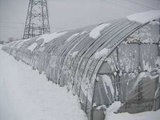
도 1 은 폭로 시험 (2) 의 결과를 나타내는 사진이다.
도 2 는 폭로 시험 (4) 의 결과를 나타내는 사진이다.
도 3 은 폭로 시험 (3) 의 결과 (앞쪽에 있는 시험 하우스) 와 폭로 시험 (5) 의 결과 (안쪽에 있는 시험 하우스) 를 나타내는 사진이다.1 is a photograph showing the results of the exposure test (2).
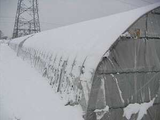
2 is a photograph showing the results of the exposure test (4).
3 is a photograph showing the results of the exposure test 3 (test house in the front) and the results of the exposure test 5 (inside the test house).
이하, 본 발명의 실시형태에 관해서 상세히 설명한다. 본 발명은 실리카 미립자를 함유하는 층과, 실리카 미립자 및 수지를 함유하는 층과, 열가소성 수지를 함유하는 층을 갖는 적층 필름으로서, 상기 실리카 미립자를 함유하는 층과 상기 열가소성 수지를 함유하는 층 사이에 상기 실리카 미립자 및 수지를 함유하는 층이 존재하고, 또한, 상기 실리카 미립자를 함유하는 층이 그 적층 필름의 적어도 일방의 면의 최표층인 것을 특징으로 하는 적층 필름이다.EMBODIMENT OF THE INVENTION Hereinafter, embodiment of this invention is described in detail. The present invention is a laminated film having a layer containing silica fine particles, a layer containing silica fine particles and a resin, and a layer containing a thermoplastic resin, wherein the layer contains the silica fine particles and a layer containing the thermoplastic resin. The layer containing the said silica fine particle and resin exists, and the layer containing the said silica fine particle is the outermost layer of the at least one surface of this laminated | multilayer film, It is a laminated | multilayer film characterized by the above-mentioned.
이하, 실리카 미립자를 함유하는 층을 A 층, 실리카 미립자 및 수지를 함유하는 층을 B 층, 열가소성 수지를 함유하는 층을 C 층이라고 하는 경우도 있다. 먼저 B 층에 관해서, 이하에 설명한다.Hereinafter, the layer containing silica fine particles may be called A layer, the layer containing silica fine particles, and resin, B layer, and the layer containing thermoplastic resin may be called C layer. First, the B layer will be described below.
B 층에 사용되는 실리카 미립자는 평균 입경 0.5 ㎛ 이하인 것이 바람직하다. 실리카 미립자는 가늘고 긴 형상, 또는 복수의 실리카 미립자가 사슬 형상으로 이어져 있는 끈형상 실리카이어도 된다. 실리카 미립자는 물 등의 액체 분산매 중에 그 실리카 미립자가 분산된 졸의 형태로 사용된다. B 층에 사용되는 실리카 미립자는 평균 입경이 3 ㎚ 이상인 것이 바람직하다. 본 발명에 적용 가능한 실리카를 액체 분산매 중에 분산시킨 졸은 시판품으로서 입수할 수 있다. 구체적으로는, 닛산 화학 공업 주식회사 제조의 수성 실리카졸인 스노우텍스 ST-ZL (평균 입경 : 70 ∼ 100 ㎚), 스노우텍스 ST-YL (평균 입경 : 50 ∼ 80 ㎚), 스노우텍스 ST-XL (평균 입경 : 40 ∼ 60 ㎚), 스노우텍스 ST-20 (평균 입경 : 10 ∼ 20 ㎚), 스노우텍스 XS (평균 입경 : 4 ∼ 6 ㎚), 스노우텍스 ST-UP (평균 입경 : 5 ∼ 20 ㎚, 길이 : 40 ∼ 100 ㎚) 등을 들 수 있다.The silica fine particles used for the B layer are preferably 0.5 µm or less in average particle diameter. Silica microparticles | fine-particles may be strip | belt-shaped silica in which elongate shape or some silica microparticles were connected in chain form. The silica fine particles are used in the form of a sol in which the silica fine particles are dispersed in a liquid dispersion medium such as water. It is preferable that the silica fine particles used for the B layer have an average particle diameter of 3 nm or more. The sol which disperse | distributed the silica applicable to this invention in the liquid dispersion medium can be obtained as a commercial item. Specifically, Snowtex ST-ZL (average particle diameter: 70-100 nm), Snowtex ST-YL (average particle diameter: 50-80 nm), which is an aqueous silica sol manufactured by Nissan Chemical Industries, Ltd., Snowtex ST-XL (average Particle size: 40 to 60 nm), Snowtex ST-20 (average particle size: 10 to 20 nm), Snowtex XS (average particle size: 4 to 6 nm), Snowtex ST-UP (average particle size: 5 to 20 nm) Length: 40-100 nm) etc. are mentioned.
실리카 미립자의 평균 입경은 광학 현미경, 레이저 현미경, 주사형 전자 현미경, 투과형 전자 현미경, 원자간력 현미경 등을 사용하여 화상에서 관찰된 입경이나, 레이저 회절 산란법, 동적 광산란법, BET 법의 평균 입경, 시어즈법 등의 방법으로 구할 수 있다.The average particle diameter of the silica fine particles was observed in an image using an optical microscope, a laser microscope, a scanning electron microscope, a transmission electron microscope, an atomic force microscope, or the average particle diameter of the laser diffraction scattering method, dynamic light scattering method, or BET method. Or the Sears method.
B 층에 사용되는 수지로는, 예를 들어, 폴리우레탄계 수지, 아크릴계 수지, 아크릴 변성 폴리우레탄계 수지, 아세트산비닐계 수지, 염화비닐계 수지, 염화비닐리덴계 수지, 폴리에스테르계 수지 등을 들 수 있고, 그 중에서도 폴리우레탄계 수지가 내찰상성이 우수하기 때문에 바람직하다. 상기 수지는 통상적으로 물이나 물과 알코올 등의 수성 용제와의 혼합 용제에 그 수지가 분산되어 있는 수계 에멀션으로서 사용된다.As resin used for B-layer, a polyurethane resin, an acrylic resin, an acrylic modified polyurethane resin, a vinyl acetate resin, a vinyl chloride resin, a vinylidene chloride resin, a polyester resin etc. are mentioned, for example. Among them, polyurethane-based resins are preferred because of their excellent scratch resistance. The resin is usually used as an aqueous emulsion in which the resin is dispersed in water or a mixed solvent of water and an aqueous solvent such as alcohol.
평활성이 양호하고, 투명성이 보다 우수한 필름이 얻어진다는 점에서, B 층에 함유되는 실리카 미립자는 70 중량% 이하인 것이 바람직하다. 또한, B 층에 함유되는 실리카 미립자가 30 중량% 이상인 경우에는, 보다 내찰상성이 우수한 필름을 얻을 수 있다. 따라서, B 층에 있어서의 실리카 미립자 및 수지의 합계를 100 중량% 로 할 때, B 층에 있어서의 실리카 미립자의 함유량이 30 ∼ 70 중량% 이고, 수지의 함유량이 30 ∼ 70 중량% 인 것이 바람직하고, 실리카 미립자의 함유량이 50 ∼ 65 중량% 이고, 수지의 함유량이 35 ∼ 50 중량% 인 것이 보다 바람직하다.It is preferable that the silica fine particle contained in B-layer is 70 weight% or less from the point which the smoothness is favorable and the film which is more excellent in transparency is obtained. Moreover, when the silica microparticles | fine-particles contained in B layer are 30 weight% or more, the film excellent in scratch resistance can be obtained. Therefore, when making the sum total of the silica fine particle and resin in B layer into 100 weight%, it is preferable that content of the silica fine particle in B layer is 30 to 70 weight%, and content of resin is 30 to 70 weight%. And it is more preferable that content of a silica fine particle is 50 to 65 weight%, and content of resin is 35 to 50 weight%.
실리카 미립자 및 수지를 함유하는 B 층은, 예를 들어, 이하에 나타내는 바와 같이 하여 형성할 수 있다. 수지를 함유하는 수계 에멀션, 실리카 미립자를 함유하는 수성 실리카졸, 및 분산매인 물을 혼합하고, 교반하여 도포액을 얻는다. 다음으로, 이 도포액을 열가소성 수지를 함유하는 층 (C 층) 에 공지된 수단을 사용하여 도포하고, 건조시킴으로써, B 층을 형성할 수 있다.The B layer containing silica fine particles and resin can be formed as shown below, for example. An aqueous emulsion containing a resin, an aqueous silica sol containing fine particles of silica, and water as a dispersion medium are mixed and stirred to obtain a coating liquid. Next, B layer can be formed by apply | coating this coating liquid to the layer (C layer) containing a thermoplastic resin using a well-known means, and drying.
본 발명의 실시에 적용할 수 있는 도포 수단으로는, 구체적으로는, 그라비아 코팅, 리버스 코팅, 브러시 코팅, 스프레이 코팅, 키스 코팅, 다이 코팅, 딥핑 등을 들 수 있다. 건조 수단으로는, 예를 들어 열풍 건조를 들 수 있다.Specific examples of the application means applicable to the practice of the present invention include gravure coating, reverse coating, brush coating, spray coating, kiss coating, die coating, dipping and the like. As a drying means, hot air drying is mentioned, for example.
B 층의 두께는 0.3 ∼ 1.5 ㎛ 가 바람직하고, 0.5 ∼ 1.2 ㎛ 가 보다 바람직하다.0.3-1.5 micrometer is preferable and, as for the thickness of B layer, 0.5-1.2 micrometer is more preferable.
상기 도포액에는, 그 도포액을 후술하는 열가소성 수지를 함유하는 층 (C 층) 에 도포하기 쉽게 하기 위해서 실리콘계 계면 활성제를 함유시킬 수 있다. 실리콘계 계면 활성제로는, 예를 들어 폴리에테르 변성 실리콘 오일이 바람직하다. 이들 계면 활성제의 배합량은, 통상적으로 도포액의 중량을 100 중량% 로 할 때, 0.01 ∼ 0.3 중량% 의 범위 내이다.In order to make it easy to apply | coat this coating liquid to the layer (C layer) containing the thermoplastic resin mentioned later, a silicone type surfactant can be contained. As silicone type surfactant, polyether modified silicone oil is preferable, for example. The compounding quantity of these surfactant exists in the range of 0.01-0.3 weight% normally when the weight of a coating liquid is 100 weight%.
상기 도포액에는, 그 도포액을 사용하여 형성되는 B 층의 내찰상성, 내수성을 향상시키기 위해서 가교제를 첨가해도 된다. 또, 그 도포액을 사용하여 형성되는 B 층의 내후성을 향상시키기 위해, 도포액에 광 안정제나 자외선 흡수제를 첨가해도 된다.You may add a crosslinking agent to the said coating liquid in order to improve the scratch resistance and water resistance of the B layer formed using this coating liquid. Moreover, in order to improve the weather resistance of the B layer formed using this coating liquid, you may add a light stabilizer and an ultraviolet absorber to a coating liquid.
또한, 도포액을 C 층에 도포하기 쉽게 하기 위해서, 도포액을 열가소성 수지를 함유하는 층에 도포하기 전에, 열가소성 수지를 함유하는 층의 표면에 코로나 처리, 플레임 처리, 플라스마 처리, 오존 처리 등의 표면 처리를 실시할 수 있다.In addition, in order to make it easy to apply | coat a coating liquid to C layer, before apply | coating a coating liquid to a layer containing a thermoplastic resin, corona treatment, flame treatment, plasma treatment, ozone treatment, etc. are applied to the surface of the layer containing a thermoplastic resin. Surface treatment can be performed.
B 층은 실리카 미립자 및 수지 이외의 성분을 함유하고 있어도 된다. B 층의 전체 중량을 100 중량% 로 할 때, 실리카 미립자의 중량과 수지 중량의 합계량은 통상 95 중량% 이상 100 중량% 이하이고, 97 중량% 이상인 것이 바람직하며, 98 중량% 이상인 것이 보다 바람직하다.The layer B may contain components other than the silica fine particles and the resin. When the total weight of the layer B is 100 wt%, the total amount of the silica fine particles and the resin weight is usually 95 wt% or more and 100 wt% or less, preferably 97 wt% or more, and more preferably 98 wt% or more. .
다음으로, 본 발명에 있어서의 A 층에 관해서 설명한다.Next, the A layer in this invention is demonstrated.
A 층은 실리카 미립자를 함유하는 층이다. A 층은 수지를 함유하지 않는다. A 층의 전체 중량을 100 중량% 로 할 때, A 층에 함유되는 실리카 미립자의 중량은 통상 95 중량% 이상 100 중량% 이하이고, 97 중량% 이상인 것이 바람직하고, 98 중량% 이상인 것이 보다 바람직하고, 99 중량% 이상인 것이 더욱 바람직하며, 100 중량% 인 것이 가장 바람직하다. A 층의 전체 중량을 100 중량% 로 할 때, A 층에 함유되는 실리카 미립자의 중량이 100 중량% 인 것은, A 층이 실리카 미립자만으로 이루어지는 층인 것을 의미한다.A layer is a layer containing silica fine particles. A layer does not contain resin. When making the total weight of A layer into 100 weight%, the weight of the silica microparticles contained in A layer is 95 weight% or more and 100 weight% or less normally, It is preferable that it is 97 weight% or more, It is more preferable that it is 98 weight% or more It is more preferable that it is 99 weight% or more, and it is most preferable that it is 100 weight%. When the total weight of the A layer is 100% by weight, the weight of the silica fine particles contained in the A layer being 100% by weight means that the A layer is a layer composed of only the silica fine particles.
A 층에 사용되는 실리카 미립자는 평균 입경 0.5 ㎛ 이하인 것이 바람직하다. 실리카 미립자는 끈형상 실리카이어도 된다. 실리카 미립자는 물 등의 액체 분산매 중에 그 실리카 미립자가 분산된 졸의 형태로 사용된다. A 층에 사용되는 실리카 미립자는 평균 입경이 3 ㎚ 이상인 것이 바람직하다.It is preferable that the silica fine particles used for A layer are 0.5 micrometer or less in average particle diameter. The silica fine particles may be string silica. The silica fine particles are used in the form of a sol in which the silica fine particles are dispersed in a liquid dispersion medium such as water. It is preferable that the silica fine particles used for the A layer have an average particle diameter of 3 nm or more.
본 발명에 적용 가능한 실리카를 액체 분산매 중에 분산시킨 졸은 시판품으로서 입수할 수 있다. 구체적으로는, 닛산 화학 공업 주식회사 제조의 수성 실리카졸인 스노우텍스 ST-ZL (평균 입경 : 70 ∼ 100 ㎚), 스노우텍스 ST-YL (평균 입경 : 50 ∼ 80 ㎚), 스노우텍스 ST-XL (평균 입경 : 40 ∼ 60 ㎚), 스노우텍스 ST-20 (평균 입경 : 10 ∼ 20 ㎚), 스노우텍스 XS (평균 입경 : 4 ∼ 6 ㎚), 스노우텍스 ST-UP (평균 입경 : 5 ∼ 20 ㎚, 길이 : 40 ∼ 100 ㎚) 등을 들 수 있다.The sol which disperse | distributed the silica applicable to this invention in the liquid dispersion medium can be obtained as a commercial item. Specifically, Snowtex ST-ZL (average particle diameter: 70-100 nm), Snowtex ST-YL (average particle diameter: 50-80 nm), which is an aqueous silica sol manufactured by Nissan Chemical Industries, Ltd., Snowtex ST-XL (average Particle size: 40 to 60 nm), Snowtex ST-20 (average particle size: 10 to 20 nm), Snowtex XS (average particle size: 4 to 6 nm), Snowtex ST-UP (average particle size: 5 to 20 nm) Length: 40-100 nm) etc. are mentioned.
구형상의 실리카 미립자를 사용하는 경우에는, 외부 헤이즈를 작게 한다는 관점에서, 평균 입경이 작은 구형상 실리카 미립자를 사용하는 것이 바람직하다. 구체적으로는, 평균 입경이 100 ㎚ 이하인 실리카가 바람직하고, 80 ㎚ 이하인 실리카가 보다 바람직하다. 구형상 실리카 미립자의 평균 입경은 3 ㎚ 이상인 것이 바람직하다. 실리카 미립자의 평균 입경은 광학 현미경, 레이저 현미경, 주사형 전자 현미경, 투과형 전자 현미경, 원자간력 현미경 등을 사용하여 화상에서 관찰된 입경이나, 레이저 회절 산란법, 동적 광산란법, BET 법의 평균 입경, 시어즈법 등의 방법으로 구할 수 있다.When using spherical silica microparticles, it is preferable to use spherical silica microparticles with a small average particle diameter from a viewpoint of making external haze small. Specifically, silica having an average particle diameter of 100 nm or less is preferable, and silica having 80 nm or less is more preferable. It is preferable that the average particle diameter of spherical silica microparticles is 3 nm or more. The average particle diameter of the silica fine particles was observed in an image using an optical microscope, a laser microscope, a scanning electron microscope, a transmission electron microscope, an atomic force microscope, or the average particle diameter of the laser diffraction scattering method, dynamic light scattering method, or BET method. Or the Sears method.
A 층을 구성하는 실리카 미립자로서, 2 종 이상을 병용해도 된다. 예를 들어, 실리카의 배열을 조밀하게 할 목적에서, 평균 입경이 큰 구형상 실리카와 평균 입경이 작은 구형상 실리카를 병용할 수 있다. 또한, 필요에 따라서, 구형상 실리카와 끈형상 실리카를 병용할 수도 있다. 평균 입경이 큰 구형상 실리카와 평균 입경이 작은 구형상 실리카를 사용하는 경우에, 바람직한 조성으로는, 평균 입경 50 ∼ 100 ㎚ 의 구형상 실리카/평균 입경 10 ㎚ 이하의 구형상 실리카 = 99/1 ∼ 70/30 (중량비) 를 들 수 있다.As silica fine particles which comprise A layer, you may use 2 or more types together. For example, for the purpose of densifying the arrangement of silica, spherical silica having a large average particle diameter and spherical silica having a small average particle diameter can be used in combination. Moreover, spherical silica and string silica can also be used together as needed. In the case of using spherical silica having a large average particle diameter and spherical silica having a small average particle diameter, preferred compositions include spherical silica having an average particle diameter of 50 to 100 nm / spherical silica having an average particle diameter of 10 nm or less = 99/1. -70/30 (weight ratio) is mentioned.
실리카 미립자를 함유하는 A 층은, 예를 들어, 이하에 나타내는 바와 같이하여 형성할 수 있다. 실리카 미립자를 함유하는 수성 실리카졸, 및 분산매인 물을 혼합하고, 교반하여 도포액을 얻는다. 다음으로, 이 도포액을 기재 상에 공지된 수단을 사용하여 도포하고, 건조시킴으로써, A 층을 형성할 수 있다. 여기서 기재란, C 층, C 층 상에 B 층을 적층한 적층 중간체 (1), 또는 적층 중간체 (1) 의 B 층 상에 앵커 코트층 등을 적층한 적층 중간체 (2) 이다. 이하, 이들을 일괄하여 기재라고 하는 경우도 있다.The A layer containing silica fine particles can be formed as shown below, for example. An aqueous silica sol containing fine particles of silica and water as a dispersion medium are mixed and stirred to obtain a coating liquid. Next, this coating liquid is apply | coated using a well-known means on a base material, and A layer can be formed by drying. Here, the base material is the laminated intermediate body 1 which laminated | stacked the B layer on the C layer, C layer, or the anchor coat layer etc. on the B layer of the laminated intermediate body 1, and the like. Hereinafter, these may be collectively called a description.
본 발명의 실시에 적용할 수 있는 도포 수단으로는, 구체적으로는, 그라비아 코팅, 리버스 코팅, 브러시 코팅, 스프레이 코팅, 키스 코팅, 다이 코팅, 딥핑 등을 들 수 있다. 건조 수단으로는, 예를 들어 열풍 건조를 들 수 있다.Specific examples of the application means applicable to the practice of the present invention include gravure coating, reverse coating, brush coating, spray coating, kiss coating, die coating, dipping and the like. As a drying means, hot air drying is mentioned, for example.
A 층의 두께는, 내굴곡성, 피막 형성시의 갈라짐의 관점에서, 0.3 ㎛ 이하가 바람직하고, 0.2 ㎛ 이하가 보다 바람직하다. A 층의 두께는 0.01 ㎛ 이상이 바람직하다.0.3 micrometer or less is preferable and, as for the thickness of A layer, from a viewpoint of bending resistance and the crack at the time of film formation, 0.2 micrometer or less is more preferable. As for the thickness of A-layer, 0.01 micrometer or more is preferable.
A 층, B 층의 두께는 각 층을 형성하기 위해서 사용하는 도포액의 고형분 농도, wet 도포량 등에 의해서 조정할 수 있다.The thickness of A layer and B layer can be adjusted with solid content concentration of the coating liquid used for forming each layer, wet coating amount, etc.
본 발명에서는, A 층의 실리카 미립자는 평면 방향, 두께 방향 양쪽으로 가능한 한 균일하게 배열되어 있는 것이 바람직하다. 균일하게 배열되어 있는 실리카 미립자를 함유하는 A 층을 갖는 적층 필름은 A 층 표면의 접촉각이 낮으면서 또한 균일하고, 또 낮은 외부 헤이즈를 나타낸다.In this invention, it is preferable that the silica fine particles of A-layer are arrange | positioned as uniformly as possible in both a planar direction and a thickness direction. The laminated film having the A layer containing the silica fine particles arranged uniformly has a low contact angle on the surface of the A layer and exhibits a uniform and low external haze.
균일하게 배열되어 있는 실리카 미립자를 함유하는 A 층을 형성하기 위해서는, A 층을 형성하기 위해서 사용하는 도포액의 고형분 농도를 높게 하고, wet 도포량을 작게 하는 것이 바람직하다. wet 도포량은 3 g/㎡ 이하가 바람직하고, 2 g/㎡ 이하가 보다 바람직하며, 1 g/㎡ 이하가 더욱 바람직하다. wet 도포량은 0.01 g/㎡ 이상인 것이 바람직하다. 도포액의 고형분 농도는 5 중량% 이상이 바람직하고, 10 중량% 이상이 보다 바람직하며, 15 중량% 이상이 더욱 바람직하다. 도포액의 고형분 농도는 50 중량% 이하인 것이 바람직하다.In order to form the A layer containing the silica fine particles arranged uniformly, it is preferable to increase the solid content concentration of the coating liquid used for forming the A layer, and to reduce the wet coating amount. The wet coating amount is preferably 3 g / m 2 or less, more preferably 2 g / m 2 or less, and even more preferably 1 g / m 2 or less. It is preferable that wet coating amount is 0.01 g / m <2> or more. 5 weight% or more is preferable, as for solid content concentration of a coating liquid, 10 weight% or more is more preferable, and 15 weight% or more is more preferable. It is preferable that solid content concentration of a coating liquid is 50 weight% or less.
또한, 도포액을 기재에 도포하기 쉽게 하기 위해서, 도포액을 기재에 도포하기 전에, 기재에 코로나 처리, 플레임 처리, 플라스마 처리, 오존 처리 등의 표면 처리를 실시할 수 있다.In addition, in order to make it easy to apply a coating liquid to a base material, before apply | coating a coating liquid to a base material, surface treatments, such as a corona treatment, a flame treatment, a plasma treatment, and an ozone treatment, can be given to a base material.
본 발명의 적층 필름은 실리카 미립자를 함유하는 층 (A 층) 과 열가소성 수지를 함유하는 층 (C 층) 사이에 실리카 미립자 및 수지를 함유하는 층 (B 층) 이 존재하고, 또한, 상기 실리카 미립자를 함유하는 층 (A 층) 이 그 적층 필름의 적어도 일방의 면의 최표층이다.In the laminated | multilayer film of this invention, the layer (B layer) containing a silica fine particle and resin exists between the layer (A layer) containing a silica fine particle, and the layer (C layer) containing a thermoplastic resin, and the said silica fine particle The layer (A layer) containing is an outermost layer of at least one surface of the laminated film.
A 층과 B 층 사이에는, 앵커 코트층, 또는 접착층 등의 다른 층이 있어도 되지만, A 층은 B 층 상에 직접 적층되어 있는 것이 바람직하다. B 층에 함유되는 실리카 미립자의 평균 입경과 A 층을 구성하는 실리카 미립자의 평균 입경의 차는 20 ㎚ 이하인 것이 바람직하고, 10 ㎚ 이하인 것이 보다 바람직하다. B 층에 함유되는 실리카 미립자의 평균 입경과 A 층을 구성하는 실리카 미립자의 평균 입경의 차는 0 ㎚ 이상인 것이 바람직하다. 또, A 층, B 층의 각 층에 함유되는 실리카 미립자가 실리카 미립자의 혼합물인 경우, 주된 성분인 실리카 미립자의 평균 입경이 상기한 관계를 만족하면 된다.Although another layer, such as an anchor coat layer or an adhesive layer, may exist between A-layer and B-layer, it is preferable that A-layer is laminated directly on B layer. The difference between the average particle diameter of the silica fine particles contained in the B layer and the average particle diameter of the silica fine particles constituting the A layer is preferably 20 nm or less, and more preferably 10 nm or less. It is preferable that the difference between the average particle diameter of the silica fine particles contained in the B layer and the average particle diameter of the silica fine particles constituting the A layer is 0 nm or more. Moreover, when the silica microparticles contained in each layer of A-layer and B-layer are a mixture of silica microparticles | fine-particles, the average particle diameter of the silica microparticles which are a main component should satisfy said relationship.
A 층과 C 층 사이에는, B 층이 1 층이어도 되고, B 층이 2 층 이상이어도 된다. 2 층 이상의 B 층이 있는 경우, 그들 B 층의 조성은 동일하거나 상이해도 된다.One layer may be sufficient as B layer, and two or more layers may be sufficient as A layer and C layer. When there are two or more B layers, the composition of those B layers may be the same or different.
B 층과 C 층 사이에는, 앵커 코트층, 또는 다른 접착제층 등의 다른 층이 있어도 된다.Another layer, such as an anchor coat layer or another adhesive bond layer, may exist between B layer and C layer.
C 층의 표면 중, 적어도 B 층을 형성하는 측의 표면은 평활한 것이 바람직하다. C 층에 있어서, B 층을 형성하는 표면의 외부 헤이즈는, 7 % 이하인 것이 바람직하고, 5 % 이하인 것이 보다 바람직하고, 3 % 이하인 것이 더욱 바람직하다.It is preferable that the surface of the side which forms B layer at least among the surface of C layer is smooth. In C layer, it is preferable that the external haze of the surface which forms B layer is 7% or less, It is more preferable that it is 5% or less, It is further more preferable that it is 3% or less.
본 발명의 적층 필름의 구성으로는, A 층/B 층/C 층, A 층/B 층/C 층/B 층/A 층, A 층/B 층/C 층/B 층, A 층/B 층/C 층/A 층 등을 들 수 있다.As a structure of the laminated | multilayer film of this invention, A layer / B layer / C layer, A layer / B layer / C layer / B layer / A layer, A layer / B layer / C layer / B layer, A layer / B Layer / C layer / A layer, etc. are mentioned.
상기한 바와 같은 적층 필름은 내찰상성, 친수성, 투명성의 밸런스가 우수하다. 또한 적층 필름의 표층이 실리카 미립자를 함유하기 때문에, 실리카 미립자를 함유하는 표층이 우레탄계 베이킹 도장의 함석판 등에 잘 접착되지 않는다. 그 때문에 본 발명의 적층 필름은 농업용 필름으로서 바람직하다.The laminated film as described above is excellent in the balance of scratch resistance, hydrophilicity and transparency. In addition, since the surface layer of the laminated film contains silica fine particles, the surface layer containing silica fine particles is hardly adhered to the tin plate of the urethane-based baking coating. Therefore, the laminated | multilayer film of this invention is suitable as an agricultural film.
특히, A 층의 실리카 미립자로서 평균 입경 50 ∼ 100 ㎚ 의 구형상 실리카를 사용한 경우, 그 구상 실리카를 사용하여 형성되는 A 층을 갖는 적층 필름은 우레탄계 베이킹 도장의 함석판에 매우 접착되기 어렵다.In particular, when spherical silica having an average particle diameter of 50 to 100 nm is used as the silica fine particles of the A layer, the laminated film having the A layer formed by using the spherical silica is hardly adhered to the tin plate of the urethane-based bake coating.
다음으로, 열가소성 수지를 함유하는 층 (C 층) 에 관해서 설명한다. 열가소성 수지를 함유하는 층을 형성하는 열가소성 수지로는, 구체적으로는, 예를 들어, 올레핀계 수지 ; 폴리염화비닐, 염화비닐/메타크릴산메틸 공중합체, 폴리염화비닐리덴 등의 염소 함유 수지 ; 폴리에틸렌테레프탈레이트, 폴리에틸렌나프탈레이트 등의 폴리에스테르계 수지 ; 폴리메타크릴산메틸 등의 아크릴계 수지 ; 불소 함유 수지 ; 폴리아미드계 수지 ; 폴리카보네이트 수지 등을 들 수 있다. 상기 열가소성 수지를 함유하는 층은 단일 종의 열가소성 수지로 형성되어 있어도 되고, 2 종 이상의 열가소성 수지의 혼합물로 형성되어 있어도 된다. 열가소성 수지를 함유하는 층을 인플레이션 성형에 의해 제조하는 경우에는, 올레핀계 수지가 바람직하다.Next, the layer (C layer) containing a thermoplastic resin is demonstrated. Specific examples of the thermoplastic resin for forming the layer containing the thermoplastic resin include, for example, olefin resins; Chlorine-containing resins such as polyvinyl chloride, vinyl chloride / methyl methacrylate copolymer, and polyvinylidene chloride; Polyester-based resins such as polyethylene terephthalate and polyethylene naphthalate; Acrylic resins such as polymethyl methacrylate; Fluorine-containing resins; Polyamide-based resins; Polycarbonate resin etc. are mentioned. The layer containing the thermoplastic resin may be formed of a single kind of thermoplastic resin or may be formed of a mixture of two or more kinds of thermoplastic resins. When manufacturing the layer containing a thermoplastic resin by inflation molding, an olefin resin is preferable.
올레핀계 수지란, 올레핀, 또는 올레핀과 올레핀 이외의 단량체를 중합하여 얻어지는 수지이고, 구체적으로는, 에틸렌 단독 중합체, 프로필렌 단독 중합체 등의 올레핀 단독 중합체 ; 에틸렌/α-올레핀 공중합체, 에틸렌/아세트산비닐 공중합체, 에틸렌/아크릴산 공중합체, 에틸렌/메타크릴산메틸 공중합체, 에틸렌/아세트산비닐/메타크릴산메틸 공중합체, 아이오노머 수지, 에틸렌/노르보르넨 공중합체 등의 에틸렌과 중합성 고리형 단량체와의 공중합체 등, 에틸렌과 에틸렌과는 상이한 단량체와의 공중합체로서, 에틸렌 유래의 구성 단위를 50 중량% 이상 함유하는 공중합체를 들 수 있다 (단 그 공중합체의 중량을 100 중량% 로 한다). 그 중에서도, 에틸렌 단독 중합체, 에틸렌/α-올레핀 공중합체, 에틸렌/아세트산비닐 공중합체, 에틸렌/메타크릴산메틸 공중합체 등의 폴리에틸렌계 수지가 가공성, 가격 등의 관점에서 특히 바람직하다.An olefin resin is resin obtained by superposing | polymerizing an olefin or monomers other than an olefin and olefin, Specifically, olefin homopolymers, such as ethylene homopolymer and a propylene homopolymer; Ethylene / α-olefin copolymer, ethylene / vinyl acetate copolymer, ethylene / acrylic acid copolymer, ethylene / methyl methacrylate copolymer, ethylene / vinyl acetate / methyl methacrylate copolymer, ionomer resin, ethylene / norbor As a copolymer of ethylene and a monomer different from ethylene, such as a copolymer of ethylene and a polymerizable cyclic monomer, such as a ene copolymer, the copolymer containing 50 weight% or more of structural units derived from ethylene can be mentioned ( However, the weight of this copolymer shall be 100 weight%). Among them, polyethylene-based resins such as ethylene homopolymer, ethylene / α-olefin copolymer, ethylene / vinyl acetate copolymer, and ethylene / methyl methacrylate copolymer are particularly preferable in view of processability and price.
상기 에틸렌/α-올레핀 공중합체는 에틸렌 유래의 구성 단위와, α-올레핀 유래의 구성 단위를 함유한다. α-올레핀은 통상적으로 탄소수 3 ∼ 20 의 α-올레핀이고, 바람직하게는 탄소수 4 ∼ 12 의 α-올레핀이다. 이러한 α-올레핀의 구체예로는, 프로필렌, 1-부텐, 4-메틸-1-펜텐, 1-헥센, 1-옥텐, 1-데센 등을 들 수 있다. 보다 바람직하게는, 4-메틸-1-펜텐, 1-헥센 등을 들 수 있다. 상기한 탄소수 3 ∼ 20 의 α-올레핀은 2 종 이상을 조합해도 되고, 예를 들어, 1-부텐과 4-메틸-1-펜텐, 1-부텐과 1-헥센, 1-부텐과 1-옥텐, 1-부텐과 1-데센 등의 조합을 들 수 있다. 보다 바람직하게는, 1-부텐과 4-메틸-1-펜텐, 1-부텐과 1-헥센의 조합을 들 수 있다.The said ethylene / alpha-olefin copolymer contains the structural unit derived from ethylene, and the structural unit derived from alpha -olefin. The α-olefin is usually an α-olefin having 3 to 20 carbon atoms, and preferably an α-olefin having 4 to 12 carbon atoms. Specific examples of the α-olefin include propylene, 1-butene, 4-methyl-1-pentene, 1-hexene, 1-octene, 1-decene and the like. More preferably, 4-methyl-1- pentene, 1-hexene, etc. are mentioned. Said C3-C20 alpha olefin may combine 2 or more types, For example, 1-butene and 4-methyl-1- pentene, 1-butene and 1-hexene, 1-butene and 1-octene And a combination of 1-butene and 1-decene. More preferably, the combination of 1-butene, 4-methyl-1-pentene, 1-butene, and 1-hexene is mentioned.
본 발명에 있어서의 에틸렌/α-올레핀 공중합체로서 바람직하게는, 에틸렌/1-부텐 공중합체, 에틸렌/4-메틸-1-펜텐 공중합체, 에틸렌/1-헥센 공중합체, 에틸렌/1-옥텐 공중합체, 에틸렌/1-부텐/1-헥센 공중합체, 에틸렌/1-부텐/1-옥텐 공중합체를 들 수 있다.As the ethylene / α-olefin copolymer in the present invention, ethylene / 1-butene copolymer, ethylene / 4-methyl-1-pentene copolymer, ethylene / 1-hexene copolymer, ethylene / 1-octene Copolymer, ethylene / 1-butene / 1-hexene copolymer, and ethylene / 1-butene / 1-octene copolymer.
열가소성 수지를 함유하는 층의 제조 방법은 특별히 한정되는 것이 아니라, 예를 들어, 인플레이션 성형법, T-다이 캐스팅 성형법, 캘린더 성형법 등 열가소성 수지제 필름을 형성할 때에 통상적으로 사용되는 방법에 의해서 제조할 수 있다.The manufacturing method of the layer containing a thermoplastic resin is not specifically limited, For example, it can manufacture by the method normally used when forming a thermoplastic resin film, such as an inflation molding method, a T-die casting molding method, a calender molding method. have.
그 중에서도, 넓은 폭의 열가소성 수지를 함유하는 층을 효율적으로 제조할 수 있는 인플레이션 성형법이 보다 바람직하다.Especially, the inflation shaping | molding method which can manufacture a layer containing a wide thermoplastic resin efficiently is more preferable.
열가소성 수지를 함유하는 층의 두께는 강도의 관점에서 0.01 ㎜ 이상인 것이 바람직하고, 피복 작업성 등의 관점에서 0.3 ㎜ 이하가 바람직하다. 0.03 ∼ 0.25 ㎜ 의 범위가 보다 바람직하고, 0.05 ∼ 0.15 ㎜ 가 특히 바람직하다.It is preferable that the thickness of the layer containing a thermoplastic resin is 0.01 mm or more from a viewpoint of strength, and 0.3 mm or less is preferable from a viewpoint of coating workability etc. The range of 0.03-0.25 mm is more preferable, and 0.05-0.15 mm is especially preferable.
열가소성 수지를 함유하는 층은 단층 필름에 한정되는 것이 아니라, 다층 필름이어도 된다. 열가소성 수지를 함유하는 층이 다층 필름인 경우, 그 층 구성은 특별히 한정되지 않고, 예를 들어, 2 종 2 층, 2 종 3 층, 3 종 3 층, 3 종 4 층, 4 종 4 층, 4 종 5 층, 5 종 5 층 등을 예시할 수 있다.The layer containing the thermoplastic resin is not limited to a single layer film, but may be a multilayer film. When the layer containing a thermoplastic resin is a multilayer film, the layer structure is not specifically limited, For example, 2 types of 2 layers, 2 types of 3 layers, 3 types of 3 layers, 3 types of 4 layers, 4 types of 4 layers, Four kinds of five layers, five kinds of five layers, etc. can be illustrated.
열가소성 수지에는 각종 첨가제, 예를 들어, 산화 방지제, 광 안정제, 자외선 흡수제, 방담제, 무기 필러, 왁스, 대전 방지제, 활제, 안티블로킹제, 안료 등을 함유시킬 수 있다. 이들 첨가제는 단독으로 사용해도 되고 2 종류 이상을 병용해도 상관없다. 이들 첨가제에 관해서는, 예를 들어 「플라스틱 및 고무용 첨가제 실용 편람」 화학 공업 (1970년) 에 기재되어 있다.The thermoplastic resin can contain various additives such as antioxidants, light stabilizers, ultraviolet absorbers, antifogging agents, inorganic fillers, waxes, antistatic agents, lubricants, antiblocking agents, pigments and the like. These additives may be used independently or may use two or more types together. These additives are described in the chemical industry (1970), for example, "Handbooks for Additives for Plastics and Rubber."
산화 방지제로는, 예를 들어, 2,6-디알킬페놀 유도체나 2-알킬페놀 유도체 등의 이른바 힌더드페놀계 화합물, 포스파이트계 화합물, 포스포나이트계 화합물 등의 3 가 (價) 의 인 원자를 함유하는 인계 에스테르 화합물을 들 수 있다. 이들 산화 방지제는 단독으로 사용해도 되고 2 종류 이상을 병용해도 된다. 특히 색상 안정화의 관점에서, 힌더드페놀계 화합물과 인계 에스테르 화합물을 병용하는 것이 바람직하다. 또한 열가소성 수지를 함유하는 층에 함유되는 산화 방지제의 양은, 그 층에 상당하는 각 층의 중량을 100 중량% 로 할 때, 각각의 층에 0.01 ∼ 1 중량% 가 바람직하고, 0.03 ∼ 0.5 중량% 가 보다 바람직하다.As antioxidant, trivalent, such as what is called a hindered phenol type compound, such as a 2, 6- dialkyl phenol derivative and a 2-alkyl phenol derivative, a phosphite type compound, and a phosphonite type compound, is mentioned, for example. The phosphorus ester compound containing a phosphorus atom is mentioned. These antioxidants may be used independently or may use two or more types together. In particular, from the viewpoint of color stabilization, it is preferable to use the hindered phenol compound and the phosphorus ester compound together. Moreover, when the quantity of the antioxidant contained in the layer containing a thermoplastic resin makes the weight of each layer correspond to the layer 100 weight%, 0.01-1 weight% is preferable for each layer, 0.03-0.5 weight% Is more preferable.
광 안정제로는, 예를 들어, 일본 공개특허공보 평8-73667호에 기재된 구조를 갖는 힌더드아민계 화합물을 들 수 있고, 구체적으로는, 상품명 티누빈 622-LD, 키마소브 944-LD (이상 BASF 사 제조), 호스타빈 N30, VP Sanduvor PR-31 (이상 클라리언트사 제조), 사이아소브 UV3529, 사이아소브 UV3346 (이상 사이텍사 제조) 등을 들 수 있다. 나아가서는, 일본 공개특허공보 평11-315067호에 기재된 구조를 갖는 입체 장애성 아민에테르 화합물을 들 수 있고, 구체적으로는, 상품명 티누빈 NOR371 (BASF 사 제조) 을 들 수 있다. 열가소성 수지를 함유하는 층에 함유되는 광 안정제의 양은, 그 층을 형성하는 각 층의 중량을 100 중량% 로 할 때, 각각의 층에 0.01 ∼ 3 중량% 가 바람직하고, 0.05 ∼ 2 중량% 가 보다 바람직하고, 특히 0.1 ∼ 1 중량% 가 바람직하다.As an optical stabilizer, the hindered amine-type compound which has a structure of Unexamined-Japanese-Patent No. 8-73667 is mentioned, for example, The brand name tinubin 622-LD, Kimasov 944-LD (Made by BASF Co., Ltd.), hosttabin N30, VP Sanduvor PR-31 (made by above Clariant company), Saisorb UV3529, Saisorb UV3346 (made by Saitec Corporation), etc. are mentioned. Furthermore, the sterically hindered amine ether compound which has a structure of Unexamined-Japanese-Patent No. 11-315067 is mentioned, Specifically, the brand name tinuvin NOR371 (made by BASF Corporation) is mentioned. As for the quantity of the light stabilizer contained in the layer containing a thermoplastic resin, when making the weight of each layer which forms the layer 100 weight%, 0.01-3 weight% is preferable for each layer, and 0.05-2 weight% is added More preferably, 0.1-1 weight% is especially preferable.
자외선 흡수제로는, 예를 들어, 벤조페논계 자외선 흡수제, 벤조트리아졸계 자외선 흡수제, 벤조에이트계 자외선 흡수제, 시아노아크릴레이트계 자외선 흡수제 등을 들 수 있고, 이들은 단독으로 사용해도 되고 2 종류 이상을 병용해도 된다. 내후성 부여 효과와 필름 표면으로의 블리드 억제라는 관점에서, 열가소성 수지를 함유하는 층에 함유되는 자외선 흡수제의 양은, 그 층을 형성하는 각 층의 중량을 100 중량% 로 할 때, 각각의 층에 0.01 ∼ 3 중량% 가 바람직하고, 0.03 ∼ 2 중량% 가 보다 바람직하다.As a ultraviolet absorber, a benzophenone type ultraviolet absorber, a benzotriazole type ultraviolet absorber, a benzoate type ultraviolet absorber, a cyanoacrylate type ultraviolet absorber, etc. are mentioned, These may be used independently or they are two or more types You may use together. From the viewpoint of weathering imparting effect and suppressing bleeding to the film surface, the amount of ultraviolet absorber contained in the layer containing the thermoplastic resin is 0.01 to each layer when the weight of each layer forming the layer is 100% by weight. -3 weight% is preferable and 0.03-2 weight% is more preferable.
무기 필러는 열가소성 수지를 함유하는 층의 강성, 보온성, 내농약성, 연소 특성 등의 여러 가지 성능을 개량할 목적으로 사용할 수 있다. 특히, 복사선 흡수성이 높은 무기 필러를 열가소성 수지를 함유하는 층에 함유시킴으로써, 그 열가소성 수지를 함유하는 층의 보온성을 향상시킬 수 있다.An inorganic filler can be used for the purpose of improving various performances, such as rigidity, heat insulation, pesticide resistance, and a combustion characteristic, of a layer containing a thermoplastic resin. In particular, by containing the inorganic filler having high radiation absorption in the layer containing the thermoplastic resin, the heat retention of the layer containing the thermoplastic resin can be improved.
무기 필러의 예로는, Mg6Al2(OH)16(CO3)·4H2O 의 화학식으로 나타내는 하이드로탈사이트 및 그 유연 (類緣) 화합물, 리튬알루미늄 복합 수산화물 등의 복합 수산화물을 들 수 있다. 하이드로탈사이트 및 그 유연 화합물의 구체예로는, 예를 들어, 천연 하이드로탈사이트나 스타비에이스 P (사카이 화학 공업 주식회사 제조), DHT-4A (쿄와 화학 공업 주식회사 제조), 맥클리어 (토다 공업 주식회사 제조) 와 같은 합성 하이드로탈사이트를 들 수 있다. 리튬알루미늄 복합 수산화물의 구체예로는, 예를 들어, OPTIMA-SS (토다 공업 주식회사 제조), 미즈카랙 (미즈사와 화학 공업 주식회사 제조) 등을 들 수 있다.Examples of the inorganic filler include complex hydroxides such as hydrotalcite represented by the chemical formula of Mg 6 Al 2 (OH) 16 (CO 3 ) .4H 2 O, a flexible compound thereof, and a lithium aluminum composite hydroxide. . As specific examples of the hydrotalcite and the flexible compound thereof, for example, natural hydrotalcite or Staviace P (manufactured by Sakai Chemical Industry Co., Ltd.), DHT-4A (manufactured by Kyowa Chemical Industry Co., Ltd.), McClear (Toda) Synthetic hydrotalcite); and the like. As a specific example of a lithium aluminum composite hydroxide, OPTIMA-SS (made by Toda Industrial Co., Ltd.), Mizuka rack (made by Mizu Corporation Chemical Industries, Ltd.) etc. are mentioned, for example.
열가소성 수지를 함유하는 층에 있어서의 무기 필러의 함유량은, 그 열가소성 수지를 함유하는 층을 형성하는 각 층의 중량을 100 중량% 로 할 때, 0.1 ∼ 60 중량% 가 바람직하고, 1 ∼ 30 중량% 가 보다 바람직하고, 특히 5 ∼ 20 중량% 가 바람직하다. 무기 필러를 사용하는 경우에는, 계면 활성제를 병용함으로써 무기 필러의 분산성이 양호해져, 보다 투명성이 우수한 열가소성 수지를 함유하는 층을 얻을 수 있다.When content of the inorganic filler in the layer containing a thermoplastic resin makes the weight of each layer which forms the layer containing this thermoplastic resin 100 weight%, 0.1-60 weight% is preferable and 1-30 weight % Is more preferable, and 5-20 weight% is especially preferable. When using an inorganic filler, dispersibility of an inorganic filler becomes favorable by using surfactant together, and the layer containing the thermoplastic resin excellent in transparency can be obtained.
방담제의 사용 목적은 특별히 한정되는 것은 아니지만, 열가소성 수지를 함유하는 층의 표면 개질제로서 사용할 수 있다. 열가소성 수지를 함유하는 층이 다층 필름인 경우에는, B 층에 가장 가까운 층에, 본 발명의 목적을 손상시키지 않는 범위에서 방담제를 사용할 수 있다.Although the purpose of using an antifogging agent is not specifically limited, It can be used as a surface modifier of the layer containing a thermoplastic resin. When the layer containing a thermoplastic resin is a multilayer film, an antifog additive can be used for the layer closest to B layer in the range which does not impair the objective of this invention.
본 발명의 적층 필름의 제조 방법은 특별히 한정되는 것은 아니지만, 바람직한 양태로서 이하의 방법을 들 수 있다. 먼저, 인플레이션 성형법에 의해 원통 형상의 열가소성 수지를 함유하는 층을 형성한다. 이어서, 그 원통 형상의 열가소성 수지를 함유하는 층의 외표면에 실리카 미립자 및 수지를 함유하는 B 층을 상기 방법에 의해 형성하고, 추가로 실리카 미립자를 함유하는 A 층을 상기 방법에 의해 형성한다. 이 방법은, 열가소성 수지를 함유하는 층의 제조에서 적층 필름의 제조까지를 인라인 방식으로 실시할 수 있기 때문에, 효율적이다.Although the manufacturing method of the laminated | multilayer film of this invention is not specifically limited, The following methods are mentioned as a preferable aspect. First, a layer containing a cylindrical thermoplastic resin is formed by the inflation molding method. Next, on the outer surface of the layer containing the cylindrical thermoplastic resin, a B layer containing silica fine particles and a resin is formed by the above method, and an A layer containing silica fine particles is further formed by the above method. This method is efficient because it can perform from manufacture of the layer containing a thermoplastic resin to manufacture of laminated | multilayer film in an inline system.
본 발명의 적층 필름은 식물 재배용 구조물의 부재로서 바람직하다. 식물 재배용 구조물이란, 프레임과 이것을 덮어 그 구조물의 외형을 형성하고 있는 피복재로 구성되는 구조물로서, 그 안에서 식물을 재배하기 위해 사용되는 구조물이다. 본 발명의 적층 필름은 그 피복재로서 바람직하다. 식물 재배용 구조물로는, 농업용 하우스나 농업용 터널을 들 수 있다.The laminated film of the present invention is preferable as a member of a plant cultivation structure. A plant cultivation structure is a structure which consists of a frame and the coating | covering material which covers this and forms the external appearance of the structure, and is a structure used for cultivating a plant therein. The laminated | multilayer film of this invention is suitable as the coating | covering material. As a structure for plant cultivation, an agricultural house and an agricultural tunnel are mentioned.
본 발명의 적층 필름을 상기 피복재로서 사용하는 경우, 그 적층 필름의 A 층이 구조물의 외표면이어도 되고, 구조물의 내표면이어도 된다. 또한, 양쪽의 최표층이 A 층인 적층 필름이 바람직하게 사용된다.When using the laminated | multilayer film of this invention as said coating | covering material, the outer surface of the structure may be sufficient as A layer of the laminated | multilayer film, and the inner surface of a structure may be sufficient as it. In addition, the laminated | multilayer film whose both outermost layers are A layers is used preferably.
프레임과 그 프레임을 덮는 피복재로 구성되어 있는 식물 재배용 구조물로서, 피복재가 본 발명의 적층 필름이고, 그 적층 필름의 A 층이 구조물의 내표면인 식물 재배용 구조물은, 구조물의 내표면인 A 층이 친수성이기 때문에, A 층에 물방울이 부착되어도 그 물방울은 그 층의 표면을 따라 흐르기 때문에 구조물 안에서 재배되고 있는 식물 위에 물방울이 낙하되는 일이 없다.A plant cultivation structure composed of a frame and a covering material covering the frame, wherein the cover material is the laminated film of the present invention, and the plant cultivation structure, in which the A layer of the laminated film is the inner surface of the structure, has a layer A, the inner surface of the structure. Since it is hydrophilic, even if water droplets adhere to the A layer, the water droplets flow along the surface of the layer so that the water droplets do not fall on the plants grown in the structure.
적설이 많은 지역에서는, 식물 재배용 구조물 위에 눈이 쌓이고, 그 쌓인 눈의 무게에 의해 구조물이 쓰러지고 파괴된다는 피해가 발생하고 있다. 구조물의 피복재로서 피복재 위에 눈이 쌓이기 힘든 피복재를 사용함으로써, 이러한 피해의 발생을 억제할 수 있을 것으로 기대된다. 본 발명의 적층 필름으로는, 최표면인 A 층이 친수성이기 때문에, 그 위에 내린 눈은 적층 필름의 표면에서 미끄러지기 쉬워, 적층 필름의 표면에 잘 쌓이지 않는다. 따라서, 프레임과 그 프레임을 덮는 피복재로 구성되어 있는 식물 재배용 구조물로서, 피복재가 본 발명의 적층 필름이고, 그 적층 필름의 A 층이 구조물의 외표면인 식물 재배용 구조물은 그 구조물의 표면에 눈이 잘 쌓이지 않아, 쓰러지고 파괴될 우려가 적다.In areas of heavy snow, snow accumulates on the plant cultivation structures, causing damage to structures that collapse and destroy by the weight of the accumulated snow. It is expected that the occurrence of such damage can be suppressed by using a coating material which is hard to collect snow on the coating material as the coating material of the structure. In the laminated | multilayer film of this invention, since A layer which is the outermost surface is hydrophilic, the snow which fell on it slips easily on the surface of laminated | multilayer film, and does not accumulate well on the surface of laminated | multilayer film. Therefore, a plant cultivation structure composed of a frame and a covering material covering the frame, wherein the cover material is the laminated film of the present invention, and the plant cultivation structure in which the layer A of the laminated film is the outer surface of the structure is exposed to snow on the surface of the structure. It does not accumulate well and there is little risk of falling and destroying.
또한, 최근 지구 온난화에 의해, 여름철에 식물 재배용 구조물 안의 온도가 지나치게 높아진다고 하는 문제가 발생하였다. 프레임과 그 프레임을 덮는 피복재로 구성되어 있는 식물 재배용 구조물로서, 피복재가 본 발명의 적층 필름이고, 그 적층 필름의 A 층이 구조물의 외표면인 식물 재배용 구조물의 외표면에 물을 살수함으로써, 그 구조물 안의 온도 상승을 억제할 수 있다.In addition, recently, global warming has caused a problem that the temperature in the plant cultivation structure becomes excessively high in summer. A plant cultivation structure composed of a frame and a cover material covering the frame, wherein the cover material is the laminated film of the present invention, and water is sprayed on the outer surface of the plant cultivation structure, in which the layer A of the laminated film is the outer surface of the structure. The temperature rise in the structure can be suppressed.
또한, 식물 재배용 구조물에서는, 장기간 사용하면 피복재의 외표면이 오염되어, 채광성이 저하되는 문제가 있다. 프레임과 그 프레임을 덮는 피복재로 구성되어 있는 식물 재배용 구조물로서, 피복재가 본 발명의 적층 필름이고, 그 적층 필름의 A 층이 구조물의 외표면인 식물 재배용 구조물은 외표면이 잘 오염되지 않는다. 이것은, 그 구조물의 외표면에 먼지나 재 (灰) 와 같은 오염물이 부착되어도, 상기 외표면인 A 층이 친수성이기 때문에, 비에 의해서 오염물이 씻겨 나가기 때문이다. 상기 구조물은 그 외표면에 오염물이 잘 부착되지 않기 때문에, 활화산에 근접한 지역과 같이 구조물의 외표면에 오염물이 잘 부착되기 쉬운 지역에서 바람직하게 사용된다.Moreover, in the plant cultivation structure, when used for a long time, the outer surface of the coating material is contaminated and there is a problem that the lightability is lowered. A plant cultivation structure composed of a frame and a covering material covering the frame, wherein the cover material is the laminated film of the present invention, and the outer surface of the plant cultivation structure, in which the layer A of the laminated film is the outer surface of the structure, is hardly contaminated. This is because even if contaminants such as dust and ash adhere to the outer surface of the structure, the contaminants are washed away by rain because the outer layer A is hydrophilic. Since the structure does not adhere well to its outer surface, it is preferably used in areas where contaminants tend to adhere well to the outer surface of the structure, such as areas close to active volcanoes.
A 층/B 층/C 층의 순으로 각 층이 적층되어 있는 적층 필름을, 그 적층 필름의 A 층이 구조물의 외표면이 되도록 사용하면, 구조물의 내표면이 열가소성 수지를 함유하는 층 (C 층) 으로 형성된다. 이러한 경우에는, 열가소성 수지를 함유하는 층에 방담제가 함유되어 있는 적층 필름을 사용하는 것이 바람직하다. 열가소성 수지 및 방담제를 함유하는 C 층을 갖는 적층 필름을 사용하면, 식물 재배용 구조물의 내표면인 C 층에 물방울이 부착되어도 그 물방울은 그 층의 표면을 따라 흐르기 때문에, 구조물 안에서 재배되고 있는 식물 위로 물방울이 낙하되는 일이 없다. 방담제로는, 공지된 방담제를 사용할 수 있다.When the laminated film in which each layer is laminated in the order of A layer / B layer / C layer is used so that the A layer of the laminated film becomes the outer surface of the structure, the inner surface of the structure contains a thermoplastic resin (C Layer). In such a case, it is preferable to use the laminated | multilayer film in which the antifogging agent is contained in the layer containing a thermoplastic resin. When a laminated film having a C layer containing a thermoplastic resin and an antifogging agent is used, even if water droplets adhere to the C layer, which is the inner surface of the plant cultivation structure, the water droplets flow along the surface of the layer, so that the plant is grown in the structure. No drops of water fall down. As an antifog additive, a well-known antifog additive can be used.
본 발명의 적층 필름은, 식물 재배용 구조물의 피복재 이외에, 옥외 텐트, 전선, 차량 구조물, 기타 옥외 사용 구조물의 피복재로서 이용할 수 있다.The laminated film of the present invention can be used as a covering material for outdoor tents, electric wires, vehicle structures, and other outdoor use structures in addition to the covering material for plant cultivation structures.
실시예Example
이하, 본 발명의 실시예를 나타내는데, 본 발명은 이것에 한정되는 것은 아니다. 또한 실시예 및 비교예 중의 시험 방법은 다음과 같다.Hereinafter, although the Example of this invention is shown, this invention is not limited to this. In addition, the test method in an Example and a comparative example is as follows.
(1) 내찰상성 시험 (1) scratch resistance test
마찰 견뢰도 시험기 RT-200 (주식회사 다이에이 과학 정기 제작소 제조) 을 사용하여, 스틸울 (#0000) 로 하중 500 gf 로 적층 필름 표면 (A 층, 또는 B 층) 을 5 회 왕복하여 문질렀다. 마찰 전후에 각각 그 적층 필름의 전체 헤이즈를 측정하여, 헤이즈차 (Δ헤이즈) = (마찰 시험 후의 전체 헤이즈) - (마찰 시험 전의 전체 헤이즈) 를 구하였다. Δ헤이즈의 값이 작을수록 내찰상성이 우수하다. 헤이즈는, JIS K7105 에 따라서, 직독식 헤이즈 컴퓨터 HGM-2DP (스가 시험기 (주) 제조 ; 측정광 C 광) 를 사용하여 측정하였다.Using a friction fastness tester RT-200 (manufactured by Daiei Scientific Co., Ltd.), the laminated film surface (A layer or B layer) was rubbed five times with a steel wool (# 0000) at a load of 500 gf. The total haze of the laminated film was measured before and after friction, and haze difference (Δ haze) = (total haze after friction test)-(total haze before friction test) was obtained. The smaller the value of Δhaze, the better the scratch resistance. Haze was measured using the direct-reading haze computer HGM-2DP (made by Suga Test Machine Co., Ltd .; measurement light C light) according to JISK7105.
(2) 접촉각 (2) contact angle
자동 접촉각계 DM-301 (쿄와 계면 과학 주식회사 제조) 을 사용하여, 적층 필름 표면에 물방울을 낙하시킨 다음, 40s 후의 접촉각을 측정하였다. 측정은 23 ℃ 50%RH 하에서 실시하였다. 실시예 1 ∼ 2, 비교예 1 ∼ 4 에 관해서는 피막 형성으로부터 7 일 경과 후에, 실시예 3 ∼ 6 에 관해서는 피막 형성으로부터 110 일 경과 후에 측정을 실시하였다.Using a contact angle meter DM-301 (manufactured by Kyowa Interface Science, Inc.), water droplets were dropped on the laminated film surface, and then the contact angle after 40 s was measured. The measurement was performed at 23 degreeC 50% RH. For Examples 1 to 2 and Comparative Examples 1 to 4, measurements were performed after 7 days had elapsed from the film formation, and for Examples 3 to 6 after 110 days had elapsed from the film formation.
(3) 투명성 시험(3) transparency test
적층 필름 표면의 외부 헤이즈를 측정하였다.The external haze of the laminated film surface was measured.
헤이즈의 측정은, JIS K7105 에 준거하여, 직독식 헤이즈 컴퓨터 HGM-2DP (스가 시험기 주식회사 제조 ; 측정광 C 광) 를 사용하여 실시했다. 적층 필름의 측정면 (A 층, 또는 B 층) 의 외부 헤이즈란, 적층 필름의 비측정면에 디메틸프탈레이트를 도포하고, 그 비측정면의 산란광을 소거한 후에 측정한 헤이즈값을 헤이즈 (1), 필름의 양면에 디메틸프탈레이트를 도포하고 양 표면의 산란광을 소거한 후에 측정한 헤이즈값 (내부 헤이즈) 을 헤이즈 (2) 로 했을 때의, 헤이즈 (1) 과 헤이즈 (2) 의 차이다.The haze was measured in accordance with JIS K7105 using a direct read haze computer HGM-2DP (manufactured by Suga Tester Co., Ltd .; measurement light C light). The external haze of the measurement surface (layer A or B layer) of a laminated film is a haze value measured after apply | coating dimethylphthalate to the non-measurement surface of a laminated film, and canceling the scattered light of the non-measured surface (1). It is a difference between haze (1) and haze (2) when the haze value (internal haze) measured after apply | coating dimethyl phthalate to both surfaces of a film, and canceling the scattered light of both surfaces is made into the haze (2).
(4) 층두께 (4) layer thickness
적층 필름의 단면을 전자 현미경에 의해 관찰하여, 실리카 미립자를 함유하는 층 (A 층) 과, 실리카 미립자 및 수지를 함유하는 층 (B 층) 의 각 층의 두께를 계측하였다.The cross section of the laminated film was observed with an electron microscope, and the thickness of each layer of the layer (A layer) containing silica fine particles and the layer (B layer) containing silica fine particles and resin was measured.
(5) 내함석 접착 시험 방법(5) Test method of adhesion resistance
청색 (우레탄) 의 베이킹된 함석판 (품번 : APC0.35, CGCCR, F-1041 지붕 ; 닛폰 강관 제조) 상에, 폭 20 ㎜ 의 적층 필름의 표면 (A 층 또는 B 층) 에 물을 부착시켜서, 물을 부착시킨 적층 필름의 표면과 함석판을 겹쳐 핸드 롤러에 의해 접착하고, 80 ℃ 의 오븐에서 3 시간 건조시켜 시험용 샘플을 작성하였다. 오토그래프 (시마즈 AGS100, 로드 셀 5 ㎏) 를 사용하여, 속도 50 ㎜/min. 으로 180°방향으로 시험용 샘플을 박리하여 강도를 측정하였다.Water was attached to the surface (layer A or layer B) of a laminated film having a width of 20 mm on a blue (urethane) baked tin plate (part no .: APC0.35, CGCCR, F-1041 roof; manufactured by Nippon Steel Pipe). The surface of the laminated | multilayer film to which water was affixed, and the tin plate were piled together, it adhere | attached by the hand roller, and it dried in 80 degreeC oven for 3 hours, and created the test sample. Using an autograph (Shimazu AGS100, load cell 5 kg), the speed | rate 50 mm / min. The test sample was peeled off in the 180 ° direction to measure the strength.
다음으로, 실시예, 비교예에 사용한 열가소성 수지를 함유하는 층 (C 층) 의 제작 방법에 관해서 설명한다.Next, the manufacturing method of the layer (C layer) containing the thermoplastic resin used for the Example and the comparative example is demonstrated.
<C 층의 제작> <Production of C layer>
공압출 인플레이션 성형법 (가공 온도 160 ℃) 에 의해, 외층, 중간층 및 내층이 이 순서대로 적층되어 있는 두께 100 ㎛ 의 열가소성 수지를 함유하는 층을 제작하였다. 또, 외층, 중간층, 내층의 압출량의 중량비는 외층/중간층/내층 = 2/6/2 로 하였다. 각 층의 조성은 다음과 같다.By the coextrusion inflation molding method (process temperature of 160 degreeC), the layer containing the thermoplastic resin of thickness 100micrometer in which the outer layer, the intermediate | middle layer, and an inner layer were laminated | stacked in this order was produced. In addition, the weight ratio of the extrusion amount of an outer layer, an intermediate | middle layer, and an inner layer was outer layer / intermediate | middle layer / inner layer = 2/6/2. The composition of each layer is as follows.
상기 외층은, 폴리에틸렌 수지 (엑셀렌GMH CB0004, 멜트플로우 레이트 0.4 g/10 분, 밀도 926 ㎏/㎥ ; 스미토모 화학 주식회사 제조) 79.3 중량%, 폴리에틸렌 수지 (스미카센E FV203, 멜트플로우 레이트 2.0 g/10 분, 밀도 913 ㎏/㎥, 스미토모 화학 주식회사 제조) 20.0 중량%, 광 안정제로서 힌더드아민계 화합물 0.6 중량%, 및 산화 방지제 0.1 중량% 로 이루어지는 열가소성 수지 조성물로 형성하였다.The outer layer is polyethylene resin (Excelene GMH CB0004, melt flow rate 0.4 g / 10 minutes, density 926 kg / m 3; Sumitomo Chemical Co., Ltd.) 79.3% by weight, polyethylene resin (Sumikasen E FV203, melt flow rate 2.0 g / 10 Powder, a density of 913 kg / m 3, manufactured by Sumitomo Chemical Co., Ltd.), 20.0% by weight, a thermoplastic resin composition comprising 0.6% by weight of a hindered amine compound as an optical stabilizer, and 0.1% by weight of an antioxidant.
상기 중간층은, 폴리에틸렌 수지 (엑셀렌GMH GH030, 멜트플로우 레이트 0.5 g/10 분, 밀도 912 ㎏/㎥ ; 스미토모 화학 주식회사 제조) 85.6 중량%, 무기 필러로서 합성 하이드로탈사이트 13 중량%, 방담제로서 글리세린계 지방산 에스테르 0.6 중량%, 광 안정제로서 힌더드아민계 화합물 0.7 중량%, 및 산화 방지제 0.1 중량% 로 이루어지는 열가소성 수지 조성물로 형성하였다.The said intermediate | middle layer is 85.6 weight% of polyethylene resins (Excelene GMH GH030, melt flow rate 0.5g / 10min, density 912 kg / m <3>; Sumitomo Chemical Co., Ltd.), 13 weight% of synthetic hydrotalcites as an inorganic filler, glycerin as an antifog additive It formed from the thermoplastic resin composition which consists of 0.6 weight% of systemic fatty acid esters, 0.7 weight% of hindered amine-type compounds as an optical stabilizer, and 0.1 weight% of antioxidant.
상기 내층은, 폴리에틸렌 수지 (엑셀렌GMH GH030, 멜트플로우 레이트 0.5 g/10 분, 밀도 912 ㎏/㎥ ; 스미토모 화학 주식회사 제조) 41.9 중량%, 폴리에틸렌 수지 (엑셀렌GMH GH051, 멜트플로우 레이트 0.4 g/10 분, 밀도 921 ㎏/㎥ ; 스미토모 화학 주식회사 제조) 37.4 중량%, 폴리에틸렌 수지 (스미카센E FV203, 멜트플로우 레이트 2.0 g/10 분, 밀도 913 ㎏/㎥ ; 스미토모 화학 주식회사 제조) 20.0 중량%, 광 안정제로서 힌더드아민계 화합물 0.6 중량% 및 산화 방지제 0.1 중량% 로 이루어지는 열가소성 수지 조성물로 형성하였다.The said inner layer is polyethylene resin (Excelene GMH GH030, melt flow rate 0.5 g / 10 minutes, density 912 kg / m <3>; Sumitomo Chemical Co., Ltd. product) 41.9 weight%, polyethylene resin (Excelene GMH GH051, melt flow rate 0.4 g / 10 minutes) Density 921 kg / m 3; Sumitomo Chemical Co., Ltd.) 37.4 wt%, polyethylene resin (Sumikasen E FV203, melt flow rate 2.0 g / 10 min, density 913 kg / m 3; Sumitomo Chemical Co., Ltd.) 20.0 wt%, light stabilizer As a thermoplastic resin composition, 0.6 wt% of a hindered amine compound and 0.1 wt% of an antioxidant were used.
외층측 표면의 외부 헤이즈는 6 % 였다.The outer haze of the outer layer side surface was 6%.
다음으로, 실시예, 비교예에 사용한 도포액의 제작 방법에 관해서 설명한다.Next, the manufacturing method of the coating liquid used for the Example and the comparative example is demonstrated.
<도포액의 제작> <Production of coating liquid>
사용한 도포액의 원료는 다음과 같다.The raw material of the used coating liquid is as follows.
(1) 실리카졸 (1) silica sol
스노우텍스 ST-YL : 평균 입경 = 50 ∼ 80 ㎚, 고형분 농도 = 40 중량% Snowtex ST-YL: Average particle size = 50-80 nm, solid content concentration = 40 weight%
스노우텍스 ST-XL : 평균 입경 = 40 ∼ 60 ㎚, 고형분 농도 = 40 중량% Snowtex ST-XL: Average particle size = 40 to 60 nm, solid content concentration = 40% by weight
(모두 닛산 화학 공업 주식회사 제조. 평균 입경은 BET 법에 의한 값이다) (All are manufactured by Nissan Chemical Industry Co., Ltd .. Average particle size is the value by BET method)
(2) 아크릴 변성 폴리우레탄 에멀션(2) acrylic modified polyurethane emulsion
아데카 본타이터 HUX-401 ; 고형분 농도 = 37 중량% (주식회사 ADEKA 제조)Adeka Boniter HUX-401; Solid content concentration = 37% by weight (manufactured by ADEKA Corporation)
(3) 폴리에테르 변성 실리콘계 계면 활성제 FZ-77 (토레이·다우코닝 주식회사 제조) (3) Polyether modified silicone type surfactant FZ-77 (made by Toray Dow Corning Corporation)
상기 원료 및 물을 소정의 배합비로 혼합하여, 표 1, 2 에 나타내는 도포액 (가) ∼ (타) 를 얻었다.The said raw material and water were mixed at predetermined | prescribed compounding ratio, and the coating liquid (a)-(ta) shown in Table 1, 2 was obtained.
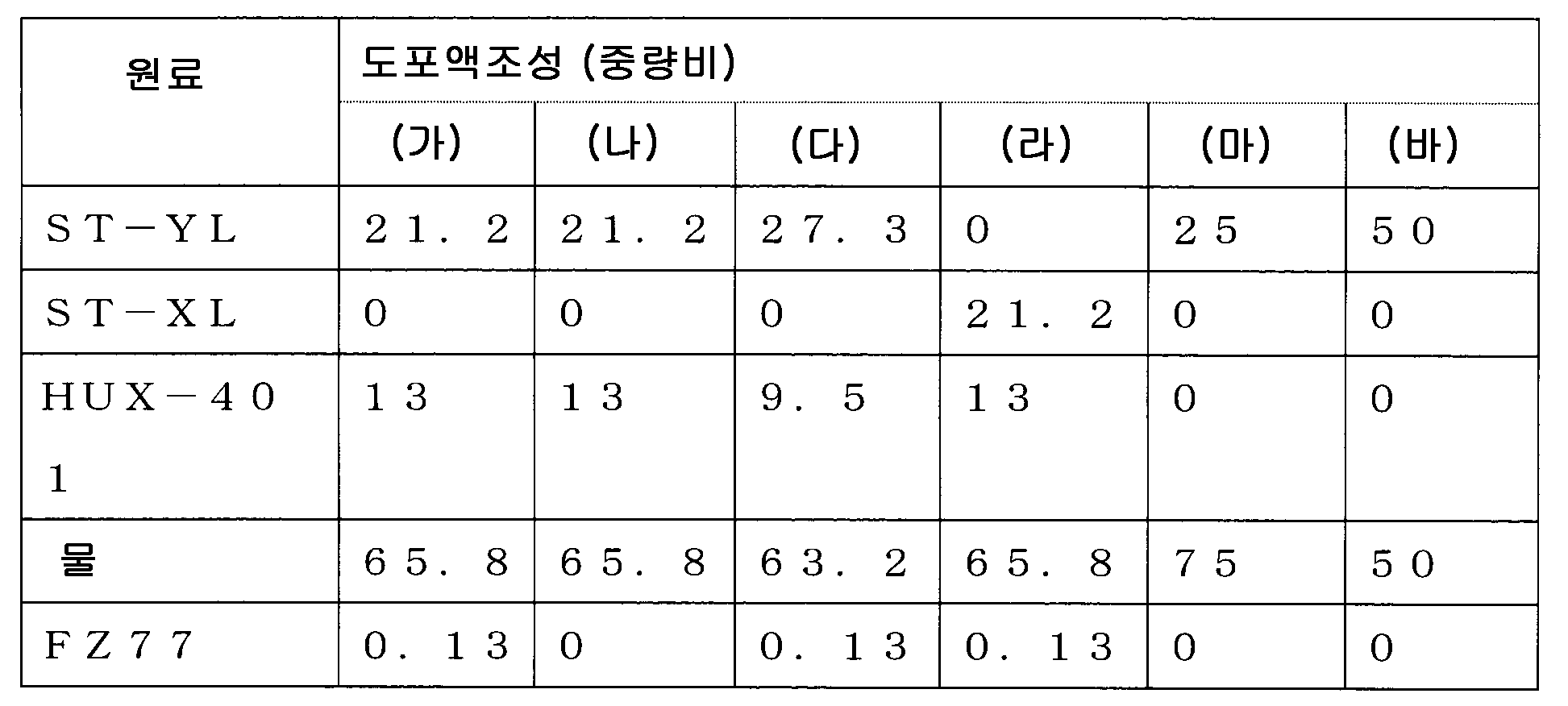
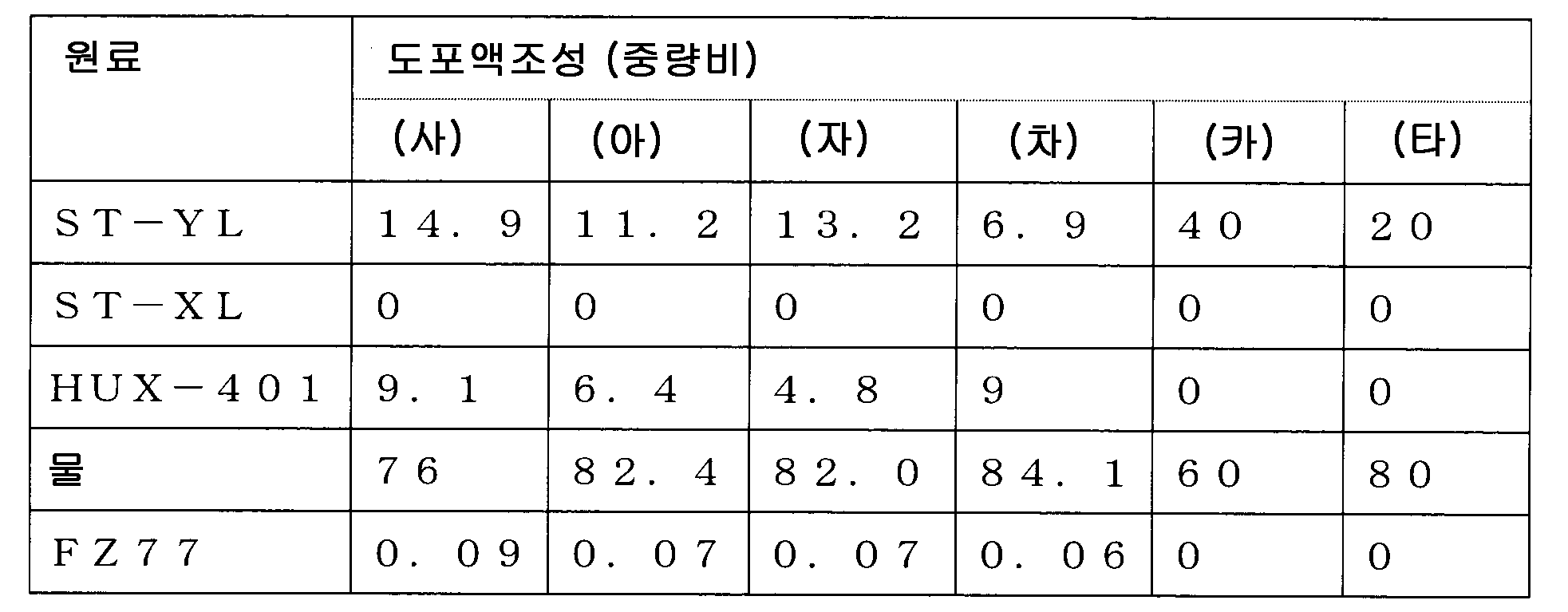
다음으로, 실시예 1 ∼ 실시예 2, 비교예 1 ∼ 비교예 4 에 관해서 설명한다.Next, Examples 1 to 2 and Comparative Examples 1 to 4 will be described.
[실시예 1] Example 1
<A 층 및 B 층의 형성> <Formation of A Layer and B Layer>
상기 열가소성 수지를 함유하는 층의 외층에 코로나 처리를 실시하였다. 코로나 처리한 열가소성 수지를 함유하는 층의 표면에 도포액 (가) 를 도포하여, 도포막을 형성하였다. 도포에는, wet 도포량 = 13 ㎛ 의 바를 사용하였다. 그 후, 도포막을 형성한 열가소성 수지를 함유하는 층을 60 ℃ 에서, 1 분간, 열풍 건조를 실시하여, 열가소성 수지를 함유하는 층 위에 실리카 미립자 및 수지를 함유하는 층이 적층된 적층 중간체를 얻었다.Corona treatment was performed to the outer layer of the layer containing the thermoplastic resin. The coating liquid (a) was apply | coated to the surface of the layer containing the corona treated thermoplastic resin, and the coating film was formed. For application, a bar of wet coating amount = 13 µm was used. Then, hot air drying was performed for 1 minute at 60 degreeC on the layer containing the thermoplastic resin in which the coating film was formed, and the laminated intermediate in which the layer containing a silica fine particle and the resin was laminated | stacked on the layer containing a thermoplastic resin was obtained.
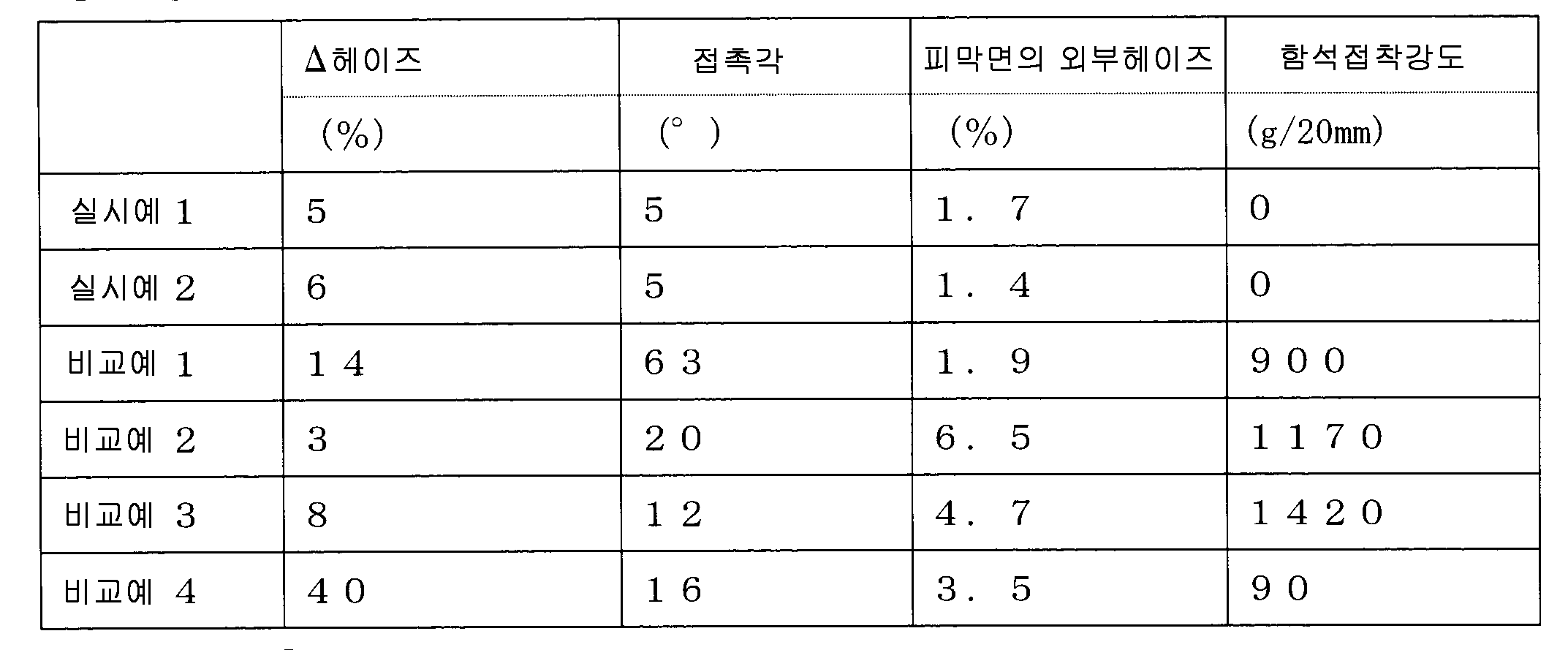
추가로 상기 실리카 미립자 및 수지를 함유하는 층 상에, 도포액 (마) 를 도포하여, 도포막을 형성하였다. 도포에는, wet 도포량 = 5 ㎛ 의 바를 사용하였다. 그 후, 도포막을 형성한 적층 중간체를 60 ℃ 에서, 1 분간, 열풍 건조를 실시하여, 열가소성 수지를 함유하는 층 (C 층), 실리카 미립자 및 수지를 함유하는 층 (B 층), 실리카 미립자를 함유하는 층 (A 층) 이 순서대로 적층된 적층 필름을 얻었다. A 층 및 B 층의 구성을 표 3 에, 적층 필름의 시험 결과를 표 4 에 나타내었다.Furthermore, the coating liquid (e) was apply | coated on the layer containing the said silica fine particle and resin, and the coating film was formed. For application, a bar of wet coating amount = 5 mu m was used. Then, hot air drying is performed for 1 minute at 60 degreeC on the laminated intermediate in which the coating film was formed, and the layer (C layer) containing a thermoplastic resin, the layer (B layer) containing silica fine particles and resin, and a silica fine particle are carried out. The layer (A layer) to contain was obtained the laminated | multilayer film laminated | stacked in order. Table 3 shows the structure of A-layer and B-layer, and the test result of laminated | multilayer film is shown in Table 4.
[실시예 2] [Example 2]
<A 층 및 B 층의 형성> <Formation of A Layer and B Layer>
상기 열가소성 수지를 함유하는 층의 외층에 코로나 처리를 실시하였다. 코로나 처리한 열가소성 수지를 함유하는 층의 표면에 도포액 (나) 를 도포하여, 도포막을 형성하였다. 도포에는, wet 도포량 = 13 ㎛ 의 바를 사용하였다. 그 후, 도포막을 형성한 열가소성 수지를 함유하는 층을 60 ℃ 에서, 1 분간, 열풍 건조를 실시하여, 열가소성 수지를 함유하는 층 위에 실리카 미립자 및 수지를 함유하는 층이 적층된 적층 중간체를 얻었다.Corona treatment was performed to the outer layer of the layer containing the thermoplastic resin. The coating liquid (b) was apply | coated to the surface of the layer containing the corona treated thermoplastic resin, and the coating film was formed. For application, a bar of wet coating amount = 13 µm was used. Then, hot air drying was performed for 1 minute at 60 degreeC on the layer containing the thermoplastic resin in which the coating film was formed, and the laminated intermediate in which the layer containing a silica fine particle and the resin was laminated | stacked on the layer containing a thermoplastic resin was obtained.
추가로 상기 실리카 미립자 및 수지를 함유하는 층 상에, 도포액 (마) 를 도포하였다. 도포에는, wet 도포량 = 5 ㎛ 의 바를 사용하였다. 그 후, 도포막을 형성한 적층 중간체를 60 ℃ 에서, 1 분간, 열풍 건조를 실시하여, 열가소성 수지를 함유하는 층 (C 층), 실리카 미립자 및 수지를 함유하는 층 (B 층), 실리카 미립자를 함유하는 층 (A 층) 이 순서대로 적층된 적층 필름을 얻었다. A 층 및 B 층의 구성을 표 3 에, 적층 필름의 시험 결과를 표 4 에 나타내었다.Furthermore, the coating liquid (e) was apply | coated on the layer containing the said silica fine particle and resin. For application, a bar of wet coating amount = 5 mu m was used. Then, hot air drying is performed for 1 minute at 60 degreeC on the laminated intermediate in which the coating film was formed, and the layer (C layer) containing a thermoplastic resin, the layer (B layer) containing silica fine particles and resin, and a silica fine particle are carried out. The layer (A layer) to contain was obtained the laminated | multilayer film laminated | stacked in order. Table 3 shows the structure of A-layer and B-layer, and the test result of laminated | multilayer film is shown in Table 4.
[비교예 1] Comparative Example 1
<B 층의 형성> <Formation of B Layer>
상기 열가소성 수지를 함유하는 층의 외층에 코로나 처리를 실시하였다. 코로나 처리한 열가소성 수지를 함유하는 층의 표면에 도포액 (가) 를 도포하였다. 도포에는, wet 도포량 = 13 ㎛ 의 바를 사용하였다. 그 후, 도포막을 형성한 열가소성 수지를 함유하는 층을 60 ℃ 에서, 1 분간, 열풍 건조를 실시하여, 열가소성 수지를 함유하는 층 위에 실리카 미립자 및 수지를 함유하는 층이 적층된 적층 중간체를 얻었다. 그 적층 중간체가 비교예 1 의 적층 필름이다. 실리카 미립자 및 수지를 함유하는 층 (B 층) 의 구성을 표 3 에, 적층 필름의 시험 결과를 표 4 에 나타내었다. Corona treatment was performed to the outer layer of the layer containing the thermoplastic resin. The coating liquid (a) was apply | coated to the surface of the layer containing the corona treated thermoplastic resin. For application, a bar of wet coating amount = 13 µm was used. Then, hot air drying was performed for 1 minute at 60 degreeC on the layer containing the thermoplastic resin in which the coating film was formed, and the laminated intermediate in which the layer containing a silica fine particle and the resin was laminated | stacked on the layer containing a thermoplastic resin was obtained. This laminated intermediate is a laminated film of Comparative Example 1. Table 3 shows the structure of the layer (B layer) containing silica fine particles and resin, and Table 4 shows the test results of the laminated film.
[비교예 2] Comparative Example 2
<B 층의 형성> <Formation of B Layer>
상기 열가소성 수지를 함유하는 층의 외층에 코로나 처리를 실시하였다. 코로나 처리한 열가소성 수지를 함유하는 층의 표면에 도포액 (다) 를 도포하였다. 도포에는, wet 도포량 = 13 ㎛ 의 바를 사용하였다. 그 후, 도포막을 형성한 열가소성 수지를 함유하는 층을 60 ℃ 에서, 1 분간, 열풍 건조를 실시하여, 열가소성 수지를 함유하는 층 위에 실리카 미립자 및 수지를 함유하는 층이 적층된 적층 중간체를 얻었다. 그 적층 중간체가 비교예 2 의 적층 필름이다. 실리카 미립자 및 수지를 함유하는 층 (B 층) 의 구성을 표 3 에, 적층 필름의 시험 결과를 표 4 에 나타내었다.Corona treatment was performed to the outer layer of the layer containing the thermoplastic resin. The coating liquid (C) was applied to the surface of the layer containing the corona-treated thermoplastic resin. For application, a bar of wet coating amount = 13 µm was used. Then, hot air drying was performed for 1 minute at 60 degreeC on the layer containing the thermoplastic resin in which the coating film was formed, and the laminated intermediate in which the layer containing a silica fine particle and the resin was laminated | stacked on the layer containing a thermoplastic resin was obtained. This laminated intermediate is a laminated film of Comparative Example 2. Table 3 shows the structure of the layer (B layer) containing silica fine particles and resin, and Table 4 shows the test results of the laminated film.
[비교예 3] Comparative Example 3
<B 층의 형성> <Formation of B Layer>
상기 열가소성 수지를 함유하는 층의 외층에 코로나 처리를 실시하였다. 코로나 처리한 열가소성 수지를 함유하는 층의 표면에 도포액 (라) 를 도포하였다. 도포에는, wet 도포량 = 13 ㎛ 의 바를 사용하였다. 그 후, 도포막을 형성한 열가소성 수지를 함유하는 층을 60 ℃ 에서, 1 분간, 열풍 건조를 실시하여, 열가소성 수지를 함유하는 층 위에 실리카 미립자 및 수지를 함유하는 층이 적층된 적층 중간체를 얻었다. 그 적층 중간체가 비교예 3 의 적층 필름이다. 실리카 미립자 및 수지를 함유하는 층 (B 층) 의 구성을 표 3 에, 적층 필름의 시험 결과를 표 4 에 나타내었다.Corona treatment was performed to the outer layer of the layer containing the thermoplastic resin. The coating liquid (d) was applied to the surface of the layer containing the corona treated thermoplastic resin. For application, a bar of wet coating amount = 13 µm was used. Then, hot air drying was performed for 1 minute at 60 degreeC on the layer containing the thermoplastic resin in which the coating film was formed, and the laminated intermediate in which the layer containing a silica fine particle and the resin was laminated | stacked on the layer containing a thermoplastic resin was obtained. This laminated intermediate is a laminated film of Comparative Example 3. Table 3 shows the structure of the layer (B layer) containing silica fine particles and resin, and Table 4 shows the test results of the laminated film.
[비교예 4] [Comparative Example 4]
<A 층의 형성> <Formation of A Layer>
상기 열가소성 수지를 함유하는 층의 외층에 코로나 처리를 실시하였다. 코로나 처리한 열가소성 수지를 함유하는 층의 표면에 도포액 (바) 를 도포하였다. 도포에는, wet 도포량 = 5 ㎛ 의 바를 사용하였다. 그 후, 도포막을 형성한 열가소성 수지를 함유하는 층을 60 ℃ 에서, 1 분간, 열풍 건조를 실시하여, 열가소성 수지를 함유하는 층 위에 실리카 미립자를 함유하는 층이 적층된 적층 중간체를 얻었다. 그 적층 중간체가 비교예 4 의 적층 필름이다. 실리카 미립자를 함유하는 층 (A 층) 의 구성을 표 3 에, 적층 필름의 시험 결과를 표 4 에 나타내었다.Corona treatment was performed to the outer layer of the layer containing the thermoplastic resin. The coating liquid (bar) was apply | coated to the surface of the layer containing the corona treated thermoplastic resin. For application, a bar of wet coating amount = 5 mu m was used. Then, hot air drying was performed for 1 minute at 60 degreeC on the layer containing the thermoplastic resin in which the coating film was formed, and the laminated intermediate in which the layer containing a silica fine particle was laminated | stacked on the layer containing a thermoplastic resin was obtained. This laminated intermediate is a laminated film of Comparative Example 4. Table 3 shows the structure of the layer (A layer) containing silica fine particles, and Table 4 shows the test results of the laminated film.
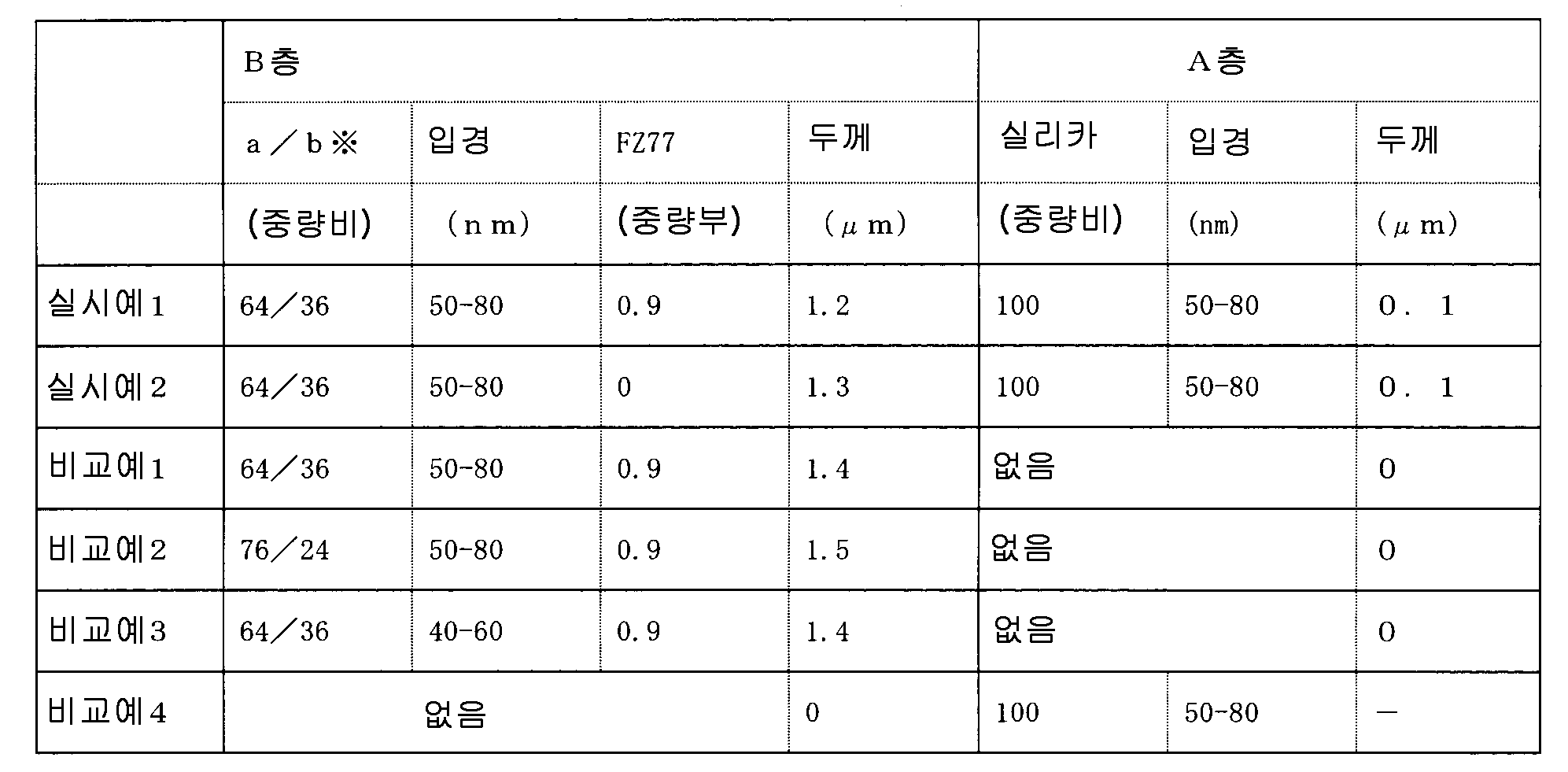
※ a : B 층에 함유되는 수지의 중량% A: weight% of resin contained in layer B
b : B 층에 함유되는 실리카 미립자의 중량% b: weight% of silica fine particles contained in layer B
다음으로, 실시예 3 ∼ 6 을 설명한다.Next, Examples 3 to 6 will be described.
[실시예 3] Example 3
<A 층 및 B 층의 형성> <Formation of A Layer and B Layer>
상기 열가소성 수지를 함유하는 층의 외층에 코로나 처리를 실시하였다. 코로나 처리한 열가소성 수지를 함유하는 층의 표면에 도포액 (사) 를 도포하여, 도포막을 형성하였다. 도포에는, wet 도포량 = 13 ㎛ 의 바를 사용하였다. 그 후, 도포막을 형성한 열가소성 수지를 함유하는 층을 60 ℃ 에서, 1 분간, 열풍 건조를 실시하여, 열가소성 수지를 함유하는 층 위에 실리카 미립자 및 수지를 함유하는 층이 적층된 적층 중간체를 얻었다.Corona treatment was performed to the outer layer of the layer containing the thermoplastic resin. Coating liquid (sa) was apply | coated to the surface of the layer containing the corona treated thermoplastic resin, and the coating film was formed. For application, a bar of wet coating amount = 13 µm was used. Then, hot air drying was performed for 1 minute at 60 degreeC on the layer containing the thermoplastic resin in which the coating film was formed, and the laminated intermediate in which the layer containing a silica fine particle and the resin was laminated | stacked on the layer containing a thermoplastic resin was obtained.
추가로 상기 실리카 미립자 및 수지를 함유하는 층 상에, 도포액 (카) 를 도포하였다. 도포에는, wet 도포량 = 5 ㎛ 의 바를 사용하였다. 그 후, 도포막을 형성한 적층 중간체를 60 ℃ 에서, 1 분간, 열풍 건조를 실시하여, 열가소성 수지를 함유하는 층 (C 층), 실리카 미립자 및 수지를 함유하는 층 (B 층), 실리카 미립자를 함유하는 층 (A 층) 이 순서대로 적층된 적층 필름을 얻었다. A 층 및 B 층의 구성을 표 5 에, 적층 필름의 시험 결과를 표 6 에 나타내었다.Furthermore, the coating liquid (ka) was apply | coated on the layer containing the said silica fine particle and resin. For application, a bar of wet coating amount = 5 mu m was used. Then, hot air drying is performed for 1 minute at 60 degreeC on the laminated intermediate in which the coating film was formed, and the layer (C layer) containing a thermoplastic resin, the layer (B layer) containing silica fine particles and resin, and a silica fine particle are carried out. The layer (A layer) to contain was obtained the laminated | multilayer film laminated | stacked in order. Table 5 shows the structure of A-layer and B-layer, and the test result of laminated | multilayer film is shown in Table 6.
[실시예 4] Example 4
<A 층 및 B 층의 형성> <Formation of A Layer and B Layer>
상기 열가소성 수지를 함유하는 층의 외층에 코로나 처리를 실시하였다. 코로나 처리한 열가소성 수지를 함유하는 층의 표면에 도포액 (아) 를 도포하여, 도포막을 형성하였다. 도포에는, wet 도포량 = 13 ㎛ 의 바를 사용하였다. 그 후, 도포막을 형성한 열가소성 수지를 함유하는 층을 60 ℃ 에서, 1 분간, 열풍 건조를 실시하여, 열가소성 수지를 함유하는 층 위에 실리카 미립자 및 수지를 함유하는 층이 적층된 적층 중간체를 얻었다.Corona treatment was performed to the outer layer of the layer containing the thermoplastic resin. The coating liquid (a) was apply | coated to the surface of the layer containing the corona treated thermoplastic resin, and the coating film was formed. For application, a bar of wet coating amount = 13 µm was used. Then, hot air drying was performed for 1 minute at 60 degreeC on the layer containing the thermoplastic resin in which the coating film was formed, and the laminated intermediate in which the layer containing a silica fine particle and the resin was laminated | stacked on the layer containing a thermoplastic resin was obtained.
추가로 상기 실리카 미립자 및 수지를 함유하는 층 상에, 도포액 (타) 를 도포하였다. 도포에는, wet 도포량 = 5 ㎛ 의 바를 사용하였다. 그 후, 도포막을 형성한 적층 중간체를 60 ℃ 에서, 1 분간, 열풍 건조를 실시하여, 열가소성 수지를 함유하는 층 (C 층), 실리카 미립자 및 수지를 함유하는 층 (B 층), 실리카 미립자를 함유하는 층 (A 층) 이 순서대로 적층된 적층 필름을 얻었다. A 층 및 B 층의 구성을 표 5 에, 적층 필름의 시험 결과를 표 6 에 나타내었다.Furthermore, the coating liquid (ta) was apply | coated on the layer containing the said silica fine particle and resin. For application, a bar of wet coating amount = 5 mu m was used. Then, hot air drying is performed for 1 minute at 60 degreeC on the laminated intermediate in which the coating film was formed, and the layer (C layer) containing a thermoplastic resin, the layer (B layer) containing silica fine particles and resin, and a silica fine particle are carried out. The layer (A layer) to contain was obtained the laminated | multilayer film laminated | stacked in order. Table 5 shows the structure of A-layer and B-layer, and the test result of laminated | multilayer film is shown in Table 6.
[실시예 5] Example 5
<A 층 및 B 층의 형성> <Formation of A Layer and B Layer>
상기 열가소성 수지를 함유하는 층의 외층에 코로나 처리를 실시하였다. 코로나 처리한 열가소성 수지를 함유하는 층의 표면에 도포액 (자) 를 도포하여, 도포막을 형성하였다. 도포에는, wet 도포량 = 13 ㎛ 의 바를 사용하였다. 그 후, 도포막을 형성한 열가소성 수지를 함유하는 층을 60 ℃ 에서, 1 분간, 열풍 건조를 실시하여, 열가소성 수지를 함유하는 층 위에 실리카 미립자 및 수지를 함유하는 층이 적층된 적층 중간체를 얻었다.Corona treatment was performed to the outer layer of the layer containing the thermoplastic resin. The coating liquid (the ruler) was apply | coated to the surface of the layer containing the corona treated thermoplastic resin, and the coating film was formed. For application, a bar of wet coating amount = 13 µm was used. Then, hot air drying was performed for 1 minute at 60 degreeC on the layer containing the thermoplastic resin in which the coating film was formed, and the laminated intermediate in which the layer containing a silica fine particle and the resin was laminated | stacked on the layer containing a thermoplastic resin was obtained.
추가로 상기 실리카 미립자 및 수지를 함유하는 층 상에, 도포액 (타) 를 도포하였다. 도포에는, wet 도포량 = 5 ㎛ 의 바를 사용하였다. 그 후, 도포막을 형성한 적층 중간체를 60 ℃ 에서, 1 분간, 열풍 건조를 실시하여, 열가소성 수지를 함유하는 층 (C 층), 실리카 미립자 및 수지를 함유하는 층 (B 층), 실리카 미립자를 함유하는 층 (A 층) 이 순서대로 적층된 적층 필름을 얻었다. A 층 및 B 층의 구성을 표 5 에, 적층 필름의 시험 결과를 표 6 에 나타내었다.Furthermore, the coating liquid (ta) was apply | coated on the layer containing the said silica fine particle and resin. For application, a bar of wet coating amount = 5 mu m was used. Then, hot air drying is performed for 1 minute at 60 degreeC on the laminated intermediate in which the coating film was formed, and the layer (C layer) containing a thermoplastic resin, the layer (B layer) containing silica fine particles and resin, and a silica fine particle are carried out. The layer (A layer) to contain was obtained the laminated | multilayer film laminated | stacked in order. Table 5 shows the structure of A-layer and B-layer, and the test result of laminated | multilayer film is shown in Table 6.
[실시예 6] Example 6
<A 층 및 B 층의 형성> <Formation of A Layer and B Layer>
상기 열가소성 수지를 함유하는 층의 외층에 코로나 처리를 실시하였다. 코로나 처리한 열가소성 수지를 함유하는 층의 표면에 도포액 (차) 를 도포하여, 도포막을 형성하였다. 도포에는, wet 도포량 = 13 ㎛ 의 바를 사용하였다. 그 후, 도포막을 형성한 열가소성 수지를 함유하는 층을 60 ℃ 에서, 1 분간, 열풍 건조를 실시하여, 열가소성 수지를 함유하는 층 위에 실리카 미립자 및 수지를 함유하는 층이 적층된 적층 중간체를 얻었다.Corona treatment was performed to the outer layer of the layer containing the thermoplastic resin. The coating liquid (tea) was apply | coated to the surface of the layer containing the corona treated thermoplastic resin, and the coating film was formed. For application, a bar of wet coating amount = 13 µm was used. Then, hot air drying was performed for 1 minute at 60 degreeC on the layer containing the thermoplastic resin in which the coating film was formed, and the laminated intermediate in which the layer containing a silica fine particle and the resin was laminated | stacked on the layer containing a thermoplastic resin was obtained.
추가로 상기 실리카 미립자 및 수지를 함유하는 층 상에, 도포액 (타) 를 도포하였다. 도포에는, wet 도포량 = 5 ㎛ 의 바를 사용하였다. 그 후, 도포막을 형성한 적층 중간체를 60 ℃ 에서, 1 분간, 열풍 건조를 실시하여, 열가소성 수지를 함유하는 층 (C 층), 실리카 미립자 및 수지를 함유하는 층 (B 층), 실리카 미립자를 함유하는 층 (A 층) 이 순서대로 적층된 적층 필름을 얻었다. A 층 및 B 층의 구성을 표 5 에, 적층 필름의 시험 결과를 표 6 에 나타내었다.Furthermore, the coating liquid (ta) was apply | coated on the layer containing the said silica fine particle and resin. For application, a bar of wet coating amount = 5 mu m was used. Then, hot air drying is performed for 1 minute at 60 degreeC on the laminated intermediate in which the coating film was formed, and the layer (C layer) containing a thermoplastic resin, the layer (B layer) containing silica fine particles and resin, and a silica fine particle are carried out. The layer (A layer) to contain was obtained the laminated | multilayer film laminated | stacked in order. Table 5 shows the structure of A-layer and B-layer, and the test result of laminated | multilayer film is shown in Table 6.
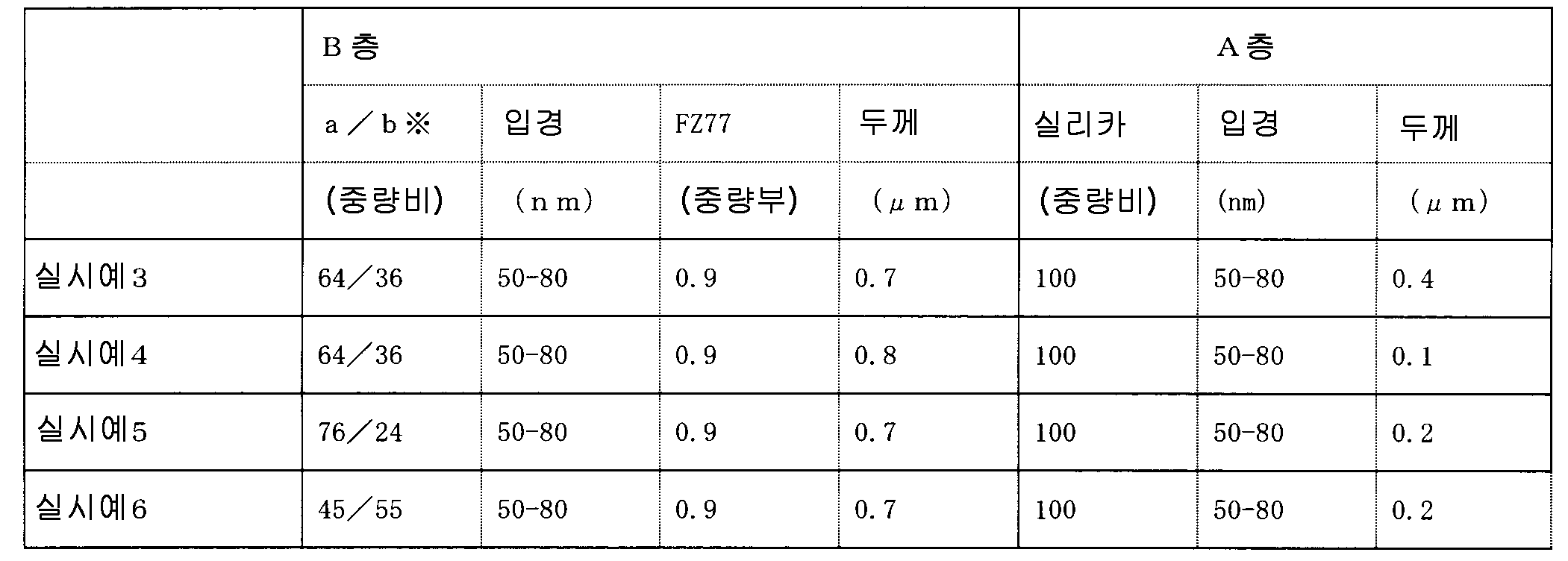
※ a : B 층에 함유되는 수지의 중량% A: weight% of resin contained in layer B
b : B 층에 함유되는 실리카 미립자의 중량% b: weight% of silica fine particles contained in layer B
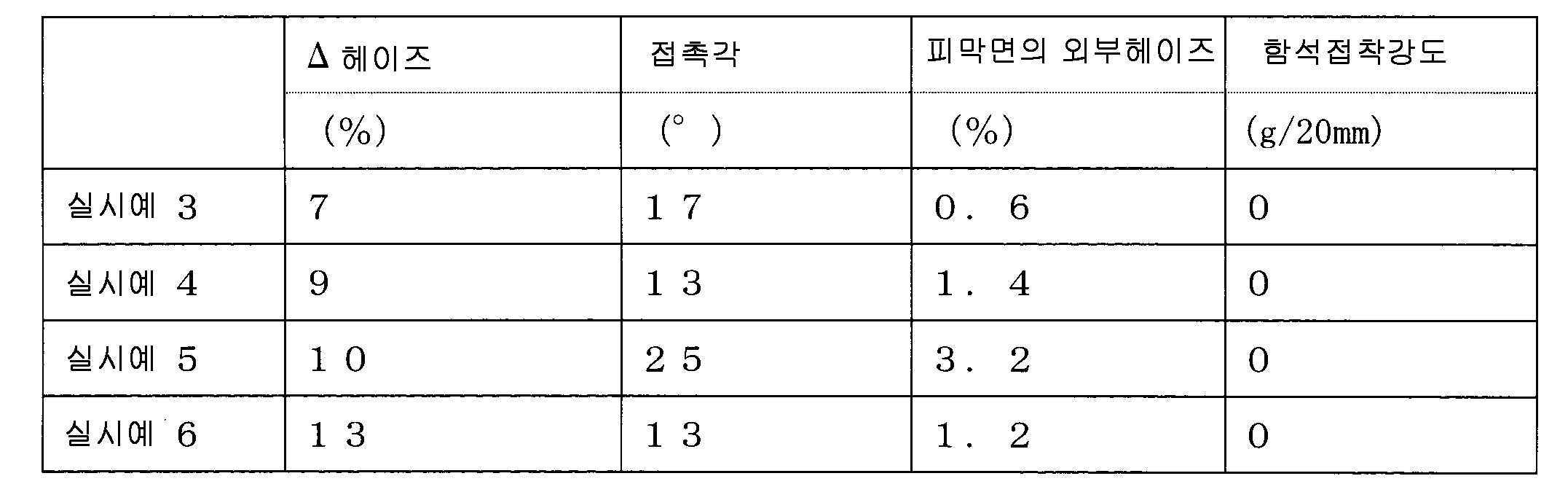
[실시예 7] Example 7
<적층 필름 폭로 시험 (1)> <Laminated film exposure test (1)>
후쿠오카현 야메시의 시험 하우스 (독립된 동 (棟) 으로서 남북이 긴 변이 되도록 설치) 에 있어서, 실시예 4 에서 얻은 적층 필름을 피복재로 사용하여, 폭로 시험을 실시하였다. 프레임에, 적층 필름의 A 층이 하우스의 내표면이 되도록 적층 필름을 피복하였다. (폭로 시험 개시일 : 2009년 11월 13일) In the test house of Yame-shi, Fukuoka (installed so that north and south were long sides as independent copper), the exposure test was performed using the laminated | multilayer film obtained in Example 4 as a coating material. The laminated film was coated on the frame such that the A layer of the laminated film became the inner surface of the house. (Exposure start date: November 13, 2009)
방담성 상황을 육안으로 관찰하였다. 관찰 일시는 2010년 10월 2일 10:00 이었다. 적층 필름의 A 층면은 균일하게 젖어 있었다.The antifogging situation was visually observed. The date and time of observation was 10:00 on October 2, 2010. The A layer surface of the laminated film was uniformly wet.
[실시예 8] Example 8
<C 층의 제작> <Production of C layer>
공압출 인플레이션 성형법 (가공 온도 180 ℃) 에 의해, 외층, 중간층 및 내층이 이 순서대로 적층되어 있는 두께 100 ㎛ 의 열가소성 수지를 함유하는 층을 제작하였다. 또, 외층, 중간층, 내층의 압출량의 중량비는 외층/중간층/내층 = 2/6/2 로 하였다. 각 층의 조성은 다음과 같다.By the coextrusion inflation molding method (working temperature 180 ° C.), a layer containing a thermoplastic resin having a thickness of 100 μm in which an outer layer, an intermediate layer and an inner layer were laminated in this order was produced. In addition, the weight ratio of the extrusion amount of an outer layer, an intermediate | middle layer, and an inner layer was outer layer / intermediate | middle layer / inner layer = 2/6/2. The composition of each layer is as follows.
상기 외층은 일본 공개특허공보 2010-12649호, 실시예에 기재된 A1 펠릿 45.2 %, A4 펠릿 40.0 %, B1 펠릿 2.0 %, MB1 펠릿 2.8 %, MB3 펠릿 10.0 % 로 이루어지는 열가소성 수지 조성물로 형성하였다.The outer layer was formed of a thermoplastic resin composition comprising 45.2% of A1 pellets, 40.0% of A4 pellets, 2.0% of B1 pellets, 2.8% of MB1 pellets, and 10.0% of MB3 pellets described in JP 2010-12649 A.
상기 중간층은 일본 공개특허공보 2010-12649호, 실시예에 기재된 A2 펠릿 52.8 %, B1 펠릿 20.0 %, MB1 펠릿 7.6 %, MB2 펠릿 19.6 % 로 이루어지는 열가소성 수지 조성물로 형성하였다.The said intermediate | middle layer was formed with the thermoplastic resin composition which consists of 52.8% of A2 pellets, 20.0% of B1 pellets, 7.6% of MB1 pellets, and 19.6% of MB2 pellets described in Unexamined-Japanese-Patent No. 2010-12649, an Example.
상기 내층은 일본 공개특허공보 2010-12649호, 실시예에 기재된 A2 펠릿 63.6 %, B1 펠릿 20.0 %, MB1 펠릿 6.4 %, MB3 펠릿 10.0 % 로 이루어지는 열가소성 수지 조성물로 형성하였다.The inner layer was formed of a thermoplastic resin composition comprising 63.6% of A2 pellets, 20.0% of B1 pellets, 6.4% of MB1 pellets, and 10.0% of MB3 pellets described in JP-A 2010-12649, Examples.
<A 층 및 B 층의 형성> <Formation of A Layer and B Layer>
상기 열가소성 수지를 함유하는 층의 외층에 코로나 처리를 실시하였다. 코로나 처리한 열가소성 수지를 함유하는 층의 표면에 도포액 (사) 를 도포하여, 도포막을 형성하였다. 도포에는, wet 도포량 = 13 ㎛ 의 바를 사용하였다. 그 후, 도포막을 형성한 열가소성 수지를 함유하는 층을 60 ℃ 에서, 1 분간, 열풍 건조를 실시하여, 열가소성 수지를 함유하는 층 위에 실리카 미립자 및 수지를 함유하는 층이 적층된 적층 중간체를 얻었다.Corona treatment was performed to the outer layer of the layer containing the thermoplastic resin. Coating liquid (sa) was apply | coated to the surface of the layer containing the corona treated thermoplastic resin, and the coating film was formed. For application, a bar of wet coating amount = 13 µm was used. Then, hot air drying was performed for 1 minute at 60 degreeC on the layer containing the thermoplastic resin in which the coating film was formed, and the laminated intermediate in which the layer containing a silica fine particle and the resin was laminated | stacked on the layer containing a thermoplastic resin was obtained.
추가로 상기 실리카 미립자 및 수지를 함유하는 층 상에, 도포액 (타) 를 도포하였다. 도포에는, wet 도포량 = 5 ㎛ 의 바를 사용하였다. 그 후, 도포막을 형성한 적층 중간체를 60 ℃ 에서, 1 분간, 열풍 건조를 실시하여, 열가소성 수지를 함유하는 층 (C 층), 실리카 미립자 및 수지를 함유하는 층 (B 층), 실리카 미립자를 함유하는 층 (A 층) 이 순서대로 적층된 적층 필름을 얻었다.Furthermore, the coating liquid (ta) was apply | coated on the layer containing the said silica fine particle and resin. For application, a bar of wet coating amount = 5 mu m was used. Then, hot air drying is performed for 1 minute at 60 degreeC on the laminated intermediate in which the coating film was formed, and the layer (C layer) containing a thermoplastic resin, the layer (B layer) containing silica fine particles and resin, and a silica fine particle are carried out. The layer (A layer) to contain was obtained the laminated | multilayer film laminated | stacked in order.
A 층, B 층의 두께는, B 층이 0.7 ㎛, A 층이 0.1 ㎛ 였다.The thickness of A-layer and B-layer was 0.7 micrometer and B layer was 0.1 micrometer.
<적층 필름 폭로 시험 (2)> <Laminated film exposure test (2)>
홋카이도 카미이소군 시리우치쵸의 시험 하우스 (독립된 동으로서 동서 방향이 긴 변이 되도록 설치) 에 있어서, 실시예 8 에서 얻은 상기 적층 필름을 피복재로 사용하여, 폭로 시험을 실시하였다. 프레임에, 적층 필름의 A 층이 하우스의 외표면이 되도록 적층 필름을 피복하였다. (폭로 시험 개시일 : 2009년 11월 22일) In the test house of Shiriuchi-cho, Kamiiso-gun, Hokkaido (installed so that east-west direction might be long side as an independent copper), the said exposure film was obtained using the said laminated film obtained in Example 8 as a coating material. The laminated film was coated on the frame such that the A layer of the laminated film became the outer surface of the house. (Exposure test start date: November 22, 2009)
착설 (着雪) 상황을 육안으로 관찰하였다. 관찰 일시는 2010년 1월 15일 11:00 이었다. 관찰시에 촬영한 사진을 도 1 에 나타낸다.The snow situation was observed with the naked eye. The observation date and time was January 15, 2010, 11:00. The photograph taken at the time of observation is shown in FIG.
<적층 필름 폭로 시험 (3)> <Laminated film exposure test (3)>
사쿠라지마의 화산재 피해가 큰 카고시마현 타루미즈시 내의 시험 하우스에서, 실시예 8 에서 얻은 상기 적층 필름을 피복재로 사용하여, 폭로 시험을 실시하였다. 프레임에, 적층 필름의 A 층이 하우스의 외표면이 되도록 적층 필름을 피복하였다. (폭로 개시일 : 2010년 11월 6일)In a test house in Tarumizu City, Kagoshima Prefecture, where volcanic ash damage of Sakurajima was large, the exposure test was conducted using the laminated film obtained in Example 8 as a coating material. The laminated film was coated on the frame such that the A layer of the laminated film became the outer surface of the house. (Exposure start date: November 6, 2010)
하우스 외표면의 먼지 (재) 의 부착 정도를 육안으로 관찰하였다. 관찰 일시는 2011년 2월 25일 13:00 경이었다. 관찰시에 촬영한 사진을 도 3 에 나타낸다.The degree of adhesion of dust (ash) on the outer surface of the house was visually observed. The date and time of observation was around 13:00 on February 25, 2011. The photograph taken at the time of observation is shown in FIG.
[참고예 1] Reference Example 1
<적층 필름의 폭로 시험 (4)> <Exposure Test of Laminated Film (4)>
홋카이도 카미이소군 시리우치쵸의 시험 하우스 (독립된 동으로서 동서 방향이 긴 변이 되도록 설치) 를 이용하여, 실시예 5 에서 얻은 적층 필름을 피복재로 사용하여, 폭로 시험을 실시하였다. 프레임에, 적층 필름의 A 층이 하우스의 내표면이 되도록 적층 필름을 피복하였다. (폭로 시험 개시일 : 2009년 11월 22일) The exposure test was done using the laminated | multilayer film obtained in Example 5 as a coating material using the test house of Kamiriiso-gun, Hokkaido (installed so that east-west direction might be long side as an independent east). The laminated film was coated on the frame such that the A layer of the laminated film became the inner surface of the house. (Exposure test start date: November 22, 2009)
착설 상황을 육안으로 관찰하였다. 관찰 일시는 2010년 1월 15일 11:00 이었다. 관찰시에 촬영한 사진을 도 2 에 나타낸다. 폭로 시험 (2) 의 결과와 폭로 시험 (4) 의 결과를 비교하면, 폭로 시험 (2) 의 피복재가 폭로 시험 (4) 의 피복재보다 눈으로 덮인 부분은 적었다.The installation situation was visually observed. The observation date and time was January 15, 2010, 11:00. The photograph taken at the time of observation is shown in FIG. When comparing the results of the exposure test (2) with the results of the exposure test (4), the portion covered with the snow was less than the coating material in the exposure test (4).
[참고예 2] [Reference Example 2]
<적층 필름 폭로 시험 (5)> <Laminated film exposure test (5)>
사쿠라지마의 화산재 피해가 큰 카고시마현 타루미즈시 내의 시험 하우스에서, 실시예 5 에서 얻은 적층 필름을 피복재로서 사용하여, 폭로 시험을 실시하였다. 프레임에, 적층 필름의 A 층이 하우스의 내표면이 되도록 적층 필름을 피복하였다. (폭로 개시일 : 2010년 11월 6일)In a test house in Tarumizu City, Kagoshima Prefecture, where volcanic ash damage of Sakurajima was large, an exposure test was conducted using the laminated film obtained in Example 5 as a coating material. The laminated film was coated on the frame such that the A layer of the laminated film became the inner surface of the house. (Exposure start date: November 6, 2010)
하우스 외표면의 먼지 (재) 의 부착 정도를 육안으로 관찰하였다. 관찰 일시는 2011년 2월 25일 13:00 경이었다. 관찰시에 촬영한 사진을 도 3 에 나타낸다. 사진 앞쪽이 폭로 시험 (3) 의 시험 하우스, 사진 안쪽이 폭로 시험 (5) 의 시험 하우스의 사진이다. 폭로 시험 (3) 의 결과와 폭로 시험 (5) 의 결과를 비교하면, 폭로 시험 (3) 의 피복재가 폭로 시험 (5) 의 피복재보다 먼지 (재) 의 부착이 적었다.The degree of adhesion of dust (ash) on the outer surface of the house was visually observed. The date and time of observation was around 13:00 on February 25, 2011. The photograph taken at the time of observation is shown in FIG. The photograph front side is a test house of the exposure test (3), and the photograph inside is a photograph of the test house of the exposure test (5). Comparing the results of the exposure test (3) with the results of the exposure test (5), the coating material of the exposure test (3) had less adhesion of dust (ash) than the coating material of the exposure test (5).
[실시예 9] Example 9
<적층 필름 폭로 시험 (6)> <Laminated film exposure test (6)>
실시예 4 에서 얻은 적층 필름에 굴곡을 부여하여, 의도적으로 도포막에 상처를 내었다. 후쿠오카현 야메시 내의 시험 하우스에, 상처를 낸 적층 필름을 피복재로서 사용하여, 폭로 시험을 실시하였다. 프레임에, 적층 필름의 A 층이 하우스의 내표면이 되도록 적층 필름을 피복하였다. (폭로 시험 개시일 : 2010년 11월 10일) Curvature was provided to the laminated | multilayer film obtained in Example 4, and the coating film was intentionally wounded. The exposure test was done using the laminated | multilayer film which cut out in the test house in Yame-shi, Fukuoka as a coating | covering material. The laminated film was coated on the frame such that the A layer of the laminated film became the inner surface of the house. (Exposure start date: November 10, 2010)
적층 필름을 육안으로 관찰하여, 적층 필름의 방담성을 평가하였다. 관찰 일시는 2011년 2월 10일 12:00 경이었다. 상처를 내지 않은 적층 필름 부분은 물론, 상처를 낸 적층 필름 부분에 대해서도 방담성 불량은 인정되지 않았다.The laminated film was visually observed and the antifogging property of the laminated film was evaluated. The date and time of observation was around 12:00 on February 10, 2011. The anti-fogging defect was not recognized about the laminated | multilayer film part which wounded as well as the laminated | multilayer film part which did not scratch.
[실시예 10] Example 10
실시예 1, 비교예 3 에서 얻은 적층 필름에 관해서, 이하의 시험을 실시하였다.About the laminated | multilayer film obtained in Example 1 and the comparative example 3, the following tests were done.
<상처부의 방담성 시험> <Anti-fog test of wound>
마찰 견뢰도 시험기 RT-200 (주식회사 다이에이 과학 정기 제작소 제조) 을 사용하여, 스틸울 (#0000) 로 하중 500 gf 로 실시예 1 에서 얻은 적층 필름과, 비교예 3 에서 얻은 적층 필름의 각 표면 (실시예 1 의 적층 필름의 경우에는 A 층, 비교예 3 의 적층 필름의 경우에는 B 층) 을 5 회 왕복하여 문질러서, 고의로 상처를 내었다.Each surface of the laminated film obtained in Example 1 and the laminated film obtained in Comparative Example 3 using a friction fastness tester RT-200 (manufactured by Daiei Scientific Co., Ltd.) at a load of 500 gf with steel wool (# 0000). In the case of the laminated | multilayer film of Example 1, A layer and B layer in the case of the laminated | multilayer film of Comparative Example 3) were rubbed back and forth 5 times, and the wound was deliberately wounded.
세로 34 ㎝×가로 5 ㎝ 의 아크릴제 틀에, 고의로 상처를 낸 적층 필름을 양면 접착 테이프에 의해 첩부 (貼付) 하고, 적층 필름 표면 (A 층, 또는 B 층) 이 수조 안의 증기에 닿도록 설치하여, 주위를 알루미늄 테이프로 첩합 (貼合) 하였다. 이 때, 상처가 아크릴제 틀의 가로 방향에 평행하게, 세로 방향의 거의 중앙이 되도록 하였다. 상기 적층 필름이 고정된 아크릴제 틀을, 환경 시험실 안에 둔 항온 수조 위에, 수평면에 대하여 10 도 경사지도록 하여 설치하였다. 이 때, 환경 시험실 내의 기온은 23 ℃ 로, 항온 수조의 수온은 40 ℃ 로 하였다.The laminated film which was deliberately wound on the acrylic frame of length 34 cm x 5 cm is affixed with a double-sided adhesive tape, and the laminated film surface (A layer or B layer) is installed so as to touch the vapor in the water tank. And the circumference was bonded together with the aluminum tape. At this time, the wound was almost centered in the longitudinal direction in parallel to the transverse direction of the acrylic mold. The acrylic mold to which the laminated film was fixed was installed on a constant temperature water tank placed in an environmental test chamber so as to be inclined 10 degrees with respect to the horizontal plane. At this time, the temperature in an environmental test chamber was 23 degreeC, and the water temperature of the constant temperature water tank was 40 degreeC.
적층 필름 설치로부터 1 일 후에 상처부의 방담성을 관찰하여, 이하의 기준으로 판정하였다.After one day from the laminated film installation, the antifogging property of the wound was observed, and the following criteria were determined.
○ : 상처부에서 물방울의 부착이 인정되지 않는다. (Circle): Adherence of a droplet of water in a wound part is not recognized.
× : 상처부에서 물방울의 부착이 인정된다. X: Adhesion of water droplets is recognized in a wound part.
N 수 = 16 으로 시험을 실시하여, × 가 발생하는 확률을 산출하였다.The test was conducted with N number = 16, and the probability that x generate | occur | produced was computed.
그 결과, 실시예 1 의 적층 필름에서는 × 의 발생 확률이 38 % 였음에 반하여, 비교예 3 의 적층 필름에서는 94 % 였다.As a result, in the laminated | multilayer film of Example 1, while the occurrence probability of x was 38%, in the laminated | multilayer film of Comparative Example 3, it was 94%.
본 발명은 농업용 필름에 이용할 수 있다.The present invention can be used for agricultural films.
Claims (5)
상기 실리카 미립자를 함유하는 층과 상기 열가소성 수지를 함유하는 층 사이에 상기 실리카 미립자 및 수지를 함유하는 층이 존재하고, 또한, 상기 실리카 미립자를 함유하는 층이 그 적층 필름의 적어도 일방의 면의 최표층인 것을 특징으로 하는 적층 필름.As a laminated | multilayer film which has a layer containing a silica fine particle, the layer containing a silica fine particle and resin, and a layer containing a thermoplastic resin,
A layer containing the silica fine particles and the resin is present between the layer containing the silica fine particles and the layer containing the thermoplastic resin, and the layer containing the silica fine particles is the outermost layer of at least one side of the laminated film. It is a surface layer, The laminated | multilayer film characterized by the above-mentioned.
실리카 미립자 및 수지를 함유하는 층에 함유되는 실리카 미립자 및 수지의 합계를 100 중량% 로 할 때, 그 실리카 미립자 및 수지를 함유하는 층에 있어서의 실리카 미립자의 함유량이 30 ∼ 70 중량% 이고, 수지의 함유량이 30 ∼ 70 중량% 인 것을 특징으로 하는 적층 필름.The method of claim 1,
When the total of the silica fine particles and the resin contained in the layer containing the silica fine particles and the resin is 100% by weight, the content of the silica fine particles in the layer containing the silica fine particles and the resin is 30 to 70% by weight, and the resin Content of 30-70 weight% of the laminated film characterized by the above-mentioned.
열가소성 수지를 함유하는 층이 폴리에틸렌계 수지를 함유하는 적층 필름.The method according to claim 1 or 2,
The laminated | multilayer film in which the layer containing a thermoplastic resin contains a polyethylene type resin.
A structure for plant cultivation, the structure comprising a frame and a covering covering the structure to form the outline of the structure, wherein the covering is the laminated film according to any one of claims 1 to 3, and the A plant cultivation structure, wherein the layer containing silica fine particles is an outer surface of the structure.
Applications Claiming Priority (2)
| Application Number | Priority Date | Filing Date | Title |
|---|---|---|---|
| JPJP-P-2010-104116 | 2010-04-28 | ||
| JP2010104116 | 2010-04-28 |
Publications (1)
| Publication Number | Publication Date |
|---|---|
| KR20110120249A true KR20110120249A (en) | 2011-11-03 |
Family
ID=44959501
Family Applications (1)
| Application Number | Title | Priority Date | Filing Date |
|---|---|---|---|
| KR1020110039893A Ceased KR20110120249A (en) | 2010-04-28 | 2011-04-28 | Laminated films and plant growing structures |
Country Status (3)
| Country | Link |
|---|---|
| JP (1) | JP2011245857A (en) |
| KR (1) | KR20110120249A (en) |
| CN (1) | CN102241176B (en) |
Families Citing this family (3)
| Publication number | Priority date | Publication date | Assignee | Title |
|---|---|---|---|---|
| JP2013150565A (en) * | 2012-01-25 | 2013-08-08 | Sumitomo Chemical Co Ltd | Polyolefin agricultural film and agricultural and horticultural facility |
| JP2013215977A (en) * | 2012-04-09 | 2013-10-24 | Sumitomo Chemical Co Ltd | Laminated body |
| JP6074599B2 (en) * | 2013-10-09 | 2017-02-08 | パナソニックIpマネジメント株式会社 | greenhouse |
Family Cites Families (5)
| Publication number | Priority date | Publication date | Assignee | Title |
|---|---|---|---|---|
| JP3463891B2 (en) * | 1994-05-09 | 2003-11-05 | シーアイ化成株式会社 | Agricultural drip-proof film |
| KR100663677B1 (en) * | 1997-11-25 | 2007-06-04 | 산젠 가꼬 가부시키가이샤 | Anti-fog Multilayer Film |
| KR101129209B1 (en) * | 2003-03-27 | 2012-03-26 | 산테라 가부시키가이샤 | Structure for growing plants |
| JP4902266B2 (en) * | 2006-03-20 | 2012-03-21 | Mkvドリーム株式会社 | Agricultural film |
| JP2007300836A (en) * | 2006-05-10 | 2007-11-22 | Sumitomo Chemical Co Ltd | Greenhouse for plant cultivation and its temperature adjustment method |
-
2011
- 2011-04-27 JP JP2011099113A patent/JP2011245857A/en active Pending
- 2011-04-28 KR KR1020110039893A patent/KR20110120249A/en not_active Ceased
- 2011-04-28 CN CN201110108587.4A patent/CN102241176B/en not_active Expired - Fee Related
Also Published As
| Publication number | Publication date |
|---|---|
| CN102241176B (en) | 2015-02-25 |
| JP2011245857A (en) | 2011-12-08 |
| CN102241176A (en) | 2011-11-16 |
Similar Documents
| Publication | Publication Date | Title |
|---|---|---|
| JP4896290B2 (en) | Multilayer film for impact resistance protection | |
| US4542061A (en) | Plastic film | |
| KR100740055B1 (en) | Anti-fogging laminates | |
| JP5063668B2 (en) | Polyolefin film for pear texture agriculture | |
| WO2019194113A1 (en) | Interlayer film for laminated glass, and laminated glass | |
| KR20110120249A (en) | Laminated films and plant growing structures | |
| JP3681553B2 (en) | Olefin resin laminated film | |
| CN101746095B (en) | Agricultural film | |
| KR100663677B1 (en) | Anti-fog Multilayer Film | |
| JP2001334612A (en) | Multilayer film | |
| KR100721743B1 (en) | Laminated film | |
| KR100407530B1 (en) | Polyolefin resin-coated film and plant cultivation method | |
| JPS63286343A (en) | Laminate film for agriculture | |
| CN100391735C (en) | Multilayer polyolefin-based resin film | |
| JP2000354426A (en) | Five-layer antifogging olefin-based agricultural film | |
| JP5709423B2 (en) | Resin film | |
| JP2004307856A (en) | Antifouling film | |
| JP2005186624A (en) | Recovery method for olefin resin laminated film | |
| JP2004292753A (en) | Antifouling film | |
| JP2000272068A (en) | Multilayer film | |
| JP2004307855A (en) | Antifouling film | |
| JP2002315446A (en) | Covering material for greenhouse horticulture | |
| JPH1110783A (en) | Anti-fog film | |
| JP2010174126A (en) | Resin film | |
| JPH11151790A (en) | Laminated anti-fog film |
Legal Events
| Date | Code | Title | Description |
|---|---|---|---|
| PA0109 | Patent application |
Patent event code: PA01091R01D Comment text: Patent Application Patent event date: 20110428 |
|
| PG1501 | Laying open of application | ||
| A201 | Request for examination | ||
| PA0201 | Request for examination |
Patent event code: PA02012R01D Patent event date: 20160125 Comment text: Request for Examination of Application Patent event code: PA02011R01I Patent event date: 20110428 Comment text: Patent Application |
|
| PE0902 | Notice of grounds for rejection |
Comment text: Notification of reason for refusal Patent event date: 20170531 Patent event code: PE09021S01D |
|
| E601 | Decision to refuse application | ||
| PE0601 | Decision on rejection of patent |
Patent event date: 20171120 Comment text: Decision to Refuse Application Patent event code: PE06012S01D Patent event date: 20170531 Comment text: Notification of reason for refusal Patent event code: PE06011S01I |