KR20080098579A - Modified Chaperonin 10 - Google Patents
Modified Chaperonin 10 Download PDFInfo
- Publication number
- KR20080098579A KR20080098579A KR1020087007836A KR20087007836A KR20080098579A KR 20080098579 A KR20080098579 A KR 20080098579A KR 1020087007836 A KR1020087007836 A KR 1020087007836A KR 20087007836 A KR20087007836 A KR 20087007836A KR 20080098579 A KR20080098579 A KR 20080098579A
- Authority
- KR
- South Korea
- Prior art keywords
- cpn10
- polypeptide
- seq
- ala
- set forth
- Prior art date
- Legal status (The legal status is an assumption and is not a legal conclusion. Google has not performed a legal analysis and makes no representation as to the accuracy of the status listed.)
- Ceased
Links
Images


Classifications
-
- A—HUMAN NECESSITIES
- A61—MEDICAL OR VETERINARY SCIENCE; HYGIENE
- A61P—SPECIFIC THERAPEUTIC ACTIVITY OF CHEMICAL COMPOUNDS OR MEDICINAL PREPARATIONS
- A61P11/00—Drugs for disorders of the respiratory system
- A61P11/06—Antiasthmatics
-
- C—CHEMISTRY; METALLURGY
- C07—ORGANIC CHEMISTRY
- C07K—PEPTIDES
- C07K14/00—Peptides having more than 20 amino acids; Gastrins; Somatostatins; Melanotropins; Derivatives thereof
- C07K14/435—Peptides having more than 20 amino acids; Gastrins; Somatostatins; Melanotropins; Derivatives thereof from animals; from humans
- C07K14/46—Peptides having more than 20 amino acids; Gastrins; Somatostatins; Melanotropins; Derivatives thereof from animals; from humans from vertebrates
- C07K14/47—Peptides having more than 20 amino acids; Gastrins; Somatostatins; Melanotropins; Derivatives thereof from animals; from humans from vertebrates from mammals
-
- A—HUMAN NECESSITIES
- A61—MEDICAL OR VETERINARY SCIENCE; HYGIENE
- A61P—SPECIFIC THERAPEUTIC ACTIVITY OF CHEMICAL COMPOUNDS OR MEDICINAL PREPARATIONS
- A61P25/00—Drugs for disorders of the nervous system
-
- A—HUMAN NECESSITIES
- A61—MEDICAL OR VETERINARY SCIENCE; HYGIENE
- A61P—SPECIFIC THERAPEUTIC ACTIVITY OF CHEMICAL COMPOUNDS OR MEDICINAL PREPARATIONS
- A61P29/00—Non-central analgesic, antipyretic or antiinflammatory agents, e.g. antirheumatic agents; Non-steroidal antiinflammatory drugs [NSAID]
-
- A—HUMAN NECESSITIES
- A61—MEDICAL OR VETERINARY SCIENCE; HYGIENE
- A61P—SPECIFIC THERAPEUTIC ACTIVITY OF CHEMICAL COMPOUNDS OR MEDICINAL PREPARATIONS
- A61P31/00—Antiinfectives, i.e. antibiotics, antiseptics, chemotherapeutics
-
- A—HUMAN NECESSITIES
- A61—MEDICAL OR VETERINARY SCIENCE; HYGIENE
- A61P—SPECIFIC THERAPEUTIC ACTIVITY OF CHEMICAL COMPOUNDS OR MEDICINAL PREPARATIONS
- A61P31/00—Antiinfectives, i.e. antibiotics, antiseptics, chemotherapeutics
- A61P31/04—Antibacterial agents
-
- A—HUMAN NECESSITIES
- A61—MEDICAL OR VETERINARY SCIENCE; HYGIENE
- A61P—SPECIFIC THERAPEUTIC ACTIVITY OF CHEMICAL COMPOUNDS OR MEDICINAL PREPARATIONS
- A61P31/00—Antiinfectives, i.e. antibiotics, antiseptics, chemotherapeutics
- A61P31/12—Antivirals
-
- A—HUMAN NECESSITIES
- A61—MEDICAL OR VETERINARY SCIENCE; HYGIENE
- A61P—SPECIFIC THERAPEUTIC ACTIVITY OF CHEMICAL COMPOUNDS OR MEDICINAL PREPARATIONS
- A61P37/00—Drugs for immunological or allergic disorders
- A61P37/02—Immunomodulators
-
- A—HUMAN NECESSITIES
- A61—MEDICAL OR VETERINARY SCIENCE; HYGIENE
- A61P—SPECIFIC THERAPEUTIC ACTIVITY OF CHEMICAL COMPOUNDS OR MEDICINAL PREPARATIONS
- A61P37/00—Drugs for immunological or allergic disorders
- A61P37/02—Immunomodulators
- A61P37/06—Immunosuppressants, e.g. drugs for graft rejection
-
- A—HUMAN NECESSITIES
- A61—MEDICAL OR VETERINARY SCIENCE; HYGIENE
- A61P—SPECIFIC THERAPEUTIC ACTIVITY OF CHEMICAL COMPOUNDS OR MEDICINAL PREPARATIONS
- A61P37/00—Drugs for immunological or allergic disorders
- A61P37/08—Antiallergic agents
-
- A—HUMAN NECESSITIES
- A61—MEDICAL OR VETERINARY SCIENCE; HYGIENE
- A61P—SPECIFIC THERAPEUTIC ACTIVITY OF CHEMICAL COMPOUNDS OR MEDICINAL PREPARATIONS
- A61P43/00—Drugs for specific purposes, not provided for in groups A61P1/00-A61P41/00
-
- C—CHEMISTRY; METALLURGY
- C07—ORGANIC CHEMISTRY
- C07K—PEPTIDES
- C07K14/00—Peptides having more than 20 amino acids; Gastrins; Somatostatins; Melanotropins; Derivatives thereof
-
- C—CHEMISTRY; METALLURGY
- C07—ORGANIC CHEMISTRY
- C07K—PEPTIDES
- C07K14/00—Peptides having more than 20 amino acids; Gastrins; Somatostatins; Melanotropins; Derivatives thereof
- C07K14/435—Peptides having more than 20 amino acids; Gastrins; Somatostatins; Melanotropins; Derivatives thereof from animals; from humans
- C07K14/46—Peptides having more than 20 amino acids; Gastrins; Somatostatins; Melanotropins; Derivatives thereof from animals; from humans from vertebrates
- C07K14/47—Peptides having more than 20 amino acids; Gastrins; Somatostatins; Melanotropins; Derivatives thereof from animals; from humans from vertebrates from mammals
- C07K14/4701—Peptides having more than 20 amino acids; Gastrins; Somatostatins; Melanotropins; Derivatives thereof from animals; from humans from vertebrates from mammals not used
- C07K14/4715—Pregnancy proteins, e.g. placenta proteins, alpha-feto-protein, pregnancy specific beta glycoprotein
-
- A—HUMAN NECESSITIES
- A61—MEDICAL OR VETERINARY SCIENCE; HYGIENE
- A61K—PREPARATIONS FOR MEDICAL, DENTAL OR TOILETRY PURPOSES
- A61K38/00—Medicinal preparations containing peptides
-
- Y—GENERAL TAGGING OF NEW TECHNOLOGICAL DEVELOPMENTS; GENERAL TAGGING OF CROSS-SECTIONAL TECHNOLOGIES SPANNING OVER SEVERAL SECTIONS OF THE IPC; TECHNICAL SUBJECTS COVERED BY FORMER USPC CROSS-REFERENCE ART COLLECTIONS [XRACs] AND DIGESTS
- Y02—TECHNOLOGIES OR APPLICATIONS FOR MITIGATION OR ADAPTATION AGAINST CLIMATE CHANGE
- Y02A—TECHNOLOGIES FOR ADAPTATION TO CLIMATE CHANGE
- Y02A50/00—TECHNOLOGIES FOR ADAPTATION TO CLIMATE CHANGE in human health protection, e.g. against extreme weather
- Y02A50/30—Against vector-borne diseases, e.g. mosquito-borne, fly-borne, tick-borne or waterborne diseases whose impact is exacerbated by climate change
Landscapes
- Health & Medical Sciences (AREA)
- Chemical & Material Sciences (AREA)
- Life Sciences & Earth Sciences (AREA)
- Organic Chemistry (AREA)
- Medicinal Chemistry (AREA)
- General Health & Medical Sciences (AREA)
- Nuclear Medicine, Radiotherapy & Molecular Imaging (AREA)
- General Chemical & Material Sciences (AREA)
- Chemical Kinetics & Catalysis (AREA)
- Pharmacology & Pharmacy (AREA)
- Animal Behavior & Ethology (AREA)
- Public Health (AREA)
- Veterinary Medicine (AREA)
- Bioinformatics & Cheminformatics (AREA)
- Engineering & Computer Science (AREA)
- Immunology (AREA)
- Biophysics (AREA)
- Gastroenterology & Hepatology (AREA)
- Proteomics, Peptides & Aminoacids (AREA)
- Molecular Biology (AREA)
- Genetics & Genomics (AREA)
- Biochemistry (AREA)
- Toxicology (AREA)
- Zoology (AREA)
- Communicable Diseases (AREA)
- Oncology (AREA)
- Pulmonology (AREA)
- Gynecology & Obstetrics (AREA)
- Pregnancy & Childbirth (AREA)
- Reproductive Health (AREA)
- Transplantation (AREA)
- Pain & Pain Management (AREA)
- Biomedical Technology (AREA)
- Virology (AREA)
- Neurosurgery (AREA)
- Neurology (AREA)
- Rheumatology (AREA)
- Medicines That Contain Protein Lipid Enzymes And Other Medicines (AREA)
- Peptides Or Proteins (AREA)
- Investigating Or Analysing Biological Materials (AREA)
Abstract
본 발명은 면역조절 활성은 보유하지만, 단백질 폴딩 활성은 없거나 실질적으로 없는, 단리된 샤페로닌 10 폴리펩티드에 관한 것이다.The present invention relates to an isolated chaperonin 10 polypeptide that retains immunomodulatory activity but has no or substantially no protein folding activity.
Description
본 발명은 샤페로닌 10 폴리펩티드 및 이것을 코딩하는 핵산에 관한 것이다. 본 발명은 추가로 면역조절 활성을 나타내는 샤페로닌 10 폴리펩티드, 이것의 사용 방법 및 상기 폴리펩티드를 포함하는 조성물에 관한 것이다.The present invention relates to
열 충격 단백질 10(Hsp10: heat shock 단백질 10) 및 조기 임신 인자(EPF: early pregnancy factor)로도 공지되어 있는, 포유동물 샤페로닌 10(Cpn10: chaperonin 10)은 전형적으로 샤페로닌 60(Cpn60; Hsp60)과 함께 단백질 폴딩에 관여하는 미토콘드리아 '분자 샤페론' 단백질로서 특징화된다. Cpn10 및 Cpn60은 각각 박테리아 단백질 GroES 및 GroEL의 상동체이다. 각각의 GroEs 및 Cpn10은 각각 14개의 GroEL 또는 7개의 Hsp60 분자를 포함하는 원통 유사 구조에 뚜껑과 같이 결합하는 7원환으로 올리고머화하여, 변성된 단백질을 복합체로 묶는다([Bukau and Horwich, 1998, Cell 92:351-366]; [Harti and Hayer-Hartl, 2002, Science 295:1852-1858]). Mammalian chaperonin 10 (Cpn10: chaperonin 10), also known as heat shock protein 10 (Hsp10: heat shock protein 10) and early pregnancy factor (EPF), is typically associated with chaperonin 60 (Cpn60; Hsp60) is characterized as a mitochondrial 'molecular chaperone' protein involved in protein folding. Cpn10 and Cpn60 are homologues of the bacterial proteins GroES and GroEL, respectively. Each GroEs and Cpn10 oligomerized into a seven-membered ring that binds like a lid to a cylindrical-like structure containing 14 GroEL or 7 Hsp60 molecules, respectively, complexing the denatured protein (Bukau and Horwich, 1998, Cell). 92 : 351-366; Hart and Hayer-Hartl, 2002, Science 295 : 1852-1858].
Cpn10 단백질은 종들 간에 고도로 보존되며, 인간 Cpn10은 소 Cpn10과는 100% 일치하고, 래트 Cpn10과는 오직 하나의 아미노산 위치에서만 상이하다. E. 콜라이(E. coli) GroES의 헵타머 결정 구조로 도시된 바와 같이(도 1A; [Xu et si, 1997, Nature 388:741-750]를 참조할 수 있음), 인간 Cpn10은 에스케리키아 콜라이(Escherichia coli)로부터의 GroES와 30% 서열 일치성(60% 유사성)을 공유한다. Cpn10/GroES 단백질은 본질적으로 3개의 상이한 구조 영역으로 구성되며, 역-평행 β-배럴 영역은 "상부(roof)" β-헤어핀 루프 영역 및 "이동성 루프" 영역 측면에 위치한다. 이동성 루프 영역은 Cpn60/GroEL의 상호작용을 매개하고, 이로써, Cpn60/GroEL과의 복합체 형성, 및 '분자 샤페론', 단백질 폴딩 활성에 중요하다.Cpn10 protein is highly conserved between species, human Cpn10 is 100% identical to bovine Cpn10, and differs only in one amino acid position from rat Cpn10. As shown by the heptamer crystal structure of E. coli GroES (see FIG. 1A; Xu et si, 1997, Nature 388 : 741-750), human Cpn10 is Escherichia. It shares 30% sequence identity (60% similarity) with GroES from Escherichia coli . The Cpn10 / GroES protein consists essentially of three different structural regions, with anti-parallel β-barrel regions flanking the “roof” β-hairpin loop region and the “movable loop” region. The mobile loop region mediates the interaction of Cpn60 / GroEL, thereby being important for complex formation with Cpn60 / GroEL and 'molecular chaperone', protein folding activity.
그러나, 분자 샤페론으로서 세포내 역할 이외에도, Cpn10은 또한 세포 표면([Belles et al., 1999, Infect Immun 67:4191-4200]을 참조할 수 있음) 및 세포외액([Shin et al., 2003, J Biol Chem 278:7607-7616]을 참조할 수 있음)에서 빈번하게 발견되고, 점차적으로 면역 반응의 조절제로서 인식되고 있다. 예를 들면, Cpn10은 실험상의 자가면역 뇌척수염, 지연형 과민 반응, 및 동종이식 거부 모델에서 면역억제 활성을 갖는다고 입증되었다([Zhang et al., 2003, J Neurol Sci 212:3746]; [Morton et al, 2000, Immunol Cell Biol 78:603-607]). 본 발명자들은 또한 최근에 Cpn10이 다수의 상이한 인간 및 뮤린의 시험관내 시스템 및 뮤린의 질환 모델에서 NF-κB의 LPS 유도 활성을 저해할 수 있고, IL-10 생산을 증진시킬 수 있다는 것을 입증하였고([Johnson et al., 2005, J Biol Chem 280:4037-4047] 및 국제 특허 출원 번호 PCT/AU2005/000041(그의 개시 내용은 본원에서 참고로 인용됨)), 이로써, Cpn10이 자가면역 및 염증 질환 치료용의 면역-치료제로서의 상당한 효능을 갖고 있다고 제안하였다.However, in addition to its intracellular role as molecular chaperones, Cpn10 may also refer to cell surfaces (Belles et al., 1999, Infect Immun 67 : 4191-4200) and extracellular fluids (Shin et al., 2003, J Biol Chem 278 : 7607-7616), and is increasingly recognized as a modulator of an immune response. For example, Cpn10 has been demonstrated to have immunosuppressive activity in experimental autoimmune encephalomyelitis, delayed-type hypersensitivity, and allograft rejection models (Zhang et al., 2003, J Neurol Sci 212 : 3746); Morton et al, 2000, Immunol Cell Biol 78 : 603-607]. We also recently demonstrated that Cpn10 can inhibit LPS-induced activity of NF-κB and enhance IL-10 production in in vitro systems of many different humans and murines and in disease models of murines ( Johnson et al., 2005, J Biol Chem 280 : 4037-4047 and International Patent Application No. PCT / AU2005 / 000041, the disclosure of which is incorporated herein by reference, whereby Cpn10 is an autoimmune and inflammatory disease. It has been suggested to have significant efficacy as a therapeutic immuno-therapeutic agent.
그러나, 면역조절 활성(들)을 매개하는 역할을 하는 Cpn10 분자 내의 부위 (들)은 파악되지 않은 상태이다. However, site (s) in the Cpn10 molecule that play a role in mediating immunomodulatory activity (s) are unknown.
본 발명은 Cpn10 분자의 변형, 및 이러한 변형이 면역조절 활성에 미치는 효과에 관한 것이다.The present invention relates to modifications of Cpn10 molecules and the effects of such modifications on immunomodulatory activity.
발명의 개요Summary of the Invention
따라서, 본 발명은 야생형 Cpn10과 비교하여 하나 이상의 아미노산 치환, 결실 및/또는 첨가를 포함하는 Cpn10 폴리펩티드로서, 면역조절 활성을 나타내는 Cpn10 폴리펩티드를 제공한다. Accordingly, the present invention provides a Cpn10 polypeptide exhibiting immunomodulatory activity as a Cpn10 polypeptide comprising one or more amino acid substitutions, deletions and / or additions compared to wild type Cpn10.
본 발명의 제1 측면에 따라, 면역조절 활성은 보유하지만, 단백질 폴딩 활성은 없거나 실질적으로 없는 단리된 Cpn10 폴리펩티드를 제공한다. According to a first aspect of the invention, there is provided an isolated Cpn10 polypeptide that retains immunomodulatory activity but has no or substantially no protein folding activity.
본 발명의 제2 측면에 따라, 면역조절 활성을 갖는 단리된 Cpn10 폴리펩티드로서, 상응하는 야생형 Cpn10 폴리펩티드와 비교하여 이동성 루프 영역 내에 하나 이상의 아미노산 치환, 결실 및/또는 첨가를 포함하는, 단리된 Cpn10 폴리펩티드를 제공한다. According to a second aspect of the present invention, an isolated Cpn10 polypeptide having immunomodulatory activity, comprising one or more amino acid substitutions, deletions and / or additions in the mobile loop region as compared to the corresponding wild type Cpn10 polypeptide To provide.
Cpn10 폴리펩티드는 상응하는 야생형 Cpn10 폴리펩티드의 면역조절 활성 수준과 적어도 유사한 면역조절 활성을 나타낼 수 있다. The Cpn10 polypeptide may exhibit immunomodulatory activity at least similar to the immunomodulatory activity level of the corresponding wild type Cpn10 polypeptide.
하나의 실시태양에서, Cpn10 폴리펩티드의 이동성 루프 영역의 IML 트리펩티드중 하나 이상의 잔기는 전하를 띤 잔기로 대체될 수 있다. In one embodiment, one or more residues of the IML tripeptides of the mobile loop region of the Cpn10 polypeptide may be replaced with charged residues.
또다른 실시태양에서, IML 트리펩티드를 포함하는 Cpn10 폴리펩티드는 트리펩티드 EEE로 대체될 수 있다. EEE 트리펩티드를 포함하는 Cpn10 폴리펩티드는 서열 번호 39에 기재될 수 있다. Cpn10 폴리펩티드는 서열 번호 40에 기재된 뉴클레오티드 서열에 의해 코딩될 수 있다. In another embodiment, a Cpn10 polypeptide comprising an IML tripeptide can be replaced with a tripeptide EEE. Cpn10 polypeptides comprising an EEE tripeptide may be described in SEQ ID NO: 39. The Cpn10 polypeptide may be encoded by the nucleotide sequence set forth in SEQ ID NO: 40.
추가의 또다른 실시태양에서, IML 트리펩티드를 포함하는 Cpn10 폴리펩티드는 트리펩티드 III로 대체될 수 있다. III 트리펩티드를 포함하는 Cpn10 폴리펩티드는 서열 번호 37에 기재될 수 있다. Cpn10 폴리펩티드는 서열 번호 38에 기재된 뉴클레오티드 서열에 의해 코딩될 수 있다. In yet another embodiment, the Cpn10 polypeptide comprising IML tripeptide may be replaced with tripeptide III. Cpn10 polypeptides comprising III tripeptide may be set forth in SEQ ID NO: 37. The Cpn10 polypeptide may be encoded by the nucleotide sequence set forth in SEQ ID NO: 38.
또한 추가의 또다른 실시태양에서, IML 트리펩티드를 포함하는 Cpn10 폴리펩티드는 트리펩티드 IFI로 대체될 수 있다. IFI 트리펩티드를 포함하는 Cpn10 폴리펩티드는 서열 번호 35에 기재될 수 있다. Cpn10 폴리펩티드는 서열 번호 36에 기재된 뉴클레오티드 서열에 의해 코딩될 수 있다. In yet another embodiment, a Cpn10 polypeptide comprising an IML tripeptide can be replaced with a tripeptide IFI. Cpn10 polypeptides comprising an IFI tripeptide may be described in SEQ ID NO: 35. The Cpn10 polypeptide may be encoded by the nucleotide sequence set forth in SEQ ID NO: 36.
본 발명의 제3 측면에 따라, 면역조절 활성을 갖는 단리된 Cpn10 폴리펩티드로서, 상응하는 야생형 Cpn10 폴리펩티드의 이동성 루프 영역이 실질적으로 없는 단리된 Cpn10 폴리펩티드를 제공한다. According to a third aspect of the invention there is provided an isolated Cpn10 polypeptide having immunomodulatory activity, wherein the isolated Cpn10 polypeptide is substantially free of the mobile loop region of the corresponding wild type Cpn10 polypeptide.
하나의 실시태양에서, 이동성 루프 영역이 실질적으로 없는 Cpn10 폴리펩티드는 서열 번호 3 또는 24에 기재된 아미노산 서열을 포함한다. 이동성 루프 영역이 실질적으로 없는 Cpn10 폴리펩티드는 서열 번호 4, 5 또는 25에 기재된 뉴클레오티드 서열에 의해 코딩될 수 있다. In one embodiment, the Cpn10 polypeptide substantially free of the mobile loop region comprises the amino acid sequence set forth in SEQ ID NO: 3 or 24. Cpn10 polypeptides substantially free of a mobile loop region may be encoded by the nucleotide sequence set forth in SEQ ID NO: 4, 5 or 25.
Cpn10 폴리펩티드는 상응하는 야생형 Cpn10 폴리펩티드의 면역조절 활성 수준과 적어도 유사한 면역조절 활성을 나타낼 수 있다. The Cpn10 polypeptide may exhibit immunomodulatory activity at least similar to the immunomodulatory activity level of the corresponding wild type Cpn10 polypeptide.
본 발명의 제4 측면에 따라, 면역조절 활성을 갖는 단리된 Cpn10 폴리펩티드로서, 상응하는 야생형 Cpn10 폴리펩티드와 비교하여 상부 β-헤어핀 영역 내에 하나 이상의 아미노산 치환, 결실 및/또는 첨가를 포함하는, 단리된 Cpn10 폴리펩티드를 제공한다. According to a fourth aspect of the present invention, an isolated Cpn10 polypeptide having immunomodulatory activity, comprising one or more amino acid substitutions, deletions and / or additions in the upper β-hairpin region as compared to the corresponding wild type Cpn10 polypeptide Provided is a Cpn10 polypeptide.
Cpn10 폴리펩티드는 상응하는 야생형 Cpn10 폴리펩티드의 면역조절 활성 수준과 적어도 유사한 면역조절 활성을 나타낼 수 있다. The Cpn10 polypeptide may exhibit immunomodulatory activity at least similar to the immunomodulatory activity level of the corresponding wild type Cpn10 polypeptide.
본 발명의 제5 측면에 따라, 면역조절 활성을 갖는 단리된 Cpn10 폴리펩티드로서, 상응하는 야생형 Cpn10 폴리펩티드의 상부 β-헤어핀 영역이 실질적으로 없는 단리된 Cpn10 폴리펩티드를 제공한다. According to a fifth aspect of the present invention there is provided an isolated Cpn10 polypeptide having immunomodulatory activity, wherein the isolated Cpn10 polypeptide is substantially free of the upper β-hairpin region of the corresponding wild type Cpn10 polypeptide.
하나의 실시태양에서, 상부 β-헤어핀 영역(서열번호:13)이 실질적으로 없는 Cpn10 폴리펩티드는 서열 번호 6 또는 26에 기재된 아미노산 서열을 포함한다. 상부 β-헤어핀 영역이 실질적으로 없는 Cpn10 폴리펩티드는 서열 번호 7, 8 또는 27에 기재된 뉴클레오티드 서열에 의해 코딩될 수 있다. In one embodiment, the Cpn10 polypeptide substantially free of the upper β-hairpin region (SEQ ID NO: 13) comprises the amino acid sequence set forth in SEQ ID NO: 6 or 26. Cpn10 polypeptides substantially free of an upper β-hairpin region may be encoded by the nucleotide sequence set forth in SEQ ID NO: 7, 8 or 27.
Cpn10 폴리펩티드는 상응하는 야생형 Cpn10 폴리펩티드의 면역조절 활성 수준과 적어도 유사한 면역조절 활성을 나타낼 수 있다. The Cpn10 polypeptide may exhibit immunomodulatory activity at least similar to the immunomodulatory activity level of the corresponding wild type Cpn10 polypeptide.
본 발명의 제6 측면에 따라, 면역조절 활성을 갖는 단리된 Cpn10 폴리펩티드로서, 상응하는 야생형 Cpn10 폴리펩티드와 비교하여 이동성 루프 영역 및 상부 β-헤어핀 영역 내에 하나 이상의 아미노산 치환, 결실 및/또는 첨가를 포함하는, 단리된 Cpn10 폴리펩티드를 제공한다. According to a sixth aspect of the invention, an isolated Cpn10 polypeptide having immunomodulatory activity, comprising one or more amino acid substitutions, deletions and / or additions in the mobile loop region and the upper β-hairpin region as compared to the corresponding wild type Cpn10 polypeptide To provide an isolated Cpn10 polypeptide.
본 발명의 제7 측면에 따라, 상응하는 야생형 Cpn10 폴리펩티드의 이동성 루프 영역과 상부 β-헤어핀 영역 둘 다가 실질적으로 없는 단리된 Cpn10 폴리펩티드를 제공한다. According to a seventh aspect of the invention, there is provided an isolated Cpn10 polypeptide substantially free of both the mobile loop region and the upper β-hairpin region of the corresponding wild type Cpn10 polypeptide.
Cpn10 폴리펩티드는 상응하는 야생형 Cpn10 폴리펩티드의 면역조절 활성 수준과 적어도 유사한 면역조절 활성을 나타낼 수 있다. The Cpn10 polypeptide may exhibit immunomodulatory activity at least similar to the immunomodulatory activity level of the corresponding wild type Cpn10 polypeptide.
하나의 실시태양에서, Cpn10 폴리펩티드는 서열 번호 9 또는 28에 기재된 아미노산 서열을 포함한다. 상부 β-헤어핀 영역이 실질적으로 없는 Cpn10 폴리펩티드는 서열 번호 10 또는 29에 기재된 뉴클레오티드 서열에 의해 코딩될 수 있다. In one embodiment, the Cpn10 polypeptide comprises the amino acid sequence set forth in SEQ ID NO: 9 or 28. Cpn10 polypeptides substantially free of an upper β-hairpin region may be encoded by the nucleotide sequence set forth in SEQ ID NO: 10 or 29.
본 발명의 제8 측면에 따라, 면역조절 활성을 갖는 단리된 Cpn10 폴리펩티드로서, 상응하는 야생형 Cpn10 폴리펩티드와 비교하여 가외(extra) N-말단 알라닌 잔기의 결실을 포함하는, 단리된 Cpn10 폴리펩티드를 제공한다. According to an eighth aspect of the present invention, there is provided an isolated Cpn10 polypeptide having immunomodulatory activity, the isolated Cpn10 polypeptide comprising a deletion of extra N-terminal alanine residues as compared to the corresponding wild type Cpn10 polypeptide. .
상응하는 야생형 Cpn10 폴리펩티드와 비교하여 Cpn10 폴리펩티드에는 N 말단에 아세틸기가 존재하지 않을 수 있다. Cpn10 폴리펩티드는 상응하는 야생형 Cpn10 폴리펩티드의 면역조절 활성 수준과 비교할 때 감수된 면역조절 활성 수준을 나타낼 수 있다. Compared to the corresponding wild type Cpn10 polypeptide, the Cpn10 polypeptide may be free of acetyl groups at the N terminus. Cpn10 polypeptides may exhibit a sensitized immunomodulatory activity level compared to the immunomodulatory activity level of the corresponding wild type Cpn10 polypeptide.
하나의 실시태양에서, 가외 N-말단 알라닌 잔기의 결실을 포함하는 Cpn10 폴리펩티드는 서열 번호 23에 기재된 아미노산 서열을 포함할 수 있다. 가외 N-말단 알라닌 잔기의 결실을 포함하는 Cpn10 폴리펩티드는 서열 번호 44에 기재된 뉴클레오티드 서열에 의해 코딩될 수 있다. In one embodiment, a Cpn10 polypeptide comprising a deletion of an extra N-terminal alanine residue may comprise the amino acid sequence set forth in SEQ ID NO: 23. Cpn10 polypeptides comprising a deletion of an extra N-terminal alanine residue may be encoded by the nucleotide sequence set forth in SEQ ID NO: 44.
본 발명의 제9 측면에 따라, 면역조절 활성을 갖는 단리된 Cpn10 폴리펩티드로서, Cpn10 폴리펩티드의 N 말단이 실질적으로 박테리아 Cpn10 N 말단으로 대체된 Cpn10 폴리펩티드를 제공한다. According to a ninth aspect of the invention, there is provided an isolated Cpn10 polypeptide having immunomodulatory activity, the Cpn10 polypeptide wherein the N terminus of the Cpn10 polypeptide is substantially replaced by the bacterial Cpn10 N terminus.
박테리아 Cpn10은 GroES일 수 있다.The bacterium Cpn10 may be GroES.
Cpn10 폴리펩티드는 상응하는 야생형 Cpn10 폴리펩티드의 면역조절 활성 수준과 비교할 때 감소된 면역조절 활성 수준을 나타낼 수 있다. Cpn10 polypeptides may exhibit reduced immunomodulatory activity levels compared to the immunomodulatory activity levels of the corresponding wild type Cpn10 polypeptide.
하나의 실시태양에서, Cpn10 폴리펩티드는 서열 번호 14에 기재된 아미노산 서열을 포함할 수 있다. Cpn10 폴리펩티드는 서열 번호 43에 기재된 뉴클레오티드 서열에 의해 코딩될 수 있다. In one embodiment, the Cpn10 polypeptide may comprise the amino acid sequence set forth in SEQ ID NO: 14. The Cpn10 polypeptide may be encoded by the nucleotide sequence set forth in SEQ ID NO: 43.
본 발명의 제10 측면에 따라, 면역조절 활성을 갖는 단리된 Cpn10 폴리펩티드로서, 상응하는 야생형 Cpn10 폴리펩티드와 비교하여 글리신 잔기가 Cpn10 폴리펩티드의 가외 N 말단 알라닌 잔기를 대체한, 단리된 Cpn10 폴리펩티드를 제공한다. According to a tenth aspect of the present invention, there is provided an isolated Cpn10 polypeptide having immunomodulatory activity, wherein the glycine residues replace the extra N terminal alanine residues of the Cpn10 polypeptide as compared to the corresponding wild type Cpn10 polypeptide. .
Cpn10 폴리펩티드는 상응하는 야생형 Cpn10 폴리펩티드의 면역조절 활성 수준과 비교할 때 감소된 면역조절 활성 수준을 나타낼 수 있다. Cpn10 polypeptides may exhibit reduced immunomodulatory activity levels compared to the immunomodulatory activity levels of the corresponding wild type Cpn10 polypeptide.
하나의 실시태양에서, Cpn10 폴리펩티드는 서열 번호 30에 기재된 아미노산 서열을 포함할 수 있다. Cpn10 폴리펩티드는 서열 번호 31에 기재된 뉴클레오티드 서열에 의해 코딩될 수 있다. In one embodiment, the Cpn10 polypeptide may comprise the amino acid sequence set forth in SEQ ID NO: 30. The Cpn10 polypeptide may be encoded by the nucleotide sequence set forth in SEQ ID NO: 31.
본 발명의 제11 측면에 따라, 제1 측면 내지 제11 측면중 어느 하나에 따른 Cpn10 폴리펩티드를 코딩하는 단리된 핵산을 제공한다. According to an eleventh aspect of the invention, there is provided an isolated nucleic acid encoding a Cpn10 polypeptide according to any one of the first to eleventh aspects.
본 발명의 제12 측면에 따라, 하나 이상의 조절 서열에 작동 가능하게 연결된 제11 측면에 따른 핵산을 포함하는 발현 작제물을 제공한다.According to a twelfth aspect of the invention, there is provided an expression construct comprising a nucleic acid according to the eleventh aspect operably linked to one or more regulatory sequences.
본 발명의 제13 측면에 따라, 제1 측면 내지 제10 측면중 어느 하나에 따른 폴리펩티드를 발현시키거나, 제11 측면의 핵산, 또는 제9 측면의 발현 작제물을 포함하는 숙주 세포를 제공한다. According to a thirteenth aspect of the invention, there is provided a host cell expressing a polypeptide according to any one of the first to tenth aspects, comprising a nucleic acid of the eleventh aspect, or an expression construct of the ninth aspect.
본 발명의 제14 측면에 따라, 제1 측면 내지 제10 측면중 어느 하나에 따른 폴리펩티드에 선택적으로 결합하는 항체를 제공한다. According to a fourteenth aspect of the invention, there is provided an antibody that selectively binds to a polypeptide according to any one of the first to tenth aspects.
본 발명의 제15 측면에 따라, 제1 측면 내지 제10 측면중 어느 하나에 따른 폴리펩티드, 제11 측면의 핵산, 제12 측면의 발현 작제물 또는 제14 측면의 항체를 포함하는 약제학적 조성물을 제공한다. According to a fifteenth aspect of the invention, there is provided a pharmaceutical composition comprising a polypeptide according to any one of the first to tenth aspects, a nucleic acid of the eleventh aspect, an expression construct of the twelfth aspect or an antibody of the fourteenth aspect. do.
약제학적 조성물은 하나 이상의 첨가제를 포함할 수 있다. 예를 들면, 다발경화증 치료용 조성물은 추가로 유효량의 IFNβ를 포함할 수 있다. The pharmaceutical composition may comprise one or more additives. For example, the composition for treating multiple sclerosis may further comprise an effective amount of IFNβ.
본 발명의 제16 측면에 따라, 유효량의, 제1 측면 내지 제10 측면중 어느 하나의 Cpn10 폴리펩티드, 또는 제11 측면의 핵산을 대상자에게 투여하는 단계를 포함하는, 대상자를 치료하는 방법을 제공한다. According to a sixteenth aspect of the invention there is provided a method of treating a subject, comprising administering to the subject an effective amount of the Cpn10 polypeptide of any one of the first to tenth aspects, or the nucleic acid of the eleventh aspect. .
치료는 대상자의 면역 반응을 조절할 수 있다. 면역 반응은 Toll 유사 수용체 신호 전달의 조절을 통해 조절될 수 있다. Treatment can modulate the subject's immune response. The immune response can be regulated through the regulation of Toll like receptor signal transduction.
본 발명의 제17 측면에 따라, 유효량의, 제1 측면 내지 제10 측면중 어느 하나의 Cpn10 폴리펩티드, 또는 제11 측면의 핵산을 대상자에게 투여하는 단계를 포함하는, 대상자에서 질환 또는 병태를 치료하거나 예방하는 방법을 제공한다. According to a seventeenth aspect of the invention, there is provided a method for treating a disease or condition in a subject, comprising administering to the subject an effective amount of the Cpn10 polypeptide of any one of the first to tenth aspects, or the nucleic acid of the eleventh aspect. Provide a way to prevent it.
질환, 질병 또는 병태는 급성 또는 만성 염증 질환, 천식, 알레르기, 다발경화증, GVHD, 또는 감염 질환으로부터 선택될 수 있다. 감염 질환은 박테리아 또는 바이러스 감염으로부터 유발될 수 있다. 박테리아는 그램 음성 박테리아일 수 있다.The disease, condition or condition may be selected from acute or chronic inflammatory disease, asthma, allergy, multiple sclerosis, GVHD, or infectious disease. Infectious diseases can result from bacterial or viral infections. The bacteria can be Gram negative bacteria.
본 발명의 제18 측면에 따라, 유효량의, 제1 측면 내지 제10 측면중 어느 하나의 Cpn10 폴리펩티드, 또는 제11 측면의 핵산을 대상자에게 투여하는 단계를 포함하는, 대상자에서, 또는 그의 1개 이상의 세포, 조직 또는 장기에서 TLR4 신호 전달을 조절하는 방법을 제공한다. According to an eighteenth aspect of the invention, there is provided an effective amount of a Cpn10 polypeptide of any one of the first to tenth aspects, or a nucleic acid of an eleventh aspect, to a subject, or at least one thereof Provided are methods for modulating TLR4 signal transduction in cells, tissues, or organs.
전형적으로, Cpn10은 효현제 유도 TLR4 신호 전달을 조절한다.Typically, Cpn10 modulates agonist induced TLR4 signal transduction.
본 발명의 제19 측면에 따라, 유효량의, 제1 측면 내지 제10 측면중 어느 하나의 Cpn10 폴리펩티드, 또는 제11 측면의 핵산을 대상자에게 투여하는 단계를 포함하는, 대상자에서, 또는 그의 1개 이상의 세포, 조직 또는 장기에서 하나 이상의 면역조절제의 생산 및/또는 분비를 조절하는 방법을 제공한다. According to a nineteenth aspect of the invention, there is provided an effective amount of a Cpn10 polypeptide of any one of the first to tenth aspects, or a nucleic acid of an eleventh aspect, to a subject, or at least one of the subject. Methods of modulating the production and / or secretion of one or more immunomodulators in cells, tissues or organs are provided.
Cpn10이 TLR4로부터의 신호 전달을 조절할 수 있다.Cpn10 may regulate signal transduction from TLR4.
면역조절제는 향염증성 사이토카인 또는 케모카인 또는 항염증 사이토카인 또는 케모카인일 수 있다. 사이토카인 또는 케모카인은 TNF-α, IL-6, RANTES, IL-10, TGF-β 또는 I형 인터페론로부터 선택될 수 있다. I형 인터페론은 IFNα 또는 IFNβ일 수 있다.The immunomodulatory agent may be an anti-inflammatory cytokine or chemokine or an anti-inflammatory cytokine or chemokine. Cytokines or chemokines can be selected from TNF-α, IL-6, RANTES, IL-10, TGF-β or type I interferon. Type I interferon may be IFNα or IFNβ.
본 발명의 제20 측면에 따라, According to a twentieth aspect of the invention,
(a) 후보 화합물을 제1 측면 내지 제10 측면중 어느 하나의 폴리펩티드와 접촉시키는 단계; 및 (a) contacting the candidate compound with the polypeptide of any one of the first to tenth aspects; And
(b) 후보 화합물과 상기 폴리펩티드와의 복합체 형성을 검정하는 단계를 포함하는, 제1 측면 내지 제10 측면중 어느 하나의 폴리펩티드에 결합하는 화합물을 동정하는 방법을 제공한다. (b) providing a method for identifying a compound that binds to a polypeptide of any one of the first to tenth aspects, the method comprising assaying the complex formation of the candidate compound with the polypeptide.
복합체 형성에 대한 검정법은 경쟁 결합 검정법 또는 이중-하이브리드 검정법일 수 있다.The assay for complex formation can be a competitive binding assay or a double-hybrid assay.
본 발명의 제21 측면에 따라, According to a twenty first aspect of the present invention,
(a) 제1 측면 내지 제10 측면중 어느 하나의 폴리펩티드를, 후보 화합물이 각 폴리펩티드에 상호작용할 수 있기에 적합한 조건 하에 후보 화합물에 접촉시키는 단계; 및(a) contacting a polypeptide of any of the first to tenth aspects with the candidate compound under conditions suitable for the candidate compound to interact with each polypeptide; And
(b) 상기 폴리펩티드의 활성을 검정하는 단계를 포함하는, 제1 측면 내지 제10 측면중 어느 하나의 폴리펩티드의 활성을 조절하는 화합물을 스크리닝하는 방법을 제공한다. (b) providing a method for screening a compound that modulates the activity of any one of the first to tenth aspects comprising assaying the activity of the polypeptide.
폴리펩티드의 활성을 검정하는 것은 표지된 기질을 첨가하고, 표지된 기질 내 변화를 측정하는 것을 포함할 수 있다.Assaying the activity of the polypeptide can include adding a labeled substrate and measuring the change in the labeled substrate.
본 발명은 또한 상기 측면들 및 실시태양에 따른 변형된 Cpn10 폴리펩티드 및 폴리뉴클레오티드의 변이체, 유도체, 상동체, 유사체 및 단편도 고려한다.The present invention also contemplates variants, derivatives, homologues, analogs and fragments of modified Cpn10 polypeptides and polynucleotides according to the above aspects and embodiments.
상기 측면들 및 실시태양에 따라, Cpn10 폴리펩티드 및 폴리뉴클레오티드는 임의의 동물로부터 유래될 수 있거나, 재조합 DNA 기술을 사용하여 생성될 수 있거나, 합성적으로 생산될 수 있다. 전형적으로, Cpn10은 진핵생물 Cpn10이다.According to these aspects and embodiments, Cpn10 polypeptides and polynucleotides can be derived from any animal, can be generated using recombinant DNA techniques, or can be produced synthetically. Typically, Cpn10 is a eukaryotes Cpn10.
상기 측면들에 따라서, 야생형 Cpn10 폴리펩티드는 서열 번호 1 또는 21에 기재된 것과 같은 아미노산 서열을 포함하는 인간 Cpn10 폴리펩티드일 수 있다. According to the above aspects, the wild type Cpn10 polypeptide can be a human Cpn10 polypeptide comprising an amino acid sequence as described in SEQ ID NO: 1 or 21.
상기 측면들에 따라서, 야생형 Cpn10 폴리펩티드는 서열 번호 2 또는 22에 기재된 뉴클레오티드 서열에 의해 코딩될 수 있다.According to the above aspects, the wild type Cpn10 polypeptide may be encoded by the nucleotide sequence set forth in SEQ ID NO: 2 or 22.
상기 측면들 및 실시태양에 따라, Cpn10 폴리펩티드의 면역조절 활성은 폴리펩티드의 헵타머 생성을 포함할 수 있다.According to the above aspects and embodiments, the immunomodulatory activity of the Cpn10 polypeptide may comprise heptamer production of the polypeptide.
정의Justice
본 명세서를 통해, "포함하는"이라는 용어는 "반드시 단독으로만 포괄한다기 보다는 대체로 포괄한다는 것"을 의미한다. 추가로, "포함하는"이라는 단어의 어미 변형, 예로서, "포함한다(comprise)" 및 "포함한다(comprises)"는 상응하게 변화된 의미를 갖는다.Throughout this specification, the term "comprising" means "comprising generally rather than encompassing solely". In addition, the parent variations of the word "comprising", eg, "comprise" and "comprises" have correspondingly changed meanings.
Cpn10 폴리펩티드와 관련하여, 본원에서 사용되는 "야생형"이라는 용어는 그의 본래 형태 또는 비-본래 형태의 폴리펩티드를 포함한다. 예를 들면, 본래의 인간 Cpn10은 그의 N-말단에서 아세틸화되어 있을 경우; 본 발명은 야생형이라는 용어의 범주내에서 아세틸화되거나 비-아세틸화된 폴리펩티드를 고려한다. 또한, 야생형 Cpn10 폴리펩티드는 N-말단에 추가의 알라닌(A) 잔기를 포함할 수 있다(WO 2004/041300, 그의 개시 내용은 본원에서 참고로 인용됨)).In the context of a Cpn10 polypeptide, the term "wild type" as used herein includes polypeptides in their native or non-native form. For example, native human Cpn10 is acetylated at its N-terminus; The present invention contemplates acetylated or non-acetylated polypeptides within the scope of the term wild type. In addition, the wild type Cpn10 polypeptide may comprise additional alanine (A) residues at the N-terminus (WO 2004/041300, the disclosure of which is incorporated herein by reference).
"폴리펩티드"라는 용어는 펩티드 결합에 의해 연결된 아미노산으로 구성된 중합체를 의미한다. "폴리펩티드" 및 "단백질"라는 용어는, 본 발명의 목적을 위해서는 "폴리펩티드"가 전장의 단백질중 일부를 구성할 수 있지만, 본원에서는 상호교환적으로 사용된다.The term "polypeptide" refers to a polymer composed of amino acids linked by peptide bonds. The terms "polypeptide" and "protein" are used interchangeably herein, although for the purposes of the present invention "polypeptide" may constitute some of the full-length protein.
본원에서 사용되는 "폴리뉴클레오티드"이라는 용어는 데옥시리보뉴클레오티드, 리보뉴클레오티드 염기 또는 천연 뉴클레오티드의 공지된 유사체, 또는 그의 혼합물의 싱글- 또는 더블-스트랜드 중합체를 지칭한다. 상기 용어는 달리 명시하지 않는 한, 특정 서열 뿐만 아니라, 그에 상보적인 서열에 관한 언급도 포함한다. "폴리뉴클레오티드" 및 "핵산"이라는 용어는 본원에서 상호교환적으로 사용된다.As used herein, the term "polynucleotide" refers to a single- or double-stranded polymer of deoxyribonucleotides, known analogs of ribonucleotide bases or natural nucleotides, or mixtures thereof. The term includes references to specific sequences as well as to complementary sequences, unless otherwise specified. The terms "polynucleotide" and "nucleic acid" are used interchangeably herein.
"단리된"이라는 용어는 해당 분자가 그의 천연 환경 또는 숙주로부터 분리되고, 관련된 불순물은 감소되거나 제거됨으로써 해당 분자가 가장 많이 존재하는 것(즉, 몰에 기초하여 조성물/샘플중 임의의 다른 개체 종들보다 더욱 풍부한 것)이 되도록 한 것을 의미한다. 전형적으로, 실질적으로 정제된 분획은 목적하는 종이 존재하는 모든 거대분자 종들의 약 30%(몰에 기초하여)를 포함하는 조성물이다. 일반적으로, 실질적으로 순수한 조성물은 조성물내 존재하는 모든 거대분자 종들의 약 80 내지 90% 이상을 포함할 것이다. 가장 전형적으로, 목적하는 종은 본질적으로 균질하게 정제되고(오염물질 종은 조성물내에서는 종래의 검출 방법에 의해 검출될 수 없다), 여기에서, 조성물은 본질적으로 단일 거대분자 종으로만 구성된다. The term “isolated” means that the molecule is separated from its natural environment or host, and the associated impurities are reduced or eliminated so that the molecule is most abundant (ie, any other individual species in the composition / sample on a molar basis). More abundant). Typically, the substantially purified fraction is a composition comprising about 30% (based on moles) of all macromolecular species in which the desired species is present. Generally, a substantially pure composition will comprise at least about 80-90% of all macromolecular species present in the composition. Most typically, the desired species is purified essentially homogeneously (the contaminant species cannot be detected by conventional detection methods in the composition), where the composition consists essentially of only a single macromolecular species.
본원에서 사용되는 "실질적으로"라는 용어는 대다수이지, 반드시 모두를 의미하는 것은 아니며, 상응하는 야생형 폴리펩티드의 성분 영역이 "실질적으로" 없는 변형된 폴리펩티드와 관련하여, 변형된 폴리펩티드는 상기 성분 영역의 일부를 보유할 수 있다. 전형적으로는 성분 영역이 본 영역의 서열중 일부가 생략됨으로써 구조적으로 및/또는 작용에 있어서 불활성이지만, 상응하는 야생형 폴리펩티드의 성분 영역이 "실질적으로" 없는 변형된 폴리펩티드는 성분 영역의 서열의 대략 50% 이하를 보유할 수 있다.As used herein, the term "substantially" refers to the majority, but not necessarily all, and with respect to modified polypeptides that are "substantially" free of the component regions of the corresponding wild-type polypeptide, the modified polypeptide may be Some may be retained. A modified polypeptide is typically structurally and / or functionally inactive by omission of some of the sequences of this region, but a modified polypeptide that is "substantially" free of the component region of the corresponding wild-type polypeptide is approximately 50 of the sequence of the component region. It can hold less than%.
본원에서 사용되는 "보존적 아미노산 치환"이라는 용어는 폴리펩티드 쇄(단백질의 1차 서열)내에서 하나의 아미노산이 유사한 성질을 갖는 또다른 아미노산으로 치환 또는 대체되는 것을 지칭한다. 예를 들면, 유사하게 전하를 띤 아미노산 아스파르트산(Asp)이 전하를 띤 아미노산 글루탐산(Glu)으로 치환되는 것이 보존적 아미노산 치환이 될 것이다.As used herein, the term "conservative amino acid substitution" refers to the substitution or replacement of one amino acid with another amino acid having similar properties in the polypeptide chain (primary sequence of the protein). For example, the substitution of similarly charged amino acid aspartic acid (Asp) with charged amino acid glutamic acid (Glu) would be a conservative amino acid substitution.
본원에서 사용되는 용어 "치료," "치료하는," 및 그의 어미 변형은 질환 상태 또는 증상을 치유하거나, 질환의 확립을 방지하거나, 다르게는, 질환 또는 다른 바람직하지 못한 증상의 진행을 어떤 식으로든지 방지하거나, 저지하거나, 지연시키거나, 역전시키는 임의의 용도 및 모든 용도를 지칭한다.As used herein, the terms “treatment,” “treating,” and parental modifications thereof, in any way, cure a disease state or symptom, prevent the establishment of a disease, or otherwise, in any way prevent the progression of a disease or other undesirable symptom. It refers to any and all uses that prevent, retard, delay, or reverse.
본원에서 사용되는 "유효량"이라는 용어는 그 의미 안에서 비독성이면서도 원하는 치료학적 또는 예방학적 효과를 제공하는데 충분한 물질 또는 화합물의 양을 포함한다. 정확한 필요량은 인자, 예로서, 치료하는 종, 대상자의 연령 및 일반적인 증상, 치료하고자 하는 병태의 중증도, 투여받는 특정 제제 및 투여 방식 등에 따라 대상자마다 달라질 것이다. 따라서, 정확한 "유효량"을 언급할 수는 없다. 그러나, 임의의 소정의 경우에 있어서, 적절한 "유효량"은 오직 통상의 실험을 사용해서는 당업계의 기술자에 의해 측정될 수 있다.As used herein, the term "effective amount" includes an amount of a substance or compound that is nontoxic in the sense and sufficient to provide the desired therapeutic or prophylactic effect. The exact amount required will vary from subject to subject, depending on factors such as the species being treated, the age and general symptoms of the subject, the severity of the condition to be treated, the particular agent being administered and the mode of administration. Thus, no accurate "effective amount" can be mentioned. However, in any given case, an appropriate "effective amount" can only be determined by one skilled in the art using routine experimentation.
본원에서 사용되는 용어 "조절하는," "조절하다" 및 그의 어미 변형은 본 발명의 특정 분자 또는 물질 부재하에서의 분자의 활성, 생산, 분비 또는 다른 작용상의 수준과 비교할 때, 본 발명의 특정 분자 또는 물질의 존재하에서 분자의 활성, 생산, 분비 또는 다른 작용상의 수준을 증가시키거나 감소시키는 것을 지칭한다. 이러한 용어는 증가 또는 감소의 정량화를 암시하는 것은 아니다. 조절이 원하는 결과를 초래하기에 충분할 만큼 중요할 수 있고, 이는 직접적이거나 간접적일 수 있다.As used herein, the terms “modulate,” “modulate” and its parent modifications refer to certain molecules or molecules of the invention as compared to the level of activity, production, secretion or other functional phase of the molecules or molecules in the absence of the invention. To increase or decrease the level of activity, production, secretion or other functional phase of a molecule in the presence of a substance. This term does not imply quantification of increase or decrease. Adjustment can be important enough to produce the desired result, which can be direct or indirect.
도면의 간단한 설명Brief description of the drawings
도 1. A. 역-평행 β-배럴, "상부" β-헤어핀 루프 및 이동성 루프 영역을 나타내는, E. 콜라이 Cpn10(GroES)의 결정 구조. Cpn10은 7개의 동일한 10 kDa 서브유니트로 구성된다. B. 야생형 인간 Cpn10 단량체의 아미노산 서열. 추정되는 18개의 아미노산 이동성 루프를 굵은 이탤릭체로 표시한다. 추정되는 14개의 아미노산 상부 β-헤어핀을 굵은 밑줄체로 표시한다. Figure 1. Crystal structure of E. coli Cpn10 (GroES), showing A. anti-parallel β-barrel, "top" β-hairpin loop and mobile loop region. Cpn10 consists of seven identical 10 kDa subunits. B. Amino acid sequence of wild type human Cpn10 monomer. The putative 18 amino acid mobility loop is shown in bold italics. Assumed 14 amino acid upper β-hairpins are shown in bold underlined.
도 2. 인간 Ala-Cpn10 및 E. 콜라이 GroES가 TLR4 신호 전달에 미치는 효과. E. 콜라이 GroES를 제외한 인간 Ala-Cpn10(배치 CH001)에 의한 LPS 유도 HIV-LTR 활성화(NFκB 활성의 간접적인 측정치)의 용량-반응성 저해. 패널 B는 오직 LPS만으로 생성된 루시퍼라제 수준과 비교한 루시퍼라제 활성(NFκB 활성)의 저해율(%)로서 패널 A로부터의 결과를 나타낸다. 오직 LPS만을 사용한 샘플을 평균 4개의 복사본을 갖고, 그외 모든 다른 샘플은 평균 2개의 복사본을 갖는다. RLU = 상대 광 유니트. NFκB 활성은 5 ng/ml 지질다당질(LPS: Lipopolysaccharide)로 유도되었다. 2 . Effect of Human Ala-Cpn10 and E. coli GroES on TLR4 Signaling. Dose-responsive inhibition of LPS-induced HIV-LTR activation (indirect measure of NFκB activity) by human Ala-Cpn10 (batch CH001) except E. coli GroES. Panel B shows the results from Panel A as% inhibition of luciferase activity (NFκB activity) compared to luciferase levels produced with only LPS. Samples using only LPS have an average of 4 copies, and all other samples have an average of 2 copies. RLU = relative optical unit. NFκB activity was induced with 5 ng / ml lipopolysaccharide (LPS).
도 3. SDS-PAGE 겔. H를 제외한 겔 A 내지 O에 대한 레인 지정: 레인 1, 분자량 마커(kDa); 레인 2 내지 6은 각각, 60 ㎍, 6 ㎍, 3 ㎍, 1.2 ㎍ 및 0.3 ㎍의 Cpn10. A. 정제된 Ala-Cpn10(CH001)의, 쿠마쉬 브릴리언트 블루(Coomassie brilliant blue)로 염색된 4-12% SDS-PAGE 겔; B. 정제된 Ala-Cpn10(CH003)의, 쿠마쉬 브릴리언트 블루로 염색된 4-12% SDS-PAGE 겔; C. 정제된 Ala-Cpn10-EEE-cHis의, 쿠마쉬 브릴리언트 블루로 염색된 4-12% SDS-PAGE 겔; D. 정제된 Ala-Cpn1Q-cHis의, 쿠마쉬 브릴리언트 블루로 염색된 4-12% SDS-PAGE 겔; E. 정제된 Ala-Cpn1O-IFI의, 쿠마쉬 브릴리언트 블루로 염색된 4-12% SDS-PAGE 겔; F. 정제된 Ala-Cpn10-III의, 쿠마쉬 브릴리언트 블루로 염색된 4-12% SDS-PAGE 겔; G. Ala-Cpn10-Δml의, 쿠마쉬 브릴리언트 블루로 염색된 4-12% SDS-PAGE 겔; H. Cpn10-ΔmL(레인 2)의 부분적인 글루타르알데히드 교차-결합은 은 염색된 4-12% SDS-PAGE 겔상에 7개의 상이한 밴드를 나타내고, 이는 분자가 헵타머 구조라는 것을 나타낸다. 레인 1, 분자량 마커(kDa). I. 정제된 Ala-Cpn10-Δ상부의, 쿠마쉬 브릴리언트 블루로 염색된 4-12% SDS-PAGE 겔. J. 정제된 Ala-Cpn10-β-배럴의, 쿠마쉬 브릴리언트 블루로 염색된 4-12% SDS-PAGE 겔. K. 정제된 E. 콜라이 GroES의, 쿠마쉬 브릴리언트 블루로 염색된 4-12% SDS-PAGE 겔; L. 정제된 Cpn10-NtermES의, 쿠마쉬 브릴리언트 블루로 염색된 4-12% SDS-PAGE 겔; M. 정제된 E. 콜라이 GroES의, 쿠마쉬 브릴리언트 블루로 염색된 4-12% SDS-PAGE 겔; N: 정제된 Gly-Cpn10의, 쿠마쉬 브릴리언트 블루로 염색된 4-12% SDS-PAGE 겔. 3 . SDS-PAGE gel. Lane designation for gels A to O except H:
도 4. Ala-Cpn10, Ala-Cpn10-III, Ala-Cpn10-IFI, Ala-Cpn10-EEE-cHis 및 Ala-Cpn10-cHis가 TLR4 신호 전달에 미치는 효과. 인간 Ala-Cpn10(배치 CH001), Ala-Cpn10 C-말단 헥사히스티딘 태그(Ala-Cpn10-cHis) 및 다수의 이동성 루프 돌연변이체에 의한 LPS 유도 HIV-LTR 활성화의 용량-반응성 저해. 패널 B, D, F, H는 오직 LPS만으로 생성된 루시퍼라제 수준과 비교한 루시퍼라제 활성(NFκB 활성)의 저해율(%)로서 패널 A, C, E, G로부터의 결과를 나타낸다. 오직 LPS만을 사용한 샘플을 평균 4개의 복사본을 갖고, 그외 모든 다른 샘플은 평균 2개의 복사본을 갖는다. RLU = 상대 광 유니트. NFκB 활성은 5 ng/ml 지질다당질(LPS)로 유도되었다. 4 . Effects of Ala-Cpn10, Ala-Cpn10-III, Ala-Cpn10-IFI, Ala-Cpn10-EEE-cHis and Ala-Cpn10-cHis on TLR4 Signaling. Dose-responsive inhibition of LPS-induced HIV-LTR activation by human Ala-Cpn10 (batch CH001), Ala-Cpn10 C-terminal hexahistidine tag (Ala-Cpn10-cHis) and a number of mobile loop mutants. Panels B, D, F, H show results from Panels A, C, E, G as% inhibition of luciferase activity (NFκB activity) compared to luciferase levels produced with only LPS. Samples using only LPS have an average of 4 copies, and all other samples have an average of 2 copies. RLU = relative optical unit. NFκB activity was induced with 5 ng / ml lipopolysaccharide (LPS).
도 5. Ala-Cpn10 및 Ala-Cpn10-Δml이 TLR4 신호 전달에 미치는 효과. 인간 Ala-Cpn10(배치 CH001) 및 Ala-Cpn10-Δml에 의한 LPS 유도 HIV-LTR 활성화의 용량-반응성 저해. 패널 B는 오직 LPS만으로 생성된 루시퍼라제 수준과 비교한 루시퍼라제 활성(NFκB 활성)의 저해율(%)로서 패널 A로부터의 결과를 나타낸다. 오직 LPS만을 사용한 샘플을 평균 4개의 복사본을 갖고, 그외 모든 다른 샘플은 평균 2개의 복사본을 갖는다. RLU = 상대 광 유니트. NFκB 활성은 5 ng/ml 지질다당질(LPS)로 유도되었다. 5 . Effects of Ala-Cpn10 and Ala-Cpn10-Δml on TLR4 Signaling. Dose-responsive inhibition of LPS-induced HIV-LTR activation by human Ala-Cpn10 (batch CH001) and Ala-Cpn10-Δml. Panel B shows the results from Panel A as% inhibition of luciferase activity (NFκB activity) compared to luciferase levels produced with only LPS. Samples using only LPS have an average of 4 copies, and all other samples have an average of 2 copies. RLU = relative optical unit. NFκB activity was induced with 5 ng / ml lipopolysaccharide (LPS).
도 6. Ala-Cpn10 및 Ala-Cpn10-Δ상부 및 E. 콜라이 GroES가 TLR4 신호 전달에 미치는 효과. 인간 Ala-Cpn10(배치 CH001) 및 Ala-Cpn10-Δ상부에 의한 LPS 유도 HIV-LTR 활성화의 용량-반응성 저해. 패널 B는 오직 LPS만으로 생성된 루시퍼라제 수준과 비교한 루시퍼라제 활성(NFκB 활성)의 저해율(%)로서 패널 A로부터의 결과를 나타낸다. 오직 LPS만을 사용한 샘플을 평균 4개의 복사본을 갖고, 그외 모든 다른 샘플은 평균 2개의 복사본을 갖는다. RLU = 상대 광 유니트. NFκB 활성은 5 ng/ml 지질다당질(LPS)로 유도되었다. 6 . Effect of Ala-Cpn10 and Ala-Cpn10-Δtops and E. coli GroES on TLR4 Signaling. Dose-responsive inhibition of LPS-induced HIV-LTR activation by human Ala-Cpn10 (batch CH001) and Ala-Cpn10-Δtops. Panel B shows the results from Panel A as% inhibition of luciferase activity (NFκB activity) compared to luciferase levels produced with only LPS. Samples using only LPS have an average of 4 copies, and all other samples have an average of 2 copies. RLU = relative optical unit. NFκB activity was induced with 5 ng / ml lipopolysaccharide (LPS).
도 7. Ala-Cpn10 및 Ala-Cpn10-β-배럴이 TLR4 신호 전달에 미치는 효과. 인간 Ala-Cpn10(배치 CH001) 및 Ala-Cpn10-β-배럴에 의한 LPS 유도 HIV-LTR 활성화의 용량-반응성 저해. 패널 B는 오직 LPS만으로 생성된 루시퍼라제 수준과 비교한 루시퍼라제 활성(NFκB 활성)의 저해율(%)로서 패널 A로부터의 결과를 나타낸다. 오직 LPS만을 사용한 샘플을 평균 6개의 복사본을 갖고, 그외 모든 다른 샘플은 평균 2개의 복사본을 갖는다. CPS = 초당 상대계수. NFκB 활성은 5 ng/ml 지질다당질(LPS)로 유도되었다. 7 . Effect of Ala-Cpn10 and Ala-Cpn10-β-barrel on TLR4 Signaling. Dose-responsive inhibition of LPS-induced HIV-LTR activation by human Ala-Cpn10 (batch CH001) and Ala-Cpn10-β-barrel. Panel B shows the results from Panel A as% inhibition of luciferase activity (NFκB activity) compared to luciferase levels produced with only LPS. Samples using only LPS have an average of six copies, and all other samples have an average of two copies. CPS = relative coefficient per second. NFκB activity was induced with 5 ng / ml lipopolysaccharide (LPS).
도 8. Ala-Cpn10 및 Cpn10-NtermES가 TLR4 신호 전달에 미치는 효과. Cpn10-NtermES를 제외한 인간 야생형 Cpn10(배치 CH001)에 의한 LPS 유도 HIV-LTR 활성화의 용량-반응성 저해. 패널 B는 오직 LPS만으로 생성된 루시퍼라제 수준과 비교한 루시퍼라제 활성(NFκB 활성)의 저해율(%)로서 패널 A로부터의 결과를 나타낸다. 오직 LPS만을 사용한 샘플을 평균 6개의 복사본을 갖고, 그외 모든 다른 샘플은 평균 2개의 복사본을 갖는다. CPS = 초당 상대계수; SD = 표준 편차. NFκB 활성은 5 ng/ml 지질다당질(LPS)로 유도되었다. 8 . Effects of Ala-Cpn10 and Cpn10-NtermES on TLR4 Signaling. Dose-responsive inhibition of LPS-induced HIV-LTR activation by human wild type Cpn10 (batch CH001) except Cpn10-NtermES. Panel B shows the results from Panel A as% inhibition of luciferase activity (NFκB activity) compared to luciferase levels produced with only LPS. Samples using only LPS have an average of six copies, and all other samples have an average of two copies. CPS = relative coefficient per second; SD = standard deviation. NFκB activity was induced with 5 ng / ml lipopolysaccharide (LPS).
도 9. Ala-Cpn10 및 X-Cpn10이 TLR4 신호 전달에 미치는 효과. 인간 Ala-Cpn10(배치 CH003) 및 X-Cpn10에 의한 LPS 유도 HIV-LTR 활성화의 용량-반응성 저해. 패널 B는 오직 LPS만으로 생성된 루시퍼라제 수준과 비교한 루시퍼라제 활성(NFκB 활성)의 저해율(%)로서 패널 A로부터의 결과를 나타낸다. 오직 LPS만을 사용한 샘플을 평균 6개의 복사본을 갖고, 그외 모든 다른 샘플은 평균 2개의 복사본을 갖는다. CPS = 초당 상대계수. NFκB 활성은 5 ng/ml 지질다당질(LPS)로 유도되었다. 9 . Effect of Ala-Cpn10 and X-Cpn10 on TLR4 Signaling. Dose-responsive inhibition of LPS-induced HIV-LTR activation by human Ala-Cpn10 (batch CH003) and X-Cpn10. Panel B shows the results from Panel A as% inhibition of luciferase activity (NFκB activity) compared to luciferase levels produced with only LPS. Samples using only LPS have an average of six copies, and all other samples have an average of two copies. CPS = relative coefficient per second. NFκB activity was induced with 5 ng / ml lipopolysaccharide (LPS).
도 10. Ala-Cpn10 및 Gty-Cpn10이 TLR4 신호 전달에 미치는 효과. 인간 Ala-Cpn10(배치 CH003) 및 Gly-Cpn10에 의한 LPS 유도 HIV-LTR 활성화의 용량-반응성 저해. 패널 B는 오직 LPS만으로 생성된 루시퍼라제 수준과 비교한 루시퍼라제 활성(NFκB 활성)의 저해율(%)로서 패널 A로부터의 결과를 나타낸다. 오직 LPS만을 사용한 샘플을 평균 6개의 복사본을 갖고, 그외 모든 다른 샘플은 평균 2개의 복사본을 갖는다. CPS = 초당 상대계수. NFκB 활성은 5 ng/ml 지질다당질(LPS)로 유도되었다. 10 . Effects of Ala-Cpn10 and Gty-Cpn10 on TLR4 Signaling. Dose-responsive inhibition of LPS-induced HIV-LTR activation by human Ala-Cpn10 (batch CH003) and Gly-Cpn10. Panel B shows the results from Panel A as% inhibition of luciferase activity (NFκB activity) compared to luciferase levels produced with only LPS. Samples using only LPS have an average of six copies, and all other samples have an average of two copies. CPS = relative coefficient per second. NFκB activity was induced with 5 ng / ml lipopolysaccharide (LPS).
도 11. Ala-Cpn10 및 Ala-Cpn10-Δml이 TLR4 신호 전달에 미치는 효과. 인간 Ala-Cpn10(배치 CH003) 및 Ala-Cpn10-Δml에 의한 LPS 유도 HIV-LTR 활성화의 용량-반응성 저해. 패널 B는 오직 LPS만으로 생성된 루시퍼라제 수준과 비교한 루시퍼라제 활성(NFκB 활성)의 저해율(%)로서 패널 A로부터의 결과를 나타낸다. 오직 LPS만을 사용한 샘플을 평균 6개의 복사본을 갖고, 그외 모든 다른 샘플은 평균 2개의 복사본을 갖는다. CPS = 초당 상대계수. NFκB 활성은 5 ng/ml 초-순도(Ultra-Pure) 지질다당질(LPS)로 유도되었다. 11 . Effects of Ala-Cpn10 and Ala-Cpn10-Δml on TLR4 Signaling. Dose-responsive inhibition of LPS-induced HIV-LTR activation by human Ala-Cpn10 (batch CH003) and Ala-Cpn10-Δml. Panel B shows the results from Panel A as% inhibition of luciferase activity (NFκB activity) compared to luciferase levels produced with only LPS. Samples using only LPS have an average of six copies, and all other samples have an average of two copies. CPS = relative coefficient per second. NFκB activity was induced with 5 ng / ml Ultra-Pure lipopolysaccharide (LPS).
도 12. Ala-Cpn10 및 Ala-Cpn10-Δ상부가 TLR4 신호 전달에 미치는 효과. 인간 Ala-Cpn10(배치 CH003) 및 Ala-Cpn10-Δ상부에 의한 LPS 유도 HIV-LTR 활성화의 용량-반응성 저해. 패널 B는 오직 LPS만으로 생성된 루시퍼라제 수준과 비교한 루시퍼라제 활성(NFκB 활성)의 저해율(%)로서 패널 A로부터의 결과를 나타낸다. 오직 LPS만을 사용한 샘플을 평균 6개의 복사본을 갖고, 그외 모든 다른 샘플은 평균 2개의 복사본을 갖는다. CPS = 초당 상대계수. NFκB 활성은 5 ng/ml 초-순도 지질다당질(LPS)로 유도되었다. 12 . Effect of Ala-Cpn10 and Ala-Cpn10-Δ on TLR4 Signaling. Dose-responsive inhibition of LPS-induced HIV-LTR activation by human Ala-Cpn10 (batch CH003) and Ala-Cpn10-Δtops. Panel B shows the results from Panel A as% inhibition of luciferase activity (NFκB activity) compared to luciferase levels produced with only LPS. Samples using only LPS have an average of six copies, and all other samples have an average of two copies. CPS = relative coefficient per second. NFκB activity was induced with 5 ng / ml ultra-purity lipopolysaccharide (LPS).
도 13. Ala-Cpn10 및 Ala-Cpn10-β-배럴이 TLR4 신호 전달에 미치는 효과. 인간 Ala-Cpn10(배치 CH003) 및 Ala-Cpn10-β-배럴에 의한 LPS 유도 HIV-LTR 활성화의 용량-반응성 저해. 패널 B는 오직 LPS만으로 생성된 루시퍼라제 수준과 비교한 루시퍼라제 활성(NFκB 활성)의 저해율(%)로서 패널 A로부터의 결과를 나타낸다. 오직 LPS만을 사용한 샘플을 평균 6개의 복사본을 갖고, 그외 모든 다른 샘플은 평균 2개의 복사본을 갖는다. CPS = 초당 상대계수. NFκB 활성은 5 ng/ml 초-순도(Ultra-Pure) 지질다당질(LPS)로 유도되었다. 13 . Effect of Ala-Cpn10 and Ala-Cpn10-β-barrel on TLR4 Signaling. Dose-responsive inhibition of LPS-induced HIV-LTR activation by human Ala-Cpn10 (batch CH003) and Ala-Cpn10-β-barrel. Panel B shows the results from Panel A as% inhibition of luciferase activity (NFκB activity) compared to luciferase levels produced with only LPS. Samples using only LPS have an average of six copies, and all other samples have an average of two copies. CPS = relative coefficient per second. NFκB activity was induced with 5 ng / ml Ultra-Pure lipopolysaccharide (LPS).
도 14. Ala-Cpn10 및 Gly-Cpn10이 TLR4 신호 전달에 미치는 효과. 인간 Ala-Cpn10(배치 CH003) 및 Gly-Cpn10에 의한 LPS 유도 HIV-LTR 활성화의 용량-반응성 저해. 패널 B는 오직 LPS만으로 생성된 루시퍼라제 수준과 비교한 루시퍼라제 활성(NFκB 활성)의 저해율(%)로서 패널 A로부터의 결과를 나타낸다. 오직 LPS만을 사용한 샘플을 평균 6개의 복사본을 갖고, 그외 모든 다른 샘플은 평균 2개의 복사본을 갖는다. CPS = 초당 상대계수. NFκB 활성은 5 ng/ml 초-순도(Ultra-Pure) 지질다당질(LPS)로 유도되었다. 14 . Effects of Ala-Cpn10 and Gly-Cpn10 on TLR4 Signaling. Dose-responsive inhibition of LPS-induced HIV-LTR activation by human Ala-Cpn10 (batch CH003) and Gly-Cpn10. Panel B shows the results from Panel A as% inhibition of luciferase activity (NFκB activity) compared to luciferase levels produced with only LPS. Samples using only LPS have an average of six copies, and all other samples have an average of two copies. CPS = relative coefficient per second. NFκB activity was induced with 5 ng / ml Ultra-Pure lipopolysaccharide (LPS).
도 15. 내독혈증의 뮤린 염증 모델에서의 Cpn10 활성. Cpn10 및 Cpn10 변이체는 LPS 유도 혈청 TNF-α, IL-10 및 IL-6 생산을 감소시켰다. 'LPS 시험감염된' 마우스(표 1을 참조할 수 있음, 1군, 3군, 5군, 7군, 9군 및 11군) 또는 '염수 대조군' 마우스(표 1을 참조할 수 있음, 2군, 4군, 6군, 8군, 10군 및 12군)로부터의 혈청은 CBA를 사용하여 염증-관련 사이토카인에 대하여 분석하였다(방법란을 참조할 수 있다). A, B) TNF-α, C, D) IL-6, 및 E, F) IL-10 사이토카인의 수준은 각 군에 대하여 나타낸 평균(가로축)으로 플롯팅하였다. 각 데이타 세트에 대하여 터키의 사후검정 시험(Tukey's post-hoc test)을 포함하는 1-원 ANOVA 분석을 실시하였다. 데이타에서 통계학적 유의수준은 괄호로 표시한다(p<0.05)(상세한 설명에 관한 텍스트를 참조할 수 있음) 15 . Cpn10 activity in murine inflammation model of endotoxin. Cpn10 and Cpn10 variants reduced LPS induced serum TNF-α, IL-10 and IL-6 production. 'LPS challenged' mice (see Table 1,
도 17. 아세틸-Cpn10, Ala-Cpn10 및 Gly-Cpn10의 N 말단에 관한 도해. 17 . Illustration of the N terminus of Acetyl-Cpn10, Ala-Cpn10 and Gly-Cpn10.
서열 참조Sequence reference
표 1. 하기의 참조표는 본 명세서 전역에서 사용된 Cpn10 폴리펩티드의 명칭을 제공한다. 이 표에는 본원에서 개시된 Cpn10 폴리펩티드에 관한 설명, 및 그에 상응하는 아미노산 및 핵산 서열의 번호가 포함되어 있다. Table 1 . The following reference table provides the names of Cpn10 polypeptides used throughout this specification. This table contains a description of the Cpn10 polypeptides disclosed herein and the corresponding amino acid and nucleic acid sequence numbers.
본 발명을 실시하기 위한 최상의 양태Best Mode for Carrying Out the Invention
Cpn10은 동일한 10 kDa 서브유니트들의 돔-모양의 헵타머 환이다(도 1을 참조할 수 있음). 돔의 내부 표면은 친수성이고, 고전하를 띤다. 각각의 Cpn10 서브유니트는 불규칙적인 β-배럴 토폴로지를 형성하는데, 이로부터 2개의 거대 신장부가 돌출되어 있다. 첫번째 신장부는 헵타머의 중심부쪽으로 신장되어 있고, 돔 유사 구조를 형성하는 β-헤어핀 루프이다. 흥미롭게도, GroES(E. 콜라이 Cpn10)의 상부는 생리학적 조건 하에 음성 전하를 띠는 반면, 포유동물 Cpn10의 상부는 양성 전하를 띠고; 상부의 대부분은 박테리오파지 Cpn10(Gp31)으로부터 완전하게 결손되어 있다. 분자는 또한, 돔의 기반으로부터 신장되어 있고, Cpn60과의 상호작용을 매개하는 가용성의 18개의 아미노산 이동성 루프인, 또하나의 신장부를 갖는다. 부위-지정 돌연변이 유발을 통해 Cpn60과의 상호작용에 중요한, 이동성 루프내의 수개의 잔기, 즉, 실제 Cpn60-결합 부위를 구성하는 이동성 루프 기반의 3개의 소수성 잔기(30-IML-32)와 이동성 루프의 가용성을 제한하는 2개의 잔기(26-T 및 33-P)를 동정하게 되었다[Richardson et al,. 2001, J Biol Chem 276:4981-4987]. 그러므로, Cpn10과 Cpn60의 결합은 Cpn10중 18 아미노산 이동성 루프에 의해 매개된다(도 1D를 참조할 수 있음). E. 콜라이 GroES에서, Cpn60/GroEL-결합 부위 트리펩티드는 덜 소수성이고(25-IVL-27), 이동성 루프는 포유동물 Cpn10보다 더 가용성을 띤다. 이러한 변화가 Cpn60/GroEL에 대한 GroES의 친화성을 감소시키고, 그 결과, GroES는 생성되는 Cpn60과의 상호작용은 형성할 수 없지만, Cpn10과 GroES 둘 다가 GroEL과 작용을 한다.Cpn10 is a dome-shaped heptamer ring of the same 10 kDa subunits (see FIG. 1). The inner surface of the dome is hydrophilic and has a high charge. Each Cpn10 subunit forms an irregular β-barrel topology from which two large stretches protrude. The first extension is a β-hairpin loop that extends toward the center of the heptamer and forms a dome-like structure. Interestingly, the top of GroES (E. coli Cpn10) has a negative charge under physiological conditions, while the top of mammalian Cpn10 has a positive charge; Most of the top is completely missing from bacteriophage Cpn10 (Gp31). The molecule also has another stretch, extending from the base of the dome, which is a soluble 18 amino acid mobility loop that mediates interaction with Cpn60. Several residues in the mobility loop that are important for interaction with Cpn60 through site-directed mutagenesis, namely three hydrophobic residues based on the mobility loop (30-IML-32) and the mobility loop that make up the actual Cpn60-binding site Two residues (26-T and 33-P) have been identified that limit the solubility of [Richardson et al. 2001, J Biol Chem 276 : 4981-4987. Therefore, the binding of Cpn10 and Cpn60 is mediated by the 18 amino acid mobility loop in Cpn10 (see FIG. 1D). In E. coli GroES, Cpn60 / GroEL-binding site tripeptides are less hydrophobic (25-IVL-27) and the migration loops are more soluble than mammalian Cpn10. These changes reduce GroES's affinity for Cpn60 / GroEL, and as a result, GroES cannot form interactions with the resulting Cpn60, but both Cpn10 and GroES work with GroEL.
세포외 Cpn10이 그의 면역조절 효과를 초래하는 기전은 Cpn10을 포함한다는 가설[Johnson et al, 2005, J Biol Chem 280:4037-4047]로부터 출발하여, 본 발명자들은 이동성 루프 영역을 표적하는 Cpn10의 부위-특이적 돌연변이체를 생성하였고, 본원에서는 Cpn60과의 상호작용을 HIV시키는 돌연변이가 면역조절 활성을 보유하고 있음을 입증하였다.Starting from the hypothesis that the mechanism by which extracellular Cpn10 results in its immunomodulatory effect includes Cpn10 [Johnson et al, 2005, J Biol Chem 280 : 4037-4047], we found that the site of Cpn10 that targets the mobile loop region. -Specific mutants were generated and demonstrated here that the mutations that cause HIV to interact with Cpn60 possess immunomodulatory activity.
따라서, 하나의 측면에서 본 발명은 면역조절 활성을 나타내지만, 실질적으로 단백질 폴딩 능력은 없는 단리된 Cpn10 폴리펩티드를 제공한다. Thus, in one aspect the present invention provides an isolated Cpn10 polypeptide that exhibits immunomodulatory activity but is substantially free of protein folding.
Cpn10의 이동성 루프 영역 및/또는 상부 β-헤어핀 영역중 상당부가 결실되어도 Toll 유사 수용체 TLR4로부터의 신호 전달을 조절할 수 있는 Cpn10의 능력은 제거되지 않는다는 것을 본원에서 입증한다. It is demonstrated herein that the deletion of a significant portion of the mobile loop region and / or the upper β-hairpin region of Cpn10 does not eliminate Cpn10's ability to modulate signal transduction from Toll-like receptor TLR4.
따라서, 본 발명은 또한 면역조절 활성을 갖는 단리된 Cpn10 폴리펩티드로서, 상응하는 야생형 Cpn10 폴리펩티드와 비교하여 이동성 루프 영역 및 상부 β-헤어핀 영역중 하나, 또는 2개 모두에서 하나 이상의 아미노산 치환, 결실 및/또는 첨가를 포함하는, 단리된 Cpn10 폴리펩티드를 제공한다. Cpn10의 이동성 루프 및 상부 루프의 결실은 본원에 개시된 바와 같이 Ala-Cpn10-β-배럴 폴리펩티드로서 명명한다. Accordingly, the present invention also provides isolated Cpn10 polypeptides having immunomodulatory activity, wherein one or more amino acid substitutions, deletions and / or in one or both of the mobile loop region and the upper β-hairpin region as compared to the corresponding wild type Cpn10 polypeptide. Or provides an isolated Cpn10 polypeptide comprising an addition. The deletion of the mobile loop and the upper loop of Cpn10 is named as Ala-Cpn10-β-barrel polypeptide as disclosed herein.
본 발명은 또한 상응하는 야생형 Cpn10 폴리펩티드의 이동성 루프 영역 및 상부 β-헤어핀 영역중 하나, 또는 2개 모두가 실질적으로 없는 단리된 Cpn10 폴리펩티드를 제공한다. The invention also provides an isolated Cpn10 polypeptide that is substantially free of either or both of the mobile loop region and the upper β-hairpin region of the corresponding wild type Cpn10 polypeptide.
본원에서 기술하는 바와 같이, 본 발명자들은 또한 TLR 신호 전달 변화에 의해 측정된 바, E. 콜라이는 인간 Cpn10에 기인하는 면역조절 효과를 유도할 수 없다는 것을 입증하였다. 또한, 인간 Cpn10의 N-말단 잔기가 E. 콜라이 GroES로부터의 상응하는 N-말단 잔기로 대체되었을 때 Cpn10 폴리펩티드가 불활성이라는 것은 Cpn10의 N-말단이 면역조절 활성에 필요하다는 것을 입증한다. As described herein, we also demonstrated that E. coli cannot induce immunomodulatory effects due to human Cpn10, as measured by TLR signal transduction changes. In addition, the inactivation of the Cpn10 polypeptide when the N-terminal residue of human Cpn10 is replaced with the corresponding N-terminal residue from E. coli GroES demonstrates that the N-terminal of Cpn10 is required for immunomodulatory activity.
본원에서 기술하는 바와 같이, 본 발명자들은 또한 Cpn10의 N-말단에 글리신 잔기를 첨가할 경우 면역조절 활성이 증강된다는 것을 입증하였다. 아세틸기, 또는 아세틸기와 구조적 상동성을 공유하는 아미노산, 예로서, 알라닌 잔기 또는 글리신 잔기가 존재할 경우 면역조절 활성이 증강된다는 것을 고려한다.As described herein, we also demonstrated that the addition of glycine residues to the N-terminus of Cpn10 enhances immunomodulatory activity. It is contemplated that immunomodulatory activity is enhanced in the presence of acetyl groups or amino acids that share structural homology with acetyl groups, such as alanine residues or glycine residues.
폴리펩티드Polypeptide
본원에 개시된 바와 같이, 본 발명은 전형적으로 면역조절 활성을 갖는 Cpn10 폴리펩티드로서, 상응하는 야생형 Cpn10 폴리펩티드와 비교하여 하나 이상의 아미노산 결실, 첨가 또는 치환을 포함하는, Cpn10 폴리펩티드를 고려한다. 전형적으로, 야생형 Cpn10은 진핵생물 유기체로부터의 임의의 Cpn10 폴리펩티드이다. 일례로, Cpn10은 효모(예컨대, 사카로마이세스 세레비지애(Saccharomyces cerevisiae)), 선충류(예컨대, 캐노하디티스 엘레강스(Caenorhabditis elegans)), 개구리(예컨대, 제노푸스 트로피칼리스(Xenopus tropicalis)), 닭(예컨대, 갈루스 갈루스(Gallus gallus)), 제브라피쉬(예컨대, 다니오 테리오(Danio terio)), 파리(예컨대, 초파리, 예로서, 드로소필라 멜라노가스터(Drosphila melanogaster), 식물(예컨대, 아라비돕시스 탈리아나(Arabidopsis thaliana)) 또는 포유동물로부터 유래될 수 있다. 포유동물 Cpn10은 영장류, 뮤린, 양, 소, 개, 고양이, 돼지 또는 말일 수 있다. 별법으로, Cpn10은 원시생물 기원일 수 있다. 특정 실시태양에서, Cpn10은 인간 Cpn10이다. 야생형 인간 Cpn10의 아미노산 서열은 서열 번호 1 또는 21에 기재된 바와 같을 수 있다. 야생형 Cpn10을 코딩하는 뉴클레오티드 서열은 서열 번호 2 또는 22에 기재된 바와 같을 수 있거나, 그에 대하여 서열 번호 2 또는 22의 서열에 혼성화하는 충분한 서열 일치성을 나타낼 수 있다.As disclosed herein, the present invention contemplates Cpn10 polypeptides, which typically comprise immunomodulatory activity, comprising one or more amino acid deletions, additions or substitutions as compared to the corresponding wild type Cpn10 polypeptide. Typically, wild type Cpn10 is any Cpn10 polypeptide from a eukaryotic organism. In one example, Cpn10 is expressed in yeast (eg, Saccharomyces cerevisiae ), nematodes (eg, Caenorhabditis elegans ), frogs (eg, Xenopus tropicalis ), Chickens (eg Gallus gallus ), zebrafish (eg Danio terio ), flies (eg Drosophila, eg Drosphila melanogaster ), plants (eg Arabidopsis thaliana ) or a mammal Mapn Cpn10 may be a primate, murine, sheep, cattle, dog, cat, pig or horse Alternatively, Cpn10 may be of primitive origin In certain embodiments, Cpn10 is human Cpn10 The amino acid sequence of wild type human Cpn10 may be as described in SEQ ID NO: 1 or 21. The nucleotide sequence encoding wild type Cpn10 may be Or it may be as described in column No. 2 or 22, with respect thereto may exhibit sufficient correspondence sequence that hybridizes to a sequence of SEQ ID NO: 2 or 22.
본 발명은 본원에 개시된 야생형 Cpn10 폴리펩티드의 변형에 관한 것이며, 다르게는, 하나 이상의 아미노산 잔기의 첨가, 결실, 또는 치환에 의해 N-말단 또는 C-말단에서 변형된 야생형 분자를 포함한다. 예를 들면, 아미노산 첨가는 Cpn10 폴리펩티드 또는 그의 단편과 제2 폴리펩티드 또는 펩티드, 예로서, 폴리히스티딘 태그와의 융합, 말토스 결합 단백질 융합, 글루타티온 S 전이효소 융합, 녹색 형광 단백질 융합, 또는 에피토프 태그, 예로서, FLAG 또는 c-myc 첨가로 이루어질 수 있다. 예를 들면, 야생형 인간 Cpn10 폴리펩티드의 변형은 추가의 글리신(G) 잔기를 포함할 수 있다. Cpn10 폴리펩티드은 N 말단에 개시 메티오닌을 함유할 수 있거나, 함유하지 않을 수 있다.The present invention relates to modifications of the wild type Cpn10 polypeptides disclosed herein, and alternatively includes wild type molecules modified at the N-terminus or C-terminus by addition, deletion, or substitution of one or more amino acid residues. For example, the amino acid addition may be a fusion of a Cpn10 polypeptide or fragment thereof with a second polypeptide or peptide such as a polyhistidine tag, maltose binding protein fusion, glutathione S transferase fusion, green fluorescent protein fusion, or epitope tag, For example, it may consist of FLAG or c-myc addition. For example, modification of wild type human Cpn10 polypeptide may comprise additional glycine (G) residues. The Cpn10 polypeptide may or may not contain initiating methionine at the N terminus.
인간 Cpn10에 기초하거나, 실질적으로부터 그로부터 유래된, 본 발명의 면역조절 Cpn10 폴리펩티드의 경우에 있어서, 상기의 폴리펩티드는 전형적으로, 임의로는 상기 기술된 바와 같은 하나 이상의 변형을 포함하는, N-말단 서열 MAGQAFRKFL을 포함한다. In the case of an immunoregulatory Cpn10 polypeptide of the invention based on or derived from human Cpn10, the polypeptide typically comprises an N-terminal sequence MAGQAFRKFL, optionally comprising one or more modifications as described above. It includes.
본원에 개시된 바와 같이, 본 발명의 Cpn10 폴리펩티드는 이동성 루프 영역 및 상부 β-헤어핀 영역중 하나 또는 2개 모두에 하나 이상의 아미노산 첨가, 결실 또는 치환을 포함할 수 있다. 하나의 실시태양에서, 변형된 폴리펩티드가 면역조절 활성을 보유하지만, 단백질 폴딩 활성은 보유하지 않도록, 이동성 루프 영역, 예를 들면, Cpn60과의 상호작용을 초래하는 트리펩티드 서열 내에서 하나 이상의 아미노산이 치환될 수 있다. 대체 실시태양에서, Cpn10 폴리펩티드에는 실질적으로 예를 들면, 서열 번호 3 또는 24에 기재된 서열로 예시된 바와 같은, 이동성 루프 영역, 또는, 예를 들면, 서열 번호 6 또는 26에 기재된 서열로 예시된 바와 같은, 상부 β-헤어핀 영역, 또는 예를 들면, 서열 번호 9 또는 28에 기재된 서열로 예시된 바와 같은, 이동성 루프와 상부 β-헤어핀 영역 둘 다가 없다.As disclosed herein, Cpn10 polypeptides of the invention may comprise one or more amino acid additions, deletions or substitutions in one or both of the mobile loop region and the upper β-hairpin region. In one embodiment, one or more amino acids in the tripeptide sequence that results in interaction with a mobile loop region, eg, Cpn60, such that the modified polypeptide retains immunomodulatory activity but not protein folding activity. Can be substituted. In an alternative embodiment, the Cpn10 polypeptide is substantially exemplified by a mobile loop region, eg, as exemplified by the sequence set forth in SEQ ID NO: 3 or 24, or, for example, by the sequence set forth in SEQ ID NO: 6 or 26 There is no same, upper β-hairpin region, or both the mobile loop and the upper β-hairpin region, as exemplified by the sequences set forth in SEQ ID NO: 9 or 28, for example.
본원에서 정의된 바와 같이, 이동성 루프 또는 상부 β-헤어핀을 구성하는 아미노산은 E. 콜라이 Cpn10 GroES의 서열 및 공지된 결정 구조에 기초하여 정의된다. 진핵생물 Cpn10 폴리펩티드에서 이동성 루프 및 상부 β-헤어핀 영역의 위치는 예측된 3차원 단백질 구조의 진화와 보존을 통해 Cpn10 서열의 보존성과 관련하여 유사하다고 예측된다. 그러나, 진핵생물에서 이동성 루프와 상부 β-헤어핀 영역의 정확환 경계는 GroES의 것과 미세하게 상이할 수 있다.As defined herein, the amino acids that make up the mobile loop or the upper β-hairpin are defined based on the sequence of the E. coli Cpn10 GroES and known crystal structures. The location of the mobile loop and the upper β-hairpin region in the eukaryotic Cpn10 polypeptide is predicted to be similar with respect to the conservation of the Cpn10 sequence through evolution and conservation of the predicted three-dimensional protein structure. However, in eukaryotes, the exact ring boundaries of the mobile loop and the upper β-hairpin region can be slightly different from those of GroES.
본원에서 사용되는 "변이체"라는 용어는 실질적으로 유사한 서열을 지칭한다. 일반적으로, 폴리펩티드 서열 변이체는 공통되는 질적인 생물학적 활성을 갖는다. 또한, 이러한 폴리펩티드 서열 변이체는 50%, 55%, 60%, 65%, 70%, 75%, 80%, 85%, 90%, 95%, 96%, 97%, 98% 또는 99% 이상의 서열 일치성을 공유할 수 있다. "변이체"라는 용어의 의미에는 본 발명의 폴리펩티드의 상동체 또한 포함된다. 상동체는 전형적으로, 상이한 종으로부터 유래되었지만, 본원에 개시된 상응하는 폴리펩티드와 실질적으로 동일한 생물학적 작용 또는 활성을 공유하는 폴리펩티드이다. As used herein, the term “variant” refers to a substantially similar sequence. In general, polypeptide sequence variants have a common qualitative biological activity. In addition, such polypeptide sequence variants may comprise at least 50%, 55%, 60%, 65%, 70%, 75%, 80%, 85%, 90%, 95%, 96%, 97%, 98% or 99% sequences. You can share consistency. The meaning of the term “variant” also includes homologs of the polypeptides of the invention. Homologs are typically polypeptides that are derived from different species but share substantially the same biological action or activity as the corresponding polypeptides disclosed herein.
또한, "변이체"라는 용어는 본 발명의 폴리페티드의 유사체 또한 포함하는데, 여기에서, "유사체"라는 용어는 본 발명의 폴리펩티드의 유도체로서, 그러한 유도체는 하나 이상의 아미노산의 첨가, 결실, 치환을 포함하며, 실질적으로 동일한 작용을 갖는 폴리펩티드를 의미한다. "보존적 아미노산 치환"이라는 용어는 폴리펩티드 쇄(단백질의 1차 서열)내에서 하나의 아미노산이 유사한 성질을 갖는 또다른 아미노산으로 치환 또는 대체되는 것을 지칭한다. In addition, the term "variant" also includes analogs of the polypeptides of the present invention, wherein the term "analogue" is a derivative of a polypeptide of the present invention, such derivatives being used to add, delete or substitute one or more amino acids. And polypeptides having substantially the same action. The term "conservative amino acid substitution" refers to the substitution or replacement of one amino acid with another amino acid having similar properties in the polypeptide chain (primary sequence of the protein).
본 발명은 또한 본원에서 개시하는 폴리펩티드의 단편을 고려한다. "단편"이라는 용어는 본 발명의 폴리펩티드 또는 그의 변이체의 구성요소를 코딩하거나, 그러한 구성요소인 폴리펩티드 분자를 지칭한다. 전형적으로, 단편은 구성요소인 그의 폴리펩티드와 공통되는 질적인 생물학적 활성을 갖는다. 펩티드 단편의 길이는 약 5 내지 약 150 아미노산, 길이는 약 5 내지 약 100 아미노산, 약 5 내지 약 50 아미노산, 또는 약 5 내지 약 25 아미노산일 수 있다. 별법으로, 펩티드 단편의 길이는 약 5 내지 약 15 아미노산일 수 있다.The invention also contemplates fragments of the polypeptides disclosed herein. The term "fragment" refers to a polypeptide molecule that encodes or is a component of a polypeptide of the invention or a variant thereof. Typically, fragments have a qualitative biological activity in common with their polypeptides as components. The peptide fragment may be about 5 to about 150 amino acids in length, about 5 to about 100 amino acids, about 5 to about 50 amino acids, or about 5 to about 25 amino acids in length. Alternatively, the peptide fragment may be about 5 to about 15 amino acids in length.
상기 기술된 바와 같이, N- 및/또는 C-말단에서 하나 이상의 아미노산 잔기의 첨가, 결실 또는 치환에 의해 변형된 Cpn10 폴리펩티드 또한 본 발명의 범주내에 포함된다.As described above, Cpn10 polypeptides modified by addition, deletion or substitution of one or more amino acid residues at the N- and / or C-terminus are also included within the scope of the present invention.
Cpn10 생산Cpn10 production
본 발명에 따라, Cpn10 폴리펩티드는 당업자에게 잘 알려져 있는 재조합 DNA 및 분자 생물학의 표준 기법을 사용하여 생산될 수 있다. 가이던스는 예를 들면, 표준 텍스트, 예로서, ([Sambrook et al., Molecular Cloning: A Laboratory Manual, Cold Spring Harbor, New York, 1989] 및 [Ausubel et al., Current Protocols in Molecular Biology, Greene Publ. Assoc, and Wiley-Intersciences, 1992])로부터 입수할 수 있다. 숙련된 수령인은 본 발명이 사용되는 정제 또는 생산 방법으로 제한되지 않고, 임의의 다른 방법을 본 발명의 방법 및 조성물에 따라 사용하여 사용하기 위한 Cpn10을 생산할 수는 있지만, ([Morton et al., 2000 (Immunol Cell 5/0/78:603-607)], [Ryan et al, 1995 (J Biol Chem 270:22037-22043)] 및 [Johnson et al., 2005 (J Biol Chem 280:4037-4047)]에 기재되어 있는 방법이 Cpn10 폴리펩티드에 대하여 적합한 정제 방법의 일례이다. Cpn10 펩티드는 하나 이상의 단백질분해효소, 예로서, 엔도Lys-C, 엔도Arg-C, 엔도Glu-C 및 스타필로코쿠스 V8-단백질분해효소로 폴리펩티드를 분해함으로써 생산될 수 있다. 분해된 펩티드 단편을 예를 들면, 고성능 액체 크로마토그래픽 (HPLC) 기법에 의해 정제할 수 있다.According to the present invention, Cpn10 polypeptides can be produced using standard techniques of recombinant DNA and molecular biology that are well known to those skilled in the art. Guidance is described, for example, in standard text, such as (Sambrook et al., Molecular Cloning : A Laboratory Manual , Cold Spring Harbor, New York, 1989) and Ausubel et al., Current Protocols in Molecular Biology , Greene Publ. Assoc, and Wiley-Intersciences, 1992). The skilled recipient is not limited to the purification or production method in which the present invention is used, and any other method can be used in accordance with the methods and compositions of the present invention to produce Cpn10 for use in (Morton et al., 2000 (
대량 생산 목적으로 본 발명의 Cpn10 폴리펩티드의 정제는 규모가 확대될 수 이다. 예를 들면, 본원에서 기술되는 바와 같이, 본 발명자들은 E. 콜라이에서 배치식 발효에 의해 대량(g)의 고도로 순수한, 임상 등급의 Cpn10 폴리펩티드를 생산하는 바이오공정을 개발하였다. Purification of the Cpn10 polypeptide of the invention for mass production purposes can be scaled up. For example, as described herein, we developed a bioprocess that produces large (g), highly pure, clinical grade Cpn10 polypeptides by batch fermentation in E. coli.
본 발명의 Cpn10 폴리펩티드 뿐만 아니라, 그의 단편 및 변이체 또한 당업계의 숙련인에게 잘 공지되어 있는 액체 또는 고체상 화학의 표준 방법에 의해 합성될 수 있다. 예를 들면, 그러한 분자는 [Steward and Young (Steward, J. M. &. Young, J. D, Solid Phase Peptide Synthesis. (2nd Edn.) Pierce Chemical Co., Illinois, USA (1984)]의 고체상 화학 방법에 따라 합성될 수 있다.In addition to the Cpn10 polypeptides of the invention, fragments and variants thereof can also be synthesized by standard methods of liquid or solid phase chemistry well known to those skilled in the art. For example, such molecules are described in the solid phase chemistry method of Steward and Young (Steward, JM &. Young, J. D, Solid Phase Peptide Synthesis. (2nd Edn.) Pierce Chemical Co., Illinois, USA (1984)). Can be synthesized accordingly.
일반적으로 그러한 합성 방법은 하나 이상의 아미노산 또는 적합하게 보호된 아미노산을 성장하는 펩티드 쇄에 순차적으로 첨가하는 것을 포함하고, 전형적으로, 제1 아미노산의 아미노 또는 카복실기는 적합한 보호기로 보호된다. 이어서, 아미드 결합을 형성하기 적합한 조건 하에, 상보성(아미노 또는 카복실) 기가 적합하게 보호된 서열에 그 다음 아미노산을 첨가함으로써 보호된 아미노산은 불활성 고체 지지체에 부착되거나 용액내에서 이용된다. 이어서, 새로 첨가된 아미노산 잔기로부터 보호기는 제거되고, 다음(보호된) 아미노산이 같은 방식으로 첨가된다. 원하는 아미노산 모두 결합된 후, 임의의 남아있는 보호기, 및 필요하다면, 임의의 고체 지지체는 순차적으로 또는 동시에 제거하고, 이로써 최종 폴리펩티드를 수득하게 된다. In general, such synthetic methods involve adding sequentially one or more amino acids or suitably protected amino acids to a growing peptide chain, and typically, the amino or carboxyl groups of the first amino acid are protected with suitable protecting groups. Subsequently, under suitable conditions to form an amide bond, the protected amino acid is attached to the inert solid support or used in solution by adding the next amino acid to a sequence where the complementary (amino or carboxyl) group is suitably protected. The protecting group is then removed from the newly added amino acid residue, and the next (protected) amino acid is added in the same way. After all of the desired amino acids have been bound, any remaining protecting groups, and if desired, any solid support, are removed sequentially or simultaneously, thereby obtaining the final polypeptide.
관련 분야의 기술자에게 잘 알려져 있는 기법에 의해 Cpn10 폴리펩티드 아미노산을 변화시킬 수 있다. 예를 들면, 적절한 리딩 프레임이 유지된다는 조건하에, 뉴클레오티드(보존적 및/또는 비-보존적)의 첨가, 결실 또는 치환을 포함하는 뉴클레오티드 대체 기법에 의해 아미노산을 변화시킬 수 있다. 예시적인 기법으로는 무작위 돌연변이 유발, 부위-특이적 돌연변이 유발, 올리고뉴클레오티드-매개 또는 폴리뉴클레오티드-매개 돌연변이 유발, 현존 또는 조작된 제한 효소 부위의 사용을 통한 선택된 영역(들)의 결실, 및 중합효소 연쇄 반응을 포함한다.Cpn10 polypeptide amino acids can be altered by techniques well known to those skilled in the art. For example, amino acids can be changed by nucleotide replacement techniques, including addition, deletion or substitution of nucleotides (conservative and / or non-conservative), provided that appropriate reading frames are maintained. Exemplary techniques include random mutagenesis, site-specific mutagenesis, oligonucleotide-mediated or polynucleotide-mediated mutagenesis, deletion of selected region (s) through the use of existing or engineered restriction enzyme sites, and polymerases. Chain reaction.
본 발명의 Cpn10 폴리펩티드에 의한 면역조절 활성의 생성은 Cpn10 폴리펩티드의 헵타머 형성을 포함할 수 있다. 본 발명을 위해 면역조절 활성을 시험하는 것은 당업자에게 알려져 있는 다수의 기법들중 어느 하나를 통해 이루어질 수 있다. 본원에 예시되어 있는 바와 같이, 예를 들면, 루시퍼라제 생물학적 검정법을 사용하여, 전형적으로는 TLR4 효현제, 예로서, 지질다당질의 존재하에서 Toll 유사 수용체 TLR4로부터의 신호 전달을 조절할 수 있는 폴리펩티드의 능력을 측정함으로써 Cpn10 폴리펩티드의 면역조절 활성을 측정할 수 있다. 별법으로, 또는 추가로, 시험관내, 생체외, 또는 생체내의 다른 검정법을 사용하여, 예를 들면, 세포, 예로서, 말초혈액 단핵세포에서의 NF-κB 생산 또는 사이토카인 생산 측정을 통해 면역조절 활성을 측정할 수 있다. Generation of immunomodulatory activity by the Cpn10 polypeptide of the invention may include heptamer formation of the Cpn10 polypeptide. Testing immunomodulatory activity for the present invention can be accomplished through any of a number of techniques known to those skilled in the art. As exemplified herein, for example, luciferase biological assays are used to typically alter the ability of a polypeptide to modulate signal transduction from Toll-like receptor TLR4 in the presence of a TLR4 agonist, such as lipopolysaccharide. By measuring, the immunomodulatory activity of the Cpn10 polypeptide can be measured. Alternatively, or additionally, using other assays in vitro, ex vivo, or in vivo, for example, immunomodulation via measurement of NF-κB production or cytokine production in cells, eg, peripheral blood mononuclear cells. Activity can be measured.
폴리뉴클레오티드Polynucleotide
본 발명의 실시태양은 상기 기술된 바와 같은 Cpn10 폴리펩티드를 코딩하는 단리된 폴리뉴클레오티드, 및 그러한 폴리뉴클레오티드의 변이체 및 단편을 제공한다. 야생형 Cpn10을 코딩하는 뉴클레오티드 서열은 서열 번호 2 또는 22에 기재된 바와 같을 수 있거나, 그에 대하여 서열 번호 2 또는 22의 서열에 혼성화하는 충분한 서열 일치성을 나타낼 수 있다.Embodiments of the present invention provide isolated polynucleotides encoding Cpn10 polypeptides as described above, and variants and fragments of such polynucleotides. The nucleotide sequence encoding wild type Cpn10 may be as described in SEQ ID NO: 2 or 22, or may exhibit sufficient sequence identity to hybridize to the sequence of SEQ ID NO: 2 or 22 thereto.
특히, 본 발명의 Cpn10-NtermES 폴리펩티드를 코딩하는 뉴클레오티드 서열은 서열 번호 43에 기재된 바와 같을 수 있거나, 그에 대하여 서열 번호 43의 서열에 혼성화하는 충분한 서열 일치성을 나타낼 수 있다.In particular, the nucleotide sequence encoding the Cpn10-NtermES polypeptide of the invention may be as described in SEQ ID NO: 43 or may exhibit sufficient sequence identity to hybridize to the sequence of SEQ ID NO: 43 therewith.
본 발명의 Ala-Cpn10 폴리펩티드를 코딩하는 뉴클레오티드 서열은 서열 번호 22에 기재된 바와 같을 수 있거나, 그에 대하여 서열 번호 22의 서열에 혼성화하는 충분한 서열 일치성을 나타낼 수 있다.The nucleotide sequence encoding the Ala-Cpn10 polypeptide of the invention may be as described in SEQ ID NO: 22, or may exhibit sufficient sequence identity to hybridize to the sequence of SEQ ID NO: 22 thereto.
본 발명의 Ala-Cpn10-Δml 폴리펩티드를 코딩하는 뉴클레오티드 서열은 서열 번호 25에 기재된 바와 같을 수 있거나, 그에 대하여 서열 번호 25의 서열에 혼성화하는 충분한 서열 일치성을 나타낼 수 있다.The nucleotide sequence encoding the Ala-Cpn10-Δml polypeptide of the invention may be as described in SEQ ID NO: 25 or may exhibit sufficient sequence identity to hybridize to the sequence of SEQ ID NO: 25 thereto.
본 발명의 Ala-Cpn10-Δ상부 폴리펩티드를 코딩하는 뉴클레오티드 서열은 서열 번호 27에 기재된 바와 같을 수 있거나, 그에 대하여 서열 번호 27의 서열에 혼성화하는 충분한 서열 일치성을 나타낼 수 있다.The nucleotide sequence encoding the Ala-Cpn10-Δtop polypeptide of the invention may be as described in SEQ ID NO: 27 or may exhibit sufficient sequence identity to hybridize to the sequence of SEQ ID NO: 27 thereto.
본 발명의 Cpn10 β-배럴 폴리펩티드를 코딩하는 뉴클레오티드 서열은 서열 번호 10에 기재된 바와 같을 수 있거나, 그에 대하여 서열 번호 10의 서열에 혼성화하는 충분한 서열 일치성을 나타낼 수 있다.The nucleotide sequence encoding the Cpn10 β-barrel polypeptide of the invention may be as described in SEQ ID NO: 10 or may exhibit sufficient sequence identity to hybridize to the sequence of SEQ ID NO: 10 thereto.
본 발명의 Ala-Cpn10 β-배럴 폴리펩티드를 코딩하는 뉴클레오티드 서열은 서열 번호 29에 기재된 바와 같을 수 있거나, 그에 대하여 서열 번호 29의 서열에 혼성화하는 충분한 서열 일치성을 나타낼 수 있다.Nucleotide sequences encoding the Ala-Cpn10 β-barrel polypeptides of the invention may be as described in SEQ ID NO: 29 or may exhibit sufficient sequence identity to hybridize to the sequence of SEQ ID NO: 29 thereto.
본 발명의 Gly-Cpn10 폴리펩티드를 코딩하는 뉴클레오티드 서열은 서열 번호 31에 기재된 바와 같을 수 있거나, 그에 대하여 서열 번호 31의 서열에 혼성화하는 충분한 서열 일치성을 나타낼 수 있다.Nucleotide sequences encoding Gly-Cpn10 polypeptides of the invention may be as described in SEQ ID NO: 31 or may exhibit sufficient sequence identity to hybridize to the sequence of SEQ ID NO: 31 thereto.
본 발명의 Ala-Cpn10-IFI 폴리펩티드를 코딩하는 뉴클레오티드 서열은 서열 번호 36에 기재된 바와 같을 수 있거나, 그에 대하여 서열 번호 36의 서열에 혼성화하는 충분한 서열 일치성을 나타낼 수 있다.The nucleotide sequence encoding the Ala-Cpn10-IFI polypeptide of the invention may be as described in SEQ ID NO: 36, or may exhibit sufficient sequence identity to hybridize to the sequence of SEQ ID NO: 36 thereto.
본 발명의 Ala-Cpn10-III 폴리펩티드를 코딩하는 뉴클레오티드 서열은 서열 번호 38에 기재된 바와 같을 수 있거나, 그에 대하여 서열 번호 38의 서열에 혼성화하는 충분한 서열 일치성을 나타낼 수 있다.Nucleotide sequences encoding the Ala-Cpn10-III polypeptides of the invention may be as described in SEQ ID NO: 38, or may exhibit sufficient sequence identity to hybridize to the sequence of SEQ ID NO: 38 thereto.
본 발명의 Ala-Cpn10-EEE-cHis 폴리펩티드를 코딩하는 뉴클레오티드 서열은 서열 번호 40에 기재된 바와 같을 수 있거나, 그에 대하여 서열 번호 40의 서열에 혼성화하는 충분한 서열 일치성을 나타낼 수 있다.The nucleotide sequence encoding the Ala-Cpn10-EEE-cHis polypeptide of the invention may be as described in SEQ ID NO: 40, or may exhibit sufficient sequence identity to hybridize to the sequence of SEQ ID NO: 40 thereto.
본 발명의 Ala-Cpn10-cHis 폴리펩티드를 코딩하는 뉴클레오티드 서열은 서열 번호 42에 기재된 바와 같을 수 있거나, 그에 대하여 서열 번호 42의 서열에 혼성화하는 충분한 서열 일치성을 나타낼 수 있다.The nucleotide sequence encoding the Ala-Cpn10-cHis polypeptide of the invention may be as described in SEQ ID NO: 42, or may exhibit sufficient sequence identity to hybridize thereto to the sequence of SEQ ID NO: 42.
본 발명의 Cpn10-Δml 폴리펩티드를 코딩하는 뉴클레오티드 서열은 서열 번호 4 또는 5에 기재된 바와 같을 수 있거나, 그에 대하여 서열 번호 4 또는 5의 서열에 혼성화하는 충분한 서열 일치성을 나타낼 수 있다.The nucleotide sequence encoding the Cpn10-Δml polypeptide of the invention may be as described in SEQ ID NO: 4 or 5, or may exhibit sufficient sequence identity to hybridize to the sequence of SEQ ID NO: 4 or 5 thereto.
본 발명의 Cpn10-Δ상부 폴리펩티드를 코딩하는 뉴클레오티드 서열은 서열 번호 7 또는 8에 기재된 바와 같을 수 있거나, 그에 대하여 서열 번호 7 또는 8의 서열에 혼성화하는 충분한 서열 일치성을 나타낼 수 있다.The nucleotide sequence encoding the Cpn10-Δtop polypeptide of the invention may be as described in SEQ ID NO: 7 or 8, or may exhibit sufficient sequence identity to hybridize to the sequence of SEQ ID NO: 7 or 8 therewith.
Cpn10 β-배럴 폴리펩티드를 코딩하는 뉴클레오티드 서열이 본 발명에서 고려하고 있고, 이는 서열 번호 10에 기재된 바와 같을 수 있거나, 그에 대하여 서열 번호 10의 서열에 혼성화하는 충분한 서열 일치성을 나타낼 수 있다.Nucleotide sequences encoding Cpn10 β-barrel polypeptides are contemplated herein and may be as described in SEQ ID NO: 10, or exhibit sufficient sequence identity to hybridize to the sequence of SEQ ID NO: 10 thereto.
상기 논의된 폴리펩티드에 관한 한, 본원에서 사용되는 "변이체"라는 용어는 실질적으로 유사한 서열을 지칭한다. 일반적으로, 폴리뉴클레오티드 서열 변이체는 공통되는 질적인 생물학적 활성을 갖는 폴리펩티드를 코딩한다. 또한, 이러한 폴리뉴클레오티드 서열 변이체는 50%, 55%, 60%, 65%, 70%, 75%, 80%, 85%, 90%, 95%, 96%, 97%, 98% 또는 99% 이상의 서열 일치성을 공유할 수 있다. "변이체"라는 용어의 의미에는 본 발명의 폴리뉴클레오티드의 상동체 또한 포함된다. 상동체는 전형적으로, 상이한 종으로부터 유래되었지만, 실질적으로 동일한 활성을 공유하는 폴리뉴클레오티드이다. As far as the polypeptides discussed above are concerned, the term "variant" as used herein refers to substantially similar sequences. In general, polynucleotide sequence variants encode polypeptides having a common qualitative biological activity. Furthermore, such polynucleotide sequence variants may be at least 50%, 55%, 60%, 65%, 70%, 75%, 80%, 85%, 90%, 95%, 96%, 97%, 98% or 99% Sequence identity can be shared. The meaning of the term "variant" also includes homologs of the polynucleotides of the present invention. Homologs are typically polynucleotides derived from different species but sharing substantially the same activity.
본 발명의 폴리뉴클레오티드의 단편 또한 고려한다. "단편"이라는 용어는 본 발명의 폴리뉴클레오티드의 구성요소를 코딩하거나, 그러한 구성요소인 핵산 분자를 지칭한다. 생물학적 활성을 보유하는 폴리펩티드를 코딩하는데 폴리뉴클레오티드의 단편이 반드시 필요한 것은 아니다. 오히려 단편은, 예를 들면, 혼성화 프로브 또는 PCR 프라이머로서 유용할 수 있다. 단편은 본 발명의 폴리뉴클레오티드로부터 유래될 수 있거나, 별법으로, 몇몇의 다른 수단, 예를 들면, 화학적 합성에 의해 합성될 수 있다. 본 발명의 폴리뉴클레오티드, 및 그의 단편은 또한 당업자에게 알려져 있는 기법을 사용하는 안티센스 분자의 생산에 사용될 수 있다. Also contemplated are fragments of the polynucleotides of the present invention. The term "fragment" refers to a nucleic acid molecule that encodes or is a component of a polynucleotide of the invention. Fragments of polynucleotides are not necessary to encode polypeptides that retain biological activity. Rather, fragments may be useful, for example, as hybridization probes or PCR primers. Fragments can be derived from the polynucleotides of the invention or, alternatively, can be synthesized by some other means, such as chemical synthesis. The polynucleotides of the invention, and fragments thereof, can also be used in the production of antisense molecules using techniques known to those skilled in the art.
따라서, 본 발명은 프라이머 및 프로브로서 사용하기 위한 것으로, 본 발명의 폴리뉴클레오티드 서열에 기초한 올리고뉴클레오티드 및 단편을 고려한다. 올리고뉴클레오티드는 핵산 증폭 반응 예로서, PCR에 사용하기 적합한, 짧은 뉴클레오티드 잔기 스트레치이며, 그 길이는 전형적으로 적어도 약 10개의 뉴클레오티드 내지 약 50개의 뉴클레오티드, 더욱 전형적으로 약 15개 내지 약 30개의 뉴클레오티드이다. 프로브는 전형적으로는 혼성화에 의해 상동성인 서열을 검출하는데 사용하기 위한 것으로서, 다양한 길이의, 예를 들면, 약 10개의 뉴클레오티드 내지 수천개의 뉴클레오티드의 뉴클레오티드 서열이다. 서열간의 상동성(서열 일치성) 수준은 대개 엄격한 혼성화 조건에 의해 측정될 것이다. 특히, 프로브로서 사용되는 뉴클레오티드 서열은 엄격성이 낮은 조건, 중간 정도로 엄격한 조건, 또는 고도로 엄격한 조건 하에 본원에 개시된 폴리뉴클레오티드의 상동체 또는 다른 변이체에 혼성화될 수 있다. 엄격성이 낮은 혼성화 조건은 2 x SSC중 50℃에서 실시되는 혼성화에 상응하는 것일 수 있다. 당업자에게 잘 공지되어 있는 여러 조건과 인자가 존재하는데, 이들을 사용하여 혼성화의 엄격성을 변경시킬 수 있다. 예를 들면, 특정 핵산에 혼성화되는 핵산의 길이 및 성질(DNA, RNA, 염기 조성); 염 및 다른 성분들의 농도, 예로서, 포름아미드, 덱스트란 설페이트, 폴리에틸렌 글리콜 등의 존재 또는 부재; 혼성화 및/또는 세척 단계의 온도. 예를 들면, 혼성화 필터를 2 X SSC, 0.5% SDS중 30분 동안 55℃ 이상(엄격성이 낮은 조건), 60℃ 이상(중간 정도로 엄격한 조건), 65℃ 이상(중간 정도/고도로 엄격한 조건), 70℃ 이상(고도로 엄격한 조건), 또는 75℃ 이상(매우 고도로 엄격한 조건)에서 2회에 걸쳐 세척할 수 있다.Accordingly, the present invention is intended for use as primers and probes, and contemplates oligonucleotides and fragments based on the polynucleotide sequences of the present invention. Oligonucleotides are short nucleotide residue stretches that are suitable for use in PCR as nucleic acid amplification reactions, for example, and are typically at least about 10 nucleotides to about 50 nucleotides, more typically about 15 to about 30 nucleotides. Probes are typically for use in detecting sequences homologous by hybridization and are nucleotide sequences of varying lengths, for example from about 10 nucleotides to thousands of nucleotides. The level of homology (sequence identity) between sequences will usually be determined by stringent hybridization conditions. In particular, the nucleotide sequences used as probes may hybridize to homologs or other variants of the polynucleotides disclosed herein under conditions of low stringency, moderately stringent, or highly stringent conditions. Low stringency hybridization conditions may correspond to the hybridization carried out at 50 ° C. in 2 × SSC. There are a number of conditions and factors that are well known to those skilled in the art, which can be used to alter the stringency of hybridization. For example, the length and nature of the nucleic acid that hybridizes to a particular nucleic acid (DNA, RNA, base composition); Concentrations of salts and other components, such as the presence or absence of formamide, dextran sulfate, polyethylene glycol, and the like; Temperature of the hybridization and / or wash step. For example, a hybridization filter may be subjected to 55 ° C. or higher (low stringency conditions), 60 ° C. or higher (medium stringent conditions), 65 ° C. or higher (medium / high stringency conditions) for 30 minutes in 2 × SSC, 0.5% SDS. Washing at 70 ° C. or higher (highly stringent conditions), or 75 ° C. or higher (very high stringency conditions).
특정 실시태양에서, 본 발명의 폴리뉴클레오티드는 벡터내로 클로닝될 수 있다. 벡터는 플라스미드 벡터, 바이러스 벡터, 또는 외부 서열의 삽입, 그의 진핵 세포로의 도입 및 도입된 서열의 발현에 적합화된 임의의 다른 적합한 비히클일 수 있다. 전형적으로, 벡터는 진핵생물의 발현 벡터이고, 발현 조절 및 프로세싱 서열, 예로서, 프로모터, 인핸서, 리보좀 결합 부위, 폴리아데닐화 신호 및 전사 종결 서열을 포함할 수 있다. In certain embodiments, polynucleotides of the invention can be cloned into a vector. The vector can be a plasmid vector, viral vector, or any other suitable vehicle adapted for insertion of foreign sequences, introduction thereof into eukaryotic cells, and expression of introduced sequences. Typically, the vector is an eukaryotic expression vector and may include expression control and processing sequences such as promoters, enhancers, ribosomal binding sites, polyadenylation signals, and transcription termination sequences.
항체Antibodies
본 발명은 본 발명의 Cpn10 폴리펩티드 뿐만 아니라, 그의 단편 및 유사체에 선택적으로 결합하는 항체를 제공한다. 적합한 항체로는 다클론, 단클론, 키메라, 인간화된, 단일 쇄, Fab 단편, 및 Fab 발현 라이브러리를 포함하나, 이에 한정되지 않는다. 본 발명의 항체는 Cpn 10 폴리펩티드, 또는 그의 단편 또는 유사체의 효현제 또는 길항제로서 작용할 수 있다.The present invention provides antibodies that selectively bind to Cpn10 polypeptides of the invention, as well as fragments and analogs thereof. Suitable antibodies include, but are not limited to, polyclonal, monoclonal, chimeric, humanized, single chain, Fab fragments, and Fab expression libraries. Antibodies of the invention may act as agonists or antagonists of
바람직하게, 항체는 본 발명의 Cpn10 폴리펩티드의 별도의 영역 또는 단편, 특히, 면역조절 활성 및/또는 파트너 또는 기질 결합을 부여하는데 관여하는 것으로부터 제조되고, 항원 Cpn10 폴리펩티드는 약 5개 이상, 및 바람직하게 약 10개 이상의 아미노산을 함유한다. Preferably, the antibody is prepared from a separate region or fragment of the Cpn10 polypeptide of the invention, in particular involved in conferring immunomodulatory activity and / or partner or substrate binding, wherein the antigen Cpn10 polypeptide is at least about 5, and preferably Preferably at least about 10 amino acids.
적합한 항체를 생성하는 방법을 당업자는 용이하게 이해할 것이다. 예를 들면, 전형적으로 Fab 부분을 함유하는 항-Cpn10 단클론 항체는 [Antibodies-A Laboratory Manual Harlow and Lane, eds, Cold Spring Harbor Laboratory, N,Y. (1988)]에 기재되어 있는 하이브리도마 기술을 사용하여 제조될 수 있다.Those skilled in the art will readily understand how to produce suitable antibodies. For example, anti-Cpn10 monoclonal antibodies that typically contain a Fab moiety are described in Antibodies-A Laboratory Manual Harlow and Lane, eds, Cold Spring Harbor Laboratory, N, Y. (1988), for example, using the hybridoma technology described.
본질적으로, 본 발명의 Cpn10 폴리펩티드, 그의 단편 또는 유사체에 대한 단클론 항체 제조시, 연속 세포주에 의해 항체 분자를 생산시키는 임의의 기법을 사용할 수 있다. 이는 원래 (Kohler) 등에 의해 개발된 하이브리도마 기술[Kohler et al., Nature, 256:495497 (1975)] 뿐만 아니라, 트리오마 기법, 인간 B-세포 하이브리도마 기법[Kozbor et al, Immunology Today, 4;72 (1983)], 및 인간 단클론 항체을 생산하는 EBV-하이브리도마 기법[Cole et al, in Monoclonal Antibodies and Cancer Therapy, pp. 77-96, Alan R, Liss, Inc., (1985)]을 포함한다. 무한증식의, 항체-생산 세포주는 융합 이외의 기법, 예로서, 발암성 DNA를 사용한 B 림프구의 직접적인 형질전환, 또는 엡스타인 바 바이러스를 사용한 형질감염에 의해 생산될 수 있다. 예컨대, ([M. Schreier et al., "Hybridoma Techniques" (1980)]; [Hammerling et al., "Monoclonal Antibodies and T-cell Hybridomas" (1981)]; [Kennett et al., "Monoclonal Antibodies" (1980)])을 참조할 수 있다.In essence, in preparing monoclonal antibodies against the Cpn10 polypeptides, fragments or analogs thereof of the present invention, any technique for producing antibody molecules by continuous cell lines can be used. This is in addition to the hybridoma technology originally developed by Kohler et al. (Kohler et al., Nature, 256: 495497 (1975)), as well as the trioma technique, human B-cell hybridoma technique [Kozbor et al, Immunology Today , 4; 72 (1983)], and EBV-hybridoma technique for producing human monoclonal antibodies [Cole et al, in Monoclonal Antibodies and Cancer Therapy, pp. 77-96, Alan R, Liss, Inc., (1985). Infinite proliferation, antibody-producing cell lines can be produced by techniques other than fusion, such as direct transformation of B lymphocytes with carcinogenic DNA, or transfection with Epstein Barr virus. See, eg, [M. Schreier et al., "Hybridoma Techniques" (1980); [Hammerling et al., "Monoclonal Antibodies and T-cell Hybridomas" (1981); Kennett et al., "Monoclonal Antibodies" (1980)].
요약컨대, 그로부터 단클론 항체가 생산되는 하이브리도마를 생산하는 수단으로서, 골수종 또는 다른 무한-증식성 세포주를 포유동물의 인식 인자-결합 부분, 또는 인식 인자, 또는 그의 기원-특이 DNA-결합 부분으로 고면역화된 포유동물의 지라로부터 수득한 림프구로 융합시킨다. 본 발명의 실시에 유용한 단클론 항체를 생산하는 하이브리도마는 본 인식 인자와의 면역반응할 수 있는 그의 능력 또는 표적 세포내 특정 전사 활성을 저해할 수 있는 그의 능력에 의해 동정된다. In summary, as a means of producing hybridomas from which monoclonal antibodies are produced, a myeloma or other infinite-proliferative cell line is used as a recognition factor-binding portion, or recognition factor, or origin-specific DNA-binding portion thereof in a mammal. Fusion to lymphocytes obtained from the spleen of a high immunized mammal. Hybridomas producing monoclonal antibodies useful in the practice of the present invention are identified by their ability to immunoreact with the present recognition factor or their ability to inhibit specific transcriptional activity in the target cell.
본 발명의 실시에 유용한 단클론 항체는 적절한 항원 특이성의 항체 분자를 분비하는 하이브리도마를 함유하는 영양 배지를 포함하는 단클론 하이브리도마 배양을 개시함으로써 생산될 수 있다. 하이브리도마가 항체 분자를 배지로 분비하기에 충분한 시간 동안, 그러한 조건 하에 배양물을 유지시킨다. 이어서, 항체-함유 배지를 수집한다. 이어서, 잘-알려진 기법에 의해 항체 분자를 단리시킬 수 있다. Monoclonal antibodies useful in the practice of the present invention can be produced by initiating monoclonal hybridoma culture comprising a nutrient medium containing hybridomas that secrete antibody molecules of appropriate antigen specificity. The culture is maintained under such conditions for a time sufficient for the hybridomas to secrete antibody molecules into the medium. The antibody-containing medium is then collected. The antibody molecule can then be isolated by well-known techniques.
유사하게, 본 발명의 Cpn10 폴리펩티드, 또는 그의 단편 또는 유사체에 대한 다클론 항체를 생산하기 위하여 사용될 수 있는 다양한 방법들이 당업계에 알려져 있다. CpntO 다클론 항체를 생산하기 위하여, 토끼, 마우스, 래트, 양, 염소 등을 포함하나, 이에 한정되지 않는 다양한 숙주 동물은 Cpn10 폴리펩티드, 또는 그의 단편 또는 유사체를 주사함으로써 면역화시킬 수 있다. 또한, Cpn10 폴리펩티드 또는 그의 단편 또는 유사체는 면역원성 담체, 예컨대, 소 혈청 알부민(BSA: bovine 혈청 albumin) 또는 키홀 림펫 헤모시아닌(KLH: keyhole limpet hemocyanin)에 접합될 수 있다. 또한, 면역 반응을 증가시키기 위하여, 다양한 애주번트가 사용될 수 있는데, 그러한 애주번트로는 프로인트(완전 및 불완전), 미네랄 겔, 예로서, 수산화알루미늄, 계면 활성 물질, 예로서, 리졸레시틴, 플루로닉 폴리올, 다중음이온, 펩티드, 오일 유제, 키홀 림펫 헤모시아닌, 디니트로페놀, 및 잠재적으로 유용한 인간 애주번트 예로서, BCG(칼메트-게랑 간균: bacille Calmette-Guerin) 및 코리네박테리움 파르붐(Corynebacterium parvum)을 포함하나, 이에 한정하지 않는다. Similarly, various methods are known in the art that can be used to produce polyclonal antibodies against the Cpn10 polypeptides of the invention, or fragments or analogs thereof. To produce CpntO polyclonal antibodies, various host animals, including but not limited to rabbits, mice, rats, sheep, goats, and the like, can be immunized by injecting Cpn10 polypeptides, or fragments or analogs thereof. In addition, the Cpn10 polypeptide or fragment or analog thereof may be conjugated to an immunogenic carrier such as bovine serum albumin (BSA) or keyhole limpet hemocyanin (KLH). In addition, various adjuvants may be used to increase the immune response, such adjuvant including Freund (complete and incomplete), mineral gels such as aluminum hydroxide, surfactants such as risolecithin, flu Tronic polyols, polyanions, peptides, oil emulsions, keyhole limpet hemocyanins, dinitrophenols, and potentially useful human adjuvants such as BCG (bacille Calmette-Guerin) and Corynebacterium Corynebacterium parvum , including but not limited to.
또한, 당업계에 공지된 다양한 기법에 의해 원하는 항체를 스크리닝할 수 있다. 항체의 면역특이적 결합에 대한 검정법으로는 방사면역 검정법, ELSA(효소 -결합 면역 검정법: enzyme-linked immunosorbent assay), 샌드위치 면역 검정법, 면역방사 검정법, 겔 확산 침전 반응법, 면역확산 검정법, 동소 면역 검정법, 웨스턴 블롯법, 침전 반응, 응집 검정법, 보체 결합 검정법, 면역형광 검정법, 단백질 A 검정법, 및 면역전기영동 검정법 등을 포함하나, 이에 한정하지 않는다(예를 들면, [Ausubel et al., eds, 1994, Current Protocols in Molecular Biology, Vol. 1, John Wiley & Sons, Inc., New York]을 참조할 수 있음). 항체 결합은 1차 항-Cpn10 항체상의 검출가능한 표지에 의해 검출될 수 있다. 별법으로, 항-Cpn10 항체는 적절한게 표지된 2차 항체 또는 시약과 그의 결합에 의해 검출될 수 있다. 면역 검정법으로 결합을 검출하는 다양한 방법이 당업계에 공지되어 있고, 본 발명의 범주내 포함된다. In addition, the desired antibodies can be screened by a variety of techniques known in the art. Assays for immunospecific binding of antibodies include radioimmunoassay, ELSA (enzyme-linked immunosorbent assay), sandwich immunoassay, immunoradiometric assay, gel diffusion precipitation assay, immunodiffusion assay, ortho immunity Assays, western blots, precipitation reactions, aggregation assays, complement binding assays, immunofluorescence assays, protein A assays, and immunoelectrophoresis assays, and the like (eg, Ausubel et al., Eds). , 1994, Current Protocols in Molecular Biology, Vol. 1, John Wiley & Sons, Inc., New York. Antibody binding can be detected by a detectable label on the primary anti-Cpn10 antibody. Alternatively, anti-Cpn10 antibodies can be detected by binding to appropriately labeled secondary antibodies or reagents. Various methods of detecting binding by immunoassay are known in the art and are included within the scope of the present invention.
본 발명의 항체는 당업계의 숙련인에게 잘 알려져 있는 진단학적 방법과 키트로서, 체액 또는 조직내 Cpn10을 질적으로 검출하거나 정량화하기 위한 진단학적 방법과 키트에 사용될 수 있거나, 별법으로, 항체는 다양한 질환, 질병 및 병태의 치료 방법 및 치료용 조성물에 사용될 수 있다. Antibodies of the invention are diagnostic methods and kits well known to those skilled in the art, and can be used in diagnostic methods and kits for qualitatively detecting or quantifying Cpn10 in body fluids or tissues, or, alternatively, the antibodies may be It can be used in the methods of treating diseases, diseases and conditions and compositions for treatment.
본 발명의 Cpn10 폴리펩티드 또는 그의 단편 또는 유사체에 대항 상승된 항체(또는 그의 단편)은 Cpn10에 대한 결합 친화성을 갖는다. 바람직하게, 항체(또는 그의 단편)는 약 105M-1 초과의, 더욱 바람직하게, 약 106M-1 초과의, 더욱 바람직하게, 약 107M-1 보다 초과의, 및 가장 바람직하게, 약 106M-1 초과의 결합 친화성 또는 결합성을 갖는다.Antibodies (or fragments thereof) raised against the Cpn10 polypeptide or fragments or analogs thereof of the invention have a binding affinity for Cpn10. Preferably, the antibody (or fragment thereof) is greater than about 10 5 M −1 , more preferably greater than about 10 6 M −1 , more preferably greater than about 10 7 M −1 , and most preferably , Has a binding affinity or binding affinity of greater than about 10 6 M −1 .
본 발명에 따라 적합한 양의 항체를 수득함에 의해 무혈청 배지를 사용하는 배치식 발효를 사용하여 항체(들)를 제조할 수 있다. 발효 후, 크로마토그래피 및 바이러스 불활성화/제거 단계를 통합한 다단계 방법을 통해 항체를 정제할 수 있다. 예를 들면, 항체를 먼저 단백질 A 친화성 크로마토그래피에 의해 분리하고, 용매/세제로 처리하여 임의의 지질 외피 바이러스를 불활성화시킬 수 있다. 전형적으로 음이온 및 양이온 교환 크로마토그래피에 의한 추가의 정제를 사용하여 잔류 단백질, 용매/세제 및 핵산을 제거할 수 있다. 정제된 항체를 추가로 정제하고, 겔 여과 칼럼을 사용하여 0.9% 염수로 제형화할 수 있다. 이어서, 제형화된 벌크 제제를 멸균시키고, 바이러스 여과하고, 분배하였다.Antibody (s) can be prepared using batch fermentation using serum free medium by obtaining a suitable amount of antibody according to the present invention. After fermentation, antibodies can be purified via a multistep method incorporating chromatography and virus inactivation / removal steps. For example, an antibody can first be isolated by Protein A affinity chromatography and treated with a solvent / detergent to inactivate any lipid enveloped virus. Further purification by anion and cation exchange chromatography can typically be used to remove residual protein, solvent / detergent and nucleic acid. Purified antibodies can be further purified and formulated with 0.9% saline using a gel filtration column. The formulated bulk formulation was then sterilized, virus filtered and dispensed.
효현제 및 길항제Agonists and Antagonists
특이 항-Cpn10 항체 이외에도, 본 발명의 폴리펩티드, 및 그의 단편 및 변이체 또한 Cpn10과 상호작용하는 화합물 및 물질을 스크리닝 및 동정하는데 특히 유용하다. 특히, 바람직한 화합물은 Cpn10의 면역조절 활성을 조절하는 것이다. 그러한 화합물은 Cpn10 면역조절 활성을 활성화시키거나, 증가시키거나, 저해하거나, 방지함으로써 조절할 수 있다. 적합한 화합물은 직접(예를 들면, 결합) 또는 간접적인 상호작용에 의해 Cpn10에 영향을 줄 수 있다. In addition to specific anti-Cpn10 antibodies, polypeptides of the invention, and fragments and variants thereof, are also particularly useful for screening and identifying compounds and materials that interact with Cpn10. In particular, preferred compounds are those that modulate the immunomodulatory activity of Cpn10. Such compounds can be modulated by activating, increasing, inhibiting or preventing Cpn10 immunomodulatory activity. Suitable compounds may affect Cpn10 by direct (eg, binding) or indirect interactions.
본 발명의 Cpn10 폴리펩티드에 결합하거나, 다르게는, 그와 상호작용하는 화하물, 및 특히, Cpn10의 활성을 조절하는 화합물은 여러 적합한 방법에 의해 동정될 수 있다. 상호작용 및/또는 결합은 표준 경쟁 결합 검정법 또는 이중-하이브리드 검정법 시스템을 사용하여 측정할 수 있다. Compounds that bind to, or otherwise interact with, Cpn10 polypeptides of the invention, and in particular, compounds that modulate the activity of Cpn10 can be identified by a variety of suitable methods. Interactions and / or binding can be measured using standard competitive binding assays or double-hybrid assay systems.
예를 들면, 이중-하이브리드 검정법은 전형적으로 단백질-단백질 상호작용을 검출하는데 사용되는 효모-기반 유전자 검정법 시스템이다[Fields and Song, 1989]. 간단하게, 이러한 검정법은 전사 활성화제의 다중-도메닝 성질을 이용한다. 예를 들면, 공지된 전사 활성화제의 DNA-결합 도메인을 본 발명의 Cpn10 폴리펩티드, 또는 그의 단편 또는 변이체에 융합시키고, 전사 활성화제의 활성화 도메인을 후보 단백질에 융합시킬 수 있다. 후보 단백질과 Cpn10 폴리펩티드, 또는 그의 단편 또는 변이체 사이의 상호작용은 전사 활성화제의 DNA-결합 및 활성화 도메인이 아주 근접하도록 할 것이다. 따라서, 상호작용은 전사 활성화제에 의해 활성화된 특이 리포터 유전자의 전사에 의해 검출될 수 있다.For example, dual-hybrid assays are typically yeast-based genetic assay systems used to detect protein-protein interactions (Fields and Song, 1989). For simplicity, this assay takes advantage of the multi-domaining nature of the transcriptional activator. For example, the DNA-binding domain of a known transcriptional activator can be fused to a Cpn10 polypeptide of the invention, or a fragment or variant thereof, and the activation domain of a transcriptional activator can be fused to a candidate protein. The interaction between the candidate protein and the Cpn10 polypeptide, or fragment or variant thereof, will bring the DNA-binding and activation domains of the transcriptional activator in close proximity. Thus, the interaction can be detected by the transcription of specific reporter genes activated by transcriptional activators.
별법으로, 친화성 크로마토그래피를 사용하여 Cpn10의 결합 파트너를 동정할 수 있다. 예를 들면, 본 발명의 Cpn10 폴리펩티드, 또는 그의 단편 또는 변이체를 지지체(예로서, 세파로스) 상에 고정시키고, 세포 용해물을 칼럼 상에 통과시켰다. 이어서, 고정된 Cpn10 폴리펩티드, 단편 또는 변이체에 대한 단백질 결합을 칼럼으로부터 용출시키고, 동정할 수 있다. 먼저, 그러한 단백질은 예를 들면, N-말단 아미노산 서열화에 의해 동정될 수 있다. Alternatively, affinity chromatography can be used to identify binding partners of Cpn10. For example, Cpn10 polypeptides of the invention, or fragments or variants thereof, were immobilized on a support (eg, Sepharose) and cell lysate was passed on a column. Protein binding to immobilized Cpn10 polypeptides, fragments or variants can then be eluted from the column and identified. First, such proteins can be identified, for example, by N-terminal amino acid sequencing.
별법으로, 상기 기법의 변형에 있어서, 융합 단백질은 Cpn10 폴리펩티드, 단편 또는 변이체를 검출가능한 태그, 예로서, 알칼리성 인산분해효소에 융합시키고, [Flanagan and Leder (1990)]에 기재된 바와 같은 변형된 형태의 면역침전법을 사용함으로써 생성될 수 있다. Alternatively, in a variation of this technique, the fusion protein may fuse the Cpn10 polypeptide, fragment or variant to a detectable tag, such as an alkaline phosphatase, and a modified form as described in Flagan and Leder (1990). It can be produced by using the immunoprecipitation method of.
Cpn10 활성을 조절하는 화합물을 검출하는 방법은 Cpn10 폴리펩티드를 후보 화합물 및 적합하게 표지된 기질을 배합하고, 기질의 변화에 의해 화합물이 Cpn10에 미치는 효과를 모니터하는 것을 포함할 수 있다(이는 시간에 따른 함수로서 측정될 수 있다). 적합한 표지된 기질로는 예를 들면, 비색, 방사측정, 형광측정 또는 형광 공명 에너지 전이(FRET: fluorescent resonance energy transfer) 기반 방법을 위해 표지된 것을 포함한다. Methods for detecting compounds that modulate Cpn10 activity may include combining the Cpn10 polypeptide with a candidate compound and a suitably labeled substrate, and monitoring the effect of the compound on Cpn10 by changing the substrate (this may be over time). Can be measured as a function). Suitable labeled substrates include, for example, those labeled for colorimetric, radiometric, fluorometric or fluorescent resonance energy transfer (FRET) based methods.
본 발명의 Cpn10 폴리펩티드 및 적절한 단편 및 변이체는 Cpn10에 결합하거나, 다르게는 그와 상호작용할 수 있는 후보 화합물을 검정하는 고성능 스크린에서 사용될 수 있다. 이들 후보 화합물은 또한 화합물이 Cpn10에 미치는 효과를 측정하기 위하여 작용성 Cpn10에 대하여 스크리닝될 수 있다. Cpn10 polypeptides and appropriate fragments and variants of the invention can be used in high performance screens to assay candidate compounds that can bind to or otherwise interact with Cpn10. These candidate compounds can also be screened for functional Cpn10 to determine the effect of the compound on Cpn10.
상기 기술한 방법들은 단지, 본 발명의 Cpn10 폴리펩티드, 및 그의 단편 및 변이체와 상호작용할 수 있거나, 그의 활성을 조절할 수 있는 화합물을 동정하기 위하여 사용될 수 있는 방법 유형의 일례일 뿐이라는 것을 이해할 것이다. 다른 적합한 방법은 당업자에게 알려져 있을 것이고, 이는 본 발명의 범주내 포함된다.It will be appreciated that the methods described above are merely examples of the types of methods that can be used to identify compounds that can interact with or modulate the activity of the Cpn10 polypeptides of the invention, and fragments and variants thereof. Other suitable methods will be known to those skilled in the art and are included within the scope of the present invention.
상기 방법들에 의해, Cpn10 활성을 활성화시키거나(효현제), 저해하는(길항제) 화합물을 동정할 수 있다. 그러한 화합물은 예를 들면, 항체, 저분자 펩티드, 핵산 또는 비-단백질성 유기 분자일 수 있다.By the above methods, it is possible to identify compounds which activate (agonist) or inhibit (antagonist) Cpn10 activity. Such compounds can be, for example, antibodies, low molecular weight peptides, nucleic acids or non-proteinaceous organic molecules.
상기 방법들에 의해 스크리닝하기 위한 Cpn10 활성의 잠재적인 조절제는 당업자에게 알려져 있는 다수의 기법에 의해 생성될 수 있다. 예를 들면, 다양한 형태의 조합 화학 물질을 사용하여 추정의 비-펩티드 조절제를 생성할 수 있다. 추가로, 기법, 예로서, 핵 자기 공명(NMR: nuclear magnetic resonance ) 및 X선 결정법을 사용하여 Cpn10 폴리펩티드, 단편 및 변이체의 구조를 모델링하고, 컴퓨터 예측을 사용하여 가능한 조절제를 생성할 수 있다.Potential modulators of Cpn10 activity for screening by the above methods can be produced by a number of techniques known to those skilled in the art. For example, various forms of combination chemicals can be used to generate putative non-peptide modulators. In addition, techniques such as nuclear magnetic resonance (NMR) and X-ray crystallography can be used to model the structure of Cpn10 polypeptides, fragments and variants, and computer prediction can be used to generate possible modulators.
조성물 및 투여 경로Compositions and Routes of Administration
본 발명의 Cpn10 폴리펩티드 및 폴리뉴클레오티드는 치료제로서 유용할 수 있다. 이들 분자는 예를 들면, 상기 분자를 치료학적 유효량으로 대상자에게 투여함으로써 대상자에서 질환 또는 병태를 치료하거나 예방할 때의 유용성이 발견되었다. 전형적으로 그러한 질환 및 병태는 대상자에서 면역 반응의 조절에 의해 치료될 수 있다. 일례로, 그러한 질환 및 병태로는 급성 또는 만성 염증 질환, 천식, 알레르기, 다발경화증, GVHD, 및 감염성 질환을 포함할 수 있다. 감염 질환은 박테리아 또는 바이러스 감염으로부터 유발될 수 있다. 따라서, 질환 및 병태의 치료 또는 예방에 사용하기 위한, Cpn10 폴리펩티드 및 폴리뉴클레오티를 포함하는 약제학적으로 유용한 조성물이 고려된다.Cpn10 polypeptides and polynucleotides of the invention may be useful as therapeutic agents. These molecules have been found to be useful in treating or preventing a disease or condition in a subject, for example, by administering the molecule to the subject in a therapeutically effective amount. Typically such diseases and conditions can be treated by the regulation of an immune response in a subject. In one example, such diseases and conditions may include acute or chronic inflammatory diseases, asthma, allergies, multiple sclerosis, GVHD, and infectious diseases. Infectious diseases can result from bacterial or viral infections. Accordingly, pharmaceutically useful compositions comprising Cpn10 polypeptides and polynucleotides for use in the treatment or prevention of diseases and conditions are contemplated.
항-Cpn10 항체를 포함하는, 본 발명의 Cpn10 폴리펩티드의 효현제 및 길항제 또한 치료제로서 유용할 수 있다. 따라서, 본 발명은 그러한 효현제 및 길항제를 사용하는 치료 방법, 및 상기를 포함하는 약제학적 조성물도 고려한다. Agonists and antagonists of the Cpn10 polypeptides of the invention, including anti-Cpn10 antibodies, may also be useful as therapeutic agents. Accordingly, the present invention also contemplates methods of treatment using such agonists and antagonists, and pharmaceutical compositions comprising the same.
일반적으로, 본 발명의 방법에 따라 사용하기 위한 적합한 조성물은 당업계의 숙련이에게 알려져 있는 방법 및 절차에 따라 제조될 수 있고, 따라서, 약제학적으로 허용가능한 담체, 희석제 및/또는 애주번트를 포함할 수 있다.In general, suitable compositions for use in accordance with the methods of the present invention may be prepared according to methods and procedures known to those skilled in the art and, thus, include pharmaceutically acceptable carriers, diluents and / or adjuvants. can do.
조성물은 표준 경로에 의해 투여될 수 있다. 일반적으로, 조성물은 비경구(예컨대, 정맥, 척수내, 피하 또는 근육내), 경구 또는 국소 경로에 의해 투여될 수 있다. 투여는 전신, 국부 또는 국소일 수 있다. 임의의 소정의 환경하에서 사용되는 특정의 투여 경로는 치료하고자 하는 병태의 성질, 병태의 중증도 및 범위, 투여하고자 하는 특정 화합물의 필요 용량 및 화합물의 잠재적인 부작용을 비롯한, 다수의 인자에 따라 달라질 것이다. The composition can be administered by standard routes. In general, the compositions can be administered by parenteral (eg, intravenous, intrathecal, subcutaneous or intramuscular), oral or topical routes. Administration can be systemic, local or topical. The particular route of administration used under any given environment will depend on a number of factors, including the nature of the condition to be treated, the severity and extent of the condition, the required dose of the particular compound to be administered, and the potential side effects of the compound. .
일반적으로, 적합한 조성물은 당업계의 숙련인에게 알려져 있는 방법에 따라 제조될 수 있고, 약제학적으로 허용가능한 희석제, 애주번트 및/또는 부형제를 포함할 수 있다. 희석제, 애주번트 및 부형제는 조성물의 다른 성분들과 상용성이라는 점에서 "허용가능"하여야 하고, 그의 수혜자에게는 유해하지 않아야 한다. In general, suitable compositions may be prepared according to methods known to those skilled in the art and may include pharmaceutically acceptable diluents, adjuvants and / or excipients. Diluents, adjuvants and excipients should be "acceptable" in the sense of being compatible with the other ingredients of the composition and should not be harmful to their beneficiaries.
약제학적으로 허용가능한 담체 또는 희석제의 일례는 탈염수 또는 증류수; 생리 식염수; 식물 기반 오일, 예로서, 낙화생유, 홍화유, 올리브유, 면실유, 옥수수유, 참깨유, 예로서, 낙화생유, 홍화유, 올리브유, 면실유, 옥수수유, 참깨유, 아라키스 오일 또는 코코넛 오일; 폴리실록산, 예로서, 메틸 폴리실록산, 페닐 폴리실록산 및 메틸페닐 폴리설폭산을 비롯한 실리콘 오일; 광유, 예로서, 액상 파라핀, 연성 파라핀, 또는 스쿠알렌; 셀룰로스 유도체 예로서, 메틸 셀룰로스, 에틸 셀룰로스, 카복시메틸셀룰로스, 나트륨 카복시메틸셀룰로스 또는 하이드록시프로필메틸셀룰로스; 저급 알카놀, 예를 들면, 에탄올 또는 이소-프로판올; 저급 아르알카놀; 저급 폴리알킬렌 글리콜 또는 저급 알킬렌 글리콜, 예를 들면, 폴리에틸렌 글리콜, 폴리프로필렌 글리콜, 에틸렌 글리콜, 프로필렌 글리콜, 1,3-부틸렌 글리콜 또는 글리세린; 지방산 에스테르, 예로서, 이소프로필 팔미테이트, 이소프로필 미리스테이트 또는 에틸 올레이트; 폴리비닐피리돈; 아가; 카라기닌; 트라가칸스 검 또는 아카시아 검, 및 페트롤륨 젤리이다. 전형적으로, 담체 또는 담체들은 조성물의 10중량% 내지 99.9중량%를 형성할 것이다.Examples of pharmaceutically acceptable carriers or diluents include demineralized or distilled water; Physiological saline; Plant-based oils such as peanut oil, safflower oil, olive oil, cottonseed oil, corn oil, sesame oil, such as peanut oil, safflower oil, olive oil, cottonseed oil, corn oil, sesame oil, arachis oil or coconut oil; Polysiloxanes such as silicone oils including methyl polysiloxanes, phenyl polysiloxanes and methylphenyl polysulfoxides; Mineral oils such as liquid paraffin, soft paraffin, or squalene; Cellulose derivatives such as methyl cellulose, ethyl cellulose, carboxymethylcellulose, sodium carboxymethylcellulose or hydroxypropylmethylcellulose; Lower alkanols such as ethanol or iso-propanol; Lower aralkanols; Lower polyalkylene glycols or lower alkylene glycols such as polyethylene glycol, polypropylene glycol, ethylene glycol, propylene glycol, 1,3-butylene glycol or glycerin; Fatty acid esters such as isopropyl palmitate, isopropyl myristate or ethyl oleate; Polyvinylpyridone; Baby; Carrageenan; Tragacanth gum or acacia gum, and petroleum jelly. Typically, the carrier or carriers will form from 10% to 99.9% by weight of the composition.
본 발명의 조성물은 주사로 투여하기에 적합한 형태, 경구 섭취에 제형 형태(예로서, 캡슐제, 정제, 캐플렛, 엘릭시르제), 국소 투여에 적합한 연고제, 크림제, 또는 로션 형태, 점안제로서 투여하기 적합한 형태, 흡인, 예로서, 비강내 투여 또는 경구 흡입에 의해 투여하기 적합한 에어로졸 형태, 피하, 근육내, 또는 정맥 주사인 비경구 투여에 적합한 형태일 수 있다.Compositions of the invention may be administered in a form suitable for administration by injection, in the form of a formulation for oral ingestion (e.g., capsules, tablets, caplets, elixirs), ointments, creams, or lotions suitable for topical administration, as eye drops. The following suitable forms may be in the form of aerosols suitable for administration by aspiration, such as intranasal administration or oral inhalation, subcutaneous, intramuscular, or intravenous administration.
주사액 또는 현탁액으로서 투여하기 위해서 비-독성의 비경구적으로 허용가능한 희석제 또는 담체는 링거액, 등장성 염수, 인산염 완충처리된 염수, 에탄올 및 1,2 프로필렌 글리콜을 포함할 수 있다. Non-toxic parenterally acceptable diluents or carriers for administration as injections or suspensions may include Ringer's solution, isotonic saline, phosphate buffered saline, ethanol and 1,2 propylene glycol.
경구용 적합한 담체, 희석제, 부형제 및 애주번트의 몇몇 일례로는 낙화생유, 액상 파라핀, 나트륨 카복시메틸셀룰로스, 메틸셀룰로스, 알긴산나트륨, 아카시아 검, 트라가칸스 검, 덱스트로스, 수크로스, 소르비톨, 만닛톨, 젤라틴 및 레시틴을 포함한다. 추가로, 이들 경구용 제형은 적합한 향미제 및 착색제를 함유할 수 있다. 캡슐제 형태로 사용될 때, 캡슐제는 붕해를 지연시키는, 예로서, 글리세릴 모노스테아레이트 또는 글리세릴 디스테아레이트와 같은 화합물로 피복될 수 있다. Some examples of suitable carriers, diluents, excipients and adjuvants for oral use include peanut oil, liquid paraffin, sodium carboxymethylcellulose, methylcellulose, sodium alginate, acacia gum, tragacanth gum, dextrose, sucrose, sorbitol, bay Nittol, gelatin and lecithin. In addition, these oral formulations may contain suitable flavoring and coloring agents. When used in capsule form, the capsule may be coated with a compound that retards disintegration, eg, glyceryl monostearate or glyceryl distearate.
애주번트는 전형적으로 연화제, 유화제, 증점제, 방부제, 살균제 및 완충제를 포함한다. Adjuvants typically include emollients, emulsifiers, thickeners, preservatives, fungicides and buffers.
경구 투여용의 고체 제형은 인간 및 수의학의 약제학적 실시에 허용가능한 결합제, 감미제, 붕해제, 희석제, 향미제, 피복제, 방부제, 윤활제 및 시간 지연제를 함유할 수 있다. 적합한 결합제로는 아카시아 검, 젤라틴, 옥수수 전분, 트라가칸스 검, 알긴산나트륨, 카복시메틸셀룰로스 또는 폴리에틸렌 글리콜을 포함한다. 적합한 감미제로는 수크로스, 락토스, 글루코스, 아스파탐 또는 사카린을 포함한다. 적합한 붕해제는 옥수수 전분, 메틸셀룰로스, 폴리비닐피롤리돈, 구아 검, 크산탄검, 벤토나이트, 알긴산 또는 아가를 포함한다. 적합한 희석제로는 락토스, 소르비톨, 만닛톨, 덱스트로스, 카올린, 셀룰로스, 탄산칼슘, 규산칼슘 또는 인산이칼슘을 포함한다. 적합한 향미제로는 페퍼민트 오일, 윈터그린 오일, 체리, 오렌지 또는 라스베리 향미제를 포함한다. 적합한 피복제로는 중합체, 또는 아크릴산 및/또는 메타크릴산 및/또는 그의 에스테르의 공중합체, 왁스, 지방산 알코올, 제인, 셀락 또는 글루텐을 포함한다. 적합한 방부제로는 나트륨 벤조에이트, 비타민 E, 알파-토코페롤, 아스코르브산, 메틸 파라벤, 프로필 파라벤 또는 아황산수소나트륨을 포함한다. 적합한 윤활제로는 스테아르산 마그네슘, 스테아르산, 나트륨 올레이트, 염화나트륨 또는 활석을 포함한다. 적합한 시간 지연제로는 글리세릴 모노스테아레이트 또는 글리세릴 디스테아레이트를 포함한다. Solid dosage forms for oral administration may contain binders, sweeteners, disintegrants, diluents, flavors, coatings, preservatives, lubricants and time delaying agents acceptable for human and veterinary pharmaceutical practice. Suitable binders include acacia gum, gelatin, corn starch, tragacanth gum, sodium alginate, carboxymethylcellulose or polyethylene glycol. Suitable sweeteners include sucrose, lactose, glucose, aspartame or saccharin. Suitable disintegrants include corn starch, methylcellulose, polyvinylpyrrolidone, guar gum, xanthan gum, bentonite, alginic acid or agar. Suitable diluents include lactose, sorbitol, mannitol, dextrose, kaolin, cellulose, calcium carbonate, calcium silicate or dicalcium phosphate. Suitable flavoring agents include peppermint oil, wintergreen oil, cherry, orange or raspberry flavoring agents. Suitable coatings include polymers, or copolymers of acrylic acid and / or methacrylic acid and / or esters thereof, waxes, fatty alcohols, zein, shellac or gluten. Suitable preservatives include sodium benzoate, vitamin E, alpha-tocopherol, ascorbic acid, methyl paraben, propyl paraben or sodium bisulfite. Suitable lubricants include magnesium stearate, stearic acid, sodium oleate, sodium chloride or talc. Suitable time retardants include glyceryl monostearate or glyceryl distearate.
경구 투여용의 액상 제형은 상기 제제 이외에도, 액상 담체를 함유할 수 있다. 적합한 액상 담체로는 물, 오일, 예로서, 올리브 오일, 낙화생유, 참깨유, 해바라기 오일, 홍화유, 땅콩 오일, 코코넛 오일, 액상 파라핀, 에틸렌 글리콜, 프로필렌 글리콜, 폴리에틸렌 글리콜, 에탄올, 프로판올, 이소프로판올, 글리세롤, 지방산 알코올, 트리글리세리드 또는 그의 혼합물을 함유할 수 있다.Liquid formulations for oral administration may contain, in addition to the above formulations, a liquid carrier. Suitable liquid carriers include water, oils such as olive oil, peanut oil, sesame oil, sunflower oil, safflower oil, peanut oil, coconut oil, liquid paraffin, ethylene glycol, propylene glycol, polyethylene glycol, ethanol, propanol, isopropanol, Glycerol, fatty alcohols, triglycerides or mixtures thereof.
경구 투여용의 현탁액은 분산제 및/또는 현탁제를 포함한다. 적합한 현탁제로는 나트륨 카복시메틸셀룰로스, 메틸셀룰로스, 하이드록시프로필메틸-셀룰로스, 폴리비닐피롤리돈, 알긴산나트륨 또는 아세틸 알코올을 포함한다. 적합한 분산제로는 레시틴, 지방산, 예로서, 스테아르산의 폴리옥시에틸렌 에스테르, 폴리옥시에틸렌 소르비톨 모노- 또는 디-올레이트, -스테아레이트 또는 -라우레이트, 폴리옥시에틸렌 소르비탄 모노- 또는 디-올레이트, -스테아레이트 스테아레이트 -라우레이트 등을 포함한다.Suspensions for oral administration include dispersants and / or suspending agents. Suitable suspending agents include sodium carboxymethylcellulose, methylcellulose, hydroxypropylmethyl-cellulose, polyvinylpyrrolidone, sodium alginate or acetyl alcohol. Suitable dispersants include lecithin, fatty acids such as polyoxyethylene esters of stearic acid, polyoxyethylene sorbitol mono- or di-oleate, -stearate or -laurate, polyoxyethylene sorbitan mono- or di-ol Laterate, -stearate stearate -laurate and the like.
경구 투여용의 에멀젼은 또한 하나 이상의 유화제를 포함할 수 있다. 적합한 유화제로는 상기 예시된 분산제 또는 천연 검, 예로서, 구아 검, 아카시아 검 또는 트라가칸스 검을 포함한다.Emulsions for oral administration may also include one or more emulsifiers. Suitable emulsifiers include the dispersants or natural gums exemplified above, such as guar gum, acacia gum or tragacanth gum.
비경구적으로 투여가능한 조성물의 제조 방법은 당업자에게는 자명하며, 이는 예를 들면, [Remington's Pharmaceutical Science, 15th ed., Mack Publishing Company. Easton, Pa.](본원에서 참고로 인용됨)에 더욱 상세히 기재되어 있다. Methods for preparing parenterally administrable compositions are apparent to those skilled in the art, for example, in Remington's Pharmaceutical Science, 15th ed., Mack Publishing Company. Easton, Pa. (Incorporated herein by reference) in more detail.
본 발명의 국소용 제제는 하나 이상의 허용가능한 담체, 및 임의로 임의의 다른 치료 성분들과 함께 활성 성분을 포함한다. 국소 투여에 적합한 제제는 피부로를 통해 치료가 필요한 부위로 침투되기에 적합한, 액상 또는 반-액상 제제, 예로서, 외용제, 로션, 크림제, 연고제, 또는 페이스트, 및 눈, 귀 또는 코에 투여하기에 적합한 드롭제를 포함한다. Topical formulations of the present invention comprise the active ingredient together with one or more acceptable carriers and optionally any other therapeutic ingredient. Formulations suitable for topical administration may be administered to liquid or semi-liquid preparations such as external preparations, lotions, creams, ointments, or pastes, and eyes, ears or noses, which are suitable for penetration through the skin into the area in need of treatment. Suitable dropping agents are included.
본 발명에 따른 드롭제는 멸균된 수성 또는 오일성 액제 또는 현탁제를 포함할 수 있다. 살균제 및/또는 진균제, 및/또는 임의의 다른 적합한 방부제, 및 임의의로는 계면활성제를 포함하는, 수용액에 활성 성분을 용해시킴으로써 제조될 수 있다. 이어서, 생성된 용액을 여과에 의해 정화시키고, 적합한 용기로 옮기고, 멸균시킬 수 있다. 90℃-100℃에서 반시간 동안 유지시키거나 오토클레이빙하여, 또는 여과에 의해 멸균시킨 후, 무균 기법에 의해 용기로 옮길 수 있다. 드롭제에 포함시키기에 적합한 살균제 및 진균제의 일례는 질산 또는 아세트산 페닐수은(0.002%), 염화벤즈알코늄(0.01%) 및 아세트산 클로르헥시딘(0.01%)이다. 오일 용액 제조에 적합한 용매는 글리세롤, 희석된 알코올 및 프로필렌 글리콜을 포함한다.Drops according to the invention may comprise sterile aqueous or oily solutions or suspensions. Fungicides and / or fungicides, and / or any other suitable preservatives, and optionally, can be prepared by dissolving the active ingredient in an aqueous solution, including a surfactant. The resulting solution can then be clarified by filtration, transferred to a suitable container and sterilized. It may be maintained at 90 ° C.-100 ° C. for half an hour or autoclaved, or sterilized by filtration, and then transferred to the container by aseptic technique. Examples of fungicides and fungi suitable for inclusion in the dropping agents are nitric acid or phenyl mercury acetate (0.002%), benzalkonium chloride (0.01%) and chlorhexidine acetate (0.01%). Suitable solvents for the preparation of oil solutions include glycerol, diluted alcohol and propylene glycol.
본 발명에 따른 로션제는 피부 또는 눈에 적용시키기에 적합한 것을 포함한다. 점안액은 임의로 살균제를 함유하는, 멸균 수용액일 수 있고, 점안제와 관련하여 상기 기술된 것과 유사한 방법에 의해 제조될 수 있다. 피부에 적용시키기 위한 로션 또는 외용제는 또한 건조 촉진제, 및 피부 냉각제, 예로서, 예로서, 알코올 또는 아세톤, 및/또는 보습제, 예로서, 글리세롤 또는 오일, 예로서, 카스토르 오일 또는 아라키스 오일을 포함할 수 있다. Lotions according to the present invention include those suitable for application to the skin or eyes. The eye drops may be sterile aqueous solutions, optionally containing fungicides, and may be prepared by methods analogous to those described above in connection with eye drops. Lotions or external preparations for application to the skin also include drying accelerators and skin coolants such as, for example, alcohols or acetone, and / or moisturizers, such as glycerol or oils, such as castor oil or arachis oil. can do.
본 발명에 따른 크림제, 연고제, 또는 페이스트는 외용으로 적용시키기 위한 활성 성분의 반-고체 제제이다. 미세-분할되거나 분말형의 활성 성분은 지방성 또는 비-지방성 주성분에서 단독으로, 또는 수성 또는 비-비수성 유체중의 용액 또는 현탁액에서 혼합하여 제조할 수 있다. 주성분은 탄화수소, 예로서, 경질, 연질 또는 액상 파라핀, 글리세롤, 밀랍, 금속 비누; 점액; 천연 기원의 오일, 예로서, 아몬드, 옥수수, 아라키스, 카스토르 또는 올리브 오일; 양모지 또는 그의 유도체, 또는 알코올, 예로서, 프로필렌 글리콜 또는 마크로골과 함께 지방산, 예로서, 스테아른산 또는 올레산을 포함할 수 있다.Creams, ointments, or pastes according to the invention are semi-solid preparations of the active ingredient for external application. The finely divided or powdered active ingredients can be prepared either alone from the fatty or non-fatty active ingredients or by mixing in solutions or suspensions in aqueous or non-aqueous fluids. Main components are hydrocarbons such as hard, soft or liquid paraffin, glycerol, beeswax, metal soaps; mucus; Oils of natural origin, such as almond, corn, arachis, castor or olive oil; Wool or derivatives thereof, or alcohols, such as propylene glycol or macrogol, together with fatty acids such as stearic acid or oleic acid.
조성물은 임의의 적합한 계면활성제 예로서, 음이온, 양이온 또는 비-등장성 계면활성제 예로서, 소르비탄 에스테르 또는 그의 폴리옥시에틸렌 유도체를 혼입할 수 있다. 현탁화제, 예로서, 천연 검, 셀룰로스 유도체 또는 무기 물질, 예로서, 규산성 규산, 및 다른 성분들, 예로서, 라놀린 또한 포함될 수 있다. The composition may incorporate any suitable surfactant such as an anionic, cationic or non-isotropic surfactant such as sorbitan esters or polyoxyethylene derivatives thereof. Suspending agents such as natural gums, cellulose derivatives or inorganic materials such as silicic acid, and other ingredients such as lanolin may also be included.
본 조성물은 또한 리포좀 제형으로 투여될 수 있다. 리포좀은 일반적으로 인지질 또는 지질 물질로부터 유도되고, 수성 매질중 분산되는 모노- 또는 다중층 수화된 지질 결정에 의해 형성된다. 리포좀을 형성할 수 있는, 임의의 비-독성의 생리학적으로 허용가능하고, 대사가능한 지질이 사용될 수 있다. 리포좀 제형내 조성물은 안정화제, 방부제, 부형제 등을 함유할 수 있다. 바람직한 지질은, 2개 모두가 천연 및 합성인, 인지질 및 포스파티딜 콜린(레시틴)이다. 리포좀 형성 방법은 당업계에 알려져 있고, 이와 관련하여 [Prescott, Ed., Methods in Cell Biology, Volume XIV, Academic Press, New York, N.Y. (1976), p. 33 et seq.](그의 내용은 본원에서 참고로 인용된다)를 구체적으로 참조한다.The composition can also be administered in a liposome formulation. Liposomes are generally derived from phospholipids or lipid substances and are formed by mono- or multilayered hydrated lipid crystals dispersed in an aqueous medium. Any non-toxic physiologically acceptable, metabolizable lipid that can form liposomes can be used. Compositions in liposome formulations may contain stabilizers, preservatives, excipients, and the like. Preferred lipids are phospholipids and phosphatidyl choline (lecithin), both of which are natural and synthetic. Methods of liposome formation are known in the art and are described in this regard in Prescott, Ed., Methods in Cell Biology, Volume XIV, Academic Press, New York, N.Y. (1976), p. 33 et seq., The contents of which are incorporated herein by reference.
조성물을 폴리에틸렌 글리콜(PEG: polyethylene glycol) 유도체 어레이에 접합시킬 수 있다. PEG를 단백질에 첨가하는 것(페길화(PEGylation))은 잘 확립되어 있는, 단백질의 혈장 제거율을 감소킴으로써 그의 효능을 증가시키는 방법이다[Nucci et al, 1991, Adv. Drug Del. Rev. 6:133]. 페길화의 추가의 잇점으로는 단백질 안정성의 증가, 면역원성 감소, 용해도 증진, 및 단백질 분해에 대한 감수성 감소를 포함한다[Sheffield W. 2001, Curr Drug Targets Cardiovasc Haematol Disord, 1:1-22]. PEG 분자는 (OCH3CH2)n-OH의 반복 구조를 함유하고, 그의 분자량에 따른 군으로 분류된다. PEG 유도체가 단백질에 접합됨으로써 그의 수력 반경은 증가하고, 일반적으로 그의 반감기 증가는 부착된 PEG 쇄의 크기와 직접적으로 관련이 있다[Sheffield W.2001, Curr Drug Targets Cardiovasc Haematol Disord.1:1-22].The composition can be conjugated to an array of polyethylene glycol (PEG) derivatives. Adding PEG to proteins (PEGylation) is a well-established method of increasing its efficacy by reducing the plasma clearance of proteins [Nucci et al, 1991, Adv. Drug Del. Rev. 6 : 133]. Additional benefits of PEGylation include increased protein stability, reduced immunogenicity, enhanced solubility, and reduced sensitivity to protein degradation (Sheffield W. 2001, Curr Drug Targets Cardiovasc Haematol Disord , 1 : 1-22). PEG molecules contain a repeating structure of (OCH 3 CH 2 ) n -OH and are classified into groups according to their molecular weight. As the PEG derivative is conjugated to the protein, its hydraulic radius increases, and generally its half-life increase is directly related to the size of the attached PEG chain [Sheffield W.2001, Curr Drug Targets Cardiovasc Haematol Disord . 1 : 1-22].
조성물은 또한 미세입자의 형태로 투여될 수 있다. 폴리락티드(PLA: polylactide), 폴리락티드-코-글리콜리드(PLGA: polylactide-co-glycolide), 및 엡실론-카프로락톤(ε-카프로락톤)으로부터 형성된 생체분해가능한 미세입자는 혈장 반감기를 증가시킴으로써 효능을 연장시키는 약물 담체로서 괌범위하게 사용되어 왔다[R. Kumar, M., 2000, J Phrm Pharmaceut Sci. 3(2) 234-258]. 미세입자는 백신, 항생제, 및 DNA를 비롯한 다양한 약물 후보물질의 전달을 위해 제형화될 수 있다. 또한, 이들 제제는 비경구피하 주사, 정맥 주사 및 흡입을 비롯한 다양한 전달 경로를 위해 개발되었다.The composition can also be administered in the form of microparticles. Biodegradable microparticles formed from polylactide (PLA), polylactide-co-glycolide (PLGA), and epsilon-caprolactone (ε-caprolactone) increase plasma half-life And as a drug carrier to prolong efficacy by Kumar, M., 2000, J Phrm Pharmaceut Sci. 3 (2) 234-258]. Microparticles can be formulated for delivery of various drug candidates, including vaccines, antibiotics, and DNA. In addition, these formulations have been developed for a variety of delivery routes including parenteral subcutaneous injection, intravenous injection and inhalation.
조성물은 수크로스 아세테이트 이소부티레이트(SAIB: sucrose acetate isobutyrate) 및 유기 용매 또는 유기 용매 혼합물로 구성된 방출 조절형 매트릭스를 혼입할 수 있다. 추가로 점성을 증가시키고 방출 속도를 저속화시키기 위한 방출 조절제로서 중합체 첨가제가 비히클에 첨가될 수 있다. SAIB는 잘 알려져 있는 식품 첨가제이다. 이는 이소부티레이트 대 아세테이트기의 명목상의 비가 6 대 2인, 매수 소수성이며 전체적으로 에스테르화된 수크로스 유도체이다. 혼합 에스테르로서 SAIB는 결정화되지 않고, 투명한 점성 액체로서 존재한다. SAIB를 약제학적으로 허용가능한 용매, 예로서, 에탄올 또는 벤질 알코올과 혼합함으로써 충분히 주사가능할 정도로 혼합물의 점성을 감소시킨다. 활성인 약제학적 성분을 SAIB 전달 비히클에 첨가하여 SAIB 액제 또는 현탁액 제제를 형성할 수 있다. 제제를 피하로 주사할 때, 용매가 매트릭스로부터 확산됨으로써 SAIB-약물 또는 SAIB-약물-중합체 혼합물은 계내 형성 데포로서 제공할 수 있다.The composition may incorporate a controlled release matrix consisting of sucrose acetate isobutyrate (SAIB) and an organic solvent or organic solvent mixture. In addition, polymer additives may be added to the vehicle as release regulators to increase viscosity and slow release rates. SAIB is a well known food additive. It is a hydrophobic, totally esterified sucrose derivative with a nominal ratio of isobutyrate to acetate groups of 6 to 2. SAIB as mixed ester does not crystallize and exists as a clear viscous liquid. Mixing SAIB with a pharmaceutically acceptable solvent such as ethanol or benzyl alcohol reduces the viscosity of the mixture to a sufficiently injectable level. The active pharmaceutical ingredient can be added to the SAIB delivery vehicle to form a SAIB liquid or suspension formulation. When injected subcutaneously, the solvent diffuses from the matrix such that the SAIB-drug or SAIB-drug-polymer mixture can serve as an in situ forming depot.
본 발명의 목적으로 분자 및 물질을 조성물로서 치료학적 또는 예방학적으로 대상자에게 투여할 수 있다. 치료학적 적용에 있어서, 질환 및 그의 합병증을 치유하거나 적어도 부분적으로 정지시키는데 충분한 양으로 조성물을, 이미 질환을 앓고 있는 환자에게 투여한다. 조성물은 환자를 효과적으로 치료하기에 충분한 양으로 분자 또는 물질을 제공하여야 한다. For the purposes of the present invention, molecules and substances can be administered to a subject therapeutically or prophylactically as a composition. In therapeutic applications, the composition is administered to a patient already suffering from the disease in an amount sufficient to cure or at least partially arrest the disease and its complications. The composition should provide the molecule or substance in an amount sufficient to effectively treat the patient.
임의의 특정 환자에 대한 치료학적 유효량은 치료하는 질병 및 질병의 중증도; 사용하는 분자 또는 물질의 활성; 사용하는 조성물; 환자의 연령, 체중, 일반 건강 상태, 성별 및 섭식; 투여 시간; 투여 경로; 분자 또는 물질 제거 속도; 치료 기간; 치료와 병용하여, 또는 동시에 사용되는 약물을 비롯한 다양한 인자와 의약에 있어 잘 알려져 있는 다른 관련 인자에 따라 달라질 것이다. A therapeutically effective amount for any particular patient can include the disease to be treated and the severity of the disease; Activity of the molecule or substance used; Composition to be used; The age, body weight, general health, sex and feeding of the patient; Dosing time; Route of administration; Rate of molecular or substance removal; Duration of treatment; It will depend on a variety of factors, including drugs used in combination or with treatment, and other related factors that are well known in medicine.
당업자는 적용가능한 질환 및 병태에 필요한 물질 또는 화합물의 비독성인 유효량을 통상의 실험을 통해 측정할 수 있을 것이다. Those skilled in the art will be able to determine, via routine experimentation, a nontoxic effective amount of a substance or compound required for the applicable disease and condition.
일반적으로, 유효 투여량은 24시간에 체중 1 kg당 약 0.0001 mg 내지 약 1000 mg 범위; 전형적으로, 24시간에 체중 1 kg당 약 0.001 mg 내지 약 750 mg 범위; 24시간에 체중 1 kg당 약 0.01 mg 내지 약 500 mg 범위; 24시간에 체중 1 kg당 약 0.1 mg 내지 약 500 mg 범위; 24시간에 체중 1 kg당 약 0.1 mg 내지 약 250 mg 범위; 24시간에 체중 1 kg당 약 1.Omg 내지 약 250 mg 범위인 것으로 추정된다. 더욱 전형적으로, 유효량 범위는 24시간에 체중 1 kg당 약 1.0 mg 내지 약 200 mg 범위; 24시간에 체중 1 kg당 약 1.0 mg 내지 약 100 mg 범위; 24시간에 체중 1 kg당 약 1.0 mg 내지 약 50 mg 범위; 24시간에 체중 1 kg당 약 1.0 mg 내지 약 25 mg 범위; 24시간에 체중 1 kg당 약 5.0 mg 내지 약 50 mg 범위; 24시간에 체중 1 kg당 약 5.0 mg 내지 약 20 mg 범위; 24시간에 체중 1 kg당 약 5.0 mg 내지 약 15 mg 범위인 것으로 추정된다.Generally, effective dosages range from about 0.0001 mg to about 1000 mg per kg of body weight in 24 hours; Typically, from about 0.001 mg to about 750 mg per kg of body weight in 24 hours; From about 0.01 mg to about 500 mg per kg body weight in 24 hours; From about 0.1 mg to about 500 mg per kg body weight in 24 hours; From about 0.1 mg to about 250 mg per kg of body weight in 24 hours; It is estimated to range from about 1.0 mg to about 250 mg / kg body weight at 24 hours. More typically, the effective amount ranges from about 1.0 mg to about 200 mg / kg body weight over 24 hours; From about 1.0 mg to about 100 mg per kg body weight in 24 hours; From about 1.0 mg to about 50 mg per kg body weight in 24 hours; From about 1.0 mg to about 25 mg per kg body weight in 24 hours; From about 5.0 mg to about 50 mg per kg body weight in 24 hours; From about 5.0 mg to about 20 mg per kg body weight in 24 hours; It is estimated to range from about 5.0 mg to about 15 mg / kg body weight at 24 hours.
별법으로, 유효 투여량은 약 500 mg/㎡ 이하일 수 있다. 일반적으로, 유효 투여량은 약 25 내지 약 500 mg/㎡ 범위, 바람직하게 약 25 내지 약 350 mg/㎡ 범위, 더욱 바람직하게 약 25 내지 약 300 mg/㎡ 범위, 더욱더 바람직하게 약 25 내지 약 250 mg/㎡ 범위, 더더욱 바람직하게 약 50 내지 약 250 mg/㎡ 범위, 및 추가로 더욱더 바람직하게 약 75 내지 약 150 mg/㎡ 범위인 것으로 추정된다.Or in the alternative, the effective dosage may be about 500 mg /
전형적으로, 치료 적용시 치료는 질환 상태의 지속 기간동안 이루어질 것이다. Typically, in therapeutic applications, treatment will occur for the duration of the disease state.
또한, 최적량과 개별적인 투여 간격은 치료하는 질환 상태의 성질 및 범위, 투여 형태, 경로, 및 부위, 및 치료받는 특정 개인의 성질에 의해 결정될 것이라는 것은 당업계의 숙련인에게 자명할 것이다. 또한, 그러한 최적의 조건은 종래 기법에 의해 측정될 수 있다. It will also be apparent to those skilled in the art that the optimal amount and individual dosing interval will be determined by the nature and extent of the disease state being treated, the dosage form, route, and site, and the nature of the particular individual being treated. In addition, such optimum conditions can be measured by conventional techniques.
최적의 투여 과정, 예로서, 지정 일수 동안 매일 제공되는 조성물 투여 횟수는 종래의 치료 결정 시험 과정을 사용함으로써 당업자는 확인할 수 있다는 것 또한 당업계의 숙련인에게 자명할 것이다. It will also be apparent to those skilled in the art that the optimal course of administration, eg, the number of doses of the composition given daily for a specified number of days, can be ascertained by one skilled in the art by using conventional treatment decision testing procedures.
본 발명의 실시태양은 또한 Cpn10을 코딩하는 폴리뉴클레오티드를 투여하는 것을 고려한다. 이러한 상황하에, 폴리뉴클레오티드는 프로모터에 작동 가능하게 연결되어 있고, 이로써 폴리뉴클레오티드가 대상자에 투여된 이후, 적절한 폴리펩티드 서열이 생산된다. 폴리뉴클레오티드는 벡터로 대상자에게 투여될 수 있다. 벡터는 플라스미드 벡터, 바이러스 벡터, 또는 외래 서열의 삽입, 진핵 세포내로 그의 도입, 및 도입된 서열의 발현에 적합화된 임의의 다른 적합한 비히클일 수 있다. 전형적으로 벡터는 진핵세포 발현 벡터이고, 발현 조절 및 프로세싱 서열, 예로서, 프로모터, 인핸서, 리보좀 결합 부위, 폴리아데닐화 신호 및 전사 종결 서열을 포함할 수 있다. 투여되는 핵산 작제물은 나형(naked) DNA를 포함할 수 있고, 하나 이상의 약제학적으로 허용가능한 담체와 함께 조성물 형태로 존재할 수 있다. Embodiments of the invention also contemplate the administration of a polynucleotide encoding Cpn10. Under these circumstances, the polynucleotide is operably linked to a promoter, so that the appropriate polypeptide sequence is produced after the polynucleotide is administered to the subject. Polynucleotides can be administered to a subject as a vector. The vector can be a plasmid vector, viral vector, or any other suitable vehicle adapted for insertion of foreign sequences, introduction thereof into eukaryotic cells, and expression of introduced sequences. Typically the vector is a eukaryotic expression vector and may include expression control and processing sequences such as promoters, enhancers, ribosomal binding sites, polyadenylation signals and transcription termination sequences. The nucleic acid constructs administered may comprise naked DNA and may be present in the form of a composition with one or more pharmaceutically acceptable carriers.
당업자는 본 발명의 방법에 따라 본 발명의 Cpn10 폴리펩티드를 단독으로, 또는 하나 이상의 첨가제와 함께 투여할 수 있다는 것을 이해할 것이다. 예를 들면, 본 발명의 Cpn10 폴리펩티드는 TLR 수용체 예로서, TLR4를 자극시킬 수 있는 하나 이상의 효현제와 함께 투여될 수 있다. 추가로, 본 발명은 질환 및 질병을 치료하는 다른 치료학적 접근법을 함께 본 발명의 Cpn10 폴리펩티드를 사용하여 병용 요법을 고려한다. 예를 들면, Cpn10 폴리펩티드는 I형 인터페론, 예로서, IFNβ 또는 IFNα를 사용하는 요법에 반응성인 바이러스 질환 치료에 유용할 수 있고, 본 발명의 Cpn10 폴리펩티드는 자가면역 질환 예로서, 다발경화증 치료에 IFNβ와 함께 사용될 수 있다. Those skilled in the art will appreciate that the Cpn10 polypeptides of the invention may be administered alone or in combination with one or more additives in accordance with the methods of the invention. For example, the Cpn10 polypeptide of the present invention may be administered with one or more agonists capable of stimulating a TLR receptor such as TLR4. In addition, the present invention contemplates combination therapies using the Cpn10 polypeptide of the present invention along with other therapeutic approaches to treat diseases and conditions. For example, Cpn10 polypeptide may be useful for the treatment of viral diseases responsive to therapy with type I interferon, such as IFNβ or IFNα, and Cpn10 polypeptides of the present invention may be used to treat autoimmune diseases such as IFNβ in multiple sclerosis. Can be used with
그러한 병용 요법을 위해 병용 요법의 각 성분을 동시에, 또는 임의 순서로 순차적으로, 또는 다른 시점에 투여함으로써 원하는 효과를 제공할 수 있다. 별법으로, 성분을 복합 제품으로서 단일 투여 단위로 함께 제형화할 수 있다. 따로따로 투여되는 경우, 동일한 투여 경로를 통해 성분을 투여하는 것이 바람직할 수는 있지만, 그렇게 할 필요는 없다. For such combination therapy, the desired effect can be provided by administering each component of the combination therapy simultaneously, sequentially, in any order, or at different time points. Alternatively, the components may be formulated together in a single dosage unit as a complex product. When administered separately, it may be desirable to administer the components via the same route of administration, but need not be so.
이에, 본 발명은 특적 실시예를 참고로 하여 기술되지만, 이는 어느 방식으로든 본 발명의 범주를 제한하는 것으로서 해석되서는 안된다.Thus, the invention is described with reference to specific embodiments, which should not be construed as limiting the scope of the invention in any way.
실시예 1: Cpn10 폴리펩티드 생산을 위해 사용되는 유전적 파라미터Example 1: Genetic Parameters Used for Cpn10 Polypeptide Production
표 2에 하기 열거되는 Cpn10 폴리펩티드 생산을 위해 사용되는 유전적 파라 미터, 특히, 발현 시스템(즉, 플라스미드 명칭, 항생제 선별 및 숙주 세포)을 기재한다. Table 2 describes the genetic parameters used for the production of the Cpn10 polypeptides listed below, in particular the expression system (ie plasmid name, antibiotic selection and host cells).
표 2. Cpn10의 생산을 위한 유전적 파라미터의 기재 Table 2 . Description of Genetic Parameters for the Production of Cpn10
실시예 2: Cpn10 폴리펩티드 생산 공정Example 2: Cpn10 Polypeptide Production Process
Cpn10의 생산 공정을 추가로 정의하기 위하여 생산 공정과 관련하여 하기에 Ala-Cpn10을 예시한다. Ala-Cpn10 is illustrated below in connection with the production process to further define the production process of Cpn10.
먼저, 추가의 N-말단 알라닌 잔기(Ala-Cpn10_pPL550)를 포함하는 인간 Cpn10을 코딩하는 열 유도 발현 플라스미드를 (Somodevilla-Torres et al. [2003, Prot. Exp, Purl 32: 276-287])로부터 입수하였다. 이어서, 플라스미드 벡터를 E. 콜라이 균주 XL1-블루(Stratagene)내로 형질전환시키고, 마스터 셀 뱅크를 단일 선별된 클론으로부터 확립시켰다. First, a heat induced expression plasmid encoding human Cpn10 comprising an additional N-terminal alanine residue (Ala-Cpn10_pPL550) was obtained from Somodevilla-Torres et al. [2003, Prot. Exp, Purl 32: 276-287]. Obtained. The plasmid vector was then transformed into E. coli strain XL1-Blue (Stratagene) and a master cell bank was established from a single selected clone.
이어서, 본질적으로 (Ryan et al.[1995, J Biol Chem 270: 22037-22043])에 기재된 바와 같이, Ala-Cpn10을 E. 콜라이에서 생산하였다. 추가로, Macro-Prep High Q(BioRad)와 결합하지 않은 물질 또한 S-세파로스에 이어 겔-여과(Superdex 200, Amersham Biosciences)에 의해 정제하였다. 50 mM 트리스-HCl(pH 7.6) 및 150 mM NaCl 완충제중 정제된 Cpn10은 제조사의 설명서에 따라 0.2 mm 머스탱(Mustang) E 막을 포함하는 아크로디스크(Acrodisc)(미시간주 앤아버에 소재하는 Pall Corporation, 카탈로그 번호 MSTG5E3)를 사용하여 여과하여 잔류 내독소를 제거하고, -70℃에서 저장하였다. SDS-PAQE에 의해 Cpn10의 순도는 >99%으로 측정되었다. 분취량을 사용 전에 한번 해동시켰다.Subsequently, Ala-Cpn10 was produced in E. coli, as described essentially (Ryan et al. [1995, J Biol Chem 270 : 22037-22043]). In addition, materials not bound with Macro-Prep High Q (BioRad) were also purified by S-Sepharose followed by gel-filtration (
대부분의 인간 Cpn10 폴리펩티드는 GroEL-매개 로다네제 재폴딩 검정법[Brinker et al, 2001, Cell, 107 223-233](데이타를 나타내지 않음)에서 E. 콜라이 GroES와 동일한 몰 활성을 나타내었다. 리물루스 아메바세포 용해물(Limulus Amebocyte Lysate) 검정법(메릴랜드주 워커스빌에 소재하는 BioWhittaker)에 의해 Cpn10의 LPS 오염은 <0.03 EU/mg의 정제된 Cpn10 단백질인 것으로 측정되었다.Most human Cpn10 polypeptides exhibited the same molar activity as E. coli GroES in the GroEL-mediated Rodanese refolding assay [Brinker et al, 2001, Cell , 107 223-233] (not showing data). LPS contamination of Cpn10 was determined to be <0.03 EU / mg of purified Cpn10 protein by the Limulus Amebocyte Lysate assay (BioWhittaker, Walkersville, MD).
상기 기술된 바와 같은 생산 공정으로부터 수득한 Cpn10 폴리펩티드의 신뢰성을 질량 분석법에 의해 배치 기반에 의한 배치식으로 평가하였다. 하기의 표 3에 나타낸 바와 같이, 추정된 질량과 계산된 질량은 동일하다.The reliability of the Cpn10 polypeptide obtained from the production process as described above was evaluated batchwise by batch basis by mass spectrometry. As shown in Table 3 below, the estimated mass and the calculated mass are identical.
표 3: Cpn10 폴리펩티드에 대한 질량 분석법 데이타 및 이론상의 pI Table 3 : Mass spectrometry data and theoretical pI for Cpn10 polypeptide

실시예 3: Cpn10 폴리펩티드의 면역조절 활성을 측정하는 RAW264-HIV-LTR-LUC 생물학적 검정법Example 3: RAW264-HIV-LTR-LUC Biological Assay to Measure Immunomodulatory Activity of Cpn10 Polypeptides
본질적으로 국제 특허 출원 번호 PCT/AU2005/000041에 기재되어 있는 것과 같은 HAW264-HIV-LTR 루시퍼라제 생물학적 검정법을 사용하여 Cpn10 폴리펩티드의 면역조절 활성을 시험하였다. 본 검정법은 지질다당질(LPS)의 존재하에서 Cpn10, 또는 그의 변이체, 돌연변이체 또는 유도체가 Toll 유사 수용체 TLR4로부터 신호 전달을 조절할 수 있는 능력에 대하여 측정한다.The immunomodulatory activity of the Cpn10 polypeptide was tested using a HAW264-HIV-LTR luciferase biological assay essentially as described in International Patent Application No. PCT / AU2005 / 000041. This assay measures the ability of Cpn10, or a variant, mutant or derivative thereof, in the presence of lipopolysaccharide (LPS) to modulate signal transduction from Toll-like receptor TLR4.
RAW264-HIV-LTR-LUC 세포는 액상 질소로부터 회수한 후, 5일 동안 G418(200 mg/ml) 존재하에서 배양하고, 75 ㎠ 플라스크(독일 프릭켄하우젠에 소재하는 Greiner Labortechnik)중 현탁 배양물로서 배양하였다. 피펫팅을 반복하여 RAW264- HIV-LTR-LUC 세포를 분해하고, 24-웰 플레이트에 2.5 x 10⁵ 세포/웰로 플레이팅하고, 밤새도록(37℃ 및 5% C02) 인큐베이션시켰다. E. 콜라이(카탈로그 번호 L-6529, 균주 055:B5, Sigma)로부터의 조 LPS 및 E. 콜라이(카탈로그 번호 tlrl-pelps, 균주 0111:B4, Invivogen)로부터의 초고순도의 LPS를 무균 증류수중에 용해시키고, 각각 1 mg/ml 또는 5 mg/ml로 유리 바이알중 4℃에 저장하였다. 사용하기 직전, 분취량을 취하기 전에 용액을 왕성하게 와동시켰다. 지정된 농도로 LPS를 첨가하기 전에 2시간 동안 Cpn10을 세포와 함께 사전-인큐베이션시켰다. 추가의 2시간 동안 인큐베이션시킨 후, 부착성 세포를 루시퍼라제 검정법(위스콘신주 매디슨에 소재하는 Luciferase Assay System)을 위해 처리하였다. 루시퍼라제 활성은 투너 디자인 루미노미터 TD 20/20(Turner Designs Luminometer TD 20/20)(RLU) 또는 퍼킨-엘머 왈라스 빅토르 2 멀티라벨 카운터(Perkin-Bmer Wallace Victor 2 Multilabel Counter)(CPS)를 사용하여 측정하였다.RAW264-HIV-LTR-LUC cells were recovered from liquid nitrogen, incubated in the presence of G418 (200 mg / ml) for 5 days, and as suspension culture in 75
실시예 4: 시험관내 GroEL-매개 로다네제 재폴딩 검정법을 사용한 Cpn10 폴리펩티드에 대한 공-샤페론 활성 분석Example 4: Co-Chefrone Activity Analysis on Cpn10 Polypeptides Using an In Vitro GroEL-Mediated Rodanese Refolding Assay
(Weber F, and Hayer-Hartl M.K. [Chaperonin Protocols, Ed Schneider C, Humana Press Inc., 2000, p117-126])로부터 적합화된 방법을 사용하여 시험관내 로다네제 재폴딩에 대하여 검정함으로써 GroEL와 함께 분자 샤페론 및 폴드 단백질로서 작용할 수 있는 Cpn10 폴리펩티드의 능력을 측정하였다. 본래의 소 로다네제 (30 μM, SIGMA)를 20 mM MOPS-KOH (pH7.5)에서 변성시키고, 이어서, 100 mM KCl 및 5M 구아니딘 HCl 및 8 mM DTT를 함유하는 20 mM MgCl2(완충제 A)를 변성제로부터 GroEL(400 nM)를 함유하는 완충제 A로 순차적으로 희석시켜 로다네제의 최종 농도가 400 nM이 되도록 하였다. GroEL은 변성된 로다네제(D-Rho)에 신속하고 안정되게 결합하는 반면, 완충제만이 있는 경우에서 D-Rho는 미슬-폴딩되고, 응집되었다(즉, 비효과적으로 자발적인 재폴딩). Cpn10(하기를 참조할 수 있음)과 ATP (20.6 mM)를 미리형성된, 안정적인 GroEL-결합 로다네제 복합체에 첨가하는 것은 재폴딩이 효과적으로 진행될 수 있도록 한다. Cpn10의 부재하에서 ATP를 첨가하는 것은 D-Rho가 폴딩에는 무력한 방식으로 GroEL을 간헐적으로 순환하고, 이로써 결과적으로는 미스폴딩되고 응집되도록 한다(이러한 반응이 적합한 검정 블랭크로서의 역할을 한다). 각 폴딩 반응은 특정 시점(즉, 0, 15, 30, 45, 60, 75, 90분)에서 290 ㎕의 총 용량을 갖고, 30 ㎕의 분취량을 제거하고, 6분 동안 70 ㎕의 로다네제 활성 검정 혼합물(57.1 mM KH2PO4 (pH 7.5), 71.4 mM EDTA, 71.4 mM Na 티오설페이트 및 71.4 mM KCN)과 배합하였다. ATP로 재폴딩 반응을 개시하기 이전에, 재폴딩 시점 T=O분에 30 ㎕의 분취량을 취한다. 로다네제 활성 검정 혼합물내 EDTA는, GroEL 결합 ATP을 방지하는 Mg2+ 이온을 킬레이트화하고, 그 결과 폴딩 반응은 즉시 중단된다. 이어서, 50 ㎕의 15% (v/v) 포름알데히드(최종 농도 5% v/v)를 첨가함으로써 6분 후에 로다네제 활성은 중단된다. With GroEL by assaying for in vitro rodanase refolding using a method adapted from (Weber F, and Hayer-Hartl MK [Caperonin Protocols, Ed Schneider C, Humana Press Inc., 2000, p117-126]). The ability of Cpn10 polypeptides to act as molecular chaperones and fold proteins was measured. Original bovine rodanese (30 μM, SIGMA) was denatured in 20 mM MOPS-KOH (pH 7.5) and then 20 mM MgCl 2 (buffer A) containing 100 mM KCl and 5M guanidine HCl and 8 mM DTT. Was serially diluted from the denaturing agent with Buffer A containing GroEL (400 nM) so that the final concentration of rodanese was 400 nM. GroEL binds rapidly and stably to denatured Rhodanase (D-Rho), whereas in the presence of buffer only D-Rho was mist-folded and aggregated (ie ineffectively spontaneous refolding). The addition of Cpn10 (see below) and ATP (20.6 mM) to the preformed, stable GroEL-binding rodanese complex allows the refolding to proceed effectively. The addition of ATP in the absence of Cpn10 causes D-Rho to circulate GroEL intermittently in a way that is ineffective for folding, resulting in misfolding and aggregation (this reaction serves as a suitable assay blank). Each folding reaction had a total dose of 290 μl at a specific time point (ie, 0, 15, 30, 45, 60, 75, 90 minutes), removed an aliquot of 30 μl, and 70 μl of rhodanese for 6 minutes. Activity assay mixture (57.1 mM KH 2 PO 4 (pH 7.5), 71.4 mM EDTA, 71.4 mM Na thiosulfate and 71.4 mM KCN). Before starting the refolding reaction with ATP, an aliquot of 30 μl is taken at the time of refolding T = 0 minutes. EDTA in the Rhodanease Activity Assay Mixture Chelates Mg 2+ Ions Preventing GroEL Binding ATP and As a result the Folding Reaction Stops Immediately. The Rhodanase activity is then stopped after 6 minutes by adding 50 μl of 15% (v / v) formaldehyde (
로다네제는 티오설페이트 및 시아나이드로부터의 티오시아나이드(Rhodanid) 형성을 촉매화한다. 티오시아나이드는 질산철의 존재하에서 그의 레드 아이론(red iron) 복합체 형성에 의해 비색적으로(흡광도 450nm) 용이하게 검출된다. 150 ㎕의 질산철 시약(164.5 mM 질산철 및 9.2% v/v 질산) 첨가에 의해 로다네제 활성 측량(150 ㎕)을 전개시킨다. 로다네제 활성 측량을 96 웰 마이크로 플레이트중 A450nm에서 판독한다.Rhodanease catalyzes the formation of thiocyanide (Rhodanid) from thiosulfate and cyanide. Thiocyanide is easily detected colorimetrically (absorbance of 450 nm) by its red iron complex formation in the presence of iron nitrate. Rhodanease activity measurements (150 μl) are developed by addition of 150 μl iron nitrate reagent (164.5 mM iron nitrate and 9.2% v / v nitric acid). Rhodanease activity measurements are read at A450 nm in 96 well microplates.
전형적인 로다네제 폴딩 반응은 로다네제 활성(즉, 폴딩된 로다네제)에서 기하급수적 기울기를 따르고, 시간이 흐름에 따라 최대 수율의 폴딩된 로다네제에 이른다. 일정량의 GroEL(40OnM) 및 로다네제(40OnM)에서는, GroEL(14mer)에 대한 동 몰농도의 Cpn10(7mer)가 도달할 때까지(즉, 400 nM), Cpn10의 양이 증가함에 따라 (로다네제 활성과 시간 사이의) 선형 관계가 관찰되었다. Cpn10의 농도가 400 nM 초과일 때 로다네제 활성의 증가는 신속하게 최대에 도달하였다. 검정법은 5개의 기준(이중으로)과 시험 샘플(이중으로)으로 구성되었다. Cpn10 기준의 농도는 0 nM, 140 nM, 250 nM, 280 nM 및 350 nM이었다. 시점 30, 45, 60, 75 및 90분으로부터의 로다네제 활성(즉, Cpn10 활성) 측량을 평균화하였다. 0 nM의 Cpn10 기준은 검정법의 배경 활성의 적합한 측량치로서의 역할을 하였고; 이로써, O nM Cpn10 기준의 흡광도 값을 다른 모든 계산된 흡광도 값(또는 활성치)로부터 감산하였다. 배경 보정 후, 280 nM Cpn10 기준에 대한 흡광도 값을 100% 활성으로서 지정하고, 다른 모든 흡광도 값을 100% 기준에 기초하여 상대 활성(%)로 전환하였다. 원외 데이타 점은 부본 측량 비교에 의해 제거하고, 부본간의 편차가 >30%인 것은 허용하지 않는 것으로 간주하였다. 허용가능한 데이타를 사용하여 5개의 기준 농도 0 nM Cpn10(0% 활성), 140 nM Cpn10(50% 활성), 250 nM Cpn10(89.3% 활성), 280 nM Cpn10(100% 활성) 및 350 nM Cpn10(125% 활성)를 갖는 선형 보정 곡선을 작성하였다. 로다네제 활성(즉, Cpn10 활성)을 Cpn10 농도에 대하여 플로팅하였다. 검정 편향을 보정하기 위해 선형 보정 곡선으로부터 작성된 방정식을 사용하여 시험 샘플로부터의 활성치(%)를 재계산하였다. Typical Rhodanese folding reactions follow an exponential slope in Rhodanese activity (ie, folded Rhodanese) and over time reach the maximum yield of folded Rhodaneses. In certain amounts of GroEL (40OnM) and Rodanese (40OnM), until the amount of Cpn10 (7mer) of equimolar concentration to GroEL (14mer) is reached (i.e. 400 nM), the amount of Cpn10 increases (Rhodanese A linear relationship between activity and time was observed. When the concentration of Cpn10 was above 400 nM, the increase in rodanase activity rapidly reached its maximum. The assay consisted of five criteria (duplex) and test samples (duplex). Concentrations on the Cpn10 reference were 0 nM, 140 nM, 250 nM, 280 nM and 350 nM. Rhodanease activity (ie Cpn10 activity) measurements from
샤페로닌의 농도는 단백질의 올리고머 분자량(MW)을 사용하여 계산한 반면, 로다네제는 단량체 MW을 사용하여 계산하였다; 즉, E. 콜라이 GroEL 14 mer(SwissProt P06139) - 800,766.4 g/mol, 인간 Cpn10 7 mer(SwissProt Q04984) = 76,100.5 g/mol 및 소 로다네제 1 mer(SwisProt P00586) = 33,164.6 g/mol.The concentration of chaperonin was calculated using the oligomer molecular weight (MW) of the protein, while the rhodanease was calculated using the monomer MW; Ie
표 4는 배치 기반에 의한 배치식의 Cpn10 폴리펩티드의 재폴딩 활성으로서, Ala-Cpn10 활성의 백분율(%)로서 계산된 것을 나타낸다.Table 4 shows the refolding activity of the batch Cpn10 polypeptide by batch basis, calculated as a percentage of Ala-Cpn10 activity.
표 4: Cpn10 폴리펩티드의 재폴딩 활성 Table 4 : Refolding Activity of Cpn10 Polypeptides

실시예 5 - E. 콜라이 Example 5 E. coli GroESGroES 는 Is LPSLPS -매개 -medium HIVHIV -- LTRLTR 활성화를 저해하지 못한다. It does not inhibit activation.
재조합 E. 콜라이 GroES를 정제하였고, 본질적으로 내독소 오염은 0.14 EU/mg으로서 없는 것으로 나타났다(도 3K를 참조할 수 있음). 상기 기술된 바와 같이 정제된 GroES는 Ala-Cpn10과 병행하여 RAW264.7-HIV-LTR-LUC 저해 검정법에서 시험하였다. 도 2에 나타낸 바와 같이, GroES는 어느 시험 농도(25 - 100 ㎍/ml)에서도 HIV-LTR의 LPS 유도 활성화를 저해하지는 못했다. 이러한 결과는 Cpn10에 대하여 관찰된 면역조절 활성이 실제 상당한 생물학적 효과라는 점을 확인시켜 준다. Recombinant E. coli GroES was purified and found essentially free of endotoxin contamination as 0.14 EU / mg (see FIG. 3K). GroES purified as described above were tested in RAW264.7-HIV-LTR-LUC inhibition assay in parallel with Ala-Cpn10. As shown in FIG. 2, GroES did not inhibit LPS-induced activation of HIV-LTR at any test concentration (25-100 μg / ml). These results confirm that the immunomodulatory activity observed for Cpn10 is indeed a significant biological effect.
실시예 6 - 인간 Cpn10 돌연변이체의 작제Example 6 Construction of Human Cpn10 Mutants
IMLIML 23-2523-25 의 부위-특이적 돌연변이체Site-specific mutants
Cpn10과 Cpn60 사이의 상호작용 강도를 변경시켜 이동성 루프 영역중 소수성 IML 부분(23번-25번 잔기)을 돌연변이화시켰다(표 1을 참조할 수 있음). Cpn60과의 상호작용을 교란시킬 것으로 예측되는 전하를 띤 트리펩티드 EEE로 IML을 대체하였다. 2개 모두가 소수성을 증가시킴으로써 잠재적으로 Cpn10과 Cpn60과의 상호작용을 강화시킬 것으로 예측되는 III 또는 IFI로 IML을 돌연변이화시켰다. Ala-Cpn10-EEE-cHis, Ala-Cpn10-IFI, Ala-Cpn10-III의 정제를 나타내는 SDS-PAGE 겔은 도 3C, E 및 F에 제시한다. 표 1에 기재된 상보성인 프라이머 쌍을 사용하여 제조사의 설명서에 따라 퀵 체인지 사이트-디렉티드 뮤타제네시스(Quick Change Site-Directed Mutagenesis)(Stratagene)에 의해 Ala-Cpn10-III, Ala-Cpn10-IFI 및 Ala-Cpn10-EEE-cHis를 생성하였다. Ala-Cpn10-III 및 Ala-Cpn10-IFI를 위해, Ala-Cpn10_pPL550 플라스미드를 DNA 주형으로서 사용하였다. Ala-Cpn10-EEE-cHis를 위해, Ala-Cpn10-cHis_p ET23 플라스미드를 DNA 주형으로서 사용하였다(하기를 참조할 수 있음).The intensity of interaction between Cpn10 and Cpn60 was altered to mutate the hydrophobic IML portion (residues 23-25) in the mobile loop region (see Table 1). IML was replaced with a charged tripeptide EEE predicted to disrupt the interaction with Cpn60. IMLs were mutated to III or IFI, both of which are expected to enhance the interaction of Cpn10 with Cpn60 by increasing hydrophobicity. SDS-PAGE gels showing purification of Ala-Cpn10-EEE-cHis, Ala-Cpn10-IFI, Ala-Cpn10-III are shown in FIGS. 3C, E and F. FIG. Ala-Cpn10-III, Ala-Cpn10-IFI and Ala by Quick Change Site-Directed Mutagenesis (Stratagene) according to the manufacturer's instructions using the complementary primer pairs listed in Table 1 -Cpn10-EEE-cHis was generated. For Ala-Cpn10-III and Ala-Cpn10-IFI, the Ala-Cpn10_pPL550 plasmid was used as the DNA template. For Ala-Cpn10-EEE-cHis, Ala-Cpn10-cHis_p ET23 plasmid was used as the DNA template (see below).
Ala-Cpn10Ala-Cpn10
Ala-Cpn10을 포함할 것으로 예측되는 아미노산 서열은 서열 번호 21에 기재되어 있다. Ala-Cpn10을 코딩하는 합성 DNA 서열(서열 번호 22)을 pPL550 플라스미드 내로 NcoI 및 EcoRI 부위에 삽입하였다[Somodevilla-Torres et al. 2003, Prot. Exp. Purif. 32: 276-287]. 배치 CH001 및 CH003으로 Ala-Cpn10의 정제를 나타내는 SDS-PAGE 겔을 각각 도 3A 및 B에 제시한다. The amino acid sequence predicted to include Ala-Cpn10 is set forth in SEQ ID NO: 21. A synthetic DNA sequence encoding Ala-Cpn10 (SEQ ID NO: 22) was inserted into the NcoI and EcoRI sites into the pPL550 plasmid [Somodevilla-Torres et al. 2003, Prot. Exp. Purif . 32 : 276-287]. SDS-PAGE gels showing purification of Ala-Cpn10 in batch CH001 and CH003 are shown in FIGS. 3A and B, respectively.
Ala-Cpn10-cHisAla-Cpn10-cHis
Ala-Cpn10-cHis를 포함할 것으로 예측되는 아미노산 서열은 서열 번호 41에 기재되어 있다. Ala-Cpn10-cHis를 코딩하는 합성 DNA 서열(서열 번호 42)은 종결 코돈이 없는 Ala-Cpn10 DNA 서열(서열 번호 22)을 pET23a 플라스미드(Novagen) 내로 NdeI 및 XhoI 부위에 삽입하여 제조하였다. 클로닝함으로써 C-말단 헥사히스티딘 태그가 Ala-Cpn10 상에 존재하도록 할 수 있다. Ala-Cpn10-cHis의 정제를 나타내는 SDS-PAGE 겔을 각각 도 3D에 제시한다. The amino acid sequence predicted to include Ala-Cpn10-cHis is set forth in SEQ ID NO: 41. The synthetic DNA sequence encoding Ala-Cpn10-cHis (SEQ ID NO: 42) was prepared by inserting the Ala-Cpn10 DNA sequence (SEQ ID NO: 22) without the stop codon into the NDEI and XhoI sites into the pET23a plasmid (Novagen). Cloning allows the C-terminal hexahistidine tag to be present on Ala-Cpn10. SDS-PAGE gels showing purification of Ala-Cpn10-cHis are shown in FIG. 3D, respectively.
Ala-Cpn10-ΔmlAla-Cpn10-Δml
16개의 아미노산을 Cpn10의 이동성 루프 영역(서열 번호 12)으로부터 결실시켜 Ala-Cpn10-Δml(서열 번호 24)로 명시된 86개의 아미노산 변이체를 생성하였다. Ala-Cpn10-Δml을 코딩하는 합성 DNA 서열(서열 번호 25)을 pPL550 플라스미드 내로 NcoI 및 EcoRI 부위에 삽입하였다[Somodevilla-Torres et al., 2003, Prot Exp. Purif. 32: 276-287]. 이동성 루프는 Cpn10 폴리펩티드 쇄의 한가운데 위치하고 있기 때문에 N-말단 단편을 C-말단 단편과 연결시켜 확실히 헵타머가 적절히 폴딩되고 조립될 수 있도록 하기 위하여 이동성 루프의 2개의 잔기(어느쪽 종단이든 한 쪽)는 유지되었다.Sixteen amino acids were deleted from the mobile loop region (SEQ ID NO: 12) of Cpn10, resulting in 86 amino acid variants designated Ala-Cpn10-Δml (SEQ ID NO: 24). A synthetic DNA sequence (SEQ ID NO: 25) encoding Ala-Cpn10-Δml was inserted into the NcoI and EcoRI sites into the pPL550 plasmid [Somodevilla-Torres et al., 2003, Prot Exp. Purif . 32 : 276-287]. Because the migratory loop is located in the middle of the Cpn10 polypeptide chain, the two residues (either end) of the migratory loop are linked to connect the N-terminal fragment with the C-terminal fragment to ensure that the heptamers are properly folded and assembled. Maintained.
Ala-Cpn10-Δml의 정제를 나타내는 SDS-PAGE 겔을 각각 도 3G에 제시한다. Ala-Cpn10-Δml의 부분적인 글루타르알데히드 교차-결합은 염색된 4-12% SDS-PAGE 겔상에서 구별되는 7개의 밴드를 나타내고, 이는 분자의 헵타머 구조를 확인시켜 준다. PBS(pH 7.4)중 580 ㎍ 양의 Ala-Cpn10-Δml를 30분 동안 25℃에서 총량 300 ㎕중의 0.01% (w/w) 글루타르알데히드(APS)와 함께 인큐베이션시켰다. 15 ㎕의 2M 트리스-HCl(pH 8.0)를 첨가하여 반응을 종결시켰다. 100 ㎕ 분취량의 반응 혼합물을 0.5 ml/분의 유속으로 인산염 완충처리된 염수(PBS)중 수퍼덱스(Superdex) 200 HR 10/30(GE Biosciences) 크기 배제 칼럼 상에서 분해하였다. 비-가교-결합된 Cpn10 올리고머과 동일한 정체 시간에 용출된 피크를 2개의 0.5 ml 분획으로 수집한 후, SDS-PAGE 및 은 염색에 의해 분석하였다.SDS-PAGE gels showing purification of Ala-Cpn10-Δml are shown in FIG. 3G, respectively. Partial glutaraldehyde cross-linking of Ala-Cpn10-Δml shows seven distinct bands on stained 4-12% SDS-PAGE gels, confirming the heptamer structure of the molecule. Ala-Cpn10-Δml in an amount of 580 μg in PBS pH 7.4 was incubated with 0.01% (w / w) glutaraldehyde (APS) in 300 μl total at 25 ° C. for 30 minutes. 15 μl of 2M Tris-HCl (pH 8.0) was added to terminate the reaction. 100 μl aliquots of the reaction mixture were digested on a
Ala-Cpn10-Δ상부Ala-Cpn10-ΔTop
7개의 아미노산을 β-헤어핀 영역(서열 번호 13)으로부터 결실시켜 Ala-Cpn10-Δ상부로 명시된 95개의 아미노산 변이체를 생성하였다. Ala-Cpn10-Δ상부를 코딩하는 합성 DNA 서열(서열 번호 27)을 pPL550 플라스미드 내로 NcoI 및 EcoRI 부위에 삽입하였다[Somodevilla-Torres et al., 2003, Prot Exp. Purif. 32: 276-287]. Ala-Cpn10-Δ상부의 아미노산 서열은 서열 번호 26에 기재되어 있다. 또한, 상기 폴리펩티드를 코딩하는 폴리뉴클레오티드는 서열 번호 27에 기재되어 있다. Ala-Cpn10-Δ상부의 정제를 나타내는 SDS-PAGE 겔을 각각 도 3I에 제시한다. Seven amino acids were deleted from the β-hairpin region (SEQ ID NO: 13), resulting in 95 amino acid variants specified above Ala-Cpn10-Δ. A synthetic DNA sequence (SEQ ID NO: 27) encoding the Ala-Cpn10-Δtop was inserted into the NcoI and EcoRI sites into the pPL550 plasmid [Somodevilla-Torres et al., 2003, Prot Exp. Purif . 32 : 276-287]. The amino acid sequence on top of Ala-Cpn10-Δ is set forth in SEQ ID NO: 26. In addition, the polynucleotide encoding the polypeptide is set forth in SEQ ID NO: 27. SDS-PAGE gels showing purification of Ala-Cpn10-Δtops are shown in FIG. 3I, respectively.
Ala-Cpn10-β-배럴을 포함할 것으로 예측되는 Ala-Cpn10-β-배럴 아미노산 서열은 서열 번호 28에 기재되어 있다. Cpn10-β-배럴의 정제를 나타내는 SDS-PAGE 겔을 각각 도 3D에 제시한다. Ala-Cpn10-β-배럴을 코딩하는 합성 DNA 서열(서열 번호 29)을 pPL550 플라스미드 내로 NcoI 및 EcoRI 부위에 삽입하였다[Somodevilla-Torres et al., 2003, Prot Exp. Purif. 32: 276-287]. Ala-Cpn10-β-배럴의 정제를 나타내는 SDS-PAGE 겔을 각각 도 3J에 제시한다. The Ala-Cpn10-β-barrel amino acid sequence predicted to comprise Ala-Cpn10-β-barrel is set forth in SEQ ID NO: 28. SDS-PAGE gels showing purification of Cpn10-β-barrels are shown in FIG. 3D, respectively. A synthetic DNA sequence encoding the Ala-Cpn10-β-barrel (SEQ ID NO: 29) was inserted into the NcoI and EcoRI sites into the pPL550 plasmid [Somodevilla-Torres et al., 2003, Prot Exp. Purif . 32 : 276-287]. SDS-PAGE gels showing purification of Ala-Cpn10-β-barrels are shown in FIG. 3J, respectively.
Gly-Cpn10Gly-Cpn10
Gly-Cpn10을 포함할 것으로 예측되는 아미노산 서열은 서열 번호 30에 기재되어 있다. Gly-Cpn10을 코딩하는 합성 DNA 서열(서열 번호 31)을 pET30a 플라스미드 내로 삽입하였다. Gly-Cpn10의 정제를 나타내는 SDS-PAGE 겔을 각각 도 3N에 제시한다. The amino acid sequence predicted to include Gly-Cpn10 is set forth in SEQ ID NO: 30. A synthetic DNA sequence (SEQ ID NO: 31) encoding Gly-Cpn10 was inserted into the pET30a plasmid. SDS-PAGE gels showing purification of Gly-Cpn10 are shown in FIG. 3N, respectively.
X-Cpn10X-Cpn10
X-Cpn10을 포함할 것으로 예측되는 아미노산 서열은 서열 번호 23에 기재되어 있다. X-Cpn10을 코딩하는 합성 DNA 서열(서열 번호 44)을 pPL550 플라스미드 내로 NcoI 및 EcoRI 부위에 삽입하였다[Somodevilla-Torres et al., 2003, Prot Exp. Purif. 32: 276-287]. X-Cpn10의 정제를 나타내는 SDS-PAGE 겔을 각각 도 3M에 제시한다. The amino acid sequence predicted to comprise X-Cpn10 is set forth in SEQ ID NO: 23. A synthetic DNA sequence encoding X-Cpn10 (SEQ ID NO: 44) was inserted into the NcoI and EcoRI sites into the pPL550 plasmid [Somodevilla-Torres et al., 2003, Prot Exp. Purif . 32 : 276-287]. SDS-PAGE gels showing purification of X-Cpn10 are shown in FIG. 3M, respectively.
GroESGroES
E. 콜라이 GroES(SwissProt P05380)을 포함할 것으로 예측되는 아미노산 서열은 서열 번호 11에 기재되어 있다. GroES를 코딩하는 합성 DNA 서열(서열 번호 34)을 pET11a 플라스미드 내로 삽입하였다. GroES의 정제를 나타내는 SDS-PAGE 겔 을 각각 도 3K에 제시한다. The amino acid sequence predicted to include E. coli GroES (SwissProt P05380) is set forth in SEQ ID NO: 11. A synthetic DNA sequence (SEQ ID NO: 34) encoding GroES was inserted into the pET11a plasmid. SDS-PAGE gels showing purification of GroES are shown in FIG. 3K, respectively.
Cpn10-NtermESCpn10-NtermES
Cpn10-NtermES를 포함할 것으로 예측되는 아미노산 서열은 서열 번호 14에 기재되어 있다. 인간 X-Cpn10(서열 번호 23)의 잔기 1-AGQAFRKFL-9를 E. 콜라이 GroES(서열 번호 11)의 잔기 1-MNIR-4로 대체하여 Cpn10-NtermES 단백질을 제조하였다. Cpn10-NtermES를 코딩하는 합성 DNA 서열(서열 번호 43)을 pET23a 플라스미드 내로 삽입하였다. Cpn10-NtermES의 정제를 나타내는 SDS-PAGE 겔을 각각 도 3L에 제시한다. The amino acid sequence predicted to contain Cpn10-NtermES is set forth in SEQ ID NO: 14. Cpn10-NtermES protein was prepared by replacing residue 1-AGQAFRKFL-9 of human X-Cpn10 (SEQ ID NO: 23) with residue 1-MNIR-4 of E. coli GroES (SEQ ID NO: 11). A synthetic DNA sequence (SEQ ID NO: 43) encoding Cpn10-NtermES was inserted into the pET23a plasmid. SDS-PAGE gels showing purification of Cpn10-NtermES are shown in FIG. 3L, respectively.
실시예 7 - Cpn10의 IML 트리펩티드 돌연변이체의 활성Example 7 Activity of IML Tripeptide Mutants of Cpn10
(Cpn60과의 상호작용에 중요하며, 이로써, 단백질 폴딩에도 중요한) 이동성 루프의 IML 트리펩티드의 돌연변이체를 생성하여 이동성 루프와 Cpn60과의 상호작용을 교란시키거나 강화시켰다(실시예 6을 참조할 수 있음). Mutations of the IML tripeptides of the mobile loops (which are important for interaction with Cpn60 and thereby also for protein folding) were generated to disrupt or enhance the interaction of the mobile loop with Cpn60 (see Example 6). Can be).
EEE 이동성 루프 Ala-Cpn10 돌연변이체 단백질(Ala-Cpn10-EEE-cHis)은 시험관내 로다네제 재폴딩 과정 동안 Cpn10이 GroEL(E. 콜라이 Cpn60)과 작용할 수 있는 능력을 파괴하는 반면, III 및 IFI 돌연변이체는 활성인 상태로 남아있었다(표 3을 참조할 수 있음).The EEE mobility loop Ala-Cpn10 mutant protein (Ala-Cpn10-EEE-cHis) destroys the ability of Cpn10 to interact with GroEL (E. coli Cpn60) during the in vitro rodanase refolding process, whereas the III and IFI mutations The sieve remained active (see Table 3).
본 결과는, GroEL에 대한 Ala-Cpn10-EEE-cHis의 친화성이 실제로 현저히 감소되었음을 시사한다. 단백질 폴딩 검정법과는 대조적으로, RAW264.7-HIV-LTR-LUC 저해 검정법을 통해 트리펩티드 돌연변이체 모두(Ala-Cpn10-cHis 포함)가 TLR4 신호 전달을 조절할 수 있으며, 활성은 Ala-Cpn10과 유사하다는 것을 입증하였고, 이 는 이동성 루프(및 따라서, Cpn60)가 Cpn10의 이러한 면역조절 활성에는 중요치 않다는 것을 시사한다(도 4B, D, F 및 H를 참조할 수 있음).This result suggests that the affinity of Ala-Cpn10-EEE-cHis for GroEL has actually decreased significantly. In contrast to the protein folding assay, the RAW264.7-HIV-LTR-LUC inhibition assay allows all tripeptide mutants (including Ala-Cpn10-cHis) to regulate TLR4 signaling and activity similar to Ala-Cpn10. This suggests that the mobility loop (and thus Cpn60) is not important for this immunomodulatory activity of Cpn10 (see Figures 4B, D, F and H).
실시예 8- Ala-Cpn10-Δml은 로다네제 재폴딩에서 GroEL과 협력하지 않는다Example 8- Ala-Cpn10-Δml does not cooperate with GroEL in Rhodanease refolding
이동성 루프 영역(및 따라서, Cpn60)이 면역조절 활성을 위해 필요한지 여부를 확인하기 위하여 이동성 루프 영역(서열 번호 12)으로부터 16개의 아미노산을 결실시켜 Ala-Cpn10-Δml로 명시된 86개의 아미노산 변이체를 생성하였다(실시예 6을 참조할 수 있음). Ala-Cpn10-Δml의 아미노산 서열은 서열 번호 24에 기재되어 있다. Ala-Cpn10-Δml이 로다네제 재폴딩 과정에서 GroEL(E. 콜라이 Cpn60)과 생산적으로 작용할 수 있는 그의 작용에 대하여 시험하였다. 양성 대조군으로서, Ala-Cpn10이 동일한 검정법에 포함되었고, 결과 ~100%의 활성을 얻었다(표 3을 참조할 수 있음). Ala-Cpn10-Δml의 활성은 ~0% 활성으로 측정되었는데, 이는 상기가 GroEL과는 상호작용하지 않으며, 따라서, 단백질 폴딩 과정 동안 공-샤페론으로서 작용할 수 없음을 시사한다. Ala-Cpn10과 Ala-Cpn10-Δml 폴리펩티드 둘 다를 같은 몰농도에서 시험하였다. To determine whether the mobile loop region (and thus Cpn60) is required for immunomodulatory activity, 16 amino acids were deleted from the mobile loop region (SEQ ID NO: 12) to generate 86 amino acid variants designated Ala-Cpn10-Δml. (See Example 6). The amino acid sequence of Ala-Cpn10-Δml is set forth in SEQ ID NO: 24. Ala-Cpn10-Δml was tested for its action to be productive with GroEL (E. coli Cpn60) in the course of rodanese refolding. As a positive control, Ala-Cpn10 was included in the same assay, resulting in ~ 100% activity (see Table 3). The activity of Ala-Cpn10-Δml was measured as ˜0% activity, suggesting that it does not interact with GroEL and therefore cannot act as co-chaperone during the protein folding process. Both Ala-Cpn10 and Ala-Cpn10-Δml polypeptides were tested at the same molarity.
실시예 9 - Ala-Cpn10-Δml은 HIV LTR의 LPS 유도 활성화를 저해한다:Example 9 Ala-Cpn10-Δml Inhibits LPS Induced Activation of HIV LTR:
RAW264.7-HIV-LTR-LUC 저해 검정법을 사용하여 Ala-Cpn10과 병행하여 Ala-Cpn10-Δml을 시험하였다. 이러한 검정법에서 루시퍼라제 리포터를 NFκB 신호 전달에 간접적으로 연결된다. NFκB는 LPS에 의해 유도되는 1차 전사 인자이다. 루시퍼라제 활성은 사용 수단에 따라 상대 광 유니트(RLU: relative light units) 또는 초당 계수(CPS: counts per second)로서 측정된다. 도 5A 및 5B에 나타낸 바와 같 이, Ala-Cpn10-Δml은 1 내지 100 ㎍/ml 사이의 농도에서 HIV-LTR의 LPS 유도 활성화를 저해하였다. 이는 단일 검정법이기는 하나, 분리된 마이크로타이터 플레이트 상에서 2회에 걸친 반복 실험을 하고, 동일한 활성을 입증하였다. 이러한 데이타 세트에서 Ala-Cpn10-Δml은 Ala-Cpn10과 비교하여 일관되게 보다 큰 저해 활성을 소지하는 것으로 보였다.Ala-Cpn10-Δml was tested in parallel with Ala-Cpn10 using the RAW264.7-HIV-LTR-LUC inhibition assay. In this assay the luciferase reporter is indirectly linked to NFκB signaling. NFκB is a primary transcription factor induced by LPS. Luciferase activity is measured as relative light units (RLU) or counts per second (CPS), depending on the means of use. As shown in FIGS. 5A and 5B, Ala-Cpn10-Δml inhibited LPS-induced activation of HIV-LTR at concentrations between 1 and 100 μg / ml. Although this is a single assay, two replicates were performed on separate microtiter plates and demonstrated the same activity. In this data set, Ala-Cpn10-Δml appeared to have consistently higher inhibitory activity compared to Ala-Cpn10.
상기 실시예 8에 기술한 바와 같이, Ala-Cpn10-Δml은 로다네제 재폴딩 과정에서 GroEL에 대한 공-샤페론으로서 작용할 수 없었다. 그러나, LPS 존재하에서 RAW264.7-HIV-LTR-LUC 저해 검정법에 사용되었을 때에는 Ala-Cpn10-Δml 활성이 Ala-Cpn10 수준인 것으로 관찰되었다. 즉, Ala-Cpn10-Δml은 용량에 의존하여 HIV-LTR 리포터의 LPS 유도 활성화를 저해하였다. 이러한 결과는 TLR4 신호 전달을 조절할 수 있는 Cpn10의 능력에 Cpn60이 관여한다는 것을 명확하게 배제시킨다. As described in Example 8 above, Ala-Cpn10-Δml could not act as a co-chaperone for GroEL in the course of rodanese refolding. However, when used in the RAW264.7-HIV-LTR-LUC inhibition assay in the presence of LPS, Ala-Cpn10-Δml activity was observed to be Ala-Cpn10 levels. That is, Ala-Cpn10-Δml inhibited LPS-induced activation of HIV-LTR reporter depending on the dose. These results clearly exclude the involvement of Cpn60 in Cpn10's ability to modulate TLR4 signaling.
실시예 10- Ala-Cpn10-Δ상부는 HIV LTR의 LPS 유도 활성화를 저해한다:Example 10- Ala-Cpn10-Δ Top Inhibits LPS Induced Activation of HIV LTR:
Cpn10의 β-헤어핀 상부 루프 영역(도 1을 참조할 수 있음)은 포유동물에서 순 양전하를 함유하지만, 박테리아에서는 지배적으로 순 음전하를 함유한다(예를 들면, 대표적으로 E. 콜라이 GroES). 흥미롭게도, 박테리오파지 T4 또한, E. 콜라이 GroEL과 함께 작용하여 T4 주요 캡시드 단백질 Gp23을 폴딩하는 특정 Cpn10(Gp31)을 함유한다. GroES도 Cpn10도 이러한 작용을 이해할 수 없다. Gp31과 Cpn10/GroES 사이의 주요 차이점은 Gp31에 상부 β-헤어핀 루프가 전혀 없다는 점이고, 가능하게는 이러한 점이 Gp31의 특이한 작용과 능력의 원인이 될 수 있다[Hunt et al., 1997, Cell 90: 361- 371]. The β-hairpin upper loop region of Cpn10 (see FIG. 1) contains a net positive charge in mammals, but predominantly contains a negative negative charge in bacteria (eg, typically E. coli GroES). Interestingly, bacteriophage T4 also contains a specific Cpn10 (Gp31) that works with E. coli GroEL to fold the T4 major capsid protein Gp23. Neither GroES nor Cpn10 understand this. The main difference between Gp31 and Cpn10 / GroES is that there is no upper β-hairpin loop at Gp31, and possibly this may be responsible for the specific action and ability of Gp31 [Hunt et al., 1997, Cell 90 : 361- 371].
상부 β-헤어핀 영역이 Cpn10 면역조절 활성에 기여하는지 여부를 측정하기 위하여 7개의 아미노산을 β-헤어핀 영역(서열 번호 13)으로부터 결실시켜 Ala-Cpn10-Δ상부로 명시된 95개의 아미노산 변이체를 생성하였다(실시예 6을 참조할 수 있음). Ala-Cpn10-Δ상부의 아미노산 서열은 서열 번호 26에 기재되어 있다. To determine whether the upper β-hairpin region contributes to Cpn10 immunomodulatory activity, seven amino acids were deleted from the β-hairpin region (SEQ ID NO: 13) to generate 95 amino acid variants designated as Ala-Cpn10-Δtops ( See Example 6.). The amino acid sequence on top of Ala-Cpn10-Δ is set forth in SEQ ID NO: 26.
LPS 존재하에 RAW264.7-HIV-LTR-LUC 저해 검정법을 사용하여 Ala-Cpn10 및 E. 콜라이 GroES와 병행하여 Ala-Cpn10-Δ상부를 시험하였다. 도 6에 나타낸 바와 같이, Ala-Cpn10-Δ상부는 50 내지 100 ㎍/ml 사이의 농도에서 HIV-LTR의 LPS 유도 활성화를 저해하였다. 이는 단일 검정법이기는 하나, 분리된 마이크로타이터 플레이트 상에서 2회에 걸친 반복 실험을 하고, 동일한 활성을 입증하였다. 이러한 데이타 세트에서 Ala-Cpn10-Δ상부는 일관되게 Ala-Cpn10 활성의 ~80%를 소지하는 것으로 보였다. 이러한 결과는, 분자중 작용성 상부 β-헤어핀 영역의 부재하에서 Cpn10에 의해 TLR4 신호 전달이 조절될 수 있다는 것을 입증한다. Ala-Cpn10-Δtops were tested in parallel with Ala-Cpn10 and E. coli GroES using the RAW264.7-HIV-LTR-LUC inhibition assay in the presence of LPS. As shown in FIG. 6, the Ala-Cpn10-Δ top inhibited LPS-induced activation of HIV-LTR at concentrations between 50 and 100 μg / ml. Although this is a single assay, two replicates were performed on separate microtiter plates and demonstrated the same activity. The Ala-Cpn10-Δ top in this data set consistently appeared to possess ˜80% of Ala-Cpn10 activity. These results demonstrate that TLR4 signal transduction can be regulated by Cpn10 in the absence of the functional upper β-hairpin region in the molecule.
실시예 11 - Ala-Cpn10-β-배럴 돌연변이체는 면역조절 활성을 나타낸다Example 11 Ala-Cpn10-β-Barrel Mutant Shows Immunomodulatory Activity
실시예 9 및 10에 기술된 상기 데이타에 대한 확인으로서, 본 발명자들은 이동성 루프와 β-헤어핀 상부 루프 둘 다가 없는 인간 Ala-Cpn10 돌연변이체("Ala-Cpn10-β-배럴"로 명명됨; 서열 번호 28; 실시예 6을 참조할 수 있음)를 생성하였다. 흥미롭게도, Ala-Cpn10-β-배럴 돌연변이체는 Ala-Cpn10 및 Ala-Cpn10-Δml 돌연변이체과 비교할 때 겔 여과 크로마토그래피상에서 조금 더 큰 실체로서 이동한다. 이는 단단히 결합된 구조로 서브유니트를 유지하는데 상부가 도움이 된다는 것을 암시할 수 있다. 비교하면, 헵타머가 분해된 단량체보다 강력하게 보다 바람직 하지만; 이동성 루프는 헵타머를 불안정화시킴으로써 보다 효과적으로 분해될 수 있도록 한다. As a confirmation of the data described in Examples 9 and 10, we identified human Ala-Cpn10 mutants (named "Ala-Cpn10-β-barrels") without both a mobility loop and a β-hairpin upper loop; Number 28; see Example 6.). Interestingly, Ala-Cpn10-β-barrel mutants migrate as slightly larger entities on gel filtration chromatography when compared to Ala-Cpn10 and Ala-Cpn10-Δml mutants. This may suggest that the top helps to maintain the subunit in a tightly coupled structure. In comparison, heptamers are more strongly preferred than degraded monomers; The mobile loops can be decomposed more effectively by destabilizing the heptamers.
LPS1의 존재하에 RAW264.7-HIV-LTR-LUC 저해 검정법을 사용하여 Ala-Cpn10 및 E. 콜라이 GroES와 병행하여 Ala-Cpn10-β-배럴 폴리펩티드를 시험하였다. 도 7에 나타낸 바와 같이, 이러한 돌연변이체는 TLR4 신호 전달을 조절할 때 Ala-Cpn10 활성의 대략 50%를 나타내었고, 이는 면역조절 활성이 부분적으로는 β-헤어핀 상부 루프 때문일 수 있거나, 헵타머의 안정성 때문일 수 있다는 것을 제안한다. 나타낸 결과는 2개의 독립된 실험을 반영한다. Ala-Cpn10-β-barrel polypeptides were tested in parallel with Ala-Cpn10 and E. coli GroES using the RAW264.7-HIV-LTR-LUC inhibition assay in the presence of LPS1. As shown in FIG. 7, these mutants showed approximately 50% of Ala-Cpn10 activity when regulating TLR4 signal transduction, which may be due in part to the β-hairpin upper loop or the stability of heptamers. It may be because. The results shown reflect two independent experiments.
실시예 12- N-말단 Cpn10 돌연변이체의 면역조절 활성Example 12 Immunomodulatory Activity of N-terminal Cpn10 Mutants
Cpn10 N-말단은 미토콘드리아 기질을 표적하는 것을 돕는 것으로 알려져 있다(세포질에서의 합성 이후). 그러나, 대부분의 미토콘드리아 기질 단백질이 절단가능한 N-말단 표적 서열을 갖고 있는 반면, Cpn10 N-말단은 절단되지 않고, 이는 추가의 작용을 가질 수 있다는 것을 시사한다. Cpn10 N-terminus is known to help target mitochondrial substrates (after synthesis in the cytoplasm). However, while most mitochondrial matrix proteins have cleavable N-terminal target sequences, the Cpn10 N-terminus does not cleave, suggesting that it may have additional action.
본 발명자들은 인간 Cpn10의 N-말단 돌연변이체가 시험관내에서 면역 반응성을 조절할 수 있는 능력에 대하여 조사하였다. 시험된 돌연변이체(본원에서 "Cpn10-NtermES"로서 지칭됨)는 인간 N-말단 서열 "MAGQAFRKFL" 대신 E. 콜라이 GroES로부터의 N-말단 서열 "MNIR"을 갖고 있다. Cpn10-NtermES의 아미노산 서열을 서열 번호 14에 제공한다.We investigated the ability of the N-terminal mutant of human Cpn10 to modulate immune responsiveness in vitro. The mutant tested (herein referred to as "Cpn10-NtermES") has the N-terminal sequence "MNIR" from E. coli GroES instead of the human N-terminal sequence "MAGQAFRKFL". The amino acid sequence of Cpn10-NtermES is provided in SEQ ID NO: 14.
Cpn10-NtermES는 샤페론 매개 로다네제 재폴딩에서 Ala-Cpn10 활성의 오직 ~12%만을 나타내었다(GroEL과 함께; 표 3을 참조할 수 있음). 그러나, 겔 여과 크 로마토그래피를 통해 Cpn10-NtermES가 GraEL(Cpn60) 결합을 위한 본래의 이동성 루프를 갖는 헵타머라는 것을 확인하였다(데이타는 나타내지 않음).Cpn10-NtermES showed only ˜12% of Ala-Cpn10 activity in chaperone mediated rhodanase refolding (with GroEL; see Table 3). However, gel filtration chromatography confirmed that Cpn10-NtermES was a heptamer with a native mobility loop for GraEL (Cpn60) binding (data not shown).
도 8A 및 8B에 나타낸 바와 같이, Cpn10-NtermES 돌연변이체는 Ala-Cpn10으로 관찰되는 활성과는 대조적으로 HIV-TLR의 LPS 유도 활성화를 면역조절할 수 있는 능력을 상실하였다. 이는 Cpn10의 N-말단이 TLR4을 포함하는 Cpn10 면역조절 활성에 필요하다는 것을 시사한다. 그러므로, E. 콜라이(GroES)와 같은 ES-Nterm-Cpn10은 LPS에 의해 유도되는 NF-κB(즉, TLR4 조절)을 억제시킬 수 없었다(도 8B를 참조할 수 있음).As shown in Figures 8A and 8B, the Cpn10-NtermES mutant lost the ability to immunoregulate LPS-induced activation of HIV-TLR as opposed to the activity observed with Ala-Cpn10. This suggests that the N-terminus of Cpn10 is required for Cpn10 immunomodulatory activity, including TLR4. Therefore, ES-Nterm-Cpn10, such as E. coli (GroES), was unable to inhibit NF-κB (ie, TLR4 regulation) induced by LPS (see FIG. 8B).
실시예 13 - HIV LTR의 LPS 유도 활성화를 저해할 수 있는 X-Cpn10의 능력의 감소Example 13 Reduction of X-Cpn10's Ability to Inhibit LPS-Induced Activation of HIV LTR
RAW264.7-HIV-LTR-LUC 저해 검정법을 사용하여 Ala-Cpn10과 병행하여 X-Cpn10 시험하였다. 실시에 6에서 논의된 바와 같이, X-Cpn10에는 본래의 인간 Cpn10에 존재하는 가외 N 말단 알라닌 잔기 및 아세틸기가 없다. 이러한 검정법에서 루시퍼라제 리포터를 NFκB 신호 전달에 간접적으로 연결된다. NFκB는 LPS에 의해 유도되는 1차 전사 인자이다. 루시퍼라제 활성은 사용 수단에 따라 상대 광 유니트(RLU) 또는 초당 계수(CPS)로서 측정된다. 도 9A 및 9B에 나타낸 바와 같이, X-Cpn10은 HIV-LTR의 LPS 유도 활성화를 저해하였다(Ala- 또는 Gly-Cpn10 활성의 대략 50%). 이러한 데이타 세트에서 Cpn10의 말단상의 추가의 잔기, 예로서, 알라닌이 TLR4 신호 전달의 면역조절 활성에 기여할 수 있는 것으로 보인다. X-Cpn10 testing was performed in parallel with Ala-Cpn10 using the RAW264.7-HIV-LTR-LUC inhibition assay. As discussed in Example 6, X-Cpn10 lacks the extra N terminal alanine residues and acetyl groups present in native human Cpn10. In this assay the luciferase reporter is indirectly linked to NFκB signaling. NFκB is a primary transcription factor induced by LPS. Luciferase activity is measured as relative light unit (RLU) or coefficient per second (CPS), depending on the means of use. As shown in Figures 9A and 9B, X-Cpn10 inhibited LPS-induced activation of HIV-LTR (approximately 50% of Ala- or Gly-Cpn10 activity). It appears that additional residues on the ends of Cpn10, such as alanine, in this data set may contribute to the immunomodulatory activity of TLR4 signal transduction.
실시예 14 - Gly-Cpn10이 HIV-LTR의 LPS 유도 활성화를 저해한다Example 14 Gly-Cpn10 Inhibits LPS-Induced Activation of HIV-LTR
RAW264.7-HIV-LTR-LUC 저해 검정법을 사용하여 Ala-Cpn10과 병행하여 Gly-Cpn10을 시험하였다. 실시예 6에서 논의된 바와 같이, Gly-Cpn10은 Ala-Cpn10의 가외 N 말단 알라닌 잔기를 대체하는 글리신 잔기를 함유한다. NFκB는 LPS에 의해 유도되는 1차 전사 인자이다. 루시퍼라제 활성은 사용 수단에 따라 상대 광 유니트(RLU) 또는 초당 계수(CPS)로서 측정된다. 도 10A 및 10B에 나타낸 바와 같이, Gly-Cpn10은 Ala-Cpn10보다 더욱 크게 HIV-LTR의 LPS 유도 활성화를 저해하였다.Gly-Cpn10 was tested in parallel with Ala-Cpn10 using the RAW264.7-HIV-LTR-LUC inhibition assay. As discussed in Example 6, Gly-Cpn10 contains a glycine residue that replaces the extra N terminal alanine residue of Ala-Cpn10. NFκB is a primary transcription factor induced by LPS. Luciferase activity is measured as relative light unit (RLU) or coefficient per second (CPS), depending on the means of use. As shown in FIGS. 10A and 10B, Gly-Cpn10 inhibited LPS-induced activation of HIV-LTR more significantly than Ala-Cpn10.
도 16에 나타낸 바와 같이, 구조적으로 아세틸기는 알라닌 잔기보다는 글리신 잔기와 더 유사한다. 그러므로, 아세틸-Cpn10 폴리펩티드(즉, 본래의 Cpn10)의활성은 Gly-Cpn10과 유사하다고 사료된다. As shown in Figure 16, structurally, the acetyl group is more similar to glycine residues than to alanine residues. Therefore, the activity of acetyl-Cpn10 polypeptide (ie native Cpn10) is thought to be similar to Gly-Cpn10.
실시예 15 - RAW264.7-HIV-LTR-LUC 저해 검정법에서 초 순도 Example 15-Ultra Purity in RAW264.7-HIV-LTR-LUC Inhibition Assay LPSLPS 의 사용Use of
상기 언급된 RAW264.7-HIV-LTR-LUC 저해 검정법에서 조 LPS를 사용함으로써 도 5-7 및 10에 나타낸 바와 같은 데이타를 작성하였다. 도 11 내지 14에서, TLR4에 특이적인 초 순도 LPS를 사용하였다. 도 11(Ala-Cpn10 Δml), 12(Ala-Cpn10-Δ상부), 13(Ala-Cpn10-β-배럴) 및 14(Gly-Cpn10)로부터의 결과는 도 5-7 및 10에에 나타낸 그들의 대조물과 매우 유사한다. 이는 본원에서 Cpn10의 면역조절 활성을 생성하기 위하여 사용되고 개시된 검정법이 TLR4에 대하여 특이적이라는 것을 나타낸다.Data as shown in FIGS. 5-7 and 10 were generated by using crude LPS in the RAW264.7-HIV-LTR-LUC inhibition assay mentioned above. In Figures 11-14, ultra-purity LPS specific to TLR4 was used. Results from FIG. 11 (Ala-Cpn10 Δml), 12 (Ala-Cpn10-Δtop), 13 (Ala-Cpn10-β-barrel) and 14 (Gly-Cpn10) are their controls shown in FIGS. 5-7 and 10. Very similar to water. This is used herein to generate the immunomodulatory activity of Cpn10 and indicates that the assays disclosed are specific for TLR4.
실시예 16 - 마우스 내독혈증 연구Example 16 Mouse Endotoemia Study
마우스 패혈증 모델을 사용하여 다양한 Cpn10 폴리펩티드(즉, Ala-Cpn10-Δml, Ala-Cpn10-Δ상부, 및 X-Cpn10)의 시험관내 면역조절 활성이 생체내 활성을 반 영하는지 여부를 측정하기 위하여 마우스 내독혈증 연구에 착수하였다.A mouse sepsis model was used to determine whether the in vitro immunomodulatory activity of various Cpn10 polypeptides (ie, Ala-Cpn10-Δml, Ala-Cpn10-Δtop, and X-Cpn10) reflects in vivo activity. Initiation studies were undertaken.
추정되는 Cpn10 분자의 활성 영역을 계통적으로 변화시키거나 결실시킴으로써, 또는 다수의 생물계로부터 유래된 Cpn10 상동체를 시험함으로써 최적의 활성을 위해 필요한, 최소의 구조 영역 및/또는 서열-기반 모티프를 기술할 수 있고, 이로써 최종적으로는 치료용으로서 효능이 더욱 뛰어난 분자를 디자인할 수 있는 능력에 이르게 된다. 현재까지, 면역조절 활성에 대한 이들 영역의 중요성을 조사하기 위하여 Cpn10에서 여러가지로 변이화하거나 돌연변이화하였다(도 1을 참조할 수 있음).The minimal structural region and / or sequence-based motifs required for optimal activity will be described by systematically changing or deleting the active region of the putative Cpn10 molecule, or by testing Cpn10 homologues derived from multiple biological systems. This, in turn, leads to the ability to design more effective molecules for therapeutic use. To date, various mutations or mutations in Cpn10 have been made to investigate the importance of these regions for immunomodulatory activity (see FIG. 1).
이러한 시험관내 연구로부터, Cpn10의 이동성 루프 또는 상부 루프 영역이 결실된 작제물(즉, 각각 Ala-Cpn10-Δml 및 Ala-Cpn10-Δ상부)이 LPS로 TLR4를 결찰시키는 반응에 있어서 NFκB 활성화를 감소시킨다는 점에서 Ala-Cpn10과 비교할 때 상당한 활성을 나타내는 것으로 관찰되었다. 이에 반해서, 이러한 시험관내의 활성 평가를 사용함으로써 비-아세틸화된 Cpn10(X-Cpn10)은 NFκB 활성을 하향-조절할 수 있는 능력이 현저히 감소된 것으로 나타났다. 생체 염증 모델(즉, 내독혈증)에서 본 연구에서 다수의 Cpn10 변이체는 Ala-Cpn10과 유사한 활성을 갖는 것으로 밝혀졌다. 마우스 내독혈증 모델은 Cpn10이 LPS 유도 염증 사이토카인 생산을 감소시킬 수 있는 능력을 평가한다. From this in vitro study, constructs lacking the mobile loop or upper loop region of Cpn10 (ie, Ala-Cpn10-Δml and Ala-Cpn10-Δ top, respectively) reduced NFκB activation in the reaction of ligation of TLR4 with LPS. It was observed to show significant activity compared to Ala-Cpn10 in that. In contrast, using these in vitro activity assessments showed that non-acetylated Cpn10 (X-Cpn10) significantly reduced the ability to down-regulate NFκB activity. In a bioinflammation model (ie endotoemia), a number of Cpn10 variants were found to have similar activity to Ala-Cpn10 in this study. The mouse endotoxin model assesses the ability of Cpn10 to reduce LPS induced inflammatory cytokine production.
실시예 16a - 마우스 내독혈증 연구에 대한 물질 및 방법Example 16a-Materials and Methods for Mouse Endotoxin Study
마우스 내독혈증 연구에서 사용되는 하기의 물질 및 방법은 실시예 17a(1) 내지 17(a)2에 기술한다.The following materials and methods used in mouse endotoxin studies are described in Examples 17a (1) -17 (a) 2.
실시예 16a(1) - 내독혈증 연구에 사용된 마우스Example 16a (1)-Mice Used in Endotoemia Study
84마리의 암컷 Balb/c 마우스에서 연구를 수행하였다. 모두 성체였고(>9 주령, 평균 체중 ~20g (0.02kg)), 12군으로 나누었는데, 각 군당 7마리를 포함하였다(표 5를 참조할 수 있다). 마우스를 12/12 명/암 주기로 하우징하고, 일반 실험실용 사료(호주 글렌 포레스트에 소재하는 Specialty Feeds) 및 식용 급수에 접근할 수 있었다. 주사하기 전, 각 마우스의 체중을 측정하였다. 각 군들은 하기 나타낸 바와 같이 정맥(IV) 경로를 통해 꼬리 정맥으로 하기의 주사량을 받았다(표 5를 참조할 수 있음).The study was conducted in 84 female Balb / c mice. All were adult (> 9 weeks old, mean weight ˜20 g (0.02 kg)) and divided into 12 groups, including 7 animals in each group (see Table 5). Mice were housed at 12/12 light / dark cycles and were given access to general laboratory feeds (Specyty Feeds, Glen Forest, Australia) and edible water. Prior to injection, each mouse was weighed. Each group received the following doses into the tail vein via the intravenous (IV) route as shown below (see Table 5).
실시예 16a(2) - 마우스 내독혈증 연구를 위한 약물/용액Example 16a (2)-Drug / Solution for Mouse Endotoxin Study
마우스 내독혈증 연구에서 사용된 약물/용액은 하기와 같다((A) 내지 (H)로 열거함).The drugs / solutions used in the mouse endotoxin study are as follows (listed as (A) to (H)).
(A) 단백질 제제 완충제 (FB)-: 이러한 완충제는 본 연구에서 음성 대조군이며, 50 mM 트리스-HCl(pH 7.6) + 15O mM NaCl(<0.02 EU/ml)을 포함한다. 이러한 완충제는 시험 항목으로서 사용하고자 하였고, 희석제는 양성 대조군 및 시험용 샘플로 사용하고자 하였다. (A) Protein Formulation Buffer (FB)-: This buffer is a negative control in this study and includes 50 mM Tris-HCl (pH 7.6) + 15 mM NaCl (<0.02 EU / ml). These buffers were intended to be used as test items and diluents were used as positive controls and test samples.
(B) Ala-Cpn10: 이러한 Cpn10 폴리펩티드는 본 연구에서 양성 대조군이며, 스톡의 농도는 5 mg/ml(<0.01 EU/mg)이다. 400 ㎕의 단백질 용액을 1.6 ml의 제제 완충제에 희석시켜 1mg/ml의 실험용 용액을 제조하였다.(B) Ala-Cpn10: This Cpn10 polypeptide is a positive control in this study and the concentration of the stock is 5 mg / ml (<0.01 EU / mg). 400 μl of protein solution was diluted in 1.6 ml of preparation buffer to prepare 1 mg / ml of experimental solution.
(C) Ala-Cpn10-Δml: 이러한 Cpn10 폴리펩티드의 스톡 농도는 3.5mg/ml(<0.03 EU/mg)이다. 571 ㎕의 단백질 용액을 1.429 ml의 제제 완충제에 희 석시켜 1mg/ml의 실험용 용액을 제조하였다.(C) Ala-Cpn10-Δml: The stock concentration of this Cpn10 polypeptide is 3.5 mg / ml (<0.03 EU / mg). 571 μl of protein solution was diluted in 1.429 ml of preparation buffer to prepare a 1 mg / ml experimental solution.
(D) Ala-Cpn10-Δ상부: 이러한 Cpn10 폴리펩티드의 스톡 농도는 4.2 mg/ml(<0.1 EU/mg)이다. 477 ㎕의 단백질 용액을 1.523 ml의 제제 완충제에 희석시켜 1mg/ml의 실험용 용액을 제조하였다. (D) Ala-Cpn10-Δtop: The stock concentration of this Cpn10 polypeptide is 4.2 mg / ml (<0.1 EU / mg). 477 μl of protein solution was diluted in 1.523 ml of preparation buffer to prepare 1 mg / ml experimental solution.
(F) X-Cpn10: 이러한 Cpn10 폴리펩티드의 스톡 농도는 5 mg/ml(<0.04 EU/mg)이다. 400 ㎕의 단백질 용액을 1.6 ml의 제제 완충제에 희석시켜 1mg/ml의 실험용 용액을 제조하였다. (F) X-Cpn10: The stock concentration of this Cpn10 polypeptide is 5 mg / ml (<0.04 EU / mg). 400 μl of protein solution was diluted in 1.6 ml of preparation buffer to prepare 1 mg / ml of experimental solution.
(G) 내독소: 지질다당질(LPS)을 시그마 케미칼 컴퍼니(Sigma Chemical Company)(카탈로그 번호 L6529)로부터 입수하였다. 사용 직전에, 바이알의 내용물 (1 mg)을 1ml 멸균 염수에서 재구성하였다. 각 군에 주사하기 전에 내용물을 추가로 멸균 염수에 100 ㎍/ml로 희석(1/10)하였다.(G) Endotoxin: Lipopolysaccharide (LPS) was obtained from Sigma Chemical Company (Catalog No. L6529). Immediately before use, the contents of the vial (1 mg) were reconstituted in 1 ml sterile saline. The contents were further diluted (1/10) to 100 μg / ml in sterile saline before injection into each group.
(H) 내독소 대조군: 900 mg/mL(0.9%) (<0.01 EU/ml) 농도의 주사용 멸균 염수는 호주에 소재하는 화이자(카탈로그 번호 DW-SC0010)로부터 입수하였다.(H) Endotoxin Control: Sterile saline for injection at 900 mg / mL (0.9%) (<0.01 EU / ml) concentration was obtained from Pfizer (Catalog No. DW-SC0010), Australia.
실시예 16b - 마우스 내독혈증 연구를 위한 약물 투여 및 채혈Example 16b-Drug Administration and Blood Collection for Mouse Endotoxin Study
상이한 마우스 군에 약물 투여하기 위한 프로토콜은 표 5(하기를 참조할 수 있음)에 나타낸 바와 같다. 의식이 있는, 감금되어진 마우스에 100 ㎕의 용량으로 꼬리 정맥에 주사함으로서 모든 투여를 수행하였다. 모든 LPS의 투여량은 10 ㎍/마우스였다. 모드 Cpn10 변이체는 100 ㎍/마우스(100㎕의 용량)으로 주사하였다. Protocols for drug administration to different groups of mice are shown in Table 5 (see below). All administrations were performed by injection into the tail vein at a dose of 100 μl in conscious, caged mice. All LPS doses were 10 μg / mouse. Mode Cpn10 variants were injected at 100 μg / mouse (dose of 100 μl).
채혈을 위한 프로토콜은 하기 표 5에 요약한다. 할로세인 마취제(영국 메이클즈필드에 소재하는 Zeneca Ltd.)(SOP ET-011)하에 심장 천자를 통해, 또는 사후 개방 심장 채혈을 통해 혈액 샘플을 수집하였다. 항응고제를 포함하지 않는(응고 활성화제 포함) 소아 혈청 튜브(미국에 소재하는 Greiner-bio-one, 카탈로그 번호 450401)로 혈액을 수집하였다. 실온에서 5분간 12000 rpm으로 원심분리(Biofuge 13, Heraeus Instruments)하기 전에 샘플을 대략 5분간 실온에 방치하여 응고가 잘 일어나도록 하였다. 혈청을 새 튜브로 옮기고, 드라이아이스상에서 운송하기 전에 -20℃에 놓았다. 모든 약물 투여 및 채혈 시간을 임상 기록 시트(Form IMVS 2061/A)상에 기록하였다. 실험 전과정 동안 일반적인 병태를 모니터하기 위하여 동일한 기록 시트를 사용하였다. Protocols for blood collection are summarized in Table 5 below. Blood samples were collected via cardiac puncture or post-mortem open heart blood collection under a halosane anesthetic (Zeneca Ltd., Macclesfield, UK) (SOP ET-011). Blood was collected in a pediatric serum tube (Greiner-bio-one, Cat. No. 450401) without anticoagulant (including coagulant activator). Samples were allowed to stand at room temperature for approximately 5 minutes prior to centrifugation at 12000 rpm (Biofuge 13, Heraeus Instruments) for 5 minutes at room temperature to allow solidification. Serum was transferred to a new tube and placed at -20 ° C before shipping on dry ice. All drug administration and blood collection times were recorded on a clinical record sheet (Form IMVS 2061 / A). The same recording sheet was used to monitor general conditions throughout the experiment.
표 5. Cpn10 내독혈증 연구에 대한 프로토콜 Table 5 . Protocol for Cpn10 Endotoemia Research

실시예 16c - 세포측정 비드 검정법(CBA: Cytometric Example 16c-Cytometric Bead Assay (CBA: Cytometric BeadBead ArrayArray ) 분석) analysis
염증 관련 사이토카인(즉, TNFα, IL6, IL-10, MCP-1, IL12p70, IFN-γ)의 수준에 있어서의 변화를 평가하기 위하여 혈청 샘플상에서 마우스 염증 CBA 분석(카탈로그 번호 552364, BD Biosdences)을 실시하였다. 적절하게(LPS 처리군 5개중 하나, 및 염수 대조군 2개중 하나) 검정 희석제중에서 분석하기 전에 LPS-시험감염된 마우스(표 5, 1군, 3군, 5군, 7군, 9군 및 11군) 또는 염수 대조군 마우스(표 5, 2군, 4군, 6군, 8군, 10군 및 12군)로부터 유래된 혈청을 희석하였다. CBA 소프트웨어를 포함하는 BD FACS-검정 기기를 사용하여 제조사의 설명에 따라 각 샘플을 2중으로 분석하였다. Mouse Inflammatory CBA Analysis (Catalog No. 552364, BD Biosdences) on Serum Samples to Assess Changes in the Levels of Inflammation-Related Cytokines (ie, TNFα, IL6, IL-10, MCP-1, IL12p70, IFN-γ) Was carried out. Moderately (one of five LPS treated groups, and one of two saline controls) LPS- challenged mice (Table 5,
실시예 16d - 사이토카인 수준 감소율(%) 측정Example 16d-Determination of% Cytokine Level Reduction
Cpn10이 LPS 시험감염된 마우스에 미치는 효과를 측정하기 위하여 하기 식을 사용하였다. 사전-처리되지 않은 마우스(즉, 대조군)와 비교하여, Cpn10 변이체로 사전-처리된 마우스(즉, 실험군)에서 LPS 유도 사이토카인의 감소율(%)은 하기 식에 따라 산출하였다: 감소율(%) = 100 -(실험군의 평균 사이토카인 수준/대조군의 평균 사이토카인) x 100] The following formula was used to determine the effect of Cpn10 on LPS challenged mice. In comparison to mice not pre-treated (ie controls), the percentage reduction in LPS-induced cytokines in mice pre-treated with Cpn10 variants (ie experimental groups) was calculated according to the following formula: % reduction = 100-(mean cytokine level in experimental group / mean cytokine in control) x 100]
실시예 16e - ELISA 분석Example 16e-ELISA Assay
CBA 분석을 확인하기 위하여 제조사의 설명에 따라 RnD 시스템 튜오세트 ELISA 키트(카탈로그 번호 DY41G)를 사용함으로써 마우스 TNF-α ELISA를 수행하였다. 희석제로서 PBS + 10% FCS를 사용하여 샘플(3개의 희석액중 하나) 및 기준을 희석하였다. 샘플은 2중으로 분석하였다. Mouse TNF-α ELISA was performed by using the RnD System Tuosette ELISA Kit (Cat. No. DY41G) according to the manufacturer's instructions to confirm CBA analysis. Samples (one of three dilutions) and reference were diluted using PBS + 10% FCS as diluent. Samples were analyzed in duplicate.
실시예 16f - 임상적 관찰Example 16f-Clinical Observation
LPS 또는 염수 주사 후 90분 동안, 및 심장 천자를 통한 채혈 전 90분 동안에 표 5에 기술된 다양한 마우스 군의 행동을 조사하였다. 모든 관찰 사항을 기록하고, 표 6에 요약하였다. LPS/염수 주사후 즉시, 및 심장 천자(C.P.: Cardiac Puncture)를 통한 마우스 채혈 직전에 관찰하였다. 1군, 2군, 또는 3군에 대하여 임상적인 관찰 사항을 비교하였다. 일반적으로, LPS만으로 처리된 마우스(1군)는 주사 후 15분 이내에 LPS 유도 패혈증 효과를 나타내었다. LPS-처리된 마우스는 운동성이 감소하였고, 자극(예컨대, 소음 또는 접촉)에 대한 반응도 저하된 것이 입증되었다. LPS 시험감염에 기인한 몇몇의 전형적인 부작용, 예로서, 설사 또는 주름진 백태는 본 연구의 어느 마우스에서도 관찰되지 않았다. 이는 금번에 사용된 LPS 로트 번호의 상대적인 효능을 반영할 수 있다. 염수 처리된 대조군 마우스 (2군)은 자극에 대해서는 더 반응성을 띠었고, 일반적인 반응과 운동성을 나타내었다. The behavior of the various groups of mice described in Table 5 were examined for 90 minutes after LPS or saline injection and 90 minutes before blood collection through cardiac puncture. All observations were recorded and summarized in Table 6. Immediately after LPS / saline injection and immediately before mouse blood collection via cardiac puncture (C.P .: Cardiac Puncture). Clinical observations were compared for
Cpn10 및 다양한 Cpn10 돌연변이체로 사전-처리된 마우스는 비처리된 LPS 대조군과 비교하여, LPS 시험감염에 대한 반응에서 약간 다른 행동을 나타내었다. Ala-Cpn10 및 Ala-Cpn10-Δ상부로 사전-처리된 마우스(3군 및 7군)는 자극에 대하여 덜 완화되고, 조금 더 각성적이고, 반응성인 것으로 나타났지만, 대부분의 관찰 기간 동안에는 계속하여 무리지어 있었다. 흥미롭게도, Ala-Cpn10-Δml로 사전-처리된 마우스(5군)는 약간 더 활성적이었지만, 전 관찰 기간 내내로 무리지어 있지는 않았다. 아세틸-Cpn10로 사전-처리된 마우스(9군)에서의 LPS 시험감염 효과 또한 다른 군들에서 관찰된 것과는 상이하게 나타났다. LPS 주사 후 최초 30-45분 동안에 이들 마우스는 3군과 유사한 행동을 나타냈지만, 이들 마우스는 관찰 기간의 종결 무렵에는 회복되는 것으로 보였고, 운동성과 각성도가 증가한 것으로 나타났다. 대조적으로, X-Cpn10으로 사전-처리된 마우스는 1군과 매우 유사한 행동을 보 였다. 이들 마우스는 아주 매우 비활성 상태이고, 자극에 대하여 반응성이 덜하며, 대부분의 관찰 기간 동안 무리지어 있었다. 각 Cpn10 돌연변이체군(즉, 4군, 6군, 8군, 10군 및 12군)에 대한 염수 대조군에는 비처리된 염수군(2군)내 대조군 동물과 유사한 임상적 부작용이 존재하지 않는다는 것이 입증되었다.Mice pre-treated with Cpn10 and various Cpn10 mutants exhibited slightly different behavior in response to LPS challenge, compared to untreated LPS controls. Mice pre-treated with Ala-Cpn10 and Ala-Cpn10-Δtops (
LPS로 시험감염된 마우스가 일반적으로는 저혈압(패혈증-관련 증상)이기 때문에 이러한 마우스의 채혈은 전형적으로 더욱 문제가 된다. 이러한 마우스에서의 심장 천자 채혈은, LPS를 받지 않은 마우스와 비교할 때 보다 느리고, 회수되는 혈류량도 보다 적었다. 직접적인 심장 천자에 의해 채혈될 수 없는 마우스의 경우, 사후 개방 심장 채혈을 실시하였다. Cpn10 처리군이 LPS 처리된 마우스에서의 혈액 회수에 영향을 주거나 개선시키거나 하지는 않는 것으로 나타났다. 그러나, LPS 대조군 동물과 비교하여 Cpn10 처리된 마우스로부터의 혈액이 일반적으로는 개방 심장 채혈의 도움없이도 직접적인 심장 천자에 의해 회수될 수 있다는 것이 고려되었다. 본 연구에서는 각 마우스로부터 400 ㎕ 이상의 혈액을 회수하였다. 정상적인 채혈및 회수로부터의 모든 편차도 관련된 임상 기록 시트에 기록하였다. Blood collection of these mice is typically more problematic because mice challenged with LPS are generally hypotension (septicemia-related symptoms). Cardiac puncture blood collection in these mice was slower and less blood flow recovered compared to mice that did not receive LPS. In the case of mice that could not be collected by direct cardiac puncture, post-open heart blood collection was performed. The Cpn10 treatment group did not appear to affect or improve blood recovery in LPS treated mice. However, it was contemplated that blood from Cpn10 treated mice as compared to LPS control animals can generally be recovered by direct cardiac puncture without the aid of open heart blood collection. In this study, 400 μl or more of blood was collected from each mouse. All deviations from normal blood collection and recovery were also recorded in the relevant clinical record sheet.
표 6. LPS/염수로 주사한 후의, 다양한 Cpn10으로 사전-처리된 마우스에서의 임상적인 관찰 Table 6 . Clinical Observation in Mice Pre-treated with Various Cpn10 After Injection with LPS / Saline
실시예 16g - 마우스에서 사이토카인의 감소Example 16g-Reduction of Cytokines in Mice
LPS-시험감염된 마우스에서 TNF-α, IL-6 및 IL-10 사이토카인의 평균 수준(도 15를 참조할 수 있음)을 나타낸다. Cpn10으로 처리되지 않은 동물과 비교하여 향염증성 사이토카인의 감소에 있어 통계학적 유의수준을 입증하는 Cpn10-처리군을 별표로 표시한다. 사전-처리되지 않은 마우스와 비교하여 다양한 Cpn10으로 사전-처리된 마우스에서 분석된 다양한 사이토카인의 감소율(%)(표 5에 나타냄)은 괄호로 표시한다.Mean levels of TNF-α, IL-6 and IL-10 cytokines in LPS-infected mice are shown (see FIG. 15). Cpn10-treated groups demonstrating statistically significant levels of reduction in anti-inflammatory cytokines compared to animals not treated with Cpn10 are marked with an asterisk. The percentage reduction of various cytokines (shown in Table 5) analyzed in mice pre-treated with various Cpn10 compared to un-pretreated mice are shown in parentheses.
표 7. 다양한 Cpn10 돌연변이체로 처리된 LPS-시험감염된 마우스에서 LPS 유도 향염증성 사이토카인의 평균 및 감소율(%) Table 7 . Mean and percent reduction of LPS-induced anti-inflammatory cytokines in LPS-infected mice treated with various Cpn10 mutants

혈청 사이토카인 수준에 대한 CBA 분석CBA analysis of serum cytokine levels
순환 향염증성 사이토카인 검출을 위한 BD 마우스 염증 CBA 검정법을 사용하여 각 마우스로부터의 혈청 샘플을 분석하였다. 검정법은 시험 샘플내의 TNFα1, IL-6, IL-10, IL-12p70, MCP-1 및 IFN-γ 사이토카인을 검출한다. 검정 한계 내에서 최적의 검출을 위해 일련으로 희석된(실시예 16a를 참조할 수 있음) 샘플상에서 분석을 실시하였다. 모든 샘플은 2중으로 분석하였다. Serum samples from each mouse were analyzed using the BD mouse inflammatory CBA assay for circulating anti-inflammatory cytokine detection. The assay detects TNFα1, IL-6, IL-10, IL-12p70, MCP-1 and IFN-γ cytokines in test samples. Assays were performed on serially diluted samples (see Example 16a) for optimal detection within the assay limits. All samples were analyzed in duplicate.
대조군 대 Cpn10-처리된 동물에서 이러한 마우스 패혈증 모델의 염증에 대한 지표로서 사이토카인 TNF-α, IL-6 및 IL-10의 상대적인 발현을 조사하였다. 이러한 내독혈증 연구 시간 틀 내에서(90분 LPS 투여), IFNγ, MCP-1 및 IL-12p70 사이토카인의 수준은 일반적으로 이러한 검정법의 검출 한계 밖에 있고, 그러므로, 본원에서 데이타는 제시하지 않는다. 그 자체로서, 이들 사이토카인은 이러한 연구에서 조사하지 않았다. CBA 결과를 분석하기 앞서, 본 발명자들은 복사본 간의 일관성에 기초하여 데이타의 강인성을 평가하고, 표준 곡선의 선형 범위에 관하여 어느 데이타 점에서 하락하는지를 평가하였다. 극단 이상점은 분석에서 배제시켰다.Relative expression of cytokines TNF-α, IL-6 and IL-10 as an indicator for inflammation in this mouse sepsis model in control versus Cpn10-treated animals was investigated. Within this endotomic study time frame (90 min LPS administration), the levels of IFNγ, MCP-1 and IL-12p70 cytokines are generally outside the detection limits of this assay and therefore no data is presented herein. As such, these cytokines were not investigated in this study. Prior to analyzing the CBA results, we assessed the robustness of the data based on the coherence between copies, and at which data point it falls with respect to the linear range of the standard curve. Extreme outliers were excluded from the analysis.
본 연구의 다양한 마우스군에서의 순환 TNF-α, IL-6 및 IL-10의 절대치와 평균을 도 15에 나타낸다. 예측된 바와 같이, TNF-α, IL-6 and IL-10 사이토카인의 평균 수준은 염수 대조군과 비교하여, LPS로 시험감염된 마우스로부터 유래된 혈청에서 더욱 높았다(각각, 도 15A, C, E vs B, E, F). 이는 본 연구에서 사용된 LPS 양이 염증 반응을 유도하였고, 이들 사이토카인의 배경 수준은 이들 마우스에서 충분히 낮았다는 것을 시사한다. 몇몇 염수 대조군 샘플에서(도 15 F, 'X-Cpn10 + 염수'), 검출된 IL-10 수준은 LPS-시험감염된 대조군(즉, 1군 - 'FB + LPS')에서 검출된 것만큼 높았다. 이들 샘플을 보다 농축된 형태로 분석하고, 이로써, 내인성 혈청 인자가 검정법의 판독을 방해할 수 있고, 이것이 데이타 오류의 원인이 될 수 있다. 또한, 비-Cpn10 사전-처리된 마우스와 비교하여, 임의의 Cpn10 단백질로 사전-처리되었을 때, LPS로 시험감염된 마우스는 혈청 TNF-α, IL-6 및 IL-10 사이토카인을 감소시켰다는 것이 데이타를 통해 제시된다(각각, 도 15A, C 및 E). 각 사이토카인 프로파일을 위해 1-원 ANOVA 분석(터키의 사후검정 시험 포함)을 실시하였다. 다양한 군에서 IL-10 사이토카인 수준을 제외한, TNF-α 및 IL-6 수준의 평균중 몇몇은 통계학적으로 상이하다는 것이 분석을 통해 밝혀졌다(도 15A, C 및 E). 플롯 상에 제시된 평균 사이토카인의 수준이 뚜렷이 감소하였음에도 불구하고, IL-10 사이토카인 수준에 있어서 통계학적 차이가 부족하다는 것은 오직 대조군에서만 큰 IL-10 사이토카인 변이가 존재하기 때문이다(도 15E, 'FB + LPS'). 보다 큰 샘플링 군집이 추가 연구를 위한 이들 관찰상의 통계학적 차이를 개선시킬 수 있을 것이다.Absolute values and averages of circulating TNF-α, IL-6 and IL-10 in various mouse groups of the present study are shown in FIG. 15. As expected, the mean levels of TNF-α, IL-6 and IL-10 cytokines were higher in serum derived from mice challenged with LPS compared to saline controls (FIG. 15A, C, E vs, respectively). B, E, F). This suggests that the amount of LPS used in this study induced an inflammatory response, and the background levels of these cytokines were sufficiently low in these mice. In some saline control samples (FIG. 15 F, 'X-Cpn10 + saline'), detected IL-10 levels were as high as those detected in LPS-infected controls (ie group 1-'FB + LPS'). These samples are analyzed in more concentrated form, whereby endogenous serum factors can interfere with the reading of the assay, which can cause data errors. In addition, the data show that mice pre-treated with any Cpn10 protein reduced serum TNF-α, IL-6 and IL-10 cytokines when compared to non-Cpn10 pre-treated mice. Are presented (FIG. 15A, C and E, respectively). One-way ANOVA analysis (including Turkey's post hoc test) was performed for each cytokine profile. Analysis revealed that some of the mean of TNF-α and IL-6 levels, except for IL-10 cytokine levels in various groups, were statistically different (FIGS. 15A, C and E). Although the mean cytokine levels shown on the plots are markedly reduced, the lack of statistical differences in IL-10 cytokine levels is due to the presence of large IL-10 cytokine variants only in the control group (FIG. 15E, 'FB + LPS'). Larger sampling populations may improve these observational statistical differences for further studies.
터키의 사후검정 시험은, Ala-Cpn10-Δ상부 또는 X-Cpn10으로 사전-처리된 군(즉, 7군 및 11군)에서의 평균 TNF-α 및 IL-6 사이토카인 수준이 비처리군(즉, 1군)과 비교하여 통계학적으로 더 낮은 것으로 사료됨을 나타내었다(표 7). 그러나, 일부 군에서 향염증성 사이토카인의 통계학적으로 유의적인 감소(비처리군과 비교하여)는 사이토카인 프로파일중 오직 하나에서만 관찰되었다. 예를 들면, Ala-Cpn10-Δml 사전-처리군은 비처리군 및 역으로 Ala-Cpn10과 비교하여, IL-6 사이토카인 수준을 제외한 평균 TNF-α를 감소시켰다(표 7). 추가로, 서로서로와 비교하여 Cpn10 변이체 사전-처리군의 평균 사이토카인 수준이 상이하다는 것은 통계학적 분석을 통해서 발견하지 못했다.Post hoc tests in Turkey showed that the mean TNF-α and IL-6 cytokine levels in the groups pre-treated with Ala-Cpn10-Δ or X-Cpn10 (ie groups 7 and 11) were not treated ( That is, the results were statistically lower than that of group 1) (Table 7). However, in some groups a statistically significant reduction of anti-inflammatory cytokines (compared to the untreated group) was observed only in one of the cytokine profiles. For example, the Ala-Cpn10-Δml pre-treated group reduced mean TNF-α, excluding IL-6 cytokine levels, compared to untreated and vice versa Ala-Cpn10 (Table 7). In addition, statistical analysis did not find that the mean cytokine levels of the Cpn10 variant pre-treated groups differed from each other.
Cpn10 변이체 사전-처리군중 오직 일부에서만 통계학적으로 유의적인 감소를 나타내었음에도 불구하고, 전반적인 성향은 Cpn10 변이체 모두가 LPS-시험감염된 마우스에서 염증 관련 사이토카인을 감소시킨 것으로 나타났다. 전반적으로, 이들 마우스에서 대략 30 내지 50%가 감소된 것으로 관찰되었다(표 7). Although only a few of the Cpn10 variant pre-treatment groups showed a statistically significant decrease, the overall propensity was that all Cpn10 variants reduced inflammation-related cytokines in LPS-infected mice. Overall, a decrease of approximately 30-50% was observed in these mice (Table 7).
논의 및 결론Discussion and conclusion
이러한 연구는 다양한 Cpn10 폴리펩티드(즉, Ala-Cpn10, Ala-Cpn10-Δml, Ala-Cpn10-Δ상부, 및 X-Cpn10)로 마우스를 사전-처리하는 것이 LPS 유도 내독혈증의 임상적인 효과를 감소시킨다고 나타내었다. LPS 만을 받은 마우스는 전형적인 내독혈증 증상(즉, 활성, 반응성 및 각성도의 감소)을 보였다. 이에 반해, 임의의 Cpn10 단백질로 사전-처리된 마우스는 LPS 시험감염에 의해 영향을 덜 받은 것으로 보였다(즉, 자극에 대하여 반응성이 더욱 크고, 이동성이 컸다)(표 6). This study found that pre-treating mice with various Cpn10 polypeptides (ie, Ala-Cpn10, Ala-Cpn10-Δml, Ala-Cpn10-Δtop, and X-Cpn10) reduces the clinical effect of LPS induced endotomia. Indicated. Mice receiving only LPS showed typical endotomic symptoms (ie, decreased activity, responsiveness and alertness). In contrast, mice pre-treated with any Cpn10 protein seemed to be less affected by LPS challenge (ie, more responsive to stimulation and more mobile) (Table 6).
염증 관련 사이토카인에 대한 CBA 분석은, LPS 주사 이전에 모든 Cpn10 변이체로 사전-처리되 마우스의 혈청에서는 LPS 만을 받은 마우스의 혈청과 비교하여 TNF-α, IL-6 및 IL-10 사이토카인 수준이 감소된 것으로 나타내었다. 예측된 바와 같이, Ala-Cpn10으로 사전-처리되 마우스에서는 TNF-α 및 L-6 사이토카인 수준이 감소된 것으로 나타났는데, 이는 본 발명자의 이전 결과와 일치하는 것이다[Johnson et al, 2005]. 현 결과는 Ala-Cpn10이 모든 TLR 효현제에 대한 반응으로 IL-10 생산을 감소시킬 수 있다는 것을 제안한다. 본 발명자들은 다수의 Cpn10 변이체로 사전-처리된 마우스에서 이들 염증 관련 사이토카인의 수준이 유사하게 감소되었음을 입증하였다(표 7). 비처리군과 비교하여 Cpn10 변이체 사전-처리군중 일부에서 TNF-α 및 IL-6 사이토카인 수준의 감소는 다만 현저하다고 통계학적 분석을 통해 나타났지만(도 15A&C, 표 7), 전반적인 성향은 본 연구에서 사용된 Cpn10 단백질 모두가 LPS-염증 반응을 하향 조절하는 것으로 나타났다. CBA analysis of inflammation-related cytokines revealed that TNF-α, IL-6 and IL-10 cytokine levels were reduced in the sera of mice pre-treated with all Cpn10 variants prior to LPS injection compared to the sera of mice receiving only LPS. It was shown to be reduced. As expected, TNF-α and L-6 cytokine levels were reduced in mice pre-treated with Ala-Cpn10, consistent with our previous results [Johnson et al, 2005]. The present results suggest that Ala-Cpn10 can reduce IL-10 production in response to all TLR agonists. We demonstrated similarly reduced levels of these inflammation related cytokines in mice pre-treated with a number of Cpn10 variants (Table 7). Statistical analysis showed that the reduction of TNF-α and IL-6 cytokine levels in only a few of the Cpn10 variant pre-treated groups compared to the untreated group was only significant (FIG. 15A & C, Table 7), but the overall propensity was in this study. All of the Cpn10 proteins used at have been shown to downregulate LPS-inflammatory responses.
생체내 내독혈증 결과를 통해 연구된 모든 Cpn10 폴리펩티드(즉, Ala-Cpn10, Ala-Cpn10-Δml, Ala-Cpn10-Δ상부, 및 X-Cpn10)가 Ala-Cpn10과 유사한 활성을 갖는 것으로 밝혀졌다. 이는 Cpn10의 이동성 루프 또는 상부 루프 영역이 TLR4-LPS 결찰에 대한 반응을 조절하는데 반드시 필요한 것은 아니라는 것을 재확인시켜준다. X-Cpn10의 시험관내 활성에서 관찰된 변이는, Cpn10 변이체 사전-처리군들 사이의 평균 사이토카인 수준이 통계학적으로 상이하지 않기 때문에 내독혈증 연구에서는 평가될 수 있다. In vivo endothelial results revealed that all Cpn10 polypeptides studied (ie, Ala-Cpn10, Ala-Cpn10-Δml, Ala-Cpn10-Δtop, and X-Cpn10) had similar activity to Ala-Cpn10. This reaffirms that the mobile loop or upper loop region of Cpn10 is not necessary to modulate the response to TLR4-LPS ligation. Variations observed in the in vitro activity of X-Cpn10 can be assessed in endotoxin studies because the mean cytokine levels between Cpn10 variant pre-treated groups are not statistically different.
실시예 17 - E. 콜라이 배치 발효로부터의 Example 17-from E. coli batch fermentation Cpn10Cpn10 정제 refine
Cpn10 폴리펩티드를 생산하기 위하여 바이오공정이 개발되었다. 하기에서 입증되는 바와 같이, >99%의 순도, ≤0.03 EU mg-1의 내독소 및 ≤155.3 pg mg-1의 DNA로, 100 ℓ의 E. 콜라이 발효로부터 ~20 g의 재조합 인간 Cpn10을 생산하는데에는 본 공정이 성공적으로 사용되었다. 본 공정은 하기에 요약한다.Bioprocesses have been developed to produce Cpn10 polypeptides. As demonstrated below, ˜20 g of recombinant human Cpn10 is produced from 100 L of E. coli fermentation with> 99% purity, ≦ 0.03 EU mg −1 endotoxin and ≦ 155.3 pg mg −1 DNA This process has been used successfully. This process is summarized below.
발효Fermentation
AlaCpn10_pPL550 플라스미드를 포함하는 E. 콜라이 균주 XL1-블루를 함유하는 바이알을 마스터 세포 은행(상기 '일반 방법"을 참조할 수 있음)으로부터 검색하고, 30℃에서 밤새도록 항생제로 보충되지 않은 대두 브로쓰(Soya Broth)에서 '사전-배양'하였다. 이어서, 상기 배지 및 성장 온도 파라미터를 유지하는 100 ℓ의 생체반응기에 접종 배양물을 준비하였다. 어떤 동물-유래 산물(호주 SA에 소재하는 BresaGen)도 함유하지 않고, 항생제도 보충되어 있지 않은, 대두-기반의 펩톤이 풍부한 최소 배지중 100 ℓ의 생체반응기내로 접종물의 분취량을 분배하였다. 생체반응기 배양에서는 배치 공급할 필요가 없고, 온도는 성장기 동안 30 ± 0.1℃로 유지시켰다. 암모니아를 첨가하여 pH를 7.0 ± 0.2로 유지시켰다. OD600 = 10에서 42℃로 온도를 변위시키고, 42 ± 0.1℃에서 3시간 동안 추가로 인큐베이션시켰는데, 상기 시간에 발효는 OD600 = 20-25 사이에 도달하였다. Vials containing E. coli strain XL1-blue containing the AlaCpn10_pPL550 plasmid were retrieved from the master cell bank (see 'General Methods' above) and soy broth not supplemented with antibiotics overnight at 30 ° C. Soya Broth) was pre-cultured, and inoculated cultures were then prepared in 100 L bioreactors maintaining the medium and growth temperature parameters, containing any animal-derived product (BresaGen, SA, Australia). An aliquot of the inoculum was dispensed into 100 L bioreactor in a minimal soybean-based peptone-rich medium without supplementing with antibiotics. The pH was maintained at 7.0 ± 0.2 by the addition of ammonia and the temperature shifted from OD600 = 10 to 42 ° C and at 42 ± 0.1 ° C for 3 hours. I ordered added to the incubation, the fermentation time is reached OD600 = between 20 to 25.
세포 용해 및 가용성 용해물의 제조Cell Lysis and Preparation of Soluble Lysates
박테리아 세포(~3.5 kg 습식 중량)를 원심분리(5,000 x g)에 의해 펠릿화하고, 25 mM 트리스-HCl(pH 8.0)에 재현탁시키고, 발효가 종결되는 3시간 이내에 7000 psi(미국에 소재하는 APV)로 APV 가울린 모델 30CD(APV Gaulin Model 30CD) 압력 균질기를 통해 3회에 걸쳐 계대접종함으로써 용해시켰다. 유동식 웨스트팔리아(Westfalia) MSB-7 원심분리기를 사용하여 세포 파편을 펠릿화한 후, 박테리아 용해물에 함유되어 있는 가용성 Cpn10을 수거하였다. 대략 20 ℓ의 정화된 용해물을 4℃에서 밤새도록 저장하였다.Bacterial cells (˜3.5 kg wet weight) were pelleted by centrifugation (5,000 × g), resuspended in 25 mM Tris-HCl, pH 8.0 and 7000 psi (US-based) within 3 hours of fermentation termination. APV) to dissolve by passage three times through an APV Gaulin Model 30CD pressure homogenizer. After cell debris was pelleted using a flowable Westfalia MSB-7 centrifuge, soluble Cpn10 contained in bacterial lysates was harvested. Approximately 20 L of clarified lysate was stored overnight at 4 ° C.
Cpn10 정제Cpn10 Tablets
빅 비드 설포프로필-세파로스(BBSP: Big Bead Sulfopropyl-Sepharose) 양이온 교환, Q-세파로스 고유속(QFF: Q-Sepharose Fast Flow) 음이온 교환 및 고성능 세파로스 SP(HPSP: High Performance Sepharose SP) 양이온 교환 크로마토그래피를 통합한, 3-단계 하류 공정이 개발되었다. K-프라임 40-II 바이오공정 유니트(Millipore)를 사용하여 크로마토그래피를 수행하였다.Big Bead Sulfopropyl-Sepharose (BBSP) Cation Exchange, Q-Sepharose Fast Flow (QFF) Anion Exchange and High Performance Sepharose SP (HPSP) Cation A three-step downstream process was developed incorporating exchange chromatography. Chromatography was performed using K-Prime 40-II Bioprocess Unit (Millipore).
크로마토그래피 칼럼, 용기 및 완충제의 발열물질 제거(Removal of pyrogen from chromatography columns, vessels and buffers dede -- pyrogenationpyrogenation ))
1 M NaOH로 세척하여 모든 이온-교환 크로마토그래피 칼럼에서 발열물질을 제거하고, 용출물이 특정 완충제의 pH와 전도도로 회복될 때까지 완충제로 평형화시켰다. 다양한 정제 단계에서 완충제 저장 및 칼럼 용출물 수령에 사용된 모든 용기에 발열물질이 함유되어 있지 않았다. 정제에 사용된 모든 완충제는 주사용수(WFI: Water For Injection)를 사용하여 생산하였다.The exotherm was removed from all ion-exchange chromatography columns by washing with 1 M NaOH and equilibrated with buffer until the eluate recovered to the pH and conductivity of the particular buffer. All vessels used for buffer storage and column eluate reception at various purification steps did not contain pyrogen. All buffers used for purification were produced using Water For Injection (WFI).
빅 비드 설포프로필-세파로스 크로마토그래피Big Bead Sulfopropyl-Sepharose Chromatography
용해물을 25 mM 트리스-HCl, pH 8.0(완충제 A)으로 사전-평형화된 BBSP 양이온 교환 칼럼(8.6 ℓ의 BBSP SP-세파로스 수지를 포함하는 BPG 300/500, GE Biosciences)상에 20-40분에 걸쳐서 75 cm hr-1의 선형 유속으로, 그리고, 수지 1 ℓ당 10 g이하의 Cpn10의 로딩율로 로딩하였다. 완충제 A로 세척한 후, 150 mM NaCl을 함유하는 완충제 A로 포획된 Cpn10을 용출시키고, 1 ℓ의 분획을 수집하였다. SDS-PAGE 분석을 통해 BBSP 풀이 >95% 순수한 것으로 나타났다. The lysate was 20-40 on a BBSP cation exchange column (
Q-세파로스 고유속 크로마토그래피Q-Sepharose High Flow Chromatography
실온에서 15 용량의 완충제 A 2개의 변경에 대하여 BBSP 용출물을 탈염시켰다. 첫번째 투석 단계를 2-3시간 동안 실시한 후, 새로운 완충제 A 탱크로 옮겨 밤새도록 연속하여 투석시켰다. 보정된 기준에 대한 투석액의 전도도(Cyberscan 100, 싱가폴에 소재하는 Eutech Instruments)를 측정함으로써 투석백으로부터 탱크 완충제로의 NaCl 재분포를 모니터하였다. 투석된 BBSP 풀을 완충제 A에서 사전-평형화된 47 ℓ의 QFF 음이온 교환 수지(GE Biosciences)로 충전된 BPG 200/500 상에 75 cm hr-1의 선형 유속으로, 그리고, 수지 1 ℓ당 15 g이하의 Cpn10의 로딩율로 로딩하였다. Cpn10을 함유하는 QFF 음이온 교환 유통물(flowthrough)을 수집하였다. 로딩 조건 하에 대다수의 E. 콜라이 세포 단백질, 핵산 및 내독소는 기질에 결합된 상태로 남아있었다.The BBSP eluate was desalted for 15 alterations of two buffer A buffers at room temperature. The first dialysis step was carried out for 2-3 hours and then transferred to a fresh buffer A tank for continuous dialysis overnight. Redistribution of NaCl from the dialysis bag to the tank buffer was monitored by measuring the conductivity of the dialysate against the calibrated criteria (
설포프로필-세파로스 고성능 크로마토그래피Sulfopropyl-Sepharose High Performance Chromatography
QFF 유통물을 50 mM 트리스-HCl pH 7.6(완충제 B)로 사전-평형화된, 1.67 ℓ의 SPHP 수지(GE Biosciences)로 충전된 BPG 100/500 칼럼에 수지 1 ℓ당 15-20 g의 Cpn10으로 적용시켰다. 결합된 Cpn10은 15 ℓ상에서 0 - 12OmM NaCl의 선형 구 배로 용출되었고, 0.5 ℓ의 분획을 수집하였다. 크기 배제 크로마토그래피(SEC: size exclusion chromatography), HPLC 및 SDS-PAGE 분석에 따라 분획을 풀링하였다. 각각, 280nm에서의 UV 흡광도, 및 이온 선택성 전극 방법(호주에 소재하는 IDEXX)에 의해 Cpn10 단백질 및 NaCl 이온 농도를 측정하였다. The QFF distribution was pre-equilibrated with 50 mM Tris-HCl pH 7.6 (buffer B) at 15-20 g Cpn10 per liter of
제제Formulation
풀링된 SPHP 분획의 전도도 측정과 복합된 Na+ 및 Cl- 이온 측정에 기초하여, 150 mM NaCl을 함유하는 50 mM 트리스-HCl pH 7.6의 최종 제제로 완충제를 조정하였다. 무균 조건하에 0.2 ㎛ 필터를 통해 제조된 Cpn10을 여과하였다. 500 ml의, 발열성 물질 무함유 플라스틱 병으로 여액을 분배하는데, 각 병당 총 2.5 g의 Cpn10이 되도록 하기 위하여 각 병에는 500 ml를 담았다. Buffers were adjusted to the final formulation of 50 mM Tris-HCl pH 7.6 containing 150 mM NaCl, based on the Na + and Cl − ion measurements combined with the conductivity measurements of the pooled SPHP fractions. The prepared Cpn10 was filtered through a 0.2 μm filter under sterile conditions. Dispense the filtrate into 500 ml of pyrogen-free plastic bottles, each containing 500 ml to achieve a total of 2.5 g Cpn10 per bottle.
SDS-PAGE 분석SDS-PAGE Analysis
제조사의 프로토콜에 따라 비스-트리스(Bis-Tris) 구배 겔(캘리포니아주 칼즈배드에 소재하는 Invitrogen)을 사용하여 E. 콜라이 세포 용해물 및 크로마토그래피 분획에 관한 SDS PAGE 분석을 실시하였다. 겔을 쿠마쉬 브릴리언트 블루로 염색하고, 각각의 겔은 Cpn10 단백질 및 분자량 기준을 포함하였다. SDS PAGE analysis of E. coli cell lysates and chromatographic fractions was performed using a Bis-Tris gradient gel (Invitrogen, Carlsbad, Calif.) According to the manufacturer's protocol. Gels were stained with Coomas Brilliant Blue, each gel containing Cpn10 protein and molecular weight criteria.
분광광도법에 의한 정제된 Cpn 10 정량화Quantification of
0.353 mg1 mL-1 cm-1의 흡광 계수를 사용한 280 nm에서 UV 흡광도(BioRad SmartSpec-3000 분광광도계)에 의해 정제된 Cpn10 농도를 측정하였다. 소 혈청 알부민(Pierce)에 관하여 바이오래드 스마트스펙-3000(BioRad SmartSpec-3000)은 전 형적으로 0.59의 A280 nm 값으로 회복되는 반면, 문헌상의 값은 0.67(Pierce 기술 자원 번호 TR0006.0)이다.The Cpn10 concentration purified by UV absorbance (BioRad SmartSpec-3000 spectrophotometer) was measured at 280 nm using an absorption coefficient of 0.353 mg 1 mL -1 cm -1 . Regarding bovine serum albumin (Pierce) BioRad SmartSpec-3000 typically recovers to an A 280 nm value of 0.59, whereas the literature value is 0.67 (Pierce Technical Resource No. TR0006.0). .
상기 기술된 전 정제 과정을 통한 Cpn10 순도 및 수율을 요약한 것으로 표 8에 나타낸다. (A)에서, BCA 단백질 검정법(Sigma)에 의해 총 단백질의 농도를 측정하고, 각 정제 단계 후 세포 용해물 및 Cpn10-함유 분획의 농도계측법에 의해 Cpn10 순도를 측정하였다. (B) 3개의 Cpn10 정제물로부터의 최종 순도 및 수율 비교. 100 ℓ의 E. 콜라이 배치 발효로부터 각 정제물을 제조하였다. 쿠마쉬 염색된 SDS-PAGE에 의한 모든 시료의 최종 Cpn10 순도는 >99%였다. 내독소 유니트(EU)를 Cpn10 1 mg당 EU로서 표시하는 반면, DNA 수준은 Cpn10 1 mg당 pg으로서 표시한다.Table 8 summarizes Cpn10 purity and yield through the entire purification process described above. In (A), total protein concentration was measured by BCA protein assay (Sigma) and Cpn10 purity was determined by densitometry of cell lysate and Cpn10-containing fractions after each purification step. (B) Final purity and yield comparison from three Cpn10 purifications. Each tablet was prepared from 100 L of E. coli batch fermentation. Final Cpn10 purity of all samples by Coomassie stained SDS-PAGE was> 99%. Endotoxin units (EU) are expressed as EU per mg Cpn10, while DNA levels are expressed as pg per mg Cpn10.
표 8ATable 8A

표 8BTable 8B

실시예 18 - 조성물Example 18-Composition
본 발명의 분자 및 물질, 및 본 발명의 방법에 의해 동정된 것들을 사용하여 다양한 질환 상태 및 병태를 치료 또는 예방할 수 있다. 그러한 분자 및 물질은, 비록 약제학적 조성물로서 투여되는 것이 더욱 전형적이기는 하나, 단독으로도 투여될 수 있다.The molecules and materials of the invention, and those identified by the methods of the invention, can be used to treat or prevent a variety of disease states and conditions. Such molecules and materials may be administered alone, although more typically administered as pharmaceutical compositions.
본원에서 제공되는 본 발명을 실시하는 최선의 모드에 따라, 특히 바람직한 조성물을 하기에 요약한다. 하기는 단지 예식적인 조성물의 일례로서 해석되어야 하며, 어느 방식으로든 본 발명의 범주를 제한하는 것으로 해석되어서는 안된다.According to the best mode of practicing the invention provided herein, particularly preferred compositions are summarized below. The following should only be construed as an example of a constituent composition and should not be construed as limiting the scope of the invention in any way.
실시예 18(a) -비경구투여용 조성물Example 18 (a)-Parenteral Composition
근육내 주사용 조성물은 1 mL 멸균 완충수, 및 1 mg의 적합한 물질 또는 분자를 함유하도록 제조될 수 있다.Intramuscular injection compositions can be prepared to contain 1 mL sterile buffered water and 1 mg of a suitable substance or molecule.
유사하게, 정맥 주입용 조성물은 250 ml의 링커액, 및 5 mg의 적합한 물질 또는 분자를 포함할 수 있다.Similarly, the composition for intravenous infusion may comprise 250 ml of linker liquor, and 5 mg of a suitable substance or molecule.
실시예 18(b) - 주사가능한 비경구용 조성물Example 18 (b)-Injectable Parenteral Composition
10부피%의 프로필렌 글리콜 및 물중 1중량%의 적합한 물질 또는 분자를 혼합하여 주사에 의해 투여하기 적합한 조성물을 제조할 수 있다. 용액을 여과에 의해 멸균시킨다.10% by volume of propylene glycol and 1% by weight of suitable substances or molecules in water can be mixed to prepare a composition suitable for administration by injection. The solution is sterilized by filtration.
실시예 18(c) - 캡슐 조성물Example 18 (c)-Capsule Composition
표준 2-피스의 경질 젤라틴 캡슐을 분말형의 50 mg 물질 또는 분자, 100 mg의 락토스, 35 mg의 활석 및 10 mg의 스테아린산마그네슘으로 충진시켜 적합한 물질 또는 분자의 조성물을 캡슐형으로 제조할 수 있다.Standard two-piece hard gelatine capsules can be filled into powdered 50 mg materials or molecules, 100 mg lactose, 35 mg talc and 10 mg magnesium stearate to form a composition of suitable materials or molecules in a capsule form. .
실시예 18(d) - 점안제 조성물Example 18 (d)-Eye Drop Composition
점안제로서 전달하기 위한 전형적인 조성물은 하기와 같이 요약한다:Typical compositions for delivery as eye drops are summarized as follows:
적합한 물질 또는 화합물 0.3 g 0.3 g of a suitable substance or compound
메틸 하이드록시벤조에이트 0.005 g0.005 g of methyl hydroxybenzoate
프로필 하이드록시벤조에이트 0.06 g0.06 g of propyl hydroxybenzoate
정제수 약 100.00 ml까지To about 100.00 ml of purified water
메틸 및 프로필 하이드록시벤조에이트를 75℃에서 70 ml 정제수에 용해시키고, 생성된 용액을 냉각시킨다. 이어서, 적합한 물질 또는 분자를 가하고, 막 필터(공극 크기 0.22 μm)를 통해 여과하여 용액을 멸균시키고, 멸균 용기에 무균적으로 충전시켰다. Methyl and propyl hydroxybenzoate are dissolved in 70 ml purified water at 75 ° C. and the resulting solution is cooled. A suitable material or molecule was then added and filtered through a membrane filter (pore size 0.22 μm) to sterilize the solution and aseptically fill the sterile vessel.
실시예 18(e) - 흡입 투여용 조성물Example 18 (e)-Compositions for Inhalation Administration
수용량이 20-30 ml인 에어로졸 용기의 경우: 10 mg의 적합한 물질 또는 화합물과, 0.5-0.8중량%의 윤활제, 예로서, 폴리소르베이트 85 또는 올레산의 혼합물을 예로서, 프레온과 같은 추진제에 분산시키고, 비내 또는 경구 흡입식 투여에 적합한 에어로졸 용기내로 넣었다.For aerosol containers with a 20-30 ml capacity: Disperse a mixture of 10 mg of a suitable substance or compound and 0.5-0.8% by weight of a lubricant such as polysorbate 85 or oleic acid in a propellant such as freon And placed into an aerosol container suitable for nasal or oral inhalation administration.
실시예 18(f) - 연고제 조성물Example 18 (f) —ointment composition
연고제로서 전달하기 위한 전형적인 조성물은 매끄러운 균질 제품을 생산하기 위하여 분산되어 있는, 1.0 g의 적합한 물질 또는 분자와, 100.0 g이 되도록 백색 연성 파라핀을 함께 포함한다. Typical compositions for delivery as an ointment include 1.0 g of suitable material or molecules, dispersed to produce a smooth homogeneous product, together with white soft paraffin to be 100.0 g.
실시예 18(g) - 국소용 크림제 조성물Example 18 (g)-topical cream compositions
국소 크림제로서 전달하기 위한 전형적인 조성물은 하기에 요약한다:Typical compositions for delivery as topical creams are summarized below:
적합한 물질 또는 분자 1.0 g 1.0 g of a suitable substance or molecule
폴라왁스(Polawax) GP 200 25.0 g25.0 g of
무수 라놀린 3.0 g3.0 g anhydrous lanolin
백색 밀랍 4.5 g4.5 g of white beeswax
메틸 하이드록시벤조에이트 0.1 g0.1 g of methyl hydroxybenzoate
탈이온수 & 멸균수 100.0 g까지 Deionized & Sterile Water To 100.0 g
폴라왁스, 밀랍, 및 라놀린을 함께 60℃에서 가열하고, 메틸 하이드록시벤조에이트 용액을 가하고, 고속 교반을 사용하여 균질화한다. 이어서, 온도를 50℃로 강하시켰다. 이어서, 물질 또는 분자를 가하고, 전역에 분산시키고, 조성물은 저속으로 교반시키면서 냉각시켰다.Polar wax, beeswax, and lanolin are heated together at 60 ° C., methyl hydroxybenzoate solution is added and homogenized using high speed agitation. The temperature was then dropped to 50 ° C. Subsequently, the substance or molecule was added, dispersed throughout, and the composition cooled with slow stirring.
실시예 18(h) - 국소 로션 조성물Example 18 (h)-topical lotion composition
국소 로션으로서 전달하기 위한 전형적인 조성물은 하기에 요약한다:Typical compositions for delivery as topical lotions are summarized below:
적합한 제제 또는 분자 1.2 g1.2 g of a suitable agent or molecule
솔비탄 모노라우레이트 0.8 g0.8 g of sorbitan monolaurate
폴리소르베이트 20 0.7 g0.7 g of polysorbate
세토스테아릴 알코올 1.5 gCetostearyl alcohol 1.5 g
글리세린 7.0gGlycerin 7.0g
메틸 하이드록시벤조에이트 0.4 g0.4 g of methyl hydroxybenzoate
멸균수 약 100.00 ml까지To about 100.00 ml of sterile water
메틸 하이드록시벤조에이트 및 글리세린을 75℃에서 70 ml의 물에 용해시킨 다. 솔비탄 모노라우레이트, 폴리소르베이트 20 및 세토스테아릴 알코올을 75℃에서 함께 용융시키고, 수용액에 가한다. 생성된 에멀젼을 균질화하고, 계속 교반하면서 냉각시키고, 물질 또는 분자를 잔류수에 현탁제로서 가한다. 전체 현탁액이 균질화될 때까지 교반하다.Methyl hydroxybenzoate and glycerin are dissolved in 70 ml of water at 75 ° C. Sorbitan monolaurate,
[서열목록][Sequence list]


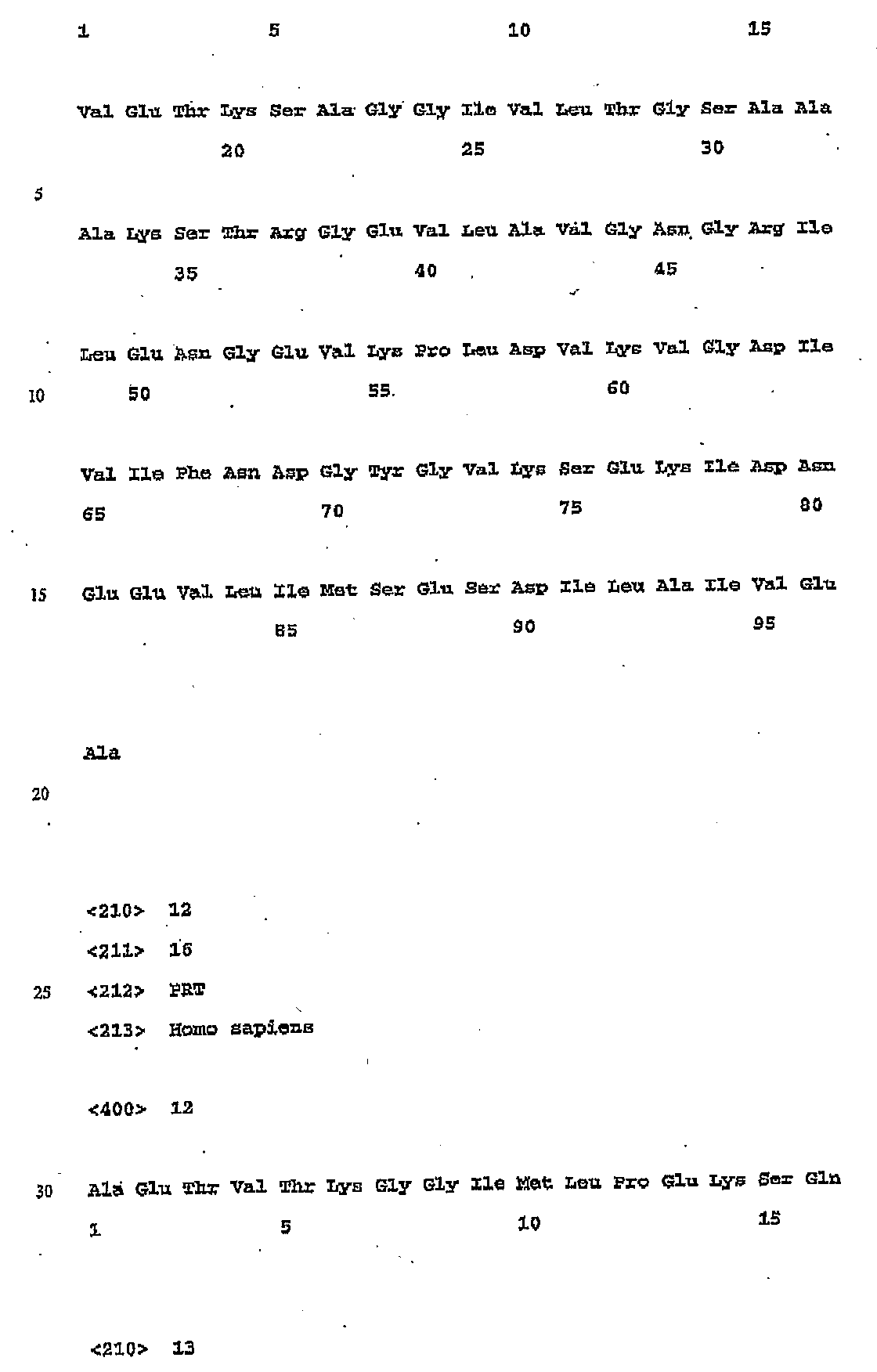


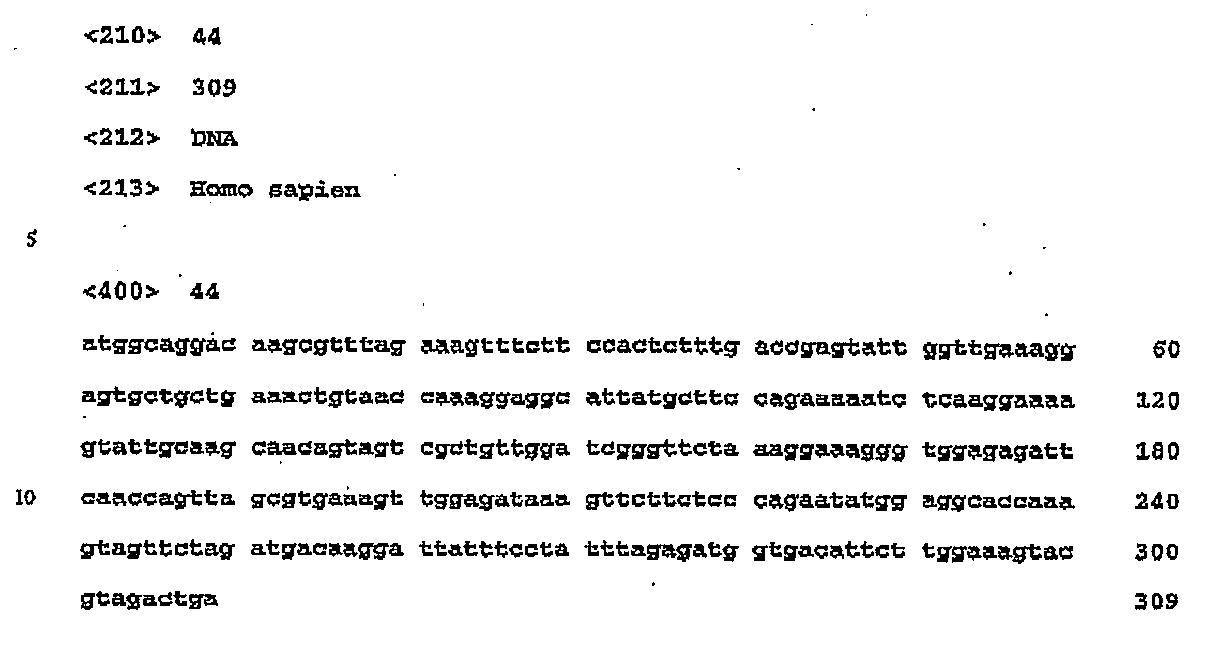
Claims (61)
Applications Claiming Priority (2)
| Application Number | Priority Date | Filing Date | Title |
|---|---|---|---|
| AU2005904765A AU2005904765A0 (en) | 2005-08-31 | Modified chaperonin 10 | |
| AU2005904765 | 2005-08-31 |
Publications (1)
| Publication Number | Publication Date |
|---|---|
| KR20080098579A true KR20080098579A (en) | 2008-11-11 |
Family
ID=37808414
Family Applications (1)
| Application Number | Title | Priority Date | Filing Date |
|---|---|---|---|
| KR1020087007836A Ceased KR20080098579A (en) | 2005-08-31 | 2006-08-31 | Modified Chaperonin 10 |
Country Status (10)
| Country | Link |
|---|---|
| US (3) | US7977458B2 (en) |
| EP (3) | EP2463307A1 (en) |
| JP (2) | JP5341515B2 (en) |
| KR (1) | KR20080098579A (en) |
| CN (1) | CN101309934B (en) |
| BR (1) | BRPI0615284A2 (en) |
| CA (1) | CA2620729A1 (en) |
| DK (1) | DK1937723T3 (en) |
| NZ (1) | NZ566817A (en) |
| WO (1) | WO2007025343A1 (en) |
Families Citing this family (6)
| Publication number | Priority date | Publication date | Assignee | Title |
|---|---|---|---|---|
| EP2463307A1 (en) * | 2005-08-31 | 2012-06-13 | CBIO Limited | Modified chaperonin 10 |
| WO2009124333A1 (en) * | 2008-04-11 | 2009-10-15 | Cbio Limited | Modified chaperonin 10 and prr signaling |
| CA2720617A1 (en) | 2008-04-11 | 2009-10-15 | Cbio Limited | Modified cpn10 and prr signalling |
| NZ599666A (en) * | 2009-10-09 | 2014-11-28 | Cbio Ltd | Chaperonin 10 variants |
| US10575716B2 (en) * | 2012-05-11 | 2020-03-03 | Ethicon Llc | Applicator instruments with imaging systems for dispensing surgical fasteners during open repair procedures |
| WO2018119118A1 (en) * | 2016-12-20 | 2018-06-28 | Oncomed Pharmaceuticals, Inc. | Lymphotoxin-beta receptor-binding agents, targeting antibodies, and uses thereof |
Family Cites Families (10)
| Publication number | Priority date | Publication date | Assignee | Title |
|---|---|---|---|---|
| WO1995015338A1 (en) * | 1993-11-30 | 1995-06-08 | The University Of Queensland | Chaperonin 10 |
| NZ507886A (en) * | 1998-05-19 | 2003-05-30 | Avidex Ltd | Multivalent T cell receptor complexes |
| AUPP823999A0 (en) | 1999-01-20 | 1999-02-11 | University Of Queensland, The | A treatment |
| GB9912852D0 (en) * | 1999-06-02 | 1999-08-04 | Regen Therapeutics Plc | Peptides |
| AU2002317013B2 (en) * | 2001-06-27 | 2007-11-01 | Janssen Pharmaceutica N.V. | EPF receptor assays, compounds and therapeutic compositions |
| AU2002952492A0 (en) | 2002-11-06 | 2002-11-21 | Cbio Limited | Chaperonin 10 immunosuppression |
| WO2004076639A2 (en) | 2003-02-26 | 2004-09-10 | Wyeth | Use of gene expression profiling in the diagnosis and treatment of lupus nephritis and systemic lupus erythematosus |
| JP2007517808A (en) * | 2004-01-16 | 2007-07-05 | キュビオ リミテッド | Chaperonin 10 regulation of TOLL-like receptor-induced cytokine and chemokine secretion |
| EP1906989A4 (en) | 2005-07-11 | 2009-08-19 | Cbio Ltd | Chaperonin 10-induced immunomodulation |
| EP2463307A1 (en) * | 2005-08-31 | 2012-06-13 | CBIO Limited | Modified chaperonin 10 |
-
2006
- 2006-08-31 EP EP12156473A patent/EP2463307A1/en not_active Ceased
- 2006-08-31 KR KR1020087007836A patent/KR20080098579A/en not_active Ceased
- 2006-08-31 BR BRPI0615284-8A patent/BRPI0615284A2/en not_active IP Right Cessation
- 2006-08-31 CA CA002620729A patent/CA2620729A1/en not_active Abandoned
- 2006-08-31 WO PCT/AU2006/001278 patent/WO2007025343A1/en not_active Ceased
- 2006-08-31 NZ NZ566817A patent/NZ566817A/en not_active IP Right Cessation
- 2006-08-31 EP EP20120156456 patent/EP2457930A1/en not_active Withdrawn
- 2006-08-31 DK DK06774907.7T patent/DK1937723T3/en active
- 2006-08-31 US US11/991,279 patent/US7977458B2/en not_active Expired - Fee Related
- 2006-08-31 JP JP2008528295A patent/JP5341515B2/en not_active Expired - Fee Related
- 2006-08-31 CN CN200680040617.XA patent/CN101309934B/en not_active Expired - Fee Related
- 2006-08-31 EP EP06774907.7A patent/EP1937723B1/en active Active
-
2011
- 2011-06-07 US US13/155,332 patent/US8513201B2/en not_active Expired - Fee Related
-
2012
- 2012-04-09 JP JP2012088841A patent/JP5819767B2/en not_active Expired - Fee Related
-
2013
- 2013-08-19 US US13/970,285 patent/US9079967B2/en not_active Expired - Fee Related
Also Published As
| Publication number | Publication date |
|---|---|
| US8513201B2 (en) | 2013-08-20 |
| US20090305400A1 (en) | 2009-12-10 |
| US7977458B2 (en) | 2011-07-12 |
| EP2463307A1 (en) | 2012-06-13 |
| EP1937723A4 (en) | 2009-12-16 |
| CN101309934B (en) | 2014-02-12 |
| EP1937723A1 (en) | 2008-07-02 |
| JP5341515B2 (en) | 2013-11-13 |
| JP2012196210A (en) | 2012-10-18 |
| BRPI0615284A2 (en) | 2011-05-17 |
| DK1937723T3 (en) | 2014-02-24 |
| CN101309934A (en) | 2008-11-19 |
| WO2007025343A1 (en) | 2007-03-08 |
| US9079967B2 (en) | 2015-07-14 |
| EP2457930A1 (en) | 2012-05-30 |
| CA2620729A1 (en) | 2007-03-08 |
| US20140093524A1 (en) | 2014-04-03 |
| JP5819767B2 (en) | 2015-11-24 |
| NZ566817A (en) | 2012-02-24 |
| EP1937723B1 (en) | 2013-11-13 |
| US20120014998A1 (en) | 2012-01-19 |
| JP2009505667A (en) | 2009-02-12 |
Similar Documents
| Publication | Publication Date | Title |
|---|---|---|
| Lehrer et al. | α‐Defensins in human innate immunity | |
| JP6262721B2 (en) | Composition for preventing or treating sepsis | |
| US9079967B2 (en) | Modified chaperonin 10 | |
| US20050074758A1 (en) | Prokineticin polypeptides, related compositions and methods | |
| US20100144642A1 (en) | Peptides and apl-type derivatives of hsp60 and pharmaceutical compositions | |
| JP2004501061A (en) | Fragments and antagonists of heat shock protein 60 | |
| US20050032173A1 (en) | Fusion proteins with a membrane translocating sequence and methods of using same to inhibit an immune response | |
| CZ303409B6 (en) | Shortened and mutated human chemokine | |
| AU2004309111B2 (en) | CC-chemokine-binding tick proteins | |
| KR20110005710A (en) | Modified CN10 and PCR Signaling | |
| JP2001186887A (en) | Antimicrobial peptide originating from pandinus imperator | |
| AU2006287120B2 (en) | Modified chaperonin 10 | |
| JPH07508763A (en) | Antagonist of human gamma interferon | |
| US10738095B2 (en) | Engineered CCL20 locked dimer polypeptide | |
| US11571462B2 (en) | Engineered CCL20 locked dimer polypeptide | |
| US7153947B2 (en) | Ixodes salivary anticomplement protein | |
| US20110014218A1 (en) | Ixodes scapularis salivary proteins and methods of use for modulation of the alternative complement pathway | |
| Primrose | Antigenicity of peptides from the protein ROP18, a virulence factor in Toxoplasma gondii | |
| WO2012095684A1 (en) | Methods for the screening of substances useful for the prevention and treatment of neisseria infections |
Legal Events
| Date | Code | Title | Description |
|---|---|---|---|
| PA0105 | International application |
Patent event date: 20080331 Patent event code: PA01051R01D Comment text: International Patent Application |
|
| PG1501 | Laying open of application | ||
| A201 | Request for examination | ||
| PA0201 | Request for examination |
Patent event code: PA02012R01D Patent event date: 20110830 Comment text: Request for Examination of Application |
|
| E902 | Notification of reason for refusal | ||
| PE0902 | Notice of grounds for rejection |
Comment text: Notification of reason for refusal Patent event date: 20121220 Patent event code: PE09021S01D |
|
| E601 | Decision to refuse application | ||
| PE0601 | Decision on rejection of patent |
Patent event date: 20131015 Comment text: Decision to Refuse Application Patent event code: PE06012S01D Patent event date: 20121220 Comment text: Notification of reason for refusal Patent event code: PE06011S01I |