KR101836552B1 - Diastereoselective preparation of bicyclo[2.2.2]octan-2-one compounds - Google Patents
Diastereoselective preparation of bicyclo[2.2.2]octan-2-one compounds Download PDFInfo
- Publication number
- KR101836552B1 KR101836552B1 KR1020137012607A KR20137012607A KR101836552B1 KR 101836552 B1 KR101836552 B1 KR 101836552B1 KR 1020137012607 A KR1020137012607 A KR 1020137012607A KR 20137012607 A KR20137012607 A KR 20137012607A KR 101836552 B1 KR101836552 B1 KR 101836552B1
- Authority
- KR
- South Korea
- Prior art keywords
- formula
- compound
- solvent
- cyclohexen
- process according
- Prior art date
- Legal status (The legal status is an assumption and is not a legal conclusion. Google has not performed a legal analysis and makes no representation as to the accuracy of the status listed.)
- Expired - Fee Related
Links
Classifications
-
- C—CHEMISTRY; METALLURGY
- C07—ORGANIC CHEMISTRY
- C07C—ACYCLIC OR CARBOCYCLIC COMPOUNDS
- C07C305/00—Esters of sulfuric acids
- C07C305/20—Esters of sulfuric acids having oxygen atoms of sulfate groups bound to carbon atoms of rings other than six-membered aromatic rings
-
- C—CHEMISTRY; METALLURGY
- C07—ORGANIC CHEMISTRY
- C07C—ACYCLIC OR CARBOCYCLIC COMPOUNDS
- C07C45/00—Preparation of compounds having >C = O groups bound only to carbon or hydrogen atoms; Preparation of chelates of such compounds
- C07C45/61—Preparation of compounds having >C = O groups bound only to carbon or hydrogen atoms; Preparation of chelates of such compounds by reactions not involving the formation of >C = O groups
- C07C45/65—Preparation of compounds having >C = O groups bound only to carbon or hydrogen atoms; Preparation of chelates of such compounds by reactions not involving the formation of >C = O groups by splitting-off hydrogen atoms or functional groups; by hydrogenolysis of functional groups
- C07C45/66—Preparation of compounds having >C = O groups bound only to carbon or hydrogen atoms; Preparation of chelates of such compounds by reactions not involving the formation of >C = O groups by splitting-off hydrogen atoms or functional groups; by hydrogenolysis of functional groups by dehydration
-
- C—CHEMISTRY; METALLURGY
- C07—ORGANIC CHEMISTRY
- C07C—ACYCLIC OR CARBOCYCLIC COMPOUNDS
- C07C45/00—Preparation of compounds having >C = O groups bound only to carbon or hydrogen atoms; Preparation of chelates of such compounds
- C07C45/61—Preparation of compounds having >C = O groups bound only to carbon or hydrogen atoms; Preparation of chelates of such compounds by reactions not involving the formation of >C = O groups
- C07C45/64—Preparation of compounds having >C = O groups bound only to carbon or hydrogen atoms; Preparation of chelates of such compounds by reactions not involving the formation of >C = O groups by introduction of functional groups containing oxygen only in singly bound form
-
- C—CHEMISTRY; METALLURGY
- C07—ORGANIC CHEMISTRY
- C07B—GENERAL METHODS OF ORGANIC CHEMISTRY; APPARATUS THEREFOR
- C07B63/00—Purification; Separation; Stabilisation; Use of additives
-
- C—CHEMISTRY; METALLURGY
- C07—ORGANIC CHEMISTRY
- C07C—ACYCLIC OR CARBOCYCLIC COMPOUNDS
- C07C309/00—Sulfonic acids; Halides, esters, or anhydrides thereof
- C07C309/01—Sulfonic acids
- C07C309/25—Sulfonic acids having sulfo groups bound to carbon atoms of rings other than six-membered aromatic rings of a carbon skeleton
-
- C—CHEMISTRY; METALLURGY
- C07—ORGANIC CHEMISTRY
- C07C—ACYCLIC OR CARBOCYCLIC COMPOUNDS
- C07C309/00—Sulfonic acids; Halides, esters, or anhydrides thereof
- C07C309/63—Esters of sulfonic acids
- C07C309/64—Esters of sulfonic acids having sulfur atoms of esterified sulfo groups bound to acyclic carbon atoms
- C07C309/65—Esters of sulfonic acids having sulfur atoms of esterified sulfo groups bound to acyclic carbon atoms of a saturated carbon skeleton
- C07C309/66—Methanesulfonates
-
- C—CHEMISTRY; METALLURGY
- C07—ORGANIC CHEMISTRY
- C07C—ACYCLIC OR CARBOCYCLIC COMPOUNDS
- C07C45/00—Preparation of compounds having >C = O groups bound only to carbon or hydrogen atoms; Preparation of chelates of such compounds
- C07C45/61—Preparation of compounds having >C = O groups bound only to carbon or hydrogen atoms; Preparation of chelates of such compounds by reactions not involving the formation of >C = O groups
- C07C45/67—Preparation of compounds having >C = O groups bound only to carbon or hydrogen atoms; Preparation of chelates of such compounds by reactions not involving the formation of >C = O groups by isomerisation; by change of size of the carbon skeleton
- C07C45/68—Preparation of compounds having >C = O groups bound only to carbon or hydrogen atoms; Preparation of chelates of such compounds by reactions not involving the formation of >C = O groups by isomerisation; by change of size of the carbon skeleton by increase in the number of carbon atoms
- C07C45/72—Preparation of compounds having >C = O groups bound only to carbon or hydrogen atoms; Preparation of chelates of such compounds by reactions not involving the formation of >C = O groups by isomerisation; by change of size of the carbon skeleton by increase in the number of carbon atoms by reaction of compounds containing >C = O groups with the same or other compounds containing >C = O groups
-
- C—CHEMISTRY; METALLURGY
- C07—ORGANIC CHEMISTRY
- C07C—ACYCLIC OR CARBOCYCLIC COMPOUNDS
- C07C45/00—Preparation of compounds having >C = O groups bound only to carbon or hydrogen atoms; Preparation of chelates of such compounds
- C07C45/78—Separation; Purification; Stabilisation; Use of additives
- C07C45/81—Separation; Purification; Stabilisation; Use of additives by change in the physical state, e.g. crystallisation
-
- C—CHEMISTRY; METALLURGY
- C07—ORGANIC CHEMISTRY
- C07B—GENERAL METHODS OF ORGANIC CHEMISTRY; APPARATUS THEREFOR
- C07B2200/00—Indexing scheme relating to specific properties of organic compounds
- C07B2200/07—Optical isomers
-
- C—CHEMISTRY; METALLURGY
- C07—ORGANIC CHEMISTRY
- C07C—ACYCLIC OR CARBOCYCLIC COMPOUNDS
- C07C2602/00—Systems containing two condensed rings
- C07C2602/36—Systems containing two condensed rings the rings having more than two atoms in common
- C07C2602/44—Systems containing two condensed rings the rings having more than two atoms in common the bicyclo ring system containing eight carbon atoms
Landscapes
- Chemical & Material Sciences (AREA)
- Organic Chemistry (AREA)
- Chemical Kinetics & Catalysis (AREA)
- Crystallography & Structural Chemistry (AREA)
- Organic Low-Molecular-Weight Compounds And Preparation Thereof (AREA)
- Pharmaceuticals Containing Other Organic And Inorganic Compounds (AREA)
- Heterocyclic Carbon Compounds Containing A Hetero Ring Having Oxygen Or Sulfur (AREA)
Abstract
본 발명은 식 (II)의 화합물인 (1R*,4R*,5S*,6S*)-6-히드록시-5-아릴바이시클로[2.2.2]옥탄-2-온 화합물의 부분입체선택적 제조를 위한 신규한 공정에 관한 것이며, 이는 추후에 식 (I)의 5-아릴-바이시클로[2.2.2]옥트-5-엔-2-온 화합물로 더욱 전환될 수 있다:


식 (I) 식 (II).
본 발명은 추가로 그와 같은 신규한 (1R*,2S*,3S*,4R*)-6-옥소-3-아릴바이시클로[2.2.2]옥탄-2-일 메탄설포네이트 화합물에 관한 것이며, 상기 화합물은 식 (I)의 5-아릴-바이시클로[2.2.2]옥트-5-엔-2-온 화합물의 제조에서 유용한 중간체이다.The present invention relates to the preparation of diastereoselective preparation of (1R *, 4R *, 5S *, 6S *) - 6-hydroxy-5-arylbicyclo [2.2.2] octan- Which may be further converted into the 5-aryl-bicyclo [2.2.2] oct-5-en-2-one compound of formula (I)
Formula (I) Formula (II).
The present invention further relates to such novel (1R *, 2S *, 3S *, 4R *) - 6-oxo-3-arylbicyclo [2.2.2] octan-2-ylmethanesulfonate compounds , Which is an intermediate useful in the preparation of the 5-aryl-bicyclo [2.2.2] oct-5-en-2-one compounds of formula (I).
Description
본 발명은 식 (II)의 화합물인, (1R*,4R*,5S*,6S*)-6-히드록시-5-아릴바이시클로[2.2.2]옥탄-2-온 화합물의 부분입체선택적 제조를 위한 신규한 공정에 관한 것이며, 상기 화합물은 이후 식 (I)의 화합물로 더욱 전환될 수 있다:The present invention relates to a process for the preparation of a compound of formula (II), which is a diastereomeric mixture of (1R *, 4R *, 5S *, 6S *) - 6-hydroxy-5-arylbicyclo [2.2.2] octan- Which process can further be converted into a compound of formula (I): < RTI ID = 0.0 >


식 (I) 식 (II).Formula (I) Formula (II).
본 발명은 추가로 그와 같은 식 (V)의 신규한 (1R*,2S*,3S*,4R*)-6-옥소-3-아릴바이시클로[2.2.2]옥탄-2-일 메탄설포네이트 화합물에 관한 것이다. 본 발명의 식 (V)의 화합물은 식 (I)의 5-아릴-바이시클로[2.2.2]옥트-5-엔-2-온 화합물의 제조에서 중간체로서 사용될 수 있다. 상기 식 (I)의 화합물은 WO2008/132679 및 WO2009/130679에 기술된 특정한 칼슘 통로 차단물질의 합성에서 핵심적인 구성 블럭이다. 특히, 이들은 화합물 이소부티르산 (1R,2R,4R)-2-(2-{[3-(4,7-디메톡시-1H-벤조이미다졸-2-일)-프로필]-메틸-아미노}-에틸)-5-페닐-바이시클로[2.2.2]옥트-5-엔-2-일 에스테르, 또는 이들의 상응하는 (1S,2S,4S)-입체이성질체로 더욱 전환될 수 있다.The present invention further relates to novel (1R *, 2S *, 3S *, 4R *) - 6-oxo-3-arylbicyclo [2.2.2] octane- ≪ / RTI > The compounds of formula (V) of the present invention can be used as intermediates in the preparation of 5-aryl-bicyclo [2.2.2] oct-5-en-2-one compounds of formula (I). The compounds of formula (I) above are key building blocks in the synthesis of certain calcium channel blockers as described in WO2008 / 132679 and WO2009 / 130679. In particular, they can be prepared by reacting the compound isobutyric acid (1R, 2R, 4R) -2- (2 - {[3- (4,7- dimethoxy- 1 H-benzoimidazol- Yl-ethyl) -5-phenyl-bicyclo [2.2.2] oct-5-en-2-yl ester, or the corresponding (1S, 2S, 4S) -stereoisomer thereof.
게다가, 식 (I)의 화합물은 식 (III)의 키랄 바이시클릭 디엔의 합성을 위해 사용될 수 있고In addition, the compounds of formula (I) can be used for the synthesis of chiral bicyclic dienes of formula (III)

식 (III)The formula (III)
여기서 R4는 유기금속성 시약에 의해 도입될 수 있는 임의의 기를 나타내며; 특히 알킬 또는 아릴을 나타낸다. 식 (III)의 화합물, 특히 C2-대칭성 2,5-이치환된 바이시클로[2.2.2]옥타-2,5-디엔 (bod*)은 비대칭 촉매작용에서의 키랄 리간드로서 지대한 관심을 빠르게 얻고 있으며, 예를 들어 다음을 참조하라: E. Carreira et al., Angew . Chem . Int . Ed . 2008, 47, 2-23; T. Hayashi et al ., Aldrichim . Acta. 2009, 42, 31. 현재의 합성은 일반적으로 매우 낮은 수율의 어려움을 갖는다.Wherein R < 4 > represents any group that can be introduced by the organometallic reagent; Especially alkyl or aryl. Compounds of formula (III), especially C 2 -symmetric 2,5-disubstituted bicyclo [2.2.2] octa-2,5-dienes (bod *), have gained considerable interest as chiral ligands in asymmetric catalysis For example, E. Carreira et al., Angew . Chem . Int . Ed . 2008 , 47 , 2-23; T. Hayashi et al . , Aldrichim . Acta. 2009, 42 , 31. Current syntheses generally have very low yield difficulties.
식 (I)의 화합물은 문헌으로부터 공지되어 있으나 (T. Kinoshita, K. Haga, K. Ikai, K. Takeuchi, Tetrahedron Letters 1990, 31, 4057-4060), 그러나 이들은 공통적으로 핵심 단계로 2-(트리메틸실록시)-1,3-시클로헥사디엔의 알파-클로로아크릴로니트릴 (Funel, J.-A.; Schmidt, G.; Abele, S. Org . Process Res . Dev . Publication Date (Web): June 27, 2011; Y. Luo, A. J. Carnell, J. Org . Chem . 2010, 75, 2057-2060) 또는 알파-아세트옥시아크릴로니트릴 (N. H. Werstuik, S. Yeroushalmi, H. Guan-Lin, Can . J. Chem . 1992, 70, 974-980 및 WO2008/132679; WO2009/130679)과의 딜스 아들러(Diels Alder) 반응; 또는 히드로키논 및 말레산 무수물의 딜스-아들러(Diels-Alder) 반응(R. K. Hill, G. H. Morton, J. R. Peterson, J. A. Walsh, L. A. Paquette, J. Org . Chem . 1985, 50, 5528-5533)을 이용하는 다중-단계 반응에서 합성된다. 이들 방법은 일반적으로 중간체로서 라세미 바이시클로[2.2.2]옥탄-2,5-디온을 가지고 일반적으로 매우 낮은 수율의 어려움을 가지며, 고비용 및 독성의 출발 물질을 사용하고 및/또는 규모를 확장시키기에 견고하지 못하다.The compounds of formula (I) are known from the literature (T. Kinoshita, K. Haga, K. Ikai, K. Takeuchi, Tetrahedron Letters 1990 , 31 , 4057-4060), but they have in common as a key step alpha-chloroacrylonitrile of 2- (trimethylsiloxy) -1,3-cyclohexadiene (Funel, J.-A .; Schmidt, G .; Abele, S. Org . Process Res . Dev . Publication Date (Web): June 27, 2011; Y. Luo, AJ Carnell, J. Org . Chem . . 2010, 75, 2057-2060), or alpha-acetoxy-acrylonitrile (NH Werstuik, Yeroushalmi S., Guan-Lin H., Can J. Chem 1992, 70, 974-980, and WO2008 / 132679; WO2009 / 130679); < RTI ID = 0.0 > Diels Alder < / RTI > Or using a Diels-Alder reaction of hydroquinone and maleic anhydride (RK Hill, GH Morton, JR Peterson, JA Walsh, LA Paquette, J. Org . Chem ., 1985 , 50 , 5528-5533) - are synthesized in a step reaction. These methods generally involve the use of racemic bicyclo [2.2.2] octane-2,5-dione as an intermediate, which generally has very low yield difficulties, uses expensive and toxic starting materials and / It is not robust to let.
식 (II)의 화합물의 제조를 위한 공정은 문헌에 공지되어 있다 (M. Bella et al.; "Synergic asymmetric organocatalysis (SAOc) of Chinchona alkaloids and secondary amines in the synthesis of bicyclo[2,2,2]octan-2-ones"; Chem . Commun . 2009, 597-599). 기술된 공정은 5-원 링 아미노 산(가령 프롤린, 또는 구조 (IV)의 시클릭 시스테인 유래된 촉매)의 염에 의해 촉매되는, 2-시클로헥센-1-온 및 페닐아세트알데히드 또는 이들의 페닐 링에서 치환된 유도체, 또는 2-페닐-프로피온알데히드(하이드라트로프알데히드)의 순차적인 단일 용기 (탠덤(Tandem)) 마이클 첨가(Michael addition)-알돌 고리화에 관한 것이다. 그러나, 상기 공정은 신코나(cinchona) 알칼로이드 유도체 가령 퀴닌이 구조 (IV)의 시스테인 유래된 촉매와 함께 대형 키랄 염기로서 사용되는 경우에, 높은 부분입체선택성 (dr < 1:10)과 함께 중간의 거울상이성질선택성 (ee 최대 87%)만을 야기하며, 여기서 키랄 염기 및 촉매는 각각 25 mol%의 양으로 사용된다.Processes for the preparation of compounds of formula (II) are known in the literature (M. Bella et al .; Synergic asymmetric organocatalysis (SAOc) of Chinchona alkaloids and secondary amines in the synthesis of bicyclo [2,2,2] octan-2-ones "; Chem . Commun . 2009 , 597-599). The processes described are 2-cyclohexen-1-one and phenylacetaldehyde or their phenyl (meth) acrylates catalyzed by salts of 5-membered ring amino acids (such as proline or a catalyst derived from cyclic cysteine of structure (IV) (Tandem) Michael addition-aldol cyclization of 2-phenyl-propionaldehyde (hydratropaldehyde) in the ring, or a 2-phenyl-propionaldehyde (hydratropaldehyde). This process, however, has the disadvantage that the cinchona alkaloid derivative, such as quinine, when used as a large chiral base with a cysteine-derived catalyst of structure (IV), has a high diastereoselectivity (dr < The enantiomer causes only property selectivity (ee max. 87%), wherein the chiral base and catalyst are used in amounts of 25 mol% each.


구조 (IV) 퀴닌Structure (IV) Quinine
소형 염기, 예컨대 프롤린의 리튬 염이 퀴닌 염기의 부재에서 사용된 경우, 상기 공정은 기질 2-페닐-프로피온알데히드를 이용하여, 낮은 부분입체이성질체 비 (d.r. 1:1.3) 및 낮은 거울상이성질선택성 (최대 33% ee)을 야기한다. 리튬을 대체하는, 첨가제로서 소형 아민 염기 [트리에틸아민 또는 1,8-디아자바이시클로[5.4.0]운데스-7-엔 (DBU)]의 사용은, 다시 동일한 기질을 사용하여 2-페닐-프로피온알데히드를, 유사하게 낮은 선택성으로 도출한다. 기질 페닐아세트알데히드를 이용하여, 프롤린 리튬 염의 사용은 유사한 결과를 제공하였다 [낮은 부분입체이성질체 비 (d.r. = 1:4) 및 낮은 거울상이성질선택성 (최대 17% ee)]. 그 결과, 소형 아민 염기는 기질 페닐아세트알데히드와 사용되지 않았다. 실제로, Bella 등은 프롤린이 사용되는 경우, "주요 부분입체이성질체에서 높은 ee를 얻는 것은 [기질로서 페닐아세트알데히드를 이용할 때] 어려움이 발견되었다"고 언급한다. 대형 아민 염기로서의 퀴닌과 구조 (IV)의 아민의 조합을 사용하여 성취된 양호한 부분입체선택성 및 거울상이성질선택성은 촉매 시스템의 두 성분의 상승적인 유리한 효과로 인한 것이라고 언급된다. 상기 언급된 논문의 598페이지에서 [구조 (IV)의 촉매의 문맥에서], Bella 등은 "조-촉매로서의 퀴닌은 거울상이성질선택성을 82% ee까지 증가시킬 뿐아니라, 한 가지 부분입체이성질체의 우선적인 형성을 유도한다"고 그리고 "ee의 확대는 더 큰 양이온 (Li+을 대신하는 양자화된 퀴닌) [...]이 Re 전면 차폐(face shielding)를 증가시킴을 전제하여 실현된다"고 언급한다.When the lithium salt of a small base such as proline is used in the absence of the quinine base, the process uses the substrate 2-phenyl-propionaldehyde to produce a compound with a low diastereomeric ratio (dr 1: 1.3) and a low enantioselectivity Up to 33% ee). The use of a small amine base [triethylamine or 1,8-diazabicyclo [5.4.0] undec-7-ene (DBU)] as an additive, replacing lithium, Phenyl-propionaldehyde is similarly derived with low selectivity. Using the substrate phenylacetaldehyde, the use of a proline lithium salt provided similar results [low diastereomeric ratio (dr = 1: 4) and low enantiomeric selectivity (up to 17% ee)]. As a result, small amine bases were not used with substrate phenylacetaldehyde. Indeed, Bella et al., When proline is used, states that "obtaining high ee from the major diastereomer has been found to be difficult [when using phenylacetaldehyde as substrate]". The good diastereoselectivity and enantioselectivity achieved using a combination of quinine as a large amine base and an amine of structure (IV) is said to be due to the synergistic beneficial effect of the two components of the catalyst system. On page 598 of the above-mentioned article [in the context of catalysts of structure (IV)], Bella et al. Reported that "quinine as co-catalyst not only increases enantioselectivity up to 82% ee, but also produces one diastereomer It is realized subject to induce the preferential formation "and that" the expansion of ee is Sikkim further increase the large cation (quantized quinine in place of the Li +) [...] Re is the front shield (face shielding), "high I will mention.
Bella 등의 교시에도 불구하고, 2-시클로헥센-1-온 및 (치환된) 페닐아세트알데히드의 고도로 부분입체선택적인 탠덤 마이클 첨가-알돌 고리화가 비용 집약적인 키랄 퀴닌 염기의 사용 없이 프롤린에 의해 촉매될 수 있음이 예기치않게 발견되었다. 상기 공정은 특히 소형이고 비싸지 않은 아키랄 N-함유 (질소 함유) 염기의 존재에서 프롤린 및 키랄 염기로 이루어진 시판되어 더 쉽게 이용가능한 촉매 시스템을 이용하여, 또는 심지어 모든 염기의 부재에서 프롤린을 이용하여 수행될 수 있다.Despite the teachings of Bella et al., The highly diastereoisomeric tandem Michael addition of 2-cyclohexen-1-one and (substituted) phenylacetaldehyde-aldol cyclization is catalyzed by proline without the use of cost-intensive chiral quinine bases It has been unexpectedly discovered. This process is particularly advantageous when using commercially available and more readily available catalyst systems consisting of proline and chiral bases in the presence of particularly small and inexpensive achiral N-containing (nitrogen containing) bases, or even using proline in the absence of all bases .
본 발명의 공정은 요망되는 부분입체이성질체의 침전을 야기하며, 이는 이후 고체-액체 분리에 의해 단리되어, 식 (II)의 화합물의 요망되는 부분입체이성질체를 규모확장이 가능한 방식으로 양호한 수율 및 높은 부분입체이성질선택성으로 제공한다. 상기 공정은 거울상이성질체적으로 농축된 프롤린이 사용되는 경우 거울상이성질체적으로 농축된 생성물을 도출할 수 있다. 입체이성질선택성은 프롤린의 절대 배치에 의해서만 도출되며, 즉 D-프롤린의 사용은 L-프롤린의 사용에 비해 정반대의 절대 배치를 갖는 식 (II)의 화합물을 생성한다. 키랄 염기의 어떠한 상승적 기여도 요구되지 않는다. 거울상이성질체적으로 농축된 생성물의 단순한 재결정화는 거울상이성질체 과량을 상당히 더욱 증가시킬 수 있다.The process of the present invention results in the precipitation of the desired diastereoisomer, which is then isolated by solid-liquid separation to give the desired diastereomer of the compound of formula (II) in good yield and high yield in a scalable manner Provided as diastereomeric selectivity. The process can yield an enantiomerically enriched product when enantiomerically enriched proline is used. The stereogenic selectivity is derived only by the absolute configuration of proline, i.e. the use of D-proline produces compounds of formula (II) with the opposite absolute configuration relative to the use of L-proline. No synergistic contribution of the chiral base is required. A simple recrystallization of the enantiomerically enriched product can significantly increase the enantiomeric excess.
본 발명의 공정은 규모확장이 가능하며 매우 단순한 조건 하에서 수행될 수 있어서 유닛 작업의 상당한 감소를 제공한다. 또한, 상기 공정은 두-단계 반응으로 확장될 수 있고, 상기 반응은 식 (I)의 유용한 구성 블록을 거울상이성질체적으로 농축된 형태로 수득하기 위해 핵심 단계로서, 매우 온화하고 규모확장이 가능한 탈리 반응을 포함한다. 그러한 공정은 상기 언급된 문헌에 개시되지 않는다.The process of the present invention is scalable and can be performed under very simple conditions to provide a significant reduction in unit operation. In addition, the process can be extended to a two-step reaction, which is a very gentle and scalable tallie, as a key step for obtaining the enantiomerically enriched form of the useful building blocks of formula (I) Lt; / RTI > Such processes are not disclosed in the above-mentioned documents.
1) 첫 번째 구체예에서, 본 발명은 식 (II)의 화합물인, (1R*,4R*,5S*,6S*)-6-히드록시-5-아릴바이시클로[2.2.2]옥탄-2-온 화합물의 합성을 위한 부분입체선택적 공정에 관한 것이다 (라세미 형태이든 거울상이성질체적으로 농축된 형태이든 관계없음):1) In a first embodiment, the present invention provides a compound of formula (II), wherein the compound is (1R *, 4R *, 5S *, 6S *) - 6-hydroxy- 2-one compounds (whether in racemic or enantiomerically enriched form): < RTI ID = 0.0 >

식 (II)The formula (II)
상기 공정은 다음:The process comprises:
· 프롤린(라세미 형태이든 거울상이성질체적으로 농축된 형태이든 상관없음); 및Proline (whether in racemic or enantiomerically enriched form); And
· 방향족 용매, 에테르 용매, 염소계 유기 용매, 및 에스테르; 또는 이들의 혼합물로 이루어진 군에서 선택되는 용매; 여기서 상기 용매는 2-시클로헥센-1-온에 대하여 약 1 내지 10 vol (특히 약 3 내지 10 vol)의 양으로 존재함;Aromatic solvents, ether solvents, chlorinated organic solvents, and esters; Or a mixture thereof; Wherein said solvent is present in an amount of about 1 to 10 vol (especially about 3 to 10 vol) relative to 2-cyclohexen-1-one;
의 존재에서,In the presence of,
· 및 임의로 아키랄 염기의 존재에서, 다음:And optionally in the presence of an archiv base,
· 2-시클로헥센-1-온, 및 2-cyclohexen-1-one, and
· 식 Ar-CH2-CHO의 화합물, 여기서 Ar는 아릴 기를 나타냄;A compound of formula Ar-CH 2 -CHO, wherein Ar represents an aryl group;
의 고리화를 포함하고;≪ / RTI >
여기서 상기 식 (II)의 화합물은 반응 혼합물로부터 고체-액체 분리에 의해 단리된다.Wherein the compound of formula (II) is isolated from the reaction mixture by solid-liquid separation.
구체예 1)의 공정은 부분입체선택적 공정이다. 상기 공정은 일반적으로 90:10 초과, 특히 95:5 초과, 특히 99:1 초과의 부분입체이성질체 비로 [추가적인 부분입체이성질체: (1R*,4R*,5R*,6R*)-6-히드록시-5-아릴바이시클로[2.2.2]옥탄-2-온, (1R*,4R*,5R*,6S*)-6-히드록시-5-아릴바이시클로[2.2.2]옥탄-2-온, (1R*,4R*,5S*,6R*)-6-히드록시-5-아릴바이시클로[2.2.2]옥탄-2-온의 총합에 대한 것] 단리된 (1R*,4R*,5S*,6S*)-6-히드록시-5-아릴바이시클로[2.2.2]옥탄-2-온 화합물을 도출한다. 특정한 구체예에서, 부분입체이성질체로 본질적으로 순수한 식 (II)의 화합물이 단리된다.The process of embodiment 1) is a diastereoselective process. The process is generally carried out at a diastereomeric ratio of greater than 90:10, in particular greater than 95: 5, in particular greater than 99: 1 [additional diastereoisomers: (1R *, 4R *, 5R *, 6R *) - 6- (2R *, 4R *, 5R *, 6S *) - 6-hydroxy-5-arylbicyclo [2.2.2] octane- On the sum of (1R *, 4R *, 5S *, 6R *) - 6-hydroxy-5-arylbicyclo [2.2.2] octan- , 5S *, 6S *) - 6-hydroxy-5-arylbicyclo [2.2.2] octan-2-one. In certain embodiments, the compounds of formula (II), which are essentially pure as diastereomers, are isolated.
구체예 1)의 공정은 임의로 아키랄 염기의 존재에서 수행된다. 바람직하게는 상기 공정은 키랄 염기(이것은 더 비싸며 본 발명의 공정의 높은 부분입체 이성질선택성을 달성하기 위해 요구되지 않음)의 부재에서 수행된다. 특히, 상기 공정은 아키랄 염기의 존재에서, 또는 아예 염기의 부재에서 수행된다. 비록 바람직하지 않지만, 예컨대 아키랄 염기와의 혼합물에서 키랄 염기의 사용이 본 발명의 공정의 범위 내에 있는데, 이는 본 발명의 부분입체 이성질선택성이 그러한 키랄 염기의 존재에 의해 부정적으로 영향받지 않기 때문이다. 적절한 아키랄 염기는 임의의 아키랄 염기이고, 특히 바람직한 것은 시판되는 널리 공지된 염기이며 제품의 낮은 비용을 야기한다. 바람직하게는, 그러한 염기는, 반응 혼합물에 부가될 경우, 반응 혼합물 내에서 약 7 내지 10 (특히 8 내지 10)의 pH를 유도한다. 그러한 염기의 바람직한 예는 아키랄 N-함유 염기, 수성 염기 용액, 또는 수성 완충 용액; 또는 이들의 혼합물이다. 아키랄 N-함유 염기는 특히 삼차 아민 염기 가령 NR1R2R3, 여기서 R1, R2, 및 R3은 독립적으로 알킬을 표시함; 1,4-디아자바이시클로[2.2.2]옥탄 (DABCO); 아미딘 염기 가령 1,8-디아자바이시클로[5.4.0]운데스-7-엔 (DBU) 또는 1,5-디아자바이시클로(4.3.0)논-5-엔 (DBN) 및 피리딘으로 이루어진 군에서 선택되며, 여기서 피리딘은 미치환된 (바람직함), 또는 메틸로 모노-, 디-, 또는 트리-치환된다. 그러한 아키랄 N-함유 염기는 일반적으로 2-시클로헥센-1-온에 대해 약 0.1 당량 내지 0.5 당량의 양으로 존재한다. 수성 염기 용액은 상기 아키랄 N-함유 염기의 수성 용액일 수 있거나; 또는 특히 알칼리 금속 히드록시드 용액 가령 특히 수성 NaOH 또는 수성 KOH이다. 그러한 수성 염기는 일반적으로 2-시클로헥센-1-온에 대하여 약 0.05 당량 내지 0.3 당량의 양으로 존재한다. 수성 완충 용액은 특히 나트륨 포스페이트 완충액 (예를 들면 20 mM Na3PO4 완충액, pH 8) 또는 당해 분야의 숙련가에게 공지된 다른 수성 완충액 시스템이다. 그러한 수성 완충액은 일반적으로 2-시클로헥센-1-온에 대하여 약 0.4 내지 1 vol.의 양으로 존재한다. 혼합물이 사용되는 경우, 그러한 혼합물은 바람직하게는 아키랄 N-함유 염기 및 수성 완충 용액의 혼합물이다. 그러한 혼합물에서, 아키랄 N-함유 염기는 일반적으로 약 0.1 당량 내지 0.5 당량의 양으로 존재하고; 수성 완충액은 일반적으로 약 0.4 내지 1 vol.의 양으로 존재하며; 상기 양은 모두 2-시클로헥센-1-온에 대한 것이다. 구체예 1)의 공정은 또한 아예 염기의 부재에서 수행될 수 있다.The process of embodiment 1) is optionally carried out in the presence of an achiral base. Preferably, the process is carried out in the absence of a chiral base, which is more expensive and is not required to achieve the high diastereomeric selectivity of the process of the present invention. In particular, the process is carried out in the presence of an achiral base or in the absence of a base. Although it is not preferred, for example, the use of chiral bases in mixtures with, for example, aciral bases is within the scope of the process of the present invention because the diastereomeric selectivity of the present invention is not adversely affected by the presence of such chiral bases to be. Suitable acylic bases are any of the achiral bases, particularly preferred are well known commercially available bases and result in low cost of the product. Preferably, such bases induce a pH of about 7 to 10 (especially 8 to 10) in the reaction mixture when added to the reaction mixture. Preferred examples of such bases include: acyl N-containing bases, aqueous base solutions, or aqueous buffer solutions; Or a mixture thereof. Aki LAL N- containing base, particularly a tertiary amine base, for example NR 1 R 2 R 3, wherein R 1, R 2, and R 3 independently represents alkyl; 1,4-diazabicyclo [2.2.2] octane (DABCO); Diazabicyclo [5.4.0] undec-7-ene (DBU) or 1,5-diazabicyclo (4.3.0) non-5-ene (DBN) and pyridine , Wherein pyridine is unsubstituted (preferred), or methylamino-, di-, or tri-substituted. Such aciral N-containing bases are generally present in an amount of about 0.1 equivalents to 0.5 equivalents to 2-cyclohexen-1-one. The aqueous base solution may be an aqueous solution of the acyl N-containing base; Or especially alkali metal hydroxide solutions such as aqueous NaOH or aqueous KOH. Such aqueous bases are generally present in an amount of about 0.05 equivalents to 0.3 equivalents relative to 2-cyclohexen-1-one. Aqueous buffer solutions are particularly sodium phosphate buffer (e.g., 20 mM Na 3 PO 4 buffer, pH 8) or other aqueous buffer systems known to those skilled in the art. Such aqueous buffers are generally present in an amount of about 0.4 to 1 vol. Relative to 2-cyclohexen-1-one. When a mixture is used, such a mixture is preferably a mixture of an aciral N-containing base and an aqueous buffer solution. In such a mixture, the aciral N-containing base is generally present in an amount of about 0.1 to about 0.5 equivalents; The aqueous buffer is generally present in an amount of about 0.4 to 1 vol. The amounts are all for 2-cyclohexen-1-one. The process of embodiment 1) may also be carried out in the absence of a base.
시판되는 프롤린 (라세미 형태이든 거울상이성질체적으로 농축된 형태이든 관계없음)이 사용되며, 약 0.1 내지 0.5 당량의 양으로 사용된다. 그 자체로 본 발명의 일부는 아니지만, 발명의 더 나은 이해를 위해 다음이 유의된다: 대안적으로 프롤린이 프롤린 에스테르 가령 메틸 프롤리네이트에 의해 대체될 수 있음이 발견되었다. Commercially available proline (whether racemic or enantiomerically enriched) is used and is used in an amount of about 0.1 to 0.5 equivalents. Although not a part of the invention per se, for the sake of a better understanding of the invention, it is noted that: Alternatively, proline can be replaced by proline ester, such as methyl proprionate.
구체예 1)의 공정을 위해 사용되는 용매는 방향족 용매 가령 톨루엔, 및 아니솔; 에테르 용매 가령 tert. 부틸 메틸 에테르 (TBME), 테트라히드로푸란 (THF), 디옥산, 및 2-메틸-THF; 염소계 유기 용매 가령 디클로로메탄, 1,2-디클로로에탄, 클로로벤젠, 및 1,2-디클로로벤젠; 또는 에스테르 가령 에틸 아세테이트, 이소프로필 아세테이트, 및 n-부틸 아세테이트; 또는 그러한 용매의 혼합물이다. 바람직한 용매는 방향족 용매 가령 특히 톨루엔; 및 에테르 용매 가령 특히 tert. 부틸 메틸 에테르 (TBME)이다. 모든 용매는 추가의 건조 절차 없이 구입한 그대로 사용할 수 있다.Solvents used for the process of embodiment 1) include aromatic solvents such as toluene, and anisole; Ether solvents such as tert . Butyl methyl ether (TBME), tetrahydrofuran (THF), dioxane, and 2-methyl-THF; Chlorinated organic solvents such as dichloromethane, 1,2-dichloroethane, chlorobenzene, and 1,2-dichlorobenzene; Or esters such as ethyl acetate, isopropyl acetate, and n-butyl acetate; Or a mixture of such solvents. Preferred solvents are aromatic solvents, such as, in particular, toluene; And ether solvents such as tert . Butyl methyl ether (TBME). All solvents can be used as purchased without additional drying procedures.
2) 두 번째 구체예에서, 구체예 1)에 따른 공정은 다음으로 이루어진 군에서 선택되는 아키랄 염기의 존재에서 수행된다: 2) In a second embodiment, the process according to embodiment 1) is carried out in the presence of an achiral base selected from the group consisting of:
· 아키랄 N-함유 염기; Acular N-containing bases;
· 수성 염기 또는 수성 완충 용액; 및Aqueous bases or aqueous buffer solutions; And
· 아키랄 N-함유 염기 및 수성 완충 용액의 혼합물.Mixtures of acyl N-containing bases and aqueous buffer solutions.
3) 세 번째 구체예에서, 구체예 1) 또는 2)에 따른 공정은 다음의 존재에서 수행된다3) In a third embodiment, the process according to embodiment 1) or 2) is carried out in the presence of
· 수성 염기 또는 수성 완충 용액; 또는 Aqueous bases or aqueous buffer solutions; or
· 아키랄 N-함유 염기 및 수성 완충 용액의 혼합물. Mixtures of acyl N-containing bases and aqueous buffer solutions.
구체예 3)에 따른 그러한 공정은 식 (II)의 화합물을 높은 부분입체이성질체 순도로 도출하지만, 거울상이성질체적으로 농축된 프롤린이 사용되는 경우라도 거울상이성질체 농축은 관찰되지 않는다. 식 (II)의 라세미 화합물을 야기하는 그러한 공정은 식 (II)의 화합물이 라세미 형태로 수득되어야 하지만, 예컨대 상업적인 이유로, 거울상이성질체적으로 농축된 D-, 또는 L-프롤린의 사용이 바람직한 경우에 바람직한 공정일 수 있다. 그러한 공정은 바람직하게는 에테르 용매 (특히 TBME) 또는 방향족 용매 (특히 톨루엔), 또는 이들의 혼합물 내에서 수행된다. 하기에 이어지는 구체예 7) 내지 36)은 약간의 차이는 감안하여 구체예 3)의 그러한 비-거울상이성질체 선택적 공정을 적용한다.Such a process according to example 3) leads to compounds of formula (II) with high diastereomeric purity, but enantiomeric enrichment is not observed even when enantiomerically enriched proline is used. Such a process leading to a racemic compound of formula (II) should be such that the compound of formula (II) must be obtained in racemic form, but for commercial reasons, the use of enantiomerically enriched D- or L- It may be a preferable process. Such a process is preferably carried out in an ether solvent (especially TBME) or an aromatic solvent (especially toluene), or a mixture thereof. Following Examples 7) to 36) apply such a non-enantiomeric selective process of Example 3) in view of slight differences.
본 발명의 추가적인 구체예가 이후 제시된다:Further embodiments of the invention are presented hereinafter:
4) 네 번째 구체예에서, 구체예 1)에 따른 공정은 아키랄 N-함유 염기의 존재에서 또는 염기의 부재에서 수행된다.4) In a fourth embodiment, the process according to embodiment 1) is carried out in the presence of an aciral N-containing base or in the absence of a base.
구체예 4)에 따른 그러한 공정은 아키랄 N-함유 염기의 존재에서 키랄 염기, 첨가된 수성 염기 또는 수성 완충 용액의 부재에서; 또는 임의의 첨가된 염기의 부재에서, 특히 임의의 키랄 염기, 첨가된 수성 염기 또는 수성 완충 용액의 부재에서; 용매 또는 구체예 1)에 따른 용매 혼합물에서, 첨가된 물의 부재에서 수행된다. 구체예 4)에 따른 그러한 공정은 상기 기술된 바와 같이 식 (II)의 화합물을 높은 부분입체이성질체 순도로 야기한다.Such a process according to embodiment 4) is carried out in the absence of chiral base, added aqueous base or aqueous buffer solution in the presence of an archival N-containing base; Or in the absence of any added base, especially in the absence of any chiral base, added aqueous base or aqueous buffer solution; Solvent or in the solvent mixture according to embodiment 1), in the absence of added water. Such a process according to embodiment 4) causes a compound of formula (II) as described above with a high diastereomeric purity.
또한, 거울상이성질체적으로 농축된 프롤린이 사용되는 경우, 거울상이성질체적으로 농축된 식 (II)의 화합물이 수득된다.Further, when enantiomerically enriched proline is used, an enantiomerically enriched compound of formula (II) is obtained.
5) 추가적인 구체예에서, 구체예 1)에 따른 공정은 아키랄 N-함유 염기의 존재에서 수행된다.5) In a further embodiment, the process according to embodiment 1) is carried out in the presence of an achiral N-containing base.
구체예 5)에 따른 그러한 공정은 아키랄 N-함유 염기의 존재에서 첨가된 수성 염기 또는 수성 완충 용액의 부재에서, 특히 구체예 1)에 따른 용매에서, 첨가된 물의 부재에서 수행된다. 구체예 5)에 따른 그러한 공정은 상기 기술된 바와 같이 식 (II)의 화합물을 높은 부분입체이성질체 순도로 야기한다.Such a process according to embodiment 5) is carried out in the absence of an added aqueous base or aqueous buffer solution in the presence of an acyl N-containing base, in particular in the solvent according to embodiment 1), in the absence of added water. Such a process according to embodiment 5) causes a compound of formula (II) with high diastereomeric purity as described above.
또한, 거울상이성질체적으로 농축된 프롤린이 사용되는 경우, 거울상이성질체적으로 농축된 식 (II)의 화합물이 수득된다.Further, when enantiomerically enriched proline is used, an enantiomerically enriched compound of formula (II) is obtained.
6) 추가적인 구체예에서, 구체예 1)에 따른 공정은 염기의 부재에서 수행된다.6) In a further embodiment, the process according to embodiment 1) is carried out in the absence of a base.
구체예 6)에 따른 그러한 공정은 임의의 첨가된 염기의 부재에서, 특히 임의의 키랄 염기의 부재에서, 그러나 또한 아키랄 N-함유 염기의 부재에서 그리고 첨가된 수성 염기 또는 수성 완충 용액의 부재에서, 특히 구체예 1)에 따른 용매에서, 특히 첨가된 물의 부재에서 수행된다. 구체예 6)에 따른 그러한 공정은 상기 기술된 바와 같이 식 (II)의 화합물을 높은 부분입체이성질체 순도로 야기한다. Such a process according to embodiment 6) is carried out in the absence of any added base, in particular in the absence of any chiral base, but also in the absence of an achiral N-containing base and in the absence of added aqueous base or aqueous buffer solution In particular in the solvent according to embodiment 1), in particular in the absence of added water. Such a process according to embodiment 6) causes a compound of formula (II) as described above with a high diastereomeric purity.
또한, 거울상이성질체적으로 농축된 프롤린이 사용되는 경우, 거울상이성질체적으로 농축된 식 (II)의 화합물이 수득된다.Further, when enantiomerically enriched proline is used, an enantiomerically enriched compound of formula (II) is obtained.
7) 또다른 구체예는 구체예 4) 내지 6)에 따른 공정에 관한 것이며, 여기서 상기 공정은 거울상이성질체적으로 농축된 D- 또는 L-프롤린 (특히, 본질적으로 순수한 D-프롤린, 또는 특히 L-프롤린)의 존재에서 수행된다.7) Another embodiment relates to a process according to embodiments 4) to 6), wherein said process comprises enantiomerically enriched D- or L-proline (especially essentially pure D-proline, or in particular L - proline).
하위-구체예에서, 상기 공정이 L-프롤린의 존재에서 수행되는 경우에, 식 (IIa)의 화합물이 거울상이성질체적으로 농축된 형태로 수득되고, 또는, 또다른 하위-구체예에서, 상기 공정이 D-프롤린의 존재에서 수행되는 경우에, 식 (IIb)의 화합물이 거울상이성질체적으로 농축된 형태로 수득된다:In a sub-embodiment, when the process is carried out in the presence of L-proline, the compound of formula (IIa) is obtained in enantiomerically enriched form, or, in another sub- Is carried out in the presence of D-proline, the compound of formula (IIb) is obtained in enantiomerically enriched form:


식 (IIa) 식 (IIb).Formula (IIa) Formula (IIb).
8) 또다른 구체예는 구체예 4) 내지 7)에 따른 공정에 관한 것이며, 여기서 거울상이성질체 비는 적어도 약 60:40이다 (특히 적어도 약 70:30).8) Another embodiment relates to a process according to embodiments 4) to 7), wherein the enantiomer ratio is at least about 60:40 (especially at least about 70:30).
어떠한 의심도 방지하기 위해, 상기 공정이 L-프롤린의 존재에서 수행되는 경우에, 거울상이성질체 비는 식 (IIa)의 화합물:식 (IIb)의 화합물의 비를 지칭하며; 상기 공정이 D-프롤린의 존재에서 수행되는 경우에, 거울상이성질체 비는 식 (IIb)의 화합물:식 (IIa)의 화합물의 비를 지칭하고; 상기 비는 둘다 적어도 약 60:40이다 (특히 적어도 약 70:30).To avoid any doubt, if the process is carried out in the presence of L-proline, the enantiomeric ratio refers to the ratio of the compound of formula (IIa): formula (IIb); When the process is carried out in the presence of D-proline, the enantiomeric ratio refers to the ratio of compound of formula (IIb): formula (IIa); Both of which are at least about 60:40 (especially at least about 70:30).
9) 또다른 구체예는 구체예 4) 내지 8) 중 어느 하나에 따른 공정에 관한 것이며, 여기서, 상기 공정이 거울상이성질체적으로 농축된 프롤린 (특히 L-프롤린)의 존재에서 수행되는 경우에, 단리된 거울상이성질체적으로 농축된 식 (II)의 화합물은 이후의 단계에서, 재결정화된다. 바람직하게는, 그러한 재결정화를 위한 용매는 에테르 (특히 THF), 아세토니트릴, 케톤 (특히 아세톤), 및 알코올 (특히 에탄올)로 이루어진 군에서 선택된다. 특히, 용매는 THF 또는 아세토니트릴, 특히 THF이다.9) Another embodiment relates to a process according to any one of embodiments 4) to 8), wherein when the process is carried out in the presence of an enantiomerically enriched proline (especially L-proline) The isolated enantiomerically enriched compound of formula (II) is recrystallized in a later step. Preferably, the solvent for such recrystallization is selected from the group consisting of ethers (especially THF), acetonitrile, ketones (especially acetone), and alcohols (especially ethanol). In particular, the solvent is THF or acetonitrile, especially THF.
10) 또다른 구체예는 구체예 9)에 따른 공정에 관한 것이며, 여기서 상기 재결정화로부터 수득된 식 (II)의 화합물의 거울상이성질체 비는 적어도 약 90:10이다 (특히 적어도 약 95:5).10) Another embodiment relates to a process according to embodiment 9), wherein the enantiomeric ratio of the compound of formula (II) obtained from said recrystallization is at least about 90: 10 (especially at least about 95: 5) .
11) 또다른 구체예는 구체예 1) 내지 10) 중 어느 하나에 따른 공정에 관한 것이며, 여기서 상기 공정은 방향족 용매 (특히 톨루엔), 또는 에테르 용매 (특히 TBME)의 존재에서 수행된다.11) Another embodiment relates to a process according to any one of embodiments 1) to 10), wherein the process is carried out in the presence of an aromatic solvent (especially toluene), or an ether solvent (especially TBME).
12) 또다른 구체예는 구체예 1) 내지 10) 중 어느 하나에 따른 공정에 관한 것이며, 여기서 상기 공정은 방향족 용매 (특히 톨루엔)의 존재에서 수행된다.12) Another embodiment relates to a process according to any one of embodiments 1) to 10), wherein the process is carried out in the presence of an aromatic solvent (especially toluene).
13) 또다른 구체예는 구체예 4) 내지 12) 중 어느 하나에 따른 공정에 관한 것이며, 여기서 상기 용매는 본질적으로 물을 함유하지 않는다.13) Another embodiment relates to a process according to any one of embodiments 4) to 12), wherein said solvent is essentially water-free.
14) 또다른 구체예는 구체예 1) 내지 13) 중 어느 하나에 따른 공정에 관한 것이며, 여기서 공정은 약 0℃ 내지 55℃의 온도에서 (특히 약 30℃ 내지 50℃에서, 특히 약 45 ℃에서) 수행된다.14) Another embodiment relates to a process according to any one of embodiments 1) to 13), wherein the process is carried out at a temperature of from about 0 캜 to 55 캜 (especially at about 30 캜 to 50 캜, Lt; / RTI >
15) 또다른 구체예는 구체예 2) 내지 14) 중 어느 하나에 따른 공정에 관한 것이며, 여기서, 만일 존재한다면, 상기 아키랄 N-함유 염기는 약 200 미만의 분자량을 갖는다.15) Another embodiment is directed to the process according to any one of embodiments 2) to 14) wherein the archilal N-containing base, if present, has a molecular weight of less than about 200.
16) 또다른 구체예는 구체예 2) 내지 14) 중 어느 하나에 따른 공정에 관한 것이며, 여기서, 만일 존재한다면, 상기 아키랄 N-함유 염기는 NR1R2R3, 여기서 R1, R2, 및 R3은 독립적으로 알킬을 표시함; 1,4-디아자바이시클로[2.2.2]옥탄 (DABCO); 1,8-디아자바이시클로[5.4.0]운데스-7-엔 (DBU), 1,5-디아자바이시클로(4.3.0)논-5-엔 (DBN); 및 피리딘으로 이루어진 군에서 선택되고, 여기서 피리딘은 미치환된 (바람직함), 또는 메틸로 모노-, 디-, 또는 트리 치환된다.16) Another embodiment relates to a process according to any one of embodiments 2) to 14) wherein the archyl N-containing base, if present, is NR 1 R 2 R 3 , wherein R 1 , R 2 , and R 3 independently represents alkyl; 1,4-diazabicyclo [2.2.2] octane (DABCO); 1,8-diazabicyclo [5.4.0] undec-7-ene (DBU), 1,5-diazabicyclo (4.3.0) non-5-ene (DBN); And pyridine, wherein the pyridine is unsubstituted (preferred), or methyl-, di-, or trisubstituted.
17) 또다른 구체예는 구체예 2) 내지 14) 중 어느 하나에 따른 공정에 관한 것이며, 여기서, 만일 존재한다면, 상기 아키랄 N-함유 염기는 트리에틸아민, 디이소프로필-에틸아민, 트리부틸아민, 트리옥틸아민, 1,4-디아자바이시클로[2.2.2]옥탄 (DABCO), 1,8-디아자바이시클로[5.4.0]운데스-7-엔 (DBU), 및 피리딘으로 이루어진 군에서 선택된다. 17) Another embodiment relates to a process according to any one of embodiments 2) to 14), wherein the aciral N-containing base, if present, is selected from the group consisting of triethylamine, diisopropyl- Diazabicyclo [2.2.2] octane (DABCO), 1,8-diazabicyclo [5.4.0] undec-7-ene (DBU), and pyridine ≪ / RTI >
18) 또다른 구체예는 구체예 1) 내지 17) 중 어느 하나에 따른 공정에 관한 것이며, 여기서, 만일 존재한다면, 상기 아키랄 N-함유 염기는 트리에틸아민, 디이소프로필-에틸아민, 및 트리부틸아민 (특히 트리에틸아민, 및 디이소프로필-에틸아민)으로 이루어진 군에서 선택된다. 18) Another embodiment relates to a process according to any one of embodiments 1) to 17), wherein the acyl N-containing base, if present, is selected from the group consisting of triethylamine, diisopropyl- Tributylamine (especially triethylamine, and diisopropyl-ethylamine).
19) 또다른 구체예는 구체예 1) 내지 18) 중 어느 하나에 따른 공정에 관한 것이며, 여기서, 만일 존재한다면, 상기 아키랄 N-함유 염기는 2-시클로헥센-1-온에 대하여 약 0.1 당량 내지 0.5 당량 (특히 약 0.2 당량 내지 0.3 당량; 특히 약 0.25 당량)의 양으로 존재한다.19) Another embodiment relates to a process according to any one of embodiments 1) to 18) wherein the acyl N-containing base, if present, is present in an amount of from about 0.1 to 2-cyclohexen- To about 0.5 equivalents (especially about 0.2 equivalents to about 0.3 equivalents, especially about 0.25 equivalents).
20) 또다른 구체예는 구체예 1) 내지 19) 중 어느 하나에 따른 공정에 관한 것이며, 여기서 프롤린은 2-시클로헥센-1-온에 대하여 약 0.05 당량 내지 0.5 당량 (특히 약 0.2 당량 내지 0.3 당량; 특히 약 0.25 당량)의 양으로 존재한다.20) Another embodiment relates to a process according to any one of embodiments 1) to 19) wherein proline is present in the amount of from about 0.05 to about 0.5 equivalents (especially from about 0.2 equivalents to about 0.3 equivalents relative to 2-cyclohexen- In particular about 0.25 eq.).
21) 또다른 구체예는 구체예 1) 내지 20) 중 어느 하나에 따른 공정에 관한 것이며, 여기서 상기 식 Ar-CH2-CHO의 화합물은 2-시클로헥센-1-온에 대하여 약 1 당량 내지 2 당량 (특히 약 1 당량 내지 1.3 당량; 특히 약 1.1 당량)의 양으로 존재한다.21) Another embodiment relates to a process according to any one of embodiments 1) to 20) wherein the compound of the formula Ar-CH 2 -CHO is used in an amount of from about 1 equivalent to about 2 equivalents relative to 2-cyclohexen- 2 equivalents (especially about 1 equivalent to about 1.3 equivalents, especially about 1.1 equivalents).
22) 또다른 구체예는 구체예 1) 내지 21) 중 어느 하나에 따른 공정에 관한 것이며, 여기서 상기 용매는 2-시클로헥센-1-온에 대하여 약 3 내지 10 vol (특히 약 5 내지 7 vol)의 양으로 존재한다.22) Another embodiment relates to a process according to any one of embodiments 1) to 21), wherein the solvent comprises about 3 to 10 vol (especially about 5 to 7 vol ) ≪ / RTI >
23) 또다른 구체예는 구체예 1) 내지 22) 중 어느 하나에 따른 공정에 관한 것이며, 여기서 공정은 적어도 24 h 동안 (특히 약 24 h 내지 10 일 동안; 특히 약 4 일 동안) 수행된다.23) Another embodiment relates to a process according to any one of embodiments 1) to 22), wherein the process is performed for at least 24 h (especially about 24 h to 10 days; especially about 4 days).
24) 또다른 구체예는 구체예 1) 내지 23) 중 어느 하나에 따른 공정에 관한 것이며, 여기서, 아키랄 염기가 사용되는 경우에, 반응 혼합물의 pH는 약 8 내지 10이다.24) Another embodiment relates to a process according to any one of embodiments 1) to 23) wherein the pH of the reaction mixture is from about 8 to 10, when an aciral base is used.
하위-구체예에서; 아키랄 염기가 수성 염기 또는 수성 완충 용액으로, 또는 아키랄 N-함유 염기 및 수성 완충 용액의 혼합물로 이루어진 경우에; 반응 혼합물의 pH는 특히 약 9 내지 10이다.In a sub-embodiment; When the archival base is composed of an aqueous base or an aqueous buffer solution or a mixture of an aciral N-containing base and an aqueous buffer solution; The pH of the reaction mixture is particularly about 9 to 10.
또다른 하위-구체예에서; 아키랄 염기가 아키랄 N-함유 염기로 이루어지는 경우에; 반응 혼합물의 pH는 특히 약 8 내지 9이다. 어떠한 염기도 사용되지 않는 경우에, 반응 혼합물의 pH는 일반적으로 약 6 내지 8이다.In another sub-embodiment; When the archival base is composed of an archival N-containing base; The pH of the reaction mixture is in particular about 8 to 9. If no base is used, the pH of the reaction mixture is generally about 6-8.
25) 또다른 구체예는 구체예 1) 내지 24) 중 어느 하나에 따른 공정에 관한 것이며, 여기서 상기 식 (II)의 화합물은 반응 혼합물에서 약 70 : 30 초과 (특히 약 80 : 20 초과, 특히 90 : 10 초과)의 부분입체이성질체 비로 형성된다.25) Another embodiment relates to a process according to any one of embodiments 1) to 24) wherein the compound of formula (II) is present in the reaction mixture in an amount greater than about 70: 30 (especially greater than about 80:20, 90: 10). ≪ / RTI >
어떠한 의심도 방지하기 위해, 구체예 25)에서, 개념 "반응 혼합물에서 형성된" 식 (II)의 화합물의 부분입체이성질체 비는 공정에서 반응 혼합물의 제어 측정을 사용하여 관찰된 부분입체이성질체 비를 지칭한다. 식 (II)의 화합물과 관련된 용어 부분입체이성질체 비는 추가적인 부분입체이성질체: (1R*,4R*,5R*,6R*)-6-히드록시-5-아릴바이시클로[2.2.2]옥탄-2-온, (1R*,4R*,5R*,6S*)-6-히드록시-5-아릴바이시클로[2.2.2]옥탄-2-온, (1R*,4R*,5S*,6R*)-6-히드록시-5-아릴바이시클로[2.2.2]옥탄-2-온)의 총합에 대한 식 (II)의 화합물: (1R*,4R*,5S*,6S*)-6-히드록시-5-아릴바이시클로[2.2.2]옥탄-2-온 (라세미 형태이든 거울상이성질체적으로 농축된 형태이든 관계없음, 따라서 식 (IIa) 또는 식 (IIb)의 화합물, 또는 이들의 임의의 혼합물에 해당함)의 비를 지칭하고; 여기서 구조 (dia-II)의 화합물: (1R*,4R*,5R*,6R*)-6-히드록시-5-아릴바이시클로[2.2.2]옥탄-2-온 (라세미 형태이든 거울상이성질체적으로 농축된 형태이든 관계없음)은 일반적으로 가장 중요한 부차적인 부분입체이성질체이다:To avoid any doubt, in embodiment 25 the concept of the "diastereomeric ratio of the compound of formula (II) formed in the reaction mixture " refers to the observed diastereomeric ratio using the controlled measurement of the reaction mixture in the process do. The term diastereoisomeric ratio with respect to compounds of formula (II) refers to additional diastereoisomers: (1R *, 4R *, 5R *, 6R *) - 6-hydroxy-5-arylbicyclo [2.2.2] (2R *, 4R *, 5R *, 6S *) - 6-hydroxy-5-arylbicyclo [2.2.2] octan- (1R *, 4R *, 5S *, 6S *) - 6 (Formula I) with respect to the sum of the total amount of 6-hydroxy-5-arylbicyclo [2.2.2] octan- 5-arylbicyclo [2.2.2] octan-2-ones, whether racemic or enantiomerically enriched, and thus compounds of formula (IIa) or formula (IIb) ≪ / RTI > corresponding to any mixture of < RTI ID = 0.0 > (1R *, 4R *, 5R *, 6R *) - 6-hydroxy-5-arylbicyclo [2.2.2] octan-2-one (racemic or enantiomeric) Whether in isomerically enriched form, is generally the most important secondary diastereomer:


식 (II) 구조 (dia-II).Structure of formula (II) (dia-II).
26) 또다른 구체예는 구체예 1) 내지 25) 중 어느 하나에 따른 공정에 관한 것이며, 여기서 반응 혼합물로부터 고체-액체 분리에 의한 상기 단리는 다음에 의해 달성된다26) Another embodiment relates to a process according to any one of embodiments 1) to 25), wherein said isolation by solid-liquid separation from the reaction mixture is achieved by
· 반응 온도에서 침전된 생성물의 고체-액체 분리 (특히 여과); 또는 Solid-liquid separation (especially filtration) of the precipitated product at the reaction temperature; or
· 1. 반응 혼합물을 반응 온도 미만의 온도까지 냉각시키는 단계 및 1. cooling the reaction mixture to a temperature below the reaction temperature and
2. 침전된 생성물의 고체-액체 분리 (특히 여과).2. Solid-liquid separation (especially filtration) of the precipitated product.
27) 본 발명의 추가적인 양태는 구체예 1) 내지 26) 중 어느 하나에 따른 공정에 관한 것이며, 여기서 식 (II)의 화합물은 추가로 식 (I)의 화합물로 전환된다:27) A further aspect of the present invention relates to a process according to any one of embodiments 1) to 26), wherein the compound of formula (II) is further converted into a compound of formula (I)

식 (I). (I).
28) 또다른 구체예는 구체예 27)에 따른 공정에 관한 것이며, 여기서 식 (II)의 화합물의 식 (I)의 화합물로의 상기 전환은 탈리 단계를 통해 일어난다.28) Another embodiment relates to a process according to embodiment 27, wherein said conversion of the compound of formula (II) to the compound of formula (I) occurs via a trituration step.
29) 또다른 구체예는 구체예 28)에 따른 공정에 관한 것이며, 여기서 상기 탈리 단계는 식 (II)의 화합물의 알코올 관능기의 활성화를 포함한다.29) Another embodiment relates to a process according to embodiment 28, wherein said desorption step comprises the activation of an alcohol functional group of a compound of formula (II).
30) 또다른 구체예는 구체예 28) 또는 29)에 따른 공정에 관한 것이며, 여기서 식 (V)의 화합물 [즉 화합물 (1S*,2R*,3R*,4S*)-6-옥소-3-아릴바이시클로[2.2.2]옥탄-2-일 메탄설포네이트]:30) Another embodiment relates to a process according to embodiment 28) or 29) wherein the compound of formula (V) [i.e. the compound (1S *, 2R *, 3R *, 4S *) - 6-oxo-3 -Arylbicyclo [2.2.2] octan-2-ylmethanesulfonate]:

식 (V)(V)
은 상기 탈리 단계의 중간체이다.Is an intermediate of the above-mentioned elimination step.
31) 또다른 구체예는 구체예 27) 내지 30) 중 어느 하나의 공정에 관한 것이며, 여기서 식 (I)의 화합물은 식 (I)의 화합물의 거울상이성질체적으로 농축된 (R,R)-, 개별적으로, (S,S)-이성질체 형태로 수득된다:31) Another embodiment relates to the process of any one of embodiments 27) to 30) wherein the compound of formula (I) is an enantiomerically enriched ( R , R ) - , Individually, in the ( S , S ) -isomeric form:


(R,R)-식 (I) (S,S)-식 (I).( R , R ) - (I) ( S , S ) - Formula (I).
어떠한 의심도 방지하기 위해, 구체예 29)는 특히 구체예 7)와 조합된 구체예 27) 내지 30)의 공정에 관한 것이며, 여기서 구체예 8) 내지 26)의 특정한 조건을 약간의 차이는 감안하여 적용한다.To avoid any doubt, Example 29) relates to the process of Embodiments 27) to 30), in particular in combination with Embodiment 7, wherein the specific conditions of Embodiments 8) to 26) To be applied.
32) 또다른 구체예는 구체예 27) 내지 30) 중 어느 하나의 공정에 관한 것이며, 여기서 식 (I)의 화합물은 라세미 형태로, 또는 임의의 비의 거울상이성질체의 혼합물로서 수득되고; 식 (I)의 화합물의 거울상이성질체적으로 농축된 (R,R)-, 개별적으로, (S,S)-이성질체는:32) Another embodiment relates to the process of any one of embodiments 27) to 30) wherein the compound of formula (I) is obtained in racemic form, or as a mixture of enantiomers of any ratio; The enantiomerically enriched ( R , R ) -, individually, the ( S , S ) -isomer of a compound of formula (I)


(R,R)-식 (I) (S,S)-식 (I)( R , R ) - (I) ( S , S ) - Formula (I)
이후에 거울상이성질체를 분취용 키랄 HPLC을 이용하여 분리하여 수득된다.Followed by separation of the enantiomers using preparative chiral HPLC.
어떠한 의심도 방지하기 위해, 구체예 32)는 특히 구체예 3), 또는 구체예 4) 내지 6) 중 어느 하나와 조합된 구체예 27) 내지 30)의 공정에 관한 것이며, 여기서 프롤린은 라세미 형태로 사용된다.To avoid any doubt, embodiment 32) relates to a process of embodiments 27) to 30), in particular in combination with either embodiment 3) or embodiments 4) to 6), wherein the proline is a racemic .
33) 본 발명의 추가적인 양태는 구체예 27) 내지 32) 중 어느 하나에 따른 공정에 관한 것이며, 여기서 식 (I)의 화합물은 추가로 식 (III)의 화합물로 전환되며:33) A further aspect of the present invention relates to a process according to any one of embodiments 27) to 32), wherein the compound of formula (I) is further converted into a compound of formula (III)

식 (III)The formula (III)
여기서 R4는 유기금속성 시약 (특히 유기리튬, 유기마그네슘, 또는 유기붕소 시약)에 의해 도입될 수 있는 임의의 기를 나타내고; 특히 R4는 알킬 또는 아릴을 나타낸다.Wherein R < 4 > represents any group that can be introduced by an organometallic reagent (especially an organolithium, organomagnesium, or organoboron reagent); In particular, R 4 represents alkyl or aryl.
하위-구체예에서 상기 전환은 일련의 직접적인 부가 및 탈리에 의해; 또는 식 (VI)의 개별적인 에놀 트리플루오로메탄설포네이트와 상기 유기금속성 시약의 커플링에 의해 일어난다In a sub-embodiment, the conversion is by a series of direct additions and eliminations; Or by coupling of the organometallic reagent with an individual enol trifluoromethane sulfonate of formula (VI)

식 (VI).(VI).
34) 또다른 구체예는 구체예 33)에 따른 공정에 관한 것이며, 여기서 상기 전환은 부가-탈리 순서를 통해 일어난다.34) Another embodiment relates to a process according to embodiment 33 wherein said conversion takes place via addition-subtraction sequence.
35) 또다른 구체예는 구체예 34)에 따른 공정에 관한 것이며, 여기서 식 (VII)의 화합물은 상기 부가-탈리 순서에서 중간체이고:35) Another embodiment relates to a process according to embodiment 34, wherein the compound of formula (VII) is an intermediate in said addition-subtraction sequence:

식 (VII)(VII)
여기서 상기 식 (VII)의 화합물은 식 (I)의 화합물의 케톤에 대한 상기 유기금속성 시약의 부가 반응에 의해 수득된다.Wherein the compound of formula (VII) is obtained by the addition reaction of the organometallic reagent to the ketone of the compound of formula (I).
36) 또다른 구체예는 구체예 33) 내지 35) 중 어느 하나에 따른 공정에 관한 것이며, 여기서 R4는 Ar과 상이하고; 즉 식 (III)의 화합물은 C2-대칭성이 아니다:36) Another embodiment is directed to the process according to any of embodiments 33) to 35) wherein R 4 is different from Ar; I.e. the compound of formula (III) is not C 2 -symmetric:
37) 또다른 구체예는 구체예 33) 내지 36) 중 어느 하나의 공정에 관한 것이며, 여기서 식 (III)의 화합물은 식 (III)의 화합물의 거울상이성질체적으로 농축된 (R,R)-, 개별적으로, (S,S)-이성질체의 형태로 수득된다:37) Another embodiment relates to the process of any one of embodiments 33) to 36) wherein the compound of formula (III) is an enantiomerically enriched ( R , R ) - , Individually, in the form of the ( S , S ) -isomer:


(R,R)-식 (III) (S,S)-식 (III).( R , R ) - (III) ( S , S ) - Formula (III).
어떠한 의심도 방지하기 위해, 구체예 37)은 특히 구체예 31)의 공정에 관한 것이다. To avoid any doubt, Example 37) relates in particular to the process of Example 31).
38) 본 발명의 추가적인 양태는 상대 배치 (1R*,2S*,3S*,4R*)를 가지는 신규한 식 (V)의 화합물에 관한 것이며 [즉 상기 화합물은 (1R*,2S*,3S*,4R*)-6-옥소-3-아릴바이시클로[2.2.2]옥탄-2-일 메탄설포네이트임]: 38) A further aspect of the present invention relates to a novel compound of formula (V) having a relative arrangement (1R *, 2S *, 3S *, 4R * , 4R *) - 6-oxo-3-arylbicyclo [2.2.2] octan-2-ylmethanesulfonate]
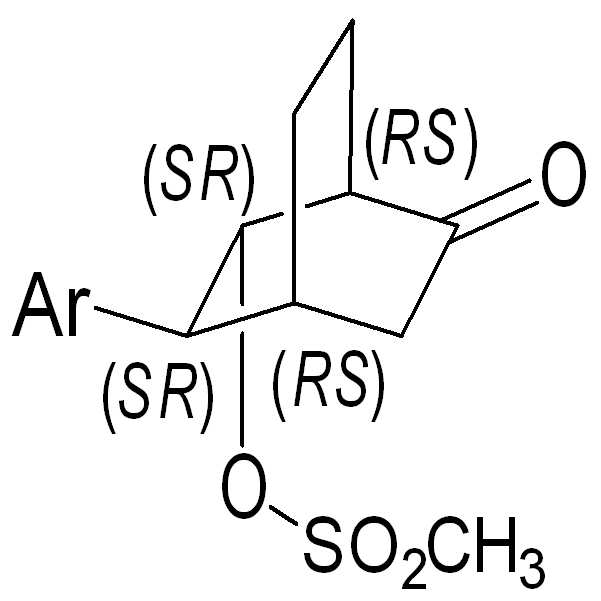
식 (V)(V)
여기서 here
Ar는 아릴 기를 나타낸다.Ar represents an aryl group.
하위-구체예에서, 상기 식 (V)의 화합물은 특히 거울상이성질체적으로 농축되고 (바람직하게는 거울상이성질체적으로 본질적으로 순수하고); 즉 상기 화합물은 절대 배치 (1R,2S,3S,4R)를 가지는 거울상이성질체적으로 농축된 화합물이거나, 절대 배치 (1S,2R,3R,4S)를 가지는 거울상이성질체적으로 농축된 화합물이다.In a sub-embodiment, the compound of formula (V) above is particularly enantiomerically enriched (preferably enantiomerically pure in nature); That is, the compound is an enantiomerically enriched compound having absolute configuration (1R, 2S, 3S, 4R) or an enantiomerically enriched compound having absolute configuration (1S, 2R, 3R, 4S).
이들 화합물은 구체예 30)의 공정에서 중간체이다.These compounds are intermediates in the process of example 30).
39) 또다른 구체예는 다음으로 이루어진 군에서 선택되는 구체예 38)에 따른 식 (V)의 화합물에 관한 것이다:39) Another embodiment relates to compounds of formula (V) according to embodiment 38) selected from the group consisting of:
(1R,2S,3S,4R)-6-옥소-3-페닐바이시클로[2.2.2]옥탄-2-일 메탄설포네이트; 및(1R, 2S, 3S, 4R) -6-oxo-3-phenylbicyclo [2.2.2] octan-2-ylmethanesulfonate; And
rac-(1R*,2S*,3S*,4R*)-6-옥소-3-페닐바이시클로[2.2.2]옥탄-2-일 메탄설포네이트.rac- (1R *, 2S *, 3S *, 4R *) - 6-oxo-3-phenylbicyclo [2.2.2] octan-2-ylmethanesulfonate.
40) 본 발명의 추가적인 양태는 구체예 27) 내지 32) 중 어느 한 항에 따른 공정에 관한 것이며, 여기서 이러한 특정한 경우에 Ar이 페닐을 나타내는 식 (I)의 화합물은 추가로 다음의 화합물 중 어느 하나로 전환된다:40) A further aspect of the present invention relates to a process according to any one of embodiments 27) to 32), wherein the compound of formula (I) in which Ar represents phenyl in this particular case is further characterized in that any of the following compounds It turns into one:
rac-이소부티르산 (1R*,2R*,4R*)-2-(2-{[3-(4,7-디메톡시-1H-벤조이미다졸-2-일)-프로필]-메틸-아미노}-에틸)-5-페닐-바이시클로[2.2.2]옥트-5-엔-2-일 에스테르, (1R *, 2R *, 4R *) - 2- (2 - {[3- (4,7- dimethoxy-lH-benzoimidazol- -Ethyl) -5-phenyl-bicyclo [2.2.2] oct-5-en-2-yl ester,
이소부티르산 (1S,2S,4S)-2-(2-{[3-(4,7-디메톡시-1H-벤조이미다졸-2-일)-프로필]-메틸-아미노}-에틸)-5-페닐-바이시클로[2.2.2]옥트-5-엔-2-일 에스테르; 또는 특히 (1S, 2S, 4S) -2- (2 - {[3- (4,7- dimethoxy-1H- benzoimidazol- -Phenyl-bicyclo [2.2.2] oct-5-en-2-yl ester; Or especially
이소부티르산 (1R,2R,4R)-2-(2-{[3-(4,7-디메톡시-1H-벤조이미다졸-2-일)-프로필]-메틸-아미노}-에틸)-5-페닐-바이시클로[2.2.2]옥트-5-엔-2-일 에스테르. (1R, 2R, 4R) -2- (2 - {[3- (4,7- dimethoxy-1H- benzoimidazol- -Phenyl-bicyclo [2.2.2] oct-5-en-2-yl ester.
구체예 40)에 따른 그러한 다중단계 전환은 특히 WO2009/130679 (실시예 1A, 2A, 3A)에 기술되어 있고, 상기 참고 문헌은 그 전체로서 포함된다: Such multi-step conversions according to embodiment 40) are described in particular in WO2009 / 130679 (examples 1A, 2A, 3A), which reference is incorporated in its entirety:
첫 번째 단계에서, 이러한 특정한 경우에 Ar이 페닐을 나타내는 (및 여기서 상기 식 (I)의 화합물이 라세미 또는 적절한 거울상이성질체적으로 농축된 형태로 사용될 수 있음이 잘 이해되는) 식 (I)의 화합물은 (1R*,2R*,4R*)-2-히드록시-5-페닐-바이시클로[2.2.2]옥트-5-엔-2-일)-아세트산 tert.-부틸 에스테르로 전환되며; 이는 다시 탈보호되어 화합물 (1R*,2R*,4R*)-(2-히드록시-5-페닐-바이시클로[2.2.2]옥트-5-엔-2-일)-아세트산이 되고; 이는 다시 3-(4,7-디메톡시-1H-벤조이미다졸-2-일)-프로필]-메틸-아민과 커플링되어 (1R*,2R*,4R*)-N-[3-(4,7-디메톡시-1H-벤조이미다졸-2-일)-프로필]-2-(2-히드록시-5-페닐-바이시클로[2.2.2]옥트-5-엔-2-일)-N-메틸-아세트아미드를 제공하고; 이는 다시 환원되어 (1R*,2R*,4R*)-2-(2-{[3-(4,7-디메톡시-1H-벤조이미다졸-2-일)-프로필]-메틸-아미노}-에틸)-5-페닐-바이시클로[2.2.2]옥트-5-엔-2-올이 될 수 있고; 이는 다시 아실화되어 칼슘 통로 차단물질인 화합물 (1R*,2R*,4R*)-2-(2-{[3-(4,7-디메톡시-1H-벤조이미다졸-2-일)-프로필]-메틸-아미노}-에틸)-5-페닐-바이시클로[2.2.2]옥트-5-엔-2-일 에스테르가 될 수 있다.In the first step, the compound of formula (I) in which Ar in this particular case represents phenyl (and wherein it is well understood that the compound of formula (I) may be used in racemic or enantiomerically enriched form) The compound is converted to (lR *, 2R *, 4R *) - 2-hydroxy-5-phenyl-bicyclo [2.2.2] oct-5-en-2-yl) -acetic acid tert.-butyl ester; Which again is deprotected to the compound (1R *, 2R *, 4R *) - (2-hydroxy-5-phenyl-bicyclo [2.2.2] oct-5-en-2-yl) -acetic acid; This was coupled again with 3- (4,7-dimethoxy-1H-benzoimidazol-2-yl) -propyl] -methyl-amine to give (1R *, 2R *, 4R * 2-yl) -propyl] -2- (2-hydroxy-5-phenyl-bicyclo [2.2.2] oct- -N-methyl-acetamide < / RTI >; This was reduced again to give (lR *, 2R *, 4R *) - 2- (2- {[3- (4,7- dimethoxy- lH- benzoimidazol- -Ethyl) -5-phenyl-bicyclo [2.2.2] oct-5-en-2-ol; Which is again acylated to give the compound (1R *, 2R *, 4R *) - 2- (2 - {[3- (4,7- dimethoxy-1 H-benzoimidazol- Propyl] -methyl-amino} -ethyl) -5-phenyl-bicyclo [2.2.2] oct-5-en-2-yl ester.
본 명세서에 사용된 용어 "아릴"은 미치환된 (바람직함), 또는 모노-, 디-, 또는 트리-치환된 기인 페닐 또는 나프틸 기 (바람직하게는 페닐 기)를 의미하며, 여기서 치환기는 (C1 -4)알킬, (C1 -4)알콕시, 할로겐, (C1 -3)플루오로알킬, 및 (C1 -3)플루오로알콕시로 이루어진 군에서 독립적으로 선택된다.The term "aryl" as used herein refers to a phenyl or naphthyl group (preferably a phenyl group) which is unsubstituted (preferred) or mono-, di- or tri- (C 1 -4) alkyl, (C 1 -4) alkoxy, halogen, (C 1 -3) is selected from the group consisting of alkoxy, alkyl, and (C 1 -3) fluoro-fluoro independently.
용어 "헤테로아릴"은 5- 내지 10-원 모노시클릭 또는 산소, 질소 및 황 중에서 독립적으로 선택된 1 내지 최대 4개의 헤테로원자를 함유하는 융합된 바이시클릭 방향족 링을 의미한다. 모노시클릭 헤테로아릴 기의 예는 5-원 모노시클릭 헤테로아릴 기 가령 푸라닐, 옥사졸릴, 이속사졸릴, 옥사디아졸릴, 티에닐, 티아졸릴, 이소티아졸릴, 티아디아졸릴, 피롤릴, 이미다졸릴, 피라졸릴, 트리아졸릴, 및 테트라졸릴; 및 6-원 모노시클릭 헤테로아릴 가령 피리딜, 피리미딜, 피리다지닐, 및 피라지닐이다. 바이시클릭 헤테로아릴 기의 예는 8-원 바이시클릭 헤테로아릴 기 가령 4H-푸로[3,2-b]피롤릴, 피롤로[2,1-b]티아졸릴 및 이미다조[2,1-b]티아졸릴; 9-원 바이시클릭 헤테로아릴 기 가령 인돌릴, 이소인돌릴, 벤조푸라닐, 이소벤조푸라닐, 벤조티오페닐, 인다졸릴, 벤지미다졸릴, 벤족사졸릴, 벤지속사졸릴, 벤조티아졸릴, 벤조이소티아졸릴, 벤조트리아졸릴, 벤족사디아졸릴, 벤조티아디아졸릴, 피라졸로[1,5-a]피리딜, 피라졸로[1,5-a]피리미딜, 이미다조[1,2-a]피리딜, 1H-피롤로[3,2-b]피리딜, 및 1H-피롤로[2,3-b]피리딜; 및 10-원 바이시클릭 헤테로아릴 기 가령 퀴놀리닐, 이소퀴놀리닐, 나프티리디닐, 신놀리닐, 퀴나졸리닐, 퀴녹살리닐, 및 프탈라지닐을 포함한다.The term "heteroaryl" means a 5- to 10-membered monocyclic or fused bicyclic aromatic ring containing 1 to up to 4 heteroatoms independently selected from oxygen, nitrogen and sulfur. Examples of monocyclic heteroaryl groups include 5-membered monocyclic heteroaryl groups such as furanyl, oxazolyl, isoxazolyl, oxadiazolyl, thienyl, thiazolyl, isothiazolyl, thiadiazolyl, pyrrolyl, Imidazolyl, pyrazolyl, triazolyl, and tetrazolyl; And 6-membered monocyclic heteroaryl, such as pyridyl, pyrimidyl, pyridazinyl, and pyrazinyl. Examples of bicyclylheteroaryl groups include 8-membered bicyclic heteroaryl groups such as 4H-furo [3,2-b] pyrrolyl, pyrrolo [2,1-b] thiazolyl and imidazo [ -b] thiazolyl; A 9-membered bicyclic heteroaryl group such as indolyl, isoindolyl, benzofuranyl, isobenzofuranyl, benzothiophenyl, indazolyl, benzimidazolyl, benzoxazolyl, benzisoxazolyl, benzothiazolyl, benzo 1,5-a] pyrimidyl, 1,5-a] pyrimidyl, imidazo [1,2-a] pyrimidyl, Pyridyl, lH-pyrrolo [3,2-b] pyridyl, and lH-pyrrolo [2,3-b] pyridyl; And 10-membered bicyclyl heteroaryl groups such as quinolinyl, isoquinolinyl, naphthyridinyl, cinnolinyl, quinazolinyl, quinoxalinyl, and phthalazinyl.
단독으로 또는 조합되어 사용된 용어 "알킬"은 일 내지 여덟 개의 탄소 원자를 함유하는 포화된 선형 또는 분지형 사슬 알킬 기를 지칭한다. 용어 "(Cx -y)알킬" (x 및 y는 각각 정수임)은 x 내지 y개 탄소 원자를 함유하는 앞서 정의된 바와 같은 알킬 기를 지칭한다. 예를 들면 (C1 -4)알킬 기는 일 내지 네 개의 탄소 원자를 함유한다. 알킬 기의 예는 메틸, 에틸, 프로필, 이소프로필, n-부틸, 이소부틸, sec.-부틸, 및 tert.부틸이다. 바람직한 것은 메틸 및 에틸이다. 가장 바람직한 것은 메틸이다.The term "alkyl" used alone or in combination refers to a saturated linear or branched chain alkyl group containing from one to eight carbon atoms. The term "(C x -y ) alkyl ", where x and y are each an integer, refers to an alkyl group as defined above containing x to y carbon atoms. For example (C 1 -4) alkyl group contains one to four carbon atoms. Examples of alkyl groups are methyl, ethyl, propyl, isopropyl, n-butyl, isobutyl, sec.-butyl, and tert.butyl. Preferred are methyl and ethyl. Most preferred is methyl.
단독으로 또는 조합되어 사용된 용어 "알콕시"는 알킬-O- 기를 지칭하며 여기서 알킬 기는 앞서 정의된 바와 같다. 용어 "(Cx -y)알콕시" (x 및 y는 각각 정수임)는 x 내지 y개 탄소 원자를 함유하는 앞서 정의된 바와 같은 알콕시 기를 지칭한다. 예를 들면 (C1 -4)알콕시 기는 식 (C1-4)알킬-O-의 기를 지칭하며 여기서 용어 "(C1 -4)알킬"은 앞서 제공된 의미를 갖는다. 알콕시 기의 예는 특히 (C1 -4)알콕시 기 가령 메톡시, 에톡시, n-프로폭시, 이소프로폭시, n-부톡시, 이소부톡시, sec.-부톡시 및 tert.-부톡시이다. 바람직한 것은 에톡시 및 특히 메톡시이다.The term "alkoxy ", alone or in combination, refers to an alkyl-O- group in which the alkyl group is as previously defined. The term "(C x -y) alkoxy" refers to an alkoxy group as defined before containing the (x and y are each an integer) is x to y carbon atoms. For example (C 1 -4) alkoxy group is formulas (C 1-4) alkyl refers to the group of -O-, and wherein the term "(C 1 -4) alkyl" has the previously given meaning. Examples of alkoxy groups are in particular (C 1 -4) alkoxy group, for example methoxy, ethoxy, n- propoxy, isopropoxy, n- butoxy, isobutoxy, sec.- butoxy and tert.- butoxy a . Preferred are ethoxy and especially methoxy.
용어 "플루오로알킬"은 일 내지 세 개의 탄소 원자를 함유하는 앞서 정의된 바와 같은 알킬 기를 지칭하며 여기서 하나 이상의 (및 가능하게는 모든) 수소 원자는 불소로 대체되어 있다. 용어 "(Cx -y)플루오로알킬" (x 및 y는 각각 정수임)은 x 내지 y개 탄소 원자를 함유하는 앞서 정의된 바와 같은 플루오로알킬 기를 지칭한다. 예를 들면 (C1 -3)플루오로알킬 기는 일 내지 세 개의 탄소 원자를 함유하며 여기서 일 내지 일곱 개의 수소 원자는 불소로 대체되어 있다. 플루오로알킬 기의 대표적인 예는 트리플루오로메틸 및 2,2,2-트리플루오로에틸을 포함한다. 바람직한 것은 (C1)플루오로알킬 기 가령 트리플루오로메틸이다.The term "fluoroalkyl" refers to an alkyl group as defined above containing one to three carbon atoms, wherein one or more (and possibly all) hydrogen atoms are replaced by fluorine. The term "(C x -y ) fluoroalkyl ", where x and y are each an integer, refers to a fluoroalkyl group as defined above containing x to y carbon atoms. For example, a (C 1 -3 ) fluoroalkyl group contains one to three carbon atoms, wherein one to seven hydrogen atoms are replaced by fluorine. Representative examples of fluoroalkyl groups include trifluoromethyl and 2,2,2-trifluoroethyl. Preference is given to the (C 1 ) fluoroalkyl group, for example trifluoromethyl.
용어 "플루오로알콕시"는 일 내지 세 개의 탄소 원자를 함유하는 앞서 정의된 바와 같은 알콕시 기를 지칭하며 여기서 하나 이상의 (및 가능하게는 모든) 수소 원자는 불소로 대체되어 있다. 용어 "(Cx -y)플루오로알콕시" (x 및 y는 각각 정수임)는 x 내지 y개 탄소 원자를 함유하는 앞서 정의된 바와 같은 플루오로알콕시 기를 지칭한다. 예를 들면 (C1 -3)플루오로알콕시 기는 일 내지 세 개의 탄소 원자를 함유하며 여기서 일 내지 일곱 개의 수소 원자는 불소로 대체되어 있다. 플루오로알콕시 기의 대표적인 예는 트리플루오로메톡시, 디플루오로메톡시 및 2,2,2-트리플루오로에톡시를 포함한다. 바람직한 것은 (C1)플루오로알콕시 기 가령 트리플루오로메톡시 및 디플루오로메톡시이다.The term "fluoroalkoxy" refers to an alkoxy group as defined above containing one to three carbon atoms, wherein one or more (and possibly all) hydrogen atoms are replaced by fluorine. The term "(C x -y) alkoxy fluoroalkyl" (x and y are each an integer) refers to an alkoxy group as defined above fluoroalkyl containing x to y carbon atoms. For example, the (C 1 -3 ) fluoroalkoxy group contains one to three carbon atoms, wherein one to seven hydrogen atoms are replaced by fluorine. Representative examples of fluoroalkoxy groups include trifluoromethoxy, difluoromethoxy and 2,2,2-trifluoroethoxy. Preferred are (C 1 ) fluoroalkoxy groups such as trifluoromethoxy and difluoromethoxy.
본 명세서에 사용된 용어 "할로겐"은 플루오로, 클로로, 브로모 또는 아이오도, 바람직하게는 클로로를 의미한다.The term "halogen ", as used herein, refers to fluoro, chloro, bromo or iodo, preferably chloro.
치환기 R4에 대해 사용된 개념 "유기금속성 시약에 의해 도입될 수 있는 임의의 기"는 케톤 카르보닐 기 상에 첨가 반응을 이끌어 낼 수 있는 유기금속성 시약을 통해 도입될 수 있는 모든 종류의 잔기를 의미한다. 특히, 상기 개념은 유기리튬, 유기마그네슘, 유기붕소, 유기알루미늄 또는 유기아연 시약; 특히 유기리튬, 유기마그네슘, 또는 유기붕소 시약을 이용하여 도입될 수 있는 임의의 잔기를 나타낸다. 그러한 잔기의 예는 알킬; 아릴; 알케닐; 그리고 플루오로, 알콕시, 아릴, 및 -CO-R5 중에서 선택된 하나 이상의 치환기로 치환된 알킬이고, 여기서 R5는 알킬 또는 알콕시이다. 또한, 일부 경우에 또한 헤테로아릴 기 가령 특히 5- 또는 6-원 헤테로아릴은 유기금속성 시약을 통해 도입될 수 있다. 바람직한 그러한 잔기의 예는 알킬 및 아릴이다.The term "any group that can be introduced by the organometallic reagent" used for the substituent R < 4 > means any moiety that can be introduced through the organometallic reagent which can lead to an addition reaction on the ketone carbonyl group it means. In particular, the concept includes organolithium, organomagnesium, organoboron, organoaluminum or organozinc reagents; In particular, any moiety that can be introduced using organic lithium, organomagnesium, or organic boron reagents. Examples of such moieties are alkyl; Aryl; Alkenyl; And fluoro, and alkyl substituted with alkoxy, aryl, and one or more substituents selected from -CO-R 5, where R 5 is an alkyl or alkoxy. Also, in some cases also heteroaryl groups such as 5- or 6-membered heteroaryl may be introduced via organometallic reagents. Examples of such preferred moieties are alkyl and aryl.
본 명세서에 단독 또는 조합으로 사용된 용어 "알케닐"은 적어도 하나의 탄소-탄소 이중 결합을 가지는 둘 내지 여섯 개의 탄소 원자를 함유하는 선형 또는 분지형 탄화수소 사슬을 지칭한다. 용어 "(Cx -y)알케닐" (x 및 y는 각각 정수임)은 x 내지 y개 탄소 원자를 함유하는 앞서 정의된 바와 같은 알케닐 기를 지칭한다. 알케닐의 대표적인 예는 에테닐 (또한 "비닐"로도 지칭됨), 2-프로페닐 (또한 "알릴"로도 지칭됨), 2-메틸-2-프로페닐, 3-부테닐, 4-펜테닐, 및 5-헥세닐, 특히 에테닐 또는 2-프로페닐을 포함하지만, 이에 제한되지 않는다.The term "alkenyl ", used alone or in combination, as used herein, refers to a linear or branched hydrocarbon chain containing from two to six carbon atoms having at least one carbon-carbon double bond. The term "(C x -y ) alkenyl ", where x and y are each an integer, refers to an alkenyl group as defined above containing x to y carbon atoms. Representative examples of alkenyl include ethenyl (also referred to as "vinyl"), 2-propenyl (also referred to as "allyl"), 2-methyl- , And 5-hexenyl, especially ethenyl or 2-propenyl.
용어 "고체-액체 분리"는 당해 분야의 숙련가에게 널리 공지된 일상적인 고체-액체 분리 기술을 지칭한다 (예를 들면 Perry's Chemical Engineers' Handbook, 7th edition, Perry, R.H.; Green, D. W. McGraw-Hill 1997을 참조). 특히, 상기 용어는 여과, 원심분리, 및 중력 침강법과 같은 기술; 특히 여과를 포함한다.The term "solid-liquid separation" refers to routine solid-liquid separation techniques well known to those skilled in the art (see, for example, Perry's Chemical Engineers' Handbook, 7 th edition, Perry, RH; Green, DW McGraw-Hill 1997). In particular, the term includes techniques such as filtration, centrifugation, and gravity settling; Especially filtration.
용어 "액체-액체 추출"은 당해 분야의 숙련가에게 널리 공지된 일상적인 액체-액체 추출 또는 세척 기술을 지칭한다 (예를 들면 Perry's Chemical Engineers' Handbook, 7th edition, Perry, R.H.; Green, D. W. McGraw-Hill 1997을 참조). 특히 상기 용어는 침강조, 사이클론, 원심분리기, 혼합-침강조, 모든 종류의 연속 접촉식 장비; 증류: 배치식(batch) 및 연속 증류; 및 초임계 유체 분리 기술을 이용하는 세척 또는 추출 기술을 포함한다.The term "liquid-liquid extraction" refers to routine liquid-liquid extraction or cleaning techniques well known to those skilled in the art (see, for example, Perry's Chemical Engineers' Handbook, 7 th edition, Perry, RH; Green, DW McGraw -Hill 1997). In particular, the term refers to any type of continuous contact equipment such as sedimentation, cyclones, centrifuges, mixed-sedimentation, all types of equipment; Distillation: batch and continuous distillation; And cleaning or extraction techniques using supercritical fluid separation techniques.
온도와 관련하여 사용되지 않는 한, 수치값 "X" 앞에 배치된 용어 "약"은 본 명세서에서 X 마이너스 X의 10% 내지 X 플러스 X의 10%의 간격 확장을 지칭하며, 바람직하게는 X 마이너스 X의 5% 내지 X 플러스 X의 5%의 간격 확장을 지칭한다. 상기 용어 약이 범위 앞에 배치된 경우, 개별적인 간격이 상기 범위의 양쪽 값에 적용되어야 한다. 온도의 특정한 경우에, 온도 "Y" 앞에 배치된 용어 "약"은 본 명세서에서 온도 Y 마이너스 10℃ 내지 Y 플러스 10℃의 간격 확장을 지칭하며, 바람직하게는 Y 마이너스 5℃ 내지 Y 플러스 5℃의 간격 확장을 지칭한다.The term "about" placed before the numerical value "X" refers to a 10% to 10% Refers to an interval expansion of 5% of X to 5% of X plus X. If the term is placed before the range, individual intervals should be applied to both values of the range. The term "about ", placed in front of temperature" Y ", in the specific case of temperature, refers herein to a spacing extension of temperature Y minus 10 [deg.] C to Y plus 10 [deg.] C, preferably Y minus 5 [ Lt; / RTI >
수치 범위를 기술하기 위해 단어 "사이" 또는 "내지"가 사용된 경우에, 지정된 범위의 양쪽 끝값이 상기 범위 내에 분명하게 포함된다는 것이 이해되어야 한다. 예를 들면: 온도 범위가 40℃ 와 80℃ 사이 (또는 40℃ 내지 80℃)로 기술된다면, 이는 양쪽 끝값인 40℃ 및 80℃가 상기 범위 내에 포함됨을 의미하며; 또는 변수가 1과 4 사이 (또는 1 내지 4)인 정수로 정의된 경우, 이는 상기 변수가 정수 1, 2, 3, 또는 4임을 의미한다.It should be understood that, when the word "between" or "to" is used to describe a numerical range, both ends of the specified range are explicitly included in the range. For example: if the temperature range is between 40 ° C and 80 ° C (or between 40 ° C and 80 ° C), this means that both ends, 40 ° C and 80 ° C, are included in the range; Or when the variable is defined as an integer between 1 and 4 (or 1 to 4), this means that the variable is an integer 1, 2, 3, or 4.
표현 % w/w는 고려되는 조성물의 총 중량에 대한 중량백분율을 지칭한다. 유사하게, 표현 v/v는 고려되는 두 가지 성분의 부피의 비를 지칭한다. 유사하게, 표현 % a/a는 바람직하게는 UV 흡수를 측정하는 크로마토그램에서 곡선하 면적 (즉 적분)에 대한 순도를 지칭한다. 표현 "vol"은 중량(예를 들면 반응물질의 kg으로)당 부피(예를 들면 용매의 L로)를 의미한다. 예를 들면 7 vol은 kg(반응물질) 당 7 리터(용매)를 의미한다.% W / w refers to the weight percentage relative to the total weight of the composition being considered. Similarly, the expression v / v refers to the ratio of the volume of the two components considered. Similarly, the expression% a / a preferably refers to the purity for the area under the curve (i.e., integral) in the chromatogram to measure UV absorption. The expression "vol" means volume per weight (e.g., in L of solvent) per weight (e.g., in kg of reactant). For example 7 vol means 7 liters (solvent) per kg (reactant).
용어 "농축된"은, 예를 들면 거울상이성질체 또는 부분입체이성질체의 맥락에서 사용되는 경우, 본 발명의 맥락에서 특히 개별적인 거울상이성질체/부분입체이성질체가 개별적인 다른 거울상이성질체/부분입체이성질체(들)에 비하여 명시적으로 특정된 비 (약간의 차이는 감안하여: 순도)로 존재함; 및 일반적으로 적어도 60:40, 특히 적어도 70:30, 및 특히 적어도 90:10의 비(약간의 차이는 감안하여: 60%/70%/90%의 순도)로 존재함을 의미하는 것으로 이해된다. 바람직하게는 상기 용어는 개별적인 본질적으로 순수한 거울상이성질체/부분입체이성질체를 지칭한다.The term "enriched," when used in the context of, for example, enantiomers or diastereomers, particularly in the context of the present invention, means that the individual enantiomers / diastereomers, especially when compared to the individual enantiomers / diastereomers Explicitly specified ratios (in consideration of slight differences: purity) exist; And a ratio of at least 60:40, in particular at least 70:30, and in particular at least 90:10 (in consideration of slight differences: 60% / 70% / 90% purity) . Preferably the term refers to an individual essentially pure enantiomer / diastereomer.
예를 들면 "본질적으로 순수한"과 같은 개념에서 사용된 경우 용어 "본질적으로"는 본 발명의 맥락에서 특히 개별적인 입체이성질체/조성물/화합물 등이 개별적인 순수한 입체이성질체/조성물/화합물 등의 적어도 90, 특히 적어도 95, 및 특히 적어도 99 중량 백분율의 양으로 구성됨을 의미하는 것으로 이해된다.The term "essentially" when used in the context of "essentially pure ", for example, means that in the context of the present invention, especially the individual stereoisomers / compositions / compounds etc. are at least 90, such as individual pure stereoisomers / At least 95, and in particular at least 99 percent by weight.
입체이성질체의 상대 배치는 다음과 같이 표시된다: 예를 들면, (1R*,2S*,3S*,4R*)-6-옥소-3-페닐바이시클로[2.2.2]옥탄-2-일 메탄설포네이트는, 라세미체라고 명시적으로 언급되지 않은 경우, (1R,2S,3S,4R)-6-옥소-3-페닐바이시클로[2.2.2]옥탄-2-일 메탄설포네이트, 또는 (1S,2R,3R,4S)-6-옥소-3-페닐바이시클로[2.2.2]옥탄-2-일 메탄설포네이트, 또는 이들 두 거울상이성질체의 임의의 혼합물을 의미한다.The relative configuration of the stereoisomers is indicated as follows: For example, (1R *, 2S *, 3S *, 4R *) - 6-oxo-3- phenylbicyclo [2.2.2] Sulfonates can be prepared by reacting (1R, 2S, 3S, 4R) -6-oxo-3-phenylbicyclo [2.2.2] octan-2-ylmethanesulfonate, if not explicitly referred to as racemate, (1S, 2R, 3R, 4S) -6-oxo-3-phenylbicyclo [2.2.2] octan-2-ylmethanesulfonate, or any mixture of these two enantiomers.
본 발명에 따르면, 식 (I) 내지 (III)의 화합물은 하기 제공된 방법에 의해 제조된다. 일반적으로, 이들은 일반 반응식 1 내지 5에서 하기 개괄된 일반적인 반응 순서에 따라 제조된다. Ar은 구체예 1)에서 제공된 의미를 갖는다.According to the present invention, the compounds of formulas (I) to (III) are prepared by the process given below. In general, they are prepared according to the general reaction sequence outlined below in general scheme 1 to 5. Ar has the meaning given in embodiment 1).
일반 반응식 1:General Scheme 1:

시클로헥스에논 페닐아세트알데히드 식 (II)Cyclohexenephenylacetaldehyde The compound of formula (II)
단계 a의 첫 번째 변형에서, 2-시클로헥센-1-온을 프롤린 및 임의로 아키랄 N-함유 염기의 존재에서 페닐아세트알데히드와 반응시켜 식 (II)의 화합물 [여기서: 거울상이성질체적으로 농축된 식 (IIa)의 부분입체이성질체에 해당함]을 얻는다. 전형적인 조건은 다음과 같다: 용매는 방향족 용매 가령 톨루엔, 및 아니솔; 에테르 용매 가령 tert. 부틸 메틸 에테르 (TBME), 테트라히드로푸란 (THF), 디옥산, 및 2-메틸-THF; 염소계 유기 용매 가령 디클로로메탄, 1,2-디클로로에탄, 클로로벤젠, 및 1,2-디클로로벤젠; 또는 에스테르 가령 에틸 아세테이트, 이소프로필 아세테이트, 및 n-부틸 아세테이트일 수 있다. 바람직한 용매는 방향족 용매 가령 톨루엔; 및 에테르 용매 가령 tert. 부틸 메틸 에테르 (TBME)이다. 용매는 2-시클로헥센-1-온에 대하여 3 내지 10 vol., 일반적으로 5 내지 7 vol.의 양으로 사용된다. 프롤린은 2-시클로헥센-1-온에 대하여 약 0.05 당량 내지 0.5 당량 (일반적으로 약 0.25 당량)의 양으로 존재한다. 페닐아세트알데히드 (Ar-CH2-CHO)는 2-시클로헥센-1-온에 대하여 약 1 당량 내지 2 당량 (일반적으로 약 1.1 당량)의 양으로 존재한다. 만일 존재한다면, 바람직한 아키랄 N-함유 염기는 삼차 아민 염기 가령 트리에틸아민, 디이소프로필에틸아민, 또는 트리부틸아민이다. 그러한 아키랄 N-함유 염기는 예를 들면 2-시클로헥센-1-온에 대하여 약 0.1 당량 내지 0.5 당량, 일반적으로 0.25 당량의 양으로 존재할 수 있다. 반응 온도는 0-55 ℃, 일반적으로 45 ℃이다. 반응은 적어도 24 h 동안, 일반적으로 약 4 일 동안 수행된다. 그러한 시간 후에, 물을 상기 혼합물에 부가한다. 물의 양은 2-시클로헥센-1-온에 대하여 약 1 내지 5 vol., 일반적으로 약 2 vol.이다. 혼합물을 이후 고체-액체 분리에 의해 워크업시킨다. 예를 들면, 혼합물을 반응 온도에서 여과하거나 먼저 20-25 ℃까지 냉각시키고 그 후에 여과할 수 있다. 여과 케이크를 먼저 물을 이용하여, 이후 용매, 예컨대 톨루엔으로 세척한다. 물 및 톨루엔 세척 단계를 위한 양은 2-시클로헥센-1-온에 대하여 1-3 vol., 일반적으로 약 1 vol.이다. 세척 단계를 최대 5 회, 일반적으로 3 회 반복한다. 수득된 식 (II)의 화합물을 상승된 온도, 일반적으로 45 ℃에서 감압하에 건조시킨다. 상기 프로토콜에 따라 합성된, 식 (II)의 화합물의 부분입체이성질체 비는 일반적으로 99 : 1보다 높고 거울상이성질체 비 (e.r.)는 60 : 40보다 높다.In a first variant of step a) , 2-cyclohexen-1-one is reacted with phenylacetaldehyde in the presence of proline and optionally an acyl N-containing base to give a compound of formula (II) [wherein: the enantiomerically enriched Corresponds to the diastereomer of formula (IIa)]. Typical conditions are as follows: Solvents include aromatic solvents such as toluene, and anisole; Ether solvents such as tert . Butyl methyl ether (TBME), tetrahydrofuran (THF), dioxane, and 2-methyl-THF; Chlorinated organic solvents such as dichloromethane, 1,2-dichloroethane, chlorobenzene, and 1,2-dichlorobenzene; Or esters such as ethyl acetate, isopropyl acetate, and n-butyl acetate. Preferred solvents include aromatic solvents such as toluene; And an ether solvent such as tert . Butyl methyl ether (TBME). The solvent is used in an amount of 3 to 10 vol., Generally 5 to 7 vol., For 2-cyclohexen-1-one. Proline is present in an amount of about 0.05 equivalents to 0.5 equivalents (generally about 0.25 equivalents) relative to 2-cyclohexen-1-one. Phenylacetaldehyde (Ar-CH 2 -CHO) is present in an amount of about 1 to 2 equivalents (generally about 1.1 equivalents) relative to 2-cyclohexen-1-one. If present, the preferred achiral N-containing base is a tertiary amine base such as triethylamine, diisopropylethylamine, or tributylamine. Such aciral N-containing bases may be present, for example, in an amount of about 0.1 equivalent to 0.5 equivalent, generally 0.25 equivalent, relative to 2-cyclohexen-1-one. The reaction temperature is 0-55 ° C, generally 45 ° C. The reaction is carried out for at least 24 h, generally about 4 days. After such time, water is added to the mixture. The amount of water is about 1 to 5 vol., Generally about 2 vol., For 2-cyclohexen-1-one. The mixture is then worked up by solid-liquid separation. For example, the mixture can be filtered at the reaction temperature or first cooled to 20-25 ° C and then filtered. The filter cake is first washed with water, then with a solvent, such as toluene. The amounts for the water and toluene wash steps are 1-3 vol., Typically about 1 vol., For 2-cyclohexen-1-one. The washing step is repeated up to 5 times, generally 3 times. The obtained compound of formula (II) is dried under elevated temperature, generally 45 < 0 > C under reduced pressure. The diastereomeric ratio of the compound of formula (II) synthesized according to the protocol is generally higher than 99: 1 and the enantiomeric ratio er is higher than 60:40.
상기 공정으로부터 수득된, 거울상이성질체적으로 농축된 식 (II)의 화합물의 이후의 재결정화, 특히 THF (약 10 vol.)로부터의 재결정화는 일반적으로 적어도 90:10의 거울상이성질체 비를 도출한다.Subsequent recrystallization of the enantiomerically enriched compound of formula (II) obtained from this process, especially recrystallization from THF (about 10 vol.), Generally yields an enantiomeric ratio of at least 90:10 .
두 번째 변형에서, 수성 염기가 상기 아키랄 N-함유 염기와 함께 또는 단독으로 사용되어 식 (II)의 화합물을 라세미 형태로 생성한다. 전형적인 조건은 다음과 같다: 수성 염기는 특히 알칼리 금속 히드록시드 용액 가령 특히 수성 NaOH 또는 수성 KOH이다. 그러한 수성 염기는 일반적으로 2-시클로헥센-1-온에 대하여 약 0.05 당량 내지 0.3 당량, 일반적으로 0.25 당량의 양으로 존재한다. 수성 완충 용액은 특히 나트륨 포스페이트 완충액 (예를 들면 20 mM Na3PO4 완충액, pH 8) 또는 당해 분야의 숙련가에게 공지된 다른 수성 완충액 시스템이다. 그러한 수성 완충액은 2-시클로헥센-1-온에 대하여 약 0.4 내지 1 vol., 일반적으로 0.7 vol.의 양으로 존재한다. 혼합물이 사용되는 경우에, 그러한 혼합물은 바람직하게는 아키랄 N-함유 염기 및 수성 완충 용액의 혼합물이다. 그러한 혼합물에서, 아키랄 N-함유 염기는 약 0.1 당량 내지 0.5 당량, 일반적으로 0.25 당량의 양으로 존재하고; 수성 완충액은 약 0.4 내지 1 vol., 일반적으로 0.7 vol.의 양으로 존재하며; 상기 양은 모두 2-시클로헥센-1-온에 대한 것이다. 반응은 적어도 24 h 동안, 일반적으로 1-4 일 동안 수행된다.In a second variant, an aqueous base is used alone or in combination with the acyl N-containing base to produce the compound of formula (II) in racemic form. Typical conditions are: The aqueous base is in particular an alkali metal hydroxide solution, such as aqueous NaOH or aqueous KOH in particular. Such aqueous bases are generally present in an amount of about 0.05 equivalents to 0.3 equivalents, generally 0.25 equivalents, based on 2-cyclohexen-1-one. Aqueous buffer solutions are particularly sodium phosphate buffer (e.g., 20 mM Na 3 PO 4 buffer, pH 8) or other aqueous buffer systems known to those skilled in the art. Such an aqueous buffer is present in an amount of about 0.4 to 1 vol., Typically 0.7 vol., For 2-cyclohexen-1-one. When a mixture is used, such a mixture is preferably a mixture of an aciral N-containing base and an aqueous buffer solution. In such a mixture, the archival N-containing base is present in an amount from about 0.1 equivalents to 0.5 equivalents, usually 0.25 equivalents; The aqueous buffer is present in an amount of about 0.4 to 1 vol., Typically 0.7 vol. The amounts are all for 2-cyclohexen-1-one. The reaction is carried out for at least 24 h, usually for 1-4 days.
단계 a의 기술적 장점은:The technical advantages of step a are:
· 화합물이 높은 부분입체이성질체 순도로 수득된다.The compound is obtained in high diastereomeric purity.
· 시판되어 쉽게 이용가능하고 저렴한 촉매 시스템이 사용된다.Commercially available, readily available and inexpensive catalyst systems are used.
· 합성이 단순하고, 효율적이며 대규모에 대해서 적절하다.Synthesis is simple, efficient and suitable for large scale.
· 적절한 반응 조건을 선택함으로써 거울상이성질체적으로 농축된 또는 라세미인 식 (II)의 화합물을 얻을 수 있다.Enantiomerically enriched or racemic compounds of formula (II) can be obtained by selecting appropriate reaction conditions.
· 차후의 재결정화 단계에 의해 거울상이성질체적으로 농축된 식 (II)의 화합물을 더욱 농축시킬 수 있다.The compound of formula (II), which is enantiomerically enriched by a subsequent recrystallization step, can be further concentrated.
일반 반응식 2:General Scheme 2:

식 (II) 식 (V) 식 (I) Formula (II) Formula (V) Formula (I)
단계 b에서, 식 (II)의 화합물 [여기서: 거울상이성질체적으로 농축된 식 (IIa)의 부분입체이성질체에 해당함]은 염기의 존재에서 상응하는 식 (V)의 메실레이트 유도체로 전환된다. 전형적인 조건은 다음과 같다: 적절한 용매는 방향족 용매(가령 톨루엔 또는 벤젠), 에테르(가령 THF, 2-메틸테트라히드로푸란, 1,4-디옥산 또는 tert -부틸메틸에테르), 극성 비프로톤성 용매(가령 DMSO, DMF, N-메틸피롤리돈 또는 디메틸아세트아미드) 또는 염소계 탄화수소(가령 DCM)이다. 가장 바람직한 용매는 톨루엔이다. 바람직한 시약은 메탄설포닐 클로라이드이며 이것은 식 (II)의 화합물의 당량당 약 1-2 당량, 일반적으로 약 1.3 당량으로 사용된다. 적절한 염기는 트리에틸아민, 디에틸이소프로필아민 또는 피리딘이며 식 (II)의 화합물의 당량당 약 1.5-3 당량, 일반적으로 약 1.5 당량의 양으로 사용된다. 반응은 일반적으로 약 10-25 ℃에서 약 10-60 분간 수행된다. 반응의 완료 후에 물을 부가하고, 이후 상 분리하고 단계 c의 용매로 용매를 교환한다. 대안적으로, 활성화는 실온에서 DCM 내 트리에틸아민의 존재에서 식 (II)의 화합물을 벤조일 클로라이드와 반응시킴으로써 성취될 수 있다. 대안적으로, 식 (V)의 화합물은 헵탄/EtOAc (1 : 1 v/v) 또는 톨루엔으로부터의 결정화에 의해 결정질 형태로 수득될 수 있다.In step b , the compound of formula (II) wherein: corresponds to the enantiomerically enriched diastereomer of formula (IIa) is converted to the corresponding mesylate derivative of formula (V) in the presence of a base. Typical conditions are: Suitable solvents include, but are not limited to, aromatic solvents such as toluene or benzene, ethers such as THF, 2-methyltetrahydrofuran, 1,4-dioxane or tert - butyl methyl ether, (E.g. DMSO, DMF, N-methylpyrrolidone or dimethylacetamide) or chlorinated hydrocarbons (e.g. DCM). The most preferred solvent is toluene. A preferred reagent is methanesulfonyl chloride, which is used at about 1-2 equivalents, usually about 1.3 equivalents, per equivalent of compound of formula (II). A suitable base is triethylamine, diethylisopropylamine or pyridine and is used in an amount of about 1.5-3 equivalents, usually about 1.5 equivalents, per equivalent of compound of formula (II). The reaction is generally carried out at about 10-25 DEG C for about 10-60 minutes. Water is added after completion of the reaction, then phase separation and the solvent is exchanged with the solvent of step c . Alternatively, activation can be accomplished by reacting the compound of formula (II) with benzoyl chloride in the presence of triethylamine in DCM at room temperature. Alternatively, the compound of formula (V) can be obtained in crystalline form by crystallization from heptane / EtOAc (1: 1 v / v) or toluene.
단계 c에서, 식 (V)의 화합물은 메탄설폰산의 탈리에 의해 식 (I)의 화합물 [여기서: 거울상이성질체적으로 농축된 식 (I)의 화합물에 해당함]로 전환된다. 적절한 용매는 방향족 용매(가령 톨루엔, 벤젠, 클로로벤젠, 또는 자일렌), 극성 비프로톤성 용매(가령 DMSO, 설폴란, DMF, N-메틸피롤리돈 또는 디메틸아세트아미드), 고비점 니트릴(가령 아세토니트릴 또는 부티로니트릴), 고비점 에테르(가령 비스(2-메톡시에틸)에테르), 고비점 질소 염기(가령 1,8-디아자바이시클로[5.4.0]운데스-7-엔 또는 1,5-디아자바이시클로(4.3.0)논-5-엔), 또는 피리딘(가령 피리딘, 2,6-루티딘 또는 2,4,6-콜리딘)이다. 반응은 약 85-160 ℃, 일반적으로 약 100-150 ℃에서 수행된다. 반응 시간은 10 분 - 16 h으로 달라지며, 일반적으로 약 0.5-2 h이다.In step c , the compound of formula (V) is converted to a compound of formula (I): wherein: corresponds to a compound of formula (I) enantiomerically enriched by the elimination of methanesulfonic acid. Suitable solvents include, but are not limited to, aromatic solvents such as toluene, benzene, chlorobenzene, or xylene, polar aprotic solvents such as DMSO, sulfolane, DMF, N-methylpyrrolidone or dimethylacetamide, (E.g., bis (2-methoxyethyl) ether), a high boiling nitrogen base (such as 1,8-diazabicyclo [5.4.0] undec-7-ene or Diazabicyclo (4.3.0) non-5-ene), or pyridine (such as pyridine, 2,6-lutidine or 2,4,6-collidine). The reaction is carried out at about 85-160 < 0 > C, generally about 100-150 < 0 > C. The reaction time varies from 10 min to 16 h, and is generally about 0.5-2 h.
바람직한 변형에서, 반응 단계 c는 염기의 존재에서 상기 언급된 용매를 이용하여 수행된다. 이러한 경우, 염기성 용매 가령 상기 언급된 고비점 질소 염기 또는 피리딘이 사용되는 경우에, 그러한 용매는 동시에 용매 및 염기로서 기능할 수 있다. 일반적으로, 적절한 염기는 아미딘 또는 구아니딘 염기(가령 1,8-디아자바이시클로[5.4.0]운데스-7-엔, 1,5-디아자바이시클로(4.3.0)논-5-엔, 7-메틸-1,5,7-트리아자바이시클로[4.4.0]데스-5-엔), 삼차 아민(가령 1,4-디아자바이시클로[2.2.2]옥탄 또는 테트라메틸프로필렌 디아민), 무기 염기(가령 칼륨 카르보네이트, 리튬 카르보네이트), 또는 알코올레이트(가령 메탄올, 에탄올 또는 tert-부틸 알코올의 리튬-, 나트륨- 또는 칼륨 염)이다. 염기는 식 (V)의 화합물의 당량당 약 1-10 당량, 일반적으로 약 1-2 당량의 양으로 사용된다. 동시에 용매 및 염기로서 사용되는 경우에, 그러한 염기는 식 (V)의 화합물에 대하여 약 1-15 vol, 특히 5-10 vol.의 양으로 사용된다. 가능한 첨가제는 아이오다이드(가령 NaI) 또는 리튬 염(가령 LiBr)이며, 식 (V)의 화합물의 당량당 약 0.1-1 당량의 양으로 사용된다. 특정한 변형에서, 탈리는 톨루엔 내 2 당량의 1,8-디아자바이시클로[5.4.0]운데스-7-엔의 존재에서 약 140 ℃에서 약 1 h 동안 일어난다. 또다른 특정한 변형에서, 탈리는 1,8-디아자바이시클로[5.4.0]운데스-7-엔 내 약 1.5 당량의 Li2CO3의 존재에서 약 100 ℃에서 약 0.5 h 동안 일어난다.In a preferred variant, reaction step c is carried out using the abovementioned solvents in the presence of a base. In such a case, when a basic solvent such as the above-mentioned high boiling nitrogen base or pyridine is used, such a solvent can simultaneously function as a solvent and a base. In general, suitable bases are amidines or guanidine bases such as 1,8-diazabicyclo [5.4.0] undec-7-ene, 1,5-diazabicyclo (4.3.0) Ene, 7-methyl-1,5,7-triaza-bicyclo [4.4.0] des-5-ene), tertiary amines (such as 1,4- diazabicyclo [2.2.2] octane or tetramethylpropylene Diamine), inorganic bases (such as potassium carbonate, lithium carbonate), or alcoholates (such as lithium, sodium or potassium salts of methanol, ethanol or tert -butyl alcohol). The base is used in an amount of about 1-10 equivalents per equivalent of compound of formula (V), generally about 1-2 equivalents. When used as solvents and bases at the same time, such bases are used in an amount of about 1-15 vol, especially 5-10 vol., Relative to the compound of formula (V). Possible additives are iodide (e.g. NaI) or lithium salt (such as LiBr) and are used in an amount of about 0.1-1 equivalents per equivalent of compound of formula (V). In a particular variation, the elimination takes place at about 140 ° C for about 1 h in the presence of two equivalents of 1,8-diazabicyclo [5.4.0] undec-7-ene in toluene. In another particular variation, the elimination takes place at about 100 ° C for about 0.5 h in the presence of about 1.5 equivalents of Li 2 CO 3 in 1,8-diazabicyclo [5.4.0] undec-7-ene.
두 번째 변형에서, 반응 단계 c는 염기 없이, DMSO 내 실리슘 디옥사이드의 존재에서 수행된다.In a second variant, reaction step c is carried out in the presence of a silicon dioxide in DMSO, without a base.
세 번째 변형에서, 반응 단계 c는 염기 없이 식 (V)의 화합물을 적절한 용매 가령 o-자일렌, 클로로벤젠, 3-디메틸-3,4,5,6-테트라히드로-2(1H)-피리미디논, DMSO, 설폴란, DMF, N-메틸피롤리돈, 피리딘, 2,6-루티딘 또는 2,4,6-콜리딘 내에서 140-150 ℃로 1-2 h 동안 가열하여 수행된다. 이러한 변형을 위한 바람직한 용매는 설폴란, N-메틸피롤리돈 및 특히 2,4,6-콜리딘이다. 식 (V)의 화합물의 농도는 약 0.5-10 vol. (즉 식 (V)의 화합물의 당량당 0.5-10 L의 용매), 일반적으로 약 1 vol.이다. 반응의 완료 후에, 1N 수성 HCl을 부가하고 이어서 적절한 용매(가령 iPrOAc, EtOAc, 톨루엔 또는 헵탄)를 부가한다. 바람직한 용매는 iPrOAc, EtOAc 또는 헵탄이다. 유기상을 희석된 수성 HCl로 세척하고 공비 증류에 의해 건조시킨다.In a third variant, reaction step c is carried out in the absence of a base in the presence of a suitable solvent such as o-xylene, chlorobenzene, 3-dimethyl-3,4,5,6-tetrahydro-2 (1H) Is carried out by heating at 140-150 ° C for 1-2 h in dimethylformamide, dimethylsulfoxide, dimethylsulfoxide, methylparaben, dimethylsulfoxide, dimethylsulfoxide, DMSO, sulfolane, DMF, N-methylpyrrolidone, pyridine, 2,6-lutidine or 2,4,6- . Preferred solvents for this modification are sulfolane, N-methylpyrrolidone and especially 2,4,6-collidine. The concentration of the compound of formula (V) is about 0.5-10 vol. (I.e., 0.5-10 L of solvent per equivalent of compound of formula (V)), typically about 1 vol. After completion of the reaction, 1N aqueous HCl is added and then an appropriate solvent (such as iPrOAc, EtOAc, toluene or heptane) is added. Preferred solvents are iPrOAc, EtOAc or heptane. The organic phase is washed with dilute aqueous HCl and dried by azeotropic distillation.
단계 c의 바람직한 변형에서, 식 (I)의 화합물은 적절한 용매 가령 헵탄, tert-부틸메틸에테르, 헵탄 및 tert-부틸메틸에테르의 혼합물로부터의 결정화에 의해 단리된다. 결정화를 위한 바람직한 용매는 헵탄이다.In a preferred variant of step c , the compound of formula (I) is isolated by crystallization from a suitable solvent such as a mixture of heptane, tert -butyl methyl ether, heptane and tert -butyl methyl ether. A preferred solvent for crystallization is heptane.
추가적인 변형에서, 단계 b 및 c는 겹쳐진다: 식 (V)의 화합물을 따라서 반응 혼합물의 단순 여과에 의해 수득하고 여액을 약 135 ℃에서 약 1-2 h 동안 교반하여 식 (I)의 화합물을 얻는다.In a further variant, steps b and c are superimposed: the compound of formula (V) is then obtained by simple filtration of the reaction mixture and the filtrate is stirred at about 135 ° C for about 1-2 h to give the compound of formula (I) .
단계 b 및 c의 기술적 장점은:The technical advantages of steps b and c are:
· 단계 c는 고도로 집약적이며, 따라서 높은 산출을 가능하게 한다.Step c is highly intensive and thus allows high output.
· 단계 b 및 c는, 특히 바람직한 공정이 사용되는 경우, 미정제 식 (I)의 화합물을 높은 화학적 순도로 도출하고, 따라서 특히 식 (I)의 화합물이 저 용해성 고체여서 미정제 생성물이 낮은 순도를 가질 경우 결정화하기 어려울 수 있는 경우에 결정화에 의한 순도의 추가적인 향상을 가능하게 한다.Steps b) and c) , when a particularly preferred process is used, derive the compounds of the formula (I) in high chemical purity and thus the compounds of formula (I) are especially poorly soluble solids, Which makes it possible to further improve the purity by crystallization when it may be difficult to crystallize.
· 상기 두 단계 b 및 c는 겹쳐지고 단일 용기에서 진행될 수 있고, 따라서 효율을 상승시킨다.The two steps b and c may overlap and proceed in a single vessel, thus increasing efficiency.
일반 반응식 3:General Scheme 3:

식 (II) 식 (I)Formula (II) Formula (I)
대안적으로, 식 (II)의 화합물은 식 (V)의 화합물의 중간체 형성 없이 식 (I)의 화합물로 전환될 수 있다. 단계 d에서, 식 (II)의 화합물을 용매에서 또는 무첨가로 적절한 브뢴스테드(Bronsted) 또는 루이스(Lewis) 산(가령 나트륨 아세테이트로 조합되거나 단독인 아세트산, 폴리인산, 티오닐 클로라이드, 포스포릴클로라이드, 또는 구리(I)클로라이드의 존재에서 디이소프로필카르보디이미드)으로, 약 50-150 ℃에서 약 1-16 h 동안 처리한다. 바람직한 시약은 티오닐 클로라이드이다. 이러한 경우에, 반응은 무첨가로 약 50 ℃에서 약 3 h 동안 수행된다.Alternatively, the compound of formula (II) may be converted into a compound of formula (I) without the formation of an intermediate of the compound of formula (V). In step d , the compound of formula (II) is reacted in the presence or absence of a suitable Bronsted or Lewis acid (such as acetic acid, polyphosphoric acid, thionyl chloride, phosphoryl chloride , Or diisopropylcarbodiimide in the presence of copper (I) chloride) at about 50-150 < 0 > C for about 1-16 h. A preferred reagent is thionyl chloride. In this case, the reaction is carried out at about 50 ° C for about 3 h with no addition.
일반 반응식 4:General Scheme 4:

식 (I) (R,R)-식 (I) (S,S)-식 (I)Formula (I) ( R , R ) - Formula (I) ( S , S ) - Formula (I)
대안적으로, 단계 e에서, 식 (I)의 라세미 화합물은 키랄 상 상에서의 크로마토그래피에 의해 두 개별적인 거울상이성질체: (R,R)-식 (I) 및 (S,S)-식 (I)으로 분리될 수 있다. 적절한 용매는 바람직하게는 75 : 25 v/v; 대안적으로 0.01-0.3%의 트리에틸아민을 가지는 탄화수소 및 에스테르 가령 n-헵탄 및 EtOAc의 혼합물이다. 또한, 메탄올이 용리제로서 사용될 수 있다 (바람직하게는 0.01-0.3%의 트리에틸아민을 가짐). 적절한 컬럼은 Chiralpak AS-V 또는 Chiralpak IA (예컨대 20㎛)을 포함한다.Alternatively, in step e , the racemic compound of formula (I) can be separated into two individual enantiomers: ( R , R ) - (I) and ( S , S ) ). ≪ / RTI > Suitable solvents are preferably 75:25 v / v; Alternatively a mixture of hydrocarbons with 0.01-0.3% triethylamine and esters such as n-heptane and EtOAc. In addition, methanol can be used as an eluent (preferably having 0.01-0.3% triethylamine). Suitable columns include Chiralpak AS-V or Chiralpak IA (e.g., 20 占 퐉).
단계 e의 기술적 장점은:The technical advantages of step e are:
· 특히 식 (III)의 화합물의 제조를 위해 사용되는 경우에, 두 거울상이성질체가 모두 접근가능하다.In particular, when used for the preparation of compounds of formula (III), both enantiomers are accessible.
· 키랄 고정상 상에서의 분리가 매우 효율적이다.Separation on chiral stationary phases is very efficient.
일반 반응식 5:General Scheme 5:

식 (I) 식 (III) Formula (I) Formula (III)
단계 f에서, 식 (I)의 화합물은 식 (III)의 화합물로 전환될 수 있다. 이는 공개된 절차 (다만 디케톤이 기질이고, 먼저 에놀 트리플레이트의 합성을 이용하고 이후 예컨대 Pd 촉매의 존재에서 그리냐르(Grignard) 시약과 커플링됨, Hayashi et al., J. Am . Chem . Soc . 2004, 126, 13584를 참조)와 유사하게 또는 순서대로 (일차 하위단계) 유기금속성 시약으로의 처리, 이후 (이차 하위단계에서) 탈수화에 의해 달성될 수 있다. 적절한 유기금속성 시약은 유기리튬, 유기마그네슘, 또는 유기붕소 화합물이고, 바람직하게는 유기마그네슘 시약 (그리냐르(Grignard) 시약)이다. 추가적인 금속 염 가령 세륨 트리클로라이드 또는 란타넘 트리클로라이드, 아연 디클로라이드, 구리 클로라이드, 리튬 클로라이드, (트리메틸실릴)마그네슘 클로라이드, 마그네슘 클로라이드를 부가할 수 있다. 유기금속성 시약을 이용한 반응은 - 80 ℃ 내지 30 ℃, 바람직하게는 -10 내지 30 ℃에서 수행된다. 일차 하위단계를 위한 적절한 용매는 에테르 (가령 THF 또는 2-메틸 THF, 디메톡시메탄) 및 방향족 용매 (가령 톨루엔), 바람직하게는 THF 또는 톨루엔 및 이들의 혼합물이다. 이차 하위단계에서 중간체는 산, 바람직하게는 수성 무기산, 가장 바람직하게는 수성 HCl으로; 또는 설포닐클로라이드, 특히 메탄설포닐클로라이드로 처리된다. 이차 하위단계는 20-100℃, 일반적으로 20-40 ℃에서 수행된다. 수성 워크업은 디엔을 제공하고 이는 크로마토그래피 또는 결정화에 의해 추가로 정제될 수 있다. 한 변형에서, 식 (I)의 화합물을 유기금속성 시약에 부가할 수 있다. 일반 반응식 5에 도시된 공정이 유사하게 거울상이성질체적으로 농축된 화합물에 대해 사용되어 거울상이성질체적으로 농축된 식 (III)의 화합물을 얻을 수 있다.In step f , the compound of formula (I) may be converted to a compound of formula (III). This is an open procedure (except that diketone is a substrate, first using the synthesis of enol triflate and then coupled with a Grignard reagent, for example in the presence of a Pd catalyst, Hayashi et < RTI ID = 0.0 > al ., J. Am . Chem . Soc . 2004 , 126 , 13584) or by treatment with an organometallic reagent in sequence (primary sub-step), followed by dehydration (in a secondary sub-step). Suitable organometallic reagents are organolithium, organomagnesium, or organoboron compounds, preferably organomagnesium reagents (Grignard reagents). Additional metal salts such as cerium trichloride or lanthanum trichloride, zinc dichloride, copper chloride, lithium chloride, (trimethylsilyl) magnesium chloride, magnesium chloride may be added. The reaction using the organometallic reagent is carried out at -80 캜 to 30 캜, preferably -10 to 30 캜. Suitable solvents for the primary sub-step are ether (such as THF or 2-methyl THF, dimethoxy methane) and aromatic solvents (such as toluene), preferably THF or toluene and mixtures thereof. In the second sub-step the intermediate is an acid, preferably aqueous inorganic acid, most preferably aqueous HCl; Or a sulfonyl chloride, especially methanesulfonyl chloride. The secondary substep is carried out at 20-100 ° C, generally at 20-40 ° C. The aqueous work-up provides a diene which can be further purified by chromatography or crystallization. In one variation, the compound of formula (I) may be added to the organometallic reagent. The process shown in general Scheme 5 can be similarly used for enantiomerically enriched compounds to give enantiomerically enriched compounds of formula (III).
단계 f의 기술적 장점은:The technical advantages of step f are:
· 촉매작용에 있어서 이제껏 전례없는 효과를 가지는 C1- 또는 C2-대칭성 키랄 디엔의 합성에서의 유연성이 존재한다.• There is flexibility in the synthesis of C 1 - or C 2 - symmetric chiral dienes, which has the unprecedented effect of catalysis.
다음의 실시예는 본 발명을 더욱 예시한다.The following examples further illustrate the present invention.
실시예Example
모든 주어진 온도는 외부 온도이며 ℃로 표시된다. 화합물은 1H-NMR (400MHz) 또는 13C-NMR (100MHz)에 의해 특성분석된다 (Bruker; 화학적 이동은 사용된 용매에 대하여 ppm으로 제공된다; 다중도: s = 일중항, d = 이중항, t = 삼중항; p = 오중항, hex = 육중항, hept = 칠중항, m = 다중항, br = 넓음, 커플링 상수는 Hz로 제공됨); LC-MS, GC, 및 키랄 HPLC에 의한 정량적 NMR(방법이 하기에 정의됨)에 대한 내부 표준은 1,4-디메톡시벤젠이었다; tR은 분으로 제공된다. 융점은 Buechi 융점 장치 B540에서 측정되며 보정되지 않는다. 달리 언급되지 않는 한, 수율은 그대로 제공된다. 보정된 수율은 출발 물질 및 생성물의 내부 표준으로 NMR 어세이를 이용하여 보정된다.All given temperatures are outside temperatures and are given in ° C. The compound is characterized by 1 H-NMR (400 MHz) or 13 C-NMR (100 MHz) (Bruker; chemical shifts are given in ppm relative to the solvent used: multiplicity: s = , t = triplet, p = triplet, hex = mass, hept = chiller, m = multiplet, br = broad, coupling constant in Hz); The internal standard for quantitative NMR (method defined below) by LC-MS, GC, and chiral HPLC was 1,4-dimethoxybenzene; t R is provided in minutes. Melting point is measured at Buechi Melting point B540 and is not calibrated. Unless otherwise stated, the yield is provided as is. The calibrated yield is calibrated using NMR assays as an internal standard for the starting materials and products.
LC-MS 방법 1:LC-MS Method 1:
Agilent G1956B (MS, 이온화: ESI+, APCI), Agilent G1312B Bin Pump, Agilent G1315C DAD, Agilent G1316B (온도조절 컬럼 구획), Agilent G1367C (자동 샘플러)Agilent G1315B DAD, Agilent G1316B (temperature controlled column compartment), Agilent G1367C (automatic sampler)

LC-MS 방법 2: LC-MS Method 2:
LC-방법 1과 동일한 기기The same device as LC-Method 1

키랄 HPLC 방법:Chiral HPLC Method:
Dionex HPG-3400SD Bin pump, Dionex DAD-3000Dionex HPG-3400SD Bin pump, Dionex DAD-3000

약어 (본 명세서 및 상기 설명에서 사용된 것):Abbreviations (as used herein and in the description above):

실시예Example 1: One:
(1R,4R,5S,6S)-6-히드록시-5-(1R, 4R, 5S, 6S) -6-hydroxy-5- 페닐바이시클로[2.2.2]옥탄Phenylbicyclo [2.2.2] octane -2-온 (화합물 2)의 제조2-one (Compound 2)
일반 방법 1: General Method 1 :


2 2 diadia -2-2
도식 1: 단계 a (일반 방법)Scheme 1: Step a (general method)
톨루엔 (7 vol.) 내 2-시클로헥센-1-온 (1 wt., 1 당량) 및 페닐 아세트알데히드 (1.1 당량)의 혼합물에 20-25 ℃에서 질소 하에 L-프롤린 (0.25 당량), 이후 염기 (0.25 당량)을 부가하였다. 상기 혼합물을 4 일간 45 ℃에서 교반하였다. 현탁액을 20-25 ℃까지 냉각하고, 물 (2 vol.)을 부가하고 혼합물을 15분간 20-25 ℃에서 교반하였다. 현탁액을 여과하고 물 (3 x 1 vol.)로 세척하고, 이후 톨루엔 (3 x 1 vol.) 세척하였다. 여과 케이크를 진공 하에 45 ℃에서 건조하여 화합물 2를 얻었다.To a mixture of 2-cyclohexene-1-one (1 wt., 1 eq.) And phenylacetaldehyde (1.1 eq.) In toluene (7 vol.) At 20-25 ° C was added L-proline (0.25 eq. Base (0.25 eq.) Was added. The mixture was stirred for 4 days at 45 < 0 > C. The suspension was cooled to 20-25 [deg.] C, water (2 vol.) Was added and the mixture was stirred at 20-25 [deg.] C for 15 min. The suspension was filtered, washed with water (3 x 1 vol.), And then washed with toluene (3 x 1 vol.). The filter cake was dried at 45 캜 under vacuum to obtain Compound 2 .
일반 방법 2:General Method 2:
특정된 용매 (6 vol.) 내 2-시클로헥센-1-온 (1 wt., 1 당량) 및 페닐 아세트알데히드 (1.1 당량)의 혼합물에 질소 하에 20-25 ℃에서 L-프롤린 (0.25 당량)을 부가하였다. 혼합물을 3 일간 45 ℃에서 교반하였다. 현탁액을 20-25 ℃까지 냉각시키고, 물 (2 vol.)을 부가하고 혼합물을 15분간 20-25 ℃에서 교반하였다. 현탁액을 여과하고 물 (3 x 1 vol.)로 세척하고, 이후 특정된 용매 (3 x 1 vol.)를 이용한 세척 단계를 거친다. 여과 케이크를 진공 하에 45 ℃에서 건조하여 화합물 2를 얻었다.To a mixture of 2-cyclohexen-1-one (1 wt., 1 eq.) And phenylacetaldehyde (1.1 eq.) In a specified solvent (6 vol.) Was added L- Was added. The mixture was stirred for 3 days at 45 < 0 > C. The suspension was cooled to 20-25 [deg.] C, water (2 vol.) Was added and the mixture was stirred at 20-25 [deg.] C for 15 min. The suspension is filtered and washed with water (3 x 1 vol.), Followed by a washing step with the specified solvent (3 x 1 vol.). The filter cake was dried at 45 캜 under vacuum to obtain Compound 2 .
1H- 및 13C NMR, LC-MS 방법 1 및 키랄 HPLC에 의한 분석. 부분입체이성질체 비 (2 : dia -2의 비; 키랄 HPLC 방법에 따르면 다른 부분입체이성질체 < 0.5%) 및 거울상이성질체 비 (2 : ent -2의 비)를 키랄 HPLC 방법에 의해 측정하였다.Analysis by 1 H- and 13 C NMR, LC-MS method 1 and chiral HPLC. The diastereomeric ratio (ratio of 2 : dia- 2 ; the other diastereomer according to the chiral HPLC method <0.5%) and the enantiomeric ratio (ratio of 2 : ent -2 ) were determined by the chiral HPLC method.
2: 무색 고체; LC-MS 방법 1: > 99% a/a, tR = 1.23, [M-18+1]+ = 199; 1H-NMR (CDCl3): δ = 7.34-7.42 (m, 4 H), 7.27-7.32 (m, 1 H), 4.48 (t, J = 3.7 Hz, 1 H), 2.93-2.97 (m, 1 H), 2.58 (q, J = 3.1 Hz, 1 H), 2.49-2.56 (m, 1 H), 2.35-2.44 (m, 2 H), 1.87-1.95 (m, 3 H), 1.72-1.83 (m, 1 H), 1.42-1.53 (m, 1 H); 13C-NMR (CDCl3): δ = 215.40, 142.21, 128.60, 127.56, 126.59, 74.37, 52.83, 51.50, 45.55, 34.42, 20.21, 18.22. 2 : colorless solid; LC-MS Method 1:> 99% a / a , t R = 1.23, [M-18 + 1] + = 199; 1 H-NMR (CDCl 3 ):? = 7.34-7.42 (m, 4 H), 7.27-7.32 (m, 1H), 4.48 (t, J = 3.7 Hz, 1H) 1 H), 2.58 (q, J = 3.1 Hz, 1 H), 2.49-2.56 (m, 1 H), 2.35-2.44 (m, 2 H), 1.87-1.95 (m, 3 H), 1.72-1.83 (m, 1H), 1.42-1.53 (m, 1H); 13 C-NMR (CDCl 3 ):? = 215.40, 142.21, 128.60, 127.56, 126.59, 74.37, 52.83, 51.50, 45.55, 34.42, 20.21, 18.22.
표 1: 일반 방법 1을 이용한 실시예 1A 내지 1H (상이한 염기의 존재)Table 1: Examples 1A through 1H (presence of different bases)
d.r.d.r.
1) One)
d.r.d.r.
2) 2)
e.r.e.r.
3)3)
1) 4일 후 반응 혼합물의 2 : dia -2의 비. 1) the ratio of 2 : dia- 2 in the reaction mixture after 4 days.
IPC: 충분히 교반된 혼합물의 샘플을 취하고, 샘플을 건조할 때까지 증발시켰다.IPC: A sample of the sufficiently stirred mixture was taken and the sample was evaporated to dryness.
LC-MS를 위해 2 mg의 잔사를 물/아세토니트릴 (1 mL)에 용해하였다.2 mg of the residue was dissolved in water / acetonitrile (1 mL) for LC-MS.
2) 단리된 생성물의 2 : dia -2의 비.2) the ratio of 2 : dia- 2 of the isolated product.
3) 단리된 생성물의 2 : ent -2의 비.3) the ratio of 2 : ent -2 of the isolated product.
4) 톨루엔 (6 vol.) 내 반응.4) Reaction in toluene (6 vol.).
표 2: 일반 방법 2를 이용한 실시예 1I 내지 1K (염기의 부재).Table 2: Examples 1I to 1K (absence of base) using General Method 2.
d.r.d.r.
1) One)
d.r.d.r.
2) 2)
e.r.e.r.
3)3)
(41%)4.5 g
(41%)
(29%)3.2 g
(29%)
(32%)3.5 g
(32%)
1) 3일 후 반응 혼합물의 2 : dia -2의 비.1) the ratio of 2 : dia- 2 of the reaction mixture after 3 days.
IPC: 충분히 교반된 혼합물의 샘플을 취하고, 샘플을 건조할 때까지 증발시켰다.IPC: A sample of the sufficiently stirred mixture was taken and the sample was evaporated to dryness.
LC-MS를 위해 2 mg의 잔사를 물/아세토니트릴 (1 mL)에 용해하였다.2 mg of the residue was dissolved in water / acetonitrile (1 mL) for LC-MS.
2) 단리된 생성물의 2 : dia -2의 비.2) the ratio of 2 : dia- 2 of the isolated product.
3) 단리된 생성물의 2 : ent -2의 비.3) the ratio of 2 : ent -2 of the isolated product.
1L) (11L) (1 SS ,4,4 SS ,5, 5 RR ,6, 6 RR )-6-히드록시-5-) -6-hydroxy-5- 페닐바이시클로[2.2.2]옥탄Phenylbicyclo [2.2.2] octane -2-온 (화합물 One (compound entent -2)의 제조-2)

entent -2-2
톨루엔 (70 mL) 내 D-프롤린 (2.93 g), N-에틸-디이소프로필아민 (4.36 mL)의 혼합물에 20-25 ℃에서 2-시클로헥센-1-온 (10 mL) 및 페닐 아세트알데히드 (14.6 mL)를 부가하였다. 혼합물을 3 일간 45 ℃에서 교반하였다. LC-MS 방법 1에 따른 IPC는 > 99% 전환을 표시하였다. 현탁액을 20-25 ℃까지 냉각하고 여과하였다. 여과 케이크를 물 (3 x 10 mL)로 세척하고, 이후 톨루엔 (3 x 10 mL)으로 세척하였다. 여과 케이크를 여과기를 통해 공기를 흡입시켜 여과기 상에서 건조하였다. 수율: 13.2 g, 60%. 1H-NMR (CDCl3)은 화합물 ent -2의 구조와 일치한다. 키랄 HPLC 방법: 거울상이성질체 비 = 27 : 73 (2 : ent -2), 부분입체이성질체 순도: 100% ; LC-MS 방법 1: 100% a/a, tR = 1.19.To a mixture of D-proline (2.93 g) and N-ethyl-diisopropylamine (4.36 mL) in toluene (70 mL) was added 2-cyclohexen-1-one (10 mL) and phenylacetaldehyde (14.6 mL). The mixture was stirred for 3 days at 45 < 0 > C. The IPC according to LC-MS method 1 indicated> 99% conversion. The suspension was cooled to 20-25 < 0 > C and filtered. The filter cake was washed with water (3 x 10 mL) and then with toluene (3 x 10 mL). The filter cake was dried on a filter by sucking air through a filter. Yield: 13.2 g, 60%. 1 H-NMR (CDCl 3 ) is consistent with the structure of compound ent -2 . Chiral HPLC Method: Enantiomeric ratio = 27: 73 ( 2 : ent- 2 ), diastereomeric purity: 100%; LC-MS method 1: 100% a / a, t R = 1.19.
실시예Example 2: 2:
racrac -(1-(One R*R * ,4,4 R*R * ,5, 5 S*S * ,6, 6 S*S * )-6-히드록시-5-) -6-hydroxy-5- 페닐바이시클로[2.2.2]옥탄Phenylbicyclo [2.2.2] octane -2-온 (화합물 One (compound racrac -2)의 제조-2)
실시예 2A) 톨루엔 (140 mL) 내 L-프롤린 (5.87 g), 2-시클로헥센-1-온 (20 g) 및 페닐아세트알데히드 (29.9 g, 1.1 당량)의 혼합물에 20-25 ℃에서 N-디이소프로필에틸아민 (6.6 mL) 및 20 mM 나트륨 포스페이트 완충 용액 (pH 8, 14 mL)을 부가하였다. 혼합물을 45 ℃에서 10 일간 교반하였다. 현탁액 (pH 8-9)을 여과하였다. 여과 케이크를 물 (3 x 10 mL)로 세척하고, 이후 톨루엔 (3 x 20 mL)으로 세척하였다. 여과 케이크를 45 ℃에서 감압하에 건조하여 rac -2를 백색 고체로서 얻었다. 수율: 15.7 g, 36%. 1H-NMR (CDCl3)은 화합물 rac -2의 구조와 일치한다. 키랄 HPLC 방법: 거울상이성질체 비 = 50 : 50, 부분입체이성질체 순도: 100%; LC-MS 방법 1: 100% a/a, tR = 1.23. Example 2A To a mixture of L-proline (5.87 g), 2-cyclohexen-1-one (20 g) and phenylacetaldehyde (29.9 g, 1.1 eq) in toluene (140 mL) -Diisopropylethylamine (6.6 mL) and 20 mM sodium phosphate buffer (pH 8, 14 mL). The mixture was stirred at 45 < 0 > C for 10 days. The suspension (pH 8-9) was filtered. The filter cake was washed with water (3 x 10 mL) and then with toluene (3 x 20 mL). The filter cake was dried at 45 < 0 > C under reduced pressure to give rac- 2 as a white solid. Yield: 15.7 g, 36%. 1 H-NMR (CDCl 3 ) is consistent with the structure of the compound rac- 2 . Chiral HPLC Method: Enantiomeric ratio = 50: 50, diastereomeric purity: 100%; LC-MS method 1: 100% a / a, t R = 1.23.
실시예 2B) TBME (34 mL) 내 L-프롤린 (1.46 g)의 혼합물에 20-25 ℃에서 2-시클로헥센-1-온 (5 g) 및 페닐아세트알데히드 (8.1 g, 1.2 당량)를 부가하였다. 1N NaOH (3.47 mL)를 부가한 후, 혼합물을 1 일간 20-25 ℃에서 교반하였다. 현탁액 (pH 8-9)을 여과하였다. 여과 케이크를 물 (3 x 5 mL)로 세척하고, 이후 TBME (3 x 5 mL)으로 세척하였다. 여과 케이크를 45 ℃에서 감압하에 건조하여 rac -2를 백색 고체로서 얻었다. 수율: 2.59 g, 24%. 1H-NMR (CDCl3)은 화합물 rac -2의 구조와 일치한다. 키랄 HPLC 방법: 거울상이성질체 비 = 50 : 50, 부분입체이성질체 순도: 100%. Example 2B) To a mixture of L-proline (1.46 g) in TBME (34 mL) was added 2-cyclohexene-1-one (5 g) and phenylacetaldehyde (8.1 g, 1.2 eq.) At 20-25 ° C Respectively. After addition of IN NaOH (3.47 mL), the mixture was stirred at 20-25 ° C for 1 day. The suspension (pH 8-9) was filtered. The filter cake was washed with water (3 x 5 mL) and then with TBME (3 x 5 mL). The filter cake was dried at 45 < 0 > C under reduced pressure to give rac- 2 as a white solid. Yield: 2.59 g, 24%. 1 H-NMR (CDCl 3 ) is consistent with the structure of the compound rac- 2 . Chiral HPLC Method: Enantiomeric ratio = 50: 50, diastereomeric purity: 100%.
실시예 2C) TBME (34 mL) 내 L-프롤린 (1.46 g)의 혼합물에 20-25 ℃에서 2-시클로헥센-1-온 (5 g) 및 페닐아세트알데히드 (13.5 g, 2 당량)를 부가하였다. 1N NaOH (3.47 mL)를 부가한 후, 혼합물을 1 일간 20-25 ℃에서 교반하였다. 현탁액 (pH 8-9)을 여과하였다. 여과 케이크 물 (3 x 5 mL)로 세척하고, 이후 TBME (2 x 4 mL)으로 세척하였다. 여과 케이크를 45 ℃에서 감압하에 건조하여 rac -2를 밝은-황색 고체로서 얻었다. 수율: 3.4 g, 32%. 1H-NMR (CDCl3)은 화합물 rac -2의 구조와 일치한다. Example 2C) To a mixture of L-proline (1.46 g) in TBME (34 mL) was added 2-cyclohexen-1-one (5 g) and phenylacetaldehyde (13.5 g, 2 eq) Respectively. After addition of IN NaOH (3.47 mL), the mixture was stirred at 20-25 ° C for 1 day. The suspension (pH 8-9) was filtered. The filter cake was washed with water (3 x 5 mL) and then with TBME (2 x 4 mL). The filter cake was dried under reduced pressure at 45 < 0 > C to give rac- 2 as a light-yellow solid. Yield: 3.4 g, 32%. 1 H-NMR (CDCl 3 ) is consistent with the structure of the compound rac- 2 .
실시예Example 3: 3:
거울상이성질체적으로Enantiomerically 농축된 (1R,4R,5S,6S)-6-히드록시-5- Concentrated (lR, 4R, 5S, 6S) -6-hydroxy-5- 페닐바이시클로[2.2.2]옥탄Phenylbicyclo [2.2.2] octane -2-온 (화합물 2)의 재결정화2-one (Compound 2) ::
1) 출발 물질의 2 : ent -2의 비 1) the ratio of 2 : ent -2 of the starting material
2) 단리된 생성물의 2 : ent -2의 비.2) the ratio of 2 : ent -2 of the isolated product.
실시예Example 4: 4:
(1R,4R)-5-(LR, 4R) -5- 페닐바이시클로[2.2.2]옥트Phenylbicyclo [2.2.2] octane -5-엔-2-온 (화합물 1)의 제조-5-en-2-one (Compound 1)

도식 2: 화합물 2로부터 화합물 1을 합성하기 위한 반응 순서.Scheme 2: Reaction sequence for synthesizing compound 1 from compound 2 .
4.1 (1R,2S,3S,4R)-6-옥소-3-4.1 (1R, 2S, 3S, 4R) -6-oxo-3- 페닐바이시클로[2.2.2]옥탄Phenylbicyclo [2.2.2] octane -2-일 -2 days 메탄설포네이Methane sulphonate 트 (화합물 (Compound 55 )의 제조)
화합물 2 (25 g)를 DCM (125 mL) 이후 트리에틸아민 (24 mL)에 용해하였다. 현탁액을 0 ℃까지 냉각하고 메탄 설포닐 클로라이드 (11.6 mL)를 10-20 ℃에서 부가하였다. 1.5 h 후에, 혼합물을 세척 여과하고 여액을 물 (3 x 125 mL)로 세척하였다. 유기상을 Na2SO4 상에서 건조하고 감압하에 건조할 때까지 농축하여 화합물 5를 황색 오일로서 얻었고, 이를 실온에서 고체화하였다. 수율: 32.5 g, 96%.Compound 2 (25 g) was dissolved in triethylamine (24 mL) after DCM (125 mL). The suspension was cooled to 0 < 0 > C and methanesulfonyl chloride (11.6 mL) was added at 10-20 [deg.] C. After 1.5 h, the mixture was filtered, washed and the filtrate was washed with water (3 x 125 mL). The organic phase was dried over Na 2 SO 4 and concentrated to dryness under reduced pressure to give compound 5 as a yellow oil which solidified at room temperature. Yield: 32.5 g, 96%.
그 중 20 g을 50 ℃에서 헵탄 (350 mL) 및 EtOAc (350 ml)에 용해하고 실리카 겔 (15 g) 상에서 여과하였다. 여액을 0 ℃까지 냉각하고, 여과하고, 여과 케이크를 헵탄 (100 mL)으로 세척하여 화합물 5의 일차 수확물을 무색 고체로서 얻었다. 수율 일차 수확물: 8.33 g (42% 회수율). 추가적인 결정을 모액으로부터 여과하여 화합물 5의 이차 수확물을 무색 고체로서 얻었다. 이차 수확물 수율: 2.75 g.20 g of which was dissolved in heptane (350 mL) and EtOAc (350 mL) at 50 < 0 > C and filtered over silica gel (15 g). The filtrate was cooled to 0 < 0 > C, filtered and the filter cake was washed with heptane (100 mL) to give the primary crop of compound 5 as a colorless solid. Yield 1st crop: 8.33 g (42% recovery). Additional crystals were filtered from the mother liquor to give a second crop of compound 5 as a colorless solid. Secondary harvest yield: 2.75 g.
M.p. = 87 ℃ (DSC에 의한 피크); LC-MS 방법 1: 100% a/a, tR = 1.4, [M-96+1]+ = 199; 1H-NMR (CDCl3): δ = 7.38-7.49 (m, 2 H), 7.30-7.38 (m, 3 H), 5.45 (t, J = 3.8 Hz, 1 H), 3.22-3.30 (m, 1 H), 2.88-3.00 (m, 4 H), 2.54-2.63 (m, 1 H), 2.44-2.53 (m, 1 H), 2.35-2.42 (m, 1 H), 1.96-2.08 (m, 2 H), 1.71-1.88 (m, 1 H), 1.43-1.60 (m, 1 H); 13C-NMR (CDCl3): δ = 210.97, 139.91, 129.03, 127.34, 82.51, 50.59, 48.58, 45.54, 39.45, 35.41, 20.21, 18.02.Mp = 87 占 폚 (peak due to DSC); LC-MS method 1: 100% a / a, t R = 1.4, [M-96 + 1] + = 199; 1 H-NMR (CDCl 3) : δ = 7.38-7.49 (m, 2 H), 7.30-7.38 (m, 3 H), 5.45 (t, J = 3.8 Hz, 1 H), 3.22-3.30 (m, (M, 1H), 2.88-3.00 (m, 1H), 2.54-2.63 (m, 1H), 2.44-2.53 2 H), 1.71-1.88 (m, 1H), 1.43-1.60 (m, 1H); 13 C-NMR (CDCl 3 ):? = 210.97, 139.91, 129.03, 127.34, 82.51, 50.59, 48.58, 45.54, 39.45, 35.41, 20.21, 18.02.
4.2 (14.2 (1 RR ,4,4 RR )-5-) -5- 페닐바이시클로[2.2.2]옥트Phenylbicyclo [2.2.2] octane -5-엔-2-온 (화합물 En-2-one (compound 1One )의 제조)
단계 b 및 c는 함께 거울상이성질체 비 72 : 28의 화합물 2로 출발한다.Steps b and c start with compound 2 of the enantiomeric ratio 72: 28.
화합물 2 (100 g, 거울상이성질체 비 72 : 28)를 톨루엔 (500 mL) 이후 트리에틸 아민 (97 mL)에 용해하였다. 현탁액을 0 ℃까지 냉각하고 메탄 설포닐 클로라이드 (46.5 mL)를 10-20 ℃에서 부가하였다. IPC (LC-MS 방법 1)가 10분 후에 > 99% 전환을 표시하였다. 혼합물을 물 (2 x 250 mL)로 세척하고 감압하에 건조할 때까지 농축하여 화합물 5를 밝은-황색 오일로서 얻었고, 이를 실온에서 고체화였다 화합물 5 수율: 136 g, 100%. NMR 어세이: 95% w/w. 키랄 HPLC 방법: 거울상이성질체 비 = 72 : 28; LC-MS 방법 1: 100% a/a, tR = 1.39, [M-96+1]+ = 199. CDCl3 에서 1H-NMR 데이터는 상기 구조와 일치한다.Compound 2 (100 g, enantiomer ratio 72: 28) was dissolved in triethylamine (97 mL) after toluene (500 mL). The suspension was cooled to 0 < 0 > C and methanesulfonyl chloride (46.5 mL) was added at 10-20 [deg.] C. IPC (LC-MS Method 1) indicated > 99% conversion after 10 minutes. The mixture was washed with water (2 x 250 mL) and concentrated to dryness under reduced pressure to give compound 5 as a light-yellow oil which solidified at room temperature. Compound 5 yield: 136 g, 100%. NMR assay: 95% w / w. Chiral HPLC Method: Enantiomeric ratio = 72: 28; LC-MS method 1: 100% a / a, t R = 1.39, [M-96 + 1] + = 199. 1 H-NMR data in CDCl 3 is consistent with the above structure.
화합물 5 (67.8 g)를 2,4,6-콜리딘 (65 mL)에 용해하고 140-145 ℃에서 80분간 교반하였다. 2N HCl (320 mL) 및 헵탄 (800 mL)을 부가하고 층을 분리시켰다. 유기상을 2N HCl (2 x 170 mL), 이후 물 (170 mL)로 세척하고 MgSO4 상에서 여과하였다. 여액을 50 ℃에서 감압하에 건조할 때까지 증발시켜 미정제 화합물 1을 오일로서 얻었다.Compound 5 (67.8 g) was dissolved in 2,4,6-collidine (65 mL) and stirred at 140-145 캜 for 80 minutes. 2N HCl (320 mL) and heptane (800 mL) were added and the layers were separated. The organic phase was washed with 2N HCl (2 x 170 mL), followed by water (170 mL) and MgSO 4 Lt; / RTI > The filtrate was evaporated to dryness under reduced pressure at 50 < 0 > C to give crude compound 1 as an oil.
수율 미정제 화합물 1: 36 g, 79%. 키랄 HPLC 방법: 거울상이성질체 비 = 69 : 31. LC-MS 방법 1: 95.2% a/a, tR = 1.54; CDCl3 에서 1H-NMR 데이터는 상기 구조와 일치한다. Yield Purity Compound 1 : 36 g, 79%. Chiral HPLC method: enantiomeric ratio = 69: 31. LC-MS Method 1: 95.2% a / a, t R = 1.54; 1 H-NMR data in CDCl 3 is consistent with the above structure.
상기 미정제 생성물 (36 g)을 50 ℃에서 TBME (30 mL) 에 용해하였다. 0 ℃까지 냉각시키고, 0 ℃에서 0.5-1 h 동안 교반한 후에, 현탁액을 여과하고 여과 케이크를 TBME (3 x 3 mL)로 세척하였다. 생성물을 50 ℃에서 감압하에 건조시켜 일차 수확물 결정1#1을 무색 고체로서 얻었다.The crude product (36 g) was dissolved in TBME (30 mL) at 50 < 0 > C. After cooling to 0 <0> C and stirring at 0 <0> C for 0.5-1 h, the suspension was filtered and the filter cake was washed with TBME (3 x 3 mL). The product was dried at 50 < 0 > C under reduced pressure to give primary crop crystals 1 &num; 1 as a colorless solid.
결정1#1: 11.95 g, 33% 회수율, 화합물 5로부터 26% 수율. 키랄 HPLC 방법: 거울상이성질체 비 = 98 : 2. CDCl3 에서 1H-NMR 데이터는 상기 구조와 일치한다. Crystalline 1 # 1: 11.95 g, 33% recovery, 26% yield from compound 5. Chiral HPLC Method: Enantiomeric ratio = 98: 2. 1 H-NMR data in CDCl 3 are consistent with the above structure.
일차 결정화의 모액을 헵탄 (30 ml)으로 희석하고 0 ℃에서 0.5 h 동안 교반하였다. 현탁액을 여과하고 여과 케이크를 TBME (3 x 1 mL)로 세척하였다. 생성물을 50 ℃에서 감압하에 건조하여 이차 수확물 결정1#2을 무색 고체로서 얻었다.The mother liquor of the primary crystallization was diluted with heptane (30 ml) and stirred at 0 ° C for 0.5 h. The suspension was filtered and the filter cake was washed with TBME (3 x 1 mL). The product was dried under reduced pressure at 50 < 0 > C to give secondary crop crystals 1 &num; 2 as a colorless solid.
결정1#2: 1.63 g, 4%. 키랄 HPLC 방법: 거울상이성질체 비 = 98 : 2. CDCl3 에서 1H-NMR 데이터는 상기 구조와 일치한다. Crystalline 1 # 2: 1.63 g, 4%. Chiral HPLC Method: Enantiomeric ratio = 98: 2. 1 H-NMR data in CDCl 3 are consistent with the above structure.
실시예Example 5: 5:
거울상이성질체적으로Enantiomerically 농축된 (1 Concentrated (1 RR ,4,4 RR )-5-) -5- 페닐바이시클로[2.2.2]옥트Phenylbicyclo [2.2.2] octane -5-엔-2-온 (화합물 1)의 재결정화-5-en-2-one (compound 1) ::
여과 케이크를 2-3 x 0.1 vol. 의 결정화에 사용된 용매로 세척하였다.Filter the cake 2-3 x 0.1 vol. Lt; / RTI > of the solvent used for crystallization.
1) 출발 물질의 1 : ent -1의 비.1) 1 : The ratio of ent -1 .
2) 단리된 생성물의 1 : ent -1의 비.2) 1 : < RTI ID = 0.0 > The ratio of ent -1 .
실시예Example 6: 6:
racrac -(1R*,4R*)-5-- (1R *, 4R *) - 5- 페닐바이시클로[2.2.2]옥트Phenylbicyclo [2.2.2] octane -5-엔-2-온 (화합물 En-2-one (compound racrac -1)의 제조-1)
6.1 6.1 racrac -(1R*,2S*,3S*,4R*)-6-옥소-3-- (1R *, 2S *, 3S *, 4R *) - 6-oxo-3- 페닐바이시클로[2.2.2]옥탄Phenylbicyclo [2.2.2] octane -2-일 -2 days 메탄설포네이트Methanesulfonate (화합물 (compound racrac -5-5 )의 제조)
화합물 rac -2 (171 g)을 DCM (1200 mL) 이후 트리에틸아민 (221 mL)에 용해하였다. 현탁액을 0 ℃까지 냉각하고 메탄 설포닐 클로라이드 (11.6 mL)를 10-20 ℃에서 부가하였다. 1 h 후에, 혼합물을 건조할 때까지 농축하였다. 잔사를 iPrOAc (1 L) 및 물 (1 L)에 녹였다. 층을 분리시키고 수성 상을 iPrOAc (500 mL)로 추출하였다. 조합된 유기 추출물을 감압하에 농축하여 화합물 rac -5를 갈색 오일로서 얻었고 이를 다음 단계에서 추가적인 정제없이 사용하였다. 수율: 208 g (미정제 수율), 89 %. LC-MS 방법 2: 70% a/a, tR = 1.1. 1H-NMR (CDCl3): 화합물 rac -5와 일치.Compound rac- 2 (171 g) was dissolved in triethylamine (221 mL) after DCM (1200 mL). The suspension was cooled to 0 < 0 > C and methanesulfonyl chloride (11.6 mL) was added at 10-20 [deg.] C. After 1 h, the mixture was concentrated to dryness. The residue was dissolved in iPrOAc (1 L) and water (1 L). The layers were separated and the aqueous phase was extracted with iPrOAc (500 mL). The combined organic extracts were concentrated under reduced pressure to give the compound rac- 5 as a brown oil which was used in the next step without further purification. Yield: 208 g (crude yield), 89%. LC-MS Method 2: 70% a / a, t R = 1.1. 1 H-NMR (CDCl 3 ): consistent with compound rac -5 .
6.2 6.2 racrac -(1R*,4R*)-5-- (1R *, 4R *) - 5- 페닐바이시클로[2.2.2]옥트Phenylbicyclo [2.2.2] octane -5-엔-2-온 (화합물 En-2-one (compound racrac -1-One )의 제조)

DMF (380 mL) 내 화합물 rac -5 (190 g)의 용액을 실온에서 DMF (570 mL) 내 LiBr (56 g) 및 Li2CO3 (48 g)의 현탁액에 부가하였다. 생성된 혼합물을 150 ℃까지 1 h 동안 가열하였다. 이를 실온까지 냉각시켰다. 물 (1300 mL) 및 iPrOAc (1300 mL)를 부가하고 층을 분리시켰다. 유기층을 염수 (1300 mL), 물 (1300 mL)로 세척하고 진공 하에 50 ℃에서 건조할 때까지 농축하여 화합물 rac -1을 얻었다. 수율: 117 g (미정제 수율), 91 %. 108 g의 상기 미정제 생성물을 120 ℃ 및 0.001 mbar에서 단경로 증류에 의해 정제하여 47 g (37%)의 화합물 rac -1을 얻었다. LC-MS 방법 2: 97% a/a, tR = 1.26. 1H-NMR (CD3OD): δ = 화합물 rac -1과 일치.A solution of DMF (380 mL) in a compound rac -5 (190 g) at room temperature was added to a suspension of DMF (570 mL) within LiBr (56 g) and Li 2 CO 3 (48 g) . The resulting mixture was heated to 150 < 0 > C for 1 h. It was cooled to room temperature. Water (1300 mL) and iPrOAc (1300 mL) were added and the layers were separated. The organic layer was washed with brine (1300 mL), water (1300 mL) and concentrated to dryness under vacuum at 50 < 0 > C to give the compound rac- 1 . Yield: 117 g (crude yield), 91%. 108 g of the crude product were purified by short-path distillation at 120 < 0 > C and 0.001 mbar to give 47 g (37%) of the compound rac- 1 . LC-MS Method 2: 97% a / a, t R = 1.26. 1 H-NMR (CD 3 OD ): δ = consistent with compound rac -1.
Claims (20)
<식 (II)>

상기 공정은
키랄 염기의 부재 하에서,
· 프롤린; 및
· 방향족 용매, 에테르 용매, 염소계 유기 용매, 및 에스테르, 및 이들의 혼합물로 이루어진 군에서 선택되는 용매
의 존재 하에서, 그리고
아키랄 N-함유 염기의 존재 하에서,
· 2-시클로헥센-1-온, 및
· Ar이 아릴 기를 나타내는, 식 Ar-CH2-CHO의 화합물
의 고리화를 포함하고, 여기서 상기 용매는 2-시클로헥센-1-온에 대하여 1 내지 10배 부피의 양으로 존재하고,
상기 식 (II)의 화합물은 고체-액체 분리에 의해 반응 혼합물로부터 단리되는 것인, 공정.(II), which is a compound represented by formula (1R *, 4R *, 5S *, 6S *) - 6-hydroxy-5-arylbicyclo [2.2.2] octan-
≪ Formula (II) >
The process
In the absence of a chiral base,
Proline; And
A solvent selected from the group consisting of aromatic solvents, ether solvents, chlorinated organic solvents, and esters, and mixtures thereof
In the presence of
In the presence of an archival N-containing base,
2-cyclohexen-1-one, and
A compound of the formula Ar-CH 2 -CHO, wherein Ar represents an aryl group;
Wherein the solvent is present in an amount from 1 to 10 times the volume of the 2-cyclohexen-1-one,
Wherein the compound of formula (II) is isolated from the reaction mixture by solid-liquid separation.
· 반응 온도에서 침전된 생성물의 여과에 의해; 또는
· 1. 반응 온도 미만의 온도까지 반응 혼합물의 냉각 및
2. 침전된 생성물의 여과에 의해
성취되는 것인 공정.10. The process according to claim 9, wherein the isolation from the reaction mixture by the solid-
By filtration of the precipitated product at reaction temperature; or
1. cooling the reaction mixture to a temperature below the reaction temperature and
2. Filtration of the precipitated product
The process that is to be accomplished.
<식 (I)>

상기 식 (I)의 화합물이 하기 식 (II)의 화합물로부터 탈리 단계를 거쳐 수득되며,
<식 (II)>

상기 식 (II)의 화합물은 제3항의 공정에 의해 수득되는 것인 공정.A process for the synthesis of a compound of formula (I)
≪ Formula (I) >
The compound of formula (I) is obtained from the compound of formula (II) via the elimination step,
≪ Formula (II) >
Wherein the compound of formula (II) is obtained by the process of claim 3.
<식 (V)>

≪ Formula (V) >
<식 (I)>

상기 식 (I)의 화합물이 하기 식 (II)의 화합물로부터 탈리 단계를 거쳐 수득되며,
<식 (II)>

상기 식 (II)의 화합물은 제10항의 공정에 의해 수득되는 것인 공정.A process for the synthesis of a compound of formula (I)
≪ Formula (I) >
The compound of formula (I) is obtained from the compound of formula (II) via the elimination step,
≪ Formula (II) >
Wherein the compound of formula (II) is obtained by the process of claim 10.
상기 화합물이 하기 식 (I)의 화합물로부터 수득되며,
<식 (I)>

상기 식 (I)의 화합물은 하기 식 (II)의 화합물로부터 탈리 단계를 거쳐 수득되고,
<식 (II)>

상기 식 (II)의 화합물은 제3항의 공정에 의해 수득되며,
상기 공정은 거울상이성질체적으로 농축된 L-프롤린의 존재 하에서 수행되는 것인 공정.(1R, 2R, 4R) -2- (2- {[3- (4,7-Dimethoxy-1H-benzoimidazol- As a process for the synthesis of 5-phenyl-bicyclo [2.2.2] oct-5-en-2-yl ester,
Wherein said compound is obtained from a compound of formula (I)
≪ Formula (I) >
The compound of formula (I) is obtained from the compound of formula (II) via the elimination step,
≪ Formula (II) >
The compound of formula (II) is obtained by the process of claim 3,
Wherein the process is carried out in the presence of enantiomerically enriched L-proline.
<식 (V)>

상기 식에서, Ar는 아릴 기를 나타낸다.Compounds of formula (V) having the relative arrangement (1R *, 2S *, 3S *, 4R *).
≪ Formula (V) >
In the above formula, Ar represents an aryl group.
(1R,2S,3S,4R)-6-옥소-3-페닐바이시클로[2.2.2]옥탄-2-일 메탄설포네이트; 및
rac-(1R*,2S*,3S*,4R*)-6-옥소-3-페닐바이시클로[2.2.2]옥탄-2-일 메탄설포네이트
로 이루어진 군에서 선택되는 화합물.17. The method of claim 16,
(1R, 2S, 3S, 4R) -6-oxo-3-phenylbicyclo [2.2.2] octan-2-ylmethanesulfonate; And
rac- (1R *, 2S *, 3S *, 4R *) - 6-oxo-3-phenylbicyclo [2.2.2] octan-2-ylmethanesulfonate
≪ / RTI >
Applications Claiming Priority (3)
| Application Number | Priority Date | Filing Date | Title |
|---|---|---|---|
| IB2010054743 | 2010-10-20 | ||
| IBPCT/IB2010/054743 | 2010-10-20 | ||
| PCT/IB2011/054666 WO2012052943A1 (en) | 2010-10-20 | 2011-10-19 | Diastereoselective preparation of bicyclo[2.2.2]octan-2-one compounds |
Publications (2)
| Publication Number | Publication Date |
|---|---|
| KR20130126618A KR20130126618A (en) | 2013-11-20 |
| KR101836552B1 true KR101836552B1 (en) | 2018-03-08 |
Family
ID=44906287
Family Applications (1)
| Application Number | Title | Priority Date | Filing Date |
|---|---|---|---|
| KR1020137012607A Expired - Fee Related KR101836552B1 (en) | 2010-10-20 | 2011-10-19 | Diastereoselective preparation of bicyclo[2.2.2]octan-2-one compounds |
Country Status (11)
| Country | Link |
|---|---|
| US (1) | US8816118B2 (en) |
| EP (1) | EP2630120B1 (en) |
| JP (1) | JP5909238B2 (en) |
| KR (1) | KR101836552B1 (en) |
| CN (1) | CN103153947B (en) |
| CA (1) | CA2813160C (en) |
| DK (1) | DK2630120T3 (en) |
| ES (1) | ES2692656T3 (en) |
| IL (1) | IL225764A (en) |
| MX (1) | MX2013004425A (en) |
| WO (1) | WO2012052943A1 (en) |
Families Citing this family (3)
| Publication number | Priority date | Publication date | Assignee | Title |
|---|---|---|---|---|
| ES2536897T3 (en) | 2010-10-20 | 2015-05-29 | Actelion Pharmaceuticals Ltd. | Preparation of bicyclo compounds [2,2,2] octan-2-one |
| CN103570513A (en) * | 2012-08-07 | 2014-02-12 | 中国科学院大连化学物理研究所 | Catalytic asymmetric synthesis method of chiral bicyclic [n.3.1] compounds |
| WO2026080918A1 (en) * | 2024-10-11 | 2026-04-16 | Lomond Therapeutics, Inc. | Synthesis of a tetrahydroisoquinolin-pyrazoloquinolin compound and pharmaceutically acceptable salts thereof |
Citations (1)
| Publication number | Priority date | Publication date | Assignee | Title |
|---|---|---|---|---|
| WO2010046857A1 (en) * | 2008-10-22 | 2010-04-29 | Actelion Pharmaceuticals Ltd | Salts of isobutyric acid (1 r*, 2r*, 4r* ) -2- (2-{ [3- (4, 7-dimeth0xy-1 h-benzoimidazol-2-yl) -propyl] -methyl-amino } -ethyl) -5-phenyl-bicyclo [2.2.2] oct-5- en- 2 -yl |
Family Cites Families (3)
| Publication number | Priority date | Publication date | Assignee | Title |
|---|---|---|---|---|
| JP4595040B2 (en) * | 2007-04-27 | 2010-12-08 | アクテリオン ファーマシューティカルズ リミテッド | Bridged 6-membered ring compound |
| KR101364909B1 (en) | 2008-04-25 | 2014-02-21 | 액테리온 파마슈티칼 리미티드 | Benzimidazole derivatives as calcium channel blockers |
| ES2536897T3 (en) | 2010-10-20 | 2015-05-29 | Actelion Pharmaceuticals Ltd. | Preparation of bicyclo compounds [2,2,2] octan-2-one |
-
2011
- 2011-10-19 KR KR1020137012607A patent/KR101836552B1/en not_active Expired - Fee Related
- 2011-10-19 DK DK11778981.8T patent/DK2630120T3/en active
- 2011-10-19 CN CN201180047343.8A patent/CN103153947B/en not_active Expired - Fee Related
- 2011-10-19 JP JP2013534441A patent/JP5909238B2/en not_active Expired - Fee Related
- 2011-10-19 US US13/880,486 patent/US8816118B2/en active Active
- 2011-10-19 CA CA2813160A patent/CA2813160C/en active Active
- 2011-10-19 EP EP11778981.8A patent/EP2630120B1/en active Active
- 2011-10-19 MX MX2013004425A patent/MX2013004425A/en active IP Right Grant
- 2011-10-19 WO PCT/IB2011/054666 patent/WO2012052943A1/en not_active Ceased
- 2011-10-19 ES ES11778981.8T patent/ES2692656T3/en active Active
-
2013
- 2013-04-15 IL IL225764A patent/IL225764A/en active IP Right Grant
Patent Citations (1)
| Publication number | Priority date | Publication date | Assignee | Title |
|---|---|---|---|---|
| WO2010046857A1 (en) * | 2008-10-22 | 2010-04-29 | Actelion Pharmaceuticals Ltd | Salts of isobutyric acid (1 r*, 2r*, 4r* ) -2- (2-{ [3- (4, 7-dimeth0xy-1 h-benzoimidazol-2-yl) -propyl] -methyl-amino } -ethyl) -5-phenyl-bicyclo [2.2.2] oct-5- en- 2 -yl |
Non-Patent Citations (2)
| Title |
|---|
| Chem. Commun., 2009, Issue 5, pp.597-599 |
| Tetrahedron, 2006, vol 62, pp.3266-3283 |
Also Published As
| Publication number | Publication date |
|---|---|
| EP2630120A1 (en) | 2013-08-28 |
| EP2630120B1 (en) | 2018-07-25 |
| CA2813160A1 (en) | 2012-04-26 |
| CN103153947B (en) | 2015-11-25 |
| IL225764A0 (en) | 2013-06-27 |
| IL225764A (en) | 2016-11-30 |
| JP2013543841A (en) | 2013-12-09 |
| CA2813160C (en) | 2018-01-02 |
| JP5909238B2 (en) | 2016-04-26 |
| WO2012052943A1 (en) | 2012-04-26 |
| DK2630120T3 (en) | 2018-10-08 |
| CN103153947A (en) | 2013-06-12 |
| US8816118B2 (en) | 2014-08-26 |
| KR20130126618A (en) | 2013-11-20 |
| MX2013004425A (en) | 2013-07-17 |
| ES2692656T3 (en) | 2018-12-04 |
| US20130289295A1 (en) | 2013-10-31 |
Similar Documents
| Publication | Publication Date | Title |
|---|---|---|
| JP6147769B2 (en) | Asymmetric synthesis method for the preparation of aminosulfone compounds | |
| KR20190077090A (en) | BTK inhibitor manufacturing method | |
| JP5909238B2 (en) | Diastereoselective preparation of bicyclo [2.2.2] octan-2-one compounds | |
| TW202428581A (en) | Process for preparing btk inhibitors | |
| TWI511949B (en) | Diastereoselective preparation of bicyclo[2.2.2]oct-2-one compounds | |
| JP2024531822A (en) | Pyridine fused ring compounds and their preparation, intermediates, compositions and uses | |
| JP2013543841A5 (en) | ||
| JP7117796B2 (en) | its use in the synthesis of compounds and intermediates and drug substances of Brivaracetam | |
| CN112321398B (en) | Method for synthesizing alpha-fluorinated ketone by hydrazonating aliphatic chain monoketone | |
| HK40105292A (en) | Process for preparing btk inhibitors | |
| CH655112A5 (en) | PROCEDURE FOR THE PREPARATION OF OPTICAL ISOMERS AND RACEMIC FORMS OF VINCAMIN AND RELATED INDOLIC ALCALOIDS. | |
| Jun et al. | Diastereoselective synthesis of (2R, 4S, 5S)‐(+)‐5‐(2, 2‐dichloroacetamido)‐4‐(4‐nitrophenyl)‐2‐aryl‐1, 3‐dioxanes | |
| ITMI20120800A1 (en) | PROCEDURE FOR THE PREPARATION OF A USEFUL INTERMEDIATE IN THE PREPARATION OF A VIRAL PROTEASIS INHIBITOR | |
| CN114671822A (en) | A kind of method and compound for preparing α-heteroatom functionalized 2-oxazoline | |
| JP2009013098A (en) | Method for producing optically active α-hydroxy-α-trifluoromethyl-γ-lactam derivative |
Legal Events
| Date | Code | Title | Description |
|---|---|---|---|
| PA0105 | International application |
St.27 status event code: A-0-1-A10-A15-nap-PA0105 |
|
| PG1501 | Laying open of application |
St.27 status event code: A-1-1-Q10-Q12-nap-PG1501 |
|
| R17-X000 | Change to representative recorded |
St.27 status event code: A-3-3-R10-R17-oth-X000 |
|
| A201 | Request for examination | ||
| P11-X000 | Amendment of application requested |
St.27 status event code: A-2-2-P10-P11-nap-X000 |
|
| P13-X000 | Application amended |
St.27 status event code: A-2-2-P10-P13-nap-X000 |
|
| PA0201 | Request for examination |
St.27 status event code: A-1-2-D10-D11-exm-PA0201 |
|
| E902 | Notification of reason for refusal | ||
| PE0902 | Notice of grounds for rejection |
St.27 status event code: A-1-2-D10-D21-exm-PE0902 |
|
| E13-X000 | Pre-grant limitation requested |
St.27 status event code: A-2-3-E10-E13-lim-X000 |
|
| N231 | Notification of change of applicant | ||
| P11-X000 | Amendment of application requested |
St.27 status event code: A-2-2-P10-P11-nap-X000 |
|
| P13-X000 | Application amended |
St.27 status event code: A-2-2-P10-P13-nap-X000 |
|
| PN2301 | Change of applicant |
St.27 status event code: A-3-3-R10-R13-asn-PN2301 St.27 status event code: A-3-3-R10-R11-asn-PN2301 |
|
| E701 | Decision to grant or registration of patent right | ||
| PE0701 | Decision of registration |
St.27 status event code: A-1-2-D10-D22-exm-PE0701 |
|
| GRNT | Written decision to grant | ||
| PR0701 | Registration of establishment |
St.27 status event code: A-2-4-F10-F11-exm-PR0701 |
|
| PR1002 | Payment of registration fee |
St.27 status event code: A-2-2-U10-U12-oth-PR1002 Fee payment year number: 1 |
|
| PG1601 | Publication of registration |
St.27 status event code: A-4-4-Q10-Q13-nap-PG1601 |
|
| FPAY | Annual fee payment |
Payment date: 20210219 Year of fee payment: 4 |
|
| PR1001 | Payment of annual fee |
St.27 status event code: A-4-4-U10-U11-oth-PR1001 Fee payment year number: 4 |
|
| FPAY | Annual fee payment |
Payment date: 20220218 Year of fee payment: 5 |
|
| PR1001 | Payment of annual fee |
St.27 status event code: A-4-4-U10-U11-oth-PR1001 Fee payment year number: 5 |
|
| PC1903 | Unpaid annual fee |
St.27 status event code: A-4-4-U10-U13-oth-PC1903 Not in force date: 20230303 Payment event data comment text: Termination Category : DEFAULT_OF_REGISTRATION_FEE |
|
| PC1903 | Unpaid annual fee |
St.27 status event code: N-4-6-H10-H13-oth-PC1903 Ip right cessation event data comment text: Termination Category : DEFAULT_OF_REGISTRATION_FEE Not in force date: 20230303 |