JP7692002B2 - NOVEL 2-ARYLTHIAZOLE DERIVATIVE OR SALT THEREOF, PROCESS FOR PRODUCING SAME, AND PHARMACEUTICAL COMPOSITION CONTAINING SAME - Google Patents
NOVEL 2-ARYLTHIAZOLE DERIVATIVE OR SALT THEREOF, PROCESS FOR PRODUCING SAME, AND PHARMACEUTICAL COMPOSITION CONTAINING SAME Download PDFInfo
- Publication number
- JP7692002B2 JP7692002B2 JP2022564122A JP2022564122A JP7692002B2 JP 7692002 B2 JP7692002 B2 JP 7692002B2 JP 2022564122 A JP2022564122 A JP 2022564122A JP 2022564122 A JP2022564122 A JP 2022564122A JP 7692002 B2 JP7692002 B2 JP 7692002B2
- Authority
- JP
- Japan
- Prior art keywords
- methylthiazole
- carboxamide hydrochloride
- cyano
- group
- compound
- Prior art date
- Legal status (The legal status is an assumption and is not a legal conclusion. Google has not performed a legal analysis and makes no representation as to the accuracy of the status listed.)
- Active
Links
Classifications
-
- C—CHEMISTRY; METALLURGY
- C07—ORGANIC CHEMISTRY
- C07D—HETEROCYCLIC COMPOUNDS
- C07D277/00—Heterocyclic compounds containing 1,3-thiazole or hydrogenated 1,3-thiazole rings
- C07D277/02—Heterocyclic compounds containing 1,3-thiazole or hydrogenated 1,3-thiazole rings not condensed with other rings
- C07D277/20—Heterocyclic compounds containing 1,3-thiazole or hydrogenated 1,3-thiazole rings not condensed with other rings having two or three double bonds between ring members or between ring members and non-ring members
- C07D277/22—Heterocyclic compounds containing 1,3-thiazole or hydrogenated 1,3-thiazole rings not condensed with other rings having two or three double bonds between ring members or between ring members and non-ring members with only hydrogen atoms, hydrocarbon or substituted hydrocarbon radicals, directly attached to ring carbon atoms
- C07D277/28—Radicals substituted by nitrogen atoms
-
- A—HUMAN NECESSITIES
- A61—MEDICAL OR VETERINARY SCIENCE; HYGIENE
- A61K—PREPARATIONS FOR MEDICAL, DENTAL OR TOILETRY PURPOSES
- A61K31/00—Medicinal preparations containing organic active ingredients
- A61K31/33—Heterocyclic compounds
- A61K31/395—Heterocyclic compounds having nitrogen as a ring hetero atom, e.g. guanethidine or rifamycins
- A61K31/41—Heterocyclic compounds having nitrogen as a ring hetero atom, e.g. guanethidine or rifamycins having five-membered rings with two or more ring hetero atoms, at least one of which being nitrogen, e.g. tetrazole
- A61K31/425—Thiazoles
- A61K31/426—1,3-Thiazoles
-
- A—HUMAN NECESSITIES
- A61—MEDICAL OR VETERINARY SCIENCE; HYGIENE
- A61K—PREPARATIONS FOR MEDICAL, DENTAL OR TOILETRY PURPOSES
- A61K31/00—Medicinal preparations containing organic active ingredients
- A61K31/33—Heterocyclic compounds
- A61K31/395—Heterocyclic compounds having nitrogen as a ring hetero atom, e.g. guanethidine or rifamycins
- A61K31/435—Heterocyclic compounds having nitrogen as a ring hetero atom, e.g. guanethidine or rifamycins having six-membered rings with one nitrogen as the only ring hetero atom
- A61K31/44—Non condensed pyridines; Hydrogenated derivatives thereof
- A61K31/445—Non condensed piperidines, e.g. piperocaine
- A61K31/4523—Non condensed piperidines, e.g. piperocaine containing further heterocyclic ring systems
- A61K31/454—Non condensed piperidines, e.g. piperocaine containing further heterocyclic ring systems containing a five-membered ring with nitrogen as a ring hetero atom, e.g. pimozide, domperidone
-
- A—HUMAN NECESSITIES
- A61—MEDICAL OR VETERINARY SCIENCE; HYGIENE
- A61K—PREPARATIONS FOR MEDICAL, DENTAL OR TOILETRY PURPOSES
- A61K31/00—Medicinal preparations containing organic active ingredients
- A61K31/33—Heterocyclic compounds
- A61K31/395—Heterocyclic compounds having nitrogen as a ring hetero atom, e.g. guanethidine or rifamycins
- A61K31/535—Heterocyclic compounds having nitrogen as a ring hetero atom, e.g. guanethidine or rifamycins having six-membered rings with at least one nitrogen and one oxygen as the ring hetero atoms, e.g. 1,2-oxazines
- A61K31/5375—1,4-Oxazines, e.g. morpholine
- A61K31/5377—1,4-Oxazines, e.g. morpholine not condensed and containing further heterocyclic rings, e.g. timolol
-
- A—HUMAN NECESSITIES
- A61—MEDICAL OR VETERINARY SCIENCE; HYGIENE
- A61K—PREPARATIONS FOR MEDICAL, DENTAL OR TOILETRY PURPOSES
- A61K31/00—Medicinal preparations containing organic active ingredients
- A61K31/33—Heterocyclic compounds
- A61K31/395—Heterocyclic compounds having nitrogen as a ring hetero atom, e.g. guanethidine or rifamycins
- A61K31/55—Heterocyclic compounds having nitrogen as a ring hetero atom, e.g. guanethidine or rifamycins having seven-membered rings, e.g. azelastine, pentylenetetrazole
- A61K31/551—Heterocyclic compounds having nitrogen as a ring hetero atom, e.g. guanethidine or rifamycins having seven-membered rings, e.g. azelastine, pentylenetetrazole having two nitrogen atoms, e.g. dilazep
-
- A—HUMAN NECESSITIES
- A61—MEDICAL OR VETERINARY SCIENCE; HYGIENE
- A61P—SPECIFIC THERAPEUTIC ACTIVITY OF CHEMICAL COMPOUNDS OR MEDICINAL PREPARATIONS
- A61P1/00—Drugs for disorders of the alimentary tract or the digestive system
- A61P1/16—Drugs for disorders of the alimentary tract or the digestive system for liver or gallbladder disorders, e.g. hepatoprotective agents, cholagogues, litholytics
-
- A—HUMAN NECESSITIES
- A61—MEDICAL OR VETERINARY SCIENCE; HYGIENE
- A61P—SPECIFIC THERAPEUTIC ACTIVITY OF CHEMICAL COMPOUNDS OR MEDICINAL PREPARATIONS
- A61P25/00—Drugs for disorders of the nervous system
- A61P25/14—Drugs for disorders of the nervous system for treating abnormal movements, e.g. chorea, dyskinesia
- A61P25/16—Anti-Parkinson drugs
-
- A—HUMAN NECESSITIES
- A61—MEDICAL OR VETERINARY SCIENCE; HYGIENE
- A61P—SPECIFIC THERAPEUTIC ACTIVITY OF CHEMICAL COMPOUNDS OR MEDICINAL PREPARATIONS
- A61P25/00—Drugs for disorders of the nervous system
- A61P25/28—Drugs for disorders of the nervous system for treating neurodegenerative disorders of the central nervous system, e.g. nootropic agents, cognition enhancers, drugs for treating Alzheimer's disease or other forms of dementia
-
- A—HUMAN NECESSITIES
- A61—MEDICAL OR VETERINARY SCIENCE; HYGIENE
- A61P—SPECIFIC THERAPEUTIC ACTIVITY OF CHEMICAL COMPOUNDS OR MEDICINAL PREPARATIONS
- A61P3/00—Drugs for disorders of the metabolism
- A61P3/08—Drugs for disorders of the metabolism for glucose homeostasis
- A61P3/10—Drugs for disorders of the metabolism for glucose homeostasis for hyperglycaemia, e.g. antidiabetics
-
- C—CHEMISTRY; METALLURGY
- C07—ORGANIC CHEMISTRY
- C07D—HETEROCYCLIC COMPOUNDS
- C07D277/00—Heterocyclic compounds containing 1,3-thiazole or hydrogenated 1,3-thiazole rings
- C07D277/02—Heterocyclic compounds containing 1,3-thiazole or hydrogenated 1,3-thiazole rings not condensed with other rings
- C07D277/20—Heterocyclic compounds containing 1,3-thiazole or hydrogenated 1,3-thiazole rings not condensed with other rings having two or three double bonds between ring members or between ring members and non-ring members
- C07D277/32—Heterocyclic compounds containing 1,3-thiazole or hydrogenated 1,3-thiazole rings not condensed with other rings having two or three double bonds between ring members or between ring members and non-ring members with hetero atoms or with carbon atoms having three bonds to hetero atoms with at the most one bond to halogen, e.g. ester or nitrile radicals, directly attached to ring carbon atoms
- C07D277/56—Carbon atoms having three bonds to hetero atoms with at the most one bond to halogen
-
- C—CHEMISTRY; METALLURGY
- C07—ORGANIC CHEMISTRY
- C07D—HETEROCYCLIC COMPOUNDS
- C07D417/00—Heterocyclic compounds containing two or more hetero rings, at least one ring having nitrogen and sulfur atoms as the only ring hetero atoms, not provided for by group C07D415/00
- C07D417/02—Heterocyclic compounds containing two or more hetero rings, at least one ring having nitrogen and sulfur atoms as the only ring hetero atoms, not provided for by group C07D415/00 containing two hetero rings
- C07D417/06—Heterocyclic compounds containing two or more hetero rings, at least one ring having nitrogen and sulfur atoms as the only ring hetero atoms, not provided for by group C07D415/00 containing two hetero rings linked by a carbon chain containing only aliphatic carbon atoms
-
- C—CHEMISTRY; METALLURGY
- C07—ORGANIC CHEMISTRY
- C07D—HETEROCYCLIC COMPOUNDS
- C07D417/00—Heterocyclic compounds containing two or more hetero rings, at least one ring having nitrogen and sulfur atoms as the only ring hetero atoms, not provided for by group C07D415/00
- C07D417/02—Heterocyclic compounds containing two or more hetero rings, at least one ring having nitrogen and sulfur atoms as the only ring hetero atoms, not provided for by group C07D415/00 containing two hetero rings
- C07D417/12—Heterocyclic compounds containing two or more hetero rings, at least one ring having nitrogen and sulfur atoms as the only ring hetero atoms, not provided for by group C07D415/00 containing two hetero rings linked by a chain containing hetero atoms as chain links
Landscapes
- Health & Medical Sciences (AREA)
- Chemical & Material Sciences (AREA)
- Organic Chemistry (AREA)
- Engineering & Computer Science (AREA)
- Bioinformatics & Cheminformatics (AREA)
- Animal Behavior & Ethology (AREA)
- Veterinary Medicine (AREA)
- Public Health (AREA)
- Medicinal Chemistry (AREA)
- General Health & Medical Sciences (AREA)
- Pharmacology & Pharmacy (AREA)
- Life Sciences & Earth Sciences (AREA)
- General Chemical & Material Sciences (AREA)
- Chemical Kinetics & Catalysis (AREA)
- Biomedical Technology (AREA)
- Nuclear Medicine, Radiotherapy & Molecular Imaging (AREA)
- Neurology (AREA)
- Neurosurgery (AREA)
- Diabetes (AREA)
- Epidemiology (AREA)
- Hospice & Palliative Care (AREA)
- Psychiatry (AREA)
- Gastroenterology & Hepatology (AREA)
- Emergency Medicine (AREA)
- Endocrinology (AREA)
- Hematology (AREA)
- Obesity (AREA)
- Psychology (AREA)
- Pharmaceuticals Containing Other Organic And Inorganic Compounds (AREA)
- Plural Heterocyclic Compounds (AREA)
Description
本発明は、新規な2-アリールチアゾール誘導体またはその塩、その製造方法、およびそれを含む医薬組成物に関する。より具体的には、本発明は、特定のカルボキサミド部分、例えば、置換アミノアルキル-カルボキサミド部分、N含有複素環-アルキル-カルボキサミド部分、またはN含有複素環-カルボキサミド部分を有する、新規な2-アリールチアゾール誘導体またはその薬学的に許容可能な塩、その製造方法、及びそれを含む医薬組成物に関する。本発明の2-アリールチアゾール誘導体またはその薬学的に許容可能な塩は、優れたオートファジー誘導活性を有する。 The present invention relates to a novel 2-arylthiazole derivative or a salt thereof, a method for producing the same, and a pharmaceutical composition containing the same. More specifically, the present invention relates to a novel 2-arylthiazole derivative or a pharma- ceutically acceptable salt thereof having a specific carboxamide moiety, for example, a substituted aminoalkyl-carboxamide moiety, an N-containing heterocycle-alkyl-carboxamide moiety, or an N-containing heterocycle-carboxamide moiety, a method for producing the same, and a pharmaceutical composition containing the same. The 2-arylthiazole derivative or a pharma- ceutically acceptable salt thereof of the present invention has excellent autophagy-inducing activity.
オートファジーは、オートファゴサイトーシスとも呼ばれ、不要な成分または機能不全を起こした成分を分解する天然の細胞内調節機構である。オートファジーによって、細胞成分の秩序だった分解と再利用が可能となる。オートファジーの過程では、オートファゴソームとして知られる二重膜小胞の内部に消費可能な細胞質成分が隔離されて、残りの細胞成分から分離される。次に、オートファゴソームは、利用可能なリソソームと融合し、小胞の内容物が最終的に分解されて再利用される。オートファジーには、マクロオートファジー、ミクロオートファジーおよびシャペロン介在性オートファジー(CMA)の3つの形態が一般に知られている。疾患を発症すると、オートファジーは、ストレスに対する適応反応として細胞の生存を促進すると見られているが、細胞死および病的状態を促進する場合もある。飢餓状態という極端な場合では、細胞成分の分解によって細胞のエネルギーレベルが維持されて、細胞の生存が促進される。 Autophagy, also known as autophagocytosis, is a natural intracellular regulatory mechanism that degrades unnecessary or dysfunctional components. Autophagy allows for the orderly degradation and recycling of cellular components. During autophagy, consumable cytoplasmic components are sequestered inside double-membrane vesicles known as autophagosomes and separated from the remaining cellular components. The autophagosomes then fuse with available lysosomes, and the contents of the vesicles are finally degraded and recycled. There are three commonly recognized forms of autophagy: macroautophagy, microautophagy, and chaperone-mediated autophagy (CMA). In disease development, autophagy is seen to promote cell survival as an adaptive response to stress, but it can also promote cell death and pathology. In extreme cases of starvation, the degradation of cellular components maintains cellular energy levels and promotes cell survival.
一方、オートファジーが減少すると、ミスフォールディングタンパク質の蓄積などによって、様々な疾患が起こる場合がある。例えば、オートファジーの誘導によって、ハンチントン病(HD)、パーキンソン病(PD)、アルツハイマー病(AD)、プリオン病、多発性硬化症、筋萎縮性側索硬化症(ルー・ゲーリック病)などの神経変性疾患を治療できることが報告されている(例えば、韓国特許第10-1731908号)。また、オートファジーの誘導によって、肝線維症、肝硬変症、肝炎、脂肪肝疾患などの肝疾患を治療できることが報告されている(例えば、韓国特許公開第10-2017-0022790号)。さらに、オートファジーの誘導によって、糖尿病、高脂血症、肥満、炎症などの代謝性疾患を治療できることが報告されている(例えば、韓国特許公開第10-2018-0007307号)。さらに、オートファジーの誘導によって、敗血症に付随する過剰な免疫反応を抑制できることが報告されている(例えば、韓国特許公開第10-2012-0131401号)。 On the other hand, when autophagy is reduced, various diseases may occur due to the accumulation of misfolded proteins. For example, it has been reported that neurodegenerative diseases such as Huntington's disease (HD), Parkinson's disease (PD), Alzheimer's disease (AD), prion disease, multiple sclerosis, and amyotrophic lateral sclerosis (Lou Gehrig's disease) can be treated by inducing autophagy (e.g., Korean Patent No. 10-1731908). It has also been reported that liver diseases such as hepatic fibrosis, hepatic cirrhosis, hepatitis, and fatty liver disease can be treated by inducing autophagy (e.g., Korean Patent Publication No. 10-2017-0022790). It has also been reported that metabolic diseases such as diabetes, hyperlipidemia, obesity, and inflammation can be treated by inducing autophagy (e.g., Korean Patent Publication No. 10-2018-0007307). Furthermore, it has been reported that the induction of autophagy can suppress the excessive immune response associated with sepsis (for example, Korean Patent Publication No. 10-2012-0131401).
したがって、オートファジーを誘発する物質は、神経変性疾患、肝疾患、代謝性疾患、敗血症などの様々なオートファジー関連疾患の予防または治療に有用に適用できることが期待される。 Therefore, it is expected that substances that induce autophagy can be useful in preventing or treating various autophagy-related diseases, such as neurodegenerative diseases, liver diseases, metabolic diseases, and sepsis.
本発明者らは、特定のカルボキサミド部分、例えば、置換アミノアルキル-カルボキサミド部分、N含有複素環-アルキル-カルボキサミド部分、またはN含有複素環-カルボキサミド部分を有する、新規な2-アリールチアゾール誘導体またはその薬学的に許容可能な塩が、優れたオートファジー誘導活性を有することから、様々なオートファジー関連疾患の予防または治療に有用に適用できることを見出した。 The present inventors have found that novel 2-arylthiazole derivatives or pharma- ceutically acceptable salts thereof having a specific carboxamide moiety, such as a substituted aminoalkyl-carboxamide moiety, an N-containing heterocycle-alkyl-carboxamide moiety, or an N-containing heterocycle-carboxamide moiety, have excellent autophagy-inducing activity and can therefore be usefully applied to the prevention or treatment of various autophagy-related diseases.
したがって、本発明は、前記2-アリールチアゾール誘導体またはその薬学的に許容可能な塩、その製造方法、それを含む医薬組成物、およびその使用を提供する。 The present invention therefore provides the 2-arylthiazole derivative or a pharma- ceutically acceptable salt thereof, a method for producing the same, a pharmaceutical composition containing the same, and uses thereof.
本発明の一態様によれば、新規な2-アリールチアゾール誘導体またはその薬学的に許容可能な塩が提供される。 According to one aspect of the present invention, a novel 2-arylthiazole derivative or a pharma- ceutically acceptable salt thereof is provided.
本発明の別の一態様によれば、前記2-アリールチアゾール誘導体またはその薬学的に許容可能な塩の製造方法が提供される。 According to another aspect of the present invention, there is provided a method for producing the 2-arylthiazole derivative or a pharma- ceutically acceptable salt thereof.
本発明のさらに別の一態様によれば、前記2-アリールチアゾール誘導体またはその薬学的に許容可能な塩を有効成分として含む、医薬組成物が提供される。 According to yet another aspect of the present invention, there is provided a pharmaceutical composition comprising the 2-arylthiazole derivative or a pharma- ceutical acceptable salt thereof as an active ingredient.
本発明のさらに別の一態様によれば、オートファジー関連疾患を治療する方法であって、前記2-アリールチアゾール誘導体またはその薬学的に許容可能な塩を投与することを含む方法が提供される。 According to yet another aspect of the present invention, there is provided a method for treating an autophagy-related disease, the method comprising administering the 2-arylthiazole derivative or a pharma- ceutical acceptable salt thereof.
本発明のさらに別の一態様によれば、オートファジー関連疾患の予防用または治療用の薬剤を製造するための、前記2-アリールチアゾール誘導体またはその薬学的に許容可能な塩の使用が提供される。 According to yet another aspect of the present invention, there is provided a use of the 2-arylthiazole derivative or a pharma- ceutical acceptable salt thereof for producing a medicament for preventing or treating an autophagy-related disease.
本発明の化合物、すなわち、特定のカルボキサミド部分、例えば、置換アミノアルキル-カルボキサミド部分、N含有複素環-アルキル-カルボキサミド部分、またはN含有複素環-カルボキサミド部分を有する、新規な2-アリールチアゾール誘導体またはその薬学的に許容可能な塩は、優れたオートファジー誘導活性を有する。したがって、本発明の化合物またはその薬学的に許容可能な塩は、神経変性疾患、肝疾患、代謝性疾患、敗血症などの様々なオートファジー関連疾患の予防または治療に有用に適用することができる。 The compound of the present invention, i.e., a novel 2-arylthiazole derivative or a pharma- ceutically acceptable salt thereof having a specific carboxamide moiety, such as a substituted aminoalkyl-carboxamide moiety, an N-containing heterocycle-alkyl-carboxamide moiety, or an N-containing heterocycle-carboxamide moiety, has excellent autophagy-inducing activity. Therefore, the compound of the present invention or a pharma- ceutically acceptable salt thereof can be usefully applied to the prevention or treatment of various autophagy-related diseases, such as neurodegenerative diseases, liver diseases, metabolic diseases, and sepsis.
本明細書において、「アルキル」は、直鎖状または分枝鎖状の脂肪族炭化水素基を指す。例えば、C1~C6アルキルは、メチル、エチル、プロピル、n-ブチル、n-ペンチル、n-ヘキシル、イソプロピル、イソブチル、sec-ブチル、tert-ブチル、ネオペンチル、イソペンチルなどの、1~6個の炭素原子を有する直鎖状または分枝鎖状の脂肪族炭化水素を意味する。 As used herein, "alkyl" refers to a straight or branched chain aliphatic hydrocarbon group. For example, C 1 -C 6 alkyl means a straight or branched chain aliphatic hydrocarbon having 1 to 6 carbon atoms, such as methyl, ethyl, propyl, n-butyl, n-pentyl, n-hexyl, isopropyl, isobutyl, sec-butyl, tert-butyl, neopentyl, isopentyl, and the like.
「ヒドロキシ」は、-OH基を指す。「アルコキシ」は、ヒドロキシル基の水素原子をアルキルで置換することによって形成される基を指す。例えば、C1~C6アルコキシは、メトキシ、エトキシ、プロポキシ、n-ブトキシ、n-ペンチルオキシ、イソプロポキシ、イソブトキシ、sec-ブトキシ、tert-ブトキシ、ネオペンチルオキシ、およびイソペンチルオキシを含む。 "Hydroxy" refers to the group --OH. "Alkoxy" refers to a group formed by replacing the hydrogen atom of a hydroxyl group with an alkyl. For example, C 1 -C 6 alkoxy includes methoxy, ethoxy, propoxy, n-butoxy, n-pentyloxy, isopropoxy, isobutoxy, sec-butoxy, tert-butoxy, neopentyloxy, and isopentyloxy.
「アミノ」は、-NH2基を指す。「アルキルアミノ」は、モノまたはジアルキルで置換されたアミノ基を指す。例えば、C1-6アルキルアミノは、モノ-またはジ-C1-6アルキルで置換されたアミノ基を含む。 "Amino" refers to the -NH2 group. "Alkylamino" refers to an amino group substituted with mono- or di-alkyl. For example, C 1-6 alkylamino includes an amino group substituted with mono- or di-C 1-6 alkyl.
本発明は、優れたオートファジー誘導活性を有する化合物またはその塩、すなわち、化学式1の化合物またはその薬学的に許容可能な塩を提供する:
R1は、水素;C1~C4アルキル基;またはモノ-あるいはジ-C1~C5アルキルアミノで置換されているC1~C4アルキル基であり、
R2は、C1~C4アルキル基であり、
Aは、下記化学式1a~1dの基からなる群から選択される基であり、
*は、化学式1の化合物に結合する位置を表し、
nは、1、2、または3であり、
R3およびR4は、互いに独立して、水素;C1~C4アルキル基であるか、それらが結合している窒素原子と結合して、ピペリジン、モルホリン、またはピロリジンを形成し(前記ピペリジン、モルホリン、またはピロリジンは、C1~C4アルキルで任意選択的に置換されている)、
R5およびR6は、C1~C4アルキル基であるか、あるいはR5およびR6が環を形成して、シクロペンタン、シクロヘキサンまたはテトラヒドロピランを形成し、
Cyは、ホモピペラジニル、ピペリジニル、モルホリニル、およびピロリジニルからなる群から選択される含窒素複素環基であり、前記含窒素複素環基は、C1~C4アルキルまたはベンジルで任意選択的に置換されている。
The present invention provides a compound or a salt thereof having excellent autophagy-inducing activity, i.e., a compound represented by Chemical Formula 1 or a pharma- ceutically acceptable salt thereof:
R 1 is hydrogen; a C 1 -C 4 alkyl group; or a C 1 -C 4 alkyl group substituted with a mono- or di-C 1 -C 5 alkylamino;
R2 is a C1 - C4 alkyl group;
A is a group selected from the group consisting of groups of the following formulae 1a to 1d:
* represents the position of attachment to the compound of formula 1;
n is 1, 2, or 3;
R 3 and R 4 are each independently hydrogen; a C 1 -C 4 alkyl group or, together with the nitrogen atom to which they are attached, form piperidine, morpholine, or pyrrolidine, which is optionally substituted with a C 1 -C 4 alkyl group;
R 5 and R 6 are C 1 -C 4 alkyl groups or R 5 and R 6 form a ring to form cyclopentane, cyclohexane or tetrahydropyran;
Cy is a nitrogen-containing heterocyclic group selected from the group consisting of homopiperazinyl, piperidinyl, morpholinyl, and pyrrolidinyl, said nitrogen-containing heterocyclic group being optionally substituted with C 1 -C 4 alkyl or benzyl.
本発明の化合物またはその薬学的に許容可能な塩において、R1は、好ましくは水素;イソブチル基;またはジエチルアミノエチル基であってもよく、R2は、好ましくはメチル基であってもよい。 In the compound of the present invention or a pharma- ceutically acceptable salt thereof, R1 may preferably be hydrogen; an isobutyl group; or a diethylaminoethyl group, and R2 may preferably be a methyl group.
本発明の化合物またはその薬学的に許容可能な塩において、Aは、化学式1a~1dの基からなる群から選択される基である。本発明の一実施形態において、Aは、化学式1aの基または化学式1bの基であってもよい。Aが化学式1aの基または化学式1bの基である本発明の化合物は、以下の化学式11aおよび11bの構造を有する。
化学式11aおよび11bの化合物において、R1、R2、R3、R4、R5、およびR6は、前記で定義したものと同じである。 In the compounds of formula 11a and 11b, R 1 , R 2 , R 3 , R 4 , R 5 , and R 6 are the same as defined above.
化学式11aおよび11bの化合物において、R3およびR4は、好ましくは、それらが結合している窒素原子と結合して、ピペリジン、モルホリン、またはピロリジンを形成してもよい。より好ましくは、前記ピペリジン、モルホリン、またはピロリジンは、C1~C4アルキルで置換されていてもよい。 In the compounds of formula 11a and 11b, R3 and R4 may preferably be combined with the nitrogen atom to which they are attached to form a piperidine, morpholine, or pyrrolidine, more preferably said piperidine, morpholine, or pyrrolidine may be substituted with C1 - C4 alkyl.
より好ましくは、本発明の化合物またはその薬学的に許容可能な塩は、
N-(2-(ジエチルアミノ)エチル)-2-(3-シアノ-4-イソブトキシフェニル)-4-メチルチアゾール-5-カルボキサミド塩酸塩;
N-(2-(ジイソプロピルアミノ)エチル)-2-(3-シアノ-4-イソブトキシフェニル)-4-メチルチアゾール-5-カルボキサミド塩酸塩;
N-(2-(ジメチルアミノ)エチル)-2-(3-シアノ-4-イソブトキシフェニル)-4-メチルチアゾール-5-カルボキサミド塩酸塩;
N-(3-(ジエチルアミノ)プロピル)-2-(3-シアノ-4-イソブトキシフェニル)-4-メチルチアゾール-5-カルボキサミド塩酸塩;
N-(4-メチルホモピペラジノ)-2-(3-シアノ-4-イソブトキシフェニル)-4-メチルチアゾール-5-カルボキサミド塩酸塩;
N-(4-(1-メチル)ピペリジニル)-2-(3-シアノ-4-イソブトキシフェニル)-4-メチルチアゾール-5-カルボキサミド塩酸塩;
N-(2-(4-モルホリノ)エチル)-2-(3-シアノ-4-イソブトキシフェニル)-4-メチルチアゾール-5-カルボキサミド塩酸塩;
N-(2-(1-ピロリジノ)エチル)-2-(3-シアノ-4-イソブトキシフェニル)-4-メチルチアゾール-5-カルボキサミド塩酸塩;
N-(2-(1-ピペリジノ)エチル)-2-(3-シアノ-4-イソブトキシフェニル)-4-メチルチアゾール-5-カルボキサミド塩酸塩;
N-((4-(ジメチルアミノ)テトラヒドロ-2H-ピラン-4-イル)メチル)-2-(3-シアノ-4-イソブトキシフェニル)-4-メチルチアゾール-5-カルボキサミド塩酸塩;
N-((1-(ジメチルアミノ)シクロペンチル)メチル)-2-(3-シアノ-4-イソブトキシフェニル)-4-メチルチアゾール-5-カルボキサミド塩酸塩;
N-((1-(ジメチルアミノ)シクロヘキシル)メチル)-2-(3-シアノ-4-イソブトキシフェニル)-4-メチルチアゾール-5-カルボキサミド塩酸塩;
N-(3-(1-ベンジル)ピロリジニル)-2-(3-シアノ-4-イソブトキシフェニル)-4-メチルチアゾール-5-カルボキサミド塩酸塩;
N-(2-(2-(1-メチル)ピロリジノ)エチル)-2-(3-シアノ-4-イソブトキシフェニル)-4-メチルチアゾール-5-カルボキサミド塩酸塩;
N-((S)-2-(1-エチル)ピロリジノメチル)-2-(3-シアノ-4-イソブトキシフェニル)-4-メチルチアゾール-5-カルボキサミド塩酸塩;
N-(4-モルホリンアミノ)-2-(3-シアノ-4-イソブトキシフェニル)-4-メチルチアゾール-5-カルボキサミド塩酸塩;
N-(1-ピペリジンアミノ)-2-(3-シアノ-4-イソブトキシフェニル)-4-メチルチアゾール-5-カルボキサミド塩酸塩;
N-(2-(ジイソプロピルアミノ)エチル)-2-(3-シアノ-4-ヒドロキシフェニル)-4-メチルチアゾール-5-カルボキサミド塩酸塩;
N-(2-(ジエチルアミノ)エチル)-2-(3-シアノ-4-ヒドロキシフェニル)-4-メチルチアゾール-5-カルボキサミド塩酸塩;
N-(2-(ジメチルアミノ)エチル)-2-(3-シアノ-4-ヒドロキシフェニル)-4-メチルチアゾール-5-カルボキサミド塩酸塩;
N-(2-(4-モルホリノ)エチル)-2-(3-シアノ-4-ヒドロキシフェニル)-4-メチルチアゾール-5-カルボキサミド塩酸塩;
N-((S)-2-(1-エチル)ピロリジノメチル)-2-(3-シアノ-4-ヒドロキシフェニル)-4-メチルチアゾール-5-カルボキサミド塩酸塩;
N-(2-(ジイソプロピルアミノ)エチル)-2-(4-(2-ジエチルアミノ)エトキシ-3-シアノフェニル)-4-メチルチアゾール-5-カルボキサミド塩酸塩;
N-(2-(ジエチルアミノ)エチル)-2-(4-(2-ジエチルアミノ)エトキシ-3-シアノフェニル)-4-メチルチアゾール-5-カルボキサミド塩酸塩;
N-(2-(ジメチルアミノ)エチル)-2-(4-(2-ジエチルアミノ)エトキシ-3-シアノフェニル)-4-メチルチアゾール-5-カルボキサミド塩酸塩;
N-(2-(4-モルホリノ)エチル)-2-(4-(2-ジエチルアミノ)エトキシ-3-シアノフェニル)-4-メチルチアゾール-5-カルボキサミド塩酸塩;
N-((S)-2-(1-エチル)ピロリジノメチル)-2-(4-(2-ジエチルアミノ)エトキシ-3-シアノフェニル)-4-メチルチアゾール-5-カルボキサミド塩酸塩;
N-((4-(ジメチルアミノ)テトラヒドロ-2H-ピラン-4-イル)メチル)-2-(3-シアノ-4-ヒドロキシフェニル)-4-メチルチアゾール-5-カルボキサミド塩酸塩;及び
N-((4-(ジメチルアミノ)テトラヒドロ-2H-ピラン-4-イル)メチル)-2-(4-(2-ジエチルアミノ)エトキシ-3-シアノフェニル)-4-メチルチアゾール-5-カルボキサミド塩酸塩
からなる群から選択される1つ以上であってもよい。
More preferably, the compound of the present invention or a pharma- ceutically acceptable salt thereof is
N-(2-(diethylamino)ethyl)-2-(3-cyano-4-isobutoxyphenyl)-4-methylthiazole-5-carboxamide hydrochloride;
N-(2-(diisopropylamino)ethyl)-2-(3-cyano-4-isobutoxyphenyl)-4-methylthiazole-5-carboxamide hydrochloride;
N-(2-(dimethylamino)ethyl)-2-(3-cyano-4-isobutoxyphenyl)-4-methylthiazole-5-carboxamide hydrochloride;
N-(3-(diethylamino)propyl)-2-(3-cyano-4-isobutoxyphenyl)-4-methylthiazole-5-carboxamide hydrochloride;
N-(4-methylhomopiperazino)-2-(3-cyano-4-isobutoxyphenyl)-4-methylthiazole-5-carboxamide hydrochloride;
N-(4-(1-methyl)piperidinyl)-2-(3-cyano-4-isobutoxyphenyl)-4-methylthiazole-5-carboxamide hydrochloride;
N-(2-(4-morpholino)ethyl)-2-(3-cyano-4-isobutoxyphenyl)-4-methylthiazole-5-carboxamide hydrochloride;
N-(2-(1-pyrrolidino)ethyl)-2-(3-cyano-4-isobutoxyphenyl)-4-methylthiazole-5-carboxamide hydrochloride;
N-(2-(1-piperidino)ethyl)-2-(3-cyano-4-isobutoxyphenyl)-4-methylthiazole-5-carboxamide hydrochloride;
N-((4-(dimethylamino)tetrahydro-2H-pyran-4-yl)methyl)-2-(3-cyano-4-isobutoxyphenyl)-4-methylthiazole-5-carboxamide hydrochloride;
N-((1-(dimethylamino)cyclopentyl)methyl)-2-(3-cyano-4-isobutoxyphenyl)-4-methylthiazole-5-carboxamide hydrochloride;
N-((1-(dimethylamino)cyclohexyl)methyl)-2-(3-cyano-4-isobutoxyphenyl)-4-methylthiazole-5-carboxamide hydrochloride;
N-(3-(1-benzyl)pyrrolidinyl)-2-(3-cyano-4-isobutoxyphenyl)-4-methylthiazole-5-carboxamide hydrochloride;
N-(2-(2-(1-methyl)pyrrolidino)ethyl)-2-(3-cyano-4-isobutoxyphenyl)-4-methylthiazole-5-carboxamide hydrochloride;
N-((S)-2-(1-ethyl)pyrrolizinomethyl)-2-(3-cyano-4-isobutoxyphenyl)-4-methylthiazole-5-carboxamide hydrochloride;
N-(4-morpholinamino)-2-(3-cyano-4-isobutoxyphenyl)-4-methylthiazole-5-carboxamide hydrochloride;
N-(1-piperidineamino)-2-(3-cyano-4-isobutoxyphenyl)-4-methylthiazole-5-carboxamide hydrochloride;
N-(2-(diisopropylamino)ethyl)-2-(3-cyano-4-hydroxyphenyl)-4-methylthiazole-5-carboxamide hydrochloride;
N-(2-(diethylamino)ethyl)-2-(3-cyano-4-hydroxyphenyl)-4-methylthiazole-5-carboxamide hydrochloride;
N-(2-(dimethylamino)ethyl)-2-(3-cyano-4-hydroxyphenyl)-4-methylthiazole-5-carboxamide hydrochloride;
N-(2-(4-morpholino)ethyl)-2-(3-cyano-4-hydroxyphenyl)-4-methylthiazole-5-carboxamide hydrochloride;
N-((S)-2-(1-ethyl)pyrrolizinomethyl)-2-(3-cyano-4-hydroxyphenyl)-4-methylthiazole-5-carboxamide hydrochloride;
N-(2-(diisopropylamino)ethyl)-2-(4-(2-diethylamino)ethoxy-3-cyanophenyl)-4-methylthiazole-5-carboxamide hydrochloride;
N-(2-(diethylamino)ethyl)-2-(4-(2-diethylamino)ethoxy-3-cyanophenyl)-4-methylthiazole-5-carboxamide hydrochloride;
N-(2-(dimethylamino)ethyl)-2-(4-(2-diethylamino)ethoxy-3-cyanophenyl)-4-methylthiazole-5-carboxamide hydrochloride;
N-(2-(4-morpholino)ethyl)-2-(4-(2-diethylamino)ethoxy-3-cyanophenyl)-4-methylthiazole-5-carboxamide hydrochloride;
N-((S)-2-(1-ethyl)pyrrolizinomethyl)-2-(4-(2-diethylamino)ethoxy-3-cyanophenyl)-4-methylthiazole-5-carboxamide hydrochloride;
N-((4-(dimethylamino)tetrahydro-2H-pyran-4-yl)methyl)-2-(3-cyano-4-hydroxyphenyl)-4-methylthiazole-5-carboxamide hydrochloride; and
N-((4-(dimethylamino)tetrahydro-2H-pyran-4-yl)methyl)-2-(4-(2-diethylamino)ethoxy-3-cyanophenyl)-4-methylthiazole-5-carboxamide hydrochloride may be one or more selected from the group consisting of:
特に好ましくは、本発明の化合物またはその薬学的に許容可能な塩は、
N-(2-(ジイソプロピルアミノ)エチル)-2-(3-シアノ-4-イソブトキシフェニル)-4-メチルチアゾール-5-カルボキサミド塩酸塩;
N-((4-(ジメチルアミノ)テトラヒドロ-2H-ピラン-4-イル)メチル)-2-(3-シアノ-4-イソブトキシフェニル)-4-メチルチアゾール-5-カルボキサミド塩酸塩;
N-(2-(ジイソプロピルアミノ)エチル)-2-(4-(2-ジエチルアミノ)エトキシ-3-シアノフェニル)-4-メチルチアゾール-5-カルボキサミド塩酸塩;
N-(2-(4-モルホリノ)エチル)-2-(4-(2-ジエチルアミノ)エトキシ-3-シアノフェニル)-4-メチルチアゾール-5-カルボキサミド塩酸塩;
N-((4-(ジメチルアミノ)テトラヒドロ-2H-ピラン-4-イル)メチル)-2-(3-シアノ-4-ヒドロキシフェニル)-4-メチルチアゾール-5-カルボキサミド塩酸塩;及び
N-((4-(ジメチルアミノ)テトラヒドロ-2H-ピラン-4-イル)メチル)-2-(4-(2-ジエチルアミノ)エトキシ-3-シアノフェニル)-4-メチルチアゾール-5-カルボキサミド塩酸塩
からなる群から選択される1つ以上であってもよい。
Particularly preferably, the compound of the present invention or a pharma- ceutically acceptable salt thereof is
N-(2-(diisopropylamino)ethyl)-2-(3-cyano-4-isobutoxyphenyl)-4-methylthiazole-5-carboxamide hydrochloride;
N-((4-(dimethylamino)tetrahydro-2H-pyran-4-yl)methyl)-2-(3-cyano-4-isobutoxyphenyl)-4-methylthiazole-5-carboxamide hydrochloride;
N-(2-(diisopropylamino)ethyl)-2-(4-(2-diethylamino)ethoxy-3-cyanophenyl)-4-methylthiazole-5-carboxamide hydrochloride;
N-(2-(4-morpholino)ethyl)-2-(4-(2-diethylamino)ethoxy-3-cyanophenyl)-4-methylthiazole-5-carboxamide hydrochloride;
N-((4-(dimethylamino)tetrahydro-2H-pyran-4-yl)methyl)-2-(3-cyano-4-hydroxyphenyl)-4-methylthiazole-5-carboxamide hydrochloride; and
N-((4-(dimethylamino)tetrahydro-2H-pyran-4-yl)methyl)-2-(4-(2-diethylamino)ethoxy-3-cyanophenyl)-4-methylthiazole-5-carboxamide hydrochloride may be one or more selected from the group consisting of:
化学式1の化合物は、薬学的に許容可能な塩の形態、例えば酸付加塩の形態であってもよい。前記酸付加塩は、塩酸塩、臭化水素酸塩、ヨウ化水素酸塩、硝酸塩、硫酸塩、硫酸水素塩、リン酸塩、酢酸塩、乳酸塩、クエン酸塩、酒石酸塩、コハク酸塩、マレイン酸塩、マロン酸塩、シュウ酸塩、フマル酸塩、グルコン酸塩、サッカリン酸塩、安息香酸塩、メタンスルホン酸塩、エタンスルホン酸塩、ベンゼンスルホン酸塩、p-トルエンスルホン酸塩、パモ酸塩などの、無機酸または有機酸から誘導された塩の形態であってもよいが、これらに限定されない。前記酸付加塩は、従来の溶媒、例えば、水、アルコール、テトラヒドロフラン、アセトン、またはそれらの混合物中で、化学式1の化合物を無機酸または有機酸と反応させることによって製造してもよい。 The compound of formula 1 may be in the form of a pharma- ceutically acceptable salt, for example, an acid addition salt. The acid addition salt may be in the form of a salt derived from an inorganic or organic acid, such as, but not limited to, hydrochloride, hydrobromide, hydroiodide, nitrate, sulfate, hydrogen sulfate, phosphate, acetate, lactate, citrate, tartrate, succinate, maleate, malonate, oxalate, fumarate, gluconate, saccharate, benzoate, methanesulfonate, ethanesulfonate, benzenesulfonate, p-toluenesulfonate, pamoate, etc. The acid addition salt may be prepared by reacting the compound of formula 1 with an inorganic or organic acid in a conventional solvent, such as water, alcohol, tetrahydrofuran, acetone, or mixtures thereof.
本発明による化学式1の化合物またはその薬学的に許容可能な塩は、無水形態、水和形態または溶媒和形態であってもよい。さらに、本発明による化学式1の化合物またはその薬学的に許容可能な塩は、非晶質形態または結晶形態であってもよい。前記非晶質形態または結晶形態は、水和形態または溶媒和形態であってもよい。水和物または溶媒和物は、化学式1の化合物に対して化学量論的量または非化学量論的量の水または有機溶媒を含んでいてもよい。 The compound of formula 1 according to the present invention or a pharma- ceutically acceptable salt thereof may be in anhydrous, hydrated or solvated form. Furthermore, the compound of formula 1 according to the present invention or a pharma- ceutically acceptable salt thereof may be in amorphous or crystalline form. The amorphous or crystalline form may be in hydrated or solvated form. The hydrate or solvate may contain a stoichiometric or non-stoichiometric amount of water or an organic solvent relative to the compound of formula 1.
化学式1の化合物またはその薬学的に許容可能な塩は、不斉炭素を含む置換基を有していてもよく、したがって、ラセミ混合物(RS)の形態であってもよく、(R)異性体または(S)異性体などの光学異性体の形態であってもよい。したがって、特に明記しない限り、化学式1の化合物またはその薬学的に許容可能な塩は、ラセミ混合物(RS)と(R)異性体または(S)異性体などの光学異性体の両方を含む。 The compound of formula 1 or a pharma- ceutically acceptable salt thereof may have a substituent that contains an asymmetric carbon, and therefore may be in the form of a racemic mixture (RS) or an optical isomer, such as the (R) isomer or the (S) isomer. Thus, unless otherwise specified, the compound of formula 1 or a pharma- ceutically acceptable salt thereof includes both the racemic mixture (RS) and the optical isomer, such as the (R) isomer or the (S) isomer.
また、本発明は、化学式1の化合物またはその薬学的に許容可能な塩の製造方法をその範囲内に含む。例えば、化学式1の化合物またはその薬学的に許容可能な塩は、以下の反応式1に示すように、化学式2の化合物をN含有化合物を用いてアシル化して、化学式1の化合物を調製する工程により製造してもよく、または化学式3の化合物をN含有化合物を用いてアシル化して、化学式4の化合物を調製する工程;および化学式4の化合物を化学式5のR1Xでアルキル化して、化学式1の化合物を調製する工程により製造してもよい。
反応式1において、R1、R2、およびAは、前記で定義したものと同一であり、Xは、ハロゲンである。 In Scheme 1, R 1 , R 2 and A are the same as defined above, and X is a halogen.
一実施形態において、本発明は、化学式2の化合物を、NH2-(CH2)n-NR3R4、NH2-CH2-CR5R6-NR3R4、Cy、およびNH2-Cyからなる群から選択されるN含有化合物(式中、n、R3、R4、R5、及びR6は、前記で定義されているものと同一であり;Cyは、ホモピペラジン、ピペリジン、モルホリン、およびピロリジンからなる群から選択される含窒素複素環基であり、前記含窒素複素環基は、C1~C4アルキルまたはベンジルで任意選択的に置換され;NH2-Cyは、ホモピペラジニルアミン、ピペリジニルアミン、モルホリニルアミン、およびピロリジニルアミンからなる群から選択される含窒素複素環式アミンであり、前記含窒素複素環式アミンは、C1~C4アルキルまたはベンジルで任意選択的に置換されている)を用いてアシル化する工程を含む、化学式1の化合物またはその薬学的に許容可能な塩の製造方法を提供する:
別の実施形態において、本発明は、化学式3の化合物を、NH2-(CH2)n-NR3R4、NH2-CH2-CR5R6-NR3R4、Cy、およびNH2-Cyからなる群から選択されるN含有化合物(式中、n、R3、R4、R5、及びR6は、前記で定義されているものと同一であり;Cyは、ホモピペラジン、ピペリジン、モルホリン、およびピロリジンからなる群から選択される含窒素複素環基であり、前記含窒素複素環基は、C1~C4アルキルまたはベンジルで任意選択的に置換され;NH2-Cyは、ホモピペラジニルアミン、ピペリジニルアミン、モルホリニルアミン、およびピロリジニルアミンからなる群から選択される含窒素複素環式アミンであり、前記含窒素複素環式アミンは、C1~C4アルキルまたはベンジルで任意選択的に置換されている)を用いてアシル化して、化学式4の化合物を調製する工程;ならびに化学式4の化合物を化学式5の化合物でアルキル化して、化学式1の化合物を調製する工程を含む、化学式1の化合物またはその薬学的に許容可能な塩の製造方法を提供する:
R1X
式中、R1、R2、及びAは、前記で定義されているものと同一であり、Xは、ハロゲンである。
In another embodiment, the present invention provides a method for preparing a compound of formula 3 by the addition of an N-containing compound selected from the group consisting of NH 2 —(CH 2 ) n —NR 3 R 4 , NH 2 —CH 2 —CR 5 R 6 —NR 3 R 4 , Cy, and NH 2 —Cy, wherein n, R 3 , R 4 , R 5 , and R 6 are the same as defined above; Cy is a nitrogen-containing heterocyclic group selected from the group consisting of homopiperazine, piperidine, morpholine, and pyrrolidine, said nitrogen-containing heterocyclic group being optionally substituted with C 1 -C 4 alkyl or benzyl; NH 2 -Cy is a nitrogen-containing heterocyclic amine selected from the group consisting of homopiperazinylamine, piperidinylamine, morpholinylamine, and pyrrolidinylamine, said nitrogen-containing heterocyclic amine being optionally substituted with C 1 -C 4 alkyl or benzyl; and alkylating the compound of formula 4 with a compound of formula 5 to prepare a compound of formula 1, or a pharma- ceutically acceptable salt thereof, comprising the steps of: acylating the compound of formula 4 with a compound of formula 5, the compound being optionally substituted with 4 alkyl or benzyl, to prepare a compound of formula 4; and alkylating the compound of formula 4 with a compound of formula 5 to prepare a compound of formula 1:
R1X
wherein R 1 , R 2 and A are as defined above, and X is a halogen.
化学式2の化合物、化学式3の化合物、およびN含有化合物(すなわち、NH2-(CH2)nNR3R4、NH2-CH2-CR5R6-NR3R4、Cy、およびNH2-Cy)は、公知の化合物であり、市販されている。アシル化は、1-エチル-3-(3-ジメチルアミノプロピル)カルボジイミド(EDC)、ジシクロヘキシルカルボジイミド(DCC)、1,1’-カルボニルジイミダゾール(CDI)、N-エトキシカルボニル-2-エトキシ-1,2-ジヒドロキノリン(EEDQ)などのアシル化剤を使用して実施してもよい。また、アシル化は、化学式2の化合物または化学式3の化合物と、塩化チオニル、塩化オキサリル、塩化リンなどとを反応させて塩化アシルを製造し、続いてN含有化合物とを反応させることによって実施してもよい。アシル化は、従来の有機溶媒、例えば、ジクロロメタン、ジメチルホルムアミドなどの溶媒中で実施してもよい。 Compounds of formula 2, compounds of formula 3, and N-containing compounds (i.e., NH2- ( CH2 ) nNR3R4 , NH2- CH2 - CR5R6 - NR3R4 , Cy, and NH2 - Cy ) are known compounds and commercially available. Acylation may be carried out using acylating agents such as 1-ethyl - 3-(3-dimethylaminopropyl ) carbodiimide (EDC), dicyclohexylcarbodiimide (DCC), 1,1'-carbonyldiimidazole (CDI), N-ethoxycarbonyl-2-ethoxy-1,2-dihydroquinoline (EEDQ), and the like. Acylation may also be carried out by reacting the compound of formula 2 or the compound of formula 3 with thionyl chloride, oxalyl chloride, phosphorus chloride, etc. to produce an acyl chloride, which is then reacted with the N-containing compound. Acylation may be carried out in conventional organic solvents, such as dichloromethane, dimethylformamide, and the like.
アルキル化は、水酸化ナトリウムまたは炭酸ナトリウムなどのアルカリ金属塩基の存在下で実施してもよい。化学式4の化合物と化学式5のR1Xとの間の反応は、1:1~1:5のモル比、好ましくは約1:1のモル比で実施してもよい。アルキル化は、水、C1~C4アルコール、アセトン、テトラヒドロフラン、トルエン、またはそれらの混合物中で実施してもよい。 The alkylation may be carried out in the presence of an alkali metal base such as sodium hydroxide or sodium carbonate. The reaction between the compound of formula 4 and R 1 X of formula 5 may be carried out in a molar ratio of 1:1 to 1:5, preferably about 1:1. The alkylation may be carried out in water, a C 1 -C 4 alcohol, acetone, tetrahydrofuran, toluene, or a mixture thereof.
本発明の2-アリールチアゾール誘導体、すなわち、化学式1の化合物またはその薬学的に許容可能な塩は、優れたオートファジー誘導活性を有する。したがって、本発明の化学式1の化合物またはその薬学的に許容可能な塩は、神経変性疾患、肝疾患、代謝性疾患、敗血症などの様々なオートファジー関連疾患の予防または治療に有用に適用することができる。 The 2-arylthiazole derivative of the present invention, i.e., the compound of Chemical Formula 1 or a pharma- ceutically acceptable salt thereof, has excellent autophagy-inducing activity. Therefore, the compound of Chemical Formula 1 or a pharma-ceutically acceptable salt thereof of the present invention can be usefully applied to the prevention or treatment of various autophagy-related diseases, such as neurodegenerative diseases, liver diseases, metabolic diseases, and sepsis.
したがって、本発明は、化学式1の化合物またはその薬学的に許容可能な塩の治療有効量を有効成分として含む、オートファジー誘導用医薬組成物をその範囲内に含む。 Therefore, the present invention includes within its scope a pharmaceutical composition for inducing autophagy, which contains, as an active ingredient, a therapeutically effective amount of a compound of Chemical Formula 1 or a pharma- ceutical acceptable salt thereof.
オートファジー関連疾患には、オートファジーの誘導によって予防、改善または治療することができる様々な疾患が含まれるが、これらに限定されない。例えば、本発明の医薬組成物は、ハンチントン病、パーキンソン病、アルツハイマー病、プリオン病、多発性硬化症およびルー・ゲーリック病からなる群から選択される神経変性疾患;肝線維症、肝硬変症、肝炎および脂肪肝疾患からなる群から選択される肝疾患;糖尿病、高脂血症、肥満、および炎症からなる群から選択される代謝性疾患;または敗血症の予防用または治療用の医薬組成物であってもよい。 Autophagy-related diseases include, but are not limited to, various diseases that can be prevented, ameliorated, or treated by inducing autophagy. For example, the pharmaceutical composition of the present invention may be a pharmaceutical composition for preventing or treating a neurodegenerative disease selected from the group consisting of Huntington's disease, Parkinson's disease, Alzheimer's disease, prion disease, multiple sclerosis, and Lou Gehrig's disease; a liver disease selected from the group consisting of liver fibrosis, cirrhosis, hepatitis, and fatty liver disease; a metabolic disease selected from the group consisting of diabetes, hyperlipidemia, obesity, and inflammation; or sepsis.
本発明の医薬組成物は、希釈剤、崩解剤、甘味剤、滑沢剤、香味剤などの薬学的に許容可能な担体を含んでいてもよい。本発明の医薬組成物は、従来の方法に従って、錠剤、カプセル剤、散剤、顆粒剤、懸濁剤、乳剤、シロップ剤などの経口剤形;または外用液剤、外用懸濁剤、外用乳剤、ゲル剤(例えば、軟膏)、吸入剤、スプレー剤、注射剤などの非経口剤形に製剤化してもよい。これらの剤形は様々な形態であってもよく、例えば、単回投与用の剤形であってもよく、複数回投与用の剤形であってもよい。 The pharmaceutical composition of the present invention may contain a pharma- ceutically acceptable carrier, such as a diluent, disintegrant, sweetener, lubricant, or flavoring agent. The pharmaceutical composition of the present invention may be formulated according to conventional methods into oral dosage forms, such as tablets, capsules, powders, granules, suspensions, emulsions, and syrups; or parenteral dosage forms, such as external solutions, external suspensions, external emulsions, gels (e.g., ointments), inhalants, sprays, and injections. These dosage forms may be in various forms, for example, dosage forms for single administration or dosage forms for multiple administrations.
本発明の医薬組成物は、例えば、乳糖やトウモロコシ澱粉などの希釈剤;ステアリン酸マグネシウムなどの滑沢剤;乳化剤;懸濁化剤;安定化剤;および/または等張化剤などを含んでいてもよい。必要に応じて、本発明の組成物は、甘味剤および/または香味剤をさらに含む。 The pharmaceutical composition of the present invention may contain, for example, a diluent such as lactose or corn starch; a lubricant such as magnesium stearate; an emulsifier; a suspending agent; a stabilizer; and/or an isotonicity agent. If necessary, the composition of the present invention further contains a sweetener and/or a flavoring agent.
本発明の組成物は、経口投与してもよく、吸入投与経路、静脈内投与経路、腹腔内投与経路、皮下投与経路、脳室内投与経路、直腸投与経路および局所投与経路などにより非経口投与してもよい。したがって、本発明の組成物は、錠剤、カプセル剤、水性液剤、懸濁剤などの様々な形態に製剤化することができる。経口投与用錠剤の場合、乳糖、トウモロコシ澱粉などの担体、およびステアリン酸マグネシウムなどの滑沢剤が従来使用される。経口投与用カプセル剤の場合には、乳糖および/または乾燥トウモロコシ澱粉を希釈剤として使用することができる。経口投与用の水性懸濁剤が必要とされる場合、前記有効成分に乳化剤および/または懸濁化剤を配合してもよい。必要に応じて、特定の甘味剤および/または香味剤を使用してもよい。筋肉内投与、腹腔内投与、皮下投与または静脈内投与の場合、通常、前記有効成分の滅菌溶液を調製し、該溶液に緩衝剤を加えてpHを適切に調節する必要がある。静脈内投与の場合は、溶質の総濃度を調整して製剤を等張化する必要がある。本発明の組成物は、pH7.4の生理食塩水のような薬学的に許容される担体を含む水性液剤の形態であってもよい。この液剤は、局所ボーラス注射により患者の筋肉内の血流に導入してもよい。 The compositions of the present invention may be administered orally or parenterally, such as by inhalation, intravenous, intraperitoneal, subcutaneous, intracerebroventricular, rectal and topical routes. Thus, the compositions of the present invention may be formulated in various forms, such as tablets, capsules, aqueous solutions and suspensions. For tablets for oral administration, carriers such as lactose, corn starch and lubricants such as magnesium stearate are conventionally used. For capsules for oral administration, lactose and/or dried corn starch can be used as diluents. When an aqueous suspension for oral administration is required, the active ingredient may be combined with an emulsifier and/or suspending agent. If necessary, certain sweeteners and/or flavoring agents may be used. For intramuscular, intraperitoneal, subcutaneous or intravenous administration, it is usually necessary to prepare a sterile solution of the active ingredient and add a buffer to the solution to appropriately adjust the pH. For intravenous administration, it is necessary to adjust the total concentration of solutes to make the formulation isotonic. The compositions of the present invention may be in the form of an aqueous solution containing a pharma- ceutically acceptable carrier, such as saline at pH 7.4. The solution may be introduced into a patient's intramuscular bloodstream by local bolus injection.
本発明の2-アリールチアゾール誘導体、すなわち、化学式1の化合物またはその薬学的に許容可能な塩は、1日あたり約0.0001mg/kg~約100mg/kg、好ましくは1日あたり約0.001mg/kg~約100mg/kgの治療有効量で患者に投与してもよい。投与は、経口経路または非経口経路を介して、1日1回または1日数回実施してもよい。言うまでもないが、この投与量は、患者の年齢、状態、体重、感受性、疾患の程度、投与経路、投与期間などに応じて変更してもよい。本発明による医薬組成物は、投与方法に応じて、化学式1の化合物またはその薬学的に許容可能な塩を、0.001~99重量%、好ましくは0.01~60重量%の量で含んでいてもよい。 The 2-arylthiazole derivative of the present invention, i.e., the compound of formula 1 or a pharma- ceutically acceptable salt thereof, may be administered to a patient in a therapeutically effective amount of about 0.0001 mg/kg to about 100 mg/kg per day, preferably about 0.001 mg/kg to about 100 mg/kg per day. Administration may be via oral or parenteral route, once a day or several times a day. Needless to say, this dosage may vary depending on the age, condition, weight, sensitivity, degree of disease, administration route, administration period, etc. of the patient. The pharmaceutical composition according to the present invention may contain the compound of formula 1 or a pharma- ceutically acceptable salt thereof in an amount of 0.001 to 99% by weight, preferably 0.01 to 60% by weight, depending on the administration method.
本発明は、オートファジーの誘導を必要とする哺乳動物においてオートファジーを誘導する方法であって、化学式1の化合物またはその薬学的に許容可能な塩の治療有効量を前記哺乳動物に投与する工程を含む方法をその範囲内に含む。例えば、本発明は、ハンチントン病、パーキンソン病、アルツハイマー病、プリオン病、多発性硬化症およびルー・ゲーリック病からなる群から選択される神経変性疾患;肝線維症、肝硬変症、肝炎および脂肪肝疾患からなる群から選択される肝疾患;糖尿病、高脂血症、肥満および炎症からなる群から選択される代謝性疾患;または敗血症を予防または治療する方法を含む。 The present invention includes within its scope a method of inducing autophagy in a mammal in need thereof, comprising administering to said mammal a therapeutically effective amount of a compound of formula 1 or a pharma- ceutically acceptable salt thereof. For example, the present invention includes a method of preventing or treating a neurodegenerative disease selected from the group consisting of Huntington's disease, Parkinson's disease, Alzheimer's disease, prion disease, multiple sclerosis, and Lou Gehrig's disease; a liver disease selected from the group consisting of liver fibrosis, cirrhosis, hepatitis, and fatty liver disease; a metabolic disease selected from the group consisting of diabetes, hyperlipidemia, obesity, and inflammation; or sepsis.
また、本発明は、オートファジーの誘導を必要とする哺乳動物においてオートファジーを誘導するための薬剤を製造するための、化学式1の化合物またはその薬学的に許容可能な塩の使用をその範囲内に含む。例えば、本発明は、ハンチントン病、パーキンソン病、アルツハイマー病、プリオン病、多発性硬化症およびルー・ゲーリック病からなる群から選択される神経変性疾患;肝線維症、肝硬変症、肝炎および脂肪肝疾患からなる群から選択される肝疾患;糖尿病、高脂血症、肥満および炎症からなる群から選択される代謝性疾患;または敗血症の予防用または治療用の薬剤を製造するための、化学式1の化合物またはその薬学的に許容可能な塩の使用を含む。 The present invention also includes within its scope the use of a compound of formula 1 or a pharma- ceutically acceptable salt thereof for the manufacture of a medicament for inducing autophagy in a mammal in need thereof. For example, the present invention includes the use of a compound of formula 1 or a pharma- ceutically acceptable salt thereof for the manufacture of a medicament for the prophylaxis or treatment of a neurodegenerative disease selected from the group consisting of Huntington's disease, Parkinson's disease, Alzheimer's disease, prion disease, multiple sclerosis, and Lou Gehrig's disease; a liver disease selected from the group consisting of liver fibrosis, cirrhosis, hepatitis, and fatty liver disease; a metabolic disease selected from the group consisting of diabetes, hyperlipidemia, obesity, and inflammation; or sepsis.
以下の実施例および試験例は、本発明を例示する目的で提供されたものであり、本発明の範囲を何ら限定するものではない。 The following examples and test examples are provided for the purpose of illustrating the present invention and are not intended to limit the scope of the present invention in any way.
以下の実施例で製造した化合物の分析は、以下のようにして行った。核磁気共鳴(NMR)スペクトル分析は、Bruker分光計(400MHz)を使用して行い、化学シフトはppmの単位で分析した。カラムクロマトグラフィーは、シリカゲル(メルク社、70~230メッシュ)を使用して行った。特に明記しない限り、出発物質はいずれも市販品を購入し、さらに精製することなく使用した。すべての反応物およびクロマトグラフィー分画は、250nmのシリカゲルプレートを使用した薄層クロマトグラフィー(TLC)で分析し、紫外線またはヨウ素(I2)染色で可視化した。生成物および中間体は、フラッシュクロマトグラフィーまたは逆相HPLCによって精製した。 The compounds prepared in the following examples were analyzed as follows: Nuclear magnetic resonance (NMR) spectroscopy was performed using a Bruker spectrometer (400 MHz) and chemical shifts were resolved in ppm. Column chromatography was performed using silica gel (Merck, 70-230 mesh). Unless otherwise noted, all starting materials were purchased commercially and used without further purification. All reactions and chromatographic fractions were analyzed by thin layer chromatography (TLC) using 250 nm silica gel plates and visualized with ultraviolet or iodine (I 2 ) staining. Products and intermediates were purified by flash chromatography or reverse phase HPLC.
実施例1:N-(2-(ジエチルアミノ)エチル)-2-(3-シアノ-4-イソブトキシフェニル)-4-メチルチアゾール-5-カルボキサミド塩酸塩の製造
TLC Rf = 0.24 in 10% MeOH in Chloroform
1H NMR (400MHz、MeOH-d4) δ 8.26 (d、1H、J = 2.4 Hz)、8.22 (dd、1H、J = 2.4 Hz、8.8 Hz)、7.33 (d、1H、J = 8.8 Hz)、4.03 (d、2H、J = 6.4 Hz)、3.78 (t、2H、J = 6.4 Hz)、3.42 (t、2H、J = 6.4 Hz)、3.40 ~ 3.32 (m、4H)、2.74 (s、3H)、2.25 ~ 2.15 (m、1H)、1.40 (t、6H、J = 7.2 Hz)、1.12 (d、6H、J = 6.8 Hz)
Example 1: Preparation of N-(2-(diethylamino)ethyl)-2-(3-cyano-4-isobutoxyphenyl)-4-methylthiazole-5-carboxamide hydrochloride
TLC R f = 0.24 in 10% MeOH in Chloroform
1H NMR (400MHz, MeOH- d4 ) δ 8.26 (d, 1H, J = 2.4 Hz), 8.22 (dd, 1H, J = 2.4 Hz, 8.8 Hz), 7.33 (d, 1H, J = 8.8 Hz), 4.03 (d, 2H, J = 6.4 Hz), 3.78 (t, 2H, J = 6.4 Hz), 3.42 (t, 2H, J = 6.4 Hz), 3.40 to 3.32 (m, 4H), 2.74 (s, 3H), 2.25 to 2.15 (m, 1H), 1.40 (t, 6H, J = 7.2 Hz), 1.12 (d, 6H, J = 6.8 Hz)
実施例2:N-(2-(ジイソプロピルアミノ)エチル)-2-(3-シアノ-4-イソブトキシフェニル)-4-メチルチアゾール-5-カルボキサミド塩酸塩の製造
TLC Rf = 0.29 in 10% MeOH in Chloroform
1H NMR (400MHz、MeOH-d4) δ 8.23 (d、1H、J = 2.4 Hz)、8.20 (dd、1H、J = 2.4 Hz、8.8 Hz)、7.30 (d、1H、J = 8.8 Hz)、4.01 (d、2H、J = 6.4 Hz)、3.90 ~ 3.82 (m、2H)、3.75 (t、2H、J = 6.8 Hz)、3.38 (t、2H、J = 6.8 Hz)、2.72 (s、3H)、2.25 ~ 2.15 (m、1H)、1.46 (d、12H、J = 6.8 Hz)、1.12 (d、6H、J = 6.8 Hz)
Example 2: Preparation of N-(2-(diisopropylamino)ethyl)-2-(3-cyano-4-isobutoxyphenyl)-4-methylthiazole-5-carboxamide hydrochloride
TLC R f = 0.29 in 10% MeOH in Chloroform
1H NMR (400MHz, MeOH- d4 ) δ 8.23 (d, 1H, J = 2.4 Hz), 8.20 (dd, 1H, J = 2.4 Hz, 8.8 Hz), 7.30 (d, 1H, J = 8.8 Hz), 4.01 (d, 2H, J = 6.4 Hz), 3.90-3.82 (m, 2H), 3.75 (t, 2H, J = 6.8 Hz), 3.38 (t, 2H, J = 6.8 Hz), 2.72 (s, 3H), 2.25 to 2.15 (m, 1H), 1.46 (d, 12H, J = 6.8 Hz), 1.12 (d, 6H, J = 6.8 Hz)
実施例3:N-(2-(ジメチルアミノ)エチル)-2-(3-シアノ-4-イソブトキシフェニル)-4-メチルチアゾール-5-カルボキサミド塩酸塩の製造
TLC Rf = 0.34 in 10% MeOH in Chloroform
1H NMR (400MHz、MeOH-d4) δ 8.26 (d、1H、J = 2.4 Hz)、8.22 (dd、1H、J = 2.4 Hz、8.8 Hz)、7.34 (d、1H、J = 9.2 Hz)、4.03 (d、2H、J = 6.4 Hz)、3.77 (t、2H、J = 6.0 Hz)、3.42 (t、2H、J = 6.0 Hz)、3.02 (s、6H)、2.74 (s、3H)、2.25 ~ 2.15 (m、1H)、1.12 (d、6H、J = 6.8 Hz)
Example 3: Preparation of N-(2-(dimethylamino)ethyl)-2-(3-cyano-4-isobutoxyphenyl)-4-methylthiazole-5-carboxamide hydrochloride
TLC R f = 0.34 in 10% MeOH in Chloroform
1H NMR (400MHz, MeOH- d4 ) δ 8.26 (d, 1H, J = 2.4 Hz), 8.22 (dd, 1H, J = 2.4 Hz, 8.8 Hz), 7.34 (d, 1H, J = 9.2 Hz), 4.03 (d, 2H, J = 6.4 Hz), 3.77 (t, 2H, J = 6.0 Hz), 3.42 (t, 2H, J = 6.0 Hz), 3.02 (s, 6H), 2.74 (s, 3H), 2.25 to 2.15 (m, 1H), 1.12 (d, 6H, J = 6.8 Hz)
実施例4:N-(3-(ジエチルアミノ)プロピル)-2-(3-シアノ-4-イソブトキシフェニル)-4-メチルチアゾール-5-カルボキサミド塩酸塩の製造
TLC Rf = 0.17 in 10% MeOH in Chloroform
1H NMR (400MHz、MeOH-d4) δ 8.27 (d、1H、J = 2.4 Hz)、8.22 (dd、1H、J = 2.4 Hz、8.8 Hz)、7.35 (d、1H、J = 8.8 Hz)、4.03 (d、2H、J = 6.4 Hz)、3.51 (t、2H、J = 6.4 Hz)、3.34 ~ 3.22 (m、6H)、2.73 (s、3H)、2.25 ~ 2.15 (m、1H)、2.15 ~ 2.05 (m、2H)、1.37 (t、6H、J = 7.2 Hz)、1.12 (d、6H、J = 6.4 Hz)
Example 4: Preparation of N-(3-(diethylamino)propyl)-2-(3-cyano-4-isobutoxyphenyl)-4-methylthiazole-5-carboxamide hydrochloride
TLC R f = 0.17 in 10% MeOH in Chloroform
1H NMR (400MHz, MeOH- d4 ) δ 8.27 (d, 1H, J = 2.4 Hz), 8.22 (dd, 1H, J = 2.4 Hz, 8.8 Hz), 7.35 (d, 1H, J = 8.8 Hz), 4.03 (d, 2H, J = 6.4 Hz), 3.51 (t, 2H, J = 6.4 Hz), 3.34 to 3.22 (m, 6H), 2.73 (s, 3H), 2.25 to 2.15 (m, 1H), 2.15 to 2.05 (m, 2H), 1.37 (t, 6H, J = 7.2 Hz), 1.12 (d, 6H, J = 6.4 Hz)
実施例5:N-(4-メチルホモピペラジノ)-2-(3-シアノ-4-イソブトキシフェニル)-4-メチルチアゾール-5-カルボキサミド塩酸塩の製造
TLC Rf = 0.39 in 10% MeOH in Chloroform
1H NMR (400MHz、MeOH-d4) δ 8.23 (d、1H、J = 2.4 Hz)、8.20 (dd、1H、J = 2.4 Hz、8.8 Hz)、7.33 (d、1H、J = 8.8 Hz)、4.32 ~ 4.18 (m、1H)、4.02 (d、2H、J = 6.4 Hz)、3.90 ~ 3.60 (m、5H)、3.45 ~ 3.35 (m、2H)、3.00 (s、3H)、2.52 (s、3H)、2.35 ~ 2.25 (m、2H)、2.25 ~ 2.15 (m、1H)、1.12 (d、6H、J = 6.8 Hz)
Example 5: Preparation of N-(4-methylhomopiperazino)-2-(3-cyano-4-isobutoxyphenyl)-4-methylthiazole-5-carboxamide hydrochloride
TLC R f = 0.39 in 10% MeOH in Chloroform
1 H NMR (400MHz, MeOH-d 4 ) δ 8.23 (d, 1H, J = 2.4 Hz), 8.20 (dd, 1H, J = 2.4 Hz, 8.8 Hz), 7.33 (d, 1H, J = 8.8 Hz), 4.32 to 4.18 (m, 1H), 4.02 (d, 2H, J = 6.4 Hz), 3.90 to 3.60 (m, 5H), 3.45 to 3.35 (m, 2H), 3.00 (s, 3H), 2.52 (s, 3H), 2.35 to 2.25 (m, 2H), 2.25 to 2.15 (m, 1H), 1.12 (d, 6H, J = 6.8 Hz)
実施例6:N-(4-(1-メチル)ピペリジニル)-2-(3-シアノ-4-イソブトキシフェニル)-4-メチルチアゾール-5-カルボキサミド塩酸塩の製造
TLC Rf = 0.29 in 10% MeOH in Chloroform
1H NMR (400MHz、MeOH-d4) δ 8.24 (d、1H、J = 2.4 Hz)、8.20 (dd、1H、J = 2.4 Hz、8.8 Hz)、7.33 (d、1H、J = 8.8 Hz)、4.20 ~ 4.10 (m、1H)、4.02 (d、2H、J = 6.4 Hz)、3.65 ~ 3.55 (m、2H)、3.25 ~ 3.15 (m、2H)、2.97 (s、3H)、2.68 (s、3H)、2.35 ~ 2.25 (m、2H)、2.25 ~ 2.15 (m、1H)、2.05 ~ 1.90 (m、2H)、1.12 (d、6H、J = 6.8 Hz)
Example 6: Preparation of N-(4-(1-methyl)piperidinyl)-2-(3-cyano-4-isobutoxyphenyl)-4-methylthiazole-5-carboxamide hydrochloride
TLC R f = 0.29 in 10% MeOH in Chloroform
1 H NMR (400MHz, MeOH-d 4 ) δ 8.24 (d, 1H, J = 2.4 Hz), 8.20 (dd, 1H, J = 2.4 Hz, 8.8 Hz), 7.33 (d, 1H, J = 8.8 Hz), 4.20 to 4.10 (m, 1H), 4.02 (d, 2H, J = 6.4 Hz), 3.65 to 3.55 (m, 2H), 3.25 to 3.15 (m, 2H), 2.97 (s, 3H), 2.68 (s, 3H), 2.35 to 2.25 (m, 2H), 2.25 to 2.15 (m, 1H), 2.05 to 1.90 (m, 2H), 1.12 (d, 6H, J = 6.8Hz)
実施例7:N-(2-(4-モルホリノ)エチル)-2-(3-シアノ-4-イソブトキシフェニル)-4-メチルチアゾール-5-カルボキサミド塩酸塩の製造
TLC Rf = 0.61 in 10% MeOH in Chloroform
1H NMR (400MHz、MeOH-d4) δ 8.26 (d、1H、J = 2.4 Hz)、8.22 (dd、1H、J = 2.4 Hz、9.2 Hz)、7.34 (d、1H、J = 9.2 Hz)、4.12 (dd、2H、J = 3.2、12.8 Hz)、4.03 (d、2H、J = 6.4 Hz)、3.92 ~ 3.85 (m、2H)、3.85 ~ 3.78 (m、2H)、3.73 (d、2H、J = 12.8 Hz)、3.44 (t、2H、J = 6.0 Hz)、3.30 ~ 3.20 (m、2H)、2.74 (s、3H)、2.25 ~ 2.15 (m、1H)、1.12 (d、6H、J = 6.8 Hz)
Example 7: Preparation of N-(2-(4-morpholino)ethyl)-2-(3-cyano-4-isobutoxyphenyl)-4-methylthiazole-5-carboxamide hydrochloride
TLC R f = 0.61 in 10% MeOH in Chloroform
1H NMR (400MHz, MeOH- d4 ) δ 8.26 (d, 1H, J = 2.4 Hz), 8.22 (dd, 1H, J = 2.4 Hz, 9.2 Hz), 7.34 (d, 1H, J = 9.2 Hz), 4.12 (dd, 2H, J = 3.2, 12.8 Hz), 4.03 (d, 2H, J = 6.4 Hz), 3.92 to 3.85 (m, 2H), 3.85 to 3.78 (m, 2H), 3.73 (d, 2H, J = 12.8 Hz), 3.44 (t, 2H, J = 6.0 Hz), 3.30 to 3.20 (m, 2H), 2.74 (s, 3H), 2.25 to 2.15 (m, 1H), 1.12 (d, 6H, J = 6.8 Hz)
実施例8:N-(2-(1-ピロリジノ)エチル)-2-(3-シアノ-4-イソブトキシフェニル)-4-メチルチアゾール-5-カルボキサミド塩酸塩の製造
TLC Rf = 0.14 in 10% MeOH in Chloroform
1H NMR (400MHz、MeOH-d4) δ 8.26 (d、1H、J = 2.4 Hz)、8.22 (dd、1H、J = 2.4 Hz、9.2 Hz)、7.35 (d、1H、J = 8.8 Hz)、4.03 (d、2H、J = 6.4 Hz)、3.88 ~ 3.80 (m、2H)、3.77 (t、2H、J = 6.0 Hz)、3.48 (t、2H、J = 6.0 Hz)、3.25 ~ 3.15 (m、2H)、2.75 (s、3H)、2.25 ~ 2.15 (m、3H)、2.15 ~ 2.05 (m、2H)、1.12 (d、6H、J = 6.8 Hz)
Example 8: Preparation of N-(2-(1-pyrrolidino)ethyl)-2-(3-cyano-4-isobutoxyphenyl)-4-methylthiazole-5-carboxamide hydrochloride
TLC R f = 0.14 in 10% MeOH in Chloroform
1 H NMR (400MHz, MeOH-d 4 ) δ 8.26 (d, 1H, J = 2.4 Hz), 8.22 (dd, 1H, J = 2.4 Hz, 9.2 Hz), 7.35 (d, 1H, J = 8.8 Hz), 4.03 (d, 2H, J = 6.4 Hz), 3.88 to 3.80 (m, 2H), 3.77 (t, 2H, J = 6.0 Hz), 3.48 (t, 2H, J = 6.0 Hz), 3.25 to 3.15 (m, 2H), 2.75 (s, 3H), 2.25 to 2.15 (m, 3H), 2.15 to 2.05 (m, 2H), 1.12 (d, 6H, J = 6.8 Hz)
実施例9:N-(2-(1-ピペリジノ)エチル)-2-(3-シアノ-4-イソブトキシフェニル)-4-メチルチアゾール-5-カルボキサミド塩酸塩の製造
TLC Rf = 0.33 in 10% MeOH in Chloroform
1H NMR (400MHz、MeOH-d4) δ 8.25 (d、1H、J = 2.4 Hz)、8.21 (dd、1H、J = 2.4 Hz、8.8 Hz)、7.33 (d、1H、J = 8.8 Hz)、4.03 (d、2H、J = 6.4 Hz)、3.77 (t、2H、J = 6.0 Hz)、3.73 (d、2H、J = 11.6 Hz)、3.37 (t、2H、J = 6.0 Hz)、3.10 ~ 3.00 (m、2H)、2.73 (s、3H)、2.25 ~ 2.15 (m、1H)、2.05 ~ 1.95 (m、2H)、1.93 ~ 1.83 (m、3H)、1.62 ~ 1.53 (m、1H)、1.12 (d、6H、J = 6.8 Hz)
Example 9: Preparation of N-(2-(1-piperidino)ethyl)-2-(3-cyano-4-isobutoxyphenyl)-4-methylthiazole-5-carboxamide hydrochloride
TLC R f = 0.33 in 10% MeOH in Chloroform
1H NMR (400MHz, MeOH- d4 ) δ 8.25 (d, 1H, J = 2.4 Hz), 8.21 (dd, 1H, J = 2.4 Hz, 8.8 Hz), 7.33 (d, 1H, J = 8.8 Hz), 4.03 (d, 2H, J = 6.4 Hz), 3.77 (t, 2H, J = 6.0 Hz), 3.73 (d, 2H, J = 11.6 Hz), 3.37 (t, 2H, J = 6.0 Hz), 3.10 to 3.00 (m, 2H), 2.73 (s, 3H), 2.25 to 2.15 (m, 1H), 2.05 to 1.95 (m, 2H), 1.93 to 1.83 (m, 3H), 1.62 to 1.53 (m, 1H), 1.12 (d, 6H, J = 6.8 Hz)
実施例10:N-((4-(ジメチルアミノ)テトラヒドロ-2H-ピラン-4-イル)メチル)-2-(3-シアノ-4-イソブトキシフェニル)-4-メチルチアゾール-5-カルボキサミド塩酸塩の製造
TLC Rf = 0.44 in 10% MeOH in Chloroform
1H NMR (400MHz、DMSO-d6) δ 10.31 (t、1H、J = 4.8 Hz)、8.67 (t、1H、J = 6.4 Hz)、8.26 (d、1H、J = 2.4 Hz)、8.20 (dd、1H、J = 2.4 Hz、8.8 Hz)、7.40 (d、1H、J = 8.8 Hz)、4.02 (d、2H、J = 6.4 Hz)、3.95 ~ 3.85 (m、2H)、3.83 (d、2H、J = 6.4 Hz)、3.65 ~ 3.55 (m、2H)、2.80 (s、3H)、2.79 (s、3H)、2.64 (s、3H)、2.15 ~ 2.05 (m、1H)、1.95 ~ 1.85 (m、4H)、1.03 (d、6H、J = 6.4 Hz)
Example 10: Preparation of N-((4-(dimethylamino)tetrahydro-2H-pyran-4-yl)methyl)-2-(3-cyano-4-isobutoxyphenyl)-4-methylthiazole-5-carboxamide hydrochloride
TLC R f = 0.44 in 10% MeOH in Chloroform
1H NMR (400MHz, DMSO-d 6 ) δ 10.31 (t, 1H, J = 4.8 Hz), 8.67 (t, 1H, J = 6.4 Hz), 8.26 (d, 1H, J = 2.4 Hz), 8.20 (dd, 1H, J = 2.4 Hz, 8.8 Hz), 7.40 (d, 1H, J = 8.8 Hz), 4.02 (d, 2H, J = 6.4 Hz), 3.95 to 3.85 (m, 2H), 3.83 (d, 2H, J = 6.4 Hz), 3.65 to 3.55 (m, 2H), 2.80 (s, 3H), 2.79 (s, 3H), 2.64 (s, 3H), 2.15 to 2.05 (m, 1H), 1.95 to 1.85 (m, 4H), 1.03 (d, 6H, J = 6.4 Hz)
実施例11:N-((1-(ジメチルアミノ)シクロペンチル)メチル)-2-(3-シアノ-4-イソブトキシフェニル)-4-メチルチアゾール-5-カルボキサミド塩酸塩の製造
TLC Rf = 0.34 in 10% MeOH in Chloroform
1H NMR (400MHz、DMSO-d6) δ 10.73 (t、1H、J = 4.8 Hz)、8.73 (t、1H、J = 6.4 Hz)、8.26 (d、1H、J = 2.4 Hz)、8.20 (dd、1H、J = 2.4 Hz、8.8 Hz)、7.40 (d、1H、J = 8.8 Hz)、4.02 (d、2H、J = 6.4 Hz)、3.61 (d、2H、J = 6.4 Hz)、2.81 (s、3H)、2.80 (s、3H)、2.64 (s、3H)、2.15 ~ 2.05 (m、1H)、2.00 ~ 1.90 (m、4H)、1.80 ~ 1.70 (m、4H)、1.02 (d、6H、J = 6.8 Hz)
Example 11: Preparation of N-((1-(dimethylamino)cyclopentyl)methyl)-2-(3-cyano-4-isobutoxyphenyl)-4-methylthiazole-5-carboxamide hydrochloride
TLC R f = 0.34 in 10% MeOH in Chloroform
1H NMR (400MHz, DMSO-d 6 ) δ 10.73 (t, 1H, J = 4.8 Hz), 8.73 (t, 1H, J = 6.4 Hz), 8.26 (d, 1H, J = 2.4 Hz), 8.20 (dd, 1H, J = 2.4 Hz, 8.8 Hz), 7.40 (d, 1H, J = 8.8 Hz), 4.02 (d, 2H, J = 6.4 Hz), 3.61 (d, 2H, J = 6.4 Hz), 2.81 (s, 3H), 2.80 (s, 3H), 2.64 (s, 3H), 2.15 to 2.05 (m, 1H), 2.00 to 1.90 (m, 4H), 1.80 to 1.70 (m, 4H), 1.02 (d, 6H, J = 6.8 Hz)
実施例12:N-((1-(ジメチルアミノ)シクロヘキシル)メチル)-2-(3-シアノ-4-イソブトキシフェニル)-4-メチルチアゾール-5-カルボキサミド塩酸塩の製造
TLC Rf = 0.31 in 10% MeOH in Chloroform
1H NMR (400MHz、DMSO-d6) δ 9.90 (s、1H)、8.56 (t、1H、J = 6.0 Hz)、8.26 (d、1H、J = 2.4 Hz)、8.20 (dd、1H、J = 2.4 Hz、8.8 Hz)、7.40 (d、1H、J = 8.8 Hz)、4.02 (d、2H、J = 6.4 Hz)、3.74 (d、2H、J = 6.4 Hz)、2.81 (s、3H)、2.79 (s、3H)、2.64 (s、3H)、2.15 ~ 2.05 (m、1H)、1.95 ~ 1.88 (m、2H)、1.75 ~ 1.52 (m、7H)、1.22 ~ 1.13 (m、1H)、1.02 (d、6H、J = 6.8 Hz)
Example 12: Preparation of N-((1-(dimethylamino)cyclohexyl)methyl)-2-(3-cyano-4-isobutoxyphenyl)-4-methylthiazole-5-carboxamide hydrochloride
TLC R f = 0.31 in 10% MeOH in Chloroform
1 H NMR (400MHz, DMSO-d 6 ) δ 9.90 (s, 1H), 8.56 (t, 1H, J = 6.0 Hz), 8.26 (d, 1H, J = 2.4 Hz), 8.20 (dd, 1H, J = 2.4 Hz, 8.8 Hz), 7.40 (d, 1H, J = 8.8 Hz), 4.02 (d, 2H, J = 6.4 Hz), 3.74 (d, 2H, J = 6.4 Hz), 2.81 (s, 3H), 2.79 (s, 3H), 2.64 (s, 3H), 2.15 to 2.05 (m, 1H), 1.95 to 1.88 (m, 2H), 1.75 to 1.52 (m, 7H), 1.22 to 1.13 (m, 1H), 1.02 (d, 6H, J = 6.8 Hz)
実施例13:N-(3-(1-ベンジル)ピロリジニル)-2-(3-シアノ-4-イソブトキシフェニル)-4-メチルチアゾール-5-カルボキサミド塩酸塩の製造
TLC Rf = 0.41 in 10% MeOH in Chloroform
1H NMR (400MHz、DMSO-d6) δ 11.20 (s、1H)、8.73 (dd、1H、J = 6.4、26 Hz)、8.25 ~ 8.15 (m、2H)、7.65 ~7.60 (m、2H)、7.50 ~ 7.40 (m、4H)、4.73 ~ 4.45 (m、1H)、4.42 (dd、2H、J = 6.0、14 Hz)、4.02 (dd、2H、J = 2.8、6.4 Hz)、3.60 ~ 3.40 (m、2H)、3.40 ~ 3.30 (m、1H)、3.22 ~ 3.10 (m、1H)、2.62 (d、3H、J = 4.0 Hz)、2.15 ~ 2.05 (m、1H)、1.02 (dd、6H、J = 1.6、6.8 Hz)
Example 13: Preparation of N-(3-(1-benzyl)pyrrolidinyl)-2-(3-cyano-4-isobutoxyphenyl)-4-methylthiazole-5-carboxamide hydrochloride
TLC R f = 0.41 in 10% MeOH in Chloroform
1 H NMR (400MHz, DMSO-d 6 ) δ 11.20 (s, 1H), 8.73 (dd, 1H, J = 6.4, 26 Hz), 8.25 to 8.15 (m, 2H), 7.65 to 7.60 (m, 2H), 7.50 to 7.40 (m, 4H), 4.73 to 4.45 (m, 1H), 4.42 (dd, 2H, J = 6.0, 14 Hz), 4.02 (dd, 2H, J = 2.8, 6.4 Hz), 3.60 to 3.40 (m, 2H), 3.40 to 3.30 (m, 1H), 3.22 to 3.10 (m, 1H), 2.62 (d, 3H, J = 4.0 Hz), 2.15 ~ 2.05 (m, 1H), 1.02 (dd, 6H, J = 1.6, 6.8 Hz)
実施例14:N-(2-(2-(1-メチル)ピロリジノ)エチル)-2-(3-シアノ-4-イソブトキシフェニル)-4-メチルチアゾール-5-カルボキサミド塩酸塩の製造
TLC Rf = 0.14 in 10% MeOH in Chloroform
1H NMR (400MHz、D2O) δ 7.58 (dd、1H、J = 2.4、8.8 Hz)、7.51 (d、1H、J = 2.4 Hz)、6.88 (d、1H、J = 8.8 Hz)、3.72 (d、2H、J = 6.8 Hz)、3.68 ~ 3.60 (m、1H)、3.37 (t、2H、J = 6.8 Hz)、3.32 ~ 3.25 (m、1H)、3.27 (s、2H)、3.15 ~ 3.05 (m、1H)、2.87 (s、3H)、2.35 ~ 2.25 (m、1H)、2.25 ~ 2.15 (m、1H)、2.15 ~ 1.92 (m、3H)、1.85 ~ 1.70 (m、2H)、0.92 (d、6H、J = 6.8 Hz)
Example 14: Preparation of N-(2-(2-(1-methyl)pyrrolidino)ethyl)-2-(3-cyano-4-isobutoxyphenyl)-4-methylthiazole-5-carboxamide hydrochloride
TLC R f = 0.14 in 10% MeOH in Chloroform
1H NMR (400MHz, D 2 O) δ 7.58 (dd, 1H, J = 2.4, 8.8 Hz), 7.51 (d, 1H, J = 2.4 Hz), 6.88 (d, 1H, J = 8.8 Hz), 3.72 (d, 2H, J = 6.8 Hz), 3.68 to 3.60 (m, 1H), 3.37 (t, 2H, J = 6.8 Hz), 3.32 to 3.25 (m, 1H), 3.27 (s, 2H), 3.15 to 3.05 (m, 1H), 2.87 (s, 3H), 2.35 to 2.25 (m, 1H), 2.25 to 2.15 (m, 1H), 2.15 to 1.92 (m, 3H), 1.85 to 1.70 (m, 2H), 0.92 (d, 6H, J = 6.8 Hz)
実施例15:N-((S)-2-(1-エチル)ピロリジノメチル)-2-(3-シアノ-4-イソブトキシフェニル)-4-メチルチアゾール-5-カルボキサミド塩酸塩の製造
TLC Rf = 0.24 in 10% MeOH in Chloroform
1H NMR (400MHz、DMSO-d6) δ 10.39 (s、1H)、8.74 (t、1H、J = 5.6 Hz)、8.25 (d、1H、J = 2.0 Hz)、8.19 (dd、1H、J = 2.0 Hz、9.2 Hz)、7.40 (d、1H、J = 9.2 Hz)、4.01 (d、2H、J = 6.4 Hz)、3.75 ~ 3.52 (m、4H)、3.45 ~ 3.35 (m、1H)、3.13 ~ 3.03 (m、2H)、2.65 (s、3H)、2.20 ~ 1.80 (m、5H)、1.29 (t、3H、J = 7.2 Hz)、1.02 (d、6H、J = 6.8 Hz)
Example 15: Preparation of N-((S)-2-(1-ethyl)pyrrolidinomethyl)-2-(3-cyano-4-isobutoxyphenyl)-4-methylthiazole-5-carboxamide hydrochloride
TLC R f = 0.24 in 10% MeOH in Chloroform
1H NMR (400MHz, DMSO-d 6 ) δ 10.39 (s, 1H), 8.74 (t, 1H, J = 5.6 Hz), 8.25 (d, 1H, J = 2.0 Hz), 8.19 (dd, 1H, J = 2.0 Hz, 9.2 Hz), 7.40 (d, 1H, J = 9.2 Hz), 4.01 (d, 2H, J = 6.4 Hz), 3.75 to 3.52 (m, 4H), 3.45 to 3.35 (m, 1H), 3.13 to 3.03 (m, 2H), 2.65 (s, 3H), 2.20 to 1.80 (m, 5H), 1.29 (t, 3H, J = 7.2 Hz), 1.02 (d, 6H, J = 6.8 Hz)
実施例16:N-(4-モルホリンアミノ)-2-(3-シアノ-4-イソブトキシフェニル)-4-メチルチアゾール-5-カルボキサミド塩酸塩の製造
TLC Rf = 0.69 in 10% MeOH in Chloroform
1H NMR (400MHz、DMSO-d6) δ 9.10 (s、1H)、8.35 (s、1H)、8.30 ~ 8.20 (m、1H)、7.35 ~ 7.40 (m、1H)、4.01 (d、2H、J = 6.4 Hz)、3.85 ~ 3.65 (m、4H)、2.95 ~ 2.70 (m、4H)、2.67 (s、3H)、2.15 ~ 2.05 (m、1H)、1.29 (t、3H、J = 7.2 Hz)、1.03 (d、6H、J = 6.8 Hz)
Example 16: Preparation of N-(4-morpholinamino)-2-(3-cyano-4-isobutoxyphenyl)-4-methylthiazole-5-carboxamide hydrochloride
TLC R f = 0.69 in 10% MeOH in Chloroform
1 H NMR (400MHz, DMSO-d 6 ) δ 9.10 (s, 1H), 8.35 (s, 1H), 8.30 to 8.20 (m, 1H), 7.35 to 7.40 (m, 1H), 4.01 (d, 2H, J = 6.4 Hz), 3.85 to 3.65 (m, 4H), 2.95 to 2.70 (m, 4H), 2.67 (s, 3H), 2.15 to 2.05 (m, 1H), 1.29 (t, 3H, J = 7.2 Hz), 1.03 (d, 6H, J = 6.8 Hz)
実施例17:N-(1-ピペリジンアミノ)-2-(3-シアノ-4-イソブトキシフェニル)-4-メチルチアゾール-5-カルボキサミド塩酸塩の製造
TLC Rf = 0.39 in 10% MeOH in Chloroform
1H NMR (400MHz、DMSO-d6) δ 9.01 (s、1H)、8.28 (d、1H、J = 2.4 Hz)、8.23 (dd、1H、J = 2.0、8.8 Hz)、7.38 (d、1H、J = 8.8 Hz)、4.01 (d、2H、J = 6.4 Hz)、3.25 ~ 3.20 (m、1H)、3.05 ~ 2.95 (m、2H)、2.72 (s、3H)、2.70 ~ 2.65 (m、1H)、2.15 ~ 2.05 (m、1H)、1.82 ~ 1.65 (m、6H)、1.03 (d、6H、J = 6.4 Hz)
Example 17: Preparation of N-(1-piperidineamino)-2-(3-cyano-4-isobutoxyphenyl)-4-methylthiazole-5-carboxamide hydrochloride
TLC R f = 0.39 in 10% MeOH in Chloroform
1H NMR (400MHz, DMSO- d6 ) δ 9.01 (s, 1H), 8.28 (d, 1H, J = 2.4 Hz), 8.23 (dd, 1H, J = 2.0, 8.8 Hz), 7.38 (d, 1H, J = 8.8 Hz), 4.01 (d, 2H, J = 6.4 Hz), 3.25 to 3.20 (m, 1H), 3.05 to 2.95 (m, 2H), 2.72 (s, 3H), 2.70 to 2.65 (m, 1H), 2.15 to 2.05 (m, 1H), 1.82 to 1.65 (m, 6H), 1.03 (d, 6H, J = 6.4 Hz)
実施例18:N-(2-(ジイソプロピルアミノ)エチル)-2-(3-シアノ-4-ヒドロキシフェニル)-4-メチルチアゾール-5-カルボキサミド塩酸塩の製造
TLC Rf = 0.20 in 20% MeOH in Chloroform
1H NMR (400MHz、MeOH-d4) δ 8.18 (d、1H、J = 2.4 Hz)、8.09 (dd、1H、J = 2.4 Hz、8.8 Hz)、7.11 (d、1H、J = 8.8 Hz)、3.90 ~ 3.82 (m、2H)、3.74 (t、2H、J = 6.8 Hz)、3.38 (t、2H、J = 6.8 Hz)、2.73 (s、3H)、1.46 (d、12H、J = 6.8 Hz)
Example 18: Preparation of N-(2-(diisopropylamino)ethyl)-2-(3-cyano-4-hydroxyphenyl)-4-methylthiazole-5-carboxamide hydrochloride
TLC R f = 0.20 in 20% MeOH in Chloroform
1 H NMR (400MHz, MeOH-d 4 ) δ 8.18 (d, 1H, J = 2.4 Hz), 8.09 (dd, 1H, J = 2.4 Hz, 8.8 Hz), 7.11 (d, 1H, J = 8.8 Hz), 3.90 to 3.82 (m, 2H), 3.74 (t, 2H, J = 6.8 Hz), 3.38 (t, 2H, J = 6.8 Hz), 2.73 (s, 3H), 1.46 (d, 12H, J = 6.8 Hz)
実施例19:N-(2-(ジエチルアミノ)エチル)-2-(3-シアノ-4-ヒドロキシフェニル)-4-メチルチアゾール-5-カルボキサミド塩酸塩の製造
TLC Rf = 0.39 in 40% MeOH in Chloroform
1H NMR (400MHz、DMSO-d6) δ 11.99 (s、1H)、10.40 (s、1H)、8.61 (t、1H、J = 6.0 Hz)、8.13 (d、1H、J = 2.4 Hz)、7.95 (dd、1H、J = 2.4 Hz、8.8 Hz)、7.23 (d、1H、J = 8.8 Hz)、3.64 (q、2H、J = 6.4 Hz)、3.22 (q、2H、J = 6.4 Hz)、3.20 ~ 3.12 (m、4H)、2.64 (s、3H)、1.25 (t、6H、J = 7.2 Hz)
Example 19: Preparation of N-(2-(diethylamino)ethyl)-2-(3-cyano-4-hydroxyphenyl)-4-methylthiazole-5-carboxamide hydrochloride
TLC R f = 0.39 in 40% MeOH in Chloroform
1H NMR (400MHz, DMSO- d6 ) δ 11.99 (s, 1H), 10.40 (s, 1H), 8.61 (t, 1H, J = 6.0 Hz), 8.13 (d, 1H, J = 2.4 Hz), 7.95 (dd, 1H, J = 2.4 Hz, 8.8 Hz), 7.23 (d, 1H, J = 8.8 Hz), 3.64 (q, 2H, J = 6.4 Hz), 3.22 (q, 2H, J = 6.4 Hz), 3.20 to 3.12 (m, 4H), 2.64 (s, 3H), 1.25 (t, 6H, J = 7.2 Hz)
実施例20:N-(2-(ジメチルアミノ)エチル)-2-(3-シアノ-4-ヒドロキシフェニル)-4-メチルチアゾール-5-カルボキサミド塩酸塩の製造
TLC Rf = 0.18 in 40% MeOH in Chloroform
1H NMR (400MHz、DMSO-d6) δ 11.97 (s、1H)、10.19 (s、1H)、8.52 (t、1H、J = 6.0 Hz)、8.13 (d、1H、J = 2.4 Hz)、8.05 (dd、1H、J = 2.4 Hz、8.8 Hz)、7.22 (d、1H、J = 8.8 Hz)、3.62 (q、2H、J = 6.0 Hz)、3.25 (q、2H、J = 6.0 Hz)、2.83 (s、3H)、2.82 (s、3H)、2.64 (s、3H)
Example 20: Preparation of N-(2-(dimethylamino)ethyl)-2-(3-cyano-4-hydroxyphenyl)-4-methylthiazole-5-carboxamide hydrochloride
TLC R f = 0.18 in 40% MeOH in Chloroform
1H NMR (400MHz, DMSO- d6 ) δ 11.97 (s, 1H), 10.19 (s, 1H), 8.52 (t, 1H, J = 6.0 Hz), 8.13 (d, 1H, J = 2.4 Hz), 8.05 (dd, 1H, J = 2.4 Hz, 8.8 Hz), 7.22 (d, 1H, J = 8.8 Hz), 3.62 (q, 2H, J = 6.0 Hz), 3.25 (q, 2H, J = 6.0 Hz), 2.83 (s, 3H), 2.82 (s, 3H), 2.64 (s, 3H)
実施例21:N-(2-(4-モルホリノ)エチル)-2-(3-シアノ-4-ヒドロキシフェニル)-4-メチルチアゾール-5-カルボキサミド塩酸塩の製造
TLC Rf = 0.67 in 20% MeOH in Chloroform
1H NMR (400MHz、DMSO-d6) δ 12.03 (s、1H)、11.24 (s、1H)、8.64 (t、1H、J = 5.6 Hz)、8.13 (d、1H、J = 2.4 Hz)、8.05 (dd、1H、J = 2.4 Hz、8.8 Hz)、7.24 (d、1H、J = 8.8 Hz)、4.00 ~ 3.80 (m、4H)、3.68 (q、2H、J = 6.0 Hz)、3.58 ~ 3.48 (m、2H)、3.45 ~ 3.35 (m、2H)、3.25 ~ 3.15 (m、2H)、2.64 (s、3H)
Example 21: Preparation of N-(2-(4-morpholino)ethyl)-2-(3-cyano-4-hydroxyphenyl)-4-methylthiazole-5-carboxamide hydrochloride
TLC R f = 0.67 in 20% MeOH in Chloroform
1H NMR (400MHz, DMSO- d6 ) δ 12.03 (s, 1H), 11.24 (s, 1H), 8.64 (t, 1H, J = 5.6 Hz), 8.13 (d, 1H, J = 2.4 Hz), 8.05 (dd, 1H, J = 2.4 Hz, 8.8 Hz), 7.24 (d, 1H, J = 8.8 Hz), 4.00 to 3.80 (m, 4H), 3.68 (q, 2H, J = 6.0 Hz), 3.58 to 3.48 (m, 2H), 3.45 to 3.35 (m, 2H), 3.25 to 3.15 (m, 2H), 2.64 (s, 3H)
実施例22:N-((S)-2-(1-エチル)ピロリジノメチル)-2-(3-シアノ-4-ヒドロキシフェニル)-4-メチルチアゾール-5-カルボキサミド塩酸塩の製造
TLC Rf = 0.47 in 40% MeOH in Chloroform
1H NMR (400MHz、DMSO-d6) δ 11.96 (s、1H)、10.43 (s、1H)、8.71 (t、1H、J = 5.6 Hz)、8.14 (d、1H、J = 2.4 Hz)、8.06 (dd、1H、J = 2.4 Hz、8.8 Hz)、7.21 (d、1H、J = 8.8 Hz)、3.75 ~ 3.52 (m、4H)、3.45 ~ 3.35 (m、1H)、3.13 ~ 3.03 (m、2H)、2.64 (s、3H)、2.20 ~ 2.10 (m、1H)、2.05 ~ 1.80 (m、3H)、1.29 (t、3H、J = 7.2 Hz)
Example 22: Preparation of N-((S)-2-(1-ethyl)pyrrolidinomethyl)-2-(3-cyano-4-hydroxyphenyl)-4-methylthiazole-5-carboxamide hydrochloride
TLC R f = 0.47 in 40% MeOH in Chloroform
1H NMR (400MHz, DMSO- d6 ) δ 11.96 (s, 1H), 10.43 (s, 1H), 8.71 (t, 1H, J = 5.6 Hz), 8.14 (d, 1H, J = 2.4 Hz), 8.06 (dd, 1H, J = 2.4 Hz, 8.8 Hz), 7.21 (d, 1H, J = 8.8 Hz), 3.75-3.52 (m, 4H), 3.45-3.35 (m, 1H), 3.13-3.03 (m, 2H), 2.64 (s, 3H), 2.20-2.10 (m, 1H), 2.05-1.80 (m, 3H), 1.29 (t, 3H, J = 7.2 Hz)
実施例23:N-(2-(ジイソプロピルアミノ)エチル)-2-(4-(2-ジエチルアミノ)エトキシ-3-シアノフェニル)-4-メチルチアゾール-5-カルボキサミド塩酸塩の製造
TLC Rf = 0.33 in 20% MeOH in Chloroform
1H NMR (400MHz、MeOH-d4) δ 8.34 (d、1H、J = 2.4 Hz)、8.30 (dd、1H、J = 2.4 Hz、8.8 Hz)、7.43 (d、1H、J = 8.8 Hz)、4.65 (t、2H、J = 4.8 Hz)、3.90 ~ 3.80 (m、2H)、3.80 ~ 3.70 (m、4H)、3.52 ~ 3.43 (m、4H)、3.38 (t、2H、J = 6.8 Hz)、2.73 (s、3H)、1.50 ~ 1.46 (m、18H)
1H NMR (400MHz、DMSO-d6) δ 10.90 (s、1H)、10.14 (s、1H)、8.77 (t、1H、J = 5.6 Hz)、8.30 (d、1H、J = 2.4 Hz)、8.24 (dd、1H、J = 2.4 Hz、8.8 Hz)、7.44 (d、1H、J = 9.2 Hz)、4.67 (t、2H、J = 4.4 Hz)、3.70 ~ 3.60 (m、6H)、3.30 ~ 3.15 (m、6H)、2.68 (s、3H)、1.40 ~ 1.40 (m、18H)
Example 23: Preparation of N-(2-(diisopropylamino)ethyl)-2-(4-(2-diethylamino)ethoxy-3-cyanophenyl)-4-methylthiazole-5-carboxamide hydrochloride
TLC R f = 0.33 in 20% MeOH in Chloroform
1 H NMR (400MHz, MeOH-d 4 ) δ 8.34 (d, 1H, J = 2.4 Hz), 8.30 (dd, 1H, J = 2.4 Hz, 8.8 Hz), 7.43 (d, 1H, J = 8.8 Hz), 4.65 (t, 2H, J = 4.8 Hz), 3.90-3.80 (m, 2H), 3.80 to 3.70 (m, 4H), 3.52 to 3.43 (m, 4H), 3.38 (t, 2H, J = 6.8 Hz), 2.73 (s, 3H), 1.50 to 1.46 (m, 18H)
1H NMR (400MHz, DMSO- d6 ) δ 10.90 (s, 1H), 10.14 (s, 1H), 8.77 (t, 1H, J = 5.6 Hz), 8.30 (d, 1H, J = 2.4 Hz), 8.24 (dd, 1H, J = 2.4 Hz, 8.8 Hz), 7.44 (d, 1H, J = 9.2 Hz), 4.67 (t, 2H, J = 4.4 Hz), 3.70 to 3.60 (m, 6H), 3.30 to 3.15 (m, 6H), 2.68 (s, 3H), 1.40 to 1.40 (m, 18H)
実施例24:N-(2-(ジエチルアミノ)エチル)-2-(4-(2-ジエチルアミノ)エトキシ-3-シアノフェニル)-4-メチルチアゾール-5-カルボキサミド塩酸塩の製造
TLC Rf = 0.30 in 20% MeOH in Chloroform
1H NMR (400MHz、DMSO-d6) δ 10.54 (s、1H)、10.31 (s、1H)、8.65 (t、1H、J = 5.2 Hz)、8.30 (d、1H、J = 2.4 Hz)、8.25 (dd、1H、J = 2.4 Hz、8.8 Hz)、7.44 (d、1H、J = 8.8 Hz)、4.64 (s、2H)、3.70 ~ 3.60 (m、4H)、3.40 ~ 3.15 (m、10H)、1.35 ~ 1.20 (m、12H)
Example 24: Preparation of N-(2-(diethylamino)ethyl)-2-(4-(2-diethylamino)ethoxy-3-cyanophenyl)-4-methylthiazole-5-carboxamide hydrochloride
TLC R f = 0.30 in 20% MeOH in Chloroform
1H NMR (400MHz, DMSO- d6 ) δ 10.54 (s, 1H), 10.31 (s, 1H), 8.65 (t, 1H, J = 5.2 Hz), 8.30 (d, 1H, J = 2.4 Hz), 8.25 (dd, 1H, J = 2.4 Hz, 8.8 Hz), 7.44 (d, 1H, J = 8.8 Hz), 4.64 (s, 2H), 3.70 to 3.60 (m, 4H), 3.40 to 3.15 (m, 10H), 1.35 to 1.20 (m, 12H)
実施例25:N-(2-(ジメチルアミノ)エチル)-2-(4-(2-ジエチルアミノ)エトキシ-3-シアノフェニル)-4-メチルチアゾール-5-カルボキサミド塩酸塩の製造
TLC Rf = 0.25 in 20% MeOH in Chloroform
1H NMR (400MHz、DMSO-d6) δ 10.80 (s、1H)、10.45 (s、1H)、8.89 (t、1H、J = 5.2 Hz)、8.30 (d、1H、J = 2.4 Hz)、8.25 (dd、1H、J = 2.4 Hz、8.8 Hz)、7.44 (d、1H、J = 8.8 Hz)、4.66 (t、2H、J = 4.8 Hz)、3.65 ~ 3.55 (m、4H)、3.30 ~ 3.20 (m、6H)、2.83 (s、3H)、2.82 (s、3H)、2.66 (s、3H)、1.35 ~ 1.28 (m、6H)
Example 25: Preparation of N-(2-(dimethylamino)ethyl)-2-(4-(2-diethylamino)ethoxy-3-cyanophenyl)-4-methylthiazole-5-carboxamide hydrochloride
TLC R f = 0.25 in 20% MeOH in Chloroform
1H NMR (400MHz, DMSO- d6 ) δ 10.80 (s, 1H), 10.45 (s, 1H), 8.89 (t, 1H, J = 5.2 Hz), 8.30 (d, 1H, J = 2.4 Hz), 8.25 (dd, 1H, J = 2.4 Hz, 8.8 Hz), 7.44 (d, 1H, J = 8.8 Hz), 4.66 (t, 2H, J = 4.8 Hz), 3.65-3.55 (m, 4H), 3.30-3.20 (m, 6H), 2.83 (s, 3H), 2.82 (s, 3H), 2.66 (s, 3H), 1.35-1.28 (m, 6H)
実施例26:N-(2-(4-モルホリノ)エチル)-2-(4-(2-ジエチルアミノ)エトキシ-3-シアノフェニル)-4-メチルチアゾール-5-カルボキサミド塩酸塩の製造
TLC Rf = 0.40 in 20% MeOH in Chloroform
1H NMR (400MHz、DMSO-d6) δ 11.24 (s、1H)、10.86 (s、1H)、8.70 (t、1H、J = 5.6 Hz)、8.30 (d、1H、J = 2.4 Hz)、8.24 (dd、1H、J = 2.4 Hz、8.8 Hz)、7.44 (d、1H、J = 8.8 Hz)、4.66 (t、2H、J = 4.8 Hz)、4.05 ~ 3.95 (m、2H)、3.90 ~ 3.80 (m、4H)、3.75 ~ 3.65 (m、2H)、3.65 ~ 3.60 (m、2H)、3.60 ~ 3.50 (m、2H)、3.45 ~ 3.25 (m、6H)、3.20 ~ 3.10 (m、2H)、2.66 (s、3H)、1.30 (t、6H、J = 7.2Hz)
Example 26: Preparation of N-(2-(4-morpholino)ethyl)-2-(4-(2-diethylamino)ethoxy-3-cyanophenyl)-4-methylthiazole-5-carboxamide hydrochloride
TLC R f = 0.40 in 20% MeOH in Chloroform
1H NMR (400MHz, DMSO- d6 ) δ 11.24 (s, 1H), 10.86 (s, 1H), 8.70 (t, 1H, J = 5.6 Hz), 8.30 (d, 1H, J = 2.4 Hz), 8.24 (dd, 1H, J = 2.4 Hz, 8.8 Hz), 7.44 (d, 1H, J = 8.8 Hz), 4.66 (t, 2H, J = 4.8 Hz), 4.05-3.95 (m, 2H), 3.90-3.80 (m, 4H), 3.75-3.65 (m, 2H), 3.65-3.60 (m, 2H), 3.60-3.50 (m, 2H), 3.45 ~ 3.25 (m, 6H), 3.20 to 3.10 (m, 2H), 2.66 (s, 3H), 1.30 (t, 6H, J = 7.2Hz)
実施例27:N-((S)-2-(1-エチル)ピロリジノメチル)-2-(4-(2-ジエチルアミノ)エトキシ-3-シアノフェニル)-4-メチルチアゾール-5-カルボキサミド塩酸塩の製造
TLC Rf = 0.08 in 20% MeOH in Chloroform
1H NMR (400MHz、DMSO-d6) δ 10.70 (s、1H)、10.66 (s、1H)、8.80 (t、1H、J = 5.6 Hz)、8.31 (d、1H、J = 2.4 Hz)、8.25 (dd、1H、J = 2.4 Hz、8.8 Hz)、7.45 (d、1H、J = 8.8 Hz)、4.65 (t、2H、J = 4.4 Hz)、3.80 ~ 3.50 (m、6H)、3.45 ~ 3.35 (m、5H)、3.15 ~ 3.05 (m、2H)、2.67 (s、3H)、2.20 ~ 2.10 (m、1H)、2.05 ~ 1.80 (m、3H)、1.35 ~ 1.25 (m、9H)
Example 27: Preparation of N-((S)-2-(1-ethyl)pyrrolidinomethyl)-2-(4-(2-diethylamino)ethoxy-3-cyanophenyl)-4-methylthiazole-5-carboxamide hydrochloride
TLC R f = 0.08 in 20% MeOH in Chloroform
1H NMR (400MHz, DMSO- d6 ) δ 10.70 (s, 1H), 10.66 (s, 1H), 8.80 (t, 1H, J = 5.6 Hz), 8.31 (d, 1H, J = 2.4 Hz), 8.25 (dd, 1H, J = 2.4 Hz, 8.8 Hz), 7.45 (d, 1H, J = 8.8 Hz), 4.65 (t, 2H, J = 4.4 Hz), 3.80 to 3.50 (m, 6H), 3.45 to 3.35 (m, 5H), 3.15 to 3.05 (m, 2H), 2.67 (s, 3H), 2.20 to 2.10 (m, 1H), 2.05 to 1.80 (m, 3H), 1.35 to 1.25 (m, 9H)
実施例28:N-((4-(ジメチルアミノ)テトラヒドロ-2H-ピラン-4-イル)メチル)-2-(3-シアノ-4-ヒドロキシフェニル)-4-メチルチアゾール-5-カルボキサミド塩酸塩の製造
TLC Rf = 0.48 in 20% MeOH in Chloroform
1H NMR (400MHz、DMSO-d6) δ 11.98 (s、1H)、10.48 (s、1H)、8.67 (t、1H、J = 6.4 Hz)、8.15 (d、1H、J = 2.4 Hz)、8.06 (dd、1H、J = 6.4 Hz、8.8 Hz)、7.21 (d、1H、J = 8.8 Hz)、3.92 ~ 3.85 (m、2H)、3.83 (d、2H、J = 6.4 Hz)、3.68 ~ 3.58 (m、2H)、2.79 (s、6H)、2.63 (s、3H)、2.00 ~ 1.88 (m、4H)
Example 28: Preparation of N-((4-(dimethylamino)tetrahydro-2H-pyran-4-yl)methyl)-2-(3-cyano-4-hydroxyphenyl)-4-methylthiazole-5-carboxamide hydrochloride
TLC R f = 0.48 in 20% MeOH in Chloroform
1H NMR (400MHz, DMSO- d6 ) δ 11.98 (s, 1H), 10.48 (s, 1H), 8.67 (t, 1H, J = 6.4 Hz), 8.15 (d, 1H, J = 2.4 Hz), 8.06 (dd, 1H, J = 6.4 Hz, 8.8 Hz), 7.21 (d, 1H, J = 8.8 Hz), 3.92 to 3.85 (m, 2H), 3.83 (d, 2H, J = 6.4 Hz), 3.68 to 3.58 (m, 2H), 2.79 (s, 6H), 2.63 (s, 3H), 2.00 to 1.88 (m, 4H)
実施例29:N-((4-(ジメチルアミノ)テトラヒドロ-2H-ピラン-4-イル)メチル)-2-(4-(2-ジエチルアミノ)エトキシ-3-シアノフェニル)-4-メチルチアゾール-5-カルボキサミド塩酸塩の製造
TLC Rf = 0.38 in 20% MeOH in Chloroform
1H NMR (400MHz、DMSO-d6) δ 10.45 ~ 10.35 (m、2H)、8.72 (t、1H、J = 6.4 Hz)、8.33 (d、1H、J = 2.4 Hz)、8.27 (dd、1H、J = 6.4 Hz、8.8 Hz)、7.45 (d、1H、J = 8.8 Hz)、4.64 (t、2H、J = 4.4 Hz)、3.98 ~ 3.85 (m、2H)、3.84 (d、2H、J = 6.4 Hz)、3.70 ~ 3.60 (m、4H)、3.35 ~ 3.25 (m、4H)、2.80 (d、6H、J = 4.8Hz)、2.65 (s、3H)、1.95 ~ 1.88 (m、4H)、1.30 (t、6H、J = 7.2 Hz)
Example 29: Preparation of N-((4-(dimethylamino)tetrahydro-2H-pyran-4-yl)methyl)-2-(4-(2-diethylamino)ethoxy-3-cyanophenyl)-4-methylthiazole-5-carboxamide hydrochloride
TLC R f = 0.38 in 20% MeOH in Chloroform
1H NMR (400MHz, DMSO-d 6 ) δ 10.45 - 10.35 (m, 2H), 8.72 (t, 1H, J = 6.4 Hz), 8.33 (d, 1H, J = 2.4 Hz), 8.27 (dd, 1H, J = 6.4 Hz, 8.8 Hz), 7.45 (d, 1H, J = 8.8 Hz), 4.64 (t, 2H, J = 4.4 Hz), 3.98 to 3.85 (m, 2H), 3.84 (d, 2H, J = 6.4 Hz), 3.70 to 3.60 (m, 4H), 3.35 to 3.25 (m, 4H), 2.80 (d, 6H, J = 4.8Hz), 2.65 (s, 3H), 1.95 to 1.88 (m, 4H), 1.30 (t, 6H, J = 7.2 Hz)
試験例1:オートファジー誘導活性
オートファジー検出キット(DAPGreen Autophagy detection、Dojindo、D676-10)を製造業者の説明書に従って使用することにより、Hela細胞(韓国細胞株バンク)において本発明の化合物のオートファジー誘導活性を測定した。具体的には、Hela細胞(8×10⁴細胞)を、10%ウシ胎児血清(FBS)を含むFluroBrite DMEMと共に、96ウェルプレートの各ウェルに播種した後、CO2インキュベーター内で37℃で一晩インキュベートして細胞を安定化した。DAPGreen(Cat.D676-10、Dojindo)溶液(0.1mMのDMSO溶液)を培地(10%FBSを含むFluroBrite DMEM)で1/1000に希釈して、DAPGreen0.1μMを含む培地(DAPGreen/FBS含有培地)を調製した。細胞が単層状に付着した各ウェルから上清を除去した後、各ウェルをFluroBrite DMEMで洗浄した。上記で調製したDAPGreen/FBS含有培地(100ul)を各ウェルに加え、CO2インキュベーターで30分間インキュベートした。DAPGreen処理開始時と30分後に、蛍光値(EX:450nm/EM:535nm)をそれぞれ測定した。その差分値を細胞の基底吸収値とした。
Test Example 1: Autophagy-inducing activity The autophagy-inducing activity of the compounds of the present invention was measured in Hela cells (Korea Cell Line Bank) using an autophagy detection kit (DAPGreen Autophagy detection, Dojindo, D676-10) according to the manufacturer's instructions. Specifically, Hela cells (8 x 10⁴ cells) were seeded in each well of a 96-well plate together with FluroBrite DMEM containing 10% fetal bovine serum (FBS), and then incubated overnight at 37°C in a CO2 incubator to stabilize the cells. A DAPGreen (Cat. D676-10, Dojindo) solution (0.1 mM DMSO solution) was diluted 1/1000 with medium (FluroBrite DMEM containing 10% FBS) to prepare a medium containing 0.1 μM DAPGreen (DAPGreen/FBS-containing medium). After removing the supernatant from each well to which the cells had adhered in a monolayer, each well was washed with FluroBrite DMEM. The DAPGreen/FBS-containing medium (100 ul) prepared above was added to each well and incubated for 30 minutes in a CO 2 incubator. The fluorescence value (EX: 450 nm/EM: 535 nm) was measured at the start of DAPGreen treatment and 30 minutes later. The difference value was taken as the basal absorption value of the cells.
基底吸収値の測定と同様に、細胞が単層状に付着した各ウェルから上清を除去した後、FluroBrite DMEMで各ウェルを洗浄した。実施例の化合物、対照物質(2-(3-シアノ-4-イソブトキシフェニル)-4-メチルチアゾール-5-カルボン酸)、陽性対照物質(ラパマイシン)はそれぞれDMSOに溶解した。各溶液を、DAPGreen/FBS含有培地(100μl)で500nMおよび1000nMの濃度に希釈して、細胞に添加した。各濃度につき3つのウェルでテストした(n=3)。37℃で4時間インキュベートした後、蛍光値(EX:450nm/EM:535nm)を測定した。基底吸収値を各ウェルの蛍光値から差し引いた後、得られた各値をDMSO処理群の平均吸収値に基づいて補正(normalization)した。 As in the measurement of basal absorption values, the supernatant was removed from each well to which cells had adhered in a monolayer, and each well was washed with FluroBrite DMEM. The compounds of the examples, the control substance (2-(3-cyano-4-isobutoxyphenyl)-4-methylthiazole-5-carboxylic acid), and the positive control substance (rapamycin) were each dissolved in DMSO. Each solution was diluted to a concentration of 500 nM and 1000 nM with DAPGreen/FBS-containing medium (100 μl) and added to the cells. Three wells were tested for each concentration (n=3). After incubation at 37°C for 4 hours, the fluorescence value (EX: 450 nm/EM: 535 nm) was measured. The basal absorption value was subtracted from the fluorescence value of each well, and each obtained value was normalized based on the average absorption value of the DMSO-treated group.
試験物質(1000nmおよび500nm)および対照物質(2-(3-シアノ-4-イソブトキシフェニル)-4-メチルチアゾール-5-カルボン酸:1000nmおよび500nm)の処理による相対蛍光値を、陽性対照物質(ラパマイシン:1000nm及び500nm)の処理による蛍光値に基づいて計算した。その結果を下記表1に示す。表1において、実施例で調製した試験物質のオートファジー誘導活性が陽性対照物質と同等である場合、相対蛍光値は1である。実施例で調製した試験物質が陽性対照物質より高いオートファジー誘導活性を示す場合、相対蛍光値は1を超え、実施例で調製した試験物質が陽性対照物質より低いオートファジー誘導活性を示す場合、相対蛍光値は1未満である。


上記の表1に示した結果から、各試験物質で処理後4時間インキュベートした場合、本発明による化合物は、陽性対照物質(すなわち、ラパマイシン)と同等またはこれよりも高いオートファジー誘導活性を示し、またカルボン酸部分を有する2-(3-シアノ-4-イソブトキシフェニル)-4-メチルチアゾール-5-カルボン酸よりも著しく優れたオートファジー誘導活性を示したことが分かる。したがって、本発明による化合物は、優れたオートファジー誘導活性を示すことから、神経変性疾患、肝疾患、代謝性疾患、敗血症などの様々なオートファジー関連疾患の予防及び治療に有用に適用することができる。 From the results shown in Table 1 above, it can be seen that when treated with each test substance and then incubated for 4 hours, the compounds according to the present invention exhibited autophagy-inducing activity equal to or higher than that of the positive control substance (i.e., rapamycin), and also exhibited significantly superior autophagy-inducing activity to 2-(3-cyano-4-isobutoxyphenyl)-4-methylthiazole-5-carboxylic acid, which has a carboxylic acid moiety. Therefore, since the compounds according to the present invention exhibit superior autophagy-inducing activity, they can be usefully applied to the prevention and treatment of various autophagy-related diseases, such as neurodegenerative diseases, liver diseases, metabolic diseases, and sepsis.
試験例2:オートファジー小胞形成の分析
CYTO-IDTM Autophagy Detection Kit(ENZ-51031-K200、Enzo Life Sciences、Inc.)を用いて、神経細胞におけるオートファジー小胞形成の程度を測定することにより、本発明の化合物によるオートファジーリソソーム経路(autophagy lysosomal pathway、ALP)活性化を検証した。神経細胞(すなわち、primary mouse cortical neuron cells)は、酵素消化法を使用してマウスから分離した。具体的には、16日齢のC57BL6マウス胚由来の皮質組織を20U/mlのパパイン(Worthington Biochemical Corporation、LK003176)および0.005%のDNase I(Worthington Biochemical Corporation、LK003170)と共に、37℃で30分間インキュベートして、初代マウス皮質神経細胞を分離した。
Test Example 2: Analysis of autophagy vesicle formation The activation of the autophagy lysosomal pathway (ALP) by the compounds of the present invention was verified by measuring the degree of autophagic vesicle formation in neurons using a CYTO-ID ™ Autophagy Detection Kit (ENZ-51031-K200, Enzo Life Sciences, Inc.) Neurons (i.e., primary mouse cortical neuron cells) were isolated from mice using an enzyme digestion method. Specifically, cortical tissue from 16-day-old C57BL6 mouse embryos was incubated with 20 U/ml papain (Worthington Biochemical Corporation, LK003176) and 0.005% DNase I (Worthington Biochemical Corporation, LK003170) at 37° C. for 30 min to isolate primary mouse cortical neurons.
初代マウス皮質神経細胞(8×10⁴細胞)および培地(2mM L-グルタミン(Gibco、25030-081)、N2サプリメント(Gibco、17502-048)、B27サプリメント(Gibco、17504-044)、および50μg/mlペニシリン-ストレプトマイシン(Gibco、15140-122))を96ウェルプレートの各ウェルに添加し、37℃、CO2インキュベーターで一晩インキュベートした。実施例10の化合物(5μM)、実施例29の化合物(5μM)、ラパマイシン(10μM)をそれぞれ細胞に添加し、37℃、CO2インキュベーターで24時間インキュベートした。各ウェルを1×Assay Buffer(Enzo Life Science、ENZ-51031-K200)で洗浄した後、0.2μlのCyto-ID オートファジー検出色素と0.1μlのHoechst 33342を細胞に添加し、37℃、CO2インキュベーターで30分間インキュベートした。各ウェルを1×Assay Buffer(Enzo Life Science、ENZ-51031-K200)で洗浄した後、Cyto-ID(EX:480nm、EM:530nm)およびHoechst 33342(EX:340nm、EM:480nm)の蛍光値をそれぞれ蛍光光度計で測定した。各群につき3つのウェルでテストした。各ウェルのCyto-ID蛍光値をHoechst 33342蛍光値で割って補正(normalization)した後、未処理の対照群を1として相対強度を算出した。その結果を下記表2に示す。

上記の表2の結果から、実施例10および29の化合物は、陽性対照物質(すなわち、ラパマイシン)と比較して、1/2の濃度であっても、オートファジー小胞形成を有意に増加させることが分かる。したがって、本発明による化合物は、優れたオートファジー誘導活性を示すことから、神経変性疾患、肝疾患、代謝性疾患、敗血症などの様々なオートファジー関連疾患の予防及び治療に有用に適用することができる。 From the results in Table 2 above, it can be seen that the compounds of Examples 10 and 29 significantly increase autophagy vesicle formation, even at half the concentration compared to the positive control substance (i.e., rapamycin). Therefore, the compounds according to the present invention exhibit excellent autophagy-inducing activity and can be usefully applied to the prevention and treatment of various autophagy-related diseases such as neurodegenerative diseases, liver diseases, metabolic diseases, and sepsis.
試験例3:オートファジーフラックス分析
N2a細胞(ATCC、CCL-131、マウス神経芽細胞腫細胞株)(3×10⁴細胞)及び培地(5%熱不活化ウシ胎児血清(FBS、Gibco、16000-044)および50μg/mlペニシリン-ストレプトマイシン(Gibco、15140-122)を補充したDMEM(Dulbecco’s modified Eagle’s medium、Gibco、11995-065)を6ウェルプレートの各ウェルに加え、37℃、CO2インキュベーターで一晩インキュベートした。実施例29の化合物(5μM)及びラパマイシン(10μM)をそれぞれ添加し、37℃、CO2インキュベーターで24時間インキュベートした。各群につき3ウェルで電子顕微鏡用のブロックを作製し、平板包埋法により前固定、後固定、脱水、置換、包埋を行った。厚さ70nmの超薄切片を作製し、各切片に対して重金属染色(酢酸ウラニル、クエン酸鉛)を行った後、細胞全体を画像化するモザイク画像法で撮影した。電子顕微鏡イメージングの結果を図1に示す。また、処理群別に細胞当たりの総オートファジー(オートファジー小胞)、オートファゴソーム、オートリソソームの数を測定して得られた結果を下記表3に示す。下記表3において、対照群は未処理の対照群を意味する。

上記の表3の結果から、実施例29の化合物は、陽性対照物質(すなわち、ラパマイシン)と比較して、1/2の濃度であっても、オートファジー小胞形成、特にオートリソソーム形成を有意に増加させることが分かる。したがって、本発明による化合物は、優れたオートファジー誘導活性を示すことから、神経変性疾患、肝疾患、代謝性疾患、敗血症などの様々なオートファジー関連疾患の予防及び治療に有用に適用することができる。 From the results in Table 3 above, it can be seen that the compound of Example 29 significantly increases autophagy vesicle formation, particularly autolysosome formation, even at half the concentration compared to the positive control substance (i.e., rapamycin). Therefore, the compound according to the present invention exhibits excellent autophagy-inducing activity and can be usefully applied to the prevention and treatment of various autophagy-related diseases such as neurodegenerative diseases, liver diseases, metabolic diseases, and sepsis.
試験例4:肝障害モデルにおける経口投与による肝機能改善活性の評価(1)
ジメチルニトロソアミン(DMN)により肝障害を誘発した雄性SDラットに、本発明による化合物を3週間にわたり経口投与して、肝機能改善活性を評価した。具体的には、7週齢の雄性SDラット(Orient Bio社、韓国)を室温で7日間かけて実験室環境に適応させた。全体的な症状を観察し、健康なラットのみを実験に使用した。ラットを、4群(各群n=5)、すなわち、正常対照群、DMNのみを投与する群、および本発明の化合物(実施例2または実施例23の化合物)とDMNの両方を投与する群に分けた。DMNを精製水に溶解し、10mg/kgの用量で各週3日連続して腹腔内投与した(週3回、4週間)。第1週の肝障害の誘発完了後3日目に血液サンプルを採取し、血清ALT(アラニントランスアミナーゼ)値と血清AST(アスパラギン酸トランスアミナーゼ)値を測定して肝障害を確認した。本発明の化合物は、3週間にわたり投与し、すなわち、第1週の肝障害の誘発完了後4日目からDMN投与期間中にかけて投与した。本発明の化合物をそれぞれ精製水に溶解し、経口ゾンデを使用して、25mg/kgの用量で1日1回、3週間にわたり経口投与した。血液サンプルは、0日目(第1週の肝障害誘発が完了した3日後)および試験物質の投与後7日目、14日目および21日目に採取した。採取した血液を凝固促進剤の入ったバキュテイナチューブに注入し、室温で約20分間放置して各血液サンプルを凝固させた。10分間遠心分離した後、得られた血清を使用して血液生化学的検査を行った。実験方法の概要を図2に示す。測定から得られた結果は、SPSSを用いてパラメトリック多重比較または非パラメトリック多重比較によって、群間比較を行った。P<0.05の場合、統計的に有意であると判断した。
Test Example 4: Evaluation of liver function improving activity by oral administration in liver damage model (1)
The compound according to the present invention was orally administered for 3 weeks to male SD rats in which liver damage was induced by dimethylnitrosamine (DMN) to evaluate the liver function improving activity. Specifically, 7-week-old male SD rats (Orient Bio, Korea) were adapted to the laboratory environment at room temperature for 7 days. Overall symptoms were observed, and only healthy rats were used in the experiment. The rats were divided into 4 groups (n=5 for each group), namely, a normal control group, a group administered with only DMN, and a group administered with both the compound of the present invention (the compound of Example 2 or Example 23) and DMN. DMN was dissolved in purified water and administered intraperitoneally at a dose of 10 mg/kg for 3 consecutive days each week (3 times a week for 4 weeks). Blood samples were taken 3 days after the completion of the induction of liver damage in the first week, and serum ALT (alanine transaminase) and AST (aspartate transaminase) levels were measured to confirm liver damage. The compounds of the present invention were administered for three weeks, that is, from the fourth day after the completion of the induction of liver damage in the first week through the DMN administration period. Each compound of the present invention was dissolved in purified water and orally administered at a dose of 25 mg/kg once a day for three weeks using an oral probe. Blood samples were collected on day 0 (three days after the completion of the induction of liver damage in the first week) and on days 7, 14, and 21 after administration of the test substance. The collected blood was poured into a vacutainer tube containing a coagulation promoter and left at room temperature for about 20 minutes to allow each blood sample to clot. After centrifugation for 10 minutes, the obtained serum was used to perform blood biochemistry tests. The outline of the experimental method is shown in FIG. 2. The results obtained from the measurements were compared between groups by parametric multiple comparison or non-parametric multiple comparison using SPSS. P<0.05 was considered to be statistically significant.
上記のように血液生化学的検査を行って得られた血清ALT値および血清AST値を以下の表4および表5に示す。


表4および表5に示した結果から分かるように、3週間後のDMN投与群の血清ALT値は約3倍となり、血清AST値は約2倍となった。しかし、本発明の化合物とDMNの両方を投与した群では、投与の3週間後におけるALT値は101.04および117.02U/Lとなり(すなわち、DMN投与群と比較して35%及び25%減少し);投与の3週間後におけるAST値は203.44及び231.54U/Lとなった(すなわち、DMN投与群と比較して32%及び23%減少した)。したがって、本発明の化合物は、肝線維症に対して優れた阻害活性を有することが確認できる。 As can be seen from the results shown in Tables 4 and 5, the serum ALT value of the DMN-administered group after 3 weeks was approximately three times higher, and the serum AST value was approximately two times higher. However, in the group administered both the compound of the present invention and DMN, the ALT value after 3 weeks of administration was 101.04 and 117.02 U/L (i.e., 35% and 25% lower than the DMN-administered group); the AST value after 3 weeks of administration was 203.44 and 231.54 U/L (i.e., 32% and 23% lower than the DMN-administered group). Therefore, it can be confirmed that the compound of the present invention has excellent inhibitory activity against liver fibrosis.
試験例5:肝障害モデルにおける経口投与による肝機能改善活性の評価(2)
ジメチルニトロソアミン(DMN)により肝障害を誘発した雄性SDラットに、本発明による化合物を4週間にわたり経口投与して、肝機能改善活性を評価した。具体的には、7週齢の雄性SDラット(Orient Bio社、韓国)を室温で7日間かけて実験室環境に適応させた。全体的な症状を観察し、健康なラットのみを実験に使用した。ラットを、5群(各群n=10)、すなわち、正常対照群、DMNのみを投与する群、本発明の化合物(実施例23、26、または29の化合物)とDMNの両方を投与する群に分けた。DMNを精製水に溶解し、10mg/kgの用量で各週3日連続して腹腔内投与した(週3回、4週間)。第4週の肝障害の誘発完了後に血液サンプルを採取し、血清ALT(アラニントランスアミナーゼ)値と血清AST(アスパラギン酸トランスアミナーゼ)値を測定して肝障害を確認した。本発明の化合物は、第4週の肝障害の誘発完了後1日目から4週間投与した。本発明の化合物を精製水に溶解し、経口ゾンデを使用して、25mg/kgの用量で1日1回、4週間にわたり経口投与した。血液サンプルは、0日目(第4週の肝障害の誘発が完了した1日後)および試験物質の投与後7日目、14日目、21日目および28日目に採取した。採取した血液を凝固促進剤の入ったバキュテイナチューブに注入し、室温で約20分間放置して各血液サンプルを凝固させた。10分間遠心分離した後、得られた血清を使用して血液生化学的検査を行った。また、最後の投与から24時間後に、剖検して摘出した肝臓を固定して組織標本を作製した。組織標本からスライドを調製し、ヘマトキシリン・エオシン(H&E)染色を行って、肝臓組織への損傷および肝臓組織における炎症性細胞の浸潤を顕微鏡で観察した。また、マッソントリクローム染色を行って、肝臓組織におけるコラーゲン線維の沈着を顕微鏡で観察した。実験方法の概要を図3に示す。測定から得られた結果は、SPSSを用いてパラメトリック多重比較または非パラメトリック多重比較によって、群間比較を行った。P<0.05の場合、統計的に有意であると判断した。上記のように血液生化学的検査を行って得られた血清ALT値および血清AST値を以下の表6および表7に示す。


The compound according to the present invention was orally administered for 4 weeks to male SD rats in which liver damage was induced by dimethylnitrosamine (DMN) to evaluate the liver function improving activity. Specifically, 7-week-old male SD rats (Orient Bio, Korea) were adapted to the laboratory environment at room temperature for 7 days. Overall symptoms were observed, and only healthy rats were used in the experiment. The rats were divided into 5 groups (n=10 per group), namely, a normal control group, a group administered with only DMN, and a group administered with both the compound of the present invention (compound of Example 23, 26, or 29) and DMN. DMN was dissolved in purified water and administered intraperitoneally at a dose of 10 mg/kg for 3 consecutive days each week (3 times a week for 4 weeks). After the induction of liver damage was completed on the 4th week, blood samples were taken and serum ALT (alanine transaminase) and AST (aspartate transaminase) levels were measured to confirm liver damage. The compound of the present invention was administered for 4 weeks from the first day after the completion of the induction of liver damage on the fourth week. The compound of the present invention was dissolved in purified water and orally administered at a dose of 25 mg/kg once a day for 4 weeks using an oral gavage. Blood samples were collected on day 0 (one day after the completion of the induction of liver damage on the fourth week) and on days 7, 14, 21, and 28 after administration of the test substance. The collected blood was poured into a vacutainer tube containing a coagulant promoter and left at room temperature for about 20 minutes to allow each blood sample to clot. After centrifugation for 10 minutes, the obtained serum was used for blood biochemistry tests. In addition, 24 hours after the last administration, the livers excised at autopsy were fixed to prepare tissue specimens. Slides were prepared from the tissue specimens and stained with hematoxylin and eosin (H&E) to observe damage to the liver tissue and infiltration of inflammatory cells in the liver tissue under a microscope. In addition, Masson's trichrome staining was performed to observe the deposition of collagen fibers in the liver tissue under a microscope. The outline of the experimental method is shown in FIG. 3. The results obtained from the measurements were compared between groups by parametric or non-parametric multiple comparison using SPSS. P<0.05 was considered to be statistically significant. The serum ALT and serum AST values obtained by carrying out the blood biochemistry test as described above are shown in Tables 6 and 7 below.
表6および表7に示した結果から分かるように、4週間後のDMN投与群の血清ALT値は約4~5倍となり、血清AST値は約3~4倍となった。しかし、本発明の化合物とDMNの両方を投与した群では、投与の4週間後におけるALT値は、52.93~59.12U/Lとなり(すなわち、DMN投与群と比較して9.9~19%減少し);投与の4週間後におけるAST値は、114.45~125.59U/Lとなった(すなわち、DMN投与群と比較して21~28%減少した)。特に、実施例26の化合物投与群は、投与の4週間後で正常対照群と同等のAST値を示した。したがって、本発明の化合物は、肝線維症に対して優れた治療活性を有することが確認できる。また、上記のように、正常対照群、DMN投与群(4週)、本発明の化合物(実施例23または26の化合物)とDMNの両方を投与する群の剖検を実施して肝組織標本を作製し、ヘマトキシリン・エオシン(H&E)染色およびマッソントリクローム染色を実施することによって得られた結果を図4に示す。図4に示した結果から、肝臓組織への損傷の程度および肝臓組織における炎症性細胞の浸潤の程度を測定した。また、図4に示した結果から、肝臓組織におけるコラーゲン線維の沈着の程度を測定した。これらの結果を以下の表8に示す。

H&E染色の結果(図4)及び表8から分かるように、正常対照群と比較して、4週間後のDMN投与群における肝臓組織への損傷および肝臓組織における炎症性細胞の浸潤は、それぞれ約17倍および約5倍に増加した。しかし、本発明の化合物(実施例23または26の化合物)とDMNの両方を投与した群では、肝臓組織への損傷および肝臓組織における炎症性細胞の浸潤は、それぞれ細胞1000個あたり259.14~319.14個および90.00~101.43個/mm2となった(すなわち、DMN投与群と比較してそれぞれ約43~54%および約46~52%改善した)。また、マッソントリクローム染色の結果(図4)及び表8から分かるように、正常対照群と比較して、4週間後のDMN投与群の肝臓組織におけるコラーゲン線維の沈着は約12倍に増加した。しかし、本発明の化合物(実施例23または26の化合物)とDMNの両方を投与した群では、肝臓組織におけるコラーゲン線維の沈着は10.75~12.44%/mm2となった(すなわち、DMN投与群と比較して約57~63%減少した)。したがって、本発明の化合物(実施例23及び26の化合物)は、肝線維症に対して優れた阻害活性を有することが確認できる。 As can be seen from the results of H&E staining (FIG. 4) and Table 8, compared to the normal control group, the damage to liver tissue and the infiltration of inflammatory cells in liver tissue in the DMN-administered group after 4 weeks were increased by about 17 times and about 5 times, respectively. However, in the group administered both the compound of the present invention (the compound of Example 23 or 26) and DMN, the damage to liver tissue and the infiltration of inflammatory cells in liver tissue were 259.14 to 319.14 cells/1000 cells and 90.00 to 101.43 cells/ mm2 , respectively (i.e., improved by about 43 to 54% and about 46 to 52%, respectively, compared to the DMN-administered group). In addition, as can be seen from the results of Masson's trichrome staining (FIG. 4) and Table 8, compared to the normal control group, the deposition of collagen fibers in liver tissue in the DMN-administered group after 4 weeks was increased by about 12 times. However, in the group administered both the compound of the present invention (the compound of Example 23 or 26) and DMN, the deposition of collagen fibers in liver tissue was 10.75-12.44%/ mm2 (i.e., about 57-63% decrease compared to the DMN administration group). Therefore, it can be confirmed that the compounds of the present invention (the compounds of Examples 23 and 26) have excellent inhibitory activity against liver fibrosis.
試験例6:ベータアミロイドによる神経細胞死の阻害活性の分析
神経変性疾患における主要な細胞毒性物質として知られているベータアミロイドによる神経細胞死に対する、本発明の化合物の阻害活性を、N2a細胞(ATCC、CCL-131、mouse neuroblastoma cell line)および試験例2と同様の方法で単離した神経細胞(primary mouse cortical neuron cells)において分析した。N2a細胞用の培地としては試験例3で使用した培地を、神経細胞用の培地としては試験例2で使用した培地をそれぞれ使用した。具体的には、N2a細胞(3×10⁴細胞)と神経細胞(8×10⁴細胞)を、それぞれの培地と共に、96ウェルプレートの各ウェルに加え、37℃、CO2インキュベーターで一晩インキュベートした。細胞を実施例10の化合物および実施例29の化合物でそれぞれ5μMおよび500nMの濃度で処理し、30分後に20μMのベータアミロイドで処理し、37℃、CO2インキュベーターで72時間培養した。細胞を10μLのCCK-8試薬(Enzo Life Science、ALX-850-039-KI02)で処理した後、37℃、CO2インキュベーターで2時間インキュベートした。各群につき3つのウェルでテストし、各吸光度を450nmで測定した。未処理の対照群の吸光度値を、細胞生存率100%に設定した。各群の細胞生存率は、それぞれの吸光度値から計算した。結果を下記表9に示す。表9において、対照群は、20μMのベータアミロイドのみで処理した群を示す。
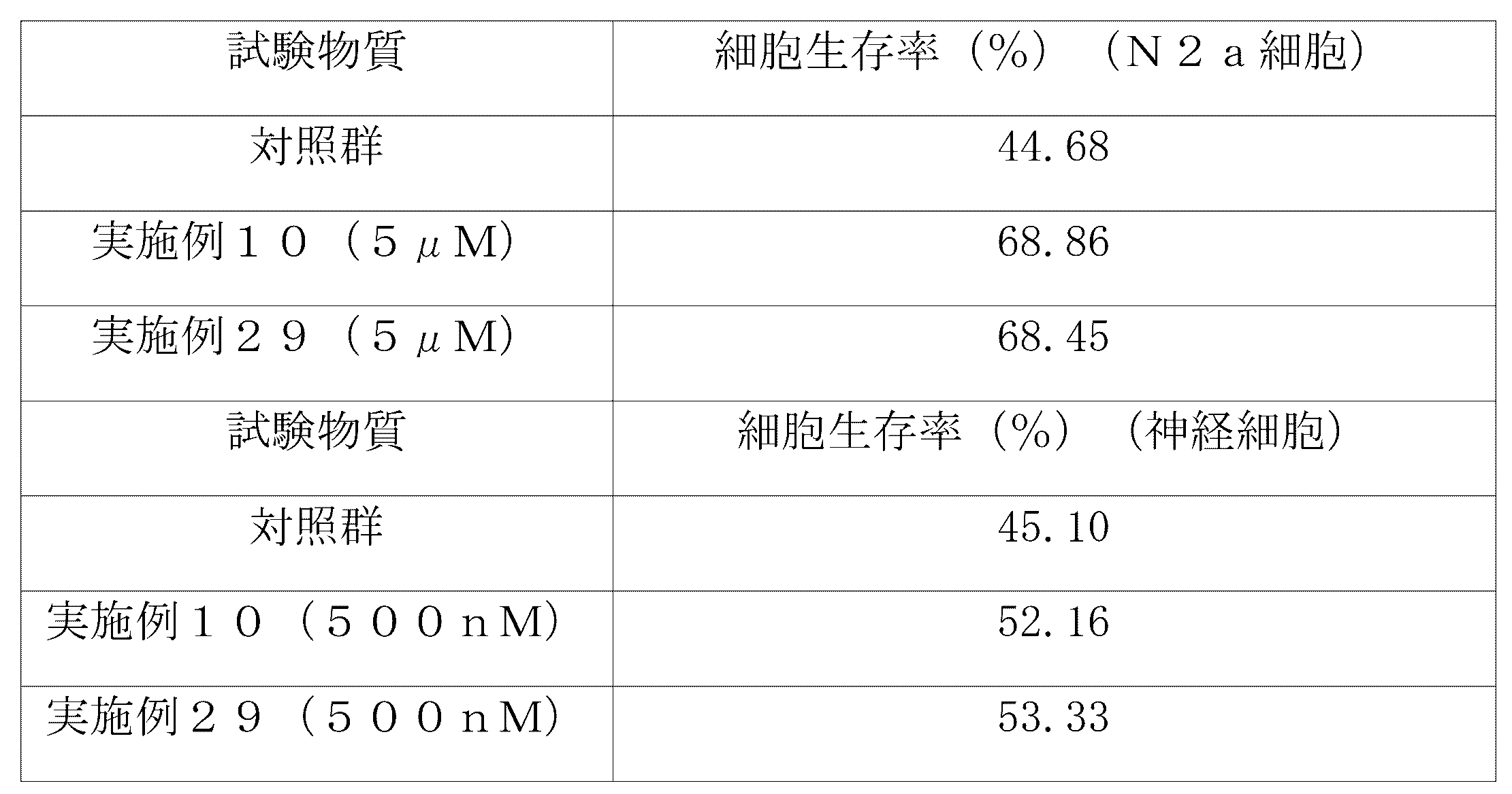
表9の結果から、実施例10の化合物及び実施例29の化合物は、いずれもベータアミロイド処理による細胞毒性を有意に抑制することが確認できる。したがって、本発明による化合物は、ベータアミロイドに関連する様々な神経変性疾患の予防および治療に有用に適用することができる。 From the results in Table 9, it can be confirmed that both the compound of Example 10 and the compound of Example 29 significantly suppress the cytotoxicity caused by beta-amyloid treatment. Therefore, the compound according to the present invention can be usefully applied to the prevention and treatment of various neurodegenerative diseases associated with beta-amyloid.
試験例7:ロテノンによるミトコンドリア損傷抑制活性の分析
神経変性疾患における主要な細胞傷害物質として知られるロテノンによるミトコンドリア損傷に対する、本発明の化合物の阻害活性を、N2a細胞(ATCC、CCL-131、mouse neuroblastoma cell line)において分析した。具体的には、N2a細胞(3×10⁴細胞)及び培地(5%熱不活化ウシ胎児血清(FBS、Gibco、16000-044)および50μg/mlペニシリン-ストレプトマイシン(Gibco、15140-122)を補充したDMEM(Dulbecco’s modified Eagle’s medium、Gibco、11995-065)をXF24ウェル培養プレートの各ウェルに加え、37℃、CO2インキュベーターで一晩インキュベートした。細胞を実施例10の化合物(5μM)で処理し、30分後に10μMのロテノンで処理した後、37℃、CO2インキュベーターで24時間インキュベートした。製造業者の説明書に従ってXF Cell Mito Stress Test Kit (Seahorse Bioscience、103015-100)で処理した後、XF24 Extracellular Flux Analyzer (Seahorse Bioscience)を使用して、ミトコンドリア呼吸のレベルを測定した。各群につき4つのウェルでテストし、基礎呼吸、ATP産生、最大呼吸、および予備呼吸能を測定した。各ミトコンドリア呼吸のレベルは、タンパク質定量値によって補正(normalization)した。未処理の対照群の基礎呼吸を100%に設定し、残りの値を示した。これらの結果を下記表10に示す。表10において、対照群は、10μMのロテノンのみで処理した群を表す。

表10の結果から、実施例10の化合物は、ロテノン処理によるミトコンドリア損傷を統計学的に有意なレベルに回復することが確認できる。したがって、本発明による化合物は、ミトコンドリアの損傷に関連する様々な神経変性疾患の予防および治療に有用に適用することができる。 From the results in Table 10, it can be confirmed that the compound of Example 10 recovers mitochondrial damage caused by rotenone treatment to a statistically significant level. Therefore, the compound according to the present invention can be usefully applied to the prevention and treatment of various neurodegenerative diseases associated with mitochondrial damage.
Claims (12)
R1は、水素;C1~C4アルキル基;またはモノ-あるいはジ-C1~C5アルキルアミノで置換されているC1~C4アルキル基であり、
R2は、C1~C4アルキル基であり、
Aは、下記化学式1a~1dの基からなる群から選択される基であり、
*は、化学式1の化合物に結合する位置を表し、
nは、1、2、または3であり、
R3およびR4は、互いに独立して、水素;C1~C4アルキル基であるか、それらが結合している窒素原子と結合して、ピペリジンまたはピロリジンを形成し(前記ピペリジンまたはピロリジンは、C1~C4アルキルで任意選択的に置換されている)、
R5およびR6は、C1~C4アルキル基であるか、あるいはR5およびR6が環を形成して、シクロペンタン、シクロヘキサンまたはテトラヒドロピランを形成し、
Cyは、ホモピペラジン-1-イル、ピペリジン-1-イル、ピペリジン-4-イル、モルホリン-4-イル、およびピロリジン-3-イルからなる群から選択される含窒素複素環基であり、前記含窒素複素環基は、C1~C4アルキルまたはベンジルで任意選択的に置換されている。 A compound of formula 1, or a pharma- ceutically acceptable salt thereof:
R 1 is hydrogen; a C 1 -C 4 alkyl group; or a C 1 -C 4 alkyl group substituted with a mono- or di-C 1 -C 5 alkylamino;
R2 is a C1 - C4 alkyl group;
A is a group selected from the group consisting of groups of the following formulae 1a to 1d:
* represents the position of attachment to the compound of formula 1;
n is 1, 2, or 3;
R 3 and R 4 are each independently hydrogen; a C 1 -C 4 alkyl group or, together with the nitrogen atom to which they are attached, form a piperidine or pyrrolidine, said piperidine or pyrrolidine being optionally substituted with a C 1 -C 4 alkyl group;
R 5 and R 6 are C 1 -C 4 alkyl groups or R 5 and R 6 form a ring to form cyclopentane, cyclohexane or tetrahydropyran;
Cy is a nitrogen-containing heterocyclic group selected from the group consisting of homopiperazin-1-yl , piperidin-1-yl , piperidin-4- yl, morpholin-4-yl , and pyrrolidin-3-yl , said nitrogen-containing heterocyclic group being optionally substituted with C 1 -C 4 alkyl or benzyl.
N-(2-(ジイソプロピルアミノ)エチル)-2-(3-シアノ-4-イソブトキシフェニル)-4-メチルチアゾール-5-カルボキサミド塩酸塩;
N-(2-(ジメチルアミノ)エチル)-2-(3-シアノ-4-イソブトキシフェニル)-4-メチルチアゾール-5-カルボキサミド塩酸塩;
N-(3-(ジエチルアミノ)プロピル)-2-(3-シアノ-4-イソブトキシフェニル)-4-メチルチアゾール-5-カルボキサミド塩酸塩;
N-(4-メチルホモピペラジノ)-2-(3-シアノ-4-イソブトキシフェニル)-4-メチルチアゾール-5-カルボキサミド塩酸塩;
N-(4-(1-メチル)ピペリジニル)-2-(3-シアノ-4-イソブトキシフェニル)-4-メチルチアゾール-5-カルボキサミド塩酸塩;
N-(2-(4-モルホリノ)エチル)-2-(3-シアノ-4-イソブトキシフェニル)-4-メチルチアゾール-5-カルボキサミド塩酸塩;
N-(2-(1-ピロリジノ)エチル)-2-(3-シアノ-4-イソブトキシフェニル)-4-メチルチアゾール-5-カルボキサミド塩酸塩;
N-(2-(1-ピペリジノ)エチル)-2-(3-シアノ-4-イソブトキシフェニル)-4-メチルチアゾール-5-カルボキサミド塩酸塩;
N-((4-(ジメチルアミノ)テトラヒドロ-2H-ピラン-4-イル)メチル)-2-(3-シアノ-4-イソブトキシフェニル)-4-メチルチアゾール-5-カルボキサミド塩酸塩;
N-((1-(ジメチルアミノ)シクロペンチル)メチル)-2-(3-シアノ-4-イソブトキシフェニル)-4-メチルチアゾール-5-カルボキサミド塩酸塩;
N-((1-(ジメチルアミノ)シクロヘキシル)メチル)-2-(3-シアノ-4-イソブトキシフェニル)-4-メチルチアゾール-5-カルボキサミド塩酸塩;
N-(3-(1-ベンジル)ピロリジニル)-2-(3-シアノ-4-イソブトキシフェニル)-4-メチルチアゾール-5-カルボキサミド塩酸塩;
N-(2-(2-(1-メチル)ピロリジノ)エチル)-2-(3-シアノ-4-イソブトキシフェニル)-4-メチルチアゾール-5-カルボキサミド塩酸塩;
N-((S)-2-(1-エチル)ピロリジノメチル)-2-(3-シアノ-4-イソブトキシフェニル)-4-メチルチアゾール-5-カルボキサミド塩酸塩;
N-(4-モルホリンアミノ)-2-(3-シアノ-4-イソブトキシフェニル)-4-メチルチアゾール-5-カルボキサミド塩酸塩;
N-(1-ピペリジンアミノ)-2-(3-シアノ-4-イソブトキシフェニル)-4-メチルチアゾール-5-カルボキサミド塩酸塩;
N-(2-(ジイソプロピルアミノ)エチル)-2-(3-シアノ-4-ヒドロキシフェニル)-4-メチルチアゾール-5-カルボキサミド塩酸塩;
N-(2-(ジエチルアミノ)エチル)-2-(3-シアノ-4-ヒドロキシフェニル)-4-メチルチアゾール-5-カルボキサミド塩酸塩;
N-(2-(ジメチルアミノ)エチル)-2-(3-シアノ-4-ヒドロキシフェニル)-4-メチルチアゾール-5-カルボキサミド塩酸塩;
N-(2-(4-モルホリノ)エチル)-2-(3-シアノ-4-ヒドロキシフェニル)-4-メチルチアゾール-5-カルボキサミド塩酸塩;
N-((S)-2-(1-エチル)ピロリジノメチル)-2-(3-シアノ-4-ヒドロキシフェニル)-4-メチルチアゾール-5-カルボキサミド塩酸塩;
N-(2-(ジイソプロピルアミノ)エチル)-2-(4-(2-ジエチルアミノ)エトキシ-3-シアノフェニル)-4-メチルチアゾール-5-カルボキサミド塩酸塩;
N-(2-(ジエチルアミノ)エチル)-2-(4-(2-ジエチルアミノ)エトキシ-3-シアノフェニル)-4-メチルチアゾール-5-カルボキサミド塩酸塩;
N-(2-(ジメチルアミノ)エチル)-2-(4-(2-ジエチルアミノ)エトキシ-3-シアノフェニル)-4-メチルチアゾール-5-カルボキサミド塩酸塩;
N-(2-(4-モルホリノ)エチル)-2-(4-(2-ジエチルアミノ)エトキシ-3-シアノフェニル)-4-メチルチアゾール-5-カルボキサミド塩酸塩;
N-((S)-2-(1-エチル)ピロリジノメチル)-2-(4-(2-ジエチルアミノ)エトキシ-3-シアノフェニル)-4-メチルチアゾール-5-カルボキサミド塩酸塩;
N-((4-(ジメチルアミノ)テトラヒドロ-2H-ピラン-4-イル)メチル)-2-(3-シアノ-4-ヒドロキシフェニル)-4-メチルチアゾール-5-カルボキサミド塩酸塩;及び
N-((4-(ジメチルアミノ)テトラヒドロ-2H-ピラン-4-イル)メチル)-2-(4-(2-ジエチルアミノ)エトキシ-3-シアノフェニル)-4-メチルチアゾール-5-カルボキサミド塩酸塩
からなる群から選択される化合物またはその薬学的に許容可能な塩。 N-(2-(diethylamino)ethyl)-2-(3-cyano-4-isobutoxyphenyl)-4-methylthiazole-5-carboxamide hydrochloride;
N-(2-(diisopropylamino)ethyl)-2-(3-cyano-4-isobutoxyphenyl)-4-methylthiazole-5-carboxamide hydrochloride;
N-(2-(dimethylamino)ethyl)-2-(3-cyano-4-isobutoxyphenyl)-4-methylthiazole-5-carboxamide hydrochloride;
N-(3-(diethylamino)propyl)-2-(3-cyano-4-isobutoxyphenyl)-4-methylthiazole-5-carboxamide hydrochloride;
N-(4-methylhomopiperazino)-2-(3-cyano-4-isobutoxyphenyl)-4-methylthiazole-5-carboxamide hydrochloride;
N-(4-(1-methyl)piperidinyl)-2-(3-cyano-4-isobutoxyphenyl)-4-methylthiazole-5-carboxamide hydrochloride;
N-(2-(4-morpholino)ethyl)-2-(3-cyano-4-isobutoxyphenyl)-4-methylthiazole-5-carboxamide hydrochloride;
N-(2-(1-pyrrolidino)ethyl)-2-(3-cyano-4-isobutoxyphenyl)-4-methylthiazole-5-carboxamide hydrochloride;
N-(2-(1-piperidino)ethyl)-2-(3-cyano-4-isobutoxyphenyl)-4-methylthiazole-5-carboxamide hydrochloride;
N-((4-(dimethylamino)tetrahydro-2H-pyran-4-yl)methyl)-2-(3-cyano-4-isobutoxyphenyl)-4-methylthiazole-5-carboxamide hydrochloride;
N-((1-(dimethylamino)cyclopentyl)methyl)-2-(3-cyano-4-isobutoxyphenyl)-4-methylthiazole-5-carboxamide hydrochloride;
N-((1-(dimethylamino)cyclohexyl)methyl)-2-(3-cyano-4-isobutoxyphenyl)-4-methylthiazole-5-carboxamide hydrochloride;
N-(3-(1-benzyl)pyrrolidinyl)-2-(3-cyano-4-isobutoxyphenyl)-4-methylthiazole-5-carboxamide hydrochloride;
N-(2-(2-(1-methyl)pyrrolidino)ethyl)-2-(3-cyano-4-isobutoxyphenyl)-4-methylthiazole-5-carboxamide hydrochloride;
N-((S)-2-(1-ethyl)pyrrolizinomethyl)-2-(3-cyano-4-isobutoxyphenyl)-4-methylthiazole-5-carboxamide hydrochloride;
N-(4-morpholinamino)-2-(3-cyano-4-isobutoxyphenyl)-4-methylthiazole-5-carboxamide hydrochloride;
N-(1-piperidineamino)-2-(3-cyano-4-isobutoxyphenyl)-4-methylthiazole-5-carboxamide hydrochloride;
N-(2-(diisopropylamino)ethyl)-2-(3-cyano-4-hydroxyphenyl)-4-methylthiazole-5-carboxamide hydrochloride;
N-(2-(diethylamino)ethyl)-2-(3-cyano-4-hydroxyphenyl)-4-methylthiazole-5-carboxamide hydrochloride;
N-(2-(dimethylamino)ethyl)-2-(3-cyano-4-hydroxyphenyl)-4-methylthiazole-5-carboxamide hydrochloride;
N-(2-(4-morpholino)ethyl)-2-(3-cyano-4-hydroxyphenyl)-4-methylthiazole-5-carboxamide hydrochloride;
N-((S)-2-(1-ethyl)pyrrolizinomethyl)-2-(3-cyano-4-hydroxyphenyl)-4-methylthiazole-5-carboxamide hydrochloride;
N-(2-(diisopropylamino)ethyl)-2-(4-(2-diethylamino)ethoxy-3-cyanophenyl)-4-methylthiazole-5-carboxamide hydrochloride;
N-(2-(diethylamino)ethyl)-2-(4-(2-diethylamino)ethoxy-3-cyanophenyl)-4-methylthiazole-5-carboxamide hydrochloride;
N-(2-(dimethylamino)ethyl)-2-(4-(2-diethylamino)ethoxy-3-cyanophenyl)-4-methylthiazole-5-carboxamide hydrochloride;
N-(2-(4-morpholino)ethyl)-2-(4-(2-diethylamino)ethoxy-3-cyanophenyl)-4-methylthiazole-5-carboxamide hydrochloride;
N-((S)-2-(1-ethyl)pyrrolizinomethyl)-2-(4-(2-diethylamino)ethoxy-3-cyanophenyl)-4-methylthiazole-5-carboxamide hydrochloride;
N-((4-(dimethylamino)tetrahydro-2H-pyran-4-yl)methyl)-2-(3-cyano-4-hydroxyphenyl)-4-methylthiazole-5-carboxamide hydrochloride; and
N-((4-(dimethylamino)tetrahydro-2H-pyran-4-yl)methyl)-2-(4-(2-diethylamino)ethoxy-3-cyanophenyl)-4-methylthiazole-5-carboxamide hydrochloride or a pharma- ceutically acceptable salt thereof.
N-((4-(ジメチルアミノ)テトラヒドロ-2H-ピラン-4-イル)メチル)-2-(3-シアノ-4-イソブトキシフェニル)-4-メチルチアゾール-5-カルボキサミド塩酸塩;
N-(2-(ジイソプロピルアミノ)エチル)-2-(4-(2-ジエチルアミノ)エトキシ-3-シアノフェニル)-4-メチルチアゾール-5-カルボキサミド塩酸塩;
N-(2-(4-モルホリノ)エチル)-2-(4-(2-ジエチルアミノ)エトキシ-3-シアノフェニル)-4-メチルチアゾール-5-カルボキサミド塩酸塩;
N-((4-(ジメチルアミノ)テトラヒドロ-2H-ピラン-4-イル)メチル)-2-(3-シアノ-4-ヒドロキシフェニル)-4-メチルチアゾール-5-カルボキサミド塩酸塩;及び
N-((4-(ジメチルアミノ)テトラヒドロ-2H-ピラン-4-イル)メチル)-2-(4-(2-ジエチルアミノ)エトキシ-3-シアノフェニル)-4-メチルチアゾール-5-カルボキサミド塩酸塩
からなる群から選択される化合物またはその薬学的に許容可能な塩。 N-(2-(diisopropylamino)ethyl)-2-(3-cyano-4-isobutoxyphenyl)-4-methylthiazole-5-carboxamide hydrochloride;
N-((4-(dimethylamino)tetrahydro-2H-pyran-4-yl)methyl)-2-(3-cyano-4-isobutoxyphenyl)-4-methylthiazole-5-carboxamide hydrochloride;
N-(2-(diisopropylamino)ethyl)-2-(4-(2-diethylamino)ethoxy-3-cyanophenyl)-4-methylthiazole-5-carboxamide hydrochloride;
N-(2-(4-morpholino)ethyl)-2-(4-(2-diethylamino)ethoxy-3-cyanophenyl)-4-methylthiazole-5-carboxamide hydrochloride;
N-((4-(dimethylamino)tetrahydro-2H-pyran-4-yl)methyl)-2-(3-cyano-4-hydroxyphenyl)-4-methylthiazole-5-carboxamide hydrochloride; and
N-((4-(dimethylamino)tetrahydro-2H-pyran-4-yl)methyl)-2-(4-(2-diethylamino)ethoxy-3-cyanophenyl)-4-methylthiazole-5-carboxamide hydrochloride or a pharma- ceutically acceptable salt thereof.
化学式4の化合物を化学式5の化合物でアルキル化して、化学式1の化合物を調製する工程
を含む、化学式1の化合物またはその薬学的に許容可能な塩の製造方法:
R1X
式中、R1 は、C 1 ~C 4 アルキル基;またはモノ-あるいはジ-C 1 ~C 5 アルキルアミノで置換されているC 1 ~C 4 アルキル基であり、R2及びAは、請求項1で定義されているものと同一であり、Xは、ハロゲンである。 The compound of formula 3 may be prepared by reacting a compound of formula 3 with an N-containing compound selected from the group consisting of NH 2 —(CH 2 ) n —NR 3 R 4 , NH 2 —CH 2 —CR 5 R 6 —NR 3 R 4 , Cy, and NH 2 —Cy, wherein n, R 3 , R 4 , R 5 , and R 6 are the same as defined in claim 1 ; Cy is homopiperazine , which is optionally substituted with C 1 -C 4 alkyl ; and NH 2 —Cy is a nitrogen-containing heterocyclic amine selected from the group consisting of piperidin -1-ylamine, piperidin-4-ylamine, morpholin-4-ylamine , and pyrrolidin-3-ylamine , said nitrogen-containing heterocyclic amine being selected from the group consisting of C 1 -C 4 alkyl. 4 alkyl or benzyl) to prepare a compound of formula 4; and alkylating the compound of formula 4 with a compound of formula 5 to prepare a compound of formula 1:
R1X
wherein R 1 is a C 1 -C 4 alkyl group; or a C 1 -C 4 alkyl group substituted with a mono- or di- C 1 -C 5 alkylamino group ; R 2 and A are as defined in claim 1; and X is a halogen.
Applications Claiming Priority (3)
| Application Number | Priority Date | Filing Date | Title |
|---|---|---|---|
| KR10-2020-0048262 | 2020-04-21 | ||
| KR1020200048262A KR102871918B1 (en) | 2020-04-21 | 2020-04-21 | Novel 2-arylthiazol derivatives or salt thereof, processes for preparing the same, and pharmaceutical compositions comprising the same |
| PCT/KR2021/000578 WO2021215624A1 (en) | 2020-04-21 | 2021-01-15 | Novel 2-arylthiazole derivative or salt thereof, preparation method therefor, and pharmaceutical composition comprising same |
Publications (2)
| Publication Number | Publication Date |
|---|---|
| JP2023523417A JP2023523417A (en) | 2023-06-05 |
| JP7692002B2 true JP7692002B2 (en) | 2025-06-12 |
Family
ID=78231501
Family Applications (1)
| Application Number | Title | Priority Date | Filing Date |
|---|---|---|---|
| JP2022564122A Active JP7692002B2 (en) | 2020-04-21 | 2021-01-15 | NOVEL 2-ARYLTHIAZOLE DERIVATIVE OR SALT THEREOF, PROCESS FOR PRODUCING SAME, AND PHARMACEUTICAL COMPOSITION CONTAINING SAME |
Country Status (9)
| Country | Link |
|---|---|
| US (1) | US12503451B2 (en) |
| EP (1) | EP4140989B1 (en) |
| JP (1) | JP7692002B2 (en) |
| KR (1) | KR102871918B1 (en) |
| CN (1) | CN115667233B (en) |
| AU (1) | AU2021261570A1 (en) |
| CA (1) | CA3176088A1 (en) |
| ES (1) | ES2987881T3 (en) |
| WO (1) | WO2021215624A1 (en) |
Families Citing this family (2)
| Publication number | Priority date | Publication date | Assignee | Title |
|---|---|---|---|---|
| EP4378932A1 (en) * | 2022-11-30 | 2024-06-05 | Universität Bern | Novel cd93 inhibitors |
| CN119528900A (en) * | 2024-08-08 | 2025-02-28 | 河南科技大学 | Methylthiazole derivatives with anti-liver cancer activity and preparation method and application thereof |
Citations (10)
| Publication number | Priority date | Publication date | Assignee | Title |
|---|---|---|---|---|
| JP2002105067A (en) | 2000-09-28 | 2002-04-10 | Teijin Ltd | 2-phenylthiazole derivative, and pharmaceutical composition containing the same as an active ingredient |
| WO2006089076A2 (en) | 2005-02-18 | 2006-08-24 | Neurogen Corporation | Thiazole amides, imidazole amides and related analogues |
| JP2008534542A (en) | 2005-03-31 | 2008-08-28 | ユセベ ファルマ ソシエテ アノニム | Compounds containing an oxazole moiety or a thiazole moiety, processes for their preparation and their use |
| JP2010037337A (en) | 2008-07-09 | 2010-02-18 | Mitsubishi Tanabe Pharma Corp | Pharmaceutical composition |
| WO2010128163A2 (en) | 2009-05-08 | 2010-11-11 | Pike Pharma Gmbh | Small molecule inhibitors of influenza a and b virus and respiratory syncytial virus replication |
| WO2012073259A1 (en) | 2010-12-02 | 2012-06-07 | Indoco Remedies Limited | Novel process for the preparation of febuxostat |
| JP2018529653A (en) | 2015-08-21 | 2018-10-11 | オートファジーサイエンシーズ インコーポレイテッド | Novel catechol derivative and pharmaceutical composition containing the same |
| CN110066258A (en) | 2018-01-23 | 2019-07-30 | 湘北威尔曼制药股份有限公司 | Thiazole -5- formic acid derivates and the preparation method and application thereof |
| US20190336483A1 (en) | 2016-07-12 | 2019-11-07 | Industry-Academic Cooperation Foundation, Yonsei University | Autophagy enhancer and use thereof |
| WO2020017878A1 (en) | 2018-07-20 | 2020-01-23 | Hexapharmatec Co., Ltd. | Novel catechol derivatives or salt thereof, processes for preparing the same, and pharmaceutical compositions comprising the same |
Family Cites Families (2)
| Publication number | Priority date | Publication date | Assignee | Title |
|---|---|---|---|---|
| KR20120131401A (en) | 2011-05-25 | 2012-12-05 | 울산대학교 산학협력단 | Novel Use of Autophagy Inducer |
| KR101731908B1 (en) | 2015-08-18 | 2017-05-11 | 서울대학교산학협력단 | Autophagy stimulation using p62 ZZ domain binding compounds or arginylated BiP for the prevention or treatment of neurodegenerative disease |
-
2020
- 2020-04-21 KR KR1020200048262A patent/KR102871918B1/en active Active
-
2021
- 2021-01-15 ES ES21792031T patent/ES2987881T3/en active Active
- 2021-01-15 US US17/996,544 patent/US12503451B2/en active Active
- 2021-01-15 JP JP2022564122A patent/JP7692002B2/en active Active
- 2021-01-15 CA CA3176088A patent/CA3176088A1/en active Pending
- 2021-01-15 EP EP21792031.3A patent/EP4140989B1/en active Active
- 2021-01-15 WO PCT/KR2021/000578 patent/WO2021215624A1/en not_active Ceased
- 2021-01-15 CN CN202180040070.8A patent/CN115667233B/en active Active
- 2021-01-15 AU AU2021261570A patent/AU2021261570A1/en active Pending
Patent Citations (10)
| Publication number | Priority date | Publication date | Assignee | Title |
|---|---|---|---|---|
| JP2002105067A (en) | 2000-09-28 | 2002-04-10 | Teijin Ltd | 2-phenylthiazole derivative, and pharmaceutical composition containing the same as an active ingredient |
| WO2006089076A2 (en) | 2005-02-18 | 2006-08-24 | Neurogen Corporation | Thiazole amides, imidazole amides and related analogues |
| JP2008534542A (en) | 2005-03-31 | 2008-08-28 | ユセベ ファルマ ソシエテ アノニム | Compounds containing an oxazole moiety or a thiazole moiety, processes for their preparation and their use |
| JP2010037337A (en) | 2008-07-09 | 2010-02-18 | Mitsubishi Tanabe Pharma Corp | Pharmaceutical composition |
| WO2010128163A2 (en) | 2009-05-08 | 2010-11-11 | Pike Pharma Gmbh | Small molecule inhibitors of influenza a and b virus and respiratory syncytial virus replication |
| WO2012073259A1 (en) | 2010-12-02 | 2012-06-07 | Indoco Remedies Limited | Novel process for the preparation of febuxostat |
| JP2018529653A (en) | 2015-08-21 | 2018-10-11 | オートファジーサイエンシーズ インコーポレイテッド | Novel catechol derivative and pharmaceutical composition containing the same |
| US20190336483A1 (en) | 2016-07-12 | 2019-11-07 | Industry-Academic Cooperation Foundation, Yonsei University | Autophagy enhancer and use thereof |
| CN110066258A (en) | 2018-01-23 | 2019-07-30 | 湘北威尔曼制药股份有限公司 | Thiazole -5- formic acid derivates and the preparation method and application thereof |
| WO2020017878A1 (en) | 2018-07-20 | 2020-01-23 | Hexapharmatec Co., Ltd. | Novel catechol derivatives or salt thereof, processes for preparing the same, and pharmaceutical compositions comprising the same |
Non-Patent Citations (4)
| Title |
|---|
| Augmenting the Xanthine Oxidase Inhibitory Activity of Febuxostat by its Structural Modification,KURUVA, C. S. et al.,2014年,Vol.11, No.2,pp.207-210,DOI: 10.2174/15701808113109990056 |
| KILARU, R. B. et al.,Design, synthesis, in silico and in vitro studies of novel 4-methylthiazole-5-carboxylic acid derivatives as potent anti-cancer agents,Bioorganic & Medicinal Chemistry Letters,2014年,Vol.24, No.18,pp.4580-4585,DOI:10.1016/j.bmcl.2014.07.058 |
| Registry(STN)[online],2018年11月18日,p.1,[検索日 2024.10.09],CAS登録番号:2248935-86-4 |
| ZHU, Youquan,Design, Synthesis and Bioactivity of Novel 2-Aryl-4-alkylthiazole-5-carboxylic Acid Derivatives,Chinese Journal of Organic Chemistry,2012年,Vol.32, No.11,pp.2115~2121,DOI: 10.6023/cjoc201207004 |
Also Published As
| Publication number | Publication date |
|---|---|
| EP4140989C0 (en) | 2024-07-17 |
| AU2021261570A1 (en) | 2022-12-08 |
| US12503451B2 (en) | 2025-12-23 |
| KR102871918B1 (en) | 2025-10-17 |
| EP4140989A4 (en) | 2023-10-18 |
| US20230219908A1 (en) | 2023-07-13 |
| EP4140989A1 (en) | 2023-03-01 |
| CN115667233B (en) | 2024-05-24 |
| CA3176088A1 (en) | 2021-10-28 |
| ES2987881T3 (en) | 2024-11-18 |
| KR20210130016A (en) | 2021-10-29 |
| WO2021215624A1 (en) | 2021-10-28 |
| CN115667233A (en) | 2023-01-31 |
| JP2023523417A (en) | 2023-06-05 |
| EP4140989B1 (en) | 2024-07-17 |
Similar Documents
| Publication | Publication Date | Title |
|---|---|---|
| EP3630755B1 (en) | 5-methyl-1,3,4-oxadiazol-2-yl compounds | |
| US10081625B2 (en) | 5-methyl-1,2,4-oxadiazol-3-yl compounds | |
| EP3268369A1 (en) | Anti-alphavbeta1 integrin inhibitors and methods of use | |
| CA2970546A1 (en) | Antimicrobial polymyxins for treatment of bacterial infections | |
| AU2018212436A1 (en) | Bis-heteroaryl derivatives as modulators of protein aggregation | |
| JP7692002B2 (en) | NOVEL 2-ARYLTHIAZOLE DERIVATIVE OR SALT THEREOF, PROCESS FOR PRODUCING SAME, AND PHARMACEUTICAL COMPOSITION CONTAINING SAME | |
| ES2653931T3 (en) | Thiazolo and condensed oxazolo-pyrimidinones | |
| EP3037412B1 (en) | Indole amide compound as inhibitor of necrosis | |
| JP7371082B2 (en) | Novel catechol derivative or salt thereof, method for producing the same, and pharmaceutical composition containing the same | |
| KR20090033583A (en) | Novel beta-secretase inhibitor compounds containing glycine arylamide | |
| KR20230106637A (en) | 1-(2-(4-cyclopropyl-1H-1,2,3-triazol-1-yl)acetyl)-4-hydroxy-N-(benzyl)pyrrolidine as a VHL inhibitor for the treatment of anemia and cancer E-2-carboxamide derivatives | |
| RU2822057C1 (en) | Novel 2-arylthiazole derivative or salt thereof, method for preparation thereof and pharmaceutical composition containing thereof | |
| RU2795227C2 (en) | New catechol derivatives or their salt, methods of their production and pharmaceutical compositions containing them | |
| KR20090033752A (en) | Novel beta-secretase inhibitor compounds, including indole-thiazoline | |
| CA3250447A1 (en) | Macrocyclic pyrimidine derivative, method for preparing same, and pharmaceutical composition for prevention or treatment of neurodegenerative disease containing same as active ingredient | |
| WO2024087783A1 (en) | Gpr139 receptor agonist, preparation method therefor, and application thereof | |
| CN115433257A (en) | Imidazopyridazine bifunctional PROTAC molecular compound and its preparation and application | |
| KR20070031959A (en) | Selective Butyrylcholinesterase Inhibitors | |
| NZ754849B2 (en) | N-[4-fluoro-5-[[(2s,4s)-2-methyl-4-[(5-methyl-1,2,4-oxadiazol-3-yl)methoxy]-1-piperidyl]methyl]thiazol-2-yl]acetamide as oga inhibitor | |
| BR112018001716B1 (en) | COMPOUND OF 1,3,4-OXADIAZOLE AMIDE DERIVATIVE AS A HISTONE DEACETYLASE 6 INHIBITOR AND PHARMACEUTICAL COMPOSITION CONTAINING THE SAME | |
| KR20090034009A (en) | Novel beta-secretase inhibitor compounds, including glycine mother liquor |
Legal Events
| Date | Code | Title | Description |
|---|---|---|---|
| A521 | Request for written amendment filed |
Free format text: JAPANESE INTERMEDIATE CODE: A821 Effective date: 20221025 |
|
| A621 | Written request for application examination |
Free format text: JAPANESE INTERMEDIATE CODE: A621 Effective date: 20231128 |
|
| A977 | Report on retrieval |
Free format text: JAPANESE INTERMEDIATE CODE: A971007 Effective date: 20241031 |
|
| A131 | Notification of reasons for refusal |
Free format text: JAPANESE INTERMEDIATE CODE: A131 Effective date: 20241105 |
|
| RD02 | Notification of acceptance of power of attorney |
Free format text: JAPANESE INTERMEDIATE CODE: A7422 Effective date: 20241230 |
|
| A521 | Request for written amendment filed |
Free format text: JAPANESE INTERMEDIATE CODE: A523 Effective date: 20250205 |
|
| TRDD | Decision of grant or rejection written | ||
| A01 | Written decision to grant a patent or to grant a registration (utility model) |
Free format text: JAPANESE INTERMEDIATE CODE: A01 Effective date: 20250527 |
|
| A61 | First payment of annual fees (during grant procedure) |
Free format text: JAPANESE INTERMEDIATE CODE: A61 Effective date: 20250602 |
|
| R150 | Certificate of patent or registration of utility model |
Ref document number: 7692002 Country of ref document: JP Free format text: JAPANESE INTERMEDIATE CODE: R150 |