JP7689416B2 - Cage-shaped siloxane-containing polymer, cage-shaped siloxane, and method for producing same - Google Patents
Cage-shaped siloxane-containing polymer, cage-shaped siloxane, and method for producing same Download PDFInfo
- Publication number
- JP7689416B2 JP7689416B2 JP2020063794A JP2020063794A JP7689416B2 JP 7689416 B2 JP7689416 B2 JP 7689416B2 JP 2020063794 A JP2020063794 A JP 2020063794A JP 2020063794 A JP2020063794 A JP 2020063794A JP 7689416 B2 JP7689416 B2 JP 7689416B2
- Authority
- JP
- Japan
- Prior art keywords
- cage
- siloxane
- carbon atoms
- alkyl group
- phenyl group
- Prior art date
- Legal status (The legal status is an assumption and is not a legal conclusion. Google has not performed a legal analysis and makes no representation as to the accuracy of the status listed.)
- Active
Links
Landscapes
- Compositions Of Macromolecular Compounds (AREA)
- Silicon Polymers (AREA)
Description
特許法第30条第2項適用 北里大学理学部化学科2019年度卒業論文要旨集 発行日 令和2年2月1日Article 30, Paragraph 2 of the Patent Act applied Kitasato University School of Science, Department of Chemistry, 2019 Graduation Thesis Abstracts Publication date February 1, 2020
本発明は、かご状シロキサン含有高分子、かご状シロキサン及びその製造方法に関する。 The present invention relates to a cage siloxane-containing polymer, a cage siloxane, and a method for producing the same.
ケイ素-酸素-ケイ素結合を主骨格とするポリシロキサンは、高い耐熱性、光線透過性、優れた機械的特性と良好な加工性を兼ね備え、様々に利用される有機-無機ハイブリッド化合物である。その中でも(RSiO1.5)nの組成式で表されるポリシルセスキオキサンは、特に優れた耐熱性、透明性及び加工性を示すことから、近年積極的に研究開発が進められている。とりわけ、有機溶剤や溶解性や有機高分子の分散安定性、屈折率の制御及び光硬化性付与などの特性が良好なダブルデッカー型シルセスキオキサン構造を含む高分子化合物が注目されている。高分子化合物の一次構造はその高次構造に強い影響を与え、高分子化合物の溶解性、ガラス転移点及び結晶性などの諸物性を大きく変化させる。そのため、ダブルデッカー型シルセスキオキサン構造を含む高分子化合物においても、その一次構造の制御は良物性を得る上で重要である。 Polysiloxanes having silicon-oxygen-silicon bonds as the main skeleton are organic-inorganic hybrid compounds that combine high heat resistance, light transmittance, excellent mechanical properties and good processability, and are used in a variety of applications. Among them, polysilsesquioxanes represented by the formula (RSiO 1.5 ) n have been actively researched and developed in recent years because they exhibit particularly excellent heat resistance, transparency and processability. In particular, polymer compounds containing a double-decker silsesquioxane structure, which have good properties such as solubility in organic solvents, dispersion stability of organic polymers, control of refractive index and photocurability, have attracted attention. The primary structure of a polymer compound has a strong influence on its higher-order structure, and greatly changes various physical properties such as the solubility, glass transition point and crystallinity of the polymer compound. Therefore, even in polymer compounds containing a double-decker silsesquioxane structure, control of the primary structure is important in order to obtain good physical properties.
非特許文献1では、ダブルデッカー型シルセスキオキサン-メチル置換直鎖シロキサン交互高分子において、その合成及び直鎖シロキサン部位のケイ素数が与える物性への影響を報告している。非特許文献1では、メチル置換直鎖シロキサン部位の鎖長の制御の報告がなされているが、ダブルデッカー骨格上のケイ素原子の立体異性の制御はなされていない。また、直鎖シロキサン部位はメチル置換ケイ素以外のものは報告されていない。 Non-Patent Document 1 reports on the synthesis of double-decker silsesquioxane-methyl-substituted linear siloxane alternating polymers and the effect of the number of silicon atoms in the linear siloxane moiety on the physical properties. Non-Patent Document 1 reports on the control of the chain length of the methyl-substituted linear siloxane moiety, but does not control the stereoisomerism of the silicon atom on the double-decker skeleton. In addition, no linear siloxane moieties other than methyl-substituted silicon have been reported.
特許文献1では、イソブチル基の置換したケイ素原子で閉環されたダブルデッカー型シルセスキオキサン構造のジオールのシス型及びトランス型の立体異性体を非極性溶媒からの再結晶により分離し、それを原料として立体構造を制御したダブルデッカー型シルセスキオキサン-直鎖シロキサン交互高分子の合成と熱的物性が開示されている。特許文献1ではかご状シロキサンジオール分子におけるダブルデッカー型シルセスキオキサン構造を閉環するケイ素上の有機基は炭素数4のアルキル基に限られている。また、この高分子の機械的特性に関しては記述がない。 Patent Document 1 discloses the synthesis and thermal properties of a double-decker silsesquioxane-linear siloxane alternating polymer in which the cis- and trans-stereoisomers of a diol with a double-decker silsesquioxane structure, ring-closed with a silicon atom substituted with an isobutyl group, are separated by recrystallization from a non-polar solvent, and the resulting polymer is used as a raw material to control the stereostructure. In Patent Document 1, the organic group on the silicon that closes the double-decker silsesquioxane structure in the cage siloxane diol molecule is limited to an alkyl group with four carbon atoms. Furthermore, there is no description of the mechanical properties of this polymer.
特許文献2では耐熱性向上及びコストの点で有利なメチル基及びフェニル基の置換したケイ素原子で閉環された、ダブルデッカー型シルセスキオキサン構造のかご状シロキサンジオールの製造法が開示されているが、これらの立体異性体を分離する方法は開示されていない。さらに、メチル基やフェニル基の置換したかご状シロキサンジオールはヘキサンやトルエン等の炭化水素溶媒に対する溶解性に乏しく、特許文献1で採用されている炭化水素溶媒中における酸触媒を用いた重合反応を行う上で、溶解性の低さが問題となりやすい。 Patent Document 2 discloses a method for producing cage-shaped siloxane diols with a double-decker silsesquioxane structure, which are ring-closed with silicon atoms substituted with methyl and phenyl groups, which are advantageous in terms of improved heat resistance and cost, but does not disclose a method for separating these stereoisomers. Furthermore, cage-shaped siloxane diols substituted with methyl and phenyl groups have poor solubility in hydrocarbon solvents such as hexane and toluene, and the low solubility is likely to be a problem when performing a polymerization reaction using an acid catalyst in a hydrocarbon solvent as adopted in Patent Document 1.
本発明の課題は、極めて高い耐熱性及び良好な機械的特性を有するシルセスキオキサン構造含有高分子化合物及びそれを含んでなる膜を製造開発することである。 The objective of the present invention is to develop and manufacture a silsesquioxane structure-containing polymer compound having extremely high heat resistance and good mechanical properties, and a film containing the same.
本発明者らは、上記の課題を解決すべく鋭意検討した結果、トランス型又はシス型の立体異性体を富化させたかご状シロキサン化合物と直鎖シロキサン化合物との重合反応により、高い熱安定性と機械的特性を兼ね備えたかご状シロキサン含有高分子を製造可能であること、該かご状シロキサン化合物はトランス型又はシス型の立体異性体を富化させたかご状シロキサンジオールより製造可能であること、さらに、該かご状シロキサンジオールの立体異性体の富化は、晶析により達成可能であることを見出し、本発明を完成させた。 As a result of intensive research aimed at solving the above problems, the present inventors have discovered that a cage siloxane-containing polymer having both high thermal stability and mechanical properties can be produced by a polymerization reaction between a cage siloxane compound enriched in trans- or cis-type stereoisomers and a linear siloxane compound, that the cage siloxane compound can be produced from a cage siloxane diol enriched in trans- or cis-type stereoisomers, and further that enrichment of the stereoisomers of the cage siloxane diol can be achieved by crystallization, thus completing the present invention.
すなわち本発明は、以下の構成よりなる。
[1]
一般式(1)

かご状シロキサン含有高分子。
なお、本明細書中で「ハロゲン原子で置換されていてもよい」とは、当該アルキル基またはフェニル基の任意の水素原子がハロゲン原子で置換されても良いことを意味し、置換される水素原子の数は複数であってもよい。
[2]
[1]に記載のかご状シロキサン含有高分子、架橋剤、及び架橋触媒を含んでなる硬化膜。
[3]
一般式(2a)
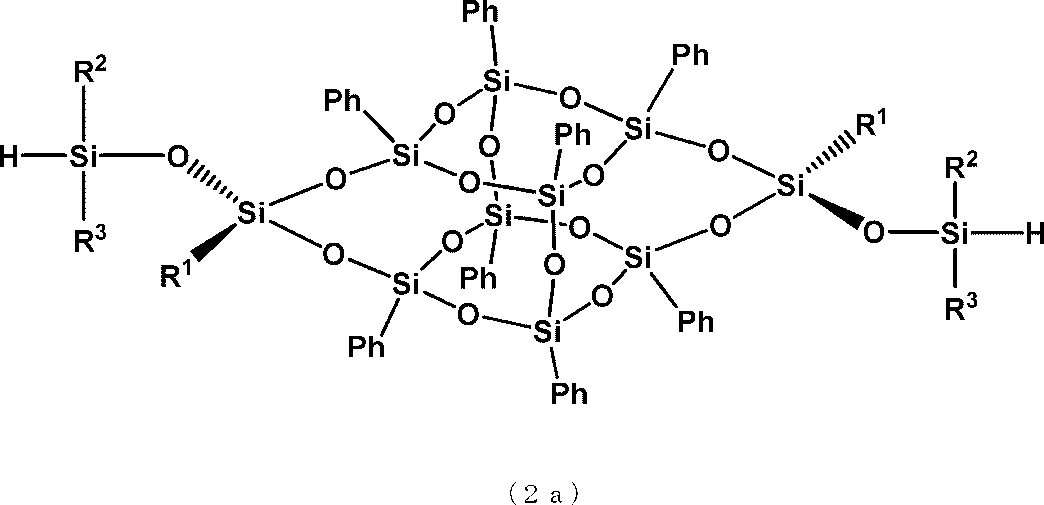
(式中、R1、R2及びR3はそれぞれ独立に炭素数1から3のアルキル基又はフェニル基を表す。)で示されるトランス型かご状シロキサン化合物、および、一般式(2b)

(式中、R1、R2及びR3はそれぞれ独立に炭素数1から3のアルキル基又はフェニル基を表す。)で示されるシス型かご状シロキサン化合物、の一方または両方を含むかご状シロキサン化合物であって、前記シス型かご状シロキサン化合物または前記トランス型かご状シロキサン化合物のいずれかを70モル%以上含むかご状シロキサン化合物と、
一般式(3)

(式中、R4及びR5は、それぞれ独立にハロゲン原子で置換されていてもよい炭素数1から3のアルキル基又はハロゲン原子で置換されていてもよいフェニル基を表す。Xは水素原子、メチル基又はエチル基を表す。mは2から10の整数を表す。)で示される直鎖
シロキサン化合物、または
一般式(3’)

(式中、R4及びR5は、それぞれ独立にハロゲン原子で置換されていてもよい炭素数1から3のアルキル基又はハロゲン原子で置換されていてもよいフェニル基を表す。)で示される環状シロキサン化合物、
とを、酸触媒存在下で反応させることを特徴とする、一般式(1)で示されるかご状シロキサン含有高分子の製造方法。
[4]
一般式(1)で示されるかご状シロキサン含有高分子を製造する方法であって、一般式(4)

(式中、R1は炭素数1から3のアルキル基又はフェニル基を表す。)で示されるかご状シロキサンジオールを晶析し、一般式(4a)

(式中、R1は炭素数1から3のアルキル基又はフェニル基を表す。)で示されるトランス型かご状シロキサンジオール、又は一般式(4b)

(式中、R1は炭素数1から3のアルキル基又はフェニル基を表す。)で示されるシス型かご状シロキサンジオールのいずれかを70モル%以上に富化する工程、
得られた一般式(4a)又は(4b)で示されるかご状シロキサンジオールのいずれかを70モル%以上含むかご状シロキサンジオールと、クロロヒドロシランR2R3HSiCl(式中、R2及びR3はそれぞれ独立に炭素数1から3のアルキル基又はフェニル基を表す。)とを反応させ、一般式(2a)

(式中、R1、R2及びR3はそれぞれ独立に炭素数1から3のアルキル基又はフェニル基を表す。)で示されるトランス型かご状シロキサン化合物、又は、一般式(2b)

(式中、R1、R2及びR3はそれぞれ独立に炭素数1から3のアルキル基又はフェニル基を表す。)で示されるシス型かご状シロキサン化合物のいずれかを70モル%以上含むかご状シロキサン化合物を得る工程、および
得られた一般式(2a)又は(2b)で示されるかご状シロキサン化合物のいずれかを70モル%以上含むかご状シロキサン化合物と、一般式(3)
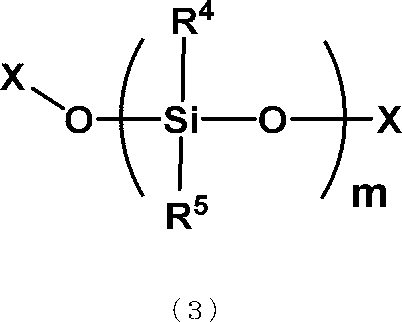
(式中、R4及びR5は、それぞれ独立にハロゲン原子で置換されていてもよい炭素数1から3のアルキル基又はハロゲン原子で置換されていてもよいフェニル基を表す。Xは水素原子、メチル基又はエチル基を表す。mは2から10の整数を表す。)で示される直鎖シロキサン化合物、または
一般式(3’)

(式中、R4及びR5は、それぞれ独立にハロゲン原子で置換されていてもよい炭素数1から3のアルキル基又はハロゲン原子で置換されていてもよいフェニル基を表す。)で示される環状シロキサン化合物、
とを酸触媒存在下で反応させる工程、
を含むことを特徴とする、製造方法。
[5]
一般式(4)

(式中、R1は炭素数1から3のアルキル基又はフェニル基を表す。)で示されるかご状シロキサンジオールを極性有機溶媒から晶析し、一般式(4a)

(式中、R1は炭素数1から3のアルキル基又はフェニル基を表す。)で示されるトランス型かご状シロキサンジオール、又は一般式(4b)
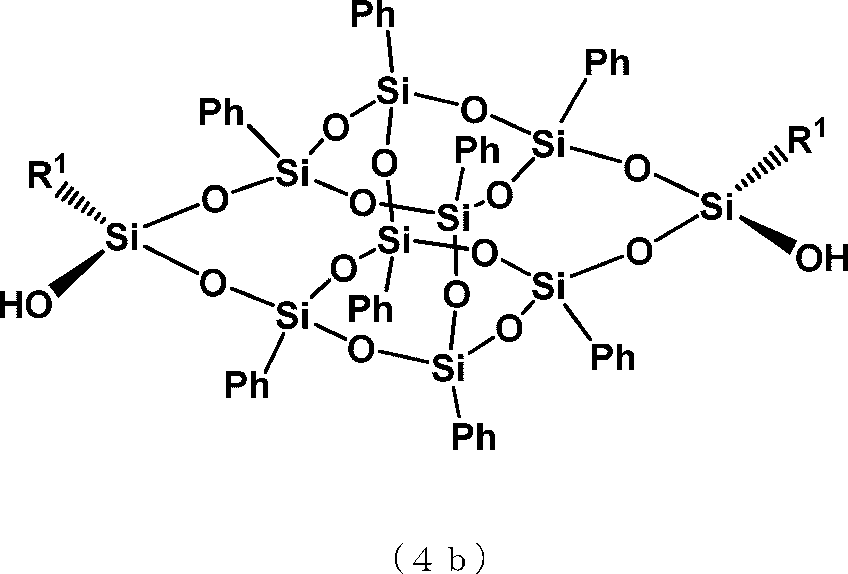
(式中、R1は炭素数1から3のアルキル基又はフェニル基を表す。)で示されるシス型かご状シロキサンジオールのいずれかを70モル%以上に富化する方法。
[6]
極性有機溶媒が、テトラヒドロフラン、アセトン及びシクロペンチルメチルエーテルからなる群から選ばれる少なくとも一つを含むことを特徴とする、[5]に記載のかご状シロキサンジオールのいずれかを70モル%以上に富化する方法。
[7]
一般式(4a)

(式中、R1は炭素数1から3のアルキル基又はフェニル基を表す。)で示されるトランス型かご状シロキサンジオール、および一般式(4b)

(式中、R1は炭素数1から3のアルキル基又はフェニル基を表す。)で示されるシス型かご状シロキサンジオール、の一方または両方を含むかご状シロキサンジオールであって、前記シス型かご状シロキサンジオールまたは前記トランス型かご状シロキサンジオールのいずれかを70モル%以上含有することを特徴とするかご状シロキサンジオール。
That is, the present invention comprises the following:
[1]
General formula (1)
In this specification, the phrase "optionally substituted with a halogen atom" means that any hydrogen atom in the alkyl group or phenyl group may be substituted with a halogen atom, and the number of substituted hydrogen atoms may be more than one.
[2]
A cured film comprising the cage-shaped siloxane-containing polymer according to [1], a crosslinking agent, and a crosslinking catalyst.
[3]
General formula (2a)
(wherein R 1 , R 2 and R 3 each independently represent an alkyl group having 1 to 3 carbon atoms or a phenyl group), and a trans-type cage siloxane compound represented by the general formula (2b):
(wherein R 1 , R 2 and R 3 each independently represent an alkyl group having 1 to 3 carbon atoms or a phenyl group), and the cage siloxane compound contains 70 mol % or more of either the cis cage siloxane compound or the trans cage siloxane compound;
General formula (3)
(wherein R 4 and R 5 each independently represent an alkyl group having 1 to 3 carbon atoms which may be substituted with a halogen atom or a phenyl group which may be substituted with a halogen atom; X represents a hydrogen atom, a methyl group or an ethyl group; and m represents an integer of 2 to 10), or a linear siloxane compound represented by the general formula (3′):
(wherein R 4 and R 5 each independently represent an alkyl group having 1 to 3 carbon atoms which may be substituted with a halogen atom, or a phenyl group which may be substituted with a halogen atom),
and in the presence of an acid catalyst.
[4]
A method for producing a cage-shaped siloxane-containing polymer represented by general formula (1), comprising the steps of:
(wherein R 1 represents an alkyl group having 1 to 3 carbon atoms or a phenyl group), and crystallizing a cage-shaped siloxane diol represented by the general formula (4a):
(wherein R 1 represents an alkyl group having 1 to 3 carbon atoms or a phenyl group), or a trans-type cage siloxane diol represented by the general formula (4b):
(wherein R 1 represents an alkyl group having 1 to 3 carbon atoms or a phenyl group),
The cage siloxane diol containing 70 mol % or more of the cage siloxane diol represented by the general formula (4a) or (4b) is reacted with chlorohydrosilane R 2 R 3 HSiCl (wherein R 2 and R 3 each independently represent an alkyl group or a phenyl group having 1 to 3 carbon atoms) to obtain a cage siloxane diol represented by the general formula (2a):
(wherein R 1 , R 2 and R 3 each independently represent an alkyl group having 1 to 3 carbon atoms or a phenyl group), or a trans-type cage siloxane compound represented by the general formula (2b):
(wherein R 1 , R 2 and R 3 each independently represent an alkyl group or a phenyl group having 1 to 3 carbon atoms), and reacting the obtained cage siloxane compound containing 70 mol % or more of any of the cage siloxane compounds represented by general formula (2a) or (2b) with a cage siloxane compound represented by general formula (3):
(wherein R 4 and R 5 each independently represent an alkyl group having 1 to 3 carbon atoms which may be substituted with a halogen atom or a phenyl group which may be substituted with a halogen atom; X represents a hydrogen atom, a methyl group or an ethyl group; and m represents an integer of 2 to 10), or a linear siloxane compound represented by the general formula (3′):
(wherein R 4 and R 5 each independently represent an alkyl group having 1 to 3 carbon atoms which may be substituted with a halogen atom, or a phenyl group which may be substituted with a halogen atom),
in the presence of an acid catalyst;
A manufacturing method comprising the steps of:
[5]
General formula (4)
(wherein R 1 represents an alkyl group having 1 to 3 carbon atoms or a phenyl group), is crystallized from a polar organic solvent to obtain a cage-shaped siloxane diol represented by the general formula (4a):
(wherein R 1 represents an alkyl group having 1 to 3 carbon atoms or a phenyl group), or a trans-type cage siloxane diol represented by the general formula (4b):
(wherein R 1 represents an alkyl group having 1 to 3 carbon atoms or a phenyl group) to be enriched to 70 mol % or more.
[6]
The method for enriching any one of the cage-shaped siloxane diols according to [5] to 70 mol % or more, characterized in that the polar organic solvent contains at least one selected from the group consisting of tetrahydrofuran, acetone, and cyclopentyl methyl ether.
[7]
General formula (4a)
(wherein R 1 represents an alkyl group having 1 to 3 carbon atoms or a phenyl group), and a trans-type cage siloxane diol represented by the general formula (4b):
(wherein R 1 represents an alkyl group having 1 to 3 carbon atoms or a phenyl group), and the cage-shaped siloxane diol contains 70 mol % or more of either the cis cage-shaped siloxane diol or the trans cage-shaped siloxane diol.
本発明は、極めて高い熱安定性と良好な可視光透過性及び高い機械的強度を有するシロキサン高分子材料を提供可能である。また、その原料となる立体異性体制御モノマーを、コスト的に優れる方法で製造可能である。 The present invention can provide a siloxane polymer material that has extremely high thermal stability, good visible light transmittance, and high mechanical strength. In addition, the stereoisomer-controlling monomer that is the raw material for the material can be produced in a cost-effective manner.
以下、本発明を詳細に説明する。 The present invention is described in detail below.
まず、本明細書における一般式(1)、(2)、(2a)、(2b)、(3)、(4)、(4a)、(4b)中のR1、R2、R3、R4、R5及びXの定義について説明する。 First, the definitions of R 1 , R 2 , R 3 , R 4 , R 5 and X in general formulae (1), (2), (2a), (2b), (3), (4), ( 4a ) and ( 4b ) in this specification will be explained.
R1、R2及びR3で示される基は、それぞれ独立に炭素数1から3のアルキル基又はフェニル基である。該アルキル基としては、メチル基、エチル基、プロピル基又はイソプロピル基を例示することができ、本発明のかご状シロキサン含有高分子の耐熱性、加工性及び経済性の点から、メチル基が好ましい。R1、R2及びR3で示される基はフェニル基が好ましい。 The groups represented by R1 , R2 , and R3 are each independently an alkyl group having 1 to 3 carbon atoms or a phenyl group. Examples of the alkyl group include a methyl group, an ethyl group, a propyl group, and an isopropyl group. From the viewpoints of the heat resistance, processability, and economic efficiency of the cage-shaped siloxane-containing polymer of the present invention, a methyl group is preferred. The groups represented by R1 , R2 , and R3 are preferably a phenyl group.
R4及びR5で示される基は、それぞれ独立にハロゲン原子で置換されていてもよい炭素数1から3のアルキル基又はハロゲン原子で置換されていてもよいフェニル基である。該アルキル基としては、メチル基、エチル基、プロピル基、イソプロピル基、3,3,3-トリフルオロプロピル基等を例示することができ、本発明のかご状シロキサン含有高分子の耐熱性、加工性、及び経済性の点から、メチル基が好ましい。R4及びR5としてはフェニル基が好ましい。 The groups represented by R4 and R5 are each independently an alkyl group having 1 to 3 carbon atoms which may be substituted with a halogen atom, or a phenyl group which may be substituted with a halogen atom. Examples of the alkyl group include a methyl group, an ethyl group, a propyl group, an isopropyl group, and a 3,3,3-trifluoropropyl group, and from the viewpoints of the heat resistance, processability, and economic efficiency of the cage-shaped siloxane-containing polymer of the present invention, a methyl group is preferred. Phenyl groups are preferred as R4 and R5 .
Xは水素原子、メチル基又はエチル基である。本発明のかご状シロキサン含有高分子の収率の点から、水素原子又はメチル基が好ましく、メチル基がより好ましい。 X is a hydrogen atom, a methyl group, or an ethyl group. From the viewpoint of the yield of the cage-shaped siloxane-containing polymer of the present invention, a hydrogen atom or a methyl group is preferred, and a methyl group is more preferred.
次に、本発明のかご状シロキサン含有高分子(1)について説明する。本発明のかご状シロキサン高分子(1)としては、下記(1a-1)~(1b-16)を例示出来る。式中、Phはフェニル基を、Meはメチル基を表し、ranは表記左右の構造単位が高分子中にランダムに存在している不規則共重合体であることを表す。 Next, the cage-shaped siloxane-containing polymer (1) of the present invention will be described. Examples of the cage-shaped siloxane polymer (1) of the present invention include the following (1a-1) to (1b-16). In the formula, Ph represents a phenyl group, Me represents a methyl group, and ran represents an irregular copolymer in which the structural units on the left and right of the notation are present randomly in the polymer.


これらのかご状シロキサン含有高分子のうち、経済性、透明性の高さ及び耐熱性の点から、(1a-1)、(1b-1)、(1a-2)、(1b-2)、(1a-3)、(1b-3)、(1a-5)、(1b-5)、(1a-6)、(1b-6)、(1a-13)、(1b-13)、(1a-14)又は(1b-14)が好ましく、(1a-1)、(1b-1)、(1a-2)、(1b-2)、(1a-5)、(1b-5)、(1a-13)又は(1b-13)が更に好ましい。 Of these cage-shaped siloxane-containing polymers, from the viewpoints of economy, high transparency and heat resistance, (1a-1), (1b-1), (1a-2), (1b-2), (1a-3), (1b-3), (1a-5), (1b-5), (1a-6), (1b-6), (1a-13), (1b-13), (1a-14) or (1b-14) are preferred, and (1a-1), (1b-1), (1a-2), (1b-2), (1a-5), (1b-5), (1a-13) or (1b-13) are more preferred.
次に、本発明のかご状シロキサン含有高分子の硬化膜について説明する。かご状シロキサン含有高分子(1)に対し、架橋剤、及び架橋触媒を含有させ成膜すると、硬化膜が得られる。該かご状シロキサン含有高分子(1)としては、(1a-1)、(1b-1)、(1a-2)、(1b-2)、(1a-3)、(1b-3)、(1a-5)、(1b-5)、(1a-6)、(1b-6)、(1a-13)、(1b-13)、(1a-14)又は(1b-14)が好ましく、(1a-1)、(1b-1)、(1a-2)、(1b-2)、(1a-5)、(1b-5)、(1a-13)又は(1b-13)が更に好ましい。該架橋剤としては、テトラメトキシシラン、テトラエトキシシラン、トリメトキシシラン、トリエトキシシラン等のアルコキシ置換モノシラン類、パーメトキシオリゴシロキサン又はパーエトキシオリゴシロキサン等のパーアルコキシオリゴシロキサン類が例示できる。これらのうち、経済性及び硬化膜の耐熱性及び機械的強度の点から、テトラメトキシシ
ラン、テトラエトキシシラン又はパーメトキシオリゴシロキサンが好ましく、パーメトキシオリゴシロキサンが更に好ましい。架橋剤の含有率は、かご状シロキサン含有高分子(1)に対して0.01重量%から20重量%の範囲にあることが好ましく、より好ましくは0.1重量%から10重量%である。
Next, the cured film of the cage-shaped siloxane-containing polymer of the present invention will be described. A cured film can be obtained by adding a crosslinking agent and a crosslinking catalyst to the cage-shaped siloxane-containing polymer (1) and forming a film. As the cage-shaped siloxane-containing polymer (1), (1a-1), (1b-1), (1a-2), (1b-2), (1a-3), (1b-3), (1a-5), (1b-5), (1a-6), (1b-6), (1a-13), (1b-13), (1a-14) or (1b-14) is preferable, and (1a-1), (1b-1), (1a-2), (1b-2), (1a-5), (1b-5), (1a-13) or (1b-13) is more preferable. Examples of the crosslinking agent include alkoxy-substituted monosilanes such as tetramethoxysilane, tetraethoxysilane, trimethoxysilane, and triethoxysilane, and peralkoxyoligosiloxanes such as permethoxyoligosiloxane and perethoxyoligosiloxane. Among these, from the viewpoints of economy and the heat resistance and mechanical strength of the cured film, tetramethoxysilane, tetraethoxysilane, and permethoxyoligosiloxane are preferred, and permethoxyoligosiloxane is more preferred. The content of the crosslinking agent is preferably in the range of 0.01% by weight to 20% by weight, more preferably 0.1% by weight to 10% by weight, based on the cage-shaped siloxane-containing polymer (1).
架橋触媒としては、ジブチルスズジラウレート、ジブチルスズジアセテート、ジオクチルスズジラウレート等の有機スズ系架橋触媒、テトラブチルチタネート、テトラプロピルチタネート、テトライソプロピルチタネート、テトラエチルチタネート等のチタンアルコキシド系架橋触媒、アルミニウムトリス(アセチルアセトナート)等のアルミニウム系架橋触媒が例示できる。架橋触媒の含有率は、かご状シロキサン含有高分子(1)に対して0.005重量%から20重量%の範囲にあることが好ましく、より好ましくは0.01重量%から10重量%である。 Examples of crosslinking catalysts include organotin crosslinking catalysts such as dibutyltin dilaurate, dibutyltin diacetate, and dioctyltin dilaurate, titanium alkoxide crosslinking catalysts such as tetrabutyl titanate, tetrapropyl titanate, tetraisopropyl titanate, and tetraethyl titanate, and aluminum crosslinking catalysts such as aluminum tris(acetylacetonate). The content of the crosslinking catalyst is preferably in the range of 0.005% to 20% by weight, more preferably 0.01% to 10% by weight, relative to the cage-shaped siloxane-containing polymer (1).
本発明のかご状シロキサン含有高分子の硬化膜の成膜方法としては、成膜溶剤、かご状シロキサン含有高分子(1)、架橋剤及び架橋触媒を含んでなる組成物を調製し、該組成物を基板上に塗布成膜後、熱硬化することにより行う。成膜方法としては、スピンコーティング法、スプレーコーティング法、ディップコーティング法、フローコーティング法、ロールコーティング法、アプリケーター法、スクリーン印刷法、バーコーター法、刷毛塗り法、スポンジ塗り法等の方法を挙げることができるが、膜厚を制御できる点で、スピンコーティング法又はアプリケーター法が好ましい。該成膜溶剤としては、かご状シロキサン含有高分子(1)が溶解すれば特に溶剤の制限はないが、安全性及び硬化膜の耐熱性の点から、トルエン、キシレン、ヘプタン、オクタン等の炭化水素溶剤が好ましく、トルエンが更に好ましい。成膜におけるかご状シロキサン含有高分子(1)の濃度は、溶解すれば任意の濃度で実施できるが、膜厚及び操作性の点から、0.1重量%から80重量%の範囲にあることが好ましく、20重量%から70重量%の範囲にあることが更に好ましい。熱硬化の温度は特に制限はなく、成膜溶剤を揮発させ、かつ架橋を円滑に行わせることが出来る点で、50℃から350℃の範囲から選ばれる温度で行うことが好ましい。 The method for forming a cured film of the cage-shaped siloxane-containing polymer of the present invention is to prepare a composition containing a film-forming solvent, a cage-shaped siloxane-containing polymer (1), a crosslinking agent, and a crosslinking catalyst, apply the composition onto a substrate to form a film, and then heat-cure the composition. Examples of the film-forming method include spin coating, spray coating, dip coating, flow coating, roll coating, applicator, screen printing, bar coater, brush coating, and sponge coating, but the spin coating or applicator method is preferred in terms of controlling the film thickness. There are no particular limitations on the film-forming solvent as long as the cage-shaped siloxane-containing polymer (1) dissolves therein, but from the standpoint of safety and heat resistance of the cured film, hydrocarbon solvents such as toluene, xylene, heptane, and octane are preferred, and toluene is more preferred. The concentration of the cage-shaped siloxane-containing polymer (1) in the film formation can be any concentration as long as it dissolves, but from the viewpoints of film thickness and operability, it is preferably in the range of 0.1% by weight to 80% by weight, and more preferably in the range of 20% by weight to 70% by weight. There are no particular limitations on the heat curing temperature, but it is preferable to perform the heat curing at a temperature selected from the range of 50°C to 350°C, in terms of being able to volatilize the film-forming solvent and smoothly carry out crosslinking.
次に、本発明のかご状シロキサン含有高分子(1)の製造方法について説明する。本発明のかご状シロキサン含有高分子(1)は、トランス型かご状シロキサン化合物(2a)およびシス型かご状シロキサン化合物(2b)、の一方または両方を含むかご状シロキサン化合物であって、前記シス型かご状シロキサン化合物または前記トランス型かご状シロキサン化合物のいずれかを70モル%以上含むかご状シロキサン化合物と、直鎖シロキサン化合物(3)とを反応させることにより、重合体であるかご状シロキサン含有高分子(1)を製造する工程(以下、重合工程ともいう)により製造実施する。 Next, a method for producing the cage-type siloxane-containing polymer (1) of the present invention will be described. The cage-type siloxane-containing polymer (1) of the present invention is a cage-type siloxane compound containing one or both of a trans-type cage siloxane compound (2a) and a cis-type cage siloxane compound (2b), and is produced by reacting a cage-type siloxane compound containing 70 mol % or more of either the cis-type cage siloxane compound or the trans-type cage siloxane compound with a linear siloxane compound (3) to produce a polymeric cage-type siloxane-containing polymer (1) (hereinafter also referred to as a polymerization process).
<重合工程>

(式中、Phはフェニル基を表す。R1、R2及びR3はそれぞれ独立に炭素数1から3のアルキル基又はフェニル基を表す。R4及びR5は、それぞれ独立にハロゲン原子で置換されていてもよい炭素数1から3のアルキル基又はハロゲン原子で置換されていてもよいフェニル基を表す。Xは水素原子、メチル基又はエチル基を表す。nは0から20の範囲をとる実数を表し、0から6の範囲をとる実数であることが好ましい。nは整数でもよいが、平衡重合の場合は複数の整数の平均数となるので、整数でなくともよい。mは2から10の整数を表す。)
<Polymerization process>
(In the formula, Ph represents a phenyl group. R 1 , R 2 and R 3 each independently represent an alkyl group having 1 to 3 carbon atoms or a phenyl group. R 4 and R 5 each independently represent an alkyl group having 1 to 3 carbon atoms which may be substituted with a halogen atom or a phenyl group which may be substituted with a halogen atom. X represents a hydrogen atom, a methyl group or an ethyl group. n represents a real number ranging from 0 to 20, and preferably a real number ranging from 0 to 6. n may be an integer, but in the case of equilibrium polymerization, it is an average number of multiple integers, so it does not have to be an integer. m represents an integer from 2 to 10.)
重合工程に用いるかご状シロキサン化合物(2)としては、トランス型かご状シロキサン化合物(2a)の割合が70モル%以上であるかご状シロキサン化合物(2)、又はシス型かご状シロキサン化合物(2b)の割合が70モル%以上であるかご状シロキサン化合物(2)を用いることを特徴とする。該かご状シロキサンとしては、以下が例示できる。 The cage siloxane compound (2) used in the polymerization step is characterized by using a cage siloxane compound (2) in which the proportion of trans-type cage siloxane compound (2a) is 70 mol % or more, or a cage siloxane compound (2) in which the proportion of cis-type cage siloxane compound (2b) is 70 mol % or more. Examples of the cage siloxane include the following.

(式中、Phはフェニル基を、Meはメチル基を表す。)
(In the formula, Ph represents a phenyl group, and Me represents a methyl group.)
これらのうち、かご状シロキサン含有高分子(1)の耐熱性の点から、(2a-1)、(2b-1)、(2a-2)、(2b-2)、(2a-4)又は(2b-4)が好ましく
、(2a-1)、(2b-1)、(2a-2)又は(2b-2)が更に好ましい。
Among these, from the viewpoint of the heat resistance of the cage-shaped siloxane-containing polymer (1), (2a-1), (2b-1), (2a-2), (2b-2), (2a-4) or (2b-4) is preferred, and (2a-1), (2b-1), (2a-2) or (2b-2) is more preferred.
トランス型かご状シロキサン化合物(2a)の割合が70モル%以上であるかご状シロキサン化合物(2a)、又はシス型かご状シロキサン化合物(2b)の割合が70モル%以上であるかご状シロキサン化合物(2)は、原料として、トランス型かご状シロキサンジオール(4a)の割合が70モル%以上であるかご状シロキサンジオール(4)、又はシス型かご状シロキサンジオール(4b)の割合が70モル%以上であるかご状シロキサンジオール(4)と、クロロヒドロシランR2R3HSiClとを反応させる工程(以下、シリル化工程ともいう)により製造することが出来る。シリル化工程については後述する。 The cage siloxane compound (2a) containing 70 mol% or more of the trans cage siloxane compound (2a) or the cage siloxane compound (2) containing 70 mol% or more of the cis cage siloxane compound (2b) can be produced by reacting the cage siloxane diol (4) containing 70 mol% or more of the trans cage siloxane diol (4a) or the cage siloxane diol (4) containing 70 mol% or more of the cis cage siloxane diol (4b) with chlorohydrosilane R 2 R 3 HSiCl as a raw material (hereinafter also referred to as silylation step). The silylation step will be described later.
重合工程に用いる直鎖シロキサン化合物(3)として、以下の化合物が例示できる。式中、Meはメチル基を、Etはエチル基を表す。

Examples of the linear siloxane compound (3) used in the polymerization step include the following compounds: In the formula, Me represents a methyl group, and Et represents an ethyl group.
これらの直鎖シロキサン化合物は、固定鎖長であってもよく、分子量分散を有していてもよい。重合工程に用いる直鎖シロキサン化合物(3)は、安定性、経済性、収率及びかご状シロキサン含有高分子(1)の耐熱性の点から、(3-1)、(3-2)、(3-7)、(3-8)、(3-10)、(3-11)、(3-13)、(3-14)、(3-17)、(3-18)、(3-20)又は(3-21)が好ましく、(3-2)、(3-7)、(3-8)、(3-10)、(3-14)、(3-18)又は(3-21)がより好
ましく、(3-2)又は(3-8)が殊更好ましい。これらの直鎖シロキサン化合物は、市販品を用いることも、既知の製造方法に従って合成して用いることも出来る。
These linear siloxane compounds may have a fixed chain length and may have a molecular weight distribution. The linear siloxane compound (3) used in the polymerization step is preferably (3-1), (3-2), (3-7), (3-8), (3-10), (3-11), (3-13), (3-14), (3-17), (3-18), (3-20) or (3-21) in terms of stability, economy, yield and heat resistance of the cage-shaped siloxane-containing polymer (1), more preferably (3-2), (3-7), (3-8), (3-10), (3-14), (3-18) or (3-21), and especially preferably (3-2) or (3-8). These linear siloxane compounds may be commercially available or may be synthesized according to a known production method.
重合工程に用いる直鎖シロキサン化合物(3’)として、以下の化合物が例示できる。式中、Meはメチル基を、Etはエチル基を表す。
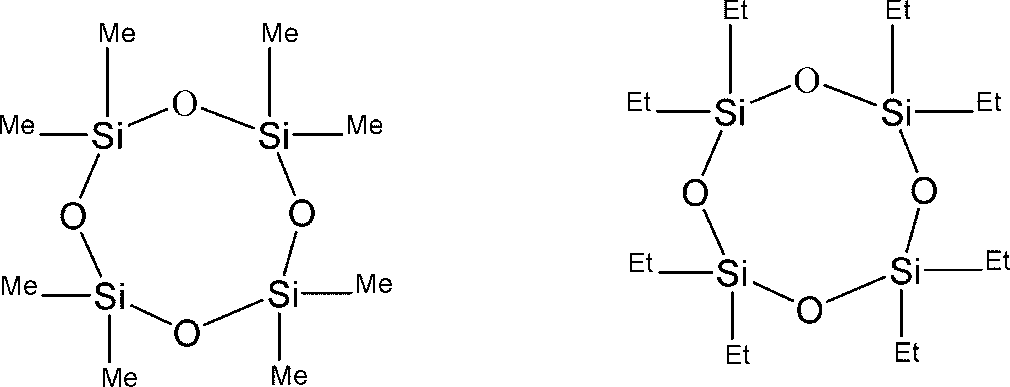
Examples of the linear siloxane compound (3') used in the polymerization step include the following compounds: In the formula, Me represents a methyl group, and Et represents an ethyl group.
重合工程は、酸触媒存在下で行うことを特徴とする。該酸触媒としては、ルイス酸触媒が好ましく、塩化アルミニウム(III)、臭化アルミニウム(III)、ヨウ化アルミニウム(III)等のハロゲン化アルミニウム;フッ化ホウ素(III)、塩化ホウ素(III)、臭化ホウ素(III)、ヨウ化ホウ素(III)等のハロゲン化ホウ素;トリフェニルボラン、トリス(4-フルオロフェニル)ボラン、トリス(3,5-ビス(トリフルオロメチル)フェニル)ボラン、トリス(ペンタフルオロフェニル)ボラン等のトリアリールボランが例示できる。これらのうち、収率及び経済性の点から、トリス(ペンタフルオロフェニル)ボランが好ましい。酸触媒の当量については特に制限はなく、かご状シロキサン化合物(2a)又は(2b)に対し、0.0001重量%から5重量%の範囲より選ばれる任意の当量において実施することが出来る。 The polymerization step is characterized by being carried out in the presence of an acid catalyst. Examples of the acid catalyst include a Lewis acid catalyst, such as aluminum halides, such as aluminum chloride (III), aluminum bromide (III), and aluminum iodide (III); boron halides, such as boron fluoride (III), boron chloride (III), boron bromide (III), and boron iodide (III); and triarylboranes, such as triphenylborane, tris(4-fluorophenyl)borane, tris(3,5-bis(trifluoromethyl)phenyl)borane, and tris(pentafluorophenyl)borane. Of these, tris(pentafluorophenyl)borane is preferred from the standpoint of yield and economy. There is no particular restriction on the equivalent amount of the acid catalyst, and it can be carried out at any equivalent amount selected from the range of 0.0001% by weight to 5% by weight relative to the cage siloxane compound (2a) or (2b).
重合工程は、有機溶媒中で行うことが好ましい。該有機溶媒としては、反応を阻害しないものであれば特に制限はなく、例えばヘキサン、ヘプタン、オクタン、デカリン等の飽和炭化水素溶媒;ベンゼン、トルエン、キシレン、メシチレン等の芳香族炭化水素溶媒;ジエチルエーテル、シクロペンチルメチルエーテル等のエーテル溶媒;ジクロロメタン、クロロホルム、四塩化炭素、1,1,2,2-テトラクロロエタン等のハロゲン化炭化水素溶媒等が例示できる。これらのうち、収率、沸点、安全性及び経済性の点から、ヘキサン、ヘプタン、オクタン、ベンゼン、トルエン、シクロペンチルメチルエーテル、ジクロロメタン又はクロロホルムが好ましく、ヘプタン、トルエン、シクロペンチルメチルエーテル、ジクロロメタン又はクロロホルムが更に好ましく、ヘプタン、トルエン又はジクロロメタンが殊更好ましい。また、これらの有機溶媒は1種単独のみならず、必要に応じて2種以上を組み合わせて用いることもできる。重合工程におけるかご状シロキサン化合物(2)(トランス型とシス型の合計)の濃度は特に限定されないが、反応性、経済性及び溶解度の点から、かご状シロキサン化合物(2)の濃度が1~50重量%の範囲とすることが好ましく、1~20重量%の範囲とすることがより好ましい。反応温度は、反応の進行に従って決定されるが、安全性及び操作性の点から-20℃から200℃の範囲で重合を実施することが好ましい。更に好ましくは0℃から120℃であり、殊更好ましくは10℃から80℃である。反応時間は、反応の進行に従って決定されるが、安全性及び操作性の点から1分から180時間の範囲で重合を実施することが好ましい。更に好ましくは10分から48時間であり、殊更好ましくは20分から24時間である。 The polymerization step is preferably carried out in an organic solvent. The organic solvent is not particularly limited as long as it does not inhibit the reaction, and examples thereof include saturated hydrocarbon solvents such as hexane, heptane, octane, and decalin; aromatic hydrocarbon solvents such as benzene, toluene, xylene, and mesitylene; ether solvents such as diethyl ether and cyclopentyl methyl ether; and halogenated hydrocarbon solvents such as dichloromethane, chloroform, carbon tetrachloride, and 1,1,2,2-tetrachloroethane. Among these, from the standpoints of yield, boiling point, safety, and economy, hexane, heptane, octane, benzene, toluene, cyclopentyl methyl ether, dichloromethane, or chloroform are preferred, heptane, toluene, cyclopentyl methyl ether, dichloromethane, or chloroform are more preferred, and heptane, toluene, or dichloromethane are especially preferred. In addition, these organic solvents can be used not only alone, but also in combination of two or more types as necessary. The concentration of the cage siloxane compound (2) (total of trans-type and cis-type) in the polymerization step is not particularly limited, but from the viewpoints of reactivity, economy, and solubility, the concentration of the cage siloxane compound (2) is preferably in the range of 1 to 50% by weight, and more preferably in the range of 1 to 20% by weight. The reaction temperature is determined according to the progress of the reaction, but from the viewpoints of safety and operability, it is preferable to carry out the polymerization in the range of -20°C to 200°C. More preferably, it is 0°C to 120°C, and especially preferably, it is 10°C to 80°C. The reaction time is determined according to the progress of the reaction, but from the viewpoints of safety and operability, it is preferable to carry out the polymerization in the range of 1 minute to 180 hours. More preferably, it is 10 minutes to 48 hours, and especially preferably, it is 20 minutes to 24 hours.
重合工程において、原料としてトランス型かご状シロキサン化合物(2a)の割合が70モル%以上であるかご状シロキサン化合物(2)を用いることによって、トランス型かご状シロキサン含有高分子(1a)を70%以上含むかご状シロキサン含有高分子(1)を製造することが出来る。
また原料としてシス型かご状シロキサン化合物一般式(2b)の割合が70モル%以上であるかご状シロキサン化合物(2)を用いることによって、シス型かご状シロキサン含有高分子(1b)を70%以上含むかご状シロキサン含有高分子(1)を製造することが出来る。
In the polymerization step, by using as a raw material a cage siloxane compound (2) in which the proportion of the trans cage siloxane compound (2a) is 70 mol % or more, it is possible to produce a cage siloxane-containing polymer (1) containing 70 mol % or more of the trans cage siloxane-containing polymer (1a).
Furthermore, by using as a raw material a cage siloxane compound (2) in which the proportion of the cis-type cage siloxane compound of general formula (2b) is 70 mol % or more, it is possible to produce a cage siloxane-containing polymer (1) containing 70 mol % or more of the cis-type cage siloxane-containing polymer (1b).
重合工程後には、必要に応じてかご状シロキサン含有高分子(1)の精製工程を含んでもよい。該精製工程としては、当業者が有機ケイ素高分子化合物や有機高分子化合物の精製に通常用いる方法を適用することが出来、良溶媒に溶解させ貧溶媒中に加える再沈殿法、ゲルパーミエーションクロマトグラフィー等のクロマトグラフィー法を用いたクロマトグラフィー分取等が例示できる。経済性及び操作性の点から、再沈殿法による精製工程が好ましい。 After the polymerization step, a purification step of the cage-shaped siloxane-containing polymer (1) may be included as necessary. As the purification step, a method that is normally used by those skilled in the art for purifying organosilicon polymer compounds or organic polymer compounds can be applied, and examples include a reprecipitation method in which the polymer is dissolved in a good solvent and then added to a poor solvent, and chromatographic fractionation using a chromatography method such as gel permeation chromatography. From the standpoint of economy and operability, a purification step using the reprecipitation method is preferred.
次に、かご状シロキサン含有高分子(1)の製造原料である、かご状シロキサン化合物(2a)又は(2b)の割合が70%以上であるかご状シロキサン化合物(2)の製造方法について説明する。かご状シロキサン化合物(2a)又は(2b)の割合が70%以上であるかご状シロキサン化合物(2)は、トランス型かご状シロキサンジオール(4a)又はシス型かご状シロキサンジオール(4b)のいずれかを70モル%以上含むかご状シロキサンジオール(4)と、クロロヒドロシランR2R3HSiClとを反応させる工程(以下、シリル化工程ともいう)により製造することが出来る。以下、シリル化工程について説明する。 Next, a method for producing the cage siloxane compound (2) containing 70% or more of the cage siloxane compound (2a) or (2b), which is a raw material for producing the cage siloxane-containing polymer (1), will be described. The cage siloxane compound (2) containing 70% or more of the cage siloxane compound (2a) or (2b) can be produced by reacting a cage siloxane diol (4) containing 70 mol% or more of either the trans cage siloxane diol (4a) or the cis cage siloxane diol (4b) with chlorohydrosilane R 2 R 3 HSiCl (hereinafter also referred to as a silylation step). The silylation step will be described below.
<シリル化工程>

<Silylation step>

(式中、Phはフェニル基を表す。R1、R2及びR3はそれぞれ独立に炭素数1から3のアルキル基又はフェニル基を表す。)
(In the formula, Ph represents a phenyl group. R 1 , R 2 and R 3 each independently represent an alkyl group having 1 to 3 carbon atoms or a phenyl group.)
シリル化工程により製造できるかご状シロキサン化合物(2)は、以下が例示できる。

(式中、Phはフェニル基を、Meはメチル基を表す。)
Examples of the cage-shaped siloxane compound (2) produced by the silylation step include the following.
(In the formula, Ph represents a phenyl group, and Me represents a methyl group.)
これらのうち、収率及びかご状シロキサン含有高分子(1)の耐熱性の点から、(2a-1)、(2b-1)、(2a-2)、(2b-2)、(2a-4)又は(2b-4)が
好ましく、(2a-1)、(2b-1)、(2a-2)又は(2b-2)が更に好ましい。
Among these, from the viewpoints of yield and heat resistance of the cage siloxane-containing polymer (1), (2a-1), (2b-1), (2a-2), (2b-2), (2a-4) or (2b-4) is preferred, and (2a-1), (2b-1), (2a-2) or (2b-2) is more preferred.
シリル化工程の原料である一般式(4)で示されるかご状シロキサンジオールのシス・トランス混合物は、公知文献(特許4379120号公報)に記載の方法に準じて製造し用いることが出来る。すなわち、フェニルトリエトキシシランをイソプロピルアルコール-水中で水酸化ナトリウムにより縮合させ、得られたテトラナトリウム塩に対しトリクロロオルガノシランを作用させ、これをさらに加水分解する方法である。かご状シロキサンジオール(4)はシス型かご状シロキサンジオール(4b)及びトランス型かご状シロキサンジオール(4a)の両異性体を含む。特許4379120号公報に記載の方法では、含まれる立体異性体のトランス型かご状シロキサンジオール(4a)/シス型かご状シロキサンジオール(4b)比は5/5~6/4の範囲にある。この異性体比の決定は、ケイ素NMRにおけるシルセスキオキサンの骨格中央に相当するケイ素由来のシグナルが、トランス異性体の場合は1重線で出現するのに対し、シス異性体の場合は2重線に分裂するため、このシグナル強度比から計算することが出来る。
本発明では、トランス型かご状シロキサンジオール(4a)及びシス型かご状シロキサンジオール(4b)の混合物に対し、晶析により(4a)又は(4b)のいずれか一方を70モル%以上含む異性体の富化を行う工程(以下、異性体富化工程ともいう)を行い、これを製造原料としてシリル化工程を行い、かご状シロキサン化合物(2a)又は(2b)を70%以上含むかご状シロキサン化合物(2)を得る工程を含むことを特徴とする。異性体富化工程については後述する。
The cis-trans mixture of cage siloxane diol represented by general formula (4), which is the raw material for the silylation step, can be produced and used according to the method described in a known document (Japanese Patent No. 4379120). That is, this method involves condensing phenyltriethoxysilane with sodium hydroxide in isopropyl alcohol-water, reacting the resulting tetrasodium salt with trichloroorganosilane, and further hydrolyzing it. The cage siloxane diol (4) includes both isomers of cis cage siloxane diol (4b) and trans cage siloxane diol (4a). In the method described in Japanese Patent No. 4379120, the ratio of the stereoisomers trans cage siloxane diol (4a)/cis cage siloxane diol (4b) is in the range of 5/5 to 6/4. The isomer ratio can be determined by calculation from the signal intensity ratio, since the signal derived from silicon corresponding to the center of the silsesquioxane skeleton in silicon NMR appears as a singlet in the case of a trans isomer, whereas it is split into a doublet in the case of a cis isomer.
The present invention is characterized by comprising a step of enriching a mixture of trans-type cage siloxane diol (4a) and cis-type cage siloxane diol (4b) by crystallization to enrich the isomer containing 70 mol % or more of either (4a) or (4b) (hereinafter also referred to as isomer enrichment step), and using this as a production raw material for a silylation step to obtain a cage siloxane compound (2) containing 70 mol % or more of the cage siloxane compound (2a) or (2b). The isomer enrichment step will be described later.
シリル化工程に用いるクロロヒドロシランとしては、クロロジメチルシラン、クロロメチルフェニルシラン、クロロジフェニルシラン、クロロエチルメチルシラン、クロロジエチルシラン、クロロメチルプロピルシラン、クロロイソプロピルメチルシラン等を例示できる。経済性及びかご状シロキサン含有高分子(1)の耐熱性の点から、クロロジメチルシラン、クロロメチルフェニルシラン又はクロロジフェニルシランが好ましく、クロロジメチルシラン又はクロロメチルフェニルシランが更に好ましい。これらは市販品を用いてもよいし、公知の合成法により合成して用いてもよい。 Examples of chlorohydrosilanes used in the silylation step include chlorodimethylsilane, chloromethylphenylsilane, chlorodiphenylsilane, chloroethylmethylsilane, chlorodiethylsilane, chloromethylpropylsilane, and chloroisopropylmethylsilane. From the viewpoints of economy and heat resistance of the cage-shaped siloxane-containing polymer (1), chlorodimethylsilane, chloromethylphenylsilane, and chlorodiphenylsilane are preferred, and chlorodimethylsilane and chloromethylphenylsilane are more preferred. These may be commercially available products or may be synthesized by a known synthesis method.
シリル化工程は、有機溶媒中で行うことが好ましい。該有機溶媒としては、ジエチルエーテル、ジイソプロピルエーテル、メチルtert-ブチルエーテル(MTBE)、シクロペンチルメチルエーテル、シクロペンチルエチルエーテル、ジオキサン、エチレングリコールジメチルエーテル、テトラヒドロフラン(THF)等のエーテル溶媒を例示することが出来る。溶解度、操作の安全性及び経済性の点から、テトラヒドロフラン又はシクロペンチルメチルエーテルが好ましく、テトラヒドロフランがより好ましい。また、これらの溶媒は1種単独のみならず、必要に応じて2種以上を組み合わせて用いることもできる。シリル化工程における原料濃度は特に限定されないが、収率及び生産効率を高くするため、かご状シロキサン化合物の濃度が5重量%以上の濃度でシリル化工程を行うことが好ましい。反応温度、反応圧力は特に限定されないが、操作性及び安全性の点から反応温度としては-80℃~100℃、反応圧力は常圧~1MPaの範囲で行われることが好ましい。より好ましくは-20~80℃、かつ常圧である。 The silylation step is preferably carried out in an organic solvent. Examples of the organic solvent include ether solvents such as diethyl ether, diisopropyl ether, methyl tert-butyl ether (MTBE), cyclopentyl methyl ether, cyclopentyl ethyl ether, dioxane, ethylene glycol dimethyl ether, and tetrahydrofuran (THF). From the viewpoints of solubility, operational safety, and economic efficiency, tetrahydrofuran or cyclopentyl methyl ether is preferred, and tetrahydrofuran is more preferred. These solvents may be used alone or in combination of two or more types as necessary. The raw material concentration in the silylation step is not particularly limited, but in order to increase the yield and production efficiency, it is preferable to carry out the silylation step at a concentration of 5% by weight or more of the cage siloxane compound. The reaction temperature and reaction pressure are not particularly limited, but from the viewpoints of operability and safety, it is preferable to carry out the reaction at a temperature of -80°C to 100°C and at a reaction pressure of normal pressure to 1 MPa. More preferably, it is -20 to 80°C and normal pressure.
シリル化工程は、副生する塩化水素を捕捉する塩基を存在させて実施してもよい。該塩基としてはアンモニアの他、ジメチルアミン、ジエチルアミン、ジイソプロピルアミン等の脂肪族第二級アミン、トリエチルアミン、ジエチルイソプロピルアミン等の脂肪族第三級アミン、アニリン、ピリジン、4-ジメチルアミノピリジン、キノリン等の芳香族アミンを例示することが出来る。収率、操作性及び安全性の点から、ジエチルアミン、トリエチルアミン、アニリン又はピリジンが好ましく、トリエチルアミン又はピリジンが更に好ましい。 The silylation step may be carried out in the presence of a base that captures the by-product hydrogen chloride. Examples of the base include ammonia, as well as aliphatic secondary amines such as dimethylamine, diethylamine, and diisopropylamine, aliphatic tertiary amines such as triethylamine and diethylisopropylamine, and aromatic amines such as aniline, pyridine, 4-dimethylaminopyridine, and quinoline. From the standpoints of yield, operability, and safety, diethylamine, triethylamine, aniline, or pyridine is preferred, and triethylamine or pyridine is more preferred.
シリル化工程後には、必要に応じて精製工程を含んでもよい。該精製工程としては、濃縮、抽出、順相又は逆相カラムクロマトグラフィー、再結晶等の当業者が通常用いる一般的な操作を適宜組み合わせることにより達成される。 After the silylation step, a purification step may be included as necessary. The purification step is achieved by appropriately combining common operations that are commonly used by those skilled in the art, such as concentration, extraction, normal-phase or reverse-phase column chromatography, and recrystallization.
次に、異性体富化工程について説明する。異性体富化工程では、かご状シロキサン化合物(2a)又は(2b)の原料であるかご状シロキサンジオール(4)を極性有機溶媒中で晶析させ、トランス型かご状シロキサンジオール(4a)又はシス型かご状シロキサンジオール(4b)のいずれかの異性体を含有率70モル%以上へ異性体富化工程を行うことを特徴とする。トランス型かご状シロキサンジオール(4a)及びシス型かご状シロキサンジオール(4b)の混合物は極性有機溶媒から晶析することでトランス型かご状シロキサンジオール(4a)を優先的に晶析可能であり、晶析後の溶液中はシス型かご状シロキサンジオール(4b)の割合が増加する。該極性溶媒としては、水酸基に対し配位可能な極性有機溶媒であればよく、アセトン、メチルエチルケトン等のケトン;ジエチルエーテル、テトラヒドロフラン、ジオキサン、シクロペンチルメチルエーテル等のエーテル溶媒;ジクロロメタン、クロロホルム、四塩化炭素、1,2-ジブロモエタンなどの含ハロゲン系溶媒が例示できる。これらの極性有機溶媒のうち、溶解度、晶析の異性体比、及び次反応を阻害しないという点において、アセトン、テトラヒドロフラン、ジオキサン、又はシクロペンチルメチルエーテルが好ましく、アセトン又はテトラヒドロフランがより好ましい。 Next, the isomer enrichment step will be described. In the isomer enrichment step, the cage siloxane diol (4), which is the raw material for the cage siloxane compound (2a) or (2b), is crystallized in a polar organic solvent, and an isomer enrichment step is performed to obtain an isomer of either the trans cage siloxane diol (4a) or the cis cage siloxane diol (4b) at a content of 70 mol% or more. A mixture of the trans cage siloxane diol (4a) and the cis cage siloxane diol (4b) can be crystallized from a polar organic solvent to preferentially crystallize the trans cage siloxane diol (4a), and the proportion of the cis cage siloxane diol (4b) in the solution after crystallization increases. The polar solvent may be any polar organic solvent capable of coordinating with a hydroxyl group, and examples thereof include ketones such as acetone and methyl ethyl ketone; ether solvents such as diethyl ether, tetrahydrofuran, dioxane, and cyclopentyl methyl ether; and halogen-containing solvents such as dichloromethane, chloroform, carbon tetrachloride, and 1,2-dibromoethane. Among these polar organic solvents, acetone, tetrahydrofuran, dioxane, or cyclopentyl methyl ether are preferred, and acetone or tetrahydrofuran are more preferred, in terms of solubility, isomer ratio of crystallization, and not inhibiting the subsequent reaction.
異性体富化工程によって富化できるトランス型かご状シロキサンジオール(4a)又はシス型かご状シロキサンジオール(4b)としては、以下が例示できる。 Examples of trans-type cage siloxane diols (4a) or cis-type cage siloxane diols (4b) that can be enriched by the isomer enrichment process include the following:

これらのうち、収率及び経済性の点から、(4a-1)、(4b-1)、(4a-2)又は(4b-2)が好ましく、(4a-1)又は(4b-1)が更に好ましい。 Among these, from the viewpoints of yield and economy, (4a-1), (4b-1), (4a-2) or (4b-2) are preferred, and (4a-1) or (4b-1) is more preferred.
異性体富化工程では、かご状シロキサンジオール(4)異性体混合物(トランス型かご状シロキサンジオール(4a)/シス型かご状シロキサンジオール(4b)のモル比が70/30モル比以下。)の過飽和の極性有機溶媒溶液を調製し、該溶液からトランス型かご状シロキサンジオール(4a)の優先的な晶析を行う。過飽和溶液の調製法としては、
当業者が有機ケイ素化合物や有機化合物の晶析に通常用いる方法を適用することが出来、溶媒の沸点以下の温度に加熱後冷却して過飽和とする熱結晶化法、かご状シロキサンジオール(4)の極性有機溶媒溶液に貧溶媒を加える方法、又はゆっくりと溶媒を蒸発させる蒸発法等が例示できる。該貧溶媒としては、極性有機溶媒に混和しかご状シロキサンジオール化合物(4)の溶解度が低いものであれば特に制約はなく、ペンタン、ヘキサン、オクタン等の炭化水素溶媒;メタノール、エタノール等のアルコール溶媒が例示できる。晶析温度は特に限定されないが、通常は-80℃から80℃の範囲が好ましく、0℃から50℃がより好ましい。
In the isomer enrichment step, a supersaturated solution of an isomer mixture of cage-type siloxane diol (4) (wherein the molar ratio of trans-type cage siloxane diol (4a)/cis-type cage siloxane diol (4b) is 70/30 or less) in a polar organic solvent is prepared, and the trans-type cage siloxane diol (4a) is preferentially crystallized from the solution. The method for preparing the supersaturated solution includes the following steps:
Methods that are commonly used by those skilled in the art for crystallization of organic silicon compounds or organic compounds can be applied, including a thermal crystallization method in which the solvent is heated to a temperature below the boiling point and then cooled to become supersaturated, a method in which a poor solvent is added to a polar organic solvent solution of the cage-shaped siloxane diol (4), and an evaporation method in which the solvent is slowly evaporated. There are no particular limitations on the poor solvent, so long as it is miscible with the polar organic solvent and has low solubility for the cage-shaped siloxane diol compound (4), and examples of such poor solvents include hydrocarbon solvents such as pentane, hexane, and octane; and alcohol solvents such as methanol and ethanol. The crystallization temperature is not particularly limited, but is usually preferably in the range of -80°C to 80°C, more preferably 0°C to 50°C.
以下、実施例及び比較例を挙げて本発明をさらに具体的に説明するが、本発明の範囲は以下に示す具体例により限定的に解釈されるべきものではない。 The present invention will be explained in more detail below with reference to examples and comparative examples, but the scope of the present invention should not be interpreted as being limited to the specific examples shown below.
化合物の機器分析では、1H-NMR(プロトン核磁気共鳴スペクトル)、13C-NMR(炭素13核磁気共鳴スペクトル)及び29Si-NMR(ケイ素29核磁気共鳴スペクトル)測定はBruker-Avance社のAscend400核磁気共鳴分光計を用い、溶媒には重クロロホルムを用い、テトラメチルシランを標準物質とした。IR(赤外吸収)スペクトルは(株)堀場製作所のFT-720分光光度計を用い、SensIRtechnologies社のDuraSamplIRII(反射型)測定セルを用いて測定を行った。 In the instrumental analysis of the compound, 1 H-NMR (proton nuclear magnetic resonance spectrum), 13 C-NMR (carbon-13 nuclear magnetic resonance spectrum), and 29 Si-NMR (silicon-29 nuclear magnetic resonance spectrum) were measured using an Ascend 400 nuclear magnetic resonance spectrometer manufactured by Bruker-Avance, deuterated chloroform was used as the solvent, and tetramethylsilane was used as the standard substance. IR (infrared absorption) spectrum was measured using an FT-720 spectrophotometer manufactured by Horiba, Ltd., and a DuraSamplIRII (reflection type) measurement cell manufactured by SensIRtechnologies.
(実施例1)かご状シロキサン含有高分子(1a-1)の合成
アルゴン雰囲気下、25mgのトリス(ペンタフルオロフェニル)ボランをジクロロメタン54.2gに溶解し、ここにトランス型かご状シロキサン化合物(2a-1)/シス型かご状シロキサン化合物(2b-1)比が9/1のかご状シロキサン化合物7.0g、1,3-ジメトキシ-1,1,3,3-テトラメチルジシロキサン0.91gのジクロロメタン24.1g溶液をゆっくり滴下した。滴下終了30分後、溶液は発泡した。3時間半後、トリエチルアミン少量を加え反応を停止した。反応混合物を多量のメタノールにゆっくりと加え、沈殿をろ取して粗高分子を得た。これを再度THFに溶解し、多量のメタノール中にゆっくりと加え、再沈殿した高分子をろ取し、減圧下で乾燥させることによりかご状シロキサン含有高分子(1a-1)を白色粉末として6.6g得た。PMMA換算のゲルパーミエーションクロマトグラフィーによる分子量測定では、かご状シロキサン含有高分子(1a-1)(1a-1/1b-1=9/1)は重量平均分子量 161000
、数平均分子量53000であった。
Example 1: Synthesis of cage-type siloxane-containing polymer (1a-1) Under an argon atmosphere, 25 mg of tris(pentafluorophenyl)borane was dissolved in 54.2 g of dichloromethane, and 7.0 g of a cage-type siloxane compound having a trans-type cage siloxane compound (2a-1)/cis-type cage siloxane compound (2b-1) ratio of 9/1 and 0.91 g of 1,3-dimethoxy-1,1,3,3-tetramethyldisiloxane in 24.1 g of dichloromethane were slowly added dropwise thereto. Thirty minutes after the end of the dropwise addition, the solution foamed. After three and a half hours, a small amount of triethylamine was added to stop the reaction. The reaction mixture was slowly added to a large amount of methanol, and the precipitate was collected by filtration to obtain a crude polymer. This was dissolved again in THF and slowly added to a large amount of methanol. The reprecipitated polymer was filtered and dried under reduced pressure to obtain 6.6 g of a cage-shaped siloxane-containing polymer (1a-1) as a white powder. The molecular weight of the cage-shaped siloxane-containing polymer (1a-1) (1a-1/1b-1=9/1) was measured by gel permeation chromatography in terms of PMMA, and the weight average molecular weight of the polymer was 161,000.
, and the number average molecular weight was 53,000.
熱重量分析(空気気流中)におけるかご状シロキサン含有高分子(1a-1)の1%重量減少温度は426℃、5%重量減少温度は486℃であった。 In thermogravimetric analysis (in air flow), the 1% weight loss temperature of the cage-shaped siloxane-containing polymer (1a-1) was 426°C, and the 5% weight loss temperature was 486°C.
このかご状シロキサン含有高分子(1a-1)を少量のトルエンに溶かし、架橋剤MS51(メチルシリケートオリゴマー、三菱ケミカル社製)および架橋触媒としてジブチルジラウリルスズ少量を加え、アプリケーターを用いてテフロンコートしたステンレス板上に塗布製膜した。これを、40℃で30分、70℃で30分、100℃で1時間、200℃で2時間加熱乾燥させ、ステンレス板から剥がし透明薄膜を調製した。この薄膜の熱重量分析(空気気流中)における1%重量減少温度は454℃、5%重量減少温度は504℃であった。薄膜のガラス転移点を動的粘弾性測定により求めたところ、51℃であった。この薄膜を切り出し、室温で引張強度試験を行ったところ、明白な弾性変形を示し、降伏点における強度22MPaを示した。 This cage-shaped siloxane-containing polymer (1a-1) was dissolved in a small amount of toluene, and a crosslinking agent MS51 (methyl silicate oligomer, manufactured by Mitsubishi Chemical Corporation) and a small amount of dibutyl dilauryl tin as a crosslinking catalyst were added, and the mixture was applied to a Teflon-coated stainless steel plate using an applicator to form a film. This was dried by heating at 40°C for 30 minutes, 70°C for 30 minutes, 100°C for 1 hour, and 200°C for 2 hours, and then peeled off from the stainless steel plate to prepare a transparent thin film. In thermogravimetric analysis (in air flow), the 1% weight loss temperature of this thin film was 454°C, and the 5% weight loss temperature was 504°C. The glass transition point of the thin film was determined by dynamic viscoelasticity measurement to be 51°C. When this thin film was cut out and subjected to a tensile strength test at room temperature, it showed clear elastic deformation and a strength of 22 MPa at the yield point.
トランス型の割合の高いかご状シロキサン化合物を原料に使用することで、熱安定性および機械的強度に優れたかご状シロキサン含有高分子を得ることができた。 By using a cage siloxane compound with a high proportion of trans-type as the raw material, it was possible to obtain a cage siloxane-containing polymer with excellent thermal stability and mechanical strength.
(実施例2)かご状シロキサン含有高分子(1b-1)の合成
アルゴン雰囲気下、25mgのトリス(ペンタフルオロフェニル)ボランをジクロロメタン54.2gに溶解し、ここにトランス異性体(2a-1)/シス異性体(2b-1)比が2/8のかご状シロキサン化合物7.0g、1,3-ジメトキシ-1,1,3,3-テトラメチルジシロキサン0.91gのジクロロメタン24.1g溶液をゆっくり滴下した。滴下終了30分後、溶液は発泡した。3時間半後、トリエチルアミン少量を加え反応を停止した。反応混合物を多量のメタノールにゆっくりと加え、沈殿をろ取して粗高分子を得た。これを再度THFに溶解し、多量のメタノール中にゆっくりと加え、再沈殿した高分子をろ取し、減圧下で乾燥させることによりかご状シロキサン含有高分子(1b-1)(1a-1/1b-1=2/8)を白色粉末として6.6gを得た。PMMA換算のゲルパーミエーションクロマトグラフィーによる分子量測定では、かご状シロキサン含有高分子(1b-1)は重量平均分子量 345000、数平均分子量175000であった
。
Example 2: Synthesis of cage-shaped siloxane-containing polymer (1b-1) Under an argon atmosphere, 25 mg of tris(pentafluorophenyl)borane was dissolved in 54.2 g of dichloromethane, and 7.0 g of a cage-shaped siloxane compound with a trans isomer (2a-1)/cis isomer (2b-1) ratio of 2/8 and 0.91 g of 1,3-dimethoxy-1,1,3,3-tetramethyldisiloxane were slowly added dropwise to the solution in 24.1 g of dichloromethane. Thirty minutes after the end of the dropwise addition, the solution foamed. After three and a half hours, a small amount of triethylamine was added to stop the reaction. The reaction mixture was slowly added to a large amount of methanol, and the precipitate was collected by filtration to obtain a crude polymer. This was dissolved again in THF and slowly added to a large amount of methanol, and the reprecipitated polymer was collected by filtration and dried under reduced pressure to obtain 6.6 g of a cage-shaped siloxane-containing polymer (1b-1) (1a-1/1b-1=2/8) as a white powder. When the molecular weight of the cage-shaped siloxane-containing polymer (1b-1) was measured by gel permeation chromatography in terms of PMMA, the weight average molecular weight was 345,000 and the number average molecular weight was 175,000.
かご状シロキサン含有高分子(1b-1)の熱重量分析(空気気流中)における1%重量減少温度は431℃、5%重量減少温度は491℃であった。 In thermogravimetric analysis (in air flow) of the cage-shaped siloxane-containing polymer (1b-1), the 1% weight loss temperature was 431°C, and the 5% weight loss temperature was 491°C.
この重合体を少量のトルエンに溶かし、架橋剤MS51(メチルシリケートオリゴマー、三菱ケミカル社製)および架橋触媒としてジブチルジラウリルスズ少量を加え、アプリケーターを用いてテフロンコートしたステンレス板上に塗布製膜した。これを、40℃で30分、70℃で30分、100℃で1時間、200℃で2時間加熱乾燥させ、ステンレス板から剥がし透明薄膜を調製した。この薄膜の熱重量分析(空気気流中)における1%重量減少温度は454℃、5%重量減少温度は510℃であった。薄膜のガラス転移点を動的粘弾性測定により求めたところ50℃であった。この薄膜を切り出し、室温で引張強度試験を行ったところ、明白な弾性変形を示し、降伏点における強度17MPaを示した。 This polymer was dissolved in a small amount of toluene, and a crosslinking agent MS51 (methyl silicate oligomer, manufactured by Mitsubishi Chemical Corporation) and a small amount of dibutyl dilaurate tin as a crosslinking catalyst were added, and the mixture was applied to a Teflon-coated stainless steel plate using an applicator to form a film. This was dried by heating at 40°C for 30 minutes, 70°C for 30 minutes, 100°C for 1 hour, and 200°C for 2 hours, and then peeled off from the stainless steel plate to prepare a transparent thin film. The 1% weight loss temperature of this thin film in thermogravimetric analysis (in air flow) was 454°C, and the 5% weight loss temperature was 510°C. The glass transition point of the thin film was determined to be 50°C by dynamic viscoelasticity measurement. When this thin film was cut out and subjected to a tensile strength test at room temperature, it showed clear elastic deformation and a strength of 17 MPa at the yield point.
シス型の割合の高いかご状シロキサン化合物を原料に使用することでも、熱安定性および機械的強度に優れたかご状シロキサン含有高分子を得ることができた。 By using cage siloxane compounds with a high proportion of cis-type structures as raw materials, it was possible to obtain cage siloxane-containing polymers with excellent thermal stability and mechanical strength.
(比較例1)かご状シロキサン含有高分子(1c)の合成
アルゴン雰囲気下、25mgのトリス(ペンタフルオロフェニル)ボランをジクロロメタン54.2gに溶解し、ここにトランス異性体(2a-1)/シス異性体(2b-1)比が5/5のかご状シロキサン化合物(2-1)7.0g、1,3-ジメトキシ-1,1,3,3-テトラメチルジシロキサン0.91gのジクロロメタン24.1g溶液をゆっくり滴下した。滴下終了30分後、溶液は発泡した。3時間半後、トリエチルアミン少量を加え反応を停止した。反応混合物を多量のメタノールにゆっくりと加え、沈殿をろ取して粗高分子を得た。これを再度THFに溶解し、多量のメタノール中にゆっくりと加え、再沈殿した高分子をろ取し、減圧下で乾燥させることによりかご状シロキサン含有高分子(1c)(1a-1/1b-1=5/5)を白色粉末として6.6g得た。PMMA換算のゲルパーミエーションクロマトグラフィーによる分子量測定では、この高分子は重量平均分子量 188000、数平均分子量66000であった。
Comparative Example 1 Synthesis of Cage-Type Siloxane-Containing Polymer (1c) Under an argon atmosphere, 25 mg of tris(pentafluorophenyl)borane was dissolved in 54.2 g of dichloromethane, and 7.0 g of a cage-type siloxane compound (2-1) with a trans isomer (2a-1)/cis isomer (2b-1) ratio of 5/5 and 0.91 g of 1,3-dimethoxy-1,1,3,3-tetramethyldisiloxane were slowly added dropwise to the solution in 24.1 g of dichloromethane. Thirty minutes after the end of the dropwise addition, the solution foamed. After three and a half hours, a small amount of triethylamine was added to stop the reaction. The reaction mixture was slowly added to a large amount of methanol, and the precipitate was collected by filtration to obtain a crude polymer. This was dissolved again in THF and slowly added to a large amount of methanol, and the reprecipitated polymer was collected by filtration and dried under reduced pressure to obtain 6.6 g of a cage-shaped siloxane-containing polymer (1c) (1a-1/1b-1=5/5) as a white powder. When the molecular weight of this polymer was measured by gel permeation chromatography in terms of PMMA, the weight average molecular weight of this polymer was 188,000 and the number average molecular weight was 66,000.
この高分子の1%重量減少温度は405℃、5%重量減少温度は451℃と、実施例1および2のかご状シロキサン含有高分子(1a-1)及び(1b-1)に比べ低い値を示した。 The 1% weight loss temperature of this polymer was 405°C, and the 5% weight loss temperature was 451°C, which were lower values than the cage-shaped siloxane-containing polymers (1a-1) and (1b-1) of Examples 1 and 2.
この重合体を少量のトルエンに溶かし、架橋剤MS51(メチルシリケートオリゴマー、三菱ケミカル社製)および架橋触媒としてジブチルジラウリルスズ少量を加え、アプリ
ケーターを用いてテフロンコートしたステンレス板上に塗布製膜した。これを、40℃で30分、70℃で30分、100℃で1時間、200℃で2時間加熱乾燥させ、ステンレス板から剥がし透明薄膜を調製した。この薄膜の1%重量減少温度は438℃、5%重量減少温度は485℃であった。薄膜のガラス転移点をDMAにより求めたところ32℃であった。この薄膜を切り出し、室温で引張強度試験を行ったところ、塑性変形による応力伸びを示し、破断点での応力は13MPaであった。
The polymer was dissolved in a small amount of toluene, and a crosslinking agent MS51 (methyl silicate oligomer, manufactured by Mitsubishi Chemical Corporation) and a small amount of dibutyl dilaurate tin as a crosslinking catalyst were added, and the mixture was applied to a Teflon-coated stainless steel plate using an applicator to form a film. This was dried by heating at 40°C for 30 minutes, 70°C for 30 minutes, 100°C for 1 hour, and 200°C for 2 hours, and peeled off from the stainless steel plate to prepare a transparent thin film. The 1% weight loss temperature of this thin film was 438°C, and the 5% weight loss temperature was 485°C. The glass transition point of the thin film was determined by DMA to be 32°C. This thin film was cut out and subjected to a tensile strength test at room temperature, which showed stress elongation due to plastic deformation, and the stress at the breaking point was 13 MPa.
トランス型とシス型の割合が同程度のかご状シロキサン化合物を原料に使用した場合、熱安定性および機械的強度は実施例1や2に比べて劣っていた。 When cage siloxane compounds with the same ratio of trans and cis structures were used as raw materials, the thermal stability and mechanical strength were inferior to those of Examples 1 and 2.
(実施例3)かご状シロキサン含有高分子(1a-5)の合成
アルゴン雰囲気下、25mgのトリス(ペンタフルオロフェニル)ボランをジクロロメタン54.2gに溶解し、ここにトランス異性体(2a-2)/シス異性体(2b-2)比が9/1のかご状シロキサン化合物7.0g、1,3-ジメトキシ-1,1,3,3-テトラメチルジシロキサン0.91gのジクロロメタン24.1g溶液をゆっくり滴下した。滴下終了30分後、溶液は発泡した。3時間半後、トリエチルアミン少量を加え反応を停止した。反応混合物を多量のメタノールにゆっくりと加え、沈殿をろ取して粗高分子を得た。これを再度THFに溶解し、多量のメタノール中にゆっくりと加え、再沈殿した高分子をろ取し、減圧下で乾燥させることによりかご状シロキサン含有高分子(1a-5)(1a-5/1b-5=9/1)を白色粉末として6.6g得た。PMMA換算のゲルパーミエーションクロマトグラフィーによる分子量測定では、この高分子は重量平均分子量32000、数平均分子量18000であった。
Example 3: Synthesis of cage-shaped siloxane-containing polymer (1a-5) Under an argon atmosphere, 25 mg of tris(pentafluorophenyl)borane was dissolved in 54.2 g of dichloromethane, and 7.0 g of a cage-shaped siloxane compound with a trans isomer (2a-2)/cis isomer (2b-2) ratio of 9/1 and 0.91 g of 1,3-dimethoxy-1,1,3,3-tetramethyldisiloxane in 24.1 g of dichloromethane were slowly added dropwise thereto. Thirty minutes after the end of the dropwise addition, the solution foamed. After three and a half hours, a small amount of triethylamine was added to stop the reaction. The reaction mixture was slowly added to a large amount of methanol, and the precipitate was collected by filtration to obtain a crude polymer. This was dissolved again in THF and slowly added to a large amount of methanol, and the reprecipitated polymer was collected by filtration and dried under reduced pressure to obtain 6.6 g of a cage-shaped siloxane-containing polymer (1a-5) (1a-5/1b-5=9/1) as a white powder. When the molecular weight of this polymer was measured by gel permeation chromatography in terms of PMMA, the weight average molecular weight of this polymer was 32,000 and the number average molecular weight was 18,000.
(実施例4)かご状シロキサンジオール(4a-1)および(4b-1)の異性体富化
特許4379120号公報記載の方法に従い調製したかご状シロキサンジオール(4-1)((4a-1)および(4b-1)の1:1比の異性体混合物)20.0gを177mLの沸騰THFに完全溶解させた。これを室温まで降温し、14時間静置し、晶析させた。析出した結晶をろ取することにより、トランス型かご状シロキサンジオールを6.8g得た。これは、トランス異性体(4a-1)/シス異性体(4b-1)比が9.5/0.5であることがケイ素NMRにより決定された。
溶液を濃縮後、さらに同様の操作を繰り返し、トランス異性体(4a-1)/シス異性体(4b-1)比が9/1のトランス型かご状シロキサンジオール(2a-1)1.1gを白色結晶性粉末として得た。
この母液を濃縮することにより、トランス異性体(4a-1)/シス異性体(4b-1)比が2/8のシス型かご状シロキサンジオールを結晶性粉末として11.5g得た。
Example 4: Isomer enrichment of cage siloxane diols (4a-1) and (4b-1) 20.0 g of cage siloxane diol (4-1) (a 1:1 ratio isomer mixture of (4a-1) and (4b-1)) prepared according to the method described in Japanese Patent No. 4379120 was completely dissolved in 177 mL of boiling THF. The temperature was lowered to room temperature and the mixture was allowed to stand for 14 hours to crystallize. The precipitated crystals were filtered to obtain 6.8 g of trans-type cage siloxane diol. The trans isomer (4a-1)/cis isomer (4b-1) ratio was determined to be 9.5/0.5 by silicon NMR.
After concentrating the solution, the same procedure was repeated to obtain 1.1 g of a trans-type cage siloxane diol (2a-1) having a trans isomer (4a-1)/cis isomer (4b-1) ratio of 9/1 as a white crystalline powder.
The mother liquor was concentrated to obtain 11.5 g of a crystalline powder of a cis-type cage siloxane diol having a trans isomer (4a-1)/cis isomer (4b-1) ratio of 2/8.
(実施例5)かご状シロキサン化合物(2a-1)の合成
磁気撹拌子、ジムロート冷却器および三方コックを備えた200mL三口フラスコに、トランス型かご状シロキサンジオール(4a-1)/シス型かご状シロキサンジオール(4b-1)比が9/1のかご状シロキサンジオール42.6g(35.9mmol)を収め、装置をアルゴンで置換した。このフラスコにピリジン11.36g(143.7mmol)および脱水THF360mLを収め、クロロジメチルシラン13.6g(144mmol)を注射器より30分かけて滴下した。滴下後、1時間加熱還流させた。反応混合物を分液ロートに移し、ヘキサン300mLで抽出し、蒸留水200mLで3回洗浄した。有機層を硫酸マグネシウムで乾燥し、ろ過により硫酸マグネシウムを除いた。ろ液をロータリーエバポレーターで濃縮し、減圧乾燥することによりかご状シロキサン化合物(2a-1)(2a-1/2b-1=9/1)を白色固体として46.0g(収率98%)得た。
Example 5 Synthesis of cage siloxane compound (2a-1) 42.6 g (35.9 mmol) of a cage siloxane diol with a trans cage siloxane diol (4a-1)/cis cage siloxane diol (4b-1) ratio of 9/1 was placed in a 200 mL three-neck flask equipped with a magnetic stirrer, a Dimroth condenser, and a three-way cock, and the apparatus was replaced with argon. 11.36 g (143.7 mmol) of pyridine and 360 mL of dehydrated THF were placed in this flask, and 13.6 g (144 mmol) of chlorodimethylsilane was added dropwise from a syringe over 30 minutes. After the dropwise addition, the mixture was heated to reflux for 1 hour. The reaction mixture was transferred to a separatory funnel, extracted with 300 mL of hexane, and washed three times with 200 mL of distilled water. The organic layer was dried over magnesium sulfate, and the magnesium sulfate was removed by filtration. The filtrate was concentrated using a rotary evaporator and dried under reduced pressure to obtain 46.0 g (yield 98%) of a cage siloxane compound (2a-1) (2a-1/2b-1=9/1) as a white solid.
1H-NMR(400MHz,CDCl3),δ(ppm):0.1017(d,J=2
.8Hz,12H),0.2706(s,6H),4.7056(sep,J=2.8Hz,2H),7.1780(t,J=7.54Hz,9H),7.2534(t,J=7.5Hz,オーバーラップ),7.30-7.45(18H、オーバーラップ),7.52-7.58(m,9H、オーバーラップ).13C-NMR(101MHz,CDCl3),δ(ppm):-3.53,-0.41,127.17,127.35,129.
90,129.97,130.55,131.42,133.58,133.68.29
Si-NMR(79MHz,CDCl3),δ(ppm):-79.52,-79.21,-63.39,-4.48.IRスペクトル(固体,cm-1):3072,3053,3006,2960,2133,1595,1429,1275,1250,1109,1065,1053,1030,997,904,833,814,783,737,729,719,694,671,627,619,613.
1 H-NMR (400 MHz, CDCl 3 ), δ (ppm): 0.1017 (d, J = 2
. 8 Hz, 12H), 0.2706 (s, 6H), 4.7056 (sep, J = 2.8 Hz, 2H), 7.1780 (t, J = 7.54 Hz, 9H), 7.2534 (t, J = 7.5 Hz, overlap), 7.30-7.45 (18H, overlap), 7.52-7.58 (m, 9H, overlap). 13 C-NMR (101 MHz, CDCl 3 ), δ (ppm): -3.53, -0.41, 127.17, 127.35, 129.
90, 129.97, 130.55, 131.42, 133.58, 133.68. 29
Si-NMR (79 MHz, CDCl 3 ), δ (ppm): -79.52, -79.21, -63.39, -4.48. IR spectrum (solid, cm -1 ): 3072, 3053, 3006, 2960, 2133, 1595, 1429, 1275, 1250, 1109, 1065, 1053, 1030, 997, 904, 833, 814, 783, 737, 729, 719, 694, 671, 627, 619, 613.
(実施例6)かご状シロキサン化合物(2a-2)の合成
磁気撹拌子、ジムロート冷却器および三方コックを備えた200mL三口フラスコに、トランス型かご状シロキサンジオール(4a-1)/シス型かご状シロキサンジオール(4b-1)比が9/1のかご状シロキサンジオール10.0g(8.43mmol)を収め、装置をアルゴンで置換した。このフラスコにピリジン2.68g(33.9mmol)および脱水THF80mLを収め、クロロフェニルメチルシラン3.15 g(20.
1 mmol)を注射器より10分かけて滴下した。滴下後、1時間加熱還流させた。反
応混合物を分液ロートに移し、クロロホルム100mLで抽出し、蒸留水150mLで3回洗浄した。有機層を硫酸マグネシウムで乾燥し、ろ過により硫酸マグネシウムを除いた。ろ液をロータリーエバポレーターで濃縮し、減圧乾燥して結晶性固体を13.4g得た。これを最少量のTHFに溶解し、メタノールをゆっくりとTHF量の三倍加え、トランス型かご状シロキサン化合物(2a-2)(2a-2/2b-2=9/1)を粉末状白色固体として11.1g(収率92.7%)得た。
Example 6 Synthesis of cage siloxane compound (2a-2) 10.0 g (8.43 mmol) of a cage siloxane diol having a trans cage siloxane diol (4a-1)/cis cage siloxane diol (4b-1) ratio of 9/1 was placed in a 200 mL three-neck flask equipped with a magnetic stirrer, a Dimroth condenser, and a three-way cock, and the apparatus was purged with argon. 2.68 g (33.9 mmol) of pyridine and 80 mL of dehydrated THF were placed in the flask, and 3.15 g (20.
1 mmol) was added dropwise from a syringe over 10 minutes. After the addition, the mixture was heated to reflux for 1 hour. The reaction mixture was transferred to a separatory funnel, extracted with 100 mL of chloroform, and washed three times with 150 mL of distilled water. The organic layer was dried over magnesium sulfate, and the magnesium sulfate was removed by filtration. The filtrate was concentrated with a rotary evaporator and dried under reduced pressure to obtain 13.4 g of a crystalline solid. This was dissolved in a minimum amount of THF, and methanol was slowly added in an amount three times the amount of THF to obtain 11.1 g (yield 92.7%) of a trans-type cage siloxane compound (2a-2) (2a-2/2b-2=9/1) as a powdery white solid.
IRスペクトル(固体,cm-1):3072,3051,3006,2131,1593,1429,1115,1107,1059,1028,997,891,868,814,783,727,694;1H-NMR(400MHz,CDCl3),δ(ppm):0.27(s,6H),0.34(d,J=2.80Hz),5.12(q,2H,J=2.84Hz),7.08‐7.55(m,50H);13C-NMR(101MHz,CDCl3),δ(ppm):-3.11,-0.73,127.51,127.60,127.69,127.75,127.79,129.74,130.25,130.33,130.37,130.85,130.88,130.92,131.68,133.34,133.99,134.00,134.10,134.18,136.77;29Si-NMR(79MHz,CDCl3),δ(ppm):-79.44,-79.12,-63.22,-13.08. IR spectrum (solid, cm -1 ): 3072, 3051, 3006, 2131, 1593, 1429, 1115, 1107, 1059, 1028, 997, 891, 868, 814, 783, 727, 694; 1 H-NMR (400 MHz, CDCl 3 ), δ (ppm): 0.27 (s, 6H), 0.34 (d, J = 2.80Hz), 5.12 (q, 2H, J = 2.84Hz), 7.08-7.55 (m, 50H); 13C -NMR (101MHz, CDCl 3 ), δ (ppm): -3.11, -0.73, 127.51, 127.60, 127.69, 127.75, 127.79, 129.74, 130.25, 130.33, 130.37, 130.85, 130.88, 130.92, 131.68, 133.34, 133.99, 134.00, 134.10, 134.18, 136.77; 29 Si-NMR (79 MHz, CDCl 3 ), δ (ppm): -79.44, -79.12, -63.22, -13.08.
(実施例7)かご状シロキサン化合物(2a-3)の合成
磁気撹拌子、10mL滴下ロート、ジムロート冷却器および三方コックを備えた100mL三口フラスコに、トランス型かご状シロキサンジオール(4a-1)/シス型かご状シロキサンジオール(4b-1)比が9/1のかご状シロキサンジオール5.00g(3.84mmol)を収め、アルゴンで置換した。三口フラスコにトリエチルアミン1.54g(15.2mmol)および脱水THF40mLを収めた。滴下ロートにクロロジフェニルシラン2.83g(9.22mmol)を収め、10分かけて滴下した。滴下後、1時間加熱還流させた。反応混合物を分液ロートに移し、ジエチルエーテル150mLを加え、蒸留水100mLで3回洗浄した。有機層を硫酸マグネシウムで乾燥させ、ろ過により硫酸マグネシウムを除いた。ろ液をロータリーエバポレーターで濃縮することで淡黄色の固体を得た。これをヘキサンで洗い、吸引ろ過し、減圧乾燥することで白色固体を5.57g得た。得られた白色固体を最少量のTHFに溶解し、5倍量のメタノールを加え
再結晶することでトランス型かご状シロキサン化合物(2a-3)(2a-3/2b-3=9/1)を無色の結晶として3.71g(収率62.2%)得た。
Example 7 Synthesis of cage siloxane compound (2a-3) 5.00 g (3.84 mmol) of a cage siloxane diol with a trans cage siloxane diol (4a-1)/cis cage siloxane diol (4b-1) ratio of 9/1 was placed in a 100 mL three-neck flask equipped with a magnetic stirrer, a 10 mL dropping funnel, a Dimroth condenser, and a three-way cock, and the atmosphere was replaced with argon. 1.54 g (15.2 mmol) of triethylamine and 40 mL of dehydrated THF were placed in the three-neck flask. 2.83 g (9.22 mmol) of chlorodiphenylsilane was placed in the dropping funnel and dropped over 10 minutes. After dropping, the mixture was heated to reflux for 1 hour. The reaction mixture was transferred to a separatory funnel, 150 mL of diethyl ether was added, and the mixture was washed three times with 100 mL of distilled water. The organic layer was dried over magnesium sulfate, and the magnesium sulfate was removed by filtration. The filtrate was concentrated using a rotary evaporator to obtain a pale yellow solid. This was washed with hexane, suction filtered, and dried under reduced pressure to obtain 5.57 g of a white solid. The obtained white solid was dissolved in a minimum amount of THF, and recrystallized by adding 5 times the amount of methanol to obtain 3.71 g (yield 62.2%) of trans-type cage siloxane compound (2a-3) (2a-3/2b-3=9/1) as colorless crystals.
29Si-NMR(79MHz,CDCl3),δ(ppm):-79.34,-78.98,-63.05,-21.87. 29 Si-NMR (79 MHz, CDCl 3 ), δ (ppm): -79.34, -78.98, -63.05, -21.87.
(実施例8)かご状シロキサン化合物(2b-1)の合成
磁気撹拌子、ジムロート冷却器および三方コックを備えた500mL三口フラスコに、トランス型かご状シロキサンジオール(4a-1)/シス型かご状シロキサンジオール(4b-1)比が2/8のかご状シロキサンジオール30.0g(25.3mmol)を収め、装置をアルゴンで置換した。このフラスコにピリジン8.03g(102mmol)および脱水THF250mLを収め、クロロジメチルシラン9.61g(102mmol)を注射器より30分かけて滴下した。滴下後、1時間加熱還流させた。反応混合物を分液ロートに移し、ヘキサン300mLで抽出し、蒸留水200mLで3回洗浄した。有機層を硫酸マグネシウムで乾燥し、ろ過により硫酸マグネシウムを除いた。ろ液をロータリーエバポレーターで濃縮し、減圧乾燥してシス型かご状シロキサン化合物(2b-1)(2a-1/2b-1=2/8)を粉末状白色固体として31.1g(収率94.4%)得た。
Example 8 Synthesis of cage siloxane compound (2b-1) 30.0 g (25.3 mmol) of a cage siloxane diol with a trans cage siloxane diol (4a-1)/cis cage siloxane diol (4b-1) ratio of 2/8 was placed in a 500 mL three-neck flask equipped with a magnetic stirrer, a Dimroth condenser, and a three-way cock, and the apparatus was replaced with argon. 8.03 g (102 mmol) of pyridine and 250 mL of dehydrated THF were placed in the flask, and 9.61 g (102 mmol) of chlorodimethylsilane was added dropwise from a syringe over 30 minutes. After the dropwise addition, the mixture was heated to reflux for 1 hour. The reaction mixture was transferred to a separatory funnel, extracted with 300 mL of hexane, and washed three times with 200 mL of distilled water. The organic layer was dried over magnesium sulfate, and the magnesium sulfate was removed by filtration. The filtrate was concentrated using a rotary evaporator and dried under reduced pressure to obtain 31.1 g (yield 94.4%) of a cis-type cage siloxane compound (2b-1) (2a-1/2b-1=2/8) as a powdery white solid.
IRスペクトル(固体,cm-1):3072,3053,3028,3006,2121,2017,1431,1273,1252,1105,1065,1030,997,904,827,812,785,735,717,694,640,627,619.1H-NMR(400MHz,CDCl3),δ(ppm):0.1033(d,J=2.8Hz,12.0H),0.2705(s,6.0H),4.7073(sep,J=2.8,1.9H),7.13‐7.22(m,10.0H),7.23-7.29(
m),7.30‐7.46(m,19.6H),7.53‐7.58(m,9.7H).
13C-NMR(101MHz,CDCl3),δ(ppm):-3.5291(SiMe2),-0.4094(SiMe),127.0726(ortho),127.2616(ortho),127.3486(ortho),129.8418(para),129.9634(para,overlap),130.5359(ipso),130.5777(ipso),131.4261(ipso),133.5760(meta),133.6049(meta),133.7439(meta).29Si-NMR(79MHz,CDCl3),δ(ppm):-79.67,-79.38,-79.21,-63.41,-4.46.
IR spectrum (solid, cm -1 ): 3072, 3053, 3028, 3006, 2121, 2017, 1431, 1273, 1252, 1105, 1065, 1030, 997, 904, 827, 812, 785, 735, 717, 694, 640, 627, 619. 1 H-NMR (400 MHz, CDCl 3 ), δ (ppm): 0.1033 (d, J = 2.8 Hz, 12.0 H), 0.2705 (s, 6.0 H), 4.7073 (sep, J = 2.8, 1.9 H), 7.13-7.22 (m, 10.0 H), 7.23-7.29 (
m), 7.30-7.46 (m, 19.6H), 7.53-7.58 (m, 9.7H).
13C -NMR (101MHz, CDCl3 ), δ (ppm): -3.5291 (SiMe2), -0.4094 (SiMe), 127.0726 (ortho), 127.2616 (ortho), 127.3486 (ortho), 129.8418 (para), 129.96 34 (para, overlap), 130.5359 (ipso), 130.5777 (ipso), 131.4261 (ipso), 133.5760 (meta), 133.6049 (meta), 133.7439 (meta). 29 Si-NMR (79 MHz, CDCl 3 ), δ (ppm): -79.67, -79.38, -79.21, -63.41, -4.46.
(実施例9)かご状シロキサン含有高分子(1a-2)の合成
かご状シロキサンジオール異性体混合物((4a-1)/ (4b-1) = 92/ 8) を10 g、 オクタメチルシクロテトラシロキサン(D4)を2.3 g, トルエン(16.8
g)を100 mLの4つ口丸底フラスコに加え、還流管、マグネチックスターラー、オイルバスをセットし、窒素をフローした。撹拌しながら、硫酸 0.31 g、トルエン2.0 gを加え、1時間還流させた。その後80℃で5時間熟成した。加熱を停止し、水を
加え、分液後、水層を除去した。さらに数回水洗後、有機層を濃縮し、ヘプタンで再沈殿させ、沈殿をヘプタンで数回洗浄後、80℃で減圧乾燥し、白色固体8.6gを得た。PMMA換算のゲルパーミエーションクロマトグラフィーによる分子量測定では、かご状シロキサン含有高分子(1a-2)((1a-2/1b-2=11.5/1))は重量平均分子量 142000、数平均分子量57000であった。1H-NMRよりnは平均3.0であった。

Example 9: Synthesis of cage-type siloxane-containing polymer (1a-2) 10 g of cage-type siloxane diol isomer mixture ((4a-1)/(4b-1) = 92/8), 2.3 g of octamethylcyclotetrasiloxane ( D4 ), 16.8 g of toluene
g) was added to a 100 mL four-neck round-bottom flask, a reflux tube, a magnetic stirrer, and an oil bath were set, and nitrogen was flowed. While stirring, 0.31 g of sulfuric acid and 2.0 g of toluene were added, and the mixture was refluxed for 1 hour. The mixture was then aged at 80°C for 5 hours. Heating was stopped, water was added, and the mixture was separated, after which the aqueous layer was removed. After washing with water several times, the organic layer was concentrated and reprecipitated with heptane, and the precipitate was washed several times with heptane and dried under reduced pressure at 80°C to obtain 8.6 g of a white solid. In the molecular weight measurement by gel permeation chromatography in terms of PMMA, the cage-shaped siloxane-containing polymer (1a-2) ((1a-2/1b-2=11.5/1)) had a weight average molecular weight of 142,000 and a number average molecular weight of 57,000. From 1 H-NMR, n was 3.0 on average.
この重合体を少量のトルエンに溶かし、架橋剤MS51(メチルシリケートオリゴマー、三菱ケミカル社製)および架橋触媒としてジブチルジラウリルスズ少量を加え、アプリケーターを用いてテフロンコートしたステンレス板上に塗布製膜した。これを、40℃で30分、70℃で30分、100℃で1時間、200℃で2時間加熱乾燥させ、ステンレス板から剥がし透明薄膜を調製した。この薄膜の1%重量減少温度は436℃、5%重量減少温度は484℃であった。薄膜のガラス転移点をDMAにより求めたところ81℃であった。この薄膜を切り出し、室温で引張強度試験を行ったところ、塑性変形による応力伸びを示し、破断点での応力は20MPaであった。このように、シス型の割合の高いかご状シロキサン化合物を原料に使用することでも、熱安定性および機械的強度に優れたかご状シロキサン含有高分子を得ることができた。 This polymer was dissolved in a small amount of toluene, and a crosslinking agent MS51 (methyl silicate oligomer, manufactured by Mitsubishi Chemical Corporation) and a small amount of dibutyl dilauryl tin as a crosslinking catalyst were added, and a film was formed by applying the solution to a Teflon-coated stainless steel plate using an applicator. This was dried by heating at 40°C for 30 minutes, 70°C for 30 minutes, 100°C for 1 hour, and 200°C for 2 hours, and peeled off from the stainless steel plate to prepare a transparent thin film. The 1% weight loss temperature of this thin film was 436°C, and the 5% weight loss temperature was 484°C. The glass transition point of the thin film was determined by DMA to be 81°C. When this thin film was cut out and subjected to a tensile strength test at room temperature, it showed stress elongation due to plastic deformation, and the stress at the breaking point was 20 MPa. In this way, by using a cage siloxane compound with a high proportion of cis-type as a raw material, a cage siloxane-containing polymer with excellent thermal stability and mechanical strength was obtained.
(実施例10)かご状シロキサン含有高分子(1b-2)の合成
かご状シロキサンジオール異性体混合物((4a-1)/ (4b-1) = 25/ 75) を1
0 g、 オクタメチルシクロテトラシロキサン(D4)を2.3 g, トルエン(18.
8 g)を100 mLの4つ口丸底フラスコに加え、還流管、マグネチックスターラー、
オイルバスをセットし、窒素をフローした。撹拌しながら、硫酸 0.31 g、トルエン2.0 gを加え、1時間還流させた。その後80℃で5時間熟成した。加熱を停止し、
水を加え、分液後、水層を除去した。さらに数回水洗後、有機層を濃縮し、ヘプタンで再沈殿させ、沈殿をヘプタンで数回洗浄後、80℃で減圧乾燥し、白色固体8.6gを得た。PMMA換算のゲルパーミエーションクロマトグラフィーによる分子量測定では、かご状シロキサン含有高分子(1b-2)((1a-2/1b-2=1/3))は重量平均分子量 146000、数平均分子量45000であった。1H-NMRよりnは平均3.2であった。

Example 10 Synthesis of cage-type siloxane-containing polymer (1b-2) A cage-type siloxane diol isomer mixture ((4a-1)/(4b-1) = 25/75) was mixed in 1
0 g, octamethylcyclotetrasiloxane ( D4 ) 2.3 g, toluene (18.
8 g) was added to a 100 mL four-neck round-bottom flask and equipped with a reflux condenser, a magnetic stirrer,
An oil bath was set and nitrogen was flowed. 0.31 g of sulfuric acid and 2.0 g of toluene were added while stirring, and the mixture was refluxed for 1 hour. Then, the mixture was aged at 80° C. for 5 hours. Heating was stopped, and
Water was added, and after separation, the aqueous layer was removed. After washing with water several times, the organic layer was concentrated and reprecipitated with heptane. The precipitate was washed several times with heptane and then dried under reduced pressure at 80°C to obtain 8.6 g of a white solid. Molecular weight measurement by gel permeation chromatography in PMMA equivalent showed that the cage-shaped siloxane-containing polymer (1b-2) ((1a-2/1b-2=1/3)) had a weight average molecular weight of 146,000 and a number average molecular weight of 45,000. 1 H-NMR showed that n was 3.2 on average.
この重合体を少量のトルエンに溶かし、架橋剤MS51(メチルシリケートオリゴマー、三菱ケミカル社製)および架橋触媒としてジブチルジラウリルスズ少量を加え、アプリケーターを用いてテフロンコートしたステンレス板上に塗布製膜した。これを、40℃で30分、70℃で30分、100℃で1時間、200℃で2時間加熱乾燥させ、ステンレス板から剥がし透明薄膜を調製した。この薄膜の1%重量減少温度は411℃、5%重量減少温度は466℃であった。薄膜のガラス転移点をDMAにより求めたところ78℃であった。この薄膜を切り出し、室温で引張強度試験を行ったところ、塑性変形による応力伸びを示し、破断点での応力は20MPaであった。このように、トランス型の割合の高いかご状シロキサン化合物を原料に使用することでも、熱安定性および機械的強度に優れたかご状シロキサン含有高分子を得ることができた。 This polymer was dissolved in a small amount of toluene, and a crosslinking agent MS51 (methyl silicate oligomer, manufactured by Mitsubishi Chemical Corporation) and a small amount of dibutyl dilaurate tin as a crosslinking catalyst were added, and a film was formed by applying the solution to a Teflon-coated stainless steel plate using an applicator. This was dried by heating at 40°C for 30 minutes, 70°C for 30 minutes, 100°C for 1 hour, and 200°C for 2 hours, and peeled off from the stainless steel plate to prepare a transparent thin film. The 1% weight loss temperature of this thin film was 411°C, and the 5% weight loss temperature was 466°C. The glass transition point of the thin film was determined by DMA to be 78°C. When this thin film was cut out and subjected to a tensile strength test at room temperature, it showed stress elongation due to plastic deformation, and the stress at the breaking point was 20 MPa. In this way, by using a cage siloxane compound with a high proportion of trans-type as a raw material, a cage siloxane-containing polymer with excellent thermal stability and mechanical strength was obtained.
(比較例2)かご状シロキサン含有高分子(1C’)の合成
かご状シロキサンジオール異性体混合物((4a-1)/ (4b-1) = 50/ 50) を1
0 g、 オクタメチルシクロテトラシロキサン(D4)を2.3 g, トルエン(16.
8 g)を100 mLの4つ口丸底フラスコに加え、還流管、マグネチックスターラー、
オイルバスをセットし、窒素をフローした。撹拌しながら、硫酸 0.31 g、トルエン2.0 gを加え、1時間還流させた。その後80℃で7時間熟成した。加熱を停止し、
水を加え、分液後、水層を除去した。さらに数回水洗後、有機層を濃縮し、ヘプタンで再沈殿させ、沈殿をヘプタンで数回洗浄後、80℃で減圧乾燥し、白色固体8.3gを得た。PMMA換算のゲルパーミエーションクロマトグラフィーによる分子量測定では、かご状シロキサン含有高分子(1C’)は重量平均分子量 73000、数平均分子量310
00であった。1H-NMRよりnは平均3.2であった。

Comparative Example 2: Synthesis of cage-type siloxane-containing polymer (1C') A mixture of cage-type siloxane diol isomers ((4a-1)/(4b-1) = 50/50) was mixed in 1
0 g, octamethylcyclotetrasiloxane ( D4 ) 2.3 g, toluene (16.
8 g) was added to a 100 mL four-neck round-bottom flask and equipped with a reflux condenser, a magnetic stirrer,
An oil bath was set and nitrogen was flowed. 0.31 g of sulfuric acid and 2.0 g of toluene were added while stirring, and the mixture was refluxed for 1 hour. Then, the mixture was aged at 80° C. for 7 hours. Heating was stopped, and
Water was added, and after separation, the aqueous layer was removed. After washing with water several times, the organic layer was concentrated and reprecipitated with heptane. The precipitate was washed several times with heptane and then dried under reduced pressure at 80° C. to obtain 8.3 g of a white solid. The molecular weight of the cage-shaped siloxane-containing polymer (1C′) was measured by gel permeation chromatography in terms of PMMA, and the weight average molecular weight was 73,000 and the number average molecular weight was 310.
00. According to 1 H-NMR, n was found to be 3.2 on average.
この重合体を少量のトルエンに溶かし、架橋剤MS51(メチルシリケートオリゴマー、三菱ケミカル社製)および架橋触媒としてジブチルジラウリルスズ少量を加え、アプリケーターを用いてテフロン(商標)コートしたステンレス板上に塗布製膜した。これを、40℃で30分、70℃で30分、100℃で1時間、200℃で2時間加熱乾燥させ、ステンレス板から剥がし透明薄膜を調製した。この薄膜の1%重量減少温度は397℃、5%重量減少温度は465℃であった。薄膜のガラス転移点をDMAにより求めたところ66℃であった。この薄膜を切り出し、室温で引張強度試験を行ったところ、塑性変形による応力伸びを示し、破断点での応力は17MPaであった。トランス型とシス型の割合が同程度のかご状シロキサン化合物を原料に使用した場合、熱安定性および機械的強度は実施例9や10に比べて劣っていた。 This polymer was dissolved in a small amount of toluene, and a crosslinking agent MS51 (methyl silicate oligomer, manufactured by Mitsubishi Chemical Corporation) and a small amount of dibutyl dilaurate tin as a crosslinking catalyst were added, and the mixture was applied to a Teflon (trademark)-coated stainless steel plate using an applicator to form a film. This was dried by heating at 40°C for 30 minutes, 70°C for 30 minutes, 100°C for 1 hour, and 200°C for 2 hours, and peeled off from the stainless steel plate to prepare a transparent thin film. The 1% weight loss temperature of this thin film was 397°C, and the 5% weight loss temperature was 465°C. The glass transition point of the thin film was determined by DMA to be 66°C. When this thin film was cut out and subjected to a tensile strength test at room temperature, it showed stress elongation due to plastic deformation, and the stress at the break point was 17 MPa. When a cage siloxane compound with the same ratio of trans-type and cis-type was used as the raw material, the thermal stability and mechanical strength were inferior to those of Examples 9 and 10.
本発明のかご状シロキサン含有高分子は、極めて高い耐熱性などの熱物性、加工性、耐溶剤性、機械的・力学的特性がトランス又はシスの異性体含有比率によって制御可能になると予測でき、耐熱性光学材料、セラミックス・金属表面被覆耐熱性材料、レジスト及びパターン形成材料、絶縁材料等の用途へ適用可能な材料として期待できる。また、かご状シロキサン化合物は、末端に反応活性なケイ素原子上の水素原子を有しており、かつ溶解性に優れるため、全シロキサン型高分子のみならず、ヒドロシリル化等の反応を用いることにより、種々の有機分子との交互重合体を製造する上での有用な原料となることが期待できる。さらに、トランス型又はシス型の異性体比率を70%以上に高めたかご状シロキサンジオールは、種々のシロキサン構造含有高分子を製造する上での有用な原料となることが期待できる。 The cage siloxane-containing polymer of the present invention is expected to be able to control extremely high thermal properties such as heat resistance, processability, solvent resistance, and mechanical and dynamic properties by the trans or cis isomer content ratio, and is expected to be a material applicable to applications such as heat-resistant optical materials, heat-resistant ceramic and metal surface coating materials, resist and pattern forming materials, and insulating materials. In addition, since the cage siloxane compound has reactive hydrogen atoms on silicon atoms at the terminals and has excellent solubility, it is expected to be a useful raw material for producing not only all-siloxane type polymers, but also alternating polymers with various organic molecules by using reactions such as hydrosilylation. Furthermore, cage siloxane diols with a trans or cis isomer ratio increased to 70% or more are expected to be a useful raw material for producing various siloxane structure-containing polymers.
Claims (6)
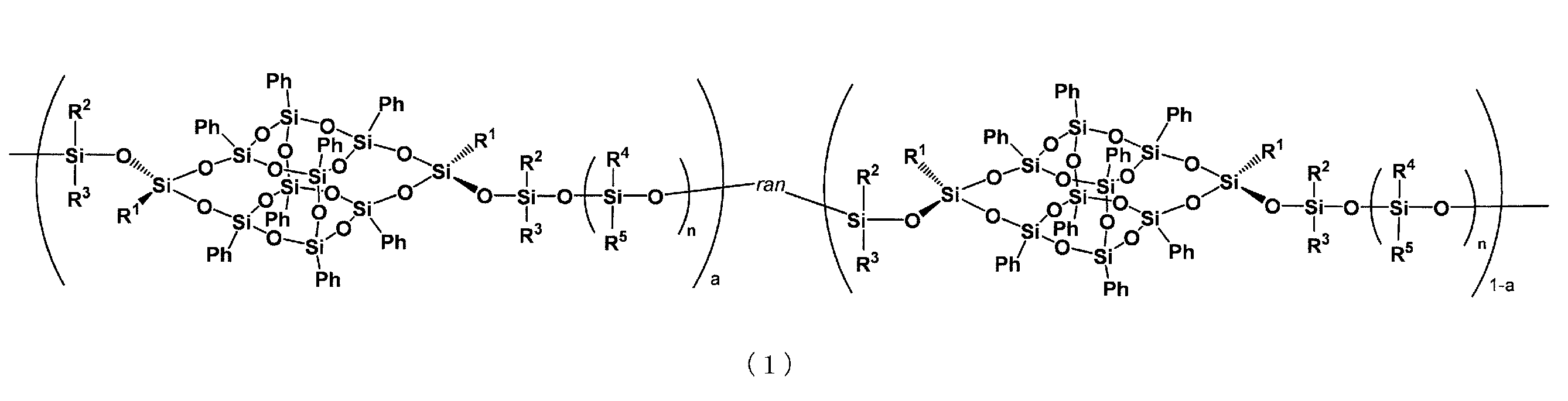
(式中、R1、R2及びR3はそれぞれ独立に炭素数1から3のアルキル基又はフェニル基を表す。R4及びR5はそれぞれ独立にハロゲン原子で置換されていてもよい炭素数1から3のアルキル基又はハロゲン原子で置換されていてもよいフェニル基を表す。aは1から0.7の範囲をとる実数、又は0から0.3の範囲をとる実数を表す。nは2から20の範囲をとる実数を表す。ranは、不規則共重合体であることを表す。)で示される
かご状シロキサン含有高分子。 General formula (1)
(In the formula, R 1 , R 2 and R 3 each independently represent an alkyl group having 1 to 3 carbon atoms or a phenyl group; R 4 and R 5 each independently represent an alkyl group having 1 to 3 carbon atoms which may be substituted with a halogen atom or a phenyl group which may be substituted with a halogen atom; a represents a real number ranging from 1 to 0.7, or a real number ranging from 0 to 0.3; n represents a real number ranging from 2 to 20; and ran represents an irregular copolymer.)
前記架橋剤が、アルコキシ置換モノシラン又はパーアルコキシオリゴシロキサンである、硬化膜。 A cured film obtained by thermally curing a composition comprising the cage-shaped siloxane-containing polymer according to claim 1, a crosslinking agent, and a crosslinking catalyst,
The cured film, wherein the crosslinker is an alkoxy-substituted monosilane or peralkoxyoligosiloxane.

(式中、R1、R2及びR3はそれぞれ独立に炭素数1から3のアルキル基又はフェニル基を表す。)で示されるトランス型かご状シロキサン化合物、および、一般式(2b)

(式中、R1、R2及びR3はそれぞれ独立に炭素数1から3のアルキル基又はフェニル基を表す。)で示されるシス型かご状シロキサン化合物、の一方または両方を含むかご状シロキサン化合物であって、前記シス型かご状シロキサン化合物または前記トランス型かご状シロキサン化合物のいずれかを70モル%以上含むかご状シロキサン化合物と、一般式(3)

(式中、R4及びR5は、それぞれ独立にハロゲン原子で置換されていてもよい炭素数1から3のアルキル基又はハロゲン原子で置換されていてもよいフェニル基を表す。Xは水素原子、メチル基又はエチル基を表す。mは2から10の整数を表す。)で示される直鎖シロキサン化合物、または一般式(3’)

(式中、R4及びR5は、それぞれ独立にハロゲン原子で置換されていてもよい炭素数1から3のアルキル基又はハロゲン原子で置換されていてもよいフェニル基を表す。)で示される環状シロキサン化合物、
とを、酸触媒存在下で反応させることを特徴とする、一般式(1)
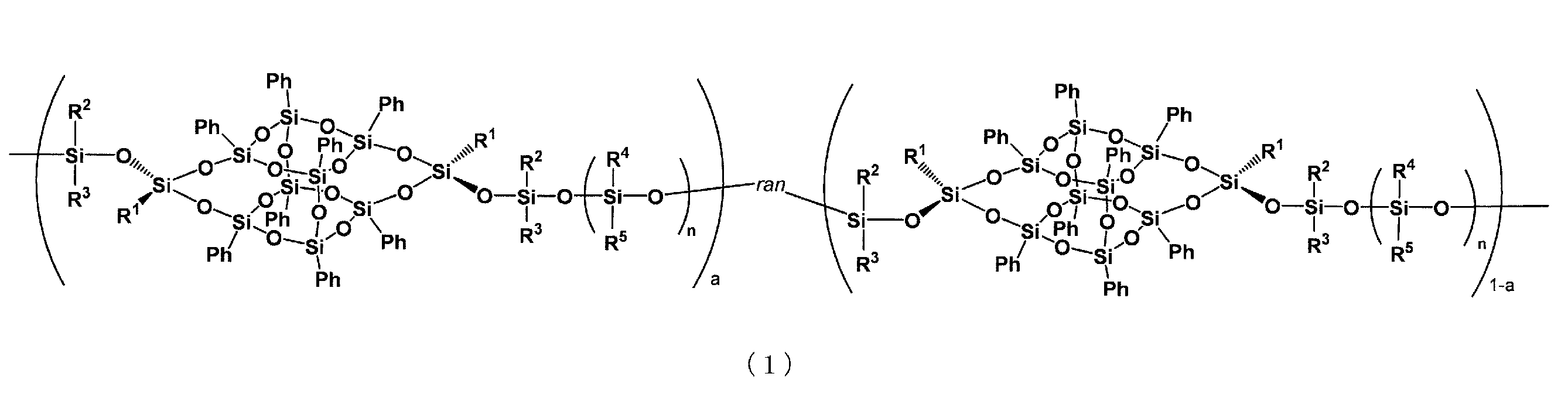
(式中、R1、R2及びR3はそれぞれ独立に炭素数1から3のアルキル基又はフェニル基を表す。R4及びR5はそれぞれ独立にハロゲン原子で置換されていてもよい炭素数1から3のアルキル基又はハロゲン原子で置換されていてもよいフェニル基を表す。aは1から0.7の範囲をとる実数、又は0から0.3の範囲をとる実数を表す。nは2から20の範囲をとる実数を表す。ranは、不規則共重合体であることを表す。)で示される
かご状シロキサン含有高分子の製造方法。 General formula (2a)
(wherein R 1 , R 2 and R 3 each independently represent an alkyl group having 1 to 3 carbon atoms or a phenyl group), and a trans-type cage siloxane compound represented by the general formula (2b):
(wherein R 1 , R 2 and R 3 each independently represent an alkyl group having 1 to 3 carbon atoms or a phenyl group), and a cage siloxane compound containing 70 mol % or more of the cis cage siloxane compound or the trans cage siloxane compound, and a cage siloxane compound represented by the general formula (3):
(wherein R 4 and R 5 each independently represent an alkyl group having 1 to 3 carbon atoms which may be substituted with a halogen atom or a phenyl group which may be substituted with a halogen atom; X represents a hydrogen atom, a methyl group or an ethyl group; and m represents an integer of 2 to 10), or a linear siloxane compound represented by the general formula (3′):
(wherein R 4 and R 5 each independently represent an alkyl group having 1 to 3 carbon atoms which may be substituted with a halogen atom, or a phenyl group which may be substituted with a halogen atom),
and a compound represented by the general formula (1) in the presence of an acid catalyst.
(In the formula, R1 , R2 , and R3 each independently represent an alkyl group having 1 to 3 carbon atoms or a phenyl group; R4 and R5 each independently represent an alkyl group having 1 to 3 carbon atoms which may be substituted with a halogen atom or a phenyl group which may be substituted with a halogen atom; a represents a real number ranging from 1 to 0.7, or a real number ranging from 0 to 0.3; n represents a real number ranging from 2 to 20; and ran represents an irregular copolymer.) A method for producing a cage-shaped siloxane-containing polymer represented by the formula:

(式中、R1、R2及びR3はそれぞれ独立に炭素数1から3のアルキル基又はフェニル基を表す。R4及びR5はそれぞれ独立にハロゲン原子で置換されていてもよい炭素数1
から3のアルキル基又はハロゲン原子で置換されていてもよいフェニル基を表す。aは1から0.7の範囲をとる実数、又は0から0.3の範囲をとる実数を表す。nは2から20の範囲をとる実数を表す。ranは、不規則共重合体であることを表す。)で示される
かご状シロキサン含有高分子を製造する方法であって、一般式(4)

(式中、R1は炭素数1から3のアルキル基又はフェニル基を表す。)で示されるかご状シロキサンジオールを晶析し、一般式(4a)
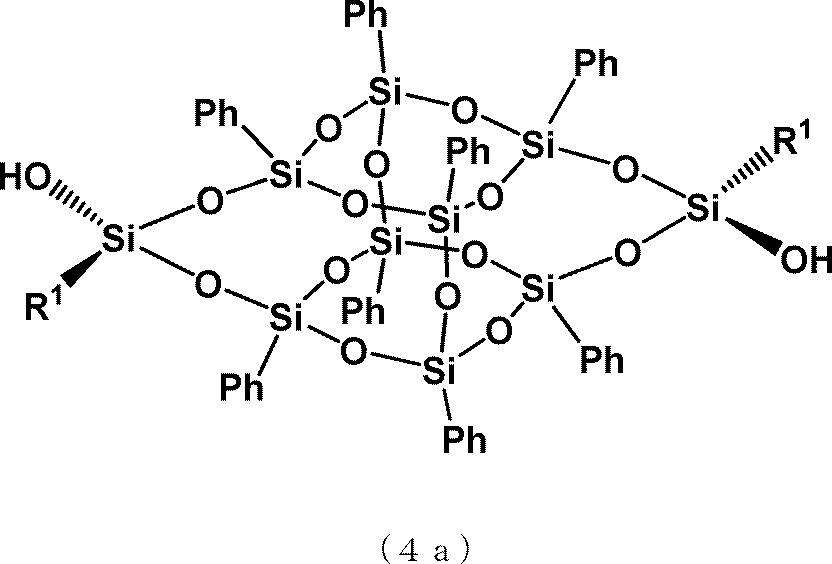
(式中、R1は炭素数1から3のアルキル基又はフェニル基を表す。)で示されるトランス型かご状シロキサンジオール、又は一般式(4b)
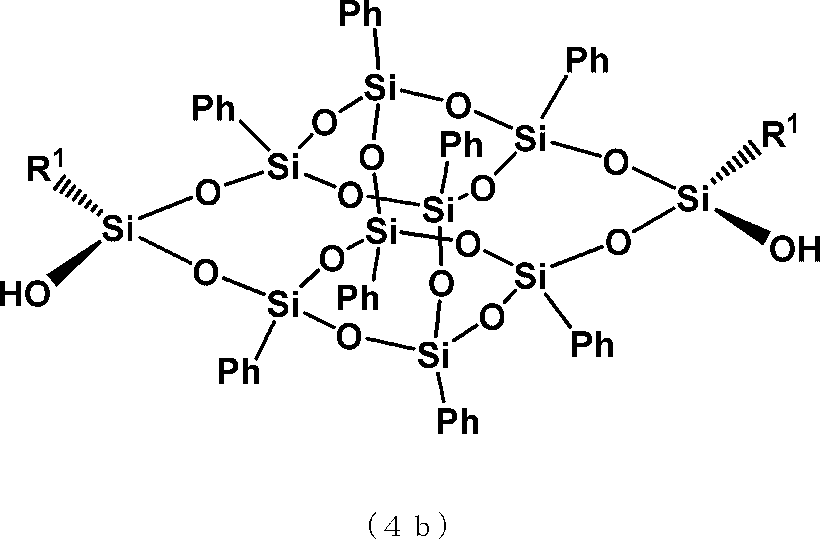
(式中、R1は炭素数1から3のアルキル基又はフェニル基を表す。)で示されるシス型かご状シロキサンジオールのいずれかを70モル%以上に富化する工程、
前記工程で得られた一般式(4a)又は(4b)で示されるかご状シロキサンジオールのいずれかを70モル%以上含むかご状シロキサンジオールと、クロロヒドロシランR2R3HSiCl(式中、R2及びR3はそれぞれ独立に炭素数1から3のアルキル基又はフェニル基を表す。)とを反応させ、一般式(2a)

(式中、R1、R2及びR3はそれぞれ独立に炭素数1から3のアルキル基又はフェニル基を表す。)で示されるトランス型かご状シロキサン化合物、又は、一般式(2b)

(式中、R1、R2及びR3はそれぞれ独立に炭素数1から3のアルキル基又はフェニル基を表す。)で示されるシス型かご状シロキサン化合物のいずれかを70モル%以上含むかご状シロキサン化合物を得る工程、および
前記工程で得られた一般式(2a)又は(2b)で示されるかご状シロキサン化合物のいずれかを70モル%以上含むかご状シロキサン化合物と、一般式(3)

(式中、R4及びR5は、それぞれ独立にハロゲン原子で置換されていてもよい炭素数1から3のアルキル基又はハロゲン原子で置換されていてもよいフェニル基を表す。Xは水素原子、メチル基又はエチル基を表す。mは2から10の整数を表す。)で示される直鎖シロキサン化合物、または
一般式(3’)

とを酸触媒存在下で反応させる工程、
を含むことを特徴とする、方法。 General formula (1)
(In the formula, R 1 , R 2 and R 3 each independently represent an alkyl group having 1 to 3 carbon atoms or a phenyl group. R 4 and R 5 each independently represent a phenyl group having 1 carbon atom which may be substituted with a halogen atom.
represents a real number ranging from 1 to 0.7, or a real number ranging from 0 to 0.3; n represents a real number ranging from 2 to 20; and ran represents an irregular copolymer.
(wherein R 1 represents an alkyl group having 1 to 3 carbon atoms or a phenyl group), and crystallizing a cage-shaped siloxane diol represented by the general formula (4a):
(wherein R 1 represents an alkyl group having 1 to 3 carbon atoms or a phenyl group), or a trans-type cage siloxane diol represented by the general formula (4b):
(wherein R 1 represents an alkyl group having 1 to 3 carbon atoms or a phenyl group),
The cage siloxane diol containing 70 mol % or more of the cage siloxane diol represented by the general formula (4a) or (4b) obtained in the above step is reacted with chlorohydrosilane R 2 R 3 HSiCl (wherein R 2 and R 3 each independently represent an alkyl group or a phenyl group having 1 to 3 carbon atoms) to obtain a cage siloxane diol represented by the general formula (2a):
(wherein R 1 , R 2 and R 3 each independently represent an alkyl group having 1 to 3 carbon atoms or a phenyl group), or a trans-type cage siloxane compound represented by the general formula (2b):
(wherein R 1 , R 2 and R 3 each independently represent an alkyl group or a phenyl group having 1 to 3 carbon atoms), and reacting the cage siloxane compound containing 70 mol % or more of any of the cage siloxane compounds represented by general formula (2a) or (2b) obtained in the above step with a cage siloxane compound represented by general formula (3):
(wherein R 4 and R 5 each independently represent an alkyl group having 1 to 3 carbon atoms which may be substituted with a halogen atom or a phenyl group which may be substituted with a halogen atom; X represents a hydrogen atom, a methyl group or an ethyl group; and m represents an integer of 2 to 10), or a linear siloxane compound represented by the general formula (3′):
in the presence of an acid catalyst;
A method comprising:

(式中、R1は炭素数1から3のアルキル基又はフェニル基を表す。)で示されるかご状シロキサンジオールをケトン又はエーテル溶媒から晶析し、一般式(4a)

(式中、R1は炭素数1から3のアルキル基又はフェニル基を表す。)で示されるトランス型かご状シロキサンジオール、又は一般式(4b)

(式中、R1は炭素数1から3のアルキル基又はフェニル基を表す。)で示されるシス型かご状シロキサンジオールのいずれかを70モル%以上に富化する方法。 General formula (4)
(wherein R 1 represents an alkyl group having 1 to 3 carbon atoms or a phenyl group), is crystallized from a ketone or ether solvent to obtain a cage-shaped siloxane diol represented by the general formula (4a):
(wherein R 1 represents an alkyl group having 1 to 3 carbon atoms or a phenyl group), or a trans-type cage siloxane diol represented by the general formula (4b):
(wherein R 1 represents an alkyl group having 1 to 3 carbon atoms or a phenyl group) to be enriched to 70 mol % or more.
Priority Applications (1)
| Application Number | Priority Date | Filing Date | Title |
|---|---|---|---|
| JP2020063794A JP7689416B2 (en) | 2020-03-31 | 2020-03-31 | Cage-shaped siloxane-containing polymer, cage-shaped siloxane, and method for producing same |
Applications Claiming Priority (1)
| Application Number | Priority Date | Filing Date | Title |
|---|---|---|---|
| JP2020063794A JP7689416B2 (en) | 2020-03-31 | 2020-03-31 | Cage-shaped siloxane-containing polymer, cage-shaped siloxane, and method for producing same |
Publications (2)
| Publication Number | Publication Date |
|---|---|
| JP2021161226A JP2021161226A (en) | 2021-10-11 |
| JP7689416B2 true JP7689416B2 (en) | 2025-06-06 |
Family
ID=78004425
Family Applications (1)
| Application Number | Title | Priority Date | Filing Date |
|---|---|---|---|
| JP2020063794A Active JP7689416B2 (en) | 2020-03-31 | 2020-03-31 | Cage-shaped siloxane-containing polymer, cage-shaped siloxane, and method for producing same |
Country Status (1)
| Country | Link |
|---|---|
| JP (1) | JP7689416B2 (en) |
Citations (1)
| Publication number | Priority date | Publication date | Assignee | Title |
|---|---|---|---|---|
| JP2010120901A (en) | 2008-11-21 | 2010-06-03 | Konishi Kagaku Ind Co Ltd | Completely fused oligosilsesquioxane stereoisomer, polymer using the same and method for producing them |
-
2020
- 2020-03-31 JP JP2020063794A patent/JP7689416B2/en active Active
Patent Citations (1)
| Publication number | Priority date | Publication date | Assignee | Title |
|---|---|---|---|---|
| JP2010120901A (en) | 2008-11-21 | 2010-06-03 | Konishi Kagaku Ind Co Ltd | Completely fused oligosilsesquioxane stereoisomer, polymer using the same and method for producing them |
Non-Patent Citations (1)
| Title |
|---|
| Industrial & Engineering Chemistry Research,2019年,Vol.58,No.1,p.403-410 |
Also Published As
| Publication number | Publication date |
|---|---|
| JP2021161226A (en) | 2021-10-11 |
Similar Documents
| Publication | Publication Date | Title |
|---|---|---|
| CN107108663B (en) | Hydrosilylation process using an organocatalyst derived from germanene | |
| CN107849068B (en) | Method for preparing polyhedral oligomeric silsesquioxanes | |
| JP4470738B2 (en) | Silsesquioxane derivatives | |
| JPH08311205A (en) | Carbosilane-dendrimer,carbosilane-hybrid material,productionthereof,and production of coating material from the carbosilane-dendrimer | |
| JP6702616B2 (en) | High-purity aminosiloxane | |
| JP2006022207A (en) | Silicon compounds | |
| EP0728793A1 (en) | Method for preparation of polyorganosiloxane resin, optionally alkoxylated, through non-hydrolytic condensation | |
| JP5990909B2 (en) | One-end functional group-containing organopolysiloxane and method for producing the same | |
| WO2003091186A2 (en) | Azasilanes and methods for making and using the same | |
| JP2010120901A (en) | Completely fused oligosilsesquioxane stereoisomer, polymer using the same and method for producing them | |
| EP1539861A1 (en) | Process for the preparation of polyorganosilylated carboxylate monomers or polymers thereof | |
| JP3652151B2 (en) | Method for producing curable polymethylsilsesquioxane | |
| CN107922442B (en) | Organosilicon compounds having (meth) acrylate groups and method for producing the same | |
| TW201925144A (en) | Siloxane compound and method for producing same, (co)polymer, ophthalmic device | |
| JP3801208B2 (en) | Curable polymethylsilsesquioxane composition | |
| JP7689416B2 (en) | Cage-shaped siloxane-containing polymer, cage-shaped siloxane, and method for producing same | |
| US20060041098A1 (en) | Synthesis and characterization of novel cyclosiloxanes and their self- and co-condensation with silanol-terminated polydimethylsiloxane | |
| JPH0275635A (en) | Diorganopolysiloxane containing thioalkyl acrylate functional group | |
| JP5601270B2 (en) | Silazane compound having fluoroalkyl group and method for producing the same | |
| KR101208460B1 (en) | Process for assembly of poss monomers | |
| JP2014101458A (en) | Organopolysiloxane, and production method thereof | |
| CN115916793A (en) | Process for the preparation of siloxanes | |
| KR20100099322A (en) | Material for formation of nickel-containing film, and method for production thereof | |
| JP5079245B2 (en) | Polymerization method and polymer of oxetane derivative having substituent at 3-position | |
| JP7324170B2 (en) | Method for producing silicone compound |
Legal Events
| Date | Code | Title | Description |
|---|---|---|---|
| A80 | Written request to apply exceptions to lack of novelty of invention |
Free format text: JAPANESE INTERMEDIATE CODE: A80 Effective date: 20200430 |
|
| A621 | Written request for application examination |
Free format text: JAPANESE INTERMEDIATE CODE: A621 Effective date: 20221012 |
|
| A977 | Report on retrieval |
Free format text: JAPANESE INTERMEDIATE CODE: A971007 Effective date: 20230719 |
|
| A131 | Notification of reasons for refusal |
Free format text: JAPANESE INTERMEDIATE CODE: A131 Effective date: 20230905 |
|
| A521 | Request for written amendment filed |
Free format text: JAPANESE INTERMEDIATE CODE: A523 Effective date: 20231024 |
|
| A131 | Notification of reasons for refusal |
Free format text: JAPANESE INTERMEDIATE CODE: A131 Effective date: 20240130 |
|
| A521 | Request for written amendment filed |
Free format text: JAPANESE INTERMEDIATE CODE: A523 Effective date: 20240313 |
|
| A131 | Notification of reasons for refusal |
Free format text: JAPANESE INTERMEDIATE CODE: A131 Effective date: 20240702 |
|
| A521 | Request for written amendment filed |
Free format text: JAPANESE INTERMEDIATE CODE: A523 Effective date: 20240821 |
|
| A131 | Notification of reasons for refusal |
Free format text: JAPANESE INTERMEDIATE CODE: A131 Effective date: 20241203 |
|
| A521 | Request for written amendment filed |
Free format text: JAPANESE INTERMEDIATE CODE: A523 Effective date: 20250128 |
|
| TRDD | Decision of grant or rejection written | ||
| A01 | Written decision to grant a patent or to grant a registration (utility model) |
Free format text: JAPANESE INTERMEDIATE CODE: A01 Effective date: 20250507 |
|
| A61 | First payment of annual fees (during grant procedure) |
Free format text: JAPANESE INTERMEDIATE CODE: A61 Effective date: 20250527 |
|
| R150 | Certificate of patent or registration of utility model |
Ref document number: 7689416 Country of ref document: JP Free format text: JAPANESE INTERMEDIATE CODE: R150 |