JP7680902B2 - Aminopeptidases for Protein Hydrolysis - Google Patents
Aminopeptidases for Protein Hydrolysis Download PDFInfo
- Publication number
- JP7680902B2 JP7680902B2 JP2021126487A JP2021126487A JP7680902B2 JP 7680902 B2 JP7680902 B2 JP 7680902B2 JP 2021126487 A JP2021126487 A JP 2021126487A JP 2021126487 A JP2021126487 A JP 2021126487A JP 7680902 B2 JP7680902 B2 JP 7680902B2
- Authority
- JP
- Japan
- Prior art keywords
- seq
- amino acid
- acid sequence
- polypeptide
- sequence
- Prior art date
- Legal status (The legal status is an assumption and is not a legal conclusion. Google has not performed a legal analysis and makes no representation as to the accuracy of the status listed.)
- Active
Links
Images


Classifications
-
- C—CHEMISTRY; METALLURGY
- C12—BIOCHEMISTRY; BEER; SPIRITS; WINE; VINEGAR; MICROBIOLOGY; ENZYMOLOGY; MUTATION OR GENETIC ENGINEERING
- C12N—MICROORGANISMS OR ENZYMES; COMPOSITIONS THEREOF; PROPAGATING, PRESERVING, OR MAINTAINING MICROORGANISMS; MUTATION OR GENETIC ENGINEERING; CULTURE MEDIA
- C12N9/00—Enzymes; Proenzymes; Compositions thereof; Processes for preparing, activating, inhibiting, separating or purifying enzymes
- C12N9/14—Hydrolases (3)
- C12N9/48—Hydrolases (3) acting on peptide bonds (3.4)
- C12N9/485—Exopeptidases (3.4.11-3.4.19)
-
- C—CHEMISTRY; METALLURGY
- C12—BIOCHEMISTRY; BEER; SPIRITS; WINE; VINEGAR; MICROBIOLOGY; ENZYMOLOGY; MUTATION OR GENETIC ENGINEERING
- C12C—BEER; PREPARATION OF BEER BY FERMENTATION; PREPARATION OF MALT FOR MAKING BEER; PREPARATION OF HOPS FOR MAKING BEER
- C12C1/00—Preparation of malt
- C12C1/027—Germinating
- C12C1/047—Influencing the germination by chemical or physical means
-
- C—CHEMISTRY; METALLURGY
- C12—BIOCHEMISTRY; BEER; SPIRITS; WINE; VINEGAR; MICROBIOLOGY; ENZYMOLOGY; MUTATION OR GENETIC ENGINEERING
- C12C—BEER; PREPARATION OF BEER BY FERMENTATION; PREPARATION OF MALT FOR MAKING BEER; PREPARATION OF HOPS FOR MAKING BEER
- C12C11/00—Fermentation processes for beer
- C12C11/003—Fermentation of beerwort
-
- C—CHEMISTRY; METALLURGY
- C12—BIOCHEMISTRY; BEER; SPIRITS; WINE; VINEGAR; MICROBIOLOGY; ENZYMOLOGY; MUTATION OR GENETIC ENGINEERING
- C12C—BEER; PREPARATION OF BEER BY FERMENTATION; PREPARATION OF MALT FOR MAKING BEER; PREPARATION OF HOPS FOR MAKING BEER
- C12C5/00—Other raw materials for the preparation of beer
- C12C5/004—Enzymes
-
- C—CHEMISTRY; METALLURGY
- C12—BIOCHEMISTRY; BEER; SPIRITS; WINE; VINEGAR; MICROBIOLOGY; ENZYMOLOGY; MUTATION OR GENETIC ENGINEERING
- C12N—MICROORGANISMS OR ENZYMES; COMPOSITIONS THEREOF; PROPAGATING, PRESERVING, OR MAINTAINING MICROORGANISMS; MUTATION OR GENETIC ENGINEERING; CULTURE MEDIA
- C12N1/00—Microorganisms, e.g. protozoa; Compositions thereof; Processes of propagating, maintaining or preserving microorganisms or compositions thereof; Processes of preparing or isolating a composition containing a microorganism; Culture media therefor
- C12N1/14—Fungi; Culture media therefor
-
- C—CHEMISTRY; METALLURGY
- C12—BIOCHEMISTRY; BEER; SPIRITS; WINE; VINEGAR; MICROBIOLOGY; ENZYMOLOGY; MUTATION OR GENETIC ENGINEERING
- C12N—MICROORGANISMS OR ENZYMES; COMPOSITIONS THEREOF; PROPAGATING, PRESERVING, OR MAINTAINING MICROORGANISMS; MUTATION OR GENETIC ENGINEERING; CULTURE MEDIA
- C12N15/00—Mutation or genetic engineering; DNA or RNA concerning genetic engineering, vectors, e.g. plasmids, or their isolation, preparation or purification; Use of hosts therefor
- C12N15/09—Recombinant DNA-technology
- C12N15/63—Introduction of foreign genetic material using vectors; Vectors; Use of hosts therefor; Regulation of expression
- C12N15/79—Vectors or expression systems specially adapted for eukaryotic hosts
- C12N15/80—Vectors or expression systems specially adapted for eukaryotic hosts for fungi
-
- C—CHEMISTRY; METALLURGY
- C12—BIOCHEMISTRY; BEER; SPIRITS; WINE; VINEGAR; MICROBIOLOGY; ENZYMOLOGY; MUTATION OR GENETIC ENGINEERING
- C12P—FERMENTATION OR ENZYME-USING PROCESSES TO SYNTHESISE A DESIRED CHEMICAL COMPOUND OR COMPOSITION OR TO SEPARATE OPTICAL ISOMERS FROM A RACEMIC MIXTURE
- C12P21/00—Preparation of peptides or proteins
- C12P21/06—Preparation of peptides or proteins produced by the hydrolysis of a peptide bond, e.g. hydrolysate products
-
- C—CHEMISTRY; METALLURGY
- C12—BIOCHEMISTRY; BEER; SPIRITS; WINE; VINEGAR; MICROBIOLOGY; ENZYMOLOGY; MUTATION OR GENETIC ENGINEERING
- C12Y—ENZYMES
- C12Y304/00—Hydrolases acting on peptide bonds, i.e. peptidases (3.4)
- C12Y304/11—Aminopeptidases (3.4.11)
-
- C—CHEMISTRY; METALLURGY
- C07—ORGANIC CHEMISTRY
- C07K—PEPTIDES
- C07K2319/00—Fusion polypeptide
- C07K2319/01—Fusion polypeptide containing a localisation/targetting motif
- C07K2319/02—Fusion polypeptide containing a localisation/targetting motif containing a signal sequence
Landscapes
- Chemical & Material Sciences (AREA)
- Life Sciences & Earth Sciences (AREA)
- Organic Chemistry (AREA)
- Engineering & Computer Science (AREA)
- Health & Medical Sciences (AREA)
- Genetics & Genomics (AREA)
- Zoology (AREA)
- Wood Science & Technology (AREA)
- Bioinformatics & Cheminformatics (AREA)
- General Engineering & Computer Science (AREA)
- General Health & Medical Sciences (AREA)
- Biochemistry (AREA)
- Biotechnology (AREA)
- Microbiology (AREA)
- Biomedical Technology (AREA)
- Molecular Biology (AREA)
- Food Science & Technology (AREA)
- Medicinal Chemistry (AREA)
- Mycology (AREA)
- Physiology (AREA)
- Physics & Mathematics (AREA)
- Chemical Kinetics & Catalysis (AREA)
- General Chemical & Material Sciences (AREA)
- Plant Pathology (AREA)
- Biophysics (AREA)
- Tropical Medicine & Parasitology (AREA)
- Botany (AREA)
- Virology (AREA)
- Enzymes And Modification Thereof (AREA)
- Micro-Organisms Or Cultivation Processes Thereof (AREA)
- Distillation Of Fermentation Liquor, Processing Of Alcohols, Vinegar And Beer (AREA)
- Seasonings (AREA)
- Preparation Of Compounds By Using Micro-Organisms (AREA)
- Cereal-Derived Products (AREA)
Description
関連出願の相互参照
本願は、2015年6月26日に出願された米国仮特許出願第62/185503号お
よび2015年10月1日に出願された同第62/235937号の優先権および利益を
主張するものであり、各仮出願の発明の名称は「新規のタンパク質加水分解用アミノペプ
チダーゼ」である。
CROSS-REFERENCE TO RELATED APPLICATIONS This application claims priority to and the benefit of U.S. Provisional Patent Application No. 62/185,503, filed June 26, 2015, and No. 62/235,937, filed October 1, 2015, each of which is entitled "NOVEL AMINOPEPTIDASES FOR PROTEIN HYDROLYSIS."
配列表の参照による組み込み
2016年6月10日に作成され、本明細書とともに提出された、192,505バイ
トのサイズを有する「20160610_NB40989-PCT sequence
listing prj_ST25.txt」という名のファイルに示された配列表は、
参照によりその全体が本明細書に組み込まれる。
INCORPORATION BY REFERENCE OF SEQUENCE LISTING "20160610_NB40989-PCT sequence listing" was created on June 10, 2016, and filed herewith, and has a size of 192,505 bytes.
The sequence listing shown in the file named "listing prj_ST25.txt" is
No. 6,399,433, which is incorporated herein by reference in its entirety.
各種食品および餌料製品にはタンパク質加水分解物が含まれている。この加水分解は、
従来、化学的加水分解により行われてきた。しかしながら、そのような化学的加水分解は
、加水分解中に得られるアミノ酸を大量に分解し、また、化学反応の過程で有害な副生物
を生成する。化学的加水分解により得られるタンパク質加水分解物を使用することの懸念
の増大が、酵素を使用した加水分解プロセスの開発に繋がっている。
Various food and feed products contain protein hydrolysates. This hydrolysis:
Traditionally, this has been done by chemical hydrolysis. However, such chemical hydrolysis degrades a large amount of the amino acids obtained during hydrolysis and also generates harmful by-products during the chemical reaction. Increasing concerns about using protein hydrolysates obtained by chemical hydrolysis have led to the development of hydrolysis processes using enzymes.
タンパク性物質の酵素による加水分解プロセスは、高い加水分解度を得ることを目標と
している。アミノペプチダーゼ活性を有するポリペプチドは、ペプチド、ポリペプチドお
よびタンパク質のN末端からの1つ以上のアミノ酸残基の除去を触媒する。所望の特性お
よび高い加水分解度を有するタンパク質加水分解物を生成するには、一般に、ペプチダー
ゼ活性物を混合して使用する必要がある。単独で、または他の酵素と組み合わされて、食
品および餌料製品に使用されるタンパク質加水分解物の特性および加水分解度の改善に有
用な活性を有する単一成分のペプチダーゼ酵素を提供することが望まれる。
The enzymatic hydrolysis process of proteinaceous materials aims to obtain a high degree of hydrolysis. Polypeptides with aminopeptidase activity catalyze the removal of one or more amino acid residues from the N-terminus of peptides, polypeptides and proteins. To produce protein hydrolysates with desired properties and a high degree of hydrolysis, it is generally necessary to use a mixture of peptidase activities. It is desirable to provide a single component peptidase enzyme with activity that is useful alone or in combination with other enzymes to improve the properties and degree of hydrolysis of protein hydrolysates used in food and feed products.
本開示は、アミノペプチダーゼ活性が高い新規なポリペプチド、ならびに、望ましい品
質および高い加水分解度を有するタンパク質加水分解物を得る方法を提供する。
The present disclosure provides novel polypeptides with high aminopeptidase activity and methods for obtaining protein hydrolysates of desirable quality and high degree of hydrolysis.
本発明の特徴および利点は、発明の原理が用いられている実施形態を記載した以下の説
明、およびその添付図面を参照することにより、より深く理解できるであろう。
A better understanding of the features and advantages of the present invention will be obtained by reference to the following detailed description that sets forth an embodiment, in which the principles of the invention are utilized, and the accompanying drawings of which:
本開示はアミノペプチダーゼ活性を有するポリペプチドを提供する。本発明はまた、そ
のポリペプチドをコードする核酸配列、その核酸配列を含む核酸コンストラクト、ベクタ
ーおよび宿主細胞、ならびに、そのポリペプチドを生成する方法に関する。本開示はまた
、タンパク性基質から加水分解物を得る方法であって、タンパク性物質を、単独の、また
はプロテアーゼ、例えばエンドペプチダーゼと組み合わせたアミノペプチダーゼ活性を有
するポリペプチドに曝すことを含む方法に関する。本開示はまた、タンパク性基質から、
遊離グルタミン酸および/またはグルタミン酸残基を結合したペプチドに富む加水分解物
を得る方法であって、基質を、アミノペプチダーゼ活性を有するポリペプチドに曝すこと
を含む方法に関する。本開示はさらに、アミノペプチダーゼ活性を有するポリペプチドを
含む風味改善組成物に関する。組成物はさらに、追加の酵素活性を含んでもよい。
The present disclosure provides a polypeptide having aminopeptidase activity. The present disclosure also relates to nucleic acid sequences encoding the polypeptide, nucleic acid constructs, vectors and host cells comprising the nucleic acid sequences, as well as methods for producing the polypeptide. The present disclosure also relates to a method for obtaining a hydrolysate from a proteinaceous substrate, comprising exposing the proteinaceous material to a polypeptide having aminopeptidase activity, alone or in combination with a protease, such as an endopeptidase. The present disclosure also relates to a method for obtaining a hydrolysate from a proteinaceous substrate, comprising exposing the proteinaceous substrate to a polypeptide having aminopeptidase activity, alone or in combination with a protease, such as an endopeptidase.
The present disclosure relates to a method for obtaining a hydrolysate enriched in free glutamic acid and/or peptides with bound glutamic acid residues, comprising exposing a substrate to a polypeptide having aminopeptidase activity. The present disclosure further relates to a flavor improving composition comprising a polypeptide having aminopeptidase activity. The composition may further comprise an additional enzymatic activity.
他の態様において、本明細書に記載の方法は、ベーキングなど、食品関連用途で風味を
向上させるために使用され得る。あるいは、食品における風味改善は、本発明の方法によ
って得られる加水分解物の添加によって達成され得る。いくつかの実施形態において、本
明細書に記載のアミノペプチダーゼを使用して生成される加水分解物はまた、未処理の加
水分解物に比べて、苦味を低減することができる。
In other aspects, the methods described herein can be used to improve flavor in food-related applications, such as baking. Alternatively, flavor improvement in foods can be achieved by the addition of hydrolysates obtained by the methods of the present invention. In some embodiments, hydrolysates produced using the aminopeptidases described herein can also have reduced bitterness compared to untreated hydrolysates.
いくつかの実施形態において、本発明は、新しい真菌アミノペプチダーゼ(PepN)
、産生宿主(例えば、トリコデルマ・リーゼイ(Trichoderma reesei
))におけるそれらの高収率での産生、ならびに、例えば苦味除去用、およびグルタミン
酸生成用のタンパク質加水分解物を生成するためのそれらの使用を提供する。実施例9に
示すように、本発明の2型アミノペプチダーゼは、1型アミノペプチダーゼと比べて、グ
ルタミン酸の放出が向上した。初期の結果は、驚くべきことに、これらのPepNが、他
の既知のアミノペプチダーゼと比べて、P1中のプロリンに対し、耐性を有することを示
唆している。したがって、本発明において使用するために教示されるプロリン耐性アミノ
ペプチダーゼは、広範なペプチドおよび/またはタンパク質基質に作用し得、そのような
広い基質特異性を有することに起因して、特定のアミノ酸(例えば、プロリンおよび/ま
たはリジンおよび/またはアルギニンおよび/またはグリシン)に富む基質の開裂を容易
には阻害されない。
In some embodiments, the present invention provides a novel fungal aminopeptidase (PepN).
, a production host (e.g., Trichoderma reesei
)) and their use for producing protein hydrolysates for, for example, debittering and glutamic acid production. As shown in Example 9, the
驚いたことに、本発明者らは、2型アミノペプチダーゼが1型アミノペプチダーゼより
優れた能力を有することを見出した。さらに、本発明者らは、驚いたことに、良好な能力
を有する一群の真菌2型アミノペプチダーゼを見出した。この一群の真菌2型アミノペプ
チダーゼは、それらの成熟アミノ酸配列中に長いN末端を有している。図9は、いくつか
の2型アミノペプチダーゼのアミノ酸配列のアライメントを示している。
Surprisingly, the inventors have found that
「アミノペプチダーゼ活性」という用語は、本明細書においては、ペプチド、オリゴペ
プチドまたはタンパク質のN末端からのアミノ酸の切断を触媒するペプチダーゼ活性と定
義される。一般的な定義では、アミノペプチダーゼ活性は、ペプチド、オリゴペプチドま
たはタンパク質のN末端からアミノ酸X(ここで、Xは、Ala、Arg、Asn、As
p、Cys、Gln、Glu、Gly、His、Ile、Leu、Lys、Met、Ph
e、Pro、Ser、Thr、Trp、Tyr、およびValからなる群から選択される
アミノ酸残基、少なくともLeu、Glu、Gly、Ala、および/またはProの残
基であり得る)を開裂することができる。本発明のアミノペプチダーゼ活性を有するポリ
ペプチドが、ペプチド、ポリペプチド基質のN末端から開裂させるアミノ酸に関し非特異
的であり得ることは理解されよう。
The term "aminopeptidase activity" is defined herein as a peptidase activity that catalyzes the cleavage of an amino acid from the N-terminus of a peptide, oligopeptide or protein. In a general definition, aminopeptidase activity catalyzes the cleavage of an amino acid X (wherein X is Ala, Arg, Asn, As,
p, Cys, Gln, Glu, Gly, His, Ile, Leu, Lys, Met, Ph
The amino acid residues selected from the group consisting of Leu, Glu, Gly, Ala, and Val, which may be at least Leu, Glu, Gly, Ala, and/or Pro. It will be appreciated that the polypeptides with aminopeptidase activity of the present invention may be non-specific with regard to the amino acid that is cleaved from the N-terminus of a peptide, polypeptide substrate.
いくつかの実施形態において、本発明は、図9の配列アライメントに示すように、67
位の保存残基I/VのN末端側に13を超える残基を含む予測成熟配列を有する、アミノ
ペプチダーゼ活性を有する単離ポリペプチド、またはそのフラグメントに関し、但し、そ
のフラグメントはアミノペプチダーゼ活性を有する。
In some embodiments, the present invention provides a method for the preparation of a 67
The present invention relates to an isolated polypeptide having aminopeptidase activity, having a predicted mature sequence that includes more than 13 residues N-terminal to the conserved residues I/V at positions 1311-1315, or a fragment thereof, provided that the fragment has aminopeptidase activity.
いくつかの実施形態において、本発明は、配列番号1の成熟アミノ酸配列に対し、少な
くとも約50%、好ましくは少なくとも約60%、好ましくは少なくとも約70%、より
好ましくは少なくとも約80%、より一層好ましくは少なくとも約90%、最も好ましく
は少なくとも約95%、さらに最も好ましくは少なくとも約97%の同一性を有するアミ
ノ酸配列を有する単離ポリペプチドであって、アミノペプチダーゼ活性を有するポリペプ
チド(以下、「相同ポリペプチド」)に関する。いくつかの実施形態において、相同ポリ
ペプチドは、配列番号1のアミノ酸配列と、5個のアミノ酸、好ましくは4個のアミノ酸
、より好ましくは3個のアミノ酸、より一層好ましくは2個のアミノ酸、最も好ましくは
1個のアミノ酸が異なるアミノ酸配列を有する。いくつかの実施形態において、本発明の
ポリペプチドは、配列番号1のアミノ酸配列、成熟アミノ酸配列または対立遺伝子変異型
;およびそのフラグメントを含み、そのフラグメントはアミノペプチダーゼ活性を有する
。いくつかの実施形態において、本発明のポリペプチドは、配列番号1を含む。他の実施
形態において、本発明のポリペプチドは、配列番号1のアミノ酸配列、またはそのフラグ
メントを含み、そのフラグメントはアミノペプチダーゼ活性を有する。配列番号1のフラ
グメントは、このアミノ酸配列のアミノ末端および/またはカルボキシ末端から1個以上
のアミノ酸が削除されたポリペプチドである。いくつかの実施形態において、フラグメン
トは配列番号18の配列を含む。いくつかの実施形態において、ポリペプチドは配列番号
1のアミノ酸配列を有する。
In some embodiments, the present invention relates to an isolated polypeptide having an amino acid sequence that is at least about 50%, preferably at least about 60%, preferably at least about 70%, more preferably at least about 80%, even more preferably at least about 90%, most preferably at least about 95%, and even most preferably at least about 97% identical to the mature amino acid sequence of SEQ ID NO:1, and that has aminopeptidase activity (hereinafter, "homologous polypeptide"). In some embodiments, a homologous polypeptide has an amino acid sequence that differs from the amino acid sequence of SEQ ID NO:1 by 5 amino acids, preferably 4 amino acids, more preferably 3 amino acids, even more preferably 2 amino acids, and most preferably 1 amino acid. In some embodiments, a polypeptide of the present invention comprises the amino acid sequence of SEQ ID NO:1, a mature amino acid sequence, or an allelic variant; and fragments thereof, which fragments have aminopeptidase activity. In some embodiments, a polypeptide of the present invention comprises SEQ ID NO:1. In other embodiments, a polypeptide of the present invention comprises the amino acid sequence of SEQ ID NO:1, or fragments thereof, which fragments have aminopeptidase activity. A fragment of SEQ ID NO:1 is a polypeptide having one or more amino acids deleted from the amino and/or carboxy terminus of the amino acid sequence. In some embodiments, the fragment comprises the sequence of SEQ ID NO: 18. In some embodiments, the polypeptide has the amino acid sequence of SEQ ID NO:1.
いくつかの実施形態において、本発明は、配列番号2の成熟アミノ酸配列に対し少なく
とも約50%、好ましくは少なくとも約60%、好ましくは少なくとも約70%、より好
ましくは少なくとも約80%、より一層好ましくは少なくとも約90%、最も好ましくは
少なくとも約95%、さらに最も好ましくは少なくとも約97%の相同性を有するアミノ
酸配列を有する単離ポリペプチドであって、アミノペプチダーゼ活性を有するポリペプチ
ド(以下、「相同ポリペプチド」)に関する。いくつかの実施形態において、相同ポリペ
プチドは、配列番号2のアミノ酸配列と、5個のアミノ酸、好ましくは4個のアミノ酸、
より好ましくは3個のアミノ酸、より一層好ましくは2個のアミノ酸、最も好ましくは1
個のアミノ酸が異なるアミノ酸配列を有する。いくつかの実施形態において、本発明のポ
リペプチドは、配列番号2のアミノ酸配列、成熟アミノ酸配列または対立遺伝子変異型;
およびそのフラグメントを含み、そのフラグメントはアミノペプチダーゼ活性を有する。
いくつかの実施形態において、本発明のポリペプチドは、配列番号2のアミノ酸配列を含
む。他の実施形態において、本発明のポリペプチドは、配列番号2のアミノ酸配列、また
はそのフラグメントを含み、そのフラグメントはアミノペプチダーゼ活性を有する。配列
番号2のフラグメントは、このアミノ酸配列のアミノ末端および/またはカルボキシ末端
から1個以上のアミノ酸が削除されたポリペプチドである。いくつかの実施形態において
、フラグメントは配列番号19の配列を含む。いくつかの実施形態において、ポリペプチ
ドは配列番号2のアミノ酸配列を有する。
In some embodiments, the present invention relates to an isolated polypeptide having an amino acid sequence that is at least about 50%, preferably at least about 60%, preferably at least about 70%, more preferably at least about 80%, even more preferably at least about 90%, most preferably at least about 95%, and even most preferably at least about 97% identical to the mature amino acid sequence of SEQ ID NO: 2, and that has aminopeptidase activity (hereinafter, a "homologous polypeptide"). In some embodiments, a homologous polypeptide is one that is at least 5 amino acids, preferably 4 amino acids, or more similar to the amino acid sequence of SEQ ID NO: 2.
More preferably, 3 amino acids, even more preferably, 2 amino acids, and most preferably, 1
In some embodiments, the polypeptides of the invention have an amino acid sequence that differs by 10 amino acids.
and fragments thereof, which fragments have aminopeptidase activity.
In some embodiments, a polypeptide of the invention comprises the amino acid sequence of SEQ ID NO:2. In other embodiments, a polypeptide of the invention comprises the amino acid sequence of SEQ ID NO:2, or a fragment thereof, which fragment has aminopeptidase activity. A fragment of SEQ ID NO:2 is a polypeptide having one or more amino acids deleted from the amino and/or carboxy terminus of the amino acid sequence. In some embodiments, the fragment comprises the sequence of SEQ ID NO:19. In some embodiments, a polypeptide has the amino acid sequence of SEQ ID NO:2.
いくつかの実施形態において、本発明は、配列番号3の成熟アミノ酸配列に対し少なく
とも約50%、好ましくは少なくとも約60%、好ましくは少なくとも約70%、より好
ましくは少なくとも約80%、より一層好ましくは少なくとも約90%、最も好ましくは
少なくとも約95%、さらに最も好ましくは少なくとも約97%の相同性を有するアミノ
酸配列を有する単離ポリペプチドであって、アミノペプチダーゼ活性を有するポリペプチ
ド(以下、「相同ポリペプチド」)に関する。いくつかの実施形態において、相同ポリペ
プチドは、配列番号3のアミノ酸配列と、5個のアミノ酸、好ましくは4個のアミノ酸、
より好ましくは3個のアミノ酸、より一層好ましくは2個のアミノ酸、最も好ましくは1
個のアミノ酸が異なるアミノ酸配列を有する。いくつかの実施形態において、本発明のポ
リペプチドは、配列番号3のアミノ酸配列、成熟アミノ酸配列または対立遺伝子変異型;
およびそのフラグメントを含み、そのフラグメントはアミノペプチダーゼ活性を有する。
いくつかの実施形態において、本発明のポリペプチドは、配列番号3のアミノ酸配列を含
む。他の実施形態において、本発明のポリペプチドは、配列番号3のアミノ酸配列、また
はそのフラグメントを含み、そのフラグメントはアミノペプチダーゼ活性を有する。配列
番号3のフラグメントは、このアミノ酸配列のアミノ末端および/またはカルボキシ末端
から1個以上のアミノ酸が削除されたポリペプチドである。いくつかの実施形態において
、フラグメントは配列番号20の配列を含む。いくつかの実施形態において、ポリペプチ
ドは配列番号3のアミノ酸配列を有する。
In some embodiments, the present invention relates to an isolated polypeptide having an amino acid sequence that is at least about 50%, preferably at least about 60%, preferably at least about 70%, more preferably at least about 80%, even more preferably at least about 90%, most preferably at least about 95%, and even most preferably at least about 97% identical to the mature amino acid sequence of SEQ ID NO: 3, and that has aminopeptidase activity (hereinafter, a "homologous polypeptide"). In some embodiments, a homologous polypeptide is one that is at least 5 amino acids, preferably 4 amino acids, or more similar to the amino acid sequence of SEQ ID NO: 3.
More preferably, 3 amino acids, even more preferably, 2 amino acids, and most preferably, 1
In some embodiments, the polypeptides of the invention have an amino acid sequence in which the amino acid sequence differs by 10 amino acids.
and fragments thereof, which fragments have aminopeptidase activity.
In some embodiments, a polypeptide of the invention comprises the amino acid sequence of SEQ ID NO:3. In other embodiments, a polypeptide of the invention comprises the amino acid sequence of SEQ ID NO:3, or a fragment thereof, which fragment has aminopeptidase activity. A fragment of SEQ ID NO:3 is a polypeptide having one or more amino acids deleted from the amino and/or carboxy terminus of the amino acid sequence. In some embodiments, the fragment comprises the sequence of SEQ ID NO:20. In some embodiments, a polypeptide has the amino acid sequence of SEQ ID NO:3.
いくつかの実施形態において、本発明は、配列番号 4の成熟アミノ酸配列に対し少な
くとも約50%、好ましくは少なくとも約60%、好ましくは少なくとも約70%、より
好ましくは少なくとも約80%、より一層好ましくは少なくとも約90%、最も好ましく
は少なくとも約95%、さらに最も好ましくは少なくとも約97%の相同性を有するアミ
ノ酸配列を有する単離ポリペプチドであって、アミノペプチダーゼ活性を有するポリペプ
チド(以下、「相同ポリペプチド」)に関する。いくつかの実施形態において、相同ポリ
ペプチドは、配列番号4のアミノ酸配列と、5個のアミノ酸、好ましくは4個のアミノ酸
、より好ましくは3個のアミノ酸、より一層好ましくは2個のアミノ酸、最も好ましくは
1個のアミノ酸が異なるアミノ酸配列を有する。いくつかの実施形態において、本発明の
ポリペプチドは、配列番号4のアミノ酸配列、成熟アミノ酸配列または対立遺伝子変異型
;およびそのフラグメントを含むが、そのフラグメントはアミノペプチダーゼ活性を有す
る。いくつかの実施形態において、本発明のポリペプチドは、配列番号4のアミノ酸配列
を含む。他の実施形態において、本発明のポリペプチドは、配列番号4のアミノ酸配列、
またはそのフラグメントを含み、そのフラグメントはアミノペプチダーゼ活性を有する。
配列番号4のフラグメントは、このアミノ酸配列のアミノ末端および/またはカルボキシ
末端から1個以上のアミノ酸が削除されたポリペプチドである。いくつかの実施形態にお
いて、フラグメントは配列番号21の配列を含む。いくつかの実施形態において、ポリペ
プチドは配列番号4のアミノ酸配列を有する。
In some embodiments, the present invention relates to an isolated polypeptide having an amino acid sequence that is at least about 50%, preferably at least about 60%, preferably at least about 70%, more preferably at least about 80%, even more preferably at least about 90%, most preferably at least about 95%, and even most preferably at least about 97% identical to the mature amino acid sequence of SEQ ID NO: 4, and which has aminopeptidase activity (hereinafter, a "homologous polypeptide"). In some embodiments, a homologous polypeptide has an amino acid sequence that differs from the amino acid sequence of SEQ ID NO: 4 by 5 amino acids, preferably 4 amino acids, more preferably 3 amino acids, even more preferably 2 amino acids, and most preferably 1 amino acid. In some embodiments, a polypeptide of the present invention comprises the amino acid sequence of SEQ ID NO: 4, a mature amino acid sequence or an allelic variant; and fragments thereof, wherein the fragments have aminopeptidase activity. In some embodiments, a polypeptide of the present invention comprises the amino acid sequence of SEQ ID NO: 4. In other embodiments, a polypeptide of the present invention comprises the amino acid sequence of SEQ ID NO: 4,
or a fragment thereof, which fragment has aminopeptidase activity.
A fragment of SEQ ID NO:4 is a polypeptide having one or more amino acids deleted from the amino and/or carboxy terminus of this amino acid sequence. In some embodiments, the fragment comprises the sequence of SEQ ID NO:21. In some embodiments, the polypeptide has the amino acid sequence of SEQ ID NO:4.
いくつかの実施形態において、本発明は、配列番号5の成熟アミノ酸配列に対し少なく
とも約50%、好ましくは少なくとも約60%、好ましくは少なくとも約70%、より好
ましくは少なくとも約80%、より一層好ましくは少なくとも約90%、最も好ましくは
少なくとも約95%、さらに最も好ましくは少なくとも約97%の相同性を有するアミノ
酸配列を有する単離ポリペプチドであって、アミノペプチダーゼ活性を有するポリペプチ
ド(以下、「相同ポリペプチド」)に関する。いくつかの実施形態において、相同ポリペ
プチドは、配列番号5のアミノ酸配列と、5個のアミノ酸、好ましくは4個のアミノ酸、
より好ましくは3個のアミノ酸、より一層好ましくは2個のアミノ酸、最も好ましくは1
個のアミノ酸が異なるアミノ酸配列を有する。いくつかの実施形態において、本発明のポ
リペプチドは、配列番号5のアミノ酸配列、成熟アミノ酸配列または対立遺伝子変異型;
およびそのフラグメントを含むが、そのフラグメントはアミノペプチダーゼ活性を有する
。いくつかの実施形態において、本発明のポリペプチドは、配列番号5のアミノ酸配列を
含む。他の実施形態において、本発明のポリペプチドは、配列番号5のアミノ酸配列、ま
たはそのフラグメントを含み、そのフラグメントはアミノペプチダーゼ活性を有する。配
列番号5のフラグメントは、このアミノ酸配列のアミノ末端および/またはカルボキシ末
端から1個以上のアミノ酸が削除されたポリペプチドである。いくつかの実施形態におい
て、フラグメントは配列番号22の配列を含む。いくつかの実施形態において、ポリペプ
チドは配列番号5のアミノ酸配列を有する。
In some embodiments, the present invention relates to an isolated polypeptide having an amino acid sequence that is at least about 50%, preferably at least about 60%, preferably at least about 70%, more preferably at least about 80%, even more preferably at least about 90%, most preferably at least about 95%, and even most preferably at least about 97% identical to the mature amino acid sequence of SEQ ID NO: 5, and that has aminopeptidase activity (hereinafter, a "homologous polypeptide"). In some embodiments, a homologous polypeptide is one that is at least 5 amino acids, preferably 4 amino acids, or more similar to the amino acid sequence of SEQ ID NO: 5.
More preferably, 3 amino acids, even more preferably, 2 amino acids, and most preferably, 1
In some embodiments, the polypeptides of the invention have an amino acid sequence in which the amino acid sequence of SEQ ID NO:5, a mature amino acid sequence or an allelic variant;
and fragments thereof, which fragments have aminopeptidase activity. In some embodiments, a polypeptide of the invention comprises the amino acid sequence of SEQ ID NO:5. In other embodiments, a polypeptide of the invention comprises the amino acid sequence of SEQ ID NO:5, or fragments thereof, which fragments have aminopeptidase activity. A fragment of SEQ ID NO:5 is a polypeptide having one or more amino acids deleted from the amino and/or carboxy terminus of this amino acid sequence. In some embodiments, the fragment comprises the sequence of SEQ ID NO:22. In some embodiments, a polypeptide has the amino acid sequence of SEQ ID NO:5.
いくつかの実施形態において、本発明は、配列番号6の成熟アミノ酸配列に対し少なく
とも約50%、好ましくは少なくとも約60%、好ましくは少なくとも約70%、より好
ましくは少なくとも約80%、より一層好ましくは少なくとも約90%、最も好ましくは
少なくとも約95%、さらに最も好ましくは少なくとも約97%の相同性を有するアミノ
酸配列を有する単離ポリペプチドであって、アミノペプチダーゼ活性を有するポリペプチ
ド(以下、「相同ポリペプチド」)に関する。いくつかの実施形態において、相同ポリペ
プチドは、配列番号6のアミノ酸配列と、5個のアミノ酸、好ましくは4個のアミノ酸、
より好ましくは3個のアミノ酸、より一層好ましくは2個のアミノ酸、最も好ましくは1
個のアミノ酸が異なるアミノ酸配列を有する。いくつかの実施形態において、本発明のポ
リペプチドは、配列番号6のアミノ酸配列、成熟アミノ酸配列または対立遺伝子変異型;
およびそのフラグメントを含み、そのフラグメントはアミノペプチダーゼ活性を有する。
いくつかの実施形態において、本発明のポリペプチドは、配列番号6のアミノ酸配列を含
む。他の実施形態において、本発明のポリペプチドは、配列番号6のアミノ酸配列、また
はそのフラグメントを含み、そのフラグメントはアミノペプチダーゼ活性を有する。配列
番号6のフラグメントは、このアミノ酸配列のアミノ末端および/またはカルボキシ末端
から1個以上のアミノ酸が削除されたポリペプチドである。いくつかの実施形態において
、フラグメントは配列番号23の配列を含む。いくつかの実施形態において、ポリペプチ
ドは配列番号6のアミノ酸配列を有する。
In some embodiments, the present invention relates to an isolated polypeptide having an amino acid sequence that is at least about 50%, preferably at least about 60%, preferably at least about 70%, more preferably at least about 80%, even more preferably at least about 90%, most preferably at least about 95%, and even most preferably at least about 97% identical to the mature amino acid sequence of SEQ ID NO: 6, and that has aminopeptidase activity (hereinafter, a "homologous polypeptide"). In some embodiments, a homologous polypeptide is one that is at least 5 amino acids, preferably 4 amino acids, or more similar to the amino acid sequence of SEQ ID NO: 6.
More preferably, 3 amino acids, even more preferably, 2 amino acids, and most preferably, 1
In some embodiments, the polypeptides of the invention have an amino acid sequence in which the amino acid sequence of SEQ ID NO:6, a mature amino acid sequence or an allelic variant;
and fragments thereof, which fragments have aminopeptidase activity.
In some embodiments, a polypeptide of the invention comprises the amino acid sequence of SEQ ID NO:6. In other embodiments, a polypeptide of the invention comprises the amino acid sequence of SEQ ID NO:6, or a fragment thereof, which fragment has aminopeptidase activity. A fragment of SEQ ID NO:6 is a polypeptide having one or more amino acids deleted from the amino and/or carboxy terminus of this amino acid sequence. In some embodiments, the fragment comprises the sequence of SEQ ID NO:23. In some embodiments, a polypeptide has the amino acid sequence of SEQ ID NO:6.
いくつかの実施形態において、本発明は、配列番号7の成熟アミノ酸配列に対し少なく
とも約50%、好ましくは少なくとも約60%、好ましくは少なくとも約70%、より好
ましくは少なくとも約80%、より一層好ましくは少なくとも約90%、最も好ましくは
少なくとも約95%、さらに最も好ましくは少なくとも約97%の相同性を有するアミノ
酸配列を有する単離ポリペプチドであって、アミノペプチダーゼ活性を有するポリペプチ
ド(以下、「相同ポリペプチド」)に関する。いくつかの実施形態において、相同ポリペ
プチドは、配列番号7のアミノ酸配列と、5個のアミノ酸、好ましくは4個のアミノ酸、
より好ましくは3個のアミノ酸、より一層好ましくは2個のアミノ酸、最も好ましくは1
個のアミノ酸が異なるアミノ酸配列を有する。いくつかの実施形態において、本発明のポ
リペプチドは、配列番号7のアミノ酸配列、成熟アミノ酸配列または対立遺伝子変異型;
およびそのフラグメントを含み、そのフラグメントはアミノペプチダーゼ活性を有する。
いくつかの実施形態において、本発明のポリペプチドは、配列番号7のアミノ酸配列を含
む。他の実施形態において、本発明のポリペプチドは、配列番号7のアミノ酸配列、また
はそのフラグメントを含み、そのフラグメントはアミノペプチダーゼ活性を有する。配列
番号7のフラグメントは、このアミノ酸配列のアミノ末端および/またはカルボキシ末端
から1個以上のアミノ酸が削除されたポリペプチドである。いくつかの実施形態において
、フラグメントは配列番号24の配列を含む。いくつかの実施形態において、ポリペプチ
ドは配列番号7のアミノ酸配列を有する。
In some embodiments, the present invention relates to an isolated polypeptide having an amino acid sequence that is at least about 50%, preferably at least about 60%, preferably at least about 70%, more preferably at least about 80%, even more preferably at least about 90%, most preferably at least about 95%, and even most preferably at least about 97% identical to the mature amino acid sequence of SEQ ID NO: 7, and that has aminopeptidase activity (hereinafter, a "homologous polypeptide"). In some embodiments, a homologous polypeptide is one that is at least 5 amino acids, preferably 4 amino acids, or more similar to the amino acid sequence of SEQ ID NO: 7.
More preferably, 3 amino acids, even more preferably, 2 amino acids, and most preferably, 1
In some embodiments, the polypeptides of the invention have an amino acid sequence in which the amino acid sequence of SEQ ID NO:7, a mature amino acid sequence or an allelic variant;
and fragments thereof, which fragments have aminopeptidase activity.
In some embodiments, a polypeptide of the invention comprises the amino acid sequence of SEQ ID NO:7. In other embodiments, a polypeptide of the invention comprises the amino acid sequence of SEQ ID NO:7, or a fragment thereof, which fragment has aminopeptidase activity. A fragment of SEQ ID NO:7 is a polypeptide having one or more amino acids deleted from the amino and/or carboxy terminus of this amino acid sequence. In some embodiments, the fragment comprises the sequence of SEQ ID NO:24. In some embodiments, a polypeptide has the amino acid sequence of SEQ ID NO:7.
いくつかの実施形態において、本発明は、配列番号8の成熟アミノ酸配列に対し少なく
とも約50%、好ましくは少なくとも約60%、好ましくは少なくとも約70%、より好
ましくは少なくとも約80%、より一層好ましくは少なくとも約90%、最も好ましくは
少なくとも約95%、さらに最も好ましくは少なくとも約97%の相同性を有するアミノ
酸配列を有する単離ポリペプチドであって、アミノペプチダーゼ活性を有するポリペプチ
ド(以下、「相同ポリペプチド」)に関する。いくつかの実施形態において、相同ポリペ
プチドは、配列番号8のアミノ酸配列と、5個のアミノ酸、好ましくは4個のアミノ酸、
より好ましくは3個のアミノ酸、より一層好ましくは2個のアミノ酸、最も好ましくは1
個のアミノ酸が異なるアミノ酸配列を有する。いくつかの実施形態において、本発明のポ
リペプチドは、配列番号8のアミノ酸配列、成熟アミノ酸配列または対立遺伝子変異型;
およびそのフラグメントを含み、そのフラグメントはアミノペプチダーゼ活性を有する。
いくつかの実施形態において、本発明のポリペプチドは、配列番号8のアミノ酸配列を含
む。他の実施形態において、本発明のポリペプチドは、配列番号8のアミノ酸配列、また
はそのフラグメントを含み、そのフラグメントはアミノペプチダーゼ活性を有する。配列
番号8のフラグメントは、このアミノ酸配列のアミノ末端および/またはカルボキシ末端
から1個以上のアミノ酸が削除されたポリペプチドである。いくつかの実施形態において
、フラグメントは配列番号25の配列を含む。いくつかの実施形態において、ポリペプチ
ドは配列番号8のアミノ酸配列を有する。
In some embodiments, the present invention relates to an isolated polypeptide having an amino acid sequence that is at least about 50%, preferably at least about 60%, preferably at least about 70%, more preferably at least about 80%, even more preferably at least about 90%, most preferably at least about 95%, and even most preferably at least about 97% identical to the mature amino acid sequence of SEQ ID NO: 8, and that has aminopeptidase activity (hereinafter, a "homologous polypeptide"). In some embodiments, a homologous polypeptide is one that is at least 5 amino acids, preferably 4 amino acids, or more similar to the amino acid sequence of SEQ ID NO: 8.
More preferably, 3 amino acids, even more preferably, 2 amino acids, and most preferably, 1
In some embodiments, the polypeptides of the invention have an amino acid sequence in which the amino acid sequence of SEQ ID NO:8, a mature amino acid sequence or an allelic variant;
and fragments thereof, which fragments have aminopeptidase activity.
In some embodiments, a polypeptide of the invention comprises the amino acid sequence of SEQ ID NO:8. In other embodiments, a polypeptide of the invention comprises the amino acid sequence of SEQ ID NO:8, or a fragment thereof, which fragment has aminopeptidase activity. A fragment of SEQ ID NO:8 is a polypeptide having one or more amino acids deleted from the amino and/or carboxy terminus of this amino acid sequence. In some embodiments, the fragment comprises the sequence of SEQ ID NO:25. In some embodiments, a polypeptide has the amino acid sequence of SEQ ID NO:8.
好ましくは、フラグメントは、少なくとも330個のアミノ酸残基、より好ましくは、
少なくとも380個のアミノ酸残基、最も好ましくは、430個のアミノ酸残基を含む。
Preferably, the fragment is at least 330 amino acid residues, more preferably
It contains at least 380 amino acid residues, most preferably 430 amino acid residues.
対立遺伝子変異型は、同じ染色体座位を占める遺伝子の2以上の代替形態のいずれかを
示す。対立遺伝子変異は、突然変異によって自然に生じ、集団内で表現型多型をもたらし
得る。
An allelic variant denotes any of two or more alternative forms of a gene occupying the same chromosomal locus. Allelic variants arise naturally by mutation and can result in phenotypic polymorphism within populations.
本明細書で使用される「親酵素」は、配列番号1、または配列番号2、または配列番号
3、または配列番号4、または配列番号5、配列番号6、または配列番号7、または配列
番号8に示すポリペプチドのアミノ酸残基の全てを有するアミノペプチダーゼである。こ
の点に関し、例えば、親は 変異ポリペプチドの修飾(これは、変異型により、0、1も
しくはそれ以上であり得る)の全てを有するであろう。
As used herein, a "parent enzyme" is an aminopeptidase having all of the amino acid residues of the polypeptide set forth in SEQ ID NO:1, or SEQ ID NO:2, or SEQ ID NO:3, or SEQ ID NO:4, or SEQ ID NO:5, SEQ ID NO:6, or SEQ ID NO:7, or SEQ ID NO:8. In this regard, for example, the parent will have all of the modifications of the variant polypeptide (which may be none, one or more, depending on the variant type).
いくつかの実施形態では、本発明は、低ストリンジェンシーな条件下で、より好ましく
は、中位のストリンジェンシーな条件下で、最も好ましくは、高ストリンジェンシーな条
件下で、オリゴヌクレオチドプローブとハイブリダイゼーションを行う核酸配列によって
コードされる、アミノペプチダーゼ活性を有する単離ポリペプチド、またはそのポリペプ
チドの対立遺伝子変異型およびフラグメント(このフラグメントはアミノペプチダーゼ活
性を有する)に関し、オリゴヌクレオチドプローブは、配列番号9、または配列番号10
、または配列番号11、または配列番号12、または配列番号13、配列番号14、また
は配列番号15、または配列番号16、またはその相補鎖の核酸配列のポリペチドコード
化部分と同じ条件下でハイブリダイゼーションを行う(J.Sambrook,E.F.
Fritsch,and T.Maniatus,1989,Molecular Cl
oning,A Laboratory Manual,2d edition,Col
d Spring Harbor,New York)。
In some embodiments, the present invention relates to isolated polypeptides having aminopeptidase activity, or allelic variants and fragments of said polypeptides, which fragments have aminopeptidase activity, encoded by a nucleic acid sequence that hybridizes under low stringency conditions, more preferably under medium stringency conditions, and most preferably under high stringency conditions, to an oligonucleotide probe, the oligonucleotide probe being SEQ ID NO:9, or SEQ ID NO:10.
Hybridization is performed under the same conditions as for the polypeptide-encoding portion of the nucleic acid sequence of SEQ ID NO:11, SEQ ID NO:12, SEQ ID NO:13, SEQ ID NO:14, SEQ ID NO:15, SEQ ID NO:16, or the complementary strand thereof (J. Sambrook, E.F.
Fritsch, and T. Maniatus, 1989, Molecular Cl
oning, A Laboratory Manual, 2d edition, Col.
d Spring Harbor, New York).
ハイブリダイゼーションとは、核酸配列が、配列番号9、または配列番号10、または
配列番号11、または配列番号12、または配列番号13、配列番号14、または配列番
号15、または配列番号16に示す核酸配列のポリペプチドコード化部分に対応するオリ
ゴヌクレオチドプローブに、低~高ストリンジェンシーな条件下(すなわち、5X SS
PE、0.3%SDS、200Pg/ml断片処理済みの変性サケ精子DNA、ならびに
、それぞれ低、中および高ストリンジェンシーで25、35または50%のホルムアミド
中、42℃でプレハイブリダイゼーションおよびハイブリダイゼーション)で、標準サザ
ンブロット法にしたがいハイブリダイズすることを示す。
Hybridization refers to the hybridization of a nucleic acid sequence to an oligonucleotide probe corresponding to the polypeptide-encoding portion of the nucleic acid sequence set forth in SEQ ID NO:9, or SEQ ID NO:10, or SEQ ID NO:11, or SEQ ID NO:12, or SEQ ID NO:13, or SEQ ID NO:14, or SEQ ID NO:15, or SEQ ID NO:16, under conditions of low to high stringency (i.e., 5X SS or less).
PE, 0.3% SDS, denatured salmon sperm DNA fragmented at 200 pg/ml, and prehybridized and hybridized at 42°C in 25, 35 or 50% formamide at low, medium and high stringency, respectively, according to standard Southern blot techniques.
配列番号1、もしくは配列番号2、もしくは配列番号3、もしくは配列番号4、もしく
は配列番号5、配列番号6、もしくは配列番号7、もしくは配列番号8のアミノ酸配列、
またはその部分配列は、オリゴヌクレオチドプローブを設計するために使用され得、ある
いは例えば、配列番号9、もしくは配列番号10、もしくは配列番号11、もしくは配列
番号12、もしくは配列番号13、配列番号14、もしくは配列番号15、もしくは配列
番号16の核酸配列のポリペプチドコード化部分などの、本発明のポリペプチドをコード
する核酸配列、またはその部分配列は、当該技術分野でよく知られた方法にしたがい、異
なる属または種の菌株からアミノペプチダーゼ活性を有するポリペプチドをコードするD
NAを同定またはクローン化するために使用され得る特に、そのようなプローブは、その
中の対応する遺伝子を同定および単離するために、標準サザンブロット法にしたがって、
目的の属または種のゲノムまたはcDNAとハイブリダイゼーションするために使用する
ことができる。そのようなプローブは、全配列より相当に短い可能性があるが、長さが少
なくとも15個、好ましくは少なくとも25個、より好ましくは少なくとも40個のヌク
レオチドでなければならない。より長いプローブもまた使用することができる。DNAプ
ローブおよびRNAプローブの両方を使用できる。これらのプローブは、通常、対応する
遺伝子を検出するために(例えば、32P、3H、35S、ビオチンまたはアビジンを用
いて)標識される。
the amino acid sequence of SEQ ID NO:1, or SEQ ID NO:2, or SEQ ID NO:3, or SEQ ID NO:4, or SEQ ID NO:5, SEQ ID NO:6, or SEQ ID NO:7, or SEQ ID NO:8;
or a subsequence thereof may be used to design oligonucleotide probes, or a nucleic acid sequence encoding a polypeptide of the invention, such as, for example, the polypeptide-encoding portion of the nucleic acid sequence of SEQ ID NO:9, or SEQ ID NO:10, or SEQ ID NO:11, or SEQ ID NO:12, or SEQ ID NO:13, SEQ ID NO:14, or SEQ ID NO:15, or SEQ ID NO:16, or a subsequence thereof, may be isolated from strains of different genera or species, according to methods well known in the art, to identify Ds encoding polypeptides having aminopeptidase activity.
In particular, such probes can be used to identify or clone NAs according to standard Southern blot techniques to identify and isolate the corresponding genes therein.
It can be used to hybridize with the genome or cDNA of the genus or species of interest. Such probes can be considerably shorter than the entire sequence, but must be at least 15, preferably at least 25, and more preferably at least 40 nucleotides in length. Longer probes can also be used. Both DNA and RNA probes can be used. These probes are usually labeled (e.g., with 32P, 3H, 35S, biotin, or avidin) to detect the corresponding gene.
したがって、そのような他の生物から調製されたゲノム、cDNAまたは組み合わせ化
学ライブラリーによって、上記プローブとハイブリダイズし、かつアミノペプチダーゼ活
性を有するポリペプチドをコードするDNAをスクリーニングすることができる。そのよ
うな他の生物からのゲノムまたは他のDNAは、アガロースもしくはポリアクリルアミド
ゲル電気泳動法、または他の分離技術によって分離することができる。ライブラリー由来
のDNAまたは分離DNAは、ニトロセルロースまたは他の好適な担体材料に移して固定
化することができる。配列番号9、または配列番号10、または配列番号11、または配
列番号12、または配列番号13、配列番号14、または配列番号15、または配列番号
16の核酸配列のポリペプチドコード化部分と相同のクローンまたはDNAを同定するた
めに、サザンブロットにおいて担体材料が使用され、その担体材料は、30分間に、最終
的に3回、それぞれ、2×SSC、0.2%SDSを使用し、好ましくは少なくとも50
℃、より好ましくは少なくとも55℃、より好ましくは少なくとも60℃、より好ましく
は少なくとも65℃、より一層好ましくは少なくとも70℃、最も好ましくは少なくとも
75℃で洗浄される。オリゴヌクレオチドプローブがこれらの条件下でハイブリダイズす
る分子は、X線フィルムを使用して検出される。
Thus, a genomic, cDNA or combinatorial chemical library prepared from such other organisms can be screened for DNA that hybridizes with the above probe and codes for a polypeptide having aminopeptidase activity. Genomic or other DNA from such other organisms can be separated by agarose or polyacrylamide gel electrophoresis or other separation techniques. The library-derived or separated DNA can be transferred and immobilized on nitrocellulose or other suitable carrier material. To identify clones or DNA that are homologous to the polypeptide-encoding portion of the nucleic acid sequence of SEQ ID NO:9, or SEQ ID NO:10, or SEQ ID NO:11, or SEQ ID NO:12, or SEQ ID NO:13, SEQ ID NO:14, or SEQ ID NO:15, or SEQ ID NO:16, the carrier material is used in a Southern blot, which is preferably performed for at least 50 minutes, using 2xSSC, 0.2% SDS, for a final three times each.
C, more preferably at least 55° C, more preferably at least 60° C, more preferably at least 65° C, even more preferably at least 70° C, and most preferably at least 75° C. Molecules to which the oligonucleotide probe hybridizes under these conditions are detected using X-ray film.
本明細書で使用される「修飾している」および「修飾」という用語は、最も近い同一性
の野生型アミノペプチダーゼポリペプチド配列と比較したときの置換を指す。比較は、変
異体アミノペプチダーゼポリペプチドと、配列番号1、または配列番号2、または配列番
号3、または配列番号4、または配列番号5、配列番号6、または配列番号7、または配
列番号8として示されているレファレンス配列を有する野生型アミノペプチダーゼの2つ
をアライニングすることによって行われる。
The terms "modifying" and "modification" as used herein refer to a substitution as compared to the closest identical wild-type aminopeptidase polypeptide sequence. The comparison is made by aligning the two variant aminopeptidase polypeptides with the wild-type aminopeptidase having the reference sequence shown as SEQ ID NO:1, or SEQ ID NO:2, or SEQ ID NO:3, or SEQ ID NO:4, or SEQ ID NO:5, SEQ ID NO:6, or SEQ ID NO:7, or SEQ ID NO:8.
同様に、本明細書で使用される「等価修飾」は、他のアミノペプチダーゼ中の等価位置
にあるアミノ酸に同じ修飾(通常、置換)を行うことを指す。
Similarly, an "equivalent modification" as used herein refers to making the same modification (usually a substitution) to an amino acid in an equivalent position in another aminopeptidase.
一態様において、本発明のアミノペプチダーゼ配列は、単離形態である。「単離された
」という用語は、アミノペプチダーゼ配列が天然で、天然に会合し、天然において見出さ
れる少なくとも1つの他の構成成分を少なくとも実質的に含まないことを意味する。本発
明のアミノペプチダーゼ配列は、他の場合に物質が会合し得る1つ以上の汚染物質を実質
的に含まない形態で提供され得る。したがって、例えば、それは、1つ以上の潜在的に汚
染するポリペプチドおよび/または核酸分子を実質的に含まないことがある。
In one embodiment, the aminopeptidase sequence of the invention is in isolated form. The term "isolated" means that the aminopeptidase sequence is natural, naturally associated and at least substantially free of at least one other component found in nature. The aminopeptidase sequence of the invention may be provided in a form that is substantially free of one or more contaminants with which it may otherwise be associated. Thus, for example, it may be substantially free of one or more potentially contaminating polypeptide and/or nucleic acid molecules.
一態様において、本発明のアミノペプチダーゼ配列は、精製された形態である。「精製
された」という用語は、所与の構成成分が高レベルで存在していることを意味する。構成
成分は、組成物中に存在する主要な構成成分であることが望ましい。アミノペプチダーゼ
は、少なくとも約90%、または少なくとも約95%、または少なくとも約98%のレベ
ルで存在していることが好ましく、前記レベルは、考慮される総組成物に対する乾燥重量
/乾燥重量基準で測定される。
In one embodiment, the aminopeptidase sequences of the present invention are in purified form. The term "purified" refers to the presence of a high level of a given component. Desirably, the component is the predominant component present in the composition. Preferably, the aminopeptidase is present at a level of at least about 90%, or at least about 95%, or at least about 98%, said levels being measured on a dry weight/dry weight basis relative to the total composition considered.
本明細書で使用される場合、単数形「a」、「an」、および「the」は、文脈上特
に明記されない限り、複数形を含む。別途指示のない限り、核酸は5’から3’の方向に
左から右へと記載し、アミノ酸配列はアミノからカルボキシの方向に左から右へと記載す
る。別段の指示がない限り、本開示が本明細書に記載の特定の方法、プロトコルおよび試
薬に限定されないことに留意されたい。
As used herein, the singular forms "a,""an," and "the" include the plural unless the context clearly dictates otherwise. Unless otherwise indicated, nucleic acids are written left to right in 5' to 3' orientation, and amino acid sequences are written left to right in amino to carboxy orientation. It should be noted that unless otherwise indicated, the disclosure is not limited to the particular methodologies, protocols, and reagents described herein.
定義されていない用語および略語は、当該技術分野において使用されるそれらの通常の
意味を有するものとする。本明細書において他に特に定義しない限り、本明細書で使用す
る全ての技術用語および科学用語は、当業者が通常理解する意味と同一の意味を有する。
別途指示のない限り、本開示の実施には、分子生物学、タンパク質工学および微生物学に
おいて通常使用される従来技術が含まれる。本明細書に記載のものと類似の、または等価
な方法および材料が本開示の実施に使用されるが、いくつかの好適な方法および材料を本
明細書に記載する。この直下に定義した用語は、明細書全体を参照することにより、より
十分に定義される。
Terms and abbreviations not defined shall have their ordinary meaning as used in the art. Unless otherwise defined herein, all technical and scientific terms used herein have the same meaning as commonly understood by one of ordinary skill in the art.
Unless otherwise indicated, the practice of the present disclosure involves conventional techniques commonly used in molecular biology, protein engineering and microbiology. Although methods and materials similar or equivalent to those described herein can be used in the practice of the present disclosure, some suitable methods and materials are described herein. The terms defined immediately below are more fully defined by reference to the entire specification.
ヌクレオチド配列
本発明の範囲は、本明細書中に定義した特定の特性を有するアミノペプチダーゼをコー
ドするヌクレオチド配列を包含する。
Nucleotide Sequences The scope of the present invention includes nucleotide sequences which encode aminopeptidases having the particular properties defined herein.
いくつかの実施形態では、核酸配列は、アスペルギルス属(Aspergillus)
、例えばアスペルギルス・クラバタス(Aspergillus clavatus)か
ら得られるポリペプチドをコードする。いくつかの実施形態では、核酸配列は、ネオサル
トリア属(Neosartorya)、例えばアスペルギルス・フィッシェリ(Neos
artorya fischeri)から得られるポリペプチドをコードする。
In some embodiments, the nucleic acid sequence is selected from the group consisting of Aspergillus
In some embodiments, the nucleic acid sequence encodes a polypeptide obtained from a species of the genus Neosartoria, such as Aspergillus fischeri.
The present invention encodes a polypeptide obtained from Artoryca fischeri.
いくつかの実施形態において、本発明は、図9の配列アライメントに示すように、67
位の保存残基I/VのN末端側に13を超える残基を含む予測成熟配列を有する、アミノ
ペプチダーゼ活性を有するポリペプチド、またはそのフラグメントをコードする核酸に関
し、但し、そのフラグメントはアミノペプチダーゼ活性を有する。
In some embodiments, the present invention provides a method for the preparation of a 67
The present invention relates to a nucleic acid encoding a polypeptide having aminopeptidase activity, having a predicted mature sequence that includes more than 13 residues N-terminal to the conserved residues I/V at positions 1311-1315, or a fragment thereof, provided that the fragment has aminopeptidase activity.
いくつかの実施形態では、本発明のポリヌクレオチドは、例示したポリヌクレオチドに
対し特定の核酸相同性を有するポリヌクレオチドである。いくつかの実施形態では、ポリ
ヌクレオチドは、配列番号9、または配列番号10、または配列番号11、または配列番
号12、または配列番号13、配列番号14、または配列番号15、または配列番号16
の核酸配列のポリペプチドコード化部分に対し、少なくとも50、60、65、70、7
5、80、85、90、91、92、93、94、95、96、97、98、99または
100%の同一性を有する核酸配列を含む。いくつかの実施形態では、ポリヌクレオチド
は、配列番号9、または配列番号10、または配列番号11、または配列番号12、また
は配列番号13、配列番号14、または配列番号15、または配列番号16からなる群か
ら選択される核酸配列を含む。他の実施形態では、本発明のポリヌクレオチドはまた、配
列番号9、または配列番号10、または配列番号11、または配列番号12、または配列
番号13、配列番号14、または配列番号15、または配列番号16からなる群から選択
される核酸配列に相補的な核酸配列を有し得る。いくつかの実施形態では、ポリヌクレオ
チドは、配列番号1、または配列番号2、または配列番号3、または配列番号4、または
配列番号5、配列番号6、または配列番号7、または配列番号8からなる群から選択され
るアミノ酸配列に対し少なくとも70、75、80、85、90、95、96、97、9
8、99または100%の同一性を有するアミノ酸配列を含む、組換えポリペプチドまた
はその活性フラグメントをコードする核酸配列を含む。いくつかの実施形態では、ポリヌ
クレオチドは、配列番号1、または配列番号2、または配列番号3、または配列番号4、
または配列番号5、配列番号6、または配列番号7、または配列番号8からなる群から選
択されるアミノ酸配列を含む、組換えポリペプチドまたはその活性フラグメントをコード
する核酸配列を含む。相同性は、アミノ酸配列アライメントにより、例えば、本明細書に
記載のBLAST、ALIGN、またはCLUSTALなどのプログラムを使用して決定
することができる。
In some embodiments, the polynucleotides of the invention are polynucleotides having specific nucleic acid homology to the exemplified polynucleotides. In some embodiments, the polynucleotides are SEQ ID NO:9, or SEQ ID NO:10, or SEQ ID NO:11, or SEQ ID NO:12, or SEQ ID NO:13, SEQ ID NO:14, or SEQ ID NO:15, or SEQ ID NO:16.
At least 50, 60, 65, 70, 7
In some embodiments, the polynucleotide comprises a nucleic acid sequence having 5, 80, 85, 90, 91, 92, 93, 94, 95, 96, 97, 98, 99 or 100% identity to an amino acid sequence selected from the group consisting of SEQ ID NO:9, or SEQ ID NO:10, or SEQ ID NO:11, or SEQ ID NO:12, or SEQ ID NO:13, SEQ ID NO:14, or SEQ ID NO:15, or SEQ ID NO:16. In other embodiments, the polynucleotide of the invention may also have a nucleic acid sequence complementary to a nucleic acid sequence selected from the group consisting of SEQ ID NO:9, or SEQ ID NO:10, or SEQ ID NO:11, or SEQ ID NO:12, or SEQ ID NO:13, SEQ ID NO:14, or SEQ ID NO:15, or SEQ ID NO:16. In some embodiments, the polynucleotide comprises a nucleic acid sequence having at least 70, 75, 80, 85, 90, 95, 96, 97, 98, 99 or 100% identity to an amino acid sequence selected from the group consisting of SEQ ID NO:1, or SEQ ID NO:2, or SEQ ID NO:3, or SEQ ID NO:4, or SEQ ID NO:5, SEQ ID NO:6, or SEQ ID NO:7, or SEQ ID NO:8.
In some embodiments, the polynucleotide comprises a nucleic acid sequence encoding a recombinant polypeptide or an active fragment thereof, the nucleic acid sequence comprising an amino acid sequence having 8, 99 or 100% identity to the polypeptide. In some embodiments, the polynucleotide comprises a nucleic acid sequence encoding a recombinant polypeptide or an active fragment thereof, the nucleic acid sequence comprising an amino acid sequence having 8, 99 or 100% identity to the polypeptide.
or a nucleic acid sequence encoding a recombinant polypeptide or an active fragment thereof comprising an amino acid sequence selected from the group consisting of SEQ ID NO:5, SEQ ID NO:6, or SEQ ID NO:7, or SEQ ID NO:8. Homology can be determined by amino acid sequence alignment, for example using programs such as BLAST, ALIGN, or CLUSTAL described herein.
本発明はまた、遺伝コードの縮退によって配列番号1、または配列番号2、または配列
番号3、または配列番号4、または配列番号5、配列番号6、または配列番号7、または
配列番号8と異なる、配列番号 1、または配列番号 2、または配列番号 3、または
配列番号 4、または配列番号 5、配列番号 6、または配列番号 7、または配列番
号 8のアミノ酸配列を有するポリペプチドをコードする核酸配列を包含する。本発明は
また、アミノペプチダーゼ活性を有する配列番号1、または配列番号2、または配列番号
3、または配列番号4、または配列番号5、配列番号6、または配列番号7、または配列
番号8のフラグメントをコードする、配列番号 9、または配列番号 10、または配列
番号 11、または配列番号 12、または配列番号 13、配列番号 14、または配
列番号15、または配列番号 16の部分配列に関する。配列番号9、または配列番号1
0、または配列番号11、または配列番号12、または配列番号13、配列番号14、ま
たは配列番号15、または配列番号16の部分配列は、5’末端および/または3’末端
から1個以上のヌクレオチドが欠失していることを除けば、配列番号9、または配列番号
10、または配列番号11、または配列番号12、または配列番号13、配列番号14、
または配列番号15、または配列番号16によって包含される核酸配列である。部分配列
は、好ましくは少なくとも990個、より好ましくは少なくとも1140個、最も好まし
くは少なくとも1290個のヌクレオチドを含有する。
The present invention also encompasses nucleic acid sequences encoding polypeptides having the amino acid sequence of SEQ ID NO:1, or SEQ ID NO:2, or SEQ ID NO:3, or SEQ ID NO:4, or SEQ ID NO:5, SEQ ID NO:6, or SEQ ID NO:7, or SEQ ID NO:8 that differ from SEQ ID NO:1, or SEQ ID NO:2, or SEQ ID NO:3, or SEQ ID NO:4, or SEQ ID NO:5, SEQ ID NO:6, or SEQ ID NO:7, or SEQ ID NO:8 due to the degeneracy of the genetic code. The present invention also relates to subsequences of SEQ ID NO:9, or SEQ ID NO:10, or SEQ ID NO:11, or SEQ ID NO:12, or SEQ ID NO:13, SEQ ID NO:14, or SEQ ID NO:15, or SEQ ID NO:16 that encode fragments of SEQ ID NO:1, or SEQ ID NO:2, or SEQ ID NO:3, or SEQ ID NO:4, or SEQ ID NO:5, SEQ ID NO:6, or SEQ ID NO:7, or SEQ ID NO:8 that have aminopeptidase activity.
A subsequence of SEQ ID NO: 9, or SEQ ID NO: 10, or SEQ ID NO: 11, or SEQ ID NO: 12, or SEQ ID NO: 13, SEQ ID NO: 14, or SEQ ID NO: 15, or SEQ ID NO: 16 is identical to SEQ ID NO: 9, or SEQ ID NO: 10, or SEQ ID NO: 11, or SEQ ID NO: 12, or SEQ ID NO: 13, SEQ ID NO: 14, or SEQ ID NO: 16, except for the deletion of one or more nucleotides from the 5' end and/or the 3' end.
Or a nucleic acid sequence encompassed by SEQ ID NO: 15, or SEQ ID NO: 16. The subsequence preferably contains at least 990, more preferably at least 1140, and most preferably at least 1290 nucleotides.
本明細書において使用される「ヌクレオチド配列」という用語は、オリゴヌクレオチド
配列またはポリヌクレオチド配列、ならびに、それらの変異体、相同体、フラグメントお
よび誘導体(例えば、それらの一部)を指す。ヌクレオチド配列は、ゲノムまたは合成ま
たは組換え起源のものであり得、それは、センス鎖を表すかアンチセンス鎖を表すかにか
かわらず二本鎖または一本鎖であり得る。
The term "nucleotide sequence" as used herein refers to an oligonucleotide or polynucleotide sequence, as well as variants, homologues, fragments and derivatives thereof (e.g., portions thereof). The nucleotide sequence may be of genomic or synthetic or recombinant origin, and it may be double-stranded or single-stranded, whether representing the sense or antisense strand.
本発明に関する「ヌクレオチド配列」という用語には、ゲノムDNA、cDNA、合成
DNA、およびRNAが含まれる。好ましくは、それは本発明をコードするDNAを意味
し、より好ましくは、cDNA配列を意味する。
The term "nucleotide sequence" in relation to the present invention includes genomic DNA, cDNA, synthetic DNA and RNA. Preferably, it refers to the DNA encoding the present invention, more preferably to the cDNA sequence.
好ましい実施形態において、本発明に関し、本発明それ自体の範囲により包含されるヌ
クレオチド配列は、その天然環境中に存在する場合、およびそれがその天然に会合する配
列(それもその天然環境中に存在する)に結合している場合、本発明による天然ヌクレオ
チド配列を含まない。参照の容易性のため、本出願人らは、この好ましい実施形態を「非
天然ヌクレオチド配列」と称する。これに関して、「天然ヌクレオチド配列」という用語
は、天然環境中に存在し、天然に会合するプロモーター(プロモーターもその天然環境中
に存在する)全体に作動可能に結合している場合、ヌクレオチド配列全体を意味する。し
かしながら、本発明の範囲に包含されるアミノ酸配列は、その天然生物中のヌクレオチド
配列の発現後に単離および/または精製することができる。しかしながら、好ましくは、
本発明の範囲に包含されるアミノ酸配列は、その天然生物中のヌクレオチド配列により発
現させることができるが、そのヌクレオチド配列は、それがその生物内で天然に会合する
プロモーターの制御下にない。
In a preferred embodiment, the nucleotide sequence encompassed by the scope of the invention itself with respect to the present invention does not include the naturally occurring nucleotide sequence according to the present invention when it is present in its natural environment and when it is linked to its naturally associated sequence (which is also present in its natural environment). For ease of reference, the applicants refer to this preferred embodiment as a "non-natural nucleotide sequence". In this regard, the term "natural nucleotide sequence" refers to the entire nucleotide sequence when it is present in its natural environment and operably linked to the entire naturally associated promoter (which is also present in its natural environment). However, the amino acid sequence encompassed by the scope of the present invention can be isolated and/or purified after expression of the nucleotide sequence in its natural organism. However, preferably,
An amino acid sequence encompassed within the scope of the present invention can be expressed by a nucleotide sequence in its native organism, but the nucleotide sequence is not under the control of a promoter with which it is naturally associated within that organism.
通常、本発明の範囲に包含されるヌクレオチド配列は、組換えDNA技術(すなわち、
組換えDNA)を使用して調製される。しかしながら、本発明の代替的実施形態において
は、ヌクレオチド配列は、当該技術分野においてよく知られる化学的方法を使用して全部
または一部を合成することができる(Caruthers MH et al.,(19
80)Nuc Acids Res Symp Ser 215-23、およびHorn
T et al.,(1980)Nuc Acids Res Symp Ser 2
25-232を参照)。
Typically, nucleotide sequences encompassed by the present invention can be prepared using recombinant DNA techniques (i.e.
In alternative embodiments of the invention, however, the nucleotide sequence can be synthesized in whole or in part using chemical methods well known in the art (Caruthers MH et al., (1999)).
80) Nuc Acids Res Symp Ser 215-23, and Horn
T et al. , (1980) Nuc Acids
(See 25-232).
本発明はまた、配列番号9、または配列番号10、または配列番号11、または配列番
号12、または配列番号13、配列番号14、または配列番号15、または配列番号16
の核酸配列に、少なくとも約50%、好ましくは約60%、好ましくは約70%、好まし
くは約80%、より好ましくは約90%、より一層好ましくは約95%、最も好ましくは
約97%の相同性を有する核酸配列に関する。本発明の目的のために、2つの核酸配列間
の相同性の程度は、CLUSTAL法(Higgins,1989,上記を参照)により
、同一テーブル、ギャップペナルティ10、およびギャップレングスペナルティ10を用
いて決定される。
The present invention also relates to SEQ ID NO:9, or SEQ ID NO:10, or SEQ ID NO:11, or SEQ ID NO:12, or SEQ ID NO:13, or SEQ ID NO:14, or SEQ ID NO:15, or SEQ ID NO:16.
For purposes of the present invention, the degree of homology between two nucleic acid sequences is determined by the CLUSTAL method (Higgins, 1989, supra), using an identity table, a gap penalty of 10, and a gap length penalty of 10.
本発明のポリペプチドをコードする核酸配列の修飾は、そのポリペプチドに実質的に類
似したポリペプチドの合成に必要であり得る。ポリペプチドに「実質的に類似した」とい
う用語は、非自然発生のポリペプチドの形態を指す。これらのポリペプチドは、何らかの
工学的な方法が加えられている点で、天然源から単離されたポリペプチドと相異し得る。
例えば、比活性、熱安定性、最適pHなどが、異なるポリペプチドの変異体を、例えば部
位特異的変異誘発法によって合成することは興味深いことであり得る。類似配列は、配列
番号9、または配列番号10、または配列番号11、または配列番号12、または配列番
号13、配列番号14、または配列番号15、または配列番号16の核酸配列のポリペプ
チドコード化部分、例えば、その部分配列として示された核酸配列に基づき、かつ/また
は核酸配列によってコードされるポリペプチドの他のアミノ酸配列を生じさせないが、酵
素の生成を目的とした宿主生物のコドンの使用に対応するヌクレオチド置換の導入によっ
て、もしくは、異なるアミノ酸配列を生じさせ得るヌクレオチド置換の導入によって構築
し得る。ヌクレオチド置換の概要については、例えば、Ford et al.,199
1,Protein Expression and Purification 2:
95-107を参照されたい。
Modification of the nucleic acid sequence encoding the polypeptide of the present invention may be necessary to synthesize a polypeptide substantially similar to the polypeptide. The term "substantially similar" to a polypeptide refers to non-naturally occurring forms of the polypeptide. These polypeptides may differ from the polypeptides isolated from natural sources in that they have been engineered in some way.
It may be interesting to synthesize, for example, by site-directed mutagenesis, variants of the polypeptide that differ, for example, in specific activity, thermostability, pH optimum, etc. Analogous sequences may be constructed based on the nucleic acid sequence shown as the polypeptide-encoding portion of the nucleic acid sequence of SEQ ID NO:9, or SEQ ID NO:10, or SEQ ID NO:11, or SEQ ID NO:12, or SEQ ID NO:13, SEQ ID NO:14, or SEQ ID NO:15, or SEQ ID NO:16, e.g., a partial sequence thereof, and/or by introducing nucleotide substitutions that do not result in a different amino acid sequence of the polypeptide encoded by the nucleic acid sequence, but correspond to the codon usage of the host organism intended for the production of the enzyme, or by introducing nucleotide substitutions that may result in a different amino acid sequence. For an overview of nucleotide substitutions, see, for example, Ford et al., 1999.
1. Protein Expression and Purification 2:
Please see 95-107.
そのような置換が分子機能に不可欠な領域外でなされ、活性ポリペプチドを依然として
もたらし得ることは、当業者には明らかであろう。本発明の単離核酸配列によってコード
され、したがって、好ましくは置換を受けることのないポリペプチドの活性に必須のアミ
ノ酸残基は、部位特異的変異誘発法またはアラニン置換誘発法などの当該技術分野で知ら
れる手順によって特定することができる(例えば、Cunningham and We
lls,1989,Science 244:1081-1085を参照)。後者の手法
では、分子中の正電荷を持つ全ての残基に変異を導入し、得られた分子のアミノペプチダ
ーゼ活性を試験して、分子の活性に不可欠なアミノ酸残基を特定する。基質と酵素との相
互作用部位もまた、核磁気共鳴分析法、結晶構造解析法または光親和性標識法のような手
法によって決定される三次元構造の解析によって決定される(例えば、de Vos e
t al.,1992,Science 255:306-312;Smith et
al.,1992,Journal of Molecular Biology 22
4:899-904;Wlodaver et al.,1992,FEBS Lett
ers 309:59-64を参照)。
It will be apparent to one of skill in the art that such substitutions can be made outside regions essential to the function of the molecule and still result in an active polypeptide. Amino acid residues essential for the activity of the polypeptides encoded by the isolated nucleic acid sequences of the present invention, and therefore preferably not subjected to substitutions, can be identified by procedures known in the art, such as site-directed mutagenesis or alanine mutagenesis (see, e.g., Cunningham and Weiner, 1999).
(See, e.g., de Vos et al., 1989, Science 244:1081-1085). In the latter approach, all positively charged residues in the molecule are mutated and the resulting molecules are tested for aminopeptidase activity to identify amino acid residues essential for the activity of the molecule. The site of substrate-enzyme interaction is also determined by analysis of the three-dimensional structure, determined by techniques such as nuclear magnetic resonance spectroscopy, crystallography, or photoaffinity labeling (see, e.g., de Vos et al., 1989, Science 244:1081-1085).
tal. , 1992, Science 255:306-312; Smith et.
al. , 1992, Journal of
4:899-904; Wlodaver et al. , 1992, FEBS Lett
ers 309:59-64).
組成物
一態様において、本発明はまた、本明細書に記載のアミノペプチダーゼ、ならびにアミ
ノ酸配列および/またはヌクレオチド配列を含む組成物に関する。
Compositions In one aspect, the present invention also relates to compositions comprising the aminopeptidases, and amino acid and/or nucleotide sequences described herein.
いくつかの実施形態では、本発明は、図9の配列アライメントに示すように、67位の
保存残基I/VのN末端側に13を超える残基を含む予測成熟配列を有する、アミノペプ
チダーゼ活性を有するポリペプチド、またはそのフラグメントを提供し、但し、そのフラ
グメントはアミノペプチダーゼ活性を有する。いくつかの実施形態では、組成物は、図9
の配列アライメントに示すように、67位の保存残基I/VのN末端側に13を超える残
基を含む予測成熟配列を有する、アミノペプチダーゼ活性を有するポリペプチドに対し、
少なくとも約50%、好ましくは少なくとも約60%、好ましくは少なくとも約70%、
より好ましくは少なくとも約80%、より一層好ましくは少なくとも約90%、最も好ま
しくは少なくとも約95%、さらに最も好ましくは少なくとも約97%の相同性を有する
ポリペプチドを含む。
In some embodiments, the invention provides a polypeptide having aminopeptidase activity, having a predicted mature sequence that includes more than 13 residues N-terminal to the conserved residue I/V at position 67, as shown in the sequence alignment in Figure 9, or a fragment thereof, provided that the fragment has aminopeptidase activity.
For a polypeptide having aminopeptidase activity and having a predicted mature sequence that includes more than 13 residues N-terminal to the conserved residue I/V at position 67, as shown in the sequence alignment of
at least about 50%, preferably at least about 60%, preferably at least about 70%,
More preferably, it includes a polypeptide having at least about 80% homology, even more preferably at least about 90%, most preferably at least about 95%, and even most preferably at least about 97% homology.
いくつかの実施形態において、本発明は、配列番号1のアミノ酸配列に対し、少なくと
も約50%、好ましくは少なくとも約60%、好ましくは少なくとも約70%、より好ま
しくは少なくとも約80%、より一層好ましくは少なくとも約90%、最も好ましくは少
なくとも約95%、さらに最も好ましくは少なくとも約97%の同一性を有するアミノ酸
配列を有する、少なくとも1種のアミノペプチダーゼを含む一般組成物を提供する。いく
つかの実施形態では、組成物は、配列番号1のアミノ酸配列と、5個のアミノ酸、好まし
くは4個のアミノ酸、より好ましくは3個のアミノ酸、より一層好ましくは2個のアミノ
酸、最も好ましくは1個のアミノ酸が異なるアミノ酸配列を有する相同ポリペプチドを含
む。いくつかの実施形態では、組成物は、配列番号1のアミノ酸配列または対立遺伝子変
異型;およびそのフラグメントを含むが、但し、そのフラグメントはアミノペプチダーゼ
活性を有する。いくつかの実施形態では、組成物は配列番号1のアミノ酸配列を含む。他
の実施形態では、組成物は、配列番号1のアミノ酸配列またはそのフラグメントを有する
アミノペプチダーゼを含むが、但し、そのフラグメントはアミノペプチダーゼ活性を有す
る。いくつかの実施形態では、組成物は、配列番号1のアミノ酸配列を有するポリペプチ
ドを含む。
In some embodiments, the present invention provides a generic composition comprising at least one aminopeptidase having an amino acid sequence that has at least about 50%, preferably at least about 60%, preferably at least about 70%, more preferably at least about 80%, even more preferably at least about 90%, most preferably at least about 95%, and even most preferably at least about 97% identity to the amino acid sequence of SEQ ID NO: 1. In some embodiments, the composition comprises a homologous polypeptide having an amino acid sequence that differs from the amino acid sequence of SEQ ID NO: 1 by 5 amino acids, preferably by 4 amino acids, more preferably by 3 amino acids, even more preferably by 2 amino acids, and most preferably by 1 amino acid. In some embodiments, the composition comprises the amino acid sequence of SEQ ID NO: 1 or an allelic variant thereof; and a fragment thereof, provided that the fragment has aminopeptidase activity. In some embodiments, the composition comprises the amino acid sequence of SEQ ID NO: 1. In other embodiments, the composition comprises an aminopeptidase having the amino acid sequence of SEQ ID NO: 1 or a fragment thereof, provided that the fragment has aminopeptidase activity. In some embodiments, the composition comprises a polypeptide having the amino acid sequence of SEQ ID NO: 1.
いくつかの実施形態において、本発明は、配列番号2のアミノ酸配列に対し、少なくと
も約50%、好ましくは少なくとも約60%、好ましくは少なくとも約70%、より好ま
しくは少なくとも約80%、より一層好ましくは少なくとも約90%、最も好ましくは少
なくとも約95%、さらに最も好ましくは少なくとも約97%の同一性を有するアミノ酸
配列を有する、少なくとも1種のアミノペプチダーゼを含む一般組成物を提供する。いく
つかの実施形態では、組成物は、配列番号2のアミノ酸配列と、5個のアミノ酸、好まし
くは4個のアミノ酸、より好ましくは3個のアミノ酸、より一層好ましくは2個のアミノ
酸、最も好ましくは1個のアミノ酸が異なるアミノ酸配列を有する相同ポリペプチドを含
む。いくつかの実施形態では、組成物は、配列番号2のアミノ酸配列または対立遺伝子変
異型;およびそのフラグメントを含むが、そのフラグメントはアミノペプチダーゼ活性を
有する。いくつかの実施形態では、組成物は配列番号2のアミノ酸配列を含む。他の実施
形態では、組成物は、配列番号2のアミノ酸配列またはそのフラグメントを有するアミノ
ペプチダーゼを含むが、但し、そのフラグメントはアミノペプチダーゼ活性を有する。い
くつかの実施形態では、組成物は、配列番号2のアミノ酸配列を有するポリペプチドを含
む。
In some embodiments, the invention provides a generic composition comprising at least one aminopeptidase having an amino acid sequence that has at least about 50%, preferably at least about 60%, preferably at least about 70%, more preferably at least about 80%, even more preferably at least about 90%, most preferably at least about 95%, and even most preferably at least about 97% identity to the amino acid sequence of SEQ ID NO:2. In some embodiments, the composition comprises a homologous polypeptide having an amino acid sequence that differs from the amino acid sequence of SEQ ID NO:2 by 5 amino acids, preferably 4 amino acids, more preferably 3 amino acids, even more preferably 2 amino acids, and most preferably 1 amino acid. In some embodiments, the composition comprises the amino acid sequence of SEQ ID NO:2 or an allelic variant; or a fragment thereof, wherein the fragment has aminopeptidase activity. In some embodiments, the composition comprises the amino acid sequence of SEQ ID NO:2. In other embodiments, the composition comprises an aminopeptidase having the amino acid sequence of SEQ ID NO:2 or a fragment thereof, wherein the fragment has aminopeptidase activity. In some embodiments, the composition comprises a polypeptide having the amino acid sequence of SEQ ID NO:2.
いくつかの実施形態において、本発明は、配列番号3のアミノ酸配列に対し、少なくと
も約50%、好ましくは少なくとも約60%、好ましくは少なくとも約70%、より好ま
しくは少なくとも約80%、より一層好ましくは少なくとも約90%、最も好ましくは少
なくとも約95%、さらに最も好ましくは少なくとも約97%の同一性を有するアミノ酸
配列を有する、少なくとも1種のアミノペプチダーゼを含む一般組成物を提供する。いく
つかの実施形態では、組成物は、配列番号3のアミノ酸配列と、5個のアミノ酸、好まし
くは4個のアミノ酸、より好ましくは3個のアミノ酸、より一層好ましくは2個のアミノ
酸、最も好ましくは1個のアミノ酸が異なるアミノ酸配列を有する相同ポリペプチドを含
む。いくつかの実施形態では、組成物は、配列番号3のアミノ酸配列または対立遺伝子変
異型;およびそのフラグメントを含むが、そのフラグメントはアミノペプチダーゼ活性を
有する。いくつかの実施形態では、組成物は配列番号3のアミノ酸配列を含む。他の実施
形態では、組成物は、配列番号3のアミノ酸配列またはそのフラグメントを有するアミノ
ペプチダーゼを含むが、但し、そのフラグメントはアミノペプチダーゼ活性を有する。い
くつかの実施形態では、組成物は、配列番号3のアミノ酸配列を有するポリペプチドを含
む。
In some embodiments, the present invention provides a generic composition comprising at least one aminopeptidase having an amino acid sequence that has at least about 50%, preferably at least about 60%, preferably at least about 70%, more preferably at least about 80%, even more preferably at least about 90%, most preferably at least about 95%, and even most preferably at least about 97% identity to the amino acid sequence of SEQ ID NO:3. In some embodiments, the composition comprises a homologous polypeptide having an amino acid sequence that differs from the amino acid sequence of SEQ ID NO:3 by 5 amino acids, preferably 4 amino acids, more preferably 3 amino acids, even more preferably 2 amino acids, and most preferably 1 amino acid. In some embodiments, the composition comprises the amino acid sequence of SEQ ID NO:3 or an allelic variant; or a fragment thereof, wherein the fragment has aminopeptidase activity. In some embodiments, the composition comprises the amino acid sequence of SEQ ID NO:3. In other embodiments, the composition comprises an aminopeptidase having the amino acid sequence of SEQ ID NO:3 or a fragment thereof, wherein the fragment has aminopeptidase activity. In some embodiments, the composition comprises a polypeptide having the amino acid sequence of SEQ ID NO:3.
いくつかの実施形態において、本発明は、配列番号4のアミノ酸配列に対し、少なくと
も約50%、好ましくは少なくとも約60%、好ましくは少なくとも約70%、より好ま
しくは少なくとも約80%、より一層好ましくは少なくとも約90%、最も好ましくは少
なくとも約95%、さらに最も好ましくは少なくとも約97%の同一性を有するアミノ酸
配列を有する、少なくとも1種のアミノペプチダーゼを含む一般組成物を提供する。いく
つかの実施形態では、組成物は、配列番号4のアミノ酸配列と、5個のアミノ酸、好まし
くは4個のアミノ酸、より好ましくは3個のアミノ酸、より一層好ましくは2個のアミノ
酸、最も好ましくは1個のアミノ酸が異なるアミノ酸配列を有する相同ポリペプチドを含
む。いくつかの実施形態では、組成物は、配列番号4のアミノ酸配列または対立遺伝子変
異型;およびそのフラグメントを含むが、そのフラグメントはアミノペプチダーゼ活性を
有する。いくつかの実施形態では、組成物は配列番号4のアミノ酸配列を含む。他の実施
形態では、組成物は、配列番号4のアミノ酸配列またはそのフラグメントを有するアミノ
ペプチダーゼを含むが、但し、そのフラグメントはアミノペプチダーゼ活性を有する。い
くつかの実施形態では、組成物は、配列番号4のアミノ酸配列を有するポリペプチドを含
む。
In some embodiments, the present invention provides a generic composition comprising at least one aminopeptidase having an amino acid sequence that has at least about 50%, preferably at least about 60%, preferably at least about 70%, more preferably at least about 80%, even more preferably at least about 90%, most preferably at least about 95%, and even most preferably at least about 97% identity to the amino acid sequence of SEQ ID NO: 4. In some embodiments, the composition comprises a homologous polypeptide having an amino acid sequence that differs from the amino acid sequence of SEQ ID NO: 4 by 5 amino acids, preferably by 4 amino acids, more preferably by 3 amino acids, even more preferably by 2 amino acids, and most preferably by 1 amino acid. In some embodiments, the composition comprises the amino acid sequence of SEQ ID NO: 4 or an allelic variant; or a fragment thereof, wherein the fragment has aminopeptidase activity. In some embodiments, the composition comprises the amino acid sequence of SEQ ID NO: 4. In other embodiments, the composition comprises an aminopeptidase having the amino acid sequence of SEQ ID NO: 4 or a fragment thereof, wherein the fragment has aminopeptidase activity. In some embodiments, the composition comprises a polypeptide having the amino acid sequence of SEQ ID NO: 4.
いくつかの実施形態において、本発明は、配列番号5のアミノ酸配列に対し、少なくと
も約50%、好ましくは少なくとも約60%、好ましくは少なくとも約70%、より好ま
しくは少なくとも約80%、より一層好ましくは少なくとも約90%、最も好ましくは少
なくとも約95%、さらに最も好ましくは少なくとも約97%の同一性を有するアミノ酸
配列を有する、少なくとも1種のアミノペプチダーゼを含む一般組成物を提供する。いく
つかの実施形態では、組成物は、配列番号5のアミノ酸配列と、5個のアミノ酸、好まし
くは4個のアミノ酸、より好ましくは3個のアミノ酸、より一層好ましくは2個のアミノ
酸、最も好ましくは1個のアミノ酸が異なるアミノ酸配列を有する相同ポリペプチドを含
む。いくつかの実施形態では、組成物は、配列番号5のアミノ酸配列または対立遺伝子変
異型;およびそのフラグメントを含むが、そのフラグメントはアミノペプチダーゼ活性を
有する。いくつかの実施形態では、組成物は配列番号5のアミノ酸配列を含む。他の実施
形態では、組成物は、配列番号5のアミノ酸配列またはそのフラグメントを有するアミノ
ペプチダーゼを含むが、但し、そのフラグメントはアミノペプチダーゼ活性を有する。い
くつかの実施形態では、組成物は、配列番号5のアミノ酸配列を有するポリペプチドを含
む。
In some embodiments, the present invention provides a generic composition comprising at least one aminopeptidase having an amino acid sequence that has at least about 50%, preferably at least about 60%, preferably at least about 70%, more preferably at least about 80%, even more preferably at least about 90%, most preferably at least about 95%, and even most preferably at least about 97% identity to the amino acid sequence of SEQ ID NO:5. In some embodiments, the composition comprises a homologous polypeptide having an amino acid sequence that differs from the amino acid sequence of SEQ ID NO:5 by 5 amino acids, preferably by 4 amino acids, more preferably by 3 amino acids, even more preferably by 2 amino acids, and most preferably by 1 amino acid. In some embodiments, the composition comprises the amino acid sequence of SEQ ID NO:5 or an allelic variant thereof; and fragments thereof, wherein the fragments have aminopeptidase activity. In some embodiments, the composition comprises the amino acid sequence of SEQ ID NO:5. In other embodiments, the composition comprises an aminopeptidase having the amino acid sequence of SEQ ID NO:5 or a fragment thereof, wherein the fragments have aminopeptidase activity. In some embodiments, the composition comprises a polypeptide having the amino acid sequence of SEQ ID NO:5.
いくつかの実施形態において、本発明は、配列番号6のアミノ酸配列に対し、少なくと
も約50%、好ましくは少なくとも約60%、好ましくは少なくとも約70%、より好ま
しくは少なくとも約80%、より一層好ましくは少なくとも約90%、最も好ましくは少
なくとも約95%、さらに最も好ましくは少なくとも約97%の同一性を有するアミノ酸
配列を有する、少なくとも1種のアミノペプチダーゼを含む一般組成物を提供する。いく
つかの実施形態では、組成物は、配列番号6のアミノ酸配列と、5個のアミノ酸、好まし
くは4個のアミノ酸、より好ましくは3個のアミノ酸、より一層好ましくは2個のアミノ
酸、最も好ましくは1個のアミノ酸が異なるアミノ酸配列を有する相同ポリペプチドを含
む。いくつかの実施形態では、組成物は、配列番号6のアミノ酸配列または対立遺伝子変
異型;およびそのフラグメントを含むが、そのフラグメントはアミノペプチダーゼ活性を
有する。いくつかの実施形態では、組成物は配列番号6のアミノ酸配列を含む。他の実施
形態では、組成物は、配列番号6のアミノ酸配列またはそのフラグメントを有するアミノ
ペプチダーゼを含むが、但し、そのフラグメントはアミノペプチダーゼ活性を有する。い
くつかの実施形態では、組成物は、配列番号6のアミノ酸配列を有するポリペプチドを含
む。
In some embodiments, the present invention provides a generic composition comprising at least one aminopeptidase having an amino acid sequence that has at least about 50%, preferably at least about 60%, preferably at least about 70%, more preferably at least about 80%, even more preferably at least about 90%, most preferably at least about 95%, and even most preferably at least about 97% identity to the amino acid sequence of SEQ ID NO:6. In some embodiments, the composition comprises a homologous polypeptide having an amino acid sequence that differs from the amino acid sequence of SEQ ID NO:6 by 5 amino acids, preferably 4 amino acids, more preferably 3 amino acids, even more preferably 2 amino acids, and most preferably 1 amino acid. In some embodiments, the composition comprises the amino acid sequence of SEQ ID NO:6 or an allelic variant; or a fragment thereof, wherein the fragment has aminopeptidase activity. In some embodiments, the composition comprises the amino acid sequence of SEQ ID NO:6. In other embodiments, the composition comprises an aminopeptidase having the amino acid sequence of SEQ ID NO:6 or a fragment thereof, wherein the fragment has aminopeptidase activity. In some embodiments, the composition comprises a polypeptide having the amino acid sequence of SEQ ID NO:6.
いくつかの実施形態において、本発明は、配列番号7のアミノ酸配列に対し、少なくと
も約50%、好ましくは少なくとも約60%、好ましくは少なくとも約70%、より好ま
しくは少なくとも約80%、より一層好ましくは少なくとも約90%、最も好ましくは少
なくとも約95%、さらに最も好ましくは少なくとも約97%の同一性を有するアミノ酸
配列を有する、少なくとも1種のアミノペプチダーゼを含む一般組成物を提供する。いく
つかの実施形態では、組成物は、配列番号7のアミノ酸配列と、5個のアミノ酸、好まし
くは4個のアミノ酸、より好ましくは3個のアミノ酸、より一層好ましくは2個のアミノ
酸、最も好ましくは1個のアミノ酸が異なるアミノ酸配列を有する相同ポリペプチドを含
む。いくつかの実施形態では、組成物は、配列番号7のアミノ酸配列または対立遺伝子変
異型;およびそのフラグメントを含むが、そのフラグメントはアミノペプチダーゼ活性を
有する。いくつかの実施形態では、組成物は配列番号7のアミノ酸配列を含む。他の実施
形態では、組成物は、配列番号7のアミノ酸配列またはそのフラグメントを有するアミノ
ペプチダーゼを含むが、但し、そのフラグメントはアミノペプチダーゼ活性を有する。い
くつかの実施形態では、組成物は、配列番号7のアミノ酸配列を有するポリペプチドを含
む。
In some embodiments, the present invention provides a generic composition comprising at least one aminopeptidase having an amino acid sequence that has at least about 50%, preferably at least about 60%, preferably at least about 70%, more preferably at least about 80%, even more preferably at least about 90%, most preferably at least about 95%, and even most preferably at least about 97% identity to the amino acid sequence of SEQ ID NO: 7. In some embodiments, the composition comprises a homologous polypeptide having an amino acid sequence that differs from the amino acid sequence of SEQ ID NO: 7 by 5 amino acids, preferably by 4 amino acids, more preferably by 3 amino acids, even more preferably by 2 amino acids, and most preferably by 1 amino acid. In some embodiments, the composition comprises the amino acid sequence of SEQ ID NO: 7 or an allelic variant; or a fragment thereof, wherein the fragment has aminopeptidase activity. In some embodiments, the composition comprises the amino acid sequence of SEQ ID NO: 7. In other embodiments, the composition comprises an aminopeptidase having the amino acid sequence of SEQ ID NO: 7 or a fragment thereof, wherein the fragment has aminopeptidase activity. In some embodiments, the composition comprises a polypeptide having the amino acid sequence of SEQ ID NO: 7.
いくつかの実施形態において、本発明は、配列番号8のアミノ酸配列に対し、少なくと
も約50%、好ましくは少なくとも約60%、好ましくは少なくとも約70%、より好ま
しくは少なくとも約80%、より一層好ましくは少なくとも約90%、最も好ましくは少
なくとも約95%、さらに最も好ましくは少なくとも約97%の同一性を有するアミノ酸
配列を有する、少なくとも1種のアミノペプチダーゼを含む一般組成物を提供する。いく
つかの実施形態では、組成物は、配列番号8のアミノ酸配列と、5個のアミノ酸、好まし
くは4個のアミノ酸、より好ましくは3個のアミノ酸、より一層好ましくは2個のアミノ
酸、最も好ましくは1個のアミノ酸が異なるアミノ酸配列を有する相同ポリペプチドを含
む。いくつかの実施形態では、組成物は、配列番号8のアミノ酸配列または対立遺伝子変
異型;およびそのフラグメントを含むが、そのフラグメントはアミノペプチダーゼ活性を
有する。いくつかの実施形態では、組成物は配列番号8のアミノ酸配列を含む。他の実施
形態では、組成物は、配列番号8のアミノ酸配列またはそのフラグメントを有するアミノ
ペプチダーゼを含むが、但し、そのフラグメントはアミノペプチダーゼ活性を有する。い
くつかの実施形態では、組成物は、配列番号8のアミノ酸配列を有するポリペプチドを含
む。
In some embodiments, the present invention provides a generic composition comprising at least one aminopeptidase having an amino acid sequence that has at least about 50%, preferably at least about 60%, preferably at least about 70%, more preferably at least about 80%, even more preferably at least about 90%, most preferably at least about 95%, and even most preferably at least about 97% identity to the amino acid sequence of SEQ ID NO:8. In some embodiments, the composition comprises a homologous polypeptide having an amino acid sequence that differs from the amino acid sequence of SEQ ID NO:8 by 5 amino acids, preferably 4 amino acids, more preferably 3 amino acids, even more preferably 2 amino acids, and most preferably 1 amino acid. In some embodiments, the composition comprises the amino acid sequence of SEQ ID NO:8 or an allelic variant; or a fragment thereof, wherein the fragment has aminopeptidase activity. In some embodiments, the composition comprises the amino acid sequence of SEQ ID NO:8. In other embodiments, the composition comprises an aminopeptidase having the amino acid sequence of SEQ ID NO:8 or a fragment thereof, wherein the fragment has aminopeptidase activity. In some embodiments, the composition comprises a polypeptide having the amino acid sequence of SEQ ID NO:8.
いくつかの実施形態では、組成物は、例示したポリヌクレオチドに対し特定の核酸相同
性を有するポリヌクレオチドを含む。いくつかの実施形態では、組成物は、配列番号9、
または配列番号10、または配列番号11、または配列番号12、または配列番号13、
配列番号14、または配列番号15、または配列番号16の核酸配列のポリペプチドコー
ド化部分の核酸配列に対し、少なくとも50、60、65、70、75、80、85、9
0、91、92、93、94、95、96、97、98、99または100%の同一性を
有する核酸配列を含むポリヌクレオチドを含む。いくつかの実施形態では、ポリヌクレオ
チドは、配列番号9、または配列番号10、または配列番号11、または配列番号12、
または配列番号13、配列番号14、または配列番号15、または配列番号16からなる
群から選択される核酸配列を含む。他の実施形態では、組成物は、配列番号9、または配
列番号10、または配列番号11、または配列番号12、または配列番号13、配列番号
14、または配列番号15、または配列番号16からなる群から選択される核酸配列に相
補的な核酸配列を有するポリヌクレオチドを含む。いくつかの実施形態では、組成物は、
配列番号1、または配列番号2、または配列番号3、または配列番号4、または配列番号
5、配列番号6、または配列番号7、または配列番号8からなる群から選択されるアミノ
酸配列に対し少なくとも70、75、80、85、90、95、96、97、98、99
または100%の同一性を有するアミノ酸配列を含む、組換えポリペプチドまたはその活
性フラグメントをコードする核酸配列を含むポリヌクレオチドを含む。いくつかの実施形
態では、組成物は、配列番号1、または配列番号2、または配列番号3、または配列番号
4、または配列番号5、配列番号6、または配列番号7、または配列番号8からなる群か
ら選択されるアミノ酸配列を含む、組換えポリペプチドまたはその活性フラグメントをコ
ードする核酸配列を含むポリヌクレオチドを含む。
In some embodiments, the composition comprises a polynucleotide having specific nucleic acid homology to the exemplified polynucleotides. In some embodiments, the composition comprises a polynucleotide having SEQ ID NO:9,
or SEQ ID NO:10, or SEQ ID NO:11, or SEQ ID NO:12, or SEQ ID NO:13,
At least 50, 60, 65, 70, 75, 80, 85, 90, 100, 110, 120, 130, 140, 150, 160, 170, 180, 190, 200, 210, 220, 230, 240, 250, 260, 270, 280, 290, 300, 310, 320, 330, 340, 350, 360, 370, 380, 390, 400, 410, 420, 430, 440, 450, 460, 470, 480, 490, 500, 510, 520, 530,
In some embodiments, the polynucleotide comprises a nucleic acid sequence having 0, 91, 92, 93, 94, 95, 96, 97, 98, 99, or 100% identity to the nucleic acid sequence of SEQ ID NO:9, or SEQ ID NO:10, or SEQ ID NO:11, or SEQ ID NO:12,
or a nucleic acid sequence selected from the group consisting of SEQ ID NO: 13, SEQ ID NO: 14, or SEQ ID NO: 15, or SEQ ID NO: 16. In other embodiments, the composition comprises a polynucleotide having a nucleic acid sequence complementary to a nucleic acid sequence selected from the group consisting of SEQ ID NO: 9, or SEQ ID NO: 10, or SEQ ID NO: 11, or SEQ ID NO: 12, or SEQ ID NO: 13, SEQ ID NO: 14, or SEQ ID NO: 15, or SEQ ID NO: 16. In some embodiments, the composition comprises
At least 70, 75, 80, 85, 90, 95, 96, 97, 98, 99 to an amino acid sequence selected from the group consisting of SEQ ID NO:1, or SEQ ID NO:2, or SEQ ID NO:3, or SEQ ID NO:4, or SEQ ID NO:5, SEQ ID NO:6, or SEQ ID NO:7, or SEQ ID NO:8
or an amino acid sequence having 100% identity to the recombinant polypeptide or an active fragment thereof. In some embodiments, the composition comprises a polynucleotide comprising a nucleic acid sequence encoding a recombinant polypeptide or an active fragment thereof comprising an amino acid sequence selected from the group consisting of SEQ ID NO:1, or SEQ ID NO:2, or SEQ ID NO:3, or SEQ ID NO:4, or SEQ ID NO:5, SEQ ID NO:6, or SEQ ID NO:7, or SEQ ID NO:8.
いくつかの実施形態において、組成物は、アミノペプチダーゼ、アミラーゼ、カルボヒ
ドラーゼ、カルボキシペプチダーゼ、カタラーゼ、セルラーゼ、キチナーゼ、クチナーゼ
、シクロデキストリン・グリコシルトランスフェラーゼ、デオキシリボヌクレアーゼ、エ
ステラーゼ、アルファ-ガラクトシダーゼ、ベータ-ガラクトシダーゼ、グルコアミラー
ゼ、アルファ-グルコシダーゼ、ベータ-グルコシダーゼ、ハロペルオキダーゼ、インベ
ルターゼ、ラッカーゼ、リパーゼ、マンノシダーゼ、オキシダーゼ、ペクチン分解酵素、
ペプチドグルタミナーゼ、ペルオキシダーゼ、フィターゼ、ポリフェノールオキシダーゼ
、タンパク質分解酵素、リボヌクレアーゼ、トランスグルタミナーゼまたはキシラナーゼ
などの多数の酵素活性を含み得る。さらなる酵素は、アスペルギルス属(Aspergi
llus)、好ましくはアスペルギルス・アクレアタス(Aspergillus ac
uleatus)、アスペルギルス・アワモリ(Aspergillus awamor
i)、アスペルギルス・ニガー(Aspergillus niger)もしくはアスペ
ルギルス・オリゼ(Aspergillus oryzae)、またはトリコデルマ属(
Trichoderma)、またはフミコーラ属(Humicola)、好ましくはフミ
コーラ・インソレンス(Humicola insolens)、またはフザリウム属(
Fusarium)、好ましくはフザリウム・バクトリジオイデス(Fusarium
bactridioides)、フザリウム・セレアリス(Fusarium cere
alis)、フザリウム・クルークウェレンセ(Fusarium crookwell
ense)、フザリウム・クルモルム(Fusarium culmorum)、フザリ
ウム・グラミネアルム(Fusarium graminearum)、フザリウム・グ
ラミヌム(Fusarium graminum)、フザリウム・ヘテロスポルム(Fu
sarium heterosporum)、フザリウム・ネグンジ(Fusarium
negundi)、フザリウム・オキシスポルム(Fusarium oxyspor
um)、フザリウム・レチクラツム(Fusarium reticulatum)、フ
ザリウム・ロセウム(Fusarium roseum)、フザリウム・サンブシヌム(
Fusarium sambucinum)、フザリウム・サルコクロウム(Fusar
ium sarcochroum)、フザリウム・スポロトリキオイデス(Fusari
um sporotrichioides)、フザリウム・スルフレウム(Fusari
um sulphureum)、フザリウム・トルロスム(Fusarium toru
losum)、フザリウム・トリコテシオイデス(Fusarium trichoth
ecioides)もしくはフザリウム・ベネナツム(Fusarium venena
ium)に属する微生物によって産生され得る。
In some embodiments, the composition comprises an aminopeptidase, an amylase, a carbohydrase, a carboxypeptidase, a catalase, a cellulase, a chitinase, a cutinase, a cyclodextrin glycosyltransferase, a deoxyribonuclease, an esterase, an alpha-galactosidase, a beta-galactosidase, a glucoamylase, an alpha-glucosidase, a beta-glucosidase, a haloperoxidase, an invertase, a laccase, a lipase, a mannosidase, an oxidase, a pectin degrading enzyme,
It may contain multiple enzyme activities such as peptidoglutaminase, peroxidase, phytase, polyphenol oxidase, proteolytic enzyme, ribonuclease, transglutaminase or xylanase. Further enzymes may be used in the preparation of Aspergillus sp.
Aspergillus, preferably Aspergillus aculeatus
uleatus, Aspergillus awamori
i), Aspergillus niger or Aspergillus oryzae, or Trichoderma sp.
Trichoderma), or Humicola, preferably Humicola insolens, or Fusarium
Fusarium, preferably Fusarium bactridioides
bactridioides, Fusarium cerealis
alis), Fusarium crookwellense
ense), Fusarium culmorum, Fusarium graminearum, Fusarium gramineum, Fusarium heterosporum
sarium heterosporum, Fusarium negunji
negundi, Fusarium oxysporum
um), Fusarium reticulatum, Fusarium roseum, Fusarium sambusinum
Fusarium sambucinum, Fusarium sarcochromium
Fusarium sarcochroum, Fusarium sporotrichioides
um sporotrichioides, Fusarium sulfureum
Fusarium sulphureum, Fusarium torusum
losum, Fusarium trichothecioides
ecioides or Fusarium venenatum
It can be produced by microorganisms belonging to the species Bacillus subtilis (Bacillus subtilis).
いくつかの実施形態では、発明は、アミノペプチダーゼ活性を有するポリペプチド、お
よび好適な担体を含む組成物に関する。本明細書中に記載のものを含む、当該技術分野で
知られる好適な担体が使用され得る。他の実施形態では、組成物は、さらにエンドペプチ
ダーゼを含む。いくつかの実施形態では、組成物はさらに、1種以上の非特異的に作用す
るエンドペプチダーゼおよび/またはエキソペプチダーゼ酵素を含む。いくつかの実施形
態では、組成物はさらに、1種以上の特異的に作用するエンドペプチダーゼおよび/また
はエキソペプチダーゼ酵素を含む。
In some embodiments, the invention relates to a composition comprising a polypeptide having aminopeptidase activity and a suitable carrier. Any suitable carrier known in the art may be used, including those described herein. In other embodiments, the composition further comprises an endopeptidase. In some embodiments, the composition further comprises one or more non-specifically acting endopeptidase and/or exopeptidase enzymes. In some embodiments, the composition further comprises one or more specifically acting endopeptidase and/or exopeptidase enzymes.
いくつかの実施形態では、特異的に作用するタンパク質分解酵素は、グルタミルエンド
ペプチダーゼ(EC 3.4.21.19);リシルエンドペプチダーゼ(EC 3.4
.21.50);ロイシルエンドペプチダーゼ(EC 3.4.21.57);グリシル
エンドペプチダーゼ(EC 3.4.22.25);プロリルエンドペプチダーゼ(EC
3.4.21.26);トリプシン(EC 3.4.21.4)もしくはトリプシン様
(リシン/アルギニン特異性)エンドペプチダーゼ、またはペプチジル-Aspメタロエ
ンドペプチダーゼ(EC 3.4.24.33)などのエンドペプチダーゼである。
In some embodiments, the specifically acting proteolytic enzyme is selected from the group consisting of glutamyl endopeptidase (EC 3.4.21.19); lysyl endopeptidase (EC 3.4
.21.50); leucyl endopeptidase (EC 3.4.21.57); glycyl endopeptidase (EC 3.4.22.25); prolyl endopeptidase (EC
3.4.21.26); endopeptidases such as trypsin (EC 3.4.21.4) or trypsin-like (lysine/arginine specific) endopeptidases, or peptidyl-Asp metalloendopeptidase (EC 3.4.24.33).
いくつかの実施形態では、エキソペプチダーゼ酵素は、トリペプチジルアミノペプチダ
ーゼ、ジペプチジルアミノペプチダーゼ、カルボキシペプチナーゼおよび他のアミノペプ
チダーゼからなる群から選択される。
In some embodiments, the exopeptidase enzyme is selected from the group consisting of tripeptidyl aminopeptidases, dipeptidyl aminopeptidases, carboxypeptinases and other aminopeptidases.
いくつかの実施形態では、1種以上のエンドペプチダーゼおよび/またはエキソペプチ
ダーゼ酵素は、真菌性酸性エンドペプチダーゼ、中性メタロエンドペプチダーゼ、アルカ
リ性セリンエンドぺプチダーゼ、サブチリシン、ブロメライン、熱に安定な細菌性中性エ
ンドぺプチダーゼ、アルカリ性セリンエンドぺプチダーゼ(重複)からなる群から選択さ
れる。
In some embodiments, the one or more endopeptidase and/or exopeptidase enzymes are selected from the group consisting of fungal acid endopeptidase, neutral metalloendopeptidase, alkaline serine endopeptidase, subtilisin, bromelain, heat stable bacterial neutral endopeptidase, alkaline serine endopeptidase (overlapping).
いくつかの実施形態では、本発明において使用されるエンドペプチダーゼおよび/また
はエキソペプチダーゼ酵素は、下記の1つ以上の市販品中の1種以上のプロテアーゼであ
ってよい。
In some embodiments, the endopeptidase and/or exopeptidase enzymes used in the present invention may be one or more proteases found in one or more of the commercially available products listed below.

追加的に、または選択的に、エンドペプチダーゼおよび/またはエキソペプチダーゼ酵
素は、次の商業的に入手可能な製品の1つ以上に含まれるものであってよい:KANNA
SE(商標)、NOVOCARNETM Tender,およびNovozym 370
20、NOVO-PROTM D(いずれもNovozymesから入手可能);Bio
Sorb-ACDP(Noor Creations,India);ANGEL(登録
商標)Acid Protease(Angel Yeast Co、Ltd.,Chi
na)またはCOROLASE(登録商標)LAP(AB Enzymesから)。
Additionally or alternatively, the endopeptidase and/or exopeptidase enzymes may be those contained in one or more of the following commercially available products: KANNA
SE™, NOVOCARNETM Tender , and Novozym 370
20, NOVO-PROTM D (both available from Novozymes); Bio
Sorb-ACDP (Noor Creations, India); ANGEL® Acid Protease (Angel Yeast Co, Ltd., Chile)
na) or COROLASE® LAP (from AB Enzymes).
いくつかの実施形態では、発明はまた、本明細書に記載のアミノペプチダーゼの少なく
とも1種を含む飼料添加物組成物および/または食品添加物組成物を提供する。
In some embodiments, the invention also provides feed additive compositions and/or food additive compositions comprising at least one of the aminopeptidases described herein.
他の実施形態では、本発明の加水分解物を含む組成物および/または飼料添加組成物お
よび/または食品添加組成物が提供される。好適には、そのような食品添加組成物および
/または飼料添加組成物は、さらにアミノペプチダーゼを(任意選択的に、エンドプロテ
アーゼと組み合わされて)含み得る。
In another embodiment, there is provided a composition and/or a feed additive composition and/or a food additive composition comprising a hydrolysate of the invention. Suitably, such a food additive composition and/or a feed additive composition may further comprise an aminopeptidase (optionally in combination with an endoprotease).
酵素含有液体には、液体組成物の特性を改善する物質を添加してもよい。そのような添
加剤の非限定的な例としては、塩(例えば、アルカリ塩、土類金属塩、付加的塩化物塩、
硫酸塩、硝酸塩、炭酸塩(ここで、対イオンの例は、カルシウム、カリウムおよびナトリ
ウムイオンである)、無機鉱物またはクレー(例えば、ゼオライト、カオリン、ベントナ
イト、タルクおよび/またはケイ酸塩)、炭水化物(例えば、スクロースおよび/または
デンプン)、着色顔料(例えば、二酸化チタン)、殺生物剤(例えば、RODALON(
登録商標)、PROXEL(登録商標))分散剤、消泡剤、還元剤、酸性剤、アルカリ性
剤、酵素安定剤(グリセロール、プロピレングリコール、ソルビトールなどのポリオール
、無機塩、糖類、糖もしくは糖アルコール、乳酸、ホウ酸、またはホウ酸誘導体、および
これらの組み合わせ)、酵素阻害剤、保存料(例えば、メチルパラベン、プロピルパラベ
ン、ベンゾエート、ソルベート、または他の食品に認可されている保存料)、ならびに、
これらの組み合わせが挙げられる。本調製物/組成物に使用し得る賦形剤としては、マル
トース、スクロース、グルコースシロップもしくは乾燥グルコースシロップなどのグルコ
ース、加工済みデンプン、ゼラチン化デンプン、L-乳酸、パルミチン酸アスコルビル、
トコフェロール、レシチン、クエン酸、クエン酸塩、リン酸、リン酸塩、アルギン酸ナト
リウム、カラゲナン、ローカストビーンガム、グアーガム、キサンタンガム、ペクチン、
カルボキシメチルセルロースナトリウム、モノグリセリドおよびジグリセリド、モノグリ
セリドおよびジグリセリドのクエン酸エステル、スクロースエステル、二酸化炭素、アル
ゴン、ヘリウム、窒素、亜酸化窒素、酸素、水素、ならびにオクテニルコハク酸デンプン
ナトリウムが挙げられる。本明細書中の実施例7に示すように、本発明によるアミノペプ
チダーゼは、塩化ナトリウムを含む組成物中で酵素活性を保持し得る。
The enzyme-containing liquid may be supplemented with substances that improve the properties of the liquid composition. Non-limiting examples of such additives include salts (e.g., alkali salts, earth metal salts, additional chloride salts,
Sulfates, nitrates, carbonates (wherein examples of counter ions are calcium, potassium and sodium ions), inorganic minerals or clays (e.g., zeolites, kaolin, bentonite, talc and/or silicates), carbohydrates (e.g., sucrose and/or starch), color pigments (e.g., titanium dioxide), biocides (e.g., RODALON (
, PROXEL®) dispersants, antifoam agents, reducing agents, acidic agents, alkaline agents, enzyme stabilizers (polyols such as glycerol, propylene glycol, sorbitol, inorganic salts, sugars, sugar or sugar alcohols, lactic acid, boric acid or boric acid derivatives, and combinations thereof), enzyme inhibitors, preservatives (e.g., methylparaben, propylparaben, benzoates, sorbates, or other food approved preservatives), and
Excipients that may be used in the preparation/composition include maltose, sucrose, glucose such as glucose syrup or dried glucose syrup, modified starch, gelatinized starch, L-lactic acid, ascorbyl palmitate,
Tocopherol, lecithin, citric acid, citrate, phosphoric acid, phosphate, sodium alginate, carrageenan, locust bean gum, guar gum, xanthan gum, pectin,
These include sodium carboxymethylcellulose, mono- and diglycerides, citrate esters of mono- and diglycerides, sucrose esters, carbon dioxide, argon, helium, nitrogen, nitrous oxide, oxygen, hydrogen, and sodium starch octenylsuccinate. As shown in Example 7 herein, the aminopeptidase according to the present invention can retain enzymatic activity in a composition containing sodium chloride.
形態
本発明の生成物および/または組成物は、単独で使用されようと組成物中に含まれよう
と、任意の好適な形態で使用し得る。同様に、本発明のアミノペプチダーゼは、例えば、
エキソプロテアーゼおよび/またはエンドプロテアーゼと併用した場合、食品産業におい
て食品加工助剤または食品添加物(すなわち、食品成分、機能性食品成分または医薬品成
分などの成分)として使用するのに適した任意の形態で使用し得る。
Form The products and/or compositions of the invention may be used in any suitable form, whether used alone or included in a composition. Similarly, the aminopeptidases of the invention may be used in any suitable form, for example:
When used in combination with an exoprotease and/or endoprotease, it may be used in any form suitable for use in the food industry as a food processing aid or food additive (i.e. as an ingredient such as a food ingredient, functional food ingredient or pharmaceutical ingredient).
形態の好適な例としては、即時放出、遅延放出、調節放出、持続放出、パルス放出、ま
たは制御放出用途のための錠剤、丸剤、カプセル剤、オビュール剤、液剤、または懸濁剤
のうちの1種以上が挙げられ、これらは香味料または着色剤を含有することができる。
Suitable examples of forms include one or more of tablets, pills, capsules, ovoids, solutions, or suspensions for immediate, delayed, modified, sustained, pulsed, or controlled release applications, which may contain flavorings or colorants.
一例として、本生成物および/または組成物が錠剤の形態で使用される場合(機能性成
分として使用する場合など)、その錠剤はまた、微結晶セルロース、ラクトース、クエン
酸ナトリウム、炭酸カルシウム、二塩基性リン酸カルシウム、およびグリシンなどの賦形
剤;デンプン(好ましくは、トウモロコシ、ジャガイモ、またはタピオカのデンプン)、
デンプングリコール酸ナトリウム、クロスカルメロースナトリウム、およびある種の複雑
ケイ酸塩などの崩壊剤;ポリビニルピロリドン、ヒドロキシプロピルメチルセルロース(
HPMC)、ヒドロキシプロピルセルロース(HPC)、スクロース、ゼラチン、および
アカシアゴムなどの造粒用結合剤;ステアリン酸マグネシウム、ステアリン酸、ベヘン酸
グリセリル、およびタルクなどの滑沢剤の1種以上を含有することができる。
By way of example, when the product and/or composition is used in the form of a tablet (such as when used as a functional ingredient), the tablet may also contain excipients such as microcrystalline cellulose, lactose, sodium citrate, calcium carbonate, dibasic calcium phosphate, and glycine; starch (preferably corn, potato, or tapioca starch);
Disintegrants such as sodium starch glycolate, croscarmellose sodium, and certain complex silicates; polyvinylpyrrolidone, hydroxypropyl methylcellulose (
granulating binders such as hydroxypropylcellulose (HPMC), hydroxypropylcellulose (HPC), sucrose, gelatin, and gum acacia; lubricants such as magnesium stearate, stearic acid, glyceryl behenate, and talc.
これら剤形の調製に際して使用される栄養学的に許容される担体の例としては、例えば
、水、食塩水、アルコール、シリコーン、ワックス、ワセリン、植物油、ポリエチレング
リコール、プロピレングリコール、リポソーム、糖、ゼラチン、ラクトース、アミロース
、ステアリン酸マグネシウム、タルク、界面活性剤、ケイ酸、粘性パラフィン、香油、脂
肪酸モノグリセリドおよびジグリセリド、ペトロエスラル脂肪酸エステル、ヒドロキシメ
チルセルロース、ポリビニルピロリドンなどが挙げられる。
Examples of nutritionally acceptable carriers used in preparing these dosage forms include, for example, water, saline, alcohol, silicone, wax, petrolatum, vegetable oils, polyethylene glycol, propylene glycol, liposomes, sugar, gelatin, lactose, amylose, magnesium stearate, talc, surfactants, silicic acid, viscous paraffin, flavor oils, fatty acid monoglycerides and diglycerides, petroleum fatty acid esters, hydroxymethylcellulose, polyvinylpyrrolidone, and the like.
剤形用の好ましい賦形剤としては、ラクトース、デンプン、セルロース、乳糖、または
高分子量ポリエチレングリコールが挙げられる。
Preferred excipients for dosage forms include lactose, starch, a cellulose, milk sugar or high molecular weight polyethylene glycols.
水性懸濁剤および/またはエリキシル剤の場合、本発明のアミノペプチダーゼおよび/
または組成物は、様々な甘味剤または香味剤、着色物質または染料と、また乳化剤および
/または懸濁化剤と、また水、エタノール、プロピレングリコール、およびグリセリンな
どの希釈剤と、ならびにこれらの組合せと併用することができる。
In the case of aqueous suspensions and/or elixirs, the aminopeptidase and/or
Alternatively, the compositions can be used in combination with various sweetening or flavoring agents, coloring substances or dyes, as well as with emulsifying and/or suspending agents, and with diluents such as water, ethanol, propylene glycol, and glycerin, and combinations thereof.
剤形としては、また、ゼラチンカプセル、ファイバーカプセル、ファイバー錠などが挙
げられる。
Dosage forms also include gelatin capsules, fiber capsules, fiber tablets, and the like.
方法
いくつかの実施形態では、本発明のポリペプチドは、タンパク質加水分解物の生成にお
いて、例えば、加水分解度の増大のため、タンパク質加水分解物の一般的な苦味除去のた
め、および風味発生の増進のため、グルタミン酸塩の生成のため、ならびに/または、モ
ルト生成もしくは醸造中のFAN生成のようなその他の目的で使用することができる。
Methods In some embodiments, the polypeptides of the invention can be used in the production of protein hydrolysates, for example to increase the degree of hydrolysis, for general debittering of protein hydrolysates and for enhancing flavor development, for the production of glutamate, and/or for other purposes such as FAN production during malt production or brewing.
本発明はさらに、タンパク質に富む材料の加水分解度を高めるため、本発明のポリペプ
チドをプロテアーゼ(例えば、エンドペプチダーゼ)と併用して使用する方法に関する。
この方法は、タンパク質性基質を本ポリペプチドおよびエンドペプチダーゼで処理するこ
とを含む。基質は、それらの酵素で同時に処理してもよく連続的に処理してもよい。
The present invention further relates to the use of the polypeptides of the invention in combination with proteases (eg, endopeptidases) to enhance the degree of hydrolysis of protein-rich materials.
The method involves treating a proteinaceous substrate with the polypeptide and an endopeptidase, either simultaneously or sequentially.
本発明のポリペプチドは、タンパク質加水分解プロセスで従来使用されている有効量で
タンパク質性基質に添加される。いくつかの実施形態では、本発明のポリペプチドは、タ
ンパク質性基質に、タンパク質100g当たり、約0.1~約100,000アミノペプ
チダーゼ単位の範囲、またはタンパク質100g当たり約1~約10,000アミノペプ
チダーゼ単位の範囲で添加される。本明細書で定義されるように、1アミノペプチダーゼ
単位(APU)は、特定の条件下、Ala-p-ニトロアニリド(Sigma Chem
ical Co.,St.Louis MO)から1分当たり1マイクロモルのp-ニト
ロアニリドを放出するのに必要な酵素量である。アミノペプチダーゼアッセイでは、ペプ
チド基質H-Ala-ニトロアニルドの加水分解をp-ニトロアニリド(pNA)の放出
によって測定する。pNAの波長405nmの吸光度をELISAリーダーにより測定す
る。20mMのCPBバッファー180μl、希釈酵素15μlおよび基質20μlによ
り、30℃で反応を進める。CPBバッファーは20mMクエン酸、20mMリン酸塩、
20mMホウ酸で構成され、pH9.0に調節される。基質は、1mlのDMSO(SI
GMA製のジメチルスルホキシド(カタログ番号 D2650))中のBACHEM製の
H-Ala-pNA(L-1070)20mgである。
The polypeptides of the invention are added to the proteinaceous substrate in an effective amount conventionally used in protein hydrolysis processes. In some embodiments, the polypeptides of the invention are added to the proteinaceous substrate in an amount ranging from about 0.1 to about 100,000 aminopeptidase units per 100 grams of protein, or from about 1 to about 10,000 aminopeptidase units per 100 grams of protein. As defined herein, one aminopeptidase unit (APU) is determined by the addition of Ala-p-nitroanilide (Sigma Chem.) under certain conditions.
The aminopeptidase assay is the amount of enzyme required to release 1 micromole of p-nitroanilide per minute from a peptide substrate (H-Ala-nitroanilide, Cal Co., St. Louis MO). In the aminopeptidase assay, hydrolysis of the peptide substrate H-Ala-nitroanilide is measured by the release of p-nitroanilide (pNA). The absorbance of pNA at 405 nm is measured by an ELISA reader. The reaction is carried out at 30° C. in 180 μl of 20 mM CPB buffer, 15 μl of diluted enzyme, and 20 μl of substrate. The CPB buffer is 20 mM citrate, 20 mM phosphate,
The substrate is made up of 20 mM boric acid and adjusted to pH 9.0.
20 mg of H-Ala-pNA (L-1070) from BACHEM in dimethylsulfoxide (catalog number D2650) from GMA.
エンドぺプチダーゼは、バチルス(Bacillus)株、好ましくはバチルス・リケ
ニホルミス(Bacillus licheniformis)もしくはバチルス・サブ
チリス(Bacillus subtilis)株、スタフィロコッカス(Staphy
lococcus)株、好ましくはスタフィロコッカス・アウレウス(Staphylo
coccus aureus)株、ストレプトミセス(Streptomyces)、好
ましくはストレプトミセス・サーモバラリス(Streptomyces thermo
vularis)もしくはストレプトミセス・グリセウス(Streptomyces
griseus)株、アスペルギルス(Aspergillus)株、好ましくはアスペ
ルギルス・アクレアタス(Aspergillus aculeatus)、アスペルギ
ルス・アワモリ(Aspergillus awamori)、アスペルギルス・フェチ
ヅス(Aspergillus foetidus)、アスペルギルス・ニドュランス(
Aspergillus nidulans)、アスペルギルス・ニガー(Asperg
illus niger)もしくはアスペルギルス・オリゼ(Aspergillus
oryzae)株、またはトリコデルマ(Trichoderma)株、好ましくはトリ
コデルマ・リーゼイ(Trichoderma reesei)株、フザリウム(Fus
arium)株、好ましくはフザリウム・ベネナツム(Fusarium venena
tum)株から得ることができる。いくつかの実施形態では、エンドペプチダーゼは、A
LPHALASE(登録商標)AFP、FOODPRO(登録商標)PAL、FOODP
RO(登録商標)PNL、FOODPRO(登録商標)AlkalineProteas
e、FOODPRO(登録商標)PXT、FOODPRO(登録商標)PBR、FOOD
PRO(登録商標)PHT、FOODPRO(登録商標)30L、およびFOODPRO
(登録商標)51FPからなる群から選択される。
The endopeptidase may be derived from a Bacillus strain, preferably a Bacillus licheniformis or Bacillus subtilis strain, Staphylococcus
Staphylococcus strains, preferably Staphylococcus aureus
Coccus aureus strains, Streptomyces, preferably Streptomyces thermovaleris
vularis or Streptomyces griseus
Aspergillus strains, preferably Aspergillus aculeatus, Aspergillus awamori, Aspergillus foetidus, Aspergillus nidulans,
Aspergillus nidulans, Aspergillus niger
illus niger or Aspergillus oryzae
oryzae strain, or Trichoderma strain, preferably Trichoderma reesei strain, Fusarium
arium strains, preferably Fusarium venenatum
In some embodiments, the endopeptidase can be obtained from a strain of A.
LPHALASE® AFP, FOODPRO® PAL, FOODP
RO® PNL, FOODPRO® Alkaline Proteases
e, FOODPRO® PXT, FOODPRO® PBR, FOOD
FOODPRO® PHT, FOODPRO® 30L, and FOODPRO®
(registered trademark) 51FP.
本発明のエンドペプチダーゼは、タンパク質加水分解プロセスで従来使用されている有
効量で、好ましくは約0.05~約15AU/100gタンパク質の範囲で、より好まし
くは約0.1~約8AU/100gタンパク質の範囲で、タンパク質性基質に添加される
。1AU(アンソン単位)は、標準条件下(すなわち、25℃、pH7.5および反応時
間10分)、1分当たりフェノール試薬で1ミリグラム当量のチロシンと同じ色を示す量
のTCA可溶性生成物を遊離するような初速度でヘモグロビンを消化する酵素の量と定義
される。いくつかの実施形態では、エンドプロテアーゼは、タンパク質基質1kg当たり
約10~約3000mgの酵素、例えば、タンパク質基質1メートルトン(MT)当たり
0.01から3gの酵素の量で投与することができる。
The endopeptidase of the present invention is added to the proteinaceous substrate in an effective amount conventionally used in protein hydrolysis processes, preferably in the range of about 0.05 to about 15 AU/100 g protein, more preferably in the range of about 0.1 to about 8 AU/100 g protein. One AU (Anson unit) is defined as the amount of enzyme that will digest hemoglobin with an initial rate such that under standard conditions (i.e., 25° C., pH 7.5, and a 10 minute reaction time) it will liberate an amount of TCA-soluble product that exhibits the same color with phenol reagent as one milligram equivalent of tyrosine per minute. In some embodiments, the endoprotease can be administered in an amount of about 10 to about 3000 mg of enzyme per kg of protein substrate, e.g., 0.01 to 3 g of enzyme per metric ton (MT) of protein substrate.
酵素による処理、すなわち、酵素製剤と共にする基質のインキュベーションは、酵素製
剤が不活化しない都合の良い温度、好ましくは約20℃~約70℃の範囲の温度で行うこ
とができる。通常の手順に従えば、酵素製剤は、インキュベーション混合物の温度を、酵
素が不活化する温度、例えば、約70℃超にまで上昇させることによって、またはインキ
ュベーション混合物のpHを、酵素が不活化する程度、例えば、約4.0未満にまで低下
させることによって、適切に不活化することができる。
Treatment with the enzyme, i.e., incubation of the substrate with the enzyme preparation, can be carried out at any convenient temperature at which the enzyme preparation is not inactivated, preferably at a temperature in the range of about 20° C. to about 70° C. Following conventional procedures, the enzyme preparation can be suitably inactivated by raising the temperature of the incubation mixture to a temperature at which the enzyme is inactivated, e.g., above about 70° C., or by lowering the pH of the incubation mixture to a level at which the enzyme is inactivated, e.g., below about 4.0.
さらに、本発明の方法は、タンパク質性基質の加水分解度を増大させる。本明細書で使
用されるとき、加水分解度(DH)は、タンパク質分解酵素によって加水分解されたタン
パク質中のアミノ結合の総数の割合である。一態様においては、本発明による酵素は、タ
ンパク質性基質のDHを少なくとも約5、7、10、12、15、17、20、22、2
5、27、30、35、40、45または50%上昇または増大させる。一例において、
この上昇は1型アミノペプチダーゼと比べてのものであるが、いかなる好適な比較も可能
である。好ましい実施形態では、タンパク質加水分解物は、Leu、Gly、Glu、S
er、Asp、Asn、Pro、Cys、Alaおよび/またはGlnの含有量が、例え
ば1.1倍に増大する。
Furthermore, the method of the present invention increases the degree of hydrolysis of a proteinaceous substrate. As used herein, the degree of hydrolysis (DH) is the percentage of the total number of amino bonds in a protein that is hydrolyzed by a proteolytic enzyme. In one aspect, the enzyme according to the present invention increases the DH of a proteinaceous substrate by at least about 5, 7, 10, 12, 15, 17, 20, 22, 24, 28, 29, 30, 31, 32, 33, 34, 35, 36, 37, 38, 39, 40, 41, 42, 43, 44, 45, 46, 47, 48, 49, 50, 51, 52, 53, 54, 55, 56, 57, 58, 59, 60, 61, 62, 63, 64, 65, 66, 67, 68, 69, 70, 71, 72, 73, 74, 75, 76, 77, 78, 79, 80, 81, 82, 83, 84, 85, 86, 87, 88, 89, 90, 91, 92, 93, 94, 95, 96, 97, 98, 99, 100, 101, 102, 103, 104, 105, 106, 107, 108, 109, 109, 108, 109, 110, 111, 112, 113, 114, 115, 116, 117
In one example, the level of the IL-1 protein is increased or increased by 5, 27, 30, 35, 40, 45, or 50%.
This increase is relative to type 1 aminopeptidase, although any suitable comparison is possible. In a preferred embodiment, the protein hydrolysate contains Leu, Gly, Glu, S
The content of Er, Asp, Asn, Pro, Cys, Ala and/or Gln is increased, for example, by 1.1-fold.
いくつかの実施形態では、タンパク質加水分解物は、Gluの含有量が増大する。いく
つかの実施形態では、タンパク質加水分解物は、Leuの含有量が増大する。いくつかの
実施形態では、タンパク質加水分解物は、Glyの含有量が増大する。いくつかの実施形
態では、タンパク質加水分解物は、Serの含有量が増大する。いくつかの実施形態では
、タンパク質加水分解物は、Aspの含有量が増大する。いくつかの実施形態では、タン
パク質加水分解物は、Asnの含有量が増大する。いくつかの実施形態では、タンパク質
加水分解物は、Proの含有量が増大する。いくつかの実施形態では、タンパク質加水分
解物は、Cysの含有量が増大する。いくつかの実施形態では、タンパク質加水分解物は
、Alaの含有量が増大する。他のより好ましい実施形態では、タンパク質加水分解物は
、Glnの含有量が増大する。
In some embodiments, the protein hydrolysate has an increased Glu content. In some embodiments, the protein hydrolysate has an increased Leu content. In some embodiments, the protein hydrolysate has an increased Gly content. In some embodiments, the protein hydrolysate has an increased Ser content. In some embodiments, the protein hydrolysate has an increased Asp content. In some embodiments, the protein hydrolysate has an increased Asn content. In some embodiments, the protein hydrolysate has an increased Pro content. In some embodiments, the protein hydrolysate has an increased Cys content. In some embodiments, the protein hydrolysate has an increased Ala content. In other more preferred embodiments, the protein hydrolysate has an increased Gln content.
本発明によるアミノペプチダーゼ酵素は、酵素反応生成物による阻害を減少し得る。本
明細書の実施例8に示すように、本発明による2種類のPepN 2酵素は、アスペルギ
ルス・オリゼ(Aspergillus oryzae)RIB40由来のロイシンアミ
ノペプチダーゼ2酵素(NCBIレファレンス配列:XP_001819545.1)(
配列番号17として以下に示す)より、低い生成物阻害を示した。

The product showed less inhibition than the ribozyme A (shown below as SEQ ID NO:17).
したがって、一実施形態では、発明は、配列番号17(本明細書中ではTRI063と
もいう―例えば、実施例を参照)のアミノペプチダーゼと比較して生成物阻害が低減した
、アミノペプチダーゼ活性を有する単離ポリペプチドを提供する。特に、本発明によるア
ミノペプチダーゼ活性を有する単離ポリペプチドは、2、3、4または5mM超の生成物
阻害定数(Ki)値を有し得る。好ましい実施形態では、アミノペプチダーゼ活性を有す
る単離ポリペプチドは、2型アミノペプチダーゼ酵素である。さらなる好ましい実施形態
では、2型アミノペプチダーゼ酵素は、本明細書で定義される配列番号1~8のいずれか
、特に配列番号1または5に示すとおりである。
Thus, in one embodiment, the invention provides an isolated polypeptide having aminopeptidase activity which has reduced product inhibition compared to the aminopeptidase of SEQ ID NO: 17 (also referred to herein as TRI063 - see e.g. the Examples). In particular, an isolated polypeptide having aminopeptidase activity according to the invention may have a product inhibition constant (Ki) value of greater than 2, 3, 4 or 5 mM. In a preferred embodiment, the isolated polypeptide having aminopeptidase activity is a
本発明によるアミノペプチダーゼ酵素は、N末端から番号を付与したときの2の位置に
プロリン残基を有するポリペプチドを加水分解することができ得る。特に、本発明による
アミノペプチダーゼ酵素は、N末端から番号を付与したときの2の位置にプロリン残基を
有するポリペプチドを、2時間のインキュベーションで出発濃度の半分超の濃度にまで加
水分解することができ得る加水分解度は当該技術分野で知られた任意の好適なプロトコル
、例えば、実施例10で示した方法で測定することができる。実施例10に示すように、
本発明による2種類のPepN2酵素(TRI032およびTRI035)は、ペプチド
TPAAARを徐々に加水分解して、2時間のインキュベーションで濃度を半分未満にま
で低下させることができるが、TRI063(アスペルギルス・オリゼ(A.oryza
e))およびCOROLASE(登録商標)LAPは、12時間以内にTPAAARの加
水分解を示すことはない。
The aminopeptidase enzyme according to the invention may be capable of hydrolyzing a polypeptide having a proline residue at
The two PepN2 enzymes according to the present invention (TRI032 and TRI035) are able to slowly hydrolyze the peptide TPAAAR, reducing its concentration by more than half after 2 hours of incubation, whereas TRI063 (Aspergillus oryzae
e)) and COROLASE® LAP show no hydrolysis of TPAAAR within 12 hours.
本発明はまた、遊離グルタミン酸および/またはグルタミン酸残基を結合したペプチド
に富む加水分解物を得る方法であって、基質を、アミノペプチダーゼ活性を有するポリペ
プチドの作用に曝すことを含む方法に関する。本発明はまた、遊離グルタミンもしくは遊
離グルタミン酸および/またはグルタミンもしくはグルタミン酸残基を結合したオリゴペ
プチドに富む加水分解物を得る方法であって、基質を、アミノペプチダーゼ活性を有する
ポリペプチドの作用に曝すことを含む方法に関する。
The present invention also relates to a method for obtaining a hydrolysate enriched in free glutamic acid and/or peptides with attached glutamic acid residues, which comprises exposing a substrate to the action of a polypeptide having aminopeptidase activity.The present invention also relates to a method for obtaining a hydrolysate enriched in free glutamine or free glutamic acid and/or oligopeptides with attached glutamine or glutamic acid residues, which comprises exposing a substrate to the action of a polypeptide having aminopeptidase activity.
本発明はまた、タンパク質加水分解物の苦味を除去する方法であって、基質を、アミノ
ペプチダーゼ活性を有するポリペプチドの作用に曝すことを含む方法に関する。
The present invention also relates to a method for removing the bitter taste of a protein hydrolysate, comprising exposing a substrate to the action of a polypeptide having aminopeptidase activity.
いくつかの実施形態では、方法はさらに、基質を脱アミドプロセスに供することを含む
方法に関する。脱アミドプロセスは、基質を、アミノペプチダーゼ活性を有するポリペプ
チドの作用に曝すのと同時に、前にまたは後に行うことができる。
In some embodiments, the method further comprises subjecting the substrate to a deamidation process, which can be carried out simultaneously with, before or after exposing the substrate to the action of a polypeptide having aminopeptidase activity.
いくつかの実施形態において、本発明の方法によれば、遊離したものであれ、結合した
オリゴペプチドであれ、グルタミン酸(Glu)がタンパク質加水分解物の香味および食
味重要な役割を果たすため、香味が強化されたタンパク質加水分解物が生成される。いく
つかの実施形態では、本方法により、機能性が向上した、特に、溶解性、乳化性が向上し
、加水分解度が上昇し、かつ、起泡性が向上したタンパク質加水分解物もまた生成される
。
In some embodiments, the method of the present invention produces protein hydrolysates with enhanced flavor, since glutamic acid (Glu), whether free or bound to oligopeptides, plays a key role in the flavor and taste of protein hydrolysates. In some embodiments, the method also produces protein hydrolysates with improved functionality, in particular improved solubility, emulsification, increased degree of hydrolysis, and improved foaming properties.
アンモニアの放出によるアミド(グルタミンまたはアスパラギン)の荷電酸(グルタミ
ン酸またはアスパラギン酸)への変換は、脱アミドとして知られている。脱アミドは、非
酵素的脱アミドプロセスとして、または酵素的脱アミドプロセスとして行い得る。
The conversion of an amide (glutamine or asparagine) to a charged acid (glutamic acid or aspartic acid) with the release of ammonia is known as deamidation. Deamidation can occur as a nonenzymatic or enzymatic deamidation process.
いくつかの実施形態では、脱アミドは、酵素的脱アミドプロセスとして、例えば基質を
グルタミナーゼ、トランスグルタミナーゼおよび/またはペプチドグルタミナーゼに曝す
ことによって行われる。
In some embodiments, deamidation is carried out as an enzymatic deamidation process, for example, by exposing the substrate to glutaminase, transglutaminase, and/or peptidoglutaminase.
いくつかの実施形態では、グルタミナーゼは、グルタミナーゼSD-C100STM(
Amano、日本)である。
In some embodiments, the glutaminase is glutaminase SD-C100STM (
Amano, Japan).
いくつかの実施形態では、グルタミナーゼは、基質タンパク質1g当たり約1mg~2
0mgの量で投与することができる。いくつかの実施形態では、グルタミナーゼは、基質
タンパク質1g当たり約5mg~15mgの量で投与することができる。いくつかの実施
形態では、グルタミナーゼは、基質タンパク質1g当たり約10mgの量で投与すること
ができる。
In some embodiments, glutaminase is present at about 1 mg to 2 mg per gram of substrate protein.
In some embodiments, glutaminase can be administered in an amount of about 5 mg to 15 mg per gram of substrate protein. In some embodiments, glutaminase can be administered in an amount of about 10 mg per gram of substrate protein.
本発明はまた、グルタミン酸塩を生成する方法であって、タンパク質基質を、アミノペ
プチダーゼ活性を有するポリペプチドの作用に曝すことを含む方法に関する。
The present invention also relates to a method for producing glutamate, comprising exposing a protein substrate to the action of a polypeptide having aminopeptidase activity.
トランスグルタミナーゼは、哺乳動物などの都合のよい供給源からのもの(例えば、J
P1050382およびJP5023182を参照)であっても、活性化第XIII因子
(例えば、国際公開第93/15234号パンフレットを参照)であっても、魚由来のも
の(例えば、EP555,649を参照)であっても、微生物から得られたもの(例えば
、EP379,606、国際公開第96/06931号パンフレット、国際公開第96/
22366号パンフレットを参照)であってもよい。いくつかの実施形態では、トランス
グルタミナーゼは、卵菌、例えば、フィトフトラ属(phytophthora)、好ま
しくはフィトフトラ・カクトルム(phytophthora cactorum)株、
または、ピシウム属(Pythium)、好ましくはピシウム・イレグラレ(Pythi
um irregulare)株、ピシウム・スピノサム(Pythium sp.)株
、ピシウム・インテルメディアム(Pythium intermedium)株、ピシ
ウム・ウルチマム(Pythium ultimum)株、またはピシウム・ペリイラム
(Pythium periilum)(もしくは、ピシウム・ペリクロカム(Pyth
ium periplocum))株から得られる。いくつかの実施形態では、トランス
グルタミナーゼは、細菌起源のものであり、バチルス属(Bacillus)、好ましく
はバチルス・サブチリス(Bacillus subtilis)株、ストレプトベルテ
ィシリウム属(Streptoverticillium)、好ましくは、ストレプトベ
ルティシリウム・モバラエンシス(Streptoverticillium moba
raensis)株、ストレプトベルティシリウム・グリセオバーティシラタム(Str
eptoverticillium griseoverticillatum)株、ま
たはストレプトベルティシリウム・シンナモネウム(Streptoverticill
ium cinnamoneum)株、およびストレプトミセス属(Streptomy
ces)、好ましくはストレプトミセス・リディカス(Streptomyces ly
dicus)株から得られる。
The transglutaminase may be from any convenient source, such as a mammalian source (e.g., J.
The factor XIII may be derived from a variety of organisms, including, for example, factor XIII derived from fish (see, for example, EP 379,606, WO 96/06931, WO 96/06932, WO 96/06933, WO 96/06934, WO 96/06935, WO 96/06936, WO 96/06937, WO 96/06939 ...
In some embodiments, the transglutaminase may be produced from an oomycete, such as a phytophthora sp., preferably a phytophthora cactorum strain,
Alternatively, the genus Pythium, preferably Pythium irregulare
Pythium irregular strains, Pythium spinosum strains, Pythium intermedium strains, Pythium ultimum strains, or Pythium periilum (or Pythium periclocum) strains.
In some embodiments, the transglutaminase is of bacterial origin and is obtained from a Bacillus, preferably a Bacillus subtilis strain, a Streptoverticillium, preferably a Streptoverticillium mobaensis strain, or a Bacillus subtilis strain.
raensis strain, Streptoverticillium griseoverticillatum (Str
eptoverticillium griseoverticillatum strain, or Streptoverticillium cinnamoneum
strains of Streptomyces spp.
ces), preferably Streptomyces lydicus
It is obtained from a strain of C. discus.
ペプチドグルタミナーゼは、ペプチドグルタミナーゼI(ペプチジル-グルタミナーゼ
;EC.3.5.1.43)、またはペプチドグルタミナーゼII(タンパク質-グルタ
ミングルタミナーゼ;EC.3.5.1.44)であっても、あるいはこれらの混合物で
あってもよい。ペプチドグルタミナーゼは、アスペルギルス属(Aspergillus
)、好ましくはアスペルギルス・ヤポニカス(Aspergillus japonic
us)株、バチルス属(Bacillus)、好ましくはバチルス・サークランス(Ba
cillus circulans)株、クリプトコッカス属(Cryptococcu
s)、好ましくはクリプトコッカス・アルビダス(Cryptococcus albi
dus)、またはデバリオミセス属(Debaryomyces)、好ましくはデバリオ
ミセス・クロエケリ(Debaryomyces kloecheri)株から得ること
ができる。
The peptide glutaminase may be peptide glutaminase I (peptidyl-glutaminase; EC. 3.5.1.43), or peptide glutaminase II (protein-glutamine glutaminase; EC. 3.5.1.44), or a mixture thereof.
), preferably Aspergillus japonicus
strains of the genus Bacillus, preferably Bacillus circans
Cillus circulans strains, Cryptococcus sp.
s), preferably Cryptococcus albidus
dus), or Debaryomyces, preferably a strain of Debaryomyces kloecheri.
トランスグルタミナーゼはタンパク質性基質に、脱アミドプロセスで従来使用されてい
る有効量で、好ましくは、基質量に対し酵素製剤約0.01~約5重量%の範囲で、より
好ましくは、約0.1~約1重量%の範囲で添加される。
The transglutaminase is added to the proteinaceous substrate in an effective amount conventionally used in deamidation processes, preferably in the range of about 0.01 to about 5% by weight of the enzyme preparation relative to the amount of substrate, more preferably in the range of about 0.1 to about 1% by weight.
ペプチドグルタミナーゼはタンパク質性基質に、脱アミドプロセスで従来使用されてい
る有効量で、好ましくは、基質100gに対し約0.01~約100,000ペプチドグ
ルタミナーゼ単位の範囲で、より好ましくは、約0.1~約10,000ペプチドグルタ
ミナーゼ単位の範囲で添加される。
Peptidoglutaminase is added to the proteinaceous substrate in an effective amount conventionally used in deamidation processes, preferably in the range of about 0.01 to about 100,000 peptidoglutaminase units per 100 g of substrate, more preferably in the range of about 0.1 to about 10,000 peptidoglutaminase units per 100 g of substrate.
ペプチドグルタミナーゼ活性は、Cedrangoro et al.(1965,E
nzymologia Vol.29 143頁)の手順にしたがって測定することがで
きる。この手順においては、1NのNaOHでpH6.5に調節した酵素試料0.5ml
を小さな容器に投入する。その後、この容器にpH10.8のホウ酸塩緩衝液1mlを加
える。放出されるアンモニアを5Nの硫酸で吸収させ、ネスラー試薬を用いて、混合物を
発色させ、420nmで測定する。1ペプチドグルタミナーゼ単位は、これらの条件下で
1分当たり1マイクロモルのアンモニアを生成することができる酵素量である。
Peptidoglutaminase activity was determined by the method of Cedrangor et al. (1965, E
The enzyme activity can be measured according to the procedure described in the Journal of the American Academy of Biology, Vol. 29, p. 143. In this procedure, 0.5 ml of the enzyme sample adjusted to pH 6.5 with 1N NaOH is added.
is placed in a small container. 1 ml of pH 10.8 borate buffer is then added to the container. The released ammonia is absorbed with 5N sulfuric acid, and the mixture is colored using Nessler's reagent and measured at 420 nm. One peptidoglutaminase unit is the amount of enzyme capable of producing 1 micromole of ammonia per minute under these conditions.
本発明はまた、モルト生成および/または醸造中に遊離アミノ窒素(FAN)を生成す
る方法であって、モルト生成および/または醸造プロセス中に、基質を、アミノペプチダ
ーゼ活性を有するポリペプチドの作用に曝すことを含む方法に関する。
The present invention also relates to a method for producing free amino nitrogen (FAN) during malting and/or brewing, comprising exposing a substrate to the action of a polypeptide having aminopeptidase activity during the malting and/or brewing process.
本発明の方法のいくつかの実施形態では、タンパク質基質は本発明のポリペプチドに曝
される。本発明のペプチドグルタミナーゼは、タンパク質性基質に、タンパク質の加水分
解プロセスで従来使用されている有効量で、好ましくは約0.001~約0.5AU/1
00g基質の範囲で、より好ましくは約0.01~約0.1AU/100g基質の範囲で
添加される。
In some embodiments of the methods of the invention, the protein substrate is exposed to the polypeptide of the invention. The peptidoglutaminase of the invention is administered to the protein substrate in an effective amount conventionally used in protein hydrolysis processes, preferably from about 0.001 to about 0.5 AU/l.
00 g substrate, more preferably from about 0.01 to about 0.1 AU/100 g substrate.
他の実施形態において、本発明の遊離グルタミン酸および/またはグルタミン酸残基を
結合したペプチドに富む加水分解物を生成する方法は、基質を、1種以上の非特異的に作
用するエンドペプチダーゼおよび/またはエキソペプチダーゼ酵素に曝すことを含む。こ
の工程は、タンパク質基質を本発明のポリペプチドに曝す工程と同時に行ってもよく、後
に行ってもよい。
In another embodiment, the method of the invention for producing hydrolysates enriched in free glutamic acid and/or peptides with attached glutamic acid residues comprises exposing the substrate to one or more non-specifically acting endopeptidase and/or exopeptidase enzymes, which may be performed simultaneously or after exposing the protein substrate to a polypeptide of the invention.
より好ましい実施形態では、非特異的に作用するエンドペプチダーゼおよび/またはエ
キソペプチダーゼ酵素は、アスペルギルス(Aspergillus)株、またはバチル
ス(Bacillus)株から得られる。
In a more preferred embodiment, the non-specifically acting endopeptidase and/or exopeptidase enzymes are obtained from an Aspergillus strain, or a Bacillus strain.
非特異的に作用するエンドペプチダーゼおよび/またはエキソペプチダーゼ酵素は、タ
ンパク質の加水分解プロセスで従来使用されている有効量で、好ましくは約 ~の範囲で
、基質に添加される。
The non-specifically acting endopeptidase and/or exopeptidase enzymes are added to the substrate in an effective amount conventionally used in protein hydrolysis processes, preferably in the range of about to 100 mM.
いくつかの実施形態では、エンドペプチダーゼおよび/またはエキソペプチダーゼは、
タンパク質基質1kg当たり約50~約3000mgの酵素、例えば、タンパク質基質1
メートルトン(MT)当たり0.05から3gの酵素の量で投与することができる。
In some embodiments, the endopeptidase and/or exopeptidase is
About 50 to about 3000 mg of enzyme per kg of protein substrate, e.g.
It can be administered in amounts of 0.05 to 3 g of enzyme per metric ton (MT).
好適には、エンドペプチダーゼおよび/またはエキソペプチダーゼは、タンパク質基質
1MT当たり約4.0g未満の酵素の量で投与することができる。
Suitably, the endopeptidase and/or exopeptidase may be administered in an amount of less than about 4.0 g enzyme per MT of protein substrate.
他の実施形態において、エンドペプチダーゼおよび/またはエキソペプチダーゼは、タ
ンパク質基質1MT当たり約0.5g~約5.0gの酵素で投与することができる。好適
には、エンドペプチダーゼおよび/またはエキソペプチダーゼは、タンパク質基質1MT
当たり約0.5g~約3.0gの酵素で投与することができる。より好適には、エンドプ
ロテアーゼは、タンパク質基質1MT当たり約1.0gから約2.0gの酵素において投
与することができる。
In other embodiments, the endopeptidase and/or exopeptidase may be administered at about 0.5 g to about 5.0 g of enzyme per MT of protein substrate.
More preferably, the endoprotease may be administered at about 1.0 g to about 2.0 g of enzyme per MT of protein substrate.
いくつかの実施形態では、本発明のポリペプチドは、タンパク質基質ならびに/または
食品および/もしくは飼料添加物組成物1kg当たり約0.5mg~約2gの酵素量で投
与することができる。好適には、本発明のポリペプチドは、タンパク質基質ならびに/ま
たは食品および/もしくは飼料添加物組成物1kg当たり約1mg~約2gの酵素量で投
与することができる。より好適には、タンパク質基質ならびに/または食品および/もし
くは飼料添加物組成物1kg当たり約5mg~約1.5gの酵素量である。
In some embodiments, the polypeptides of the present invention may be administered in an amount of about 0.5 mg to about 2 g enzyme per kg protein substrate and/or food and/or feed additive composition. Preferably, the polypeptides of the present invention may be administered in an amount of about 1 mg to about 2 g enzyme per kg protein substrate and/or food and/or feed additive composition. More preferably, the amount is about 5 mg to about 1.5 g enzyme per kg protein substrate and/or food and/or feed additive composition.
加水分解物の調製において、本発明のポリペプチドは、タンパク質基質1kg当たり約
0.5mg~約2gの酵素量で投与することができる。好適には、本発明のポリペプチド
は、タンパク質基質1kg当たり約1mg~約2gの酵素量で投与することができる。よ
り好適には、タンパク質基質1kg当たり約5mg~約1.5gの酵素量である。
In preparing the hydrolysate, the polypeptide of the invention may be administered in an amount of about 0.5 mg to about 2 g enzyme per kg of protein substrate. Preferably, the polypeptide of the invention may be administered in an amount of about 1 mg to about 2 g enzyme per kg of protein substrate. More preferably, the amount is about 5 mg to about 1.5 g enzyme per kg of protein substrate.
一実施形態において、本発明のポリペプチドは、タンパク質基質1kg当たり約5mg
~約500mgの酵素量で投与することができる。好適には、本発明のポリペプチドは、
タンパク質基質1kg当たり約50mg~約500mgの酵素量で投与することができる
。好適には、本発明のポリペプチドは、タンパク質基質1kg当たり約100mg~約4
50mgの酵素量で投与することができる。
In one embodiment, the polypeptide of the invention is present at about 5 mg/kg of protein substrate.
The polypeptide of the present invention may be administered in an amount of from about 500 mg to about 500 mg of enzyme.
The polypeptide of the present invention may be administered in an amount of about 50 mg to about 500 mg of enzyme per kg of protein substrate. Preferably, the polypeptide of the present invention is administered in an amount of about 100 mg to about 400 mg of enzyme per kg of protein substrate.
A dose of 50 mg of enzyme may be administered.
酵素による各処理は、酵素製剤が不活化されない温度、好ましくは、約20℃~約70
℃の範囲の温度で行うことができる。酵素製剤は、その後、温度を、例えば約70℃を超
える温度にまで上昇させることによって、またはpHを、例えば約4.0未満にまで低下
させることによって不活化させることができる。
Each treatment with enzymes is carried out at a temperature that does not inactivate the enzyme preparation, preferably from about 20° C. to about 70° C.
The enzyme preparation can be subsequently inactivated by increasing the temperature, for example to above about 70° C., or by lowering the pH, for example to below about 4.0.
本発明の方法に使用されるタンパク質性基質は、無傷タンパク質、予め加水分解された
タンパク質(すなわち、ペプチド)、またはこれらの混合物から構成され得る。タンパク
質性基質は、野菜起源のものであっても動物起源のものであってもよい。いくつかの実施
形態では、タンパク質性基質は、野菜起源のもの、例えば、ダイズタンパク質、穀類タン
パク質、例えば小麦グルテン、トウモロコシグルテン、大麦、ライ麦、オート麦、コメ、
ゼイン、ハウチワマメ、綿実タンパク質、ラッカセイ、アルファルファタンパク質、エン
ドウ豆タンパク質、豆類タンパク質(fabaceous bean protein)
、ゴマタンパク質またはヒマワリ起源のものである。動物起源のタンパク質性基質は、ホ
エータンパク質、カゼイン、食肉タンパク質、魚タンパク質、赤血球、卵白、ゼラチン、
ラクトアルブミン、毛髪タンパク質または羽毛タンパク質であり得る。
The proteinaceous substrate used in the method of the present invention may be composed of intact proteins, pre-hydrolyzed proteins (i.e., peptides), or mixtures thereof. The proteinaceous substrate may be of vegetable or animal origin. In some embodiments, the proteinaceous substrate is of vegetable origin, such as soybean protein, cereal proteins, such as wheat gluten, corn gluten, barley, rye, oat, rice,
Zein, lupin, cottonseed protein, peanut, alfalfa protein, pea protein, fabaceous bean protein
, sesame protein or sunflower origin. Proteinaceous substrates of animal origin include whey protein, casein, meat protein, fish protein, red blood cells, egg whites, gelatin,
It may be lactalbumin, hair protein or feather protein.
本発明はまた、これらの方法で生成されたタンパク質加水分解物に関する。 The present invention also relates to protein hydrolysates produced by these methods.
ヌクレオチド配列の調製
本明細書に定義される特定の特性を有するタンパク質、または改変に好適なタンパク質
をコードするヌクレオチド配列は、前記タンパク質を産生する任意の細胞または生物から
同定および/または単離および/または精製することができる。当該技術分野においては
、ヌクレオチド配列の同定および/または単離および/または精製に関し、様々な方法が
よく知られている。
一例として、好適な配列が同定および/または単離および/または精製されたなら、よ
り多くの配列を調製するPCR増幅技術を使用することができる。
Preparation of Nucleotide Sequences Nucleotide sequences encoding proteins having particular properties as defined herein or suitable for modification can be identified and/or isolated and/or purified from any cell or organism that produces said protein. Various methods are well known in the art for the identification and/or isolation and/or purification of nucleotide sequences.
As an example, once a suitable sequence has been identified and/or isolated and/or purified, PCR amplification techniques can be used to prepare more of the sequence.
さらなる例として、酵素を産生する生物からの染色体DNAまたはメッセンジャーRN
Aを使用して、ゲノムDNAおよび/またはcDNAライブラリーを構築することができ
る。酵素のアミノ酸配列がわかれば、標識オリゴヌクレオチドプローブを合成し、これを
用いて、生物から調製されたゲノムライブラリーから酵素をコードするクローンを同定す
ることができる。
あるいは、別の既知の酵素遺伝子と相同の配列を含有する標識オリゴヌクレオチドプロ
ーブを使用して、酵素をコードするクローンを同定することができる。後者の場合、より
低いストリンジェンシーのハイブリダイゼーションおよび洗浄条件が使用される。
As a further example, chromosomal DNA or messenger RNA from the organism that produces the enzyme.
A can be used to construct genomic DNA and/or cDNA libraries. If the amino acid sequence of the enzyme is known, labeled oligonucleotide probes can be synthesized and used to identify clones encoding the enzyme from a genomic library prepared from the organism.
Alternatively, a labeled oligonucleotide probe containing sequences homologous to another known enzyme gene can be used to identify enzyme-encoding clones, in which case less stringent hybridization and washing conditions are used.
あるいは、酵素をコードするクローンは、プラスミドなどの発現ベクターにゲノムDN
Aの断片を挿入し、得られたゲノムDNAライブラリーにより酵素陰性細菌を形質転換し
、次いで、この形質転換された細菌を、酵素用基質(すなわち、マルトース)を含有する
寒天プレート上に形質転換された細菌をプレーティングし、これにより酵素を発現するク
ローンの同定を可能とすることにより同定することができる。
Alternatively, the enzyme-encoding clone may be genomic DNA incorporated into an expression vector such as a plasmid.
A fragment of A can be inserted and transformed into enzyme-negative bacteria with the resulting genomic DNA library, and the transformed bacteria can then be identified by plating the transformed bacteria on agar plates containing a substrate for the enzyme (i.e., maltose), thereby allowing the identification of clones which express the enzyme.
またさらなる代替例においては、酵素をコードするヌクレオチド配列は、確立された標
準的方法、例えば、Beucage S.L.et al.,(1981)Tetrah
edron Letters 22,p 1859-1869に記載されるホスホラミダ
イト法、またはMatthes et al.,(1984)EMBO J.3,p80
1-805に記載される方法による合成によって調製することができる。ホスホラミダイ
ト法においては、オリゴヌクレオチドを、例えば、自動DNA合成装置で合成し、精製し
、アニールし、ライゲートし、そして適切なベクターにクローニングする。
In yet a further alternative, the nucleotide sequence encoding the enzyme may be isolated using established standard methods, such as those described in Beucage S. L. et al., (1981) Tetrahedral Synthesis.
the phosphoramidite method described in
1-805. In the phosphoramidite method, oligonucleotides are synthesized, for example, in an automatic DNA synthesizer, purified, annealed, ligated and cloned in appropriate vectors.
ヌクレオチド配列は、標準的技術により合成、ゲノムまたはcDNA起源(適宜)の断
片をライゲートすることにより調製される混合ゲノムおよび合成起源、混合合成およびc
DNA起源、または混合ゲノムおよびcDNA起源のものであり得る。ライゲートされた
各断片は、ヌクレオチド配列全体の種々の部分に対応する。DNA配列はまた、例えば、
米国特許第4,683,202号明細書またはSaiki R K et al.,(S
cience(1988)239,pp487-491)に記載されるような、特異的プ
ライマーを使用するポリメラーゼ連鎖反応(PCR)により調製することができる。
The nucleotide sequences may be of mixed genomic and synthetic origin, mixed synthetic and cDNA origin, prepared by ligating fragments of synthetic, genomic or cDNA origin (as appropriate) by standard techniques.
The ligated fragments may be of DNA origin or of mixed genomic and cDNA origin. Each fragment corresponds to a different portion of the entire nucleotide sequence. The DNA sequence may also be, for example,
U.S. Pat. No. 4,683,202 or Saiki R K et al., (S
The gene can be prepared by polymerase chain reaction (PCR) using specific primers, as described in J. Am. Physiol. 239, pp. 487-491 (1988).
アミノ酸配列
本発明の範囲には、本明細書中に定義した特定の特性を有する酵素のアミノ酸配列もま
た包含される。
Amino Acid Sequences Also included within the scope of the present invention are amino acid sequences of enzymes having the particular properties defined herein.
本明細書において使用される用語「アミノ酸配列」は、用語「ポリペプチド」および/
または用語「タンパク質」と同義である。一部の例では、用語「アミノ酸配列」、用語「
ペプチド」と同義である。一部の例では、用語「アミノ酸配列」は、用語「酵素」と同義
である。
As used herein, the term "amino acid sequence" is incompatible with the terms "polypeptide" and/or
or the term "protein." In some instances, the term "amino acid sequence," the term "
In some instances, the term "amino acid sequence" is synonymous with the term "enzyme."
アミノ酸配列は、好適な資源から調製/単離することができ、または、合成により作製
することができ、または、組換えDNA技術の使用により調製することができる。
The amino acid sequence may be prepared/isolated from a suitable source, may be made synthetically, or may be prepared by use of recombinant DNA techniques.
本発明に包含されるタンパク質は他のタンパク質、特に、プロリンエンドプロテアーゼ
、トリペプチジルエキソペプチダーゼ、および他の形態のエンドプロテアーゼまたはエキ
ソプロテアーゼと共に使用することができる。したがって、本発明はまた、タンパク質の
組合せであって、本発明のアミノペプチダーゼ、および本発明の他のアミノペプチダーゼ
であり得る他の酵素を含む組み合わせをカバーする。この態様は、後述のセクションにお
いて考察する。
The proteins encompassed by the present invention can be used together with other proteins, in particular proline endoproteases, tripeptidyl exopeptidases, and other forms of endoproteases or exoproteases. Thus, the present invention also covers combinations of proteins comprising the aminopeptidases of the present invention and other enzymes, which may be other aminopeptidases of the present invention. This aspect is discussed in the following section.
好ましくは、本発明に関し、本発明それ自体の範囲に包含されるアミノ酸配列は、天然
酵素ではない。これに関し、「天然酵素」という用語は、その天然環境中に存在し、その
天然ヌクレオチド配列により発現された酵素全体を意味する。
Preferably, in the context of the present invention, the amino acid sequences encompassed within the scope of the invention itself are not naturally occurring enzymes. In this context, the term "native enzyme" refers to the entire enzyme as it exists in its natural environment and expressed by its natural nucleotide sequence.
配列同一性または配列相同性
本発明はまた、本明細書に定義される特定の特性を有するポリペプチドのアミノ酸配列
とある程度の配列同一性または配列相同性を有する配列、またはそのようなポリペプチド
をコードする任意のヌクレオチド配列(以下、「相同配列」と称する)の使用を包含する
。ここで、「相同体」という用語は、対象アミノ酸配列および対象ヌクレオチド配列とあ
る相同性を有する実体を意味する。ここで、「相同性」という用語は、「同一性」と同じ
であると見なすことができる。
Sequence Identity or Homology The present invention also encompasses the use of sequences that have a degree of sequence identity or sequence homology with the amino acid sequence of a polypeptide having a particular property as defined herein, or any nucleotide sequence that encodes such a polypeptide (hereinafter referred to as "homologous sequence"). Here, the term "homolog" refers to an entity that has a certain homology with the subject amino acid sequence and the subject nucleotide sequence. Here, the term "homology" can be considered to be the same as "identity".
相同アミノ酸配列および/またはヌクレオチド配列は、アミノペプチダーゼの機能活性
を保持し、かつ/またはアミノペプチダーゼの活性を向上させるポリペプチドを提供およ
び/またはコードするはずである。
Homologous amino acid and/or nucleotide sequences should provide and/or encode a polypeptide which retains the functional activity of the aminopeptidase and/or enhances the activity of the aminopeptidase.
本文脈においては、相同配列は、対象配列と少なくとも75、85または90%同一、
好ましくは、少なくとも95または98%同一であり得るアミノ酸配列を含むと解釈され
る。通常、相同体は、対象アミノ酸配列と同一の活性部位などを含むであろう。相同性は
類似性(すなわち、類似の化学的特性/機能を有するアミノ酸残基)の観点から考慮する
こともできるが、本発明との関連では、配列同一性の観点から相同性を表現することが好
ましい。
In the present context, a homologous sequence is at least 75, 85 or 90% identical to the subject sequence,
Preferably, it is understood to include amino acid sequences that may be at least 95 or 98% identical. Typically, a homolog will contain the same active site etc. as the subject amino acid sequence. Although homology can also be considered in terms of similarity (i.e., amino acid residues having similar chemical properties/functions), in the context of the present invention it is preferred to express homology in terms of sequence identity.
本文脈においては、相同配列は、本発明のポリペプチドをコードするヌクレオチド配列
(対象配列)と少なくとも75、80、85または90%同一、好ましくは、少なくとも
95または98%同一であり得るヌクレオチド配列を含むと解釈される。通常、相同体は
、対象配列と同じ、活性部位などをコードする配列を含むであろう。相同性は類似性(す
なわち、類似の化学的特性/機能を有するアミノ酸残基)の観点から考慮することもでき
るが、本発明との関連では、配列同一性の観点から相同性を表現することが好ましい。
In the present context, a homologous sequence is taken to include a nucleotide sequence which may be at least 75, 80, 85 or 90% identical, preferably at least 95 or 98% identical, to a nucleotide sequence encoding a polypeptide of the invention (subject sequence). Typically, a homolog will include a sequence encoding the same active site etc. as the subject sequence. Although homology can also be considered in terms of similarity (i.e. amino acid residues having similar chemical properties/functions), in the context of the present invention it is preferred to express homology in terms of sequence identity.
相同性の比較は、目視により、またはより一般的には、容易に利用可能な配列比較プロ
グラムを使用して行うことができる。これらの市販のコンピュータプログラムは、2つ以
上の配列間の相同性率を計算することができる。
Homology comparisons can be performed by eye, or more usually, with the aid of readily available sequence comparison programs. These commercially available computer programs can calculate the percent homology between two or more sequences.
相同性率は、連続配列にわたり計算することができ、すなわち、ある1つの配列を他の
配列とアラインし、ある1つの配列中の各アミノ酸を他の配列中の対応するアミノ酸と1
回に1残基、直接比較する。これは「ギャップなし」アライメントと称される。通常、こ
のようなギャップなしアライメントは、比較的少数の残基にわたってのみ実施される。
Percent homology can be calculated over a contiguous sequence, i.e., by aligning one sequence with the other and comparing each amino acid in one sequence with the corresponding amino acid in the other sequence.
Directly compare one residue at a time. This is called an "ungapped" alignment. Typically, such ungapped alignments are performed only over a relatively small number of residues.
これは非常に簡易で一貫した方法であるが、例えば、配列の他の同一ペアにおいて、あ
る挿入または欠失が後続のアミノ酸残基をアライメントから外すことを考慮し得ず、した
がって、グローバルアライメントを実施した場合に相同性率を大きく低下させる可能性が
ある。このような理由から、ほとんどの配列比較法は、全相同性スコアを過度にペナルテ
ィ化せずに、あり得る挿入および欠失を考慮する最適なアライメントを作成するように設
計される。これは、配列アライメント中に「ギャップ」を挿入して局所的相同性の最大化
を試みることにより達成される。
Although this is a very simple and consistent method, it cannot take into account that, for example, in an otherwise identical pair of sequences, an insertion or deletion may cause subsequent amino acid residues to be removed from the alignment, and thus may greatly reduce the homology rate when performing a global alignment. For this reason, most sequence comparison methods are designed to create optimal alignments that take into account possible insertions and deletions without unduly penalizing the overall homology score. This is achieved by inserting "gaps" in the sequence alignment to try to maximize local homology.
しかしながら、これらのより複雑な方法は、同数の同一アミノ酸について、可能な限り
少ないギャップを有する配列アライメント(2つの比較配列間のより高い関係性を反映す
る)が、多くのギャップを有するものより高いスコアを達成するように、そのアライメン
ト中で生じる各ギャップに対して「ギャップペナルティ」を割り当てる。通常、あるギャ
ップの存在に対して比較的高いコストを課し、そのギャップ中の後続の各残基に対してよ
り小さいペナルティを課す「アファインギャップコスト」が使用される。これは、最も一
般的に使用されるギャップスコアリングシステムである。高いギャップペナルティは、当
然ながら、より少数のギャップを有する最適化されたアライメントを生成するであろう。
大多数のアライメントプログラムは、ギャップペナルティが修飾されることを許容する。
しかし、配列比較のためにそのようなソフトウエアを使用する場合には、デフォルト値を
使用することが好ましい。
However, these more sophisticated methods assign a "gap penalty" to each gap that occurs in the alignment, such that for the same number of identical amino acids, a sequence alignment with as few gaps as possible (reflecting a higher relatedness between the two compared sequences) will achieve a higher score than one with many gaps. Usually, an "affine gap cost" is used that imposes a relatively high cost on the existence of a gap and a smaller penalty for each subsequent residue in the gap. This is the most commonly used gap scoring system. A high gap penalty will naturally produce an optimized alignment with fewer gaps.
Most alignment programs allow the gap penalties to be modified.
However, it is preferred to use the default values when using such software for sequence comparisons.
したがって、最大相同性率の計算には、最初にギャップペナルティを考慮して最適なア
ライメントを作成することが要求される。このようなアライメントの実施に好適なコンピ
ュータプログラムは、Vector NTI(Invitrogen Corp.)であ
る。配列比較を実施し得るソフトウエアの例としては、例えば、BLASTパッケージ(
Ausubel et al.1999,Short Protocols in Mo
lecularBiology,4th Ed-Chapter 18を参照)、BLA
ST 2(FEMS Microbiol Lett 1999 174(2):247
-50;FEMS Microbiol Lett 1999 177(1):187-
8およびtachiana@ncbi.nlm.nih.govを参照)、FASTA(
Altschul et al,1990 J.Mol.Biol.403-410)、
およびAlignXが挙げられるが、これらに限定されない。少なくともBLAST、B
LAST 2およびFASTAは、オフラインおよびオンライン検索で入手可能である(
Ausubel et al.1999、上記、7-58~7-60頁を参照)。
Thus, the calculation of maximum percent homology first requires the creation of an optimal alignment, taking into account gap penalties. A suitable computer program for carrying out such an alignment is Vector NTI (Invitrogen Corp.). Examples of software capable of carrying out sequence comparisons include, for example, the BLAST package (
Ausubel et al. 1999, Short Protocols in Mo
Lecture Biology, 4th Ed.-Chapter 18), BLA
ST 2 (FEMS Microbiol Lett 1999 174(2):247
-50;FEMS Microbiol Lett 1999 177(1):187-
8 and tachiana@ncbi.nlm.nih.gov), FASTA (
Altschul et al, 1990 J. Mol. Biol. 403-410),
and AlignX.
LAST 2 and FASTA are available for offline and online searches (
See Ausubel et al. 1999, supra, pages 7-58 to 7-60).
最終相同性率を同一性に関して計測することができるが、アライメントプロセスそれ自
体は、通常は、オールオアナッシングのペア比較に基づくものではない。代わりに、化学
的類似性または進化的距離に基づきそれぞれのペアワイズ比較にスコアを割り当てる数値
換算類似度(scaled similarity)スコア行列が一般に使用される。一
般に使用されるそのような行列の一例は、BLOSUM62行列(BLASTプログラム
スイートのためのデフォルト行列)である。Vector NTIプログラムは、一般に
、パブリックデフォルト値、または供給されている場合にはカスタムシンボル比較表を使
用する(さらなる詳細については、ユーザマニュアルを参照)。一部の用途については、
Vector NTIパッケージにためのデフォルト値を使用することが好ましい。
Although the final homology percentage can be measured in terms of identity, the alignment process itself is typically not based on an all-or-nothing pairwise comparison. Instead, a scaled similarity scoring matrix is typically used that assigns a score to each pairwise comparison based on chemical similarity or evolutionary distance. One example of such a matrix commonly used is the BLOSUM62 matrix (the default matrix for the BLAST suite of programs). Vector NTI programs typically use the public default values, or a custom symbol comparison table if one is supplied (see user manual for further details). For some applications,
It is preferred to use the default values for the Vector NTI package.
あるいは、相同性率は、CLUSTAL(Higgins DG & Sharp P
M(1988),Gene 73(1),237-244)と類似するアルゴリズムに基
づくVector NTI(Invitrogen Corp.)における多重アライメ
ント特徴を使用して算出することができる。
Alternatively, the percent identity can be calculated using the CLUSTAL (Higgins DG & Sharp P
These can be calculated using the multiple alignment feature in Vector NTI (Invitrogen Corp.) which is based on an algorithm similar to that of H. M. (1988), Gene 73(1), 237-244.
ソフトウエアが最適なアライメントを生成すれば、相同性率、好ましくは、配列同一性
率を算出することが可能である。ソフトウエアは、通常、これを配列比較の一部として実
行し、数的結果を生成する。
Once the software has produced an optimal alignment, it is possible to calculate percent homology, preferably percent sequence identity. The software typically does this as part of the sequence comparison and generates a numerical result.
配列同一性を決定する場合にギャップペナルティを使用するのであれば、ペアワイズア
ライメントに以下のパラメータを使用することが好ましい:
If gap penalties are used when determining sequence identity, it is preferred to use the following parameters for pairwise alignments:
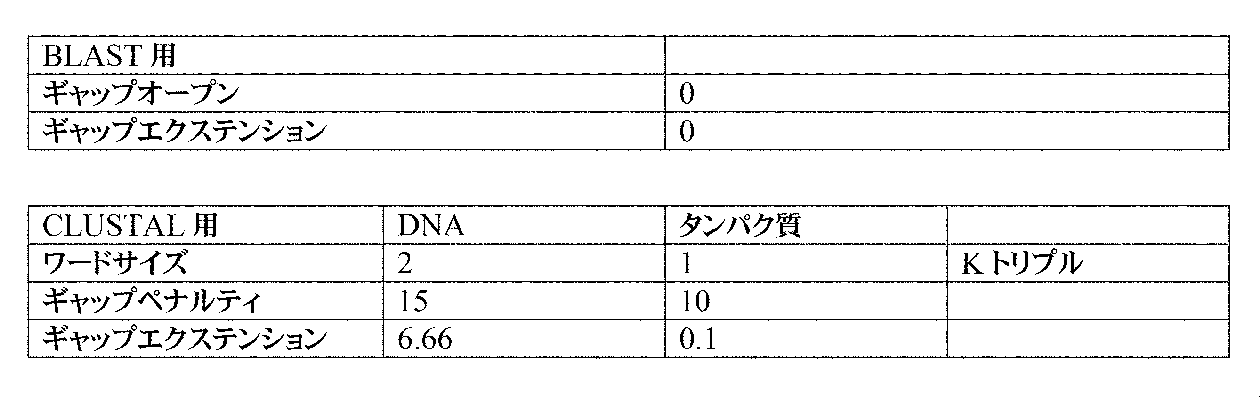
一実施形態において、CLUSTALは、上記定義のとおり設定されたギャップペナル
ティおよびギャップエクステンションを用いて使用することができる。
In one embodiment, CLUSTAL may be used with gap penalties and gap extensions set as defined above.
好適には、ヌクレオチド配列に関する同一性の程度は、少なくとも20個の連続ヌクレ
オチドにわたり、好ましくは、少なくとも30個の連続ヌクレオチドにわたり、好ましく
は、少なくとも40個の連続ヌクレオチドにわたり、好ましくは、少なくとも50個の連
続ヌクレオチドにわたり、好ましくは、少なくとも60個の連続ヌクレオチドにわたり、
好ましくは、少なくとも100個の連続ヌクレオチドにわたり決定される。
Suitably, the degree of identity for nucleotide sequences is over at least 20 contiguous nucleotides, preferably over at least 30 contiguous nucleotides, preferably over at least 40 contiguous nucleotides, preferably over at least 50 contiguous nucleotides, preferably over at least 60 contiguous nucleotides,
Preferably, it is determined over at least 100 contiguous nucleotides.
好適には、ヌクレオチド配列に関する同一性の程度は、全配列にわたり決定することが
できる。
Suitably, the degree of identity for nucleotide sequences can be determined over the entire sequence.
変異体/相同体/誘導体
本発明はまた、タンパク質の任意のアミノ酸配列、またはそのようなパンパク質をコー
ドする任意のヌクレオチド配列の、変異体、相同体および誘導体の使用を包含する。
Mutants/Homologues/Derivatives The present invention also encompasses the use of variants, homologues and derivatives of any amino acid sequence of a protein, or any nucleotide sequence encoding such a protein.
ここで、「相同体」という用語は、対象アミノ酸配列および対象ヌクレオチド配列とあ
る相同性を有する実体を意味する。ここで、「相同性」という用語は、「同一性」と同じ
であると見なすことができる。
Here, the term "homolog" refers to an entity that has a certain homology with a subject amino acid sequence and a subject nucleotide sequence. Here, the term "homology" can be considered to be the same as "identity."
本文脈においては、相同配列は、対象配列と少なくとも75、80、85または90%
同一、好ましくは、少なくとも95、96、97、98または99%同一であり得るアミ
ノ酸配列を含むと解釈される。通常、相同体は、対象アミノ酸配列と同一の活性部位など
を含むであろう。相同性は類似性(すなわち、類似の化学的特性/機能を有するアミノ酸
残基)の観点から考慮することもできるが、本発明との関連では、配列同一性の観点から
相同性を表現することが好ましい。
In the present context, a homologous sequence is one that is at least 75, 80, 85 or 90% identical to the subject sequence.
It is understood to include amino acid sequences which may be identical, preferably at least 95, 96, 97, 98 or 99% identical. Typically, a homolog will contain the same active site etc. as the subject amino acid sequence. Although homology can also be considered in terms of similarity (i.e. amino acid residues having similar chemical properties/functions), in the context of the present invention it is preferred to express homology in terms of sequence identity.
本文脈においては、相同配列は、本発明の酵素をコードするヌクレオチド配列(対象配
列)と少なくとも75、80、85または90%同一、好ましくは、少なくとも95、9
6、97、98または99%同一であり得るヌクレオチド配列を含むと解釈される。通常
、相同体は、対象配列と同じ、活性部位などをコードする配列を含むであろう。相同性は
類似性(すなわち、類似の化学的特性/機能を有するアミノ酸残基)の観点から考慮する
こともできるが、本発明との関連では、配列同一性の観点から相同性を表現することが好
ましい。
In the present context, a homologous sequence is at least 75, 80, 85 or 90% identical, preferably at least 95, 99, 100 or 105% identical, to the nucleotide sequence encoding the enzyme of the invention (subject sequence).
It is understood to include nucleotide sequences which may be 6, 97, 98 or 99% identical. Typically, a homolog will include sequences which encode the same active sites etc. as the subject sequence. Although homology can also be considered in terms of similarity (i.e. amino acid residues which have similar chemical properties/functions), in the context of the present invention it is preferred to express homology in terms of sequence identity.
相同性の比較は、目視により、またはより一般的には、容易に利用可能な配列比較プロ
グラムを使用して行うことができる。これらの市販のコンピュータプログラムは、2つ以
上の配列間の相同性率を計算することができる。相同性率は、連続配列にわたり計算する
ことができ、すなわち、ある1つの配列を他の配列とアラインし、ある1つの配列中の各
アミノ酸を他の配列中の対応するアミノ酸と1回に1残基、直接比較する。これは「ギャ
ップなし」アライメントと称される。通常、このようなギャップなしアライメントは、比
較的少数の残基にわたってのみ実施される。
Homology comparison can be performed by eye or, more commonly, by using readily available sequence comparison programs. These commercially available computer programs can calculate the percentage of homology between two or more sequences. The percentage of homology can be calculated over a continuous sequence, i.e., one sequence is aligned with the other sequence, and each amino acid in one sequence is directly compared to the corresponding amino acid in the other sequence, one residue at a time. This is called an "ungapped" alignment. Usually, such ungapped alignment is performed only over a relatively small number of residues.
これは非常に簡易で一貫した方法であるが、例えば、配列の他の同一ペアにおいて、あ
る挿入または欠失が後続のアミノ酸残基をアライメントから外すことを考慮し得ず、した
がって、グローバルアライメントを実施した場合に相同性率を大きく低下させる可能性が
ある。このような理由から、ほとんどの配列比較法は、全相同性スコアを過度にペナルテ
ィ化せずに、あり得る挿入および欠失を考慮する最適なアライメントを作成するように設
計される。これは、配列アライメント中に「ギャップ」を挿入して局所的相同性の最大化
を試みることにより達成される。
Although this is a very simple and consistent method, it cannot take into account that, for example, in an otherwise identical pair of sequences, an insertion or deletion may cause subsequent amino acid residues to be removed from the alignment, and thus may greatly reduce the homology rate when performing a global alignment. For this reason, most sequence comparison methods are designed to create optimal alignments that take into account possible insertions and deletions without unduly penalizing the overall homology score. This is achieved by inserting "gaps" in the sequence alignment to try to maximize local homology.
しかしながら、これらのより複雑な方法は、同数の同一アミノ酸について、可能な限り
少ないギャップを有する配列アライメント(2つの比較配列間のより高い関係性を反映す
る)が、多くのギャップを有するものより高いスコアを達成するように、そのアライメン
ト中で生じる各ギャップに対して「ギャップペナルティ」を割り当てる。通常、あるギャ
ップの存在に対して比較的高いコストを課し、そのギャップ中の後続の各残基に対してよ
り小さいペナルティを課す「アファインギャップコスト」が使用される。これは、最も一
般的に使用されるギャップスコアリングシステムである。高いギャップペナルティは、当
然ながら、より少数のギャップを有する最適化されたアライメントを生成するであろう。
大多数のアライメントプログラムは、ギャップペナルティが修飾されることを許容する。
しかし、配列比較のためにそのようなソフトウエアを使用する場合には、デフォルト値を
使用することが好ましい。例えば、GCG Wisconsin Bestfitパッケ
ージを使用する場合、アミノ酸配列のためのギャップペナルティのデフォルトは、ギャッ
プが-12および各エクステンションが-4である。
However, these more sophisticated methods assign a "gap penalty" to each gap that occurs in the alignment, such that for the same number of identical amino acids, a sequence alignment with as few gaps as possible (reflecting a higher relatedness between the two compared sequences) will achieve a higher score than one with many gaps. Usually, an "affine gap cost" is used that imposes a relatively high cost on the existence of a gap and a smaller penalty for each subsequent residue in the gap. This is the most commonly used gap scoring system. A high gap penalty will naturally produce an optimized alignment with fewer gaps.
Most alignment programs allow the gap penalties to be modified.
However, it is preferred to use the default values when using such software for sequence comparisons For example when using the GCG Wisconsin Bestfit package the default gap penalty for amino acid sequences is -12 for a gap and -4 for each extension.
したがって、最大相同性率の計算には、最初にギャップペナルティを考慮して最適なア
ライメントを作成することが要求される。このようなアライメントの実施に好適なコンピ
ュータプログラムは、GCG Wisconsin Bestfitパッケージ(Dev
ereux et al 1984 Nuc.Acids Research 12 p
387)である。配列比較を実施し得る他のソフトウエアの例としては、例えば、BLA
STパッケージ(Ausubel et al.,1999,上記を参照)、FASTA
(Altschul et al.,1990 J.Mol.Biol.403-410
)およびGENEWORKS比較ツールスイートが挙げられるが、これらに限定されない
。BLASTおよびFASTAの両者は、オフラインおよびオンライン検索で入手可能で
ある(Ausubel et al.,1999、上記を参照)。しかしながら、一部の
用途では、GCG Bestfitプログラムを使用することが好ましい。BLAST
2 Sequencesと称する新しいツールもまた、タンパク質およびヌクレオチド配
列の比較に利用可能である。
Calculation of maximum percent homology therefore first requires the production of an optimal alignment, taking into account gap penalties. Suitable computer programs for carrying out such alignments include the GCG Wisconsin Bestfit package (Dev
Ereux et al 1984 Nuc. Acids Research 12 p.
387). Other examples of software capable of performing sequence comparisons include, for example, BLA.
ST package (Ausubel et al., 1999, see above), FASTA
(Altschul et al., 1990 J. Mol. Biol. 403-410
) and the GENEWORKS comparison tool suite. Both BLAST and FASTA are available for offline and online searching (Ausubel et al., 1999, supra). However, for some applications it is preferred to use the GCG Bestfit program. BLAST
A new tool called 2 Sequences is also available for comparing protein and nucleotide sequences.
最終相同性率を同一性に関して計測することができるが、アライメントプロセスそれ自
体は、通常は、オールオアナッシングのペア比較に基づくものではない。代わりに、化学
的類似性または進化的距離に基づきそれぞれのペアワイズ比較にスコアを割り当てる数値
換算類似度(scaled similarity)スコア行列が一般に使用される。一
般に使用されるそのような行列の一例は、BLOSUM62行列(BLASTプログラム
スイートのためのデフォルト行列)である。GCG Wisconsinプログラムは、
一般に、パブリックデフォルト値、または供給されている場合にはカスタムシンボル比較
表を使用する(さらなる詳細については、ユーザマニュアルを参照)。一部の用途では、
GCGパッケージのためのパブリックデフォルト値、または他のソフトウエアの場合には
、BLOSUM62などのデフォルト行列を使用することが好ましい。
Although the final percentage homology can be measured in terms of identity, the alignment process itself is usually not based on an all-or-nothing pairwise comparison. Instead, a scaled similarity scoring matrix is typically used that assigns a score to each pairwise comparison based on chemical similarity or evolutionary distance. One example of such a matrix commonly used is the BLOSUM62 matrix (the default matrix for the BLAST suite of programs). GCG Wisconsin programs use
Generally, it uses the public default values, or a custom symbol comparison table if one is provided (see the user manual for further details).
It is preferred to use the public default values for the GCG package, or in the case of other software, the default matrix, such as BLOSUM62.
あるいは、相同性率は、CLUSTAL(Higgins DG & Sharp P
M(1988)、上記を参照)と類似するアルゴリズムに基づくDNASIS(商標)(
Hitachi Software)における多重アライメント特徴を使用して算出する
ことができる。
Alternatively, the percent identity can be calculated using the CLUSTAL (Higgins DG & Sharp P
DNASIS™ (based on an algorithm similar to that of the DNASIS 1988, supra)
The alignment can be calculated using the multiple alignment feature in the Hitachi Software.
ソフトウエアが最適なアライメントを生成すれば、相同性率、好ましくは、配列同一性
率を算出することが可能である。ソフトウエアは、通常、これを配列比較の一部として実
行し、数的結果を生成する。
Once the software has produced an optimal alignment, it is possible to calculate percent homology, preferably percent sequence identity. The software typically does this as part of the sequence comparison and generates a numerical result.
配列は、サイレント変化を生成し、機能的に同等の物質をもたらすアミノ酸残基の欠失
、挿入または置換も有し得る。意図的なアミノ酸置換は、その物質の二次的結合活性が保
持される限り、残基の極性、電荷、溶解度、疎水性、親水性および/または両親媒性の性
質の類似性に基づいて行うことができる。例えば、負荷電アミノ酸としては、アスパラギ
ン酸およびグルタミン酸が挙げられ;正荷電アミノ酸としては、リシンおよびアルギニン
が挙げられ;また、類似の親水性値を有する非荷電極性頭部基を持つアミノ酸としては、
ロイシン、イソロイシン、バリン、グリシン、アラニン、アスパラギン、グルタミン、セ
リン、トレオニン、フェニルアラニンおよびチロシンが挙げられる。
The sequences may also have deletions, insertions, or substitutions of amino acid residues which produce silent changes and result in functionally equivalent substances. Deliberate amino acid substitutions can be made based on similarity in the polarity, charge, solubility, hydrophobicity, hydrophilicity, and/or amphipathic nature of the residues, so long as the secondary binding activity of the substance is retained. For example, negatively charged amino acids include aspartic acid and glutamic acid; positively charged amino acids include lysine and arginine; and amino acids with uncharged polar head groups with similar hydrophilicity values include arginine, arginine, and arginine.
These include leucine, isoleucine, valine, glycine, alanine, asparagine, glutamine, serine, threonine, phenylalanine and tyrosine.
保存的置換は、例えば、以下の表にしたがってすることができる。第2列の同一ブロッ
クの、好ましくは、第3列の同一行のアミノ酸を互いに置換することができる:
Conservative substitutions can be made, for example, in accordance with the following table: Amino acids in the same block in the second column and preferably in the same line in the third column can be substituted for each other:
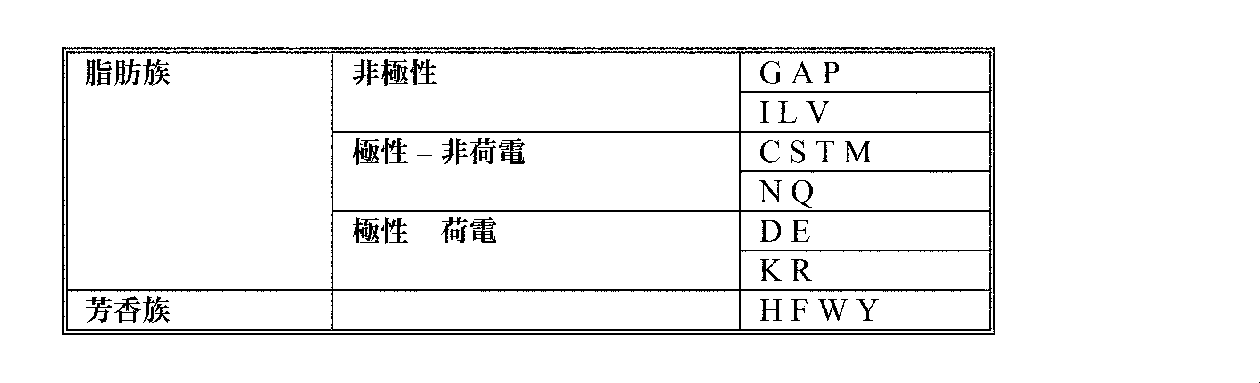
本発明はまた、起こり得る相同置換(置換(substitution)および取り換
え(replacement))はいずれも、本明細書中では、既存のアミノ酸残基を代
替の残基と置き換えることを意味するのに使用される)、すなわち、塩基性のものと塩基
性のもの、酸性のものと酸性のもの、極性のものと極性のものなどの同種置換を包含する
。非相同置換、すなわち、ある分類の残基から他の分類の残基へ、または、オルニチン(
以下、Zと称する)、ジアミノ酪酸オルニチン(以下、Bと称する)、ノルロイシンオル
ニチン(以下、Oと称する)、ピリジルアラニン、チエニルアラニンおよびフェニルグリ
シンなどの非天然アミノ酸の混入を伴う置換もまた起こり得る。
The invention also encompasses possible homologous substitutions (both substitution and replacement are used herein to mean the replacement of an existing amino acid residue with an alternative residue), i.e., basic for basic, acidic for acidic, polar for polar, etc. Non-homologous substitutions, i.e., one class of residue for another, or a substitution of ornithine (
Substitutions involving the incorporation of unnatural amino acids such as ornithine diaminobutyrate (hereinafter referred to as Z), ornithine norleucine (hereinafter referred to as O), pyridylalanine, thienylalanine, and phenylglycine may also occur.
取り換えはまた、非天然アミノ酸によりすることができ、そのようなアミノ酸としては
、アルファ*およびアルファ二置換*アミノ酸、N-アルキルアミノ酸*、乳酸*、天然
アミノ酸のハロゲン化誘導体、例えば、トリフルオロチロシン*、p-Cl-フェニルア
ラニン*、p-Br-フェニルアラニン*、p-I-フェニルアラニン*、L-アリル-
グリシン*、β-アラニン*、L-α-アミノ酪酸*、L-γ-アミノ酪酸*、L-α-
アミノイソ酪酸*、L-ε-アミノカプロン酸#、7-アミノヘプタン酸*、L-メチオ
ニンスルホン*、L-ノルロイシン*、L-ノルバリン*、p-ニトロ-L-フェニルア
ラニン*、L-ヒドロキシプロリン#、L-チオプロリン*、フェニルアラニン(Phe
)のメチル誘導体、例えば、4-メチル-Phe*、ペンタメチル-Phe*、L-Ph
e(4-アミノ)#、L-Tyr(メチル)*、L-Phe(4-イソプロピル)*、L
-Tic(1,2,3,4-テトラヒドロイソキノリン-3-カルボン酸)*、L-ジア
ミノプロピオン酸およびL-Phe(4-ベンジル)*が挙げられる。記号*は、誘導体
の疎水性を示すために上記考察の目的(相同または非相同置換に関する)に利用されてお
り、一方、#は、誘導体の親水性を示すために利用されており、#*は、両親媒性を示す
。
Replacement can also be with unnatural amino acids, such as alpha* and alpha disubstituted* amino acids, N-alkylamino acids*, lactic acid*, halogenated derivatives of natural amino acids, such as trifluorotyrosine*, p-Cl-phenylalanine*, p-Br-phenylalanine*, p-I-phenylalanine*, L-allyl-
Glycine*, β-alanine*, L-α-aminobutyric acid*, L-γ-aminobutyric acid*, L-α-
Aminoisobutyric acid*, L-ε-aminocaproic acid # , 7-aminoheptanoic acid*, L-methionine sulfone * , L-norleucine*, L-norvaline*, p-nitro-L-phenylalanine*, L-hydroxyproline # , L-thioproline*, phenylalanine (Phe
) methyl derivatives such as 4-methyl-Phe*, pentamethyl-Phe*, L-Phe*
e(4-amino) # , L-Tyr(methyl)*, L-Phe(4-isopropyl)*, L
-Tic (1,2,3,4-tetrahydroisoquinoline-3-carboxylic acid)*, L-diaminopropionic acid, and L-Phe(4-benzyl)*. The symbol * is utilized for purposes of the above discussion (regarding homologous or non-homologous substitutions) to indicate the hydrophobicity of the derivative, while # is utilized to indicate the hydrophilicity of the derivative, and #* indicates amphipathic properties.
変異アミノ酸配列は、配列の任意の2つのアミノ酸残基間に挿入することができる好適
なスペーサー基、例として、アルキル基、例えばメチル基、エチル基またはプロピル基を
、アミノ酸スペーサー、例えばグリシンまたはβ-アラニン残基に加えて含み得る。変異
のさらなる形態は、ペプトイド形態の1つ以上のアミノ酸残基の存在を含むが、当業者に
は十分に理解されよう。疑義を回避するため、「ペプトイド形態」は、α炭素置換基がα
炭素ではなく残基の窒素原子上に存在する変異アミノ酸残基を指すために使用される。ペ
プトイド形態のペプチドを調製する方法は当該技術分野、例えば、Simon RJ e
t al.,PNAS(1992)89(20),9367-9371、およびHorw
ell DC,Trends Biotechnol.(1995)13(4),132
-134において知られている。
The variant amino acid sequence may include a suitable spacer group, for example an alkyl group, such as a methyl, ethyl or propyl group, which may be inserted between any two amino acid residues of the sequence, in addition to an amino acid spacer, for example a glycine or β-alanine residue. A further form of variation includes the presence of one or more amino acid residues in peptoid form, as will be appreciated by those skilled in the art. For the avoidance of doubt, "peptoid form" refers to an amino acid residue in which the α-carbon substituent is an α
It is used to refer to variant amino acid residues in which the nitrogen atom of the residue is present rather than the carbon. Methods for preparing peptides in peptoid form are known in the art, for example, Simon RJ et al.
t al., PNAS (1992) 89(20), 9367-9371, and Horw
ell DC, Trends Biotechnol. (1995) 13(4), 132
It is known in -134.
本発明において使用されるヌクレオチド配列は、それらの範囲内に、合成または修飾ヌ
クレオチドを含み得る。オリゴヌクレオチドに対する多数の異なるタイプの修飾が、当該
技術分野において知られている。これらとしては、メチルホスホネートおよびホスホロチ
オエート骨格、ならびに/または分子の3’および/もしくは5’末端におけるアクリジ
ンもしくはポリリジン鎖の付加が挙げられる。本発明の目的のため、本明細書に記載のヌ
クレオチド配列が当該技術分野において利用可能な任意の方法により修飾し得ることを理
解すべきである。このような修飾は、本発明のヌクレオチド配列のインビボ活性または寿
命を向上させるように実施することができる。
The nucleotide sequences used in the present invention may include within their scope synthetic or modified nucleotides. Many different types of modifications to oligonucleotides are known in the art. These include methylphosphonate and phosphorothioate backbones, and/or the addition of acridine or polylysine chains at the 3' and/or 5' ends of the molecule. For the purposes of the present invention, it should be understood that the nucleotide sequences described herein may be modified by any method available in the art. Such modifications may be carried out to improve the in vivo activity or life span of the nucleotide sequences of the present invention.
本発明はまた、本明細書に提示される配列に相補的なヌクレオチド配列、またはその任
意の誘導体、断片もしくは誘導体の使用を包含する。配列がその断片に相補的である場合
、その配列をプローブとして使用して他の生物における類似のコード配列を同定するなど
のことが可能である。
The present invention also encompasses the use of nucleotide sequences complementary to the sequences presented herein, or any derivatives, fragments or derivatives thereof. If a sequence is complementary to a fragment thereof, it is possible to use the sequence as a probe to identify similar coding sequences in other organisms, etc.
本発明の配列と100%相同でないが、本発明の範囲内であるポリヌクレオチドは、多
数の手法で得ることができる。本明細書に記載の配列の他の変異体は、例えば、一連の個
体、例えば、異なる集団からの個体から作製されたDNAライブラリーをプロービングす
ることにより得ることができる。さらに、他の相同体を得ることができ、そのような相同
体およびその断片は、一般に、本明細書の配列表に示す配列に選択的にハイブリダイズし
得る。このような配列は、他の動物種から作製されたcDNAライブラリー、または他の
動物種からのゲノムDNAライブラリーをプロービングし、中~高ストリンジェンシーの
条件下で付属の配列表の配列のいずれか1つの全部または一部を含むプローブによりその
ようなライブラリーをプロービングすることにより得ることができる。類似の考察は、本
発明のポリペプチドまたはヌクレオチド配列の種相同体および対立遺伝子変異体を得るこ
とにも適用される。
Polynucleotides that are not 100% homologous to the sequences of the invention, but are within the scope of the invention, can be obtained in a number of ways. Other variants of the sequences described herein can be obtained, for example, by probing DNA libraries made from a series of individuals, for example individuals from different populations. In addition, other homologs can be obtained, and such homologs and fragments thereof can generally selectively hybridize to the sequences shown in the sequence listing herein. Such sequences can be obtained by probing cDNA libraries made from other animal species, or genomic DNA libraries from other animal species, and probing such libraries with a probe comprising all or part of any one of the sequences in the attached sequence listing under conditions of medium to high stringency. Similar considerations apply to obtaining species homologs and allelic variants of the polypeptide or nucleotide sequences of the invention.
変異体および株/種相同体はまた、本発明の配列内の保存アミノ酸配列をコードする変
異体および相同体内の配列を標的とするように設計されたプライマーを使用する縮重PC
Rを使用して得ることができる。保存配列は、例えば、いくつかの変異体/相同体からの
アミノ酸配列をアラインすることにより予測することができる。配列アライメントは、当
該技術分野で知られるコンピュータソフトウエアを使用して実施することができる。例え
ば、GCG Wisconsin PileUpプログラムが広く使用される。
Mutants and strain/species homologs may also be subjected to degenerate PCR amplification using primers designed to target sequences within the variants and homologs that encode conserved amino acid sequences within the sequences of the invention.
Conserved sequences can be predicted, for example, by aligning amino acid sequences from several variants/homologues. Sequence alignment can be performed using computer software known in the art. For example, the GCG Wisconsin PileUp program is widely used.
縮重PCRにおいて使用されるプライマーは、1つ以上の縮重位置を含有し、既知の配
列に対する単一配列プライマーを用いる配列のクローニングに使用されるものよりも低い
ストリンジェンシー条件において使用される。
The primers used in degenerate PCR contain one or more degenerate positions and are used under lower stringency conditions than those used for cloning sequences using single sequence primers against a known sequence.
あるいは、このようなポリヌクレオチドは、特徴付けされた配列の部位特異的突然変異
誘発により得ることができる。これは、例えば、ポリヌクレオチド配列が発現する特定の
宿主細胞についてのコドン選好性を最適化するためにサイレントコドン配列変化が要求さ
れる場合に有用であり得る。制限酵素認識部位を導入するため、またはポリヌクレオチド
によりコードされるポリペプチドの特性もしくは機能を変更するために他の配列変化が望
まれることがある。
Alternatively, such polynucleotides can be obtained by site-directed mutagenesis of characterized sequences. This can be useful, for example, when silent codon sequence changes are required to optimize codon preferences for a particular host cell in which the polynucleotide sequence is expressed. Other sequence changes may be desired to introduce restriction enzyme recognition sites or to alter the properties or functions of the polypeptides encoded by the polynucleotide.
本発明のポリヌクレオチド(ヌクレオチド配列)は、プライマー、例えば、PCRプラ
イマー、代替増幅反応のためのプライマー、プローブ、例えば、放射性もしくは非放射性
標識を使用する慣用の手段による顕示標識で標識されたものを産生するために使用するこ
とができ、またはポリヌクレオチドをベクター中にクローニングすることができる。この
ようなプライマー、プローブおよび他の断片は、少なくとも15、好ましくは、少なくと
も20、例えば、少なくとも25、30または40ヌクレオチド長であり、これらもまた
、本明細書において使用されるポリヌクレオチドという用語に包含される。
The polynucleotides (nucleotide sequences) of the invention can be used to produce primers, e.g., PCR primers, primers for alternative amplification reactions, probes, e.g., labeled with a revealing label by conventional means using radioactive or non-radioactive labels, or the polynucleotides can be cloned into vectors. Such primers, probes and other fragments are at least 15, preferably at least 20, e.g., at least 25, 30 or 40 nucleotides in length, and are also encompassed by the term polynucleotide as used herein.
本発明によるDNAポリヌクレオチドおよびプローブなどのポリヌクレオチドは、組換
えにより、合成により、または当業者に利用可能な任意の手段により産生することができ
る。これらはまた、標準的手法によりクローニングすることもできる。
Polynucleotides, such as DNA polynucleotides and probes according to the invention, can be produced recombinantly, synthetically, or by any means available to those of skill in the art. They can also be cloned by standard techniques.
一般に、プライマーは、所望の核酸配列の1回1ヌクレオチドの段階的製造を含む合成
手段により産生される。自動化技術を使用してこれらを達成するための技術は、当該技術
分野において容易に利用可能である。
Generally, primers are produced by synthetic means involving the stepwise production of the desired nucleic acid sequence one nucleotide at a time. Techniques for accomplishing this using automated techniques are readily available in the art.
より長いポリヌクレオチドは、一般に、組換え手段を使用して、例えば、PCR(ポリ
メラーゼ連鎖反応)クローニング技術を使用して産生される。プライマーは、増幅された
DNAを好適なクローニングベクター中にクローニングすることができるように、好適な
制限酵素認識部位を含有するように設計することができる。
Longer polynucleotides are generally produced using recombinant means, for example, using PCR (polymerase chain reaction) cloning techniques. The primers can be designed to contain suitable restriction enzyme recognition sites so that the amplified DNA can be cloned into a suitable cloning vector.
ハイブリダイゼーション
本発明はまた、本発明の核酸配列に相補的な配列、または本発明の配列もしくは本発明
の配列に相補的な配列にハイブリダイズすることができる配列を包含する。
Hybridization The present invention also encompasses sequences which are complementary to the nucleic acid sequences of the present invention or sequences which are capable of hybridizing to the sequences of the present invention or to sequences complementary to the sequences of the present invention.
本明細書において使用される「ハイブリダイゼーション」という用語は、「核酸鎖が塩
基対合を介して相補鎖と結合するプロセス」、およびポリメラーゼ連鎖反応(PCR)技
術において実施される増幅のプロセスを含む。
As used herein, the term "hybridization" includes the process by which a strand of nucleic acid joins with a complementary strand through base pairing, as well as the process of amplification carried out in polymerase chain reaction (PCR) technology.
本発明はまた、本明細書に提示される配列に相補的な配列にハイブリダイズし得るヌク
レオチド配列、またはその任意の誘導体、断片もしくは誘導体の使用を包含する。
The present invention also encompasses the use of nucleotide sequences that are capable of hybridising to sequences complementary to the sequences presented herein, or any derivative, fragment or derivative thereof.
「変異体」という用語は、本明細書に提示されるヌクレオチド配列にハイブリダイズし
得る配列に相補的な配列も包含する。
The term "variant" also encompasses sequences that are complementary to sequences that are capable of hybridizing to the nucleotide sequences presented herein.
好ましくは、「変異体」という用語は、本明細書に提示されるヌクレオチド配列にスト
リンジェンシーな条件(例えば、50℃および0.2×SSC{1×SSC=0.15M
のNaCl、0.015Mのクエン酸Na3 pH7.0})下でハイブリダイズし得る
配列に相補的な配列を包含する。
Preferably, the term "mutant" refers to a mutant that is capable of expressing the nucleotide sequences presented herein under stringent conditions (e.g., 50° C. and 0.2×SSC (1×SSC=0.15 M
The term "hybridizable nucleic acid" includes sequences complementary to sequences capable of hybridizing under conditions of pH 7.0 (0.05 M NaCl, 0.015 M Na citrate, pH 7.0 ).
より好ましくは、「変異体」という用語は、本明細書に提示されるヌクレオチド配列に
高ストリンジェンシーな条件(例えば、65℃および0.1×SSC{1×SSC=0.
15MのNaCl、0.015Mのクエン酸Na3 pH7.0})下でハイブリダイズ
し得る配列に相補的な配列を包含する。
More preferably, the term "mutant" refers to a mutant that is capable of expressing the nucleotide sequences presented herein under high stringency conditions (e.g., 65°C and 0.1xSSC {1xSSC=0.
The term "hybridizable nucleic acid" includes sequences complementary to sequences capable of hybridizing under a physiological condition (15 M NaCl, 0.015 M Na 3 citrate, pH 7.0).
本発明はまた、本発明のヌクレオチド配列(本明細書に提示される配列に相補的な配列
を含む)にハイブリダイズし得るヌクレオチド配列に関する。
The present invention also relates to nucleotide sequences that are capable of hybridizing to the nucleotide sequences of the present invention, including sequences that are complementary to the sequences presented herein.
本発明はまた、本発明のヌクレオチド配列(本明細書に提示される配列に相補的な配列
を含む)にハイブリダイズし得る配列に相補的なヌクレオチド配列に関する。
The present invention also relates to nucleotide sequences that are complementary to sequences that are capable of hybridizing to the nucleotide sequences of the present invention, including sequences complementary to the sequences presented herein.
中位~最大のストリンジェンシー条件下で本明細書に提示されるヌクレオチド配列にハ
イブリダイズし得るポリヌクレオチド配列もまた本発明の範囲内に含まれる。
Also included within the scope of the present invention are polynucleotide sequences that are capable of hybridizing to the nucleotide sequences presented herein under conditions of moderate to maximal stringency.
好ましい態様においては、本発明は、ストリンジェンシーな条件(例えば、50℃およ
び0.2×SSC)下で本発明のヌクレオチド配列にハイブリダイズすることができるヌ
クレオチド配列、またはその相補体をカバーする。
In a preferred embodiment, the present invention covers nucleotide sequences capable of hybridizing to the nucleotide sequences of the present invention under stringent conditions (eg, 50° C. and 0.2×SSC), or their complements.
より好ましい態様においては、本発明は、高ストリンジェンシーな条件(例えば、65
℃および0.1×SSC)下で本発明のヌクレオチド配列にハイブリダイズすることがで
きるヌクレオチド配列、またはその相補体をカバーする。
In a more preferred embodiment, the present invention provides a method for the preparation of a nucleic acid sequence using high stringency conditions (e.g., 65
The term covers nucleotide sequences that are capable of hybridizing to the nucleotide sequences of the present invention under conditions of 0.1×SSC and 0.2° C., or the complement thereof.
分子進化
非限定的な例として、インビボまたはインビトロでヌクレオチド配列中に多数の部位特
異的またはランダムな変異を産生すること、および、続いて種々の手段によりコードされ
るポリペプチドの改善された機能性についてスクリーニングすることが可能である。
Molecular Evolution As a non-limiting example, it is possible to generate large numbers of site-specific or random mutations in a nucleotide sequence in vivo or in vitro and subsequently screen for improved functionality of the encoded polypeptide by various means.
さらに、ポリヌクレオチド配列の変異または天然変異体を、野生型、または他の変異も
しくは天然変異体により組換えて、新たな変異体を産生することができる。このような新
たな変異体もまた、コードされるポリペプチドの改善された機能性についてスクリーニン
グされ得る。新たな好ましい変異体の産生は、当該技術分野において十分に確立された種
々の方法、例えば、エラー閾値変異誘発(Error Threshold Mutag
enesis)(国際公開第92/18645号パンフレット)、オリゴヌクレオチド媒
介ランダム変異誘発(米国特許第5,723,323号明細書)、DNAシャッフリング
(米国特許第5,605,793号明細書)、エキソ媒介遺伝子アセンブリ、国際公開第
00/58517号パンフレットにより達成することができる。これらおよび類似のラン
ダム指向分子進化法の適用により、タンパク質の構造または機能のいかなる予備知識もな
しで好ましい特徴を有する本発明の酵素の変異体の同定および選択が可能となり、予測可
能でないが、有益な変異または変異体の産生が可能となる。当該技術分野において、酵素
活性の最適化または改変のための分子進化の適用例が数多くあり、そのような例として、
限定はされないが、以下の1つ以上が挙げられる:
宿主細胞またはインビトロにおける発現および/または活性の最適化、
酵素活性の増大、基質および/または生成物特異性の改変、
酵素安定性または構造安定性の増大または低減、好ましい環境条件、例えば温度、pH、
基質における酵素の活性/特異性の改変。
Furthermore, mutations or natural variants of polynucleotide sequences can be recombined with wild-type or other mutations or natural variants to produce new variants. Such new variants can also be screened for improved functionality of the encoded polypeptide. The production of new preferred variants can be performed using a variety of methods well established in the art, such as Error Threshold Mutagenesis (ETHM), or other methods.
This can be achieved by techniques such as random directed molecular evolution (WO 92/18645), oligonucleotide mediated random mutagenesis (U.S. Pat. No. 5,723,323), DNA shuffling (U.S. Pat. No. 5,605,793), exo-mediated gene assembly, WO 00/58517. The application of these and similar random directed molecular evolution methods allows for the identification and selection of variants of the enzymes of the invention with favorable characteristics without any prior knowledge of the protein structure or function, allowing for the production of unpredictable, yet beneficial, mutations or variants. There are numerous examples in the art of the application of molecular evolution for the optimization or modification of enzyme activity, such as:
These include, but are not limited to, one or more of the following:
Optimizing expression and/or activity in a host cell or in vitro;
Increased enzyme activity, altered substrate and/or product specificity;
Increase or decrease in enzyme or structural stability, favorable environmental conditions, e.g., temperature, pH,
Altering the activity/specificity of the enzyme on the substrate.
部位特異的変異誘発
タンパク質コードヌクレオチド配列を単離したなら、または推定タンパク質コードヌク
レオチド配列を同定したなら、本発明のタンパク質を調製するために配列を変異させるこ
とが望ましい場合がある。
Site-Directed Mutagenesis Having isolated a protein-encoding nucleotide sequence, or having identified a putative protein-encoding nucleotide sequence, it may be desirable to mutate the sequence in order to prepare a protein of the present invention.
変異は、合成オリゴヌクレオチドを使用して導入することができる。これらのオリゴヌ
クレオチドは、所望の変異部位をフランキングするヌクレオチド配列を含有する。
Mutations can be introduced using synthetic oligonucleotides that contain nucleotide sequences flanking the desired mutation site.
好適な方法は、Morinaga et al.,(Biotechnology(1
984)2,p646-649)に開示されている。酵素コードヌクレオチド配列中に突
然変異を導入する他の方法は、Nelson and Long(Analytical
Biochemistry(1989),180,p147-151)に記載されてい
る。
A suitable method is described in Morinaga et al., (Biotechnology (1
984) 2, pp. 646-649). Another method for introducing mutations into an enzyme-encoding nucleotide sequence is disclosed in Nelson and Long (Analytical
Biochemistry (1989), 180, pp. 147-151).
組換え体
一態様において、本発明において使用される配列は、組換え配列、すなわち、組換えD
NA技術を使用して調製された配列である。
In one embodiment, the sequences used in the present invention are recombinant sequences, i.e. recombinant D
The sequences were prepared using NA technology.
これらの組換えDNA技術は、当業者の技能の範囲内である。そのような技術は、文献
、例えば、J.Sambrook、E.F.Fritsch,and T.Maniat
is、1989,Molecular Cloning:A Laboratory M
anual, Second Edition,Books 1-3,Cold Spr
ing Harbor Laboratory Pressに説明されている。
These recombinant DNA techniques are within the skill of the art. Such techniques are described in the literature, for example in J. Sambrook, E. F. Fritsch, and T. Maniat, "Evolution of Recombinant DNA in Human Genomes," vol. 14, no. 1, pp. 111-115, 1999.
is, 1989, Molecular Cloning: A Laboratory M
annual, Second Edition, Books 1-3, Cold Spr
The method is described in Eng Harbor Laboratory Press.
合成物
一態様において、本発明において使用される配列は、合成配列、すなわち、インビトロ
化学または酵素的合成により調製された配列である。これとしては、限定されるものでは
ないが、宿主生物、例えば、メチロトローフ酵母のピキア属(Pichia)およびハン
セヌラ属(Hansenula)に最適なコドン使用頻度を用いて作製された配列が挙げ
られる。
In one aspect, the sequences used in the present invention are synthetic sequences, i.e., sequences prepared by in vitro chemical or enzymatic synthesis, including but not limited to sequences made with optimal codon usage for the host organism, such as the methylotrophic yeasts Pichia and Hansenula.
発現
酵素の発現
本発明において使用されるヌクレオチド配列は、組換え複製ベクター中に取り込むこと
ができる。ベクターは、ヌクレオチド配列を複製し、タンパク質/酵素形態で、適合性の
宿主細胞中で、および/または適合性の宿主細胞から発現させるために使用することがで
きる。
Expression of Enzymes The nucleotide sequences used in the present invention can be incorporated into recombinant replicable vectors which can be used to replicate and express the nucleotide sequences in protein/enzyme form in and/or from a compatible host cell.
発現は、制御配列、例えば、調節配列を使用して制御することができる。 Expression can be controlled using control sequences, e.g., regulatory sequences.
ヌクレオチド配列の発現により宿主組換え細胞により産生されるタンパク質は、使用さ
れる配列および/またはベクターに応じて、分泌、または、細胞内に含有させることがで
きる。コード配列は、特定の原核または真核細胞膜を介する物質コード配列の分泌を指示
するシグナル配列を用いて設計することができる。
The protein produced by a host recombinant cell by expression of a nucleotide sequence may be secreted or contained intracellularly depending on the sequence and/or the vector used. The coding sequence may be designed with a signal sequence which directs secretion of the substance coding sequence through a particular prokaryotic or eukaryotic cell membrane.
発現ベクター
「発現ベクター」という用語は、インビボまたはインビトロで発現し得るコンストラク
トを意味する。
Expression Vector The term "expression vector" means a construct capable of expression in vivo or in vitro.
好ましくは、発現ベクターは、好適な宿主生物のゲノム中に取り込まれる。「取り込ま
れる」という用語は、好ましくは、ゲノム中への安定した取り込みをカバーする。
Preferably, the expression vector is integrated into the genome of a suitable host organism. The term "integrated" preferably covers stable integration into the genome.
本発明のヌクレオチド配列は、ヌクレオチド配列が、好適な宿主生物によるヌクレオチ
ド配列の発現を提供し得る調節配列に作動可能に結合しているベクター中に存在し得る。
The nucleotide sequence of the present invention may be present in a vector in which the nucleotide sequence is operably linked to a regulatory sequence capable of providing for the expression of the nucleotide sequence by a suitable host organism.
本発明において使用されるベクターは、本発明のポリペプチドの発現を提供するように
下記の好適な宿主細胞中に形質転換することができる。
The vectors used in the present invention can be transformed into suitable host cells described below so as to provide for expression of the polypeptides of the present invention.
ベクター、例えば、プラスミド、コスミド、またはファージベクターの選択は、それを
導入すべき宿主細胞に依存することが多い。
The choice of vector, e.g., plasmid, cosmid, or phage vector, will often depend on the host cell into which it is to be introduced.
本発明において使用されるベクターは、1つ以上の選択マーカー遺伝子、例えば、抗生
物質耐性、例えば、アンピシリン、カナマイシン、クロラムフェニコールまたはテトラサ
イクリン耐性を付与する遺伝子を含有し得る。あるいは、選択は、同時形質転換(国際公
開第91/17243号パンフレットに記載)により達成することができる。
The vectors used in the present invention may contain one or more selectable marker genes, such as genes that confer antibiotic resistance, such as ampicillin, kanamycin, chloramphenicol or tetracycline resistance. Alternatively, selection can be achieved by co-transformation (as described in WO 91/17243).
ベクターは、例えばRNAの産生にインビトロで使用することができ、または宿主細胞
を形質移入し、形質転換し、形質導入し、または感染させるために使用することができる
。
Vectors can be used in vitro, for example for the production of RNA or can be used to transfect, transform, transduce or infect a host cell.
したがって、さらなる実施形態において、本発明は、複製ベクター中に本発明のヌクレ
オチド配列を導入し、適合性の宿主細胞中にベクターを導入し、ベクターの複製を生じさ
せる条件下で宿主細胞を増殖させることにより、本発明のヌクレオチド配列を作製する方
法を提供する。
Thus, in a further embodiment, the invention provides a method of producing a nucleotide sequence of the invention by introducing a nucleotide sequence of the invention into a replicating vector, introducing the vector into a compatible host cell and growing the host cell under conditions that allow replication of the vector to occur.
ベクターは、当該宿主細胞中のベクターの複製を可能とするヌクレオチド配列をさらに
含み得る。このような配列の例は、プラスミドpUC19、pACYC177、pUB1
10、pE194、pAMB1およびpIJ702の複製起源である。
The vector may further comprise a nucleotide sequence that allows the vector to replicate in the host cell. Examples of such sequences are plasmids pUC19, pACYC177, pUB1
10, the origin of replication of pE194, pAMB1 and pIJ702.
調節配列
一部の適用では、本発明において使用されるヌクレオチド配列は、例えば、選択された
宿主細胞によるヌクレオチド配列の発現を提供し得る調節配列に作動可能に結合している
。例として、本発明は、そのような調節配列に作動可能に結合している本発明のヌクレオ
チド配列を含むベクターをカバーする。すなわち、ベクターは発現ベクターである。
Regulatory sequence In some applications, the nucleotide sequence used in the present invention is operably linked to a regulatory sequence that can provide, for example, the expression of the nucleotide sequence by a selected host cell. By way of example, the present invention covers a vector comprising the nucleotide sequence of the present invention operably linked to such a regulatory sequence. That is, the vector is an expression vector.
「作動可能に結合している」という用語は、記載の構成成分が、それらの意図した態様
でそれらを機能させる関係にある並置を指す。コード配列に「作動可能に結合している」
調節配列は、コード配列の発現が制御配列と適合する条件下で達成されるような手法でラ
イゲートされる。
The term "operably linked" refers to a juxtaposition where the components described are in a relationship permitting them to function in their intended manner.
The regulatory sequences are ligated in such a way that expression of the coding sequence is achieved under conditions compatible with the control sequences.
「調節配列」という用語は、プロモーターおよびエンハンサー、ならびに他の発現調節
シグナルを含む。
The term "regulatory sequences" includes promoters and enhancers and other expression regulation signals.
「プロモーター」という用語は、当該技術分野における通常の意味で使用され、例えば
、RNAポリメラーゼ結合部位である。
The term "promoter" is used in its normal sense in the art, e.g., an RNA polymerase binding site.
本発明の酵素をコードするヌクレオチド配列の発現の向上はまた、異種調節領域、例え
ば、プロモーター、分泌リーダーおよびターミネーター領域の選択により達成することが
できる。
Enhanced expression of the nucleotide sequence encoding the enzyme of the present invention can also be achieved by selection of heterologous regulatory regions, such as promoter, secretion leader and terminator regions.
好ましくは、本発明によるヌクレオチド配列は、少なくともプロモーターに作動可能に
結合している。
Preferably, the nucleotide sequence according to the invention is operably linked to at least a promoter.
他のプロモーターを使用して、本発明のポリペプチドの発現を指向させることもできる
。
Other promoters can also be used to direct expression of the polypeptide of the invention.
細菌、真菌または酵母宿主中のヌクレオチド配列の転写の指向に好適なプロモーターの
例は、当該技術分野においてよく知られている。
Examples of suitable promoters for directing the transcription of the nucleotide sequence in bacterial, fungal or yeast hosts are well known in the art.
プロモーターは、好適な宿主中における発現を確保または増加させるための特徴部をさ
らに含むことができる。例えば、特徴部は、プリブノーボックスまたはTATAボックス
などの保存領域であり得る。
The promoter may further comprise features to ensure or increase expression in a suitable host, for example, the features may be conserved regions such as the Pribnow box or the TATA box.
コンストラクト
「コンストラクト」という用語(「コンジュゲート」、「カセット」および「ハイブリ
ッド」などの用語と同義である)は、プロモーターに直接または間接的に付着している本
発明により使用されるヌクレオチド配列を含む。
Construct The term "construct" (which is synonymous with terms such as "conjugate,""cassette," and "hybrid") comprises a nucleotide sequence used according to the present invention that is directly or indirectly attached to a promoter.
間接的付着の一例は、プロモーターと本発明のヌクレオチド配列との間の、イントロン
配列、例えばSh1-イントロンまたはADHイントロンなどの、好適なスペーサー群の
提供である。同じことが、直接または間接的付着を含む、本発明に関連する「融合してい
る」という用語にも当てはまる。一部の場合において、これらの用語は、野生型遺伝子プ
ロモーターと通常会合するタンパク質をコードするヌクレオチド配列の天然の組合せを、
それらがいずれも天然環境に存在する場合には、カバーしない。
An example of indirect attachment is the provision of suitable spacer sequences, such as intron sequences, e.g., Sh1-intron or ADH intron, between the promoter and the nucleotide sequence of the invention. The same applies to the term "fused to" in the context of the present invention, including direct or indirect attachment. In some cases, these terms refer to the natural combination of a nucleotide sequence encoding a protein normally associated with a wild-type gene promoter,
It does not cover any of them occurring in their natural environment.
コンストラクトは、遺伝子コンストラクトの選択を可能とするマーカーも含有または発
現し得る。
The construct may also contain or express a marker that allows for selection of the genetic construct.
一部の適用では、好ましくは、本発明のコンストラクトは、少なくとも、プロモーター
に作動可能に結合している本発明のヌクレオチド配列を含む。
For some applications, a construct of the present invention preferably comprises at least a nucleotide sequence of the present invention operably linked to a promoter.
宿主細胞
「宿主細胞」という用語は、本発明との関連では、上記のヌクレオチド配列または発現
ベクターを含み、本明細書に定義される特定の特性を有するタンパク質の組換え産生に使
用される任意の細胞を含む。
Host Cell The term "host cell" in the context of the present invention includes any cell that contains a nucleotide sequence or an expression vector as defined above and is used for the recombinant production of a protein having specific properties as defined herein.
したがって、本発明のさらなる実施形態は、本発明のタンパク質を発現するヌクレオチ
ド配列により形質転換または形質移入された宿主細胞を提供する。細胞は、前記ベクター
と適合するように選択され、例えば、原核(例えば、細菌)、真菌、酵母または植物細胞
であり得る。
Thus, a further embodiment of the invention provides a host cell transformed or transfected with a nucleotide sequence expressing a protein of the invention. The cell will be chosen to be compatible with the said vector and may for example be a prokaryotic (for example bacterial), fungal, yeast or plant cell.
好適な細菌宿主生物の例は、グラム陽性またはグラム陰性細菌種である。 Examples of suitable bacterial host organisms are gram-positive or gram-negative bacterial species.
本発明のポリペプチドをコードするヌクレオチド配列の性質、および/または発現タン
パク質のさらなるプロセシングについての所望度に応じて、酵母または他の真菌などの真
核宿主が好ましいことがある。一般に、酵母細胞は、操作がより容易なため、真菌細胞よ
りも好ましい。しかしながら、タンパク質のなかには、酵母細胞からの分泌が乏しかった
り、一部の場合、適切にプロセシングされなかったりする(例えば、酵母の超グリコシル
化)ものがある。これらの例においては、異なる真菌宿主生物を選択すべきである。
Depending on the nature of the nucleotide sequence encoding the polypeptide of the present invention and/or the desirability of further processing of the expressed protein, eukaryotic hosts such as yeast or other fungi may be preferred. In general, yeast cells are preferred over fungal cells because they are easier to manipulate. However, some proteins are poorly secreted from yeast cells or in some cases are not properly processed (e.g., hyperglycosylation in yeast). In these cases, a different fungal host organism should be selected.
好適な宿主細胞、例えば、酵母、真菌および植物宿主細胞の使用は、本発明の組換え発
現産物に最適な生物学的活性を付与することが必要であり得る場合に、翻訳後修飾(例え
ば、ミリストイル化、グリコシル化、トランケーション、脂質化、およびチロシン、セリ
ンまたはトレオニンリン酸化)を提供し得る。
The use of suitable host cells, e.g., yeast, fungal and plant host cells, can provide for post-translational modifications (e.g., myristoylation, glycosylation, truncation, lipidation, and tyrosine, serine or threonine phosphorylation) as may be necessary to confer optimal biological activity to the recombinant expression products of the invention.
宿主細胞は、アミノペプチダーゼ欠損株またはアミノペプチダーゼマイナス株であって
もよい。本発明はまた、親細胞の変異細胞を産生する方法であって、ポリペプチドをコー
ドする核酸配列、またはその制御配列を破壊または欠失させ、それにより変異細胞中のポ
リペプチドの産生量を親細胞より減少させることを含む方法に関する。
The host cell may be an aminopeptidase-deficient or aminopeptidase-minus strain. The present invention also relates to a method of producing a mutant cell of a parent cell, comprising disrupting or deleting a nucleic acid sequence encoding a polypeptide, or a regulatory sequence thereof, thereby reducing the amount of the polypeptide produced in the mutant cell compared to the parent cell.
アミノペプチダーゼ活性が低下した株の構築は、細胞中のアミノペプチダーゼ活性を有
するポリペプチドの発現に必要な核酸配列を修飾または不活化することによって首尾よく
行うことができる。
The construction of a strain with reduced aminopeptidase activity can be conveniently carried out by modifying or inactivating nucleic acid sequences necessary for the expression of a polypeptide having aminopeptidase activity in the cell.
生物
「生物」という用語は、本発明との関連では、本発明によるポリペプチドをコードする
ヌクレオチド配列および/もしくはそれから得られた産物を含み得、かつ/またはプロモ
ーターが生物中に存在する場合に本発明によるヌクレオチド配列の発現を可能とし得る任
意の生物を含む。
Organism The term "organism" in the context of the present invention includes any organism that may contain a nucleotide sequence encoding a polypeptide according to the invention and/or a product obtained therefrom and/or that may allow expression of a nucleotide sequence according to the invention when a promoter is present in the organism.
好適な生物としては、原核、真菌、酵母または植物を挙げることができる。 Suitable organisms may include prokaryotes, fungi, yeasts or plants.
「トランスジェニック生物」という用語は、本発明との関連では、本発明によるポリペ
プチドをコードするヌクレオチド配列および/もしくはそれから得られた産物を含み、か
つ/またはプロモーターが生物内の本発明によるヌクレオチド配列の発現を可能とし得る
任意の生物を含む。好ましくは、ヌクレオチド配列は、生物のゲノム中に取り込まれる。
The term "transgenic organism" in the context of the present invention includes any organism which comprises a nucleotide sequence encoding a polypeptide according to the invention and/or a product obtained therefrom and/or in which a promoter is capable of allowing the expression of a nucleotide sequence according to the invention in the organism. Preferably, the nucleotide sequence is integrated into the genome of the organism.
「トランスジェニック生物」という用語は、天然ヌクレオチドコード配列がその天然プ
ロモーター(これもその天然環境中に存在する)の制御下にある場合、天然環境中の天然
ヌクレオチドコード配列をカバーしない。
The term "transgenic organism" does not cover a native nucleotide coding sequence in its natural environment when the native nucleotide coding sequence is under the control of its native promoter (which is also present in its natural environment).
したがって、本発明のトランスジェニック生物は、本発明によるポリペプチドをコード
するヌクレオチド配列、本発明によるコンストラクト、本発明によるベクター、本発明に
よるプラスミド、本発明による細胞、本発明による組織、またはそれらの産物の1つ、ま
たは組合せを含む生物を含む。
Thus, a transgenic organism of the present invention includes an organism comprising a nucleotide sequence encoding a polypeptide according to the present invention, a construct according to the present invention, a vector according to the present invention, a plasmid according to the present invention, a cell according to the present invention, a tissue according to the present invention, or one or a combination of products thereof.
例えば、トランスジェニック生物はまた、異種プロモーターの制御下で本発明のポリペ
プチドをコードするヌクレオチド配列を含み得る。
For example, transgenic organisms can also contain a nucleotide sequence encoding a polypeptide of the invention under the control of a heterologous promoter.
宿主細胞/生物の形質転換
上記のとおり、宿主生物は、原核または真核生物であり得る。好適な原核宿主の例とし
ては、エシェリキア・コリ(E.coli)およびバチルス・サブティルス(Bacil
lus subtilis)が挙げられる。
Transformation of Host Cells/Organisms As mentioned above, the host organism can be a prokaryotic or eukaryotic organism. Examples of suitable prokaryotic hosts include Escherichia coli (E. coli) and Bacillus subtilis (Bacillus subtilis).
Examples include phytophthora fasciata.
原核宿主の形質転換に関する技術は、当該技術分野でよく報告されており、例えば、S
ambrook et al(上記を参照)を参照されたい。原核宿主を使用する場合、
ヌクレオチド配列は、形質転換前に、イントロンの除去などにより、好適に改変する必要
があり得る。
Techniques for transformation of prokaryotic hosts are well described in the art, see, for example, S.
See Ambrooke et al., supra. When prokaryotic hosts are used,
The nucleotide sequence may need to be suitably modified prior to transformation, such as by removal of introns.
糸状菌細胞は、当該技術分野で知られた種々の方法、例えば、知られた方法でのプロト
プラスト形成およびプロトプラストの形質転換、そしてそれに続く細胞壁の再生を含む方
法により形質転換することができる。宿主微生物としてのアスペルギルス属(Asper
gillus)の使用が、欧州特許第0238023号明細書に記載されている。
Filamentous fungal cells can be transformed by a variety of methods known in the art, including, for example, protoplast formation and transformation of the protoplasts, followed by regeneration of the cell wall, by known methods.
The use of squalene, squalene (Gillus), is described in
他の宿主生物は、植物であり得る。植物の形質転換に使用される一般的技術の概要は、
Potrykus(Annu Rev Plant Physiol Plant Mo
l Biol[1991]42:205-225)およびChristou(Agro-
Food-Industry Hi-Tech March/April 1994 1
7-27)の論文に見出すことができる。植物形質転換に関するさらなる教示は、欧州特
許第0449375号明細書に見出すことができる。
Other host organisms may be plants. A summary of the general techniques used in plant transformation can be found in
Potrykus (Annu Rev Plant Physiol Plant Mo
l Biol [1991] 42: 205-225) and Christou (Agro-
Food-Industry Hi-Tech March/April 1994 1
7-27). Further teachings regarding plant transformation can be found in
真菌、酵母および植物の形質転換に関する一般的教示は、以下のセクションに提示する
。
General teachings regarding the transformation of fungi, yeast and plants are presented in the following sections.
形質転換される真菌
宿主生物は、真菌、例えばカビであり得る。好適なそのような宿主の例としては、サー
モミセス属(Thermomyces)、アクレモニウム属(Acremonium)、
アスペルギルス属(Aspergillus)、ペニシリニウム属(Penicilli
um)、ムコル属(Mucor)、ニューロスポラ属(Neurospora)、トリコ
デルマ属(Trichoderma)などに属するメンバーが挙げられる。
The host organism to be transformed may be a fungus, such as a mold. Examples of suitable such hosts include the genera Thermomyces, Acremonium,
Aspergillus, Penicillinium
Examples of such species include members of the genera Mucor, Neurospora, and Trichoderma.
一実施形態では、宿主生物は、糸状菌であり得る。 In one embodiment, the host organism may be a filamentous fungus.
糸状菌の形質転換は、糸状菌の形質転換の標準的技術を記載した米国特許第57416
65号明細書で考察されており、真菌の培養は、当該技術分野においてよく知られている
。アカパンカビ(N.crassa)に適用される技術の広範な概説は、例えば、Dav
is and de Serres,Methods Enzymol(1971)17
A:79-143に見出される。
Transformation of filamentous fungi can be carried out according to U.S. Pat. No. 5,741,696, which describes standard techniques for transformation of filamentous fungi.
65, and cultivation of fungi is well known in the art.
is and de Serres, Methods Enzymol (1971) 17
A:79-143.
糸状菌の形質転換にも利用することができるさらなる教示は、米国特許第567470
7号明細書に概説されている。
Further teachings, which may also be utilized for the transformation of filamentous fungi, are set forth in U.S. Pat. No. 5,677,470.
This is outlined in specification no. 7.
さらに、糸状菌における遺伝子発現は、Punt et al.(2002)Tren
ds Biotechnol 2002 May;20(5):200-6,Arche
r & Peberdy、Crit Rev Biotechnol(1997)17(
4):273-306に教示されている。
Furthermore, gene expression in filamentous fungi has been reported by Punt et al. (2002) Tren.
ds Biotechnol 2002 May; 20(5):200-6, Arche
r & Peberdy, Crit Rev Biotechnol (1997) 17 (
4): 273-306.
本発明は、これらの標準的技術の使用により調製される本発明によるトランスジェニッ
ク糸状菌の生産を包含する。
The present invention encompasses the production of transgenic filamentous fungi according to the invention prepared by use of these standard techniques.
一態様において、宿主生物は、アスペルギルス属(Aspergillus)、例えば
アスペルギルス・ニガー(Aspergillus niger)であり得る。
In one embodiment, the host organism may be of the genus Aspergillus, such as Aspergillus niger.
本発明によるトランスジェニックアスペルギルス(Aspergillus)はまた、
例えば、Turner,G.1994(Vectors for genetic ma
nipulation.In:Martinelli S.D.,Kinghorn J
.R.(Editors)Aspergillus:50 years on.Prog
ress in industrial microbiology vol 29.E
lsevier Amsterdam 1994.pp.641-666)の教示にした
がって調製することができる。
The transgenic Aspergillus according to the invention also comprises:
For example, Turner, G. 1994 (Vector for genetic ma
nipulation. In: Martinelli S. D. , Kinghorn J.
.. R. (Editors) Aspergillus: 50 years on. Prog
Ress in industrial microbiology vol 29. E
It can be prepared according to the teachings of I.Sevier Amsterdam 1994, pp. 641-666.
一態様において、宿主生物は、トリコデルマ属(Trichoderma)、例えばト
リコデルマ・リーゼイ(Trichoderma Reesei)であり得る。
In one embodiment, the host organism can be of the genus Trichoderma, such as Trichoderma Reesei.
形質転換される酵母
他の実施形態において、トランスジェニック生物は、酵母であり得る。
Transformed Yeast In another embodiment, the transgenic organism may be a yeast.
酵母中の異種遺伝子発現の原理の概説は、例えば、Methods Mol Biol
(1995),49:341-54、およびCurr Opin Biotechnol
(1997)Oct;8(5):554-60で提供される。
A review of the principles of heterologous gene expression in yeast can be found, for example, in Methods Mol Biol.
(1995), 49:341-54, and Curr Opin Biotechnol.
(1997) Oct;8(5):554-60.
これに関して、酵母、例えば、サッカロミセス・セレビジエ(Saccharomyc
es cerevisiae)またはピキア・パストリス(Pichia pastor
is)(FEMS Microbiol Rev(2000 24(1):45-66を
参照)の種は、異種遺伝子発現のためのビヒクルとして使用することができる。
In this regard, yeasts such as Saccharomyces cerevisiae
es cerevisiae or Pichia pastoris
is) (see FEMS Microbiol Rev (2000 24(1):45-66) can be used as a vehicle for heterologous gene expression.
サッカロミセス・セレビジエ(Saccharomyces cerevisiae)
中の異種遺伝子発現および遺伝子産物の分泌の原理の概説は、E Hinchcliff
e E Kenny(1993,“Yeast as a vehicle for t
he expression of heterologous genes”,Yea
sts,Vol 5,Anthony H Rose and J Stuart Ha
rrison,eds,2nd edition,Academic Press Lt
d.)に示されている。
Saccharomyces cerevisiae
A review of the principles of heterologous gene expression and secretion of gene products in Escherichia coli is provided by E. Hinchcliffe et al.
e E Kenny (1993, “Yeast as a vehicle for t
he expression of heterologous genes”,Yea
sts,
rrison, eds, 2nd edition, Academic Press Lt.
d.)
酵母の形質転換のため、いくつかの形質転換プロトコルが開発されている。例えば、本
発明によるトランスジェニックサッカロミセス(Saccharomyces)は、Hi
nnen et al.,(1978,PNAS USA 75,1929);Begg
s,J D(1978,Nature,275,104);およびIto,H et a
l(1983,J Bacteriology 153,163-168)の教示にした
がって調製することができる。
For the transformation of yeast, several transformation protocols have been developed. For example, transgenic Saccharomyces according to the invention can be produced using the Hi
nnen et al. , (1978,
s, J. D. (1978, Nature, 275, 104); and Ito, H. et al.
It can be prepared according to the teachings of Bacteriol.
形質転換された酵母細胞は、種々の選択マーカー、例えば、栄養要求性マーカー、ドミ
ナント抗生物質耐性マーカーを使用して選択することができる。
Transformed yeast cells can be selected using various selectable markers, eg, auxotrophic markers, dominant antibiotic resistance markers.
培養および産生
本発明のヌクレオチド配列により形質転換された宿主細胞は、コードされるポリペプチ
ドの産生をもたらし、細胞および/または培養培地からのポリペプチドの回収を容易にす
る条件下で培養することができる。
Cultivation and Production Host cells transformed with a nucleotide sequence of the present invention can be cultured under conditions that result in the production of the encoded polypeptide and facilitate recovery of the polypeptide from the cells and/or culture medium.
細胞を培養するために使用される培地は、当該宿主細胞の増殖およびポリペプチドの発
現の取得に好適な従来の任意の培地であってよい。
The medium used to culture the cells may be any conventional medium suitable for growing the host cells and obtaining expression of the polypeptide.
組換え細胞により産生されたタンパク質は、細胞の表面上でディスプレイすることがで
きる。
Proteins produced by recombinant cells can be displayed on the surface of the cell.
タンパク質は、宿主細胞から分泌させることができ、よく知られた手順で培養培地から
簡便に回収することができる。
The protein can be secreted from the host cells and conveniently recovered from the culture medium by well known procedures.
分泌
タンパク質は、発現宿主から、タンパク質をより容易に回収することができる培養培地
中に分泌されることが望ましいことが多い。本発明によれば、分泌リーダー配列を所望の
発現宿主に基づき選択することができる。ハイブリッドシグナル配列も、本発明に関連し
て使用することができる。
Secretion It is often desirable for proteins to be secreted from the expression host into the culture medium where the protein can be more easily recovered. In accordance with the present invention, secretion leader sequences can be selected based on the desired expression host. Hybrid signal sequences can also be used in conjunction with the present invention.
異種分泌リーダー配列の典型的な例は、真菌アミログルコシダーゼ(AG)遺伝子(g
laA-例えば、アスペルギルス属(Aspergillus)からの18アミノ酸型お
よび24アミノ酸型の両方)、a因子遺伝子(酵母、例えば、サッカロミセス属(Sac
charomyces)、クルイベロミセス属(Kluyveromyces)およびハ
ンセヌラ属(Hansenula))、またはα-アミラーゼ遺伝子(バチルス属(Ba
cillus))に由来するものである。
A typical example of a heterologous secretory leader sequence is the fungal amyloglucosidase (AG) gene (
laA - both the 18 amino acid and 24 amino acid versions from, e.g., Aspergillus), a-factor genes (from yeast, e.g., Saccharomyces
charomyces, Kluyveromyces and Hansenula), or α-amylase genes (Bacillus
It is derived from the genus Cillus.
例として、エシェリキア・コリ(E.coli)中の異種タンパク質の分泌は、Met
hods Enzymol(1990)182:132-43に概説されている。
As an example, secretion of heterologous proteins in E. coli can be achieved using the Met
This is reviewed in Hods Enzymol (1990) 182:132-43.
検出
アミノ酸配列の発現を検出および測定するための種々のプロトコルは、当該技術分野に
おいて知られている。例としては、酵素結合免疫吸着アッセイ(ELISA)、ラジオイ
ムノアッセイ(RIA)および蛍光活性化細胞ソーティング(FACS)が挙げられる。
Detection A variety of protocols for detecting and measuring the expression of amino acid sequences are known in the art, examples include enzyme-linked immunosorbent assay (ELISA), radioimmunoassay (RIA) and fluorescence activated cell sorting (FACS).
広範な標識およびコンジュゲーション技術が当業者により知られており、種々の核酸お
よびアミノ酸アッセイにおいて使用することができる。
A wide variety of labels and conjugation techniques are known by those skilled in the art and can be used in various nucleic acid and amino acid assays.
多数の会社、例えば、Pharmacia Biotech(Piscataway,
NJ)、Promega(Madison,WI)、およびUS Biochemica
l Corp(Cleveland,OH)が市販のキットおよびそれらの手順について
のプロトコルを供給している。
Numerous companies, such as Pharmacia Biotech (Piscataway,
(New Jersey), Promega (Madison, Wis.), and US Biochemica
l Corp (Cleveland, Ohio) supplies commercial kits and protocols for these procedures.
好適なレポーター分子または標識としては、それらの放射性核種、酵素、蛍光剤、化学
発光剤または発色剤、ならびに、基質、補因子、阻害剤、磁気粒子などが挙げられる。こ
のような標識の使用を教示する特許としては、米国特許第3,817,837号;米国特
許第850,752号;米国特許第3,939,350号;米国特許第3,996,34
5号;米国特許第4,277,437号;米国特許第4,275,149号および米国特
許第US4,366,241号が挙げられる。
Suitable reporter molecules or labels include those radionuclides, enzymes, fluorescent, chemiluminescent, or chromogenic agents as well as substrates, cofactors, inhibitors, magnetic particles, etc. Patents which teach the use of such labels include, but are not limited to, U.S. Pat. Nos. 3,817,837; 850,752; 3,939,350; 3,996,343; and US Pat.
No. 5; U.S. Pat. No. 4,277,437; U.S. Pat. No. 4,275,149 and U.S. Pat. No. US 4,366,241.
また、組換え免疫グロブリンは、米国特許第4,816,567号明細書に示されるよ
うに産生することができる。
Recombinant immunoglobulins can also be produced as shown in US Pat. No. 4,816,567.
融合タンパク質
本発明において使用されるアミノ酸配列は、例えば、抽出および精製を補助する融合タ
ンパク質として産生することができる。融合タンパク質パートナーの例としては、グルタ
チオン-S-トランスフェラーゼ(GST)、6×His、GAL4(DNA結合および
/または転写活性化ドメイン)および(β-ガラクトシダーゼ)が挙げられる。融合タン
パク質パートナーおよび目的タンパク質配列間にタンパク質分解開裂部位を含めて融合タ
ンパク質配列の取り出しを可能とすることも好都合であり得る。
Fusion Proteins The amino acid sequences used in the present invention can be produced as fusion proteins, for example to aid in extraction and purification. Examples of fusion protein partners include glutathione-S-transferase (GST), 6xHis, GAL4 (DNA binding and/or transcription activation domains) and (β-galactosidase). It may also be advantageous to include a proteolytic cleavage site between the fusion protein partner and the protein of interest sequence to allow removal of the fusion protein sequence.
好ましくは、融合タンパク質は、タンパク質配列の活性を妨害しない。 Preferably, the fusion protein does not interfere with the activity of the protein sequence.
エシェリキア・コリ(E.coli)中の遺伝子融合発現系は、Curr Opin
Biotechnol(1995)6(5):501-6に概説されている。
A gene fusion expression system in E. coli is described in Curr Opin.
Biotechnol (1995) 6(5):501-6.
本発明の他の実施形態においては、アミノ酸配列を、異種配列にライゲートして融合タ
ンパク質をコードさせることができる。例えば、物質活性に影響し得る薬剤についてのペ
プチドライブラリーのスクリーニングのため、市販の抗体により認識される異種エピトー
プを発現するキメラ物質をコードさせることが有用であり得る。
In other embodiments of the invention, the amino acid sequence can be ligated to a heterologous sequence to encode a fusion protein. For example, it may be useful to encode a chimeric agent expressing a heterologous epitope recognized by a commercially available antibody for screening of peptide libraries for agents that may affect the agent's activity.
追加の目的タンパク質(POI)
本発明において使用される配列はまた、1種以上の追加の目的タンパク質(POI)ま
たは目的ヌクレオチド配列(NOI)と併用してもよい。
Additional Proteins of Interest (POI)
The sequences used in the present invention may also be used in conjunction with one or more additional proteins of interest (POIs) or nucleotide sequences of interest (NOIs).
POIの非限定的な例としては、デンプンの代謝に関与するタンパク質または酵素、グ
リコーゲンの代謝に関与するタンパク質または酵素、アセチルエステラーゼ、アミノペプ
チダーゼ、アミラーゼ、アラビナーゼ、アラビノフラノシダーゼ、カルボキシペプチダー
ゼ、カタラーゼ、セルラーゼ、キチナーゼ、キモシン、クチナーゼ、デオキシリボヌクレ
アーゼ、エピメラーゼ、エステラーゼ、α-ガラクトシダーゼ、β-ガラクトシダーゼ、
α-グルカナーゼ、グルカンリアーゼ、エンド-β-グルカナーゼ、グルコアミラーゼ、
グルコースオキシダーゼ、α-グルコシダーゼ、β-グルコシダーゼ、グルクロニダーゼ
、ヘミセルラーゼ、ヘキソースオキシダーゼ、ヒドロラーゼ、インベルターゼ、イソメラ
ーゼ、トリペプチジルエキソペプチダーゼ、ラッカーゼ、リパーゼ、リアーゼ、マンノシ
ダーゼ、オキシダーゼ、オキシドレダクターゼ、ペクテートリアーゼ、ペクチンアセチル
エステラーゼ、ペクチンデポリメラーゼ、ペクチンメチルエステラーゼ、ペクチン分解酵
素、ペルオキシダーゼ、フェノールオキシダーゼ、フィターゼ、ポリガラクツロナーゼ、
プロリンエンドプロテアーゼ、ラムノガラクツロナーゼ、リボヌクレアーゼ、タウマチン
、トランスフェラーゼ、エキソプロテアーゼ、トランスポートタンパク質、トランスグル
タミナーゼ、アミノペプチダーゼ、ヘキソースオキシダーゼ(D-ヘキソース:O2-オ
キシドレダクターゼ、EC 1.1.3.5)、またはこれらの組み合わせが挙げられる
。NOIは、それらの配列のいずれかのアンチセンス配列であってさえもよい。
Non-limiting examples of POIs include proteins or enzymes involved in starch metabolism, proteins or enzymes involved in glycogen metabolism, acetyl esterases, aminopeptidases, amylases, arabinases, arabinofuranosidases, carboxypeptidases, catalases, cellulases, chitinases, chymosins, cutinases, deoxyribonucleases, epimerases, esterases, α-galactosidases, β-galactosidases,
α-glucanase, glucan lyase, endo-β-glucanase, glucoamylase,
Glucose oxidase, α-glucosidase, β-glucosidase, glucuronidase, hemicellulase, hexose oxidase, hydrolase, invertase, isomerase, tripeptidyl exopeptidase, laccase, lipase, lyase, mannosidase, oxidase, oxidoreductase, pectate lyase, pectin acetyl esterase, pectin depolymerase, pectin methyl esterase, pectin decomposition enzyme, peroxidase, phenol oxidase, phytase, polygalacturonase,
These include proline endoprotease, rhamnogalacturonase, ribonuclease, thaumatin, transferase, exoprotease, transport protein, transglutaminase, aminopeptidase, hexose oxidase (D-hexose:O 2 -oxidoreductase, EC 1.1.3.5), or combinations thereof. The NOI may even be an antisense sequence of any of these sequences.
POIは、例えば、抽出および精製を補助する融合タンパク質であってさえもよい。 The POI may even be, for example, a fusion protein that aids in extraction and purification.
POIは分泌配列に融合させることさえも可能である。 The POI can even be fused to a secretory sequence.
他の配列はまた、分泌を促進、または分泌POIの収量を増大させることができる。そ
のような配列は、例えば、英国特許出願第9821198.0号明細書に記載されるアス
ペルギルス・ニガー(Aspergillus niger)cypB遺伝子の産物とし
てのシャペロンタンパク質をコードすることができる。
Other sequences can also facilitate secretion or increase the yield of the secreted POI. Such sequences can encode chaperone proteins, for example the product of the Aspergillus niger cypB gene described in UK Patent Application No. 9821198.0.
NOIは、例えば、限定はされないが、その発現産物のプロセッシングおよび/または
発現を変える改変などの多くの理由から、その活性を改変するために操作することができ
る。さらなる例として、NOIはまた、特定の宿主細胞における発現を最適化するために
修飾され得る。他の配列の変化は、制限酵素認識部位を導入するために所望され得る。
The NOI may be engineered to alter its activity for a number of reasons, including but not limited to modifications which alter the processing and/or expression of its expression product. By way of further example, the NOI may also be modified to optimise expression in a particular host cell. Other sequence changes may be desired to introduce restriction enzyme recognition sites.
NOIには、合成または修飾ヌクレオチド、例えば、メチルホスホネートおよびホスホ
ロチオエート骨格をその中に含み得る。
The NOI may include synthetic or modified nucleotides within it, for example methylphosphonate and phosphorothioate backbones.
NOIは、細胞内の安定性および半減期を向上させるために修飾し得る。可能な修飾と
しては、限定はされないが、分子の5’および/または3’末端のフランキング配列の付
加、または分子骨格におけるホスホジエステラーゼ結合ではなくホスホロチオエートまた
は2’O-メチルの使用が挙げられる。
The NOI may be modified to improve intracellular stability and half-life. Possible modifications include, but are not limited to, the addition of flanking sequences at the 5' and/or 3' ends of the molecule, or the use of phosphorothioate or 2'O-methyl rather than phosphodiesterase linkages in the backbone of the molecule.
一般的組換えDNA方法の技術
本発明は、特に記載のない限り、当業者の技能の範囲内である化学、分子生物学、微生
物学、組換えDNAおよび免疫学の慣用技術を用いる。このような技術は、文献に説明さ
れている。例えば、J.Sambrook,E.F.Fritsch,and T.Ma
niatis,1989,MolecularCloning:A Laborator
y Manual,Second Edition,Books1-3,Cold Sp
ring Harbor Laboratory Press;Ausubel,F.M
.etal.(1995 and periodic supplements;Cur
rent Protocols in Molecular Biology,ch.9
,13,and,16,John Wiley & Sons,New,York,N.
Y.);B.Roe,J.Crabtree,and,A.Kahn,1996,DNA
Isolation and Sequencing:Essential Tech
niques,John Wiley & Sons;M.J.Gait(Editor
),1984,Oligonucleotide Synthesis:A Pract
ical Approach, Irl Press;およびD.M.J.Lilley
,and J.E.Dahlberg,1992,Methods of Enzymo
logy:DNA Structure Part A:Synthesis and
Physical Analysis of DNA in Methods in E
nzymology,Academic Pressを参照されたい。これらのテキスト
全般はそれぞれ参照により本明細書に組み込まれる。
General Recombinant DNA Methodology Techniques The present invention employs, unless otherwise indicated, conventional techniques of chemistry, molecular biology, microbiology, recombinant DNA, and immunology that are within the skill of one of ordinary skill in the art. Such techniques are explained in the literature, see, for example, J. Sambrook, E. F. Fritsch, and T. Ma
Niatis, 1989, Molecular Cloning: A Laboratory
y Manual, Second Edition, Books1-3, Cold Sp
ring Harbor Laboratory Press; Ausubel, F. M
.. etal. (1995 and periodic supplements; Cur
Rent Protocols in Molecular Biology, ch. 9
, 13, and, 16, John Wiley & Sons, New, York, N.
Y. );B. Roe, J. Crabtree, and,A. Kahn, 1996, DNA
Isolation and Sequencing: Essential Tech
John Wiley &Sons; M. J. Gait (Editor
), 1984, Oligonucleotide Synthesis: A Pract
ical Approach, Irl Press; and D. M. J. Lilly
, and J. E. Dahlberg, 1992, Methods of Enzymo
logic:DNA Structure Part A:Synthesis and
Physical Analysis of DNA in Methods in E
See, for example, "Anzymology," Academic Press, each of which is incorporated herein by reference in its entirety.
以下の実施例で本開示をさらに詳しく説明するが、それらの実施例は、本開示の請求の
範囲を決して限定するものではない。添付の図面は、本開示の明細および説明に組込まれ
たそれらの一部と見なされるべきである。以下の実施例は、請求の範囲に記載の開示を説
明するために提示されたものであって、その開示を限定するものではない。
The following examples further illustrate the present disclosure, but do not limit the scope of the claims of the present disclosure in any way. The accompanying drawings should be considered as incorporated into the specification and description of the present disclosure and as part thereof. The following examples are presented to illustrate the disclosure described in the claims, but do not limit the disclosure.
実施例1-TRI031、TRI032、TRI033、TRI034、TRI035、
TRI036、TRI037、TRI038のクローニングおよび形質転換
トリコデルマ・リーゼイ(Trichoderma reesei)での発現のための
コドン最適化遺伝子として、真菌2型アミノペプチダーゼ(pepN_2、Merops
ファミリーM28.008.に属する;merops.sanger.ac.uk/)を
コードする合成遺伝子(TRI031、TRI032、TRI033、TRI034、T
RI035、TRI036、TRI037、TRI038)を、Geneart(Lif
e Technologies)から受注した。TRI031は、ネオサルトリア・フィ
ッシェリ(Neosartorya fischeri)NRRL181由来のNCBI
アクセッション番号:XP_001258675に対応し;TRI032は、ミセリオフ
トラ・テルモフィラ(Myceliophthora thermophila)ATC
C(登録商標)42464由来のNCBIアクセッション番号:XP_00366735
4に対応し;TRI033はフザリウム・オキシスポルム(Fusarium oxys
porum)Fo5176由来のNCBIアクセッション番号:EGU74500に対応
し;TRI034はフザリウム・オキシスポルム分化型クベンス(Fusarium o
xysporum f.sp.cubense)レース1由来のNCBIアクセッション
番号:ENH69875に対応し;TRI035はアスペルギルス・クラバタス(Asp
ergillus clavatus)NRRL1由来のNCBIアクセッション番号:
XP_001273779に対応する;TRI036はケトミウム・テルモフィルム(C
haetomium thermophilum)変種テルモフィルム(thermop
hilum)DSM1495からのNCBIアクセッション番号:EGS23402に対
応し;TRI037はアスペルギルス・テレウス(Aspergillus terre
us)NIH2624由来のNCBIアクセッション番号:XP_001217759に
対応し;かつTRI038はアスペルギルス・ニデュランス(Aspergillus
nidulans)FGSC A4由来のNCBIアクセッション番号:XP_6817
14に対応する。
Example 1 - TRI031, TRI032, TRI033, TRI034, TRI035,
Cloning and transformation of TRI036, TRI037, and TRI038.
Synthetic genes (TRI031, TRI032, TRI033, TRI034, TRI035, TRI036, TRI037, TRI038, TRI040, TRI041, TRI042, TRI043, TRI044, TRI045, TRI046, TRI047, TRI048, TRI049, TRI050, TRI051, TRI052, TRI053, TRI054, TRI055, TRI056, TRI057, TRI058, TRI059, TRI060, TRI60, TRI610, TRI611, TRI612, TRI613, TRI614, TRI615, TRI616, TRI617, TRI618, TRI619, TRI620, TRI621,
RI035, TRI036, TRI037, TRI038), Geneart (Lif
The order was received from NCBI Technologies. TRI031 is a 3-mer endothelial cell line derived from Neosartoria fischeri NRRL181.
Accession number: XP_001258675; TRI032 corresponds to Myceliophthora thermophila ATC
NCBI accession number derived from C®42464: XP_00366735
4; TRI033 corresponds to Fusarium oxysporum
TRI034 corresponds to NCBI accession number EGU74500 derived from Fusarium oxysporum spp. cubens (Fusarium oxysporum spp. specialis cubens);
xysporum f. sp.
NCBI accession number derived from C. ergillus clavatus NRRL1:
XP_001273779; TRI036 corresponds to Chaetomium thermophilum (C
Haetomium thermophilum var. thermophilum
HILUM DSM1495; TRI037 corresponds to NCBI accession number EGS23402 from Aspergillus terreus;
us) NIH2624 corresponds to NCBI accession number: XP_001217759 from; and TRI038 corresponds to Aspergillus nidulans
NCBI accession number: XP_6817 derived from C. nidulans FGSC A4
Corresponds to 14.
遺伝子は、コード領域にフランキングするGateway-特異的組換え部位(att
B1およびattB2)(Life Technologies)を有するように発注し
、pDonr221 Gatewayベクター(Life Technologies)
中のプラスミドストックとして納品された。TRI031、TRI032、TRI033
、TRI034、TRI035、TRI036、TRI037、TRI038のアミノ酸
配列は、予測分泌シグナル配列(SignalP 4.0:膜貫通領域からシグナルペプ
チドを区別する。Thomas Nordahl Petersen, Soren B
runak, Gunnar von Heijne & Henrik Nielse
n.Nature Methods,8:785-786,2011)を有しており、こ
れらの内因性シグナル配列を、コザック配列を含有するリーダー配列、トリコデルマ・リ
ーゼイ(Trichoderma reesei)酸性真菌プロテアーゼ(AFP)から
の分泌シグナル配列およびトリコデルマ・リーゼイ(Trichoderma rees
ei)グルコアミラーゼ遺伝子(TrGA1)からのイントロンで置き換えた(図1を参
照)。
The gene contains Gateway-specific recombination sites (att
The vector was ordered to have the pDonr221 Gateway vector (Life Technologies) and the pDonr221 Gateway vector (Life Technologies).
Delivered as plasmid stocks in TRI031, TRI032, TRI033
The amino acid sequences of TRI034, TRI035, TRI036, TRI037, and TRI038 match the predicted secretory signal sequences (SignalP 4.0: distinguishes the signal peptide from the transmembrane domain. Thomas Nordahl Petersen, Soren B
Runak, Gunnar von Heijne & Henrik Nielse
n. Nature Methods, 8: 785-786, 2011), and these endogenous signal sequences were synthesized by combining leader sequences containing a Kozak sequence, a secretory signal sequence from Trichoderma reesei acid fungal protease (AFP), and a secretory signal sequence from Trichoderma reesei acid fungal protease (AFP).
ei) replaced with an intron from the glucoamylase gene (TrGA1) (see FIG. 1).
LR CLONASE(商標)酵素ミックス(Life Technologies)
を使用してpDonr221ベクター中の合成遺伝子をdestination vec
tor pTrex8gMに組み換え、発現ベクターpTrex8gM_TRI031(
配列番号:9)、pTrex8gM_TRI032(配列番号10)、pTrex8gM
_TRI033(配列番号11)、pTrex8gM_TRI034(配列番号12)、
pTrex8gM_TRI035(配列番号13)、pTrex8gM_TRI036(
配列番号14)、pTrex8gM_TRI037(配列番号15)、およびpTrex
8gM_TRI038(配列番号16)を得た。
LR CLONASE™ Enzyme Mix (Life Technologies)
The synthetic gene in the pDonr221 vector was inserted into the destination vector
The vector was recombined into pTrex8gM and expressed as pTrex8gM_TRI031 (
SEQ ID NO: 9), pTrex8gM_TRI032 (SEQ ID NO: 10), pTrex8gM
_TRI033 (SEQ ID NO: 11), pTrex8gM_TRI034 (SEQ ID NO: 12),
pTrex8gM_TRI035 (SEQ ID NO: 13), pTrex8gM_TRI036 (
SEQ ID NO: 14), pTrex8gM_TRI037 (SEQ ID NO: 15), and pTrex
8gM_TRI038 (sequence number 16) was obtained.
基本的には(米国特許第8,592,194B2号明細書)に記載のように、PEG仲
介プロトプラスト形質転換法を使用し、1.5-17μgの発現ベクターでトリコデルマ
・リーゼイ(Trichoderma reesei)株Cellulight(商標)
を個々に形質転換した。記載のように、形質転換には、僅かに変更したPEG-プロトプ
ラスト法を用いた。プロトプラストの調製には、10mMウリジンでpyr栄養要求性を
補完したトリコデルマ(Trichoderma)発芽培地により、胞子を26℃で約1
8時間成長させた。(トリコデルマ(Trichoderma))発芽培地:40mlの
50%グルコース、2g/Lのペプトン、15g/LのKH2PO4、5g/Lの(NH
4)2SO4、2.4mlの1M MgSO4、4.1mlの1M CaCl2、1ml
の400×トリコデルマ・リーゼイ(T.reesei)微量元素溶液{200g/Lの
FeSO4×7H2O、16g/LのZnSO4×7H2O、1.4g/LのMnSO4
×H2O、3.2g/LのCuSO4×5H2O、0.8g/LのH3BO3、175g
/Lのクエン酸})振盪速度200rpmで。発芽胞子を遠心分離により回収し、洗浄し
、45mg/mlの溶解酵素溶液(トリコデルマ・ハルジアヌム(Trichoderm
a harzianum)、Sigmaカタログ番号L1412)により処理して真菌細
胞壁を溶解させた。さらに、Penttilaeら(Gene 61(1987)155
-164)の記載のように、標準法によりプロトプラストを調製した。
Essentially as described in (U.S. Pat. No. 8,592,194 B2), PEG-mediated protoplast transformation was used to transfect Trichoderma reesei strain Cellulight™ with 1.5-17 μg of expression vector.
were individually transformed. A slightly modified PEG-protoplast method was used for transformation as described. For preparation of protoplasts, spores were cultured for approximately 1 h at 26° C. on Trichoderma germination medium supplemented with pyr auxotrophy with 10 mM uridine.
Grow for 8 hours. (Trichoderma) Germination medium: 40
4 ) 2SO4 , 2.4 ml of 1M MgSO4 , 4.1 ml of 1M CaCl2, 1 ml
400x Trichoderma reesei (T. reesei) trace element solution {200g/L FeSO4 x 7H2O , 16g/L ZnSO4 x 7H2O , 1.4g/L MnSO4
x 5H2O , 3.2g/L CuSO4 x 5H2O , 0.8g/L H3BO3 , 175g
/L citric acid) at a shaking speed of 200 rpm. Germinated spores were harvested by centrifugation, washed, and lysed in 45 mg/ml lytic enzyme solution (Trichoderma harzianum).
The fungal cell walls were lysed by treatment with Sigma's Sigma Catalog No. L1412.
Protoplasts were prepared by standard methods as described by (-164).
一般に、200μLの全容量中に1.5-17μgのDNAおよび約5×10⁷のプロ
トプラストを含有する形質転換混合物は、2mLの25%PEG溶液で処理し、2容量の
1.2Mのソルビトール/10mMのTris、pH7.5/10mMのCaCl2溶液
で希釈し、3%の選択的トップアガロース、1Mのソルビトール、10mMのNH4Cl
、1×MM溶液(2×MM溶液:30g/LのKH2PO4、20mLの1Mアセトアミ
ド、20mlの1M CsCl、6mlの20%MgSO4×7H2O、6mlの20%
CaCl2×2H2O、2mLのトリコデルマ・リーゼイ(T.reesei)微量元素
溶液(400×)、80mLの50%グルコース、全量を1リットルとし、pH4.5)
と混合し、10mMのNH4Clを含むMMプレート(MMプレート 2%寒天、1×M
M溶液)に注ぎ入れた。形質転換体は、MMプレート(ウリジン欠失)で原栄養成長する
ものを選択した。胞子が形成されるまで28℃で5~7日間、プレートをインキュベート
した。より良好な胞子形成のために、安定に見える形質転換体を10mMのNH4Clを
含む新しいMMプレートに移した。胞子が形成されたなら、0.85%NaCl、0.0
15%Tween(登録商標)80の溶液を使用して胞子を採取した。液体培養物を24
ウェルMTPフォーマット(スクリーニング用)、または振盪フラスコ(有効性確認試験
用)に植菌するために胞子懸濁液を使用した。前培養は3mLのYEG培地(5g/Lの
酵母エキス、22g/Lのグルコース、H2O)中。本培養は次の生産培地中(生産培地
:35g/Lの61%グルコース/ソホロース混合物、9g/Lのカザミノ酸、5g/L
の(NH4)2SO4、4.5g/LのKH2PO4、1g/LのCaCl2×2H2O
、1g/LのMgSO4×7H2O、33g/LのPIPPSバッファー、pH5.5、
2.5mL/Lの400×トリコデルマ・リーゼイ(T.reesei)微量元素(17
5g/Lのクエン酸、200g/LのFeSO4×7H2O、16g/LのZnSO4×
7H2O、3.2g/LのCuSO4×5H2O、1.4g/LのMnSO4×H2O、
0.8g/Lのホウ酸)pH5.5。変異体を生成するために、3mLの生産培地を24
ウェルMTPに加えた。振盪フラスコでは、容量をスケールアップした。
Typically, transformation mixtures containing 1.5-17 μg of DNA and approximately 5×10 7 protoplasts in a total volume of 200 μL were treated with 2 mL of 25% PEG solution, diluted with 2 volumes of 1.2 M sorbitol/10 mM Tris, pH 7.5/10 mM CaCl 2 solution, and diluted with 3% selective top agarose, 1 M sorbitol, 10 mM NH 4 Cl 2 .
, 1x MM solution (2x MM solution: 30 g/L KH2PO4 , 20 mL 1M acetamide, 20 ml 1M CsCl, 6
CaCl2 x 2H2O , 2 mL of T. reesei trace elements solution (400x), 80 mL of 50% glucose,
and plated on MM plates containing 10 mM NH 4 Cl (
The transformants were then poured into a MM solution (0.85% NaCl, 0.05% M solution). Transformants were selected for prototrophic growth on MM plates (lacking uridine). The plates were incubated at 28°C for 5-7 days until sporulation. For better sporulation, transformants that appeared stable were transferred to fresh MM plates containing 10 mM NH 4 Cl. Once sporulation had occurred, the transformants were transferred to fresh MM plates containing 0.85% NaCl, 0.0
Spores were harvested using a solution of 15
Spore suspensions were used to inoculate well MTP formats (for screening) or shake flasks (for validation studies). Precultures were in 3 mL of YEG medium (5 g/L yeast extract, 22 g/L glucose, H2O ). Main cultures were in the following production medium (production medium: 35 g/L of 61% glucose/sophorose mixture, 9 g/L casamino acids, 5 g/L
( NH4 ) 2SO4 , 4.5g/L KH2PO4 , 1g /L CaCl2 x 2H2O
, 1 g/L MgSO4 x 7H2O , 33 g/L PIPPS buffer, pH 5.5,
2.5 mL/L of 400x Trichoderma reesei (T. reesei) trace elements (17
5g/L citric acid, 200g/L FeSO4 x 7H2O , 16g/L ZnSO4 x
7H2O , 3.2g/L CuSO4x5H2O , 1.4g / L MnSO4xH2O ,
0.8 g/L boric acid) pH 5.5. To generate mutants, 3 mL of production medium was added to
Add to well MTP. Volumes were scaled up for shake flasks.
培養物を、28℃および80%の湿度で、180rpmで振盪しながら7日間増殖させ
た。真空ろ過により培養上清を採取し、それらのパフォーマンスおよび発現レベルを試験
するために使用した。
Cultures were grown for 7 days at 28° C. and 80% humidity with shaking at 180 rpm. Culture supernatants were harvested by vacuum filtration and used to test their performance and expression levels.
pepN_2酵素のアミノ酸配列およびヌクレオチド配列を以下に示す: The amino acid and nucleotide sequences of the pepN_2 enzyme are shown below:
配列番号1=TRI031のアミノ酸配列。図1に記載のリーダー配列によりコードさ
れる分泌シグナルには、アンダーラインが付されている:

配列番号2=TRI032のアミノ酸配列。図1に記載のリーダー配列によりコードさ
れる分泌シグナルには、アンダーラインが付されている。

配列番号3=TRI033のアミノ酸配列。図1に記載のリーダー配列によりコードさ
れる分泌シグナルには、アンダーラインが付されている。

配列番号4=TRI034のアミノ酸配列。図1に記載のリーダー配列によりコードさ
れる分泌シグナルには、アンダーラインが付されている。

配列番号5=TRI035のアミノ酸配列。図1に記載のリーダー配列によりコードさ
れる分泌シグナルには、アンダーラインが付されている。

配列番号6=TRI036のアミノ酸配列。図1に記載のリーダー配列によりコードさ
れる分泌シグナルには、アンダーラインが付されている。

配列番号7=TRI037のアミノ酸配列。図1に記載のリーダー配列によりコードさ
れる分泌シグナルには、アンダーラインが付されている。

配列番号8=TRI038のアミノ酸配列。図1に記載のリーダー配列によりコードさ
れる分泌シグナルには、アンダーラインが付されている。

配列番号9=pTrex8gM_TRI031発現コンストラクトのヌクレオチド配列
。


配列番号10=pTrex8gM_TRI032発現コンストラクトのヌクレオチド配
列。


配列番号11=pTrex8gM_TRI033発現コンストラクトのヌクレオチド配
列。

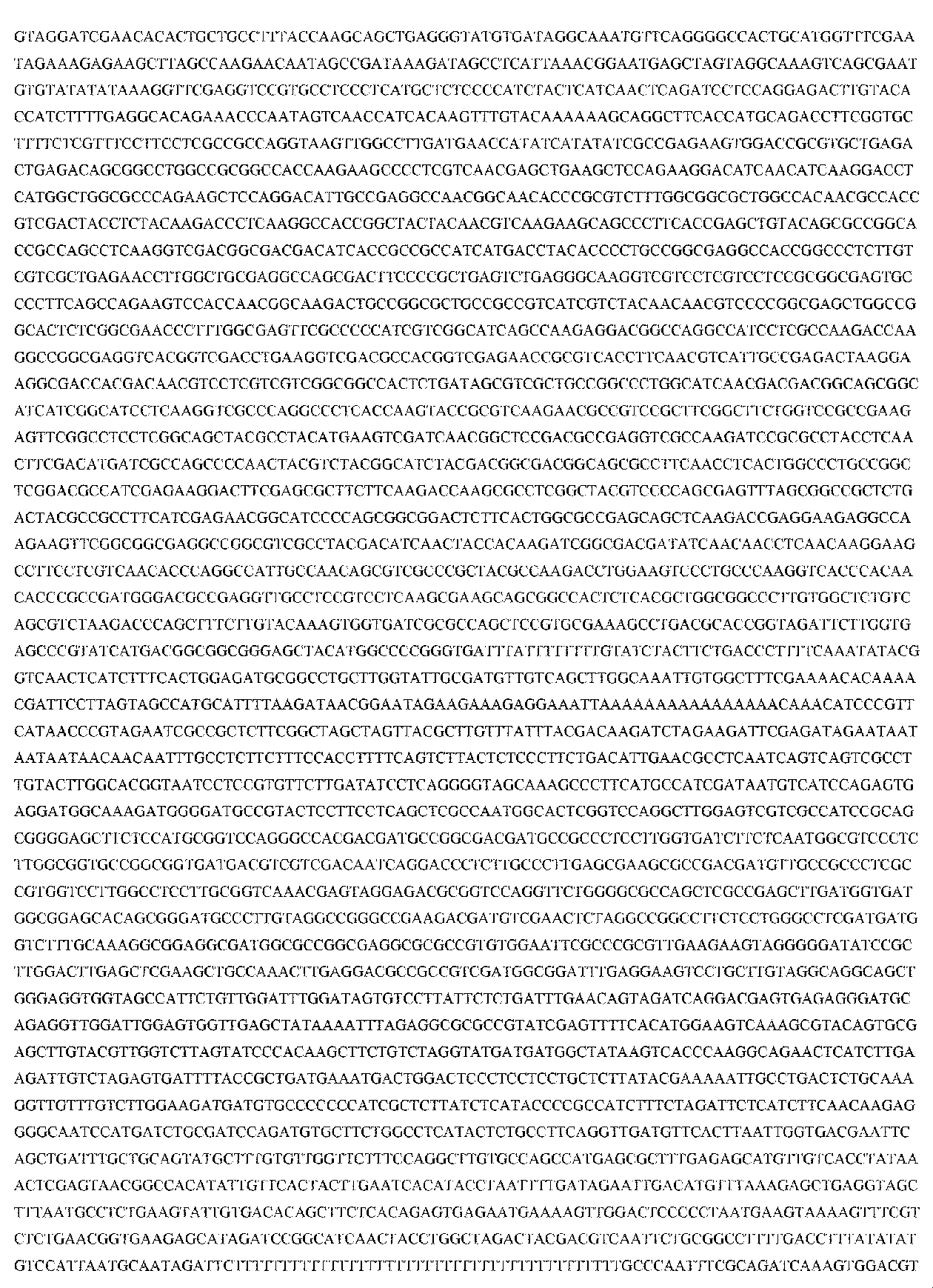

配列番号12=pTrex8gM_TRI034発現コンストラクトのヌクレオチド配
列。


配列番号13=pTrex8gM_TRI035発現コンストラクトのヌクレオチド配
列。


配列番号14=pTrex8gM_TRI036発現コンストラクトのヌクレオチド配
列。


配列番号15=pTrex8gM_TRI037発現コンストラクトのヌクレオチド配
列。


配列番号16=pTrex8gM_TRI038発現コンストラクトのヌクレオチド配
列。


実施例2-グルテン加水分解における、ネオサルトリア・フィッシェリ(Neosart
orya fischeri)由来のPepN 2(TRI031)の作動pHおよび温
度の最適値
グルタミン酸の遊離は、ダイズまたはグルテンの加水分解などの、野菜タンパク質の加
水分解における重要な品質パラメータである。遊離したグルタミン酸は、いわゆる「旨味
フレーバー」と捉えられ得る。グルタミン酸およびグルタミンの遊離の観点から、グルテ
ンの加水分解に最初に適用したpHの影響を調べるために、15~30分でグルテンを液
化し、その直後に1MのHClでグルテン加水分解の初期pHを調節した。グルテンをグ
ルタミナーゼ(Amano、日本)で処理した。さらに、グルテンを、FoodPro
Alkaline Protease、FoodPro PNLおよびPepN 2(ネ
オサルトリア・フィッシェリ(Neosartorya fischeri))で処理し
た。20時間後、限外ろ過により加水分解を停止させた(カットオフ10kDa、Sar
torius Stedium Biotech、Goettingen、German
y)。酵素によるグルタミン酸分析に透過性を使用した(酵素によるL-グルタミン酸分
析キット、Roche、Mannheim、Germany)。図2に示すように、Pe
pN 2はpH6.0と比較してpH範囲7.0~9.0でより高い効率を示した。
Example 2 - Neosartoria fischeri in gluten hydrolysis
Optimum working pH and temperature of PepN 2 (TRI031) from A. orya fischeri The release of glutamic acid is an important quality parameter in the hydrolysis of vegetable proteins, such as the hydrolysis of soy or gluten. The released glutamic acid can be considered as the so-called "umami flavor". To investigate the influence of the initially applied pH on the hydrolysis of gluten in terms of the release of glutamic acid and glutamine, the gluten was liquefied for 15-30 min and immediately thereafter the initial pH of the gluten hydrolysis was adjusted with 1 M HCl. The gluten was treated with glutaminase (Amano, Japan). Furthermore, the gluten was subjected to a 20 min incubation with FoodPro.
The hydrolysis was stopped after 20 hours by ultrafiltration (cut-off 10 kDa, Sar
torius Stedium Biotech, Goettingen, Germany
Permeabilization was used for enzymatic glutamate assay (Enzymatic L-Glutamate Assay Kit, Roche, Mannheim, Germany). As shown in FIG.
pN2 showed higher efficiency in the pH range 7.0-9.0 compared to pH 6.0.
グルタミン酸およびグルタミンの遊離の観点から、グルテンの加水分解に適用した温度
の影響を調べるために、グルテン懸濁液を15~30分で液化し、その直後に1MのHC
lでグルテン加水分解の初期pHをpH7.0に調節した。図3に示すように、40~6
0℃の温度範囲を使用した。グルテンをグルタミナーゼ(Amano、日本)と混合した
。さらに、グルテンをFoodPro(登録商標) Alkaline Proteas
e、FoodPro(登録商標) PNLおよびPepN 2(ネオサルトリア・フィッ
シェリ(Neosartorya fischeri))と混合した。加水分解を始めて
20時間後、限外ろ過により加水分解を停止させた(カットオフ10kDa、Sarto
rius Stedium、Goettingen、Germany)。酵素によるグル
タミン酸分析に透過性を使用した(酵素によるL-グルタミン酸分析キット、Roche
、Mannheim、Germany)。ネオサルトリア・フィッシェリ(Neosar
torya fischeri)由来のPepN 2は、60℃で最も高い効率を示した
。
To investigate the effect of applied temperature on the hydrolysis of gluten in terms of the release of glutamic acid and glutamine, gluten suspensions were liquefied for 15-30 min and immediately subjected to 1 M HC1.
The initial pH of gluten hydrolysis was adjusted to pH 7.0 with 100 ml of ethanol. As shown in FIG.
A temperature range of 0°C was used. Gluten was mixed with glutaminase (Amano, Japan). Additionally, gluten was mixed with FoodPro® Alkaline Proteases.
e, FoodPro® PNL and PepN 2 (Neosartoria fischeri). After 20 hours of hydrolysis, the hydrolysis was stopped by ultrafiltration (cut-off 10 kDa, Sarto
Permeabilization was used for enzymatic glutamate assay (Enzymatic L-Glutamate Assay Kit, Roche).
, Mannheim, Germany). Neosartoria Fischeri
PepN2 from A. torya fischeri showed the highest efficiency at 60°C.
実施例3-加水分解度の観点からの、ネオサルトリア・フィッシェリ(Neosarto
rya fischeri)由来のPepN 2(TRI031)と、アスペルギルス・
クラバタス(Aspergillus clavatus)由来のPepN 2(TRI
035)との比較
加水分解度(DH)は、同量のタンパク質について、例えば、6MのHCl中、約12
0℃で約24時間行った酸加水分解と比較して、開裂したペプチド結合の相対量を表す。
したがって、PepN 1型またはPepN 2型などの一般的なPepNのアミノ酸遊
離効率の評価には、DHがより高いことが適用され得る。無細胞培養ブロスを濃縮し(カ
ットオフ10kDa、Sartorius、Goettingen、Germany)、
製造業者の説明通り使い捨て脱塩カラム(PD10、GE、Muenchen、Germ
any)を使用して脱塩した。基質として、予備加水分解した10%(w/w)Na-カ
ゼイン塩(DMK、Germany)、ホエータンパク質分離物(WPI;Arla、V
iby、Denmark)、ダイズタンパク質分離物(SPI;SUPRO(登録商標)
760、DuPont、Brabrand、Denmark)およびグルテン懸濁液を使
用した。予備加水分解は、Na-カゼイン塩、WPIおよびSPI懸濁液に対し、1%(
w/wタンパク質)のFOODPRO(登録商標)Alkaline Protease
、1%(w/wタンパク質)のFOODPRO(登録商標)PNLを用いて行った。予備
加水分解は全て55℃で18時間行い、その後、95℃で20分間不活化処理を行った。
使用した各PepN 2は、培養ブロスから最終加水分解へのアミノ酸のキャリーオーバ
ー除去の対照として、また、使用したエンドペプチダーゼを十分に不活化するために、9
5℃で15分間不活化した。加水分解は、96ウェルマイクロタイタープレートフォーマ
ット中で行い、下記表1に示すように、50μLのPepN 2原液と混合した150μ
Lの予備加水分解タンパク質懸濁液から構成された。加水分解は50℃で20時間行い、
その後、20μLの2M TCA(トリクロロ酢酸、Sigma-Aldrich、Sc
hnelldorf、Germany)の添加により加水分解を停止させた。ネオサルト
リア・フィッシェリ(Neosartorya fischeri)およびアスペルギル
ス・クラバタス(Aspergillus clavatus)由来のPepN 2型の
アミノ酸遊離効率を表1(B)および(A)に示す。特に、Na-カゼイン塩、WPIお
よびSPIの基質では、ネオサルトリア・フィッシェリ(N.fischeri)および
アスペルギルス・クラバタス(A.clavatus)由来のPepN 2型を使用する
と、非常に高いDHが達成された。さらに、PepN 2型原液濃度で達成されたDHは
、著しい増加であると考えられる。グルテンの加水分解では、0.02~0.3mg/m
L PepN 2のタンパク質範囲でDHが増加することがわかった。
Example 3 - The effect of Neosartoria fischeri (Neosartoria fischeri) in terms of the degree of hydrolysis
PepN2 (TRI031) derived from Aspergillus fischeri and
PepN2 (TRI) from Aspergillus clavatus
035) The degree of hydrolysis (DH) is approximately 12 for the same amount of protein in, for example, 6M HCl.
The relative amount of peptide bonds cleaved is expressed as compared to acid hydrolysis carried out at 0° C. for approximately 24 hours.
Therefore, a higher DH may be applied to evaluate the amino acid release efficiency of common PepNs, such as
Disposable desalting columns (PD10, GE, Munich, Germany) were used as described by the manufacturer.
As substrates, prehydrolyzed 10% (w/w) Na-caseinate (DMK, Germany), whey protein isolate (WPI; Arla, Germany), and ethanol (Essex, Germany) were used.
iby, Denmark), soy protein isolate (SPI; SUPRO®
760, DuPont, Brabrand, Denmark) and gluten suspensions were used. Prehydrolysis was performed at 1% (
FOODPRO® Alkaline Protease (w/w protein )
All prehydrolysis was carried out at 55° C. for 18 hours, followed by inactivation at 95° C. for 20 minutes.
Each
The hydrolysis was carried out in a 96-well microtiter plate format, with 150 μL of PepN2 mixed with 50 μL of PepN2 stock solution, as shown in Table 1 below.
The hydrolysis was carried out at 50° C. for 20 hours.
Then, 20 μL of 2M TCA (trichloroacetic acid, Sigma-Aldrich, Sc
Hydrolysis was stopped by the addition of 0.02-0.3 mg/m2 PepN. The amino acid release efficiency of
It was found that DH increased over the protein range of

実施例4-2種のエンドペプチダーゼを、PepN 2の候補のTRI032、TRI0
33、TRI034、TRI035、TRI037およびTRI038と組み合わせて使
用したグルテンの加水分解
FOODPRO(登録商標)Alkaline Protease(FPAP)および
FOODPRO(登録商標)PNL(FPPNL)の添加によって予備加水分解したグル
テンの懸濁液を調製した。加水分解は55℃で行った。約18時間後、90℃に10分間
加熱することにより、加水分解を停止させた。50℃に冷却後、グルテンにグルタミナー
ゼを使用した。その後、150μLの予備加水分解したグルテンを96ウェルマイクロタ
イタープレートの各ウェルに移した。50μL(タンパク質濃度:0.5mg/mL)の
TRI032、TRI033、TRI034、TRI035、TRI037およびTRI
038を使用してグルタミン酸の遊離を行った。加水分解は18時間行い、20μLの2
M TCAの添加により停止させた。停止させた加水分解物をろ過(0.22mm)し、
酵素によるグルタミン酸分析キット(Roche、Mannheim、Germany)
によりさらに分析した。遊離したグルタミン酸の濃度を図4に示す。
Example 4 - Two endopeptidases, TRI032 and TRI0, candidates for
Hydrolysis of gluten used in combination with TRI033, TRI034, TRI035, TRI037 and TRI038. A suspension of prehydrolyzed gluten was prepared by addition of FOODPRO® Alkaline Protease (FPAP) and FOODPRO® PNL (FPPNL). Hydrolysis was carried out at 55°C. After about 18 hours, hydrolysis was stopped by heating to 90°C for 10 minutes. After cooling to 50°C, gluten was treated with glutaminase. 150 μL of prehydrolyzed gluten was then transferred to each well of a 96-well microtiter plate. 50 μL (protein concentration: 0.5 mg/mL) of TRI032, TRI033, TRI034, TRI035, TRI037 and TRI038 were added to each well of a 96-well microtiter plate.
Hydrolysis was carried out for 18 hours, and 20 μL of 2
The hydrolysis was stopped by the addition of MTCA. The stopped hydrolysate was filtered (0.22 mm) and
Enzymatic Glutamate Assay Kit (Roche, Mannheim, Germany)
The concentration of released glutamic acid is shown in FIG.
実施例5-プロリン含有ペプチドの加水分解
ペプチドWHWLQLKPGQPMYをTRI031およびTRI035で加水分解し
た。20mMのCPB-バッファー(20mMクエン酸、20mMリン酸塩、20mMホ
ウ酸)中、55℃で、1μg/mLのアミノペプチダーゼと共に、ペプチド(1mg/m
L)をインキュベートした。示された時点で50μlの5%TFAでアリコット(50μ
L)を停止させ、LC-MS分析に供した。
Example 5 - Hydrolysis of proline-containing peptides The peptide WHWLQLKPGQPMY was hydrolyzed with TRI031 and TRI035. The peptide (1 mg/mL) was hydrolyzed with 1 μg/mL aminopeptidase in 20 mM CPB-buffer (20 mM citric acid, 20 mM phosphate, 20 mM boric acid) at 55°C.
Aliquots (50 μl) were added with 50 μl of 5% TFA at the indicated time points.
L) was stopped and subjected to LC-MS analysis.
この結果は、TRI031およびTRI035が、ペプチドWHWLQLKPGQPM
Y(図5)をKPGQPMY(図6)へと、さらにQPMY(図7)へと加水分解できる
ことを示している。これはアスペルギルス・オリゼ(Aspergillus oryz
ae)のPepN 2について以前に記載されていること(A.M.Blinkovsk
y et al.,Biochimica et Biophysica Acta,1
480(2000)171-181、そこでは、アスペルギルス・オリゼ(Asperg
illus oryzae)のPepN 2は、ペプチドWHWLQLKPGQPMYの
ものを含め、調査したいかなるX-Pro結合も加水分解しないと主張された。)とは対
照的である。しかしながら、我々はまた、それらの酵素がペプチドをQPMYに開裂する
ことを見出している(図7)。
The results show that TRI031 and TRI035 bind to the peptide WHWLQLKPGQPM.
This shows that Y (Figure 5) can be hydrolyzed to KPGQPMY (Figure 6) and further to QPMY (Figure 7).
ae) has been previously described for PepN 2 (A.M. Blinkovsk
y et al. , Biochimica et Biophysica Acta, 1
480 (2000) 171-181, in which Aspergillus oryzae
This is in contrast to the previously reported PepN2 enzyme from Bacillus oryzae, which was claimed not to hydrolyze any X-Pro bonds investigated, including that of the peptide WHWLQLKPGQPMY. However, we also found that their enzyme cleaves the peptide to QPMY (Figure 7).
データ収集:LTQ Orbitrap Classicハイブリッド質量分析計(T
hermo Scientific、Bremen、Germany)と接続したAgi
lent 1100 LCシステム(Agilent Technologies)を使
用してキャピラリーLC-MS/MS分析を行った。試料を15cmのPhenomen
ix Jupiter 4μ Proteo 90A、C4分析用カラムに注入した。I
ONMAX(登録商標)イオン源(Thermo Scientific、San Jo
se)への流量16μL/minで、10分間の0~40%溶媒B H2O/CH3CN
/HCOOH(50/950/0.65、v/v/v)の勾配を使用して分離した。LT
Q Orbitrap Classic装置をデータ依存MS/MSモードで操作した。
ペプチド質量をOrbitrap(MSのスキャンは、m/z400において60000
の分解能で行った)により測定し、最大強度ペプチドのm/zを2つまで選択し、リニア
イオントラップ(LTQ)中でCIDを使用して断片化に供した。動的排除は、500質
量のリストサイズ、40秒の持続時間、およびリスト上の質量に対して±10ppmの排
除質量幅により有効とした。
Data collection: LTQ Orbitrap Classic hybrid mass spectrometer (T
Agi connected to Hermo Scientific, Bremen, Germany
Capillary LC-MS/MS analysis was performed using an Agilent 1100 LC system (Agilent Technologies). Samples were loaded onto a 15 cm Phenomenon column.
ix Jupiter 4μ Proteo 90A, C4 analytical column.
ONMAX® ion source (Thermo Scientific, San Joa
0-40% solvent B H 2 O/CH 3 CN for 10 min at a flow rate of 16 μL/min
The separation was carried out using a gradient of LT/HCOOH (50/950/0.65, v/v/v).
The Q Orbitrap Classic instrument was operated in data-dependent MS/MS mode.
Peptide masses were analyzed using Orbitrap (MS scan was 60,000 at m/z 400).
A resolution of 100 MHz was used to measure the m/z of peptides, and up to two of the most intense peptides were selected and subjected to fragmentation using CID in a linear ion trap (LTQ). Dynamic exclusion was enabled with a list size of 500 masses, a duration of 40 seconds, and an exclusion mass width of ±10 ppm for the masses on the list.
無標識定量:クロマトグラムを構築するためにMS1強度を使用する、プログラムSk
yline 2.6.0.7176(MacLean,B.,et al.,「Skyl
ine:an open source document editor for c
reating and analyzing targeted proteomic
s experiments」,Bioinformatics,2010,26(7)
:p.966-8)を用いて生のファイルにアクセスした(Schilling,B.,
et al.,「Platform-independent and label-f
ree quantitation of proteomic data using
MS1 extracted ion chromatograms in skyl
ine:application to protein acetylation a
nd phosphorylation」,Mol Cell Proteomics,
2012.11(5):p.202-14)。プレカーサー同位体インポートフィルター
を分解能60,000の3つのカウント(M、M+1およびM+2)に設定し、最大強度
の電荷状態を使用した。基質および開裂生成物のペプチド配列を、Skylineに入力
し、それぞれの試料の強度を計算した。図はプログラムから直接コピーした(図8を参照
)。
Label-free quantification: Use MS1 intensities to construct chromatograms, program Sk
yline 2.6.0.7176 (MacLean, B., et al., “Skyl
ine:an open source document editor for c
Reating and analyzing targeted proteomics
s experiments”, Bioinformatics, 2010, 26 (7)
: pp. 966-8) was used to access the raw files (Schilling, B.,
et al. , “Platform-independent and label-f
ree quantitation of proteomic data using
MS1 extracted ion chromatograms in sky
ine:application to protein acetylation a
nd phosphorylation”, Mol Cell Proteomics,
2012.11(5):pp. 202-14). The precursor isotope import filter was set to 3 counts (M, M+1 and M+2) with a resolution of 60,000 and the maximum intensity charge state was used. The peptide sequences of the substrate and cleavage products were entered into Skyline and the intensities of each sample were calculated. Figures were copied directly from the program (see Figure 8).
実施例6:アスペルギルス・クラバタス(A.clavatus)由来のPepN 2の
加水分解度の、アスペルギルス・オリゼ(A.oryzae)およびラクトバチルス・ヘ
ルベティカス(L.helveticus)ATCC12046由来のPepNの加水分
解度との比較
Stressler,Eisele et al.(2013、下記)にしたがって、
PepN 1ラクトバチルス・ヘルベティカス(Lactobacillus helv
eticus)ATCC(登録商標)12046、PepN 1アスペルギルス・オリゼ
(Aspergillus oryzae)、およびアスペルギルス・クラバタス(As
pergillus clavatus)(TRI035)由来のPepN 2の酵素活
性を測定した。ラクトバチルス・ヘルベティカス(L.helveticus)からPe
pN 1を発現させ、Stressler、Eisele et al.(2013、下
記)に記載のように精製した。
Example 6: Comparison of the degree of hydrolysis of
eticus ATCC® 12046,
The enzyme activity of PepN2 from Lactobacillus helveticus (TRI035) was measured.
pN1 was expressed and purified as described in Stressler, Eisele et al. (2013, infra).
アスペルギルス・オリゼ(A.oryzae)由来のPepN 1を、FLAVOUR
ZYME(登録商標)500L(Sigma-Aldrich、Schnelldorf
、Germany)から、20mMのビス-トリス、pH6.5で平衡化したPD10カ
ラムで脱塩した後、精製した。アニオン交換クロマトグラフィーにより、Source
Q15、XK26/15(SQ15)カラム(GE-Lifesciences、USA
)を使用して試料を精製し、20mMのビス/トリス、pH6.5(バッファーA)で平
衡化させた。流量7mL/minで試料(30mL)をカラムに注入した。カラムをバッ
ファーAで洗浄し、結合したタンパク質を、0~0.5MのNaCl(20mM Bis
/Tris(pH6.5)中)の直線勾配により溶出させた(50分間)。全操作期間中
に約13mLの画分を回収し、氷上に保管した。アミノペプチダーゼ活性が最も高い画分
をまとめて、PD10(20mMのBis-Tris(pH6.0)中)で脱塩し、20
mMのBis/Tris、pH6.0(バッファーA)により平衡化したPoros Q
20 HR26/10、XK26/10カラム(GE-Lifesciences、US
A)による2回目の精製に供した。流量4mL/minでPepN1試料をカラムに注入
した。カラムをバッファーAで洗浄し、結合したタンパク質を、0~0.25MのNaC
l(20mM Bis/Tris(pH6.0)中)の直線勾配により溶出させた(30
分間)。全操作期間中に約8mLの画分を回収し、氷上に保管した。精製したアスペルギ
ルス・オリゼ(A.oryzae)由来のPepN 1は、SDS-PAGE電気泳動法
により約40kDaの分子量を有することがわかった。
PepN1 derived from Aspergillus oryzae was purified by FLAVOUR.
ZYME® 500L (Sigma-Aldrich, Schnelldorf)
The product was purified from Source (Germany) by anion exchange chromatography after desalting on a PD 10 column equilibrated with 20 mM Bis-Tris, pH 6.5.
Q15, XK26/15 (SQ15) column (GE-Lifesciences, USA
The samples were purified using 100% ethanol and equilibrated with 20 mM Bis/Tris, pH 6.5 (Buffer A). The samples (30 mL) were injected onto the column at a flow rate of 7 mL/min. The column was washed with Buffer A and bound proteins were eluted with 0-0.5 M NaCl (20 mM Bis
The column was eluted with a linear gradient of 1000 mM Bis-Tris (pH 6.5) (50 min). Approximately 13 mL fractions were collected during the entire run and stored on ice. Fractions with the highest aminopeptidase activity were pooled, desalted with PD10 (in 20 mM Bis-Tris (pH 6.0)) and diluted with 20 mM glycerol.
Poros Q equilibrated with 1 mM Bis/Tris, pH 6.0 (Buffer A)
20 HR26/10, XK26/10 column (GE-Lifesciences, US
The PepN1 sample was injected onto the column at a flow rate of 4 mL/min. The column was washed with buffer A and the bound protein was purified by elution with 0-0.25 M NaCl.
The column was eluted with a linear gradient of 30 μl (in 20 mM Bis/Tris, pH 6.0).
Fractions of approximately 8 mL were collected during the entire run and stored on ice. The purified PepN1 from Aspergillus oryzae was found to have a molecular weight of approximately 40 kDa by SDS-PAGE electrophoresis.
PepN 1およびPepN 2アミノペプチダーゼを2.5-200nkat*mL
-1の活性化範囲に標準化した。タンパク質の加水分解のために、1%(w/wWPI)
FOODPRO(登録商標)Alkaline Protease(DuPont、Br
abrand、Denmark)および1%(w/wWPI)FOODPRO(登録商標
)PNL(DuPont、Brabrand、Denmark)を、初期pH7.0でホ
エー乳漿タンパク質分離物懸濁液(WPI;LACPRODAN(登録商標)9224、
Arla Ingredients、Viby、Denmark)に加えた。エンドペプ
チダーゼの添加後、WPIを加え、200μLを96ウェルマイクロタイタープレートの
各ウェルに移した。その後、表2に示すように、5μLのPepN溶液を加えた。加水分
解を50℃、pH無制御で行い、18時間後に20μLの2M TCAを添加して停止さ
せた。DHの測定(Nielsen、Petersen et al.,2001、下記
)に先立って、全試料を0.22μmでろ過した。
PepN 1 and
Normalized to an activity range of -1 . For protein hydrolysis, 1% (w/w WPI )
FOODPRO® Alkaline Protease (DuPont, Br
abrand, Denmark) and 1% (w/w WPI ) FOODPRO® PNL (DuPont, Brabrand, Denmark) were diluted with whey protein isolate suspension (WPI; LACPRODAN® 9224,
The hydrolysis was carried out at 50° C. without pH control and stopped after 18 hours by adding 20 μL of 2M TCA. All samples were filtered at 0.22 μm prior to measurement of DH (Nielsen, Petersen et al., 2001, below).
アスペルギルス・クラバタス(A.clavatus)由来のPepN 2は、アスペ
ルギルス・オリゼ(A.oryzae)由来のPepN 1より、全ての用量で高いDH
を示し、ラクトバチルス・ヘルベティカス(L.helveticus)由来のPepN
1より、試験した4つの最大活性用量で高いDHを示すことがわかった。そして、2つ
の最大用量で、アスペルギルス・クラバタス(A.clavatus)由来のPepN
2は、PepN 1アミノペプチダーゼより、少なくとも25%高いDHを示した。
and PepN derived from Lactobacillus helveticus (L. helveticus).
1 showed high DH at the four highest active doses tested. And, PepN derived from Aspergillus clavatus showed high DH at the two highest doses.
2 exhibited at least 25% higher DH than

実施例7:ダイズおよびグルテンの加水分解における、グルタミン酸の遊離に対する塩化
ナトリウムの影響
食品工業では、タンパク質の加水分解時の微生物による汚染のリスクを減じるために、
しばしば塩化ナトリウムを使用する。1%(w/wタンパク質)FOODPRO(登録商
標)Alkaline Protease(DuPont、Brabrand、Denm
ark)および1%(w/wタンパク質)FOODPRO(登録商標)PNL(DuPo
nt、Brabrand、Denmark)を添加することにより、予備加水分解した1
0%(w/w)ダイズ(SuPro(登録商標)760、DuPont、Brabran
d、Denmark)およびグルテン(Sigma-Aldrich、Schnelld
orf、Germany)を調製した。加水分解を、50℃、pH7.0(pH無制御)
で18時間行った(18時間後、熱による不活化;90℃;10分)。その後、加水分解
物を、塩化ナトリウム含有(185mM)加水分分解物と塩非含有加水分解物に分割した
。予備加水分解した各タンパク質懸濁液150μLを、表3に示すように、異なる方法で
標準化したアスペルギルス・クラバタス(Aspergillus clavatus)
PepN 2と混合した。50℃、pH無制御で加水分解を行い、18時間後に20μL
の2M TCAを添加して停止させた。DHの測定(Nielsen,Petersen
et al.2001、下記)に先立って、全試料を0.22μmでろ過した。表3に
示すように、185mMのNaClの添加は、ダイズおよびグルテンの加水分解における
加水分解度の測定値に全く影響しなかった。
Example 7: Effect of sodium chloride on the release of glutamic acid during hydrolysis of soy and gluten. In the food industry, sodium chloride is often used to reduce the risk of microbial contamination during protein hydrolysis.
Sodium chloride is often used. 1% (w/w protein ) FOODPRO® Alkaline Protease (DuPont, Brabrand, Denmark)
ark) and 1% (w/w protein ) FOODPRO® PNL (DuPo
0% (w/w) soybean (SuPro® 760, DuPont, Brabran
d, Denmark) and gluten (Sigma-Aldrich, Schnelld
orf, Germany) was prepared. Hydrolysis was carried out at 50°C, pH 7.0 (pH uncontrolled).
The prehydrolyzed protein suspension was then transferred to a sodium chloride-containing (185 mM) hydrolyzate and a salt-free hydrolyzate for 18 hours at 90°C (heat inactivation after 18 hours; 90°C; 10 min). The hydrolyzate was then split into a sodium chloride-containing (185 mM) hydrolyzate and a salt-free hydrolyzate. 150 μL of each prehydrolyzed protein suspension was transferred to a sodium chloride-containing (185 mM) hydrolyzate and a salt-free hydrolyzate for 18 hours at 90°C (heat inactivation after 18 hours; 90°C; 10 min).
Mix with
The reaction was stopped by adding 2 M TCA.
All samples were 0.22 μm filtered prior to hydrolysis (Ku et al. 2001, infra). As shown in Table 3, the addition of 185 mM NaCl had no effect on the measured degree of hydrolysis for soy and gluten hydrolysis.

Nielsen,P.M.,et al.(2001),Journal of Fo
od Science 66(5):642-646。
Nielsen, P. M. , et al. (2001), Journal of Fo
od Science 66(5):642-646.
Stressler,T.,et al.(2013),PLoS ONE 8(7)
。
Stressler, T. , et al. (2013), PLoS ONE 8(7)
.
実施例8:PepN2 TRI031およびTRI035対TRI063(アスペルギル
ス・オリゼ(A.oryzae))の生成物による阻害
この試験では、基質H-Ala-ニトロアニリド(pNA)の加水分解により酵素活性
を測定した。放出されたpNAの波長405nmにおける吸光度を、マイクロタイタープ
レートリーダーを使用して経時的に測定した。
Example 8: Inhibition by products of PepN2 TRI031 and TRI035 versus TRI063 (A. oryzae) In this study, enzyme activity was measured by hydrolysis of the substrate H-Ala-nitroanilide (pNA). The absorbance of released pNA at a wavelength of 405 nm was measured over time using a microtiter plate reader.
これらの物質のバッファーとして、20mMのCPBバッファー(20mMのNa-ク
エン酸塩、Na-リン酸塩およびNa-ホウ酸塩)pH9.0を使用した。酵素試料とし
てPepN 2 TRI031およびTRI035を使用した。20mgのH-Ala-
pNA基質(BACHEM、L-1070)を1mLのDMSO(ジメチルスルホキシド
;Sigmaカタログ番号D2650)中で可溶化した。96ウェルプレートのCost
ar assay plate 9017(Corning Inc)を使用し、これら
のプレートをMolecular DevicesのVERSAMAX(登録商標)リー
ダーで読み取った。阻害試験用に、各アミノ酸、すなわちリシン、ヒスチジン、ロイシン
、トリプトファン、プロリン、グリシン、セリン、アスパラギン、トレオニン、アスパラ
ギン酸、グルタミン酸の20mg/mL溶液10mLを調製した。トリプトファンおよび
プロリンはDMSOに溶解した。他のアミノ酸は全て、バッファーに溶解した。500μ
Lの各アミノ酸溶液を混合して、最終の阻害混合物を調製した。
As a buffer for these substances, 20 mM CPB buffer (20 mM Na-citrate, Na-phosphate and Na-borate) pH 9.0 was used. As enzyme samples,
pNA substrate (BACHEM, L-1070) was solubilized in 1 mL of DMSO (dimethyl sulfoxide; Sigma catalog number D2650).
The plates were read on a Molecular Devices VERSAMAX® reader using a 300 μL assay plate 9017 (Corning Inc). For inhibition studies, 10 mL of a 20 mg/mL solution of each amino acid was prepared: lysine, histidine, leucine, tryptophan, proline, glycine, serine, asparagine, threonine, aspartic acid, and glutamic acid. Tryptophan and proline were dissolved in DMSO. All other amino acids were dissolved in buffer. 500 μL of 20 mg/mL of each amino acid was dissolved in DMSO. All other amino acids were dissolved in buffer.
The final inhibitor mixture was prepared by mixing each amino acid solution at 1:1000 μl/L.
96ウェルプレートを氷上に置き、180μLのバッファー、15μLの希釈した酵素
、および20μLの阻害混合物をプレートのウェルに加え、混合した。各プレートには、
0.017、0.085、0.128、0.170、0.426、0.851、1.70
2、2.553mg/mLの阻害混合物濃度で、4種の酵素を全て含有させた。20μL
の基質を添加することにより、反応を開始させた。1つのプレートに、1つの基質濃度を
使用した。反応開始後、30℃に設定したマイクロプレートリーダーにできるだけ早くプ
レートを入れ、405nmにおける吸光度を30秒間隔で30分間測定した。各プレート
に1つの基質濃度(0.017、0.170、0.426、0.851、1.702、2
.553mg/mLのいずれか)とした6枚のプレートについて測定した。見かけの阻害
定数(Ki)を決定するために、データをGraphPad Prismにエクスポート
し、これにより阻害物質の濃度毎にミカエリス・メンテン曲線にフィッティングし、これ
に基づいて、Kiをmg/mlの単位で算出した。阻害物質の平均分子量133.9g/
molを使用して、単位をmMに変換した。異なる酵素についての、生成物による阻害の
みかけのKi値、およびそれぞれの標準偏差(SD)を表4に記す。
A 96-well plate was placed on ice and 180 μL of buffer, 15 μL of diluted enzyme, and 20 μL of inhibitor mix were added to the wells of the plate and mixed.
0.017, 0.085, 0.128, 0.170, 0.426, 0.851, 1.70
2. Contains all four enzymes at an inhibitor mixture concentration of 2.553 mg/mL.
The reaction was started by adding 100 μl of substrate. One substrate concentration was used per plate. After the reaction was started, the plate was placed in a microplate reader set at 30° C. as soon as possible, and the absorbance at 405 nm was measured at 30 second intervals for 30 minutes. One substrate concentration (0.017, 0.170, 0.426, 0.851, 1.702, 2.0001) was added to each plate.
The inhibitors were measured on six plates containing either 100 mg/mL or 553 mg/mL of 100% 100% 15% 1 ...
The units were converted to mM using mol. The apparent Ki values of inhibition by the products for the different enzymes and their respective standard deviations (SD) are given in Table 4.

表4から、PepN 2 TRI031およびTRI035は、生成物による阻害に対
し、最大の見かけのKi値を有していることがわかる。それは、アスペルギルス・オリゼ
(A.oryzae)由来のTRI063と比較して、それらが生成物によって阻害され
にくいことを意味している。
From Table 4, it can be seen that
実施例9:Glu-pNAおよびGln-pNA基質に対するPepN2およびPepN
1の活性
基質としてH-Glu-ニトロアニリド(pNA)およびH-Gln-ニトロアニリド
(pNA)を使用し、p-ニトロアニリド(pNA)の放出を405nmにおける吸光度
により測定した。バッファーとして20mMのCPB-バッファー(20mMのクエン酸
、20mMのNa-リン酸塩、20mMのホウ酸)pH9.0を使用した。10mgのH
-Glu-pNAおよびH-Gln-pNA(BACHEMまたはSchafer N;
Copenhagen、Denmarkから)を1mlのDMSO(SIGMA製のジメ
チルスルホキシド;カタログ番号D2650)に溶解した。
Example 9: PepN2 and PepN on Glu-pNA and Gln-pNA substrates
Activity of 1 H-Glu-nitroanilide (pNA) and H-Gln-nitroanilide (pNA) were used as substrates, and the release of p-nitroanilide (pNA) was measured by absorbance at 405 nm. 20 mM CPB-buffer (20 mM citric acid, 20 mM Na-phosphate, 20 mM boric acid) pH 9.0 was used as buffer. 10 mg of H
-Glu-pNA and H-Gln-pNA (BACHEM or Schafer N;
Copenhagen, Denmark) was dissolved in 1 ml of DMSO (dimethyl sulfoxide from SIGMA; catalogue number D2650).
試験を実施するために、Costar assay plate 9017(Corn
ing Inc.)中の、80μLのバッファー、10μLのH-Glu-pNAまたは
H-Gln-pNA基質、および10μLの適切に希釈したPepN 2を45℃でイン
キュベートし、SoftMaxPro5.4.1ソフトウエアで稼働するVERSAMA
X(登録商標)マイクロプレートリーダー(Molecular Devices)で、
30秒毎に30分間、405nmで測定した。10の時点から求めた曲線における直線部
分の最大傾斜として、活性を決定した。
To carry out the test, a Costar assay plate 9017 (Corne
80 μL of buffer, 10 μL of H-Glu-pNA or H-Gln-pNA substrate, and 10 μL of appropriately diluted
1. Measure the plate thickness using a .X® microplate reader (Molecular Devices)
Measurements were taken at 405 nm every 30 seconds for 30 minutes. Activity was determined as the maximum slope of the linear portion of the curve determined from 10 time points.
試験は、PepN 2 TRI031およびTRI035の精製試料、ならびに精製P
epN 1ラクトバチルス・ヘルベティカス(L.helveticus)(Stres
sler、Eisele et al.、上記)、さらに、非精製PepN 1アスペル
ギルス・ソイエ(A.sojae)(COROLASE(登録商標)LAP、AB En
zymes)について行ったが、これらは、Ala-pNAまたはLeu-pNAについ
ては全て同等の活性を有した(実施例HのAla-pNAについての記載と同様ではある
が、阻害物非存在下で行った)。表5に示すように、2種のPepN 2アミノペプチダ
ーゼは、有意な活性を示さなかった2種のPepN 1酵素とは対照的に、Glu-pN
AおよびGln-pNAに対して活性を示した。これは、PepN 2アミノペプチダー
ゼが、GluおよびGlnの放出に関して、PepN 1アミノペプチダーゼよりはるか
に有効であることを示している。
The test was performed on purified samples of
Sler, Eisele et al., supra), and
zymes), which all had equivalent activity with Ala-pNA or Leu-pNA (as described for Ala-pNA in Example H, but in the absence of inhibitors). As shown in Table 5, the two

実施例10-2位にプロリンを有するペプチドの加水分解
ペプチドライブラリーXPAAAR(Xは全てシステイン以外のアミノ酸)を酵素試料
TRI032、TRI035、TRI063(アスペルギルス・オリゼ(A.oryza
e))およびCOROLASE(登録商標)LAPで加水分解した。3×20mMのCP
B-バッファー(20mMクエン酸、20mMリン酸塩、20mMホウ酸)中、55℃で
1μg/mLのアミノペプチダーゼと共に、ペプチドライブラリーXPAAAR(1mg
/mL)をインキュベートした。示された時点で50μlの5%TFAで50μLのアリ
コットを停止させ、LC-MS分析に供した。
Example 10 - Hydrolysis of peptides having proline at
e)) and COROLASE® LAP. 3 x 20 mM CP
The peptide library XPAAAR (1 mg) was incubated with 1 μg/mL aminopeptidase in B-buffer (20 mM citrate, 20 mM phosphate, 20 mM borate) at 55° C.
/mL) was incubated at 4°C for 1 h at 20° C. Aliquots of 50 μL were quenched with 50 μl of 5% TFA at the indicated time points and subjected to LC-MS analysis.
データ収集:LTQ Orbitrap Classicハイブリッド質量分析計(T
hermo Scientific、Bremen、Germany)と接続したAgi
lent 1100 LCシステム(Agilent Technologies)を使
用してキャピラリーLC-MS/MS分析を行った。試料を15cmのPhenomen
ex Jupiter 4μ Proteo 90A、C4分析用カラムに注入した。I
ONMAX(登録商標)イオン源(Thermo Scientific、San Jo
se)への流量16μL/minで、10分間の0~40%溶媒B H2O/CH3CN
/HCOOH(50/950/0.65、v/v/v)の勾配を使用して分離した。LT
Q Orbitrap Classic装置をデータ依存MS/MSモードで操作した。
ペプチド質量をOrbitrap(MSのスキャンは、m/z400において60000
の分解能で行った)により測定し、最大強度ペプチドのm/zを2つまで選択し、リニア
イオントラップ(LTQ)中でCIDを使用して断片化に供した。動的排除は、500質
量のリストサイズ、40秒の持続時間、およびリスト上の質量に対して±10ppmの排
除質量幅により有効とした。
Data collection: LTQ Orbitrap Classic hybrid mass spectrometer (T
Agi connected to Hermo Scientific, Bremen, Germany
Capillary LC-MS/MS analysis was performed using an Agilent 1100 LC system (Agilent Technologies). Samples were loaded onto a 15 cm Phenomenon column.
The mixture was injected onto a Jupiter 4μ Proteo 90A, C4 analytical column.
ONMAX® ion source (Thermo Scientific, San Joa
0-40% solvent B H 2 O/CH 3 CN for 10 min at a flow rate of 16 μL/min
The separation was carried out using a gradient of LT/HCOOH (50/950/0.65, v/v/v).
The Q Orbitrap Classic instrument was operated in data-dependent MS/MS mode.
Peptide masses were analyzed using Orbitrap (MS scan was 60,000 at m/z 400).
A resolution of 100 MHz was used to measure the m/z of peptides, and up to two of the most intense peptides were selected and subjected to fragmentation using CID in a linear ion trap (LTQ). Dynamic exclusion was enabled with a list size of 500 masses, a duration of 40 seconds, and an exclusion mass width of ±10 ppm for the masses on the list.
無標識定量:クロマトグラムを構築するためにMS1強度を使用する、プログラムSk
yline2.6.0.7176(MacLean,B.,et al.、上記)を用い
て生のファイルにアクセスした(Schilling,B.,et al.、上記を参照
)。プレカーサー同位体インポートフィルターを分解能60,000の3つのカウント(
M、M+1およびM+2)に設定し、最大強度の電荷状態を使用した。基質および開裂生
成物のペプチド配列を、Skylineに入力し、それぞれの試料の強度を計算した。3
種の同位体(M、M+1、およびM+2)のピーク面積の合計を基に図10を作成した。
基質標準曲線(Std3.125からStd50へ連続して2倍の濃度増加)を含めてお
り、これは基質濃度とピーク面積に直線関係があることを示している。
Label-free quantification: Use MS1 intensities to construct chromatograms, program Sk
Raw files were accessed using yline2.6.0.7176 (MacLean, B., et al., supra) (Schilling, B., et al., supra). The precursor isotope import filter was set to 3 counts (
The charge states of the substrate and cleavage products were entered into Skyline and the intensities of each sample were calculated.
FIG. 10 was generated based on the sum of the peak areas of the isotopes of the species (M, M+1, and M+2).
A substrate standard curve (successive 2-fold concentration increases from Std 3.125 to Std 50) was included, demonstrating a linear relationship between substrate concentration and peak area.
LC-MSの結果(図10)は、TRI032およびTRI035では、ペプチドTP
AAARを時間とともに加水分解し、2時間のインキュベーションで濃度を半分未満にま
で低下させることができるが、TRI063(アスペルギルス・オリゼ(A.oryza
e))およびCOROLASE(登録商標)LAPでは、12時間でTPAAARの加水
分解を引き起こさないことを示している。
The LC-MS results (Figure 10) show that in TRI032 and TRI035, peptide TP
AAAR can be hydrolyzed over time, with the concentration reduced by more than half after 2 hours of incubation, whereas TRI063 (Aspergillus oryzae
e)) and COROLASE® LAP show no hydrolysis of TPAAAR at 12 hours.
本明細書中に、本発明の好ましい実施形態を示し、説明してきたが、当業者であれば、
そのような実施形態が例示のためにのみ提供されていることは明らかであろう。今や当業
者には、本発明から逸脱することなく、多くの変形、変更および置換が想起されるであろ
う。本発明を実施するにあたり、本明細書に記載の本発明の実施形態に対し、様々な代替
を使用し得ることは理解されるべきである。以下の請求項が本発明の範囲を定義し、また
、これらの請求項の範囲内の方法および構造、ならびにそれらの等価物が本発明の範囲に
よりカバーされることを意図している。
While preferred embodiments of the present invention have been shown and described herein, it will be apparent to those skilled in the art that
It should be apparent that such embodiments are provided by way of example only. Numerous variations, changes, and substitutions will now occur to those skilled in the art without departing from the invention. It should be understood that various alternatives to the embodiments of the invention described herein may be used in practicing the invention. It is intended that the following claims define the scope of the invention, and that methods and structures within the scope of these claims and their equivalents be covered thereby.
Claims (9)
前記アミノペプチダーゼ活性を有する単離ポリペプチドは、配列番号1、配列番号2、または配列番号5のアミノ酸配列と少なくとも90%の同一性を有するアミノ酸配列を有し、N末端から番号を付与したときの2の位置にプロリン残基を有するポリペプチドを加水分解する、単離ポリペプチドである、方法。 1. A method for producing a protein hydrolysate comprising exposing a proteinaceous substrate to an isolated polypeptide having aminopeptidase activity,
The method of claim 1, wherein the isolated polypeptide having aminopeptidase activity is an isolated polypeptide having an amino acid sequence having at least 90% identity to the amino acid sequence of SEQ ID NO:1, SEQ ID NO:2, or SEQ ID NO:5, and hydrolyzing a polypeptide having a proline residue at position 2, as numbered from the N-terminus.
前記アミノペプチダーゼ活性を有する単離ポリペプチドは、配列番号1、配列番号2、または配列番号5のアミノ酸配列と少なくとも90%の同一性を有するアミノ酸配列を有し、N末端から番号を付与したときの2の位置にプロリン残基を有するポリペプチドを加水分解する、単離ポリペプチドである、方法 A method for obtaining a protein hydrolysate enriched in free glutamic acid and/or peptides carrying glutamic acid residues from a proteinaceous substrate, the method comprising subjecting said substrate to a deamidation process and exposing it to an isolated polypeptide having aminopeptidase activity,
The isolated polypeptide having aminopeptidase activity is an isolated polypeptide having an amino acid sequence having at least 90% identity to the amino acid sequence of SEQ ID NO:1, SEQ ID NO:2, or SEQ ID NO :5 , and hydrolyzing a polypeptide having a proline residue at position 2, as numbered from the N-terminus.
b)モルト生成プロセス中に前記穀物に、アミノペプチダーゼ活性を有する単離ポリペプチドを有効量添加する工程、および
c)モルト化された穀物を得る工程
を含み、
前記アミノペプチダーゼ活性を有する単離ポリペプチドは、配列番号1、配列番号2、または配列番号5のアミノ酸配列と少なくとも90%の同一性を有するアミノ酸配列を有し、N末端から番号を付与したときの2の位置にプロリン残基を有するポリペプチドを加水分解する、単離ポリペプチドである、モルト化穀物の製造方法。 a) providing grain;
b) adding an effective amount of an isolated polypeptide having aminopeptidase activity to said grain during the malting process; and c) obtaining malted grain,
13. A method for producing malted grain, wherein the isolated polypeptide having aminopeptidase activity is an isolated polypeptide having an amino acid sequence having at least 90% identity to the amino acid sequence of SEQ ID NO:1, SEQ ID NO: 2 , or SEQ ID NO:5, and hydrolyzing a polypeptide having a proline residue at position 2, as numbered from the N-terminus.
前記アミノペプチダーゼ活性を有する単離ポリペプチドは、配列番号1、配列番号2、または配列番号5のアミノ酸配列と少なくとも90%の同一性を有するアミノ酸配列を有し、N末端から番号を付与したときの2の位置にプロリン残基を有するポリペプチドを加水分解する、単離ポリペプチドである、方法。 1. A method for producing free amino nitrogen (FAN) during brewing, comprising the step of adding, during a brewing process, an effective amount of an isolated polypeptide having aminopeptidase activity,
The method of claim 1, wherein the isolated polypeptide having aminopeptidase activity is an isolated polypeptide having an amino acid sequence having at least 90% identity to the amino acid sequence of SEQ ID NO:1, SEQ ID NO:2, or SEQ ID NO:5, and hydrolyzing a polypeptide having a proline residue at position 2, as numbered from the N-terminus.
Applications Claiming Priority (5)
| Application Number | Priority Date | Filing Date | Title |
|---|---|---|---|
| US201562185503P | 2015-06-26 | 2015-06-26 | |
| US62/185,503 | 2015-06-26 | ||
| US201562235937P | 2015-10-01 | 2015-10-01 | |
| US62/235,937 | 2015-10-01 | ||
| JP2017567286A JP2018518976A (en) | 2015-06-26 | 2016-06-27 | Aminopeptidase for protein hydrolysis |
Related Parent Applications (1)
| Application Number | Title | Priority Date | Filing Date |
|---|---|---|---|
| JP2017567286A Division JP2018518976A (en) | 2015-06-26 | 2016-06-27 | Aminopeptidase for protein hydrolysis |
Publications (2)
| Publication Number | Publication Date |
|---|---|
| JP2021184723A JP2021184723A (en) | 2021-12-09 |
| JP7680902B2 true JP7680902B2 (en) | 2025-05-21 |
Family
ID=56413854
Family Applications (2)
| Application Number | Title | Priority Date | Filing Date |
|---|---|---|---|
| JP2017567286A Pending JP2018518976A (en) | 2015-06-26 | 2016-06-27 | Aminopeptidase for protein hydrolysis |
| JP2021126487A Active JP7680902B2 (en) | 2015-06-26 | 2021-08-02 | Aminopeptidases for Protein Hydrolysis |
Family Applications Before (1)
| Application Number | Title | Priority Date | Filing Date |
|---|---|---|---|
| JP2017567286A Pending JP2018518976A (en) | 2015-06-26 | 2016-06-27 | Aminopeptidase for protein hydrolysis |
Country Status (8)
| Country | Link |
|---|---|
| US (1) | US11473073B2 (en) |
| EP (1) | EP3314004A1 (en) |
| JP (2) | JP2018518976A (en) |
| CN (1) | CN107849595A (en) |
| BR (1) | BR112017028035A2 (en) |
| CA (1) | CA2990822A1 (en) |
| MX (1) | MX2017016501A (en) |
| WO (1) | WO2016210395A1 (en) |
Families Citing this family (5)
| Publication number | Priority date | Publication date | Assignee | Title |
|---|---|---|---|---|
| BR112019025950A2 (en) | 2017-06-09 | 2020-09-15 | Novozymes A/S | polypeptide, use and method to hydrolyze protein |
| WO2021254943A1 (en) * | 2020-06-17 | 2021-12-23 | Dsm Ip Assets B.V. | Umami flavour composition |
| DK202400037Y4 (en) * | 2023-03-31 | 2025-02-12 | Dsm Ip Assets Bv | UNKNOWN ENZYME COMPOSITION AND UNKNOWN BEER BREWING PROCESS |
| WO2025064561A1 (en) * | 2023-09-18 | 2025-03-27 | Manildra Milling Corporation | Wheat-based emulsifying agent |
| CN119955765B (en) * | 2025-02-18 | 2025-09-16 | 山西启航合成生物科技有限公司 | L-carnosine, preparation method thereof, and aminopeptidase |
Citations (2)
| Publication number | Priority date | Publication date | Assignee | Title |
|---|---|---|---|---|
| JP2000504571A (en) | 1996-02-12 | 2000-04-18 | ギスト ブロカデス ベスローテン フェンノートシャップ | Method for producing fermentable wort |
| WO2014081700A1 (en) | 2012-11-20 | 2014-05-30 | Codexis, Inc. | Recombinant fungal polypeptides |
Family Cites Families (34)
| Publication number | Priority date | Publication date | Assignee | Title |
|---|---|---|---|---|
| NL154598B (en) | 1970-11-10 | 1977-09-15 | Organon Nv | PROCEDURE FOR DETERMINING AND DETERMINING LOW MOLECULAR COMPOUNDS AND PROTEINS THAT CAN SPECIFICALLY BIND THESE COMPOUNDS AND TEST PACKAGING. |
| US3817837A (en) | 1971-05-14 | 1974-06-18 | Syva Corp | Enzyme amplification assay |
| US3939350A (en) | 1974-04-29 | 1976-02-17 | Board Of Trustees Of The Leland Stanford Junior University | Fluorescent immunoassay employing total reflection for activation |
| US3996345A (en) | 1974-08-12 | 1976-12-07 | Syva Company | Fluorescence quenching with immunological pairs in immunoassays |
| US4275149A (en) | 1978-11-24 | 1981-06-23 | Syva Company | Macromolecular environment control in specific receptor assays |
| US4277437A (en) | 1978-04-05 | 1981-07-07 | Syva Company | Kit for carrying out chemically induced fluorescence immunoassay |
| US4366241A (en) | 1980-08-07 | 1982-12-28 | Syva Company | Concentrating zone method in heterogeneous immunoassays |
| JPS58149645A (en) | 1982-03-01 | 1983-09-06 | Ajinomoto Co Inc | Preparation of gelatinized material |
| US4816567A (en) | 1983-04-08 | 1989-03-28 | Genentech, Inc. | Recombinant immunoglobin preparations |
| US4683202A (en) | 1985-03-28 | 1987-07-28 | Cetus Corporation | Process for amplifying nucleic acid sequences |
| EP0229046B1 (en) | 1985-03-30 | 1994-05-04 | BALLIVET, Marc | Method for obtaining dna, rna, peptides, polypeptides or proteins by means of a dna recombinant technique |
| JPS61279528A (en) | 1985-06-05 | 1986-12-10 | Hokkai Can Co Ltd | Container manufacturing method |
| DK122686D0 (en) | 1986-03-17 | 1986-03-17 | Novo Industri As | PREPARATION OF PROTEINS |
| JPH0665280B2 (en) | 1987-03-04 | 1994-08-24 | 味の素株式会社 | Protein gelling agent and protein gelling method using the same |
| KR100225087B1 (en) | 1990-03-23 | 1999-10-15 | 한스 발터라벤 | The expression of phytase in plants |
| DK0531372T4 (en) | 1990-05-09 | 2004-08-09 | Novozymes As | Cellulase preparation comprising an endoglucanase enzyme |
| DE4112440C1 (en) | 1991-04-16 | 1992-10-22 | Diagen Institut Fuer Molekularbiologische Diagnostik Gmbh, 4000 Duesseldorf, De | |
| DE69333718T2 (en) | 1992-01-14 | 2005-12-01 | Ajinomoto Co., Inc. | Gene coding for a fish transglutaminase |
| BR9305768A (en) | 1992-01-22 | 1997-01-28 | Novo Nordisk As | Factor XIII activated composition and process for the production of activated factor XIII |
| CA2151154C (en) | 1992-12-10 | 1999-01-26 | William E. Hintz | Production of heterologous proteins in filamentous fungi |
| US5605793A (en) | 1994-02-17 | 1997-02-25 | Affymax Technologies N.V. | Methods for in vitro recombination |
| US5741665A (en) | 1994-05-10 | 1998-04-21 | University Of Hawaii | Light-regulated promoters for production of heterologous proteins in filamentous fungi |
| EP0777726B1 (en) | 1994-08-26 | 2006-06-07 | Novozymes A/S | Microbial transglutaminases, their production and use |
| CA2208730A1 (en) | 1995-01-19 | 1996-07-25 | Novo Nordisk A/S | Transglutaminases from oomycetes |
| CN1163607C (en) * | 1997-05-16 | 2004-08-25 | 诺沃奇梅兹生物技术有限公司 | Polypeptides with aminopeptidase activity and nucleic acids encoding them |
| US6284219B1 (en) * | 1998-06-30 | 2001-09-04 | Phenome Sciences Inc. | In vivo determination of metabolic function for use in therapy management |
| US6881564B1 (en) * | 1999-09-10 | 2005-04-19 | The University Of Sydney | Dipeptidyl peptidases |
| JP2003219888A (en) * | 2002-02-01 | 2003-08-05 | Kikkoman Corp | Aminopeptidase P, aminopeptidase P gene, recombinant DNA and method for producing aminopeptidase P |
| US20050256057A1 (en) * | 2002-06-04 | 2005-11-17 | Luppo Edens | Protein hydrolysate rich in tripeptides |
| JP2007502991A (en) * | 2003-08-20 | 2007-02-15 | バイオサイト インコーポレイテッド | Methods and compositions for measuring bioactive natriuretic peptides and for improving their therapeutic potential |
| DK1673457T3 (en) * | 2003-08-25 | 2011-09-05 | Funzyme Biotechnologies Sa | New fungal proteins and nucleic acids encoding these |
| MX2008011665A (en) * | 2006-03-13 | 2008-10-08 | Becton Dickinson Co | Diagnosis and prognosis of dipeptidyl peptidase-associated disease states. |
| WO2008150376A1 (en) * | 2007-05-21 | 2008-12-11 | Danisco Us, Inc., Genencor Division | Use of an aspartic protease (nsp24) signal sequence for heterologous protein expression |
| US8592194B2 (en) | 2007-10-09 | 2013-11-26 | Danisco Us Inc. | Glucoamylase variants with altered properties |
-
2016
- 2016-06-27 JP JP2017567286A patent/JP2018518976A/en active Pending
- 2016-06-27 US US15/574,323 patent/US11473073B2/en active Active
- 2016-06-27 WO PCT/US2016/039494 patent/WO2016210395A1/en not_active Ceased
- 2016-06-27 EP EP16739307.3A patent/EP3314004A1/en active Pending
- 2016-06-27 CA CA2990822A patent/CA2990822A1/en active Pending
- 2016-06-27 MX MX2017016501A patent/MX2017016501A/en unknown
- 2016-06-27 CN CN201680037349.XA patent/CN107849595A/en active Pending
- 2016-06-27 BR BR112017028035A patent/BR112017028035A2/en not_active Application Discontinuation
-
2021
- 2021-08-02 JP JP2021126487A patent/JP7680902B2/en active Active
Patent Citations (2)
| Publication number | Priority date | Publication date | Assignee | Title |
|---|---|---|---|---|
| JP2000504571A (en) | 1996-02-12 | 2000-04-18 | ギスト ブロカデス ベスローテン フェンノートシャップ | Method for producing fermentable wort |
| WO2014081700A1 (en) | 2012-11-20 | 2014-05-30 | Codexis, Inc. | Recombinant fungal polypeptides |
Non-Patent Citations (2)
| Title |
|---|
| Biochimica et Biophysica Acta, 2000年, Vol.1480, p.171-181 |
| Database NCBI Protein[online], Accession No. XP_003667354, <https://www.ncbi.nlm.nih.gov/protein/367036144?sat=46&satkey=73623056>04-JAN-2012uploaded, [retrieved 25 August 2022], Berka,R.M.,et al. Definition: peptidase [Thermothelomyces thermophila ATCC 42464] |
Also Published As
| Publication number | Publication date |
|---|---|
| WO2016210395A1 (en) | 2016-12-29 |
| JP2021184723A (en) | 2021-12-09 |
| CA2990822A1 (en) | 2016-12-29 |
| CN107849595A (en) | 2018-03-27 |
| WO2016210395A8 (en) | 2017-12-07 |
| BR112017028035A2 (en) | 2018-08-28 |
| MX2017016501A (en) | 2018-03-12 |
| US20180291360A1 (en) | 2018-10-11 |
| US11473073B2 (en) | 2022-10-18 |
| EP3314004A1 (en) | 2018-05-02 |
| JP2018518976A (en) | 2018-07-19 |
Similar Documents
| Publication | Publication Date | Title |
|---|---|---|
| JP7680902B2 (en) | Aminopeptidases for Protein Hydrolysis | |
| JP6569662B2 (en) | Novel protein deamidase | |
| Pasternack et al. | Bacterial pro‐transglutaminase from Streptoverticillium mobaraense: Purification, characterisation and sequence of the zymogen | |
| US7098001B2 (en) | Polypeptides having dipeptidyl aminopeptidase activity and nucleic acids encoding same | |
| AU2004266199A2 (en) | Novel fungal proteins and nucleic acids encoding same | |
| CN113646428B (en) | Protein hydrolysates with increased N-terminal amino acid yields | |
| CN108779154B (en) | Enhanced protein production and methods thereof | |
| Ma et al. | Expression, purification and identification of a thermolysin-like protease, neutral protease I, from Aspergillus oryzae with the Pichia pastoris expression system | |
| CN119391735A (en) | Expression of native secreted polypeptides without signal peptides | |
| US9382523B2 (en) | Method of producing a lipolytic enzyme | |
| Chen et al. | Alanine aminopeptidase from Bacillus licheniformis E7 expressed in Bacillus subtilis efficiently hydrolyzes soy protein to small peptides and free amino acids | |
| Li et al. | Functional expression of the keratinolytic serine protease gene sfp2 from Streptomyces fradiae var. k11 in Pichia pastoris | |
| Matsushita-Morita et al. | Overexpression and characterization of an extracellular leucine aminopeptidase from Aspergillus oryzae | |
| Ding et al. | Over-expression of a proline specific aminopeptidase from Aspergillus oryzae JN-412 and its application in collagen degradation | |
| WO2012127002A1 (en) | Sweet-tasting polypeptide from gram-positive bacteria | |
| CN111132556A (en) | Polypeptides, uses and methods for hydrolyzing proteins | |
| US20110217414A1 (en) | Polypeptides having tyrosinase activity and polynucleotides encoding same | |
| US11447780B2 (en) | Preparation of wheat cysteine protease triticain-alpha produced in soluble form and method of producing same | |
| Wang et al. | Secretory expression, purification, characterization, and application of an Aspergillus oryzae prolyl aminopeptidase in Bacillus subtilis | |
| Song et al. | Functional expression and characterization of a novel aminopeptidase B from Aspergillus niger in Pichia pastoris | |
| Payie et al. | Construction, expression and characterization of a chimaeric mammalian-plant aspartic proteinase | |
| Tanaka et al. | High-level production and purification of clostripain expressed in a virulence-attenuated strain of Clostridium perfringens | |
| JP2023123807A (en) | Method for producing alkaline phosphatase, alkaline phosphatase obtained using the same, vector and transformant for producing the same | |
| CN108103045B (en) | Lipase and application thereof | |
| Baltulionis | Altering the thermal lability properties of industrial proteases |
Legal Events
| Date | Code | Title | Description |
|---|---|---|---|
| A521 | Request for written amendment filed |
Free format text: JAPANESE INTERMEDIATE CODE: A523 Effective date: 20210802 |
|
| A621 | Written request for application examination |
Free format text: JAPANESE INTERMEDIATE CODE: A621 Effective date: 20210802 |
|
| A131 | Notification of reasons for refusal |
Free format text: JAPANESE INTERMEDIATE CODE: A131 Effective date: 20220906 |
|
| A521 | Request for written amendment filed |
Free format text: JAPANESE INTERMEDIATE CODE: A523 Effective date: 20221206 |
|
| A02 | Decision of refusal |
Free format text: JAPANESE INTERMEDIATE CODE: A02 Effective date: 20230221 |
|
| RD03 | Notification of appointment of power of attorney |
Free format text: JAPANESE INTERMEDIATE CODE: A7423 Effective date: 20230228 |
|
| A521 | Request for written amendment filed |
Free format text: JAPANESE INTERMEDIATE CODE: A523 Effective date: 20250305 |
|
| A61 | First payment of annual fees (during grant procedure) |
Free format text: JAPANESE INTERMEDIATE CODE: A61 Effective date: 20250509 |
|
| R150 | Certificate of patent or registration of utility model |
Ref document number: 7680902 Country of ref document: JP Free format text: JAPANESE INTERMEDIATE CODE: R150 |