JP7635552B2 - Polyphenylene sulfide resin composition for automobile cooling parts and automobile cooling parts - Google Patents
Polyphenylene sulfide resin composition for automobile cooling parts and automobile cooling parts Download PDFInfo
- Publication number
- JP7635552B2 JP7635552B2 JP2020566302A JP2020566302A JP7635552B2 JP 7635552 B2 JP7635552 B2 JP 7635552B2 JP 2020566302 A JP2020566302 A JP 2020566302A JP 2020566302 A JP2020566302 A JP 2020566302A JP 7635552 B2 JP7635552 B2 JP 7635552B2
- Authority
- JP
- Japan
- Prior art keywords
- pps resin
- resin composition
- polyphenylene sulfide
- sulfide resin
- weight
- Prior art date
- Legal status (The legal status is an assumption and is not a legal conclusion. Google has not performed a legal analysis and makes no representation as to the accuracy of the status listed.)
- Active
Links
Images

Classifications
-
- C—CHEMISTRY; METALLURGY
- C08—ORGANIC MACROMOLECULAR COMPOUNDS; THEIR PREPARATION OR CHEMICAL WORKING-UP; COMPOSITIONS BASED THEREON
- C08G—MACROMOLECULAR COMPOUNDS OBTAINED OTHERWISE THAN BY REACTIONS ONLY INVOLVING UNSATURATED CARBON-TO-CARBON BONDS
- C08G75/00—Macromolecular compounds obtained by reactions forming a linkage containing sulfur with or without nitrogen, oxygen, or carbon in the main chain of the macromolecule
- C08G75/02—Polythioethers
- C08G75/0204—Polyarylenethioethers
- C08G75/025—Preparatory processes
- C08G75/0259—Preparatory processes metal hydrogensulfides
-
- B—PERFORMING OPERATIONS; TRANSPORTING
- B29—WORKING OF PLASTICS; WORKING OF SUBSTANCES IN A PLASTIC STATE IN GENERAL
- B29C—SHAPING OR JOINING OF PLASTICS; SHAPING OF MATERIAL IN A PLASTIC STATE, NOT OTHERWISE PROVIDED FOR; AFTER-TREATMENT OF THE SHAPED PRODUCTS, e.g. REPAIRING
- B29C45/00—Injection moulding, i.e. forcing the required volume of moulding material through a nozzle into a closed mould; Apparatus therefor
-
- B—PERFORMING OPERATIONS; TRANSPORTING
- B29—WORKING OF PLASTICS; WORKING OF SUBSTANCES IN A PLASTIC STATE IN GENERAL
- B29C—SHAPING OR JOINING OF PLASTICS; SHAPING OF MATERIAL IN A PLASTIC STATE, NOT OTHERWISE PROVIDED FOR; AFTER-TREATMENT OF THE SHAPED PRODUCTS, e.g. REPAIRING
- B29C45/00—Injection moulding, i.e. forcing the required volume of moulding material through a nozzle into a closed mould; Apparatus therefor
- B29C45/0001—Injection moulding, i.e. forcing the required volume of moulding material through a nozzle into a closed mould; Apparatus therefor characterised by the choice of material
-
- C—CHEMISTRY; METALLURGY
- C08—ORGANIC MACROMOLECULAR COMPOUNDS; THEIR PREPARATION OR CHEMICAL WORKING-UP; COMPOSITIONS BASED THEREON
- C08G—MACROMOLECULAR COMPOUNDS OBTAINED OTHERWISE THAN BY REACTIONS ONLY INVOLVING UNSATURATED CARBON-TO-CARBON BONDS
- C08G75/00—Macromolecular compounds obtained by reactions forming a linkage containing sulfur with or without nitrogen, oxygen, or carbon in the main chain of the macromolecule
- C08G75/02—Polythioethers
- C08G75/0204—Polyarylenethioethers
-
- C—CHEMISTRY; METALLURGY
- C08—ORGANIC MACROMOLECULAR COMPOUNDS; THEIR PREPARATION OR CHEMICAL WORKING-UP; COMPOSITIONS BASED THEREON
- C08G—MACROMOLECULAR COMPOUNDS OBTAINED OTHERWISE THAN BY REACTIONS ONLY INVOLVING UNSATURATED CARBON-TO-CARBON BONDS
- C08G75/00—Macromolecular compounds obtained by reactions forming a linkage containing sulfur with or without nitrogen, oxygen, or carbon in the main chain of the macromolecule
- C08G75/02—Polythioethers
- C08G75/0204—Polyarylenethioethers
- C08G75/025—Preparatory processes
- C08G75/0254—Preparatory processes using metal sulfides
-
- C—CHEMISTRY; METALLURGY
- C08—ORGANIC MACROMOLECULAR COMPOUNDS; THEIR PREPARATION OR CHEMICAL WORKING-UP; COMPOSITIONS BASED THEREON
- C08G—MACROMOLECULAR COMPOUNDS OBTAINED OTHERWISE THAN BY REACTIONS ONLY INVOLVING UNSATURATED CARBON-TO-CARBON BONDS
- C08G75/00—Macromolecular compounds obtained by reactions forming a linkage containing sulfur with or without nitrogen, oxygen, or carbon in the main chain of the macromolecule
- C08G75/02—Polythioethers
- C08G75/0204—Polyarylenethioethers
- C08G75/0277—Post-polymerisation treatment
-
- C—CHEMISTRY; METALLURGY
- C08—ORGANIC MACROMOLECULAR COMPOUNDS; THEIR PREPARATION OR CHEMICAL WORKING-UP; COMPOSITIONS BASED THEREON
- C08G—MACROMOLECULAR COMPOUNDS OBTAINED OTHERWISE THAN BY REACTIONS ONLY INVOLVING UNSATURATED CARBON-TO-CARBON BONDS
- C08G75/00—Macromolecular compounds obtained by reactions forming a linkage containing sulfur with or without nitrogen, oxygen, or carbon in the main chain of the macromolecule
- C08G75/02—Polythioethers
- C08G75/0204—Polyarylenethioethers
- C08G75/0277—Post-polymerisation treatment
- C08G75/0281—Recovery or purification
-
- C—CHEMISTRY; METALLURGY
- C08—ORGANIC MACROMOLECULAR COMPOUNDS; THEIR PREPARATION OR CHEMICAL WORKING-UP; COMPOSITIONS BASED THEREON
- C08G—MACROMOLECULAR COMPOUNDS OBTAINED OTHERWISE THAN BY REACTIONS ONLY INVOLVING UNSATURATED CARBON-TO-CARBON BONDS
- C08G75/00—Macromolecular compounds obtained by reactions forming a linkage containing sulfur with or without nitrogen, oxygen, or carbon in the main chain of the macromolecule
- C08G75/02—Polythioethers
- C08G75/0204—Polyarylenethioethers
- C08G75/0286—Chemical after-treatment
-
- C—CHEMISTRY; METALLURGY
- C08—ORGANIC MACROMOLECULAR COMPOUNDS; THEIR PREPARATION OR CHEMICAL WORKING-UP; COMPOSITIONS BASED THEREON
- C08J—WORKING-UP; GENERAL PROCESSES OF COMPOUNDING; AFTER-TREATMENT NOT COVERED BY SUBCLASSES C08B, C08C, C08F, C08G or C08H
- C08J5/00—Manufacture of articles or shaped materials containing macromolecular substances
- C08J5/04—Reinforcing macromolecular compounds with loose or coherent fibrous material
- C08J5/0405—Reinforcing macromolecular compounds with loose or coherent fibrous material with inorganic fibres
- C08J5/043—Reinforcing macromolecular compounds with loose or coherent fibrous material with inorganic fibres with glass fibres
-
- C—CHEMISTRY; METALLURGY
- C08—ORGANIC MACROMOLECULAR COMPOUNDS; THEIR PREPARATION OR CHEMICAL WORKING-UP; COMPOSITIONS BASED THEREON
- C08K—Use of inorganic or non-macromolecular organic substances as compounding ingredients
- C08K5/00—Use of organic ingredients
- C08K5/54—Silicon-containing compounds
- C08K5/544—Silicon-containing compounds containing nitrogen
-
- C—CHEMISTRY; METALLURGY
- C08—ORGANIC MACROMOLECULAR COMPOUNDS; THEIR PREPARATION OR CHEMICAL WORKING-UP; COMPOSITIONS BASED THEREON
- C08K—Use of inorganic or non-macromolecular organic substances as compounding ingredients
- C08K5/00—Use of organic ingredients
- C08K5/54—Silicon-containing compounds
- C08K5/544—Silicon-containing compounds containing nitrogen
- C08K5/5465—Silicon-containing compounds containing nitrogen containing at least one C=N bond
-
- C—CHEMISTRY; METALLURGY
- C08—ORGANIC MACROMOLECULAR COMPOUNDS; THEIR PREPARATION OR CHEMICAL WORKING-UP; COMPOSITIONS BASED THEREON
- C08K—Use of inorganic or non-macromolecular organic substances as compounding ingredients
- C08K7/00—Use of ingredients characterised by shape
- C08K7/02—Fibres or whiskers
- C08K7/04—Fibres or whiskers inorganic
- C08K7/14—Glass
-
- C—CHEMISTRY; METALLURGY
- C08—ORGANIC MACROMOLECULAR COMPOUNDS; THEIR PREPARATION OR CHEMICAL WORKING-UP; COMPOSITIONS BASED THEREON
- C08L—COMPOSITIONS OF MACROMOLECULAR COMPOUNDS
- C08L81/00—Compositions of macromolecular compounds obtained by reactions forming in the main chain of the macromolecule a linkage containing sulfur with or without nitrogen, oxygen or carbon only; Compositions of polysulfones; Compositions of derivatives of such polymers
- C08L81/02—Polythioethers; Polythioether-ethers
-
- B—PERFORMING OPERATIONS; TRANSPORTING
- B29—WORKING OF PLASTICS; WORKING OF SUBSTANCES IN A PLASTIC STATE IN GENERAL
- B29K—INDEXING SCHEME ASSOCIATED WITH SUBCLASSES B29B, B29C OR B29D, RELATING TO MOULDING MATERIALS OR TO MATERIALS FOR MOULDS, REINFORCEMENTS, FILLERS OR PREFORMED PARTS, e.g. INSERTS
- B29K2081/00—Use of polymers having sulfur, with or without nitrogen, oxygen or carbon only, in the main chain, as moulding material
- B29K2081/04—Polysulfides, e.g. PPS, i.e. polyphenylene sulfide or derivatives thereof
-
- B—PERFORMING OPERATIONS; TRANSPORTING
- B29—WORKING OF PLASTICS; WORKING OF SUBSTANCES IN A PLASTIC STATE IN GENERAL
- B29K—INDEXING SCHEME ASSOCIATED WITH SUBCLASSES B29B, B29C OR B29D, RELATING TO MOULDING MATERIALS OR TO MATERIALS FOR MOULDS, REINFORCEMENTS, FILLERS OR PREFORMED PARTS, e.g. INSERTS
- B29K2309/00—Use of inorganic materials not provided for in groups B29K2303/00 - B29K2307/00, as reinforcement
- B29K2309/08—Glass
-
- B—PERFORMING OPERATIONS; TRANSPORTING
- B29—WORKING OF PLASTICS; WORKING OF SUBSTANCES IN A PLASTIC STATE IN GENERAL
- B29L—INDEXING SCHEME ASSOCIATED WITH SUBCLASS B29C, RELATING TO PARTICULAR ARTICLES
- B29L2031/00—Other particular articles
- B29L2031/30—Vehicles, e.g. ships or aircraft, or body parts thereof
-
- C—CHEMISTRY; METALLURGY
- C08—ORGANIC MACROMOLECULAR COMPOUNDS; THEIR PREPARATION OR CHEMICAL WORKING-UP; COMPOSITIONS BASED THEREON
- C08L—COMPOSITIONS OF MACROMOLECULAR COMPOUNDS
- C08L2203/00—Applications
- C08L2203/30—Applications used for thermoforming
-
- C—CHEMISTRY; METALLURGY
- C08—ORGANIC MACROMOLECULAR COMPOUNDS; THEIR PREPARATION OR CHEMICAL WORKING-UP; COMPOSITIONS BASED THEREON
- C08L—COMPOSITIONS OF MACROMOLECULAR COMPOUNDS
- C08L2205/00—Polymer mixtures characterised by other features
- C08L2205/02—Polymer mixtures characterised by other features containing two or more polymers of the same C08L -group
- C08L2205/025—Polymer mixtures characterised by other features containing two or more polymers of the same C08L -group containing two or more polymers of the same hierarchy C08L, and differing only in parameters such as density, comonomer content, molecular weight, structure
Landscapes
- Chemical & Material Sciences (AREA)
- Health & Medical Sciences (AREA)
- Chemical Kinetics & Catalysis (AREA)
- Medicinal Chemistry (AREA)
- Polymers & Plastics (AREA)
- Organic Chemistry (AREA)
- Engineering & Computer Science (AREA)
- Manufacturing & Machinery (AREA)
- Mechanical Engineering (AREA)
- General Chemical & Material Sciences (AREA)
- Inorganic Chemistry (AREA)
- Materials Engineering (AREA)
- Polymers With Sulfur, Phosphorus Or Metals In The Main Chain (AREA)
- Compositions Of Macromolecular Compounds (AREA)
Description
本発明は、高い機械的強度を維持したまま、耐不凍液性に極めて優れ、かつ、モールドデポジット(金型表面に付着する堆積物)の発生を抑制した自動車冷却部品用のPPS樹脂組成物、および射出成形された自動車冷却部品を提供する。 The present invention provides a PPS resin composition for automotive cooling parts that has extremely excellent antifreeze resistance while maintaining high mechanical strength and suppresses the occurrence of mold deposits (deposits that adhere to the surface of the mold), and an injection-molded automotive cooling part.
ポリフェニレンスルフィド樹脂(以下、PPS樹脂)は、剛性、耐熱性、耐熱水性、耐薬品性および成形加工性をバランスよく備えているため、電気・電子部品、水廻り部品および自動車部品などに広く用いられている。Polyphenylene sulfide resin (hereinafter referred to as PPS resin) has a good balance of rigidity, heat resistance, hot water resistance, chemical resistance and moldability, and is therefore widely used in electrical and electronic components, water-related parts and automotive parts.
これらの用途には、機械的強度が必要であり、これまで、PPS樹脂をガラス繊維で補強し、かつエポキシ基などの官能基を有するシラン化合物を配合したPPS樹脂組成物などが提案されてきた。These applications require mechanical strength, and to date, proposals have been made to reinforce PPS resin with glass fibers and to formulate PPS resin compositions containing silane compounds having functional groups such as epoxy groups.
近年の自動車は、搭載される部品点数の増加に伴い、エンジンルーム内の省スペース化のニーズが強くなっている。そのため、各部品は小型化され、かつ1つの部品ではなく複数の部品を組み合わせ、複数の機能を一体化したモジュールへと開発がシフトしている。それに伴い、より薄肉、かつ複雑な形状となるため、高い機械的強度が必要となっている。 In recent years, the number of parts installed in automobiles has increased, leading to a strong need to save space in the engine compartment. As a result, each part is being made smaller, and development is shifting to modules that combine multiple parts rather than single parts and integrate multiple functions. As a result, parts are becoming thinner and have more complex shapes, requiring high mechanical strength.
また、自動車冷却部品においては、その内壁面に接して不凍液などの液体が流れるため、耐不凍液性に優れるPPS樹脂組成物が使用されているが、製品の高性能化に伴い、より過酷な環境に晒されるため、これまで以上に高い耐不凍液性が必要となっている。 In addition, PPS resin compositions with excellent antifreeze resistance are used in automotive cooling parts because liquids such as antifreeze flow in contact with the inner wall surfaces. However, as products become more sophisticated and are exposed to harsher environments, there is a need for higher antifreeze resistance than ever before.
一方、PPS樹脂は、融点が高く、耐熱性に優れる反面、射出成形時の加工温度が高いことから、PPS樹脂や添加剤に起因したモールドデポジットが発生し、成形品の外観不良や寸法精度の低下、および金型の分解掃除に伴う生産性の低下を招くといった問題がある。On the other hand, while PPS resin has a high melting point and excellent heat resistance, the high processing temperature during injection molding causes problems such as mold deposits caused by the PPS resin and additives, which can lead to poor appearance and reduced dimensional accuracy in the molded product, as well as reduced productivity due to the need to disassemble and clean the mold.
特に、自動車冷却部品は、エンジンの燃費効率の向上や、バッテリー性能の最適化の観点から、多くの自動車に搭載されるようになってきており、歩留まり率の向上や生産性の向上は、大きな課題となっている。In particular, automotive cooling parts are now being installed in many automobiles in order to improve engine fuel efficiency and optimize battery performance, and improving yield rates and productivity has become a major challenge.
従って、機械的な強度に加え、耐熱水性および耐不凍液性を有し、かつ、モールドデポジットの発生を抑制した自動車冷却部品用のPPS樹脂組成物が求められている。Therefore, there is a demand for a PPS resin composition for automotive cooling parts that has mechanical strength as well as hot water resistance and antifreeze resistance, and suppresses the occurrence of mold deposits.
例えば、特許文献1、2には、直鎖状のPPS樹脂をガラス繊維で補強し、かつ、シラン化合物を配合したPPS樹脂組成物が開示されている。また、特許文献3には、特定の処理を経た低含水アルカリ金属硫化物を、有機極性溶媒中でジハロゲン化芳香族化合物と接触させて重合させて得られたPPS樹脂に、ガラス繊維とシラン化合物とを配合したPPS樹脂組成物が開示されている。また、特許文献4には、架橋構造を有する高分子量のPPS樹脂と、架橋構造を有さない低分子量のPPS樹脂とを混合したPPS樹脂に、ガラス繊維とシラン化合物とを配合したPPS樹脂組成物が開示されている。
しかしながら、特許文献1、2では、機械的強度の記載はあるものの、耐不凍液性に関する具体的な検討は実施されておらず、また、モールドデポジットの発生抑制に関して満足するものではなかった。特許文献3では、機械的強度の記載はあるものの、耐不凍液性に関する具体的な検討は実施されておらず、また、耐不凍液性を満足するものではなかった。また、特許文献4では、機械的強度の記載はあるものの、耐不凍液性に関する具体的な検討は実施されておらず、また、耐不凍液性、およびモールドデポジットの発生抑制の効果のいずれも、満足するものではなかった。However, although
本発明は、高い機械的強度を維持したまま、耐不凍液性に極めて優れ、かつ、モールドデポジットの発生を抑制した自動車冷却部品用のPPS樹脂組成物、および射出成形された自動車冷却部品を提供するものである。The present invention provides a PPS resin composition for automotive cooling parts that has excellent antifreeze resistance and suppresses the occurrence of mold deposits while maintaining high mechanical strength, and also provides an injection-molded automotive cooling part.
本発明の自動車冷却部品用ポリフェニレンスルフィド樹脂組成物は、上記問題点を解決するために次の構成を有する。すなわち、
(A)ポリフェニレンスルフィド樹脂100重量部に対し、(B)ガラス繊維を30~110重量部、ならびに(C)官能基としてイソシアネート基を有するシラン化合物を0.1~3重量部を配合してなるポリフェニレンスルフィド樹脂組成物であって、前記(A)ポリフェニレンスルフィド樹脂の数平均分子量が、7,000~14,000であって、前記(A)ポリフェニレンスルフィド樹脂の250℃で5分間、20倍重量の1-クロロナフタレンに溶解してポアサイズ1μmのPTFEメンブランフィルターで熱時加圧濾過した際の残さ量が2.0~5.0重量%である自動車冷却部品用ポリフェニレンスルフィド樹脂組成物、である。
The polyphenylene sulfide resin composition for automotive cooling parts of the present invention has the following constitution in order to solve the above problems.
The polyphenylene sulfide resin composition for automobile cooling parts is obtained by blending 30 to 110 parts by weight of (B) glass fiber and 0.1 to 3 parts by weight of (C) a silane compound having an isocyanate group as a functional group with 100 parts by weight of (A) polyphenylene sulfide resin, wherein the number average molecular weight of the (A) polyphenylene sulfide resin is 7,000 to 14,000, and the polyphenylene sulfide resin composition has a residue amount of 2.0 to 5.0% by weight when the (A) polyphenylene sulfide resin is dissolved in 1-chloronaphthalene in an amount 20 times by weight at 250° C. for 5 minutes and pressure filtered under heat through a PTFE membrane filter having a pore size of 1 μm.
本発明の自動車冷却部品は、次の構成を有する。すなわち、
上記ポリフェニレンスルフィド樹脂組成物からなる自動車冷却部品、である。
The automotive cooling component of the present invention has the following configuration.
and an automobile cooling part made of the polyphenylene sulfide resin composition.
本発明の自動車冷却部品用ポリフェニレンスルフィド樹脂組成物は、上記ポリフェニレンスルフィド樹脂組成物の溶融結晶化ピーク温度が、230℃以上であることが好ましい。The polyphenylene sulfide resin composition for automotive cooling parts of the present invention preferably has a melt crystallization peak temperature of 230°C or higher.
本発明の自動車冷却部品用ポリフェニレンスルフィド樹脂組成物は、下記(i)、(ii)の条件をいずれも満たすことが好ましい。
(i)ポリフェニレンスルフィド樹脂組成物を射出成形してなるISO 20753に規定されるタイプA1試験片(以下、ISO試験片と呼ぶ。)を用い、引張速度5mm/min、雰囲気温度23℃の条件で、ISO 527-1、-2法に準拠し、測定した引張強度が190MPa以上
(ii)前記ISO試験片を用い、150℃の不凍液に500時間浸漬処理した後、引張速度5mm/min、雰囲気温度23℃の条件で、ISO 527-1、-2法に準拠し、測定した引張強度の保持率が80%以上。
It is preferable that the polyphenylene sulfide resin composition for automobile cooling parts of the present invention satisfies both of the following conditions (i) and (ii).
(i) A type A1 test piece (hereinafter referred to as ISO test piece) as defined in ISO 20753, which is obtained by injection molding a polyphenylene sulfide resin composition, is used, and the tensile strength measured in accordance with ISO 527-1, -2 at a tensile speed of 5 mm/min and an ambient temperature of 23°C is 190 MPa or more. (ii) The ISO test piece is used, and after immersion treatment in an antifreeze solution at 150°C for 500 hours, the retention of tensile strength measured in accordance with ISO 527-1, -2 at a tensile speed of 5 mm/min and an ambient temperature of 23°C is 80% or more.
本発明の自動車冷却部品は、上記ポリフェニレンスルフィド樹脂組成物を射出成形してなるハウジング、および少なくとも2つのパイプを組み合わせてなることが好ましい。The automotive cooling part of the present invention preferably comprises a housing formed by injection molding the polyphenylene sulfide resin composition, and at least two pipes.
本発明の自動車冷却部品は、上記ポリフェニレンスルフィド樹脂組成物を射出成形してなるハウジング、バルブ、および少なくとも3つのパイプを組み合わせてなることが好ましい。The automotive cooling part of the present invention preferably comprises a housing, a valve, and at least three pipes, which are injection molded from the polyphenylene sulfide resin composition.
本発明は、PPS樹脂、ガラス繊維および特定の官能基を有するシラン化合物とを配合し、PPS樹脂の数平均分子量が7,000~14,000であって、前記(A)ポリフェニレンスルフィド樹脂の250℃で5分間、20倍重量の1-クロロナフタレンに溶解してポアサイズ1μmのPTFEメンブランフィルターで熱時加圧濾過した際の残さ量が2.0~5.0重量%であるポリフェニレンスルフィド樹脂組成物が、高い機械的強度と耐不凍液性とを有し、かつ、モールドデポジットの発生も抑制しているという未知なる特性を見いだしたものである。本発明のPPS樹脂組成物は、自動車冷却部品に有用であり、特に、複数の部品を組み合わせた小型・複雑形状を有する自動車冷却部品の用途に有用である。The present invention has discovered an unknown characteristic that a polyphenylene sulfide resin composition, which is a blend of PPS resin, glass fiber, and a silane compound having a specific functional group, has a number average molecular weight of 7,000 to 14,000, and has a residue amount of 2.0 to 5.0 weight % when dissolved in 1-chloronaphthalene in an amount 20 times the weight of the polyphenylene sulfide resin (A) at 250°C for 5 minutes and pressure filtered through a PTFE membrane filter with a pore size of 1 μm, has high mechanical strength and antifreeze resistance, and also suppresses the occurrence of mold deposits. The PPS resin composition of the present invention is useful for automobile cooling parts, and is particularly useful for automobile cooling parts having small and complex shapes that are made up of multiple parts.
以下、本発明の実施の形態を説明する。本発明において「重量」とは「質量」を意味する。Hereinafter, an embodiment of the present invention will be described. In this invention, "weight" means "mass."
本発明の樹脂組成物は、耐熱性が必要とされるため、ポリフェニレンスルフィド樹脂(以下PPS樹脂と呼ぶ。)を含む組成物である。The resin composition of the present invention is a composition containing polyphenylene sulfide resin (hereinafter referred to as PPS resin) because heat resistance is required.
本発明で用いられる(A)PPS樹脂は、下記構造式で示される繰り返し単位を有する重合体であり、The PPS resin (A) used in the present invention is a polymer having a repeating unit represented by the following structural formula:

耐熱性の観点からは上記構造式で示される繰り返し単位を含む重合体を70モル%以上、更には90モル%以上含む重合体が好ましい。またPPS樹脂はその繰り返し単位の30モル%未満程度が、下記の構造を有する繰り返し単位等で構成されていてもよい。From the viewpoint of heat resistance, a polymer containing 70 mol % or more, and even more preferably 90 mol % or more, of a polymer containing a repeating unit represented by the above structural formula is preferable. In addition, the PPS resin may be composed of a repeating unit having the following structure, etc., in an amount of less than 30 mol % of the repeating units.
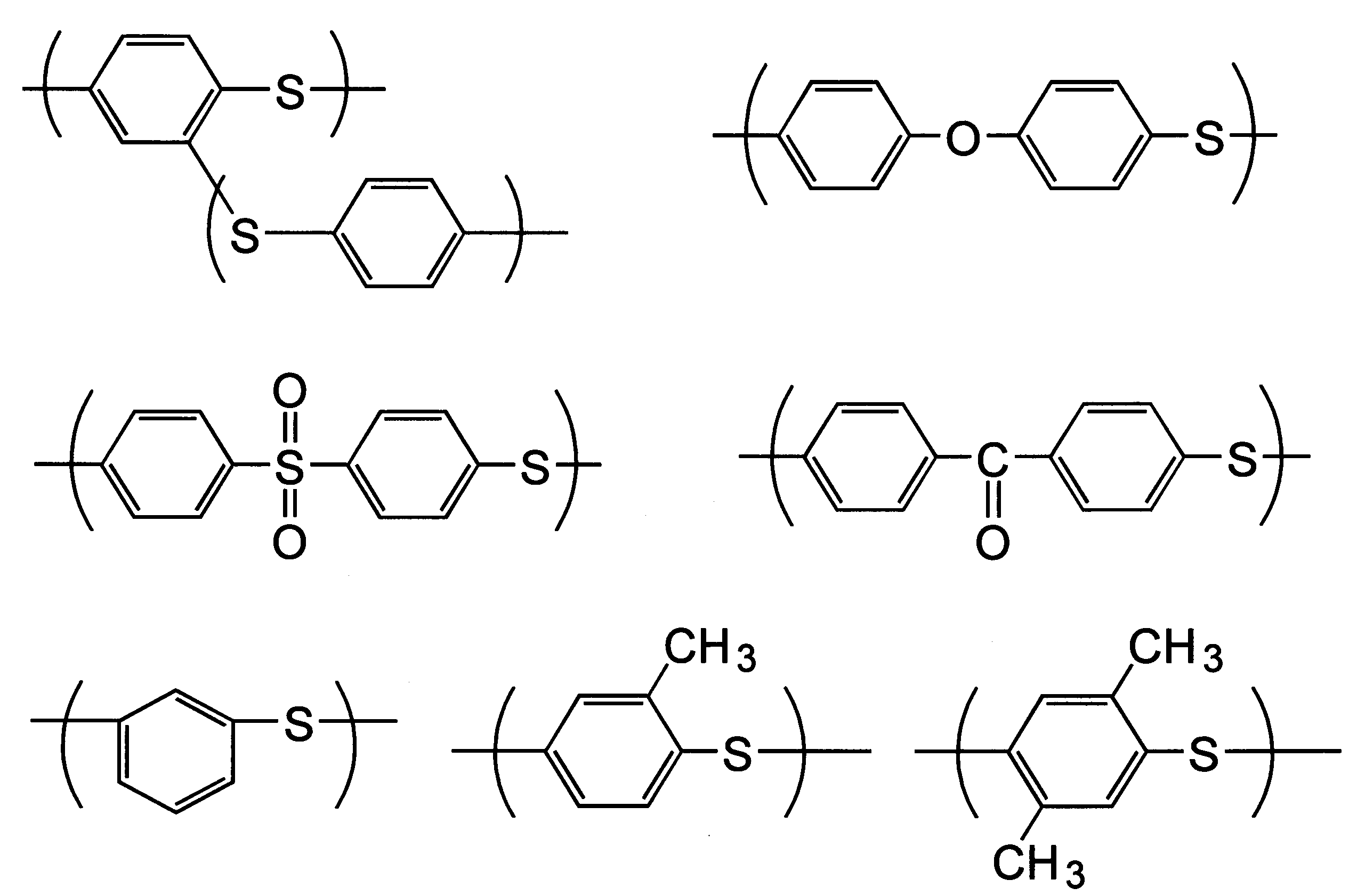
以下に、本発明の製造方法において使用するポリハロゲン化芳香族化合物、スルフィド化剤、重合溶媒、分子量調節剤、重合助剤および重合安定剤の内容について説明する。The polyhalogenated aromatic compound, sulfidizing agent, polymerization solvent, molecular weight regulator, polymerization aid and polymerization stabilizer used in the manufacturing method of the present invention are described below.
[ポリハロゲン化芳香族化合物]
ポリハロゲン化芳香族化合物とは、1分子中にハロゲン原子を2個以上有する化合物をいう。具体例としては、p-ジクロロベンゼン、m-ジクロロベンゼン、o-ジクロロベンゼン、1,3,5-トリクロロベンゼン、1,2,4-トリクロロベンゼン、1,2,4,5-テトラクロロベンゼン、ヘキサクロロベンゼン、2,5-ジクロロトルエン、2,5-ジクロロ-p-キシレン、1,4-ジブロモベンゼン、1,4-ジヨードベンゼン、1-メトキシ-2,5-ジクロロベンゼンなどのポリハロゲン化芳香族化合物が挙げられ、好ましくはp-ジクロロベンゼンが用いられる。また、異なる2種以上のポリハロゲン化芳香族化合物を組み合わせて共重合体とすることも可能であるが、p-ジハロゲン化芳香族化合物を主要成分とすることが好ましい。
[Polyhalogenated aromatic compounds]
The polyhalogenated aromatic compound refers to a compound having two or more halogen atoms in one molecule. Specific examples include polyhalogenated aromatic compounds such as p-dichlorobenzene, m-dichlorobenzene, o-dichlorobenzene, 1,3,5-trichlorobenzene, 1,2,4-trichlorobenzene, 1,2,4,5-tetrachlorobenzene, hexachlorobenzene, 2,5-dichlorotoluene, 2,5-dichloro-p-xylene, 1,4-dibromobenzene, 1,4-diiodobenzene, and 1-methoxy-2,5-dichlorobenzene, and p-dichlorobenzene is preferred. Although it is also possible to combine two or more different polyhalogenated aromatic compounds to form a copolymer, it is preferred to use a p-dihalogenated aromatic compound as the main component.
ポリハロゲン化芳香族化合物の使用量は、加工に適した粘度のPPS樹脂を得る点から、スルフィド化剤1モル当たり0.9から2.0モル、好ましくは0.95から1.5モル、より好ましくは1.005から1.2モルの範囲が例示できる。The amount of polyhalogenated aromatic compound used may be, for example, in the range of 0.9 to 2.0 moles, preferably 0.95 to 1.5 moles, and more preferably 1.005 to 1.2 moles per mole of sulfidizing agent in order to obtain a PPS resin with a viscosity suitable for processing.
[スルフィド化剤]
スルフィド化剤としては、アルカリ金属硫化物、アルカリ金属水硫化物、および硫化水素が挙げられる。
[Sulfidizing agent]
The sulfidizing agent includes alkali metal sulfides, alkali metal hydrosulfides, and hydrogen sulfide.
アルカリ金属硫化物の具体例としては、例えば、硫化リチウム、硫化ナトリウム、硫化カリウム、硫化ルビジウム、硫化セシウムおよびこれら2種以上の混合物を挙げることができ、なかでも硫化ナトリウムが好ましく用いられる。これらのアルカリ金属硫化物は、水和物または水性混合物として、あるいは無水物の形で用いることができる。 Specific examples of alkali metal sulfides include lithium sulfide, sodium sulfide, potassium sulfide, rubidium sulfide, cesium sulfide, and mixtures of two or more of these, with sodium sulfide being preferred. These alkali metal sulfides can be used as hydrates or aqueous mixtures, or in the anhydrous form.
アルカリ金属水硫化物の具体例としては、例えば、水硫化ナトリウム、水硫化カリウム、水硫化リチウム、水硫化ルビジウム、水硫化セシウムおよびこれら2種以上の混合物を挙げることができ、なかでも水硫化ナトリウムが好ましく用いられる。これらのアルカリ金属水硫化物は、水和物または水性混合物として、あるいは無水物の形で用いることができる。 Specific examples of alkali metal hydrosulfides include sodium hydrosulfide, potassium hydrosulfide, lithium hydrosulfide, rubidium hydrosulfide, cesium hydrosulfide, and mixtures of two or more of these, with sodium hydrosulfide being preferred. These alkali metal hydrosulfides can be used as hydrates or aqueous mixtures, or in the anhydrous form.
また、アルカリ金属水硫化物とアルカリ金属水酸化物から、反応系においてin situで調製されるスルフィド化剤も用いることができる。また、アルカリ金属水硫化物とアルカリ金属水酸化物からスルフィド化剤を調整し、これを重合槽に移して用いることができる。 A sulfidizing agent prepared in situ in the reaction system from an alkali metal hydrosulfide and an alkali metal hydroxide can also be used. A sulfidizing agent can also be prepared from an alkali metal hydrosulfide and an alkali metal hydroxide, and then transferred to a polymerization tank for use.
あるいは、水酸化リチウム、水酸化ナトリウムなどのアルカリ金属水酸化物と硫化水素から反応系においてin situで調製されるスルフィド化剤も用いることができる。また、水酸化リチウム、水酸化ナトリウムなどのアルカリ金属水酸化物と硫化水素からスルフィド化剤を調整し、これを重合槽に移して用いることができる。Alternatively, a sulfidizing agent prepared in situ in the reaction system from an alkali metal hydroxide such as lithium hydroxide or sodium hydroxide and hydrogen sulfide can be used. Also, a sulfidizing agent can be prepared from an alkali metal hydroxide such as lithium hydroxide or sodium hydroxide and hydrogen sulfide, and then transferred to a polymerization tank for use.
仕込みスルフィド化剤の量は、脱水操作などにより重合反応開始前にスルフィド化剤の一部損失が生じる場合には、実際の仕込み量から当該損失分を差し引いた残存量を意味するものとする。 The amount of sulfidizing agent charged means the remaining amount obtained by subtracting the amount lost from the actual charged amount in the case where a portion of the sulfidizing agent is lost before the start of the polymerization reaction due to a dehydration operation or the like.
なお、スルフィド化剤と共に、アルカリ金属水酸化物および/またはアルカリ土類金属水酸化物を併用することも可能である。アルカリ金属水酸化物の具体例としては、例えば、水酸化ナトリウム、水酸化カリウム、水酸化リチウム、水酸化ルビジウム、水酸化セシウムおよびこれら2種以上の混合物を好ましいものとして挙げることができ、アルカリ土類金属水酸化物の具体例としては、例えば、水酸化カルシウム、水酸化マグネシウム、水酸化ストロンチウム、水酸化バリウムなどが挙げられ、なかでも水酸化ナトリウムが好ましく用いられる。It is also possible to use an alkali metal hydroxide and/or an alkaline earth metal hydroxide together with the sulfidizing agent. Specific examples of alkali metal hydroxides include, for example, sodium hydroxide, potassium hydroxide, lithium hydroxide, rubidium hydroxide, cesium hydroxide, and mixtures of two or more of these. Specific examples of alkaline earth metal hydroxides include, for example, calcium hydroxide, magnesium hydroxide, strontium hydroxide, barium hydroxide, and the like. Of these, sodium hydroxide is preferably used.
スルフィド化剤として、アルカリ金属水硫化物を用いる場合には、アルカリ金属水酸化物を同時に使用することが特に好ましいが、この使用量はアルカリ金属水硫化物1モルに対し0.95から1.20モル、好ましくは1.00から1.15モル、より好ましくは1.005から1.100モルの範囲が例示できる。When an alkali metal hydrosulfide is used as the sulfidizing agent, it is particularly preferable to use an alkali metal hydroxide at the same time, and the amount used can be, for example, in the range of 0.95 to 1.20 moles, preferably 1.00 to 1.15 moles, and more preferably 1.005 to 1.100 moles per mole of alkali metal hydrosulfide.
[重合溶媒]
重合溶媒としては有機極性溶媒を用いることが好ましい。具体例としては、N-メチル-2-ピロリドン、N-エチル-2-ピロリドンなどのN-アルキルピロリドン類、N-メチル-ε-カプロラクタムなどのカプロラクタム類、1,3-ジメチル-2-イミダゾリジノン、N,N-ジメチルアセトアミド、N,N-ジメチルホルムアミド、ヘキサメチルリン酸トリアミド、ジメチルスルホン、テトラメチレンスルホキシドなどに代表されるアプロチック有機溶媒、およびこれらの混合物などが挙げられ、これらはいずれも反応の安定性が高いために好ましく使用される。これらのなかでも、特にN-メチル-2-ピロリドン(以下、NMPと略記することもある)が好ましく用いられる。
[Polymerization Solvent]
As the polymerization solvent, it is preferable to use an organic polar solvent. Specific examples include N-alkylpyrrolidones such as N-methyl-2-pyrrolidone and N-ethyl-2-pyrrolidone, caprolactams such as N-methyl-ε-caprolactam, aprotic organic solvents such as 1,3-dimethyl-2-imidazolidinone, N,N-dimethylacetamide, N,N-dimethylformamide, hexamethylphosphoric triamide, dimethylsulfone, and tetramethylene sulfoxide, and mixtures thereof, all of which are preferably used because of their high reaction stability. Among these, N-methyl-2-pyrrolidone (hereinafter sometimes abbreviated as NMP) is particularly preferably used.
有機極性溶媒の使用量は、スルフィド化剤1モル当たり通常好ましくは2.0モルから10モル、より好ましくは2.25から6.0モル、さらに好ましくは2.5から5.5モルの範囲が選択される。The amount of organic polar solvent used is usually selected from the range of 2.0 to 10 moles, more preferably 2.25 to 6.0 moles, and even more preferably 2.5 to 5.5 moles per mole of sulfidizing agent.
[分子量調節剤]
生成するPPS樹脂の末端を形成させるか、あるいは重合反応や分子量を調節するなどのために、モノハロゲン化化合物(必ずしも芳香族化合物でなくともよい)を、上記ポリハロゲン化芳香族化合物と併用することができる。
[Molecular Weight Regulator]
A monohalogenated compound (not necessarily an aromatic compound) can be used in combination with the polyhalogenated aromatic compound in order to form terminals in the resulting PPS resin or to control the polymerization reaction or molecular weight.
[重合助剤]
比較的高重合度のPPS樹脂をより短時間で得るために重合助剤を用いることも好ましい態様の一つである。ここで重合助剤とは得られるPPS樹脂の粘度を増大させる作用を有する物質を意味する。このような重合助剤の具体例としては、例えば、有機カルボン酸金属塩、水、アルカリ金属塩化物、有機スルホン酸塩、硫酸アルカリ金属塩、アルカリ土類金属酸化物、アルカリ金属リン酸塩およびアルカリ土類金属リン酸塩などが挙げられる。これらは単独であっても、また2種以上を同時に用いることもできる。なかでも、有機カルボン酸金属塩および/または水が好ましく用いられる。
[Polymerization aid]
In order to obtain a PPS resin having a relatively high degree of polymerization in a short time, it is also a preferred embodiment to use a polymerization aid. Here, the polymerization aid means a substance that has the effect of increasing the viscosity of the resulting PPS resin. Specific examples of such polymerization aids include organic carboxylate metal salts, water, alkali metal chlorides, organic sulfonates, alkali metal sulfates, alkaline earth metal oxides, alkali metal phosphates, and alkaline earth metal phosphates. These can be used alone or in combination of two or more. Among them, organic carboxylate metal salts and/or water are preferably used.
上記有機カルボン酸金属塩とは、一般式R(COOM)n(式中、Rは、炭素数1~20を有するアルキル基、シクロアルキル基、アリール基、アルキルアリール基またはアリールアルキル基である。Mは、リチウム、ナトリウム、カリウム、ルビジウムおよびセシウムから選ばれるアルカリ金属である。nは1~3の整数である。)で表される化合物である。有機カルボン酸金属塩は、水和物、無水物または水溶液としても用いることができる。有機カルボン酸金属塩の具体例としては、例えば、酢酸リチウム、酢酸ナトリウム、酢酸カリウム、プロピオン酸ナトリウム、吉草酸リチウム、安息香酸ナトリウム、フェニル酢酸ナトリウム、p-トルイル酸カリウム、およびそれらの混合物などを挙げることができる。 The organic carboxylate metal salt is a compound represented by the general formula R(COOM) n (wherein R is an alkyl group, a cycloalkyl group, an aryl group, an alkylaryl group, or an arylalkyl group having 1 to 20 carbon atoms; M is an alkali metal selected from lithium, sodium, potassium, rubidium, and cesium; and n is an integer of 1 to 3). The organic carboxylate metal salt can also be used as a hydrate, an anhydride, or an aqueous solution. Specific examples of the organic carboxylate metal salt include lithium acetate, sodium acetate, potassium acetate, sodium propionate, lithium valerate, sodium benzoate, sodium phenylacetate, potassium p-toluate, and mixtures thereof.
有機カルボン酸金属塩は、有機酸と、水酸化アルカリ金属、アルカリ金属炭酸塩およびアルカリ金属重炭酸塩よりなる群から選ばれる一種以上の化合物とを、ほぼ等化学当量ずつ添加して反応させることにより形成させてもよい。上記有機カルボン酸金属塩の中で、安価で、重合系への適度な溶解性を有する酢酸ナトリウムが最も好ましく用いられる。The organic carboxylate metal salt may be formed by reacting an organic acid with one or more compounds selected from the group consisting of alkali metal hydroxides, alkali metal carbonates, and alkali metal bicarbonates, in approximately equal chemical equivalents. Of the above organic carboxylate metal salts, sodium acetate is most preferably used because it is inexpensive and has suitable solubility in the polymerization system.
これら重合助剤を用いる場合の使用量は、仕込みアルカリ金属硫化物1モルに対し、通常0.01モル~0.7モルの範囲であり、より高い重合度を得る意味においては0.1~0.6モルの範囲が好ましく、0.2~0.5モルの範囲がより好ましい。When these polymerization aids are used, the amount used is usually in the range of 0.01 to 0.7 moles per mole of charged alkali metal sulfide, with a range of 0.1 to 0.6 moles being preferred in terms of achieving a higher degree of polymerization, and a range of 0.2 to 0.5 moles being more preferred.
また水を重合助剤として用いることは、流動性と高靭性が高度にバランスした樹脂組成物を得る上で有効な手段の一つである。その場合の添加量は、仕込みアルカリ金属硫化物1モルに対し、通常0.5モル~15モルの範囲であり、より高い重合度を得る意味においては0.6~10モルの範囲が好ましく、1~5モルの範囲がより好ましい。In addition, using water as a polymerization aid is one effective means of obtaining a resin composition with a high balance between fluidity and high toughness. In this case, the amount added is usually in the range of 0.5 to 15 moles per mole of the charged alkali metal sulfide, with a range of 0.6 to 10 moles being preferred in terms of obtaining a higher degree of polymerization, and a range of 1 to 5 moles being more preferred.
これら重合助剤の添加時期には特に指定はなく、後述する前工程時、重合開始時、重合途中のいずれの時点で添加してもよく、また複数回に分けて添加してもよいが、重合助剤として有機カルボン酸金属塩を用いる場合は前工程開始時或いは重合開始時に同時に添加することが、添加が容易である点からより好ましい。また水を重合助剤として用いる場合は、ポリハロゲン化芳香族化合物を仕込んだ後、重合反応途中で添加することが効果的である。There is no particular designation for the timing of addition of these polymerization aids, and they may be added at any time during the pre-step, at the start of polymerization, or during the polymerization, as described below, or may be added in multiple batches. However, when an organic carboxylate metal salt is used as the polymerization aid, it is preferable to add it simultaneously at the start of the pre-step or at the start of polymerization, as this is easier to add. When water is used as the polymerization aid, it is effective to add it during the polymerization reaction after the polyhalogenated aromatic compound has been charged.
[重合安定剤]
重合反応系を安定化し、副反応を防止するために、重合安定剤を用いることもできる。重合安定剤は、重合反応系の安定化に寄与し、望ましくない副反応を抑制する。副反応の一つの目安としては、チオフェノールの生成が挙げられ、重合安定剤の添加によりチオフェノールの生成を抑えることができる。重合安定剤の具体例としては、アルカリ金属水酸化物、アルカリ金属炭酸塩、アルカリ土類金属水酸化物、およびアルカリ土類金属炭酸塩などの化合物が挙げられる。そのなかでも、水酸化ナトリウム、水酸化カリウム、および水酸化リチウムなどのアルカリ金属水酸化物が好ましい。上述の有機カルボン酸金属塩も重合安定剤として作用するので、本発明で使用する重合安定剤の一つに入る。また、スルフィド化剤としてアルカリ金属水硫化物を用いる場合には、アルカリ金属水酸化物を同時に使用することが特に好ましいことを前述したが、ここでスルフィド化剤に対して過剰となるアルカリ金属水酸化物も重合安定剤となり得る。
[Polymerization stabilizer]
A polymerization stabilizer can be used to stabilize the polymerization reaction system and prevent side reactions. The polymerization stabilizer contributes to the stabilization of the polymerization reaction system and suppresses undesirable side reactions. One of the indicators of side reactions is the generation of thiophenol, and the addition of a polymerization stabilizer can suppress the generation of thiophenol. Specific examples of polymerization stabilizers include compounds such as alkali metal hydroxides, alkali metal carbonates, alkaline earth metal hydroxides, and alkaline earth metal carbonates. Among these, alkali metal hydroxides such as sodium hydroxide, potassium hydroxide, and lithium hydroxide are preferred. The above-mentioned organic carboxylate metal salts also act as polymerization stabilizers, and are therefore included in the polymerization stabilizers used in the present invention. In addition, when an alkali metal hydrosulfide is used as a sulfidizing agent, it is particularly preferable to use an alkali metal hydroxide at the same time, as described above, but an alkali metal hydroxide that is in excess of the sulfidizing agent can also serve as a polymerization stabilizer.
これら重合安定剤は、それぞれ単独で、あるいは2種以上を組み合わせて用いることができる。重合安定剤は、仕込みアルカリ金属硫化物1モルに対して、通常0.02~0.2モル、好ましくは0.03~0.1モル、より好ましくは0.04~0.09モルの割合で使用することが好ましい。上記好ましい範囲であると、安定化効果が十分であり、一方、経済的に有利でポリマー収率を高くすることができる。These polymerization stabilizers can be used alone or in combination of two or more. The polymerization stabilizer is preferably used in a ratio of usually 0.02 to 0.2 mol, preferably 0.03 to 0.1 mol, and more preferably 0.04 to 0.09 mol per mol of charged alkali metal sulfide. Within the above preferred range, the stabilization effect is sufficient, while being economically advantageous and enabling a high polymer yield.
重合安定剤の添加時期には特に指定はなく、後述する前工程時、重合開始時、重合途中のいずれの時点で添加してもよく、また複数回に分けて添加してもよいが、前工程開始時或いは重合開始時に同時に添加することが容易である点からより好ましい。There is no particular requirement for the timing of addition of the polymerization stabilizer; it may be added during the pre-processing step described below, at the start of polymerization, or during the polymerization, or it may be added in multiple batches; however, it is preferable to add it simultaneously at the start of the pre-processing step or at the start of polymerization, as this is easier.
次に、前工程、重合反応工程、回収工程を、順を追って具体的に説明する。 Next, the pre-process, polymerization reaction process, and recovery process will be explained in detail in order.
[前工程]
スルフィド化剤は通常水和物の形で使用されるが、ポリハロゲン化芳香族化合物を添加する前に、有機極性溶媒とスルフィド化剤を含む混合物を昇温し、過剰量の水を系外に除去することが好ましい。なお、この操作により水を除去し過ぎた場合には、不足分の水を添加して補充することが好ましい。
[Pre-process]
The sulfidizing agent is usually used in the form of a hydrate, and it is preferable to heat the mixture containing the organic polar solvent and the sulfidizing agent before adding the polyhalogenated aromatic compound, and remove excess water from the system. If too much water is removed by this operation, it is preferable to add water to make up for the shortage.
また、上述したように、スルフィド化剤として、アルカリ金属水硫化物とアルカリ金属水酸化物から、反応系においてin situで、あるいは重合槽とは別の槽で調製されるアルカリ金属硫化物も用いることができる。この方法には特に制限はないが、望ましくは不活性ガス雰囲気下、常温~150℃、好ましくは常温から100℃の温度範囲で、有機極性溶媒にアルカリ金属水硫化物とアルカリ金属水酸化物を加え、常圧または減圧下、少なくとも150℃、好ましくは180~260℃まで昇温し、水分を留去させる方法が挙げられる。この段階で重合助剤を加えてもよい。また、水分の留去を促進するために、トルエンなどを加えて反応を行ってもよい。As described above, the sulfidizing agent may be an alkali metal sulfide prepared in situ in the reaction system from an alkali metal hydrosulfide and an alkali metal hydroxide, or in a tank separate from the polymerization tank. There are no particular limitations to this method, but a preferred method is to add an alkali metal hydrosulfide and an alkali metal hydroxide to an organic polar solvent in an inert gas atmosphere at room temperature to 150°C, preferably room temperature to 100°C, and then heat the mixture to at least 150°C, preferably 180 to 260°C, under normal or reduced pressure, to distill off the water. A polymerization aid may be added at this stage. Toluene or the like may be added to promote the distillation of water.
重合反応における、重合系内の水分量は、仕込みスルフィド化剤1モル当たり0.5~10.0モルであることが好ましい。ここで重合系内の水分量とは重合系に仕込まれた水分量から重合系外に除去された水分量を差し引いた量である。また、仕込まれる水は、水、水溶液、結晶水などのいずれの形態であってもよい。In the polymerization reaction, the amount of water in the polymerization system is preferably 0.5 to 10.0 moles per mole of the charged sulfidizing agent. Here, the amount of water in the polymerization system is the amount of water charged to the polymerization system minus the amount of water removed from the polymerization system. The charged water may be in any form, such as water, an aqueous solution, or water of crystallization.
[重合反応工程]
有機極性溶媒中でスルフィド化剤とポリハロゲン化芳香族化合物とを200~290℃の温度範囲内で反応させることによりPPS樹脂を製造することが好ましい。
[Polymerization reaction process]
It is preferred to produce the PPS resin by reacting a sulfidizing agent with a polyhalogenated aromatic compound in an organic polar solvent within the temperature range of 200 to 290°C.
重合反応工程を開始するに際しては、望ましくは不活性ガス雰囲気下、常温~220℃、好ましくは100~220℃の温度範囲で、有機極性溶媒にスルフィド化剤とポリハロゲン化芳香族化合物を加える。この段階で重合助剤を加えてもよい。これらの原料の仕込み順序は特に制限はなく、同時であってもさしつかえない。When starting the polymerization reaction process, the sulfidizing agent and the polyhalogenated aromatic compound are added to the organic polar solvent, preferably in an inert gas atmosphere, at a temperature range of room temperature to 220°C, preferably 100 to 220°C. A polymerization aid may be added at this stage. There is no particular restriction on the order in which these raw materials are charged, and they may be added simultaneously.
かかる混合物を通常200℃~290℃の範囲に昇温する。昇温速度に特に制限はないが、通常0.01~5℃/分の速度が選択され、0.1~3℃/分の範囲がより好ましい。The mixture is typically heated to a temperature in the range of 200°C to 290°C. There are no particular limitations on the heating rate, but a rate of 0.01 to 5°C/min is usually selected, with a range of 0.1 to 3°C/min being more preferred.
一般に、最終的には250~290℃の温度まで昇温し、その温度で通常0.25~50時間、好ましくは0.5~20時間反応させる。Generally, the temperature is finally raised to 250-290°C and the reaction is carried out at that temperature for usually 0.25-50 hours, preferably 0.5-20 hours.
最終温度に到達させる前の段階で、例えば、200℃~260℃で一定時間反応させた後、270~290℃に昇温する方法は、より高い重合度を得る上で有効である。この際、200℃~260℃での反応時間としては、通常0.25時間から20時間の範囲が選択され、好ましくは0.25~10時間の範囲が選択される。Before reaching the final temperature, for example, a method of reacting at 200°C to 260°C for a certain period of time and then raising the temperature to 270°C to 290°C is effective in obtaining a higher degree of polymerization. In this case, the reaction time at 200°C to 260°C is usually selected in the range of 0.25 hours to 20 hours, preferably 0.25 hours to 10 hours.
なお、より高重合度のポリマーを得るためには、複数段階で重合を行うことが有効である。複数段階で重合を行う際は、245℃における系内のポリハロゲン化芳香族化合物の転化率が、40モル%以上、好ましくは60モル%に達した時点で次の段階に移行することが有効である。In order to obtain a polymer with a higher degree of polymerization, it is effective to carry out the polymerization in multiple stages. When carrying out the polymerization in multiple stages, it is effective to move to the next stage when the conversion rate of the polyhalogenated aromatic compound in the system at 245°C reaches 40 mol% or more, preferably 60 mol%.
[回収工程]
重合終了後に、重合体、溶媒などを含む重合反応物から固形物を回収する。
[Recovery process]
After the polymerization is completed, solids are recovered from the polymerization reaction mixture containing the polymer, the solvent, and the like.
PPS樹脂の好ましい回収方法は急冷条件下に行うことであり、好ましい一つの回収方法としてフラッシュ法が挙げられる。フラッシュ法とは、重合反応物を高温高圧(通常250℃以上、8kg/cm2 以上)の状態から常圧もしくは減圧の雰囲気中へフラッシュさせ、溶媒回収と同時に重合体を粉粒体状にして回収する方法であり、ここでいうフラッシュとは、重合反応物をノズルから噴出させることを意味する。フラッシュさせる雰囲気は、具体的には、例えば、常圧中の窒素または水蒸気が挙げられ、その温度は通常150℃~250℃の範囲が選択される。 A preferred method for recovering PPS resin is to perform the recovery under quenching conditions, and one preferred recovery method is the flash method. The flash method is a method in which the polymerization reaction product is flashed from a high-temperature, high-pressure state (usually 250°C or higher, 8 kg/cm2 or higher ) into an atmosphere of normal pressure or reduced pressure, and the polymer is recovered in the form of powder or granules while the solvent is recovered. The flashing here means that the polymerization reaction product is ejected from a nozzle. Specific examples of the flashing atmosphere include nitrogen or water vapor at normal pressure, and the temperature is usually selected in the range of 150°C to 250°C.
フラッシュ法は、溶媒回収と同時に固形物を回収することができ、また回収時間も比較的短くできることから、経済性に優れた回収方法である。この回収方法では、固化過程でNaに代表されるイオン性化合物や有機系低重合度物(オリゴマー)がポリマー中に取り込まれやすい傾向がある。The flash method is an economical method because it allows the recovery of solids at the same time as the recovery of the solvent, and the recovery time can be relatively short. In this recovery method, ionic compounds such as Na and organic low-polymerization substances (oligomers) tend to be easily incorporated into the polymer during the solidification process.
但し、本発明の製造方法に用いられるPPS樹脂の回収法は、フラッシュ法に限定されるものではなく、本発明の要件を満たす方法であれば、徐冷して粒子状のポリマーを回収する方法(クエンチ法)を用いてもよい。しかし、経済性を鑑みた場合、フラッシュ法で回収されたPPS樹脂を用いることがより好ましい。However, the method for recovering the PPS resin used in the manufacturing method of the present invention is not limited to the flash method, and a method of recovering particulate polymer by slow cooling (quench method) may be used as long as the method satisfies the requirements of the present invention. However, from the viewpoint of economy, it is more preferable to use PPS resin recovered by the flash method.
[後処理工程]
本発明では、PPS樹脂として、たとえば上記重合反応工程、回収工程を経て得られたPPS樹脂を酸処理することが重要である。
[Post-processing process]
In the present invention, it is important to subject the PPS resin obtained, for example, through the above-mentioned polymerization reaction step and recovery step to an acid treatment.
本発明における酸処理に用いる酸は、PPS樹脂を分解する作用を有しないものであれば特に制限はなく、酢酸、塩酸、硫酸、リン酸、珪酸、炭酸およびプロピル酸などが挙げられ、なかでも酢酸および塩酸がより好ましく用いられる。The acid used in the acid treatment of the present invention is not particularly limited as long as it does not have the effect of decomposing the PPS resin, and examples of the acid include acetic acid, hydrochloric acid, sulfuric acid, phosphoric acid, silicic acid, carbonic acid and propylic acid, with acetic acid and hydrochloric acid being more preferably used.
酸の水溶液を調製するときの水は、蒸留水あるいは脱イオン水であることが好ましい。酸の水溶液は、pH1~7が好ましく、pH2~4がより好ましい。pHが上記好ましい範囲であると、PPS樹脂の金属含有量が増大することを防ぎ、一方、PPS樹脂の揮発成分が多くなるのを防ぐことができる。The water used to prepare the aqueous acid solution is preferably distilled water or deionized water. The aqueous acid solution preferably has a pH of 1 to 7, more preferably a pH of 2 to 4. When the pH is in the above preferred range, it is possible to prevent the metal content of the PPS resin from increasing, while also preventing the volatile components of the PPS resin from increasing.
酸処理の方法は、酸または酸の水溶液にPPS樹脂を浸漬せしめることが好ましく、必要により適宜撹拌および加熱することも可能である。加熱する際の温度は80~250℃が好ましく、120~200℃がより好ましく、150~200℃がさらに好ましい。加熱する際の温度が上記好ましい範囲であると、酸処理効果が十分で、金属含有量が増大することを防ぎ、一方、圧力が高くなりすぎることもなく安全上好ましい。また、酸の水溶液でPPS樹脂を浸漬せしめて処理した際のpHは、酸処理により8未満となることが好ましく、pH2~8がより好ましい。酸の水溶液でPPS樹脂を浸漬せしめて処理した際のpHが上記好ましい範囲であると、得られるPPS樹脂の金属含有量が増大することを防ぐことができる。The acid treatment method is preferably to immerse the PPS resin in an acid or an aqueous solution of an acid, and if necessary, it is also possible to stir and heat appropriately. The temperature during heating is preferably 80 to 250°C, more preferably 120 to 200°C, and even more preferably 150 to 200°C. When the heating temperature is within the above-mentioned preferred range, the acid treatment effect is sufficient, and an increase in the metal content is prevented, while the pressure does not become too high, which is preferable from the standpoint of safety. In addition, when the PPS resin is immersed in an aqueous solution of an acid and treated, the pH is preferably less than 8 by the acid treatment, and a pH of 2 to 8 is more preferable. When the PPS resin is immersed in an aqueous solution of an acid and treated, the pH is within the above-mentioned preferred range, and an increase in the metal content of the resulting PPS resin can be prevented.
酸処理の時間は、PPS樹脂と酸の反応が十分に平衡となる時間が好ましく、80℃で処理する場合は2~24時間が好ましく、200℃で処理する場合は0.01~5時間が好ましい。The acid treatment time is preferably a time sufficient to bring the reaction between the PPS resin and the acid into sufficient equilibrium, and is preferably 2 to 24 hours when treating at 80°C, and 0.01 to 5 hours when treating at 200°C.
酸処理におけるPPS樹脂と酸または酸の水溶液との割合は、PPS樹脂が酸または酸の水溶液中に十分に浸漬された状態で処理することが好ましく、PPS樹脂500gに対して、酸または酸の水溶液を0.5~500Lとするのが好ましく、1~100Lとするのがより好ましく、2.5~20Lとするのがさらに好ましい。PPS樹脂500gに対して酸または酸の水溶液を上記好ましい範囲とすると、PPS樹脂が水溶液に十分浸漬して良好な洗浄ができ、PPS樹脂の金属含有量が増大するのを防ぐことができ、一方、PPS樹脂に対する溶液量が適度で生産効率を高めることができる。The ratio of PPS resin to acid or aqueous acid solution in the acid treatment is preferably such that the PPS resin is sufficiently immersed in the acid or aqueous acid solution, and the amount of acid or aqueous acid solution is preferably 0.5 to 500 L, more preferably 1 to 100 L, and even more preferably 2.5 to 20 L per 500 g of PPS resin. When the amount of acid or aqueous acid solution per 500 g of PPS resin is within the above preferred range, the PPS resin is sufficiently immersed in the aqueous solution, allowing for good cleaning and preventing an increase in the metal content of the PPS resin, while the amount of solution relative to the PPS resin is appropriate, improving production efficiency.
これらの酸処理は所定量の水および酸に所定量のPPS樹脂を投入し、圧力容器内で加熱・撹拌する方法、連続的に酸処理を施す方法などにより行われる。酸処理後の処理溶液から水溶液とPPS樹脂を分離する方法はふるいやフィルターを用いた濾過が簡便であり、自然濾過、加圧濾過、減圧濾過、遠心濾過などの方法が例示できる。処理液から分離されたPPS樹脂表面に残留している酸や不純物を除去するため、水または温水で数回洗浄することが好ましい。洗浄方法は濾過装置上のPPS樹脂に水をかけながら濾過する方法や、予め用意した水に、分離したPPS樹脂を投入した後に再度濾過するなどの方法で水溶液とPPS樹脂を分離する方法が例示できる。洗浄に用いる水は、蒸留水あるいは脱イオン水であることが好ましい。このように酸処理したPPS樹脂は、末端の構造などが変化すると考えられるが、酸処理によって得られるPPS樹脂の構造を一般式で表すことは困難であるし、特性によって特定することも困難であるので、PPS樹脂を得るためのプロセス(酸処理)によって初めて特定が可能なものである。These acid treatments are carried out by adding a predetermined amount of PPS resin to a predetermined amount of water and acid, heating and stirring in a pressure vessel, or by continuously performing acid treatment. The method of separating the aqueous solution and the PPS resin from the treatment solution after the acid treatment is simple filtration using a sieve or filter, and examples of such methods include natural filtration, pressure filtration, reduced pressure filtration, and centrifugal filtration. In order to remove the acid and impurities remaining on the surface of the PPS resin separated from the treatment solution, it is preferable to wash the PPS resin several times with water or hot water. Examples of washing methods include a method of filtering the PPS resin on a filter while pouring water on it, or a method of separating the aqueous solution and the PPS resin by adding the separated PPS resin to water prepared in advance and then filtering it again. The water used for washing is preferably distilled water or deionized water. It is thought that the structure of the terminals of the PPS resin treated with acid in this way changes, but it is difficult to express the structure of the PPS resin obtained by acid treatment in a general formula, and it is also difficult to identify it by its characteristics, so it can only be identified by the process (acid treatment) for obtaining the PPS resin.
本発明では酸処理する工程の前に熱水処理を行うことが好ましく、その方法は次のとおりである。本発明における熱水処理に用いる水は、蒸留水あるいは脱イオン水であることが好ましい。熱水処理温度は80~250℃が好ましく、120~200℃がより好ましく、150~200℃がさらに好ましい。熱水処理温度が上記好ましい範囲であると、熱水処理効果に優れ、揮発するガス発生量を少なくすることができ、一方、圧力が高くなりすぎることもなく安全上好ましい。In the present invention, it is preferable to carry out hot water treatment before the acid treatment step, and the method is as follows. The water used in the hot water treatment in the present invention is preferably distilled water or deionized water. The hot water treatment temperature is preferably 80 to 250°C, more preferably 120 to 200°C, and even more preferably 150 to 200°C. When the hot water treatment temperature is in the above-mentioned preferred range, the hot water treatment effect is excellent and the amount of volatile gas generated can be reduced, while the pressure does not become too high, which is preferable from the standpoint of safety.
熱水処理の時間は、PPS樹脂と熱水による抽出処理が十分である時間が好ましく、80℃で処理する場合は2~24時間が好ましく、200℃で処理する場合は0.01~5時間が好ましい。The time for hot water treatment is preferably a time that allows sufficient extraction treatment of the PPS resin with hot water, and is preferably 2 to 24 hours when treating at 80°C, and preferably 0.01 to 5 hours when treating at 200°C.
熱水処理におけるPPS樹脂と水との割合は、PPS樹脂が水に十分に浸漬された状態で処理することが好ましく、PPS樹脂500gに対して、水0.5~500Lが好ましく、1~100Lがより好ましく、2.5~20Lがさらに好ましい。PPS樹脂500gに対して水が0.5Lより少ないとPPS樹脂が水に十分浸漬しないため洗浄不良となり、揮発するガス発生量が増大するため好ましくない。また、PPS樹脂500gに対して、水が500Lを超えると、PPS樹脂に対する水が大過剰となり生産効率が著しく低下するため好ましくない。The ratio of PPS resin to water in hot water treatment is preferably such that the PPS resin is sufficiently immersed in water, with 0.5 to 500 L of water being preferred for 500 g of PPS resin, more preferably 1 to 100 L, and even more preferably 2.5 to 20 L. If there is less than 0.5 L of water for 500 g of PPS resin, the PPS resin will not be sufficiently immersed in water, resulting in poor cleaning and an increase in the amount of volatile gas generated, which is undesirable. Furthermore, if there is more than 500 L of water for 500 g of PPS resin, there will be a large excess of water relative to the PPS resin, which is undesirable as it will significantly reduce production efficiency.
これらの熱水処理の操作に特に制限は無く、所定量の水に所定量のPPS樹脂を投入し、圧力容器内で加熱・撹拌する方法、連続的に熱水処理を施す方法などにより行われる。熱水処理後の処理溶液から水溶液とPPS樹脂を分離する方法に特に制限は無いが、ふるいやフィルターを用いた濾過が簡便であり、自然濾過、加圧濾過、減圧濾過、遠心濾過などの方法が例示できる。処理液から分離されたPPS樹脂表面に残留している不純物を除去するため、水または温水で数回洗浄することが好ましい。洗浄方法に特に制限は無いが、濾過装置上のPPS樹脂に水をかけながら濾過する方法や、予め用意した水に、分離したPPS樹脂を投入した後に再度濾過するなどの方法で水溶液とPPS樹脂を分離する方法が例示できる。洗浄に用いる水は、蒸留水あるいは脱イオン水であることが好ましい。There are no particular limitations on the operation of these hot water treatments, and they can be carried out by adding a predetermined amount of PPS resin to a predetermined amount of water and heating and stirring in a pressure vessel, or by continuously carrying out hot water treatments. There are no particular limitations on the method for separating the aqueous solution and the PPS resin from the treatment solution after the hot water treatment, but filtration using a sieve or filter is convenient, and examples of such methods include natural filtration, pressure filtration, reduced pressure filtration, and centrifugal filtration. In order to remove impurities remaining on the surface of the PPS resin separated from the treatment solution, it is preferable to wash the PPS resin several times with water or hot water. There are no particular limitations on the washing method, but examples of such methods include a method of filtering the PPS resin on a filter while pouring water on it, and a method of filtering the PPS resin again after the separated PPS resin is added to water prepared in advance. The water used for washing is preferably distilled water or deionized water.
また、これら酸処理や熱水処理時にPPS末端基の分解が起こるのは好ましくないので、酸処理や熱水処理を不活性雰囲気下で実施することが望ましい。不活性雰囲気としては、窒素、ヘリウム、アルゴンなどがあげられるが、経済性の観点から窒素雰囲気下が好ましい。In addition, since it is undesirable for the PPS end groups to decompose during these acid treatments and hot water treatments, it is desirable to carry out the acid treatments and hot water treatments in an inert atmosphere. Examples of inert atmospheres include nitrogen, helium, and argon, but from an economical standpoint, a nitrogen atmosphere is preferred.
本発明ではPPS樹脂を酸処理する工程や熱水処理する工程の前に有機溶媒により洗浄する工程を含んでもよく、その方法は次のとおりである。本発明でPPS樹脂の洗浄に用いる有機溶媒は、PPS樹脂を分解する作用などを有しないものであれば特に制限はなく、例えばN-メチル-2-ピロリドン、ジメチルホルムアミド、ジメチルアセトアミド、1,3-ジメチルイミダゾリジノン、ヘキサメチルホスホラスアミド、ピペラジノン類などの含窒素極性溶媒、ジメチルスルホキシド、ジメチルスルホン、スルホランなどのスルホキシド・スルホン系溶媒、アセトン、メチルエチルケトン、ジエチルケトン、アセトフェノンなどのケトン系溶媒、ジメチルエーテル、ジプロピルエーテル、ジオキサン、テトラヒドロフランなどのエーテル系溶媒、クロロホルム、塩化メチレン、トリクロロエチレン、2塩化エチレン、パークロルエチレン、モノクロルエタン、ジクロルエタン、テトラクロルエタン、パークロルエタン、クロルベンゼンなどのハロゲン系溶媒、メタノール、エタノール、プロパノール、ブタノール、ペンタノール、エチレングリコール、プロピレングリコール、フェノール、クレゾール、ポリエチレングリコール、ポリプロピレングリコールなどのアルコール・フェノール系溶媒およびベンゼン、トルエン、キシレンなどの芳香族炭化水素系溶媒などが挙げられる。これらの有機溶媒のうちでも、N-メチル-2-ピロリドン、アセトン、ジメチルホルムアミドおよびクロロホルムなどの使用が特に好ましい。また、これらの有機溶媒は、1種類または2種類以上の混合で使用される。In the present invention, a step of washing the PPS resin with an organic solvent may be included before the step of acid treatment or hot water treatment, and the method is as follows. The organic solvent used in washing the PPS resin in the present invention is not particularly limited as long as it does not have the action of decomposing the PPS resin, and examples of the organic solvent include nitrogen-containing polar solvents such as N-methyl-2-pyrrolidone, dimethylformamide, dimethylacetamide, 1,3-dimethylimidazolidinone, hexamethylphosphoramide, and piperazinones, sulfoxide/sulfone solvents such as dimethyl sulfoxide, dimethyl sulfone, and sulfolane, ketone solvents such as acetone, methyl ethyl ketone, diethyl ketone, and acetophenone, dimethyl ether, dipropyl ether, dioxane, tetrahydrofuran, and the like. Examples of the organic solvent include ether solvents such as chloroform, methylene chloride, trichloroethylene, ethylene dichloride, perchloroethylene, monochloroethane, dichloroethane, tetrachloroethane, perchloroethane, and chlorobenzene; alcohol-phenol solvents such as methanol, ethanol, propanol, butanol, pentanol, ethylene glycol, propylene glycol, phenol, cresol, polyethylene glycol, and polypropylene glycol; and aromatic hydrocarbon solvents such as benzene, toluene, and xylene. Among these organic solvents, N-methyl-2-pyrrolidone, acetone, dimethylformamide, and chloroform are particularly preferred. These organic solvents are used alone or in combination of two or more.
有機溶媒による洗浄の方法としては、有機溶媒中にPPS樹脂を浸漬せしめるなどの方法があり、必要により適宜撹拌または加熱することも可能である。有機溶媒でPPS樹脂を洗浄する際の洗浄温度については特に制限はなく、常温~300℃程度の任意の温度が選択できる。洗浄温度が高くなる程洗浄効率が高くなる傾向があるが、通常は常温~150℃の洗浄温度で十分効果が得られる。圧力容器中で、有機溶媒の沸点以上の温度で加圧下に洗浄することも可能である。また、洗浄時間についても特に制限はない。洗浄条件にもよるが、バッチ式洗浄の場合、通常5分間以上洗浄することにより十分な効果が得られる。また連続式で洗浄することも可能である。 Methods for cleaning with organic solvents include immersing the PPS resin in the organic solvent, and stirring or heating can be performed as necessary. There are no particular restrictions on the cleaning temperature when cleaning PPS resin with an organic solvent, and any temperature between room temperature and about 300°C can be selected. The higher the cleaning temperature, the higher the cleaning efficiency tends to be, but usually a cleaning temperature between room temperature and 150°C is sufficient. It is also possible to clean under pressure in a pressure vessel at a temperature above the boiling point of the organic solvent. There are also no particular restrictions on the cleaning time. Although it depends on the cleaning conditions, in the case of batch cleaning, a sufficient effect is usually obtained by cleaning for 5 minutes or more. It is also possible to clean in a continuous manner.
これら酸処理、熱水処理または有機溶媒による洗浄は、これらを適宜組み合わせて行うことも可能である。 These acid treatments, hot water treatments and washing with organic solvents can also be carried out in appropriate combinations.
[加熱処理工程]
本発明では、上記後処理工程を経た後のPPS樹脂にさらに加熱処理を行うことで、機械的強度が高く、かつ耐不凍液性に優れたPPS樹脂が得られるため好ましい。以下に加熱処理工程を具体的に説明する。
[Heat treatment process]
In the present invention, it is preferable to further subject the PPS resin after the above-mentioned post-treatment step to a heat treatment, since this gives a PPS resin having high mechanical strength and excellent antifreeze resistance. The heat treatment step will be specifically described below.
本発明では、高い機械的強度を有するPPS樹脂を得るために加熱処理を行うことが好ましいが、過度な熱処理は溶融流動性の低下および樹脂中のゲル化物の増加により、成形時の未充填等の原因となるため好ましくない。しかしながら、熱処理が軽度すぎると揮発性成分低減効果が小さく、樹脂の強度が低下し、また、耐不凍液性も低下する傾向にある。本発明の加熱処理によれば、溶融流動性を損なうことなく、ゲル化物の発生を抑制しつつ、機械的強度を向上したPPS樹脂を得ることが可能となる。In the present invention, it is preferable to perform heat treatment in order to obtain a PPS resin with high mechanical strength, but excessive heat treatment is not preferable because it reduces melt fluidity and increases gelled matter in the resin, which can cause underfilling during molding. However, if the heat treatment is too mild, the effect of reducing volatile components is small, the strength of the resin decreases, and antifreeze resistance also tends to decrease. According to the heat treatment of the present invention, it is possible to obtain a PPS resin with improved mechanical strength while suppressing the generation of gelled matter without impairing melt fluidity.
加熱処理は加熱処理温度および加熱処理時間を特定の範囲にすれば、高い酸素濃度雰囲気下でも低い酸素濃度雰囲気下でも差し支えないが、低い酸素濃度雰囲気下での熱処理が好ましい。 As long as the heat treatment temperature and heat treatment time are within a specific range, the heat treatment can be performed in either a high or low oxygen concentration atmosphere, but heat treatment in a low oxygen concentration atmosphere is preferred.
高い酸素濃度雰囲気の条件としては酸素濃度が2体積%を超える濃度であることが好ましく、加熱処理温度は160~270℃、加熱処理時間は0.1~17時間行うことが望ましい。ただ、酸素濃度が高い条件下では揮発性成分の低減速度が速いものの、同時に酸化架橋が急速に進行するためゲル化物が発生しやすくなる。そのため概して低温・長時間または高温・短時間で加熱処理を行うことが好ましい。低温・長時間加熱処理する具体的な条件としては160℃以上210℃以下で1時間以上17時間以下が好ましく、170℃以上200℃以下で1時間以上10時間以下がより好ましい。低温・長時間加熱処理する際の加熱処理温度が上記好ましい範囲であると、揮発性成分の低減効果に優れ、機械的強度の改善効果が期待できる一方、低温で酸素濃度2体積%を超える濃度の条件において加熱処理時間が長時間となっても酸化架橋が進行し難く、ゲル化物の発生を防ぐことができる。高温・短時間加熱処理する具体的な条件としては210℃を超え270℃以下で0.1時間以上1時間未満が好ましく、220℃以上260℃以下で0.2~0.8時間がより好ましい。高温・短時間加熱処理する際の加熱処理温度が上記好ましい範囲であると、酸化架橋が急激に進行し難く、ゲル化物の発生を防ぐことができる一方、高温で加熱処理時間が短時間となっても揮発性成分の低減効果が十分で、機械的強度の改善効果が期待できる。As the condition of the high oxygen concentration atmosphere, it is preferable that the oxygen concentration is more than 2% by volume, the heat treatment temperature is 160 to 270°C, and the heat treatment time is 0.1 to 17 hours. However, under conditions of high oxygen concentration, the reduction rate of volatile components is fast, but at the same time, oxidative crosslinking progresses rapidly, making it easier for gelation to occur. Therefore, it is generally preferable to perform heat treatment at a low temperature for a long time or at a high temperature for a short time. Specific conditions for low-temperature, long-term heat treatment are preferably 160°C to 210°C and 1 hour to 17 hours, and more preferably 170°C to 200°C and 1 hour to 10 hours. When the heat treatment temperature during low-temperature, long-term heat treatment is in the above-mentioned preferred range, it is expected to have an excellent effect of reducing volatile components and an effect of improving mechanical strength, while oxidative crosslinking is less likely to progress even if the heat treatment time is long under conditions of low temperature and oxygen concentration exceeding 2% by volume, and it is possible to prevent the occurrence of gelation. Specific conditions for the high-temperature, short-time heat treatment are preferably above 210° C. and not more than 270° C. for 0.1 to less than 1 hour, and more preferably from 220° C. to 260° C. for 0.2 to 0.8 hours. When the heat treatment temperature during the high-temperature, short-time heat treatment is within the above-mentioned preferred range, oxidative crosslinking is unlikely to progress rapidly and the generation of gelled matter can be prevented, while even if the heat treatment time is short at a high temperature, the effect of reducing volatile components is sufficient, and an effect of improving mechanical strength can be expected.
低い酸素濃度雰囲気の条件としては酸素濃度が2体積%以下であることが好ましく、加熱処理温度は210~270℃、加熱処理時間は0.2~50時間行うことが望ましい。酸素濃度が低いと揮発性成分の低減効果が小さくなる傾向にあるため概して高温・長時間で加熱処理を行うことが好ましく、220℃~260℃の加熱処理温度条件下2~20時間行うことがより好ましい。加熱処理時間が上記好ましい範囲であると、揮発性成分が十分低減して、機械的強度の改善効果が期待できる一方、生産性に優れる。 As conditions for a low oxygen concentration atmosphere, an oxygen concentration of 2% by volume or less is preferred, and the heat treatment temperature is 210-270°C, and the heat treatment time is preferably 0.2-50 hours. Since a low oxygen concentration tends to reduce the effect of reducing volatile components, it is generally preferred to perform the heat treatment at a high temperature for a long time, and more preferably at a heat treatment temperature of 220°C-260°C for 2-20 hours. If the heat treatment time is within the above preferred range, the volatile components are sufficiently reduced, and the effect of improving mechanical strength can be expected, while also providing excellent productivity.
本発明の加熱処理のための加熱装置は、通常の熱風乾燥機でもよいし、回転式あるいは撹拌翼付の加熱装置であってもよいが、効率良く、しかもより均一に処理する場合は、回転式あるいは撹拌翼付の加熱装置を用いるのがより好ましく、パドル式ドライヤー、流動層乾燥機、KIDドライヤー、スチームチューブドライヤー、さらにはインクラインドディスクドライヤー、ホッパードライヤー、縦型撹拌乾燥機などが例示できる。なかでもパドル式ドライヤーや流動層乾燥機、KIDドライヤーが均一かつ効率的に加熱する上で好ましい。熱処理の酸素濃度を調整するために、酸素、空気、オゾンなどの酸化性ガスに、窒素、アルゴン、ヘリウム、水蒸気などの非酸化性の不活性ガスを混入しても問題ない。加熱装置内で加熱処理を行うことができれば、加熱装置の上部、下部、側面のどの位置から酸化性ガスや不活性ガスを導入しても特に制限はないが、より簡便な方法としては加熱装置上部からのガスの導入が挙げられる。また、酸化性ガスや不活性ガスは、加熱装置導入前に混合させてから装置に導入してもよいし、加熱装置の異なる場所から別々に酸化性ガスと不活性ガスを混入してもよい。The heating device for the heat treatment of the present invention may be a normal hot air dryer, or a heating device with a rotating or stirring blade. However, in order to perform efficient and more uniform treatment, it is more preferable to use a heating device with a rotating or stirring blade, and examples of such devices include a paddle dryer, a fluidized bed dryer, a KID dryer, a steam tube dryer, an inclined disk dryer, a hopper dryer, and a vertical stirring dryer. Among these, a paddle dryer, a fluidized bed dryer, and a KID dryer are preferable for uniform and efficient heating. In order to adjust the oxygen concentration of the heat treatment, it is no problem to mix a non-oxidizing inert gas such as nitrogen, argon, helium, or water vapor with an oxidizing gas such as oxygen, air, or ozone. As long as the heat treatment can be performed in the heating device, there is no particular restriction on the position from which the oxidizing gas or inert gas is introduced, whether it is the top, bottom, or side of the heating device, but a more convenient method is to introduce the gas from the top of the heating device. The oxidizing gas and the inert gas may be mixed together before being introduced into the heating device, or the oxidizing gas and the inert gas may be mixed separately from different positions in the heating device.
なお、加熱処理工程を経ることでPPS樹脂の構造は変化していると考えられるが、加熱処理を経て得られたPPS樹脂は、複雑、かつ多種多様な構造を有しており、当該PPS樹脂の構造を特定するのは実際的ではない事情が存在する。加熱処理工程を経ることで、PPS樹脂に含まれる揮発分や水分を除去することができ、機械強度、およびウエルド強度に優れ、また、耐不凍液性にも優れるPPS樹脂を得ることができる。It is believed that the structure of the PPS resin changes as a result of the heat treatment process, but the PPS resin obtained through the heat treatment has a complex and diverse structure, and there are circumstances that make it impractical to identify the structure of the PPS resin. By going through the heat treatment process, it is possible to remove the volatile matter and moisture contained in the PPS resin, and it is possible to obtain a PPS resin that has excellent mechanical strength, weld strength, and antifreeze resistance.
上記重合反応工程、回収工程、好ましくは後処理工程、および加熱処理工程を経て得られたPPS樹脂のメルトフローレート(以下、MFRと略することもある)は1,000g/10分以下であることが好ましく、より好ましくは700g/10分以下、更に好ましくは500g/10分以下である。MFRが上記好ましい範囲であると、重合度が十分に高く、機械的強度に優れる。下限としては、80g/10分を超える範囲であることが、成形性の点から好ましく、100g/10分以上であることが好ましい。ここで、MFRは、測定温度315.5℃、5,000g荷重とし、ASTM-D1238-70に従って測定した値である。The melt flow rate (hereinafter sometimes abbreviated as MFR) of the PPS resin obtained through the above polymerization reaction process, recovery process, preferably the post-treatment process, and heat treatment process is preferably 1,000 g/10 min or less, more preferably 700 g/10 min or less, and even more preferably 500 g/10 min or less. When the MFR is in the above preferred range, the degree of polymerization is sufficiently high and the mechanical strength is excellent. As for the lower limit, a range exceeding 80 g/10 min is preferable from the viewpoint of moldability, and a range of 100 g/10 min or more is preferable. Here, the MFR is a value measured according to ASTM-D1238-70 at a measurement temperature of 315.5°C and a load of 5,000 g.
本発明で用いられるPPS樹脂の数平均分子量は、7,000~14,000であり、より好ましくは8,000~14,000である。数平均分子量を7,000以上とすることで、高い機械的強度と耐不凍液性を得ることができ、また、モールドデポジットの発生を抑制することが可能である。数平均分子量を14,000以下とすることで、高い耐不凍液性と共に、適切な流動性を得ることができる。The number average molecular weight of the PPS resin used in the present invention is 7,000 to 14,000, and more preferably 8,000 to 14,000. By making the number average molecular weight 7,000 or more, it is possible to obtain high mechanical strength and antifreeze resistance, and also to suppress the occurrence of mold deposits. By making the number average molecular weight 14,000 or less, it is possible to obtain high antifreeze resistance as well as appropriate fluidity.
なかでも下記(1)の特徴を有するPPS樹脂は、PPS樹脂組成物の溶融時の揮発成分を低減させると共に、高い耐不凍液性を得ることができる。さらに、モールドデポジットの発生を抑制することができる意味において、好ましい。また、下記(2)の特徴を有するPPS樹脂も、モールドデポジットの発生を抑制することができ、また、高いウエルド強度と耐不凍液性を得る観点から好ましい。Among them, PPS resins having the following characteristic (1) can reduce the volatile components when the PPS resin composition is melted and can obtain high antifreeze resistance. Furthermore, they are preferable in the sense that they can suppress the occurrence of mold deposits. Furthermore, PPS resins having the following characteristic (2) can also suppress the occurrence of mold deposits and are preferable from the viewpoint of obtaining high weld strength and antifreeze resistance.
(1)250℃で5分間、20倍重量の1-クロロナフタレンに溶解させて、ポアサイズ1μmのPTFEメンブランフィルターで熱時加圧濾過した際の残さ量が2.0~5.0重量%以下であること。(1) When dissolved in 20 times its weight of 1-chloronaphthalene at 250°C for 5 minutes and then pressure filtered under heat through a PTFE membrane filter with a pore size of 1 μm, the residue amount is 2.0 to 5.0% by weight or less.
PPS樹脂の残さ量について、好ましくは4.8重量%以下、より好ましくは4.5重量%以下であることが望ましい。残さ量を上記好ましい範囲とすることで、適切な流動性が得られるため好ましい。残さ量の下限については、2.0重量%以上であり、好ましくは2.2重量%以上、より好ましくは2.5重量%以上である。残さ量を2.0重量%以上とすることで、熱酸化処理による架橋を進行させ、溶融時の揮発成分を低減させると共に、高い耐不凍液性を得ることができる。かかる性質を有するPPS樹脂は上記の後処理工程後の熱酸化処理を適切に適用することにより得られる。The residual amount of the PPS resin is preferably 4.8% by weight or less, more preferably 4.5% by weight or less. By setting the residual amount in the above-mentioned preferred range, appropriate fluidity can be obtained, which is preferable. The lower limit of the residual amount is 2.0% by weight or more, preferably 2.2% by weight or more, more preferably 2.5% by weight or more. By setting the residual amount to 2.0% by weight or more, crosslinking by thermal oxidation treatment can be promoted, volatile components during melting can be reduced, and high antifreeze resistance can be obtained. PPS resin having such properties can be obtained by appropriately applying thermal oxidation treatment after the above-mentioned post-treatment process.
なお、上記残さ量は、PPS樹脂を約80μm厚にプレスフィルム化したものを試料とし、高温濾過装置および空圧キャップと採集ロートを具備したSUS試験管を用いて測定されるものである。具体的には、まずSUS試験管にポアサイズ1μmのメンブランフィルターをセットした後、約80μm厚にプレスフィルム化したPPS樹脂および20倍重量の1-クロロナフタレンを秤量して密閉する。これを250℃の高温濾過装置にセットして5分間加熱振とうする。次いで空圧キャップに空気を含んだ注射器を接続してから注射器のピストンを押し出し、空圧による熱時濾過を行う。残さ量の具体的な定量方法としては、濾過前のメンブランフィルターと濾過後に150℃で1時間真空乾燥したメンブランフィルターの重量差より求める。The amount of residue is measured by using a sample of PPS resin pressed into a film of about 80 μm thickness and a SUS test tube equipped with a high-temperature filtration device, an air pressure cap, and a collection funnel. Specifically, a membrane filter with a pore size of 1 μm is first set in a SUS test tube, and then the PPS resin pressed into a film of about 80 μm thickness and 20 times the weight of 1-chloronaphthalene are weighed and sealed. This is set in a high-temperature filtration device at 250°C and heated and shaken for 5 minutes. Next, a syringe containing air is connected to the air pressure cap, and the piston of the syringe is pushed out to perform hot filtration by air pressure. The amount of residue is determined by the weight difference between the membrane filter before filtration and the membrane filter vacuum-dried at 150°C for 1 hour after filtration.
(2)真空下、320℃で2時間加熱溶融した際に揮発するガス発生量が0.35重量%以下であること。 (2) When heated and melted under vacuum at 320°C for two hours, the amount of gas volatilized is 0.35% by weight or less.
PPS樹脂のガス発生量について、好ましくは0.30重量%以下、より好ましくは0.28重量%以下であることが望ましい。かかる性質を有するPPS樹脂は上記の洗浄や熱酸化処理を適切に適用することにより得られる。ガス発生量を0.35重量%以下にすることで、揮発性成分が減少し、ウエルド強度、耐不凍液性が向上するため好ましい。熱酸化処理後のガス発生量の下限については、少ないことが好ましいが、好ましい下限は0.01重量%である。0.01重量%以上とすることで、熱酸化処理の時間が長くなりすぎるのを防ぎ、経済的にも不利となることを防ぐことができる。また、熱酸化処理する時間の長期化により、ゲル化物が生じ易くなり、成形不良を引き起こす一因となるため、それを防ぐ意味においても好ましい。The amount of gas generated by the PPS resin is preferably 0.30% by weight or less, more preferably 0.28% by weight or less. PPS resin having such properties can be obtained by appropriately applying the above-mentioned cleaning and thermal oxidation treatment. By setting the amount of gas generated to 0.35% by weight or less, the volatile components are reduced, and the weld strength and antifreeze resistance are improved, which is preferable. The lower limit of the amount of gas generated after the thermal oxidation treatment is preferably small, but the preferred lower limit is 0.01% by weight. By setting it to 0.01% by weight or more, it is possible to prevent the thermal oxidation treatment time from becoming too long and to prevent it from becoming economically disadvantageous. In addition, it is also preferable in terms of preventing this, since the gelation is likely to occur due to the prolonged thermal oxidation treatment time, which is one of the factors that cause molding defects.
なお、上記ガス発生量とは、PPS樹脂を真空下で加熱溶融した際に揮発するガスが、冷却されて液化または固化した付着性成分の量を意味しており、PPS樹脂を真空封入したガラスアンプルを、管状炉で加熱することにより測定されるものである。ガラスアンプルの形状としては、腹部が100mm×25mm、首部が255mm×12mm、肉厚が1mmである。具体的な測定方法としては、PPS樹脂を真空封入したガラスアンプルの胴部のみを320℃の管状炉に挿入して2時間加熱することにより、管状炉によって加熱されていないアンプルの首部で揮発性ガスが冷却されて付着する。この首部を切り出して秤量した後、付着したガスをクロロホルムに溶解して除去する。次いで、この首部を乾燥してから再び秤量する。ガスを除去した前後のアンプル首部の重量差よりガス発生量を求める。The amount of gas generated means the amount of adhesive components that are liquefied or solidified by cooling the gas that volatilizes when PPS resin is heated and melted under vacuum, and is measured by heating a glass ampoule in which PPS resin is vacuum-sealed in a tubular furnace. The shape of the glass ampoule is 100 mm x 25 mm for the abdomen, 255 mm x 12 mm for the neck, and 1 mm thick. As a specific measurement method, only the body of the glass ampoule in which PPS resin is vacuum-sealed is inserted into a tubular furnace at 320 ° C. and heated for 2 hours, so that the volatile gas is cooled and adheres to the neck of the ampoule that is not heated by the tubular furnace. The neck is cut out and weighed, and the attached gas is dissolved in chloroform and removed. The neck is then dried and weighed again. The amount of gas generated is calculated from the weight difference of the neck of the ampoule before and after the gas is removed.
例えば、上記のごとき製造法を採用することで、得られたPPS樹脂を用いて、優れた高い耐不凍液性を得ることに加え、モールドデポジットの発生を抑制する樹脂組成物を得ることが可能であり、本発明にはかかる加熱処理されたPPS樹脂を用いることが好ましい。For example, by adopting the above-mentioned manufacturing method, it is possible to obtain a resin composition using the obtained PPS resin that not only has excellent antifreeze resistance but also suppresses the occurrence of mold deposits, and it is preferable to use such a heat-treated PPS resin in the present invention.
本発明のPPS樹脂組成物に配合されるPPS樹脂としては、数平均分子量が7,000~14,000であり、前述の方法で熱時加圧濾過した際の残さ量が2.0~5.0重量%である(A)PPS樹脂である必要があるが、(A)PPS樹脂は、上記の特性を有するPPS樹脂1種類のみであっても、異なる特性を有するPPS樹脂を複数種類混合していても構わない。複数種類のPPS樹脂を混合する場合は、それらを混合した状態のPPS樹脂の特性として上記の特性を有するものであればく、個別に見て上記の特性を有さないPPS樹脂が含まれていても構わない。The PPS resin blended into the PPS resin composition of the present invention must be (A) PPS resin having a number average molecular weight of 7,000 to 14,000 and a residue amount of 2.0 to 5.0% by weight when hot-pressurized filtered by the method described above. However, (A) PPS resin may be only one type of PPS resin having the above-mentioned characteristics, or may be a mixture of multiple types of PPS resins having different characteristics. When multiple types of PPS resins are mixed, they may contain PPS resins that do not have the above-mentioned characteristics individually, as long as the PPS resin in the mixed state has the above-mentioned characteristics.
本発明のPPS樹脂組成物は、(B)ガラス繊維を配合してなる。The PPS resin composition of the present invention is blended with (B) glass fibers.
本発明のPPS樹脂組成物における(B)ガラス繊維の配合量は、(A)PPS樹脂100重量部に対し、(B)ガラス繊維30~110重量部である。優れた機械的強度、ウエルド強度、寸法精度を得る意味において必要である。The blending amount of (B) glass fiber in the PPS resin composition of the present invention is 30 to 110 parts by weight of (B) glass fiber per 100 parts by weight of (A) PPS resin. This is necessary in order to obtain excellent mechanical strength, weld strength, and dimensional accuracy.
(A)PPS樹脂100重量部に対し、(B)ガラス繊維が30重量部未満の場合は、組成物としての適切な強度が得られない。(B)ガラス繊維が110重量部を超える場合は、組成物の溶融流動性が低下し、適切な成形加工性が得られず、また、機械的強度も得られない。If the amount of (B) glass fiber is less than 30 parts by weight per 100 parts by weight of (A) PPS resin, the composition will not have adequate strength. If the amount of (B) glass fiber is more than 110 parts by weight, the melt fluidity of the composition will decrease, making it impossible to obtain adequate moldability and mechanical strength.
かかる(B)ガラス繊維としては、具体的には、ガラス繊維、ガラスフラットファイバー、異形断面ガラスファイバー、ガラスカットファイバー、扁平ガラス繊維、などが挙げられ、これらは2種類以上併用することも可能である。なかでもガラス繊維が好ましい。また、これらガラス繊維をイソシアネート系化合物、有機シラン系化合物、有機チタネート系化合物、有機ボラン系化合物およびエポキシ化合物などのカップリング剤で予備処理して使用することは、より優れた機械的強度を得る意味において好ましく、なかでもエポキシ基を含む収束剤で処理することが好ましい。 Specific examples of such (B) glass fibers include glass fibers, glass flat fibers, irregular cross-section glass fibers, glass cut fibers, and flat glass fibers, and two or more of these can be used in combination. Among these, glass fibers are preferred. In order to obtain superior mechanical strength, it is preferable to pre-treat these glass fibers with coupling agents such as isocyanate compounds, organosilane compounds, organotitanate compounds, organoborane compounds, and epoxy compounds, and to treat them with a converging agent containing an epoxy group.
本発明のPPS樹脂組成物は、(C)官能基としてイソシアネート基を有するシラン化合物(以下、(C)シラン化合物と呼ぶこともある。)を配合してなる。 The PPS resin composition of the present invention contains (C) a silane compound having an isocyanate group as a functional group (hereinafter, sometimes referred to as (C) silane compound).
本発明のPPS樹脂組成物における(C)シラン化合物の配合量は、(A)PPS樹脂100重量部に対し、(C)シラン化合物0.1~3重量部である。かかる配合量とすることで、優れた流動性と、耐不凍液性とを並立させることができる。The amount of the silane compound (C) in the PPS resin composition of the present invention is 0.1 to 3 parts by weight per 100 parts by weight of the PPS resin (A). By using such an amount, it is possible to achieve both excellent fluidity and antifreeze resistance.
(A)PPS樹脂100重量部に対し、(C)シラン化合物が0.1重量部未満の場合は、組成物としての適切な強度や耐不凍液性が得られない。(C)シラン化合物が3重量部を超える場合は、組成物の溶融流動性が低下し、適切な成形加工性が得られず、またモールドデポジットも増加する。If the amount of (C) silane compound is less than 0.1 parts by weight per 100 parts by weight of (A) PPS resin, the composition will not have adequate strength or antifreeze resistance. If the amount of (C) silane compound is more than 3 parts by weight, the melt fluidity of the composition will decrease, appropriate molding processability will not be obtained, and mold deposits will increase.
かかる(C)シラン化合物としては、具体的には、γ-イソシアネートプロピルトリエトキシシラン、γ-イソシアネートプロピルトリメトキシシラン、γ-イソシアネートプロピルメチルジメトキシシラン、γ-イソシアネートプロピルメチルジエトキシシラン、γ-イソシアネートプロピルエチルジメトキシシラン、γ-イソシアネートプロピルエチルジエトキシシラン、γ-イソシアネートプロピルトリクロロシランなどのイソシアネート基含有アルコキシシラン化合物が挙げられる。なかでもγ-イソシアネートプロピルトリエトキシシランが、優れた耐不凍液性に加え、モールドデポジットの発生をも抑制する上で特に好適である。 Specific examples of the silane compound (C) include isocyanate group-containing alkoxysilane compounds such as γ-isocyanate propyl triethoxysilane, γ-isocyanate propyl trimethoxysilane, γ-isocyanate propyl methyl dimethoxysilane, γ-isocyanate propyl methyl diethoxysilane, γ-isocyanate propyl ethyl dimethoxysilane, γ-isocyanate propyl ethyl diethoxysilane, γ-isocyanate propyl trichlorosilane, etc. Among these, γ -isocyanate propyl triethoxysilane is particularly suitable for suppressing the occurrence of mold deposits in addition to providing excellent antifreeze resistance.
本発明のPPS樹脂組成物は、本発明の効果を損なわない範囲において、冷熱衝撃性の向上を目的に、エラストマーを添加してもよい。かかるエラストマーとしては、エチレン、プロピレン、1-ブテン、1-ペンテン、1-オクテン、4-メチル-1-ペンテン、イソブチレンなどのα-オレフィン単独または2種以上を重合して得られる(共)重合体、例えば、エチレン/プロピレン共重合体(「/」は共重合を表す、以下同じ)、エチレン/1-ブテン共重合体、エチレン/1-ヘキセン共重合体、エチレン/1-オクテン共重合体が挙げられる。また、α-オレフィンとアクリル酸、アクリル酸メチル、アクリル酸エチル、アクリル酸ブチル、メタクリル酸、メタクリル酸メチル、メタクリル酸エチル、メタクリル酸ブチルなどのα,β-不飽和酸およびそのアルキルエステルとの共重合体、例えば、エチレン/アクリル酸メチル共重合体、エチレン/アクリル酸エチル共重合体、エチレン/アクリル酸ブチル共重合体、エチレン/メタクリル酸メチル共重合体、エチレン/メタクリル酸エチル共重合体、エチレン/メタクリル酸ブチル共重合体などにエポキシ基を有する単量体成分(官能基含有成分)を導入することにより得られるが、その官能基含有成分の例としては、アクリル酸グリシジル、メタクリル酸グリシジル、エタクリル酸グリシジル、イタコン酸グリシジル、シトラコン酸グリシジルなどのエポキシ基を含有する単量体などが挙げられる。これら官能基含有成分を導入する方法は特に制限なく、オレフィン系(共)重合体を(共)重合する際に共重合させたり、オレフィン系(共)重合体にラジカル開始剤を用いてグラフト導入させたりするなどの方法を用いることができる。官能基含有成分の導入量は変性オレフィン系(共)重合体を構成する全単量体に対して0.001~40モル%、好ましくは0.01~35モル%の範囲内であるのが適当である。特に有用なオレフィン重合体にエポキシ基を有する単量体成分を導入して得られるグリシジル基を有するオレフィン系共重合体の具体例としては、エチレン/プロピレン-g-メタクリル酸グリシジル共重合体(「g」はグラフトを表す、以下同じ)、エチレン/1-ブテン-g-メタクリル酸グリシジル共重合体、エチレン/アクリル酸グリシジル共重合体、エチレン/メタクリル酸グリシジル共重合体、エチレン/アクリル酸メチル/メタクリル酸グリシジル共重合体、エチレン/メタクリル酸メチル/メタクリル酸グリシジル共重合体、あるいは、エチレン、プロピレンなどのα-オレフィンとα,β-不飽和酸のグリシジルエステルに加え、更に他の単量体を必須成分とするエポキシ基含有オレフィン系共重合体もまた好適に用いられる。An elastomer may be added to the PPS resin composition of the present invention for the purpose of improving thermal shock resistance, as long as the effects of the present invention are not impaired. Examples of such elastomers include (co)polymers obtained by polymerizing α-olefins such as ethylene, propylene, 1-butene, 1-pentene, 1-octene, 4-methyl-1-pentene, and isobutylene alone or two or more kinds of them, such as ethylene/propylene copolymers ("/" indicates copolymerization, the same applies below), ethylene/1-butene copolymers, ethylene/1-hexene copolymers, and ethylene/1-octene copolymers. In addition, it can be obtained by introducing a monomer component having an epoxy group (functional group-containing component) into a copolymer of an α-olefin and an α,β-unsaturated acid such as acrylic acid, methyl acrylate, ethyl acrylate, butyl acrylate, methacrylic acid, methyl methacrylate, ethyl methacrylate, or butyl methacrylate, or an alkyl ester thereof, for example, an ethylene/methyl acrylate copolymer, an ethylene/ethyl acrylate copolymer, an ethylene/butyl acrylate copolymer, an ethylene/methyl methacrylate copolymer, an ethylene/ethyl methacrylate copolymer, or an ethylene/butyl methacrylate copolymer, and examples of the functional group-containing component include monomers containing an epoxy group such as glycidyl acrylate, glycidyl methacrylate, glycidyl ethacrylate, glycidyl itaconate, and glycidyl citracone. There are no particular limitations on the method for introducing these functional group-containing components, and methods such as copolymerization during (co)polymerization of an olefin-based (co)polymer or graft introduction into an olefin-based (co)polymer using a radical initiator can be used. The amount of the functional group-containing component introduced is suitably within the range of 0.001 to 40 mol %, preferably 0.01 to 35 mol %, based on the total monomers constituting the modified olefin (co)polymer. Specific examples of glycidyl group-containing olefin copolymers obtained by introducing a monomer component having an epoxy group into a particularly useful olefin polymer include ethylene/propylene-g-glycidyl methacrylate copolymer ("g" represents graft, the same applies below), ethylene/1-butene-g-glycidyl methacrylate copolymer, ethylene/glycidyl acrylate copolymer, ethylene/glycidyl methacrylate copolymer, ethylene/methyl acrylate/glycidyl methacrylate copolymer, ethylene/methyl methacrylate/glycidyl methacrylate copolymer, or epoxy group-containing olefin copolymers containing an α-olefin such as ethylene or propylene and a glycidyl ester of an α,β-unsaturated acid, as well as other monomers as essential components, are also suitably used.
好ましいものとしては、エチレン/メタクリル酸グリシジル共重合体、エチレン/アクリル酸メチル/メタクリル酸グリシジル共重合体、エチレン/メタクリル酸メチル/メタクリル酸グリシジル共重合体などが挙げられる。とりわけ好ましいものとしては、エチレン/アクリル酸メチル/メタクリル酸グリシジル共重合体が挙げられる。Preferred examples include ethylene/glycidyl methacrylate copolymer, ethylene/methyl acrylate/glycidyl methacrylate copolymer, ethylene/methyl methacrylate/glycidyl methacrylate copolymer, etc. Particularly preferred examples include ethylene/methyl acrylate/glycidyl methacrylate copolymer.
かかるエラストマーの配合量は、(A)PPS樹脂100重量部に対し、1~20重量部が好ましく、優れた機械的強度、耐冷熱衝撃性、成形性を両立する上で、2~15重量部がより好ましい。The amount of such elastomer is preferably 1 to 20 parts by weight per 100 parts by weight of (A) PPS resin, and more preferably 2 to 15 parts by weight in order to achieve excellent mechanical strength, resistance to cold and heat shock, and moldability.
更に、本発明のPPS樹脂組成物は、本発明の効果を損なわない範囲において、更に他の樹脂をブレンドして用いてもよい。かかるブレンド可能な樹脂には特に制限はないが、その具体例としては、ナイロン6、ナイロン66、ナイロン610、ナイロン11、ナイロン12、芳香族系ナイロンなどのポリアミド樹脂、ポリエチレンテレフタレート、ポリブチレンテレフタレート、ポリシクロヘキシルジメチレンテレフタレート、ポリナフタレンテレフタレートなどのポリエステル樹脂、ポリアミドイミド、ポリアセタール、ポリイミド、ポリエーテルイミド、ポリエーテルスルホン、変性ポリフェニレンエーテル樹脂、ポリサルフォン樹脂、ポリアリルサルフォン樹脂、ポリケトン樹脂、ポリアリレート樹脂、液晶ポリマー、ポリエーテルケトン樹脂、ポリチオエーテルケトン樹脂、ポリエーテルエーテルケトン樹脂、ポリアミドイミド樹脂、四フッ化ポリエチレン樹脂、などが挙げられる。Furthermore, the PPS resin composition of the present invention may be blended with other resins as long as the effects of the present invention are not impaired. There are no particular limitations on the resins that can be blended, but specific examples include polyamide resins such as
なお、本発明のPPS樹脂組成物は、本発明の効果を損なわない範囲で他の成分、例えば、酸化防止剤や耐熱安定剤(ヒンダートフェノール系、ヒドロキノン系、リン系、ホスファイト系、アミン系、硫黄系およびこれらの置換体等)、耐候剤(レゾルシノール系、サリシレート系、ベンゾトリアゾール系、ベンゾフェノン系、ヒンダードアミン系等)、離型剤および滑剤(モンタン酸およびその金属塩、そのエステル、そのハーフエステル、ステアリルアルコール、ステアラミド、ステアラート、ビス尿素およびポリエチレンワックス等)、顔料(硫化カドミウム、フタロシアニン、着色用カーボンブラック等)、染料(ニグロシン等)、結晶核剤(タルク、シリカ、カオリン、クレー等の無機結晶核剤または有機結晶核剤))、可塑剤(p-オキシ安息香酸オクチル、N-ブチルベンゼンスルホンアミド等)、帯電防止剤(アルキルサルフェート型アニオン系帯電防止剤、4級アンモニウム塩型カチオン系帯電防止剤、ポリオキシエチレンソルビタンモノステアレートのような非イオン系帯電防止剤、ベタイン系両性帯電防止剤等)、難燃剤(例えば、赤燐、燐酸エステル、メラミンシアヌレート、水酸化マグネシウム、水酸化アルミニウム等の水酸化物、ポリリン酸アンモニウム、臭素化ポリスチレン、臭素化ポリフェニレンエーテル、臭素化ポリカーボネート、臭素化エポキシ樹脂あるいはこれらの臭素系難燃剤と三酸化アンチモンとの組み合わせ等)、熱安定剤、ステアリン酸カルシウム、ステアリン酸アルミニウム、ステアリン酸リチウムなどの滑剤、ビスフェノールA型などのビスフェノールエポキシ樹脂、ノボラックフェノール型エポキシ樹脂、クレゾールノボラック型エポキシ樹脂などの強度向上材、紫外線防止剤、着色剤、難燃剤および発泡剤などの通常の添加剤を添加することができる。なかでも離型剤としてのポリエチレンは、耐不凍液性の観点から好ましく、また、アミド化合物は、耐不凍液性に加え、モールドデポジットの発生をも抑制する観点から特に好ましい。また、結晶核剤の種類に特に制限はないが、無機結晶核剤や有機結晶核剤などが挙げられ、特に有機結晶核剤が、耐不凍液性やウエルド強度の観点から好ましい。本発明で用いられる有機結晶核剤としては、ソルビトール化合物及びその金属塩;燐酸エステル金属塩;ロジン化合物;オレイン酸アミド、アクリル酸アミド、ステアリン酸アミド、デカンジカルボン酸ジベンゾイルヒドラジド、ヘキサンジカルボン酸ジベンゾイルヒドラジド、1,4-シクロヘキサンジカルボン酸ジシクロヘキシルアミド、トリメシン酸アミド、アニリド化合物、2,6-ナフタレンジカルボン酸ジシクロヘキシルアミド、N,N’-ジベンゾイル-1,4-ジアミノシクロヘキサン、N,N’-ジシクロヘキサンカルボニル-1,5-ジアミノナフタレン、オクタンジカルボン酸ジベンゾイルヒドラジド等アミド化合物、エチレンジアミン・ステアリン酸・セバシン酸重縮合物、モンタン酸ワックス類、脂肪族カルボン酸金属塩、芳香族カルボン酸金属塩、芳香族ホスホン酸及び金属塩、芳香族リン酸金属塩、芳香族スルホン酸の金属塩、β-ジケトン類の金属塩、カルボキシル基の金属塩、有機リン化合物、ポリエチレン、ポリプロピレン、ポリブタジエン、ポリスチレン、AS樹脂、ABS樹脂、ポリ(アクリル酸)、ポリ(アクリル酸エステル)、ポリ(メタクリル酸)、ポリ(メタクリル酸エステル)、ポリアミド6、ポリアミド46、ポリアミド66、ポリアミド6T、ポリアミド9T、ポリアミド10T、ポリエーテルエーテルケトン、ポリエーテルケトン等の有機化合物及び高分子化合物が挙げられ、その中でもカルボニル基を有する高分子化合物であることが好ましく、ポリエーテルエーテルケトンであることが更に好ましい。かかる有機結晶核剤の配合量は、(A)PPS樹脂100重量部に対し、0.06~0.19重量部が好ましい。The PPS resin composition of the present invention may contain other components, such as antioxidants and heat stabilizers (hindered phenols, hydroquinones, phosphorus, phosphites, amines, sulfur, and their substitutes, etc.), weathering agents (resorcinols, salicylates, benzotriazoles, benzophenones, hindered amines, etc.), release agents and lubricants (montanic acid and its metal salts, its esters, its half esters, stearyl alcohol, stearamide, stearates, bisurea, polyethylene wax, etc.), pigments (cadmium sulfide, phthalocyanine, coloring carbon black, etc.), dyes (nigrosine, etc.), crystal nucleating agents (talc, silica, kaolin, clay, and other inorganic or organic crystal nucleating agents), plasticizers (octyl p-oxybenzoate, N-butylbenzenesulfonamide, etc.), antistatic agents (alkyl sulfate-type aniline, etc.), etc. The additives that can be added include ordinary additives such as ionic antistatic agents, quaternary ammonium salt-type cationic antistatic agents, nonionic antistatic agents such as polyoxyethylene sorbitan monostearate, betaine-type amphoteric antistatic agents, etc.), flame retardants (e.g., red phosphorus, phosphate esters, melamine cyanurate, hydroxides such as magnesium hydroxide and aluminum hydroxide, ammonium polyphosphate, brominated polystyrene, brominated polyphenylene ether, brominated polycarbonate, brominated epoxy resins, or combinations of these brominated flame retardants with antimony trioxide, etc.), heat stabilizers, lubricants such as calcium stearate, aluminum stearate, and lithium stearate, strength improvers such as bisphenol epoxy resins such as bisphenol A type, novolac phenol type epoxy resins, and cresol novolac type epoxy resins, ultraviolet inhibitors, colorants, flame retardants, and foaming agents. Among these, polyethylene as a mold release agent is preferred from the viewpoint of antifreeze resistance, and amide compounds are particularly preferred from the viewpoint of suppressing the occurrence of mold deposits in addition to antifreeze resistance. The type of crystal nucleating agent is not particularly limited, but examples thereof include inorganic crystal nucleating agents and organic crystal nucleating agents, and organic crystal nucleating agents are particularly preferred from the viewpoint of antifreeze resistance and weld strength. Examples of the organic crystal nucleating agent used in the present invention include sorbitol compounds and metal salts thereof, phosphate metal salts, rosin compounds, amide compounds such as oleic acid amide, acrylic acid amide, stearic acid amide, decanedicarboxylic acid dibenzoyl hydrazide, hexanedicarboxylic acid dibenzoyl hydrazide, 1,4-cyclohexanedicarboxylic acid dicyclohexyl amide, trimesic acid amide, anilide compounds, 2,6-naphthalenedicarboxylic acid dicyclohexyl amide, N,N'-dibenzoyl-1,4-diaminocyclohexane, N,N'-dicyclohexanecarbonyl-1,5-diaminonaphthalene, and octanedicarboxylic acid dibenzoyl hydrazide, ethylenediamine-stearic acid-sebacic acid polycondensates, montanic acid waxes, and aliphatic carbons. Examples of the organic compounds and polymer compounds include metal carboxylates, metal aromatic carboxylates, metal aromatic phosphonates and metal aromatic sulfonic acids, metal aromatic phosphates, metal aromatic sulfonic acids, metal β-diketones, metal carboxylates, organic phosphorus compounds, polyethylene, polypropylene, polybutadiene, polystyrene, AS resins, ABS resins, poly(acrylic acid), poly(acrylic acid esters), poly(methacrylic acid), poly(methacrylic acid esters),
本発明のPPS樹脂組成物は、本発明の効果を損なわない範囲において、更に(B)ガラス繊維以外の、他の無機充填材を添加して用いてもよい。かかる添加可能な無機充填材に特に制限はないが、無機充填材としての繊維状充填材の具体例としては、ステンレス繊維、アルミニウム繊維や黄銅繊維、ロックウール、PAN系やピッチ系の炭素繊維、カーボンナノチューブ、カーボンナノファイバー、炭酸カルシウムウィスカー、ワラステナイトウィスカー、チタン酸カリウムウィスカー、チタン酸バリウムウィスカー、ほう酸アルミニウムウィスカー、窒化ケイ素ウィスカー、アラミド繊維、アルミナ繊維、炭化珪素繊維、アスベスト繊維、石膏繊維、セラミック繊維、ジルコニア繊維、シリカ繊維、酸化チタン繊維、炭化ケイ素繊維、などが挙げられ、これらは2種類以上併用することも可能である。また、これら繊維状充填材をイソシアネート系化合物、有機シラン系化合物、有機チタネート系化合物、有機ボラン系化合物およびエポキシ化合物などのカップリング剤で予備処理して使用することは、より優れた機械的強度を得る意味において好ましい。The PPS resin composition of the present invention may further contain (B) other inorganic fillers other than glass fibers, as long as the effect of the present invention is not impaired. There are no particular limitations on the inorganic fillers that can be added, but specific examples of fibrous fillers as inorganic fillers include stainless steel fibers, aluminum fibers, brass fibers, rock wool, PAN-based and pitch-based carbon fibers, carbon nanotubes, carbon nanofibers, calcium carbonate whiskers, wollastonite whiskers, potassium titanate whiskers, barium titanate whiskers, aluminum borate whiskers, silicon nitride whiskers, aramid fibers, alumina fibers, silicon carbide fibers, asbestos fibers, gypsum fibers, ceramic fibers, zirconia fibers, silica fibers, titanium oxide fibers, silicon carbide fibers, and the like, and two or more of these can be used in combination. In addition, it is preferable to pre-treat these fibrous fillers with coupling agents such as isocyanate compounds, organosilane compounds, organotitanate compounds, organoborane compounds, and epoxy compounds in order to obtain better mechanical strength.
また、無機充填材としての非繊維状充填材の具体例としては、タルク、ワラステナイト、ゼオライト、セリサイト、マイカ、カオリン、クレー、パイロフィライト、ベントナイト、アスベスト、アルミナシリケート、ハイドロタルサイトなどの珪酸塩、酸化珪素、酸化マグネシウム、酸化アルミ(アルミナ)、シリカ(破砕状・球状)、石英、ガラスビーズ、ガラスフレーク、破砕状・不定形状ガラス、ガラスマイクロバルーン、二硫化モリブデン、酸化アルミニウム(破砕状)、透光性アルミナ(繊維状・板状・鱗片状・粒状・不定形状・破砕品)、酸化チタン(破砕状)、酸化亜鉛(繊維状・板状・鱗片状・粒状・不定形状・破砕品)などの酸化物、炭酸カルシウム、炭酸マグネシウム、炭酸亜鉛などの炭酸塩、硫酸カルシウム、硫酸バリウムなどの硫酸塩、水酸化カルシウム、水酸化マグネシウム、水酸化アルミニウムなどの水酸化物、炭化珪素、カーボンブラックおよびシリカ、黒鉛、窒化アルミニウム、透光性窒化アルミニウム(繊維状・板状・鱗片状・粒状・不定形状・破砕品)、ポリリン酸カルシウム、グラファイト、金属粉、金属フレーク、金属リボン、金属酸化物などが挙げられ、ここで金属粉、金属フレーク、金属リボンの金属種の具体例としては銀、ニッケル、銅、亜鉛、アルミニウム、ステンレス、鉄、黄銅、クロム、錫などが例示できる。また、カーボン粉末、黒鉛、カーボンフレーク、鱗片状カーボン、フラーレン、グラフェンなどが挙げられ、これらは中空であってもよく、更にはこれら充填材を2種類以上併用することも可能である。また、これら無機充填材をイソシアネート系化合物、有機シラン系化合物、有機チタネート系化合物、有機ボラン系化合物およびエポキシ化合物などのカップリング剤で予備処理して使用してもよい。なかでも炭酸カルシウム、カーボン粉末、黒鉛が好ましい。 Specific examples of non-fibrous fillers as inorganic fillers include talc, wollastonite, zeolite, sericite, mica, kaolin, clay, pyrophyllite, bentonite, asbestos, silicates such as alumina silicate and hydrotalcite, silicon oxide, magnesium oxide, aluminum oxide (alumina), silica (crushed and spherical), quartz, glass beads, glass flakes, crushed and irregularly shaped glass, glass microballoons, molybdenum disulfide, aluminum oxide (crushed), translucent alumina (fibrous, plate-like, scaly, granular, irregular, crushed), titanium oxide (crushed), zinc oxide (fibrous, plate-like, scaly, granular, irregular, crushed). Examples of the inorganic filler include oxides such as calcium carbonate, magnesium carbonate, and zinc carbonate, carbonates such as calcium sulfate and barium sulfate, hydroxides such as calcium hydroxide, magnesium hydroxide, and aluminum hydroxide, silicon carbide, carbon black and silica, graphite, aluminum nitride, translucent aluminum nitride (fibrous, plate-like, scaly, granular, irregularly shaped, and crushed products), calcium polyphosphate, graphite, metal powder, metal flakes, metal ribbons, and metal oxides. Specific examples of the metal species of the metal powder, metal flakes, and metal ribbons include silver, nickel, copper, zinc, aluminum, stainless steel, iron, brass, chromium, and tin. In addition, examples of the inorganic filler include carbon powder, graphite, carbon flakes, scaly carbon, fullerene, and graphene, which may be hollow, and two or more of these fillers may be used in combination. In addition, these inorganic fillers may be pretreated with a coupling agent such as an isocyanate compound, an organic silane compound, an organic titanate compound, an organic borane compound, and an epoxy compound before use. Of these, calcium carbonate, carbon powder, and graphite are preferred.
本発明のPPS樹脂組成物の調製方法に特に制限はないが、各原料を単軸あるいは2軸の押出機、バンバリーミキサー、ニーダーおよびミキシングロールなど通常公知の溶融混合機に供給して、280~380℃の温度で混練する方法などを代表例として挙げることができる。原料の混合順序にも特に制限はなく、全ての原材料を配合後上記の方法により溶融混練する方法、一部の原材料を配合後上記の方法により溶融混練し、更に残りの原材料を配合し溶融混練する方法、あるいは一部の原材料を配合後単軸あるいは2軸の押出機により溶融混練中にサイドフィーダーを用いて残りの原材料を混合する方法などのいずれの方法を用いてもよい。また、少量添加剤成分については、他の成分を上記の方法などで混練しペレット化した後、成形前に添加して成形に供することももちろん可能である。There is no particular restriction on the method for preparing the PPS resin composition of the present invention, but a representative example is a method in which each raw material is fed to a commonly known melt mixer such as a single-screw or twin-screw extruder, a Banbury mixer, a kneader, or a mixing roll, and kneaded at a temperature of 280 to 380°C. There is also no particular restriction on the order in which the raw materials are mixed, and any of the following methods may be used: a method in which all raw materials are mixed and then melt-kneaded by the above method, a method in which some raw materials are mixed and then melt-kneaded by the above method, and the remaining raw materials are further mixed and melt-kneaded, or a method in which some raw materials are mixed and then the remaining raw materials are mixed using a side feeder while melt-kneading with a single-screw or twin-screw extruder. In addition, it is of course possible to add small amounts of additive components before molding after kneading other components using the above method, pelletizing them, etc.
このようにして得られる本発明のPPS樹脂組成物は、射出成形、押出成形、ブロー成形、トランスファー成形など各種成形に供することが可能であるが、特に射出成形用途に適している。本発明のPPS樹脂組成物は、自動車冷却部品、特に、複数の部品を組み合わせた小型、複雑形状の自動車冷却部品に適しているが、ここで言う複雑形状の自動車冷却部品とは、例えば、ハウジングと、少なくとも2つのパイプとを組み合わせており、ハウジングの形状は、四角形状、三角形状、楕円形状などいずれの形状、またはそれぞれの複合形状であってもよく、そのハウジングにリブ、ボス、フランジが設置されていてもよく、平面に近い形状であってもよい。また、前記ハウジングに結合されるパイプの形状は、真っ直ぐであっても、曲がっていてもよく、また、パイプの断面形状は、円形状、楕円形状、四角形状などいずれの形状でもよい。また、そのパイプにリブ、ボス、フランジが設置されていてもよい。また、少なくとも2つ以上のパイプは、それぞれが同じ形状であっても、異なる形状の組み合わせであってもよい。また、パイプの結合方法は、例えば、ボルト締結であってもよく、また、熱板溶着などの溶着であっても、射出成形により、ハウジングの一部として成形してもよい。また、パイプの結合場所は、壁面であっても、底面であってもよい。また、ハウジングのフタは、樹脂であっても、金属であってもよく、フタをボルト締結しても、熱板溶着などの溶着であってもよい。The PPS resin composition of the present invention thus obtained can be used for various moldings such as injection molding, extrusion molding, blow molding, and transfer molding, but is particularly suitable for injection molding. The PPS resin composition of the present invention is suitable for automobile cooling parts, particularly automobile cooling parts with small and complex shapes that combine multiple parts. The automobile cooling parts with complex shapes referred to here are, for example, a combination of a housing and at least two pipes, and the shape of the housing may be any shape such as a square shape, a triangular shape, an elliptical shape, or a composite shape of each of them. The housing may have ribs, bosses, and flanges, or may have a shape close to a flat surface. The shape of the pipe connected to the housing may be straight or curved, and the cross-sectional shape of the pipe may be any shape such as a circle, an ellipse, or a square shape. The pipe may also have ribs, bosses, and flanges. At least two or more pipes may have the same shape or a combination of different shapes. The pipes may be connected by, for example, bolt fastening, welding such as hot plate welding, or injection molding to form a part of the housing. The pipe may be connected to the wall or bottom surface. The lid of the housing may be made of resin or metal, and may be fastened by bolts or by welding such as hot plate welding.
また、ハウジングと、バルブと、少なくとも3つのパイプとを組み合わせており、ハウジングの形状は、四角形状、三角形状、楕円形状などいずれの形状、またはそれぞれの複合形状であってもよく、そのハウジングにリブ、ボス、フランジが設置されていてもよい。また、前記ハウジングに内包されるバルブの形状は、球体形状、円柱形状などいずれの形状、またはそれぞれの複合形状であってもよく、そのバルブに孔が開いていてもよい。また、バルブの数は、1つでもよく、また、2つ以上であってもよい。また、前記ハウジングに結合されるパイプの形状は、真っ直ぐであっても、曲がっていてもよく、また、パイプの断面形状は、円形状、楕円形状、四角形状などいずれの形状でもよい。また、そのパイプにリブ、ボス、フランジが設置されていてもよい。また、少なくとも3つのパイプは、それぞれが同じ形状であっても、異なる形状の組み合わせであってもよい。また、パイプの結合方法は、例えば、ボルト締結であってもよく、また、熱板溶着などの溶着であっても、射出成形により、ハウジングの一部として成形してもよい。また、バルブの内包方法は、ハウジングをケースとフタに分割し、ケース内にバルブを内包し、フタをボルト締結してハウジングとしてもよく、また、フタを熱板溶着などで溶着してハウジングとしてもよい。 The housing, the valve, and at least three pipes are combined, and the housing may be of any shape, such as a square, a triangle, or an ellipse, or a composite shape of each of these, and a rib, a boss, or a flange may be provided on the housing. The valve contained in the housing may be of any shape, such as a sphere or a cylinder, or a composite shape of each of these, and the valve may have a hole. The number of valves may be one, or two or more. The shape of the pipe connected to the housing may be straight or curved, and the cross-sectional shape of the pipe may be any shape, such as a circle, an ellipse, or a square. The pipe may be provided with a rib, a boss, or a flange. The at least three pipes may each have the same shape or a combination of different shapes. The pipes may be connected by, for example, bolt fastening, welding such as hot plate welding, or injection molding to form a part of the housing. The method of enclosing the valve may involve dividing the housing into a case and a lid, enclosing the valve inside the case, and bolting the lid to form the housing, or the lid may be welded by hot plate welding or the like to form the housing.
ハウジング内部に流れる液体は、水であっても、アルコール類、グリコール類、グリセリンなどを含む不凍液であってもよく、その種類、および濃度は特に限定されない。また、高温であっても、低温であっても、これらが繰り返し流れてもよい。
ハウジングに内包されたバルブの開閉は、エンジンの駆動力を利用しても、モーターの駆動力を利用してもよい。
The liquid flowing inside the housing may be water or an antifreeze liquid containing alcohols, glycols, glycerin, etc., and the type and concentration of the liquid are not particularly limited. In addition, the liquid may be high temperature or low temperature, and may flow repeatedly.
The valve contained in the housing may be opened and closed using the driving force of the engine or the driving force of the motor.
本発明のPPS樹脂組成物は、示差走査型熱量計で求めた溶融結晶化ピーク温度が230℃であることが好ましく、より好ましくは235℃以上である。溶融結晶化ピーク温度が230℃以上であると、射出成形時の冷却時間が短くなり、生産性が向上するため好ましく、また、耐不凍液性も向上するため好ましい。係る特性のPPS樹脂組成物を得るためには、例えば有機結晶核剤を配合することが考えられる。なお、本発明における溶融結晶化ピーク温度は、PPS樹脂組成物のペレットから約10mgをサンプルとして採取し、パーキンエルマー社製示差走査熱量計DSC-7を用い、昇温速度20℃/分で昇温し、340℃で5分間保持後、20℃/分の速度で降温させて測定した値である。The melt crystallization peak temperature of the PPS resin composition of the present invention, as determined by a differential scanning calorimeter, is preferably 230°C, more preferably 235°C or higher. A melt crystallization peak temperature of 230°C or higher is preferable because it shortens the cooling time during injection molding, improving productivity, and also improves antifreeze resistance. In order to obtain a PPS resin composition with such characteristics, for example, it is possible to add an organic crystal nucleating agent. The melt crystallization peak temperature in the present invention is a value measured by taking about 10 mg of a sample from a pellet of the PPS resin composition, heating it at a heating rate of 20°C/min using a PerkinElmer differential scanning calorimeter DSC-7, holding it at 340°C for 5 minutes, and then cooling it at a rate of 20°C/min.
本発明のPPS樹脂組成物は、PPS樹脂組成物を射出成形してなるISO試験片での引張強度が190MPa以上であることが好ましい。ISO試験片での引張強度が上記好ましい範囲であると、成形品としての十分な強度を満たすことができる。なお、この場合において、引張強度は、引張速度5mm/min、雰囲気温度23℃の条件で、ISO 527-1、-2法に準拠し、測定した引張強度で評価する。また、係るISO試験片を、150℃の不凍液に500時間浸漬処理した後、引張速度5mm/min、雰囲気温度23℃の条件で、ISO 527-1、-2法に準拠して引張強度を測定する。不凍液処理後の引張強度の強度保持率が80%以上であることが好ましい。不凍液処理後の引張強度の強度保持率が上記好ましい範囲であると、不凍液処理により機械的強度が低下し難く、成形品の割れの起点となることがない。引張強度が190MPa以上、不凍液処理後の引張強度の強度保持率が80%以上であれば、より優れた機械的強度と、耐熱水、耐不凍液性とを兼ね備えるため、特に好ましい。係る特性のPPS樹脂組成物を得るためには、例えば熱酸化処理された数平均分子量が7,000~14,000のPPS樹脂と、ガラス繊維とを配合することが考えられる。The PPS resin composition of the present invention preferably has a tensile strength of 190 MPa or more in an ISO test piece obtained by injection molding the PPS resin composition. If the tensile strength of the ISO test piece is in the above-mentioned preferred range, sufficient strength as a molded product can be achieved. In this case, the tensile strength is evaluated by the tensile strength measured in accordance with ISO 527-1, -2 at a tensile speed of 5 mm/min and an ambient temperature of 23°C. In addition, after immersing the ISO test piece in an antifreeze solution at 150°C for 500 hours, the tensile strength is measured in accordance with ISO 527-1, -2 at a tensile speed of 5 mm/min and an ambient temperature of 23°C. It is preferable that the strength retention rate of the tensile strength after the antifreeze solution treatment is 80% or more. If the strength retention rate of the tensile strength after the antifreeze solution treatment is in the above-mentioned preferred range, the mechanical strength is unlikely to decrease due to the antifreeze solution treatment, and the molded product does not become a crack starting point. It is particularly preferable that the tensile strength is 190 MPa or more and the strength retention rate of the tensile strength after antifreeze treatment is 80% or more, since this provides excellent mechanical strength, hot water resistance, and antifreeze resistance. In order to obtain a PPS resin composition with such characteristics, it is possible to consider blending, for example, a PPS resin having a number average molecular weight of 7,000 to 14,000 that has been thermally oxidized with glass fiber.
なお、不凍液の種類に特に制限はなく、フォルクスワーゲン純正LLC(G13)であっても、トヨタ自動車純正S-LLCであっても、ゼネラルモーターズ純正LLC(Dex-cool)であっても、現代自動車純正LLC(A-110)であってもよい。There are no particular restrictions on the type of antifreeze, and it may be Volkswagen genuine LLC (G13), Toyota Motor Corporation genuine S-LLC, General Motors genuine LLC (Dex-cool), or Hyundai Motor Corporation genuine LLC (A-110).
以上のように、本発明のPPS樹脂組成物は、機械的強度に優れるだけでなく、耐不凍液性にも優れ、かつ、モールドデポジットの発生をも抑制することができる。すなわち、本発明のPPS樹脂組成物は、高い機械的強度と、高い耐不凍液性とを有し、かつ、モールドデポジットの発生をも抑制しているため、自動車冷却部品に有用であり、特に、複数の部品を組み合わせた小型・複雑形状の自動車冷却部品に有用である。As described above, the PPS resin composition of the present invention not only has excellent mechanical strength, but also has excellent antifreeze resistance and can suppress the occurrence of mold deposits. In other words, the PPS resin composition of the present invention has high mechanical strength and high antifreeze resistance, and also suppresses the occurrence of mold deposits, making it useful for automotive cooling parts, and is particularly useful for automotive cooling parts that are small and have complex shapes and are made up of multiple parts.
その他本発明のPPS樹脂組成物の適用可能な用途としては、例えば、センサー、LEDランプ、民生用コネクター、ソケット、抵抗器、リレーケース、スイッチ、コイルボビン、コンデンサー、バリコンケース、発振子、各種端子板、変成器、プラグ、プリント基板、チューナー、スピーカー、マイクロフォン、ヘッドフォン、小型モーター、磁気ヘッドベース、半導体、液晶、FDDキャリッジ、FDDシャーシ、モーターブラッシュホルダー、パラボラアンテナ、コンピューター関連部品などに代表される電気・電子部品;VTR部品、テレビ部品、アイロン、ヘアードライヤー、炊飯器部品、電子レンジ部品、音響部品、オーディオ・レーザーディスク(登録商標)・コンパクトディスクなどの音声機器部品、照明部品、冷蔵庫部品、エアコン部品、タイプライター部品、ワードプロセッサー部品などに代表される家庭、事務電気製品部品への適用も可能である。その他、オフィスコンピューター関連部品、電話器関連部品、ファクシミリ関連部品、複写機関連部品、洗浄用治具、モーター部品、ライター、タイプライターなどに代表される機械関連部品:顕微鏡、双眼鏡、カメラ、時計などに代表される光学機器、精密機械関連部品;水道蛇口コマ、混合水栓、ポンプ部品、パイプジョイント、水量調節弁、逃がし弁、湯温センサー、水量センサー、水道メーターハウジングなどの水廻り部品;バルブオルタネーターターミナル、オルタネーターコネクター、ICレギュレーター、ライトディヤー用ポテンシオメーターベース、排気ガスバルブなどの各種バルブ、燃料関係・排気系・吸気系各種パイプ、エアーインテークノズルスノーケル、インテークマニホールド、燃料ポンプ、エンジン冷却水ジョイント、キャブレターメインボディー、キャブレタースペーサー、排気ガスセンサー、冷却水センサー、油温センサー、スロットルポジションセンサー、クランクシャフトポジションセンサー、エアーフローメーター、ブレーキパッド摩耗センサー、エアコン用サーモスタットベース、暖房温風フローコントロールバルブ、ラジエーターモーター用ブラッシュホルダー、ウォーターポンプインペラー、タービンベイン、ワイパーモーター関係部品、デュストリビューター、スタータースイッチ、スターターリレー、トランスミッション用ワイヤーハーネス、ウィンドウォッシャーノズル、エアコンパネルスイッチ基板、燃料関係電磁気弁用コイル、ヒューズ用コネクター、ホーンターミナル、電装部品絶縁板、ステップモーターローター、ランプソケット、ランプリフレクター、ランプハウジング、ブレーキピストン、ソレノイドボビン、エンジンオイルフィルター、点火装置ケース、車速センサー、ケーブルライナーなどの自動車・車両関連部品など各種用途が例示できる。Other applications for which the PPS resin composition of the present invention can be used include, for example, electrical and electronic components such as sensors, LED lamps, consumer connectors, sockets, resistors, relay cases, switches, coil bobbins, capacitors, variable capacitor cases, oscillators, various terminal boards, transformers, plugs, printed circuit boards, tuners, speakers, microphones, headphones, small motors, magnetic head bases, semiconductors, liquid crystal, FDD carriages, FDD chassis, motor brush holders, parabolic antennas, and computer-related parts; VTR parts, television parts, irons, hair dryers, rice cooker parts, microwave oven parts, audio parts, audio equipment parts such as audio laser discs (registered trademarks) and compact discs, lighting parts, refrigerator parts, air conditioner parts, typewriter parts, and word processor parts, as well as household and office electrical appliance parts. Others include office computer parts, telephone parts, facsimile parts, copier parts, cleaning tools, motor parts, lighters, typewriters and other machinery-related parts; optical equipment and precision machinery parts such as microscopes, binoculars, cameras and clocks; water faucet tops, mixer faucets, pump parts, pipe joints, water flow control valves, relief valves, hot water temperature sensors, water flow sensors, water meter housings and other plumbing parts; valve alternator terminals, alternator connectors, IC regulators, light dimmer potentiometer bases, exhaust gas valves and other valves, various fuel-related, exhaust and intake system pipes, air intake nozzle snorkels, intake manifolds, fuel pumps, engine coolant joints, carburetor main bodies, carburetor spacers, exhaust gas sensors, coolant sensors, oil temperature sensors Examples of applications include automobile and vehicle related parts such as throttle position sensors, crankshaft position sensors, air flow meters, brake pad wear sensors, air conditioner thermostat bases, heating hot air flow control valves, brush holders for radiator motors, water pump impellers, turbine vanes, wiper motor related parts, distributors, starter switches, starter relays, transmission wire harnesses, windshield washer nozzles, air conditioner panel switch boards, coils for fuel-related electromagnetic valves, fuse connectors, horn terminals, electrical component insulating plates, step motor rotors, lamp sockets, lamp reflectors, lamp housings, brake pistons, solenoid bobbins, engine oil filters, ignition device cases, vehicle speed sensors, and cable liners.
以下に実施例を示し、本発明を更に具体的に説明するが、本発明はこれら実施例の記載に限定されるものではない。The present invention is explained in more detail below with reference to examples, but the present invention is not limited to the description of these examples.
[PPS樹脂の測定方法]
(1)残さ量
空圧キャップと採集ロートを具備したセンシュー科学製のSUS試験管に、予め秤量しておいたポアサイズ1μmのPTFEメンブランフィルターをセットし、約80μm厚にプレスフィルム化したPPS樹脂100mgおよび1-クロロナフタレン2gを計り入れてから密閉した。これをセンシュー科学製の高温濾過装置SSC-9300に挿入し、250℃で5分間加熱振とうしてPPS樹脂を1-クロロナフタレンに溶解した。空気を含んだ20mLの注射器を空圧キャップに接続した後、ピストンを押出して溶液をメンブランフィルターで濾過した。メンブランフィルターを取り出し、150℃で1時間真空乾燥してから秤量した。濾過前のメンブランフィルターの重量に対する、濾過前後のメンブランフィルター重量の差を残さ量(重量%)とした。
[Measurement method for PPS resin]
(1) Residual volume A pre-weighed PTFE membrane filter with a pore size of 1 μm was set in a Senshu Scientific SUS test tube equipped with an air pressure cap and a collection funnel, and 100 mg of PPS resin pressed into a film of about 80 μm thickness and 2 g of 1-chloronaphthalene were weighed and then sealed. This was inserted into a high-temperature filtration device SSC-9300 manufactured by Senshu Scientific, and heated and shaken at 250°C for 5 minutes to dissolve the PPS resin in 1-chloronaphthalene. After connecting a 20 mL syringe containing air to the air pressure cap, the piston was pushed out to filter the solution through the membrane filter. The membrane filter was removed, vacuum dried at 150°C for 1 hour, and then weighed. The difference in the weight of the membrane filter before and after filtration relative to the weight of the membrane filter before filtration was taken as the residual volume (wt%).
(2)ガス発生量
腹部が100mm×25mm、首部が255mm×12mm、肉厚が1mmのガラスアンプルにPPS樹脂3gを計り入れてから真空封入した。このガラスアンプルの胴部のみを、アサヒ理化製作所製のセラミックス電気管状炉ARF-30Kに挿入して320℃で2時間加熱した。アンプルを取り出した後、管状炉によって加熱されておらず揮発ガスの付着したアンプルの首部をヤスリで切り出して秤量した。次いで付着ガスを5gのクロロホルムで溶解して除去した後、60℃のガラス乾燥機で1時間乾燥してから再度秤量した。ガスを除去した前後のアンプル首部の重量差をガス発生量(重量%)とした。
(2) Amount of gas generated
3 g of PPS resin was weighed and placed in a glass ampoule with a body of 100 mm x 25 mm, a neck of 255 mm x 12 mm, and a wall thickness of 1 mm, and then vacuum sealed. Only the body of this glass ampoule was inserted into a ceramic electric tubular furnace ARF-30K manufactured by Asahi Rika Seisakusho and heated at 320°C for 2 hours. After removing the ampoule, the neck of the ampoule that was not heated by the tubular furnace and to which volatile gas was attached was cut out with a file and weighed. Next, the attached gas was dissolved and removed with 5 g of chloroform, and then dried in a glass dryer at 60°C for 1 hour and then weighed again. The difference in weight of the ampoule neck before and after gas removal was taken as the amount of gas generated (wt%).
(3)メルトフローレート(MFR)
測定温度315.5℃、5,000g荷重とし、ASTM-D1278-70に従って測定した。
(3) Melt flow rate (MFR)
The measurement was performed at a measurement temperature of 315.5° C. under a load of 5,000 g in accordance with ASTM-D1278-70.
(4)数平均分子量
ゲル浸透クロマトグラフ測定:WATERS社製(GPC-244)の装置を用い、カラム:ShodexK-806M(昭和電工社製)、溶媒:1-クロロナフタレン、検出器:水素炎イオン化検出器を用い、6種類の単分散ポリスチレンを校正に用い、高分子論文集44巻(1987年)2月号139~141ページ記載の方法に準じて数平均分子量を測定した。
(4) Number average molecular weight: Gel permeation chromatography measurement: Using a WATERS Corporation (GPC-244) device, a Shodex K-806M (Showa Denko KK) column, 1-chloronaphthalene solvent, and a hydrogen flame ionization detector, the number average molecular weight was measured in accordance with the method described in the February issue of Polymer Research Papers, Vol. 44 (1987), pp. 139-141, using six types of monodisperse polystyrene for calibration.
[参考例1]PPSの重合(PPS-1)
撹拌機および底に弁のついたオートクレーブに、47.5%水硫化ナトリウム8,267.4g(70.0モル)、96%水酸化ナトリウム2,925.0g(70.2モル)、N-メチル-2-ピロリドン(NMP)13,860.0g(140.0モル)、酢酸ナトリウム1894.2g(23.1モル)、およびイオン交換水10,500.0gを仕込み、常圧で窒素を通じながら240℃まで約3時間かけて徐々に加熱し、水14,772.1gおよびNMP280.0gを留出したのち、反応容器を160℃に冷却した。仕込みアルカリ金属硫化物1モル当たりの系内残存水分量は、NMPの加水分解に消費された水分を含めて1.08モルであった。また、硫化水素の飛散量は仕込みアルカリ金属硫化物1モル当たり0.023モルであった。
[Reference Example 1] Polymerization of PPS (PPS-1)
In an autoclave equipped with a stirrer and a valve at the bottom, 8,267.4 g (70.0 mol) of 47.5% sodium hydrosulfide, 2,925.0 g (70.2 mol) of 96% sodium hydroxide, 13,860.0 g (140.0 mol) of N-methyl-2-pyrrolidone (NMP), 1894.2 g (23.1 mol) of sodium acetate, and 10,500.0 g of ion-exchanged water were charged, and the mixture was gradually heated to 240° C. over about 3 hours while passing nitrogen through it at normal pressure, and 14,772.1 g of water and 280.0 g of NMP were distilled out, and the reaction vessel was cooled to 160° C. The amount of water remaining in the system per mole of charged alkali metal sulfide was 1.08 mol, including the water consumed in the hydrolysis of NMP. The amount of hydrogen sulfide scattered was 0.023 mol per mole of charged alkali metal sulfide.
次に、p-ジクロロベンゼン(p-DCB)10,646.7g(72.4モル)、NMP6,444.9g(65.1モル)を加え、反応容器を窒素ガス下に密封し、240rpmで撹拌しながら、200℃から270℃まで0.6℃/分の速度で昇温し、270℃で70分保持した。オートクレーブ底部の抜き出しバルブを開放し、窒素で加圧しながら内容物を攪拌機付き容器に15分かけてフラッシュし、250℃でしばらく撹拌して大半のNMPを除去した。Next, 10,646.7 g (72.4 mol) of p-dichlorobenzene (p-DCB) and 6,444.9 g (65.1 mol) of NMP were added, the reaction vessel was sealed under nitrogen gas, and the temperature was raised from 200°C to 270°C at a rate of 0.6°C/min while stirring at 240 rpm, and held at 270°C for 70 minutes. The extraction valve at the bottom of the autoclave was opened, and the contents were flushed into a vessel equipped with a stirrer over 15 minutes while pressurizing with nitrogen, and most of the NMP was removed by stirring for a while at 250°C.
得られた固形物およびイオン交換水53Lを撹拌機付きオートクレーブに入れ、70℃で30分洗浄した後、ポアサイズ10~16μmのガラスフィルターで吸引濾過した。次いで70℃に加熱した60Lのイオン交換水をポアサイズ10~16μmのガラスフィルターに注ぎ込み、吸引濾過してPPS樹脂ケーク18,000g(その内PPS樹脂7,550gが含まれる)を得た。The obtained solid matter and 53 L of ion-exchanged water were placed in an autoclave equipped with a stirrer, washed at 70°C for 30 minutes, and then suction filtered through a glass filter with a pore size of 10 to 16 μm. Next, 60 L of ion-exchanged water heated to 70°C was poured into a glass filter with a pore size of 10 to 16 μm, and suction filtered to obtain 18,000 g of PPS resin cake (including 7,550 g of PPS resin).
前記PPS樹脂ケーク18,000g、イオン交換水40L、および酢酸43gを撹拌機付きオートクレーブに仕込み、オートクレーブ内部を窒素で置換した後、192℃まで昇温し、30分保持して酸処理を施した。酸処理時のpHは7であった。オートクレーブ冷却後、内容物をポアサイズ10~16μmのガラスフィルターで濾過した。次いで、70℃に加熱した60Lのイオン交換水をガラスフィルターに注ぎ込み、吸引濾過してケークを得た。得られたケークを窒素気流下120℃で4時間乾燥し、酸処理を施したPPS樹脂の粉末を得た。次いで、このPPS樹脂粉末を容積100Lの撹拌機付き加熱装置に入れ、220℃、酸素濃度2%で2時間熱酸化処理を施し、架橋状PPS-1を得た。得られたポリマーの数平均分子量は8,500、ガス発生量は0.16重量%、残さ量は2.1重量%、MFRは420g/10分であった。 18,000 g of the PPS resin cake, 40 L of ion-exchanged water, and 43 g of acetic acid were charged into an autoclave equipped with a stirrer, and the inside of the autoclave was replaced with nitrogen, after which the temperature was raised to 192°C and held for 30 minutes to perform acid treatment. The pH during acid treatment was 7. After cooling the autoclave, the contents were filtered through a glass filter with a pore size of 10 to 16 μm. Next, 60 L of ion-exchanged water heated to 70°C was poured into the glass filter, and suction filtration was performed to obtain a cake. The obtained cake was dried at 120°C under a nitrogen stream for 4 hours to obtain a powder of PPS resin that had been subjected to acid treatment. Next, this PPS resin powder was placed in a heating device equipped with a stirrer with a volume of 100 L and subjected to thermal oxidation treatment at 220°C and an oxygen concentration of 2% for 2 hours to obtain crosslinked PPS-1. The number average molecular weight of the resulting polymer was 8,500, the amount of gas generated was 0.16% by weight, the amount of residue was 2.1% by weight, and the MFR was 420 g/10 min.
[参考例2]PPSの重合(PPS-2)
撹拌機および底栓弁付きの70Lオートクレーブに、47.5%水硫化ナトリウム8.27kg(70.00モル)、96%水酸化ナトリウム2.91kg(69.80モル)、N-メチル-2-ピロリドン(NMP)11.45kg(115.50モル)、およびイオン交換水10.5kgを仕込み、常圧で窒素を通じながら245℃まで約3時間かけて徐々に加熱し、水14.78kgおよびNMP0.28kgを留出した後、反応容器を200℃に冷却した。仕込みアルカリ金属硫化物1モル当たりの系内残存水分量は、NMPの加水分解に消費された水分を含めて1.06モルであった。また、硫化水素の飛散量は、仕込みアルカリ金属硫化物1モル当たり0.02モルであった。
[Reference Example 2] Polymerization of PPS (PPS-2)
A 70 L autoclave equipped with a stirrer and a bottom plug valve was charged with 8.27 kg (70.00 mol) of 47.5% sodium hydrosulfide, 2.91 kg (69.80 mol) of 96% sodium hydroxide, 11.45 kg (115.50 mol) of N-methyl-2-pyrrolidone (NMP), and 10.5 kg of ion-exchanged water, and gradually heated to 245° C. over about 3 hours while passing nitrogen through at normal pressure. After distilling out 14.78 kg of water and 0.28 kg of NMP, the reaction vessel was cooled to 200° C. The amount of water remaining in the system per mole of charged alkali metal sulfide was 1.06 mol, including the water consumed in the hydrolysis of NMP. The amount of hydrogen sulfide scattered was 0.02 mol per mole of charged alkali metal sulfide.
その後200℃まで冷却し、p-ジクロロベンゼン10.48kg(71.27モル)、NMP9.37kg(94.50モル)を加え、反応容器を窒素ガス下に密封し、240rpmで撹拌しながら0.6℃/分の速度で200℃から270℃まで昇温した。270℃で100分反応した後、オートクレーブの底栓弁を開放し、窒素で加圧しながら内容物を攪拌機付き容器に15分かけてフラッシュし、250℃でしばらく撹拌して大半のNMPを除去した。After that, it was cooled to 200°C, 10.48 kg (71.27 mol) of p-dichlorobenzene and 9.37 kg (94.50 mol) of NMP were added, the reaction vessel was sealed under nitrogen gas, and the temperature was raised from 200°C to 270°C at a rate of 0.6°C/min while stirring at 240 rpm. After reacting for 100 minutes at 270°C, the bottom plug valve of the autoclave was opened, and the contents were flushed into a vessel equipped with a stirrer over 15 minutes while pressurizing with nitrogen, and most of the NMP was removed by stirring for a while at 250°C.
得られた固形物およびイオン交換水76Lを撹拌機付きオートクレーブに入れ、70℃で30分洗浄した後、ガラスフィルターで吸引濾過した。次いで70℃に加熱した76Lのイオン交換水をガラスフィルターに注ぎ込み、吸引濾過してケークを得た。The obtained solid matter and 76 L of ion-exchanged water were placed in an autoclave equipped with a stirrer, washed at 70°C for 30 minutes, and then suction filtered through a glass filter. Next, 76 L of ion-exchanged water heated to 70°C was poured into the glass filter and suction filtered to obtain a cake.
得られたケークおよびイオン交換水90Lを撹拌機付きオートクレーブに仕込み、pHが7になるよう酢酸を添加した。オートクレーブ内部を窒素で置換した後、192℃まで昇温し、30分保持した。その後オートクレーブを冷却して内容物を取り出した。The resulting cake and 90 L of ion-exchanged water were placed in an autoclave equipped with a stirrer, and acetic acid was added to adjust the pH to 7. After replacing the inside of the autoclave with nitrogen, the temperature was raised to 192°C and maintained at that temperature for 30 minutes. The autoclave was then cooled and the contents were removed.
内容物をガラスフィルターで吸引濾過した後、これに70℃のイオン交換水76Lを注ぎ込み吸引濾過してケークを得た。得られたケークを窒素気流下、120℃で乾燥することにより、乾燥PPSを得た。これをMFR値が150g/10分となるまで酸素気流下200℃で熱処理し、架橋状PPS-2を得た。得られたポリマーの数平均分子量は11,500、ガス発生量は0.39重量%、残さ量は5.9重量%、MFRは140g/10minであった。The contents were filtered through a glass filter under suction, and then 76 L of 70°C ion-exchanged water was poured into the mixture and filtered under suction to obtain a cake. The resulting cake was dried at 120°C under a nitrogen stream to obtain dried PPS. This was heat-treated at 200°C under an oxygen stream until the MFR value reached 150 g/10 min, yielding crosslinked PPS-2. The number average molecular weight of the resulting polymer was 11,500, the amount of gas generated was 0.39 wt%, the residue amount was 5.9 wt%, and the MFR was 140 g/10 min.
[参考例3]PPSの重合(PPS-3)
酸素気流下200℃で熱処理すること以外は、参考例2と同様に行い、直鎖状PPS-3を得た。得られたポリマーの数平均分子量は8,000、ガス発生量は0.44重量%、残さ量は1.5重量%、MFRは720g/10minであった。
[Reference Example 3] Polymerization of PPS (PPS-3)
A linear PPS-3 was obtained in the same manner as in Reference Example 2, except that the heat treatment was performed at 200° C. under an oxygen stream. The number average molecular weight of the obtained polymer was 8,000, the amount of gas generated was 0.44% by weight, the amount of residue was 1.5% by weight, and the MFR was 720 g/10 min.
[参考例4]PPSの重合(PPS-4)
オートクレーブに30%水硫化ナトリウム水溶液4.67kg(水硫化ナトリウム25モル)、50%水酸化ナトリウム2.00kg(水酸化ナトリウム25モル)ならびにN-メチル-2-ピロリドン(NMP)8kgを仕込み、撹拌しながら徐々に205℃まで昇温し、水3.8kgを含む留出水4.11kgを除去した。残留混合物に1,4-ジクロロベンゼン3.75kg(25.5モル)ならびにNMP2kgを加えて230℃で1時間、更に260℃で30分加熱した。反応生成物を温水で5回洗浄し、80℃で24時間減圧乾燥して、数平均分子量3,700の粉末の直鎖状PPS-4を得た。得られたポリマーの数平均分子量は3,700、ガス発生量は0.54重量%、残さ量は1.3重量%、MFRは9,570g/10minであった。
[Reference Example 4] Polymerization of PPS (PPS-4)
An autoclave was charged with 4.67 kg (25 moles of sodium hydrosulfide) of 30% aqueous sodium hydrosulfide solution, 2.00 kg (25 moles of sodium hydroxide) of 50% sodium hydroxide, and 8 kg of N-methyl-2-pyrrolidone (NMP), and the temperature was gradually raised to 205°C while stirring, and 4.11 kg of distillate containing 3.8 kg of water was removed. 3.75 kg (25.5 moles) of 1,4-dichlorobenzene and 2 kg of NMP were added to the remaining mixture, and the mixture was heated at 230°C for 1 hour and then at 260°C for 30 minutes. The reaction product was washed five times with warm water and dried under reduced pressure at 80°C for 24 hours to obtain a powder of linear PPS-4 having a number average molecular weight of 3,700. The number average molecular weight of the obtained polymer was 3,700, the amount of gas generated was 0.54% by weight, the amount of residue was 1.3% by weight, and the MFR was 9,570g/10min.
[参考例5]PPSの重合(PPS-5)
撹拌機付きの70Lオートクレーブに、47.5%水硫化ナトリウム8,267.37g(70.0モル)、96%水酸化ナトリウム2,962.50g(71.10モル)、N-メチル-2-ピロリドン(NMP)11,434.50g(115.50モル)、酢酸ナトリウム516.60g(6.30モル)、及びイオン交換水10,500gを仕込み、常圧で窒素を通じながら230℃まで約3時間かけて徐々に加熱し、水14,780.1gおよびNMP280gを留出した後、反応容器を160℃に冷却した。仕込みアルカリ金属硫化物1モル当たりの系内残存水分量は、NMPの加水分解に消費された水分を含めて1.06モルであった。また、硫化水素の飛散量は、仕込みアルカリ金属硫化物1モル当たり0.017モルであった。
[Reference Example 5] Polymerization of PPS (PPS-5)
In a 70L autoclave equipped with a stirrer, 8,267.37g (70.0 mol) of 47.5% sodium hydrosulfide, 2,962.50g (71.10 mol) of 96% sodium hydroxide, 11,434.50g (115.50 mol) of N-methyl-2-pyrrolidone (NMP), 516.60g (6.30 mol) of sodium acetate, and 10,500g of ion-exchanged water were charged, and the mixture was gradually heated to 230°C over about 3 hours while passing nitrogen through it at normal pressure, and 14,780.1g of water and 280g of NMP were distilled out, and the reaction vessel was cooled to 160°C. The amount of water remaining in the system per mole of charged alkali metal sulfide was 1.06 mol, including the water consumed in the hydrolysis of NMP. The amount of hydrogen sulfide scattered was 0.017 mol per mole of charged alkali metal sulfide.
次にp-ジクロロベンゼン10,363.50g(70.5モル)、NMP9,078.30g(91.7モル)を加え、反応容器を窒素ガス下に密閉し、240rpmで撹拌しながら、0.6℃/分の速度で270℃まで昇温し、270℃で140分保持した。その後、250℃まで1.3℃/分の速度で冷却しながら2,520g(140モル)のイオン交換水をオートクレーブに圧入した。その後、200℃まで1.0℃/分の速度で冷却してから、室温近傍まで急冷した。Next, 10,363.50g (70.5 mol) of p-dichlorobenzene and 9,078.30g (91.7 mol) of NMP were added, the reaction vessel was sealed under nitrogen gas, and while stirring at 240 rpm, the temperature was raised to 270°C at a rate of 0.6°C/min and held at 270°C for 140 minutes. Then, 2,520g (140 mol) of ion-exchanged water was pressed into the autoclave while cooling to 250°C at a rate of 1.3°C/min. The mixture was then cooled to 200°C at a rate of 1.0°C/min and then rapidly cooled to near room temperature.
内容物を取り出し、26,300gのNMPで希釈後、溶剤と固形物をふるい(80mesh)で濾別し、得られた粒子を31900gのNMPで洗浄、濾別した。これを、56,000gのイオン交換水で数回洗浄、濾別した後、0.05重量%の酢酸水溶液70,000gで洗浄、濾別した。70,000gにイオン交換水で洗浄、濾別した後、得られた含水PPS粒子を80℃で熱風乾燥し、120℃で減圧乾燥し、直鎖状PPS-5を得た。得られたポリマーの数平均分子量は7,700、ガス発生量は0.11重量%、残さ量は0.02重量%、MFRは580g/10minであった。The contents were removed and diluted with 26,300 g of NMP, after which the solvent and solids were filtered through a sieve (80 mesh), and the resulting particles were washed with 31,900 g of NMP and filtered. These were washed and filtered several times with 56,000 g of ion-exchanged water, and then washed and filtered with 70,000 g of 0.05 wt % aqueous acetic acid solution. After washing and filtering to 70,000 g with ion-exchanged water, the resulting hydrous PPS particles were dried with hot air at 80°C and dried under reduced pressure at 120°C to obtain linear PPS-5. The number average molecular weight of the resulting polymer was 7,700, the amount of gas generated was 0.11 wt %, the amount of residue was 0.02 wt %, and the MFR was 580 g/10 min.
[参考例6]PPSの重合(PPS-6)
酢酸ナトリウムを1,722.00g(21.00モル)仕込んだこと以外は、参考例5と同様に行い、直鎖状PPS-6を得た。得られたポリマーの数平均分子量は8,900、ガス発生量は0.09重量%、残さ量は0.02重量%、MFRは210g/10minであった。
[Reference Example 6] Polymerization of PPS (PPS-6)
A linear PPS-6 was obtained in the same manner as in Reference Example 5, except that 1,722.00 g (21.00 mol) of sodium acetate was added. The number average molecular weight of the obtained polymer was 8,900, the amount of gas generated was 0.09 wt%, the residual amount was 0.02 wt%, and the MFR was 210 g/10 min.
[実施例および比較例で用いた配合物]
本実施例および比較例に用いた配合物は以下の通りである。
[Formulations used in the Examples and Comparative Examples]
The compositions used in the present examples and comparative examples are as follows:
(A)PPS樹脂
PPS-1:参考例1に記載の方法で重合したPPS樹脂
PPS-2:参考例2に記載の方法で重合したPPS樹脂
PPS-3:参考例3に記載の方法で重合したPPS樹脂
PPS-4:参考例4に記載の方法で重合したPPS樹脂
PPS-5:参考例5に記載の方法で重合したPPS樹脂
PPS-6:参考例6に記載の方法で重合したPPS樹脂
(B)ガラス繊維
B:チョップドストランド(日本電気硝子株式会社製 T-760H 3mm長 平均繊維径10.5μm)
(C)シラン化合物
C-1:3-アミノプロピルトリエトキシシラン(信越化学工業株式会社製 KBE-903)
C-2:3-イソシアネートプロピルトリエトキシシラン(信越化学工業株式会社製 KBE-9007)
(D)添加剤
D-1:ポリエチレン(三井化学株式会社製 ハイゼックス 7000FP)
D-2:アミド化合物(共栄社化学株式会社製 ライトアマイド WH500)
D-3:有機結晶核剤(ビクトレックスエムシー社製 ポリエーテルエーテルケトン PEEK450-PF)。
(A) PPS resin PPS-1: PPS resin polymerized by the method described in Reference Example 1 PPS-2: PPS resin polymerized by the method described in Reference Example 2 PPS-3: PPS resin polymerized by the method described in Reference Example 3 PPS-4: PPS resin polymerized by the method described in Reference Example 4 PPS-5: PPS resin polymerized by the method described in Reference Example 5 PPS-6: PPS resin polymerized by the method described in Reference Example 6 (B) Glass fiber B: Chopped strand (T-760H, manufactured by Nippon Electric Glass Co., Ltd., 3 mm long, average fiber diameter 10.5 μm)
(C) Silane compound C-1: 3-aminopropyltriethoxysilane (KBE-903, manufactured by Shin-Etsu Chemical Co., Ltd.)
C-2: 3-isocyanatepropyltriethoxysilane (KBE-9007, manufactured by Shin-Etsu Chemical Co., Ltd.)
(D) Additive D-1: Polyethylene (Hi-Zex 7000FP manufactured by Mitsui Chemicals, Inc.)
D-2: Amide compound (Light Amide WH500, manufactured by Kyoeisha Chemical Co., Ltd.)
D-3: Organic crystal nucleating agent (polyether ether ketone PEEK450-PF, manufactured by Victrex MC).
[測定評価方法]
本実施例および比較例における測定評価方法は以下の通りである。
[Measurement and evaluation method]
The measurement and evaluation methods in the present examples and comparative examples are as follows.
(1)引張強度
ISO 527-1、2(2012)に準拠して測定を行った。具体的には次のように測定を行った。本発明のPPS樹脂組成物ペレットを、熱風乾燥機を用いて130℃で3時間乾燥した後、シリンダー温度:310℃、金型温度:145℃に設定した住友重機械工業株式会社製射出成形機(SE-50D)に供給し、ISO20753(2008)に規定されるタイプA1試験片形状(4mm厚み)の金型を用いて、中央平行部の断面積を通過する溶融樹脂の平均速度が400±50mm/sとなる条件で射出成形を行い、試験片を得た。この試験片を、23℃、相対湿度50%の条件で16時間状態調節を行った後、23℃、相対湿度50%の雰囲気下、つかみ具間距離:115mm、試験速度:5mm/minの条件で、ISO 527-1、-2(2012)に準拠して引張強度の測定を行った。185MPa以上であれば実用上問題のない製品レベルといえるが、この値が高いほど機械的強度に優れ、好ましい。
(1) Tensile strength Measurement was performed in accordance with ISO 527-1, 2 (2012). Specifically, the measurement was performed as follows. The PPS resin composition pellets of the present invention were dried at 130 ° C. for 3 hours using a hot air dryer, and then fed to an injection molding machine (SE-50D) manufactured by Sumitomo Heavy Industries, Ltd., with a cylinder temperature of 310 ° C. and a mold temperature of 145 ° C., and injection molding was performed using a mold having a type A1 test piece shape (4 mm thick) specified in ISO20753 (2008) under conditions in which the average speed of the molten resin passing through the cross-sectional area of the central parallel part was 400 ± 50 mm / s to obtain a test piece. The test piece was conditioned for 16 hours at 23°C and 50% relative humidity, and then the tensile strength was measured in accordance with ISO 527-1, -2 (2012) under the conditions of 23°C, 50% relative humidity, gripper distance: 115 mm, and test speed: 5 mm/min. A strength of 185 MPa or more can be said to be at a product level with no practical problems, but the higher this value, the better the mechanical strength and the more preferable it is.
(2)引張強度保持率
不凍液は、フォルクスワーゲン純正LLC(G13)を、蒸留水で50重量%水溶液に希釈して調製した。150℃の温度で、500時間、ISO 20753に規定されるタイプA1試験片形状(4mm厚み)の試験片を不凍液に浸漬処理した後、付着した液体を拭き取り、23℃、相対湿度50%の条件で16時間状態調節を行った後、23℃、相対湿度50%の雰囲気下、つかみ具間距離:115mm、試験速度:5mm/minの条件で、ISO 527-1,-2法に準拠して引張強度の測定を行った。(不凍液浸漬処理後の引張強度/(1)記載の引張強度)から算出される値を百分率で表示し、その値を引張強度保持率とした。75%以上であれば実用上問題のない製品レベルといえるが、この値が高いほど耐不凍液性に優れ、好ましい。
(2) Tensile strength retention rate Antifreeze was prepared by diluting Volkswagen genuine LLC (G13) with distilled water to a 50% by weight aqueous solution. After immersing a test piece of type A1 test piece shape (4 mm thick) specified in ISO 20753 in antifreeze at a temperature of 150°C for 500 hours, the liquid adhering to the test piece was wiped off, and the test piece was conditioned for 16 hours under conditions of 23°C and 50% relative humidity. The tensile strength was measured in accordance with ISO 527-1, -2 under conditions of 23°C, 50% relative humidity, gripper distance: 115 mm, and test speed: 5 mm/min. The value calculated from (tensile strength after antifreeze immersion treatment/tensile strength described in (1)) was expressed as a percentage, and this value was taken as the tensile strength retention rate. A value of 75% or more can be said to be a product level with no practical problems, but the higher this value, the better the antifreeze resistance and the more preferable it is.
(3)金型汚れ性
図1に示す成形品(成形品サイズ;長さ55mm、幅20mm、厚み2mm、ゲートサイズ;幅2mm、厚み1mm(サイドゲート)、ガスベント部最大長さ20mm、幅10mm、深さ5μm)のガス評価用金型で、シリンダー温度330℃、金型温度130℃、射出速度100mm/sとして、樹脂組成物ごとの充填時間が0.4秒となるよう射出圧力を50~80MPa内で設定して連続成形を行い、10ショット毎に金型ガスベント部の金型汚染状況を目視にて観察した(使用成形機:住友重機製”SE-30D”)。付着までのショット数が100ショット以上あれば実用上、使用可能なレベルといえるが、このショット数が大きいほどモールドデポジット性に優れ、好ましい。
(3) Mold staining property In a gas evaluation mold for a molded product shown in FIG. 1 (molded product size: length 55 mm, width 20 mm,
(4)ウエルド強度
両端にゲートを有し、試験片中央部付近にウエルドラインを有するASTM4号ダンベル片(1.6mmt)を、射出成形機を用いてシリンダー温度320℃、金型温度135℃の条件で成形した。測定用のサンプルを10本取得し、試験速度:10mm/min、つかみ具間距離:64mmの条件で引張強度測定を行った。65MPa以上であれば実用上問題のない製品レベルといえるが、この値が高いほど機械的強度に優れ好ましい。
(4) Weld strength ASTM No. 4 dumbbell specimens (1.6 mmt) having gates at both ends and a weld line near the center of the specimen were molded using an injection molding machine under conditions of a cylinder temperature of 320°C and a mold temperature of 135°C. Ten samples for measurement were obtained and tensile strength measurements were performed under conditions of a test speed of 10 mm/min and a gripper distance of 64 mm. A strength of 65 MPa or more can be said to be a product level with no practical problems, but the higher this value, the better the mechanical strength and the more preferable it is.
(5)流動性
1mm厚みのスパイラルフロー金型を用いて、シリンダー温度320℃、金型温度140℃、射出速度230mm/sec、射出圧力98MPa、射出時間5sec、冷却時間15secの条件で成形し、流動長測定を行なった(使用射出成形機:住友重機製”SE-30D”)。この値が大きいほど流動性に優れる。
(5) Fluidity Using a 1 mm thick spiral flow mold, molding was performed under the following conditions: cylinder temperature 320°C, mold temperature 140°C, injection speed 230 mm/sec, injection pressure 98 MPa,
(6)溶融結晶化ピーク温度
PPS樹脂組成物のペレットから約10mgをサンプルとして採取し、パーキンエルマー社製示差走査熱量計DSC-7を用い、昇温速度20℃/分で昇温し、340℃で5分間保持後、20℃/分の速度で降温させた時の結晶化ピーク温度を測定し、溶融結晶化ピーク温度とした。
(6) Melt crystallization peak temperature About 10 mg of a sample was taken from the pellets of the PPS resin composition, and the sample was heated at a heating rate of 20° C./min using a PerkinElmer DSC-7 differential scanning calorimeter. After being held at 340° C. for 5 minutes, the sample was cooled at a rate of 20° C./min to measure the crystallization peak temperature, which was taken as the melt crystallization peak temperature.
[PPS樹脂組成物の製造](実施例1~4、参照例1、比較例1~10)
シリンダー温度を320℃、スクリュー回転数を400rpmに設定した、26mm直径の中間添加口を有する2軸押出機(東芝機械株式会社製TEM-26)を用いて、参考例1~6で得たPPS樹脂(A)100重量部を表1に示す重量比で原料供給口から添加して溶融状態とし、(B)無機充填材を表1に示す重量比で中間添加口から供給し、吐出量30kg/時間で溶融混練してペレットを得た。このペレットを用いて前記の各特性を評価した。その結果を表1および表2に示す。
[Production of PPS Resin Composition] (Examples 1 to 4, Reference Example 1 , Comparative Examples 1 to 10)
Using a twin-screw extruder (TEM-26 manufactured by Toshiba Machine Co., Ltd.) with a 26 mm diameter intermediate addition port and a cylinder temperature set at 320° C. and a screw rotation speed set at 400 rpm, 100 parts by weight of the PPS resin (A) obtained in Reference Examples 1 to 6 was added from the raw material supply port in the weight ratio shown in Table 1 to be in a molten state, and (B) the inorganic filler was supplied from the intermediate addition port in the weight ratio shown in Table 1, and melt-kneaded at a discharge rate of 30 kg/hour to obtain pellets. The above-mentioned properties were evaluated using these pellets. The results are shown in Tables 1 and 2.

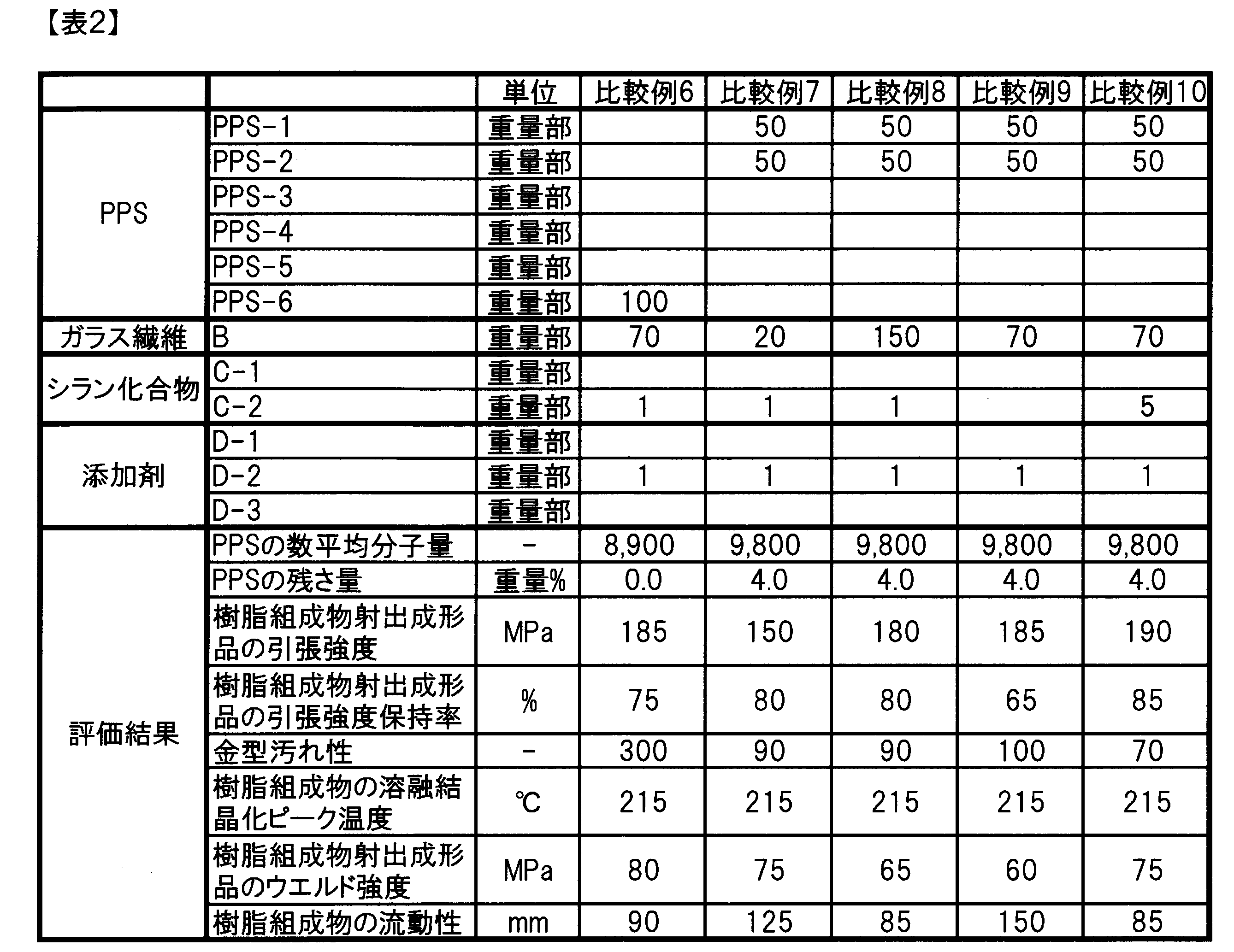
かくして得られるPPS樹脂組成物は、高い機械的強度と耐不凍液性とを有し、かつ、モールドデポジットの発生をも抑制しているという未知なる特性を有するため、自動車冷却部品に有用であり、特に、複数の部品を組み合わせた小型・複雑形状の自動車冷却部品に有用に用いられる。The PPS resin composition thus obtained has high mechanical strength and antifreeze resistance, as well as the unknown property of suppressing the occurrence of mold deposits, making it useful for automotive cooling parts, and in particular for small, complex-shaped automotive cooling parts that combine multiple components.
1.ハウジング
2.バルブ
3.軸
4.パイプ
5.孔部
6.パッキン
7.キャビティ部
8.ゲート部
1.
Claims (6)
(i)ポリフェニレンスルフィド樹脂組成物を射出成形してなるISO 20753に規定されるタイプA1試験片(以下、ISO試験片と呼ぶ。)を用い、引張速度5mm/min、雰囲気温度23℃の条件で、ISO 527-1、-2法に準拠し、測定した引張強度が190MPa以上であり、
(ii)前記ISO試験片を用い、150℃の不凍液に500時間浸漬処理した後、引張速度5mm/min、雰囲気温度23℃の条件で、ISO 527-1、-2法に準拠し、測定した引張強度の保持率が80%以上である。 The polyphenylene sulfide resin composition according to claim 1 or 2, which satisfies both of the following conditions (i) and (ii):
(i) The tensile strength measured using a type A1 test piece (hereinafter referred to as an ISO test piece) specified in ISO 20753 obtained by injection molding a polyphenylene sulfide resin composition at a tensile speed of 5 mm/min and an atmospheric temperature of 23° C. in accordance with ISO 527-1 and -2 methods is 190 MPa or more;
(ii) After the ISO test piece is immersed in an antifreeze solution at 150° C. for 500 hours, the retention of tensile strength measured in accordance with ISO 527-1 and -2 at a tensile speed of 5 mm/min and an atmospheric temperature of 23° C. is 80% or more.
Applications Claiming Priority (3)
| Application Number | Priority Date | Filing Date | Title |
|---|---|---|---|
| JP2019208930 | 2019-11-19 | ||
| JP2019208930 | 2019-11-19 | ||
| PCT/JP2020/042996 WO2021100757A1 (en) | 2019-11-19 | 2020-11-18 | Polyphenylene sulfide resin composition for automotive cooling parts, and automotive cooling parts |
Publications (2)
| Publication Number | Publication Date |
|---|---|
| JPWO2021100757A1 JPWO2021100757A1 (en) | 2021-05-27 |
| JP7635552B2 true JP7635552B2 (en) | 2025-02-26 |
Family
ID=75980824
Family Applications (1)
| Application Number | Title | Priority Date | Filing Date |
|---|---|---|---|
| JP2020566302A Active JP7635552B2 (en) | 2019-11-19 | 2020-11-18 | Polyphenylene sulfide resin composition for automobile cooling parts and automobile cooling parts |
Country Status (6)
| Country | Link |
|---|---|
| US (1) | US20220380598A1 (en) |
| EP (1) | EP4063095B1 (en) |
| JP (1) | JP7635552B2 (en) |
| KR (1) | KR102930986B1 (en) |
| CN (1) | CN114729188B (en) |
| WO (1) | WO2021100757A1 (en) |
Families Citing this family (4)
| Publication number | Priority date | Publication date | Assignee | Title |
|---|---|---|---|---|
| JP2024077775A (en) * | 2022-11-29 | 2024-06-10 | 東レ株式会社 | Polyphenylene sulfide resin composition and molded article |
| CN119432076A (en) * | 2023-08-03 | 2025-02-14 | 宁德时代新能源科技股份有限公司 | Harmonica pipe and preparation method, liquid cooling plate, battery, and electrical equipment |
| CN118108969B (en) * | 2024-04-30 | 2024-07-05 | 成都苯环新材料科技有限公司 | Preparation method of high-strength polyphenylene sulfide film |
| CN120737606B (en) * | 2025-06-13 | 2026-01-23 | 深圳市嘉凯勒实业有限公司 | Modified polyphenylene sulfide and preparation method and application thereof |
Citations (2)
| Publication number | Priority date | Publication date | Assignee | Title |
|---|---|---|---|---|
| JP2006219666A (en) | 2005-01-14 | 2006-08-24 | Toray Ind Inc | Polyarylene sulfide resin composition |
| WO2018180591A1 (en) | 2017-03-30 | 2018-10-04 | 東レ株式会社 | Poly(phenylene sulfide) resin composition, production method therefor, and molded article |
Family Cites Families (16)
| Publication number | Priority date | Publication date | Assignee | Title |
|---|---|---|---|---|
| US4528310A (en) * | 1981-09-10 | 1985-07-09 | Phillips Petroleum Company | Glass-filled poly(arylene sulfide) compositions containing organosilanes |
| JPH0641425A (en) | 1992-07-21 | 1994-02-15 | Toray Ind Inc | Poly@(3754/24)phenylene sulfide) resin composition |
| JP3151639B2 (en) * | 1992-10-08 | 2001-04-03 | アイシン精機株式会社 | Resin composition for automotive water pump related parts and automotive water pump related parts comprising the same |
| JP4887904B2 (en) * | 2006-05-19 | 2012-02-29 | 東レ株式会社 | Polyphenylene sulfide resin, process for producing the same, and molded article comprising the same |
| JP2010195874A (en) | 2009-02-24 | 2010-09-09 | Toray Ind Inc | Polyphenylene sulfide resin composition and molding |
| JP2011153242A (en) | 2010-01-28 | 2011-08-11 | Toray Ind Inc | Polyphenylene sulfide resin composition, and method for manufacturing the same |
| US9068078B2 (en) * | 2011-09-30 | 2015-06-30 | Toray Industries, Inc. | Polyphenylene sulfide resin composition, production method thereof and molded product thereof |
| KR102064024B1 (en) * | 2011-12-16 | 2020-01-08 | 티코나 엘엘씨 | Boron-containing nucleating agent for polyphenylene sulfide |
| EP2829577B1 (en) * | 2012-03-23 | 2018-10-31 | DIC Corporation | Polyarylene sulfide resin composition and molded body |
| EP3037480B1 (en) * | 2013-08-22 | 2019-02-20 | Toray Industries, Inc. | Polyphenylene sulfide resin composition, and moulding and manufacturing process for moulding thereof |
| JP6646877B2 (en) * | 2014-12-12 | 2020-02-14 | Dic株式会社 | Polyarylene sulfide resin composition, molded article, composite molded article, and method for producing composite molded article |
| JP2016121263A (en) * | 2014-12-25 | 2016-07-07 | 東レ株式会社 | Polyphenylene sulfide resin composition, method for producing the same, and molding comprising the same |
| JP6885096B2 (en) | 2016-02-26 | 2021-06-09 | 東レ株式会社 | Polyphenylene sulfide resin composition and molded article |
| KR102492258B1 (en) * | 2016-04-26 | 2023-01-26 | 에이치디씨폴리올 주식회사 | Polyarylene sulfide resin composition having improved hydrolysis-resistance |
| JP6809048B2 (en) * | 2016-08-30 | 2021-01-06 | Dic株式会社 | Polyarylene sulfide resin composition, its molded product and method for producing them |
| JP2018141149A (en) * | 2017-02-28 | 2018-09-13 | 東レ株式会社 | Polyphenylene sulfide resin composition and molded article |
-
2020
- 2020-11-18 WO PCT/JP2020/042996 patent/WO2021100757A1/en not_active Ceased
- 2020-11-18 US US17/775,976 patent/US20220380598A1/en not_active Abandoned
- 2020-11-18 EP EP20889057.4A patent/EP4063095B1/en active Active
- 2020-11-18 JP JP2020566302A patent/JP7635552B2/en active Active
- 2020-11-18 CN CN202080078775.4A patent/CN114729188B/en active Active
- 2020-11-18 KR KR1020227012440A patent/KR102930986B1/en active Active
Patent Citations (2)
| Publication number | Priority date | Publication date | Assignee | Title |
|---|---|---|---|---|
| JP2006219666A (en) | 2005-01-14 | 2006-08-24 | Toray Ind Inc | Polyarylene sulfide resin composition |
| WO2018180591A1 (en) | 2017-03-30 | 2018-10-04 | 東レ株式会社 | Poly(phenylene sulfide) resin composition, production method therefor, and molded article |
Also Published As
| Publication number | Publication date |
|---|---|
| EP4063095A4 (en) | 2023-09-27 |
| JPWO2021100757A1 (en) | 2021-05-27 |
| US20220380598A1 (en) | 2022-12-01 |
| KR20220103922A (en) | 2022-07-25 |
| WO2021100757A1 (en) | 2021-05-27 |
| EP4063095A1 (en) | 2022-09-28 |
| CN114729188B (en) | 2024-10-01 |
| KR102930986B1 (en) | 2026-02-25 |
| CN114729188A (en) | 2022-07-08 |
| EP4063095B1 (en) | 2026-06-17 |
Similar Documents
| Publication | Publication Date | Title |
|---|---|---|
| CN105555871B (en) | Polyarylene sulfide resin composition | |
| JP5582244B2 (en) | Polyphenylene sulfide resin composition, molded article of the resin composition, and method for producing the resin composition | |
| JP6885096B2 (en) | Polyphenylene sulfide resin composition and molded article | |
| US11292155B2 (en) | Poly(phenylene sulfide) resin composition, production method therefor, and molded article | |
| KR102930986B1 (en) | Polyphenylene sulfide resin composition for automotive cooling components and automotive cooling components | |
| JP7501359B2 (en) | Polyphenylene sulfide resin composition and molded article | |
| JP6707810B2 (en) | Automotive cooling module made of polyphenylene sulfide resin composition | |
| WO2012053505A1 (en) | Method for producing thermoplastic resin composition, thermoplastic resin composition, and molded product | |
| JP2004339478A (en) | Resin molded products, especially fuel tanks | |
| KR102535459B1 (en) | Polyphenylene sulfide resin composition, manufacturing method and molded product thereof | |
| JP6705209B2 (en) | Piping parts made of polyphenylene sulfide resin composition | |
| JP7067052B2 (en) | Polyphenylene sulfide resin compositions and articles | |
| JP2007297612A (en) | Polyphenylene sulfide resin composition | |
| JP7424181B2 (en) | Polyphenylene sulfide resin composition and molded article | |
| JP2018141149A (en) | Polyphenylene sulfide resin composition and molded article | |
| JP7679611B2 (en) | Method for producing polyarylene sulfide resin | |
| JP2020105261A (en) | Polyphenylene sulfide resin composition and molding | |
| WO2021100758A1 (en) | Polyphenylene sulfide resin composition for automobile cooling component, and automobile cooling component | |
| JP2023068631A (en) | Polyphenylene sulfide resin composition and molded article | |
| JP5131125B2 (en) | Polyphenylene sulfide resin composition and molded body | |
| JP4887904B2 (en) | Polyphenylene sulfide resin, process for producing the same, and molded article comprising the same | |
| JP2024077775A (en) | Polyphenylene sulfide resin composition and molded article | |
| JP2021031613A (en) | Polyphenylene sulfide resin composition and molded article | |
| JP2020105515A (en) | Polyphenylene sulfide resin composition and molded article | |
| JP7823571B2 (en) | Polyphenylene sulfide resin composition and method for producing same |
Legal Events
| Date | Code | Title | Description |
|---|---|---|---|
| A621 | Written request for application examination |
Free format text: JAPANESE INTERMEDIATE CODE: A621 Effective date: 20230911 |
|
| A131 | Notification of reasons for refusal |
Free format text: JAPANESE INTERMEDIATE CODE: A131 Effective date: 20241001 |
|
| A521 | Request for written amendment filed |
Free format text: JAPANESE INTERMEDIATE CODE: A523 Effective date: 20241118 |
|
| TRDD | Decision of grant or rejection written | ||
| A01 | Written decision to grant a patent or to grant a registration (utility model) |
Free format text: JAPANESE INTERMEDIATE CODE: A01 Effective date: 20250114 |
|
| A61 | First payment of annual fees (during grant procedure) |
Free format text: JAPANESE INTERMEDIATE CODE: A61 Effective date: 20250127 |
|
| R150 | Certificate of patent or registration of utility model |
Ref document number: 7635552 Country of ref document: JP Free format text: JAPANESE INTERMEDIATE CODE: R150 |