JP7635458B2 - GAME SYSTEM, GAME METHOD, GAME PROGRAM, AND GAME SERVER - Google Patents

GAME SYSTEM, GAME METHOD, GAME PROGRAM, AND GAME SERVER Download PDF

Info

Publication number
JP7635458B2
JP7635458B2 JP2024176884A JP2024176884A JP7635458B2 JP 7635458 B2 JP7635458 B2 JP 7635458B2 JP 2024176884 A JP2024176884 A JP 2024176884A JP 2024176884 A JP2024176884 A JP 2024176884A JP 7635458 B2 JP7635458 B2 JP 7635458B2
Authority
JP
Japan
Prior art keywords
character
player
team
points
predetermined
Prior art date
Legal status (The legal status is an assumption and is not a legal conclusion. Google has not performed a legal analysis and makes no representation as to the accuracy of the status listed.)
Active
Application number
JP2024176884A
Other languages
Japanese (ja)
Other versions
JP2024180453A (en
Inventor
康典 末永
正昭 星野
規裕 世良
▲紀▼▲澤▼▲鋒▼
▲楊▼思勤
李文意
Current Assignee (The listed assignees may be inaccurate. Google has not performed a legal analysis and makes no representation or warranty as to the accuracy of the list.)
Tencent Technology Shenzhen Co Ltd
Original Assignee
Tencent Technology Shenzhen Co Ltd
Priority date (The priority date is an assumption and is not a legal conclusion. Google has not performed a legal analysis and makes no representation as to the accuracy of the date listed.)
Filing date
Publication date
Priority claimed from JP2020108119A external-priority patent/JP6902143B1/en
Application filed by Tencent Technology Shenzhen Co Ltd filed Critical Tencent Technology Shenzhen Co Ltd
Priority to JP2024176884A priority Critical patent/JP7635458B2/en
Publication of JP2024180453A publication Critical patent/JP2024180453A/en
Priority to JP2025021089A priority patent/JP7812951B2/en
Application granted granted Critical
Publication of JP7635458B2 publication Critical patent/JP7635458B2/en
Active legal-status Critical Current
Anticipated expiration legal-status Critical

Links

Images

Landscapes

  • Processing Or Creating Images (AREA)

Description

本発明は、ゲームシステム、ゲーム方法、ゲームプログラム、及びゲームサーバに関する。特に、本発明は、複数のプレイヤが通信ネットワークを介して同時プレイ可能なゲームシステム、ゲーム方法、ゲームプログラム、及びゲームサーバに関する。 The present invention relates to a game system, a game method, a game program, and a game server. In particular, the present invention relates to a game system, a game method, a game program, and a game server that allow multiple players to play simultaneously via a communication network.

近年、複数のプレイヤが複数のチーム(典型的には2チーム)に分かれ、自身が所属するチーム(味方チーム)のプレイヤと協力しながら敵チームの本拠地を破壊すること等を勝利条件とするゲームであるMultiplayer online battle arena(MOBA)が盛んにプレイされている。MOBAは、多対多の対人バトルが可能であることから、高い遊戯性を有している。 In recent years, multiplayer online battle arena (MOBA) has become popular. In this game, players are divided into multiple teams (typically two teams) and cooperate with players on their own team (the friendly team) to destroy the enemy team's base in order to win. MOBAs are highly entertaining because they allow for multiplayer battles.

ただし、人間が操作するキャラクタ同士のバトル、すなわち、対人バトルにおいて勝利を収めるためには、キャラクタの操作に熟練を要し、実際に人間が操作するキャラクタを相手に勝利できるようになるまでには相応の訓練を要することがある。また、味方チームに操作に不慣れなプレイヤが所属している場合、味方チームが敵チームに勝利するためには、当該不慣れなプレイヤを除く他のプレイヤが不慣れなプレイヤをサポートすることを要する。そのため、この不慣れなプレイヤは、味方チームに迷惑をかけてしまうのではないかという懸念点から、ゲームへの参加に躊躇する場合もある。 However, to win a battle between characters controlled by humans, i.e., a PvP battle, one must be skilled in controlling the characters, and may need a fair amount of training before one can actually defeat a character controlled by a human. Also, if a player on one's team is inexperienced in controlling the characters, other players must support the inexperienced player in order for the team to defeat the enemy team. For this reason, the inexperienced player may hesitate to participate in the game out of concern that he or she may cause trouble for the team.

そこで、従来、ユーザの操作入力を受け付ける操作入力受付手段と、操作入力受付手段にて受け付けた操作入力に基づいて情報処理を行う情報処理手段とを備え、情報処理手段は、操作入力に基づいて仮想空間内の自キャラクタを制御することで、自キャラクタの対応色を仮想空間に描画するゲーム進行手段と、自キャラクタの対応色とは異なる敵キャラクタの対応色の仮想空間への描画状態と自キャラクタの対応色の仮想空間への描画状態とに基づいて、対戦判定をする対戦判定手段とを備える情報処理システムが知られている(例えば、特許文献1参照)。特許文献1に記載の情報処理システムによれば、仮想空間内で自キャラクタを制御することで自キャラクタの対応色で仮想空間を描画し、その描画状態と敵キャラクタの対応色の描画状態とに基づいて対戦判定することができる。 Therefore, a conventional information processing system is known that includes an operation input receiving means for receiving a user's operation input, and an information processing means for processing information based on the operation input received by the operation input receiving means, in which the information processing means controls a player's character in a virtual space based on the operation input, thereby drawing the player's character's corresponding color in the virtual space, and a match determination means for making a match determination based on the drawing state in the virtual space of the corresponding color of an enemy character that is different from the player's character's corresponding color and the drawing state in the virtual space of the player's character's corresponding color (see, for example, Patent Document 1). According to the information processing system described in Patent Document 1, the player's character is controlled in the virtual space to draw the virtual space in the player's character's corresponding color, and a match determination can be made based on the drawing state and the drawing state of the enemy character's corresponding color.

特開2015-216971号公報JP 2015-216971 A

しかし、特許文献1に記載のような情報処理システムにおいては、対応色の仮想空間への描画により味方チームの勝利に貢献できるものの、MOBAにおける遊戯性の源の1つである対人バトルを考慮したキャラクタの操作や味方チームの戦略の検討等を楽しむ余地が少なくなる場合がある。また、特許文献1に記載のような情報処理システムにおいては、対人バトルに躊躇してしまう初心者や操作に不慣れなプレイヤの対人バトルに対する心理的障壁を下げることが難しい場合もある。 However, in an information processing system such as that described in Patent Document 1, although it is possible to contribute to the victory of the allied team by drawing the corresponding color in the virtual space, there may be less room to enjoy the operation of characters and the consideration of the allied team's strategy while taking into account the PvP battles, which are one of the sources of playability in MOBAs. Furthermore, in an information processing system such as that described in Patent Document 1, it may be difficult to lower the psychological barrier to PvP battles for beginners and players who are unfamiliar with the controls and are hesitant to participate in PvP battles.

したがって、本発明の目的は、複数のプレイヤが参加可能なゲームにおいて、ゲーム内での対人バトルではない行動によりチームに貢献できると共に、当該行動に伴って対人バトルに要する操作の熟練度を向上させることができるゲームシステム、ゲーム方法、ゲームプログラム、及びゲームサーバを提供することにある。 The object of the present invention is therefore to provide a game system, game method, game program, and game server in which, in a game in which multiple players can participate, players can contribute to their team by performing actions that are not part of PvP battles within the game, and by which said actions can improve the proficiency of the operations required for PvP battles.

本発明は、上記目的を達成するため、プロセッサと、メモリとを備え、プレイフィールド内において複数のチームが対戦をし、各チームの得点に基づいて勝敗を決する対戦ゲームの進行を管理するコンピュータに実行させるためのゲームプログラムであって、ゲームプログラムは、プロセッサに、プレイフィールド内で、第1のチームに所属する第1のプレイヤの操作に基づいて、第1のプレイヤキャラクタの動作を制御し、第2のチームに所属する第2のプレイヤの操作に基づいて、第2のプレイヤキャラクタの動作をそれぞれ制御するステップと、第1のプレイヤ及び第2のプレイヤに操作されずに動作し、かつ、所定のポイントが対応付けられた中立キャラクタと第1のプレイヤキャラクタとが対戦し所定の条件を達成した場合に、中立キャラクタに対応付けられたポイントを第2のプレイヤに対応付ける前に第1のプレイヤに対応付けるステップと、中立キャラクタと第2のプレイヤキャラクタとが対戦し所定の条件を達成した場合に、中立キャラクタに対応付けられたポイントを第1のプレイヤに対応付ける前に第2のプレイヤに対応付けるステップと、プレイフィールド内に設けられる第2のチームの所定の領域内に第1のプレイヤキャラクタが位置するときに、第1のプレイヤに対応付けられたポイントを第1のチームの得点とするステップと、プレイフィールド内に設けられる第1のチームの所定の領域内に第2のプレイヤキャラクタが位置するときに、第2のプレイヤに対応付けられたポイントを第2のチームの得点とするステップとを実行させるゲームプログラムが提供される。 In order to achieve the above object, the present invention provides a game program to be executed by a computer having a processor and a memory, and managing the progress of a competitive game in which a plurality of teams compete against each other in a play field and the winner is decided based on the points scored by each team , the game program including the steps of: controlling, in the play field, an action of a first player character based on an operation of a first player belonging to a first team, and controlling an action of a second player character based on an operation of a second player belonging to a second team; and controlling, when a predetermined condition is achieved in a match between the first player character and a neutral character that operates without being operated by the first player and the second player and that is associated with predetermined points, A game program is provided which executes the steps of: associating points associated with a neutral character with a first player before associating the points with the second player; when a neutral character and a second player character play against each other and a predetermined condition is achieved, associating points associated with the neutral character with the second player before associating the points with the first player; when the first player character is located within a predetermined area of the second team provided in the playfield, setting the points associated with the first player as the score of the first team; and when the second player character is located within a predetermined area of the first team provided in the playfield, setting the points associated with the second player as the score of the second team .

本発明に係るゲームシステム、ゲーム方法、ゲームプログラム、及びゲームサーバによれば、複数のプレイヤが参加可能なゲームにおいて、ゲーム内での対人バトルではない行動によりチームに貢献できると共に、当該行動に伴って対人バトルに要する操作の熟練度を向上させることができるゲームシステム、ゲーム方法、ゲームプログラム、及びゲームサーバを提供できる。 The game system, game method, game program, and game server of the present invention can provide a game system, game method, game program, and game server that allows players to contribute to their team through actions that are not part of PvP battles in a game in which multiple players can participate, and that allows players to improve their proficiency in the operations required for PvP battles through such actions.

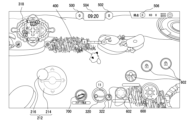
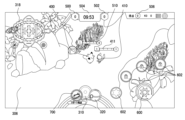
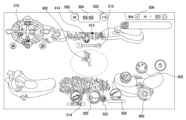
本実施形態に係るゲームシステムの概要図である。1 is a schematic diagram of a game system according to an embodiment of the present invention. 本実施形態に係るゲームシステムで実行されるゲームのプレイフィールドの概要図である。1 is a schematic diagram of a play field of a game executed in a game system according to an embodiment of the present invention. 本実施形態に係るゲームシステムの機能構成ブロック図である。FIG. 2 is a functional block diagram of the game system according to the present embodiment. 本実施形態に係る格納ユニットが有する各格納部のデータ構成図である。4 is a data configuration diagram of each storage section of the storage unit according to the embodiment. FIG. 本実施形態に係る入力部によるプレイヤキャラクタへの移動指示の概要図である。4A to 4C are schematic diagrams illustrating movement instructions given to a player character by an input unit according to the present embodiment. 本実施形態に係るゲームシステムにおけるプレイヤキャラクタと中立キャラクタとの対戦の概要図である。FIG. 2 is a schematic diagram of a battle between a player character and a neutral character in the game system according to the present embodiment. 本実施形態に係るゲームシステムにおけるプレイヤキャラクタと中立キャラクタとの対戦の概要図である。FIG. 2 is a schematic diagram of a battle between a player character and a neutral character in the game system according to the present embodiment. 本実施形態に係るゲームシステムにおけるプレイヤキャラクタと中立キャラクタとの対戦の概要図である。FIG. 2 is a schematic diagram of a battle between a player character and a neutral character in the game system according to the present embodiment. 本実施形態に係るゲームシステムにおけるプレイヤキャラクタと味方キャラクタとが共闘の概要図である。FIG. 2 is a schematic diagram of a player character and an ally character fighting together in the game system according to the present embodiment. 本実施形態に係るゲームシステムにおけるプレイヤキャラクタと味方キャラクタとが共闘の概要図である。FIG. 2 is a schematic diagram of a player character and an ally character fighting together in the game system according to the present embodiment. 本実施形態に係るゲームシステムにおけるポイントの得点化の概要図である。FIG. 2 is a schematic diagram showing how points are scored in the game system according to the present embodiment. 本実施形態に係るゲームシステムにおけるポイントの得点化の概要図である。FIG. 2 is a schematic diagram showing how points are scored in the game system according to the present embodiment. 本実施形態に係るゲームシステムにおける第1の特別キャラクタの概要図である。1 is a schematic diagram of a first special character in the game system according to this embodiment. FIG. 本実施形態に係るゲームシステムにおける第1の特別キャラクタの概要図である。1 is a schematic diagram of a first special character in the game system according to this embodiment. FIG. 本実施形態に係るゲームシステムにおける第2の特別キャラクタの概要図である。13 is a schematic diagram of a second special character in the game system according to this embodiment. FIG. 本実施形態に係るゲームシステムにおける制限発生部の概要図である。FIG. 2 is a schematic diagram of a restriction generating unit in the game system according to the present embodiment. 本実施形態に係るゲームシステムにおける処理のフロー図である。FIG. 2 is a flow diagram of processing in the game system according to the present embodiment. 本実施形態に係るゲームシステムにおける処理のフロー図である。FIG. 2 is a flow diagram of processing in the game system according to the present embodiment. 本実施形態に係るゲームシステムにおける処理のフロー図である。FIG. 2 is a flow diagram of processing in the game system according to the present embodiment. 本実施形態に係るゲームシステムにおける処理のフロー図である。FIG. 2 is a flow diagram of processing in the game system according to the present embodiment.

[実施の形態]
<ゲームシステム1の概要>
図1は、本実施形態に係るゲームシステムの概要を示す。また、図2は、本実施形態に係るゲームシステムで実行されるゲームのプレイフィールドの概要例を示す。
[Embodiment]
Overview of Game System 1
Fig. 1 shows an overview of a game system according to this embodiment, and Fig. 2 shows an example of an outline of a play field of a game executed by the game system according to this embodiment.

本実施形態に係るゲームシステム1は、スマートフォン等の情報端末3で実行可能であって、複数のプレイヤそれぞれの情報端末3が通信ネットワーク5を介してサーバ7に接続することで各プレイヤがゲームを同時プレイ可能なゲームシステムである。そして、ゲームシステム1は、1以上のプレイヤのプレイヤキャラクタによって構成される一方のチーム(以下、「味方チーム」と称する場合がある。)と、1以上の他のプレイヤの他のプレイヤキャラクタによって構成される他方のチーム(以下、「敵チーム」と称する場合がある。)とに少なくとも分かれて競い合い、味方チームが獲得した得点と敵チームが獲得した得点とを比較することでゲームの勝利チームを決定する。ゲームシステム1は、Multiplayer online battle arena(MOBA)の一種であってよい。ここで、サーバ7とプレイヤが所有する情報端末(例えば、情報端末3、情報端末3a・・・及び情報端末3n)とは、例えば、通信ネットワーク5を介して双方向通信可能に接続される。また、ゲームシステム1は、サーバクライアント型のゲームシステムであってよい。 The game system 1 according to this embodiment can be executed by an information terminal 3 such as a smartphone, and is a game system in which each player can play the game simultaneously by connecting the information terminal 3 of each of multiple players to the server 7 via a communication network 5. The game system 1 divides players into at least one team (hereinafter, sometimes referred to as the "ally team") consisting of player characters of one or more players and another team (hereinafter, sometimes referred to as the "enemy team") consisting of other player characters of one or more other players, and determines the winning team of the game by comparing the points earned by the ally team with the points earned by the enemy team. The game system 1 may be a type of multiplayer online battle arena (MOBA). Here, the server 7 and the information terminals owned by the players (for example, information terminal 3, information terminal 3a, ... and information terminal 3n) are connected to each other via the communication network 5 so as to be able to communicate bidirectionally. The game system 1 may also be a server-client type game system.

なお、プレイヤ自身が操作するキャラクタをプレイヤキャラクタ、プレイヤが所属するチームを味方チーム、味方チームに所属するプレイヤ以外のプレイヤが操作するキャラクタを味方プレイヤキャラクタ、プレイヤが対戦する他のプレイヤが所属するチームを敵チーム、敵チームに所属する他のプレイヤが操作するキャラクタを敵プレイヤキャラクタと称する。 The character operated by the player himself is called the player character, the team to which the player belongs is called the friendly team, characters operated by players other than those who belong to the friendly team are called friendly player characters, the team to which other players the player faces are called the enemy team, and characters operated by other players who belong to the enemy team are called enemy player characters.

すなわち、ゲームシステム1は、プレイヤが操作するプレイヤキャラクタが所属する味方チームと、他のプレイヤが操作する敵プレイヤキャラクタが所属する敵チームとに分かれて実行される。そして、ゲームシステム1は、ゲーム中に各プレイヤキャラクタ(つまり、プレイヤキャラクタ、味方プレイヤキャラクタ、敵プレイヤキャラクタ)が獲得したポイントを所定の条件を満たした場合に得点化することで各プレイヤキャラクタそれぞれが所属するチームの得点にし、ゲーム時間終了時において各チームが獲得した得点を比較してゲームの勝敗を決定する。 That is, the game system 1 is executed with the players divided into an ally team to which the player character operated by the player belongs, and an enemy team to which the enemy player character operated by another player belongs. The game system 1 converts points acquired by each player character (i.e., the player character, ally player character, enemy player character) during the game into points when a predetermined condition is satisfied, thereby converting the points into points for the team to which each player character belongs, and at the end of the game time, the points acquired by each team are compared to determine the outcome of the game.

例えば、ゲームシステム1は、仮想空間であるプレイフィールド300において実行される。一例として、プレイフィールド300は、図2に示すように、プレイヤキャラクタが所属する味方チームの味方本拠地302と、敵プレイヤキャラクタが所属する敵チームの敵本拠地304と、味方本拠地302と敵本拠地304とを結ぶ1以上のレーン306と、味方本拠地302から所定の距離まで少なくとも1以上のレーンに沿って設けられる1以上の味方拠点310と、敵本拠地304から所定の距離まで少なくとも1以上のレーン306に沿って設けられる1以上の敵拠点312と、複数のレーン306間、及び複数のレーン306脇の少なくとも一部に設けられる中立領域314と、味方本拠地302と敵本拠地304とから等距離の位置に設けられる中央部316とを含む。プレイヤキャラクタは、プレイヤの指示に応じ、プレイフィールド300内の移動不可の領域(例えば、プレイフィールド300内に設けられる壁や岩、池等)を除き、原則として所望の位置に自在に移動できる。 For example, the game system 1 is executed in a playfield 300, which is a virtual space. As an example, the playfield 300 includes, as shown in FIG. 2, a teammate home base 302 of a teammate to which a player character belongs, an enemy home base 304 of an enemy team to which an enemy player character belongs, one or more lanes 306 connecting the teammate home base 302 and the enemy home base 304, one or more teammate bases 310 provided along at least one or more lanes 306 up to a predetermined distance from the teammate home base 302, one or more enemy bases 312 provided along at least one or more lanes 306 up to a predetermined distance from the enemy home base 304, a neutral area 314 provided between the multiple lanes 306 and at least a part of the side of the multiple lanes 306, and a central portion 316 provided at a position equidistant from the teammate home base 302 and the enemy home base 304. In principle, the player character can freely move to any desired location in response to the player's instructions, except for areas within the playfield 300 where movement is prohibited (for example, walls, rocks, ponds, etc. within the playfield 300).

そして、ゲームシステム1は、レーン306及び/又は中立領域314の所定の位置に中立キャラクタ(NPC)を出現させる。中立キャラクタは、いずれのプレイヤにも操作されずに動作するキャラクタである。また、中立キャラクタは、ゲームシステム1が自動制御するキャラクタであると共にプレイヤキャラクタ、味方プレイヤキャラクタ、及び/又は敵プレイヤキャラクタが攻撃して倒すことにより、倒すことに成功したプレイヤが獲得できるキャラクタである。更に、中立キャラクタは、中立キャラクタの種類やステータス(例えば、レベル等)等に応じた所定のポイントが対応付けられている。 The game system 1 then causes a neutral character (NPC) to appear at a predetermined position in the lane 306 and/or neutral area 314. A neutral character is a character that operates without being operated by any player. A neutral character is also a character that is automatically controlled by the game system 1, and can be acquired by a player who has successfully defeated a neutral character by attacking it with a player character, an ally player character, and/or an enemy player character. Furthermore, a neutral character is associated with a predetermined number of points according to the type and status (e.g., level, etc.) of the neutral character.

ゲームシステム1は、プレイヤキャラクタから所定範囲内にいる中立キャラクタをプレイヤの指示に応じてプレイヤキャラクタが攻撃して倒した場合、当該プレイヤキャラクタを操作するプレイヤに当該中立キャラクタを獲得させる。そして、ゲームシステム1は、当該中立キャラクタを当該プレイヤキャラクタの味方キャラクタに変更すると共に、当該プレイヤキャラクタに当該中立キャラクタが有するポイントを付与する。これによりプレイヤキャラクタはポイントを獲得する。ゲームシステム1は、この味方キャラクタを当該プレイヤの仮想のキャラクタ格納領域に格納する。 When a player character attacks and defeats a neutral character within a predetermined range from the player character in response to a player's instruction, the game system 1 allows the player operating the player character to acquire the neutral character. The game system 1 then changes the neutral character to an ally character of the player character, and grants the player character the points that the neutral character possesses. In this way, the player character acquires points. The game system 1 stores this ally character in the player's virtual character storage area.

そして、ゲームシステム1は、プレイヤの指示に応じ、キャラクタ格納領域から味方キャラクタをプレイフィールド300へ登場させること、及びプレイフィールド300からキャラクタ格納領域へ格納することができる。ゲームシステム1は、プレイヤが味方キャラクタをプレイフィールド300に登場させた場合、味方キャラクタをプレイヤキャラクタに自動で追従させ、プレイヤキャラクタ若しくは味方キャラクタから所定範囲内にいる中立キャラクタ及び/又は敵プレイヤキャラクタを自動で攻撃させる(つまり、味方キャラクタは、プレイヤキャラクタと共闘する。)。 The game system 1 can then, in response to a player's instruction, have an ally character appear on the playfield 300 from the character storage area, and store the ally character from the playfield 300 into the character storage area. When the player has an ally character appear on the playfield 300, the game system 1 automatically causes the ally character to follow the player character and automatically attack neutral characters and/or enemy player characters that are within a predetermined range of the player character or the ally character (i.e., the ally character fights alongside the player character).

また、ゲームシステム1は、プレイヤの指示に応じ、プレイヤキャラクタから所定範囲内にいる敵プレイヤキャラクタをプレイヤキャラクタに攻撃させることもできる。ゲームシステム1は、プレイヤキャラクタが敵プレイヤキャラクタを攻撃して倒した場合、プレイヤキャラクタに所定のポイントを付与する。つまり、ゲームシステム1においてプレイヤは、プレイヤキャラクタを操作することで敵プレイヤキャラクタとの対人バトルができるだけでなく、プレイヤの意思に応じ、プレイヤキャラクタと中立キャラクタとのバトル(システムとのバトル)をすることができる。これによりプレイヤが操作するプレイヤキャラクタは、敵プレイヤキャラクタを倒すことか、あるいは中立キャラクタを倒すことでポイントを獲得できる。 In addition, the game system 1 can also, in response to a command from the player, have the player character attack an enemy player character that is within a predetermined range from the player character. When the player character attacks and defeats an enemy player character, the game system 1 awards the player character with a predetermined number of points. In other words, in the game system 1, the player can not only control the player character to engage in a human-to-human battle with an enemy player character, but can also, in response to the player's wishes, have a battle between the player character and a neutral character (a battle with the system). This allows the player character controlled by the player to earn points by defeating either an enemy player character or a neutral character.

そして、ゲームシステム1は、プレイヤキャラクタがプレイフィールド300の所定の領域内(例えば、敵拠点312から所定範囲内)にいる場合に、プレイヤの指示に応じ、プレイヤキャラクタが獲得したポイントを敵拠点312に供給することで、このポイントを味方チームの得点にすることができる。つまり、ポイントを得点にする(以下、ポイントを得点に変換することを「得点化」と称する場合がある。)まで味方チームに得点は入らない。この場合にゲームシステム1は、ポイントの得点化に伴い、プレイヤキャラクタが得点化までに獲得したポイントをゼロにリセットすると共にプレイヤのキャラクタ格納領域に格納されている味方キャラクタ、若しくはキャラクタ格納領域から出てプレイフィールド300に登場している味方キャラクタを消去する。ここで、味方キャラクタを消去するとは、同一のゲームプレイの中で再び当該味方キャラクタをプレイフィールド300に登場できないように制限することをいう。これにより、当該味方キャラクタがプレイヤキャラクタと共にバトルすることができなくなる。また、敵拠点312には予め定められた耐久値が設定されており、ゲームシステム1は、敵拠点312に供給されたポイント(以下、「供給値」という)の合計値が耐久値以上になった場合、敵拠点312の機能を停止させる。例えば、ゲームシステム1は、敵拠点312が破壊される様子を表示し、敵拠点312の機能が停止したことを表すことができる。 When the player character is within a predetermined area of the playfield 300 (for example, within a predetermined range from the enemy base 312), the game system 1 can supply the points acquired by the player character to the enemy base 312 in response to the player's instruction, and convert these points into points for the allied team. In other words, the allied team does not receive points until the points are converted into points (hereinafter, converting points into points may be referred to as "scoring"). In this case, the game system 1 resets the points acquired by the player character up until the conversion to points to zero, and erases the allied characters stored in the player's character storage area or the allied characters that have left the character storage area and are appearing on the playfield 300. Here, erasing an allied character means restricting the allied character from appearing on the playfield 300 again in the same game play. This makes it impossible for the allied character to battle with the player character. Furthermore, a predetermined durability value is set for the enemy base 312, and the game system 1 stops the function of the enemy base 312 when the total value of points supplied to the enemy base 312 (hereinafter referred to as the "supplied value") becomes equal to or exceeds the durability value. For example, the game system 1 can display the enemy base 312 being destroyed to indicate that the enemy base 312 has stopped functioning.

このように、ゲームシステム1においてプレイヤに操作されるプレイヤキャラクタは、中立キャラクタ及び/又は敵プレイヤキャラクタを攻撃して倒すことでポイントを取得し、取得したポイントを敵拠点に供給することで味方チームの得点にすることができる。ここで、ゲームシステム1においては、獲得した中立キャラクタを味方キャラクタとしてプレイヤキャラクタと共に行動させることができる一方(この場合、味方キャラクタはプレイヤキャラクタと自動的に共闘するように制御することができ、プレイヤに追従するように移動し、味方キャラクタの所定周囲内の中立キャラクタや敵プレイヤキャラクタに対して攻撃動作する)、プレイヤキャラクタが獲得したポイントを得点化した場合、得点化した時点でプレイヤが保有している味方キャラクタは消去され、当該ゲーム中に登場させることができなくなる。これにより、ゲームシステム1においては、中立キャラクタを獲得して味方キャラクタにした場合、中立キャラクタの獲得により得たポイントを得点化して味方キャラクタを消去するのか、獲得したポイントを得点化させずに味方キャラクタを保有したまま用いて共闘するのかについてプレイヤは選択できるので、ゲームの戦略性を向上させることができる。 In this way, the player character operated by the player in the game system 1 can acquire points by attacking and defeating neutral characters and/or enemy player characters, and can supply the acquired points to the enemy base to score for the allied team. Here, in the game system 1, the acquired neutral character can be made to act together with the player character as an ally character (in this case, the ally character can be controlled to automatically fight together with the player character, move to follow the player, and attack neutral characters and enemy player characters within a certain perimeter of the ally character), while when the points acquired by the player character are converted into points, the ally character held by the player at the time of the points being converted into points is deleted and cannot be made to appear in the game. In this way, in the game system 1, when a neutral character is acquired and made into an ally character, the player can select whether to convert the points acquired by acquiring the neutral character into points and delete the ally character, or to retain the ally character and use it to fight together without converting the acquired points into points, thereby improving the strategic nature of the game.

そして、ゲームシステム1においては、敵プレイヤキャラクタとのバトル、すなわち、対人バトルをしなくても、中立キャラクタとバトルすることでプレイヤキャラクタはポイントを獲得し、獲得したポイントを敵拠点において得点化することができるので、対人バトルに躊躇するプレイヤや対人バトルに苦手意識を有するプレイヤであっても自身が所属するチームに貢献できる。つまり、ゲームシステム1においては、対人バトルをしなくてもゲームを楽しむことができる。また、ゲームシステム1においてプレイヤは、中立キャラクタとのバトルを通じ、ゲーム内におけるバトルの熟練度を向上させることができる。これにより、ゲームシステム1によれば、プレイヤはバトルに慣れることができ、徐々に対人バトルへの苦手意識が低減する。 In game system 1, a player character can earn points by battling neutral characters without battling an enemy player character, i.e., without battling other players, and the points earned can be converted into points at the enemy base, so even players who are hesitant to battling other players or who feel uncomfortable battling other players can contribute to the team they belong to. In other words, in game system 1, a player can enjoy the game without battling other players. In game system 1, a player can improve his or her battling proficiency in the game through battling neutral characters. As a result, game system 1 allows a player to become accustomed to battling, and gradually reduces his or her discomfort with battling other players.

更に、ゲームシステム1は、プレイヤキャラクタが中立キャラクタや敵プレイヤキャラクタを倒したとき等にプレイヤキャラクタは経験値を取得し、取得した経験値の合計値が所定値以上になった場合、そのプレイヤキャラクタの見た目や能力を変化させることができる(以下、この変化を「進化」と称する。)。この進化により、プレイヤキャラクタは、その能力が向上したり、中立キャラクタや敵プレイヤキャラクタを攻撃する「技」を覚えたりすることができる。これにより、従来のMOBAでは、プレイヤキャラクタの攻撃力等を向上させるためにプレイヤキャラクタはゲーム内で所定のアイテムを取得して装備する必要があったところ、ゲームシステム1においてはプレイヤキャラクタが進化することで自動的に「技」を覚えるので、煩雑な操作なしでプレイヤキャラクタを強化できる。また、ゲームシステム1においては、「進化」によりプレイヤキャラクタの見た目を変えることができるので、プレイヤキャラクタがどの程度の強さを有しているのか、プレイヤは一目で把握することもできる。 Furthermore, in the game system 1, the player character acquires experience points when the player character defeats a neutral character or an enemy player character, and when the total value of the acquired experience points reaches or exceeds a predetermined value, the appearance and abilities of the player character can be changed (hereinafter, this change is referred to as "evolution"). Through this evolution, the player character can improve its abilities and learn "techniques" to attack neutral characters and enemy player characters. In conventional MOBAs, the player character had to acquire and equip certain items in the game to improve the attack power of the player character, but in the game system 1, the player character automatically learns "techniques" as it evolves, so the player character can be strengthened without complicated operations. In addition, in the game system 1, the appearance of the player character can be changed through "evolution," so the player can know at a glance how strong the player character is.

なお、情報端末3、3a、・・・3nは、携帯電話やスマートフォン、ノートパソコン、タブレット型PC、PC、携帯用ゲーム機、及び/又は家庭用ゲーム機等の情報端末等である。複数の情報端末が存在する場合、各情報端末の種類は異なっていてもよい。そして、以下において本実施形態に係るゲームシステム1の詳細を説明するが、上記説明及び下記説明における名称や数値等はあくまで例示であり、これらの固有名や数値に本発明が限定されることはないこと、及びこれら固有名や数値は実在の固有名や数値とは必ずしも関係するとは限らないことを付言する。 The information terminals 3, 3a, ..., 3n are information terminals such as mobile phones, smartphones, notebook computers, tablet PCs, PCs, portable game consoles, and/or home game consoles. When multiple information terminals are present, the types of each information terminal may be different. Details of the game system 1 according to this embodiment are described below, but it should be noted that the names and numbers in the above and following descriptions are merely examples, that the present invention is not limited to these proper names and numbers, and that these proper names and numbers do not necessarily relate to real proper names and numbers.

<ゲームシステム1の詳細>
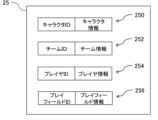
図3は、本実施形態に係るゲームシステムの機能構成の一例を示す。また、図4は、本実施形態に係るゲームシステムが有する格納ユニットが有する各格納部のデータ構成の一例を示す。
<Details of Game System 1>
Fig. 3 shows an example of the functional configuration of the game system according to this embodiment, and Fig. 4 shows an example of the data configuration of each storage section of a storage unit included in the game system according to this embodiment.

[ゲームシステム1の構成の概要]
本実施形態に係るゲームシステム1は、プレイフィールド300内において、プレイヤと味方プレイヤが所属する味方チームと敵のプレイヤが所属する敵チームとが競い、各チームが獲得した得点を比較することでゲームの勝敗を決するゲームシステムである。ゲームシステム1は、プレイフィールド300やプレイヤキャラクタ等を表示する表示部10と、表示部10の表示を制御する表示制御部15と、プレイヤからの指示を受け付ける入力部20と、ゲームに用いる各種の情報を格納する格納ユニット25と、プレイヤキャラクタの動作を制御するキャラクタ動作制御部30と、中立キャラクタ及び/又は特別キャラクタの出現を制御する出現制御部35と、プレイヤキャラクタと他の各種キャラクタとの対戦を制御する対戦制御部40と、プレイヤキャラクタと他の各種キャラクタとの対戦結果を判定する対戦結果判定部45と、キャラクタの状態を決定するキャラクタ状態決定部50と、味方キャラクタの動作等を制御する味方キャラクタ制御部55と、特別キャラクタの動作等を制御する特別キャラクタ制御部57と、プレイヤキャラクタに経験値を付与する経験値付与部60と、プレイヤキャラクタ若しくはプレイヤにポイントを付与するポイント付与制御部62と、プレイヤキャラクタの進化を制御する進化制御部64と、ポイントを得点に変換する得点化部70と、味方拠点及び敵拠点を制御する拠点制御部80と、ゲームの勝敗を決定する勝敗決定部85と、拠点間に所定の制限を発生させる制限発生部87と、ゲームの制限時間を制御する制限時間制御部90とを備える。なお、特別キャラクタとは、中立キャラクタ(NPC)のうち、プレイヤキャラクタと対戦可能であり、プレイヤキャラクタとの対戦によってプレイヤキャラクタが勝利した場合であってもプレイヤキャラクタが所属するチームに所属するものの、キャラクタ格納領域に格納されないキャラクタである。
[Overview of the Configuration of Game System 1]
The game system 1 according to the present embodiment is a game system in which a friendly team including a player and a friendly player compete against an enemy team including an enemy player in a play field 300, and the winner of the game is decided by comparing the points acquired by each team. The game system 1 includes a display unit 10 that displays the play field 300 and a player character, a display control unit 15 that controls the display of the display unit 10, an input unit 20 that receives instructions from the player, a storage unit 25 that stores various information used in the game, a character action control unit 30 that controls the action of the player character, an appearance control unit 35 that controls the appearance of a neutral character and/or a special character, a match control unit 40 that controls a match between the player character and various other characters, a match result determination unit 45 that determines the match result between the player character and various other characters, and a character status determination unit 46 that determines the state of the character. The game system includes a state determination unit 50, an ally character control unit 55 for controlling the actions of the ally characters, a special character control unit 57 for controlling the actions of the special characters, an experience value granting unit 60 for granting experience values to the player characters, a point granting control unit 62 for granting points to the player characters or the players, an evolution control unit 64 for controlling the evolution of the player characters, a scoring unit 70 for converting points into scores, a base control unit 80 for controlling the ally bases and the enemy bases, a win/loss determination unit 85 for determining the outcome of the game, a limit generating unit 87 for generating a predetermined limit between the bases, and a time limit control unit 90 for controlling the time limit of the game. The special character is a neutral character (NPC) that can play against the player character and that belongs to the team to which the player character belongs even if the player character wins the game against the player character, but is not stored in the character storage area.

格納ユニット25は、プレイヤキャラクタ、中立キャラクタ、及び/又は特別キャラクタに関する情報を格納するキャラクタ情報格納部250と、ゲームに参加するチームに関する情報を格納するチーム情報格納部252と、プレイヤに関する情報を格納するプレイヤ情報格納部254と、プレイフィールド300に関する情報を格納するプレイフィールド情報格納部256とを有する。 The storage unit 25 has a character information storage section 250 that stores information about player characters, neutral characters, and/or special characters, a team information storage section 252 that stores information about teams participating in the game, a player information storage section 254 that stores information about players, and a playfield information storage section 256 that stores information about the playfield 300.

ゲームシステム1は、上記複数の構成要素を物理的に同一の装置や場所に有するだけでなく、上記複数の構成要素の一部を物理的に離れた位置に設置してもよい。この場合、各構成要素は、例えば、インターネット等の通信網により接続されてよい。例えば、ゲームシステム1は、構成要素の機能の一部を外部のサーバに担わせてもよい。また、ゲームシステム1は、一以上のサーバとして構成してもよい。この場合、情報端末、並びに一のサーバの構成要素及び他のサーバの構成要素を組み合わせることで、ゲームシステム1が構成される。また、本実施形態において、所定の構成要素の集合体を1つの「情報処理装置」として把握することができ、ゲームシステム1を複数の情報処理装置の集合体として形成してもよい。1つ又は複数のハードウェアに対して本実施形態に係るゲームシステム1を実現することに要する複数の機能の配分の仕方は、各ハードウェアの処理能力及び/又はゲームシステム1に求められる仕様等に鑑みて適宜決定することができる。更に、格納ユニット25が格納する各種の情報は、入力部20を介して受け付けるユーザの指示や情報により更新されてもよく、ゲームシステム1の外部に存在する所定のサーバから所定の情報を取得して、随時、更新されてもよい。 The game system 1 may not only have the above-mentioned multiple components in the same device or location physically, but may also have some of the above-mentioned multiple components installed in physically separate locations. In this case, each component may be connected by a communication network such as the Internet. For example, the game system 1 may have an external server perform some of the functions of the components. The game system 1 may also be configured as one or more servers. In this case, the game system 1 is configured by combining an information terminal, components of one server, and components of another server. In addition, in this embodiment, a collection of predetermined components can be understood as one "information processing device", and the game system 1 may be formed as a collection of multiple information processing devices. The method of allocating multiple functions required to realize the game system 1 according to this embodiment to one or multiple hardware devices can be appropriately determined in consideration of the processing capacity of each hardware device and/or the specifications required for the game system 1. Furthermore, the various information stored in the storage unit 25 may be updated by user instructions or information received via the input unit 20, or may be updated at any time by obtaining predetermined information from a predetermined server located outside the game system 1.

[ゲームシステム1の構成の詳細]
以下の説明においては、ゲームシステム1により提供されるゲームを、主としてプレイヤが情報端末3(例えば、スマートフォン、タブレット端末、PC等)を用いて実行する場合を例として説明する。情報端末3は、表示部10、入力部20を少なくとも有して構成される。
[Details of the configuration of game system 1]
In the following description, a case will be described in which a player mainly uses an information terminal 3 (e.g., a smartphone, a tablet terminal, a PC, etc.) to execute a game provided by the game system 1. The information terminal 3 is configured to have at least a display unit 10 and an input unit 20.

(表示部10、表示制御部15)
表示部10は、表示制御部15に制御され、ゲームが実行されるプレイフィールド300、プレイヤキャラクタ(味方プレイヤキャラクタ、及び敵プレイヤキャラクタ)、中立キャラクタ、特別キャラクタ、及び/又はその他のアイテム等を含むゲームに関する情報を表示する。表示部10は、各種の処理結果や格納ユニット25が格納している情報をプレイヤが知覚可能に出力する。具体的に表示制御部15は、各構成要素における各種処理結果や格納ユニット25が格納している情報等を、所定形式のデータ、静止画像、動画像、及び/又はテキスト等として表示部10に表示させる。表示部10は、外部のサーバから受け取る情報を表示してもよい。
(Display unit 10, display control unit 15)
The display unit 10 is controlled by the display control unit 15 and displays information about the game including the play field 300 on which the game is executed, player characters (ally player characters and enemy player characters), neutral characters, special characters, and/or other items. The display unit 10 outputs various processing results and information stored in the storage unit 25 so that the player can perceive them. Specifically, the display control unit 15 causes the display unit 10 to display various processing results in each component and information stored in the storage unit 25 as data in a predetermined format, still images, moving images, and/or text. The display unit 10 may display information received from an external server.

(入力部20、入力面200、入力制御部210)
入力部20は、プレイヤからの所定の指示や操作等の入力を受け付ける。入力部20は、ゲームシステム1の所定の構成要素に当該指示を供給する。当該指示を受け付けた各構成要素はそれぞれ所定の機能を発揮する。例えば入力部20は、タッチパネル、タブレット、マウス、モーションセンサ等である。本実施形態では入力部20が、情報端末3が備えるタッチパネルである例を説明する。なお、タッチパネルは、マルチタッチ検出可能であってよい。具体的に、入力部20としてのタッチパネルは、プレイヤからの操作等が入力される入力面200と入力面200に入力された操作に関する情報を取得する入力制御部210とを有する。タッチパネルは、表示部10に重ねて配置され、タッチパネルの表面が入力面200に対応する。
(Input unit 20, input surface 200, input control unit 210)
The input unit 20 accepts inputs such as predetermined instructions and operations from the player. The input unit 20 supplies the instructions to predetermined components of the game system 1. Each component that accepts the instructions performs a predetermined function. For example, the input unit 20 is a touch panel, a tablet, a mouse, a motion sensor, or the like. In this embodiment, an example will be described in which the input unit 20 is a touch panel provided in the information terminal 3. The touch panel may be capable of detecting multi-touch. Specifically, the touch panel as the input unit 20 has an input surface 200 to which operations and the like from the player are input, and an input control unit 210 that acquires information regarding the operations input to the input surface 200. The touch panel is arranged on top of the display unit 10, and the surface of the touch panel corresponds to the input surface 200.

例えば、表示部10には所定の指示を受け付ける領域が設けられ、入力面200は、入力面200の当該領域に対するプレイヤの操作(例えば、タッチ操作、タップ操作、スライド操作等)により指定された位置における所定の指示を検知する。入力面200は検知した情報、すなわち、検知した位置における所定の指示を示す情報を入力制御部210に供給する。入力制御部210は、入力面200から所定の指示を示す情報を取得し、ゲームシステム1の所定の構成要素に当該情報を供給する。 For example, the display unit 10 is provided with an area for receiving a predetermined instruction, and the input surface 200 detects the predetermined instruction at a position specified by a player's operation (e.g., a touch operation, a tap operation, a slide operation, etc.) on that area of the input surface 200. The input surface 200 supplies the detected information, i.e., information indicating the predetermined instruction at the detected position, to the input control unit 210. The input control unit 210 obtains the information indicating the predetermined instruction from the input surface 200, and supplies the information to a predetermined component of the game system 1.

(格納ユニット25)
格納ユニット25は、ゲームシステム1に関連する各種情報を格納する。格納ユニット25が有する各格納部は、ゲームシステム1の他の構成要素からの要求に応じ、所定の情報を所定の構成要素に供給する。なお、ゲームシステム1においては、一のゲームが終了した場合、当該一ゲームの状況を引き継がずに次のゲームが実行されてよい。そのため、ゲームシステム1においては、プレイヤキャラクタ、味方プレイヤキャラクタ、及び敵プレイヤキャラクタの全てについて、経験値、レベル、ステータス、所有ポイント、所有する味方キャラクタ、及び/又は進化状況等に関する情報が初期状態に戻されて次のゲームが開始される。すなわち、ゲームシステム1は、新規ゲームが開始される毎に格納ユニット25が格納する少なくとも一部の情報を初期値に戻してよい。
(Storage unit 25)
The storage unit 25 stores various information related to the game system 1. Each storage section of the storage unit 25 supplies predetermined information to a predetermined component in response to a request from the other component of the game system 1. In the game system 1, when one game ends, the next game may be executed without carrying over the status of the previous game. Therefore, in the game system 1, the information on the experience points, levels, statuses, owned points, owned ally characters, and/or evolution statuses, etc., for all of the player characters, ally player characters, and enemy player characters is reset to an initial state before the next game is started. In other words, the game system 1 may reset at least a part of the information stored in the storage unit 25 to an initial value every time a new game is started.

(格納ユニット25:キャラクタ情報格納部250)
キャラクタ情報格納部250は、キャラクタを識別するキャラクタIDに対応付けてキャラクタに関する各種の情報(キャラクタ情報)を格納する。ここで、キャラクタは、プレイヤキャラクタ、中立キャラクタ、及び特別キャラクタを含む。キャラクタ情報としては、例えば、キャラクタの名称、キャラクタのステータス(例えば、経験値、レベル、ヒットポイント(HP)等)、キャラクタに対応付けられたポイント(キャラクタが所有するポイント)、キャラクタが通常使用可能な攻撃手段、所定条件を満たした場合にキャラクタが使用可能な技、キャラクタの進化の有無、キャラクタが進化した場合の進化先のキャラクタのキャラクタID等である。なお、ゲームシステム1においてプレイヤは、ゲーム開始時に複数のキャラクタの中からゲームで用いるプレイヤキャラクタを任意に選択することができる。ここで、キャラクタがプレイヤキャラクタである場合、キャラクタのステータス、キャラクタが所有するポイント、キャラクタの進化の有無等は新規ゲームが開始されるたびにリセットされる。なお、キャラクタがプレイヤキャラクタである場合のキャラクタが所有するポイントとは、プレイヤに対応付けられたポイントと同義である。
(Storage unit 25: character information storage section 250)
The character information storage unit 250 stores various information (character information) related to the character in association with a character ID for identifying the character. Here, the character includes a player character, a neutral character, and a special character. The character information includes, for example, the name of the character, the status of the character (for example, experience value, level, hit points (HP), etc.), points associated with the character (points owned by the character), attack means that the character can normally use, techniques that the character can use when a predetermined condition is satisfied, whether the character has evolved, and the character ID of the evolved character when the character has evolved. In addition, in the game system 1, a player can arbitrarily select a player character to be used in the game from among multiple characters at the start of the game. Here, when the character is a player character, the status of the character, the points owned by the character, whether the character has evolved, etc. are reset every time a new game is started. In addition, when the character is a player character, the points owned by the character are synonymous with the points associated with the player.

なお、「技」には、敵プレイヤキャラクタが有するポイント(敵プレイヤに対応付けれたポイント)、敵プレイヤキャラクタのキャラクタ格納領域に入っている敵プレイヤキャラクタの味方キャラクタ、及び/又はプレイフィールド300に登場している敵プレイヤキャラクタの味方キャラクタを奪う技が含まれていてよい。 Note that "techniques" may include techniques that steal points possessed by an enemy player character (points associated with the enemy player), an ally character of the enemy player character that is stored in the character storage area of the enemy player character, and/or an ally character of the enemy player character that appears on the playfield 300.

(格納ユニット25:チーム情報格納部252)
チーム情報格納部252は、チームを識別するチームIDに対応付けてチームに関する各種の情報(チーム情報)を格納する。チーム情報としては、例えば、チームを構成するプレイヤに関する情報(例えば、後述するプレイヤID)、ゲームにおいてチームに対応付けられたキャラクタ(例えば、特別キャラクタ)のキャラクタID、ゲームにおいてチームが獲得した得点等の情報である。
(Storage unit 25: team information storage section 252)
The team information storage unit 252 stores various information (team information) related to a team in association with a team ID that identifies the team. Examples of the team information include information related to players constituting the team (e.g., player IDs described later), character IDs of characters (e.g., special characters) associated with the team in the game, and points acquired by the team in the game.

ここで、チームは、1以上のプレイヤから構成される。そして、ゲームシステム1においては、ゲーム開始時にチームを構成する1以上のプレイヤをランダムに決定することも、一のプレイヤが他のプレイヤを招待してチームを構成することもできる。したがって、チーム情報格納部252がチームIDに対応付けて格納するチーム情報としてのプレイヤに関する情報は、新規のゲームが実行されるたびにリセットしてよい。なお、チーム情報格納部252が格納するチーム情報は、ゲームが終了するたびにリセットしてもよい。 Here, a team is made up of one or more players. In the game system 1, the one or more players who make up a team can be randomly determined at the start of a game, or one player can invite other players to form a team. Therefore, information about players as team information stored by the team information storage unit 252 in association with a team ID may be reset every time a new game is played. Note that the team information stored by the team information storage unit 252 may be reset every time a game ends.

また、チーム情報格納部252は、キャラクタIDを一時的に格納できる。例えば、チーム情報格納部252は、ゲーム実行中にチームに所属するプレイヤキャラクタが特別キャラクタを倒した場合、当該特別キャラクタのキャラクタIDを一定時間だけ格納し、一定時間経過後は消去してよい。更に、チーム情報格納部252は、ゲーム実行中に格納した特別キャラクタのキャラクタIDを時系列順に格納してもよい。また、チーム情報格納部252は、ゲーム終了時点でゲーム実行中に格納したキャラクタIDをすべて消去してもよい。 The team information storage unit 252 may also temporarily store character IDs. For example, when a player character belonging to a team defeats a special character during game execution, the team information storage unit 252 may store the character ID of the special character for a fixed period of time and erase it after the fixed period of time has elapsed. Furthermore, the team information storage unit 252 may store the character IDs of the special characters stored during game execution in chronological order. Furthermore, the team information storage unit 252 may erase all character IDs stored during game execution at the end of the game.

(格納ユニット25:プレイヤ情報格納部254)
プレイヤ情報格納部254は、ゲームをプレイするプレイヤに関する情報を格納する。具体的に、プレイヤ情報格納部254は、プレイヤを識別するプレイヤIDに対応付けて、プレイヤ情報を格納する。プレイヤ情報は、例えば、プレイヤの名称、プレイヤがゲーム中のバトルで勝利することにより獲得した中立キャラクタ、プレイヤがゲームで獲得した報酬(ゲームの実行により獲得したポイント、得点、経験値等を含む)等に関する情報である。プレイヤ情報格納部254は、プレイヤがゲーム中のバトルで中立キャラクタに勝利して当該中立キャラクタを獲得するたびに、プレイヤ情報としての中立キャラクタに関する情報を更新するか、時系列に沿って格納していくことができる。なお、プレイヤ情報格納部254が格納するプレイヤ情報のうち、プレイヤが獲得した中立キャラクタ及びプレイヤがゲームで獲得した報酬等に関する情報は、ゲームが終了するたびにリセットされる。あるいは、プレイヤ情報格納部254がプレイヤIDに対応付けて格納するプレイヤ情報としてのプレイヤが獲得した中立キャラクタ及びプレイヤがゲームで獲得した報酬等に関する情報は、ゲームが実行されるたびにリセットされてよい。なお、ここでリセットされるのは、プレイ開始からチームの勝敗が決まるまでの一連のプレイを継続するための情報であり、一連のゲームプレイの結果であるゲームプレイの履歴情報(バトルでの勝敗数、獲得経験値数)はリセットされずプレイヤ情報格納部254に格納される。例えば、一連のゲームプレイを繰り返すことで、所定回数勝利したことによってプレイヤが使用できるプレイヤキャラクタの種類や、プレイヤキャラクタの技の種類が増える。
(Storage unit 25: player information storage section 254)
The player information storage unit 254 stores information about a player who plays a game. Specifically, the player information storage unit 254 stores the player information in association with a player ID that identifies the player. The player information is, for example, information about the name of the player, a neutral character acquired by the player by winning a battle in the game, a reward acquired by the player in the game (including points, points, experience points, etc. acquired by playing the game). The player information storage unit 254 can update information about the neutral character as player information or store the information in chronological order every time the player wins a battle in the game against a neutral character and acquires the neutral character. Among the player information stored in the player information storage unit 254, information about the neutral character acquired by the player and the reward acquired by the player in the game is reset every time the game ends. Alternatively, the information on the neutral characters acquired by the player and the rewards acquired by the player in the game, etc., as player information stored in the player information storage unit 254 in association with the player ID may be reset every time the game is executed. Note that what is reset here is information for continuing a series of plays from the start of play until the victory or defeat of the team is decided, and game play history information (number of wins and losses in battles, number of acquired experience points) which is the result of the series of game plays is not reset and is stored in the player information storage unit 254. For example, by repeating a series of game plays and winning a predetermined number of times, the types of player characters that the player can use and the types of techniques of the player characters are increased.

(格納ユニット25:プレイフィールド情報格納部256)
プレイフィールド情報格納部256は、プレイフィールド300に関する情報を格納する。具体的に、プレイフィールド情報格納部256は、プレイフィールドを識別するプレイフィールドIDに対応付けて、プレイフィールド情報を格納する。プレイフィールド情報は、例えば、プレイフィールドの名称、プレイフィールドを構成する各種要素の配置や数等に関する情報である。なお、ゲームシステム1は、予め定められたプレイフィールドを固定的に用いることもでき、この場合において格納ユニット25は、プレイフィールド情報格納部256を有さなくてもよい。
(Storage unit 25: play field information storage section 256)
The playfield information storage unit 256 stores information about the playfield 300. Specifically, the playfield information storage unit 256 stores the playfield information in association with a playfield ID that identifies the playfield. The playfield information is, for example, information about the name of the playfield, the arrangement and number of various elements that make up the playfield, etc. Note that the game system 1 can also use a fixed, predetermined playfield, in which case the storage unit 25 does not need to have the playfield information storage unit 256.

(キャラクタ動作制御部30)
キャラクタ動作制御部30は、プレイフィールド300内でプレイヤのプレイヤキャラクタの動作をプレイヤの指示に基づいて制御する。具体的にキャラクタ動作制御部30は、入力部20が受け付けたプレイヤの指示に基づいて、プレイフィールド300内でのプレイヤキャラクタの移動、停止、攻撃、防御、及びポイントの得点化の実行等の動作を制御する。表示部10は表示制御部15に制御され、キャラクタ動作制御部30が制御するプレイヤキャラクタの動作を表示する。
(Character movement control unit 30)
The character movement control unit 30 controls the movement of the player's player character within the play field 300 based on the player's instructions. Specifically, the character movement control unit 30 controls the movement, stopping, attack, defense, and point scoring of the player character within the play field 300 based on the player's instructions received by the input unit 20. The display unit 10 is controlled by the display control unit 15, and displays the movement of the player character controlled by the character movement control unit 30.

(出現制御部35)
出現制御部35は、中立キャラクタ及び/又は特別キャラクタのプレイフィールド300への出現を制御する。出現制御部35は、プレイフィールド300の予め定められた場所に、予め定められた時間間隔若しくはランダムな時間間隔で中立キャラクタ及び/又は特別キャラクタを出現させる。出現制御部35は、各チームに所属するプレイヤの中立キャラクタ及び/又は特別キャラクタに遭遇する機会を平等にする観点から、予め定められた時間間隔で中立キャラクタ及び/又は特別キャラクタを出現させることが好ましい。
(Appearance Control Unit 35)
The appearance control unit 35 controls the appearance of neutral characters and/or special characters on the play field 300. The appearance control unit 35 makes the neutral characters and/or special characters appear at predetermined time intervals or random time intervals in predetermined locations on the play field 300. From the viewpoint of equalizing the opportunities for players belonging to each team to encounter neutral characters and/or special characters, it is preferable that the appearance control unit 35 makes the neutral characters and/or special characters appear at predetermined time intervals.

ここで、中立キャラクタの出現場所は、第1のチーム(例えば、プレイヤが所属する味方チーム)に所属するプレイヤキャラクタと第2のチーム(例えば、敵チーム)に所属するプレイヤキャラクタとの間で中立キャラクタへの接触機会を平等にする観点から、例えば、プレイフィールド300の中心を通る所定の仮想の直線を対称軸とした場合に、線対称の位置に複数設けることができる。例えば、図2に示す略楕円形のプレイフィールド300において、出現制御部35は、プレイフィールド300の中心を通る短軸を対称軸とし、レーン306の所定の位置に中立キャラクタを出現させると共に、当該位置の線対称の位置にも同種の中立キャラクタを出現させる。なお、中立キャラクタの出現場所を、プレイフィールド300の中心を対称点とした点対称の位置に複数設けてもよい。 Here, in order to provide equal opportunities for contact with neutral characters between player characters belonging to a first team (e.g., the friendly team to which the player belongs) and player characters belonging to a second team (e.g., the enemy team), the neutral character appearance locations may be provided at multiple positions that are symmetrical with respect to a predetermined imaginary line passing through the center of the playfield 300. For example, in the approximately elliptical playfield 300 shown in FIG. 2, the appearance control unit 35 uses the short axis passing through the center of the playfield 300 as the axis of symmetry, and causes a neutral character to appear at a predetermined position on the lane 306, while also causing the same type of neutral character to appear at a position that is symmetrical with respect to the minor axis. Note that the neutral character appearance locations may be provided at multiple positions that are symmetrical with respect to the center of the playfield 300.

また、出現制御部35は、特別キャラクタへの接触機会を平等にする観点から、特別キャラクタについても各チームが平等に接触可能な領域に出現させる。例えば、出現制御部35は、プレイフィールド300の特定の位置、一例として、中央部316及び/又はプレイフィールド300が略楕円形の場合、プレイフィールド300の中央を通る短軸とレーン306との交点付近に予め定められた時間間隔で特別キャラクタを出現させる。また、出現制御部35が特別キャラクタを出現させた場合、表示部10は表示制御部15に制御され、表示部10の所定の位置に特別キャラクタが出現したことを示す情報(例えば、テキスト表示等)を表示することができる。 In addition, the appearance control unit 35 also makes the special character appear in an area where each team can have equal contact with the special character, from the viewpoint of equalizing the opportunity to come into contact with the special character. For example, the appearance control unit 35 makes the special character appear at a specific position on the playfield 300, for example, the central portion 316 and/or, if the playfield 300 is approximately elliptical, near the intersection of the short axis passing through the center of the playfield 300 and the lane 306, at predetermined time intervals. In addition, when the appearance control unit 35 makes the special character appear, the display unit 10 is controlled by the display control unit 15, and can display information (e.g., text display, etc.) indicating that the special character has appeared at a predetermined position on the display unit 10.

(対戦制御部40)
対戦制御部40は、プレイヤキャラクタから所定の範囲内に中立キャラクタ、特別キャラクタ、及び/又は敵プレイヤキャラクタが存在する場合において、これらのキャラクタ(以下、「対象キャラクタ」という場合がある。)に対するプレイヤの攻撃指示を入力部20が受け付けた場合、プレイヤキャラクタと対象キャラクタとの対戦(バトル)を開始させ、対戦を制御する。例えば、対戦制御部40は、入力部20が受け付けたプレイヤの指示に応じ、プレイヤキャラクタに対象キャラクタを攻撃させ、当該攻撃に基づいたダメージを対象キャラクタに与える。また、対戦制御部40は、プレイヤキャラクタが対象キャラクタから攻撃された場合、当該攻撃に基づいたダメージをプレイヤキャラクタに与える。
(Match Control Unit 40)
When a neutral character, a special character, and/or an enemy player character is present within a predetermined range from the player character, and the input unit 20 receives an instruction from the player to attack these characters (hereinafter sometimes referred to as a "target character"), the match control unit 40 starts a battle between the player character and the target character and controls the battle. For example, in response to the player's instruction received by the input unit 20, the match control unit 40 causes the player character to attack the target character and inflicts damage based on the attack on the target character. Furthermore, when the player character is attacked by the target character, the match control unit 40 inflicts damage based on the attack on the player character.

例えば、対戦制御部40は、プレイヤキャラクタが対象キャラクタから受けたダメージに基づいてプレイヤキャラクタのステータスを変化させ(一例として、キャラクタが耐えることができるダメージを示すHPを減少させる)、対象キャラクタがプレイヤキャラクタから受けたダメージに基づいて対象キャラクタのステータスを変化させる。表示部10は表示制御部15に制御され、対戦制御部40が制御するプレイヤキャラクタと対象キャラクタとの対戦の様子や相手方キャラクタに与えたダメージ等を表示する。なお、対戦制御部40は、プレイヤキャラクタから所定の範囲内に対象キャラクタがいない場合であっても、入力部20を介してプレイヤの攻撃指示を受け付けた場合、プレイヤキャラクタに攻撃動作を実行させることもできる。 For example, the match control unit 40 changes the player character's status based on the damage the player character receives from the target character (as an example, it reduces HP, which indicates the damage the character can withstand), and changes the target character's status based on the damage the target character receives from the player character. The display unit 10 is controlled by the display control unit 15, and displays the state of the match between the player character controlled by the match control unit 40 and the target character, the damage inflicted on the opponent character, etc. Note that the match control unit 40 can also cause the player character to perform an attack action when it receives an attack instruction from the player via the input unit 20, even if the target character is not within a specified range of the player character.

また、プレイヤキャラクタは1以上の攻撃手段を有していてよい。すなわち、プレイヤキャラクタは、ゲーム中の任意のタイミングで対象キャラクタを攻撃できる通常使用可能な攻撃手段に加え、プレイヤキャラクタが獲得した経験値に基づいて所定の技も利用可能になる。例えば、キャラクタ情報格納部250がキャラクタIDに対応付けて格納するキャラクタ情報としての技には所定の経験値が対応付けられており、プレイヤキャラクタが獲得した経験値が当該所定の経験値以上になった場合、対戦制御部40は、プレイヤキャラクタに当該技の使用を許可する。また、対戦制御部40は、入力部20を介してプレイヤから技の使用指示を受け付けた場合、プレイヤキャラクタに所定の技を発動させた後、所定時間が経過するまでは再度の技の発動を禁止してもよい。対戦制御部40は、対戦によって生じたプレイヤキャラクタのステータスの変化、及び対象キャラクタのステータスの変化を示す情報を対戦結果判定部45に供給する。 The player character may have one or more attack means. That is, in addition to the normally available attack means that can attack the target character at any timing during the game, the player character can also use a predetermined technique based on the experience value acquired by the player character. For example, a predetermined experience value is associated with a technique as character information stored in the character information storage unit 250 in association with a character ID, and when the experience value acquired by the player character becomes equal to or greater than the predetermined experience value, the match control unit 40 allows the player character to use the technique. In addition, when the match control unit 40 receives an instruction to use a technique from the player via the input unit 20, after causing the player character to activate the predetermined technique, the match control unit 40 may prohibit the player character from activating the technique again until a predetermined time has elapsed. The match control unit 40 supplies the match result determination unit 45 with information indicating the change in the player character's status caused by the match and the change in the target character's status.

(対戦結果判定部45)
対戦結果判定部45は、対戦制御部40が制御する対戦におけるプレイヤキャラクタと対象キャラクタとの対戦結果を判定する。具体的に対戦結果判定部45は、プレイヤキャラクタのステータスの変化、及び対象キャラクタのステータスの変化に基づいて、いずれのキャラクタが対戦で勝利若しくは敗北したかを判定する。例えば、各キャラクタは、ステータスの1つとしてヒットポイント(HP)を有しており、対戦結果判定部45は、対戦によって先にHPがゼロになったキャラクタが敗北し、HPが残っているキャラクタが勝利したと判定する。
(Match result determination unit 45)
The battle result determination unit 45 determines the battle result between the player character and the target character in the battle controlled by the battle control unit 40. Specifically, the battle result determination unit 45 determines which character won or lost the battle based on the change in the player character's status and the change in the target character's status. For example, each character has hit points (HP) as one of its statuses, and the battle result determination unit 45 determines that the character whose HP reached zero first in the battle was defeated, and that the character with the remaining HP won.

また、3以上のキャラクタが対戦している場合、例えば、味方チームのプレイヤキャラクタ(味方プレイヤキャラクタ)及び敵チームのプレイヤキャラクタ(敵プレイヤキャラクタ)が、中立キャラクタ又は特別キャラクタを攻撃する対戦が実行されている場合、対戦結果判定部45は、中立キャラクタ又は特別キャラクタのHPをゼロにする攻撃を最後にしたキャラクタが中立キャラクタの獲得条件を満たした(勝利した)と判定してよい(すなわち、味方プレイヤキャラクタが中立キャラクタ又は特別キャラクタを倒したと判定してよい。)。また、対戦結果判定部45は、中立キャラクタ又は特別キャラクタのHPをゼロにするまでにした攻撃回数(ヒット回数)が最大のキャラクタ、若しくは中立キャラクタ又は特別キャラクタに与えたトータルのダメージ量(つまり、HP削減量の合計値)が最大のキャラクタが勝利したと判定してもよい。対戦結果判定部45は、対戦結果を示す情報をキャラクタ状態決定部50、経験値付与部60、ポイント付与制御部62に供給する。 In addition, when three or more characters are fighting, for example, when a battle is being executed in which a player character of an ally team (ally player character) and a player character of an enemy team (enemy player character) are attacking a neutral character or a special character, the battle result determination unit 45 may determine that the character who last performed an attack that reduced the HP of the neutral character or special character to zero has satisfied the acquisition condition of the neutral character (won) (i.e., the ally player character may determine that the neutral character or special character has been defeated by the ally player character). In addition, the battle result determination unit 45 may determine that the character who performed the greatest number of attacks (number of hits) until the HP of the neutral character or special character was reduced to zero, or the character who inflicted the greatest total amount of damage (i.e., the total amount of HP reduction) on the neutral character or special character has won. The battle result determination unit 45 supplies information indicating the battle result to the character state determination unit 50, the experience value granting unit 60, and the point granting control unit 62.

(キャラクタ状態決定部50)
キャラクタ状態決定部50は、対戦結果判定部45の判定結果に基づいて、プレイヤキャラクタ及び/又は対象キャラクタの状態を決定する。キャラクタ状態決定部50は、対戦結果判定部45の判定結果(つまり、対戦結果)がプレイヤキャラクタの勝利を示す場合、対象キャラクタの種類に応じてプレイヤキャラクタ及び/又は対象キャラクタの状態を決定する。そして、キャラクタ状態決定部50は、決定結果を示す情報を味方キャラクタ制御部55、特別キャラクタ制御部57に供給する。
(Character State Determination Unit 50)
The character state determination unit 50 determines the state of the player character and/or the target character based on the determination result of the battle result determination unit 45. When the determination result of the battle result determination unit 45 (i.e., the battle result) indicates a victory for the player character, the character state determination unit 50 determines the state of the player character and/or the target character according to the type of the target character. Then, the character state determination unit 50 supplies information indicating the determination result to the ally character control unit 55 and the special character control unit 57.

具体的に、対象キャラクタが中立キャラクタである場合、キャラクタ状態決定部50は、所定の獲得条件を満たした場合にプレイヤに中立キャラクタを対応付ける。すなわち、キャラクタ状態決定部50は、プレイヤキャラクタが勝利した中立キャラクタをプレイヤに対応付ける。キャラクタ状態決定部50は、プレイヤ情報格納部254に、プレイヤIDに対応付けてプレイヤ情報としてこの中立キャラクタのキャラクタIDを味方キャラクタとして格納する。これにより、プレイヤがこの中立キャラクタを獲得した状態が決定される。そして、キャラクタ状態決定部50は、この中立キャラクタの表示をプレイフィールド300から消去する。すなわち、キャラクタ状態決定部50は、表示制御部15に、表示部10における中立キャラクタの表示を消去させる。また、キャラクタ状態決定部50は、中立キャラクタのプレイヤへの対応付けに応じ、当該中立キャラクタを味方キャラクタに変更してプレイヤに対応付ける。また、当該プレイヤ用の仮想のキャラクタ格納領域に味方キャラクタを格納する。表示制御部15は、例えば、表示部10の所定の位置に仮想のキャラクタ格納領域を表示する。キャラクタ格納領域は、プレイフィールド300に重畳させて表示されてよい。したがって、この場合、中立キャラクタがプレイヤの味方キャラクタになった状態であることが決定され、かつ、キャラクタ格納領域に格納された状態が決定される。なお、中立キャラクタを獲得した際に、中立キャラクタをキャラクタ格納領域に格納しなくてもよい。この場合、この中立キャラクタはプレイフィールド300に登場した味方キャラクタとして行動する。 Specifically, when the target character is a neutral character, the character state determination unit 50 associates the neutral character with the player when a predetermined acquisition condition is satisfied. That is, the character state determination unit 50 associates the neutral character with the player against whom the player character has won. The character state determination unit 50 stores the character ID of this neutral character as an ally character in the player information storage unit 254 in association with the player ID as player information. This determines the state in which the player has acquired this neutral character. Then, the character state determination unit 50 erases the display of this neutral character from the play field 300. That is, the character state determination unit 50 causes the display control unit 15 to erase the display of the neutral character on the display unit 10. In addition, the character state determination unit 50 changes the neutral character to an ally character in accordance with the association of the neutral character with the player, and associates it with the player. In addition, the ally character is stored in the virtual character storage area for the player. The display control unit 15 displays, for example, a virtual character storage area at a predetermined position on the display unit 10. The character storage area may be displayed superimposed on the play field 300. In this case, therefore, it is determined that the neutral character has become an ally character of the player, and that the neutral character is stored in the character storage area. Note that when a neutral character is acquired, it is not necessary to store the neutral character in the character storage area. In this case, the neutral character acts as an ally character that has appeared on the play field 300.

ここで、中立キャラクタが味方キャラクタとして既にプレイヤに対応付けられている状態でプレイヤキャラクタが新たな中立キャラクタと対戦し、勝利した場合を説明する。この場合、キャラクタ状態決定部50は、プレイヤ情報格納部254にプレイヤIDに対応付けて格納されている味方キャラクタのキャラクタIDを、新たに倒した中立キャラクタのキャラクタIDで上書きする。すなわち、ゲームシステム1の一態様においては、プレイヤに対応付けられる味方キャラクタ(つまり、プレイヤが獲得し、保有できる中立キャラクタである味方キャラクタ)は1つのみであってよく、プレイヤキャラクタが複数の中立キャラクタを倒した場合、プレイヤキャラクタが最後に勝利した相手である中立キャラクタがプレイヤに対応付けられて味方キャラクタになる。そして、キャラクタ状態決定部50は、キャラクタ格納領域に既に格納されている味方キャラクタを消去し、新たに倒した中立キャラクタを味方キャラクタとして新たにキャラクタ格納領域に格納する。 Here, a case will be described in which the player character fights a new neutral character when the neutral character is already associated with the player as an ally character, and wins. In this case, the character state determination unit 50 overwrites the character ID of the ally character stored in the player information storage unit 254 in association with the player ID with the character ID of the newly defeated neutral character. That is, in one aspect of the game system 1, only one ally character (i.e., an ally character that is a neutral character that the player can acquire and possess) may be associated with the player, and when the player character defeats multiple neutral characters, the neutral character against which the player character last defeated is associated with the player and becomes an ally character. Then, the character state determination unit 50 erases the ally character already stored in the character storage area, and newly stores the newly defeated neutral character in the character storage area as an ally character.

また、味方キャラクタがキャラクタ格納領域からプレイフィールド300に出ている状態でプレイヤキャラクタ及び/又は当該味方キャラクタが新たな中立キャラクタと対戦して勝利した場合の一態様を説明する。この場合、キャラクタ状態決定部50は、プレイヤ情報格納部254にプレイヤIDに対応付けて格納されている味方キャラクタのキャラクタID(このキャラクタIDはプレイフィールド300に登場している味方キャラクタのキャラクタIDである)を、新たに倒した中立キャラクタのキャラクタIDで上書きする。そして、キャラクタ状態決定部50は、プレイフィールド300に出ている味方キャラクタを消去し、新たに倒した中立キャラクタを味方キャラクタとしてキャラクタ格納領域に格納する。したがって、この場合、新たに倒された中立キャラクタがプレイヤの味方キャラクタになった状態であってキャラクタ格納領域に格納された状態が決定され、キャラクタ格納領域に格納された後、プレイフィールド300に登場していた元の味方キャラクタは消去された状態が決定される。なお、元の味方キャラクタは消去されず、複数の味方キャラクタがキャラクタ格納領域に格納できてもよい。この場合、キャラクタ格納領域には複数のキャラクタに対応付けるように複数の表示アイコンを表示することが好ましい。 In addition, a mode in which the player character and/or the ally character wins against a new neutral character while the ally character is out of the character storage area on the playfield 300 will be described. In this case, the character state determination unit 50 overwrites the character ID of the ally character (this character ID is the character ID of the ally character appearing on the playfield 300) stored in the player information storage unit 254 in association with the player ID with the character ID of the newly defeated neutral character. Then, the character state determination unit 50 erases the ally character appearing on the playfield 300 and stores the newly defeated neutral character as an ally character in the character storage area. Therefore, in this case, a state in which the newly defeated neutral character has become the player's ally character and is stored in the character storage area is determined, and a state in which the original ally character that appeared on the playfield 300 has been erased after being stored in the character storage area is determined. Note that the original ally character may not be erased, and multiple ally characters may be stored in the character storage area. In this case, it is preferable to display multiple display icons in the character storage area to correspond to multiple characters.

また、キャラクタ状態決定部50は、プレイヤキャラクタが中立キャラクタに勝利した場合、当該プレイヤキャラクタのプレイヤが所属するチームに当該中立キャラクタを対応付けてもよい。例えば、キャラクタ状態決定部50は、チーム情報格納部252に、チームIDに対応付けてチーム情報としてこの中立キャラクタのキャラクタIDを味方キャラクタとして格納する。これにより、当該プレイヤキャラクタのプレイヤが所属するチームがこの中立キャラクタを味方キャラクタとして獲得した状態にできる。なお、この場合、キャラクタ状態決定部50は、チームに対応付け可能な味方キャラクタの数に上限を設けてもよい。ただし、中立キャラクタを倒すことにより当該中立キャラクタが有しているポイントを取得可能なプレイヤは、当該中立キャラクタを倒したプレイヤキャラクタのプレイヤである。更に、この場合において、チームに所属するいずれかのプレイヤのキャラクタ格納領域にチームが獲得した中立キャラクタを格納してもよく、あるいは、チームが獲得した中立キャラクタをキャラクタ格納領域に格納しなくてもよい(この場合、この中立キャラクタはプレイフィールド300に登場したままであってよい。)。 In addition, when a player character wins against a neutral character, the character state determination unit 50 may associate the neutral character with the team to which the player of the player character belongs. For example, the character state determination unit 50 stores the character ID of the neutral character as an ally character in the team information storage unit 252 in association with the team ID as team information. This allows the team to which the player of the player character belongs to have acquired the neutral character as an ally character. In this case, the character state determination unit 50 may set an upper limit on the number of ally characters that can be associated with a team. However, the player who can acquire the points held by the neutral character by defeating the neutral character is the player of the player character who defeated the neutral character. Furthermore, in this case, the neutral character acquired by the team may be stored in the character storage area of any player belonging to the team, or the neutral character acquired by the team may not be stored in the character storage area (in this case, the neutral character may remain on the play field 300).

更に、キャラクタ状態決定部50は、プレイヤキャラクタが特別キャラクタに勝利した場合、当該プレイヤキャラクタのプレイヤが所属するチームに当該特別キャラクタを対応付ける。例えば、キャラクタ状態決定部50は、チーム情報格納部252に、チームIDに対応付けてチーム情報としてこの特別キャラクタのキャラクタIDを格納する。ただし、この場合、キャラクタ状態決定部50は、特別キャラクタをキャラクタ格納領域に格納せず、プレイフィールド300に登場させたままの状態にする。 Furthermore, when a player character defeats a special character, the character state determination unit 50 associates the special character with the team to which the player of that player character belongs. For example, the character state determination unit 50 stores the character ID of this special character as team information in the team information storage unit 252 in association with the team ID. However, in this case, the character state determination unit 50 does not store the special character in the character storage area, but leaves it in a state in which it appears on the playfield 300.

なお、キャラクタ状態決定部50は、複数のキャラクタ(味方プレイヤキャラクタ及び/又は敵プレイヤキャラクタ)が中立キャラクタを攻撃した場合であって、対戦結果判定部45の判定結果が、中立キャラクタを倒したプレイヤキャラクタが、中立キャラクタのHPをゼロにする攻撃を最後にしたプレイヤキャラクタであることを示す場合、このプレイヤキャラクタのプレイヤに中立キャラクタを対応付ける。また、キャラクタ状態決定部50は、複数のキャラクタが特別キャラクタを攻撃した場合であって、対戦結果判定部45の判定結果が、特別キャラクタを倒したプレイヤキャラクタが、特別キャラクタのHPをゼロにする攻撃を最後にしたプレイヤキャラクタであることを示す場合、このプレイヤキャラクタが所属するチームに特別キャラクタを対応付ける。 When multiple characters (ally player characters and/or enemy player characters) attack a neutral character, and the judgment result of the battle result judgment unit 45 indicates that the player character who defeated the neutral character was the player character who last performed the attack that reduced the HP of the neutral character to zero, the character state determination unit 50 associates the neutral character with the player of this player character. When multiple characters attack a special character, and the judgment result of the battle result judgment unit 45 indicates that the player character who defeated the special character was the player character who last performed the attack that reduced the HP of the special character to zero, the character state determination unit 50 associates the special character with the team to which this player character belongs.

また、対象キャラクタが敵プレイヤキャラクタである場合、キャラクタ状態決定部50は、対戦に敗北した敵プレイヤキャラクタ(例えば、HPなどの所定のパラメータがゼロになった敵キャラクタ)を所定時間経過後(つまり、所定の復帰時間経過後)にプレイフィールド300の敗北した位置から敵本拠地304に移動させた状態にする。そして、キャラクタ動作制御部30は、敵プレイヤキャラクタのプレイヤの指示に応じ、敵本拠地304に移動された敵プレイヤキャラクタの動作を制御する。なお、キャラクタ状態決定部50は、敵本拠地304内に存在する敵プレイヤキャラクタに有利な効果(例えば、HP回復効果等)を与えることができる。 In addition, if the target character is an enemy player character, the character state determination unit 50 moves the enemy player character that lost the match (e.g., an enemy character whose predetermined parameter, such as HP, has reached zero) from the position of defeat on the playfield 300 to the enemy base 304 after a predetermined time has elapsed (i.e., after a predetermined return time has elapsed). Then, the character action control unit 30 controls the action of the enemy player character that has been moved to the enemy base 304 in response to instructions from the player of the enemy player character. The character state determination unit 50 can give an advantageous effect (e.g., an HP recovery effect) to the enemy player character that is in the enemy base 304.

なお、対象キャラクタがいずれであっても、プレイヤキャラクタが敗北した場合、キャラクタ状態決定部50は、プレイヤキャラクタを所定時間経過後(つまり、所定の復帰時間経過後)にプレイフィールド300の敗北した位置から味方本拠地302に移動させた状態にする。この場合、キャラクタ動作制御部30は、プレイヤキャラクタのHP等を満タンまで回復させてよい。そして、キャラクタ動作制御部30は、当該プレイヤキャラクタのプレイヤの指示に応じ、味方本拠地302に移動されたプレイヤキャラクタの動作を制御する。なお、キャラクタ状態決定部50は、味方本拠地302内に存在する味方プレイヤキャラクタに有利な効果(例えば、HP回復効果等)を与えることができる。 Regardless of the target character, when the player character is defeated, the character state determination unit 50 moves the player character from the defeated position on the playfield 300 to the ally's home base 302 after a predetermined time has elapsed (i.e., after a predetermined return time has elapsed). In this case, the character action control unit 30 may restore the player character's HP, etc., to full. Then, the character action control unit 30 controls the action of the player character that has been moved to the ally's home base 302 in response to instructions from the player of that player character. The character state determination unit 50 can give an advantageous effect (e.g., an HP recovery effect, etc.) to an ally player character that is present in the ally's home base 302.

(味方キャラクタ制御部55)
味方キャラクタ制御部55は、キャラクタ状態決定部50の決定結果を示す情報に基づいて、味方キャラクタの動作を制御する。具体的に、味方キャラクタ制御部55は、中立キャラクタがプレイヤに対応付けられている場合、プレイフィールド300への味方キャラクタによる所定の効果を発生可能に制御する。すなわち、味方キャラクタ制御部55は、プレイヤが味方キャラクタを有している場合、味方キャラクタの特性に基づく効果をプレイフィールド300に発生可能に制御する。
(Allied character control unit 55)
The ally character control unit 55 controls the actions of the ally characters based on information indicating the determination results of the character state determination unit 50. Specifically, when a neutral character is associated with a player, the ally character control unit 55 controls so that a predetermined effect can be generated by the ally character on the playfield 300. In other words, when the player has an ally character, the ally character control unit 55 controls so that an effect based on the characteristics of the ally character can be generated on the playfield 300.

例えば、キャラクタ状態決定部50の決定結果がプレイヤキャラクタと中立キャラクタとの対戦でプレイヤキャラクタが中立キャラクタの獲得条件を満たしたことを示す場合、プレイヤは当該中立キャラクタを味方キャラクタとして有しており、当該味方キャラクタはキャラクタ格納領域に格納されている。そこで、味方キャラクタ制御部55は、キャラクタ格納領域からプレイフィールド300への味方キャラクタの登場とキャラクタ格納領域への味方キャラクタの格納とを繰り返し可能に制御する。この場合、味方キャラクタのプレイフィールド300への登場とキャラクタ格納領域への格納とを繰り返し可能な効果が発生する。例えば、味方キャラクタ制御部55は、プレイヤによる中立キャラクタの獲得から(つまり、プレイフィールド300上から消えて中立キャラクタが味方キャラクタとしてキャラクタ格納領域に格納されてから)所定時間はキャラクタ格納領域からプレイフィールド300への当該味方キャラクタの登場を禁止し、所定時間経過後、入力部20を介して受け付けたプレイヤの指示に応じ、キャラクタ格納領域からプレイフィールド300への味方キャラクタの登場、及びプレイフィールド300からキャラクタ格納領域への格納を可能にする。 For example, when the determination result of the character state determination unit 50 indicates that the player character meets the acquisition condition of the neutral character in a battle between the player character and a neutral character, the player has the neutral character as an ally character, and the ally character is stored in the character storage area. Then, the ally character control unit 55 controls the appearance of the ally character from the character storage area to the playfield 300 and the storage of the ally character in the character storage area so that it can be repeated. In this case, an effect is generated in which the appearance of the ally character in the playfield 300 and the storage in the character storage area can be repeated. For example, the ally character control unit 55 prohibits the appearance of the ally character from the character storage area to the playfield 300 for a predetermined time from the acquisition of the neutral character by the player (i.e., from the time the neutral character disappears from the playfield 300 and is stored in the character storage area as an ally character), and after the predetermined time has elapsed, in response to the player's instruction received via the input unit 20, enables the appearance of the ally character from the character storage area to the playfield 300 and the storage from the playfield 300 to the character storage area.

また、味方キャラクタ制御部55は、プレイヤの指示に応じてプレイフィールド300に味方キャラクタを登場させた場合、登場した味方キャラクタをプレイヤキャラクタの周囲においてプレイヤキャラクタを自動的に追従する制御を実行する。すなわち、味方キャラクタ制御部55は、入力部20を介して受け付けるプレイヤの指示に応じてプレイフィールド300内を移動するプレイヤキャラクタに、味方キャラクタを追従させる。そして、味方キャラクタ制御部55は、プレイフィールド300に登場している味方キャラクタから所定の範囲内に存在する敵プレイヤキャラクタ、他の中立キャラクタ、及び/又は特別キャラクタに対する攻撃を、味方キャラクタに自動で実行させる。なお、味方キャラクタ制御部55は、味方プレイヤキャラクタ及び/又は味方プレイヤキャラクタの味方キャラクタに対する味方キャラクタによる攻撃を禁止する。 When an ally character appears on the playfield 300 in response to a player's instruction, the ally character control unit 55 executes control to automatically follow the appeared ally character around the player character. That is, the ally character control unit 55 causes the ally character to follow the player character moving within the playfield 300 in response to a player's instruction received via the input unit 20. The ally character control unit 55 then causes the ally character to automatically execute attacks against enemy player characters, other neutral characters, and/or special characters that exist within a predetermined range from the ally character appearing on the playfield 300. The ally character control unit 55 prohibits the ally character from attacking the ally player character and/or the ally character of the ally player character.

そして、味方キャラクタ制御部55は、味方キャラクタに敵プレイヤキャラクタ、他の中立キャラクタ、及び/又は特別キャラクタを自動で攻撃させ、当該攻撃に基づいたダメージを「敵プレイヤキャラクタ、他の中立キャラクタ、及び/又は特別キャラクタ(攻撃対象キャラクタ)」に与える。味方キャラクタの所定範囲内に位置する攻撃対象キャラクタの内、味方キャラクタに最も近い位置にいる攻撃対象キャラクタを攻撃するようにしてもよいし、プレイヤキャラクタが攻撃している攻撃対象キャラクタを攻撃するようにしてもよい。また、味方キャラクタ制御部55は、味方キャラクタが攻撃対象キャラクタから攻撃された場合、当該攻撃に基づいたダメージを味方キャラクタに与える。そして、味方キャラクタ制御部55は、味方キャラクタと攻撃対象キャラクタとの対戦結果を判定する。すなわち、味方キャラクタ制御部55は、味方キャラクタのステータスの変化、及び攻撃対象キャラクタのステータスの変化に基づいて、いずれのキャラクタが対戦で勝利若しくは敗北したかを判定する。例えば、味方キャラクタ制御部55は、HPがゼロになったキャラクタが敗北したと判定する。味方キャラクタ制御部55は、判定結果をポイント付与制御部62に供給する。 Then, the ally character control unit 55 automatically makes the ally character attack the enemy player character, other neutral characters, and/or special characters, and inflicts damage based on the attack on the "enemy player character, other neutral characters, and/or special characters (attack target characters)". The ally character may attack the attack target character that is closest to the ally character among the attack target characters located within a predetermined range of the ally character, or may attack the attack target character that the player character is attacking. In addition, when the ally character is attacked by the attack target character, the ally character control unit 55 inflicts damage based on the attack on the ally character. Then, the ally character control unit 55 judges the result of the battle between the ally character and the attack target character. That is, the ally character control unit 55 judges which character has won or lost the battle based on the change in the status of the ally character and the change in the status of the attack target character. For example, the ally character control unit 55 judges that the character whose HP has become zero has been defeated. The ally character control unit 55 supplies the judgment result to the point-granting control unit 62.

また、味方キャラクタ制御部55は、プレイヤが中立キャラクタを味方キャラクタとして獲得した場合、プレイフィールド300の所定の領域に当該味方キャラクタに予め対応付けられている所定の効果(例えば、味方キャラクタに設定された技やスキルの効果)を発生させることもできる。例えば、味方キャラクタ制御部55は、プレイフィールド300の所定の領域に当該プレイヤが所属するチームのプレイヤキャラクタが存在する場合、当該プレイヤキャラクタに有利な効果(例えば、HP回復等)を発生させることもできるし、所定の領域に当該プレイヤが所属するチームに敵対するチームのプレイヤキャラクタが存在する場合、当該プレイヤキャラクタに不利な効果(例えば、攻撃力等の低減等)を発生させることもできる。 In addition, when the player acquires a neutral character as an ally character, the ally character control unit 55 can also generate a predetermined effect (e.g., the effect of a technique or skill set for the ally character) that is pre-associated with the ally character in a predetermined area of the playfield 300. For example, when a player character of the team to which the player belongs is present in a predetermined area of the playfield 300, the ally character control unit 55 can generate an advantageous effect for the player character (e.g., HP recovery, etc.), and when a player character of a team hostile to the team to which the player belongs is present in the predetermined area, the ally character control unit 55 can generate an unfavorable effect for the player character (e.g., reduced attack power, etc.).

(特別キャラクタ制御部57)
特別キャラクタ制御部57は、キャラクタ状態決定部50から受け取った決定結果を示す情報を参照し、プレイヤキャラクタと特別キャラクタとの対戦結果がプレイヤキャラクタの勝利を示し、プレイヤキャラクタが所属するチーム(つまり、味方チーム)に特別キャラクタが対応付けられている情報を取得した場合、特別キャラクタを中心に所定範囲内に存在する味方チームの1以上のプレイヤキャラクタに所定の効果を発生させる。所定の効果は、特別キャラクタに勝利したプレイヤキャラクタが所属するチームがゲームの進行において有利になる効果であってよい。また、特別キャラクタ制御部57は、特別キャラクタが味方チームに対応付けられた場合、プレイフィールド300内に設けられている敵チームの敵拠点に向けて特別キャラクタを自動で進行させてもよい。
(Special character control unit 57)
The special character control unit 57 refers to information indicating the determination result received from the character state determination unit 50, and when it acquires information indicating that the result of the match between the player character and the special character indicates the victory of the player character and that the special character is associated with the team to which the player character belongs (i.e., the friendly team), it generates a predetermined effect on one or more player characters of the friendly team that exist within a predetermined range centered on the special character. The predetermined effect may be an effect that gives an advantage to the team to which the player character that has defeated the special character belongs in the progress of the game. Furthermore, when the special character is associated with the friendly team, the special character control unit 57 may automatically advance the special character toward the enemy base of the enemy team that is provided in the playfield 300.

ここで、特別キャラクタとしては様々な特性を有するキャラクタが挙げられる。特別キャラクタとしては、例えば、プレイヤキャラクタに敗北した場合にプレイヤキャラクタが有するポイントを引き継ぐ特別キャラクタ(以下、「第1の特別キャラクタ」と称する場合がある。)や、予め所定値以上のポイントを有しており、プレイヤキャラクタに敗北した場合、当該プレイヤキャラクタが所属するチーム(味方チーム)に対応付けられ、敵プレイヤキャラクタを攻撃しつつ敵拠点に向けて移動する特別キャラクタ(以下、「第2の特別キャラクタ」と称する場合がある。)等が挙げられる。 The special characters include characters with various characteristics. Examples of special characters include a special character that inherits the points of a player character if defeated by the player character (hereinafter, sometimes referred to as a "first special character"), and a special character that has a predetermined number of points or more, and if defeated by a player character, is associated with the team to which the player character belongs (the friendly team), and moves toward the enemy base while attacking enemy player characters (hereinafter, sometimes referred to as a "second special character").

具体的に、特別キャラクタ制御部57は、プレイヤキャラクタと第1の特別キャラクタとが対戦した場合において、キャラクタ状態決定部50から受け取った決定結果を示す情報を参照し、プレイヤキャラクタと第1の特別キャラクタとの対戦結果がプレイヤキャラクタの勝利を示す場合、第1の特別キャラクタを倒したプレイヤキャラクタが所有しているポイントを第1の特別キャラクタに引き継がせる。そして、特別キャラクタ制御部57は第1の特別キャラクタを制御して、第1の特別キャラクタがプレイヤキャラクタに敗北した地点から最も近い敵チームの敵拠点312に向けて第1の特別キャラクタを進行させる。特別キャラクタ制御部57は、第1の特別キャラクタが敵拠点312から所定の範囲内に入った場合、当該範囲内に位置することを示す情報を得点化部70に供給する。 Specifically, when the player character and the first special character battle each other, the special character control unit 57 refers to information indicating the determination result received from the character state determination unit 50, and when the result of the battle between the player character and the first special character indicates a victory for the player character, the special character control unit 57 transfers the points owned by the player character who defeated the first special character to the first special character. Then, the special character control unit 57 controls the first special character to advance the first special character toward the enemy base 312 of the enemy team that is closest to the point where the first special character was defeated by the player character. When the first special character enters a predetermined range from the enemy base 312, the special character control unit 57 supplies information indicating that the first special character is located within the range to the scoring unit 70.

また、特別キャラクタ制御部57は、第1の特別キャラクタが敵プレイヤキャラクタから攻撃を受けた場合、第1の特別キャラクタのHPを当該攻撃に応じて減少させる。そして、特別キャラクタ制御部57は、第1の特別キャラクタのHPがゼロになった場合、第1の特別キャラクタを消滅させることができる。この場合、特別キャラクタ制御部57は、第1の特別キャラクタがプレイヤキャラクタから引き継いでいるポイントも消去してよい。 When the first special character is attacked by an enemy player character, the special character control unit 57 reduces the HP of the first special character in response to the attack. When the HP of the first special character becomes zero, the special character control unit 57 can eliminate the first special character. In this case, the special character control unit 57 may also erase the points that the first special character inherited from the player character.

更に、特別キャラクタ制御部57は、プレイヤキャラクタと第2の特別キャラクタとが対戦した場合において、キャラクタ状態決定部50から受け取った決定結果を示す情報を参照し、プレイヤキャラクタと第2の特別キャラクタとの対戦結果がプレイヤキャラクタの勝利を示す場合、第2の特別キャラクタを当該プレイヤキャラクタのチームに所属させる。そして、特別キャラクタ制御部57は第2の特別キャラクタを制御して、第2の特別キャラクタがプレイヤキャラクタに敗北した地点から最も近い敵チームの敵拠点312に向けて第2の特別キャラクタを進行させる。特別キャラクタ制御部57は、第2の特別キャラクタに、第2の特別キャラクタから所定範囲内に存在する敵プレイヤキャラクタを攻撃させてもよい。特別キャラクタ制御部57は、第2の特別キャラクタが敵拠点312から所定の範囲内に入った場合、当該範囲内に位置することを示す情報を得点化部70に供給する。 Furthermore, when the player character and the second special character battle each other, the special character control unit 57 refers to information indicating the determination result received from the character state determination unit 50, and when the result of the battle between the player character and the second special character indicates the victory of the player character, the special character control unit 57 assigns the second special character to the team of the player character. Then, the special character control unit 57 controls the second special character to advance toward the enemy base 312 of the enemy team that is closest to the point where the second special character was defeated by the player character. The special character control unit 57 may cause the second special character to attack an enemy player character that is present within a predetermined range from the second special character. When the second special character enters a predetermined range from the enemy base 312, the special character control unit 57 supplies information indicating that the second special character is located within the range to the scoring unit 70.

また、特別キャラクタ制御部57は、第2の特別キャラクタが敵プレイヤキャラクタから攻撃を受けた場合、第2の特別キャラクタのHPを当該攻撃に応じて減少させる。そして、特別キャラクタ制御部57は、HPがゼロになった場合、第2の特別キャラクタを消滅させることができる。 When the second special character is attacked by an enemy player character, the special character control unit 57 reduces the HP of the second special character in response to the attack. When the HP becomes zero, the special character control unit 57 can eliminate the second special character.

(経験値付与部60)
経験値付与部60は、プレイヤキャラクタに経験値を付与する。経験値は、プレイヤキャラクタが獲得した値であり、レベルは、付与される経験値の累計に応じて決定される数値であり、プレイヤキャラクタのランクを表す数値である。なお、プレイヤキャラクタが獲得した経験値が所定の条件を達成した場合(例えば、予め定められた閾値を超えた場合。)、プレイヤキャラクタのレベルを段階的に上げることができる。
(Experience value imparting unit 60)
The experience value imparting unit 60 imparts experience values to the player character. The experience value is a value acquired by the player character, and the level is a numerical value determined according to the cumulative total of the experience values imparted, and is a numerical value representing the rank of the player character. When the experience value acquired by the player character achieves a predetermined condition (for example, when it exceeds a predetermined threshold value), the level of the player character can be raised in stages.

経験値付与部60は、対戦結果判定部45から受け取った対戦結果を示す情報に基づいて、プレイヤキャラクタに所定の経験値を付与する。すなわち、経験値付与部60は、プレイヤキャラクタが中立キャラクタ及び/又は特別キャラクタとの対戦での勝利した場合、及び/又はプレイヤキャラクタが敵プレイヤキャラクタとの対戦での勝利した場合にプレイヤキャラクタに経験値を付与する。経験値付与部60は、プレイヤキャラクタが中立キャラクタに勝利した場合に付与する経験値より、敵プレイヤキャラクタに勝利した場合に付与する経験値を高くしてよい。また、経験値付与部60は、ゲーム時間の経過に基づいてプレイヤキャラクタに所定の経験値を付与することや、プレイヤキャラクタによる敵拠点へのポイントの供給によってプレイヤキャラクタに経験値を付与すること、及び/又は後述する拠点制御部80からの情報がプレイヤキャラクタによる敵拠点の破壊を示す場合にプレイヤキャラクタに所定の経験値を付与することができる。 The experience value granting unit 60 grants a predetermined experience value to the player character based on the information indicating the battle result received from the battle result determination unit 45. That is, the experience value granting unit 60 grants the experience value to the player character when the player character wins a battle against a neutral character and/or a special character, and/or when the player character wins a battle against an enemy player character. The experience value granting unit 60 may grant a higher experience value when the player character wins against an enemy player character than when the player character wins against a neutral character. In addition, the experience value granting unit 60 can grant a predetermined experience value to the player character based on the passage of game time, grant an experience value to the player character by the player character supplying points to an enemy base, and/or grant a predetermined experience value to the player character when information from a base control unit 80 described later indicates the destruction of an enemy base by the player character.

また、経験値付与部60は、ゲーム開始時点から終了時点までプレイヤキャラクタに所定量の経験値を継続的に付与することができる一方で、プレイヤキャラクタが他のキャラクタ、中立キャラクタ、及び/又は特別キャラクタとの対戦で敗北し、キャラクタ状態決定部50が当該プレイヤキャラクタを味方本拠地302に移動させる場合、経験値付与部60は、プレイヤキャラクタが敗北した時点から味方本拠地302への移動が完了する時点までの時間、プレイヤキャラクタに経験値を付与しないことができる。 In addition, while the experience value granting unit 60 can continuously grant a predetermined amount of experience value to the player character from the start to the end of the game, if the player character is defeated in a match against another character, a neutral character, and/or a special character and the character state determination unit 50 moves the player character to the ally's home base 302, the experience value granting unit 60 can not grant experience value to the player character for the period from the time the player character is defeated to the time the movement to the ally's home base 302 is completed.

更に、ゲームシステム1は、プレイヤキャラクタが取得することで経験値を獲得できるアイテムを、プレイフィールド300の所定の位置に出現させることや中立キャラクタを倒すこと等で出現させることができる。経験値付与部60は、プレイヤキャラクタが当該アイテムを取得した場合に、プレイヤキャラクタに経験値を付与する。経験値付与部60は、プレイヤキャラクタに付与した経験値に関する情報を進化制御部64に供給する。 Furthermore, the game system 1 can cause items that the player character can acquire to gain experience points to appear at predetermined positions on the playfield 300 or by defeating neutral characters. When the player character acquires the item, the experience point granting unit 60 grants experience points to the player character. The experience point granting unit 60 supplies information regarding the experience points granted to the player character to the evolution control unit 64.

(ポイント付与制御部62)
ポイント付与制御部62は、対戦結果判定部45及び/又は味方キャラクタ制御部55の判定結果に基づいて、プレイヤに対応付けられた中立キャラクタが有するポイントのプレイヤキャラクタへの付与を制御する。すなわち、ポイント付与制御部62は、プレイヤキャラクタが中立キャラクタとの対戦で中立キャラクタに勝利した場合に、中立キャラクタが保有しているポイントをプレイヤキャラクタに付与する。また、ポイント付与制御部62は、プレイヤキャラクタが敵プレイヤキャラクタとの対戦で敵プレイヤキャラクタに勝利した場合も、所定のポイントをプレイヤキャラクタに付与する。
(Point allocation control unit 62)
The point-giving control unit 62 controls the giving of points held by a neutral character associated with a player to the player character based on the determination result of the battle result determination unit 45 and/or the ally character control unit 55. That is, when the player character wins against a neutral character in a battle with the neutral character, the point-giving control unit 62 gives the player character the points held by the neutral character. Also, when the player character wins against an enemy player character in a battle with the enemy player character, the point-giving control unit 62 gives the player character a predetermined number of points.

なお、ポイント付与制御部62は、プレイヤキャラクタが特別キャラクタとの対戦で特別キャラクタに勝利した場合、所定のポイントをプレイヤキャラクタに付与してもよい。ただし、特別キャラクタには特別キャラクタに勝利したプレイヤキャラクタが所属するチームに有利な効果を与えるので、ゲームバランスを考慮する等の観点からポイント付与制御部62は、プレイヤキャラクタが特別キャラクタに勝利した場合においては所定のポイントをプレイヤキャラクタに付与しなくてもよい。 The point-granting control unit 62 may grant a predetermined number of points to a player character when the player character wins a match against a special character. However, since the special character gives an advantageous effect to the team to which the player character who won against the special character belongs, from the viewpoint of taking into account game balance, etc., the point-granting control unit 62 may not grant a predetermined number of points to a player character when the player character wins against a special character.

そして、ポイント付与制御部62は、プレイヤキャラクタにポイントを付与する場合、既にプレイヤキャラクタが保有しているポイントに当該付与するポイントを合算し、合算後のポイントをプレイヤキャラクタに保有させる。なお、プレイヤキャラクタが保有できるポイントには上限を設けることもできる(例えば、上限ポイント数が50ポイントや100ポイント等のように上限を設けることができる。)。プレイヤキャラクタが有するポイントが上限に達成している場合、ポイント付与制御部62は、プレイヤキャラクタが新たに中立キャラクタを倒してもプレイヤキャラクタにポイントを付与しない。この場合、ポイント付与制御部62は、後述する得点化部70による得点化処理によって保有しているポイントをゼロにするか、若しくは上限未満にしない限り、プレイヤキャラクタが新たに中立キャラクタを倒してもプレイヤキャラクタへのポイント付与を禁止する。このように、保有可能なポイントに上限を設けることで、後述する得点化部70による得点化処理へのインセンティブがプレイヤに働きやすくなる。 When the point-giving control unit 62 gives points to the player character, it adds the points to be given to the points already held by the player character, and makes the player character hold the added points. An upper limit can be set for the points that the player character can hold (for example, an upper limit can be set, such as 50 points or 100 points). If the points held by the player character have reached the upper limit, the point-giving control unit 62 does not give points to the player character even if the player character newly defeats a neutral character. In this case, the point-giving control unit 62 prohibits the giving of points to the player character even if the player character newly defeats a neutral character, unless the points held by the scoring unit 70, which will be described later, are set to zero or less than the upper limit through a scoring process. In this way, by setting an upper limit for the points that can be held, it becomes easier for the player to have an incentive to the scoring process by the scoring unit 70, which will be described later.

また、ポイント付与制御部62は、ポイントを有するプレイヤキャラクタが、敵プレイヤキャラクタ、特別キャラクタ、及び/又は中立キャラクタとの対戦で敗北した場合、プレイヤキャラクタが保有するポイントを所定量、削減してよい。更に、ポイント付与制御部62は、味方キャラクタ制御部55から、プレイフィールド300上の味方キャラクタがプレイヤキャラクタ、他の中立キャラクタ、及び/又は特別キャラクタとの対戦で敗北したことを示す判定結果を取得した場合、プレイヤキャラクタが保有するポイントを所定量、削減してよい。なお、ポイント付与制御部62は、表示部10に、プレイヤキャラクタ付近、及び/又はキャラクタ格納領域付近にプレイヤキャラクタが保有するポイント数を表示させる。 The point-granting control unit 62 may also reduce the number of points held by the player character by a predetermined amount when the player character having points is defeated in a match against an enemy player character, a special character, and/or a neutral character. Furthermore, when the point-granting control unit 62 obtains a determination result from the ally character control unit 55 indicating that an ally character on the playfield 300 has been defeated in a match against the player character, another neutral character, and/or a special character, it may also reduce the number of points held by the player character by a predetermined amount. The point-granting control unit 62 causes the display unit 10 to display the number of points held by the player character near the player character and/or near the character storage area.

なお、中立キャラクタが既にプレイヤに対応付けられている状態(つまり、味方キャラクタが既に存在する状態)でプレイヤキャラクタが新たな中立キャラクタと対戦して勝利した場合、キャラクタ状態決定部50は、キャラクタ格納領域に格納されている味方キャラクタを消去する。また、味方キャラクタがキャラクタ格納領域からプレイフィールド300に出ている状態でプレイヤキャラクタ及び/又は当該味方キャラクタが新たな中立キャラクタと対戦して勝利した場合、キャラクタ状態決定部50は、プレイフィールド300に出ている味方キャラクタを消去する。これらの場合においてポイント付与制御部62は、味方キャラクタが消去されてはいるが、プレイヤキャラクタが保有するポイントを削減しなくてよいし、新たな中立キャラクタを倒した時点における味方キャラクタの残りHPによってプレイヤキャラクタが獲得可能なポイントを変えなくてもよい。 When a neutral character is already associated with the player (i.e., when an ally character already exists) and the player character wins against a new neutral character, the character state determination unit 50 erases the ally character stored in the character storage area. When an ally character is on the playfield 300 from the character storage area and the player character and/or the ally character wins against a new neutral character, the character state determination unit 50 erases the ally character on the playfield 300. In these cases, the point-granting control unit 62 does not need to reduce the points held by the player character even though the ally character has been erased, and does not need to change the points that the player character can acquire based on the remaining HP of the ally character at the time the new neutral character is defeated.

(進化制御部64)
進化制御部64は、経験値付与部60によりプレイヤキャラクタに付与された経験値に基づいて、プレイヤキャラクタを進化させる。具体的に、進化制御部64は、プレイヤキャラクタが所定レベルに達した場合、及び/又は所定値以上の経験値を獲得した場合、当該キャラクタを進化させてよい。進化制御部64は、プレイヤキャラクタの進化に応じ、プレイヤキャラクタに所定の技を使用可能にしてもよい。また、進化制御部64は、プレイヤキャラクタのレベルに応じ、当該プレイヤキャラクタが使用可能な技の内容、及び/又は技の効力を変化させてもよい。
(Evolution Control Unit 64)
The evolution control unit 64 evolves the player character based on the experience value imparted to the player character by the experience value imparting unit 60. Specifically, the evolution control unit 64 may evolve the player character when the player character reaches a predetermined level and/or acquires a predetermined value or more of experience value. The evolution control unit 64 may enable the player character to use a predetermined technique in accordance with the evolution of the player character. Furthermore, the evolution control unit 64 may change the content of the technique that the player character can use and/or the effect of the technique in accordance with the level of the player character.

このように、ゲームシステム1においては、プレイヤキャラクタが獲得した経験値に基づいて、プレイヤキャラクタに所定の技を使用可能にできる。したがって、ゲームシステム1においては、従来のゲームとは異なり、プレイヤがゲーム内でゲーム内通貨等を用いて武器等のアイテムを購入することを要さないので、煩雑な操作なくスムーズにプレイヤキャラクタを強化してゲームを楽しむことができる。 In this way, in game system 1, it is possible to enable the player character to use a predetermined technique based on the experience points acquired by the player character. Therefore, unlike conventional games, game system 1 does not require the player to purchase items such as weapons in the game using in-game currency or the like, so the player can smoothly strengthen the player character and enjoy the game without complicated operations.

(得点化部70)
得点化部70は、プレイフィールド300内に設けられた所定領域内にプレイヤキャラクタ若しくは味方キャラクタの少なくとも一方が位置する場合に、プレイヤキャラクタに付与されたポイントを味方チームの得点にする。具体的に、得点化部70は、プレイフィールド300内に設けられた敵チームの敵拠点312の所定範囲内にプレイヤキャラクタ若しくは味方キャラクタの少なくとも一方が位置する場合に、入力部20を介して受け付けるプレイヤの所定の操作に応じ、プレイヤキャラクタが所持しているポイントを当該プレイヤの味方チームの得点に変換する。この場合において、キャラクタ状態決定部50は、得点化部70がポイントを味方チームの得点にした場合、キャラクタ格納領域に格納されている味方キャラクタ又はプレイフィールド300に登場している味方キャラクタを消去する。更に得点化部70は、当該得点に応じた供給値を敵拠点312に供給して敵拠点312に供給値を蓄積させる。得点化部70は、各チームの得点を勝敗決定部85に供給し、敵拠点312に蓄積させた供給値に関する情報を拠点制御部80に供給する。
(Scoring unit 70)
When at least one of the player character and the ally character is located within a predetermined area provided in the playfield 300, the scoring unit 70 converts the points given to the player character into the score of the ally team of the player in response to a predetermined operation of the player received via the input unit 20 when at least one of the player character and the ally character is located within a predetermined range of the enemy base 312 of the enemy team provided in the playfield 300. In this case, when the scoring unit 70 converts the points into the score of the ally team, the character state determination unit 50 erases the ally character stored in the character storage area or the ally character appearing in the playfield 300. Furthermore, the scoring unit 70 supplies a supply value according to the score to the enemy base 312 to accumulate the supply value in the enemy base 312. The scoring section 70 supplies the scores of each team to the winner/loser determination section 85 , and supplies information regarding the supply values accumulated in the enemy base 312 to the base control section 80 .

ここで、得点化部70は、プレイヤキャラクタのポイントを味方チームの得点に変換する場合(つまり、得点化する場合)、及び当該得点に応じた供給値を敵拠点312に蓄積させる場合、予め定められた時間が経過した時点で得点化及び蓄積を完了させてよい。つまり、得点化部70は、プレイヤキャラクタが敵拠点312の所定範囲内に入った時点から予め定められた時間が経過するまでは、得点化及び供給値の蓄積を完了させないことができる。なお、得点化部70は、一の敵拠点312においては、後述する当該一の敵拠点312の耐久値が上限に達するまでポイントの得点化をすることができる。なお、得点化部70は、プレイヤキャラクタが敵拠点312の所定範囲内に入っただけでは予め定められた時間の経時を開始せず、プレイヤが得点化の操作をしてから経時を開始してもよい。 Here, when the scoring unit 70 converts the points of the player character into the points of the friendly team (i.e., when scoring), and when the supply value corresponding to the points is accumulated in the enemy base 312, the scoring unit 70 may complete the scoring and accumulation when a predetermined time has elapsed. In other words, the scoring unit 70 may not complete the scoring and accumulation of the supply value until a predetermined time has elapsed from the time when the player character enters within a predetermined range of the enemy base 312. Note that, in one enemy base 312, the scoring unit 70 may score points until the durability value of the one enemy base 312, which will be described later, reaches an upper limit. Note that, the scoring unit 70 may not start the passage of the predetermined time when the player character merely enters within a predetermined range of the enemy base 312, but may start the passage of time after the player performs a scoring operation.

また、得点化部70は、敵拠点312の所定範囲内に味方チームに所属する所定の特別キャラクタ(例えば、第1の特別キャラクタ)が存在する場合、得点化及び供給値の蓄積完了までに要する予め定められた時間を短縮してもよい。この場合、この特別キャラクタから所定範囲内に存在すると共に敵拠点312の所定範囲内に存在する味方チームに所属するプレイヤキャラクタは、当該短縮された予め定められた時間が経過した時点で、所持しているポイントの得点化、及び得点化して得られる得点に応じた供給値を敵拠点312に供給できる。 The scoring unit 70 may also shorten the predetermined time required to complete scoring and accumulation of the supply value when a specified special character (e.g., a first special character) belonging to the friendly team is present within a specified range of the enemy base 312. In this case, a player character belonging to the friendly team that is present within a specified range of the special character and also within a specified range of the enemy base 312 can score the points he or she possesses and supply a supply value corresponding to the points obtained by scoring to the enemy base 312 at the time when the shortened predetermined time has elapsed.

更に、得点化部70は、特別キャラクタ制御部57から第1の特別キャラクタが敵拠点312から所定の範囲内に位置することを示す情報を受け取った場合、少なくとも第1の特別キャラクタが引き継いだポイントを味方チームの得点にすると共に当該得点に応じた供給値を敵拠点312に供給して敵拠点312に供給値を蓄積させることができる。また、得点化部70は、特別キャラクタ制御部57から第2の特別キャラクタが敵拠点312から所定の範囲内に位置することを示す情報を受け取った場合、第2の特別キャラクタが有するポイントを味方チームの得点にすると共に当該得点に応じた供給値を敵拠点312に供給して敵拠点312に供給値を蓄積させることができる。 Furthermore, when the scoring unit 70 receives information from the special character control unit 57 indicating that the first special character is located within a predetermined range from the enemy base 312, it can convert at least the points inherited by the first special character into the score of the friendly team and supply a supply value corresponding to the score to the enemy base 312 to accumulate the supply value in the enemy base 312. Furthermore, when the scoring unit 70 receives information from the special character control unit 57 indicating that the second special character is located within a predetermined range from the enemy base 312, it can convert the points held by the second special character into the score of the friendly team and supply a supply value corresponding to the score to the enemy base 312 to accumulate the supply value in the enemy base 312.

更に、得点化部70は、プレイヤキャラクタが所持しているポイントを当該プレイヤキャラクタの味方チームの得点にした場合、味方キャラクタの効果の発生を制限する。例えば、得点化部70は、キャラクタ格納領域に格納されている味方キャラクタ又はプレイフィールド300に登場している味方キャラクタを消去する。ここで、得点化後すぐに味方キャラクタを消去してもよいし、得点化をした後、更に所定時間経過後に味方キャラクタを消去してもよい。なお、得点化部70は味方キャラクタを消去せずに、そのステータスを変更してもよい。例えば、得点化部70は、ポイントの得点化に伴い、味方キャラクタのHP、攻撃力、防御力等を減少させてもよい。これにより、プレイヤは、味方キャラクタが弱体化してもポイントを得点化するのか、あるいはポイントを得点化しないままにして味方キャラクタを弱体化させずに共闘要員として用いるのかについて選択できる。また、得点化部70は、ポイントを味方チームの得点にした場合、プレイフィールド300の所定の領域に発生させていた味方キャラクタによる効果を消去してもよい。 Furthermore, when the points held by the player character are converted into the score of the player character's team, the scoring unit 70 restricts the generation of the effect of the ally character. For example, the scoring unit 70 erases the ally character stored in the character storage area or the ally character appearing in the playfield 300. Here, the ally character may be erased immediately after the point is converted into a score, or may be erased after a predetermined time has elapsed after the point is converted into a score. Note that the scoring unit 70 may change the status of the ally character without deleting it. For example, the scoring unit 70 may reduce the HP, attack power, defense power, etc. of the ally character in association with the conversion of the points into a score. This allows the player to select whether to convert the points into a score even if the ally character is weakened, or to leave the points unconverted and use the ally character as a member of the team without weakening it. Furthermore, when the scoring unit 70 converts the points into a score of the ally team, the scoring unit 70 may erase the effect of the ally character that has been generated in a predetermined area of the playfield 300.

(拠点制御部80)
まず、各拠点、すなわち、味方拠点及び敵拠点にはそれぞれ予め定められた耐久値が設定される。複数の拠点が存在する場合、各拠点の耐久値は同一でも異なっていてもよい。ただし、ゲームの戦略性等の向上の観点から、複数の拠点が存在する場合、各拠点の耐久値に上限を設け、各拠点の耐久値を異ならせることができる。例えば、プレイフィールド300に複数の敵拠点312が存在する場合、味方本拠地302に近いほど、敵拠点312の耐久値を低く設定でき、味方本拠地302から遠ざかるほど、敵拠点312の耐久値を高く設定できる。また、敵本拠地304に最も近い敵拠点312(最終拠点)については、耐久値に実質的な上限を設けなくてもよい。なお、耐久値が高いことは、相手チームが得点化可能な得点量が増えることに対応する。そして、拠点制御部80は、得点化部70が敵拠点312に蓄積させた供給値の合計値が耐久値以上になった場合、敵拠点の機能を停止させる。拠点制御部80は、味方拠点310についても同様に制御する。拠点制御部80は、制御結果を示す情報を経験値付与部60、勝敗決定部85に供給する。
(Base control unit 80)
First, a predetermined durability value is set for each base, that is, the friendly base and the enemy base. When there are multiple bases, the durability values of each base may be the same or different. However, from the viewpoint of improving the strategy of the game, when there are multiple bases, an upper limit can be set for the durability value of each base, and the durability value of each base can be made different. For example, when there are multiple enemy bases 312 in the playfield 300, the closer to the friendly base 302, the lower the durability value of the enemy base 312 can be set, and the farther from the friendly base 302, the higher the durability value of the enemy base 312 can be set. In addition, for the enemy base 312 (last base) closest to the enemy base 304, a substantial upper limit does not need to be set for the durability value. Note that a high durability value corresponds to an increase in the amount of points that the opposing team can score. Then, when the total value of the supply values accumulated in the enemy base 312 by the scoring unit 70 becomes equal to or greater than the durability value, the base control unit 80 stops the function of the enemy base. The base control unit 80 controls the friendly base 310 in the same manner. The base control unit 80 supplies information indicating the control result to the experience value providing unit 60 and the winner/loser determining unit 85 .

なお、複数の拠点が存在する場合、拠点制御部80は、プレイヤキャラクタが所属するチームの本拠地(味方チームであれば味方本拠地302、敵チームであれば敵本拠地304)に近い側の拠点から機能停止可能にする。例えば、プレイヤキャラクタが味方チームのプレイヤキャラクタであり、味方本拠地302に近い側から敵本拠地304に向けて複数の敵拠点312が間隔をおいて存在する場合、拠点制御部80は、味方本拠地302に最も近い一の敵拠点312の機能を停止させた後(つまり、一の敵拠点312を破壊した後)でなければ、一の敵拠点312の隣の他の敵拠点312(つまり、味方本拠地302に次ぎに近い敵拠点312)の機能停止はできないようにすることができる。 When there are multiple bases, the base control unit 80 enables the base closest to the base of the team to which the player character belongs (the team's team's team's teammate ...

また、拠点制御部80は、所定の拠点から所定範囲内に当該拠点が所属するチームのプレイヤキャラクタが存在する場合(例えば、味方拠点から所定範囲内に味方チームのプレイヤキャラクタや味方プレイヤキャラクタが存在する場合)、プレイヤキャラクタに有利な効果を発生させることができる。有利な効果は、例えば、味方拠点から所定の範囲内に存在する味方チームのプレイヤキャラクタのHPを時間経過と共に徐々に回復させることや、攻撃力や防御力等を一定時間、一定割合、向上させること等であってよい。なお、拠点制御部80は、拠点から所定範囲内に当該拠点が所属するチームのプレイヤキャラクタが一度入った場合において、プレイヤキャラクタが当該所定範囲から外に出た場合であっても、所定時間、有利な効果を継続発生させてもよい。 Furthermore, when a player character of a team to which a given base belongs is present within a predetermined range from a given base (for example, when a player character of an allied team or an allied player character is present within a predetermined range from an allied base), the base control unit 80 can generate an advantageous effect for the player character. The advantageous effect may be, for example, gradually recovering the HP of a player character of an allied team present within a predetermined range from the allied base over time, or increasing the offensive power, defensive power, etc., by a certain percentage for a certain period of time. Note that when a player character of a team to which a given base belongs enters within a predetermined range from a base once, the base control unit 80 may continue to generate an advantageous effect for a certain period of time even if the player character leaves the predetermined range.

なお、拠点制御部80は、一方のチームの拠点から所定の範囲内に他方のチームのプレイヤキャラクタ及び/又は当該プレイヤキャラクタの味方キャラクタが存在する場合、当該範囲内に入ったプレイヤキャラクタ及び/又は当該プレイヤキャラクタの味方キャラクタに対する攻撃を当該拠点に実行させてもよい。ただし、ゲームの進行を直感的に分かりやすくする観点からは、拠点制御部80は、拠点によるキャラクタへの攻撃はさせなくてよい。 When a player character and/or an ally character of one team is present within a predetermined range from a base of one team, the base control unit 80 may cause the base to attack the player character and/or the ally character of the player character that enters that range. However, from the perspective of making the progress of the game easier to understand intuitively, the base control unit 80 may not cause the base to attack characters.

(勝敗決定部85)
勝敗決定部85は、予め定められたゲーム時間が経過した時点でゲームを終了し、終了時点における各チームの得点でゲームの勝敗を決定する。勝敗決定部85は得点化部70から受け取った情報、及び/又は拠点制御部80から受け取った情報に基づいてゲームの勝敗を決定する。すなわち、勝敗決定部85は、各キャラクタが保有するポイントではなく、プレイヤの指示に基づいてポイントを得点化して得られる得点、及び特別キャラクタの動作に基づいてポイントを得点化して得られる得点の合計の得点に基づいてゲームの勝敗を決定する。勝敗決定部85は、各チームの得点を比較し、得点が高いチームを勝利チームとして決定する。勝敗決定部85は、表示部10に、各チームの得点と共に各チームの勝敗を表示させる。
(Winner/Loser Determining Unit 85)
The winner/loser determination unit 85 ends the game when a predetermined game time has elapsed, and determines the winner/loser of the game based on the score of each team at the end of the game. The winner/loser determination unit 85 determines the winner/loser of the game based on information received from the scoring unit 70 and/or information received from the base control unit 80. That is, the winner/loser determination unit 85 determines the winner/loser of the game based on the total score obtained by scoring points based on the player's instructions and the score obtained by scoring points based on the action of the special character, rather than the points held by each character. The winner/loser determination unit 85 compares the scores of each team, and determines the team with the higher score as the winning team. The winner/loser determination unit 85 causes the display unit 10 to display the winner/loser of each team together with the score of each team.

(制限発生部87)
プレイフィールド300内には、各チームの複数の拠点が間隔をおいて設けられる。つまり、味方チームの複数の拠点(味方拠点)、及び敵チームの複数の拠点(敵拠点)のそれぞれが所定の間隔をおいて設けられる。そして、制限発生部87は、一の拠点と一の拠点の隣の他の拠点との間にこれらの拠点が属するチームとは異なるチームのプレイヤキャラクタ及び当該プレイヤキャラクタの味方キャラクタが侵入した場合、当該プレイヤキャラクタ及び当該味方キャラクタの移動に制限を加える。制限は、例えば、移動速度を遅くする制限やHPを減少させる効果等である。例えば、制限発生部87は、一の敵拠点と一の敵拠点の隣の他の敵拠点との間に味方チームのプレイヤキャラクタ及び/又は味方キャラクタが侵入した場合に、当該プレイヤキャラクタ及び/又は当該味方キャラクタの移動速度を遅くすることができる。制限発生部87は、表示部10に、移動が制限されている状況を表示してよい。例えば、制限発生部87は、移動が制限されているプレイヤキャラクタ及び/又は味方キャラクタの周囲に所定のマークや模様等を重畳表示することで、移動が制限されている状況を表してよい。
(Limitation Generation Unit 87)
In the play field 300, a plurality of bases of each team are provided at intervals. That is, a plurality of bases of the friendly team (friendly bases) and a plurality of bases of the enemy team (enemy bases) are provided at a predetermined interval. Then, when a player character of a team other than the team to which the bases belong and an ally character of the player character invade between one base and another base adjacent to the one base, the restriction generating unit 87 imposes a restriction on the movement of the player character and the ally character. The restriction is, for example, a restriction to slow down the movement speed or an effect of reducing HP. For example, when a player character and/or an ally character of the friendly team invades between one enemy base and another enemy base adjacent to the one enemy base, the restriction generating unit 87 can slow down the movement speed of the player character and/or the ally character. The restriction generating unit 87 may display a situation in which the movement is restricted on the display unit 10. For example, the restriction generating unit 87 may indicate a situation in which movement is restricted by superimposing a predetermined mark, pattern, or the like around the player character and/or ally character whose movement is restricted.

ここで、制限発生部87は、一の拠点と当該一の拠点の隣に位置する他の拠点との間に所定の制限を加えている場合において、一の拠点若しくは他の拠点の少なくともいずれか一方の機能が拠点制御部80によって停止された場合、当該所定の制限を解除する。また、制限発生部87は、一方のチームの本拠地に近い側の他方のチームの一の拠点の機能が停止されることを条件に、当該一の拠点の隣に位置する他の拠点の機能の停止を可能にすることもできる。すなわち、制限発生部87は、複数の拠点(例えば、敵拠点)が存在する場合、味方の本拠地に近い側の敵拠点の機能が停止された後に(つまり、味方のプレイヤキャラクタがこの敵拠点を破壊した後に)、味方本拠地に次ぎに近い側の敵拠点の機能を停止可能にする(つまり、味方のプレイヤキャラクタによるこの敵拠点の破壊が可能になる。)。 Here, in the case where a predetermined restriction is imposed between a base and another base adjacent to the first base, if the function of at least one of the first base or the other base is stopped by the base control unit 80, the restriction generating unit 87 removes the predetermined restriction. In addition, the restriction generating unit 87 can also enable the stop of the function of the other base adjacent to the first base, on the condition that the function of the first base of the other team that is closer to the home base of the other team is stopped. In other words, in the case where there are multiple bases (e.g., enemy bases), after the function of the enemy base closer to the home base of the team is stopped (i.e., after the friendly player character destroys this enemy base), the restriction generating unit 87 enables the stop of the function of the enemy base next closest to the friendly base (i.e., the friendly player character can destroy this enemy base).

(制限時間制御部90)
ゲームシステム1においては、ゲームの実行可能な制限時間が予め設定されている。また、プレイフィールド300内には、制限時間を延長可能な延長拠点が設けられているか、ゲーム開始から所定時間経過後に出現してよい。そして、制限時間制御部90は、延長拠点から所定の範囲内に味方チームに所属する1以上のプレイヤキャラクタが所定時間(以下、「延長可能時間」という場合がある。)存在した場合に、制限時間を予め定められた時間だけ延長する。ここで、延長拠点は、相手方のプレイヤキャラクタが攻撃し、所定のダメージを与えることで破壊可能であってよい。また、制限時間制御部90は、延長拠点から所定の範囲内に味方チームに所属する1以上のプレイヤキャラクタが存在する場合に、敵プレイヤキャラクタが味方チームの当該1以上のプレイヤキャラクタに対して攻撃を加えた場合、延長可能時間のカウントをリセットしたり、延長可能時間自体を延長したりしてもよい。
(Time limit control unit 90)
In the game system 1, a time limit for playing the game is set in advance. In addition, an extension base capable of extending the time limit may be provided in the play field 300, or may appear after a predetermined time has elapsed since the start of the game. Then, the time limit control unit 90 extends the time limit by a predetermined time when one or more player characters belonging to the friendly team are present within a predetermined range from the extension base for a predetermined time (hereinafter, sometimes referred to as "extendable time"). Here, the extension base may be destroyable by an opponent's player character attacking and inflicting a predetermined damage. In addition, when one or more player characters belonging to the friendly team are present within a predetermined range from the extension base, the time limit control unit 90 may reset a count of the extendable time or extend the extendable time itself when an enemy player character attacks the one or more player characters of the friendly team.

[ゲームシステム1の入力部の動作の例]
図5は、本実施形態に係るゲームシステムにおける入力部によるプレイヤキャラクタへの移動指示等の一例の概要を示す。
[Example of Operation of the Input Unit of Game System 1]
FIG. 5 shows an overview of an example of a movement instruction given to a player character by an input unit in the game system according to this embodiment.

ゲームシステム1においてプレイヤは、一例として、タッチパネルを備える情報端末3を用いて仮想空間であるプレイフィールド300でプレイヤキャラクタ400を操作することができる。ここで、ゲームシステム1は、プレイヤに知覚可能に、プレイヤキャラクタ400への移動指示を受け付ける移動指示入力領域212を表示部10に表示する。移動指示入力領域212は、プレイヤキャラクタ400の移動方向を示す方向表示領域214と、プレイヤからプレイヤキャラクタ400の移動方向及び移動指示を受け付ける方向指示部216とを有する。 In the game system 1, the player can operate the player character 400 in a playfield 300, which is a virtual space, by using an information terminal 3 equipped with a touch panel, for example. Here, the game system 1 displays, on the display unit 10, a movement instruction input area 212 that accepts movement instructions for the player character 400 so as to be perceptible by the player. The movement instruction input area 212 has a direction display area 214 that indicates the movement direction of the player character 400, and a direction indication unit 216 that accepts the movement direction and movement instructions for the player character 400 from the player.

例えば、図5に示すように、表示制御部15は、表示部10の所定の領域に方向表示領域214を表示させる。そして、表示制御部15は、入力部20がプレイヤキャラクタ400に対する移動指示をプレイヤから受け付けていない場合若しくは受け付けた瞬間、表示部10に、方向表示領域214の所定の位置(例えば、中心)に方向指示部216を表示させる。そして、入力部20がプレイヤからプレイヤキャラクタ400に対する移動指示を受け付けた場合、例えば、タッチパネルの方向表示領域214付近にプレイヤの指が接触し、プレイヤの指によるプレイヤキャラクタ400の移動方向及び移動指示(例えば、指を所定方向に向けてスライドさせることによる移動指示)を受け付けた場合に、接触した位置(以下、タッチパネルに接触していない指が、タッチパネルに接触した位置を「初期位置」と称する。)に方向指示部216を表示する。なお、方向指示部216は、方向表示領域214と重畳表示可能な領域に表示される。 For example, as shown in FIG. 5, the display control unit 15 displays the direction display area 214 in a predetermined area of the display unit 10. When the input unit 20 has not received a movement instruction for the player character 400 from the player or at the moment of receiving the same, the display control unit 15 displays the direction indicator 216 on the display unit 10 at a predetermined position (e.g., the center) of the direction display area 214. When the input unit 20 receives a movement instruction for the player character 400 from the player, for example, when the player's finger touches the vicinity of the direction display area 214 of the touch panel and the movement direction and movement instruction of the player character 400 by the player's finger (e.g., a movement instruction by sliding the finger in a predetermined direction) are received, the direction indicator 216 is displayed at the contact position (hereinafter, the position where the finger that is not touching the touch panel touches the touch panel is referred to as the "initial position"). The direction indicator 216 is displayed in an area that can be superimposed on the direction display area 214.

そして、図5に示すように、入力部20は、タッチパネル上における指の現在の位置(以下、タッチパネルに指が現在、接触している位置を「現在位置」と称する。ただし、この段階において、「初期位置」から「現在位置」に至るまで、指がタッチパネルから実質的に離れていないものとする。)を検知し、表示部10は入力部20による検知に基づいて、初期位置から現在位置に向かう方向に対応する位置であって、方向表示領域214の周囲の所定の位置に方向指示部216を移動させる様子を表示部10に表示させる。図5の例では、プレイフィールド300の左上方向にプレイヤキャラクタ400の移動指示が入力されている。そして、キャラクタ動作制御部30は、入力部20が受け付けた指示に基づいてプレイヤキャラクタ400を移動させる。図5の例でプレイヤキャラクタ400は、左上方向に移動する。 As shown in FIG. 5, the input unit 20 detects the current position of the finger on the touch panel (hereinafter, the position where the finger is currently in contact with the touch panel is referred to as the "current position". However, at this stage, it is assumed that the finger has not substantially left the touch panel from the "initial position" to the "current position"), and the display unit 10 displays on the display unit 10 the movement of the direction indicator 216 to a position corresponding to the direction from the initial position to the current position, around the direction display area 214, based on the detection by the input unit 20. In the example of FIG. 5, an instruction to move the player character 400 in the upper left direction of the play field 300 is input. Then, the character movement control unit 30 moves the player character 400 based on the instruction received by the input unit 20. In the example of FIG. 5, the player character 400 moves in the upper left direction.

なお、方向指示部216は、方向表示領域214の内部及び周囲に沿って移動表示されてよい。そして、入力制御部210は、タッチパネルへの指の接触がなくなった場合、方向指示部216の表示を消去してもよい。方向表示領域214付近に次に指が接触した場合、入力制御部210は上記と同様の制御を繰り返す。また、上記例で入力制御部210はタッチパネルを介してプレイヤの指示を受け付けているが、入力制御部210は、マウスやキーボード等の他の入力部20を介してプレイヤの指示を受け付けることもできる。 The direction indication unit 216 may be displayed and moved within and around the direction display area 214. The input control unit 210 may erase the display of the direction indication unit 216 when the finger is no longer in contact with the touch panel. When the finger next comes into contact with the vicinity of the direction display area 214, the input control unit 210 repeats the same control as above. Also, in the above example, the input control unit 210 accepts the player's instructions via the touch panel, but the input control unit 210 can also accept the player's instructions via other input units 20 such as a mouse or keyboard.

また、表示部10には、プレイヤキャラクタ400が中立キャラクタや敵プレイヤキャラクタ等の対象キャラクタに対する攻撃指示を受け付ける攻撃指示領域600と、所定の技の発生指示を受け付ける技発生領域602とが表示される。入力制御部210は、攻撃指示領域600、技発生領域602に対するプレイヤからの指示を受け付けて、受け付けた指示を対戦制御部40に供給する。対戦制御部40は受け付けた指示に基づいて、プレイヤキャラクタ400と対象キャラクタとの対戦を制御する。なお、プレイヤキャラクタ400による所定の技の使用が許可されていない場合、技発生領域602には技の使用ができないことを示すマークが表示され、経験値の獲得やレベルアップ、若しくは進化等により技の使用が許可された場合、技発生領域602には使用可能な技を表すマークが表示される。 The display unit 10 also displays an attack instruction area 600 in which the player character 400 receives instructions to attack a target character such as a neutral character or an enemy player character, and a technique generation area 602 in which instructions to generate a specified technique are received. The input control unit 210 receives instructions from the player in the attack instruction area 600 and the technique generation area 602, and supplies the received instructions to the match control unit 40. The match control unit 40 controls the match between the player character 400 and the target character based on the received instructions. If the player character 400 is not permitted to use a specified technique, a mark indicating that the technique cannot be used is displayed in the technique generation area 602, and if the player character 400 is permitted to use a technique due to gaining experience points, leveling up, evolution, or the like, a mark indicating a usable technique is displayed in the technique generation area 602.

更に、表示部10は、プレイフィールド300全体を縮小したマップである全体図318、キャラクタ格納領域320、キャラクタ格納領域320に格納されている味方キャラクタを表示する格納キャラクタ表示322、味方チームの得点を示す味方チーム得点500、敵チームの得点を示す敵チーム得点502、ゲーム時間の残り時間を示す残りゲーム時間504、及びプレイヤ自身の得点を示すプレイヤ得点506を所定の領域に表示することができる。全体図318には、味方プレイヤキャラクタ、敵プレイヤキャラクタ、中立キャラクタ、及び/又は特別キャラクタの位置がリアルタイムで表示されていてよく、味方プレイヤキャラクタ及び敵プレイヤキャラクタについては、各キャラクタが有するポイントが表示されていてもよい。また、表示部10は、入力部20を介して受け付けるプレイヤの指示に応じ、当該指示時点でプレイヤキャラクタ400がプレイフィールド300のいずれの位置に存在するかに関わらず、プレイヤキャラクタ400を味方本拠地302に所定時間をかけて戻すことができる帰還指示領域700を表示することもできる。 Furthermore, the display unit 10 can display in a predetermined area an overall view 318, which is a reduced map of the entire play field 300, a character storage area 320, a stored character display 322 displaying the allied characters stored in the character storage area 320, an allied team score 500 indicating the allied team's score, an enemy team score 502 indicating the enemy team's score, a remaining game time 504 indicating the remaining game time, and a player score 506 indicating the player's own score. The overall view 318 may display the positions of the allied player characters, enemy player characters, neutral characters, and/or special characters in real time, and for the allied player characters and enemy player characters, the points possessed by each character may be displayed. In addition, the display unit 10 can display a return instruction area 700 that allows the player character 400 to return to the allied home base 302 over a predetermined time period in response to an instruction from the player received via the input unit 20, regardless of where the player character 400 is located on the play field 300 at the time of the instruction.

なお、以下の説明においては説明を簡略化するため、移動指示入力領域212の図示及び説明を省略する。 In the following explanation, to simplify the explanation, the movement instruction input area 212 will not be illustrated or described.

[中立キャラクタとの対戦の例]
図6~図8は、本実施形態に係るゲームシステムにおけるプレイヤキャラクタと中立キャラクタとの対戦の様子の概要を示す。具体的に図6は攻撃開始時の様子の概要を示し、図7はプレイヤキャラクタ400の勝利直後の様子の概要を示し、図8はポイント表示の概要を示す。
[Example of a match with a neutral character]
6 to 8 show an overview of a battle between a player character and a neutral character in the game system according to this embodiment. Specifically, Fig. 6 shows an overview of the battle at the start of an attack, Fig. 7 shows an overview of the battle immediately after the player character 400 wins, and Fig. 8 shows an overview of the point display.

例えば図6に示すように、プレイヤの操作に応じてプレイフィールド300のレーン306を移動しているプレイヤキャラクタ400から所定の範囲内に中立キャラクタ410が存在する場合、対戦制御部40は、プレイヤキャラクタ400による中立キャラクタへの攻撃を可能にする。そして、対戦制御部40は、入力部20を介してプレイヤによる中立キャラクタ410への攻撃指示を受け付けた場合、プレイヤキャラクタ400と中立キャラクタ410との対戦を開始する。例えば、対戦制御部40は、攻撃指示領域600に対するプレイヤの指示を入力部20が受け付けた場合、プレイヤキャラクタ400に中立キャラクタ410に対する攻撃(例えば、プレイヤキャラクタ400がゲーム開始当初から使用可能な通常攻撃)を実行させる。 For example, as shown in FIG. 6, when a neutral character 410 is present within a predetermined range of a player character 400 moving along a lane 306 of a playfield 300 in response to a player's operation, the match control unit 40 enables the player character 400 to attack the neutral character. Then, when the match control unit 40 receives an attack instruction from the player via the input unit 20 to the neutral character 410, the match control unit 40 starts a match between the player character 400 and the neutral character 410. For example, when the input unit 20 receives an instruction from the player regarding an attack instruction area 600, the match control unit 40 causes the player character 400 to execute an attack on the neutral character 410 (for example, a normal attack that the player character 400 can use from the start of the game).

ここで、表示部10は、プレイヤキャラクタ400のステータス510をプレイヤキャラクタ400の近傍に表示し、中立キャラクタ410のステータス411を中立キャラクタ410の近傍に表示することができる。ステータスには、例えば、各キャラクタのレベル、HP、及び所有ポイントが表示される。一例としてステータスは、HPを横棒の長さで示す長方形状部分を有し、長方形状部分の左端にキャラクタのレベルを数値で表示する略四角形状のレベル表示領域と、長方形状部分の右端にキャラクタが有するポイントを示す六角形状のポイント表示領域とを有する。図6の例においてステータス510は、プレイヤキャラクタ400のレベルが「1」であり、HPが満タンであり、所有ポイントがゼロであることを示し、ステータス411は、中立キャラクタ410のレベルが「1」であり、HPが満タンであり、所有ポイントが「1」であることを示す。 Here, the display unit 10 can display the status 510 of the player character 400 near the player character 400, and the status 411 of the neutral character 410 near the neutral character 410. The status displays, for example, the level, HP, and owned points of each character. As an example, the status has a rectangular portion showing the HP with the length of the horizontal line, a roughly square level display area showing the character's level as a number at the left end of the rectangular portion, and a hexagonal point display area showing the points the character has at the right end of the rectangular portion. In the example of FIG. 6, the status 510 shows that the player character 400 is at level "1", the HP is full, and the owned points are zero, and the status 411 shows that the neutral character 410 is at level "1", the HP is full, and the owned points are "1".

対戦制御部40は、プレイヤキャラクタ400と中立キャラクタ410との対戦に応じて変化するステータス510及びステータス411の状況(例えば、HPの減少の状況等)を表示部10に表示させる。そして、プレイヤキャラクタ400による攻撃により、例えば、中立キャラクタ410のHPがゼロになった場合、対戦結果判定部45はプレイヤキャラクタ400が中立キャラクタ410に勝利したと判定する。次に、キャラクタ状態決定部50は、対戦結果判定部45の判定結果に基づき、この中立キャラクタ410をプレイヤキャラクタ400のプレイヤに対応付ける。これにより、プレイヤは中立キャラクタ410を獲得したことになる。 The match control unit 40 causes the display unit 10 to display the status 510 and the status 411 (e.g., the decrease in HP, etc.) that change in response to the match between the player character 400 and the neutral character 410. Then, for example, if the HP of the neutral character 410 becomes zero due to an attack by the player character 400, the match result determination unit 45 determines that the player character 400 has defeated the neutral character 410. Next, the character state determination unit 50 associates the neutral character 410 with the player of the player character 400 based on the determination result of the match result determination unit 45. This means that the player has acquired the neutral character 410.

そして、キャラクタ状態決定部50は、図7に示すように、中立キャラクタ410の表示をプレイフィールド300から消去すると共にプレイヤ用のキャラクタ格納領域320に倒した中立キャラクタ410を味方キャラクタとして格納する。例えば、表示部10は、所定の位置にボール形状のキャラクタ格納領域320を表示すると共に、キャラクタ格納領域320に接触した位置、若しくは近傍にキャラクタ格納領域320に格納された味方キャラクタを表示する格納キャラクタ表示322を表示する。図6及び図7の例では、中立キャラクタ410が味方キャラクタになったので、キャラクタ格納領域320に中立キャラクタ410が味方キャラクタとして格納されていることが格納キャラクタ表示322を参照することで把握できる。格納キャラクタ表示322は、例えば、味方キャラクタの画像を表示するが、味方キャラクタの名称を表示してもよい。また、この場合において、表示部10は、プレイヤキャラクタ400が中立キャラクタ410を獲得したことをプレイヤに分かりやすくするため、中立キャラクタの獲得やポイント/経験値の獲得を示す演出表示800を所定位置に表示してもよい。 Then, as shown in FIG. 7, the character state determination unit 50 erases the display of the neutral character 410 from the playfield 300 and stores the defeated neutral character 410 in the player's character storage area 320 as an ally character. For example, the display unit 10 displays a ball-shaped character storage area 320 at a predetermined position, and displays a stored character display 322 that displays the ally character stored in the character storage area 320 at a position in contact with the character storage area 320 or in the vicinity. In the example of FIG. 6 and FIG. 7, since the neutral character 410 has become an ally character, it can be understood by referring to the stored character display 322 that the neutral character 410 is stored in the character storage area 320 as an ally character. The stored character display 322 displays, for example, an image of the ally character, but may also display the name of the ally character. In this case, the display unit 10 may display a presentation display 800 at a predetermined position indicating the acquisition of a neutral character or the acquisition of points/experience points, so that the player can easily understand that the player character 400 has acquired a neutral character 410.

また、味方キャラクタ制御部55によるキャラクタ格納領域320からプレイフィールド300への味方キャラクタの登場とキャラクタ格納領域320への味方キャラクタの格納とを繰り返しを可能にするまでに、所定時間の経過を条件としてもよい。すなわち、キャラクタ格納領域320に味方キャラクタが格納されてから所定時間が経過するまでは、味方キャラクタをプレイフィールド300に登場させることを禁止してもよい。この所定時間の経過について、表示部10は、キャラクタ格納領域320に重畳させてプレイヤに知覚可能に表示してよい。例えば、表示部10は、味方キャラクタ制御部55による味方キャラクタのプレイフィールド300への登場とキャラクタ格納領域320への格納との制御が可能になるまでの時間をカウントダウン表示324する。カウントダウン表示324が終了した時点以降、味方キャラクタ制御部55は、プレイヤからの指示に応じ、キャラクタ格納領域320の格納されている味方キャラクタをプレイフィールド300に登場可能にする。 Also, the ally character control unit 55 may require the passage of a predetermined time before the ally character can repeatedly appear on the playfield 300 from the character storage area 320 and store the ally character in the character storage area 320. In other words, the ally character may be prohibited from appearing on the playfield 300 until a predetermined time has elapsed since the ally character was stored in the character storage area 320. The display unit 10 may display the passage of the predetermined time so that it can be perceived by the player by superimposing it on the character storage area 320. For example, the display unit 10 displays a countdown 324 indicating the time until the ally character control unit 55 can control the appearance of the ally character on the playfield 300 and the storage in the character storage area 320. After the countdown 324 ends, the ally character control unit 55 allows the ally character stored in the character storage area 320 to appear on the playfield 300 in response to an instruction from the player.

更に、ポイント付与制御部62は、プレイヤキャラクタ400が中立キャラクタ410に勝利したので、中立キャラクタ410が有していたポイントをプレイヤキャラクタ400に付与する。この場合においてポイント付与制御部62は、プレイヤキャラクタ400のステータス510のポイント表示領域を更新し、プレイヤキャラクタがポイントを獲得したことを表示部10に表示させる。図7の例では、中立キャラクタ410が所有していたポイントが「1」であるので、プレイヤキャラクタが獲得したポイントも「1」であり、このポイント獲得前のプレイヤキャラクタの所有ポイントが「0」であったため、ステータス510のポイント表示領域には「1」が表示される。 Furthermore, because the player character 400 has defeated the neutral character 410, the point-granting control unit 62 grants the points held by the neutral character 410 to the player character 400. In this case, the point-granting control unit 62 updates the point display area of the player character 400's status 510, and causes the display unit 10 to display that the player character has acquired points. In the example of FIG. 7, the neutral character 410 possessed "1" points, so the player character has also acquired "1" points, and because the player character possessed "0" points before acquiring these points, "1" is displayed in the point display area of the status 510.

また、ポイント付与制御部62は、プレイヤキャラクタが獲得したポイントをキャラクタ格納領域320の近傍にポイント表示512として表示することもできる。但し、ポイント付与制御部62は、味方キャラクタ制御部55によるキャラクタ格納領域320からプレイフィールド300への味方キャラクタの登場とキャラクタ格納領域320への味方キャラクタの格納とを繰り返しを可能にするまでの所定時間が経過するまでは、ポイント表示512の表示を、プレイヤキャラクタが中立キャラクタ410を倒してポイントを獲得する前に有していたポイントの表示にする。図7の例では、プレイヤキャラクタ400が中立キャラクタ410を倒す前にプレイヤキャラクタが有していたポイントはゼロであるため(図6に表示するステータス510のとおりである。)、ポイント表示512もゼロである。なお、プレイヤキャラクタ400が中立キャラクタ410を倒す前に所定数のポイントを有していた場合、ポイント表示512には当該所定数が表示される。 The point-granting control unit 62 can also display the points acquired by the player character as a point display 512 near the character storage area 320. However, until a predetermined time has elapsed before the ally character control unit 55 can repeatedly cause an ally character to appear on the playfield 300 from the character storage area 320 and store the ally character in the character storage area 320, the point display 512 displays the points the player character had before defeating the neutral character 410 and acquiring points. In the example of FIG. 7, the points the player character 400 had before defeating the neutral character 410 were zero (as shown in the status 510 displayed in FIG. 6), so the point display 512 is also zero. Note that if the player character 400 had a predetermined number of points before defeating the neutral character 410, the point display 512 displays the predetermined number.

そして、ポイント付与制御部62は、味方キャラクタ制御部55によるキャラクタ格納領域320からプレイフィールド300への味方キャラクタの登場とキャラクタ格納領域320への味方キャラクタの格納とを繰り返しを可能にするまでの所定時間が経過した時点で(この場合、上述したカウントダウン表示が消去される)、図8に示すように、プレイヤキャラクタ400が倒した中立キャラクタ410が有していたポイントに応じ、ポイント表示512の表示を更新する。すなわち、図8の例では、プレイヤキャラクタ400が倒した中立キャラクタ410が有していたポイントが図6に示すように「1」であったので、図7に示すポイント表示512の「0」を、図8に示すポイント表示514の「1」に更新する。これにより、ポイント表示514にも「1」が表示される。 Then, when a predetermined time has elapsed until the ally character control unit 55 can repeatedly cause an ally character to appear on the playfield 300 from the character storage area 320 and store the ally character in the character storage area 320 (in this case, the countdown display described above is erased), the point-granting control unit 62 updates the display of the point display 512 according to the points possessed by the neutral character 410 defeated by the player character 400, as shown in FIG. 8. That is, in the example of FIG. 8, since the points possessed by the neutral character 410 defeated by the player character 400 were "1" as shown in FIG. 6, the "0" in the point display 512 shown in FIG. 7 is updated to "1" in the point display 514 shown in FIG. 8. As a result, "1" is also displayed in the point display 514.

更に、経験値付与部60は、プレイヤキャラクタ400が中立キャラクタ410との対戦で勝利したので、プレイヤキャラクタ400に所定の経験値を付与する。経験値付与部60は、プレイヤキャラクタ400が獲得した経験値の累計に応じて決定されるプレイヤキャラクタ400のレベルを、ステータス510のレベル表示領域に表示する。 Furthermore, since the player character 400 won the match against the neutral character 410, the experience value imparting unit 60 imparts a predetermined experience value to the player character 400. The experience value imparting unit 60 displays the level of the player character 400, which is determined according to the cumulative total of the experience points acquired by the player character 400, in the level display area of the status 510.

[味方キャラクタと共闘の例]
図9~図10は、本実施形態に係るゲームシステムにおけるプレイヤキャラクタと味方キャラクタとが共闘する様子の概要を示す。具体的に図9は味方キャラクタがキャラクタ格納領域320に格納されている状態の例を示し、図10は味方キャラクタがプレイフィールド300に登場している状態の例を示す。
[Example of fighting together with friendly characters]
9 and 10 show an overview of how the player character and the ally character fight together in the game system according to this embodiment. Specifically, Fig. 9 shows an example of a state in which the ally character is stored in the character storage area 320, and Fig. 10 shows an example of a state in which the ally character appears on the playfield 300.

まず、図9に示すように、プレイヤキャラクタ402の味方キャラクタがキャラクタ格納領域320に格納されている状態で、プレイヤキャラクタ402が敵プレイヤキャラクタ420と対戦しているとする。なお、格納キャラクタ表示322により、キャラクタ格納領域320に格納されている味方キャラクタを把握できる。そして、対戦制御部40は、プレイヤキャラクタ402と敵プレイヤキャラクタ420との対戦を制御する。また、対戦制御部40は、プレイヤキャラクタ402と敵プレイヤキャラクタ420との対戦に応じて変化するプレイヤキャラクタ402のステータス510及び敵プレイヤキャラクタ420のステータス511の状況を表示部10に表示させる。なお、ステータス510はプレイヤキャラクタ402の近傍に表示され、ステータス511は敵プレイヤキャラクタ420の近傍に表示される。 First, as shown in FIG. 9, assume that the player character 402 is fighting against the enemy player character 420, with the ally characters of the player character 402 stored in the character storage area 320. The ally characters stored in the character storage area 320 can be ascertained from the stored character display 322. The match control unit 40 controls the match between the player character 402 and the enemy player character 420. The match control unit 40 also causes the display unit 10 to display the status 510 of the player character 402 and the status 511 of the enemy player character 420, which change in response to the match between the player character 402 and the enemy player character 420. The status 510 is displayed near the player character 402, and the status 511 is displayed near the enemy player character 420.

具体的に、プレイヤキャラクタ402から所定の範囲内に敵プレイヤキャラクタ420が存在する場合、対戦制御部40は、プレイヤキャラクタ402による敵プレイヤキャラクタ420への攻撃を可能にする。そして、対戦制御部40は、入力部20を介してプレイヤによる敵プレイヤキャラクタ420への攻撃指示を受け付けた場合、プレイヤキャラクタ402と敵プレイヤキャラクタ420との対戦を開始する。例えば、対戦制御部40は、攻撃指示領域600に対するプレイヤの指示を入力部20が受け付けた場合、プレイヤキャラクタ402に敵プレイヤキャラクタ420に対する攻撃を実行させ、技発生領域602に対するプレイヤの指示を入力部20が受け付けた場合、プレイヤキャラクタ402に敵プレイヤキャラクタ420に対する技による攻撃を実行させる。なお、対戦制御部40は、プレイヤが技発生領域602を介して技による攻撃をプレイヤキャラクタ402に実行させた場合、当該技の実行から所定時間経過するまで、当該技を再び実行させることを禁止してもよい。 Specifically, when an enemy player character 420 exists within a predetermined range from the player character 402, the match control unit 40 enables the player character 402 to attack the enemy player character 420. When the match control unit 40 receives an attack instruction from the player to the enemy player character 420 via the input unit 20, the match control unit 40 starts a match between the player character 402 and the enemy player character 420. For example, when the input unit 20 receives an instruction from the player to the attack instruction area 600, the match control unit 40 causes the player character 402 to execute an attack on the enemy player character 420, and when the input unit 20 receives an instruction from the player to the technique generation area 602, the match control unit 40 causes the player character 402 to execute an attack using a technique against the enemy player character 420. Note that, when the player causes the player character 402 to execute an attack using a technique via the technique generation area 602, the match control unit 40 may prohibit the player character 402 from executing the technique again until a predetermined time has elapsed since the execution of the technique.

次に、図10に示すように、味方キャラクタ制御部55は、味方キャラクタ412をプレイフィールド300に登場させるプレイヤからの指示に基づいて、キャラクタ格納領域320に格納されている味方キャラクタ412をプレイフィールド300に登場させる。ここで、「格納されている味方キャラクタ」とはプレイヤの指示に応じ、プレイフィールド300に任意のタイミングで登場させることが可能な味方キャラクタ412をいう。なお、格納キャラクタ表示322にはプレイフィールド300に登場している味方キャラクタ412が表示される。具体的に、味方キャラクタ制御部55は、入力部20を介して受け付けるキャラクタ格納領域320に対するプレイヤの指示(例えば、プレイヤによるキャラクタ格納領域320へのタップ操作による指示)に応じ、キャラクタ格納領域320に格納されている味方キャラクタ412をプレイフィールド300に登場させる。そして、味方キャラクタ制御部55は、登場した味方キャラクタ412をプレイヤキャラクタ402の周囲においてプレイヤキャラクタ402を自動的に追従して移動するように制御する。更に、味方キャラクタ制御部55は、味方キャラクタ412から所定の範囲内に存在する敵プレイヤキャラクタ420に対する攻撃を自動で実行させる。図10の例では、味方キャラクタ412は味方キャラクタ制御部55に制御され、敵プレイヤキャラクタ420に対する攻撃を実行する。また、味方キャラクタ制御部55は、入力部20を介して受け付けるキャラクタ格納領域320に対するプレイヤの再度の指示に応じ、プレイフィールド300に登場している味方キャラクタ412をキャラクタ格納領域320に再び格納する。 10, the ally character control unit 55 causes the ally character 412 stored in the character storage area 320 to appear on the playfield 300 based on an instruction from the player who causes the ally character 412 to appear on the playfield 300. Here, the "stored ally character" refers to the ally character 412 that can be caused to appear on the playfield 300 at any timing in response to an instruction from the player. The stored character display 322 displays the ally character 412 that appears on the playfield 300. Specifically, the ally character control unit 55 causes the ally character 412 stored in the character storage area 320 to appear on the playfield 300 in response to an instruction from the player to the character storage area 320 received via the input unit 20 (for example, an instruction by the player tapping the character storage area 320). Then, the ally character control unit 55 controls the appeared ally character 412 to move around the player character 402 while automatically following the player character 402. Furthermore, the ally character control unit 55 automatically executes an attack on an enemy player character 420 that exists within a predetermined range from the ally character 412. In the example of FIG. 10, the ally character 412 is controlled by the ally character control unit 55 and executes an attack on the enemy player character 420. Furthermore, in response to a second instruction from the player to the character storage area 320 received via the input unit 20, the ally character control unit 55 stores the ally character 412 appearing on the playfield 300 again in the character storage area 320.

味方キャラクタ制御部55は、味方キャラクタ412をプレイフィールド300に登場させた場合、キャラクタ格納領域320の表示アイコンを味方キャラクタ412が外に出ている状況を示す表示にすることもできる。一例として、キャラクタ格納領域320をボール形状の表示アイコンで表す場合、味方キャラクタが格納されている時は図9に示すようにボールが閉じた状態を示し、味方キャラクタがプレイフィールド300に登場しているときは図10に示すようにボールが開いた状態を示すことができる。 When the ally character 412 appears on the playfield 300, the ally character control unit 55 can also change the display icon in the character storage area 320 to show a situation in which the ally character 412 is outside. As an example, when the character storage area 320 is represented by a ball-shaped display icon, when the ally character is stored, the ball can be shown in a closed state as shown in FIG. 9, and when the ally character appears on the playfield 300, the ball can be shown in an open state as shown in FIG. 10.

そして、経験値付与部60は、プレイヤキャラクタ402及び/又は味方キャラクタ412による攻撃により敵プレイヤキャラクタ420が倒された場合、所定量の経験値をプレイヤキャラクタ402に付与する。ここで、味方キャラクタ制御部55は、味方キャラクタ412が敵プレイヤキャラクタ420からの攻撃により倒された場合、味方キャラクタ412をプレイフィールド300から消去する。これにより、プレイヤが所持する味方キャラクタはいなくなる。その上で、ポイント付与制御部62は、味方キャラクタ制御部55から味方キャラクタ412が敗北したことを示す判定結果を取得し、プレイヤキャラクタが保有するポイントを所定量、削減する。 Then, when the enemy player character 420 is defeated by an attack by the player character 402 and/or the ally character 412, the experience value granting unit 60 grants a predetermined amount of experience value to the player character 402. Here, when the ally character 412 is defeated by an attack from the enemy player character 420, the ally character control unit 55 erases the ally character 412 from the playfield 300. As a result, the player no longer has any ally characters. Then, the point granting control unit 62 obtains a determination result indicating that the ally character 412 has been defeated from the ally character control unit 55, and reduces the points held by the player character by a predetermined amount.

なお、味方キャラクタ412との共闘の方法は上記例に限られず、様々な方法で実現可能である。例えば、味方キャラクタ412の移動や、味方キャラクタ412による敵プレイヤキャラクタ420に対する攻撃は自動では実行されず、プレイヤの操作指示に基づいて実行してもよい。また、入力部20を介して受け付けるキャラクタ格納領域320に対するプレイヤの指示に応じ、味方キャラクタ412はプレイフィールド300に登場せず、プレイフィールド300の所定範囲に味方キャラクタ412に対応付けられた技やアイテムといった所定のゲーム効果が発生するようにしてもよい。この場合、味方キャラクタ制御部55は、プレイヤキャラクタが敵プレイヤキャラクタ420からの攻撃により倒されるといった所定の条件を満たした場合に、味方キャラクタ412に対応付けられた技やアイテムの使用を制限することができる。 The method of fighting together with the ally character 412 is not limited to the above example, and can be realized in various ways. For example, the movement of the ally character 412 and the attack by the ally character 412 against the enemy player character 420 may not be performed automatically, but may be performed based on the player's operation instructions. Also, in response to the player's instructions to the character storage area 320 received via the input unit 20, the ally character 412 may not appear on the playfield 300, and a predetermined game effect such as a technique or item associated with the ally character 412 may occur in a predetermined range of the playfield 300. In this case, the ally character control unit 55 can restrict the use of the technique or item associated with the ally character 412 when a predetermined condition is satisfied, such as the player character being defeated by an attack from the enemy player character 420.

[ポイントの得点化の例]
図11及び図12は、本実施形態に係るゲームシステムにおけるポイントの得点化の例の概要を示す。具体的に図11はプレイヤキャラクタ402が有するポイントが得点化される前の状態の例を示し、図12はプレイヤキャラクタ402が有するポイントが得点化された後の状態の例を示す。
[Example of point scoring]
11 and 12 show an overview of an example of scoring in the game system according to this embodiment. Specifically, Fig. 11 shows an example of a state before the points owned by the player character 402 are scored, and Fig. 12 shows an example of a state after the points owned by the player character 402 are scored.

プレイヤキャラクタ402がポイントを有している場合、得点化部70は当該ポイントを所定の条件下でプレイヤキャラクタ402のプレイヤが所属しているチームの得点にすることができる。図11及び図12では、プレイヤキャラクタ402のチーム(味方チーム)に得点が入る例を示す。なお、図11では、味方チーム得点500が「162点」であり、敵チーム得点502が「190点」であることが示されており、プレイヤ個人が図11の状態になった時点までに獲得したポイントが「67点」であることがプレイヤ得点506に示されている。また、図11では、残りゲーム時間504も表示されている(図11では、残り時間が30秒である例が示されている。)。 When the player character 402 has points, the scoring unit 70 can convert the points into points for the team to which the player character 402 belongs under a predetermined condition. Figures 11 and 12 show an example in which points are awarded to the team (alliance team) of the player character 402. Note that Figure 11 shows that the allied team points 500 are "162 points" and the enemy team points 502 are "190 points", and the player points 506 show that the points acquired by the individual player up to the point in time shown in Figure 11 are "67 points". Figure 11 also shows the remaining game time 504 (Figure 11 shows an example in which the remaining time is 30 seconds).

まず、図11に示すように、プレイヤキャラクタ402は所定のポイントを有している。プレイヤキャラクタ402が有するポイントは、プレイヤキャラクタ402のステータス510のポイント表示領域、及びキャラクタ格納領域320付近に表示されるポイント表示514に表示される(図11の例でプレイヤキャラクタ402は、「46」のポイントを有している。なお、図11の例では、プレイヤキャラクタ402のレベルはレベル表示領域に表示されており、レベル「14」である。)。 First, as shown in FIG. 11, the player character 402 has a certain number of points. The points held by the player character 402 are displayed in the point display area of the player character 402's status 510 and in the point display 514 displayed near the character storage area 320 (in the example of FIG. 11, the player character 402 has "46" points. Note that in the example of FIG. 11, the level of the player character 402 is displayed in the level display area and is "14").

そして、プレイヤキャラクタ402が敵拠点312から所定の範囲内(以下、「敵拠点領域」という場合がある。)に入った場合、入力部20を介して受け付けるプレイヤの得点化の指示に応じ、プレイヤキャラクタ402が所持しているポイントを味方チームの得点にする。具体的に、敵拠点312は例えば、略円形状の領域を有する。そして、プレイヤキャラクタ402がこの領域に入った場合、得点化部70は、キャラクタ格納領域320に得点化が可能な表示をすることができる。図11の例では、キャラクタ格納領域320に表示されていたボール形状に矢印図形を付与すると共に「ゴールする」というテキストが表示される。 When the player character 402 enters within a predetermined range from the enemy base 312 (hereinafter sometimes referred to as the "enemy base area"), the points possessed by the player character 402 are added to the team's score in response to the player's instruction for scoring received via the input unit 20. Specifically, the enemy base 312 has, for example, a substantially circular area. When the player character 402 enters this area, the scoring unit 70 can display in the character storage area 320 a score that can be scored. In the example of FIG. 11, an arrow shape is added to the ball shape displayed in the character storage area 320, and the text "Score a goal" is displayed.

そして、この状態でプレイヤによるキャラクタ格納領域320に対する指示(例えば、タップ操作等)を入力部20が受け付けた場合、得点化部70は得点化処理を実行する。具体的に、得点化部70は、プレイヤがキャラクタ格納領域320に対して得点化の指示をした時点から所定時間が経過するまでポイントの得点化をせず、所定時間が経過したときにポイントの得点化を実行する。つまり、得点化部70は、得点化までカウントダウン処理を実行する。ここで、ポイントの得点化が完了する前にプレイヤキャラクタ402が敵拠点領域の外に出た場合や敵プレイヤキャラクタ420に倒された場合には、得点化部70によるカウントダウン処理はリセットされてよい。 In this state, when the input unit 20 receives an instruction (e.g., a tap operation) from the player to the character storage area 320, the scoring unit 70 executes a scoring process. Specifically, the scoring unit 70 does not score points until a predetermined time has elapsed from the time the player issues a scoring instruction to the character storage area 320, and executes scoring of points when the predetermined time has elapsed. In other words, the scoring unit 70 executes a countdown process until scoring. Here, if the player character 402 goes outside the enemy base area or is defeated by the enemy player character 420 before the scoring of points is completed, the countdown process by the scoring unit 70 may be reset.

そして、得点化部70は、所定時間が経過したときに、プレイヤキャラクタ402が所持しているポイントを味方チームの得点にする。図12の例では、プレイヤキャラクタ402が有していた「46」ポイント分が得点に変換され(得点化され)、味方チームの得点に加算される。得点化部70は、プレイヤキャラクタ402が有しているポイントを得点化した場合、プレイヤキャラクタ402が有していたポイントをゼロにし、その旨を表示する。例えば、プレイヤキャラクタ402のステータス510のポイント表示領域の表示を「0」にし、キャラクタ格納領域320付近に表示されていたポイント表示514を消去する。 Then, when a predetermined time has elapsed, the scoring unit 70 converts the points possessed by the player character 402 into the points of the team's allies. In the example of FIG. 12, the "46" points possessed by the player character 402 are converted into points (scored) and added to the points of the team's allies. When the scoring unit 70 converts the points possessed by the player character 402 into points, it resets the points possessed by the player character 402 to zero and displays a message to that effect. For example, it resets the display in the point display area of the player character 402's status 510 to "0" and erases the point display 514 that was displayed near the character storage area 320.

得点化部70は、ポイントを得点化して味方チームの得点に加算後、味方チームの得点の表示、及びプレイヤ個人の得点の表示を更新して表示する。図12の例では、味方チーム得点500が「254点」になり、プレイヤ個人の得点であるプレイヤ得点506が「159点」であることが示されている。また、得点化部70は、ポイントの得点化が完了した場合、表示部10の所定の位置に得点化に成功したことを示す表示802を表示させてよい(例えば、「ゴール成功!」等のテキスト表示を表示させることができる。)。 After converting the points into points and adding them to the team's score, the scoring unit 70 updates and displays the display of the team's score and the player's personal score. In the example of FIG. 12, the team's score 500 is "254 points" and the player's personal score 506 is "159 points." When the scoring unit 70 has completed converting the points into points, it may display a display 802 in a specified position on the display unit 10 indicating that the scoring has been successful (for example, a text display such as "Goal successful!" may be displayed).

なお、得点化部70は、ゲームの残り時間が予め定められた時間以下になった場合、各チームが獲得できる得点に補正を加えてもよい。例えば、図12の例で得点化部70は、ゲームの残り時間が所定時間以下になったことを契機とし、各チームが獲得できる得点を「2倍」に設定している。そのため、図11及び図12の例でプレイヤが有していたポイントが「46」であったものの、得点化により味方チームの得点が「208点」になるのではなく「254点」になり、プレイヤ個人が獲得する得点も「46点」ではなく「92点」になっている(そのため、得点化後のプレイヤ個人の得点は「159点」になっている。)。したがって、得点化部70は、ゲームの残り時間が所定時間以下になる前においては、プレイヤが有するポイントに補正を加えず得点化し、味方チーム及びプレイヤ個人の得点に加算する(例えば、図11及び図12の例においてゲームの残り時間が所定時間以下ではない場合、プレイヤが有していたポイント「46」を「46点」とし、「46点」を味方チームの得点「162点」に加算して「208点」にし、プレイヤ個人の得点「67点」に加算して「113点」にする。)。 In addition, the scoring unit 70 may make corrections to the points that each team can earn when the remaining time of the game falls below a predetermined time. For example, in the example of FIG. 12, the scoring unit 70 sets the points that each team can earn to "double" when the remaining time of the game falls below a predetermined time. Therefore, although the player had "46" points in the examples of FIG. 11 and FIG. 12, the points of the teammates become "254 points" rather than "208 points" after the scoring, and the points that the player personally earns become "92 points" rather than "46 points" (therefore, the player's individual points after the scoring are "159 points"). Therefore, before the remaining time of the game falls below the predetermined time, the scoring unit 70 scores the points held by the player without making any corrections and adds them to the scores of the friendly team and the player individually (for example, in the examples of Figures 11 and 12, if the remaining time of the game is not below the predetermined time, the points held by the player "46" are converted to "46 points", and "46 points" are added to the friendly team's score of "162 points" to make "208 points", and are added to the player's individual score of "67 points" to make "113 points").

また、得点化部70は、ポイントを得点化した得点に応じた供給値を敵拠点312に供給する。そして、得点化部70は、敵拠点312に供給値を蓄積させる。供給値は得点の値と同一であってよい。拠点制御部80は、得点化部70が敵拠点312に蓄積させた供給値の合計値が敵拠点312に予め定められた耐久値以上になった場合、敵拠点312の機能を停止させる。敵拠点312の機能の停止以降は、当該敵拠点312にポイントを供給して得点化すること、及び供給値を蓄積させることができなくなる。したがって、味方チームのプレイヤは、他の敵拠点312を目指し、ポイントの得点化、及び他の敵拠点312での供給値の蓄積/機能停止を目指すことになる。 The scoring unit 70 also supplies the enemy base 312 with a supply value according to the score obtained by scoring the points. The scoring unit 70 then accumulates the supply value in the enemy base 312. The supply value may be the same as the score value. The base control unit 80 stops the function of the enemy base 312 when the total value of the supply values accumulated in the enemy base 312 by the scoring unit 70 becomes equal to or exceeds a predetermined durability value of the enemy base 312. After the enemy base 312 stops functioning, it is no longer possible to supply points to the enemy base 312 for scoring, or to accumulate supply values. Therefore, players on the friendly team will aim for other enemy bases 312, score points, and accumulate/stop the function of supply values at the other enemy bases 312.

本実施形態では一例として、味方本拠地302に近い側から敵本拠地304に向かって複数の敵拠点312が配列されており、味方本拠地302に近い側から遠ざかるにつれ、敵拠点312の耐久値を高く設定できる。つまり、味方本拠地302に近い側の敵拠点312におけるポイントの得点化の量より、遠い側の敵拠点312におけるポイントの得点化の量が多く設定される。これにより、味方チームのプレイヤは、ゲーム序盤は味方本拠地302に近い側でゲームを実行しつつ自身のプレイヤキャラクタに経験値を積ませてレベルアップを図り、ゲーム中盤から終盤にかけてより多くの得点の獲得を目指し、自身のプレイヤキャラクタに多くのポイントを所持させ、敵本拠地304に近い側の敵拠点312でのポイントの得点化を目指すことができる。 In this embodiment, as an example, multiple enemy bases 312 are arranged from the side closer to the friendly base 302 toward the enemy base 304, and the durability value of the enemy bases 312 can be set higher as it moves away from the side closer to the friendly base 302. In other words, the amount of points scored at the enemy bases 312 on the far side is set higher than the amount of points scored at the enemy bases 312 on the side closer to the friendly base 302. In this way, a player on the friendly team can play the game closer to the friendly base 302 in the early stages of the game while having his/her player character accumulate experience points and level up, and aim to earn more points from the middle to end of the game, have his/her player character possess many points, and aim to score points at the enemy bases 312 on the side closer to the enemy base 304.

[第1の特別キャラクタの例]
図13及び図14は、本実施形態に係るゲームシステムにおける第1の特別キャラクタの例の概要を示す。具体的に図13はプレイヤキャラクタ402と第1の特別キャラクタ414との対戦の例を示し、図14は第1の特別キャラクタ414が味方チームに所属した例を示す。
[First example of special character]
13 and 14 show an overview of an example of the first special character in the game system according to this embodiment. Specifically, Fig. 13 shows an example of a battle between the player character 402 and the first special character 414, and Fig. 14 shows an example of the first special character 414 belonging to the friendly team.

まず、出現制御部35は、第1の特別キャラクタ414をプレイフィールド300の所定の二つの個所に同時に出現させる。例えば、出現制御部35は、プレイフィールド300が略楕円形状である場合であって、外周近傍に沿ってレーン306が設けられている場合、楕円の短軸とレーン306との2つの交点付近に第1の特別キャラクタ414をそれぞれ出現させる。これにより、味方チームの味方プレイヤキャラクタ及び敵チームの敵プレイヤキャラクタにとって、第1の特別キャラクタ414に遭遇する機会を平等にすることができる。 First, the appearance control unit 35 makes the first special character 414 appear simultaneously at two predetermined locations on the playfield 300. For example, when the playfield 300 is substantially elliptical and the lane 306 is provided along the periphery, the appearance control unit 35 makes the first special character 414 appear near the two intersections between the short axis of the ellipse and the lane 306. This allows the friendly player characters of the friendly team and the enemy player characters of the enemy team to have an equal opportunity to encounter the first special character 414.

そして、図13に示すように、プレイヤの操作に応じてプレイフィールド300に存在しているプレイヤキャラクタ402から所定の範囲内に第1の特別キャラクタ414が存在する場合、対戦制御部40は、プレイヤキャラクタ402による第1の特別キャラクタ414への攻撃を可能にする。そして、対戦制御部40は、入力部20を介してプレイヤによる第1の特別キャラクタ414への攻撃指示を受け付けた場合、プレイヤキャラクタ402と第1の特別キャラクタ414との対戦を開始する。 As shown in FIG. 13, when a first special character 414 is present within a predetermined range of a player character 402 that is present on the playfield 300 in response to a player's operation, the match-up control unit 40 enables the player character 402 to attack the first special character 414. When the match-up control unit 40 receives an instruction from the player to attack the first special character 414 via the input unit 20, the match-up control unit 40 starts a match between the player character 402 and the first special character 414.

対戦制御部40は、プレイヤキャラクタ402と第1の特別キャラクタ414との対戦に応じて変化するプレイヤキャラクタ402のステータス510及び第1の特別キャラクタ414のステータス415の状況(例えば、HPの減少の状況等)を表示部10に表示させる。なお、第1の特別キャラクタ414のステータス415は、第1の特別キャラクタ414近傍に表示される。また、図13の例においてプレイヤキャラクタ402のステータス510には、プレイヤキャラクタ402のレベルが「7」であり、プレイヤキャラクタがポイントを「12」ポイント既に有していることが表示されている(同様に、キャラクタ格納領域320近傍に表示されるポイント表示514にもプレイヤキャラクタが「12」ポイント有していることが表示される。)。 The battle control unit 40 causes the display unit 10 to display the status 510 of the player character 402 and the status 415 of the first special character 414 (e.g., the decrease in HP, etc.) that change in response to the battle between the player character 402 and the first special character 414. The status 415 of the first special character 414 is displayed near the first special character 414. In the example of FIG. 13, the status 510 of the player character 402 displays that the level of the player character 402 is "7" and that the player character already has "12" points (similarly, the point display 514 displayed near the character storage area 320 also displays that the player character has "12" points).

そして、プレイヤキャラクタ402による攻撃により、例えば、第1の特別キャラクタ414のHPがゼロになった場合、対戦結果判定部45はプレイヤキャラクタ402が第1の特別キャラクタ414に勝利したと判定する。次に、キャラクタ状態決定部50は、対戦結果判定部45の判定結果に基づき、この第1の特別キャラクタ414をプレイヤキャラクタ402のプレイヤが所属するチーム(味方チーム)に対応付ける。具体的には、第1の特別キャラクタ414のキャラクタIDをチームID、又はプレイヤIDに対応付ける。これにより、第1の特別キャラクタ414が味方チームに所属したことになる。 If, for example, the HP of the first special character 414 becomes zero due to an attack by the player character 402, the battle result determination unit 45 determines that the player character 402 has defeated the first special character 414. Next, based on the determination result of the battle result determination unit 45, the character state determination unit 50 associates this first special character 414 with the team (ally team) to which the player of the player character 402 belongs. Specifically, the character ID of the first special character 414 is associated with the team ID or player ID. As a result, the first special character 414 belongs to the ally team.

なお、味方チームの味方プレイヤキャラクタ及び敵チームの敵プレイヤキャラクタが、第1の特別キャラクタ414を同時期に攻撃し、第1の特別キャラクタ414が倒された場合、対戦結果判定部45は、第1の特別キャラクタ414のHPをゼロにする攻撃を最後にしたキャラクタ(つまり、「ラストヒット」したキャラクタ)を勝利したキャラクタとして判定してよい。この場合、キャラクタ状態決定部50は、勝利したキャラクタが所属するチームに第1の特別キャラクタ414を所属させる。 When the friendly player character of the friendly team and the enemy player character of the enemy team attack the first special character 414 at the same time and the first special character 414 is defeated, the battle result determination unit 45 may determine that the character who last performed the attack that reduced the HP of the first special character 414 to zero (i.e., the character who performed the "last hit") is the winning character. In this case, the character state determination unit 50 assigns the first special character 414 to the team to which the winning character belongs.

そして、特別キャラクタ制御部57は、図14に示すように、プレイヤキャラクタ402が有していたポイントを第1の特別キャラクタ414に引き継がせる。すなわち、特別キャラクタ制御部57は、勝利したキャラクタであるプレイヤキャラクタ402が有していたポイントを第1の特別キャラクタ414に引き渡し、第1の特別キャラクタ414が固有に有する所定のポイントに加算し、加算後のポイントを第1の特別キャラクタ414が有するポイントにする。図14の例では、プレイヤキャラクタ402が有していた「12」ポイントが第1の特別キャラクタ414に引き渡され、第1の特別キャラクタ414が予め有するポイント「2」に加算したポイント「14」を、第1の特別キャラクタ414が有することになる。特別キャラクタ制御部57は、第1の特別キャラクタ414が有するポイントを第1の特別キャラクタ414の近傍に表示する(ポイント表示516)。また、特別キャラクタ制御部57は、プレイヤキャラクタ402が有していたポイントを第1の特別キャラクタ414に引き継がせた場合、ステータス510のポイント表示をゼロにし、キャラクタ格納領域320の近傍に表示していたポイント表示514を消去する。この場合において特別キャラクタ制御部57は、キャラクタ格納領域320に格納されていた味方キャラクタ、及びキャラクタ格納領域320からプレイフィールドに登場していた味方キャラクタも消去する。 Then, as shown in FIG. 14, the special character control unit 57 transfers the points held by the player character 402 to the first special character 414. That is, the special character control unit 57 transfers the points held by the player character 402, who is the winning character, to the first special character 414, adds the points to the predetermined points that the first special character 414 inherently holds, and sets the points after the addition as the points held by the first special character 414. In the example of FIG. 14, the "12" points held by the player character 402 are transferred to the first special character 414, and the first special character 414 holds the points "14" that are added to the points "2" that the first special character 414 already holds. The special character control unit 57 displays the points held by the first special character 414 near the first special character 414 (point display 516). Furthermore, when the special character control unit 57 transfers the points held by the player character 402 to the first special character 414, it resets the points display in the status 510 to zero and erases the points display 514 displayed near the character storage area 320. In this case, the special character control unit 57 also erases the ally characters stored in the character storage area 320 and the ally characters that have appeared on the playfield from the character storage area 320.

続いて、特別キャラクタ制御部57は、第1の特別キャラクタ414を制御して、第1の特別キャラクタ414が味方チームに所属した地点から最も近い敵拠点312に向けて進ませる。この場合において特別キャラクタ制御部57は、第1の特別キャラクタ414を中心とした所定の範囲(以下、「効果範囲430」と称する。)内に味方チームのキャラクタ(プレイヤキャラクタ及び/又は味方キャラクタ)が存在する場合、第1の特別キャラクタ414の移動速度を増加させてよい。また、特別キャラクタ制御部57は、効果範囲430内に味方チームのキャラクタが存在する場合、味方チームのキャラクタのステータスを変化させてもよい。例えば、特別キャラクタ制御部57は、効果範囲430内の味方チームのキャラクタのHPを徐々に回復させてよい。 Then, the special character control unit 57 controls the first special character 414 to move toward the enemy base 312 that is closest to the point where the first special character 414 joined the friendly team. In this case, the special character control unit 57 may increase the movement speed of the first special character 414 if a character of the friendly team (player character and/or friendly character) is present within a predetermined range (hereinafter referred to as the "effect range 430") centered on the first special character 414. In addition, the special character control unit 57 may change the status of a character of the friendly team if a character of the friendly team is present within the effect range 430. For example, the special character control unit 57 may gradually recover the HP of a character of the friendly team within the effect range 430.

そして、第1の特別キャラクタ414が敵拠点312から所定の範囲内に到達した場合、得点化部70は、第1の特別キャラクタ414が所持しているポイントを味方チームの得点に自動的にすると共に当該得点に応じた供給値を敵拠点312に供給して敵拠点312に供給値を蓄積させ、第1の特別キャラクタ414を消去する。この場合において拠点制御部80は、この敵拠点312により敵チームのキャラクタ(敵プレイヤキャラクタ及び/又は敵プレイヤキャラクタの味方キャラクタ)に与えられる有利な効果の発生を一定時間、無効化してよい。 When the first special character 414 arrives within a predetermined range from the enemy base 312, the scoring unit 70 automatically converts the points possessed by the first special character 414 into the friendly team's score, supplies a supply value corresponding to the score to the enemy base 312, causes the enemy base 312 to accumulate the supply value, and erases the first special character 414. In this case, the base control unit 80 may disable the occurrence of advantageous effects given by the enemy base 312 to the enemy team's characters (enemy player characters and/or friendly characters of the enemy player character) for a certain period of time.

ここで、第1の特別キャラクタ414は、敵プレイヤキャラクタ及び/又は敵プレイヤキャラクタの味方キャラクタによる攻撃により倒される場合がある。なお、特別キャラクタ制御部57は、第1の特別キャラクタ414には、敵プレイヤキャラクタ及び/又は敵プレイヤキャラクタの味方キャラクタに対する攻撃をさせなくてもよい。そして、第1の特別キャラクタ414が倒された場合、第1の特別キャラクタ414が有しているポイントは消去され、第1の特別キャラクタ414もプレイフィールド300から消去される。したがって、第1の特別キャラクタ414を味方チームに所属させた場合、味方チームのプレイヤには自身のプレイヤキャラクタを操作して第1の特別キャラクタ414を守るインセンティブが発生し、敵チームのプレイヤには自身のプレイヤキャラクタを操作して第1の特別キャラクタ414を攻撃するインセンティブが発生する。 Here, the first special character 414 may be defeated by an attack by an enemy player character and/or an ally character of the enemy player character. The special character control unit 57 may not cause the first special character 414 to attack the enemy player character and/or an ally character of the enemy player character. When the first special character 414 is defeated, the points held by the first special character 414 are erased, and the first special character 414 is also erased from the play field 300. Therefore, when the first special character 414 is assigned to the ally team, the players on the ally team have an incentive to operate their own player characters to protect the first special character 414, and the players on the enemy team have an incentive to operate their own player characters to attack the first special character 414.

[第2の特別キャラクタの例]
図15は、本実施形態に係るゲームシステムにおける第2の特別キャラクタの例の概要を示す。
[Second example of special character]
FIG. 15 shows an overview of an example of a second special character in the game system according to this embodiment.

まず、出現制御部35は、第2の特別キャラクタ416をプレイフィールド300の所定の個所に出現させる。例えば、出現制御部35は、プレイフィールド300の中央部316に第2の特別キャラクタ416を出現させる。これにより、味方チームの味方プレイヤキャラクタ及び敵チームの敵プレイヤキャラクタにとって、第2の特別キャラクタ416に遭遇する機会を平等にすることができる。なお、第2の特別キャラクタ416は、予め所定のポイントを有している。図15の例では「30」ポイントを有している例を示す。 First, the appearance control unit 35 makes the second special character 416 appear at a predetermined location on the playfield 300. For example, the appearance control unit 35 makes the second special character 416 appear in the center 316 of the playfield 300. This allows the friendly player characters of the friendly team and the enemy player characters of the enemy team to have an equal opportunity to encounter the second special character 416. The second special character 416 has a predetermined number of points in advance. The example in FIG. 15 shows an example in which the character has "30" points.

そして、プレイヤの操作に応じてプレイフィールド300に存在しているプレイヤキャラクタから所定の範囲内に第2の特別キャラクタ416が存在する場合、対戦制御部40は、プレイヤキャラクタによる第2の特別キャラクタ416への攻撃を可能にする。そして、対戦制御部40は、入力部20を介してプレイヤによる第2の特別キャラクタ416への攻撃指示を受け付けた場合、プレイヤキャラクタと第2の特別キャラクタ416との対戦を開始する。対戦制御部40は、プレイヤキャラクタ402と第1の特別キャラクタ414との対戦と同様に、プレイヤキャラクタのステータス及び第2の特別キャラクタ416のステータスの状況を表示部10に表示させる。 When the second special character 416 is present within a predetermined range from the player character present on the playfield 300 in response to the player's operation, the match control unit 40 enables the player character to attack the second special character 416. When the match control unit 40 receives an instruction from the player to attack the second special character 416 via the input unit 20, it starts a match between the player character and the second special character 416. The match control unit 40 causes the display unit 10 to display the status of the player character and the status of the second special character 416, similar to the match between the player character 402 and the first special character 414.

そして、プレイヤキャラクタ(例えば、プレイヤキャラクタ400)による攻撃により、第2の特別キャラクタ416のHPがゼロになった場合、対戦結果判定部45はプレイヤキャラクタ400が第2の特別キャラクタ416に勝利したと判定する。次に、キャラクタ状態決定部50は、対戦結果判定部45の判定結果に基づき、この第2の特別キャラクタ416をプレイヤキャラクタ400のプレイヤが所属するチーム(味方チーム)に対応付ける。これにより、第2の特別キャラクタ416が味方チームに所属したことになる。なお、第2の特別キャラクタ416についても第1の特別キャラクタ414の場合と同様に「ラストヒット」したキャラクタを勝利したキャラクタとして判定してよい。キャラクタ状態決定部50は、勝利したキャラクタが所属するチームに第2の特別キャラクタ416を所属させる。そして、特別キャラクタ制御部57は、図15に示すように第2の特別キャラクタ416に予め付与されているポイントを第2の特別キャラクタ416の近傍に表示させる(ポイント表示518)。 Then, when the HP of the second special character 416 becomes zero due to an attack by the player character (for example, the player character 400), the battle result determination unit 45 determines that the player character 400 has won against the second special character 416. Next, the character state determination unit 50 associates this second special character 416 with the team (ally team) to which the player of the player character 400 belongs based on the determination result of the battle result determination unit 45. This means that the second special character 416 belongs to the ally team. Note that, as with the first special character 414, the character that made the "last hit" may also be determined as the winning character for the second special character 416. The character state determination unit 50 causes the second special character 416 to belong to the team to which the winning character belongs. Then, the special character control unit 57 displays the points previously assigned to the second special character 416 near the second special character 416, as shown in FIG. 15 (point display 518).

続いて、特別キャラクタ制御部57は、第2の特別キャラクタ416を制御して、第2の特別キャラクタ416が味方チームに所属した地点から最も近い敵拠点312に向けて第2の特別キャラクタ416を進ませる。この場合において特別キャラクタ制御部57は、第2の特別キャラクタ416を中心とした所定の範囲(以下、「効果範囲432」と称する。)内に味方チームのキャラクタ(プレイヤキャラクタ及び/又は味方キャラクタ)が存在する場合、第2の特別キャラクタ416の移動速度を増加させてよい。また、特別キャラクタ制御部57は、効果範囲432内に味方チームのキャラクタが存在する場合、味方チームのキャラクタのステータスを変化させてもよい。例えば、特別キャラクタ制御部57は、効果範囲432内の味方チームのキャラクタのHPを徐々に回復させてよい。図15の例では、味方チームに所属するプレイヤキャラクタ400及びプレイヤキャラクタ404が効果範囲432内に存在しており、これらのプレイヤキャラクタに有利な効果が発生する。なお、第2の特別キャラクタ416とは異なる種類のキャラクタを第3の特別キャラクタや第4の特別キャラクタ等にすることができる。この場合、特別キャラクタ制御部57は、特別キャラクタの種類によって効果範囲432内に存在する味方チームのキャラクタに異なる有利な効果を発生させてもよい。 Next, the special character control unit 57 controls the second special character 416 to move the second special character 416 toward the enemy base 312 that is closest to the point where the second special character 416 joined the friendly team. In this case, the special character control unit 57 may increase the moving speed of the second special character 416 when a character of the friendly team (player character and/or friendly character) exists within a predetermined range (hereinafter referred to as the "effect range 432") centered on the second special character 416. In addition, the special character control unit 57 may change the status of the character of the friendly team when a character of the friendly team exists within the effect range 432. For example, the special character control unit 57 may gradually recover the HP of the character of the friendly team within the effect range 432. In the example of FIG. 15, the player character 400 and the player character 404 belonging to the friendly team exist within the effect range 432, and an advantageous effect occurs to these player characters. Note that a character of a different type from the second special character 416 can be the third special character, the fourth special character, etc. In this case, the special character control unit 57 may generate different advantageous effects for characters on the friendly team that are within the effect range 432 depending on the type of special character.

そして、第2の特別キャラクタ416が敵拠点312から所定の範囲内に到達した場合、得点化部70は、時間の経過に応じ、第2の特別キャラクタ416が所持しているポイントを味方チームの得点に自動的に変換すると共に当該得点に応じた供給値を敵拠点312に供給して敵拠点312に供給値を蓄積させる。すなわち、得点化部70は、第2の特別キャラクタ416が有しているポイントについて、予め定められた時間経過毎に予め定められた量を得点化し、敵拠点312に供給する供給値にする(例えば、1秒に1ポイント分を得点化、及び供給値にする。)。特別キャラクタ制御部57は、第2の特別キャラクタ416が有するポイントのすべてを得点化した場合、第2の特別キャラクタ416をプレイフィールド300から消去する。 When the second special character 416 arrives within a predetermined range from the enemy base 312, the scoring unit 70 automatically converts the points possessed by the second special character 416 into points for the friendly team as time passes, and supplies a supply value corresponding to the points to the enemy base 312, causing the enemy base 312 to accumulate the supply value. That is, the scoring unit 70 scores a predetermined amount of points possessed by the second special character 416 every predetermined time passes, and sets the supply value to be supplied to the enemy base 312 (for example, one point per second is scored and set as a supply value). When all of the points possessed by the second special character 416 have been scored, the special character control unit 57 erases the second special character 416 from the playfield 300.

ここで、第2の特別キャラクタ416が所有しているポイントに対応する供給値を敵拠点312に蓄積させ、蓄積させた供給値の合計値が当該敵拠点312の耐久値以上になった場合であって、第2の特別キャラクタ416が所有しているポイントが残存している場合を説明する。この場合、まず拠点制御部80は、この敵拠点312の機能を停止させる。そして、特別キャラクタ制御部57は、機能停止した敵拠点312に最も近い他の敵拠点312に向けて第2の特別キャラクタ416を進ませ、上記と同様に第2の特別キャラクタ416を制御する。つまり、第2の特別キャラクタ416が有するポイントが敵拠点312に供給値として与えられて供給値の合計値が耐久値に達して敵拠点312が破壊された場合において、第2の特別キャラクタ416が有するポイントが残存している場合、特別キャラクタ制御部57は、第2の特別キャラクタ416を次の敵拠点312に向けて進ませる。特別キャラクタ制御部57は、第2の特別キャラクタ416が有するポイントがゼロになるまで同様の処理を実行する。 Here, a case will be described in which the supply value corresponding to the points owned by the second special character 416 is accumulated in the enemy base 312, the total value of the accumulated supply values becomes equal to or exceeds the durability value of the enemy base 312, and the points owned by the second special character 416 remain. In this case, the base control unit 80 first stops the function of this enemy base 312. Then, the special character control unit 57 controls the second special character 416 in the same manner as above by moving the second special character 416 toward another enemy base 312 that is closest to the stopped enemy base 312. In other words, when the points owned by the second special character 416 are given to the enemy base 312 as a supply value and the total value of the supply values reaches the durability value and the enemy base 312 is destroyed, if the points owned by the second special character 416 remain, the special character control unit 57 moves the second special character 416 toward the next enemy base 312. The special character control unit 57 performs the same process until the points held by the second special character 416 reach zero.

ここで、第2の特別キャラクタ416は、敵プレイヤキャラクタ及び/又は敵プレイヤキャラクタの味方キャラクタによる攻撃により倒される場合がある。なお、特別キャラクタ制御部57は、第2の特別キャラクタ416を移動させつつ、敵プレイヤキャラクタ及び/又は敵プレイヤキャラクタの味方キャラクタに対して攻撃させてもよい。そして、第2の特別キャラクタ416が倒された場合、第2の特別キャラクタ416が有しているポイントは消去され、第2の特別キャラクタ416もプレイフィールド300から消去される。したがって、第2の特別キャラクタ416を味方チームに所属させた場合、味方チームのプレイヤには自身のプレイヤキャラクタを操作して第2の特別キャラクタ416を守るインセンティブが発生し、敵チームのプレイヤには自身のプレイヤキャラクタを操作して第2の特別キャラクタ416を攻撃するインセンティブが発生する。 Here, the second special character 416 may be defeated by an attack by an enemy player character and/or an ally character of the enemy player character. The special character control unit 57 may move the second special character 416 while causing it to attack the enemy player character and/or an ally character of the enemy player character. When the second special character 416 is defeated, the points held by the second special character 416 are erased, and the second special character 416 is also erased from the playfield 300. Therefore, when the second special character 416 is assigned to the ally team, the players on the ally team have an incentive to operate their own player characters to protect the second special character 416, and the players on the enemy team have an incentive to operate their own player characters to attack the second special character 416.

[制限発生部の例]
図16は、本実施形態に係るゲームシステムにおける制限発生部の機能の概要を示す。図16の例では、味方チームのプレイヤキャラクタ400が機能を停止していない敵拠点312を超えて、レーン306に沿って設けられる敵拠点312の隣の敵拠点312に向けて進む様子を示す。
[Example of restriction occurrence part]
Fig. 16 shows an overview of the function of the restriction generating unit in the game system according to this embodiment. In the example of Fig. 16, a state is shown in which the player character 400 of the friendly team moves beyond an enemy base 312 that is not disabled and advances toward an enemy base 312 adjacent to the enemy base 312 provided along the lane 306.

制限発生部87は、一の敵拠点312と一の敵拠点312の隣の他の敵拠点312との間にプレイヤキャラクタ400が侵入した場合に、プレイヤキャラクタ400の移動速度を遅くする。制限発生部87は、表示部10に、味方チームのプレイヤキャラクタの移動速度が制限されている領域である制限領域900を表示させる。制限領域900は、一の敵拠点312と一の敵拠点312の隣の他の敵拠点312との間のレーン306において移動が制限されている領域であって、プレイヤが知覚可能に表示される。制限領域900は、一例として、レーン306に重畳表示される模様である。制限発生部87は、当該模様に所定の色を付すことや点滅等させることもできる。また、制限発生部87は、制限領域900内に存在するプレイヤキャラクタ400の周囲に、所定の模様を表示させてもよい。なお、図16の例では点線で複数の領域を表示しているが、点線で示した複数の領域、及び各領域の間を併せた領域が制限領域900である(つまり、一の敵拠点312と隣の他の敵拠点312との間のレーン306全体が制限領域900である。)。 The restriction generating unit 87 slows down the movement speed of the player character 400 when the player character 400 invades between one enemy base 312 and another enemy base 312 adjacent to the one enemy base 312. The restriction generating unit 87 displays a restriction area 900, which is an area in which the movement speed of the player character of the friendly team is restricted, on the display unit 10. The restriction area 900 is an area in which movement is restricted in the lane 306 between the one enemy base 312 and the other enemy base 312 adjacent to the one enemy base 312, and is displayed so as to be perceptible by the player. As an example, the restriction area 900 is a pattern superimposed on the lane 306. The restriction generating unit 87 can also give the pattern a predetermined color or make it blink. The restriction generating unit 87 can also display a predetermined pattern around the player character 400 that exists within the restriction area 900. In the example of FIG. 16, multiple areas are shown with dotted lines, but the multiple areas shown with dotted lines and the areas between each of these areas together form the restricted area 900 (in other words, the entire lane 306 between one enemy base 312 and another adjacent enemy base 312 is the restricted area 900).

また、制限発生部87は、一の敵拠点312と一の敵拠点312の隣に位置する他の敵拠点312との間に移動速度の制限を加えている場合において、一の敵拠点312の機能が拠点制御部80によって停止された場合、移動速度の制限を解除すると共に制限領域900の表示を消去する。これにより、味方チームのプレイヤキャラクタは、通常の速度で移動可能になる。 In addition, if a movement speed limit is imposed between one enemy base 312 and another enemy base 312 located next to the first enemy base 312, and the function of the first enemy base 312 is stopped by the base control unit 80, the limit generating unit 87 removes the movement speed limit and erases the display of the restricted area 900. This allows the player characters of the friendly team to move at normal speed.

[対戦状況に応じた中立キャラクタの出現の例]
出現制御部35は、所定の中立キャラクタのプレイフィールド300への出現タイミング及び/又は出現場所を、味方チームと敵チームとの対戦状況に応じて変化させてもよい。所定の中立キャラクタとしては、例えば、当該所定の中立キャラクタを倒した場合、当該所定の中立キャラクタを倒したプレイヤキャラクタが所属するチームに敵対する相手側チームの得点を減少させる効果を有する中立キャラクタが挙げられる。なお、当該所定の中立キャラクタも他の中立キャラクタと同様に所定のポイントを有していてよく、当該所定の中立キャラクタを倒したプレイヤキャラクタに当該所定のポイントが付与される。
[Example of neutral character appearance depending on battle situation]
The appearance control unit 35 may change the timing and/or location of a predetermined neutral character's appearance on the playfield 300 depending on the match situation between the friendly team and the enemy team. An example of a predetermined neutral character is a neutral character that, when defeated, has the effect of reducing the score of an opposing team that is hostile to the team to which the player character who defeated the predetermined neutral character belongs. Note that the predetermined neutral character may have a predetermined number of points like other neutral characters, and the predetermined points are awarded to the player character who defeated the predetermined neutral character.

具体的に、出現制御部35は、味方チームの得点と敵チームの得点との差(以下、「得点差」と称する。)に応じ、所定の中立キャラクタの出現場所を変化させる。例えば、出現制御部35は、得点差がプラスの場合(つまり、味方チームの得点が敵チームより多い場合)、当該所定の中立キャラクタの出現場所を味方本拠地302側に所定距離だけずらし、得点差がマイナスの場合、当該所定の中立キャラクタの出現場所を敵本拠地304側に所定距離だけずらすことができる。 Specifically, the appearance control unit 35 changes the appearance location of a specific neutral character depending on the difference between the friendly team's score and the enemy team's score (hereinafter referred to as the "score difference"). For example, when the score difference is positive (i.e., when the friendly team has more points than the enemy team), the appearance control unit 35 can shift the appearance location of the specific neutral character by a specific distance toward the friendly base 302, and when the score difference is negative, the appearance control unit 35 can shift the appearance location of the specific neutral character by a specific distance toward the enemy base 304.

まず、味方チームの得点と敵チームの得点との得点差がない場合、出現制御部35は、当該所定の中立キャラクタを味方本拠地302と敵本拠地304との中間地点に出現させる。一方、得点差が所定値以下の場合(例えば、味方チームの得点が「10点」で敵チームの得点が「1点」の場合)、出現制御部35は、当該所定の中立キャラクタの出現位置を味方本拠地302側に得点差に応じた距離だけずらす(例えば、味方本拠地302から敵本拠地304までの直線距離の10%分の距離だけ味方本拠地302側に出現位置をずらす。)。また、得点差が所定値を超える場合(例えば、味方チームの得点が「90点」で敵チームの得点が「10点」の場合)、出現制御部35は、当該所定の中立キャラクタの出現位置を味方本拠地302側に得点差に応じた距離だけずらす(例えば、味方本拠地302から敵本拠地304までの直線距離の90%分の距離だけ味方本拠地302側に出現位置をずらす。)。つまり、出現制御部35は、得点差が大きいほど出現位置をずらす距離を増加させることができる。これにより、獲得した得点が少ない方のチームに所属するプレイヤキャラクタは、相手方チームの拠点に近い側で当該所定の中立キャラクタを倒す機会、及びポイントを素早く得点化できる機会(つまり、ポイントを有したプレイヤキャラクタが相手方の拠点に到達し、ポイントを得点化するまでの時間を短縮することができる)を高めることができる。 First, if there is no score difference between the friendly team's score and the enemy team's score, the appearance control unit 35 makes the specified neutral character appear at the midpoint between the friendly team's home base 302 and the enemy team's home base 304. On the other hand, if the score difference is equal to or less than a specified value (for example, if the friendly team's score is "10 points" and the enemy team's score is "1 point"), the appearance control unit 35 shifts the appearance position of the specified neutral character by a distance toward the friendly team's home base 302 according to the score difference (for example, shifts the appearance position toward the friendly team's home base 302 by a distance that is 10% of the straight-line distance from the friendly team's home base 302 to the enemy team's home base 304). Also, if the score difference exceeds a predetermined value (for example, if the friendly team's score is "90 points" and the enemy team's score is "10 points"), the appearance control unit 35 shifts the appearance position of the predetermined neutral character toward the friendly base 302 by a distance according to the score difference (for example, shifts the appearance position toward the friendly base 302 by a distance that is 90% of the straight-line distance from the friendly base 302 to the enemy base 304). In other words, the appearance control unit 35 can increase the distance by which the appearance position is shifted the larger the score difference. This increases the opportunity for a player character belonging to the team that has acquired fewer points to defeat the predetermined neutral character near the opponent team's base and to quickly score points (that is, the time it takes for a player character with points to reach the opponent's base and score points can be shortened).

[変形例]
本実施形態に係るゲームシステム1では、プレイヤキャラクタが中立キャラクタを倒した場合、中立キャラクタが有するポイントをプレイヤキャラクタは取得する。一方、変形例においては、中立キャラクタは所定のアイテムを有していてよい。この場合、プレイヤキャラクタが中立キャラクタを倒した場合、この所定のアイテムを取得する。そして、プレイヤキャラクタが、相手方の拠点にこの所定のアイテムを提供することで、提供したアイテムに基づいてこのプレイヤキャラクタが所属するチームに得点を付与してもよい。
[Modification]
In the game system 1 according to this embodiment, when a player character defeats a neutral character, the player character acquires the points possessed by the neutral character. Meanwhile, in a modified example, the neutral character may possess a predetermined item. In this case, when the player character defeats a neutral character, the player character acquires the predetermined item. Then, the player character may provide the predetermined item to the opponent's base, and points may be awarded to the team to which the player character belongs based on the provided item.

[ゲームシステム1の処理の流れ]
図17乃至図20は、本実施形態に係るゲームシステムにおける処理の流れの一例を示す。
[Processing Flow of Game System 1]
17 to 20 show an example of the flow of processing in the game system according to this embodiment.

まず、ゲームシステム1のゲーム開始時において、一方のチーム(味方チーム)に所属する1以上のプレイヤが自身のプレイヤキャラクタ(味方プレイヤキャラクタ)を選択し、他方のチーム(敵チーム)に所属する1以上の他のプレイヤも自身のプレイヤキャラクタ(敵プレイヤキャラクタ)を選択する。以下では、味方チームの一のプレイヤを主体として説明する。 First, when the game starts on the game system 1, one or more players belonging to one team (the friendly team) select their own player character (the friendly player character), and one or more other players belonging to the other team (the enemy team) also select their own player character (the enemy player character). The following description will be centered on one of the players on the friendly team.

図17に示すように、ゲーム開始後、キャラクタ動作制御部30は、入力部20を介して受け付けるプレイヤの指示に応じ、当該プレイヤのプレイヤキャラクタのプレイフィールド300での移動を制御する(ステップ10。以下、ステップを「S」と表す。)。これによりプレイヤキャラクタは、プレイフィールド300のレーン306や中立領域314、若しくは中央部316等を移動する。そして、プレイヤキャラクタを中心とする所定半径の仮想の円形領域(以下、「攻撃可能範囲」と称する。)内に中立キャラクタ、特別キャラクタ、若しくは敵プレイヤキャラクタ(以下、「対象キャラクタ」と称する。)が存在する場合(S12のYes)、キャラクタ動作制御部30がプレイヤキャラクタの移動制御を実行しつつ、対戦制御部40は入力部20を介して受け付けるプレイヤからの攻撃指示の有無を判断する(S14)。一方、攻撃可能範囲内に対象キャラクタが存在しない場合(S12のNo)、キャラクタ動作制御部30はプレイヤキャラクタの移動の制御を引き続き実行する(S10)。また、対戦制御部40が入力部20を介してプレイヤからの攻撃指示を受け付けない場合も(S14のNo)、キャラクタ動作制御部30はプレイヤキャラクタの移動の制御を引き続き実行する(S10)。 As shown in FIG. 17, after the game starts, the character movement control unit 30 controls the movement of the player's player character on the playfield 300 in response to the player's instructions received through the input unit 20 (step 10. Hereinafter, step is represented as "S"). As a result, the player character moves on the lane 306, neutral area 314, or center 316 of the playfield 300. If a neutral character, special character, or enemy player character (hereinafter referred to as "target character") is present within a virtual circular area (hereinafter referred to as "attackable range") of a predetermined radius centered on the player character (Yes in S12), the character movement control unit 30 executes the movement control of the player character, while the match control unit 40 determines whether or not there is an attack instruction from the player received through the input unit 20 (S14). On the other hand, if there is no target character within the attackable range (No in S12), the character movement control unit 30 continues to execute the control of the movement of the player character (S10). Also, even if the match control unit 40 does not receive an attack instruction from the player via the input unit 20 (No in S14), the character action control unit 30 continues to control the movement of the player character (S10).

対戦制御部40が入力部20を介してプレイヤからの攻撃指示を受け付けた場合(S14のYes)、対戦制御部40は、プレイヤキャラクタと攻撃可能範囲内の対象キャラクタとの対戦を制御する(S16)。対戦制御部40は、プレイヤキャラクタと対象キャラクタとの対戦により生じた両キャラクタのステータスの変化を示す情報を対戦結果判定部45に供給する。対戦結果判定部45は、対戦制御部40から受け取った情報に基づいて、両キャラクタのいずれが勝利したかについて判定する(S18)。対戦結果判定部45が、プレイヤキャラクタが対象キャラクタに勝利したと判定した場合(S20のYes)、対象キャラクタの種類に応じた処理を実行する(S22)。 When the match control unit 40 receives an attack instruction from the player via the input unit 20 (Yes in S14), the match control unit 40 controls the match between the player character and a target character within the attackable range (S16). The match control unit 40 supplies the match result determination unit 45 with information indicating changes in the status of both characters that occurred as a result of the match between the player character and the target character. The match result determination unit 45 determines which of the two characters has won based on the information received from the match control unit 40 (S18). When the match result determination unit 45 determines that the player character has won against the target character (Yes in S20), it executes processing according to the type of the target character (S22).

(プレイヤキャラクタが対象キャラクタに勝利した場合)
まず、対象キャラクタが中立キャラクタであった場合(S22の「中立」)、キャラクタ状態決定部50は、中立キャラクタをプレイヤに対応付けることで中立キャラクタをプレイヤキャラクタの味方キャラクタにする(S28)。つまり、キャラクタ状態決定部50は、当該中立キャラクタのキャラクタIDをプレイヤIDに対応付ける。そして、キャラクタ状態決定部50は中立キャラクタの表示をプレイフィールド300から消去し、キャラクタ格納領域に当該中立キャラクタを味方キャラクタとして格納する(S30)。この場合において、キャラクタ格納領域に接して若しくは近傍に、格納された味方キャラクタの画像(つまり、アイコン)が表示される。また、経験値付与部60はプレイヤキャラクタに中立キャラクタを倒したことに基づく所定の経験値を付与し、ポイント付与制御部62は中立キャラクタに予め対応付けられていたポイントをプレイヤキャラクタに付与する(S32)。
(When the player character defeats the target character)
First, if the target character is a neutral character ("neutral" in S22), the character state determination unit 50 associates the neutral character with the player, thereby making the neutral character an ally character of the player character (S28). That is, the character state determination unit 50 associates the character ID of the neutral character with the player ID. Then, the character state determination unit 50 erases the display of the neutral character from the play field 300, and stores the neutral character as an ally character in the character storage area (S30). In this case, an image (i.e., an icon) of the stored ally character is displayed adjacent to or near the character storage area. In addition, the experience value granting unit 60 grants the player character a predetermined experience value based on defeating the neutral character, and the point granting control unit 62 grants the player character points that were previously associated with the neutral character (S32).

また、対象キャラクタが敵プレイヤキャラクタであった場合(S22の「敵」)、キャラクタ状態決定部50は、敵プレイヤキャラクタのステータスに変更を加え(例えば、プレイヤキャラクタに敗北したことによりゼロになったHPを、所定時間をかけて満タンに戻す)、敵プレイヤキャラクタを敵本拠地304へ送還する(S24)。なお、キャラクタ状態決定部50は、敵プレイヤキャラクタが敗北した時点から敵本拠地304に送還されるまでの間、敵プレイヤキャラクタへの操作を禁止する。そして、経験値付与部60はプレイヤキャラクタに敵プレイヤキャラクタを倒したことに基づく所定の経験値を付与し、ポイント付与制御部62は敵プレイヤキャラクタを倒したことに基づく所定のポイントをプレイヤキャラクタに付与する(S32)。 If the target character is an enemy player character ("Enemy" in S22), the character state determination unit 50 modifies the status of the enemy player character (for example, returning HP, which became zero due to defeat by the player character, to full over a predetermined time) and sends the enemy player character back to the enemy base 304 (S24). Note that the character state determination unit 50 prohibits any operation on the enemy player character from the time the enemy player character is defeated until it is sent back to the enemy base 304. The experience value granting unit 60 then grants the player character a predetermined experience value based on defeating the enemy player character, and the point granting control unit 62 grants the player character a predetermined point based on defeating the enemy player character (S32).

また、対象キャラクタが特別キャラクタであった場合(S22の「特別」)、キャラクタ状態決定部50は、プレイヤが所属する味方チームに特別キャラクタを所属させる(S23)。すなわち、キャラクタ状態決定部50は、当該特別キャラクタのキャラクタIDを味方チームのチームIDに対応付ける。なお、キャラクタ状態決定部50は、中立キャラクタとは異なり特別キャラクタについては、キャラクタ格納領域に格納せずにプレイフィールド300に登場させたままにする。そして、特別キャラクタ制御部57は、特別キャラクタを制御し、特別キャラクタの種類に応じた所定の動作を当該特別キャラクタに実行させる(S25)。また、経験値付与部60はプレイヤキャラクタに特別キャラクタを倒したことに基づく所定の経験値を付与する。なお、ポイント付与制御部62は、特別プレイヤキャラクタを倒したことに基づく所定のポイントをプレイヤキャラクタに付与しなくてもよい(S32)。 If the target character is a special character ("Special" in S22), the character status determination unit 50 assigns the special character to the friendly team to which the player belongs (S23). That is, the character status determination unit 50 associates the character ID of the special character with the team ID of the friendly team. Unlike neutral characters, the character status determination unit 50 does not store the special character in the character storage area, but leaves it appearing on the playfield 300. The special character control unit 57 then controls the special character and causes the special character to perform a predetermined action according to the type of special character (S25). The experience value granting unit 60 grants the player character a predetermined experience value based on defeating the special character. The point granting control unit 62 does not have to grant the player character a predetermined point based on defeating the special player character (S32).

(プレイヤキャラクタが対象キャラクタに敗北した場合)
一方、プレイヤキャラクタが対象キャラクタとの対戦で敗北した場合(S20のNo)、キャラクタ状態決定部50は、プレイヤキャラクタのステータスに変更を加え(例えば、対象キャラクタに敗北したことによりゼロになったHPを、所定時間をかけて満タンに戻す)、味方本拠地302に送還する。なお、キャラクタ状態決定部50は、プレイヤキャラクタが敗北した時点から味方本拠地302に送還されるまでの間、プレイヤキャラクタへの操作を禁止する。プレイヤキャラクタが味方本拠地302に戻った後、再びS10からのステップが実行される。
(When the player character is defeated by the target character)
On the other hand, if the player character is defeated in the match against the target character (No in S20), the character state determination unit 50 changes the status of the player character (for example, returning HP, which became zero due to the defeat by the target character, to full over a predetermined period of time) and sends the player character back to the ally's home base 302. Note that the character state determination unit 50 prohibits any operation on the player character from the time the player character is defeated until the time the player character is sent back to the ally's home base 302. After the player character returns to the ally's home base 302, the steps from S10 are executed again.

(味方キャラクタの制御)
続いて、図18に味方キャラクタの制御フローを示す。まず、キャラクタ格納領域に味方キャラクタが格納されている状態で、味方キャラクタ制御部55は、入力部20を介してプレイヤから味方キャラクタのプレイフィールド300への出現指示の有無を判断する(S34)。出現指示がない場合(S34のNo)、S10からのステップが実行される。一方、出現指示がある場合(S34のYes)、味方キャラクタ制御部55は、キャラクタ格納領域から味方キャラクタをプレイフィールド300に登場させる(S36)。ここで、キャラクタ格納領域は、例えばボール形状を有して表示することができ、味方キャラクタが格納されている場合は閉じたボールの状態が表示され、味方キャラクタが外に出た場合は開いたボールの状態が表示される。
(Controlling friendly characters)
Next, the control flow of the ally character is shown in FIG. 18. First, in a state where an ally character is stored in the character storage area, the ally character control unit 55 judges whether or not there is an instruction from the player via the input unit 20 to make the ally character appear on the playfield 300 (S34). If there is no instruction to make the ally character appear (No in S34), the steps from S10 are executed. On the other hand, if there is an instruction to make the ally character appear (Yes in S34), the ally character control unit 55 makes the ally character appear on the playfield 300 from the character storage area (S36). Here, the character storage area can be displayed, for example, in a ball shape, and if an ally character is stored, a closed ball state is displayed, and if the ally character goes outside, an open ball state is displayed.

そして、味方キャラクタ制御部55は、プレイフィールド300に登場した味方キャラクタの行動を制御する(S38)。具体的に、味方キャラクタ制御部55は、味方キャラクタをプレイヤキャラクタに追従するように移動させる。また、味方キャラクタ制御部55は、プレイヤキャラクタ若しくは味方キャラクタから所定の範囲内に敵プレイヤキャラクタ、他の中立キャラクタ、及び/又は特別キャラクタが存在する場合、敵プレイヤキャラクタ、他の中立キャラクタ、及び/又は特別キャラクタに対する攻撃を味方キャラクタに自動で実行させる。 Then, the ally character control unit 55 controls the actions of the ally characters that have appeared on the playfield 300 (S38). Specifically, the ally character control unit 55 moves the ally characters so that they follow the player character. Furthermore, if an enemy player character, other neutral character, and/or special character is present within a predetermined range from the player character or the ally character, the ally character control unit 55 causes the ally character to automatically execute an attack on the enemy player character, other neutral character, and/or special character.

続いて、味方キャラクタ制御部55は、入力部20を介してプレイヤから味方キャラクタのキャラクタ格納領域への格納指示を受け付けた場合(S40のYes)、プレイフィールド300に登場している味方キャラクタをキャラクタ格納領域に格納し、プレイフィールド300から味方キャラクタの表示を消去する(S42)。そして、S34以降のステップが実行される。一方、味方キャラクタ制御部55が入力部20を介してプレイヤから味方キャラクタのキャラクタ格納領域への格納指示を受け付けない場合(S40のNo)、S38以降のステップが実行される。 Next, if the ally character control unit 55 receives an instruction from the player via the input unit 20 to store the ally character in the character storage area (Yes in S40), it stores the ally character appearing on the playfield 300 in the character storage area and erases the display of the ally character from the playfield 300 (S42). Then, the steps from S34 onwards are executed. On the other hand, if the ally character control unit 55 does not receive an instruction from the player via the input unit 20 to store the ally character in the character storage area (No in S40), the steps from S38 onwards are executed.

(新たな中立キャラクタを獲得する場合の制御)
また、図19にプレイヤキャラクタが新たな中立キャラクタと対戦した場合の制御フローを示す。プレイヤキャラクタが味方キャラクタを保有している場合において、プレイヤキャラクタが新たな中立キャラクタと対戦して勝利した場合(S44)、キャラクタ状態決定部50は、当該新たな中立キャラクタを新たな味方キャラクタにする(S46)。そして、キャラクタ状態決定部50は、キャラクタ格納領域に格納されている味方キャラクタ、又はプレイフィールド300に登場している味方キャラクタを消去し、キャラクタ格納領域に新たな中立キャラクタを味方キャラクタとして格納する。そして、S34以降のステップが実行される。
(Control when acquiring a new neutral character)
19 shows a control flow when the player character fights a new neutral character. When the player character has an ally character, if the player character fights and wins against the new neutral character (S44), the character state determination unit 50 sets the new neutral character as a new ally character (S46). Then, the character state determination unit 50 erases the ally characters stored in the character storage area or the ally characters appearing on the playfield 300, and stores the new neutral character as an ally character in the character storage area. Then, the steps from S34 onwards are executed.

(得点化処理の制御)
次に、図20にポイントの得点化処理の制御フローを示す。まず、キャラクタ動作制御部30は、入力部20を介して受け付けるプレイヤの指示に応じ、プレイヤキャラクタ(味方チームに所属)のプレイフィールド300での移動を制御する(S50)。そして、得点化部70は、プレイヤキャラクタが敵拠点312から所定の範囲内に存在するか否か判断する(S52)。プレイヤキャラクタが敵拠点312から所定の範囲内に存在しない場合(S52のNo)、S50以降のステップが実行される。
(Control of Scoring Process)
Next, a control flow of the point scoring process is shown in Fig. 20. First, the character movement control unit 30 controls the movement of the player character (belonging to the friendly team) on the playfield 300 in response to the player's instructions received via the input unit 20 (S50). Then, the scoring unit 70 judges whether the player character is present within a predetermined range from the enemy base 312 (S52). If the player character is not present within the predetermined range from the enemy base 312 (No in S52), the steps from S50 onwards are executed.

一方、プレイヤキャラクタが敵拠点312から所定の範囲内に存在する場合(S52のYes)、得点化部70は、プレイヤキャラクタがポイントを有しているか否か判断する(S54)。プレイヤキャラクタがポイントを有していない場合(S54のNo)、S50以降のステップが実行される。そして、プレイヤキャラクタがポイントを有している場合(S54のYes)、得点化部70は、入力部20を介してプレイヤからのポイントの敵拠点312への供給指示があるか否か判断する(S56)。プレイヤからのポイントの供給指示がない場合(S56のNo)、S50以降のステップが実行される。 On the other hand, if the player character is within a predetermined range from the enemy base 312 (Yes in S52), the scoring unit 70 determines whether or not the player character has points (S54). If the player character does not have points (No in S54), the steps from S50 onwards are executed. Then, if the player character has points (Yes in S54), the scoring unit 70 determines whether or not there has been an instruction from the player via the input unit 20 to supply points to the enemy base 312 (S56). If there has not been an instruction from the player to supply points (No in S56), the steps from S50 onwards are executed.

一方、プレイヤからのポイントの供給指示がある場合(S56のYes)、得点化部70は、プレイヤキャラクタが有しているポイントを敵拠点312に供給し、ポイントを味方チームの得点に変換する。得点化部70は、ポイントの数値をそのまま得点にすることや、ポイントにゲームの残り時間に応じて決定される所定の係数を乗じた値を得点にすることができる。また、得点化部70は、当該得点若しくはポイントに応じた供給値を敵拠点312に供給して敵拠点312に供給値を蓄積させる(S58)。例えば、得点化部70は、ポイントの数値をそのまま供給値にすることや、ポイントにゲームの残り時間に応じて決定される所定の係数を乗じた値を供給値にすることができる。 On the other hand, if there is an instruction from the player to supply points (Yes in S56), the scoring unit 70 supplies the points held by the player character to the enemy base 312 and converts the points into points for the friendly team. The scoring unit 70 can use the numerical value of the points as the score as is, or can use a value obtained by multiplying the points by a predetermined coefficient determined according to the remaining time of the game as the score. The scoring unit 70 also supplies the score or a supply value corresponding to the points to the enemy base 312, causing the supply value to accumulate in the enemy base 312 (S58). For example, the scoring unit 70 can use the numerical value of the points as is, or can use a value obtained by multiplying the points by a predetermined coefficient determined according to the remaining time of the game as the supply value.

そして、拠点制御部80は、得点化部70が敵拠点312に蓄積させた供給値の合計値と敵拠点312に予め設定されている耐久値とを比較する(S60)。なお、供給値の合計値とは、一のプレイヤキャラクタが敵拠点312に供給したポイントに応じた供給値と、一のプレイヤキャラクタと同一チームの他のプレイヤキャラクタが当該敵拠点312に供給したポイントに応じた供給値との合計値である。供給値の合計値が耐久値未満であると拠点制御部80が判断した場合(S60のNo)、S50以降のステップが実行される。一方、拠点制御部80は、供給値の合計値が耐久値以上であると判断した場合(S60のYes)、敵拠点312の機能を停止させる(S62)。そして、勝敗決定部85は、予め定められたゲーム時間が経過した時点でゲームを終了し、終了時点における各チームの得点でゲームの勝敗を決定する。 Then, the base control unit 80 compares the total value of the supply values accumulated in the enemy base 312 by the scoring unit 70 with the durability value preset in the enemy base 312 (S60). The total value of the supply values is the total value of the supply value according to the points supplied by one player character to the enemy base 312 and the supply value according to the points supplied by other player characters of the same team as the one player character to the enemy base 312. If the base control unit 80 determines that the total value of the supply values is less than the durability value (No in S60), steps from S50 onwards are executed. On the other hand, if the base control unit 80 determines that the total value of the supply values is equal to or greater than the durability value (Yes in S60), it stops the function of the enemy base 312 (S62). Then, the winner/loser determination unit 85 ends the game when a predetermined game time has elapsed, and determines the winner of the game based on the score of each team at the end of the game.

[ゲームプログラム]
図1~図20に示した本実施形態に係るゲームシステム1が備える各構成要素は、中央演算処理装置(Central Processing Unit:CPU)等の演算処理装置にプログラム(すなわち、ゲームプログラム)を実行させること、つまり、ソフトウェアによる処理により実現できる。また、集積回路(Integrated Circuit:IC)等の電子部品としてのハードウェアにプログラムを予め書き込むことで実現することもできる。なお、ソフトウェアとハードウェアとを併用することもできる。
[Game Program]
Each of the components of the game system 1 according to the present embodiment shown in Figures 1 to 20 can be realized by having a processor such as a central processing unit (CPU) execute a program (i.e., a game program), that is, by software processing. Also, each of the components can be realized by writing a program in advance into hardware such as an integrated circuit (IC) or other electronic component. Note that software and hardware can also be used in combination.

本実施形態に係るゲームプログラムは、例えば、ICやROM等に予め組み込むことができる。また、ゲームプログラムは、インストール可能な形式、又は実行可能な形式のファイルで、磁気記録媒体、光学記録媒体、半導体記録媒体等のコンピュータで読み取り可能な記録媒体に記録し、コンピュータプログラムとして提供することもできる。プログラムを格納している記録媒体は、CD-ROMやDVD等の非一過性の記録媒体であってよい。更に、ゲームプログラムを、インターネット等の通信ネットワークに接続されたコンピュータに予め格納させ、通信ネットワークを介してダウンロードによる提供ができるようにすることもできる。 The game program according to this embodiment can be pre-installed in, for example, an IC or a ROM. The game program can also be provided as a computer program by recording it in an installable or executable file format on a computer-readable recording medium such as a magnetic recording medium, optical recording medium, or semiconductor recording medium. The recording medium storing the program may be a non-transitory recording medium such as a CD-ROM or DVD. Furthermore, the game program can be pre-stored on a computer connected to a communication network such as the Internet, and provided by downloading it via the communication network.

本実施形態に係るゲームプログラムは、CPU等に働きかけて、ゲームプログラムを、図1~図20にかけて説明した表示部10、表示制御部15、入力部20、格納ユニット25、キャラクタ動作制御部30、出現制御部35、対戦制御部40、対戦結果判定部45、キャラクタ状態決定部50、味方キャラクタ制御部55、特別キャラクタ制御部57、経験値付与部60、ポイント付与制御部62、進化制御部64、得点化部70、拠点制御部80、勝敗決定部85、制限発生部87、制限時間制御部90、キャラクタ情報格納部250、チーム情報格納部252、プレイヤ情報格納部254、及びプレイフィールド情報格納部256として機能させる。 The game program according to this embodiment acts on the CPU and the like to cause the game program to function as the display unit 10, display control unit 15, input unit 20, storage unit 25, character movement control unit 30, appearance control unit 35, battle control unit 40, battle result determination unit 45, character state determination unit 50, ally character control unit 55, special character control unit 57, experience point granting unit 60, point granting control unit 62, evolution control unit 64, scoring unit 70, base control unit 80, victory/loss determination unit 85, limit generation unit 87, time limit control unit 90, character information storage unit 250, team information storage unit 252, player information storage unit 254, and play field information storage unit 256, all of which are described in FIGS. 1 to 20.

[実施の形態の効果]
本実施形態に係るゲームシステム1は、プレイヤは自身のプレイヤキャラクタを操作してシステムに自動制御される中立キャラクタを倒すことでポイントを取得し、取得したポイントを相手方の拠点で自身のチームの得点に変換できる。これにより、ゲームシステム1においてプレイヤは、他のプレイヤが操作する相手方のプレイヤキャラクタと対人バトルをしなくてもゲームを楽しむことができると共に、対人バトルなしでも自信が所属するチームに貢献できる。つまり、ゲームシステム1においてプレイヤは、ゲーム内で対人バトルではない行動(中立キャラクタを倒す行動等)により自身が所属するチームに貢献できると共に当該行動によって対人バトルに要する操作の熟練度を向上させることができる。したがって、プレイヤは、中立キャラクタとのバトルを経験することで、対人バトルに対する苦手意識等を低減させることができる。
[Effects of the embodiment]
In the game system 1 according to the present embodiment, a player can obtain points by defeating neutral characters automatically controlled by the system using his/her own player character, and convert the obtained points into points for his/her own team at the opponent's base. This allows a player in the game system 1 to enjoy the game without having to fight against the opponent's player character operated by another player, and can contribute to the team to which he/she belongs even without fighting against the opponent. In other words, in the game system 1, a player can contribute to the team to which he/she belongs by performing actions other than the battle against the opponent in the game (such as defeating a neutral character), and can improve the proficiency of the operation required for the battle against the opponent through the action. Therefore, by experiencing a battle against a neutral character, a player can reduce his/her aversion to the battle against the opponent.

また、ゲームシステム1においては、プレイヤが自身のプレイヤキャラクタによって倒した中立キャラクタをプレイヤに対応付けて味方キャラクタにし、この味方キャラクタをプレイフィールド300に登場させ、味方キャラクタをプレイヤキャラクタの移動に追従させると共に他の中立キャラクタや敵プレイヤキャラクタに対して自動で攻撃させることができる。これにより、ゲームシステム1においては、中立キャラクタと対戦して倒すだけではなく味方にし、自身のプレイヤキャラクタと共に戦わせることができる。 In addition, in game system 1, a neutral character defeated by a player's own player character can be associated with the player and made into an ally character, and this ally character can be made to appear on the playfield 300, follow the movement of the player character, and automatically attack other neutral characters and enemy player characters. In this way, in game system 1, it is possible not only to fight and defeat neutral characters, but also to make them your ally and have them fight alongside your own player character.

また、ゲームシステム1においては、味方キャラクタをキャラクタ格納領域に格納すること、及びキャラクタ格納領域からプレイフィールド300に登場させることをプレイヤは自在に選択できる。すなわち、ゲームシステム1においては、プレイヤキャラクタが有するポイントを得点化する前であれば、保有する味方キャラクタをプレイフィールド300に登場させてプレイヤキャラクタと共に戦う戦力として用いることができる。これにより、ゲームシステム1においては、例えば、味方キャラクタのHPが高い間はプレイフィールド300に登場させて共闘し、HPが低くなってきた場合にはキャラクタ格納領域に格納して得点化用に用いることができる。 In addition, in game system 1, the player can freely select whether to store an ally character in the character storage area and to have it appear on the playfield 300 from the character storage area. In other words, in game system 1, before the points held by the player character are scored, an ally character held by the player character can be made to appear on the playfield 300 and used as a fighting force to fight alongside the player character. In this way, in game system 1, for example, while the HP of an ally character is high, the ally character can be made to appear on the playfield 300 to fight alongside the player character, and when the HP becomes low, the ally character can be stored in the character storage area and used for scoring.

以上、本発明の実施形態を説明したが、上記に記載した実施の形態は特許請求の範囲に係る発明を限定するものではない。また、実施の形態の中で説明した特徴の組み合わせの全てが発明の課題を解決するための手段に必須であるとは限らない点に留意すべきである。更に、上記した実施形態の技術的要素は、単独で適用されてもよいし、プログラム部品とハードウェア部品とのような複数の部分に分割されて適用されるようにすることもできる。 Although the embodiments of the present invention have been described above, the invention according to the claims is not limited to the above-described embodiments. It should be noted that not all of the combinations of features described in the embodiments are necessarily essential to the means for solving the problems of the invention. Furthermore, the technical elements of the above-described embodiments may be applied alone, or may be divided into multiple parts, such as program parts and hardware parts, and then applied.

1 ゲームシステム
3、3a、3n 情報端末
5 通信ネットワーク
7 サーバ
10 表示部
15 表示制御部
20 入力部
25 格納ユニット
30 キャラクタ動作制御部
35 出現制御部
40 対戦制御部
45 対戦結果判定部
50 キャラクタ状態決定部
55 味方キャラクタ制御部
57 特別キャラクタ制御部
60 経験値付与部
62 ポイント付与制御部
64 進化制御部
70 得点化部
80 拠点制御部
85 勝敗決定部
87 制限発生部
90 制限時間制御部
200 入力面
210 入力制御部
212 移動指示入力領域
214 方向表示領域
216 方向指示部
250 キャラクタ情報格納部
252 チーム情報格納部
254 プレイヤ情報格納部
256 プレイフィールド情報格納部
300 プレイフィールド
302 味方本拠地
304 敵本拠地
306 レーン
310 味方拠点
312 敵拠点
314 中立領域
316 中央部
318 全体図
320 キャラクタ格納領域
322 格納キャラクタ表示
324 カウントダウン表示
400、402、404 プレイヤキャラクタ
410 中立キャラクタ
412 味方キャラクタ
414 第1の特別キャラクタ
411、415 ステータス
416 第2の特別キャラクタ
420 敵プレイヤキャラクタ
430、432 効果範囲
500 味方チーム得点
502 敵チーム得点
504 残りゲーム時間
506 プレイヤ得点
510、511 ステータス
512、514、516、518 ポイント表示
600 攻撃指示領域
602 技発生領域
700 帰還指示領域
800 演出表示
802 表示
900 制限領域
LIST OF SYMBOLS 1 Game system 3, 3a, 3n Information terminal 5 Communication network 7 Server 10 Display unit 15 Display control unit 20 Input unit 25 Storage unit 30 Character action control unit 35 Appearance control unit 40 Battle control unit 45 Battle result determination unit 50 Character state determination unit 55 Ally character control unit 57 Special character control unit 60 Experience value granting unit 62 Point granting control unit 64 Evolution control unit 70 Scoring unit 80 Base control unit 85 Win/lose determination unit 87 Restriction generation unit 90 Time limit control unit 200 Input surface 210 Input control unit 212 Movement instruction input area 214 Direction display area 216 Direction instruction unit 250 Character information storage unit 252 Team information storage unit 254 Player information storage unit 256 Play field information storage unit 300 Play field 302 Ally home base 304 Enemy base 306 Lane 310 Friendly base 312 Enemy base 314 Neutral area 316 Center 318 Overall view 320 Character storage area 322 Stored character display 324 Countdown display 400, 402, 404 Player character 410 Neutral character 412 Friendly character 414 First special character 411, 415 Status 416 Second special character 420 Enemy player character 430, 432 Area of effect 500 Friendly team score 502 Enemy team score 504 Remaining game time 506 Player score 510, 511 Status 512, 514, 516, 518 Point display 600 Attack instruction area 602 Technique generation area 700 Return instruction area 800 Display 802 Display 900 Restricted area

Claims (9)

プロセッサと、メモリとを備え、プレイフィールド内において複数のチームが対戦をし、各チームの得点に基づいて勝敗を決する対戦ゲームの進行を管理するコンピュータに実行させるためのゲームプログラムであって、
前記ゲームプログラムは、前記プロセッサに、
前記プレイフィールド内で、第1のチームに所属する第1のプレイヤの操作に基づいて、第1のプレイヤキャラクタの動作を制御し、第2のチームに所属する第2のプレイヤの操作に基づいて、第2のプレイヤキャラクタの動作をそれぞれ制御するステップと、
前記第1のプレイヤ及び前記第2のプレイヤに操作されずに動作し、かつ、所定のポイントが対応付けられた中立キャラクタと前記第1のプレイヤキャラクタとが対戦し所定の条件を達成した場合に、前記中立キャラクタに対応付けられたポイントを前記第2のプレイヤに対応付ける前に前記第1のプレイヤに対応付けるステップと、
前記中立キャラクタと前記第2のプレイヤキャラクタとが対戦し所定の条件を達成した場合に、前記中立キャラクタに対応付けられたポイントを前記第1のプレイヤに対応付ける前に前記第2のプレイヤに対応付けるステップと、
前記プレイフィールド内に設けられる前記第2のチームの所定の領域内に前記第1のプレイヤキャラクタが位置するときに、前記第1のプレイヤに対応付けられたポイントを前記第1のチームの得点とするステップと、
前記プレイフィールド内に設けられる前記第1のチームの所定の領域内に前記第2のプレイヤキャラクタが位置するときに、前記第2のプレイヤに対応付けられたポイントを前記第2のチームの得点とするステップと
を実行させるゲームプログラム。
A game program to be executed by a computer having a processor and a memory, which manages the progress of a competitive game in which a plurality of teams compete against each other in a play field and the outcome of the game is decided based on the score of each team,
The game program causes the processor to
controlling, within the play field, a movement of a first player character based on an operation of a first player belonging to a first team, and controlling a movement of a second player character based on an operation of a second player belonging to a second team;
a step of associating the points associated with the neutral character to the first player before associating the points to the second player when a neutral character that operates without being operated by the first player and the second player and to which predetermined points are associated plays a game against the first player character and a predetermined condition is achieved;
when a predetermined condition is achieved during a battle between the neutral character and the second player character, associating the points associated with the neutral character with the second player character before associating the points with the first player character;
a step of determining, when the first player character is located within a predetermined area of the second team provided within the playfield, a point associated with the first player as a score for the first team;
and a step of counting the points associated with the second player as points for the second team when the second player character is located within a predetermined area of the first team provided within the playfield.
前記第1のチームの前記所定の領域及び前記第2のチームの前記所定の領域にはそれぞれ、耐久値が設定可能であり、
前記第1のチームの得点とするステップが、前記第1のチームの得点に基づく値を前記第2のチームの前記所定の領域に蓄積させ、蓄積した値の合計値が前記第2のチームの前記所定の領域における前記耐久値以上になった場合、前記第2のチームの前記所定の領域での前記第1のチームの得点とする機能を停止させ、
前記第2のチームの得点とするステップが、前記第2のチームの得点に基づく値を前記第1のチームの前記所定の領域に蓄積させ、蓄積した値の合計値が前記第1のチームの前記所定の領域における前記耐久値以上になった場合、前記第1のチームの前記所定の領域での前記第2のチームの得点とする機能を停止させる請求項1に記載のゲームプログラム。
a durability value can be set for each of the predetermined area of the first team and the predetermined area of the second team;
the step of marking the score as the first team includes accumulating a value based on the score of the first team in the predetermined area of the second team, and when a total value of the accumulated values becomes equal to or greater than the durability value in the predetermined area of the second team, stopping a function of marking the score of the first team in the predetermined area of the second team;
2. The game program of claim 1, wherein the step of marking the score of the second team includes accumulating a value based on the score of the second team in the specified area of the first team, and when the total value of the accumulated values becomes equal to or greater than the durability value in the specified area of the first team, stopping the function of marking the score of the second team in the specified area of the first team.
前記プレイフィールド内に複数の前記第1のチームの前記所定の領域が設けられると共に複数の前記第2のチームの前記所定の領域が設けられ、
前記複数の前記第1のチームの前記所定の領域、及び前記複数の前記第2のチームの前記所定の領域はそれぞれ、前記耐久値の上限が設けられていない前記所定の領域を含む請求項2に記載のゲームプログラム。
A plurality of the first team's predetermined areas are provided within the play field, and a plurality of the second team's predetermined areas are provided within the play field;
The game program according to claim 2 , wherein the predetermined areas of the plurality of first teams and the predetermined areas of the plurality of second teams each include a predetermined area in which an upper limit on the durability value is not set.
前記第1のチームの得点とするステップが、前記第1のプレイヤキャラクタが前記第2のチームの所定の領域内に位置し、前記第1のプレイヤが所定の操作をしたときから所定時間が経過した場合、前記第1のプレイヤに対応付けられたポイントを前記第1のチームの得点とし、
前記第2のチームの得点とするステップが、前記第2のプレイヤキャラクタが前記第1のチームの所定の領域内に位置し、前記第2のプレイヤが所定の操作をしたときから所定時間が経過した場合、前記第2のプレイヤに対応付けられたポイントを前記第2のチームの得点とする請求項1に記載のゲームプログラム。
the step of assigning the points to the first team includes, when the first player character is located within a predetermined area of the second team and a predetermined time has elapsed since the first player performed a predetermined operation, assigning the points associated with the first player to the first team;
2. The game program according to claim 1, wherein the step of marking the points as the score of the second team includes, when the second player character is located within a predetermined area of the first team and a predetermined time has elapsed since the second player performed a predetermined operation, marking the points associated with the second player as the score of the second team.
前記プレイフィールドに特別キャラクタを出現させるステップと、
前記第1のプレイヤキャラクタが前記特別キャラクタとの戦闘により勝利した場合は前記第1のチームに前記特別キャラクタを対応付け、前記第2のプレイヤキャラクタが前記特別キャラクタとの戦闘により勝利した場合は前記第2のチームに前記特別キャラクタを対応付けるステップと、
前記特別キャラクタが前記第1のチームに対応付けられた場合は前記第2のチームの前記所定の領域へ前記特別キャラクタを進行させ、前記特別キャラクタが前記第2のチームに対応付けられた場合は前記第1のチームの前記所定の領域へ前記特別キャラクタを進行させるステップと
を更に実行させる請求項1に記載のゲームプログラム。
causing a special character to appear on the play field;
a step of associating the special character with the first team when the first player character wins the battle against the special character, and associating the special character with the second team when the second player character wins the battle against the special character;
The game program of claim 1, further comprising the steps of: when the special character is associated with the first team, causing the special character to advance to the specified area of the second team; and when the special character is associated with the second team, causing the special character to advance to the specified area of the first team.
前記第1のチームの得点とするステップが、前記第1のプレイヤが所定の操作をしたときから所定時間が経過した場合に前記第1のプレイヤに対応付けられたポイントを前記第1のチームの得点とする場合において前記第2のチームの前記所定の領域内に前記特別キャラクタが位置する場合、前記第1のプレイヤに対応付けられたポイントを前記第1のチームの得点にする時間を前記所定時間から短縮し、
前記第2のチームの得点とするステップが、前記第2のプレイヤが所定の操作をしたときから所定時間が経過した場合、前記第2のプレイヤに対応付けられたポイントを前記第2のチームの得点とする場合において前記第1のチームの前記所定の領域内に前記特別キャラクタが位置する場合、前記第2のプレイヤに対応付けられたポイントを前記第2のチームの得点にする時間を前記所定時間から短縮する請求項5に記載のゲームプログラム。
the step of marking the points as the first team's score includes, when a predetermined time has elapsed since the first player performed a predetermined operation, marking the points associated with the first player as the first team's score, and when the special character is located within the predetermined area of the second team, shortening a time for marking the points associated with the first player as the first team's score from the predetermined time;
The game program according to claim 5, wherein the step of marking the points as the second team's score comprises shortening the time for marking the points associated with the second player as the second team's score from the predetermined time when a predetermined time has elapsed since the second player performed a predetermined operation and when the special character is located within the predetermined area of the first team, the step of marking the points associated with the second player as the second team's score.
請求項1から請求項6のいずれか1項に係る発明において実行されるすべてのステップを実行する手段を備えるゲームシステム。 A game system having means for executing all steps performed in the invention according to any one of claims 1 to 6. プロセッサと、メモリとを備えるコンピュータに実行される方法であって、前記プロセッサが、請求項1から請求項6のいずれか1項に係る発明において実行される全てのステップを実行する方法。 A method executed by a computer having a processor and a memory, the processor executing all of the steps executed in the invention according to any one of claims 1 to 6. 請求項1から請求項6のいずれか1項に係る発明において実行されるすべてのステップを実行する手段を備えるサーバ。 A server having means for executing all steps performed in the invention according to any one of claims 1 to 6.
JP2024176884A 2020-06-23 2024-10-09 GAME SYSTEM, GAME METHOD, GAME PROGRAM, AND GAME SERVER Active JP7635458B2 (en)

Priority Applications (2)

Application Number Priority Date Filing Date Title
JP2024176884A JP7635458B2 (en) 2020-06-23 2024-10-09 GAME SYSTEM, GAME METHOD, GAME PROGRAM, AND GAME SERVER
JP2025021089A JP7812951B2 (en) 2020-06-23 2025-02-12 GAME SYSTEM, GAME METHOD, GAME PROGRAM, AND GAME SERVER

Applications Claiming Priority (5)

Application Number Priority Date Filing Date Title
JP2020108119A JP6902143B1 (en) 2020-06-23 2020-06-23 Game systems, game methods, game programs, and game servers
JP2021090085A JP6982212B1 (en) 2020-06-23 2021-05-28 Game systems, game methods, game programs, and game servers
JP2021188121A JP7328306B2 (en) 2020-06-23 2021-11-18 Game system, game method, game program, and game server
JP2023126832A JP7571220B2 (en) 2020-06-23 2023-08-03 GAME SYSTEM, GAME METHOD, GAME PROGRAM, AND GAME SERVER
JP2024176884A JP7635458B2 (en) 2020-06-23 2024-10-09 GAME SYSTEM, GAME METHOD, GAME PROGRAM, AND GAME SERVER

Related Parent Applications (1)

Application Number Title Priority Date Filing Date
JP2023126832A Division JP7571220B2 (en) 2020-06-23 2023-08-03 GAME SYSTEM, GAME METHOD, GAME PROGRAM, AND GAME SERVER

Related Child Applications (1)

Application Number Title Priority Date Filing Date
JP2025021089A Division JP7812951B2 (en) 2020-06-23 2025-02-12 GAME SYSTEM, GAME METHOD, GAME PROGRAM, AND GAME SERVER

Publications (2)

Publication Number Publication Date
JP2024180453A JP2024180453A (en) 2024-12-26
JP7635458B2 true JP7635458B2 (en) 2025-02-25

Family

ID=87798635

Family Applications (4)

Application Number Title Priority Date Filing Date
JP2021188121A Active JP7328306B2 (en) 2020-06-23 2021-11-18 Game system, game method, game program, and game server
JP2023126832A Active JP7571220B2 (en) 2020-06-23 2023-08-03 GAME SYSTEM, GAME METHOD, GAME PROGRAM, AND GAME SERVER
JP2024176884A Active JP7635458B2 (en) 2020-06-23 2024-10-09 GAME SYSTEM, GAME METHOD, GAME PROGRAM, AND GAME SERVER
JP2025021089A Active JP7812951B2 (en) 2020-06-23 2025-02-12 GAME SYSTEM, GAME METHOD, GAME PROGRAM, AND GAME SERVER

Family Applications Before (2)

Application Number Title Priority Date Filing Date
JP2021188121A Active JP7328306B2 (en) 2020-06-23 2021-11-18 Game system, game method, game program, and game server
JP2023126832A Active JP7571220B2 (en) 2020-06-23 2023-08-03 GAME SYSTEM, GAME METHOD, GAME PROGRAM, AND GAME SERVER

Family Applications After (1)

Application Number Title Priority Date Filing Date
JP2025021089A Active JP7812951B2 (en) 2020-06-23 2025-02-12 GAME SYSTEM, GAME METHOD, GAME PROGRAM, AND GAME SERVER

Country Status (1)

Country Link
JP (4) JP7328306B2 (en)

Citations (7)

* Cited by examiner, † Cited by third party
Publication number Priority date Publication date Assignee Title
JP2014073353A (en) 2013-03-27 2014-04-24 Dna:Kk Information processor and game program
JP2016129538A (en) 2015-01-13 2016-07-21 株式会社セガゲームス Computer program for controlling computer game and recording medium storing the same
JP2019051422A (en) 2017-03-30 2019-04-04 株式会社スクウェア・エニックス Game program, game system and game execution method
JP2019088421A (en) 2017-11-14 2019-06-13 株式会社バンダイナムコエンターテインメント Server system, game system, and program
US20190208037A1 (en) 2016-11-24 2019-07-04 Tencent Technology (Shenzhen) Company Limited Method, device and system for information interaction in application service
US20190255437A1 (en) 2016-12-06 2019-08-22 Tencent Technology (Shenzhen) Company Limited Data processing method and mobile terminal
WO2020010986A1 (en) 2018-07-13 2020-01-16 腾讯科技(深圳)有限公司 Method for displaying information in battle game, device, terminal, and storage medium

Family Cites Families (2)

* Cited by examiner, † Cited by third party
Publication number Priority date Publication date Assignee Title
JP5419589B2 (en) * 2009-08-07 2014-02-19 株式会社コナミデジタルエンタテインメント GAME DEVICE, GAME DEVICE CONTROL METHOD, AND PROGRAM
JP6902143B1 (en) 2020-06-23 2021-07-14 ▲騰▼▲訊▼科技(深▲セン▼)有限公司 Game systems, game methods, game programs, and game servers

Patent Citations (7)

* Cited by examiner, † Cited by third party
Publication number Priority date Publication date Assignee Title
JP2014073353A (en) 2013-03-27 2014-04-24 Dna:Kk Information processor and game program
JP2016129538A (en) 2015-01-13 2016-07-21 株式会社セガゲームス Computer program for controlling computer game and recording medium storing the same
US20190208037A1 (en) 2016-11-24 2019-07-04 Tencent Technology (Shenzhen) Company Limited Method, device and system for information interaction in application service
US20190255437A1 (en) 2016-12-06 2019-08-22 Tencent Technology (Shenzhen) Company Limited Data processing method and mobile terminal
JP2019051422A (en) 2017-03-30 2019-04-04 株式会社スクウェア・エニックス Game program, game system and game execution method
JP2019088421A (en) 2017-11-14 2019-06-13 株式会社バンダイナムコエンターテインメント Server system, game system, and program
WO2020010986A1 (en) 2018-07-13 2020-01-16 腾讯科技(深圳)有限公司 Method for displaying information in battle game, device, terminal, and storage medium

Also Published As

Publication number Publication date
JP2025067962A (en) 2025-04-24
JP7328306B2 (en) 2023-08-16
JP7812951B2 (en) 2026-02-10
JP2023133536A (en) 2023-09-22
JP2022010400A (en) 2022-01-14
JP2024180453A (en) 2024-12-26
JP7571220B2 (en) 2024-10-22

Similar Documents

Publication Publication Date Title
KR102847188B1 (en) Game system, game method, game program and game server
US20240226747A9 (en) Game system, game method, game program, and game server
JP2012528694A (en) GAME DEVICE, AND GAME CONTROL METHOD FOR CONTROLLING AND DISPLAYING SPELL CAPABILITY AND SPELL POWER OF PLAYER CHARACTER
JP7500010B2 (en) Information processing system, information processing device, information processing program, and information processing method
US20240108986A1 (en) Game system, game method, game program, and game server
TWI697349B (en) Gaming system, game control device and computer program product
JP7228631B2 (en) GAME PROGRAM, GAME PROCESSING METHOD AND INFORMATION PROCESSING DEVICE
JP7635458B2 (en) GAME SYSTEM, GAME METHOD, GAME PROGRAM, AND GAME SERVER
JP7525124B2 (en) Terminal device, server device, and control method
JP7510127B2 (en) Information processing system, information processing device, game program, and game processing method
JP6830589B2 (en) Game systems, game controls, and programs
JP7738232B2 (en) Program, information processing method and information processing device
JP6689814B2 (en) Game program, game system, terminal device, and method for executing game program
KR102884902B1 (en) Game system, computer program used therein and control method
JP7793320B2 (en) Computer systems, programs and servers
JP6963597B2 (en) Terminal equipment, server equipment, and control methods
JP2023157054A (en) Programs and information processing equipment
JP2021049415A (en) Game system, game control device, and program
JP2020058853A (en) Game system, game control device, and program

Legal Events

Date Code Title Description
A521 Request for written amendment filed

Free format text: JAPANESE INTERMEDIATE CODE: A523

Effective date: 20241107

A621 Written request for application examination

Free format text: JAPANESE INTERMEDIATE CODE: A621

Effective date: 20241107

A871 Explanation of circumstances concerning accelerated examination

Free format text: JAPANESE INTERMEDIATE CODE: A871

Effective date: 20241107

A131 Notification of reasons for refusal

Free format text: JAPANESE INTERMEDIATE CODE: A131

Effective date: 20241217

A521 Request for written amendment filed

Free format text: JAPANESE INTERMEDIATE CODE: A523

Effective date: 20241226

TRDD Decision of grant or rejection written
A01 Written decision to grant a patent or to grant a registration (utility model)

Free format text: JAPANESE INTERMEDIATE CODE: A01

Effective date: 20250116

A61 First payment of annual fees (during grant procedure)

Free format text: JAPANESE INTERMEDIATE CODE: A61

Effective date: 20250212

R150 Certificate of patent or registration of utility model

Ref document number: 7635458

Country of ref document: JP

Free format text: JAPANESE INTERMEDIATE CODE: R150