JP7624924B2 - Nitroxoline prodrugs and uses thereof - Google Patents
Nitroxoline prodrugs and uses thereof Download PDFInfo
- Publication number
- JP7624924B2 JP7624924B2 JP2021542249A JP2021542249A JP7624924B2 JP 7624924 B2 JP7624924 B2 JP 7624924B2 JP 2021542249 A JP2021542249 A JP 2021542249A JP 2021542249 A JP2021542249 A JP 2021542249A JP 7624924 B2 JP7624924 B2 JP 7624924B2
- Authority
- JP
- Japan
- Prior art keywords
- group
- methyl
- nitroquinolin
- mmol
- yloxy
- Prior art date
- Legal status (The legal status is an assumption and is not a legal conclusion. Google has not performed a legal analysis and makes no representation as to the accuracy of the status listed.)
- Active
Links
- RJIWZDNTCBHXAL-UHFFFAOYSA-N nitroxoline Chemical compound C1=CN=C2C(O)=CC=C([N+]([O-])=O)C2=C1 RJIWZDNTCBHXAL-UHFFFAOYSA-N 0.000 title claims description 57
- 229960005131 nitroxoline Drugs 0.000 title claims description 57
- 239000000651 prodrug Substances 0.000 title description 18
- 229940002612 prodrug Drugs 0.000 title description 18
- YMWUJEATGCHHMB-UHFFFAOYSA-N Dichloromethane Chemical compound ClCCl YMWUJEATGCHHMB-UHFFFAOYSA-N 0.000 claims description 309
- 150000001875 compounds Chemical class 0.000 claims description 129
- ZMXDDKWLCZADIW-UHFFFAOYSA-N N,N-Dimethylformamide Chemical compound CN(C)C=O ZMXDDKWLCZADIW-UHFFFAOYSA-N 0.000 claims description 119
- ZMANZCXQSJIPKH-UHFFFAOYSA-N Triethylamine Chemical compound CCN(CC)CC ZMANZCXQSJIPKH-UHFFFAOYSA-N 0.000 claims description 114
- BWHMMNNQKKPAPP-UHFFFAOYSA-L potassium carbonate Chemical compound [K+].[K+].[O-]C([O-])=O BWHMMNNQKKPAPP-UHFFFAOYSA-L 0.000 claims description 72
- 239000001257 hydrogen Substances 0.000 claims description 60
- 229910052739 hydrogen Inorganic materials 0.000 claims description 60
- CYRMSUTZVYGINF-UHFFFAOYSA-N trichlorofluoromethane Chemical compound FC(Cl)(Cl)Cl CYRMSUTZVYGINF-UHFFFAOYSA-N 0.000 claims description 58
- 239000000203 mixture Substances 0.000 claims description 55
- 150000002431 hydrogen Chemical class 0.000 claims description 47
- JUJWROOIHBZHMG-UHFFFAOYSA-N Pyridine Chemical compound C1=CC=NC=C1 JUJWROOIHBZHMG-UHFFFAOYSA-N 0.000 claims description 44
- 239000003513 alkali Substances 0.000 claims description 43
- WYURNTSHIVDZCO-UHFFFAOYSA-N Tetrahydrofuran Chemical compound C1CCOC1 WYURNTSHIVDZCO-UHFFFAOYSA-N 0.000 claims description 40
- 238000000034 method Methods 0.000 claims description 40
- 239000002904 solvent Substances 0.000 claims description 37
- 229910000027 potassium carbonate Inorganic materials 0.000 claims description 36
- 235000011181 potassium carbonates Nutrition 0.000 claims description 36
- CDBYLPFSWZWCQE-UHFFFAOYSA-L Sodium Carbonate Chemical compound [Na+].[Na+].[O-]C([O-])=O CDBYLPFSWZWCQE-UHFFFAOYSA-L 0.000 claims description 32
- 150000003839 salts Chemical class 0.000 claims description 26
- UMJSCPRVCHMLSP-UHFFFAOYSA-N pyridine Natural products COC1=CC=CN=C1 UMJSCPRVCHMLSP-UHFFFAOYSA-N 0.000 claims description 22
- 125000004169 (C1-C6) alkyl group Chemical group 0.000 claims description 21
- YLQBMQCUIZJEEH-UHFFFAOYSA-N tetrahydrofuran Natural products C=1C=COC=1 YLQBMQCUIZJEEH-UHFFFAOYSA-N 0.000 claims description 20
- BZLVMXJERCGZMT-UHFFFAOYSA-N Methyl tert-butyl ether Chemical compound COC(C)(C)C BZLVMXJERCGZMT-UHFFFAOYSA-N 0.000 claims description 16
- 238000004519 manufacturing process Methods 0.000 claims description 16
- TYJJADVDDVDEDZ-UHFFFAOYSA-M potassium hydrogencarbonate Chemical compound [K+].OC([O-])=O TYJJADVDDVDEDZ-UHFFFAOYSA-M 0.000 claims description 16
- 229910000029 sodium carbonate Inorganic materials 0.000 claims description 16
- 235000017550 sodium carbonate Nutrition 0.000 claims description 16
- 235000015497 potassium bicarbonate Nutrition 0.000 claims description 15
- 229910000028 potassium bicarbonate Inorganic materials 0.000 claims description 15
- 239000011736 potassium bicarbonate Substances 0.000 claims description 15
- 125000001424 substituent group Chemical group 0.000 claims description 14
- UIIMBOGNXHQVGW-DEQYMQKBSA-M Sodium bicarbonate-14C Chemical compound [Na+].O[14C]([O-])=O UIIMBOGNXHQVGW-DEQYMQKBSA-M 0.000 claims description 13
- 239000008194 pharmaceutical composition Substances 0.000 claims description 13
- UFHFLCQGNIYNRP-UHFFFAOYSA-N Hydrogen Chemical compound [H][H] UFHFLCQGNIYNRP-UHFFFAOYSA-N 0.000 claims description 12
- XOJVVFBFDXDTEG-UHFFFAOYSA-N pristane Chemical compound CC(C)CCCC(C)CCCC(C)CCCC(C)C XOJVVFBFDXDTEG-UHFFFAOYSA-N 0.000 claims description 11
- OKTJSMMVPCPJKN-UHFFFAOYSA-N Carbon Chemical group [C] OKTJSMMVPCPJKN-UHFFFAOYSA-N 0.000 claims description 7
- 125000004435 hydrogen atom Chemical group [H]* 0.000 claims description 6
- 206010028980 Neoplasm Diseases 0.000 claims description 3
- 208000007097 Urinary Bladder Neoplasms Diseases 0.000 claims description 3
- 239000002246 antineoplastic agent Substances 0.000 claims description 3
- 229940041181 antineoplastic drug Drugs 0.000 claims description 3
- 239000003937 drug carrier Substances 0.000 claims description 3
- 125000000719 pyrrolidinyl group Chemical group 0.000 claims description 3
- 201000005112 urinary bladder cancer Diseases 0.000 claims description 3
- 206010005003 Bladder cancer Diseases 0.000 claims description 2
- 208000008839 Kidney Neoplasms Diseases 0.000 claims description 2
- 206010060862 Prostate cancer Diseases 0.000 claims description 2
- 208000000236 Prostatic Neoplasms Diseases 0.000 claims description 2
- 206010038389 Renal cancer Diseases 0.000 claims description 2
- 230000002924 anti-infective effect Effects 0.000 claims description 2
- 201000010982 kidney cancer Diseases 0.000 claims description 2
- 229910021386 carbon form Inorganic materials 0.000 claims 3
- 125000004400 (C1-C12) alkyl group Chemical group 0.000 claims 1
- 125000005913 (C3-C6) cycloalkyl group Chemical group 0.000 claims 1
- 125000003341 7 membered heterocyclic group Chemical group 0.000 claims 1
- 125000000623 heterocyclic group Chemical group 0.000 description 167
- 238000004949 mass spectrometry Methods 0.000 description 164
- 125000000217 alkyl group Chemical group 0.000 description 160
- 125000003118 aryl group Chemical group 0.000 description 158
- 125000000753 cycloalkyl group Chemical group 0.000 description 158
- -1 cloprocaine Chemical compound 0.000 description 154
- 125000001072 heteroaryl group Chemical group 0.000 description 151
- 238000006243 chemical reaction Methods 0.000 description 133
- 239000000243 solution Substances 0.000 description 126
- 125000003545 alkoxy group Chemical group 0.000 description 122
- 229910052736 halogen Inorganic materials 0.000 description 102
- 150000002367 halogens Chemical class 0.000 description 102
- 125000003342 alkenyl group Chemical group 0.000 description 100
- 125000000304 alkynyl group Chemical group 0.000 description 100
- 125000002887 hydroxy group Chemical group [H]O* 0.000 description 93
- 125000003277 amino group Chemical group 0.000 description 90
- 238000003786 synthesis reaction Methods 0.000 description 82
- 230000015572 biosynthetic process Effects 0.000 description 80
- 125000004093 cyano group Chemical group *C#N 0.000 description 80
- 238000002360 preparation method Methods 0.000 description 79
- 238000005259 measurement Methods 0.000 description 77
- XLYOFNOQVPJJNP-UHFFFAOYSA-N water Substances O XLYOFNOQVPJJNP-UHFFFAOYSA-N 0.000 description 76
- XEKOWRVHYACXOJ-UHFFFAOYSA-N Ethyl acetate Chemical compound CCOC(C)=O XEKOWRVHYACXOJ-UHFFFAOYSA-N 0.000 description 75
- 230000002829 reductive effect Effects 0.000 description 72
- 125000003178 carboxy group Chemical group [H]OC(*)=O 0.000 description 71
- OKKJLVBELUTLKV-UHFFFAOYSA-N Methanol Chemical compound OC OKKJLVBELUTLKV-UHFFFAOYSA-N 0.000 description 66
- 125000004185 ester group Chemical group 0.000 description 65
- 238000004364 calculation method Methods 0.000 description 60
- 125000003396 thiol group Chemical group [H]S* 0.000 description 59
- 125000000449 nitro group Chemical group [O-][N+](*)=O 0.000 description 56
- QTBSBXVTEAMEQO-UHFFFAOYSA-N Acetic acid Chemical compound CC(O)=O QTBSBXVTEAMEQO-UHFFFAOYSA-N 0.000 description 54
- 239000012074 organic phase Substances 0.000 description 53
- 238000005481 NMR spectroscopy Methods 0.000 description 52
- IAZDPXIOMUYVGZ-WFGJKAKNSA-N Dimethyl sulfoxide Chemical compound [2H]C([2H])([2H])S(=O)C([2H])([2H])[2H] IAZDPXIOMUYVGZ-WFGJKAKNSA-N 0.000 description 45
- PMZURENOXWZQFD-UHFFFAOYSA-L Sodium Sulfate Chemical compound [Na+].[Na+].[O-]S([O-])(=O)=O PMZURENOXWZQFD-UHFFFAOYSA-L 0.000 description 43
- 125000004043 oxo group Chemical group O=* 0.000 description 43
- 238000010898 silica gel chromatography Methods 0.000 description 38
- VEXZGXHMUGYJMC-UHFFFAOYSA-N Hydrochloric acid Chemical compound Cl VEXZGXHMUGYJMC-UHFFFAOYSA-N 0.000 description 35
- UIIMBOGNXHQVGW-UHFFFAOYSA-M Sodium bicarbonate Chemical compound [Na+].OC([O-])=O UIIMBOGNXHQVGW-UHFFFAOYSA-M 0.000 description 35
- HEDRZPFGACZZDS-MICDWDOJSA-N Trichloro(2H)methane Chemical class [2H]C(Cl)(Cl)Cl HEDRZPFGACZZDS-MICDWDOJSA-N 0.000 description 33
- WEVYAHXRMPXWCK-UHFFFAOYSA-N Acetonitrile Chemical compound CC#N WEVYAHXRMPXWCK-UHFFFAOYSA-N 0.000 description 30
- FAPWRFPIFSIZLT-UHFFFAOYSA-M Sodium chloride Chemical compound [Na+].[Cl-] FAPWRFPIFSIZLT-UHFFFAOYSA-M 0.000 description 30
- 238000005160 1H NMR spectroscopy Methods 0.000 description 29
- 229910020008 S(O) Inorganic materials 0.000 description 28
- 239000000047 product Substances 0.000 description 27
- FVAUCKIRQBBSSJ-UHFFFAOYSA-M sodium iodide Chemical compound [Na+].[I-] FVAUCKIRQBBSSJ-UHFFFAOYSA-M 0.000 description 27
- DNGZECKJLHQYBR-UHFFFAOYSA-N 8-(chloromethoxy)-5-nitroquinoline Chemical compound C1=CC=C2C([N+](=O)[O-])=CC=C(OCCl)C2=N1 DNGZECKJLHQYBR-UHFFFAOYSA-N 0.000 description 25
- 229940079593 drug Drugs 0.000 description 22
- 239000003814 drug Substances 0.000 description 22
- 239000003480 eluent Substances 0.000 description 21
- 239000000706 filtrate Substances 0.000 description 21
- BDAGIHXWWSANSR-UHFFFAOYSA-N methanoic acid Natural products OC=O BDAGIHXWWSANSR-UHFFFAOYSA-N 0.000 description 21
- 235000011054 acetic acid Nutrition 0.000 description 18
- 235000017557 sodium bicarbonate Nutrition 0.000 description 17
- 229910000030 sodium bicarbonate Inorganic materials 0.000 description 17
- VLKZOEOYAKHREP-UHFFFAOYSA-N n-Hexane Chemical compound CCCCCC VLKZOEOYAKHREP-UHFFFAOYSA-N 0.000 description 16
- 238000010791 quenching Methods 0.000 description 16
- 125000000475 sulfinyl group Chemical group [*:2]S([*:1])=O 0.000 description 16
- 239000004480 active ingredient Substances 0.000 description 15
- 125000002496 methyl group Chemical group [H]C([H])([H])* 0.000 description 14
- WETWJCDKMRHUPV-UHFFFAOYSA-N acetyl chloride Chemical compound CC(Cl)=O WETWJCDKMRHUPV-UHFFFAOYSA-N 0.000 description 13
- 239000012346 acetyl chloride Substances 0.000 description 13
- 125000004432 carbon atom Chemical group C* 0.000 description 13
- 125000006413 ring segment Chemical group 0.000 description 13
- 229910052799 carbon Inorganic materials 0.000 description 12
- 125000003710 aryl alkyl group Chemical group 0.000 description 11
- 125000004429 atom Chemical group 0.000 description 11
- 125000002619 bicyclic group Chemical group 0.000 description 11
- 125000004446 heteroarylalkyl group Chemical group 0.000 description 11
- 125000005842 heteroatom Chemical group 0.000 description 11
- 229910052757 nitrogen Inorganic materials 0.000 description 11
- 229910052760 oxygen Inorganic materials 0.000 description 11
- 239000012071 phase Substances 0.000 description 11
- 125000003367 polycyclic group Chemical group 0.000 description 11
- 239000007787 solid Substances 0.000 description 11
- 241000700159 Rattus Species 0.000 description 10
- DTQVDTLACAAQTR-UHFFFAOYSA-N Trifluoroacetic acid Chemical compound OC(=O)C(F)(F)F DTQVDTLACAAQTR-UHFFFAOYSA-N 0.000 description 10
- 238000007344 nucleophilic reaction Methods 0.000 description 10
- 238000003756 stirring Methods 0.000 description 10
- 239000003795 chemical substances by application Substances 0.000 description 9
- 125000000592 heterocycloalkyl group Chemical group 0.000 description 9
- 239000000546 pharmaceutical excipient Substances 0.000 description 9
- 235000009518 sodium iodide Nutrition 0.000 description 9
- HTSGKJQDMSTCGS-UHFFFAOYSA-N 1,4-bis(4-chlorophenyl)-2-(4-methylphenyl)sulfonylbutane-1,4-dione Chemical compound C1=CC(C)=CC=C1S(=O)(=O)C(C(=O)C=1C=CC(Cl)=CC=1)CC(=O)C1=CC=C(Cl)C=C1 HTSGKJQDMSTCGS-UHFFFAOYSA-N 0.000 description 8
- OSWFIVFLDKOXQC-UHFFFAOYSA-N 4-(3-methoxyphenyl)aniline Chemical compound COC1=CC=CC(C=2C=CC(N)=CC=2)=C1 OSWFIVFLDKOXQC-UHFFFAOYSA-N 0.000 description 8
- KDMSVYIHKLZKET-UHFFFAOYSA-N 8-hydroxyoctanoic acid Chemical compound OCCCCCCCC(O)=O KDMSVYIHKLZKET-UHFFFAOYSA-N 0.000 description 8
- 125000003282 alkyl amino group Chemical group 0.000 description 8
- 125000004414 alkyl thio group Chemical group 0.000 description 8
- 239000003153 chemical reaction reagent Substances 0.000 description 8
- JYWJULGYGOLCGW-UHFFFAOYSA-N chloromethyl chloroformate Chemical compound ClCOC(Cl)=O JYWJULGYGOLCGW-UHFFFAOYSA-N 0.000 description 8
- 125000000000 cycloalkoxy group Chemical group 0.000 description 8
- 125000005366 cycloalkylthio group Chemical group 0.000 description 8
- 235000019253 formic acid Nutrition 0.000 description 8
- HNBDRPTVWVGKBR-UHFFFAOYSA-N n-pentanoic acid methyl ester Natural products CCCCC(=O)OC HNBDRPTVWVGKBR-UHFFFAOYSA-N 0.000 description 8
- IJGRMHOSHXDMSA-UHFFFAOYSA-N nitrogen Substances N#N IJGRMHOSHXDMSA-UHFFFAOYSA-N 0.000 description 8
- 238000012360 testing method Methods 0.000 description 8
- QWBPYOCLSNWUMR-UHFFFAOYSA-N (5-nitroquinolin-8-yl)oxymethyl acetate Chemical compound C(C)(=O)OCOC=1C=CC(=C2C=CC=NC=12)[N+](=O)[O-] QWBPYOCLSNWUMR-UHFFFAOYSA-N 0.000 description 7
- WJVRWIKHODGFDT-UHFFFAOYSA-N OCCN(C(OCOC=1C=CC(=C2C=CC=NC=12)[N+](=O)[O-])=O)C Chemical compound OCCN(C(OCOC=1C=CC(=C2C=CC=NC=12)[N+](=O)[O-])=O)C WJVRWIKHODGFDT-UHFFFAOYSA-N 0.000 description 7
- 239000004698 Polyethylene Substances 0.000 description 7
- 150000002148 esters Chemical class 0.000 description 7
- FJWLWIRHZOHPIY-UHFFFAOYSA-N potassium;hydroiodide Chemical compound [K].I FJWLWIRHZOHPIY-UHFFFAOYSA-N 0.000 description 7
- 239000012224 working solution Substances 0.000 description 7
- JHQHQZPTPIXPEF-LBPRGKRZSA-N (5-nitroquinolin-8-yl)oxymethyl (2R)-2-acetamido-3-methylsulfanylpropanoate Chemical compound C(C)(=O)N[C@H](C(=O)OCOC=1C=CC(=C2C=CC=NC=12)[N+](=O)[O-])CSC JHQHQZPTPIXPEF-LBPRGKRZSA-N 0.000 description 6
- OGZNJZZZKKJPCY-TXEJJXNPSA-N (5-nitroquinolin-8-yl)oxymethyl (2R,6S)-2,6-dimethylmorpholine-4-carboxylate Chemical compound C[C@H]1CN(C[C@H](O1)C)C(=O)OCOC=1C=CC(=C2C=CC=NC=12)[N+](=O)[O-] OGZNJZZZKKJPCY-TXEJJXNPSA-N 0.000 description 6
- CWDNLKPJWHRHFG-HNNXBMFYSA-N (5-nitroquinolin-8-yl)oxymethyl 2-[[(2S)-2-acetamido-4-methylpentanoyl]amino]acetate Chemical compound C(C)(=O)N[C@H](C(=O)NCC(=O)OCOC=1C=CC(=C2C=CC=NC=12)[N+](=O)[O-])CC(C)C CWDNLKPJWHRHFG-HNNXBMFYSA-N 0.000 description 6
- NUQHYMANDKTZJC-UHFFFAOYSA-N (5-nitroquinolin-8-yl)oxymethyl 2-methylpropanoate Chemical compound C(C(C)C)(=O)OCOC=1C=CC(=C2C=CC=NC=12)[N+](=O)[O-] NUQHYMANDKTZJC-UHFFFAOYSA-N 0.000 description 6
- YUTHGMKIMNYVQJ-UHFFFAOYSA-N (5-nitroquinolin-8-yl)oxymethyl N-(2,3-dihydroxypropyl)-N-methylcarbamate Chemical compound OC(CN(C(OCOC=1C=CC(=C2C=CC=NC=12)[N+](=O)[O-])=O)C)CO YUTHGMKIMNYVQJ-UHFFFAOYSA-N 0.000 description 6
- VAQCXGOVNWWRHF-UHFFFAOYSA-N (5-nitroquinolin-8-yl)oxymethyl propanoate Chemical compound C(CC)(=O)OCOC=1C=CC(=C2C=CC=NC=12)[N+](=O)[O-] VAQCXGOVNWWRHF-UHFFFAOYSA-N 0.000 description 6
- RYHBNJHYFVUHQT-UHFFFAOYSA-N 1,4-Dioxane Chemical compound C1COCCO1 RYHBNJHYFVUHQT-UHFFFAOYSA-N 0.000 description 6
- KRBLVJYUMIJYGA-UHFFFAOYSA-N 1-(5-nitroquinolin-8-yl)oxyethyl acetate Chemical compound C(C)(=O)OC(C)OC=1C=CC(=C2C=CC=NC=12)[N+](=O)[O-] KRBLVJYUMIJYGA-UHFFFAOYSA-N 0.000 description 6
- FPQQSJJWHUJYPU-UHFFFAOYSA-N 3-(dimethylamino)propyliminomethylidene-ethylazanium;chloride Chemical compound Cl.CCN=C=NCCCN(C)C FPQQSJJWHUJYPU-UHFFFAOYSA-N 0.000 description 6
- LFQNPDUISWHMMJ-UHFFFAOYSA-N 3-[methyl-[(5-nitroquinolin-8-yl)oxymethoxycarbonyl]amino]propyl acetate Chemical compound C(C)(=O)OCCCN(C(=O)OCOC=1C=CC(=C2C=CC=NC=12)[N+](=O)[O-])C LFQNPDUISWHMMJ-UHFFFAOYSA-N 0.000 description 6
- WJHHFTCBUNHMSX-UHFFFAOYSA-N 4-[(5-nitroquinolin-8-yl)oxymethoxy]-4-oxobutanoic acid Chemical compound [N+](=O)([O-])C1=C2C=CC=NC2=C(C=C1)OCOC(CCC(=O)O)=O WJHHFTCBUNHMSX-UHFFFAOYSA-N 0.000 description 6
- JLYHUIVRPCLHJB-UHFFFAOYSA-N 6-(5-nitroquinolin-8-yl)oxyoxan-2-one Chemical compound [N+](=O)([O-])C1=C2C=CC=NC2=C(C=C1)OC1CCCC(O1)=O JLYHUIVRPCLHJB-UHFFFAOYSA-N 0.000 description 6
- AEQCSVOAXHIABW-UHFFFAOYSA-N CN1CCN(CC1)C(=O)OCOC=1C=CC(=C2C=CC=NC=12)[N+](=O)[O-] Chemical compound CN1CCN(CC1)C(=O)OCOC=1C=CC(=C2C=CC=NC=12)[N+](=O)[O-] AEQCSVOAXHIABW-UHFFFAOYSA-N 0.000 description 6
- RTZKZFJDLAIYFH-UHFFFAOYSA-N Diethyl ether Chemical compound CCOCC RTZKZFJDLAIYFH-UHFFFAOYSA-N 0.000 description 6
- IAZDPXIOMUYVGZ-UHFFFAOYSA-N Dimethylsulphoxide Chemical compound CS(C)=O IAZDPXIOMUYVGZ-UHFFFAOYSA-N 0.000 description 6
- CSNNHWWHGAXBCP-UHFFFAOYSA-L Magnesium sulfate Chemical compound [Mg+2].[O-][S+2]([O-])([O-])[O-] CSNNHWWHGAXBCP-UHFFFAOYSA-L 0.000 description 6
- 238000010171 animal model Methods 0.000 description 6
- 239000007900 aqueous suspension Substances 0.000 description 6
- 239000012043 crude product Substances 0.000 description 6
- 235000014113 dietary fatty acids Nutrition 0.000 description 6
- 238000002474 experimental method Methods 0.000 description 6
- 229930195729 fatty acid Natural products 0.000 description 6
- 239000000194 fatty acid Substances 0.000 description 6
- 230000000670 limiting effect Effects 0.000 description 6
- 239000007788 liquid Substances 0.000 description 6
- AXFYZNJPRURHND-UHFFFAOYSA-N methyl 2-[(5-nitroquinolin-8-yl)oxymethoxycarbonylamino]acetate Chemical compound [N+](=O)([O-])C1=C2C=CC=NC2=C(C=C1)OCOC(=O)NCC(=O)OC AXFYZNJPRURHND-UHFFFAOYSA-N 0.000 description 6
- NHUKUPXSMWYYRG-UHFFFAOYSA-N methyl 3-methyl-2-[methyl-[(5-nitroquinolin-8-yl)oxymethoxycarbonyl]amino]pentanoate Chemical compound CC(C(C(=O)OC)N(C(=O)OCOC=1C=CC(=C2C=CC=NC=12)[N+](=O)[O-])C)CC NHUKUPXSMWYYRG-UHFFFAOYSA-N 0.000 description 6
- SIOXPEMLGUPBBT-UHFFFAOYSA-N picolinic acid Chemical compound OC(=O)C1=CC=CC=N1 SIOXPEMLGUPBBT-UHFFFAOYSA-N 0.000 description 6
- QQKDTTWZXHEGAQ-UHFFFAOYSA-N propyl carbonochloridate Chemical compound CCCOC(Cl)=O QQKDTTWZXHEGAQ-UHFFFAOYSA-N 0.000 description 6
- 230000000171 quenching effect Effects 0.000 description 6
- 238000004007 reversed phase HPLC Methods 0.000 description 6
- 229910052717 sulfur Inorganic materials 0.000 description 6
- 239000003765 sweetening agent Substances 0.000 description 6
- TZKMXIIVWUAXGR-SFHVURJKSA-N (5-nitroquinolin-8-yl)oxymethyl (2S)-2-[(2-methylpropan-2-yl)oxycarbonylamino]-3-phenylpropanoate Chemical compound C(C)(C)(C)OC(=O)N[C@H](C(=O)OCOC=1C=CC(=C2C=CC=NC=12)[N+](=O)[O-])CC1=CC=CC=C1 TZKMXIIVWUAXGR-SFHVURJKSA-N 0.000 description 5
- LMDZBCPBFSXMTL-UHFFFAOYSA-N 1-Ethyl-3-(3-dimethylaminopropyl)carbodiimide Substances CCN=C=NCCCN(C)C LMDZBCPBFSXMTL-UHFFFAOYSA-N 0.000 description 5
- DDKVMPBOESFNLA-UHFFFAOYSA-N C(C(C)(C)C)(=O)OCOC=1C=CC(=C2C=CC=NC=12)[N+](=O)[O-] Chemical compound C(C(C)(C)C)(=O)OCOC=1C=CC(=C2C=CC=NC=12)[N+](=O)[O-] DDKVMPBOESFNLA-UHFFFAOYSA-N 0.000 description 5
- ADRICTSLLVOARG-CQSZACIVSA-N C(C)(=O)N1[C@H](CCC1)C(=O)OCOC=1C=CC(=C2C=CC=NC=12)[N+](=O)[O-] Chemical compound C(C)(=O)N1[C@H](CCC1)C(=O)OCOC=1C=CC(=C2C=CC=NC=12)[N+](=O)[O-] ADRICTSLLVOARG-CQSZACIVSA-N 0.000 description 5
- 241000282472 Canis lupus familiaris Species 0.000 description 5
- PEDCQBHIVMGVHV-UHFFFAOYSA-N Glycerine Chemical compound OCC(O)CO PEDCQBHIVMGVHV-UHFFFAOYSA-N 0.000 description 5
- QVGXLLKOCUKJST-UHFFFAOYSA-N atomic oxygen Chemical group [O] QVGXLLKOCUKJST-UHFFFAOYSA-N 0.000 description 5
- 230000000694 effects Effects 0.000 description 5
- 239000000839 emulsion Substances 0.000 description 5
- 150000004665 fatty acids Chemical class 0.000 description 5
- 235000003599 food sweetener Nutrition 0.000 description 5
- IXCSERBJSXMMFS-UHFFFAOYSA-N hydrogen chloride Substances Cl.Cl IXCSERBJSXMMFS-UHFFFAOYSA-N 0.000 description 5
- 229910000041 hydrogen chloride Inorganic materials 0.000 description 5
- COQRGFWWJBEXRC-UHFFFAOYSA-N hydron;methyl 2-aminoacetate;chloride Chemical compound Cl.COC(=O)CN COQRGFWWJBEXRC-UHFFFAOYSA-N 0.000 description 5
- BLWYXBNNBYXPPL-YFKPBYRVSA-N methyl (2s)-pyrrolidine-2-carboxylate Chemical compound COC(=O)[C@@H]1CCCN1 BLWYXBNNBYXPPL-YFKPBYRVSA-N 0.000 description 5
- 238000002156 mixing Methods 0.000 description 5
- 125000002950 monocyclic group Chemical group 0.000 description 5
- 239000003921 oil Substances 0.000 description 5
- 235000019198 oils Nutrition 0.000 description 5
- 239000001301 oxygen Chemical group 0.000 description 5
- 239000000843 powder Substances 0.000 description 5
- 238000004262 preparative liquid chromatography Methods 0.000 description 5
- 239000003755 preservative agent Substances 0.000 description 5
- 238000005070 sampling Methods 0.000 description 5
- 229920006395 saturated elastomer Polymers 0.000 description 5
- 239000000126 substance Substances 0.000 description 5
- 239000006228 supernatant Substances 0.000 description 5
- 239000000725 suspension Substances 0.000 description 5
- 239000003826 tablet Substances 0.000 description 5
- PYVFYQFKWVQOOX-ZETCQYMHSA-N (2-hydroxyphenoxy)-[(2S)-1-methoxy-1-oxopropan-2-yl]imino-oxidophosphanium Chemical compound OC1=C(OP(=O)=N[C@H](C(=O)OC)C)C=CC=C1 PYVFYQFKWVQOOX-ZETCQYMHSA-N 0.000 description 4
- WTSLXGKYTSXEMQ-OAHLLOKOSA-N (5-nitroquinolin-8-yl)oxymethyl (2R)-1-(2,2-dimethylpropanoyl)pyrrolidine-2-carboxylate Chemical compound C(C(C)(C)C)(=O)N1[C@H](CCC1)C(=O)OCOC=1C=CC(=C2C=CC=NC=12)[N+](=O)[O-] WTSLXGKYTSXEMQ-OAHLLOKOSA-N 0.000 description 4
- LGRZDKGIFYMOCS-ZDUSSCGKSA-N (5-nitroquinolin-8-yl)oxymethyl (2R)-2-[(2-methylpropan-2-yl)oxycarbonylamino]-3-methylsulfanylpropanoate Chemical compound C(C)(C)(C)OC(=O)N[C@H](C(=O)OCOC=1C=CC(=C2C=CC=NC=12)[N+](=O)[O-])CSC LGRZDKGIFYMOCS-ZDUSSCGKSA-N 0.000 description 4
- XMMYNSTZIVXLEC-JTQLQIEISA-N (5-nitroquinolin-8-yl)oxymethyl (2R)-2-amino-3-methylsulfanylpropanoate Chemical compound N[C@H](C(=O)OCOC=1C=CC(=C2C=CC=NC=12)[N+](=O)[O-])CSC XMMYNSTZIVXLEC-JTQLQIEISA-N 0.000 description 4
- LXTPHJQTYIDMLI-QGZVFWFLSA-N (5-nitroquinolin-8-yl)oxymethyl (2R)-2-hydroxy-2-phenylacetate Chemical compound O[C@@H](C(=O)OCOC=1C=CC(=C2C=CC=NC=12)[N+](=O)[O-])C1=CC=CC=C1 LXTPHJQTYIDMLI-QGZVFWFLSA-N 0.000 description 4
- WTSLXGKYTSXEMQ-HNNXBMFYSA-N (5-nitroquinolin-8-yl)oxymethyl (2S)-1-(2,2-dimethylpropanoyl)pyrrolidine-2-carboxylate Chemical compound C(C(C)(C)C)(=O)N1[C@@H](CCC1)C(=O)OCOC=1C=CC(=C2C=CC=NC=12)[N+](=O)[O-] WTSLXGKYTSXEMQ-HNNXBMFYSA-N 0.000 description 4
- KXAKYOLRUIJBNW-KRWDZBQOSA-N (5-nitroquinolin-8-yl)oxymethyl (2S)-1-(pyridine-2-carbonyl)pyrrolidine-2-carboxylate Chemical compound N1=C(C=CC=C1)C(=O)N1[C@@H](CCC1)C(=O)OCOC=1C=CC(=C2C=CC=NC=12)[N+](=O)[O-] KXAKYOLRUIJBNW-KRWDZBQOSA-N 0.000 description 4
- BZZRCRYKUVDZSC-UNMCSNQZSA-N (5-nitroquinolin-8-yl)oxymethyl (2S)-1-[(2S)-2-acetamido-3-(4-hydroxyphenyl)propanoyl]pyrrolidine-2-carboxylate Chemical compound C(C)(=O)N[C@H](C(=O)N1[C@@H](CCC1)C(=O)OCOC=1C=CC(=C2C=CC=NC=12)[N+](=O)[O-])CC1=CC=C(C=C1)O BZZRCRYKUVDZSC-UNMCSNQZSA-N 0.000 description 4
- VSZBSFODPYXPAI-HOCLYGCPSA-N (5-nitroquinolin-8-yl)oxymethyl (2S)-1-[(2S)-2-acetamido-3-hydroxypropanoyl]pyrrolidine-2-carboxylate Chemical compound C(C)(=O)N[C@H](C(=O)N1[C@@H](CCC1)C(=O)OCOC=1C=CC(=C2C=CC=NC=12)[N+](=O)[O-])CO VSZBSFODPYXPAI-HOCLYGCPSA-N 0.000 description 4
- DVOSNHJOTNFQLR-LJHODMEESA-N (5-nitroquinolin-8-yl)oxymethyl (2S)-1-[(2S,3R)-3-hydroxy-2-[(2-methylpropan-2-yl)oxycarbonylamino]butanoyl]pyrrolidine-2-carboxylate Chemical compound C(C)(C)(C)OC(=O)N[C@H](C(=O)N1[C@@H](CCC1)C(=O)OCOC=1C=CC(=C2C=CC=NC=12)[N+](=O)[O-])[C@@H](C)O DVOSNHJOTNFQLR-LJHODMEESA-N 0.000 description 4
- LXTPHJQTYIDMLI-KRWDZBQOSA-N (5-nitroquinolin-8-yl)oxymethyl (2S)-2-hydroxy-2-phenylacetate Chemical compound O[C@H](C(=O)OCOC=1C=CC(=C2C=CC=NC=12)[N+](=O)[O-])C1=CC=CC=C1 LXTPHJQTYIDMLI-KRWDZBQOSA-N 0.000 description 4
- ZFXJSDQQRZMPRY-UHFFFAOYSA-N (5-nitroquinolin-8-yl)oxymethyl 2-(2,4-dichlorophenoxy)acetate Chemical compound ClC1=C(OCC(=O)OCOC=2C=CC(=C3C=CC=NC=23)[N+](=O)[O-])C=CC(=C1)Cl ZFXJSDQQRZMPRY-UHFFFAOYSA-N 0.000 description 4
- RBBDTUSMUSNYHE-UHFFFAOYSA-N (5-nitroquinolin-8-yl)oxymethyl 2-acetyloxybenzoate Chemical compound C(C)(=O)OC1=C(C(=O)OCOC=2C=CC(=C3C=CC=NC=23)[N+](=O)[O-])C=CC=C1 RBBDTUSMUSNYHE-UHFFFAOYSA-N 0.000 description 4
- DXQVFXGUZMDZRW-UHFFFAOYSA-N (5-nitroquinolin-8-yl)oxymethyl 2-methoxyacetate Chemical compound COCC(=O)OCOC=1C=CC(=C2C=CC=NC=12)[N+](=O)[O-] DXQVFXGUZMDZRW-UHFFFAOYSA-N 0.000 description 4
- ITLACRVBYJISCT-UHFFFAOYSA-N (5-nitroquinolin-8-yl)oxymethyl 2-methylmorpholine-4-carboxylate Chemical compound CC1CN(CCO1)C(=O)OCOC=1C=CC(=C2C=CC=NC=12)[N+](=O)[O-] ITLACRVBYJISCT-UHFFFAOYSA-N 0.000 description 4
- QJLIADDBZLDFSR-UHFFFAOYSA-N (5-nitroquinolin-8-yl)oxymethyl 4-piperidin-1-ylpiperidine-1-carboxylate Chemical compound N1(CCCCC1)C1CCN(CC1)C(=O)OCOC=1C=CC(=C2C=CC=NC=12)[N+](=O)[O-] QJLIADDBZLDFSR-UHFFFAOYSA-N 0.000 description 4
- RSMVNXRDTVWDFG-UHFFFAOYSA-N (5-nitroquinolin-8-yl)oxymethyl 7-[(2-methylpropan-2-yl)oxycarbonylamino]heptanoate Chemical compound C(C)(C)(C)OC(=O)NCCCCCCC(=O)OCOC=1C=CC(=C2C=CC=NC=12)[N+](=O)[O-] RSMVNXRDTVWDFG-UHFFFAOYSA-N 0.000 description 4
- CFVBTZPEACRVDY-UHFFFAOYSA-N (5-nitroquinolin-8-yl)oxymethyl N-[2-[tert-butyl(dimethyl)silyl]oxyethyl]-N-methylcarbamate Chemical compound CC(C)(C)[Si](C)(C)OCCN(C)C(OCOC(C=C1)=C2N=CC=CC2=C1[N+]([O-])=O)=O CFVBTZPEACRVDY-UHFFFAOYSA-N 0.000 description 4
- GJALYRXTLJZJAU-UHFFFAOYSA-N (5-nitroquinolin-8-yl)oxymethyl butanoate Chemical compound C(CCC)(=O)OCOC=1C=CC(=C2C=CC=NC=12)[N+](=O)[O-] GJALYRXTLJZJAU-UHFFFAOYSA-N 0.000 description 4
- QLIVZWHBXZXHOI-UHFFFAOYSA-N (5-nitroquinolin-8-yl)oxymethyl decanoate Chemical compound C(CCCCCCCCC)(=O)OCOC=1C=CC(=C2C=CC=NC=12)[N+](=O)[O-] QLIVZWHBXZXHOI-UHFFFAOYSA-N 0.000 description 4
- ITONHLAHSJUVCR-UHFFFAOYSA-N (5-nitroquinolin-8-yl)oxymethyl dodecanoate Chemical compound C(CCCCCCCCCCC)(=O)OCOC=1C=CC(=C2C=CC=NC=12)[N+](=O)[O-] ITONHLAHSJUVCR-UHFFFAOYSA-N 0.000 description 4
- BSBLBGLELPGUER-UHFFFAOYSA-N (5-nitroquinolin-8-yl)oxymethyl hexanoate Chemical compound C(CCCCC)(=O)OCOC=1C=CC(=C2C=CC=NC=12)[N+](=O)[O-] BSBLBGLELPGUER-UHFFFAOYSA-N 0.000 description 4
- UBPSQKQXUWBTNG-UHFFFAOYSA-N (5-nitroquinolin-8-yl)oxymethyl oxolane-3-carboxylate Chemical compound O1CC(CC1)C(=O)OCOC=1C=CC(=C2C=CC=NC=12)[N+](=O)[O-] UBPSQKQXUWBTNG-UHFFFAOYSA-N 0.000 description 4
- FLEZTCVLAYQBBW-UHFFFAOYSA-N 1-(5-nitroquinolin-8-yl)oxyethyl 2,2-dimethylpropanoate Chemical compound C(C(C)(C)C)(=O)OC(C)OC=1C=CC(=C2C=CC=NC=12)[N+](=O)[O-] FLEZTCVLAYQBBW-UHFFFAOYSA-N 0.000 description 4
- NHFMPWKNWQTEEG-UHFFFAOYSA-N 1-(5-nitroquinolin-8-yl)oxyethyl 2-ethylbutanoate Chemical compound C(C)C(C(=O)OC(C)OC=1C=CC(=C2C=CC=NC=12)[N+](=O)[O-])CC NHFMPWKNWQTEEG-UHFFFAOYSA-N 0.000 description 4
- BOTOHTNHLXRXJO-UHFFFAOYSA-N 1-(5-nitroquinolin-8-yl)oxyethyl 2-methylpropanoate Chemical compound C(C(C)C)(=O)OC(C)OC=1C=CC(=C2C=CC=NC=12)[N+](=O)[O-] BOTOHTNHLXRXJO-UHFFFAOYSA-N 0.000 description 4
- FEKWWSDBIMEGKS-UHFFFAOYSA-N 1-(5-nitroquinolin-8-yl)oxyethyl propanoate Chemical compound C(CC)(=O)OC(C)OC=1C=CC(=C2C=CC=NC=12)[N+](=O)[O-] FEKWWSDBIMEGKS-UHFFFAOYSA-N 0.000 description 4
- QYIISFBNOMTLEI-UHFFFAOYSA-N 1-O-methyl 6-O-[(5-nitroquinolin-8-yl)oxymethyl] hexanedioate Chemical compound C(CCCCC(=O)OCOC=1C=CC(=C2C=CC=NC=12)[N+](=O)[O-])(=O)OC QYIISFBNOMTLEI-UHFFFAOYSA-N 0.000 description 4
- JVSFQJZRHXAUGT-UHFFFAOYSA-N 2,2-dimethylpropanoyl chloride Chemical compound CC(C)(C)C(Cl)=O JVSFQJZRHXAUGT-UHFFFAOYSA-N 0.000 description 4
- UKFNOXMEPUMRDL-UHFFFAOYSA-N 2-(5-nitroquinolin-8-yl)oxycyclopentan-1-one Chemical compound [N+](=O)([O-])C1=C2C=CC=NC2=C(C=C1)OC1C(CCC1)=O UKFNOXMEPUMRDL-UHFFFAOYSA-N 0.000 description 4
- SUYZXRHABZCCPU-UHFFFAOYSA-N 2-[methyl-[(5-nitroquinolin-8-yl)oxymethoxycarbonyl]amino]ethyl acetate Chemical compound CN(CCOC(C)=O)C(=O)OCOC=1C=CC(=C2C=CC=NC=12)[N+](=O)[O-] SUYZXRHABZCCPU-UHFFFAOYSA-N 0.000 description 4
- GWQLMSTUGJQEAW-UHFFFAOYSA-N 2-[tert-butyl(dimethyl)silyl]oxy-n-methylethanamine Chemical compound CNCCO[Si](C)(C)C(C)(C)C GWQLMSTUGJQEAW-UHFFFAOYSA-N 0.000 description 4
- NXDPSADBEFMHTP-UHFFFAOYSA-N 3-(methylamino)propyl acetate Chemical compound CNCCCOC(C)=O NXDPSADBEFMHTP-UHFFFAOYSA-N 0.000 description 4
- DNIYUFDGFMNOAI-UHFFFAOYSA-N 3-[chloromethoxycarbonyl(methyl)amino]propyl acetate Chemical compound ClCOC(=O)N(C)CCCOC(C)=O DNIYUFDGFMNOAI-UHFFFAOYSA-N 0.000 description 4
- VHYFNPMBLIVWCW-UHFFFAOYSA-N 4-Dimethylaminopyridine Chemical compound CN(C)C1=CC=NC=C1 VHYFNPMBLIVWCW-UHFFFAOYSA-N 0.000 description 4
- IBALKBLCLONLQP-UHFFFAOYSA-N 4-[methyl-[(5-nitroquinolin-8-yl)oxymethoxycarbonyl]amino]butyl acetate Chemical compound C(C)(=O)OCCCCN(C(=O)OCOC=1C=CC(=C2C=CC=NC=12)[N+](=O)[O-])C IBALKBLCLONLQP-UHFFFAOYSA-N 0.000 description 4
- RLTGCPKVLDQGAF-UHFFFAOYSA-N 6-[bis[(5-nitroquinolin-8-yl)oxy]methoxy]-6-oxohexanoic acid Chemical compound C1=CC2=C(C=CC(=C2N=C1)OC(OC3=C4C(=C(C=C3)[N+](=O)[O-])C=CC=N4)OC(=O)CCCCC(=O)O)[N+](=O)[O-] RLTGCPKVLDQGAF-UHFFFAOYSA-N 0.000 description 4
- QTBSBXVTEAMEQO-UHFFFAOYSA-M Acetate Chemical compound CC([O-])=O QTBSBXVTEAMEQO-UHFFFAOYSA-M 0.000 description 4
- XKRFYHLGVUSROY-UHFFFAOYSA-N Argon Chemical compound [Ar] XKRFYHLGVUSROY-UHFFFAOYSA-N 0.000 description 4
- CIWBSHSKHKDKBQ-JLAZNSOCSA-N Ascorbic acid Chemical compound OC[C@H](O)[C@H]1OC(=O)C(O)=C1O CIWBSHSKHKDKBQ-JLAZNSOCSA-N 0.000 description 4
- ADRICTSLLVOARG-AWEZNQCLSA-N C(C)(=O)N1[C@@H](CCC1)C(=O)OCOC=1C=CC(=C2C=CC=NC=12)[N+](=O)[O-] Chemical compound C(C)(=O)N1[C@@H](CCC1)C(=O)OCOC=1C=CC(=C2C=CC=NC=12)[N+](=O)[O-] ADRICTSLLVOARG-AWEZNQCLSA-N 0.000 description 4
- DCUBIMGBUKOFMN-LBPRGKRZSA-N C(C)(=O)N[C@H](C(=O)OCOC=1C=CC(=C2C=CC=NC=12)[N+](=O)[O-])CC(=O)OC Chemical compound C(C)(=O)N[C@H](C(=O)OCOC=1C=CC(=C2C=CC=NC=12)[N+](=O)[O-])CC(=O)OC DCUBIMGBUKOFMN-LBPRGKRZSA-N 0.000 description 4
- SREJHHORJXVQGX-UHFFFAOYSA-N C(C)(C)(C)OC(=O)N(CC(=O)OCC=1C(=NC=CC=1)NC)C Chemical compound C(C)(C)(C)OC(=O)N(CC(=O)OCC=1C(=NC=CC=1)NC)C SREJHHORJXVQGX-UHFFFAOYSA-N 0.000 description 4
- JQQKHJMKYJFJRX-ZDUSSCGKSA-N C(C)(C)(C)OC(=O)N[C@H](C(=O)OCOC=1C=CC(=C2C=CC=NC=12)[N+](=O)[O-])CC(=O)OC Chemical compound C(C)(C)(C)OC(=O)N[C@H](C(=O)OCOC=1C=CC(=C2C=CC=NC=12)[N+](=O)[O-])CC(=O)OC JQQKHJMKYJFJRX-ZDUSSCGKSA-N 0.000 description 4
- JTZKEYGIRHRTGO-UHFFFAOYSA-N CCC(CC)C(=O)OCOc1ccc([N+]([O-])=O)c2cccnc12 Chemical compound CCC(CC)C(=O)OCOc1ccc([N+]([O-])=O)c2cccnc12 JTZKEYGIRHRTGO-UHFFFAOYSA-N 0.000 description 4
- VTYYLEPIZMXCLO-UHFFFAOYSA-L Calcium carbonate Chemical compound [Ca+2].[O-]C([O-])=O VTYYLEPIZMXCLO-UHFFFAOYSA-L 0.000 description 4
- 102000004190 Enzymes Human genes 0.000 description 4
- 108090000790 Enzymes Proteins 0.000 description 4
- IAYPIBMASNFSPL-UHFFFAOYSA-N Ethylene oxide Chemical compound C1CO1 IAYPIBMASNFSPL-UHFFFAOYSA-N 0.000 description 4
- LKXSRZXFMBSCLJ-JTQLQIEISA-N N[C@H](C(=O)OCOC=1C=CC(=C2C=CC=NC=12)[N+](=O)[O-])CC(=O)OC Chemical compound N[C@H](C(=O)OCOC=1C=CC(=C2C=CC=NC=12)[N+](=O)[O-])CC(=O)OC LKXSRZXFMBSCLJ-JTQLQIEISA-N 0.000 description 4
- JSTWIXLTJCEIIC-UHFFFAOYSA-N OC(CN(C(OCCl)=O)C)CO Chemical compound OC(CN(C(OCCl)=O)C)CO JSTWIXLTJCEIIC-UHFFFAOYSA-N 0.000 description 4
- VKJQDKSUTWPFSY-UHFFFAOYSA-N P(=O)(O)(OCON1C(C=C(C=C1C1CCCCC1)C)=O)OCOC=1C=CC(=C2C=CC=NC=12)[N+](=O)[O-] Chemical compound P(=O)(O)(OCON1C(C=C(C=C1C1CCCCC1)C)=O)OCOC=1C=CC(=C2C=CC=NC=12)[N+](=O)[O-] VKJQDKSUTWPFSY-UHFFFAOYSA-N 0.000 description 4
- KDLHZDBZIXYQEI-UHFFFAOYSA-N Palladium Chemical compound [Pd] KDLHZDBZIXYQEI-UHFFFAOYSA-N 0.000 description 4
- KGEXRACMMHNGCT-UHFFFAOYSA-N [2-[chloromethoxycarbonyl(methyl)amino]pyridin-3-yl]methyl 2-(methylamino)acetate Chemical compound CNCC(=O)OCC=1C(=NC=CC=1)N(C)C(=O)OCCl KGEXRACMMHNGCT-UHFFFAOYSA-N 0.000 description 4
- LGOGDWONBHKFOG-UHFFFAOYSA-N [2-[chloromethoxycarbonyl(methyl)amino]pyridin-3-yl]methyl 2-[methyl-[(2-methylpropan-2-yl)oxycarbonyl]amino]acetate Chemical compound C(C)(C)(C)OC(=O)N(CC(=O)OCC=1C(=NC=CC=1)N(C)C(=O)OCCl)C LGOGDWONBHKFOG-UHFFFAOYSA-N 0.000 description 4
- 239000003963 antioxidant agent Substances 0.000 description 4
- 235000006708 antioxidants Nutrition 0.000 description 4
- LCHPDPCYDYAKHN-UHFFFAOYSA-N bis(5-nitroquinolin-8-yl) decanedioate Chemical compound C12=NC=CC=C2C([N+](=O)[O-])=CC=C1OC(=O)CCCCCCCCC(=O)OC1=CC=C([N+]([O-])=O)C2=CC=CN=C12 LCHPDPCYDYAKHN-UHFFFAOYSA-N 0.000 description 4
- 238000011088 calibration curve Methods 0.000 description 4
- OQIRSNSDSQVVFC-KNVOCYPGSA-N chloromethyl (2s,6r)-2,6-dimethylmorpholine-4-carboxylate Chemical compound C[C@H]1CN(C(=O)OCCl)C[C@@H](C)O1 OQIRSNSDSQVVFC-KNVOCYPGSA-N 0.000 description 4
- DSVRKTGMUDCFSY-UHFFFAOYSA-N chloromethyl N-[2-[tert-butyl(dimethyl)silyl]oxyethyl]-N-methylcarbamate Chemical compound [Si](C)(C)(C(C)(C)C)OCCN(C(OCCl)=O)C DSVRKTGMUDCFSY-UHFFFAOYSA-N 0.000 description 4
- 239000003086 colorant Substances 0.000 description 4
- FKQPXGDVWUFHFA-UHFFFAOYSA-N dibenzyl (2-cyclohexyl-4-methyl-6-oxopyridin-1-yl)oxymethyl phosphate Chemical compound C=1C=CC=CC=1COP(=O)(OCC=1C=CC=CC=1)OCON1C(=O)C=C(C)C=C1C1CCCCC1 FKQPXGDVWUFHFA-UHFFFAOYSA-N 0.000 description 4
- XBDQKXXYIPTUBI-UHFFFAOYSA-N dimethylselenoniopropionate Natural products CCC(O)=O XBDQKXXYIPTUBI-UHFFFAOYSA-N 0.000 description 4
- 239000000796 flavoring agent Substances 0.000 description 4
- SHFJWMWCIHQNCP-UHFFFAOYSA-M hydron;tetrabutylazanium;sulfate Chemical compound OS([O-])(=O)=O.CCCC[N+](CCCC)(CCCC)CCCC SHFJWMWCIHQNCP-UHFFFAOYSA-M 0.000 description 4
- 239000005457 ice water Substances 0.000 description 4
- 238000002347 injection Methods 0.000 description 4
- 239000007924 injection Substances 0.000 description 4
- 238000001990 intravenous administration Methods 0.000 description 4
- 238000004811 liquid chromatography Methods 0.000 description 4
- 210000004185 liver Anatomy 0.000 description 4
- 230000002101 lytic effect Effects 0.000 description 4
- VFLRKPFZXGWVOZ-INIZCTEOSA-N methyl (2S)-2-[(5-nitroquinolin-8-yl)oxymethoxycarbonylamino]-3-phenylpropanoate Chemical compound [N+](=O)([O-])C1=C2C=CC=NC2=C(C=C1)OCOC(=O)N[C@H](C(=O)OC)CC1=CC=CC=C1 VFLRKPFZXGWVOZ-INIZCTEOSA-N 0.000 description 4
- VQQJUUCDQNWNLW-LNYMIDHXSA-N methyl (2S)-2-[[phenoxy(phenylmethoxy)phosphoryl]amino]propanoate Chemical compound C(C1=CC=CC=C1)OP(=O)(OC1=CC=CC=C1)N[C@H](C(=O)OC)C VQQJUUCDQNWNLW-LNYMIDHXSA-N 0.000 description 4
- PGWYWMBWJLPUBC-UHFFFAOYSA-N methyl 2-[(2,4-dimethoxyphenyl)methylamino]acetate Chemical compound COC(=O)CNCC1=CC=C(OC)C=C1OC PGWYWMBWJLPUBC-UHFFFAOYSA-N 0.000 description 4
- GCEOMWKDEHEDAR-UHFFFAOYSA-N methyl 2-[(5-nitroquinolin-8-yl)oxymethoxycarbonylamino]butanoate Chemical compound [N+](=O)([O-])C1=C2C=CC=NC2=C(C=C1)OCOC(=O)NC(C(=O)OC)CC GCEOMWKDEHEDAR-UHFFFAOYSA-N 0.000 description 4
- GFDSURVSFHSDAI-UHFFFAOYSA-N methyl 2-[methyl-(5-nitroquinolin-8-yl)oxycarbonylamino]acetate Chemical compound CN(CC(=O)OC)C(=O)OC=1C=CC(=C2C=CC=NC=12)[N+](=O)[O-] GFDSURVSFHSDAI-UHFFFAOYSA-N 0.000 description 4
- QPZLODXRLJGMOA-UHFFFAOYSA-N methyl 3-methyl-2-[(5-nitroquinolin-8-yl)oxymethoxycarbonylamino]pentanoate Chemical compound CC(C(C(=O)OC)NC(=O)OCOC=1C=CC(=C2C=CC=NC=12)[N+](=O)[O-])CC QPZLODXRLJGMOA-UHFFFAOYSA-N 0.000 description 4
- ICQYEBCLWNSAKW-UHFFFAOYSA-N methyl 4-[(5-nitroquinolin-8-yl)oxymethoxycarbonylamino]butanoate Chemical compound [N+](=O)([O-])C1=C2C=CC=NC2=C(C=C1)OCOC(=O)NCCCC(=O)OC ICQYEBCLWNSAKW-UHFFFAOYSA-N 0.000 description 4
- MNBHDOUEIXPMQE-UHFFFAOYSA-N methyl-[(5-nitroquinolin-8-yl)methyl]carbamic acid Chemical compound CN(CC1=C2C(=C(C=C1)[N+](=O)[O-])C=CC=N2)C(=O)O MNBHDOUEIXPMQE-UHFFFAOYSA-N 0.000 description 4
- 239000004530 micro-emulsion Substances 0.000 description 4
- QJGQUHMNIGDVPM-UHFFFAOYSA-N nitrogen group Chemical group [N] QJGQUHMNIGDVPM-UHFFFAOYSA-N 0.000 description 4
- NLKNQRATVPKPDG-UHFFFAOYSA-M potassium iodide Substances [K+].[I-] NLKNQRATVPKPDG-UHFFFAOYSA-M 0.000 description 4
- 239000000375 suspending agent Substances 0.000 description 4
- GJGLBUZZTLPCOT-UHFFFAOYSA-N tert-butyl n-(3-hydroxypropyl)-n-methylcarbamate Chemical compound OCCCN(C)C(=O)OC(C)(C)C GJGLBUZZTLPCOT-UHFFFAOYSA-N 0.000 description 4
- FPGGTKZVZWFYPV-UHFFFAOYSA-M tetrabutylammonium fluoride Chemical compound [F-].CCCC[N+](CCCC)(CCCC)CCCC FPGGTKZVZWFYPV-UHFFFAOYSA-M 0.000 description 4
- 125000000335 thiazolyl group Chemical group 0.000 description 4
- 238000004809 thin layer chromatography Methods 0.000 description 4
- JIAARYAFYJHUJI-UHFFFAOYSA-L zinc dichloride Chemical compound [Cl-].[Cl-].[Zn+2] JIAARYAFYJHUJI-UHFFFAOYSA-L 0.000 description 4
- HNVIQLPOGUDBSU-OLQVQODUSA-N (2s,6r)-2,6-dimethylmorpholine Chemical compound C[C@H]1CNC[C@@H](C)O1 HNVIQLPOGUDBSU-OLQVQODUSA-N 0.000 description 3
- LUCQQSZOANHGPU-UHFFFAOYSA-N (5-nitroquinolin-8-yl)oxymethyl 2-[(2-methylpropan-2-yl)oxycarbonylamino]acetate Chemical compound C(C)(C)(C)OC(=O)NCC(=O)OCOC=1C=CC(=C2C=CC=NC=12)[N+](=O)[O-] LUCQQSZOANHGPU-UHFFFAOYSA-N 0.000 description 3
- NAEDBQGUKFDJTK-ZOWNYOTGSA-N (5-nitroquinolin-8-yl)oxymethyl 2-[[(2S)-2-amino-4-methylpentanoyl]amino]acetate hydrochloride Chemical compound Cl.N[C@H](C(=O)NCC(=O)OCOC=1C=CC(=C2C=CC=NC=12)[N+](=O)[O-])CC(C)C NAEDBQGUKFDJTK-ZOWNYOTGSA-N 0.000 description 3
- ANAPUSDWLGBXMX-INIZCTEOSA-N (5-nitroquinolin-8-yl)oxymethyl 2-[[(2S)-4-methyl-2-[(2-methylpropan-2-yl)oxycarbonylamino]pentanoyl]amino]acetate Chemical compound C(C)(C)(C)OC(=O)N[C@H](C(=O)NCC(=O)OCOC=1C=CC(=C2C=CC=NC=12)[N+](=O)[O-])CC(C)C ANAPUSDWLGBXMX-INIZCTEOSA-N 0.000 description 3
- KYSBHMDBQIMPQT-UHFFFAOYSA-N (5-nitroquinolin-8-yl)oxymethyl 2-aminoacetate hydrochloride Chemical compound Cl.NCC(=O)OCOC=1C=CC(=C2C=CC=NC=12)[N+](=O)[O-] KYSBHMDBQIMPQT-UHFFFAOYSA-N 0.000 description 3
- SLHOEUNSKUEVTG-UHFFFAOYSA-N (5-nitroquinolin-8-yl)oxymethyl 2-pyridin-3-ylacetate Chemical compound N1=CC(=CC=C1)CC(=O)OCOC=1C=CC(=C2C=CC=NC=12)[N+](=O)[O-] SLHOEUNSKUEVTG-UHFFFAOYSA-N 0.000 description 3
- GKEVNJQQKHUNKQ-UHFFFAOYSA-N (5-nitroquinolin-8-yl)oxymethyl cyclobutanecarboxylate Chemical compound C1(CCC1)C(=O)OCOC=1C=CC(=C2C=CC=NC=12)[N+](=O)[O-] GKEVNJQQKHUNKQ-UHFFFAOYSA-N 0.000 description 3
- KIXDWMBLDVTTCO-UHFFFAOYSA-N (5-nitroquinolin-8-yl)oxymethyl morpholine-4-carboxylate Chemical compound N1(CCOCC1)C(=O)OCOC=1C=CC(=C2C=CC=NC=12)[N+](=O)[O-] KIXDWMBLDVTTCO-UHFFFAOYSA-N 0.000 description 3
- PVOAHINGSUIXLS-UHFFFAOYSA-N 1-Methylpiperazine Chemical compound CN1CCNCC1 PVOAHINGSUIXLS-UHFFFAOYSA-N 0.000 description 3
- DGMOBVGABMBZSB-UHFFFAOYSA-N 2-methylpropanoyl chloride Chemical compound CC(C)C(Cl)=O DGMOBVGABMBZSB-UHFFFAOYSA-N 0.000 description 3
- UDAIGHZFMLGNDQ-UHFFFAOYSA-N 2-nitroquinoline Chemical compound C1=CC=CC2=NC([N+](=O)[O-])=CC=C21 UDAIGHZFMLGNDQ-UHFFFAOYSA-N 0.000 description 3
- WVDDGKGOMKODPV-UHFFFAOYSA-N Benzyl alcohol Chemical compound OCC1=CC=CC=C1 WVDDGKGOMKODPV-UHFFFAOYSA-N 0.000 description 3
- KBPMGDQURPREKV-UHFFFAOYSA-N CC(C)(C)C(CC(O)=O)(COC(C=C1)=C2N=CC=CC2=C1[N+]([O-])=O)C(O)=O Chemical compound CC(C)(C)C(CC(O)=O)(COC(C=C1)=C2N=CC=CC2=C1[N+]([O-])=O)C(O)=O KBPMGDQURPREKV-UHFFFAOYSA-N 0.000 description 3
- WSFSSNUMVMOOMR-UHFFFAOYSA-N Formaldehyde Chemical compound O=C WSFSSNUMVMOOMR-UHFFFAOYSA-N 0.000 description 3
- CAHKINHBCWCHCF-JTQLQIEISA-N N-acetyl-L-tyrosine Chemical compound CC(=O)N[C@H](C(O)=O)CC1=CC=C(O)C=C1 CAHKINHBCWCHCF-JTQLQIEISA-N 0.000 description 3
- MUBZPKHOEPUJKR-UHFFFAOYSA-N Oxalic acid Chemical compound OC(=O)C(O)=O MUBZPKHOEPUJKR-UHFFFAOYSA-N 0.000 description 3
- 235000019483 Peanut oil Nutrition 0.000 description 3
- KWYUFKZDYYNOTN-UHFFFAOYSA-M Potassium hydroxide Chemical compound [OH-].[K+] KWYUFKZDYYNOTN-UHFFFAOYSA-M 0.000 description 3
- DNIAPMSPPWPWGF-UHFFFAOYSA-N Propylene glycol Chemical compound CC(O)CO DNIAPMSPPWPWGF-UHFFFAOYSA-N 0.000 description 3
- VYPSYNLAJGMNEJ-UHFFFAOYSA-N Silicium dioxide Chemical compound O=[Si]=O VYPSYNLAJGMNEJ-UHFFFAOYSA-N 0.000 description 3
- HEMHJVSKTPXQMS-UHFFFAOYSA-M Sodium hydroxide Chemical compound [OH-].[Na+] HEMHJVSKTPXQMS-UHFFFAOYSA-M 0.000 description 3
- 238000010521 absorption reaction Methods 0.000 description 3
- 230000009471 action Effects 0.000 description 3
- 229910052786 argon Inorganic materials 0.000 description 3
- 239000012298 atmosphere Substances 0.000 description 3
- 239000008280 blood Substances 0.000 description 3
- 210000004369 blood Anatomy 0.000 description 3
- 150000001721 carbon Chemical group 0.000 description 3
- 230000008859 change Effects 0.000 description 3
- KRKNYBCHXYNGOX-UHFFFAOYSA-N citric acid Chemical compound OC(=O)CC(O)(C(O)=O)CC(O)=O KRKNYBCHXYNGOX-UHFFFAOYSA-N 0.000 description 3
- 238000001816 cooling Methods 0.000 description 3
- 238000011161 development Methods 0.000 description 3
- 239000002270 dispersing agent Substances 0.000 description 3
- 238000000605 extraction Methods 0.000 description 3
- 235000013355 food flavoring agent Nutrition 0.000 description 3
- 238000005194 fractionation Methods 0.000 description 3
- 239000008187 granular material Substances 0.000 description 3
- BXWNKGSJHAJOGX-UHFFFAOYSA-N hexadecan-1-ol Chemical compound CCCCCCCCCCCCCCCCO BXWNKGSJHAJOGX-UHFFFAOYSA-N 0.000 description 3
- 230000002401 inhibitory effect Effects 0.000 description 3
- 238000001294 liquid chromatography-tandem mass spectrometry Methods 0.000 description 3
- 229940057995 liquid paraffin Drugs 0.000 description 3
- 210000001853 liver microsome Anatomy 0.000 description 3
- 229910052943 magnesium sulfate Inorganic materials 0.000 description 3
- 235000019341 magnesium sulphate Nutrition 0.000 description 3
- 230000004060 metabolic process Effects 0.000 description 3
- IYUKFAFDFHZKPI-DFWYDOINSA-N methyl (2s)-2-aminopropanoate;hydrochloride Chemical compound Cl.COC(=O)[C@H](C)N IYUKFAFDFHZKPI-DFWYDOINSA-N 0.000 description 3
- HPXXYVRPHLUUIB-UHFFFAOYSA-N methyl 2-[chloromethoxycarbonyl-[(2,4-dimethoxyphenyl)methyl]amino]acetate Chemical compound ClCOC(=O)N(CC(=O)OC)CC1=C(C=C(C=C1)OC)OC HPXXYVRPHLUUIB-UHFFFAOYSA-N 0.000 description 3
- LAWYTLVUHMZCFE-UHFFFAOYSA-N methyl 3-methyl-2-(methylamino)pentanoate Chemical compound CCC(C)C(NC)C(=O)OC LAWYTLVUHMZCFE-UHFFFAOYSA-N 0.000 description 3
- 229960001682 n-acetyltyrosine Drugs 0.000 description 3
- 239000004006 olive oil Substances 0.000 description 3
- 235000008390 olive oil Nutrition 0.000 description 3
- 239000000312 peanut oil Substances 0.000 description 3
- 239000003208 petroleum Substances 0.000 description 3
- 229920001223 polyethylene glycol Polymers 0.000 description 3
- 229940086066 potassium hydrogencarbonate Drugs 0.000 description 3
- 125000003226 pyrazolyl group Chemical group 0.000 description 3
- 239000000741 silica gel Substances 0.000 description 3
- 229910002027 silica gel Inorganic materials 0.000 description 3
- 238000011282 treatment Methods 0.000 description 3
- 239000000080 wetting agent Substances 0.000 description 3
- PUPZLCDOIYMWBV-UHFFFAOYSA-N (+/-)-1,3-Butanediol Chemical compound CC(O)CCO PUPZLCDOIYMWBV-UHFFFAOYSA-N 0.000 description 2
- NBNKJDVHAFIJRT-UHFFFAOYSA-N (5-nitroquinolin-8-yl)oxymethyl 8-hydroxyoctanoate Chemical compound OCCCCCCCC(=O)OCOC=1C=CC(=C2C=CC=NC=12)[N+](=O)[O-] NBNKJDVHAFIJRT-UHFFFAOYSA-N 0.000 description 2
- IWYDHOAUDWTVEP-ZETCQYMHSA-N (S)-mandelic acid Chemical compound OC(=O)[C@@H](O)C1=CC=CC=C1 IWYDHOAUDWTVEP-ZETCQYMHSA-N 0.000 description 2
- 125000005918 1,2-dimethylbutyl group Chemical group 0.000 description 2
- ASOKPJOREAFHNY-UHFFFAOYSA-N 1-Hydroxybenzotriazole Chemical compound C1=CC=C2N(O)N=NC2=C1 ASOKPJOREAFHNY-UHFFFAOYSA-N 0.000 description 2
- CGKKDGMMKSOGLM-UHFFFAOYSA-N 1-chloroethyl acetate Chemical compound CC(Cl)OC(C)=O CGKKDGMMKSOGLM-UHFFFAOYSA-N 0.000 description 2
- IIZPXYDJLKNOIY-JXPKJXOSSA-N 1-palmitoyl-2-arachidonoyl-sn-glycero-3-phosphocholine Chemical compound CCCCCCCCCCCCCCCC(=O)OC[C@H](COP([O-])(=O)OCC[N+](C)(C)C)OC(=O)CCC\C=C/C\C=C/C\C=C/C\C=C/CCCCC IIZPXYDJLKNOIY-JXPKJXOSSA-N 0.000 description 2
- LWRSYTXEQUUTKW-UHFFFAOYSA-N 2,4-dimethoxybenzaldehyde Chemical compound COC1=CC=C(C=O)C(OC)=C1 LWRSYTXEQUUTKW-UHFFFAOYSA-N 0.000 description 2
- YRXIMPFOTQVOHG-UHFFFAOYSA-N 2-[methyl-[(2-methylpropan-2-yl)oxycarbonyl]amino]acetic acid Chemical compound OC(=O)CN(C)C(=O)OC(C)(C)C YRXIMPFOTQVOHG-UHFFFAOYSA-N 0.000 description 2
- SPCKHVPPRJWQRZ-UHFFFAOYSA-N 2-benzhydryloxy-n,n-dimethylethanamine;2-hydroxypropane-1,2,3-tricarboxylic acid Chemical compound OC(=O)CC(O)(C(O)=O)CC(O)=O.C=1C=CC=CC=1C(OCCN(C)C)C1=CC=CC=C1 SPCKHVPPRJWQRZ-UHFFFAOYSA-N 0.000 description 2
- 125000006176 2-ethylbutyl group Chemical group [H]C([H])([H])C([H])([H])C([H])(C([H])([H])*)C([H])([H])C([H])([H])[H] 0.000 description 2
- 125000004493 2-methylbut-1-yl group Chemical group CC(C*)CC 0.000 description 2
- 125000005916 2-methylpentyl group Chemical group 0.000 description 2
- KRGXWTOLFOPIKV-UHFFFAOYSA-N 3-(methylamino)propan-1-ol Chemical compound CNCCCO KRGXWTOLFOPIKV-UHFFFAOYSA-N 0.000 description 2
- NHQDETIJWKXCTC-UHFFFAOYSA-N 3-chloroperbenzoic acid Chemical compound OOC(=O)C1=CC=CC(Cl)=C1 NHQDETIJWKXCTC-UHFFFAOYSA-N 0.000 description 2
- 125000003542 3-methylbutan-2-yl group Chemical group [H]C([H])([H])C([H])(*)C([H])(C([H])([H])[H])C([H])([H])[H] 0.000 description 2
- 125000005917 3-methylpentyl group Chemical group 0.000 description 2
- 244000215068 Acacia senegal Species 0.000 description 2
- IKHGUXGNUITLKF-UHFFFAOYSA-N Acetaldehyde Chemical compound CC=O IKHGUXGNUITLKF-UHFFFAOYSA-N 0.000 description 2
- QGZKDVFQNNGYKY-UHFFFAOYSA-N Ammonia Chemical compound N QGZKDVFQNNGYKY-UHFFFAOYSA-N 0.000 description 2
- NLXLAEXVIDQMFP-UHFFFAOYSA-N Ammonia chloride Chemical compound [NH4+].[Cl-] NLXLAEXVIDQMFP-UHFFFAOYSA-N 0.000 description 2
- FERIUCNNQQJTOY-UHFFFAOYSA-N Butyric acid Chemical compound CCCC(O)=O FERIUCNNQQJTOY-UHFFFAOYSA-N 0.000 description 2
- OKKJLVBELUTLKV-MZCSYVLQSA-N Deuterated methanol Chemical compound [2H]OC([2H])([2H])[2H] OKKJLVBELUTLKV-MZCSYVLQSA-N 0.000 description 2
- ROSDSFDQCJNGOL-UHFFFAOYSA-N Dimethylamine Chemical compound CNC ROSDSFDQCJNGOL-UHFFFAOYSA-N 0.000 description 2
- VZCYOOQTPOCHFL-OWOJBTEDSA-N Fumaric acid Chemical compound OC(=O)\C=C\C(O)=O VZCYOOQTPOCHFL-OWOJBTEDSA-N 0.000 description 2
- 108010010803 Gelatin Proteins 0.000 description 2
- AEMRFAOFKBGASW-UHFFFAOYSA-N Glycolic acid Chemical compound OCC(O)=O AEMRFAOFKBGASW-UHFFFAOYSA-N 0.000 description 2
- 229920000084 Gum arabic Polymers 0.000 description 2
- TWRXJAOTZQYOKJ-UHFFFAOYSA-L Magnesium chloride Chemical compound [Mg+2].[Cl-].[Cl-] TWRXJAOTZQYOKJ-UHFFFAOYSA-L 0.000 description 2
- 241001465754 Metazoa Species 0.000 description 2
- AFVFQIVMOAPDHO-UHFFFAOYSA-N Methanesulfonic acid Chemical compound CS(O)(=O)=O AFVFQIVMOAPDHO-UHFFFAOYSA-N 0.000 description 2
- 101710181812 Methionine aminopeptidase Proteins 0.000 description 2
- YNAVUWVOSKDBBP-UHFFFAOYSA-N Morpholine Chemical compound C1COCCN1 YNAVUWVOSKDBBP-UHFFFAOYSA-N 0.000 description 2
- JGFZNNIVVJXRND-UHFFFAOYSA-N N,N-Diisopropylethylamine (DIPEA) Chemical compound CCN(C(C)C)C(C)C JGFZNNIVVJXRND-UHFFFAOYSA-N 0.000 description 2
- SECXISVLQFMRJM-UHFFFAOYSA-N N-Methylpyrrolidone Chemical compound CN1CCCC1=O SECXISVLQFMRJM-UHFFFAOYSA-N 0.000 description 2
- 229910003827 NRaRb Inorganic materials 0.000 description 2
- NBIIXXVUZAFLBC-UHFFFAOYSA-N Phosphoric acid Chemical compound OP(O)(O)=O NBIIXXVUZAFLBC-UHFFFAOYSA-N 0.000 description 2
- 229920003171 Poly (ethylene oxide) Polymers 0.000 description 2
- 239000002202 Polyethylene glycol Substances 0.000 description 2
- XBDQKXXYIPTUBI-UHFFFAOYSA-M Propionate Chemical compound CCC([O-])=O XBDQKXXYIPTUBI-UHFFFAOYSA-M 0.000 description 2
- LCTONWCANYUPML-UHFFFAOYSA-N Pyruvic acid Chemical compound CC(=O)C(O)=O LCTONWCANYUPML-UHFFFAOYSA-N 0.000 description 2
- 101100212791 Saccharomyces cerevisiae (strain ATCC 204508 / S288c) YBL068W-A gene Proteins 0.000 description 2
- 229930006000 Sucrose Natural products 0.000 description 2
- CZMRCDWAGMRECN-UGDNZRGBSA-N Sucrose Chemical compound O[C@H]1[C@H](O)[C@@H](CO)O[C@@]1(CO)O[C@@H]1[C@H](O)[C@@H](O)[C@H](O)[C@@H](CO)O1 CZMRCDWAGMRECN-UGDNZRGBSA-N 0.000 description 2
- QAOWNCQODCNURD-UHFFFAOYSA-N Sulfuric acid Chemical compound OS(O)(=O)=O QAOWNCQODCNURD-UHFFFAOYSA-N 0.000 description 2
- WERKSKAQRVDLDW-ANOHMWSOSA-N [(2s,3r,4r,5r)-2,3,4,5,6-pentahydroxyhexyl] (z)-octadec-9-enoate Chemical compound CCCCCCCC\C=C/CCCCCCCC(=O)OC[C@H](O)[C@@H](O)[C@H](O)[C@H](O)CO WERKSKAQRVDLDW-ANOHMWSOSA-N 0.000 description 2
- 235000010489 acacia gum Nutrition 0.000 description 2
- 239000000205 acacia gum Substances 0.000 description 2
- KXKVLQRXCPHEJC-UHFFFAOYSA-N acetic acid trimethyl ester Natural products COC(C)=O KXKVLQRXCPHEJC-UHFFFAOYSA-N 0.000 description 2
- 239000002253 acid Substances 0.000 description 2
- 239000013543 active substance Substances 0.000 description 2
- WNLRTRBMVRJNCN-UHFFFAOYSA-N adipic acid Chemical compound OC(=O)CCCCC(O)=O WNLRTRBMVRJNCN-UHFFFAOYSA-N 0.000 description 2
- 150000008064 anhydrides Chemical class 0.000 description 2
- 230000001093 anti-cancer Effects 0.000 description 2
- 239000003146 anticoagulant agent Substances 0.000 description 2
- 229940127219 anticoagulant drug Drugs 0.000 description 2
- 230000003078 antioxidant effect Effects 0.000 description 2
- 239000007864 aqueous solution Substances 0.000 description 2
- 239000012300 argon atmosphere Substances 0.000 description 2
- 230000008901 benefit Effects 0.000 description 2
- HUMNYLRZRPPJDN-UHFFFAOYSA-N benzaldehyde Chemical compound O=CC1=CC=CC=C1 HUMNYLRZRPPJDN-UHFFFAOYSA-N 0.000 description 2
- SRSXLGNVWSONIS-UHFFFAOYSA-N benzenesulfonic acid Chemical compound OS(=O)(=O)C1=CC=CC=C1 SRSXLGNVWSONIS-UHFFFAOYSA-N 0.000 description 2
- WPYMKLBDIGXBTP-UHFFFAOYSA-N benzoic acid Chemical compound OC(=O)C1=CC=CC=C1 WPYMKLBDIGXBTP-UHFFFAOYSA-N 0.000 description 2
- 230000004071 biological effect Effects 0.000 description 2
- 230000037396 body weight Effects 0.000 description 2
- 229910000019 calcium carbonate Inorganic materials 0.000 description 2
- 235000010216 calcium carbonate Nutrition 0.000 description 2
- 239000001506 calcium phosphate Substances 0.000 description 2
- 229910000389 calcium phosphate Inorganic materials 0.000 description 2
- 235000011010 calcium phosphates Nutrition 0.000 description 2
- 239000011203 carbon fibre reinforced carbon Substances 0.000 description 2
- 229960000541 cetyl alcohol Drugs 0.000 description 2
- 239000005515 coenzyme Substances 0.000 description 2
- BGTOWKSIORTVQH-UHFFFAOYSA-N cyclopentanone Chemical compound O=C1CCCC1 BGTOWKSIORTVQH-UHFFFAOYSA-N 0.000 description 2
- GHVNFZFCNZKVNT-UHFFFAOYSA-N decanoic acid Chemical compound CCCCCCCCCC(O)=O GHVNFZFCNZKVNT-UHFFFAOYSA-N 0.000 description 2
- TXFOLHZMICYNRM-UHFFFAOYSA-N dichlorophosphoryloxybenzene Chemical compound ClP(Cl)(=O)OC1=CC=CC=C1 TXFOLHZMICYNRM-UHFFFAOYSA-N 0.000 description 2
- 239000003085 diluting agent Substances 0.000 description 2
- 229960000520 diphenhydramine Drugs 0.000 description 2
- BNIILDVGGAEEIG-UHFFFAOYSA-L disodium hydrogen phosphate Chemical compound [Na+].[Na+].OP([O-])([O-])=O BNIILDVGGAEEIG-UHFFFAOYSA-L 0.000 description 2
- POULHZVOKOAJMA-UHFFFAOYSA-N dodecanoic acid Chemical compound CCCCCCCCCCCC(O)=O POULHZVOKOAJMA-UHFFFAOYSA-N 0.000 description 2
- 239000003651 drinking water Substances 0.000 description 2
- 235000020188 drinking water Nutrition 0.000 description 2
- 125000001495 ethyl group Chemical group [H]C([H])([H])C([H])([H])* 0.000 description 2
- 230000029142 excretion Effects 0.000 description 2
- 238000001914 filtration Methods 0.000 description 2
- 238000009472 formulation Methods 0.000 description 2
- 239000000499 gel Substances 0.000 description 2
- 239000008273 gelatin Substances 0.000 description 2
- 229920000159 gelatin Polymers 0.000 description 2
- 239000007903 gelatin capsule Substances 0.000 description 2
- 235000019322 gelatine Nutrition 0.000 description 2
- 235000011852 gelatine desserts Nutrition 0.000 description 2
- 235000011187 glycerol Nutrition 0.000 description 2
- 125000004438 haloalkoxy group Chemical group 0.000 description 2
- 125000001188 haloalkyl group Chemical group 0.000 description 2
- 239000007902 hard capsule Substances 0.000 description 2
- FUZZWVXGSFPDMH-UHFFFAOYSA-N hexanoic acid Chemical compound CCCCCC(O)=O FUZZWVXGSFPDMH-UHFFFAOYSA-N 0.000 description 2
- 238000004128 high performance liquid chromatography Methods 0.000 description 2
- 125000005027 hydroxyaryl group Chemical group 0.000 description 2
- 235000010979 hydroxypropyl methyl cellulose Nutrition 0.000 description 2
- 239000001866 hydroxypropyl methyl cellulose Substances 0.000 description 2
- 229920003088 hydroxypropyl methyl cellulose Polymers 0.000 description 2
- UFVKGYZPFZQRLF-UHFFFAOYSA-N hydroxypropyl methyl cellulose Chemical compound OC1C(O)C(OC)OC(CO)C1OC1C(O)C(O)C(OC2C(C(O)C(OC3C(C(O)C(O)C(CO)O3)O)C(CO)O2)O)C(CO)O1 UFVKGYZPFZQRLF-UHFFFAOYSA-N 0.000 description 2
- 125000002883 imidazolyl group Chemical group 0.000 description 2
- 229940102223 injectable solution Drugs 0.000 description 2
- 125000000959 isobutyl group Chemical group [H]C([H])([H])C([H])(C([H])([H])[H])C([H])([H])* 0.000 description 2
- KQNPFQTWMSNSAP-UHFFFAOYSA-N isobutyric acid Chemical compound CC(C)C(O)=O KQNPFQTWMSNSAP-UHFFFAOYSA-N 0.000 description 2
- 125000004491 isohexyl group Chemical group C(CCC(C)C)* 0.000 description 2
- TWBYWOBDOCUKOW-UHFFFAOYSA-N isonicotinic acid Chemical compound OC(=O)C1=CC=NC=C1 TWBYWOBDOCUKOW-UHFFFAOYSA-N 0.000 description 2
- 125000001972 isopentyl group Chemical group [H]C([H])([H])C([H])(C([H])([H])[H])C([H])([H])C([H])([H])* 0.000 description 2
- 125000001449 isopropyl group Chemical group [H]C([H])([H])C([H])(*)C([H])([H])[H] 0.000 description 2
- JVTAAEKCZFNVCJ-UHFFFAOYSA-N lactic acid Chemical compound CC(O)C(O)=O JVTAAEKCZFNVCJ-UHFFFAOYSA-N 0.000 description 2
- 235000010445 lecithin Nutrition 0.000 description 2
- 239000000787 lecithin Substances 0.000 description 2
- 229940067606 lecithin Drugs 0.000 description 2
- HQKMJHAJHXVSDF-UHFFFAOYSA-L magnesium stearate Chemical compound [Mg+2].CCCCCCCCCCCCCCCCCC([O-])=O.CCCCCCCCCCCCCCCCCC([O-])=O HQKMJHAJHXVSDF-UHFFFAOYSA-L 0.000 description 2
- 230000002503 metabolic effect Effects 0.000 description 2
- 230000037323 metabolic rate Effects 0.000 description 2
- YWOITFUKFOYODT-UHFFFAOYSA-N methanol;sodium Chemical compound [Na].OC YWOITFUKFOYODT-UHFFFAOYSA-N 0.000 description 2
- NOJFJSFYJMPWON-UHFFFAOYSA-N methyl 2-[(2,4-dimethoxyphenyl)methyl-[(5-nitroquinolin-8-yl)oxymethoxycarbonyl]amino]acetate Chemical compound COC1=C(CN(CC(=O)OC)C(=O)OCOC=2C=CC(=C3C=CC=NC=23)[N+](=O)[O-])C=CC(=C1)OC NOJFJSFYJMPWON-UHFFFAOYSA-N 0.000 description 2
- BDMCJNPMLSZYSL-UHFFFAOYSA-N methyl 2-[2-(2-methoxyethoxy)ethoxy]acetate Chemical compound COCCOCCOCC(=O)OC BDMCJNPMLSZYSL-UHFFFAOYSA-N 0.000 description 2
- 230000003228 microsomal effect Effects 0.000 description 2
- 239000002480 mineral oil Substances 0.000 description 2
- 235000010446 mineral oil Nutrition 0.000 description 2
- 125000002757 morpholinyl group Chemical group 0.000 description 2
- 125000004108 n-butyl group Chemical group [H]C([H])([H])C([H])([H])C([H])([H])C([H])([H])* 0.000 description 2
- 125000001280 n-hexyl group Chemical group C(CCCCC)* 0.000 description 2
- 125000000740 n-pentyl group Chemical group [H]C([H])([H])C([H])([H])C([H])([H])C([H])([H])C([H])([H])* 0.000 description 2
- 125000004123 n-propyl group Chemical group [H]C([H])([H])C([H])([H])C([H])([H])* 0.000 description 2
- 125000001971 neopentyl group Chemical group [H]C([*])([H])C(C([H])([H])[H])(C([H])([H])[H])C([H])([H])[H] 0.000 description 2
- 239000012299 nitrogen atmosphere Substances 0.000 description 2
- 231100000252 nontoxic Toxicity 0.000 description 2
- 230000003000 nontoxic effect Effects 0.000 description 2
- 239000000346 nonvolatile oil Substances 0.000 description 2
- WWZKQHOCKIZLMA-UHFFFAOYSA-N octanoic acid Chemical compound CCCCCCCC(O)=O WWZKQHOCKIZLMA-UHFFFAOYSA-N 0.000 description 2
- 239000012053 oil suspension Substances 0.000 description 2
- 125000003538 pentan-3-yl group Chemical group [H]C([H])([H])C([H])([H])C([H])(*)C([H])([H])C([H])([H])[H] 0.000 description 2
- 125000001997 phenyl group Chemical group [H]C1=C([H])C([H])=C(*)C([H])=C1[H] 0.000 description 2
- 239000008363 phosphate buffer Substances 0.000 description 2
- 150000003904 phospholipids Chemical class 0.000 description 2
- 239000001267 polyvinylpyrrolidone Substances 0.000 description 2
- 229920000036 polyvinylpyrrolidone Polymers 0.000 description 2
- 235000013855 polyvinylpyrrolidone Nutrition 0.000 description 2
- 125000002924 primary amino group Chemical group [H]N([H])* 0.000 description 2
- 230000035755 proliferation Effects 0.000 description 2
- 235000019260 propionic acid Nutrition 0.000 description 2
- 125000000714 pyrimidinyl group Chemical group 0.000 description 2
- IUVKMZGDUIUOCP-BTNSXGMBSA-N quinbolone Chemical compound O([C@H]1CC[C@H]2[C@H]3[C@@H]([C@]4(C=CC(=O)C=C4CC3)C)CC[C@@]21C)C1=CCCC1 IUVKMZGDUIUOCP-BTNSXGMBSA-N 0.000 description 2
- 210000000664 rectum Anatomy 0.000 description 2
- YGSDEFSMJLZEOE-UHFFFAOYSA-N salicylic acid Chemical compound OC(=O)C1=CC=CC=C1O YGSDEFSMJLZEOE-UHFFFAOYSA-N 0.000 description 2
- 125000002914 sec-butyl group Chemical group [H]C([H])([H])C([H])([H])C([H])(*)C([H])([H])[H] 0.000 description 2
- 229910000033 sodium borohydride Inorganic materials 0.000 description 2
- 239000012279 sodium borohydride Substances 0.000 description 2
- 239000007901 soft capsule Substances 0.000 description 2
- 125000003003 spiro group Chemical group 0.000 description 2
- 230000000087 stabilizing effect Effects 0.000 description 2
- 239000005720 sucrose Substances 0.000 description 2
- 239000006188 syrup Substances 0.000 description 2
- 235000020357 syrup Nutrition 0.000 description 2
- 125000000999 tert-butyl group Chemical group [H]C([H])([H])C(*)(C([H])([H])[H])C([H])([H])[H] 0.000 description 2
- 125000001973 tert-pentyl group Chemical group [H]C([H])([H])C([H])([H])C(*)(C([H])([H])[H])C([H])([H])[H] 0.000 description 2
- 231100000419 toxicity Toxicity 0.000 description 2
- 230000001988 toxicity Effects 0.000 description 2
- VZCYOOQTPOCHFL-UHFFFAOYSA-N trans-butenedioic acid Natural products OC(=O)C=CC(O)=O VZCYOOQTPOCHFL-UHFFFAOYSA-N 0.000 description 2
- QORWJWZARLRLPR-UHFFFAOYSA-H tricalcium bis(phosphate) Chemical compound [Ca+2].[Ca+2].[Ca+2].[O-]P([O-])([O-])=O.[O-]P([O-])([O-])=O QORWJWZARLRLPR-UHFFFAOYSA-H 0.000 description 2
- UCPYLLCMEDAXFR-UHFFFAOYSA-N triphosgene Chemical compound ClC(Cl)(Cl)OC(=O)OC(Cl)(Cl)Cl UCPYLLCMEDAXFR-UHFFFAOYSA-N 0.000 description 2
- 210000001635 urinary tract Anatomy 0.000 description 2
- 208000019206 urinary tract infection Diseases 0.000 description 2
- NQPDZGIKBAWPEJ-UHFFFAOYSA-N valeric acid Chemical compound CCCCC(O)=O NQPDZGIKBAWPEJ-UHFFFAOYSA-N 0.000 description 2
- 235000015112 vegetable and seed oil Nutrition 0.000 description 2
- 239000008158 vegetable oil Substances 0.000 description 2
- 230000002861 ventricular Effects 0.000 description 2
- 239000011592 zinc chloride Substances 0.000 description 2
- 235000005074 zinc chloride Nutrition 0.000 description 2
- GVJHHUAWPYXKBD-IEOSBIPESA-N α-tocopherol Chemical compound OC1=C(C)C(C)=C2O[C@@](CCC[C@H](C)CCC[C@H](C)CCCC(C)C)(C)CCC2=C1C GVJHHUAWPYXKBD-IEOSBIPESA-N 0.000 description 2
- GGTBEWGOPAFTTH-UHFFFAOYSA-N (1-methoxy-3-methyl-1-oxopentan-2-yl)azanium;chloride Chemical compound Cl.CCC(C)C(N)C(=O)OC GGTBEWGOPAFTTH-UHFFFAOYSA-N 0.000 description 1
- LDDMACCNBZAMSG-BDVNFPICSA-N (2r,3r,4s,5r)-3,4,5,6-tetrahydroxy-2-(methylamino)hexanal Chemical compound CN[C@@H](C=O)[C@@H](O)[C@H](O)[C@H](O)CO LDDMACCNBZAMSG-BDVNFPICSA-N 0.000 description 1
- LNAZSHAWQACDHT-XIYTZBAFSA-N (2r,3r,4s,5r,6s)-4,5-dimethoxy-2-(methoxymethyl)-3-[(2s,3r,4s,5r,6r)-3,4,5-trimethoxy-6-(methoxymethyl)oxan-2-yl]oxy-6-[(2r,3r,4s,5r,6r)-4,5,6-trimethoxy-2-(methoxymethyl)oxan-3-yl]oxyoxane Chemical compound CO[C@@H]1[C@@H](OC)[C@H](OC)[C@@H](COC)O[C@H]1O[C@H]1[C@H](OC)[C@@H](OC)[C@H](O[C@H]2[C@@H]([C@@H](OC)[C@H](OC)O[C@@H]2COC)OC)O[C@@H]1COC LNAZSHAWQACDHT-XIYTZBAFSA-N 0.000 description 1
- ZYJPUMXJBDHSIF-NSHDSACASA-N (2s)-2-[(2-methylpropan-2-yl)oxycarbonylamino]-3-phenylpropanoic acid Chemical compound CC(C)(C)OC(=O)N[C@H](C(O)=O)CC1=CC=CC=C1 ZYJPUMXJBDHSIF-NSHDSACASA-N 0.000 description 1
- VTSRCHXIIMBAKT-WNQIDUERSA-N (2s)-2-aminopropanoic acid;2-chloropropane Chemical compound CC(C)Cl.C[C@H](N)C(O)=O VTSRCHXIIMBAKT-WNQIDUERSA-N 0.000 description 1
- LLHOYOCAAURYRL-RITPCOANSA-N (2s,3r)-3-hydroxy-2-[(2-methylpropan-2-yl)oxycarbonylamino]butanoic acid Chemical compound C[C@@H](O)[C@@H](C(O)=O)NC(=O)OC(C)(C)C LLHOYOCAAURYRL-RITPCOANSA-N 0.000 description 1
- WPGPRLVPWACBHW-UHFFFAOYSA-N (4-methoxy-4-oxobutyl)azanium;chloride Chemical compound Cl.COC(=O)CCCN WPGPRLVPWACBHW-UHFFFAOYSA-N 0.000 description 1
- WRIDQFICGBMAFQ-UHFFFAOYSA-N (E)-8-Octadecenoic acid Natural products CCCCCCCCCC=CCCCCCCC(O)=O WRIDQFICGBMAFQ-UHFFFAOYSA-N 0.000 description 1
- IWYDHOAUDWTVEP-SSDOTTSWSA-N (R)-mandelic acid Chemical compound OC(=O)[C@H](O)C1=CC=CC=C1 IWYDHOAUDWTVEP-SSDOTTSWSA-N 0.000 description 1
- ZORQXIQZAOLNGE-UHFFFAOYSA-N 1,1-difluorocyclohexane Chemical compound FC1(F)CCCCC1 ZORQXIQZAOLNGE-UHFFFAOYSA-N 0.000 description 1
- 125000004506 1,2,5-oxadiazolyl group Chemical group 0.000 description 1
- QDVBKXJMLILLLB-UHFFFAOYSA-N 1,4'-bipiperidine Chemical compound C1CCCCN1C1CCNCC1 QDVBKXJMLILLLB-UHFFFAOYSA-N 0.000 description 1
- WORJRXHJTUTINR-UHFFFAOYSA-N 1,4-dioxane;hydron;chloride Chemical compound Cl.C1COCCO1 WORJRXHJTUTINR-UHFFFAOYSA-N 0.000 description 1
- 125000004973 1-butenyl group Chemical group C(=CCC)* 0.000 description 1
- DURPTKYDGMDSBL-UHFFFAOYSA-N 1-butoxybutane Chemical compound CCCCOCCCC DURPTKYDGMDSBL-UHFFFAOYSA-N 0.000 description 1
- JLPULHDHAOZNQI-ZTIMHPMXSA-N 1-hexadecanoyl-2-(9Z,12Z-octadecadienoyl)-sn-glycero-3-phosphocholine Chemical compound CCCCCCCCCCCCCCCC(=O)OC[C@H](COP([O-])(=O)OCC[N+](C)(C)C)OC(=O)CCCCCCC\C=C/C\C=C/CCCCC JLPULHDHAOZNQI-ZTIMHPMXSA-N 0.000 description 1
- IXPNQXFRVYWDDI-UHFFFAOYSA-N 1-methyl-2,4-dioxo-1,3-diazinane-5-carboximidamide Chemical compound CN1CC(C(N)=N)C(=O)NC1=O IXPNQXFRVYWDDI-UHFFFAOYSA-N 0.000 description 1
- 125000006017 1-propenyl group Chemical group 0.000 description 1
- 125000003562 2,2-dimethylpentyl group Chemical group [H]C([H])([H])C([H])([H])C([H])([H])C(C([H])([H])[H])(C([H])([H])[H])C([H])([H])* 0.000 description 1
- 125000003660 2,3-dimethylpentyl group Chemical group [H]C([H])([H])C([H])([H])C([H])(C([H])([H])[H])C([H])(C([H])([H])[H])C([H])([H])* 0.000 description 1
- 125000003764 2,4-dimethylpentyl group Chemical group [H]C([H])([H])C([H])(C([H])([H])[H])C([H])([H])C([H])(C([H])([H])[H])C([H])([H])* 0.000 description 1
- SGTNSNPWRIOYBX-UHFFFAOYSA-N 2-(3,4-dimethoxyphenyl)-5-{[2-(3,4-dimethoxyphenyl)ethyl](methyl)amino}-2-(propan-2-yl)pentanenitrile Chemical compound C1=C(OC)C(OC)=CC=C1CCN(C)CCCC(C#N)(C(C)C)C1=CC=C(OC)C(OC)=C1 SGTNSNPWRIOYBX-UHFFFAOYSA-N 0.000 description 1
- VRPJIFMKZZEXLR-UHFFFAOYSA-N 2-[(2-methylpropan-2-yl)oxycarbonylamino]acetic acid Chemical compound CC(C)(C)OC(=O)NCC(O)=O VRPJIFMKZZEXLR-UHFFFAOYSA-N 0.000 description 1
- YHBWXWLDOKIVCJ-UHFFFAOYSA-N 2-[2-(2-methoxyethoxy)ethoxy]acetic acid Chemical compound COCCOCCOCC(O)=O YHBWXWLDOKIVCJ-UHFFFAOYSA-N 0.000 description 1
- 125000004974 2-butenyl group Chemical group C(C=CC)* 0.000 description 1
- AXDZFGRFZOQVBV-UHFFFAOYSA-N 2-chlorocyclopentan-1-one Chemical compound ClC1CCCC1=O AXDZFGRFZOQVBV-UHFFFAOYSA-N 0.000 description 1
- SMUKODJVMQOSAB-UHFFFAOYSA-N 2-ethylbutanoyl chloride Chemical compound CCC(CC)C(Cl)=O SMUKODJVMQOSAB-UHFFFAOYSA-N 0.000 description 1
- 125000003229 2-methylhexyl group Chemical group [H]C([H])([H])C([H])([H])C([H])([H])C([H])([H])C([H])(C([H])([H])[H])C([H])([H])* 0.000 description 1
- LQMMFVPUIVBYII-UHFFFAOYSA-N 2-methylmorpholine Chemical compound CC1CNCCO1 LQMMFVPUIVBYII-UHFFFAOYSA-N 0.000 description 1
- 125000003903 2-propenyl group Chemical group [H]C([*])([H])C([H])=C([H])[H] 0.000 description 1
- LQJBNNIYVWPHFW-UHFFFAOYSA-N 20:1omega9c fatty acid Natural products CCCCCCCCCCC=CCCCCCCCC(O)=O LQJBNNIYVWPHFW-UHFFFAOYSA-N 0.000 description 1
- 125000004336 3,3-dimethylpentyl group Chemical group [H]C([H])([H])C([H])([H])C(C([H])([H])[H])(C([H])([H])[H])C([H])([H])C([H])([H])* 0.000 description 1
- BMYNFMYTOJXKLE-UHFFFAOYSA-N 3-azaniumyl-2-hydroxypropanoate Chemical compound NCC(O)C(O)=O BMYNFMYTOJXKLE-UHFFFAOYSA-N 0.000 description 1
- 125000004975 3-butenyl group Chemical group C(CC=C)* 0.000 description 1
- 125000004337 3-ethylpentyl group Chemical group [H]C([H])([H])C([H])([H])C([H])(C([H])([H])C([H])([H])[H])C([H])([H])C([H])([H])* 0.000 description 1
- WOMTYMDHLQTCHY-UHFFFAOYSA-N 3-methylamino-1,2-propanediol Chemical compound CNCC(O)CO WOMTYMDHLQTCHY-UHFFFAOYSA-N 0.000 description 1
- 125000003469 3-methylhexyl group Chemical group [H]C([H])([H])C([H])([H])C([H])([H])C([H])(C([H])([H])[H])C([H])([H])C([H])([H])* 0.000 description 1
- WGNUNYPERJMVRM-UHFFFAOYSA-N 3-pyridylacetic acid Chemical compound OC(=O)CC1=CC=CN=C1 WGNUNYPERJMVRM-UHFFFAOYSA-N 0.000 description 1
- ROLMZTIHUMKEAI-UHFFFAOYSA-N 4,5-difluoro-2-hydroxybenzonitrile Chemical compound OC1=CC(F)=C(F)C=C1C#N ROLMZTIHUMKEAI-UHFFFAOYSA-N 0.000 description 1
- QCLFSYYUWPUWQR-UHFFFAOYSA-N 4-(chloromethyl)-5-methyl-1,3-dioxol-2-one Chemical compound CC=1OC(=O)OC=1CCl QCLFSYYUWPUWQR-UHFFFAOYSA-N 0.000 description 1
- DBKSSENEKWOVKL-UHFFFAOYSA-N 4-(methylamino)butan-1-ol Chemical compound CNCCCCO DBKSSENEKWOVKL-UHFFFAOYSA-N 0.000 description 1
- PCOCFIOYWNCGBM-UHFFFAOYSA-N 4-[(2-methylpropan-2-yl)oxy]-4-oxobutanoic acid Chemical compound CC(C)(C)OC(=O)CCC(O)=O PCOCFIOYWNCGBM-UHFFFAOYSA-N 0.000 description 1
- HJENAZQPOGVAEK-UHFFFAOYSA-N 7-[(2-methylpropan-2-yl)oxycarbonylamino]heptanoic acid Chemical compound CC(C)(C)OC(=O)NCCCCCCC(O)=O HJENAZQPOGVAEK-UHFFFAOYSA-N 0.000 description 1
- ZCYVEMRRCGMTRW-UHFFFAOYSA-N 7553-56-2 Chemical compound [I] ZCYVEMRRCGMTRW-UHFFFAOYSA-N 0.000 description 1
- QSBYPNXLFMSGKH-UHFFFAOYSA-N 9-Heptadecensaeure Natural products CCCCCCCC=CCCCCCCCC(O)=O QSBYPNXLFMSGKH-UHFFFAOYSA-N 0.000 description 1
- 108010009551 Alamethicin Proteins 0.000 description 1
- GUBGYTABKSRVRQ-XLOQQCSPSA-N Alpha-Lactose Chemical compound O[C@@H]1[C@@H](O)[C@@H](O)[C@@H](CO)O[C@H]1O[C@@H]1[C@@H](CO)O[C@H](O)[C@H](O)[C@H]1O GUBGYTABKSRVRQ-XLOQQCSPSA-N 0.000 description 1
- 239000005995 Aluminium silicate Substances 0.000 description 1
- VHUUQVKOLVNVRT-UHFFFAOYSA-N Ammonium hydroxide Chemical compound [NH4+].[OH-] VHUUQVKOLVNVRT-UHFFFAOYSA-N 0.000 description 1
- 239000004475 Arginine Substances 0.000 description 1
- BSYNRYMUTXBXSQ-UHFFFAOYSA-N Aspirin Chemical compound CC(=O)OC1=CC=CC=C1C(O)=O BSYNRYMUTXBXSQ-UHFFFAOYSA-N 0.000 description 1
- 239000005711 Benzoic acid Substances 0.000 description 1
- WKBOTKDWSSQWDR-UHFFFAOYSA-N Bromine atom Chemical compound [Br] WKBOTKDWSSQWDR-UHFFFAOYSA-N 0.000 description 1
- IPCIHSFNFMQZTP-UHFFFAOYSA-N CC(C)(C)OC(C(CC(O)=O)COC(C=C1)=C2N=CC=CC2=C1[N+]([O-])=O)=O Chemical compound CC(C)(C)OC(C(CC(O)=O)COC(C=C1)=C2N=CC=CC2=C1[N+]([O-])=O)=O IPCIHSFNFMQZTP-UHFFFAOYSA-N 0.000 description 1
- OYPRJOBELJOOCE-UHFFFAOYSA-N Calcium Chemical compound [Ca] OYPRJOBELJOOCE-UHFFFAOYSA-N 0.000 description 1
- 241000282693 Cercopithecidae Species 0.000 description 1
- ZAMOUSCENKQFHK-UHFFFAOYSA-N Chlorine atom Chemical compound [Cl] ZAMOUSCENKQFHK-UHFFFAOYSA-N 0.000 description 1
- 229920002261 Corn starch Polymers 0.000 description 1
- 229920002785 Croscarmellose sodium Polymers 0.000 description 1
- FBPFZTCFMRRESA-FSIIMWSLSA-N D-Glucitol Natural products OC[C@H](O)[C@H](O)[C@@H](O)[C@H](O)CO FBPFZTCFMRRESA-FSIIMWSLSA-N 0.000 description 1
- ZZZCUOFIHGPKAK-UHFFFAOYSA-N D-erythro-ascorbic acid Natural products OCC1OC(=O)C(O)=C1O ZZZCUOFIHGPKAK-UHFFFAOYSA-N 0.000 description 1
- FBPFZTCFMRRESA-JGWLITMVSA-N D-glucitol Chemical compound OC[C@H](O)[C@@H](O)[C@H](O)[C@H](O)CO FBPFZTCFMRRESA-JGWLITMVSA-N 0.000 description 1
- FEWJPZIEWOKRBE-JCYAYHJZSA-N Dextrotartaric acid Chemical compound OC(=O)[C@H](O)[C@@H](O)C(O)=O FEWJPZIEWOKRBE-JCYAYHJZSA-N 0.000 description 1
- 239000001856 Ethyl cellulose Substances 0.000 description 1
- ZZSNKZQZMQGXPY-UHFFFAOYSA-N Ethyl cellulose Chemical compound CCOCC1OC(OC)C(OCC)C(OCC)C1OC1C(O)C(O)C(OC)C(CO)O1 ZZSNKZQZMQGXPY-UHFFFAOYSA-N 0.000 description 1
- PIICEJLVQHRZGT-UHFFFAOYSA-N Ethylenediamine Chemical compound NCCN PIICEJLVQHRZGT-UHFFFAOYSA-N 0.000 description 1
- PXGOKWXKJXAPGV-UHFFFAOYSA-N Fluorine Chemical compound FF PXGOKWXKJXAPGV-UHFFFAOYSA-N 0.000 description 1
- BDAGIHXWWSANSR-UHFFFAOYSA-M Formate Chemical compound [O-]C=O BDAGIHXWWSANSR-UHFFFAOYSA-M 0.000 description 1
- WHUUTDBJXJRKMK-UHFFFAOYSA-N Glutamic acid Natural products OC(=O)C(N)CCC(O)=O WHUUTDBJXJRKMK-UHFFFAOYSA-N 0.000 description 1
- 239000007821 HATU Substances 0.000 description 1
- 229920002153 Hydroxypropyl cellulose Polymers 0.000 description 1
- 206010020751 Hypersensitivity Diseases 0.000 description 1
- 238000012404 In vitro experiment Methods 0.000 description 1
- 241001441066 Kaimon Species 0.000 description 1
- ODKSFYDXXFIFQN-BYPYZUCNSA-P L-argininium(2+) Chemical compound NC(=[NH2+])NCCC[C@H]([NH3+])C(O)=O ODKSFYDXXFIFQN-BYPYZUCNSA-P 0.000 description 1
- CKLJMWTZIZZHCS-REOHCLBHSA-N L-aspartic acid Chemical compound OC(=O)[C@@H](N)CC(O)=O CKLJMWTZIZZHCS-REOHCLBHSA-N 0.000 description 1
- WHUUTDBJXJRKMK-VKHMYHEASA-N L-glutamic acid Chemical compound OC(=O)[C@@H](N)CCC(O)=O WHUUTDBJXJRKMK-VKHMYHEASA-N 0.000 description 1
- KDXKERNSBIXSRK-YFKPBYRVSA-N L-lysine Chemical compound NCCCC[C@H](N)C(O)=O KDXKERNSBIXSRK-YFKPBYRVSA-N 0.000 description 1
- GUBGYTABKSRVRQ-QKKXKWKRSA-N Lactose Natural products OC[C@H]1O[C@@H](O[C@H]2[C@H](O)[C@@H](O)C(O)O[C@@H]2CO)[C@H](O)[C@@H](O)[C@H]1O GUBGYTABKSRVRQ-QKKXKWKRSA-N 0.000 description 1
- 239000005639 Lauric acid Substances 0.000 description 1
- WHXSMMKQMYFTQS-UHFFFAOYSA-N Lithium Chemical compound [Li] WHXSMMKQMYFTQS-UHFFFAOYSA-N 0.000 description 1
- KDXKERNSBIXSRK-UHFFFAOYSA-N Lysine Natural products NCCCCC(N)C(O)=O KDXKERNSBIXSRK-UHFFFAOYSA-N 0.000 description 1
- 239000004472 Lysine Substances 0.000 description 1
- 229920000168 Microcrystalline cellulose Polymers 0.000 description 1
- MDXGYYOJGPFFJL-QMMMGPOBSA-N N(alpha)-t-butoxycarbonyl-L-leucine Chemical compound CC(C)C[C@@H](C(O)=O)NC(=O)OC(C)(C)C MDXGYYOJGPFFJL-QMMMGPOBSA-N 0.000 description 1
- VIWZVFVJPXTXPA-UHFFFAOYSA-N N-(2-Carboxymethyl)-morpholine Chemical compound OC(=O)CN1CCOCC1 VIWZVFVJPXTXPA-UHFFFAOYSA-N 0.000 description 1
- JJIHLJJYMXLCOY-UHFFFAOYSA-N N-acetyl-DL-serine Natural products CC(=O)NC(CO)C(O)=O JJIHLJJYMXLCOY-UHFFFAOYSA-N 0.000 description 1
- JJIHLJJYMXLCOY-BYPYZUCNSA-N N-acetyl-L-serine Chemical compound CC(=O)N[C@@H](CO)C(O)=O JJIHLJJYMXLCOY-BYPYZUCNSA-N 0.000 description 1
- OPKOKAMJFNKNAS-UHFFFAOYSA-N N-methylethanolamine Chemical compound CNCCO OPKOKAMJFNKNAS-UHFFFAOYSA-N 0.000 description 1
- ACFIXJIJDZMPPO-NNYOXOHSSA-N NADPH Chemical compound C1=CCC(C(=O)N)=CN1[C@H]1[C@H](O)[C@H](O)[C@@H](COP(O)(=O)OP(O)(=O)OC[C@@H]2[C@H]([C@@H](OP(O)(O)=O)[C@@H](O2)N2C3=NC=NC(N)=C3N=C2)O)O1 ACFIXJIJDZMPPO-NNYOXOHSSA-N 0.000 description 1
- PVNIIMVLHYAWGP-UHFFFAOYSA-N Niacin Chemical compound OC(=O)C1=CC=CN=C1 PVNIIMVLHYAWGP-UHFFFAOYSA-N 0.000 description 1
- 239000005642 Oleic acid Substances 0.000 description 1
- ZQPPMHVWECSIRJ-UHFFFAOYSA-N Oleic acid Natural products CCCCCCCCC=CCCCCCCCC(O)=O ZQPPMHVWECSIRJ-UHFFFAOYSA-N 0.000 description 1
- VTQJQFXPURCPGF-UHFFFAOYSA-N P(=O)(OC(C)(C)C)(OC(C)(C)C)OCOC=1C=CC(=C2C=CC=NC=12)[N+](=O)[O-] Chemical compound P(=O)(OC(C)(C)C)(OC(C)(C)C)OCOC=1C=CC(=C2C=CC=NC=12)[N+](=O)[O-] VTQJQFXPURCPGF-UHFFFAOYSA-N 0.000 description 1
- ZLMJMSJWJFRBEC-UHFFFAOYSA-N Potassium Chemical compound [K] ZLMJMSJWJFRBEC-UHFFFAOYSA-N 0.000 description 1
- OFOBLEOULBTSOW-UHFFFAOYSA-N Propanedioic acid Natural products OC(=O)CC(O)=O OFOBLEOULBTSOW-UHFFFAOYSA-N 0.000 description 1
- IWYDHOAUDWTVEP-UHFFFAOYSA-N R-2-phenyl-2-hydroxyacetic acid Natural products OC(=O)C(O)C1=CC=CC=C1 IWYDHOAUDWTVEP-UHFFFAOYSA-N 0.000 description 1
- KEAYESYHFKHZAL-UHFFFAOYSA-N Sodium Chemical compound [Na] KEAYESYHFKHZAL-UHFFFAOYSA-N 0.000 description 1
- 229920002472 Starch Polymers 0.000 description 1
- 235000021355 Stearic acid Nutrition 0.000 description 1
- KDYFGRWQOYBRFD-UHFFFAOYSA-N Succinic acid Natural products OC(=O)CCC(O)=O KDYFGRWQOYBRFD-UHFFFAOYSA-N 0.000 description 1
- NINIDFKCEFEMDL-UHFFFAOYSA-N Sulfur Chemical compound [S] NINIDFKCEFEMDL-UHFFFAOYSA-N 0.000 description 1
- FEWJPZIEWOKRBE-UHFFFAOYSA-N Tartaric acid Natural products [H+].[H+].[O-]C(=O)C(O)C(O)C([O-])=O FEWJPZIEWOKRBE-UHFFFAOYSA-N 0.000 description 1
- HDYANYHVCAPMJV-LXQIFKJMSA-N UDP-alpha-D-glucuronic acid Chemical compound C([C@@H]1[C@H]([C@H]([C@@H](O1)N1C(NC(=O)C=C1)=O)O)O)OP(O)(=O)OP(O)(=O)O[C@H]1O[C@H](C(O)=O)[C@@H](O)[C@H](O)[C@H]1O HDYANYHVCAPMJV-LXQIFKJMSA-N 0.000 description 1
- 229930003268 Vitamin C Natural products 0.000 description 1
- VYPMWCUNCNMNOM-UHFFFAOYSA-N [2-(methylamino)pyridin-3-yl]methanol Chemical compound CNC1=NC=CC=C1CO VYPMWCUNCNMNOM-UHFFFAOYSA-N 0.000 description 1
- DPXJVFZANSGRMM-UHFFFAOYSA-N acetic acid;2,3,4,5,6-pentahydroxyhexanal;sodium Chemical compound [Na].CC(O)=O.OCC(O)C(O)C(O)C(O)C=O DPXJVFZANSGRMM-UHFFFAOYSA-N 0.000 description 1
- 150000001263 acyl chlorides Chemical class 0.000 description 1
- 125000002252 acyl group Chemical group 0.000 description 1
- 239000001361 adipic acid Substances 0.000 description 1
- 235000011037 adipic acid Nutrition 0.000 description 1
- LGHSQOCGTJHDIL-UTXLBGCNSA-N alamethicin Chemical compound N([C@@H](C)C(=O)NC(C)(C)C(=O)N[C@@H](C)C(=O)N[C@@H](CCC(N)=O)C(=O)NC(C)(C)C(=O)N[C@H](C(=O)NC(C)(C)C(=O)NCC(=O)N[C@@H](CC(C)C)C(=O)NC(C)(C)C(=O)N1[C@@H](CCC1)C(=O)N[C@@H](C(C)C)C(=O)NC(C)(C)C(=O)NC(C)(C)C(=O)N[C@@H](CCC(O)=O)C(=O)N[C@@H](CCC(N)=O)C(=O)N[C@H](CO)CC=1C=CC=CC=1)C(C)C)C(=O)C(C)(C)NC(=O)[C@@H]1CCCN1C(=O)C(C)(C)NC(C)=O LGHSQOCGTJHDIL-UTXLBGCNSA-N 0.000 description 1
- 235000010443 alginic acid Nutrition 0.000 description 1
- 239000000783 alginic acid Substances 0.000 description 1
- 229920000615 alginic acid Polymers 0.000 description 1
- 229960001126 alginic acid Drugs 0.000 description 1
- 150000004781 alginic acids Chemical class 0.000 description 1
- 125000001931 aliphatic group Chemical group 0.000 description 1
- 229910052783 alkali metal Inorganic materials 0.000 description 1
- 229910052784 alkaline earth metal Inorganic materials 0.000 description 1
- 125000002947 alkylene group Chemical group 0.000 description 1
- 229940087168 alpha tocopherol Drugs 0.000 description 1
- HSFWRNGVRCDJHI-UHFFFAOYSA-N alpha-acetylene Natural products C#C HSFWRNGVRCDJHI-UHFFFAOYSA-N 0.000 description 1
- 229910000147 aluminium phosphate Inorganic materials 0.000 description 1
- 235000012211 aluminium silicate Nutrition 0.000 description 1
- 150000001408 amides Chemical class 0.000 description 1
- 229910021529 ammonia Inorganic materials 0.000 description 1
- 235000019270 ammonium chloride Nutrition 0.000 description 1
- 239000000908 ammonium hydroxide Substances 0.000 description 1
- 238000004458 analytical method Methods 0.000 description 1
- 230000033115 angiogenesis Effects 0.000 description 1
- 230000000844 anti-bacterial effect Effects 0.000 description 1
- 229940124350 antibacterial drug Drugs 0.000 description 1
- 239000008346 aqueous phase Substances 0.000 description 1
- ODKSFYDXXFIFQN-UHFFFAOYSA-N arginine Natural products OC(=O)C(N)CCCNC(N)=N ODKSFYDXXFIFQN-UHFFFAOYSA-N 0.000 description 1
- 235000010323 ascorbic acid Nutrition 0.000 description 1
- 239000011668 ascorbic acid Substances 0.000 description 1
- 229960005070 ascorbic acid Drugs 0.000 description 1
- 235000003704 aspartic acid Nutrition 0.000 description 1
- 229960005261 aspartic acid Drugs 0.000 description 1
- 230000001580 bacterial effect Effects 0.000 description 1
- 230000003385 bacteriostatic effect Effects 0.000 description 1
- 229910052788 barium Inorganic materials 0.000 description 1
- DSAJWYNOEDNPEQ-UHFFFAOYSA-N barium atom Chemical compound [Ba] DSAJWYNOEDNPEQ-UHFFFAOYSA-N 0.000 description 1
- 235000013871 bee wax Nutrition 0.000 description 1
- 239000012166 beeswax Substances 0.000 description 1
- UPABQMWFWCMOFV-UHFFFAOYSA-N benethamine Chemical compound C=1C=CC=CC=1CNCCC1=CC=CC=C1 UPABQMWFWCMOFV-UHFFFAOYSA-N 0.000 description 1
- 229940092714 benzenesulfonic acid Drugs 0.000 description 1
- 235000010233 benzoic acid Nutrition 0.000 description 1
- 235000019445 benzyl alcohol Nutrition 0.000 description 1
- OQFSQFPPLPISGP-UHFFFAOYSA-N beta-carboxyaspartic acid Natural products OC(=O)C(N)C(C(O)=O)C(O)=O OQFSQFPPLPISGP-UHFFFAOYSA-N 0.000 description 1
- 239000011230 binding agent Substances 0.000 description 1
- 230000002051 biphasic effect Effects 0.000 description 1
- 230000017531 blood circulation Effects 0.000 description 1
- 239000012267 brine Substances 0.000 description 1
- GDTBXPJZTBHREO-UHFFFAOYSA-N bromine Substances BrBr GDTBXPJZTBHREO-UHFFFAOYSA-N 0.000 description 1
- 229910052794 bromium Inorganic materials 0.000 description 1
- KDYFGRWQOYBRFD-NUQCWPJISA-N butanedioic acid Chemical compound O[14C](=O)CC[14C](O)=O KDYFGRWQOYBRFD-NUQCWPJISA-N 0.000 description 1
- 125000000480 butynyl group Chemical group [*]C#CC([H])([H])C([H])([H])[H] 0.000 description 1
- 239000011575 calcium Substances 0.000 description 1
- 229910052791 calcium Inorganic materials 0.000 description 1
- AXCZMVOFGPJBDE-UHFFFAOYSA-L calcium dihydroxide Chemical compound [OH-].[OH-].[Ca+2] AXCZMVOFGPJBDE-UHFFFAOYSA-L 0.000 description 1
- 239000000920 calcium hydroxide Substances 0.000 description 1
- 229910001861 calcium hydroxide Inorganic materials 0.000 description 1
- 201000011510 cancer Diseases 0.000 description 1
- 239000001768 carboxy methyl cellulose Substances 0.000 description 1
- 239000000969 carrier Substances 0.000 description 1
- 230000003197 catalytic effect Effects 0.000 description 1
- 210000004027 cell Anatomy 0.000 description 1
- 229920006217 cellulose acetate butyrate Polymers 0.000 description 1
- 238000005119 centrifugation Methods 0.000 description 1
- 239000000460 chlorine Substances 0.000 description 1
- 229910052801 chlorine Inorganic materials 0.000 description 1
- PJBIHXWYDMFGCV-UHFFFAOYSA-N chloro(chlorosulfonyloxy)methane Chemical compound ClCOS(Cl)(=O)=O PJBIHXWYDMFGCV-UHFFFAOYSA-N 0.000 description 1
- JHYNXXBAHWPABC-UHFFFAOYSA-N chloromethyl propan-2-yl carbonate Chemical compound CC(C)OC(=O)OCCl JHYNXXBAHWPABC-UHFFFAOYSA-N 0.000 description 1
- OEYIOHPDSNJKLS-UHFFFAOYSA-N choline Chemical compound C[N+](C)(C)CCO OEYIOHPDSNJKLS-UHFFFAOYSA-N 0.000 description 1
- 229960001231 choline Drugs 0.000 description 1
- 230000004087 circulation Effects 0.000 description 1
- 229940110456 cocoa butter Drugs 0.000 description 1
- 235000019868 cocoa butter Nutrition 0.000 description 1
- 239000003240 coconut oil Substances 0.000 description 1
- 235000019864 coconut oil Nutrition 0.000 description 1
- 238000004440 column chromatography Methods 0.000 description 1
- 238000011284 combination treatment Methods 0.000 description 1
- 229940125782 compound 2 Drugs 0.000 description 1
- 239000007859 condensation product Substances 0.000 description 1
- 238000006482 condensation reaction Methods 0.000 description 1
- 239000000470 constituent Substances 0.000 description 1
- 239000008120 corn starch Substances 0.000 description 1
- 239000006071 cream Substances 0.000 description 1
- 235000010947 crosslinked sodium carboxy methyl cellulose Nutrition 0.000 description 1
- 239000001767 crosslinked sodium carboxy methyl cellulose Substances 0.000 description 1
- TXWOGHSRPAYOML-UHFFFAOYSA-N cyclobutanecarboxylic acid Chemical compound OC(=O)C1CCC1 TXWOGHSRPAYOML-UHFFFAOYSA-N 0.000 description 1
- 125000001995 cyclobutyl group Chemical group [H]C1([H])C([H])([H])C([H])(*)C1([H])[H] 0.000 description 1
- 125000002188 cycloheptatrienyl group Chemical group C1(=CC=CC=CC1)* 0.000 description 1
- 125000000582 cycloheptyl group Chemical group [H]C1([H])C([H])([H])C([H])([H])C([H])([H])C([H])(*)C([H])([H])C1([H])[H] 0.000 description 1
- 125000003678 cyclohexadienyl group Chemical group C1(=CC=CCC1)* 0.000 description 1
- 125000000596 cyclohexenyl group Chemical group C1(=CCCCC1)* 0.000 description 1
- 125000000113 cyclohexyl group Chemical group [H]C1([H])C([H])([H])C([H])([H])C([H])(*)C([H])([H])C1([H])[H] 0.000 description 1
- 125000002933 cyclohexyloxy group Chemical group C1(CCCCC1)O* 0.000 description 1
- 125000000640 cyclooctyl group Chemical group [H]C1([H])C([H])([H])C([H])([H])C([H])([H])C([H])(*)C([H])([H])C([H])([H])C1([H])[H] 0.000 description 1
- 125000002433 cyclopentenyl group Chemical group C1(=CCCC1)* 0.000 description 1
- 125000001511 cyclopentyl group Chemical group [H]C1([H])C([H])([H])C([H])([H])C([H])(*)C1([H])[H] 0.000 description 1
- 125000001559 cyclopropyl group Chemical group [H]C1([H])C([H])([H])C1([H])* 0.000 description 1
- WMPOZLHMGVKUEJ-UHFFFAOYSA-N decanedioyl dichloride Chemical compound ClC(=O)CCCCCCCCC(Cl)=O WMPOZLHMGVKUEJ-UHFFFAOYSA-N 0.000 description 1
- FVTHQGOGQRTOMY-UHFFFAOYSA-N dibenzyl chloromethyl phosphate Chemical compound C=1C=CC=CC=1COP(=O)(OCCl)OCC1=CC=CC=C1 FVTHQGOGQRTOMY-UHFFFAOYSA-N 0.000 description 1
- 229960001259 diclofenac Drugs 0.000 description 1
- DCOPUUMXTXDBNB-UHFFFAOYSA-N diclofenac Chemical compound OC(=O)CC1=CC=CC=C1NC1=C(Cl)C=CC=C1Cl DCOPUUMXTXDBNB-UHFFFAOYSA-N 0.000 description 1
- 150000005690 diesters Chemical class 0.000 description 1
- ZBCBWPMODOFKDW-UHFFFAOYSA-N diethanolamine Chemical compound OCCNCCO ZBCBWPMODOFKDW-UHFFFAOYSA-N 0.000 description 1
- 125000004852 dihydrofuranyl group Chemical group O1C(CC=C1)* 0.000 description 1
- 125000005047 dihydroimidazolyl group Chemical group N1(CNC=C1)* 0.000 description 1
- 125000005052 dihydropyrazolyl group Chemical group N1(NCC=C1)* 0.000 description 1
- 125000005054 dihydropyrrolyl group Chemical group [H]C1=C([H])C([H])([H])C([H])([H])N1* 0.000 description 1
- 229910000397 disodium phosphate Inorganic materials 0.000 description 1
- 235000019800 disodium phosphate Nutrition 0.000 description 1
- LNJAJHJFSKUCIR-UHFFFAOYSA-N ditert-butyl chloromethyl phosphate Chemical compound CC(C)(C)OP(=O)(OCCl)OC(C)(C)C LNJAJHJFSKUCIR-UHFFFAOYSA-N 0.000 description 1
- 239000002552 dosage form Substances 0.000 description 1
- 239000008298 dragée Substances 0.000 description 1
- 230000035622 drinking Effects 0.000 description 1
- 238000001647 drug administration Methods 0.000 description 1
- 238000012377 drug delivery Methods 0.000 description 1
- 239000013583 drug formulation Substances 0.000 description 1
- 238000001035 drying Methods 0.000 description 1
- 239000003974 emollient agent Substances 0.000 description 1
- 239000003995 emulsifying agent Substances 0.000 description 1
- 238000005516 engineering process Methods 0.000 description 1
- 235000019325 ethyl cellulose Nutrition 0.000 description 1
- 229920001249 ethyl cellulose Polymers 0.000 description 1
- 229960001617 ethyl hydroxybenzoate Drugs 0.000 description 1
- 239000004403 ethyl p-hydroxybenzoate Substances 0.000 description 1
- 235000010228 ethyl p-hydroxybenzoate Nutrition 0.000 description 1
- NUVBSKCKDOMJSU-UHFFFAOYSA-N ethylparaben Chemical compound CCOC(=O)C1=CC=C(O)C=C1 NUVBSKCKDOMJSU-UHFFFAOYSA-N 0.000 description 1
- 125000002534 ethynyl group Chemical group [H]C#C* 0.000 description 1
- 238000010579 first pass effect Methods 0.000 description 1
- 239000011737 fluorine Substances 0.000 description 1
- 229910052731 fluorine Inorganic materials 0.000 description 1
- 239000001530 fumaric acid Substances 0.000 description 1
- 125000002541 furyl group Chemical group 0.000 description 1
- 210000001035 gastrointestinal tract Anatomy 0.000 description 1
- 230000030279 gene silencing Effects 0.000 description 1
- 239000011521 glass Substances 0.000 description 1
- 239000004220 glutamic acid Substances 0.000 description 1
- 235000013922 glutamic acid Nutrition 0.000 description 1
- 229960002989 glutamic acid Drugs 0.000 description 1
- 125000005843 halogen group Chemical group 0.000 description 1
- 230000036541 health Effects 0.000 description 1
- 229950007593 homonicotinic acid Drugs 0.000 description 1
- 239000003906 humectant Substances 0.000 description 1
- 150000004677 hydrates Chemical class 0.000 description 1
- 239000008172 hydrogenated vegetable oil Substances 0.000 description 1
- 150000002440 hydroxy compounds Chemical class 0.000 description 1
- 235000010977 hydroxypropyl cellulose Nutrition 0.000 description 1
- 239000001863 hydroxypropyl cellulose Substances 0.000 description 1
- 125000002632 imidazolidinyl group Chemical group 0.000 description 1
- 239000012729 immediate-release (IR) formulation Substances 0.000 description 1
- 238000002513 implantation Methods 0.000 description 1
- 239000012535 impurity Substances 0.000 description 1
- 238000001727 in vivo Methods 0.000 description 1
- 125000003392 indanyl group Chemical group C1(CCC2=CC=CC=C12)* 0.000 description 1
- 239000004615 ingredient Substances 0.000 description 1
- 239000007972 injectable composition Substances 0.000 description 1
- 229940102213 injectable suspension Drugs 0.000 description 1
- 238000006713 insertion reaction Methods 0.000 description 1
- 238000007917 intracranial administration Methods 0.000 description 1
- 238000007918 intramuscular administration Methods 0.000 description 1
- 238000010255 intramuscular injection Methods 0.000 description 1
- 239000007927 intramuscular injection Substances 0.000 description 1
- 239000007928 intraperitoneal injection Substances 0.000 description 1
- 238000010253 intravenous injection Methods 0.000 description 1
- 230000009545 invasion Effects 0.000 description 1
- 239000011630 iodine Substances 0.000 description 1
- 229910052740 iodine Inorganic materials 0.000 description 1
- QXJSBBXBKPUZAA-UHFFFAOYSA-N isooleic acid Natural products CCCCCCCC=CCCCCCCCCC(O)=O QXJSBBXBKPUZAA-UHFFFAOYSA-N 0.000 description 1
- 210000004731 jugular vein Anatomy 0.000 description 1
- NLYAJNPCOHFWQQ-UHFFFAOYSA-N kaolin Chemical compound O.O.O=[Al]O[Si](=O)O[Si](=O)O[Al]=O NLYAJNPCOHFWQQ-UHFFFAOYSA-N 0.000 description 1
- 210000003734 kidney Anatomy 0.000 description 1
- 239000004310 lactic acid Substances 0.000 description 1
- 235000014655 lactic acid Nutrition 0.000 description 1
- 229960000448 lactic acid Drugs 0.000 description 1
- 239000008101 lactose Substances 0.000 description 1
- 150000002632 lipids Chemical class 0.000 description 1
- 239000008263 liquid aerosol Substances 0.000 description 1
- 229910052744 lithium Inorganic materials 0.000 description 1
- 239000007937 lozenge Substances 0.000 description 1
- 239000000314 lubricant Substances 0.000 description 1
- 229910001629 magnesium chloride Inorganic materials 0.000 description 1
- VTHJTEIRLNZDEV-UHFFFAOYSA-L magnesium dihydroxide Chemical compound [OH-].[OH-].[Mg+2] VTHJTEIRLNZDEV-UHFFFAOYSA-L 0.000 description 1
- 239000000347 magnesium hydroxide Substances 0.000 description 1
- 229910001862 magnesium hydroxide Inorganic materials 0.000 description 1
- 159000000003 magnesium salts Chemical class 0.000 description 1
- 235000019359 magnesium stearate Nutrition 0.000 description 1
- VZCYOOQTPOCHFL-UPHRSURJSA-N maleic acid Chemical compound OC(=O)\C=C/C(O)=O VZCYOOQTPOCHFL-UPHRSURJSA-N 0.000 description 1
- 239000011976 maleic acid Substances 0.000 description 1
- 230000000873 masking effect Effects 0.000 description 1
- 239000000463 material Substances 0.000 description 1
- 230000007721 medicinal effect Effects 0.000 description 1
- 230000037353 metabolic pathway Effects 0.000 description 1
- 229910052751 metal Inorganic materials 0.000 description 1
- 239000002184 metal Substances 0.000 description 1
- UKVIEHSSVKSQBA-UHFFFAOYSA-N methane;palladium Chemical compound C.[Pd] UKVIEHSSVKSQBA-UHFFFAOYSA-N 0.000 description 1
- 229940098779 methanesulfonic acid Drugs 0.000 description 1
- RMIODHQZRUFFFF-UHFFFAOYSA-N methoxyacetic acid Chemical compound COCC(O)=O RMIODHQZRUFFFF-UHFFFAOYSA-N 0.000 description 1
- SWVMLNPDTIFDDY-FVGYRXGTSA-N methyl (2s)-2-amino-3-phenylpropanoate;hydrochloride Chemical compound Cl.COC(=O)[C@@H](N)CC1=CC=CC=C1 SWVMLNPDTIFDDY-FVGYRXGTSA-N 0.000 description 1
- ZAVRRPHYCPAADQ-UHFFFAOYSA-N methyl 2-[benzyl(methyl)amino]-3-methylpentanoate Chemical compound CN(C(C(=O)OC)C(CC)C)CC1=CC=CC=C1 ZAVRRPHYCPAADQ-UHFFFAOYSA-N 0.000 description 1
- CQJIUOHCJCHCAG-UHFFFAOYSA-N methyl 2-[chloromethoxycarbonyl(methyl)amino]-3-methylpentanoate Chemical compound CN(C(C(=O)OC)C(CC)C)C(=O)OCCl CQJIUOHCJCHCAG-UHFFFAOYSA-N 0.000 description 1
- ZZWPOYPWQTUZDY-UHFFFAOYSA-N methyl 2-aminobutanoate Chemical compound CCC(N)C(=O)OC ZZWPOYPWQTUZDY-UHFFFAOYSA-N 0.000 description 1
- PZXIEBDIPWIRGB-UHFFFAOYSA-N methyl 2-pyridin-3-ylacetate Chemical compound COC(=O)CC1=CC=CN=C1 PZXIEBDIPWIRGB-UHFFFAOYSA-N 0.000 description 1
- PYPIBOGODRELFJ-UHFFFAOYSA-N methyl 3-methyl-2-[methyl-[(2-methylpropan-2-yl)oxycarbonyl]amino]pentanoate Chemical compound CN(C(C(=O)OC)C(CC)C)C(=O)OC(C)(C)C PYPIBOGODRELFJ-UHFFFAOYSA-N 0.000 description 1
- VSDUZFOSJDMAFZ-VIFPVBQESA-N methyl L-phenylalaninate Chemical compound COC(=O)[C@@H](N)CC1=CC=CC=C1 VSDUZFOSJDMAFZ-VIFPVBQESA-N 0.000 description 1
- 229920000609 methyl cellulose Polymers 0.000 description 1
- 235000010981 methylcellulose Nutrition 0.000 description 1
- 239000001923 methylcellulose Substances 0.000 description 1
- 235000019813 microcrystalline cellulose Nutrition 0.000 description 1
- 239000008108 microcrystalline cellulose Substances 0.000 description 1
- 229940016286 microcrystalline cellulose Drugs 0.000 description 1
- 210000001589 microsome Anatomy 0.000 description 1
- 150000007522 mineralic acids Chemical class 0.000 description 1
- 239000012046 mixed solvent Substances 0.000 description 1
- 125000002911 monocyclic heterocycle group Chemical group 0.000 description 1
- UOBSVARXACCLLH-UHFFFAOYSA-N monomethyl adipate Chemical compound COC(=O)CCCCC(O)=O UOBSVARXACCLLH-UHFFFAOYSA-N 0.000 description 1
- ACTNHJDHMQSOGL-UHFFFAOYSA-N n',n'-dibenzylethane-1,2-diamine Chemical compound C=1C=CC=CC=1CN(CCN)CC1=CC=CC=C1 ACTNHJDHMQSOGL-UHFFFAOYSA-N 0.000 description 1
- 125000003136 n-heptyl group Chemical group [H]C([H])([H])C([H])([H])C([H])([H])C([H])([H])C([H])([H])C([H])([H])C([H])([H])* 0.000 description 1
- 125000001624 naphthyl group Chemical group 0.000 description 1
- 235000001968 nicotinic acid Nutrition 0.000 description 1
- 239000011664 nicotinic acid Substances 0.000 description 1
- 125000004433 nitrogen atom Chemical group N* 0.000 description 1
- 231100000344 non-irritating Toxicity 0.000 description 1
- QIQXTHQIDYTFRH-UHFFFAOYSA-N octadecanoic acid Chemical compound CCCCCCCCCCCCCCCCCC(O)=O QIQXTHQIDYTFRH-UHFFFAOYSA-N 0.000 description 1
- OQCDKBAXFALNLD-UHFFFAOYSA-N octadecanoic acid Natural products CCCCCCCC(C)CCCCCCCCC(O)=O OQCDKBAXFALNLD-UHFFFAOYSA-N 0.000 description 1
- 239000002674 ointment Substances 0.000 description 1
- ZQPPMHVWECSIRJ-KTKRTIGZSA-N oleic acid Chemical compound CCCCCCCC\C=C/CCCCCCCC(O)=O ZQPPMHVWECSIRJ-KTKRTIGZSA-N 0.000 description 1
- 238000011369 optimal treatment Methods 0.000 description 1
- 238000005457 optimization Methods 0.000 description 1
- 150000007524 organic acids Chemical class 0.000 description 1
- 239000003960 organic solvent Substances 0.000 description 1
- 235000006408 oxalic acid Nutrition 0.000 description 1
- 125000002971 oxazolyl group Chemical group 0.000 description 1
- BOTREHHXSQGWTR-UHFFFAOYSA-N oxolane-3-carboxylic acid Chemical compound OC(=O)C1CCOC1 BOTREHHXSQGWTR-UHFFFAOYSA-N 0.000 description 1
- FJKROLUGYXJWQN-UHFFFAOYSA-N papa-hydroxy-benzoic acid Natural products OC(=O)C1=CC=C(O)C=C1 FJKROLUGYXJWQN-UHFFFAOYSA-N 0.000 description 1
- QNGNSVIICDLXHT-UHFFFAOYSA-N para-ethylbenzaldehyde Natural products CCC1=CC=C(C=O)C=C1 QNGNSVIICDLXHT-UHFFFAOYSA-N 0.000 description 1
- 239000012188 paraffin wax Substances 0.000 description 1
- 230000036961 partial effect Effects 0.000 description 1
- 230000002085 persistent effect Effects 0.000 description 1
- 229940124531 pharmaceutical excipient Drugs 0.000 description 1
- 239000000825 pharmaceutical preparation Substances 0.000 description 1
- 239000002504 physiological saline solution Substances 0.000 description 1
- 125000004193 piperazinyl group Chemical group 0.000 description 1
- 125000003386 piperidinyl group Chemical group 0.000 description 1
- IUGYQRQAERSCNH-UHFFFAOYSA-N pivalic acid Chemical compound CC(C)(C)C(O)=O IUGYQRQAERSCNH-UHFFFAOYSA-N 0.000 description 1
- 230000036470 plasma concentration Effects 0.000 description 1
- 235000010482 polyoxyethylene sorbitan monooleate Nutrition 0.000 description 1
- 239000000244 polyoxyethylene sorbitan monooleate Substances 0.000 description 1
- 229920000053 polysorbate 80 Polymers 0.000 description 1
- 229960003975 potassium Drugs 0.000 description 1
- 239000011591 potassium Substances 0.000 description 1
- 229910052700 potassium Inorganic materials 0.000 description 1
- MFDFERRIHVXMIY-UHFFFAOYSA-N procaine Chemical compound CCN(CC)CCOC(=O)C1=CC=C(N)C=C1 MFDFERRIHVXMIY-UHFFFAOYSA-N 0.000 description 1
- 229960004919 procaine Drugs 0.000 description 1
- 230000008569 process Effects 0.000 description 1
- RZWZRACFZGVKFM-UHFFFAOYSA-N propanoyl chloride Chemical compound CCC(Cl)=O RZWZRACFZGVKFM-UHFFFAOYSA-N 0.000 description 1
- QELSKZZBTMNZEB-UHFFFAOYSA-N propylparaben Chemical compound CCCOC(=O)C1=CC=C(O)C=C1 QELSKZZBTMNZEB-UHFFFAOYSA-N 0.000 description 1
- 125000002568 propynyl group Chemical group [*]C#CC([H])([H])[H] 0.000 description 1
- 230000006920 protein precipitation Effects 0.000 description 1
- 235000018102 proteins Nutrition 0.000 description 1
- 108090000623 proteins and genes Proteins 0.000 description 1
- 102000004169 proteins and genes Human genes 0.000 description 1
- 238000000746 purification Methods 0.000 description 1
- 125000004309 pyranyl group Chemical group O1C(C=CC=C1)* 0.000 description 1
- 125000003373 pyrazinyl group Chemical group 0.000 description 1
- 125000004076 pyridyl group Chemical group 0.000 description 1
- 125000000168 pyrrolyl group Chemical group 0.000 description 1
- 229940107700 pyruvic acid Drugs 0.000 description 1
- 238000012797 qualification Methods 0.000 description 1
- 239000002994 raw material Substances 0.000 description 1
- 239000011541 reaction mixture Substances 0.000 description 1
- 239000006215 rectal suppository Substances 0.000 description 1
- 238000012827 research and development Methods 0.000 description 1
- 230000004044 response Effects 0.000 description 1
- 230000002441 reversible effect Effects 0.000 description 1
- CVHZOJJKTDOEJC-UHFFFAOYSA-N saccharin Chemical compound C1=CC=C2C(=O)NS(=O)(=O)C2=C1 CVHZOJJKTDOEJC-UHFFFAOYSA-N 0.000 description 1
- 229940081974 saccharin Drugs 0.000 description 1
- 235000019204 saccharin Nutrition 0.000 description 1
- 239000000901 saccharin and its Na,K and Ca salt Substances 0.000 description 1
- 229960004889 salicylic acid Drugs 0.000 description 1
- 238000012216 screening Methods 0.000 description 1
- 238000000926 separation method Methods 0.000 description 1
- 239000008159 sesame oil Substances 0.000 description 1
- 235000011803 sesame oil Nutrition 0.000 description 1
- 239000011734 sodium Substances 0.000 description 1
- 235000010413 sodium alginate Nutrition 0.000 description 1
- 239000000661 sodium alginate Substances 0.000 description 1
- 229940005550 sodium alginate Drugs 0.000 description 1
- 229910001467 sodium calcium phosphate Inorganic materials 0.000 description 1
- 235000019812 sodium carboxymethyl cellulose Nutrition 0.000 description 1
- 229920001027 sodium carboxymethylcellulose Polymers 0.000 description 1
- 239000011780 sodium chloride Substances 0.000 description 1
- BEOOHQFXGBMRKU-UHFFFAOYSA-N sodium cyanoborohydride Chemical compound [Na+].[B-]C#N BEOOHQFXGBMRKU-UHFFFAOYSA-N 0.000 description 1
- 239000012312 sodium hydride Substances 0.000 description 1
- 229910000104 sodium hydride Inorganic materials 0.000 description 1
- 239000001488 sodium phosphate Substances 0.000 description 1
- 235000011008 sodium phosphates Nutrition 0.000 description 1
- 159000000000 sodium salts Chemical class 0.000 description 1
- RFOHRSIAXQACDB-UHFFFAOYSA-M sodium;2-(2,4-dichlorophenoxy)acetate Chemical compound [Na+].[O-]C(=O)COC1=CC=C(Cl)C=C1Cl RFOHRSIAXQACDB-UHFFFAOYSA-M 0.000 description 1
- HPALAKNZSZLMCH-UHFFFAOYSA-M sodium;chloride;hydrate Chemical compound O.[Na+].[Cl-] HPALAKNZSZLMCH-UHFFFAOYSA-M 0.000 description 1
- 239000012265 solid product Substances 0.000 description 1
- 239000012453 solvate Substances 0.000 description 1
- 235000011069 sorbitan monooleate Nutrition 0.000 description 1
- 239000001593 sorbitan monooleate Substances 0.000 description 1
- 229940035049 sorbitan monooleate Drugs 0.000 description 1
- 239000000600 sorbitol Substances 0.000 description 1
- 229940083466 soybean lecithin Drugs 0.000 description 1
- 239000003549 soybean oil Substances 0.000 description 1
- 235000012424 soybean oil Nutrition 0.000 description 1
- 239000008107 starch Substances 0.000 description 1
- 235000019698 starch Nutrition 0.000 description 1
- 239000007858 starting material Substances 0.000 description 1
- 239000008117 stearic acid Substances 0.000 description 1
- 239000008227 sterile water for injection Substances 0.000 description 1
- 238000007920 subcutaneous administration Methods 0.000 description 1
- 238000006467 substitution reaction Methods 0.000 description 1
- 239000011593 sulfur Substances 0.000 description 1
- YBBRCQOCSYXUOC-UHFFFAOYSA-N sulfuryl dichloride Chemical compound ClS(Cl)(=O)=O YBBRCQOCSYXUOC-UHFFFAOYSA-N 0.000 description 1
- 239000000829 suppository Substances 0.000 description 1
- 238000013268 sustained release Methods 0.000 description 1
- 239000012730 sustained-release form Substances 0.000 description 1
- 230000002195 synergetic effect Effects 0.000 description 1
- 230000002194 synthesizing effect Effects 0.000 description 1
- 239000000454 talc Substances 0.000 description 1
- 229910052623 talc Inorganic materials 0.000 description 1
- 235000012222 talc Nutrition 0.000 description 1
- 239000011975 tartaric acid Substances 0.000 description 1
- 235000002906 tartaric acid Nutrition 0.000 description 1
- 229960001367 tartaric acid Drugs 0.000 description 1
- DYHSDKLCOJIUFX-UHFFFAOYSA-N tert-butoxycarbonyl anhydride Chemical compound CC(C)(C)OC(=O)OC(=O)OC(C)(C)C DYHSDKLCOJIUFX-UHFFFAOYSA-N 0.000 description 1
- BCNZYOJHNLTNEZ-UHFFFAOYSA-N tert-butyldimethylsilyl chloride Chemical compound CC(C)(C)[Si](C)(C)Cl BCNZYOJHNLTNEZ-UHFFFAOYSA-N 0.000 description 1
- 125000003718 tetrahydrofuranyl group Chemical group 0.000 description 1
- 125000001712 tetrahydronaphthyl group Chemical group C1(CCCC2=CC=CC=C12)* 0.000 description 1
- NQRYJNQNLNOLGT-UHFFFAOYSA-N tetrahydropyridine hydrochloride Natural products C1CCNCC1 NQRYJNQNLNOLGT-UHFFFAOYSA-N 0.000 description 1
- 125000005958 tetrahydrothienyl group Chemical group 0.000 description 1
- CZDYPVPMEAXLPK-UHFFFAOYSA-N tetramethylsilane Chemical compound C[Si](C)(C)C CZDYPVPMEAXLPK-UHFFFAOYSA-N 0.000 description 1
- 125000003831 tetrazolyl group Chemical group 0.000 description 1
- 125000001113 thiadiazolyl group Chemical group 0.000 description 1
- 239000002562 thickening agent Substances 0.000 description 1
- 125000001544 thienyl group Chemical group 0.000 description 1
- 125000004568 thiomorpholinyl group Chemical group 0.000 description 1
- 229960000984 tocofersolan Drugs 0.000 description 1
- 230000000699 topical effect Effects 0.000 description 1
- 229910052723 transition metal Inorganic materials 0.000 description 1
- 238000011269 treatment regimen Methods 0.000 description 1
- RYFMWSXOAZQYPI-UHFFFAOYSA-K trisodium phosphate Chemical compound [Na+].[Na+].[Na+].[O-]P([O-])([O-])=O RYFMWSXOAZQYPI-UHFFFAOYSA-K 0.000 description 1
- 230000005747 tumor angiogenesis Effects 0.000 description 1
- 210000004881 tumor cell Anatomy 0.000 description 1
- 229940005605 valeric acid Drugs 0.000 description 1
- 210000003556 vascular endothelial cell Anatomy 0.000 description 1
- 239000003981 vehicle Substances 0.000 description 1
- 229960001722 verapamil Drugs 0.000 description 1
- 125000000391 vinyl group Chemical group [H]C([*])=C([H])[H] 0.000 description 1
- 229920002554 vinyl polymer Polymers 0.000 description 1
- 235000019154 vitamin C Nutrition 0.000 description 1
- 239000011718 vitamin C Substances 0.000 description 1
- 238000005406 washing Methods 0.000 description 1
- 150000003751 zinc Chemical class 0.000 description 1
- 239000002076 α-tocopherol Substances 0.000 description 1
- 235000004835 α-tocopherol Nutrition 0.000 description 1
Classifications
-
- A—HUMAN NECESSITIES
- A61—MEDICAL OR VETERINARY SCIENCE; HYGIENE
- A61K—PREPARATIONS FOR MEDICAL, DENTAL OR TOILETRY PURPOSES
- A61K31/00—Medicinal preparations containing organic active ingredients
- A61K31/33—Heterocyclic compounds
- A61K31/395—Heterocyclic compounds having nitrogen as a ring hetero atom, e.g. guanethidine or rifamycins
- A61K31/435—Heterocyclic compounds having nitrogen as a ring hetero atom, e.g. guanethidine or rifamycins having six-membered rings with one nitrogen as the only ring hetero atom
- A61K31/47—Quinolines; Isoquinolines
-
- A—HUMAN NECESSITIES
- A61—MEDICAL OR VETERINARY SCIENCE; HYGIENE
- A61K—PREPARATIONS FOR MEDICAL, DENTAL OR TOILETRY PURPOSES
- A61K31/00—Medicinal preparations containing organic active ingredients
- A61K31/33—Heterocyclic compounds
- A61K31/395—Heterocyclic compounds having nitrogen as a ring hetero atom, e.g. guanethidine or rifamycins
- A61K31/535—Heterocyclic compounds having nitrogen as a ring hetero atom, e.g. guanethidine or rifamycins having six-membered rings with at least one nitrogen and one oxygen as the ring hetero atoms, e.g. 1,2-oxazines
- A61K31/5375—1,4-Oxazines, e.g. morpholine
- A61K31/5377—1,4-Oxazines, e.g. morpholine not condensed and containing further heterocyclic rings, e.g. timolol
-
- A—HUMAN NECESSITIES
- A61—MEDICAL OR VETERINARY SCIENCE; HYGIENE
- A61P—SPECIFIC THERAPEUTIC ACTIVITY OF CHEMICAL COMPOUNDS OR MEDICINAL PREPARATIONS
- A61P31/00—Antiinfectives, i.e. antibiotics, antiseptics, chemotherapeutics
-
- A—HUMAN NECESSITIES
- A61—MEDICAL OR VETERINARY SCIENCE; HYGIENE
- A61P—SPECIFIC THERAPEUTIC ACTIVITY OF CHEMICAL COMPOUNDS OR MEDICINAL PREPARATIONS
- A61P35/00—Antineoplastic agents
-
- C—CHEMISTRY; METALLURGY
- C07—ORGANIC CHEMISTRY
- C07D—HETEROCYCLIC COMPOUNDS
- C07D215/00—Heterocyclic compounds containing quinoline or hydrogenated quinoline ring systems
- C07D215/02—Heterocyclic compounds containing quinoline or hydrogenated quinoline ring systems having no bond between the ring nitrogen atom and a non-ring member or having only hydrogen atoms or carbon atoms directly attached to the ring nitrogen atom
- C07D215/16—Heterocyclic compounds containing quinoline or hydrogenated quinoline ring systems having no bond between the ring nitrogen atom and a non-ring member or having only hydrogen atoms or carbon atoms directly attached to the ring nitrogen atom with hetero atoms or with carbon atoms having three bonds to hetero atoms with at the most one bond to halogen, e.g. ester or nitrile radicals, directly attached to ring carbon atoms
- C07D215/20—Oxygen atoms
- C07D215/24—Oxygen atoms attached in position 8
- C07D215/26—Alcohols; Ethers thereof
-
- C—CHEMISTRY; METALLURGY
- C07—ORGANIC CHEMISTRY
- C07D—HETEROCYCLIC COMPOUNDS
- C07D215/00—Heterocyclic compounds containing quinoline or hydrogenated quinoline ring systems
- C07D215/02—Heterocyclic compounds containing quinoline or hydrogenated quinoline ring systems having no bond between the ring nitrogen atom and a non-ring member or having only hydrogen atoms or carbon atoms directly attached to the ring nitrogen atom
- C07D215/16—Heterocyclic compounds containing quinoline or hydrogenated quinoline ring systems having no bond between the ring nitrogen atom and a non-ring member or having only hydrogen atoms or carbon atoms directly attached to the ring nitrogen atom with hetero atoms or with carbon atoms having three bonds to hetero atoms with at the most one bond to halogen, e.g. ester or nitrile radicals, directly attached to ring carbon atoms
- C07D215/20—Oxygen atoms
- C07D215/24—Oxygen atoms attached in position 8
- C07D215/26—Alcohols; Ethers thereof
- C07D215/28—Alcohols; Ethers thereof with halogen atoms or nitro radicals in positions 5, 6 or 7
-
- C—CHEMISTRY; METALLURGY
- C07—ORGANIC CHEMISTRY
- C07D—HETEROCYCLIC COMPOUNDS
- C07D215/00—Heterocyclic compounds containing quinoline or hydrogenated quinoline ring systems
- C07D215/02—Heterocyclic compounds containing quinoline or hydrogenated quinoline ring systems having no bond between the ring nitrogen atom and a non-ring member or having only hydrogen atoms or carbon atoms directly attached to the ring nitrogen atom
- C07D215/16—Heterocyclic compounds containing quinoline or hydrogenated quinoline ring systems having no bond between the ring nitrogen atom and a non-ring member or having only hydrogen atoms or carbon atoms directly attached to the ring nitrogen atom with hetero atoms or with carbon atoms having three bonds to hetero atoms with at the most one bond to halogen, e.g. ester or nitrile radicals, directly attached to ring carbon atoms
- C07D215/20—Oxygen atoms
- C07D215/24—Oxygen atoms attached in position 8
- C07D215/26—Alcohols; Ethers thereof
- C07D215/32—Esters
-
- C—CHEMISTRY; METALLURGY
- C07—ORGANIC CHEMISTRY
- C07D—HETEROCYCLIC COMPOUNDS
- C07D215/00—Heterocyclic compounds containing quinoline or hydrogenated quinoline ring systems
- C07D215/02—Heterocyclic compounds containing quinoline or hydrogenated quinoline ring systems having no bond between the ring nitrogen atom and a non-ring member or having only hydrogen atoms or carbon atoms directly attached to the ring nitrogen atom
- C07D215/16—Heterocyclic compounds containing quinoline or hydrogenated quinoline ring systems having no bond between the ring nitrogen atom and a non-ring member or having only hydrogen atoms or carbon atoms directly attached to the ring nitrogen atom with hetero atoms or with carbon atoms having three bonds to hetero atoms with at the most one bond to halogen, e.g. ester or nitrile radicals, directly attached to ring carbon atoms
- C07D215/20—Oxygen atoms
- C07D215/24—Oxygen atoms attached in position 8
- C07D215/26—Alcohols; Ethers thereof
- C07D215/32—Esters
- C07D215/34—Carbamates
-
- C—CHEMISTRY; METALLURGY
- C07—ORGANIC CHEMISTRY
- C07D—HETEROCYCLIC COMPOUNDS
- C07D401/00—Heterocyclic compounds containing two or more hetero rings, having nitrogen atoms as the only ring hetero atoms, at least one ring being a six-membered ring with only one nitrogen atom
- C07D401/02—Heterocyclic compounds containing two or more hetero rings, having nitrogen atoms as the only ring hetero atoms, at least one ring being a six-membered ring with only one nitrogen atom containing two hetero rings
- C07D401/12—Heterocyclic compounds containing two or more hetero rings, having nitrogen atoms as the only ring hetero atoms, at least one ring being a six-membered ring with only one nitrogen atom containing two hetero rings linked by a chain containing hetero atoms as chain links
-
- C—CHEMISTRY; METALLURGY
- C07—ORGANIC CHEMISTRY
- C07D—HETEROCYCLIC COMPOUNDS
- C07D401/00—Heterocyclic compounds containing two or more hetero rings, having nitrogen atoms as the only ring hetero atoms, at least one ring being a six-membered ring with only one nitrogen atom
- C07D401/14—Heterocyclic compounds containing two or more hetero rings, having nitrogen atoms as the only ring hetero atoms, at least one ring being a six-membered ring with only one nitrogen atom containing three or more hetero rings
-
- C—CHEMISTRY; METALLURGY
- C07—ORGANIC CHEMISTRY
- C07D—HETEROCYCLIC COMPOUNDS
- C07D405/00—Heterocyclic compounds containing both one or more hetero rings having oxygen atoms as the only ring hetero atoms, and one or more rings having nitrogen as the only ring hetero atom
- C07D405/02—Heterocyclic compounds containing both one or more hetero rings having oxygen atoms as the only ring hetero atoms, and one or more rings having nitrogen as the only ring hetero atom containing two hetero rings
- C07D405/12—Heterocyclic compounds containing both one or more hetero rings having oxygen atoms as the only ring hetero atoms, and one or more rings having nitrogen as the only ring hetero atom containing two hetero rings linked by a chain containing hetero atoms as chain links
-
- C—CHEMISTRY; METALLURGY
- C07—ORGANIC CHEMISTRY
- C07D—HETEROCYCLIC COMPOUNDS
- C07D413/00—Heterocyclic compounds containing two or more hetero rings, at least one ring having nitrogen and oxygen atoms as the only ring hetero atoms
- C07D413/02—Heterocyclic compounds containing two or more hetero rings, at least one ring having nitrogen and oxygen atoms as the only ring hetero atoms containing two hetero rings
- C07D413/12—Heterocyclic compounds containing two or more hetero rings, at least one ring having nitrogen and oxygen atoms as the only ring hetero atoms containing two hetero rings linked by a chain containing hetero atoms as chain links
-
- C—CHEMISTRY; METALLURGY
- C07—ORGANIC CHEMISTRY
- C07F—ACYCLIC, CARBOCYCLIC OR HETEROCYCLIC COMPOUNDS CONTAINING ELEMENTS OTHER THAN CARBON, HYDROGEN, HALOGEN, OXYGEN, NITROGEN, SULFUR, SELENIUM OR TELLURIUM
- C07F9/00—Compounds containing elements of Groups 5 or 15 of the Periodic Table
- C07F9/02—Phosphorus compounds
- C07F9/547—Heterocyclic compounds, e.g. containing phosphorus as a ring hetero atom
- C07F9/553—Heterocyclic compounds, e.g. containing phosphorus as a ring hetero atom having one nitrogen atom as the only ring hetero atom
- C07F9/576—Six-membered rings
- C07F9/58—Pyridine rings
-
- C—CHEMISTRY; METALLURGY
- C07—ORGANIC CHEMISTRY
- C07F—ACYCLIC, CARBOCYCLIC OR HETEROCYCLIC COMPOUNDS CONTAINING ELEMENTS OTHER THAN CARBON, HYDROGEN, HALOGEN, OXYGEN, NITROGEN, SULFUR, SELENIUM OR TELLURIUM
- C07F9/00—Compounds containing elements of Groups 5 or 15 of the Periodic Table
- C07F9/02—Phosphorus compounds
- C07F9/547—Heterocyclic compounds, e.g. containing phosphorus as a ring hetero atom
- C07F9/553—Heterocyclic compounds, e.g. containing phosphorus as a ring hetero atom having one nitrogen atom as the only ring hetero atom
- C07F9/576—Six-membered rings
- C07F9/60—Quinoline or hydrogenated quinoline ring systems
Landscapes
- Chemical & Material Sciences (AREA)
- Organic Chemistry (AREA)
- Health & Medical Sciences (AREA)
- General Health & Medical Sciences (AREA)
- Life Sciences & Earth Sciences (AREA)
- Medicinal Chemistry (AREA)
- Pharmacology & Pharmacy (AREA)
- Animal Behavior & Ethology (AREA)
- Public Health (AREA)
- Veterinary Medicine (AREA)
- General Chemical & Material Sciences (AREA)
- Chemical Kinetics & Catalysis (AREA)
- Nuclear Medicine, Radiotherapy & Molecular Imaging (AREA)
- Biochemistry (AREA)
- Molecular Biology (AREA)
- Epidemiology (AREA)
- Oncology (AREA)
- Communicable Diseases (AREA)
- Pharmaceuticals Containing Other Organic And Inorganic Compounds (AREA)
- Plural Heterocyclic Compounds (AREA)
- Medicines That Contain Protein Lipid Enzymes And Other Medicines (AREA)
- Peptides Or Proteins (AREA)
- Heterocyclic Carbon Compounds Containing A Hetero Ring Having Nitrogen And Oxygen As The Only Ring Hetero Atoms (AREA)
Description
本発明は医薬分野に関する。具体的には、本発明はニトロキソリンプロドラッグ及びその使用に関する。 The present invention relates to the pharmaceutical field. Specifically, the present invention relates to nitroxoline prodrugs and uses thereof.
ニトロキソリン(Nitroxoline)は市販されている抗菌薬として尿路感染症の治療に長い間使われてきた。最近の発見により、ニトロキソリンは血管新生の抑制やがん細胞の増殖や侵入の抑制にも非常に有効であることが明らかになり、現在抗腫瘍薬として開発されている。人体薬物動態学研究により、ニトロキソリンは血液循環に迅速に吸収されるが、肝臓の薬物に対する初回通過効果が深刻であるため、その生物半減期は非常に短いので(江蘇亜虹医薬科技有限公司が中国で実施したオープンラベルシングルアーム多施設臨床第II相実験により、その半減期は1.22~1.44時間であることを示した。)、頻繁に投与する必要がある。連続的な薬物暴露量を維持するために、ニトロキソリン薬物の一般処方は毎日3回(TID)或いは4回(QID)を服用することが必要であり、これは、経済的損失をもたらすだけでなく、患者のコンプライアンスに不利であり、更に深刻なのは正常な生体に対する薬物の持続的な害を増大することである。一方、ニトロキソリンは水溶性が低いため、速放製剤にして溶解度を高める必要があり、それにより、製造コストが実質的に増加している。 Nitroxoline has long been used as a commercially available antibacterial drug to treat urinary tract infections. Recent discoveries have revealed that nitroxoline is also very effective in inhibiting angiogenesis and inhibiting the proliferation and invasion of cancer cells, and is currently being developed as an antitumor drug. Human pharmacokinetic studies have shown that nitroxoline is rapidly absorbed into the blood circulation, but due to the severe first-pass effect of the liver on the drug, its biological half-life is very short (an open-label, single-arm, multi-center clinical phase II study conducted by Jiangsu Yahong Pharmaceutical Technology Co., Ltd. in China showed that its half-life is 1.22-1.44 hours), and it needs to be administered frequently. In order to maintain continuous drug exposure, the general prescription for nitroxoline drugs requires taking them three times (TID) or four times (QID) daily, which not only brings economic losses but also is unfavorable to patient compliance, and more seriously, increases the persistent harm of the drug to normal living organisms. On the other hand, nitroxoline has low water solubility and must be made into an immediate release formulation to increase its solubility, which substantially increases manufacturing costs.
プロドラッグ(prodrug)は活性薬物を化学修飾して得られる化合物であり、生体内で酵素の作用により元の薬物に変換して薬効を発揮する。プロドラッグは薬物の研究開発において広く使用されており、すでに多種の薬物において研究に成功し、良好な応用効果を得る。プロドラッグ戦略により、母薬(active agent)自身の理化学的性質によるいくつかの欠点、たとえば、1)薬物の悪臭の除去、2)血中濃度の向上、3)薬物の脂溶性又は水溶性の向上、4)薬物の作用時間の延長、5)薬物の投与量の変更などを解決することが可能である。 Prodrugs are compounds obtained by chemically modifying active drugs, which are converted into the original drug by the action of enzymes in the body to exert their medicinal effects. Prodrugs are widely used in drug research and development, and have already been successfully researched on a variety of drugs, with good application effects. The prodrug strategy can solve some of the shortcomings caused by the physicochemical properties of the parent drug (active agent) itself, such as 1) eliminating the bad odor of the drug, 2) increasing the blood concentration, 3) improving the lipid solubility or water solubility of the drug, 4) extending the duration of action of the drug, and 5) changing the dosage of the drug.
これまで、プロドラッグ戦略を用いてニトロキソリンの生物半減期、曝露量及び水溶性を高め、薬剤投与回数を減少させる報告はない。 To date, there have been no reports of using a prodrug strategy to increase the biological half-life, exposure, and water solubility of nitroxoline and reduce the frequency of drug administration.
本発明者らは、上記の欠点に対して、体内に入ると代謝されてニトロキソリンになり作用を発揮し、体内でのニトロキソリンの半減期を延長させ、投与頻度を低減することを目的とするニトロキソリン分子のプロドラッグを設計する。 In response to the above shortcomings, the inventors have designed a prodrug of the nitroxoline molecule that is metabolized to nitroxoline when ingested into the body and exerts its effect, thereby extending the half-life of nitroxoline in the body and reducing the frequency of administration.
ニトロキソリンは、低い水溶性、短い生物半減期という代謝特徴を有するため、抗菌及び抗癌の適用に用いると、一般処方では1日あたり3回又は4回服用する必要がある。また、その主な代謝経路として腎臓を介して代謝され、尿路を介して排出されるため、尿路感染や膀胱癌など以外の分野へのニトロキソリンの適用が制限される。 Nitroxoline has metabolic characteristics of low water solubility and short biological half-life, so that when used for antibacterial and anticancer applications, it must be taken three or four times a day in general prescriptions. In addition, its main metabolic pathway is metabolism via the kidney and excretion via the urinary tract, limiting the application of nitroxoline to fields other than urinary tract infections and bladder cancer.
本発明は、ニトロキソリンのプロドラッグとして有用な化合物を提供する。化合物構造のスクリーニング及び最適化の結果、この化合物は、動物において、ニトロキソリンに対する良好な水溶性、血漿中濃度や生物半減期などの薬物動態学的パラメータを有する。本発明の化合物は、投与回数を減らし、また、尿路分野以外の分野への適用が期待できる。 The present invention provides a compound useful as a prodrug of nitroxoline. As a result of screening and optimization of the compound structure, this compound has good water solubility, plasma concentration, biological half-life, and other pharmacokinetic parameters relative to nitroxoline in animals. The compound of the present invention reduces the number of administrations and is expected to be applicable to fields other than the urinary tract field.
したがって、本発明の目的は、式(I)で表される化合物、又はそのメソ体、ラセミ体、エナンチオマー、ジアステレオマー、又はこれらの混合物の形態、又はその医薬的に許容可能な塩を提供することである。


R1は水素、C1-6アルキル基、S又はOから選ばれ、
XはO、N、S、-(CH2)n-、アリール基、又は複素環基から選ばれ、
ここで、
XがNから選ばれる場合、R0及びR2は、それぞれ独立して、水素、C1-6アルキル基、アリール基、又は複素環基から選ばれ、
Xがアリール基又は複素環基から選ばれる場合、R0及びR2は、それぞれ独立して、水素、ハロゲン、ヒドロキシ基、シアノ基、アミノ基、カルボキシ基、エステル基、アルキル基、アルコキシ基、アルケニル基、アルキニル基、シクロアルキル基、複素環基、アリール基、ヘテロアリール基から選ばれ、ここで、前記アルキル基、アルコキシ基、アルケニル基、アルキニル基、シクロアルキル基、複素環基、アリール基、及びヘテロアリール基は、さらに、ハロゲン、アミノ基、ニトロ基、シアノ基、ヒドロキシ基、メルカプト基、カルボキシ基、エステル基、オキソ基、アルキル基、アルコキシ基、アルケニル基、アルキニル基、シクロアルキル基、複素環基、アリール基、ヘテロアリール基から選ばれる1つ又は複数の基によって置換されてもよく、
XがO、S又は-(CH2)n-から選ばれる場合、R2は存在せず、R0はC1-6アルキル基、シクロアルキル基、複素環基、-COR11、-C(O)OR12、
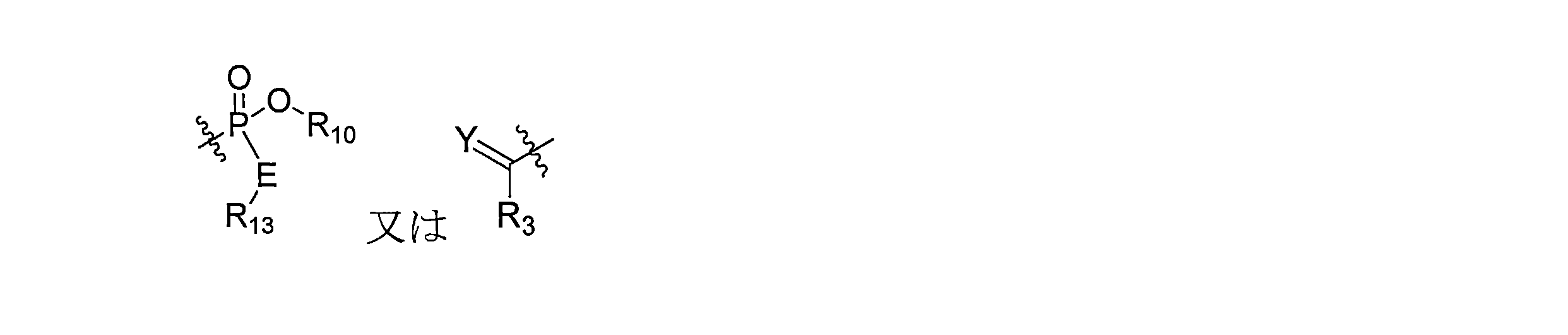
ここで、
R0が
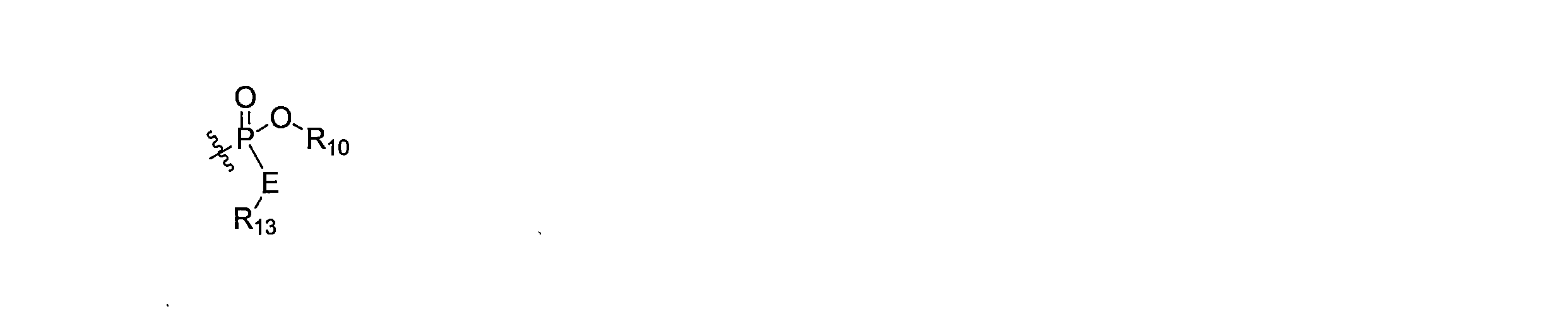

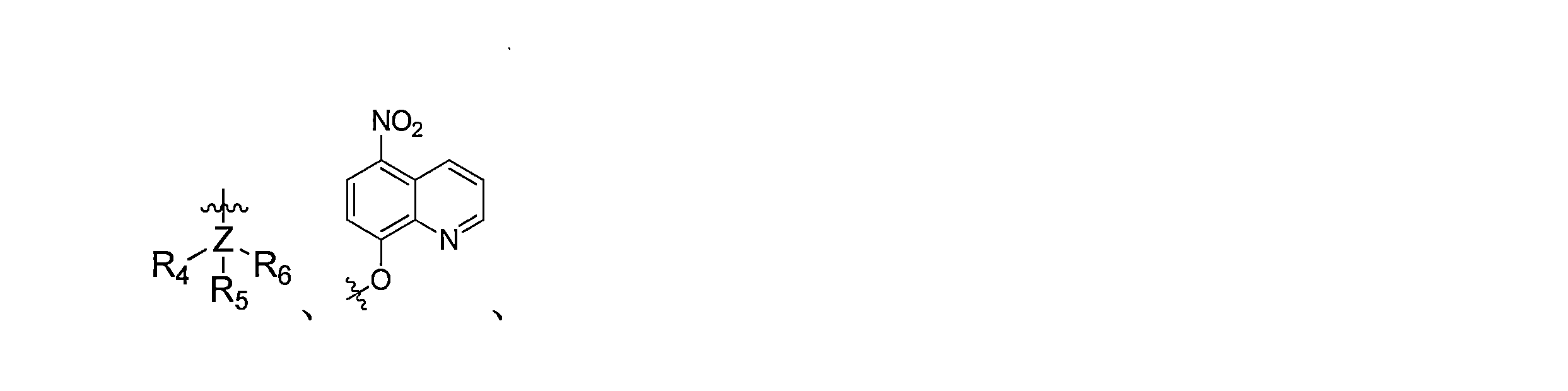
ここで、
ZがCから選ばれる場合、R4、R5及びR6は、それぞれ独立して、水素、ハロゲン、アルキル基、シクロアルキル基、複素環基、アリール基、ヘテロアリール基、-OR12、-SR12、-C(O)R11、-C(O)OR12、-C(O)-(CH)m-C(O)R11、-OC(O)R11、-NRaRb、-N(Rc)C(O)Rd、-C(O)N(Ra)(Rb)、-N(Rc)S(O)pRd、-S(O)pN(Ra)(Rb)、-O(CH2)mO(CH2)qR12、-N(Rc)C(O)-(CH)m-N(Rc)C(O)Rdから選ばれ、ここで、前記アルキル基、シクロアルキル基、複素環基、アリール基又はヘテロアリール基は、さらに、ハロゲン、アミノ基、ニトロ基、シアノ基、ヒドロキシ基、メルカプト基、アルキル基、アルコキシ基、アルケニル基、アルキニル基、OR12、SR12、NRaRb、-COR11、-C(O)OR12、-OC(O)R11、-N(Rc)C(O)Rd、-O(CH2)mO(CH2)qR12、シクロアルキル基、複素環基、アリール基、アリールアルキル基、ヘテロアリール基、ヘテロアリールアルキル基から選ばれる1つ又は複数の基によって置換されてもよく、前記アリール基、アリールアルキル基、ヘテロアリール基又はヘテロアリールアルキル基は、さらに、ハロゲン、アミノ基、ニトロ基、シアノ基、ヒドロキシ基、メルカプト基、カルボキシ基、エステル基、オキソ基、アルキル基、アルコキシ基から選ばれる1つ又は複数の基によって置換されてもよく、又は
R4、R5及びR6のうち、1つは水素であり、残りの2つはZと一緒にシクロアルキル基又は複素環基を形成し、前記シクロアルキル基又は複素環基は、さらに、ハロゲン、アミノ基、ニトロ基、シアノ基、ヒドロキシ基、メルカプト基、アルキル基、アルコキシ基、アルケニル基、アルキニル基、-C(O)R11、-C(O)OR12、-OC(O)R11、シクロアルキル基、複素環基、アリール基、ヘテロアリール基から選ばれる1つ又は複数の基によって置換されてもよく、
ZがNから選ばれる場合、R6は存在せず、R4及びR5は、それぞれ独立して、水素、ハロゲン、アルキル基、シクロアルキル基、複素環基、アリール基、ヘテロアリール基、-OR12、-SR12、-C(O)R11、-C(O)OR12、-OC(O)R11、-NRaRb、-N(Rc)C(O)Rd、-C(O)N(Ra)(Rb)、-N(Rc)S(O)pRd、-S(O)pN(Ra)(Rb)、-O(CH2)mO(CH2)qR12、-N(Rc)C(O)-(CH)m-N(Rc)C(O)Rdから選ばれ、ここで、前記アルキル基、シクロアルキル基、複素環基、アリール基、又はヘテロアリール基は、さらに、ハロゲン、アミノ基、ニトロ基、シアノ基、ヒドロキシ基、メルカプト基、アルキル基、アルコキシ基、アルケニル基、アルキニル基、OR12、SR12、NRaRb、-C(O)R11、-C(O)OR12、-OC(O)R11、-(CH)m-OC(O)R11、シクロアルキル基、複素環基、アリール基、アリールアルキル基、ヘテロアリール基、ヘテロアリールアルキル基から選ばれる1つ又は複数の基によって置換されてもよく、又は
R4、R5はZと一緒にシクロアルキル基又は複素環基を形成し、前記シクロアルキル基又は複素環基は、さらに、ハロゲン、アミノ基、ニトロ基、シアノ基、ヒドロキシ基、メルカプト基、アルキル基、アルコキシ基、アルケニル基、アルキニル基、-C(O)R11、-C(O)OR12、-OC(O)R11、シクロアルキル基、複素環基、アリール基、ヘテロアリール基から選ばれる1つ又は複数の基によって置換されてもよく、
ZがOを示す場合、R5及びR6は存在せず、R4はC1-6アルキル基、アリール基又は複素環基から選ばれ、ここで、前記C1-6アルキル基、アリール基又は複素環基は、さらに、1つ又は複数の-OHによって置換されてもよく、
又は
XがO、N、S、又は-(CH2)n-から選ばれる場合、R2は存在せず、R1、X及びR0は一緒にシクロアルキル基又は複素環基を形成し、前記シクロアルキル基又は複素環基は、さらに、ハロゲン、アミノ基、ニトロ基、シアノ基、ヒドロキシ基、メルカプト基、カルボキシ基、エステル基、オキソ基、アルキル基、アルコキシ基、アルケニル基、アルキニル基、シクロアルキル基、複素環基、アリール基、ヘテロアリール基から選ばれる1つ又は複数の基によって置換されてもよく、
R11及びR12は、それぞれ独立して、水素、ハロゲン、ヒドロキシ基、シアノ基、アミノ基、カルボキシ基、エステル基、アルキル基、アルコキシ基、アルケニル基、アルキニル基、シクロアルキル基、複素環基、アリール基、ヘテロアリール基から選ばれ、ここで、前記アルキル基、アルコキシ基、アルケニル基、アルキニル基、シクロアルキル基、複素環基、アリール基、及びヘテロアリール基は、さらに、ハロゲン、アミノ基、ニトロ基、シアノ基、ヒドロキシ基、メルカプト基、カルボキシ基、エステル基、オキソ基、アルキル基、アルコキシ基、-NRaRb、-ORd、-N(Rc)C(O)Rd、-C(O)N(Ra)(Rb)、-N(Rc)S(O)pRd、-S(O)pN(Ra)(Rb)、アルケニル基、アルキニル基、シクロアルキル基、複素環基、アリール基、ヘテロアリール基から選ばれる1つ又は複数の基によって置換されてもよく、
Ra及びRbは、それぞれ独立して、水素、ハロゲン、ヒドロキシ基、シアノ基、アミノ基、カルボキシ基、エステル基、アルキル基、アルコキシ基、アルケニル基、アルキニル基、シクロアルキル基、複素環基、アリール基、ヘテロアリール基から選ばれ、ここで、前記アミノ基、アルキル基、アルコキシ基、アルケニル基、アルキニル基、シクロアルキル基、複素環基、アリール基、及びヘテロアリール基は、さらに、ハロゲン、アミノ基、ニトロ基、シアノ基、ヒドロキシ基、メルカプト基、カルボキシ基、エステル基、オキソ基、アルキル基、アルコキシ基、アルケニル基、アルキニル基、シクロアルキル基、複素環基、アリール基、ヘテロアリール基から選ばれる1つ又は複数の基によって置換されてもよく、
又はRa及びRbはこれらが連結する原子と一緒に複素環基を形成し、前記複素環基は、さらに、ハロゲン、アミノ基、ニトロ基、シアノ基、オキソ基、ヒドロキシ基、メルカプト基、カルボキシ基、エステル基、アルキル基、アルコキシ基、アルケニル基、アルキニル基、シクロアルキル基、複素環基、アリール基、ヘテロアリール基から選ばれる1つ又は複数の基によって置換されてもよく、
Rc及びRdは、それぞれ独立して、水素、ハロゲン、ヒドロキシ基、シアノ基、アミノ基、カルボキシ基、エステル基、アルキル基、アルコキシ基、アルケニル基、アルキニル基、シクロアルキル基、複素環基、アリール基、ヘテロアリール基から選ばれ、ここで、前記アミノ基、アルキル基、アルコキシ基、アルケニル基、アルキニル基、シクロアルキル基、複素環基、アリール基、及びヘテロアリール基は、さらに、ハロゲン、アミノ基、ニトロ基、シアノ基、ヒドロキシ基、メルカプト基、カルボキシ基、エステル基、オキソ基、アルキル基、アルコキシ基、アルケニル基、アルキニル基、シクロアルキル基、複素環基、アリール基、ヘテロアリール基から選ばれる1つ又は複数の基によって置換されてもよく、
nは1~8の整数から選ばれ、
mは0~6の整数から選ばれ、
pは0、1又は2から選ばれ、
qは0~6の整数から選ばれる。)
It is therefore an object of the present invention to provide a compound of formula (I) or in the form of its meso form, racemate, enantiomeric form, diastereomeric form or mixtures thereof, or a pharma- ceutically acceptable salt thereof.
R 1 is selected from hydrogen, a C 1-6 alkyl group, S or O;
X is selected from O, N, S, -(CH 2 ) n -, an aryl group, or a heterocyclic group;
Where:
When X is selected from N, R 0 and R 2 are each independently selected from hydrogen, a C 1-6 alkyl group, an aryl group, or a heterocyclic group;
When X is selected from an aryl group or a heterocyclic group, R0 and R2 are each independently selected from hydrogen, halogen, hydroxyl group, cyano group, amino group, carboxyl group, ester group, alkyl group, alkoxyl group, alkenyl group, alkynyl group, cycloalkyl group, heterocyclic group, aryl group, and heteroaryl group, wherein the alkyl group, alkoxyl group, alkenyl group, alkynyl group, cycloalkyl group, heterocyclic group, aryl group, and heteroaryl group may be further substituted with one or more groups selected from halogen, amino group, nitro group, cyano group, hydroxyl group, mercapto group, carboxyl group, ester group, oxo group, alkyl group, alkoxyl group, alkenyl group, alkynyl group, cycloalkyl group, heterocyclic group, aryl group, and heteroaryl group;
When X is selected from O, S or -(CH 2 ) n -, R 2 is absent and R 0 is a C 1-6 alkyl group, a cycloalkyl group, a heterocyclic group, -COR 11 , -C(O)OR 12 ,
Where:
R 0 is
Where:
When Z is selected from C, R 4 , R 5 and R 6 are each independently hydrogen, halogen, an alkyl group, a cycloalkyl group, a heterocyclic group, an aryl group, a heteroaryl group, -OR 12 , -SR 12 , -C(O)R 11 , -C(O)OR 12 , -C(O)-(CH) m -C(O)R 11 , -OC(O)R 11 , -NR a R b , -N(R c )C(O)R d , -C(O)N(R a )(R b ), -N(R c )S(O) p R d , -S(O) p N(R a )(R b ), -O(CH 2 ) m O(CH 2 ) q R 12 , -N( R )C(O)-(CH) m -N( Rc )C(O) Rd , wherein the alkyl group, cycloalkyl group, heterocyclic group, aryl group or heteroaryl group is further selected from halogen, amino group, nitro group, cyano group, hydroxy group, mercapto group, alkyl group, alkoxy group, alkenyl group, alkynyl group, OR12 , SR12 , NRaRb , -COR11 , -C(O) OR12 , -OC(O) R11 , -N( Rc )C(O) Rd , -O( CH2 ) mO ( CH2 ) qR12 , a cycloalkyl group, a heterocyclic group, an aryl group, an arylalkyl group, a heteroaryl group, and a heteroarylalkyl group, the aryl group, the arylalkyl group, the heteroaryl group, and the heteroarylalkyl group may be further substituted with one or more groups selected from a halogen, an amino group, a nitro group, a cyano group, a hydroxy group, a mercapto group, a carboxy group, an ester group, an oxo group, an alkyl group, and an alkoxy group, or one of R 4 , R 5, and R 6 is hydrogen, and the remaining two together with Z form a cycloalkyl group or a heterocyclic group, the cycloalkyl group or the heterocyclic group may be further substituted with one or more groups selected from a halogen, an amino group, a nitro group, a cyano group, a hydroxy group, a mercapto group, an alkyl group, an alkoxy group, an alkenyl group, an alkynyl group, -C(O)R 11 , -C(O)OR 12 , -OC(O)R 11 , a cycloalkyl group, a heterocyclic group, an aryl group, and a heteroaryl group,
When Z is selected from N, R 6 is not present, and R 4 and R 5 are each independently hydrogen, halogen, an alkyl group, a cycloalkyl group, a heterocyclic group, an aryl group, a heteroaryl group, -OR 12 , -SR 12 , -C(O)R 11 , -C(O)OR 12 , -OC(O)R 11 , -NR a R b , -N(R c )C(O)R d , -C(O)N(R a )(R b ), -N(R c )S(O) p R d , -S(O) p N(R a )(R b ), -O(CH 2 ) m O(CH 2 ) q R 12 , -N(R c )C(O)-(CH) m -N(R c )C(O)R d , wherein the alkyl group, cycloalkyl group, heterocyclic group, aryl group, or heteroaryl group may be further substituted by one or more groups selected from halogen, amino group, nitro group, cyano group, hydroxy group, mercapto group, alkyl group, alkoxy group, alkenyl group, alkynyl group, OR 12 , SR 12 , NR a R b , -C(O)R 11 , -C(O)OR 12 , -OC(O)R 11 , -(CH) m -OC(O)R 11 , cycloalkyl group, heterocyclic group, aryl group, arylalkyl group, heteroaryl group, heteroarylalkyl group, or R 4 , R 5 together with Z forms a cycloalkyl group or a heterocyclic group, the cycloalkyl group or the heterocyclic group may be further substituted with one or more groups selected from a halogen, an amino group, a nitro group, a cyano group, a hydroxy group, a mercapto group, an alkyl group, an alkoxy group, an alkenyl group, an alkynyl group, -C(O)R 11 , -C(O)OR 12 , -OC(O)R 11 , a cycloalkyl group, a heterocyclic group, an aryl group, and a heteroaryl group;
When Z represents O, R 5 and R 6 are absent, and R 4 is selected from a C 1-6 alkyl group, an aryl group or a heterocyclic group, wherein said C 1-6 alkyl group, an aryl group or a heterocyclic group may be further substituted by one or more -OH groups;
or when X is selected from O, N, S, or -( CH2 ) n- , R2 is absent, and R1 , X, and R0 together form a cycloalkyl group or a heterocyclic group, said cycloalkyl group or heterocyclic group being optionally further substituted by one or more groups selected from halogen, amino group, nitro group, cyano group, hydroxy group, mercapto group, carboxy group, ester group, oxo group, alkyl group, alkoxy group, alkenyl group, alkynyl group, cycloalkyl group, heterocyclic group, aryl group, and heteroaryl group;
R 11 and R 12 are each independently selected from hydrogen, halogen, a hydroxy group, a cyano group, an amino group, a carboxy group, an ester group, an alkyl group, an alkoxy group, an alkenyl group, an alkynyl group, a cycloalkyl group, a heterocyclic group, an aryl group, and a heteroaryl group, and the alkyl group, the alkoxy group, the alkenyl group, the alkynyl group, the cycloalkyl group, the heterocyclic group, the aryl group, and the heteroaryl group are further selected from halogen, an amino group, a nitro group, a cyano group, a hydroxy group, a mercapto group, a carboxy group, an ester group, an oxo group, an alkyl group, an alkoxy group, -NR a R b , -OR d , -N(R c )C(O)R d , -C(O)N(R a )(R b ), -N(R c )S(O) p R d , -S(O) p N(R a )(R b ), optionally substituted by one or more groups selected from an alkenyl group, an alkynyl group, a cycloalkyl group, a heterocyclic group, an aryl group, and a heteroaryl group;
R a and R b are each independently selected from hydrogen, halogen, a hydroxy group, a cyano group, an amino group, a carboxy group, an ester group, an alkyl group, an alkoxy group, an alkenyl group, an alkynyl group, a cycloalkyl group, a heterocyclic group, an aryl group, and a heteroaryl group, and the amino group, the alkyl group, the alkoxy group, the alkenyl group, the alkynyl group, the cycloalkyl group, the heterocyclic group, the aryl group, and the heteroaryl group may be further substituted with one or more groups selected from a halogen, an amino group, a nitro group, a cyano group, a hydroxy group, a mercapto group, a carboxy group, an ester group, an oxo group, an alkyl group, an alkoxy group, an alkenyl group, an alkynyl group, a cycloalkyl group, a heterocyclic group, an aryl group, and a heteroaryl group;
or R a and R b together with the atom to which they are linked form a heterocyclic group, which may be further substituted by one or more groups selected from a halogen, an amino group, a nitro group, a cyano group, an oxo group, a hydroxy group, a mercapto group, a carboxy group, an ester group, an alkyl group, an alkoxy group, an alkenyl group, an alkynyl group, a cycloalkyl group, a heterocyclic group, an aryl group, and a heteroaryl group;
Rc and Rd are each independently selected from hydrogen, halogen, a hydroxy group, a cyano group, an amino group, a carboxy group, an ester group, an alkyl group, an alkoxy group, an alkenyl group, an alkynyl group, a cycloalkyl group, a heterocyclic group, an aryl group, and a heteroaryl group, and the amino group, the alkyl group, the alkoxy group, the alkenyl group, the alkynyl group, the cycloalkyl group, the heterocyclic group, the aryl group, and the heteroaryl group may be further substituted with one or more groups selected from a halogen, an amino group, a nitro group, a cyano group, a hydroxy group, a mercapto group, a carboxy group, an ester group, an oxo group, an alkyl group, an alkoxy group, an alkenyl group, an alkynyl group, a cycloalkyl group, a heterocyclic group, an aryl group, and a heteroaryl group;
n is selected from an integer from 1 to 8;
m is selected from integers from 0 to 6;
p is selected from 0, 1 or 2;
q is selected from integers of 0 to 6.
1つの好ましい実施形態では、本発明の前記式(I)で表される化合物は、下記式(II)で表される化合物である。
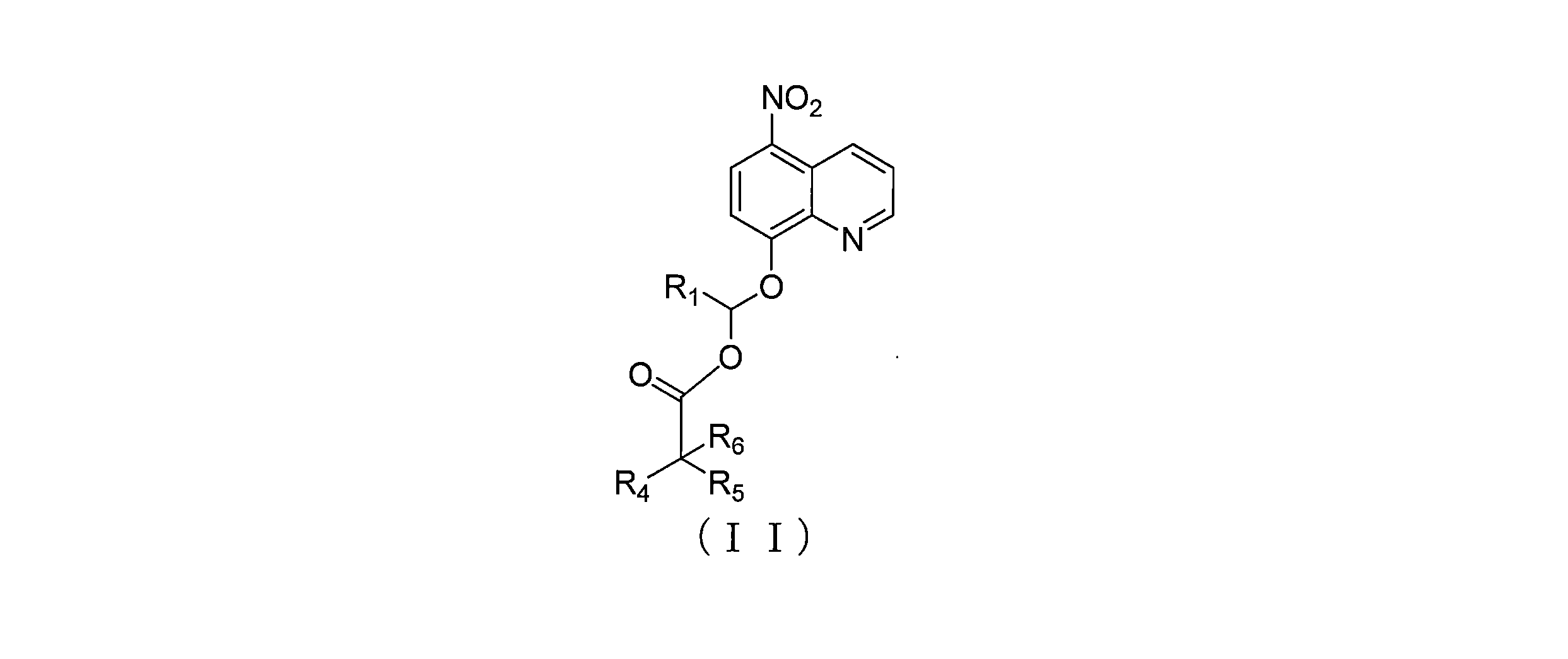
R1は水素又はC1-6アルキル基から選ばれ、
R4、R5及びR6は、それぞれ独立して、水素、ハロゲン、アルキル基、シクロアルキル基、複素環基、アリール基、ヘテロアリール基、-OR12、-SR12、-C(O)R11、-C(O)OR12、-C(O)-(CH)m-C(O)R11、-OC(O)R11、-NRaRb、-N(Rc)C(O)Rd、-C(O)N(Ra)(Rb)、-N(Rc)S(O)pRd、-S(O)pN(Ra)(Rb)、-O(CH2)mO(CH2)qR12、-N(Rc)C(O)-(CH)m-N(Rc)C(O)Rdから選ばれ、ここで、前記アルキル基、シクロアルキル基、複素環基、アリール基、又はヘテロアリール基は、さらに、ハロゲン、アミノ基、ニトロ基、シアノ基、ヒドロキシ基、メルカプト基、アルキル基、アルコキシ基、アルケニル基、アルキニル基、OR12、SR12、NRaRb、-COR11、-C(O)OR12、-OC(O)R11、-N(Rc)C(O)Rd、-O(CH2)mO(CH2)qR12、シクロアルキル基、複素環基、アリール基、アリールアルキル基、ヘテロアリール基、ヘテロアリールアルキル基から選ばれる1つ又は複数の基によって置換されてもよく、前記アリール基、アリールアルキル基、ヘテロアリール基又はヘテロアリールアルキル基は、さらに、ハロゲン、アミノ基、ニトロ基、シアノ基、ヒドロキシ基、メルカプト基、カルボキシ基、エステル基、オキソ基、アルキル基、アルコキシ基から選ばれる1つ又は複数の基によって置換されてもよく、又は
R4、R5及びR6のうち、1つは水素であり、残りの2つはZと一緒にシクロアルキル基又は複素環基を形成し、前記シクロアルキル基又は複素環基は、さらに、ハロゲン、アミノ基、ニトロ基、シアノ基、ヒドロキシ基、メルカプト基、アルキル基、アルコキシ基、アルケニル基、アルキニル基、-C(O)R11、-C(O)OR12、-OC(O)R11、シクロアルキル基、複素環基、アリール基、ヘテロアリール基から選ばれる1つ又は複数の基によって置換されてもよく、
R11及びR12は、それぞれ独立して、水素、ハロゲン、ヒドロキシ基、シアノ基、アミノ基、カルボキシ基、エステル基、アルキル基、アルコキシ基、アルケニル基、アルキニル基、シクロアルキル基、複素環基、アリール基、ヘテロアリール基から選ばれ、ここで、前記アルキル基、アルコキシ基、アルケニル基、アルキニル基、シクロアルキル基、複素環基、アリール基、及びヘテロアリール基は、さらに、ハロゲン、アミノ基、ニトロ基、シアノ基、ヒドロキシ基、メルカプト基、カルボキシ基、エステル基、オキソ基、アルキル基、アルコキシ基、-NRaRb、-ORd、-N(Rc)C(O)Rd、-C(O)N(Ra)(Rb)、-N(Rc)S(O)pRd、-S(O)pN(Ra)(Rb)、アルケニル基、アルキニル基、シクロアルキル基、複素環基、アリール基、ヘテロアリール基から選ばれる1つ又は複数の基によって置換されてもよく、
Ra及びRbは、それぞれ独立して、水素、ハロゲン、ヒドロキシ基、シアノ基、アミノ基、カルボキシ基、エステル基、アルキル基、アルコキシ基、アルケニル基、アルキニル基、シクロアルキル基、複素環基、アリール基、ヘテロアリール基から選ばれ、ここで、前記アミノ基、アルキル基、アルコキシ基、アルケニル基、アルキニル基、シクロアルキル基、複素環基、アリール基、及びヘテロアリール基は、さらに、ハロゲン、アミノ基、ニトロ基、シアノ基、ヒドロキシ基、メルカプト基、カルボキシ基、エステル基、オキソ基、アルキル基、アルコキシ基、アルケニル基、アルキニル基、シクロアルキル基、複素環基、アリール基、ヘテロアリール基から選ばれる1つ又は複数の基によって置換されてもよく、
又はRa及びRbはこれらが連結する原子と一緒に複素環基を形成し、前記複素環基は、さらに、ハロゲン、アミノ基、ニトロ基、シアノ基、オキソ基、ヒドロキシ基、メルカプト基、カルボキシ基、エステル基、アルキル基、アルコキシ基、アルケニル基、アルキニル基、シクロアルキル基、複素環基、アリール基、ヘテロアリール基から選ばれる1つ又は複数の基によって置換されてもよく、
Rc及びRdは、それぞれ独立して、水素、ハロゲン、ヒドロキシ基、シアノ基、アミノ基、カルボキシ基、エステル基、アルキル基、アルコキシ基、アルケニル基、アルキニル基、シクロアルキル基、複素環基、アリール基、ヘテロアリール基から選ばれ、ここで、前記アミノ基、アルキル基、アルコキシ基、アルケニル基、アルキニル基、シクロアルキル基、複素環基、アリール基、及びヘテロアリール基は、ハロゲン、アミノ基、ニトロ基、シアノ基、ヒドロキシ基、メルカプト基、カルボキシ基、エステル基、オキソ基、アルキル基、アルコキシ基、アルケニル基、アルキニル基、シクロアルキル基、複素環基、アリール基、ヘテロアリール基から選ばれる1つ又は複数の基によって置換されてもよく、
mは0~6の整数から選ばれ、
pは0、1又は2から選ばれ、
qは0~6の整数から選ばれる。)
In one preferred embodiment, the compound of the present invention represented by formula (I) is a compound represented by formula (II):
R 1 is selected from hydrogen or a C 1-6 alkyl group;
R 4 , R 5 and R 6 each independently represent hydrogen, halogen, an alkyl group, a cycloalkyl group, a heterocyclic group, an aryl group, a heteroaryl group, -OR 12 , -SR 12 , -C(O)R 11 , -C(O)OR 12 , -C(O)-(CH) m -C(O)R 11 , -OC(O)R 11 , -NR a R b , -N(R c )C(O)R d , -C(O)N(R a )(R b ), -N(R c )S(O) p R d , -S(O) p N(R a )(R b ), -O(CH 2 ) m O(CH 2 ) q R 12 , -N(R c )C(O)-(CH) m -N(R c )C(O)R d , wherein the alkyl group, cycloalkyl group, heterocyclic group, aryl group, or heteroaryl group is further selected from halogen, amino group, nitro group, cyano group, hydroxy group, mercapto group, alkyl group, alkoxy group, alkenyl group, alkynyl group, OR 12 , SR 12 , NR a R b , -COR 11 , -C(O)OR 12 , -OC(O)R 11 , -N(R c )C(O)R d , -O(CH 2 ) m O(CH 2 ) q R 12 , a cycloalkyl group, a heterocyclic group, an aryl group, an arylalkyl group, a heteroaryl group, and a heteroarylalkyl group, the aryl group, the arylalkyl group, the heteroaryl group, and the heteroarylalkyl group may be further substituted with one or more groups selected from a halogen, an amino group, a nitro group, a cyano group, a hydroxy group, a mercapto group, a carboxy group, an ester group, an oxo group, an alkyl group, and an alkoxy group, or one of R 4 , R 5, and R 6 is hydrogen, and the remaining two together with Z form a cycloalkyl group or a heterocyclic group, the cycloalkyl group or the heterocyclic group may be further substituted with one or more groups selected from a halogen, an amino group, a nitro group, a cyano group, a hydroxy group, a mercapto group, an alkyl group, an alkoxy group, an alkenyl group, an alkynyl group, -C(O)R 11 , -C(O)OR 12 , -OC(O)R 11 , a cycloalkyl group, a heterocyclic group, an aryl group, and a heteroaryl group,
R 11 and R 12 are each independently selected from hydrogen, halogen, a hydroxy group, a cyano group, an amino group, a carboxy group, an ester group, an alkyl group, an alkoxy group, an alkenyl group, an alkynyl group, a cycloalkyl group, a heterocyclic group, an aryl group, and a heteroaryl group, and the alkyl group, the alkoxy group, the alkenyl group, the alkynyl group, the cycloalkyl group, the heterocyclic group, the aryl group, and the heteroaryl group are further selected from halogen, an amino group, a nitro group, a cyano group, a hydroxy group, a mercapto group, a carboxy group, an ester group, an oxo group, an alkyl group, an alkoxy group, -NR a R b , -OR d , -N(R c )C(O)R d , -C(O)N(R a )(R b ), -N(R c )S(O) p R d , -S(O) p N(R a )(R b ), optionally substituted by one or more groups selected from an alkenyl group, an alkynyl group, a cycloalkyl group, a heterocyclic group, an aryl group, and a heteroaryl group;
R a and R b are each independently selected from hydrogen, halogen, a hydroxy group, a cyano group, an amino group, a carboxy group, an ester group, an alkyl group, an alkoxy group, an alkenyl group, an alkynyl group, a cycloalkyl group, a heterocyclic group, an aryl group, and a heteroaryl group, and the amino group, the alkyl group, the alkoxy group, the alkenyl group, the alkynyl group, the cycloalkyl group, the heterocyclic group, the aryl group, and the heteroaryl group may be further substituted with one or more groups selected from a halogen, an amino group, a nitro group, a cyano group, a hydroxy group, a mercapto group, a carboxy group, an ester group, an oxo group, an alkyl group, an alkoxy group, an alkenyl group, an alkynyl group, a cycloalkyl group, a heterocyclic group, an aryl group, and a heteroaryl group;
or R a and R b together with the atom to which they are linked form a heterocyclic group, which may be further substituted by one or more groups selected from a halogen, an amino group, a nitro group, a cyano group, an oxo group, a hydroxy group, a mercapto group, a carboxy group, an ester group, an alkyl group, an alkoxy group, an alkenyl group, an alkynyl group, a cycloalkyl group, a heterocyclic group, an aryl group, and a heteroaryl group;
Rc and Rd are each independently selected from hydrogen, halogen, a hydroxy group, a cyano group, an amino group, a carboxy group, an ester group, an alkyl group, an alkoxy group, an alkenyl group, an alkynyl group, a cycloalkyl group, a heterocyclic group, an aryl group, and a heteroaryl group, and the amino group, the alkyl group, the alkoxy group, the alkenyl group, the alkynyl group, the cycloalkyl group, the heterocyclic group, the aryl group, and the heteroaryl group are each optionally substituted with one or more groups selected from a halogen, an amino group, a nitro group, a cyano group, a hydroxy group, a mercapto group, a carboxy group, an ester group, an oxo group, an alkyl group, an alkoxy group, an alkenyl group, an alkynyl group, a cycloalkyl group, a heterocyclic group, an aryl group, and a heteroaryl group;
m is selected from integers from 0 to 6;
p is selected from 0, 1 or 2;
q is selected from integers of 0 to 6.
本発明のさらに好ましい実施形態では、本発明の前記式(II)で表される化合物において、
R4、R5及びR6は、それぞれ独立して、水素、アルキル基、アリール基、ヘテロアリール基、-OR12、-SR12、-C(O)R11、-C(O)OR12、-C(O)-(CH)m-C(O)R11、-OC(O)R11、-(CH)m-N(Rc)C(O)R11 、-NRaRb、-N(Rc)C(O)Rd、-C(O)N(Ra)(Rb)、-N(Rc)S(O)pRd、-S(O)pN(Ra)(Rb)、-O(CH2)mO(CH2)qR12、-N(Rc)C(O)-(CH)m-N(Rc)C(O)Rdから選ばれ、ここで、前記アルキル基、アリール基又はヘテロアリール基は、さらに、ハロゲン、ヒドロキシ基、アルキル基、OR12、SR12、NRaRb、-COR11、-C(O)OR12、-O(O)CR11、-N(Rc)C(O)Rd、-O(CH2)mO(CH2)qR12、シクロアルキル基、複素環基、アリール基、アリールアルキル基、ヘテロアリール基、ヘテロアリールアルキル基から選ばれる1つ又は複数の基によって置換されてもよく、前記アリール基、アリールアルキル基、ヘテロアリール基又はヘテロアリールアルキル基は、さらに、ハロゲン、ヒドロキシ基、メルカプト基、アルキル基、アルコキシ基から選ばれる1つ又は複数の基によって置換されてもよく、
R11及びR12は、それぞれ独立して、水素、ハロゲン、ヒドロキシ基、アルキル基、アルコキシ基、シクロアルキル基、複素環基、アリール基、ヘテロアリール基から選ばれ、ここで、前記アルキル基、アルコキシ基、シクロアルキル基、複素環基、アリール基、及びヘテロアリール基は、さらに、ハロゲン、アミノ基、ヒドロキシ基、アルキル基、アルコキシ基、-NRaRb、-ORd、-N(Rc)C(O)Rd、-C(O)N(Ra)(Rb)、-N(Rc)S(O)pRd、-S(O)pN(Ra)(Rb)、シクロアルキル基、複素環基、アリール基、ヘテロアリール基から選ばれる1つ又は複数の基によって置換されてもよく、
Ra及びRbは、それぞれ独立して、水素、ハロゲン、ヒドロキシ基、シアノ基、アミノ基、カルボキシ基、エステル基、アルキル基、アルコキシ基、アルケニル基、アルキニル基、シクロアルキル基、複素環基、アリール基、ヘテロアリール基から選ばれ、ここで、前記アミノ基、アルキル基、アルコキシ基、アルケニル基、アルキニル基、シクロアルキル基、複素環基、アリール基、及びヘテロアリール基は、さらに、ハロゲン、アミノ基、ニトロ基、シアノ基、ヒドロキシ基、メルカプト基、カルボキシ基、エステル基、オキソ基、アルキル基、アルコキシ基、アルケニル基、アルキニル基、シクロアルキル基、複素環基、アリール基、ヘテロアリール基から選ばれる1つ又は複数の基によって置換されてもよく、
又はRa及びRbはこれらが連結する原子と一緒に複素環基を形成し、前記複素環基は、さらに、ハロゲン、アミノ基、ニトロ基、シアノ基、オキソ基、ヒドロキシ基、メルカプト基、カルボキシ基、エステル基、アルキル基、アルコキシ基、アルケニル基、アルキニル基、シクロアルキル基、複素環基、アリール基、ヘテロアリール基から選ばれる1つ又は複数の基によって置換されてもよく、
Rc及びRdは、それぞれ独立して、水素、ハロゲン、ヒドロキシ基、シアノ基、アミノ基、カルボキシ基、エステル基、アルキル基、アルコキシ基、アルケニル基、アルキニル基、シクロアルキル基、複素環基、アリール基、ヘテロアリール基から選ばれ、ここで、前記アミノ基、アルキル基、アルコキシ基、アルケニル基、アルキニル基、シクロアルキル基、複素環基、アリール基、及びヘテロアリール基は、さらに、ハロゲン、アミノ基、ニトロ基、シアノ基、ヒドロキシ基、メルカプト基、カルボキシ基、エステル基、オキソ基、アルキル基、アルコキシ基、アルケニル基、アルキニル基、シクロアルキル基、複素環基、アリール基、ヘテロアリール基から選ばれる1つ又は複数の基によって置換されてもよく、
mは0~6の整数から選ばれ、
pは0、1又は2から選ばれ、
qは0~6の整数から選ばれる。
In a further preferred embodiment of the present invention, in the compound represented by formula (II) of the present invention,
R 4 , R 5 and R 6 each independently represent a hydrogen atom, an alkyl group, an aryl group, a heteroaryl group, -OR 12 , -SR 12 , -C(O)R 11 , -C(O)OR 12 , -C(O)-(CH) m -C(O)R 11 , -OC(O)R 11 , -(CH) m -N(R c )C(O)R 11 , -NR a R b , -N(R c )C(O)R d , -C(O)N(R a )(R b ), -N(R c )S(O) p R d , -S(O) p N(R a )(R b ), -O(CH 2 ) m O(CH 2 ) q R 12 , -N( Rc )C(O)-(CH) m -N( Rc )C(O) Rd , wherein the alkyl group, aryl group or heteroaryl group may be further substituted with one or more groups selected from halogen, hydroxy group, alkyl group, OR12 , SR12 , NRaRb , -COR11 , -C(O) OR12 , -O( O ) CR11 , -N( Rc )C(O) Rd , -O( CH2 ) mO ( CH2 ) qR12 , cycloalkyl group, heterocyclic group, aryl group, arylalkyl group, heteroaryl group and heteroarylalkyl group, and the aryl group, arylalkyl group, heteroaryl group or heteroarylalkyl group may be further substituted with one or more groups selected from halogen, hydroxy group, mercapto group, alkyl group and alkoxy group;
R 11 and R 12 are each independently selected from hydrogen, halogen, a hydroxy group, an alkyl group, an alkoxy group, a cycloalkyl group, a heterocyclic group, an aryl group, and a heteroaryl group, and the alkyl group, the alkoxy group, the cycloalkyl group, the heterocyclic group, the aryl group, and the heteroaryl group may be further substituted with one or more groups selected from a halogen, an amino group, a hydroxy group, an alkyl group, an alkoxy group, -NR a R b , -OR d , -N(R c )C(O)R d , -C(O)N(R a )(R b ), -N(R c )S(O) p R d , -S(O) p N(R a )(R b ), a cycloalkyl group, a heterocyclic group, an aryl group, and a heteroaryl group;
R a and R b are each independently selected from hydrogen, halogen, a hydroxy group, a cyano group, an amino group, a carboxy group, an ester group, an alkyl group, an alkoxy group, an alkenyl group, an alkynyl group, a cycloalkyl group, a heterocyclic group, an aryl group, and a heteroaryl group, and the amino group, the alkyl group, the alkoxy group, the alkenyl group, the alkynyl group, the cycloalkyl group, the heterocyclic group, the aryl group, and the heteroaryl group may be further substituted with one or more groups selected from a halogen, an amino group, a nitro group, a cyano group, a hydroxy group, a mercapto group, a carboxy group, an ester group, an oxo group, an alkyl group, an alkoxy group, an alkenyl group, an alkynyl group, a cycloalkyl group, a heterocyclic group, an aryl group, and a heteroaryl group;
or R a and R b together with the atom to which they are linked form a heterocyclic group, which may be further substituted by one or more groups selected from a halogen, an amino group, a nitro group, a cyano group, an oxo group, a hydroxy group, a mercapto group, a carboxy group, an ester group, an alkyl group, an alkoxy group, an alkenyl group, an alkynyl group, a cycloalkyl group, a heterocyclic group, an aryl group, and a heteroaryl group;
Rc and Rd are each independently selected from hydrogen, halogen, a hydroxy group, a cyano group, an amino group, a carboxy group, an ester group, an alkyl group, an alkoxy group, an alkenyl group, an alkynyl group, a cycloalkyl group, a heterocyclic group, an aryl group, and a heteroaryl group, and the amino group, the alkyl group, the alkoxy group, the alkenyl group, the alkynyl group, the cycloalkyl group, the heterocyclic group, the aryl group, and the heteroaryl group may be further substituted with one or more groups selected from a halogen, an amino group, a nitro group, a cyano group, a hydroxy group, a mercapto group, a carboxy group, an ester group, an oxo group, an alkyl group, an alkoxy group, an alkenyl group, an alkynyl group, a cycloalkyl group, a heterocyclic group, an aryl group, and a heteroaryl group;
m is selected from integers from 0 to 6;
p is selected from 0, 1 or 2;
q is selected from integers of 0 to 6.
本発明のさらに好ましい実施形態では、本発明の前記式(II)で表される化合物において、
R4、R5及びR6は、それぞれ独立して、水素、アルキル基、アリール基、ヘテロアリール基、-OR12、-SR12、-C(O)R11、-C(O)OR12、-C(O)-(CH)m-C(O)R11、-OC(O)R11、-(CH)m-N(Rc)C(O)R11から選ばれ、ここで、前記アルキル基、アリール基又はヘテロアリール基は、さらに、ハロゲン、ヒドロキシ基、アルキル基、OR12、SR12、NRaRb、-COR11、-C(O)OR12、-O(O)CR11、-N(Rc)C(O)Rd、-O(CH2)mO(CH2)qR12、シクロアルキル基、複素環基、アリール基、ヘテロアリール基から選ばれる1つ又は複数の基によって置換されてもよく、前記アリール基、アリールアルキル基、ヘテロアリール基又はヘテロアリールアルキル基は、さらに、ハロゲン、ヒドロキシ基から選ばれる1つ又は複数の基によって置換されてもよく、
R11及びR12は、それぞれ独立して、水素、ハロゲン、ヒドロキシ基、アルキル基、アルコキシ基、シクロアルキル基、複素環基、アリール基、ヘテロアリール基から選ばれ、ここで、前記アルキル基、アルコキシ基、シクロアルキル基、複素環基、アリール基、及びヘテロアリール基は、さらに、ハロゲン、アミノ基、ヒドロキシ基、アルキル基、-ORd、-N(Rc)C(O)Rd、シクロアルキル基、複素環基、アリール基、ヘテロアリール基から選ばれる1つ又は複数の基によって置換されてもよく、
Ra及びRbは、それぞれ独立して、水素、ハロゲン、ヒドロキシ基、シアノ基、アミノ基、カルボキシ基、エステル基、アルキル基、アルコキシ基、アルケニル基、アルキニル基、シクロアルキル基、複素環基、アリール基、ヘテロアリール基から選ばれ、ここで、前記アミノ基、アルキル基、アルコキシ基、アルケニル基、アルキニル基、シクロアルキル基、複素環基、アリール基、及びヘテロアリール基は、さらに、ハロゲン、アミノ基、ニトロ基、シアノ基、ヒドロキシ基、メルカプト基、カルボキシ基、エステル基、オキソ基、アルキル基、アルコキシ基、アルケニル基、アルキニル基、シクロアルキル基、複素環基、アリール基、ヘテロアリール基から選ばれる1つ又は複数の基によって置換されてもよく、
又はRa及びRbはこれらが連結する原子と一緒に複素環基を形成し、前記複素環基は、さらに、ハロゲン、アミノ基、ニトロ基、シアノ基、オキソ基、ヒドロキシ基、メルカプト基、カルボキシ基、エステル基、アルキル基、アルコキシ基、アルケニル基、アルキニル基、シクロアルキル基、複素環基、アリール基、ヘテロアリール基から選ばれる1つ又は複数の基によって置換されてもよく、
Rc及びRdは、それぞれ独立して、水素、ハロゲン、ヒドロキシ基、シアノ基、アミノ基、カルボキシ基、エステル基、アルキル基、アルコキシ基、アルケニル基、アルキニル基、シクロアルキル基、複素環基、アリール基、ヘテロアリール基から選ばれ、ここで、前記アミノ基、アルキル基、アルコキシ基、アルケニル基、アルキニル基、シクロアルキル基、複素環基、アリール基、及びヘテロアリール基は、さらに、ハロゲン、アミノ基、ニトロ基、シアノ基、ヒドロキシ基、メルカプト基、カルボキシ基、エステル基、オキソ基、アルキル基、アルコキシ基、アルケニル基、アルキニル基、シクロアルキル基、複素環基、アリール基、ヘテロアリール基から選ばれる1つ又は複数の基によって置換されてもよく、
mは0~6の整数から選ばれ、
qは0~6の整数から選ばれる。
In a further preferred embodiment of the present invention, in the compound represented by formula (II) of the present invention,
R 4 , R 5 and R 6 are each independently selected from hydrogen, an alkyl group, an aryl group, a heteroaryl group, -OR 12 , -SR 12 , -C(O)R 11 , -C(O)OR 12 , -C(O)-(CH) m -C(O)R 11 , -OC(O)R 11 , -(CH) m -N(R c )C(O)R 11 , wherein the alkyl group, aryl group or heteroaryl group is further selected from halogen, hydroxyl group, alkyl group, OR 12 , SR 12 , NR a R b , -COR 11 , -C(O)OR 12 , -O(O)CR 11 , -N(R c )C(O)R d , -O(CH 2 ) m O(CH 2 ) q R 12 may be substituted by one or more groups selected from a cycloalkyl group, a heterocyclic group, an aryl group, and a heteroaryl group, and the aryl group, arylalkyl group, heteroaryl group, or heteroarylalkyl group may be further substituted by one or more groups selected from a halogen and a hydroxy group;
R 11 and R 12 are each independently selected from hydrogen, halogen, a hydroxy group, an alkyl group, an alkoxy group, a cycloalkyl group, a heterocyclic group, an aryl group, and a heteroaryl group, and the alkyl group, the alkoxy group, the cycloalkyl group, the heterocyclic group, the aryl group, and the heteroaryl group may be further substituted with one or more groups selected from a halogen, an amino group, a hydroxy group, an alkyl group, -OR d , -N(R c )C(O)R d , a cycloalkyl group, a heterocyclic group, an aryl group, and a heteroaryl group;
R a and R b are each independently selected from hydrogen, halogen, a hydroxy group, a cyano group, an amino group, a carboxy group, an ester group, an alkyl group, an alkoxy group, an alkenyl group, an alkynyl group, a cycloalkyl group, a heterocyclic group, an aryl group, and a heteroaryl group, and the amino group, the alkyl group, the alkoxy group, the alkenyl group, the alkynyl group, the cycloalkyl group, the heterocyclic group, the aryl group, and the heteroaryl group may be further substituted with one or more groups selected from a halogen, an amino group, a nitro group, a cyano group, a hydroxy group, a mercapto group, a carboxy group, an ester group, an oxo group, an alkyl group, an alkoxy group, an alkenyl group, an alkynyl group, a cycloalkyl group, a heterocyclic group, an aryl group, and a heteroaryl group;
or R a and R b together with the atom to which they are linked form a heterocyclic group, which may be further substituted by one or more groups selected from a halogen, an amino group, a nitro group, a cyano group, an oxo group, a hydroxy group, a mercapto group, a carboxy group, an ester group, an alkyl group, an alkoxy group, an alkenyl group, an alkynyl group, a cycloalkyl group, a heterocyclic group, an aryl group, and a heteroaryl group;
Rc and Rd are each independently selected from hydrogen, halogen, a hydroxy group, a cyano group, an amino group, a carboxy group, an ester group, an alkyl group, an alkoxy group, an alkenyl group, an alkynyl group, a cycloalkyl group, a heterocyclic group, an aryl group, and a heteroaryl group, and the amino group, the alkyl group, the alkoxy group, the alkenyl group, the alkynyl group, the cycloalkyl group, the heterocyclic group, the aryl group, and the heteroaryl group may be further substituted with one or more groups selected from a halogen, an amino group, a nitro group, a cyano group, a hydroxy group, a mercapto group, a carboxy group, an ester group, an oxo group, an alkyl group, an alkoxy group, an alkenyl group, an alkynyl group, a cycloalkyl group, a heterocyclic group, an aryl group, and a heteroaryl group;
m is selected from integers from 0 to 6;
q is selected from integers of 0 to 6.
本発明のさらに好ましい実施形態では、本発明の前記式(II)で表される化合物において、
R4、R5及びR6のうち、1つは水素であり、残りの2つは連結する炭素原子と一緒にシクロアルキル基又は複素環基を形成し、前記シクロアルキル基又は複素環基は、さらに、ハロゲン、アミノ基、ニトロ基、シアノ基、ヒドロキシ基、メルカプト基、アルキル基、アルコキシ基、アルケニル基、アルキニル基、-C(O)R11、-C(O)OR12、-OC(O)R11、シクロアルキル基、複素環基、アリール基、ヘテロアリール基から選ばれる1つ又は複数の基によって置換されてもよく、
R11及びR12は、それぞれ独立して、水素、ハロゲン、ヒドロキシ基、シアノ基、アミノ基、カルボキシ基、エステル基、アルキル基、アルコキシ基、アルケニル基、アルキニル基、シクロアルキル基、複素環基、アリール基、ヘテロアリール基から選ばれ、ここで、前記アルキル基、アルコキシ基、アルケニル基、アルキニル基、シクロアルキル基、複素環基、アリール基、及びヘテロアリール基は、さらに、ハロゲン、アミノ基、ニトロ基、シアノ基、ヒドロキシ基、メルカプト基、カルボキシ基、エステル基、オキソ基、アルキル基、アルコキシ基、-NRaRb、-ORd、-N(Rc)C(O)Rd、-C(O)N(Ra)(Rb)、-N(Rc)S(O)pRd、-S(O)pN(Ra)(Rb)、アルケニル基、アルキニル基、シクロアルキル基、複素環基、アリール基、ヒドロキシアリール基、ヘテロアリール基から選ばれる1つ又は複数の基によって置換されてもよく、
Ra及びRbは、それぞれ独立して、水素、ハロゲン、ヒドロキシ基、シアノ基、アミノ基、カルボキシ基、エステル基、アルキル基、アルコキシ基、アルケニル基、アルキニル基、シクロアルキル基、複素環基、アリール基、ヘテロアリール基から選ばれ、ここで、前記アミノ基、アルキル基、アルコキシ基、アルケニル基、アルキニル基、シクロアルキル基、複素環基、アリール基、及びヘテロアリール基は、さらに、ハロゲン、アミノ基、ニトロ基、シアノ基、ヒドロキシ基、メルカプト基、カルボキシ基、エステル基、オキソ基、アルキル基、アルコキシ基、アルケニル基、アルキニル基、シクロアルキル基、複素環基、アリール基、ヘテロアリール基から選ばれる1つ又は複数の基によって置換されてもよく、
又はRa及びRbはこれらが連結する原子と一緒に複素環基を形成し、前記複素環基は、さらに、ハロゲン、アミノ基、ニトロ基、シアノ基、オキソ基、ヒドロキシ基、メルカプト基、カルボキシ基、エステル基、アルキル基、アルコキシ基、アルケニル基、アルキニル基、シクロアルキル基、複素環基、アリール基、ヘテロアリール基から選ばれる1つ又は複数の基によって置換されてもよく、
Rc及びRdは、それぞれ独立して、水素、ハロゲン、ヒドロキシ基、シアノ基、アミノ基、カルボキシ基、エステル基、アルキル基、アルコキシ基、アルケニル基、アルキニル基、シクロアルキル基、複素環基、アリール基、ヘテロアリール基から選ばれ、ここで、前記アミノ基、アルキル基、アルコキシ基、アルケニル基、アルキニル基、シクロアルキル基、複素環基、アリール基、及びヘテロアリール基は、さらに、ハロゲン、アミノ基、ニトロ基、シアノ基、ヒドロキシ基、メルカプト基、カルボキシ基、エステル基、オキソ基、アルキル基、アルコキシ基、アルケニル基、アルキニル基、シクロアルキル基、複素環基、アリール基、ヘテロアリール基から選ばれる1つ又は複数の基によって置換されてもよく、
pは0、1又は2から選ばれる。
In a further preferred embodiment of the present invention, in the compound represented by formula (II) of the present invention,
one of R 4 , R 5 and R 6 is hydrogen, and the remaining two form a cycloalkyl group or a heterocyclic group together with the carbon atom to which they are linked, and the cycloalkyl group or the heterocyclic group may be further substituted by one or more groups selected from a halogen, an amino group, a nitro group, a cyano group, a hydroxy group, a mercapto group, an alkyl group, an alkoxy group, an alkenyl group, an alkynyl group, -C(O)R 11 , -C(O)OR 12 , -OC(O)R 11 , a cycloalkyl group, a heterocyclic group, an aryl group and a heteroaryl group;
R 11 and R 12 are each independently selected from hydrogen, halogen, a hydroxy group, a cyano group, an amino group, a carboxy group, an ester group, an alkyl group, an alkoxy group, an alkenyl group, an alkynyl group, a cycloalkyl group, a heterocyclic group, an aryl group, and a heteroaryl group, and the alkyl group, the alkoxy group, the alkenyl group, the alkynyl group, the cycloalkyl group, the heterocyclic group, the aryl group, and the heteroaryl group are further selected from halogen, an amino group, a nitro group, a cyano group, a hydroxy group, a mercapto group, a carboxy group, an ester group, an oxo group, an alkyl group, an alkoxy group, -NR a R b , -OR d , -N(R c )C(O)R d , -C(O)N(R a )(R b ), -N(R c )S(O) p R d , -S(O) p N(R a )(R b ), optionally substituted by one or more groups selected from an alkenyl group, an alkynyl group, a cycloalkyl group, a heterocyclic group, an aryl group, a hydroxyaryl group, and a heteroaryl group;
R a and R b are each independently selected from hydrogen, halogen, a hydroxy group, a cyano group, an amino group, a carboxy group, an ester group, an alkyl group, an alkoxy group, an alkenyl group, an alkynyl group, a cycloalkyl group, a heterocyclic group, an aryl group, and a heteroaryl group, and the amino group, the alkyl group, the alkoxy group, the alkenyl group, the alkynyl group, the cycloalkyl group, the heterocyclic group, the aryl group, and the heteroaryl group may be further substituted with one or more groups selected from a halogen, an amino group, a nitro group, a cyano group, a hydroxy group, a mercapto group, a carboxy group, an ester group, an oxo group, an alkyl group, an alkoxy group, an alkenyl group, an alkynyl group, a cycloalkyl group, a heterocyclic group, an aryl group, and a heteroaryl group;
or R a and R b together with the atom to which they are linked form a heterocyclic group, which may be further substituted by one or more groups selected from a halogen, an amino group, a nitro group, a cyano group, an oxo group, a hydroxy group, a mercapto group, a carboxy group, an ester group, an alkyl group, an alkoxy group, an alkenyl group, an alkynyl group, a cycloalkyl group, a heterocyclic group, an aryl group, and a heteroaryl group;
Rc and Rd are each independently selected from hydrogen, halogen, a hydroxy group, a cyano group, an amino group, a carboxy group, an ester group, an alkyl group, an alkoxy group, an alkenyl group, an alkynyl group, a cycloalkyl group, a heterocyclic group, an aryl group, and a heteroaryl group, and the amino group, the alkyl group, the alkoxy group, the alkenyl group, the alkynyl group, the cycloalkyl group, the heterocyclic group, the aryl group, and the heteroaryl group may be further substituted with one or more groups selected from a halogen, an amino group, a nitro group, a cyano group, a hydroxy group, a mercapto group, a carboxy group, an ester group, an oxo group, an alkyl group, an alkoxy group, an alkenyl group, an alkynyl group, a cycloalkyl group, a heterocyclic group, an aryl group, and a heteroaryl group;
p is selected from 0, 1 or 2;
本発明のさらに好ましい実施形態では、本発明の前記式(II)で表される化合物において、
R4、R5及びR6のうち、1つは水素であり、残りの2つは連結する炭素原子と一緒にシクロアルキル基又は複素環基を形成し、前記シクロアルキル基又は複素環基は、さらに、-C(O)R11、-C(O)OR12から選ばれる1つ又は複数の基によって置換されてもよく、
R11及びR12は、それぞれ独立して、水素、ハロゲン、ヒドロキシ基、アルキル基、アルコキシ基、シクロアルキル基、複素環基、アリール基、ヘテロアリール基から選ばれ、ここで、前記アルキル基、アルコキシ基、シクロアルキル基、複素環基、アリール基、及びヘテロアリール基は、さらに、ハロゲン、ヒドロキシ基、アルキル基、-ORd、-N(Rc)C(O)Rd、アリール基、ヒドロキシアリール基、ヘテロアリール基から選ばれる1つ又は複数の基によって置換されてもよく、
Rc及びRdは、それぞれ独立して、水素、アルキル基、アルコキシ基、アリール基、ヘテロアリール基から選ばれ、ここで、前記アルキル基、アルコキシ基、アリール基、及びヘテロアリール基は、ハロゲン、アミノ基、ニトロ基、シアノ基、ヒドロキシ基、メルカプト基、カルボキシ基、エステル基、オキソ基、アルキル基、アルコキシ基、アルケニル基、アルキニル基、シクロアルキル基、複素環基、アリール基、ヘテロアリール基から選ばれる1つ又は複数の基によって置換されてもよい。
In a further preferred embodiment of the present invention, in the compound represented by formula (II) of the present invention,
One of R 4 , R 5 and R 6 is hydrogen, and the remaining two form a cycloalkyl group or a heterocyclic group together with the carbon atom to which they are linked, and the cycloalkyl group or the heterocyclic group may be further substituted with one or more groups selected from -C(O)R 11 and -C(O)OR 12 ;
R 11 and R 12 are each independently selected from hydrogen, halogen, a hydroxy group, an alkyl group, an alkoxy group, a cycloalkyl group, a heterocyclic group, an aryl group, and a heteroaryl group, and the alkyl group, the alkoxy group, the cycloalkyl group, the heterocyclic group, the aryl group, and the heteroaryl group may be further substituted with one or more groups selected from a halogen, a hydroxy group, an alkyl group, -OR d , -N(R c )C(O)R d , an aryl group, a hydroxyaryl group, and a heteroaryl group;
Rc and Rd are each independently selected from a hydrogen atom, an alkyl group, an alkoxy group, an aryl group, and a heteroaryl group, and the alkyl group, the alkoxy group, the aryl group, and the heteroaryl group are optionally substituted with one or more groups selected from a halogen atom, an amino group, a nitro group, a cyano group, a hydroxy group, a mercapto group, a carboxy group, an ester group, an oxo group, an alkyl group, an alkoxy group, an alkenyl group, an alkynyl group, a cycloalkyl group, a heterocyclic group, an aryl group, and a heteroaryl group.
本発明の別の好ましい実施形態では、本発明の前記式(I)で表される化合物は、下記式(III)で表される化合物である。
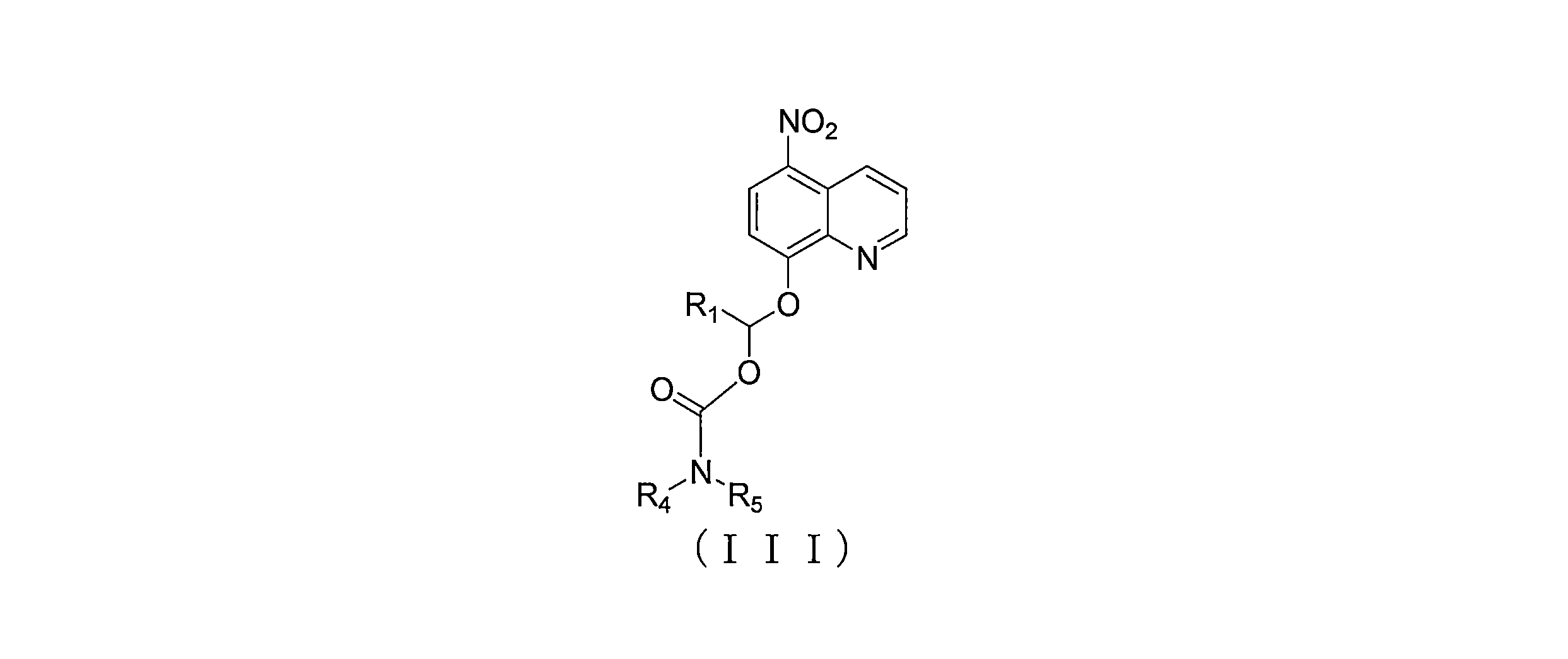
R1は、水素又はC1-6アルキル基から選ばれ、
R4及びR5は、それぞれ独立して、水素、ハロゲン、アルキル基、シクロアルキル基、複素環基、アリール基、ヘテロアリール基、-OR12、-SR12、-C(O)R11、-C(O)OR12、-OC(O)R11、-NRaRb、-N(Rc)C(O)Rd、-C(O)N(Ra)(Rb)、-N(Rc)S(O)pRd、-S(O)pN(Ra)(Rb)、-O(CH2)mO(CH2)qR12、-N(Rc)C(O)-(CH)m-N(Rc)C(O)Rdから選ばれ、ここで、前記アルキル基、シクロアルキル基、複素環基、アリール基、又はヘテロアリール基は、さらに、ハロゲン、アミノ基、ニトロ基、シアノ基、ヒドロキシ基、メルカプト基、アルキル基、アルコキシ基、アルケニル基、アルキニル基、OR12、SR12、NRaRb、-C(O)R11、-C(O)OR12、-O(O)CR11、-(CH)m-OC(O)R11、シクロアルキル基、複素環基、アリール基、アリールアルキル基、ヘテロアリール基、ヘテロアリールアルキル基から選ばれる1つ又は複数の基によって置換されてもよく、又は
R4、R5はN原子と一緒に複素環基を形成し、前記複素環基は、さらに、ハロゲン、アミノ基、ニトロ基、シアノ基、ヒドロキシ基、メルカプト基、アルキル基、アルコキシ基、アルケニル基、アルキニル基、-C(O)R11、-C(O)OR12、-O(O)CR11、シクロアルキル基、複素環基、アリール基、ヘテロアリール基から選ばれる1つ又は複数の基によって置換されてもよく、
R11及びR12は、それぞれ独立して、水素、ハロゲン、ヒドロキシ基、シアノ基、アミノ基、カルボキシ基、エステル基、アルキル基、アルコキシ基、アルケニル基、アルキニル基、シクロアルキル基、複素環基、アリール基、ヘテロアリール基から選ばれ、ここで、前記アルキル基、アルコキシ基、アルケニル基、アルキニル基、シクロアルキル基、複素環基、アリール基、及びヘテロアリール基は、さらに、ハロゲン、アミノ基、ニトロ基、シアノ基、ヒドロキシ基、メルカプト基、カルボキシ基、エステル基、オキソ基、アルキル基、アルコキシ基、-NRaRb、-ORd、-N(Rc)C(O)Rd、-C(O)N(Ra)(Rb)、-N(Rc)S(O)pRd、-S(O)pN(Ra)(Rb)、アルケニル基、アルキニル基、シクロアルキル基、複素環基、アリール基、ヘテロアリール基から選ばれる1つ又は複数の基によって置換されてもよく、
Ra及びRbは、それぞれ独立して、水素、ハロゲン、ヒドロキシ基、シアノ基、アミノ基、カルボキシ基、エステル基、アルキル基、アルコキシ基、アルケニル基、アルキニル基、シクロアルキル基、複素環基、アリール基、ヘテロアリール基から選ばれ、ここで、前記アミノ基、アルキル基、アルコキシ基、アルケニル基、アルキニル基、シクロアルキル基、複素環基、アリール基、及びヘテロアリール基は、さらに、ハロゲン、アミノ基、ニトロ基、シアノ基、ヒドロキシ基、メルカプト基、カルボキシ基、エステル基、オキソ基、アルキル基、アルコキシ基、アルケニル基、アルキニル基、シクロアルキル基、複素環基、アリール基、ヘテロアリール基から選ばれる1つ又は複数の基によって置換されてもよく、
又はRa及びRbはこれらが連結する原子と一緒に複素環基を形成し、前記複素環基は、さらに、ハロゲン、アミノ基、ニトロ基、シアノ基、オキソ基、ヒドロキシ基、メルカプト基、カルボキシ基、エステル基、アルキル基、アルコキシ基、アルケニル基、アルキニル基、シクロアルキル基、複素環基、アリール基、ヘテロアリール基から選ばれる1つ又は複数の基によって置換されてもよく、
Rc及びRdは、それぞれ独立して、水素、ハロゲン、ヒドロキシ基、シアノ基、アミノ基、カルボキシ基、エステル基、アルキル基、アルコキシ基、アルケニル基、アルキニル基、シクロアルキル基、複素環基、アリール基、ヘテロアリール基から選ばれ、ここで、前記アミノ基、アルキル基、アルコキシ基、アルケニル基、アルキニル基、シクロアルキル基、複素環基、アリール基、及びヘテロアリール基は、さらに、ハロゲン、アミノ基、ニトロ基、シアノ基、ヒドロキシ基、メルカプト基、カルボキシ基、エステル基、オキソ基、アルキル基、アルコキシ基、アルケニル基、アルキニル基、シクロアルキル基、複素環基、アリール基、ヘテロアリール基から選ばれる1つ又は複数の基によって置換されてもよく、
mは0~6の整数から選ばれ、
pは0、1又は2から選ばれ、
qは0~6の整数から選ばれる。)
In another preferred embodiment of the present invention, the compound represented by formula (I) of the present invention is a compound represented by the following formula (III):
R 1 is selected from hydrogen or a C 1-6 alkyl group;
R 4 and R 5 are each independently hydrogen, halogen, an alkyl group, a cycloalkyl group, a heterocyclic group, an aryl group, a heteroaryl group, -OR 12 , -SR 12 , -C(O)R 11 , -C(O)OR 12 , -OC(O)R 11 , -NR a R b , -N(R c )C(O)R d , -C(O)N(R a )(R b ), -N(R c )S(O) p R d , -S(O) p N(R a )(R b ), -O(CH 2 ) m O(CH 2 ) q R 12 , -N(R c )C(O)-(CH) m -N(R c )C(O)R d , wherein the alkyl group, cycloalkyl group, heterocyclic group, aryl group, or heteroaryl group may be further substituted by one or more groups selected from halogen, amino group, nitro group, cyano group, hydroxy group, mercapto group, alkyl group, alkoxy group, alkenyl group, alkynyl group, OR 12 , SR 12 , NR a R b , -C(O)R 11 , -C(O)OR 12 , -O(O)CR 11 , -(CH) m -OC(O)R 11 , cycloalkyl group, heterocyclic group, aryl group, arylalkyl group, heteroaryl group, heteroarylalkyl group, or R 4 and R 5 together with the N atom form a heterocyclic group, wherein the heterocyclic group may be further substituted by one or more groups selected from halogen, amino group, nitro group, cyano group, hydroxy group, mercapto group, alkyl group, alkoxy group, alkenyl group, alkynyl group, -C(O)R 11 , -C(O)OR 12 , -O(O)CR 11 , a cycloalkyl group, a heterocyclic group, an aryl group, and a heteroaryl group,
R 11 and R 12 are each independently selected from hydrogen, halogen, a hydroxy group, a cyano group, an amino group, a carboxy group, an ester group, an alkyl group, an alkoxy group, an alkenyl group, an alkynyl group, a cycloalkyl group, a heterocyclic group, an aryl group, and a heteroaryl group, and the alkyl group, the alkoxy group, the alkenyl group, the alkynyl group, the cycloalkyl group, the heterocyclic group, the aryl group, and the heteroaryl group are further selected from halogen, an amino group, a nitro group, a cyano group, a hydroxy group, a mercapto group, a carboxy group, an ester group, an oxo group, an alkyl group, an alkoxy group, -NR a R b , -OR d , -N(R c )C(O)R d , -C(O)N(R a )(R b ), -N(R c )S(O) p R d , -S(O) p N(R a )(R b ), optionally substituted by one or more groups selected from an alkenyl group, an alkynyl group, a cycloalkyl group, a heterocyclic group, an aryl group, and a heteroaryl group;
R a and R b are each independently selected from hydrogen, halogen, a hydroxy group, a cyano group, an amino group, a carboxy group, an ester group, an alkyl group, an alkoxy group, an alkenyl group, an alkynyl group, a cycloalkyl group, a heterocyclic group, an aryl group, and a heteroaryl group, and the amino group, the alkyl group, the alkoxy group, the alkenyl group, the alkynyl group, the cycloalkyl group, the heterocyclic group, the aryl group, and the heteroaryl group may be further substituted with one or more groups selected from a halogen, an amino group, a nitro group, a cyano group, a hydroxy group, a mercapto group, a carboxy group, an ester group, an oxo group, an alkyl group, an alkoxy group, an alkenyl group, an alkynyl group, a cycloalkyl group, a heterocyclic group, an aryl group, and a heteroaryl group;
or R a and R b together with the atom to which they are linked form a heterocyclic group, which may be further substituted by one or more groups selected from a halogen, an amino group, a nitro group, a cyano group, an oxo group, a hydroxy group, a mercapto group, a carboxy group, an ester group, an alkyl group, an alkoxy group, an alkenyl group, an alkynyl group, a cycloalkyl group, a heterocyclic group, an aryl group, and a heteroaryl group;
Rc and Rd are each independently selected from hydrogen, halogen, a hydroxy group, a cyano group, an amino group, a carboxy group, an ester group, an alkyl group, an alkoxy group, an alkenyl group, an alkynyl group, a cycloalkyl group, a heterocyclic group, an aryl group, and a heteroaryl group, and the amino group, the alkyl group, the alkoxy group, the alkenyl group, the alkynyl group, the cycloalkyl group, the heterocyclic group, the aryl group, and the heteroaryl group may be further substituted with one or more groups selected from a halogen, an amino group, a nitro group, a cyano group, a hydroxy group, a mercapto group, a carboxy group, an ester group, an oxo group, an alkyl group, an alkoxy group, an alkenyl group, an alkynyl group, a cycloalkyl group, a heterocyclic group, an aryl group, and a heteroaryl group;
m is selected from integers from 0 to 6;
p is selected from 0, 1 or 2;
q is selected from integers of 0 to 6.
本発明のさらに好ましい実施形態では、本発明の前記式(III)で表される化合物において、
R4及びR5は、それぞれ独立して、水素、アルキル基、アリール基、ヘテロアリール基から選ばれ、ここで、前記アルキル基、アリール基、又はヘテロアリール基は、さらに、ハロゲン、ヒドロキシ基、メルカプト基、アルキル基、-C(O)R11、-C(O)OR12、-O(O)CR11、-(CH)m-OC(O)R11、アリール基、ヘテロアリール基から選ばれる1つ又は複数の基によって置換されてもよく、
R11及びR12は、それぞれ独立して、水素、アルキル基から選ばれ、ここで、前記アルキル基は、さらに、ハロゲン、-ORd、-N(Rc)C(O)Rdから選ばれる1つ又は複数の基によって置換されてもよく、
Rc及びRdは、それぞれ独立して、水素、アルキル基、アリール基、ヘテロアリール基から選ばれ、ここで、前記アルキル基、アリール基、及びヘテロアリール基は、さらに、ハロゲン、アミノ基、ニトロ基、シアノ基、ヒドロキシ基、メルカプト基、カルボキシ基、エステル基、オキソ基、アルキル基、アルコキシ基、アルケニル基、アルキニル基、シクロアルキル基、複素環基、アリール基、ヘテロアリール基から選ばれる1つ又は複数の基によって置換されてもよく、
mは0~6の整数から選ばれ、
pは0、1又は2から選ばれる。
In a further preferred embodiment of the present invention, in the compound represented by formula (III) of the present invention,
R 4 and R 5 are each independently selected from hydrogen, an alkyl group, an aryl group, and a heteroaryl group, and the alkyl group, aryl group, or heteroaryl group may be further substituted with one or more groups selected from halogen, a hydroxy group, a mercapto group, an alkyl group, -C(O)R 11 , -C(O)OR 12 , -O(O)CR 11 , -(CH) m -OC(O)R 11 , an aryl group, and a heteroaryl group;
R 11 and R 12 are each independently selected from hydrogen and an alkyl group, wherein the alkyl group may be further substituted with one or more groups selected from halogen, -OR d , and -N(R c )C(O)R d ;
Rc and Rd are each independently selected from hydrogen, an alkyl group, an aryl group, and a heteroaryl group, and the alkyl group, the aryl group, and the heteroaryl group may be further substituted with one or more groups selected from a halogen, an amino group, a nitro group, a cyano group, a hydroxy group, a mercapto group, a carboxy group, an ester group, an oxo group, an alkyl group, an alkoxy group, an alkenyl group, an alkynyl group, a cycloalkyl group, a heterocyclic group, an aryl group, and a heteroaryl group;
m is selected from integers from 0 to 6;
p is selected from 0, 1 or 2;
本発明の別の好ましい実施形態では、本発明の前記式(I)で表される化合物は、下記式(IV)で表される化合物である。
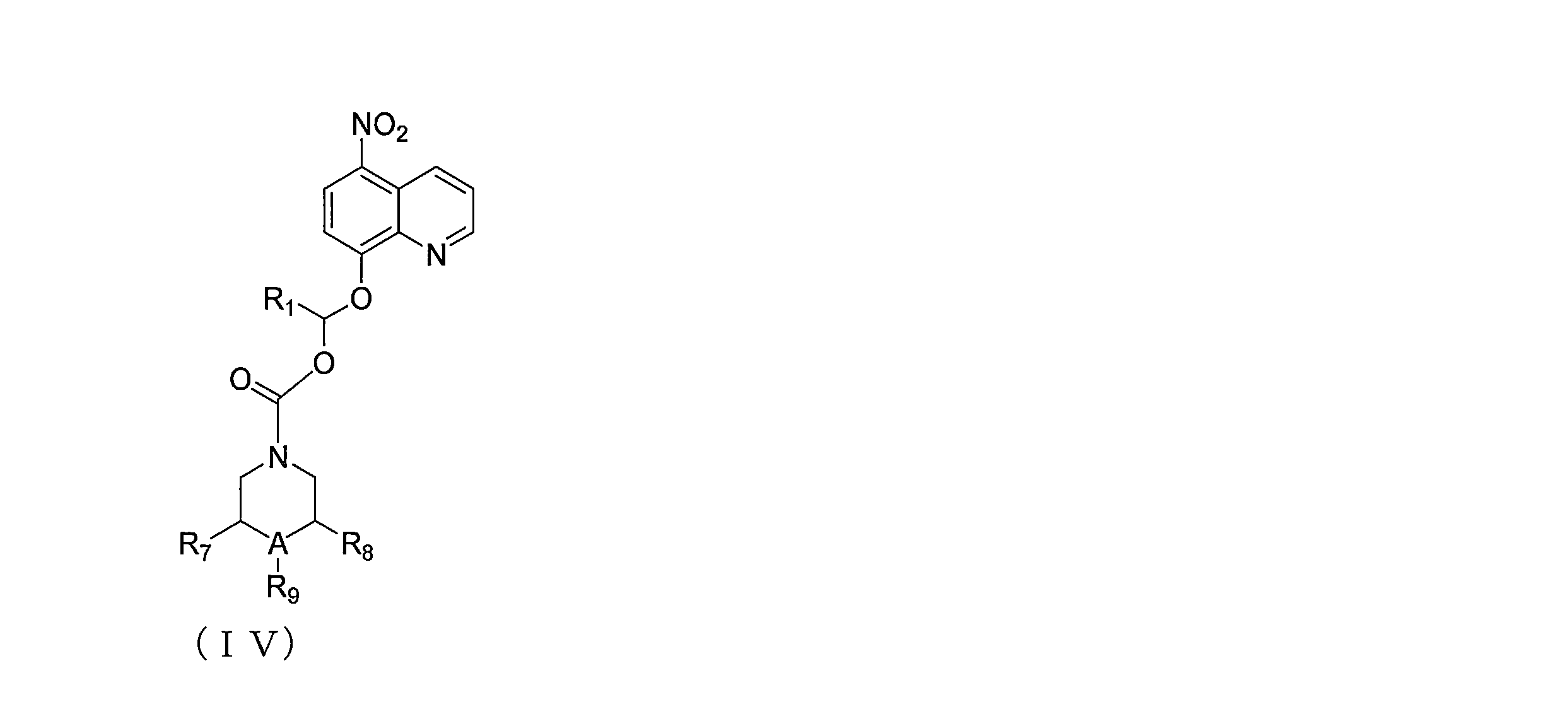
R1は、水素又はC1-6アルキル基から選ばれ、
Aは、C、O又はNから選ばれ、
R7及びR8は、それぞれ独立して、水素、ハロゲン、ヒドロキシ基、アルキル基、アルコキシ基、ハロアルキル基、ハロアルコキシ基から選ばれ、
R9は、水素、ハロゲン、アミノ基、ヒドロキシ基、メルカプト基、アルキル基、アルコキシ基、-C(O)R11、-C(O)OR12、-OC(O)R11、シクロアルキル基、複素環基から選ばれ、
R11及びR12は、それぞれ独立して、水素、ハロゲン、ヒドロキシ基、シアノ基、アミノ基、カルボキシ基、エステル基、アルキル基、アルコキシ基、アルケニル基、アルキニル基、シクロアルキル基、複素環基、アリール基、ヘテロアリール基から選ばれ、ここで、前記アルキル基、アルコキシ基、アルケニル基、アルキニル基、シクロアルキル基、複素環基、アリール基、及びヘテロアリール基は、さらに、ハロゲン、アミノ基、ニトロ基、シアノ基、ヒドロキシ基、メルカプト基、カルボキシ基、エステル基、オキソ基、アルキル基、アルコキシ基、-NRaRb、-ORd、-N(Rc)C(O)Rd、-C(O)N(Ra)(Rb)、-N(Rc)S(O)pRd、-S(O)pN(Ra)(Rb)、アルケニル基、アルキニル基、シクロアルキル基、複素環基、アリール基、ヘテロアリール基から選ばれる1つ又は複数の基によって置換されてもよく、
Ra及びRbは、それぞれ独立して、水素、ハロゲン、ヒドロキシ基、シアノ基、アミノ基、カルボキシ基、エステル基、アルキル基、アルコキシ基、アルケニル基、アルキニル基、シクロアルキル基、複素環基、アリール基、ヘテロアリール基から選ばれ、ここで、前記アミノ基、アルキル基、アルコキシ基、アルケニル基、アルキニル基、シクロアルキル基、複素環基、アリール基、及びヘテロアリール基は、さらに、ハロゲン、アミノ基、ニトロ基、シアノ基、ヒドロキシ基、メルカプト基、カルボキシ基、エステル基、オキソ基、アルキル基、アルコキシ基、アルケニル基、アルキニル基、シクロアルキル基、複素環基、アリール基、ヘテロアリール基から選ばれる1つ又は複数の基によって置換されてもよく、
又はRa及びRbはこれらが連結する原子と一緒に複素環基を形成し、前記複素環基は、さらに、ハロゲン、アミノ基、ニトロ基、シアノ基、オキソ基、ヒドロキシ基、メルカプト基、カルボキシ基、エステル基、アルキル基、アルコキシ基、アルケニル基、アルキニル基、シクロアルキル基、複素環基、アリール基、ヘテロアリール基から選ばれる1つ又は複数の基によって置換されてもよく、
Rc及びRdは、それぞれ独立して、水素、ハロゲン、ヒドロキシ基、シアノ基、アミノ基、カルボキシ基、エステル基、アルキル基、アルコキシ基、アルケニル基、アルキニル基、シクロアルキル基、複素環基、アリール基、ヘテロアリール基から選ばれ、ここで、前記アミノ基、アルキル基、アルコキシ基、アルケニル基、アルキニル基、シクロアルキル基、複素環基、アリール基、及びヘテロアリール基は、さらに、ハロゲン、アミノ基、ニトロ基、シアノ基、ヒドロキシ基、メルカプト基、カルボキシ基、エステル基、オキソ基、アルキル基、アルコキシ基、アルケニル基、アルキニル基、シクロアルキル基、複素環基、アリール基、ヘテロアリール基から選ばれる1つ又は複数の基によって置換されてもよく、
pは0、1又は2から選ばれる。)
In another preferred embodiment of the present invention, the compound represented by formula (I) of the present invention is a compound represented by formula (IV):
R 1 is selected from hydrogen or a C 1-6 alkyl group;
A is selected from C, O or N;
R7 and R8 are each independently selected from hydrogen, halogen, a hydroxyl group, an alkyl group, an alkoxy group, a haloalkyl group, and a haloalkoxy group;
R 9 is selected from hydrogen, halogen, an amino group, a hydroxy group, a mercapto group, an alkyl group, an alkoxy group, —C(O)R 11 , —C(O)OR 12 , —OC(O)R 11 , a cycloalkyl group, and a heterocyclic group;
R 11 and R 12 are each independently selected from hydrogen, halogen, a hydroxy group, a cyano group, an amino group, a carboxy group, an ester group, an alkyl group, an alkoxy group, an alkenyl group, an alkynyl group, a cycloalkyl group, a heterocyclic group, an aryl group, and a heteroaryl group, and the alkyl group, the alkoxy group, the alkenyl group, the alkynyl group, the cycloalkyl group, the heterocyclic group, the aryl group, and the heteroaryl group are further selected from halogen, an amino group, a nitro group, a cyano group, a hydroxy group, a mercapto group, a carboxy group, an ester group, an oxo group, an alkyl group, an alkoxy group, -NR a R b , -OR d , -N(R c )C(O)R d , -C(O)N(R a )(R b ), -N(R c )S(O) p R d , -S(O) p N(R a )(R b ), optionally substituted by one or more groups selected from an alkenyl group, an alkynyl group, a cycloalkyl group, a heterocyclic group, an aryl group, and a heteroaryl group;
R a and R b are each independently selected from hydrogen, halogen, a hydroxy group, a cyano group, an amino group, a carboxy group, an ester group, an alkyl group, an alkoxy group, an alkenyl group, an alkynyl group, a cycloalkyl group, a heterocyclic group, an aryl group, and a heteroaryl group, and the amino group, the alkyl group, the alkoxy group, the alkenyl group, the alkynyl group, the cycloalkyl group, the heterocyclic group, the aryl group, and the heteroaryl group may be further substituted with one or more groups selected from a halogen, an amino group, a nitro group, a cyano group, a hydroxy group, a mercapto group, a carboxy group, an ester group, an oxo group, an alkyl group, an alkoxy group, an alkenyl group, an alkynyl group, a cycloalkyl group, a heterocyclic group, an aryl group, and a heteroaryl group;
or R a and R b together with the atom to which they are linked form a heterocyclic group, which may be further substituted by one or more groups selected from a halogen, an amino group, a nitro group, a cyano group, an oxo group, a hydroxy group, a mercapto group, a carboxy group, an ester group, an alkyl group, an alkoxy group, an alkenyl group, an alkynyl group, a cycloalkyl group, a heterocyclic group, an aryl group, and a heteroaryl group;
Rc and Rd are each independently selected from hydrogen, halogen, a hydroxy group, a cyano group, an amino group, a carboxy group, an ester group, an alkyl group, an alkoxy group, an alkenyl group, an alkynyl group, a cycloalkyl group, a heterocyclic group, an aryl group, and a heteroaryl group, and the amino group, the alkyl group, the alkoxy group, the alkenyl group, the alkynyl group, the cycloalkyl group, the heterocyclic group, the aryl group, and the heteroaryl group may be further substituted with one or more groups selected from a halogen, an amino group, a nitro group, a cyano group, a hydroxy group, a mercapto group, a carboxy group, an ester group, an oxo group, an alkyl group, an alkoxy group, an alkenyl group, an alkynyl group, a cycloalkyl group, a heterocyclic group, an aryl group, and a heteroaryl group;
p is selected from 0, 1 or 2.
本発明の別の好ましい実施形態では、本発明の前記式(I)で表される化合物は、下記式(V)で表される化合物である。
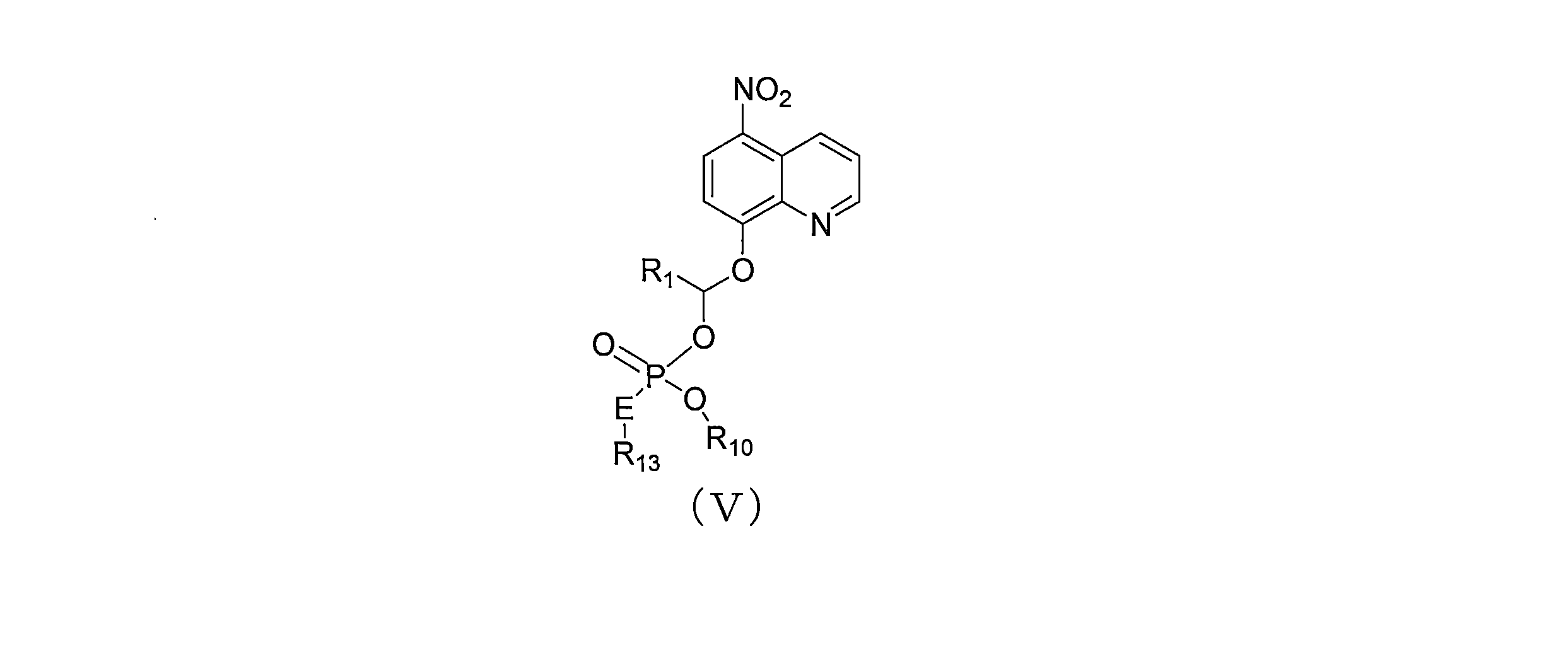
EはO又はNR14から選ばれ、
R10、R13、R14は、それぞれ独立して、水素、C1-6アルキル基、又はアリール基から選ばれ、前記C1-6アルキル基又はアリール基は、さらに、ハロゲン、ヒドロキシ基、メルカプト基、カルボキシ基、エステル基、アルキル基、アルコキシ基、シクロアルキル基、複素環基、アリール基、アリールアルキル基、ヘテロアリール基、ヘテロアリールアルキル基、-OR12、-COR11、-C(O)OR12、-OC(O)R11、-OC(O)OR12から選ばれる1つ又は複数の置換基によって置換されてもよく、
R11及びR12は、それぞれ独立して、水素、ハロゲン、ヒドロキシ基、シアノ基、アミノ基、カルボキシ基、エステル基、アルキル基、アルコキシ基、アルケニル基、アルキニル基、シクロアルキル基、複素環基、アリール基、ヘテロアリール基から選ばれ、ここで、前記アルキル基、アルコキシ基、アルケニル基、アルキニル基、シクロアルキル基、複素環基、アリール基、及びヘテロアリール基は、さらに、ハロゲン、アミノ基、ニトロ基、シアノ基、ヒドロキシ基、メルカプト基、カルボキシ基、エステル基、オキソ基、アルキル基、アルコキシ基、-NRaRb、-ORd、-N(Rc)C(O)Rd、-C(O)N(Ra)(Rb)、-N(Rc)S(O)pRd、-S(O)pN(Ra)(Rb)、アルケニル基、アルキニル基、シクロアルキル基、複素環基、アリール基、ヘテロアリール基から選ばれる1つ又は複数の基によって置換されてもよく、
Ra及びRbは、それぞれ独立して、水素、ハロゲン、ヒドロキシ基、シアノ基、アミノ基、カルボキシ基、エステル基、アルキル基、アルコキシ基、アルケニル基、アルキニル基、シクロアルキル基、複素環基、アリール基、ヘテロアリール基から選ばれ、ここで、前記アミノ基、アルキル基、アルコキシ基、アルケニル基、アルキニル基、シクロアルキル基、複素環基、アリール基、及びヘテロアリール基は、さらに、ハロゲン、アミノ基、ニトロ基、シアノ基、ヒドロキシ基、メルカプト基、カルボキシ基、エステル基、オキソ基、アルキル基、アルコキシ基、アルケニル基、アルキニル基、シクロアルキル基、複素環基、アリール基、ヘテロアリール基から選ばれる1つ又は複数の基によって置換されてもよく、
又はRa及びRbはこれらが連結する原子と一緒に複素環基を形成し、前記複素環基は、さらに、ハロゲン、アミノ基、ニトロ基、シアノ基、オキソ基、ヒドロキシ基、メルカプト基、カルボキシ基、エステル基、アルキル基、アルコキシ基、アルケニル基、アルキニル基、シクロアルキル基、複素環基、アリール基、ヘテロアリール基から選ばれる1つ又は複数の基によって置換されてもよく、
Rc及びRdは、それぞれ独立して、水素、ハロゲン、ヒドロキシ基、シアノ基、アミノ基、カルボキシ基、エステル基、アルキル基、アルコキシ基、アルケニル基、アルキニル基、シクロアルキル基、複素環基、アリール基、ヘテロアリール基から選ばれ、ここで、前記アミノ基、アルキル基、アルコキシ基、アルケニル基、アルキニル基、シクロアルキル基、複素環基、アリール基、及びヘテロアリール基は、さらに、ハロゲン、アミノ基、ニトロ基、シアノ基、ヒドロキシ基、メルカプト基、カルボキシ基、エステル基、オキソ基、アルキル基、アルコキシ基、アルケニル基、アルキニル基、シクロアルキル基、複素環基、アリール基、ヘテロアリール基から選ばれる1つ又は複数の基によって置換されてもよく、
pは0、1又は2から選ばれる。)
In another preferred embodiment of the present invention, the compound represented by formula (I) of the present invention is a compound represented by formula (V):
E is selected from O or NR 14 ;
R 10 , R 13 and R 14 are each independently selected from hydrogen, a C 1-6 alkyl group or an aryl group, and the C 1-6 alkyl group or aryl group may be further substituted by one or more substituents selected from a halogen, a hydroxy group, a mercapto group, a carboxy group, an ester group, an alkyl group, an alkoxy group, a cycloalkyl group, a heterocyclic group, an aryl group, an arylalkyl group, a heteroaryl group, a heteroarylalkyl group, -OR 12 , -COR 11 , -C(O)OR 12 , -OC(O)R 11 and -OC(O)OR 12 ;
R 11 and R 12 are each independently selected from hydrogen, halogen, a hydroxy group, a cyano group, an amino group, a carboxy group, an ester group, an alkyl group, an alkoxy group, an alkenyl group, an alkynyl group, a cycloalkyl group, a heterocyclic group, an aryl group, and a heteroaryl group, and the alkyl group, the alkoxy group, the alkenyl group, the alkynyl group, the cycloalkyl group, the heterocyclic group, the aryl group, and the heteroaryl group are further selected from halogen, an amino group, a nitro group, a cyano group, a hydroxy group, a mercapto group, a carboxy group, an ester group, an oxo group, an alkyl group, an alkoxy group, -NR a R b , -OR d , -N(R c )C(O)R d , -C(O)N(R a )(R b ), -N(R c )S(O) p R d , -S(O) p N(R a )(R b ), optionally substituted by one or more groups selected from an alkenyl group, an alkynyl group, a cycloalkyl group, a heterocyclic group, an aryl group, and a heteroaryl group;
R a and R b are each independently selected from hydrogen, halogen, a hydroxy group, a cyano group, an amino group, a carboxy group, an ester group, an alkyl group, an alkoxy group, an alkenyl group, an alkynyl group, a cycloalkyl group, a heterocyclic group, an aryl group, and a heteroaryl group, and the amino group, the alkyl group, the alkoxy group, the alkenyl group, the alkynyl group, the cycloalkyl group, the heterocyclic group, the aryl group, and the heteroaryl group may be further substituted with one or more groups selected from a halogen, an amino group, a nitro group, a cyano group, a hydroxy group, a mercapto group, a carboxy group, an ester group, an oxo group, an alkyl group, an alkoxy group, an alkenyl group, an alkynyl group, a cycloalkyl group, a heterocyclic group, an aryl group, and a heteroaryl group;
or R a and R b together with the atom to which they are linked form a heterocyclic group, which may be further substituted by one or more groups selected from a halogen, an amino group, a nitro group, a cyano group, an oxo group, a hydroxy group, a mercapto group, a carboxy group, an ester group, an alkyl group, an alkoxy group, an alkenyl group, an alkynyl group, a cycloalkyl group, a heterocyclic group, an aryl group, and a heteroaryl group;
Rc and Rd are each independently selected from hydrogen, halogen, a hydroxy group, a cyano group, an amino group, a carboxy group, an ester group, an alkyl group, an alkoxy group, an alkenyl group, an alkynyl group, a cycloalkyl group, a heterocyclic group, an aryl group, and a heteroaryl group, and the amino group, the alkyl group, the alkoxy group, the alkenyl group, the alkynyl group, the cycloalkyl group, the heterocyclic group, the aryl group, and the heteroaryl group may be further substituted with one or more groups selected from a halogen, an amino group, a nitro group, a cyano group, a hydroxy group, a mercapto group, a carboxy group, an ester group, an oxo group, an alkyl group, an alkoxy group, an alkenyl group, an alkynyl group, a cycloalkyl group, a heterocyclic group, an aryl group, and a heteroaryl group;
p is selected from 0, 1 or 2.
本発明のさらに好ましい実施形態では、本発明の前記式(V)で表される化合物において、
R10、R13、R14は、それぞれ独立して、水素又はC1-6アルキル基から選ばれ、前記C1-6アルキル基は、さらに、ハロゲン、ヒドロキシ基、メルカプト基、アルキル基、アルコキシ基、アリール基、ヘテロアリール基、-OR12、-COR11、-C(O)OR12、-OC(O)OR11から選ばれる1つ又は複数の置換基によって置換されてもよく、
R11及びR12は、それぞれ独立して、アルキル基、アリール基、ヘテロアリール基から選ばれ、ここで、前記アルキル基、アリール基、及びヘテロアリール基は、さらに、ハロゲン、アミノ基、ニトロ基、シアノ基、ヒドロキシ基、メルカプト基、カルボキシ基、エステル基、オキソ基、アルキル基、アルコキシ基、シクロアルキル基、複素環基、アリール基、ヘテロアリール基から選ばれる1つ又は複数の基によって置換されてもよい。
In a further preferred embodiment of the present invention, in the compound represented by formula (V) of the present invention,
R 10 , R 13 and R 14 are each independently selected from hydrogen or a C 1-6 alkyl group, and the C 1-6 alkyl group may be further substituted by one or more substituents selected from a halogen, a hydroxy group, a mercapto group, an alkyl group, an alkoxy group, an aryl group, a heteroaryl group, -OR 12 , -COR 11 , -C(O)OR 12 and -OC(O)OR 11 ;
R 11 and R 12 are each independently selected from an alkyl group, an aryl group, and a heteroaryl group, and the alkyl group, the aryl group, and the heteroaryl group may be further substituted with one or more groups selected from a halogen, an amino group, a nitro group, a cyano group, a hydroxy group, a mercapto group, a carboxy group, an ester group, an oxo group, an alkyl group, an alkoxy group, a cycloalkyl group, a heterocyclic group, an aryl group, and a heteroaryl group.
本発明の化合物の代表例は、以下の化合物、又はそのメソ体、ラセミ体、エナンチオマー、ジアステレオマー、又はこれらの混合物の形態、又はその医薬的に許容可能な塩を含むが、これらに制限されない。
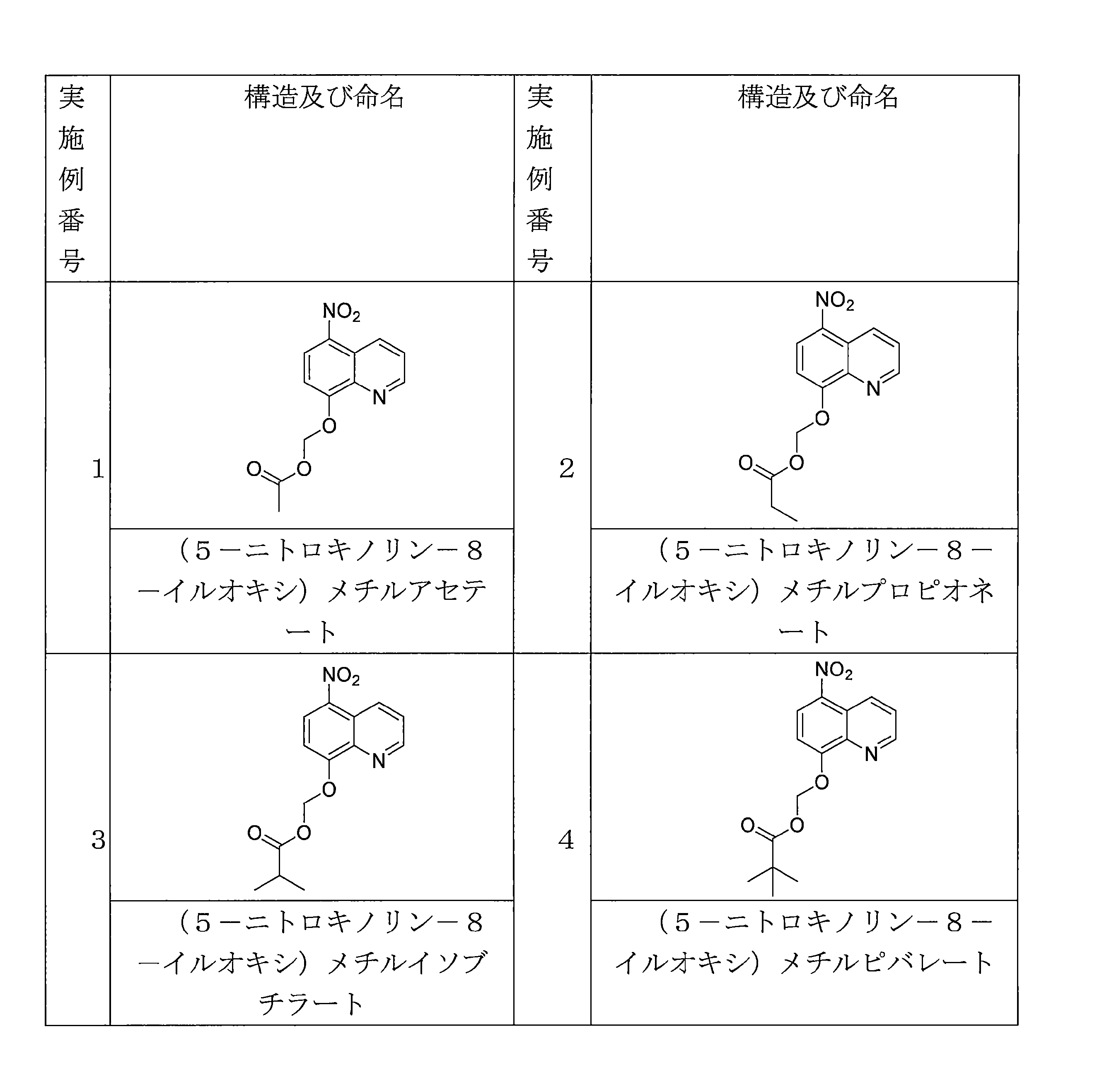
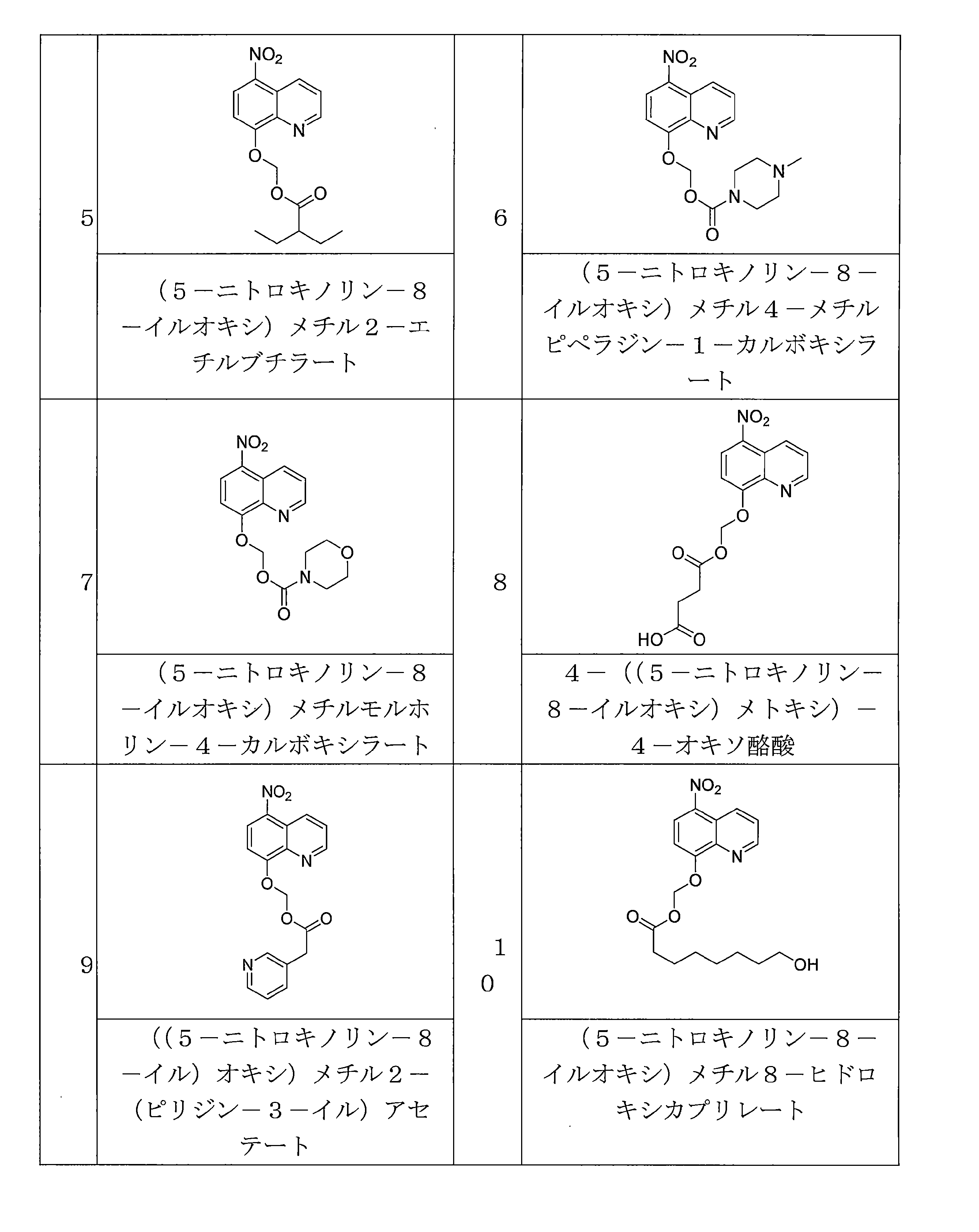
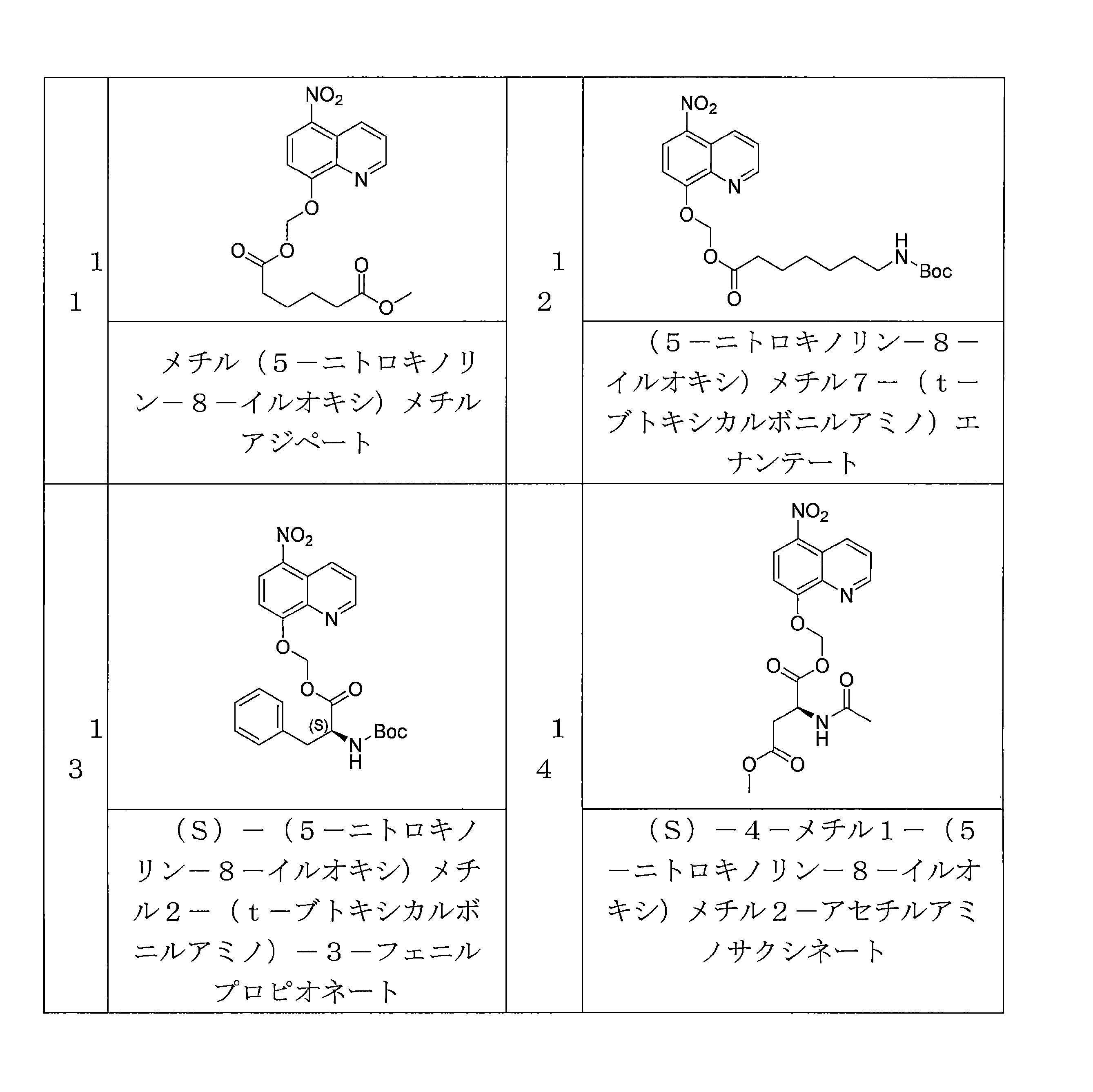

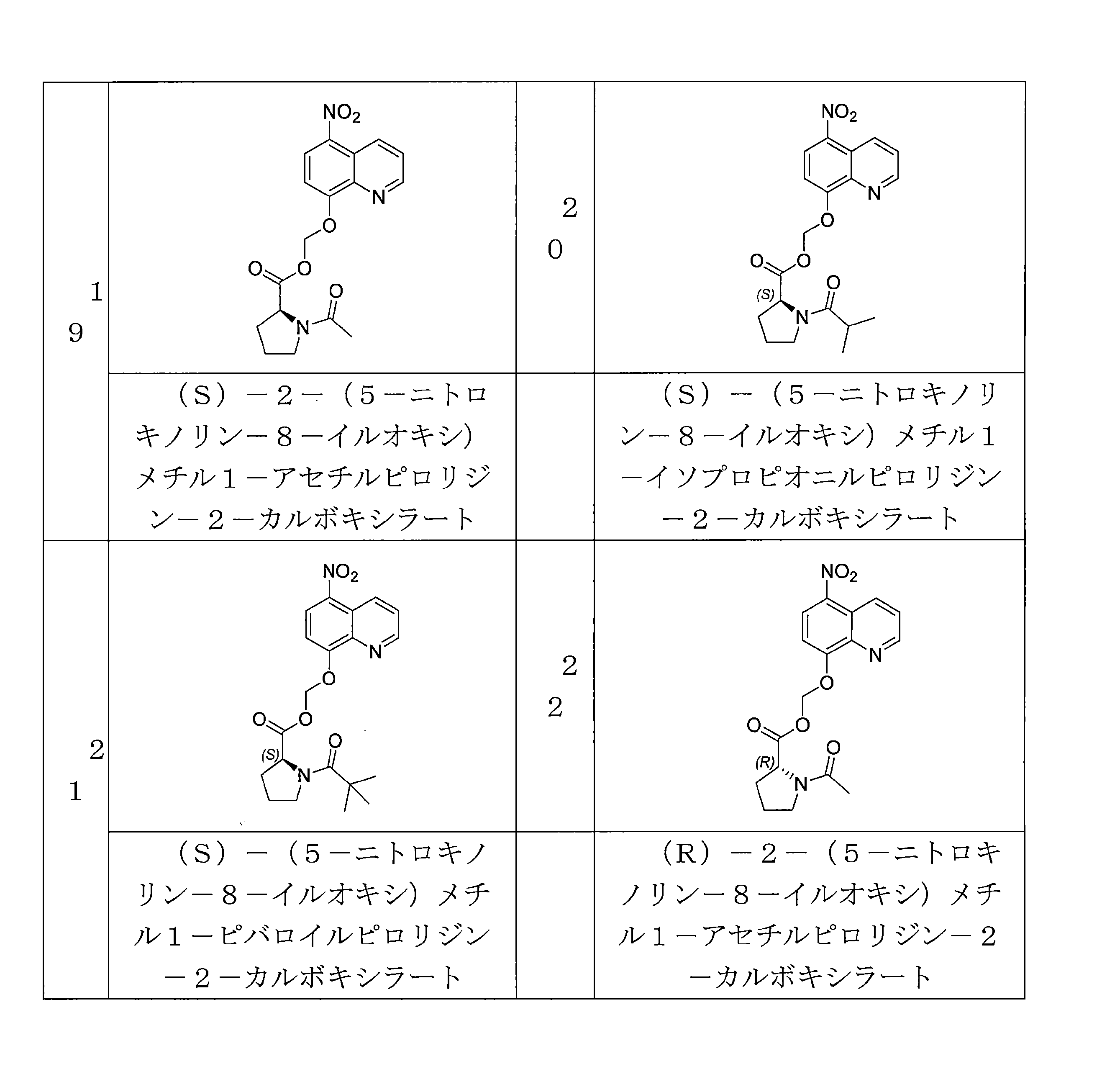


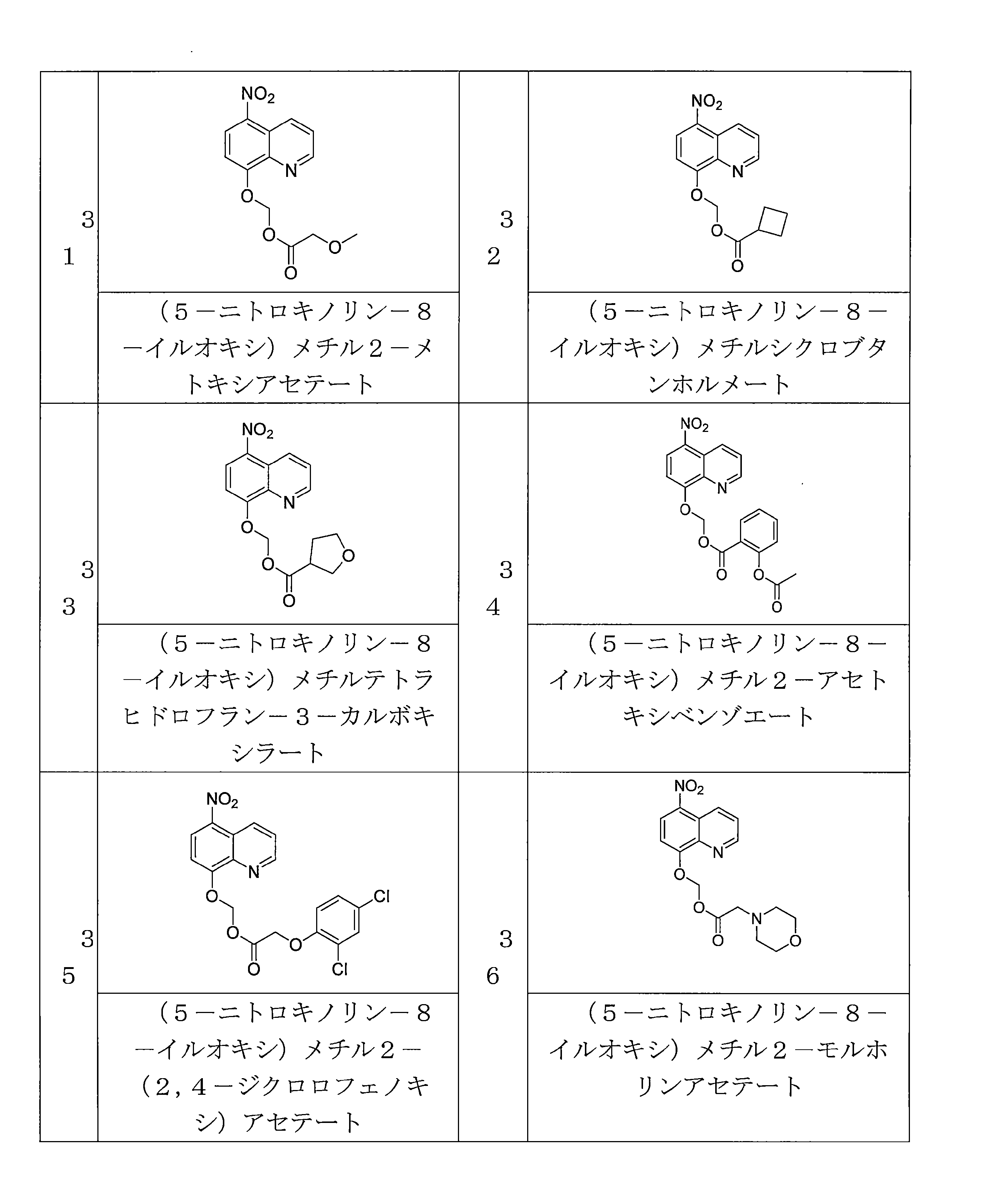

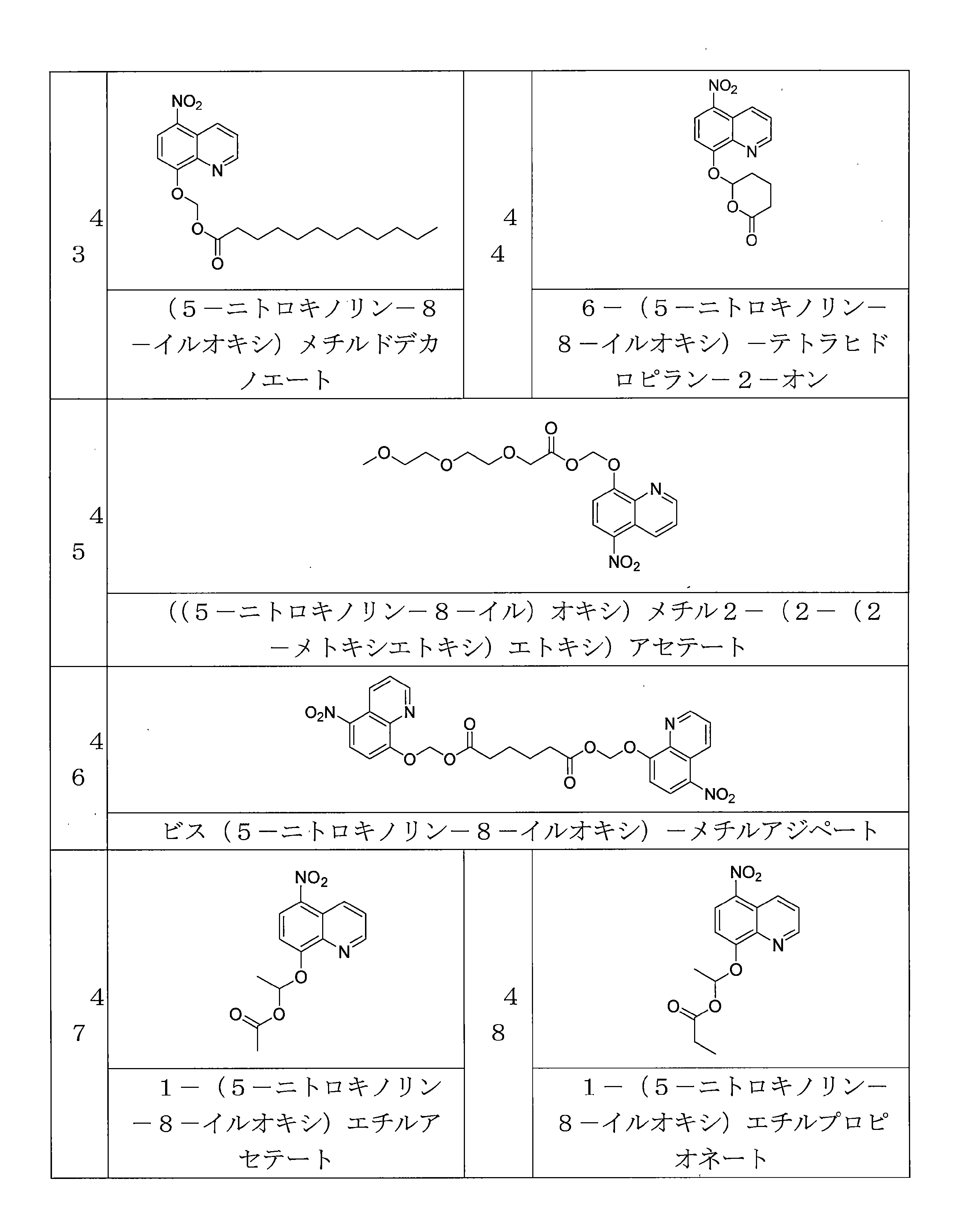
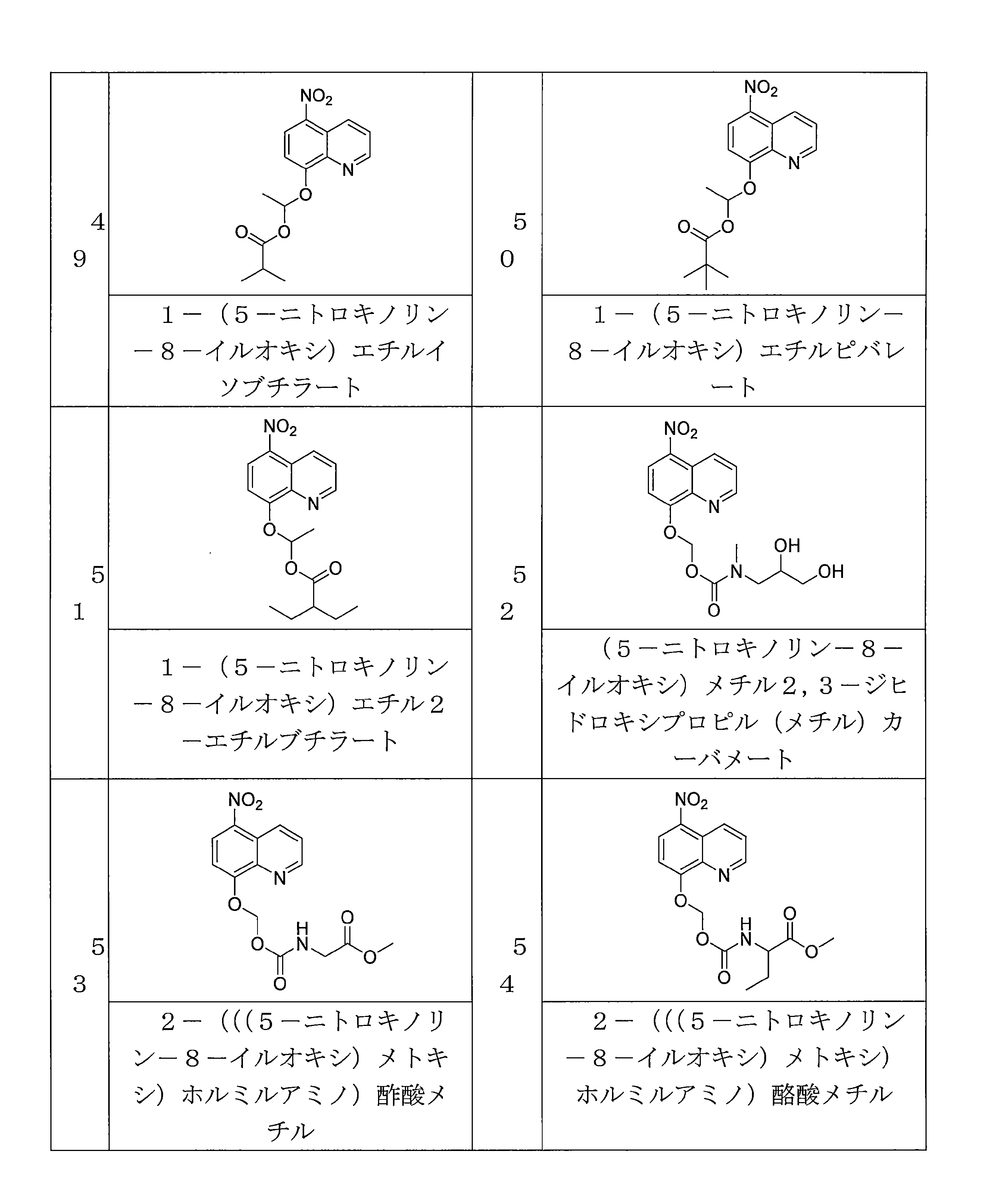

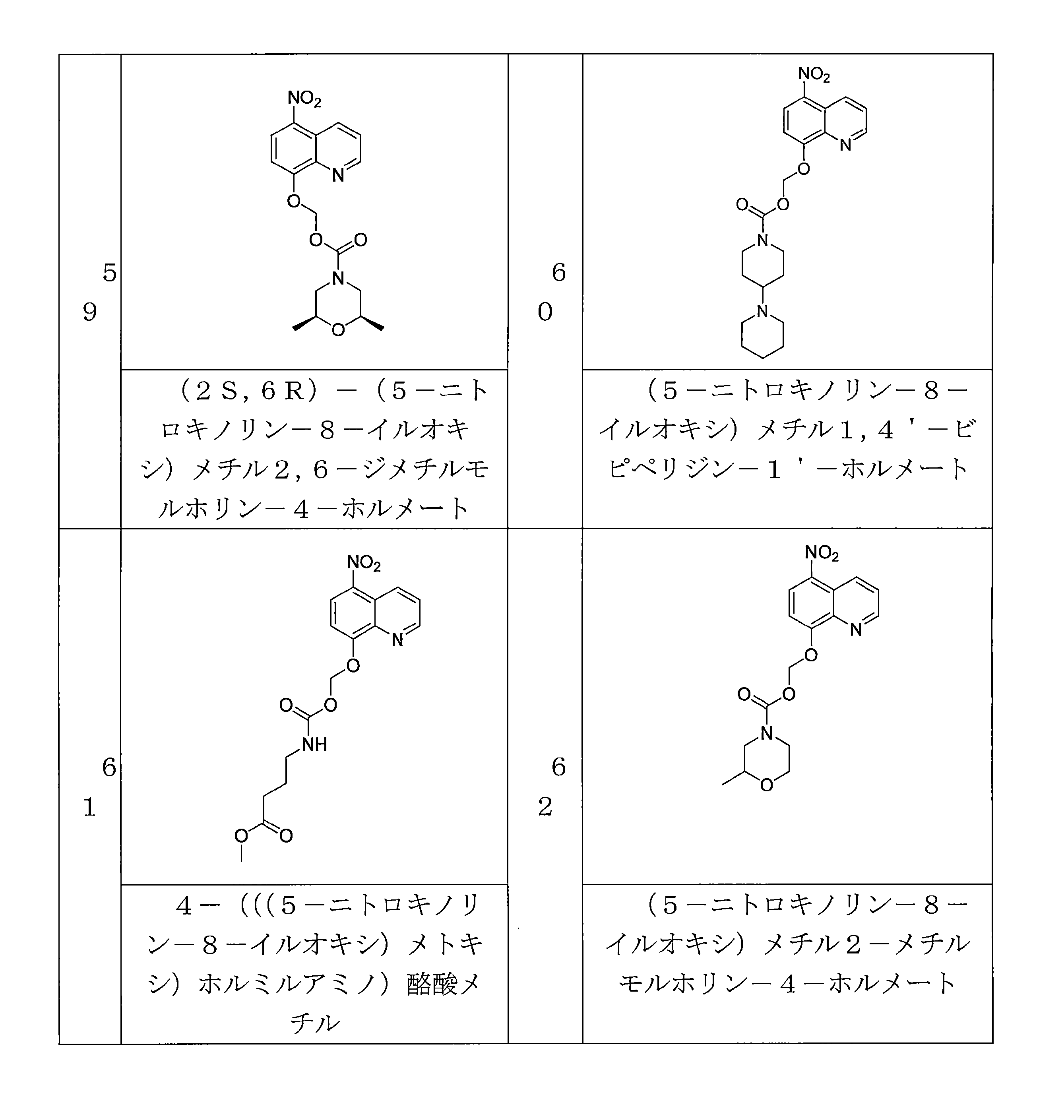
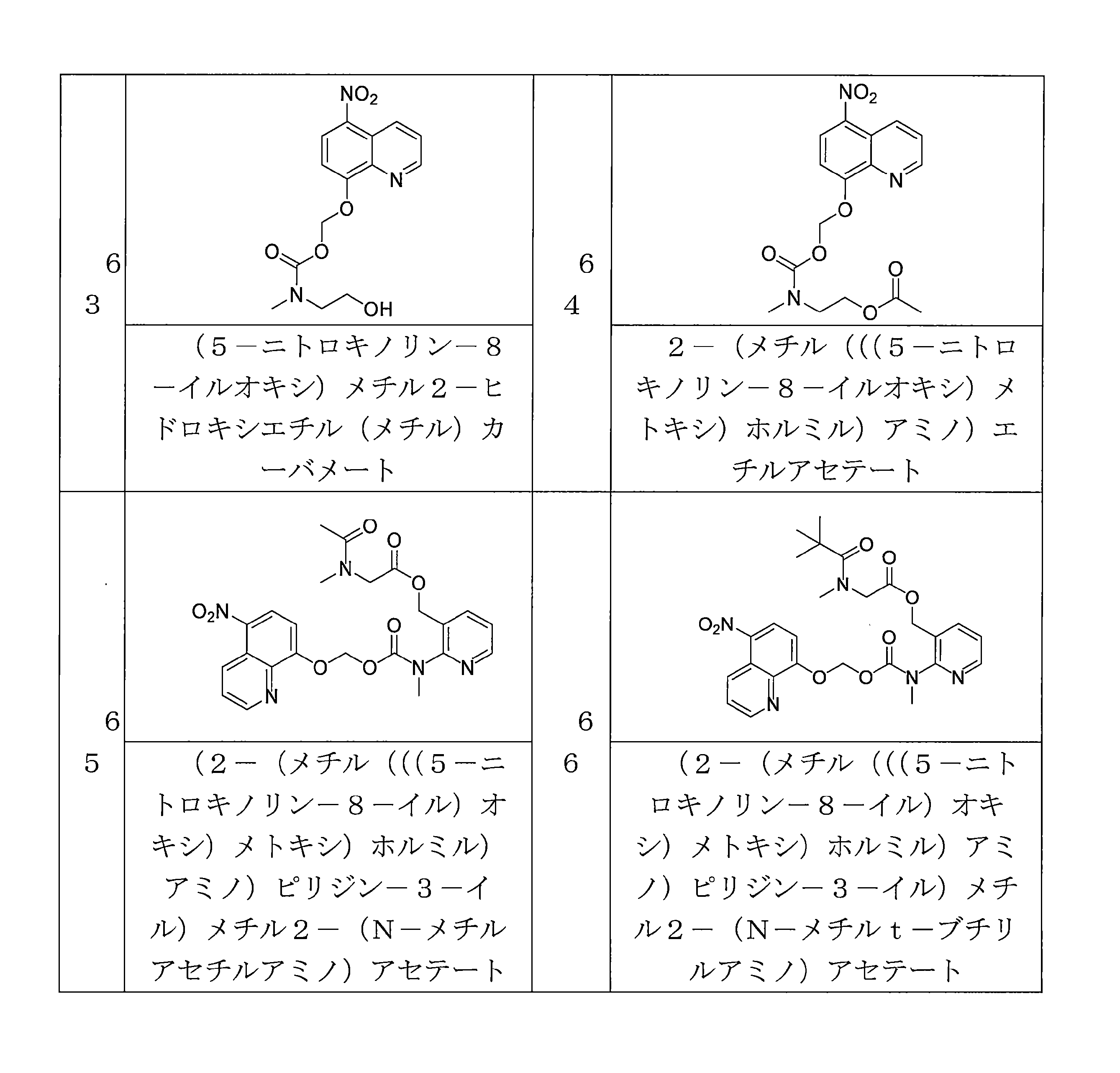
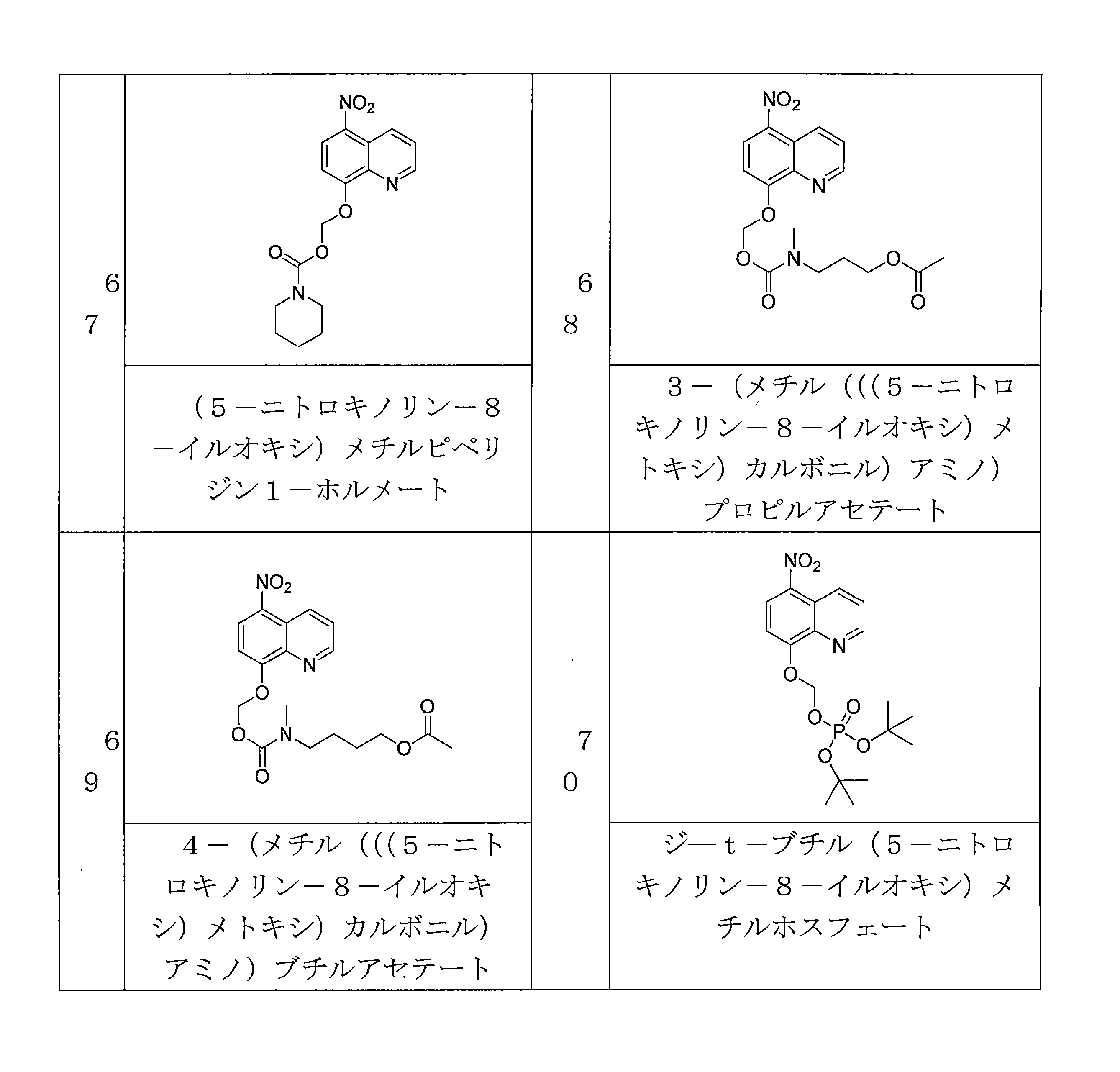
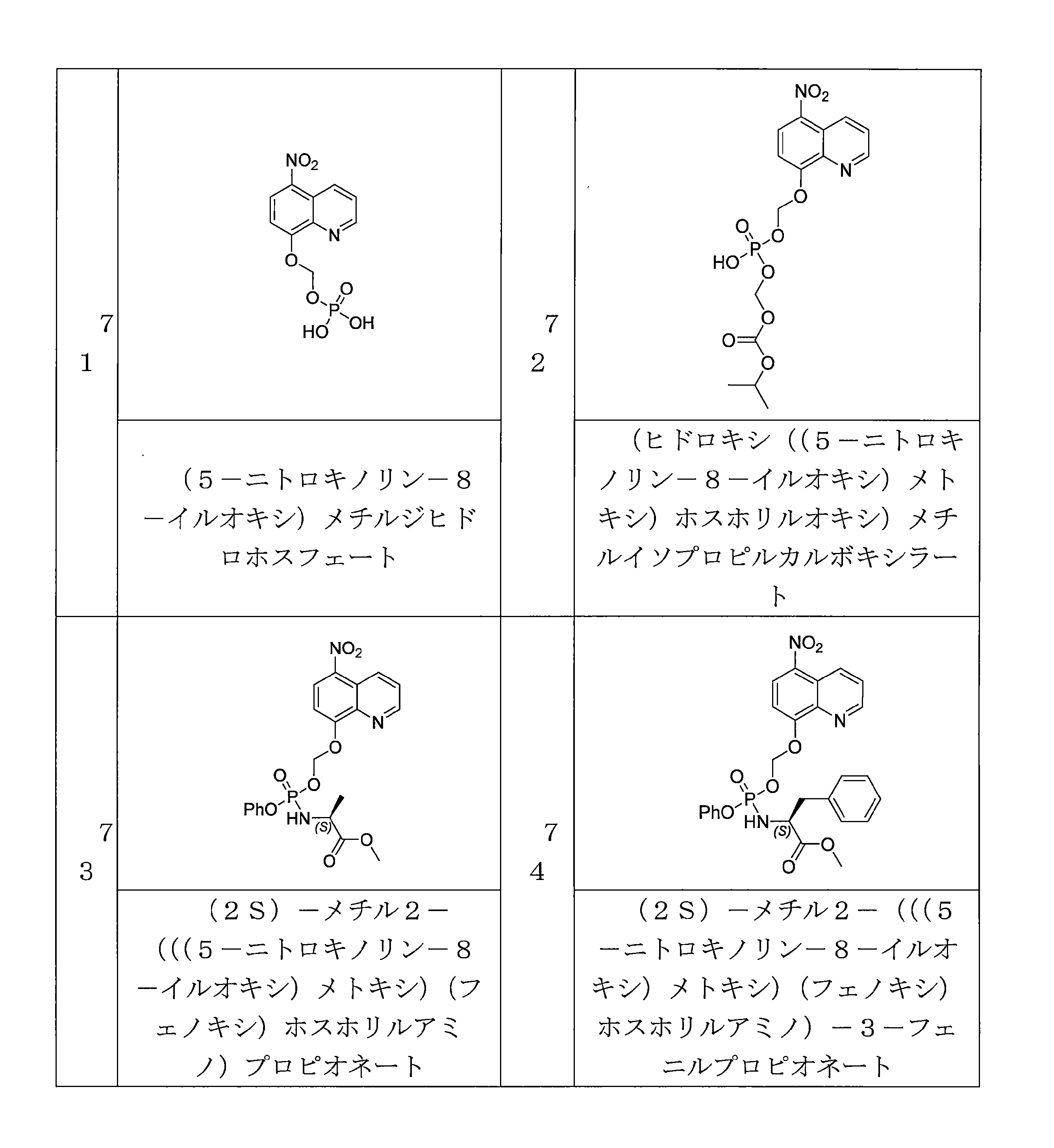
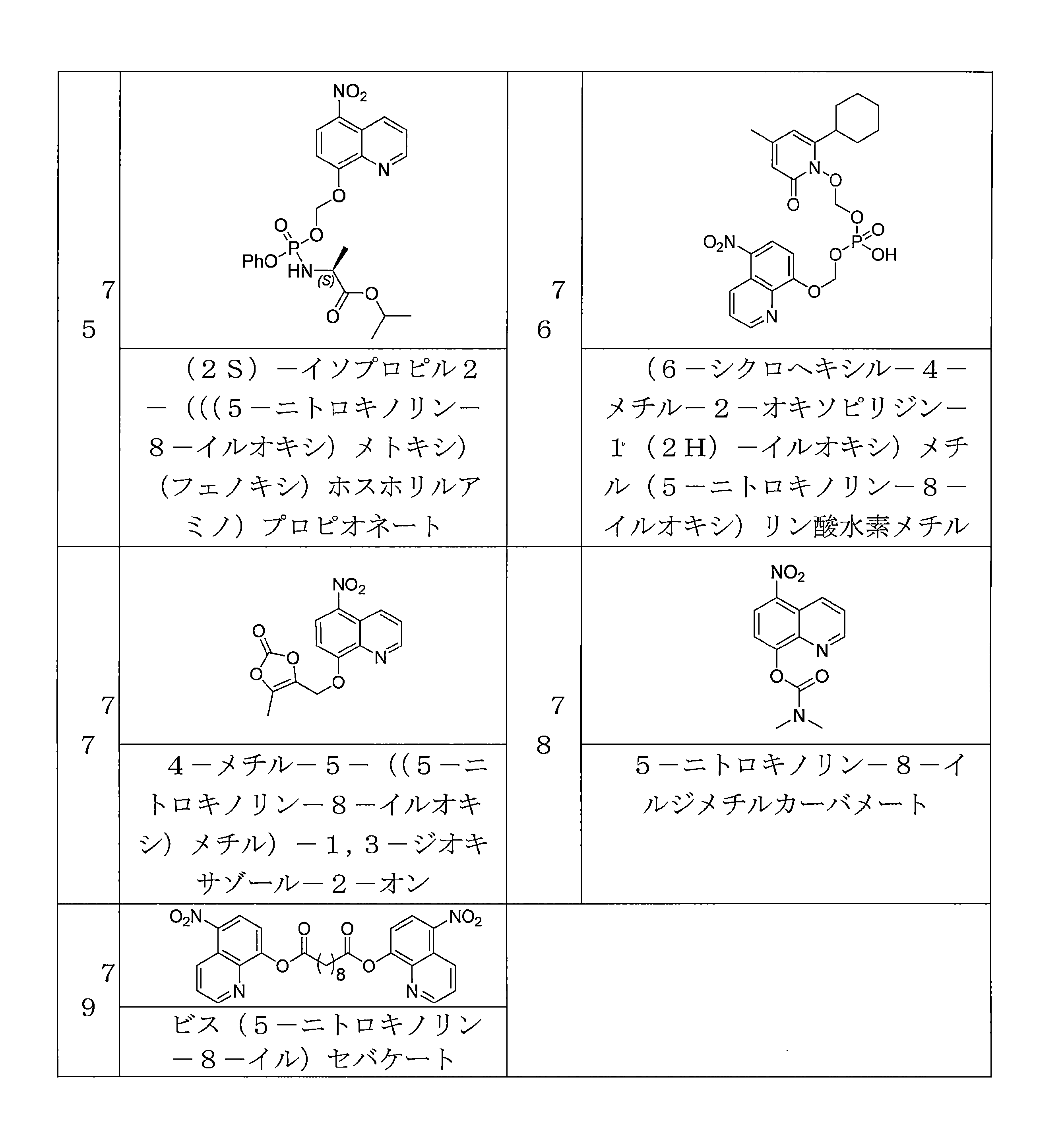
本発明は、さらに、本発明に係る前記式(II)で表される化合物又はそのメソ体、ラセミ体、エナンチオマー、ジアステレオマー、又はこれらの混合物の形態、又はその医薬的に許容可能な塩の製造方法に関し、この製造方法は、
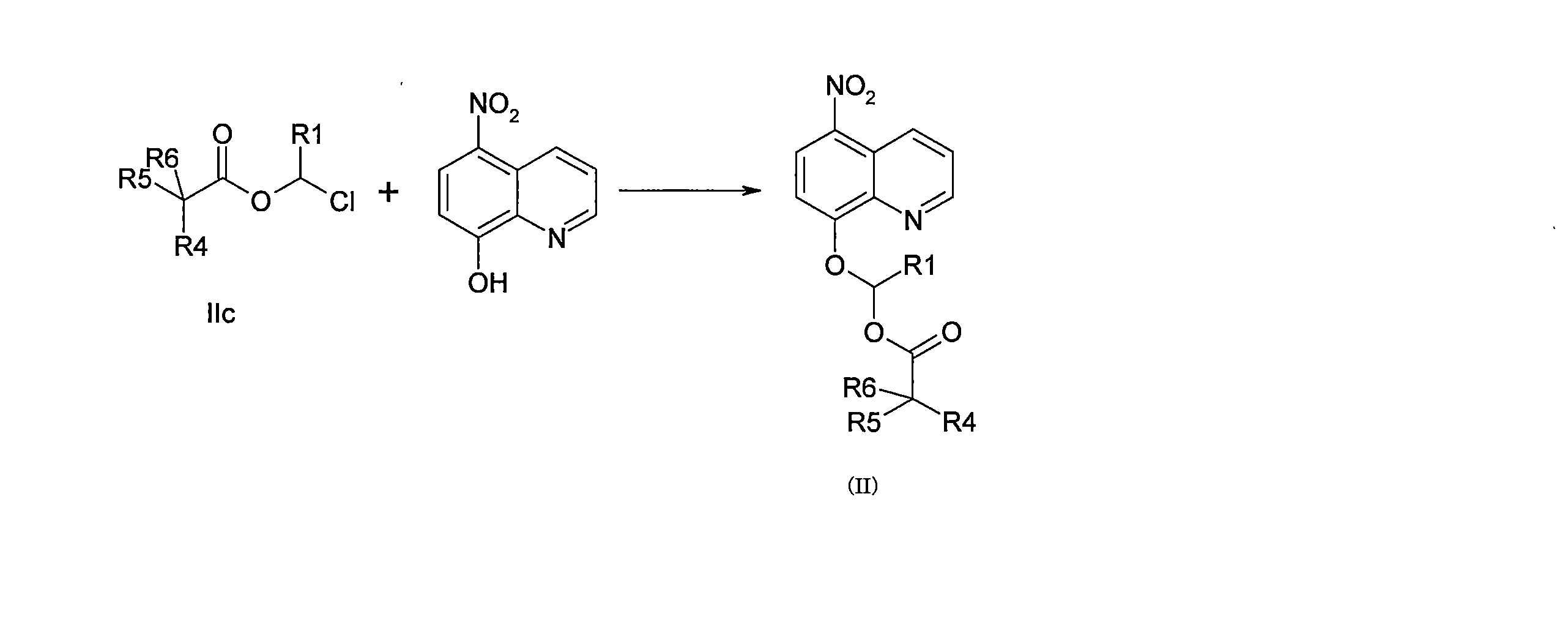
前記アルカリは、好ましくは、炭酸カリウム、炭酸ナトリウム、炭酸水素カリウム、炭酸水素ナトリウム、トリエチルアミン、ピリジンから選ばれ、前記溶媒は、好ましくは、ジクロロメタン、N,N-ジメチルホルムアミド、テトラヒドロフラン、t-ブタノールメチルエーテルから選ばれ、
R1、R4、R5及びR6は一般式(II)において定義されたとおりである。
The present invention further relates to a method for producing the compound represented by formula (II) according to the present invention, or a meso form, racemic form, enantiomer, diastereomer, or mixture thereof, or a pharma- ceutically acceptable salt thereof, the method comprising the steps of:
The alkali is preferably selected from potassium carbonate, sodium carbonate, potassium bicarbonate, sodium bicarbonate, triethylamine, and pyridine, and the solvent is preferably selected from dichloromethane, N,N-dimethylformamide, tetrahydrofuran, and t-butanol methyl ether;
R 1 , R 4 , R 5 and R 6 are as defined in general formula (II).
本発明は、本発明に係る前記式(III)で表される化合物又はそのメソ体、ラセミ体、エナンチオマー、ジアステレオマー、又はこれらの混合物の形態、又はその医薬的に許容可能な塩の製造方法に関し、この製造方法は、

前記アルカリは、好ましくは、炭酸カリウム、炭酸ナトリウム、炭酸水素カリウム、炭酸水素ナトリウム、トリエチルアミン、ピリジンから選ばれ、前記溶媒は、好ましくは、ジクロロメタン、N,N-ジメチルホルムアミド、テトラヒドロフラン、t-ブタノールメチルエーテルから選ばれ、
R4及びR5は一般式(III)において定義されたとおりである。
The present invention relates to a method for producing the compound represented by the formula (III) according to the present invention, or a meso form, racemic form, enantiomer, diastereomer, or mixture thereof, or a pharma- ceutically acceptable salt thereof, the method comprising the steps of:
The alkali is preferably selected from potassium carbonate, sodium carbonate, potassium bicarbonate, sodium bicarbonate, triethylamine, and pyridine, and the solvent is preferably selected from dichloromethane, N,N-dimethylformamide, tetrahydrofuran, and t-butanol methyl ether;
R4 and R5 are as defined in general formula (III).
本発明は、さらに、式(II’)で表される化合物又はそのメソ体、ラセミ体、エナンチオマー、ジアステレオマー、又はこれらの混合物の形態、又はその医薬的に許容可能な塩の製造方法に関し、この製造方法は、
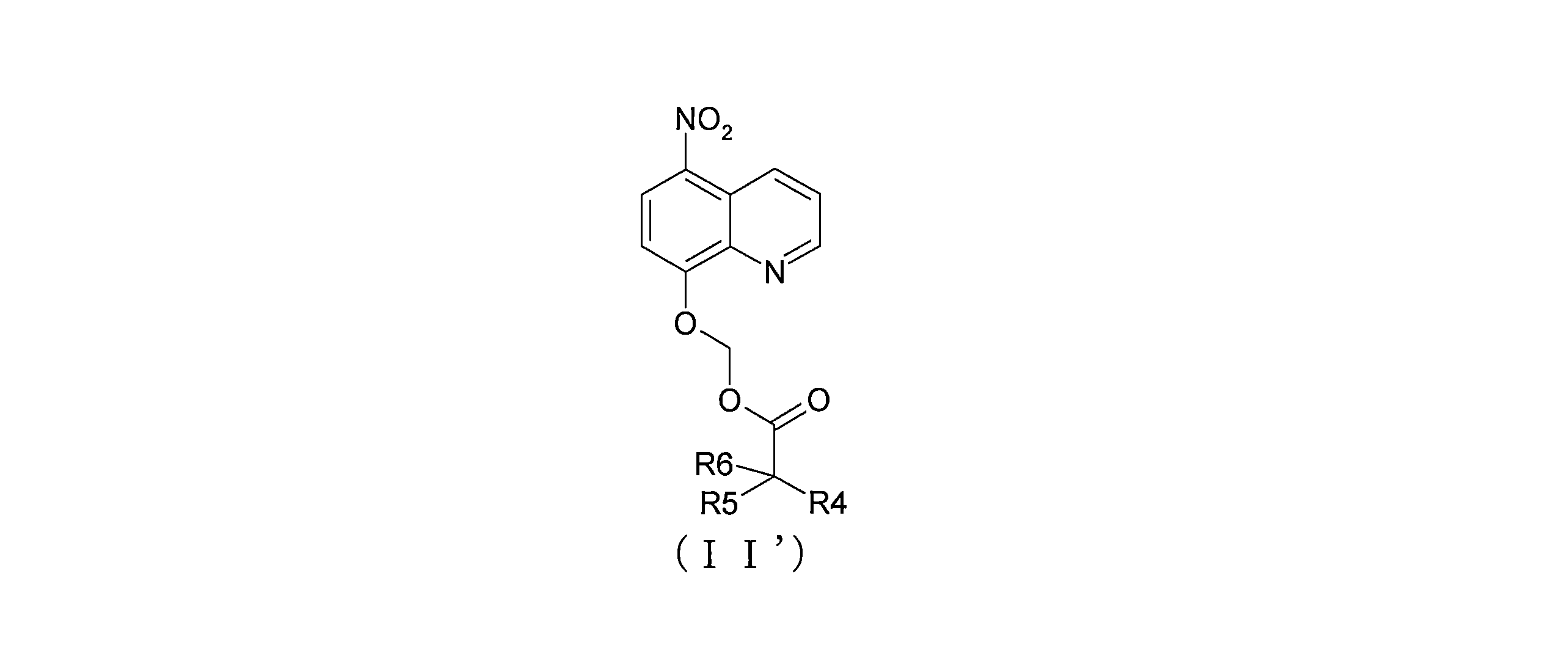
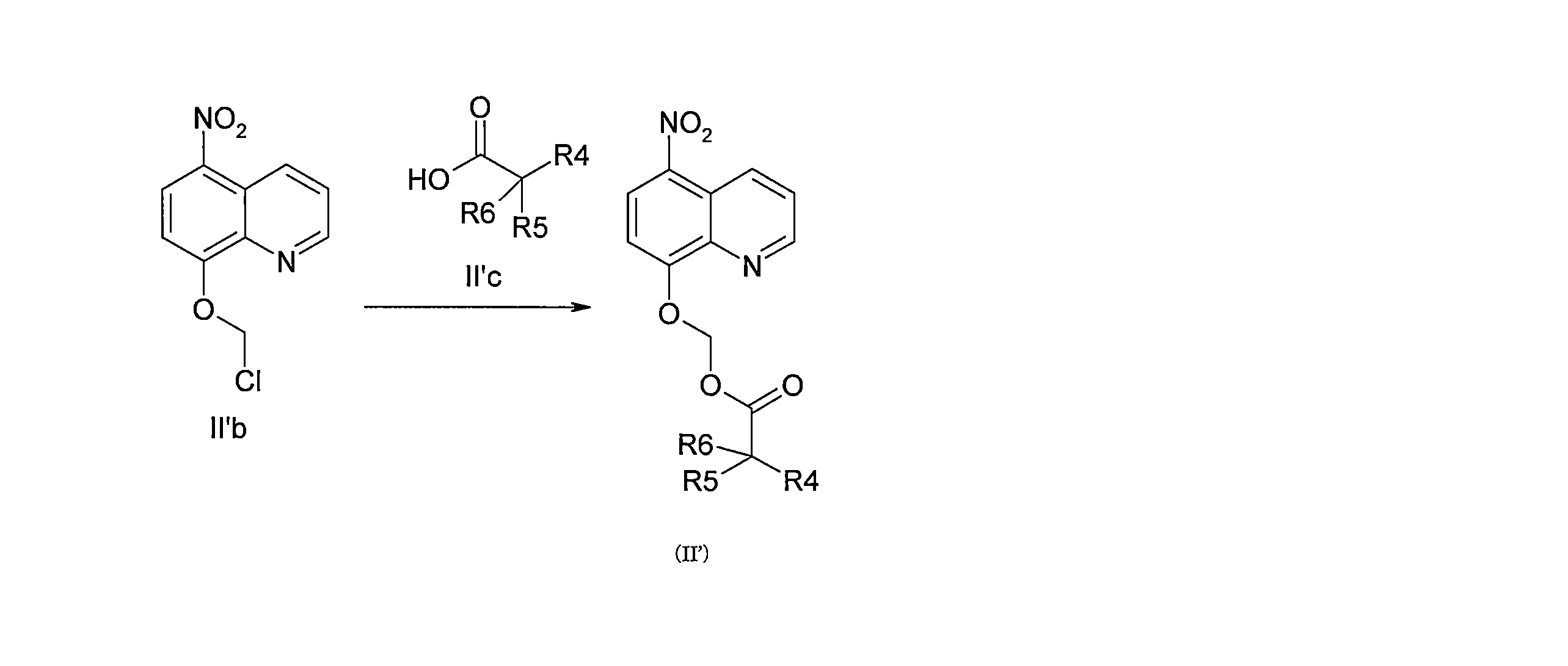
R4、R5及びR6は一般式(II)において定義されたとおりである。
The present invention further relates to a process for preparing a compound of formula (II') or its meso form, racemate, enantiomer, diastereomer or mixture thereof, or a pharma- ceutically acceptable salt thereof, comprising the steps of:
R 4 , R 5 and R 6 are as defined in general formula (II).
本発明は、さらに、式(V’)で表される化合物又はそのメソ体、ラセミ体、エナンチオマー、ジアステレオマー、又はこれらの混合物の形態、又はその医薬的に許容可能な塩の製造方法に関し、この製造方法は、
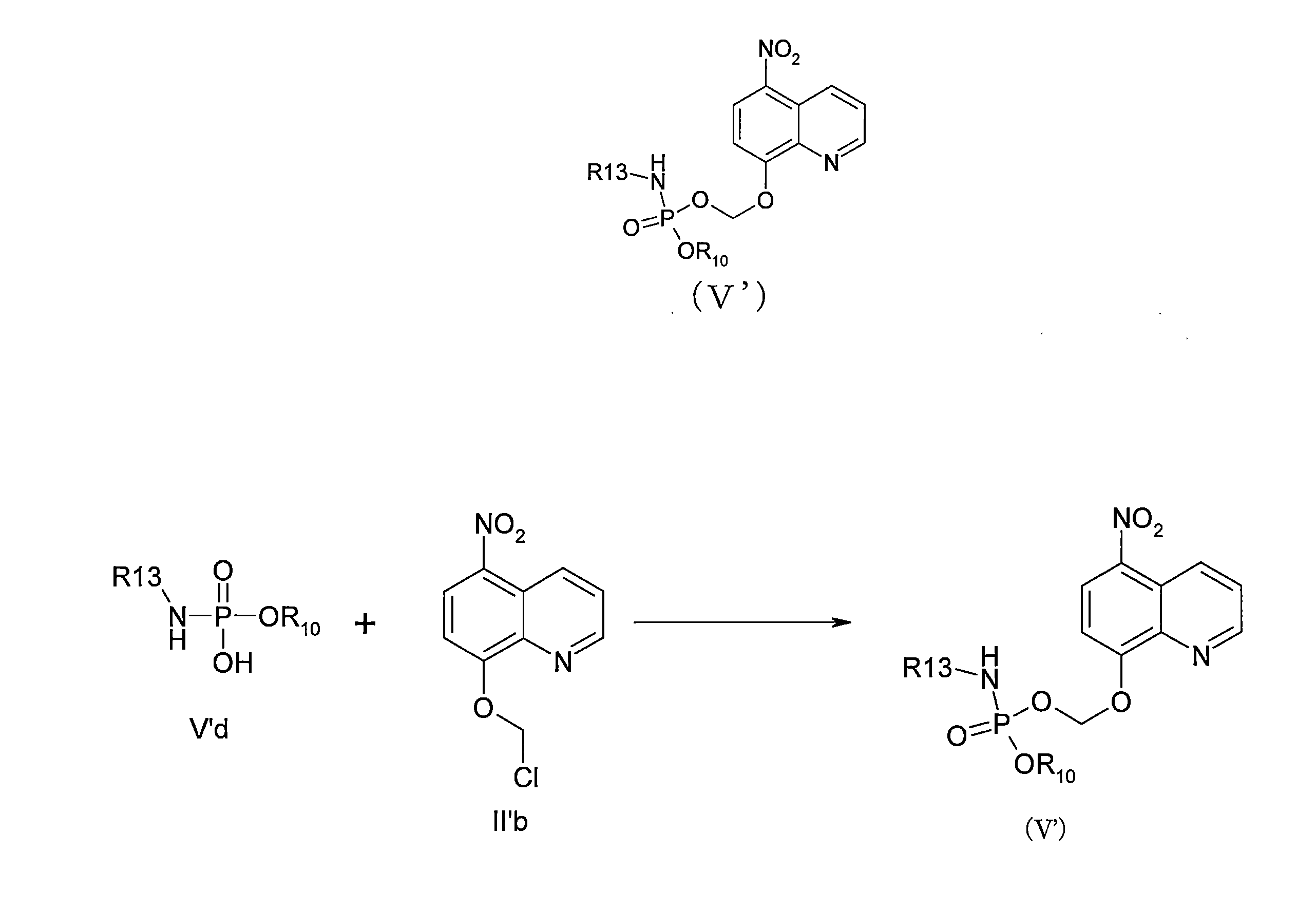
前記アルカリは、好ましくは、炭酸カリウム、炭酸ナトリウム、炭酸水素カリウム、炭酸水素ナトリウム、トリエチルアミン、ピリジンであり、前記溶媒は、好ましくは、ジクロロメタン、N,N-ジメチルホルムアミド、テトラヒドロフラン、t-ブタノールメチルエーテルであり、
R10及びR13は一般式(V)において定義されたとおりである。
The present invention further relates to a process for preparing a compound of formula (V') or its meso form, racemate, enantiomer, diastereomer or mixture thereof, or a pharma- ceutically acceptable salt thereof, comprising the steps of:
The alkali is preferably potassium carbonate, sodium carbonate, potassium hydrogen carbonate, sodium hydrogen carbonate, triethylamine, or pyridine, and the solvent is preferably dichloromethane, N,N-dimethylformamide, tetrahydrofuran, or t-butanol methyl ether;
R 10 and R 13 are as defined in formula (V).
本発明は、さらに、式(V’’)で表される化合物又はそのメソ体、ラセミ体、エナンチオマー、ジアステレオマー、又はこれらの混合物の形態、又はその医薬的に許容可能な塩の製造方法に関し、この製造方法は、

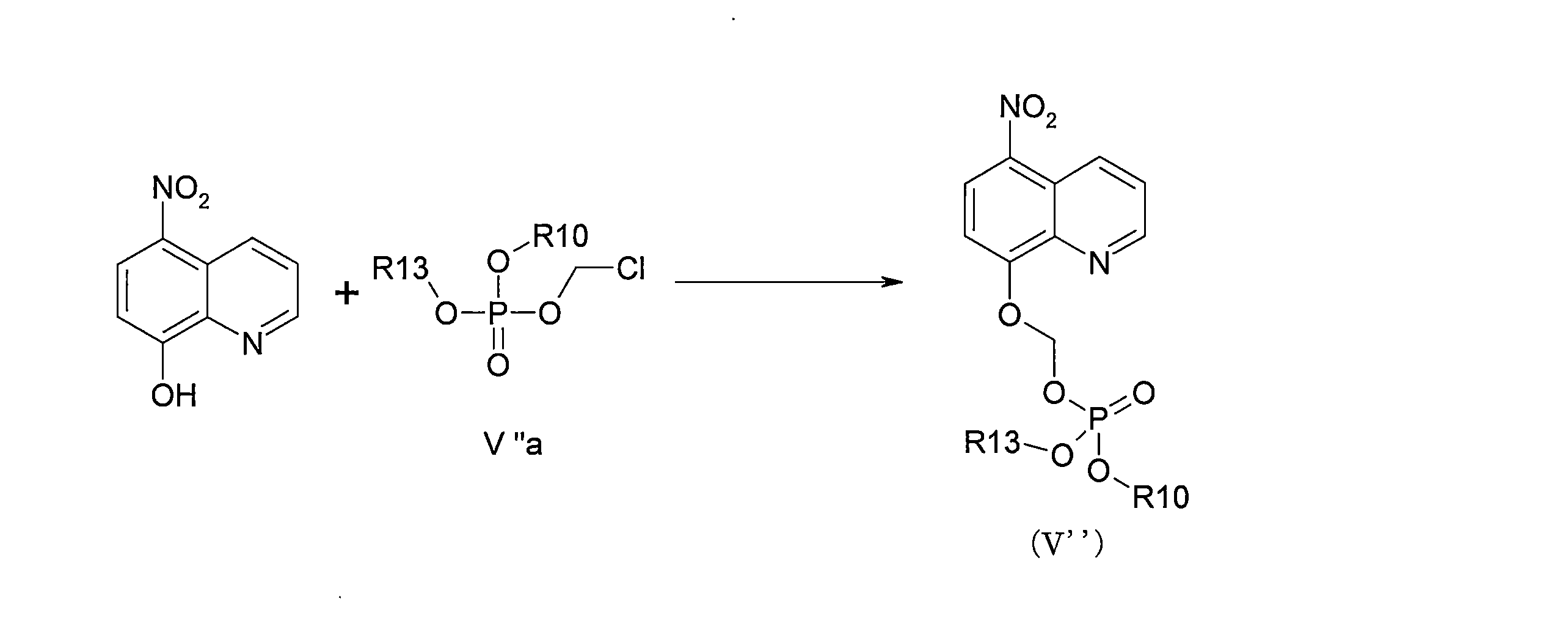
R10及びR13は、一般式(V)において定義されたとおりである。
The present invention further relates to a process for the preparation of a compound of formula (V″) or its meso, racemic, enantiomeric, diastereomeric or mixtures thereof, or a pharma- ceutically acceptable salt thereof, comprising the steps of:
R 10 and R 13 are as defined in general formula (V).
本発明は、さらに、有効成分として本発明に係る一般式(I)で表される化合物、又はそのメソ体、ラセミ体、エナンチオマー、ジアステレオマー、又はそれらの混合体の形態、又はその薬学的に許容可能な塩と、薬学的に許容可能な担体とを含有する医薬組成物に関する。 The present invention further relates to a pharmaceutical composition containing as an active ingredient a compound represented by the general formula (I) according to the present invention, or a meso form, racemic form, enantiomer, diastereomer, or mixture thereof, or a pharma- ceutically acceptable salt thereof, and a pharma- ceutically acceptable carrier.
本発明は、さらに、本発明に係る一般式(I)で表される化合物、又はその内ラセミ体、ラセミ体、エナンチオマー、ジアステレオマー、又はそれらの混合体の形態、又はその薬学的に許容可能な塩、又はそれらを含有する医薬組成物の、抗感染薬及び抗腫瘍薬の製造における使用に関し、前記腫瘍は、膀胱癌、前立腺癌又は腎臓癌であり得る。 The present invention further relates to the use of the compound represented by the general formula (I) according to the present invention, or in the form of a racemate, racemate, enantiomer, diastereomer, or mixture thereof, or a pharma- ceutically acceptable salt thereof, or a pharmaceutical composition containing the same, in the manufacture of an anti-infective and anti-tumor drug, wherein the tumor may be bladder cancer, prostate cancer, or kidney cancer.
本発明の一般式(I)で表される化合物の薬学的に許容可能な塩は、酸付加塩又はアルカリ付加塩であってもよい。酸は、塩酸、硫酸、リン酸、臭化水素酸を含むが、これらに限定されない無機酸;クエン酸、マレイン酸、シュウ酸、ギ酸、酢酸、プロピオン酸、吉草酸、グリコール酸、安息香酸、フマル酸、トリフルオロ酢酸、コハク酸、酒石酸、乳酸、グルタミン酸、アスパラギン酸、サリチル酸、ピルビン酸、メタンスルホン酸、ベンゼンスルホン酸、p-ベンゼンスルホン酸を含むが、これらに限定されない有機酸であってもよい。アルカリは、水酸化ナトリウム、水酸化カリウム、水酸化マグネシウム、水酸化カルシウムを含むが、これらに限定されない無機アルカリ;水酸化アンモニウム、トリエチルアミン、N,N-ジベンジルエチレンジアミン、クロプロカイン、コリン、アンモニア、ジエタノールアミン及びその他のヒドロキシアルキルアミン、エチレンジアミン、N-メチルグルコサミン、プロカイン、N-ベンジルフェネチルアミン、アルギニン又はリジンを含むが、これらに限定されない有機アルカリ;リチウム、カリウム及びナトリウム塩を含むが、これらに限定されないアルカリ金属塩;バリウム、カルシウム及びマグネシウム塩を含むが、これらに限定されないアルカリ土類金属塩;亜鉛塩を含むが、これらに限定されない遷移金属塩;リン酸水素ナトリウム及びリン酸水素二ナトリウムを含むが、これらに限定されない他の金属塩であってもよい。 The pharma- ceutically acceptable salt of the compound represented by general formula (I) of the present invention may be an acid addition salt or an alkali addition salt. The acid may be an inorganic acid, including but not limited to hydrochloric acid, sulfuric acid, phosphoric acid, and hydrobromic acid; or an organic acid, including but not limited to citric acid, maleic acid, oxalic acid, formic acid, acetic acid, propionic acid, valeric acid, glycolic acid, benzoic acid, fumaric acid, trifluoroacetic acid, succinic acid, tartaric acid, lactic acid, glutamic acid, aspartic acid, salicylic acid, pyruvic acid, methanesulfonic acid, benzenesulfonic acid, and p-benzenesulfonic acid. The alkali may be an inorganic alkali, including but not limited to sodium hydroxide, potassium hydroxide, magnesium hydroxide, calcium hydroxide; an organic alkali, including but not limited to ammonium hydroxide, triethylamine, N,N-dibenzylethylenediamine, cloprocaine, choline, ammonia, diethanolamine and other hydroxyalkylamines, ethylenediamine, N-methylglucosamine, procaine, N-benzylphenethylamine, arginine or lysine; an alkali metal salt, including but not limited to lithium, potassium and sodium salts; an alkaline earth metal salt, including but not limited to barium, calcium and magnesium salts; a transition metal salt, including but not limited to zinc salts; or another metal salt, including but not limited to sodium hydrogen phosphate and disodium hydrogen phosphate.
本発明の別の態様は、一般式(I)で表される化合物又はその薬学的に許容可能な塩を、臨床的に使用可能な医薬組成物として製造する。臨床適応症、投与経路及び方式によって、その薬用製剤には、錠剤、ゲル剤、ソフト/ハードカプセル、乳剤、分散性粉剤、顆粒剤、水/油懸濁乳剤などの経口製剤;静脈注射剤、筋肉注射剤、腹腔注射剤、直腸投与坐剤、頭蓋内注射剤を含み、これらの剤型は水溶液でも油類溶液でもよい注射剤;クリーム剤、軟膏剤、ゲル剤、水/油剤及び包接化合物製剤を含む局部製剤;微粉末、液体エアロゾル及び体内移植に適した各種剤型を含む吸入剤型が含まれるが、これらに限定されない。 Another aspect of the present invention is to prepare a compound represented by general formula (I) or a pharma- ceutically acceptable salt thereof as a clinically usable pharmaceutical composition. Depending on the clinical indication, route and mode of administration, the pharmaceutical preparations include, but are not limited to, oral preparations such as tablets, gels, soft/hard capsules, emulsions, dispersible powders, granules, and water/oil suspension emulsions; injections including intravenous injections, intramuscular injections, intraperitoneal injections, rectal suppositories, and intracranial injections, which may be in the form of aqueous or oily solutions; topical preparations including creams, ointments, gels, water/oil solutions, and inclusion compound preparations; and inhalation preparations including fine powders, liquid aerosols, and various forms suitable for implantation.
有効成分を含む医薬組成物は、錠剤、糖衣錠、トローチ、水又は油懸濁液、分散可能な粉末又は顆粒、乳液、ハード又はソフトカプセル、又はシロップ剤又はエリキシル剤など、経口投与に適した形態とすることができる。経口組成物はその分野で既知の任意の医薬組成物の製造方法に従って製造することができ、このような組成物は、外観性がよいとともに、味がより優しい薬用製剤を提供するように、甘味剤、矯味剤、着色剤及び防腐剤から選択される1種又は複数種の成分を含有していてもよい。錠剤は、有効成分と、錠剤を製造するのに適した混合用の非毒性の薬用賦形剤とを含有する。これらの賦形剤は、炭酸カルシウム、炭酸ナトリウム、乳糖、リン酸カルシウム又はリン酸ナトリウムなどの不活性賦形剤;微結晶セルロース、架橋カルボキシメチルセルロースナトリウム、コーンスターチ又はアルギン酸などの造粒剤及び崩壊剤;デンプン、ゼラチン、ポリビニルピロリドン又はアラビアガムなどのバインダー;ステアリン酸マグネシウム、ステアリン酸又はタルクなどの潤滑剤であってもよい。これらの錠剤は、コーティングしなくてもよく、又は、薬剤の味をマスキングする、又は胃腸管での崩壊及び吸収を遅らせることにより、より長い期間にわたって徐放作用を提供する既知の技術によってコーティングすることができる。たとえば、ヒドロキシプロピルメチルセルロース又はヒドロキシプロピルセルロースなどの水溶性味マスキング物質、又はエチルセルロース、酢酸ブチレートセルロースなどの作用時間延長物質を使用することができる。 The pharmaceutical composition containing the active ingredient may be in a form suitable for oral administration, such as tablets, dragees, lozenges, aqueous or oil suspensions, dispersible powders or granules, emulsions, hard or soft capsules, or syrups or elixirs. Oral compositions may be prepared according to any method for preparing pharmaceutical compositions known in the art, and such compositions may contain one or more ingredients selected from sweeteners, flavoring agents, coloring agents, and preservatives to provide a medicinal preparation with good appearance and a milder taste. Tablets contain the active ingredient and non-toxic pharmaceutical excipients suitable for mixing to manufacture tablets. These excipients may be inert excipients such as calcium carbonate, sodium carbonate, lactose, calcium phosphate, or sodium phosphate; granulating and disintegrating agents such as microcrystalline cellulose, cross-linked sodium carboxymethylcellulose, corn starch, or alginic acid; binders such as starch, gelatin, polyvinylpyrrolidone, or gum arabic; and lubricants such as magnesium stearate, stearic acid, or talc. These tablets may be uncoated or may be coated by known techniques to provide a sustained release action over a longer period by masking the taste of the drug or by delaying disintegration and absorption in the gastrointestinal tract. For example, water-soluble taste-masking substances such as hydroxypropylmethylcellulose or hydroxypropylcellulose, or time-extending substances such as ethylcellulose, cellulose acetate butyrate, etc. may be used.
有効成分が炭酸カルシウム、リン酸カルシウム又はカオリンなどの不活性固体希釈剤と混合されたハードゼラチンカプセル、又は有効成分がポリエチレングリコールなどの水溶性担体又は落花生油、流動パラフィン又はオリーブ油などの油溶媒と混合されたソフトゼラチンカプセルとして経口製剤を提供することもできる。 Oral formulations can also be provided as hard gelatin capsules in which the active ingredient is mixed with an inert solid diluent such as calcium carbonate, calcium phosphate or kaolin, or as soft gelatin capsules in which the active ingredient is mixed with a water-soluble carrier such as polyethylene glycol or an oil solvent such as peanut oil, liquid paraffin or olive oil.
水懸濁液は、活性物質と、水懸濁液を製造するのに適した混合用の賦形剤とを含有する。このような賦形剤は、カルボキシメチルセルロースナトリウム、メチルセルロース、ヒドロキシプロピルメチルセルロース、アルギン酸ナトリウム、ポリビニルピロリドン及びアラビアガムなどの懸濁剤;天然に産生されるリン脂質たとえばレシチン、又はアルキレンオキシドと脂肪酸との縮合物、たとえばポリオキシエチレンステアリン酸エステル、又はエチレンオキシドと長鎖脂肪族アルコールとの縮合物、たとえばヘプタデカエチレンオキシセタノール(heptadecaethyleneoxy cetanol)、又はエチレンオキシドと脂肪酸とヘキシリトールとから誘導される部分エステルとの縮合物、たとえばポリオキシエチレンソルビトールモノオレエート、又は、エチレンオキサイドと脂肪酸とヘキシリトール無水物とから誘導されるメタエステルとの縮合物、たとえばポリオキシエチレンソルビタンモノオレエートなどの分散剤又は保湿剤である。水懸濁液はまた、エチルパラベン又はn-プロピルパラベンなどの1つ又は複数の防腐剤、1つ又は複数の着色剤、1つ又は複数の矯味剤、及びショ糖、サッカリン又はアスパルタンなどの1つ又は複数の甘味剤を含むことができる。 Aqueous suspensions contain the active substance and excipients suitable for mixing to produce aqueous suspensions. Such excipients are suspending agents such as sodium carboxymethylcellulose, methylcellulose, hydroxypropylmethylcellulose, sodium alginate, polyvinylpyrrolidone and gum arabic; dispersing or humectants such as naturally occurring phospholipids, for example lecithin, or condensates of alkylene oxides with fatty acids, for example polyoxyethylene stearates, or condensates of ethylene oxide with long-chain aliphatic alcohols, for example heptadecaethyleneoxy cetanol, or condensates of ethylene oxide with partial esters derived from fatty acids and hexylitol, for example polyoxyethylene sorbitol monooleate, or condensates of ethylene oxide with meta-esters derived from fatty acids and hexylitol anhydrides, for example polyoxyethylene sorbitan monooleate. Aqueous suspensions may also contain one or more preservatives, such as ethylparaben or n-propylparaben, one or more coloring agents, one or more flavoring agents, and one or more sweetening agents, such as sucrose, saccharin, or aspartane.
油懸濁液は、落花生油、オリーブ油、ごま油、又はココナッツ油などの植物油、又は流動パラフィンなどの鉱物油に有効成分を懸濁させて調製することができる。油懸濁液は、ミツロウ、ハードパラフィン、又はセチルアルコールなどの増粘剤を含んでいてもよい。また、上記甘味剤及び矯味剤を添加することにより、味がよい製剤を提供することができる。これらの組成物は、ブチルアニール又はα-トコフェロールなどの抗酸化剤を添加することにより保存することができる。 Oily suspensions can be prepared by suspending the active ingredient in a vegetable oil, such as peanut oil, olive oil, sesame oil, or coconut oil, or in a mineral oil, such as liquid paraffin. The oily suspensions may contain a thickening agent, such as beeswax, hard paraffin, or cetyl alcohol. In addition, sweetening and flavoring agents as mentioned above can be added to provide a palatable preparation. These compositions can be preserved by the addition of an antioxidant, such as butyl ether or alpha-tocopherol.
水懸濁液の製造に適した分散可能な粉末及び顆粒は、水を加えることにより、有効成分と、混合用の分散剤又は湿潤剤、懸濁剤、又は1つ又は複数の防腐剤とを提供することができる。好適な分散剤又は湿潤剤及び懸濁剤は上記の通りである。甘味剤、矯味剤、及び着色剤などの他の賦形剤も添加することができる。これらの組成物は、抗酸化剤、たとえばアスコルビン酸を添加することにより保存される。 Dispersible powders and granules suitable for preparation of a water suspension can be prepared by the addition of water to provide the active ingredient with a dispersing or wetting agent for mixing, a suspending agent, or one or more preservatives. Suitable dispersing or wetting agents and suspending agents are as described above. Other excipients, such as sweetening, flavoring and coloring agents, can also be added. These compositions are preserved by the addition of an antioxidant, for example ascorbic acid.
本発明の医薬組成物は、水中油型エマルションの形態であってもよい。油相は、オリーブ油、落花生油などの植物油、又は流動パラフィンなどの鉱物油又はこれらの混合物であってもよい。好適な乳化剤は、大豆レシチンなどの天然由来のリン脂質、ソルビタンモノオレエートなどの脂肪酸とヘキシリトール無水物から誘導されるエステル又はメタエステル、及び前記メタエステルとエチレンオキシドとの縮合物、たとえばポリエチレンオキシドソルビトールモノオレエートであってもよい。乳剤には、甘味剤、矯味剤、防腐剤、及び抗酸化剤も含まれていてもよい。グリセリン、プロピレングリコール、ソルビトール、又はショ糖などの甘味剤を用いて調製したシロップやエリキシル剤を使用することができる。このような製剤には、緩和剤、防腐剤、着色剤、及び抗酸化剤も含まれていてもよい。 The pharmaceutical compositions of the invention may be in the form of oil-in-water emulsions. The oil phase may be a vegetable oil, such as olive oil, peanut oil, or a mineral oil, such as liquid paraffin, or a mixture thereof. Suitable emulsifiers may be naturally occurring phospholipids, such as soybean lecithin, esters or metaesters derived from fatty acids and hexylitol anhydrides, such as sorbitan monooleate, and condensation products of said metaesters with ethylene oxide, for example polyethylene oxide sorbitol monooleate. The emulsions may also contain sweeteners, flavorings, preservatives, and antioxidants. Syrups and elixirs prepared with sweeteners, such as glycerin, propylene glycol, sorbitol, or sucrose, may be used. Such formulations may also contain emollients, preservatives, coloring agents, and antioxidants.
本発明の医薬組成物は、無菌注射水溶液の形態であってもよい。使用できる許容可能な溶媒と溶剤としては、水、リンゲル液や等張塩化ナトリウム溶液がある。無菌注射製剤は、有効成分が油相に溶解した無菌注射水中油型マイクロエマルジョンであってもよい。たとえば、有効成分を大豆油とレシチンとの混合物に溶解する。その後、水とグリセリンとの混合物に油溶液を加えて処理し、マイクロエマルションを形成する。注射液又はマイクロエマルションは、局所的に大量に注射することにより、患者の血流に注入することができる。あるいは、溶液及びマイクロエマルジョンは、本発明の化合物の循環濃度を一定に保つように投与することが好ましい。この濃度を一定に保つためには連続静脈内薬物送達装置が使用できる。 The pharmaceutical compositions of the invention may be in the form of a sterile injectable aqueous solution. Acceptable solvents and vehicles that may be used include water, Ringer's solution, and isotonic sodium chloride solution. The sterile injectable formulation may be a sterile injectable oil-in-water microemulsion in which the active ingredient is dissolved in the oil phase. For example, the active ingredient is dissolved in a mixture of soybean oil and lecithin. A mixture of water and glycerin is then treated with the oil solution to form the microemulsion. The injectable solution or microemulsion may be injected into the patient's bloodstream by localized large volume injection. Alternatively, the solutions and microemulsions are preferably administered to maintain a constant circulating concentration of the compound of the invention. A continuous intravenous drug delivery device may be used to maintain this concentration.
本発明の医薬組成物は、筋内及び皮下投与のための無菌注射水又は油懸濁液の形態であってもよい。この懸濁液は、公知の技術により、上記の適切な分散剤又は湿潤剤及び懸濁剤を用いて製造することができる。無菌注射製剤はまた、たとえば1,3-ブタンジオール中で製造された溶液のような、毒性のない胃腸外で許容可能な希釈剤又は溶媒中で製造された無菌注射溶液又は懸濁液であってもよい。さらに、無菌固定化油を溶媒又は懸濁媒体として用いることも容易である。この目的のために、合成グリセリンモノ又はジエステルを含む任意の調合固定化油を使用することができる。さらに、オレイン酸などの脂肪酸も注射剤とすることができる。 The pharmaceutical composition of the present invention may be in the form of a sterile injectable aqueous or oily suspension for intramuscular and subcutaneous administration. The suspension may be prepared by known techniques using suitable dispersing or wetting agents and suspending agents as mentioned above. The sterile injectable preparation may also be a sterile injectable solution or suspension prepared in a non-toxic, extra-gastrointestinal acceptable diluent or solvent, such as a solution prepared in 1,3-butanediol. In addition, it is easy to use sterile fixed oils as a solvent or suspending medium. For this purpose, any formulated fixed oil may be used, including synthetic glycerin mono- or diesters. In addition, fatty acids such as oleic acid may also be injectable.
本発明の化合物は、直腸投与用の坐剤の形態で投与することができる。これらの医薬組成物は、通常の温度では固体であるが直腸内では液体であり、したがって、直腸内では溶解して薬物を放出する適切な非刺激性賦形剤と混合することによって製造することができる。このような物質には、カカオバター、グリセリンゼラチン、水素添加植物油、さまざまな分子量のポリエチレングリコール、及びポリエチレングリコールの脂肪酸エステルの混合物が含まれている。 The compounds of the present invention can be administered in the form of suppositories for rectal administration. These pharmaceutical compositions can be prepared by mixing with a suitable non-irritating excipient that is solid at normal temperatures but liquid in the rectum and therefore will melt in the rectum to release the drug. Such materials include cocoa butter, glycerinated gelatin, hydrogenated vegetable oils, polyethylene glycols of various molecular weights, and mixtures of fatty acid esters of polyethylene glycol.
当業者に公知のように、薬物の投与量は、使用する具体的な化合物の活性、患者の年齢、患者の体重、患者の健康状況、患者の行為、患者の飲食、投与時間、投与方式、排泄の速度、薬物の組み合わせなどを含むが、これらに限定されない複数の要素に依存しており、また、治療のパターン、本発明の化合物の1日の用量又は薬用可能な塩の種類などの最適な治療方法は、従来の治療プロトコルに基づいて検証することができる。 As known to those skilled in the art, the dosage of a drug depends on several factors, including but not limited to the activity of the specific compound used, the patient's age, the patient's weight, the patient's health condition, the patient's behavior, the patient's eating and drinking, the administration time, the administration method, the rate of excretion, the combination of drugs, etc., and the optimal treatment method, such as the treatment pattern, the daily dose of the compound of the present invention or the type of medicinal salt, can be verified based on conventional treatment protocols.
本発明は、一般式(I)で表される化合物、及びその薬学的に許容可能な塩、水和物又は溶媒和物を有効成分として含有し、薬学的に許容可能な担体又は賦形剤と混合して組成物を製造し、臨床的に許容可能な剤型に製造することができる。本発明の誘導体は、アレルギー反応等の他の好ましくない作用を生じない限り、他の有効成分と組み合わせて使用することができる。本発明の化合物は、唯一の有効成分として、又は他の治療及び他の薬物と組み合わせて使用することができる。併用治療は各治療成分を同時に、別々に又はいは相次いで投与することによって実現する。 The present invention contains a compound represented by general formula (I) and its pharma- ceutically acceptable salts, hydrates or solvates as active ingredients, which can be mixed with pharma- ceutically acceptable carriers or excipients to prepare compositions and be prepared in clinically acceptable dosage forms. The derivatives of the present invention can be used in combination with other active ingredients, so long as they do not cause other undesirable effects, such as allergic reactions. The compounds of the present invention can be used as the sole active ingredient or in combination with other treatments and other drugs. Combination treatments can be achieved by administering each treatment component simultaneously, separately or successively.
反対の記載がない限り、明細書及び特許請求の範囲に使用される用語は下記定義を有する。 Unless stated to the contrary, terms used in the specification and claims have the following definitions.
用語「アルキル基」とは飽和脂肪族炭化水素基を指し、1~20個の炭素原子を含む直鎖又は分岐基、好ましくは、1~12個の炭素原子を含有するアルキル基、より好ましくは、1~6個の炭素原子を含有するアルキル基である。非限定的な例には、メチル基、エチル基、n-プロピル基、イソプロピル基、n-ブチル基、イソブチル基、t-ブチル基、s-ブチル基、n-ペンチル基、1,1-ジメチルプロピル基、1,2-ジメチルプロピル基、2,2-ジメチルプロピル基、1-エチルプロピル基、2-メチルブチル基、3-メチルブチル基、n-ヘキシル基、1-エチル-2-メチルプロピル基、1,1,2-トリメチルプロピル基、1,1-ジメチルブチル基、1,2-ジメチルブチル基、2,2-ジメチルブチル基、1,3-ジメチルブチル基、2-エチルブチル基、2-メチルペンチル基、3-メチルペンチル基、4-メチルペンチル基、2,3-ジメチルブチル基、n-ヘプチル基、2-メチルヘキシル基、3-メチルヘキシル基、4-メチルヘキシル基、5-メチルヘキシル基、2,3-ジメチルペンチル基、2,4-ジメチルペンチル基、2,2-ジメチルペンチル基、3,3-ジメチルペンチル基、2-エチルペンチル基、3-エチルペンチル基、n-オクチル基、2,3-ジメチルヘキシル基、2,4-ジメチルヘキシル基、2,5-ジメチルヘキシル基、2,2-ジメチルヘキシル基、3,3-ジメチルヘキシル基、4,4-ジメチルヘキシル基、2-エチルヘキシル基、3-エチルヘキシル基、4-エチルヘキシル基、2-メチル-2-エチルペンチル基、2-メチル-3-エチルペンチル基、n-ノニル基、2-メチル-2-エチルヘキシル基、2-メチル-3-エチルヘキシル基、2,2-ジエチルペンチル基、n-デシル基、3,3-ジエチルヘキシル基、2,2-ジエチルヘキシル基、及びこれらの各種の分岐異性体などを含む。より好ましくは、1~6個の炭素原子を含有する低級アルキル基であり、非限定的な実施例は、メチル基、エチル基、n-プロピル基、イソプロピル基、n-ブチル基、イソブチル基、t-ブチル基、s-ブチル基、n-ペンチル基、1,1-ジメチルプロピル基、1,2-ジメチルプロピル基、2,2-ジメチルプロピル基、1-エチルプロピル基、2-メチルブチル基、3-メチルブチル基、n-ヘキシル基、1-エチル-2-メチルプロピル基、1,1,2-トリメチルプロピル基、1,1-ジメチルブチル基、1,2-ジメチルブチル基、2,2-ジメチルブチル基、1,3-ジメチルブチル基、2-エチルブチル基、2-メチルペンチル基、3-メチルペンチル基、4-メチルペンチル基、2,3-ジメチルブチルなどを含む。アルキル基は置換又は非置換のものであってもよく、置換された場合、置換基は任意の使用可能な連結点上で置換されてもよく、前記置換基は、好ましくは、アルキル基、アルケニル基、アルキニル基、アルコキシ基、アルキルチオ基、アルキルアミノ基、ハロゲン、メルカプト基、ヒドロキシ基、ニトロ基、シアノ基、シクロアルキル基、ヘテロシクロアルキル基、アリール基、ヘテロアリール基、シクロアルコキシ基、ヘテロシクロアルコキシ基、シクロアルキルチオ基、ヘテロシクロアルキルチオ基、オキソ基、カルボキシ基又はギ酸エステル基から独立して選ばれる1つ又は複数の基であってもよい。 The term "alkyl group" refers to a saturated aliphatic hydrocarbon group, a straight or branched group containing 1 to 20 carbon atoms, preferably an alkyl group containing 1 to 12 carbon atoms, and more preferably an alkyl group containing 1 to 6 carbon atoms. Non-limiting examples include methyl, ethyl, n-propyl, isopropyl, n-butyl, isobutyl, t-butyl, s-butyl, n-pentyl, 1,1-dimethylpropyl, 1,2-dimethylpropyl, 2,2-dimethylpropyl, 1-ethylpropyl, 2-methylbutyl, 3-methylbutyl, n-hexyl, 1-ethyl-2-methylpropyl, 1,1,2-trimethylpropyl, 1,1-dimethylbutyl, 1,2-dimethylbutyl, 2,2-dimethylbutyl, 1,3-dimethylbutyl, 2-ethylbutyl, 2-methylpentyl, 3-methylpentyl, 4-methylpentyl, 2,3-dimethylbutyl, n-heptyl, 2-methylhexyl, 3-methylhexyl, 4-methylhexyl, 5-methylhexyl, Examples of such groups include 2,3-dimethylpentyl, 2,4-dimethylpentyl, 2,2-dimethylpentyl, 3,3-dimethylpentyl, 2-ethylpentyl, 3-ethylpentyl, n-octyl, 2,3-dimethylhexyl, 2,4-dimethylhexyl, 2,5-dimethylhexyl, 2,2-dimethylhexyl, 3,3-dimethylhexyl, 4,4-dimethylhexyl, 2-ethylhexyl, 3-ethylhexyl, 4-ethylhexyl, 2-methyl-2-ethylpentyl, 2-methyl-3-ethylpentyl, n-nonyl, 2-methyl-2-ethylhexyl, 2-methyl-3-ethylhexyl, 2,2-diethylpentyl, n-decyl, 3,3-diethylhexyl, 2,2-diethylhexyl, and various branched isomers thereof. More preferred are lower alkyl groups containing 1 to 6 carbon atoms, non-limiting examples include methyl, ethyl, n-propyl, isopropyl, n-butyl, isobutyl, t-butyl, s-butyl, n-pentyl, 1,1-dimethylpropyl, 1,2-dimethylpropyl, 2,2-dimethylpropyl, 1-ethylpropyl, 2-methylbutyl, 3-methylbutyl, n-hexyl, 1-ethyl-2-methylpropyl, 1,1,2-trimethylpropyl, 1,1-dimethylbutyl, 1,2-dimethylbutyl, 2,2-dimethylbutyl, 1,3-dimethylbutyl, 2-ethylbutyl, 2-methylpentyl, 3-methylpentyl, 4-methylpentyl, 2,3-dimethylbutyl, and the like. The alkyl group may be substituted or unsubstituted, and if substituted, the substituent may be substituted on any available attachment point, and the substituent may be preferably one or more groups independently selected from an alkyl group, an alkenyl group, an alkynyl group, an alkoxy group, an alkylthio group, an alkylamino group, a halogen, a mercapto group, a hydroxy group, a nitro group, a cyano group, a cycloalkyl group, a heterocycloalkyl group, an aryl group, a heteroaryl group, a cycloalkoxy group, a heterocycloalkoxy group, a cycloalkylthio group, a heterocycloalkylthio group, an oxo group, a carboxy group, or a formate group.
用語「アルケニル基」とは少なくとも2つの炭素原子と少なくとも1つの炭素-炭素二重結合とからなる以上で定義されたようなアルキル基を指し、たとえばビニル基、1-プロペニル基、2-プロペニル基、1-、2-又は3-ブテニル基などである。アルケニル基は置換又は非置換のものであってもよく、置換された場合、置換基は、好ましくは、アルキル基、アルケニル基、アルキニル基、アルコキシ基、アルキルチオ基、アルキルアミノ基、ハロゲン、メルカプト基、ヒドロキシ基、ニトロ基、シアノ基、シクロアルキル基、ヘテロシクロアルキル基、アリール基、ヘテロアリール基、シクロアルコキシ基、ヘテロシクロアルコキシ基、シクロアルキルチオ基、ヘテロシクロアルキルチオ基から独立して選ばれる1つ又は複数の基である。 The term "alkenyl group" refers to an alkyl group as defined above consisting of at least two carbon atoms and at least one carbon-carbon double bond, such as vinyl, 1-propenyl, 2-propenyl, 1-, 2- or 3-butenyl. An alkenyl group may be substituted or unsubstituted, and if substituted, the substituents are preferably one or more groups independently selected from alkyl, alkenyl, alkynyl, alkoxy, alkylthio, alkylamino, halogen, mercapto, hydroxy, nitro, cyano, cycloalkyl, heterocycloalkyl, aryl, heteroaryl, cycloalkoxy, heterocycloalkoxy, cycloalkylthio, and heterocycloalkylthio groups.
用語「アルキニル基」とは少なくとも2つの炭素原子と少なくとも1つの炭素-炭素三重結合とからなる以上で定義されたようなアルキル基を指し、たとえばエチニル基、プロピニル基、ブチニル基などである。アルキニル基は置換又は非置換のものであってもよく、置換された場合、置換基は、好ましくは、アルキル基、アルケニル基、アルキニル基、アルコキシ基、アルキルチオ基、アルキルアミノ基、ハロゲン、メルカプト基、ヒドロキシ基、ニトロ基、シアノ基、シクロアルキル基、ヘテロシクロアルキル基、アリール基、ヘテロアリール基、シクロアルコキシ基、ヘテロシクロアルコキシ基、シクロアルキルチオ基、ヘテロシクロアルキルチオ基から独立して選ばれる1つ又は複数の基である。 The term "alkynyl group" refers to an alkyl group as defined above consisting of at least two carbon atoms and at least one carbon-carbon triple bond, such as ethynyl, propynyl, butynyl, etc. An alkynyl group may be substituted or unsubstituted, and if substituted, the substituents are preferably one or more groups independently selected from alkyl, alkenyl, alkynyl, alkoxy, alkylthio, alkylamino, halogen, mercapto, hydroxy, nitro, cyano, cycloalkyl, heterocycloalkyl, aryl, heteroaryl, cycloalkoxy, heterocycloalkoxy, cycloalkylthio, and heterocycloalkylthio groups.
用語「シクロアルキル基」とは飽和又は部分不飽和の単環又は多環式環状炭化水素置換基であり、シクロアルキル環は3~20個の炭素原子、好ましくは、3~12個の炭素原子、より好ましくは、3~6個の炭素原子を含む。単環式シクロアルキル基の非限定的な例は、シクロプロピル基、シクロブチル基、シクロペンチル基、シクロペンテニル基、シクロヘキシル、シクロヘキセニル基、シクロヘキサジエニル基、シクロヘプチル基、シクロヘプタトリエニル基、シクロオクチル基などを含み、多環式シクロアルキル基はスピロ環、縮合環及び架橋環のシクロアルキル基を含む。 The term "cycloalkyl group" refers to a saturated or partially unsaturated monocyclic or polycyclic cyclic hydrocarbon substituent, where the cycloalkyl ring contains 3 to 20 carbon atoms, preferably 3 to 12 carbon atoms, more preferably 3 to 6 carbon atoms. Non-limiting examples of monocyclic cycloalkyl groups include cyclopropyl, cyclobutyl, cyclopentyl, cyclopentenyl, cyclohexyl, cyclohexenyl, cyclohexadienyl, cycloheptyl, cycloheptatrienyl, cyclooctyl, etc., and polycyclic cycloalkyl groups include spiro, fused, and bridged cycloalkyl groups.
用語「スピロシクロアルキル基」とは5~20員の単環間で1つの炭素原子(スピロ原子という)を共有する多環基を指し、1つ又は複数の二重結合を含有してもよいが、完全に共役したπ電子系を有する環は1つもない。好ましくは、6~14員、より好ましくは、7~10員である。スピロシクロアルキル基は、環と環との間で共有するスピロ原子の数によって、モノスピロシクロアルキル基、ビススピロシクロアルキル基又はポリスピロシクロアルキル基に分けられ、好ましくは、モノスピロシクロアルキル基とビススピロシクロアルキル基である。より好ましくは、4員/4員、4員/5員、4員/6員、5員/5員又は5員/6員のモノスピロシクロアルキル基である。スピロシクロアルキル基の非限定的な例は以下のものを含む。

用語「縮合シクロアルキル基」とは、系中の各環と系中の他の環とが隣接する一対の炭素原子を共有する5~20員の全炭素多環基を指し、ここで、1つ又は複数の環は1つ又は複数の二重結合を含有することができるが、完全に共役したπ電子系を有する環は1つもない。好ましくは、6~14員、より好ましくは、7~10員である。構成する環の数によって二環、三環、四環又は多環式縮合シクロアルキル基に分けることができ、好ましくは、二環又は三環、より好ましくは、5員/5員又は5員/6員のビスシクロアルキル基である。縮合シクロアルキル基の非限定的な例は以下のものを含む。

用語「架橋シクロアルキル基」とは、任意の2つの環が直接連結していない2つの炭素原子を共有する5~20員の全炭素多環基を指し、1つ又は複数の二重結合を含有することができるが、完全に共役したπ電子系を有する環は1つもない。好ましくは、6~14員、より好ましくは、7~10員である。構成する環の数によって二環、三環、四環又は多環架橋シクロアルキル基に分けることができ、好ましくは、二環、三環又は四環、より好ましくは、二環又は三環である。架橋シクロアルキル基の非限定的な例は以下のものを含む。
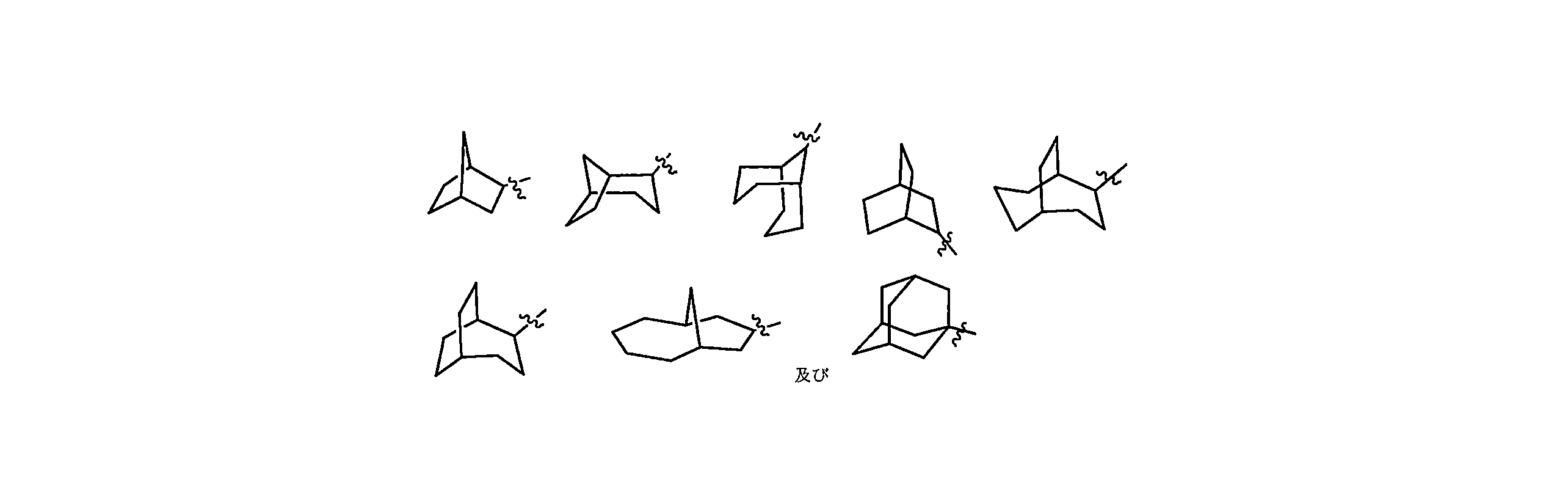
前記シクロアルキル環は、アリール基、ヘテロアリール基又はヘテロシクロアルキル環上に縮合されてもよく、ここで、親構造に連結される環はシクロアルキル基であり、非限定的な例は、インダニル基、テトラヒドロナフチル基、ベンゾシクロヘプタニル基などを含む。シクロアルキル基は置換又は非置換のものであってもよく、置換された場合、置換基は、好ましくは、アルキル基、アルケニル基、アルキニル基、アルコキシ基、アルキルチオ基、アルキルアミノ基、ハロゲン、メルカプト基、ヒドロキシ基、ニトロ基、シアノ基、シクロアルキル基、ヘテロシクロアルキル基、アリール基、ヘテロアリール基、シクロアルコキシ基、ヘテロシクロアルコキシ基、シクロアルキルチオ基、ヘテロシクロアルキルチオ基、オキソ基、カルボキシ基又はギ酸エステル基から独立して選ばれる1つ又は複数の基である。 The cycloalkyl ring may be fused onto an aryl group, a heteroaryl group, or a heterocycloalkyl ring, where the ring connected to the parent structure is a cycloalkyl group, non-limiting examples include indanyl, tetrahydronaphthyl, benzocycloheptanyl, etc. The cycloalkyl group may be substituted or unsubstituted, and if substituted, the substituents are preferably one or more groups independently selected from alkyl, alkenyl, alkynyl, alkoxy, alkylthio, alkylamino, halogen, mercapto, hydroxy, nitro, cyano, cycloalkyl, heterocycloalkyl, aryl, heteroaryl, cycloalkoxy, heterocycloalkoxy, cycloalkylthio, heterocycloalkylthio, oxo, carboxy, or formate.
用語「複素環基」とは飽和又は部分不飽和の単環又は多環式環状炭化水素置換基を指し、3~20個の環原子を含み、ここで、1つ又は複数の環原子は窒素、酸素又はS(O)m(ここで、mは0~2の整数である)から選ばれるヘテロ原子であるが、-O-O-、-O-S-又は-S-S-の環部分を含まず、残りの環原子は炭素である。好ましくは、3~12個の環原子を含み、このうち1~4個はヘテロ原子であり、最も好ましくは、4~10個の環原子を含み、このうち1~3個はヘテロ原子であり、最も好ましくは、5~7個の環原子を含み、このうち1~2又は1~3個はヘテロ原子である。単環複素環基の非限定的な例は、ピロリジニル基、イミダゾリジニル基、テトラヒドロフラニル基、テトラヒドロチエニル基、ジヒドロイミダゾリル基、ジヒドロフラニル基、ジヒドロピラゾリル基、ジヒドロピロリル基、ピペリジニル基、ピペラジニル基、モルホリニル基、チオモルホリニル基、ホモピペラジニル基、ピリジンピラニル基などを含み、好ましくは、1,2,5-オキサジアゾリル基、ピラニル基又はモルホリニル基である。多環複素環基はスピロ環、縮合環及び架橋環の複素環基を含む。 The term "heterocyclic group" refers to a saturated or partially unsaturated monocyclic or polycyclic cyclic hydrocarbon substituent containing 3 to 20 ring atoms, in which one or more ring atoms are heteroatoms selected from nitrogen, oxygen, or S(O) m , where m is an integer from 0 to 2, but excluding the -O-O-, -O-S-, or -S-S- ring moieties, the remaining ring atoms being carbon. Preferably, it contains 3 to 12 ring atoms, of which 1 to 4 are heteroatoms, most preferably 4 to 10 ring atoms, of which 1 to 3 are heteroatoms, and most preferably 5 to 7 ring atoms, of which 1 to 2 or 1 to 3 are heteroatoms. Non-limiting examples of monocyclic heterocyclic groups include pyrrolidinyl, imidazolidinyl, tetrahydrofuranyl, tetrahydrothienyl, dihydroimidazolyl, dihydrofuranyl, dihydropyrazolyl, dihydropyrrolyl, piperidinyl, piperazinyl, morpholinyl, thiomorpholinyl, homopiperazinyl, pyridinepyranyl, etc., preferably 1,2,5-oxadiazolyl, pyranyl or morpholinyl. Polycyclic heterocyclic groups include spiro, fused and bridged heterocyclic groups.
用語「スピロ複素環基」とは5~20員の単環間で1つの原子(スピロ原子という)を共有する多環複素環基を指し、ここで、1つ又は複数の環原子は窒素、酸素又はS(O)m(ここで、mは0~2の整数である)から選ばれるヘテロ原子であり、残りの環原子は炭素である。1つ又は複数の二重結合を含有することができるうが、完全に共役したπ電子系を有する環は1つもない。好ましくは、6~14員、より好ましくは、7~10員である。環と環との間で共有するスピロ原子の数によってスピロ複素環基はモノスピロ複素環基、ビススピロ複素環基又はポリスピロ複素環基に分け、好ましくは、モノスピロ複素環基とビススピロ複素環基である。より好ましくは、4員/4員、4員/5員、4員/6員、5員/5員又は5員/6員のモノスピロ複素環基である。スピロ複素環基の非限定的な例は、以下のものを含む。

用語「縮合複素環基」とは、系中の各個の環と系中のほかの環とが隣接する一対の原子を共有する5~20員の多環複素環基を指し、1つ又は複数の環は1つ又は複数の二重結合を含有することができるが、完全に共役したπ電子系を有する環は1つもなく、ここで、1つ又は複数の環原子は、窒素、酸素又はS(O)m(ここで、mは0~2の整数である)から選ばれるヘテロ原子であり、残りの環原子は炭素である。好ましくは、6~14員、より好ましくは、7~10員である。構成する環の数によって二環、三環、四環又は多環縮合複素環基に分けることができ、好ましくは、二環又は三環、より好ましくは、5員/5員又は5員/6員の二環縮合複素環基である。縮合複素環基の非限定的な例は以下のものを含む。

用語「架橋複素環基」とは、任意の2つの環が直接連結してない2つの原子を共有する5~14員の多環複素環基を指し、1つ又は複数の二重結合を含有することができるが、完全に共役したπ電子系を有する環は1つもなく、ここで、1つ又は複数の環原子は、窒素、酸素又はS(O)m(ここで、mは0~2の整数である)から選ばれるヘテロ原子であり、残りの環原子は炭素である。好ましくは、6~14員、より好ましくは、7~10員である。構成する環の数によって二環、三環、四環又は多環架橋複素環基に分けることができ、好ましくは、二環、三環又は四環、より好ましくは、二環又は三環である。架橋複素環基の非限定的な例は、以下のものを含む。
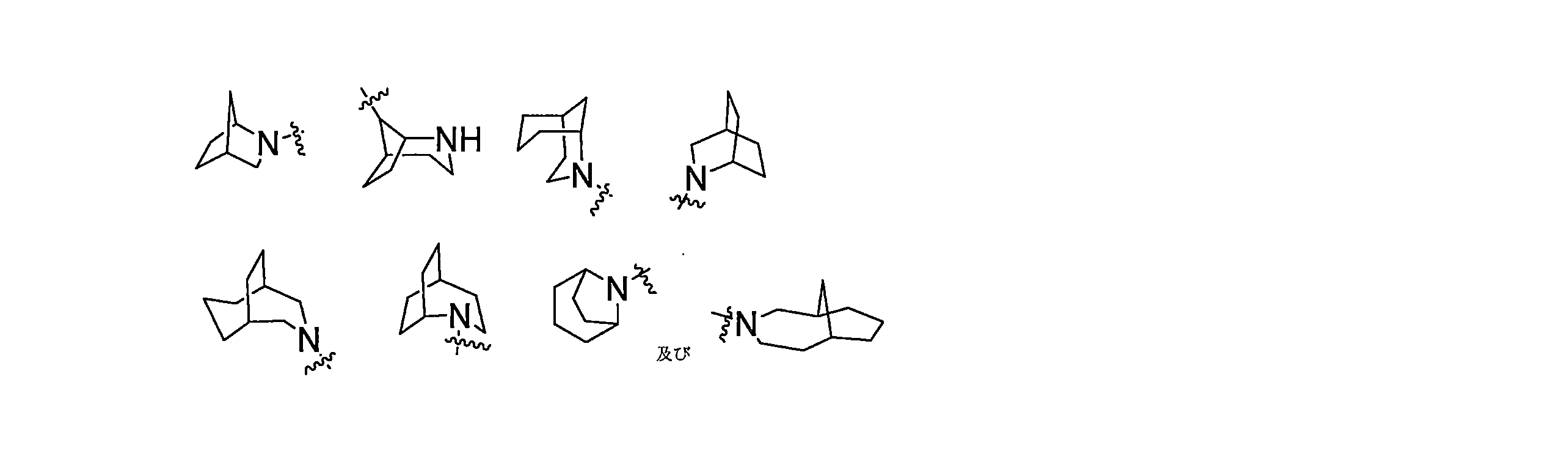
前記複素環式環は、アリール基、ヘテロアリール基又はシクロアルキル環上に縮合することができ、ここで、親構造に連結される環は複素環基であり、その非限定的な例は以下のものを含む。
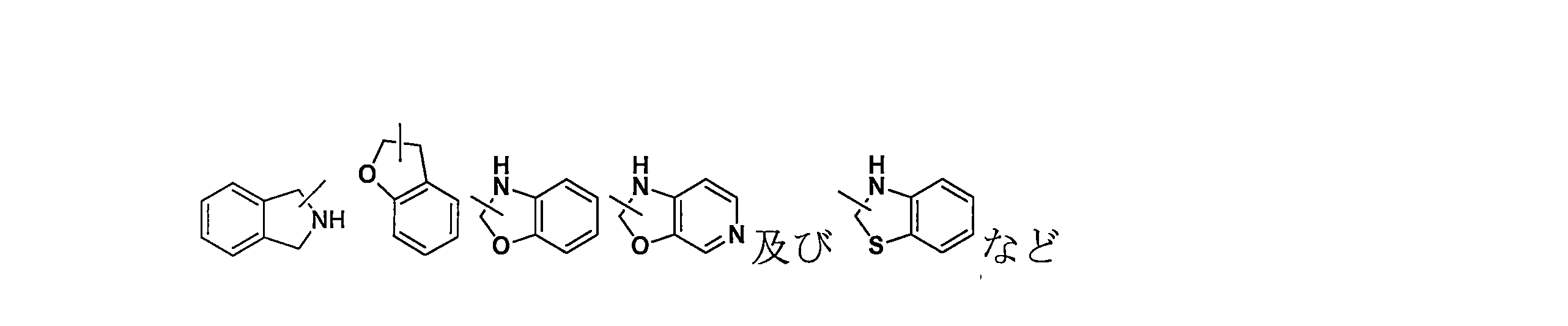
複素環基は、置換又は非置換のものであってもよく、置換された場合、置換基は、好ましくは、アルキル基、アルケニル基、アルキニル基、アルコキシ基、アルキルチオ基、アルキルアミノ基、ハロゲン、メルカプト基、ヒドロキシ基、ニトロ基、シアノ基、シクロアルキル基、ヘテロシクロアルキル基、アリール基、ヘテロアリール基、シクロアルコキシ基、ヘテロシクロアルコキシ基、シクロアルキルチオ基、ヘテロシクロアルキルチオ基、オキソ基、カルボキシ基又はギ酸エステル基から独立して選ばれる1つ又は複数の基である。 The heterocyclic group may be substituted or unsubstituted, and if substituted, the substituents are preferably one or more groups independently selected from alkyl groups, alkenyl groups, alkynyl groups, alkoxy groups, alkylthio groups, alkylamino groups, halogens, mercapto groups, hydroxy groups, nitro groups, cyano groups, cycloalkyl groups, heterocycloalkyl groups, aryl groups, heteroaryl groups, cycloalkoxy groups, heterocycloalkoxy groups, cycloalkylthio groups, heterocycloalkylthio groups, oxo groups, carboxy groups, and formate groups.
用語「アリール基」とは共役したπ電子系を有する6~14員の全炭素単環又は縮合多環(つまり、隣接する炭素原子対を共有する環)基を指し、好ましくは、6~10員、たとえばフェニル基及びナフチル基である。より好ましくは、フェニルである。前記アリール環はヘテロアリール基、複素環基又はシクロアルキル環上に縮合することができ、ここで、親構造に連結される環はアリール環であり、その非限定的な例は以下のものを含む。

アリール基は置換又は非置換のものであってもよく、置換された場合、置換基は、好ましくは、アルキル基、アルケニル基、アルキニル基、アルコキシ基、アルキルチオ基、アルキルアミノ基、ハロゲン、メルカプト基、ヒドロキシ基、ニトロ基、シアノ基、シクロアルキル基、ヘテロシクロアルキル基、アリール基、ヘテロアリール基、シクロアルコキシ基、ヘテロシクロアルコキシ基、シクロアルキルチオ基、ヘテロシクロアルキルチオ基、カルボキシ基又はギ酸エステル基から独立して選ばれる1つ又は複数の基である。 The aryl group may be substituted or unsubstituted, and if substituted, the substituents are preferably one or more groups independently selected from alkyl groups, alkenyl groups, alkynyl groups, alkoxy groups, alkylthio groups, alkylamino groups, halogens, mercapto groups, hydroxy groups, nitro groups, cyano groups, cycloalkyl groups, heterocycloalkyl groups, aryl groups, heteroaryl groups, cycloalkoxy groups, heterocycloalkoxy groups, cycloalkylthio groups, heterocycloalkylthio groups, carboxy groups, or formate groups.
用語「ヘテロアリール基」とは1~4個のヘテロ原子、5~14個の環原子を含むヘテロアリール族系を指し、ここで、ヘテロ原子は、酸素、硫黄及び窒素から選ばれる。ヘテロアリール基は、好ましくは、5~10員であり、1~3個のヘテロ原子を含み、より好ましくは、5員又は6員であり、1~2個のヘテロ原子を含み、好ましくは、たとえばイミダゾリル基、フリル基、チエニル基、チアゾリル基、ピラゾリル基、オキサゾリル基、ピロリル基、テトラゾリル基、ピリジル基、ピリミジニル基、チアジアゾリル基、ピラジニル基などであり、好ましくは、イミダゾリル基、チアゾリル基、ピラゾリル基又はピリミジニル基、チアゾリル基、より好ましくは、ピラゾリル基又はチアゾリル基である。前記ヘテロアリール環は、アリール基、複素環基又はシクロアルキル環上に縮合することができ、ここで、親構造に連結される環はヘテロアリール環であり、その非限定的な例は以下のものを含む。
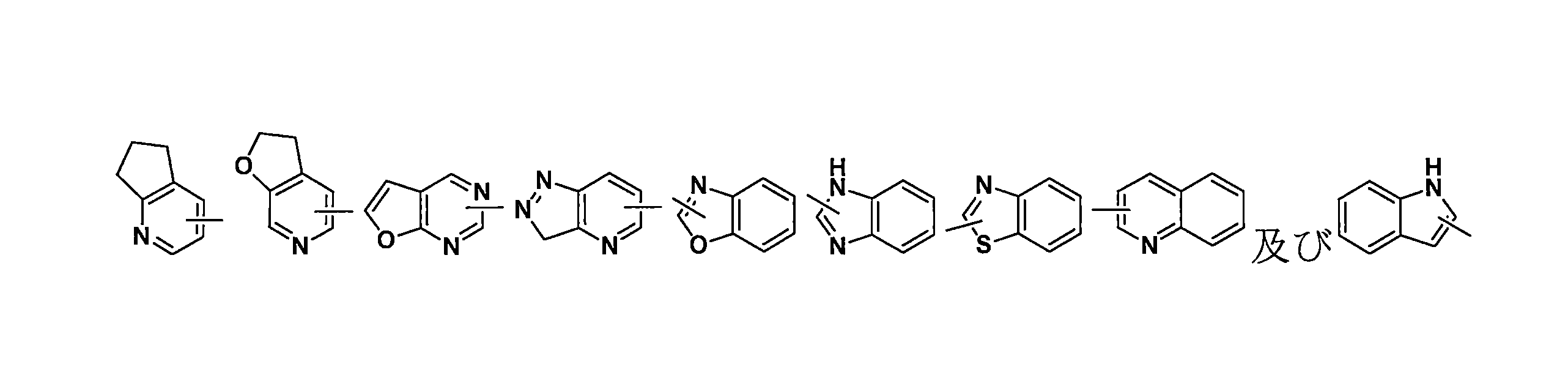
ヘテロアリール基は置換又は非置換のものであってもよく、置換された場合、置換基は、好ましくは、アルキル基、アルケニル基、アルキニル基、アルコキシ基、アルキルチオ基、アルキルアミノ基、ハロゲン、メルカプト基、ヒドロキシ基、ニトロ基、シアノ基、シクロアルキル基、ヘテロシクロアルキル基、アリール基、ヘテロアリール基、シクロアルコキシ基、ヘテロシクロアルコキシ基、シクロアルキルチオ基、ヘテロシクロアルキルチオ基、カルボキシ基又はギ酸エステル基から独立して選ばれる1つ又は複数の基である。 The heteroaryl group may be substituted or unsubstituted, and if substituted, the substituents are preferably one or more groups independently selected from alkyl groups, alkenyl groups, alkynyl groups, alkoxy groups, alkylthio groups, alkylamino groups, halogens, mercapto groups, hydroxy groups, nitro groups, cyano groups, cycloalkyl groups, heterocycloalkyl groups, aryl groups, heteroaryl groups, cycloalkoxy groups, heterocycloalkoxy groups, cycloalkylthio groups, heterocycloalkylthio groups, carboxy groups, or formate groups.
用語「アルコキシ基」とは-O-(アルキル基)と-O-(非置換のシクロアルキル基)を指し、ここで、アルキル基の定義は前記のとおりである。アルコキシ基の非限定的な例は、メトキシ基、エトキシ基、プロポキシ基、ブトキシ基、シクロプロポキシ基、シクロブトキシ基、シクロペントキシ基、シクロヘキシルオキシ基を含む。アルコキシ基は、置換又は非置換のものであってもよく、置換された場合、置換基は、好ましくは、アルキル基、アルケニル基、アルキニル基、アルコキシ基、アルキルチオ基、アルキルアミノ基、ハロゲン、メルカプト基、ヒドロキシ基、ニトロ基、シアノ基、シクロアルキル基、ヘテロシクロアルキル基、アリール基、ヘテロアリール基、シクロアルコキシ基、ヘテロシクロアルコキシ基、シクロアルキルチオ基、ヘテロシクロアルキルチオ基、カルボキシ基又はギ酸エステル基から独立して選ばれる1つ又は複数の基である。 The term "alkoxy group" refers to -O- (alkyl group) and -O- (unsubstituted cycloalkyl group), where alkyl group is as defined above. Non-limiting examples of alkoxy groups include methoxy, ethoxy, propoxy, butoxy, cyclopropoxy, cyclobutoxy, cyclopentoxy, and cyclohexyloxy groups. An alkoxy group may be substituted or unsubstituted, and if substituted, the substituents are preferably one or more groups independently selected from alkyl, alkenyl, alkynyl, alkoxy, alkylthio, alkylamino, halogen, mercapto, hydroxy, nitro, cyano, cycloalkyl, heterocycloalkyl, aryl, heteroaryl, cycloalkoxy, heterocycloalkoxy, cycloalkylthio, heterocycloalkylthio, carboxy, or formate groups.
用語「ハロアルキル基」とは1つ又は複数のハロゲンによって置換されたアルキル基を指し、ここで、アルキル基は以上で定義されたとおりである。 The term "haloalkyl group" refers to an alkyl group substituted with one or more halogens, where alkyl group is as defined above.
用語「ハロアルコキシ基」とは1つ又は複数のハロゲンによって置換されたアルコキシ基を指し、ここで、アルコキシ基は以上で定義されたとおりである。 The term "haloalkoxy group" refers to an alkoxy group substituted with one or more halogens, where alkoxy group is as defined above.
用語「ヒドロキシ基」とは-OH基を指す。 The term "hydroxy group" refers to the -OH group.
用語「ハロゲン」とはフッ素、塩素、臭素又はヨウ素を指す。 The term "halogen" refers to fluorine, chlorine, bromine or iodine.
用語「アミノ基」とは-NH2を指す。 The term "amino group" refers to --NH2 .
用語「シアノ基」とは-CNを指す。 The term "cyano group" refers to -CN.
用語「ニトロ基」とは-NO2を指す。 The term "nitro group" refers to --NO2 .
用語「オキソ基」とは=Oを指す。 The term "oxo group" refers to =O.
用語「カルボキシ基」とは-C(O)OHを指す。 The term "carboxy group" refers to -C(O)OH.
用語「メルカプト基」とは-SHを指す。 The term "mercapto group" refers to -SH.
用語「エステル基」とは-C(O)O(アルキル基)又は-C(O)O(シクロアルキル基)を指し、ここで、アルキル基及びシクロアルキル基は以上で定義されたとおりである。 The term "ester group" refers to -C(O)O (alkyl group) or -C(O)O (cycloalkyl group), where alkyl and cycloalkyl groups are as defined above.
用語「アシル基」とは-C(O)R基を含有する化合物を指し、ここで、Rはアルキル基、シクロアルキル基、複素環基、アリール基、ヘテロアリール基である。 The term "acyl group" refers to a compound containing a -C(O)R group, where R is an alkyl, cycloalkyl, heterocyclic, aryl, or heteroaryl group.
「てもいよい」又は「てもよく」とは、後に説明されるイベント又は環境が発生することができるが、発生する必要はないことを意味し、この説明は、イベント又は環境が発生する場合又は発生しない場合を含む。たとえば、「アルキル基によって置換されてもよい複素環基」とは、アルキル基が存在してもよいが、存在しなくてもよいことを意味し、この説明は、複素環基がアルキル基によって置換されている場合と、複素環基がアルキル基によって置換されていない場合とを含む。 "May" or "may" means that the event or circumstance described below can occur but does not have to occur, and the description includes cases where the event or circumstance occurs or does not occur. For example, "a heterocyclic group that may be substituted with an alkyl group" means that the alkyl group may be present but may not be present, and the description includes cases where the heterocyclic group is substituted with an alkyl group and cases where the heterocyclic group is not substituted with an alkyl group.
「置換された」とは、基中の1つ又は複数の水素原子、好ましくは最大5個、より好ましくは1~3個の水素原子がそれぞれ独立して対応する数の置換基によって置換されていることを意味する。言うまでもなく、置換基はそれらの可能な化学的位置にのみ存在し、当業者は、多くの努力をすることなく、可能な置換又は不可能な置換を(実験的又は理論的に)決定することができる。たとえば、遊離水素を有するアミノ基やヒドロキシ基が、不飽和(エチレン性など)結合を有する炭素原子に結合している場合には不安定である可能性がある。 "Substituted" means that one or more hydrogen atoms in the group, preferably up to 5, more preferably 1 to 3 hydrogen atoms, are each independently replaced by the corresponding number of substituents. Needless to say, the substituents are present only at their possible chemical positions, and the skilled person can determine (experimentally or theoretically) possible or impossible substitutions without much effort. For example, amino or hydroxy groups with free hydrogens may be unstable if they are attached to carbon atoms with unsaturated (e.g. ethylenic) bonds.
「医薬組成物」とは、本明細書に記載の化合物又はその生理学的/薬用可能な塩又はプロドラッグの1つ以上と他の化学成分との混合物、ならびに生理学的/薬用可能な担体及び賦形剤などの他の成分を含むことを意味する。医薬組成物の目的は、生体への投与を促進し、有効成分の吸収を容易にし、さらに生物活性を発揮することである。 "Pharmaceutical composition" is meant to include a mixture of one or more of the compounds described herein or physiologically/medicinally acceptable salts or prodrugs thereof with other chemical components, as well as other components such as physiologically/medicinally acceptable carriers and excipients. The purpose of a pharmaceutical composition is to facilitate administration to a living organism, facilitate absorption of the active ingredient, and exert biological activity.
「薬用可能な塩」とは、哺乳動物の体内において使用された場合に安全性及び有効性を有し、かつ、所望の生物学的活性を有する化合物の塩を指す。 "Medicinal salt" refers to a salt of a compound that is safe and effective when used in a mammalian body and has the desired biological activity.
本発明の化合物の合成方法
本発明の目的を達成するために、本発明は、下記合成スキームを用いて本発明の一般式(I)化合物を製造する。
Method for Synthesizing the Compounds of the Present Invention In order to achieve the object of the present invention, the present invention uses the following synthesis scheme to prepare the compounds of the general formula (I) of the present invention.
式(I)で表される化合物が式(II)で表される化合物である場合、以下のスキーム1によって式(II)で表される化合物を合成する。

ステップ1:塩化アシル化合物IIaとアルデヒド類化合物IIbを、アルカリ及び塩化亜鉛の存在下、溶媒にて挿入反応させて、化合物IIcを得て、ここで、前記アルカリは、好ましくは、炭酸カリウム、炭酸ナトリウム、炭酸水素カリウム、炭酸水素ナトリウム、トリエチルアミン、ピリジンなどの無機又は有機アルカリであり、前記溶媒は、好ましくは、ジクロロメタン、N,N-ジメチルホルムアミド、テトラヒドロフラン、t-ブタノールメチルエーテルなどである。 Step 1: Acyl chloride compound IIa and aldehyde compound IIb are subjected to an insertion reaction in a solvent in the presence of an alkali and zinc chloride to obtain compound IIc, where the alkali is preferably an inorganic or organic alkali such as potassium carbonate, sodium carbonate, potassium bicarbonate, sodium bicarbonate, triethylamine, pyridine, etc., and the solvent is preferably dichloromethane, N,N-dimethylformamide, tetrahydrofuran, t-butanol methyl ether, etc.
ステップ2:化合物IIcとニトロキソリンを、アルカリの存在下、溶媒にて求核反応させて、式(II)の化合物を得て、ここで、前記アルカリは、好ましくは、炭酸カリウム、炭酸ナトリウム、炭酸水素カリウム、炭酸水素ナトリウム、トリエチルアミン、ピリジンなどの無機又は有機アルカリであり、前記溶媒は、好ましくは、ジクロロメタン、N,N-ジメチルホルムアミド、テトラヒドロフラン、t-ブタノールメチルエーテルなどである。 Step 2: Compound IIc and nitroxoline are subjected to a nucleophilic reaction in the presence of an alkali in a solvent to obtain a compound of formula (II), where the alkali is preferably an inorganic or organic alkali such as potassium carbonate, sodium carbonate, potassium bicarbonate, sodium bicarbonate, triethylamine, pyridine, etc., and the solvent is preferably dichloromethane, N,N-dimethylformamide, tetrahydrofuran, t-butanol methyl ether, etc.
式(II)で表される化合物中のR1が水素である場合、以下のスキーム2によって式(II’)で表される化合物を合成することができる。
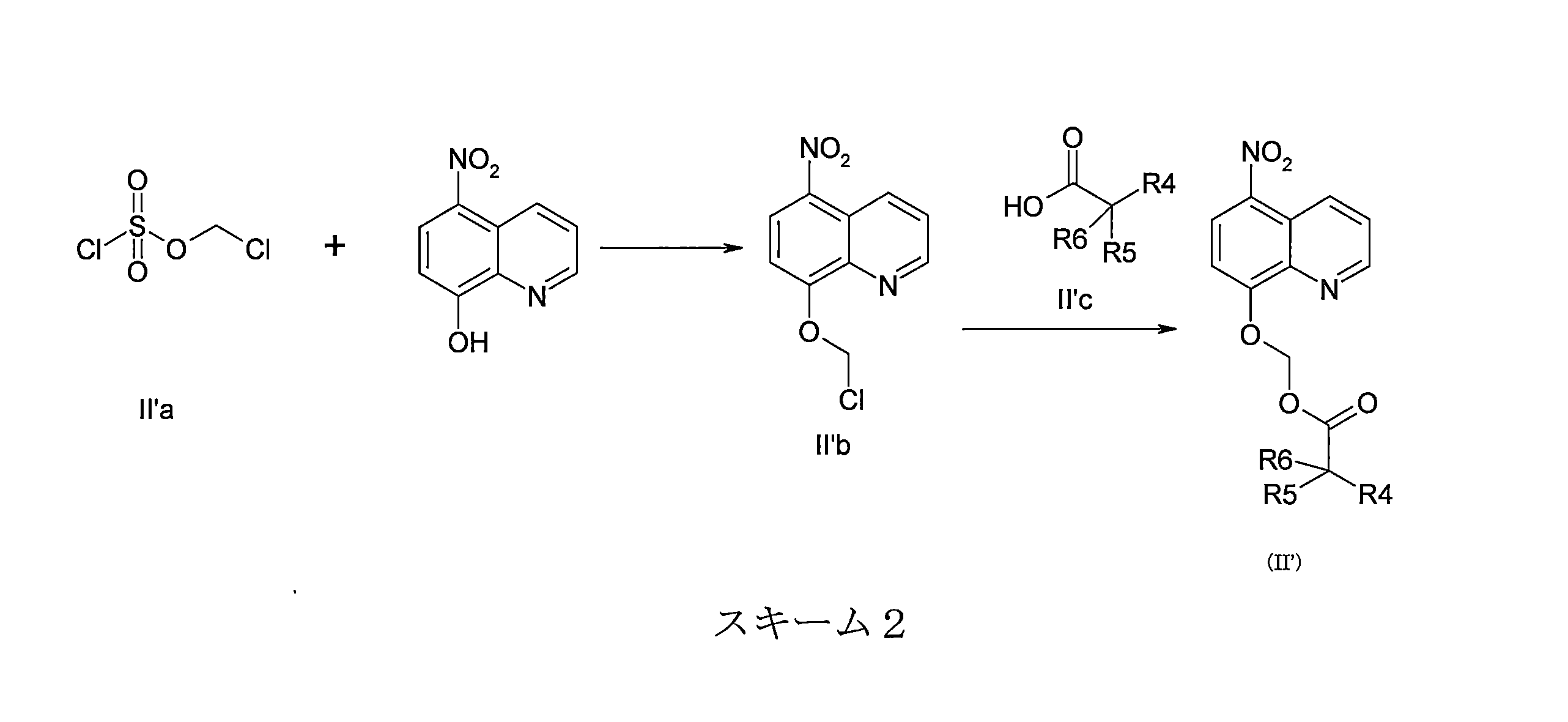
ステップ1:塩化スルホニル化合物II’aとニトロキソリンを、アルカリの存在下、溶媒にて求核反応させて、化合物II’bを得て、ここで、前記アルカリは、好ましくは、炭酸カリウム、炭酸ナトリウム、炭酸水素カリウム、炭酸水素ナトリウム、トリエチルアミン、ピリジンなどの無機又は有機アルカリであり、前記溶媒は、好ましくは、ジクロロメタン、N,N-ジメチルホルムアミド、テトラヒドロフラン、t-ブタノールメチルエーテルなどである。 Step 1: The sulfonyl chloride compound II'a and nitroxoline are subjected to a nucleophilic reaction in the presence of an alkali in a solvent to obtain compound II'b, where the alkali is preferably an inorganic or organic alkali such as potassium carbonate, sodium carbonate, potassium bicarbonate, sodium bicarbonate, triethylamine, pyridine, etc., and the solvent is preferably dichloromethane, N,N-dimethylformamide, tetrahydrofuran, t-butanol methyl ether, etc.
ステップ2:化合物II’bと化合物II’cを、アルカリの存在下、溶媒にて求核反応させて、式(II’)の化合物を得て、ここで、前記アルカリは、好ましくは、炭酸カリウム、炭酸ナトリウム、炭酸水素カリウム、炭酸水素ナトリウム、トリエチルアミン、ピリジンなどの無機又は有機アルカリであり、前記溶媒は、好ましくは、ジクロロメタン、N,N-ジメチルホルムアミド、テトラヒドロフラン、t-ブタノールメチルエーテルなどである。 Step 2: Compound II'b and compound II'c are subjected to a nucleophilic reaction in the presence of an alkali in a solvent to obtain a compound of formula (II'), where the alkali is preferably an inorganic or organic alkali such as potassium carbonate, sodium carbonate, potassium bicarbonate, sodium bicarbonate, triethylamine, pyridine, etc., and the solvent is preferably dichloromethane, N,N-dimethylformamide, tetrahydrofuran, t-butanol methyl ether, etc.
式(I)で表される化合物が式(III)で表される化合物である場合、以下のスキーム3によって式(III)で表される化合物を合成する。
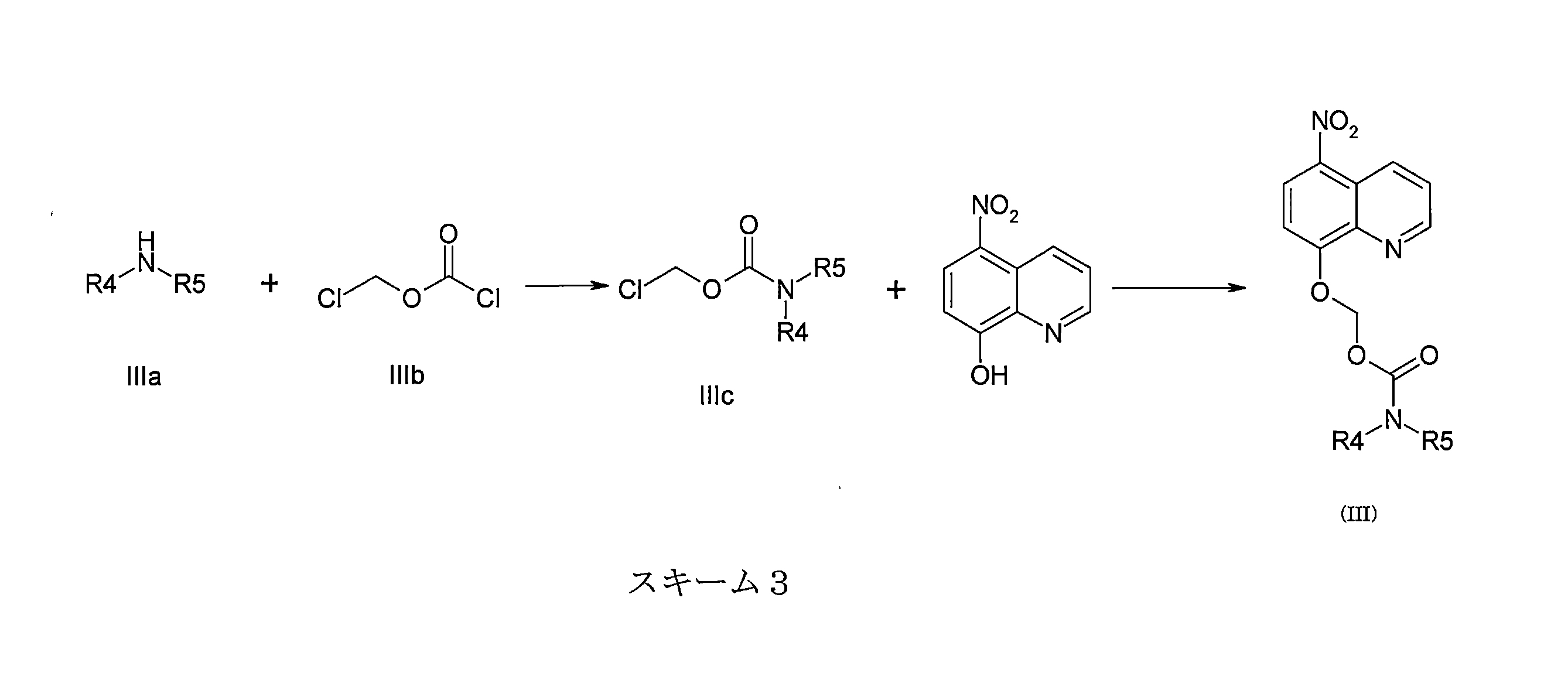
ステップ1:アミノ化合物IIIaとクロロメトキシ塩化アシル化合物IIIbとを、アルカリの存在下、溶媒にてアミド縮合反応させて、化合物IIIcを得て、ここで、前記アルカリは、好ましくは、炭酸カリウム、炭酸ナトリウム、炭酸水素カリウム、炭酸水素ナトリウム、トリエチルアミン、ピリジンなどの無機又は有機アルカリであり、前記溶媒は、好ましくは、ジクロロメタン、N,N-ジメチルホルムアミド、テトラヒドロフラン、t-ブタノールメチルエーテルなどである。 Step 1: Amino compound IIIa and chloromethoxy acyl chloride compound IIIb are subjected to an amide condensation reaction in a solvent in the presence of an alkali to obtain compound IIIc, where the alkali is preferably an inorganic or organic alkali such as potassium carbonate, sodium carbonate, potassium bicarbonate, sodium bicarbonate, triethylamine, pyridine, etc., and the solvent is preferably dichloromethane, N,N-dimethylformamide, tetrahydrofuran, t-butanol methyl ether, etc.
ステップ2:化合物IIIcとニトロキソリンを、アルカリの存在下、溶媒にて求核反応させて、式(III)の化合物を得て、ここで、前記アルカリは、好ましくは、炭酸カリウム、炭酸ナトリウム、炭酸水素カリウム、酸水素ナトリウム、トリエチルアミン、ピリジンなどの無機又は有機アルカリであり、前記溶媒は、好ましくは、ジクロロメタン、N,N-ジメチルホルムアミド、テトラヒドロフラン、t-ブタノールメチルエーテルなどである。 Step 2: Compound IIIc and nitroxoline are subjected to a nucleophilic reaction in the presence of an alkali in a solvent to obtain a compound of formula (III), where the alkali is preferably an inorganic or organic alkali such as potassium carbonate, sodium carbonate, potassium bicarbonate, sodium hydrogen carbonate, triethylamine, pyridine, etc., and the solvent is preferably dichloromethane, N,N-dimethylformamide, tetrahydrofuran, t-butanol methyl ether, etc.
式(I)で表される化合物が式(V’)及び式(V’’)で表される化合物である場合、以下のスキーム4及びスキーム5によって式(V’)及び式(V’’)で表される化合物を合成する。
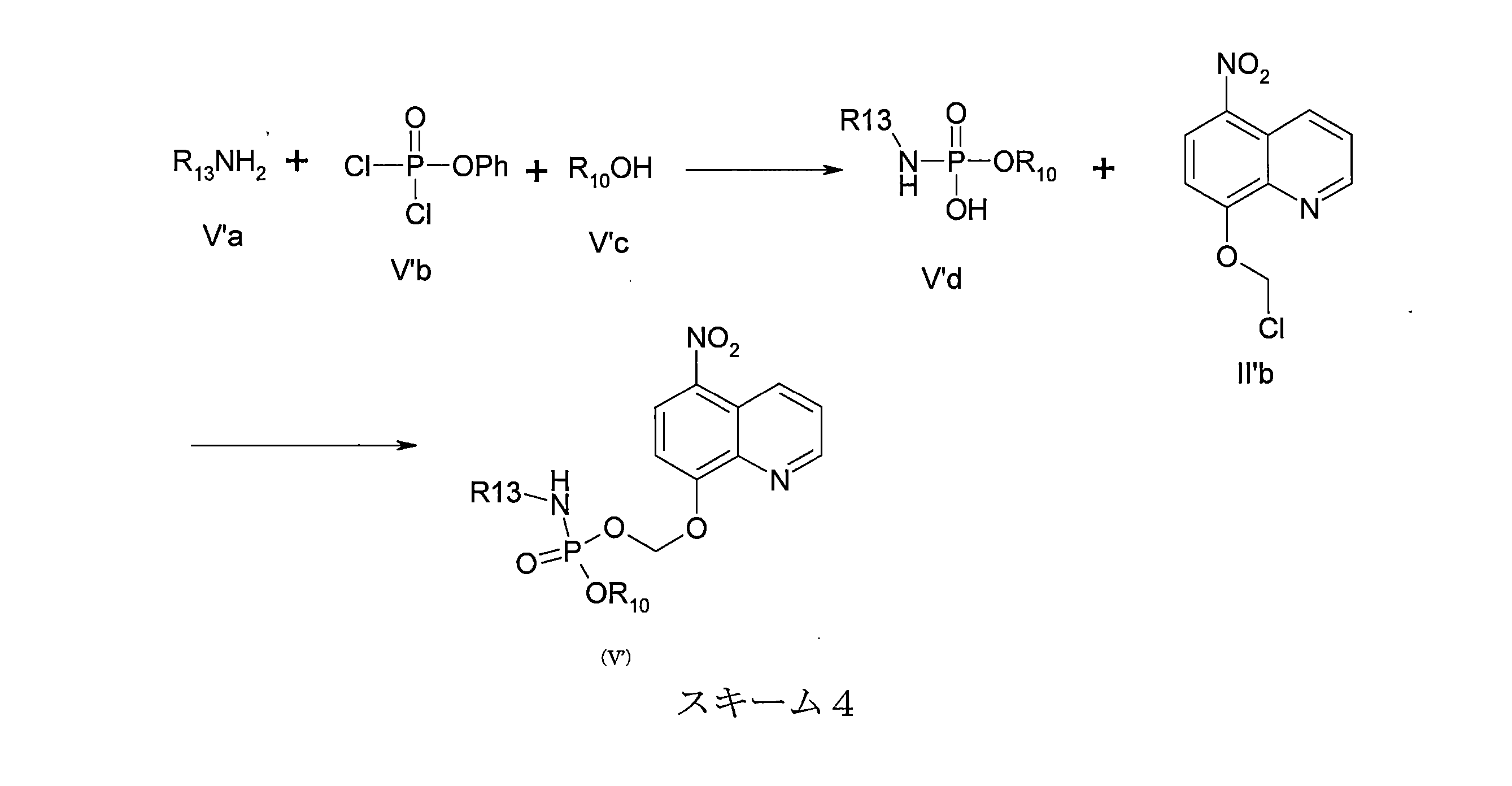
ステップ1:アミノ化合物V’a、フェノキシ塩化ホスホリル化合物V’b、及びヒドロキシ化合物V’cを、アルカリの存在下、溶媒にて縮合反応させて、化合物V’dを得て、ここで、前記アルカリは、好ましくは、炭酸カリウム、炭酸ナトリウム、炭酸水素カリウム、炭酸水素ナトリウム、トリエチルアミン、ピリジンなどの無機又は有機アルカリであり、前記溶媒は、好ましくは、ジクロロメタン、N,N-ジメチルホルムアミド、テトラヒドロフラン、t-ブタノールメチルエーテルなどである。 Step 1: Amino compound V'a, phenoxy phosphoryl chloride compound V'b, and hydroxy compound V'c are condensed in a solvent in the presence of an alkali to obtain compound V'd, where the alkali is preferably an inorganic or organic alkali such as potassium carbonate, sodium carbonate, potassium bicarbonate, sodium bicarbonate, triethylamine, pyridine, etc., and the solvent is preferably dichloromethane, N,N-dimethylformamide, tetrahydrofuran, t-butanol methyl ether, etc.
ステップ2:化合物V’dと化合物II’bを、アルカリの存在下、溶媒にて求核反応させて、式(V’)で表される化合物を得て、ここで、前記アルカリは、好ましくは、炭酸カリウム、炭酸ナトリウム、炭酸水素カリウム、炭酸水素ナトリウム、トリエチルアミン、ピリジンなどの無機又は有機アルカリであり、前記溶媒は、好ましくは、ジクロロメタン、N,N-ジメチルホルムアミド、テトラヒドロフラン、t-ブタノールメチルエーテルなどである。
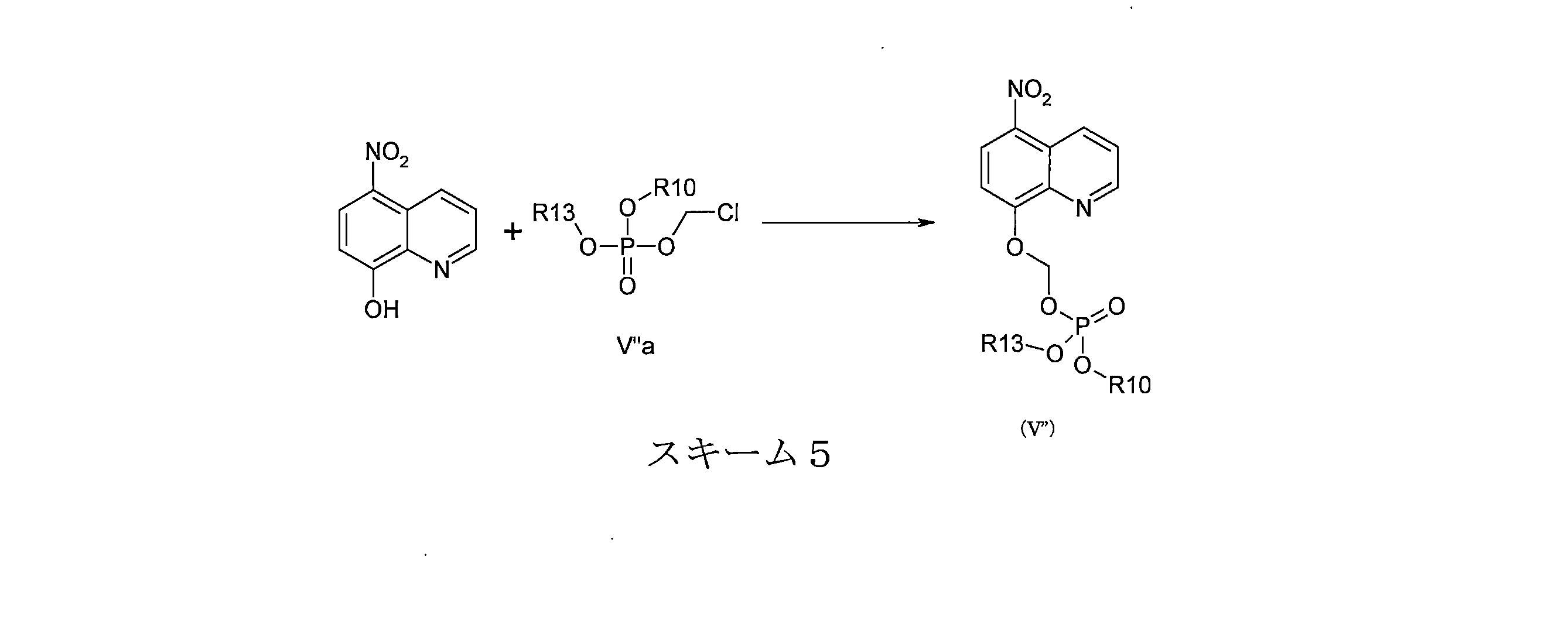
化合物V’’aとニトロキソリンを、アルカリの存在下、溶媒にて求核反応させて、式(V’’)で表される化合物を得て、ここで、前記アルカリは、好ましくは、炭酸カリウム、炭酸ナトリウム、炭酸水素カリウム、炭酸水素ナトリウム、トリエチルアミン、ピリジンなどの無機又は有機アルカリであり、前記溶媒は、好ましくは、ジクロロメタン、N,N-ジメチルホルムアミド、テトラヒドロフラン、t-ブタノールメチルエーテルなどである。 Compound V"a and nitroxoline are subjected to a nucleophilic reaction in a solvent in the presence of an alkali to obtain a compound represented by formula (V"), where the alkali is preferably an inorganic or organic alkali such as potassium carbonate, sodium carbonate, potassium bicarbonate, sodium bicarbonate, triethylamine, pyridine, etc., and the solvent is preferably dichloromethane, N,N-dimethylformamide, tetrahydrofuran, t-butanol methyl ether, etc.
R1、R4、R5、R6、R10及びR13は一般式(I)において定義されたとおりである。 R 1 , R 4 , R 5 , R 6 , R 10 and R 13 are as defined in general formula (I).
以下、実施例を参照しながら本発明をさらに説明するが、これらの実施例は本発明の範囲を制限するものではない。 The present invention will be further described below with reference to examples, but these examples are not intended to limit the scope of the present invention.
以下では、実施形態に関連して本発明をさらに説明するが、これらの実施形態は本発明の範囲を限定するものではない。 The present invention is further described below with reference to embodiments, but these embodiments are not intended to limit the scope of the present invention.
化合物の構造は、核磁気共鳴(NMR)又は/及び質量分析(MS)により決定される。NMRシフト(δ)は10-6(ppm)の単位で与えられる。NMRの測定は(Bruker AVANCE-400)核磁気計を用い、測定溶媒は重水素化ジメチルスルホキシド(DMSO-d6)、重水素化クロロホルム(CDCl3)、重水素化メタノール(CD3OD)であり、内部標準物質はテトラメチルシラン(TMS)である。 The structures of the compounds are determined by nuclear magnetic resonance (NMR) and/or mass spectrometry (MS). The NMR shifts (δ) are given in units of 10 −6 (ppm). The NMR measurements were performed using a Bruker AVANCE-400 nuclear magnetometer, with the measurement solvents being deuterated dimethylsulfoxide (DMSO-d 6 ), deuterated chloroform (CDCl 3 ), and deuterated methanol (CD 3 OD), and the internal standard was tetramethylsilane (TMS).
MSの測定には液体クロマトグラフ質量分析計(Thermo、Ultimate3000/MSQ)を用いる。 A liquid chromatograph mass spectrometer (Thermo, Ultimate 3000/MSQ) is used for MS measurements.
HPLCの測定には高圧液体クロマトグラフ(Agilent 1260 Infinity、Gemini C18 250×4.6mm、5uカラム)を用いる。 A high pressure liquid chromatograph (Agilent 1260 Infinity, Gemini C18 250 x 4.6 mm, 5 u column) is used for HPLC measurements.
薄層クロマトグラフィー(TLC)は煙台黄海製のシリカゲル板HSGF245を用い、薄層クロマトグラフィー分析製品は0.15mm~0.2mmの規格を用い、薄層クロマトグラフィー分離精製製品は0.9mm~1.0mmの規格を用いる。 For thin layer chromatography (TLC), Yantai Huanghai silica gel plates HSGF245 are used, with 0.15mm to 0.2mm specifications for thin layer chromatography analysis products and 0.9mm to 1.0mm specifications for thin layer chromatography separation and purification products.
カラムクロマトグラフィー法は一般的に煙台黄海製の200~300メッシュのシリカゲルを担体とする。 Column chromatography generally uses 200-300 mesh silica gel made by Yantai Huanghai as the carrier.
本発明の既知の出発原料は、当該分野で既知の方法を用いて合成することができ、又は上海達瑞精密化学品有限公司、上海泰坦科技股フン有限公司、上海潤捷化学試薬有限公司、TCI、Aldrich Chemical Companyから購入することができる。実施例に具体的な条件が明記されていない実験方法は、通常、通常の条件に従うか、原料又は商品の製造メーカーが提案した条件に従う。具体的な由来が明記されていない試薬は、市場で購入された通常の試薬である。 The known starting materials of the present invention can be synthesized using methods known in the art or purchased from Shanghai Darui Fine Chemicals Co., Ltd., Shanghai Taitan Technology Co., Ltd., Shanghai Runjie Chemical Reagents Co., Ltd., TCI, Aldrich Chemical Company. Experimental methods for which specific conditions are not specified in the examples generally follow standard conditions or conditions suggested by the manufacturers of the raw materials or products. Reagents for which the specific origin is not specified are standard reagents purchased on the market.
実施例には特に明記されていない限り、反応はアルゴン雰囲気下でも窒素雰囲気下でも行うことができる。アルゴン雰囲気又は窒素雰囲気とは、反応フラスコに約1Lの容積のアルゴン又は窒素バルーンが接続されていることを意味する。 Unless otherwise specified in the examples, the reactions can be carried out under either an argon or nitrogen atmosphere. By argon or nitrogen atmosphere, we mean that the reaction flask is connected to an argon or nitrogen balloon of approximately 1 L volume.
実施例には特に明記されていない限り、溶液とは水溶液を指す。 Unless otherwise specified in the examples, solutions refer to aqueous solutions.
実施例には特に明記されていない限り、反応の温度は室温である20℃~30℃である。 Unless otherwise specified in the examples, the reaction temperature is room temperature, 20°C to 30°C.
実施例1:(5-ニトロキノリン-8-イルオキシ)メチルアセテート(1)の合成
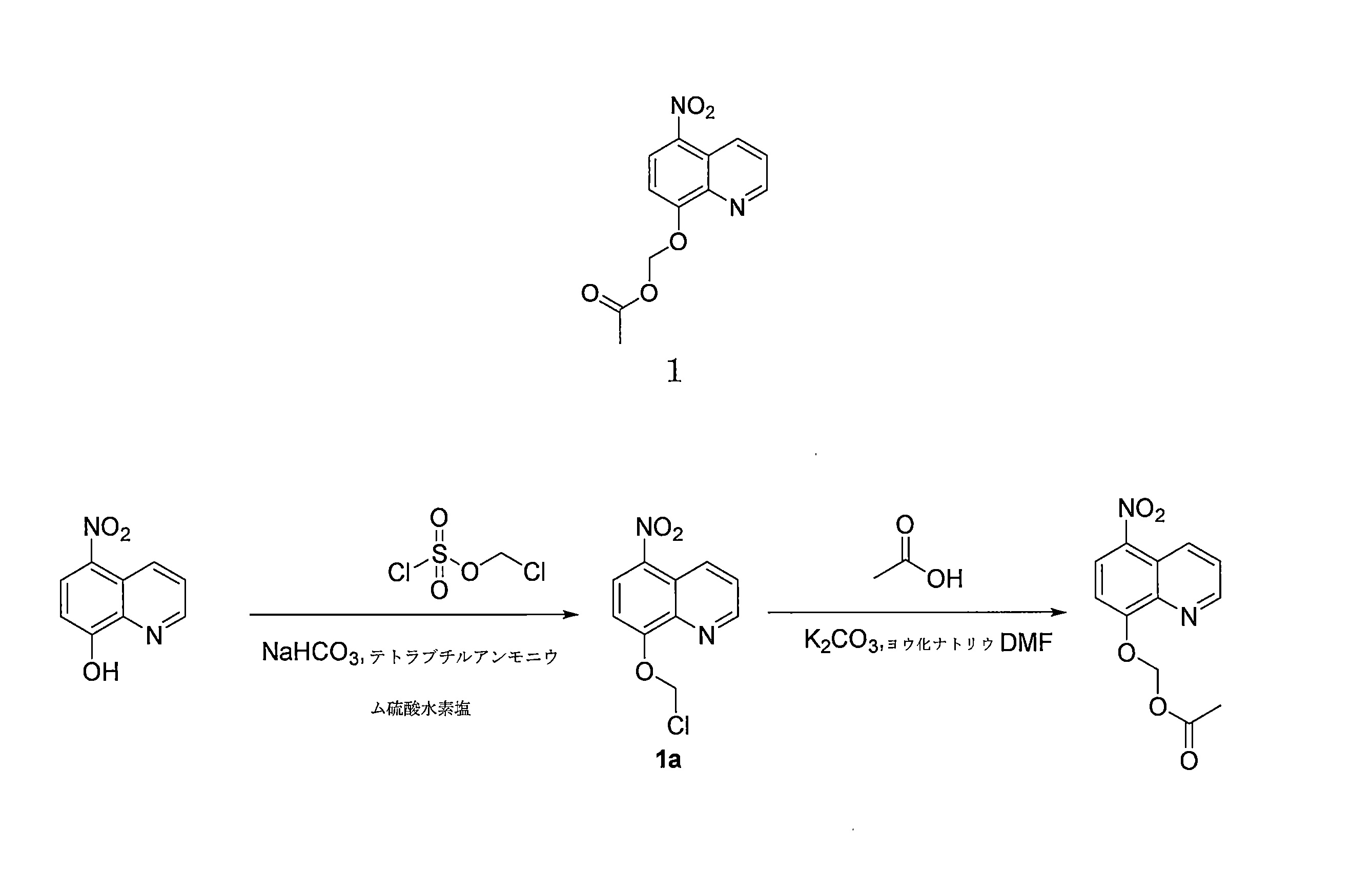
室温で、炭酸水素ナトリウム水溶液(60mL,3.5mol/L)、テトラブチル硫酸水素アンモニウム(TBAHS)(1.78g,5.24mmol)を、ニトロキソリン(10.00g,52.59mmol)のジクロロメタン(DCM)(100mL)溶液に加えて、20分間撹拌した。クロロメチルクロロスルホネート(10.42g,63.15mmol)を反応系に滴下し、室温で16時間撹拌した。反応液をろ過して、有機相をそれぞれ炭酸カリウム溶液、飽和食塩水で洗浄し、無水硫酸ナトリウムで乾燥させて、ろ過後、減圧濃縮させた。残留物を、シリカゲルカラムクロマトグラフィー(溶離剤:ジクロロメタン)により精製して、5-ニトロ-8-クロロメチルオキシキノリン(2.5g,収率20%)を得た。
ステップ2:(5-ニトロキノリン-8-イルオキシ)メチルアセテート(1)の製造
室温で、酢酸(38mg,0.63mmol)、炭酸カリウム(104mg,0.75mmol)、ヨウ素ナトリウム(9mg,0.06mmol)をN,N-ジメチルホルムアミド(3mL)に加えて、均一に撹拌した。反応系を60℃に昇温して、10分間撹拌した後、5-ニトロ-8-クロロメチルオキシキノリン(150mg,0.63mmol)を加えて、1時間撹拌した。水を加えて反応をクエンチし、酢酸エチルで抽出して、有機相を飽和食塩水溶液で洗浄し、無水硫酸ナトリウムで有機相を乾燥させ、ろ過後、減圧濃縮させた。残留物をシリカゲルクロマトグラフィー分取プレート(溶離剤:5%メタノール/95%ジクロロメタン)により精製して、(5-ニトロキノリン-8-イルオキシ)メチルアセテート(145mg,収率88%)を得た。
1H NMR (400 MHz, CDCl3) δ 9.19 (dd, J = 8.9, 1.6 Hz, 1H), 9.07 (dd, J = 4.1, 1.6 Hz, 1H), 8.51 (d, J = 8.8 Hz, 1H), 7.72 (dd, J = 8.9, 4.1 Hz, 1H), 7.36 (d, J = 8.8 Hz, 1H), 6.17 (s, 2H), 2.16 (s, 3H)。
MS計算:262.2;MS実測:263.1 [M+H]+。
Example 1: Synthesis of (5-nitroquinolin-8-yloxy)methyl acetate (1)
Step 2: Preparation of (5-nitroquinolin-8-yloxy)methyl acetate (1) Acetic acid (38 mg, 0.63 mmol), potassium carbonate (104 mg, 0.75 mmol), sodium iodide (9 mg, 0.06 mmol) were added to N,N-dimethylformamide (3 mL) at room temperature and stirred uniformly. The reaction system was heated to 60°C and stirred for 10 minutes, after which 5-nitro-8-chloromethyloxyquinoline (150 mg, 0.63 mmol) was added and stirred for 1 hour. The reaction was quenched by adding water, extracted with ethyl acetate, the organic phase was washed with a saturated saline solution, the organic phase was dried over anhydrous sodium sulfate, filtered, and concentrated under reduced pressure. The residue was purified by silica gel chromatography preparative plate (eluent: 5% methanol/95% dichloromethane) to obtain (5-nitroquinolin-8-yloxy)methyl acetate (145 mg, yield 88%).
1 H NMR (400 MHz, CDCl 3 ) δ 9.19 (dd, J = 8.9, 1.6 Hz, 1H), 9.07 (dd, J = 4.1, 1.6 Hz, 1H), 8.51 (d, J = 8.8 Hz, 1H), 7.72 (dd, J = 8.9, 4.1 Hz, 1H), 7.36 (d, J = 8.8 Hz, 1H), 6.17 (s, 2H), 2.16 (s, 3H).
MS calculation: 262.2; MS measurement: 263.1 [M+H] + .
実施例2:(5-ニトロキノリン-8-イルオキシ)メチルプロピオネート(2)の合成

1H NMR (400 MHz, CDCl3) δ 9.19 (dd, J = 8.9, 1.6 Hz, 1H), 9.07 (dd, J = 4.1, 1.6 Hz, 1H), 8.50 (d, J = 8.8 Hz, 1H), 7.72 (dd, J = 8.9, 4.1 Hz, 1H), 7.37 (d, J = 8.8 Hz, 1H), 6.19 (s, 2H), 2.44 (q, J = 7.5 Hz, 2H), 1.17 (t, J = 7.5 Hz, 3H)。
MS計算: 276.2;MS実測: 277.1 [M+H]+。
Example 2: Synthesis of (5-nitroquinolin-8-yloxy)methyl propionate (2)
1 H NMR (400 MHz, CDCl 3 ) δ 9.19 (dd, J = 8.9, 1.6 Hz, 1H), 9.07 (dd, J = 4.1, 1.6 Hz, 1H), 8.50 (d, J = 8.8 Hz, 1H), 7.72 (dd, J = 8.9, 4.1 Hz, 1H), 7.37 (d, J = 8.8 Hz, 1H), 6.19 (s, 2H), 2.44 (q, J = 7.5 Hz, 2H), 1.17 (t, J = 7.5 Hz, 3H).
MS calculation: 276.2; MS measurement: 277.1 [M+H] + .
実施例3:(5-ニトロキノリン-8-イルオキシ)メチルイソブチラート(3)の合成

1H NMR (400 MHz, CDCl3) δ 9.20 (dd, J = 8.9, 1.6 Hz, 1H), 9.07 (dd, J = 4.1, 1.6 Hz, 1H), 8.51 (d, J = 8.8 Hz, 1H), 7.72 (dd, J = 8.9, 4.1 Hz, 1H), 7.37 (d, J = 8.8 Hz, 1H), 6.19 (s, 2H), 2.64 (hept, J = 7.0 Hz, 1H), 1.19 (d, J = 7.0 Hz, 6H)。
MS計算: 290.3;MS実測: 291.1 [M+H]+。
Example 3: Synthesis of (5-nitroquinolin-8-yloxy)methyl isobutyrate (3)
1 H NMR (400 MHz, CDCl 3 ) δ 9.20 (dd, J = 8.9, 1.6 Hz, 1H), 9.07 (dd, J = 4.1, 1.6 Hz, 1H), 8.51 (d, J = 8.8 Hz, 1H), 7.72 (dd, J = 8.9, 4.1 Hz, 1H), 7.37 (d, J = 8.8 Hz, 1H), 6.19 (s, 2H), 2.64 (hept, J = 7.0 Hz, 1H), 1.19 (d, J = 7.0 Hz, 6H).
MS calculation: 290.3; MS measurement: 291.1 [M+H] + .
実施例4:(5-ニトロキノリン-8-イルオキシ)メチルピバレート(4)の合成

1H NMR (400 MHz, CDCl3) δ 9.20 (dd, J = 8.9, 1.6 Hz, 1H), 9.08 (dd, J = 4.1, 1.6 Hz, 1H), 8.51 (d, J = 8.8 Hz, 1H), 7.72 (dd, J = 8.9, 4.1 Hz, 1H), 7.37 (d, J = 8.8 Hz, 1H), 6.19 (s, 2H), 1.22 (s, 9H)。
MS計算: 304.3;MS実測: 305.1 [M+H]+。
Example 4: Synthesis of (5-nitroquinolin-8-yloxy)methyl pivalate (4)
1 H NMR (400 MHz, CDCl 3 ) δ 9.20 (dd, J = 8.9, 1.6 Hz, 1H), 9.08 (dd, J = 4.1, 1.6 Hz, 1H), 8.51 (d, J = 8.8 Hz, 1H), 7.72 (dd, J = 8.9, 4.1 Hz, 1H), 7.37 (d, J = 8.8 Hz, 1H), 6.19 (s, 2H), 1.22 (s, 9H).
MS calculation: 304.3;MS measurement: 305.1 [M+H] + .
実施例5:(5-ニトロキノリン-8-イルオキシ)メチル2-エチルブチラート(5)の合成

1H NMR (400 MHz, CD3OD): δ 9.17-9.14 (m, 1H), 8.97-8.95 (m, 1H), 8.55 (d, J = 8.8 Hz, 1H), 7.84-7.81 (m, 1H), 7.58 (d, J = 8.8 Hz, 1H), 6.21 (s, 2H), 2.34-2.27 (m, 1H), 1.67-1.47 (m, 4H), 0.815 (t, J = 7.2 Hz, 6H)。
MS計算: 318.1;MS実測: 319.1 [M+H]+。
Example 5: Synthesis of (5-nitroquinolin-8-yloxy)methyl 2-ethylbutyrate (5)
1 H NMR (400 MHz, CD 3 OD): δ 9.17-9.14 (m, 1H), 8.97-8.95 (m, 1H), 8.55 (d, J = 8.8 Hz, 1H), 7.84-7.81 (m, 1H), 7.58 (d, J = 8.8 Hz, 1H), 6.21 (s, 2H), 2.34-2.27 (m, 1H), 1.67-1.47 (m, 4H), 0.815 (t, J = 7.2 Hz, 6H).
MS calculation: 318.1; MS measurement: 319.1 [M+H] + .
実施例6:(5-ニトロキノリン-8-イルオキシ)メチル4-メチルピペラジン-1-カルボキシラート(6)の合成

1-メチルピペラジン(1g,10mmol)をジクロロメタン(30mL)に溶解して、氷水浴にてトリエチルアミン(1.21g,12mmol)とクロロギ酸クロロメチル(1.29g,10mmol)を順次緩やかに滴下した。反応液を0℃で30分間撹拌した後、25℃に昇温して16時間撹拌した。反応を水(50mL)でクエンチした後、反応液をジクロロメタン(100mLx3)で抽出し、有機相を合わせた後、無水硫酸ナトリウムで乾燥させて、ろ過し、ろ液を減圧濃縮させ、4-メチルピペラジン-1-ギ酸クロロメチル(1.7g、収率89%)を得た。
ステップ2:(5-ニトロキノリン-8-イルオキシ)メチル4-メチルピペラジン-1-カルボキシラート(6)の製造
ニトロキソリン(600mg,3.16mmol)と4-メチルピペラジン-1-ギ酸クロロメチル(915mg,4.74mmol)をN,N-ジメチルホルムアミド(15mL)に溶解し、その後、0℃で炭酸カリウム(870mg,6.31mmol)とヨウ素ナトリウム(45mg,0.32mmol)を加えた。反応液を60℃で4時間撹拌した。反応液を室温に降温して、水で反応をクエンチした後、ジクロロメタン(100mLx3)で抽出し、有機相を合わせて、無水硫酸ナトリウムで乾燥させて、ろ過し、ろ液を減圧濃縮させた。残留物をシリカゲルカラムクロマトグラフィー(溶離剤:5%メタノール/95%ジクロロメタン)により精製して、黄色固体生成物として(5-ニトロキノリン-8-イルオキシ)メチル4-メチルピペラジン-1-カルボキシラート(150mg、収率14%)を得た。
1H NMR (400 MHz, CDCl3) δ: 9.20 (dd, J = 8.8, 1.6 Hz, 1H), 9.06 (dd, J = 4.0, 1.2 Hz, 1H), 8.51 (d, J = 8.8 Hz, 1H), 7.72 (dd, J = 8.8, 4.4 Hz, 1H), 7.41 (d, J = 8.4 Hz, 1H), 6.21 (s, 2H), 3.52 (dd, J =10.0, 4.8 Hz, 4H), 2.39 (t, J = 4.8 Hz, 2H), 2.32 (t, J = 4.8 Hz, 2H), 2.28 (s, 3H)。
MS計算: 346.13;MS実測: 347.1 [M+H]+。
Example 6: Synthesis of (5-nitroquinolin-8-yloxy)methyl 4-methylpiperazine-1-carboxylate (6)
Step 2: Preparation of (5-nitroquinolin-8-yloxy)methyl 4-methylpiperazine-1-carboxylate (6) Nitroxoline (600 mg, 3.16 mmol) and 4-methylpiperazine-1-chloromethylformate (915 mg, 4.74 mmol) were dissolved in N,N-dimethylformamide (15 mL), and then potassium carbonate (870 mg, 6.31 mmol) and sodium iodide (45 mg, 0.32 mmol) were added at 0° C. The reaction solution was stirred at 60° C. for 4 hours. The reaction solution was cooled to room temperature and quenched with water, followed by extraction with dichloromethane (100 mL×3). The organic phases were combined, dried over anhydrous sodium sulfate, filtered, and the filtrate was concentrated under reduced pressure. The residue was purified by silica gel column chromatography (eluent: 5% methanol/95% dichloromethane) to give (5-nitroquinolin-8-yloxy)methyl 4-methylpiperazine-1-carboxylate (150 mg, 14% yield) as a yellow solid product.
1 H NMR (400 MHz, CDCl 3 ) δ: 9.20 (dd, J = 8.8, 1.6 Hz, 1H), 9.06 (dd, J = 4.0, 1.2 Hz, 1H), 8.51 (d, J = 8.8 Hz, 1H), 7.72 (dd, J = 8.8, 4.4 Hz, 1H), 7.41 (d, J = 8.4 Hz, 1H), 6.21 (s, 2H), 3.52 (dd, J =10.0, 4.8 Hz, 4H), 2.39 (t, J = 4.8 Hz, 2H), 2.32 (t, J = 4.8 Hz, 2H), 2.28 (s, 3H).
MS calculation: 346.13;MS measurement: 347.1 [M+H] + .
実施例7:(5-ニトロキノリン-8-イルオキシ)メチルモルホリン-4-カルボキシラート(7)の合成
ステップ1の1-メチルピペラジンの代わりとしてモルホリンを用いた以外、実施例6の製造方法と同様にして、(5-ニトロキノリン-8-イルオキシ)メチルモルホリン-4-カルボキシラートを得た。
1H NMR (400 MHz, CDCl3) δ: 9.20-9.18 (s, 1H), 9.07-9.06 (s, 1H),8.50 (d, J = 8.8 Hz, 1H), 7.73-7.70 (m, 1H), 7.40 (d, J = 8.8 Hz, 1H), 6.22 (s, 2H), 3.68 (s, 2H), 3.61 (s, 2H), 3.50 (s, 4H)。
MS計算: 333;MS実測: 334[M+H]+。
Example 7 Synthesis of (5-nitroquinolin-8-yloxy)methylmorpholine-4-carboxylate (7) (5-nitroquinolin-8-yloxy)methylmorpholine-4-carboxylate was obtained in the same manner as in Example 6, except that morpholine was used instead of 1-methylpiperazine in step 1.
1 H NMR (400 MHz, CDCl 3 ) δ: 9.20-9.18 (s, 1H), 9.07-9.06 (s, 1H),8.50 (d, J = 8.8 Hz, 1H), 7.73-7.70 (m, 1H), 7.40 (d, J = 8.8 Hz, 1H), 6.22 (s, 2H), 3.68 (s, 2H), 3.61 (s, 2H), 3.50 (s, 4H).
MS calculation: 333;MS measurement: 334[M+H] + .
実施例8:4-((5-ニトロキノリン-8-イルオキシ)メトキシ)-4-オキソ酪酸(8)の合成
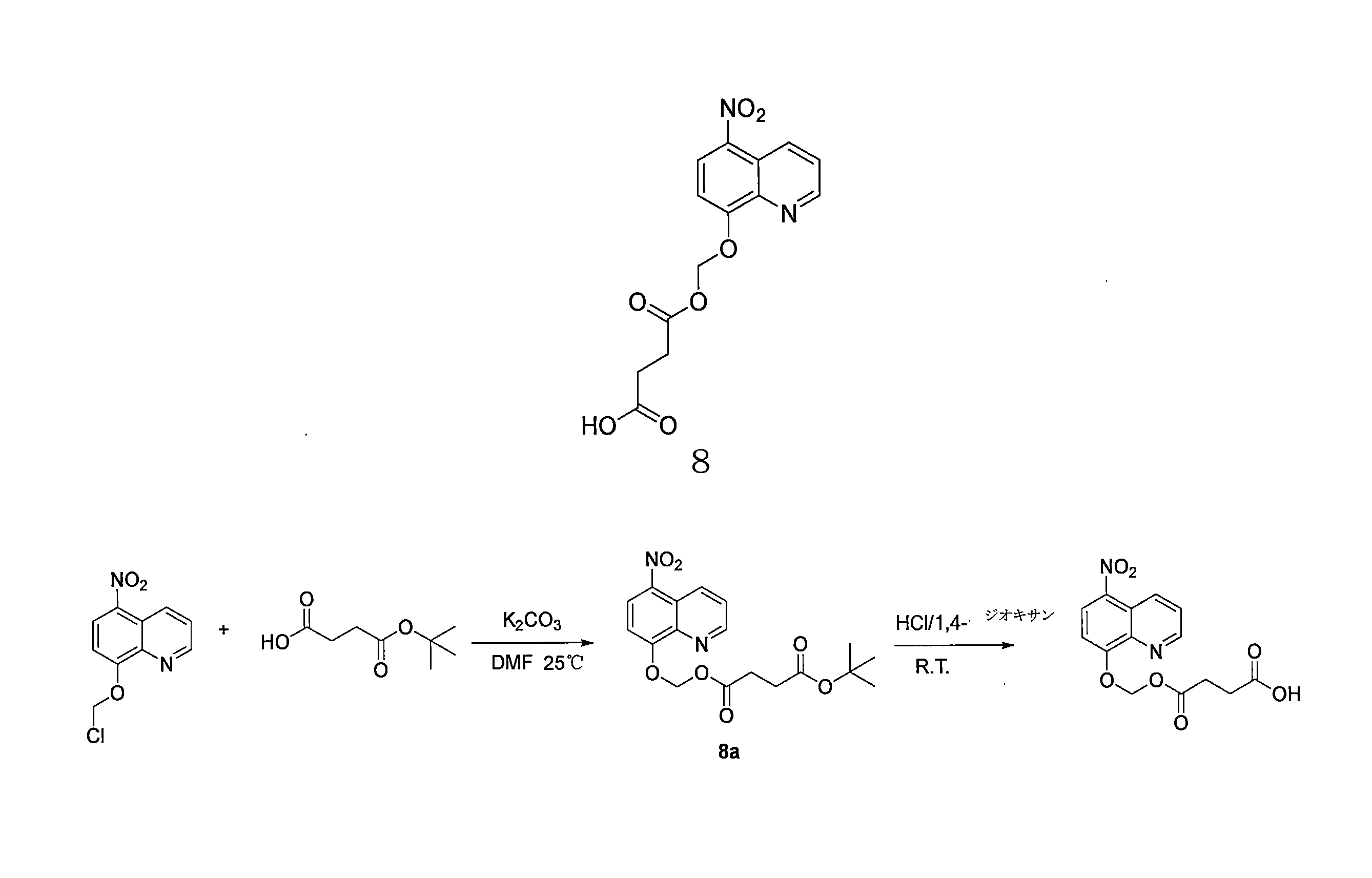
8-(クロロメトキシ)-5-ニトロキノリン(400mg,1.68mmol)と4-(t-ブトキシ)-4-オキソ酪酸(584mg,3.36mmol)をDMF(10mL)に溶解して、炭酸カリウム(463mg,3.36mmolを加えた。反応液を25℃で3時間撹拌した。反応を水(100mL)でクエンチした後、反応液を酢酸エチル(20mLx2)で抽出し、有機相を合わせた後、無水硫酸ナトリウムで乾燥させて、ろ過し、ろ液を減圧濃縮させた。残留物をシリカゲルカラムクロマトグラフィー(PE:EA=1:1)により精製して、生成物としてt-ブチル(((5-ニトロキノリン-8-イル)オキシ)メチル)コハク酸エステル310mgを得た。
ステップ2:4-((5-ニトロキノリン-8-イルオキシ)メトキシ)-4-オキソ酪酸(8)の製造
t-ブチル(((5-ニトロキノリン-8-イル)オキシ)メチル)コハク酸エステル(230mg,0.718mmol)をHCl/ジオキサン10mLに入れて、室温で20分間撹拌した。反応液を減圧濃縮させ、生成物として4-((5-ニトロキノリン-8-イルオキシ)メトキシ)-4-オキソ酪酸(128mg、収率65%)を黄色固体として得た。
1H-NMR (400 MHz, DMSO-d6) δ: 12.3 (br, 1H).9.05 (d, J = 2.8 Hz, 1H), 9.00 (d, J = 8.8 Hz, 1H), 8.55 (d, J = 8.8 Hz, 1H), 7.87 (dd, J = 8.8, 4.0 Hz, 1H), 7.54 (d, J = 8.8 Hz, 1H), 6.14 (s, 2H), 2.60~2.65 (m, 2 Hz, 4H), 2.50~2.55 (m, 2H)。
MS計算: 320.26;MS実測: 321.1 [M+H]+。
Example 8: Synthesis of 4-((5-nitroquinolin-8-yloxy)methoxy)-4-oxobutyric acid (8)
Step 2: Preparation of 4-((5-nitroquinolin-8-yloxy)methoxy)-4-oxobutyric acid (8) t-Butyl (((5-nitroquinolin-8-yl)oxy)methyl)succinate (230 mg, 0.718 mmol) was added to 10 mL of HCl/dioxane and stirred at room temperature for 20 minutes. The reaction solution was concentrated under reduced pressure to give the product 4-((5-nitroquinolin-8-yloxy)methoxy)-4-oxobutyric acid (128 mg, yield 65%) as a yellow solid.
1 H-NMR (400 MHz, DMSO-d6) δ: 12.3 (br, 1H).9.05 (d, J = 2.8 Hz, 1H), 9.00 (d, J = 8.8 Hz, 1H), 8.55 (d, J = 8.8 Hz, 1H), 7.87 (dd, J = 8.8, 4.0 Hz, 1H), 7.54 (d, J = 8.8 Hz, 1H), 6.14 (s, 2H), 2.60~2.65 (m, 2 Hz, 4H), 2.50~2.55 (m, 2H).
MS calculation: 320.26; MS measurement: 321.1 [M+H] + .
実施例9:(5-ニトロキノリン-8-イルオキシ)メチル2-(ピリジン-3-イル)アセテート(9)の合成

1H NMR (400 MHz,DMSO-d6) δ: 8.95~9.10 (d, 2H), 8.47~8.54 (d, 2H), 7.33~7.89 (m,4H), 7.54 (d, J = 8.4 Hz, 1H),6.18 (s, 2H), 3.89 (s,2H), 4.72~4.75 (m, 2H)。
MS計算: 339.31;MS実測: 340.1[M+H]+。
Example 9: Synthesis of (5-nitroquinolin-8-yloxy)methyl 2-(pyridin-3-yl)acetate (9)
1 H NMR (400 MHz,DMSO-d6) δ: 8.95~9.10 (d, 2H), 8.47~8.54 (d, 2H), 7.33~7.89 (m,4H), 7.54 (d, J = 8.4 Hz, 1H),6.18 (s, 2H), 3.89 (s,2H), 4.72~4.75 (m, 2H).
MS calculation: 339.31;MS measurement: 340.1[M+H] + .
実施例10:(5-ニトロキノリン-8-イルオキシ)メチル8-ヒドロキシカプリレートの合成
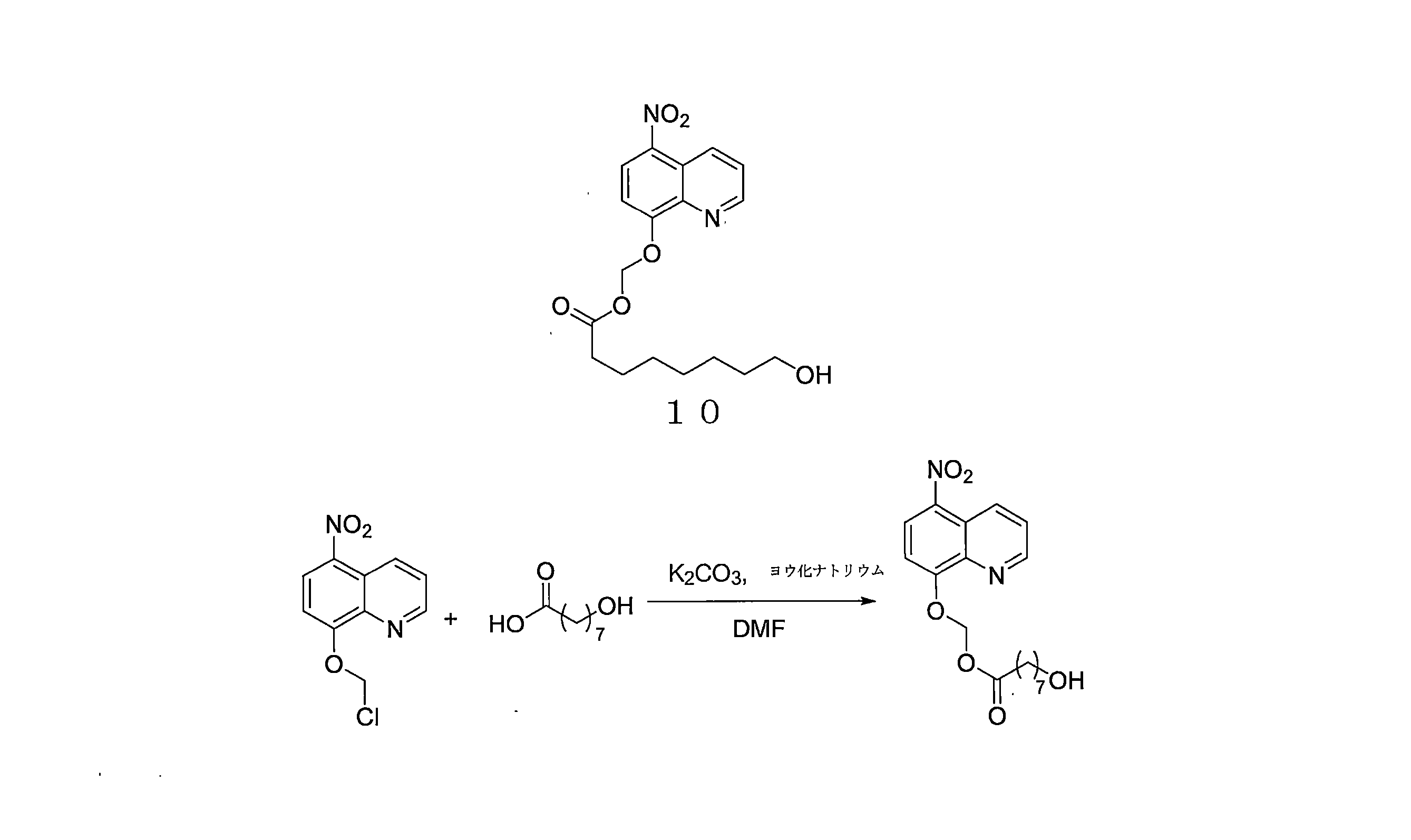
1H NMR (400 MHz, DMSO-d6) δ 9.04 (dd, J = 4.1, 1.6 Hz, 1H), 9.00 (dd, J = 8.9, 1.6 Hz, 1H), 8.56 (d, J = 8.8 Hz, 1H), 7.87 (dd, J = 8.9, 4.1 Hz, 1H), 7.55 (d, J = 8.9 Hz, 1H), 6.14 (s, 2H), 3.30 (t, J = 6.6 Hz, 2H), 2.39 (t, J = 7.3 Hz, 2H), 1.56 - 1.45 (m, 2H), 1.35 - 1.24 (m, 2H), 1.15 (s, 6H)。
MS計算: 362.4;MS実測: 363.3[M+H]+。
Example 10: Synthesis of (5-nitroquinolin-8-yloxy)methyl 8-hydroxycaprylate
1 H NMR (400 MHz, DMSO-d6) δ 9.04 (dd, J = 4.1, 1.6 Hz, 1H), 9.00 (dd, J = 8.9, 1.6 Hz, 1H), 8.56 (d, J = 8.8 Hz, 1H), 7.87 (dd, J = 8.9, 4.1 Hz, 1H), 7.55 (d, J = 8.9 Hz, 1H), 6.14 (s, 2H), 3.30 (t, J = 6.6 Hz, 2H), 2.39 (t, J = 7.3 Hz, 2H), 1.56 - 1.45 (m, 2H), 1.35 - 1.24 (m, 2H), 1.15 (s, 6H).
MS calculation: 362.4;MS measurement: 363.3[M+H] + .
実施例11:メチル(5-ニトロキノリン-8-イルオキシ)メチルアジペート(11)の合成

1H NMR (400 MHz, DMSO-d6) δ 10.03 (dd, J = 4.1, 1.6 Hz, 1H), 9.99 (dd, J = 8.9, 1.5 Hz, 1H), 9.55 (d, J = 8.8 Hz, 1H), 8.86 (dd, J = 8.9, 4.1 Hz, 1H), 8.54 (d, J = 8.9 Hz, 1H), 7.13 (s, 2H), 4.53 (s, 3H), 4.32 (s, 4H), 3.42 (t, J = 7.0 Hz, 2H), 3.25 (t, J = 7.1 Hz, 2H)。
MS計算: 362.3;MS実測: 363.3[M+H]+。
Example 11: Synthesis of methyl(5-nitroquinolin-8-yloxy)methyl adipate (11)
1 H NMR (400 MHz, DMSO-d6) δ 10.03 (dd, J = 4.1, 1.6 Hz, 1H), 9.99 (dd, J = 8.9, 1.5 Hz, 1H), 9.55 (d, J = 8.8 Hz, 1H), 8.86 (dd, J = 8.9, 4.1 Hz, 1H), 8.54 (d, J = 8.9 Hz, 1H), 7.13 (s, 2H), 4.53 (s, 3H), 4.32 (s, 4H), 3.42 (t, J = 7.0 Hz, 2H), 3.25 (t, J = 7.1 Hz, 2H).
MS calculation: 362.3;MS measurement: 363.3[M+H] + .
実施例12:(5-ニトロキノリン-8-イルオキシ)メチル7-(t-ブトキシカルボニルアミノ)エナンテート(12)の合成
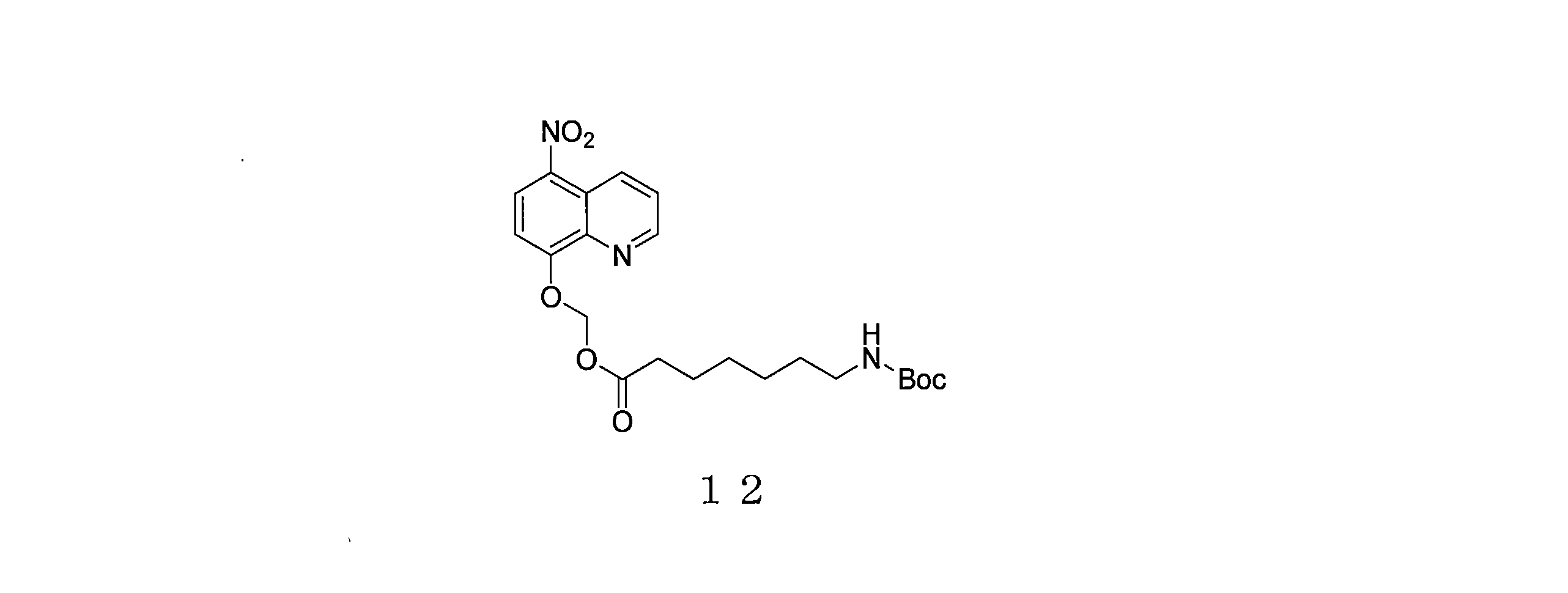
1H NMR (400 MHz, CDCl3) δ 9.19 (dd, J = 8.9, 1.6 Hz, 1H), 9.07 (dd, J = 4.1, 1.6 Hz, 1H), 8.50 (d, J = 8.8 Hz, 1H), 7.72 (dd, J = 8.9, 4.1 Hz, 1H), 7.36 (d, J = 8.8 Hz, 1H), 6.18 (s, 2H), 4.47 (s, 1H), 3.07 (d, J = 6.4 Hz, 2H), 2.40 (t, J = 7.5 Hz, 2H), 1.69 - 1.60 (m, 2H), 1.42 (d, J = 10.2 Hz, 11H), 1.35 - 1.25 (m, 4H)。
MS計算: 447.5;MS実測: 448.4[M+H]+。
Example 12: Synthesis of (5-nitroquinolin-8-yloxy)methyl 7-(t-butoxycarbonylamino)enanthate (12)
1 H NMR (400 MHz, CDCl 3 ) δ 9.19 (dd, J = 8.9, 1.6 Hz, 1H), 9.07 (dd, J = 4.1, 1.6 Hz, 1H), 8.50 (d, J = 8.8 Hz, 1H), 7.72 (dd, J = 8.9, 4.1 Hz, 1H), 7.36 (d, J = 8.8 Hz, 1H), 6.18 (s, 2H), 4.47 (s, 1H), 3.07 (d, J = 6.4 Hz, 2H), 2.40 (t, J = 7.5 Hz, 2H), 1.69 - 1.60 (m, 2H), 1.42 (d, J = 10.2 Hz, 11H), 1.35 - 1.25 (m, 4H).
MS calculation: 447.5;MS measurement: 448.4[M+H] + .
実施例13:(S)-(5-ニトロキノリン-8-イルオキシ)メチル2-(t-ブトキシカルボニルアミノ)-3-フェニルプロピオネート(13)の合成
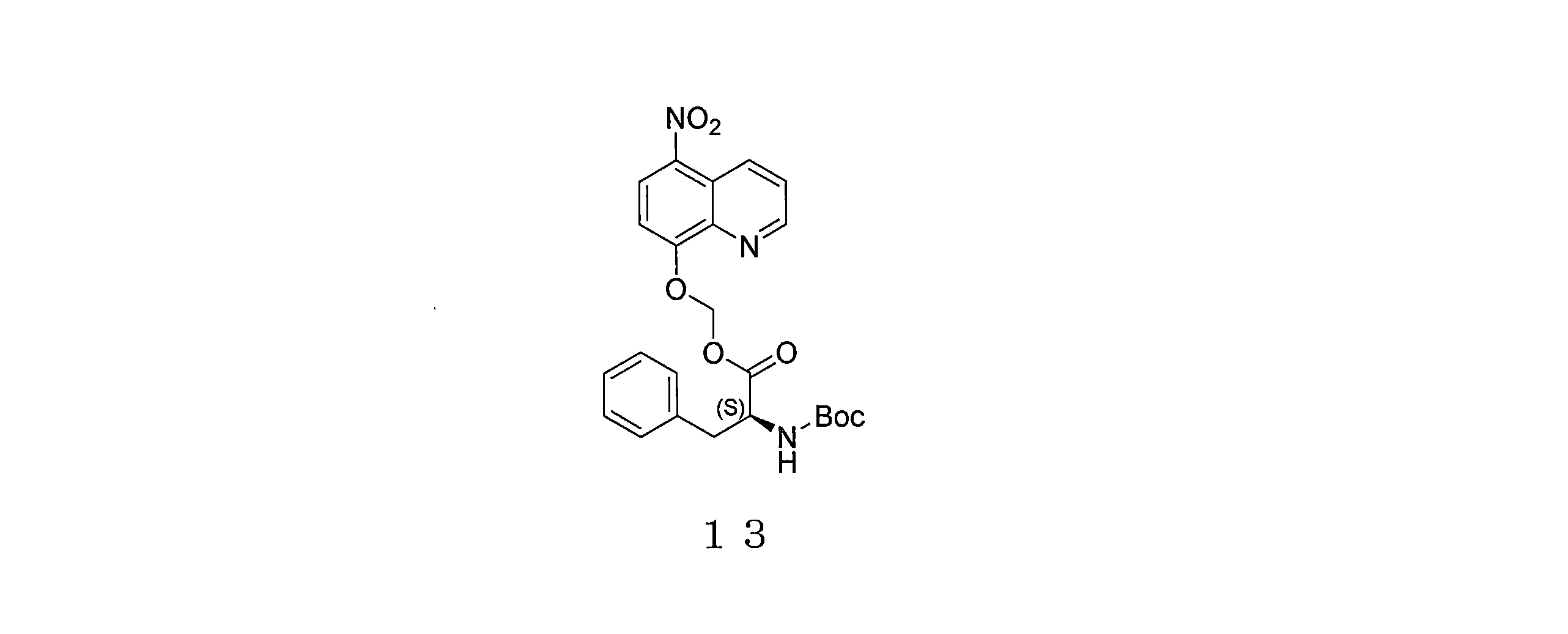
1H NMR (400 MHz, CDCl3) δ 9.19 (dd, J = 8.9, 1.5 Hz, 1H), 9.08 (dd, J = 4.1, 1.5 Hz, 1H), 8.41 (d, J = 8.8 Hz, 1H), 7.72 (dd, J = 8.9, 4.1 Hz, 1H), 7.20 - 7.03 (m, 6H), 6.17 (dd, J = 63.5, 6.5 Hz, 2H), 4.95 (d, J = 7.7 Hz, 1H), 4.62 (dd, J = 13.8, 6.8 Hz, 1H), 3.06 (d, J = 6.3 Hz, 2H), 1.40 (s, 9H)。
MS計算: 467.5;MS実測: 468.3[M+H]+。
Example 13: Synthesis of (S)-(5-nitroquinolin-8-yloxy)methyl 2-(t-butoxycarbonylamino)-3-phenylpropionate (13)
1 H NMR (400 MHz, CDCl 3 ) δ 9.19 (dd, J = 8.9, 1.5 Hz, 1H), 9.08 (dd, J = 4.1, 1.5 Hz, 1H), 8.41 (d, J = 8.8 Hz, 1H), 7.72 (dd, J = 8.9, 4.1 Hz, 1H), 7.20 - 7.03 (m, 6H), 6.17 (dd, J = 63.5, 6.5 Hz, 2H), 4.95 (d, J = 7.7 Hz, 1H), 4.62 (dd, J = 13.8, 6.8 Hz, 1H), 3.06 (d, J = 6.3 Hz, 2H), 1.40 (s, 9H).
MS calculation: 467.5;MS measurement: 468.3[M+H] + .
実施例14:(S)-4-メチル1-(5-ニトロキノリン-8-イルオキシ)メチル2-アセチルアミノサクシネート(14)の合成


N-(t-ブトキシカルボニルL)-S-メチル-L-システイン(590mg,2.5mmol)、炭酸カリウム(580mg,4.2mmol)、ヨウ素カリウム(83mg,0.5mmol)をN,N-ジメチルホルムアミド(5mL)に加えて、均一に撹拌した。反応系を60℃に昇温して、10分間撹拌した後、5-ニトロ-8-クロロメトキシキノリン(1a)(500mg,2.1mmol)を加えて、1時間撹拌した。水を加えて反応をクエンチし、酢酸エチルで抽出して、有機相を飽和食塩水溶液で洗浄し、無水硫酸ナトリウムで乾燥させて、ろ過後、減圧濃縮させた。残留物をシリカゲルクロマトグラフィー分取プレート(展開剤:5%メタノール/95%ジクロロメタン)により精製して、(S)-4-メチル1-(5-ニトロキノリン-8-イルオキシ)メチル2-(t-ブトキシカルボニルアミノ)サクシネート(200mg,収率33%)を得た。
ステップ2:(S)-4-メチル1-(5-ニトロキノリン-8-イルオキシ)メチル2-アミノサクシネート(14b)の製造
室温で、トリフルオロ酢酸(5mL)を(S)-4-メチル1-(5-ニトロキノリン-8-イルオキシ)メチル2-(t-ブトキシカルボニルアミノ)サクシネート(200mg,0.46mmol)のジクロロメタン(5mL)溶液に滴下した。反応液を室温で2時間撹拌した後、減圧濃縮させ、粗製品として(S)-4-メチル1-(5-ニトロキノリン-8-イルオキシ)メチル2-アミノサクシネート(220mg、収率99%)を得た。
ステップ3:S)-4-メチル1-(5-ニトロキノリン-8-イルオキシ)メチル2-アセチルアミノサクシネート(14)の製造
(S)-4-メチル1-(5-ニトロキノリン-8-イルオキシ)メチル2-アミノサクシネート(200mg,0.68mmol)、塩化アセチル(80mg,1.0mmol)をジクロロメタン(10mL)に溶解して、氷水浴の条件下でトリエチルアミン(140mg,2.0mmol)を緩やかに滴下し、室温に昇温して1時間撹拌した。反応液をジクロロメタン(100mL)に加えて、水で1回洗浄し、有機相を合わせた後、無水硫酸ナトリウムで乾燥させて、ろ過し、ろ液を減圧濃縮させ、生成物(178mg、収率57%)を得た。
1H-NMR (400 Hz, CDCl3) δ: 9.20 (dd, J = 8.8, 1.6 Hz, 1H), 9.10 (dd, J = 4, 1.6 Hz, 1H), 8.50 (d, J = 8.8 Hz, 1H), 7.77 (dd, J = 8.8 Hz, 4.4 Hz, 1H), 7.35 (d, J = 8.8 Hz, 1H), 6.49 (d, J = 8 Hz, 1H), 6.23-6.27 (m, 2H), 4.94-4.98 (m, 1H), 3.61 (s, 3H), 3.03-3.09 (m, 1H), 3.85-2.90 (m, 1H), 2.03 (s, 3H).
Example 14: Synthesis of (S)-4-methyl 1-(5-nitroquinolin-8-yloxy)methyl 2-acetylaminosuccinate (14)
Step 2: Preparation of (S)-4-methyl 1-(5-nitroquinolin-8-yloxy)methyl 2-aminosuccinate (14b) At room temperature, trifluoroacetic acid (5 mL) was added dropwise to a solution of (S)-4-methyl 1-(5-nitroquinolin-8-yloxy)methyl 2-(t-butoxycarbonylamino)succinate (200 mg, 0.46 mmol) in dichloromethane (5 mL). The reaction solution was stirred at room temperature for 2 hours and then concentrated under reduced pressure to obtain crude (S)-4-methyl 1-(5-nitroquinolin-8-yloxy)methyl 2-aminosuccinate (220 mg, yield 99%).
Step 3: Preparation of S)-4-methyl 1-(5-nitroquinolin-8-yloxy)methyl 2-acetylaminosuccinate (14) (S)-4-methyl 1-(5-nitroquinolin-8-yloxy)methyl 2-aminosuccinate (200 mg, 0.68 mmol) and acetyl chloride (80 mg, 1.0 mmol) were dissolved in dichloromethane (10 mL), triethylamine (140 mg, 2.0 mmol) was slowly added dropwise under ice-water bath conditions, the temperature was raised to room temperature, and the mixture was stirred for 1 hour. The reaction solution was added to dichloromethane (100 mL), washed once with water, and the organic phases were combined, dried over anhydrous sodium sulfate, filtered, and the filtrate was concentrated under reduced pressure to obtain the product (178 mg, yield 57%).
1 H-NMR (400 Hz, CDCl3) δ: 9.20 (dd, J = 8.8, 1.6 Hz, 1H), 9.10 (dd, J = 4, 1.6 Hz, 1H), 8.50 (d, J = 8.8 Hz, 1H), 7.77 (dd, J = 8.8 Hz, 4.4 Hz, 1H), 7.35 (d, J = 8.8 Hz, 1H), 6.49 (d, J = 8 Hz, 1H), 6.23-6.27 (m, 2H), 4.94-4.98 (m, 1H), 3.61 (s, 3H), 3.03-3.09 (m, 1H), 3.85-2.90 (m, 1H), 2.03 (s, 3H).
実施例15:(S)-(5ニトロキノリン-8-イルオキシ)メチル2-(2-アセチルアミノ-4-メチルバレリルアミノ)アセテート(15)の合成
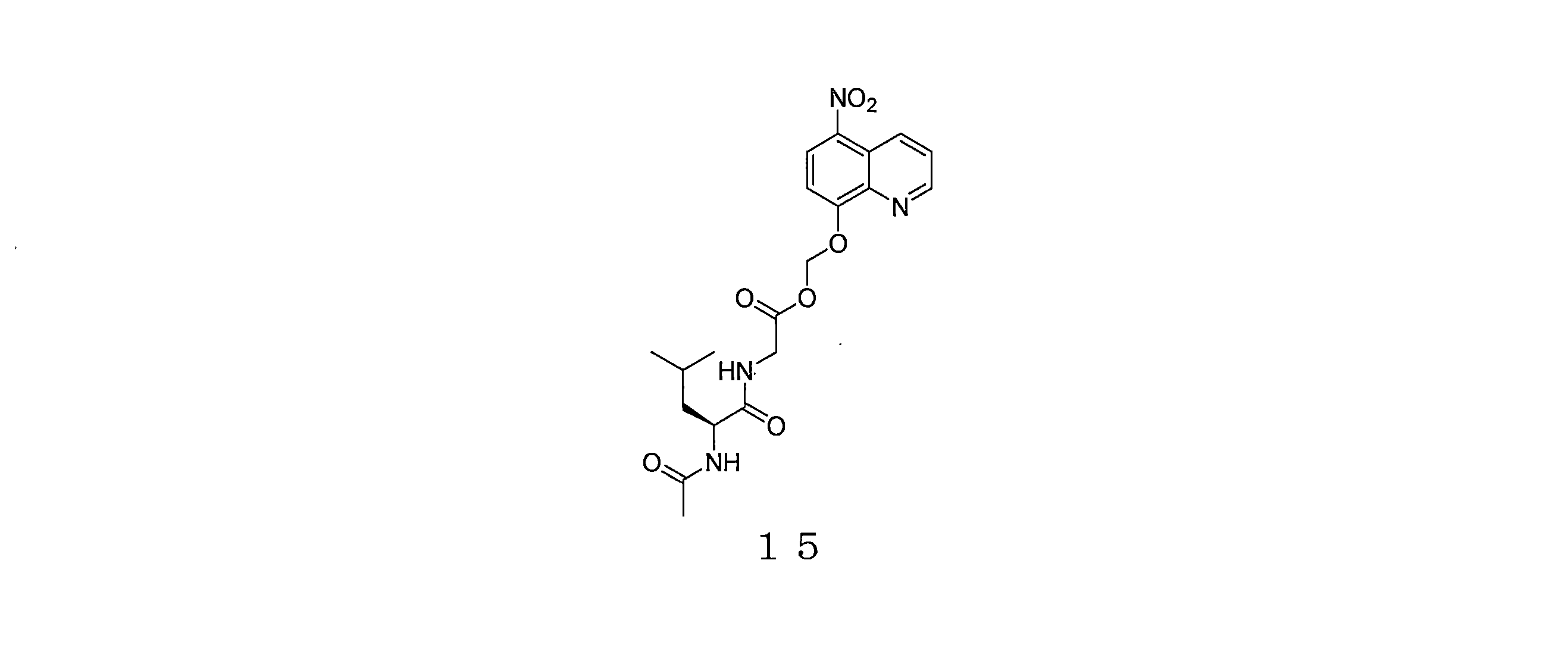
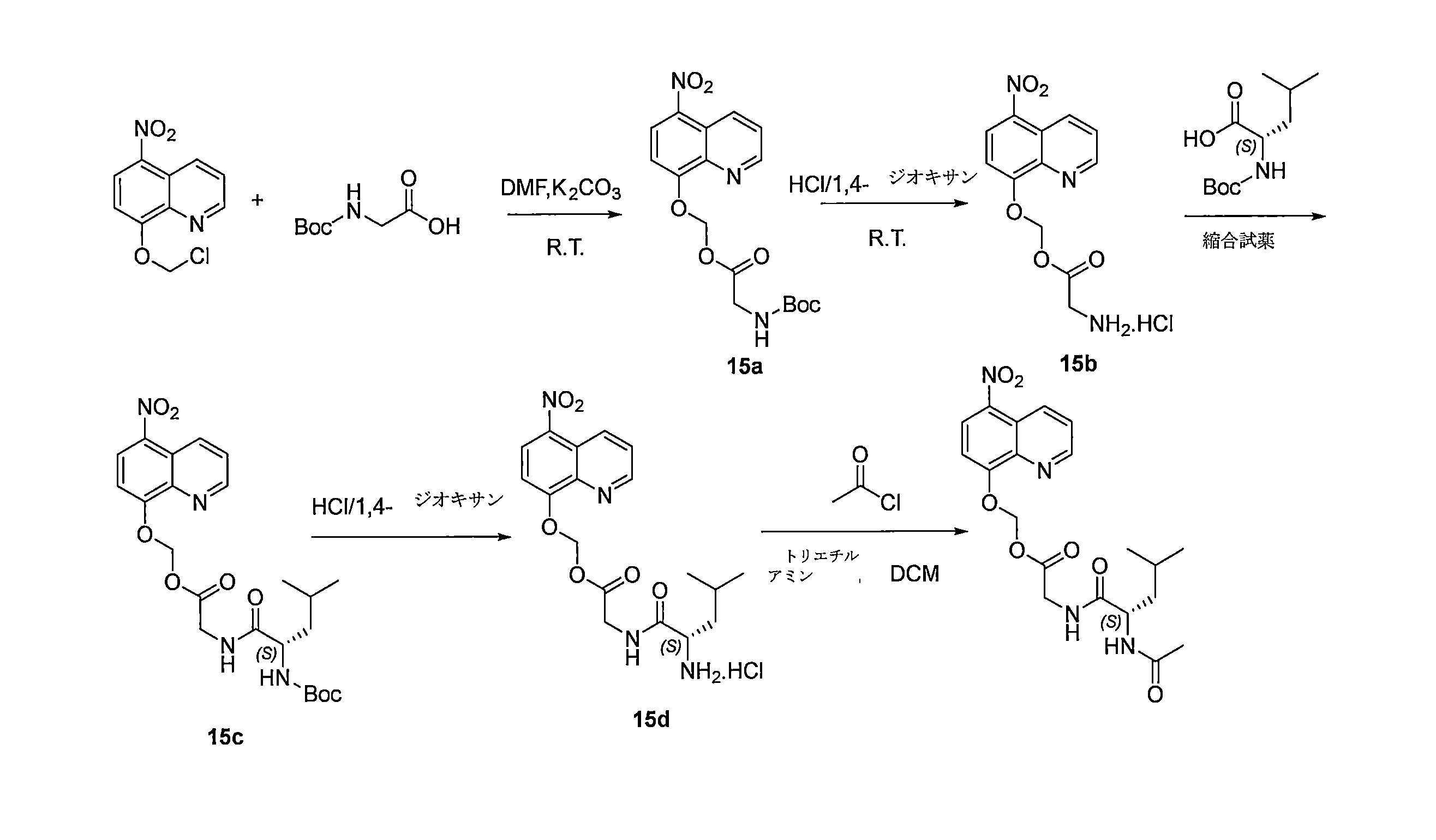
室温で、炭酸カリウム(0.65g,4.2mmol)をBoc-グリシン(700mg,4.1mmol)、5-ニトロ-8-(クロロメトキシ)キノリン(1a)(500mg,2.1mmol)のN,N-ジメチルホルムアミド(10mL)溶液に加えた。室温で2時間反応させ、水30mLとジクロロメタン(20mLx2)を加えて抽出し、有機相を食塩水で洗浄し、減圧濃縮させた。残留物をシリカゲルカラムクロマトグラフィー(PE:EA=1:1)により精製して、白色固体として、収率75.7%、純度95%で生成物を600mg得た。
ステップ2:(5-ニトロキノリン-8-イルオキシ)メチル2-アミノアセテート塩酸塩(15b)の製造
室温で、(5-ニトロキノリン-8-イルオキシ)メチル2-(t-ブトキシカルボニルアミノ)アセテート(600mg,1.59mmol)をHCl/ジオキサン溶液10mLに加えて、室温20分間撹拌した。反応液を減圧濃縮させ、白色固体としての生成物600mgを純度97%得た。
ステップ3:((S)-(5-ニトロキノリン-8-イルオキシ)メチル2-(2-(t-ブトキシカルボニルアミノ)-4-メチルバレリルアミノ)アセテート(15c)の製造
室温で、(5-ニトロキノリン-8-イルオキシ)メチル2-アミノアセテート塩酸塩(500mg,1.6mmol)とBoc-L-ロイシン(553mg,2.4mmol)をDMF 10mLに投入して、0℃に降温し、1-ヒドロキシ-ベンゾ-トリアゾール(HOBt)(342mmol,2.4mmol)、1-エチル-(3-ジメチルアミノプロピル)カルボジイミド塩酸塩(EDCI)(480mg,2.4mmol)、及びTEA(500mg,4.8mmol)を順次加えて、室温で1時間撹拌した。反応液を減圧濃縮させ、残留物をシリカゲルカラムクロマトグラフィー(ジクロロメタン/メタノール=15:1)により精製して、生成物80mgを純度97%で得た。
ステップ4:(S)-(5-ニトロキノリン-8-イルオキシ)メチル2-(2-アミノ-4-メチルバレリルアミノ)アセテート塩酸塩(15d)の製造
((S)-(5-ニトロキノリン-8-イルオキシ)メチル2-(2-(t-ブトキシカルボニルアミノ)-4-メチルバレリルアミノ)アセテート(80mg,0.16mmol)をHCl/ジオキサン(4M)10mLに投入して、20分間撹拌した。反応液を減圧濃縮させ、白色固体として生成物70mgを純度95%で得た。
ステップ5:(S)-(5-ニトロキノリン-8-イルオキシ)メチル2-(2-アセチルアミノ-4-メチルバレリルアミノ)アセテート(15)の製造
(S)-(5-ニトロキノリン-8-イルオキシ)メチル2-(2-アミノ-4-メチルバレリルアミノ)アセテート塩酸塩(70mg,0.16mmol)をジクロロメタン10mLに投入して、氷浴で冷却し、塩化アセチル(39mg,0.48mmol)を加えて、次に、TEA(80mg,0.8mmol)を緩やかに加えて、10℃で10分間撹拌した。反応液を減圧濃縮させ、残留物をシリカゲルカラムクロマトグラフィー(DCM:MeOH=10:1)により精製して、生成物(S)-(5-ニトロキノリン-8-イルオキシ)メチル2-(2-アセチルアミノ-4-メチルバレリルアミノ)アセテート(40mg、57%収率)を得た。淡黄色固体、純度97%であった。
1H-NMR (400 MHz, DMSO-d6) δ: 9.05 (dd, J = 4.4 Hz,1.4Hz,1H), 9.00 (dd, J = 8.8 Hz,1.6Hz,1H), 8.55 (d, J=8.8 Hz, 1H), 8.41(t,J=6Hz,1H) , 8.00(d,J=8.8Hz,1H), 7.88(dd, J = 8.8 Hz, 4.0Hz,1H), 7.54 (d, J=8.8 Hz, 1H), 6.14-6.18 (m, 2H), 4.26-4.32 (m, 1H), 3.85-3.99 (m, 2H) , 1.825 (s,3H),1.52-1.58 (m, 1H),1.35-1.39(m, 2H) ,0.81 (d, J=6.8Hz,3H), 0.78 (d, J=6.4Hz,3H)。
MS計算: 432.16;MS実測: 433.2 [M+H]+。
Example 15: Synthesis of (S)-(5-nitroquinolin-8-yloxy)methyl 2-(2-acetylamino-4-methylvalerylamino)acetate (15)
Step 2: Preparation of (5-nitroquinolin-8-yloxy)methyl 2-aminoacetate hydrochloride (15b) At room temperature, (5-nitroquinolin-8-yloxy)methyl 2-(t-butoxycarbonylamino)acetate (600 mg, 1.59 mmol) was added to 10 mL of HCl/dioxane solution and stirred at room temperature for 20 minutes. The reaction solution was concentrated under reduced pressure to obtain 600 mg of the product as a white solid with a purity of 97%.
Step 3: Preparation of ((S)-(5-nitroquinolin-8-yloxy)methyl 2-(2-(t-butoxycarbonylamino)-4-methylvalerylamino)acetate (15c) Dissolve (5-nitroquinolin-8-yloxy)methyl 2-aminoacetate hydrochloride (500 mg, 1.6 mmol) and Boc-L-leucine (553 mg, 2.4 mmol) in DMF at room temperature. The mixture was poured into 10 mL of water, cooled to 0° C., and 1-hydroxy-benzo-triazole (HOBt) (342 mmol, 2.4 mmol), 1-ethyl-(3-dimethylaminopropyl)carbodiimide hydrochloride (EDCI) (480 mg, 2.4 mmol), and TEA (500 mg, 4.8 mmol) were added in that order, followed by stirring at room temperature for 1 hour. The reaction solution was concentrated under reduced pressure, and the residue was purified by silica gel column chromatography (dichloromethane/methanol=15:1) to obtain 80 mg of product with a purity of 97%.
Step 4: Preparation of (S)-(5-nitroquinolin-8-yloxy)methyl 2-(2-amino-4-methylvalerylamino)acetate hydrochloride (15d) ((S)-(5-nitroquinolin-8-yloxy)methyl 2-(2-(t-butoxycarbonylamino)-4-methylvalerylamino)acetate (80 mg, 0.16 mmol) was added to 10 mL of HCl/dioxane (4 M) and stirred for 20 minutes. The reaction solution was concentrated under reduced pressure to obtain 70 mg of the product as a white solid with a purity of 95%.
Step 5: Preparation of (S)-(5-nitroquinolin-8-yloxy)methyl 2-(2-acetylamino-4-methylvalerylamino)acetate (15) (S)-(5-nitroquinolin-8-yloxy)methyl 2-(2-amino-4-methylvalerylamino)acetate hydrochloride (70 mg, 0.16 mmol) was added to 10 mL of dichloromethane, cooled in an ice bath, acetyl chloride (39 mg, 0.48 mmol) was added, and then TEA (80 mg, 0.8 mmol) was slowly added and stirred at 10° C. for 10 minutes. The reaction solution was concentrated under reduced pressure, and the residue was purified by silica gel column chromatography (DCM:MeOH=10:1) to obtain the product (S)-(5-nitroquinolin-8-yloxy)methyl 2-(2-acetylamino-4-methylvalerylamino)acetate (40 mg, 57% yield). Pale yellow solid, 97% pure.
1 H-NMR (400 MHz, DMSO-d6) δ: 9.05 (dd, J = 4.4 Hz,1.4Hz,1H), 9.00 (dd, J = 8.8 Hz,1.6Hz,1H), 8.55 (d, J=8.8 Hz, 1H), 8.41(t,J=6Hz,1H), 8.00(d,J=8.8Hz,1H), 7.88(dd, J = 8.8 Hz, 4.0Hz,1H), 7.54 (d, J=8.8 Hz, 1H), 6.14-6.18 (m, 2H), 4.26-4.32 (m, 1H), 3.85-3.99 (m, 2H), 1.825 (s,3H),1.52-1.58 (m, 1H),1.35-1.39(m, 2H) ,0.81 (d, J=6.8Hz,3H), 0.78 (d, J=6.4Hz,3H).
MS calculation: 432.16;MS measurement: 433.2 [M+H]+.
実施例16:(R)-(5-ニトロキノリン-8-イルオキシ)メチル2-アセチルアミノ-3-(メチルチオ)プロピオネート(16)の合成
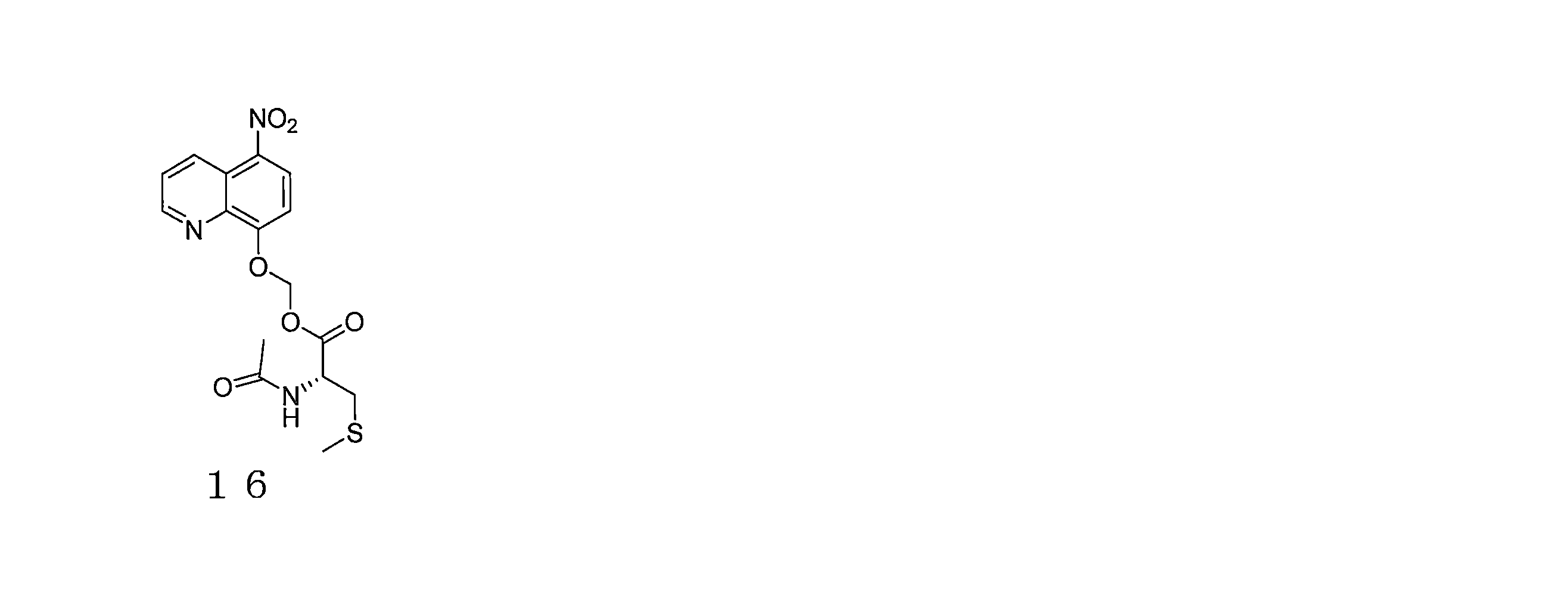

室温で、N-(t-ブトキシカルボニル)-S-メチル-L-システイン(590mg,2.5mmol)、炭酸カリウム(580mg,4.2mmol)、ヨウ素カリウム(83mg,0.5mmol)をN,N-ジメチルホルムアミド(5mL)に加えて、均一に撹拌した。反応系を60℃に昇温して、10分間撹拌した後、5-ニトロ-8-クロロメトキシキノリン(1a)(500mg,2.1mmol)を加えて、撹拌しながら1時間反応させた。水を加えて反応をクエンチし、酢酸エチルで抽出して、有機相を飽和食塩水溶液で洗浄し、無水硫酸ナトリウムで乾燥させて、ろ過後、減圧濃縮させた。残留物をシリカゲルクロマトグラフィー分取プレート(展開剤:5%メタノール/95%ジクロロメタン)により精製して、(R)-(5-ニトロキノリン-8-イルオキシ)メチル2-(t-ブトキシカルボニルアミノ)-3-(メチルチオ)プロピオネート(300mg,収率33%)を得た。
ステップ2:(R)-(5-ニトロキノリン-8-イルオキシ)メチル2-アミノ-3-(メチルチオ)プロピオネート(16b)の製造
室温で、トリフルオロ酢酸(2mL)を(R)-(5-ニトロキノリン-8-イルオキシ)メチル2-(t-ブトキシカルボニルアミノ)-3-(メチルチオ)プロピオネート(200mg,0.46mmol)のジクロロメタン(5mL)溶液に滴下した。反応液を室温で2時間撹拌した後、減圧濃縮させ、(R)-(5-ニトロキノリン-8-イルオキシ)メチル2-アミノ-3-(メチルチオ)プロピオネート(150mg、収率99%)を得た。
ステップ3:(R)-(5-ニトロキノリン-8-イルオキシ)メチル2-アセチルアミノ-3-(メチルチオ)プロピオネート(16)の製造
0℃で、(R)-(5-ニトロキノリン-8-イルオキシ)メチル2-アミノ-3-(メチルチオ)プロピオネート(200mg,0.68mmol)、塩化アセチル(80mg,1.0mmol)をジクロロメタン(10mL)に溶解して、氷水浴にてトリエチルアミン(140mg,2.0mmol)を緩やかに滴下し、室温に昇温して1時間撹拌した。反応液をジクロロメタン(100mL)に加えて、水で1回洗浄し、有機相を合わせた後、無水硫酸ナトリウムで乾燥させて、ろ過し、ろ液を減圧濃縮させた。残留物を逆相高速液体クロマトグラフィー(カラムはEclipse XDB-C18(21.2mm×250mm,7μm)、移動相はアセトニトリル-0.1%ギ酸、流速は20.0mL/minである)により分離して、生成物(R)-(5-ニトロキノリン-8-イルオキシ)メチル2-アセチルアミノ-3-(メチルチオ)プロピオネート(178mg、収率57%)を得た。
1H-NMR (400 Hz, CDCl3) δ: 9.37-9.41 (m, 1H), 9.17-9.19 (m, 1H), 8.60 (d, J = 8.8 Hz, 1H), 7.89 (dd, J = 8.8, 4.4 Hz, 1H), 7.48(d, J = 8.8 Hz, 1H), 6.56 (d, J = 6.8 Hz, 1H), 6.19-6.24 (m, 2H), 4.83-4.88 (m, 1H), 2.90-3.0 (m, 2H), 2.10 (s, 3H), 2.06 (s, 3H)。
MS計算: 379.39;MS実測: 380.1 [M+H]+。
Example 16: Synthesis of (R)-(5-nitroquinolin-8-yloxy)methyl 2-acetylamino-3-(methylthio)propionate (16)
Step 2: Preparation of (R)-(5-nitroquinolin-8-yloxy)methyl 2-amino-3-(methylthio)propionate (16b) Trifluoroacetic acid (2 mL) was added dropwise to a solution of (R)-(5-nitroquinolin-8-yloxy)methyl 2-(t-butoxycarbonylamino)-3-(methylthio)propionate (200 mg, 0.46 mmol) in dichloromethane (5 mL) at room temperature. The reaction solution was stirred at room temperature for 2 hours and then concentrated under reduced pressure to give (R)-(5-nitroquinolin-8-yloxy)methyl 2-amino-3-(methylthio)propionate (150 mg, 99% yield).
Step 3: Preparation of (R)-(5-nitroquinolin-8-yloxy)methyl 2-acetylamino-3-(methylthio)propionate (16) At 0°C, (R)-(5-nitroquinolin-8-yloxy)methyl 2-amino-3-(methylthio)propionate (200 mg, 0.68 mmol) and acetyl chloride (80 mg, 1.0 mmol) were dissolved in dichloromethane (10 mL), triethylamine (140 mg, 2.0 mmol) was slowly added dropwise in an ice-water bath, the mixture was warmed to room temperature and stirred for 1 hour. The reaction solution was added to dichloromethane (100 mL), washed once with water, and the organic phases were combined, dried over anhydrous sodium sulfate, filtered, and the filtrate was concentrated under reduced pressure. The residue was separated by reversed-phase high performance liquid chromatography (column: Eclipse XDB-C18 (21.2 mm×250 mm, 7 μm), mobile phase: acetonitrile-0.1% formic acid, flow rate: 20.0 mL/min) to obtain the product (R)-(5-nitroquinolin-8-yloxy)methyl 2-acetylamino-3-(methylthio)propionate (178 mg, yield 57%).
1 H-NMR (400 Hz, CDCl3) δ: 9.37-9.41 (m, 1H), 9.17-9.19 (m, 1H), 8.60 (d, J = 8.8 Hz, 1H), 7.89 (dd, J = 8.8, 4.4 Hz, 1H), 7.48(d, J = 8.8 Hz, 1H), 6.56 (d, J = 6.8 Hz, 1H), 6.19-6.24 (m, 2H), 4.83-4.88 (m, 1H), 2.90-3.0 (m, 2H), 2.10 (s, 3H), 2.06 (s, 3H).
MS calculation: 379.39;MS measurement: 380.1 [M+H] + .
実施例17:(5-ニトロキノリン-8-イルオキシ)メチル2-(N-メチルアセチルアミノ)アセテート(17)の合成

1H-NMR (400Hz, CDCl3) δ: 9.23 (d, J = 8.8 Hz, 1H), 9.11 (d, J = 2.8 Hz, 1H), 8.53 (d, J = 8.8 Hz, 1H), 7.77 (dd, J = 8.8, 4.4 Hz, 1H), 7.40 (d, J = 8.8 Hz, 1H), 6.21 (s, 2H), 4.20 (s, 2H), 3.11(s, 3H), 2.16 (s, 3H)。
MS計算: 333.30;MS実測: 334.1 [M+H]+。
Example 17: Synthesis of (5-nitroquinolin-8-yloxy)methyl 2-(N-methylacetylamino)acetate (17)
1 H-NMR (400Hz, CDCl3) δ: 9.23 (d, J = 8.8 Hz, 1H), 9.11 (d, J = 2.8 Hz, 1H), 8.53 (d, J = 8.8 Hz, 1H), 7.77 (dd, J = 8.8, 4.4 Hz, 1H), 7.40 (d, J = 8.8 Hz, 1H), 6.21 (s, 2H), 4.20 (s, 2H), 3.11(s, 3H), 2.16 (s, 3H).
MS calculation: 333.30;MS measurement: 334.1 [M+H] + .
実施例18:(S)-2-(5-ニトロキノリン-8-イルオキシ)メチル1-プロピルピロリジン-1,2-二カルボキシラート(18)の合成

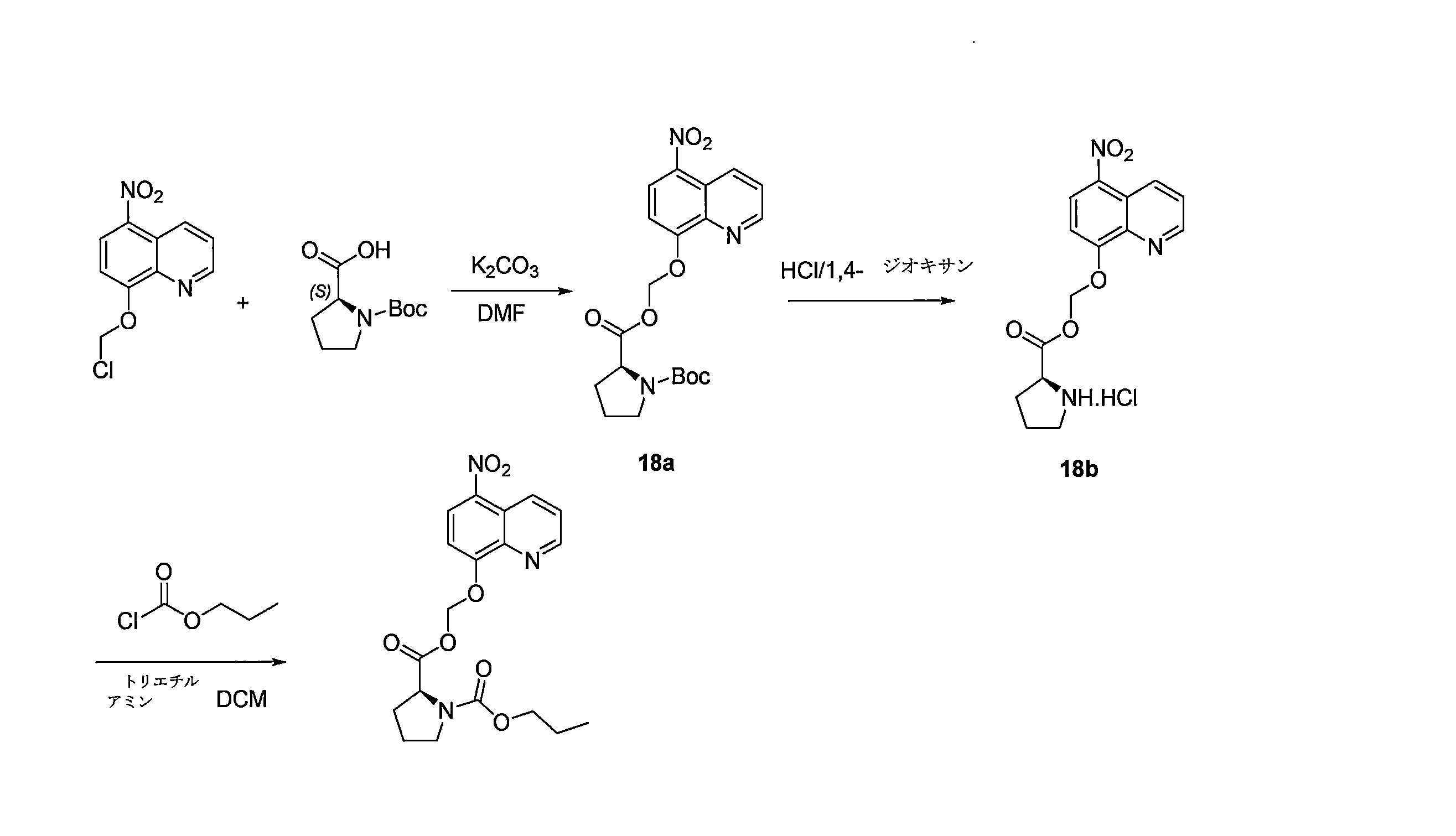
室温で、5-ニトロ-8-(クロロメトキシ)キノリン(1a)(1.5g,6.3mmol)とL-Bocプロリン(2.02g,9.4mmol)をDMF 15mLに溶解して、炭酸カリウム(1.73g,12.6mmol)を加えた。室温で3時間反応させ、水70mLを加えて、酢酸エチル(50mLx2)で抽出し、有機相を飽和食塩水で洗浄し、無水硫酸ナトリウムで乾燥させて、ろ過後、減圧濃縮させた。残留物をシリカゲルカラムクロマトグラフィー(PE:EA=1:1)により精製して、生成物1-(t-ブチル) 2-(((5-ニトロキノリン-8-イル)オキシ)メチル)(S)-ピロール-1,2-炭酸ジエステル(2.8g、収率106%)を得た。
ステップ2:((5-ニトロキノリン-8-イル)オキシ)メチルL-プロリンエステル塩酸塩(18b)の製造
0℃で、1-(t-ブチル) 2-(((5-ニトロキノリン-8-イル)オキシ)メチル)(S)-ピロール-1,2-炭酸ジエステル(2.8g、6.71mmol)をHCl/ジオキサン30mLに投入して、室温で20分間撹拌した。反応液を減圧濃縮させ、生成物((5-ニトロキノリン-8-イル)オキシ)メチルL-プロリンエステル塩酸塩(2.3g、収率97%)を得た。
ステップ3:(S)-2-(5-ニトロキノリン-8-イルオキシ)メチル1-プロピルピロリジン-1,2-二カルボキシラート(18)の製造
室温で、((5-ニトロキノリン-8-イル)オキシ)メチルL-プロリンエステル塩酸塩(150mg,0.424mmol)をDCM 10mLに投入して、氷浴で0~5℃に冷却し、クロロギ酸プロピル(104mg,0.85mmol)を加えて、次に、TEA(170mg,1.7mmol)を緩やかに加えた。添加終了後、室温で20分間撹拌した。反応液を減圧濃縮させ、残留物をシリカゲルカラムクロマトグラフィー(PE:EA=1:1)により精製して、生成物(S)-2-(5-ニトロキノリン-8-イルオキシ)メチル1-プロピルピロリジン-1,2-二カルボキシラート(70mg、収率40%)を得た。
1H-NMR (400 MHz, DMSO-d6): δ 9.05~9.06 (m, 1H), 9.01 (dd, J=8.8,1.6Hz,1H), 8.56 (dd, J = 8.8, 4.8Hz, 1H), 7.87 (d, J = 8.8, 4.0Hz, 1H), 7.55 (dd, J = 8.8,2.2Hz, 1H), 6.14~6.15 (m,2H), 4.29-4.31 (m, 1H), 3.88-3.81 (m, 1H) ,3.47-3.59 (m, 1H) , 3.40-3.45 (m, 2H) , 1.75-1.95(m, 3H), 1.51~1.45(m,1H),0.83-0.85(m, 2H) 0.50-0.51(m, 2H)。
MS計算: 403.39 MS実測: 426.1[M+Na+]。
Example 18: Synthesis of (S)-2-(5-nitroquinolin-8-yloxy)methyl 1-propylpyrrolidine-1,2-dicarboxylate (18)
Step 2: Preparation of ((5-nitroquinolin-8-yl)oxy)methyl L-proline ester hydrochloride (18b) At 0° C., 1-(t-butyl) 2-(((5-nitroquinolin-8-yl)oxy)methyl)(S)-pyrrole-1,2-carbonate diester (2.8 g, 6.71 mmol) was added to 30 mL of HCl/dioxane and stirred at room temperature for 20 minutes. The reaction solution was concentrated under reduced pressure to obtain the product ((5-nitroquinolin-8-yl)oxy)methyl L-proline ester hydrochloride (2.3 g, yield 97%).
Step 3: Preparation of (S)-2-(5-nitroquinolin-8-yloxy)methyl 1-propylpyrrolidine-1,2-dicarboxylate (18) At room temperature, ((5-nitroquinolin-8-yl)oxy)methyl L-proline ester hydrochloride (150 mg, 0.424 mmol) was added to 10 mL of DCM and cooled to 0-5° C. in an ice bath, and propyl chloroformate (104 mg, 0.85 mmol) was added, followed by slow addition of TEA (170 mg, 1.7 mmol). After completion of addition, the mixture was stirred at room temperature for 20 minutes. The reaction solution was concentrated under reduced pressure, and the residue was purified by silica gel column chromatography (PE:EA=1:1) to obtain the product (S)-2-(5-nitroquinolin-8-yloxy)methyl 1-propylpyrrolidine-1,2-dicarboxylate (70 mg, 40% yield).
1 H-NMR (400 MHz, DMSO-d6): δ 9.05~9.06 (m, 1H), 9.01 (dd, J=8.8,1.6Hz,1H), 8.56 (dd, J = 8.8, 4.8Hz, 1H), 7.87 (d, J = 8.8, 4.0Hz, 1H), 7.55 (dd, J = 8.8,2.2Hz, 1H), 6.14~6.15 (m,2H), 4.29-4.31 (m, 1H), 3.88-3.81 (m, 1H),3.47-3.59 (m, 1H), 3.40-3.45 (m, 2H), 1.75-1.95(m, 3H), 1.51~1.45(m, 1H), 0.83-0.85(m, 2H) 0.50-0.51(m, 2H).
MS calculated: 403.39 MS observed: 426.1 [M+Na + ].
実施例19:(S)-2-(5-ニトロキノリン-8-イルオキシ)メチル1-アセチルピロリジン-2-カルボキシラート(19)の合成

1H-NMR (400 MHz, DMSO-d6): δ:9.05 (dd, J = 4.0 Hz,1.2Hz,1H), 9.00 (dd, J = 8.8 Hz,1.2Hz,1H), 8.55 (d, J=8.8 Hz, 1H), 7.88(dd, J = 4.0 Hz,8.8Hz,1H),7.55 (d, J=8.8 Hz, 1H), 6.11-6.24 (m, 2H), 4.34-4.31 (m, 1H), 3.55-3.35 (m, 2H) ,2.34-2.27 (m, 1H), 2.19-1.79(m, 3H) ,1.94 (s, 3H)。
MS計算: 359.3; MS 実測: 360.2 [M+H]+。
Example 19: Synthesis of (S)-2-(5-nitroquinolin-8-yloxy)methyl 1-acetylpyrrolidine-2-carboxylate (19)
1 H-NMR (400 MHz, DMSO-d6): δ:9.05 (dd, J = 4.0 Hz,1.2Hz,1H), 9.00 (dd, J = 8.8 Hz,1.2Hz,1H), 8.55 (d, J=8.8 Hz, 1H), 7.88(dd, J = 4.0 Hz,8.8Hz,1H),7.55 (d, J=8.8 Hz, 1H), 6.11-6.24 (m, 2H), 4.34-4.31 (m, 1H), 3.55-3.35 (m, 2H),2.34-2.27 (m, 1H), 2.19-1.79(m, 3H) ,1.94 (s, 3H).
MS calculated: 359.3; MS measured: 360.2 [M+H] + .
実施例20:(S)-(5-ニトロキノリン-8-イルオキシ)メチル1-イソプロピオニルピロリジン-2-カルボキシラート(20)の合成

1H-NMR (400 MHz, DMSO-d6): δ:9.05 (d, J = 4.0 Hz,1H), 9.00 (d, J = 8.8 Hz, 1H), 8.56 (d, J=8.8 Hz, 1H), 7.89-7.86 (dd, J = 4.0 Hz,8.8Hz,1H),7.55 (d, J=8.8 Hz, 1H), 6.24-6.11 (m, 2H), 4.36-4.33 (m, 1H), 3.59-3.68 (m, 2H) , 2.51-2.66(m, 1H) , 2.14~2.19(m、1H),1.92-1.85(m, 2H) , 1.83-1.78(m, 1H) ,0.95 (d, J=6.8 Hz .3H), 0.89 (d, J=6.8 Hz .3H)。
MS計算: 387.3; MS 実測: 388.2 [M+H]+。
Example 20: Synthesis of (S)-(5-nitroquinolin-8-yloxy)methyl 1-isopropionylpyrrolidine-2-carboxylate (20)
1 H-NMR (400 MHz, DMSO-d6): δ:9.05 (d, J = 4.0 Hz,1H), 9.00 (d, J = 8.8 Hz, 1H), 8.56 (d, J=8.8 Hz, 1H), 7.89-7.86 (dd, J = 4.0 Hz,8.8Hz,1H),7.55 (d, J=8.8 Hz, 1H), 6.24-6.11 (m, 2H), 4.36-4.33 (m, 1H), 3.59-3.68 (m, 2H), 2.51-2.66(m, 1H), 2.14~2.19(m, 1H),1.92-1.85(m, 2H), 1.83-1.78(m, 1H) ,0.95 (d, J=6.8 Hz .3H), 0.89 (d, J=6.8 Hz .3H).
MS calculated: 387.3; MS measured: 388.2 [M+H] + .
実施例21:(S)-(5-ニトロキノリン-8-イルオキシ)メチル1-ピバロイルピロリジン-2-カルボキシラート(21)の合成

1H-NMR (400 MHz, DMSO-d6): δ:9.05 (m,1H), 9.00 (m, 1H), 8.56 (d, J=8.0 Hz, 1H), 7.88(d, J = 5.2Hz,1H),7.55 (d, J=7.6 Hz, 1H), 6.24-6.11 (m, 2H), 4.35 (m, 1H), 3.66 (m, 2H) , 2.08(m, 1H), 1.88(m, 2H) , 1.70(m, 1H) , 1.09 (s, 9H)。
MS計算: 401.4; MS 実測: 402.2 [M+H]+。
Example 21: Synthesis of (S)-(5-nitroquinolin-8-yloxy)methyl 1-pivaloylpyrrolidine-2-carboxylate (21)
1 H-NMR (400 MHz, DMSO-d6): δ:9.05 (m,1H), 9.00 (m, 1H), 8.56 (d, J=8.0 Hz, 1H), 7.88(d, J = 5.2Hz,1H),7.55 (d, J=7.6 Hz, 1H), 6.24-6.11 (m, 2H), 4.35 (m, 1H), 3.66 (m, 2H), 2.08(m, 1H), 1.88(m, 2H), 1.70(m, 1H), 1.09 (s, 9H).
MS calculated: 401.4; MS measured: 402.2 [M+H] + .
実施例22:(R)-2-(5-ニトロキノリン-8-イルオキシ)メチル1-アセチルピロリジン-2-カルボキシラート(22)の合成

1H-NMR (400 MHz, DMSO-d6): δ: 9.05 (dd, J = 4.0 Hz,1.2Hz,1H), 9.00 (dd, J = 8.8 Hz,1.2Hz,1H), 8.56(d, J=8.8 Hz, 1H), 7.88 (dd, J = 4.0 Hz,8.8Hz,1H),7.55 (d, J=8.8 Hz, 1H), 6.15 (m, 2H), 4.34-4.31 (m, 1H), 3.55-3.34 (m, 2H) ,2.18-2.14 (m, 1H), 1.91-1.78(m, 3H) ,1.94 (s, 3H)。
MS 計算: 359.3; MS 実測: 360.2 [M+H]+。
Example 22: Synthesis of (R)-2-(5-nitroquinolin-8-yloxy)methyl 1-acetylpyrrolidine-2-carboxylate (22)
1 H-NMR (400 MHz, DMSO-d6): δ: 9.05 (dd, J = 4.0 Hz,1.2Hz,1H), 9.00 (dd, J = 8.8 Hz,1.2Hz,1H), 8.56(d, J=8.8 Hz, 1H), 7.88 (dd, J = 4.0 Hz,8.8Hz,1H),7.55 (d, J=8.8 Hz, 1H), 6.15 (m, 2H), 4.34-4.31 (m, 1H), 3.55-3.34 (m, 2H) ,2.18-2.14 (m, 1H), 1.91-1.78(m, 3H) ,1.94 (s, 3H).
MS calculated: 359.3; MS observed: 360.2 [M+H] + .
実施例23:(R)-(5-ニトロキノリン-8-イルオキシ)メチル1-イソプロピオニルピロリジン-2-カルボキシラート(23)の合成

1H-NMR (400 MHz, DMSO-d6): δ:9.05 (d, J = 2.8 Hz,1H), 9.00 (d, J = 8.4 Hz, 1H), 8.56 (d, J=8.8 Hz, 1H), 7.88 (dd, J = 4.0 Hz,8.8Hz,1H),7.55 (d, J=8.8 Hz, 1H), 6.19 (d, J=6.4 Hz, 1H), 6.11 (d, J=6.4 Hz,1H), 4.36-4.33 (m, 1H), 3.58-3.55 (m, 2H) , 2.70-2.63(m, 1H), 2.19-2.14(m, 1H), 1.92-1.87(m, 2H) , 1.82-1.77(m, 1H) ,0.95 (d, J=6.8 Hz 、3H), 0.89 (d, J=6.8 Hz, 3H)。
MS 計算: 387.3; MS 実測: 388.2 [M+H]+。
Example 23: Synthesis of (R)-(5-nitroquinolin-8-yloxy)methyl 1-isopropionylpyrrolidine-2-carboxylate (23)
1 H-NMR (400 MHz, DMSO-d6): δ:9.05 (d, J = 2.8 Hz,1H), 9.00 (d, J = 8.4 Hz, 1H), 8.56 (d, J=8.8 Hz, 1H), 7.88 (dd, J = 4.0 Hz,8.8Hz,1H),7.55 (d, J=8.8 Hz, 1H), 6.19 (d, J=6.4 Hz, 1H), 6.11 (d, J=6.4 Hz,1H), 4.36-4.33 (m, 1H), 3.58-3.55 (m, 2H), 2.70-2.63(m, 1H), 2.19-2.14(m, 1H), 1.92-1.87(m, 2H), 1.82-1.77(m, 1H), 0.95 (d, J=6.8 Hz, 3H), 0.89 (d, J=6.8 Hz, 3H).
MS calculated: 387.3; MS observed: 388.2 [M+H] + .
実施例24:(R)-(5-ニトロキノリン-8-イルオキシ)メチル1-ピバロイルピロリジン-2-カルボキシラート(24)の合成

1H-NMR (400 MHz, DMSO-d6): δ:9.06 (dd, J = 4.0 Hz,1.2Hz,1H), 9.00 (dd, J = 8.8 Hz,1.2Hz,1H), 8.55 (d, J=8.8 Hz, 1H), 7.88 (dd, J = 4.0 Hz,8.8Hz,1H),7.55 (d, J=8.8 Hz, 1H), 6.19 (d, J=6.8 Hz, 1H), 6.11 (d, J=6.8 Hz,1H), 4.36-4.33 (m, 1H), 3.67-3.64 (m, 2H) ,2.11-2.04 (m, 1H), 1.90-1.85(m, 2H) , 1.72-1.67(m, 1H),1.09 (s, 9H)。
MS計算: 401.2; MS 実測: 402.2 [M+H]+。
Example 24: Synthesis of (R)-(5-nitroquinolin-8-yloxy)methyl 1-pivaloylpyrrolidine-2-carboxylate (24)
1 H-NMR (400 MHz, DMSO-d6): δ:9.06 (dd, J = 4.0 Hz,1.2Hz,1H), 9.00 (dd, J = 8.8 Hz,1.2Hz,1H), 8.55 (d, J=8.8 Hz, 1H), 7.88 (dd, J = 4.0 Hz,8.8Hz,1H),7.55 (d, J=8.8 Hz, 1H), 6.19 (d, J=6.8 Hz, 1H), 6.11 (d, J=6.8 Hz,1H), 4.36-4.33 (m, 1H), 3.67-3.64 (m, 2H) ,2.11-2.04 (m, 1H), 1.90-1.85(m, 2H), 1.72-1.67(m, 1H),1.09(s, 9H).
MS calculated: 401.2; MS measured: 402.2 [M+H] + .
実施例25:(S)-(5-ニトロキノリン-8-イルオキシ)メチル1-ピリジンホルミルピロリジン-2-カルボキシラート(25)の合成:
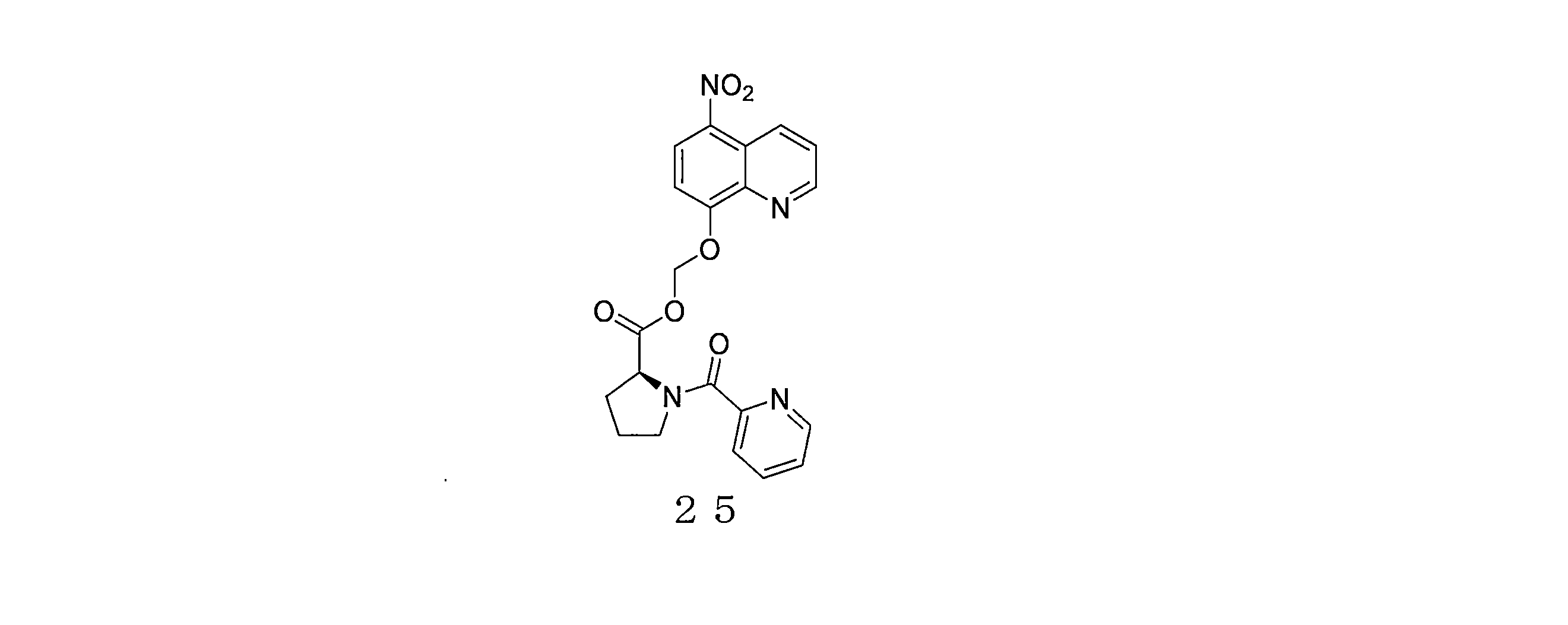
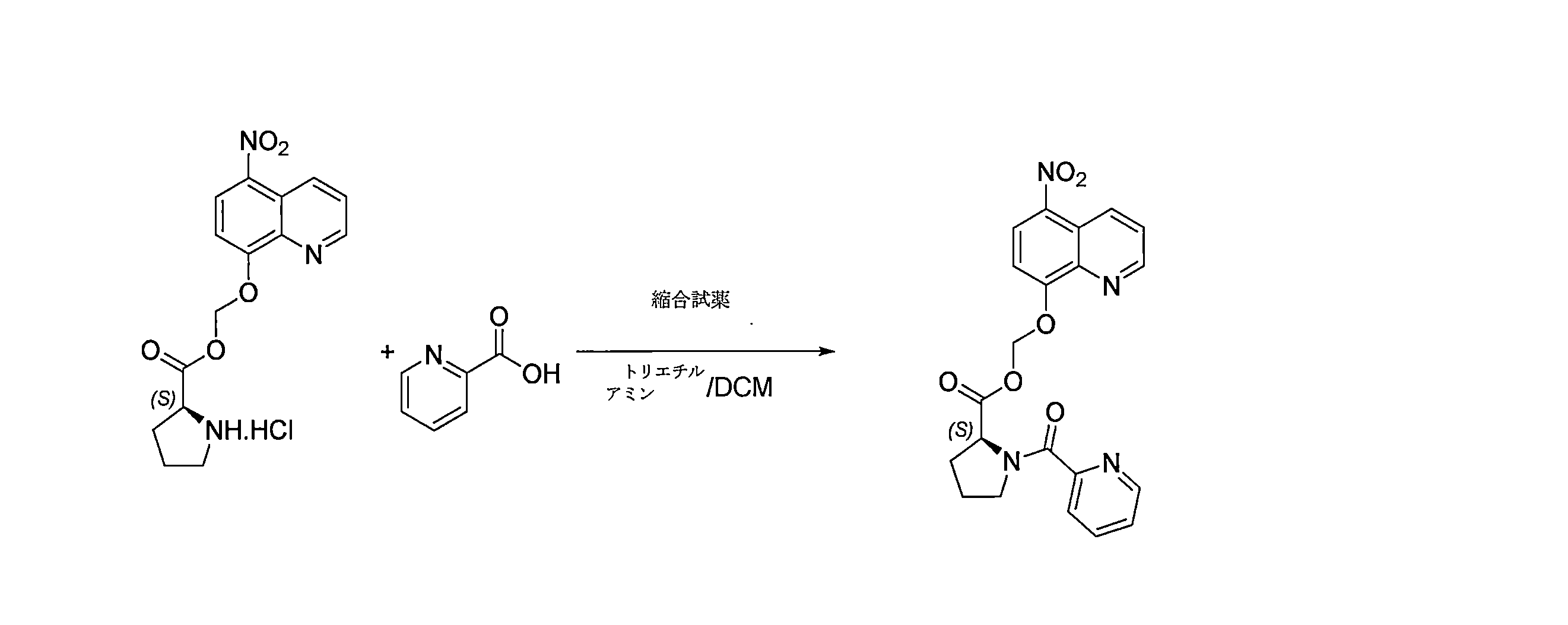
1H-NMR (400 MHz, DMSO-d6): δ:9.01~9.07 (m, 2H), 8.67~8.74 (m, 2H), 8.39~8.51 (m, 1H), 7.86~7.90 (m,1H), 7.30~7.60 (m,3H), 6.02~6.28(m,2H), 4.52-4.58 (m, 1H), 3.50-3.58 (m, 2H) ,2.29-2.33 (m, 1H), 1.79-1.96(m,3H)。
MS計算: 422.4; MS 実測: 423.2 [M+H]+。
Example 25: Synthesis of (S)-(5-nitroquinolin-8-yloxy)methyl 1-pyridineformylpyrrolidine-2-carboxylate (25)
1H -NMR (400 MHz, DMSO-d6): δ:9.01~9.07 (m, 2H), 8.67~8.74 (m, 2H), 8.39~8.51 (m, 1H), 7.86~7.90 (m,1H), 7.30~7.60 (m,3H), 6.02~6.28 (m, 2H), 4.52-4.58 (m, 1H), 3.50-3.58 (m, 2H), 2.29-2.33 (m, 1H), 1.79-1.96 (m, 3H).
MS calculated: 422.4; MS measured: 423.2 [M+H] + .
実施例26:(S)-(5-ニトロキノリン-8-イルオキシ)メチル1-ニコチニルピロリジン-2-カルボキシラート(26)の合成

1H-NMR (400 MHz, DMSO-d6): δ:8.98~9.06 (m, 2H), 8.67~8.74 (m, 2H), 8.39~8.51 (m, 1H), 7.86~7.90 (m,2H), 7.54~7.59 (m,2H), 6.17~6.28 (m,2H), 4.52-4.58 (m, 1H), 3.40-3.48 (m, 2H) ,2.29-2.33 (m, 1H), 1.79-1.96(m,3H)。
MS計算: 422.4; MS 実測: 423.1 [M+H]+。
Example 26: Synthesis of (S)-(5-nitroquinolin-8-yloxy)methyl 1-nicotinylpyrrolidine-2-carboxylate (26)
1H -NMR (400 MHz, DMSO-d6): δ:8.98~9.06 (m, 2H), 8.67~8.74 (m, 2H), 8.39~8.51 (m, 1H), 7.86~7.90 (m,2H), 7.54~7.59 (m,2H), 6.17~6.28 (m, 2H), 4.52-4.58 (m, 1H), 3.40-3.48 (m, 2H), 2.29-2.33 (m, 1H), 1.79-1.96 (m, 3H).
MS calculated: 422.4; MS measured: 423.1 [M+H] + .
実施例27:(S)-(5-ニトロキノリン-8-イルオキシ)メチル1-イソニコチニルピロリジン-2-カルボキシラート(27)の合成

1H-NMR (400 MHz, DMSO-d6): δ:8.98~9.07 (m, 2H), 8.67~8.74 (m, 2H), 8.39~8.51 (m, 1H), 7.86~7.90(m,1H), 7.30~7.60 (m,3H), 6.02~6.28 (m,2H), 4.52-4.58 (m, 1H), 3.40-3.48 (m, 2H) ,2.29-2.33 (m, 1H), 1.79-1.96(m,3H)。
MS計算: 422.4; MS 実測: 423.1 [M+H]+。
Example 27: Synthesis of (S)-(5-nitroquinolin-8-yloxy)methyl 1-isonicotinylpyrrolidine-2-carboxylate (27)
1H -NMR (400 MHz, DMSO-d6): δ:8.98~9.07 (m, 2H), 8.67~8.74 (m, 2H), 8.39~8.51 (m, 1H), 7.86~7.90(m,1H), 7.30~7.60 (m,3H), 6.02~6.28 (m, 2H), 4.52-4.58 (m, 1H), 3.40-3.48 (m, 2H), 2.29-2.33 (m, 1H), 1.79-1.96 (m, 3H).
MS calculated: 422.4; MS measured: 423.1 [M+H] + .
実施例28:(S)-(5-ニトロキノリン-8-イルオキシ)メチル1-((S)-2-アセチルアミノ-3-(4-ヒドロキシフェニル)プロピオニル)ピロリジン-2-カルボキシラート(28)の合成

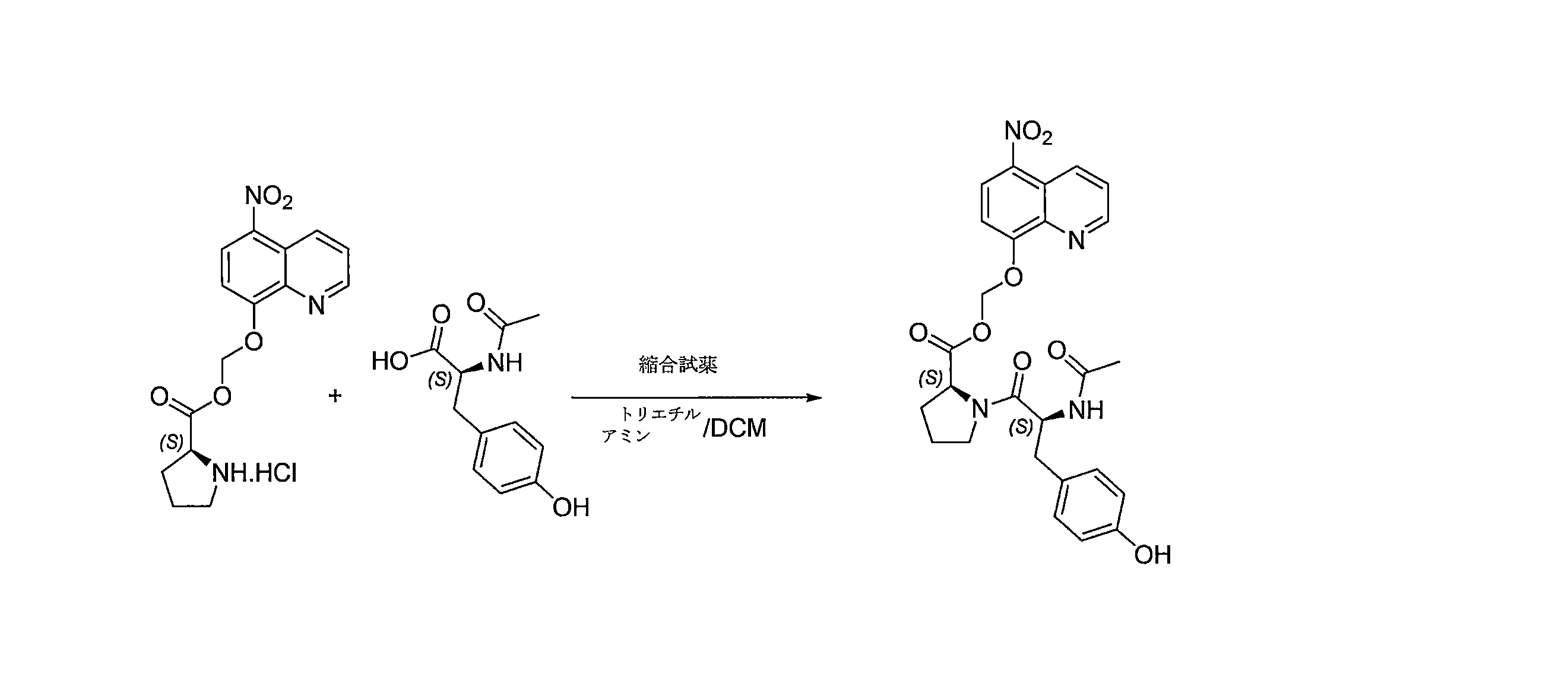
1H-NMR (400 MHz, DMSO-d6): δ:9.19(s,1H), 9.04~9.05(m,1H),8.98~9.07 (m, 2H), 8.48~8.55 (m, 1H), 8.19~8.24 (m, 1H), 7.86~7.90(m,1H), 7.52~7.56(m,1H), 6.95~6.97(m,2H), 6.61~6.65(m,2H), 6.02~6.28(m,2H), 4.53-4.57 (m, 1H), 4.37-4.40 (m, 1H) , 3.65-3.70 (m, 1H), 3.41-3.47(m,1H) , 2.61-2.67(m,1H) , 2.41-2.47(m,1H), 2.11-2.18(m,1H) , 1.80-1.81(m,3H), 1.72(s,3H)。
MS計算: 522.51; MS 実測: 523.2 [M+H]+。
Example 28: Synthesis of (S)-(5-nitroquinolin-8-yloxy)methyl 1-((S)-2-acetylamino-3-(4-hydroxyphenyl)propionyl)pyrrolidine-2-carboxylate (28)
1H -NMR (400 MHz, DMSO-d6): δ:9.19(s,1H), 9.04~9.05(m,1H),8.98~9.07 (m, 2H), 8.48~8.55 (m, 1H), 8.19~8.24 (m, 1H), 7.86~7.90(m,1H), 7.52~7.56(m,1H), 6.95~6.97(m,2H), 6.61~6.65(m,2H), 6.02~6.28(m,2H), 4.53-4.57 (m, 1H), 4.37-4.40 (m, 1H), 3.65-3.70 (m, 1H), 3.41-3.47(m,1H), 2.61-2.67(m,1H), 2.41-2.47(m,1H), 2.11-2.18(m,1H), 1.80-1.81(m,3H), 1.72(s,3H).
MS calculated: 522.51; MS measured: 523.2 [M+H] + .
実施例29:(S)-(5-ニトロキノリン-8-イルオキシ)メチル1-((2S,3R)-2-(t-ブトキシカルボニルアミノ)-3-ヒドロキシブチリル)ピロリジン-2-カルボキシラート(29)の合成

1H-NMR (400 MHz, DMSO-d6): δ:8.98~9.07 (m, 2H), 8.77(br,1H)8.54~8.56 (m, 1H), 8.19~8.24 (m, 1H), 7.86~7.90 (m,1H), 7.52~7.56 (m,1H), 615~6.16 (m,2H), 4.37-4.41 (m, 1H), 4.06-4.07 (m, 1H) ,3.65-3.70 (m, 3H), 2.16-2.20 (m,1H) , 1.78-1.90 (m,3H) ,1.36 (s,9H), 0.84(d,J = 8Hz , 3H)。
MS計算: 518.52; MS 実測: 519.2 [M+H]+。
Example 29: Synthesis of (S)-(5-nitroquinolin-8-yloxy)methyl 1-((2S,3R)-2-(t-butoxycarbonylamino)-3-hydroxybutyryl)pyrrolidine-2-carboxylate (29)
1 H-NMR (400 MHz, DMSO-d6): δ:8.98~9.07 (m, 2H), 8.77(br,1H)8.54~8.56 (m, 1H), 8.19~8.24 (m, 1H), 7.86~7.90 (m,1H), 7.52~7.56 (m,1H), 615~6.16 (m,2H), 4.37-4.41 (m, 1H), 4.06-4.07 (m, 1H) ,3.65-3.70 (m, 3H), 2.16-2.20 (m,1H) , 1.78-1.90 (m,3H) ,1.36 (s,9H), 0.84(d,J = 8Hz, 3H).
MS calculated: 518.52; MS measured: 519.2 [M+H] + .
実施例30:(S)-(5-ニトロキノリン-8-イルオキシ)メチル1-((S)-2-アセチルアミノ-3-ヒドロキシプロピオニル)ピロリジン-2-カルボキシラート(30)の合成


1H-NMR (400 MHz, DMSO-d6): δ: 8.98~9.07 (m, 2H), 8.48~8.55 (m, 1H), 8.19~8.24 (m, 1H), 7.86~7.90(m,1H),7.52~7.56(m,1H), 6.02~6.28(m,2H), 4.85-4.95 (m, 1H), 4.40-4.60 (m, 2H) ,3.65-3.70 (m, 3H), 1.80-2.01(m,7H)。
MS計算: 446.42; MS 実測: 447.1 [M+H]+。
Example 30: Synthesis of (S)-(5-nitroquinolin-8-yloxy)methyl 1-((S)-2-acetylamino-3-hydroxypropionyl)pyrrolidine-2-carboxylate (30)
1H -NMR (400 MHz, DMSO-d6): δ: 8.98~9.07 (m, 2H), 8.48~8.55 (m, 1H), 8.19~8.24 (m, 1H), 7.86~7.90(m,1H),7.52~7.56(m,1H), 6.02~6.28 (m, 2H), 4.85-4.95 (m, 1H), 4.40-4.60 (m, 2H), 3.65-3.70 (m, 3H), 1.80-2.01 (m, 7H).
MS calculated: 446.42; MS measured: 447.1 [M+H] + .
実施例31:(5-ニトロキノリン-8-イルオキシ)メチル2-メトキシアセテート(31)の合成

1H NMR (400 MHz, CDCl3) δ 9.19 (dd, J = 8.9, 1.6 Hz, 1H), 9.07 (dd, J = 4.1, 1.6 Hz, 1H), 8.49 (d, J = 8.8 Hz, 1H), 7.72 (dd, J = 8.9, 4.1 Hz, 1H), 7.37 (d, J = 8.8 Hz, 1H), 6.26 (s, 2H), 4.12 (s, 2H), 3.45 (s, 3H)。
MS計算: 292.2;MS実測: 293.1[M+H]+。
Example 31: Synthesis of (5-nitroquinolin-8-yloxy)methyl 2-methoxyacetate (31)
1 H NMR (400 MHz, CDCl 3 ) δ 9.19 (dd, J = 8.9, 1.6 Hz, 1H), 9.07 (dd, J = 4.1, 1.6 Hz, 1H), 8.49 (d, J = 8.8 Hz, 1H), 7.72 (dd, J = 8.9, 4.1 Hz, 1H), 7.37 (d, J = 8.8 Hz, 1H), 6.26 (s, 2H), 4.12 (s, 2H), 3.45 (s, 3H).
MS calculation: 292.2; MS measurement: 293.1[M+H] + .
実施例32:(5-ニトロキノリン-8-イルオキシ)メチルシクロブタンホルメート(32)の合成

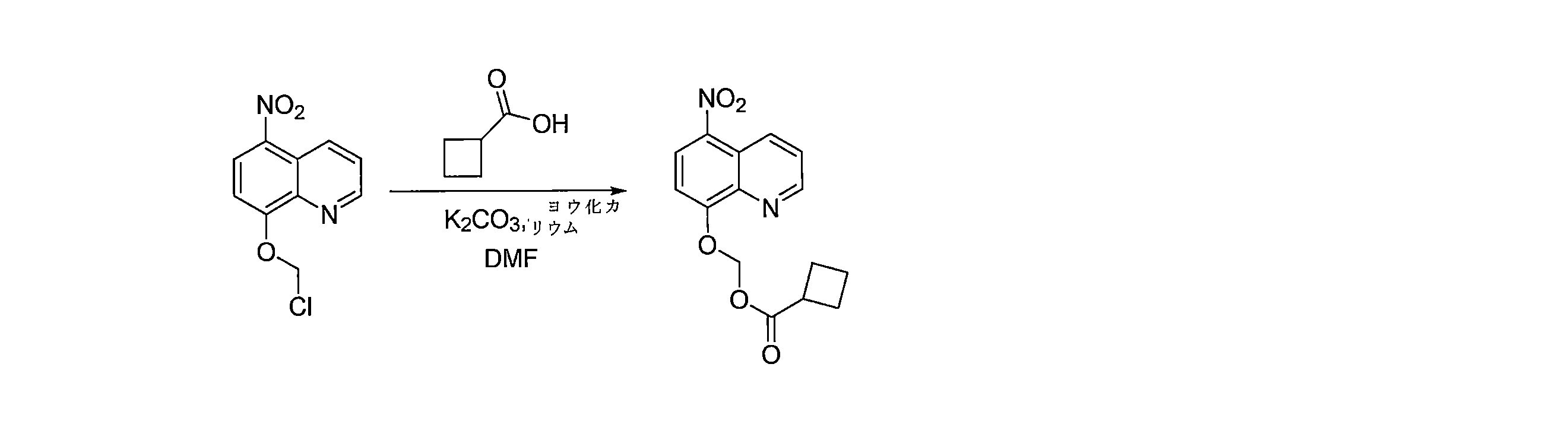
1H NMR (400 MHz, CDCl3) δ 9.19 (dd, J = 8.9, 1.5 Hz, 1H), 9.07 (dd, J = 4.1, 1.5 Hz, 1H), 8.50 (d, J = 8.8 Hz, 1H), 7.71 (dd, J = 8.9, 4.1 Hz, 1H), 7.36 (d, J = 8.8 Hz, 1H), 6.18 (s, 2H), 3.22 (p, J = 8.3 Hz, 1H), 2.37 - 2.16 (m, 4H), 2.06 - 1.84 (m, 2H)。
MS計算: 302.3;MS実測: 303.1[M+H]+。
Example 32: Synthesis of (5-nitroquinolin-8-yloxy)methylcyclobutaneformate (32)
1 H NMR (400 MHz, CDCl 3 ) δ 9.19 (dd, J = 8.9, 1.5 Hz, 1H), 9.07 (dd, J = 4.1, 1.5 Hz, 1H), 8.50 (d, J = 8.8 Hz, 1H), 7.71 (dd, J = 8.9, 4.1 Hz, 1H), 7.36 (d, J = 8.8 Hz, 1H), 6.18 (s, 2H), 3.22 (p, J = 8.3 Hz, 1H), 2.37 - 2.16 (m, 4H), 2.06 - 1.84 (m, 2H).
MS calculation: 302.3;MS measurement: 303.1[M+H] + .
実施例33:(5-ニトロキノリン-8-イルオキシ)メチルテトラヒドロフラン-3-カルボキシラート(33)の合成

1H NMR (400 MHz, CDCl3) δ 9.19 (dd, J = 8.9, 1.6 Hz, 1H), 9.07 (dd, J = 4.1, 1.5 Hz, 1H), 8.50 (d, J = 8.8 Hz, 1H), 7.72 (dd, J = 8.9, 4.1 Hz, 1H), 7.36 (d, J = 8.8 Hz, 1H), 6.21 (q, J = 6.5 Hz, 2H), 4.01 - 3.91 (m, 2H), 3.84 (qd, J = 14.9, 8.3 Hz, 2H), 3.18 (ddt, J = 8.9, 7.8, 5.9 Hz, 1H), 2.28 - 2.09 (m, 2H)。
MS計算: 318.3;MS実測: 319.1[M+H]+。
Example 33: Synthesis of (5-nitroquinolin-8-yloxy)methyl tetrahydrofuran-3-carboxylate (33)
1 H NMR (400 MHz, CDCl 3 ) δ 9.19 (dd, J = 8.9, 1.6 Hz, 1H), 9.07 (dd, J = 4.1, 1.5 Hz, 1H), 8.50 (d, J = 8.8 Hz, 1H), 7.72 (dd, J = 8.9, 4.1 Hz, 1H), 7.36 (d, J = 8.8 Hz, 1H), 6.21 (q, J = 6.5 Hz, 2H), 4.01 - 3.91 (m, 2H), 3.84 (qd, J = 14.9, 8.3 Hz, 2H), 3.18 (ddt, J = 8.9, 7.8, 5.9Hz, 1H), 2.28 - 2.09 (m, 2H).
MS calculation: 318.3;MS measurement: 319.1[M+H] + .
実施例34:(5-ニトロキノリン-8-イルオキシ)メチル2-アセトキシベンゾエート(34)の合成

1H NMR (400 MHz, CDCl3) δ 9.30 (s, 1H), 9.17 (s, 1H), 8.55 (s, 1H), 8.03 (s, 1H), 7.81 (s, 1H), 7.61 (t, J = 7.3 Hz, 1H), 7.47 (s, 1H), 7.31 (s, 1H), 7.13 (d, J = 8.0 Hz, 1H), 6.40 (s, 2H), 2.31 (s, 3H)。
MS計算: 382.3;MS実測: 383.1[M+H]+。
Example 34: Synthesis of (5-nitroquinolin-8-yloxy)methyl 2-acetoxybenzoate (34)
1 H NMR (400 MHz, CDCl 3 ) δ 9.30 (s, 1H), 9.17 (s, 1H), 8.55 (s, 1H), 8.03 (s, 1H), 7.81 (s, 1H), 7.61 (t, J = 7.3 Hz, 1H), 7.47 (s, 1H), 7.31 (s, 1H), 7.13 (d, J = 8.0 Hz, 1H), 6.40 (s, 2H), 2.31 (s, 3H).
MS calculation: 382.3;MS measurement: 383.1[M+H] + .
実施例35:(5-ニトロキノリン-8-イルオキシ)メチル2-(2,4-ジクロロフェノキシ)アセテート(35)の合成

1H NMR (400 MHz, CDCl3) δ 9.18 (dd, J = 8.9, 1.5 Hz, 1H), 9.06 (dd, J = 4.1, 1.5 Hz, 1H), 8.40 (d, J = 8.8 Hz, 1H), 7.72 (dd, J = 8.9, 4.1 Hz, 1H), 7.29 (d, J = 2.5 Hz, 1H), 7.24 (d, J = 8.8 Hz, 1H), 6.91 (dd, J = 8.8, 2.5 Hz, 1H), 6.68 (d, J = 8.8 Hz, 1H), 6.26 (s, 2H), 4.79 (s, 2H)。
MS計算: 423.2;MS実測: 423.0[M+H]+。
Example 35: Synthesis of (5-nitroquinolin-8-yloxy)methyl 2-(2,4-dichlorophenoxy)acetate (35)
1 H NMR (400 MHz, CDCl 3 ) δ 9.18 (dd, J = 8.9, 1.5 Hz, 1H), 9.06 (dd, J = 4.1, 1.5 Hz, 1H), 8.40 (d, J = 8.8 Hz, 1H), 7.72 (dd, J = 8.9, 4.1 Hz, 1H), 7.29 (d, J = 2.5 Hz, 1H), 7.24 (d, J = 8.8 Hz, 1H), 6.91 (dd, J = 8.8, 2.5 Hz, 1H), 6.68 (d, J = 8.8 Hz, 1H), 6.26 (s, 2H), 4.79 (s, 2H).
MS calculation: 423.2;MS measurement: 423.0[M+H] + .
実施例36:(5-ニトロキノリン-8-イルオキシ)メチル2-モルホリンアセテート(36)の合成

1H NMR (400 MHz, CDCl3) δ 9.19 (dd, J = 8.9, 1.6 Hz, 1H), 9.07 (dd, J = 4.1, 1.6 Hz, 1H), 8.49 (d, J = 8.8 Hz, 1H), 7.72 (dd, J = 8.9, 4.1 Hz, 1H), 7.37 (d, J = 8.8 Hz, 1H), 6.23 (s, 2H), 3.77 - 3.68 (m, 4H), 3.31 (s, 2H), 2.63 - 2.53 (m, 4H)。
MS計算: 347.3;MS実測: 348.2[M+H]+。
Example 36: Synthesis of (5-nitroquinolin-8-yloxy)methyl 2-morpholine acetate (36)
1 H NMR (400 MHz, CDCl 3 ) δ 9.19 (dd, J = 8.9, 1.6 Hz, 1H), 9.07 (dd, J = 4.1, 1.6 Hz, 1H), 8.49 (d, J = 8.8 Hz, 1H), 7.72 (dd, J = 8.9, 4.1 Hz, 1H), 7.37 (d, J = 8.8 Hz, 1H), 6.23 (s, 2H), 3.77 - 3.68 (m, 4H), 3.31 (s, 2H), 2.63 - 2.53 (m, 4H).
MS calculation: 347.3;MS measurement: 348.2[M+H] + .
実施例37:(R)-(5-ニトロキノリン-8-イルオキシ)メチル2-ヒドロキシ-2-フェニルアセテート(37)の合成
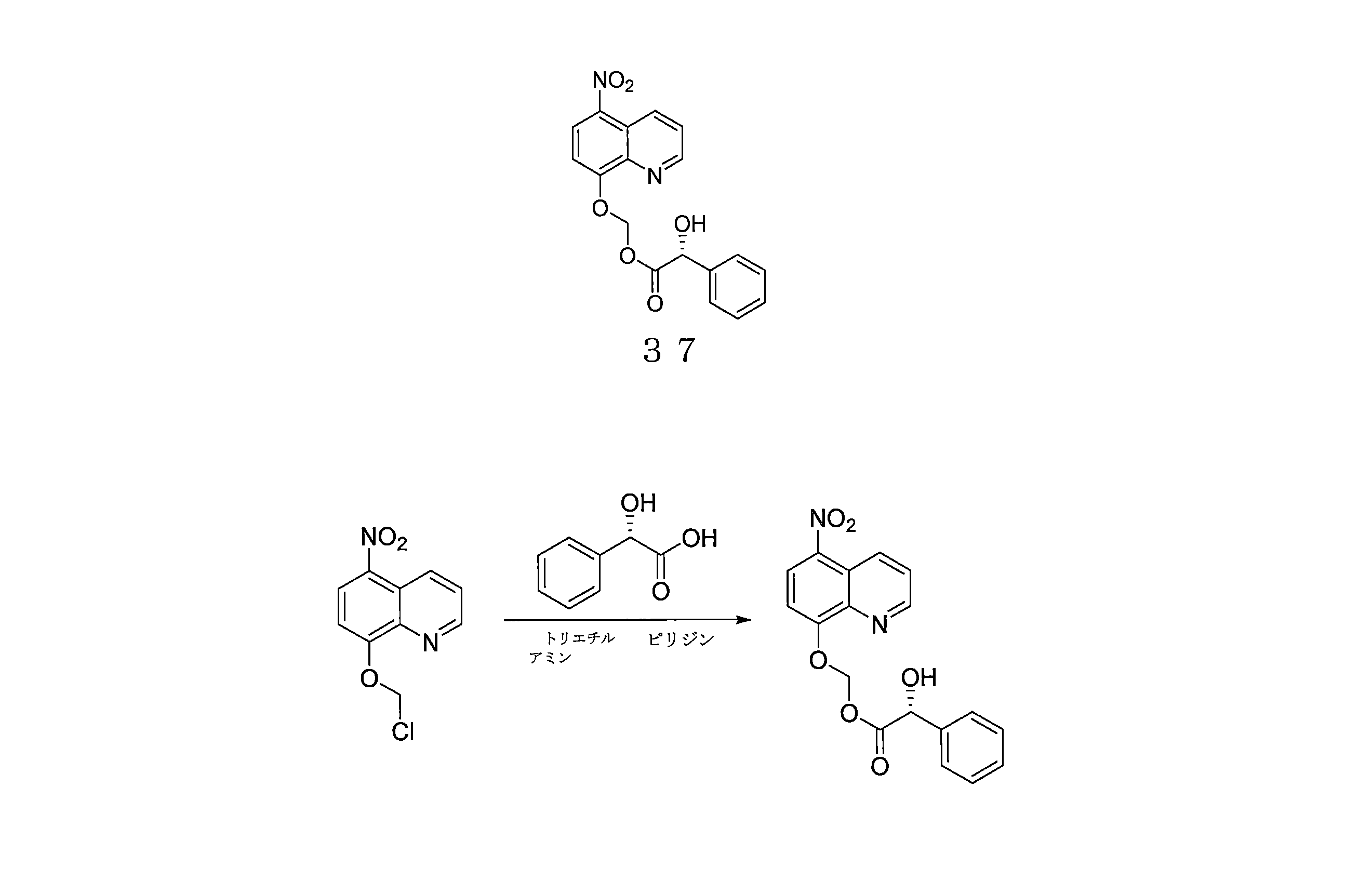
1H NMR (400 MHz, CDCl3) δ 9.14 (dd, J = 8.9, 1.6 Hz, 1H), 9.03 (dd, J = 4.1, 1.6 Hz, 1H), 8.24 (d, J = 8.8 Hz, 1H), 7.70 (dd, J = 8.9, 4.1 Hz, 1H), 7.35 (dd, J = 7.1, 2.4 Hz, 2H), 7.25 (dd, J = 5.2, 1.9 Hz, 2H), 6.91 (d, J = 8.8 Hz, 1H), 6.18 (dd, J = 31.0, 6.4 Hz, 2H), 5.24 (s, 1H), 3.39 (s, 1H)。
MS計算: 354.3;MS実測: 355.1[M+H]+。
Example 37: Synthesis of (R)-(5-nitroquinolin-8-yloxy)methyl 2-hydroxy-2-phenylacetate (37)
1 H NMR (400 MHz, CDCl 3 ) δ 9.14 (dd, J = 8.9, 1.6 Hz, 1H), 9.03 (dd, J = 4.1, 1.6 Hz, 1H), 8.24 (d, J = 8.8 Hz, 1H), 7.70 (dd, J = 8.9, 4.1 Hz, 1H), 7.35 (dd, J = 7.1, 2.4 Hz, 2H), 7.25 (dd, J = 5.2, 1.9 Hz, 2H), 6.91 (d, J = 8.8 Hz, 1H), 6.18 (dd, J = 31.0, 6.4 Hz, 2H), 5.24 (s, 1H), 3.39 (s, 1H).
MS calculation: 354.3;MS measurement: 355.1[M+H] + .
実施例38:(S)-(5-ニトロキノリン-8-イルオキシ)メチル2-ヒドロキシ-2-フェニルアセテート(38)の合成

1H NMR (400 MHz, CDCl3) δ 9.14 (dd, J = 8.9, 1.6 Hz, 1H), 9.03 (dd, J = 4.1, 1.6 Hz, 1H), 8.24 (d, J = 8.8 Hz, 1H), 7.70 (dd, J = 8.9, 4.1 Hz, 1H), 7.35 (dd, J = 7.1, 2.4 Hz, 2H), 7.25 (dd, J = 5.2, 1.9 Hz, 2H), 6.91 (d, J = 8.8 Hz, 1H), 6.18 (dd, J = 31.1, 6.4 Hz, 2H), 5.24 (s, 1H), 3.40 (s, 1H)。
MS計算: 354.3;MS実測: 355.1[M+H]+。
Example 38: Synthesis of (S)-(5-nitroquinolin-8-yloxy)methyl 2-hydroxy-2-phenylacetate (38)
1 H NMR (400 MHz, CDCl 3 ) δ 9.14 (dd, J = 8.9, 1.6 Hz, 1H), 9.03 (dd, J = 4.1, 1.6 Hz, 1H), 8.24 (d, J = 8.8 Hz, 1H), 7.70 (dd, J = 8.9, 4.1 Hz, 1H), 7.35 (dd, J = 7.1, 2.4 Hz, 2H), 7.25 (dd, J = 5.2, 1.9 Hz, 2H), 6.91 (d, J = 8.8 Hz, 1H), 6.18 (dd, J = 31.1, 6.4 Hz, 2H), 5.24 (s, 1H), 3.40 (s, 1H).
MS calculation: 354.3;MS measurement: 355.1[M+H] + .
実施例39:(5-ニトロキノリン-8-イルオキシ)メチルブチラート(39)の合成

1H NMR (400 MHz, CDCl3) δ 9.19 (dd, J = 8.9, 1.6 Hz, 1H), 9.07 (dd, J = 4.1, 1.6 Hz, 1H), 8.50 (d, J = 8.8 Hz, 1H), 7.72 (dd, J = 8.9, 4.1 Hz, 1H), 7.37 (d, J = 8.8 Hz, 1H), 6.18 (s, 2H), 2.39 (t, J = 7.4 Hz, 2H), 1.69 (dt, J = 14.8, 7.4 Hz, 2H), 0.94 (t, J = 7.4 Hz, 3H)。
MS計算: 290.3;MS実測: 291.1[M+H]+。
Example 39: Synthesis of (5-nitroquinolin-8-yloxy)methyl butyrate (39)
1 H NMR (400 MHz, CDCl 3 ) δ 9.19 (dd, J = 8.9, 1.6 Hz, 1H), 9.07 (dd, J = 4.1, 1.6 Hz, 1H), 8.50 (d, J = 8.8 Hz, 1H), 7.72 (dd, J = 8.9, 4.1 Hz, 1H), 7.37 (d, J = 8.8 Hz, 1H), 6.18 (s, 2H), 2.39 (t, J = 7.4 Hz, 2H), 1.69 (dt, J = 14.8, 7.4 Hz, 2H), 0.94 (t, J = 7.4 Hz, 3H).
MS calculation: 290.3;MS measurement: 291.1[M+H] + .
実施例40:(5-ニトロキノリン-8-イルオキシ)メチルn-ヘキサノエート(40)の合成

1H NMR (400 MHz, CDCl3) δ 9.19 (dd, J = 8.9, 1.6 Hz, 1H), 9.07 (dd, J = 4.1, 1.6 Hz, 1H), 8.50 (d, J = 8.8 Hz, 1H), 7.71 (dd, J = 8.9, 4.1 Hz, 1H), 7.36 (d, J = 8.8 Hz, 1H), 6.18 (s, 2H), 2.40 (t, J = 7.5 Hz, 2H), 1.68 - 1.60 (m, 2H), 1.33 - 1.22 (m, 4H), 0.91 - 0.79 (m, 3H)。
MS計算: 318.3;MS実測: 319.2[M+H]+。
Example 40: Synthesis of (5-nitroquinolin-8-yloxy)methyl n-hexanoate (40)
1 H NMR (400 MHz, CDCl 3 ) δ 9.19 (dd, J = 8.9, 1.6 Hz, 1H), 9.07 (dd, J = 4.1, 1.6 Hz, 1H), 8.50 (d, J = 8.8 Hz, 1H), 7.71 (dd, J = 8.9, 4.1 Hz, 1H), 7.36 (d, J = 8.8 Hz, 1H), 6.18 (s, 2H), 2.40 (t, J = 7.5 Hz, 2H), 1.68 - 1.60 (m, 2H), 1.33 - 1.22 (m, 4H), 0.91 - 0.79 (m, 3H).
MS calculation: 318.3;MS measurement: 319.2[M+H] + .
実施例41:(5-ニトロキノリン-8-イルオキシ)メチルn-カプリレート(41)の合成

1H NMR (400 MHz, CDCl3) δ 9.19 (dd, J = 8.9, 1.6 Hz, 1H), 9.07 (dd, J = 4.1, 1.6 Hz, 1H), 8.50 (d, J = 8.8 Hz, 1H), 7.72 (dd, J = 8.9, 4.1 Hz, 1H), 7.37 (d, J = 8.8 Hz, 1H), 6.18 (s, 2H), 2.40 (t, J = 7.5 Hz, 2H), 1.64 (dd, J = 14.6, 7.4 Hz, 2H), 1.32 - 1.16 (m, 8H), 0.84 (t, J = 7.0 Hz, 3H)。
MS計算: 346.4;MS実測: 347.2[M+H]+。
Example 41: Synthesis of (5-nitroquinolin-8-yloxy)methyl n-caprylate (41)
1 H NMR (400 MHz, CDCl 3 ) δ 9.19 (dd, J = 8.9, 1.6 Hz, 1H), 9.07 (dd, J = 4.1, 1.6 Hz, 1H), 8.50 (d, J = 8.8 Hz, 1H), 7.72 (dd, J = 8.9, 4.1 Hz, 1H), 7.37 (d, J = 8.8 Hz, 1H), 6.18 (s, 2H), 2.40 (t, J = 7.5 Hz, 2H), 1.64 (dd, J = 14.6, 7.4 Hz, 2H), 1.32 - 1.16 (m, 8H), 0.84 (t, J = 7.0 Hz, 3H).
MS calculation: 346.4;MS measurement: 347.2[M+H] + .
実施例42:(5-ニトロキノリン-8-イルオキシ)メチルn-デカノエート(42)の合成

1H NMR (400 MHz, CDCl3) δ 9.20 (dd, J = 8.9, 1.6 Hz, 1H), 9.07 (dd, J = 4.1, 1.6 Hz, 1H), 8.50 (d, J = 8.8 Hz, 1H), 7.71 (dd, J = 8.9, 4.1 Hz, 1H), 7.36 (d, J = 8.8 Hz, 1H), 6.18 (s, 2H), 2.40 (t, J = 7.5 Hz, 2H), 1.63 (dt, J = 15.2, 7.5 Hz, 2H), 1.32 - 1.17 (m, 12H), 0.86 (t, J = 6.9 Hz, 3H)。
MS計算: 374.4;MS実測: 375.2[M+H]+。
Example 42: Synthesis of (5-nitroquinolin-8-yloxy)methyl n-decanoate (42)
1 H NMR (400 MHz, CDCl 3 ) δ 9.20 (dd, J = 8.9, 1.6 Hz, 1H), 9.07 (dd, J = 4.1, 1.6 Hz, 1H), 8.50 (d, J = 8.8 Hz, 1H), 7.71 (dd, J = 8.9, 4.1 Hz, 1H), 7.36 (d, J = 8.8 Hz, 1H), 6.18 (s, 2H), 2.40 (t, J = 7.5 Hz, 2H), 1.63 (dt, J = 15.2, 7.5 Hz, 2H), 1.32 - 1.17 (m, 12H), 0.86 (t, J = 6.9 Hz, 3H).
MS calculation: 374.4;MS measurement: 375.2[M+H] + .
実施例43:(5-ニトロキノリン-8-イルオキシ)メチルドデカノエート(43)の合成
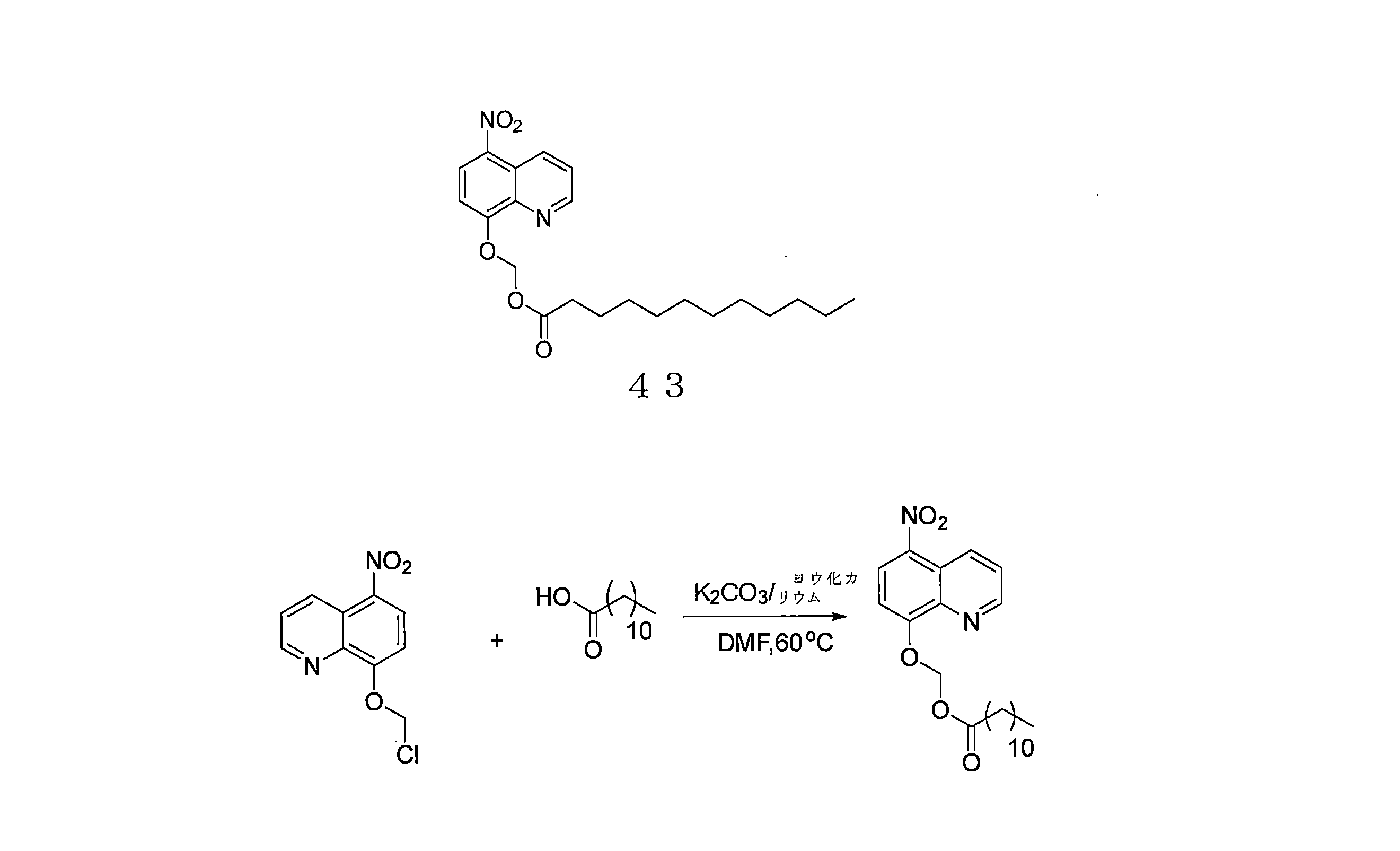
1H-NMR (400 Hz, CDCl3) δ: 9.22 (dd, J = 8.8, 1.2 Hz, 1H), 9.10 (dd, J = 4.0, 1.6 Hz, 1H), 8.52 (d, J = 8.8 Hz, 1H), 7.77 (dd, J = 8.8 Hz, 4.0 Hz, 1H), 7.35 (d, J = 9.2 Hz, 1H), 6.20 (s, 2H), 2.41 (t, J = 3.6 Hz, 2H), 1.61-1.68 (m, 2H), 1.23-1.25 (m, 12H), 0.87-0.91 (m, 3H), 0.05-0.09 (4H)。
MS計算: 402.49;MS実測: 403.3 [M+H]+。
Example 43: Synthesis of (5-nitroquinolin-8-yloxy)methyl dodecanoate (43)
1 H-NMR (400 Hz, CDCl3) δ: 9.22 (dd, J = 8.8, 1.2 Hz, 1H), 9.10 (dd, J = 4.0, 1.6 Hz, 1H), 8.52 (d, J = 8.8 Hz, 1H), 7.77 (dd, J = 8.8 Hz, 4.0 Hz, 1H), 7.35 (d, J = 9.2 Hz, 1H), 6.20 (s, 2H), 2.41 (t, J = 3.6 Hz, 2H), 1.61-1.68 (m, 2H), 1.23-1.25 (m, 12H), 0.87-0.91 (m, 3H), 0.05-0.09 (4H).
MS calculation: 402.49; MS measurement: 403.3 [M+H] + .
実施例44:6-(5-ニトロキノリン-8-イルオキシ)-テトラヒドロピラン-2-オン(44)の合成
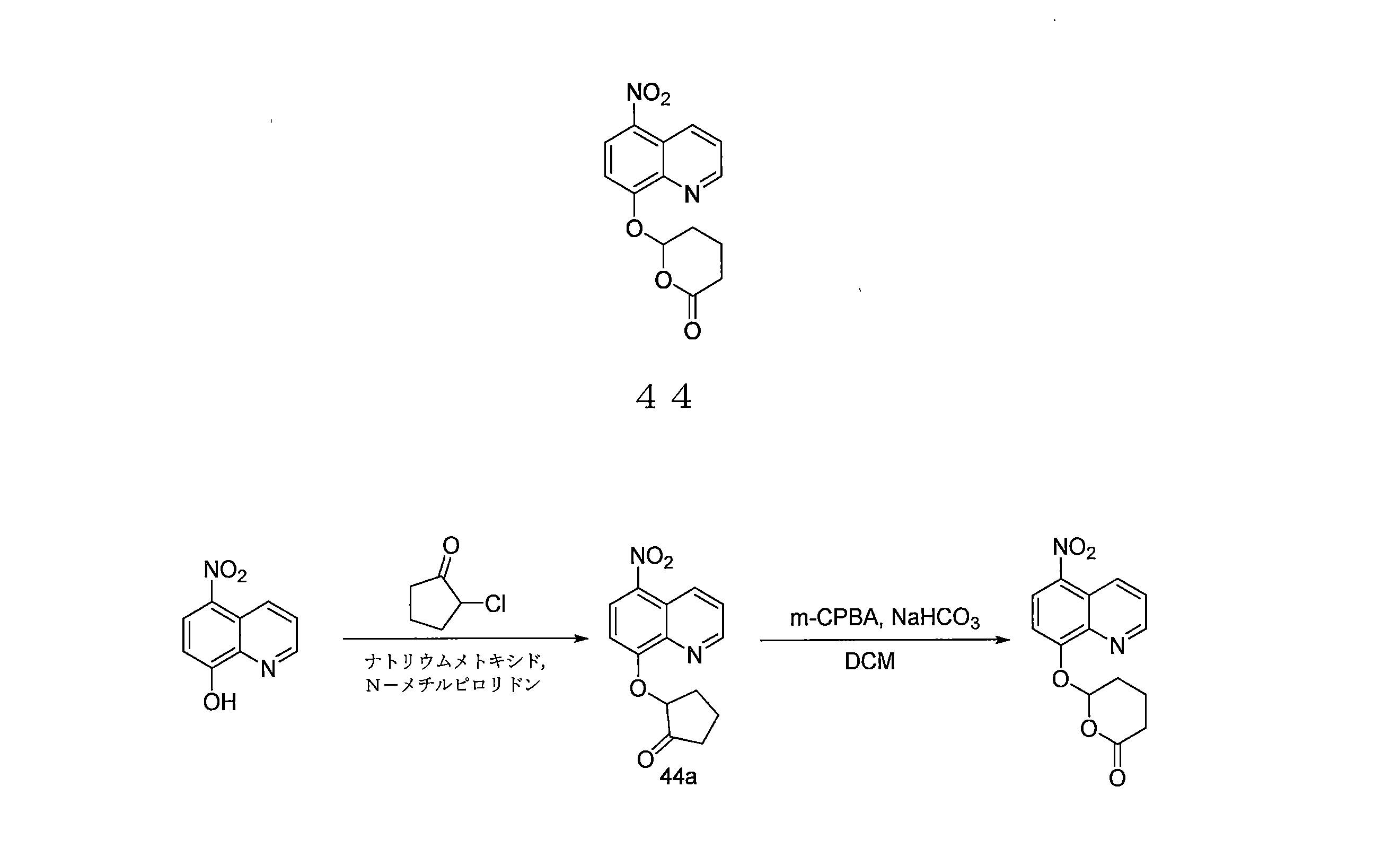
室温で、メタノールナトリウム(170mg,3.15mmol)、ヨウ素カリウム(87mg,0.52mmol)をニトロキソリン(500mg,2.63mmol)のN-メチルピロリドン(12.5mL)溶液に加えた。反応系を60℃に昇温して、15分間撹拌した後、2-クロロシクロペンタノン(623mg,5.25mmol)を加えて、撹拌しながら7時間反応させた。水を加えて反応をクエンチし、酢酸エチルで抽出して、有機相を飽和食塩水溶液で洗浄し、無水硫酸ナトリウムで有機相を乾燥させ、ろ過後、濃縮させ、50%石油エーテル/50%酢酸エチルのシリカゲルカラムにより精製して、2-(5-ニトロキノリン-8-オキシ)-シクロペンタノン(240mg、収率34%)を得た。
ステップ2:6-(5-ニトロキノリン-8-イルオキシ)-テトラヒドロピラン-2-オン(44)の製造
室温で、炭酸水素ナトリウム(56mg,0.67mmol)を2-(5-ニトロキノリン-8-オキシ)-シクロペンタノン(44a)(140mg,0.51mmol)のジクロロメタン(2mL)溶液に加えた。反応系を0℃に降温し、m-クロロペルオキシ安息香酸(m-CPBA)(純度:85%,136mg,0.67mmol)を加えて、室温に自然昇温して、16時間撹拌した。水を加えて反応をクエンチし、ジクロロメタンで抽出し、有機相を飽和食塩水で洗浄し、無水硫酸ナトリウムで乾燥させて、ろ過後、減圧濃縮させた。残留物をシリカゲルクロマトグラフィー分取プレート(展開剤:5%メタノール/95%ジクロロメタン)により精製して、6-(5-ニトロキノリン-8-イルオキシ)-テトラヒドロピラン-2-オン(94mg、収率63%)を得た。
1H NMR (400 MHz, CDCl3) δ 9.17 (dd, J = 8.9, 1.5 Hz, 1H), 9.04 (dd, J = 4.1, 1.5 Hz, 1H), 8.48 (d, J = 8.8 Hz, 1H), 7.70 (dd, J = 8.9, 4.1 Hz, 1H), 7.51 (d, J = 8.8 Hz, 1H), 6.39 (t, J = 3.3 Hz, 1H), 2.89 - 2.63 (m, 2H), 2.56 - 2.44 (m, 2H), 2.37 - 1.97 (m, 2H)。
MS計算: 288.3;MS実測: 289.1[M+H]+。
Example 44: Synthesis of 6-(5-nitroquinolin-8-yloxy)-tetrahydropyran-2-one (44)
Step 2: Preparation of 6-(5-nitroquinolin-8-yloxy)-tetrahydropyran-2-one (44) At room temperature, sodium bicarbonate (56 mg, 0.67 mmol) was added to a solution of 2-(5-nitroquinolin-8-oxy)-cyclopentanone (44a) (140 mg, 0.51 mmol) in dichloromethane (2 mL). The reaction system was cooled to 0° C., m-chloroperoxybenzoic acid (m-CPBA) (purity: 85%, 136 mg, 0.67 mmol) was added, and the mixture was allowed to warm to room temperature and stirred for 16 hours. The reaction was quenched by adding water, extracted with dichloromethane, and the organic phase was washed with saturated saline, dried over anhydrous sodium sulfate, filtered, and concentrated under reduced pressure. The residue was purified by silica gel chromatography preparative plate (eluent: 5% methanol/95% dichloromethane) to give 6-(5-nitroquinolin-8-yloxy)-tetrahydropyran-2-one (94 mg, yield 63%).
1 H NMR (400 MHz, CDCl 3 ) δ 9.17 (dd, J = 8.9, 1.5 Hz, 1H), 9.04 (dd, J = 4.1, 1.5 Hz, 1H), 8.48 (d, J = 8.8 Hz, 1H), 7.70 (dd, J = 8.9, 4.1 Hz, 1H), 7.51 (d, J = 8.8 Hz, 1H), 6.39 (t, J = 3.3 Hz, 1H), 2.89 - 2.63 (m, 2H), 2.56 - 2.44 (m, 2H), 2.37 - 1.97 (m, 2H).
MS calculation: 288.3;MS measurement: 289.1[M+H] + .
実施例45:((5-ニトロキノリン-8-イル)オキシ)メチル2-(2-(2-メトキシエトキシ)エトキシ)アセテート(45)の合成

1H-NMR (400 Hz, CDCl3) δ: 9.20 (dd, J = 6.0 Hz, 1H), 9.08 (d, J = 2.8 Hz, 1H), 8.51 (d, J = 8.8 Hz, 1H), 7.77 (dd, J = 8.8 Hz, 4.0 Hz, 1H), 7.40 (d, J = 8.8 Hz, 1H), 6.26 (s, 2H), 4.27 (s, 2H), 3.75-3.76 (m, 2H), 3.69-3.70 (m, 2H), 3.63-3.65 (m, 2H), 3.53-3.55 (m, 2H), 3.37 (s,3H)。
MS計算: 380.35;MS実測: 381.1 [M+H]+。
Example 45: Synthesis of ((5-nitroquinolin-8-yl)oxy)methyl 2-(2-(2-methoxyethoxy)ethoxy)acetate (45)
1 H-NMR (400 Hz, CDCl3) δ: 9.20 (dd, J = 6.0 Hz, 1H), 9.08 (d, J = 2.8 Hz, 1H), 8.51 (d, J = 8.8 Hz, 1H), 7.77 (dd, J = 8.8 Hz, 4.0 Hz, 1H), 7.40 (d, J = 8.8 Hz, 1H), 6.26 (s, 2H), 4.27 (s, 2H), 3.75-3.76 (m, 2H), 3.69-3.70 (m, 2H), 3.63-3.65 (m, 2H), 3.53-3.55 (m, 2H), 3.37 (s,3H).
MS calculation: 380.35;MS measurement: 381.1 [M+H] + .
実施例46:ビス(5-ニトロキノリン-8-イルオキシ)-メチルアジペート(46)の合成
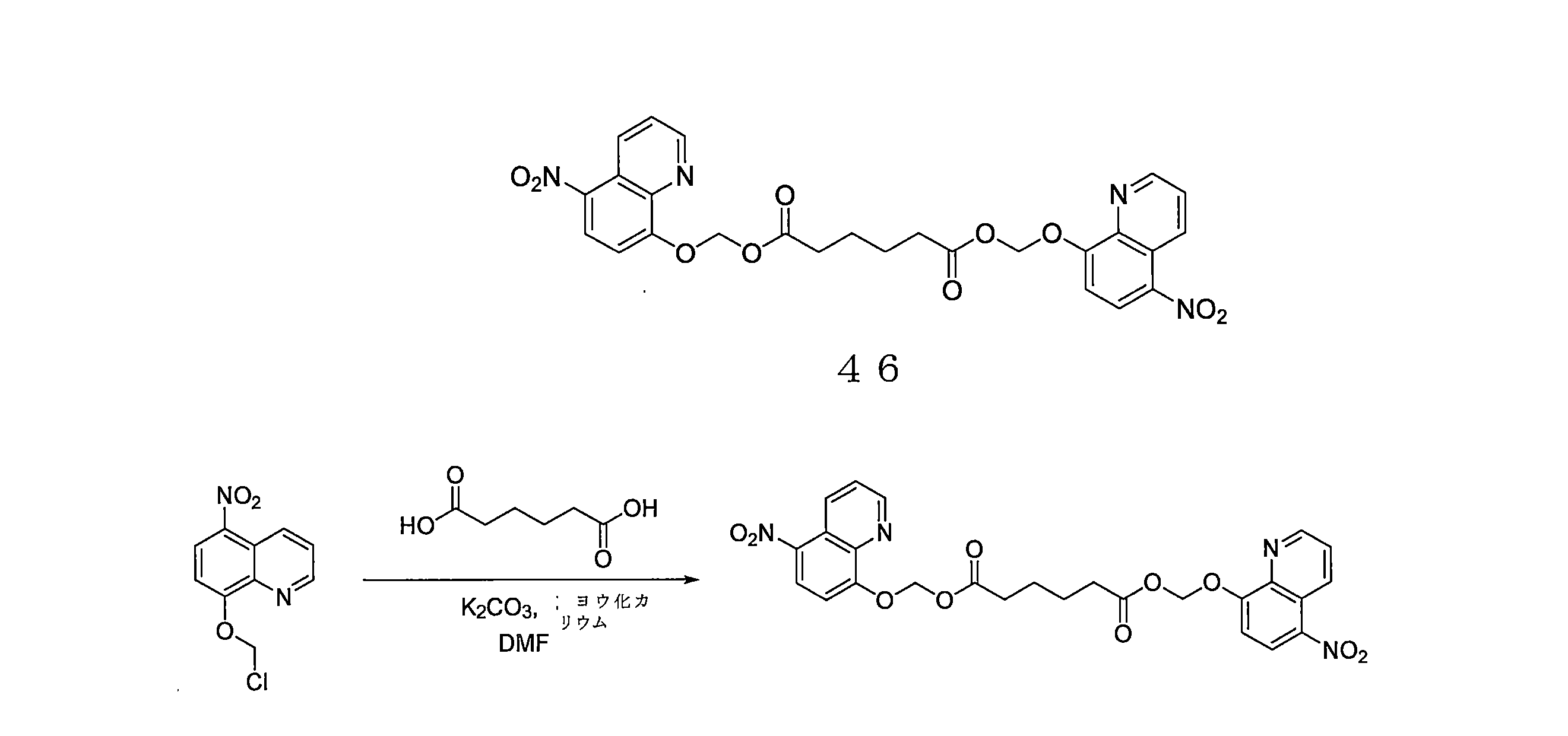
1H NMR (400 MHz, CDCl3) δ 9.18 (dd, J = 8.9, 1.6 Hz, 2H), 9.06 (dd, J = 4.1, 1.6 Hz, 2H), 8.49 (d, J = 8.8 Hz, 2H), 7.71 (dd, J = 8.9, 4.1 Hz, 2H), 7.34 (d, J = 8.8 Hz, 2H), 6.16 (s, 4H), 2.41 (s, 4H), 1.68 (t, J = 3.2 Hz, 4H)。
MS計算: 550.5;MS実測: 551.3[M+H]+。
Example 46: Synthesis of bis(5-nitroquinolin-8-yloxy)-methyl adipate (46)
1 H NMR (400 MHz, CDCl 3 ) δ 9.18 (dd, J = 8.9, 1.6 Hz, 2H), 9.06 (dd, J = 4.1, 1.6 Hz, 2H), 8.49 (d, J = 8.8 Hz, 2H), 7.71 (dd, J = 8.9, 4.1 Hz, 2H), 7.34 (d, J = 8.8 Hz, 2H), 6.16 (s, 4H), 2.41 (s, 4H), 1.68 (t, J = 3.2 Hz, 4H).
MS calculation: 550.5;MS measurement: 551.3[M+H] + .
実施例47:1-(5-ニトロキノリン-8-イルオキシ)エチルアセテート(47)の合成

0℃で、塩化アセチル(1.00g,12.74mmol)をアセトアルデヒド(0.56g,12.71mmol)と塩化亜鉛(0.17g,1.25mmol)のジクロロメタン(20mL)溶液に緩やかに加えて、反応液を0℃で10分間撹拌した後、室温に昇温して、16時間撹拌した。水を加えて反応をクエンチし、ジクロロメタンで抽出し、有機相を飽和食塩水で洗浄し、無水硫酸ナトリウムで乾燥させて、ろ過後、減圧濃縮させ、粗製品として酢酸-1-クロロエチルエステル(1.39g)を得た。
ステップ2:1-(5-ニトロキノリン-8-イルオキシ)エチルアセテート(47)の製造
室温で、メタノールナトリウム(68mg,1.26mmol)、ヨウ素カリウム(17mg,0.10mmol)をニトロキソリン(200mg,1.05mmol)のN-メチルピロリドン(5mL)溶液に加えた。反応系を60℃に昇温して、15分間撹拌した後、酢酸-1-クロロエチルエステル(193mg,1.57mmol)を加えて、16時間撹拌した。水を加えて反応をクエンチし、酢酸エチルで抽出して、有機相を飽和食塩水溶液で洗浄し、無水硫酸ナトリウムで乾燥させて、ろ過後、減圧濃縮させた。残留物をシリカゲルクロマトグラフィー分取プレート(展開剤: 5%メタノール/95%ジクロロメタン)により精製して、1-(5-ニトロキノリン-8-イルオキシ)エチルアセテート(124mg、収率43%)を得た。
1H NMR (400 MHz, CDCl3) δ 9.18 (dd, J = 8.9, 1.6 Hz, 1H), 9.08 (dd, J = 4.1, 1.6 Hz, 1H), 8.47 (d, J = 8.8 Hz, 1H), 7.70 (dd, J = 8.9, 4.1 Hz, 1H), 7.21 (d, J = 8.8 Hz, 1H), 6.97 (q, J = 5.3 Hz, 1H), 2.10 (s, 3H), 1.87 (d, J = 5.3 Hz, 3H)。
MS 計算:276.2;MS 実測: 277.1 [M+H]+。
Example 47: Synthesis of 1-(5-nitroquinolin-8-yloxy)ethyl acetate (47)
Step 2: Preparation of 1-(5-nitroquinolin-8-yloxy)ethyl acetate (47) Sodium methanol (68 mg, 1.26 mmol) and potassium iodine (17 mg, 0.10 mmol) were added to a solution of nitroxoline (200 mg, 1.05 mmol) in N-methylpyrrolidone (5 mL) at room temperature. The reaction system was heated to 60° C. and stirred for 15 minutes, after which acetic acid-1-chloroethyl ester (193 mg, 1.57 mmol) was added and stirred for 16 hours. The reaction was quenched by adding water, extracted with ethyl acetate, and the organic phase was washed with a saturated saline solution, dried over anhydrous sodium sulfate, filtered, and concentrated under reduced pressure. The residue was purified by silica gel chromatography fractionation plate (developing agent: 5% methanol/95% dichloromethane) to obtain 1-(5-nitroquinolin-8-yloxy)ethyl acetate (124 mg, yield 43%).
1H NMR (400 MHz, CDCl3) δ 9.18 (dd, J = 8.9, 1.6 Hz, 1H), 9.08 (dd, J = 4.1, 1.6 Hz, 1H), 8.47 (d, J = 8.8 Hz, 1H), 7.70 (dd, J = 8.9, 4.1 Hz, 1H), 7.21 (d, J = 8.8 Hz, 1H), 6.97 (q, J = 5.3 Hz, 1H), 2.10 (s, 3H), 1.87 (d, J = 5.3 Hz, 3H).
MS calculated: 276.2; MS measured: 277.1 [M+H] + .
実施例48:1-(5-ニトロキノリン-8-イルオキシ)エチルプロピオネート(48)の合成

1H NMR (400 MHz, CDCl3) δ 9.18 (dd, J = 8.9, 1.5 Hz, 1H), 9.08 (dd, J = 4.1, 1.5 Hz, 1H), 8.46 (d, J = 8.8 Hz, 1H), 7.70 (dd, J = 8.9, 4.1 Hz, 1H), 7.20 (d, J = 8.8 Hz, 1H), 6.99 (q, J = 5.2 Hz, 1H), 2.38 (q, J = 7.5 Hz, 2H), 1.87 (d, J = 5.3 Hz, 3H), 1.12 (t, J = 7.5 Hz, 3H)。
MS 計算.:290.3;MS実測 : 291.1 [M+H]+。
Example 48: Synthesis of 1-(5-nitroquinolin-8-yloxy)ethyl propionate (48)
1 H NMR (400 MHz, CDCl 3 ) δ 9.18 (dd, J = 8.9, 1.5 Hz, 1H), 9.08 (dd, J = 4.1, 1.5 Hz, 1H), 8.46 (d, J = 8.8 Hz, 1H), 7.70 (dd, J = 8.9, 4.1 Hz, 1H), 7.20 (d, J = 8.8 Hz, 1H), 6.99 (q, J = 5.2 Hz, 1H), 2.38 (q, J = 7.5 Hz, 2H), 1.87 (d, J = 5.3 Hz, 3H), 1.12 (t, J = 7.5 Hz, 3H).
MS calculation: 290.3; MS measurement: 291.1 [M+H] + .
実施例49:1-(5-ニトロキノリン-8-イルオキシ)エチルイソブチラート(49)の合成

1H NMR (400 MHz, CDCl3) δ 9.18 (dd, J = 8.9, 1.2 Hz, 1H), 9.08 (dd, J = 3.9, 1.1 Hz, 1H), 8.46 (d, J = 8.8 Hz, 1H), 7.70 (dd, J = 8.9, 4.1 Hz, 1H), 7.18 (d, J = 8.8 Hz, 1H), 6.98 (q, J = 5.2 Hz, 1H), 2.64 - 2.51 (m, 1H), 1.87 (d, J = 5.2 Hz, 3H), 1.14 (dd, J = 14.4, 7.0 Hz, 6H)。
MS 計算:304.3;MS 実測:305.2 [M+H]+。
Example 49: Synthesis of 1-(5-nitroquinolin-8-yloxy)ethyl isobutyrate (49)
1 H NMR (400 MHz, CDCl 3 ) δ 9.18 (dd, J = 8.9, 1.2 Hz, 1H), 9.08 (dd, J = 3.9, 1.1 Hz, 1H), 8.46 (d, J = 8.8 Hz, 1H), 7.70 (dd, J = 8.9, 4.1 Hz, 1H), 7.18 (d, J = 8.8 Hz, 1H), 6.98 (q, J = 5.2 Hz, 1H), 2.64 - 2.51 (m, 1H), 1.87 (d, J = 5.2 Hz, 3H), 1.14 (dd, J = 14.4, 7.0 Hz, 6H).
MS calculated: 304.3; MS measured: 305.2 [M+H] + .
実施例50:1-(5-ニトロキノリン-8-イルオキシ)エチルピバレート(50)の合成

1H NMR (400 MHz, CDCl3) δ 9.19 (dd, J = 8.9, 1.5 Hz, 1H), 9.08 (dd, J = 4.1, 1.5 Hz, 1H), 8.45 (d, J = 8.8 Hz, 1H), 7.70 (dd, J = 8.9, 4.1 Hz, 1H), 7.15 (d, J = 8.8 Hz, 1H), 6.96 (q, J = 5.2 Hz, 1H), 1.88 (d, J = 5.2 Hz, 3H), 1.17 (s, 9H)。
MS 計算.:318.3;MS 実測: 319.2 [M+H]+。
Example 50: Synthesis of 1-(5-nitroquinolin-8-yloxy)ethyl pivalate (50)
1 H NMR (400 MHz, CDCl 3 ) δ 9.19 (dd, J = 8.9, 1.5 Hz, 1H), 9.08 (dd, J = 4.1, 1.5 Hz, 1H), 8.45 (d, J = 8.8 Hz, 1H), 7.70 (dd, J = 8.9, 4.1 Hz, 1H), 7.15 (d, J = 8.8 Hz, 1H), 6.96 (q, J = 5.2 Hz, 1H), 1.88 (d, J = 5.2 Hz, 3H), 1.17 (s, 9H).
MS calculation: 318.3;MS measurement: 319.2 [M+H] + .
実施例51:1-(5-ニトロキノリン-8-イルオキシ)エチル2-エチルブチラート(51)の合成

1H NMR (400 MHz, CDCl3) δ: 9.20-9.17 (m, 1H), 9.08-9.07 (m, 1H), 8.45 (d, J = 8.4 Hz, 1H), 7.72-7.68 (m, 1H), 7.21 (d, J = 8.8 Hz, 1H), 7.03-7.01 (m, 1H), 2.25-2.11 (m, 1H), 1.88 (d, J = 5.2 Hz, 3H), 1.60-1.49 (m, 4H), 0.88-0.81 (m, 6H)。
MS計算: 332;MS実測: 333[M+H]+。
Example 51: Synthesis of 1-(5-nitroquinolin-8-yloxy)ethyl 2-ethylbutyrate (51)
1 H NMR (400 MHz, CDCl 3 ) δ: 9.20-9.17 (m, 1H), 9.08-9.07 (m, 1H), 8.45 (d, J = 8.4 Hz, 1H), 7.72-7.68 (m, 1H), 7.21 (d, J = 8.8 Hz, 1H), 7.03-7.01 (m, 1H), 2.25-2.11 (m, 1H), 1.88 (d, J = 5.2 Hz, 3H), 1.60-1.49 (m, 4H), 0.88-0.81 (m, 6H).
MS calculation: 332;MS measurement: 333[M+H] + .
実施例52:(5-ニトロキノリン-8-イルオキシ)メチル2,3-ジヒドロキシプロピル(メチル)カーバメート(52)の合成
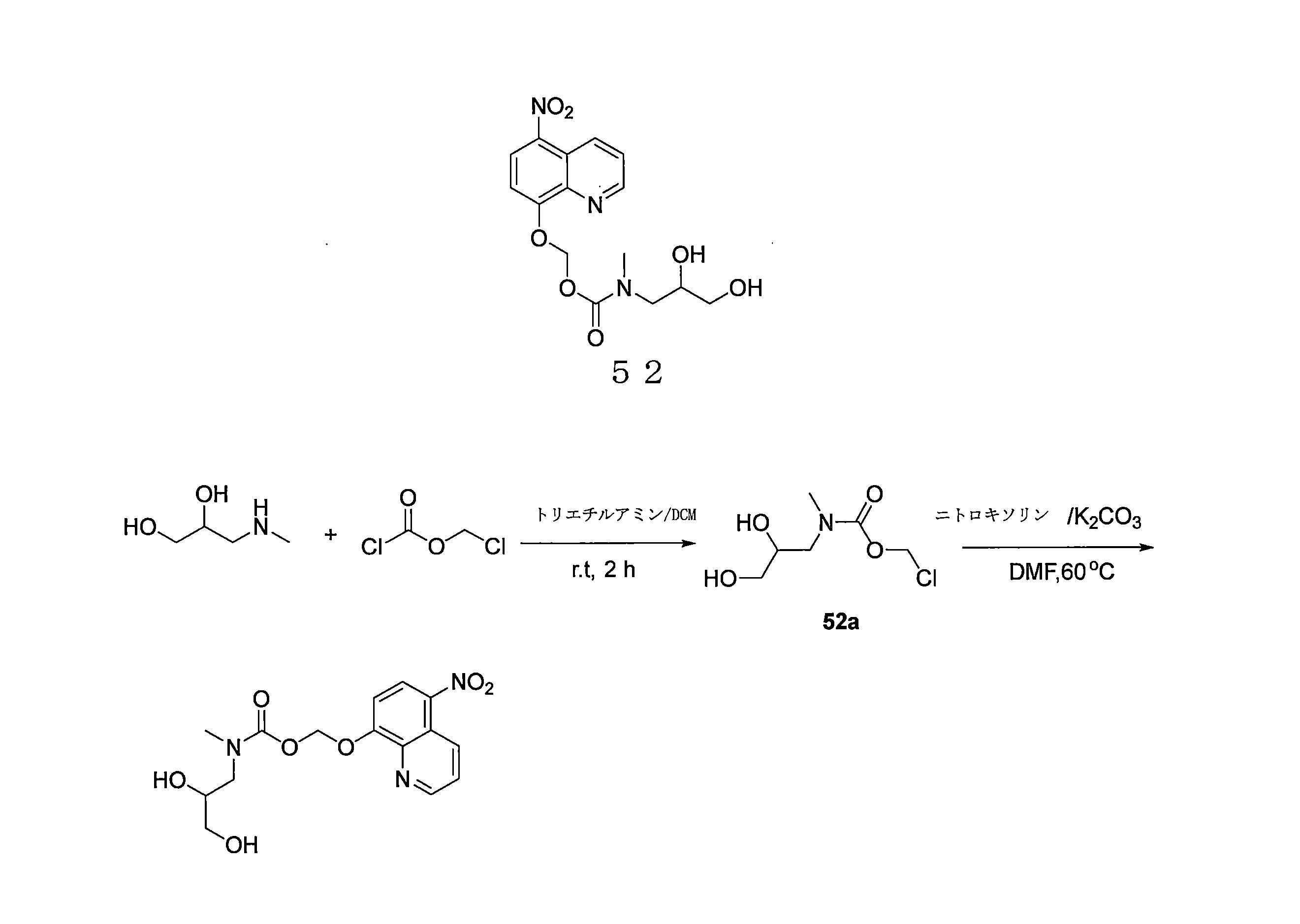
N-メチル-2,3-ジヒドロキシプロピルアミン(1g,10mmol)をアセトニトリル(40mL)とメタノール(8mL)の混合溶媒に溶解して、氷水浴にてトリエチルアミン(1.15g,11.4mmol)とクロロギ酸クロロメチル(1.35g,10.48mmol)を緩やかに順次滴下し、反応液を0℃で30分間撹拌した後、25℃に昇温して16時間撹拌した。反応液を水(50mL)でクエンチし、ジクロロメタン(100mLx3)で抽出し、有機相を合わせて、無水硫酸ナトリウムで乾燥させて、ろ過し、ろ液を減圧濃縮させ、生成物としてクロロメチル2,3-ジヒドロキシプロピル(メチル)カーバメート(1.7g、収率89%)を得た。
ステップ2:(5-ニトロキノリン-8-イルオキシ)メチル2,3-ジヒドロキシプロピル(メチル)カーバメート(52)の製造
ニトロキソリン(600mg,3.16mmol)とクロロメチル2,3-ジヒドロキシプロピル(メチル)カーバメート(940mg,4.7mmol)をN,N-ジメチルホルムアミド(15mL)に溶解し、その後、0℃で炭酸カリウム(871mg,6.31mmol)とヨウ素ナトリウム(47mg,0.32mmol)を加えて、反応液を60℃で4時間撹拌した。反応を室温に回復して、水で反応をクエンチし、ジクロロメタン(100mLx3)で抽出し、有機相を合わせて、無水硫酸ナトリウムで乾燥させて、ろ過し、ろ液を減圧濃縮させた。残留物をシリカゲルカラムクロマトグラフィー(溶離剤:5%メタノール/95%ジクロロメタン)により精製して生成物(5-ニトロキノリン-8-イルオキシ)メチル2,3-ジヒドロキシプロピル(メチル)カーバメート(300mg、収率27%)を得た。
1H NMR (400 MHz, CDCl3) δ: 9.20-9.18 (m, 1H), 9.06 (dd, J = 4.0, 1.2 Hz, 1H), 8.51 (d, J = 8.8 Hz, 1H), 7.73-7.70 (m, 1H), 7.40 (d, J = 8.8 Hz, 1H), 6.21-6.13 (m, 2H), 3.88 (s, 1H), 3.67-3.40 (m, 4H), 3.04-2.95 (m, 5H)。
MS計算: 351.11;MS実測: 352.1 [M+H]+。
Example 52: Synthesis of (5-nitroquinolin-8-yloxy)methyl 2,3-dihydroxypropyl(methyl)carbamate (52)
Step 2: Preparation of (5-nitroquinolin-8-yloxy)methyl 2,3-dihydroxypropyl(methyl)carbamate (52) Nitroxoline (600 mg, 3.16 mmol) and chloromethyl 2,3-dihydroxypropyl(methyl)carbamate (940 mg, 4.7 mmol) were dissolved in N,N-dimethylformamide (15 mL), then potassium carbonate (871 mg, 6.31 mmol) and sodium iodide (47 mg, 0.32 mmol) were added at 0° C., and the reaction solution was stirred at 60° C. for 4 hours. The reaction was allowed to warm to room temperature, quenched with water, extracted with dichloromethane (100 mL×3), the organic phases were combined, dried over anhydrous sodium sulfate, filtered, and the filtrate was concentrated under reduced pressure. The residue was purified by silica gel column chromatography (eluent: 5% methanol/95% dichloromethane) to give the product (5-nitroquinolin-8-yloxy)methyl 2,3-dihydroxypropyl(methyl)carbamate (300 mg, 27% yield).
1 H NMR (400 MHz, CDCl 3 ) δ: 9.20-9.18 (m, 1H), 9.06 (dd, J = 4.0, 1.2 Hz, 1H), 8.51 (d, J = 8.8 Hz, 1H), 7.73-7.70 (m, 1H), 7.40 (d, J = 8.8 Hz, 1H), 6.21-6.13 (m, 2H), 3.88 (s, 1H), 3.67-3.40 (m, 4H), 3.04-2.95 (m, 5H).
MS calculation: 351.11; MS measurement: 352.1 [M+H] + .
実施例53:2-(((5-ニトロキノリン-8-イルオキシ)メトキシ)ホルミルアミノ)酢酸メチル(53)の合成
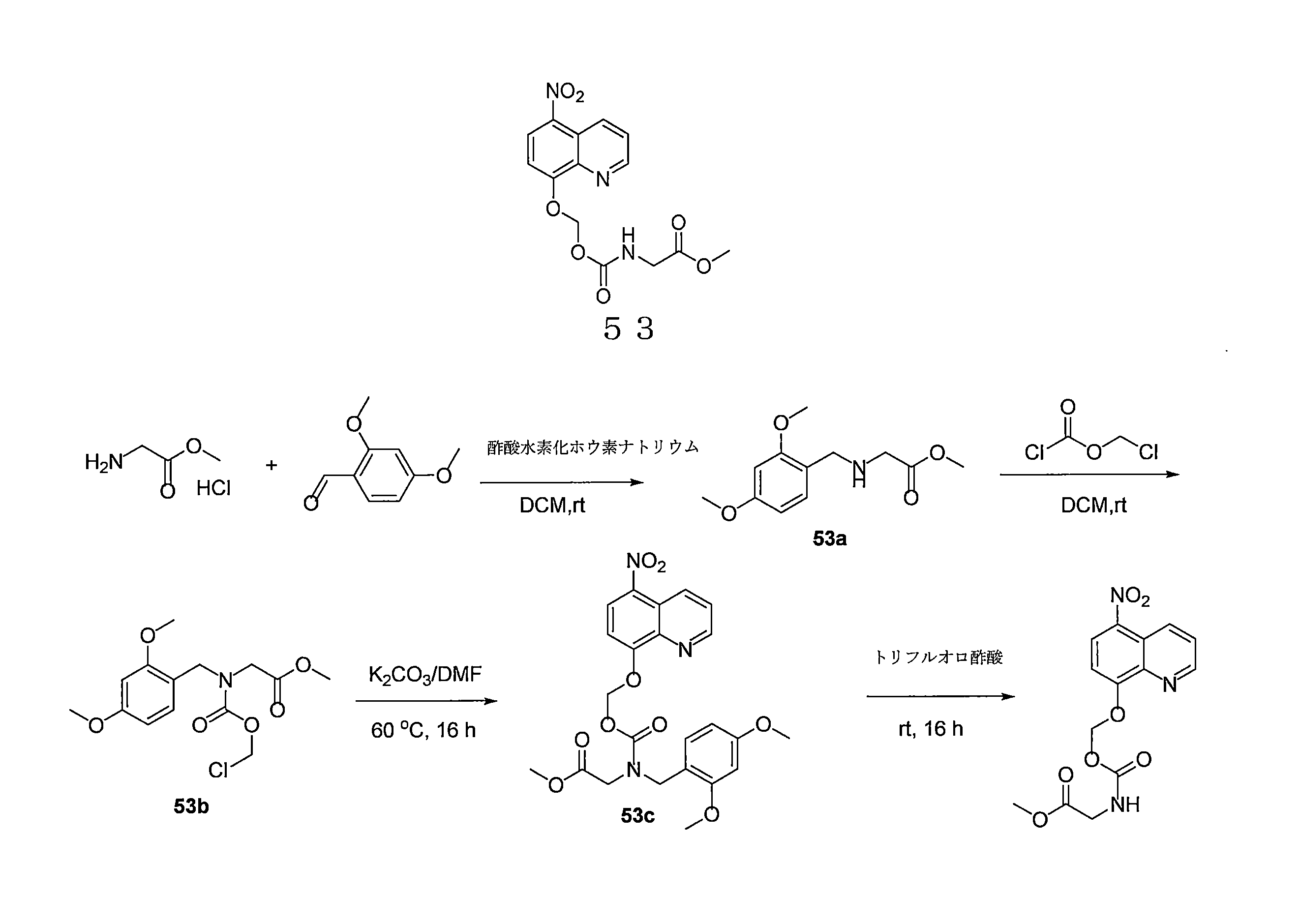
0℃で、2,4-ジメトキシベンズアルデヒド(720mg,4.34mmol)と酢酸水素化ホウ素ナトリウム(1.38g,6.51mmol)をトリエチルアミン(658mg,6.51mmol)と2-アミノ-酢酸メチル塩酸塩(1.00g,6.51mmol)のジクロロメタン(40mL)溶液に順次緩やかに加えた。反応液を60℃で2時間撹拌した後、室温に冷却した。水を加えて反応をクエンチし、反応液をジクロロメタン(100mLx3)で抽出し、有機相を1 M 塩酸、1 M炭酸水素ナトリウム水溶液、及び飽和食塩水で洗浄し、無水硫酸ナトリウムで乾燥させて、ろ過後、減圧濃縮させた。残留物をシリカゲルカラムクロマトグラフィー(溶離剤:5%メタノール/95%ジクロロメタン)により精製して、2-(2,4-ジメトキシベンジルアミノ)酢酸メチル(1.1g、収率95%)を得た。
MS[M+H]+: 240.0。
ステップ2:2-(((クロロメトキシ)ホルミル)(2,4-ジメトキシベンジル)アミノ)酢酸メチル(53b)の製造
0℃で、クロロギ酸クロロメチル(595mg,4.60mmol)を2-(2,4-ジメトキシベンジルアミノ)酢酸メチル(1.0g,4.39mmol)とトリエチルアミン(485mg,4.80mmol)のジクロロメタン(20mL)溶液に緩やかに滴下した。反応液を50℃で2時間撹拌した後、室温に冷却した。水を加えて反応をクエンチし、次に、反応液をジクロロメタン(100mLx3)で抽出し、有機相を1 M 塩酸、1 M炭酸水素ナトリウム水溶液、及び飽和食塩水で洗浄し、無水硫酸ナトリウムで乾燥させて、ろ過後、減圧濃縮させた。残留物をシリカゲルカラムクロマトグラフィー(溶離剤:5%n-ヘキサン/95%酢酸エチル)により精製して、2-(((クロロメトキシ)ホルミル)(2,4-ジメトキシベンジル)アミノ)酢酸メチル(1.00g、収率69%)を得た。
MS[M+H]+:332.1。
ステップ3:2-((2,4-ジメトキシベンジル)(((5-ニトロキノリン-8-イルオキシ)メトキシ)ホルミル)アミノ)酢酸メチル(53c)の製造
室温で、2-(((クロロメトキシ)ホルミル)(2,4-ジメトキシベンジル)アミノ)酢酸メチル(1.05g,2.79mmol)をニトロキソリン(360mg,1.9mmol)、炭酸カリウム(385mg,2.79mmol)、ヨウ素ナトリウム(30mg,0.19mmol)のN,N-ジメチルホルムアミド(15mL)溶液に加えた。反応液を50℃で2時間撹拌した後、室温に冷却した。水を加えて反応をクエンチし、次に、反応液をジクロロメタン(100mLx3)で抽出し、有機相を1 M 塩酸、1 M炭酸水素ナトリウム水溶液、及び飽和食塩水で洗浄し、無水硫酸ナトリウムで乾燥させて、ろ過後、減圧濃縮させた。残留物をシリカゲルカラムクロマトグラフィー(溶離剤: 5%n-ヘキサン/95%酢酸エチル)により精製して、2-((2,4-ジメトキシベンジル)(((5-ニトロキノリン-8-イルオキシ)メトキシ)ホルミル)アミノ)酢酸メチル(440mg、収率48%)を得た。
MS[M+H]+:486.0。
ステップ4:2-(((5-ニトロキノリン-8-イルオキシ)メトキシ)ホルミルアミノ)酢酸メチル(53)の製造
室温で、トリフルオロ酢酸(8mL)を2-((2,4-ジメトキシベンジル)(((5-ニトロキノリン-8-イルオキシ)メトキシ)ホルミル)アミノ)酢酸メチル(440mg,0.91mmol)のジクロロメタン(8mL)溶液に滴下した。反応液を室温で2時間撹拌した後、水を加えて反応をクエンチし、次に、反応液をジクロロメタン(100mLx3)で抽出し、有機相を1 M 塩酸、1 M炭酸水素ナトリウム水溶液、及び飽和食塩水で洗浄し、無水硫酸ナトリウムで乾燥させて、ろ過後、減圧濃縮させた。残留物をシリカゲルカラムクロマトグラフィー(溶離剤:50%n-ヘキサン/50%酢酸エチル)により精製して、2-(((5-ニトロキノリン-8-イルオキシ)メトキシ)ホルミルアミノ)酢酸メチル(200mg、収率67%)を得た。
1H NMR (400 MHz, CDCl3) δ: 9.18 (dd, J = 8.8, 1.6 Hz, 1H), 9.06 (dd, J = 4.0, 1.6 Hz, 1H), 8.49 (d, J = 8.8 Hz, 1H), 7.70 (dd, J = 8.4, 4.4 Hz, 1H), 7.40 (d, J = 9.2 Hz, 1H), 6.18 (s, 2H), 5.41 (s, 1H), 4.01 (d, J = 5.6 Hz, 2H), 3.77 (s, 3H)。
MS計算: 335.08;MS実測: 336.1 [M+H]+。
Example 53: Synthesis of methyl 2-(((5-nitroquinolin-8-yloxy)methoxy)formylamino)acetate (53)
MS[M+H] + : 240.0.
Step 2: Preparation of methyl 2-(((chloromethoxy)formyl)(2,4-dimethoxybenzyl)amino)acetate (53b) At 0° C., chloromethyl chloroformate (595 mg, 4.60 mmol) was slowly added dropwise to a solution of methyl 2-(2,4-dimethoxybenzylamino)acetate (1.0 g, 4.39 mmol) and triethylamine (485 mg, 4.80 mmol) in dichloromethane (20 mL). The reaction solution was stirred at 50° C. for 2 hours and then cooled to room temperature. Water was added to quench the reaction, and the reaction solution was then extracted with dichloromethane (100 mL×3). The organic phase was washed with 1 M hydrochloric acid, 1 M aqueous sodium hydrogen carbonate solution, and saturated saline, dried over anhydrous sodium sulfate, filtered, and concentrated under reduced pressure. The residue was purified by silica gel column chromatography (eluent: 5% n-hexane/95% ethyl acetate) to give methyl 2-(((chloromethoxy)formyl)(2,4-dimethoxybenzyl)amino)acetate (1.00 g, yield 69%).
MS[M+H] + : 332.1.
Step 3: Preparation of 2-((2,4-dimethoxybenzyl)(((5-nitroquinolin-8-yloxy)methoxy)formyl)amino)methyl acetate (53c) At room temperature, 2-(((chloromethoxy)formyl)(2,4-dimethoxybenzyl)amino)methyl acetate (1.05 g, 2.79 mmol) was added to a solution of nitroxoline (360 mg, 1.9 mmol), potassium carbonate (385 mg, 2.79 mmol), and sodium iodide (30 mg, 0.19 mmol) in N,N-dimethylformamide (15 mL). The reaction solution was stirred at 50° C. for 2 hours and then cooled to room temperature. Water was added to quench the reaction, and then the reaction solution was extracted with dichloromethane (100 mL×3). The organic phase was washed with 1 M hydrochloric acid, 1 M aqueous sodium bicarbonate solution, and saturated saline, dried over anhydrous sodium sulfate, filtered, and concentrated under reduced pressure. The residue was purified by silica gel column chromatography (eluent: 5% n-hexane/95% ethyl acetate) to give methyl 2-((2,4-dimethoxybenzyl)(((5-nitroquinolin-8-yloxy)methoxy)formyl)amino)acetate (440 mg, yield 48%).
MS[M+H] + : 486.0.
Step 4: Preparation of methyl 2-(((5-nitroquinolin-8-yloxy)methoxy)formylamino)acetate (53) At room temperature, trifluoroacetic acid (8 mL) was added dropwise to a solution of methyl 2-((2,4-dimethoxybenzyl)(((5-nitroquinolin-8-yloxy)methoxy)formyl)amino)acetate (440 mg, 0.91 mmol) in dichloromethane (8 mL). The reaction solution was stirred at room temperature for 2 hours, and then water was added to quench the reaction. Next, the reaction solution was extracted with dichloromethane (100 mL x 3), and the organic phase was washed with 1 M hydrochloric acid, 1 M aqueous sodium hydrogen carbonate solution, and saturated saline, dried over anhydrous sodium sulfate, filtered, and concentrated under reduced pressure. The residue was purified by silica gel column chromatography (eluent: 50% n-hexane/50% ethyl acetate) to give methyl 2-(((5-nitroquinolin-8-yloxy)methoxy)formylamino)acetate (200 mg, yield 67%).
1 H NMR (400 MHz, CDCl 3 ) δ: 9.18 (dd, J = 8.8, 1.6 Hz, 1H), 9.06 (dd, J = 4.0, 1.6 Hz, 1H), 8.49 (d, J = 8.8 Hz, 1H), 7.70 (dd, J = 8.4, 4.4 Hz, 1H), 7.40 (d, J = 9.2 Hz, 1H), 6.18 (s, 2H), 5.41 (s, 1H), 4.01 (d, J = 5.6 Hz, 2H), 3.77 (s, 3H).
MS calculation: 335.08;MS measurement: 336.1 [M+H] + .
実施例54:2-(((5-ニトロキノリン-8-イルオキシ)メトキシ)ホルミルアミノ)酪酸メチル(54)の合成

1H NMR (400 MHz, CDCl3): δ 9.19 (dd, J = 8.8, 1.6 Hz, 1H), 9.06 (s, 1H), 8.49 (d, J = 8.8 Hz, 1H), 7.70 (d, J = 8.8 Hz, 1H), 7.40 (d, J = 8.8 Hz, 1H), 6.17 (d, J = 7.6 Hz, 2H), 5.43 (d, J = 8.0 Hz, 1H), 4.36 (d, J = 5.6 Hz, 1H), 3.75 (s, 3H), 1.90 (s, 1H), 1.72 (d, J = 7.2 Hz, 1H), 0.90 (d, J = 7.4 Hz, 3H)。
MS計算:363;MS実測:364。
Example 54: Synthesis of methyl 2-(((5-nitroquinolin-8-yloxy)methoxy)formylamino)butyrate (54)
1 H NMR (400 MHz, CDCl 3 ): δ 9.19 (dd, J = 8.8, 1.6 Hz, 1H), 9.06 (s, 1H), 8.49 (d, J = 8.8 Hz, 1H), 7.70 (d, J = 8.8 Hz, 1H), 7.40 (d, J = 8.8 Hz, 1H), 6.17 (d, J = 7.6 Hz, 2H), 5.43 (d, J = 8.0 Hz, 1H), 4.36 (d, J = 5.6 Hz, 1H), 3.75 (s, 3H), 1.90 (s, 1H), 1.72 (d, J = 7.2 Hz, 1H), 0.90 (d, J = 7.4 Hz, 3H).
MS calculated: 363; MS observed: 364.
実施例55:3-メチル-2-(((5-ニトロキノリン-8-イルオキシ)メトキシ)ホルミルアミノ)吉草酸メチル(55)の合成

1H NMR (400 MHz, CDCl3) δ: 9.19 (dd, J = 9.2, 1.2 Hz, 1H), 9.06 (dd, J = 4.0, 1.6 Hz, 1H), 8.49 (d, J = 8.8 Hz, 1H), 7.70 (dd, J = 9.2, 4.4 Hz, 1H), 7.40 (dd, J =8.8, 1.2 Hz, 1H), 6.18-6.16 (m, 2H), 5.38 (m, 1H), 4.45 (dd, J = 9.2, 4.0 Hz, 1H), 3.74 (s, 3H), 1.99-1.87 (m, 1H), 1.43-1.37 (m, 1H), 1.21-1.14 (m, 1H), 0.95-0.89 (m, 4H), 0.84-0.82 (d, J = 8.8 Hz, 2H)。
MS計算:391.14;MS実測:392.1 [M+H]+。
Example 55: Synthesis of methyl 3-methyl-2-(((5-nitroquinolin-8-yloxy)methoxy)formylamino)valerate (55)
1 H NMR (400 MHz, CDCl 3 ) δ: 9.19 (dd, J = 9.2, 1.2 Hz, 1H), 9.06 (dd, J = 4.0, 1.6 Hz, 1H), 8.49 (d, J = 8.8 Hz, 1H), 7.70 (dd, J = 9.2, 4.4 Hz, 1H), 7.40 (dd, J =8.8, 1.2 Hz, 1H), 6.18-6.16 (m, 2H), 5.38 (m, 1H), 4.45 (dd, J = 9.2, 4.0 Hz, 1H), 3.74 (s, 3H), 1.99-1.87 (m, 1H), 1.43-1.37 (m, 1H), 1.21-1.14 (m, 1H), 0.95-0.89 (m, 4H), 0.84-0.82 (d, J = 8.8 Hz, 2H).
MS calculation: 391.14; MS measurement: 392.1 [M+H] + .
実施例56:3-メチル-2-(メチル(((5-ニトロキノリン-8-イルオキシ)メトキシ)ホルミル)アミノ)吉草酸メチル(56)の合成
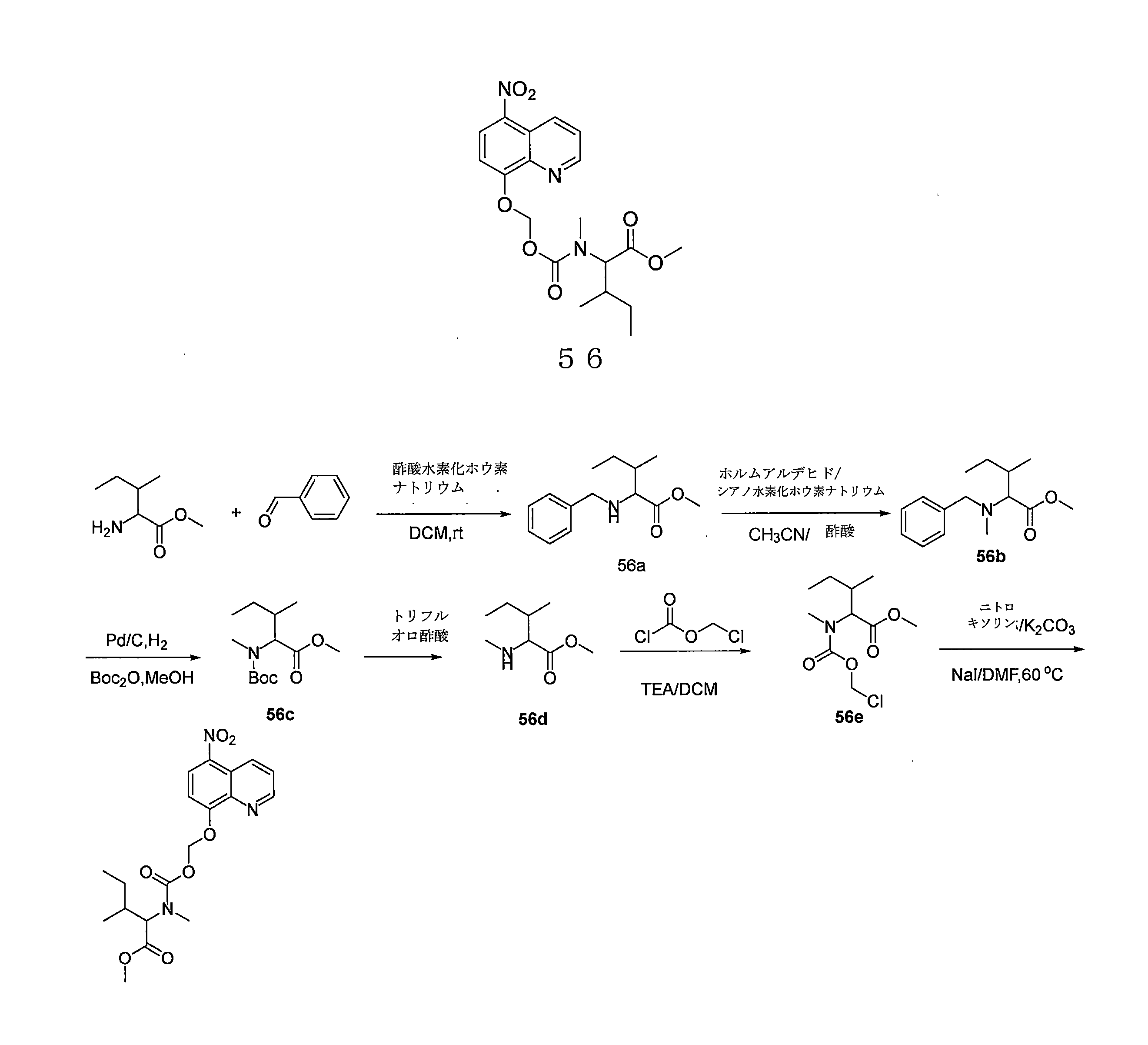
0℃で、2-アミノ-3-メチル吉草酸メチル塩酸塩(4.0g,21.9mmol)と酢酸水素化ホウ素ナトリウム(9.2g,43.4mmol)をベンズアルデヒド(1.6g,14.7mmol)とトリエチルアミン(2.2g,21.9mmol)のジクロロメタン(80mL)溶液に順次緩やかに加えた。反応液を0℃で30分間撹拌した後、室温に昇温して16時間撹拌しつづけた。飽和炭酸水素ナトリウム水溶液(20mL)で反応をクエンチし、反応液をジクロロメタン(150mLx3)で抽出し、有機相を合わせて、乾燥させ、減圧濃縮させて、粗製品としてN-ベンジル-2-アミノ-3-メチル吉草酸メチル。(4.2g、収率100%)を得た。
MS[M+H]+:236.0。
ステップ2:N-メチル-N-ベンジル-2-アミノ-3-メチル吉草酸メチル(56b)の製造
0℃で、37%ホルムアルデヒド(5.4g,179mmol)水溶液、シアノ水素化ホウ素ナトリウム(2.5g,39.4mmol)、及び酢酸(2mL)をN-ベンジル-2-アミノ-3-メチル吉草酸メチル(4.2g,17.9mmol)のアセトニトリル(100mL)溶液に順次加えた。反応液を室温で16時間撹拌した、次に、飽和炭酸水素ナトリウム(100mL)水溶液でクエンチした。反応液をジクロロメタン(150mLx3)で抽出し、有機相を硫酸マグネシウムで乾燥させ、ろ過して減圧濃縮させた。残留物をシリカゲルカラムクロマトグラフィー(溶離剤:5%メタノール/95%ジクロロメタン)により精製して、到N-メチル-N-ベンジル-2-アミノ-3-メチル吉草酸メチル(4.2g、収率93%)を得た。
MS[M+H]+:250.0。
ステップ3:N-メチル-N-Boc-2-アミノ-3-メチル吉草酸メチル(56c)の製造
N-メチル-N-ベンジル-2-アミノ-3-メチル吉草酸メチル(4.2g,16.8mmol)、Pd/C(900mg)、及びBoc2O(10mL)をメタノール(30mL)に加えた。水素雰囲気下、反応液を50℃で16時間撹拌した。固体をろ過により除去した後、減圧濃縮させて、粗製品としてN-メチル-N-Boc-2-アミノ-3-メチル吉草酸メチル(5.2g、収率100%)を得た。
MS[M+H]+:260.0。
ステップ4:N-メチル-2-アミノ-3-メチル吉草酸メチル(56d)の製造
0℃で、5 M塩酸の1,4ジオキサン(10mL)溶液をN-メチル-N-Boc-2-アミノ-3-メチル吉草酸メチル(5.2g,20mmol)のテトラヒドロフラン(50mL)溶液に加えた。反応液を室温で2時間撹拌し、減圧濃縮させて、N-メチル-2-アミノ-3-メチル吉草酸メチル(3.2g、収率82%)を得た。
MS[M+H]+:160.0。
ステップ5:N-メチル-N-クロロメトキシホルミル-2-アミノ-3-メチル吉草酸メチル(56e)の製造
0℃で、クロロギ酸クロロメチル(0.48mL,5.37mmol)をN-メチル-2-アミノ-3-メチル吉草酸メチル(1g,5.12mmol)とトリエチルアミン(1.8mL,12.8mmol)のジクロロメタン(30mL)の溶液に緩やかに滴下した。反応液を0℃で30分間撹拌した後、室温に昇温して16時間撹拌した。水(25mL)で反応をクエンチした後、反応液をジクロロメタン(100mLx3)で抽出し、有機相を硫酸マグネシウムで乾燥させ、ろ過し、ろ液を減圧濃縮させ、粗製品としてN-メチル-N-クロロメトキシホルミル-2-アミノ-3-メチル吉草酸メチル(638mg、収率49%)を得た。
MS[M+H]+:252.0。
ステップ6:3-メチル-2-(メチル(((5-ニトロキノリン-8-イルオキシ)メトキシ)ホルミル)アミノ)吉草酸メチル(56)の製造
室温で、N-メチル-N-クロロメトキシホルミル-2-アミノ-3-メチル吉草酸メチル(638mg,2.53mmol)をニトロキソリン(350mg,2.63mmol)、炭酸カリウム(464mg,3.36mmol)、及びヨウ素ナトリウム(27mg,0.18mmol)のN,N-ジメチルホルムアミド(10mL)溶液に緩やかに滴下した。反応液を60℃で2時間撹拌した。水(25mL)で反応をクエンチした後、反応液をジクロロメタン(100mLx3)で抽出し、有機相を硫酸マグネシウムで乾燥させ、ろ過し、ろ液を減圧濃縮させた。残留物をシリカゲルカラムクロマトグラフィー(溶離剤:5%メタノール/95%ジクロロメタン)により精製して、3-メチル-2-(メチル(((5-ニトロキノリン-8-イルオキシ)メトキシ)ホルミル)アミノ)吉草酸メチル(70mg、収率10%)を得た。
1H NMR (400 MHz, CDCl3) δ 9.20 (d, J = 8.8 Hz, 1H), 9.07 - 9.06 (m, 1H), 8.50 (dd, J = 8.8, 3.2 Hz, 1H), 7.72 (dd, J = 8.8, 4.0 Hz, 1H), 7.42 (d, J = 8.8 Hz, 1H), 6.25 - 6.21 (m, 2H), 4.61 - 4.30 (m, 1H), 3.71 - 3.58 (m, 3H), 2.94 - 2.89 (m, 3H), 1.98 (br s, 1H), 1.39 - 1.34 (m, 1H), 0.95 - 0.75 (m, 7H)。
MS計算: 405.15;MS実測: 406.1 [M+H]+。
Example 56: Synthesis of methyl 3-methyl-2-(methyl(((5-nitroquinolin-8-yloxy)methoxy)formyl)amino)valerate (56)
MS[M+H] + : 236.0.
Step 2: Preparation of N-methyl-N-benzyl-2-amino-3-methylmethylvalerate (56b) At 0° C., 37% aqueous formaldehyde (5.4 g, 179 mmol), sodium cyanoborohydride (2.5 g, 39.4 mmol), and acetic acid (2 mL) were added sequentially to a solution of N-benzyl-2-amino-3-methylmethylvalerate (4.2 g, 17.9 mmol) in acetonitrile (100 mL). The reaction was stirred at room temperature for 16 hours and then quenched with saturated aqueous sodium bicarbonate (100 mL). The reaction was extracted with dichloromethane (150 mL×3), and the organic phase was dried over magnesium sulfate, filtered, and concentrated under reduced pressure. The residue was purified by silica gel column chromatography (eluent: 5% methanol/95% dichloromethane) to give methyl N-methyl-N-benzyl-2-amino-3-methylvalerate (4.2 g, yield 93%).
MS[M+H] + : 250.0.
Step 3: Preparation of N-methyl-N-Boc-2-amino-3-methyl methyl valerate (56c) N-methyl-N-benzyl-2-amino-3-methyl methyl valerate (4.2 g, 16.8 mmol), Pd/C (900 mg), and Boc 2 O (10 mL) were added to methanol (30 mL). The reaction mixture was stirred at 50° C. for 16 hours under a hydrogen atmosphere. The solid was removed by filtration, and the mixture was concentrated under reduced pressure to give crude N-methyl-N-Boc-2-amino-3-methyl methyl valerate (5.2 g, 100% yield).
MS[M+H] + : 260.0.
Step 4: Preparation of methyl N-methyl-2-amino-3-methylvalerate (56d) A solution of 5 M hydrochloric acid in 1,4 dioxane (10 mL) was added to a solution of methyl N-methyl-N-Boc-2-amino-3-methylvalerate (5.2 g, 20 mmol) in tetrahydrofuran (50 mL) at 0° C. The reaction was stirred at room temperature for 2 hours and concentrated under reduced pressure to give methyl N-methyl-2-amino-3-methylvalerate (3.2 g, 82% yield).
MS[M+H] + : 160.0.
Step 5: Preparation of N-methyl-N-chloromethoxyformyl-2-amino-3-methyl methyl valerate (56e) At 0° C., chloromethyl chloroformate (0.48 mL, 5.37 mmol) was slowly added dropwise to a solution of N-methyl-2-amino-3-methyl methyl valerate (1 g, 5.12 mmol) and triethylamine (1.8 mL, 12.8 mmol) in dichloromethane (30 mL). The reaction solution was stirred at 0° C. for 30 minutes, then warmed to room temperature and stirred for 16 hours. After quenching the reaction with water (25 mL), the reaction solution was extracted with dichloromethane (100 mL×3), the organic phase was dried over magnesium sulfate, filtered, and the filtrate was concentrated under reduced pressure to obtain crude N-methyl-N-chloromethoxyformyl-2-amino-3-methyl methyl valerate (638 mg, yield 49%).
MS[M+H] + : 252.0.
Step 6: Preparation of methyl 3-methyl-2-(methyl(((5-nitroquinolin-8-yloxy)methoxy)formyl)amino)valerate (56) Methyl N-methyl-N-chloromethoxyformyl-2-amino-3-methylvalerate (638 mg, 2.53 mmol) was slowly added dropwise to a solution of nitroxoline (350 mg, 2.63 mmol), potassium carbonate (464 mg, 3.36 mmol), and sodium iodide (27 mg, 0.18 mmol) in N,N-dimethylformamide (10 mL) at room temperature. The reaction was stirred at 60° C. for 2 hours. After quenching the reaction with water (25 mL), the reaction was extracted with dichloromethane (100 mL×3), the organic phase was dried over magnesium sulfate, filtered, and the filtrate was concentrated under reduced pressure. The residue was purified by silica gel column chromatography (eluent: 5% methanol/95% dichloromethane) to give methyl 3-methyl-2-(methyl(((5-nitroquinolin-8-yloxy)methoxy)formyl)amino)valerate (70 mg, 10% yield).
1 H NMR (400 MHz, CDCl 3 ) δ 9.20 (d, J = 8.8 Hz, 1H), 9.07 - 9.06 (m, 1H), 8.50 (dd, J = 8.8, 3.2 Hz, 1H), 7.72 (dd, J = 8.8, 4.0 Hz, 1H), 7.42 (d, J = 8.8 Hz, 1H), 6.25 - 6.21 (m, 2H), 4.61 - 4.30 (m, 1H), 3.71 - 3.58 (m, 3H), 2.94 - 2.89 (m, 3H), 1.98 (br s, 1H), 1.39 - 1.34 (m, 1H), 0.95 - 0.75 (m, 7H).
MS calculation: 405.15; MS measurement: 406.1 [M+H] + .
実施例57:2-(メチル((5-ニトロキノリン-8-イルオキシ)ホルミル)アミノ)酢酸メチル(57)の合成
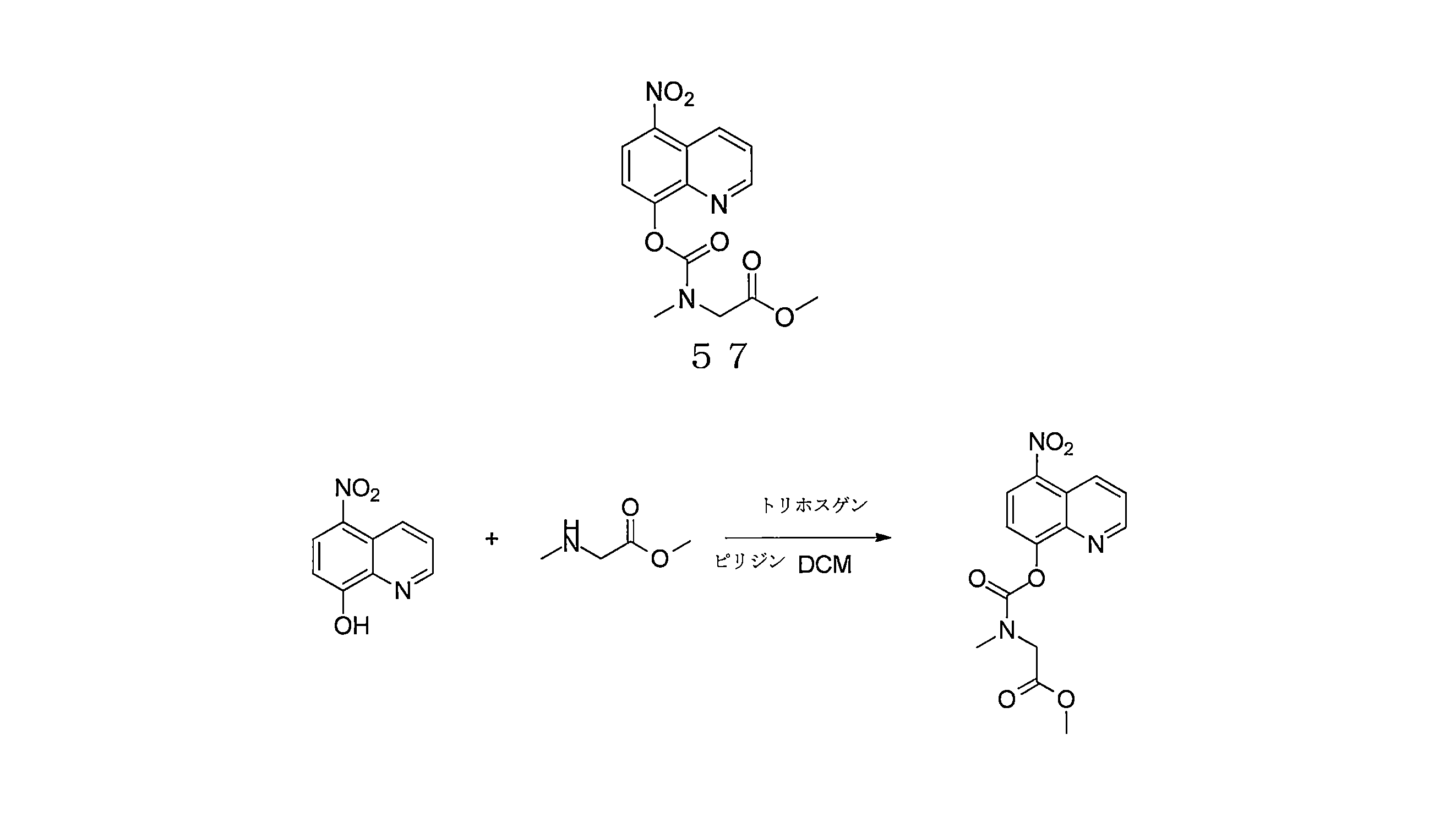
1H NMR (400 MHz, CDCl3) δ: 9.10-9.04 (m, 2H), 8.47-8.43 (m, 1H), 7.68-7.60 (m, 2H), 4.30 (d, J = 84.8 Hz, 2H), 3.82 (d, J = 13.6 Hz, 3H), 3.27 (d, J = 88.0 Hz, 3H)。
MS計算: 319.08;MS実測: 320.0 [M+H]+。
Example 57: Synthesis of methyl 2-(methyl((5-nitroquinolin-8-yloxy)formyl)amino)acetate (57)
1 H NMR (400 MHz, CDCl 3 ) δ: 9.10-9.04 (m, 2H), 8.47-8.43 (m, 1H), 7.68-7.60 (m, 2H), 4.30 (d, J = 84.8 Hz, 2H), 3.82 (d, J = 13.6 Hz, 3H), 3.27 (d, J = 88.0 Hz, 3H).
MS calculation: 319.08;MS measurement: 320.0 [M+H] + .
実施例58:(S)-2-(((5-ニトロキノリン-8-イルオキシ)メトキシ)ホルミルアミノ)-3-フェニルプロピオン酸メチル(58)の合成

1H-NMR (400 Hz, CDCl3) δ: 9.35 (dd, J = 8.8, 1.6 Hz, 1H), 9.15 (dd, J = 4.4, 1.6 Hz, 1H), 8.53 (d, J = 8.8 Hz, 1H), 7.83 (dd, J = 8.8 Hz, 4.4Hz, 1H), 7.56 (br, 1H), 7.40 (d, J = 8.8 Hz, 1H), 7.25-7.17 (m, 3H), 7.04-7.18 (m, 2H), 6.10 (s, 2H), 4.51-4.68 (m, 1H), 3.72 (s, 3H), 2.95-3.18 (m, 2H)。
MS計算: 425.40;MS実測: 426.3 [M+H]+。
Example 58: Synthesis of methyl (S)-2-(((5-nitroquinolin-8-yloxy)methoxy)formylamino)-3-phenylpropionate (58)
1 H-NMR (400 Hz, CDCl3) δ: 9.35 (dd, J = 8.8, 1.6 Hz, 1H), 9.15 (dd, J = 4.4, 1.6 Hz, 1H), 8.53 (d, J = 8.8 Hz, 1H), 7.83 (dd, J = 8.8 Hz, 4.4Hz, 1H), 7.56 (br, 1H), 7.40 (d, J = 8.8 Hz, 1H), 7.25-7.17 (m, 3H), 7.04-7.18 (m, 2H), 6.10 (s, 2H), 4.51-4.68 (m, 1H), 3.72 (s, 3H), 2.95-3.18 (m, 2H).
MS calculation: 425.40; MS measurement: 426.3 [M+H] + .
実施例59:(2S,6R)-(5-ニトロキノリン-8-イルオキシ)メチル2,6-ジメチルモルホリン-4-ホルメート(59)の合成
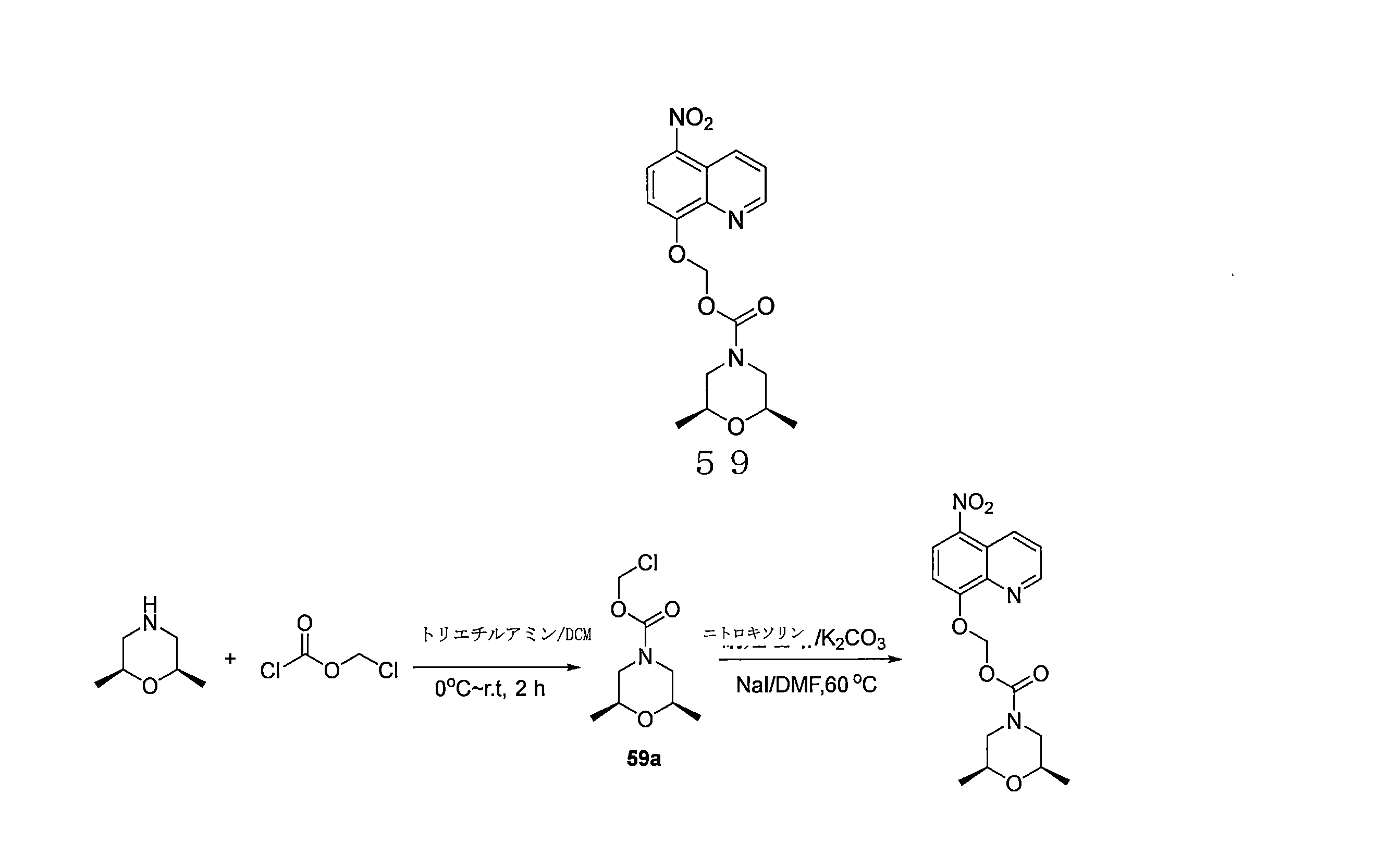
0℃で、(2S,6R)-2,6-ジメチルモルホリン(0.46g,4mmol)をジクロロメタン(10mL)に溶解して、トリエチルアミン(1.1mL,8mmol)とクロロギ酸クロロメチル(0.6g,4.6mmol)を緩やかに順次滴下し、30分間撹拌後、室温に昇温して4時間撹拌した。水(50mL)でクエンチした後、ジクロロメタン(100mLx3)で抽出し、有機相を合わせた後、無水硫酸ナトリウムで乾燥させて、ろ過して減圧濃縮させ、生成物としてN-クロロメトキシホルミル-(2S,6R)-2,6-ジメチルモルホリン(0.5g、収率60%)を得た。
ステップ2:(2S,6R)-(5-ニトロキノリン-8-イルオキシ)メチル2,6-ジメチルモルホリン-4-ホルメート(59)の製造
室温で、ニトロキソリン(0.6g,3.1mmol)とN-クロロメトキシホルミル-(2S,6R)-2,6-ジメチルモルホリン(0.5g,2.4mmol)をN,N-ジメチルホルムアミド(10mL)に溶解し、その後、炭酸カリウム(0.7g,5.0mmol)とヨウ素カリウム(83mg,0.5mmol)を加えて、反応液を60℃で4時間撹拌した。反応を室温に冷却した後、水で反応をクエンチし、ジクロロメタン(100mLx3)で抽出し、有機相を合わせて、無水硫酸ナトリウムで乾燥させて、ろ過して減圧濃縮させた。残留物を逆相高速液体クロマトグラフィー(カラムはEclipse XDB-C18(21.2mm×250mm,7μm)、移動相はアセトニトリル-0.1%ギ酸、流速は20.0mL/min)により分離して、(2S,6R)-(5-ニトロキノリン-8-イルオキシ)メチル2,6-ジメチルモルホリン-4-ホルメート(90mg、収率11%)を得た。
1H-NMR (400 Hz, CDCl3) δ: 9.23 (dd, J = 8.8, 1.2 Hz, 1H), 9.10 (d, J = 3.2 Hz, 1H), 8.54 (d, J = 8.8 Hz, 1H), 7.77 (dd, J = 8.8 Hz, 4.0 Hz, 1H), 7.41 (d, J = 8.8 Hz, 1H), 6.49 (d, J = 8 Hz, 1H), 6.20-6.24 (m, 2H), 4.02 (d, J = 12.8 Hz, 1H), 3.87 (d, J = 12.8 Hz, 1H), 3.50-3.60 (m, 2H), 2.52-2.64 (m, 2H), 1.20 (d, J = 6.4 Hz, 3H), 1.16 (d, J = 6.0 Hz,3H)。
MS計算: : 361.35;MS実測: 362.3 [M+H]+。
Example 59: Synthesis of (2S,6R)-(5-nitroquinolin-8-yloxy)methyl 2,6-dimethylmorpholine-4-formate (59)
Step 2: Preparation of (2S,6R)-(5-nitroquinolin-8-yloxy)methyl 2,6-dimethylmorpholine-4-formate (59) Nitroxoline (0.6 g, 3.1 mmol) and N-chloromethoxyformyl-(2S,6R)-2,6-dimethylmorpholine (0.5 g, 2.4 mmol) were dissolved in N,N-dimethylformamide (10 mL) at room temperature, then potassium carbonate (0.7 g, 5.0 mmol) and potassium iodine (83 mg, 0.5 mmol) were added and the reaction was stirred at 60° C. for 4 hours. After cooling the reaction to room temperature, the reaction was quenched with water and extracted with dichloromethane (100 mL×3), the organic phases were combined, dried over anhydrous sodium sulfate, filtered and concentrated under reduced pressure. The residue was separated by reversed-phase high performance liquid chromatography (column: Eclipse XDB-C18 (21.2 mm × 250 mm, 7 μm), mobile phase: acetonitrile-0.1% formic acid, flow rate: 20.0 mL/min) to obtain (2S,6R)-(5-nitroquinolin-8-yloxy)methyl 2,6-dimethylmorpholine-4-formate (90 mg, yield 11%).
1 H-NMR (400 Hz, CDCl3) δ: 9.23 (dd, J = 8.8, 1.2 Hz, 1H), 9.10 (d, J = 3.2 Hz, 1H), 8.54 (d, J = 8.8 Hz, 1H), 7.77 (dd, J = 8.8 Hz, 4.0 Hz, 1H), 7.41 (d, J = 8.8 Hz, 1H), 6.49 (d, J = 8 Hz, 1H), 6.20-6.24 (m, 2H), 4.02 (d, J = 12.8 Hz, 1H), 3.87 (d, J = 12.8 Hz, 1H), 3.50-3.60 (m, 2H), 2.52-2.64 (m, 2H), 1.20 (d, J = 6.4 Hz, 3H), 1.16 (d, J = 6.0 Hz,3H).
MS calculation: : 361.35;MS measurement: 362.3 [M+H] + .
実施例60:(5-ニトロキノリン-8-イルオキシ)メチル1,4’-ビピペリジン-1’-ホルメート(60)の合成

1H-NMR (400 Hz, CDCl3) δ: 9.25-9.27 (m, 1H), 9.12-9.13 (m, 1H), 8.53-8.55 (m, 1H), 7.75-7.78 (m, 1H), 7.42-7.44 (m, 1H), 6.21-6.22 (s, 2H), 3.53-4.03 (m, 8H), 2.52-2.64 (m, 2H), 1.08-1.20 (m,9H)。
MS計算:414.46;MS実測:415.3 [M+H]+。
Example 60: Synthesis of (5-nitroquinolin-8-yloxy)methyl 1,4'-bipiperidine-1'-formate (60)
1 H-NMR (400 Hz, CDCl3) δ: 9.25-9.27 (m, 1H), 9.12-9.13 (m, 1H), 8.53-8.55 (m, 1H), 7.75-7.78 (m, 1H), 7.42-7.44 (m, 1H), 6.21-6.22 (s, 2H), 3.53-4.03 (m, 8H), 2.52-2.64 (m, 2H), 1.08-1.20 (m,9H).
MS calculation: 414.46; MS measurement: 415.3 [M+H] + .
実施例61:4-(((5-ニトロキノリン-8-イルオキシ)メトキシ)ホルミルアミノ)酪酸メチル(61)の合成

1H-NMR (400 Hz, CDCl3) δ: 9.23 (dd, J = 8.8, 0.8 Hz, 1H), 9.22 (dd, J = 4.4, 3.6 Hz, 1H), 8.60 (d, J = 9.2 Hz, 1H), 7.91 (dd, J = 8.8, 4.4Hz, 1H), 7.50 (d, J = 8.8 Hz, 1H), 6.11 (s, 2H), 5.27 (s, 1H), 3.67 (s, 3H), 3.25-3.30 (m, 2H), 2.36-2.39(m, 2H), 1.82-1.86 (m, 2H)。
MS計算: 363.33;MS実測: 364.3 [M+H]+。
Example 61: Synthesis of methyl 4-(((5-nitroquinolin-8-yloxy)methoxy)formylamino)butyrate (61)
1 H-NMR (400 Hz, CDCl3) δ: 9.23 (dd, J = 8.8, 0.8 Hz, 1H), 9.22 (dd, J = 4.4, 3.6 Hz, 1H), 8.60 (d, J = 9.2 Hz, 1H), 7.91 (dd, J = 8.8, 4.4Hz, 1H), 7.50 (d, J = 8.8 Hz, 1H), 6.11 (s, 2H), 5.27 (s, 1H), 3.67 (s, 3H), 3.25-3.30 (m, 2H), 2.36-2.39(m, 2H), 1.82-1.86 (m, 2H).
MS calculation: 363.33;MS measurement: 364.3 [M+H] + .
実施例62:(5-ニトロキノリン-8-イルオキシ)メチル2-メチルモルホリン-4-ホルメート(62)の合成

1H-NMR (400 Hz, CDCl3) δ: 9.37-9.39 (m, 1H), 9.18-9.19 (m, 1H), 8.59 (d, J = 8.4 Hz, 1H), 7.75 (dd, J = 8.8 Hz, 4.4 Hz, 1H), 7.44 (d, J = 8.8 Hz, 1H), 6.15-6.22 (s, 2H ), 3.88-4.03 (m, 3H), 3.51-3.59 (m, 2H), 2.98-3.10 (m, 1H), 2.62-2.69 (m, 1H), 1.18-1.20 (m, 3H)。
MS計算: 347.33;MS実測: 338.3 [M+H]+。
Example 62: Synthesis of (5-nitroquinolin-8-yloxy)methyl 2-methylmorpholine-4-formate (62)
1 H-NMR (400 Hz, CDCl3) δ: 9.37-9.39 (m, 1H), 9.18-9.19 (m, 1H), 8.59 (d, J = 8.4 Hz, 1H), 7.75 (dd, J = 8.8 Hz, 4.4 Hz, 1H), 7.44 (d, J = 8.8 Hz, 1H), 6.15-6.22 (s, 2H), 3.88-4.03 (m, 3H), 3.51-3.59 (m, 2H), 2.98-3.10 (m, 1H), 2.62-2.69 (m, 1H), 1.18-1.20 (m, 3H).
MS calculation: 347.33;MS measurement: 338.3 [M+H] + .
実施例63:(5-ニトロキノリン-8-イルオキシ)メチル2-ヒドロキシエチル(メチル)カーバメート(63)の合成

0℃で、N-メチル-2-ヒドロキシエチルアミン(3.5g,46.6mmol)、t-ブチルジメチルクロロシラン(7.7g,51.2mmol)をジクロロメタン(100mL)に溶解して、トリエチルアミン(13mL,93mmol)を緩やかに滴下した。反応液を0℃で30分間撹拌した後、室温に昇温して一晩撹拌した。反応液を乾固まで濃縮させて、メチルt-ブチルエーテル(200mL)に溶解し、1 M炭酸水素ナトリウム水溶液、及び飽和食塩水で洗浄し、無水硫酸ナトリウムで乾燥させて、ろ過し、ろ液を減圧濃縮させ、生成物としてN-[2-(t-ブチルジメチルシロキシ)エチル]メチルアミン(6g、収率68%)を得た。
ステップ2:N-(クロロメトキシホルミル)-N-[2-(t-ブチルジメチルシロキシ)エチル]メチルアミン(63b)の製造
0℃で、N-[2-(t-ブチルジメチルシロキシ)エチル]メチルアミン(3g,15.8mmol)をジクロロメタン(80mL)に溶解して、トリエチルアミン(4.5mL,31.6mmol)とクロロギ酸クロロメチル(2.6g,20.6mmol)を緩やかに順次滴下した。反応液を0℃で30分間撹拌した後、室温に昇温して一晩撹拌した。水(100mL)でクエンチした後、ジクロロメタン(200mLx3)で抽出し、有機相を合わせた後、無水硫酸ナトリウムで乾燥させて、ろ過し、ろ液を減圧濃縮させ、N-(クロロメトキシホルミル)-N-[2-(t-ブチルジメチルシロキシ)エチル]メチルアミン(2g、収率29%)を得た。
ステップ3:(5-ニトロキノリン-8-イルオキシ)メチル2-(t-ブチルジメチルシロキシ)エチル(メチル)カーバメート(63c)の製造
室温で、ニトロキソリン(1.75g,9.2mmol)とN-(クロロメトキシホルミル)- N-[2-(t-ブチルジメチルシロキシ)エチル]メチルアミン(2.0g,7.1mmol)をN,N-ジメチルホルムアミド(10mL)に溶解し、その後、炭酸カリウム(2g,14.2mmol)とヨウ素カリウム(230mg,1.4mmol)を加えて、反応液を60℃で4時間撹拌した。反応液を室温に冷却した後、水で反応をクエンチし、ジクロロメタン(200mLx3)で抽出し、有機相を合わせて、無水硫酸ナトリウムで乾燥させて、ろ過して減圧濃縮させた。残留物をシリカゲルカラムクロマトグラフィー(溶離剤:5%メタノール/95%ジクロロメタン)により精製して、(5-ニトロキノリン-8-イルオキシ)メチル2-(t-ブチルジメチルシロキシ)エチル(メチル)カーバメート(500mg、収率16.2%)を得た。
ステップ4:(5-ニトロキノリン-8-イルオキシ)メチル2-ヒドロキシエチル(メチル)カーバメート(63)の製造
室温で、(5-ニトロキノリン-8-イルオキシ)メチル2-(t-ブチルジメチルシロキシ)エチル(メチル)カーバメート(0.5g,1.1mmol)、テトラブチルアンモニウムフルオリド(TBAF)(0.35g,1.3mmol)をジクロロメタン(20mL)に溶解して、4時間撹拌した。反応液をろ過して減圧濃縮させ、残留物を逆相高速液体クロマトグラフィー(カラムはEclipse XDB-C18(21.2mm×250mm,7μm)、移動相はアセトニトリル-0.1%ギ酸、流速は20.0mL/minである)により分離して、生成物として(5-ニトロキノリン-8-イルオキシ)メチル2-ヒドロキシエチル(メチル)カーバメート(0.2g、収率29%)を得た。
Example 63: Synthesis of (5-nitroquinolin-8-yloxy)methyl 2-hydroxyethyl(methyl)carbamate (63)
Step 2: Preparation of N-(chloromethoxyformyl)-N-[2-(t-butyldimethylsiloxy)ethyl]methylamine (63b) At 0° C., N-[2-(t-butyldimethylsiloxy)ethyl]methylamine (3 g, 15.8 mmol) was dissolved in dichloromethane (80 mL), and triethylamine (4.5 mL, 31.6 mmol) and chloromethyl chloroformate (2.6 g, 20.6 mmol) were slowly and successively added dropwise. The reaction solution was stirred at 0° C. for 30 minutes, then warmed to room temperature and stirred overnight. After quenching with water (100 mL), the mixture was extracted with dichloromethane (200 mL×3). The organic phases were combined, dried over anhydrous sodium sulfate, filtered, and the filtrate was concentrated under reduced pressure to obtain N-(chloromethoxyformyl)-N-[2-(t-butyldimethylsiloxy)ethyl]methylamine (2 g, 29% yield).
Step 3: Preparation of (5-nitroquinolin-8-yloxy)methyl 2-(t-butyldimethylsiloxy)ethyl(methyl)carbamate (63c) Nitroxoline (1.75 g, 9.2 mmol) and N-(chloromethoxyformyl)-N-[2-(t-butyldimethylsiloxy)ethyl]methylamine (2.0 g, 7.1 mmol) were dissolved in N,N-dimethylformamide (10 mL) at room temperature, followed by addition of potassium carbonate (2 g, 14.2 mmol) and potassium iodine (230 mg, 1.4 mmol) and stirring the reaction solution at 60° C. for 4 hours. After cooling the reaction solution to room temperature, the reaction was quenched with water and extracted with dichloromethane (200 mL×3). The organic phases were combined, dried over anhydrous sodium sulfate, filtered and concentrated under reduced pressure. The residue was purified by silica gel column chromatography (eluent: 5% methanol/95% dichloromethane) to give (5-nitroquinolin-8-yloxy)methyl 2-(t-butyldimethylsiloxy)ethyl(methyl)carbamate (500 mg, 16.2% yield).
Step 4: Preparation of (5-nitroquinolin-8-yloxy)methyl 2-hydroxyethyl(methyl)carbamate (63) At room temperature, (5-nitroquinolin-8-yloxy)methyl 2-(t-butyldimethylsiloxy)ethyl(methyl)carbamate (0.5 g, 1.1 mmol) and tetrabutylammonium fluoride (TBAF) (0.35 g, 1.3 mmol) were dissolved in dichloromethane (20 mL) and stirred for 4 hours. The reaction solution was filtered and concentrated under reduced pressure, and the residue was separated by reversed-phase high-performance liquid chromatography (column: Eclipse XDB-C18 (21.2 mm x 250 mm, 7 μm), mobile phase: acetonitrile-0.1% formic acid, flow rate: 20.0 mL/min) to obtain the product (5-nitroquinolin-8-yloxy)methyl 2-hydroxyethyl(methyl)carbamate (0.2 g, yield 29%).
実施例64:2-(メチル(((5-ニトロキノリン-8-イルオキシ)メトキシ)ホルミル)アミノ)エチルアセテート(64)の合成
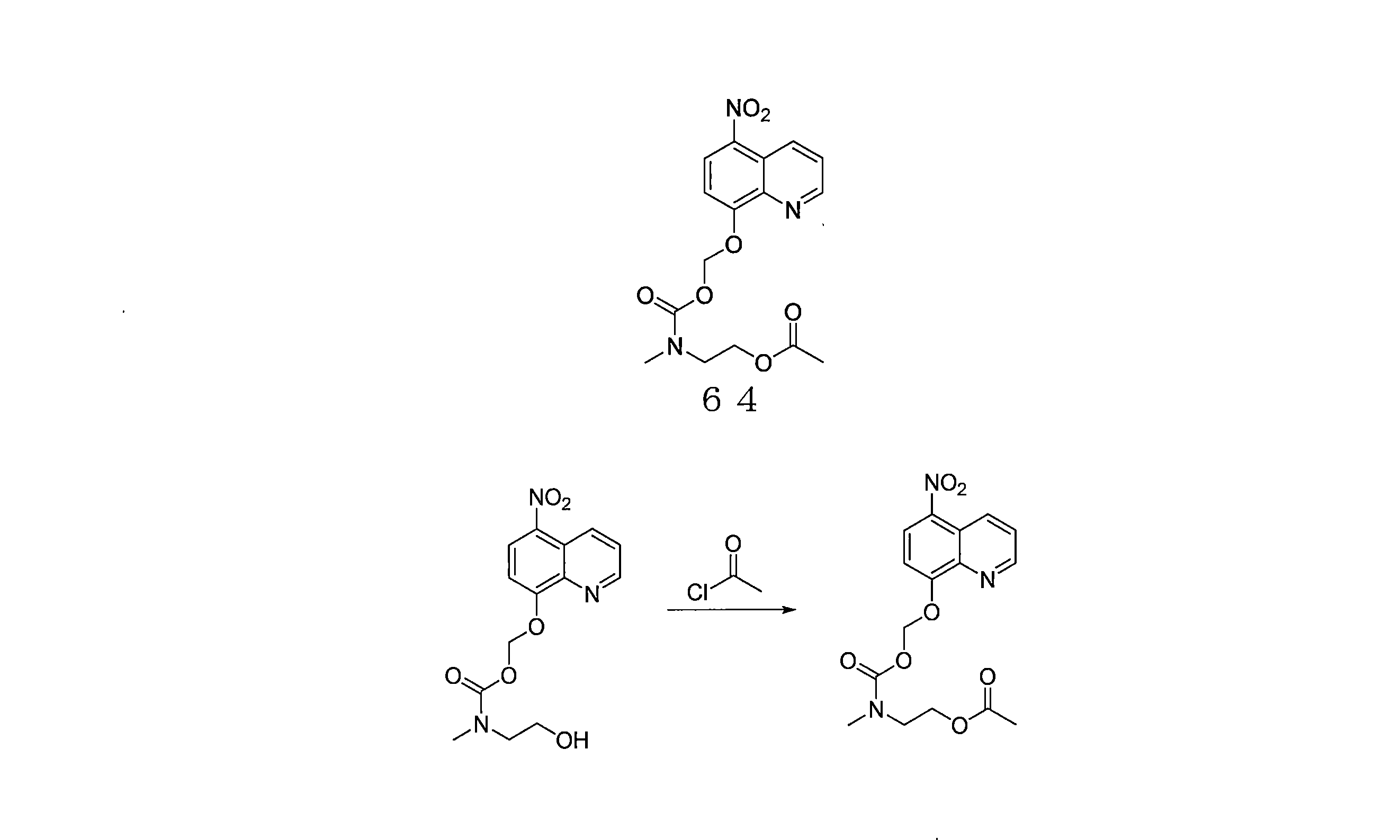
1H-NMR (400 Hz, CDCl3) δ: 9.21 (d, J = 8.0 Hz, 1H), 9.08 (d, J = 4 Hz, 1H), 8.53 (d, J = 8.0 Hz, 1H), 7.77 (dd, J = 8.0 Hz, 4.0 Hz, 1H), 7.44 (d, J = 8.8 Hz, 1H), 6.22 (s, 2H), 4.13-4.25 (m, 2H), 3.53-3.58 (m, 2H), 3.00 (s, 3H), 2.00 (s, 3H)。
MS計算: 363.33;MS実測: 364.1 [M+H]+。
Example 64: Synthesis of 2-(methyl(((5-nitroquinolin-8-yloxy)methoxy)formyl)amino)ethyl acetate (64)
1 H-NMR (400 Hz, CDCl3) δ: 9.21 (d, J = 8.0 Hz, 1H), 9.08 (d, J = 4 Hz, 1H), 8.53 (d, J = 8.0 Hz, 1H), 7.77 (dd, J = 8.0 Hz, 4.0 Hz, 1H), 7.44 (d, J = 8.8 Hz, 1H), 6.22 (s, 2H), 4.13-4.25 (m, 2H), 3.53-3.58 (m, 2H), 3.00 (s, 3H), 2.00 (s, 3H).
MS calculation: 363.33;MS measurement: 364.1 [M+H] + .
実施例65:(2-(メチル(((5-ニトロキノリン-8-イル)オキシ)メトキシ)ホルミル)アミノ)ピリジン-3-イル)メチル2-(N-メチルアセチルアミノ)アセテート(65)の合成

室温で、2-メチルアミノ-3-ピリジンメタノール(2.8g,20.3mmol)、N-(t-ブトキシカルボニル)-N-メチルグリシン(5g,26.4mmol)、1-(3-ジメチルアミノプロピル)-3-エチルカルボジイミド塩酸塩(EDCI)(5.1g,26.4mmol)と4-ジメチルアミノピリジン(DMAP)(250mg,2mmol)をジクロロメタン(100mL)に加えて、一晩撹拌した。水を加えて反応をクエンチし、酢酸エチル(100mLx3)で抽出して、有機相を飽和食塩水で洗浄し、無水硫酸ナトリウムで乾燥させて、ろ過後、減圧濃縮させた。残留物をシリカゲルクロマトグラフィー分取プレート(展開剤:5%メタノール/95%ジクロロメタン)により精製して、(2-(メチルアミノ)ピリジン-3-イル)メチル2-(t-ブトキシカルボニル(メチル)アミノ)アセテート(3g、収率49%)を得た。
ステップ2:(2-(((クロロメトキシ)カルボニル)(メチル)アミノ)ピリジン-3-イル)メチル2-(t-ブトキシカルボニル(メチル)アミノ)アセテート(65b)の製造
0℃で、(2-(メチルアミノ)ピリジン-3-イル)メチル2-(t-ブトキシカルボニル(メチル)アミノ)アセテート(3.4g,11mmol)をジクロロメタン(80mL)に溶解し、N,N-二イソプロピルエチルアミン(2.8g,22mmol)とクロロギ酸クロロメチル(2.1g,16.5mmol)を緩やかに順次滴下した。反応液を0℃で30分間撹拌した後、室温に昇温して一晩撹拌した。水(100mL)でクエンチした後、ジクロロメタン(200mLx3)で抽出し、有機相を合わせた後、無水硫酸ナトリウムで乾燥させて、ろ過して減圧濃縮させ、生成物として(2-(((クロロメトキシ)カルボニル)(メチル)アミノ)ピリジン-3-イル)メチル2-(t-ブトキシカルボニル(メチル)アミノ)アセテート(4g、収率91%)を得た。
ステップ3:(2-(((クロロメトキシ)カルボニル)(メチル)アミノ)ピリジン-3-イル)メチル2-(メチルアミノ)アセテート(65c)の製造
室温で、(2-(((クロロメトキシ)カルボニル)(メチル)アミノ)ピリジン-3-イル)メチル2-(t-ブトキシカルボニル(メチル)アミノ)アセテート(1.7g,5.6mmol)をジクロロメタン(50mL)に溶解して、塩酸ジオキサン(4.5mL,18mmol)を緩やかに滴下し、4時間撹拌した。反応液を減圧濃縮させ、生成物として(2-(((クロロメトキシ)カルボニル)(メチル)アミノ)ピリジン-3-イル)メチル2-(メチルアミノ)アセテート(1.27g、収率99%)を得た。
ステップ4:(2-(((クロロメトキシ)カルボニル)(メチル)アミノ)ピリジン-3-イル)メチル2-(N-メチルアセチルアミノ)アセテート(65d)の製造
0℃で、(2-(((クロロメトキシ)カルボニル)(メチル)アミノ)ピリジン-3-イル)メチル2-(メチルアミノ)アセテート(1g,3.3mmol)、塩化アセチル(390mg,5.0mmol)をジクロロメタン(50mL)に溶解して、トリエチルアミン(0.7mL,6.6mmol)を緩やかに滴下し、室温に昇温して2時間撹拌した。反応を室温に冷却した後、水で反応をクエンチし、ジクロロメタン(100mLx3)で抽出し、有機相を合わせた後、無水硫酸ナトリウムで乾燥させて、ろ過し、ろ液を減圧濃縮させ、生成物として(2-(((クロロメトキシ)カルボニル)(メチル)アミノ)ピリジン-3-イル)メチル2-(N-メチルアセチルアミノ)アセテート(1.0g、収率91%)を得た。
ステップ5:(2-(メチル(((5-ニトロキノリン-8-イル)オキシ)メトキシ)ホルミル)アミノ)ピリジン-3-イル)メチル2-(N-メチルアセチルアミノ)アセテート(65)の製造
室温で、ニトロキソリン(1.5g,7.9mmol)と(2-(((クロロメトキシ)カルボニル)(メチル)アミノ)ピリジン-3-イル)メチル2-(N-メチルアセチルアミノ)アセテート(2.7g,7.9mmol)をN,N-ジメチルホルムアミド(10mL)に溶解し、その後、炭酸カリウム(2.2g,16.0mmol)とヨウ素カリウム(270mg,1.6mmol)を加えて、反応液を60℃で4時間撹拌した。反応液を室温に冷却した後、水で反応をクエンチし、ジクロロメタン(200mLx3)で抽出し、有機相を合わせて、無水硫酸ナトリウムで乾燥させて、ろ過し、ろ液を減圧濃縮させた。残留物を逆相高速液体クロマトグラフィー(カラムはEclipse XDB-C18(21.2mm×250mm,7μm)、移動相はアセトニトリル-0.1%ギ酸、流速は20.0mL/minである)により分離して、生成物として(2-(メチル(((5-ニトロキノリン-8-イル)オキシ)メトキシ)ホルミル)アミノ)ピリジン-3-イル)メチル2-(N-メチルアセチルアミノ)アセテート(500mg、収率13%)を得た。
1H-NMR (400 Hz, CDCl3) δ: 9.05-9.18 (m, 2H), 8.32-8.57 (m, 2H), 7.79-7.83 (m, 2H), 7.29-7.32 (m, 2H), 6.06-6.30 (m, 2H), 5.00-5.11 (m, 2H), 4.01-4.06 (m, 2H), 3.34 (s,3H), 3.00 (s,3H), 2.13 (s,3H)。
MS計算: 497.46;MS実測: 498.2 [M+H]+。
Example 65: Synthesis of (2-(methyl(((5-nitroquinolin-8-yl)oxy)methoxy)formyl)amino)pyridin-3-yl)methyl 2-(N-methylacetylamino)acetate (65)
Step 2: Preparation of (2-(((chloromethoxy)carbonyl)(methyl)amino)pyridin-3-yl)methyl 2-(t-butoxycarbonyl(methyl)amino)acetate (65b) At 0° C., (2-(methylamino)pyridin-3-yl)methyl 2-(t-butoxycarbonyl(methyl)amino)acetate (3.4 g, 11 mmol) was dissolved in dichloromethane (80 mL), and N,N-diisopropylethylamine (2.8 g, 22 mmol) and chloromethyl chloroformate (2.1 g, 16.5 mmol) were slowly added dropwise in this order. The reaction solution was stirred at 0° C. for 30 minutes, then warmed to room temperature and stirred overnight. After quenching with water (100 mL), it was extracted with dichloromethane (200 mL×3), and the organic phases were combined, dried over anhydrous sodium sulfate, filtered, and concentrated under reduced pressure to give the product (2-(((chloromethoxy)carbonyl)(methyl)amino)pyridin-3-yl)methyl 2-(t-butoxycarbonyl(methyl)amino)acetate (4 g, 91% yield).
Step 3: Preparation of (2-(((chloromethoxy)carbonyl)(methyl)amino)pyridin-3-yl)methyl 2-(methylamino)acetate (65c) At room temperature, (2-(((chloromethoxy)carbonyl)(methyl)amino)pyridin-3-yl)methyl 2-(t-butoxycarbonyl(methyl)amino)acetate (1.7 g, 5.6 mmol) was dissolved in dichloromethane (50 mL), and dioxane hydrochloride (4.5 mL, 18 mmol) was slowly added dropwise and stirred for 4 hours. The reaction solution was concentrated under reduced pressure to obtain the product (2-(((chloromethoxy)carbonyl)(methyl)amino)pyridin-3-yl)methyl 2-(methylamino)acetate (1.27 g, yield 99%).
Step 4: Preparation of (2-(((chloromethoxy)carbonyl)(methyl)amino)pyridin-3-yl)methyl 2-(N-methylacetylamino)acetate (65d) At 0° C., (2-(((chloromethoxy)carbonyl)(methyl)amino)pyridin-3-yl)methyl 2-(methylamino)acetate (1 g, 3.3 mmol) and acetyl chloride (390 mg, 5.0 mmol) were dissolved in dichloromethane (50 mL), and triethylamine (0.7 mL, 6.6 mmol) was slowly added dropwise thereto, the mixture was warmed to room temperature, and stirred for 2 hours. After the reaction was cooled to room temperature, it was quenched with water and extracted with dichloromethane (100 mL×3). The organic phases were combined, then dried over anhydrous sodium sulfate, filtered, and the filtrate was concentrated under reduced pressure to give the product (2-(((chloromethoxy)carbonyl)(methyl)amino)pyridin-3-yl)methyl 2-(N-methylacetylamino)acetate (1.0 g, yield 91%).
Step 5: Preparation of (2-(methyl(((5-nitroquinolin-8-yl)oxy)methoxy)formyl)amino)pyridin-3-yl)methyl 2-(N-methylacetylamino)acetate (65) Nitroxoline (1.5 g, 7.9 mmol) and (2-(((chloromethoxy)carbonyl)(methyl)amino)pyridin-3-yl)methyl 2-(N-methylacetylamino)acetate (2.7 g, 7.9 mmol) were dissolved in N,N-dimethylformamide (10 mL) at room temperature, and then potassium carbonate (2.2 g, 16.0 mmol) and potassium iodine (270 mg, 1.6 mmol) were added, and the reaction solution was stirred at 60° C. for 4 hours. After the reaction solution was cooled to room temperature, the reaction was quenched with water and extracted with dichloromethane (200 mL×3). The organic phases were combined, dried over anhydrous sodium sulfate, filtered, and the filtrate was concentrated under reduced pressure. The residue was separated by reversed-phase high performance liquid chromatography (column: Eclipse XDB-C18 (21.2 mm×250 mm, 7 μm), mobile phase: acetonitrile-0.1% formic acid, flow rate: 20.0 mL/min) to obtain the product (2-(methyl(((5-nitroquinolin-8-yl)oxy)methoxy)formyl)amino)pyridin-3-yl)methyl 2-(N-methylacetylamino)acetate (500 mg, yield 13%).
1 H-NMR (400 Hz, CDCl3) δ: 9.05-9.18 (m, 2H), 8.32-8.57 (m, 2H), 7.79-7.83 (m, 2H), 7.29-7.32 (m, 2H), 6.06-6.30 (m, 2H), 5.00-5.11 (m, 2H), 4.01-4.06 (m, 2H), 3.34 (s,3H), 3.00 (s,3H), 2.13 (s,3H).
MS calculation: 497.46;MS measurement: 498.2 [M+H] + .
実施例66:(2-(メチル(((5-ニトロキノリン-8-イル)オキシ)メトキシ)ホルミル)アミノ)ピリジン-3-イル)メチル2-(N-メチルt-ブチリルアミノ)アセテート(66)の合成

1H-NMR (400Hz, CDCl3) δ: 9.05-9.18 (m, 2H), 8.32-8.57 (m, 2H), 7.79-7.83 (m, 2H), 7.29-7.32 (m, 2H), 6.06-6.30 (m, 2H), 5.04-5.12 (m, 2H), 4.01-4.06 (m, 2H), 3.340 (s, 3H), 3.00 (s, 3H), 1.31 (s,9H)。
MS計算: 539.55;MS実測: 540.2 [M+H]+。
Example 66: Synthesis of (2-(methyl(((5-nitroquinolin-8-yl)oxy)methoxy)formyl)amino)pyridin-3-yl)methyl 2-(N-methyl t-butyrylamino)acetate (66)
1 H-NMR (400Hz, CDCl3) δ: 9.05-9.18 (m, 2H), 8.32-8.57 (m, 2H), 7.79-7.83 (m, 2H), 7.29-7.32 (m, 2H), 6.06-6.30 (m, 2H), 5.04-5.12 (m, 2H), 4.01-4.06 (m, 2H), 3.340 (s, 3H), 3.00 (s, 3H), 1.31 (s,9H).
MS calculation: 539.55; MS measurement: 540.2 [M+H] + .
実施例67:(5-ニトロキノリン-8-イルオキシ)メチルピペリジン1-ホルメート(67)の合成

1H-NMR (400 Hz, CDCl3) δ: 9.23 (dd, J = 8.8, 1.6 Hz, 1H), 9.09 (dd, J = 4.0, 1.6 Hz, 1H), 8.53 (d, J = 8.8 Hz, 1H), 7.77 (dd, J = 8.8 Hz, 4.0 Hz, 1H), 7.35 (d, J = 8.8 Hz, 1H), 6.22 (s, 2H), 3.42-3.47 (m, 4H), 1.35-1.63 (m, 6H)。
MS計算: 331.33;MS実測: 332.3 [M+H]+。
Example 67: Synthesis of (5-nitroquinolin-8-yloxy)methylpiperidine 1-formate (67)
1 H-NMR (400 Hz, CDCl3) δ: 9.23 (dd, J = 8.8, 1.6 Hz, 1H), 9.09 (dd, J = 4.0, 1.6 Hz, 1H), 8.53 (d, J = 8.8 Hz, 1H), 7.77 (dd, J = 8.8 Hz, 4.0 Hz, 1H), 7.35 (d, J = 8.8 Hz, 1H), 6.22 (s, 2H), 3.42-3.47 (m, 4H), 1.35-1.63 (m, 6H).
MS calculation: 331.33;MS measurement: 332.3 [M+H] + .
実施例68:3-(メチル(((5-ニトロキノリン-8-イルオキシ)メトキシ)カルボニル)アミノ)プロピルアセテート(68)の合成
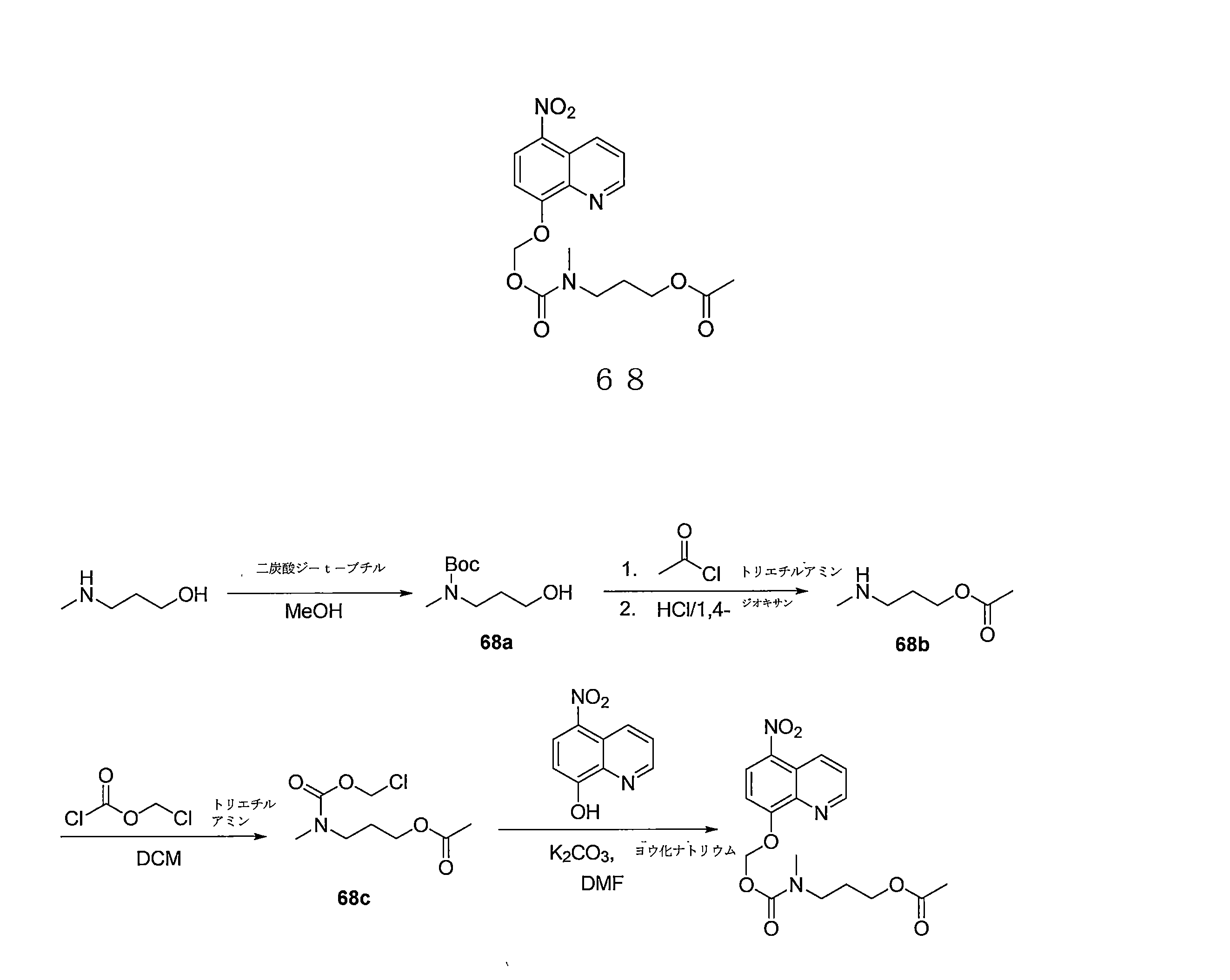
室温で、トリエチルアミン(1.36g,13.44mmol)を3-メチルアミノ-1-プロパノール(1.00g,11.22mmol)のメタノール(10mL)溶液に加えて、撹拌して透明とした。二炭酸ジ―t-ブチル(2.94g,13.47mmol)を滴下して、16時間撹拌した。反応液を減圧濃縮させ、ジクロロメタンで希釈し、有機相を飽和食塩水で洗浄し、無水硫酸ナトリウムで乾燥させて、ろ過し、ろ液を減圧濃縮させ、t-ブチル(3-ヒドロキシプロピル)メチルカルバメート粗製品(2.20g)を得た。
ステップ2:3-(メチルアミノ)プロピルアセテート(68b)の製造
室温で、トリエチルアミン(0.64g,6.32mmol)をt-ブチル(3-ヒドロキシプロピル)メチルカルバメート(1.00g,5.28mmol)のジクロロメタン(5mL)溶液に加えて、撹拌して透明とした。反応系を0℃に降温し、塩化アセチル(0.50g,6.37mmol)を滴下して、室温に自然昇温した後、1時間撹拌した。反応液をろ過して、ジクロロメタンでリンスし、ろ液を濃縮させ、固体粗製品を得た。0℃で、粗製品に塩化水素のジオキサン溶液(3.3mL,4 M)を滴下し、16時間撹拌した。反応液を濃縮させて、3-(メチルアミノ)プロピルアセテート粗製品を得た。
ステップ3:3-(((クロロメトキシ)カルボニル)(メチル)アミノ)プロピルアセテート(68c)の製造
3-(メチルアミノ)プロピルアセテート粗製品をジクロロメタン(8mL)で透明とし、0℃で、溶液にトリエチルアミン(1.07g,10.57mmol)、クロロギ酸クロロメチル(0.68g,5.27mmol)を順次加えて、室温に自然昇温し、1時間撹拌した。水を加えて反応をクエンチし、ジクロロメタンで抽出し、有機相を飽和食塩水で洗浄し、無水硫酸ナトリウムで乾燥させて、ろ過後、減圧濃縮させた。残留物をシリカゲルカラムクロマトグラフィー(溶離剤:83%石油エーテル/17%酢酸エチル)により精製して、3-(((クロロメトキシ)カルボニル)(メチル)アミノ)プロピルアセテート(400mg、収率34%)を得た。
ステップ4:3-(メチル(((5-ニトロキノリン-8-イルオキシ)メトキシ)カルボニル)アミノ)プロピルアセテート(68)の製造
室温で、ニトロキソリン(340mg,1.79mmol)、炭酸カリウム(297mg,2.15mmol)、ヨウ素ナトリウム(27mg,0.18mmol)をN,N-ジメチルホルムアミド(8mL)に加えて、均一に撹拌した。反応系を60℃に昇温して、15分間撹拌した後、3-(((クロロメトキシ)カルボニル)(メチル)アミノ)プロピルアセテート(400mg,1.79mmol)を加えて、16時間撹拌した。水を加えて反応をクエンチし、酢酸エチルで抽出して、有機相を飽和食塩水溶液で洗浄し、無水硫酸ナトリウムで乾燥させて、ろ過後、減圧濃縮させた。残留物をシリカゲルクロマトグラフィー分取プレート(展開剤:5%メタノール/95%ジクロロメタン)により精製して、3-(メチル(((5-ニトロキノリン-8-イルオキシ)メトキシ)カルボニル)アミノ)プロピルアセテート(196mg、収率29%)を得た。
1H NMR (400 MHz, CDCl3) δ 9.20 (dd, J = 8.8, 2.4 Hz, 1H), 9.07 (d, J = 1.4 Hz, 1H), 8.64 - 8.46 (m, 1H), 7.81 - 7.66 (m, 1H), 7.52 - 7.38 (m, 1H), 6.21 (s, 2H), 4.05 (dd, J = 28.3, 3.6 Hz, 2H), 3.38 (dd, J = 14.3, 7.2 Hz, 2H), 3.02 - 2.89 (m, 3H), 2.03 (dd, J = 17.5, 3.7 Hz, 3H), 1.86 (d, J = 24.3 Hz, 2H)。
MS計算: 377.3;MS実測: 378.2[M+H]+。
Example 68: Synthesis of 3-(methyl(((5-nitroquinolin-8-yloxy)methoxy)carbonyl)amino)propyl acetate (68)
Step 2: Preparation of 3-(methylamino)propyl acetate (68b) At room temperature, triethylamine (0.64 g, 6.32 mmol) was added to a solution of t-butyl (3-hydroxypropyl)methylcarbamate (1.00 g, 5.28 mmol) in dichloromethane (5 mL), and the mixture was stirred until clear. The reaction system was cooled to 0° C., and acetyl chloride (0.50 g, 6.37 mmol) was added dropwise, and the mixture was allowed to warm to room temperature and stirred for 1 hour. The reaction solution was filtered, rinsed with dichloromethane, and the filtrate was concentrated to obtain a solid crude product. At 0° C., a solution of hydrogen chloride in dioxane (3.3 mL, 4 M) was added dropwise to the crude product, and the mixture was stirred for 16 hours. The reaction solution was concentrated to obtain a crude product of 3-(methylamino)propyl acetate.
Step 3: Preparation of 3-(((chloromethoxy)carbonyl)(methyl)amino)propyl acetate (68c) The crude 3-(methylamino)propyl acetate was clarified with dichloromethane (8 mL), and triethylamine (1.07 g, 10.57 mmol) and chloromethyl chloroformate (0.68 g, 5.27 mmol) were added to the solution at 0° C., and the mixture was allowed to warm to room temperature and stirred for 1 hour. The reaction was quenched by adding water, extracted with dichloromethane, and the organic phase was washed with saturated saline, dried over anhydrous sodium sulfate, filtered, and concentrated under reduced pressure. The residue was purified by silica gel column chromatography (eluent: 83% petroleum ether/17% ethyl acetate) to give 3-(((chloromethoxy)carbonyl)(methyl)amino)propyl acetate (400 mg, yield 34%).
Step 4: Preparation of 3-(methyl(((5-nitroquinolin-8-yloxy)methoxy)carbonyl)amino)propyl acetate (68) At room temperature, nitroxoline (340 mg, 1.79 mmol), potassium carbonate (297 mg, 2.15 mmol), and sodium iodide (27 mg, 0.18 mmol) were added to N,N-dimethylformamide (8 mL) and stirred uniformly. The reaction system was heated to 60° C. and stirred for 15 minutes, after which 3-(((chloromethoxy)carbonyl)(methyl)amino)propyl acetate (400 mg, 1.79 mmol) was added and stirred for 16 hours. The reaction was quenched by adding water, extracted with ethyl acetate, and the organic phase was washed with a saturated saline solution, dried over anhydrous sodium sulfate, filtered, and concentrated under reduced pressure. The residue was purified by silica gel chromatography preparative plate (developing agent: 5% methanol/95% dichloromethane) to give 3-(methyl(((5-nitroquinolin-8-yloxy)methoxy)carbonyl)amino)propyl acetate (196 mg, yield 29%).
1 H NMR (400 MHz, CDCl 3 ) δ 9.20 (dd, J = 8.8, 2.4 Hz, 1H), 9.07 (d, J = 1.4 Hz, 1H), 8.64 - 8.46 (m, 1H), 7.81 - 7.66 (m, 1H), 7.52 - 7.38 (m, 1H), 6.21 (s, 2H), 4.05 (dd, J = 28.3, 3.6 Hz, 2H), 3.38 (dd, J = 14.3, 7.2 Hz, 2H), 3.02 - 2.89 (m, 3H), 2.03 (dd, J = 17.5, 3.7 Hz, 3H), 1.86 (d, J = 24.3 Hz, 2H).
MS calculation: 377.3;MS measurement: 378.2[M+H] + .
実施例69:4-(メチル(((5-ニトロキノリン-8-イルオキシ)メトキシ)カルボニル)アミノ)ブチルアセテート(69)の合成

1H NMR (400 MHz, CDCl3) δ 9.18 (dd, J = 8.9, 1.3 Hz, 1H), 9.06 (d, J = 4.0 Hz, 1H), 8.50 (d, J = 8.8 Hz, 1H), 7.70 (dd, J = 8.9, 4.1 Hz, 1H), 7.42 (dd, J = 8.8, 3.9 Hz, 1H), 6.20 (d, J = 4.7 Hz, 2H), 4.04 (dd, J = 27.3, 21.6 Hz, 2H), 3.36 - 3.22 (m, 2H), 2.96 - 2.86 (m, 3H), 2.01 (d, J = 19.7 Hz, 3H), 1.64 - 1.57 (m, 2H), 1.53 (s, 2H)。
MS計算: 391.4;MS実測: 392.2[M+H]+。
Example 69: Synthesis of 4-(methyl(((5-nitroquinolin-8-yloxy)methoxy)carbonyl)amino)butyl acetate (69)
1 H NMR (400 MHz, CDCl 3 ) δ 9.18 (dd, J = 8.9, 1.3 Hz, 1H), 9.06 (d, J = 4.0 Hz, 1H), 8.50 (d, J = 8.8 Hz, 1H), 7.70 (dd, J = 8.9, 4.1 Hz, 1H), 7.42 (dd, J = 8.8, 3.9 Hz, 1H), 6.20 (d, J = 4.7 Hz, 2H), 4.04 (dd, J = 27.3, 21.6 Hz, 2H), 3.36 - 3.22 (m, 2H), 2.96 - 2.86 (m, 3H), 2.01 (d, J = 19.7 Hz, 3H), 1.64 - 1.57 (m, 2H), 1.53 (s, 2H).
MS calculation: 391.4;MS measurement: 392.2[M+H] + .
実施例70及び71:ジ―t-ブチル(5-ニトロキノリン-8-イルオキシ)メチルホスフェート(70)及び(5-ニトロキノリン-8-イルオキシ)メチルジヒドロホスフェート(71)の合成
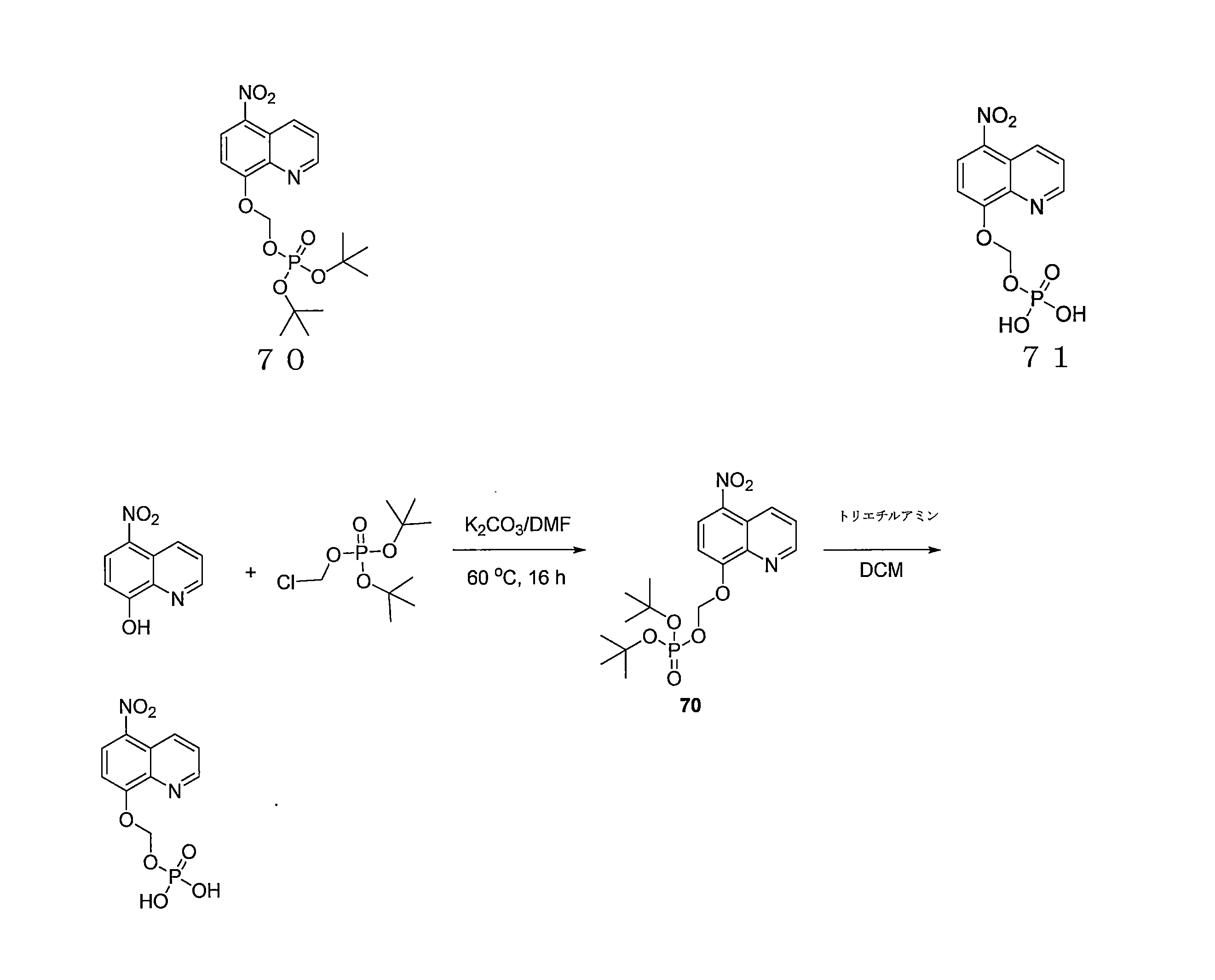
室温で、炭酸カリウム(1.45g,10.52mmol)をニトロキソリン(1.0g,5.26mmol)、ジ―t-ブチルクロロメチルホスフェート(2.04g,7.89mmol)のN,N-ジメチルホルムアミド(17mL)溶液に加えた。反応液を60℃で2時間撹拌した。水を加えて反応をクエンチし、ジクロロメタン(100mLx3)で抽出し、有機相を1 M 塩酸、1 M炭酸水素ナトリウム水溶液、及び飽和食塩水で洗浄し、無水硫酸ナトリウムで乾燥させて、ろ過し減圧濃縮させた。残留物をシリカゲルカラムクロマトグラフィー(溶離剤:5%n-ヘキサン/95%酢酸エチル)により精製して、ジ―t-ブチル(5-ニトロキノリン-8-イルオキシ)メチルホスフェート(570mg、収率: 26%)を得た。
MS[M+H]+:413.3。
ステップ2:(5-ニトロキノリン-8-イルオキシ)メチルジヒドロホスフェート(71)の製造
室温で、トリフルオロ酢酸(7ml)をジ―t-ブチル(5-ニトロキノリン-8-イルオキシ)メチルホスフェート(520mg,1.18mmol)のジクロロメタン(7ml)溶液に緩やかに滴下した。反応液を室温で2時間撹拌した後、減圧濃縮させた。飽和炭酸水素ナトリウム溶液でPH=7に調整した後、固体を沈殿して析出させ、ろ過して粗製品を得た。粗製品を分取液体クロマトグラフィー(アジレント1260分取液体クロマトグラフィー:アセトニトリル/水勾配95/5-50/50)により精製して、生成物(5-ニトロキノリン-8-イルオキシ)メチルジヒドロホスフェート(100.24mg、収率: 24%)を得た。
1H NMR (400 MHz, D2O): δ 8.97-8.94 (m, 1H), 8.76-8.75 (m, 1H), 8.42 (d, J = 8.8 Hz, 1H), 7.69-7.65 (m, 1H), 7.38 (d, J = 9.2 Hz, 1H), 5.76 (d, J = 11.2 Hz, 1H)。
MS計算: 300.0;MS実測: 301.0 [M+H] +。
Examples 70 and 71: Synthesis of di-t-butyl(5-nitroquinolin-8-yloxy)methyl phosphate (70) and (5-nitroquinolin-8-yloxy)methyl dihydrophosphate (71)
MS[M+H] + : 413.3.
Step 2: Preparation of (5-nitroquinolin-8-yloxy)methyl dihydrophosphate (71) At room temperature, trifluoroacetic acid (7 ml) was slowly added dropwise to a solution of di-t-butyl (5-nitroquinolin-8-yloxy)methyl phosphate (520 mg, 1.18 mmol) in dichloromethane (7 ml). The reaction solution was stirred at room temperature for 2 hours and then concentrated under reduced pressure. After adjusting the pH to 7 with saturated sodium bicarbonate solution, the solid was precipitated and filtered to obtain the crude product. The crude product was purified by preparative liquid chromatography (Agilent 1260 preparative liquid chromatography: acetonitrile/water gradient 95/5-50/50) to obtain the product (5-nitroquinolin-8-yloxy)methyl dihydrophosphate (100.24 mg, yield: 24%).
1 H NMR (400 MHz, D 2 O): δ 8.97-8.94 (m, 1H), 8.76-8.75 (m, 1H), 8.42 (d, J = 8.8 Hz, 1H), 7.69-7.65 (m, 1H), 7.38 (d, J = 9.2 Hz, 1H), 5.76 (d, J = 11.2 Hz, 1H).
MS calculation: 300.0;MS measurement: 301.0 [M+H] + .
実施例72:(ヒドロキシ((5-ニトロキノリン-8-イルオキシ)メトキシ)ホスホリルオキシ)メチルイソプロピルカルボキシラート(72)の合成
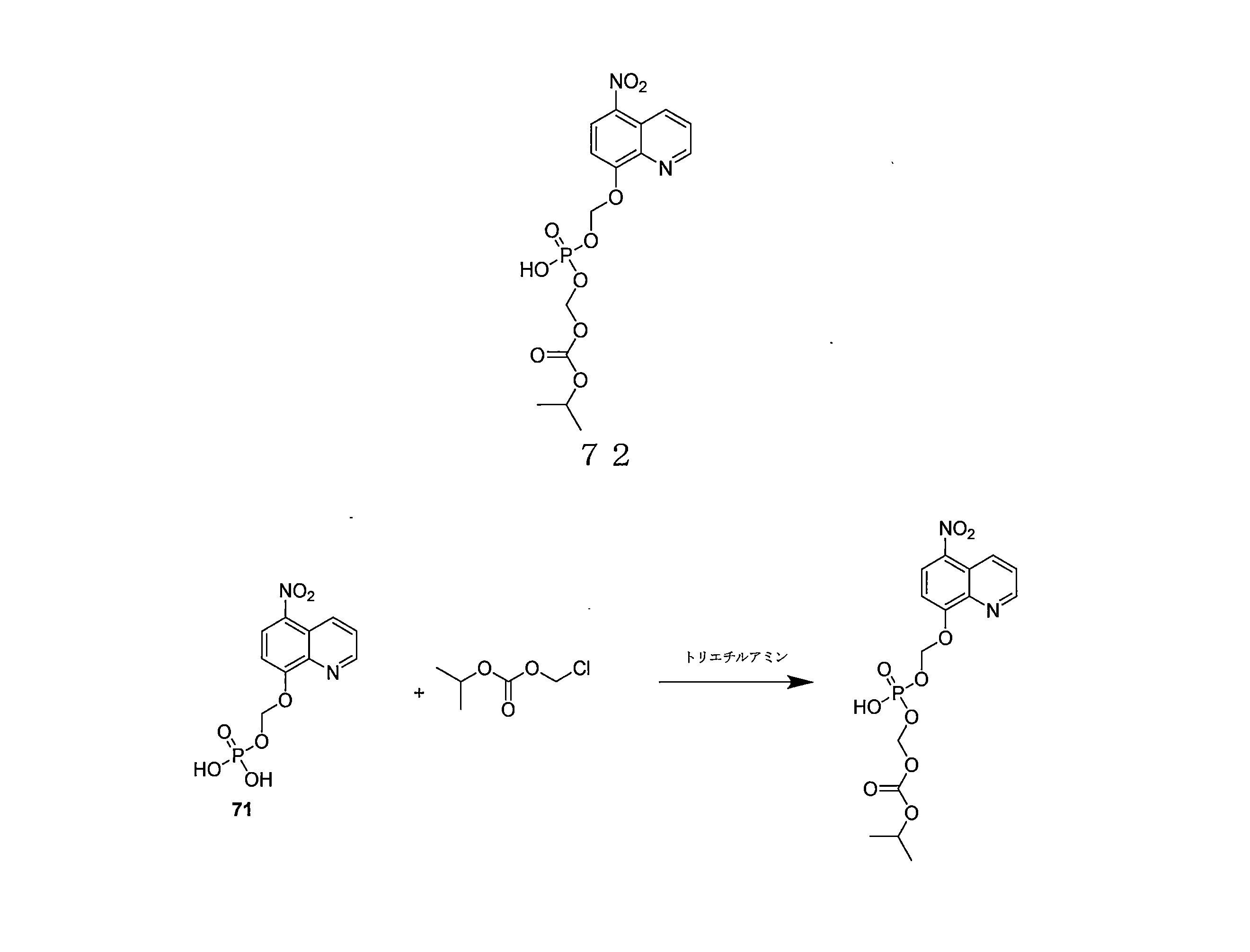
(5-ニトロキノリン-8-イルオキシ)メチルジヒドロホスフェート塩酸塩(672mg,2mmol、合成ステップは実施例71を参照)、クロロメチル炭酸イソプロピル(1.22g,8mmol)、及びトリエチルアミン(1.01g、10mmol)をDMF 20mLに投入して、50℃で5時間撹拌した。反応液を減圧濃縮させ、残留物をpre-HPLC(アジレント1260分取液体クロマトグラフィー:アセトニトリル/水勾配95/5-50/50)により精製して、(ヒドロキシ((5-ニトロキノリン-8-イルオキシ)メトキシ)ホスホリルオキシ)メチルイソプロピルカルボキシラート(121mg、収率14.5%)を得た。
1H-NMR (400 MHz, DMSO-d6) δ: 9.05 (d, J = 2.8 Hz, 1H), 9.00 (d, J = 8.4 Hz, 1H), 8.55 (d, J = 8.4 Hz, 1H), 7.87 (dd, J = 8.4, 4.0 Hz, 1H), 7.54 (d, J = 8.4 Hz, 1H),5.91~5.94 (m, 2H), 5.45~5.49 (m,2H), 4.72~4.75 (m, 2H) ,1.18(d,J=6.0Hz,6H)。
MS計算:416.28;MS実測:417.1[M+H]+。
Example 72: Synthesis of (hydroxy((5-nitroquinolin-8-yloxy)methoxy)phosphoryloxy)methyl isopropylcarboxylate (72)
1 H-NMR (400 MHz, DMSO-d6) δ: 9.05 (d, J = 2.8 Hz, 1H), 9.00 (d, J = 8.4 Hz, 1H), 8.55 (d, J = 8.4 Hz, 1H), 7.87 (dd, J = 8.4, 4.0 Hz, 1H), 7.54 (d, J = 8.4 Hz, 1H), 5.91~5.94 (m, 2H), 5.45~5.49 (m, 2H), 4.72~4.75 (m, 2H), 1.18 (d, J=6.0Hz, 6H).
MS calculation: 416.28; MS measurement: 417.1[M+H] + .
実施例73:(2S)-メチル2-(((5-ニトロキノリン-8-イルオキシ)メトキシ)(フェノキシ)ホスホリルアミノ)プロピオネート(73)の合成
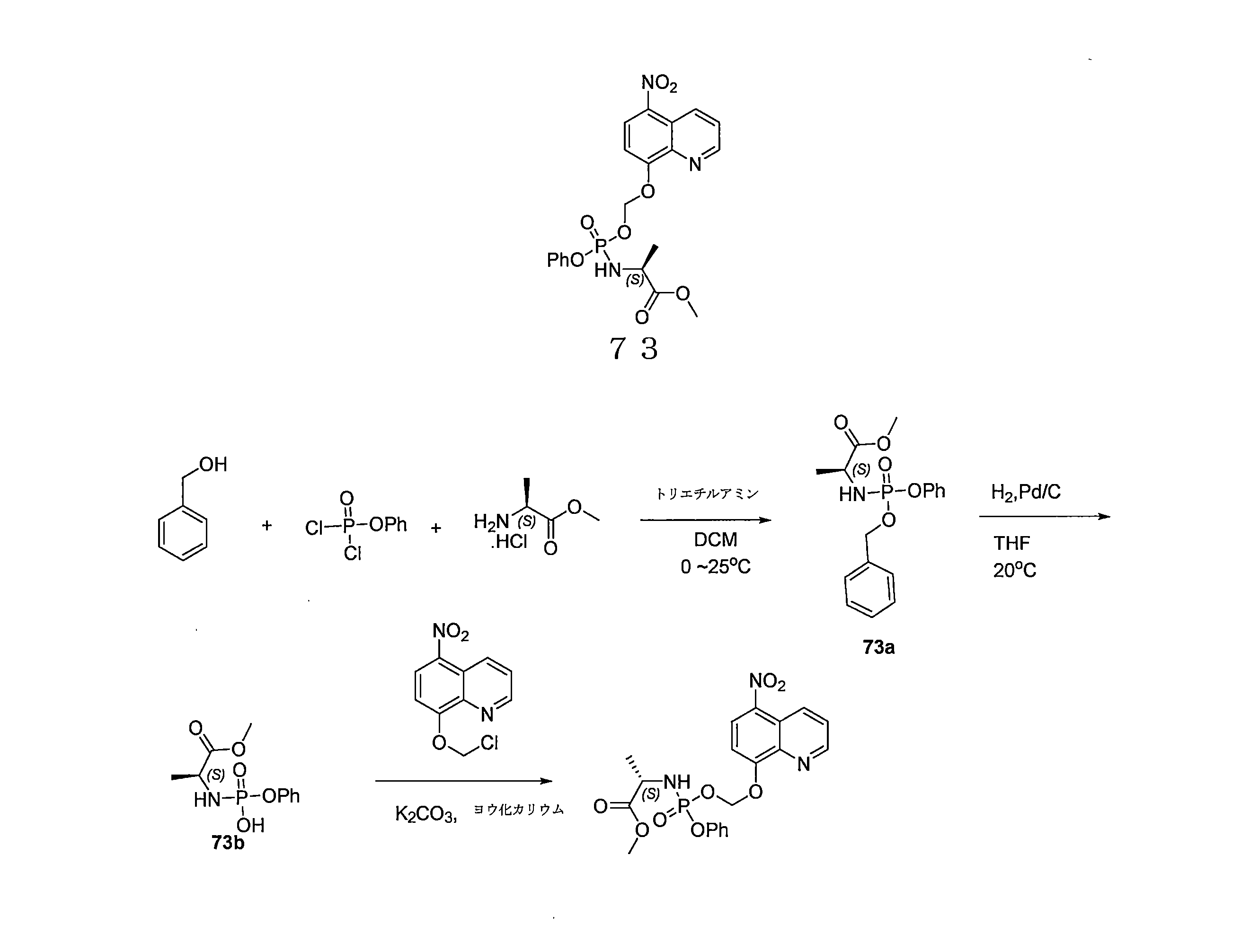
室温で、ベンジルアルコール(2g,18.49mmol)とフェニルジクロロホスフェート(4.29g,20.34mmol)を40mLジクロロメタンに加えて、反応液を氷浴で0~5℃に冷却し、トリエチルアミン(7.47g,73.96mmol)を緩やかに加えて、次に、L-アラニンメチルエステル塩酸塩(2.84,20.34mmol)を加えて、20分間撹拌した後、室温で5時間撹拌した。反応液を20mLx2水で洗浄し、有機相を減圧濃縮させ、残留物をシリカゲルカラムクロマトグラフィー(DCM:MeOH=10:1)により精製し、(2S)-メチル2-(ベンジルオキシ(フェノキシ)ホスホリルアミノ)プロピオネート(4.2g、収率: 65.6%)を得た。
ステップ2:(2S)-メチル2-(ヒドロキシ(フェノキシ)ホスホリルアミノ)プロピオネート(73b)の製造
室温で、(2S)-メチル2-(ベンジルオキシ(フェノキシ)ホスホリルアミノ)プロピオネート(2.5g,7.16mmol)をテトラヒドロフラン25mLに溶解し、500mgのウェットPd/Cを加えた。水素雰囲気下、反応液を室温で8時間撹拌した。次に、反応液をろ過して、ろ液を減圧濃縮させ、(2S)-メチル2-(ヒドロキシ(フェノキシ)ホスホリルアミノ)プロピオネート(1.5g、収率:81%)を得た。
ステップ3:(2S)-メチル2-(((5-ニトロキノリン-8-イルオキシ)メトキシ)(フェノキシ)ホスホリルアミノ)プロピオネート(73)の製造
室温で、(2S)-メチル2-(ヒドロキシ(フェノキシ)ホスホリルアミノ)プロピオネート(1.5g,5.79mmol)と5-ニトロ-8-(クロロメトキシ)キノリン(1a)(921mg,3.86mmol)をDMF 20mLに溶解し、次に、触媒量のKI(10mg)と炭酸カリウム(1.6g、11.58mmol)を加えて、室温で6時間撹拌した。反応液をろ過して、ろ液を減圧濃縮させ、残留物をシリカゲルカラムクロマトグラフィー(DCM:MeOH=40:1)により精製して、(2S)-メチル2-(((5-ニトロキノリン-8-イルオキシ)メトキシ)(フェノキシ)ホスホリルアミノ)プロピオネート(160mg、収率:8.9%)を得た。
1H-NMR (400 MHz, DMSO-d6): δ 9.05~9.06 (m, 1H), 8.99~9.01 (m, 1H), 8.54 (dd,J = 8.4, 3.2Hz, 1H), 7.87 (dd, J = 8.8 Hz, 4.0Hz, 1H), 7.50~7.55 (m, 1H), 7.25 ~ 7.30 (m, 2H), 7.09~7.18 (m,3H), 6.29~6.35 (m,1H), 6.03~6.11 (m,2H), 5.60 (br,1H), 3.88~3.97 (m, 1H), 3.54 (d,J = 10Hz, 3H), 1.18~1.21 (m,3H)。
MS計算: 461.37;MS実測: 462.2 [M+H] +。
Example 73: Synthesis of (2S)-methyl 2-(((5-nitroquinolin-8-yloxy)methoxy)(phenoxy)phosphorylamino)propionate (73)
Step 2: Preparation of (2S)-methyl 2-(hydroxy(phenoxy)phosphorylamino)propionate (73b) At room temperature, (2S)-methyl 2-(benzyloxy(phenoxy)phosphorylamino)propionate (2.5 g, 7.16 mmol) was dissolved in 25 mL of tetrahydrofuran, and 500 mg of wet Pd/C was added. The reaction solution was stirred at room temperature under a hydrogen atmosphere for 8 hours. Next, the reaction solution was filtered, and the filtrate was concentrated under reduced pressure to give (2S)-methyl 2-(hydroxy(phenoxy)phosphorylamino)propionate (1.5 g, yield: 81%).
Step 3: Preparation of (2S)-methyl 2-(((5-nitroquinolin-8-yloxy)methoxy)(phenoxy)phosphorylamino)propionate (73) At room temperature, (2S)-methyl 2-(hydroxy(phenoxy)phosphorylamino)propionate (1.5 g, 5.79 mmol) and 5-nitro-8-(chloromethoxy)quinoline (1a) (921 mg, 3.86 mmol) were dissolved in 20 mL of DMF, followed by addition of catalytic amounts of KI (10 mg) and potassium carbonate (1.6 g, 11.58 mmol) and stirring at room temperature for 6 hours. The reaction solution was filtered, the filtrate was concentrated under reduced pressure, and the residue was purified by silica gel column chromatography (DCM:MeOH=40:1) to obtain (2S)-methyl 2-(((5-nitroquinolin-8-yloxy)methoxy)(phenoxy)phosphorylamino)propionate (160 mg, yield: 8.9%).
1H -NMR (400 MHz, DMSO-d6): δ 9.05~9.06 (m, 1H), 8.99~9.01 (m, 1H), 8.54 (dd, J = 8.4, 3.2Hz, 1H), 7.87 (dd, J = 8.8 Hz, 4.0Hz, 1H), 7.50~7.55 (m, 1H), 7.25 ~ 7.30 (m, 2H), 7.09~7.18 (m,3H), 6.29~6.35 (m,1H), 6.03~6.11 (m,2H), 5.60 (br,1H), 3.88~3.97 (m, 1H), 3.54 (d,J = 10Hz, 3H), 1.18~1.21 (m,3H).
MS calculation: 461.37;MS measurement: 462.2 [M+H] + .
実施例74:(2S)-メチル2-(((5-ニトロキノリン-8-イルオキシ)メトキシ)(フェノキシ)ホスホリルアミノ)-3-フェニルプロピオネート(74)の合成

1H-NMR (400 MHz, DMSO-d6): δ 9.03 (d,J=4Hz, 1H), 8.99 (dd, J = 8.8, 1.2Hz, 1H), 8.52 (dd,J = 8.4, 6.4 Hz, 1H), 7.87 (dd,J = 6.4Hz, 1.6Hz, 1H), 7.50~7.55 (m, 1H), 7.10~7.29 (m,6H), 7.00~709 (m, 2H), 6.98~6.99 (m, 2H), 6.40~6.51 (m,1H), 5.85~5.95 (m,2H), 3.98~4.02 (m,1H), 3.54 (s, 3H), 2.95~3.01 (m, 1H), 2.75~2.85 (m, 1H)。
MS計算: 537.46;MS実測: 538.3 [M+H]+。
Example 74: Synthesis of (2S)-methyl 2-(((5-nitroquinolin-8-yloxy)methoxy)(phenoxy)phosphorylamino)-3-phenylpropionate (74)
1 H-NMR (400 MHz, DMSO-d6): δ 9.03 (d,J=4Hz, 1H), 8.99 (dd, J = 8.8, 1.2Hz, 1H), 8.52 (dd,J = 8.4, 6.4 Hz, 1H), 7.87 (dd,J = 6.4Hz, 1.6Hz, 1H), 7.50~7.55 (m, 1H), 7.10~7.29 (m,6H), 7.00~709 (m, 2H), 6.98~6.99 (m, 2H), 6.40~6.51 (m,1H), 5.85~5.95 (m,2H), 3.98~4.02 (m, 1H), 3.54 (s, 3H), 2.95~3.01 (m, 1H), 2.75~2.85 (m, 1H).
MS calculation: 537.46;MS measurement: 538.3 [M+H] + .
実施例75:(2S)-イソプロピル 2-(((5-ニトロキノリン-8-イルオキシ)メトキシ)(フェノキシ)ホスホリルアミノ)プロピオネート(75)の合成

1H-NMR (400 MHz, DMSO-d6): δ 9.05~9.06 (m, 1H), 8.99~9.01 (m, 1H), 8.54(dd,J=8.4,3.2Hz,1H), 7.87 (dd,J=8.8Hz,4.0Hz,1H), 7.50~7.55(m,1H), 7.25~7.30 (m,2H), 7.09~7.18(m,3H), 6.29~6.35(m,1H), 6.03~6.11(m,2H), 4.85~4.95 (m,1H), 3.88~3.97(m,1H), 1.18~1.21(m,9H)。
MS計算: 489.42;MS実測: 490.3 [M+H] +。
Example 75: Synthesis of (2S)-isopropyl 2-(((5-nitroquinolin-8-yloxy)methoxy)(phenoxy)phosphorylamino)propionate (75)
1 H-NMR (400 MHz, DMSO-d6): δ 9.05~9.06 (m, 1H), 8.99~9.01 (m, 1H), 8.54(dd,J=8.4,3.2Hz,1H), 7.87 (dd,J=8.8Hz,4.0Hz,1H), 7.50~7.55(m,1H), 7.25~7.30 (m,2H), 7.09~7.18(m,3H), 6.29~6.35(m,1H), 6.03~6.11(m,2H), 4.85~4.95 (m,1H), 3.88~3.97(m,1H), 1.18~1.21(m,9H).
MS calculation: 489.42; MS measurement: 490.3 [M+H] + .
実施例76:(6-シクロヘキシル-4-メチル-2-オキソピリジン-1(2H)-イルオキシ)メチル(5-ニトロキノリン-8-イルオキシ)リン酸水素メチル(76)合成

0℃で、水素化ナトリウム(純度:60%,0.42g,10.5mmol)を6-シクロヘキシル-4-メチル-ピリジン-1-ヒドロキシ-2-オン(達瑞化学社から購入)(2.00g,9.65mmol)のN,N-ジメチルホルムアミド(30mL)溶液に加えて、30分間撹拌後、ジベンジル(クロロメチル)ホスフェート(4.10g,12.55mmol)を加えて、室温に自然昇温し、5時間撹拌した。塩化アンモニウム水溶液を加えて反応をクエンチし、酢酸エチルで抽出して、有機相を飽和食塩水溶液で洗浄し、無水硫酸ナトリウムで乾燥させて、ろ過後、減圧濃縮させた。残留物をシリカゲルカラムクロマトグラフィー(溶離剤:75%石油エーテル/25%酢酸エチル)により精製して、ジベンジル(6-シクロヘキシル-4-メチル-2-オキソピリジン-1(2H)-イルオキシ)メチルホスフェート(1.58g、収率33%)を得た。
ステップ2:(6-シクロヘキシル-4-メチル-2-オキソピリジン-1(2H)-イルオキシ)メチルジヒドロホスフェート(76b)の製造
室温で、含有量10%のパラジウム炭素(0.20g)をジベンジル(6-シクロヘキシル-4-メチル-2-オキソピリジン-1(2H)-イルオキシ)メチルホスフェート(1.58g,3.18mmol)のテトラヒドロフラン(16mL)溶液に加えた。水素雰囲気下、3時間撹拌した。反応液をろ過して、テトラヒドロフランでリンスし、ろ液を減圧濃縮させ、(6-シクロヘキシル-4-メチル-2-オキソピリジン-1(2H)-イルオキシ)メチルジヒドロホスフェート(0.35g、収率35%)を得た。
ステップ3:(6-シクロヘキシル-4-メチル-2-オキソピリジン-1(2H)-イルオキシ)メチル(5-ニトロキノリン-8-イルオキシ)リン酸水素メチル(76)の製造
室温で、(6-シクロヘキシル-4-メチル-2-オキソピリジン-1(2H)-イルオキシ)メチルジヒドロホスフェート(350mg,1.10mmol)、炭酸カリウム(305mg,2.21mmol)、ヨウ素ナトリウム(28mg,0.19mmol)をN,N-ジメチルホルムアミド(7mL)に加えて、均一に撹拌した。反応系を40℃に昇温して、10分間撹拌した後、5-ニトロ-8-クロロメトキシキノリン(1a)(448mg,1.88mmol)を加えて、4時間撹拌した。水を加えて反応をクエンチし、酢酸エチルで不純物を逆抽出し、水相を凍結乾燥した後、逆相系95%水/5%アセトニトリルを分取液体クロマトグラフィー(アジレント1260分取液体クロマトグラフィー:アセトニトリル/水勾配95/5-50/50)により精製して、(6-シクロヘキシル-4-メチル-2-オキソピリジン-1(2H)-イルオキシ)メチル(5-ニトロキノリン-8-イルオキシ)リン酸水素メチル(66mg、収率12%)を得た。
1H NMR (400 MHz, CDCl3) δ 9.65 (d, J = 7.6 Hz, 1H), 9.21 (s, 1H), 8.66 (d, J = 8.4 Hz, 1H), 8.06 (s, 1H), 7.65 (d, J = 8.7 Hz, 1H), 6.36 (s, 1H), 6.07 (s, 1H), 6.00 (d, J = 15.2 Hz, 2H), 5.73 (d, J = 12.0 Hz, 2H), 2.15 (s, 3H), 1.94 (d, J = 10.2 Hz, 2H), 1.79 (d, J = 11.8 Hz, 2H), 1.75 - 1.68 (m, 1H), 1.47 - 1.13 (m, 6H)。
MS計算: 519.4;MS実測: 520.2[M+H]+。
Example 76: Synthesis of (6-cyclohexyl-4-methyl-2-oxopyridin-1(2H)-yloxy)methyl(5-nitroquinolin-8-yloxy)methyl hydrogenphosphate (76)
Step 2: Preparation of (6-cyclohexyl-4-methyl-2-oxopyridin-1(2H)-yloxy)methyl dihydrophosphate (76b) At room temperature, 10% palladium carbon (0.20 g) was added to a solution of dibenzyl (6-cyclohexyl-4-methyl-2-oxopyridin-1(2H)-yloxy)methyl phosphate (1.58 g, 3.18 mmol) in tetrahydrofuran (16 mL). Stirring was carried out under a hydrogen atmosphere for 3 hours. The reaction solution was filtered and rinsed with tetrahydrofuran, and the filtrate was concentrated under reduced pressure to obtain (6-cyclohexyl-4-methyl-2-oxopyridin-1(2H)-yloxy)methyl dihydrophosphate (0.35 g, yield 35%).
Step 3: Preparation of (6-cyclohexyl-4-methyl-2-oxopyridin-1(2H)-yloxy)methyl (5-nitroquinolin-8-yloxy)methyl hydrogen phosphate (76) At room temperature, (6-cyclohexyl-4-methyl-2-oxopyridin-1(2H)-yloxy)methyl dihydrophosphate (350 mg, 1.10 mmol), potassium carbonate (305 mg, 2.21 mmol), sodium iodide (28 mg, 0.19 mmol) were added to N,N-dimethylformamide (7 mL) and stirred uniformly. The reaction system was heated to 40° C. and stirred for 10 minutes, after which 5-nitro-8-chloromethoxyquinoline (1a) (448 mg, 1.88 mmol) was added and stirred for 4 hours. The reaction was quenched by addition of water, impurities were back-extracted with ethyl acetate, and the aqueous phase was lyophilized and then purified by reverse phase 95% water/5% acetonitrile preparative liquid chromatography (Agilent 1260 preparative liquid chromatography: acetonitrile/water gradient 95/5-50/50) to give (6-cyclohexyl-4-methyl-2-oxopyridin-1(2H)-yloxy)methyl(5-nitroquinolin-8-yloxy)methyl hydrogenphosphate (66 mg, 12% yield).
1 H NMR (400 MHz, CDCl 3 ) δ 9.65 (d, J = 7.6 Hz, 1H), 9.21 (s, 1H), 8.66 (d, J = 8.4 Hz, 1H), 8.06 (s, 1H), 7.65 (d, J = 8.7 Hz, 1H), 6.36 (s, 1H), 6.07 (s, 1H), 6.00 (d, J = 15.2 Hz, 2H), 5.73 (d, J = 12.0 Hz, 2H), 2.15 (s, 3H), 1.94 (d, J = 10.2 Hz, 2H), 1.79 (d, J = 11.8 Hz, 2H), 1.75 - 1.68 (m, 1H), 1.47 - 1.13 (m, 6H).
MS calculation: 519.4; MS measurement: 520.2[M+H] + .
実施例77:4-メチル-5-((5-ニトロキノリン-8-イルオキシ)メチル)-1,3-ジオキサゾール-2-オン(77)の合成

1H-NMR (400 Hz, CDCl3) δ: 9.23 (dd, J = 8.8, 1.6 Hz, 1H), 9.09 (dd, J = 4.0, 1.6 Hz, 1H), 8.53 (d, J = 8.8 Hz, 1H), 7.77 (dd, J = 8.8, 4.0 Hz, 1H), 7.22 (d, J = 8.8 Hz, 1H), 5.22 (s, 2H), 2.26 (s, 3H)。
MS計算: 302.24;MS実測: 303.1 [M+H]+。
Example 77: Synthesis of 4-methyl-5-((5-nitroquinolin-8-yloxy)methyl)-1,3-dioxazol-2-one (77)
1 H-NMR (400 Hz, CDCl3) δ: 9.23 (dd, J = 8.8, 1.6 Hz, 1H), 9.09 (dd, J = 4.0, 1.6 Hz, 1H), 8.53 (d, J = 8.8 Hz, 1H), 7.77 (dd, J = 8.8, 4.0 Hz, 1H), 7.22 (d, J = 8.8 Hz, 1H), 5.22 (s, 2H), 2.26 (s, 3H).
MS calculation: 302.24; MS measurement: 303.1 [M+H] + .
実施例78:5-ニトロキノリン-8-イルジメチルカーバメート(78)の合成
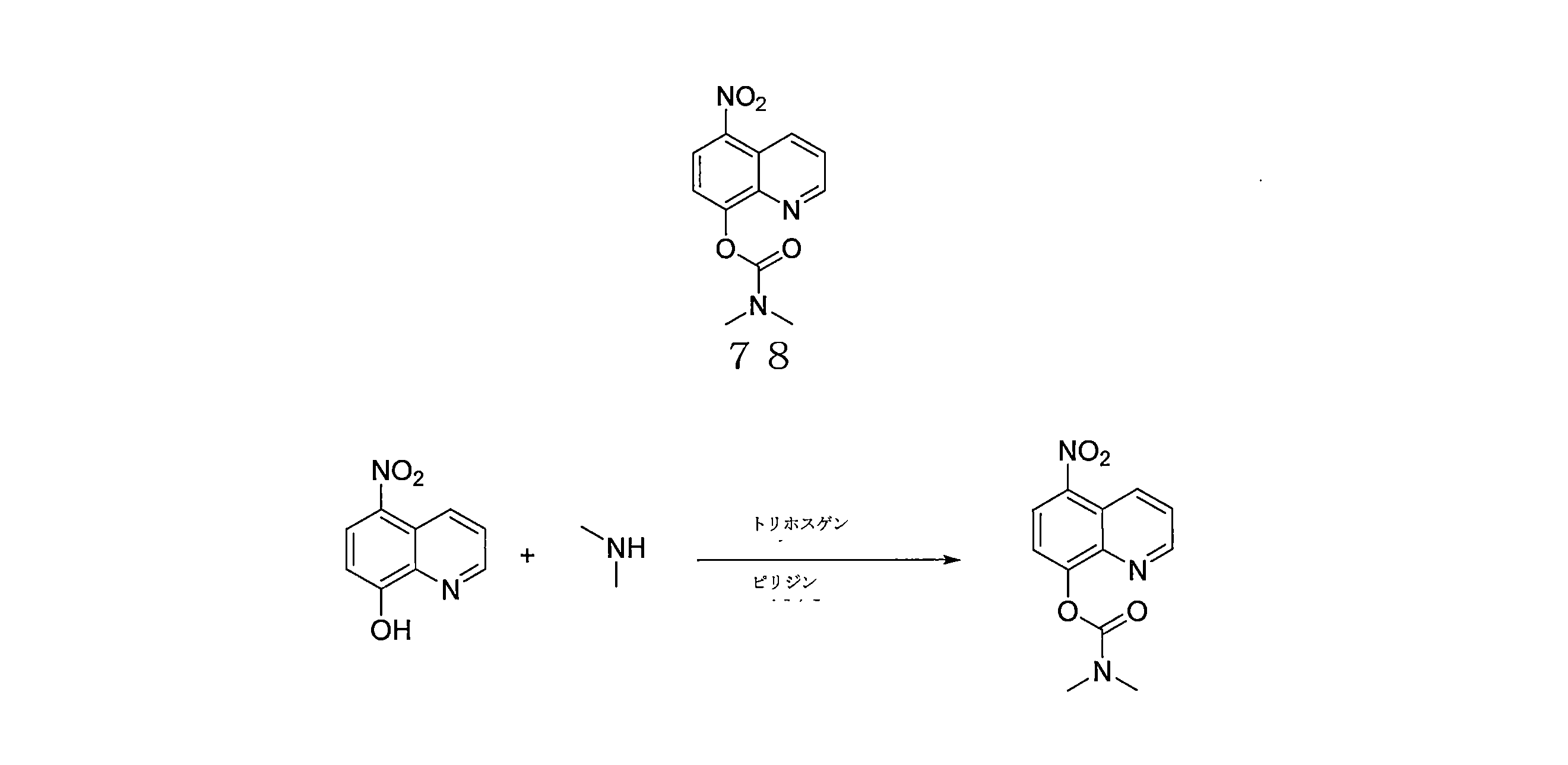
1H NMR (400 MHz, DMSO-d6) δ: 9.09 (dd, J = 4.0, 1.2 Hz, 1H), 8.93 (dd, J = 9.2, 1.6 Hz, 1H), 8.52 (d, J = 8.4 Hz, 1H), 7.86 (dd, J = 8.8, 4.0 Hz, 1H), 7.75 (d, J = 8.4 Hz, 1H), 3.21 (s, 3H), 2.96 (s, 3H)。
MS計算: 261.07;MS実測: 262.0 [M+H]+。
Example 78: Synthesis of 5-nitroquinolin-8-yldimethylcarbamate (78)
1 H NMR (400 MHz, DMSO-d 6 ) δ: 9.09 (dd, J = 4.0, 1.2 Hz, 1H), 8.93 (dd, J = 9.2, 1.6 Hz, 1H), 8.52 (d, J = 8.4 Hz, 1H), 7.86 (dd, J = 8.8, 4.0 Hz, 1H), 7.75 (d, J = 8.4 Hz, 1H), 3.21 (s, 3H), 2.96 (s, 3H).
MS calculation: 261.07;MS measurement: 262.0 [M+H] + .
実施例79:ビス(5-ニトロキノリン-8-イル)セバケート(79)の合成
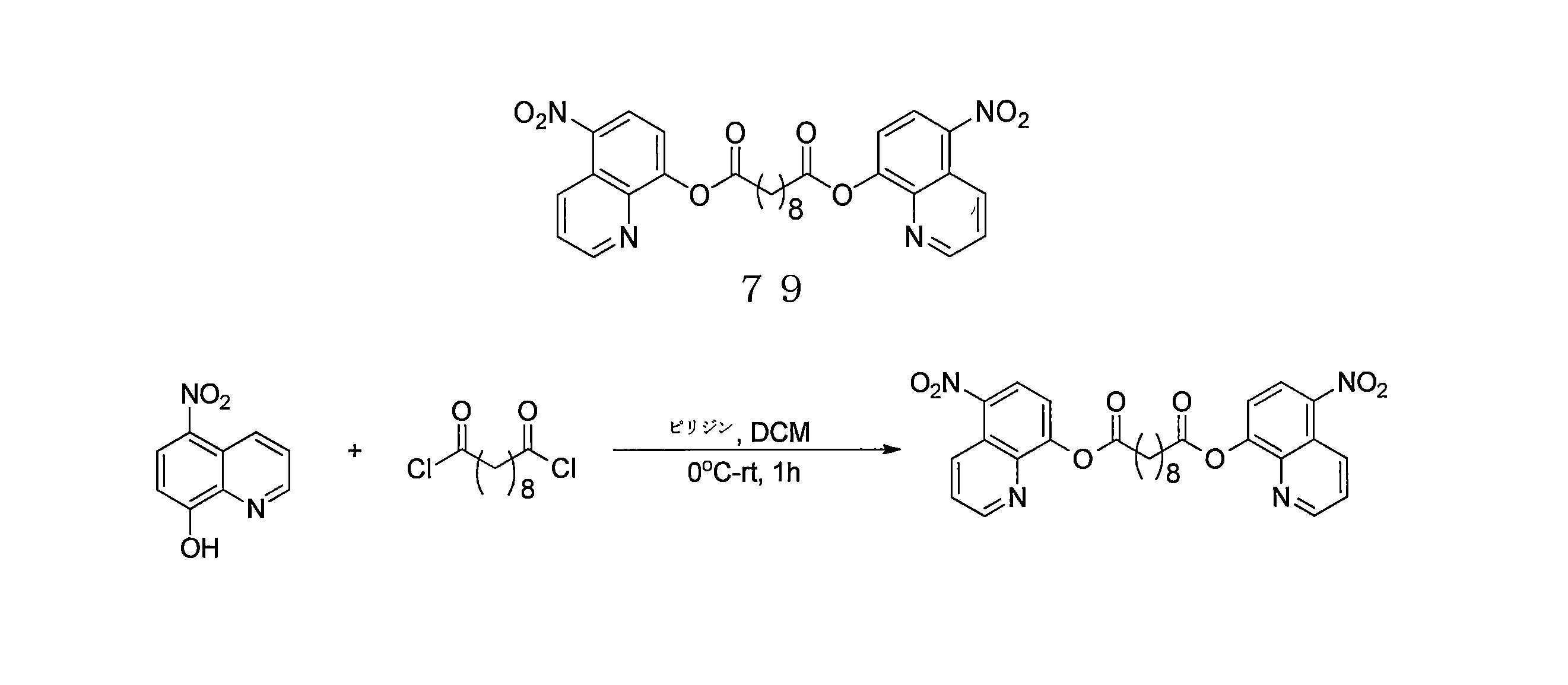
1H NMR (400 MHz, DMSO-d6) δ: 9.05 (dd, J = 4.4, 1.6 Hz, 2H), 8.92 (dd, J = 8.4, 1.6 Hz, 2H), 8.52 (d, J = 8.8 Hz, 2H), 7.85 (dd, J = 9.2, 4.4 Hz, 2H), 7.77 (d, J = 8.8 Hz, 2H), 2.80 (t, J = 7.2 Hz, 4H), 1.76 (d, J = 7.2 Hz, 4H), 1.52-1.41 (m, 8H)。
MS計算: 546.18;MS実測: 547.2 [M+H]+。
Example 79: Synthesis of bis(5-nitroquinolin-8-yl)sebacate (79)
1 H NMR (400 MHz, DMSO-d 6 ) δ: 9.05 (dd, J = 4.4, 1.6 Hz, 2H), 8.92 (dd, J = 8.4, 1.6 Hz, 2H), 8.52 (d, J = 8.8 Hz, 2H), 7.85 (dd, J = 9.2, 4.4 Hz, 2H), 7.77 (d, J = 8.8 Hz, 2H), 2.80 (t, J = 7.2 Hz, 4H), 1.76 (d, J = 7.2 Hz, 4H), 1.52-1.41 (m, 8H).
MS calculation: 546.18; MS measurement: 547.2 [M+H] + .
試験例1:本発明の化合物の水溶性の測定
本発明に係る式(I)化合物は、人体に入ると、有効成分であるニトロキソリンを徐放することができ、ニトロキソリンは血管内皮細胞におけるメチオニンアミノペプチダーゼMetAP2とサイレンシング情報調節因子2関連酵素を同時に阻害し、腫瘍血管新生を阻害する相乗効果を発揮する。また、ニトロキソリンは腫瘍細胞の増殖を抑制する作用もある。このほか、放出された有効成分であるニトロキソリンは細菌のメチオニンアミノペプチダーゼMetAPを阻害することで静菌作用を発揮する。
本発明者らは、まず、ニトロキノリン及びニトロキノリンプロドラッグの水溶性について検討した。
実験器具:96穴フィルタプレート(MSHVN4510又はMSHVN4550、ミリポア社);電子デジタルボルテックスミキサー(MS3 Digital、IKA);循環水式多用真空ポンプ(SHB-III、鄭州長城科工貿易有限公司);天秤(XSLT05、メトラー・トレド社);快適型ミキサー(Eppendorf AG 22331 Hamburg、エッペンドルフ社);液体クロマトグラフィー(LC-30AD、島津社);質量分析法(API4000、米国のアプライドバイオシステムズ社);サンプラー(Anylytics A)GSystem、CTC)。ニトロキノリンは、Journal of Heterocyclic Chemistry,1971,vol.8,p821に開示されている方法により、海門慧聚社に合成を依頼した。
実験過程:500μLのリン酸緩衝液(pH=1.2、4.5、6.8又は7.4)をガラス瓶に入れ、化合物粉末2mgを加えて栓を入れ、ミキサー(VORTEX-GENIE2)にセットして室温で24時間混合した。その後、真空吸引ろ過し、ろ過液を処理した後、LC/MS/MSで化合物濃度を測定した。
本発明の化合物の溶解度の結果を表1に示す。

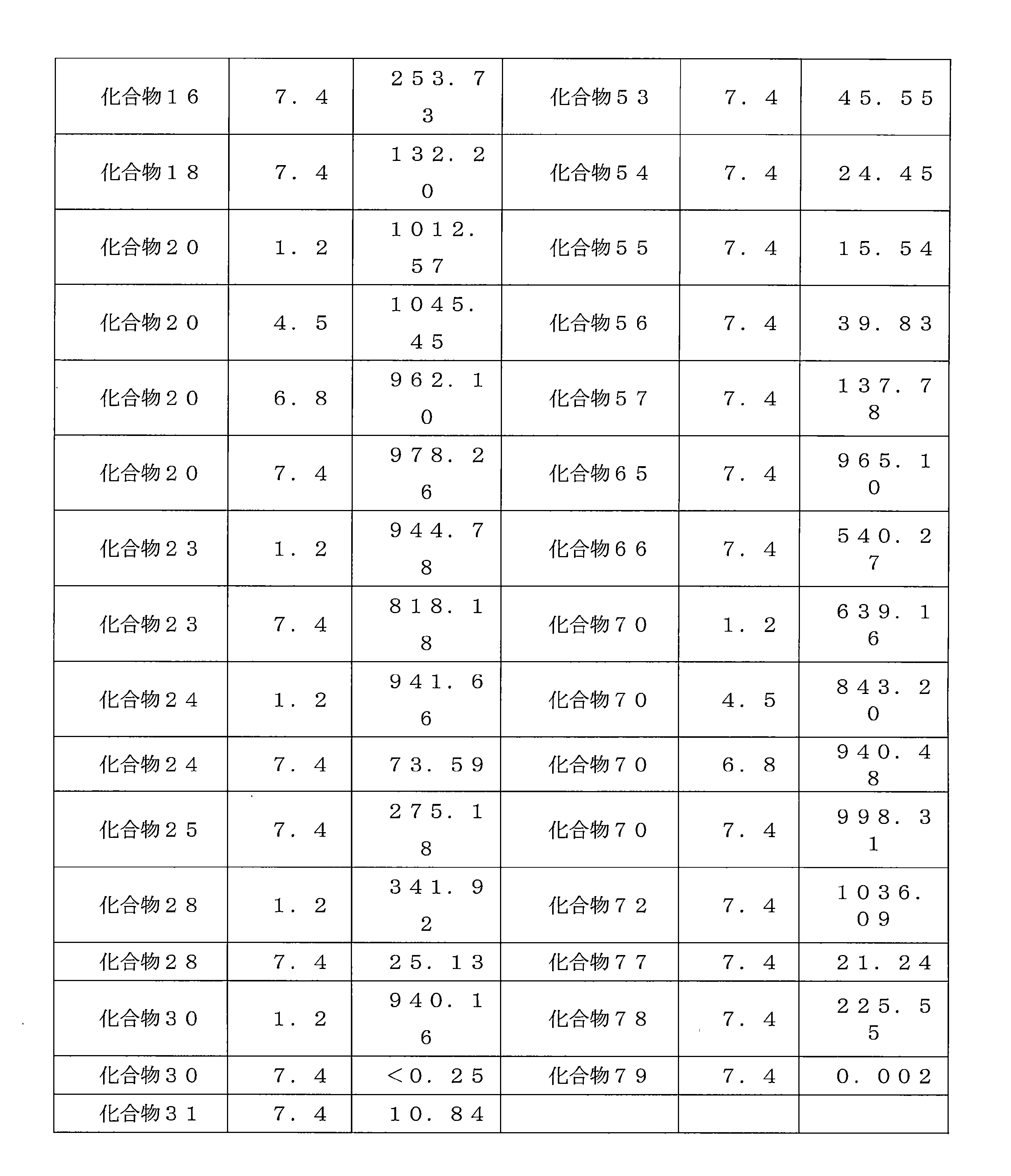
プロドラッグ分子の構造を最適化することによって、ニトロキソリンに比べてプロドラッグ分子の水溶性を著しく高めることができ、たとえば化合物18、20、23、30、52、65、66、70、72などの水溶性はいずれも数倍に向上し、通水部分の化合物の水溶性はpH値の変化によって変化せず、この特徴は薬物の製剤開発において特に重要である。
試験例2:本発明の化合物の肝ミクロソーム及び血漿安定性の測定
本発明の式(I)化合物は、インビボでニトロキソリンに分解され、抗がん作用を発揮することが期待される。肝ミクロソーム酵素及び血漿代謝酵素は化合物の体内代謝の重要な手段であるため、インビトロ実験を行い、本発明の化合物の肝ミクロソーム及び血漿中の安定性を測定した。
1.肝ミクロソーム安定性の測定
実験器具:恒温発振器(SHA-B、国華企業);遠心分離機(5810R、エッペンドルフ社)、質量分析装置(API4000、米国のアプライドバイオシステムズ社)、液体クロマトグラフィー(LC-30AD、島津社);サンプラー(CTC AはLytics AG Systemに適用せず、CTC)。
実験過程:100mMリン酸緩衝液に25μg/mLのアラメチシン(Aldrich試薬社)、5mM塩化マグネシウム、及び0.5mg/mLミクロソーム(XENOTECH)を加えて補酵素を含まない反応溶液を調製した。その後、一部を還元型ニコチンアミドアデニンジヌクレオチドリン酸1mM(Aldrich試薬社)とウリジン二リン酸グルクロン酸5mM(Aldrich試薬社)を加えて補酵素を含む反応溶液を調製した。その後、2つの反応溶液に本発明の化合物の作動溶液を加え、化合物の最終濃度を2μMとした。混合直後に50μLの溶液を取り出して0分サンプルとし、残りのサンプルを37℃で30分間インキュベートした後に50μLを取り出した。取り出したすべてのサンプルについて直ちにタンパク質を沈殿させ、遠心分離して上清を取った後、LC/MS/MSで化合物濃度を測定した。
本発明の化合物のミクロソーム安定性の結果を表2に示す。
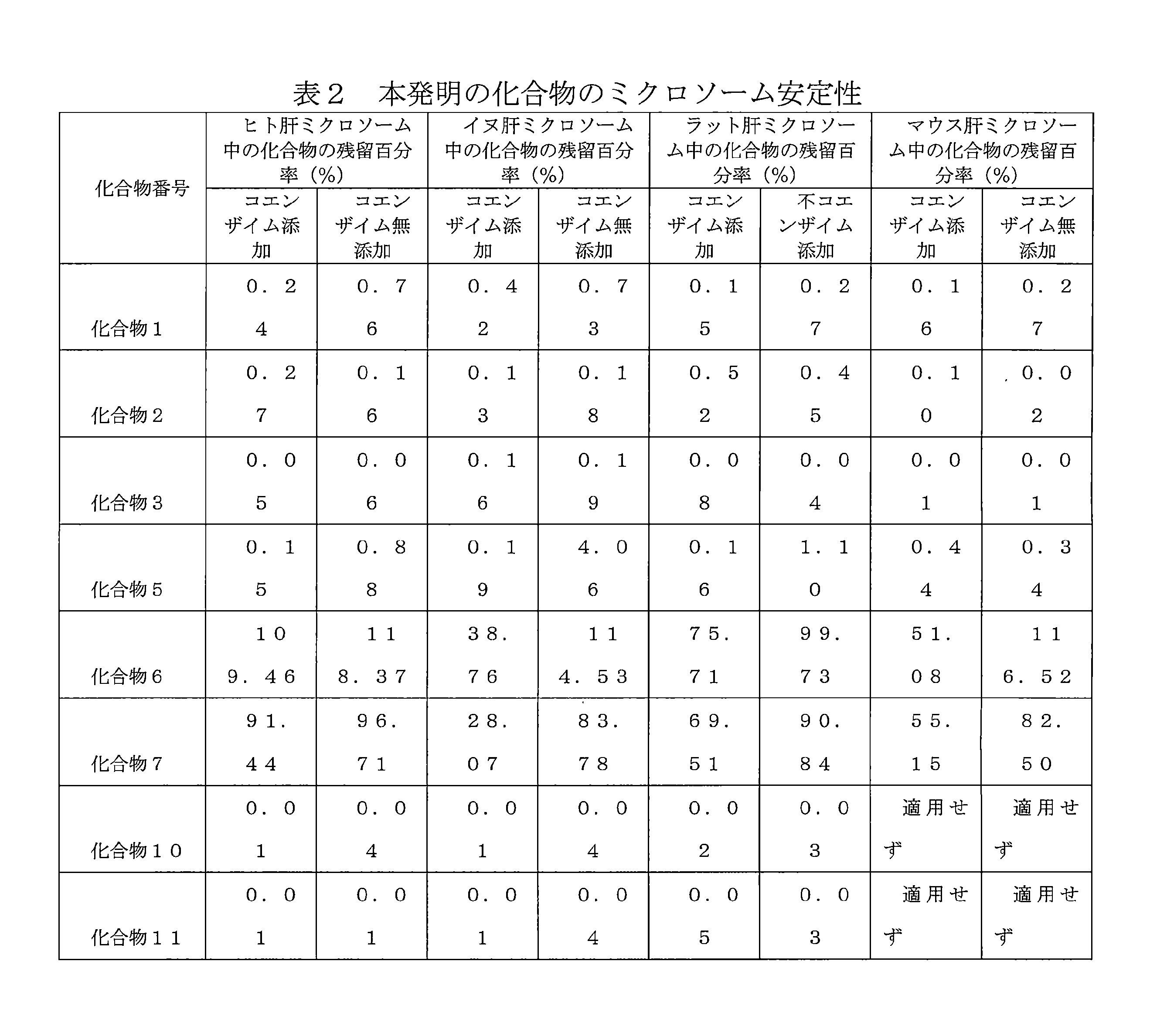

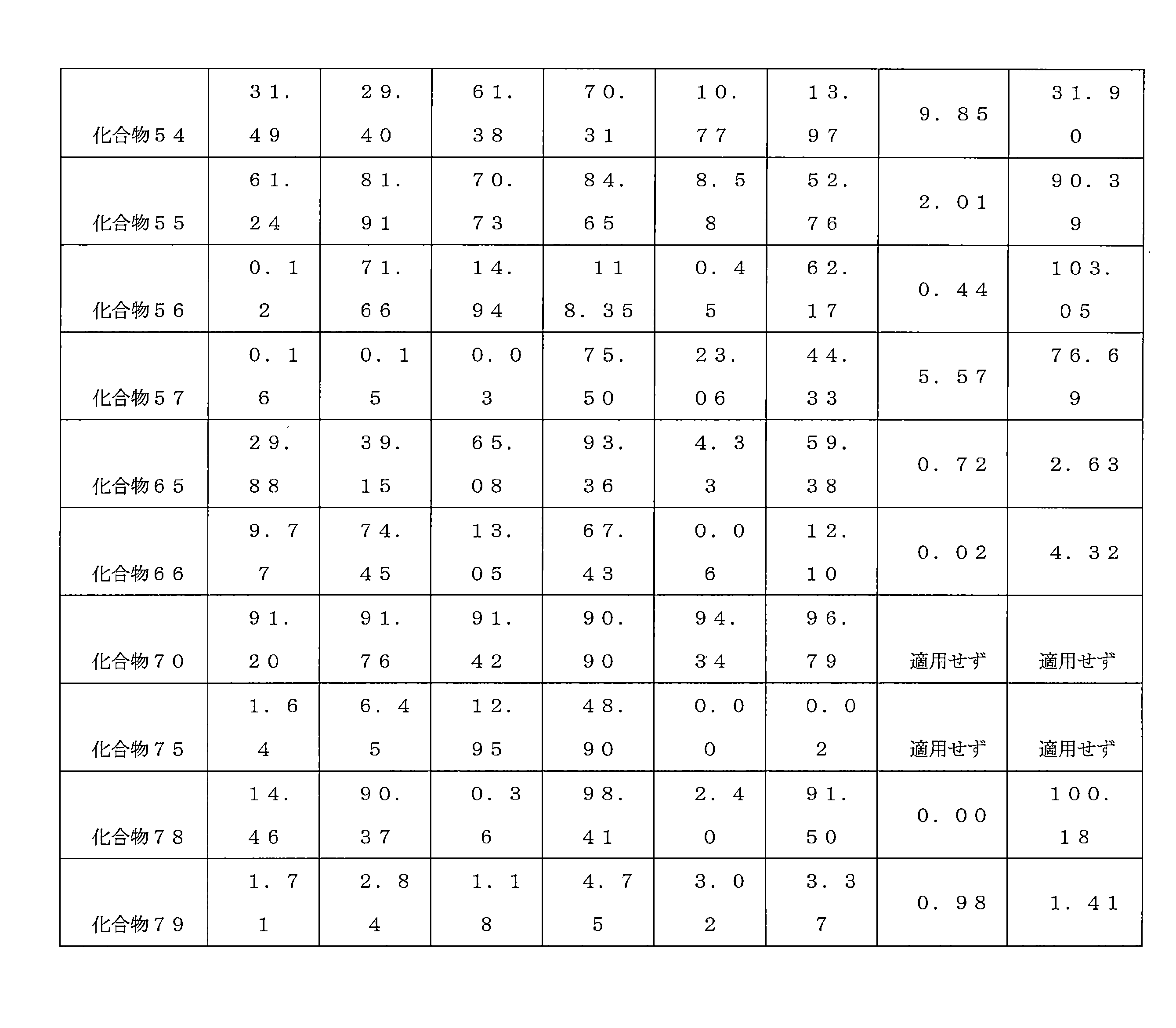
プロドラッグ分子の構造を最適化することによって、異なるタイプのミクロソーム安定性化合物を得ることができ、化合物6、7、52、53などのミクロソーム安定性はこのような化合物が体内で更に長い半減期を持つ可能性があることを示している。ミクロソームが不安定である別の種類の化合物は、化合物が体内に入ると迅速にニトロキソリンに変換できることを示し、不要な生物毒性の可能性を低減する。2種類を分析した結果、いずれも薬物として開発する優位性及び特徴を持っている。
2.血漿安定性測定
実験器具:恒温発振器(SHA-B、国華企業);遠心分離機(5810R、エッペンドルフ社)、質量分析装置(API4000、米国のアプライドバイオシステムズ社)、液体クロマトグラフィー(LC-30AD、島津社);サンプラー(CTC AはLytics AG Systemに適用せず、CTC)。
実験動物:ヒト(ロット番号:BRH1343165)、ラット(ロット番号:RAT336728)、マウス(ロット番号:MSE280000)、イヌ(ロット番号:BGL99137)、サル(ロット番号:PH-Monkey-20180821)の血漿は上海斯信生物科技有限公司由来である。
実験過程:本発明の化合物を有機溶媒に溶解して1mMの作動液にし、次に、3μLを採取してプレインキュベートしたヒト又はラット血漿597μLに加え、均一に混合した。その後、速やかに50μLを取り出して0分サンプルとし、残りのサンプルを37℃で恒温インキュベートし、15、30、60、及び120分に50μLずつ取り、すべてのサンプルを取り出した直後に蛋白を沈殿させ、遠心分離して上清を取って、LC/MS/MSで化合物濃度を測定した。
本発明の化合物の血漿安定性の結果を表3に示す。
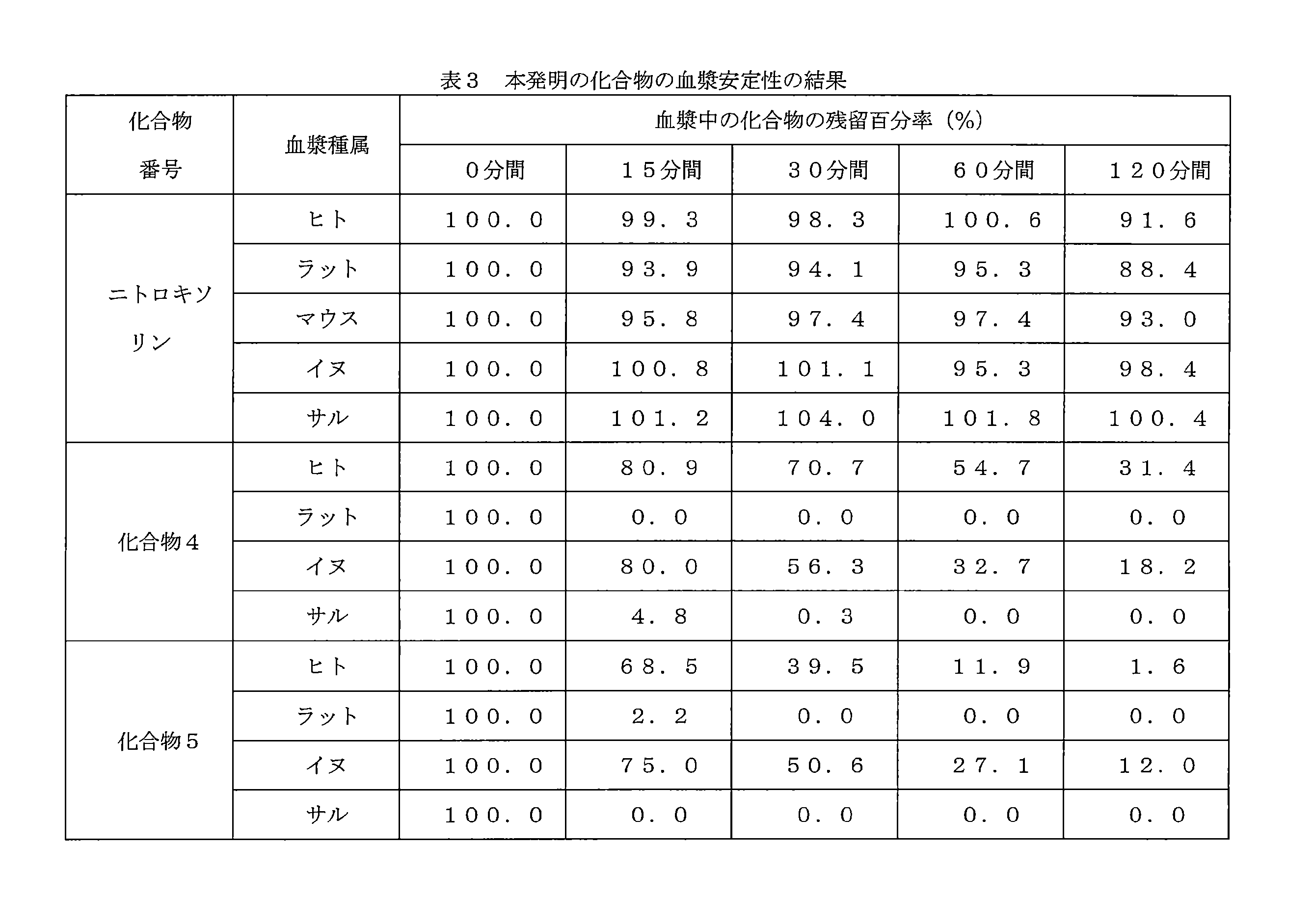
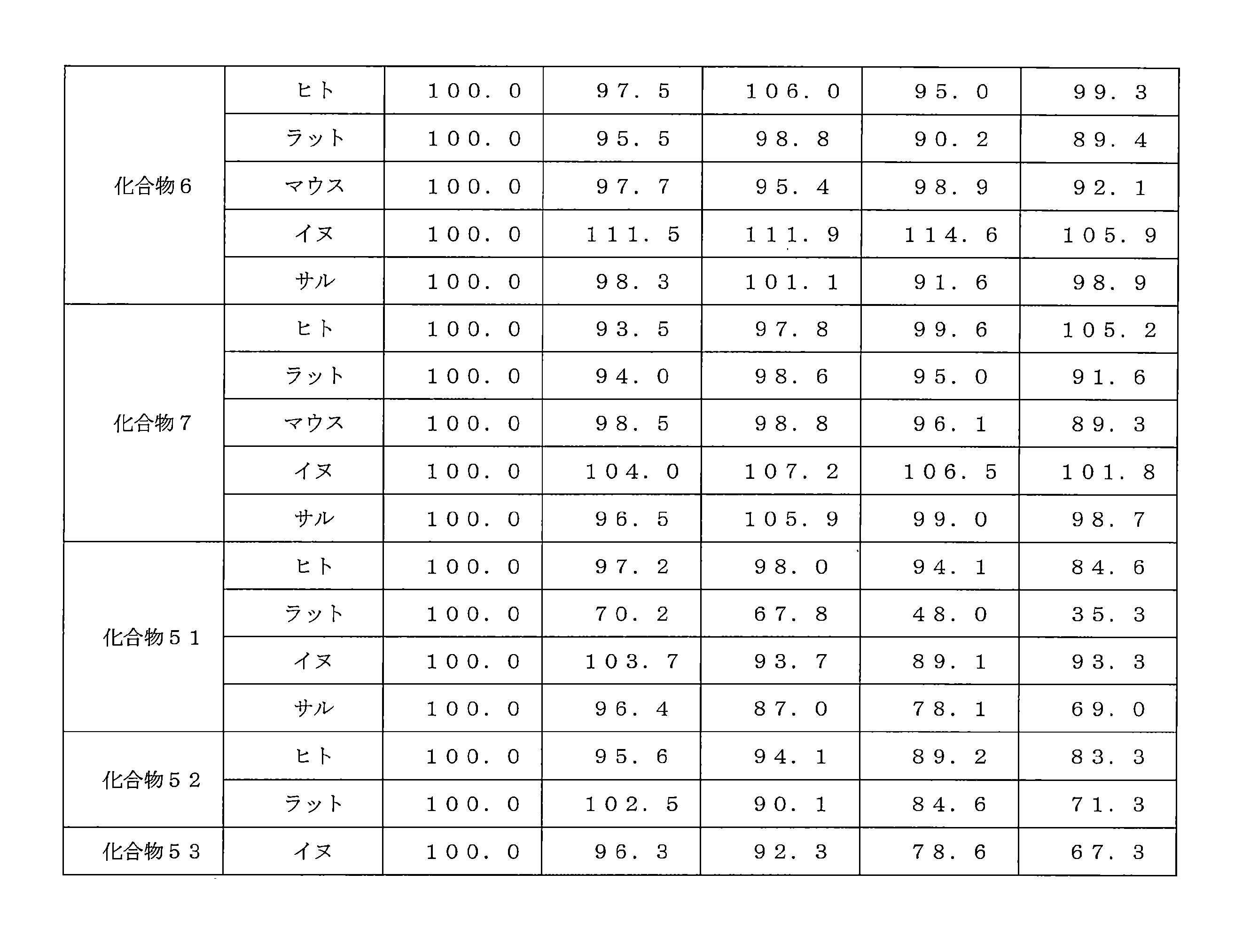
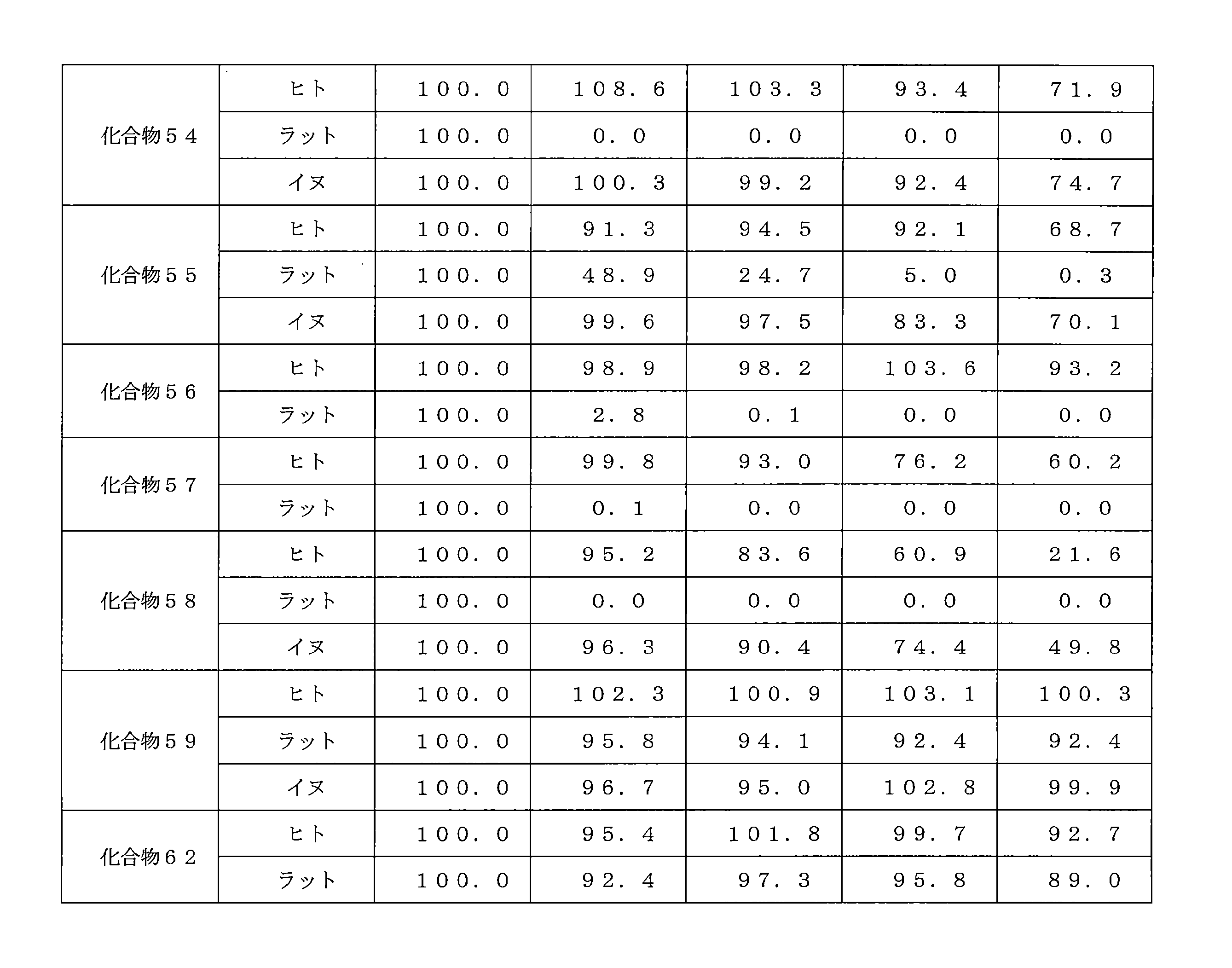
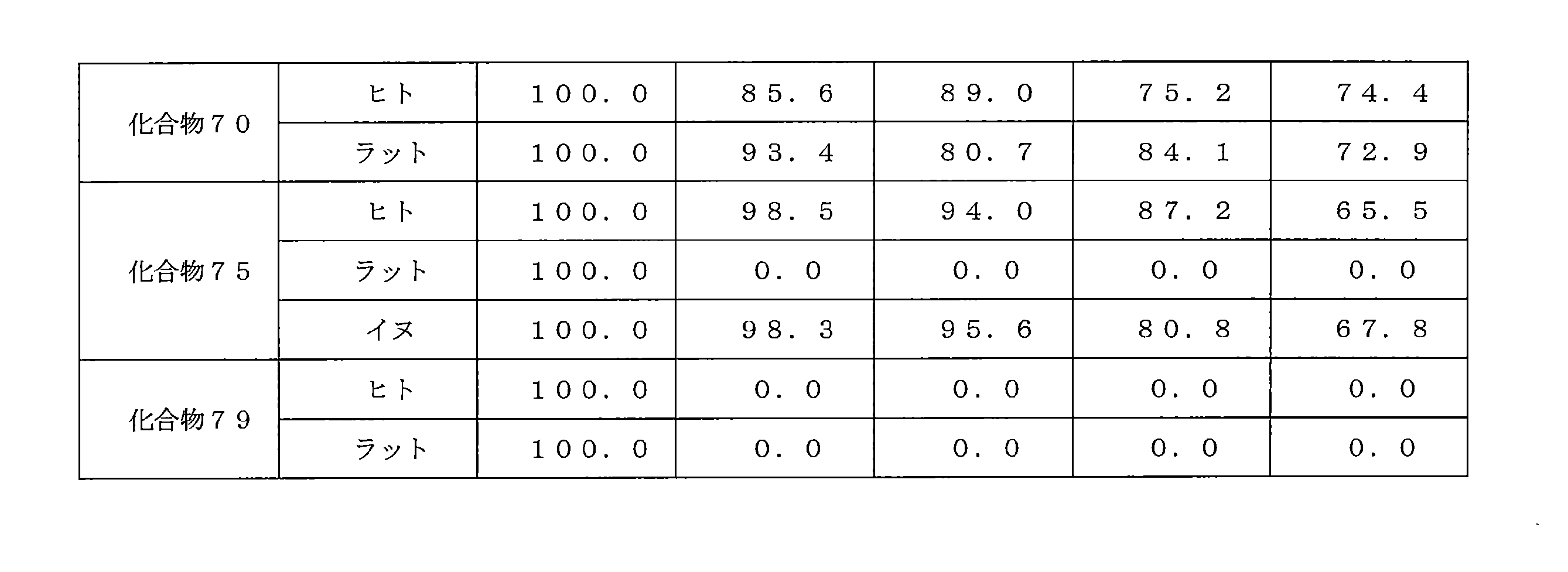
プロドラッグ分子の構造を最適化することによって、異なるタイプの血漿安定性化合物を得ることができ、化合物6、7、52、53、54、55、56、57、58、59、62、70、75などの血漿安定性はこのような化合物が体内で更に長い半減期を持つ可能性があることを示している。血漿が不安定である別の種類の化合物は、体内に入ると、化合物が迅速にニトロキソリンに変換されることを示し、不要な生物毒性の可能性を低減する。2種類を分析した結果、いずれも薬物として開発する優位性と特徴を持っている。
Test Example 1: Determination of the water solubility of the compound of the present invention When the compound of formula (I) of the present invention is introduced into the human body, it can release the active ingredient nitroxoline, which simultaneously inhibits methionine aminopeptidase MetAP2 and silencing information regulator 2-related enzyme in vascular endothelial cells, and exerts a synergistic effect of inhibiting tumor angiogenesis. Nitroxoline also has the effect of suppressing the proliferation of tumor cells. In addition, the released active ingredient nitroxoline inhibits bacterial methionine aminopeptidase MetAP, thereby exerting a bacteriostatic effect.
The present inventors first investigated the water solubility of nitroquinoline and nitroquinoline prodrugs.
Experimental equipment: 96-well filter plate (MSHVN4510 or MSHVN4550, Millipore); electronic digital vortex mixer (MS3 Digital, IKA); water circulation type multipurpose vacuum pump (SHB-III, Zhengzhou Great Wall Science and Technology Trading Co., Ltd.); balance (XSLT05, Mettler Toledo); comfort type mixer (Eppendorf AG 22331 Hamburg, Eppendorf); liquid chromatography (LC-30AD, Shimadzu); mass spectrometry (API4000, Applied Biosystems, USA); sampler (Anylytics A) GSystem, CTC). Nitroquinoline was prepared according to the method described in Journal of Heterocyclic Chemistry, 1971, vol. We requested Kaimon Keishusha to synthesize this compound using the method disclosed in J.Non-Chem. Soc. 8, p. 821.
Experimental procedure: 500 μL of phosphate buffer (pH = 1.2, 4.5, 6.8 or 7.4) was placed in a glass bottle, 2 mg of compound powder was added, the stopper was inserted, and the bottle was set in a mixer (VORTEX-GENIE2) and mixed at room temperature for 24 hours. After that, the bottle was vacuum filtered, and the filtrate was treated, and the compound concentration was measured by LC/MS/MS.
The solubility results for the compounds of the present invention are shown in Table 1.
By optimizing the structure of the prodrug molecule, the water solubility of the prodrug molecule can be significantly increased compared to nitroxoline. For example, the water solubility of compounds 18, 20, 23, 30, 52, 65, 66, 70, and 72 is improved by several times. The water solubility of the water-permeable compound does not change with changes in pH value. This feature is particularly important in the development of drug formulations.
Test Example 2: Measurement of the stability of the compound of the present invention in liver microsomes and plasma The compound of formula (I) of the present invention is expected to be decomposed into nitroxoline in vivo and to exert an anticancer effect. Since liver microsomal enzymes and plasma metabolic enzymes are important means of compound metabolism in the body, in vitro experiments were performed to measure the stability of the compound of the present invention in liver microsomes and plasma.
1. Experimental equipment for measuring liver microsome stability: constant temperature oscillator (SHA-B, Guohua); centrifuge (5810R, Eppendorf); mass spectrometer (API4000, Applied Biosystems, USA); liquid chromatography (LC-30AD, Shimadzu); sampler (CTC A does not apply to Lytics AG System, CTC).
Experimental procedure: 25 μg/mL alamethicin (Aldrich Reagents), 5 mM magnesium chloride, and 0.5 mg/mL microsomes (XENOTECH) were added to 100 mM phosphate buffer to prepare a reaction solution without coenzymes. Then, 1 mM reduced nicotinamide adenine dinucleotide phosphate (Aldrich Reagents) and 5 mM uridine diphosphate glucuronic acid (Aldrich Reagents) were added to a portion of the reaction solution to prepare a reaction solution containing coenzymes. Then, the working solution of the compound of the present invention was added to the two reaction solutions to make the final concentration of the compound 2 μM. Immediately after mixing, 50 μL of the solution was taken out as a 0-minute sample, and the remaining samples were incubated at 37° C. for 30 minutes, after which 50 μL was taken out. All the samples taken out were immediately subjected to protein precipitation, centrifuged to take the supernatant, and the compound concentration was measured by LC/MS/MS.
The microsomal stability results for compounds of the present invention are shown in Table 2.
By optimizing the structure of the prodrug molecule, different types of microsome-stable compounds can be obtained, and the microsome-stability of compounds 6, 7, 52, 53, etc. indicates that such compounds may have a longer half-life in the body. Another type of compound with microsome-stability indicates that the compound can be rapidly converted to nitroxoline when it enters the body, reducing the possibility of unwanted biological toxicity. After analyzing the two types, both have advantages and characteristics for development as drugs.
2. Plasma stability measurement experimental equipment: constant temperature oscillator (SHA-B, Kuohua); centrifuge (5810R, Eppendorf); mass spectrometer (API4000, Applied Biosystems, USA); liquid chromatography (LC-30AD, Shimadzu); sampler (CTC A does not apply to Lytics AG System, CTC).
Experimental animals: human (lot number: BRH1343165), rat (lot number: RAT336728), mouse (lot number: MSE280000), dog (lot number: BGL99137), and monkey (lot number: PH-Monkey-20180821) plasma were obtained from Shanghai Sixin Biotechnology Co., Ltd.
Experimental procedure: The compound of the present invention is dissolved in organic solvent to make a working solution of 1 mM, and then 3 μL is taken and added to 597 μL of pre-incubated human or rat plasma, and mixed uniformly. Then, 50 μL is taken immediately as the 0-minute sample, and the remaining samples are incubated at 37°C, and 50 μL is taken at 15, 30, 60, and 120 minutes. Immediately after taking all the samples, protein is precipitated, centrifuged, and the supernatant is taken, and the compound concentration is measured by LC/MS/MS.
The plasma stability results for the compounds of the present invention are shown in Table 3.
By optimizing the structure of the prodrug molecule, different types of plasma-stable compounds can be obtained, and the plasma stability of compounds 6, 7, 52, 53, 54, 55, 56, 57, 58, 59, 62, 70, 75, etc. indicates that such compounds may have a longer half-life in the body. Another type of plasma-unstable compound indicates that the compound is rapidly converted to nitroxoline when it enters the body, reducing the possibility of unwanted biological toxicity. After analyzing the two types, it was found that both have advantages and characteristics for development as drugs.
試験例3:本発明の化合物のラット薬物動態学的測定
ニトロキソリンは主に肝を介して二相代謝を行い、代謝速度が速いため、体内での半減期が短い。本発明はその構造を改変し、化学合成法により式(I)化合物を13種類製造した。本試験はラットにニトロキソリン及び式(I)化合物をそれぞれ単回静脈或いは経口投与した後、ラット血漿中の化合物ニトロキソリンの濃度の変化を研究し、これにより、ニトロキソリン及び式(I)化合物のラット体内における薬物動態学的行為を評価した。
1.実験器具
タンデム四重極質量分析計(API4000、米国のアプライドバイオシステムズ社)、液体クロマトグラフィー(1200、アジレント社)、オートサンプラー(CTC Aはlytics HTC PALには適用せず)、米国のアプライドバイオシステムズ社Aはlyst v1.6.2には適用せず、低温冷凍遠心分離機(1-15PK、シグマ)、渦発振器(VX-III、北京踏錦科技有限公司)。
2.薬物動態学的実験
雄性SDラット(北京維通利華実験動物技術有限公司、実験動物生産許可証番号:SCXK(京)2016-0006、実験動物合格証番号:11400700325643)、各群ごとに3匹、体重180~250g、6~7週齢、投与前一夜断食、自由飲水、投与4時間後給餌。測定対象化合物をEPチューブに入れ、DMSO 1.017mL、solutol 2.035mL、及び滅菌注射用水(三者の体積比は1:2:17、v:v:v)を加え、20分超音波処理して十分に溶解させた(化合物の配合濃度:0.005mmol/mL)。静脈内投与量は0.01mmol/kg、経口投与量は0.1mmol/kgであった。投与前(0時間)と投与後0.0833、0.25、0.5、1、2、4、6、8、10、24、28、32、48時間(サンプリングポイントは状況により調整)に眼窩静脈叢から全血0.3mlを採取し、EDTA-K2(Aldrich試薬社)抗凝固を含む遠心チューブに入れ、採取後砕氷中に置いた。0.5時間以内に5000rpm条件下で5分間遠心分離し、血漿をすべて分離し、別のきれいな遠心管内に置き、100:3(血漿/安定液、v/v)の割合で安定液を加え、-20℃の冷蔵庫に置いて測定に備えた。
安定液の調製方法:ビタミンC(Aldrich社)200mgを生理食塩水8mLに溶解した後、ギ酸2mLを加えて十分に混和した。
3.サンプル濃度の測定
検量線:一連の検量線の作動液を調製し、空白ラット血漿50μLに5μLを加え、150μLの内標準作動液(ジフェンヒドラミン(Aldrich試薬社)のアセトニトリル溶液を2ng/mL含む)を加え、1分間ボルテックス振とうした。4℃、12000回転/分の条件で10分間遠心分離し、上清100μLをサンプリング管に採取し、10μLを液体クロマトグラフ質量分析計に注入して測定した。
測定対象サンプル:測定対象サンプル血漿50μLに作動液の希釈液5μLを加えた後、内標準作動液(ジフェンヒドラミン2ng/mLのアセトニトリル溶液を含む)150μLを加え、1分間ボルテックス振とうした。4℃、12000回転/分の条件で10分間遠心分離し、上清100μLをサンプリング管に採取し、10μLを液体クロマトグラフ質量分析計に注入して測定した。WinNonlin V6.2非房室モデルを用いて薬物動態学的パラメータを計算した。
測定結果を表4~表45に示す。


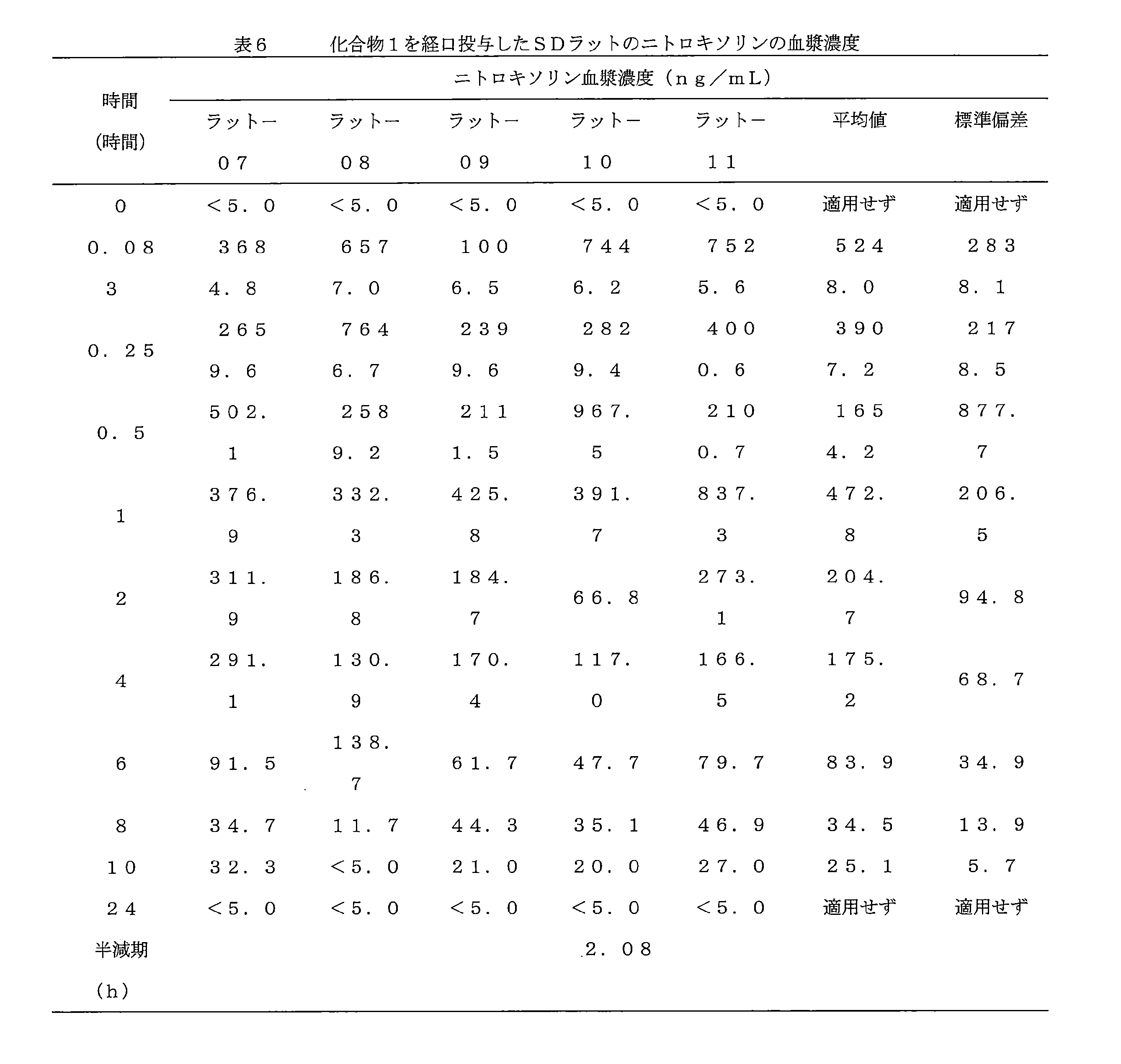
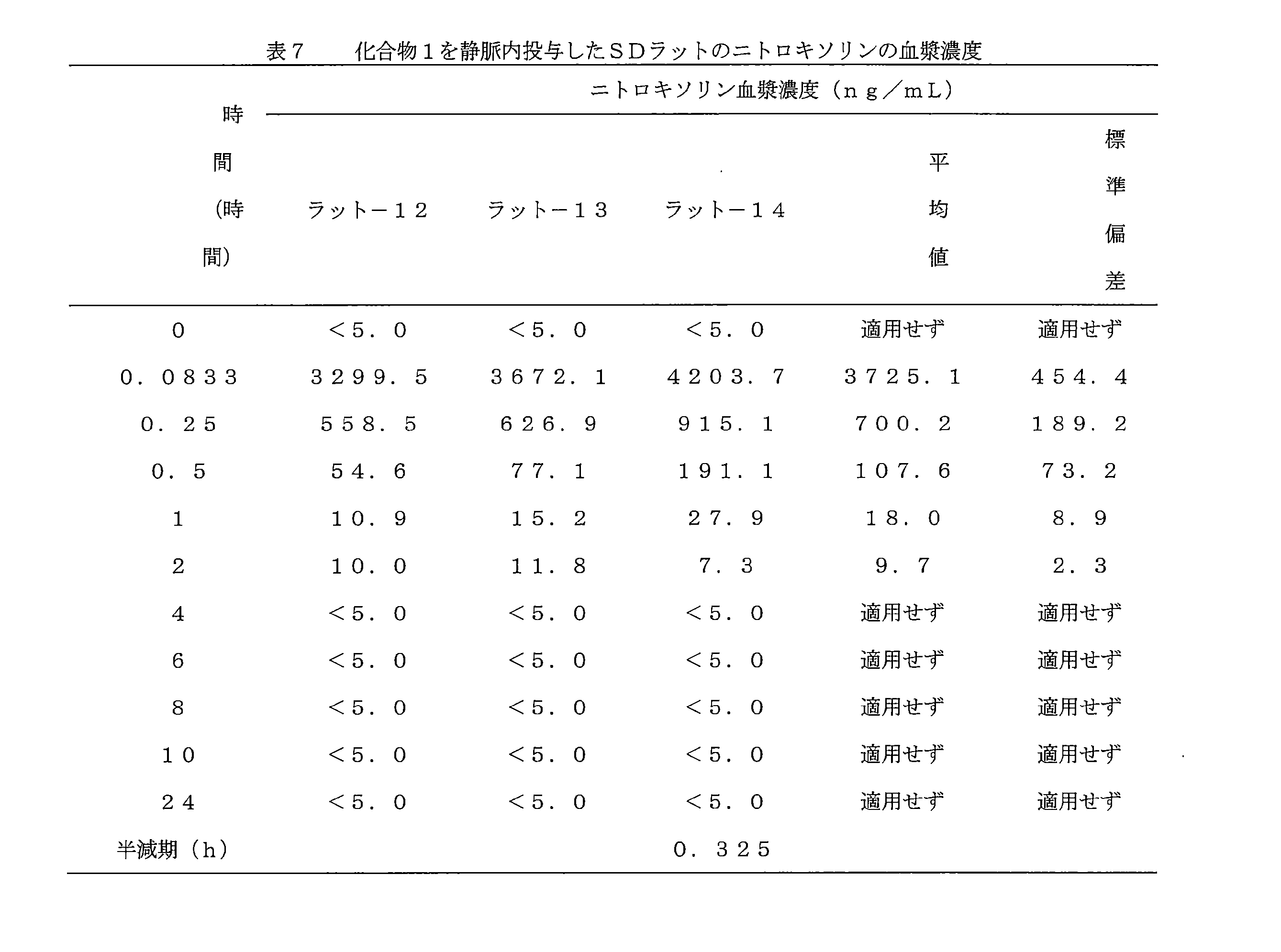

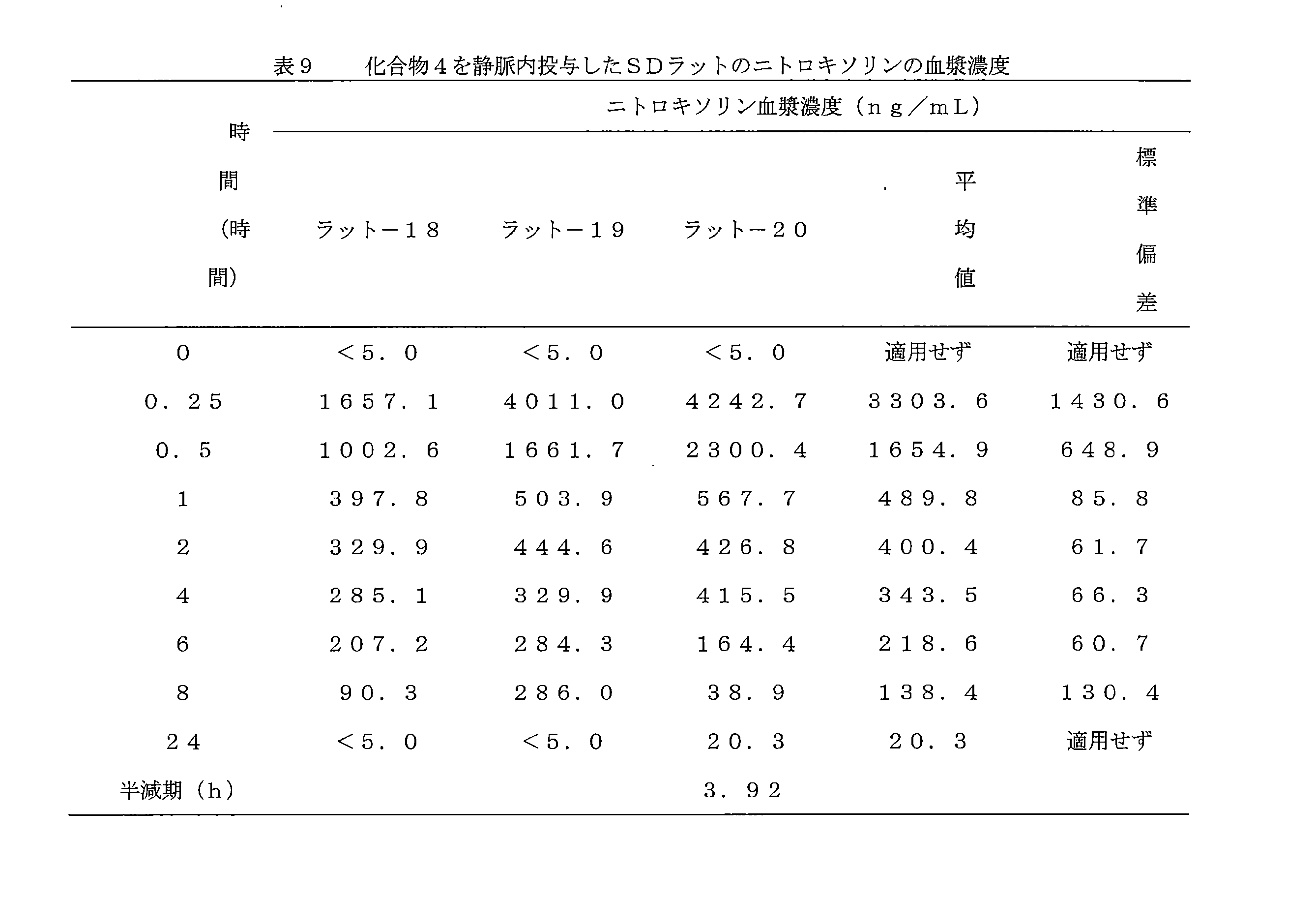
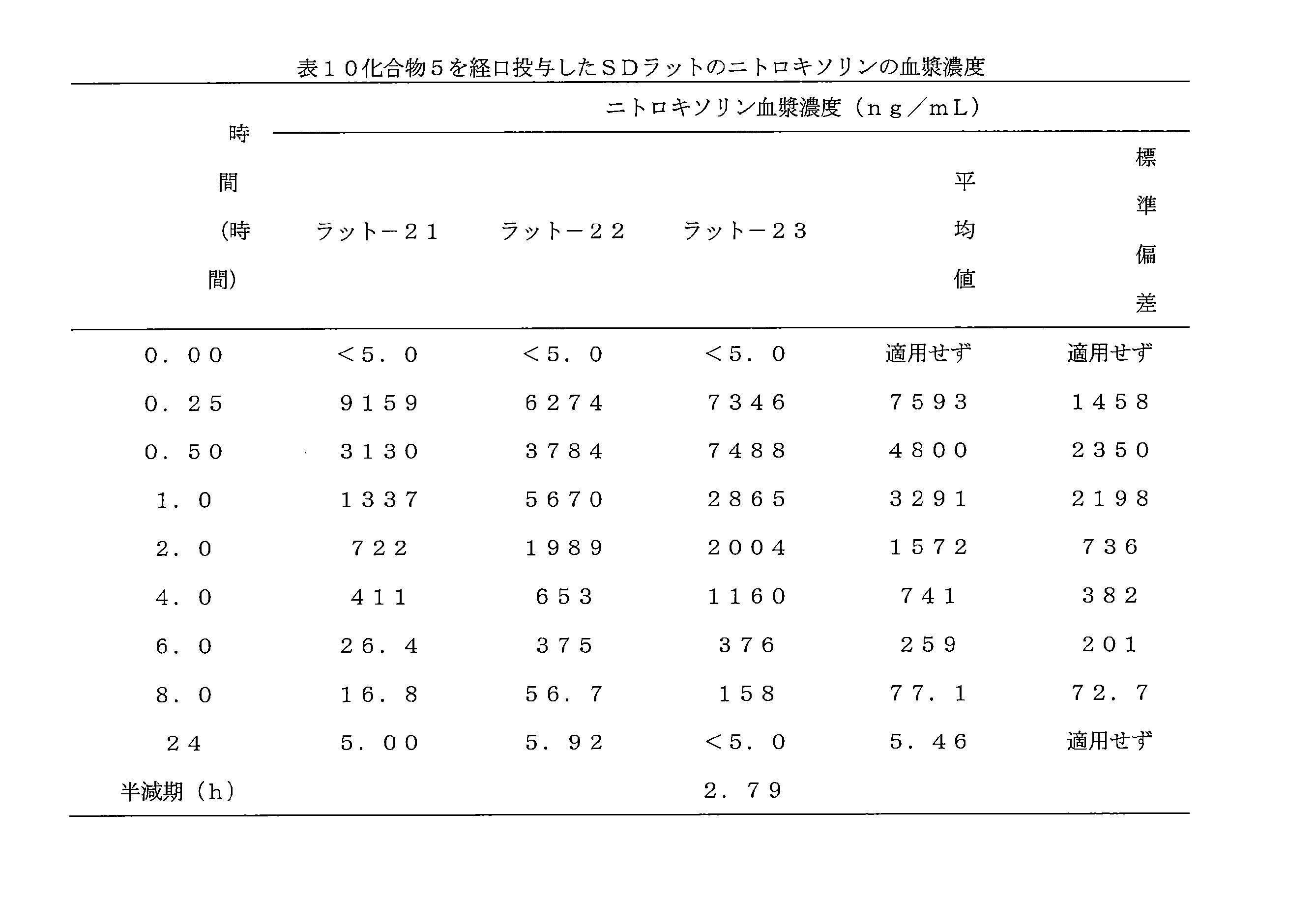
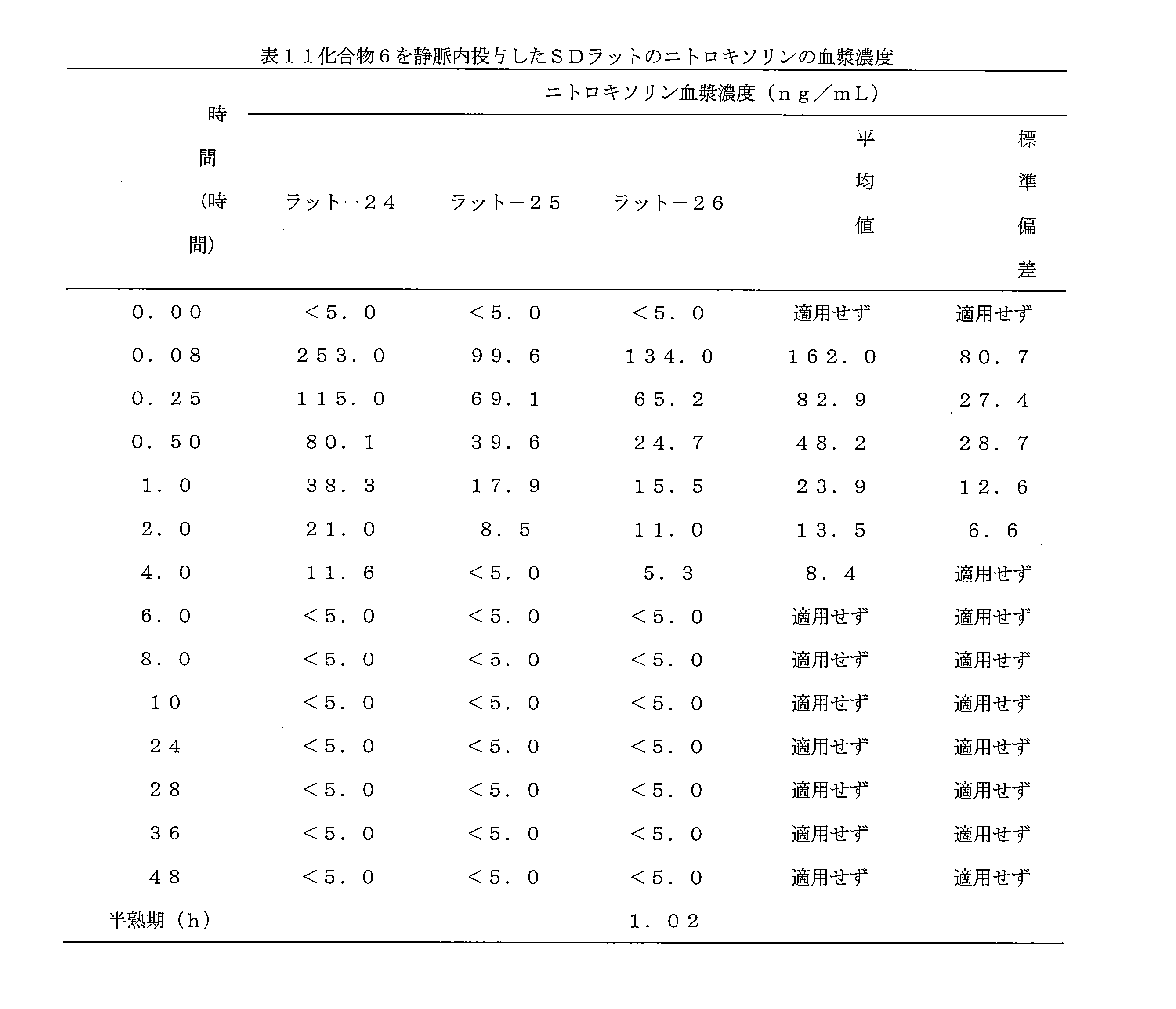


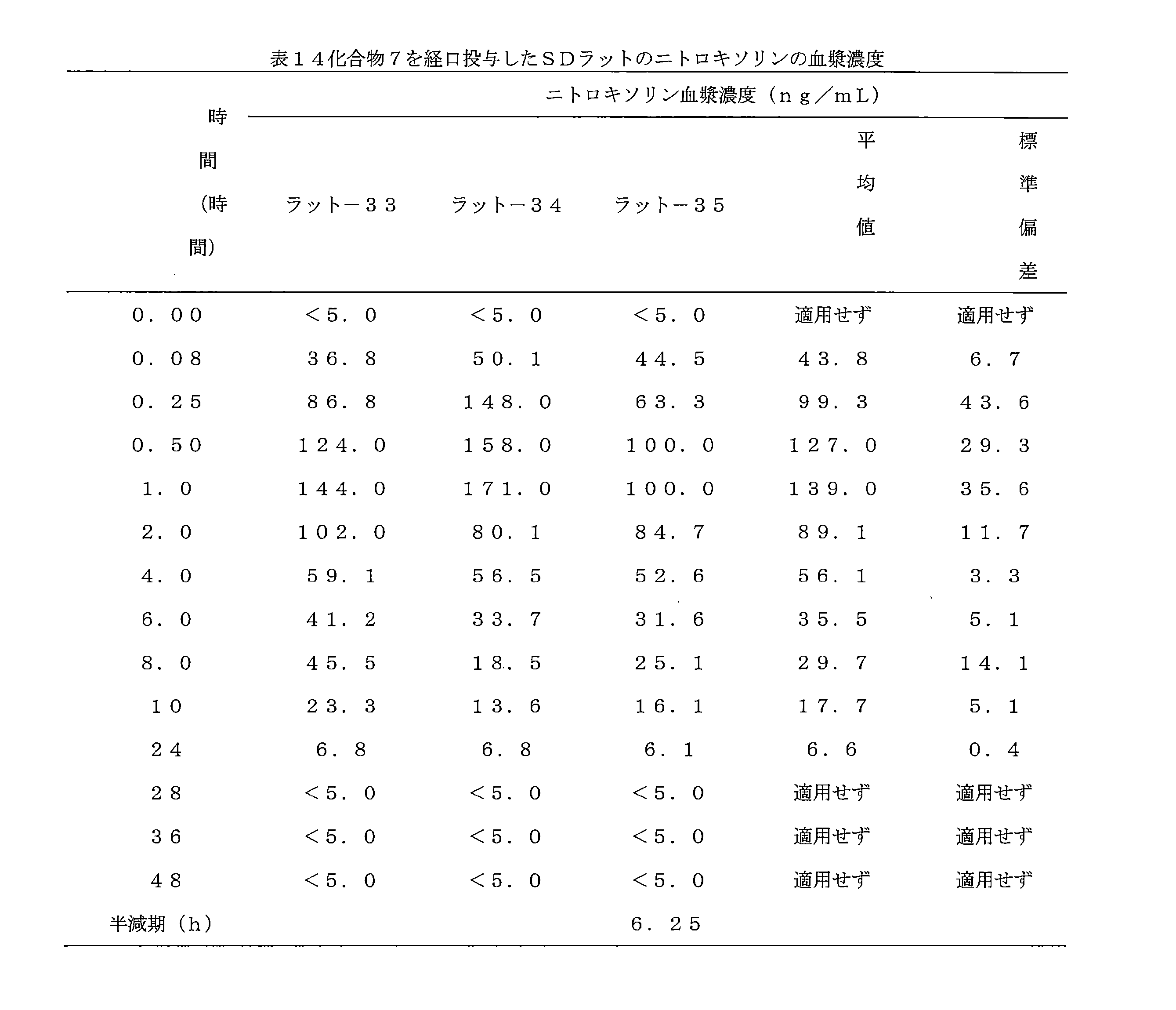

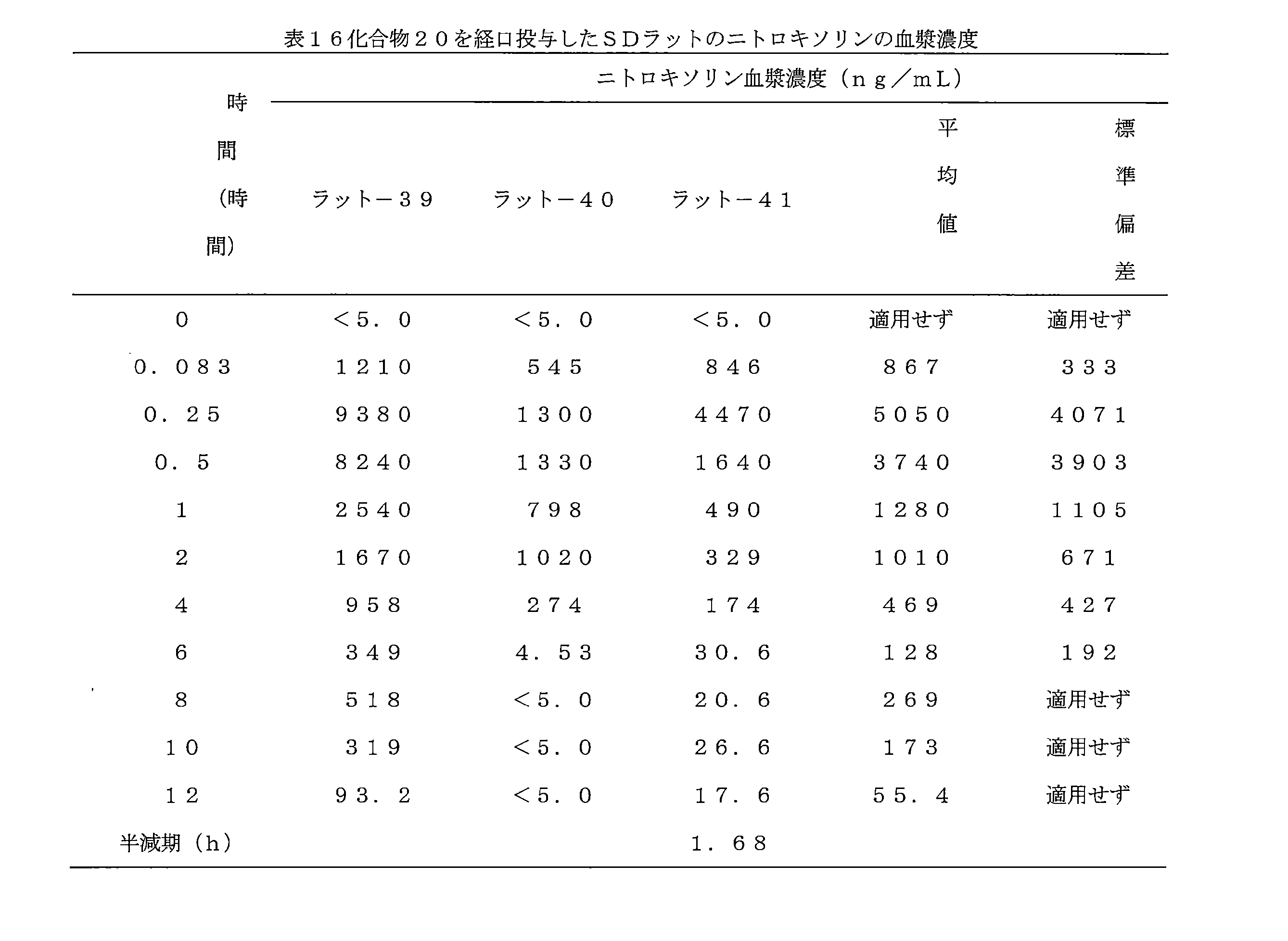


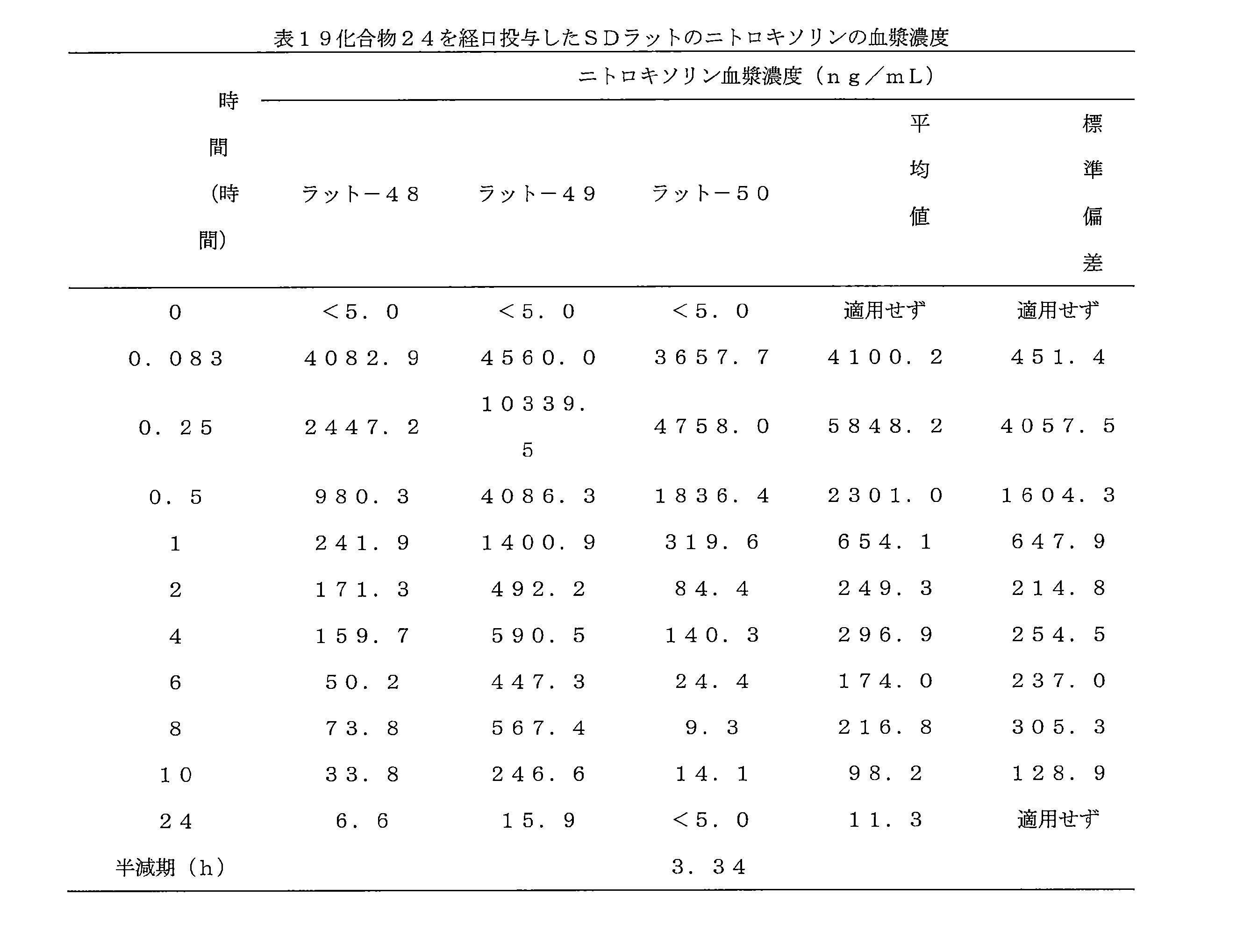


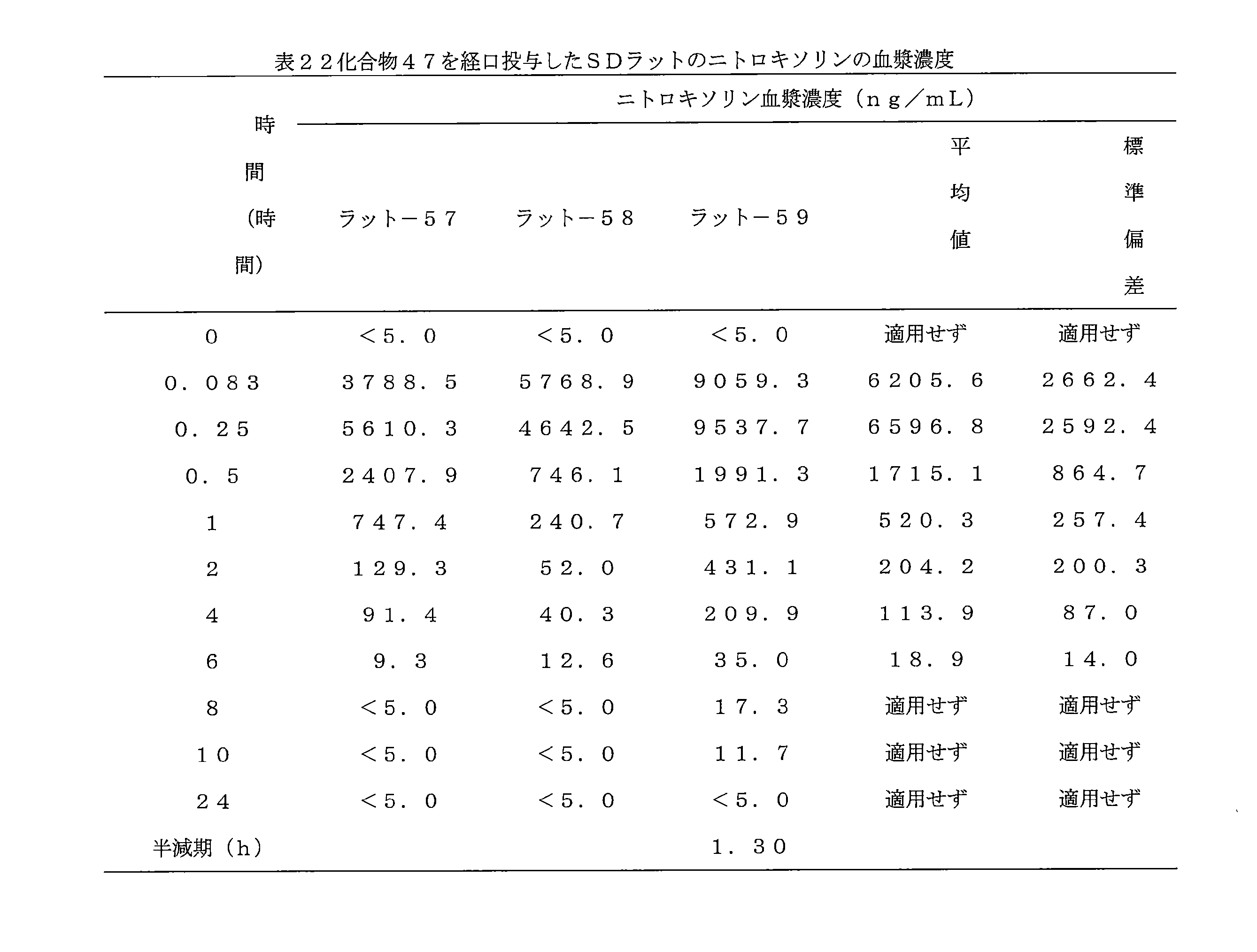

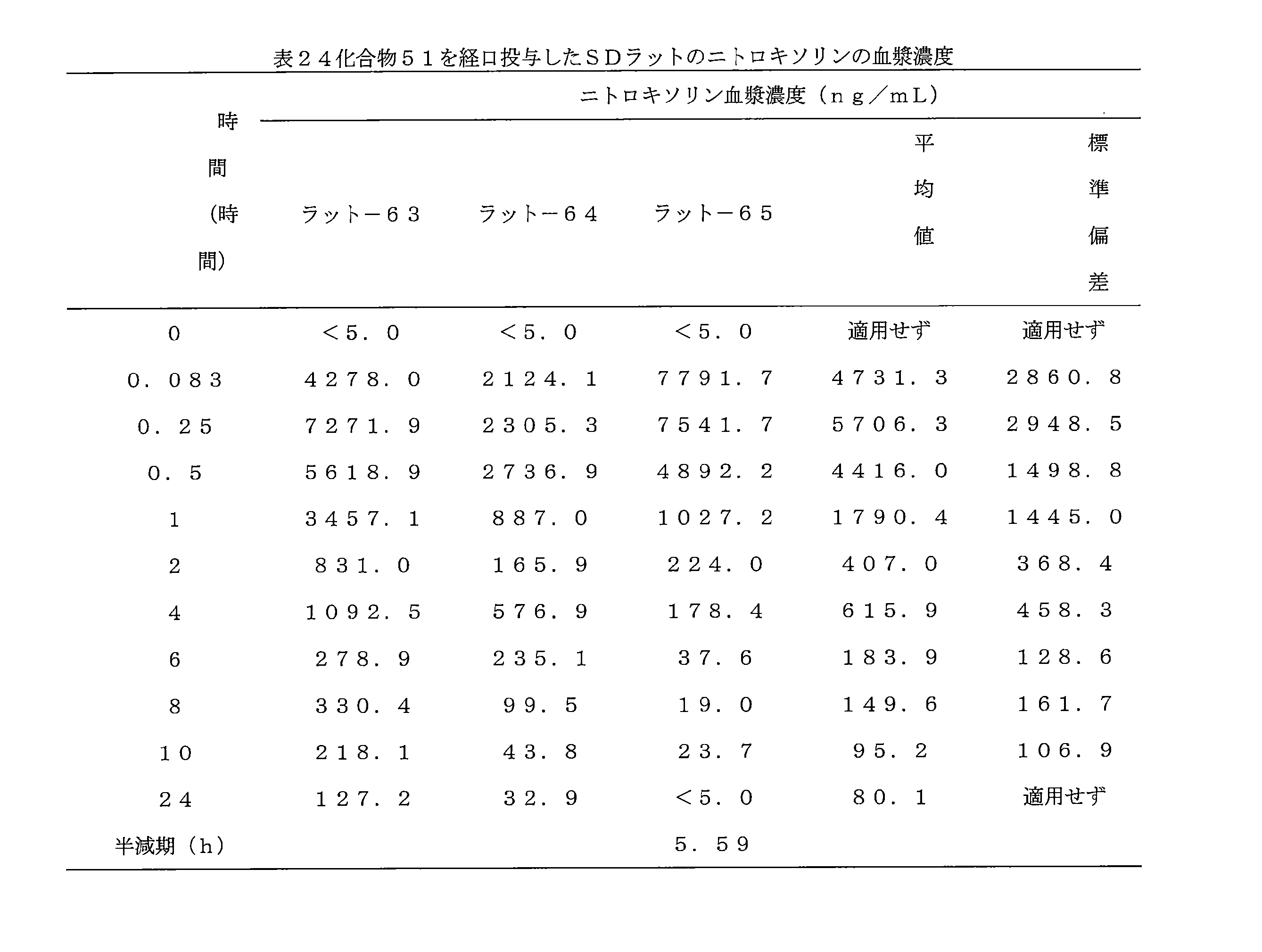
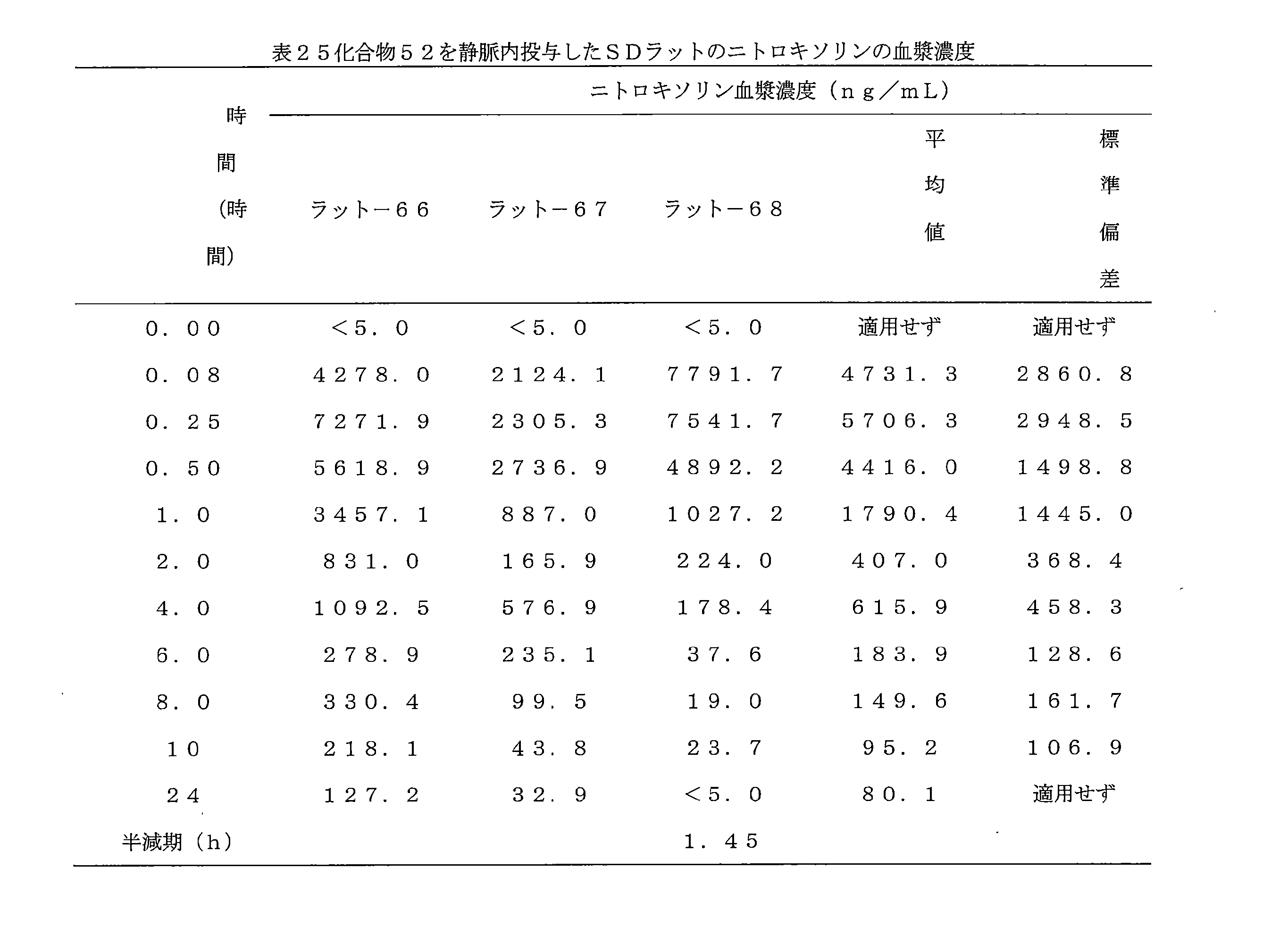


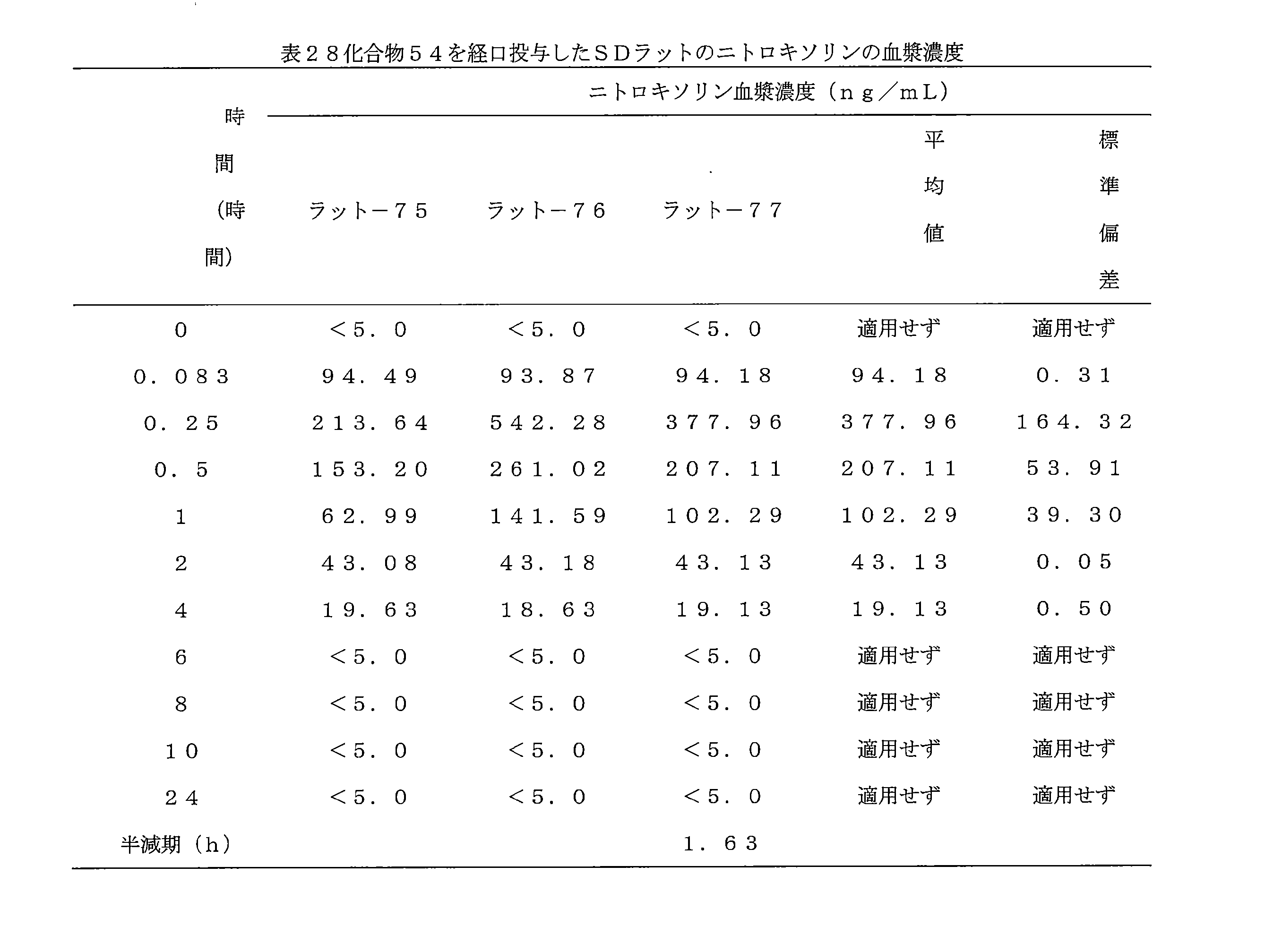
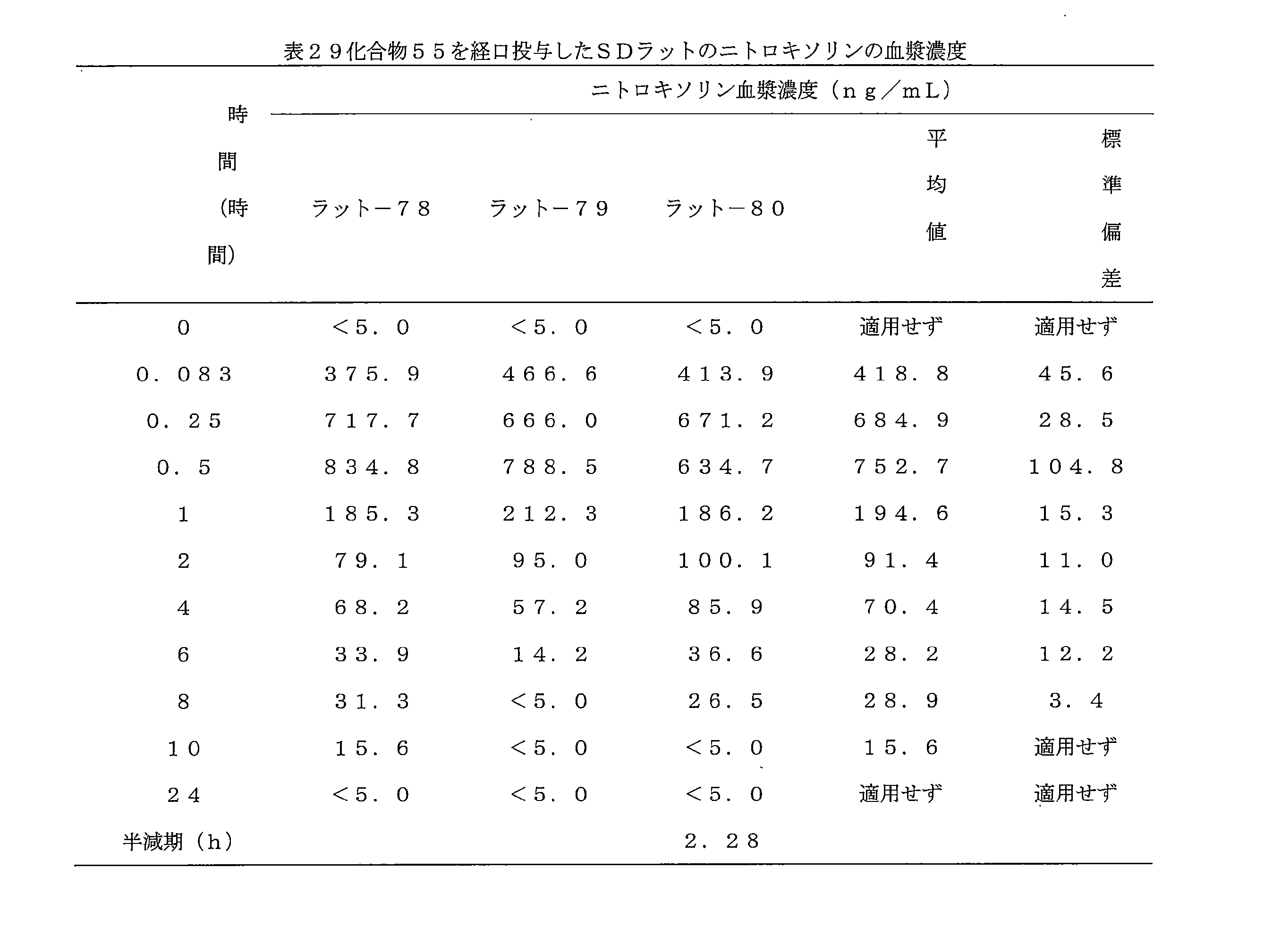

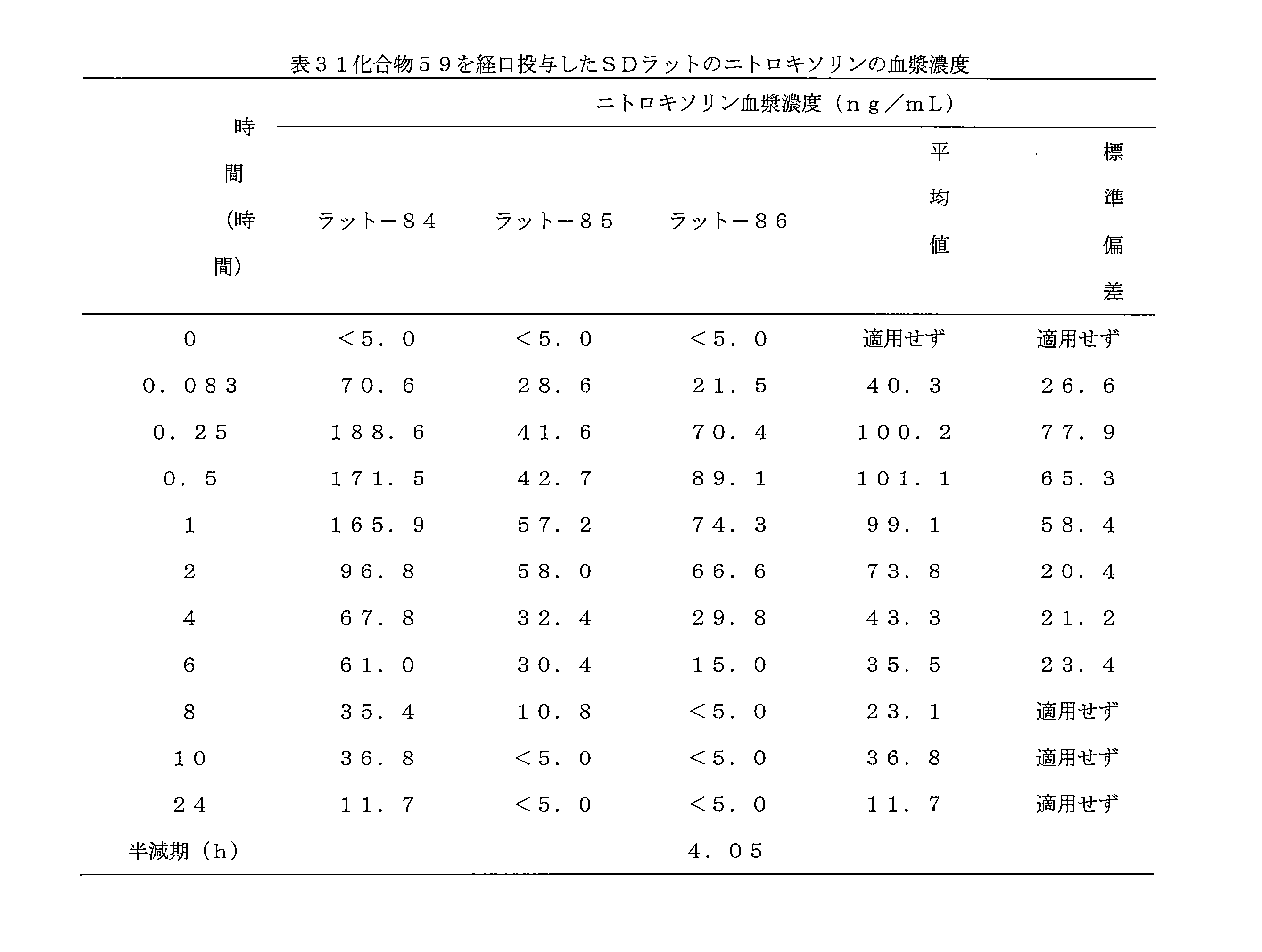
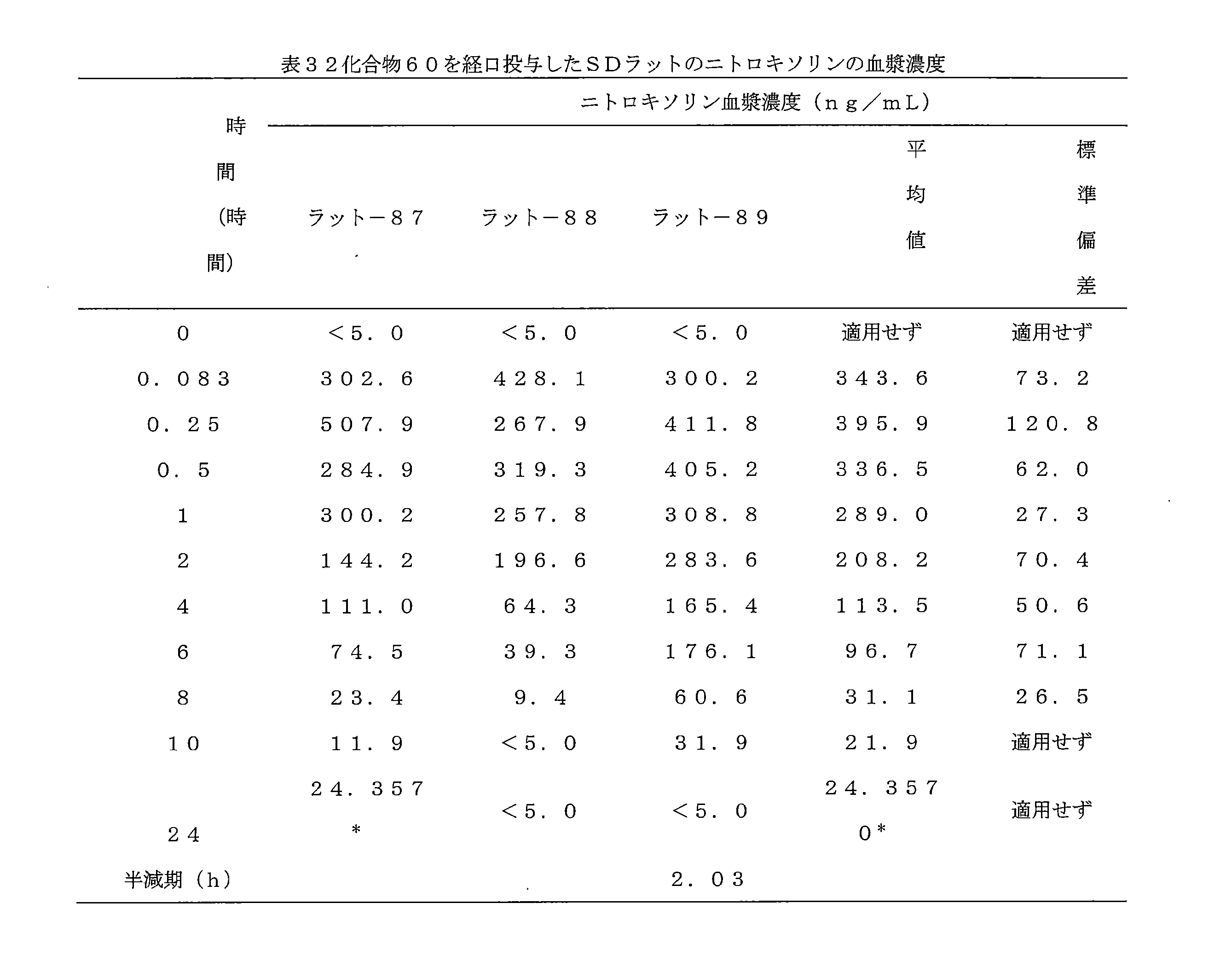

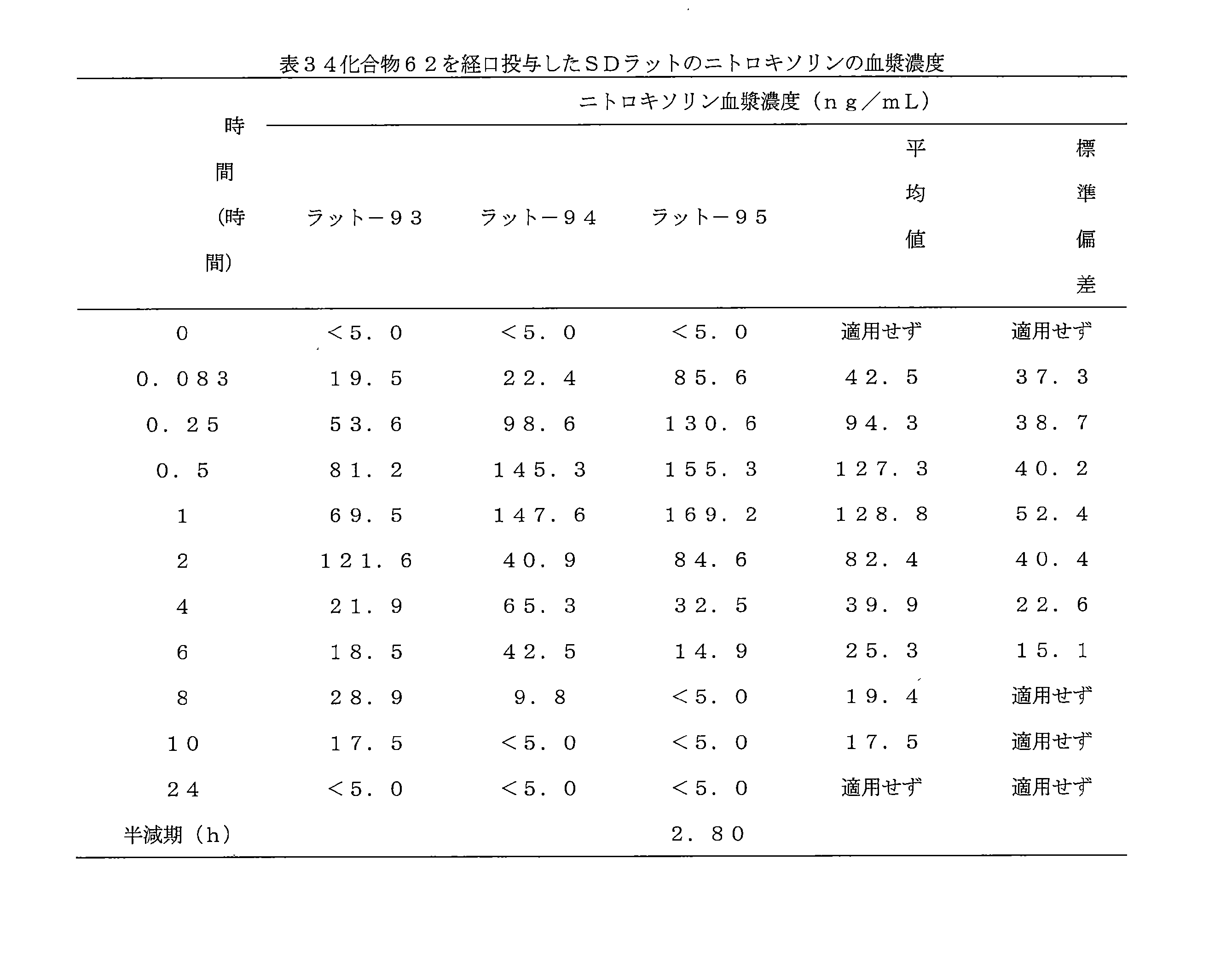

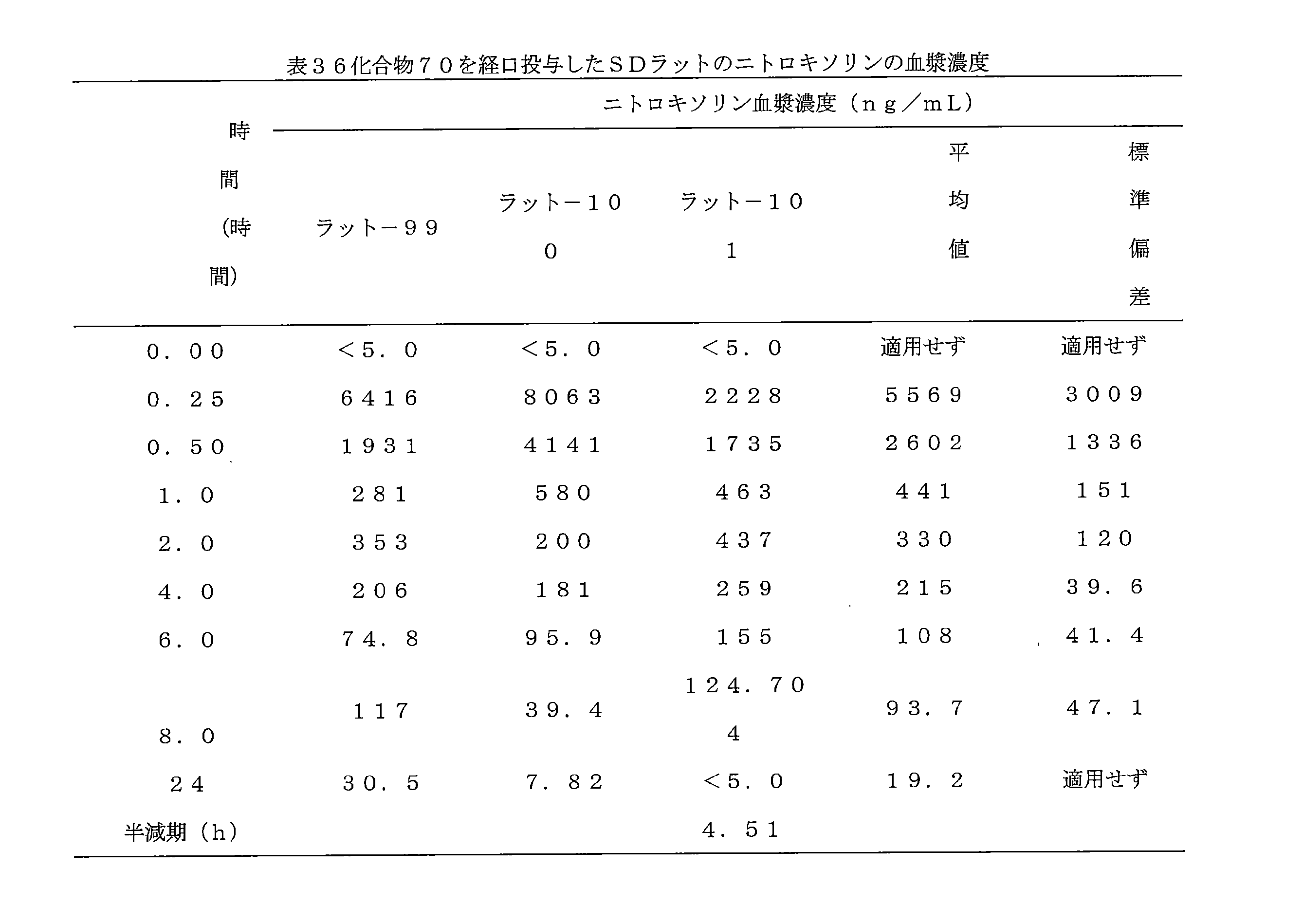
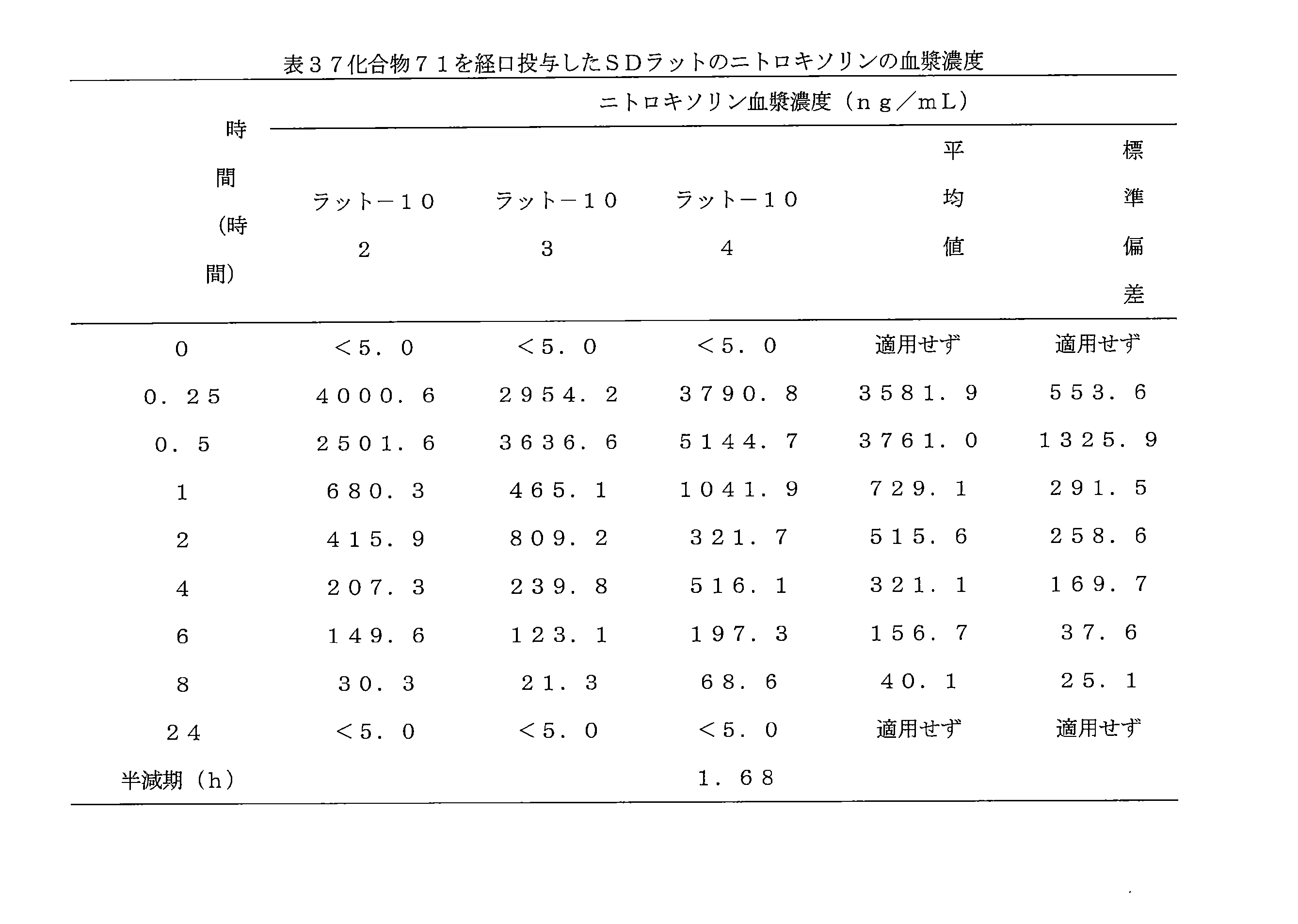


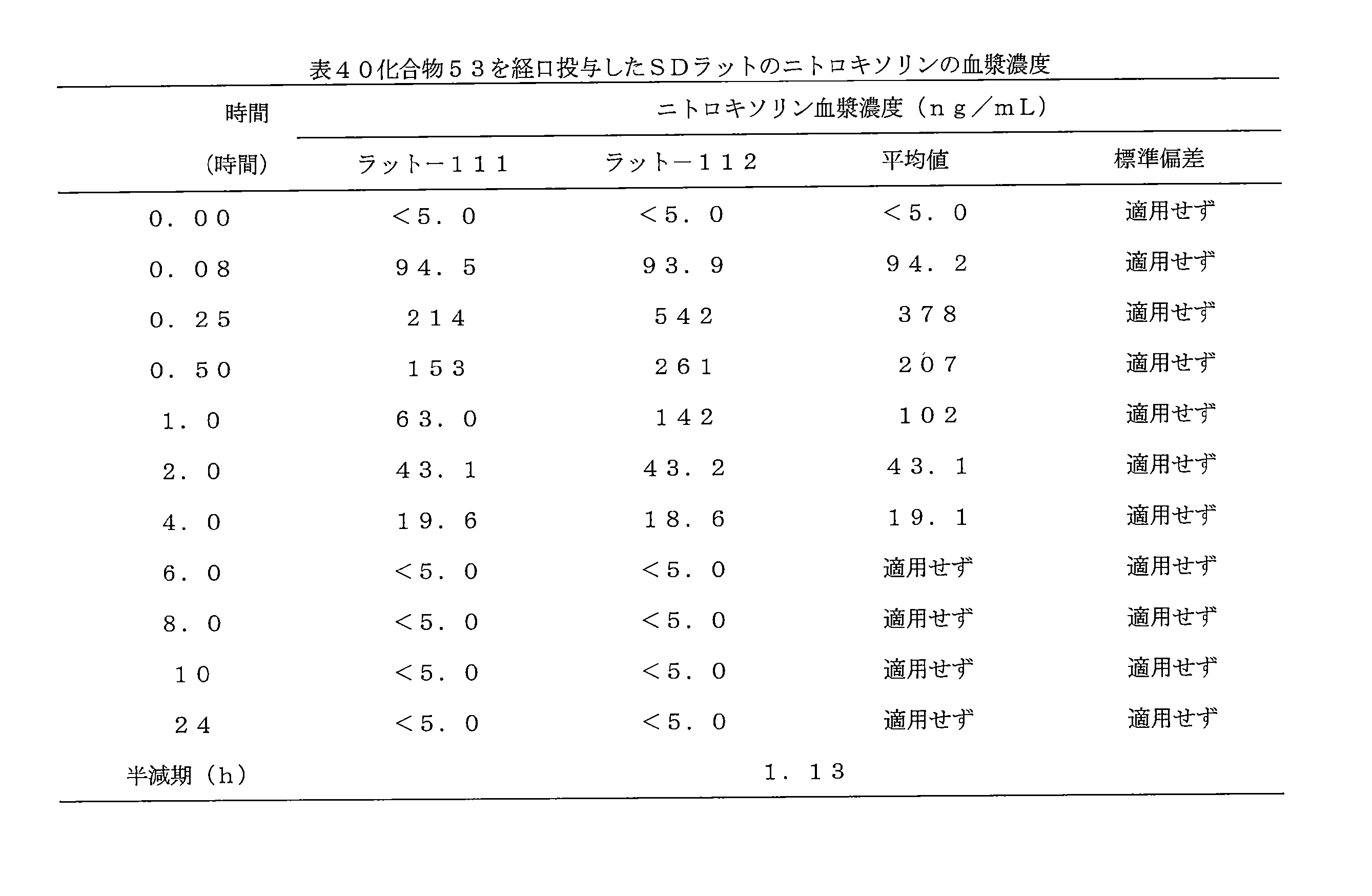
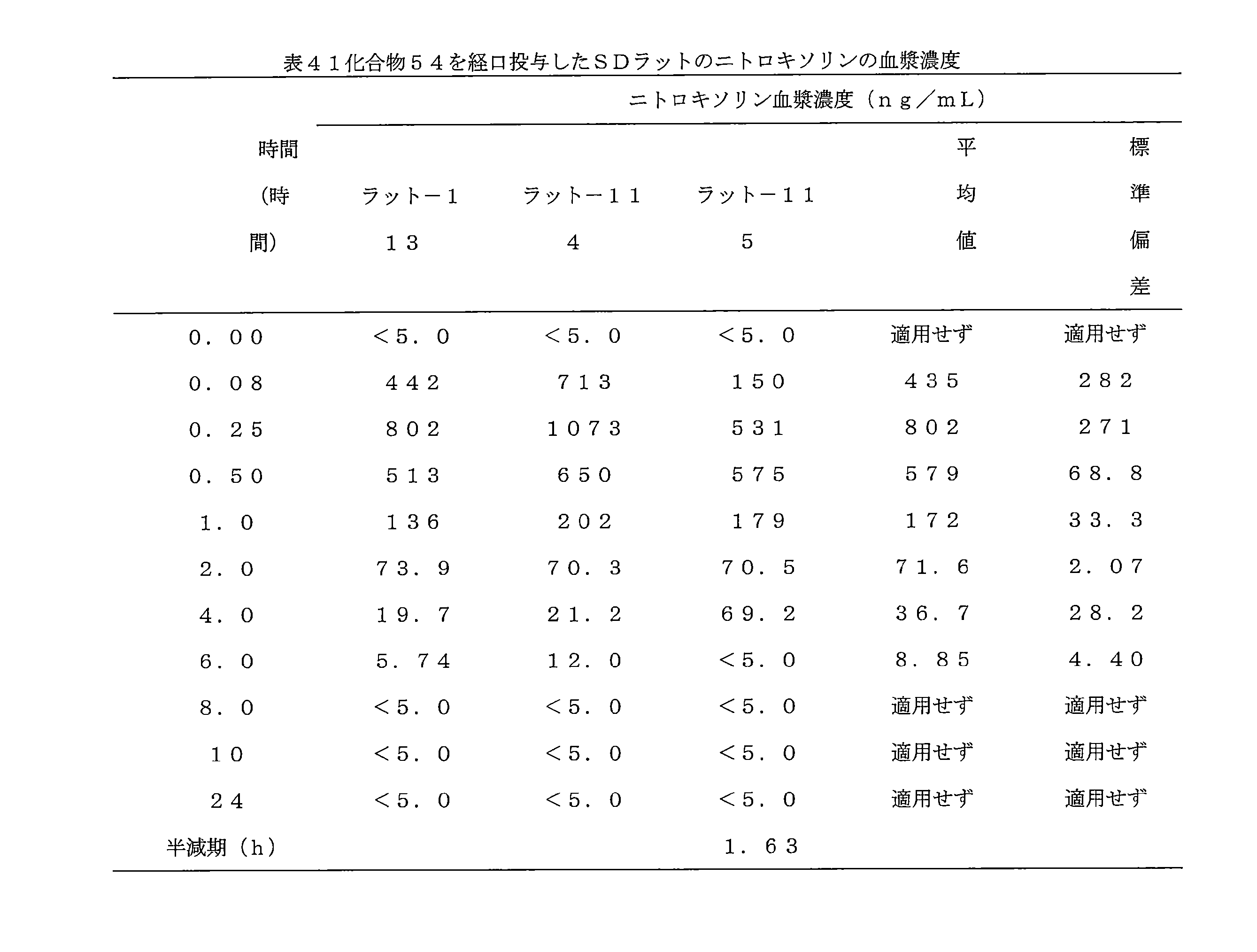
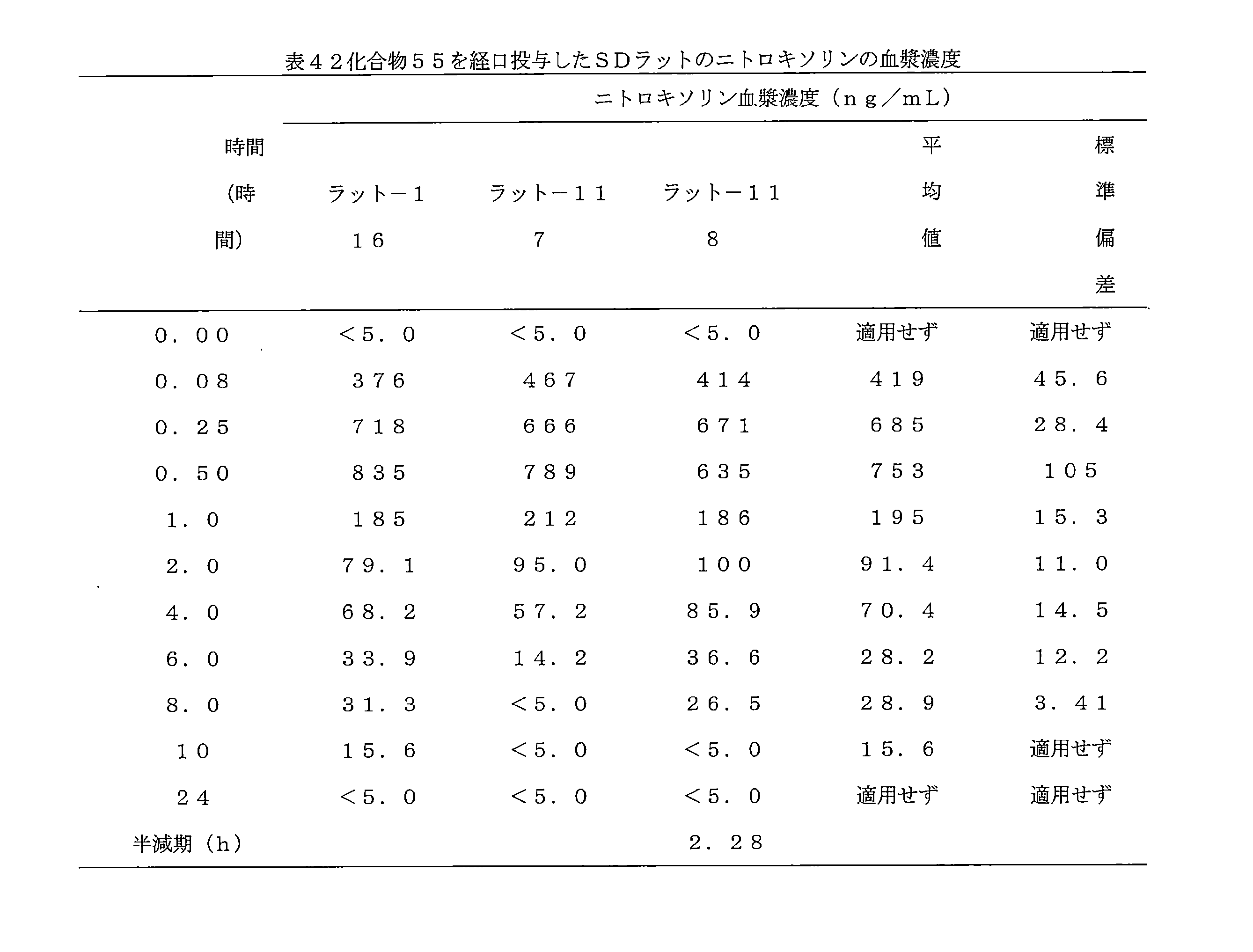

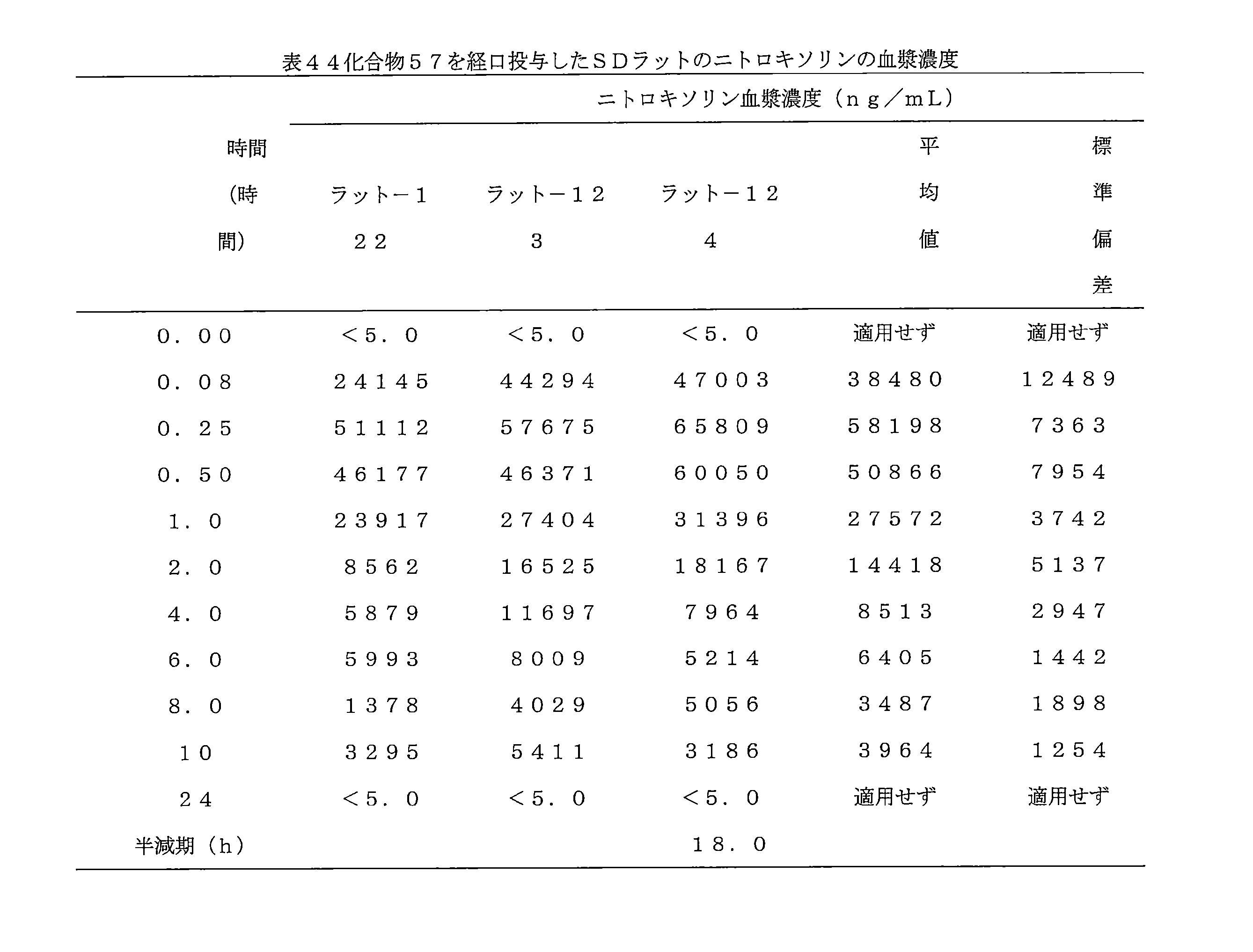
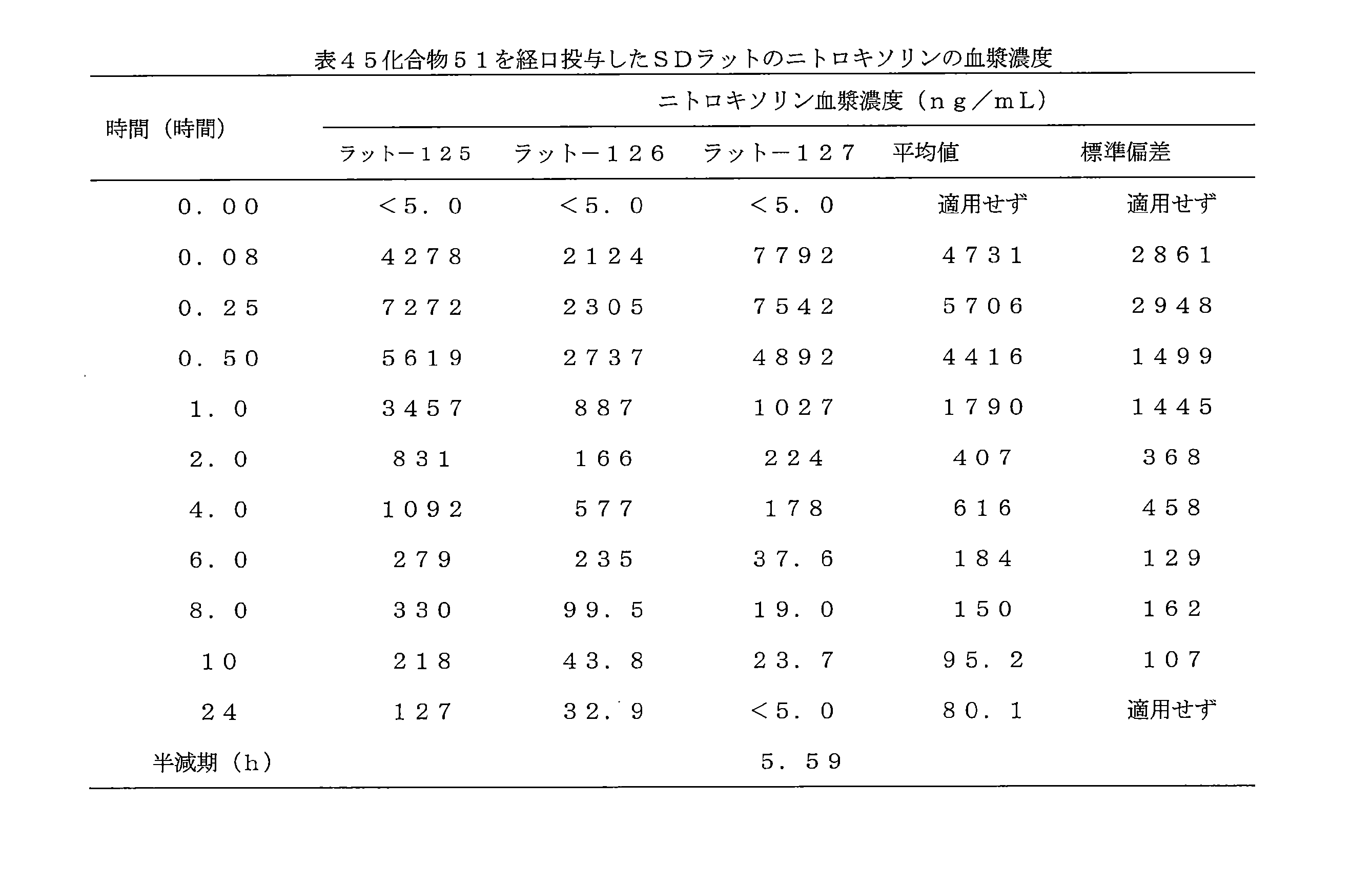
プロドラッグ分子の構造を最適化することによって、ラットにおいて、ニトロキソリンと比較して、プロドラッグ分子の吸収又は半減期が顕著に向上した。これにより、服用量や投与回数を低減する上で、薬物分子に対するコンプライアンスが良好に向上した。
Test Example 3: Pharmacokinetics of the Compound of the Present Invention in Rats Nitroxoline mainly undergoes biphasic metabolism through the liver, and has a fast metabolic rate, so its half-life in the body is short.The present invention modifies its structure and prepares 13 kinds of compounds of formula (I) by chemical synthesis.This test is carried out by administering nitroxoline and compound of formula (I) to rats once intravenously or orally, respectively, and then studying the change in the concentration of compound nitroxoline in rat plasma, thereby evaluating the pharmacokinetics of nitroxoline and compound of formula (I) in rats.
1. Experimental equipment Tandem quadrupole mass spectrometer (API4000, Applied Biosystems, USA), liquid chromatography (1200, Agilent), autosampler (CTC A not applicable for lytics HTC PAL, Applied Biosystems, USA A not applicable for lyst v1.6.2), low temperature refrigerated centrifuge (1-15PK, Sigma), vortex oscillator (VX-III, Beijing Tajin Technology Co., Ltd.).
2. Pharmacokinetic experiment Male SD rats (Beijing Weitong Lihua Experimental Animal Technology Co., Ltd., Experimental Animal Production Permit Number: SCXK (Kyoto) 2016-0006, Experimental Animal Qualification Certificate Number: 11400700325643), 3 rats per group, body weight 180-250g, 6-7 weeks old, fasted overnight before administration, free drinking water, fed 4 hours after administration. The test compound was placed in an EP tube, and DMSO 1.017mL, solutol 2.035mL, and sterile water for injection (volume ratio of the three is 1:2:17, v:v:v) were added, and the compound was sonicated for 20 minutes to dissolve sufficiently (compound concentration: 0.005mmol/mL). The intravenous dose was 0.01mmol/kg, and the oral dose was 0.1mmol/kg. Before administration (0 hours) and 0.0833, 0.25, 0.5, 1, 2, 4, 6, 8, 10, 24, 28, 32, and 48 hours after administration (sampling points were adjusted depending on the situation), 0.3 ml of whole blood was collected from the orbital venous plexus, placed in a centrifuge tube containing EDTA-K2 (Aldrich Reagents) anticoagulant, and placed on crushed ice after collection. Within 0.5 hours, the tube was centrifuged at 5000 rpm for 5 minutes to separate all the plasma, placed in another clean centrifuge tube, and added with stabilizing solution at a ratio of 100:3 (plasma/stabilizing solution, v/v), and placed in a refrigerator at -20°C for preparation for measurement.
Preparation of stable solution: 200 mg of vitamin C (Aldrich) was dissolved in 8 mL of physiological saline, and then 2 mL of formic acid was added and thoroughly mixed.
3. Measurement of sample concentration Calibration curve: A series of working solutions for the calibration curve were prepared, and 5 μL was added to 50 μL of blank rat plasma, and 150 μL of internal standard working solution (containing 2 ng/mL of diphenhydramine (Aldrich Reagents) in acetonitrile) was added, followed by vortex shaking for 1 minute. Centrifugation was performed for 10 minutes at 4°C and 12,000 rpm, and 100 μL of the supernatant was collected in a sampling tube, and 10 μL was injected into a liquid chromatograph mass spectrometer for measurement.
Measurement sample: 50 μL of the measurement sample plasma was mixed with 5 μL of the diluted working solution, then 150 μL of the internal standard working solution (containing diphenhydramine 2 ng/mL in acetonitrile) was added, and the mixture was vortex-shaken for 1 minute. The mixture was centrifuged for 10 minutes at 4° C. and 12,000 rpm, and 100 μL of the supernatant was collected in a sampling tube, and 10 μL was injected into a liquid chromatograph mass spectrometer for measurement. Pharmacokinetic parameters were calculated using WinNonlin V6.2 non-ventricular model.
The measurement results are shown in Tables 4 to 45.
By optimizing the structure of the prodrug molecule, the absorption or half-life of the prodrug molecule was significantly improved in rats compared with nitroxoline, which favorably improved compliance with the drug molecule in terms of reducing the dosage and administration frequency.
試験例4:本発明の化合物のイヌ薬物動態学的測定
ニトロキソリンは主に肝を介して二相代謝をされ代謝速度が速いため、体内での半減期が短い。本発明はその構造を改変し、化学合成法により式(I)化合物を13種類製造した。本試験は、ニトロキソリン及び式(I)化合物をそれぞれ単回静脈又は経口投与した後のイヌ血漿中の化合物ニトロキソリンの濃度変化を検討し、これにより、ニトロキソリン及び式(I)化合物の体内での薬物動態学的挙動を評価した。
1.実験器具
タンデム四重極質量分析計(API5500、米国のアプライドバイオシステムズ社)、液体クロマトグラフィー(1200、アジレント社)、オートサンプラー(CTC AはLytics HTC PALに適用せず)、米国のアプライドバイオシステムズ社AはLyst v1.6.2に適用されない。
2.薬物動態学的実験
雄性ビーグルイヌ(北京マーシャル生物技術有限公司、実験動物生産許可証番号:SCXK(京)2016-0001、実験動物品質証明証番号:11400600001728)、各群ごとに3匹、体重10~13kg、20~22ヶ月齢、投与前一夜断食、自由飲水、投与4時間後給餌。測定対象化合物をEPチューブに入れ、DMSO、solutol、及び滅菌注射水(三者の体積比は1:2:17、v:v:v)を加え、20分超音波処理して十分に溶解させた(化合物の配合濃度は:0.005mmol/mLであった。)。静脈投与量は0.01mmol/kg、経口投与量は0.1mmol/kgであった。投与前(0時間)と投与後0.0833、0.25、0.5、0.75、1、2、4、6、8、10、12時間(サンプリングポイントは状況により調整)に頸静脈から全血0.3mlを採取し、EDTA-K2(Aldrich試薬社)抗凝固を含む遠心チューブに入れ、採取後砕氷中に置き、0.5時間以内に1530gの条件で10分間遠心分離し、血漿をすべて分離し、別のきれいな遠心管内に置き、-20℃の冷蔵庫に入れて測定に備えた。
3.サンプル濃度の測定
一連の検量線の溶液を調製した。検量線溶液10μLとサンプルにそれぞれ1000μLの内標準作動液(ベラパミル5ng/mL(Aldrich社)、グリベンウレア50ng/mL(Aldrich社)、及びジクロフェナク50ng/mL(Aldrich社)を含むアセトニトリル溶液)を加え、5分間ボルテックス振とうした。4℃、3700回転/分の条件で10分間遠心分離し、上清60μLをサンプリング管に入れて120μLの水と混合し、10μLをボルテックス振とうに注入して測定した。WinNonlin V6.2非房室モデルを用いて薬物動態学的パラメータを計算した。
測定結果を次の表46~52に示す。
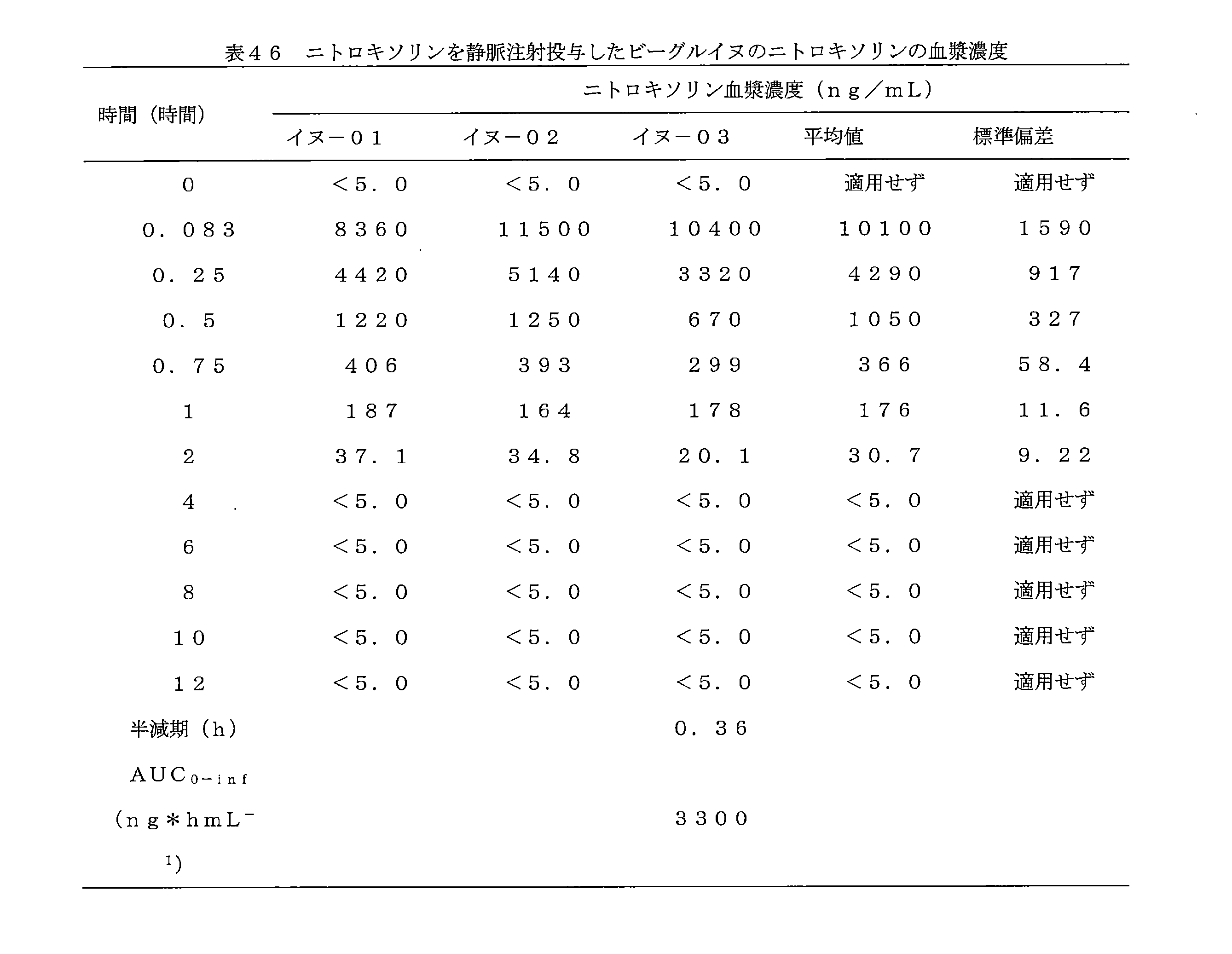

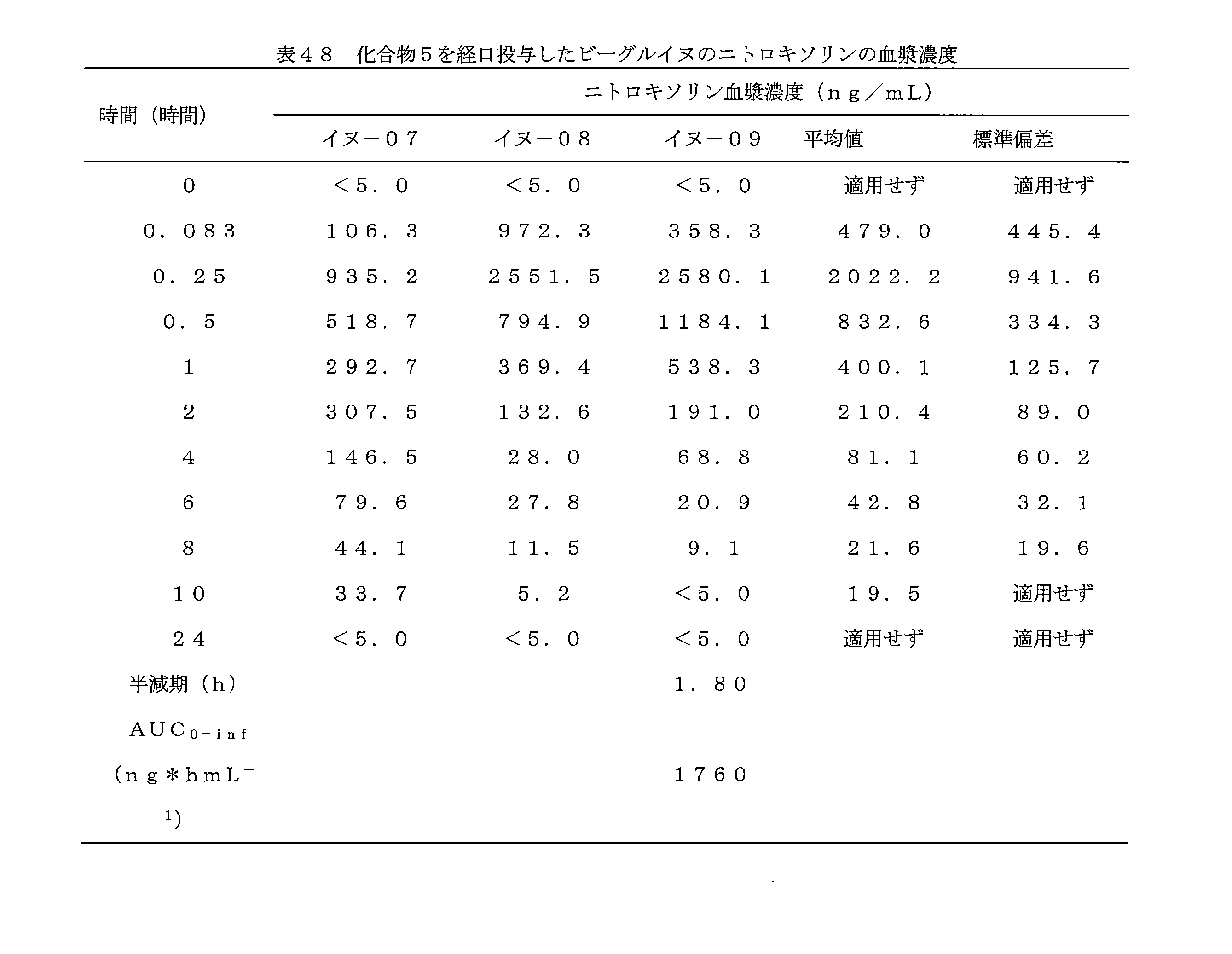


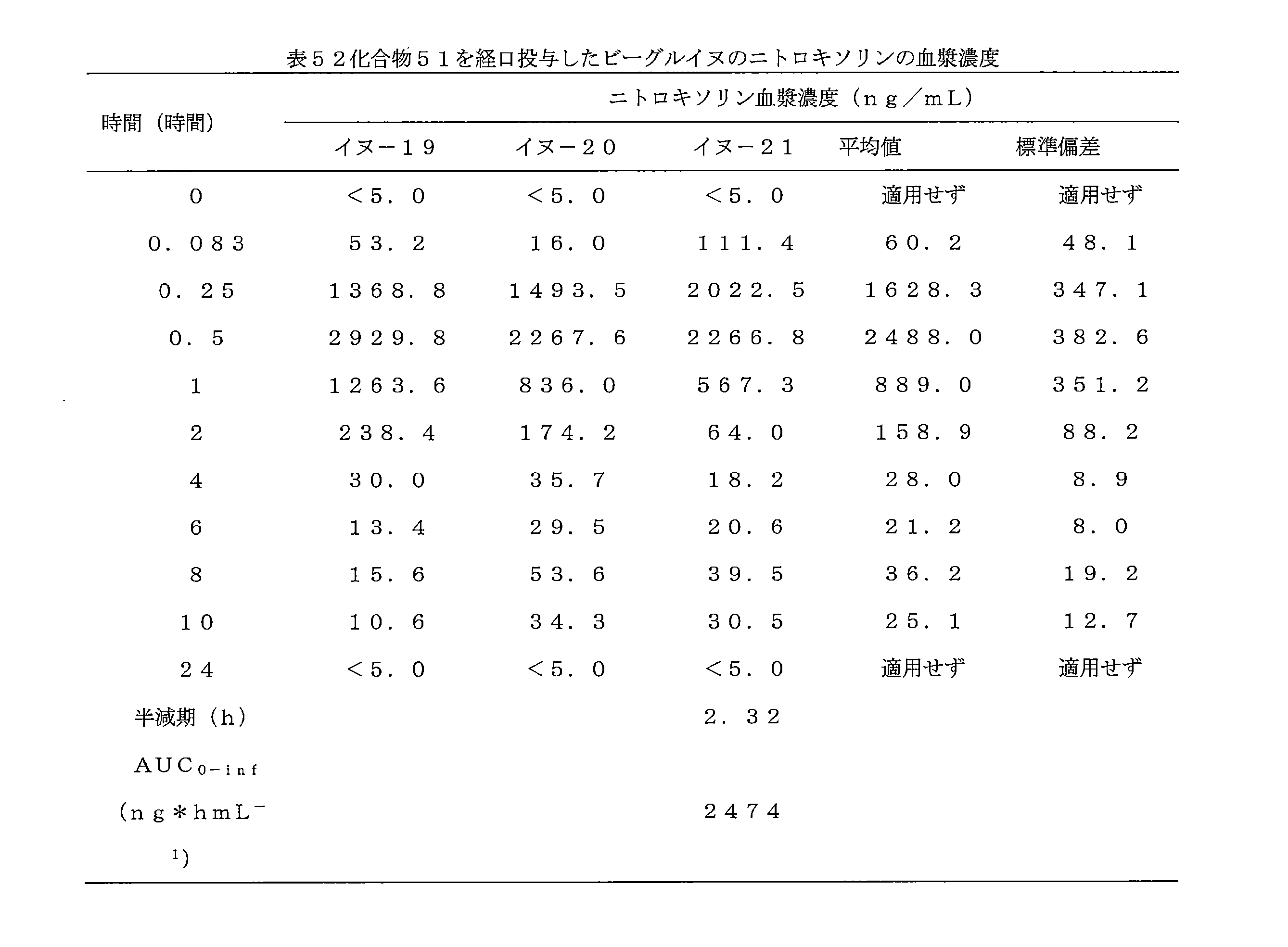
データから明らかなように、プロドラッグ分子化合物5、20、51は、ニトロキソリンに比べて、ビーグルイヌによく吸収されており、プロドラッグ分子により薬物分子の投与量を効果的に低下できることが示唆された。
Test Example 4: Pharmacokinetic measurement of the compound of the present invention in dogs Nitroxoline is mainly metabolized in two phases via the liver and has a fast metabolic rate, so its half-life in the body is short. The present invention modifies its structure and produces 13 types of compounds of formula (I) by chemical synthesis. In this test, the concentration change of compound nitroxoline in dog plasma after single intravenous or oral administration of nitroxoline and compound of formula (I), respectively, was investigated, and the pharmacokinetic behavior of nitroxoline and compound of formula (I) in the body was evaluated.
1. Laboratory equipment Tandem quadrupole mass spectrometer (API5500, Applied Biosystems, USA), Liquid chromatograph (1200, Agilent), Autosampler (CTC A not applicable for Lytics HTC PAL, Applied Biosystems, USA A not applicable for Lyst v1.6.2.
2. Pharmacokinetic experiments Male beagle dogs (Beijing Marshall Biotechnology Co., Ltd., Experimental Animal Production Permit Number: SCXK (Kyoto) 2016-0001, Experimental Animal Quality Certificate Number: 11400600001728), 3 animals per group, body weight 10-13 kg, age 20-22 months, fasted overnight before administration, free drinking water, fed 4 hours after administration. The test compound was placed in an EP tube, and DMSO, solutol, and sterile injection water (volume ratio of the three was 1:2:17, v:v:v) were added, and the mixture was sonicated for 20 minutes to dissolve sufficiently (compound concentration was 0.005 mmol/mL). The intravenous dose was 0.01 mmol/kg, and the oral dose was 0.1 mmol/kg. 0.3 ml of whole blood was collected from the jugular vein before administration (0 hour) and 0.0833, 0.25, 0.5, 0.75, 1, 2, 4, 6, 8, 10, and 12 hours after administration (sampling points were adjusted depending on the situation), placed in a centrifuge tube containing EDTA-K2 (Aldrich Reagents) anticoagulant, placed on crushed ice after collection, and centrifuged at 1530 g for 10 minutes within 0.5 hours to separate all the plasma, placed in another clean centrifuge tube, and placed in a -20°C refrigerator for measurement.
3. Measurement of sample concentration A series of calibration curve solutions were prepared. 10 μL of the calibration curve solution and 1000 μL of the internal standard working solution (acetonitrile solution containing verapamil 5 ng/mL (Aldrich), glibenurea 50 ng/mL (Aldrich), and diclofenac 50 ng/mL (Aldrich)) were added to each sample and vortexed for 5 minutes. Centrifuged for 10 minutes at 4° C. and 3700 rpm, 60 μL of the supernatant was placed in a sampling tube and mixed with 120 μL of water, and 10 μL was injected into the vortex for measurement. Pharmacokinetic parameters were calculated using WinNonlin V6.2 non-ventricular model.
The measurement results are shown in the following Tables 46 to 52.
As is evident from the data, the prodrug molecules Compounds 5, 20, and 51 were better absorbed in beagle dogs than nitroxoline, suggesting that the prodrug molecules can effectively reduce the dose of the drug molecule.
Claims (9)
R1は水素及びC1-6アルキル基からなる群から選ばれ、
R4、R5及びR6は、それぞれ独立して、水素、C1-C12アルキル基及び-O-C 1 -C 6 アルキル基からなる群から選ばれ、又は
R4、R5及びR6のうち、1つは水素であり、残りの2つは炭素と一緒にC3-C6シクロアルキル基又は5~7員複素環基を形成し、前記C3-C6シクロアルキル基又は5~7員複素環基は、-C(O)R11 からなる群から選ばれる1つ又は複数の基によってさらに置換され、
R11 は、C 1-C6アルキル基である。) A compound represented by the following formula (II), or its meso form, racemic form, enantiomer, diastereomer, or mixture thereof, or a pharma- ceutically acceptable salt thereof:
R 1 is selected from the group consisting of hydrogen and C 1-6 alkyl groups;
R 4 , R 5 and R 6 are each independently selected from the group consisting of hydrogen, a C 1 -C 12 alkyl group and an -O- C 1 -C 6 alkyl group ; or one of R 4 , R 5 and R 6 is hydrogen and the remaining two together with the carbon form a C 3 -C 6 cycloalkyl group or a 5- to 7-membered heterocyclic group , which is further substituted with one or more groups selected from the group consisting of -C(O)R 11 ;
R 11 is a C 1 -C 6 alkyl group.
R 4 、R 5 及びR 6 は、それぞれ独立して、水素及びC 1 -C 6 アルキル基からなる群から選ばれ、又は
R 4 、R 5 及びR 6 のうち、1つは水素であり、残りの2つは炭素と一緒にピロリジニル基を形成し、前記ピロリジニル基は-C(O)R 11 からなる群から選択される1つまたは複数の置換基によってさらに置換され、
R11は、C 1-C6アルキル基である、請求項1に記載の式(II)で表される化合物、又はそのメソ体、ラセミ体、エナンチオマー、ジアステレオマー、又はこれらの混合物、又はその医薬的に許容可能な塩。 R 1 is selected from the group consisting of hydrogen and C 1-6 alkyl groups;
R 4 , R 5 and R 6 are each independently selected from the group consisting of hydrogen and C 1 -C 6 alkyl groups; or
One of R 4 , R 5 and R 6 is hydrogen, and the remaining two together with the carbon form a pyrrolidinyl group, which is further substituted with one or more substituents selected from the group consisting of -C(O)R 11 ;
The compound of formula (II) according to claim 1, wherein R 11 is a C 1 -C 6 alkyl group, or a meso form, racemate, enantiomer, diastereomer, or mixture thereof, or a pharma- ceutically acceptable salt thereof.
R4、R5及びR6のうち、1つは水素であり、残りの2つは炭素と一緒にピロリジニル基を形成し、前記ピロリジニル基は-C(O)R11 からなる群から選ばれる1つ又は複数の基によってさらに置換され、
R 11 は、C 1 -C 6 アルキル基である、請求項2に記載の式(II)で表される化合物、又はそのメソ体、ラセミ体、エナンチオマー、ジアステレオマー、又はこれらの混合物、又はその医薬的に許容可能な塩。 R1 is hydrogen ;
One of R 4 , R 5 and R 6 is hydrogen, and the remaining two together with the carbon form a pyrrolidinyl group, which is further substituted with one or more groups selected from the group consisting of -C(O)R 11 ;
The compound of formula (II) according to claim 2, wherein R 11 is a C 1 -C 6 alkyl group, or a meso form, racemate, enantiomer, diastereomer, or mixture thereof, or a pharma- ceutically acceptable salt thereof.
Priority Applications (1)
| Application Number | Priority Date | Filing Date | Title |
|---|---|---|---|
| JP2024132795A JP2024174864A (en) | 2018-09-29 | 2024-08-08 | Nitroxoline prodrugs and uses thereof |
Applications Claiming Priority (3)
| Application Number | Priority Date | Filing Date | Title |
|---|---|---|---|
| CN201811148314 | 2018-09-29 | ||
| CN201811148314.0 | 2018-09-29 | ||
| PCT/CN2019/108419 WO2020063824A1 (en) | 2018-09-29 | 2019-09-27 | Nitroxoline prodrug and use thereof |
Related Child Applications (1)
| Application Number | Title | Priority Date | Filing Date |
|---|---|---|---|
| JP2024132795A Division JP2024174864A (en) | 2018-09-29 | 2024-08-08 | Nitroxoline prodrugs and uses thereof |
Publications (2)
| Publication Number | Publication Date |
|---|---|
| JP2022502510A JP2022502510A (en) | 2022-01-11 |
| JP7624924B2 true JP7624924B2 (en) | 2025-01-31 |
Family
ID=69953367
Family Applications (2)
| Application Number | Title | Priority Date | Filing Date |
|---|---|---|---|
| JP2021542249A Active JP7624924B2 (en) | 2018-09-29 | 2019-09-27 | Nitroxoline prodrugs and uses thereof |
| JP2024132795A Pending JP2024174864A (en) | 2018-09-29 | 2024-08-08 | Nitroxoline prodrugs and uses thereof |
Family Applications After (1)
| Application Number | Title | Priority Date | Filing Date |
|---|---|---|---|
| JP2024132795A Pending JP2024174864A (en) | 2018-09-29 | 2024-08-08 | Nitroxoline prodrugs and uses thereof |
Country Status (12)
| Country | Link |
|---|---|
| US (1) | US12152048B2 (en) |
| EP (1) | EP3858814A4 (en) |
| JP (2) | JP7624924B2 (en) |
| KR (1) | KR102762016B1 (en) |
| CN (1) | CN111295372B (en) |
| AU (1) | AU2019351494B2 (en) |
| BR (1) | BR112021005941A2 (en) |
| CA (1) | CA3113463A1 (en) |
| MX (1) | MX2021003724A (en) |
| SG (1) | SG11202103134TA (en) |
| WO (1) | WO2020063824A1 (en) |
| ZA (1) | ZA202102155B (en) |
Cited By (2)
| Publication number | Priority date | Publication date | Assignee | Title |
|---|---|---|---|---|
| JP2023519276A (en) * | 2020-03-30 | 2023-05-10 | 江▲蘇▼▲亞▼虹医▲薬▼科技股▲フン▼有限公司 | Crystal forms of nitroxoline prodrugs, pharmaceutical compositions containing the same, methods for their preparation and their applications |
| JP2024174864A (en) * | 2018-09-29 | 2024-12-17 | 江▲蘇▼▲亞▼虹医▲薬▼科技股▲フン▼有限公司 | Nitroxoline prodrugs and uses thereof |
Families Citing this family (8)
| Publication number | Priority date | Publication date | Assignee | Title |
|---|---|---|---|---|
| CN112402388A (en) * | 2019-08-05 | 2021-02-26 | 江苏亚虹医药科技股份有限公司 | Oral solid preparation for treating bladder cancer and preparation method thereof |
| CN111514142B (en) * | 2020-05-29 | 2021-04-06 | 江苏亚虹医药科技股份有限公司 | Pharmaceutical composition containing nitroxoline prodrug and preparation method and application thereof |
| CN111646936A (en) * | 2020-06-22 | 2020-09-11 | 江苏亚虹医药科技有限公司 | Process for producing aromatic ether compound |
| CN111773193A (en) * | 2020-07-03 | 2020-10-16 | 江苏亚虹医药科技有限公司 | Pharmaceutical composition containing nitroxoline lysine salt and preparation method and use thereof |
| CN114437033A (en) * | 2020-10-30 | 2022-05-06 | 江苏亚虹医药科技股份有限公司 | Salt of nitroxoline prodrug, pharmaceutical composition containing same, preparation method and use thereof |
| CN112745334B (en) * | 2021-02-07 | 2022-03-25 | 厦门一先药业有限公司 | Prodrugs of Barosavir and derivatives thereof, preparation method and application thereof |
| CA3219273A1 (en) | 2021-05-31 | 2022-12-08 | Yijun Deng | Use of 5-nitro-8-hydroxyquinoline |
| CN118059101A (en) * | 2022-11-22 | 2024-05-24 | 江苏亚虹医药科技股份有限公司 | Uses of 8-hydroxyquinoline derivatives |
Citations (5)
| Publication number | Priority date | Publication date | Assignee | Title |
|---|---|---|---|---|
| JP2002536435A (en) | 1999-02-12 | 2002-10-29 | メディヴィル・アクチボラグ | Non-nucleoside reverse transcriptase inhibitors |
| JP2010520923A (en) | 2007-03-09 | 2010-06-17 | グリーン・クロス・コーポレイション | Orally administrable prodrug of (+)-3-hydroxymorphinan for prevention or treatment of Parkinson's disease |
| JP2016514705A (en) | 2013-03-15 | 2016-05-23 | アジエリス ファーマシューティカル テクノロジーズ コンパニー リミテッド | Nitroxoline base addition salts and uses thereof |
| JP2016520054A (en) | 2013-05-09 | 2016-07-11 | スーチュアン ハイスーク ファーマシューティカル カンパニー リミテッド | Phenol derivative, its production method and medicinal application |
| WO2017210489A1 (en) | 2016-06-01 | 2017-12-07 | M3 Biotechnology, Inc. | Compounds |
Family Cites Families (24)
| Publication number | Priority date | Publication date | Assignee | Title |
|---|---|---|---|---|
| CA883837A (en) | 1971-10-19 | Societe D'etudes De Produits Chimiques | Furoic esters of 5-nitro quinoline and to methods of preparing them | |
| FR1510067A (en) | 1966-12-06 | 1968-01-19 | Carbamic esters derived from quinoline | |
| GB1168307A (en) * | 1967-08-14 | 1969-10-22 | Soc D Etudes Prod Chimique | Novel Esters of 5-Nitro-Quinoline |
| FR2197512B1 (en) | 1972-08-31 | 1977-01-14 | Roussel Uclaf | |
| US3828056A (en) | 1972-09-11 | 1974-08-06 | Searle & Co | (2-(2-methyl-5-nitro-1-imidazolyl)ethyl)heteroaryloxy ethers |
| FR2355829A1 (en) * | 1976-06-24 | 1978-01-20 | Debat Lab | Esters of nitroxoline with (poly)carboxylic or (poly)sulphonic acids - useful as antibacterials and antifungals |
| DE3225169A1 (en) | 1982-07-06 | 1984-01-12 | Basf Ag, 6700 Ludwigshafen | CHINOLINE DERIVATIVES, METHOD FOR THE PRODUCTION THEREOF, THE MICROBICIDES CONTAINING THEM AND THEIR USE FOR CONTROLLING FUNGI |
| US4472404A (en) * | 1982-08-16 | 1984-09-18 | The Dow Chemical Company | 8-Quinolinyl carbamates and their use as urinary tract antimicrobials |
| US4749406A (en) * | 1983-10-18 | 1988-06-07 | Ciba-Geigy Corporation | Quinoline derivatives and compositions thereof for the protection of cultivated plants |
| DE3621540A1 (en) * | 1986-06-27 | 1988-01-07 | Basf Ag | CHINOLINE DERIVATIVES, METHOD FOR THE PRODUCTION THEREOF, THE MICROBICIDES CONTAINING THE SAME AND THE USE THEREOF FOR CONTROLLING BACTERIA AND MUSHROOMS |
| WO1993020094A1 (en) * | 1992-03-27 | 1993-10-14 | Abbott Laboratories | Haptens, tracers, immunogens and antibodies for quinoline |
| IT1317735B1 (en) | 2000-01-26 | 2003-07-15 | Nicox Sa | SALTS OF ANTIMICROBIAL AGENTS. |
| WO2007048097A2 (en) * | 2005-10-20 | 2007-04-26 | California Pacific Medical Center | Anbrosteeone derivatives and method of use thereof |
| US20100078393A1 (en) * | 2008-10-01 | 2010-04-01 | Bei Yin | Biocidal compositions and methods of use |
| CN102239149B (en) | 2008-10-06 | 2015-05-13 | 约翰·霍普金斯大学 | Quinoline compounds as inhibitors of angiogenesis, human methionyl aminopeptidase, and SIRT1, and methods of treating disorders |
| CN101880239A (en) * | 2009-05-08 | 2010-11-10 | 北京美倍他药物研究有限公司 | Water-soluble amino-acid ester derivative of propofol |
| GB201005589D0 (en) * | 2010-04-01 | 2010-05-19 | Respivert Ltd | Novel compounds |
| CN102464631B (en) | 2010-11-08 | 2016-08-10 | 中国科学院上海药物研究所 | Piperazine substituted 1,3-2-substituted carbamide compounds and the substituted amides compound of piperazine and its production and use |
| ES3033141T3 (en) * | 2013-12-30 | 2025-07-31 | Yungjin Pharmaceutical Co Ltd | 1,2-naphthoquinone derivative and method for preparing same |
| CN107709321A (en) * | 2015-04-28 | 2018-02-16 | 盐野义制药株式会社 | Substituted polycyclic pyridone derivatives and prodrugs thereof |
| US10851123B2 (en) * | 2016-02-23 | 2020-12-01 | Concentric Analgesics, Inc. | Prodrugs of phenolic TRPV1 agonists |
| CA3043437A1 (en) * | 2016-11-18 | 2018-05-24 | Neurovive Pharmaceutical Ab | Liver prodrugs of mitochondrial proton ionophores |
| MX2021003724A (en) * | 2018-09-29 | 2021-05-14 | Jiangsu Yahong Meditech Co Ltd | Nitroxoline prodrug and use thereof. |
| BR112022017437A2 (en) * | 2020-03-30 | 2022-10-18 | Jiangsu Yahong Meditech Co Ltd | CRYSTAL FORM OF NITROXOLINE PRO-DRUG, PHARMACEUTICAL COMPOSITION CONTAINING THE SAME, AND METHOD OF PREPARATION AND APPLICATION THEREOF |
-
2019
- 2019-09-27 MX MX2021003724A patent/MX2021003724A/en unknown
- 2019-09-27 BR BR112021005941-5A patent/BR112021005941A2/en unknown
- 2019-09-27 US US17/280,999 patent/US12152048B2/en active Active
- 2019-09-27 WO PCT/CN2019/108419 patent/WO2020063824A1/en not_active Ceased
- 2019-09-27 CN CN201980004913.1A patent/CN111295372B/en active Active
- 2019-09-27 AU AU2019351494A patent/AU2019351494B2/en active Active
- 2019-09-27 KR KR1020217012529A patent/KR102762016B1/en active Active
- 2019-09-27 CA CA3113463A patent/CA3113463A1/en active Pending
- 2019-09-27 JP JP2021542249A patent/JP7624924B2/en active Active
- 2019-09-27 SG SG11202103134TA patent/SG11202103134TA/en unknown
- 2019-09-27 EP EP19864911.3A patent/EP3858814A4/en active Pending
-
2021
- 2021-03-30 ZA ZA2021/02155A patent/ZA202102155B/en unknown
-
2024
- 2024-08-08 JP JP2024132795A patent/JP2024174864A/en active Pending
Patent Citations (5)
| Publication number | Priority date | Publication date | Assignee | Title |
|---|---|---|---|---|
| JP2002536435A (en) | 1999-02-12 | 2002-10-29 | メディヴィル・アクチボラグ | Non-nucleoside reverse transcriptase inhibitors |
| JP2010520923A (en) | 2007-03-09 | 2010-06-17 | グリーン・クロス・コーポレイション | Orally administrable prodrug of (+)-3-hydroxymorphinan for prevention or treatment of Parkinson's disease |
| JP2016514705A (en) | 2013-03-15 | 2016-05-23 | アジエリス ファーマシューティカル テクノロジーズ コンパニー リミテッド | Nitroxoline base addition salts and uses thereof |
| JP2016520054A (en) | 2013-05-09 | 2016-07-11 | スーチュアン ハイスーク ファーマシューティカル カンパニー リミテッド | Phenol derivative, its production method and medicinal application |
| WO2017210489A1 (en) | 2016-06-01 | 2017-12-07 | M3 Biotechnology, Inc. | Compounds |
Non-Patent Citations (1)
| Title |
|---|
| Current Pharmaceutical Design,2010年,Vol. 16, No. 18,pp. 2033-2052 |
Cited By (3)
| Publication number | Priority date | Publication date | Assignee | Title |
|---|---|---|---|---|
| JP2024174864A (en) * | 2018-09-29 | 2024-12-17 | 江▲蘇▼▲亞▼虹医▲薬▼科技股▲フン▼有限公司 | Nitroxoline prodrugs and uses thereof |
| JP2023519276A (en) * | 2020-03-30 | 2023-05-10 | 江▲蘇▼▲亞▼虹医▲薬▼科技股▲フン▼有限公司 | Crystal forms of nitroxoline prodrugs, pharmaceutical compositions containing the same, methods for their preparation and their applications |
| JP7780763B2 (en) | 2020-03-30 | 2025-12-05 | 江▲蘇▼▲亞▼虹医▲薬▼科技股▲フン▼有限公司 | Crystalline forms of nitroxoline prodrugs, pharmaceutical compositions containing the same, and methods for their preparation and applications |
Also Published As
| Publication number | Publication date |
|---|---|
| JP2022502510A (en) | 2022-01-11 |
| KR20210070320A (en) | 2021-06-14 |
| AU2019351494B2 (en) | 2025-03-13 |
| EP3858814A4 (en) | 2022-10-05 |
| BR112021005941A2 (en) | 2021-06-29 |
| US20210363165A1 (en) | 2021-11-25 |
| US12152048B2 (en) | 2024-11-26 |
| JP2024174864A (en) | 2024-12-17 |
| MX2021003724A (en) | 2021-05-14 |
| SG11202103134TA (en) | 2021-04-29 |
| WO2020063824A1 (en) | 2020-04-02 |
| AU2019351494A1 (en) | 2021-05-20 |
| CN111295372A (en) | 2020-06-16 |
| KR102762016B1 (en) | 2025-02-05 |
| CN111295372B (en) | 2021-03-09 |
| CA3113463A1 (en) | 2020-04-02 |
| ZA202102155B (en) | 2025-07-30 |
| EP3858814A1 (en) | 2021-08-04 |
Similar Documents
| Publication | Publication Date | Title |
|---|---|---|
| JP2024174864A (en) | Nitroxoline prodrugs and uses thereof | |
| JP6947644B2 (en) | Deuterated chenodeoxycholic acid derivative and drug composition containing this compound | |
| EP3046920B1 (en) | Glucosylceramide synthase inhibitors for the treatment of diseases | |
| JP2011522843A (en) | Novel potassium channel blockers and their use | |
| JP2001505527A (en) | Taxane derivatives having pyridyl-substituted C <13> side chains, their preparation and their use as antitumor agents | |
| BG98068A (en) | COMPOUNT OF FORMULA 4 - ((2-BENZOTIZOLOYL) METHYLAMINO) -ALPHA (3,4-DIFLUOROPHENOXY) METHYL) -1-PIPERIDINETHANOL, METHODS OF PREPARATION AND USE AND PHARMACEUTICAL COMPOSITIONS AND METHODS FOR THEIR PREPARATION | |
| CN112341377A (en) | Heterocyclic compound and application thereof | |
| JP2005527518A (en) | Novel chalcone derivatives and their use | |
| RU2639875C2 (en) | Phenyl derivative | |
| JP2020500920A (en) | Substituted pyrazoloazepin-4-ones and their use as phosphodiesterase inhibitors | |
| CA3147471A1 (en) | Inhibitors of human atgl | |
| CN113880804A (en) | Novel benzimidazole compounds | |
| JP2026502231A (en) | Complement factor B inhibitors, pharmaceutical compositions and uses thereof | |
| TWI874355B (en) | Prodrug of nitroxoline and use thereof | |
| HK40047998A (en) | Nitroxoline prodrug and use thereof | |
| CN111356677B (en) | Tetrahydroisoquinoline derivative and preparation method and application thereof | |
| CN114149395A (en) | A kind of benzocyclopentenone derivative, its preparation method and medical use | |
| TW202146406A (en) | Novel pyrazine compounds | |
| JP2024125432A (en) | Quinolone derivatives with antimalarial activity | |
| TWI811901B (en) | A kind of pyrimidine formamide compound and application thereof | |
| WO2008157271A1 (en) | Deuterium-enriched escitalopram | |
| JP2006510688A (en) | New aminobenzophenone compounds | |
| WO2008157653A1 (en) | Deuterium-enriched oseltamivir | |
| KR101881115B1 (en) | Novel 2-substituted tetrahydropyran or 2-substituted tetrahydrofuran derivatives, method for preparing the same, and use thereof | |
| TW202411231A (en) | Substituted purinone derivative used as ubiquitin-specific protease inhibitor |
Legal Events
| Date | Code | Title | Description |
|---|---|---|---|
| A621 | Written request for application examination |
Free format text: JAPANESE INTERMEDIATE CODE: A621 Effective date: 20220926 |
|
| A977 | Report on retrieval |
Free format text: JAPANESE INTERMEDIATE CODE: A971007 Effective date: 20230927 |
|
| A131 | Notification of reasons for refusal |
Free format text: JAPANESE INTERMEDIATE CODE: A131 Effective date: 20231023 |
|
| A521 | Request for written amendment filed |
Free format text: JAPANESE INTERMEDIATE CODE: A523 Effective date: 20240123 |
|
| A02 | Decision of refusal |
Free format text: JAPANESE INTERMEDIATE CODE: A02 Effective date: 20240408 |
|
| A521 | Request for written amendment filed |
Free format text: JAPANESE INTERMEDIATE CODE: A523 Effective date: 20240808 |
|
| A911 | Transfer to examiner for re-examination before appeal (zenchi) |
Free format text: JAPANESE INTERMEDIATE CODE: A911 Effective date: 20240903 |
|
| TRDD | Decision of grant or rejection written | ||
| A01 | Written decision to grant a patent or to grant a registration (utility model) |
Free format text: JAPANESE INTERMEDIATE CODE: A01 Effective date: 20250107 |
|
| A61 | First payment of annual fees (during grant procedure) |
Free format text: JAPANESE INTERMEDIATE CODE: A61 Effective date: 20250121 |
|
| R150 | Certificate of patent or registration of utility model |
Ref document number: 7624924 Country of ref document: JP Free format text: JAPANESE INTERMEDIATE CODE: R150 |