JP7623398B2 - Dual-Momentum Gradient Optimization with Reduced Memory Requirements - Google Patents
Dual-Momentum Gradient Optimization with Reduced Memory Requirements Download PDFInfo
- Publication number
- JP7623398B2 JP7623398B2 JP2022561510A JP2022561510A JP7623398B2 JP 7623398 B2 JP7623398 B2 JP 7623398B2 JP 2022561510 A JP2022561510 A JP 2022561510A JP 2022561510 A JP2022561510 A JP 2022561510A JP 7623398 B2 JP7623398 B2 JP 7623398B2
- Authority
- JP
- Japan
- Prior art keywords
- momentum values
- momentum
- format
- gradient
- values
- Prior art date
- Legal status (The legal status is an assumption and is not a legal conclusion. Google has not performed a legal analysis and makes no representation as to the accuracy of the status listed.)
- Active
Links
Images



Classifications
-
- G—PHYSICS
- G06—COMPUTING OR CALCULATING; COUNTING
- G06N—COMPUTING ARRANGEMENTS BASED ON SPECIFIC COMPUTATIONAL MODELS
- G06N20/00—Machine learning
-
- G—PHYSICS
- G06—COMPUTING OR CALCULATING; COUNTING
- G06N—COMPUTING ARRANGEMENTS BASED ON SPECIFIC COMPUTATIONAL MODELS
- G06N3/00—Computing arrangements based on biological models
- G06N3/02—Neural networks
- G06N3/04—Architecture, e.g. interconnection topology
- G06N3/044—Recurrent networks, e.g. Hopfield networks
-
- G—PHYSICS
- G06—COMPUTING OR CALCULATING; COUNTING
- G06N—COMPUTING ARRANGEMENTS BASED ON SPECIFIC COMPUTATIONAL MODELS
- G06N3/00—Computing arrangements based on biological models
- G06N3/02—Neural networks
- G06N3/04—Architecture, e.g. interconnection topology
- G06N3/044—Recurrent networks, e.g. Hopfield networks
- G06N3/0442—Recurrent networks, e.g. Hopfield networks characterised by memory or gating, e.g. long short-term memory [LSTM] or gated recurrent units [GRU]
-
- G—PHYSICS
- G06—COMPUTING OR CALCULATING; COUNTING
- G06N—COMPUTING ARRANGEMENTS BASED ON SPECIFIC COMPUTATIONAL MODELS
- G06N3/00—Computing arrangements based on biological models
- G06N3/02—Neural networks
- G06N3/04—Architecture, e.g. interconnection topology
- G06N3/045—Combinations of networks
-
- G—PHYSICS
- G06—COMPUTING OR CALCULATING; COUNTING
- G06N—COMPUTING ARRANGEMENTS BASED ON SPECIFIC COMPUTATIONAL MODELS
- G06N3/00—Computing arrangements based on biological models
- G06N3/02—Neural networks
- G06N3/04—Architecture, e.g. interconnection topology
- G06N3/0464—Convolutional networks [CNN, ConvNet]
-
- G—PHYSICS
- G06—COMPUTING OR CALCULATING; COUNTING
- G06N—COMPUTING ARRANGEMENTS BASED ON SPECIFIC COMPUTATIONAL MODELS
- G06N3/00—Computing arrangements based on biological models
- G06N3/02—Neural networks
- G06N3/04—Architecture, e.g. interconnection topology
- G06N3/0495—Quantised networks; Sparse networks; Compressed networks
-
- G—PHYSICS
- G06—COMPUTING OR CALCULATING; COUNTING
- G06N—COMPUTING ARRANGEMENTS BASED ON SPECIFIC COMPUTATIONAL MODELS
- G06N3/00—Computing arrangements based on biological models
- G06N3/02—Neural networks
- G06N3/06—Physical realisation, i.e. hardware implementation of neural networks, neurons or parts of neurons
- G06N3/063—Physical realisation, i.e. hardware implementation of neural networks, neurons or parts of neurons using electronic means
-
- G—PHYSICS
- G06—COMPUTING OR CALCULATING; COUNTING
- G06N—COMPUTING ARRANGEMENTS BASED ON SPECIFIC COMPUTATIONAL MODELS
- G06N3/00—Computing arrangements based on biological models
- G06N3/02—Neural networks
- G06N3/08—Learning methods
- G06N3/084—Backpropagation, e.g. using gradient descent
-
- G—PHYSICS
- G06—COMPUTING OR CALCULATING; COUNTING
- G06N—COMPUTING ARRANGEMENTS BASED ON SPECIFIC COMPUTATIONAL MODELS
- G06N3/00—Computing arrangements based on biological models
- G06N3/02—Neural networks
- G06N3/08—Learning methods
- G06N3/09—Supervised learning
-
- G—PHYSICS
- G06—COMPUTING OR CALCULATING; COUNTING
- G06N—COMPUTING ARRANGEMENTS BASED ON SPECIFIC COMPUTATIONAL MODELS
- G06N3/00—Computing arrangements based on biological models
- G06N3/02—Neural networks
- G06N3/08—Learning methods
- G06N3/098—Distributed learning, e.g. federated learning
-
- G—PHYSICS
- G06—COMPUTING OR CALCULATING; COUNTING
- G06N—COMPUTING ARRANGEMENTS BASED ON SPECIFIC COMPUTATIONAL MODELS
- G06N5/00—Computing arrangements using knowledge-based models
- G06N5/04—Inference or reasoning models
- G06N5/046—Forward inferencing; Production systems
Landscapes
- Engineering & Computer Science (AREA)
- Theoretical Computer Science (AREA)
- Physics & Mathematics (AREA)
- Software Systems (AREA)
- Computing Systems (AREA)
- Artificial Intelligence (AREA)
- Mathematical Physics (AREA)
- General Physics & Mathematics (AREA)
- Data Mining & Analysis (AREA)
- Evolutionary Computation (AREA)
- General Engineering & Computer Science (AREA)
- Biophysics (AREA)
- Biomedical Technology (AREA)
- Life Sciences & Earth Sciences (AREA)
- Health & Medical Sciences (AREA)
- Computational Linguistics (AREA)
- General Health & Medical Sciences (AREA)
- Molecular Biology (AREA)
- Neurology (AREA)
- Computer Vision & Pattern Recognition (AREA)
- Medical Informatics (AREA)
- Complex Calculations (AREA)
- Management, Administration, Business Operations System, And Electronic Commerce (AREA)
- Feedback Control In General (AREA)
- Advance Control (AREA)
Description
本願発明の一実施例は、例えば、メモリ要件が低減されたデュアルモーメンタム勾配最適化に関する。 One embodiment of the present invention relates, for example, to dual momentum gradient optimization with reduced memory requirements.
[0001]ニューラルネットワークモデルを含む訓練されたモデルは、読解、言語翻訳、画像認識、または音声認識などの複雑なタスクを実行するために使用される。自然言語処理(NLP)、回帰型ニューラルネットワーク(RNN)、畳み込みニューラルネットワーク(CNN)、長短期記憶(LSTM)ニューラルネットワーク、またはゲート回帰ユニット(GRU)に基づくものなどの機械学習サービスは、そのような複雑なタスクを実行するために展開されている。これらのタイプのモデルは様々なアーキテクチャおよび手法を用いて訓練されているが、訓練を行うための基盤となるアーキテクチャおよび手法には引き続き改良が求められている。 [0001] Trained models, including neural network models, are used to perform complex tasks such as reading comprehension, language translation, image recognition, or speech recognition. Machine learning services, such as those based on natural language processing (NLP), recurrent neural networks (RNNs), convolutional neural networks (CNNs), long short-term memory (LSTM) neural networks, or gated recurrent units (GRUs), are deployed to perform such complex tasks. These types of models are trained using a variety of architectures and techniques, but the underlying architectures and techniques for training continue to require improvement.
本願発明の一実施例は、例えば、メモリ要件が低減されたデュアルモーメンタム勾配最適化に関する。 One embodiment of the present invention relates, for example, to dual momentum gradient optimization with reduced memory requirements.
[0002]一例において、本開示は、勾配オプティマイザと、L層を含むニューラルネットワークモデルに関連するモーメンタム値を記憶するように構成されたメモリと、を含むシステムにおける方法に関し、Lは1より大きい整数である。本方法は、選択された記憶フォーマットを有する、ニューラルネットワークモデルの層に対応する、モーメンタム値の第1のセットをメモリから取り出すステップと、選択された記憶フォーマットを有する、ニューラルネットワークモデルの層に対応する、モーメンタム値の第2のセットをメモリから取り出すステップと、を含んでもよい。本方法は、選択された記憶フォーマットを有するモーメンタム値の第1のセットを、勾配オプティマイザに関連付けられた訓練フォーマットを有するモーメンタム値の第3のセットに変換するステップと、選択された記憶フォーマットを有するモーメンタム値の第2のセットを、勾配オプティマイザに関連付けられた訓練フォーマットを有するモーメンタム値の第4のセットに変換するステップと、をさらに含んでもよい。本方法は、勾配オプティマイザを用いて、モーメンタム値の第3のセットおよびモーメンタム値の第4のセットを使用して勾配最適化を実行するステップをさらに含み得る。 [0002] In one example, the disclosure relates to a method in a system including a gradient optimizer and a memory configured to store momentum values associated with a neural network model including L layers, where L is an integer greater than 1. The method may include retrieving from the memory a first set of momentum values corresponding to a layer of the neural network model having a selected storage format, and retrieving from the memory a second set of momentum values corresponding to the layer of the neural network model having the selected storage format. The method may further include converting the first set of momentum values having the selected storage format to a third set of momentum values having a training format associated with the gradient optimizer, and converting the second set of momentum values having the selected storage format to a fourth set of momentum values having a training format associated with the gradient optimizer. The method may further include performing a gradient optimization using the third set of momentum values and the fourth set of momentum values with the gradient optimizer.
[0003]別の例では、本開示は、勾配オプティマイザを含むシステムに関する。システムは、L層を含むニューラルネットワークモデルに関連するモーメンタム値を記憶するように構成されたメモリを含んでもよく、Lは1より大きい整数である。本システムは、(1)選択された記憶フォーマットを有する、ニューラルネットワークモデルの層に対応する、モーメンタム値の第1のセットをメモリから取り出し、選択された記憶フォーマットを有する、ニューラルネットワークモデルの層に対応する、モーメンタム値の第2のセットをメモリから取り出し、(2)選択された記憶フォーマットを有するモーメンタム値の第1のセットを、勾配オプティマイザに関連付けられた訓練フォーマットを有するモーメンタム値の第3のセットに変換し、選択された記憶フォーマットを有するモーメンタム値の第2のセットを、勾配オプティマイザに関連付けられた訓練フォーマットを有するモーメンタム値の第4のセットに変換し、(3)勾配オプティマイザを使用して、モーメンタム値の第3のセットとモーメンタム値の第4のセットを用いて勾配最適化を実行する、ように構成されてもよい。 [0003] In another example, the disclosure relates to a system including a gradient optimizer. The system may include a memory configured to store momentum values associated with a neural network model including L layers, where L is an integer greater than 1. The system may be configured to (1) retrieve from the memory a first set of momentum values corresponding to layers of the neural network model having a selected storage format, and retrieve from the memory a second set of momentum values corresponding to layers of the neural network model having the selected storage format, (2) convert the first set of momentum values having the selected storage format to a third set of momentum values having a training format associated with the gradient optimizer, and convert the second set of momentum values having the selected storage format to a fourth set of momentum values having a training format associated with the gradient optimizer, and (3) perform a gradient optimization using the third set of momentum values and the fourth set of momentum values using the gradient optimizer.
[0004]さらに別の例では、本開示は、勾配オプティマイザと、L層を含むニューラルネットワークモデルに関連する重みおよびモーメンタム値を記憶するように構成されたメモリと、を含むシステムにおける方法に関し、Lは1より大きい整数である。本方法は、選択された記憶フォーマットを有する、ニューラルネットワークモデルの層に対応するモーメンタム値の第1のセットをメモリから取り出すステップと、選択された記憶フォーマットを有する、ニューラルネットワークモデルの層に対応するモーメンタム値の第2のセットをメモリから取り出すステップと、をさらに含んでもよい。本方法は、選択された記憶フォーマットを有するモーメンタム値の第1のセットを、勾配オプティマイザに関連付けられた訓練フォーマットを有するモーメンタム値の第3のセットに変換するステップと、選択された記憶フォーマットを有するモーメンタム値の第2のセットを、勾配オプティマイザに関連付けられた訓練フォーマットを有するモーメンタム値の第4のセットに変換するステップと、をさらに含んでもよい。本方法は、勾配オプティマイザを用いて、モーメンタム値の第3のセットおよびモーメンタム値の第4のセットを使用して勾配最適化を実行するステップをさらに含んでもよい。本方法は、勾配最適化の次の反復のためのモーメンタム値の第5のセットおよびモーメンタム値の第6のセットを生成するステップをさらに含んでもよい。本方法は、符号ビットのみを記憶し、モーメンタム値の第5のセットの仮数に関連する所定の数のビットを切り捨てることによって、モーメンタム値の第5のセットを、記憶フォーマットを有するモーメンタム値の第7のセットに変換するステップをさらに含んでもよい。本方法は、符号ビットのみを記憶し、モーメンタム値の第6のセットの仮数に関連する所定の数のビットを切り捨てることによって、モーメンタム値の第6のセットを、記憶フォーマットを有するモーメンタム値の第8のセットに変換するステップをさらに含んでもよい。 [0004] In yet another example, the disclosure relates to a method in a system including a gradient optimizer and a memory configured to store weights and momentum values associated with a neural network model including L layers, where L is an integer greater than 1. The method may further include retrieving from the memory a first set of momentum values corresponding to the layers of the neural network model having a selected storage format, and retrieving from the memory a second set of momentum values corresponding to the layers of the neural network model having the selected storage format. The method may further include converting the first set of momentum values having the selected storage format to a third set of momentum values having a training format associated with the gradient optimizer, and converting the second set of momentum values having the selected storage format to a fourth set of momentum values having a training format associated with the gradient optimizer. The method may further include performing a gradient optimization using the third set of momentum values and the fourth set of momentum values with the gradient optimizer. The method may further include generating a fifth set of momentum values and a sixth set of momentum values for a next iteration of the gradient optimization. The method may further include converting the fifth set of momentum values to a seventh set of momentum values having a storage format by storing only a sign bit and truncating a predetermined number of bits associated with the mantissa of the fifth set of momentum values. The method may further include converting the sixth set of momentum values to an eighth set of momentum values having a storage format by storing only a sign bit and truncating a predetermined number of bits associated with the mantissa of the sixth set of momentum values.
[0005]この発明の概要は、詳細な説明において以下でさらに説明される概念の選択を簡略化した形で紹介するために提供される。この発明の概要は、特許請求される主題の重要な特徴または本質的な特徴を特定することを意図しておらず、特許請求される主題の範囲を限定するために使用することも意図していない。 [0005] This Summary is provided to introduce a selection of concepts in a simplified form that are further described below in the Detailed Description. This Summary is not intended to identify key features or essential features of the claimed subject matter, nor is it intended to be used to limit the scope of the claimed subject matter.
[0006]本開示は、例として説明されており、添付の図によって限定されるものではなく、その中で、同様の参照は同様の要素を示している。図中の要素は、単純化および明確化のために図示されており、必ずしも縮尺通りに描かれていない。 [0006] The present disclosure is illustrated by way of example and not by way of limitation in the accompanying figures, in which like references indicate like elements. Elements in the figures are illustrated for simplicity and clarity and have not necessarily been drawn to scale.
[00017]本開示で開示される例は、メモリ要件が低減されたデュアルモーメンタム勾配最適化に関する。特定の例は、より少ないメモリを必要とする、ニューラルネットワークモデルを含むモデルの分散訓練に関する。特定の例の訓練システムでは、各ワーカ(例えば、GPU、DSP、またはASICアクセラレータ)は、訓練データのサブセット(例えば、ミニバッチ)を取り、勾配を計算し、これは、さらに平均化/低減されてモデルのパラメータ(例えば、重さ)を更新する。重みの更新は、勾配を計算するバックプロパゲーションのステップの後に適用される。一例として、ネットワーク(またはネットワークの一部)の重みに関する損失関数の勾配が計算される。そして、その勾配を最適化手法に与え、勾配を利用して、損失関数を最小化するように重みを更新する。バックプロパゲーションの目標は、実際の出力を目標出力に近づけるようにネットワーク内の各重み(または少なくとも重みの一部)を更新し、それによって各出力ニューロンおよびネットワーク全体としての誤差を最小にすることである。 [00017] Examples disclosed in this disclosure relate to dual momentum gradient optimization with reduced memory requirements. A particular example relates to distributed training of models, including neural network models, that requires less memory. In a particular example training system, each worker (e.g., GPU, DSP, or ASIC accelerator) takes a subset (e.g., mini-batch) of the training data and calculates gradients, which are further averaged/reduced to update the parameters (e.g., weights) of the model. The weight updates are applied after a backpropagation step that calculates the gradients. As an example, the gradient of a loss function with respect to the weights of a network (or part of a network) is calculated. The gradient is then fed into an optimization technique that uses the gradient to update the weights to minimize the loss function. The goal of backpropagation is to update each weight (or at least a portion of the weights) in the network to move the actual output closer to the target output, thereby minimizing the error of each output neuron and the network as a whole.
[00018]特定の例では、訓練されたモデルは、クラウドコンピューティング環境に展開することができる。クラウドコンピューティングは、構成可能なコンピューティングリソースの共有プールへのオンデマンドネットワークアクセスを可能にするためのモデルを指す場合がある。例えば、クラウドコンピューティングは、構成可能なコンピューティングリソースの共有プールへのユビキタスかつ便利なオンデマンドアクセスを提供するために市場で採用され得る。構成可能なコンピューティングリソースの共有プールは、仮想化によって迅速にプロビジョニングされ、管理作業またはサービスプロバイダとのやりとりが少ない状態でリリースされ、その後適宜スケーリングされる。クラウドコンピューティングモデルは、例えば、オンデマンドセルフサービス、幅広いネットワークアクセス、リソースプーリング、迅速な弾力性、測定サービスなど、様々な特性で構成することができる。クラウドコンピューティングモデルは、例えば、ハードウェア・アズ・ア・サービス(「HaaS」)、ソフトウェア・アズ・ア・サービス(「SaaS」)、プラットフォーム・アズ・ア・サービス(「PaaS」)、インフラストラクチャ・アズ・ア・サービス(「IaaS」)などの様々なサービスモデルの公開に使用され得る。クラウドコンピューティングモデルは、プライベートクラウド、コミュニティクラウド、パブリッククラウド、ハイブリッドクラウドなどの異なる展開モデルを用いて展開することもできる。 [00018] In a particular example, the trained model can be deployed in a cloud computing environment. Cloud computing may refer to a model for enabling on-demand network access to a shared pool of configurable computing resources. For example, cloud computing may be adopted in the market to provide ubiquitous and convenient on-demand access to a shared pool of configurable computing resources. The shared pool of configurable computing resources is rapidly provisioned through virtualization, released with little management effort or service provider interaction, and then scaled accordingly. Cloud computing models can be configured with various characteristics, such as, for example, on-demand self-service, wide network access, resource pooling, rapid elasticity, metered services, etc. Cloud computing models can be used to expose various service models, such as, for example, Hardware as a Service ("HaaS"), Software as a Service ("SaaS"), Platform as a Service ("PaaS"), Infrastructure as a Service ("IaaS"). Cloud computing models can also be deployed using different deployment models, such as private cloud, community cloud, public cloud, hybrid cloud, etc.
[00019]回帰ニューラルネットワーク(RNN)、畳み込みニューラルネットワーク(CNN)、長短期記憶(LSTM)ニューラルネットワーク、またはゲート回帰ユニット(GRU)に基づくものなどの様々な機械学習サービスは、本開示で説明する例を使用して実装され得る。一例では、単語、文章、画像、動画、または他のそのようなコンテンツ/情報などのサービス関連コンテンツまたは他の情報は、ベクトル表現に変換されてもよい。ベクトル表現は、RNN、CNN、LSTM、またはGRUなどの技術に対応し得る。一例では、ニューラルネットワークモデルは、多くの層を含んでもよく、各層は、ニューラルネットワークのオフライン訓練を介して得られた係数または定数の形で表される重みの行列またはベクトルとして符号化されてもよい。 [00019] Various machine learning services, such as those based on recurrent neural networks (RNN), convolutional neural networks (CNN), long short-term memory (LSTM) neural networks, or gated recurrent units (GRUs), may be implemented using the examples described in this disclosure. In one example, service-related content or other information, such as words, sentences, images, videos, or other such content/information, may be converted into a vector representation. The vector representation may correspond to techniques such as RNN, CNN, LSTM, or GRU. In one example, a neural network model may include many layers, and each layer may be encoded as a matrix or vector of weights expressed in the form of coefficients or constants obtained via offline training of the neural network.
[00020]LSTMを例にとると、LSTMネットワークは、RNN層または他のタイプの層の繰り返しのシーケンスを含んでもよい。LSTMネットワークの各層は、所定の時間ステップにおける入力、例えば、前の時間ステップからの層の状態を消費してもよく、新しいセットの出力または状態を生成してもよい。LSTMを使用する場合、コンテンツの単一のチャンクは、単一のベクトルまたは複数のベクトルに符号化されてもよい。一例として、単語または単語の組み合わせ(例えば、フレーズ、文、または段落)は、単一のベクトルとして符号化されてもよい。各チャンクは、LSTMネットワークの個々の層(例えば、特定の時間ステップ)に符号化されてもよい。LSTM層は、以下のような一組の式を用いて記述されてもよい。 [00020] Taking LSTM as an example, an LSTM network may include a repeated sequence of RNN layers or other types of layers. Each layer of the LSTM network may consume input at a given time step, e.g., the state of the layer from the previous time step, and may generate a new set of outputs or states. When using LSTM, a single chunk of content may be encoded into a single vector or multiple vectors. As an example, a word or combination of words (e.g., a phrase, sentence, or paragraph) may be encoded as a single vector. Each chunk may be encoded into an individual layer (e.g., a particular time step) of the LSTM network. An LSTM layer may be described using a set of equations such as:
it=ρ(Wxixt+Whiht-1+Wcict-1+bi
ft=ρ(Wxfxt+Whfht-1+Wcfct-1+bf)
ct=ftct-1ittanh(Wxcxt+Whcht-1+bc)
ot=ρ(Wxoxt+Whoht-1+Wcoct+bo)
ht=ottanh(ct)
[00021]この例では、各LSTM層の内部で、入力と隠れ状態は、ベクトル演算(例えば、ドット積、内積、またはベクトル加算)と非線形関数(例えば、シグモイド、双曲線、および接線)の組み合わせを使用して処理され得る。ある場合には、最も計算集約的な演算は、密な行列-ベクトルおよび行列-行列の乗算ルーチンを使用して実装され得る、ドット積から生じる可能性がある。一実施例では、ベクトル演算および非線形関数の処理は、並列に実行されてもよい。
i t = ρ(W xi xt+W hi h t-1 +W ci c t-1 +b i
f t = ρ(W xf x t +W hf h t-1 +W cf c t-1 +b f )
c t = f t c t-1 i t tanh (W xc x t +W hc h t-1 +b c )
o t = ρ(W xo x t +W ho h t-1 +W co c t +b o )
h t = o t tanh (c t )
[00021] In this example, inside each LSTM layer, the inputs and hidden states are filtered using a combination of vector operations (e.g., dot product, inner product, or vector addition) and nonlinear functions (e.g., sigmoid, hyperbola, and tangent). In some cases, the most computationally intensive operations may result from dot products, which may be implemented using dense matrix-vector and matrix-matrix multiplication routines. In an embodiment, the processing of the vector operations and the non-linear functions may be performed in parallel.
[00022]勾配オプティマイザは、人工知能に使用される訓練システムにおける重要な構成要素の1つである。勾配オプティマイザは、次の反復の予測をグランドトゥルースに近づけることができるように、モデルのパラメータ(重み)上の勾配を適用してモデルを更新するように設計されている。本開示の特定の例は、2つの単精度(FP32)モーメンタムがモデルパラメータと共にバッファリングされるデュアルモーメンタム勾配オプティマイザをサポートするAI訓練フレームワークに関する。各更新ステップは、新しいモーメンタム値を計算し、それは、次に、新しい重みを生成するために使用される。新しいモーメンタム値と新しい重みの両方は、次の反復のために保存される。例として、デュアルモーメンタム適応型モーメント推定(Adam)アルゴリズムは、以下の式で表すことができる。 [00022] Gradient optimizers are one of the key components in training systems used for artificial intelligence. Gradient optimizers are designed to update a model by applying gradients on the parameters (weights) of the model so that the prediction of the next iteration can be closer to the ground truth. A specific example of the present disclosure relates to an AI training framework that supports a dual momentum gradient optimizer in which two single precision (FP32) momentums are buffered along with the model parameters. Each update step calculates a new momentum value, which is then used to generate new weights. Both the new momentum values and the new weights are saved for the next iteration. As an example, the Dual Momentum Adaptive Momentum Estimation (Adam) algorithm can be expressed as the following equation:
vt:=β1・vt+(1-β1)・dw
st:=β2・st+(1-β2)・dw2
v t :=β 1・v t +(1−β 1 )・dw
s t :=β 2・s t +(1−β 2 )・dw 2
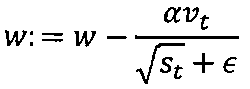
ここで、vt,stは、2つのモーメンタムであり、wは、モデル重み、dwは、勾配、aは、初期学習率であり、εはより良い数値安定性のために微小な値である。
[00023]有利には、デュアルモーメンタムオプティマイザの使用は、SGD(確率的勾配降下法)のようなゼロ/シングルモーメンタムオプティマイザよりも速く収束するニューラルネットワークモデルを得ることができる。しかし、デュアルモーメンタムオプティマイザを使用すると、モデル重み以外のモーメンタムをバッファリングするために、ゼロ/シングルモーメンタムオプティマイザが必要とするメモリの少なくとも2倍のメモリが必要になる場合がある。この傾向は、特に数百万から数十億のパラメータを含む大規模なモデルで深刻化する可能性がある。オプティマイザがメモリ制限のあるGPU/ASIC上で実行される場合、オプティマイザが要求するメモリ領域は、逆に最大バッチサイズを低減させる。一方、オプティマイザをホストCPUに移すことで、メモリサイズのボトルネックは解消され得る。しかし、メモリ帯域幅のボトルネックは、プロセッサが重み/勾配ペアごとにメモリから2つのFP32モーメンタムを余分にフェッチし、それらを記憶する必要があるので、オプティマイザの速度を低下させる可能性がある。
where v t , s t are the two momentums, w is the model weight, dw is the gradient, a is the initial learning rate, and ε is a small value for better numerical stability.
[00023] Advantageously, the use of a dual momentum optimizer can result in a neural network model that converges faster than a zero/single momentum optimizer such as SGD (Stochastic Gradient Descent). However, the use of a dual momentum optimizer may require at least twice as much memory as a zero/single momentum optimizer to buffer momentum other than the model weights. This tendency may be exacerbated, especially for large models that contain millions to billions of parameters. If the optimizer runs on a memory-limited GPU/ASIC, the memory area required by the optimizer will in turn reduce the maximum batch size. On the other hand, moving the optimizer to the host CPU may eliminate the memory size bottleneck. However, the memory bandwidth bottleneck may slow down the optimizer, as the processor needs to extra fetch two FP32 momentums from memory for each weight/gradient pair and store them.
[00024]さらに、Transformerによる双方向のエンコード表現(BERT)-ラージモデルのようなモデルが、ワーカごとに生成される勾配の1.36ギガバイト(GBs)有することを考えると、モデル全体の勾配のバッファリングは非常に大きな量のメモリを必要とする。このモデルの文脈では、4ワーカの訓練クラスタで勾配をバッファリングするために5.44GBのメモリが必要である。メモリの必要量は、ワーカの数に応じて直線的に増加する。さらに、アダプティブモーメント推定(Adam)のような、勾配ごとに2つの浮動小数点32ビット(FP32)モーメンタム項のバッファリングを必要とするアルゴリズムと併用する場合、各ワーカのメモリ要件は、BERTに必要なメモリの3倍となる可能性がある。 [00024] Furthermore, given that a model such as the Bidirectional Encoded Representation by Transformer (BERT)-Large model has 1.36 gigabytes (GBs) of gradients generated per worker, buffering gradients for the entire model requires a very large amount of memory. In the context of this model, 5.44 GB of memory is required to buffer gradients in a four-worker training cluster. The memory requirement grows linearly with the number of workers. Furthermore, when used in conjunction with algorithms such as Adaptive Momentum Estimation (Adam), which require buffering two floating-point 32-bit (FP32) momentum terms per gradient, the memory requirements for each worker can be three times that required for BERT.
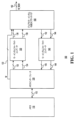
[00025]図1は、一実施例によるデュアルモーメンタム勾配オプティマイザ(DMGO)150を含む人工知能訓練システム(AITS)100を示す図である。AITS100は、メモリ110(例えば、DRAMまたは別のタイプのメモリ)、メモリインターフェース120(例えば、DDRインターフェースまたは別のタイプのインターフェース)、モーメンタムフォーマットコンバータ(MFC)130、別のモーメンタムフォーマットコンバータ(MFC)140、およびDMGO150を含んでもよい。メモリ110は、バス112を介してメモリインターフェース120に結合されてもよい。あるいは、メモリ110は、チップオンチップパッケージ、システムインチップパッケージ、3D-メモリシステム、スタックダイシステムを介してメモリインターフェース120と一体化されてもよい。メモリインターフェース120は、モデル重み(W)がメモリバス122を介してメモリ110からDMGO150に転送され得るように、バス122を介してDMGO150に結合されてもよい。メモリインターフェース120は、バス132および134を介してMFC130に結合されてもよい。バス132は、第1のモーメンタムに関連する記憶フォーマット(例えば、vt_fp8フォーマット)のモーメンタム値をメモリ110からMFC130に転送するために用いられ得る。バス134は、第2のモーメンタムに関連する記憶フォーマット(例えば、st_fp8フォーマット)のモーメンタム値をメモリ110からMFC130に転送するために使用され得る。一例において、記憶フォーマットは、モーメンタム値のための8ビット縮小精度フォーマットに対応してもよい。MFC130は、第1のモーメンタム値および第2のモーメンタム値の両方を処理して、それらのフォーマットを記憶フォーマットからDMGO150に関連付けられた訓練フォーマットに変更するように構成されてもよい。一例では、訓練フォーマットは、完全な32ビット単精度フォーマットに対応してもよい。MFC130は、バス136およびバス138をそれぞれ介して、第1および第2のモーメンタム値をDGO150に送信するようにさらに構成されてもよい。この例では、MFC140は、バス142および144を介してDMGO150に結合されてもよい。MFC140は、バス146および148を介してメモリインターフェース110にさらに結合されてもよい。MFC140は、訓練フォーマットから記憶フォーマットにモーメンタム値を変換してもよい。
[00025] FIG. 1 illustrates an artificial intelligence training system (AITS) 100 including a dual momentum gradient optimizer (DMGO) 150 according to one embodiment. The
[00026]さらに図1を参照すると、AITS100は、性能劣化を導入することなく、Adamのために低減された精度のモーメンタムを使用する新しい方法の実装を可能にすることができる。一例として、デュアルモーメンタムAdamアルゴリズムは、以下の式で表すことができる。
[00026] Still referring to FIG. 1,
vt:=β1・vt+(1-β1)・dw
st:=β2・st+(1-β2)・dw2
v t :=β 1・v t +(1−β 1 )・dw
s t :=β 2・s t +(1−β 2 )・dw 2

ここで、vt,stは、2つのモーメンタムであり、wは、モデル重み、dwは、勾配、aは、初期学習率であり、εはより良い数値安定性のために微小な値である。一例では、モーメンタム値の1つ(vt)は勾配値の期待値に対応し、モーメンタム値の他の1つ(st)は勾配値の分散の期待値に対応し得る。この例では、完全な32ビットの単精度のモーメンタムを使うのではなく、8ビットだけを使っている。符号に1ビット、モーメンタム{vt,st}のダイナミックレンジに7ビットである。この例では、vt,stともに(1-β)との乗算により1.0より小さく、ここで、βは1.0に近い値なので、8ビット指数の最上位ビット(MSB)はゼロ定数となり、保存前に安全に破棄することができる。この例では、モーメンタム値の記憶フォーマットは8ビットであるが、計算フォーマットはより高精度を実現するために、やはりより高精度である。図1は、ある方法で配置された、ある数の構成要素を含むAITS100を示しているが、AITS100は、異なる方法で配置された追加のまたはより少ない構成要素を含んでもよい。一例として、MFC130およびMFC140は、チップオンチップパッケージ、システムインチップパッケージ、3D-メモリシステム、スタックダイシステムを介してDMGO150と統合されてもよい。あるいは、MFC130およびMFC140は、(例えば、システムオンチップ(SoC)として)同一チップ上でDMGO150と統合されてもよい。別の例では、メモリ110、メモリインターフェース120、MFC130、MFC140、およびDMGO150の各々は、チップオンチップパッケージ、システムインチップパッケージ、3D-メモリシステム、スタックダイシステムを介して統合されてもよい。
where v t ,s t are the two momentums, w is the model weight, dw is the gradient, a is the initial learning rate, and ε is a small value for better numerical stability. In one example, one of the momentum values (v t ) may correspond to the expectation of the gradient values, and the other one of the momentum values (s t ) may correspond to the expectation of the variance of the gradient values. In this example, rather than using a full 32-bit single precision momentum, only 8 bits are used, with 1 bit for the sign and 7 bits for the dynamic range of the momentum {v t ,s t }. In this example, since both v t and s t are less than 1.0 by multiplication with (1-β), where β is close to 1.0, the most significant bit (MSB) of the 8-bit exponent becomes a zero constant and can be safely discarded before storage. In this example, the storage format of the momentum values is 8 bits, but the computation format is still more precise to achieve higher accuracy. 1
[00027]図2は、一実施例によるデュアルモーメンタム勾配オプティマイザ(DMGO)200を示す図である。DMGO200は、モーメンタム伸長器202および別のモーメンタム伸長器204を含んでもよい。DMGO200は、さらに、モーメンタム圧縮器262と別のモーメンタム圧縮器264を含んでもよい。DMGO200は、デュアルモーメンタム・アダプティブモーメント推定(Adam)アルゴリズムの実装に関連する様々な動作を実行するように構成されたロジックをさらに含んでもよい。この例では、モーメンタム伸長器202およびモーメンタム伸長器204は、図1のMFC130に関して前述したのと同様の機能を提供するために使用され得る。同様に、モーメンタム圧縮器262およびモーメンタム圧縮器264は、図1のMFC140に関して前述したのと同様の機能を実装するために使用され得る。第1のモーメンタム(例えば、vt_fp8)に関連するモーメンタム値は、メモリから取得され、モーメンタム伸長器202に提供されてもよい。第2のモーメンタム(例えば、st_fp8)に関連するモーメンタム値は、メモリから取得され、モーメンタム伸長器204に提供されてもよい。一例では、モーメンタム値は、記憶フォーマット(例えば、8ビット縮小精度フォーマット)を有してもよい。モーメンタム伸長器202は、第1のモーメンタム値を処理して、そのフォーマットを記憶フォーマットからDMGO200に関連する訓練フォーマットに変更するように構成されてもよい。モーメンタム伸長器204は、第2のモーメンタム値を処理して、そのフォーマットを記憶フォーマットからDMGO200に関連付けられた訓練フォーマットに変更するように構成されてもよい。
[00027] FIG. 2 illustrates a dual momentum gradient optimizer (DMGO) 200 according to one embodiment. The
[00028]図2を引き続き参照すると、DMGO200の一部として含まれるロジックは、加算、乗算、および融合型乗算加算演算などの演算を実行するように構成されたロジックを含んでもよい。ロジックは、デュアルモーメンタム最適化アルゴリズム(例えば、デュアルモーメンタム・アダプティブモーメント推定(Adam)アルゴリズム)を実装するように構成されてもよい。一例として、新しいモーメンタム値(vt_new,st_new)の計算に関するデュアルモーメンタムAdamアルゴリズムに対応する計算は、以下の式で表すことができる。
2, the logic included as part of the
vt_new:=β1・vt_fp32+(1-β1)・dw
st_new:=β2・st_fp32+(1-β2)・dw2
v t_new :=β 1・v t_fp32 +(1−β 1 )・dw
s t_new :=β 2・s t_fp32 + (1−β 2 )・dw 2

ここで、vt_new,st_newは、新しいモーメンタム値、wはモデル重み、dwは勾配、aは初期学習率、εはより良い数値安定性のために使用される微小な値である。したがって、この例では、モーメンタム伸長器202および204は、それぞれのモーメンタム値(vt_fp8,st_fp8)の記憶フォーマット(例えば、8ビット圧縮フォーマット)を、DMGO200に関連する訓練フォーマット(例えば、32ビット全精度フォーマット)へ変換する。一例として、勾配最適化が実行される前に、モーメンタム伸長器(例えば、モーメンタム伸長器202または204)は、符号ビットと指数の最上位ビット(MSB)との間に1つの「0」ビットを挿入し、指数の最下位ビット(LSB)の直後に23の「0」ビットをパディングすることによって、圧縮された8ビットモーメンタム値を32ビット単精度に戻すように変換するであろう。パディングされるビットは「0」ビットである必要はない。一例では、少なくとも少数のビットが非ゼロビットであってもよい。一例として、2つまたは3つのLSBは非ゼロビットであってよい。
where v t_new , s t_new are the new momentum values, w are the model weights, dw is the gradient, a is the initial learning rate, and ε is a small value used for better numerical stability. Thus, in this example,
[00029]さらに図2を参照すると、乗算器210および214ならびに加算器212を含むDMGO200に関連するロジックは、新しいモーメンタム値(vt_new)のうちの1つを生成することに関連する計算を実行してもよい。同様に、乗算器216、218、および加算器222を含むDMGO200に関連するロジックは、他の新しいモーメンタム値(st_new)を生成することに関連する計算を実行してもよい。さらに、この例では、新しいモーメンタム値(vt_new,st_new)をメモリに記憶する前に、モーメンタム圧縮器262および264は、新しいモーメンタム値のフォーマットを訓練フォーマットから記憶フォーマットに変換する。新しいモーメンタム値(vtc_new,stc_new)は、図2において8ビット記憶フォーマット値として示されている。この例では、モーメンタム圧縮器262および264の各々は、モーメンタム値に関連する指数の最上位ビット(MSB)を除去し、23の仮数ビットのすべてを切り捨てて、32ビット全精度のモーメンタム値(vt_new,st_new)を8ビット圧縮モーメンタム値(vtc_new,stc_new)に変換するように構成してもよい。これらはメモリに記憶されることになる。また、23ビット未満の仮数ビットを切り捨ててもよい。有利には、モーメンタム値の圧縮により、モーメンタム値を記憶するために必要なバッファサイズを4倍縮小することができる。さらに、最下位ビット(LSB)切り捨ての使用は、誤差が互いにキャンセルされ得るように同じ丸め誤差方向を導入することによって、訓練性能の損失なしに精度を低下させることができる。
[00029] Still referring to Figure 2, logic associated with
[00030]引き続き図2を参照すると、DMGO200は、新しい重み値(例えば、w_new)を生成するように構成されたロジックをさらに含んでもよい。この例では、このロジックは、乗算器232および234、加算器242、逆数平方根(RSQRT)246、および融合型乗算器(FMA)250を含んでもよい。図2は、ある方法で配置されたある数の構成要素を含むDMGO200を示すが、DMGO200は、異なる方法で配置された追加のまたはより少ない構成要素を含んでもよい。
2,
[00031]モーメンタム圧縮器によってモーメンタムが圧縮されるとき、その精密ビットは、新しいモーメンタム値(例えば、それぞれ、vtc_new,stc_new)に関してδ1およびδ2の相対誤差を導入するように切り捨てられる。これを考慮すると、勾配最適化方程式は次のように書き直すことができる。 [00031] When momentum is compressed by the momentum compressor, its precision bits are truncated to introduce a relative error of δ 1 and δ 2 with respect to the new momentum values (e.g., v tc_new , s tc_new , respectively). Taking this into account, the gradient optimization equation can be rewritten as follows:

32ビット単精度の場合、|δ1|≦2m-24,|δ2|≦2m-24となり、mは切り捨てた精度ビット数である。この例では、mが大きすぎなければ、1-δ1=1-δ2≒1-δを安全に近似できる。この誤差限界は、切り捨てられたmビットがすべて「1」である場合にのみ達成され、このケースは実際のアプリケーションではほとんど起こり得ない。それでも、この極端なケースが起こったとしても、瞬間的なピーク誤差は全体の性能に悪影響を及ぼし得ない。両モーメンタムを切り捨てた後の更新された重みの相対誤差は、 For 32-bit single precision, |δ 1 |≦2 m-24 , |δ 2 |≦2 m-24 , where m is the number of bits of precision truncated. In this example, we can safely approximate 1-δ 1 =1-δ 2 ≈1-δ, provided that m is not too large. This error bound is only reached if the truncated m bits are all "1", which is very unlikely to occur in practical applications. Nevertheless, even if this extreme case does occur, the momentary peak error cannot adversely affect overall performance. The relative error of the updated weights after truncating both momentums is:

と表すことができる。どのようなδ∈[0,1]でも、δの値が小さいと It can be expressed as: For any δ∈[0,1], if the value of δ is small,

は1-δよりも1に近くなる。このことは、両モーメンタムの精度を下げても、更新されたパラメータの精度は線形には下がらないことを示している。この「誤差に対する平方根」の効果は、切り捨てによる「精度損失」の一部を補償する。 is closer to 1 than 1-δ. This shows that reducing the precision of both momentums does not linearly reduce the precision of the updated parameters. This "square root of error" effect compensates for some of the "precision loss" due to truncation.
[00032]図3は、圧縮されたモーメンタム値が仮数1ビットの切り捨てから仮数23ビットの切り捨てまで掃引されている状態での重み更新誤差の誤差限界曲線(EB(M))を示すグラフ300である。グラフ300に示すように、この例では、切り捨てられた仮数ビットの数が16より少ない場合、完全な単精度(FP32)モーメンタム値と比較して、誤差限界値はゼロに近い。この例では、切り捨てられた仮数ビットの数が17を超えると、誤差限界は急速に増加し、仮数ビットのすべてが切り捨てられたときに、最大誤差限界は0.13である。 [00032] FIG. 3 is a graph 300 illustrating the error bound curve (EB(M)) of the weight update error as the compressed momentum value is swept from a truncation of 1 mantissa bit to a truncation of 23 mantissa bits. As shown in graph 300, in this example, when the number of truncated mantissa bits is less than 16, the error bound is close to zero compared to the full single precision (FP32) momentum value. In this example, as the number of truncated mantissa bits exceeds 17, the error bound increases rapidly, with a maximum error bound of 0.13 when all of the mantissa bits are truncated.
[00033]図4は、精度を下げたモーメンタム値が訓練の精度に及ぼす影響を示すシミュレーション収束曲線410、420、および420を有するグラフ400を示す。一例として、シミュレーション収束曲線410はモーメンタム値の1ビット仮数に対応し、シミュレーション収束曲線420はモーメンタム値の4ビット仮数に対応し、シミュレーション収束曲線430はモーメンタム値の24ビット仮数に対応する。シミュレーション収束曲線から明らかなように、モーメンタム値の仮数ビットの切り捨ては、訓練の精度に関して性能を低下させない。しかし、精度を下げたモーメンタム値はメモリフットプリントの少なくとも50%を節約するので、メモリを読み出すためのサイクルの半分だけが必要となる場合がある。 [00033] FIG. 4 shows a graph 400 with simulated convergence curves 410, 420, and 420 illustrating the effect of reduced precision momentum values on training accuracy. As an example, simulated convergence curve 410 corresponds to a 1-bit mantissa of the momentum values, simulated convergence curve 420 corresponds to a 4-bit mantissa of the momentum values, and simulated convergence curve 430 corresponds to a 24-bit mantissa of the momentum values. As is evident from the simulated convergence curves, truncating the mantissa bits of the momentum values does not degrade performance in terms of training accuracy. However, the reduced precision momentum values save at least 50% of the memory footprint, so that only half the cycles to read the memory may be required.
[00034]本開示の一部として説明された技術は、ハードウェアおよび/またはソフトウェアの組み合わせを使用して実装されてもよい。特定の例では、図2のDGMO200は、図5に示されるような訓練システム500の一部として展開されてもよい。この例では、DGMO200は、一例にしたがって、モデルを訓練するための、ハードウェア支援勾配オプティマイザ(デュアルモーメンタム)550(HAGOと呼ばれる)の一部として含まれてもよい。勾配最適化システム500は、HAGO550に高速バスブリッジ520を介して結合された複数のワーカ(例えば、ワーカ_1 502、ワーカ_2 504、およびワーカ_N 506)を含んでもよい。ワーカ(例えば、ワーカ_1 502、ワーカ_2 504、およびワーカ_N 506)の各々は、任意の数のグラフィックス処理ユニット(GPU)、コンピュータ処理ユニット(CPU)、メモリ(例えば。SRAMまたは他のタイプのメモリ)、フィールドプログラマブルゲートアレイ(FPGA)、特定用途向け集積回路(ASIC)、消去可能および/または複合プログラマブル論理デバイス(PLD)、プログラマブルアレイロジック(PAL)デバイス、または汎用アレイロジック(GAL)デバイスを使用して実装されてもよい。各ワーカは、勾配最適化システム500を使用して訓練されているニューラルネットワークモデルの全体コピーを担持してもよい。各ワーカは、ニューラルネットワークモデルのコピー全体を担持してもよいが、各ワーカは、モデルに関連付けられた訓練データ(例えば、分類用の画像または他のデータサンプル)のサブセットに対してのみ動作してもよい。各ワーカは、データに対してフォワードパスを実行して誤差を計算し、その後、バックワードパスを実行して各パラメータ(例えば、各重み)に対する勾配を計算してもよい。勾配最適化システム500は、高速バスブリッジ520にバス528を介して結合されたホスト560をさらに含んでもよい。
[00034] The techniques described as part of this disclosure may be implemented using a combination of hardware and/or software. In a particular example, the
[00035]図5を引き続き参照すると、一例では、高速バスブリッジ520は、ピーシーアイエクスプレス(PCIe)ブリッジとして実装されてもよい。ワーカ_1 502は、PCIeリンク510を介して高速バスブリッジ520に接続されてもよい。ワーカ_2 504は、PCIeリンク512を介して高速バスブリッジ520に接続されてもよい。ワーカ_N 506は、PCIeリンク514を介して高速バスブリッジ520に接続されてもよい。HAGO550は、バスリンク522および524を介して高速バスブリッジ520に連結されてもよい。また、他のタイプのバスブリッジおよびバスリンクが使用され得る。さらに、バスブリッジの代わりに、スイッチングファブリックが使用され得る。各ワーカは、訓練データのサブセット(例えば、ミニバッチ)上で勾配を計算し、高速バスブリッジ520を介して更新された勾配をHAGO550に提供してもよい。HAGO550は、各ワーカ(例えば、ワーカ_1 502、ワーカ_2 504、およびワーカ_N 506)から収集した勾配に対して、縮小および最適化を実行してもよい。HAGO550は、データバーストで動作してもよく、一例では、各バーストは、一定数の受信勾配で構成されてもよい。現在の勾配バーストは、前の勾配バーストがその対応する重みと共に最適化される間、バッファリングされてもよい。図5は、ある方法で配置された、ある数の構成要素を含む勾配最適化システム500を示すが、勾配最適化システム500は、異なる方法で配置された追加のまたはより少ない構成要素を含んでもよい。
[00035] With continued reference to FIG. 5, in one example, high-
[00036]図6は、一実施例による、デュアルモーメンタム勾配オプティマイザを含むHAGO600のブロック図である。一実施例では、図5のHAGO550は、図6のHAGO600として実装されてもよい。HAGO600は、高速バスを介してワーカから更新された勾配を受信してもよい。図6の例では、HAGO600に4つのワーカが結合されていることを想定している。ワーカの1つからの更新された勾配(DW1)は、先入れ先出しブロック(例えば、GFIFO_1 602)を介して受信されてもよい。別のワーカからの更新された勾配(DW2)は、別の先入れ先出しブロック(例えば、GFIFO_2 604)を介して受信されてもよい。別のワーカからの更新された勾配(DW3)は、別の先入れ先出しブロック(例えば、GFIFO_3 606)を介して受信されてもよい。別のワーカからの更新された勾配(DW4)は、別の先入れ先出しブロック(例えば、GFIFO_4 608)を介して受信されてもよい。FIFOは、単一のマルチエントリーFIFOまたは複数のシングルエントリーFIFOとして実装されてもよい。
[00036] Figure 6 is a block diagram of a
[00037]図6を引き続き参照すると、HAGO600は、浮動小数点平均化ブロック(例えば、FP-AVGブロック620)をさらに含んでもよい。FP-AVGブロック620は、先入れ先出しブロックからバッファリングされた更新された勾配を受信してもよい。一例として、FP-AVGブロック620は、GFIFO_1 602からバッファリングされた更新された勾配(BDW1)を受信してもよい。FP-AVGブロック620はまた、GFIFO_2 604からバッファリングされた更新された勾配(BDW2)を受信してもよい。FP-AVGブロック620はまた、GFIFO_3 606からバッファリングされた更新された勾配(BDW3)を受信してもよい。FP-AVGブロック620はまた、GFIFO_4 608からバッファリングされた更新された勾配(BDW4)を受信してもよい。FP-AVGブロック620は、受信した更新された勾配に対して縮小を実行してもよい。この例では、縮小操作は、受信した勾配を平均化し、出力としてDW_AVGを生成することを含んでもよい。縮小操作は、平均化に限定されない。加算やスケーリングされた加算など、他の演算を使用して縮小を実行してもよい。FP-AVGブロック620からの出力は、図1および図2に関して先に説明したものなどの勾配最適化アルゴリズムを実装するために浮動小数点演算を行う勾配最適化データパス(GODP)ブロック650に提供されてもよい。一例では、FP-AVGブロック620およびGODPブロック650は、FPGAの一部として実装されてもよい。
[00037] With continued reference to FIG. 6, the
[00038]さらに図6を参照すると、重み(W)およびオプションのモーメンタム(M)のマスターコピーは、メモリ660に記憶されてもよい。一例では、メモリ660は、ダブルデータレート(DDR)ダイナミック・ランダム・アクセス・メモリ(DRAM)を使用して実装されてもよい。メモリ660は、メモリインターフェース662を介して、先入れ先出しブロック(例えば、PFIFOブロック670)に結合されてもよい。メモリインターフェース662は、DDRインターフェースであってもよい。図6に示すように、モデルの重み(W)は、制御有限状態マシン(FSM)(例えば、制御FSM640)の制御下で、PFIFO670にロードされてもよい。さらに、メモリ660は、メモリインターフェース662を介してモーメンタムフォーマット変換器(MFC)684に結合されてもよい。MFC684は、図1のMFC130に関して先に説明したのと同様の機能性を提供してもよい。MFC684の出力は、PFIFO670(または別のFIFO)に結合されてもよい。
[00038] With further reference to FIG. 6, a master copy of the weights (W) and optional momentum (M) may be stored in
[00039]一例では、同時に、制御FSM640は、(1)各ワーカがそれぞれのローカルに計算された勾配(例えば、DW1、DW2、DW3、およびDW4)をそれぞれのGFIFO(例えば、GFIFO_1 602、GFIFO_2 604、GFIFO_3 606、およびGFIFO_4 608)に送信すること、および(2)メモリインターフェース662が、メモリ660からPFIFO670へ、オプションのモーメンタムとともに、同じ数のパラメータ(例えば、重み(W))をフェッチすること、の両方を可能にする。したがって、この例では、制御FSM640は、単一のバーストサイクル中にGFIFOに注入される勾配の数と同じ数の重みをPFIFO670にフェッチするようにメモリインターフェース662を制御する。これらのFIFOのそれぞれがバーストサイズに達すると、これらのそれぞれの読み取りポートが制御FSM640によって起動され、それぞれのFIFOの内容を単一サイクルのレイテンシで出力する。この例では、制御FSM640は、これらのバッファからのデータが同じレイテンシでフラッシュされるように、PFIFO670およびGFIFOからの重みの読み出しを可能にする。このように、データの読み出しは完全に調整される。
[00039] In one example, simultaneously,
[00040]図6を引き続き参照すると、この実装態様は、それぞれのFIFOからの4つの勾配出力(例えば、BDW1、BDW2、BDW3、およびBDW4)が同じ位置合わせインデックスを有することを確実にする。FP-AVGブロック620は、次に、これらの勾配(例えば、BDW1、BDW2、BDW3、BDW4)の平均を計算して、縮小勾配(例えば、DW_AVG)を生成し、これは次に、GODPブロック650によってバッファされた重みおよびモーメンタムとともに処理される。この例では、GODPブロック650の出力は、新しい重み(NW)および新しいモーメンタム(NM)の2つの部分を含んでもよく、これらは両方ともメモリインターフェース662を介してメモリ660に書き戻される。新しいモーメンタム値は、図1のMFC140に関して前述したのと同様の機能を実装することができるMFC682に提供されてもよい。したがって、この態様では、圧縮されたモーメンタム値は、より少ない記憶空間を必要とする記憶フォーマットで記憶されてもよい。
[00040] With continued reference to FIG. 6, this implementation ensures that the four gradients output from each FIFO (e.g., BDW1, BDW2, BDW3, and BDW4) have the same alignment index. The FP-
[00041]さらに、同時に新しい重み(NW)が、新しい重みをワーカに送り返す送信FIFO(TXFIFO)に注入される。この実施例では、制御FSM640は、図5の高速バスブリッジ520を介したワーカへの重みの流れを制御してもよい。一例として、制御/状態レジスタ630は、様々な動作に関連するタイミングを指定するために使用され得る。さらに、制御/状態レジスタ630は、勾配オプティマイザのハイパーパラメータ(例えば、学習率)を構成するために使用され得る。
[00041] Additionally, new weights (NW) are simultaneously injected into a transmit FIFO (TXFIFO) that sends the new weights back to the workers. In this example, the
[00042]それぞれのGFIFOからの読み出しおよび重みの更新の間、勾配の次のバーストは、それぞれのGFIFOに書き込まれる。同様に、次の重みのセットおよびモーメンタムも、PFIFO670からの読み出しおよび重み更新の間、メモリ660からPFIFO670に(例えば、MFC684を介して)フェッチされる。この例では、メモリ660は、読み出しと書き込みの動作の両方によって共有される単一のデータポートだけをサポートするので、PFIFO670のデータ幅は、各GFIFOのデータ幅の2倍であるように構成される。このようにして、この例では、最初のものと最後のものを除くすべてのデータバーストは、勾配の受信と新しい重みの送信との間にオーバーラップを有することになる。
[00042] During the read from each GFIFO and weight update, the next burst of gradients is written to the respective GFIFO. Similarly, the next set of weights and momentum are fetched from
[00043]さらに図6を参照すると、HAGO600の動作の特定の態様は、制御FSM640とともに制御/状態レジスタを使用して制御され得る。以下の表1は、制御/状態レジスタ630の例示的な内容を示す。
[00043] Still referring to FIG. 6, certain aspects of the operation of

[00044]表1に示すように、ctrl_optモードレジスタは、任意のデュアルモーメンタム最適化アルゴリズムであってよい最適化アルゴリズムタイプを指定することを可能にする。ctrl_バースト_サイズレジスタは、各バーストサイクルに関連するバーストサイズを選択することができる。この例では、バーストサイズ(例えば、勾配の数で指定される)は、256勾配、512勾配、1024勾配、2048勾配、または4096勾配であり得る。ctrl_param_numレジスタは、モデルのパラメータのサイズを指定することができる。ctrl_init_lrレジスタは、モデルの初期学習率を指定することができる。一実施例では、初期学習率は、モデルのステップサイズに関連し得る。先に説明したように、一実施例では、最適化アルゴリズムは、以下の式で表すことができるデュアルモーメンタムアダムアルゴリズムであってもよい。 [00044] As shown in Table 1, the ctrl_opt mode register allows for specification of an optimization algorithm type, which may be any dual momentum optimization algorithm. The ctrl_burst_size register may select a burst size associated with each burst cycle. In this example, the burst size (e.g., specified in number of gradients) may be 256 gradients, 512 gradients, 1024 gradients, 2048 gradients, or 4096 gradients. The ctrl_param_num register may specify the size of the model's parameters. The ctrl_init_lr register may specify an initial learning rate for the model. In one embodiment, the initial learning rate may be related to the model's step size. As previously described, in one embodiment, the optimization algorithm may be a dual momentum Adam algorithm, which may be expressed as follows:
vt:=β1・vt+(1-β1)・dw
st:=β2・st+(1-β2)・dw2
v t :=β 1・v t +(1−β 1 )・dw
s t :=β 2・s t +(1−β 2 )・dw 2

ここで、vt,stは、2つのモーメンタムであり、wは、モデル重み、dwは、勾配、aは、初期学習率であり、εはより良い数値安定性のために微小な値である。ctrl_beta1レジスタは、重みが更新される速度に関連する加速度を制御することができるモーメンタムの係数を指定することができる。ctrl_beta2レジスタは、重みが更新される速度に関連する加速度をさらに制御することができる第2のモーメンタムの係数を指定することを可能にする。ctrl_is_fp16レジスタは、入力勾配のフォーマットがFP16フォーマットの場合に設定される。表1は、制御/状態レジスタ630の一部として含まれる特定のレジスタのセットを示しているが、追加のまたはより少ないレジスタがHAGO600と共に使用され得る。さらに、制御/状態レジスタ630に含まれる制御情報の少なくとも一部または全部は、HAGO600を用いた勾配最適化に関連する命令に関連するフィールドまたはオペランドを介して指定されてもよい。図6は、ある方法で配置されたある数の構成要素を含むHAGO600を示すが、HAGO600は、異なる方法で配置された追加のまたはより少ない構成要素を含んでもよい。一例として、5つ以上のワーカがHAGO600に結合されてもよい。
where v t ,s t are two momentums, w are the model weights, dw are the gradients, a is the initial learning rate, and ε is a small value for better numerical stability. The ctrl_beta1 register allows for the specification of a momentum coefficient that can control the acceleration associated with the rate at which the weights are updated. The ctrl_beta2 register allows for the specification of a second momentum coefficient that can further control the acceleration associated with the rate at which the weights are updated. The ctrl_is_fp16 register is set if the format of the input gradient is the FP16 format. Although Table 1 shows a particular set of registers included as part of the control/status registers 630, additional or fewer registers may be used with
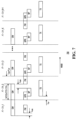
[00045]図7は、一実施例による、図6のHAGO600に関連するタイミング図700を示す。タイミング図700は、HAGO600の動作をバーストの観点で説明する。タイミング図700は、K+1バーストサイクルを示し、ここで、Kは正の整数である。最初のバーストサイクル(バースト_1)および最後のバーストサイクル(バースト_K+1)は、他のバーストサイクル:バースト_2サイクルからバースト_Kサイクルまで、よりも少ない重複を含む。バースト_1サイクルは、ワーカからの勾配(例えば、DW1)の送信開始からFIFO(例えば、図6のGFIFO_1 602)への勾配の注入までに関わるタイミング(GW)をFIFOのバーストサイズまで含んでいる。複数のワーカ(例えば、図5のワーカ_1 502、ワーカ_2 504、ワーカ_N 506)は、バースト_1サイクルの間に、FIFOのバーストサイズまでFIFOに勾配を注入することができる。バースト_1サイクルはさらに、図6のPFIFO670への重みの注入までの、メモリ(例えば、図6のメモリ660)に記憶されたパラメータ(例えば、モデルの重み)の転送の開始に関与するタイミング(PW)を含む。図7に示すように、重みの転送は、メモリ(例えば、図6のメモリ660)の読み出しレイテンシ(LDDR)に影響される。したがって、バースト_1サイクルにおいて、HAGO600は、FIFOへの勾配の注入と、メモリからの重みのフェッチという2つの動作を重複して行う。
[00045] Figure 7 illustrates a timing diagram 700 associated with
[00046]図7を引き続き参照すると、バースト_2サイクルは、FIFO(例えば、図6のGFIFO_1 602)への勾配の注入までのワーカからの勾配の次のセット(例えば、DW1)の送信開始に関わるタイミング(GW)をFIFOのバーストサイズまで含んでいる。複数のワーカ(例えば、図5のワーカ_1 502、ワーカ_2 504、ワーカ_N 506)は、バースト_2サイクル中にFIFOのバーストサイズまで勾配をFIFOに注入することができる。勾配の次のセットがFIFOに注入されている間、バースト_2サイクルは、FP-AVGブロック620による勾配の平均の計算、およびGODPブロック650によるバッファされたモーメンタムおよびバッファされた重み(BM,BW)と共に縮小勾配の処理、を含む計算サイクルをも含む。この操作の一部として関与するタイミングは、図7においてGPRとしてラベル付けされている。GODPブロック650から出力された新しいモーメンタムおよび新しい重み(NM、NW)をメモリ660に書き戻すことに関与するタイミングは、NPとしてラベル付けされる。バースト_2サイクルは、さらに、TXFIFO680を介したワーカへの新しい重みの送信に関与するタイミングを重複して含む。図7のタイミング図700に示すように、この動作は、GODPブロック650の処理レイテンシ(LDP)によって影響を受ける。バースト_2サイクルはさらに、メモリ(例えば、図6のメモリ660)に記憶されたパラメータ(例えば、モデルの重み)の転送の開始から、図6のPFIFO670への重みの注入までに関わるタイミング(PW)を含む。図7に示すように、重みの転送は、メモリ(例えば、図6のメモリ660)の読み出しレイテンシ(LDDR)に影響される。したがって、バースト_2サイクルにおいて、HAGO600は、勾配最適化の一部として、(1)FIFO(例えば、GFIFOのいずれか)への勾配の注入、(2)GFIFOおよびPFIFOからの勾配および重みの読み出し、(3)メモリへの新しい重みおよび新しいモーメンタムの書き戻し、(4)ワーカに対する重みの転送、の4つの動作を少なくとも部分的にオーバーラップさせている。
[00046] With continued reference to FIG. 7, the burst_2 cycle includes the timing (GW) involved in starting the transmission of the next set of gradients (e.g., DW1) from a worker until the injection of the gradients into the FIFO (e.g.,
[00047]さらに図7を参照すると、制御FSM640は、連続するバーストサイクルがHAGO600を通る勾配のストリーミングをもたらすように、ストリーミング様式でHAGO600を動作させ続ける。したがって、バースト_3サイクルは、勾配の追加のストリーミングと、勾配最適化の一部として、(1)FIFO(例えば、GFIFOのいずれか)への勾配の注入、(2)GFIFOおよびPFIFOからの勾配および重みの読み出し、(3)メモリへの新しい重みおよび新しいモーメンタムの書き戻し、(4)ワーカに対する新しい重みの転送、の4つの動作の少なくとも部分的なオーバーラップを含む複数の動作のオーバーラップ、を含む。同様に、バースト_Kサイクルは、勾配最適化の一部として、(1)FIFO(例えば、GFIFOのいずれか)への勾配の注入、(2)GFIFOおよびPFIFOからの勾配および重みの読み出し、(3)メモリへの新しい重みおよび新しいモーメンタムの書き戻し、(4)ワーカに対する新しい重みの転送、の4つの動作の少なくとも部分的なオーバーラップを含む。バースト_K+1サイクルは最後のバーストサイクルに対応する。したがって、バースト_K+1サイクルは、他のバーストサイクル:バースト_2サイクルからバースト_Kサイクルまで、に比べてオーバーラップが少ない。バースト_K+1サイクルの一部として、(1)GFIFOおよびPFIFOからの勾配と重みの読み出し、(2)新しい重みと新しいモーメンタムのメモリへの書き戻し、(3)新しい重みのワーカへの送信、の3動作がオーバーラップする。
[00047] Still referring to Figure 7,
[00048]図7を引き続き参照すると、各単一バーストサイクル中に、HAGO700は勾配バーストで動作してもよく、各勾配バーストは、固定数の勾配を含んでもよい。単一のバーストサイクル中に動作される勾配の数は、図6に関して先に説明したように、制御/状態レジスタ630を介して構成され得るバーストサイズに対応する。
[00048] With continued reference to FIG. 7, during each single burst cycle,
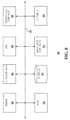
[00049]図8は、別の実施例による、デュアルモーメンタム勾配オプティマイザ(DMGO)のソフトウェアバージョンを含む、勾配最適化システム800を示す図である。この例では、DMGO(例えば、図2のDMGO200)に対応するロジックの実装は、プロセッサによって実行されるとき、メモリに記憶された命令を使用して実装されてもよい。勾配最適化システム800は、プロセッサ802、I/Oコンポーネント804、メモリ806、プレゼンテーションコンポーネント808、センサ810、データベース812、ネットワーキングインターフェース814、およびI/Oポート816を含み、これらはバス820を介して相互接続されても良い。プロセッサ802は、メモリ806に記憶された命令を実行し得る。I/Oコンポーネント804は、キーボード、マウス、音声認識プロセッサ、またはタッチスクリーンなどのコンポーネントを含み得る。メモリ806は、不揮発性ストレージまたは揮発性ストレージ(例えば、フラッシュメモリ、DRAM、SRAM、または他のタイプのメモリ)の任意の組み合わせであってよい。DMGOに関連する方法に対応する命令は、メモリ806または別のメモリに記憶されてもよい。これらの命令は、プロセッサ802、または他のプロセッサ(例えば、他のCPUまたはGPU)によって実行されるとき、これらの方法に関連する機能を提供し得る。一例として、右シフト/左シフト命令およびパッキング/アンパッキング命令を含む命令は、モーメンタム値を圧縮または伸長するために使用され得る。以下の表2は、プロセッサ802によって実行されると、DMGO(例えば、図2のDMGO200)に対応する機能性を実行し得る、命令の例示的なセットを示す。
[00049] FIG. 8 illustrates a
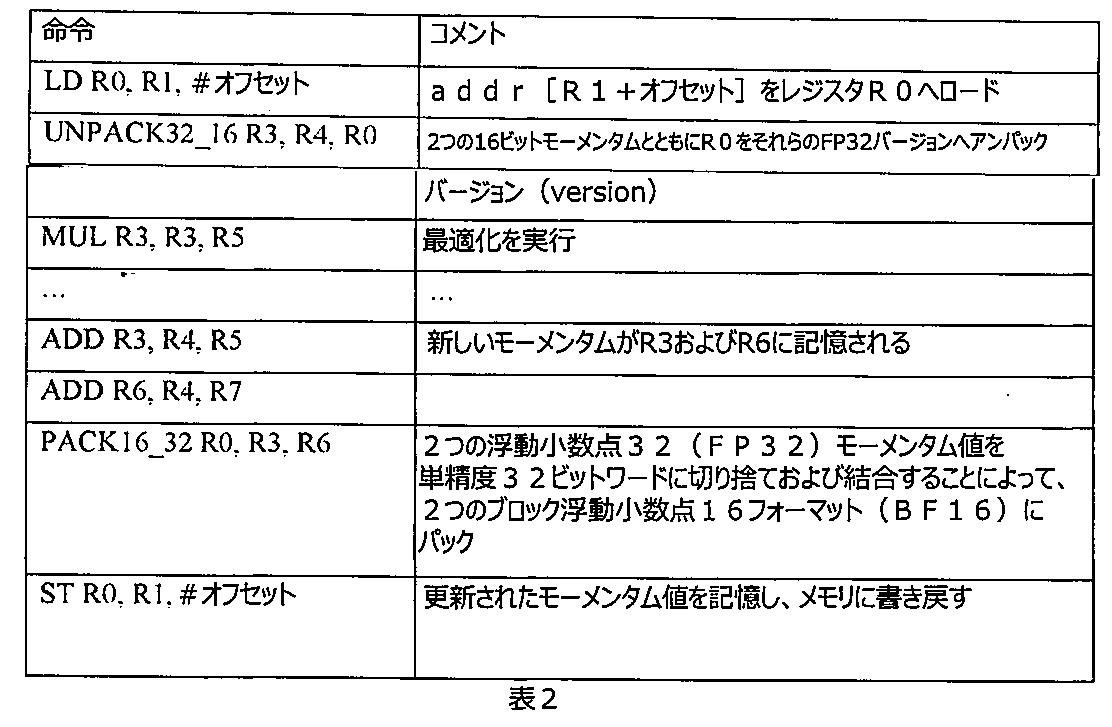
[00050]さらに図8を参照すると、プレゼンテーション構成要素808は、ディスプレイ、ホログラフィックデバイス、または他のプレゼンテーションデバイスを含んでもよい。ディスプレイは、LCD、LED、または他のタイプのディスプレイのような、任意のタイプのディスプレイであってもよい。データベース812は、本明細書に記載される方法の実行のために必要に応じてデータを記憶するために使用され得る。データベース812は、分散型データベースの集合体として、または単一データベースとして実装されてもよい。ネットワークインターフェース814は、イーサネット、セルラー無線、ブルートゥース(登録商標)無線、UWB無線、または他のタイプの無線若しくは有線通信インターフェースなどの通信インターフェースを含んでもよい。I/Oポート816は、イーサネットポート、光ファイバーポート、無線ポート、または他の通信ポートを含んでもよい。図8は、ある方法で配置および結合されたある数の構成要素を含むものとして勾配最適化システム800を示しているが、異なる方法で配置および結合された、より少ないまたは追加の構成要素を含むことができる。さらに、システム800に関連する機能性は、必要に応じて分散されてもよい。
[00050] Still referring to FIG. 8, the
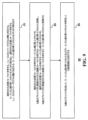
[00051]図9は、一実施例による勾配最適化のための方法のフロー図900を示す。この方法は、図1のAITS100、図2のDMGO200、または図8の勾配最適化システム800を使用して実行されてもよい。したがって、DMGO200がHAGO600の一部として実装される場合の例として、制御FSM640から受信した制御信号に基づいて、この方法に対応するステップが実行されてもよい。さらに、図6には示されていないが、この方法の一部として実行される動作に関連するタイミングを同期させるために、クロック信号が使用され得る。あるいは、メモリ806に記憶された命令は、プロセッサ802によって実行されるとき、この方法に関連するステップを実行するために使用され得る。さらに、DMGO200および勾配最適化システム800の修正された組み合わせも使用され得る。したがって、一例として、モーメンタム圧縮および伸長ステップは、メモリに記憶された命令を使用して実行されてもよいが、勾配最適化は、DMGO200に関連するハードウェアロジックを使用して実行されてもよい。ステップ910は、選択された記憶フォーマットを有する、ニューラルネットワークモデルの層に対応する、モーメンタム値の第1のセットをメモリから取り出すステップと、選択された記憶フォーマットを有する、ニューラルネットワークモデルの層に対応する、モーメンタム値の第2のセットをメモリから取り出すステップと、を含んでもよい。先に説明したように、記憶フォーマットは、縮小精度フォーマットに対応してもよい。
[00051] FIG. 9 illustrates a flow diagram 900 of a method for gradient optimization according to one embodiment. The method may be performed using the
[00052]ステップ920は、選択された記憶フォーマットを有するモーメンタム値の第1のセットを、勾配オプティマイザに関連付けられた訓練フォーマットを有するモーメンタム値の第3のセットに変換するステップと、選択された記憶フォーマットを有するモーメンタム値の第2のセットを、勾配オプティマイザに関連付けられた訓練フォーマットを有するモーメンタム値の第4のセットに変換するステップと、を含んでもよい。先に説明したように、このステップは、記憶フォーマットにおけるモーメンタム値に余分なゼロビットをパディングすることによってモーメンタム値を伸長することを含んでもよい。追加される余分なゼロビットは、モーメンタム値の圧縮の一部として切り捨てられたビットの数に依存してもよい。
[00052]
[00053]ステップ930は、勾配オプティマイザを用いて、モーメンタム値の第3のセットおよびモーメンタム値の第4のセットを使用して勾配最適化を実行するステップを含み得る。勾配最適化に関連する計算の後、モーメンタム値は、記憶フォーマットに変換されてもよい。先に説明したように、このステップは、単精度フォーマットのモーメンタム値の符号ビットと7つの最上位ビット(MSB)のみを記憶するステップを含んでもよい。図9は、ある順序で実行されるある数のステップを説明しているが、異なる順序の追加のステップまたはより少ないステップが実行されてもよい。
[00053]
[00054]図10は、一実施例による勾配最適化のための方法のフロー図1000を示す。この方法は、図1のAITS100、図2のDMGO200、または図8の勾配最適化システム800を使用して実行されてもよい。したがって、DMGO200がHAGO600の一部として実装される場合の例として、制御FSM640から受信した制御信号に基づいて、この方法に対応するステップが実行されてもよい。さらに、図6には示されていないが、この方法の一部として実行される動作に関連するタイミングを同期させるために、クロック信号が使用され得る。あるいは、メモリ806に記憶された命令は、プロセッサ802によって実行されるとき、この方法に関連するステップを実行するために使用され得る。さらに、DMGO200および勾配最適化システム800の修正された組み合わせも使用され得る。したがって、一例として、モーメンタム圧縮および伸長ステップは、メモリに記憶された命令を使用して実行されてもよいが、勾配最適化は、DMGO200に関連するハードウェアロジックを使用して実行されてもよい。ステップ1010は、選択された記憶フォーマットを有する、ニューラルネットワークモデルの層に対応するモーメンタム値の第1のセットをメモリから取り出すステップと、選択された記憶フォーマットを有する、ニューラルネットワークモデルの層に対応するモーメンタム値の第2のセットをメモリから取り出すステップと、を含んでもよい。先に説明したように、記憶フォーマットは、縮小精度フォーマットに対応してもよい。
[00054] FIG. 10 illustrates a flow diagram 1000 of a method for gradient optimization according to one embodiment. The method may be performed using the
[00055]ステップ1020は、選択された記憶フォーマットを有するモーメンタム値の第1のセットを、勾配オプティマイザに関連付けられた訓練フォーマットを有するモーメンタム値の第3のセットに変換するステップと、選択された記憶フォーマットを有するモーメンタム値の第2のセットを、勾配オプティマイザに関連付けられた訓練フォーマットを有するモーメンタム値の第4のセットに変換するステップと、を含んでもよい。先に説明したように、このステップは、記憶フォーマットにおけるモーメンタム値に余分なゼロビットをパディングすることによってモーメンタム値を伸長するステップを含んでもよい。追加される余分なゼロビットは、モーメンタム値の圧縮の一部として切り捨てられたビットの数に依存してもよい。先に説明したように、このステップは、プロセッサ(例えば、図8のプロセッサ802)によって実行される場合、(例えば、図8のメモリ806)に記憶された命令を使用して実行されてもよい。代替的に、このステップは、図2のDMGO200に関連するロジックを使用して実行されてもよい。
[00055]
[00056]ステップ1030は、勾配オプティマイザを用いて、モーメンタム値の第3のセットおよびモーメンタム値の第4のセットを使用して勾配最適化を実行するステップを含み得る。先に説明したように、このステップは、プロセッサ(例えば、図8のプロセッサ802)によって実行される場合、(例えば、図8のメモリ806)に記憶された命令を使用して実行されてもよい。代替的に、このステップは、図2のDMGO200に関連するロジックを使用して実行されてもよい。
[00056]
[00057]ステップ1040は、勾配最適化の次の反復のためのモーメンタム値の第5のセットおよびモーメンタム値の第6のセットを生成するステップを含んでもよい。先に説明したように、このステップは、プロセッサ(例えば、図8のプロセッサ802)によって実行される場合、(例えば、図8のメモリ806)に記憶された命令を使用して実行されてもよい。代替的に、このステップは、図2のDMGO200に関連するロジックを使用して実行されてもよい。
[00057]
[00058]ステップ1050は、符号ビットのみを記憶し、モーメンタム値の第5のセットの仮数に関連する所定の数のビットを切り捨てることによって、モーメンタム値の第5のセットを、記憶フォーマットを有するモーメンタム値の第7のセットに変換するステップを含んでもよい。先に説明したように、このステップは、単精度フォーマットのモーメンタム値の符号ビットと7つの最上位ビット(MSB)のみを記憶するステップを含んでもよい。先に説明したように、このステップは、プロセッサ(例えば、図8のプロセッサ802)によって実行される場合、(例えば、図8のメモリ806)に記憶された命令を使用して実行されてもよい。代替的に、このステップは、図2のDMGO200に関連するロジックを使用して実行されてもよい。
[00058]
[00059]ステップ1060は、符号ビットのみを記憶し、モーメンタム値の第6のセットの仮数に関連する所定の数のビットを切り捨てることによって、モーメンタム値の第6のセットを、記憶フォーマットを有するモーメンタム値の第8のセットに変換するステップを含んでもよい。先に説明したように、このステップは、単精度フォーマットのモーメンタム値の符号ビットと7つの最上位ビット(MSB)のみを記憶するステップを含んでもよい。先に説明したように、このステップは、プロセッサ(例えば、図8のプロセッサ802)によって実行される場合、(例えば、図8のメモリ806)に記憶された命令を使用して実行されてもよい。代替的に、このステップは、図2のDMGO200に関連するロジックを使用して実行されてもよい。図10は、ある順序で実行されるある数のステップを説明しているが、異なる順序で追加のまたはより少ないステップが実行されてもよい。
[00059]
[00060]結論として、本開示は、勾配オプティマイザと、L層を含むニューラルネットワークモデルに関連するモーメンタム値を記憶するように構成されたメモリと、を含むシステムにおける方法に関し、Lは1より大きい整数である。本方法は、選択された記憶フォーマットを有する、ニューラルネットワークモデルの層に対応する、モーメンタム値の第1のセットをメモリから取り出すステップと、選択された記憶フォーマットを有する、ニューラルネットワークモデルの層に対応する、モーメンタム値の第2のセットをメモリから取り出すステップと、を含んでもよい。本方法は、選択された記憶フォーマットを有するモーメンタム値の第1のセットを、勾配オプティマイザに関連付けられた訓練フォーマットを有するモーメンタム値の第3のセットに変換するステップと、選択された記憶フォーマットを有するモーメンタム値の第2のセットを、勾配オプティマイザに関連付けられた訓練フォーマットを有するモーメンタム値の第4のセットに変換するステップと、をさらに含んでもよい。本方法は、勾配オプティマイザを用いて、モーメンタム値の第3のセットおよびモーメンタム値の第4のセットを使用して勾配最適化を実行するステップをさらに含み得る。 [00060] In conclusion, the present disclosure relates to a method in a system including a gradient optimizer and a memory configured to store momentum values associated with a neural network model including L layers, where L is an integer greater than 1. The method may include retrieving from the memory a first set of momentum values corresponding to a layer of the neural network model having a selected storage format, and retrieving from the memory a second set of momentum values corresponding to the layer of the neural network model having the selected storage format. The method may further include converting the first set of momentum values having the selected storage format to a third set of momentum values having a training format associated with the gradient optimizer, and converting the second set of momentum values having the selected storage format to a fourth set of momentum values having a training format associated with the gradient optimizer. The method may further include performing a gradient optimization using the third set of momentum values and the fourth set of momentum values with the gradient optimizer.
[00061]選択された記憶フォーマットは、縮小された単精度フォーマットを含んでもよい。訓練フォーマットは、単精度フォーマットまたは倍精度フォーマットを含んでもよい。 [00061] The selected storage format may include a reduced single precision format. The training format may include a single precision format or a double precision format.
[00062]選択された記憶フォーマットを有するモーメンタム値の第1のセットを、訓練フォーマットを有するモーメンタム値の第3のセットに変換するステップは、単精度フォーマットのモーメンタム値を形成するために余分なゼロビットをパディングするステップを含んでもよい。本方法は、勾配最適化の次の反復のためのモーメンタム値の第5のセットおよびモーメンタム値の第6のセットを生成するステップと、モーメンタム値の第5のセットおよびモーメンタム値の第6のセットのそれぞれを記憶する前に、それぞれのモーメンタム値のそれぞれに関連する符号ビットおよび7つの最上位ビットのみを記憶することによってモーメンタム値の第5のセットおよびモーメンタム値の第6のセットのそれぞれを記憶フォーマットへ変換するステップと、をさらに含むことができる。 [00062] Converting the first set of momentum values having the selected storage format to the third set of momentum values having the training format may include padding extra zero bits to form the momentum values in a single precision format. The method may further include generating a fifth set of momentum values and a sixth set of momentum values for a next iteration of the gradient optimization, and converting each of the fifth set of momentum values and the sixth set of momentum values to the storage format by storing only a sign bit and the seven most significant bits associated with each of the respective momentum values before storing each of the fifth set of momentum values and the sixth set of momentum values.
[00063]勾配最適化を実行するステップは、アダプティブモーメンタム推定アルゴリズムを実装するステップを含む。勾配オプティマイザは、フィールドプログラマブルゲートアレイ(FPGA)を使用して実装されてもよく、勾配オプティマイザは、連続するバーストサイクルが勾配オプティマイザを通る勾配のストリーミングをもたらすように、バーストモードで動作するように構成されてもよい。 [00063] Performing gradient optimization includes implementing an adaptive momentum estimation algorithm. The gradient optimizer may be implemented using a field programmable gate array (FPGA), and the gradient optimizer may be configured to operate in a burst mode such that successive burst cycles result in streaming of gradients through the gradient optimizer.
[00064]別の例では、本開示は、勾配オプティマイザを含むシステムに関する。システムは、L層を含むニューラルネットワークモデルに関連するモーメンタム値を記憶するように構成されたメモリを含んでもよく、Lは1より大きい整数である。本システムは、(1)選択された記憶フォーマットを有する、ニューラルネットワークモデルの層に対応する、モーメンタム値の第1のセットをメモリから取り出し、選択された記憶フォーマットを有する、ニューラルネットワークモデルの層に対応する、モーメンタム値の第2のセットをメモリから取り出し、(2)選択された記憶フォーマットを有するモーメンタム値の第1のセットを、勾配オプティマイザに関連付けられた訓練フォーマットを有するモーメンタム値の第3のセットに変換し、選択された記憶フォーマットを有するモーメンタム値の第2のセットを、勾配オプティマイザに関連付けられた訓練フォーマットを有するモーメンタム値の第4のセットに変換し、(3)勾配オプティマイザを使用して、モーメンタム値の第3のセットとモーメンタム値の第4のセットを用いて勾配最適化を実行する、ように構成されてもよい。 [00064] In another example, the disclosure relates to a system including a gradient optimizer. The system may include a memory configured to store momentum values associated with a neural network model including L layers, where L is an integer greater than 1. The system may be configured to (1) retrieve from the memory a first set of momentum values corresponding to layers of the neural network model having a selected storage format, and retrieve from the memory a second set of momentum values corresponding to layers of the neural network model having the selected storage format, (2) convert the first set of momentum values having the selected storage format to a third set of momentum values having a training format associated with the gradient optimizer, and convert the second set of momentum values having the selected storage format to a fourth set of momentum values having a training format associated with the gradient optimizer, and (3) perform a gradient optimization using the third set of momentum values and the fourth set of momentum values using the gradient optimizer.
[00065]選択された記憶フォーマットは、縮小された単精度フォーマットを含んでもよい。訓練フォーマットは、単精度フォーマットまたは倍精度フォーマットを含んでもよい。 [00065] The selected storage format may include a reduced single precision format. The training format may include a single precision format or a double precision format.
[00066]システムはさらに、単精度フォーマットのモーメンタム値または倍精度フォーマットのモーメンタム値を形成するために、余分なゼロビットをパディングするように構成されてもよい。システムはさらに、勾配最適化の次の反復のためのモーメンタム値の第5のセットおよびモーメンタム値の第6のセットを生成し、モーメンタム値の第5のセットおよびモーメンタム値の第6のセットのそれぞれを記憶する前に、それぞれのモーメンタム値のそれぞれに関連する符号ビットおよび7つの最上位ビットのみを記憶することによってモーメンタム値の第5のセットおよびモーメンタム値の第6のセットのそれぞれを記憶フォーマットへ変換する、ように構成されてもよい。 [00066] The system may be further configured to pad with extra zero bits to form momentum values in single precision format or momentum values in double precision format. The system may be further configured to generate a fifth set of momentum values and a sixth set of momentum values for a next iteration of the gradient optimization, and convert each of the fifth set of momentum values and the sixth set of momentum values to a storage format by storing only a sign bit and the seven most significant bits associated with each respective momentum value before storing each of the fifth set of momentum values and the sixth set of momentum values.
[00067]システムは、アダプティブモーメンタム推定アルゴリズムを実装するように構成されてもよい。勾配オプティマイザは、フィールドプログラマブルゲートアレイ(FPGA)を使用して実装されてもよく、勾配オプティマイザは、連続するバーストサイクルが勾配オプティマイザを通る勾配のストリーミングをもたらすように、バーストモードで動作するように構成されてもよい。 [00067] The system may be configured to implement an adaptive momentum estimation algorithm. The gradient optimizer may be implemented using a field programmable gate array (FPGA), and the gradient optimizer may be configured to operate in a burst mode, such that successive burst cycles result in streaming of gradients through the gradient optimizer.
[00068]さらに別の例では、本開示は、勾配オプティマイザと、L層を含むニューラルネットワークモデルに関連する重みおよびモーメンタム値を記憶するように構成されたメモリと、を含むシステムにおける方法に関し、Lは1より大きい整数である。本方法は、選択された記憶フォーマットを有する、ニューラルネットワークモデルの層に対応するモーメンタム値の第1のセットをメモリから取り出すステップと、選択された記憶フォーマットを有する、ニューラルネットワークモデルの層に対応するモーメンタム値の第2のセットをメモリから取り出すステップと、をさらに含んでもよい。本方法は、選択された記憶フォーマットを有するモーメンタム値の第1のセットを、勾配オプティマイザに関連付けられた訓練フォーマットを有するモーメンタム値の第3のセットに変換するステップと、選択された記憶フォーマットを有するモーメンタム値の第2のセットを、勾配オプティマイザに関連付けられた訓練フォーマットを有するモーメンタム値の第4のセットに変換するステップと、をさらに含んでもよい。本方法は、勾配オプティマイザを用いて、モーメンタム値の第3のセットおよびモーメンタム値の第4のセットを使用して勾配最適化を実行するステップをさらに含んでもよい。本方法は、勾配最適化の次の反復のためのモーメンタム値の第5のセットおよびモーメンタム値の第6のセットを生成するステップをさらに含んでもよい。本方法は、符号ビットのみを記憶し、モーメンタム値の第5のセットの仮数に関連する所定の数のビットを切り捨てることによって、モーメンタム値の第5のセットを、記憶フォーマットを有するモーメンタム値の第7のセットに変換するステップをさらに含んでもよい。本方法は、符号ビットのみを記憶し、モーメンタム値の第6のセットの仮数に関連する所定の数のビットを切り捨てることによって、モーメンタム値の第6のセットを、記憶フォーマットを有するモーメンタム値の第8のセットに変換するステップをさらに含んでもよい。 [00068] In yet another example, the disclosure relates to a method in a system including a gradient optimizer and a memory configured to store weights and momentum values associated with a neural network model including L layers, where L is an integer greater than 1. The method may further include retrieving from the memory a first set of momentum values corresponding to the layers of the neural network model having a selected storage format, and retrieving from the memory a second set of momentum values corresponding to the layers of the neural network model having the selected storage format. The method may further include converting the first set of momentum values having the selected storage format to a third set of momentum values having a training format associated with the gradient optimizer, and converting the second set of momentum values having the selected storage format to a fourth set of momentum values having a training format associated with the gradient optimizer. The method may further include performing a gradient optimization using the third set of momentum values and the fourth set of momentum values with the gradient optimizer. The method may further include generating a fifth set of momentum values and a sixth set of momentum values for a next iteration of the gradient optimization. The method may further include converting the fifth set of momentum values to a seventh set of momentum values having a storage format by storing only a sign bit and truncating a predetermined number of bits associated with the mantissa of the fifth set of momentum values. The method may further include converting the sixth set of momentum values to an eighth set of momentum values having a storage format by storing only a sign bit and truncating a predetermined number of bits associated with the mantissa of the sixth set of momentum values.
[00069]選択された記憶フォーマットは、縮小された単精度フォーマットを含んでもよい。訓練フォーマットは、単精度フォーマットまたは倍精度フォーマットを含んでもよい。本方法において、勾配最適化を実行するステップは、アダプティブモーメンタム推定アルゴリズムを実装するステップを含んでもよい。 [00069] The selected storage format may include a reduced single precision format. The training format may include a single precision format or a double precision format. In the method, performing gradient optimization may include implementing an adaptive momentum estimation algorithm.
[00070]訓練フォーマットは、32ビット浮動小数点フォーマットを含んでもよく、記憶フォーマットは、8ビット浮動小数点フォーマットを含んでもよい。勾配オプティマイザは、フィールドプログラマブルゲートアレイ(FPGA)を使用して実装されてもよく、勾配オプティマイザは、連続するバーストサイクルが勾配オプティマイザを通る勾配のストリーミングをもたらすように、バーストモードで動作するように構成されてもよい。 [00070] The training format may include a 32-bit floating point format and the storage format may include an 8-bit floating point format. The gradient optimizer may be implemented using a field programmable gate array (FPGA), and the gradient optimizer may be configured to operate in a burst mode such that successive burst cycles result in streaming of gradients through the gradient optimizer.
[00071]本明細書に描かれた方法、モジュール、および構成要素は、単に例示的なものであることを理解されたい。代替的に、または追加的に、本明細書で説明される機能は、少なくとも部分的に、1つまたは複数のハードウェア論理構成要素によって実行され得る。例えば、限定するものではないが、使用可能なハードウェア論理構成要素の例示的なタイプには、フィールドプログラマブルゲートアレイ(FPGA)、特定用途向け集積回路(ASIC)、特定用途用標準品(ASSP)、システムオンチップシステム(SOC)、複合プログラマブルロジックデバイス(CPLD)等が含まれる。抽象的ではあるが、明確な意味において、同じ機能を達成するための構成要素の任意の配置は、所望の機能が達成されるように効果的に「関連付けられる」。したがって、特定の機能を実現するために組み合わされた本明細書の任意の2つのコンポーネントは、アーキテクチャまたは媒体間コンポーネントに関係なく、所望の機能が達成されるように互いに「関連」していると見なすことができる。同様に、そのように関連付けられた任意の2つの構成要素は、所望の機能を達成するために互いに「動作可能に接続される」、または「結合される」とも見なすことができる。 [00071] It should be understood that the methods, modules, and components depicted herein are merely exemplary. Alternatively, or in addition, the functions described herein may be performed, at least in part, by one or more hardware logic components. For example, but not limited to, exemplary types of hardware logic components that may be used include field programmable gate arrays (FPGAs), application specific integrated circuits (ASICs), application specific standard products (ASSPs), systems on chips (SOCs), complex programmable logic devices (CPLDs), and the like. In an abstract, but definite sense, any arrangement of components to achieve the same function is effectively "associated" such that the desired function is achieved. Thus, any two components herein that are combined to achieve a particular function may be considered to be "associated" with one another such that the desired function is achieved, regardless of the architecture or intermediary components. Similarly, any two components so associated may also be considered to be "operably connected" or "coupled" with one another to achieve the desired function.
[00072]本開示で説明されるいくつかの例に関連する機能は、非一時的媒体に記憶された命令も含み得る。本明細書で使用される「非一時的媒体」という用語は、機械を特定の方法で動作させるデータおよび/または命令を記憶する任意の媒体を指す。例示的な非一時的媒体は、不揮発性媒体および/または揮発性媒体を含む。不揮発性媒体には、例えば、ハードディスク、ソリッドステートドライブ、磁気ディスクまたはテープ、光ディスクまたはテープ、フラッシュメモリ、EPROM、NVRAM、PRAM、またはそのような他の媒体、またはこれらの媒体のネットワーク化されたバージョンが含まれる。揮発性媒体は、例えば、DRAM、SRAM、キャッシュなどの動的メモリ、または他のそのような媒体を含む。非一時的媒体は、伝送媒体とは異なるが、伝送媒体と組み合わせて使用することができる。伝送媒体は、データおよび/または命令を機械にまたは機械から伝送するために使用される。例示的な伝送媒体には、同軸ケーブル、光ファイバーケーブル、銅線、および電波のような無線媒体が含まれる。 [00072] Functions related to some examples described in this disclosure may also include instructions stored on non-transitory media. The term "non-transitory media" as used herein refers to any medium that stores data and/or instructions that cause a machine to operate in a particular manner. Exemplary non-transitory media include non-volatile media and/or volatile media. Non-volatile media include, for example, hard disks, solid state drives, magnetic disks or tapes, optical disks or tapes, flash memory, EPROM, NVRAM, PRAM, or other such media, or networked versions of these media. Volatile media include, for example, dynamic memory such as DRAM, SRAM, cache, or other such media. Non-transitory media is distinct from, but may be used in conjunction with, transmission media. Transmission media is used to transmit data and/or instructions to or from a machine. Exemplary transmission media include coaxial cable, fiber optic cable, copper wire, and wireless media such as radio waves.
[00073]さらに、当業者は、上述した操作の機能の間の境界は単に例示的なものであることを認識するであろう。複数の操作の機能は、単一の操作に組み合わされてもよく、および/または、単一の操作の機能は、追加の操作に分散されてもよい。さらに、代替の実施形態は、特定の操作の複数のインスタンスを含んでもよく、操作の順序は、他の様々な実施形態において変更されてもよい。 [00073] Additionally, those skilled in the art will recognize that the boundaries between the functionality of the operations described above are merely exemplary. The functionality of multiple operations may be combined into a single operation and/or the functionality of a single operation may be distributed among additional operations. Additionally, alternative embodiments may include multiple instances of a particular operation, and the order of operations may be altered in various other embodiments.
[00074]本開示は特定の例を提供するが、以下の特許請求の範囲に規定されるように、本開示の範囲から逸脱することなく、様々な修正および変更を行うことが可能である。したがって、明細書および図面は、制限的な意味ではなく例示的な意味で見なされ、すべてのそのような修正は、本開示の範囲に含まれることが意図されている。特定の実施例に関して本明細書に記載される任意の利益、利点、または問題に対する解決策は、任意のまたはすべての請求項の重要な、必要な、または必須の特徴または要素として解釈されることを意図していない。 [00074] While the present disclosure provides specific examples, various modifications and changes can be made without departing from the scope of the disclosure, as defined in the following claims. Accordingly, the specification and drawings are to be regarded in an illustrative rather than restrictive sense, and all such modifications are intended to be included within the scope of the disclosure. Any benefits, advantages, or solutions to problems described herein with respect to particular embodiments are not intended to be construed as critical, necessary, or essential features or elements of any or all claims.
[00075]さらに、本明細書で使用される「a」または「an」という用語は、1つまたは複数として定義される。また、請求項における「少なくとも1つ」および「1つ以上」などの導入句の使用は、不定冠詞「a」または「an」による別の請求項要素の導入が、同じ請求項に導入句「1つ以上」または「少なくとも1つ」および不定冠詞「a」または「an」などが含まれていても、当該導入した請求項要素を含む任意の特定の請求項に当該要素を1つだけ含む発明を制限することを意味するものと解釈すべきではない。定冠詞の使用についても同様である。 [00075] Additionally, the terms "a" or "an" as used herein are defined as one or more. Also, the use of introductory phrases such as "at least one" and "one or more" in a claim should not be construed as implying that the introduction of another claim element with the indefinite article "a" or "an" limits the invention to including only one of that element in any particular claim that includes the introduced claim element, even if the same claim contains the introductory phrase "one or more" or "at least one" and the indefinite article "a" or "an", etc. Similarly, the use of definite articles.
[00076]特に断らない限り、「第1の」および「第2の」のような用語は、そのような用語が説明する要素を任意に区別するために使用される。したがって、これらの用語は、必ずしも、そのような要素の時間的または他の優先順位を示すことを意図していない。 [00076] Unless otherwise noted, terms such as "first" and "second" are used to arbitrarily distinguish between the elements that such terms describe. As such, these terms are not necessarily intended to indicate a temporal or other priority of such elements.
Claims (20)
選択された記憶フォーマットを有する、前記ニューラルネットワークモデルの層に対応する、モーメンタム値の第1のセットを前記メモリから取り出すステップと、
前記選択された記憶フォーマットを有する、前記ニューラルネットワークモデルの層に対応する、モーメンタム値の第2のセットを前記メモリから取り出すステップと、
前記選択された記憶フォーマットを有するモーメンタム値の前記第1のセットを、前記勾配オプティマイザに関連付けられた訓練フォーマットを有するモーメンタム値の第3のセットに変換するステップと、
前記選択された記憶フォーマットを有するモーメンタム値の前記第2のセットを、前記勾配オプティマイザに関連付けられた訓練フォーマットを有するモーメンタム値の第4のセットに変換するステップと、
前記勾配オプティマイザを用いて、モーメンタム値の前記第3のセットおよびモーメンタム値の前記第4のセットを使用して勾配最適化を実行するステップと、
を含み、前記勾配オプティマイザは、連続するバーストサイクルが前記勾配オプティマイザを通る勾配のストリーミングをもたらすように、バーストモードで動作するように構成される、
方法。 1. A method in a system including a gradient optimizer and a memory configured to store momentum values associated with a neural network model including L layers, where L is an integer greater than 1;
retrieving from the memory a first set of momentum values corresponding to a layer of the neural network model having a selected storage format;
retrieving from the memory a second set of momentum values corresponding to a layer of the neural network model having the selected storage format;
converting the first set of momentum values having the selected storage format into a third set of momentum values having a training format associated with the gradient optimizer;
converting the second set of momentum values having the selected storage format to a fourth set of momentum values having a training format associated with the gradient optimizer;
performing a gradient optimization using the third set of momentum values and the fourth set of momentum values with the gradient optimizer;
wherein the gradient optimizer is configured to operate in a burst mode such that successive burst cycles result in streaming of gradients through the gradient optimizer .
method.
請求項1に記載の方法。 the selected storage format includes a reduced single precision format;
The method of claim 1.
請求項1記載の方法。 The training format includes a single precision format or a double precision format.
The method of claim 1.
選択された記憶フォーマットを有する、前記ニューラルネットワークモデルの層に対応する、モーメンタム値の第1のセットを前記メモリから取り出すステップと、
前記選択された記憶フォーマットを有する、前記ニューラルネットワークモデルの層に対応する、モーメンタム値の第2のセットを前記メモリから取り出すステップと、
前記選択された記憶フォーマットを有するモーメンタム値の前記第1のセットを、前記勾配オプティマイザに関連付けられた訓練フォーマットを有するモーメンタム値の第3のセットに変換するステップと、
前記選択された記憶フォーマットを有するモーメンタム値の前記第2のセットを、前記勾配オプティマイザに関連付けられた訓練フォーマットを有するモーメンタム値の第4のセットに変換するステップと、
前記勾配オプティマイザを用いて、モーメンタム値の前記第3のセットおよびモーメンタム値の前記第4のセットを使用して勾配最適化を実行するステップと、
を含み、前記選択された記憶フォーマットを有するモーメンタム値の前記第1のセットを、前記訓練フォーマットを有するモーメンタム値の前記第3のセットに変換するステップは、単精度フォーマットのモーメンタム値を形成するために余分なゼロビットをパディング(padding)するステップを含む、
方法。 1. A method in a system including a gradient optimizer and a memory configured to store momentum values associated with a neural network model including L layers, where L is an integer greater than 1;
retrieving from the memory a first set of momentum values corresponding to a layer of the neural network model having a selected storage format;
retrieving from the memory a second set of momentum values corresponding to a layer of the neural network model having the selected storage format;
converting the first set of momentum values having the selected storage format into a third set of momentum values having a training format associated with the gradient optimizer;
converting the second set of momentum values having the selected storage format to a fourth set of momentum values having a training format associated with the gradient optimizer;
performing a gradient optimization using the third set of momentum values and the fourth set of momentum values with the gradient optimizer;
and converting the first set of momentum values having the selected storage format to the third set of momentum values having the training format includes padding extra zero bits to form momentum values in a single precision format .
method.
選択された記憶フォーマットを有する、前記ニューラルネットワークモデルの層に対応する、モーメンタム値の第1のセットを前記メモリから取り出すステップと、
前記選択された記憶フォーマットを有する、前記ニューラルネットワークモデルの層に対応する、モーメンタム値の第2のセットを前記メモリから取り出すステップと、
前記選択された記憶フォーマットを有するモーメンタム値の前記第1のセットを、前記勾配オプティマイザに関連付けられた訓練フォーマットを有するモーメンタム値の第3のセットに変換するステップと、
前記選択された記憶フォーマットを有するモーメンタム値の前記第2のセットを、前記勾配オプティマイザに関連付けられた訓練フォーマットを有するモーメンタム値の第4のセットに変換するステップと、
前記勾配オプティマイザを用いて、モーメンタム値の前記第3のセットおよびモーメンタム値の前記第4のセットを使用して勾配最適化を実行するステップと、
を含み、
勾配最適化の次の反復のためのモーメンタム値の第5のセットおよびモーメンタム値の第6のセットを生成するステップと、モーメンタム値の前記第5のセットおよびモーメンタム値の前記第6のセットのそれぞれを記憶する前に、それぞれのモーメンタム値のそれぞれに関連する符号ビットおよび7つの最上位ビットのみを記憶することによってモーメンタム値の前記第5のセットおよびモーメンタム値の前記第6のセットのそれぞれを前記記憶フォーマットへ変換するステップと、
をさらに含む、方法。 1. A method in a system including a gradient optimizer and a memory configured to store momentum values associated with a neural network model including L layers, where L is an integer greater than 1;
retrieving from the memory a first set of momentum values corresponding to a layer of the neural network model having a selected storage format;
retrieving from the memory a second set of momentum values corresponding to a layer of the neural network model having the selected storage format;
converting the first set of momentum values having the selected storage format into a third set of momentum values having a training format associated with the gradient optimizer;
converting the second set of momentum values having the selected storage format to a fourth set of momentum values having a training format associated with the gradient optimizer;
performing a gradient optimization using the third set of momentum values and the fourth set of momentum values with the gradient optimizer;
Including,
generating a fifth set of momentum values and a sixth set of momentum values for a next iteration of gradient optimization; and converting each of the fifth set of momentum values and the sixth set of momentum values into the storage format by storing only a sign bit and the seven most significant bits associated with each respective momentum value prior to storing each of the fifth set of momentum values and the sixth set of momentum values;
The method further comprising:
請求項1に記載の方法。 performing gradient optimization includes implementing an adaptive momentum estimation algorithm;
The method of claim 1.
請求項6に記載の方法。 The gradient optimizer is implemented using a field programmable gate array (FPGA).
The method according to claim 6.
L層を含むニューラルネットワークモデルに関連するモーメンタム値を記憶するように構成されたメモリを含み、Lは1より大きい整数であり、
選択された記憶フォーマットを有する、前記ニューラルネットワークモデルの層に対応する、モーメンタム値の第1のセットを前記メモリから取り出し、
前記選択された記憶フォーマットを有する、前記ニューラルネットワークモデルの層に対応する、モーメンタム値の第2のセットを前記メモリから取り出し、
前記選択された記憶フォーマットを有するモーメンタム値の前記第1のセットを、前記勾配オプティマイザに関連付けられた訓練フォーマットを有するモーメンタム値の第3のセットに変換し、
前記選択された記憶フォーマットを有するモーメンタム値の前記第2のセットを、前記勾配オプティマイザに関連付けられた訓練フォーマットを有するモーメンタム値の第4のセットに変換し、
前記勾配オプティマイザを使用して、モーメンタム値の前記第3のセットとモーメンタム値の前記第4のセットを用いて勾配最適化を実行する、
ように構成され、前記勾配オプティマイザは、連続するバーストサイクルが前記勾配オプティマイザを通る勾配のストリーミングをもたらすように、バーストモードで動作するように構成される、
記載のシステム。 1. A system including a gradient optimizer, comprising:
a memory configured to store momentum values associated with a neural network model including L layers, where L is an integer greater than 1;
Retrieving from the memory a first set of momentum values corresponding to a layer of the neural network model having a selected storage format;
Retrieving from the memory a second set of momentum values corresponding to a layer of the neural network model having the selected storage format;
converting the first set of momentum values having the selected storage format into a third set of momentum values having a training format associated with the gradient optimizer;
converting the second set of momentum values having the selected storage format into a fourth set of momentum values having a training format associated with the gradient optimizer;
performing a gradient optimization using the third set of momentum values and the fourth set of momentum values using the gradient optimizer;
wherein the gradient optimizer is configured to operate in a burst mode such that successive burst cycles result in streaming of gradients through the gradient optimizer .
The system described.
請求項8に記載のシステム。 the selected storage format includes a reduced single precision format;
The system of claim 8.
L層を含むニューラルネットワークモデルに関連するモーメンタム値を記憶するように構成されたメモリを含み、Lは1より大きい整数であり、
選択された記憶フォーマットを有する、前記ニューラルネットワークモデルの層に対応する、モーメンタム値の第1のセットを前記メモリから取り出し、
前記選択された記憶フォーマットを有する、前記ニューラルネットワークモデルの層に対応する、モーメンタム値の第2のセットを前記メモリから取り出し、
前記選択された記憶フォーマットを有するモーメンタム値の前記第1のセットを、前記勾配オプティマイザに関連付けられた訓練フォーマットを有するモーメンタム値の第3のセットに変換し、
前記選択された記憶フォーマットを有するモーメンタム値の前記第2のセットを、前記勾配オプティマイザに関連付けられた訓練フォーマットを有するモーメンタム値の第4のセットに変換し、
前記勾配オプティマイザを使用して、モーメンタム値の前記第3のセットとモーメンタム値の前記第4のセットを用いて勾配最適化を実行する、
ように構成され、
前記訓練フォーマットは、単精度フォーマットまたは倍精度フォーマットを含み、
単精度フォーマットのモーメンタム値または倍精度フォーマットのモーメンタム値を形成するために、余分なゼロビットをパディングするようにさらに構成される、
システム。 1. A system including a gradient optimizer, comprising:
a memory configured to store momentum values associated with a neural network model including L layers, where L is an integer greater than 1;
Retrieving from the memory a first set of momentum values corresponding to a layer of the neural network model having a selected storage format;
Retrieving from the memory a second set of momentum values corresponding to a layer of the neural network model having the selected storage format;
converting the first set of momentum values having the selected storage format into a third set of momentum values having a training format associated with the gradient optimizer;
converting the second set of momentum values having the selected storage format into a fourth set of momentum values having a training format associated with the gradient optimizer;
performing a gradient optimization using the third set of momentum values and the fourth set of momentum values using the gradient optimizer;
It is configured as follows:
the training format includes a single precision format or a double precision format;
and further configured to pad the momentum values with extra zero bits to form momentum values in single precision format or momentum values in double precision format .
system.
L層を含むニューラルネットワークモデルに関連するモーメンタム値を記憶するように構成されたメモリを含み、Lは1より大きい整数であり、
選択された記憶フォーマットを有する、前記ニューラルネットワークモデルの層に対応する、モーメンタム値の第1のセットを前記メモリから取り出し、
前記選択された記憶フォーマットを有する、前記ニューラルネットワークモデルの層に対応する、モーメンタム値の第2のセットを前記メモリから取り出し、
前記選択された記憶フォーマットを有するモーメンタム値の前記第1のセットを、前記勾配オプティマイザに関連付けられた訓練フォーマットを有するモーメンタム値の第3のセットに変換し、
前記選択された記憶フォーマットを有するモーメンタム値の前記第2のセットを、前記勾配オプティマイザに関連付けられた訓練フォーマットを有するモーメンタム値の第4のセットに変換し、
前記勾配オプティマイザを使用して、モーメンタム値の前記第3のセットとモーメンタム値の前記第4のセットを用いて勾配最適化を実行する、
ように構成され、
勾配最適化の次の反復のためのモーメンタム値の第5のセットおよびモーメンタム値の第6のセットを生成し、モーメンタム値の前記第5のセットおよびモーメンタム値の前記第6のセットのそれぞれを記憶する前に、それぞれのモーメンタム値のそれぞれに関連する符号ビットおよび7つの最上位ビットのみを記憶することによってモーメンタム値の前記第5のセットおよびモーメンタム値の前記第6のセットのそれぞれを前記記憶フォーマットへ変換する、ようにさらに構成される、
システム。 1. A system including a gradient optimizer, comprising:
a memory configured to store momentum values associated with a neural network model including L layers, where L is an integer greater than 1;
Retrieving from the memory a first set of momentum values corresponding to a layer of the neural network model having a selected storage format;
Retrieving from the memory a second set of momentum values corresponding to a layer of the neural network model having the selected storage format;
converting the first set of momentum values having the selected storage format into a third set of momentum values having a training format associated with the gradient optimizer;
converting the second set of momentum values having the selected storage format into a fourth set of momentum values having a training format associated with the gradient optimizer;
performing a gradient optimization using the third set of momentum values and the fourth set of momentum values using the gradient optimizer;
It is configured as follows:
generating a fifth set of momentum values and a sixth set of momentum values for a next iteration of gradient optimization, and before storing each of the fifth set of momentum values and the sixth set of momentum values, converting each of the fifth set of momentum values and the sixth set of momentum values into the storage format by storing only a sign bit and the seven most significant bits associated with each respective momentum value .
system.
請求項8に記載のシステム。 configured to implement an adaptive momentum estimation algorithm;
The system of claim 8.
請求項8に記載のシステム。 The gradient optimizer is implemented using a field programmable gate array (FPGA).
The system of claim 8.
選択された記憶フォーマットを有する、前記ニューラルネットワークモデルの層に対応するモーメンタム値の第1のセットを前記メモリから取り出すステップと、
前記選択された記憶フォーマットを有する、前記ニューラルネットワークモデルの層に対応するモーメンタム値の第2のセットを前記メモリから取り出すステップと、
前記選択された記憶フォーマットを有するモーメンタム値の前記第1のセットを、前記勾配オプティマイザに関連付けられた訓練フォーマットを有するモーメンタム値の第3のセットに変換するステップと、
前記選択された記憶フォーマットを有するモーメンタム値の前記第2のセットを、前記勾配オプティマイザに関連付けられた訓練フォーマットを有するモーメンタム値の第4のセットに変換するステップと、
前記勾配オプティマイザを用いて、モーメンタム値の前記第3のセットおよびモーメンタム値の前記第4のセットを使用して勾配最適化を実行するステップと、
勾配最適化の次の反復のためのモーメンタム値の第5のセットおよびモーメンタム値の第6のセットを生成するステップと、
符号ビットのみを記憶し、モーメンタム値の前記第5のセットの仮数に関連する所定の数のビットを切り捨てることによって、モーメンタム値の前記第5のセットを、前記記憶フォーマットを有するモーメンタム値の第7のセットに変換するステップと、
符号ビットのみを記憶し、モーメンタム値の前記第6のセットの仮数に関連する所定の数のビットを切り捨てることによって、モーメンタム値の前記第6のセットを、前記記憶フォーマットを有するモーメンタム値の第8のセットに変換するステップと、
を含む、方法。 1. A method in a system including a gradient optimizer and a memory configured to store weights and momentum values associated with a neural network model including L layers, where L is an integer greater than 1;
retrieving from the memory a first set of momentum values corresponding to layers of the neural network model having a selected storage format;
retrieving from the memory a second set of momentum values corresponding to a layer of the neural network model having the selected storage format;
converting the first set of momentum values having the selected storage format into a third set of momentum values having a training format associated with the gradient optimizer;
converting the second set of momentum values having the selected storage format to a fourth set of momentum values having a training format associated with the gradient optimizer;
performing a gradient optimization using the third set of momentum values and the fourth set of momentum values with the gradient optimizer;
generating a fifth set of momentum values and a sixth set of momentum values for a next iteration of the gradient optimization;
converting said fifth set of momentum values to a seventh set of momentum values having said storage format by storing only a sign bit and discarding a predetermined number of bits associated with the mantissas of said fifth set of momentum values;
converting said sixth set of momentum values to an eighth set of momentum values having said storage format by storing only a sign bit and truncating a predetermined number of bits associated with the mantissas of said sixth set of momentum values;
A method comprising:
請求項14に記載の方法。 the gradient optimizer is configured to operate in a burst mode such that successive burst cycles result in streaming of gradients through the gradient optimizer.
The method of claim 14 .
請求項14または15に記載の方法。 the selected storage format includes a reduced single precision format;
16. The method according to claim 14 or 15 .
請求項14または15記載の方法。 The training format includes a single precision format or a double precision format.
16. The method according to claim 14 or 15 .
請求項14または15に記載の方法。 performing gradient optimization includes implementing an adaptive momentum estimation algorithm;
16. The method according to claim 14 or 15 .
請求項14または15に記載の方法。16. The method according to claim 14 or 15.
請求項14または15に記載の方法。 The gradient optimizer is implemented using a field programmable gate array (FPGA).
16. The method according to claim 14 or 15 .
Applications Claiming Priority (3)
| Application Number | Priority Date | Filing Date | Title |
|---|---|---|---|
| US16/851,847 US11651228B2 (en) | 2020-04-17 | 2020-04-17 | Dual-momentum gradient optimization with reduced memory requirements |
| US16/851,847 | 2020-04-17 | ||
| PCT/US2021/017215 WO2021211193A1 (en) | 2020-04-17 | 2021-02-09 | Dual-momentum gradient optimization with reduced memory requirements |
Publications (2)
| Publication Number | Publication Date |
|---|---|
| JP2023521975A JP2023521975A (en) | 2023-05-26 |
| JP7623398B2 true JP7623398B2 (en) | 2025-01-28 |
Family
ID=74856929
Family Applications (1)
| Application Number | Title | Priority Date | Filing Date |
|---|---|---|---|
| JP2022561510A Active JP7623398B2 (en) | 2020-04-17 | 2021-02-09 | Dual-Momentum Gradient Optimization with Reduced Memory Requirements |
Country Status (6)
| Country | Link |
|---|---|
| US (2) | US11651228B2 (en) |
| EP (1) | EP4136587A1 (en) |
| JP (1) | JP7623398B2 (en) |
| KR (1) | KR102856047B1 (en) |
| CN (1) | CN115398449A (en) |
| WO (1) | WO2021211193A1 (en) |
Families Citing this family (3)
| Publication number | Priority date | Publication date | Assignee | Title |
|---|---|---|---|---|
| JP2023110297A (en) * | 2022-01-28 | 2023-08-09 | 国立大学法人北海道大学 | Optimization device, optimization method, and optimization program |
| CN116007597B (en) * | 2022-12-19 | 2024-06-11 | 北京工业大学 | Method and device for measuring verticality of frame columns based on momentum gradient descent method |
| KR102842262B1 (en) * | 2024-04-03 | 2025-08-04 | 울산과학기술원 | Device for optimizing memory efficient deep network using square-matricization algorithm and method thereof |
Citations (2)
| Publication number | Priority date | Publication date | Assignee | Title |
|---|---|---|---|---|
| US20190034784A1 (en) | 2017-07-28 | 2019-01-31 | Beijing Deephi Intelligence Technology Co., Ltd. | Fixed-point training method for deep neural networks based on dynamic fixed-point conversion scheme |
| JP2019512126A (en) | 2016-02-29 | 2019-05-09 | アリババ グループ ホウルディング リミテッド | Method and system for training a machine learning system |
Family Cites Families (10)
| Publication number | Priority date | Publication date | Assignee | Title |
|---|---|---|---|---|
| US10572800B2 (en) | 2016-02-05 | 2020-02-25 | Nec Corporation | Accelerating deep neural network training with inconsistent stochastic gradient descent |
| US12299577B2 (en) * | 2016-06-15 | 2025-05-13 | Nvidia Corporation | Tensor processing using low precision format |
| US11276002B2 (en) | 2017-12-20 | 2022-03-15 | Salesforce.Com, Inc. | Hybrid training of deep networks |
| US10372991B1 (en) * | 2018-04-03 | 2019-08-06 | Google Llc | Systems and methods that leverage deep learning to selectively store audiovisual content |
| US11645493B2 (en) * | 2018-05-04 | 2023-05-09 | Microsoft Technology Licensing, Llc | Flow for quantized neural networks |
| KR102732517B1 (en) * | 2018-07-04 | 2024-11-20 | 삼성전자주식회사 | Method and apparatus for processing parameter in neural network |
| US11586904B2 (en) * | 2018-09-13 | 2023-02-21 | Google Llc | Adaptive optimization with improved convergence |
| US20200380369A1 (en) * | 2019-05-31 | 2020-12-03 | Nvidia Corporation | Training a neural network using selective weight updates |
| US10769528B1 (en) * | 2019-06-07 | 2020-09-08 | Sas Institute Inc. | Deep learning model training system |
| KR20190098107A (en) * | 2019-08-02 | 2019-08-21 | 엘지전자 주식회사 | Neural network training apparatus for deep learning and method thereof |
-
2020
- 2020-04-17 US US16/851,847 patent/US11651228B2/en active Active
-
2021
- 2021-02-09 CN CN202180028394.XA patent/CN115398449A/en active Pending
- 2021-02-09 WO PCT/US2021/017215 patent/WO2021211193A1/en not_active Ceased
- 2021-02-09 KR KR1020227035854A patent/KR102856047B1/en active Active
- 2021-02-09 JP JP2022561510A patent/JP7623398B2/en active Active
- 2021-02-09 EP EP21709831.8A patent/EP4136587A1/en active Pending
-
2023
- 2023-04-11 US US18/298,791 patent/US20230244945A1/en active Pending
Patent Citations (2)
| Publication number | Priority date | Publication date | Assignee | Title |
|---|---|---|---|---|
| JP2019512126A (en) | 2016-02-29 | 2019-05-09 | アリババ グループ ホウルディング リミテッド | Method and system for training a machine learning system |
| US20190034784A1 (en) | 2017-07-28 | 2019-01-31 | Beijing Deephi Intelligence Technology Co., Ltd. | Fixed-point training method for deep neural networks based on dynamic fixed-point conversion scheme |
Non-Patent Citations (1)
| Title |
|---|
| Sebastian Ruder,An overview of gradient descent optimization algorithms,arxiv.org, [online],2017年06月15日,[検索日 2024.09.09], Retrieved from the Internet: <URL: https://arxiv.org/pdf/1609.04747> |
Also Published As
| Publication number | Publication date |
|---|---|
| US20210326711A1 (en) | 2021-10-21 |
| EP4136587A1 (en) | 2023-02-22 |
| KR102856047B1 (en) | 2025-09-04 |
| US11651228B2 (en) | 2023-05-16 |
| JP2023521975A (en) | 2023-05-26 |
| KR20230006815A (en) | 2023-01-11 |
| WO2021211193A1 (en) | 2021-10-21 |
| US20230244945A1 (en) | 2023-08-03 |
| CN115398449A (en) | 2022-11-25 |
Similar Documents
| Publication | Publication Date | Title |
|---|---|---|
| US20230244945A1 (en) | Dual-momentum gradient optimization with reduced memory requirements | |
| US11663444B2 (en) | Pipelined neural network processing with continuous and asynchronous updates | |
| US20200082269A1 (en) | Memory efficient neural networks | |
| CN112836787B (en) | Reducing deep neural network training times through efficient hybrid parallelization | |
| WO2020167480A1 (en) | Adjusting activation compression for neural network training | |
| WO2020142192A1 (en) | Neural network activation compression with narrow block floating-point | |
| US20170061279A1 (en) | Updating an artificial neural network using flexible fixed point representation | |
| CN113273082A (en) | Neural network activation compression with exception block floating point | |
| CN114626516A (en) | Neural network acceleration system based on floating point quantization of logarithmic block | |
| CN113508402A (en) | Deriving consistent software neural network layers from quantized firmware neural network layers | |
| WO2020176250A1 (en) | Neural network layer processing with normalization and transformation of data | |
| WO2020176248A1 (en) | Neural network layer processing with scaled quantization | |
| CN119884332B (en) | Response information generation method, device, medium and computer program product | |
| US20240220572A1 (en) | Pipeline-parallel-dataflow artificial intelligence system for accelerating self-attention computations | |
| US12353984B2 (en) | Hardware-assisted gradient optimization using streamed gradients | |
| CN119005265A (en) | High-performance data parallel DNN training oriented sparse compression method and device | |
| JP2024529835A (en) | Double-Exponential Bounding Box Floating-Point Processor | |
| EP4196919A1 (en) | Method and system for quantizing a neural network | |
| CN117808079A (en) | Neural network training method and device based on few learning parameters | |
| US20250377940A1 (en) | Hardware acceleration for generative models | |
| He et al. | Research on Efficient CNN Acceleration Through Mixed Precision Quantization: A Comprehensive Methodology. | |
| Huang et al. | A Data-Efficient Deep Reinforcement Learning Algorithm and FPGA Accelerator for Real-Time Robot Motion Control Applications | |
| Xu et al. | MERINDA: Model Recovery in FPGA-Based Dynamic Architecture for Edge and Physical AI | |
| JPWO2023003639A5 (en) | ||
| CN121523860A (en) | A method, device, and medium for constructing a co-occurrence matrix based on multi-GPU encoding. |
Legal Events
| Date | Code | Title | Description |
|---|---|---|---|
| A621 | Written request for application examination |
Free format text: JAPANESE INTERMEDIATE CODE: A621 Effective date: 20240125 |
|
| A131 | Notification of reasons for refusal |
Free format text: JAPANESE INTERMEDIATE CODE: A131 Effective date: 20240917 |
|
| A521 | Request for written amendment filed |
Free format text: JAPANESE INTERMEDIATE CODE: A523 Effective date: 20241206 |
|
| TRDD | Decision of grant or rejection written | ||
| A01 | Written decision to grant a patent or to grant a registration (utility model) |
Free format text: JAPANESE INTERMEDIATE CODE: A01 Effective date: 20241217 |
|
| A61 | First payment of annual fees (during grant procedure) |
Free format text: JAPANESE INTERMEDIATE CODE: A61 Effective date: 20250116 |
|
| R150 | Certificate of patent or registration of utility model |
Ref document number: 7623398 Country of ref document: JP Free format text: JAPANESE INTERMEDIATE CODE: R150 |
|
| RD02 | Notification of acceptance of power of attorney |
Free format text: JAPANESE INTERMEDIATE CODE: R3D02 |