JP7621608B2 - Financial statement fraud estimation device, financial statement fraud estimation method and program - Google Patents
Financial statement fraud estimation device, financial statement fraud estimation method and program Download PDFInfo
- Publication number
- JP7621608B2 JP7621608B2 JP2024055350A JP2024055350A JP7621608B2 JP 7621608 B2 JP7621608 B2 JP 7621608B2 JP 2024055350 A JP2024055350 A JP 2024055350A JP 2024055350 A JP2024055350 A JP 2024055350A JP 7621608 B2 JP7621608 B2 JP 7621608B2
- Authority
- JP
- Japan
- Prior art keywords
- fraud
- financial statement
- text information
- explanatory variables
- financial
- Prior art date
- Legal status (The legal status is an assumption and is not a legal conclusion. Google has not performed a legal analysis and makes no representation as to the accuracy of the status listed.)
- Active
Links
Images












Description
本発明は財務諸表不正推定装置、財務諸表不正推定方法及びプログラムに関し、特に企業又はその経営者が開示するテキスト情報に基づいて財務諸表不正の有無を推定する技術に関する。 The present invention relates to a financial statement fraud estimation device, a financial statement fraud estimation method, and a program, and in particular to a technology for estimating the presence or absence of financial statement fraud based on text information disclosed by a company or its management.
財務諸表に関する不正な情報が開示されると、投資者が正しい投資判断ができず、市場が機能しなくなり、公共財が棄損してしまう。投資者が不正企業を検出できない、非不正企業を選択できないことによって市場による適正な分配ができなくなるのである。かかる問題に対処するため、従来より様々な不正検出手法が提案されている。 If fraudulent information on financial statements is disclosed, investors will not be able to make correct investment decisions, the market will not function properly, and public goods will be damaged. If investors are unable to detect fraudulent companies or select non-fraudulent companies, the market will not be able to distribute profits appropriately. To address this problem, various fraud detection methods have been proposed.
海外では、財務諸表データに対してロジスティック回帰を適用した手法(非特許文献1乃至4)、アニュアルレポートのテキスト情報に対して計量的分析を適用した手法(非特許文献5及び6)がある。
Overseas, there are methods that apply logistic regression to financial statement data (Non-Patent
こうした計量統計的手法だけではなく、財務諸表データに対して機械学習を適用した手法として非特許文献7乃至15がある。また、テキスト情報に対して機械学習を適用した手法として非特許文献16乃至19がある。
In addition to these quantitative statistical methods, Non-Patent
また、テキストと財務諸表データ両方を用いたハイブリッド型の機械学習手法として非特許文献20乃至24がある。
In addition,
日本では、財務諸表不正に対してロジスティック回帰分析を適用した手法として非特許文献25乃至27がある。また、テキスト情報に対して統計的分析を適用した手法として非特許文献28乃至非特許文献30がある。 In Japan, non-patent documents 25 to 27 are methods that apply logistic regression analysis to financial statement fraud. Non-patent documents 28 to 30 are methods that apply statistical analysis to text information.
また、財務諸表データに対して機械学習を適用した手法として非特許文献31がある。 In addition, Non-Patent Document 31 is a method that applies machine learning to financial statement data.
特許文献1には、機械学習により、企業の財務諸表に含まれる複数の勘定科目に基づいて、異常な勘定科目を検出する装置が記載されている。
特許文献2には、機械学習により、個々の企業の財務諸表に含まれる各勘定科目や取引情報などに基づいて、複数の企業間で行われる異常な取引を検知する装置が記載されている。
しかしながら、財務諸表データを用いる手法(ハイブリッド型を含む)は、財務諸表不正の検出という目的を必ずしも十分に達成することができない。財務諸表不正の性質上、不正検出の際において財務諸表上の不正の兆候を識別することは困難であり、不正の兆候の一部は、不正が存在していなくとも、示されることもある。財務諸表が一般に認められた会計原則(Generally Accepted Accounting Principles :GAAP)から逸脱していても逸脱が適切に開示されている場合は不正の存在と言われるものでないし、一方、財務諸表がGAAPに準拠していても、その原則が完全でないことから不正という誤解を招くこともある。財務諸表データからの財務比率だけで不正検出するのは不十分である。 However, methods that use financial statement data (including hybrid methods) do not necessarily achieve the goal of detecting financial statement fraud. Due to the nature of financial statement fraud, it is difficult to identify signs of fraud in financial statements when detecting fraud, and some signs of fraud may be indicated even if fraud does not exist. Even if financial statements deviate from Generally Accepted Accounting Principles (GAAP), if the deviation is properly disclosed, it is not said that fraud exists. On the other hand, even if financial statements comply with GAAP, the principles may not be completely followed, which may lead to the misunderstanding that fraud exists. It is insufficient to detect fraud using only financial ratios from financial statement data.
また、過年度に財務諸表の虚偽記載などの不正が検出された場合、企業は訂正報告書が義務付けられている(金融商品取引法第24条2)。その訂正報告書が提出されると、有価証券報告書データベースのうち、財務諸表データは訂正報告書の数字で上書きされる。 In addition, if fraud such as false statements in financial statements is detected in a previous fiscal year, the company is required to submit a correction report (Financial Instruments and Exchange Act, Article 24, Paragraph 2). When the correction report is submitted, the financial statement data in the securities report database is overwritten with the figures from the correction report.
一方、企業またはその経営者が開示するテキスト情報は、定量的な情報に対して優位性があり、定量的な情報を補完する情報が含まれている。テキストの部分は、財務諸表に記載された情報以外の有用な情報あるいは監査済財務諸表には含まれない(非財務的な)説明や解釈を含んでいるため、融資や投資を決定する際に重要な役割を果たす可能性がある。 On the other hand, text information disclosed by companies or their management has an advantage over quantitative information and contains information that complements the quantitative information. The text portion contains useful information other than that stated in the financial statements or (non-financial) explanations and interpretations not included in audited financial statements, and therefore may play an important role in making loan or investment decisions.
また、不正のトライアングル理論の合理化ファクターとして、経営者のテキスト情報には経営者の価値観や信条が直接的反映されているので、テキスト情報から不正企業経営者に共通する特性を発見できる可能性が高い。また、テキスト分析は、テキスト情報が経営者によってどのように作られたかを考察することを容易にし、企業開示の属性とその背後にある経営者や企業の特性との相互作用の分析を可能にする。不正を予測するためには、このような経営者の意思決定プロセスに対する視点が重要である。 In addition, as a rationalization factor of the fraud triangle theory, since the text information of managers directly reflects their values and beliefs, it is highly likely that common characteristics of fraudulent corporate managers can be discovered from the text information. Furthermore, text analysis makes it easy to consider how text information is created by managers, and enables the analysis of the interaction between the attributes of corporate disclosure and the characteristics of the managers and companies behind it. In order to predict fraud, it is important to have a perspective on the decision-making process of managers.
また、財務諸表データとは異なり、記述(テキスト)情報に関しては訂正報告書が提出されたとしても変更されずそのままデータベース上に開示されている。したがって、記述情報の場合は、財務諸表不正が反映されたままの状態が維持されるため、記述(テキスト)情報による不正検出は性能分析が安定的である。 In addition, unlike financial statement data, descriptive (text) information is not changed and is disclosed as is in the database even if a correction report is submitted. Therefore, in the case of descriptive information, the state in which financial statement fraud is reflected is maintained, so performance analysis of fraud detection using descriptive (text) information is stable.
そこで、テキスト情報に焦点を合わせた不正検出手法の開発が望まれる。特に、財務諸表不正を検出することを目的とした場合、どのようなテキスト情報を対象として、どのような説明変数を生成し、どのようなモデルで推定を行うのが好適であるかは未だ明らかにされていない。 Therefore, there is a need to develop fraud detection methods that focus on text information. In particular, when aiming to detect financial statement fraud, it has not yet been clarified what kind of text information should be targeted, what explanatory variables should be generated, and what model should be used for estimation.
本発明はこれらの問題を解決するためになされたものであり、企業又はその経営者が開示するテキスト情報に基づいて財務諸表不正の有無を推定する財務諸表不正推定装置、財務諸表不正推定方法及びプログラムを提供することを目的とする。 The present invention has been made to solve these problems, and aims to provide a financial statement fraud estimation device, a financial statement fraud estimation method, and a program that estimate the presence or absence of financial statement fraud based on text information disclosed by a company or its management.
本発明の一実施形態において、財務諸表不正推定装置は、企業又はその経営者が開示するテキスト情報を分析して1以上の説明変数を生成するテキスト情報分析部と、前記説明変数と、前記企業にかかる財務諸表不正の有無と、の相関関係を示す学習済みモデル又は統計モデルを格納したモデル格納部と、前記テキスト情報分析部が生成した前記説明変数を、前記学習済みモデル又は前記統計モデルに入力し、前記企業にかかる財務諸表不正の有無を推定する不正推定部と、を有し、前記説明変数として前記テキスト情報の数字率を含む。
本発明の一実施形態において、財務諸表不正推定装置は、前記説明変数として前記テキスト情報の表現力をさらに含む。
本発明の一実施形態において、財務諸表不正推定装置は、前記説明変数として前記テキスト情報の漢字含有率又は学年をさらに含む。
本発明の一実施形態において、財務諸表不正推定装置は、前記説明変数として前記テキスト情報の単語数をさらに含む。
本発明の一実施形態において、財務諸表不正推定装置は、前記説明変数として前記テキスト情報の表現力、漢字含有率又は学年、単語数をさらに含む。
本発明の一実施形態において、財務諸表不正推定装置は、前記説明変数として前記テキスト情報の単語の多様性及びトーンをさらに含む。
本発明の一実施形態において、財務諸表不正推定装置は、前記説明変数と、前記企業にかかる財務諸表不正の有無と、を入力して両者の相関関係を学習し、前記学習済みモデルを生成する機械学習部をさらに有し、前記機械学習部はアンサンブル学習により前記学習を行う。
本発明の一実施形態において、前記機械学習部は勾配ブースティング決定木(Gradient Boosting Decision Tree)により前記学習を行う。
本発明の一実施形態において、前記機械学習部はランダムフォレストにより前記学習を行う。
本発明の一実施形態において、財務諸表不正推定装置は、前記テキスト情報としてMD&A(Management’s Discussion and Analysis of Financial Condition and Results of Operations)を使用する。
本発明の一実施形態において、財務諸表不正推定方法は、コンピュータにおいて実行される財務諸表不正推定方法であって、企業又はその経営者が開示するテキスト情報を分析して1以上の説明変数を生成するテキスト情報分析ステップと、前記テキスト情報分析ステップにおいて生成された前記説明変数を、前記説明変数と前記企業にかかる財務諸表不正の有無との相関関係を示す学習済みモデル又は統計モデルに入力し、前記企業にかかる財務諸表不正の有無を推定する不正推定ステップと、を有し、前記説明変数として数字率を含む。
本発明の一実施形態において、プログラムは、方法をコンピュータに実行させる。
In one embodiment of the present invention, a financial statement fraud estimation device includes a text information analysis unit that analyzes text information disclosed by a company or its management to generate one or more explanatory variables, a model storage unit that stores a trained model or a statistical model that indicates a correlation between the explanatory variables and the presence or absence of financial statement fraud related to the company, and a fraud estimation unit that inputs the explanatory variables generated by the text information analysis unit into the trained model or the statistical model and estimates the presence or absence of financial statement fraud related to the company, and includes a numerical ratio of the text information as the explanatory variable.
In one embodiment of the present invention, the financial statement fraud estimation device further includes the expressiveness of the text information as the explanatory variable.
In one embodiment of the present invention, the financial statement fraud estimation device further includes a kanji content rate or a grade level of the text information as the explanatory variable.
In one embodiment of the present invention, the financial statement fraud estimation device further includes a number of words in the text information as the explanatory variable.
In one embodiment of the present invention, the financial statement fraud estimation device further includes, as the explanatory variables, expressiveness, kanji content or grade level, and number of words of the text information.
In one embodiment of the present invention, the financial statement fraud estimation device further includes a word diversity and a tone of the text information as the explanatory variables.
In one embodiment of the present invention, the financial statement fraud estimation device further includes a machine learning unit that inputs the explanatory variables and the presence or absence of financial statement fraud related to the company to learn the correlation between the two and generate the trained model, and the machine learning unit performs the learning by ensemble learning.
In one embodiment of the present invention, the machine learning unit performs the learning using a Gradient Boosting Decision Tree.
In one embodiment of the present invention, the machine learning unit performs the learning using a random forest.
In one embodiment of the present invention, the financial statement fraud estimation device uses MD&A (Management's Discussion and Analysis of Financial Condition and Results of Operations) as the text information.
In one embodiment of the present invention, a financial statement fraud estimation method is a financial statement fraud estimation method executed on a computer, and includes a text information analysis step of analyzing text information disclosed by a company or its management to generate one or more explanatory variables, and a fraud estimation step of inputting the explanatory variables generated in the text information analysis step into a trained model or statistical model that indicates a correlation between the explanatory variables and the presence or absence of financial statement fraud related to the company, and estimating the presence or absence of financial statement fraud related to the company, wherein the explanatory variables include a numerical rate.
In one embodiment of the present invention, a program causes a computer to carry out a method.
本発明により、企業又はその経営者が開示するテキスト情報に基づいて財務諸表不正の有無を推定する財務諸表不正推定装置、財務諸表不正推定方法及びプログラムを提供することができる。 The present invention provides a financial statement fraud estimation device, a financial statement fraud estimation method, and a program that estimate the presence or absence of financial statement fraud based on text information disclosed by a company or its management.
本発明の実施の形態にかかる財務諸表不正推定装置1は、企業の財務諸表に関する不正の有無を推定する情報処理装置である。ここでいう財務諸表には、連結企業の場合の連結財務諸表、連結子会社をもたない単体の企業の場合の個別財務諸表を含む。財務諸表不正は、「財務諸表をミスリードすることを通して投資者や債権者の信頼を損なう、経営者によって関与された恣意的な不正」(Elliott and Willingham 1980)や、「企業の財務上の結果を意図的に不正表示することであり、投資者や債権者のような財務諸表利用者をだます目的で財務諸表の開示や金額を省略したり、意図的に不正表示したりすることによって達成されること」(Ravisankar et al.2011;ELBannay et al. 2021, 650)と定義されている。本実施の形態では、企業または経営者が関与したり、指示したりすることによって投資者や債権者のような財務諸表利用者をミスリードする目的で財務諸表上の開示や金額を意図的に省略したり、不正表示したりすることと定義する。そこには循環取引などによって結果的に財務諸表上の実際の金額と異なる数値になる、売上や利益の架空計上など、財務諸表上に反映された不正も、財務諸表不正に含める。なお、財務諸表不正には、経営者や社員個人による不正、子会社(連結子会社)・関連会社による不正等の、財務諸表に反映されない不正は含まれない。
The financial statement
図1は、自社開示、金融庁・東京証券取引所などの公表資料に基づいて、東京商工リサーチが、上場企業、有価証券報告書の提出企業を対象に、「不適切な会計・経理」で過年度決算に影響が出た企業、今後影響が出る可能性を開示した企業数を集計したデータである(東京商工リサーチ.2021. 2021年全上場企業「不適切な会計・経理の開示企業データ」調査に依拠して出願人が作成)。 Figure 1 shows data compiled by Tokyo Shoko Research based on company disclosures and published materials from the Financial Services Agency, Tokyo Stock Exchange, etc., targeting listed companies and companies that submit securities reports, collating data on the number of companies whose previous financial statements have been affected by "inappropriate accounting practices" or that have disclosed the possibility of future impacts (Tokyo Shoko Research 2021. Prepared by the applicant based on the survey "Data on companies disclosing inappropriate accounting practices" for all listed companies in 2021).
図1では、当事者を、会社、子会社・関連会社、従業員、役員の4つに分類している。このうち、会社が当事者であるものは、「会社ぐるみの会計不正」を意味し、上の定義でいう財務諸表不正を示している(図1において最も濃色で示されている成分に相当)。なぜなら、会社ぐるみの会計不正だけが、財務諸表不正に反映され、その意図的な財務諸表不正を隠ぺいするために、経営者はテキスト情報を作成、開示するからである。 In Figure 1, the parties are divided into four categories: the company, subsidiaries/affiliates, employees, and executives. Of these, cases in which a company is a party refer to "company-wide accounting fraud," and indicate financial statement fraud as defined above (corresponding to the component shown in the darkest color in Figure 1). This is because only company-wide accounting fraud is reflected in financial statement fraud, and managers create and disclose text information to conceal this intentional financial statement fraud.
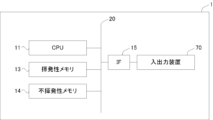
図2は、財務諸表不正推定装置1の概略的なハードウェア構成を示すブロック図である。財務諸表不正推定装置1は、CPU11、揮発性メモリ13、不揮発性メモリ14、インタフェース15、バス20、入出力装置70を有する情報処理装置である。
Figure 2 is a block diagram showing a schematic hardware configuration of the financial statement
CPU11(Central Processing Unit)は、不揮発性メモリ14に格納されたプログラムをバス20を介して読み出し、プログラムに従った情報処理を実行することにより特有の機能を実現する。
The CPU 11 (Central Processing Unit) reads the programs stored in the
不揮発性メモリ14は、財務諸表不正推定装置1の電源の状態にかかわらず記憶状態が保持される記憶装置であり、例えばハードディスクやSSD等である。一般に、不揮発性メモリ14に記憶されているプログラムやデータは、プログラム実行時に揮発性メモリ13に展開される。
The
揮発性メモリ13には、不揮発性メモリ14から展開されたプログラムやデータをはじめ、一時的な計算データや入出力装置70を介して入力又は出力されるデータ等が格納される記憶装置である。
The
入出力装置70はディスプレイ等のデータ出力装置、キーボードやポインティングデバイス等のデータ入力装置、外部との通信を制御する通信インタフェース等を含む。CPU11から出力された表示データは、インタフェース15を介してディスプレイに表示される。キーボードから入力された指令やデータは、インタフェース15を介してCPU11に渡される。通信インタフェースはCPU11が出力する送信データをインタフェース15により取得し、外部に対して出力する。また通信インタフェースは外部より受信データを取得し、インタフェース15を介してCPU11に引き渡す。
The input/
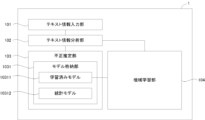
図3は、本発明の実施の形態にかかる財務諸表不正推定装置1の概略的な機能構成を示すブロック図である。財務諸表不正推定装置1は、テキスト情報入力部101、テキスト情報分析部102、不正推定部103を有する。また、必要に応じ機械学習部104を有する。
Figure 3 is a block diagram showing a schematic functional configuration of a financial statement
テキスト情報入力部101は、企業またはその経営者が開示するテキスト情報を取得する。以下にテキスト情報の一例を示すが、本発明はこれらの例に限定されるものでない。
The text
テキスト情報として特に好適なのはMD&A(management’s discussion and analysis of financial condition and results of operations)である。有価証券報告書内「経営者による財政状態及び経営成績の検討と分析」において、経営者により開示されるこのテキスト情報には、経営成績に重要な影響を与える要因についての分析や、資本の財務および資金の流動性にかかわる財源などの説明が含まれる。 A particularly suitable piece of text information is MD&A (management's discussion and analysis of financial condition and results of operations). This text information disclosed by management in the "Management's Discussion and Analysis of Financial Condition and Operating Results" section of the securities report includes an analysis of factors that have a significant impact on operating results, as well as an explanation of financial sources related to capital financing and liquidity.
なぜMD&A開示に焦点を合わせるのかというと、第1に、金融庁が内容に関する指針を出しており、上場企業にとって開示が義務付けられた情報であり、多くの人が財務諸表とともに読んでいるからである。第2に、現在、MD&A開示は外部監査の対象となっていないが、MD&A開示は上場企業の財務実績に関する「インサイダーの視点」を提供するもので、MD&A開示は、経営者の正直性や財務情報との整合性だけでなく、「経営陣の倫理的価値観(tone at the top)」を評価する上で非常に重要な情報となっているからである。第3に、MD&A作成者(経営者)が、MD&Aに財務報告不正が反映されていることを知っていた可能性があり、何らかのストレスにさらされ、テキスト(文章)に影響が反映されている。そのため、MD&A開示に焦点を合わせることは有意義である。 The reason why we focus on MD&A disclosure is, first, that the Financial Services Agency has issued guidelines on the content, it is information that listed companies are required to disclose, and many people read it together with financial statements. Second, although MD&A disclosure is not currently subject to external audits, MD&A disclosure provides an "insider's perspective" on the financial performance of listed companies, and MD&A disclosure is very important information in evaluating not only the honesty of management and its consistency with financial information, but also the "tone at the top." Third, it is possible that the person who prepared the MD&A (management) knew that financial reporting fraud was reflected in the MD&A, and was exposed to some kind of stress, which is reflected in the text. Therefore, it is meaningful to focus on MD&A disclosure.
加えて、MD&Aは形式が予め決まっているので情報の収集及び処理がしやすいこと、裁量が含まれる余地が小さいため定型的な処理に適していることが特徴である。 In addition, MD&A has the advantage that the format is predetermined, making it easy to collect and process information, and that there is little room for discretion, making it suitable for routine processing.
あるいは、テキスト情報はCEOレターであっても良い。CEOレターは、アニュアルレポート、企業ウェブサイト等の電子媒体、又は株主通信等の紙媒体等において開示される投資家向けのメッセージであり、MD&Aに準ずる情報が含まれることが多い。CEOレターは、MD&Aに比べて裁量の余地が大きいため、経営者の考え、態度や価値観がより反映されやすいという特徴がある。 Alternatively, the text information may be a CEO letter. A CEO letter is a message to investors that is disclosed in electronic media such as annual reports and company websites, or in paper media such as shareholder communications, and often contains information similar to MD&A. CEO letters have greater room for discretion than MD&A, and therefore tend to reflect the thoughts, attitudes, and values of management.
あるいは、テキスト情報は有価証券報告書に記載されたリスク情報であっても良い。 Alternatively, the text information may be risk information listed in a securities report.
テキスト情報分析部102は、テキスト情報入力部101に入力されたテキスト情報を分析し、1以上の説明変数を生成する。以下に説明変数の一例を示すが、本発明はこれらに限定されるものではない。
The text
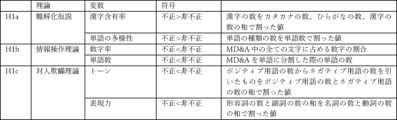
財務諸表不正を実施した経営者は、テキスト情報において、財務諸表不正を投資者から隠したいという意図をもって戦略的に財務諸表不正を隠ぺいしようとする。そのような、経営者による財務諸表不正の隠蔽という戦略をあばくための理論として、難解化仮説(Obfuscation Hypothesis)、情報操作理論(Information Manipulation Theory)、対人欺瞞理論(Interpersonal Deception Theory)の3つの理論がある。本実施の形態では、これらの理論に基づいていくつかの説明変数を定義する。 The managers who commit financial statement fraud strategically attempt to conceal the financial statement fraud in text information with the intention of hiding it from investors. There are three theories to expose such strategies of managers to conceal financial statement fraud: the Obfuscation Hypothesis, the Information Manipulation Theory, and the Interpersonal Deception Theory. In this embodiment, several explanatory variables are defined based on these theories.
(1)難解化仮説
言語上の複雑性は情報量と難解化の2つの構成要素に分解できる。このうち情報量は情報の非対称性と負の相関があり、難解化は情報の非対称性と正の相関がある。ある研究によれば、赤字企業は、文章を難解にして業績不振を隠蔽する一方で、情報量を増やす開示を行う傾向がある。難解化仮説(Obfuscation Hypothesis)とは、経営者が悪いニュースについては隠蔽したり、より前向きな情報を示したりすることによって投資者をミスリードするという仮説である。情報量については、企業または経営者が関与する財務諸表不正の検出が目的であること、Bad news自体が読みにくいということが別の研究で実証されていることから、本実施の形態では考慮しない。本実施の形態では、経営者の裁量がより働きやすいと考えられる難解化にのみ焦点を合わせる。
(1) Obfuscation hypothesis Linguistic complexity can be broken down into two components: information volume and obfuscation. Of these, information volume is negatively correlated with information asymmetry, and obfuscation is positively correlated with information asymmetry. According to one study, loss-making companies tend to make disclosures that increase the amount of information while making sentences obfuscated to conceal poor performance. The obfuscation hypothesis is a hypothesis that managers mislead investors by concealing bad news or presenting more positive information. Regarding the amount of information, this embodiment does not take it into consideration because the purpose is to detect financial statement fraud involving a company or a manager, and it has been demonstrated in another study that bad news itself is difficult to read. In this embodiment, we focus only on obfuscation, which is thought to be easier for managers to exercise discretion.
不正企業は非不正企業よりもテキストの複雑性(学年)が高く、投資者をミスリードさせる目的で難解化させる。例えば、不正なアニュアルレポートには、難解な単語、複雑な構文がより多く使用されていることがわかっている。不正企業は、発言の複雑性を高め、発言内容を難解にする。不正なアニュアルレポートには語彙の多様性が非不正のアニュアルレポートよりも高く、読みにくいという特徴がある。そこで、仮説H1a「不正企業経営者は、投資者をミスリードする目的で文章を難解化させるので、漢字含有率が高く、単語の多様性が高い。」を設定する。 Fraudulent companies have a higher text complexity (grade level) than non-fraudulent companies, making the text more difficult to understand in order to mislead investors. For example, it has been found that fraudulent annual reports contain a greater number of difficult words and complex syntax. Fraudulent companies increase the complexity of their statements, making the content more difficult to understand. Fraudulent annual reports have a higher vocabulary diversity than non-fraudulent annual reports, making them more difficult to read. Therefore, we set the following hypothesis: H1a: "Management of fraudulent companies make text more difficult to understand in order to mislead investors, so the content has a higher content of kanji and a greater variety of words."
仮説H1aに基づき、テキスト情報分析部102は以下の説明変数を生成できる。
・漢字含有率:テキスト情報に出現する漢字の数を、カタカナの数、ひらがなの数、漢字の数の和で割った値。
・単語の多様性:テキスト情報に出現する単語の種類の数を単語数で割った値。ここで単語の種類の数とは、重複を除いた単語数のことである。
・学年:テキストの複雑さを示す「学年(Grade)」は、“世の中に存在する日本語文章の難易度分布の中で、ある文章がどのような位置にあるのか”を示す指標である(Sato 2008)。佐藤(2011)に依拠して、OBIソフトウェアで、バランスコーパスに基づく相対的な難易度を、日本の学校の学年に対応する13段階に分けて、複雑度を測定する方法を用いている。すなわち、小学校1年次生(複雑さレベル1)から学年高等学校3年次生(複雑さレベル12)、さらに大学(複雑さレベル13)までの13段階のうちどれかの学年で表示される(Sato 2008)。
Based on the hypothesis H1a, the text
- Kanji content rate: The number of kanji characters appearing in the text information divided by the sum of the number of katakana characters, the number of hiragana characters, and the number of kanji characters.
Word diversity: The number of different word types appearing in a text divided by the number of words. Here, the number of different word types refers to the number of words excluding duplicates.
Grade: The "Grade" of a text is an index showing the position of a text in the distribution of the level of difficulty of Japanese texts in the world (Sato 2008). Based on Sato (2011), the OBI software uses a method of measuring the complexity by dividing the relative difficulty based on a balanced corpus into 13 levels corresponding to the grades in Japanese schools. That is, the grade is displayed as one of 13 levels ranging from first grade of elementary school (complexity level 1) to third grade of high school (complexity level 12) and university (complexity level 13) (Sato 2008).
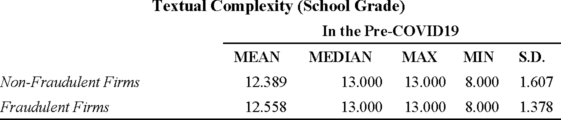
図4は、不正企業および非不正企業それぞれのテキストについて、複雑さを示す指標である学年を測定した結果である。Nakashima(2023)の研究では、不正企業のテキストの複雑性は、非不正企業のテキストの複雑性よりも高いことがうかがえる。学年(Grade)は、漢字含有率と相関が高いと思われ、難解化仮説に含まれることとなる。すなわち、漢字含有率の代替として、学年を説明変数として使用することが可能である。 Figure 4 shows the results of measuring grade, an indicator of complexity, for the texts of fraudulent and non-fraudulent companies. Nakashima's (2023) study suggests that the complexity of the texts of fraudulent companies is higher than that of non-fraudulent companies. Grade is thought to be highly correlated with the kanji content rate and is included in the comprehension hypothesis. In other words, grade can be used as an explanatory variable instead of the kanji content rate.
(2)情報操作理論
情報操作理論によれば、受容者をミスリードする目的で提示する情報の量(情報量のコントロール)、質(情報の歪曲)、方法(曖昧なスタイルでの提示)、関連性(無関係な情報)を操作することによって、情報開示の一部または全部を利用することが可能である。不正検出研究として可読性を考察した研究Nakashima et al.(2022)によれば、不正企業と非不正企業間で長さ(文字数)に有意差は観察されていない。不正企業は、財務諸表数値に虚偽があり、その虚偽、特に数字や単語数を隠ぺいすることが予想できる。そこで、仮説H1b「不正企業経営者は、虚偽の数字を示すことができず、隠蔽するので、非不正企業よりも数字率および単語数が低くなる。」を設定する。
(2) Information manipulation theory According to information manipulation theory, it is possible to use part or all of information disclosure by manipulating the amount (control of the amount of information), quality (distortion of information), method (presentation in an ambiguous style), and relevance (irrelevant information) of information presented with the purpose of misleading the recipient. According to Nakashima et al. (2022), a study that considered readability as a fraud detection study, no significant difference was observed in length (number of characters) between fraudulent and non-fraudulent companies. It can be expected that fraudulent companies have false figures in their financial statements and conceal the false figures, especially the numbers and number of words. Therefore, we set the hypothesis H1b, "Fraudulent company managers cannot show false figures and conceal them, so the number rate and number of words are lower than those of non-fraudulent companies."
仮説H1bに基づき、テキスト情報分析部102は以下の説明変数を生成できる。
・数字率:テキスト情報に出現する全ての文字に占める数字の割合。
・単語数:テキスト情報を単語に分割した際の単語の数。
Based on hypothesis H1b, the text
- Number rate: The percentage of numbers among all characters appearing in the text information.
・Number of words: The number of words when the text information is divided into words.
(3)対人欺瞞理論
ある研究によれば、不正なMD&Aは、真実のMD&Aに比べ、平均して3倍以上のポジティブなセンチメントと4倍以上のネガティブなセンチメントを含んでおり、このことは、不正なMD&Aでは、ポジティブとネガティブの両方のセンチメントがより顕著に使用されていることを示唆している。不正企業はより印象管理に従事し、だましてよりポジティブに企業を描写する。実際に、不正企業経営者はポジティブニュースを大げさにしたり、ネガティブなニュースを最小化したり隠蔽したりして誤った印象を伝えていることが発見されている。
(3) Interpersonal Deception Theory According to one study, fraudulent MD&As contain, on average, three times more positive sentiment and four times more negative sentiment than truthful MD&As, suggesting that both positive and negative sentiment are used more prominently in fraudulent MD&As. Fraudulent companies are more likely to engage in impression management and deceptively portray their companies in a more positive light. In fact, it has been found that fraudulent company managers convey false impressions by exaggerating positive news and minimizing or concealing negative news.
対人欺瞞理論によれば、不正実行者は、特定性(Specificity)を低下させ、包括的な用語を用いることによって、文書に曖昧さを加え、責任を拡散しようとする。したがって、不正企業経営者は、MD&Aを曖昧にし、責任追及から逃れようと、表現力を低くすることが予想できる。そこで、仮説H1c「不正企業経営者は、ポジティブな用語が少なく、ネガティブな用語が多く、また、表現力が低い。」を設定する。 According to interpersonal deception theory, fraudsters attempt to diffuse responsibility by reducing specificity and using generic terms to add ambiguity to documents. Therefore, it can be predicted that fraudulent corporate managers will make their MD&A vague and less expressive in an attempt to avoid being held accountable. Therefore, we set the following hypothesis: H1c: "Fraudulent corporate managers use fewer positive terms, more negative terms, and less expressive."
仮説H1cに基づき、テキスト情報分析部102は以下の説明変数を生成できる。
・トーン:テキスト情報に出現するポジティブ用語の数からネガティブ用語の数を引いたものを、ポジティブ用語の数とネガティブ用語の数の和で割った値。ここで、ポジティブ用語及びネガティブ用語の数は以下の手順で測定できる。まず、テキスト情報としての日本語の文章を単語ごとに切断してから、品詞を判断する。そして、辞書を参照し、ポジティブ用語、ネガティブ用語に相当する単語が文章中にいくつあるのかを算定する。辞書は、公知の単語感情極性対応表を使用できる。
・表現力:形容詞の数と副詞の数の和を名詞の数と動詞の数の和で割った値。
Based on hypothesis H1c, the text
Tone: The number of positive terms minus the number of negative terms appearing in the text information is divided by the sum of the number of positive terms and the number of negative terms. The number of positive terms and negative terms can be measured by the following procedure. First, a Japanese sentence as text information is cut into words, and then the part of speech is determined. Then, a dictionary is referenced to calculate how many words in the sentence correspond to positive terms and negative terms. The dictionary can use a publicly known word sentiment polarity correspondence table.
・Expressive power: The sum of the number of adjectives and adverbs divided by the sum of the number of nouns and verbs.
不正推定部103は、テキスト情報分析部102が生成した1以上の説明変数を取得し、これをモデル格納部1031に格納された推定モデルに入力する。推定モデルは、説明変数と財務諸表不正の有無との相関関係を示す学習済みモデル10311又は統計モデル10312である。推定モデルは、説明変数を入力すると、予め定義された相関関係に照らし、財務諸表不正の有無を示す目的変数を出力する。本実施の形態では、目的変数は2値(不正あり又はなし)とした。なお、本発明はこれに限定されるものではなく、例えば財務諸表に不正がある可能性を示す数値等を目的変数としても良い。
The
不正推定部103は、統計モデル10312を用いて推定を行う場合は、ロジスティック回帰分析をはじめとする公知の統計分析手法を採用することができる。
When making an inference using the
一方、学習済みモデル10311を用いて推定を行う場合、典型的には機械学習部104が予め学習済みモデルを生成する必要がある。
On the other hand, when making an estimation using the trained
機械学習部104は、任意の機械学習アルゴリズムに従って、テキスト情報分析部102が生成した1以上の説明変数と、財務諸表不正の有無を示す目的変数との相関関係を学習する。機械学習部104は、大量の学習用データ(テキスト情報分析部102が生成した1以上の説明変数と、財務諸表不正の有無を示す目的変数とのセット)を繰り返し入力し、学習過程を繰り返し実行する。このように学習過程を繰り返し実行することにより、1以上の説明変数と、財務諸表不正の有無を示す目的変数との相関性を示す学習済みモデルが構築される。学習済みモデルが示す相関性は、学習過程が進むにつれて徐々に信頼性を増してゆく。十分に信頼できる水準の学習済みモデルが構築されると、その学習モデルは、1以上の説明変数に対応する目的変数の値を推定するために使用できるものとなる。
The
不正推定部103は、機械学習部104が構築した学習済みモデルに基づき、1以上の説明変数に対応する目的変数すなわち財務諸表不正の有無を自動的かつ正確に求めることができる。すなわち不正推定部103は、テキスト情報分析部102が生成した1以上の説明変数を学習済みモデルに入力として与えることにより、学習済みモデルが財務諸表不正の有無を示す目的変数を自動的かつ正確に出力する。
The
本実施の形態では、機械学習手法として、コンペティション等で多く用いられるアンサンブル型学習手法を採用した。具体的には、ランダムフォレスト、XGBoost、LightGBM、CatBoostが挙げられる。また、これらの手法に対する対比のため、決定木分析も行った。以降、目的変数は0又は1の2値であることを前提に説明する。 In this embodiment, an ensemble-type learning method that is often used in competitions and the like is adopted as the machine learning method. Specific examples include Random Forest, XGBoost, LightGBM, and CatBoost. In addition, a decision tree analysis was also performed to compare with these methods. The following explanation is based on the assumption that the objective variable has two values, 0 or 1.
(1)決定木分析(分類)
単一の木構造を用いた教師あり機械学習による分析の総称である。本実施の形態で用いた他の手法(ランダムフォレスト、XGBoost、LightGBM、CatBoost)と比較して、得られるモデルの精度では劣る傾向がある。しかしながら、モデルの木構造の可視化の点において他手法に勝る。
(1) Decision tree analysis (classification)
This is a general term for analysis by supervised machine learning using a single tree structure. Compared to other methods used in this embodiment (Random Forest, XGBoost, LightGBM, CatBoost), the accuracy of the obtained model is However, it is superior to other methods in terms of visualizing the tree structure of the model.
本実施の形態では、scikit-learnに標準的に実装されている決定木分析手法の一種であるCART(Classification and Regression Trees)を用いた。CARTは、各分岐点でデータを二分割する木(二分木)により分析を行う手法である。 In this embodiment, we used CART (Classification and Regression Trees), a type of decision tree analysis method that is implemented as standard in scikit-learn. CART is a method of analysis that uses a tree (binary tree) that divides data into two at each branch point.
(2)ランダムフォレスト
アンサンブル型学習手法の一種である。元の訓練データから重複を許しつつランダムにいくつかのデータを抽出し、新しい訓練データを構築する。その後、構築された新しい訓練データを元に決定木分析をおこなう。上記の操作を並列に行うことで複数のモデル(弱学習器)を得る。目的変数の推定の際には、複数の弱学習器から得られる出力値に基づいた多数決を行う。より多くの弱学習器が出力した推定結果を最終的な出力とする。この方法により、単一のモデルに比べ、過学習の危険性の軽減が期待される。
(2) Random Forest is a type of ensemble learning method. Some data is randomly extracted from the original training data, allowing overlaps, to construct new training data. Decision tree analysis is then performed based on the new training data constructed. By performing the above operations in parallel, multiple models (weak learners) are obtained. When estimating the objective variable, a majority vote is performed based on the output values obtained from multiple weak learners. The estimated result output by the largest number of weak learners is used as the final output. This method is expected to reduce the risk of overfitting compared to a single model.
(3)XGBoost
以降の手法もランダムフォレストと同様にアンサンブル型学習手法である。各弱学習器が木の構造を持っている点においてもランダムフォレストと類似する。しかし、弱学習器の構成(決定)法・集約法は大きく異なる。ランダムフォレストにおいては、過学習の抑制が目的であったが、以降の手法の主な目的は予測精度の向上である。一方で、以降説明する手法は決定木分析やランダムフォレストよりも、過学習が生じやすい手法である。
(3) XGBoost
The following methods are also ensemble-type learning methods, just like random forests. They are also similar to random forests in that each weak learner has a tree structure. However, the method of constructing (determining) weak learners and the aggregation method are different. The methods are very different. In the case of random forests, the purpose was to suppress overfitting, but the main purpose of the following methods is to improve prediction accuracy. On the other hand, the methods described below are similar to decision tree analysis and random forests. This method is more prone to overfitting than the conventional method.
XGBoostは目的変数が1である確率を各弱学習器の推定値の総和を用いて推定する(厳密には、学習率と呼ばれるハイパーパラメータと各学習器の推定値の積の総和を用いるが、本説明では、学習率は常に1であると仮定する)。各学習器は逐次的に構築する。1番目の弱学習器は目的変数が1である確率を推定するが、n番目(nは2以上の整数)の弱学習器は(n-1)番目までの弱学習器の推定値の総和と真の値の間の誤差を推定する。木の構造を持つ各弱学習器における葉の分割については、情報利得を基準とする。ただし情報利得として、決定木分析においてよく用いられるエントロピーやジニ係数とは異なるものを用いる。詳細は割愛するが、真の値との誤差の最小化を達成するような情報利得を用いている。なお、葉の分割を検討する順番はlevel-wise tree growthに則る。すなわち、同じ深さの全ての葉について分割を検討しきった後に、1つ深い枝の分割の検討に移るといった手順をとる。 XGBoost estimates the probability that the objective variable is 1 by using the sum of the estimates of each weak learner (strictly speaking, the sum of the products of a hyperparameter called the learning rate and the estimates of each learner is used, but in this explanation, we will assume that the learning rate is always 1). Each learner is constructed sequentially. The first weak learner estimates the probability that the objective variable is 1, while the nth (n is an integer of 2 or more) weak learner estimates the error between the sum of the estimates of the weak learners up to the (n-1)th and the true value. The information gain is used as the criterion for splitting the leaves in each weak learner with a tree structure. However, the information gain used is different from the entropy and Gini coefficient that are often used in decision tree analysis. Details are omitted, but an information gain that achieves the minimization of the error with the true value is used. The order in which the leaf split is considered follows level-wise tree growth. In other words, after considering splits for all leaves at the same depth, we move on to considering splits for the branch one level deeper.
(4)LightGBM
LightGBMは、学習アルゴリズムにおいて、XGBoostと類似する手法である。目的変数が1である確率を、木の構造を持つ弱学習器たちの推定値の総和で推定する点において、XGBoostと変わらない。XGBoostとの主な違いは各回帰木の構成方法にある。
(4) LightGBM
LightGBM is a method similar to XGBoost in terms of learning algorithm. It is the same as XGBoost in that it estimates the probability that the objective variable is 1 by the sum of the estimates of weak learners with a tree structure. XGBoost The main difference between them is in how each regression tree is constructed.
一点目の違いは各特徴量をヒストグラム化している点である。ヒストグラム化により厳密な枝分かれを探さずに済み、計算コストを抑えることが可能である。二点目の違いは「level-wise tree growth」ではなく「leaf-wise tree growth」により、木の構造を決定している点である。両者の違いは葉の分割を検討する順番にある。なお、木を完全に成長させた場合には同じ木が構成される。Leaf-wise tree growthは、情報利得の最も大きくなる枝から順に伸ばす構成方法である。leaf-wise tree growthを用いる場合は、「pre-pruning」と呼ばれる剪定アルゴリズムを適用することができる。pre-pruningとはさらなる分岐を行うことで予測誤差が下がるなら分岐を行い、そうではないのならそこで木の成長を止めるアルゴリズムである。Pre-pruning はpost-pruningに比較して精度が落ちる可能性があるものの、計算コストが抑えることができる。なお、post-pruningとは決定木を完全に成長させてから、最も予測誤差の小さい状態を選択する剪定方法である。 The first difference is that each feature is histogrammed. Histogramming eliminates the need to search for strict branching, making it possible to reduce calculation costs. The second difference is that the tree structure is determined by "leaf-wise tree growth" rather than "level-wise tree growth". The difference between the two is in the order in which leaf splitting is considered. Note that the same tree is constructed when the tree is allowed to grow completely. Leaf-wise tree growth is a construction method that extends branches in order starting from the branch with the greatest information gain. When leaf-wise tree growth is used, a pruning algorithm called "pre-pruning" can be applied. Pre-pruning is an algorithm that branches if further branching reduces the prediction error, and stops tree growth if it does not. Pre-pruning may be less accurate than post-pruning, but it can reduce computational costs. Post-pruning is a pruning method that allows the decision tree to grow completely and then selects the state with the smallest prediction error.
ヒストグラム化、leaf-wise tree growth及びpre-pruningにより、lightGBMの計算コストはXGBoostよりも「軽く」なる傾向がある。ただし、leaf-wise tree growthによる決定木は複雑になりやすく、過学習には注意が必要である。 Due to histogramming, leaf-wise tree growth, and pre-pruning, the computational cost of lightGBM tends to be "lighter" than that of XGBoost. However, decision trees based on leaf-wise tree growth tend to become complex, so care must be taken to avoid overfitting.
(5)CatBoost
XGBoostやLightGBMと同様に、CatBoostも木の構造を持つ弱学習器たちの推定値の総和によって目的変数が1である確率を推定する手法である。勾配ブースティング決定木(Gradient Boosting Decision Tree)の一種である。各弱学習器を構築する際に、訓練データからランダムにサンプリングしたデータを用いるため、XGBoostやLightGBMよりも過学習を起こしにくい手法とされる。
(5) CatBoost
Like XGBoost and LightGBM, CatBoost is a method that estimates the probability that the objective variable is 1 by the sum of the estimates of weak learners with a tree structure. It is a type of method that is less susceptible to overfitting than XGBoost or LightGBM because data randomly sampled from training data is used when constructing each weak learner.
<実験>
本実施の形態にかかる財務諸表不正推定装置1を使用し、実在する企業が開示したテキスト情報を対象として、財務諸表不正の有無を推定する実験を行なった。その手法と結果を以下に示す。
<Experiment>
Using the financial statement
(1)サンプル選択とデータ
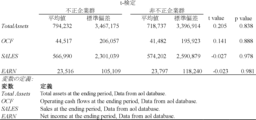
分析対象企業は、企業はすべて日本取引所に上場している企業3483社のうち、銀行業・保険業(165社)、米国基準およびIFRS基準その他基準(320社)を除外した、日本基準を適用している企業2998社である。不正企業群は、東京商工リサーチ(株)による『2020年不適切な会計・経理」(以下、不適切会計)を開示した上場企業』の2019年に不不適切会計とされた会社73社のうち、会社ぐるみの不正31社、従業員関連の不正が12社、上級経営者個人の不正が3社、子会社関連不正が27社である。会社ぐるみの不正31社のうち、6社が上場廃止企業であり、最終サンプルは25社である。業種と総資産および売上高の類似した企業群をペアの非不正企業としている。図5は、不正企業群25社、非不正企業群25社のt検定結果を示している。図5から、不正企業、非不正企業の総資産、売上高に有意差がなく、ペアサンプルとして妥当であることがわかる。
(1) Sample Selection and Data The companies analyzed were 2,998 companies that applied Japanese standards out of 3,483 companies listed on the Japan Exchange, excluding banking and insurance companies (165 companies), US standards, IFRS standards, and other standards (320 companies). The fraudulent companies were 73 companies that were found to have inappropriate accounting in 2019 in the "Listed Companies that Disclosed Inappropriate Accounting and Bookkeeping in 2020" (hereinafter referred to as "inappropriate accounting") by Tokyo Shoko Research Co., Ltd., and included 31 companies with company-wide fraud, 12 companies with employee-related fraud, 3 companies with senior management fraud, and 27 companies with subsidiary-related fraud. Of the 31 companies with company-wide fraud, 6 were delisted companies, and the final sample was 25 companies. A group of companies with similar industries, total assets, and sales was paired with a non-fraudulent company. Figure 5 shows the t-test results for the 25 fraudulent companies and the 25 non-fraudulent companies. Figure 5 shows that there is no significant difference between the total assets and sales of fraudulent and non-fraudulent companies, making paired samples appropriate.
当該不正企業群、非不正企業群のMD&A開示データは、2013年から2019年の7年分のMD&Aを含めている。過去7年分のMD&A開示で分析するのは、東芝やオリンパスの不正事例から発覚した年度から遡って最短7年間は不正に関与しているからである。 The MD&A disclosure data for the fraudulent and non-fraudulent companies in question includes MD&A from the seven years from 2013 to 2019. The analysis is based on MD&A disclosure from the past seven years because, in the cases of Toshiba and Olympus, companies were involved in fraud for a minimum of seven years prior to the year in which it was discovered.
(2)分析手法
(2-1)機械学習による財務諸表不正推定の試行
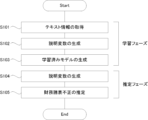
図6に示すフローチャートに従って、財務諸表推定装置1を使用し、機械学習による不正検知モデルの生成及び当該モデルによる財務諸表不正推定を試行した。機械学習手法としては決定木、ランダムフォレスト、XGBoost、LightGBM、CatBoostを用いた。
(2) Analysis Method (2-1) Trial of Estimating Financial Statement Fraud by Machine Learning According to the flowchart shown in Fig. 6, the financial
(2-1-1)学習フェーズ
S101:テキスト情報の取得
テキスト情報入力部101が、企業またはその経営者が開示するテキスト情報を取得する。本実験では、(1)サンプル選択とデータにおいて示した企業50社の2013年度から2018年度までの6年分のMD&Aを学習用のテキスト情報として収集、入力した。
(2-1-1) Learning Phase S101: Acquisition of Text Information The text
S102:説明変数の生成
テキスト情報分析部102は、テキスト情報入力部101に入力されたテキスト情報を分析し、説明変数を生成する。本実験では、図7に示す6つの説明変数を生成した。
S102: Generation of explanatory variables The text
S103:学習済みモデルの生成
機械学習部104は、S102で生成された6つの説明変数と、財務諸表不正の有無を示す目的変数(2値)と、のセットを学習用データとして繰り返し入力し、学習済みモデルを生成する。本実験では、機械学習手法として決定木、ランダムフォレスト、XGBoost、LightGBM、CatBoostの5種類を採用し、それぞれ学習済みモデルを生成した。
S103: Generation of trained model The
(2-1-2)推定フェーズ
S104:テキスト情報の取得
テキスト情報入力部101が、企業またはその経営者が開示するテキスト情報を取得する。本実験では、(1)サンプル選択とデータにおいて示した企業50社の2019年度のMD&Aを推定用のテキスト情報として収集、入力した。
(2-1-2) Estimation Phase S104: Acquisition of Text Information The text
S105:説明変数の生成
テキスト情報分析部102は、テキスト情報入力部101に入力されたテキスト情報を分析し、説明変数を生成する。本実験では、図7に示す6つの説明変数を生成した。
S105: Generation of explanatory variables The text
S106:財務諸表不正の有無の推定
不正推定部103は、S105で生成された6つの説明変数をS103で生成された学習済みモデルに入力し、財務諸表不正の有無を示す目的変数(2値)を推定結果として出力する。
S106: Estimation of the Presence or Absence of Financial Statement Fraud The
(2-2)評価
複数の機械学習手法(決定木、ランダムフォレスト、XGBoost、LightGBM、CatBoost)により生成された分類器の有効性を評価するため、Accuracy、Precision、Recall、F measure、AUROCを算出する。Accuracyは、正しく分類されたMD&A開示の総数を分析されたMD&A開示の総数で除したものである。Precisionは、不正と分類されたMD&A開示の総数に対する、不正と正しく分類されたMD&A開示数の比率である。Recallは、実際の不正のMD&A開示の総数に対する、不正と正しく分類されたMD&A開示の数の比率である。RecallはTrue Positive Rate(真陽性率)とも呼ばれる。以下では、True Positive RateをTPRと略記する。対して、実際の非不正のMD&A開示の総数に対する、不正と誤って分類されたMD&A開示の数の比率をFalse Positive Rate(偽陽性率)と呼ぶ。以下では、False Positive RateをFPRと略記する。
(2-2) Evaluation To evaluate the effectiveness of classifiers generated by multiple machine learning methods (decision tree, random forest, XGBoost, LightGBM, CatBoost), Accuracy, Precision, Recall, F measure, and AUROC are calculated. Accuracy is the total number of correctly classified MD&A disclosures divided by the total number of MD&A disclosures analyzed. Precision is the ratio of the number of MD&A disclosures correctly classified as fraudulent to the total number of MD&A disclosures classified as fraudulent. Recall is the ratio of the number of MD&A disclosures correctly classified as fraudulent to the total number of actual fraudulent MD&A disclosures. Recall is also called True Positive Rate. Hereinafter, True Positive Rate is abbreviated as TPR. In contrast, the ratio of the number of MD&A disclosures that are incorrectly classified as fraudulent to the total number of actual non-fraudulent MD&A disclosures is called False Positive Rate. Hereinafter, False Positive Rate is abbreviated as FPR.
F measureは、それぞれの加重調和平均を用いてPrecisionとRecallを1つのメトリックスに統合したものである。数値が高いほど推定性能が高いことを意味する(Humphery et al. 2011, 591)。 The F measure combines Precision and Recall into a single metric using a weighted harmonic mean of each. A higher value indicates better estimation performance (Humphery et al. 2011, 591).
AUROCの説明のために、本実験で用いる機械学習モデルたちの推定方法について述べる。本実験において、機械学習モデルたちは不正を行っている確率をまず算出する。予め閾値(通常は0.5)を設定しておき、確率が閾値以上の場合に不正と分類している。閾値を低くすればするほど、機械学習モデルたちによって不正と分類される傾向が強まる。その結果TPRは高まるものの、FPRも高まる。反対に、閾値を低くすればするほど、FPRは下がるがTPRも下がってしまう。閾値を0から1の間で変化させた際のTPRとFPRの関係をグラフで表したものをROC曲線と呼ぶ(図8、曲線a)。ランダムな分類(例えば、0以上1以下の間の値を取る乱数を不正の確率にした分類)を行った際には、図8の直線bのようなROC曲線になる。TPR=1かつFPR=0が成り立つような閾値が存在する場合はその閾値で分類を行うことで、AccuracyもPrecisionもRecallも1になるような理想的な分類を行うことができる。このような閾値が存在するような、理想的な場合は図8の線cのようなROC曲線が得られる。 To explain AUROC, we will explain the estimation method of the machine learning models used in this experiment. In this experiment, the machine learning models first calculate the probability of cheating. A threshold (usually 0.5) is set in advance, and if the probability is equal to or greater than the threshold, it is classified as cheating. The lower the threshold, the stronger the tendency for the machine learning models to classify it as cheating. As a result, the TPR increases, but the FPR also increases. Conversely, the lower the threshold, the lower the FPR, but the TPR also decreases. A graph showing the relationship between TPR and FPR when the threshold is changed between 0 and 1 is called an ROC curve (Figure 8, curve a). When random classification (for example, classification using a random number between 0 and 1 as the probability of cheating) is performed, the ROC curve will look like the line b in Figure 8. If there exists a threshold where TPR = 1 and FPR = 0, then classification can be performed using that threshold, making ideal classification where Accuracy, Precision, and Recall are all 1. In an ideal case where such a threshold exists, an ROC curve like line c in Figure 8 is obtained.
AUROC(Area Under the ROC curve)とはROC曲線がどれほど理想的なROC曲線(図8の線c)に近いかを測る尺度である。AUROCは図9において示す領域d(曲線bとTPR=0に挟まれた領域)の面積で与えられる。ROC曲線が図8、図9の線cに近づくほど、AUROC曲線の値は大きくなり、理想的な分類が行われた際のAUROCは1である。すなわち、AUROC曲線の値が1に近いほど、機械学習モデルの推定性能が高いと示唆される。また、ランダムな分類が行われた場合、AUROCは0.5になる。すなわち、AUROCが0.5を超えていれば、機械学習モデルがランダムな分類より高い推定能力を持つことが示唆される。 AUROC (area under the ROC curve) is a measure of how close the ROC curve is to the ideal ROC curve (line c in Figure 8). AUROC is given by the area of area d (area between curve b and TPR = 0) shown in Figure 9. The closer the ROC curve is to line c in Figures 8 and 9, the larger the AUROC curve value is, and the AUROC is 1 when ideal classification is performed. In other words, the closer the AUROC curve value is to 1, the higher the estimation performance of the machine learning model is suggested. In addition, when random classification is performed, the AUROC is 0.5. In other words, if the AUROC exceeds 0.5, it is suggested that the machine learning model has a higher estimation ability than random classification.
(3)分析結果
(3-1)統計学的検定の結果
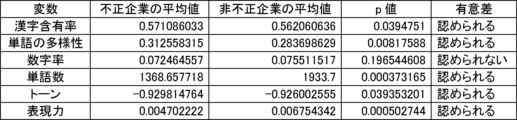
本実験で用いる6個の説明変数に対して、不正企業の群と非不正企業の群の間に有意差があるかをマンホイットニーのU検定(有意水準5%)によって調べた。結果を図10に示す。不正企業は、非不正企業と比べて、漢字含有率が高く、単語の多様性が高く、数字率が低く、単語数が低く、トーンが低く、表現力が低いことがわかった。ただし、数字率については有意差が認められなかった。しかしながら、後述の(3-2)モデルの評価により、数字率は本実験の機械学習モデルの推定に強く寄与していることがわかった。
(3) Analysis Results (3-1) Statistical Test Results We used the Mann-Whitney U test (
(3-2)モデルの評価
本実験では、2013年度から2018年度までのデータを訓練データ、2019年度のデータをテストデータとした。また、説明変数として図7に示す6つの説明変数を使用した。
(3-2) Model Evaluation In this experiment, data from 2013 to 2018 was used as training data, and data from 2019 was used as test data. In addition, the six explanatory variables shown in FIG. 7 were used as explanatory variables.
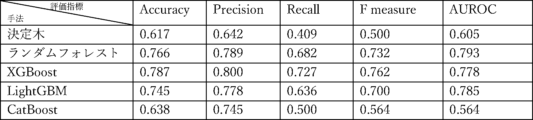
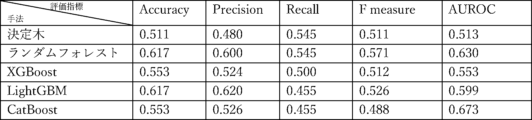
決定木、ランダムフォレスト、XGBoost、LightGBM、CatBoostを用いた不正検知モデルの評価指標(Accuracy、Precision、Recall、F measure、AUROC)はそれぞれ図11のとおりであった。なお、各評価指標の値はテストデータに対して算出したものである。 The evaluation indices (Accuracy, Precision, Recall, F measure, AUROC) of the fraud detection models using decision tree, random forest, XGBoost, LightGBM, and CatBoost are shown in Figure 11. The values of each evaluation index were calculated for the test data.
また、これらのモデルのSHAP値はそれぞれ図12乃至図16の通りであった。 The SHAP values of these models were as shown in Figures 12 to 16, respectively.
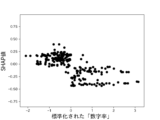
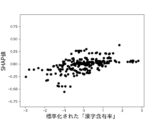
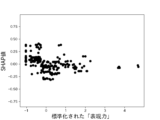
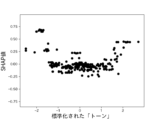
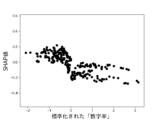
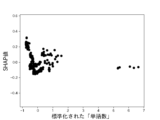
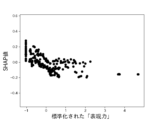
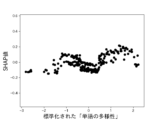
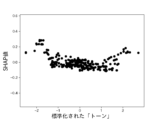
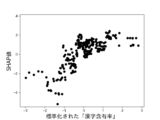
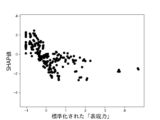
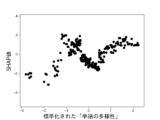
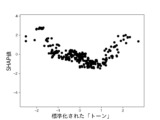
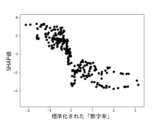
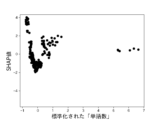
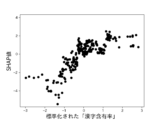
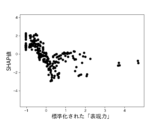
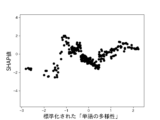
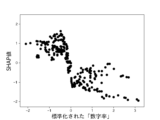
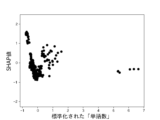
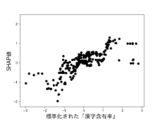
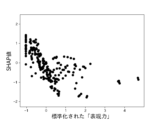
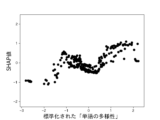
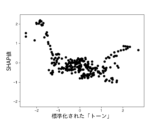
図12A乃至図12Gは決定木を使って生成したモデルのSHAP値を示す図である。図12Aは、6つの説明変数「数字率」「単語数」「漢字含有率」「表現力」「単語の多様性」「トーン」のSHAP値の絶対値の平均を比較したグラフである。図12B乃至図12Fは、上記6つの説明変数をそれぞれ使用した場合のSHAP値の分布を示したグラフである。図12Bは標準化された「数字率」に対するSHAP値の分布、図12Cは標準化された「単語数」に対するSHAP値の分布、図12Dは標準化された「漢字含有率」に対するSHAP値の分布、図12Eは標準化された「表現力」に対するSHAP値の分布、図12Fは標準化された「単語の多様性」に対するSHAP値の分布、図12Gは標準化された「トーン」に対するSHAP値の分布を示している。 Figures 12A to 12G show the SHAP values of models generated using decision trees. Figure 12A is a graph comparing the average absolute values of the SHAP values of six explanatory variables: "number rate," "number of words," "kanji content rate," "expressiveness," "word diversity," and "tone." Figures 12B to 12F are graphs showing the distribution of SHAP values when each of the six explanatory variables is used. Figure 12B shows the distribution of SHAP values for the standardized "number rate," Figure 12C shows the distribution of SHAP values for the standardized "number of words," Figure 12D shows the distribution of SHAP values for the standardized "kanji content rate," Figure 12E shows the distribution of SHAP values for the standardized "expressiveness," Figure 12F shows the distribution of SHAP values for the standardized "word diversity," and Figure 12G shows the distribution of SHAP values for the standardized "tone."
図13Aはランダムフォレストを使って生成したモデルのSHAP値を示す図である。図13Aは、6つの説明変数「数字率」「単語数」「漢字含有率」「表現力」「単語の多様性」「トーン」のSHAP値の絶対値の平均を比較したグラフである。図13B乃至図13Fは、上記6つの説明変数をそれぞれ使用した場合のSHAP値の分布を示したグラフである。図13Bは標準化された「数字率」に対するSHAP値の分布、図13Cは標準化された「単語数」に対するSHAP値の分布、図13Dは標準化された「漢字含有率」に対するSHAP値の分布、図13Eは標準化された「表現力」に対するSHAP値の分布、図13Fは標準化された「単語の多様性」に対するSHAP値の分布、図13Gは標準化された「トーン」に対するSHAP値の分布を示している。 Figure 13A shows the SHAP value of a model generated using random forest. Figure 13A is a graph comparing the average absolute values of the SHAP values of six explanatory variables, "number rate," "number of words," "kanji content rate," "expressiveness," "word diversity," and "tone." Figures 13B to 13F are graphs showing the distribution of SHAP values when each of the above six explanatory variables is used. Figure 13B shows the distribution of SHAP values for the standardized "number rate," Figure 13C shows the distribution of SHAP values for the standardized "number of words," Figure 13D shows the distribution of SHAP values for the standardized "kanji content rate," Figure 13E shows the distribution of SHAP values for the standardized "expressiveness," Figure 13F shows the distribution of SHAP values for the standardized "word diversity," and Figure 13G shows the distribution of SHAP values for the standardized "tone."
図14AはXGBoostを使って生成したモデルのSHAP値を示す図である。図14Aは、6つの説明変数「数字率」「単語数」「漢字含有率」「表現力」「単語の多様性」「トーン」のSHAP値の絶対値の平均を比較したグラフである。図14B乃至図14Fは、上記6つの説明変数をそれぞれ使用した場合のSHAP値の分布を示したグラフである。図14Bは標準化された「数字率」に対するSHAP値の分布、図14Cは標準化された「単語数」に対するSHAP値の分布、図14Dは標準化された「漢字含有率」に対するSHAP値の分布、図14Eは標準化された「表現力」に対するSHAP値の分布、図14Fは標準化された「単語の多様性」に対するSHAP値の分布、図14Gは標準化された「トーン」に対するSHAP値の分布を示している。 Figure 14A shows the SHAP value of a model generated using XGBoost. Figure 14A is a graph comparing the average absolute values of the SHAP values of six explanatory variables, "number rate," "number of words," "kanji content rate," "expressiveness," "word diversity," and "tone." Figures 14B to 14F are graphs showing the distribution of SHAP values when each of the above six explanatory variables is used. Figure 14B shows the distribution of SHAP values for the standardized "number rate," Figure 14C shows the distribution of SHAP values for the standardized "number of words," Figure 14D shows the distribution of SHAP values for the standardized "kanji content rate," Figure 14E shows the distribution of SHAP values for the standardized "expressiveness," Figure 14F shows the distribution of SHAP values for the standardized "word diversity," and Figure 14G shows the distribution of SHAP values for the standardized "tone."
図15AはLightGBMを使って生成したモデルのSHAP値を示す図である。図15Aは、6つの説明変数「数字率」「単語数」「漢字含有率」「表現力」「単語の多様性」「トーン」のSHAP値の絶対値の平均を比較したグラフである。図15B乃至図15Fは、上記6つの説明変数をそれぞれ使用した場合のSHAP値の分布を示したグラフである。図15Bは標準化された「数字率」に対するSHAP値の分布、図15Cは標準化された「単語数」に対するSHAP値の分布、図15Dは標準化された「漢字含有率」に対するSHAP値の分布、図15Eは標準化された「表現力」に対するSHAP値の分布、図15Fは標準化された「単語の多様性」に対するSHAP値の分布、図15Gは標準化された「トーン」に対するSHAP値の分布を示している。 Figure 15A shows the SHAP value of a model generated using LightGBM. Figure 15A is a graph comparing the average absolute values of the SHAP values of six explanatory variables: "number rate," "number of words," "kanji content rate," "expressiveness," "word diversity," and "tone." Figures 15B to 15F are graphs showing the distribution of SHAP values when each of the six explanatory variables is used. Figure 15B shows the distribution of SHAP values for the standardized "number rate," Figure 15C shows the distribution of SHAP values for the standardized "number of words," Figure 15D shows the distribution of SHAP values for the standardized "kanji content rate," Figure 15E shows the distribution of SHAP values for the standardized "expressiveness," Figure 15F shows the distribution of SHAP values for the standardized "word diversity," and Figure 15G shows the distribution of SHAP values for the standardized "tone."
図16AはCatBoostを使って生成したモデルのSHAP値を示す図である。図16Aは、6つの説明変数「数字率」「単語数」「漢字含有率」「表現力」「単語の多様性」「トーン」のSHAP値の絶対値の平均を比較したグラフである。図16B乃至図16Fは、上記6つの説明変数をそれぞれ使用した場合のSHAP値の分布を示したグラフである。図16Bは標準化された「数字率」に対するSHAP値の分布、図16Cは標準化された「単語数」に対するSHAP値の分布、図16Dは標準化された「漢字含有率」に対するSHAP値の分布、図16Eは標準化された「表現力」に対するSHAP値の分布、図16Fは標準化された「単語の多様性」に対するSHAP値の分布、図16Gは標準化された「トーン」に対するSHAP値の分布を示している。 Figure 16A shows the SHAP value of a model generated using CatBoost. Figure 16A is a graph comparing the average absolute values of the SHAP values of six explanatory variables, "number rate," "number of words," "kanji content rate," "expressiveness," "word diversity," and "tone." Figures 16B to 16F are graphs showing the distribution of SHAP values when each of the above six explanatory variables is used. Figure 16B shows the distribution of SHAP values for the standardized "number rate," Figure 16C shows the distribution of SHAP values for the standardized "number of words," Figure 16D shows the distribution of SHAP values for the standardized "kanji content rate," Figure 16E shows the distribution of SHAP values for the standardized "expressiveness," Figure 16F shows the distribution of SHAP values for the standardized "word diversity," and Figure 16G shows the distribution of SHAP values for the standardized "tone."
SHAP値は、各機械学習モデルが目的変数を出力するに際し、各説明変数の影響をどれだけ受けたか(寄与度)を示している。SHAP値の絶対値の平均について説明変数間の順位をつけると、「数字率」は5つのモデルのいずれにおいても1位であった。一方、「トーン」と「単語の多様性」は、5つのモデルのいずれについても、4位以下にしかならなかった。図17は、推定にあまり寄与していないと思われるこれらの説明変数(「トーン」及び「単語の多様性」)を除いた場合のモデルの評価指標を示す表である。図17に示すように、決定木を除いた手法については6変数の場合と遜色ない推定精度を示した。 The SHAP value indicates the degree of influence (degree of contribution) of each explanatory variable when each machine learning model output the objective variable. When explanatory variables were ranked based on the average absolute value of the SHAP value, "digit rate" was ranked first in all five models. On the other hand, "tone" and "word diversity" were ranked fourth or lower in all five models. Figure 17 is a table showing the evaluation indexes of the models when these explanatory variables ("tone" and "word diversity"), which are thought to contribute little to the estimation, are excluded. As shown in Figure 17, the method excluding the decision tree showed estimation accuracy that was comparable to the six-variable case.
なお、説明変数の機械学習モデルへの貢献を示す指標としてSHAP値が有用であることは、例えば非特許文献31及び32に示すように当業者にとっての技術常識である。仮に、SHAP値が高くてもその説明変数の寄与度が低くなる例外的なケースが存在しうるとしても、本実験がその例外にあたると推察できるような合理的な理由は見出せない。 It is common knowledge for those skilled in the art that the SHAP value is useful as an index of the contribution of explanatory variables to a machine learning model, as shown in, for example, Non-Patent Documents 31 and 32. Even if there are exceptional cases in which the contribution of an explanatory variable is low even when the SHAP value is high, there is no reasonable reason to infer that the present experiment is an exception.
「トーン」と「単語の多様性」を除いた4つの説明変数のうち、「数字率」とその他の1つの説明変数を用いて、2つの説明変数のみから推定を行った。比較的少ない説明変数であっても多少の推定精度を示した。
図18は「数字率」及び「単語数」のみを用いた際のモデルの評価指標である。
図19は「数字率」及び「漢字含有率」のみを用いた際のモデルの評価指標である。
図20は「数字率」及び「表現力」のみを用いた際のモデルの評価指標である。
説明変数として、「数字率」のみを用いた際の評価は図21の通りであった。
Of the four explanatory variables excluding "tone" and "word diversity," we used "digit rate" and one other explanatory variable to estimate from only two explanatory variables. Even with a relatively small number of explanatory variables, we were able to show some estimation accuracy.
FIG. 18 shows the evaluation indexes of the model when only the "number rate" and the "number of words" are used.
FIG. 19 shows the evaluation indexes of the model when only the "number rate" and the "kanji content rate" are used.
FIG. 20 shows the evaluation indexes of the model when only "number rate" and "expressiveness" are used.
The evaluation when only the "digit rate" was used as an explanatory variable was as shown in FIG.
第1に、機械学習を用いた推定においては、説明変数のうち数字率の寄与度が最も高く、数字率のみを用いた場合でも一定の推定精度が得られることがわかった。従来の財務諸表不正推定手法では、数多くの説明変数を生成して推定に使用するものが主流であった。一方、本発明において新たに導入された説明変数である数字率を使用すれば、1つの説明変数で一定の精度を有する財務諸表不正の推定が可能である。すなわち、数字率という新たな概念を推定処理に使用することによって、従来よりも計算リソースを大幅に抑制しつつも、推定精度を確保することができるようになった。 First, in estimation using machine learning, it was found that the numeric rate has the highest contribution among explanatory variables, and a certain level of estimation accuracy can be obtained even when only the numeric rate is used. Conventional methods for estimating financial statement fraud have mainly involved generating a large number of explanatory variables and using them for estimation. On the other hand, by using the numeric rate, which is a newly introduced explanatory variable in this invention, it is possible to estimate financial statement fraud with a certain level of accuracy using a single explanatory variable. In other words, by using the new concept of the numeric rate in the estimation process, it is possible to ensure estimation accuracy while significantly reducing computational resources compared to the past.
また、数字率に、寄与度が比較的高い表現力、漢字含有率、単語数の少なくともいずれか1つを組み合わせることで、数字率のみを用いた場合に比べ推定精度をさらに上げられることがわかった。一方、トーン、単語の多様性の寄与度は比較的低いことがわかった。 In addition, we found that by combining the number rate with at least one of the relatively high contribution factors of expressiveness, kanji content rate, and number of words, we could further improve the estimation accuracy compared to using only the number rate. On the other hand, we found that the contribution of tone and word diversity was relatively low.
第2に、不正検知モデル(決定木、ランダムフォレスト、XGBoost、LightGBM、CatBoost)の性能を比較したところ、6変数の場合はランダムフォレストが最も性能が高いことがわかった。なお、ハイパーパラメータをチューニングすればCatBoostの性能が最も高くなる可能性がある。 Secondly, when comparing the performance of fraud detection models (decision tree, random forest, XGBoost, LightGBM, CatBoost), it was found that random forest performed best when six variables were used. However, it is possible that CatBoost could achieve the highest performance by tuning the hyperparameters.
このように、(3-1)に示した統計学的検定と、(3-2)に示した機械学習モデルの評価とでは、数字率に対する評価が異なる結果となった。しかしながら、この結果は説明変数としての数字率の有用性を否定するものではない。 As such, the statistical test shown in (3-1) and the machine learning model evaluation shown in (3-2) yielded different results for the number rate. However, this result does not negate the usefulness of the number rate as an explanatory variable.
図22は、サンプルデータにおける非不正企業と不正企業の分布を示すヒストグラムである。淡色は非不正企業の件数、濃色は不正企業の件数を示す。このサンプルデータでは、数字率は0から0.175以下の範囲に分布している。数字率の範囲を細分化した各レンジにおける非不正企業、不正企業の件数は0から35件の範囲に分布している。 Figure 22 is a histogram showing the distribution of non-fraudulent companies and fraudulent companies in the sample data. Lighter colors indicate the number of non-fraudulent companies, and darker colors indicate the number of fraudulent companies. In this sample data, the numerical rate is distributed in the range from 0 to 0.175 or less. The number of non-fraudulent companies and fraudulent companies in each range obtained by subdividing the numerical rate range is distributed in the range from 0 to 35.
このヒストグラムでは、数字率の増加に対する非不正企業の増減傾向と、不正企業の増減傾向とが異なる。非不正企業では、0.075をピークとして増加から減少に転じる比較的きれいな分布が見られる。一方、不正企業では0.063をピークとして増加から減少に転じた後、0.100では再度増加に転じ、0.125では再度減少に転じるという特徴的な動きが見られる。 In this histogram, the trend of increase and decrease for non-fraudulent companies in response to an increase in the number rate is different from the trend of increase and decrease for fraudulent companies. For non-fraudulent companies, a relatively clean distribution is seen, peaking at 0.075 and then turning from an increase to a decrease. On the other hand, for fraudulent companies, a distinctive trend is seen, where the rate peaks at 0.063 and then turns from an increase to a decrease, before increasing again at 0.100 and turning down again at 0.125.
統計的検定は、比較したい2群の増減傾向を全体的に捉えて比較する。そのため、局所的な増減傾向の相違は捨象されうる。このサンプルデータのように、一方の群が特徴的かつ局所的な増減傾向を有していたとしても、その相違は有意差としては顕現しにくい。 Statistical tests compare the overall increase or decrease trends of the two groups being compared. Therefore, local differences in increase or decrease trends can be ignored. Even if one group has a distinctive and local increase or decrease trend, as in this sample data, the difference is unlikely to appear as a significant difference.
一方、機械学習は、より局所的に数字率を捉えて推定を行う。例えば数字率0.100の場合と数字率0.113の場合とで異なる推定を行うことが可能である。したがって、このようなサンプルデータを用いた場合であっても比較的正確に判定を行うことができる。 On the other hand, machine learning estimates the number rate more locally. For example, it is possible to make different estimates when the number rate is 0.100 and when the number rate is 0.113. Therefore, even when using such sample data, it is possible to make relatively accurate judgments.
本実験において、統計学的検定においては有意差が認められなかったものの、機械学習による数字率を用いた場合に一定の推定精度が得られたのは、このような要因によるものと考えられる。 Although no significant differences were found in the statistical tests in this experiment, it is believed that factors such as these are the reasons why a certain degree of estimation accuracy was achieved when using the numerical rate based on machine learning.
図12B、図13B、図14B、図15B及び図16Bによれば、本実験にかかるサンプルデータは、数字率が高いほど不正である可能性は低く、数字率が低いほど不正である可能性が高いものであることがわかる。そして、数字率が中間レンジにある場合は不正、非不正のいずれかである可能性が入り乱れていることがわかる。これは、サンプルデータが上述のヒストグラムのような分布をしている場合にみられる特徴である。このような特徴を有するデータは、統計的検定では有意差が出なくても、機械学習による推定では一定の精度を示しうるケースにあたる。 Figures 12B, 13B, 14B, 15B, and 16B show that the higher the number rate, the less likely the sample data in this experiment is to be fraudulent, and the lower the number rate, the more likely it is to be fraudulent. It can also be seen that when the number rate is in the intermediate range, there is a jumble of possibilities for either fraud or non-fraud. This is a characteristic seen when sample data has a distribution like the histogram described above. Data with such characteristics corresponds to cases where, even if a statistical test does not show a significant difference, machine learning estimation can show a certain degree of accuracy.
このように、ある説明変数について統計的検定では有意差が出ない場合であっても、機械学習では一定の推定精度が得られる場合がある。上述のように、本実験では、数字率を用いた場合の機械学習モデルのAUROCの値は0.5を超え、ランダムな分類より高い推定能力を持つことを示唆している。また、機械学習モデルが目的変数を出力するに際し、各説明変数の影響をどれだけ受けたか(寄与度)を示すSHAP値は、数字率が最も高い。したがって、本実験において使用したような数字率を説明変数とする機械学習モデルは、財務諸表不正の有無を実用的な精度で推定できると結論づけることができる。 In this way, even when statistical testing does not reveal a significant difference for a certain explanatory variable, machine learning may be able to provide a certain level of estimation accuracy. As mentioned above, in this experiment, the AUROC value of the machine learning model when using numeric rates exceeded 0.5, suggesting that it has higher estimation ability than random classification. In addition, the SHAP value, which indicates the degree of influence (degree of contribution) of each explanatory variable when the machine learning model outputs the objective variable, was highest for numeric rates. Therefore, it can be concluded that a machine learning model that uses numeric rates as explanatory variables, such as those used in this experiment, can estimate the presence or absence of financial statement fraud with a practical level of accuracy.
<対比実験1>
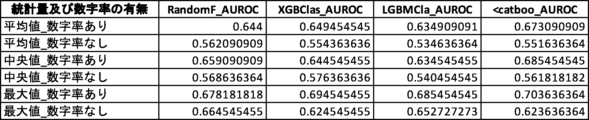
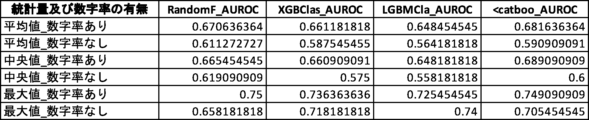
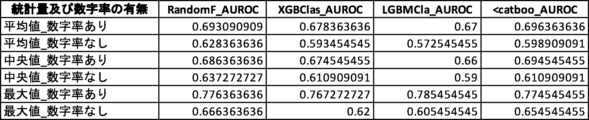
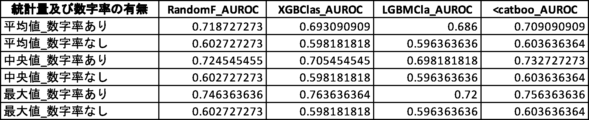
財務諸表不正推定における数字率の有用性をさらに検証するため、数字率を用いずに他の1以上の説明変数を用いた場合の機械学習モデルのAUROC値と、数字率を併用した場合のAUROC値との対比実験を行った(対比実験1)。対比実験1の結果を図23に示す。なお、検証に用いた機械学習アルゴリズムに内在するランダム性により、図17乃至図22において示されている値とは多少の差異がある。
<
In order to further verify the usefulness of the numerical rate in estimating financial statement fraud, a comparative experiment was conducted between the AUROC value of the machine learning model when using one or more explanatory variables without using the numerical rate and the AUROC value when using the numerical rate in combination (Comparative Experiment 1). The results of
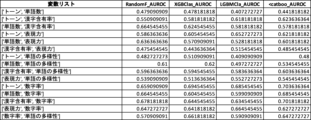
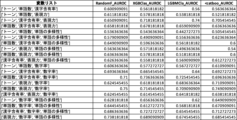
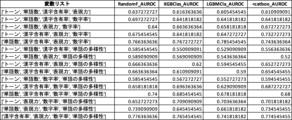
図23A乃至図23Dにおいて、「変数リスト」は機械学習モデルが用いる説明変数を示している。ここには数字率が含まれていない。 In Figures 23A to 23D, the "Variable List" shows the explanatory variables used by the machine learning model. This does not include numerical percentages.
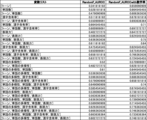
図23Aにおいて、「RandomF_AUROC」は、ランダムフォレストを用い、「変数リスト」に示す説明変数(数字率は含まれていない)のみを用いて生成したモデルのAUROC値を示している。「RandomF_AUROCwith数字率」は、同じくランダムフォレストを用い、「変数リスト」に示す説明変数と数字率とを用いて生成したモデルのAUROC値を示している。 In FIG. 23A, "RandomF_AUROC" shows the AUROC value of a model generated using Random Forest and only the explanatory variables (not including numeric rates) shown in the "Variable List." "RandomF_AUROCwithNumericalRatio" shows the AUROC value of a model generated using Random Forest and only the explanatory variables and numeric rates shown in the "Variable List."
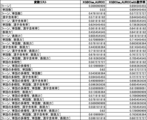
図23Bにおいて、「XGBClas_AUROC」は、XGBoostを用い、「変数リスト」に示す説明変数(数字率は含まれていない)のみを用いて生成したモデルのAUROC値を示している。「XGBClas_AUROCwith数字率」は、同じくXGBoostを用い、「変数リスト」に示す説明変数と数字率とを用いて生成したモデルのAUROC値を示している。 In FIG. 23B, "XGBClass_AUROC" shows the AUROC value of a model generated using XGBoost and only the explanatory variables (not including numeric rates) shown in the "Variable List." "XGBClass_AUROCwithNumericalRate" shows the AUROC value of a model generated using XGBoost and only the explanatory variables and numeric rates shown in the "Variable List."
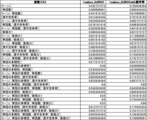
図23Cにおいて、「LGBMCla_AUROC」は、LightGBMを用い、「変数リスト」に示す説明変数(数字率は含まれていない)のみを用いて生成したモデルのAUROC値を示している。「LGBMCla_AUROCwith数字率」は、同じくLightGBMを用い、「変数リスト」に示す説明変数と数字率とを用いて生成したモデルのAUROC値を示している。 In FIG. 23C, "LGBTMCla_AUROC" shows the AUROC value of a model generated using LightGBM and only the explanatory variables (not including numeric rates) shown in the "Variable List." "LGBTMCla_AUROCwithNumericalRatio" shows the AUROC value of a model generated using LightGBM and only the explanatory variables and numeric rates shown in the "Variable List."
図23Dにおいて、「<catboo_AUROC」は、CatBoostを用い、「変数リスト」に示す説明変数(数字率は含まれていない)のみを用いて生成したモデルのAUROC値を示している。「<catboo_AUROCwith数字率」は、同じくCatBoostを用い、「変数リスト」に示す説明変数と数字率とを用いて生成したモデルのAUROC値を示している。 In FIG. 23D, "<catboo_AUROC" shows the AUROC value of a model generated using CatBoost and only the explanatory variables (not including numeric rates) shown in the "Variable List." "<catboo_AUROCwith numeric rates" shows the AUROC value of a model generated using CatBoost and only the explanatory variables and numeric rates shown in the "Variable List."
図23A乃至図23Dのいずれにおいても、他の説明変数に数字率を加えるとAUROC値が増加し、推定精度が向上することがわかる。 In all of Figures 23A to 23D, adding numeric rate to other explanatory variables increases the AUROC value and improves the estimation accuracy.
<対比実験2>
さらなる検証のため、説明変数として数字率を含むグループと、数字率を含まないグループとのAUROC値を比較する対比実験を行った(対比実験2)。対比実験2では、2つのグループの説明変数の数は同じになるようにした。対比実験2の結果を図24及び図25に示す。なお、検証に用いた機械学習アルゴリズムに内在するランダム性により、図17乃至図22において示されている値とは多少の差異がある。
<
For further verification, a comparison experiment was conducted to compare the AUROC values of a group that included a numeric rate as an explanatory variable with a group that did not include a numeric rate (Contrast Experiment 2). In the
図24Aは、1つの説明変数を使用した場合において観測されたAUROC値の一覧である。「変数リスト」は、機械学習モデルの生成に使用された説明変数(6パターン)を示している。本実験では、6つの説明変数「トーン」「単語数」「漢字含有率」「表現力」「数字率」「多様性」のうち、いずれか1つの説明変数のみを使用した。モデル生成にあたって使用した機械学習手法は、ランダムフォレスト(RandomF_AUROC)、XGBoost(XGBClas_AUROC)、LightGBM(LGBMCla_AUROC)、CatBoost(<catboo_AUROC)の4種類である。これらの組み合わせ(24パターン)についてそれぞれAUROC値を測定した。 Figure 24A shows a list of AUROC values observed when one explanatory variable was used. The "Variable List" shows the explanatory variables (six patterns) used to generate the machine learning model. In this experiment, only one of the six explanatory variables "Tone," "Number of words," "Kanji content rate," "Expressiveness," "Number rate," and "Diversity" was used. Four types of machine learning methods were used to generate the model: Random Forest (RandomF_AUROC), XGBoost (XGBClas_AUROC), LightGBM (LGBTMCla_AUROC), and CatBoost (<catboo_AUROC). The AUROC value was measured for each of these combinations (24 patterns).
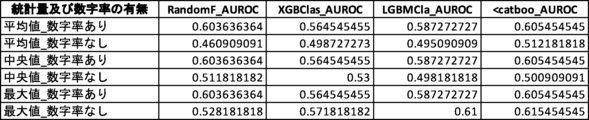
図25Aは、図24Aの「変数リスト」に挙げられた6パターンを、数字率を含むグループと含まないグループとに分別し、それぞれのグループにおけるAUROC値の統計量を算出、比較した表である。数字率を含むグループは、数字率を含まないグループと比較して少なくともAUROC値の平均値及び中央値が高い。このことから、全体的な傾向として数字率を含むグループの方が推定精度が高いと評価できる。 Figure 25A is a table in which the six patterns listed in the "Variable List" in Figure 24A are separated into groups that include numeric rates and groups that do not, and the statistics of the AUROC values for each group are calculated and compared. The group that includes numeric rates has at least higher average and median AUROC values than the group that does not include numeric rates. From this, it can be evaluated that the group that includes numeric rates has a higher estimation accuracy overall.
図24Bは、2つの説明変数を使用した場合において観測されたAUROC値の一覧である。「変数リスト」は、機械学習モデルの生成に使用された説明変数の組合せ(15パターン)を示している。本実験では、6つの説明変数「トーン」「単語数」「漢字含有率」「表現力」「数字率」「多様性」のうち、異なる2つの説明変数を組合せて使用した。モデル生成にあたって使用した機械学習手法は、ランダムフォレスト(RandomF_AUROC)、XGBoost(XGBClas_AUROC)、LightGBM(LGBMCla_AUROC)、CatBoost(<catboo_AUROC)の4種類である。これらの組み合わせ(60パターン)についてそれぞれAUROC値を測定した。 Figure 24B shows a list of AUROC values observed when two explanatory variables were used. The "Variable List" shows the combinations (15 patterns) of explanatory variables used to generate the machine learning model. In this experiment, a combination of two different explanatory variables was used from the six explanatory variables "Tone," "Number of words," "Kanji content rate," "Expressiveness," "Number rate," and "Diversity." Four machine learning methods were used to generate the model: Random Forest (RandomF_AUROC), XGBoost (XGBClas_AUROC), LightGBM (LGBTMCla_AUROC), and CatBoost (<catboo_AUROC). The AUROC value was measured for each of these combinations (60 patterns).
図25Bは、図24Bの「変数リスト」に挙げられた15パターンを、数字率を含むグループと含まないグループとに分別し、それぞれのグループにおけるAUROC値の統計量を算出、比較した表である。数字率を含むグループは、数字率を含まないグループと比較してAUROC値の平均値、中央値、最大値のいずれもが大きい。このことから、全体的な傾向としてもピーク性能としても、数字率を含むグループの方が推定精度が高いと評価できる。 Figure 25B is a table in which the 15 patterns listed in the "Variable List" in Figure 24B are separated into a group that includes numeric rates and a group that does not, and the statistics of the AUROC values for each group are calculated and compared. The group that includes numeric rates has higher average, median, and maximum AUROC values compared to the group that does not include numeric rates. From this, it can be evaluated that the group that includes numeric rates has higher estimation accuracy, both in terms of overall tendency and peak performance.
図24Cは、3つの説明変数を使用した場合において観測されたAUROC値の一覧である。「変数リスト」は、機械学習モデルの生成に使用された説明変数の組合せ(20パターン)を示している。本実験では、6つの説明変数「トーン」「単語数」「漢字含有率」「表現力」「数字率」「多様性」のうち、異なる3つの説明変数を組合せて使用した。モデル生成にあたって使用した機械学習手法は、ランダムフォレスト(RandomF_AUROC)、XGBoost(XGBClas_AUROC)、LightGBM(LGBMCla_AUROC)、CatBoost(<catboo_AUROC)の4種類である。これらの組み合わせ(120パターン)についてそれぞれAUROC値を測定した。 Figure 24C shows a list of AUROC values observed when three explanatory variables were used. The "Variable List" shows the combinations (20 patterns) of explanatory variables used to generate the machine learning model. In this experiment, three different explanatory variables were used in combination out of the six explanatory variables "Tone," "Number of words," "Kanji content rate," "Expressiveness," "Number rate," and "Diversity." Four types of machine learning methods were used to generate the model: Random Forest (RandomF_AUROC), XGBoost (XGBClas_AUROC), LightGBM (LGBTMCla_AUROC), and CatBoost (<catboo_AUROC). The AUROC value was measured for each of these combinations (120 patterns).
図25Cは、図24Cの「変数リスト」に挙げられた20パターンを、数字率を含むグループと含まないグループとに分別し、それぞれのグループにおけるAUROC値の統計量を算出、比較した表である。数字率を含むグループは、数字率を含まないグループと比較して少なくともAUROC値の平均値及び中央値が高い。このことから、全体的な傾向として数字率を含むグループの方が推定精度が高いと評価できる。 Figure 25C is a table in which the 20 patterns listed in the "Variable List" in Figure 24C are separated into groups that include numeric rates and groups that do not, and the statistics of the AUROC values for each group are calculated and compared. The group that includes numeric rates has at least higher average and median AUROC values than the group that does not include numeric rates. From this, it can be evaluated that the group that includes numeric rates has a higher estimation accuracy overall.
図24Dは、4つの説明変数を使用した場合において観測されたAUROC値の一覧である。「変数リスト」は、機械学習モデルの生成に使用された説明変数の組合せ(15パターン)を示している。本実験では、6つの説明変数「トーン」「単語数」「漢字含有率」「表現力」「数字率」「多様性」のうち、異なる4つの説明変数を組合せて使用した。モデル生成にあたって使用した機械学習手法は、ランダムフォレスト(RandomF_AUROC)、XGBoost(XGBClas_AUROC)、LightGBM(LGBMCla_AUROC)、CatBoost(<catboo_AUROC)の4種類である。これらの組み合わせ(60パターン)についてそれぞれAUROC値を測定した。 Figure 24D shows a list of AUROC values observed when four explanatory variables were used. The "Variable List" shows the combinations (15 patterns) of explanatory variables used to generate the machine learning model. In this experiment, four different explanatory variables were used in combination out of the six explanatory variables "Tone," "Number of words," "Kanji content rate," "Expressiveness," "Number rate," and "Diversity." Four types of machine learning methods were used to generate the model: Random Forest (RandomF_AUROC), XGBoost (XGBClas_AUROC), LightGBM (LGBTMCla_AUROC), and CatBoost (<catboo_AUROC). The AUROC value was measured for each of these combinations (60 patterns).
図25Dは、図24Dの「変数リスト」に挙げられた15パターンを、数字率を含むグループと含まないグループとに分別し、それぞれのグループにおけるAUROC値の統計量を算出、比較した表である。数字率を含むグループは、数字率を含まないグループと比較してAUROC値の平均値、中央値、最大値のいずれもが大きい。このことから、全体的な傾向としてもピーク性能としても、数字率を含むグループの方が推定精度が高いと評価できる。 Figure 25D is a table in which the 15 patterns listed in the "Variable List" in Figure 24D are separated into a group that includes numeric rates and a group that does not, and the statistics of the AUROC values for each group are calculated and compared. The group that includes numeric rates has higher average, median, and maximum AUROC values compared to the group that does not include numeric rates. From this, it can be evaluated that the group that includes numeric rates has higher estimation accuracy, both in terms of overall tendency and peak performance.
図24Eは、5つの説明変数を使用した場合において観測されたAUROC値の一覧である。「変数リスト」は、機械学習モデルの生成に使用された説明変数の組合せ(6パターン)を示している。本実験では、6つの説明変数「トーン」「単語数」「漢字含有率」「表現力」「数字率」「多様性」のうち、異なる5つの説明変数を組合せて使用した。モデル生成にあたって使用した機械学習手法は、ランダムフォレスト(RandomF_AUROC)、XGBoost(XGBClas_AUROC)、LightGBM(LGBMCla_AUROC)、CatBoost(<catboo_AUROC)の4種類である。これらの組み合わせ(24パターン)についてそれぞれAUROC値を測定した。 Figure 24E shows a list of AUROC values observed when five explanatory variables were used. The "Variable List" shows the combinations (six patterns) of explanatory variables used to generate the machine learning model. In this experiment, five different explanatory variables were used in combination out of the six explanatory variables "Tone," "Number of words," "Kanji content rate," "Expressiveness," "Number rate," and "Diversity." Four types of machine learning methods were used to generate the model: Random Forest (RandomF_AUROC), XGBoost (XGBClas_AUROC), LightGBM (LGBTMCla_AUROC), and CatBoost (<catboo_AUROC). The AUROC value was measured for each of these combinations (24 patterns).
図25Eは、図24Eの「変数リスト」に挙げられた6パターンを、数字率を含むグループと含まないグループとに分別し、それぞれのグループにおけるAUROC値の統計量を算出、比較した表である。数字率を含むグループは、数字率を含まないグループと比較してAUROC値の平均値、中央値、最大値のいずれもが大きい。このことから、全体的な傾向としてもピーク性能としても、数字率を含むグループの方が推定精度が高いと評価できる。 Figure 25E is a table in which the six patterns listed in the "Variable List" in Figure 24E are separated into a group that includes numeric rates and a group that does not, and the statistics of the AUROC values for each group are calculated and compared. The group that includes numeric rates has higher average, median, and maximum AUROC values compared to the group that does not include numeric rates. From this, it can be evaluated that the group that includes numeric rates has higher estimation accuracy in terms of both overall tendency and peak performance.
対比実験1及び2によれば、数字率を含む説明変数を使用した機械学習モデルにおいては、数字率を含まない場合と比較して、財務諸表不正の有無を高精度にかつ一定の反復可能性をもって推定することができる。
本実施の形態によれば、テキスト情報入力部101が企業またはその経営者が開示するMD&AやCEOレターをはじめとするテキスト情報を取得し、テキスト情報分析部102がテキスト情報を分析して数字率を含む1以上の説明変数を生成し、不正推定部103がランダムフォレストやCatBoostをはじめとするメソッドにより推定モデルを構築する。これにより、精度の高い財務諸表不正推定を行うことが可能となるため、投資者の投資損失やリスクを回避するとともに、投資者が非不正企業に投資する場合の投資効果の向上を図ることができる。
According to this embodiment, the text
以上、本発明の実施の形態について説明したが、本発明は上記実施形態に限られたものではなく、趣旨を逸脱しない範囲で適宜変更することが可能である。本発明はその発明の範囲内において、実施の形態の任意の構成要素の変形、もしくは実施の形態の任意の構成要素の省略が可能である。 Although the embodiment of the present invention has been described above, the present invention is not limited to the above embodiment, and can be modified as appropriate without departing from the spirit of the invention. Within the scope of the invention, any of the components of the embodiment can be modified or omitted.
例えば、上述の実施例ではテキスト情報として日本語のテキストを想定したが、本発明はこれに限定されるものではなく、英語をはじめとする外国語のテキストを対象としても良い。この場合、漢字含有率に代わる説明変数として、例えば単語の長さ(単語を構成する文字数)の平均値を用いることができる。単語の多様性、数字率、単語数、トーン、表現力等の説明変数は日本語の場合と同様に算出できる。なお、トーンを算出する際に参照する辞書については対象言語向けにあらかじめ準備されたものを使用する。 For example, in the above embodiment, Japanese text is assumed as the text information, but the present invention is not limited to this, and foreign language text such as English may also be used as the target. In this case, for example, the average value of word length (the number of characters constituting a word) can be used as an explanatory variable instead of the kanji content rate. Explanatory variables such as word diversity, number rate, word count, tone, and expressiveness can be calculated in the same way as for Japanese. Note that a dictionary that is previously prepared for the target language is used as the reference when calculating the tone.
また、本発明の情報処理はハードウェアにより実現されても良く、CPUがコンピュータプログラムを実行することにより実現されても良い。コンピュータプログラムは、様々なタイプの非一時的なコンピュータ可読媒体(non-transitory computer readable medium)又は一時的なコンピュータ可読媒体(transitory computer readable medium)によりコンピュータに供給され得る。 The information processing of the present invention may be realized by hardware, or by a CPU executing a computer program. The computer program may be provided to the computer by various types of non-transitory computer readable medium or transient computer readable medium.
1 財務諸表不正推定装置
11 CPU
13 揮発性メモリ
14 不揮発性メモリ
15 インタフェース
16 インタフェース
20 バス
70 入出力装置
101 テキスト情報入力部
102 テキスト情報分析部
103 不正推定部
1031 モデル格納部
10311 学習済みモデル
10312 統計モデル
104 機械学習部
1 Financial statement
13
Claims (12)
前記説明変数と、前記企業にかかる財務諸表不正の有無と、の相関関係を示す学習済みモデルを格納したモデル格納部と、
前記テキスト情報分析部が生成した前記説明変数を、前記学習済みモデルに入力し、前記企業にかかる財務諸表不正の有無を推定する不正推定部と、を有し、
前記説明変数として前記テキスト情報の数字率を含む
財務諸表不正推定装置。 a text information analysis unit that analyzes text information disclosed by a company or its management to generate one or more explanatory variables;
A model storage unit that stores a trained model showing a correlation between the explanatory variables and the presence or absence of financial statement fraud related to the company;
A fraud estimation unit that inputs the explanatory variables generated by the text information analysis unit into the trained model and estimates whether or not there is financial statement fraud related to the company,
A financial statement fraud inference device including a numeric ratio of the text information as the explanatory variable.
前記表現力とは、形容詞の数と副詞の数の和を名詞の数と動詞の数の和で割った値である
請求項1記載の財務諸表不正推定装置。 The explanatory variables further include expressiveness of the text information,
The expressiveness is calculated by dividing the sum of the number of adjectives and adverbs by the sum of the number of nouns and verbs.
The financial statement fraud estimation device according to claim 1.
請求項1記載の財務諸表不正推定装置。 The financial statement fraud estimation device according to claim 1 , further comprising a kanji content rate or a grade level of the text information as the explanatory variable.
請求項1記載の財務諸表不正推定装置。 The financial statement fraud estimation device according to claim 1 , further comprising a word count of the text information as the explanatory variable.
前記表現力とは、形容詞の数と副詞の数の和を名詞の数と動詞の数の和で割った値である
請求項1記載の財務諸表不正推定装置。 The explanatory variables further include expressiveness, kanji content or grade level, and number of words of the text information;
The expressiveness is calculated by dividing the sum of the number of adjectives and adverbs by the sum of the number of nouns and verbs.
The financial statement fraud estimation device according to claim 1.
請求項5記載の財務諸表不正推定装置。 The financial statement fraud estimation device according to claim 5 , further comprising a word diversity and a tone of the text information as the explanatory variables.
前記機械学習部はアンサンブル学習により前記学習を行う
請求項1乃至6いずれか1項記載の財務諸表不正推定装置。 Further comprising a machine learning unit that inputs the explanatory variables and the presence or absence of financial statement fraud related to the company, learns the correlation between the two, and generates the trained model;
The financial statement fraud estimation device according to claim 1 , wherein the machine learning unit performs the learning by ensemble learning.
請求項7記載の財務諸表不正推定装置。 The financial statement fraud estimation device according to claim 7 , wherein the machine learning unit performs the learning using a gradient boosting decision tree.
請求項7記載の財務諸表不正推定装置。 The financial statement fraud estimation device according to claim 7 , wherein the machine learning unit performs the learning using a random forest.
請求項1乃至6いずれか1項記載の財務諸表不正推定装置。 7. The financial statement fraud estimation device according to claim 1, wherein MD&A (Management's Discussion and Analysis of Financial Conditions and Results of Operations) is used as the text information.
企業又はその経営者が開示するテキスト情報を分析して1以上の説明変数を生成するテキスト情報分析ステップと、
前記テキスト情報分析ステップにおいて生成された前記説明変数を、前記説明変数と前記企業にかかる財務諸表不正の有無との相関関係を示す学習済みモデルに入力し、前記企業にかかる財務諸表不正の有無を推定する不正推定ステップと、を有し、
前記説明変数として数字率を含む
財務諸表不正推定方法。 A method for estimating financial statement fraud implemented on a computer, comprising:
A text information analysis step of analyzing text information disclosed by a company or its management to generate one or more explanatory variables;
a fraud estimation step of inputting the explanatory variables generated in the text information analysis step into a trained model indicating a correlation between the explanatory variables and the presence or absence of financial statement fraud in the company, and estimating the presence or absence of financial statement fraud in the company;
A method for estimating financial statement fraud that includes a numerical ratio as an explanatory variable.
A program for causing a computer to execute the method according to claim 11.
Applications Claiming Priority (2)
| Application Number | Priority Date | Filing Date | Title |
|---|---|---|---|
| JP2023075347 | 2023-04-29 | ||
| JP2023075347 | 2023-04-29 |
Publications (2)
| Publication Number | Publication Date |
|---|---|
| JP2024160043A JP2024160043A (en) | 2024-11-11 |
| JP7621608B2 true JP7621608B2 (en) | 2025-01-27 |
Family
ID=93429131
Family Applications (1)
| Application Number | Title | Priority Date | Filing Date |
|---|---|---|---|
| JP2024055350A Active JP7621608B2 (en) | 2023-04-29 | 2024-03-29 | Financial statement fraud estimation device, financial statement fraud estimation method and program |
Country Status (1)
| Country | Link |
|---|---|
| JP (1) | JP7621608B2 (en) |
Citations (1)
| Publication number | Priority date | Publication date | Assignee | Title |
|---|---|---|---|---|
| US20050004862A1 (en) | 2003-05-13 | 2005-01-06 | Dale Kirkland | Identifying the probability of violative behavior in a market |
-
2024
- 2024-03-29 JP JP2024055350A patent/JP7621608B2/en active Active
Patent Citations (1)
| Publication number | Priority date | Publication date | Assignee | Title |
|---|---|---|---|---|
| US20050004862A1 (en) | 2003-05-13 | 2005-01-06 | Dale Kirkland | Identifying the probability of violative behavior in a market |
Non-Patent Citations (3)
| Title |
|---|
| 中島真澄,ナラティブ情報(非財務情報)からの会計不正検出,文京学院大学 オピニオンレター,Vol.32,文京学院大学,2022年09月16日,[online],インターネット<URL:https://bgu.ac.jp/about/activity/opinion_letter/>,[令和6年9月10日検索] |
| 市原 直通,外1名,FinTechで変わる会計の世界,企業会計,日本,株式会社中央経済社,2017年06月01日,第69巻 第6号,55-63頁 |
| 首藤昭信,テキスト分析と会計学研究,情報センサー,2019年5月号,日本,EY Japan,2019年04月30日,[online],インターネット<URL:https://ey.com/ja_jp/library/info-sensor/2019/info-sensor-2019-05-02>,[令和6年9月10日検索] |
Also Published As
| Publication number | Publication date |
|---|---|
| JP2024160043A (en) | 2024-11-11 |
Similar Documents
| Publication | Publication Date | Title |
|---|---|---|
| Boskou et al. | Classifying internal audit quality using textual analysis: the case of auditor selection | |
| Han et al. | Artificial intelligence for anti-money laundering: a review and extension | |
| Dong et al. | Leveraging financial social media data for corporate fraud detection | |
| Purda et al. | Accounting variables, deception, and a bag of words: Assessing the tools of fraud detection | |
| Berns et al. | Do changes in MD&A section tone predict investment behavior? | |
| Larcker et al. | Detecting deceptive discussions in conference calls | |
| Bodle et al. | Effect of IFRS adoption on financial reporting quality: Evidence from bankruptcy prediction | |
| Wang et al. | The textual contents of media reports of information security breaches and profitable short-term investment opportunities | |
| Cai et al. | Trends in fintech research and practice: Examining the intersection with the information systems field | |
| Rahrovi Dastjerdi et al. | Detecting manager’s fraud risk using text analysis: evidence from Iran | |
| Li et al. | Financial fraud detection for Chinese listed firms: Does managers' abnormal tone matter? | |
| Küster et al. | The informational content of key audit matters: Evidence from using artificial intelligence in textual analysis | |
| Gianfelici et al. | Exploring the going concern statement, readability and length cues as indicators of distress at Italian companies | |
| Ma et al. | Corporate social responsibility and trade credit: the role of textual features | |
| Yang et al. | Detecting financial statement fraud through multidimensional analysis of text readability | |
| Gkoumas et al. | Bank competition, loan portfolio concentration and stock price crash risk: The role of tone ambiguity | |
| Zheng et al. | The effects of sentiment evolution in financial texts: A word embedding approach | |
| Abbas | Lending by algorithm: Fair or flawed? An information-theoretic view of credit decision pipelines | |
| Fan et al. | Measuring misinformation in financial markets | |
| Huang et al. | Do firms incur financial restatements? A recognition study based on textual features of key audit matters reports | |
| Fedorova et al. | Monetary policy and market interest rates: Literature review using text analysis | |
| Xu et al. | Social media Q&A text semantic similarity and corporate fraud: evidence from the Shanghai Stock Exchange E-interaction platform in China | |
| Zhang et al. | Financial crisis early warning of Chinese listed companies based on MD&A text-linguistic feature indicators | |
| Othman et al. | Text readability and fraud detection | |
| JP7621608B2 (en) | Financial statement fraud estimation device, financial statement fraud estimation method and program |
Legal Events
| Date | Code | Title | Description |
|---|---|---|---|
| A621 | Written request for application examination |
Free format text: JAPANESE INTERMEDIATE CODE: A621 Effective date: 20240405 |
|
| A871 | Explanation of circumstances concerning accelerated examination |
Free format text: JAPANESE INTERMEDIATE CODE: A871 Effective date: 20240405 |
|
| A521 | Request for written amendment filed |
Free format text: JAPANESE INTERMEDIATE CODE: A523 Effective date: 20240711 |
|
| A131 | Notification of reasons for refusal |
Free format text: JAPANESE INTERMEDIATE CODE: A131 Effective date: 20240917 |
|
| A521 | Request for written amendment filed |
Free format text: JAPANESE INTERMEDIATE CODE: A523 Effective date: 20241118 |
|
| TRDD | Decision of grant or rejection written | ||
| A01 | Written decision to grant a patent or to grant a registration (utility model) |
Free format text: JAPANESE INTERMEDIATE CODE: A01 Effective date: 20241203 |
|
| A61 | First payment of annual fees (during grant procedure) |
Free format text: JAPANESE INTERMEDIATE CODE: A61 Effective date: 20241230 |
|
| R150 | Certificate of patent or registration of utility model |
Ref document number: 7621608 Country of ref document: JP Free format text: JAPANESE INTERMEDIATE CODE: R150 |