JP7621601B2 - Acoustic Frequency Selective Transmission Filter - Google Patents
Acoustic Frequency Selective Transmission Filter Download PDFInfo
- Publication number
- JP7621601B2 JP7621601B2 JP2020146471A JP2020146471A JP7621601B2 JP 7621601 B2 JP7621601 B2 JP 7621601B2 JP 2020146471 A JP2020146471 A JP 2020146471A JP 2020146471 A JP2020146471 A JP 2020146471A JP 7621601 B2 JP7621601 B2 JP 7621601B2
- Authority
- JP
- Japan
- Prior art keywords
- acoustic
- selective transmission
- transmission filter
- silica aerogel
- frequency
- Prior art date
- Legal status (The legal status is an assumption and is not a legal conclusion. Google has not performed a legal analysis and makes no representation as to the accuracy of the status listed.)
- Active
Links
Images

Landscapes
- Manufacture Of Macromolecular Shaped Articles (AREA)
- Soundproofing, Sound Blocking, And Sound Damping (AREA)
Description
本発明は、軽量で遮音性に優れた音響選択透過フィルターおよびその製造方法に関し、特に400Hz以下の低周波数(低音域)および1300Hz以上高音域の遮音性に優れ、その中間の中音域を透過する周波数選択性を有する音響選択透過フィルターに関する。 The present invention relates to a lightweight acoustic selective transmission filter with excellent sound insulation and a manufacturing method thereof, and in particular to an acoustic selective transmission filter that has excellent sound insulation at low frequencies (bass range) below 400 Hz and at high frequencies above 1300 Hz, and has frequency selectivity that transmits mid-range frequencies in between.
自動車、鉄道車両や航空機の快適性に対して騒音対策の要望があり、省エネルギーの観点から軽量であることが求められている。
ウレタンフォームのようなスポンジ状の発泡体やグラスウールやマイクロファイバーの不織布が吸音材として、ブチルゴムのようなゴム状シートが遮音材として用いられている。
発泡体や不織布から成る吸音材は連続気孔によって音による空気振動を圧損することにより優れた吸音性能を有するが、空気振動を完全に遮断することは困難で空気振動が材料を透過し、十分な遮音性を得ることが難しい。
ゴム状の遮音シートは、空気を遮蔽し振動を伝えないことで高い遮音性を有するが、音の反射が起こりやすく、重量が大きい問題がある。
There is a demand for noise control measures to improve comfort in automobiles, railway vehicles, and aircraft, and lightweight materials are also required from the viewpoint of energy conservation.
Sponge-like foams such as urethane foam, glass wool, and nonwoven microfiber fabrics are used as sound-absorbing materials, while rubber-like sheets such as butyl rubber are used as sound-proofing materials.
Sound-absorbing materials made from foam or nonwoven fabric have excellent sound-absorbing properties because their continuous pores reduce the pressure of air vibrations caused by sound. However, it is difficult to completely block air vibrations, and air vibrations pass through the material, making it difficult to achieve sufficient sound insulation.
Rubber-like soundproofing sheets have high soundproofing properties by blocking air and preventing the transmission of vibrations, but they have problems in that they are prone to sound reflection and are heavy.
自動車の騒音には、ロードノイズ(路面とタイヤにより発生するランダム性の音であり、主要な周波数帯域は1000Hz以下である。)、エンジン音(エンジン回転数の0.5次成分を基本周波数とした複合周期音であり、主要な周波数帯域は5000Hz以下である。)、こもり音(周波数帯域20~250Hzの低周波音で耳を圧迫するような音である。)、風切り音(自動車が高速で走行することにより車両周辺の気流が乱されることにより発生するランダム性の音であり、周波数帯域500~5000Hzである。)などがある。 Automobile noise includes road noise (random sound generated by the road surface and tires, with a main frequency band of 1000 Hz or less), engine noise (complex periodic sound with the 0.5th component of engine RPM as the fundamental frequency, with a main frequency band of 5000 Hz or less), muffled noise (low-frequency sound in the frequency band of 20 to 250 Hz that presses on the ears), and wind noise (random sound generated by disturbances in the airflow around the vehicle caused by the vehicle traveling at high speed, with a frequency band of 500 to 5000 Hz).
耳を圧迫するような250Hz以下の低周波音については、ウレタンフォームなどの発泡体やグラスウール、マイクロファイバーなどの不織布の吸音、遮音特性は低い。 When it comes to low-frequency sounds below 250 Hz that put pressure on the ears, foams such as urethane foam and nonwoven fabrics such as glass wool and microfiber have poor sound absorption and soundproofing properties.
一方、聞こえなければならない音としてサイレン音があるが、救急車のサイレン音は960Hzと770Hz、消防車のサイレン音は約400~850Hz、パトロールカーのサイレン音は870±50Hzである。 On the other hand, there are sirens that need to be heard; ambulance sirens are 960 Hz and 770 Hz, fire engine sirens are about 400 to 850 Hz, and police car sirens are 870 ± 50 Hz.
特許文献1には、発泡ポリエチレン樹脂製の基材に平均粒径0.3~2.0mm、密度3.0g/cm3~9.0g/cm3の粒子を内包し、好ましくは平均直径1.0mm以上6.0mm以下の大きさの孔構造を持つ構造を含ませることにより、吸音性と遮音性を両立した軽量な遮音シートが記載されているおり、2000~4500Hz垂直入射吸音率の最大値が0.6~0.8、透過損失の最大値が15~18dBの優れた吸音性と遮音性を有しているが、厚さが9mmであり、孔構造の大きさが1.0mm以上6.0mm以下であることから薄くすることは困難であると考えられる。なお、2000Hz以下の吸音性、遮音性については記載されていない。 Patent Document 1 describes a lightweight soundproof sheet that combines sound absorption and sound insulation by incorporating particles with an average particle size of 0.3 to 2.0 mm and a density of 3.0 g/cm 3 to 9.0 g/cm 3 in a substrate made of foamed polyethylene resin, and a structure having a pore structure preferably with an average diameter of 1.0 mm to 6.0 mm. The sheet has excellent sound absorption and sound insulation properties with a maximum normal incidence sound absorption coefficient of 0.6 to 0.8 at 2000 to 4500 Hz and a maximum transmission loss of 15 to 18 dB, but it is difficult to make it thinner because it is 9 mm thick and the size of the pore structure is 1.0 mm to 6.0 mm. Note that there is no description of sound absorption and sound insulation properties below 2000 Hz.
特許文献2には、繊維集合体を含む面材と連通空隙を有する樹脂発泡成形体を含む基材とを含む積層体であって、薄くても高い吸音性能、特に1000Hz前後の低周波数での高吸音性を有する吸音材が記載されており、1000Hzの吸音率が0.6と高いものの200Hzの吸音率は0.1以下である。 Patent Document 2 describes a sound-absorbing material that is a laminate including a facing material containing a fiber aggregate and a substrate including a resin foam molded body having interconnected voids, and that has high sound-absorbing performance even though it is thin, particularly at low frequencies around 1000 Hz. Although the sound absorption coefficient at 1000 Hz is high at 0.6, the sound absorption coefficient at 200 Hz is 0.1 or less.
特許文献3には、シリコーン多孔質層及び柔軟性構造層を備える低周波吸音材であって、シリコーン多孔質層が、二置換のアルコキシシランと三置換のアルコキシシラン類とを含むシラン化合物の共重合により得られるシリコーン多孔質層、もしくは二置換のアルコキシシランと三置換のアルコキシシラン及び三置換以上のアルコキシシラン類とを含むシラン化合物の共重合により得られるシリコーン多孔質層である低周波吸音材が記載されており、600Hzでの吸音率は0.7と高いが、200Hzの吸音率は0.1以下である。 Patent Document 3 describes a low-frequency sound-absorbing material that includes a silicone porous layer and a flexible structure layer, in which the silicone porous layer is a silicone porous layer obtained by copolymerization of a silane compound containing a di-substituted alkoxysilane and a tri-substituted alkoxysilane, or a silicone porous layer obtained by copolymerization of a silane compound containing a di-substituted alkoxysilane and a tri-substituted alkoxysilane and a tri- or higher substituted alkoxysilane, and has a high sound absorption coefficient of 0.7 at 600 Hz, but a sound absorption coefficient of 0.1 or less at 200 Hz.
特許文献4には、陰イオン性官能基を持つ有機ナノファイバー、水溶性非イオン界面活性剤と水を含む分散媒にシリカエアロゲル粒子を分散させて得られる有機ナノファイバーとシリカエアロゲル粒子を含有する水分散液を乾燥した吸音材が記載されているが、中音域の選択透過性については明記されていない。 Patent Document 4 describes a sound-absorbing material made by drying an aqueous dispersion containing organic nanofibers and silica aerogel particles, which is obtained by dispersing silica aerogel particles in a dispersion medium containing organic nanofibers with anionic functional groups, a water-soluble nonionic surfactant, and water, but does not specify the selective transmission of mid-range sounds.
本発明は、低音域(400Hz以下)および高音域(1300Hz以上)の遮音性に優れ、中音域の音を透過する周波数選択性を有する軽量な音響選択透過フィルターを提供することを目的とする。 The present invention aims to provide a lightweight acoustic selective transmission filter that has excellent sound insulation properties in the low frequency range (400 Hz or less) and high frequency range (1300 Hz or more) and has frequency selectivity that allows mid-frequency sounds to pass through.
本発明者らは、前記課題を達成するため鋭意検討した結果、陰イオン性官能基を持つ有機ナノファイバーと水溶性非イオン界面活性剤を含む水溶液にシリカエアロゲル粒子を加えて得られる有機ナノファイバーを含むシリカエアロゲル粒子水分散液を乾燥させることで得られる音響選択透過フィルターにより本発明を完成させた。 As a result of intensive research into achieving the above object, the inventors have completed the present invention with an acoustic selective transmission filter obtained by adding silica aerogel particles to an aqueous solution containing organic nanofibers having an anionic functional group and a water-soluble nonionic surfactant, and drying the resulting aqueous dispersion of silica aerogel particles containing organic nanofibers.
本発明は、以下の構成からなることを特徴とし、上記課題を解決するものである。
〔1〕 シリカエアロゲル粒子の集合体が陰イオン性官能基を持つ有機ナノファイバーのネットワークにより取り囲まれたセルを基本構成とし、複数のセルが密接した3次元的な連続構造の固体複合体であって、低音域および高音域の遮音性に優れ、中音域の音を透過する周波数選択性を有する音響周波数選択透過フィルター。
〔2〕 前記〔1〕に記載の音響周波数選択透過フィルターが不織布上に形成されていることを特徴とする音響周波数選択透過フィルター
〔3〕 シリカエアロゲル粒子の集合体が陰イオン性官能基を持つ有機ナノファイバーのネットワークにより取り囲まれたセルを基本構成とし、複数のセルが密接した3次元的な連続構造の固体複合体が不織布(グラスウウール及びロックウールを除く)あるいは連続気泡発泡体の内部に形成されており、低音域および高音域の遮音性に優れ、中音域の音を透過する周波数選択性を有する音響周波数選択透過フィルター。
〔4〕 前記低音域が400Hz以下の周波数帯であり及び前記高音域が1300Hz以上の周波数帯であり、前記低音域と前記高音域の間の前記中音域に、透過損失の最小値を有することを特徴とする前記〔1〕~〔3〕のいずれかに記載の音響周波数選択透過フィルター。
〔5〕 前記各音域の透過損失の平均値が、前記低音域において6dB以上であり、前記高音域において6dB以上であり、前記中音域において14dB以下であり、透過損失の最小値が3dB以下であることを特徴とする前記〔4〕に記載の音響周波数選択透過フィルター。
〔6〕 前記〔1〕~〔5〕のいずれかに記載の音響周波数選択透過フィルターを具備した機器。
The present invention is characterized by having the following configuration and is intended to solve the above problems.
[1] An acoustic frequency selective transmission filter having a basic structure in which an aggregate of silica aerogel particles is surrounded by a network of organic nanofibers having anionic functional groups, the basic structure being a three-dimensional continuous structure in which a plurality of cells are closely spaced, the filter being a solid composite having excellent sound insulation properties in the low and high frequency ranges, and having frequency selectivity that transmits mid-frequency sounds.
[2] An acoustic frequency selective transmission filter characterized in that the acoustic frequency selective transmission filter according to [1] is formed on a nonwoven fabric. [3] An acoustic frequency selective transmission filter having a basic structure in which an aggregate of silica aerogel particles is surrounded by a network of organic nanofibers having an anionic functional group, and a solid composite having a three-dimensional continuous structure in which a plurality of cells are closely spaced is formed inside a nonwoven fabric (excluding glass wool and rock wool) or an open-cell foam, and having excellent sound insulation properties in the low and high frequency ranges and frequency selectivity that transmits mid-frequency sounds.
[4] The acoustic frequency selective transmission filter according to any one of [1] to [3], characterized in that the bass range is a frequency band of 400 Hz or less and the treble range is a frequency band of 1300 Hz or more, and the filter has a minimum transmission loss in the midrange between the bass range and the treble range.
[5] The acoustic frequency selective transmission filter according to [4], characterized in that the average value of the transmission loss in each of the sound ranges is 6 dB or more in the low range, 6 dB or more in the high range, and 14 dB or less in the mid range, and the minimum value of the transmission loss is 3 dB or less.
[6] An apparatus comprising the acoustic frequency selective transmission filter according to any one of [1] to [5].
前記〔3〕に記載する不織布とは、一般に繊維を織らずに絡み合わせたものを言うが、本発明においては繊維を縦横に組み合わせた布や織物であっても繊維の隙間に陰イオン性官能基を持つ有機ナノファイバーとシリカエアロゲル粒子を含有する水分散液を含浸することができれば用いることができる。
また、前記〔3〕に記載する連続気泡発泡体とは、スポンジのように気泡同士が繋がっており、水を吸収したり、気体を通過させることができる構造の発泡体である。
前記〔5〕に記載する垂直入射音響透過損失とは、サンプルに垂直に入射した入射音のエネルギー(Ii)と透過音のエネルギー(It)において次式で算出される遮音性能値であって値が大きいほど遮音性が優れていることを意味している。
音響透過損失(TL)=10log10(Ii/It)
本発明においてはASTM-E2611に準拠した伝達マトリックス法に基づく音響材料の垂直入射音伝送測定により得られる値である。
The nonwoven fabric described in [3] above generally refers to a fabric in which fibers are intertwined without being woven. However, in the present invention, even a cloth or woven fabric in which fibers are combined lengthwise and widthwise can be used as long as the gaps between the fibers can be impregnated with an aqueous dispersion containing organic nanofibers having anionic functional groups and silica aerogel particles.
The open-cell foam described in the above item [3] is a foam having a structure in which the cells are connected to each other like a sponge and can absorb water and pass gas.
The normal incidence sound transmission loss described in [5] above is a sound insulation performance value calculated using the following formula for the energy of incident sound (Ii) that is perpendicularly incident on a sample and the energy of transmitted sound (It), and the larger the value, the better the sound insulation.
Sound transmission loss (TL) = 10log 10 (Ii/It)
In the present invention, this is a value obtained by measuring the normal incidence sound transmission of an acoustic material based on the transfer matrix method in accordance with ASTM-E2611.
有機ナノファイバーを含むシリカエアロゲル粒子水分散液を乾燥させることで得られる音響選択透過フィルターは、軽量であり、低周波領域における吸音性、特に400Hz以下のノイズの吸音、遮音性に優れ、1300Hz以上の高音域の遮音性に優れ、かつ、その中間の中音域の音を透過することができる周波数選択性を有する。 The acoustic selective transmission filter obtained by drying an aqueous dispersion of silica aerogel particles containing organic nanofibers is lightweight and has excellent sound absorption properties in the low frequency range, particularly excellent sound absorption and sound insulation properties for noise below 400 Hz, excellent sound insulation properties in the high frequency range above 1300 Hz, and has frequency selectivity that allows the transmission of mid-range sounds in between.
また、固体複合体を不織布(グラスウウール及びロックウールを除く)あるいは連続気泡発泡体の内部に形成させた本発明の音響選択透過フィルターは、軽量で、粉落ちが少なく、断熱性および遮音性に優れる。 In addition, the acoustic selective transmission filter of the present invention, in which the solid composite is formed inside a nonwoven fabric (excluding glass wool and rock wool) or an open-cell foam, is lightweight, has little powder falling off, and has excellent heat insulation and sound insulation properties.
本発明の音響選択透過フィルターは、自動車、船舶や飛行機、ヘリコプターなどの輸送機器、工場の送風機、プレス機、真空ポンプなど、店舗・公共施設の空調室外機、ボイラーなどから発生する圧迫するような不快な音である低音域及びキーキー音のような人間が最も敏感に聞こえる不快な音である高音域の音を低減し、日常会話の音、音楽の主旋律の音域の心地よい音、サイレン音等を選択的に透過させることができる。 The acoustic selective transmission filter of the present invention reduces unpleasant low-frequency sounds such as oppressive sounds generated by transportation equipment such as automobiles, ships, airplanes, and helicopters, factory blowers, presses, vacuum pumps, outdoor air conditioner units in stores and public facilities, boilers, etc., as well as unpleasant high-frequency sounds such as squeals that humans are most sensitive to, and selectively allows the sounds of everyday conversation, pleasant sounds in the range of musical melodies, sirens, etc. to pass through.
本発明の音響選択透過フィルターは、シリカエアロゲル粒子の集合体が陰イオン性官能基を持つ有機ナノファイバーのネットワークにより取り囲まれたセルを基本構成とし、複数のセルが密接した3次元的な連続構造の固体複合体であって、低音域および高音域の遮音性に優れ、中音域の音を透過する周波数選択性を有する The acoustic selective transmission filter of the present invention is a solid composite with a three-dimensional continuous structure in which a plurality of cells are closely spaced, and is basically composed of cells in which aggregates of silica aerogel particles are surrounded by a network of organic nanofibers with anionic functional groups. It has excellent sound insulation properties in the low and high ranges, and has frequency selectivity that transmits mid-range sounds.
また、本発明の音響周波数選択透過フィルターは、前記〔1〕に記載の音響周波数選択透過フィルターを不織布上に形成させて音響周波数選択透過フィルターとしてもよい。 The acoustic frequency selective transmission filter of the present invention may also be formed by forming the acoustic frequency selective transmission filter described in [1] above on a nonwoven fabric.
さらに、本発明の音響周波数選択透過フィルターは、シリカエアロゲル粒子の集合体が陰イオン性官能基を持つ有機ナノファイバーのネットワークにより取り囲まれたセルを基本構成とし、複数のセルが密接した3次元的な連続構造の固体複合体が不織布(グラスウウール及びロックウールを除く)あるいは連続気泡発泡体の内部に形成されており、低音域および高音域の遮音性に優れ、中音域の音を透過する周波数選択性を有する音響周波数選択透過フィルターであってもよい。 Furthermore, the acoustic frequency selective transmission filter of the present invention may be an acoustic frequency selective transmission filter having a basic structure in which aggregates of silica aerogel particles are surrounded by a network of organic nanofibers having anionic functional groups, and in which a solid composite having a three-dimensional continuous structure in which multiple cells are closely spaced is formed inside a nonwoven fabric (excluding glass wool and rock wool) or an open-cell foam, and having excellent sound insulation properties in the low and high frequency ranges and frequency selectivity that transmits mid-frequency sounds.
先ず、本発明の音響選択透過フィルターを構成する固体複合体について説明する。
前記固体複合体は、陰イオン性官能基を持つ有機ナノファイバー、水溶性非イオン界面活性剤と水を含む分散媒にシリカエアロゲル粒子を分散させて得られる有機ナノファイバーとシリカエアロゲル粒子を含有する水分散液を乾燥して得られる。そして、本発明の音響選択透過フィルターは、シート状に成型することが好ましい。
First, the solid composite constituting the acoustic selective transmission filter of the present invention will be described.
The solid composite is obtained by drying an aqueous dispersion containing organic nanofibers and silica aerogel particles, the aqueous dispersion being obtained by dispersing silica aerogel particles in a dispersion medium containing organic nanofibers having an anionic functional group, a water-soluble nonionic surfactant, and water. The acoustic selective transmission filter of the present invention is preferably formed into a sheet shape.
前記陰イオン性官能基を持つ有機ナノファイバーは、特に限定しないが、カルボキシル基及びカルボキシル基の塩、リン酸基及びリン酸基の塩並びに硫酸エステル基及び硫酸エステル基の塩等の陰イオン性官能基有する有機ナノファイバーが挙げられる。さらに、カルボキシル基の塩、リン酸基の塩及び硫酸エステル基の塩は、アルカリ金属塩、アルカリ土類金属塩またはアンモニウム塩等であればよい。 The organic nanofibers having an anionic functional group are not particularly limited, but examples thereof include organic nanofibers having an anionic functional group such as a carboxyl group and a salt of a carboxyl group, a phosphoric acid group and a salt of a phosphoric acid group, and a sulfate ester group and a salt of a sulfate ester group. Furthermore, the salts of the carboxyl group, the salts of the phosphoric acid group, and the salts of the sulfate ester group may be alkali metal salts, alkaline earth metal salts, ammonium salts, or the like.
特に好ましい陰イオン性官能基としては、前記硫酸基又は硫酸エステル基の塩であり、硫酸エステル基の塩としては、硫酸エステル化セルロースナノファイバーのナトリウム塩、カルシウム塩、カリウム塩、アンモニウム塩、テトラアルキルアンモニウム塩基の少なくとも一つ以上の硫酸エステル基の塩を挙げることができる。 Particularly preferred anionic functional groups are salts of the sulfate group or sulfate ester group, and examples of the salts of sulfate ester groups include sodium salts, calcium salts, potassium salts, and ammonium salts of sulfated cellulose nanofibers, and salts of at least one sulfate ester group of a tetraalkylammonium base.
前記陰イオン性官能基を持つ有機ナノファイバーとしては、変性又は修飾により表面に陰イオン性官能基を持たせるセルロースナノファイバー、キチンナノファイバー、キトサンナノファイバー等の天然多糖類ナノファイバー、及び寒天、ゼラチン、ヒアルロン酸、CMCとポリアクリル酸等のカルボキシル基を持つポリマーから天然形成又は人工加工により得られる有機ナノファイバーを例示できるが、その中でも、変性又は修飾により表面に陰イオン性官能基を持たせるセルロースナノファイバー、キチンナノファイバー、キトサンナノファイバー等の天然多糖類ナノファイバーは結晶化度が高くてチキソトロピー性や粘度が高いためより好ましい。 Examples of organic nanofibers having anionic functional groups include natural polysaccharide nanofibers such as cellulose nanofibers, chitin nanofibers, and chitosan nanofibers that have been modified or denatured to have anionic functional groups on their surface, and organic nanofibers obtained by natural formation or artificial processing from polymers having carboxyl groups such as agar, gelatin, hyaluronic acid, CMC, and polyacrylic acid. Among these, natural polysaccharide nanofibers such as cellulose nanofibers, chitin nanofibers, and chitosan nanofibers that have been modified or denatured to have anionic functional groups on their surface are more preferred because they have a high degree of crystallinity, thixotropy, and viscosity.
前記陰イオン性官能基を持つ有機ナノファイバーの結晶化度は、30%以上が好ましく、40%以上がより好ましい。結晶化度の高い有機ナノファイバーはチキソロトピー性と粘度が高いため、エアロゲル粒子が取り込まれるミセルを安定化させることができ、乾燥した複合体は丈夫で耐水性が優れたため好ましい。
前記陰イオン性官能基を持つ有機ナノファイバーの最も好ましい有機ナノファイバーは、変性又は修飾により表面に陰イオン性官能基を持たせるセルロースナノファイバー及びキチンナノファイバーである。
The degree of crystallinity of the organic nanofiber having an anionic functional group is preferably 30% or more, more preferably 40% or more. Organic nanofibers with a high degree of crystallinity have high thixotropy and viscosity, and can stabilize the micelles in which the aerogel particles are incorporated, and the dried composite is strong and has excellent water resistance, which is preferable.
The most preferred organic nanofibers having anionic functional groups are cellulose nanofibers and chitin nanofibers that have been modified or denatured to have anionic functional groups on their surfaces.
そして、陰イオン性官能基を持つ有機ナノファイバーの特に好ましいものを具体的例示すると、前記カルボキシル基又はカルボキシル基の塩を陰イオン性官能基として持つ有機ナノファイバーTEMPO酸化セルロースナノファイバー及びカルボキシメチル修飾セルロースナノファイバーを挙げることができる。 Specific examples of particularly preferred organic nanofibers having anionic functional groups include TEMPO-oxidized cellulose nanofibers and carboxymethyl-modified cellulose nanofibers, which have the carboxyl group or a salt of the carboxyl group as the anionic functional group.
また、有機ナノファイバーの表面の陰イオン性官能基の置換度は、大きい程有機ナノファイバーの水和性が高いため、分散媒の粘度やチキソトロピー性を向上する効果が高くなる。従って、有機ナノファイバーの表面の陰イオン性官能基の平均置換度が0.10~1.00であることが好ましく、より好ましくは0.15~0.95であり、さらに好ましくは0.20~0.90である。0.1以下になると増粘効果や非イオンエーテル型界面活性剤との相互作用が低くなる。一方、1.0以上になるとナノファイバーの結晶化度が低下し、チキソトロピー性が低下したり、繊維状が崩れたりすることにより増粘効果の低下や乾燥後の複合化材の強度が低下したりする恐れがある。 The higher the degree of substitution of the anionic functional groups on the surface of the organic nanofiber, the higher the hydration of the organic nanofiber, and therefore the greater the effect of improving the viscosity and thixotropy of the dispersion medium. Therefore, it is preferable that the average degree of substitution of the anionic functional groups on the surface of the organic nanofiber is 0.10 to 1.00, more preferably 0.15 to 0.95, and even more preferably 0.20 to 0.90. If it is 0.1 or less, the thickening effect and the interaction with the nonionic ether surfactant are reduced. On the other hand, if it is 1.0 or more, the crystallinity of the nanofiber decreases, the thixotropy decreases, and the fiber shape collapses, which may result in a decrease in the thickening effect and a decrease in the strength of the composite material after drying.
陰イオン性官能基を持つ有機ナノファイバーの平均繊維径は、2~500nmであることが好ましく、より好ましくは5~300nm、さらに好ましくは10~200nmである。2nm以下になるとナノファイバーの製造コストが高くなるとともに耐熱性が低下する。また、結晶化度が低下する恐れがある。一方、500nm以上になると表面積が小さくなり、チキソトロピー性が失う恐れがある。さらに、繊維径が大きくなると表面積が小さくなるためナノファイバーネットワークの中にシリカエアロゲル粒子を取り込んで固定化することができなくなるため、乾燥後の複合材が脆くなったり、シリカエアロゲル粒子の脱落により粉塵が発生したりする恐れがある。 The average fiber diameter of the organic nanofibers having anionic functional groups is preferably 2 to 500 nm, more preferably 5 to 300 nm, and even more preferably 10 to 200 nm. If it is less than 2 nm, the manufacturing cost of the nanofibers increases and the heat resistance decreases. There is also a risk of the degree of crystallinity decreasing. On the other hand, if it is more than 500 nm, the surface area decreases and there is a risk of losing thixotropy. Furthermore, if the fiber diameter is large, the surface area decreases and it becomes impossible to capture and fix the silica aerogel particles in the nanofiber network, so the composite material becomes brittle after drying and there is a risk of dust generation due to the falling off of the silica aerogel particles.
さらに、有機ナノファイバーの平均繊維長は、0.2~50μmが好ましく、より好ましくは0.3~35μm、さらに好ましくは0.5~30μm、最も好ましくは1.0~20μmである。繊維長が小さすぎるとネットワークが弱くなる。 Furthermore, the average fiber length of the organic nanofibers is preferably 0.2 to 50 μm, more preferably 0.3 to 35 μm, even more preferably 0.5 to 30 μm, and most preferably 1.0 to 20 μm. If the fiber length is too small, the network will be weak.
本発明の音響選択透過フィルターの前記固体複合体を得るためのシリカエアロゲル粒子を分散させる分散媒は、陰イオン性官能基を持つ有機ナノファイバー、水溶性非イオン界面活性剤と水を含んでいる。
前記水溶性非イオン界面活性剤には、水と完全混合しない溶解度の低いものであっても、分散媒にしたときに水に溶解する親水性非イオン界面活性剤を含む。
The dispersion medium for dispersing the silica aerogel particles to obtain the solid composite of the acoustic selective transmission filter of the present invention contains organic nanofibers having an anionic functional group, a water-soluble nonionic surfactant, and water.
The water-soluble nonionic surfactant includes hydrophilic nonionic surfactants that dissolve in water when used as a dispersion medium, even if they have low solubility and are not completely miscible with water.
前記水溶性非イオン界面活性剤は、特に限定しないが、エチレングリコール又はポリエチレングリコールアルキルエーテル、プロピレン又はポリプロピレングリコールアルキルエーテル、グリセリン又はポリグリセリンエーテル、アルキルグリコシド等のエーテル型水溶性界面活性剤、ショ糖脂肪酸エステル、ポリグリセリン脂肪酸エステル等の水溶性エステル型界面活性剤を用いることができる。その中でも水溶性に優れた非イオンエーテル型界面活性剤である下記式(1)又は(2)で表されるエーテル型非イオン界面活性剤が好ましい。
R1-O-(CH2-CH2-O)n-R2 (1)
R1-O-(CH2-CH2-CH2-O)n-R2 (2)
(式(1)及び式(2)中、R1は水素原子、炭素数10以下のアルキル基、炭素数5~10のシクロアルキル基又は炭素数10以下のアルケニル基、R2は炭素数3~10のアルキル基、炭素数5~10のシクロアルキル基又は炭素数10以下のアルケニル基、nは1~20)
The water-soluble nonionic surfactant is not particularly limited, and examples of water-soluble ether surfactants such as ethylene glycol or polyethylene glycol alkyl ether, propylene or polypropylene glycol alkyl ether, glycerin or polyglycerin ether, alkyl glycoside, etc., and water-soluble ester surfactants such as sucrose fatty acid ester, polyglycerin fatty acid ester, etc. Among these, ether nonionic surfactants represented by the following formula (1) or (2), which are nonionic ether surfactants with excellent water solubility, are preferred.
R1-O-(CH 2 -CH 2 -O) n -R2 (1)
R1-O-(CH 2- CH 2- CH 2- O) n -R2 (2)
(In formula (1) and formula (2), R1 is a hydrogen atom, an alkyl group having 10 or less carbon atoms, a cycloalkyl group having 5 to 10 carbon atoms, or an alkenyl group having 10 or less carbon atoms; R2 is an alkyl group having 3 to 10 carbon atoms, a cycloalkyl group having 5 to 10 carbon atoms, or an alkenyl group having 10 or less carbon atoms; and n is 1 to 20.)
さらに、前記水溶性非イオン界面活性剤は、下記式(3)で表される炭素数4~7の両親媒性アルコールの少なくとも一種以上であることが好ましい。
HO-R3 (3)
(式(3)中、R3は炭素数4~7のアルキル基)
極性の高い炭素数3以下のメタノール、エタノール及び2-プロパノール又はイソブチルアルコールは、界面活性剤としての働きが弱くなり、疎水性のシリカエアロゲルになじみにくいため、少量(例えば15%以下)を添加しても疎水性のシリカエアロゲルを分散することができず、大量(例えば15%以上)を添加すると分散媒はシリカエアロゲルの細孔内に侵入し、乾燥後シリカエアロゲルが激しく収縮するため好ましくない。炭素数8以上のアルコールは、水に溶けにくいか溶けないため均一なシリカエアロゲル分散体を得られないため好ましくない。
Furthermore, the water-soluble nonionic surfactant is preferably at least one amphiphilic alcohol having 4 to 7 carbon atoms and represented by the following formula (3).
HO-R3 (3)
(In formula (3), R3 is an alkyl group having 4 to 7 carbon atoms.)
Methanol, ethanol, 2-propanol, or isobutyl alcohol, which are highly polar and have 3 or less carbon atoms, are weakly active as surfactants and are poorly compatible with hydrophobic silica aerogel, so that even if a small amount (e.g., 15% or less) is added, the hydrophobic silica aerogel cannot be dispersed, and if a large amount (e.g., 15% or more) is added, the dispersion medium penetrates into the pores of the silica aerogel, causing the silica aerogel to shrink violently after drying, which is not preferred. Alcohols having 8 or more carbon atoms are not preferred because they are poorly soluble or insoluble in water, making it difficult to obtain a uniform silica aerogel dispersion.
式(1)若しくは式(2)に示す水溶性の非イオンエーテル型界面活性剤又は式(3)に示す両親媒性アルコールを用いることで疎水性のシリカエアロゲル粒子は集合体で分散媒に分散するため特に好ましい。このような分散液を乾燥した後シリカエアロゲル粒子は集合体のままで陰イオン性官能基を持つ有機ナノファイバーのネットワークに取り込まれたため有機ナノファイバーの含有量が少なくてシリカエアロゲルは収縮又は脱落しないため強くて遮音性に優れた複合体が得られる。
更に、水溶性の非イオンエーテル型界面活性剤及び/又は炭素数4以上の両親媒性アルコールは、エステル型の疎水性の非イオン界面活性剤と併用することもできる。
It is particularly preferable to use a water-soluble nonionic ether surfactant represented by formula (1) or (2) or an amphiphilic alcohol represented by formula (3) because the hydrophobic silica aerogel particles disperse in the dispersion medium as aggregates. After drying such a dispersion, the silica aerogel particles remain as aggregates and are incorporated into the network of the organic nanofibers having anionic functional groups, so that the content of the organic nanofibers is low and the silica aerogel does not shrink or fall off, resulting in a composite that is strong and has excellent sound insulation properties.
Furthermore, the water-soluble nonionic ether type surfactant and/or the amphiphilic alcohol having 4 or more carbon atoms can be used in combination with an ester type hydrophobic nonionic surfactant.
分散液を乾燥して複合材を作製することを考えると、沸点300℃以下の界面活性剤が好ましい。界面活性剤の沸点が高すぎると蒸発し難く、乾燥して複合材に成形する場合、複合体内に界面活性剤が残留するため複合体の耐熱性を低下する恐れがあるため好ましくない。 Considering that the dispersion will be dried to produce a composite material, a surfactant with a boiling point of 300°C or less is preferable. If the boiling point of the surfactant is too high, it will be difficult to evaporate, and when the dispersion is dried and molded into a composite material, the surfactant will remain in the composite material, which may reduce the heat resistance of the composite, making this undesirable.
上記式(1)及び(2)で表されるエーテル型非イオン界面活性剤の中でも、R1、R2の炭素数が少なく、nも小さい沸点300℃以下のエーテル型非イオン界面活性剤が好ましい。 Among the ether-type nonionic surfactants represented by the above formulas (1) and (2), ether-type nonionic surfactants having a small number of carbon atoms in R1 and R2, a small n, and a boiling point of 300°C or less are preferred.
沸点300℃以下のエーテル型非イオン界面活性剤を例示すると、エチレングリコールモノアルキルエーテル又はジアルキルエーテル、ジエチレングリコールモノアルキルエーテル又はジアルキルエーテル、トリエチレングリコールモノアルキルエーテル又はジアルキルエーテル、プロピレングリコールモノアルキルエーテル又はジアルキルエーテル、ジプロピレングリコールモノアルキルエーテル又はジアルキルエーテル、トリプロピレングリコールモノアルキルエーテル又はジアルキルエーテルの群から選ばれた少なくとも一種以上である。 Examples of ether-type nonionic surfactants having a boiling point of 300°C or less include at least one selected from the group consisting of ethylene glycol monoalkyl ethers or dialkyl ethers, diethylene glycol monoalkyl ethers or dialkyl ethers, triethylene glycol monoalkyl ethers or dialkyl ethers, propylene glycol monoalkyl ethers or dialkyl ethers, dipropylene glycol monoalkyl ethers or dialkyl ethers, and tripropylene glycol monoalkyl ethers or dialkyl ethers.
上記式(3)で表される両親媒性アルコールは、式(3)中のR3の炭素数が4~7の親水性アルキルアルコールが好ましく、例示すると、1ーブタノール(nーブチルアルコール、ノルマルブタノール)、2-メチル-1-プロパノール(イソブチルアルコール)、2-ブタノール(sec-ブチルアルコール)、2-メチル-2-プロパノール(tert-ブチルアルコール)、ペンタノールの全ての異性体、ヘキサノールの全ての異性体、1-ヘプタノール、2-ヘプタノール、3-ヘプタノール、4-ヘプタノールの群から選ばれる少なくとも一種以上である。 The amphiphilic alcohol represented by the above formula (3) is preferably a hydrophilic alkyl alcohol in which R3 in formula (3) has 4 to 7 carbon atoms, and examples thereof include at least one selected from the group consisting of 1-butanol (n-butyl alcohol, normal butanol), 2-methyl-1-propanol (isobutyl alcohol), 2-butanol (sec-butyl alcohol), 2-methyl-2-propanol (tert-butyl alcohol), all isomers of pentanol, all isomers of hexanol, 1-heptanol, 2-heptanol, 3-heptanol, and 4-heptanol.
本発明の音響選択透過フィルターとなる前記固体複合体に用いられるシリカエアロゲルは、好ましくは表面に疎水基を有する、疎水性エアロゲルである。具体的には、粒子表面に、下記式で表わされる3置換シリル基が結合することで疎水性となっている。式中、R1,R2,R3は同一であっても異なっていてもよく、炭素数1~18のアルキル基、又は炭素数6~18のアリール基から選ばれ、好ましくはメチル基、エチル基、シクロヘキシル基、フェニル基である。

シリカエアロゲルは空気の平均自由行程を阻害する数十nmの細孔構造のため空気の分子運動が阻害され、高い遮音性を示す。粒子表面に疎水基を有することから、水性媒体中に分散しても、細孔内への水の染み込みや侵入が防止される。このことは、組成物の状態、さらには成形後の状態においても、エアロゲル本来の高い気孔率を保持できること、ひいては優れた遮音性を発揮できることを意味する。通常の遮音材は、単位面積当たりの質量(面密度)が大きいほど、また同じ面密度であれば高い周波数(高音域)ほど透過損失(遮音性能)が大きくなる質量則といわれる法則にしたがうが、本発明の音響周波数選択透過フィルターは、低周波数(低音域)において高い吸音性を示し、薄くて面密度が低くても低音域、高音域において透過損失が大きく、中音域の透過損失が小さいといった音響周波数選択透過性を発現する。 Silica aerogel has a pore structure of several tens of nanometers that inhibits the mean free path of air, inhibiting the molecular motion of air and exhibiting high sound insulation. Since the particle surface has hydrophobic groups, water is prevented from seeping into or penetrating the pores even when dispersed in an aqueous medium. This means that the high porosity inherent to aerogel can be maintained even in the composition state and even after molding, and that excellent sound insulation can be exhibited. Ordinary sound insulation materials follow the law known as the mass law, which states that the larger the mass (surface density) per unit area, and the higher the frequency (high frequency range) for the same surface density, the greater the transmission loss (sound insulation performance). However, the acoustic frequency selective transmission filter of the present invention exhibits high sound absorption at low frequencies (low frequency range), and even if it is thin and has a low surface density, it exhibits acoustic frequency selective transmission such as large transmission loss in the low and high frequency ranges and small transmission loss in the mid-frequency range.
このように表面に疎水基を有するシリカエアロゲルは、単独では水性媒体中に均一に分散することができないが、界面活性剤の共存により、水性媒体中に分散させることができる。しかし、界面活性剤の含有量が少ない場合、シリカエアロゲルが分散できない。一方界面活性剤の濃度をシリカエアロゲルが分散できるまで上げると分散媒は細孔内に染み込みやすくなる。本発明は陰イオン性官能基を持つ有機ナノファイバーと界面活性剤を併用することにより分散媒がシリカエアロゲルの細孔内に侵入しないため成形後の遮音材の細孔率を高度に保持でき、高い遮音性を持つ複合材が得られる。 Silica aerogel with hydrophobic groups on its surface cannot be uniformly dispersed in an aqueous medium by itself, but can be dispersed in an aqueous medium by the coexistence of a surfactant. However, if the surfactant content is low, the silica aerogel cannot be dispersed. On the other hand, if the surfactant concentration is increased to the point where the silica aerogel can be dispersed, the dispersion medium easily penetrates into the pores. In the present invention, by using an organic nanofiber with an anionic functional group in combination with a surfactant, the dispersion medium does not penetrate into the pores of the silica aerogel, so the porosity of the sound insulation material after molding can be maintained at a high level, and a composite material with high sound insulation properties can be obtained.
本発明の音響選択透過フィルターとなる前記固体複合体で使用するシリカエアロゲルは、気孔率50体積%以上、好ましくは70体積%以上、より好ましくは80体積%以上、さらに好ましくは90体積%以上の気孔を有する。 The silica aerogel used in the solid composite that constitutes the acoustic selective transmission filter of the present invention has a porosity of 50% by volume or more, preferably 70% by volume or more, more preferably 80% by volume or more, and even more preferably 90% by volume or more.
シリカエアロゲルの粒子径は特に制限しないが、粒径が小さすぎると粒子間隙総合比が増え、遮音等シリカエアロゲルのナノサイズ細孔の比率が少ないため好ましくない。一方、粒径が大きすぎると、粒子間隙のサイズが大きくなり大きい空隙の間に空気が対流し遮音効果が減る恐れがあるため好ましくない。200nm~10mmの粒径範囲が好ましい。好ましくは、シリカエアロゲルの90%以上が粒径1μm~6mmの範囲内、より好ましくは2μm~3mmの範囲内、さらに好ましくは5μm~2mmの範囲内にあるエアロゲル粒子である。粒径が10mm以上のシリカエアロゲルを使用すると粒子と粒子の間の空隙が空気の平均自由行程より大きくなる恐れがあるため好ましくない。さらに粒子の間の空隙を減らすためシリカエアロゲル粉末の嵩密度(バルク密度)は粒子密度との差が小さいものが好ましい。嵩密度は粒子密度に近い程粒子間隙が小さいため好ましい。さらに、単一粒径より各種粒径の粒子が混ぜるシリカエアロゲルが好ましい。 The particle size of the silica aerogel is not particularly limited, but if the particle size is too small, the overall particle gap ratio increases and the ratio of nano-sized pores in the silica aerogel for sound insulation is low, which is not preferable. On the other hand, if the particle size is too large, the size of the particle gaps becomes large, and air convection occurs between the large gaps, which may reduce the sound insulation effect, which is not preferable. A particle size range of 200 nm to 10 mm is preferable. Preferably, 90% or more of the silica aerogel is aerogel particles with a particle size within the range of 1 μm to 6 mm, more preferably within the range of 2 μm to 3 mm, and even more preferably within the range of 5 μm to 2 mm. Using silica aerogel with a particle size of 10 mm or more is not preferable because the gap between the particles may become larger than the mean free path of air. Furthermore, in order to reduce the gap between the particles, it is preferable that the bulk density of the silica aerogel powder has a small difference from the particle density. The closer the bulk density is to the particle density, the smaller the particle gaps are, which is preferable. Furthermore, silica aerogel with a mixture of particles of various particle sizes is preferable rather than a single particle size.
このような粒径のシリカエアロゲルは、当該粒径範囲を有する市販品を用いてもよいし、上記範囲よりも粒径が大きいシリカエアロゲルを適宜粉砕処理して用いてもよい。 For silica aerogel with such a particle size, a commercially available product having the particle size range may be used, or silica aerogel with a particle size larger than the above range may be used after being appropriately crushed.
本発明の音響選択透過フィルターとなる前記固体複合体の有機ナノファイバーとシリカエアロゲル粒子を含有する水分散液は、陰イオン性官能基を持つ有機ナノファイバー、水溶性非イオン界面活性剤とシリカエアロゲル粒子を、所定比率で配合することにより調製される。疎水性のシリカエアロゲル粒子を本発明の水分散媒に分散することによりシリカエアロゲル粒子が集合体で分散しているコロイドの様なクリーム状の分散液が得られる。シリカエアロゲル粒子の集合体(ミセル)の形状と大きさ(ミセル当たり取り込まれるシリカエアロゲルの数)は有機ナノファイバーと界面活性剤の含有量、分散プロセスや条件に依存する。特に、有機ナノファイバーの含有量が少ない場合、乾燥した複合体はシリカエアロエル粒子の集合体が六角形のような多面体である。一方、有機ナノファイバーの含有量が極端に大きい時、集合体が球状である。 The aqueous dispersion containing the organic nanofibers and silica aerogel particles of the solid composite that constitutes the acoustic selective transmission filter of the present invention is prepared by blending organic nanofibers having anionic functional groups, a water-soluble nonionic surfactant, and silica aerogel particles in a predetermined ratio. By dispersing hydrophobic silica aerogel particles in the aqueous dispersion medium of the present invention, a colloidal cream-like dispersion in which the silica aerogel particles are dispersed in aggregates is obtained. The shape and size of the aggregates (micelles) of silica aerogel particles (the number of silica aerogel particles incorporated per micelle) depend on the content of the organic nanofibers and surfactant, and the dispersion process and conditions. In particular, when the content of organic nanofibers is low, the aggregates of silica aerogel particles in the dried composite are polyhedral, such as hexagons. On the other hand, when the content of organic nanofibers is extremely high, the aggregates are spherical.
有機ナノファイバーとシリカエアロゲル粒子を含有する水分散液を作製するに当たり、各成分の配合順序などは特に限定しないが、シリカエアロゲルの表面が疎水性であること、水溶性非イオン界面活性剤の不在下では、シリカエアロゲルを水に分散できないことに鑑みて、(1)陰イオン性官能基を持つ有機ナノファイバー、水溶性非イオン界面活性剤と水を混ぜた後、シリカエアロゲル粒子を添加混合する方法と;(2)陰イオン性官能基を持つ有機ナノファイバーを水に添加して、シリカエアロゲル粒子を添加した後に水溶性非イオン界面活性剤を添加して混合する方法などが挙げられる。添加及び混合は、所定量を一度に添加して混合する方法と少量ずつ添加混合する方法のいずれも可能である。また、有機ナノファイバーとシリカエアロゲル粒子を含有する水分散液の粘度が高い場合、分散液を調製した後、分散媒を加えてさらに希釈することできる。 In preparing an aqueous dispersion containing organic nanofibers and silica aerogel particles, the order of mixing each component is not particularly limited. However, in consideration of the fact that the surface of silica aerogel is hydrophobic and that silica aerogel cannot be dispersed in water in the absence of a water-soluble nonionic surfactant, the following methods are available: (1) a method of mixing organic nanofibers having an anionic functional group, a water-soluble nonionic surfactant, and water, and then adding and mixing silica aerogel particles; and (2) a method of adding organic nanofibers having an anionic functional group to water, adding silica aerogel particles, and then adding and mixing the water-soluble nonionic surfactant. The addition and mixing can be either a method of adding a predetermined amount at once and mixing, or a method of adding and mixing little by little. In addition, if the viscosity of the aqueous dispersion containing organic nanofibers and silica aerogel particles is high, a dispersion medium can be added after the dispersion is prepared to further dilute it.
シリカエアロゲル粒子を分散媒に分散するための混ぜる方法は特に制限しないか、シェーキング、磁性スターラー撹拌、機械撹拌、振動撹拌、超音波撹拌等の公知の方法が適用できる。しかし、撹拌のせん断力が強すぎるとシリカエアロゲルの細孔構造が崩壊する恐れがあるため好ましくない。 The mixing method for dispersing the silica aerogel particles in the dispersion medium is not particularly limited, and known methods such as shaking, stirring with a magnetic stirrer, mechanical stirring, vibration stirring, and ultrasonic stirring can be applied. However, if the shear force of the stirring is too strong, it is not preferable because the pore structure of the silica aerogel may collapse.
撹拌時間が特に限られていないが、均一な分散液を得るまで撹拌する。撹拌時の分散液の温度は特に制限しないが、施工環境や用途に応じて温度を適切調整すればよい。温度が高すぎると有機成分の分解や揮発の恐れがあるため好ましくない。15~150℃が好ましい。より好ましくは20~120℃、さらに好ましくは23~90℃である。 There is no particular limit to the stirring time, but stirring is continued until a uniform dispersion is obtained. There is no particular limit to the temperature of the dispersion during stirring, but the temperature may be adjusted appropriately depending on the application environment and use. Temperatures that are too high are not preferred because they may cause decomposition or volatilization of the organic components. A temperature of 15 to 150°C is preferred. A temperature of 20 to 120°C is more preferred, and a temperature of 23 to 90°C is even more preferred.
水に対する陰イオン性官能基を持つ有機ナノファイバーの濃度は0.01~3重量%が好ましい。この範囲内であれば、シリカエアロゲル粒子を分散媒に容易に分散し、分散したシリカエアロゲル粒子のミセルが高い安定性を保つことができるため好ましい。
0.01重量%以下になる分散媒のチキソトロピー性又は粘度が低すぎるため、シリカエアロゲル粒子のミセルが合一しやすく安定を保つことが困難であるため好ましくない。一方、3重量%以上になると分散媒の粘度が高いためシリカエアロゲル粒子がよく分散できず、均一な分散液を得難いため好ましくない。より好ましくは0.05~2.5重量%、さらに0.1~2.0重量%、もっと好ましくは0.2~1.5重量%である。
The concentration of the organic nanofibers having anionic functional groups in water is preferably 0.01 to 3% by weight, since within this range, the silica aerogel particles can be easily dispersed in the dispersion medium and the micelles of the dispersed silica aerogel particles can maintain high stability.
If the dispersion medium is less than 0.01% by weight, the thixotropy or viscosity is too low, so that the micelles of the silica aerogel particles tend to coalesce and it is difficult to maintain stability, which is not preferable. On the other hand, if the dispersion medium is more than 3% by weight, the viscosity of the dispersion medium is too high, so that the silica aerogel particles cannot be dispersed well, and it is difficult to obtain a uniform dispersion liquid, which is also not preferable. More preferably, the dispersion medium is 0.05 to 2.5% by weight, furthermore, 0.1 to 2.0% by weight, and even more preferably, 0.2 to 1.5% by weight.
分散媒に対する水溶性非イオン界面活性剤の濃度は界面活性剤の種類に依存し、特に制限しないが、0.2~20重量%が好ましい。より好ましくは2~15重量%である。水溶性非イオン界面活性剤の濃度は低すぎると、シリカエアロゲルを分散媒に均一に分散させることが困難となる。しかしながら、水溶性非イオン界面活性剤の濃度は高すぎると表面張力の低下により分散媒はシリカエアロゲル粒子の表面を濡らすだけでなく、シリカエアロゲルの細孔内に染み込む又は浸透するため、乾燥の際に溶媒の蒸発により細孔が収縮し、遮音性が低下する。 The concentration of the water-soluble nonionic surfactant relative to the dispersion medium depends on the type of surfactant and is not particularly limited, but is preferably 0.2 to 20% by weight. More preferably, it is 2 to 15% by weight. If the concentration of the water-soluble nonionic surfactant is too low, it becomes difficult to uniformly disperse the silica aerogel in the dispersion medium. However, if the concentration of the water-soluble nonionic surfactant is too high, the dispersion medium not only wets the surface of the silica aerogel particles due to a decrease in surface tension, but also seeps or penetrates into the pores of the silica aerogel, causing the pores to shrink due to evaporation of the solvent during drying, resulting in a decrease in sound insulation.
前記有機ナノファイバーとシリカエアロゲル粒子を含有する水分散液を乾燥して、水と界面活性剤を蒸発することで固体の複合体を成形することができ、固体複合材料として用いることができる。 The aqueous dispersion containing the organic nanofibers and silica aerogel particles can be dried to evaporate the water and surfactant to form a solid composite, which can be used as a solid composite material.
その場合、有機ナノファイバーとシリカエアロゲル粒子を含有する水分散液が高粘度である場合は、分散液の中に気泡が含まれている可能性が高いため、成形の前に脱泡したりすることが好ましい。脱泡した前記水分散液から得られた固体複合体は、空気の平均自由行程より大きい空隙が少なくなるため高い遮音性と強度を持つ複合体が得られるため好ましい。 In this case, if the aqueous dispersion containing organic nanofibers and silica aerogel particles has a high viscosity, it is preferable to degas the dispersion before molding, since there is a high possibility that air bubbles are contained in the dispersion. This is preferable because the solid composite obtained from the degassed aqueous dispersion has fewer voids larger than the mean free path of air, resulting in a composite with high sound insulation and strength.
前記水分散液を乾燥して複合材料を作製する際、常圧乾燥、減圧乾燥又は常圧と減圧の併用等の乾燥法の何れも適用することができる。シリカエアロゲルの熱伝導性が低いため減圧乾燥又は常圧乾燥で一部の水又は非イオン界面活性剤が揮発した後、減圧乾燥に変えることも良い。乾燥の温度、時間は界面活性剤の沸点、金型の寸法、常圧または減圧等の因子に依存する。生産性と施工の面から常圧乾燥と減圧乾燥を併用することが好ましい。 When drying the aqueous dispersion to prepare a composite material, any of the drying methods, such as drying at normal pressure, drying under reduced pressure, or a combination of normal pressure and reduced pressure, can be used. Since silica aerogel has low thermal conductivity, it is also possible to change to reduced pressure drying after some of the water or nonionic surfactant has evaporated during reduced pressure or normal pressure drying. The drying temperature and time depend on factors such as the boiling point of the surfactant, the dimensions of the mold, and normal pressure or reduced pressure. From the standpoint of productivity and application, it is preferable to use a combination of normal pressure drying and reduced pressure drying.
乾燥温度と時間は特に制限しないが、界面活性剤の沸点、金型の形状により調整すればよい。例えば、50~250℃が好ましい。より好ましくは60~200℃、さらに好ましくは75~180℃である。温度が低すぎると水と界面活性剤を除くための乾燥時間が長くなり、生産性が低いため好ましくない。一方、乾燥温度が高すぎると水や界面活性剤の揮発が激しすぎるため気泡や欠陥の形成可能性があるため好ましくない。また、乾燥温度が高すぎると有機ナノファイバーが分解したり性能が低下したりする可能性があるため好ましくない。さらに、乾燥温度は、段階的に上げた方が好ましい。 The drying temperature and time are not particularly limited, but may be adjusted depending on the boiling point of the surfactant and the shape of the mold. For example, 50 to 250°C is preferable. More preferably, it is 60 to 200°C, and even more preferably, it is 75 to 180°C. If the temperature is too low, the drying time required to remove the water and surfactant becomes long, which is undesirable as it reduces productivity. On the other hand, if the drying temperature is too high, the water and surfactant volatilize too vigorously, which may result in the formation of bubbles and defects, which is undesirable. In addition, if the drying temperature is too high, it is undesirable as it may cause the organic nanofibers to decompose or their performance to decrease. Furthermore, it is preferable to increase the drying temperature in stages.
前記水分散液を乾燥した固体複合体は、シリカエアロゲル粒子の集合体が陰イオン性官能基を持つ有機ナノファイバーのネットワークにより取り囲まれたセルを基本構成とし、複数のセルが密接した3次元的な連続構造の固体複合体である。固体複合体の模式図を図2に示す。シリカエアロゲルとセルロースナノファイバーで製造した固体複合体の光学顕微鏡写真は、特許文献4の実施例の図2、図4、図5に示されている。 The solid composite obtained by drying the aqueous dispersion has a basic structure of cells in which aggregates of silica aerogel particles are surrounded by a network of organic nanofibers having anionic functional groups, and is a solid composite with a three-dimensional continuous structure in which multiple cells are closely spaced. A schematic diagram of the solid composite is shown in Figure 2. Optical microscope photographs of the solid composite made of silica aerogel and cellulose nanofibers are shown in Figures 2, 4, and 5 of the examples of Patent Document 4.
本発明の音響選択透過フィルターを構成する固体複合体の陰イオン性官能基を持つ有機ナノファイバーとシリカエアロゲルの重量比は特に限られないが、陰イオン性官能基を持つ有機ナノファイバーの重量比が少なくなると、有機ナノファイバーとシリカエアロゲル粒子を含有する水分散液は熱力学的に不安定な状態になり、乾燥又は成型の際にシリカエアロゲル粒子のミセルが凝集することで相分離が発生する恐れがある。さらに、陰イオン性官能基を持つ有機ナノファイバーの重量比が低すぎると乾燥後の複合体が脆くなるため好ましくない。一方、陰イオン性官能基を持つ有機ナノファイバーの重量比が大きすぎるとシリカエアロゲル由来性能が低下するため好ましくない。そのため、シリカエアロゲル粒子と有機ナノファイバーの重量比は95:5~60:40が好ましい。より好ましくは90:10~70:30、さらに好ましくは85:15~75:25である。 The weight ratio of the organic nanofibers having anionic functional groups and the silica aerogel in the solid composite constituting the acoustic selective transmission filter of the present invention is not particularly limited, but if the weight ratio of the organic nanofibers having anionic functional groups is low, the aqueous dispersion containing the organic nanofibers and the silica aerogel particles becomes thermodynamically unstable, and there is a risk of phase separation occurring due to aggregation of the micelles of the silica aerogel particles during drying or molding. Furthermore, if the weight ratio of the organic nanofibers having anionic functional groups is too low, the composite becomes brittle after drying, which is not preferable. On the other hand, if the weight ratio of the organic nanofibers having anionic functional groups is too high, the performance derived from the silica aerogel decreases, which is not preferable. Therefore, the weight ratio of the silica aerogel particles and the organic nanofibers is preferably 95:5 to 60:40. More preferably, it is 90:10 to 70:30, and even more preferably, it is 85:15 to 75:25.
本発明の音響選択透過フィルターを構成する固体複合体は、低い密度とシリカエアロゲルのナノ細孔が維持されているため遮音材に好適であり、低音域および高音域の遮音性に優れ、中音域の音を透過する周波数選択性を有する。本発明の音響選択透過フィルターを構成する固体複合体の密度は特に限られないが、密度が高いほど音響選択透過フィルターが固くなり柔軟性を失う。密度が低いほど、シリカエアロゲル以外の空隙が多くなり、シリカエアロゲルの特性である遅い音の伝搬速度に起因する遮音性が損なわれる。そのため、音響選択透過フィルターを構成する固体複合体の密度は0.05~0.35g/cm3が好ましい。より好ましくは0.07~0.18g/cm3、さらに好ましくは0.09~0.15g/cm3である。
なお、本明細書において固体複合体、不織布、連続気泡発泡体、音響周波数選択透過フィルター等の内部に空間部を有する材料の密度は、見かけ密度である。
The solid composite constituting the acoustic selective transmission filter of the present invention is suitable for a sound insulation material because it maintains a low density and the nanopores of the silica aerogel, has excellent sound insulation in the low and high ranges, and has frequency selectivity for transmitting mid-range sounds. The density of the solid composite constituting the acoustic selective transmission filter of the present invention is not particularly limited, but the higher the density, the harder the acoustic selective transmission filter becomes and loses flexibility. The lower the density, the more voids other than the silica aerogel there are, and the sound insulation due to the slow sound propagation speed, which is a characteristic of silica aerogel, is impaired. Therefore, the density of the solid composite constituting the acoustic selective transmission filter is preferably 0.05 to 0.35 g/cm 3. More preferably, it is 0.07 to 0.18 g/cm 3 , and even more preferably, it is 0.09 to 0.15 g/cm 3 .
In this specification, the density of materials having internal voids, such as solid composites, nonwoven fabrics, open-cell foams, and acoustic frequency selective transmission filters, is the apparent density.
本発明の音響選択透過フィルターをシート状にする場合、シートの厚さが薄すぎると遮音効果が小さく、厚過ぎると乾燥の際にシートに割れが生じるなどの問題がある。ただし、乾燥した後に積層を繰り返して厚いシートを作製することが可能である。シートの厚さは0.5mm以上が好ましい。より好ましくは0.8mm以上、さらに好ましくは1mm以上である。 When the acoustic selective transmission filter of the present invention is made into a sheet, if the sheet is too thin, the sound insulation effect is small, and if it is too thick, problems such as the sheet cracking during drying occur. However, it is possible to produce a thick sheet by repeatedly laminating after drying. The thickness of the sheet is preferably 0.5 mm or more, more preferably 0.8 mm or more, and even more preferably 1 mm or more.
次に、前記音響周波数選択透過フィルターを構成する固体複合体を不織布上に形成させて音響周波数選択透過フィルターとすることができる。前記固体複合体を不織布上に形成することで乾燥する際に音響選択透過フィルターが割れることを防ぐことができる。有機ナノファイバーとシリカエアロゲル粒子を含有する水分散液が不織布内部に含侵せず固体複合体を表面に形成するためには不織布は疎水性である方が好ましい。疎水性の不織布としてポリエチレン、ポリプロピレンなどのポリオレフィン繊維、ポリエチレンテレフタレート(PET)、ポリトリメチレンテレフタレート(PTT)、ポリブチレンテレフタレート(PBT)、ポリエチレンナフタレート(PEN)、ポリブチレンナフタレート(PBN)などのポリエステル繊維やナイロンなどのアラミド繊維が適する。不織布の厚さは特に限られないが、厚過ぎるとシリカエアロゲル粒子と有機ナノファイバーの複合体層に比べて音響選択透過フィルター全体の厚さが厚くなり省スペースに不利である。 Next, the solid composite constituting the acoustic frequency selective transmission filter can be formed on a nonwoven fabric to form an acoustic frequency selective transmission filter. By forming the solid composite on the nonwoven fabric, it is possible to prevent the acoustic selective transmission filter from cracking during drying. In order to prevent the aqueous dispersion containing organic nanofibers and silica aerogel particles from penetrating the inside of the nonwoven fabric and to form a solid composite on the surface, it is preferable that the nonwoven fabric is hydrophobic. As hydrophobic nonwoven fabrics, polyolefin fibers such as polyethylene and polypropylene, polyester fibers such as polyethylene terephthalate (PET), polytrimethylene terephthalate (PTT), polybutylene terephthalate (PBT), polyethylene naphthalate (PEN), and polybutylene naphthalate (PBN), and aramid fibers such as nylon are suitable. The thickness of the nonwoven fabric is not particularly limited, but if it is too thick, the thickness of the entire acoustic selective transmission filter will be thicker than the composite layer of silica aerogel particles and organic nanofibers, which is disadvantageous in terms of space saving.
続いて、シリカエアロゲル粒子の集合体が陰イオン性官能基を持つ有機ナノファイバーのネットワークにより取り囲まれたセルを基本構成とし、複数のセルが密接した3次元的な連続構造の固体複合体が不織布(グラスウウール及びロックウールを除く)あるいは連続気泡発泡体の内部に形成させた前記〔3〕の音響選択透過フィルター(以下、「複合音響選択透過フィルター」と記載する場合がある。)について説明する。 Next, we will explain the acoustic selective transmission filter of [3] above (hereinafter, sometimes referred to as a "composite acoustic selective transmission filter"), which has a basic structure in which aggregates of silica aerogel particles are surrounded by a network of organic nanofibers with anionic functional groups, and in which a solid composite with a three-dimensional continuous structure in which multiple cells are closely spaced is formed inside a nonwoven fabric (excluding glass wool and rock wool) or an open-cell foam.
不織布(グラスウウール及びロックウールを除く)あるいは連続気泡発泡体の内部に形成される固体複合体は、前述した有機ナノファイバーを含むシリカエアロゲル粒子を含有する水分散液を乾燥した複数のセルが密接した3次元的な連続構造の固体複合体で前記固体複合体と同様の構造を有する。 The solid composite formed inside the nonwoven fabric (excluding glass wool and rock wool) or open-cell foam is a solid composite with a three-dimensional continuous structure in which multiple cells are closely spaced together, which is obtained by drying an aqueous dispersion containing silica aerogel particles containing the above-mentioned organic nanofibers, and has a structure similar to that of the above-mentioned solid composite.
複合音響選択透過フィルターを構成する不織布としては、特に限定はされないが、天然繊維(コットン繊維や麻繊維などの植物繊維、絹や羊毛など動物繊維)、再生セルロース繊維(ビスコース、レーヨン、ポリノジック、キュプラ、リヨセル)、半合成繊維(アセテート、トリアセテート、プロミックス)、合成繊維(ナイロン、アラミドなどのポリアラミド繊維、ポリエステル、アクリル、ビニロン、ビニリデン、ポリ塩化ビニル、ポリウレタン、ポリアリレート、ポリエチレン、ポリプロピレン、ポリクラール、ポリ乳酸)、炭素繊維があげられる。耐熱性の観点からアラミド繊維、植物繊維、再生セルロース繊維、半合成繊維、ポリエステル繊維、ポリアリレート繊維、ビニロン繊維、炭素繊維がより好ましい。
また、本発明においては、不織布に限らず、繊維を組み合わせた布や織物であっても繊維の隙間にシリカエアロゲル粒子の水分散液を含浸することができれば用いることができる。
The nonwoven fabric constituting the composite acoustic selective transmission filter is not particularly limited, but examples thereof include natural fibers (plant fibers such as cotton fibers and hemp fibers, and animal fibers such as silk and wool), regenerated cellulose fibers (viscose, rayon, polynosic, cupra, lyocell), semi-synthetic fibers (acetate, triacetate, promix), synthetic fibers (polyaramid fibers such as nylon and aramid, polyester, acrylic, vinylon, vinylidene, polyvinyl chloride, polyurethane, polyarylate, polyethylene, polypropylene, polychlar, polylactic acid), and carbon fibers. From the viewpoint of heat resistance, aramid fibers, plant fibers, regenerated cellulose fibers, semi-synthetic fibers, polyester fibers, polyarylate fibers, vinylon fibers, and carbon fibers are more preferable.
Furthermore, in the present invention, not only nonwoven fabrics but also cloth or woven fabrics made of a combination of fibers can be used as long as the gaps between the fibers can be impregnated with an aqueous dispersion of silica aerogel particles.
複合音響選択透過フィルターを構成する連続気泡発泡体としては、特に限定はされないがウレタン樹脂、メラミン樹脂、酢酸ビニル系樹脂、塩化ビニル樹脂、アクリル樹脂、エポキシ樹脂、シリコーン樹脂、オレフィン樹脂、ラテックス、ゴムの連続気泡発泡体があげられる。前記水分散液が内部に浸透しやすい点から親水性の連続気泡発泡体が好ましい。ここで連続気泡発泡体とは、内部に気泡を含みスポンジのように気泡同士が繋がっており、水を吸収したり、気体を通過させることができる構造の前記材料の発泡体である。 The open-cell foam constituting the composite acoustic selective transmission filter is not particularly limited, but examples include open-cell foams of urethane resin, melamine resin, vinyl acetate resin, vinyl chloride resin, acrylic resin, epoxy resin, silicone resin, olefin resin, latex, and rubber. Hydrophilic open-cell foams are preferred because the aqueous dispersion can easily penetrate into the interior. Here, the open-cell foam is a foam of the above material that contains air bubbles inside and the bubbles are connected to each other like a sponge, and has a structure that allows it to absorb water and pass gas.
前記固体複合体は、内部に空気を含有して生成され、その空気含有率はシリカエアロゲル粒子と有機ナノファイバーの配合比率、水分散液中の濃度等により変化するが、固体複合体内部に通常は8~35vol%の空気が存在する。 The solid composite is produced with air contained therein, and the air content varies depending on the mixing ratio of the silica aerogel particles and the organic nanofibers, the concentration in the aqueous dispersion, etc., but typically 8 to 35 vol. % of air is present inside the solid composite.
複合音響選択透過フィルターである固体複合体が不織布(グラスウウール及びロックウールを除く)あるいは連続気泡発泡体内部に形成させた音響選択透過フィルターとは、シリカエアロゲル粒子の集合体が陰イオン性官能基を持つ有機ナノファイバーのネットワークにより取り囲まれたセルを基本構成とし、複数のセルが密接した3次元的な連続構造の固体複合体が不織布あるいは連続気泡発泡体内部に形成されている。図3に脱脂綿内部に固体複合体が形成されている音響選択透過フィルターの顕微鏡写真、図4にメラミンフォーム内部に固体複合体が形成されている音響選択透過フィルターの顕微鏡写真を示すが、固体複合体とコットン繊維(あるいはメラミン)および空間(空気)で構成されており、固体複合体はコットン繊維(あるいはメラミン)の網目よりも大きく、また、有機ナノファイバー(セルロースナノファイバー)によりコットン繊維(あるいはメラミン)に接着しているためシリカエアロゲル粒子の粉落ちがほとんどない。 A composite acoustic selective transmission filter in which a solid composite is formed inside a nonwoven fabric (excluding glass wool and rock wool) or open-cell foam is an acoustic selective transmission filter in which a solid composite with a three-dimensional continuous structure in which multiple cells are closely spaced is formed inside a nonwoven fabric or open-cell foam, with the basic structure being a cell in which an aggregate of silica aerogel particles is surrounded by a network of organic nanofibers with anionic functional groups. Figure 3 shows a microscope photograph of an acoustic selective transmission filter in which a solid composite is formed inside absorbent cotton, and Figure 4 shows a microscope photograph of an acoustic selective transmission filter in which a solid composite is formed inside melamine foam. The filter is composed of a solid composite, cotton fibers (or melamine), and space (air), and the solid composite is larger than the mesh of the cotton fibers (or melamine), and is bonded to the cotton fibers (or melamine) by organic nanofibers (cellulose nanofibers), so there is almost no powdering of silica aerogel particles.
本発明の複合音響選択透過フィルターは、前記固体複合体が不織布あるいは連続気泡発泡体の内部に形成されている。本発明の複合音響選択透過フィルターは、固体複合体と不織布あるいは連続気泡発泡体の内部および空間(空気)で構成されており、固体複合体は不織布の網目あるいは連続気泡発泡体の気泡連結部の開口部よりも大きいため、固体複合体が不織布あるいは連続気泡発泡体から脱落することはない。また、シリカエアロゲル粒子は、有機ナノファイバー(セルロースナノファイバー)により固体複合体を形成しているので、シリカエアロゲル粒子の粉落ちがほとんどない。図3に脱脂綿内部に固体複合体が形成されている音響選択透過フィルターの顕微鏡写真、図4にメラミンフォーム内部に固体複合体が形成されている音響選択透過フィルターの顕微鏡写真を示す。不織布の繊維間あるいは連続気泡発泡体の空間に固体複合体と空間(空気)が構成されており、固体複合体はガラス繊維の網目あるいは連続気泡発泡体の気泡連結部の開口部よりも大きく、また、不織布の繊維あるいは連続気泡発泡体に接着して存在している。 In the composite acoustic selective transmission filter of the present invention, the solid composite is formed inside a nonwoven fabric or an open-cell foam. The composite acoustic selective transmission filter of the present invention is composed of the solid composite, the interior of the nonwoven fabric or the open-cell foam, and the space (air). Since the solid composite is larger than the openings of the cell connections of the nonwoven fabric or the open-cell foam, the solid composite does not fall off from the nonwoven fabric or the open-cell foam. In addition, since the silica aerogel particles form a solid composite with organic nanofibers (cellulose nanofibers), there is almost no powdering of the silica aerogel particles. Figure 3 shows a microscope photograph of an acoustic selective transmission filter in which a solid composite is formed inside absorbent cotton, and Figure 4 shows a microscope photograph of an acoustic selective transmission filter in which a solid composite is formed inside melamine foam. The solid composite and the space (air) are formed between the fibers of the nonwoven fabric or in the space of the open-cell foam, and the solid composite is larger than the openings of the cell connections of the glass fiber mesh or the open-cell foam, and is present by adhering to the fibers of the nonwoven fabric or the open-cell foam.
本発明の複合音響選択透過フィルター中の固体複合体の構成比は、断熱遮音材に対して体積比で好ましくは5vol%以上、より好ましくは10vol%以上、さらに好ましくは20vol%以上である。固体複合体の構成比が高いほど遮音性が高くなるため、固体複合体の構成比を高くすると高同等の遮音性を得るための厚さを薄くすることができる。 The composition ratio of the solid composite in the composite acoustic selective transmission filter of the present invention is preferably 5 vol% or more, more preferably 10 vol% or more, and even more preferably 20 vol% or more, in terms of volume ratio, relative to the heat insulating sound insulation material. Since the higher the composition ratio of the solid composite, the higher the sound insulation, the thinner the thickness can be to obtain the same high sound insulation.
本発明の複合音響選択透過フィルターの密度は、不織布あるいは連続気泡発泡体の材料やシリカエアロゲルとマクロポアの比率による。密度は特に限定されないが、軽量の観点から300kg/m3以下であることが好ましい。 The density of the composite acoustic selective transmission filter of the present invention depends on the material of the nonwoven fabric or open-cell foam and the ratio of silica aerogel to macropores. The density is not particularly limited, but is preferably 300 kg/ m3 or less from the viewpoint of light weight.
本発明の複合音響選択透過フィルターの厚さが薄すぎると遮音効果が小さく、厚過ぎると省スペースに対するメリットを失う。シートの厚さは0.5mm以上、50mm以下が好ましい。より好ましくは1mm以上、10mm以下である。 If the composite acoustic selective transmission filter of the present invention is too thin, the sound insulation effect is small, and if it is too thick, the advantage of space saving is lost. The thickness of the sheet is preferably 0.5 mm or more and 50 mm or less. More preferably, it is 1 mm or more and 10 mm or less.
続いて、本発明の複合音響選択透過フィルターの製造方法について説明する。
本発明の複合音響選択透過フィルターは、不織布あるいは連続気泡発泡体に有機ナノファイバーとシリカエアロゲル粒子を含有する水分散液を含浸した後、又は、有機ナノファイバーとシリカエアロゲル粒子を含有する水分散液に不織布あるいは連続気泡発泡体を浸して含浸した後、乾燥して不織布あるいは連続気泡発泡体の内部空間に前記固体複合体を形成させて製造することができる。
Next, a method for producing the composite acoustic selective transmission filter of the present invention will be described.
The composite acoustic selective transmission filter of the present invention can be produced by impregnating a nonwoven fabric or an open-cell foam with an aqueous dispersion containing organic nanofibers and silica aerogel particles, or by immersing and impregnating a nonwoven fabric or an open-cell foam with an aqueous dispersion containing organic nanofibers and silica aerogel particles, and then drying the nonwoven fabric or the open-cell foam to form the solid composite in the internal space thereof.
有機ナノファイバーとシリカエアロゲル粒子を含有する水分散液のが高粘度である場合は、分散液の中に気泡が含まれている可能性が高いため、含浸する前に脱泡することが好ましい。脱泡した前記混合水分散液から得られた固体複合体は、空気の平均自由行程より大きい空隙が少なくなるため高い遮音性と強度を持つ複合体が得られるため好ましい。 When the aqueous dispersion containing organic nanofibers and silica aerogel particles has a high viscosity, it is preferable to degas the dispersion before impregnation because there is a high possibility that air bubbles are contained in the dispersion. The solid composite obtained from the degassed mixed aqueous dispersion is preferable because it has fewer voids larger than the mean free path of air, resulting in a composite with high sound insulation and strength.
乾燥は、前記した固体複合体の製造と同じ方法、同じ条件で行うことができる。
不織布あるいは連続気泡発泡体の内部空間に前記固体複合体を形成しているため、厚くても乾燥する際に複合音響選択透過フィルターが割れることがない。
The drying can be carried out by the same method and under the same conditions as in the production of the solid composite described above.
Since the solid composite is formed in the internal space of the nonwoven fabric or open-cell foam, the composite acoustic selective transmission filter will not crack when dried even if it is thick.
不織布あるいは連続気泡発泡体の内部空間に形成する前記固体複合体の構成比は、水分散液中の有機ナノファイバーとシリカエアロゲル粒子の濃度を濃くすることによって構成比を高くすることができるが、不織布あるいは連続気泡発泡体への有機ナノファイバーとシリカエアロゲル粒子を含有する水分散液の含浸、乾燥を繰り返すことによっても構成比を高くすることができる。 The composition ratio of the solid composite formed in the internal space of the nonwoven fabric or open-cell foam can be increased by increasing the concentration of the organic nanofibers and silica aerogel particles in the aqueous dispersion, but it can also be increased by repeatedly impregnating the nonwoven fabric or open-cell foam with an aqueous dispersion containing the organic nanofibers and silica aerogel particles and drying it.
次に、本発明の音響選択透過フィルターの遮音性について説明する。
本発明の音響選択透過フィルターは、低音域および高音域の遮音性に優れ、中音域の音を透過する周波数選択性を有している。
本発明の音響選択透過フィルターは、前記低音域が400Hz以下の周波数帯であり及び前記高音域が1300Hz以上の周波数帯であり、前記低音域と前記高音域の間の前記中音域に、透過損失の最小値を有する。
Next, the sound insulation properties of the acoustic selective transmission filter of the present invention will be described.
The acoustic selective transmission filter of the present invention has excellent sound insulation properties in the low and high frequency ranges, and has frequency selectivity that transmits mid-range sounds.
In the acoustic selective transmission filter of the present invention, the low frequency range is a frequency band of 400 Hz or less and the high frequency range is a frequency band of 1300 Hz or more, and the minimum value of the transmission loss is in the mid frequency range between the low frequency range and the high frequency range.
より具体的には、音の遮音性を評価するために遮音フィルター(本発明においては本発明の音響選択透過フィルター)を透過する音の周波数を変えて垂直入射透過損失を測定し、音の周波数を横軸に、透過損失を縦軸にしたグラフによって表示することができる。本発明の音響選択透過フィルターは、音の周波数を横軸に透過損失を縦軸にしたグラフに示すと、中音域において逆放物線に近い特性を示し、中音域に透過損失の最小値を持っている。 More specifically, in order to evaluate sound insulation, the frequency of the sound passing through the sound insulation filter (in this invention, the acoustic selective transmission filter of the present invention) is changed, the normal incidence transmission loss is measured, and the results can be displayed on a graph with the sound frequency on the horizontal axis and the transmission loss on the vertical axis. When shown on a graph with the sound frequency on the horizontal axis and the transmission loss on the vertical axis, the acoustic selective transmission filter of the present invention shows characteristics close to an inverted parabola in the midrange, with the transmission loss having a minimum value in the midrange.
透過損失が10dBの場合は音の大きさは約1/3となり、8dBの場合は40%、6dBの場合はおよそ半分となり騒音が低くなったと感じられる。一方、透過損失が2dBの場合は約80%、3dBの場合は約70%、4dBの場合は約60%が透過して実質的な音量の低下は感じにくい。 When the transmission loss is 10 dB, the sound volume is reduced to about one-third, at 8 dB it is reduced to 40%, and at 6 dB it is reduced to roughly half, making it seem quieter. On the other hand, when the transmission loss is 2 dB, about 80% of the sound is transmitted, at 3 dB it is reduced to about 70%, and at 4 dB it is reduced to about 60%, making it difficult to sense a substantial reduction in volume.
本発明の音響選択透過フィルターは、前記各音域の透過損失の平均値が、周波数400Hz以下の低音域において6dB以上であり、周波数1300Hz以上の高音域において6dB以上であり、400~1300Hzの中音域において14dB以下であり、400~1300Hzの中音域に存在する透過損失の最小値が3dB以下である。 The acoustic selective transmission filter of the present invention has an average transmission loss of 6 dB or more in the low frequency range of 400 Hz or less, 6 dB or more in the high frequency range of 1300 Hz or more, 14 dB or less in the mid frequency range of 400 to 1300 Hz, and the minimum transmission loss in the mid frequency range of 400 to 1300 Hz is 3 dB or less.
そして、本発明の前記〔1〕及び前記〔2〕に記載の音響選択透過フィルターは、中音域の周波数帯をより狭い範囲の音域で特徴づけることができる。具体的には、低音域を400Hz以下、高音域を1000Hz以上、中音域を400~1000Hzと区分することができる。そして、各音域の透過損失の平均値が、周波数400Hz以下の低音域において6dB以上、好ましくは8dB以上、さらに好ましくは10dB以上であり、高音域を周波数1000Hz以上とすることができる高音域において6dB以上、好ましくは8dB以上、さらに好ましくは10dB以上であり、400~1000Hzの中音域において6dB以下、好ましくは3dB以下、さらに好ましくは2dB以下であり、透過損失の最小値が3dB以下、好ましくは2dB以下、さらに好ましくは1dB以下である。 The acoustic selective transmission filters according to the present invention described in [1] and [2] above can characterize the midrange frequency band in a narrower range of sound ranges. Specifically, the low range can be divided into 400 Hz or less, the high range can be divided into 1000 Hz or more, and the midrange can be divided into 400 to 1000 Hz. The average value of the transmission loss in each range is 6 dB or more, preferably 8 dB or more, and more preferably 10 dB or more in the low range of 400 Hz or less, the high range can be 6 dB or more, preferably 8 dB or more, and more preferably 10 dB or more in the high range where the high range can be 1000 Hz or more, and the average value of the transmission loss in the midrange of 400 to 1000 Hz is 6 dB or less, preferably 3 dB or less, and more preferably 2 dB or less, and the minimum value of the transmission loss is 3 dB or less, preferably 2 dB or less, and more preferably 1 dB or less.
また、本発明の前記〔1〕及び前記〔2〕に記載の音響選択透過フィルターは、200Hzの低音の吸音率が30%以上という特徴も有している。
低音を吸音することで冷蔵庫、エアコンなどのコンプレッサーや自動車エンジンの唸り音など耳障りな音を軽減することができる。
The acoustic selective transmission filters according to the present invention described in the above items [1] and [2] are also characterized in that they have a sound absorption coefficient of 30% or more for low frequencies of 200 Hz.
By absorbing low-frequency sounds, it is possible to reduce unpleasant sounds such as the roar of refrigerator and air conditioner compressors and the roar of car engines.
本発明の前記〔3〕に記載の音響選択透過フィルター(複合音響選択透過フィルター)は、不織布あるいは連続気泡発泡体の種類によって中音域の周波数帯をより狭い範囲の音域で特徴づけることができ、前記〔1〕に記載の音響選択透過フィルターの同様の中音域を400~1000Hzとする音響選択透過フィルターと中音域を800Hz~1300Hzとする音響選択透過フィルターがある。それぞれを例示すると、中音域を400~1000Hzとする音響選択透過フィルターの例としては、3Mシンサレート(登録商標)不織布等があり、中音域を800Hz~1300Hzとする音響選択透過フィルターの例としてはコットン不織布、メラミンフォーム、カーボンファイバー不織布等がある。 The acoustic selective transmission filter (composite acoustic selective transmission filter) described in [3] of the present invention can be characterized by a narrower range of midrange frequency bands depending on the type of nonwoven fabric or open-cell foam, and includes acoustic selective transmission filters with a midrange of 400 to 1000 Hz similar to the acoustic selective transmission filter described in [1] above, and acoustic selective transmission filters with a midrange of 800 to 1300 Hz. To give examples of each, an example of an acoustic selective transmission filter with a midrange of 400 to 1000 Hz is 3M Thinsulate (registered trademark) nonwoven fabric, and an example of an acoustic selective transmission filter with a midrange of 800 to 1300 Hz is cotton nonwoven fabric, melamine foam, carbon fiber nonwoven fabric, etc.
中音域を800Hz~1300Hzとする複合音響選択透過フィルターの好ましい各音域の透過損失の平均値は、周波数800Hz以下の低音域において6dB以上、好ましくは10dB以上、さらに好ましくは20dB以上であり、周波数1300Hz以上の高音域において6dB以上、好ましくは10dB以上、さらに好ましくは20dB以上であり、800Hz~1300Hzの中音域において8dB以下、好ましくは6dB以下、さらに好ましくは4dB以下であり、透過損失の最小値が3dB以下、好ましくは2dB以下、さらに好ましくは1dB以下である。 The average transmission loss of each preferred frequency range of a composite acoustic selective transmission filter with a mid-frequency range of 800 Hz to 1300 Hz is 6 dB or more, preferably 10 dB or more, and more preferably 20 dB or more in the low frequency range of 800 Hz or less, 6 dB or more, preferably 10 dB or more, and more preferably 20 dB or more in the high frequency range of 1300 Hz or more, and 8 dB or less, preferably 6 dB or less, and more preferably 4 dB or less in the mid-frequency range of 800 Hz to 1300 Hz, and the minimum transmission loss is 3 dB or less, preferably 2 dB or less, and more preferably 1 dB or less.
そして、中音域を400~1000Hzとする複合音響選択透過フィルターは、各音域の透過損失の平均値は、周波数400Hz以下の低音域において6dB以上、好ましくは8dB以上、さらに好ましくは10dB以上であり、高音域を周波数1000Hz以上とすることができる高音域において6dB以上、好ましくは8dB以上、さらに好ましくは10dB以上であり、400~1000Hzの中音域において6dB以下、好ましくは3dB以下、さらに好ましくは2dB以下であり、透過損失の最小値が3dB以下、好ましくは2dB以下、さらに好ましくは1dB以下である。 The composite acoustic selective transmission filter with a midrange of 400 to 1000 Hz has an average transmission loss of 6 dB or more, preferably 8 dB or more, and more preferably 10 dB or more in the low range of 400 Hz or less, 6 dB or more, preferably 8 dB or more, and more preferably 10 dB or more in the high range where the high range can be 1000 Hz or more, 6 dB or more, preferably 8 dB or more, and more preferably 10 dB or more in the midrange of 400 to 1000 Hz, 6 dB or less, preferably 3 dB or less, and more preferably 2 dB or less, and the minimum transmission loss is 3 dB or less, preferably 2 dB or less, and more preferably 1 dB or less.
本発明の音響周波数選択透過フィルターは、それを具備した機器として利用できる。
音響周波数選択透過フィルターの用途としては、自動車のエンジンルーム、車内やトランクルームに用いられているゴム系の遮音材から置き換えることで大幅な軽量化が図れ、前述のエンジン音などのノイズを低減させると同時にサイレン音などを透過させることができる。このような用途としては鉄道車両、船舶、航空機やヘリコプターなどの輸送機の機体には軽量であるため好適である。また、工場の送風機、プレス機、真空ポンプなど、店舗・公共施設の空調室外機、ボイラーなど、家の壁、床、天井などにも用いることができる。
音響周波数選択透過フィルターを具備した機器としては、冷蔵庫、洗濯機、掃除機、エアコン、スピーカーなどが挙げられる。
また、マイクとスピーカーが同じ空間にある時、話者やボーカルの声以外にスピーカーから発せられる音をマイクが拾い、拾った音をアンプが増幅してさらに大きな音でスピーカーが拡声し、マイク~アンプ~スピーカーの間でループ状態ができて共振することで、いわゆるハウリングの「キーン」という音や「ボー」という音が発生する。
マイク、拡声器や補聴器などに音響周波数選択透過フィルターを備えることで低音域や高音域の音をカットすることができ、ハウリングの発生を防ぐことができる。
The acoustic frequency selective transmission filter of the present invention can be used as a device equipped with the filter.
The acoustic frequency selective transmission filter can be used to replace rubber-based sound-proofing materials used in the engine room, interior, and trunk of an automobile, and can achieve significant weight reduction, reduce noise such as the engine sound mentioned above, and at the same time allow siren sounds to pass through. For such applications, it is suitable for the bodies of transport aircraft such as railway cars, ships, airplanes, and helicopters, as it is lightweight. It can also be used in factory blowers, presses, vacuum pumps, outdoor air conditioners and boilers in stores and public facilities, and in the walls, floors, and ceilings of houses.
Examples of devices equipped with an acoustic frequency selective transmission filter include refrigerators, washing machines, vacuum cleaners, air conditioners, and speakers.
Also, when a microphone and speaker are in the same space, the microphone picks up any sounds coming from the speaker in addition to the speaker's or vocalist's voice, and the amplifier amplifies the sound, causing the speaker to amplify it even louder. This creates a loop between the microphone, amplifier, and speaker, causing resonance and resulting in the high-pitched squeal or buzzing noise known as feedback.
By equipping microphones, loudspeakers, hearing aids, etc. with acoustic frequency selective transmission filters, it is possible to cut low and high frequency sounds and prevent feedback from occurring.
本発明について、実施例を用いてさらに説明する。なお、本発明は、これらの実施例のみに限定されるものではない。各実施例及び各比較例の作製方法や用いた物性評価法、陰イオン性官能基を持つ有機ナノファイバー、界面活性剤やシリカエアロゲル粒子のメーカーやそれらの調製方法を以下に示した。 The present invention will be further explained using examples. Note that the present invention is not limited to these examples. The manufacturing methods and property evaluation methods used for each example and comparative example, the manufacturers of the organic nanofibers with anionic functional groups, the surfactants, and the silica aerogel particles, and their preparation methods are shown below.
(有機ナノファイバー)
有機ナノファイバーとしてセルロースナノファイバーの表面の一部又は全ての6位の炭素のヒドロキシメチル基がTEMPO酸化によりカルボキシル基に変換されたTEMPO酸化法セルロースナノファイバーである第一工業製薬社製レオクリスタ(TEMPO酸化法セルロースナノファイバーが2重量%の水分散液)を用いた。
(Organic nanofibers)
As the organic nanofiber, we used LeoCrysta (aqueous dispersion of 2% by weight of TEMPO oxidized cellulose nanofiber), a TEMPO oxidized cellulose nanofiber manufactured by Daiichi Kogyo Seiyaku Co., Ltd., in which some or all of the hydroxymethyl groups at the 6-position carbon on the surface of the cellulose nanofiber have been converted to carboxyl groups by TEMPO oxidation.
(界面活性剤)
ナカライテスク株式会社製のエチレングリコールモノブチルエーテル(EGMBE)を用いた。
(Surfactant)
Ethylene glycol monobutyl ether (EGMBE) manufactured by Nacalai Tesque, Inc. was used.
(シリカエアロゲル粒子)
シリカエアロゲル粒子はキャボト社製ENOVA AEROGEL MT1100を用いた。MT1100について粒子サイズは2~24μm、粒子の密度は120kg/m3である。
(Silica aerogel particles)
The silica aerogel particles used were ENOVA AEROGEL MT1100 manufactured by Cabot Corporation. The particle size of MT1100 was 2 to 24 μm, and the particle density was 120 kg/ m3 .
(不織布)
コットン不織布として脱脂綿(ハクジュウコットン、白十字社製、密度43.1kg/m3)を用いた。
カーボン繊維不織布としてアクリル繊維を焼成炭化したカーボン繊維から成る厚さ3mmのカーボンフェルト(密度109.2kg/m3)を用いた。
マイクロファイバー不織布として繊維径2μmのポリプロピレンマイクロファイバーと繊維径25μmのポリエステル短繊維から成る厚さ10mmのシンサレート(3M社製、密度22.3kg/m3)を用いた。
(連続気泡発泡体)
連続気泡発泡体として厚さ3mmのメラミンフォーム(密度82.5kg/m3)を用いた。
(Nonwoven fabric)
Absorbent cotton (Hakuju Cotton, manufactured by Hakujuji Co., Ltd., density 43.1 kg/m 3 ) was used as the cotton nonwoven fabric.
As the carbon fiber nonwoven fabric, carbon felt (density 109.2 kg/m 3 ) having a thickness of 3 mm and made of carbon fiber obtained by baking and carbonizing acrylic fiber was used.
As the microfiber nonwoven fabric, a 10 mm thick Thinsulate (manufactured by 3M, density 22.3 kg/m 3 ) consisting of polypropylene microfibers with a fiber diameter of 2 μm and polyester staple fibers with a fiber diameter of 25 μm was used.
(Open-cell foam)
As the open-cell foam, a melamine foam (density: 82.5 kg/m 3 ) having a thickness of 3 mm was used.
(透過損失・吸音率の評価)
音響選択透過フィルターの垂直入射透過損失および垂直入射吸音率を日本音響エンジニアリング株式会社製 WinZacを用いてASTM-E2611に準拠した伝達マトリックス法に基づく音響材料の垂直入射音伝送の測定を行った。
直径40mmの円盤状に切り抜いた音響選択透過フィルターの試料を装置に設置し、周波数が200~5000Hzの範囲で測定した。環境温度は25℃であった。
(Evaluation of transmission loss and sound absorption rate)
The normal incidence sound transmission loss and normal incidence sound absorption coefficient of the acoustic selective transmission filter were measured using a WinZac manufactured by Nihon Onkyo Engineering Co., Ltd., based on the transfer matrix method in accordance with ASTM-E2611, to measure the normal incidence sound transmission of the acoustic material.
A sample of the acoustic selective transmission filter cut into a disk shape with a diameter of 40 mm was placed in the device, and measurements were made at frequencies ranging from 200 to 5000 Hz. The environmental temperature was 25°C.
(音響選択透過フィルターの密度および面密度の評価)
直径40mmの円盤状に切り抜いた一定面積(S=12.57cm2)の音響選択透過フィルターについてその質量(W)をマイクロ電子天秤、その厚み(d)をマイクロメータで測り、下式により密度および面密度を求めた。
面密度とは単位面積当たりの重量である。
密度(g/cm3)=W(g)/[d(cm)×S(cm2)]
面密度(kg/m2)=W(kg)/[S(m2)]
(Evaluation of density and surface density of acoustic selective filters)
For an acoustic selective transmission filter having a certain area (S=12.57 cm 2 ) cut into a disk shape with a diameter of 40 mm, its mass (W) was measured with a microelectronic balance and its thickness (d) with a micrometer, and the density and areal density were calculated by the following formulas.
Areal density is the weight per unit area.
Density (g/cm 3 )=W(g)/[d(cm)×S(cm 2 )]
Areal density (kg/m 2 )=W (kg)/[S (m 2 )]
[実施例1]
50mlのサンプル瓶にレオクリスタの水分散液(固形分2重量%)13g、蒸留水26g、エチレングリコールモノブチルエーテル1.5gを加えスターラーにてレオクリスタが均一に分散するまで撹拌した後、シリカエアロゲル(MT1100)0.86gを加え、蓋を閉めて手で1分間シェーキングすることによりクリーム状の分散液を得た。得られた分散液をポリプロピレンシート上に厚さ5mmのスペーサーを介してガラス棒を用いて塗り広げ、90℃のホットプレート上に3時間放置して水とエチレングリコールモノブチルエーテルの殆どを蒸発させてから、120℃の乾燥機でさらに3時間乾燥した後にポリプロピレンシートから剥離して音響選択透過フィルターを得た。得られた音響選択透過フィルターを光学顕微鏡で観察した結果、図1の光学顕微鏡写真、図2の模式図に示すようにネットワークで取り囲まれた複数のセルが密接した3次元的な連続構造が観測された。シリカエアロゲル粒子と有機ナノファイバーの重量比は77:23である。得られた音響選択透過フィルターのシート厚、密度、面密度および垂直入射透過損失を評価した結果を表1に、周波数に対する垂直入射透過損失のグラフを図5に示した。また、周波数に対する吸音率のグラフを図11に示した。
[Example 1]
13 g of an aqueous dispersion of Rheocrysta (solid content 2 wt%), 26 g of distilled water, and 1.5 g of ethylene glycol monobutyl ether were added to a 50 ml sample bottle, and the mixture was stirred with a stirrer until the Rheocrysta was uniformly dispersed. Then, 0.86 g of silica aerogel (MT1100) was added, the lid was closed, and the mixture was shaken by hand for 1 minute to obtain a cream-like dispersion. The obtained dispersion was spread on a polypropylene sheet using a glass rod through a spacer having a thickness of 5 mm, and the mixture was left on a hot plate at 90 ° C for 3 hours to evaporate most of the water and ethylene glycol monobutyl ether. The mixture was then dried in a dryer at 120 ° C for another 3 hours, and then peeled off from the polypropylene sheet to obtain an acoustic selective transmission filter. The obtained acoustic selective transmission filter was observed with an optical microscope, and a three-dimensional continuous structure in which a plurality of cells surrounded by a network were closely spaced was observed, as shown in the optical microscope photograph of FIG. 1 and the schematic diagram of FIG. 2. The weight ratio of silica aerogel particles to organic nanofibers was 77:23. The sheet thickness, density, surface density and normal incidence transmission loss of the obtained acoustic selective transmission filter were evaluated, and the results are shown in Table 1. A graph of normal incidence transmission loss versus frequency is shown in Figure 5. A graph of sound absorption coefficient versus frequency is shown in Figure 11.
[実施例2]
実施例1の音響選択透過フィルターを2枚重ねて垂直透過損失を評価した結果を表1に、周波数に対する垂直入射透過損失のグラフを図6に示した。また、周波数に対する吸音率のグラフを図11に示した。
[Example 2]
The results of evaluating the normal transmission loss of two acoustic selective transmission filters of Example 1 stacked together are shown in Table 1, and a graph of normal incidence transmission loss versus frequency is shown in Fig. 6. Also, a graph of sound absorption coefficient versus frequency is shown in Fig. 11.
[実施例3]
シリカエアロゲル(MT1100)1.0gとした以外は実施例1と同様に作製した。シリカエアロゲル粒子と有機ナノファイバーの重量比は79:21である。得られた音響選択透過フィルターのシート厚、密度、面密度および垂直入射透過損失を評価した結果を表1に、周波数に対する垂直入射透過損失のグラフを図7に示した。また、周波数に対する吸音率のグラフを図11に示した。
[Example 3]
The same preparation as in Example 1 was carried out, except that 1.0 g of silica aerogel (MT1100) was used. The weight ratio of the silica aerogel particles to the organic nanofibers was 79:21. The sheet thickness, density, surface density and normal incidence transmission loss of the obtained acoustic selective transmission filter were evaluated, and the results are shown in Table 1, and the normal incidence transmission loss versus frequency graph is shown in Figure 7. Also, the sound absorption coefficient versus frequency graph is shown in Figure 11.
[実施例4]
実施例3の音響選択透過フィルターを2枚重ねて垂直透過損失を評価した結果を表1に、周波数に対する垂直入射透過損失のグラフを図8に示した。また、周波数に対する吸音率のグラフを図11に示した。
[Example 4]
The results of evaluating the normal transmission loss of two acoustic selective transmission filters of Example 3 stacked together are shown in Table 1, and a graph of normal incidence transmission loss versus frequency is shown in Fig. 8. Also, a graph of sound absorption coefficient versus frequency is shown in Fig. 11.
[実施例5]
シリカエアロゲル(MT1100)1.2gとした以外は実施例1と同様に作製した。シリカエアロゲル粒子と有機ナノファイバーの重量比は82:18である。得られた音響選択透過フィルターのシート厚、密度、面密度および垂直入射透過損失を評価した結果を表1に、周波数に対する垂直入射透過損失のグラフを図9に示した。また、周波数に対する吸音率のグラフを図11に示した。
[Example 5]
The same preparation as in Example 1 was carried out, except that 1.2 g of silica aerogel (MT1100) was used. The weight ratio of the silica aerogel particles to the organic nanofibers was 82:18. The sheet thickness, density, surface density and normal incidence transmission loss of the obtained acoustic selective transmission filter were evaluated, and the results are shown in Table 1, and the normal incidence transmission loss versus frequency graph is shown in Figure 9. Also, the sound absorption coefficient versus frequency graph is shown in Figure 11.
[実施例6]
実施例1の有機ナノファイバーとシリカエアロゲル粒子を含有する水分散液をシンサレート(厚さ約13mm)の表面に塗り広げ、80℃の乾燥器で3時間乾燥した。厚さは約4mmで表層に0.3mmのシリカエアロゲル粒子と有機ナノファイバーから成る層が形成された。得られた音響選択透過フィルターのシート厚、密度、面密度および垂直入射透過損失を評価した結果を表1に、周波数に対する垂直入射透過損失のグラフを図10に示した。また、周波数に対する吸音率のグラフを図11に示した。
[Example 6]
The aqueous dispersion containing the organic nanofibers and silica aerogel particles of Example 1 was spread on the surface of Thinsulate (thickness about 13 mm) and dried in a dryer at 80°C for 3 hours. A layer consisting of silica aerogel particles and organic nanofibers with a thickness of about 4 mm was formed on the surface. The sheet thickness, density, surface density, and normal incidence transmission loss of the obtained acoustic selective transmission filter were evaluated, and the results are shown in Table 1, and the normal incidence transmission loss versus frequency graph is shown in Figure 10. Also, the sound absorption coefficient versus frequency graph is shown in Figure 11.
[比較例1]
グラスウール(GW32K25T)のシート厚、密度、面密度および垂直入射透過損失を評価した結果を表1に、周波数に対する垂直入射透過損失のグラフを図3~8に示した。また、周波数に対する吸音率のグラフを図9に示した。
[Comparative Example 1]
The sheet thickness, density, surface density and normal incidence sound transmission loss of the glass wool (GW32K25T) were evaluated and the results are shown in Table 1, and the normal incidence sound transmission loss versus frequency graphs are shown in Figures 3 to 8. Also, the sound absorption coefficient versus frequency graph is shown in Figure 9.
[比較例2]
3M社製の吸音断熱材(シンサレート)のシート厚、密度、面密度および垂直入射透過損失を評価した結果を表1に、周波数に対する垂直入射透過損失のグラフを図3~8に示した。また、周波数に対する吸音率のグラフを図9に示した。
[Comparative Example 2]
The sheet thickness, density, surface density and normal incidence sound transmission loss of 3M's sound absorbing and thermal insulating material (Thinsulate) were evaluated and the results are shown in Table 1, and the normal incidence sound transmission loss versus frequency graphs are shown in Figures 3 to 8. Also, the sound absorption coefficient versus frequency graph is shown in Figure 9.
実施例1~実施例6にて得られた音響選択透過フィルターおよび比較例1および比較例2の厚さ、密度、面密度および垂直入射透過損失を評価した結果を表1に示す。

[実施例7]
110mlのねじ口瓶にレオクリスタの水分散液(固形分2重量%)13g、蒸留水35g、エチレングリコールモノブチルエーテル2.5gを加えスターラーでレオクリスタが均一に分散するまで撹拌した後、シリカエアロゲル(MT1100)0.86gを加え、蓋を閉めて手で3分間シェーキングすることによりクリーム状の分散液を得た。ステンレス製トレイに厚さ5mm、6cm×6cmの脱脂綿を置き、分散液を浸み込ませた後、120℃の乾燥機で3時間乾燥して音響選択透過フィルターを得た。乾燥後の音響選択透過フィルターの厚さは1mmであった。密度は259kg/m3、面密度は0.26kg/m2の軽さであった。得られた音響選択透過フィルターの厚さ、密度、面密度および垂直入射透過損失を評価した結果を表2に、周波数に対する垂直入射透過損失のグラフを図12に示した。
[Example 7]
13g of Rheocrysta aqueous dispersion (solid content 2% by weight), 35g of distilled water, and 2.5g of ethylene glycol monobutyl ether were added to a 110ml screw-cap bottle, and the mixture was stirred with a stirrer until the Rheocrysta was uniformly dispersed. Then, 0.86g of silica aerogel (MT1100) was added, the lid was closed, and the mixture was shaken by hand for 3 minutes to obtain a cream-like dispersion. A 5mm thick, 6cm x 6cm absorbent cotton was placed on a stainless steel tray, soaked in the dispersion, and then dried in a 120°C dryer for 3 hours to obtain an acoustic selective transmission filter. The thickness of the acoustic selective transmission filter after drying was 1mm. The density was 259kg/ m3 , and the surface density was 0.26kg/ m2 . The thickness, density, surface density, and normal incidence transmission loss of the obtained acoustic selective transmission filter were evaluated and the results are shown in Table 2, and the graph of normal incidence transmission loss against frequency is shown in FIG.
[実施例8]
110mlのねじ口瓶にレオクリスタの水分散液(固形分2重量%)13g、蒸留水35g、エチレングリコールモノブチルエーテル2.5gを加えスターラーでレオクリスタが均一に分散するまで撹拌した後、シリカエアロゲル(MT1100)0.86gを加え、蓋を閉めて手で3分間シェーキングすることによりクリーム状の分散液を得た。得られた分散液に蒸留水を13g加えてスターラーで撹拌して含浸用分散液を得た。ステンレス製トレイに厚さ3mm、6cm×6cmのカーボンフェルトを置き、分散液を浸み込ませた後、120℃の乾燥機で3時間乾燥して音響選択透過フィルターを得た。乾燥後の音響選択透過フィルターの厚さは2mmであった。密度は184kg/m3、面密度は0.37kg/m2の軽さであった。得られた音響選択透過フィルターの厚さ、密度、面密度および垂直入射透過損失を評価した結果を表2に、周波数に対する垂直入射透過損失のグラフを図12に示した。
[Example 8]
13 g of an aqueous dispersion of Rheocrysta (solid content 2 wt%), 35 g of distilled water, and 2.5 g of ethylene glycol monobutyl ether were added to a 110 ml screw-cap bottle, and the mixture was stirred with a stirrer until the Rheocrysta was uniformly dispersed. Then, 0.86 g of silica aerogel (MT1100) was added, the lid was closed, and the mixture was shaken by hand for 3 minutes to obtain a cream-like dispersion. 13 g of distilled water was added to the obtained dispersion and stirred with a stirrer to obtain a dispersion for impregnation. A carbon felt of 3 mm thick and 6 cm x 6 cm was placed on a stainless steel tray, soaked in the dispersion, and then dried in a dryer at 120 ° C for 3 hours to obtain an acoustic selective transmission filter. The thickness of the acoustic selective transmission filter after drying was 2 mm. The density was 184 kg / m 3 and the surface density was 0.37 kg / m 2, which was light. The thickness, density, surface density, and normal incidence transmission loss of the obtained acoustic selective transmission filter were evaluated in Table 2, and the graph of normal incidence transmission loss against frequency is shown in FIG.
[実施例9]
110mlのねじ口瓶にレオクリスタの水分散液(固形分2重量%)13g、蒸留水35g、エチレングリコールモノブチルエーテル2.5gを加えスターラーでレオクリスタが均一に分散するまで撹拌した後、シリカエアロゲル(MT1100)0.86gを加え、蓋を閉めて手で3分間シェーキングすることによりクリーム状の分散液を得た。得られた分散液に蒸留水を13g加えてスターラーで撹拌して含浸用分散液を得た。ステンレス製トレイに厚さ10mm、6cm×6cmのマイクロファイバー不織布を置き、分散液を浸み込ませた後、120℃の乾燥機で3時間乾燥して音響選択透過フィルターを得た。乾燥後の音響選択透過フィルターの厚さは1.5mmであった。密度は166kg/m3、面密度は0.25kg/m2の軽さであった。得られた音響選択透過フィルターの厚さ、密度、面密度および垂直入射透過損失を評価した結果を表2に、周波数に対する垂直入射透過損失のグラフを図12に示した。
[Example 9]
13 g of an aqueous dispersion of Rheocrysta (solid content 2 wt%), 35 g of distilled water, and 2.5 g of ethylene glycol monobutyl ether were added to a 110 ml screw-cap bottle and stirred with a stirrer until the Rheocrysta was uniformly dispersed, then 0.86 g of silica aerogel (MT1100) was added, the lid was closed, and the bottle was shaken by hand for 3 minutes to obtain a cream-like dispersion. 13 g of distilled water was added to the obtained dispersion and stirred with a stirrer to obtain a dispersion for impregnation. A microfiber nonwoven fabric having a thickness of 10 mm and a size of 6 cm x 6 cm was placed on a stainless steel tray, soaked in the dispersion, and then dried in a dryer at 120 ° C for 3 hours to obtain an acoustic selective transmission filter. The thickness of the acoustic selective transmission filter after drying was 1.5 mm. The density was 166 kg / m 3 and the surface density was 0.25 kg / m 2, which was light. The thickness, density, surface density and normal incidence transmission loss of the obtained acoustic selective transmission filter were evaluated. The results are shown in Table 2, and a graph of normal incidence transmission loss versus frequency is shown in FIG.
[実施例10]
110mlのねじ口瓶にレオクリスタの水分散液(固形分2重量%)13g、蒸留水35g、エチレングリコールモノブチルエーテル2.5gを加えスターラーでレオクリスタが均一に分散するまで撹拌した後、シリカエアロゲル(MT1100)0.86gを加え、蓋を閉めて手で3分間シェーキングすることによりクリーム状の分散液を得た。得られた分散液に蒸留水を13g加えてスターラーで撹拌して含浸用分散液を得た。ステンレス製トレイに厚さ3mm、6cm×6cmのメラミンフォームを置き、分散液を浸み込ませた後、120℃の乾燥機で3時間乾燥して音響選択透過フィルターを得た。乾燥後の音響選択透過フィルターの厚さは2.3mmであった。密度は123kg/m3、面密度は0.28kg/m2の軽さであった。得られた音響選択透過フィルターの厚さ、密度、面密度および垂直入射透過損失を評価した結果を表2に、周波数に対する垂直入射透過損失のグラフを図12に示した。
[Example 10]
13g of an aqueous dispersion of Rheocrysta (solid content 2% by weight), 35g of distilled water, and 2.5g of ethylene glycol monobutyl ether were added to a 110ml screw-cap bottle, and the mixture was stirred with a stirrer until the Rheocrysta was uniformly dispersed. Then, 0.86g of silica aerogel (MT1100) was added, the lid was closed, and the mixture was shaken by hand for 3 minutes to obtain a cream-like dispersion. 13g of distilled water was added to the obtained dispersion and stirred with a stirrer to obtain a dispersion for impregnation. A melamine foam with a thickness of 3mm and a size of 6cm x 6cm was placed on a stainless steel tray, soaked in the dispersion, and then dried in a dryer at 120°C for 3 hours to obtain an acoustic selective transmission filter. The thickness of the acoustic selective transmission filter after drying was 2.3mm. The density was 123kg/ m3 , and the surface density was 0.28kg/ m2, which was light. The thickness, density, surface density, and normal incidence transmission loss of the obtained acoustic selective transmission filter were evaluated in Table 2, and the graph of normal incidence transmission loss against frequency was shown in FIG. 12.
実施例7~実施例10にて得られた音響選択透過フィルターの厚さ、密度、面密度および垂直入射透過損失を評価した結果を表2に示す。
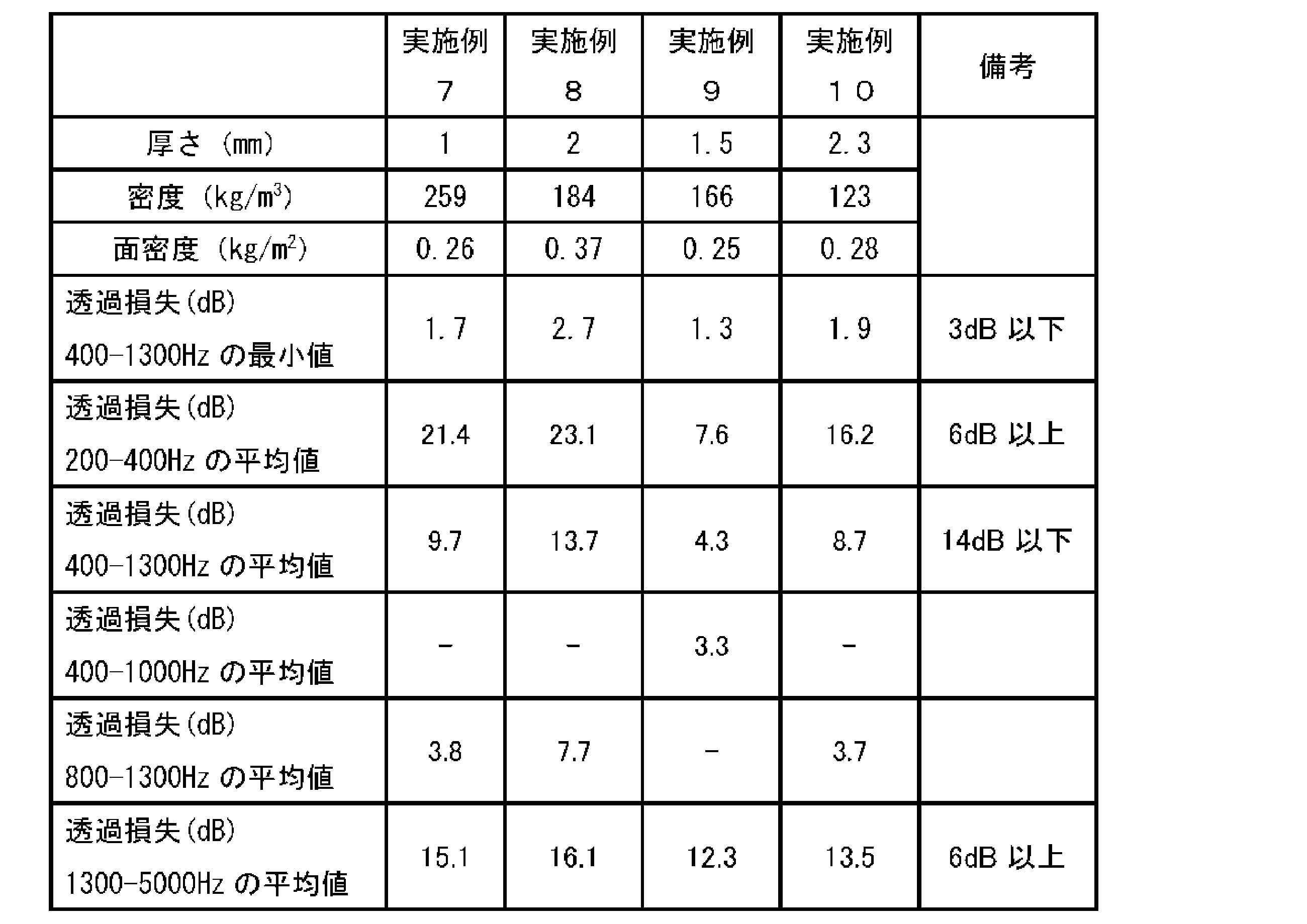
本発明のシリカエアロゲル粒子/有機ナノファイバー複合体による音響選択透過フィルターは、従来の軽量な吸音材では実現できない250Hz以下の耳を圧迫するような不快な低周波音を遮断することができる。低周波音は自動車のエンジンだけでなく、鉄道車両、船舶、航空機やヘリコプターなどの輸送機器、工場の送風機、プレス機、真空ポンプなど、店舗・公共施設の空調室外機、ボイラーなどからも発生するので特に軽量であることが求められる幅広い分野への利用が期待できる。さらに低周波音を遮断するだけでなく吸音することから音の発生源と同じ空間であっても音の反響が少なく、例えば自動車内のエアコンの音などを聞こえにくくして快適性を保つことができる。
また、背景技術でサイレン音を例示したが、音声や歌声は主に中音域なので、低音域や高音域の音は遮断し、中音域の声を聞こえやすくする音響選択透過性を利用した機器への利用も期待できる。
The acoustic selective transmission filter of the present invention using the silica aerogel particle/organic nanofiber composite can block unpleasant low-frequency sounds of 250 Hz or less that press on the ears, which cannot be achieved with conventional lightweight sound-absorbing materials. Low-frequency sounds are generated not only by automobile engines but also by transportation equipment such as railway vehicles, ships, aircraft and helicopters, factory blowers, presses, vacuum pumps, and outdoor air conditioners and boilers in stores and public facilities, so it is expected to be used in a wide range of fields where light weight is particularly required. Furthermore, since it not only blocks low-frequency sounds but also absorbs them, there is little reverberation of sound even in the same space as the source of the sound, and it is possible to maintain comfort by making it difficult to hear the sound of an air conditioner inside a car, for example.
In addition, while a siren sound was given as an example in the background technology, since voices and singing voices are mainly in the mid-range, it is expected that the technology will also be used in devices that utilize acoustic selective transparency to block low and high-range sounds and make mid-range voices easier to hear.
Claims (2)
前記低音域が400Hz以下の周波数帯であり及び前記高音域が1300Hz以上の周波数帯であり、前記低音域と前記高音域の間の前記中音域に、透過損失の最小値を有する、音響周波数選択透過フィルター。 The basic structure of the filter is a cell in which an aggregate of silica aerogel particles is surrounded by a network of organic nanofibers with an anionic functional group, and an acoustic frequency selective transmission filter having a three-dimensional continuous structure in which multiple cells are closely spaced is formed inside a nonwoven fabric (excluding glass wool and rock wool) or an open-cell foam, and the filter has excellent sound insulation properties in the low and high ranges and frequency selectivity that transmits mid-range sounds.
An acoustic frequency selective transmission filter, wherein the bass range is a frequency band of 400 Hz or less and the treble range is a frequency band of 1300 Hz or more, and the filter has a minimum transmission loss in the midrange between the bass range and the treble range.
Applications Claiming Priority (4)
| Application Number | Priority Date | Filing Date | Title |
|---|---|---|---|
| JP2019164237 | 2019-09-10 | ||
| JP2019164237 | 2019-09-10 | ||
| JP2020072022 | 2020-04-14 | ||
| JP2020072022 | 2020-04-14 |
Publications (2)
| Publication Number | Publication Date |
|---|---|
| JP2021167931A JP2021167931A (en) | 2021-10-21 |
| JP7621601B2 true JP7621601B2 (en) | 2025-01-27 |
Family
ID=78079521
Family Applications (1)
| Application Number | Title | Priority Date | Filing Date |
|---|---|---|---|
| JP2020146471A Active JP7621601B2 (en) | 2019-09-10 | 2020-09-01 | Acoustic Frequency Selective Transmission Filter |
Country Status (1)
| Country | Link |
|---|---|
| JP (1) | JP7621601B2 (en) |
Citations (3)
| Publication number | Priority date | Publication date | Assignee | Title |
|---|---|---|---|---|
| JP2018140554A (en) | 2017-02-28 | 2018-09-13 | パナソニックIpマネジメント株式会社 | Composite material and manufacturing method thereof |
| JP2018146603A (en) | 2017-03-01 | 2018-09-20 | 日立化成株式会社 | Low frequency sound absorber |
| US20190144701A1 (en) | 2017-11-10 | 2019-05-16 | Panasonic Intellectual Property Management Co., Ltd. | Heat insulating material and method for forming coating of the same |
Family Cites Families (3)
| Publication number | Priority date | Publication date | Assignee | Title |
|---|---|---|---|---|
| DE19533564A1 (en) * | 1995-09-11 | 1997-03-13 | Hoechst Ag | Fibrous airgel composite material |
| JP6892807B2 (en) * | 2016-09-12 | 2021-06-23 | 株式会社Kri | Hydrophobic silica airgel particles aqueous dispersion as well as solid composites, insulation and sound absorbing materials |
| US11324428B2 (en) * | 2019-03-14 | 2022-05-10 | Ricoh Company, Ltd. | Multi-sphere head model for dipole localization without ghost spheres |
-
2020
- 2020-09-01 JP JP2020146471A patent/JP7621601B2/en active Active
Patent Citations (3)
| Publication number | Priority date | Publication date | Assignee | Title |
|---|---|---|---|---|
| JP2018140554A (en) | 2017-02-28 | 2018-09-13 | パナソニックIpマネジメント株式会社 | Composite material and manufacturing method thereof |
| JP2018146603A (en) | 2017-03-01 | 2018-09-20 | 日立化成株式会社 | Low frequency sound absorber |
| US20190144701A1 (en) | 2017-11-10 | 2019-05-16 | Panasonic Intellectual Property Management Co., Ltd. | Heat insulating material and method for forming coating of the same |
Also Published As
| Publication number | Publication date |
|---|---|
| JP2021167931A (en) | 2021-10-21 |
Similar Documents
| Publication | Publication Date | Title |
|---|---|---|
| JP7671131B2 (en) | Lightweight heat and sound insulation material and its manufacturing method | |
| JP7645814B2 (en) | Acoustic article and method | |
| Xiang et al. | Investigation on sound absorption properties of kapok fibers | |
| CN108457393B (en) | Sound absorbing structure for anechoic chamber and anechoic chamber including sound absorbing structure for anechoic chamber | |
| Akasaka et al. | Structure-sound absorption property relationships of electrospun thin silica fiber sheets: Quantitative analysis based on acoustic models | |
| CN103443851B (en) | Sound penetrability material and the sound comprising the building occupancy using this material adjust surface construction, microphone windscreen, protection grid, sound penetrability projection screen and loudspeaker | |
| Simón-Herrero et al. | PVA/nanoclay/graphene oxide aerogels with enhanced sound absorption properties | |
| WO2010134312A1 (en) | Loudspeaker device | |
| JP2018043927A (en) | Aqueous dispersion of hydrophobic silica aerogel particles, solid composite material, heat insulating material and sound absorbing material | |
| JP2023543684A (en) | Acoustic absorbing fillers and related acoustic articles | |
| JP6781766B2 (en) | Soundproof structure and manufacturing method of soundproof structure | |
| Puguan et al. | Enhanced low frequency sound absorption of bilayer nanocomposite acoustic absorber laminated with microperforated nanofiber felt | |
| Miasa et al. | An experimental study of a multi-size microperforated panel absorber | |
| JP2021167931A (en) | Acoustic frequency selection transmission filter | |
| Guo et al. | Preparation and properties of fiber‐based aerogels for efficient acoustic absorption of mid‐low frequency | |
| JPH11133980A (en) | Sound absorbing material and manufacture thereof | |
| EP4211676B1 (en) | Acoustic absorbing filler and related acoustic article | |
| CN103694669A (en) | Porous nano-material and sound attenuator based on porous nano-material | |
| JP2784294B2 (en) | Sound absorbing material and method of manufacturing sound absorbing material | |
| CN118176536A (en) | Sound insulation product and method of manufacturing the same | |
| WO2023276151A1 (en) | Sound absorbing material, and vehicle member | |
| El-Basheer | Recent progress in acoustical materials and noise control approach | |
| JP2000099035A (en) | Sound absorbing material and its production | |
| CN119264628B (en) | Sound-absorbing cotton for automobile interior and preparation process thereof | |
| KR101958482B1 (en) | Fiber aggregate having excellent sound absorption performance and manufacturing method thereof |
Legal Events
| Date | Code | Title | Description |
|---|---|---|---|
| A621 | Written request for application examination |
Free format text: JAPANESE INTERMEDIATE CODE: A621 Effective date: 20230613 |
|
| A977 | Report on retrieval |
Free format text: JAPANESE INTERMEDIATE CODE: A971007 Effective date: 20240124 |
|
| A131 | Notification of reasons for refusal |
Free format text: JAPANESE INTERMEDIATE CODE: A131 Effective date: 20240305 |
|
| A603 | Late request for extension of time limit during examination |
Free format text: JAPANESE INTERMEDIATE CODE: A603 Effective date: 20240610 |
|
| A521 | Request for written amendment filed |
Free format text: JAPANESE INTERMEDIATE CODE: A523 Effective date: 20240704 |
|
| A131 | Notification of reasons for refusal |
Free format text: JAPANESE INTERMEDIATE CODE: A131 Effective date: 20241015 |
|
| RD02 | Notification of acceptance of power of attorney |
Free format text: JAPANESE INTERMEDIATE CODE: A7422 Effective date: 20241125 |
|
| A521 | Request for written amendment filed |
Free format text: JAPANESE INTERMEDIATE CODE: A523 Effective date: 20241129 |
|
| TRDD | Decision of grant or rejection written | ||
| A01 | Written decision to grant a patent or to grant a registration (utility model) |
Free format text: JAPANESE INTERMEDIATE CODE: A01 Effective date: 20241219 |
|
| A61 | First payment of annual fees (during grant procedure) |
Free format text: JAPANESE INTERMEDIATE CODE: A61 Effective date: 20241227 |
|
| R150 | Certificate of patent or registration of utility model |
Ref document number: 7621601 Country of ref document: JP Free format text: JAPANESE INTERMEDIATE CODE: R150 |