JP7620397B2 - Composite nonwoven fabric and its manufacturing method - Google Patents
Composite nonwoven fabric and its manufacturing method Download PDFInfo
- Publication number
- JP7620397B2 JP7620397B2 JP2020107761A JP2020107761A JP7620397B2 JP 7620397 B2 JP7620397 B2 JP 7620397B2 JP 2020107761 A JP2020107761 A JP 2020107761A JP 2020107761 A JP2020107761 A JP 2020107761A JP 7620397 B2 JP7620397 B2 JP 7620397B2
- Authority
- JP
- Japan
- Prior art keywords
- nonwoven fabric
- fiber web
- pulp fiber
- composite nonwoven
- roll
- Prior art date
- Legal status (The legal status is an assumption and is not a legal conclusion. Google has not performed a legal analysis and makes no representation as to the accuracy of the status listed.)
- Active
Links
- 239000004745 nonwoven fabric Substances 0.000 title claims description 144
- 239000002131 composite material Substances 0.000 title claims description 87
- 238000004519 manufacturing process Methods 0.000 title claims description 21
- 239000000835 fiber Substances 0.000 claims description 101
- 238000004049 embossing Methods 0.000 claims description 63
- 238000000034 method Methods 0.000 claims description 48
- 238000003490 calendering Methods 0.000 claims description 27
- 238000001035 drying Methods 0.000 claims description 21
- 230000004927 fusion Effects 0.000 claims description 13
- -1 polypropylene Polymers 0.000 claims description 7
- 238000003825 pressing Methods 0.000 claims description 6
- 239000004743 Polypropylene Substances 0.000 claims description 5
- 239000000203 mixture Substances 0.000 claims description 5
- 239000000123 paper Substances 0.000 claims description 5
- 229920001155 polypropylene Polymers 0.000 claims description 5
- 235000005018 Pinus echinata Nutrition 0.000 claims description 4
- 241001236219 Pinus echinata Species 0.000 claims description 4
- 235000017339 Pinus palustris Nutrition 0.000 claims description 4
- 230000010354 integration Effects 0.000 claims description 4
- 239000002655 kraft paper Substances 0.000 claims description 4
- 239000011122 softwood Substances 0.000 claims description 4
- 230000001737 promoting effect Effects 0.000 claims description 3
- 229920005989 resin Polymers 0.000 claims description 3
- 239000011347 resin Substances 0.000 claims description 3
- XLYOFNOQVPJJNP-UHFFFAOYSA-N water Substances O XLYOFNOQVPJJNP-UHFFFAOYSA-N 0.000 description 29
- 230000008569 process Effects 0.000 description 25
- 230000032258 transport Effects 0.000 description 11
- 230000000052 comparative effect Effects 0.000 description 8
- 238000009736 wetting Methods 0.000 description 7
- 238000011156 evaluation Methods 0.000 description 5
- 238000011144 upstream manufacturing Methods 0.000 description 5
- 238000010521 absorption reaction Methods 0.000 description 4
- 239000000463 material Substances 0.000 description 4
- 239000002184 metal Substances 0.000 description 4
- 238000004804 winding Methods 0.000 description 4
- 238000010586 diagram Methods 0.000 description 3
- 238000005259 measurement Methods 0.000 description 3
- 230000002093 peripheral effect Effects 0.000 description 3
- 238000012545 processing Methods 0.000 description 3
- 239000007921 spray Substances 0.000 description 3
- 235000014466 Douglas bleu Nutrition 0.000 description 2
- 239000004677 Nylon Substances 0.000 description 2
- 241000218657 Picea Species 0.000 description 2
- 241000218606 Pinus contorta Species 0.000 description 2
- 235000011334 Pinus elliottii Nutrition 0.000 description 2
- 241000142776 Pinus elliottii Species 0.000 description 2
- 235000008577 Pinus radiata Nutrition 0.000 description 2
- 241000218621 Pinus radiata Species 0.000 description 2
- 239000004698 Polyethylene Substances 0.000 description 2
- 239000004793 Polystyrene Substances 0.000 description 2
- 241000218683 Pseudotsuga Species 0.000 description 2
- 235000005386 Pseudotsuga menziesii var menziesii Nutrition 0.000 description 2
- 229920002978 Vinylon Polymers 0.000 description 2
- NIXOWILDQLNWCW-UHFFFAOYSA-N acrylic acid group Chemical group C(C=C)(=O)O NIXOWILDQLNWCW-UHFFFAOYSA-N 0.000 description 2
- 238000013461 design Methods 0.000 description 2
- 239000000428 dust Substances 0.000 description 2
- 238000010438 heat treatment Methods 0.000 description 2
- 239000007788 liquid Substances 0.000 description 2
- 235000014684 lodgepole pine Nutrition 0.000 description 2
- 239000003595 mist Substances 0.000 description 2
- 229920001778 nylon Polymers 0.000 description 2
- 229920000728 polyester Polymers 0.000 description 2
- 229920000573 polyethylene Polymers 0.000 description 2
- 229920002223 polystyrene Polymers 0.000 description 2
- 238000002203 pretreatment Methods 0.000 description 2
- 235000000673 shore pine Nutrition 0.000 description 2
- 238000001228 spectrum Methods 0.000 description 2
- 238000005507 spraying Methods 0.000 description 2
- 229920003002 synthetic resin Polymers 0.000 description 2
- 239000000057 synthetic resin Substances 0.000 description 2
- 241000692870 Inachis io Species 0.000 description 1
- 230000009471 action Effects 0.000 description 1
- 238000005452 bending Methods 0.000 description 1
- 230000008859 change Effects 0.000 description 1
- 230000006835 compression Effects 0.000 description 1
- 238000007906 compression Methods 0.000 description 1
- 230000002079 cooperative effect Effects 0.000 description 1
- 230000018044 dehydration Effects 0.000 description 1
- 238000006297 dehydration reaction Methods 0.000 description 1
- 230000006866 deterioration Effects 0.000 description 1
- 230000001815 facial effect Effects 0.000 description 1
- 238000009434 installation Methods 0.000 description 1
- 238000010030 laminating Methods 0.000 description 1
- 238000011160 research Methods 0.000 description 1
- 230000001953 sensory effect Effects 0.000 description 1
Images


Landscapes
- Nonwoven Fabrics (AREA)
- Sanitary Thin Papers (AREA)
- Cleaning Implements For Floors, Carpets, Furniture, Walls, And The Like (AREA)
- Laminated Bodies (AREA)
Description
本発明は、パルプ繊維ウエブとスパンボンド不織布とを水流交絡させることによって得られる複合型の不織布に関する。 The present invention relates to a composite nonwoven fabric obtained by hydroentangling a pulp fiber web and a spunbond nonwoven fabric.
パルプ繊維ウエブとスパンボンド不織布とによる複合型の不織布は、パルプ繊維に基づく吸液性とスパンボンド不織布に基づく強度との両方を具備してなるので、ウエスなどの工業用ワイパー、或いは手ぬぐい、タオルなどの対人用のワイパー等の様々な用途で広く使用されている。 Composite nonwoven fabrics made from pulp fiber webs and spunbond nonwoven fabrics have both the absorbency of pulp fibers and the strength of spunbond nonwoven fabrics, and are therefore widely used in a variety of applications, including industrial wipers such as rags, and personal wipers such as hand towels and towels.
例えば、特許文献1で開示するように、パルプ繊維ウエブとスパンボンド不織布とを重ねた後に、高圧のウォータジェット(水流)を吹き付ける水流交絡処理によって一体化されている。ここでスパンボンド不織布は強度に優れるので製造された複合型不織布の裏打ち層的な機能を果たす。一方、パルプ繊維ウエブは優れた吸液機能を備えている。よって、このような複合型不織布は、水性、油性のいずれの液体に対しても吸収性が良好なパルプ繊維ウエブと、強度に優れるスパンボンド不織布との利点を併有している優れた複合型不織布として消費者に提供することができる。 For example, as disclosed in Patent Document 1, a pulp fiber web and a spunbond nonwoven fabric are layered and then integrated by a hydroentanglement process in which a high-pressure water jet (water flow) is sprayed onto them. Here, the spunbond nonwoven fabric has excellent strength and functions as a backing layer for the composite nonwoven fabric produced. Meanwhile, the pulp fiber web has excellent liquid absorption properties. Therefore, such a composite nonwoven fabric can be offered to consumers as an excellent composite nonwoven fabric that combines the advantages of a pulp fiber web that has good absorbency for both aqueous and oil-based liquids and a spunbond nonwoven fabric that has excellent strength.
上記のような複合型不織布では、ユーザが使用したときに嵩(かさ)や厚さなどを介して感じることができる適度なボリューム感(量感)を備えると共に表面が平滑であり、繊維の脱落が少ないものが製品としての評価が高い。
例えば複合型不織布にカレンダー処理を施すことで任意の厚みへの調節と表面の均一性や平滑性を付与することができる。しかしながら、その反面、複合型不織布を加圧して平滑にしているため、いわゆるコシ(強さの一種であり、不織布に曲げの力を与えたときの抵抗性、以下では単に「コシ」と称する場合がある)が低下してしまう。その一方で、複合型不織布にコシを付与する方法として温度を高くしたエンボスロールで熱エンボス処理する方法が知られている。この処理では、エンボスといういわば支柱に相当する突起が複数配置してあるロールを用いて、複合型不織布の表面にエンボスを押し付けつつ、複合型不織布のスパンボンド不織布(合成樹脂繊維)側に熱を加えてその後に硬化させることで、適度なコシを付与できる。しかしながら、その反面で熱エンボス処理では繊細な厚みの調節が困難であり、外観の平滑性に問題が生じることがあった。
以上のように、複合型不織布へのカレンダー処理と熱エンボス処理とは、相反するような関係にあり、要求されるボリューム感(量感)および平滑性を備えると共に、適度なコシを有し、繊維の脱落が抑制されている複合型不織布を得ることには困難であった。
Among composite nonwoven fabrics such as those described above, those that have an appropriate sense of volume (mass) that can be felt by the user through bulk and thickness when used, as well as a smooth surface and little fiber shedding are highly rated as products.
For example, by subjecting a composite nonwoven fabric to a calendaring process, it is possible to adjust the thickness to any desired value and to impart uniformity and smoothness to the surface. However, on the other hand, since the composite nonwoven fabric is pressed to make it smooth, the so-called stiffness (a type of strength, the resistance when a bending force is applied to the nonwoven fabric, hereinafter sometimes simply referred to as "stiffness") is reduced. On the other hand, a method of thermal embossing with an embossing roll at a high temperature is known as a method of imparting stiffness to a composite nonwoven fabric. In this treatment, a roll having a plurality of protrusions, which are equivalent to pillars, is used to press the embossing against the surface of the composite nonwoven fabric, while applying heat to the spunbond nonwoven fabric (synthetic resin fiber) side of the composite nonwoven fabric and then curing it, thereby imparting appropriate stiffness. However, on the other hand, it is difficult to adjust the thickness delicately with the thermal embossing process, and problems with the smoothness of the appearance may occur.
As described above, the calendaring treatment and the heat embossing treatment of a composite nonwoven fabric are in an opposing relationship, and it has been difficult to obtain a composite nonwoven fabric that has the required volume (massiveness) and smoothness, as well as appropriate stiffness and suppressed fiber shedding.
なお、複合型不織布のパルプ繊維ウエブについては、従来の湿式抄紙法を流用することにより、或いは、乾式エアレイド法を用いて得ることができる。乾式エアレイド法によるパルプ繊維ウエブを用いた場合には上記の問題、すなわち、熱エンボス処理した際に、繊細な厚みの調節が困難であり、外観の平滑性に問題が生じる傾向が大きくなることが認められた。しかしながら、製造設備やコストの面からは、湿式抄紙法よりも乾式エアレイド法を採用することが好ましい。 The pulp fiber web of the composite nonwoven fabric can be obtained by reusing the conventional wet papermaking method or by using the dry airlaid method. It has been found that when a pulp fiber web made by the dry airlaid method is used, the above-mentioned problems occur, that is, when the web is heat embossed, it is difficult to adjust the thickness precisely, and there is a strong tendency for problems with the smoothness of the appearance to occur. However, from the standpoint of manufacturing equipment and costs, it is preferable to adopt the dry airlaid method rather than the wet papermaking method.
本発明の目的は、要求されるボリューム感や平滑性を備えると共に、適度のコシを有し、更には繊維の脱落も抑制されている複合型不織布を提供することにある。 The objective of the present invention is to provide a composite nonwoven fabric that has the required volume and smoothness, as well as appropriate stiffness and reduced fiber shedding.
上記目的は、スパンボンド不織布上にパルプ繊維ウエブを積層し一体化してある複合型の不織布であって、坪量が40.0~110.0g/m2であり、且つ、嵩が4.3~7.5cm3/gであり、コシ(強さ)を表す指標であるTSA(D値)が1.0~2.5mm/Nである、ことを特徴とする複合型不織布により達成できる。 The above object can be achieved by a composite nonwoven fabric which is formed by laminating and integrating a pulp fiber web onto a spunbond nonwoven fabric, the composite nonwoven fabric having a basis weight of 40.0 to 110.0 g/ m2 , a bulk of 4.3 to 7.5 cm3 /g, and a TSA (D value), which is an index of stiffness (strength), of 1.0 to 2.5 mm/N.
そして、柔らかさを示す指標であるTSA(TS7値)が12.0~20.0dBV2rmsおよび滑らかさを示す指標であるTSA(TS750値)が33.0~100.0dBV2rmsであることが好ましい。
更に、厚さが0.30~0.50mmであることが好ましい。
It is preferable that the TSA (TS7 value), which is an index showing softness, is 12.0 to 20.0 dBV 2 rms, and the TSA (TS750 value), which is an index showing smoothness, is 33.0 to 100.0 dBV 2 rms.
Furthermore, the thickness is preferably 0.30 to 0.50 mm.
また、前記パルプ繊維ウエブの坪量が30.0~80.0g/m2、且つ、前記スパンボンド不織布と前記パルプ繊維ウエブとの重量構成比が40/60~10/90(wt%)であることが好ましい。 It is also preferable that the pulp fiber web has a basis weight of 30.0 to 80.0 g/m 2 and the weight composition ratio of the spunbond nonwoven fabric to the pulp fiber web is 40/60 to 10/90 (wt %).
また、前記スパンボンド不織布の坪量が10.0~30.0g/m2であると共に、当該スパンボンド不織布が紡糸された樹脂繊維を接合する複数の融着点を含んで形成されており、前記融着点1個の面積が0.10~0.50mm2、前記融着点の単位面積当たりの面積率が7~20%、個数が10~150個/cm2であることが好ましい。 It is also preferred that the spunbond nonwoven fabric has a basis weight of 10.0 to 30.0 g/ m2 , is formed to include a plurality of fusion points that bond the spun resin fibers, the area of each fusion point is 0.10 to 0.50 mm2 , the area ratio of the fusion points per unit area is 7 to 20%, and the number of fusion points is 10 to 150/ cm2 .
そして、前記スパンボンド不織布は、ナイロン、ビニロン、ポリエステル、アクリル、ポリエチレン、ポリプロピレン及びポリスチレンからなる群から選択された1種類、又は2種類以上の混合で形成されているのが望ましい。 It is desirable that the spunbond nonwoven fabric is made of one or a mixture of two or more materials selected from the group consisting of nylon, vinylon, polyester, acrylic, polyethylene, polypropylene, and polystyrene.
また、前記パルプ繊維ウエブは、ラジアータパイン、スラッシュパイン、サザンパイン、ロッジポールパイン、スプルース及びダグラスファーからなる群から選択された針葉樹晒クラフトパルプの繊維からなるのが望ましい。 The pulp fiber web is preferably made of bleached softwood kraft pulp fibers selected from the group consisting of radiata pine, slash pine, southern pine, lodgepole pine, spruce, and Douglas fir.
上記の目的は、スパンボンド不織布上にパルプ繊維ウエブを積層し一体化してある複合型不織布の製造方法であって、前記パルプ繊維ウエブと前記スパンボンド不織布との一体化を促進して積層体を得る水流交絡工程と、前記水流交絡工程の後に前記積層体を乾燥する乾燥工程とを少なくとも含み、前記乾燥工程の後に、カレンダーロール間で前記積層体を加圧しながら通過させるカレンダー工程と、前記カレンダー工程後に、前記パルプ繊維ウエブ側に熱エンボス処理を施す熱エンボス工程を更に含む、ことを特徴とする複合型不織布の製造方法によっても達成できる。 The above object can also be achieved by a method for producing a composite nonwoven fabric in which a pulp fiber web is laminated and integrated onto a spunbond nonwoven fabric, the method comprising at least a hydroentanglement step for promoting integration of the pulp fiber web and the spunbond nonwoven fabric to obtain a laminate, and a drying step for drying the laminate after the hydroentanglement step, the method further comprising a calendaring step for passing the laminate between calendar rolls while applying pressure thereto after the drying step, and a thermal embossing step for subjecting the pulp fiber web side to a thermal embossing treatment after the calendaring step.
そして、前記カレンダー工程及び/又は前記熱エンボス工程では、式(ロール相当径)=(主ロール径)×(受けロール径)/{(主ロール径)+(受けロール径)}によって算出されるロール相当径が75~300mmである主ロール径と受けロールとを用い、搬送スピードを100~300m/min、ロール間のギャップを0~0.5mm、ロールニップ圧を0.5~6.5MPa、に設定してあるのが望ましい。
また、前記熱エンボス工程では、前記主ロールの温度を40~200℃に設定してあるのが望ましい。
In the calendaring process and/or the heat embossing process, it is preferable to use a main roll and a backing roll having a roll equivalent diameter of 75 to 300 mm calculated by the formula (roll equivalent diameter)=(main roll diameter)×(backing roll diameter)/{(main roll diameter)+(backing roll diameter)}, set the conveying speed to 100 to 300 m/min, the gap between the rolls to 0 to 0.5 mm, and the roll nip pressure to 0.5 to 6.5 MPa.
In the hot embossing step, the temperature of the main roll is preferably set to 40 to 200°C.
本発明によると、要求されるボリューム感や平滑性を備えると共に、適度のコシを有し、更には繊維の脱落も抑制されている複合型不織布として提供することができる。また、本発明の製造方法によると、上記複合型不織布を効率よく製造することができる。 According to the present invention, it is possible to provide a composite nonwoven fabric that has the required volume and smoothness, as well as appropriate stiffness and reduced fiber shedding. Furthermore, according to the manufacturing method of the present invention, the above-mentioned composite nonwoven fabric can be efficiently manufactured.
以下、本発明の一実施形態に係る複合型不織布について説明する。
本願の発明者等は、複合型不織布について鋭意に検討を行い、坪量(g/m2)および嵩(cm3/g)、コシ(強さ)を表す指標であるTSA(D値)が所定範囲内にあるように設計した複合型不織布は、要求されるボリューム感や平滑性を備えていると共に、適度のコシを有し、更に繊維の脱落も抑制されていることを確認して、本発明に至ったものである。このような複合型不織布は、乾燥工程後にカレンダー処理、熱エンボス処理を順に施すことにより製造することができる。
更には、本発明に係る複合型不織布は、柔らかさを示す指標であるTSA(TS7値(dBV2rms))および滑らかさを示す指標であるTSA(TS750値(dBV2rms))も所定範囲内にあるように設計したものが好ましく、また厚さ(mm)についても所定範囲内にあるように設計したものが好ましい。
以下では、複合型不織布に係る上記したファクターとその好適範囲について説明する。
Hereinafter, a composite nonwoven fabric according to one embodiment of the present invention will be described.
The inventors of the present application have conducted extensive research into composite nonwoven fabrics and have confirmed that a composite nonwoven fabric designed so that its basis weight (g/ m2 ), bulk ( cm3 /g) and TSA (D value), an index of stiffness (strength), are within a predetermined range has the required volume and smoothness, has appropriate stiffness and also suppresses fiber shedding, thereby arriving at the present invention. Such a composite nonwoven fabric can be produced by sequentially carrying out a calendaring process and a heat embossing process after a drying process.
Furthermore, the composite nonwoven fabric according to the present invention is preferably designed so that the TSA (TS7 value (dBV 2 rms)), which is an index of softness, and the TSA (TS750 value (dBV 2 rms)), which is an index of smoothness, are within a specified range, and the thickness (mm) is also preferably designed to be within a specified range.
The above factors and their preferred ranges relating to the composite nonwoven fabric will be explained below.
本発明に係る複合型不織布の坪量は40.0~110.0g/m2、好ましくは62.0~77.0g/m2であり、嵩は4.3~7.5g/m2、好ましくは5.0~6.4g/m2、TSA(D値)は1.0~2.5mm/Nに設定されている。
坪量、嵩、そして上記TSA(D値)が上記範囲となるように形成された複合型不織布は、要求されるボリューム感や平滑性を備えると共に、適度のコシを有し、更に繊維の脱落も抑制されているものにできる。
ここで、更に、上記指標TSA(TS7値)は12.0~20.0dBV2rmsであり、TSA(TS750値)は33.0~100.0dBV2rmsに設定され、また厚さは0.30~0.50mm、好ましくは0.35~0.45mmに設定されている。
The composite nonwoven fabric according to the present invention has a basis weight of 40.0 to 110.0 g/m 2 , preferably 62.0 to 77.0 g/m 2 , a bulk of 4.3 to 7.5 g/m 2 , preferably 5.0 to 6.4 g/m 2 , and a TSA (D value) of 1.0 to 2.5 mm/N.
A composite nonwoven fabric formed so that the basis weight, bulk, and TSA (D value) fall within the above ranges has the required volume and smoothness, as well as appropriate stiffness and reduced fiber shedding.
Here, further, the index TSA (TS7 value) is set to 12.0 to 20.0 dBV 2 rms, the TSA (TS750 value) is set to 33.0 to 100.0 dBV 2 rms, and the thickness is set to 0.30 to 0.50 mm, preferably 0.35 to 0.45 mm.
上記したD値、TS7値、TS750値のそれぞれはティシューソフトネス測定装置TSA(Tissue Softness Analyzer)を用いて測定されたものであることを示すため、TSA(D値)、TSA(TS7値)、TSA(TS750値)と示している。ティシューソフトネス測定装置TSAでは、試料台上にパルプ面側を上に向け載置した複合型不織布(サンプル)の上からブレード付ローターを例えば押し込み圧100mNで押し付けて、2.0/secで回転させたとき、各種センサーで検知した振動データを振動解析してパラメータ化(TS値)することにより、不織布等のソフトネス(手触り感)を定量評価するものであり、ドイツのEmtec Electronic GmbH社(日本代理店は日本ルフト株式会社)製の商品名である。
上記ティシューソフトネス測定装置TSAによる測定では、例えば試料台の振動を、試料台内部に設置した振動センサーで測定し、振動周波数を解析して、パラメータ化(TS値)する。振動周波数は、クリープ加工やエンボス加工といった構造的な寸法及びブレードの回転数に依存する。ブレード自身の水平振動の誘発(共振周波数:例えば6500Hz)は、サンプルの表面を進むとき、サンプルの凸部による瞬間的な遮断とブレードの振動に起因して起こる。低周波数側からの最初のスペクトルの極大ピークの強度をTS750値(dBV2rms)とし、共振周波数:6500Hzを含む(6500Hzの前後の)スペクトルの極大ピークの強度をTS7値(dBV2rms)とする。
さらに、上記ブレード付ローターを回転させずに、例えば押し込み圧100mNと600mNでサンプルを変形させたときの上下方向の変形量(mm/N)をD値として計測する。
The above-mentioned D value, TS7 value, and TS750 value are indicated as TSA (D value), TSA (TS7 value), and TSA (TS750 value) to indicate that they were measured using a tissue softness measuring device TSA (Tissue Softness Analyzer). The tissue softness measuring device TSA quantitatively evaluates the softness (hand feel) of nonwoven fabrics and the like by pressing a bladed rotor, for example, with a pressing pressure of 100 mN against a composite nonwoven fabric (sample) placed on a sample stage with the pulp side facing up and rotating the sample at 2.0/sec, performing vibration analysis of vibration data detected by various sensors and parameterizing the vibration data (TS value), and the softness (hand feel) of nonwoven fabrics and the like is evaluated. The TSA is a product name manufactured by Emtec Electronic GmbH of Germany (the Japanese distributor is Nippon Luft Co., Ltd.).
In the measurement by the tissue softness measuring device TSA, for example, the vibration of the sample stage is measured by a vibration sensor installed inside the sample stage, and the vibration frequency is analyzed and parameterized (TS value). The vibration frequency depends on the structural dimensions such as creep processing and embossing processing and the rotation speed of the blade. The horizontal vibration of the blade itself is induced (resonant frequency: for example, 6500 Hz) when it advances on the surface of the sample, due to the momentary interruption by the convex part of the sample and the vibration of the blade. The intensity of the maximum peak of the first spectrum from the low frequency side is the TS750 value (dBV 2 rms), and the intensity of the maximum peak of the spectrum including the resonant frequency of 6500 Hz (around 6500 Hz) is the TS7 value (dBV 2 rms).
Furthermore, without rotating the bladed rotor, the sample is deformed, for example, with a pressing pressure of 100 mN and 600 mN, and the amount of deformation (mm/N) in the vertical direction is measured as the D value.
なお、振動解析してパラメータ化(TS値)するソフトウェアは、emtec measurement systemを用いることができる。本ソフトウェアには、各種アルゴリズム(例えば、Base Tissue、Facial、TP等)が備えられ、上記TS7値、TS750値及びD値をソフトウェア上で自動的に取得し、これらTS7値、TS750値及びD値あるいは坪量、厚さ、プライ数等から各種アルゴリズムの種類によって、HF(ハンドフィール)値が計算される。本発明では、HF値ではなく、TS7値、TS750値及びD値を規定しており、測定条件を満たせば、アルゴリズムは何を使用してもよく、TS7値、TS750値及びD値は、アルゴリズムの種類によって変わることはない。 The software that performs vibration analysis and parameterization (TS value) can be the emtec measurement system. This software is equipped with various algorithms (e.g., Base Tissue, Facial, TP, etc.), and the TS7 value, TS750 value, and D value are automatically obtained on the software, and the HF (hand feel) value is calculated from these TS7 value, TS750 value, and D value or basis weight, thickness, number of plies, etc., depending on the type of algorithm. In the present invention, the TS7 value, TS750 value, and D value are specified instead of the HF value, and any algorithm can be used as long as the measurement conditions are met, and the TS7 value, TS750 value, and D value do not change depending on the type of algorithm.
そして、上記パルプ繊維ウエブの坪量は例えば30.0~80.0g/m2とし、スパンボンド不織布とパルプ繊維ウエブとの重量構成比を例えば40/60~10/90(wt%)とされているのが好ましい。この範囲にあるものは、吸水性能や手持ち感に優れ、複合型不織布の形状安定性にも優れる。
そして、前記スパンボンド不織布の坪量は例えば10.0~30.0g/m2とするのが好ましい。また、スパンボンド不織布は紡糸された樹脂繊維を接合する複数の融着点を含んで形成されており、前記融着点1個の面積が0.10~0.50mm2、融着点の単位面積当たりの面積率が7~20%、個数が10~150個/cm2であるものが好ましい。このようなスパンボンド不織布は適度の剛性を備えており、パルプ繊維ウエブと組み合わせて複合型不織布に採用するスパンボンド不織布として好適である。なお、上記融着点の形状については、特に限定はなく円形、楕円形、多角形等とすることができる。
The basis weight of the pulp fiber web is, for example, 30.0 to 80.0 g/ m2 , and the weight composition ratio of the spunbond nonwoven fabric to the pulp fiber web is, for example, 40/60 to 10/90 (wt%). A nonwoven fabric in this range has excellent water absorption performance and hand feeling, and the composite nonwoven fabric also has excellent shape stability.
The basis weight of the spunbonded nonwoven fabric is preferably, for example, 10.0 to 30.0 g/ m2 . The spunbonded nonwoven fabric is formed to include a plurality of fusion points that bond the spun resin fibers, and it is preferable that the area of each fusion point is 0.10 to 0.50 mm2 , the area ratio of the fusion points per unit area is 7 to 20%, and the number of fusion points is 10 to 150/ cm2 . Such a spunbonded nonwoven fabric has an appropriate rigidity, and is suitable as a spunbonded nonwoven fabric to be used in combination with a pulp fiber web to form a composite nonwoven fabric. The shape of the fusion points is not particularly limited, and may be circular, elliptical, polygonal, etc.
前記スパンボンド不織布は、ナイロン、ビニロン、ポリエステル、アクリル、ポリエチレン、ポリプロピレン及びポリスチレンからなる群から選択された1種類、又は2種類以上の混合で形成するのが望ましい。この中で、ポリプロピレンを用いるのが好適である。
また、上記パルプ繊維ウエブに関しては、ラジアータパイン、スラッシュパイン、サザンパイン、ロッジポールパイン、スプルース及びダグラスファーからなる群から選択された針葉樹晒クラフトパルプの繊維で形成されたものを採用するのが好ましい。
The spunbond nonwoven fabric is preferably made of one or a mixture of two or more materials selected from the group consisting of nylon, vinylon, polyester, acrylic, polyethylene, polypropylene, and polystyrene. Among these, polypropylene is preferably used.
Furthermore, it is preferable to use the pulp fiber web formed from bleached kraft pulp fibers of a softwood selected from the group consisting of radiata pine, slash pine, southern pine, lodgepole pine, spruce and Douglas fir.
以下では、上述した本発明の複合型不織布を製造する工程について説明する。本発明の複合型不織布は乾燥工程後にカレンダー処理、更に熱エンボス処理を順に施すことにより効率よく製造することができる。ここでは、前提となる複合型不織布WPを製造する製造装置の主要構成について説明をした後に、カレンダー装置、エンボス装置について説明する。 The process for producing the composite nonwoven fabric of the present invention described above will be described below. The composite nonwoven fabric of the present invention can be produced efficiently by sequentially carrying out a drying process, a calendaring process, and then a hot embossing process. Here, the main components of the manufacturing apparatus for producing the composite nonwoven fabric WP will be described, followed by a description of the calendaring device and embossing device.
図1に示す複合型不織布の製造装置1は、上流側にエアレイド装置2、スパンボンド不織布を供給するスパンボンド供給装置3、そしてサクション装置4が配設されている。サクション装置4はエアレイド装置2の下側に対向するように配置されている。
ウエブの搬送方向TDで、これらの装置2、3、4よりも下流には、上流側から順に、水流交絡処理を行うためのウォータジェットを噴射する水流交絡装置5、サクション装置6、乾燥装置7が配置されている。上記乾燥装置7の下流には連続して製造される複合型不織布WPを巻き取るための巻取装置8が更に設けてある。
1 is provided with an
In the web transport direction TD, downstream of these
上記エアレイド装置2は、繊維同士が密集しシート状となっている原料パルプRPをパルプ繊維に解繊する解繊機21や、図示しない送風機を備えて解繊されたパルプ繊維PFをエアレイドホッパ23へと搬送するダクト22を有している。
The
また、上記ダクト22よりも下流側にはエアレイドホッパ23が配置されている。このエアレイドホッパ23の内部では、解繊状態にあるパルプ繊維が分散しながら降下し、下面に設定した積層位置24に徐々に積み上りパルプ繊維ウエブPFWが形成されるように設計してある。
上記積層位置24の下側にはサクション装置4が対向配備してある。より詳細には、サクション装置4は装置本体41の上面にサクション部42を有しており、サクション部42が上記パルプ繊維ウエブPFWに吸引力(負圧)を作用させるべく積層位置24に対して設定してある。
なお、図1では、エアレイドホッパ23とサクション装置本体41とを1つずつ一段での配置として、パルプ繊維ウエブPFWを形成する場合を例示している。しかし、これに限らず、上記パルプ繊維ウエブPFWの目付(坪量)や製造速度に応じて、上記エアレイドホッパ23とサクション装置本体41を2つ以上の多段とする配置に変更してもよい。
An
A
1 illustrates an example in which the pulp fiber web PFW is formed by arranging the
また、サクション装置4の周囲にはウエブ搬送用の搬送ワイヤ43が配設してある。搬送ワイヤ43は、積層位置24においてパルプ繊維PFが堆積したパルプ繊維ウエブPFWが載置可能で、これを下流側に搬送するように配置されている。ただし、パルプ繊維ウエブPFWは直接、搬送ワイヤ43上に載置されない。これについては、後述の説明で明らかとなる。
搬送ワイヤ43はサクション部42の吸引力が、反対側(上側)に及ぶような目開き形態(メッシュ)で形成されている。
A
The conveying
上記エアレイド装置2の下側で、サクション装置4よりも上流側に、スパンボンド供給装置3が配置してある。このスパンボンド供給装置3には、予め準備されたスパンボンド不織布SWがロール状とされてセットされている。スパンボンド供給装置3からスパンボンド不織布SWが引出され、上述した搬送ワイヤ43に乗って上記積層位置24へと搬送されるようになっている。スパンボンド不織布SWとしては、スパンボンド法により形成された合成樹脂の連続フィラメントのウエブを用いるのが好ましい。
A
積層位置24に位置した、スパンボンド不織布SWの上に、前述したパルプ繊維ウエブPFWが載置される。その際に、積層位置24ではサクション装置4のサクション部42による吸引力が搬送ワイヤ43を通過し、その上のスパンボンド不織布SWおよびパルプ繊維ウエブPFWに作用する。よって、スパンボンド不織布SWとパルプ繊維ウエブPFWとが積層された状態となっている予備的積層体PWebが下流側へと搬送される。
The aforementioned pulp fiber web PFW is placed on top of the spunbond nonwoven fabric SW located at the stacking
上記した予備的積層体PWebは、サクション装置4の吸引力によって、吸引圧縮されたことにより積層状態が維持されている。このとき上側のパルプ繊維ウエブPFWの繊維が密にされた状態ではある。しかし、このまま予備的積層体PWebを下流側の水流交絡装置5内に搬送投入すると、ウォータジェット(高圧の水流)によってパルプ繊維PFの一部が舞い上がるおそれがある。
そこで、本製造装置1では、予備的積層体PWebを上下から挟んでスパンボンド不織布SW上でのパルプ繊維ウエブPFWの載置状態を安定化させる為の挟持ローラ28、そして水流交絡装置5の上流側に繊維飛散防止用に水分を付与するプレウエット装置30が配備してある。プレウエット装置30は、好適には、予備的積層体PWebの上方からウォータミストを吹き付ける噴霧ノズル31と予備的積層体PWebの下側(すなわち、パルプ繊維ウエブPFWの下面)から吸引力を印加するサクション装置32とを含んで構成されている。
なお、図1では、上記のように水流交絡装置5前にプレウエット装置30を新たな装置として設ける場合を例示しているが、これに限らない。水流交絡装置5に含まれる後述するウォータジェットヘッド51とサクション装置52とからなるセットの複数について、先頭に位置するセットを上記プレウエット装置30として流用するような設計変更をしてもよい。この場合には先頭のウォータジェットヘッド51から低圧のウォータミストが噴霧されるように調整すればよい。
水流交絡処理を行うのに十分な、ウォータジェットヘッド51とサクション装置52とのセット数が確保されている水流交絡装置5の場合、上記のように先頭のウォータジェットヘッド51とサクション装置52をプレウエット装置として活用することは、装置設備コストの抑制に効果的である。
The above-mentioned preliminary laminate PWeb is maintained in a laminated state by being suction-compressed by the suction force of the
Therefore, in the present manufacturing apparatus 1, there are provided pinching
1 shows an example in which the
In the case of a
そして、水流交絡装置5では、前処理部となる挟持ローラ28およびプレウエット装置30の処理を受けた予備的積層体PWebに高圧のウォータジェットを吹き付けることによりパルプ繊維同士の交絡を促進する。これにより上側に位置するパルプ繊維ウエブPFW層と下側に位置するスパンボンド不織布SW層との一体化が促進される。
図1で例示的に示している水流交絡装置5は、搬送方向TDに沿って多段(図1では例示しているのは4段)にウォータジェットヘッド51が配置されている。
なお、図1では、搬送方向TDに対して直角な方向(ウエブの幅方向)において延在しているウォータジェットヘッド51に設けたノズルの様子は図示していないが、幅方向において複数のウォータジェットノズルが適宜の位置に配置してある。このウォータジェットノズルの穴直径φは、好ましくは0.06~0.15mmである。また、ウォータジェットノズルの間隔は0.4~1.0mmとするのが好ましい。
Then, in the
The
1 does not show the nozzles provided on the
上記水流交絡処理をする際の水圧は、パルプ繊維ウエブPFWとスパンボンドウエブSWとの坪量を勘案して設定するのが望ましい。例えば、1~30MPaの範囲において選択するのが好ましい。 The water pressure during the hydroentanglement process is desirably set taking into consideration the basis weights of the pulp fiber web PFW and the spunbond web SW. For example, it is preferable to select a pressure in the range of 1 to 30 MPa.
そして、上記ウォータジェットヘッド51と対向するように、サクション装置52が配設してある。ウォータジェットヘッド51から出る高圧のウォータジェットを上側に位置しているパルプ繊維ウエブPFWに吹き付けつつ、下側に位置しているスパンボンド不織布SWの下側にサクション装置52の吸引力を作用させる。ウォータジェットヘッド51とサクション装置52との協働作用によって、パルプ繊維ウエブPFW側のパルプ繊維が下側のスパンボンド不織布SWに入り込んだ状態や、スパンボンド不織布SWを貫通して反対側にまで至った状態などが形成されると推定される。その作用により2つの層の一体化が促進される。
A
水流交絡装置5にも、搬送ワイヤ55が配設してある。搬送ワイヤ55は前処理部28、30の下流で予備的積層体PWebを受けて、水流交絡装置5内へと搬送する。搬送ワイヤ55は水流交絡装置5のウォータジェットヘッド51とサクション装置52との間を、上流側から下流に向かって通過するように配設されている。
よって、搬送ワイヤ55上を搬送される予備的積層体PWebは、搬送方向TDで下流に向かう程に、より多くの水流交絡処理を受けることになり、水流交絡装置5を出るときには上側のパルプ繊維ウエブPFW層と下側のスパンボンド不織布SW層との十分な交絡処理が実現される。
水流交絡装置5を出た直後の不織布にあっては、ウエット状態にあり、パルプ繊維同士などの結合は十分に確立されてはいない。
The
Therefore, the preliminary laminate PWeb transported on the
Immediately after leaving the
そこで、図1で示すように、水流交絡装置5の下流側にはウエブに残留する水分を吸引除去し、その後に乾燥を行って、複合型不織布WPの製造を完了するためのサクション装置6および乾燥装置7が配備してある。このように複合型不織布WPの製造の後段で、サクション装置6および乾燥装置7による脱水、乾燥を行うと効率よく不織布を製造でき、また、製造される水流交絡後の不織布に大きな外圧を掛けることなく乾燥した不織布を製造できるので、嵩高感のある製品に仕上げることができる。
サクション装置6は、例えばバキューム式で水流交絡後の不織布を脱水する。乾燥装置7は非圧縮型のドライヤ、好適にエアスルードライヤを採用することが好ましい。図1で、エアスルードライヤの回転可能なドライヤ本体71は筒状体であり、その周表面には多数の貫通孔が設けてあり、図示しない熱源で加熱された熱風がドライヤ本体の外周から中心部側に向かって吸い込む構成とするのがよい。
このように連続的に製造される複合型の複合型不織布WPは巻取装置8のローラ81に巻取られて一連の工程が完了する。
1, a
The
The composite nonwoven fabric WP thus continuously produced is wound around the
図1に示した製造装置では、前述したエアレイド装置2を採用した乾式エアレイド法によりパルプ繊維ウエブを供給するようにしてあるので、湿式でパルプ繊維ウエブを形成する場合よりも設備、製造コストを抑制できる。その一方で、前述したように、エアレイド法によりパルプ繊維ウエブを含む複合型不織布の場合は、その厚み調整が困難で、外観の平滑性についての懸念がある。本発明の複合型不織布では、この懸念が解消されている。以下の説明により、この点が明らかとされる。
In the manufacturing apparatus shown in FIG. 1, the pulp fiber web is supplied by a dry airlaid method using the
以上の工程により、一般的な複合型不織布を製造することができるが、本発明に係る複合型不織布は、エアレイド法によるパルプ繊維ウエブを用いても、必要なボリューム感や平滑性を有すると共に、適度のコシを有し、更に繊維の脱落も抑制されている。そのために、上記乾燥装置7による乾燥工程後に、図1に図示してあるように、カレンダー装置CAによりカレンダー処理を施し、更にその下流でエンボス装置EAによりパルプ繊維ウエブPFW側に所定条件で熱エンボス処理を施すことにより本発明に係る複合型不織布を製造している。
A typical composite nonwoven fabric can be manufactured by the above process, but the composite nonwoven fabric of the present invention has the necessary volume and smoothness, as well as appropriate stiffness, and fiber shedding is suppressed, even when a pulp fiber web produced by the airlaid method is used. For this reason, after the drying process by the
カレンダー装置CAとしては、従来から紙製造装置の後段に採用されていると周知のカレンダー装置と同様構成の装置を採用することができる。ここでは、詳細な図示は省略するが、カレンダー装置CAは表面が平滑な一対の金属ロールを備えている。その金属ロール間に、複合型不織布を通過させ加圧することで、厚さ調整をしつつ、表面への平滑性を付与する。 The calendar device CA can be a device with a similar configuration to the well-known calendar devices that have traditionally been used in the downstream of paper manufacturing machines. Although detailed illustrations are omitted here, the calendar device CA is equipped with a pair of metal rolls with smooth surfaces. By passing the composite nonwoven fabric between the metal rolls and applying pressure, the thickness is adjusted while providing smoothness to the surface.
上記一対の金属ロールは、水平姿勢で、上下で重なるように配置されており、その間を乾燥後の複合型不織布が通過する。上側が主ロールであり、下側が受けロールである。
上記主ロールと受けロールとは、式(ロール相当径)=(主ロール径)×(受けロール径)/{(主ロール径)+(受けロール径)}によって算出されるロール相当径が75~300mm、より好ましくは100~250mmであるように設計しておくのが望ましい。ここでのロール相当径とは、A. V. Lyons らが示した文献 (1990 TAPPI Finishing and Converting, P5) に基づくものであり、複合型不織布に施したカレンダー処理の強さの指標となるものである。例えば、ロール相当径が75mm未満であると複合型不織布に施されるカレンダー処理が不十分となり易く、その一方で、ロール相当径が300mmより大きいとカレンダー処理が強くなり過ぎてしまう。
そして、上記主ロールと受けロールとはロールニップ圧が0.5~6.5MPa、より好ましくは2.0~5.0MPaに設定されている。ロール間のギャップは0~0.5mmに設定されている。また、ロールの搬送スピードは、100~300m/min、より好ましくは150~250m/minとなるように設定してあるのが望ましい。
The pair of metal rolls are arranged in a horizontal position so as to overlap one above the other, and the dried composite nonwoven fabric passes between them. The upper one is the main roll and the lower one is the receiving roll.
The main roll and the backing roll are desirably designed so that the roll-equivalent diameter calculated by the formula (roll equivalent diameter) = (main roll diameter) x (backing roll diameter) / {(main roll diameter) + (backing roll diameter)} is 75 to 300 mm, more preferably 100 to 250 mm. The roll-equivalent diameter here is based on the literature (1990 TAPPI Finishing and Converting, p. 5) presented by AV Lyons et al., and is an index of the strength of the calendering treatment applied to the composite nonwoven fabric. For example, if the roll-equivalent diameter is less than 75 mm, the calendering treatment applied to the composite nonwoven fabric is likely to be insufficient, while if the roll-equivalent diameter is greater than 300 mm, the calendering treatment becomes too strong.
The roll nip pressure between the main roll and the backing roll is set to 0.5 to 6.5 MPa, more preferably 2.0 to 5.0 MPa. The gap between the rolls is set to 0 to 0.5 mm. The conveying speed of the rolls is desirably set to 100 to 300 m/min, more preferably 150 to 250 m/min.
カレンダー装置CAの下流側には、更にエンボス装置EAが配置されている。エンボス装置EAは図2に例示されている。図2は左側にエンボス装置EAの概略構成を示し、右側にエンボス処理された複合型不織布WPの様子を模式的に示している。
図2のエンボス装置EAは、パルプ繊維ウエブPFW側に接触する上側の主ロールとなるエンボスロールa1と下側のプレーンな受けロールa2とを備えている。エンボスロールa1の外周面にはパルプ繊維ウエブPFWに形成する凹凸部パターンが刻設してある。一方、受けロールa2は外周面が平坦に形成されている。
上記エンボスロールa1と受けロールa2との関係についても、前述したロール相当径が算出されて設定されている。すなわち、式(ロール相当径)=(エンボスロール径)×(受けロール径)/{(エンボスロール径)+(受けロール径)}によって算出されるロール相当径が75~300mm、より好ましくは100~250mmであるように設計しておくのが望ましい。ここでのロール相当径は、複合型不織布に施すエンボスの強さの指標となる。例えば、ロール相当径が75mm未満であると複合型不織布に施されるエンボスが入り難くなり、その一方で、ロール相当径が300mmより大きいと、エンボスが強くなり過ぎてしまう。また、設備上ランニングコストが大きくなり、さらに設置スペースが大きくなる等の問題も生じる。
An embossing device EA is further disposed downstream of the calender device CA. The embossing device EA is illustrated in Fig. 2. Fig. 2 shows a schematic configuration of the embossing device EA on the left side, and a schematic view of the embossed composite nonwoven fabric WP on the right side.
The embossing device EA in Fig. 2 includes an embossing roll a1, which is an upper main roll that contacts the pulp fiber web PFW side, and a plain receiving roll a2 on the lower side. The outer peripheral surface of the embossing roll a1 is engraved with a concave-convex pattern to be formed on the pulp fiber web PFW. On the other hand, the outer peripheral surface of the receiving roll a2 is formed flat.
The relationship between the embossing roll a1 and the receiving roll a2 is also set by calculating the roll equivalent diameter described above. That is, it is desirable to design the roll equivalent diameter calculated by the formula (roll equivalent diameter) = (embossing roll diameter) x (receiving roll diameter) / {(embossing roll diameter) + (receiving roll diameter)} to be 75 to 300 mm, more preferably 100 to 250 mm. The roll equivalent diameter here is an index of the strength of the embossing applied to the composite nonwoven fabric. For example, if the roll equivalent diameter is less than 75 mm, it becomes difficult to emboss the composite nonwoven fabric, while if the roll equivalent diameter is more than 300 mm, the embossing becomes too strong. In addition, problems such as high running costs and large installation space for the equipment arise.
そして、上記エンボスロールa1と受けロールa2とはロールニップ圧が0.5~6.5MPa、より好ましくは2.0~5.0MPaに設定されている。ロール間のギャップは0~0.5mmに設定し、また、エンボスロールa1とプレーンロールa2との少なくとも一方に加熱手段(例えば、ヒータ)を設けて、エンボスロールa1の温度が40~200℃、より好ましくは100~150℃に設定されている。また、ロールの搬送スピードは、100~300m/min、より好ましくは150~250m/minとなるように設定してあるのが望ましい。
エンボスの運転条件を上記範囲とすることで、カレンダー処理後の複合型不織布のパルプ面に適切なエンボスが施されてコシが付与され、また、複合型不織布使用時に発生する紙粉を抑制することもできる。
なお、熱エンボス処理に用いるロール相当径が小さ過ぎる、搬送スピードが速すぎる、ロール間ギャップ(Gap)が大き過ぎる、ロールニップ圧が小さ過ぎる、温度が低く過ぎる等、複合型不織布の表面にかかる力が小さいと、表面の凹凸や熱による硬化が小さくコシ(強さ)が劣ってしまう。一方で、ロール相当径が大き過ぎる、搬送スピードが遅すぎる、ロールニップ圧が大き過ぎる、温度が高過ぎる等であると、複合型不織布の表面にかかる力が大きくなり過ぎていまい、複合不織布自体が劣化し表面に穴が開いてしまう事や、強度が下がってしまう。
また、上記エンボスロールa1および受けロールa2の材質については特に限定はないが、いずれについても金属ロールを採用するのが好ましい。
上記の条件を満たすように設定してあるエンボス装置EAで、加熱圧着する熱エンボス処理することでパルプ繊維ウエブPFW上に好適な凹凸部パターンを形成できる。下側に位置しているスパンボンド不織布SWの表面(複合型不織布WPの裏側)は、受けロールa2に接するので平坦状となる。
The roll nip pressure between the embossing roll a1 and the receiving roll a2 is set to 0.5 to 6.5 MPa, more preferably 2.0 to 5.0 MPa. The gap between the rolls is set to 0 to 0.5 mm, and at least one of the embossing roll a1 and the plain roll a2 is provided with a heating means (e.g., a heater) so that the temperature of the embossing roll a1 is set to 40 to 200° C., more preferably 100 to 150° C. The conveying speed of the rolls is desirably set to 100 to 300 m/min, more preferably 150 to 250 m/min.
By setting the embossing operating conditions within the above ranges, the pulp surface of the composite nonwoven fabric after calendaring is appropriately embossed to impart stiffness, and the generation of paper dust when the composite nonwoven fabric is used can also be suppressed.
If the force applied to the surface of the composite nonwoven fabric is small because the roll equivalent diameter used in the thermal embossing treatment is too small, the conveying speed is too fast, the gap between the rolls is too large, the roll nip pressure is too low, the temperature is too low, etc., the surface will have small unevenness and will not be hardened by heat, resulting in poor stiffness (strength). On the other hand, if the roll equivalent diameter is too large, the conveying speed is too slow, the roll nip pressure is too high, the temperature is too high, etc., the force applied to the surface of the composite nonwoven fabric will be too large, and the composite nonwoven fabric itself will deteriorate, causing holes in the surface and reducing its strength.
The materials for the embossing roll a1 and the receiving roll a2 are not particularly limited, but it is preferable to use metal rolls for both.
A suitable uneven pattern can be formed on the pulp fiber web PFW by performing a heat embossing process using heat and pressure in an embossing device EA set to satisfy the above conditions. The surface of the lower spunbond nonwoven fabric SW (the back side of the composite nonwoven fabric WP) is in contact with the receiving roll a2 and is therefore flat.
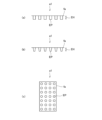
更に図3は、上記エンボス装置EAで採用するのが好ましいエンボスロールの形態を説明するために示した図である。図3(a)或いは図3(b)はエンボスロールa1の表面faの一部を拡大して示した断面図であり、表面fa上にはエンボスを形成するための複数のエンボス凸部EPが存在している。図3(a)で示すように根本部の面積と先端部の面積が同じもの、図3(b)で示すように根本部の面積と先端部の面積とが異なるもの、いずれを用いることができる。なお、表面faから先端部までのエンボス凸部の高さEHは0.2~1.0mm、好ましくは0.4~0.8mmに設定するのが望ましい。
図3(c)はエンボスロールa1の表面faの一部を拡大して示した平面図である。図3(c)において、表面faの全面積(ここでは矩形の面積で示している)に対する、凸部EPが存在している面積(根本部を合計した面積)の割合であるエンボス部の面積率は2.0~40.0%、より好ましくは10.0~30.0%に設定しておくのが望ましい。
エンボスの高さ、面積率を上記範囲とすることで、複合型不織布のパルプ面に適切なエンボスが施され、複合型不織布使用時に発生する紙粉が抑制される。
また、エンボス凸部EPの形状(横断面形状)や配列の仕方については特に限定はないが、形状については図3(c)で示すような丸形としてもよいし、他に多角形、星形などを採用できる。配列について図3(c)で示すような整列型でもよいし、他に互い違い型としてもよい。
Furthermore, Fig. 3 is a diagram for explaining the form of an embossing roll preferably used in the embossing device EA. Fig. 3(a) or Fig. 3(b) is a cross-sectional view showing an enlarged portion of the surface fa of the embossing roll a1, and a plurality of embossing projections EP for forming embosses are present on the surface fa. Either one having the same area at the base and the tip as shown in Fig. 3(a) or one having different areas at the base and the tip as shown in Fig. 3(b) can be used. The height EH of the embossing projection from the surface fa to the tip is desirably set to 0.2 to 1.0 mm, preferably 0.4 to 0.8 mm.
Fig. 3(c) is a plan view showing an enlarged portion of the surface fa of the embossing roll a1. In Fig. 3(c), the area ratio of the embossed portion, which is the ratio of the area where the protrusions EP exist (the total area including the base portions) to the total area of the surface fa (shown here as a rectangular area), is preferably set to 2.0 to 40.0%, more preferably 10.0 to 30.0%.
By setting the embossing height and area ratio within the above ranges, the pulp surface of the composite nonwoven fabric is appropriately embossed, and the generation of paper dust during use of the composite nonwoven fabric is suppressed.
The shape (cross-sectional shape) and arrangement of the embossed convex portions EP are not particularly limited, but the shape may be a circle as shown in Fig. 3(c), or other shapes such as a polygon, a star, etc. The arrangement may be an aligned type as shown in Fig. 3(c), or an alternate type.
図1に示した複合型不織布製造装置では、乾燥装置7の下流側に、上記した条件に沿って設計したカレンダー装置CA、更にその下流にはエンボス装置EAで配置されるので、本発明に係る構成の複合型不織布を効率良く製造することができる。
すなわち、本発明に係る複合型不織布WPは、上記した条件に沿ったカレンダー処理、熱エンボス処理がこの順で施されることにより、乾式エアレイド法によるパルプ繊維ウエブを用いている複合型不織布であっても、要求されるボリューム感や平滑性を備えると共に、適度のコシを有し、更には繊維の脱落も抑制されている。
なお、複合型不織布WPに対して、熱エンボス処理、カレンダー処理という逆の順序で行うことも考えられる。しかし、この場合、熱エンボス処理により形成された凹凸が、その後のカレンダー処理で平滑化されてしまい、コシが劣化する。更に、吸水能力が低下する等のデメリットが確認された。また、複合型不織布WPに対して、熱カレンダー処理を施すことも考えられる。しかし、熱カレンダー処理は、平面で加圧しつつ熱を伝えるために不織布の厚さの低下が顕著となり、コシが弱く、吸水能力が低下する等のデメリットが確認された。
よって、前述したように、乾燥後の複合型不織布WPに対して、加熱のないカレンダー処理と、その後の熱エンボス処理によって、要求されるボリューム感や平滑性を備えると共に、適度のコシを有し、更には繊維の脱落も抑制されている複合型不織布を形成できる。
In the composite nonwoven fabric manufacturing apparatus shown in FIG. 1, a calendering device CA designed in accordance with the above-mentioned conditions is arranged downstream of the
In other words, by subjecting the composite nonwoven fabric WP of the present invention to calendaring and heat embossing in that order in accordance with the above-mentioned conditions, even though it is a composite nonwoven fabric using a pulp fiber web produced by a dry airlaid method, it has the required volume and smoothness, appropriate stiffness, and also suppresses fiber shedding.
It is also possible to carry out the thermal embossing process and the calendering process in the reverse order for the composite nonwoven fabric WP. However, in this case, the unevenness formed by the thermal embossing process is smoothed by the subsequent calendering process, resulting in a deterioration in stiffness. Furthermore, disadvantages such as a decrease in water absorption capacity have been confirmed. It is also possible to carry out a thermal calendering process for the composite nonwoven fabric WP. However, it has been confirmed that the thermal calendering process significantly reduces the thickness of the nonwoven fabric because heat is transferred while pressure is applied on a flat surface, resulting in a decrease in stiffness and a decrease in water absorption capacity.
Therefore, as described above, by subjecting the dried composite nonwoven fabric WP to a calendaring process without heating and then a thermal embossing process, a composite nonwoven fabric can be formed that has the required volume and smoothness, as well as appropriate stiffness and reduced fiber shedding.
なお、図1は、カレンダー装置CAおよびエンボス装置EAをオンラインで付加する場合を好適として例示しており、このように不織布ワイパー製造装置に一体的にカレンダー装置CAおよびエンボス装置EAを設けるのが好ましいが、いったん不織布ワイパーWPをローラ81に巻き取り、別に設けたカレンダー装置CAおよびエンボス装置EAでオフラインによりカレンダー処理およびエンボス処理をするようにすることも可能である。
Note that FIG. 1 shows an example in which the calendar device CA and embossing device EA are preferably added online. It is preferable to provide the calendar device CA and embossing device EA integrally with the nonwoven wiper manufacturing device in this way, but it is also possible to first wind the nonwoven wiper WP around a
(実施例)
以下、上記製造装置で、乾式エアレイド法によりパルプ繊維ウエブを供給し、カレンダー処理および熱エンボス処理をして製造した実施例の複合型不織布について説明する。
坪量、嵩、上述したD値、TS7値、TS750値、そして厚さが表1に示す通りになるように製造された、実施例1~11の複合型不織布、並びにその比較例1~6(表2)について、下記に示す基準により、複合型不織布の外観の平滑性、コシ(強さ)、脱落繊維ついての官能評価をした。なお、カレンダー処理および熱エンボス処理された不織布には、押圧され熱接着された部位を目視により確認することができた。
1)外観の平滑性:不織布表面の平滑性(手触り、触り心地)を評価した。
特に優れたもの(優◎)、問題のないもの(良〇)、ざらざらして触感が悪いもの(不可×)
2)コシ(強さ):触った時のしっかり感を評価した。
コシが強くしっかり(優◎)、問題のない強さ(良〇)、コシがなく柔らかい(不可×)
3)脱落繊維:拭き取り時に脱落した繊維の量を目視により評価した。
繊維の脱落が少ない(良〇)、繊維の脱落が多い(不可×)
なお、複合型不織布の厚み(mm)と嵩(cm3/g)は以下のように測定した。
厚み(mm):ピーコック紙厚計にて、37.85g/cm2加重下で測定した。
嵩(cm3/g):厚み(cm)÷坪量(g/cm2)から算出した。
(Example)
Hereinafter, an example of a composite nonwoven fabric produced by supplying a pulp fiber web by the dry airlaid method using the above-mentioned production apparatus and carrying out a calendaring process and a heat embossing process will be described.
The composite nonwoven fabrics of Examples 1 to 11 and Comparative Examples 1 to 6 (Table 2), which were manufactured to have the basis weight, bulk, D value, TS7 value, TS750 value, and thickness shown in Table 1, were subjected to sensory evaluation of the smoothness of the appearance of the composite nonwoven fabric, stiffness (strength), and fiber shedding according to the following criteria. In the calendar-treated and heat-embossed nonwoven fabrics, the pressed and heat-bonded areas could be visually confirmed.
1) Smoothness of appearance: The smoothness (feel and feel) of the nonwoven fabric surface was evaluated.
Particularly excellent (Excellent ◎), no problem (Good 〇), rough and unpleasant to the touch (Fail ×)
2) Firmness (strength): Evaluated based on firmness when touched.
Strong and firm (Excellent ◎), No problem with strength (Good 〇), No firmness and soft (Fail ×)
3) Fallen fibers: The amount of fallen fibers during wiping was evaluated visually.
Little fiber loss (good), much fiber loss (poor)
The thickness (mm) and bulk (cm 3 /g) of the composite nonwoven fabric were measured as follows.
Thickness (mm): Measured with a Peacock paper thickness gauge under a load of 37.85 g/ cm2 .
Bulk (cm 3 /g): Calculated from thickness (cm) ÷ basis weight (g/cm 2 ).


上記表1に示すように実施例1~11は製品として提供できるものであるが、上記表2に示すように比較例1~6では、外観の平滑性、コシ(強さ)および繊維脱落のいずれかで不可であった。 As shown in Table 1 above, Examples 1 to 11 were able to be provided as products, but as shown in Table 2 above, Comparative Examples 1 to 6 were unacceptable in terms of appearance smoothness, stiffness (strength), and fiber shedding.
上記実施例1~11は、坪量が40.0~110.0g/m2、嵩が4.3~7.5cm3/g、TSA(D値)が1.0~2.5mm/N、またTSA(TS7値)が12.0~20.0dBV2rms、滑らかさを示す指標であるTSA(TS750値)が33.0~100.0dBV2rms、厚さが0.30~0.50mmの好適範囲内にあって、複合型不織布に求められるボリューム感と外観の平滑性を備えると共に、適度なコシ(強さ)を有し、更には脱落繊維も抑制されている。 The above Examples 1 to 11 have a basis weight of 40.0 to 110.0 g/ m2 , a bulk of 4.3 to 7.5 cm3 /g, a TSA (D value) of 1.0 to 2.5 mm/N, a TSA (TS7 value) of 12.0 to 20.0 dBV2 rms , a TSA (TS750 value) which is an index of smoothness of 33.0 to 100.0 dBV2 rms, and a thickness of 0.30 to 0.50 mm, all of which are within the preferred ranges, and thus have the volume and smooth appearance required of a composite nonwoven fabric, as well as appropriate stiffness (strength) and reduced fiber shedding.
一方、比較例1は乾燥後に、カレンダー処理も、熱エンボス処理も施されておらず、嵩と厚みが過度に高くボリューム感だけはあるが、他の項目、外観の平滑性、コシ(強さ)および脱落繊維の評価は全てが不可である。
また、比較例2は乾燥後に、カレンダー処理だけを施したもので、嵩と厚みからみてボリューム感は適度にあり、外観の平滑性脱と落繊維の評価は良いが、求められるコシ(強さ)が不足している。
また、比較例3は乾燥後に、熱エンボス処理だけを施したもので、嵩と厚みからみて過度のボリューム感があり、コシ(強さ)と脱落繊維の評価は良いが、外観の平滑性が不足している。
更に、比較例4は熱カレンダー処理を施したもので、嵩と厚みからみてボリューム感は適度であり、外観の平滑性と脱落繊維の評価は良いが、求められるコシ(強さ)が不足している。
また、比較例5は坪量が30.0g/m2と小さ過ぎであり、厚み、嵩、D値、TS7値そしてTS750値の全てが好適範囲から外れて、コシ(強さ)と脱落繊維の評価が不足している。
また、比較例6は坪量が120.0g/m2と大き過ぎであり、厚みが好適範囲から外れて、外観の平滑性が不足している。
On the other hand, in Comparative Example 1, neither calendaring nor heat embossing was performed after drying, and the bulk and thickness were excessively high, giving it a sense of volume, but the evaluations of other items, such as smoothness of appearance, stiffness (strength) and fallen fibers, were all unsatisfactory.
In addition, Comparative Example 2 was only subjected to calendar treatment after drying, and the volume was moderate in terms of bulk and thickness, and the evaluation of the smoothness of the appearance and the amount of fallen fibers was good, but the required stiffness (strength) was lacking.
In addition, Comparative Example 3 was subjected to only a heat embossing treatment after drying, and was excessively voluminous in terms of bulk and thickness, and was evaluated as having good stiffness (strength) and fiber loss, but lacked smoothness in appearance.
Furthermore, Comparative Example 4 was subjected to a heat calendar treatment, and the volume was appropriate in terms of bulk and thickness, and the evaluations of the smoothness of the appearance and the amount of fallen fibers were good, but the required stiffness (strength) was lacking.
In addition, in Comparative Example 5, the basis weight was too small at 30.0 g/ m2, and the thickness, bulk, D value, TS7 value and TS750 value were all outside the suitable ranges, resulting in insufficient evaluations for stiffness (strength) and fallen fibers.
In addition, in Comparative Example 6, the basis weight is 120.0 g/ m2, which is too large, the thickness is outside the preferable range, and the smoothness of the appearance is insufficient.
上記した実施例の複合型不織布は乾式エアレイド法によりパルプ繊維ウエブを供給した場合であり、本発明は乾式エアレイド法によるパルプ繊維ウエブを用いる複合型不織布に有効であることが確認できる。しかしこれに限らず湿式抄紙法で得たパルプ繊維ウエブを用いる複合型不織布にも本発明を同様に適用できる。ただし、前述したように、乾式エアレイド法によれば湿式抄紙法よりも製造設備やコストを抑制できる。 The composite nonwoven fabrics in the above examples are those in which the pulp fiber web is supplied by the dry airlaid method, and it can be confirmed that the present invention is effective for composite nonwoven fabrics that use pulp fiber webs produced by the dry airlaid method. However, the present invention is not limited to this and can also be applied to composite nonwoven fabrics that use pulp fiber webs obtained by the wet papermaking method. However, as mentioned above, the dry airlaid method can reduce manufacturing equipment and costs compared to the wet papermaking method.
以上で実施形態の説明を終えるが、本発明は上記実施形態に限定されるものではなく、その要旨を逸脱しない範囲で種々変更して実施することができることは言うまでもない。 This concludes the explanation of the embodiment, but it goes without saying that the present invention is not limited to the above embodiment and can be modified in various ways without departing from the spirit of the invention.
1 複合型不織布の製造装置
2 エアレイド装置
3 スパンボンド不織布供給装置
4 サクション装置
5 水流交絡装置
6 サクション装置
7 乾燥装置
8 巻取装置
21 解繊機
22 ダクト
23 エアレイドホッパ
24 積層位置
28 挟持ローラ
30 プレウエット装置
31 噴霧ノズル
32 サクション装置
41 サクション装置本体
42 サクション部
43 搬送ワイヤ
51 ウォータジェットヘッド
52 サクション装置
55 搬送ワイヤ
SW スパンボンド不織布
PF パルプ繊維
PFW パルプ繊維ウエブ
PWeb 予備的積層体(積層ウエブ)
WP 複合型不織布
TD 搬送方向
CA カレンダー装置
EA エンボス装置
a1 エンボスロール(主ロール)
a2 受けロール
LIST OF SYMBOLS 1 Composite nonwoven
WP Composite nonwoven fabric TD Transport direction CA Calendar device EA Embossing device a1 Embossing roll (main roll)
a2 Receiving roll
Claims (4)
厚さが0.30~0.50mmであり、
坪量が40.0~110.0g/m2であり、且つ、嵩が4.3~7.5cm3/gであり、コシ(強さ)を表す指標であるTSA(D値)が1.0~2.5mm/Nであり、柔らかさを示す指標であるTSA(TS7値)が12.0~20.0dBV2rmsおよび滑らかさを示す指標であるTSA(TS750値)が33.0~100.0dBV2rmsであり、
前記スパンボンド不織布は、ポリプロピレンで形成されており、
前記パルプ繊維ウエブは、針葉樹晒クラフトパルプとしてのサザンパインの繊維からなる、ことを特徴とする複合型不織布。 A composite nonwoven fabric in which a pulp fiber web is laminated and integrated onto a spunbond nonwoven fabric,
The thickness is 0.30 to 0.50 mm,
The paper has a basis weight of 40.0 to 110.0 g/ m2 , a bulk of 4.3 to 7.5 cm3 /g, a TSA (D value) which is an index of stiffness (strength) of 1.0 to 2.5 mm/N, a TSA (TS7 value) which is an index of softness of 12.0 to 20.0 dBV2 rms, and a TSA (TS750 value) which is an index of smoothness of 33.0 to 100.0 dBV2 rms ,
The spunbond nonwoven fabric is made of polypropylene,
The composite nonwoven fabric is characterized in that the pulp fiber web is made of southern pine fibers as softwood bleached kraft pulp.
前記パルプ繊維ウエブと前記スパンボンド不織布との一体化を促進して積層体を得る水流交絡工程と、前記水流交絡工程の後に前記積層体を乾燥する乾燥工程とを少なくとも含み、
前記乾燥工程の後に、カレンダーロール間で前記積層体を加圧しながら通過させるカレンダー工程と、
前記カレンダー工程後に、前記パルプ繊維ウエブ側に熱エンボス処理を施す熱エンボス工程を更に含み、
前記水流交絡工程では、坪量が30.0~80.0g/m2の前記パルプ繊維ウエブと、坪量が10.0~30.0g/m2の前記スパンボンド不織布とを積層し、前記複合型不織布の全体での坪量が40.0~110.0g/m2となるように前記パルプ繊維ウエブと前記スパンボンド不織布とを一体化し、
前記カレンダー工程及び/又は前記熱エンボス工程では、前記複合型不織布において、嵩が4.3~7.5cm3/gとなり、コシ(強さ)を表す指標であるTSA(D値)が1.0~2.5mm/Nとなり、柔らかさを示す指標であるTSA(TS7値)が12.0~20.0dBV2rmsおよび滑らかさを示す指標であるTSA(TS750値)が33.0~100.0dBV2rmsとなるように、式(ロール相当径)=(主ロール径)×(受けロール径)/{(主ロール径)+(受けロール径)}によって算出されるロール相当径が75~300mmである主ロールと受けロールとを用い、搬送スピードを100~300m/min、ロール間のギャップを0~0.5mm、ロールニップ圧を0.5~6.5MPa、に設定してあり、
更に前記熱エンボス工程では、前記主ロールの温度を40~200℃に設定してあり、
前記パルプ繊維ウエブは、針葉樹晒クラフトパルプとしてのサザンパインの繊維からなり、
前記スパンボンド不織布は、ポリプロピレンで形成されている、ことを特徴とする複合型不織布の製造方法。 A method for producing a composite nonwoven fabric in which a pulp fiber web is laminated and integrated onto a spunbond nonwoven fabric, comprising the steps of:
The method includes at least a hydroentanglement step of promoting integration of the pulp fiber web and the spunbonded nonwoven fabric to obtain a laminate, and a drying step of drying the laminate after the hydroentanglement step,
a calendering step of passing the laminate between calender rolls while applying pressure thereto after the drying step;
The method further includes a heat embossing step of subjecting the pulp fiber web side to a heat embossing treatment after the calendaring step,
In the hydroentanglement step, the pulp fiber web having a basis weight of 30.0 to 80.0 g/ m2 and the spunbond nonwoven fabric having a basis weight of 10.0 to 30.0 g/ m2 are laminated together to integrate the pulp fiber web and the spunbond nonwoven fabric so that the composite nonwoven fabric has a basis weight of 40.0 to 110.0 g/ m2 as a whole;
In the calendaring step and/or the heat embossing step, a main roll and a backing roll having a roll equivalent diameter of 75 to 300 mm calculated by the formula ( roll equivalent diameter)=(main roll diameter)×(backing roll diameter)/{(main roll diameter)+(backing roll diameter)} are used, the conveying speed is set to 100 to 300 m/min, the gap between the rolls is set to 0 to 0.5 mm, and the roll nip pressure is set to 0.5 to 6.5 MPa, so that the composite nonwoven fabric has a bulk of 4.3 to 7.5 cm 3 /g, a TSA (D value) which is an index of stiffness ( strength) of 1.0 to 2.5 mm/N, a TSA (TS7 value) which is an index of softness of 12.0 to 20.0 dBV 2 rms, and a TSA (TS750 value) which is an index of smoothness of 33.0 to 100.0 dBV 2 rms.
Furthermore, in the hot embossing step, the temperature of the main roll is set to 40 to 200° C.,
The pulp fiber web is made of southern pine fibers as softwood bleached kraft pulp,
A method for producing a composite nonwoven fabric, characterized in that the spunbond nonwoven fabric is made of polypropylene.
Priority Applications (1)
| Application Number | Priority Date | Filing Date | Title |
|---|---|---|---|
| JP2020107761A JP7620397B2 (en) | 2020-06-23 | 2020-06-23 | Composite nonwoven fabric and its manufacturing method |
Applications Claiming Priority (1)
| Application Number | Priority Date | Filing Date | Title |
|---|---|---|---|
| JP2020107761A JP7620397B2 (en) | 2020-06-23 | 2020-06-23 | Composite nonwoven fabric and its manufacturing method |
Publications (2)
| Publication Number | Publication Date |
|---|---|
| JP2022003173A JP2022003173A (en) | 2022-01-11 |
| JP7620397B2 true JP7620397B2 (en) | 2025-01-23 |
Family
ID=79247242
Family Applications (1)
| Application Number | Title | Priority Date | Filing Date |
|---|---|---|---|
| JP2020107761A Active JP7620397B2 (en) | 2020-06-23 | 2020-06-23 | Composite nonwoven fabric and its manufacturing method |
Country Status (1)
| Country | Link |
|---|---|
| JP (1) | JP7620397B2 (en) |
Families Citing this family (3)
| Publication number | Priority date | Publication date | Assignee | Title |
|---|---|---|---|---|
| JP7652591B2 (en) * | 2021-03-10 | 2025-03-27 | 日本製紙クレシア株式会社 | Composite nonwoven fabric manufacturing equipment |
| JP7666952B2 (en) * | 2021-03-10 | 2025-04-22 | 日本製紙クレシア株式会社 | Composite nonwoven fabric and its manufacturing method |
| JP7780350B2 (en) * | 2022-02-04 | 2025-12-04 | 日本製紙クレシア株式会社 | Composite nonwoven fabric and method for producing the same |
Citations (5)
| Publication number | Priority date | Publication date | Assignee | Title |
|---|---|---|---|---|
| JP2014233363A (en) | 2013-05-31 | 2014-12-15 | 日本製紙クレシア株式会社 | Sanitary tissue paper roll |
| JP2017046790A (en) | 2015-08-31 | 2017-03-09 | 日本製紙クレシア株式会社 | Wet Wiper |
| JP2017115262A (en) | 2015-12-24 | 2017-06-29 | 日本製紙クレシア株式会社 | Method for producing nonwoven fabric sheet |
| JP2020048680A (en) | 2018-09-25 | 2020-04-02 | 日本製紙クレシア株式会社 | Wet tissue using composite nonwoven fabric and production method of nonwoven fabric |
| JP2020084385A (en) | 2018-11-29 | 2020-06-04 | 日本製紙クレシア株式会社 | Composite type nonwoven fabric wiper and manufacturing method thereof |
-
2020
- 2020-06-23 JP JP2020107761A patent/JP7620397B2/en active Active
Patent Citations (5)
| Publication number | Priority date | Publication date | Assignee | Title |
|---|---|---|---|---|
| JP2014233363A (en) | 2013-05-31 | 2014-12-15 | 日本製紙クレシア株式会社 | Sanitary tissue paper roll |
| JP2017046790A (en) | 2015-08-31 | 2017-03-09 | 日本製紙クレシア株式会社 | Wet Wiper |
| JP2017115262A (en) | 2015-12-24 | 2017-06-29 | 日本製紙クレシア株式会社 | Method for producing nonwoven fabric sheet |
| JP2020048680A (en) | 2018-09-25 | 2020-04-02 | 日本製紙クレシア株式会社 | Wet tissue using composite nonwoven fabric and production method of nonwoven fabric |
| JP2020084385A (en) | 2018-11-29 | 2020-06-04 | 日本製紙クレシア株式会社 | Composite type nonwoven fabric wiper and manufacturing method thereof |
Also Published As
| Publication number | Publication date |
|---|---|
| JP2022003173A (en) | 2022-01-11 |
Similar Documents
| Publication | Publication Date | Title |
|---|---|---|
| KR100729593B1 (en) | Process and device for producing non-woven fabric | |
| US8758569B2 (en) | Permeable belt for nonwovens production | |
| JP7307632B2 (en) | Manufacturing method of composite nonwoven fabric | |
| JP7620397B2 (en) | Composite nonwoven fabric and its manufacturing method | |
| JP7578430B2 (en) | Composite nonwoven fabric and its manufacturing method | |
| JP2018016908A (en) | Manufacturing apparatus for conjugate type nonwoven fabric and manufacturing method thereof | |
| JP7477356B2 (en) | Composite nonwoven fabric and its manufacturing method | |
| EP3387172B1 (en) | Patterned nonwoven material | |
| JP7509538B2 (en) | Composite nonwoven fabric and its manufacturing method | |
| JP7509539B2 (en) | Composite nonwoven fabric and its manufacturing method | |
| JP7666952B2 (en) | Composite nonwoven fabric and its manufacturing method | |
| JP7324014B2 (en) | Composite type nonwoven fabric and its manufacturing method | |
| KR100414957B1 (en) | Disposable wiping article and method for manufacture | |
| JP6902341B2 (en) | Manufacturing method of composite non-woven fabric and its manufacturing equipment | |
| JP7324011B2 (en) | Composite type nonwoven fabric and its manufacturing method | |
| JP7128682B2 (en) | Non-woven wiper and manufacturing method thereof | |
| JP7652644B2 (en) | Composite nonwoven fabric and its manufacturing method | |
| JP7548760B2 (en) | Composite nonwoven fabric and its manufacturing method | |
| JP7652591B2 (en) | Composite nonwoven fabric manufacturing equipment | |
| JP7780350B2 (en) | Composite nonwoven fabric and method for producing the same | |
| JP7257767B2 (en) | Manufacturing method of composite nonwoven fabric wiper | |
| JP7481083B2 (en) | Manufacturing method of nonwoven wiper | |
| JP7764210B2 (en) | nonwoven fabric | |
| JP7237571B2 (en) | Composite type nonwoven fabric and its manufacturing method | |
| JP7764223B2 (en) | nonwoven fabric |
Legal Events
| Date | Code | Title | Description |
|---|---|---|---|
| RD02 | Notification of acceptance of power of attorney |
Free format text: JAPANESE INTERMEDIATE CODE: A7422 Effective date: 20220420 |
|
| RD04 | Notification of resignation of power of attorney |
Free format text: JAPANESE INTERMEDIATE CODE: A7424 Effective date: 20220420 |
|
| A621 | Written request for application examination |
Free format text: JAPANESE INTERMEDIATE CODE: A621 Effective date: 20230427 |
|
| A131 | Notification of reasons for refusal |
Free format text: JAPANESE INTERMEDIATE CODE: A131 Effective date: 20240529 |
|
| A521 | Request for written amendment filed |
Free format text: JAPANESE INTERMEDIATE CODE: A523 Effective date: 20240726 |
|
| A131 | Notification of reasons for refusal |
Free format text: JAPANESE INTERMEDIATE CODE: A131 Effective date: 20241022 |
|
| A521 | Request for written amendment filed |
Free format text: JAPANESE INTERMEDIATE CODE: A523 Effective date: 20241028 |
|
| TRDD | Decision of grant or rejection written | ||
| A01 | Written decision to grant a patent or to grant a registration (utility model) |
Free format text: JAPANESE INTERMEDIATE CODE: A01 Effective date: 20250108 |
|
| A61 | First payment of annual fees (during grant procedure) |
Free format text: JAPANESE INTERMEDIATE CODE: A61 Effective date: 20250110 |
|
| R150 | Certificate of patent or registration of utility model |
Ref document number: 7620397 Country of ref document: JP Free format text: JAPANESE INTERMEDIATE CODE: R150 |