JP7604397B2 - Methods for preparing PSMA conjugates - Google Patents
Methods for preparing PSMA conjugates Download PDFInfo
- Publication number
- JP7604397B2 JP7604397B2 JP2021569296A JP2021569296A JP7604397B2 JP 7604397 B2 JP7604397 B2 JP 7604397B2 JP 2021569296 A JP2021569296 A JP 2021569296A JP 2021569296 A JP2021569296 A JP 2021569296A JP 7604397 B2 JP7604397 B2 JP 7604397B2
- Authority
- JP
- Japan
- Prior art keywords
- formula
- resin
- group
- dimethylformamide
- based compound
- Prior art date
- Legal status (The legal status is an assumption and is not a legal conclusion. Google has not performed a legal analysis and makes no representation as to the accuracy of the status listed.)
- Active
Links
Classifications
-
- C—CHEMISTRY; METALLURGY
- C07—ORGANIC CHEMISTRY
- C07K—PEPTIDES
- C07K14/00—Peptides having more than 20 amino acids; Gastrins; Somatostatins; Melanotropins; Derivatives thereof
- C07K14/435—Peptides having more than 20 amino acids; Gastrins; Somatostatins; Melanotropins; Derivatives thereof from animals; from humans
- C07K14/705—Receptors; Cell surface antigens; Cell surface determinants
-
- C—CHEMISTRY; METALLURGY
- C07—ORGANIC CHEMISTRY
- C07D—HETEROCYCLIC COMPOUNDS
- C07D257/00—Heterocyclic compounds containing rings having four nitrogen atoms as the only ring hetero atoms
- C07D257/02—Heterocyclic compounds containing rings having four nitrogen atoms as the only ring hetero atoms not condensed with other rings
-
- A—HUMAN NECESSITIES
- A61—MEDICAL OR VETERINARY SCIENCE; HYGIENE
- A61K—PREPARATIONS FOR MEDICAL, DENTAL OR TOILETRY PURPOSES
- A61K51/00—Preparations containing radioactive substances for use in therapy or testing in vivo
- A61K51/02—Preparations containing radioactive substances for use in therapy or testing in vivo characterised by the carrier, i.e. characterised by the agent or material covalently linked or complexing the radioactive nucleus
- A61K51/04—Organic compounds
- A61K51/0402—Organic compounds carboxylic acid carriers, fatty acids
-
- A—HUMAN NECESSITIES
- A61—MEDICAL OR VETERINARY SCIENCE; HYGIENE
- A61K—PREPARATIONS FOR MEDICAL, DENTAL OR TOILETRY PURPOSES
- A61K51/00—Preparations containing radioactive substances for use in therapy or testing in vivo
- A61K51/02—Preparations containing radioactive substances for use in therapy or testing in vivo characterised by the carrier, i.e. characterised by the agent or material covalently linked or complexing the radioactive nucleus
- A61K51/04—Organic compounds
- A61K51/0497—Organic compounds conjugates with a carrier being an organic compounds
-
- A—HUMAN NECESSITIES
- A61—MEDICAL OR VETERINARY SCIENCE; HYGIENE
- A61P—SPECIFIC THERAPEUTIC ACTIVITY OF CHEMICAL COMPOUNDS OR MEDICINAL PREPARATIONS
- A61P13/00—Drugs for disorders of the urinary system
- A61P13/08—Drugs for disorders of the urinary system of the prostate
-
- A—HUMAN NECESSITIES
- A61—MEDICAL OR VETERINARY SCIENCE; HYGIENE
- A61P—SPECIFIC THERAPEUTIC ACTIVITY OF CHEMICAL COMPOUNDS OR MEDICINAL PREPARATIONS
- A61P35/00—Antineoplastic agents
-
- C—CHEMISTRY; METALLURGY
- C07—ORGANIC CHEMISTRY
- C07C—ACYCLIC OR CARBOCYCLIC COMPOUNDS
- C07C201/00—Preparation of esters of nitric or nitrous acid or of compounds containing nitro or nitroso groups bound to a carbon skeleton
-
- A—HUMAN NECESSITIES
- A61—MEDICAL OR VETERINARY SCIENCE; HYGIENE
- A61K—PREPARATIONS FOR MEDICAL, DENTAL OR TOILETRY PURPOSES
- A61K38/00—Medicinal preparations containing peptides
Landscapes
- Chemical & Material Sciences (AREA)
- Health & Medical Sciences (AREA)
- Organic Chemistry (AREA)
- Life Sciences & Earth Sciences (AREA)
- General Health & Medical Sciences (AREA)
- Medicinal Chemistry (AREA)
- Pharmacology & Pharmacy (AREA)
- Veterinary Medicine (AREA)
- Public Health (AREA)
- Animal Behavior & Ethology (AREA)
- Proteomics, Peptides & Aminoacids (AREA)
- Nuclear Medicine, Radiotherapy & Molecular Imaging (AREA)
- General Chemical & Material Sciences (AREA)
- Chemical Kinetics & Catalysis (AREA)
- Urology & Nephrology (AREA)
- Bioinformatics & Cheminformatics (AREA)
- Engineering & Computer Science (AREA)
- Physics & Mathematics (AREA)
- Optics & Photonics (AREA)
- Epidemiology (AREA)
- Immunology (AREA)
- Genetics & Genomics (AREA)
- Toxicology (AREA)
- Zoology (AREA)
- Gastroenterology & Hepatology (AREA)
- Biochemistry (AREA)
- Biophysics (AREA)
- Cell Biology (AREA)
- Molecular Biology (AREA)
- Pharmaceuticals Containing Other Organic And Inorganic Compounds (AREA)
- Peptides Or Proteins (AREA)
- Medicinal Preparation (AREA)
- Medicines That Contain Protein Lipid Enzymes And Other Medicines (AREA)
- Medicines Containing Antibodies Or Antigens For Use As Internal Diagnostic Agents (AREA)
Description
関連出願の相互参照
本出願は、2019年5月20日に出願された米国仮特許出願第62/850,119号、2019年10月4日に出願された米国仮特許出願第62/910,777号、及び2019年10月8日に出願された米国仮特許出願第62/912,353号の利益及び優先権を主張し、その開示全体は、参照により本明細書に組み込まれる。
CROSS-REFERENCE TO RELATED APPLICATIONS This application claims the benefit of and priority to U.S. Provisional Patent Application No. 62/850,119, filed May 20, 2019, U.S. Provisional Patent Application No. 62/910,777, filed October 4, 2019, and U.S. Provisional Patent Application No. 62/912,353, filed October 8, 2019, the entire disclosures of which are incorporated herein by reference.
本開示は、哺乳動物における癌などの疾患の治療に有用な化合物を調製するための方法に関する。特に、本明細書に記載の本発明は、PSMA発現細胞を標的とすることができ、前立腺癌などのPSMA発現細胞によって引き起こされる疾患の治療に有用な化合物を調製するための方法に関する。 The present disclosure relates to methods for preparing compounds useful for treating diseases, such as cancer, in mammals. In particular, the invention described herein relates to methods for preparing compounds that can target PSMA-expressing cells and are useful for treating diseases caused by PSMA-expressing cells, such as prostate cancer.
前立腺は男性の生殖器官であり、生殖の際に膣に導入される精子の生存のために栄養素及び液体を提供する精液を産生及び貯蔵するように機能する。他の組織と同様に、前立腺は、悪性(癌性)腫瘍又は良性(非癌性)腫瘍のいずれかを発症する場合がある。実際に、前立腺癌は、西洋社会で最も一般的な男性癌の1つであり、米国人男性の間では2番目に多い悪性腫瘍の形態である。前立腺癌の現在の治療方法には、ホルモン療法、放射線療法、手術、化学療法、光線力学療法、及び組み合わせ療法が含まれる。しかしながら、これらの治療の多くは、特に50歳超で前立腺癌と診断された男性患者の生活の質に影響を及ぼす。例えば、ホルモン薬の使用は、骨粗鬆症及び肝障害などの副作用を伴うことが多い。このような副作用は、病態の原因となっている組織に対してより選択的又は特異的であり、且つ骨又は肝臓のような非標的組織を避ける治療の使用によって軽減され得る。 The prostate is a male reproductive organ that functions to produce and store semen, which provides nutrients and fluids for the survival of sperm introduced into the vagina during reproduction. Like other tissues, the prostate can develop either malignant (cancerous) or benign (non-cancerous) tumors. In fact, prostate cancer is one of the most common male cancers in Western societies and the second most common form of malignancy among American men. Current methods of treating prostate cancer include hormone therapy, radiation therapy, surgery, chemotherapy, photodynamic therapy, and combination therapy. However, many of these treatments affect the quality of life of male patients diagnosed with prostate cancer, especially those over the age of 50. For example, the use of hormonal drugs is often accompanied by side effects such as osteoporosis and liver damage. Such side effects can be mitigated by the use of treatments that are more selective or specific for the tissues causing the condition and that avoid non-target tissues such as bone or liver.
前立腺特異的膜抗原(PSMA)は、前立腺癌に過剰発現するバイオマーカーである。PSMAは、腎臓、近位小腸、及び唾液腺などの人体の他の器官と比較すると、悪性前立腺組織において過剰発現される。PSMAは肺癌、結腸癌、乳癌、腎癌、肝癌及び膵癌を含む多くの非前立腺固形腫瘍内の新生血管にも発現するが、正常な血管構造には発現しない。PSMAは脳でも最小限に発現する。PSMAは、細胞内セグメント(アミノ酸1~18)、膜貫通ドメイン(アミノ酸19~43)、及び広範な細胞外ドメイン(アミノ酸44~750)を含む、約110kDの分子量を有するII型細胞表面膜結合糖タンパク質である。細胞内セグメント及び膜貫通ドメインの機能は、現在のところ重要ではないと考えられているが、細胞外ドメインはいくつかの異なる活性に関与している。例えば、PSMAは中枢神経系において役割を果たし、ここでPSMAは、N-アセチル-アスパルチルグルタミン酸(NAAG)をグルタミン酸及びN-アセチルアスパラギン酸に代謝する。PSMAは近位小腸においても役割を果たしており、そこではポリ-γ-グルタミン酸型葉酸からγ結合グルタミン酸を、ペプチド及び小分子からα結合グルタミン酸を除去する。しかしながら、PSMAの前立腺癌細胞に対する特定の機能は未解決のままである。 Prostate-specific membrane antigen (PSMA) is a biomarker that is overexpressed in prostate cancer. PSMA is overexpressed in malignant prostate tissue compared to other organs of the human body, such as the kidney, proximal small intestine, and salivary glands. PSMA is also expressed in neovasculature in many non-prostate solid tumors, including lung, colon, breast, renal, hepatic, and pancreatic cancers, but not in normal vasculature. PSMA is also minimally expressed in the brain. PSMA is a type II cell surface membrane-associated glycoprotein with a molecular weight of approximately 110 kD, containing an intracellular segment (amino acids 1-18), a transmembrane domain (amino acids 19-43), and an extensive extracellular domain (amino acids 44-750). The function of the intracellular segment and the transmembrane domain are currently thought to be dispensable, while the extracellular domain has been implicated in several distinct activities. For example, PSMA plays a role in the central nervous system, where it metabolizes N-acetyl-aspartylglutamate (NAAG) to glutamate and N-acetylaspartate. PSMA also plays a role in the proximal small intestine, where it removes gamma-linked glutamate from poly-gamma-glutamate folates and alpha-linked glutamate from peptides and small molecules. However, the specific function of PSMA on prostate cancer cells remains unresolved.
他の多くの膜結合型タンパク質とは異なり、PSMAは、ビタミン受容体のような細胞表面結合型受容体と同様の様式で細胞内に迅速に取り込まれる。PSMAは、クラスリン被覆ピットを介して内在化され、その後、細胞表面に再循環するか、又はリソソームに移動することができる。したがって、診断、画像化、及び治療薬は、PSMA発現細胞、例えば前立腺癌細胞中への送達のために、PSMAに標的化され得る。 Unlike many other membrane-bound proteins, PSMA is rapidly taken up into cells in a manner similar to cell surface-bound receptors such as vitamin receptors. PSMA is internalized via clathrin-coated pits and can then recycle to the cell surface or traffic to lysosomes. Thus, diagnostic, imaging, and therapeutic agents can be targeted to PSMA for delivery into PSMA-expressing cells, e.g., prostate cancer cells.
本明細書に記載されるのは、PSMAに結合することができる化合物を調製するための方法である。診断、画像化、及び治療薬の送達のために、PSMAを標的とし得る化合物を調製するための方法もまた、本明細書に記載される。 Described herein are methods for preparing compounds capable of binding to PSMA. Also described herein are methods for preparing compounds that can target PSMA for diagnosis, imaging, and delivery of therapeutic agents.
本明細書に記載の方法によって調製されるコンジュゲートは、PSMAに対して高い親和性を示すことが予想外に発見された。本明細書に記載の方法によって調製される化合物は、PSMAを発現する病原性細胞、例えば前立腺癌細胞によって引き起こされる疾患を治療するのに有効であることも発見された。 The conjugates prepared by the methods described herein have been unexpectedly discovered to exhibit high affinity for PSMA. The compounds prepared by the methods described herein have also been discovered to be effective in treating diseases caused by pathogenic cells that express PSMA, such as prostate cancer cells.
特定のコンジュゲートがPSMAに対して高い親和性を示すことが開示されている。コンジュゲートは、PSMAを発現する病原性細胞、例えば前立腺癌細胞によって引き起こされる疾患を治療するのに有効であることも開示されている。そのようなコンジュゲートの1つは、国際公開第2015/055318 A1号パンフレットに記載されている、

(別名PSMA-617)である。
It has been disclosed that certain conjugates exhibit high affinity for PSMA. It has also been disclosed that the conjugates are effective in treating diseases caused by pathogenic cells expressing PSMA, such as prostate cancer cells. One such conjugate is described in WO 2015/055318 A1:
(also known as PSMA-617).
PSMA-617などの医薬品に対する需要のために、より低コスト且つ高純度で大量のそのような製品を供給することができる合成方法を提供する必要性が存在する。PSMA-617のような、PSMAに結合することができる化合物を調製するための方法を本明細書に記載する。 Due to the demand for pharmaceutical products such as PSMA-617, there is a need to provide synthetic methods capable of supplying large quantities of such products at lower cost and with higher purity. Described herein are methods for preparing compounds capable of binding to PSMA, such as PSMA-617.
一態様において、本開示は、ヒトを含む哺乳動物における疾患、特に癌の治療に有用な化合物を調製するための方法を提供する。 In one aspect, the present disclosure provides a method for preparing a compound useful for treating a disease, particularly cancer, in a mammal, including a human.
一実施形態では、本開示は、そのような治療を必要とする、ヒトを含む哺乳動物における異常な細胞増殖を治療するための化合物を調製するための方法を提供する。 In one embodiment, the present disclosure provides a method for preparing a compound for treating abnormal cell growth in a mammal, including a human, in need of such treatment.
別の実施形態では、異常な細胞増殖は、癌である。別の実施形態では、癌は、前立腺癌、転移性前立腺癌、及び転移性去勢抵抗性前立腺癌である。 In another embodiment, the abnormal cell growth is cancer. In another embodiment, the cancer is prostate cancer, metastatic prostate cancer, and metastatic castration-resistant prostate cancer.
別の態様では、本開示は、式Iの化合物

を調製するための方法を提供する。
In another aspect, the disclosure provides a compound of formula I
A method for preparing the compound is provided.
本開示のさらなる実施形態、特徴、及び利点は、以下の詳細な説明から、及び本開示の実施を通して明らかになるであろう。本開示の化合物は、以下の列挙された条項のいずれかにおける実施形態として記載され得る。本明細書に記載される実施形態のいずれも、実施形態が互いに矛盾しない範囲で、本明細書に記載される任意の他の実施形態に関連して使用できることが理解されるであろう。 Further embodiments, features, and advantages of the present disclosure will become apparent from the following detailed description and through the practice of the disclosure. The compounds of the present disclosure may be described as embodiments in any of the following recited clauses. It will be understood that any of the embodiments described herein can be used in conjunction with any other embodiment described herein to the extent that the embodiments are not mutually exclusive.
1. 式I

の化合物を調製するための方法であって、
a. 式A

の樹脂系化合物を、極性非プロトン性溶媒中で第1の脱保護剤と接触させて、式A’

の樹脂系化合物を提供すること、又は
b. 式A’の樹脂系化合物を、式B

の化合物と、有機溶媒及び塩基の存在下で接触させて、式C

の樹脂系化合物を提供すること、又は
c. 式Cの樹脂系化合物を、有機溶媒の存在下で第2の脱保護剤と接触させて、式C’

の樹脂系化合物を提供すること、又は
d. 式C’の樹脂系化合物を、極性非プロトン性溶媒、カップリング剤及び塩基の存在下で、PG1-3-(2-ナフチル)-L-アラニンと接触させて、式D

の樹脂系化合物を提供すること、又は
e. 式Dの樹脂系化合物を、極性非プロトン性溶媒中で第1の脱保護剤と接触させて、式D’

の樹脂系化合物を提供すること、又は
f. 式D’の樹脂系化合物を、極性非プロトン性溶媒、カップリング剤及び塩基の存在下でPG1-トラネキサム酸と接触させて、式E

の樹脂系化合物を提供すること、又は
g. 式Eの樹脂系化合物を、極性非プロトン性溶媒中で第1の脱保護剤と接触させて、式E’

の樹脂系化合物を提供すること、又は
h. 式E’の樹脂系化合物を、式E2’

の化合物と、極性非プロトン性溶媒、カップリング剤、及び塩基の存在下で接触させて、式F

の樹脂系化合物を提供すること、又は
i. 式Fの樹脂系化合物を、有機溶媒中で第3の脱保護剤及び/又は切断試薬と接触させることを含み、
式中、PG1及びPG2は、アミン保護基であり、LGは、離脱基であり、R1は、C1~C4アルキル又はシクロヘキシルである、方法。
1. Formula I
A process for preparing a compound of the formula:
Formula A
contacting the resin-based compound of formula A' with a first deprotecting agent in a polar aprotic solvent to form a
or b. providing a resin-based compound of formula A′ with a resin-based compound of formula B
in the presence of an organic solvent and a base to form a compound of formula C
or c. contacting the resin-based compound of formula C with a second deprotecting agent in the presence of an organic solvent to provide a resin-based compound of formula C'
or d. contacting the resin-based compound of formula C′ with PG 1 -3-(2-naphthyl)-L-alanine in the presence of a polar aprotic solvent, a coupling agent and a base to provide a resin-based compound of formula D
or e. contacting the resin-based compound of formula D with a first deprotecting agent in a polar aprotic solvent to provide a resin-based compound of formula D'
or f. contacting the resin-based compound of formula D′ with PG 1 -tranexamic acid in the presence of a polar aprotic solvent, a coupling agent and a base to provide a resin-based compound of formula E
or g. contacting the resin-based compound of formula E with a first deprotecting agent in a polar aprotic solvent to provide a resin-based compound of formula E'
or h. providing a resin-based compound of formula E' with a resin-based compound of formula E 2'
in the presence of a polar aprotic solvent, a coupling agent, and a base to obtain a compound of formula F
or i. contacting the resin-based compound of formula F with a third deprotecting and/or cleaving reagent in an organic solvent,
wherein PG 1 and PG 2 are amine protecting groups, LG is a leaving group, and R 1 is C 1 -C 4 alkyl or cyclohexyl.
2. 工程(a)の第1の脱保護剤が、ピペリジン、モルホリン、1,8-ジアザビシクロ[5.4.0]ウンデカ-7-エン(DBU)、ジエチルアミン(DEA)、ジシクロヘキサミン、4-メチルピペリジン(4MP)、トリス(2-アミノエチル)アミン、ピリジン及びコリジンからなる群から選択される、条項1に記載の方法。 2. The method according to claim 1, wherein the first deprotecting agent in step (a) is selected from the group consisting of piperidine, morpholine, 1,8-diazabicyclo[5.4.0]undec-7-ene (DBU), diethylamine (DEA), dicyclohexamine, 4-methylpiperidine (4MP), tris(2-aminoethyl)amine, pyridine and collidine.
3. 工程(e)の第1の脱保護剤が、ピペリジン、モルホリン、1,8-ジアザビシクロ[5.4.0]ウンデカ-7-エン(DBU)、ジエチルアミン(DEA)、ジシクロヘキサミン、4-メチルピペリジン(4MP)、トリス(2-アミノエチル)アミン、ピリジン及びコリジンからなる群から選択される、前項のいずれか1項に記載の方法。 3. The method according to any one of the preceding paragraphs, wherein the first deprotecting agent in step (e) is selected from the group consisting of piperidine, morpholine, 1,8-diazabicyclo[5.4.0]undec-7-ene (DBU), diethylamine (DEA), dicyclohexamine, 4-methylpiperidine (4MP), tris(2-aminoethyl)amine, pyridine and collidine.
4. 工程(g)の第1の脱保護剤が、ピペリジン、モルホリン、1,8-ジアザビシクロ[5.4.0]ウンデカ-7-エン(DBU)、ジエチルアミン(DEA)、ジシクロヘキサミン、4-メチルピペリジン(4MP)、トリス(2-アミノエチル)アミン、ピリジン及びコリジンからなる群から選択される、前項のいずれか1項に記載の方法。 4. The method according to any one of the preceding paragraphs, wherein the first deprotecting agent in step (g) is selected from the group consisting of piperidine, morpholine, 1,8-diazabicyclo[5.4.0]undec-7-ene (DBU), diethylamine (DEA), dicyclohexamine, 4-methylpiperidine (4MP), tris(2-aminoethyl)amine, pyridine and collidine.
5. 工程(a)の第1の脱保護剤がピペリジンである、前項のいずれか1項に記載の方法。 5. The method according to any one of the preceding paragraphs, wherein the first deprotecting agent in step (a) is piperidine.
6. 工程(e)の第1の脱保護剤がピペリジンである、前項のいずれか1項に記載の方法。 6. The method according to any one of the preceding paragraphs, wherein the first deprotecting agent in step (e) is piperidine.
7. 工程(g)の第1の脱保護剤がピペリジンである、前項のいずれか1項に記載の方法。 7. The method according to any one of the preceding paragraphs, wherein the first deprotecting agent in step (g) is piperidine.
8. 工程(a)の極性非プロトン性溶媒が、ジメチルホルムアミド(DMF)、N-メチル-2-ピロリドン(NMP)、ジクロロメタン(DCM)、ジクロロメタン/ジメチルホルムアミド混合物、アセトニトリル(ACN)、アセトニトリル/ジメチルホルムアミド混合物、及びジメチルスルホキシド(DMSO)からなる群から選択される、前項のいずれか1項に記載の方法。 8. The method according to any one of the preceding paragraphs, wherein the polar aprotic solvent in step (a) is selected from the group consisting of dimethylformamide (DMF), N-methyl-2-pyrrolidone (NMP), dichloromethane (DCM), a dichloromethane/dimethylformamide mixture, acetonitrile (ACN), an acetonitrile/dimethylformamide mixture, and dimethylsulfoxide (DMSO).
9. 工程(d)の極性非プロトン性溶媒が、ジメチルホルムアミド(DMF)、N-メチル-2-ピロリドン(NMP)、ジクロロメタン(DCM)、ジクロロメタン/ジメチルホルムアミド混合物、アセトニトリル(ACN)、アセトニトリル/ジメチルホルムアミド混合物、及びジメチルスルホキシド(DMSO)からなる群から選択される、前項のいずれか1項に記載の方法。 9. The method according to any one of the preceding paragraphs, wherein the polar aprotic solvent in step (d) is selected from the group consisting of dimethylformamide (DMF), N-methyl-2-pyrrolidone (NMP), dichloromethane (DCM), a dichloromethane/dimethylformamide mixture, acetonitrile (ACN), an acetonitrile/dimethylformamide mixture, and dimethylsulfoxide (DMSO).
10. 工程(e)の極性非プロトン性溶媒が、ジメチルホルムアミド(DMF)、N-メチル-2-ピロリドン(NMP)、ジクロロメタン(DCM)、ジクロロメタン/ジメチルホルムアミド混合物、アセトニトリル(ACN)、アセトニトリル/ジメチルホルムアミド混合物、及びジメチルスルホキシド(DMSO)からなる群から選択される、前項のいずれか1項に記載の方法。 10. The method according to any one of the preceding paragraphs, wherein the polar aprotic solvent in step (e) is selected from the group consisting of dimethylformamide (DMF), N-methyl-2-pyrrolidone (NMP), dichloromethane (DCM), a dichloromethane/dimethylformamide mixture, acetonitrile (ACN), an acetonitrile/dimethylformamide mixture, and dimethylsulfoxide (DMSO).
11. 工程(f)の極性非プロトン性溶媒が、ジメチルホルムアミド(DMF)、N-メチル-2-ピロリドン(NMP)、ジクロロメタン(DCM)、ジクロロメタン/ジメチルホルムアミド混合物、アセトニトリル(ACN)、アセトニトリル/ジメチルホルムアミド混合物、及びジメチルスルホキシド(DMSO)からなる群から選択される、前項のいずれか1項に記載の方法。 11. The method according to any one of the preceding paragraphs, wherein the polar aprotic solvent in step (f) is selected from the group consisting of dimethylformamide (DMF), N-methyl-2-pyrrolidone (NMP), dichloromethane (DCM), a dichloromethane/dimethylformamide mixture, acetonitrile (ACN), an acetonitrile/dimethylformamide mixture, and dimethylsulfoxide (DMSO).
12. 工程(g)の極性非プロトン性溶媒が、ジメチルホルムアミド(DMF)、N-メチル-2-ピロリドン(NMP)、ジクロロメタン(DCM)、ジクロロメタン/ジメチルホルムアミド混合物、アセトニトリル(ACN)、アセトニトリル/ジメチルホルムアミド混合物、及びジメチルスルホキシド(DMSO)からなる群から選択される、前項のいずれか1項に記載の方法。 12. The method according to any one of the preceding paragraphs, wherein the polar aprotic solvent in step (g) is selected from the group consisting of dimethylformamide (DMF), N-methyl-2-pyrrolidone (NMP), dichloromethane (DCM), a dichloromethane/dimethylformamide mixture, acetonitrile (ACN), an acetonitrile/dimethylformamide mixture, and dimethylsulfoxide (DMSO).
13. 工程(h)の極性非プロトン性溶媒が、ジメチルホルムアミド(DMF)、N-メチル-2-ピロリドン(NMP)、ジクロロメタン(DCM)、ジクロロメタン/ジメチルホルムアミド混合物、アセトニトリル(ACN)、アセトニトリル/ジメチルホルムアミド混合物、及びジメチルスルホキシド(DMSO)からなる群から選択される、前項のいずれか1項に記載の方法。 13. The method according to any one of the preceding paragraphs, wherein the polar aprotic solvent in step (h) is selected from the group consisting of dimethylformamide (DMF), N-methyl-2-pyrrolidone (NMP), dichloromethane (DCM), a dichloromethane/dimethylformamide mixture, acetonitrile (ACN), an acetonitrile/dimethylformamide mixture, and dimethylsulfoxide (DMSO).
14. 工程(a)の極性非プロトン性溶媒がジメチルホルムアミド(DMF)である、前項のいずれか1項に記載の方法。 14. The method according to any one of the preceding paragraphs, wherein the polar aprotic solvent in step (a) is dimethylformamide (DMF).
15. 工程(d)の極性非プロトン性溶媒がジメチルホルムアミド(DMF)である、前項のいずれか1項に記載の方法。 15. The method according to any one of the preceding paragraphs, wherein the polar aprotic solvent in step (d) is dimethylformamide (DMF).
16. 工程(e)の極性非プロトン性溶媒がジメチルホルムアミド(DMF)である、前項のいずれか1項に記載の方法。 16. The method according to any one of the preceding paragraphs, wherein the polar aprotic solvent in step (e) is dimethylformamide (DMF).
17. 工程(f)の極性非プロトン性溶媒がジメチルホルムアミド(DMF)である、前項のいずれか1項に記載の方法。 17. The method according to any one of the preceding paragraphs, wherein the polar aprotic solvent in step (f) is dimethylformamide (DMF).
18. 工程(g)の極性非プロトン性溶媒がジメチルホルムアミド(DMF)である、前項のいずれか1項に記載の方法。 18. The method according to any one of the preceding paragraphs, wherein the polar aprotic solvent in step (g) is dimethylformamide (DMF).
19. 工程(h)の極性非プロトン性溶媒がジメチルホルムアミド(DMF)である、前項のいずれか1項に記載の方法。 19. The method according to any one of the preceding paragraphs, wherein the polar aprotic solvent in step (h) is dimethylformamide (DMF).
20. 工程(b)の塩基が、N,N-ジイソプロピルエチルアミン(iPr2NEt)、トリエチルアミン(TEA)、4-メチルモルホリン(NMM)、イミダゾール、ピリジン、及びコリジンからなる群から選択される、前項のいずれか1項に記載の方法。 20. The method of any one of the preceding claims, wherein the base in step (b) is selected from the group consisting of N,N-diisopropylethylamine ( i Pr 2 NEt), triethylamine (TEA), 4-methylmorpholine (NMM), imidazole, pyridine, and collidine.
21. 工程(d)の塩基が、N,N-ジイソプロピルエチルアミン(iPr2NEt)、トリエチルアミン(TEA)、4-メチルモルホリン(NMM)、イミダゾール、ピリジン、及びコリジンからなる群から選択される、前項のいずれか1項に記載の方法。 21. The method of any one of the preceding claims, wherein the base in step (d) is selected from the group consisting of N,N-diisopropylethylamine ( i Pr 2 NEt), triethylamine (TEA), 4-methylmorpholine (NMM), imidazole, pyridine, and collidine.
22. 工程(f)の塩基が、N,N-ジイソプロピルエチルアミン(iPr2NEt)、トリエチルアミン(TEA)、4-メチルモルホリン(NMM)、イミダゾール、ピリジン、及びコリジンからなる群から選択される、前項のいずれか1項に記載の方法。 22. The method of any one of the preceding claims, wherein the base in step (f) is selected from the group consisting of N,N-diisopropylethylamine ( i Pr 2 NEt), triethylamine (TEA), 4-methylmorpholine (NMM), imidazole, pyridine, and collidine.
23. 工程(h)の塩基が、N,N-ジイソプロピルエチルアミン(iPr2NEt)、トリエチルアミン(TEA)、4-メチルモルホリン(NMM)、イミダゾール、ピリジン、及びコリジンからなる群から選択される、前項のいずれか1項に記載の方法。 23. The method of any one of the preceding claims, wherein the base in step (h) is selected from the group consisting of N,N-diisopropylethylamine ( i Pr 2 NEt), triethylamine (TEA), 4-methylmorpholine (NMM), imidazole, pyridine, and collidine.
24. 工程(b)の塩基が、N,N-ジイソプロピルエチルアミン(iPr2NEt)である、前項のいずれか1項に記載の方法。 24. The process of any one of the preceding claims, wherein the base in step (b) is N,N-diisopropylethylamine ( i Pr 2 NEt).
25. 工程(d)の塩基が、N,N-ジイソプロピルエチルアミン(iPr2NEt)である、前項のいずれか1項に記載の方法。 25. The process of any one of the preceding claims, wherein the base in step (d) is N,N-diisopropylethylamine ( i Pr 2 NEt).
26. 工程(f)の塩基が、N,N-ジイソプロピルエチルアミン(iPr2NEt)である、前項のいずれか1項に記載の方法。 26. The process according to any one of the preceding claims, wherein the base in step (f) is N,N-diisopropylethylamine ( i Pr 2 NEt).
27. 工程(h)の塩基が、N,N-ジイソプロピルエチルアミン(iPr2NEt)である、前項のいずれか1項に記載の方法。 27. The process according to any one of the preceding claims, wherein the base in step (h) is N,N-diisopropylethylamine ( i Pr 2 NEt).
28. 工程(c)の第2の脱保護剤が、トリフルオロ酢酸(TFA)、酢酸、トリフルオロエタノール、ヘキサフルオロイソプロパノール、ジクロロメタン、及びそれらの組み合わせからなる群から選択される、前項のいずれか1項に記載の方法。 28. The method according to any one of the preceding paragraphs, wherein the second deprotecting agent in step (c) is selected from the group consisting of trifluoroacetic acid (TFA), acetic acid, trifluoroethanol, hexafluoroisopropanol, dichloromethane, and combinations thereof.
29. 工程(c)の第2の脱保護剤が、トリフルオロ酢酸(TFA)又は酢酸とトリフルオロエタノールとの混合物である、前項のいずれか1項に記載の方法。 29. The method according to any one of the preceding paragraphs, wherein the second deprotecting agent in step (c) is trifluoroacetic acid (TFA) or a mixture of acetic acid and trifluoroethanol.
30. 工程(d)のカップリング剤が、ベンゾトリアゾール-1-イル-オキシトリピロリジノホスホニウムヘキサフルオロホスフェート(PyBOP)、1-[ビス(ジメチルアミノ)メチレン]-1H-1,2,3-トリアゾロ[4,5-b]ピリジニウム3-オキシドヘキサフルオロホスフェート(HATU)、2-(1H-ベンゾトリアゾール-1-イル)-1,1,3,3-テトラメチルウロニウムテトラフルオロボレート(TBTU)、2-(1H-ベンゾトリアゾール-1-イル)-1,1,3,3-テトラメチルウロニウムヘキサフルオロホスフェート(HBTU)、2-クロロ-4,6-ジメトキシ-1,3,5-トリアジン(CDMT)、N-[(5-クロロ-3-オキシド-1H-ベンゾトリアゾール-1-イル)-4-モルホリニルメチレン]-N-メチルメタンアミニウムヘキサフルオロホスフェート(HDMC)、1-シアノ-2-エトキシ-2-オキソエチリデンアミノオキシ)ジメチルアミノ-モルホリノ-カルベニウムヘキサフルオロホスフェート(COMU)、ジメチルアミノ(トリアゾロ[4,5-b]ピリジン-3-イルオキシ)メチリデン]-ジメチルアザニウム;テトラフルオロボレート(TATU)、N,N,N’,N’-テトラメチル-S-(1-オキシド-2-ピリジル)チオウロニウムテトラフルオロボレート(TOTT)、N-エトキシカルボニル-2-エトキシ-1,2-ジヒドロキノリン(EEDQ)、1-プロパンホスホン酸無水物(T3P)、及び4-(4,6-ジメトキシ-1,3,5-トリアジン-2-イル)-4-メチル-モルホリニウムクロリド(DMTMM)からなる群から選択される、前項のいずれか1項に記載の方法。 30. The coupling agent in step (d) is benzotriazol-1-yl-oxytripyrrolidinophosphonium hexafluorophosphate (PyBOP), 1-[bis(dimethylamino)methylene]-1H-1,2,3-triazolo[4,5-b]pyridinium 3-oxide hexafluorophosphate (HATU), 2-(1H-benzotriazol-1-yl)-1,1,3,3-tetramethyluronium tetrafluoroborate (TBTU), 2-(1H-benzotriazol-1-yl)-1,1,3,3-tetramethyluronium hexafluorophosphate (HBTU), 2-chloro-4,6-dimethoxy-1,3,5-triazine (CDMT), N-[(5-chloro-3-oxide-1H-benzotriazol-1-yl)-4-morpholinylmethylene]-N-methylmethanaminium hexafluorophosphate (HBTU), The method according to any one of the preceding paragraphs, wherein the hexafluorophosphate is selected from the group consisting of 1-cyano-2-ethoxy-2-oxoethylideneaminooxy)dimethylamino-morpholino-carbenium hexafluorophosphate (COMU), dimethylamino(triazolo[4,5-b]pyridin-3-yloxy)methylidene]-dimethylazanium; tetrafluoroborate (TATU), N,N,N',N'-tetramethyl-S-(1-oxido-2-pyridyl)thiouronium tetrafluoroborate (TOTT), N-ethoxycarbonyl-2-ethoxy-1,2-dihydroquinoline (EEDQ), 1-propanephosphonic anhydride (T3P), and 4-(4,6-dimethoxy-1,3,5-triazin-2-yl)-4-methyl-morpholinium chloride (DMTMM).
31. 工程(f)のカップリング剤が、ベンゾトリアゾール-1-イル-オキシトリピロリジノホスホニウムヘキサフルオロホスフェート(PyBOP)、1-[ビス(ジメチルアミノ)メチレン]-1H-1,2,3-トリアゾロ[4,5-b]ピリジニウム3-オキシドヘキサフルオロホスフェート(HATU)、2-(1H-ベンゾトリアゾール-1-イル)-1,1,3,3-テトラメチルウロニウムテトラフルオロボレート(TBTU)、2-(1H-ベンゾトリアゾール-1-イル)-1,1,3,3-テトラメチルウロニウムヘキサフルオロホスフェート(HBTU)、2-クロロ-4,6-ジメトキシ-1,3,5-トリアジン(CDMT)、N-[(5-クロロ-3-オキシド-1H-ベンゾトリアゾール-1-イル)-4-モルホリニルメチレン]-N-メチルメタンアミニウムヘキサフルオロホスフェート(HDMC)、1-シアノ-2-エトキシ-2-オキソエチリデンアミノオキシ)ジメチルアミノ-モルホリノ-カルベニウムヘキサフルオロホスフェート(COMU)、ジメチルアミノ(トリアゾロ[4,5-b]ピリジン-3-イルオキシ)メチリデン]-ジメチルアザニウム;テトラフルオロボレート(TATU)、N,N,N’,N’-テトラメチル-S-(1-オキシド-2-ピリジル)チオウロニウムテトラフルオロボレート(TOTT)、N-エトキシカルボニル-2-エトキシ-1,2-ジヒドロキノリン(EEDQ)、1-プロパンホスホン酸無水物(T3P)、及び4-(4,6-ジメトキシ-1,3,5-トリアジン-2-イル)-4-メチル-モルホリニウムクロリド(DMTMM)からなる群から選択される、前項のいずれか1項に記載の方法。 31. The coupling agent in step (f) is benzotriazol-1-yl-oxytripyrrolidinophosphonium hexafluorophosphate (PyBOP), 1-[bis(dimethylamino)methylene]-1H-1,2,3-triazolo[4,5-b]pyridinium 3-oxide hexafluorophosphate (HATU), 2-(1H-benzotriazol-1-yl)-1,1,3,3-tetramethyluronium tetrafluoroborate (TBTU), 2-(1H-benzotriazol-1-yl)-1,1,3,3-tetramethyluronium hexafluorophosphate (HBTU), 2-chloro-4,6-dimethoxy-1,3,5-triazine (CDMT), N-[(5-chloro-3-oxide-1H-benzotriazol-1-yl)-4-morpholinylmethylene]-N-methylmethanaminium hexafluorophosphate (HBTU), The method according to any one of the preceding paragraphs, wherein the hexafluorophosphate is selected from the group consisting of 1-cyano-2-ethoxy-2-oxoethylideneaminooxy)dimethylamino-morpholino-carbenium hexafluorophosphate (COMU), dimethylamino(triazolo[4,5-b]pyridin-3-yloxy)methylidene]-dimethylazanium; tetrafluoroborate (TATU), N,N,N',N'-tetramethyl-S-(1-oxido-2-pyridyl)thiouronium tetrafluoroborate (TOTT), N-ethoxycarbonyl-2-ethoxy-1,2-dihydroquinoline (EEDQ), 1-propanephosphonic anhydride (T3P), and 4-(4,6-dimethoxy-1,3,5-triazin-2-yl)-4-methyl-morpholinium chloride (DMTMM).
32. 工程(h)のカップリング剤が、ベンゾトリアゾール-1-イル-オキシトリピロリジノホスホニウムヘキサフルオロホスフェート(PyBOP)、1-[ビス(ジメチルアミノ)メチレン]-1H-1,2,3-トリアゾロ[4,5-b]ピリジニウム3-オキシドヘキサフルオロホスフェート(HATU)、2-(1H-ベンゾトリアゾール-1-イル)-1,1,3,3-テトラメチルウロニウムテトラフルオロボレート(TBTU)、2-(1H-ベンゾトリアゾール-1-イル)-1,1,3,3-テトラメチルウロニウムヘキサフルオロホスフェート(HBTU)、2-クロロ-4,6-ジメトキシ-1,3,5-トリアジン(CDMT)、N-[(5-クロロ-3-オキシド-1H-ベンゾトリアゾール-1-イル)-4-モルホリニルメチレン]-N-メチルメタンアミニウムヘキサフルオロホスフェート(HDMC)、1-シアノ-2-エトキシ-2-オキソエチリデンアミノオキシ)ジメチルアミノ-モルホリノ-カルベニウムヘキサフルオロホスフェート(COMU)、ジメチルアミノ(トリアゾロ[4,5-b]ピリジン-3-イルオキシ)メチリデン]-ジメチルアザニウム;テトラフルオロボレート(TATU)、N,N,N’,N’-テトラメチル-S-(1-オキシド-2-ピリジル)チオウロニウムテトラフルオロボレート(TOTT)、N-エトキシカルボニル-2-エトキシ-1,2-ジヒドロキノリン(EEDQ)、1-プロパンホスホン酸無水物(T3P)、及び4-(4,6-ジメトキシ-1,3,5-トリアジン-2-イル)-4-メチル-モルホリニウムクロリド(DMTMM)からなる群から選択される、前項のいずれか1項に記載の方法。 32. The coupling agent in step (h) is benzotriazol-1-yl-oxytripyrrolidinophosphonium hexafluorophosphate (PyBOP), 1-[bis(dimethylamino)methylene]-1H-1,2,3-triazolo[4,5-b]pyridinium 3-oxide hexafluorophosphate (HATU), 2-(1H-benzotriazol-1-yl)-1,1,3,3-tetramethyluronium tetrafluoroborate (TBTU), 2-(1H-benzotriazol-1-yl)-1,1,3,3-tetramethyluronium hexafluorophosphate (HBTU), 2-chloro-4,6-dimethoxy-1,3,5-triazine (CDMT), N-[(5-chloro-3-oxide-1H-benzotriazol-1-yl)-4-morpholinylmethylene]-N-methylmethanaminium hexafluorophosphate (HBTU), The method according to any one of the preceding paragraphs, wherein the hexafluorophosphate is selected from the group consisting of 1-cyano-2-ethoxy-2-oxoethylideneaminooxy)dimethylamino-morpholino-carbenium hexafluorophosphate (COMU), dimethylamino(triazolo[4,5-b]pyridin-3-yloxy)methylidene]-dimethylazanium; tetrafluoroborate (TATU), N,N,N',N'-tetramethyl-S-(1-oxido-2-pyridyl)thiouronium tetrafluoroborate (TOTT), N-ethoxycarbonyl-2-ethoxy-1,2-dihydroquinoline (EEDQ), 1-propanephosphonic anhydride (T3P), and 4-(4,6-dimethoxy-1,3,5-triazin-2-yl)-4-methyl-morpholinium chloride (DMTMM).
33. 工程(d)のカップリング剤が、ベンゾトリアゾール-1-イル-オキシトリピロリジノホスホニウムヘキサフルオロホスフェート(PyBOP)である、前項のいずれか1項に記載の方法。 33. The method according to any one of the preceding paragraphs, wherein the coupling agent in step (d) is benzotriazol-1-yl-oxytripyrrolidinophosphonium hexafluorophosphate (PyBOP).
34. 工程(f)のカップリング剤が、ベンゾトリアゾール-1-イル-オキシトリピロリジノホスホニウムヘキサフルオロホスフェート(PyBOP)である、前項のいずれか1項に記載の方法。 34. The method according to any one of the preceding paragraphs, wherein the coupling agent in step (f) is benzotriazol-1-yl-oxytripyrrolidinophosphonium hexafluorophosphate (PyBOP).
35. 工程(h)のカップリング剤が、ベンゾトリアゾール-1-イル-オキシトリピロリジノホスホニウムヘキサフルオロホスフェート(PyBOP)である、前項のいずれか1項に記載の方法。 35. The method according to any one of the preceding paragraphs, wherein the coupling agent in step (h) is benzotriazol-1-yl-oxytripyrrolidinophosphonium hexafluorophosphate (PyBOP).
36. 工程(i)の第3の脱保護剤が、トリフルオロ酢酸(TFA)、フッ化水素酸(HF)、トリフリック酸(TfOH)、トリフルオロ酢酸(TFA)/水/トリイソプロピルシラン混合物、トリフルオロ酢酸(TFA)/ジクロロメタン(DCM)混合物、トリエチルサリン(triethylsaline)(TES)、インドール、フェノール/アニソール混合物、及びチオアニソールからなる群から選択される、前項のいずれか1項に記載の方法。 36. The method according to any one of the preceding paragraphs, wherein the third deprotecting agent in step (i) is selected from the group consisting of trifluoroacetic acid (TFA), hydrofluoric acid (HF), triflic acid (TfOH), trifluoroacetic acid (TFA)/water/triisopropylsilane mixture, trifluoroacetic acid (TFA)/dichloromethane (DCM) mixture, triethylsaline (TES), indole, phenol/anisole mixture, and thioanisole.
37. 工程(i)の第3の脱保護剤がトリフルオロ酢酸(TFA)/水/トリイソプロピルシラン混合物である、前項のいずれか1項に記載の方法。 37. The method according to any one of the preceding paragraphs, wherein the third deprotecting agent in step (i) is a trifluoroacetic acid (TFA)/water/triisopropylsilane mixture.
38. 工程(i)の切断試薬がトリフルオロ酢酸(TFA)又はトリフルオロ酢酸(TFA)/水/トリイソプロピルシラン混合物である、前項のいずれか1項に記載の方法。 38. The method according to any one of the preceding paragraphs, wherein the cleavage reagent in step (i) is trifluoroacetic acid (TFA) or a trifluoroacetic acid (TFA)/water/triisopropylsilane mixture.
39. 工程(i)の切断試薬がトリフルオロ酢酸(TFA)/水/トリイソプロピルシラン混合物である、前項のいずれか1項に記載の方法。 39. The method according to any one of the preceding paragraphs, wherein the cleavage reagent in step (i) is a trifluoroacetic acid (TFA)/water/triisopropylsilane mixture.
40. 工程(b)の有機溶媒が、CH2Cl2、THF、ジエチルエーテル、MeOH、EtOH、アセトン、アセトニトリルからなる群から選択される、前項のいずれか1項に記載の方法。 40. The method of any one of the preceding claims, wherein the organic solvent in step (b) is selected from the group consisting of CH 2 Cl 2 , THF, diethyl ether, MeOH, EtOH, acetone, acetonitrile.
41. 工程(c)の有機溶媒が、CH2Cl2、THF、ジエチルエーテル、MeOH、EtOH、アセトン、アセトニトリルからなる群から選択される、前項のいずれか1項に記載の方法。 41. The method of any one of the preceding claims, wherein the organic solvent in step (c) is selected from the group consisting of CH 2 Cl 2 , THF, diethyl ether, MeOH, EtOH, acetone, acetonitrile.
42. 工程(i)の有機溶媒が、CH2Cl2、THF、ジエチルエーテル、MeOH、EtOH、アセトン、アセトニトリルからなる群から選択される、前項のいずれか1項に記載の方法。 42. The method of any one of the preceding claims, wherein the organic solvent in step (i) is selected from the group consisting of CH 2 Cl 2 , THF, diethyl ether, MeOH, EtOH, acetone, acetonitrile.
43. 工程(b)の有機溶媒がCH2Cl2である、前項のいずれか1項に記載の方法。 43. The method of any one of the preceding claims, wherein the organic solvent in step (b) is CH2Cl2 .
44. 工程(c)の有機溶媒がCH2Cl2である、前項のいずれか1項に記載の方法。 44. The method of any one of the preceding claims, wherein the organic solvent in step (c) is CH2Cl2 .
45. 工程(i)の有機溶媒がCH2Cl2である、前項のいずれか1項に記載の方法。 45. The method according to any one of the preceding claims, wherein the organic solvent in step (i) is CH2Cl2 .
46. PG1が9-フルオレニルメチル-カルボニル(Fmoc)又はt-ブチルカルボニル(Boc)である、前項のいずれか1項に記載の方法。 46. The method of any one of the preceding claims, wherein PG 1 is 9-fluorenylmethyl-carbonyl (Fmoc) or t-butylcarbonyl (Boc).
47. PG1が9-フルオレニルメチル-カルボニル(Fmoc)である、前項のいずれか1項に記載の方法。 47. The method of any one of the preceding claims, wherein PG 1 is 9-fluorenylmethyl-carbonyl (Fmoc).
48. PG2がモノメトキシトリチル(MMt)又は4-メチルトリチル(Mtt)である、前項のいずれか1項に記載の方法。 48. The method of any one of the preceding claims, wherein PG 2 is monomethoxytrityl (MMt) or 4-methyltrityl (Mtt).
49. PG2が4-メチルトリチル(Mtt)である、前項のいずれか1項に記載の方法。 49. The method of any one of the preceding claims, wherein PG 2 is 4-methyltrityl (Mtt).
50. LGが、

であり、
*は、化合物の残りの部分への結合点を表す、前項のいずれか1項に記載の方法。
50. L.G.
and
The method of any one of the preceding claims, wherein * represents the point of attachment to the remainder of the compound.
51. R1がt-ブチルである、前項のいずれか1項に記載の方法。 51. The method of any one of the preceding claims, wherein R 1 is t-butyl.
52. 式1

の化合物の調製方法であって、以下
a. 式I

の樹脂系化合物を、溶媒の存在下で第1の脱保護剤と接触させて、式2

の樹脂系化合物を提供すること、又は
b. 式2の樹脂系化合物を、式3

の化合物と有機溶媒及び塩基の存在下で接触させて、式4

の樹脂系化合物を提供すること、又は
c. 式4の樹脂系化合物を、有機溶媒の存在下で第2の脱保護剤と接触させて、式5

の樹脂系化合物を提供すること、又は
d. 式5の樹脂系化合物を、式6

の化合物と、溶媒、カップリング剤、並びに場合により塩基及び/又は添加剤の存在下で接触させて、式7

の樹脂系化合物を提供すること、又は
e. 式7の樹脂系化合物を、溶媒の存在下で第3の脱保護剤と接触させて、式8
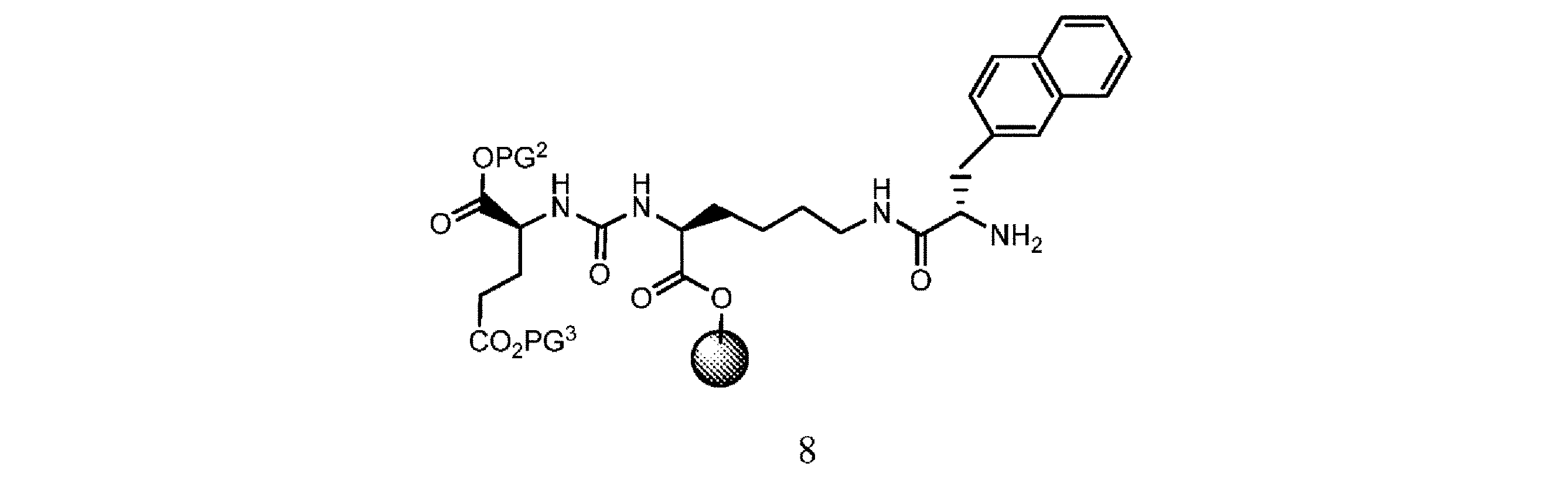
の樹脂系化合物を提供すること、又は
f. 式8の樹脂系化合物を、式9

の化合物と、溶媒、カップリング剤、並びに場合により塩基及び/又は添加剤の存在下で接触させて、式10

の樹脂系化合物を提供すること、又は
g. 式10の樹脂系化合物を、有機溶媒の存在下で少なくとも1つの第3の脱保護剤及び/又は切断試薬と接触させて、式Iの化合物を提供すること
のうちの1つ以上を含み、
式中、PG、PG1及びPG4は、アミン保護基であり、PG2、PG3、及びPG5は、カルボニル保護基であり、化合物CのLGは、離脱基である、方法。
52. Formula 1
A process for preparing a compound of formula I, comprising:
contacting the resin-based compound of formula 2 with a first deprotecting agent in the presence of a solvent to form a compound of formula 2
or b. providing a resin-based compound of formula 2,
in the presence of an organic solvent and a base to obtain a compound of formula 4
or c. contacting the resin-based compound of formula 4 with a second deprotecting agent in the presence of an organic solvent to provide a resin-based compound of formula 5.
or d. providing a resin-based compound of formula 5 with a compound of formula 6
in the presence of a solvent, a coupling agent, and optionally a base and/or an additive to obtain a compound of formula 7
or e. contacting the resin-based compound of formula 7 with a third deprotecting agent in the presence of a solvent to provide a resin-based compound of formula 8.
or f. providing a resin-based compound of formula 8 with a compound of formula 9
in the presence of a solvent, a coupling agent, and optionally a base and/or an additive to obtain a compound of formula 10
or g. contacting the resin-based compound of formula 10 with at least one third deprotecting and/or cleaving agent in the presence of an organic solvent to provide a compound of formula I;
wherein PG, PG 1 and PG 4 are amine protecting groups, PG 2 , PG 3 and PG 5 are carbonyl protecting groups, and LG of Compound C is a leaving group.
53. PG、PG1及びPG4が、9-フルオレニルメチル-カルボニル(Fmoc)、カルバミン酸ベンジル(Cbz)、t-ブチルオキシカルボニル(Boc)、アセトアミド、トリフルオロアセトアミド、p-トルエンスルホンアミド、トリフェミルメチル(triphemylmethyl)、モノメトキシトリチル(MMt)、及び4-メチルトリチル(Mtt)からなる群から選択される、条項52に記載の方法。 53. The method of claim 52, wherein PG, PG 1 and PG 4 are selected from the group consisting of 9-fluorenylmethyl-carbonyl (Fmoc), benzyl carbamate (Cbz), t-butyloxycarbonyl (Boc), acetamide, trifluoroacetamide, p-toluenesulfonamide, triphenylmethyl, monomethoxytrityl (MMt), and 4-methyltrityl (Mtt).
54. PGが9-フルオレニルメチル-カルボニルである、条項52又は53に記載の方法。 54. The method of claim 52 or 53, wherein PG is 9-fluorenylmethyl-carbonyl.
55. PG1がモノメトキシトリチル(MMt)又は4-メチルトリチル(Mtt)である、条項52~54のいずれか1項に記載の方法。 55. The method of any one of clauses 52-54, wherein PG 1 is monomethoxytrityl (MMt) or 4-methyltrityl (Mtt).
56. PG1が4-メチルトリチル(Mtt)である、条項52~55のいずれか1項に記載の方法。 56. The method of any one of clauses 52-55, wherein PG 1 is 4-methyltrityl (Mtt).
57. PG4が9-フルオレニルメチル-カルボニルである、条項52~56のいずれか1項に記載の方法。 57. The method of any one of clauses 52-56, wherein PG 4 is 9-fluorenylmethyl-carbonyl.
58. PG2、PG3、及びPG5がそれぞれt-ブチルである、条項52~57のいずれか1項に記載の方法。 58. The method of any one of clauses 52-57, wherein PG 2 , PG 3 and PG 5 are each t-butyl.
59. 化合物CのLGが、イミダゾリル、4-ニトロフェノキシ、及びフェノキシから選択される、条項52~58のいずれか1項に記載の方法。 59. The method of any one of clauses 52 to 58, wherein LG of compound C is selected from imidazolyl, 4-nitrophenoxy, and phenoxy.
60. 工程(a)の第1の脱保護剤が、9-フルオレニルメチル-カルボニル(Fmoc)、カルバミン酸ベンジル(Cbz)、t-ブチルオキシカルボニル(Boc)、アセトアミド、トリフルオロアセトアミド、p-トルエンスルホンアミド、トリフェミルメチル(triphemylmethyl)、モノメトキシトリチル(MMt)、及び4-メチルトリチル(Mtt)からなる群から選択される保護基を除去することができる試薬又は試薬の混合物を含む、条項52~59のいずれか1項に記載の方法。 60. The method of any one of clauses 52 to 59, wherein the first deprotecting agent in step (a) comprises a reagent or mixture of reagents capable of removing a protecting group selected from the group consisting of 9-fluorenylmethyl-carbonyl (Fmoc), benzyl carbamate (Cbz), t-butyloxycarbonyl (Boc), acetamide, trifluoroacetamide, p-toluenesulfonamide, triphenylmethyl, monomethoxytrityl (MMt), and 4-methyltrityl (Mtt).
61. 工程(a)の第1の脱保護剤が、9-フルオレニルメチル-カルボニルを除去することができる試薬又は試薬の混合物を含む、条項52~60のいずれか1項に記載の方法。 61. The method of any one of clauses 52 to 60, wherein the first deprotecting agent of step (a) comprises a reagent or mixture of reagents capable of removing 9-fluorenylmethyl-carbonyl.
62. 工程(a)の第1の脱保護剤が、ピペリジン、モルホリン、1,8-ジアザビシクロ[5.4.0]ウンデカ-7-エン(DBU)、ジエチルアミン(DEA)、ジシクロヘキサミン、4-メチルピペリジン(4MP)、トリス(2-アミノエチル)アミン、ピリジン、及びコリジンからなる群から選択される、条項52~61のいずれか1項に記載の方法。 62. The method of any one of clauses 52 to 61, wherein the first deprotecting agent in step (a) is selected from the group consisting of piperidine, morpholine, 1,8-diazabicyclo[5.4.0]undec-7-ene (DBU), diethylamine (DEA), dicyclohexamine, 4-methylpiperidine (4MP), tris(2-aminoethyl)amine, pyridine, and collidine.
63. 工程(a)の第1の脱保護剤がピペリジンである、条項52~62のいずれか1項に記載の方法。 63. The method of any one of clauses 52 to 62, wherein the first deprotecting agent in step (a) is piperidine.
64. 工程(a)の溶媒が極性非プロトン性溶媒である、条項52~63のいずれか1項に記載の方法。 64. The method of any one of clauses 52 to 63, wherein the solvent in step (a) is a polar aprotic solvent.
65. 工程(a)の溶媒が、ジメチルホルムアミド(DMF)、N-メチル-2-ピロリドン(NMP)、ジクロロメタン(DCM)、ジクロロメタン/ジメチルホルムアミド混合物、アセトニトリル(ACN)、アセトニトリル/ジメチルホルムアミド混合物、及びジメチルスルホキシド(DMSO)からなる群から選択される、条項52~64のいずれか1項に記載の方法。 65. The method of any one of clauses 52 to 64, wherein the solvent in step (a) is selected from the group consisting of dimethylformamide (DMF), N-methyl-2-pyrrolidone (NMP), dichloromethane (DCM), dichloromethane/dimethylformamide mixtures, acetonitrile (ACN), acetonitrile/dimethylformamide mixtures, and dimethylsulfoxide (DMSO).
66. 工程(b)の塩基が、N,N-ジイソプロピルエチルアミン(iPr2NEt)、トリエチルアミン(TEA)、4-メチルモルホリン(NMM)、イミダゾール、ピリジン、及びコリジンからなる群から選択される、条項52~65のいずれか1項に記載の方法。 66. The method of any one of clauses 52-65, wherein the base in step (b) is selected from the group consisting of N,N-diisopropylethylamine ( i Pr 2 NEt), triethylamine (TEA), 4-methylmorpholine (NMM), imidazole, pyridine, and collidine.
67. 工程(b)の有機溶媒が、CH2Cl2、THF、ジエチルエーテル、MeOH、EtOH、アセトン、及びアセトニトリルからなる群から選択される、条項52~66のいずれか1項に記載の方法。 67. The method of any one of clauses 52-66, wherein the organic solvent in step (b) is selected from the group consisting of CH 2 Cl 2 , THF, diethyl ether, MeOH, EtOH, acetone, and acetonitrile.
68. 工程(c)の第2の脱保護剤が、9-フルオレニルメチル-カルボニル(Fmoc)、カルバミン酸ベンジル(Cbz)、t-ブチルオキシカルボニル(Boc)、アセトアミド、トリフルオロアセトアミド、p-トルエンスルホンアミド、トリフェミルメチル(triphemylmethyl)、モノメトキシトリチル(MMt)、及び4-メチルトリチル(Mtt)からなる群から選択される保護基を除去することができる試薬又は試薬の混合物を含む、条項52~67のいずれか1項に記載の方法。 68. The method of any one of clauses 52 to 67, wherein the second deprotecting agent of step (c) comprises a reagent or mixture of reagents capable of removing a protecting group selected from the group consisting of 9-fluorenylmethyl-carbonyl (Fmoc), benzyl carbamate (Cbz), t-butyloxycarbonyl (Boc), acetamide, trifluoroacetamide, p-toluenesulfonamide, triphenylmethyl, monomethoxytrityl (MMt), and 4-methyltrityl (Mtt).
69. 工程(c)の第2の脱保護剤が、4-メチルトリチル(Mtt)を除去することができる試薬又は試薬の混合物を含む、条項52~68のいずれか1項に記載の方法。 69. The method of any one of clauses 52 to 68, wherein the second deprotecting agent of step (c) comprises a reagent or mixture of reagents capable of removing 4-methyltrityl (Mtt).
70. 工程(c)の第2の脱保護剤が、トリフルオロ酢酸(TFA)、酢酸、2,2,2-トリフルオロエタノール、ヘキサフルオロイソプロパノール、及びそれらの組み合わせからなる群から選択される、条項52~69のいずれか1項に記載の方法。 70. The method of any one of clauses 52 to 69, wherein the second deprotecting agent in step (c) is selected from the group consisting of trifluoroacetic acid (TFA), acetic acid, 2,2,2-trifluoroethanol, hexafluoroisopropanol, and combinations thereof.
71. 工程(c)の第2の脱保護剤が、酢酸と2,2,2-トリフルオロエタノールとの混合物である、条項52~70のいずれか1項に記載の方法。 71. The method of any one of clauses 52 to 70, wherein the second deprotecting agent in step (c) is a mixture of acetic acid and 2,2,2-trifluoroethanol.
72. 工程(c)の有機溶媒が、CH2Cl2、THF、ジエチルエーテル、MeOH、EtOH、アセトン、及びアセトニトリルからなる群から選択される、条項52~71のいずれか1項に記載の方法。 72. The method of any one of clauses 52-71, wherein the organic solvent in step (c) is selected from the group consisting of CH 2 Cl 2 , THF, diethyl ether, MeOH, EtOH, acetone, and acetonitrile.
73. 工程(d)のカップリング剤が、ベンゾトリアゾール-1-イルオキシ-tris(ジメチルアミノ)-ホスホニウムヘキサフルオロホスフェート(BOP)、ベンゾトリアゾール-1-イル-オキシトリピロリジノホスホニウムヘキサフルオロホスフェート(PyBOP)、7-アザ-ベンゾトリアゾール-1-イルオキシ-トリピロリジノ-ホスホニウムヘキサフルオロホスフェート(PyAOP)、エチルシアノ(ヒドロキシイミノ)アセタト-O2)-トリ-(1-ピロリジニル)-ホスホニウムヘキサフルオロホスフェート(PyOxim)、ブロモ-トリピロリジノ-ホスホニウムヘキサフルオロホスフェート(PyBrOP)、3-(ジエトキシ-ホスホリルオキシ)-1,2,3-ベンゾ[d]トリアジン-4(3H)-オン(DEPBT)、1-[ビス(ジメチルアミノ)メチレン]-1H-1,2,3-トリアゾロ[4,5-b]ピリジニウム3-オキシドヘキサフルオロホスフェート(HATU)、2-(1H-ベンゾトリアゾール-1-イル)-1,1,3,3-テトラメチルウロニウムテトラフルオロボレート(TBTU)、2-(1H-ベンゾトリアゾール-1-イル)-1,1,3,3-テトラメチルウロニウムヘキサフルオロホスフェート(HBTU)、2-(6-クロロ-1H-ベンゾトリアゾール-1-イル)-N,N,N’,N’-テトラメチルアミニウムヘキサフルオロホスフェート(HCTU)、2-クロロ-4,6-ジメトキシ-1,3,5-トリアジン(CDMT)、N-[(5-クロロ-3-オキシド-1H-ベンゾトリアゾール-1-イル)-4-モルホリニルメチレン]-N-メチルメタンアミニウムヘキサフルオロホスフェート(HDMC)、1-シアノ-2-エトキシ-2-オキソエチリデンアミノオキシ)ジメチルアミノ-モルホリノ-カルベニウムヘキサフルオロホスフェート(COMU)、ジメチルアミノ(トリアゾロ[4,5-b]ピリジン-3-イルオキシ)メチリデン]-ジメチルアザニウムテトラフルオロボレート(TATU)、N,N,N’,N’-テトラメチル-S-(1-オキシド-2-ピリジル)チオウロニウムテトラフルオロボレート(TOTT)、テトラメチルフルオロホルムアミジニウムヘキサフルオロホスフェート(TFFH)、N-エトキシカルボニル-2-エトキシ-1,2-ジヒドロキノリン(EEDQ)、1-プロパンホスホン酸無水物(T3P)、4-(4,6-ジメトキシ-1,3,5-トリアジン-2-イル)-4-メチル-モルホリニウムクロリド(DMTMM)、ジシクロヘキシルカルボジイミド(DCC)、ジイソプロピルカルボジイミド(DIC)、(N-(3-ジメチルアミノプロピル)-N’-エチルカルボジイミド(EDAC)、及び1,1’-カルボニルジミジゾール(carbonyldimidizole)(CDI)からなる群から選択される、条項52~72のいずれか1項に記載の方法。 73. The coupling agent in step (d) is benzotriazol-1-yloxy-tris(dimethylamino)-phosphonium hexafluorophosphate (BOP), benzotriazol-1-yl-oxytripyrrolidinophosphonium hexafluorophosphate (PyBOP), 7-aza-benzotriazol-1-yloxy-tripyrrolidino-phosphonium hexafluorophosphate (PyAOP), ethylcyano(hydroxyimino)acetato-O 2 )-tri-(1-pyrrolidinyl)-phosphonium hexafluorophosphate (PyOxim), bromo-tripyrrolidino-phosphonium hexafluorophosphate (PyBrOP), 3-(diethoxy-phosphoryloxy)-1,2,3-benzo[d]triazin-4(3H)-one (DEPBT), 1-[bis(dimethylamino)methylene]-1H-1,2,3-triazolo[4,5-b]pyridinium 3-oxide hexafluorophosphate (HATU), 2-(1H-benzotriazol-1-yl)-1,1,3,3-tetramethyluronium tetrafluoroborate (TMP), Fluoroborate (TBTU), 2-(1H-benzotriazol-1-yl)-1,1,3,3-tetramethyluronium hexafluorophosphate (HBTU), 2-(6-chloro-1H-benzotriazol-1-yl)-N,N,N',N'-tetramethylaminium hexafluorophosphate (HCTU), 2-chloro-4,6-dimethoxy-1,3,5-triazine (CDMT), N-[(5-chloro-3-oxido-1H-benzotriazol-1-yl)-4-morpholinylmethylene]-N-methylmethanaminium hexafluorophosphate (H DMC), 1-cyano-2-ethoxy-2-oxoethylideneaminooxy)dimethylamino-morpholino-carbenium hexafluorophosphate (COMU), dimethylamino(triazolo[4,5-b]pyridin-3-yloxy)methylidene]-dimethylazanium tetrafluoroborate (TATU), N,N,N',N'-tetramethyl-S-(1-oxido-2-pyridyl)thiouronium tetrafluoroborate (TOTT), tetramethylfluoroformamidinium hexafluorophosphate (TFFH), N-ethoxycarbonyl-2-ethoxycarbonyl 73. The method of any one of clauses 52-72, wherein the isomer is selected from the group consisting of 1,2-dihydroquinoline (EEDQ), 1-propanephosphonic anhydride (T3P), 4-(4,6-dimethoxy-1,3,5-triazin-2-yl)-4-methyl-morpholinium chloride (DMTMM), dicyclohexylcarbodiimide (DCC), diisopropylcarbodiimide (DIC), (N-(3-dimethylaminopropyl)-N'-ethylcarbodiimide (EDAC), and 1,1'-carbonyldimidizole (CDI).
74. 工程(d)の塩基が、N,N-ジイソプロピルエチルアミン(iPr2NEt)、トリエチルアミン(TEA)、4-メチルモルホリン(NMM)、イミダゾール、ピリジン、及びコリジンからなる群から選択される、条項52~73のいずれか1項に記載の方法。 74. The method of any one of clauses 52-73, wherein the base in step (d) is selected from the group consisting of N,N-diisopropylethylamine ( i Pr 2 NEt), triethylamine (TEA), 4-methylmorpholine (NMM), imidazole, pyridine, and collidine.
75. 工程(d)における添加剤が、存在する場合、1-ヒドロキシベンゾトリアゾール(HOBt)、1-ヒドロキシベンゾトリアゾール-6-スルホンアミドメチル樹脂HCl(HOBt-6-スルホンアミドメチル樹脂HCl)、ヒドロキシ-3,4-ジヒドロ-4-オキソ-1,2,3-ベンゾトリアジン(HOOBt)、N-ヒドロキシスクシンイミド(NHS)、1-ヒドロキシ-7-アザ-1H-ベンゾトリアゾール(HOAt)、エチル2-シアノ-2-(ヒドロキシミノ(hydroximino))アセテート、及び4-(N,N-ジメチルアミノ)ピリジン(DMAP)からなる群から選択される、条項52~74のいずれか1項に記載の方法。 75. The method of any one of clauses 52 to 74, wherein the additive in step (d), if present, is selected from the group consisting of 1-hydroxybenzotriazole (HOBt), 1-hydroxybenzotriazole-6-sulfonamidomethyl resin HCl (HOBt-6-sulfonamidomethyl resin HCl), hydroxy-3,4-dihydro-4-oxo-1,2,3-benzotriazine (HOOBt), N-hydroxysuccinimide (NHS), 1-hydroxy-7-aza-1H-benzotriazole (HOAt), ethyl 2-cyano-2-(hydroxymino)acetate, and 4-(N,N-dimethylamino)pyridine (DMAP).
76. 工程(d)の溶媒が極性非プロトン性溶媒である、条項52~75のいずれか1項に記載の方法。 76. The method of any one of clauses 52 to 75, wherein the solvent in step (d) is a polar aprotic solvent.
77. 工程(d)の溶媒が、ジメチルホルムアミド(DMF)、N-メチル-2-ピロリドン(NMP)、ジクロロメタン(DCM)、ジクロロメタン/ジメチルホルムアミド混合物、アセトニトリル(ACN)、アセトニトリル/ジメチルホルムアミド混合物、及びジメチルスルホキシド(DMSO)からなる群から選択される、条項52~76のいずれか1項に記載の方法。 77. The method of any one of clauses 52 to 76, wherein the solvent in step (d) is selected from the group consisting of dimethylformamide (DMF), N-methyl-2-pyrrolidone (NMP), dichloromethane (DCM), dichloromethane/dimethylformamide mixtures, acetonitrile (ACN), acetonitrile/dimethylformamide mixtures, and dimethylsulfoxide (DMSO).
78. 工程(e)の第3の脱保護剤が、9-フルオレニルメチル-カルボニル(Fmoc)、カルバミン酸ベンジル(Cbz)、t-ブチルオキシカルボニル(Boc)、アセトアミド、トリフルオロアセトアミド、p-トルエンスルホンアミド、トリフェミルメチル(triphemylmethyl)、モノメトキシトリチル(MMt)、及び4-メチルトリチル(Mtt)からなる群から選択される保護基を除去することができる試薬又は試薬の混合物を含む、条項52~77のいずれか1項に記載の方法。 78. The method of any one of clauses 52 to 77, wherein the third deprotecting agent of step (e) comprises a reagent or mixture of reagents capable of removing a protecting group selected from the group consisting of 9-fluorenylmethyl-carbonyl (Fmoc), benzyl carbamate (Cbz), t-butyloxycarbonyl (Boc), acetamide, trifluoroacetamide, p-toluenesulfonamide, triphenylmethyl, monomethoxytrityl (MMt), and 4-methyltrityl (Mtt).
79. 工程(e)の第3の脱保護剤が、9-フルオレニルメチル-カルボニルを除去することができる試薬又は試薬の混合物を含む、条項52~78のいずれか1項に記載の方法。 79. The method of any one of clauses 52 to 78, wherein the third deprotecting agent of step (e) comprises a reagent or mixture of reagents capable of removing 9-fluorenylmethyl-carbonyl.
80. 工程(e)の第1の脱保護剤が、ピペリジン、モルホリン、1,8-ジアザビシクロ[5.4.0]ウンデカ-7-エン(DBU)、ジエチルアミン(DEA)、ジシクロヘキサミン、4-メチルピペリジン(4MP)、トリス(2-アミノエチル)アミン、ピリジン、及びコリジンからなる群から選択される、条項52~79のいずれか1項に記載の方法。 80. The method of any one of clauses 52 to 79, wherein the first deprotecting agent in step (e) is selected from the group consisting of piperidine, morpholine, 1,8-diazabicyclo[5.4.0]undec-7-ene (DBU), diethylamine (DEA), dicyclohexamine, 4-methylpiperidine (4MP), tris(2-aminoethyl)amine, pyridine, and collidine.
81. 工程(e)の第1の脱保護剤がピペリジンである、条項52~80のいずれか1項に記載の方法。 81. The method of any one of clauses 52 to 80, wherein the first deprotecting agent in step (e) is piperidine.
82. 工程(e)の溶媒が極性非プロトン性溶媒である、条項52~81のいずれか1項に記載の方法。 82. The method of any one of clauses 52 to 81, wherein the solvent in step (e) is a polar aprotic solvent.
83. 工程(e)の溶媒が、ジメチルホルムアミド(DMF)、N-メチル-2-ピロリドン(NMP)、ジクロロメタン(DCM)、ジクロロメタン/ジメチルホルムアミド混合物、アセトニトリル(ACN)、アセトニトリル/ジメチルホルムアミド混合物、及びジメチルスルホキシド(DMSO)からなる群から選択される、条項52~82のいずれか1項に記載の方法。 83. The method of any one of clauses 52 to 82, wherein the solvent in step (e) is selected from the group consisting of dimethylformamide (DMF), N-methyl-2-pyrrolidone (NMP), dichloromethane (DCM), dichloromethane/dimethylformamide mixtures, acetonitrile (ACN), acetonitrile/dimethylformamide mixtures, and dimethylsulfoxide (DMSO).
84. 工程(f)のカップリング剤が、ベンゾトリアゾール-1-イルオキシ-トリス(ジメチルアミノ)-ホスホニウムヘキサフルオロホスフェート(BOP)、ベンゾトリアゾール-1-イル-オキシトリピロリジノホスホニウムヘキサフルオロホスフェート(PyBOP)、7-アザ-ベンゾトリアゾール-1-イルオキシ-トリピロリジノ-ホスホニウムヘキサフルオロホスフェート(PyAOP)、エチルシアノ(ヒドロキシイミノ)アセタト-O2)-トリ-(1-ピロリジニル)-ホスホニウムヘキサフルオロホスフェート(PyOxim)、ブロモ-トリピロリジノ-ホスホニウムヘキサフルオロホスフェート(PyBrOP)、3-(ジエトキシ-ホスホリルオキシ)-1,2,3-ベンゾ[d]トリアジン-4(3H)-オン(DEPBT)、1-[ビス(ジメチルアミノ)メチレン]-1H-1,2,3-トリアゾロ[4,5-b]ピリジニウム3-オキシドヘキサフルオロホスフェート(HATU)、2-(1H-ベンゾトリアゾール-1-イル)-1,1,3,3-テトラメチルウロニウムテトラフルオロボレート(TBTU)、2-(1H-ベンゾトリアゾール-1-イル)-1,1,3,3-テトラメチルウロニウムヘキサフルオロホスフェート(HBTU)、2-(6-クロロ-1H-ベンゾトリアゾール-1-イル)-N,N,N’,N’-テトラメチルアミニウムヘキサフルオロホスフェート(HCTU)、2-クロロ-4,6-ジメトキシ-1,3,5-トリアジン(CDMT)、N-[(5-クロロ-3-オキシド-1H-ベンゾトリアゾール-1-イル)-4-モルホリニルメチレン]-N-メチルメタンアミニウムヘキサフルオロホスフェート(HDMC)、1-シアノ-2-エトキシ-2-オキソエチリデンアミノオキシ)ジメチルアミノ-モルホリノ-カルベニウムヘキサフルオロホスフェート(COMU)、ジメチルアミノ(トリアゾロ[4,5-b]ピリジン-3-イルオキシ)メチリデン]-ジメチルアザニウムテトラフルオロボレート(TATU)、N,N,N’,N’-テトラメチル-S-(1-オキシド-2-ピリジル)チオウロニウムテトラフルオロボレート(TOTT)、テトラメチルフルオロホルムアミジニウムヘキサフルオロホスフェート(TFFH)、N-エトキシカルボニル-2-エトキシ-1,2-ジヒドロキノリン(EEDQ)、1-プロパンホスホン酸無水物(T3P)、4-(4,6-ジメトキシ-1,3,5-トリアジン-2-イル)-4-メチル-モルホリニウムクロリド(DMTMM)、ジシクロヘキシルカルボジイミド(DCC)、ジイソプロピルカルボジイミド(DIC)、(N-(3-ジメチルアミノプロピル)-N’-エチルカルボジイミド(EDAC)、及び1,1’-カルボニルジミジゾール(carbonyldimidizole)(CDI)からなる群から選択される、条項52~83のいずれか1項に記載の方法。 84. The coupling agent in step (f) is benzotriazol-1-yloxy-tris(dimethylamino)-phosphonium hexafluorophosphate (BOP), benzotriazol-1-yl-oxytripyrrolidinophosphonium hexafluorophosphate (PyBOP), 7-aza-benzotriazol-1-yloxy-tripyrrolidino-phosphonium hexafluorophosphate (PyAOP), ethylcyano(hydroxyimino)acetato-O 2 )-tri-(1-pyrrolidinyl)-phosphonium hexafluorophosphate (PyOxim), bromo-tripyrrolidino-phosphonium hexafluorophosphate (PyBrOP), 3-(diethoxy-phosphoryloxy)-1,2,3-benzo[d]triazin-4(3H)-one (DEPBT), 1-[bis(dimethylamino)methylene]-1H-1,2,3-triazolo[4,5-b]pyridinium 3-oxide hexafluorophosphate (HATU), 2-(1H-benzotriazol-1-yl)-1,1,3,3-tetramethyluronium tetrafluoroborate (TMP), Fluoroborate (TBTU), 2-(1H-benzotriazol-1-yl)-1,1,3,3-tetramethyluronium hexafluorophosphate (HBTU), 2-(6-chloro-1H-benzotriazol-1-yl)-N,N,N',N'-tetramethylaminium hexafluorophosphate (HCTU), 2-chloro-4,6-dimethoxy-1,3,5-triazine (CDMT), N-[(5-chloro-3-oxido-1H-benzotriazol-1-yl)-4-morpholinylmethylene]-N-methylmethanaminium hexafluorophosphate (H DMC), 1-cyano-2-ethoxy-2-oxoethylideneaminooxy)dimethylamino-morpholino-carbenium hexafluorophosphate (COMU), dimethylamino(triazolo[4,5-b]pyridin-3-yloxy)methylidene]-dimethylazanium tetrafluoroborate (TATU), N,N,N',N'-tetramethyl-S-(1-oxido-2-pyridyl)thiouronium tetrafluoroborate (TOTT), tetramethylfluoroformamidinium hexafluorophosphate (TFFH), N-ethoxycarbonyl-2-ethoxycarbonyl 84. The method of any one of clauses 52-83, wherein the isomer is selected from the group consisting of 1,2-dihydroquinoline (EEDQ), 1-propanephosphonic anhydride (T3P), 4-(4,6-dimethoxy-1,3,5-triazin-2-yl)-4-methyl-morpholinium chloride (DMTMM), dicyclohexylcarbodiimide (DCC), diisopropylcarbodiimide (DIC), (N-(3-dimethylaminopropyl)-N'-ethylcarbodiimide (EDAC), and 1,1'-carbonyldimidizole (CDI).
85. 工程(f)における塩基が、存在する場合、N,N-ジイソプロピルエチルアミン(iPr2NEt)、トリエチルアミン(TEA)、4-メチルモルホリン(NMM)、イミダゾール、ピリジン、及びコリジンからなる群から選択される、条項52~84のいずれか1項に記載の方法。 85. The method of any one of clauses 52-84, wherein the base in step (f), if present, is selected from the group consisting of N,N-diisopropylethylamine ( i Pr 2 NEt), triethylamine (TEA), 4-methylmorpholine (NMM), imidazole, pyridine, and collidine.
86. 工程(f)における添加剤が、存在する場合、1-ヒドロキシベンゾトリアゾール(HOBt)、1-ヒドロキシベンゾトリアゾール-6-スルホンアミドメチル樹脂HCl(HOBt-6-スルホンアミドメチル樹脂HCl)、ヒドロキシ-3,4-ジヒドロ-4-オキソ-1,2,3-ベンゾトリアジン(HOOBt)、N-ヒドロキシスクシンイミド(NHS)、1-ヒドロキシ-7-アザ-1H-ベンゾトリアゾール(HOAt)、エチル2-シアノ-2-(ヒドロキシミノ(hydroximino))アセテート、及び4-(N,N-ジメチルアミノ)ピリジン(DMAP)からなる群から選択される、項目52~85のいずれか1項に記載の方法。 86. The method of any one of items 52 to 85, wherein the additive in step (f), if present, is selected from the group consisting of 1-hydroxybenzotriazole (HOBt), 1-hydroxybenzotriazole-6-sulfonamidomethyl resin HCl (HOBt-6-sulfonamidomethyl resin HCl), hydroxy-3,4-dihydro-4-oxo-1,2,3-benzotriazine (HOOBt), N-hydroxysuccinimide (NHS), 1-hydroxy-7-aza-1H-benzotriazole (HOAt), ethyl 2-cyano-2-(hydroxymino)acetate, and 4-(N,N-dimethylamino)pyridine (DMAP).
87. 工程(f)における溶媒が極性非プロトン性溶媒である、条項52~86のいずれか1項に記載の方法。 87. The method of any one of clauses 52 to 86, wherein the solvent in step (f) is a polar aprotic solvent.
88. 工程(f)における溶媒が、ジメチルホルムアミド(DMF)、N-メチル-2-ピロリドン(NMP)、ジクロロメタン(DCM)、ジクロロメタン/ジメチルホルムアミド混合物、アセトニトリル(ACN)、アセトニトリル/ジメチルホルムアミド混合物、及びジメチルスルホキシド(DMSO)からなる群から選択される極性非プロトン性溶媒である、条項52~87のいずれか1項に記載の方法。 88. The method according to any one of clauses 52 to 87, wherein the solvent in step (f) is a polar aprotic solvent selected from the group consisting of dimethylformamide (DMF), N-methyl-2-pyrrolidone (NMP), dichloromethane (DCM), a dichloromethane/dimethylformamide mixture, acetonitrile (ACN), an acetonitrile/dimethylformamide mixture, and dimethylsulfoxide (DMSO).
89. 工程(g)の第3の脱保護剤が、t-ブチル、ベンジル、2-クロロトリチル(2-Cl-Trt)、2,4-ジメトキシベンジル(Dmb)、アリル、1,1-ジメチルアリル(Dma)、及びp-ニトロベンジル(pNB)からなる群から選択される保護基を除去することができる試薬又は試薬の混合物である、条項52~88のいずれか1項に記載の方法。 89. The method according to any one of clauses 52 to 88, wherein the third deprotecting agent in step (g) is a reagent or mixture of reagents capable of removing a protecting group selected from the group consisting of t-butyl, benzyl, 2-chlorotrityl (2-Cl-Trt), 2,4-dimethoxybenzyl (Dmb), allyl, 1,1-dimethylallyl (Dma), and p-nitrobenzyl (pNB).
90. 工程(g)の第3の脱保護剤が、トリフルオロ酢酸(TFA)、フッ化水素酸(HF)、トリフリック酸(TfOH)、トリフルオロ酢酸(TFA)/水/トリイソプロピルシラン混合物、トリフルオロ酢酸(TFA)/ジクロロメタン(DCM)混合物、トリエチルサリン(triethylsaline)(TES)、インドール、フェノール/アニソール混合物、及びチオアニソールからなる群から選択される、条項52~89のいずれか1項に記載の方法。 90. The method of any one of clauses 52 to 89, wherein the third deprotecting agent in step (g) is selected from the group consisting of trifluoroacetic acid (TFA), hydrofluoric acid (HF), triflic acid (TfOH), trifluoroacetic acid (TFA)/water/triisopropylsilane mixture, trifluoroacetic acid (TFA)/dichloromethane (DCM) mixture, triethylsaline (TES), indole, phenol/anisole mixture, and thioanisole.
91. 工程(g)の第3の脱保護剤が、トリフルオロ酢酸(TFA)/水/トリイソプロピルシラン混合物である、条項52~90のいずれか1項に記載の方法。 91. The method of any one of clauses 52 to 90, wherein the third deprotecting agent in step (g) is a trifluoroacetic acid (TFA)/water/triisopropylsilane mixture.
92. 工程(g)の切断試薬が、トリフルオロ酢酸(TFA)又はトリフルオロ酢酸(TFA)/水/トリイソプロピルシラン混合物である、条項52~91のいずれか1項に記載の方法。 92. The method of any one of clauses 52 to 91, wherein the cleavage reagent in step (g) is trifluoroacetic acid (TFA) or a trifluoroacetic acid (TFA)/water/triisopropylsilane mixture.
93. 工程(g)の切断試薬がトリフルオロ酢酸(TFA)/水/トリイソプロピルシラン混合物である、条項52~92のいずれか1項に記載の方法。 93. The method of any one of clauses 52 to 92, wherein the cleavage reagent in step (g) is a trifluoroacetic acid (TFA)/water/triisopropylsilane mixture.
94. 工程(g)の有機溶媒が、CH2Cl2、THF、ジエチルエーテル、MeOH、EtOH、アセトン、及びアセトニトリルからなる群から選択される、条項52~93のいずれか1項に記載の方法。 94. The method of any one of clauses 52-93, wherein the organic solvent in step (g) is selected from the group consisting of CH 2 Cl 2 , THF, diethyl ether, MeOH, EtOH, acetone, and acetonitrile.
95. 式5の樹脂系化合物と接触させる前に、式6の化合物、溶媒、カップリング剤、並びに場合により塩基及び/又は添加剤を組み合わせて、式6’

(式中、化合物6’のLGは、脱離基である)の活性化化合物を含む混合物を形成する、条項52~94のいずれか1項に記載の方法。
95. Prior to contacting with the resin-based compound of formula 5, a compound of formula 6, a solvent, a coupling agent, and optionally a base and/or additives are combined to form a compound of formula 6'
95. The method of any one of clauses 52-94, comprising forming a mixture containing an activated compound of the formula: wherein LG of compound 6' is a leaving group.
96. 式6’

(式中、化合物6’のLGは、脱離基である)の活性化化合物のインサイチュ形成の前に、又はそれと同時に、式5の樹脂系化合物の化合物、式6の化合物、溶媒、カップリング剤、並びに場合により塩基及び/又は添加剤を、一緒に接触させる、条項52~94のいずれか1項に記載の方法。
96. Formula 6'
The method of any one of clauses 52 to 94, wherein the compound of the resin-based compound of formula 5, the compound of formula 6, the solvent, the coupling agent, and optionally the base and/or additives are contacted together prior to or simultaneously with the in situ formation of the activated compound of formula (wherein LG of compound 6' is a leaving group).
97. 化合物6’のLGが、1-(λ1-オキシダンイル)-1H-ベンゾ[d][1,2,3]トリアゾール、3-(λ1-オキシダンイル)-3H-[1,2,3]トリアゾロ[4,5-b]ピリジン、エチルシアノ(ヒドロキシイミノ)アセテート(Oxyma)、臭化物、3-(λ1-オキシダンイル)ベンゾ[d][1,2,3]トリアジン4(3H)-オン、6-クロロ-1-(λ1-オキシダンイル)-1H-ベンゾ[d][1,2,3]トリアゾール、2,4-ジメトキシ-6-(λ1-オキシダンイル)-1,3,5-トリアジン、エタボン酸、プロピルホスホン酸、ジシクロヘキシル尿素、1-(3-(ジメチル-λ4-アザニル)プロピル)-3-エチル尿素、及びイミダゾリルからなる群から選択される、条項95又は96に記載の方法。 97. The compound 6' LG is 1-(λ 1 -oxidanyl)-1H-benzo[d][1,2,3]triazole, 3-(λ 1 -oxidanyl)-3H-[1,2,3]triazolo[4,5-b]pyridine, ethyl cyano(hydroxyimino)acetate (Oxyma), bromide, 3-(λ 1 -oxidanyl)benzo[d][1,2,3]triazine 4(3H)-one, 6-chloro-1-(λ 1 -oxidanyl)-1H-benzo[d][1,2,3]triazole, 2,4-dimethoxy-6-(λ 1 -oxidanyl)-1,3,5-triazine, ethabonic acid, propylphosphonic acid, dicyclohexyl urea, 1-(3-(dimethyl-λ 4 97. The method of claim 95 or 96, wherein the aryl group is selected from the group consisting of (a)-azanyl)propyl)-3-ethylurea, and imidazolyl.
98. 化合物6’のLGがイミダゾリルである、条項95~97のいずれか1項に記載の方法。 98. The method of any one of clauses 95 to 97, wherein LG of compound 6' is imidazolyl.
99. 式Hの樹脂系化合物と接触させる前に、式9の化合物、溶媒、カップリング剤、並びに場合により塩基及び/又は添加剤を組み合わせて、式9’

(式中、化合物9’のLGは、脱離基である)の活性化化合物を含む混合物を形成する、前項のいずれか1項に記載の方法。
99. Prior to contacting with the resin-based compound of formula H, a compound of formula 9, a solvent, a coupling agent, and optionally a base and/or additives are combined to form a compound of formula 9'
The method of any one of the preceding claims, forming a mixture containing an activated compound of the formula: wherein LG of compound 9' is a leaving group.
100. 式9’

(式中、化合物9’のLGは、脱離基である)の活性化化合物のインサイチュ形成の前に、又はそれと同時に、式8の樹脂系化合物、式9の化合物、溶媒、カップリング剤、並びに場合により塩基及び/又は添加剤を一緒に接触させる、条項52~98のいずれか1項に記載の方法。
100. Formula 9'
The method of any one of clauses 52 to 98, wherein the resin-based compound of formula 8, the compound of formula 9, the solvent, the coupling agent, and optionally the base and/or additive are contacted together prior to or simultaneously with the in situ formation of the activated compound of formula (wherein LG of compound 9' is a leaving group).
101. 化合物9’のLGが、1-(λ1-オキシダンイル)-1H-ベンゾ[d][1,2,3]トリアゾール、3-(λ1-オキシダンイル)-3H-[1,2,3]トリアゾロ[4,5-b]ピリジン、エチルシアノ(ヒドロキシイミノ)アセテート(Oxyma)、臭化物、3-(λ1-オキシダンイル)ベンゾ[d][1,2,3]トリアジン-4(3H)-オン、6-クロロ-1-(λ1-オキシダンイル)-1H-ベンゾ[d][1,2,3]トリアゾール、2,4-ジメトキシ-6-(λ1-オキシダンイル)-1,3,5-トリアジン、エタボン酸、プロピルホスホン酸、ジシクロヘキシル尿素、1-(3-(ジメチル-λ4-アザニル)プロピル)-3-エチル尿素、及びイミダゾリルからなる群から選択される、条項99又は100に記載の方法。 101. The compound 9' LG is 1-(λ 1 -oxidanyl)-1H-benzo[d][1,2,3]triazole, 3-(λ 1 -oxidanyl)-3H-[1,2,3]triazolo[4,5-b]pyridine, ethyl cyano(hydroxyimino)acetate (Oxyma), bromide, 3-(λ 1 -oxidanyl)benzo[d][1,2,3]triazin-4(3H)-one, 6-chloro-1-(λ 1 -oxidanyl)-1H-benzo[d][1,2,3]triazole, 2,4-dimethoxy-6-(λ 1 -oxidanyl)-1,3,5-triazine, ethabonic acid, propylphosphonic acid, dicyclohexyl urea, 1-(3-(dimethyl-λ 4 101. The method of claim 99 or 100, wherein the aryl group is selected from the group consisting of (a)-3-ethyl-2-azanylpropyl)-3-ethylurea, and (b)-imidazolyl.
102. 化合物9’のLGがイミダゾリルである、条項99~101のいずれか1項に記載の方法。 102. The method of any one of clauses 99 to 101, wherein LG of compound 9' is imidazolyl.
103. 式4

(式中、PG1は、アミン保護基であり、PG2及びPG3は、それぞれ独立してカルボキシル保護基である)
の樹脂系化合物。
103. Equation 4
(wherein PG 1 is an amine protecting group, and PG 2 and PG 3 are each independently a carboxyl protecting group).
Resin-based compound.
104. 式5

(式中、PG2及びPG3は、それぞれ独立してカルボキシル保護基である)
の樹脂系化合物。
104. Equation 5
(Wherein, PG 2 and PG 3 are each independently a carboxyl protecting group.)
Resin-based compound.
105. 式7
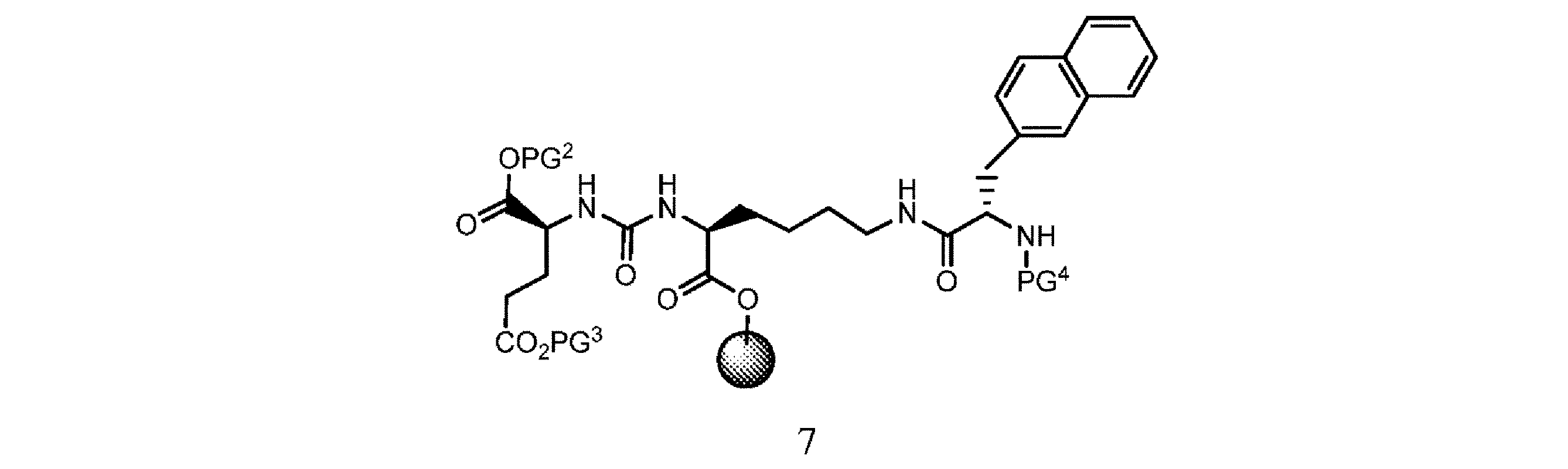
(式中、PG2及びPG3は、それぞれ独立してカルボキシ保護基であり、PG4は、アミン保護基である)
の樹脂系化合物。
105. Equation 7
(Wherein, PG 2 and PG 3 are each independently a carboxy protecting group, and PG 4 is an amine protecting group.)
Resin-based compound.
106. 式8

(式中、PG2及びPG3は、それぞれ独立してカルボキシ保護基である)
の樹脂系化合物。
106. Equation 8
(Wherein, PG 2 and PG 3 are each independently a carboxy protecting group.)
Resin-based compound.
107. 式10
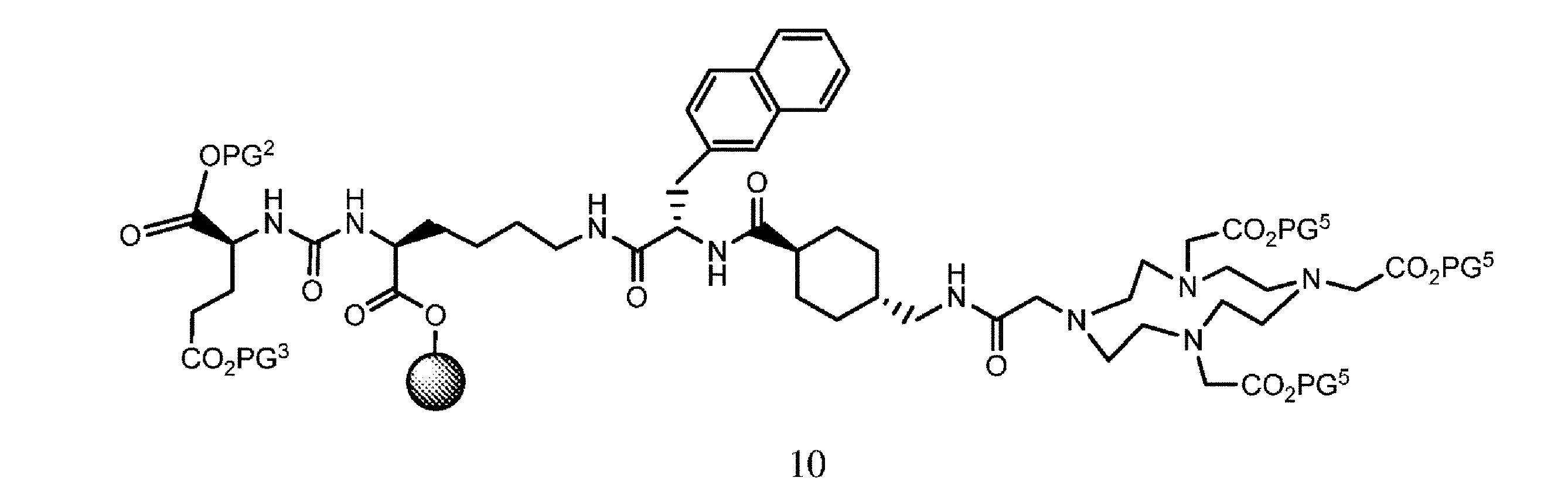
(式中、各PG2、PG3、及びPG5は、独立してカルボキシル保護基である)
の樹脂系化合物。
107. Equation 10
wherein each of PG 2 , PG 3 , and PG 5 is independently a carboxyl protecting group.
Resin-based compound.
108. PG1及びPG4が、存在する場合、9-フルオレニルメチル-カルボニル(Fmoc)、カルバミン酸ベンジル(Cbz)、t-ブチルオキシカルボニル(Boc)、アセトアミド、トリフルオロアセトアミド、p-トルエンスルホンアミド、トリフェミルメチル(triphemylmethyl)、モノメトキシトリチル(MMt)、及び4-メチルトリチル(Mtt)からなる群から独立して選択される、条項103~107のいずれか1項に記載の樹脂系化合物。 108. The resinous compound of any one of clauses 103-107, wherein PG 1 and PG 4 , if present, are independently selected from the group consisting of 9-fluorenylmethyl-carbonyl (Fmoc), benzyl carbamate (Cbz), t-butyloxycarbonyl (Boc), acetamide, trifluoroacetamide, p-toluenesulfonamide, triphenylmethyl, monomethoxytrityl (MMt), and 4-methyltrityl (Mtt).
109. PG1が、存在する場合、モノメトキシトリチル(MMt)又は4-メチルトリチル(Mtt)である、条項103~108のいずれか1項に記載の樹脂系化合物。 109. The resinous compound of any one of clauses 103 to 108, wherein PG 1 , if present, is monomethoxytrityl (MMt) or 4-methyltrityl (Mtt).
110. PG1が、存在する場合、4-メチルトリチル(Mtt)である、条項103~109のいずれか1項に記載の樹脂系化合物。 110. The resinous compound of any one of clauses 103 to 109, wherein PG 1 , if present, is 4-methyltrityl (Mtt).
111. PG4が、存在する場合、9-フルオレニルメチル-カルボニルである、条項103~110のいずれか1項に記載の樹脂系化合物。 111. The resinous compound of any one of clauses 103 to 110, wherein PG 4 , if present, is 9-fluorenylmethyl-carbonyl.
112. PG2、PG3、及びPG5が、存在する場合、それぞれt-ブチルである、条項103~111のいずれか1項に記載の樹脂系化合物。 112. The resin-based compound of any one of clauses 103 to 111, wherein PG 2 , PG 3 , and PG 5 , if present, are each t-butyl.
113. 式C

(式中、PG2は、アミン保護基であり、各R1は、C1~C4アルキル又はシクロヘキシルである)の樹脂系化合物。
113. Formula C
A resin-based compound of the formula: wherein PG 2 is an amine protecting group and each R 1 is a C 1 -C 4 alkyl or cyclohexyl.
114. 式C’
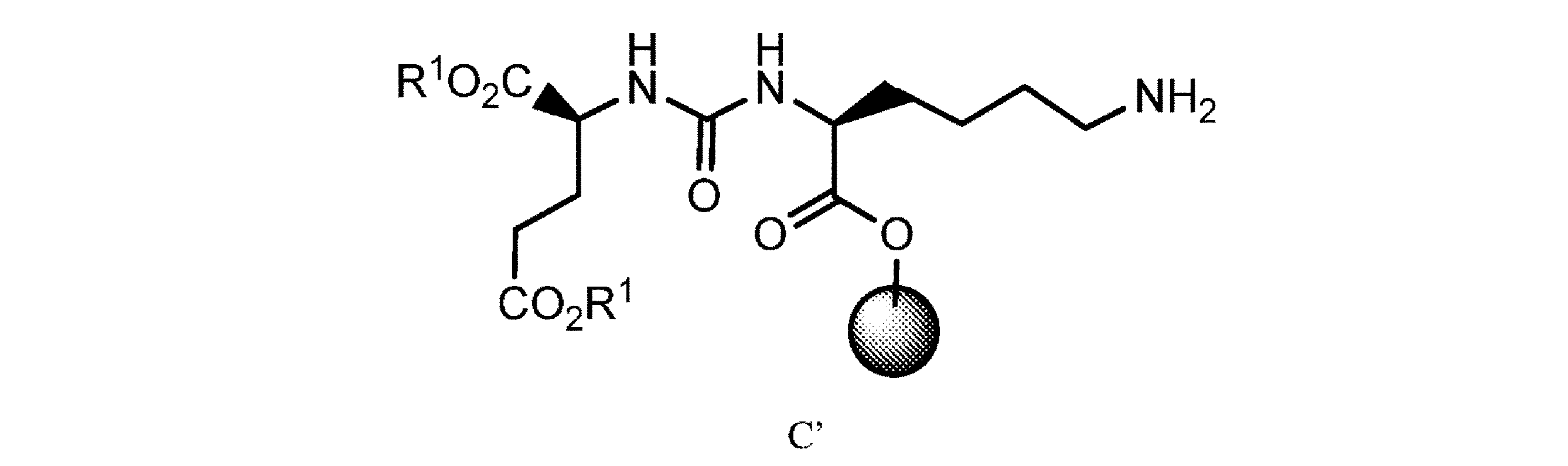
(式中、各R1は、C1~C4アルキル又はシクロヘキシルである)
の樹脂系化合物。
114. Formula C'
wherein each R 1 is a C 1 -C 4 alkyl or cyclohexyl.
Resin-based compound.
115. 式D

(式中、PG1は、アミン保護基であり、各R1は、C1~C4アルキル又はシクロヘキシルである)
の樹脂系化合物。
115. Formula D
where PG 1 is an amine protecting group and each R 1 is a C 1 -C 4 alkyl or cyclohexyl.
Resin-based compound.
116. 式D’

(式中、各R1は、C1~C4アルキル又はシクロヘキシルである)
の樹脂系化合物。
116. Formula D'
wherein each R 1 is a C 1 -C 4 alkyl or cyclohexyl.
Resin-based compound.
117. 式E

(式中、PG1は、アミン保護基であり、各R1は、C1~C4アルキル又はシクロヘキシルである)
の樹脂系化合物。
117. Formula E
where PG 1 is an amine protecting group and each R 1 is a C 1 -C 4 alkyl or cyclohexyl.
Resin-based compound.
118. 式E’

(式中、各R1は、C1~C4アルキル又はシクロヘキシルである)
の樹脂系化合物。
118. Formula E'
wherein each R 1 is a C 1 -C 4 alkyl or cyclohexyl.
Resin-based compound.
119. 式F
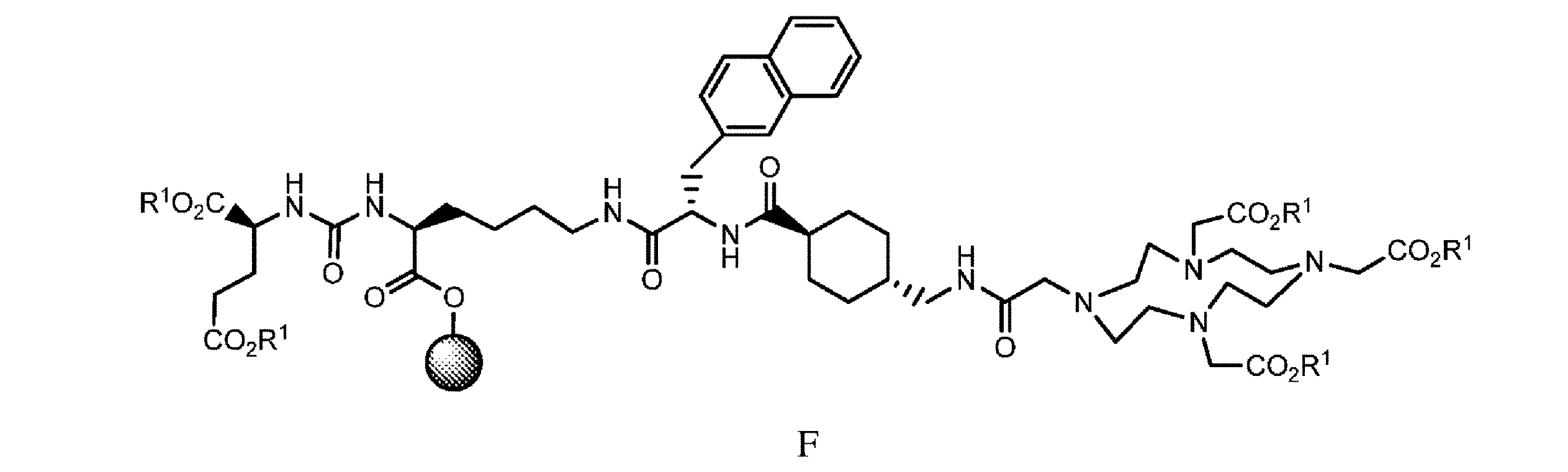
(式中、各R1は、C1~C4アルキル又はシクロヘキシルである)
の樹脂系化合物。
119. Formula F
wherein each R 1 is a C 1 -C 4 alkyl or cyclohexyl.
Resin-based compound.
120. PG1が9-フルオレニルメチル-カルボニル(Fmoc)又はt-ブチルカルボニル(Boc)である、条項115又は117に記載の樹脂系化合物。 120. The resin-based compound of clause 115 or 117, wherein PG 1 is 9-fluorenylmethyl-carbonyl (Fmoc) or t-butylcarbonyl (Boc).
121. PG1が9-フルオレニルメチル-カルボニル(Fmoc)である、条項115、117又は120のいずれか1項に記載の樹脂系化合物。 121. The resin-based compound of any one of clauses 115, 117 or 120, wherein PG 1 is 9-fluorenylmethyl-carbonyl (Fmoc).
122. PG2がモノメトキシトリチル(MMt)又は4-メチルトリチル(Mtt)である、条項113に記載の樹脂系化合物。 122. The resin-based compound according to claim 113, wherein PG 2 is monomethoxytrityl (MMt) or 4-methyltrityl (Mtt).
123. PG2が4-メチルトリチル(Mtt)である、条項113又は122に記載の樹脂系化合物。 123. The resin-based compound according to claim 113 or 122, wherein PG 2 is 4-methyltrityl (Mtt).
124. R1がt-ブチルである、条項113~119のいずれか1項に記載の樹脂系化合物。 124. The resin-based compound according to any one of clauses 113 to 119, wherein R 1 is t-butyl.
定義
本明細書で使用される場合、用語「アルキル」は、場合により分岐し、1~4個の炭素原子などを含有する炭素原子の鎖を含み、「低級アルキル」と呼ばれ得る。例示的なアルキル基としては、メチル、エチル、n-プロピル、イソプロピル、n-ブチル、イソブチル、sec-ブチル、及びtert-ブチルが挙げられるが、これらに限定されない。
DEFINITIONS As used herein, the term "alkyl" includes a chain of carbon atoms, which is optionally branched and contains 1 to 4 carbon atoms, etc., and may be referred to as a "lower alkyl." Exemplary alkyl groups include, but are not limited to, methyl, ethyl, n-propyl, isopropyl, n-butyl, isobutyl, sec-butyl, and tert-butyl.
本明細書で使用される場合、特に示されない限り、用語「異常な細胞増殖」は、正常な調節機構とは無関係である細胞増殖(例えば、接触阻害の損失)を指す。 As used herein, unless otherwise indicated, the term "abnormal cell growth" refers to cell growth that is independent of normal regulatory mechanisms (e.g., loss of contact inhibition).
用語「対象」は、ヒトなどの、そのような治療を必要とする哺乳動物患者を指す。 The term "subject" refers to a mammalian patient in need of such treatment, such as a human.
本明細書で使用される場合、用語「保護基」又は「PG」は、アミン又はヒドロキシルなどの官能基の化学修飾によって分子に導入されて、後続の化学反応において化学選択性を得ることができる、当業者に一般に公知の任意の基を指す。このような保護基は、その後、合成の後の時点で官能基から除去されて、このような官能基での反応のさらなる機会を提供し得るか、又は最終生成物の場合には、このような官能基をマスク解除し得ることが認識されるであろう。保護基は、例えば、Wuts,P.G.M.,Greene,T.W.,Greene,T.W.,& John Wiley & Sons.(2006).Greene’s protective groups in organic synthesis.Hoboken,N.J:Wiley-Intersciencesに記載されている。当業者は、このような保護基を官能基上に導入することができる化学プロセス条件を容易に認識するであろう。本開示に関連して有用な適切なアミン保護基としては、9-フルオレニルメチル-カルボニル(Fmoc)及びt-ブチルカルボニル(Boc)が挙げられるが、これらに限定されない。 As used herein, the term "protecting group" or "PG" refers to any group generally known to those skilled in the art that can be introduced into a molecule by chemical modification of a functional group, such as an amine or hydroxyl, to obtain chemoselectivity in a subsequent chemical reaction. It will be appreciated that such protecting groups can then be removed from the functional group at a later point in the synthesis to provide further opportunities for reaction at such functional group, or to unmask such functional group in the case of the final product. Protecting groups are described, for example, in Wuts, P. G. M., Greene, T. W., Greene, T. W., & John Wiley & Sons. (2006). Greene's protective groups in organic synthesis. Hoboken, N. J: Wiley-Intersciences. Those skilled in the art will readily recognize chemical process conditions under which such protecting groups can be introduced onto functional groups. Suitable amine protecting groups useful in the context of the present disclosure include, but are not limited to, 9-fluorenylmethyl-carbonyl (Fmoc) and t-butylcarbonyl (Boc).
本明細書で使用される場合、「LG」の「脱離基」という用語は、ヘテロ分解結合切断において一対の電子とともに離れる、当業者に一般に公知の任意の基を指す。脱離基は、アニオン又は中性分子であり得るが、いずれの場合においても、脱離基が結合のヘテロ分解から生じるさらなる電子密度を安定化し得ることが重要である。 As used herein, the term "leaving group" of "LG" refers to any group generally known to one of skill in the art that leaves with a pair of electrons in a heterolytic bond cleavage. The leaving group can be an anion or a neutral molecule, but in either case, it is important that the leaving group is capable of stabilizing the additional electron density that results from the heterolytic bond cleavage.
本開示をさらに記載する前に、本開示は記載される特定の実施形態に限定されず、したがって、当然ながら、変化し得ることを理解するべきである。本開示の範囲は添付の特許請求の範囲によってのみ限定されるので、本明細書で使用される用語は、特定の実施形態を説明することのみを目的とし、限定することを意図しないことも理解するべきである。 Before the present disclosure is further described, it is to be understood that this disclosure is not limited to particular embodiments described, as such may, of course, vary. It is also to be understood that the terminology used herein is for the purpose of describing particular embodiments only, and is not intended to be limiting, since the scope of the present disclosure will be limited only by the appended claims.
別段の定義がない限り、本明細書で使用される全ての技術用語及び科学用語は、本開示が属する技術分野の当業者によって一般に理解されるものと同じ意味を有する。本明細書に参照される全ての特許、出願、公開された出願及び他の刊行物は、その全体が参照により組み込まれる。本セクションに記載された定義が参照により本明細書に組み込まれる特許、出願、又は他の刊行物に記載された定義に反するか、又はさもなければそれと矛盾する場合、本セクションに記載された定義が、参照により本明細書に組み込まれる定義よりも優先される。 Unless otherwise defined, all technical and scientific terms used herein have the same meaning as commonly understood by one of ordinary skill in the art to which this disclosure belongs. All patents, applications, published applications, and other publications referenced herein are incorporated by reference in their entirety. If a definition set forth in this section contradicts or otherwise conflicts with a definition set forth in a patent, application, or other publication incorporated herein by reference, the definition set forth in this section shall take precedence over the definition incorporated herein by reference.
本明細書及び添付の特許請求の範囲において使用されるように、単数形の「a」、「an」、及び「the」は、文脈が明白に別段の指示をしない限り、複数の指示対象を含む。さらに、特許請求の範囲は、任意の場合による要素を除外するために起草され得ることに留意される。したがって、この記述は、特許請求の範囲の要素の引用又は「負の」限定の使用に関連して、「単独」、「のみ」などの排他的用語を使用するための先行として役立つことを意図している。 As used herein and in the appended claims, the singular forms "a," "an," and "the" include plural referents unless the context clearly dictates otherwise. It is further noted that the claims may be drafted to exclude any optional element. Thus, this statement is intended to serve as a precedent for using exclusive terminology, such as "sole," "only," and the like, in connection with reciting claim elements or using a "negative" limitation.
合成方法
方法1:
いくつかの実施形態において、本開示は、式I

の化合物を調製するための方法を提供し、該方法は、
a. 式A

の樹脂系化合物を、第1の脱保護剤と極性非プロトン性溶媒中で接触させて、式A’

の樹脂系化合物を提供すること、又は
b. 式A’の樹脂系化合物を、式B

の化合物と、有機溶媒及び塩基の存在下で接触させて

、式Cの樹脂系化合物を提供すること、又は、
c. 式Cの樹脂系化合物を、有機溶媒の存在下で第2の脱保護剤と接触させて、式C’

の樹脂系化合物を提供すること、又は
d. 式C’の樹脂系化合物を、極性非プロトン性溶媒、カップリング剤、及び塩基の存在下でPG1-3-(2-ナフチル)-L-アラニンと接触させて、式D

の樹脂系化合物を提供すること、又は
e. 式Dの樹脂系化合物を、極性非プロトン性溶媒中で第1の脱保護剤と接触させて、式D’

の樹脂系化合物を提供すること、又は
f. 式D’の樹脂系化合物を、極性非プロトン性溶媒、カップリング剤、及び塩基の存在下でPG1-トラネキサム酸と接触させて、式E

の樹脂系化合物を提供すること、又は
g. 式Eの樹脂系化合物を、極性非プロトン性溶媒中で第1の脱保護剤と接触させて、式E’

の樹脂系化合物を提供すること、又は
h. 式E’の樹脂系化合物を、式E2’

の化合物と、極性非プロトン性溶媒、カップリング剤、及び塩基の存在下で接触させて、式F
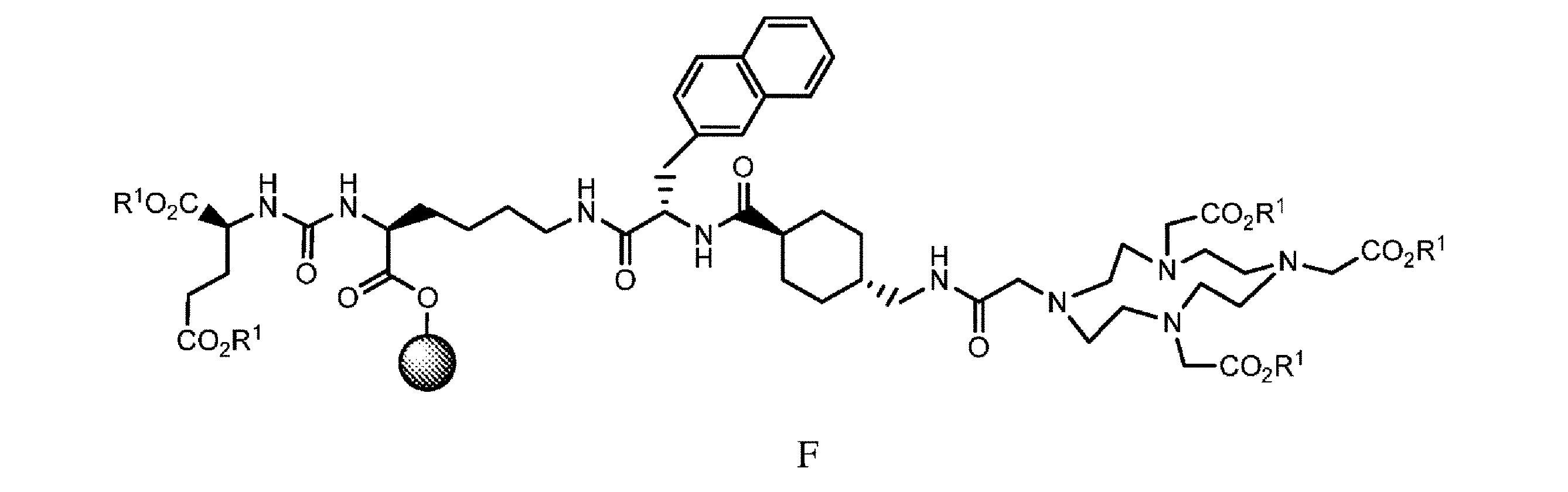
の樹脂系化合物を提供すること、又は
i. 式Fの樹脂系化合物を、有機溶媒中で第3の脱保護剤及び/又は切断試薬と接触させること
を含み、
式中、PG1及びPG2は、アミン保護基であり、LGは、離脱基であり、R1は、C1~C4アルキル又はシクロヘキシルである。
Synthesis Method Method 1:
In some embodiments, the present disclosure provides a compound of formula I
The present invention provides a method for preparing a compound of the formula:
Formula A
contacting the resin-based compound of formula A' with a first deprotecting agent in a polar aprotic solvent to produce a compound of formula A'
or b. providing a resin-based compound of formula A′ with a resin-based compound of formula B
in the presence of an organic solvent and a base.
or providing a resin-based compound of formula C:
c. contacting the resin-based compound of formula C with a second deprotecting agent in the presence of an organic solvent to produce a compound of formula C'
or d. contacting the resin-based compound of formula C′ with PG 1 -3-(2-naphthyl)-L-alanine in the presence of a polar aprotic solvent, a coupling agent, and a base to provide a resin-based compound of formula D
or e. contacting the resin-based compound of formula D with a first deprotecting agent in a polar aprotic solvent to provide a resin-based compound of formula D'
or f. contacting the resin-based compound of formula D′ with PG 1 -tranexamic acid in the presence of a polar aprotic solvent, a coupling agent, and a base to provide a resin-based compound of formula E
or g. contacting the resin-based compound of formula E with a first deprotecting agent in a polar aprotic solvent to provide a resin-based compound of formula E'
or h. providing a resin-based compound of formula E' with a resin-based compound of formula E 2'
in the presence of a polar aprotic solvent, a coupling agent, and a base to obtain a compound of formula F
or i. contacting the resin-based compound of formula F with a third deprotecting and/or cleaving reagent in an organic solvent,
where PG 1 and PG 2 are amine protecting groups, LG is a leaving group, and R 1 is a C 1 -C 4 alkyl or cyclohexyl.
方法2:
代替的に、いくつかの実施形態では、本開示は、式1

の化合物を調製するための方法を提供し、該方法は、以下
a. 式1

の樹脂系化合物を、溶媒の存在下で第1の脱保護剤と接触させて、式2

の樹脂系化合物を提供すること、又は
b. 式2の樹脂系化合物を、式3

の化合物と、有機溶媒及び塩基の存在下で接触させて、式4

の樹脂系化合物を提供すること、又は
c. 式4の樹脂系化合物を、有機溶媒の存在下で第2の脱保護剤と接触させて、式5

の樹脂系化合物を提供すること、又は
d. 式5の樹脂系化合物を、式6

の化合物と、溶媒、カップリング剤、並びに場合により塩基及び/又は添加剤の存在下で接触させて、式7

の樹脂系化合物を提供すること、又は
e. 式7の樹脂系化合物を、溶媒の存在下で第3の脱保護剤と接触させて、式8

の樹脂系化合物を提供すること、又は
f. 式8の樹脂系化合物を、式9
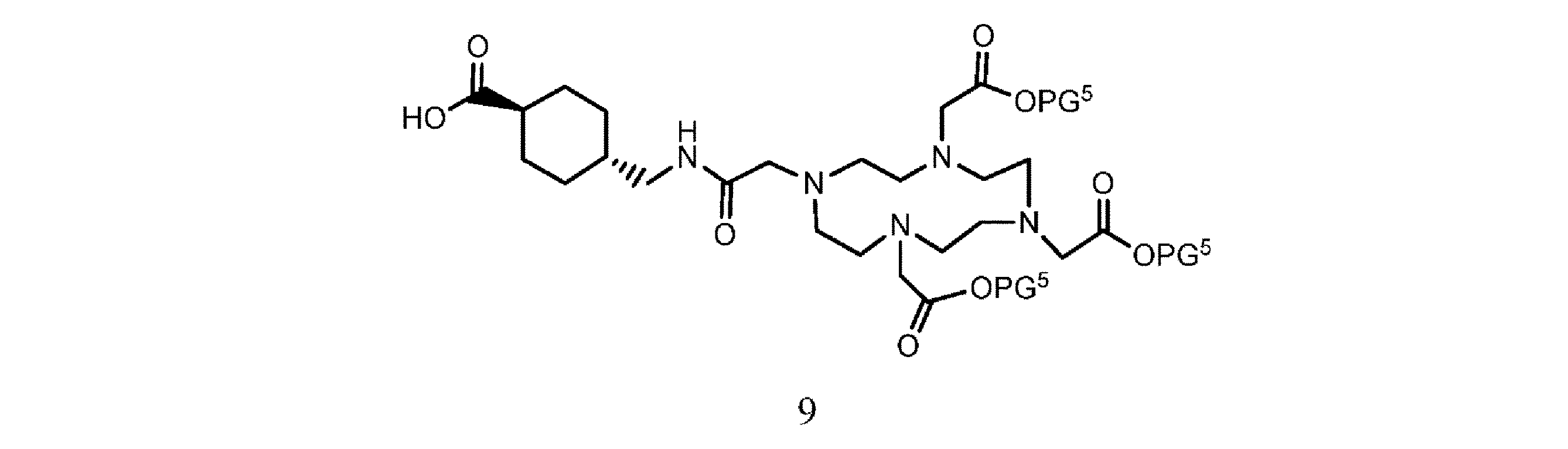
の化合物と、溶媒、カップリング剤、並びに場合により塩基及び/又は添加剤の存在下で接触させて、式10
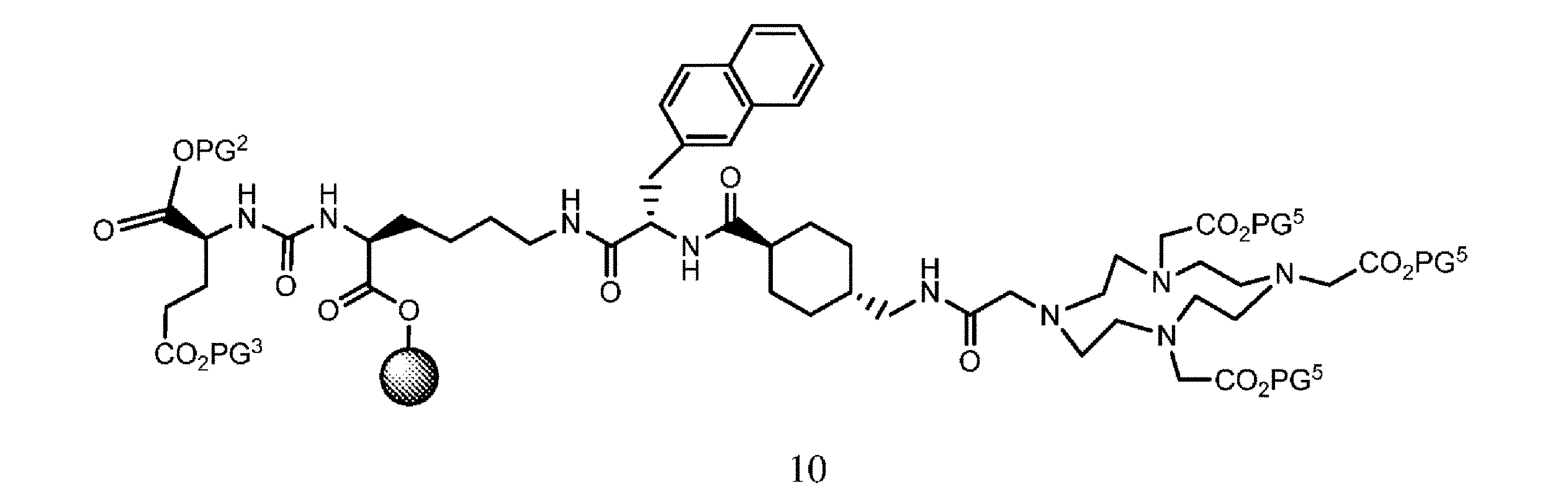
の樹脂系化合物を提供すること、又は
g. 式10の樹脂系化合物を、有機溶媒の存在下で少なくとも1つの第3の脱保護剤及び/又は切断試薬と接触させて、式Iの化合物を提供すること
のうちの1つ以上を含み、
式中、PG、PG1及びPG4は、アミン保護基であり、PG2、PG3、及びPG5は、カルボキシル保護基であり、化合物CのLGは、離脱基である。
Method 2:
Alternatively, in some embodiments, the present disclosure provides a compound represented by formula 1
The present invention provides a method for preparing a compound of formula 1, the method comprising:
contacting the resin-based compound of formula 2 with a first deprotecting agent in the presence of a solvent to form a compound of formula 2
or b. providing a resin-based compound of formula 2,
in the presence of an organic solvent and a base to obtain a compound of formula 4
or c. contacting the resin-based compound of formula 4 with a second deprotecting agent in the presence of an organic solvent to provide a resin-based compound of formula 5.
or d. providing a resin-based compound of formula 5 with a compound of formula 6
in the presence of a solvent, a coupling agent, and optionally a base and/or an additive to obtain a compound of formula 7
or e. contacting the resin-based compound of formula 7 with a third deprotecting agent in the presence of a solvent to provide a resin-based compound of formula 8.
or f. providing a resin-based compound of formula 8 with a compound of formula 9
in the presence of a solvent, a coupling agent, and optionally a base and/or an additive to obtain a compound of formula 10
or g. contacting the resin-based compound of formula 10 with at least one third deprotecting and/or cleaving agent in the presence of an organic solvent to provide a compound of formula I;
wherein PG, PG 1 and PG 4 are amine protecting groups, PG 2 , PG 3 and PG 5 are carboxyl protecting groups, and LG of Compound C is a leaving group.
本開示は、(方法1又は方法2によって)上記の段落に記載される式Iの化合物を調製するための方法を提供し、該方法は、代替的に列挙される工程のうちの1つより多くを含むことが認識されるであろう。したがって、本開示は、工程(a)及び(b)を含む、式Iの化合物を調製するための方法を提供する。代替的に、本開示は、工程(b)及び(c)を含む、式Iの化合物を調製するための方法を提供する。代替的に、本開示は、工程(c)及び(d)を含む、式Iの化合物を調製するための方法を提供する。代替的に、本開示は、工程(d)及び(e)を含む、式Iの化合物を調製するための方法を提供する。代替的に、本開示は、工程(e)及び(f)を含む、式Iの化合物を調製するための方法を提供する。代替的に、本開示は、工程(f)及び(g)を含む、式Iの化合物を調製するための方法を提供する。代替的に、本開示は、工程(g)及び(h)を含む、式Iの化合物を調製するための方法を提供する。代替的に、本開示は、工程(h)及び(i)を含む、式Iの化合物を調製するための方法を提供する。代替的に、本開示は、工程(a)、(b)及び(c)を含む、式Iの化合物を調製するための方法を提供する。代替的に、本開示は、工程(b)、(c)及び(d)を含む、式Iの化合物を調製するための方法を提供する。代替的に、本開示は、工程(c)、(d)及び(e)を含む、式Iの化合物を調製するための方法を提供する。代替的に、本開示は、工程(d)、(e)及び(f)を含む、式Iの化合物を調製するための方法を提供する。代替的に、本開示は、工程(e)、(f)及び(g)を含む、式Iの化合物を調製するための方法を提供する。代替的に、本開示は、工程(d)、(e)及び(f)を含む、式Iの化合物を調製するための方法を提供する。代替的に、本開示は、工程(f)、(g)及び(h)を含む、式Iの化合物を調製するための方法を提供する。代替的に、本開示は、工程(d)、(e)及び(f)を含む、式Iの化合物を調製するための方法を提供する。代替的に、本開示は、工程(g)、(h)及び(i)を含む、式Iの化合物を調製するための方法を提供する。代替的に、本開示は、工程(a)、(b)、(c)、(d)、(e)、(f)、(g)、及び(h)を含む、式Iの化合物を調製するための方法を提供する。 It will be appreciated that the present disclosure provides a method for preparing a compound of formula I as described in the above paragraph (by method 1 or method 2), the method alternatively comprising more than one of the steps listed. Thus, the present disclosure provides a method for preparing a compound of formula I comprising steps (a) and (b). Alternatively, the present disclosure provides a method for preparing a compound of formula I comprising steps (b) and (c). Alternatively, the present disclosure provides a method for preparing a compound of formula I comprising steps (c) and (d). Alternatively, the present disclosure provides a method for preparing a compound of formula I comprising steps (d) and (e). Alternatively, the present disclosure provides a method for preparing a compound of formula I comprising steps (e) and (f). Alternatively, the present disclosure provides a method for preparing a compound of formula I comprising steps (f) and (g). Alternatively, the present disclosure provides a method for preparing a compound of formula I comprising steps (g) and (h). Alternatively, the present disclosure provides a method for preparing a compound of formula I comprising steps (h) and (i). Alternatively, the present disclosure provides a method for preparing a compound of formula I comprising steps (a), (b) and (c). Alternatively, the present disclosure provides a method for preparing a compound of formula I comprising steps (b), (c) and (d). Alternatively, the present disclosure provides a method for preparing a compound of formula I comprising steps (c), (d) and (e). Alternatively, the present disclosure provides a method for preparing a compound of formula I comprising steps (d), (e) and (f). Alternatively, the present disclosure provides a method for preparing a compound of formula I comprising steps (e), (f) and (g). Alternatively, the present disclosure provides a method for preparing a compound of formula I comprising steps (d), (e) and (f). Alternatively, the present disclosure provides a method for preparing a compound of formula I comprising steps (f), (g) and (h). Alternatively, the present disclosure provides a method for preparing a compound of formula I, comprising steps (d), (e), and (f). Alternatively, the present disclosure provides a method for preparing a compound of formula I, comprising steps (g), (h), and (i). Alternatively, the present disclosure provides a method for preparing a compound of formula I, comprising steps (a), (b), (c), (d), (e), (f), (g), and (h).
本明細書に記載される種々の実施形態において、化合物(I)の調製に使用される保護基の選択は、当技術分野で公知の種々の代替物から選択され得ることが、当業者によって認識されるであろう。さらに、使用される保護基が直交保護戦略であるように、任意の保護基スキームが選択されることが認識されるであろう。本明細書で使用される場合、「直交保護」は、複数の保護基の中の1つ以上の保護基の脱保護を可能にする戦略であり、ここで、保護基は、反応条件の専用のセットを使用して、他に影響を及ぼすことなく、それぞれ一度に1つずつ除去されるか、又は、反応条件の専用のセットを使用して、他に影響を及ぼすことなく、合成に使用される全ての保護基のサブセットとして一緒に除去される。 In the various embodiments described herein, it will be appreciated by those skilled in the art that the choice of protecting groups used in the preparation of compound (I) may be selected from a variety of alternatives known in the art. Furthermore, it will be appreciated that any protecting group scheme selected such that the protecting groups used are an orthogonal protection strategy. As used herein, "orthogonal protection" is a strategy that allows for the deprotection of one or more protecting groups among a plurality of protecting groups, where the protecting groups are each removed one at a time without affecting the others using a dedicated set of reaction conditions, or are removed together as a subset of all protecting groups used in the synthesis without affecting the others using a dedicated set of reaction conditions.
方法1の工程(a)において、式Aの樹脂系化合物上のPG1は、9-フルオレニルメチル-カルボニル(Fmoc)又はt-ブチルカルボニル(Boc)などの保護基であり得、PG2は、4-メチルトリチル(Mtt)又はモノメトキシトリチル(MMt)などの直交保護基であり得る。方法1の工程(a)における第1の脱保護剤は、PG1及び/又はPG2のアイデンティティに応じて、酸性又は塩基性の脱保護剤であり得る。特に、第1の脱保護剤は、ピペリジン、モルホリン、1,8-ジアザビシクロ[5.4.0]ウンデカ-7-エン(DBU)、ジエチルアミン(DEA)、ジシクロヘキサミン、4-メチルピペリジン(4MP)、トリス(2-アミノエチル)アミン、ピリジン、又はコリジンなどの塩基性脱保護剤であり得る。特に、第1の脱保護剤は、TFA、HCl、又はH3PO4などの酸性脱保護剤であり得る。方法1の工程(a)のための適切な脱保護剤及び条件は、例えば、Wuts,P.G.M.,Greene,T.W.,Greene,T.W.,& John Wiley & Sons.(2006).Greene’s protective groups in organic synthesis.Hoboken,N.J:Wiley-Interscienceに見出すことができる。方法1の工程(a)において、Fmoc基を除去するために使用される塩基は、ピペリジンである。方法1の工程(a)の極性非プロトン性溶媒は、当技術分野で公知の任意の極性非プロトン性溶媒であり得る。適切な極性非プロトン性溶媒としては、ジメチルホルムアミド(DMF)、N-メチル-2-ピロリドン(NMP)、ジクロロメタン(DCM)、ジクロロメタン/ジメチルホルムアミド混合物、アセトニトリル(ACN)、アセトニトリル/ジメチルホルムアミド混合物、及びジメチルスルホキシド(DMSO)などが挙げられるが、これらに限定されない。方法1の工程(a)は、室温、冷却下、又は加温条件下など、固相合成で一般に使用される任意の温度で行うことができることが認識されるであろう。方法1の脱保護工程(a)は、約5分~約200分、又は約10分~約100分、又は約40分~約60分~約15分、又は約30分、又は約90分などの期間、行うことができる。方法1の脱保護工程(a)に続いて、工程(a)で製造された式A’の樹脂系化合物を、DMF、IPA、CH2Cl2などの当技術分野で一般に知られている試薬で洗浄することができる。 In step (a) of method 1, PG 1 on the resin-based compound of formula A can be a protecting group such as 9-fluorenylmethyl-carbonyl (Fmoc) or t-butylcarbonyl (Boc), and PG 2 can be an orthogonal protecting group such as 4-methyltrityl (Mtt) or monomethoxytrityl (MMt). The first deprotecting agent in step (a) of method 1 can be an acidic or basic deprotecting agent, depending on the identity of PG 1 and/or PG 2. In particular, the first deprotecting agent can be a basic deprotecting agent such as piperidine, morpholine, 1,8-diazabicyclo[5.4.0]undec-7-ene (DBU), diethylamine (DEA), dicyclohexamine, 4-methylpiperidine (4MP), tris(2-aminoethyl)amine, pyridine, or collidine. In particular, the first deprotecting agent may be an acidic deprotecting agent such as TFA, HCl, or H 3 PO 4. Suitable deprotecting agents and conditions for step (a) of method 1 can be found, for example, in Wuts, P. G. M., Greene, T. W., Greene, T. W., & John Wiley & Sons. (2006). Greene's protective groups in organic synthesis. Hoboken, N. J: Wiley-Interscience. In step (a) of method 1, the base used to remove the Fmoc group is piperidine. The polar aprotic solvent in step (a) of method 1 may be any polar aprotic solvent known in the art. Suitable polar aprotic solvents include, but are not limited to, dimethylformamide (DMF), N-methyl-2-pyrrolidone (NMP), dichloromethane (DCM), dichloromethane/dimethylformamide mixtures, acetonitrile (ACN), acetonitrile/dimethylformamide mixtures, and dimethylsulfoxide (DMSO). It will be appreciated that step (a) of method 1 can be carried out at any temperature commonly used in solid phase synthesis, such as at room temperature, under cooling, or under warm conditions. The deprotection step (a) of method 1 can be carried out for a period of time such as from about 5 minutes to about 200 minutes, or from about 10 minutes to about 100 minutes, or from about 40 minutes to about 60 minutes to about 15 minutes, or about 30 minutes, or about 90 minutes. Following the deprotection step (a) of method 1, the resin-based compound of formula A′ prepared in step (a) can be washed with reagents commonly known in the art, such as DMF, IPA, CH 2 Cl 2, and the like.
方法1の工程(b)において、式Bの化合物上のR1は、C1~C4アルキル、好ましくは、tert-ブチル、又はシクロヘキシルであり得、LGは、活性エステルなどの脱離基である。当技術分野で公知の適切な活性エステルには、4-ニトロフェニル、2,4,5-トリクロロフェニル、NHSエステル、ベンゾトリアジルなどが含まれるが、これらに限定されない。いくつかの実施形態では、LGは、4-ニトロフェニルエステルである。R1の選択は、PG1、PG2、及び/又は樹脂ビーズ接続の選択と直交することが認識されるであろう。方法1の工程(b)において、塩基は、尿素形成反応について当技術分野で一般に知られている任意の塩基であり得る。適切な塩基としては、N,N-ジイソプロピルエチルアミン(iPr2NEt)、トリエチルアミン(TEA)、4-メチルモルホリン(NMM)、イミダゾール、ピリジン、及びコリジンが挙げられるが、これらに限定されない。方法1の工程(b)は、有機溶媒などの溶媒中で行うことができ、有機溶媒は、樹脂ベースの合成のために当技術分野で一般に知られている任意の溶媒であり得る。適切な有機溶媒としては、CH2Cl2、THF、ジエチルエーテル、MeOH、EtOH、アセトン、アセトニトリルなどが挙げられるが、これらに限定されない。いくつかの実施形態では、溶媒は、CH2Cl2である。方法1の工程(b)は、室温、冷却下、又は加温条件下など、固相合成において一般に使用される任意の温度で行うことができることが認識されるであろう。方法1の脱保護工程(b)は、約5分~約200分、又は約10分~約100分、又は約40分~約60分~約15分、又は約30分、又は約90分などの期間、行うことができる。方法1の脱保護工程(a)に続いて、工程(b)で製造された式Cの樹脂系化合物を、DMF、IPA、CH2Cl2などの当技術分野で一般に知られている試薬で洗浄することができる。 In step (b) of method 1, R 1 on the compound of formula B can be C 1 -C 4 alkyl, preferably tert-butyl, or cyclohexyl, and LG is a leaving group such as an active ester. Suitable active esters known in the art include, but are not limited to, 4-nitrophenyl, 2,4,5-trichlorophenyl, NHS ester, benzotriazyl, and the like. In some embodiments, LG is a 4-nitrophenyl ester. It will be appreciated that the selection of R 1 is orthogonal to the selection of PG 1 , PG 2 , and/or resin bead attachment. In step (b) of method 1, the base can be any base commonly known in the art for urea forming reactions. Suitable bases include, but are not limited to, N,N-diisopropylethylamine ( i Pr 2 NEt), triethylamine (TEA), 4-methylmorpholine (NMM), imidazole, pyridine, and collidine. Step (b) of method 1 can be carried out in a solvent, such as an organic solvent, which can be any solvent commonly known in the art for resin-based synthesis. Suitable organic solvents include, but are not limited to, CH 2 Cl 2 , THF, diethyl ether, MeOH, EtOH, acetone, acetonitrile, and the like. In some embodiments, the solvent is CH 2 Cl 2. It will be appreciated that step (b) of method 1 can be carried out at any temperature commonly used in solid phase synthesis, such as at room temperature, under cooling, or under warm conditions. The deprotection step (b) of method 1 can be carried out for a period of time, such as from about 5 minutes to about 200 minutes, or from about 10 minutes to about 100 minutes, or from about 40 minutes to about 60 minutes to about 15 minutes, or about 30 minutes, or about 90 minutes. Following the deprotection step (a) of method 1, the resin-based compound of formula C produced in step (b) can be washed with a reagent commonly known in the art, such as DMF, IPA, CH 2 Cl 2, and the like.
方法1の工程(c)において、第2の脱保護剤は、PG1及び/又はPG2のアイデンティティに応じて、酸性脱保護剤、塩基性脱保護剤、又は他の脱保護剤であり得る。いくつかの実施形態、第2の脱保護剤は、酸性脱保護剤であり得る。適切な酸性脱保護剤としては、TFA、HCl、又はH3PO4が挙げられるが、これらに限定されない。いくつかの実施形態では、方法1の工程(c)における第2の脱保護剤は、トリフルオロ酢酸(TFA)、酢酸、トリフルオロエタノール、ヘキサフルオロイソプロパノール、ジクロロメタン、及びそれらの組み合わせからなる群から選択される。いくつかの実施形態では、第2の脱保護は、PG2がMttである場合など、TFAである。いくつかの実施形態では、第2の脱保護は、PG2がMttである場合など、酢酸とトリフルオロエタノールとの混合物である。いくつかの実施形態では、第2の脱保護剤は、PG2がallocである場合など、パラジウム脱保護剤であり得る。方法1の工程(c)のための適切な脱保護剤及び条件は、例えば、Wuts,P.G.M.,Greene,T.W.,Greene,T.W.,& John Wiley & Sons.(2006).Greene’s protective groups in organic synthesis.Hoboken,N.J:Wiley-Interscienceに見出すことができる。酸性脱保護剤(TFA)を用いてMttを切断する。他の適切な酸性脱保護剤としては、酢酸、トリフルオロエタノール、ジクロロメタン、ヘキサフルオロイソプロパノール、ジクロロメタン、及びそれらの組み合わせが挙げられるが、これらに限定されない。方法1の工程(c)は、有機溶媒などの溶媒中で行うことができる。有機溶媒は、樹脂ベースの合成のために当技術分野で一般に公知の任意の溶媒であり得る。適切な有機溶媒としては、CH2Cl2、THF、ジエチルエーテル、MeOH、EtOH、アセトン、アセトニトリルなどが挙げられるが、これらに限定されない。いくつかの実施形態では、溶媒は、CH2Cl2である。 In step (c) of method 1, the second deprotection agent may be an acidic deprotection agent, a basic deprotection agent, or other deprotection agent, depending on the identity of PG 1 and/or PG 2. In some embodiments, the second deprotection agent may be an acidic deprotection agent. Suitable acidic deprotection agents include, but are not limited to, TFA, HCl, or H 3 PO 4. In some embodiments, the second deprotection agent in step (c) of method 1 is selected from the group consisting of trifluoroacetic acid (TFA), acetic acid, trifluoroethanol, hexafluoroisopropanol, dichloromethane, and combinations thereof. In some embodiments, the second deprotection is TFA, such as when PG 2 is Mtt. In some embodiments, the second deprotection is a mixture of acetic acid and trifluoroethanol, such as when PG 2 is Mtt. In some embodiments, the second deprotection agent may be a palladium deprotection agent, such as when PG 2 is alloc. Suitable deprotecting agents and conditions for step (c) of method 1 can be found, for example, in Wuts, P. G. M., Greene, T. W., Greene, T. W., & John Wiley & Sons. (2006). Greene's protective groups in organic synthesis. Hoboken, N. J: Wiley-Interscience. Mtt is cleaved using an acidic deprotecting agent (TFA). Other suitable acidic deprotecting agents include, but are not limited to, acetic acid, trifluoroethanol, dichloromethane, hexafluoroisopropanol, dichloromethane, and combinations thereof. Step (c) of method 1 can be carried out in a solvent, such as an organic solvent. The organic solvent may be any solvent generally known in the art for resin-based synthesis. Suitable organic solvents include, but are not limited to , CH2Cl2 , THF, diethyl ether, MeOH, EtOH, acetone, acetonitrile, etc. In some embodiments, the solvent is CH2Cl2 .
工程(d)において、PG1-3-(2-ナフチル)-L-アラニン上のPG1

は、9-フルオレニルメチル-カルボニル(Fmoc)又はt-ブチルカルボニル(Boc)などの保護基であってもよい。PG1の選択については、上記の方法1の工程(a)を参照されたい。方法1の工程(d)において、極性非プロトン性溶媒は、当技術分野で一般に知られている任意の極性非プロトン性溶媒であり得る。適切な極性非プロトン性溶媒としては、N-メチル-2-ピロリドン(NMP)、ジクロロメタン(DCM)、ジクロロメタン/ジメチルホルムアミド混合物、アセトニトリル(ACN)、アセトニトリル/ジメチルホルムアミド混合物、及びジメチルスルホキシド(DMSO)が挙げられるが、これらに限定されない。いくつかの実施形態では、極性非プロトン性溶媒は、DMFである。適切な塩基としては、トリエチルアミン(TEA)、4-メチルモルホリン(NMM)、イミダゾール、ピリジン、及びコリジンが挙げられるが、これらに限定されない。いくつかの実施形態では、方法1の工程(d)における塩基は、N,N-ジイソプロピルエチルアミン(iPr2NEt)である。カップリング剤は、樹脂ベースの合成のために当技術分野で一般に知られている任意のカップリング剤であり得る。適切なカップリング剤としては、HATU、TBTU、HBTU、CDMT、HDMC、COMU、TATU、TOTT、T3P、DMTMMが挙げられるが、これらに限定されない。いくつかの実施形態では、方法1の工程(d)におけるカップリング剤は、(PyBOP)である。方法1の工程(d)は、室温、冷却下、又は加温条件下など、固相合成で一般に使用される任意の温度で行うことができることが認識されるであろう。方法1のカップリング工程(d)は、約5分~約200分、又は約10分~約100分、又は約40分~約60分~約15分、又は約30分、又は約90分などの期間、行うことができる。方法1のカップリング工程(d)に続いて、方法1の工程(d)で製造された式Dの樹脂系化合物を、DMF、IPA、CH2Cl2などの当技術分野で一般に知られている試薬で洗浄することができる。
In step (d), PG 1 on PG 1 -3-(2-naphthyl)-L-alanine
may be a protecting group such as 9-fluorenylmethyl-carbonyl (Fmoc) or t-butylcarbonyl (Boc). For the selection of PG 1 , see step (a) of Method 1 above. In step (d) of Method 1, the polar aprotic solvent may be any polar aprotic solvent commonly known in the art. Suitable polar aprotic solvents include, but are not limited to, N-methyl-2-pyrrolidone (NMP), dichloromethane (DCM), dichloromethane/dimethylformamide mixtures, acetonitrile (ACN), acetonitrile/dimethylformamide mixtures, and dimethylsulfoxide (DMSO). In some embodiments, the polar aprotic solvent is DMF. Suitable bases include, but are not limited to, triethylamine (TEA), 4-methylmorpholine (NMM), imidazole, pyridine, and collidine. In some embodiments, the base in step (d) of method 1 is N,N-diisopropylethylamine ( i Pr 2 NEt). The coupling agent can be any coupling agent commonly known in the art for resin-based synthesis. Suitable coupling agents include, but are not limited to, HATU, TBTU, HBTU, CDMT, HDMC, COMU, TATU, TOTT, T3P, DMTMM. In some embodiments, the coupling agent in step (d) of method 1 is (PyBOP). It will be appreciated that step (d) of method 1 can be carried out at any temperature commonly used in solid phase synthesis, such as at room temperature, under cooled, or under warm conditions. The coupling step (d) of method 1 can be carried out for a period of time, such as from about 5 minutes to about 200 minutes, or from about 10 minutes to about 100 minutes, or from about 40 minutes to about 60 minutes to about 15 minutes, or about 30 minutes, or about 90 minutes. Following coupling step (d) of Method 1, the resin-based compound of Formula D prepared in step (d) of Method 1 can be washed with reagents commonly known in the art, such as DMF, IPA, CH2Cl2 , etc.
方法1の工程(e)において、式Dの樹脂系化合物上のPG1は、9-フルオレニルメチル-カルボニル(Fmoc)又はt-ブチルカルボニル(Boc)などの保護基であり得、PG2は、4-メチルトリチル(Mtt)又はモノメトキシトリチル(MMt)などの直交保護基であり得る。方法1の工程(e)における第1の脱保護剤は、PG1及び/又はPG2のアイデンティティに応じて、酸性又は塩基性保護剤であり得る。特に、第1の脱保護剤は、ピペリジン、モルホリン、1,8-ジアザビシクロ[5.4.0]ウンデカ-7-エン(DBU)、ジエチルアミン(DEA)、ジシクロヘキサミン、4-メチルピペリジン(4MP)、トリス(2-アミノエチル)アミン、ピリジン、又はコリジンなどの塩基性脱保護剤であり得る。特に、第1の脱保護剤は、TFA、HCl、又はH3PO4などの酸性脱保護剤であり得る。方法1の工程(e)のための適切な脱保護剤及び条件は、例えば、Wuts,P.G.M.,Greene,T.W.,Greene,T.W.,& John Wiley & Sons.(2006).Greene’s protective groups in organic synthesis.Hoboken,N.J:Wiley-Interscienceに見出すことができる。方法1の工程(e)の極性非プロトン性溶媒は、当技術分野で公知の任意の極性非プロトン性溶媒であり得る。適切な極性非プロトン性溶媒としては、ジメチルホルムアミド(DMF)、N-メチル-2-ピロリドン(NMP)、ジクロロメタン(DCM)、ジクロロメタン/ジメチルホルムアミド混合物、アセトニトリル(ACN)、アセトニトリル/ジメチルホルムアミド混合物、及びジメチルスルホキシド(DMSO)などが挙げられるが、これらに限定されない。方法1の工程(e)は、室温、冷却下、又は加温条件下など、固相合成で一般に使用される任意の温度で行うことができることが認識されるであろう。方法1の脱保護工程(e)は、約5分~約200分、又は約10分~約100分、又は約40分~約60分~約45分、又は約60分、又は約90分などの期間行うことができる。方法1の脱保護工程(e)に続いて、方法1の工程(e)で製造された式D’の樹脂系化合物を、DMF、IPA、CH2Cl2などの当技術分野で一般に知られている試薬で洗浄することができる。 In step (e) of method 1, PG 1 on the resin-based compound of formula D can be a protecting group such as 9-fluorenylmethyl-carbonyl (Fmoc) or t-butylcarbonyl (Boc) and PG 2 can be an orthogonal protecting group such as 4-methyltrityl (Mtt) or monomethoxytrityl (MMt). The first deprotecting agent in step (e) of method 1 can be an acidic or basic protecting agent depending on the identity of PG 1 and/or PG 2. In particular, the first deprotecting agent can be a basic deprotecting agent such as piperidine, morpholine, 1,8-diazabicyclo[5.4.0]undec-7-ene (DBU), diethylamine (DEA), dicyclohexamine, 4-methylpiperidine (4MP), tris(2-aminoethyl)amine, pyridine, or collidine. In particular, the first deprotecting agent can be an acidic deprotecting agent such as TFA, HCl, or H 3 PO 4. Suitable deprotecting agents and conditions for step (e) of method 1 can be found, for example, in Wuts, P. G. M., Greene, T. W., Greene, T. W., & John Wiley & Sons. (2006). Greene's protective groups in organic synthesis. Hoboken, N. J: Wiley-Interscience. The polar aprotic solvent of step (e) of method 1 can be any polar aprotic solvent known in the art. Suitable polar aprotic solvents include, but are not limited to, dimethylformamide (DMF), N-methyl-2-pyrrolidone (NMP), dichloromethane (DCM), dichloromethane/dimethylformamide mixtures, acetonitrile (ACN), acetonitrile/dimethylformamide mixtures, and dimethylsulfoxide (DMSO). It will be appreciated that step (e) of method 1 can be carried out at any temperature commonly used in solid phase synthesis, such as at room temperature, under cooling, or under warm conditions. The deprotection step (e) of method 1 can be carried out for a period of time such as from about 5 minutes to about 200 minutes, or from about 10 minutes to about 100 minutes, or from about 40 minutes to about 60 minutes to about 45 minutes, or about 60 minutes, or about 90 minutes. Following the deprotection step (e) of method 1, the resin-based compound of formula D' prepared in step (e) of method 1 can be washed with reagents commonly known in the art, such as DMF, IPA, CH 2 Cl 2, and the like.
第1法の工程(f)において、PG1-トラネキサム酸試薬上のPG1は、

9-フルオレニルメチル-カルボニル(Fmoc)又はt-ブチルカルボニル(Boc)などの保護基であってもよい。PG1の選択については、上記の方法1の工程(a)を参照されたい。方法1の工程(f)において、極性非プロトン性溶媒は、当技術分野で一般に知られている任意の極性非プロトン性溶媒であり得る。適切な極性非プロトン性溶媒としては、N-メチル-2-ピロリドン(NMP)、ジクロロメタン(DCM)、ジクロロメタン/ジメチルホルムアミド混合物、アセトニトリル(ACN)、アセトニトリル/ジメチルホルムアミド混合物、及びジメチルスルホキシド(DMSO)が挙げられるが、これらに限定されない。いくつかの実施形態では、極性非プロトン性溶媒は、DMFである。適切な塩基としては、トリエチルアミン(TEA)、4-メチルモルホリン(NMM)、イミダゾール、ピリジン、及びコリジンが挙げられるが、これらに限定されない。いくつかの実施形態では、方法1の工程(f)における塩基は、N,N-ジイソプロピルエチルアミン(iPr2NEt)である。カップリング剤は、樹脂ベースの合成のために当技術分野で一般に知られている任意のカップリング剤であり得る。適切なカップリング剤としては、HATU、TBTU、HBTU、CDMT、HDMC、COMU、TATU、TOTT、T3P、DMTMMが挙げられるが、これらに限定されない。いくつかの実施形態では、方法1の工程(f)におけるカップリング剤は、(PyBOP)である。方法1の工程(f)は、室温、冷却下、又は加温条件下など、固相合成で一般に使用される任意の温度で行うことができることが認識されるであろう。方法1のカップリング工程(f)は、約5分~約200分、又は約10分~約100分、又は約40分~約60分~約15分、又は約30分、又は約90分などの期間、行うことができる。方法1のカップリング工程(f)に続いて、方法1の工程(f)で製造された式Eの樹脂系化合物を、DMF、IPA、CH2Cl2などの当技術分野で一般に知られている試薬で洗浄することができる。
In step (f) of the first method, PG 1 on the PG 1 -tranexamic acid reagent is
PG 1 may be a protecting group such as 9-fluorenylmethyl-carbonyl (Fmoc) or t-butylcarbonyl (Boc). For the selection of PG 1 , see step (a) of Method 1 above. In step (f) of Method 1, the polar aprotic solvent may be any polar aprotic solvent commonly known in the art. Suitable polar aprotic solvents include, but are not limited to, N-methyl-2-pyrrolidone (NMP), dichloromethane (DCM), dichloromethane/dimethylformamide mixtures, acetonitrile (ACN), acetonitrile/dimethylformamide mixtures, and dimethylsulfoxide (DMSO). In some embodiments, the polar aprotic solvent is DMF. Suitable bases include, but are not limited to, triethylamine (TEA), 4-methylmorpholine (NMM), imidazole, pyridine, and collidine. In some embodiments, the base in step (f) of method 1 is N,N-diisopropylethylamine ( i Pr 2 NEt). The coupling agent can be any coupling agent commonly known in the art for resin-based synthesis. Suitable coupling agents include, but are not limited to, HATU, TBTU, HBTU, CDMT, HDMC, COMU, TATU, TOTT, T3P, DMTMM. In some embodiments, the coupling agent in step (f) of method 1 is (PyBOP). It will be appreciated that step (f) of method 1 can be performed at any temperature commonly used in solid phase synthesis, such as at room temperature, under cooled, or under warm conditions. The coupling step (f) of method 1 can be performed for a period of time, such as from about 5 minutes to about 200 minutes, or from about 10 minutes to about 100 minutes, or from about 40 minutes to about 60 minutes to about 15 minutes, or about 30 minutes, or about 90 minutes. Following coupling step (f) of Method 1, the resin-based compound of Formula E prepared in step (f) of Method 1 may be washed with reagents commonly known in the art, such as DMF, IPA, CH2Cl2 , etc.
方法1の工程(g)において、式Eの樹脂系化合物上のPG1は、9-フルオレニルメチル-カルボニル(Fmoc)又はt-ブチルカルボニル(Boc)などの保護基であり得、PG2は、4-メチルトリチル(Mtt)又はモノメトキシトリチル(MMt)などの直交保護基であり得る。方法1の工程(g)における第1の脱保護剤は、PG1及び/又はPG2のアイデンティティに応じて、酸性又は塩基性保護剤であり得る。特に、第1の脱保護剤は、ピペリジン、モルホリン、1,8-ジアザビシクロ[5.4.0]ウンデカ-7-エン(DBU)、ジエチルアミン(DEA)、ジシクロヘキサミン、4-メチルピペリジン(4MP)、トリス(2-アミノエチル)アミン、ピリジン、又はコリジンなどの塩基性脱保護剤であり得る。特に、第1の脱保護剤は、TFA、HCl、又はH3PO4などの酸性脱保護剤であり得る。方法1の工程(g)のための適切な脱保護剤及び条件は、例えば、Wuts,P.G.M.,Greene,T.W.,Greene,T.W.,& John Wiley & Sons.(2006).Greene’s protective groups in organic synthesis.Hoboken,N.J:Wiley-Interscienceに見出すことができる。方法1の工程(g)の極性非プロトン性溶媒は、当技術分野で公知の任意の極性非プロトン性溶媒であり得る。適切な極性非プロトン性溶媒としては、ジメチルホルムアミド(DMF)、N-メチル-2-ピロリドン(NMP)、ジクロロメタン(DCM)、ジクロロメタン/ジメチルホルムアミド混合物、アセトニトリル(ACN)、アセトニトリル/ジメチルホルムアミド混合物、及びジメチルスルホキシド(DMSO)などが挙げられるが、これらに限定されない。方法1の工程(g)は、室温、冷却下、又は加温条件下など、固相合成で一般に使用される任意の温度で行うことができることが認識されるであろう。方法1の脱保護工程(g)は、約5分~約200分、又は約10分~約100分、又は約40分~約60分~約45分、又は約60分、又は約90分などの期間行うことができる。方法1の脱保護工程(g)に続いて、方法1の工程(g)で製造された式E’の樹脂系化合物を、DMF、IPA、CH2Cl2などの当技術分野で一般に知られている試薬で洗浄することができる。 In step (g) of method 1, PG 1 on the resin-based compound of formula E can be a protecting group such as 9-fluorenylmethyl-carbonyl (Fmoc) or t-butylcarbonyl (Boc), and PG 2 can be an orthogonal protecting group such as 4-methyltrityl (Mtt) or monomethoxytrityl (MMt). The first deprotecting agent in step (g) of method 1 can be an acidic or basic protecting agent, depending on the identity of PG 1 and/or PG 2. In particular, the first deprotecting agent can be a basic deprotecting agent such as piperidine, morpholine, 1,8-diazabicyclo[5.4.0]undec-7-ene (DBU), diethylamine (DEA), dicyclohexamine, 4-methylpiperidine (4MP), tris(2-aminoethyl)amine, pyridine, or collidine. In particular, the first deprotecting agent may be an acidic deprotecting agent such as TFA, HCl, or H 3 PO 4. Suitable deprotecting agents and conditions for step (g) of method 1 may be found, for example, in Wuts, P. G. M., Greene, T. W., Greene, T. W., & John Wiley & Sons. (2006). Greene's protective groups in organic synthesis. Hoboken, N. J: Wiley-Interscience. The polar aprotic solvent of step (g) of method 1 may be any polar aprotic solvent known in the art. Suitable polar aprotic solvents include, but are not limited to, dimethylformamide (DMF), N-methyl-2-pyrrolidone (NMP), dichloromethane (DCM), dichloromethane/dimethylformamide mixtures, acetonitrile (ACN), acetonitrile/dimethylformamide mixtures, and dimethylsulfoxide (DMSO). It will be appreciated that step (g) of method 1 can be carried out at any temperature commonly used in solid phase synthesis, such as at room temperature, under cooling, or under warm conditions. The deprotection step (g) of method 1 can be carried out for a period of time such as from about 5 minutes to about 200 minutes, or from about 10 minutes to about 100 minutes, or from about 40 minutes to about 60 minutes to about 45 minutes, or about 60 minutes, or about 90 minutes. Following the deprotection step (g) of method 1, the resin-based compound of formula E′ prepared in step (g) of method 1 can be washed with reagents commonly known in the art, such as DMF, IPA, CH 2 Cl 2, and the like.
方法1の工程(h)において、極性非プロトン性溶媒は、当技術分野で一般に知られている任意の極性非プロトン性溶媒であり得る。適切な極性非プロトン性溶媒としては、N-メチル-2-ピロリドン(NMP)、ジクロロメタン(DCM)、ジクロロメタン/ジメチルホルムアミド混合物、アセトニトリル(ACN)、アセトニトリル/ジメチルホルムアミド混合物、及びジメチルスルホキシド(DMSO)が挙げられるが、これらに限定されない。いくつかの実施形態では、極性非プロトン性溶媒は、DMFである。適切な塩基としては、トリエチルアミン(TEA)、4-メチルモルホリン(NMM)、イミダゾール、ピリジン、及びコリジンが挙げられるが、これらに限定されない。いくつかの実施形態では、方法1の工程(h)における塩基は、N,N-ジイソプロピルエチルアミン(iPr2NEt)である。カップリング剤は、樹脂ベースの合成のために当技術分野で一般に知られている任意のカップリング剤であり得る。適切なカップリング剤としては、HATU、TBTU、HBTU、CDMT、HDMC、COMU、TATU、TOTT、T3P、DMTMMが挙げられるが、これらに限定されない。いくつかの実施形態では、方法1の工程(h)におけるカップリング剤は、(PyBOP)である。方法1の工程(h)は、室温、冷却下、又は加温条件下など、固相合成で一般に使用される任意の温度で行うことができることが認識されるであろう。方法1のカップリング工程(h)は、約5分~約200分、又は約10分~約100分、又は約40分~約60分~約15分、又は約30分、又は約90分などの期間行うことができる。方法1のカップリング工程(h)に続いて、方法1の工程(h)で製造された式Fの樹脂系化合物を、DMF、IPA、CH2Cl2などの当技術分野で一般に知られている試薬で洗浄することができる。 In step (h) of method 1, the polar aprotic solvent can be any polar aprotic solvent commonly known in the art. Suitable polar aprotic solvents include, but are not limited to, N-methyl-2-pyrrolidone (NMP), dichloromethane (DCM), dichloromethane/dimethylformamide mixtures, acetonitrile (ACN), acetonitrile/dimethylformamide mixtures, and dimethylsulfoxide (DMSO). In some embodiments, the polar aprotic solvent is DMF. Suitable bases include, but are not limited to, triethylamine (TEA), 4-methylmorpholine (NMM), imidazole, pyridine, and collidine. In some embodiments, the base in step (h) of method 1 is N,N-diisopropylethylamine ( i Pr 2 NEt). The coupling agent can be any coupling agent commonly known in the art for resin-based synthesis. Suitable coupling agents include, but are not limited to, HATU, TBTU, HBTU, CDMT, HDMC, COMU, TATU, TOTT, T3P, DMTMM. In some embodiments, the coupling agent in step (h) of method 1 is (PyBOP). It will be appreciated that step (h) of method 1 can be carried out at any temperature commonly used in solid phase synthesis, such as at room temperature, under cooling, or under warm conditions. Coupling step (h) of method 1 can be carried out for a period of time such as about 5 minutes to about 200 minutes, or about 10 minutes to about 100 minutes, or about 40 minutes to about 60 minutes to about 15 minutes, or about 30 minutes, or about 90 minutes. Following coupling step (h) of method 1, the resin-based compound of formula F produced in step (h) of method 1 can be washed with a reagent commonly known in the art, such as DMF, IPA, CH 2 Cl 2, etc.
方法1の工程(i)において、第3の脱保護剤は、切断試薬と同じであっても異なっていてもよい。いくつかの実施形態では、第3の脱保護剤は、例えばR1がシクロヘキシルであり、切断試薬がTFAであり得る場合など、HF又はTfOHであり得る。いくつかの実施形態では、例えばR1がtert-ブチルである場合など、第3の脱保護剤及び切断試薬は、両方ともTFAであり得る。いくつかの実施形態では、第3の脱保護剤及び切断試薬は、両方とも、TFA、水、及びトリイソプロピルシランの混合物であり得る。他の適切な脱保護剤としては、トリフルオロ酢酸(TFA)/ジクロロメタン(DCM)混合物、トリエチルサリン(triethylsaline)(TES)、インドール、フェノール/アニソール混合物、及びチオアニソールが挙げられるが、これらに限定されない。方法1の工程(i)は、有機溶媒などの溶媒中で行うことができる。有機溶媒は、樹脂ベースの合成のために当技術分野で一般に公知の任意の溶媒であり得る。適切な有機溶媒としては、CH2Cl2、THF、ジエチルエーテル、MeOH、EtOH、アセトン、アセトニトリルなどが挙げられるが、これらに限定されない。いくつかの実施形態では、溶媒は、CH2Cl2である。 In step (i) of method 1, the third deprotecting agent may be the same as or different from the cleavage reagent. In some embodiments, the third deprotecting agent may be HF or TfOH, e.g., when R 1 is cyclohexyl and the cleavage reagent may be TFA. In some embodiments, the third deprotecting agent and the cleavage reagent may both be TFA, e.g., when R 1 is tert-butyl. In some embodiments, the third deprotecting agent and the cleavage reagent may both be a mixture of TFA, water, and triisopropylsilane. Other suitable deprotecting agents include, but are not limited to, trifluoroacetic acid (TFA)/dichloromethane (DCM) mixture, triethylsaline (TES), indole, phenol/anisole mixture, and thioanisole. Step (i) of method 1 may be carried out in a solvent, such as an organic solvent. The organic solvent may be any solvent generally known in the art for resin-based synthesis. Suitable organic solvents include, but are not limited to, CH2Cl2 , THF, diethyl ether, MeOH, EtOH, acetone, acetonitrile , etc. In some embodiments, the solvent is CH2Cl2 .
方法2の工程(a)において、式1の樹脂系化合物上のPGは、保護基であり得、特に、9-フルオレニルメチル-カルボニル(Fmoc)、カルバミン酸ベンジル(Cbz)、t-ブチルオキシカルボニル(Boc)、アセトアミド、トリフルオロアセトアミド、p-トルエンスルホンアミド、トリフェミルメチル(triphemylmethyl)、モノメトキシトリチル(MMt)、又は4-メチルトリチル(Mtt)などのアミン保護基であり得る。また、方法2の工程(a)において、PG1は、保護基、特に、9-フルオレニルメチル-カルボニル(Fmoc)、カルバミン酸ベンジル(Cbz)、t-ブチルオキシカルボニル(Boc)、アセトアミド、トリフルオロアセトアミド、p-トルエンスルホンアミド、トリフェミルメチル(triphemylmethyl)、モノメトキシトリチル(MMt)、又はPGに直交する4-メチルトリチル(Mtt)などのアミン保護基であり得る。いくつかの実施形態では、PGは、9-フルオレニルメチル-カルボニル(Fmoc)又はt-ブチルカルボニル(Boc)であってもよく、PG1は、4-メチルトリチル(Mtt)又はモノメトキシトリチル(MMt)などの直交保護基であってもよい。 In step (a) of method 2, PG on the resin-based compound of formula 1 can be a protecting group, particularly an amine protecting group such as 9-fluorenylmethyl-carbonyl (Fmoc), benzyl carbamate (Cbz), t-butyloxycarbonyl (Boc), acetamide, trifluoroacetamide, p-toluenesulfonamide, triphenylmethyl, monomethoxytrityl (MMt), or 4-methyltrityl (Mtt). Also in step (a) of method 2, PG 1 can be a protecting group, particularly an amine protecting group such as 9-fluorenylmethyl-carbonyl (Fmoc), benzyl carbamate (Cbz), t-butyloxycarbonyl (Boc), acetamide, trifluoroacetamide, p-toluenesulfonamide, triphenylmethyl, monomethoxytrityl (MMt), or 4-methyltrityl (Mtt) orthogonal to PG. In some embodiments, PG can be 9-fluorenylmethyl-carbonyl (Fmoc) or t-butylcarbonyl (Boc) and PG 1 can be an orthogonal protecting group such as 4-methyltrityl (Mtt) or monomethoxytrityl (MMt).
方法2の工程(a)における第1の脱保護剤は、アミン保護基、例えば9-フルオレニルメチル-カルボニル(Fmoc)、カルバミン酸ベンジル(Cbz)、t-ブチルオキシカルボニル(Boc)、アセトアミド、トリフルオロアセトアミド、p-トルエンスルホンアミド、トリフェミルメチル(triphemylmethyl)、モノメトキシトリチル(MMt)、又は4-メチルトリチル(Mtt)を除去することができる試薬又は試薬の混合物であり得る。いくつかの実施形態では、方法2の工程(a)の第1の脱保護剤は、9-フルオレニルメチル-カルボニルを除去することができる試薬又は試薬の混合物を含む。いくつかの実施形態では、方法2の工程(a)の第1の脱保護剤は、PG及び/又はPG1のアイデンティティに応じて、酸性又は塩基性の脱保護剤であり得る。特に、第1の脱保護剤は、塩基性脱保護剤、例えばピペリジン、モルホリン、1,8-ジアザビシクロ[5.4.0]ウンデカ-7-エン(DBU)、ジエチルアミン(DEA)、ジシクロヘキサミン、4-メチルピペリジン(4MP)、トリス(2-アミノエチル)アミン、ピリジン、又はコリジンであり得る。特に、第1の脱保護剤は、酸性脱保護剤、例えば、TFA、HCl、又はH3PO4であり得る。方法2の工程(a)のための適切な脱保護剤及び条件は、例えば、Wuts,P.G.M.,Greene,T.W.,Greene,T.W.,& John Wiley & Sons.(2006).Greene’s protective groups in organic synthesis.Hoboken,N.J:Wiley-Interscienceに見出すことができる。 The first deprotecting agent in step (a) of method 2 can be a reagent or mixture of reagents capable of removing an amine protecting group, such as 9-fluorenylmethyl-carbonyl (Fmoc), benzyl carbamate (Cbz), t-butyloxycarbonyl (Boc), acetamide, trifluoroacetamide, p-toluenesulfonamide, triphemylmethyl, monomethoxytrityl (MMt), or 4-methyltrityl (Mtt). In some embodiments, the first deprotecting agent in step (a) of method 2 comprises a reagent or mixture of reagents capable of removing 9-fluorenylmethyl-carbonyl. In some embodiments, the first deprotecting agent in step (a) of method 2 can be an acidic or basic deprotecting agent, depending on the identity of PG and/or PG 1 . In particular, the first deprotecting agent can be a basic deprotecting agent, such as piperidine, morpholine, 1,8-diazabicyclo[5.4.0]undec-7-ene (DBU), diethylamine (DEA), dicyclohexamine, 4-methylpiperidine (4MP), tris(2-aminoethyl)amine, pyridine, or collidine. In particular, the first deprotecting agent can be an acidic deprotecting agent, such as TFA, HCl, or H 3 PO 4. Suitable deprotecting agents and conditions for step (a) of method 2 are described, for example, in Wuts, P. G. M., Greene, T. W., Greene, T. W., & John Wiley & Sons. (2006). Greene's protective groups in organic synthesis. Hoboken, N.J.: Wiley-Interscience.
方法2の工程(a)のいくつかの実施形態では、Fmoc基を除去するために使用される塩基は、アミン塩基、例えばピペリジンであり得る。いくつかの実施形態では、方法2の工程(a)の極性非プロトン性溶媒は、当技術分野で公知の任意の極性非プロトン性溶媒であり得る。適切な極性非プロトン性溶媒としては、ジメチルホルムアミド(DMF)、N-メチル-2-ピロリドン(NMP)、ジクロロメタン(DCM)、ジクロロメタン/ジメチルホルムアミド混合物、アセトニトリル(ACN)、アセトニトリル/ジメチルホルムアミド混合物、及びジメチルスルホキシド(DMSO)などが挙げられるが、これらに限定されない。工程(a)は、室温、冷却下、又は加温条件下など、固相合成で一般に使用される任意の温度で行うことができることが認識されるであろう。方法2の脱保護工程(a)は、約5分~約200分、又は約10分~約100分、又は約40分~約60分~約15分、又は約30分、又は約90分などの期間、行うことができる。方法2の脱保護工程(a)に続いて、方法2の工程(a)で製造された式Bの樹脂系化合物を、DMF、IPA、CH2Cl2などの当技術分野で一般に知られている試薬で洗浄することができる。 In some embodiments of step (a) of method 2, the base used to remove the Fmoc group can be an amine base, such as piperidine. In some embodiments, the polar aprotic solvent of step (a) of method 2 can be any polar aprotic solvent known in the art. Suitable polar aprotic solvents include, but are not limited to, dimethylformamide (DMF), N-methyl-2-pyrrolidone (NMP), dichloromethane (DCM), dichloromethane/dimethylformamide mixtures, acetonitrile (ACN), acetonitrile/dimethylformamide mixtures, and dimethylsulfoxide (DMSO). It will be appreciated that step (a) can be carried out at any temperature commonly used in solid phase synthesis, such as at room temperature, under cooling, or under warm conditions. The deprotection step (a) of method 2 can be carried out for a period of time, such as from about 5 minutes to about 200 minutes, or from about 10 minutes to about 100 minutes, or from about 40 minutes to about 60 minutes to about 15 minutes, or about 30 minutes, or about 90 minutes. Following the deprotection step (a) of Method 2, the resin-based compound of Formula B prepared in step (a) of Method 2 can be washed with reagents commonly known in the art, such as DMF, IPA, CH2Cl2 , etc.
方法2の工程(b)において、式3の化合物上のPG2及び/又はPG3は、それぞれ独立してカルボキシ保護基であってもよく、LGは、活性エステルなどの脱離基である。当技術分野で公知の適切な活性エステルには、イミダゾリル、4-ニトロフェノキシ、フェノキシ、2,4,5-トリクロロフェニル、NHSエステル、ベンゾトリアジルなどが含まれるが、これらに限定されない。いくつかの実施形態では、化合物3のLGは、イミダゾリル、4-ニトロフェノキシ、及びフェノキシから選択される。いくつかの実施形態では、化合物3のLGは、4-ニトロフェニルエステルである。PG2及び/又はPG3の選択は、PG及びPG1の選択と直交することが認識されるであろう。いくつかの実施形態では、PG2及び/又はPG3は、t-ブチルであり得る。方法2の工程(b)において、塩基は、尿素形成反応について当技術分野で一般に知られている任意の塩基であり得る。適切な塩基としては、N,N-ジイソプロピルエチルアミン(iPr2NEt)、トリエチルアミン(TEA)、4-メチルモルホリン(NMM)、イミダゾール、ピリジン、及びコリジンが挙げられるが、これらに限定されない。 In step (b) of method 2, PG 2 and/or PG 3 on the compound of formula 3 may each independently be a carboxy protecting group and LG is a leaving group such as an active ester. Suitable active esters known in the art include, but are not limited to, imidazolyl, 4-nitrophenoxy, phenoxy, 2,4,5-trichlorophenyl, NHS ester, benzotriazyl, and the like. In some embodiments, LG of compound 3 is selected from imidazolyl, 4-nitrophenoxy, and phenoxy. In some embodiments, LG of compound 3 is a 4-nitrophenyl ester. It will be appreciated that the selection of PG 2 and/or PG 3 is orthogonal to the selection of PG and PG 1. In some embodiments, PG 2 and/or PG 3 may be t-butyl. In step (b) of method 2, the base may be any base commonly known in the art for urea forming reactions. Suitable bases include, but are not limited to, N,N-diisopropylethylamine ( i Pr 2 NEt), triethylamine (TEA), 4-methylmorpholine (NMM), imidazole, pyridine, and collidine.
方法2の工程(b)は、有機溶媒などの溶媒中で行うことができる。有機溶媒は、樹脂ベースの合成のために当技術分野で一般に公知の任意の溶媒であり得る。適切な有機溶媒としては、CH2Cl2、THF、ジエチルエーテル、MeOH、EtOH、アセトン、アセトニトリルなどが挙げられるが、これらに限定されない。いくつかの実施形態では、溶媒は、CH2Cl2である。方法2の工程(b)は、室温、冷却下、又は加温条件下など、固相合成において一般に使用される任意の温度で行うことができることが認識されるであろう。方法2の脱保護工程(b)は、約5分~約200分、又は約10分~約100分、又は約40分~約60分~約15分、又は約30分、又は約90分などの期間、行うことができる。方法2の工程(b)に続いて、工程(b)で製造された式4の樹脂系化合物を、DMF、IPA、CH2Cl2などの当技術分野で一般に知られている試薬で洗浄することができる。 Step (b) of method 2 can be carried out in a solvent, such as an organic solvent. The organic solvent can be any solvent commonly known in the art for resin-based synthesis. Suitable organic solvents include, but are not limited to, CH 2 Cl 2 , THF, diethyl ether, MeOH, EtOH, acetone, acetonitrile, and the like. In some embodiments, the solvent is CH 2 Cl 2. It will be appreciated that step (b) of method 2 can be carried out at any temperature commonly used in solid phase synthesis, such as at room temperature, under cooling, or under warm conditions. The deprotection step (b) of method 2 can be carried out for a period of time, such as from about 5 minutes to about 200 minutes, or from about 10 minutes to about 100 minutes, or from about 40 minutes to about 60 minutes to about 15 minutes, or about 30 minutes, or about 90 minutes. Following step (b) of method 2, the resin-based compound of formula 4 produced in step (b) can be washed with a reagent commonly known in the art, such as DMF, IPA, CH 2 Cl 2, and the like.
方法2の工程(c)において、第2の脱保護剤は、9-フルオレニルメチル-カルボニル(Fmoc)、カルバミン酸ベンジル(Cbz)、t-ブチルオキシカルボニル(Boc)、アセトアミド、トリフルオロアセトアミド、p-トルエンスルホンアミド、トリフェミルメチル(triphemylmethyl)、モノメトキシトリチル(MMt)、及び4-メチルトリチル(Mtt)からなる群から選択される保護基を除去することができる試薬又は試薬の混合物であり得る。いくつかの実施形態では、第2の脱保護剤は、4-メチルトリチル(Mtt)を除去することができる試薬又は試薬の混合物であり得る。いくつかの実施形態では、第2の脱保護剤は、PG1、PG2及び/又はPG3のアイデンティティに応じて、酸性脱保護剤、塩基性脱保護剤、又は他の脱保護剤であり得る。いくつかの実施形態では、第2の脱保護剤は、酸性脱保護剤であり得る。適切な酸性脱保護剤としては、TFA、HCl、又はH3PO4が挙げられるが、これらに限定されない。いくつかの実施形態では、方法2の工程(c)における第2の脱保護剤は、トリフルオロ酢酸(TFA)、酢酸、トリフルオロエタノール、ヘキサフルオロイソプロパノール、及びそれらの組み合わせからなる群から選択される。いくつかの実施形態では、第2の脱保護は、PG2がMttである場合など、TFAである。いくつかの実施形態では、方法2の工程(c)における第2の脱保護は、PG2がMttである場合など、酢酸とトリフルオロエタノールとの混合物である。方法2の工程(c)のための適切な脱保護剤及び条件は、例えば、Wuts,P.G.M.,Greene,T.W.,Greene,T.W.,& John Wiley & Sons.(2006).Greene’s protective groups in organic synthesis.Hoboken,N.J:Wiley-Interscienceに見出すことができる。方法2の工程(c)は、有機溶媒などの溶媒中で行うことができる。有機溶媒は、樹脂ベースの合成のために当技術分野で一般に公知の任意の溶媒であり得る。適切な有機溶媒としては、CH2Cl2、THF、ジエチルエーテル、MeOH、EtOH、アセトン、アセトニトリルなどが挙げられるが、これらに限定されない。いくつかの実施形態では、溶媒は、CH2Cl2である。方法2の脱保護工程(c)に続いて、方法2の工程(c)で製造された式5の樹脂系化合物を、DMF、IPA、CH2Cl2などの当技術分野で一般に知られている試薬で洗浄することができる。 In step (c) of method 2, the second deprotecting agent can be a reagent or mixture of reagents capable of removing a protecting group selected from the group consisting of 9-fluorenylmethyl-carbonyl (Fmoc), benzyl carbamate (Cbz), t-butyloxycarbonyl (Boc), acetamide, trifluoroacetamide, p-toluenesulfonamide, triphemylmethyl, monomethoxytrityl (MMt), and 4-methyltrityl (Mtt). In some embodiments, the second deprotecting agent can be a reagent or mixture of reagents capable of removing 4-methyltrityl (Mtt). In some embodiments, the second deprotecting agent can be an acidic deprotecting agent, a basic deprotecting agent, or other deprotecting agent, depending on the identity of PG 1 , PG 2 , and/or PG 3. In some embodiments, the second deprotecting agent can be an acidic deprotecting agent. Suitable acidic deprotecting agents include, but are not limited to, TFA, HCl, or H3PO4 . In some embodiments, the second deprotecting agent in step (c ) of method 2 is selected from the group consisting of trifluoroacetic acid (TFA), acetic acid, trifluoroethanol, hexafluoroisopropanol, and combinations thereof. In some embodiments, the second deprotecting agent is TFA, such as when PG2 is Mtt. In some embodiments, the second deprotecting agent in step (c) of method 2 is a mixture of acetic acid and trifluoroethanol, such as when PG2 is Mtt. Suitable deprotecting agents and conditions for step (c) of method 2 are described, for example, in Wuts, P. G. M., Greene, T. W., Greene, T. W., & John Wiley & Sons. (2006). Greene's protective groups in organic synthesis. Hoboken, N. J: Wiley-Interscience. Step (c) of Method 2 can be carried out in a solvent, such as an organic solvent. The organic solvent can be any solvent commonly known in the art for resin-based synthesis. Suitable organic solvents include, but are not limited to, CH 2 Cl 2 , THF, diethyl ether, MeOH, EtOH, acetone, acetonitrile, and the like. In some embodiments, the solvent is CH 2 Cl 2. Following the deprotection step (c) of Method 2, the resin-based compound of formula 5 produced in step (c) of Method 2 can be washed with reagents commonly known in the art, such as DMF, IPA, CH 2 Cl 2, and the like.
方法2の工程(d)において、PG4は、保護基、特にアミン保護基、9-フルオレニルメチル-カルボニル(Fmoc)、カルバミン酸ベンジル(Cbz)、t-ブチルオキシカルボニル(Boc)、アセトアミド、トリフルオロアセトアミド、p-トルエンスルホンアミド、トリフェミルメチル(triphemylmethyl)、モノメトキシトリチル(MMt)、及び4-メチルトリチル(Mtt)であり得る。いくつかの実施形態では、PG4は、9-フルオレニルメチル-カルボニル(Fmoc)又はt-ブチルカルボニル(Boc)であり得る。PG4の選択については、上記の方法2の工程(a)を参照されたい。方法2の工程(d)において、溶媒は、極性非プロトン性溶媒であり得る。いくつかの実施形態では、極性非プロトン性溶媒は、当技術分野で一般に知られている任意の極性非プロトン性溶媒であり得る。適切な極性非プロトン性溶媒としては、ジメチルホルムアミド(DMF)、N-メチル-2-ピロリドン(NMP)、ジクロロメタン(DCM)、ジクロロメタン/ジメチルホルムアミド混合物、アセトニトリル(ACN)、アセトニトリル/ジメチルホルムアミド混合物、及びジメチルスルホキシド(DMSO)が挙げられるが、これらに限定されない。いくつかの実施形態では、極性非プロトン性溶媒は、DMFである。方法2の工程(d)で使用するのに適切な塩基としては、N,N-ジイソプロピルエチルアミン(iPr2NEt)、トリエチルアミン(TEA)、4-メチルモルホリン(NMM)、イミダゾール、ピリジン、及びコリジンが挙げられるが、これらに限定されない。いくつかの実施形態では、工程(d)における塩基は、N,N-ジイソプロピルエチルアミン(iPr2NEt)である。 In step (d) of method 2, PG 4 can be a protecting group, particularly an amine protecting group, 9-fluorenylmethyl-carbonyl (Fmoc), benzyl carbamate (Cbz), t-butyloxycarbonyl (Boc), acetamide, trifluoroacetamide, p-toluenesulfonamide, triphemylmethyl, monomethoxytrityl (MMt), and 4-methyltrityl (Mtt). In some embodiments, PG 4 can be 9-fluorenylmethyl-carbonyl (Fmoc) or t-butylcarbonyl (Boc). See step (a) of method 2 above for the selection of PG 4. In step (d) of method 2, the solvent can be a polar aprotic solvent. In some embodiments, the polar aprotic solvent can be any polar aprotic solvent commonly known in the art. Suitable polar aprotic solvents include, but are not limited to, dimethylformamide (DMF), N-methyl-2-pyrrolidone (NMP), dichloromethane (DCM), dichloromethane/dimethylformamide mixtures, acetonitrile (ACN), acetonitrile/dimethylformamide mixtures, and dimethylsulfoxide (DMSO). In some embodiments, the polar aprotic solvent is DMF. Suitable bases for use in step (d) of method 2 include, but are not limited to, N,N-diisopropylethylamine ( i Pr 2 NEt), triethylamine (TEA), 4-methylmorpholine (NMM), imidazole, pyridine, and collidine. In some embodiments, the base in step (d) is N,N-diisopropylethylamine ( i Pr 2 NEt).
カップリング剤は、樹脂ベースの合成のために当技術分野で一般に知られている任意のカップリング剤であり得る。方法2の工程(d)で使用するための適切なカップリング剤には、ベンゾトリアゾール-1-イルオキシ-トリス(ジメチルアミノ)-ホスホニウムヘキサフルオロホスフェート(BOP)、ベンゾトリアゾール-1-イル-オキシトリピロリジノホスホニウムヘキサフルオロホスフェート(PyBOP)、7-アザ-ベンゾトリアゾール-1-イルオキシ-トリピロリジノ-ホスホニウムヘキサフルオロホスフェート(PyAOP)、エチルシアノ(ヒドロキシイミノ)アセタト-O2)-トリ-(1-ピロリジニル)-ホスホニウムヘキサフルオロホスフェート(PyOxim)、ブロモ-トリピロリジノ-ホスホニウムヘキサフルオロホスフェート(PyBrOP)、3-(ジエトキシ-ホスホリルオキシ)-1,2,3-ベンゾ[d]トリアジン-4(3H)-オン(DEPBT)、1-[ビス(ジメチルアミノ)メチレン]-1H-1,2,3-トリアゾロ[4,5-b]ピリジニウム3-オキシドヘキサフルオロホスフェート(HATU)、2-(1H-ベンゾトリアゾール-1-イル)-1,1,3,3-テトラメチルウロニウムテトラフルオロボレート(TBTU)、2-(1H-ベンゾトリアゾール-1-イル)-1,1,3,3-テトラメチルウロニウムヘキサフルオロホスフェート(HBTU)、2-(6-クロロ-1H-ベンゾトリアゾール-1-イル)-N,N,N’,N’-テトラメチルアミニウムヘキサフルオロホスフェート(HCTU)、2-クロロ-4,6-ジメトキシ-1,3,5-トリアジン(CDMT)、N-[(5-クロロ-3-オキシド-1H-ベンゾトリアゾール-1-イル)-4-モルホリニルメチレン]-N-メチルメタンアミニウムヘキサフルオロホスフェート(HDMC)、1-シアノ-2-エトキシ-2-オキソエチリデンアミノオキシ)ジメチルアミノ-モルホリノ-カルベニウムヘキサフルオロホスフェート(COMU)、ジメチルアミノ(トリアゾロ[4,5-b]ピリジン-3-イルオキシ)メチリデン]-ジメチルアザニウムテトラフルオロボレート(TATU)、N,N,N’,N’-テトラメチル-S-(1-オキシド-2-ピリジル)チオウロニウムテトラフルオロボレート(TOTT)、テトラメチルフルオロホルムアミジニウムヘキサフルオロホスフェート(TFFH)、N-エトキシカルボニル-2-エトキシ-1,2-ジヒドロキノリン(EEDQ)、1-プロパンホスホン酸無水物(T3P)、4-(4,6-ジメトキシ-1,3,5-トリアジン-2-イル)-4-メチル-モルホリニウムクロリド(DMTMM)、ジシクロヘキシルカルボジイミド(DCC)、ジイソプロピルカルボジイミド(DIC)、(N-(3-ジメチルアミノプロピル)-N’-エチルカルボジイミド(EDAC)、又は1,1’-カルボニルジミジゾール(carbonyldimidizole)(CDI)が含まれるが、これらに限定されない。いくつかの実施形態では、方法2の工程(d)のカップリング剤は、HATU、TBTU、HBTU、CDMT、HDMC、COMU、TATU、TOTT、T3P、又はDMTMMであり得る。いくつかの実施形態では、方法2の工程(d)におけるカップリング剤は、(PyBOP)である。 The coupling agent can be any coupling agent commonly known in the art for resin-based synthesis. Suitable coupling agents for use in step (d) of method 2 include benzotriazol-1-yloxy-tris(dimethylamino)-phosphonium hexafluorophosphate (BOP), benzotriazol-1-yl-oxytripyrrolidinophosphonium hexafluorophosphate (PyBOP), 7-aza-benzotriazol-1-yloxy-tripyrrolidino-phosphonium hexafluorophosphate (PyAOP), ethylcyano(hydroxyimino)acetato-O 2 )-tri-(1-pyrrolidinyl)-phosphonium hexafluorophosphate (PyOxim), bromo-tripyrrolidino-phosphonium hexafluorophosphate (PyBrOP), 3-(diethoxy-phosphoryloxy)-1,2,3-benzo[d]triazin-4(3H)-one (DEPBT), 1-[bis(dimethylamino)methylene]-1H-1,2,3-triazolo[4,5-b]pyridinium 3-oxide hexafluorophosphate (HATU), 2-(1H-benzotriazol-1-yl)-1,1,3,3-tetramethyluronium Tetrafluoroborate (TBTU), 2-(1H-benzotriazol-1-yl)-1,1,3,3-tetramethyluronium hexafluorophosphate (HBTU), 2-(6-chloro-1H-benzotriazol-1-yl)-N,N,N',N'-tetramethylaminium hexafluorophosphate (HCTU), 2-chloro-4,6-dimethoxy-1,3,5-triazine (CDMT), N-[(5-chloro-3-oxido-1H-benzotriazol-1-yl)-4-morpholinylmethylene]-N-methylmethanaminium hexafluoro phosphate (HDMC), 1-cyano-2-ethoxy-2-oxoethylideneaminooxy)dimethylamino-morpholino-carbenium hexafluorophosphate (COMU), dimethylamino(triazolo[4,5-b]pyridin-3-yloxy)methylidene]-dimethylazanium tetrafluoroborate (TATU), N,N,N',N'-tetramethyl-S-(1-oxido-2-pyridyl)thiouronium tetrafluoroborate (TOTT), tetramethylfluoroformamidinium hexafluorophosphate (TFFH), N-ethoxy-2-cyano-2-ethoxy-2-oxoethylideneaminooxy)dimethylamino-morpholino-carbenium hexafluorophosphate (COMU), dimethylamino(triazolo[4,5-b]pyridin-3-yloxy)methylidene]-dimethylazanium tetrafluoroborate (TATU), Examples of coupling agents include, but are not limited to, 2-methoxycarbonyl-2-ethoxy-1,2-dihydroquinoline (EEDQ), 1-propanephosphonic anhydride (T3P), 4-(4,6-dimethoxy-1,3,5-triazin-2-yl)-4-methyl-morpholinium chloride (DMTMM), dicyclohexylcarbodiimide (DCC), diisopropylcarbodiimide (DIC), (N-(3-dimethylaminopropyl)-N'-ethylcarbodiimide (EDAC), or 1,1'-carbonyldimidizole (CDI). In some embodiments, the coupling agent in step (d) of method 2 can be HATU, TBTU, HBTU, CDMT, HDMC, COMU, TATU, TOTT, T3P, or DMTMM. In some embodiments, the coupling agent in step (d) of method 2 is (PyBOP).
方法2の工程(d)は、添加剤の存在下で行うことができることが認識されるであろう。適切な添加剤としては、1-ヒドロキシベンゾトリアゾール(HOBt)、1-ヒドロキシベンゾトリアゾール-6-スルホンアミドメチル樹脂HCl(HOBt-6-スルホンアミドメチル樹脂HCl)、ヒドロキシ-3,4-ジヒドロ-4-オキソ-1,2,3-ベンゾトリアジン(HOOBt)、N-ヒドロキシスクシンイミド(NHS)、1-ヒドロキシ-7-アザ-1H-ベンゾトリアゾール(HOAt)、エチル2-シアノ-2-(ヒドロキシミノ(hydroximino))アセテート、又は4-(N,N-ジメチルアミノ)ピリジン(DMAP)が挙げられるが、これらに限定されない。方法2の工程(d)は、室温、冷却下、又は加温条件下など、固相合成で一般に使用される任意の温度で行うことができることが認識されるであろう。方法2のカップリング工程(d)は、約5分~約200分、又は約10分~約100分、又は約40分~約60分~約15分、又は約30分、又は約90分などの期間、行うことができる。方法2のカップリング工程(d)に続いて、方法2の工程(d)で製造された式7の樹脂系化合物を、DMF、IPA、CH2Cl2などの当技術分野で一般に知られている試薬で洗浄することができる。 It will be appreciated that step (d) of method 2 can be carried out in the presence of an additive. Suitable additives include, but are not limited to, 1-hydroxybenzotriazole (HOBt), 1-hydroxybenzotriazole-6-sulfonamidomethyl resin HCl (HOBt-6-sulfonamidomethyl resin HCl), hydroxy-3,4-dihydro-4-oxo-1,2,3-benzotriazine (HOOBt), N-hydroxysuccinimide (NHS), 1-hydroxy-7-aza-1H-benzotriazole (HOAt), ethyl 2-cyano-2-(hydroxymino)acetate, or 4-(N,N-dimethylamino)pyridine (DMAP). It will be appreciated that step (d) of method 2 can be carried out at any temperature commonly used in solid phase synthesis, such as room temperature, under cooled, or warm conditions. The coupling step (d) of method 2 can be carried out for a period of time such as from about 5 minutes to about 200 minutes, or from about 10 minutes to about 100 minutes, or from about 40 minutes to about 60 minutes to about 15 minutes, or about 30 minutes, or about 90 minutes. Following the coupling step (d) of method 2, the resin-based compound of formula 7 prepared in step (d) of method 2 can be washed with reagents commonly known in the art such as DMF, IPA, CH 2 Cl 2, etc.
方法2の工程(e)において、式7の樹脂系化合物上のPG4は、9-フルオレニルメチル-カルボニル(Fmoc)、カルバミン酸ベンジル(Cbz)、t-ブチルオキシカルボニル(Boc)、アセトアミド、トリフルオロアセトアミド、p-トルエンスルホンアミド、トリフェミルメチル(triphemylmethyl)、モノメトキシトリチル(MMt)、及び4-メチルトリチル(Mtt)などのアミン保護基であり得る。方法2の工程(e)における第3の脱保護剤は、9-フルオレニルメチル-カルボニル(Fmoc)、カルバミン酸ベンジル(Cbz)、t-ブチルオキシカルボニル(Boc)、アセトアミド、トリフルオロアセトアミド、p-トルエンスルホンアミド、トリフェミルメチル(triphemylmethyl)、モノメトキシトリチル(MMt)、及び4-メチルトリチル(Mtt)からなる群から選択される保護基を除去することができる試薬又は試薬の混合物であり得る。いくつかの実施形態では、PG4は、9-フルオレニルメチル-カルボニル(Fmoc)であり得る。いくつかの実施形態では、第3の脱保護剤は、方法2の工程(e)の第3の脱保護剤であり得、9-フルオレニルメチル-カルボニルを除去することができる試薬又は試薬の混合物を含む。いくつかの実施形態では、第3の脱保護剤は、酸性又は塩基性保護剤であり得る。いくつかの実施形態では、第3の脱保護剤は、ピペリジン、モルホリン、1,8-ジアザビシクロ[5.4.0]ウンデカ-7-エン(DBU)、ジエチルアミン(DEA)、ジシクロヘキサミン、4-メチルピペリジン(4MP)、トリス(2-アミノエチル)アミン、ピリジン、又はコリジンなどの塩基性脱保護剤であり得る。いくつかの実施形態では、第3の脱保護剤は、TFA、HCl、又はH3PO4などの酸性脱保護剤であり得る。方法2の工程(e)のための適切な脱保護剤及び条件は、例えば、Wuts,P.G.M.,Greene,T.W.,Greene,T.W.,& John Wiley & Sons.(2006).Greene’s protective groups in organic synthesis.Hoboken,N.J:Wiley-Interscienceに見出すことができる。 In step (e) of method 2, PG 4 on the resin-based compound of formula 7 can be an amine protecting group such as 9-fluorenylmethyl-carbonyl (Fmoc), benzyl carbamate (Cbz), t-butyloxycarbonyl (Boc), acetamide, trifluoroacetamide, p-toluenesulfonamide, triphenylmethyl, monomethoxytrityl (MMt), and 4-methyltrityl (Mtt). The third deprotecting agent in step (e) of method 2 can be a reagent or mixture of reagents capable of removing a protecting group selected from the group consisting of 9-fluorenylmethyl-carbonyl (Fmoc), benzyl carbamate (Cbz), t-butyloxycarbonyl (Boc), acetamide, trifluoroacetamide, p-toluenesulfonamide, triphemylmethyl, monomethoxytrityl (MMt), and 4-methyltrityl (Mtt). In some embodiments, PG 4 can be 9-fluorenylmethyl-carbonyl (Fmoc). In some embodiments, the third deprotecting agent can be the third deprotecting agent in step (e) of method 2 and comprises a reagent or mixture of reagents capable of removing 9-fluorenylmethyl-carbonyl. In some embodiments, the third deprotecting agent can be an acidic or basic protecting agent. In some embodiments, the third deprotecting agent can be a basic deprotecting agent, such as piperidine, morpholine, 1,8-diazabicyclo[5.4.0]undec-7-ene (DBU), diethylamine (DEA), dicyclohexamine, 4-methylpiperidine (4MP), tris(2-aminoethyl)amine, pyridine, or collidine. In some embodiments, the third deprotecting agent can be an acidic deprotecting agent, such as TFA, HCl, or H 3 PO 4. Suitable deprotecting agents and conditions for step (e) of method 2 are described, for example, in Wuts, P. G. M., Greene, T. W., Greene, T. W., & John Wiley & Sons. (2006). Greene's protective groups in organic synthesis. Hoboken, N.J.: Wiley-Interscience.
いくつかの実施形態では、方法2の工程(e)は、極性非プロトン性溶媒などの溶媒中で行うことができる。方法2の工程(e)の極性非プロトン性溶媒は、当技術分野で公知の任意の極性非プロトン性溶媒であり得る。適切な極性非プロトン性溶媒としては、ジメチルホルムアミド(DMF)、N-メチル-2-ピロリドン(NMP)、ジクロロメタン(DCM)、ジクロロメタン/ジメチルホルムアミド混合物、アセトニトリル(ACN)、アセトニトリル/ジメチルホルムアミド混合物、及びジメチルスルホキシド(DMSO)などが挙げられるが、これらに限定されない。方法2の工程(e)は、室温、冷却下、又は加温条件下など、固相合成で一般に使用される任意の温度で行うことができることが認識されるであろう。方法2の脱保護工程(e)は、約5分~約200分、又は約10分~約100分、又は約40分~約60分~約45分、又は約60分、又は約90分などの期間、行うことができる。方法2の脱保護工程(e)に続いて、方法2の工程(e)で製造された式9の樹脂系化合物を、DMF、IPA、CH2Cl2などの当技術分野で一般に知られている試薬で洗浄することができる。 In some embodiments, step (e) of method 2 can be carried out in a solvent such as a polar aprotic solvent. The polar aprotic solvent of step (e) of method 2 can be any polar aprotic solvent known in the art. Suitable polar aprotic solvents include, but are not limited to, dimethylformamide (DMF), N-methyl-2-pyrrolidone (NMP), dichloromethane (DCM), dichloromethane/dimethylformamide mixtures, acetonitrile (ACN), acetonitrile/dimethylformamide mixtures, and dimethylsulfoxide (DMSO). It will be appreciated that step (e) of method 2 can be carried out at any temperature commonly used in solid phase synthesis, such as at room temperature, under cooling, or under warm conditions. The deprotection step (e) of method 2 can be carried out for a period of time such as about 5 minutes to about 200 minutes, or about 10 minutes to about 100 minutes, or about 40 minutes to about 60 minutes to about 45 minutes, or about 60 minutes, or about 90 minutes. Following the deprotection step (e) of Method 2, the resin-based compound of Formula 9 prepared in step (e) of Method 2 can be washed with reagents commonly known in the art, such as DMF, IPA, CH2Cl2 , etc.
方法2の工程(f)において、PG5は、カルボキシ保護基であり得る。いくつかの実施形態では、PG5は、t-ブチルであり得る。PG5の選択については、上記の方法2の工程(b)を参照されたい。方法2の工程(f)において、溶媒は、極性非プロトン性溶媒であり得る。いくつかの実施形態では、極性非プロトン性溶媒は、当技術分野で一般に知られている任意の極性非プロトン性溶媒であり得る。適切な極性非プロトン性溶媒としては、ジメチルホルムアミド(DMF)、N-メチル-2-ピロリドン(NMP)、ジクロロメタン(DCM)、ジクロロメタン/ジメチルホルムアミド混合物、アセトニトリル(ACN)、アセトニトリル/ジメチルホルムアミド混合物、及びジメチルスルホキシド(DMSO)が挙げられるが、これらに限定されない。いくつかの実施形態では、極性非プロトン性溶媒は、DMFである。工程(f)で使用するのに適切な塩基としては、N,N-ジイソプロピルエチルアミン(iPr2NEt)、トリエチルアミン(TEA)、4-メチルモルホリン(NMM)、イミダゾール、ピリジン、及びコリジンが挙げられるが、これらに限定されない。いくつかの実施形態では、方法2の工程(f)における塩基は、N,N-ジイソプロピルエチルアミン(iPr2NEt)である。方法2の工程(f)のカップリング剤は、樹脂ベースの合成のための当技術分野で一般に知られている任意のカップリング剤であり得る。方法2の工程(f)で使用するための適切なカップリング剤には、ベンゾトリアゾール-1-イルオキシ-トリス(ジメチルアミノ)-ホスホニウムヘキサフルオロホスフェート(BOP)、ベンゾトリアゾール-1-イル-オキシトリピロリジノホスホニウムヘキサフルオロホスフェート(PyBOP)、7-アザ-ベンゾトリアゾール-1-イルオキシ-トリピロリジノ-ホスホニウムヘキサフルオロホスフェート(PyAOP)、エチルシアノ(ヒドロキシイミノ)アセタト-O2)-トリ-(1-ピロリジニル)-ホスホニウムヘキサフルオロホスフェート(PyOxim)、ブロモ-トリピロリジノ-ホスホニウムヘキサフルオロホスフェート(PyBrOP)、3-(ジエトキシ-ホスホリルオキシ)-1,2,3-ベンゾ[d]トリアジン-4(3H)-オン(DEPBT)、1-[ビス(ジメチルアミノ)メチレン]-1H-1,2,3-トリアゾロ[4,5-b]ピリジニウム3-オキシドヘキサフルオロホスフェート(HATU)、2-(1H-ベンゾトリアゾール-1-イル)-1,1,3,3-テトラメチルウロニウムテトラフルオロボレート(TBTU)、2-(1H-ベンゾトリアゾール-1-イル)-1,1,3,3-テトラメチルウロニウムヘキサフルオロホスフェート(HBTU)、2-(6-クロロ-1H-ベンゾトリアゾール-1-イル)-N,N,N’,N’-テトラメチルアミニウムヘキサフルオロホスフェート(HCTU)、2-クロロ-4,6-ジメトキシ-1,3,5-トリアジン(CDMT)、N-[(5-クロロ-3-オキシド-1H-ベンゾトリアゾール-1-イル)-4-モルホリニルメチレン]-N-メチルメタンアミニウムヘキサフルオロホスフェート(HDMC)、1-シアノ-2-エトキシ-2-オキソエチリデンアミノオキシ)ジメチルアミノ-モルホリノ-カルベニウムヘキサフルオロホスフェート(COMU)、ジメチルアミノ(トリアゾロ[4,5-b]ピリジン-3-イルオキシ)メチリデン]-ジメチルアザニウムテトラフルオロボレート(TATU)、N,N,N’,N’-テトラメチル-S-(1-オキシド-2-ピリジル)チオウロニウムテトラフルオロボレート(TOTT)、テトラメチルフルオロホルムアミジニウムヘキサフルオロホスフェート(TFFH)、N-エトキシカルボニル-2-エトキシ-1,2-ジヒドロキノリン(EEDQ)、1-プロパンホスホン酸無水物(T3P)、4-(4,6-ジメトキシ-1,3,5-トリアジン-2-イル)-4-メチル-モルホリニウムクロリド(DMTMM)、ジシクロヘキシルカルボジイミド(DCC)、ジイソプロピルカルボジイミド(DIC)、(N-(3-ジメチルアミノプロピル)-N’-エチルカルボジイミド(EDAC)、及び1,1’-カルボニルジミジゾール(carbonyldimidizole)(CDI)が含まれるが、これらに限定されない。いくつかの実施形態では、方法2の工程(f)のカップリング剤は、HATU、TBTU、HBTU、CDMT、HDMC、COMU、TATU、TOTT、T3P、又はDMTMMであり得る。いくつかの実施形態では、方法2の工程(f)におけるカップリング剤は、(PyBOP)である。 In step (f) of method 2, PG 5 can be a carboxy protecting group. In some embodiments, PG 5 can be t-butyl. See method 2, step (b) above for selection of PG 5. In step (f) of method 2, the solvent can be a polar aprotic solvent. In some embodiments, the polar aprotic solvent can be any polar aprotic solvent commonly known in the art. Suitable polar aprotic solvents include, but are not limited to, dimethylformamide (DMF), N-methyl-2-pyrrolidone (NMP), dichloromethane (DCM), dichloromethane/dimethylformamide mixtures, acetonitrile (ACN), acetonitrile/dimethylformamide mixtures, and dimethylsulfoxide (DMSO). In some embodiments, the polar aprotic solvent is DMF. Suitable bases for use in step (f) include, but are not limited to, N,N- diisopropylethylamine (iPr2NEt ) , triethylamine (TEA), 4-methylmorpholine (NMM), imidazole, pyridine, and collidine. In some embodiments, the base in step (f) of method 2 is N,N- diisopropylethylamine (iPr2NEt ) . The coupling agent in step (f) of method 2 can be any coupling agent commonly known in the art for resin-based synthesis. Suitable coupling agents for use in step (f) of method 2 include benzotriazol-1-yloxy-tris(dimethylamino)-phosphonium hexafluorophosphate (BOP), benzotriazol-1-yl-oxytripyrrolidinophosphonium hexafluorophosphate (PyBOP), 7-aza-benzotriazol-1-yloxy-tripyrrolidino-phosphonium hexafluorophosphate (PyAOP), ethylcyano(hydroxyimino)acetato-O 2 )-tri-(1-pyrrolidinyl)-phosphonium hexafluorophosphate (PyOxim), bromo-tripyrrolidino-phosphonium hexafluorophosphate (PyBrOP), 3-(diethoxy-phosphoryloxy)-1,2,3-benzo[d]triazin-4(3H)-one (DEPBT), 1-[bis(dimethylamino)methylene]-1H-1,2,3-triazolo[4,5-b]pyridinium 3-oxide hexafluorophosphate (HATU), 2-(1H-benzotriazol-1-yl)-1,1,3,3-tetramethyluronium Tetrafluoroborate (TBTU), 2-(1H-benzotriazol-1-yl)-1,1,3,3-tetramethyluronium hexafluorophosphate (HBTU), 2-(6-chloro-1H-benzotriazol-1-yl)-N,N,N',N'-tetramethylaminium hexafluorophosphate (HCTU), 2-chloro-4,6-dimethoxy-1,3,5-triazine (CDMT), N-[(5-chloro-3-oxido-1H-benzotriazol-1-yl)-4-morpholinylmethylene]-N-methylmethanaminium hexafluoro phosphate (HDMC), 1-cyano-2-ethoxy-2-oxoethylideneaminooxy)dimethylamino-morpholino-carbenium hexafluorophosphate (COMU), dimethylamino(triazolo[4,5-b]pyridin-3-yloxy)methylidene]-dimethylazanium tetrafluoroborate (TATU), N,N,N',N'-tetramethyl-S-(1-oxido-2-pyridyl)thiouronium tetrafluoroborate (TOTT), tetramethylfluoroformamidinium hexafluorophosphate (TFFH), N-ethoxy-2-cyano-2-ethoxy-2-oxoethylideneaminooxy)dimethylamino-morpholino-carbenium hexafluorophosphate (COMU), dimethylamino(triazolo[4,5-b]pyridin-3-yloxy)methylidene]-dimethylazanium tetrafluoroborate (TATU), Examples of coupling agents include, but are not limited to, 2-methoxycarbonyl-2-ethoxy-1,2-dihydroquinoline (EEDQ), 1-propanephosphonic anhydride (T3P), 4-(4,6-dimethoxy-1,3,5-triazin-2-yl)-4-methyl-morpholinium chloride (DMTMM), dicyclohexylcarbodiimide (DCC), diisopropylcarbodiimide (DIC), (N-(3-dimethylaminopropyl)-N'-ethylcarbodiimide (EDAC), and 1,1'-carbonyldimidizole (CDI). In some embodiments, the coupling agent in step (f) of method 2 can be HATU, TBTU, HBTU, CDMT, HDMC, COMU, TATU, TOTT, T3P, or DMTMM. In some embodiments, the coupling agent in step (f) of method 2 is (PyBOP).
方法2の工程(f)は、添加剤の存在下で行うことができることが認識されるであろう。適切な添加剤としては、1-ヒドロキシベンゾトリアゾール(HOBt)、1-ヒドロキシベンゾトリアゾール-6-スルホンアミドメチル樹脂HCl(HOBt-6-スルホンアミドメチル樹脂HCl)、ヒドロキシ-3,4-ジヒドロ-4-オキソ-1,2,3-ベンゾトリアジン(HOOBt)、N-ヒドロキシスクシンイミド(NHS)、1-ヒドロキシ-7-アザ-1H-ベンゾトリアゾール(HOAt)、エチル2-シアノ-2-(ヒドロキシミノ(hydroximino))アセテート、又は4-(N,N-ジメチルアミノ)ピリジン(DMAP)が挙げられるが、これらに限定されない。方法2の工程(f)は、室温、冷却下、又は加温条件下など、固相合成で一般に使用される任意の温度で行うことができることが認識されるであろう。方法2のカップリング工程(f)は、約5分~約200分、又は約10分~約100分、又は約40分~約60分~約15分、又は約30分、又は約90分などの期間、行うことができる。方法2のカップリング工程(f)に続いて、方法2の工程(f)で製造された式10の樹脂系化合物を、DMF、IPA、CH2Cl2などの当技術分野で一般に知られている試薬で洗浄することができる。 It will be appreciated that step (f) of method 2 can be carried out in the presence of an additive. Suitable additives include, but are not limited to, 1-hydroxybenzotriazole (HOBt), 1-hydroxybenzotriazole-6-sulfonamidomethyl resin HCl (HOBt-6-sulfonamidomethyl resin HCl), hydroxy-3,4-dihydro-4-oxo-1,2,3-benzotriazine (HOOBt), N-hydroxysuccinimide (NHS), 1-hydroxy-7-aza-1H-benzotriazole (HOAt), ethyl 2-cyano-2-(hydroxymino)acetate, or 4-(N,N-dimethylamino)pyridine (DMAP). It will be appreciated that step (f) of method 2 can be carried out at any temperature commonly used in solid phase synthesis, such as room temperature, under cooled, or warm conditions. The coupling step (f) of Method 2 can be carried out for a period of time such as from about 5 minutes to about 200 minutes, or from about 10 minutes to about 100 minutes, or from about 40 minutes to about 60 minutes to about 15 minutes, or about 30 minutes, or about 90 minutes. Following the coupling step (f) of Method 2, the resin-based compound of Formula 10 prepared in step (f) of Method 2 can be washed with reagents commonly known in the art such as DMF, IPA, CH 2 Cl 2, etc.
方法2の工程(g)において、式10の樹脂系化合物上のPG2、PG3及び/又はPG5は、それぞれ、カルボキシル保護基などの保護基であり得る。いくつかの実施形態では、方法2の工程(g)の第3の脱保護剤は、t-ブチル、ベンジル、2-クロロトリチル(2Cl-Trt)、2,4-ジメトキシベンジル(Dmb)、アリル、1,1-ジメチルアリル(Dma)、及びp-ニトロベンジル(pNB)からなる群から選択される保護基を除去することができる試薬又は試薬の混合物であり得る。いくつかの実施形態では、PG2、PG3、及びPG5のそれぞれは、t-ブチル基である。方法2の工程(g)における第3の脱保護剤は、PG2、PG3、及び/又はPG5のアイデンティティに応じて、酸性又は塩基性保護剤であり得る。いくつかの実施形態では、第3の脱保護剤は、TFA、HCl、又はH3PO4などの酸性脱保護剤であり得る。いくつかの実施形態では、第3の脱保護剤は、トリフルオロ酢酸(TFA)、フッ化水素酸(HF)、トリフリック酸(TfOH)、トリフルオロ酢酸(TFA)/水/トリイソプロピルシラン混合物、トリフルオロ酢酸(TFA)/ジクロロメタン(DCM)混合物、トリエチルサリン(triethylsaline)(TES)、インドール、フェノール/アニソール混合物、及びチオアニソールからなる群から選択することができる。工程(g)のための適切な脱保護剤及び条件は、例えば、Wuts,P.G.M.,Greene,T.W.,Greene,T.W.,& John Wiley & Sons.(2006).Greene’s protective groups in organic synthesis.Hoboken,N.J:Wiley-Interscienceに見出すことができる。いくつかの実施形態では、方法2の工程(g)の第3の脱保護剤は、トリフルオロ酢酸(TFA)/水/トリイソプロピルシラン混合物である。いくつかの実施形態では、方法2の工程(g)の切断試薬は、トリフルオロ酢酸(TFA)/水/トリイソプロピルシラン混合物である。 In step (g) of method 2, PG 2 , PG 3 and/or PG 5 on the resin-based compound of formula 10 can each be a protecting group, such as a carboxyl protecting group. In some embodiments, the third deprotecting agent in step (g) of method 2 can be a reagent or mixture of reagents capable of removing a protecting group selected from the group consisting of t-butyl, benzyl, 2-chlorotrityl (2Cl-Trt), 2,4-dimethoxybenzyl (Dmb), allyl, 1,1-dimethylallyl (Dma), and p-nitrobenzyl (pNB). In some embodiments, each of PG 2 , PG 3 and PG 5 is a t-butyl group. The third deprotecting agent in step (g) of method 2 can be an acidic or basic protecting agent, depending on the identity of PG 2 , PG 3 and/or PG 5 . In some embodiments, the third deprotecting agent may be an acidic deprotecting agent such as TFA, HCl, or H3PO4 . In some embodiments, the third deprotecting agent may be selected from the group consisting of trifluoroacetic acid (TFA), hydrofluoric acid (HF ) , triflic acid (TfOH), trifluoroacetic acid (TFA)/water/triisopropylsilane mixture, trifluoroacetic acid (TFA)/dichloromethane (DCM) mixture, triethylsaline (TES), indole, phenol/anisole mixture, and thioanisole. Suitable deprotecting agents and conditions for step (g) are described, for example, in Wuts, P. G. M., Greene, T. W., Greene, T. W., & John Wiley & Sons. (2006). Greene's protective groups in organic synthesis. Hoboken, N. J: Wiley-Interscience. In some embodiments, the third deprotecting agent of step (g) of method 2 is a trifluoroacetic acid (TFA)/water/triisopropylsilane mixture. In some embodiments, the cleavage reagent of step (g) of method 2 is a trifluoroacetic acid (TFA)/water/triisopropylsilane mixture.
方法2の工程(g)の有機溶媒は、当技術分野で公知の任意の有機溶媒であり得ることが認識されるであろう。適切な有機溶媒としては、CH2Cl2、THF、ジエチルエーテル、MeOH、EtOH、アセトン、アセトニトリルなどが挙げられるが、これらに限定されない。方法2の工程(g)は、室温、冷却下、又は加温条件下など、固相合成で一般に使用される任意の温度で行うことができることが認識されるであろう。方法2の脱保護工程(g)は、約5分~約200分、又は約10分~約100分、又は約40分~約60分~約45分、又は約60分、又は約90分などの期間、行うことができる。 It will be appreciated that the organic solvent in step (g) of method 2 can be any organic solvent known in the art. Suitable organic solvents include, but are not limited to, CH 2 Cl 2 , THF, diethyl ether, MeOH, EtOH, acetone, acetonitrile, and the like. It will be appreciated that step (g) of method 2 can be carried out at any temperature commonly used in solid phase synthesis, such as at room temperature, under cooling, or under warm conditions. The deprotection step (g) of method 2 can be carried out for a period of time such as from about 5 minutes to about 200 minutes, or from about 10 minutes to about 100 minutes, or from about 40 minutes to about 60 minutes to about 45 minutes, or about 60 minutes, or about 90 minutes.
方法2、特定の実施形態:
PSMA 617(I)は、以下のスキームに示されるように、固相ペプチド合成技術を用いて調製することができる。


PSMA 617(I) can be prepared using solid phase peptide synthesis techniques, as shown in the following scheme.
以下の試薬及び中間体を使用することができる。

3つの化学変換が行われる。樹脂を極性非プロトン性溶媒中で塩基と混合することによってFmoc保護基をFmoc-Lys(Mtt)-Wang樹脂(2-1)から除去し、次いで樹脂を溶媒で洗浄する。有機溶媒中で、L-グルタミン酸ジ-tert-ブチルエステル塩酸塩(3’)を、例えば、塩基及びカルボニルジイミダゾール、p-ニトロフェニルクロロホルメート、フェニルクロロホルメートなどを使用して、活性化尿素又はカルバメート(2-3)に変換する。脱保護化合物2-2を2-3の溶液と混合する。2-4への変換が完了したら、樹脂を有機溶媒で洗浄する。 Three chemical transformations are performed. The Fmoc protecting group is removed from the Fmoc-Lys(Mtt)-Wang resin (2-1) by mixing the resin with a base in a polar aprotic solvent, and then the resin is washed with the solvent. In an organic solvent, L-glutamic acid di-tert-butyl ester hydrochloride (3') is converted to the activated urea or carbamate (2-3), for example, using a base and carbonyldiimidazole, p-nitrophenyl chloroformate, phenyl chloroformate, etc. The deprotected compound 2-2 is mixed with a solution of 2-3. Once the conversion to 2-4 is complete, the resin is washed with an organic solvent.
樹脂を2,2,2-トリフルオロエタノール、酢酸及びジクロロメタンの混合物と混合することによって、2-4からメチルトリチル保護基を除去する。トリチル基を除去した後、樹脂を極性非プロトン性溶媒で洗浄する。脱保護化合物2-5を、極性非プロトン性溶媒中で(2S)-2-(9-フルオレニルメチルオキシカルボニルアミノ)-3-ナフタレン-2-イル-プロピオン酸(2-6)、塩基、及びホスホニウム塩活性化剤などであるがこれに限定されない活性化剤と混合する。2-7に変換した後、樹脂を極性非プロトン性溶媒で洗浄する。 The methyltrityl protecting group is removed from 2-4 by mixing the resin with a mixture of 2,2,2-trifluoroethanol, acetic acid, and dichloromethane. After removal of the trityl group, the resin is washed with a polar aprotic solvent. The deprotected compound 2-5 is mixed with (2S)-2-(9-fluorenylmethyloxycarbonylamino)-3-naphthalen-2-yl-propionic acid (2-6), a base, and an activating agent such as, but not limited to, a phosphonium salt activating agent in a polar aprotic solvent. After conversion to 2-7, the resin is washed with a polar aprotic solvent.
樹脂を極性非プロトン性溶媒中で塩基と混合することによって2-7からFmoc保護基を除去し、樹脂を溶媒で洗浄する。脱保護化合物2-8を、極性非プロトン性溶媒中で2-9、塩基、及びホスホニウム塩活性化剤などであるがこれに限定されない活性化剤と混合する。2-10に変換した後、樹脂を極性非プロトン性溶媒及び有機溶媒で洗浄する。 The Fmoc protecting group is removed from 2-7 by mixing the resin with a base in a polar aprotic solvent and washing the resin with the solvent. The deprotected compound 2-8 is mixed with 2-9, a base, and an activating agent, such as but not limited to a phosphonium salt activating agent, in a polar aprotic solvent. After conversion to 2-10, the resin is washed with a polar aprotic solvent and an organic solvent.
tert-ブチル基を除去し、トリフルオロ酢酸、トリイソプロピルシラン、及び水の混合物と混合することによって樹脂を切断する。切断された樹脂から液を分離し、有機溶媒に加え、濾過する。粗PSMA 617をカラムクロマトグラフィーにより精製し、C18カラム及びアセトニトリル/水勾配溶離液を用いて材料を脱塩する。アセトニトリルを真空下で水溶液から蒸発させ又は蒸留し、PSMA 617(I)を凍結乾燥によって溶液から単離する。 The tert-butyl groups are removed and the resin is cleaved by mixing with a mixture of trifluoroacetic acid, triisopropylsilane, and water. The liquid is separated from the cleaved resin, added to an organic solvent, and filtered. The crude PSMA 617 is purified by column chromatography and the material is desalted using a C18 column and an acetonitrile/water gradient eluent. The acetonitrile is evaporated or distilled from the aqueous solution under vacuum, and PSMA 617(I) is isolated from the solution by lyophilization.
以下に提供される実施例及び調製は、本開示の実施形態の特定の態様をさらに説明及び例示する。本開示の範囲は、以下の実施例の範囲によって決して限定されないことを理解するべきである。 The examples and preparations provided below further describe and illustrate certain aspects of the embodiments of the present disclosure. It should be understood that the scope of the present disclosure is in no way limited by the scope of the following examples.
略語
本明細書に記載の実施例は、当業者に知られている以下の略語によって記載されるものを含むがそれらに限定されない材料を使用する:
Abbreviations The examples described herein use materials that are described by the following abbreviations, including, but not limited to, those known to those of skill in the art:

実施例1a:AB2の調製
化合物AB2は、以下の合成スキームに従って調製した:

403mgの4-ニトロフェニルクロロホルメート(2.0mmol、0.95当量)を、丸底フラスコ内の21mLのジクロロメタン(CH2Cl2)中の621mgのL-グルタミン酸ジ-tert-ブチルエステル塩酸塩(2.1mmol、1.0当量)の撹拌溶液にアルゴン下で加えた。この溶液を0℃に冷却した後、5mLのCH2Cl2中の0.730mLのジイソプロピルエチルアミン(iPr2NEt)(4.2ミリモル、2.0当量)の溶液を、均圧添加漏斗を用いて滴加した。iPr2NEtの添加が完了した後、反応混合物を30分間撹拌し、室温に温め、さらに30分間撹拌した。次いで、反応混合物を蒸発させて、粗生成物を油状残留物として得た。この残留物をさらに精製することなく使用し、所望するまで高真空下に保持した。
Example 1a: Preparation of AB2 Compound AB2 was prepared according to the following synthetic scheme:
403 mg of 4-nitrophenyl chloroformate (2.0 mmol, 0.95 equiv.) was added to a stirred solution of 621 mg of L-glutamic acid di-tert-butyl ester hydrochloride (2.1 mmol, 1.0 equiv. ) in 21 mL of dichloromethane (CH 2 Cl 2 ) in a round-bottom flask under argon. After the solution was cooled to 0° C., a solution of 0.730 mL of diisopropylethylamine ( i Pr 2 NEt) (4.2 mmol, 2.0 equiv.) in 5 mL of CH 2 Cl 2 was added dropwise using a pressure-equalizing addition funnel. After the addition of i Pr 2 NEt was complete, the reaction mixture was stirred for 30 min, warmed to room temperature, and stirred for an additional 30 min. The reaction mixture was then evaporated to give the crude product as an oily residue. This residue was used without further purification and was kept under high vacuum until desired.
実施例1b:AB2の代替的な調製
反応容器に0.891gの4-ニトロフェニルクロロホルメート(4.42mmol)及び15mLのジクロロメタン(CH2Cl2)を入れ、アルゴンでパージした。反応容器に温度プローブを取り付け、IPA/氷浴を用いて溶液を-10℃以下に冷却した。別のフラスコ内で、1.44gのL-グルタミン酸ジ-tert-ブチルエステル塩酸塩(4.87mmol)を15mLのジクロロメタン(CH2Cl2)に溶解し、続いて1.54mLのジイソプロピルエチルアミン(iPr2NEt)(8.84mmol)を加えた。L-グルタミン酸ジ-tert-ブチルエステル塩酸塩溶液を、-11℃~-5℃の温度を維持しながら、冷却した4-ニトロフェニルクロロホルメート溶液に滴下した。添加が完了した後、氷浴を除去し、反応混合物を室温で4時間撹拌し、このとき、UPLC/MSを使用して反応が完了したことを示した。反応混合物をさらに精製することなく使用した。
Example 1b: Alternative Preparation of AB2 A reaction vessel was charged with 0.891 g of 4-nitrophenyl chloroformate (4.42 mmol) and 15 mL of dichloromethane (CH 2 Cl 2 ) and purged with argon. The reaction vessel was fitted with a temperature probe and the solution was cooled to below −10° C. using an IPA/ice bath. In a separate flask, 1.44 g of L-glutamic acid di-tert-butyl ester hydrochloride (4.87 mmol) was dissolved in 15 mL of dichloromethane (CH 2 Cl 2 ) followed by the addition of 1.54 mL of diisopropylethylamine ( i Pr 2 NEt) (8.84 mmol). The L-glutamic acid di-tert-butyl ester hydrochloride solution was added dropwise to the cooled 4-nitrophenyl chloroformate solution, maintaining the temperature at −11° C. to −5° C. After the addition was complete, the ice bath was removed and the reaction mixture was stirred at room temperature for 4 hours, at which time the reaction was shown to be complete using UPLC/MS. The reaction mixture was used without further purification.
実施例2:PSMA-617の調製
式Iの化合物は、Fmoc-Lys(N-4-メトキシトリチル)-2-クロロトリチル-樹脂から出発して、SPPSによって調製した。式Iの化合物を、以下の合成スキームに従って調製した:


以下の表1及び表2は、本明細書に記載される方法に従って行われた上記の合成スキームの要約である: Tables 1 and 2 below summarize the above synthesis schemes carried out according to the methods described herein:


前処理工程:
合成方法に使用する前に、ペプチド合成容器にFmoc-Lys(Mtt)-Wang樹脂(樹脂充填量=0.54mmol/g)2.00g(1.08mmol)を入れた。樹脂を20mLのジメチルホルムアミド(DMF)で5分間洗浄し、次いで容器から液を排出した。洗浄工程をさらに1回繰り返した。
Pretreatment process:
Prior to use in the synthesis process, a peptide synthesis vessel was charged with 2.00 g (1.08 mmol) of Fmoc-Lys(Mtt)-Wang resin (resin loading=0.54 mmol/g). The resin was washed with 20 mL of dimethylformamide (DMF) for 5 min and then drained from the vessel. The washing step was repeated one additional time.
工程1:尿素形成
ペプチド合成容器に溶解素樹脂を加えた。Fmoc脱保護のためのDMF(約20mL)中の20%ピペリジンの溶液を加えた。アルゴンを溶液に15分間通気し、次いで排出した。DMF(約20mL)中の20%ピペリジンを加え、通気を5分間続けた後、排出した(2回繰り返した)。樹脂をDMF(約20mL×3)で洗浄し、続いてIPA(約20mL×3)で洗浄し、最後にCH2Cl2(約20mL×3)で洗浄した。AB2の粗残留物を60mLのCH2Cl2に溶解し、容積の半分を脱保護リジン樹脂に加え、続いてiPr2NEtを加えた。アルゴンを溶液に45分間通気し、次いで排出した。残りの粗AB2溶液、続いてiPr2NEtを樹脂に加え、アルゴンを溶液にさらに30分間通気した。次いで、反応容器を排出し、樹脂をCH2Cl2(約20mL×3)で洗浄した後、IPA(約20mL×3)及び再びCH2Cl2(約20mL×3)で洗浄した。
Step 1: Urea formation The lysine resin was added to a peptide synthesis vessel. A solution of 20% piperidine in DMF (~20 mL) for Fmoc deprotection was added. Argon was bubbled through the solution for 15 min and then vented. 20% piperidine in DMF (~20 mL) was added and bubbling continued for 5 min and then vented (repeated twice). The resin was washed with DMF (~20 mL x 3), followed by IPA (~20 mL x 3 ) and finally CH2Cl2 (~20 mL x 3). The crude residue of AB2 was dissolved in 60 mL of CH2Cl2 and half the volume was added to the deprotected lysine resin followed by iPr2NEt . Argon was bubbled through the solution for 45 min and then vented. The remaining crude AB2 solution followed by iPr2NEt was added to the resin and argon was bubbled through the solution for another 30 min. The reaction vessel was then drained and the resin was washed with CH 2 Cl 2 (about 20 mL×3), followed by IPA (about 20 mL×3) and again with CH 2 Cl 2 (about 20 mL×3).
代替的な尿素形成:
ペプチド合成容器に溶解素樹脂を加えた。実施例1bからのAB2反応混合物を、0.188mLのiPr2NEt(1.08ミリモル)とともに樹脂に加えた。反応混合物を一晩(約18時間)撹拌した。樹脂をCH2Cl2(約20mL×3)で洗浄した。
Alternative urea formation:
The lysine resin was added to a peptide synthesis vessel. The AB2 reaction mixture from Example 1b was added to the resin along with 0.188 mL of iPr2NEt ( 1.08 mmol). The reaction mixture was stirred overnight (approximately 18 hours). The resin was washed with CH2Cl2 (approximately 20 mL x 3).
工程2:Mtt脱保護
CH2Cl2(約20mL)中の2% TFAを加え、アルゴンを5分間溶液に通気した。少量のCH2Cl2を反応容器に加えて、通気が激しい場合に同量を維持した。次いで、黄色溶液を排出し、5回繰り返した。濾液が透明のままになるまで、樹脂を新鮮なCH2Cl2で洗浄した。CH2Cl2中のTFAの2%溶液をもう一度加えた。溶液が透明なままであれば、反応混合物を排出し、次のカップリング工程を行った。溶液が黄色に変わった場合、樹脂を透明になるまで新鮮なCH2Cl2で洗浄し、透明な反応溶液が得られるまでこのプロセスを繰り返した。樹脂をDMF(約20mL×3)で洗浄した。
Step 2: Mtt deprotection 2% TFA in CH2Cl2 (about 20 mL ) was added and argon was bubbled through the solution for 5 minutes. A small amount of CH2Cl2 was added to the reaction vessel to maintain the same volume in case of vigorous aeration. The yellow solution was then drained and repeated 5 times. The resin was washed with fresh CH2Cl2 until the filtrate remained clear. A 2% solution of TFA in CH2Cl2 was added once more. If the solution remained clear, the reaction mixture was drained and the next coupling step was carried out . If the solution turned yellow, the resin was washed with fresh CH2Cl2 until clear and this process was repeated until a clear reaction solution was obtained. The resin was washed with DMF (about 20 mL x 3).
代替的なMtt脱保護
112mLのCH2Cl2、32mLの2,2,2-トリフルオロエタノール(TFE)、及び16mLの酢酸(AcOH)の溶液を調製した。20mLのAcOH-TFE溶液を、ペプチド合成容器内の樹脂に加えた。この混合物を約1時間撹拌し、液をペプチド合成容器から排出した。この手順をさらに1回繰り返した。20mLのAcOH-TFE溶液をペプチド合成容器内の樹脂に加え、この混合物を一晩撹拌した。液をペプチド合成容器から排出した。20mLのAcOH-TFE溶液をペプチド合成容器内の樹脂に加え、この混合物を約1時間撹拌した。液をペプチド合成容器から排出した。この手順をさらに1回繰り返した。樹脂を3×CH2Cl2、3×2-プロパノール(IPA)、及び3×DMFで洗浄した。
Alternative Mtt Deprotection A solution of 112 mL CH 2 Cl 2 , 32 mL 2,2,2-trifluoroethanol (TFE), and 16 mL acetic acid (AcOH) was prepared. 20 mL of the AcOH-TFE solution was added to the resin in the peptide synthesis vessel. The mixture was stirred for approximately 1 hour and the liquid was drained from the peptide synthesis vessel. This procedure was repeated one additional time. 20 mL of the AcOH-TFE solution was added to the resin in the peptide synthesis vessel and the mixture was stirred overnight. The liquid was drained from the peptide synthesis vessel. 20 mL of the AcOH-TFE solution was added to the resin in the peptide synthesis vessel and the mixture was stirred for approximately 1 hour. The liquid was drained from the peptide synthesis vessel. This procedure was repeated one additional time. The resin was washed with 3×CH 2 Cl 2 , 3×2-propanol (IPA), and 3×DMF.
工程3:アミノカップリング
アミノ酸のDMF(約20mL)溶液、iPr2NEt及びPyBOPをペプチド合成容器に加えた。アルゴンを溶液に1時間通気し、次いで排出した。樹脂をDMF(約20mL×3)、続いてIPA(約20mL×3)及び再びDMF(約20mL×3)で洗浄した。
Step 3: Amino coupling A solution of amino acid in DMF (approximately 20 mL), iPr2NEt , and PyBOP were added to a peptide synthesis vessel. Argon was bubbled through the solution for 1 h and then vented. The resin was washed with DMF (approximately 20 mL x 3), followed by IPA (approximately 20 mL x 3) and again with DMF (approximately 20 mL x 3).
代替的なアミノカップリング
アミノ酸のDMF(約20mL)溶液、DMF(約20mL)中のPyBOP、及びiPr2NEtを、樹脂を収容するペプチド合成容器に加えた。この混合物を約4時間撹拌し、次いで液をペプチド合成容器から排出した。樹脂をDMF(約20mL×3)、続いてIPA(約20mL×3)で洗浄した。
Alternative Amino Coupling: A solution of amino acid in DMF (approximately 20 mL), PyBOP in DMF (approximately 20 mL), and iPr2NEt were added to the peptide synthesis vessel containing the resin. The mixture was stirred for approximately 4 hours, and then the liquid was drained from the peptide synthesis vessel . The resin was washed with DMF (approximately 20 mL x 3), followed by IPA (approximately 20 mL x 3).
工程4:Fmoc脱保護
脱保護工程は、各アミノ酸カップリング工程の前に行った(CH2Cl2中2% TFAを使用したMtt脱保護に加えて)。Fmoc脱保護のためのDMF(約20mL)中の20%ピペリジンの溶液を加えた。アルゴンを溶液に15分間通気し、次いで排出した。DMF(約20mL)中の20%ピペリジンを加え、通気を5分間続けた後、排出した(2×)。樹脂をDMF(約20mL×3)、続いてIPA(約20mL×3)及び再びDMF(約20mL×3)で洗浄した。
Step 4: Fmoc deprotection A deprotection step was performed before each amino acid coupling step (in addition to Mtt deprotection using 2% TFA in CH2Cl2 ). A solution of 20% piperidine in DMF (~20 mL ) for Fmoc deprotection was added. Argon was bubbled through the solution for 15 min and then evacuated. 20% piperidine in DMF (~20 mL) was added and aeration was continued for 5 min before evacuating (2x). The resin was washed with DMF (~20 mL x 3), followed by IPA (~20 mL x 3) and again with DMF (~20 mL x 3).
代替的なFMOC脱保護
代替的な脱保護工程は、各アミノ酸カップリング工程の前に行った(Mtt脱保護に加えて)。樹脂に、DMF(約20mL)中の20%ピペリジンの溶液を加えた。反応物を約10分間撹拌した。液を反応容器から排出し、このプロセスをさらに2回繰り返した。樹脂をDMF(約20mL×3)、続いてIPA(約20mL×3)で洗浄した。場合によっては、樹脂をDMF(約20mL×3)又は代替的にCH2Cl2(約20mL×3)でさらに洗浄した。
Alternative FMOC deprotection An alternative deprotection step was performed before each amino acid coupling step (in addition to Mtt deprotection). To the resin was added a solution of 20% piperidine in DMF (about 20 mL). The reaction was stirred for about 10 minutes. The liquid was drained from the reaction vessel and this process was repeated two more times. The resin was washed with DMF (about 20 mL x 3), followed by IPA (about 20 mL x 3). In some cases, the resin was further washed with DMF (about 20 mL x 3) or alternatively CH2Cl2 (about 20 mL x 3).
工程5:樹脂切断
樹脂をCH2Cl2(約20mL×3)で洗浄し、排出した。25mLの切断試薬(95% TFA、2.5% H20、2.5%トリイソプロピルシラン)をペプチド合成容器に加え、アルゴンを1時間通気し、排出し、新鮮な切断試薬(10mL、15分間)で2回繰り返した。濾液をアルゴン下、室温で一晩撹拌した。反応混合物を10mlが残るまで減圧下で濃縮した。生成物を40mLのジエチルエーテル中で粉砕し、遠心分離した。得られたペレットから溶液をデカントした。ペレットを50mLのジエチルエーテルに再懸濁し、遠心分離することによって、前の工程を2回繰り返した。ペレットをアルゴン流上で乾燥し、次いで高真空で乾燥した。
Step 5: Resin cleavage The resin was washed with CH2Cl2 (approximately 20 mL x 3 ) and drained. 25 mL of cleavage reagent (95% TFA, 2.5% H2O , 2.5% triisopropylsilane) was added to the peptide synthesis vessel, argon was bubbled in for 1 h, evacuated, and repeated twice with fresh cleavage reagent (10 mL, 15 min). The filtrate was stirred overnight at room temperature under argon. The reaction mixture was concentrated under reduced pressure until 10 ml remained. The product was triturated in 40 mL of diethyl ether and centrifuged. The solution was decanted from the resulting pellet. The previous step was repeated twice by resuspending the pellet in 50 mL of diethyl ether and centrifuging. The pellet was dried over a stream of argon and then dried under high vacuum.
代替的な樹脂切断
42mLのトリフルオロ酢酸(TFA)、0.90mLの水、及び3.0mLのトリイソプロピルシラン(TIPS)の混合物を調製し、ペプチド合成容器内の樹脂に加えた。この混合物を6時間撹拌した(最後の1時間は、水浴で30℃に温めた)。樹脂を濾過し、固体を2mLのTFAで洗浄した。濾液及び洗浄液を含む生成物を合わせた。氷水浴中で冷却した420mLのメチル-t-ブチルエーテル(MTBE)で洗浄した。固体生成物を濾過により集めた。固体を5mLのMTBEで洗浄した。固体を真空下で乾燥して、1.19gの式Iの粗化合物を提供した。
Alternative Resin Cleavage A mixture of 42 mL of trifluoroacetic acid (TFA), 0.90 mL of water, and 3.0 mL of triisopropylsilane (TIPS) was prepared and added to the resin in a peptide synthesis vessel. The mixture was stirred for 6 hours (last hour was warmed to 30° C. in a water bath). The resin was filtered and the solid was washed with 2 mL of TFA. The product containing the filtrate and washings was combined. It was washed with 420 mL of methyl-t-butyl ether (MTBE) cooled in an ice-water bath. The solid product was collected by filtration. The solid was washed with 5 mL of MTBE. The solid was dried under vacuum to provide 1.19 g of crude compound of formula I.
精製手順1
得られた粉末を少量のDMSOに溶解し、C18カラムにロードした。所望の生成物を逆相クロマトグラフィー(50mM炭酸アンモニウム緩衝液中0~55%アセトニトリル、pH7.0)により精製した。アセトニトリルを減圧下で蒸発させ、残った水性緩衝溶液を凍結させ、凍結乾燥によって除去した。256mg(49.2%)の所望の生成物を白色粉末として回収した。
Purification Procedure 1
The resulting powder was dissolved in a small amount of DMSO and loaded onto a C18 column. The desired product was purified by reverse phase chromatography (0-55% acetonitrile in 50 mM ammonium carbonate buffer, pH 7.0). The acetonitrile was evaporated under reduced pressure and the remaining aqueous buffer solution was frozen and removed by lyophilization. 256 mg (49.2%) of the desired product was recovered as a white powder.
精製手順2
式Iの化合物を、移動相A=水中0.1% TFA及び移動相B=アセトニトリル(ACN)(流速=45mL/分、1CV=90mL、275nmでの収集波長)を有するBiotage 60g C18 ULTRAカラムを使用して精製した。3mLのACNを含む20mLの水中0.1% TFA中の粗PSMA-617をカラムにロードする。精製を1CV 15% B、7CV 15%B~25%Bで行い、25% Bに保持した。生成物ピークは約5CVで溶出し始め、画分を集めた。UPLC-MSを用いて画分を調べ、許容可能な生成物画分(275nmで≧98%)を合わせ、生成物溶液をロータリーエバポレーターを使用して濃縮してACNを除去した(最終容積=59mL)。式Iの化合物を、Biotage 30g C18 ULTRAカラムを使用して脱塩し、このカラムは移動相A=水中0.1% AcOH及び移動相B=ACN(流速=25mL/分、1CV=45mL、275nmでの収集波長)でセットアップした。水性PSMA-617(59mL)に、0.28gの酢酸アンモニウム、0.36mLのAcOH、及び3mLのACNを加えた。PSMA-617溶液をカラムにロードし、カラムを5CV 5% Bで洗浄した。生成物を3CV 39% Bを用いてカラムから溶出した。生成物ピークは6CVで溶出し、1画分を回収した。生成物溶液をロータリーエバポレーターを使用して濃縮して、ACNを除去した。固体を凍結乾燥によって単離して、0.675gの式Iの化合物を提供した。
Purification Procedure 2
The compound of formula I was purified using a Biotage 60 g C18 ULTRA column with mobile phase A = 0.1% TFA in water and mobile phase B = acetonitrile (ACN) (flow rate = 45 mL/min, 1 CV = 90 mL, collection wavelength at 275 nm). Crude PSMA-617 in 20 mL of 0.1% TFA in water with 3 mL of ACN is loaded onto the column. Purification was performed at 1 CV 15% B, 7 CV 15% B to 25% B, held at 25% B. The product peak began to elute at approximately 5 CV and fractions were collected. Fractions were checked using UPLC-MS and acceptable product fractions (> 98% at 275 nm) were combined and the product solution was concentrated using a rotary evaporator to remove ACN (final volume = 59 mL). The compound of formula I was desalted using a Biotage 30 g C18 ULTRA column set up with mobile phase A=0.1% AcOH in water and mobile phase B=ACN (flow rate=25 mL/min, 1 CV=45 mL, collection wavelength at 275 nm). To aqueous PSMA-617 (59 mL) was added 0.28 g ammonium acetate, 0.36 mL AcOH, and 3 mL ACN. The PSMA-617 solution was loaded onto the column and the column was washed with 5 CV 5% B. The product was eluted from the column with 3 CV 39% B. The product peak eluted in 6 CV and 1 fraction was collected. The product solution was concentrated using a rotary evaporator to remove ACN. The solid was isolated by lyophilization to provide 0.675 g of the compound of formula I.
実施例3:核磁気共鳴及び高分解能MS ES+(TOF)によるPSMA-617のキャラクタリゼーション:
1H NMR(D6-DMSO):8.03(t、1H)、7.88(t、1H)、7.84(d、1H)、7.69-7.80(m、2H)、7.69(s、1H)、7.43-7.47(m、2H)、7.39(dd、1H)、6.29-6.33(m、2H)、4.50-4.52(m、1H)、4.08-4.11(m、1H)、3.99-4.02(m、1H)、3.46(br s、6H)、3.13(br s、2H)、3.10(d、1H)、2.89-3.04(m、17H)、2.68(s、4H)、2.22-2.27(m、2H)、2.07(s、1H)、1.91(s,1H),1.57~1.74(m,5H),1.46~1.50(m,2H),1.31~1.35(m,3H),1.22~1.26(m,3H),1.06~1.12(m,1H),0.80~0.82(m,2H)。
Example 3: Characterization of PSMA-617 by Nuclear Magnetic Resonance and High Resolution MS ES+(TOF):
1H NMR ( D6 -DMSO): 8.03 (t, 1H), 7.88 (t, 1H), 7.84 (d, 1H), 7.69-7.80 (m, 2H), 7.69 (s, 1H), 7.43-7.47 (m, 2H), 7.39 (dd, 1H), 6.29-6.33 (m, 2H), 4.50-4.52 (m, 1H), 4.08-4.11 (m, 1H), 3.99-4.02 (m, 1H), 3.46 (br s, 6H), 3.13(br s, 2H), 3.10 (d, 1H), 2.89-3.04 (m, 17H), 2.68 (s, 4H), 2.22-2.27 (m, 2H), 2.07 (s, 1H), 1.91 (s, 1H), 1.57-1 .74 (m, 5H), 1.46-1.50 (m, 2H), 1.31-1.35 (m, 3H), 1.22-1.26 (m, 3H), 1.06-1.12 (m, 1H), 0.80-0.82 (m, 2H).
注:6個のカルボン酸プロトンがスペクトル全体に広がり、残留酢酸(1.91ppm)及びアセトニトリル(2.07ppm)からの追加の共鳴が存在する。 Note: six carboxylic acid protons are spread across the spectrum, with additional resonances from residual acetic acid (1.91 ppm) and acetonitrile (2.07 ppm).
13C NMR(D6-DMSO):175.09、174.52、174.14、173.73、170.99、170.55、170.11、169.64、157.26、135.78、132.86、131.70、127.81、127.37、127.32、127.24、127.22、125.83、125.24、57.80、55.34、54.86、53.85、52.33、51.78、51.24、50.52、49.96、49.84、44.54、43.77、38.14、37.86、36.81、31.65、30.05、29.61、29.50、28.63、28.56、28.38、27.69、22.41。 13C NMR ( D6 -DMSO): 175.09, 174.52, 174.14, 173.73, 170.99, 170.55, 170.11, 169.64, 157.26, 1 35.78, 132.86, 131.70, 127.81, 127.37, 127.32, 127.24, 127.22, 125.83, 125.24, 57 .. 80, 55.34, 54.86, 53.85, 52.33, 51.78, 51.24, 50.52, 49.96, 49.84, 44.54, 43.77, 3 8.14, 37.86, 36.81, 31.65, 30.05, 29.61, 29.50, 28.63, 28.56, 28.38, 27.69, 22.41.
注:残留酢酸(171.88ppm、20.98ppm)及びアセトニトリル(1.068ppm)からのさらなる共鳴が存在する。 Note: there are additional resonances from residual acetic acid (171.88 ppm, 20.98 ppm) and acetonitrile (1.068 ppm).
高分解能MS ES+(TOF):M+H+=1042.5067m/z(理論値1042.5096m/z)
本発明は次の実施態様を含む。
[請求項1]
式I
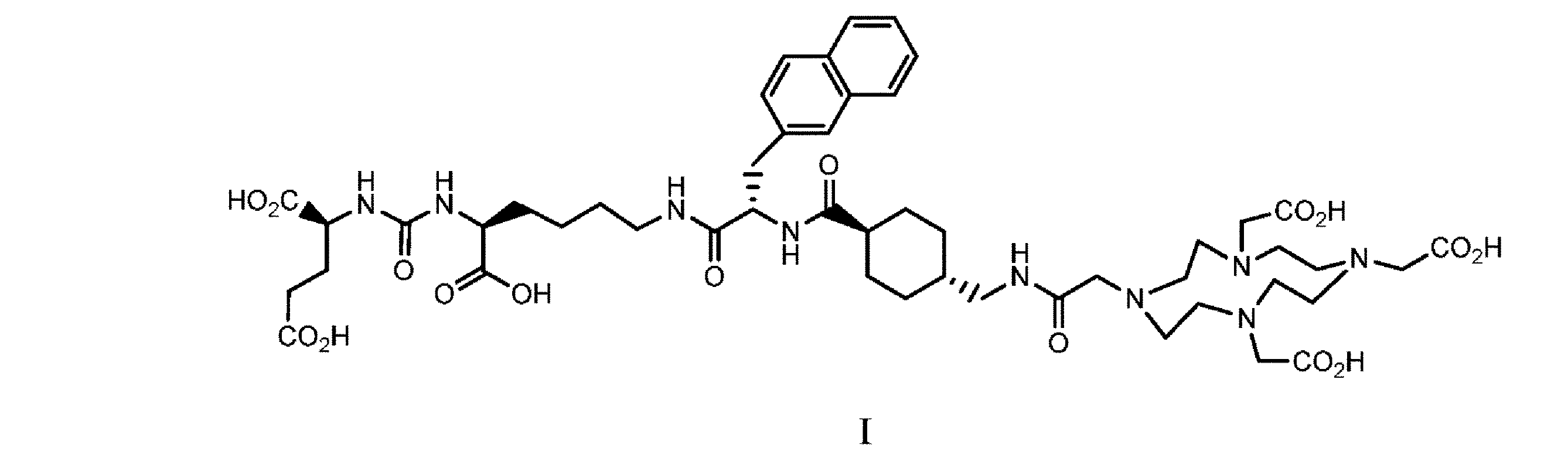
a)式A


b)式A’の樹脂系化合物を、式B


c)式Cの樹脂系化合物を、有機溶媒の存在下で第2の脱保護剤と接触させて、式C’

d)式C’の樹脂系化合物を、極性非プロトン性溶媒、カップリング剤、及び塩基の存在下で、PG
1
-3-(2-ナフチル)-L-アラニンと接触させて、式D

e)式Dの樹脂系化合物を、極性非プロトン性溶媒中で第1の脱保護剤と接触させて、式D’

f)式D’の樹脂系化合物を、極性非プロトン性溶媒、カップリング剤及び塩基の存在下でPG
1
-トラネキサム酸と接触させて、式E
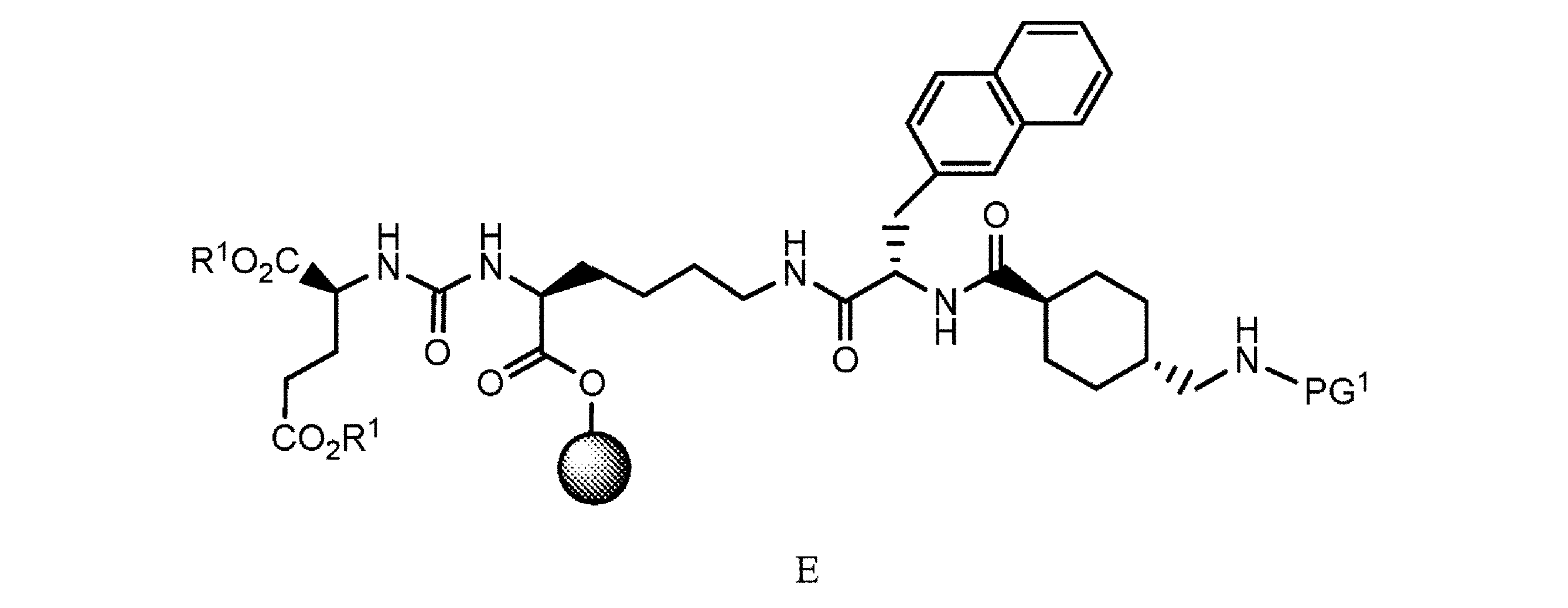
g)式Eの樹脂系化合物を、極性非プロトン性溶媒中で第1の脱保護剤と接触させて、式E’

h)式E’の樹脂系化合物を、式E
2’


i)式Fの前記樹脂系化合物を、有機溶媒中で第3の脱保護剤及び/又は切断試薬と接触させることを含み、
式中、PG
1
及びPG
2
は、アミン保護基であり、LGは、離脱基であり、R
1
は、C
1
~C
4
アルキル又はシクロヘキシルである、方法。
[請求項2]
工程(a)の前記第1の脱保護剤が、ピペリジン、モルホリン、1,8-ジアザビシクロ[5.4.0]ウンデカ-7-エン(DBU)、ジエチルアミン(DEA)、ジシクロヘキサミン、4-メチルピペリジン(4MP)、トリス(2-アミノエチル)アミン、ピリジン及びコリジンからなる群から選択される、請求項1に記載の方法。
[請求項3]
工程(a)の前記第1の脱保護剤がピペリジンである、請求項2に記載の方法。
[請求項4]
工程(a)の前記極性非プロトン性溶媒が、ジメチルホルムアミド(DMF)、N-メチル-2-ピロリドン(NMP)、ジクロロメタン(DCM)、ジクロロメタン/ジメチルホルムアミド混合物、アセトニトリル(ACN)、アセトニトリル/ジメチルホルムアミド混合物、及びジメチルスルホキシド(DMSO)からなる群から選択される、請求項3に記載の方法。
[請求項5]
工程(a)の前記極性非プロトン性溶媒がジメチルホルムアミド(DMF)である、請求項4に記載の方法。
[請求項6]
工程(b)の前記塩基が、N,N-ジイソプロピルエチルアミン(
i
Pr
2
NEt)、トリエチルアミン(TEA)、4-メチルモルホリン(NMM)、イミダゾール、ピリジン、及びコリジンからなる群から選択される、請求項1に記載の方法。
[請求項7]
前記工程(b)の前記塩基が、N,N-ジイソプロピルエチルアミン(
i
Pr
2
NEt)である、請求項6に記載の方法。
[請求項8]
工程(b)の前記有機溶媒が、CH
2
Cl
2
、THF、ジエチルエーテル、MeOH、EtOH、アセトン、アセトニトリルからなる群から選択される、請求項7に記載の方法。
[請求項9]
工程(b)の前記有機溶媒がCH
2
Cl
2
である、請求項8に記載の方法。
[請求項10]
工程(c)の前記第2の脱保護剤が、トリフルオロ酢酸(TFA)、酢酸、トリフルオロエタノール、ジクロロメタン、ヘキサフルオロイソプロパノール、ジクロロメタン、及びこれらの組み合わせからなる群から選択される、請求項1に記載の方法。
[請求項11]
工程(c)の前記第2の脱保護剤が、トリフルオロ酢酸(TFA)、又は酢酸とトリフルオロエタノールとの混合物である、請求項10に記載の方法。
[請求項12]
工程(c)の前記有機溶媒が、CH
2
Cl
2
、THF、ジエチルエーテル、MeOH、EtOH、アセトン、アセトニトリルからなる群から選択される、請求項11に記載の方法。
[請求項13]
工程(c)の前記有機溶媒がCH
2
Cl
2
である、請求項12に記載の方法。
[請求項14]
工程(d)の前記極性非プロトン性溶媒が、ジメチルホルムアミド(DMF)、N-メチル-2-ピロリドン(NMP)、ジクロロメタン(DCM)、ジクロロメタン/ジメチルホルムアミド混合物、アセトニトリル(ACN)、アセトニトリル/ジメチルホルムアミド混合物、及びジメチルスルホキシド(DMSO)からなる群から選択される、請求項1に記載の方法。
[請求項15]
工程(d)の前記極性非プロトン性溶媒がジメチルホルムアミド(DMF)である、請求項14に記載の方法。
[請求項16]
工程(d)の前記塩基が、N,N-ジイソプロピルエチルアミン(
i
Pr
2
NEt)、トリエチルアミン(TEA)、4-メチルモルホリン(NMM)、イミダゾール、ピリジン、及びコリジンからなる群から選択される、請求項15に記載の方法。
[請求項17]
工程(d)の前記塩基が、N,N-ジイソプロピルエチルアミン(
i
Pr
2
NEt)である、請求項16に記載の方法。
[請求項18]
工程(d)の前記カップリング剤が、ベンゾトリアゾール-1-イル-オキシトリピロリジノホスホニウムヘキサフルオロホスフェート(PyBOP)、1-[ビス(ジメチルアミノ)メチレン]-1H-1,2,3-トリアゾロ[4,5-b]ピリジニウム3-オキシドヘキサフルオロホスフェート(HATU)、2-(1H-ベンゾトリアゾール-1-イル)-1,1,3,3-テトラメチルウロニウムテトラフルオロボレート(TBTU)、2-(1H-ベンゾトリアゾール-1-イル)-1,1,3,3-テトラメチルウロニウムヘキサフルオロホスフェート(HBTU)、2-クロロ-4,6-ジメトキシ-1,3,5-トリアジン(CDMT)、N-[(5-クロロ-3-オキシド-1H-ベンゾトリアゾール-1-イル)-4-モルホリニルメチレン]-N-メチルメタンアミニウムヘキサフルオロホスフェート(HDMC)、1-シアノ-2-エトキシ-2-オキソエチリデンアミノオキシ)ジメチルアミノ-モルホリノ-カルベニウムヘキサフルオロホスフェート(COMU)、ジメチルアミノ(トリアゾロ[4,5-b]ピリジン-3-イルオキシ)メチリデン]-ジメチルアザニウム;テトラフルオロボレート(TATU)、N,N,N’,N’-テトラメチル-S-(1-オキシド-2-ピリジル)チオウロニウムテトラフルオロボレート(TOTT)、N-エトキシカルボニル-2-エトキシ-1,2-ジヒドロキノリン(EEDQ)、1-プロパンホスホン酸無水物(T3P)、及び4-(4,6-ジメトキシ-1,3,5-トリアジン-2-イル)-4-メチル-モルホリニウムクロリド(DMTMM)からなる群から選択される。請求項17に記載の方法。
[請求項19]
工程(d)の前記カップリング剤が、ベンゾトリアゾール-1-イル-オキシトリピロリジノホスホニウムヘキサフルオロホスフェート(PyBOP)である、請求項18に記載の方法。
[請求項20]
工程(e)の前記第1の脱保護剤が、ピペリジン、モルホリン、1,8-ジアザビシクロ[5.4.0]ウンデカ-7-エン(DBU)、ジエチルアミン(DEA)、ジシクロヘキサミン、4-メチルピペリジン(4MP)、トリス(2-アミノエチル)アミン、ピリジン及びコリジンからなる群から選択される、請求項1に記載の方法。
[請求項21]
工程(e)の前記第1の脱保護剤がピペリジンである、請求項20に記載の方法。
[請求項22]
工程(e)の前記極性非プロトン性溶媒が、ジメチルホルムアミド(DMF)、N-メチル-2-ピロリドン(NMP)、ジクロロメタン(DCM)、ジクロロメタン/ジメチルホルムアミド混合物、アセトニトリル(ACN)、アセトニトリル/ジメチルホルムアミド混合物、及びジメチルスルホキシド(DMSO)からなる群から選択される、請求項21に記載の方法。
[請求項23]
工程(e)の前記極性非プロトン性溶媒がジメチルホルムアミド(DMF)である、請求項22に記載の方法。
[請求項24]
工程(f)の前記極性非プロトン性溶媒が、ジメチルホルムアミド(DMF)、N-メチル-2-ピロリドン(NMP)、ジクロロメタン(DCM)、ジクロロメタン/ジメチルホルムアミド混合物、アセトニトリル(ACN)、アセトニトリル/ジメチルホルムアミド混合物、及びジメチルスルホキシド(DMSO)からなる群から選択される、請求項1に記載の方法。
[請求項25]
工程(f)の前記極性非プロトン性溶媒がジメチルホルムアミド(DMF)である、請求項24に記載の方法。
[請求項26]
工程(f)の前記塩基が、N,N-ジイソプロピルエチルアミン(
i
Pr
2
NEt)、トリエチルアミン(TEA)、4-メチルモルホリン(NMM)、イミダゾール、ピリジン、及びコリジンからなる群から選択される、請求項25に記載の方法。
[請求項27]
工程(f)の前記塩基が、N,N-ジイソプロピルエチルアミン(
i
Pr
2
NEt)である、請求項26に記載の方法。
[請求項28]
工程(f)の前記カップリング剤が、ベンゾトリアゾール-1-イル-オキシトリピロリジノホスホニウムヘキサフルオロホスフェート(PyBOP)、1-[ビス(ジメチルアミノ)メチレン]-1H-1,2,3-トリアゾロ[4,5-b]ピリジニウム3-オキシドヘキサフルオロホスフェート(HATU)、2-(1H-ベンゾトリアゾール-1-イル)-1,1,3,3-テトラメチルウロニウムテトラフルオロボレート(TBTU)、2-(1H-ベンゾトリアゾール-1-イル)-1,1,3,3-テトラメチルウロニウムヘキサフルオロホスフェート(HBTU)、2-クロロ-4,6-ジメトキシ-1,3,5-トリアジン(CDMT)、N-[(5-クロロ-3-オキシド-1H-ベンゾトリアゾール-1-イル)-4-モルホリニルメチレン]-N-メチルメタンアミニウムヘキサフルオロホスフェート(HDMC)、1-シアノ-2-エトキシ-2-オキソエチリデンアミノオキシ)ジメチルアミノ-モルホリノ-カルベニウムヘキサフルオロホスフェート(COMU)、ジメチルアミノ(トリアゾロ[4,5-b]ピリジン-3-イルオキシ)メチリデン]-ジメチルアザニウム;テトラフルオロボレート(TATU)、N,N,N’,N’-テトラメチル-S-(1-オキシド-2-ピリジル)チオウロニウムテトラフルオロボレート(TOTT)、N-エトキシカルボニル-2-エトキシ-1,2-ジヒドロキノリン(EEDQ)、1-プロパンホスホン酸無水物(T3P)、及び4-(4,6-ジメトキシ-1,3,5-トリアジン-2-イル)-4-メチル-モルホリニウムクロリド(DMTMM)からなる群から選択される、請求項27に記載の方法。
[請求項29]
工程(f)の前記カップリング剤が、ベンゾトリアゾール-1-イル-オキシトリピロリジノホスホニウムヘキサフルオロホスフェート(PyBOP)である、請求項28に記載の方法。
[請求項30]
工程(g)の前記第1の脱保護剤が、ピペリジン、モルホリン、1,8-ジアザビシクロ[5.4.0]ウンデカ-7-エン(DBU)、ジエチルアミン(DEA)、ジシクロヘキサミン、4-メチルピペリジン(4MP)、トリス(2-アミノエチル)アミン、ピリジン及びコリジンからなる群から選択される、請求項1に記載の方法。
[請求項31]
工程(g)の前記第1の脱保護剤がピペリジンである、請求項30に記載の方法。
[請求項32]
工程(g)の前記極性非プロトン性溶媒が、ジメチルホルムアミド(DMF)、N-メチル-2-ピロリドン(NMP)、ジクロロメタン(DCM)、ジクロロメタン/ジメチルホルムアミド混合物、アセトニトリル(ACN)、アセトニトリル/ジメチルホルムアミド混合物、及びジメチルスルホキシド(DMSO)からなる群から選択される、請求項31に記載の方法。
[請求項33]
工程(g)の前記極性非プロトン性溶媒がジメチルホルムアミド(DMF)である、請求項32に記載の方法。
[請求項34]
工程(h)の前記極性非プロトン性溶媒が、ジメチルホルムアミド(DMF)、N-メチル-2-ピロリドン(NMP)、ジクロロメタン(DCM)、ジクロロメタン/ジメチルホルムアミド混合物、アセトニトリル(ACN)、アセトニトリル/ジメチルホルムアミド混合物、及びジメチルスルホキシド(DMSO)からなる群から選択される、請求項1に記載の方法。
[請求項35]
工程(h)の前記極性非プロトン性溶媒がジメチルホルムアミド(DMF)である、請求項34に記載の方法。
[請求項36]
工程(h)の前記塩基が、N,N-ジイソプロピルエチルアミン(
i
Pr
2
NEt)、トリエチルアミン(TEA)、4-メチルモルホリン(NMM)、イミダゾール、ピリジン、及びコリジンからなる群から選択される、請求項35に記載の方法。
[請求項37]
工程(h)の前記塩基が、N,N-ジイソプロピルエチルアミン(
i
Pr
2
NEt)である、請求項36に記載の方法。
[請求項38]
工程(h)の前記カップリング剤が、ベンゾトリアゾール-1-イル-オキシトリピロリジノホスホニウムヘキサフルオロホスフェート(PyBOP)、1-[ビス(ジメチルアミノ)メチレン]-1H-1,2,3-トリアゾロ[4,5-b]ピリジニウム3-オキシドヘキサフルオロホスフェート(HATU)、2-(1H-ベンゾトリアゾール-1-イル)-1,1,3,3-テトラメチルウロニウムテトラフルオロボレート(TBTU)、2-(1H-ベンゾトリアゾール-1-イル)-1,1,3,3-テトラメチルウロニウムヘキサフルオロホスフェート(HBTU)、2-クロロ-4,6-ジメトキシ-1,3,5-トリアジン(CDMT)、N-[(5-クロロ-3-オキシド-1H-ベンゾトリアゾール-1-イル)-4-モルホリニルメチレン]-N-メチルメタンアミニウムヘキサフルオロホスフェート(HDMC)、1-シアノ-2-エトキシ-2-オキソエチリデンアミノオキシ)ジメチルアミノ-モルホリノ-カルベニウムヘキサフルオロホスフェート(COMU)、ジメチルアミノ(トリアゾロ[4,5-b]ピリジン-3-イルオキシ)メチリデン]-ジメチルアザニウム;テトラフルオロボレート(TATU)、N,N,N’,N’-テトラメチル-S-(1-オキシド-2-ピリジル)チオウロニウムテトラフルオロボレート(TOTT)、N-エトキシカルボニル-2-エトキシ-1,2-ジヒドロキノリン(EEDQ)、1-プロパンホスホン酸無水物(T3P)、及び4-(4,6-ジメトキシ-1,3,5-トリアジン-2-イル)-4-メチル-モルホリニウムクロリド(DMTMM)からなる群から選択される、請求項37に記載の方法。
[請求項39]
工程(h)の前記カップリング剤が、ベンゾトリアゾール-1-イル-オキシトリピロリジノホスホニウムヘキサフルオロホスフェート(PyBOP)である、請求項38に記載の方法。
[請求項40]
工程(i)の前記第3の脱保護剤が、トリフルオロ酢酸(TFA)、フッ化水素酸(HF)、トリフリック酸(TfOH)、トリフルオロ酢酸(TFA)/水/トリイソプロピルシラン混合物、トリフルオロ酢酸(TFA)/ジクロロメタン(DCM)混合物、トリエチルサリン(TES)、インドール、フェノール/アニソール混合物、及びチオアニソールからなる群から選択される、請求項1に記載の方法。
[請求項41]
工程(i)の前記第3の脱保護剤が、トリフルオロ酢酸(TFA)/水/トリイソプロピルシラン混合物である、請求項40に記載の方法。
[請求項42]
工程(i)の前記切断試薬が、トリフルオロ酢酸(TFA)又はトリフルオロ酢酸(TFA)/水/トリイソプロピルシラン混合物である、請求項41に記載の方法。
[請求項43]
工程(i)の前記有機溶媒が、CH
2
Cl
2
、THF、ジエチルエーテル、MeOH、EtOH、アセトン、アセトニトリルからなる群から選択される、請求項42に記載の方法。
[請求項44]
工程(i)の前記切断試薬が、トリフルオロ酢酸(TFA)/水/トリイソプロピルシラン混合物である、請求項43に記載の方法。
[請求項45]
工程(i)の前記有機溶媒がCH
2
Cl
2
である、請求項44に記載の方法。
[請求項46]
PG
1
が9-フルオレニルメチル-カルボニル(Fmoc)又はt-ブチルカルボニル(Boc)である、請求項1に記載の方法。
[請求項47]
PG
1
が9-フルオレニルメチル-カルボニル(Fmoc)である、請求項46に記載の方法。
[請求項48]
PG
2
がモノメトキシトリチル(MMt)又は4-メチルトリチル(Mtt)である、請求項1に記載の方法。
[請求項49]
PG
2
が4-メチルトリチル(Mtt)である、請求項47に記載の方法。
[請求項50]
LGが、

[請求項51]
R
1
がt-ブチルである、請求項1に記載の方法。
[請求項52]
式C

の樹脂系化合物。
[請求項53]
式C’

の樹脂系化合物。
[請求項54]
式D

の樹脂系化合物。
[請求項55]
式D’

の樹脂系化合物。
[請求項56]
式E

の樹脂系化合物。
[請求項57]
式E’

の樹脂系化合物。
[請求項58]
式F

の樹脂系化合物。
[請求項59]
PG
1
が9-フルオレニルメチル-カルボニル(Fmoc)又はt-ブチルカルボニル(Boc)である、請求項54又は56に記載の樹脂系化合物。
[請求項60]
PG
1
が9-フルオレニルメチル-カルボニル(Fmoc)である、請求項54、56、又は59のいずれか1項に記載の樹脂系化合物。
[請求項61]
PG
2
がモノメトキシトリチル(MMt)又は4-メチルトリチル(Mtt)である、請求項52に記載の樹脂系化合物。
[請求項62]
PG
2
が4-メチルトリチル(Mtt)である、請求項52又は61に記載の樹脂系化合物。
[請求項63]
R
1
がt-ブチルである、条項52~62のいずれか1項に記載の樹脂系化合物。
High resolution MS ES+ (TOF): M+H + =1042.5067m/z (theoretical value 1042.5096m/z)
The present invention includes the following embodiments.
[Claim 1]
Formula I
a) Formula A
b) reacting a resin-based compound of formula A′ with a compound of formula B
c) contacting the resin-based compound of formula C with a second deprotecting agent in the presence of an organic solvent to produce a compound of formula C'
d) contacting the resin-based compound of formula C′ with PG 1 -3-(2-naphthyl)-L-alanine in the presence of a polar aprotic solvent, a coupling agent, and a base to obtain a compound of formula D
e) contacting the resin-based compound of formula D with a first deprotecting agent in a polar aprotic solvent to produce a compound of formula D'
f) contacting the resin-based compound of formula D′ with PG 1 -tranexamic acid in the presence of a polar aprotic solvent, a coupling agent and a base to produce a resin-based compound of formula E
g) contacting the resin-based compound of formula E with a first deprotecting agent in a polar aprotic solvent to produce a compound of formula E'
h) reacting a resin-based compound of formula E' with a resin-based compound of formula E2 '
i) contacting said resin-based compound of formula F with a third deprotecting and/or cleaving agent in an organic solvent;
wherein PG 1 and PG 2 are amine protecting groups, LG is a leaving group, and R 1 is C 1 -C 4 alkyl or cyclohexyl.
[Claim 2]
The first deprotecting agent in step (a) is selected from the group consisting of piperidine, morpholine, 1,8-diazabicyclo[5.4.0]undec-7-ene (DBU), diethylamine (DEA), dicyclohexamine, 4- 2. The method of claim 1, wherein the amine is selected from the group consisting of methylpiperidine (4MP), tris(2-aminoethyl)amine, pyridine and collidine.
[Claim 3]
3. The method of claim 2, wherein the first deprotecting agent in step (a) is piperidine.
[Claim 4]
The polar aprotic solvent in step (a) is selected from the group consisting of dimethylformamide (DMF), N-methyl-2-pyrrolidone (NMP), dichloromethane (DCM), dichloromethane/dimethylformamide mixtures, acetonitrile (ACN), acetonitrile/dimethylformamide. 4. The method of claim 3, wherein the solvent is selected from the group consisting of: a mixture of dimethyl sulfoxide (DMSO);
[Claim 5]
5. The method of claim 4, wherein the polar aprotic solvent in step (a) is dimethylformamide (DMF).
[Claim 6]
The base in step (b) is selected from the group consisting of N,N-diisopropylethylamine (iPr2NEt), triethylamine (TEA), 4-methylmorpholine (NMM), imidazole, pyridine, and collidine . Item 1. The method according to item 1.
[Claim 7]
The method of claim 6, wherein the base in step (b) is N,N-diisopropylethylamine ( i Pr 2 NEt).
[Claim 8]
8. The method of claim 7, wherein the organic solvent in step (b) is selected from the group consisting of CH2Cl2 , THF , diethyl ether, MeOH, EtOH, acetone, acetonitrile.
[Claim 9]
9. The method of claim 8, wherein the organic solvent in step (b) is CH2Cl2 .
[Claim 10]
10. The method of claim 1, wherein the second deprotecting agent in step (c) is selected from the group consisting of trifluoroacetic acid (TFA), acetic acid, trifluoroethanol, dichloromethane, hexafluoroisopropanol, dichloromethane, and combinations thereof. The method according to
[Claim 11]
11. The method of claim 10, wherein the second deprotecting agent in step (c) is trifluoroacetic acid (TFA) or a mixture of acetic acid and trifluoroethanol.
[Claim 12]
12. The method of claim 11 , wherein the organic solvent in step (c) is selected from the group consisting of CH2Cl2 , THF, diethyl ether, MeOH, EtOH, acetone, acetonitrile.
[Claim 13]
13. The method of claim 12, wherein the organic solvent in step (c) is CH2Cl2 .
[Claim 14]
The polar aprotic solvent in step (d) is dimethylformamide (DMF), N-methyl-2-pyrrolidone (NMP), dichloromethane (DCM), dichloromethane/dimethylformamide mixture, acetonitrile (ACN), acetonitrile/dimethylformamide. 2. The method of claim 1, wherein the solvent is selected from the group consisting of: a mixture of dimethyl sulfoxide (DMSO);
[Claim 15]
15. The method of claim 14, wherein the polar aprotic solvent in step (d) is dimethylformamide (DMF).
[Claim 16]
The base in step (d) is selected from the group consisting of N,N- diisopropylethylamine (iPr2NEt ) , triethylamine (TEA), 4-methylmorpholine (NMM), imidazole, pyridine , and collidine. Item 16. The method according to item 15.
[Claim 17]
The method of claim 16, wherein the base in step (d) is N,N-diisopropylethylamine ( i Pr 2 NEt).
[Claim 18]
The coupling agent in step (d) is benzotriazol-1-yl-oxytripyrrolidinophosphonium hexafluorophosphate (PyBOP), 1-[bis(dimethylamino)methylene]-1H-1,2,3-triazolo [4,5-b]pyridinium 3-oxide hexafluorophosphate (HATU), 2-(1H-benzotriazol-1-yl)-1,1,3,3-tetramethyluronium tetrafluoroborate (TBTU), 2-(1H-benzotriazol-1-yl)-1,1,3,3-tetramethyluronium hexafluorophosphate (HBTU), 2-chloro-4,6-dimethoxy-1,3,5-triazine ( CDMT), N-[(5-chloro-3-oxido-1H-benzotriazol-1-yl)-4-morpholinylmethylene]-N-methylmethyl dimethylamino-morpholino-carbenium hexafluorophosphate (COMU), dimethylamino-(triazolo[4,5-b] pyridin-3-yloxy)methylidene]-dimethylazanium; tetrafluoroborate (TATU), N,N,N',N'-tetramethyl-S-(1-oxido-2-pyridyl)thiouronium tetrafluoroborate (TOTT), N-ethoxycarbonyl-2-ethoxy-1,2-dihydroquinoline (EEDQ), 1-propanephosphonic anhydride (T3P), and 4-(4,6-dimethoxy-1,3,5- 18. The method of claim 17, wherein the aryl group is selected from the group consisting of triazin-2-yl)-4-methyl-morpholinium chloride (DMTMM).
[Claim 19]
19. The method of claim 18, wherein the coupling agent in step (d) is benzotriazol-1-yl-oxytripyrrolidinophosphonium hexafluorophosphate (PyBOP).
[Claim 20]
The first deprotecting agent in step (e) is selected from the group consisting of piperidine, morpholine, 1,8-diazabicyclo[5.4.0]undec-7-ene (DBU), diethylamine (DEA), dicyclohexamine, 4- 2. The method of claim 1, wherein the amine is selected from the group consisting of methylpiperidine (4MP), tris(2-aminoethyl)amine, pyridine and collidine.
[Claim 21]
21. The method of claim 20, wherein the first deprotecting agent in step (e) is piperidine.
[Claim 22]
The polar aprotic solvent in step (e) is dimethylformamide (DMF), N-methyl-2-pyrrolidone (NMP), dichloromethane (DCM), dichloromethane/dimethylformamide mixture, acetonitrile (ACN), acetonitrile/dimethylformamide. 22. The method of claim 21 , wherein the amine is selected from the group consisting of: a mixture of dimethyl sulfoxide (DMSO);
[Claim 23]
23. The method of claim 22, wherein the polar aprotic solvent in step (e) is dimethylformamide (DMF).
[Claim 24]
The polar aprotic solvent in step (f) is dimethylformamide (DMF), N-methyl-2-pyrrolidone (NMP), dichloromethane (DCM), dichloromethane/dimethylformamide mixture, acetonitrile (ACN), acetonitrile/dimethylformamide. 2. The method of claim 1, wherein the amine is selected from the group consisting of: a mixture of dimethyl sulfoxide (DMSO);
[Claim 25]
25. The method of claim 24, wherein the polar aprotic solvent in step (f) is dimethylformamide (DMF).
[Claim 26]
The base in step (f) is selected from the group consisting of N,N-diisopropylethylamine (iPr2NEt), triethylamine (TEA), 4-methylmorpholine (NMM), imidazole, pyridine, and collidine . 26. The method according to item 25.
[Claim 27]
27. The method of claim 26, wherein the base in step (f) is N,N-diisopropylethylamine ( iPr2NEt ) .
[Claim 28]
The coupling agent in step (f) is benzotriazol-1-yl-oxytripyrrolidinophosphonium hexafluorophosphate (PyBOP), 1-[bis(dimethylamino)methylene]-1H-1,2,3-triazolo [4,5-b]pyridinium 3-oxide hexafluorophosphate (HATU), 2-(1H-benzotriazol-1-yl)-1,1,3,3-tetramethyluronium tetrafluoroborate (TBTU), 2-(1H-benzotriazol-1-yl)-1,1,3,3-tetramethyluronium hexafluorophosphate (HBTU), 2-chloro-4,6-dimethoxy-1,3,5-triazine ( CDMT), N-[(5-chloro-3-oxido-1H-benzotriazol-1-yl)-4-morpholinylmethylene]-N-methylmethanaminium 1-Cyano-2-ethoxy-2-oxoethylideneaminooxy)dimethylamino-morpholino-carbenium hexafluorophosphate (HDMC), 1-cyano-2-ethoxy-2-oxoethylideneaminooxy)dimethylamino-morpholino-carbenium hexafluorophosphate (COMU), dimethylamino(triazolo[4,5-b]pyridine- 3-yloxy)methylidene]-dimethylazanium; tetrafluoroborate (TATU), N,N,N',N'-tetramethyl-S-(1-oxido-2-pyridyl)thiouronium tetrafluoroborate (TOTT ), N-ethoxycarbonyl-2-ethoxy-1,2-dihydroquinoline (EEDQ), 1-propanephosphonic anhydride (T3P), and 4-(4,6-dimethoxy-1,3,5-triazine- 28. The method of claim 27, wherein the compound is selected from the group consisting of 2-yl)-4-methyl-morpholinium chloride (DMTMM).
[Claim 29]
29. The method of claim 28, wherein the coupling agent in step (f) is benzotriazol-1-yl-oxytripyrrolidinophosphonium hexafluorophosphate (PyBOP).
[Claim 30]
The first deprotecting agent in step (g) is selected from the group consisting of piperidine, morpholine, 1,8-diazabicyclo[5.4.0]undec-7-ene (DBU), diethylamine (DEA), dicyclohexamine, 4- 2. The method of claim 1, wherein the amine is selected from the group consisting of methylpiperidine (4MP), tris(2-aminoethyl)amine, pyridine and collidine.
[Claim 31]
31. The method of claim 30, wherein the first deprotecting agent in step (g) is piperidine.
[Claim 32]
The polar aprotic solvent in step (g) is dimethylformamide (DMF), N-methyl-2-pyrrolidone (NMP), dichloromethane (DCM), dichloromethane/dimethylformamide mixture, acetonitrile (ACN), acetonitrile/dimethylformamide. 32. The method of claim 31 , wherein the amine is selected from the group consisting of: a mixture of dimethyl sulfoxide (DMSO);
[Claim 33]
33. The method of claim 32, wherein the polar aprotic solvent in step (g) is dimethylformamide (DMF).
[Claim 34]
The polar aprotic solvent in step (h) is dimethylformamide (DMF), N-methyl-2-pyrrolidone (NMP), dichloromethane (DCM), dichloromethane/dimethylformamide mixture, acetonitrile (ACN), acetonitrile/dimethylformamide. 2. The method of claim 1, wherein the amine is selected from the group consisting of: a mixture of dimethyl sulfoxide (DMSO);
[Claim 35]
35. The method of claim 34, wherein the polar aprotic solvent in step (h) is dimethylformamide (DMF).
[Claim 36]
The base in step (h) is selected from the group consisting of N,N- diisopropylethylamine (iPr2NEt ) , triethylamine (TEA), 4-methylmorpholine (NMM), imidazole, pyridine, and collidine. 36. The method according to claim 35.
[Claim 37]
37. The method of claim 36, wherein the base in step (h) is N,N-diisopropylethylamine ( iPr2NEt ) .
[Claim 38]
The coupling agent in step (h) is benzotriazol-1-yl-oxytripyrrolidinophosphonium hexafluorophosphate (PyBOP), 1-[bis(dimethylamino)methylene]-1H-1,2,3-triazolo [4,5-b]pyridinium 3-oxide hexafluorophosphate (HATU), 2-(1H-benzotriazol-1-yl)-1,1,3,3-tetramethyluronium tetrafluoroborate (TBTU), 2-(1H-benzotriazol-1-yl)-1,1,3,3-tetramethyluronium hexafluorophosphate (HBTU), 2-chloro-4,6-dimethoxy-1,3,5-triazine ( CDMT), N-[(5-chloro-3-oxido-1H-benzotriazol-1-yl)-4-morpholinylmethylene]-N-methylmethanaminium 1-Cyano-2-ethoxy-2-oxoethylideneaminooxy)dimethylamino-morpholino-carbenium hexafluorophosphate (HDMC), 1-cyano-2-ethoxy-2-oxoethylideneaminooxy)dimethylamino-morpholino-carbenium hexafluorophosphate (COMU), dimethylamino(triazolo[4,5-b]pyridine- 3-yloxy)methylidene]-dimethylazanium; tetrafluoroborate (TATU), N,N,N',N'-tetramethyl-S-(1-oxido-2-pyridyl)thiouronium tetrafluoroborate (TOTT ), N-ethoxycarbonyl-2-ethoxy-1,2-dihydroquinoline (EEDQ), 1-propanephosphonic anhydride (T3P), and 4-(4,6-dimethoxy-1,3,5-triazine- 2-yl)-4-methyl-morpholinium chloride (DMTMM).
[Claim 39]
39. The method of claim 38, wherein the coupling agent in step (h) is benzotriazol-1-yl-oxytripyrrolidinophosphonium hexafluorophosphate (PyBOP).
[Claim 40]
The third deprotecting agent in step (i) is selected from the group consisting of trifluoroacetic acid (TFA), hydrofluoric acid (HF), triflic acid (TfOH), trifluoroacetic acid (TFA)/water/triisopropylsilane mixture, ... 2. The method of claim 1, wherein the anionic surfactant is selected from the group consisting of fluoroacetic acid (TFA)/dichloromethane (DCM) mixture, triethyl saline (TES), indole, phenol/anisole mixture, and thioanisole.
[Claim 41]
41. The method of claim 40, wherein the third deprotecting agent of step (i) is a trifluoroacetic acid (TFA)/water/triisopropylsilane mixture.
[Claim 42]
42. The method of claim 41 , wherein the cleavage reagent in step (i) is trifluoroacetic acid (TFA) or a trifluoroacetic acid (TFA)/water/triisopropylsilane mixture.
[Claim 43]
43. The method of claim 42 , wherein the organic solvent in step (i) is selected from the group consisting of CH2Cl2 , THF, diethyl ether, MeOH, EtOH, acetone, acetonitrile.
[Claim 44]
44. The method of claim 43, wherein the cleavage reagent in step (i) is a trifluoroacetic acid (TFA)/water/triisopropylsilane mixture.
[Claim 45]
45. The method of claim 44, wherein the organic solvent in step (i) is CH2Cl2 .
[Claim 46]
The method of claim 1, wherein PG 1 is 9-fluorenylmethyl-carbonyl (Fmoc) or t-butylcarbonyl (Boc).
[Claim 47]
The method of claim 46, wherein PG 1 is 9-fluorenylmethyl-carbonyl (Fmoc).
[Claim 48]
The method of claim 1, wherein PG 2 is monomethoxytrityl (MMt) or 4-methyltrityl (Mtt).
[Claim 49]
48. The method of claim 47, wherein PG 2 is 4-methyltrityl (Mtt).
[Claim 50]
L.G.
[Claim 51]
The method of claim 1, wherein R 1 is t-butyl.
[Claim 52]
Formula C
Resin-based compound.
[Claim 53]
Formula C'
Resin-based compound.
[Claim 54]
Formula D
Resin-based compound.
[Claim 55]
Formula D'
Resin-based compound.
[Claim 56]
Formula E
Resin-based compound.
[Claim 57]
Formula E'
Resin-based compound.
[Claim 58]
Formula F
Resin-based compound.
[Claim 59]
57. The resin-based compound of claim 54 or 56, wherein PG 1 is 9-fluorenylmethyl-carbonyl (Fmoc) or t-butylcarbonyl (Boc).
[Claim 60]
60. The resinous compound of any one of claims 54, 56, or 59, wherein PG 1 is 9-fluorenylmethyl-carbonyl (Fmoc).
[Claim 61]
The resin-based compound of claim 52, wherein PG 2 is monomethoxytrityl (MMt) or 4-methyltrityl (Mtt).
[Claim 62]
The resin-based compound of claim 52 or 61, wherein PG 2 is 4-methyltrityl (Mtt).
[Claim 63]
63. The resin-based compound of any one of clauses 52 to 62, wherein R 1 is t-butyl.
Claims (45)

a)式A


b)式A’の樹脂系化合物を、式B


c)式Cの樹脂系化合物を、有機溶媒の存在下で第2の脱保護剤と接触させて、式C’

d)式C’の樹脂系化合物を、極性非プロトン性溶媒、カップリング剤、及び塩基の存在下で、PG1-3-(2-ナフチル)-L-アラニンと接触させて、式D

e)式Dの樹脂系化合物を、極性非プロトン性溶媒中で第1の脱保護剤と接触させて、式D’

f)式D’の樹脂系化合物を、極性非プロトン性溶媒、カップリング剤及び塩基の存在下でPG1-トラネキサム酸と接触させて、式E

g)式Eの樹脂系化合物を、極性非プロトン性溶媒中で第1の脱保護剤と接触させて、式E’
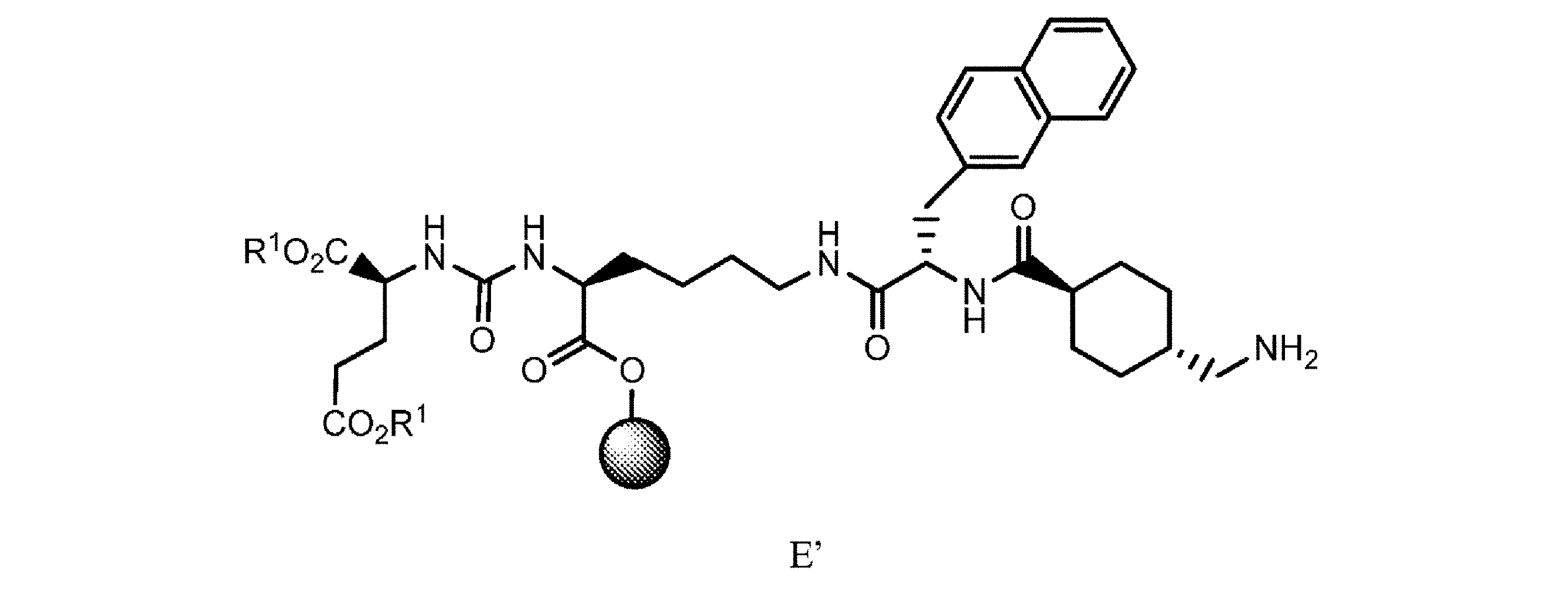
h)式E’の樹脂系化合物を、式E2’

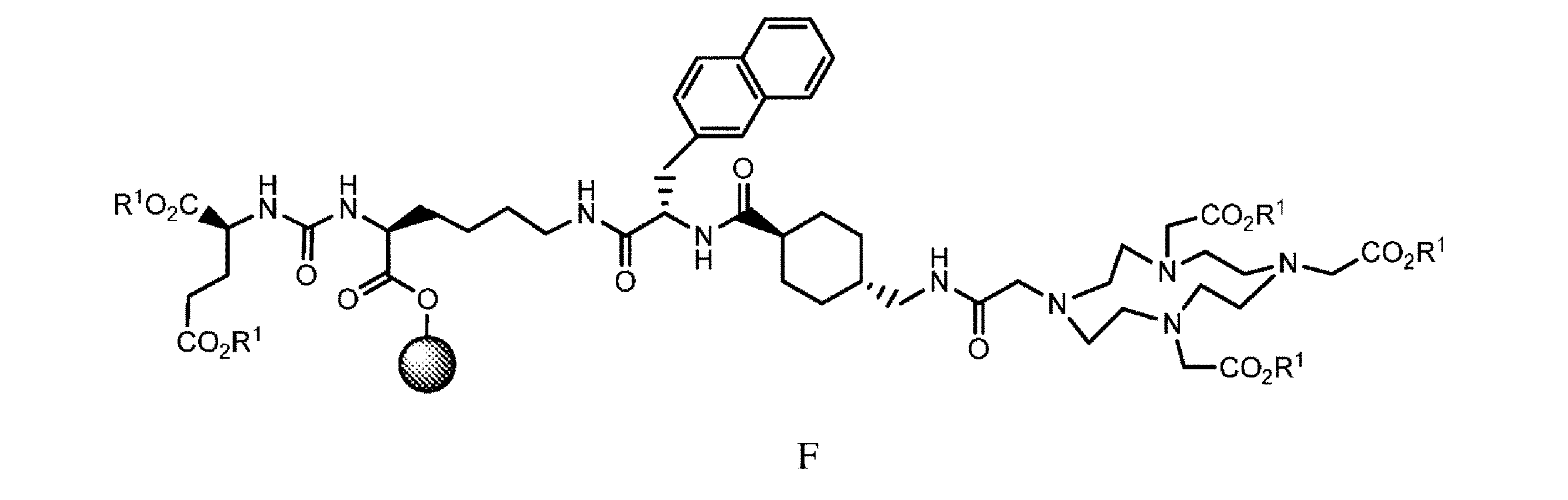
i)式Fの前記樹脂系化合物を、有機溶媒中で第3の脱保護剤及び/又は切断試薬と接触させることを含み、
式中、PG1 は、9-フルオレニルメチル-カルボニル(Fmoc)であり、PG2は、4-メチルトリチル(Mtt)であり、LGは、4-ニトロフェノキシであり、R1は、C1~C4アルキル又はシクロヘキシルである、方法。 Formula I
a) Formula A
b) reacting a resin-based compound of formula A′ with a compound of formula B
c) contacting the resin-based compound of formula C with a second deprotecting agent in the presence of an organic solvent to produce a compound of formula C'
d) contacting the resin-based compound of formula C′ with PG 1 -3-(2-naphthyl)-L-alanine in the presence of a polar aprotic solvent, a coupling agent, and a base to obtain a compound of formula D
e) contacting the resin-based compound of formula D with a first deprotecting agent in a polar aprotic solvent to produce a compound of formula D'
f) contacting the resin-based compound of formula D′ with PG 1 -tranexamic acid in the presence of a polar aprotic solvent, a coupling agent and a base to produce a resin-based compound of formula E
g) contacting the resin-based compound of formula E with a first deprotecting agent in a polar aprotic solvent to produce a compound of formula E'
h) reacting a resin-based compound of formula E' with a resin-based compound of formula E2 '
i) contacting said resin-based compound of formula F with a third deprotecting and/or cleaving agent in an organic solvent;
The method wherein PG 1 is 9-fluorenylmethyl-carbonyl (Fmoc), PG 2 is 4-methyltrityl (Mtt) , LG is 4-nitrophenoxy , and R 1 is C 1 -C 4 alkyl or cyclohexyl.
Priority Applications (1)
| Application Number | Priority Date | Filing Date | Title |
|---|---|---|---|
| JP2024216071A JP2025038037A (en) | 2019-05-20 | 2024-12-11 | Methods for preparing PSMA conjugates |
Applications Claiming Priority (7)
| Application Number | Priority Date | Filing Date | Title |
|---|---|---|---|
| US201962850119P | 2019-05-20 | 2019-05-20 | |
| US62/850,119 | 2019-05-20 | ||
| US201962910777P | 2019-10-04 | 2019-10-04 | |
| US62/910,777 | 2019-10-04 | ||
| US201962912353P | 2019-10-08 | 2019-10-08 | |
| US62/912,353 | 2019-10-08 | ||
| PCT/US2020/033584 WO2020236808A1 (en) | 2019-05-20 | 2020-05-19 | Methods for preparing psma conjugates |
Related Child Applications (1)
| Application Number | Title | Priority Date | Filing Date |
|---|---|---|---|
| JP2024216071A Division JP2025038037A (en) | 2019-05-20 | 2024-12-11 | Methods for preparing PSMA conjugates |
Publications (2)
| Publication Number | Publication Date |
|---|---|
| JP2022538379A JP2022538379A (en) | 2022-09-02 |
| JP7604397B2 true JP7604397B2 (en) | 2024-12-23 |
Family
ID=73459444
Family Applications (2)
| Application Number | Title | Priority Date | Filing Date |
|---|---|---|---|
| JP2021569296A Active JP7604397B2 (en) | 2019-05-20 | 2020-05-19 | Methods for preparing PSMA conjugates |
| JP2024216071A Pending JP2025038037A (en) | 2019-05-20 | 2024-12-11 | Methods for preparing PSMA conjugates |
Family Applications After (1)
| Application Number | Title | Priority Date | Filing Date |
|---|---|---|---|
| JP2024216071A Pending JP2025038037A (en) | 2019-05-20 | 2024-12-11 | Methods for preparing PSMA conjugates |
Country Status (5)
| Country | Link |
|---|---|
| US (2) | US12473265B2 (en) |
| EP (1) | EP3972627A4 (en) |
| JP (2) | JP7604397B2 (en) |
| CN (3) | CN120097930A (en) |
| WO (1) | WO2020236808A1 (en) |
Families Citing this family (7)
| Publication number | Priority date | Publication date | Assignee | Title |
|---|---|---|---|---|
| CN105849568B (en) | 2013-11-14 | 2018-05-04 | 恩多塞特公司 | Compounds for Positron Emission Tomography |
| KR20210003135A (en) | 2018-04-17 | 2021-01-11 | 엔도사이트, 인코포레이티드 | Cancer treatment method |
| PL4247833T3 (en) * | 2020-11-19 | 2026-02-23 | Novartis Ag | SYNTHESIS OF PROSTATE-SPECIFIC MEMBRANE ANTIGEN (PSMA) LIGANDS |
| KR20230155494A (en) * | 2021-02-26 | 2023-11-10 | 테릭스 파마슈티컬스 (이노베이션스) 피티와이 엘티디 | Solid phase synthesis of glutamate-urea-lysine derived (GUL derived) prostate-specific membrane antigen (PSMA) targeting conjugates and their use as precursors for therapeutic and/or diagnostic agents. |
| WO2023240135A2 (en) | 2022-06-07 | 2023-12-14 | Actinium Pharmaceuticals, Inc. | Bifunctional chelators and conjugates |
| WO2023231452A1 (en) * | 2023-02-14 | 2023-12-07 | 北京师范大学 | Psma-targeting radioactive metal complex containing nitro aromatic heterocyclic group and preparation thereof |
| CN117924253A (en) * | 2023-08-17 | 2024-04-26 | 厦门大学 | Glutamic acid urea compound, preparation method and application thereof, nuclide targeting probe, preparation method and application thereof and pharmaceutical composition |
Citations (1)
| Publication number | Priority date | Publication date | Assignee | Title |
|---|---|---|---|---|
| CN109134602A (en) | 2018-08-28 | 2019-01-04 | 兰州大学 | A kind of method for preparing solid phase of efficient prostate-specific membrane antigen ligand PSMA-617 |
Family Cites Families (280)
| Publication number | Priority date | Publication date | Assignee | Title |
|---|---|---|---|---|
| US4713249A (en) | 1981-11-12 | 1987-12-15 | Schroeder Ulf | Crystallized carbohydrate matrix for biologically active substances, a process of preparing said matrix, and the use thereof |
| EP0116208B1 (en) | 1982-12-07 | 1988-03-30 | Kyowa Hakko Kogyo Co., Ltd. | Mitomycin analogues |
| JPS60255789A (en) | 1984-06-01 | 1985-12-17 | Kyowa Hakko Kogyo Co Ltd | Mitomycin derivative, its preparation, and antitumor agent |
| US5266333A (en) | 1985-03-06 | 1993-11-30 | American Cyanamid Company | Water dispersible and water soluble carbohydrate polymer compositions for parenteral administration of growth hormone |
| WO1988001622A1 (en) | 1986-08-29 | 1988-03-10 | Kyowa Hakko Kogyo Kabusiki Kaisha | Mitomycin derivatives |
| JPH03206886A (en) | 1989-11-13 | 1991-09-10 | Green Cross Corp:The | Mouse-human chimera aio antibody having specificity against human tumor cell antigen |
| US5627165A (en) | 1990-06-13 | 1997-05-06 | Drug Innovation & Design, Inc. | Phosphorous prodrugs and therapeutic delivery systems using same |
| AU653565B2 (en) | 1990-12-21 | 1994-10-06 | Nikken Corporation | Raw sewage disposal apparatus and prefab for accomodating the same |
| US6291196B1 (en) | 1992-01-31 | 2001-09-18 | Research Corporation Technologies, Inc. | Melanoma and prostate cancer specific antibodies for immunodetection and immunotherapy |
| US7070782B1 (en) | 1992-11-05 | 2006-07-04 | Sloan-Kettering Institute For Cancer Research | Prostate-specific membrane antigen |
| US5674977A (en) | 1993-02-05 | 1997-10-07 | The Ontario Cancer Institute | Branched synthetic peptide conjugate |
| US6569432B1 (en) | 1995-02-24 | 2003-05-27 | Sloan-Kettering Institute For Cancer Research | Prostate-specific membrane antigen and uses thereof |
| JP3538221B2 (en) | 1993-11-19 | 2004-06-14 | 富士写真フイルム株式会社 | Fixing concentrate and processing method of silver halide photographic material using the same |
| US5417982A (en) | 1994-02-17 | 1995-05-23 | Modi; Pankaj | Controlled release of drugs or hormones in biodegradable polymer microspheres |
| US5866679A (en) | 1994-06-28 | 1999-02-02 | Merck & Co., Inc. | Peptides |
| GB9417873D0 (en) | 1994-09-06 | 1994-10-26 | Sandoz Ltd | Organic compounds |
| US6946133B1 (en) | 1996-03-20 | 2005-09-20 | The United States Of America As Represented By The Department Of Health And Human Services | Prostate specific antigen oligo-epitope peptide |
| AU726914B2 (en) | 1996-04-01 | 2000-11-23 | Epix Pharmaceuticals, Inc. | Bioactivated diagnostic imaging contrast agents |
| WO1997038313A1 (en) | 1996-04-05 | 1997-10-16 | The Johns Hopkins University | A method of enriching rare cells |
| US5795877A (en) | 1996-12-31 | 1998-08-18 | Guilford Pharmaceuticals Inc. | Inhibitors of NAALADase enzyme activity |
| US5672592A (en) | 1996-06-17 | 1997-09-30 | Guilford Pharmaceuticals Inc. | Certain phosphonomethyl-pentanedioic acid derivatives thereof |
| US5863536A (en) | 1996-12-31 | 1999-01-26 | Guilford Pharmaceuticals Inc. | Phosphoramidate derivatives |
| US5902817A (en) | 1997-04-09 | 1999-05-11 | Guilford Pharmaceuticals Inc. | Certain sulfoxide and sulfone derivatives |
| US6054444A (en) | 1997-04-24 | 2000-04-25 | Guilford Pharmaceuticals Inc. | Phosphonic acid derivatives |
| US5998362A (en) | 1996-09-12 | 1999-12-07 | Merck & Co., Inc. | Conjugates useful in the treatment of prostate cancer |
| US6368598B1 (en) | 1996-09-16 | 2002-04-09 | Jcrt Radiation Oncology Support Services, Inc. | Drug complex for treatment of metastatic prostate cancer |
| US5962521A (en) | 1997-04-04 | 1999-10-05 | Guilford Pharmaceuticals Inc. | Hydroxamic acid derivatives |
| US6177404B1 (en) | 1996-10-15 | 2001-01-23 | Merck & Co., Inc. | Conjugates useful in the treatment of benign prostatic hyperplasia |
| US5948750A (en) | 1996-10-30 | 1999-09-07 | Merck & Co., Inc. | Conjugates useful in the treatment of prostate cancer |
| AU7019498A (en) | 1997-04-10 | 1998-10-30 | Diagnocure Inc. | Pca3, pca3 genes, and methods of use |
| US6127333A (en) | 1997-07-10 | 2000-10-03 | Merck & Co., Inc. | Conjugates useful in the treatment of prostate cancer |
| US6391305B1 (en) | 1997-09-10 | 2002-05-21 | Merck & Co., Inc. | Conjugates useful in the treatment of prostate cancer |
| US20020115596A1 (en) | 1997-10-27 | 2002-08-22 | Merk & Co., Inc. | Conjugates useful in the treatment of prostate cancer |
| EP1036093A1 (en) | 1997-12-02 | 2000-09-20 | Merck & Co., Inc. | Conjugates useful in the treatment of prostate cancer |
| ZA9810974B (en) | 1997-12-02 | 1999-06-03 | Merck & Co Inc | Conjugates useful in the treatment of prostate cancer |
| US20040081659A1 (en) | 1997-12-02 | 2004-04-29 | Merck & Co., Inc. | Conjugates useful in the treatment of prostate cancer |
| WO1999045374A2 (en) | 1998-03-03 | 1999-09-10 | Mosaic Technologies | Purification and detection processes using reversible affinity electrophoresis |
| US20020103136A1 (en) | 1998-03-05 | 2002-08-01 | Dong-Mei Feng | Conjugates useful in the treatment of prostate cancer |
| US6232287B1 (en) | 1998-03-13 | 2001-05-15 | The Burnham Institute | Molecules that home to various selected organs or tissues |
| US6093382A (en) | 1998-05-16 | 2000-07-25 | Bracco Research Usa Inc. | Metal complexes derivatized with folate for use in diagnostic and therapeutic applications |
| AU757698C (en) | 1998-06-01 | 2004-04-08 | Agensys, Inc. | Novel serpentine transmembrane antigens expressed in human cancers and uses thereof |
| US6833438B1 (en) | 1999-06-01 | 2004-12-21 | Agensys, Inc. | Serpentine transmembrane antigens expressed in human cancers and uses thereof |
| US7138103B2 (en) | 1998-06-22 | 2006-11-21 | Immunomedics, Inc. | Use of bi-specific antibodies for pre-targeting diagnosis and therapy |
| US20070020327A1 (en) | 1998-11-10 | 2007-01-25 | John Fikes | Inducing cellular immune responses to prostate cancer antigens using peptide and nucleic acid compositions |
| US6174858B1 (en) | 1998-11-17 | 2001-01-16 | Merck & Co., Inc. | Conjugates useful in the treatment of prostate cancer |
| US20030207808A1 (en) | 1999-02-18 | 2003-11-06 | Kinneret Savitzky | Novel nucleic acid and amino acid sequences |
| AU4063600A (en) | 1999-04-05 | 2000-10-23 | Merck & Co., Inc. | A method of treating cancer |
| US6528499B1 (en) | 2000-04-27 | 2003-03-04 | Georgetown University | Ligands for metabotropic glutamate receptors and inhibitors of NAALADase |
| US6479470B1 (en) | 1999-04-28 | 2002-11-12 | Georgetown University | Ligands for metabotropic glutamate receptors and inhibitors of NAALAdase |
| AUPQ014799A0 (en) | 1999-05-04 | 1999-05-27 | Access Pharmaceuticals Australia Pty Limited | Amplification of folate-mediated targeting to tumor cells using polymers |
| JP3625690B2 (en) | 1999-05-14 | 2005-03-02 | 学校法人東京歯科大学 | Dental training desk |
| US7166573B1 (en) | 1999-05-28 | 2007-01-23 | Ludwig Institute For Cancer Research | Breast, gastric and prostate cancer associated antigens and uses therefor |
| US20040146516A1 (en) | 1999-06-17 | 2004-07-29 | Utah Ventures Ii L.P. | Lumen-exposed molecules and methods for targeted delivery |
| US7361338B2 (en) | 1999-10-05 | 2008-04-22 | Agensys, Inc. | Methods to inhibit growth of prostate cancer cells |
| US6692724B1 (en) | 1999-10-25 | 2004-02-17 | Board Of Regents, The University Of Texas System | Ethylenedicysteine (EC)-drug conjugates, compositions and methods for tissue specific disease imaging |
| US6428785B1 (en) | 1999-10-28 | 2002-08-06 | Immunolytics Inc. | Method and composition for treating prostate cancer |
| CA2391534A1 (en) | 1999-11-15 | 2001-05-25 | Drug Innovation & Design, Inc. | Selective cellular targeting: multifunctional delivery vehicles |
| NZ521898A (en) | 2000-03-31 | 2004-11-26 | Purdue Research Foundation | Use of a ligand-immunogen conjugate such as folate-FITC for enhancing an endogenous immune response |
| DK1286704T3 (en) | 2000-06-02 | 2014-09-22 | Univ Texas | Ethylenedicine (EC) -glucose analog conjugates |
| US20030072794A1 (en) | 2000-06-09 | 2003-04-17 | Teni Boulikas | Encapsulation of plasmid DNA (lipogenes™) and therapeutic agents with nuclear localization signal/fusogenic peptide conjugates into targeted liposome complexes |
| JP4176466B2 (en) | 2000-10-16 | 2008-11-05 | ギリード・サイエンシズ・インコーポレーテッド | Nucleic acid ligands for prostate specific membrane antigen |
| US20020132983A1 (en) | 2000-11-30 | 2002-09-19 | Junghans Richard P. | Antibodies as chimeric effector cell receptors against tumor antigens |
| US7468354B2 (en) | 2000-12-01 | 2008-12-23 | Genspera, Inc. | Tissue specific prodrugs |
| AU2002249935A1 (en) | 2001-01-08 | 2002-08-19 | Neorx Corporation | Radioactively labelled conjugates of phosphonates |
| WO2002098885A1 (en) | 2001-02-07 | 2002-12-12 | Beth Israel Deaconess Medical Center | Modified psma ligands and uses related thereto |
| JP3596479B2 (en) | 2001-03-05 | 2004-12-02 | 森 勇蔵 | Composite evaluation system of surface by light scattering method |
| US7767202B2 (en) | 2001-03-16 | 2010-08-03 | The Johns Hopkins University | Modulation of systemic immune responses by transplantation of hematopoietic stem cells transduced with genes encoding antigens and antigen presenting cell regulatory molecules |
| WO2002085908A1 (en) | 2001-04-24 | 2002-10-31 | Purdue Research Foundation | Folate mimetics and folate-receptor binding conjugates thereof |
| PL367102A1 (en) | 2001-05-02 | 2005-02-21 | Purdue Research Foundation | Treatment and diagnosis of macrophage mediated disease |
| US20040092890A1 (en) | 2001-05-10 | 2004-05-13 | Ash Stephen R. | Catheter lock solution including a photo-oxidant |
| US7109165B2 (en) | 2001-05-18 | 2006-09-19 | Sirna Therapeutics, Inc. | Conjugates and compositions for cellular delivery |
| US7514078B2 (en) | 2001-06-01 | 2009-04-07 | Cornell Research Foundation, Inc. | Methods of treating prostate cancer with anti-prostate specific membrane antigen antibodies |
| JP4619651B2 (en) | 2001-06-01 | 2011-01-26 | コーネル・リサーチ・ファンデーション・インコーポレイテッド | Modified antibodies against prostate-specific membrane antigen and uses thereof |
| US20040018203A1 (en) | 2001-06-08 | 2004-01-29 | Ira Pastan | Pegylation of linkers improves antitumor activity and reduces toxicity of immunoconjugates |
| AU2002315411A1 (en) | 2001-06-21 | 2003-01-08 | Glycotech Corporation | Detection and treatment of prostate cancer |
| US20030031677A1 (en) | 2001-06-25 | 2003-02-13 | Drug Innovation & Design, Incorporated | Exponential pattern recognition based cellular targeting, compositions, methods and anticancer applications |
| US7893223B2 (en) | 2001-07-17 | 2011-02-22 | Bracco Imaging S.P.A. | Multidentate AZA ligands able to complex metal ions and the use thereof in diagnostics and therapy |
| ES2388170T3 (en) | 2001-08-24 | 2012-10-09 | Uvic Industry Partnerships Inc. | Proaerolysin containing protease activation sequences and methods of use for the treatment of prostate cancer |
| IL159422A0 (en) | 2001-09-20 | 2004-06-01 | Cornell Res Foundation Inc | Methods and compositions for treating or preventing skin disorders using binding agents specific for prostate-specific membrane antigen |
| US20030232760A1 (en) | 2001-09-21 | 2003-12-18 | Merck & Co., Inc. | Conjugates useful in the treatment of prostate cancer |
| ES2338305T3 (en) | 2001-09-28 | 2010-05-06 | Purdue Research Foundation | TREATMENT METHOD THAT USES BINDING-IMMUNOGEN CONJUGATES. |
| US20030215456A1 (en) | 2001-10-02 | 2003-11-20 | Sui-Long Yao | Method of treating cancer |
| US20030133927A1 (en) | 2001-10-10 | 2003-07-17 | Defeo-Jones Deborah | Conjugates useful in the treatment of prostate cancer |
| US20040058857A1 (en) | 2001-11-29 | 2004-03-25 | Siu-Long Yao | Method of treating cancer |
| US20070031438A1 (en) | 2001-12-10 | 2007-02-08 | Junghans Richard P | Antibodies as chimeric effector cell receptors against tumor antigens |
| ATE443260T1 (en) | 2002-01-10 | 2009-10-15 | Univ Johns Hopkins | CONTRAST AGENTS AND METHOD FOR IMAGING NAALDASE OR PSMA |
| AU2003217304A1 (en) | 2002-02-28 | 2003-09-16 | The University Of Tennessee Research Corporation | Radiolabeled selective androgen receptor modulators and their use in prostate cancer imaging and therapy |
| CA2478592A1 (en) | 2002-03-07 | 2003-09-18 | The Johns Hopkins University School Of Medicine | Genomic screen for epigenetically silenced genes associated with cancer |
| US7534580B2 (en) | 2002-05-01 | 2009-05-19 | Ambrilia Biopharma Inc. | PSP94 diagnostic reagents and assays |
| EP2258401B1 (en) | 2002-05-06 | 2014-07-09 | Endocyte, Inc. | Folate-receptor targeted imaging agents |
| CA2484640C (en) | 2002-05-15 | 2012-01-17 | Endocyte, Inc. | Vitamin-mitomycin conjugates |
| US7597876B2 (en) | 2007-01-11 | 2009-10-06 | Immunomedics, Inc. | Methods and compositions for improved F-18 labeling of proteins, peptides and other molecules |
| US7767803B2 (en) | 2002-06-18 | 2010-08-03 | Archemix Corp. | Stabilized aptamers to PSMA and their use as prostate cancer therapeutics |
| AR040956A1 (en) | 2002-07-31 | 2005-04-27 | Schering Ag | NEW CONJUGATES OF EFFECTORS, PROCEDURES FOR THEIR PREPARATION AND PHARMACEUTICAL USE |
| ES2544527T3 (en) | 2002-07-31 | 2015-09-01 | Seattle Genetics, Inc. | Drug conjugates and their use to treat cancer, an autoimmune disease or an infectious disease |
| WO2006028429A2 (en) | 2002-08-05 | 2006-03-16 | The Johns Hopkins University | Peptides for targeting the prostate specific membrane antigen |
| US7662795B2 (en) | 2002-08-08 | 2010-02-16 | The Johns Hopkins University | Enhancement of adenoviral oncolytic activity by modification of the E1A gene product |
| US8487128B2 (en) | 2002-11-26 | 2013-07-16 | Chs Pharma, Inc. | Protection of normal cells |
| US7875586B2 (en) | 2002-12-20 | 2011-01-25 | The Johns Hopkins University | Treatment of metastatic colon cancer with b-subunit of shiga toxin |
| US20080008649A1 (en) | 2003-01-13 | 2008-01-10 | Bracco Imaging S.P.A. | Gastrin Releasing Peptide Compounds |
| US7226577B2 (en) | 2003-01-13 | 2007-06-05 | Bracco Imaging, S. P. A. | Gastrin releasing peptide compounds |
| JP5576007B2 (en) | 2003-01-27 | 2014-08-20 | エンドサイト・インコーポレイテッド | Vitamin receptor binding drug delivery conjugates |
| CA2514419A1 (en) | 2003-01-28 | 2004-08-12 | Proscan Rx Pharma Inc. | Prostate cancer diagnosis and treatment |
| EP1444990A1 (en) | 2003-02-07 | 2004-08-11 | Amersham plc | Improved Radiometal Complex Compositions |
| US7638122B2 (en) | 2003-03-07 | 2009-12-29 | University Of South Florida | Stat3 antagonists and their use as vaccines against cancer |
| EP1603392A2 (en) | 2003-03-07 | 2005-12-14 | The University Of Toledo | Paclitaxel hybrid derivatives |
| US20070179100A1 (en) | 2003-04-09 | 2007-08-02 | Muthiah Manoharan | Protected monomers |
| JP4597976B2 (en) | 2003-04-17 | 2010-12-15 | アルナイラム ファーマシューティカルズ インコーポレイテッド | Modified iRNA agent |
| WO2004096120A2 (en) | 2003-05-01 | 2004-11-11 | Nst Neurosurvival Technologies Ltd. | Compounds that selectively bind to membranes of apoptotic cells |
| US8088387B2 (en) | 2003-10-10 | 2012-01-03 | Immunogen Inc. | Method of targeting specific cell populations using cell-binding agent maytansinoid conjugates linked via a non-cleavable linker, said conjugates, and methods of making said conjugates |
| JP4937751B2 (en) | 2003-06-13 | 2012-05-23 | イミューノメディクス、インコーポレイテッド | D-amino acid peptide |
| US7232805B2 (en) | 2003-09-10 | 2007-06-19 | Inflabloc Pharmaceuticals, Inc. | Cobalamin conjugates for anti-tumor therapy |
| US20050085417A1 (en) | 2003-10-16 | 2005-04-21 | Thomas Jefferson University | Compounds and methods for diagnostic imaging and therapy |
| WO2005051315A2 (en) | 2003-11-24 | 2005-06-09 | The Regents Of The University Of California | On-demand cleavable linkers for radioconjugates for cancer imaging and therapy |
| FR2864546A1 (en) | 2003-12-24 | 2005-07-01 | Assist Publ Hopitaux De Paris | METHOD OF IDENTIFYING AND PREPARING T REGULATORY / SUPPRESSOR T CELLS, COMPOSITIONS AND USES |
| US8586932B2 (en) | 2004-11-09 | 2013-11-19 | Spectrum Dynamics Llc | System and method for radioactive emission measurement |
| DE102004004787A1 (en) | 2004-01-30 | 2005-08-18 | Schering Ag | New effector-linker and effector-recognition unit conjugates derived from epothilones, useful as targeted drugs for treating proliferative diseases, e.g. tumors or neurodegenerative disease |
| EP1718667B1 (en) | 2004-02-23 | 2013-01-09 | Genentech, Inc. | Heterocyclic self-immolative linkers and conjugates |
| CN1926433A (en) | 2004-03-03 | 2007-03-07 | 拜奥默里克斯公司 | Method for detection of activatable free form of PSA and its use for diagnosis of benign pathology of the prostate and adenocarcinoma of the prostate |
| WO2005094882A1 (en) | 2004-03-03 | 2005-10-13 | Millennium Pharmaceuticals, Inc. | Modified antibodies to prostate-specific membrane antigen and uses thereof |
| ATE403157T1 (en) | 2004-03-15 | 2008-08-15 | Hoffmann La Roche | USE OF BNP-ART AND ANP-ART PEPTIDES FOR DETERMINING THE HAZARDS OF CARDIOVASCULAR COMPLICATIONS AS A RESULT OF VOLUME OVERLOAD |
| WO2005100404A1 (en) | 2004-04-19 | 2005-10-27 | Proscan Rx Pharma | Prostate cancer diagnosis and treatment |
| EP1737879B1 (en) | 2004-04-19 | 2012-10-10 | Archemix LLC | Aptamer-mediated intracellular delivery of therapeutic oligonucleotides |
| US7517903B2 (en) | 2004-05-19 | 2009-04-14 | Medarex, Inc. | Cytotoxic compounds and conjugates |
| US7691962B2 (en) | 2004-05-19 | 2010-04-06 | Medarex, Inc. | Chemical linkers and conjugates thereof |
| US20080008719A1 (en) | 2004-07-10 | 2008-01-10 | Bowdish Katherine S | Methods and compositions for the treatment of prostate cancer |
| JP5149620B2 (en) | 2004-07-23 | 2013-02-20 | エンドサイト,インコーポレイテッド | Bivalent linker and conjugate thereof |
| EA012464B1 (en) | 2004-08-04 | 2009-10-30 | Эпплайд Молекьюлар Эволюшн, Инк. | Antibody against cd20 and use thereof |
| KR20070063526A (en) | 2004-08-30 | 2007-06-19 | 뉴로메드 파머큐티칼즈 리미티드 | Urea Derivatives, Calcium Channel Blockers |
| US7713944B2 (en) | 2004-10-13 | 2010-05-11 | Isis Pharmaceuticals, Inc. | Oligomers comprising activated disulfides which bind to plasma proteins and their use for delivery to cells |
| US7638525B2 (en) | 2004-10-27 | 2009-12-29 | Janssen Pharmaceutica N.V. | Trisubstituted thiophenes as progesterone receptor modulators |
| US8423125B2 (en) | 2004-11-09 | 2013-04-16 | Spectrum Dynamics Llc | Radioimaging |
| US8606349B2 (en) | 2004-11-09 | 2013-12-10 | Biosensors International Group, Ltd. | Radioimaging using low dose isotope |
| US20060140871A1 (en) | 2004-11-30 | 2006-06-29 | Sillerud Laurel O | Magnetic resonance imaging of prostate cancer |
| US7872235B2 (en) | 2005-01-13 | 2011-01-18 | Spectrum Dynamics Llc | Multi-dimensional image reconstruction and analysis for expert-system diagnosis |
| US7741510B2 (en) | 2005-01-13 | 2010-06-22 | E. I. Du Pont De Nemours And Company | Rheology control agents |
| US20060155021A1 (en) | 2005-01-13 | 2006-07-13 | Lenges Christian P | Coating compositions containing rheology control agents |
| AU2006210794A1 (en) | 2005-02-01 | 2006-08-10 | Government Of The U.S.A., As Represented By The Secretary, Department Of Health & Human Services | Biomarkers for tissue status |
| WO2006093991A1 (en) | 2005-03-02 | 2006-09-08 | The Cleveland Clinic Foundation | Compounds which bind psma and uses thereof |
| CA2600418A1 (en) | 2005-03-07 | 2006-09-14 | Archemix Corp. | Stabilized aptamers to psma and their use as prostate cancer therapeutics |
| KR100621632B1 (en) | 2005-03-22 | 2006-09-19 | 삼성전자주식회사 | NOR flash memory device performing serial sensing operation |
| CN101184506B (en) | 2005-03-25 | 2013-07-17 | 健泰科生物技术公司 | Methods and compositions for modulating hyperstabilized c-met |
| US8088908B2 (en) | 2005-05-10 | 2012-01-03 | City Of Hope | Humanized anti-prostate stem cell antigen monoclonal antibody |
| KR101068612B1 (en) | 2005-05-24 | 2011-09-30 | 휴마시스 주식회사 | Diagnostic device using similar structure protein ratio measurement |
| US8916161B2 (en) | 2005-06-14 | 2014-12-23 | Sophiris Bio Inc. | Method of treating or preventing benign prostatic hyperplasia using modified pore-forming proteins |
| CN103127523A (en) | 2005-06-20 | 2013-06-05 | Psma开发有限公司 | Psma antibody-drug conjugates |
| JP5175723B2 (en) | 2005-07-05 | 2013-04-03 | パーデュー・リサーチ・ファウンデーション | Preparation of compositions for treating monocyte-mediated diseases |
| US20070010014A1 (en) | 2005-07-06 | 2007-01-11 | General Electric Company | Compositions and methods for enhanced delivery to target sites |
| EP1908011B1 (en) | 2005-07-19 | 2013-09-04 | Spectrum Dynamics LLC | Reconstruction stabilizer and active vision |
| EP2374480A3 (en) | 2005-08-19 | 2013-05-01 | Endocyte, Inc. | Mutli-drug ligand conjugates |
| JP2009504783A (en) | 2005-08-19 | 2009-02-05 | エンドサイト,インコーポレイテッド | Ligand conjugates of vinca alkaloids, analogues and derivatives |
| US20100144641A1 (en) | 2005-09-12 | 2010-06-10 | Popel Aleksander S | Compositions Having Antiangiogenic Activity and Uses Thereof |
| CA2625196C (en) | 2005-10-07 | 2016-04-05 | Guerbet | Compounds comprising a biological target recognizing part, coupled to a signal part capable of complexing gallium |
| WO2008048298A2 (en) | 2005-11-21 | 2008-04-24 | Medivas, Llc | Polymer particles for delivery of macromolecules and methods of use |
| ES2548518T3 (en) | 2005-11-23 | 2015-10-19 | Ventana Medical Systems, Inc. | Molecular conjugate |
| US8258256B2 (en) | 2006-01-05 | 2012-09-04 | The Johns Hopkins University | Compositions and methods for the treatment of cancer |
| US7635682B2 (en) | 2006-01-06 | 2009-12-22 | Genspera, Inc. | Tumor activated prodrugs |
| ES2397973T3 (en) | 2006-03-14 | 2013-03-12 | Cancer Targeted Technology Llc | PSMA peptidomimetic inhibitors, compounds that comprise them and methods of use |
| EP1996716B1 (en) | 2006-03-20 | 2011-05-11 | The Regents of the University of California | Engineered anti-prostate stem cell antigen (psca) antibodies for cancer targeting |
| US20070225213A1 (en) | 2006-03-23 | 2007-09-27 | Kosak Matthew K | Nucleic acid carriers for delivery of therapeutic agents |
| US20140314864A1 (en) | 2006-03-31 | 2014-10-23 | Massachusetts Institute Of Technology | System for Targeted Delivery of Therapeutic Agents |
| CA2648099C (en) | 2006-03-31 | 2012-05-29 | The Brigham And Women's Hospital, Inc | System for targeted delivery of therapeutic agents |
| US9265746B2 (en) | 2006-05-31 | 2016-02-23 | Merck & Cie | Method for cell-specific targeting |
| JP2009544545A (en) | 2006-07-31 | 2009-12-17 | バイエル コンスーマー ケア アーゲー | 2-part container with hinged actuator for cutter |
| US7842280B2 (en) | 2006-09-06 | 2010-11-30 | Case Western Reserve University | Flexibly labeling peptides |
| US10925977B2 (en) | 2006-10-05 | 2021-02-23 | Ceil>Point, LLC | Efficient synthesis of chelators for nuclear imaging and radiotherapy: compositions and applications |
| US8685752B2 (en) | 2006-11-03 | 2014-04-01 | Purdue Research Foundation | Ex vivo flow cytometry method and device |
| CA2669127C (en) | 2006-11-08 | 2016-09-13 | Molecular Insight Pharmaceuticals, Inc. | Heterodimers of glutamic acid |
| CA2670749A1 (en) | 2006-12-05 | 2008-06-12 | Landec Corporation | Drug delivery |
| WO2008085828A2 (en) | 2007-01-03 | 2008-07-17 | The Johns Hopkins University | Peptide modulators of angiogenesis and use thereof |
| AU2007343600B2 (en) | 2007-01-11 | 2012-06-28 | Immunomedics, Inc. | Methods and compositions for improved F-18 labeling of proteins, peptides and other molecules |
| US8709382B2 (en) | 2007-01-11 | 2014-04-29 | Immunomedics, Inc. | Methods and compositions for improved F-18 labeling of proteins, peptides and other molecules |
| US20160045626A1 (en) | 2007-01-11 | 2016-02-18 | Immunomedics, Inc. | Methods and Compositions for Improved Labeling of Targeting Peptides |
| US8889100B2 (en) | 2007-01-11 | 2014-11-18 | Immunomedics, Inc. | Methods and compositions for improved F-18 labeling of proteins, peptides and other molecules |
| WO2008094254A2 (en) | 2007-01-26 | 2008-08-07 | City Of Hope | Methods and compositions for the treatment of cancer or other diseases |
| US8586595B2 (en) | 2007-02-07 | 2013-11-19 | Purdue Research Foundation | Positron emission tomography imaging method |
| US20100104626A1 (en) | 2007-02-16 | 2010-04-29 | Endocyte, Inc. | Methods and compositions for treating and diagnosing kidney disease |
| NZ580132A (en) | 2007-03-14 | 2012-11-30 | Endocyte Inc | Binding ligand linked drug delivery conjugates of tubulysins to vitamins |
| EP2155231B1 (en) | 2007-04-10 | 2012-08-08 | The Johns Hopkins University | Imaging and therapy of virus-associated tumors |
| CN104383553A (en) | 2007-06-25 | 2015-03-04 | 恩多塞特公司 | Conjugates containing hydrophilic spacer linkers |
| CA2926573C (en) | 2007-06-26 | 2018-08-28 | The Johns Hopkins University | Labeled inhibitors of prostate specific membrane antigen (psma), biological evaluation, and use as imaging agents |
| GB0723246D0 (en) | 2007-07-03 | 2008-01-09 | Barton Michelle | p53 modulator |
| AU2008293885A1 (en) | 2007-07-13 | 2009-03-05 | The John Hopkins University | B7-DC variants |
| CA2695385A1 (en) | 2007-07-31 | 2009-02-05 | Atul Bedi | Polypeptide-nucleic acid conjugate for immunoprophylaxis or immunotherapy for neoplastic or infectious disorders |
| US9193763B2 (en) | 2007-08-17 | 2015-11-24 | Purdue Research Foundation | PSMA binding ligand-linker conjugates and methods for using |
| EP2185188B1 (en) | 2007-08-22 | 2014-08-06 | Medarex, L.L.C. | Site-specific attachment of drugs or other agents to engineered antibodies with c-terminal extensions |
| WO2009035942A1 (en) | 2007-09-13 | 2009-03-19 | Chemimage Corporation | Distinguishing between renal oncocytoma and chromophobe renal cell carcinoma using raman molecular imaging |
| SI2644192T1 (en) | 2007-09-28 | 2017-08-31 | Pfizer Inc. | Cancer Cell Targeting Using Nanoparticles |
| WO2009055562A1 (en) | 2007-10-25 | 2009-04-30 | Endocyte, Inc. | Tubulysins and processes for preparing |
| US8450290B2 (en) | 2007-11-26 | 2013-05-28 | Enzon Pharmaceuticals, Inc. | Methods for treating androgen receptor dependent disorders including cancers |
| US9422234B2 (en) | 2007-11-30 | 2016-08-23 | The Johns Hopkins University | Prostate specific membrane antigen (PSMA) targeted nanoparticles for therapy of prostate cancer |
| CA2708171C (en) | 2007-12-04 | 2018-02-27 | Alnylam Pharmaceuticals, Inc. | Folate conjugates |
| WO2009076434A1 (en) | 2007-12-12 | 2009-06-18 | Molecular Insight Pharmaceuticals, Inc. | Inhibitors of integrin vla-4 |
| US8562945B2 (en) | 2008-01-09 | 2013-10-22 | Molecular Insight Pharmaceuticals, Inc. | Technetium- and rhenium-bis(heteroaryl) complexes and methods of use thereof |
| AU2009204133B2 (en) | 2008-01-09 | 2014-04-10 | Molecular Insight Pharmaceuticals, Inc. | Inhibitors of carbonic anhydrase IX |
| ITTO20080313A1 (en) | 2008-04-22 | 2009-10-23 | Marco Colombatti | ISOLATED MONOCLONAL ANTIBODY OR ITS FRAGMENT BINDING THE PROSTATE'S SPECIFIC MEMBRANE ANTIGEN, ITS CONJUGATES AND ITS USES |
| US8258111B2 (en) | 2008-05-08 | 2012-09-04 | The Johns Hopkins University | Compositions and methods related to miRNA modulation of neovascularization or angiogenesis |
| US8852630B2 (en) | 2008-05-13 | 2014-10-07 | Yale University | Chimeric small molecules for the recruitment of antibodies to cancer cells |
| PT2291659E (en) | 2008-05-13 | 2016-01-22 | Univ Yale | SMALL CHEMICAL MOLECULES FOR THE RECRUITMENT OF ANTIBODIES AGAINST CANCER CELLS |
| EA020954B1 (en) | 2008-06-16 | 2015-03-31 | Бинд Терапьютикс, Инк. | POLYMERIC NANOPARTICLES, PHARMACEUTICAL COMPOSITION AND CANCER TREATMENT |
| AU2009276423B2 (en) | 2008-08-01 | 2014-10-30 | The Johns Hopkins University | PSMA-binding agents and uses thereof |
| WO2010019446A1 (en) | 2008-08-09 | 2010-02-18 | University Of Iowa Research Foundation | Nucleic acid aptamers |
| CA2734322A1 (en) | 2008-08-15 | 2010-02-18 | Georgetown University | Na channels, disease, and related assays and compositions |
| EP2727606A3 (en) | 2008-09-08 | 2015-09-23 | Psma Development Company, L.L.C. | Compounds for killing psma-expressing, taxane-resistant cancer cells |
| EP2166021A1 (en) | 2008-09-16 | 2010-03-24 | Ganymed Pharmaceuticals AG | Monoclonal antibodies for treatment of cancer |
| US8546425B2 (en) | 2008-09-17 | 2013-10-01 | Purdue Research Foundation | Folate receptor binding conjugates of antifolates |
| WO2010045598A2 (en) | 2008-10-17 | 2010-04-22 | Purdue Research Foundation | Psma binding ligand-linker conjugates and methods for using |
| BRPI0922839A2 (en) | 2008-12-05 | 2019-09-03 | Molecular Insight Pharmaceuticals, Inc. | ca-ix-specific radiopharmaceuticals for cancer treatment and imaging. |
| WO2010065906A2 (en) | 2008-12-05 | 2010-06-10 | Molecular Insight Pharmaceuticals, Inc. | Ca-ix specific radiopharmaceuticals for the treatment and imaging of cancer |
| EP3495000A1 (en) | 2009-02-17 | 2019-06-12 | Cornell Research Foundation, Inc. | Methods and kits for diagnosis of cancer and prediction of therapeutic value |
| US8772226B2 (en) | 2009-03-17 | 2014-07-08 | The Johns Hopkins University | Methods and compositions for the detection of cancer |
| PL3222617T3 (en) | 2009-03-19 | 2023-01-02 | The Johns Hopkins University | TARGETING COMPOUNDS IN PSMA AND THEIR APPLICATIONS |
| AU2010249719A1 (en) | 2009-05-19 | 2012-05-31 | Aic Blab Company | Composite current collector and methods therefor |
| BR112012000209B8 (en) | 2009-06-15 | 2021-07-27 | Molecular Insight Pharm Inc | glutamic acid heterodimers and their preparation processes |
| CN104857534A (en) | 2009-07-31 | 2015-08-26 | 恩多塞特公司 | Folate-targeted diagnostics and treatment |
| US8394922B2 (en) | 2009-08-03 | 2013-03-12 | Medarex, Inc. | Antiproliferative compounds, conjugates thereof, methods therefor, and uses thereof |
| US8313128B2 (en) | 2009-08-20 | 2012-11-20 | Rhoost, Llc. | Safety locking mechanism for doors |
| WO2011031517A1 (en) | 2009-08-27 | 2011-03-17 | Nuclea Biotechnologies, LLC | Method and assay for determining fas expression |
| MX337600B (en) | 2009-12-02 | 2016-03-11 | Imaginab Inc | J591 minibodies and cys-diabodies for targeting human prostate specific membrane antigen (psma) and methods for their use. |
| TR201906255T4 (en) | 2009-12-11 | 2019-05-21 | Pfizer | Stable formulations for lyophilizing therapeutic particles. |
| CA2788907A1 (en) | 2010-02-04 | 2011-08-11 | Radius Health, Inc. | Selective androgen receptor modulators |
| WO2011106639A1 (en) | 2010-02-25 | 2011-09-01 | Purdue Research Foundation | Psma binding ligand-linker conjugates and methods for using |
| US9951324B2 (en) | 2010-02-25 | 2018-04-24 | Purdue Research Foundation | PSMA binding ligand-linker conjugates and methods for using |
| JP2010159277A (en) | 2010-03-04 | 2010-07-22 | Sumitomo Chemical Co Ltd | Pest controlling composition, and method for controlling pest |
| WO2011130598A1 (en) | 2010-04-15 | 2011-10-20 | Spirogen Limited | Pyrrolobenzodiazepines and conjugates thereof |
| CN101863924B (en) | 2010-05-17 | 2012-06-27 | 北京师范大学 | 99mTc labeled hydrazinonicotinamide-dioxoctanoyl-folate complex and its preparation method |
| KR101236142B1 (en) | 2010-09-30 | 2013-02-21 | 경북대학교 산학협력단 | MRI contrast agents comprising Gd-complexes |
| US9687572B2 (en) | 2010-12-06 | 2017-06-27 | Molecular Insight Pharmaceuticals, Inc. | PSMA-targeted dendrimers |
| US20140308363A1 (en) | 2011-05-31 | 2014-10-16 | Bind Therapeutics, Inc. | Drug loaded polymeric nanoparticles and methods of making and using same |
| CN103930432B (en) | 2011-06-15 | 2017-06-23 | 癌靶技术有限责任公司 | Chelated PSMA Inhibitors |
| PL2739316T3 (en) | 2011-08-05 | 2019-09-30 | Molecular Insight Pharmaceuticals, Inc. | Radiolabeled prostate specific membrane antigen inhibitors |
| US10011632B2 (en) | 2011-08-22 | 2018-07-03 | Siemens Medical Solutions Usa, Inc. | PSMA imaging agents |
| WO2013130776A1 (en) | 2012-02-29 | 2013-09-06 | Purdue Research Foundation | Folate receptor alpha binding ligands |
| US20140107316A1 (en) | 2012-10-16 | 2014-04-17 | Endocyte, Inc. | Drug delivery conjugates containing unnatural amino acids and methods for using |
| JP2015536323A (en) | 2012-10-16 | 2015-12-21 | エンドサイト・インコーポレイテッドEndocyte, Inc. | Drug delivery conjugates comprising unnatural amino acids and methods of use |
| AU2013344778C1 (en) | 2012-11-15 | 2024-06-27 | Endocyte, Inc. | Conjugates for treating diseases caused by PSMA expressing cells |
| US20140154702A1 (en) | 2012-11-30 | 2014-06-05 | Endocyte, Inc. | Methods For Treating Cancer Using Combination Therapies |
| HK1216176A1 (en) | 2012-12-21 | 2016-10-21 | Medlmmune Limited | Unsymmetrical pyrrolobenzodiazepines-dimers for use in the treatment of proliferative and autoimmune diseases |
| US20140187501A1 (en) | 2012-12-28 | 2014-07-03 | Blend Therapeutics, Inc. | Targeted Conjugates Encapsulated in Particles and Formulations Thereof |
| EP2958596B1 (en) | 2013-02-15 | 2019-12-04 | Case Western Reserve University | Psma ligands and uses thereof |
| US20140249315A1 (en) | 2013-03-01 | 2014-09-04 | Endocyte, Inc. | Processes for preparing tubulysins |
| US20170232119A1 (en) | 2013-03-15 | 2017-08-17 | Purdue Research Foundation | Synthesis and composition of amino acid linking groups conjugated to compounds used for the targeted imaging of tumors |
| CA2921507A1 (en) | 2013-08-22 | 2015-02-26 | Robert Doyle | Compositions comprising vitamin b12 and intrinsic factor and methods of use thereof |
| JP6190240B2 (en) | 2013-10-16 | 2017-08-30 | 浜松ホトニクス株式会社 | Diagnostic agent for therapeutic effect on cancer |
| US10406246B2 (en) | 2013-10-17 | 2019-09-10 | Deutsches Kresbsforschungszentrum | Double-labeled probe for molecular imaging and use thereof |
| WO2015057250A1 (en) | 2013-10-18 | 2015-04-23 | Psma Development Company, Llc | Combination therapies with psma ligand conjugates |
| EP3456700A1 (en) | 2013-10-18 | 2019-03-20 | Deutsches Krebsforschungszentrum | Labeled inhibitors of prostate specific membrane antigen (psma), their use as imaging agents and pharmaceutical agents for the treatment of prostate cancer |
| CN105849568B (en) | 2013-11-14 | 2018-05-04 | 恩多塞特公司 | Compounds for Positron Emission Tomography |
| US10363388B2 (en) | 2013-12-18 | 2019-07-30 | Koninklijke Philips N.V. | System and method for enhancing sleep slow wave activity based on cardiac characteristics or respiratory characteristics |
| CN103951668A (en) | 2014-04-25 | 2014-07-30 | 广州军区广州总医院 | Positron isotope label of folic acid ramification and application thereof |
| CA2950892C (en) | 2014-05-06 | 2023-10-24 | The Johns Hopkins University | Metal/radiometal-labeled psma inhibitors for psma-targeted imaging and radiotherapy |
| HUE058072T2 (en) | 2014-08-06 | 2022-07-28 | Univ Johns Hopkins | Prodrugs of prostate specific membrane antigen (psma) inhibitor |
| EP2993171A1 (en) | 2014-09-04 | 2016-03-09 | Max-Planck-Gesellschaft zur Förderung der Wissenschaften e.V. | Method for the production of 18F-labeled PSMA-specific PET-tracers |
| ES2912753T3 (en) | 2014-08-24 | 2022-05-27 | Max Planck Gesellschaft Zur Foerderung Der Wss | Method for the production of 18F-labeled active esters and their application exemplified by the preparation of a PSMA-specific PET label |
| US9956305B2 (en) | 2014-09-08 | 2018-05-01 | Molecular Insight Pharmaceuticals, Inc. | Organ protection in PSMA-targeted radionuclide therapy of prostate cancer |
| US10188759B2 (en) | 2015-01-07 | 2019-01-29 | Endocyte, Inc. | Conjugates for imaging |
| CN107106683B (en) | 2015-01-16 | 2021-07-20 | 中央研究院 | Molecular constructs with targeting and effector components |
| IL237525A (en) | 2015-03-03 | 2017-05-29 | Shalom Eli | Method for labeling a prostate-specific membrane antigen ligand with a radioactive isotope |
| WO2016183131A1 (en) | 2015-05-11 | 2016-11-17 | Purdue Research Foundation | Ligand ionophore conjugates |
| EP3116208A1 (en) | 2015-07-09 | 2017-01-11 | Alcatel Lucent | Multiple destinations information for advice of charge |
| US9808538B2 (en) | 2015-09-09 | 2017-11-07 | On Target Laboratories, LLC | PSMA-targeted NIR dyes and their uses |
| US10842887B2 (en) | 2015-09-09 | 2020-11-24 | On Target Laboratories, LLC | PSMA-targeted NIR dyes and their uses |
| KR101639599B1 (en) | 2015-11-09 | 2016-07-14 | 서울대학교산학협력단 | Peptide thiourea derivatives, their radioisotope labeled compounds and pharmaceutical composition for treatment or diagnosis of prostate cancer comprising the same as an active ingredient |
| FR3043970B1 (en) | 2015-11-25 | 2019-06-21 | Medtech Sa | MECHANICAL GROUND STABILIZATION SYSTEM FOR VEHICLES WITH CASTERS |
| US10688200B2 (en) | 2015-12-31 | 2020-06-23 | Five Eleven Pharma Inc. | Urea-based prostate specific membrane antigen (PSMA) inhibitors for imaging and therapy |
| CN108699087B (en) | 2016-01-10 | 2022-05-17 | 不列颠哥伦比亚癌症局分支机构 | 18/19F-labeled compounds targeting prostate specific membrane antigen |
| US20180027190A1 (en) | 2016-07-21 | 2018-01-25 | General Electric Company | Infrared non-destructive evaluation of cooling holes using evaporative membrane |
| EP3496707A4 (en) | 2016-08-09 | 2020-03-25 | Angimmune, LLC | CANCER TREATMENT USING A COMBINATION OF IMMUNOMODULATION AND CHECKPOINT INHIBITORS |
| CA3035542A1 (en) | 2016-09-09 | 2018-03-15 | On Target Laboratories, LLC | Psma-targeted nir dyes and their uses |
| WO2018108287A1 (en) | 2016-12-15 | 2018-06-21 | The European Atomic Energy Community (Euratom), Represented By The European Commission | Treatment of pmsa expressing cancers |
| CA3056261A1 (en) | 2017-04-07 | 2018-10-11 | Juno Therapeutics, Inc. | Engineered cells expressing prostate-specific membrane antigen (psma) or a modified form thereof and related methods |
| US12508271B2 (en) | 2017-04-11 | 2025-12-30 | The Johns Hopkins University | Prodrugs of 2-PMPA for healthy tissue protection during PSMA-targeted cancer imaging or radiotherapy |
| WO2019115684A1 (en) | 2017-12-13 | 2019-06-20 | Sciencons AS | Complex comprising a psma-targeting compound linked to a lead or thorium radionuclide |
| EP3755321B1 (en) | 2018-02-22 | 2026-04-08 | The United States of America, as represented by the Secretary, Department of Health and Human Services | Chemical conjugates of evans blue derivatives and their use as radiotherapy and imaging agents for targeting prostate cancer |
| KR20210003135A (en) | 2018-04-17 | 2021-01-11 | 엔도사이트, 인코포레이티드 | Cancer treatment method |
| CN112351820B (en) | 2018-06-21 | 2024-10-11 | 瑞泽恩制药公司 | Bispecific anti-PSMA x anti-CD28 antibodies and uses thereof |
| EP3852816A4 (en) | 2018-09-21 | 2022-07-13 | Endocyte, Inc. | CANCER TREATMENT METHODS |
| EP3853213A4 (en) | 2018-09-21 | 2022-07-06 | Endocyte, Inc. | PROTECTIVE AGENTS AND THEIR USE |
| CN115380117A (en) | 2020-02-18 | 2022-11-22 | 恩多塞特公司 | Methods of treating PSMA-expressing cancers |
| TW202304531A (en) | 2021-04-02 | 2023-02-01 | 法商先進加速器應用公司 | Use of radioligand imaging agent for prostate cancer and solution thereof for injection or infusion |
-
2020
- 2020-05-19 JP JP2021569296A patent/JP7604397B2/en active Active
- 2020-05-19 CN CN202510255534.7A patent/CN120097930A/en active Pending
- 2020-05-19 CN CN202510255478.7A patent/CN120097929A/en active Pending
- 2020-05-19 US US17/612,283 patent/US12473265B2/en active Active
- 2020-05-19 WO PCT/US2020/033584 patent/WO2020236808A1/en not_active Ceased
- 2020-05-19 CN CN202080050827.7A patent/CN114096264B/en active Active
- 2020-05-19 EP EP20810194.9A patent/EP3972627A4/en active Pending
-
2024
- 2024-12-11 JP JP2024216071A patent/JP2025038037A/en active Pending
-
2025
- 2025-10-30 US US19/374,943 patent/US20260103447A1/en active Pending
Patent Citations (1)
| Publication number | Priority date | Publication date | Assignee | Title |
|---|---|---|---|---|
| CN109134602A (en) | 2018-08-28 | 2019-01-04 | 兰州大学 | A kind of method for preparing solid phase of efficient prostate-specific membrane antigen ligand PSMA-617 |
Non-Patent Citations (2)
| Title |
|---|
| Journal of Medicinal Chemistry,2016年,Vol.59,p.1761-1775 |
| The Journal of Nuclear Medicine,2015年,Vol.56, No.6,p.914-920 |
Also Published As
| Publication number | Publication date |
|---|---|
| CN114096264A (en) | 2022-02-25 |
| JP2022538379A (en) | 2022-09-02 |
| CN120097929A (en) | 2025-06-06 |
| CN114096264B (en) | 2025-03-14 |
| US20260103447A1 (en) | 2026-04-16 |
| US20220220085A1 (en) | 2022-07-14 |
| JP2025038037A (en) | 2025-03-18 |
| EP3972627A4 (en) | 2023-06-21 |
| US12473265B2 (en) | 2025-11-18 |
| CN120097930A (en) | 2025-06-06 |
| WO2020236808A1 (en) | 2020-11-26 |
| EP3972627A1 (en) | 2022-03-30 |
Similar Documents
| Publication | Publication Date | Title |
|---|---|---|
| CN114096264B (en) | Method for preparing PSMA conjugates | |
| AU2023202704B2 (en) | Compounds for positron emission tomography | |
| Malcor et al. | Chemical optimization of new ligands of the low-density lipoprotein receptor as potential vectors for central nervous system targeting | |
| ES2586411T3 (en) | Hydrogen bond substitute macrocycles as Ras modulators | |
| JP2011526250A (en) | Diglycid ether derivative therapeutic agent and method of use thereof | |
| CN108383893A (en) | The proteasome inhibitor that FAP- for treating solid tumor is activated | |
| WO2016062370A1 (en) | 18f-tagged inhibitors of prostate specific membrane antigen (psma), their use as imaging agents and pharmaceutical agents for the treatment of prostate cancer | |
| TWI480070B (en) | Conformations of divergent peptides with mineral binding affinity | |
| JP2007527857A (en) | Specific high relaxation compounds | |
| EP1077218B1 (en) | Peptido-mimetic compounds containing RGD sequence useful as integrin inhibitors | |
| CA3162958A1 (en) | Reactive conjugates | |
| JP2023550371A (en) | Synthesis of prostate specific membrane antigen (PSMA) ligand | |
| CA3198066A1 (en) | Reactive conjugates | |
| CN111574592B (en) | Cyclic peptide compounds with antagonistic PD-1/PD-L1 interaction and application thereof | |
| CN111909240A (en) | PD-1/PD-L1 polypeptide inhibitor and medical application thereof | |
| EP3650484A1 (en) | Kidney-targeting drug delivery carrier | |
| WO2024187158A1 (en) | Benzaldehyde acetal acid-degradable amphiphilic lipid and self-assembling peptides | |
| AU2015289178A1 (en) | Novel compounds | |
| TW202320863A (en) | Compounds, pharmaceutical compositions, and methods for the treatment, prevention, or management of hyperproliferative disorder | |
| CN107663228A (en) | Magnetic resonance imaging compound, magnetic resonance imaging agent and application and magnetic resonance imaging method employing | |
| JPH06306096A (en) | Peptide derivative and use thereof | |
| CN112010940A (en) | Macrocyclic compound for inhibiting PD-1/PD-L1 and application thereof | |
| CN102875651A (en) | Anti-tumor target-activated polypeptide doxorubicin and preparation method and application thereof | |
| WO2024260421A1 (en) | Peptoid compound and complex thereof, pharmaceutical composition, and use | |
| CN120209069A (en) | A compound capable of enhancing affinity of FAP inhibitor and improving pharmacokinetics and its use |
Legal Events
| Date | Code | Title | Description |
|---|---|---|---|
| A621 | Written request for application examination |
Free format text: JAPANESE INTERMEDIATE CODE: A621 Effective date: 20230518 |
|
| A131 | Notification of reasons for refusal |
Free format text: JAPANESE INTERMEDIATE CODE: A131 Effective date: 20240604 |
|
| A521 | Request for written amendment filed |
Free format text: JAPANESE INTERMEDIATE CODE: A523 Effective date: 20240830 |
|
| TRDD | Decision of grant or rejection written | ||
| A01 | Written decision to grant a patent or to grant a registration (utility model) |
Free format text: JAPANESE INTERMEDIATE CODE: A01 Effective date: 20241119 |
|
| A61 | First payment of annual fees (during grant procedure) |
Free format text: JAPANESE INTERMEDIATE CODE: A61 Effective date: 20241211 |
|
| R150 | Certificate of patent or registration of utility model |
Ref document number: 7604397 Country of ref document: JP Free format text: JAPANESE INTERMEDIATE CODE: R150 |