JP7589340B2 - Method and medium for generating battery electrochemical impedance spectrum, computer device - Google Patents
Method and medium for generating battery electrochemical impedance spectrum, computer device Download PDFInfo
- Publication number
- JP7589340B2 JP7589340B2 JP2023519213A JP2023519213A JP7589340B2 JP 7589340 B2 JP7589340 B2 JP 7589340B2 JP 2023519213 A JP2023519213 A JP 2023519213A JP 2023519213 A JP2023519213 A JP 2023519213A JP 7589340 B2 JP7589340 B2 JP 7589340B2
- Authority
- JP
- Japan
- Prior art keywords
- battery
- signal
- frequency
- electrochemical impedance
- information
- Prior art date
- Legal status (The legal status is an assumption and is not a legal conclusion. Google has not performed a legal analysis and makes no representation as to the accuracy of the status listed.)
- Active
Links
Classifications
-
- G—PHYSICS
- G01—MEASURING; TESTING
- G01R—MEASURING ELECTRIC VARIABLES; MEASURING MAGNETIC VARIABLES
- G01R19/00—Arrangements for measuring currents or voltages or for indicating presence or sign thereof
- G01R19/165—Indicating that current or voltage is either above or below a predetermined value or within or outside a predetermined range of values
- G01R19/16566—Circuits and arrangements for comparing voltage or current with one or several thresholds and for indicating the result not covered by subgroups G01R19/16504, G01R19/16528, G01R19/16533
- G01R19/16576—Circuits and arrangements for comparing voltage or current with one or several thresholds and for indicating the result not covered by subgroups G01R19/16504, G01R19/16528, G01R19/16533 comparing DC or AC voltage with one threshold
-
- G—PHYSICS
- G01—MEASURING; TESTING
- G01R—MEASURING ELECTRIC VARIABLES; MEASURING MAGNETIC VARIABLES
- G01R23/00—Arrangements for measuring frequencies; Arrangements for analysing frequency spectra
- G01R23/16—Spectrum analysis; Fourier analysis
-
- G—PHYSICS
- G01—MEASURING; TESTING
- G01R—MEASURING ELECTRIC VARIABLES; MEASURING MAGNETIC VARIABLES
- G01R25/00—Arrangements for measuring phase angle between a voltage and a current or between voltages or currents
-
- G—PHYSICS
- G01—MEASURING; TESTING
- G01R—MEASURING ELECTRIC VARIABLES; MEASURING MAGNETIC VARIABLES
- G01R31/00—Arrangements for testing electric properties; Arrangements for locating electric faults; Arrangements for electrical testing characterised by what is being tested not provided for elsewhere
- G01R31/36—Arrangements for testing, measuring or monitoring the electrical condition of accumulators or electric batteries, e.g. capacity or state of charge [SoC]
- G01R31/367—Software therefor, e.g. for battery testing using modelling or look-up tables
-
- G—PHYSICS
- G01—MEASURING; TESTING
- G01R—MEASURING ELECTRIC VARIABLES; MEASURING MAGNETIC VARIABLES
- G01R31/00—Arrangements for testing electric properties; Arrangements for locating electric faults; Arrangements for electrical testing characterised by what is being tested not provided for elsewhere
- G01R31/36—Arrangements for testing, measuring or monitoring the electrical condition of accumulators or electric batteries, e.g. capacity or state of charge [SoC]
- G01R31/382—Arrangements for monitoring battery or accumulator variables, e.g. SoC
- G01R31/3842—Arrangements for monitoring battery or accumulator variables, e.g. SoC combining voltage and current measurements
-
- G—PHYSICS
- G01—MEASURING; TESTING
- G01R—MEASURING ELECTRIC VARIABLES; MEASURING MAGNETIC VARIABLES
- G01R31/00—Arrangements for testing electric properties; Arrangements for locating electric faults; Arrangements for electrical testing characterised by what is being tested not provided for elsewhere
- G01R31/36—Arrangements for testing, measuring or monitoring the electrical condition of accumulators or electric batteries, e.g. capacity or state of charge [SoC]
- G01R31/385—Arrangements for measuring battery or accumulator variables
-
- G—PHYSICS
- G01—MEASURING; TESTING
- G01R—MEASURING ELECTRIC VARIABLES; MEASURING MAGNETIC VARIABLES
- G01R31/00—Arrangements for testing electric properties; Arrangements for locating electric faults; Arrangements for electrical testing characterised by what is being tested not provided for elsewhere
- G01R31/36—Arrangements for testing, measuring or monitoring the electrical condition of accumulators or electric batteries, e.g. capacity or state of charge [SoC]
- G01R31/389—Measuring internal impedance, internal conductance or related variables
-
- G—PHYSICS
- G01—MEASURING; TESTING
- G01R—MEASURING ELECTRIC VARIABLES; MEASURING MAGNETIC VARIABLES
- G01R31/00—Arrangements for testing electric properties; Arrangements for locating electric faults; Arrangements for electrical testing characterised by what is being tested not provided for elsewhere
- G01R31/36—Arrangements for testing, measuring or monitoring the electrical condition of accumulators or electric batteries, e.g. capacity or state of charge [SoC]
- G01R31/392—Determining battery ageing or deterioration, e.g. state of health
-
- G—PHYSICS
- G01—MEASURING; TESTING
- G01R—MEASURING ELECTRIC VARIABLES; MEASURING MAGNETIC VARIABLES
- G01R31/00—Arrangements for testing electric properties; Arrangements for locating electric faults; Arrangements for electrical testing characterised by what is being tested not provided for elsewhere
- G01R31/36—Arrangements for testing, measuring or monitoring the electrical condition of accumulators or electric batteries, e.g. capacity or state of charge [SoC]
- G01R31/396—Acquisition or processing of data for testing or for monitoring individual cells or groups of cells within a battery
-
- H—ELECTRICITY
- H01—ELECTRIC ELEMENTS
- H01M—PROCESSES OR MEANS, e.g. BATTERIES, FOR THE DIRECT CONVERSION OF CHEMICAL ENERGY INTO ELECTRICAL ENERGY
- H01M10/00—Secondary cells; Manufacture thereof
- H01M10/05—Accumulators with non-aqueous electrolyte
- H01M10/052—Li-accumulators
- H01M10/0525—Rocking-chair batteries, i.e. batteries with lithium insertion or intercalation in both electrodes; Lithium-ion batteries
-
- H—ELECTRICITY
- H02—GENERATION; CONVERSION OR DISTRIBUTION OF ELECTRIC POWER
- H02J—ELECTRIC POWER NETWORKS; CIRCUIT ARRANGEMENTS OR SYSTEMS FOR SUPPLYING OR DISTRIBUTING ELECTRIC POWER; SYSTEMS FOR STORING ELECTRIC ENERGY
- H02J7/00—Circuit arrangements for charging or discharging batteries or for supplying loads from batteries
- H02J7/80—Circuit arrangements for charging or discharging batteries or for supplying loads from batteries including monitoring or indicating arrangements
-
- B—PERFORMING OPERATIONS; TRANSPORTING
- B60—VEHICLES IN GENERAL
- B60L—PROPULSION OF ELECTRICALLY-PROPELLED VEHICLES; SUPPLYING ELECTRIC POWER FOR AUXILIARY EQUIPMENT OF ELECTRICALLY-PROPELLED VEHICLES; ELECTRODYNAMIC BRAKE SYSTEMS FOR VEHICLES IN GENERAL; MAGNETIC SUSPENSION OR LEVITATION FOR VEHICLES; MONITORING OPERATING VARIABLES OF ELECTRICALLY-PROPELLED VEHICLES; ELECTRIC SAFETY DEVICES FOR ELECTRICALLY-PROPELLED VEHICLES
- B60L58/00—Methods or circuit arrangements for monitoring or controlling batteries or fuel cells, specially adapted for electric vehicles
- B60L58/10—Methods or circuit arrangements for monitoring or controlling batteries or fuel cells, specially adapted for electric vehicles for monitoring or controlling batteries
-
- H—ELECTRICITY
- H01—ELECTRIC ELEMENTS
- H01M—PROCESSES OR MEANS, e.g. BATTERIES, FOR THE DIRECT CONVERSION OF CHEMICAL ENERGY INTO ELECTRICAL ENERGY
- H01M10/00—Secondary cells; Manufacture thereof
- H01M10/42—Methods or arrangements for servicing or maintenance of secondary cells or secondary half-cells
- H01M10/48—Accumulators combined with arrangements for measuring, testing or indicating the condition of cells, e.g. the level or density of the electrolyte
-
- Y—GENERAL TAGGING OF NEW TECHNOLOGICAL DEVELOPMENTS; GENERAL TAGGING OF CROSS-SECTIONAL TECHNOLOGIES SPANNING OVER SEVERAL SECTIONS OF THE IPC; TECHNICAL SUBJECTS COVERED BY FORMER USPC CROSS-REFERENCE ART COLLECTIONS [XRACs] AND DIGESTS
- Y02—TECHNOLOGIES OR APPLICATIONS FOR MITIGATION OR ADAPTATION AGAINST CLIMATE CHANGE
- Y02E—REDUCTION OF GREENHOUSE GAS [GHG] EMISSIONS, RELATED TO ENERGY GENERATION, TRANSMISSION OR DISTRIBUTION
- Y02E60/00—Enabling technologies; Technologies with a potential or indirect contribution to GHG emissions mitigation
- Y02E60/10—Energy storage using batteries
Landscapes
- Physics & Mathematics (AREA)
- General Physics & Mathematics (AREA)
- Engineering & Computer Science (AREA)
- Chemical & Material Sciences (AREA)
- Power Engineering (AREA)
- Electrochemistry (AREA)
- General Chemical & Material Sciences (AREA)
- Manufacturing & Machinery (AREA)
- Chemical Kinetics & Catalysis (AREA)
- Mathematical Physics (AREA)
- Materials Engineering (AREA)
- Life Sciences & Earth Sciences (AREA)
- Sustainable Development (AREA)
- Sustainable Energy (AREA)
- Transportation (AREA)
- Mechanical Engineering (AREA)
- Tests Of Electric Status Of Batteries (AREA)
- Testing Electric Properties And Detecting Electric Faults (AREA)
- Secondary Cells (AREA)
Description
(関連出願の相互参照)
本開示は、2020年9月27日に提出された、出願番号が「202011034840.1」号で、名称が「電池電気化学インピーダンススペクトルの生成方法、システム、自動車及び媒体」である中国特許出願の優先権を主張するものであり、その全ての内容は、参照により本願に組み込まれるものとする。
CROSS-REFERENCE TO RELATED APPLICATIONS
This disclosure claims priority to a Chinese patent application filed on September 27, 2020, bearing application number "202011034840.1" and entitled "Method, system, automobile and medium for generating battery electrochemical impedance spectrum," the entire contents of which are incorporated herein by reference.
本開示は、電池の技術分野に関し、特に電池電気化学インピーダンススペクトルの生成方法及び媒体、コンピュータ機器に関する。 The present disclosure relates to the technical field of batteries, and in particular to a method and medium for generating a battery electrochemical impedance spectrum, and a computer device.
関連技術において、リチウム電池分析に用いられる電気化学インピーダンススペクトルは、一般的に電気化学ワークステーション機器により測定されるものである。しかしながら、電気化学ワークステーション機器による電気化学インピーダンススペクトルの測定には長時間を要し、かつ電気化学ワークステーション機器は大型であるため、広い設置スペースを必要とする。 In the related art, the electrochemical impedance spectrum used in lithium battery analysis is generally measured by an electrochemical workstation instrument. However, it takes a long time to measure the electrochemical impedance spectrum using an electrochemical workstation instrument, and since the electrochemical workstation instrument is large, it requires a large installation space.
本開示の実施例は、電池電気化学インピーダンススペクトルの生成方法及び媒体、コンピュータ機器を提供することにより、電気化学インピーダンススペクトルを測定する時間を短縮し、かつ関連測定機器の設置スペースを小さくする。 The embodiments of the present disclosure provide a method and medium for generating a battery electrochemical impedance spectrum, and a computer device, thereby shortening the time required to measure the electrochemical impedance spectrum and reducing the installation space required for related measurement equipment.
第1の態様において、本開示は、電池電気化学インピーダンススペクトルの生成方法を提供し、前記電池電気化学インピーダンススペクトルの生成方法は、
電池が放電状態にある場合、所定の収集周期に基づいて前記電池の電池放電情報を周期的に収集するステップであって、前記電池放電情報は、収集時刻と前記収集時刻に関連する電流情報及び電圧情報とを含むステップと、
前記収集周期及び前記電池放電情報に基づいてフーリエ変換を行って、周波数に基づく複数の第1の電池信号を取得するステップと、
前記複数の第1の電池信号から第2の電池信号を決定するステップであって、前記第2の電池信号は、所定の電圧閾値以上の電圧信号を含むステップと、
前記第2の電池信号に基づいて、対応する周波数の電気化学インピーダンスを決定し、全ての前記電気化学インピーダンスに基づいて、電気化学インピーダンススペクトルを作成するステップと、を含む。
In a first aspect, the present disclosure provides a method for generating a battery electrochemical impedance spectrum, the method for generating a battery electrochemical impedance spectrum comprising:
If a battery is in a discharging state, periodically collecting battery discharge information of the battery based on a predetermined collection period, the battery discharge information including a collection time and current and voltage information associated with the collection time;
performing a Fourier transform based on the collection period and the battery discharge information to obtain a plurality of first battery signals based on frequency;
determining a second battery signal from the plurality of first battery signals, the second battery signal including a voltage signal that is equal to or greater than a predetermined voltage threshold;
determining an electrochemical impedance at a corresponding frequency based on the second battery signal, and generating an electrochemical impedance spectrum based on all of the electrochemical impedances.
第2の態様において、本開示は、コンピュータプログラムが記憶されているコンピュータ可読記憶媒体を提供し、該コンピュータプログラムは、プロセッサにより実行されると、本開示に記載の電池電気化学インピーダンススペクトルの生成方法のステップを実現する。 In a second aspect, the present disclosure provides a computer-readable storage medium having stored thereon a computer program that, when executed by a processor, performs the steps of the method for generating a battery electrochemical impedance spectrum described in the present disclosure.
第3の態様において、本開示は、メモリと、プロセッサと、前記メモリに記憶され、かつ前記プロセッサで実行可能なコンピュータプログラムとを含むコンピュータ機器を提供し、前記プロセッサは、前記コンピュータプログラムを実行する場合に本開示に記載の電池電気化学インピーダンススペクトルの生成方法のステップを実現する。 In a third aspect, the present disclosure provides a computer device including a memory, a processor, and a computer program stored in the memory and executable by the processor, the processor implementing steps of the method for generating a battery electrochemical impedance spectrum described in the present disclosure when executing the computer program.
本開示は、電池放電過程における電圧情報及び電流情報に基づいて、高速フーリエ変換により電気化学インピーダンススペクトルを作成することができる。このようにして、外部機器の使用を減少させ、電気化学インピーダンススペクトルの取得方法を広げ、異なるシーンで電気化学インピーダンススペクトルをより柔軟に取得することができ、実施形態において、さらに汎用性及び利便性を有する。また、本開示により得られた電気化学インピーダンススペクトル曲線は、従来技術により得られた電気化学インピーダンススペクトル曲線と一致し、すなわち、本開示により作成された電気化学インピーダンススペクトルの精度が高く、実現可能性が高く、かつ本開示は、短時間内に異なる有効な周波数の電気化学インピーダンスを取得することができ、電気化学インピーダンススペクトルの作成速度を向上させる。 The present disclosure can create an electrochemical impedance spectrum by fast Fourier transform based on the voltage information and current information in the battery discharge process. In this way, the use of external equipment is reduced, the method of acquiring the electrochemical impedance spectrum is expanded, and the electrochemical impedance spectrum can be acquired more flexibly in different scenes, and in the embodiment, it has more versatility and convenience. In addition, the electrochemical impedance spectrum curve obtained by the present disclosure is consistent with the electrochemical impedance spectrum curve obtained by the conventional technology, that is, the electrochemical impedance spectrum created by the present disclosure is highly accurate and highly feasible, and the present disclosure can acquire electrochemical impedances of different effective frequencies within a short time, improving the speed of creating the electrochemical impedance spectrum.
本開示の実施例の技術手段をより明確に説明するために、以下、本開示の実施例の説明に必要な図面を簡単に説明し、明らかに、以下に説明される図面は、本開示のいくつかの実施例に過ぎず、当業者であれば、創造的な労働をしない前提で、これらの図面に基づいて他の図面を得ることができる。 In order to more clearly explain the technical means of the embodiments of the present disclosure, the drawings necessary for explaining the embodiments of the present disclosure are briefly described below. Obviously, the drawings described below are only some embodiments of the present disclosure, and a person skilled in the art can obtain other drawings based on these drawings without performing creative labor.
以下、本開示の実施例における図面を参照しながら、本開示の実施例における技術手段を明確かつ完全に説明し、明らかに、説明される実施例は、本開示の実施例の一部であり、全てではない。本開示の実施例に基づいて、当業者が創造的な労働をしない前提で得られる他の全ての実施例は、いずれも本開示の保護範囲に属するものである。 The technical means in the embodiments of the present disclosure will be described below clearly and completely with reference to the drawings in the embodiments of the present disclosure, and it is obvious that the described embodiments are only a part of the embodiments of the present disclosure, and are not all of them. All other embodiments that can be obtained based on the embodiments of the present disclosure without the need for creative labor by a person skilled in the art are all within the scope of protection of the present disclosure.
本開示の一実施例において、図1に示すように、電池電気化学インピーダンススペクトルの生成方法を提供し、以下のステップS10~ステップS40を含む。 In one embodiment of the present disclosure, as shown in FIG. 1, a method for generating a battery electrochemical impedance spectrum is provided, which includes the following steps S10 to S40.
S10では、電池が放電状態にある場合、所定の収集周期に基づいて上記電池の電池放電情報を周期的に収集し、上記電池放電情報は、収集時刻と上記収集時刻に関連する電流情報及び電圧情報とを含む。 In S10, when the battery is in a discharging state, battery discharge information of the battery is periodically collected based on a predetermined collection period, and the battery discharge information includes a collection time and current information and voltage information related to the collection time.
本開示の実施例において、電池は、独立して設置された電池又は新エネルギー自動車に取り付けられた動力電池であってもよい。放電状態とは、電池が放電して他の機器に電力を供給している場合の状態を指し、例えば、新エネルギー自動車が走行中に、電池が放電状態にある。所定の収集周期とは、電池の電池放電情報を周期的に収集する場合、隣接する2組の電池放電情報の間の収集時間間隔を指す。収集時刻は、電池放電情報を収集する時点である。電流情報とは、電池の各収集時刻に対応する電流値を指し、電圧情報とは、電池の各収集時刻に対応する電圧値を指す。理解できるように、異なる収集時刻で収集された電流情報及び電圧情報は、異なる可能性があり、同じである可能性もある(例えば、サンプリング間隔が小さく、電流情報と電圧情報の変化が大きくない場合、データ収集の精度が低いと、電流情報と電圧情報は、差を示さない)。 In the embodiment of the present disclosure, the battery may be an independently installed battery or a power battery installed in a new energy vehicle. The discharging state refers to a state when the battery is discharging and supplying power to other devices, for example, the battery is in a discharging state when the new energy vehicle is running. The predetermined collection period refers to the collection time interval between two adjacent sets of battery discharge information when the battery discharge information of the battery is periodically collected. The collection time is the time point at which the battery discharge information is collected. The current information refers to the current value corresponding to each collection time of the battery, and the voltage information refers to the voltage value corresponding to each collection time of the battery. As can be understood, the current information and voltage information collected at different collection times may be different or the same (for example, when the sampling interval is small and the change of the current information and the voltage information is not large, the current information and the voltage information do not show any difference when the accuracy of the data collection is low).
S20では、上記収集周期及び上記電池放電情報に基づいてフーリエ変換を行って、周波数に基づく複数の第1の電池信号を取得する。 In S20, a Fourier transform is performed based on the collection period and the battery discharge information to obtain a plurality of first battery signals based on frequency.
フーリエ変換とは、まず、上記電池放電情報を時間に基づく電池信号に変換し、次に、時間に基づく電池信号を周波数に基づく第1の電池信号に変換する過程を指す。 The Fourier transform refers to the process of first converting the battery discharge information into a time-based battery signal, and then converting the time-based battery signal into a first frequency-based battery signal.
具体的には、電池が放電状態にある場合、所定の収集周期に基づいて上記電池の電池放電情報を周期的に収集した後、該収集周期及び電池放電情報に基づいてフーリエ変換を行い、フーリエ変換を行う過程において、まず、電池放電情報を時間に基づく電池信号(すなわち、電池信号と収集時刻及び収集周期との間の関係式)に変換し、さらに、時間に基づく電池信号を周波数に基づく第1の電池信号に変換することができ、周波数に基づく第1の電池信号は、電池放電情報と周波数との間の関係を表す。 Specifically, when a battery is in a discharging state, battery discharge information of the battery is periodically collected based on a predetermined collection period, and then a Fourier transform is performed based on the collection period and the battery discharge information. In the process of performing the Fourier transform, the battery discharge information is first converted into a time-based battery signal (i.e., a relational equation between the battery signal and the collection time and collection period), and the time-based battery signal can be further converted into a first frequency-based battery signal, and the first frequency-based battery signal represents the relationship between the battery discharge information and the frequency.
S30では、上記複数の第1の電池信号から第2の電池信号を決定し、上記第2の電池信号は、所定の電圧閾値以上の電圧信号を含む。 In S30, a second battery signal is determined from the plurality of first battery signals, and the second battery signal includes a voltage signal equal to or greater than a predetermined voltage threshold.
周波数に基づく第1の電池信号は、周波数に基づく電圧信号を含み、該周波数に基づく電圧信号に対応する電圧値が所定の電圧閾値より大きい場合、それに対応する、周波数に基づく第1の電池信号は、第2の電池信号であり、かつ第2の電池信号に対応する周波数は有効な周波数として記録される。 The frequency-based first battery signal includes a frequency-based voltage signal, and if a voltage value corresponding to the frequency-based voltage signal is greater than a predetermined voltage threshold, the corresponding frequency-based first battery signal is a second battery signal, and the frequency corresponding to the second battery signal is recorded as a valid frequency.
好ましくは、所定の電圧閾値の範囲は、0.1V~0.5Vである。すなわち、所定の電圧閾値を、0.1V~0.5Vの範囲の間のいずれかの数値に設定することができ、該所定の電圧閾値は、実験により得られた経験値である。他の電池信号に比べて、後続のステップS30において、各第2の電池信号に対応する電気化学インピーダンスに基づいて作成された電気化学インピーダンススペクトルに対応する曲線は、より平滑であり、グリッチノイズがない。 Preferably, the range of the predetermined voltage threshold is 0.1 V to 0.5 V. That is, the predetermined voltage threshold can be set to any value between 0.1 V and 0.5 V, and the predetermined voltage threshold is an empirical value obtained through experiments. Compared to other battery signals, the curve corresponding to the electrochemical impedance spectrum created in the subsequent step S30 based on the electrochemical impedance corresponding to each second battery signal is smoother and free of glitch noise.
該実施例において、本開示の電池電気化学インピーダンススペクトルの生成方法により放電過程において電気化学インピーダンススペクトルを作成する実験段階では、所定の電圧閾値を導入しない場合、全ての第1の電池信号に対応する電気化学インピーダンスに基づいて作成された電気化学インピーダンススペクトル曲線には、多くのグリッチノイズが存在し、これは、ある第1の電池信号がノイズに干渉され、さらに電気化学インピーダンススペクトル曲線がグリッチノイズの影響で十分に平滑な曲線を形成できないことをもたらすためである。したがって、本開示において、所定の電圧閾値を導入することにより第1の電池信号をスクリーニングし、実験結果から、得られた電気化学インピーダンススペクトル曲線のグリッチノイズが対応して減少することが分かった。したがって、所定の電圧閾値を決定する過程において、まず、初期電圧閾値(例えば、0.01Vなど)を設定して初期実験を行い、さらに、得られた電気化学インピーダンススペクトル曲線が平滑曲線となるまで、所定の電圧増加間隔(例えば、毎回0.05V増加するなど)で該初期電圧閾値を増加させる。すなわち、電気化学インピーダンススペクトル曲線にグリッチノイズがほとんど存在しないとき、現在の電圧閾値が所定の電圧閾値の範囲内に属すると決定する。本開示では、最終的に得られた所定の電圧閾値の範囲が0.1V~0.5Vである。 In the embodiment, in the experimental stage of creating an electrochemical impedance spectrum in the discharge process by the method for generating a battery electrochemical impedance spectrum of the present disclosure, if a predetermined voltage threshold is not introduced, there will be a lot of glitch noise in the electrochemical impedance spectrum curve created based on the electrochemical impedance corresponding to all the first battery signals, which is because a certain first battery signal will be interfered with by noise, and the electrochemical impedance spectrum curve will not be able to form a sufficiently smooth curve due to the influence of glitch noise. Therefore, in the present disclosure, the first battery signal is screened by introducing a predetermined voltage threshold, and the experimental results show that the glitch noise of the obtained electrochemical impedance spectrum curve is correspondingly reduced. Therefore, in the process of determining the predetermined voltage threshold, first, an initial experiment is performed by setting an initial voltage threshold (e.g., 0.01V, etc.), and then the initial voltage threshold is increased at a predetermined voltage increase interval (e.g., 0.05V increase each time, etc.) until the obtained electrochemical impedance spectrum curve becomes a smooth curve. That is, when there is almost no glitch noise in the electrochemical impedance spectrum curve, it is determined that the current voltage threshold belongs to the range of the predetermined voltage threshold. In this disclosure, the final predetermined voltage threshold range is 0.1V to 0.5V.
具体的には、上記収集周期及び上記電池放電情報に基づいて高速フーリエ変換を行って、上記電池放電情報に対応する、周波数に基づく第1の電池信号を取得した後、周波数に基づく全ての第1の電池信号における電圧信号を所定の電圧閾値と比較し、かつ電圧信号が所定の電圧閾値以上の、周波数に基づく第1の電池信号を第2の電池信号として決定し、かつ第2の電池信号に対応する周波数を有効な周波数として記録する。 Specifically, a fast Fourier transform is performed based on the collection period and the battery discharge information to obtain a frequency-based first battery signal corresponding to the battery discharge information, and then the voltage signals in all frequency-based first battery signals are compared with a predetermined voltage threshold, and the frequency-based first battery signal whose voltage signal is equal to or greater than the predetermined voltage threshold is determined as the second battery signal, and the frequency corresponding to the second battery signal is recorded as a valid frequency.
別の具体的な実施例において、上記収集周期及び上記電池放電情報に基づいて高速フーリエ変換を行って、上記電池放電情報に対応する、周波数に基づく第1の電池信号を取得した後、周波数に基づく第1の電池信号における電圧信号が所定の電圧閾値より小さい場合、該周波数に基づく第1の電池信号がノイズ信号と同じオーダーの大きさである可能性があり、さらにノイズに干渉される可能性があることを示し、この場合、電流信号及び電圧信号から電池の有効なインピーダンス情報を取得することができないため、該周波数に基づく第1の電池信号を第2の電池信号として決定することができない。そのため、ノイズに干渉される可能性がある、周波数に基づく第1の電池信号を除去することができ、さらに後続のステップS40で作成された電気化学インピーダンススペクトルの精度を向上させる。 In another specific embodiment, after performing a fast Fourier transform based on the collection period and the battery discharge information to obtain a frequency-based first battery signal corresponding to the battery discharge information, if the voltage signal in the frequency-based first battery signal is smaller than a predetermined voltage threshold, it indicates that the frequency-based first battery signal may be of the same order of magnitude as a noise signal and may be further interfered with by noise. In this case, effective impedance information of the battery cannot be obtained from the current signal and the voltage signal, so the frequency-based first battery signal cannot be determined as the second battery signal. Therefore, the frequency-based first battery signal that may be interfered with by noise can be removed, and the accuracy of the electrochemical impedance spectrum created in the subsequent step S40 is further improved.
S40では、上記第2の電池信号に基づいて、対応する周波数の電気化学インピーダンスを決定し、全ての上記電気化学インピーダンスに基づいて、電気化学インピーダンススペクトルを作成する。 In S40, the electrochemical impedance at the corresponding frequency is determined based on the second battery signal, and an electrochemical impedance spectrum is created based on all of the electrochemical impedances.
電気化学インピーダンスは、第2の電池信号における電圧信号及び電流信号に基づいて決定されるものである。電気化学インピーダンススペクトル(EIS、Electrochemical Impedance spectroscopy)は、有効な周波数に対する電圧信号と電流信号の比の変化を示し、図2に示すナイキスト線図は、電気化学インピーダンススペクトルの1種であり、図2において、横軸は、電気化学インピーダンスの実部を示し、縦軸は、電気化学インピーダンスの虚部を示す。L1は、従来技術において、電気化学ワークステーションにより測定されて作成された電気化学インピーダンススペクトル曲線を示し、L2は、本開示に記載の方法により作成された電気化学インピーダンススペクトルに対応する曲線(L2における各点は、いずれも該電気化学インピーダンスに対応する第2の電池信号の有効な周波数を示す)であり、L2曲線は、L1曲線の一部と重なる(すなわち、図2におけるL2に対応する太い部分は、L1とL2との重なり部分である)。理解できるように、L2は車載でサンプリングされたデータから得られ、フーリエ変換後の対応する最高周波数は、サンプリング周期によって制限される。例えば、サンプリング周期がTsであれば、識別可能な最高周波数は、fmax=1/2Tsである。最低周波数は、総サンプリング時間によって制限される。例えば、総サンプリング時間がTtであれば、最低周波数は、fmin=1/Ttである。したがって、L2の始点は、車載の場合のサンプリング周波数によって制限される。オフラインの電気化学ワークステーションは、本開示に比べて高い周波数を測定することができる。図2から分かるように、本開示により作成された電気化学インピーダンススペクトルは、従来技術において電気化学ワークステーションにより作成された電気化学インピーダンススペクトルと一致する。すなわち、本開示により作成された電気化学インピーダンススペクトルの精度が高く、また、本開示は、短時間内に複数の周波数の電気化学インピーダンス情報を取得することができる。 The electrochemical impedance is determined based on the voltage signal and the current signal in the second battery signal. The electrochemical impedance spectrum (EIS) shows the change in the ratio of the voltage signal to the current signal with respect to the effective frequency, and the Nyquist diagram shown in FIG. 2 is a type of electrochemical impedance spectrum, in which the horizontal axis shows the real part of the electrochemical impedance and the vertical axis shows the imaginary part of the electrochemical impedance. L1 shows an electrochemical impedance spectrum curve measured and created by an electrochemical workstation in the prior art, and L2 is a curve corresponding to the electrochemical impedance spectrum created by the method disclosed herein (each point in L2 indicates the effective frequency of the second battery signal corresponding to the electrochemical impedance), and the L2 curve overlaps with a part of the L1 curve (i.e., the thick part corresponding to L2 in FIG. 2 is the overlapping part between L1 and L2). As can be seen, L2 is obtained from on-board sampled data, and the corresponding highest frequency after Fourier transformation is limited by the sampling period. For example, if the sampling period is Ts, the highest identifiable frequency is fmax = 1/2Ts. The lowest frequency is limited by the total sampling time. For example, if the total sampling time is Tt, the lowest frequency is fmin = 1/Tt. Thus, the starting point of L2 is limited by the sampling frequency in the on-board case. The offline electrochemical workstation can measure higher frequencies compared to the present disclosure. As can be seen from FIG. 2, the electrochemical impedance spectrum created by the present disclosure is consistent with the electrochemical impedance spectrum created by the electrochemical workstation in the prior art. That is, the accuracy of the electrochemical impedance spectrum created by the present disclosure is high, and the present disclosure can obtain electrochemical impedance information of multiple frequencies within a short period of time.
具体的には、上記周波数に基づく全ての第1の電池信号から第2の電池信号を決定した後、第2の電池信号に対応する有効な周波数を取得することにより、該有効な周波数及びそれに対応する第2の電池信号に基づいて該第2の電池信号に対応する電気化学インピーダンスを決定する。さらに、全ての第2の電池信号に対応する電気化学インピーダンスを決定した後、該各電気化学インピーダンスに対応する実部、虚部、及びそれに対応する有効な周波数に基づいて電気化学インピーダンススペクトルを作成する。該電気化学インピーダンススペクトルは、電池の劣化検出、温度検出などに用いることができる。 Specifically, after determining the second battery signal from all the first battery signals based on the above frequency, an effective frequency corresponding to the second battery signal is obtained, and the electrochemical impedance corresponding to the second battery signal is determined based on the effective frequency and the corresponding second battery signal. Furthermore, after determining the electrochemical impedance corresponding to all the second battery signals, an electrochemical impedance spectrum is created based on the real part and imaginary part corresponding to each electrochemical impedance and the corresponding effective frequency. The electrochemical impedance spectrum can be used for detecting battery deterioration, temperature detection, etc.
本開示の一実施例において、電池放電過程における電圧情報及び電流情報に基づいて、高速フーリエ変換により電気化学インピーダンススペクトルを作成することができる。このようにして、外部機器の使用を減少させ、実施形態において、さらに汎用性及び利便性を有する。また、本開示により得られた電気化学インピーダンススペクトル曲線は、従来技術により得られた電気化学インピーダンススペクトル曲線と一致し、すなわち、本開示により作成された電気化学インピーダンススペクトルの精度が高く、実現可能性が高く、また、本開示は、短時間内に異なる有効な周波数の電気化学インピーダンスを取得することができ、電気化学インピーダンススペクトルの作成速度を向上させる。 In one embodiment of the present disclosure, an electrochemical impedance spectrum can be created by fast Fourier transform based on the voltage information and current information during the battery discharge process. In this way, the use of external equipment is reduced, and in the embodiment, it has more versatility and convenience. In addition, the electrochemical impedance spectrum curve obtained by the present disclosure is consistent with the electrochemical impedance spectrum curve obtained by the conventional technology, that is, the electrochemical impedance spectrum created by the present disclosure is highly accurate and highly feasible, and the present disclosure can obtain electrochemical impedances of different effective frequencies within a short time, improving the speed of creating the electrochemical impedance spectrum.
本開示の一実施例において、ステップS40、すなわち、上記第2の電池信号に基づいて、対応する周波数の電気化学インピーダンスを決定し、全ての上記電気化学インピーダンスに基づいて、電気化学インピーダンススペクトルを作成するステップは、以下のステップS401~ステップS404を含む。 In one embodiment of the present disclosure, step S40, i.e., determining the electrochemical impedance at the corresponding frequency based on the second battery signal and creating an electrochemical impedance spectrum based on all the electrochemical impedances, includes the following steps S401 to S404.
S401では、上記第2の電池信号における電圧信号に対応する第1の振幅情報、及び該第2の電池信号における電流信号に対応する第2の振幅情報を取得し、上記第1の振幅情報と第2の振幅情報との比を該第2の電池信号の有効な周波数に対応する抵抗振幅情報として記録する。 In S401, first amplitude information corresponding to the voltage signal in the second battery signal and second amplitude information corresponding to the current signal in the second battery signal are acquired, and the ratio of the first amplitude information to the second amplitude information is recorded as resistance amplitude information corresponding to the effective frequency of the second battery signal.
一例において、第2の電池信号における電圧信号及び電流信号をいずれも複素数形式で表し、さらに複素数形式の電圧信号のモジュラスを該電圧信号に対応する第1の振幅情報として決定し、複素数形式の電流信号のモジュラスを該電流信号に対応する第2の振幅情報として決定する。モジュラスは、以下の方式で計算される。電圧信号の式がZU=a+i1b(aは、電圧信号の式の実部であり、bは、電圧信号の式の虚部の係数であり、i1は、電圧信号の式の虚部である)であると仮定すると、該電圧信号に対応するモジュラス、すなわち第1の振幅情報は、


具体的には、上記複数の第1の電池信号から第2の電池信号を決定した後、上記第2の電池信号における電圧信号に対応する第1の振幅情報、及び該第2の電池信号における電流信号に対応する第2の振幅情報を取得し、上記第1の振幅情報と第2の振幅情報との比を該第2の電池信号の有効な周波数に対応する抵抗振幅情報として記録する。 Specifically, after determining the second battery signal from the plurality of first battery signals, first amplitude information corresponding to the voltage signal in the second battery signal and second amplitude information corresponding to the current signal in the second battery signal are obtained, and the ratio between the first amplitude information and the second amplitude information is recorded as resistance amplitude information corresponding to the effective frequency of the second battery signal.
S402では、上記第2の電池信号における電圧信号に対応する第1の位相情報、及び該第2の電池信号における電流信号に対応する第2の位相情報を取得し、上記第1の位相情報と第2の位相情報との差を該第2の電池信号の有効な周波数に対応する抵抗位相情報として記録する。 In S402, first phase information corresponding to the voltage signal in the second battery signal and second phase information corresponding to the current signal in the second battery signal are obtained, and the difference between the first phase information and the second phase information is recorded as resistance phase information corresponding to the effective frequency of the second battery signal.
複素数形式の電圧信号の位相角を該電圧信号に対応する第1の位相情報として決定し、複素数形式の電流信号の位相角を該電流信号に対応する第2の位相情報として決定する。位相角は、以下の方式で計算される。電圧信号の式がZU=a+i1b(aは、電圧信号の式の実部であり、bは、電圧信号の式の虚部の係数であり、i1は、電圧信号の式の虚部である)であると仮定すると、該電圧信号に対応する位相角、すなわち第1の位相情報は、ωU=tan-1(b/a)である。同様に、電流信号の式がZI=c+i2d(cは、電流信号の式の実部であり、dは、電流信号の式の虚部係数であり、i2は、電圧信号の式の虚部である)であると仮定すると、該電流信号に対応する位相角、すなわち第2の位相情報は、ωI=tan-1(d/c)である。このとき、抵抗位相情報は、ωU-ωIである。 The phase angle of the voltage signal in complex form is determined as the first phase information corresponding to the voltage signal, and the phase angle of the current signal in complex form is determined as the second phase information corresponding to the current signal. The phase angle is calculated in the following manner. Assuming that the equation of the voltage signal is Z U =a+i 1 b (where a is the real part of the equation of the voltage signal, b is the coefficient of the imaginary part of the equation of the voltage signal, and i 1 is the imaginary part of the equation of the voltage signal), the phase angle corresponding to the voltage signal, i.e., the first phase information, is ω U =tan −1 (b/a). Similarly, assuming that the equation of the current signal is Z I =c+i 2 d (where c is the real part of the equation of the current signal, d is the coefficient of the imaginary part of the equation of the current signal, and i 2 is the imaginary part of the equation of the voltage signal), the phase angle corresponding to the current signal, i.e., the second phase information, is ω I =tan −1 (d/c). At this time, the resistance phase information is ω U −ω I.
具体的には、各上記電池放電情報に対応する、上記周波数に基づく全ての第1の電池信号から第2の電池信号を決定した後、上記第2の電池信号における電圧信号に対応する第1の位相情報、及び該第2の電池信号における電流信号に対応する第2の位相情報を取得し、上記第1の位相情報と第2の位相情報との差を該第2の電池信号の有効な周波数に対応する抵抗位相情報として記録する。 Specifically, after determining the second battery signal from all the first battery signals based on the above frequencies corresponding to each of the battery discharge information, first phase information corresponding to the voltage signal in the second battery signal and second phase information corresponding to the current signal in the second battery signal are obtained, and the difference between the first phase information and the second phase information is recorded as resistance phase information corresponding to the effective frequency of the second battery signal.
S403では、上記抵抗振幅情報及び上記抵抗位相情報に基づいて、上記第2の電池信号の有効な周波数に対応する電気化学インピーダンスを決定する。 In S403, an electrochemical impedance corresponding to the effective frequency of the second battery signal is determined based on the resistance amplitude information and the resistance phase information.
具体的には、上記第1の振幅情報と第2の振幅情報との比を該第2の電池信号の有効な周波数に対応する抵抗振幅情報として記録し、かつ上記第1の位相情報と第2の位相情報との差を該第2の電池信号の有効な周波数に対応する抵抗位相情報として記録した後、抵抗振幅情報及び抵抗位相情報に基づいて、上記第2の電池信号の有効な周波数に対応する電気化学インピーダンスを決定する。 Specifically, the ratio between the first amplitude information and the second amplitude information is recorded as resistance amplitude information corresponding to the effective frequency of the second battery signal, and the difference between the first phase information and the second phase information is recorded as resistance phase information corresponding to the effective frequency of the second battery signal, and then the electrochemical impedance corresponding to the effective frequency of the second battery signal is determined based on the resistance amplitude information and the resistance phase information.
具体的には、抵抗振幅情報がR(すなわち、上記例を挙げて説明する場合の|A|/|B|)であり、抵抗位相情報がθ(すなわち、上記例を挙げて説明する場合のωU-ωI)であると仮定すると、上記抵抗振幅情報及び上記抵抗位相情報に基づいて、上記第2の電池信号の有効な周波数に対応する電気化学インピーダンスが決定される。該電気化学インピーダンスは、以下のような実部及び虚部を含み、
該電気化学インピーダンスの実部は、Rre=R・cosθとして表され、
該電気化学インピーダンスの虚部は、Rim=R・sinθとして表される。
Specifically, assuming that the resistance amplitude information is R (i.e., |A|/|B| in the above example) and the resistance phase information is θ (i.e., ω U -ω I in the above example), an electrochemical impedance corresponding to an effective frequency of the second battery signal is determined based on the resistance amplitude information and the resistance phase information. The electrochemical impedance includes a real part and an imaginary part as follows:
The real part of the electrochemical impedance is expressed as R re =R cos θ,
The imaginary part of the electrochemical impedance is expressed as R im =R·sin θ.
S404では、各上記第2の電池信号の有効な周波数及びその対応する電気化学インピーダンスに基づいて、上記電気化学インピーダンススペクトルを作成する。 In step S404, the electrochemical impedance spectrum is created based on the effective frequency of each of the second battery signals and its corresponding electrochemical impedance.
具体的には、上記抵抗振幅情報及び上記抵抗位相情報に基づいて、上記第2の電池信号の有効な周波数に対応する電気化学インピーダンスを決定した後、各第2の電池信号の有効な周波数及びその対応する電気化学インピーダンスに基づいて上記電気化学インピーダンススペクトルを作成する。第2の電池信号の有効な周波数は、第2の電池信号に対応する周波数である。 Specifically, the electrochemical impedance corresponding to the effective frequency of the second battery signal is determined based on the resistance amplitude information and the resistance phase information, and then the electrochemical impedance spectrum is created based on the effective frequency of each second battery signal and its corresponding electrochemical impedance. The effective frequency of the second battery signal is the frequency corresponding to the second battery signal.
該実施例において、図2に示すように、L2曲線は、本開示により作成された電気化学インピーダンススペクトルに対応する曲線の例である。該曲線において、各点に対応する横座標は、電気化学インピーダンスの実部であり、各点に対応する縦座標は、電気化学インピーダンスの虚部であり、各点は、有効な周波数を表す。 In this example, as shown in FIG. 2, the L2 curve is an example of a curve corresponding to an electrochemical impedance spectrum created according to the present disclosure. In this curve, the abscissa corresponding to each point is the real part of the electrochemical impedance, the ordinate corresponding to each point is the imaginary part of the electrochemical impedance, and each point represents an effective frequency.
なお、ステップS10では、所定の収集周期に基づいて上記電池の電池放電情報を周期的に収集した後、図2に示すような電気化学インピーダンススペクトル曲線L2を作成するために、一部の収集時刻に対応する電池放電情報を用いてS20~S40のステップを行うことができ、さらに図2におけるL2曲線に対応する始点は、収集周期に対応する周波数点を示し、該周波数点は、電池放電情報の収集周期に基づいて決定することができ、L2曲線に対応する終点は、電池放電情報の総収集時間に基づいて決定することができる。 In step S10, the battery discharge information of the battery is periodically collected based on a predetermined collection period, and then steps S20 to S40 can be performed using the battery discharge information corresponding to a portion of the collection time to create an electrochemical impedance spectrum curve L2 as shown in FIG. 2. Furthermore, the start point corresponding to the L2 curve in FIG. 2 indicates a frequency point corresponding to the collection period, and the frequency point can be determined based on the collection period of the battery discharge information, and the end point corresponding to the L2 curve can be determined based on the total collection time of the battery discharge information.
本開示の一実施例において、ステップS20、すなわち、上記収集周期及び上記電池放電情報に基づいて高速フーリエ変換を行って、上記電池放電情報に対応する、周波数に基づく第1の電池信号を取得するステップは、以下のステップS201~ステップS202を含む。 In one embodiment of the present disclosure, step S20, i.e., performing a fast Fourier transform based on the collection period and the battery discharge information to obtain a frequency-based first battery signal corresponding to the battery discharge information, includes the following steps S201 to S202.
S201では、上記収集周期に基づいて、上記電池放電情報に対してフーリエ展開を行って、上記電池放電情報に対応する、時間に基づく電池信号を取得する。 In S201, a Fourier expansion is performed on the battery discharge information based on the collection period to obtain a time-based battery signal that corresponds to the battery discharge information.
フーリエ展開とは、電池放電情報を複数の周波数の正弦波の重ね合わせに分解することを指す。時間に基づく電池信号は、電池放電情報と時間との関係を示す。 Fourier expansion refers to the decomposition of the battery discharge information into a superposition of sine waves of multiple frequencies. A time-based battery signal shows the relationship between the battery discharge information and time.
具体的には、所定の収集周期に基づいて上記電池の電池放電情報を周期的に収集した後、収集周期及び電池放電情報に基づいてフーリエ変換を行うステップは、上記電流情報に対してフーリエ展開を行って、上記電流情報に対応する、時間に基づく電流信号を取得するステップと、上記電圧情報に対してフーリエ展開を行って、上記電圧情報に対応する、時間に基づく電圧信号を取得するステップと、を含む。 Specifically, the step of periodically collecting battery discharge information of the battery based on a predetermined collection period, and then performing a Fourier transform based on the collection period and the battery discharge information includes a step of performing a Fourier expansion on the current information to obtain a time-based current signal corresponding to the current information, and a step of performing a Fourier expansion on the voltage information to obtain a time-based voltage signal corresponding to the voltage information.
任意選択的に、下記式に基づいて電池放電情報における電流情報に対してフーリエ展開を行うことができる。

下記式に基づいて電池放電情報における電圧情報に対してフーリエ展開を行うことができる。
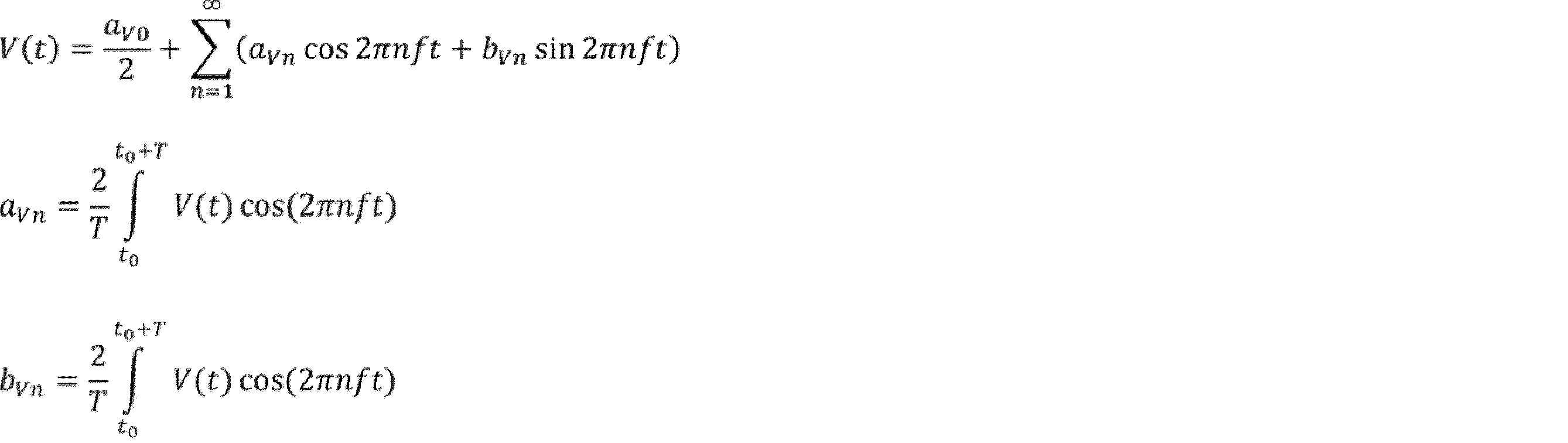
該実施例において、収集周期に基づいて電池放電情報における電流情報に対してフーリエ展開を行うことにより、電流情報に対応する、時間に基づく電流信号を取得し、収集周期に基づいて電池放電情報における電圧情報に対してフーリエ展開を行って、電圧情報に対応する、時間に基づく電圧信号を取得した後、上記時間に基づく電流信号及び上記時間に基づく電圧信号を関連付けて、上記時間に基づく電池信号として記録する。 In this embodiment, a Fourier expansion is performed on the current information in the battery discharge information based on the collection period to obtain a time-based current signal corresponding to the current information, and a Fourier expansion is performed on the voltage information in the battery discharge information based on the collection period to obtain a time-based voltage signal corresponding to the voltage information, and the time-based current signal and the time-based voltage signal are then associated and recorded as a time-based battery signal.
S202では、上記時間に基づく電池信号に対して高速フーリエ変換を行って、上記電池放電情報に対応する、上記周波数に基づく第1の電池信号を取得する。 In S202, a fast Fourier transform is performed on the time-based battery signal to obtain a first battery signal based on the frequency that corresponds to the battery discharge information.
具体的には、上記収集周期に基づいて、上記電池放電情報に対してフーリエ展開を行って、上記電池放電情報に対応する、時間に基づく電池信号を取得した後、時間に基づく電池信号に対して高速フーリエ変換を行い、該高速フーリエ変換は、具体的には、以下のステップを含む。 Specifically, a Fourier expansion is performed on the battery discharge information based on the collection period to obtain a time-based battery signal corresponding to the battery discharge information, and then a fast Fourier transform is performed on the time-based battery signal, which specifically includes the following steps:
上記時間に基づく電流信号に対して高速フーリエ変換を行って、上記電流情報に対応する、周波数に基づく電流信号を取得する。 A fast Fourier transform is performed on the time-based current signal to obtain a frequency-based current signal that corresponds to the current information.
任意選択的に、下記式により時間に基づく電流信号に対して高速フーリエ変換を行うことができる。

上記時間に基づく電圧信号に対して高速フーリエ変換を行って、上記電圧情報に対応する、周波数に基づく電圧信号を取得する。 A fast Fourier transform is performed on the time-based voltage signal to obtain a frequency-based voltage signal that corresponds to the voltage information.
任意選択的に、下記式により時間に基づく電圧信号に対して高速フーリエ変換を行うことができる。

該実施例において、時間に基づく電池信号における電流信号に対して高速フーリエ変換を行って、該時間に基づく電流信号に対応する、周波数に基づく電流信号を取得し、時間に基づく電池信号における電圧信号に対して高速フーリエ変換を行って、該時間に基づく電圧信号に対応する、周波数に基づく電圧信号を取得した後、周波数に基づく電流信号及び周波数に基づく電圧信号を、周波数に基づく第1の電池信号として記録する。 In this embodiment, a fast Fourier transform is performed on the current signal in the time-based battery signal to obtain a frequency-based current signal corresponding to the time-based current signal, and a fast Fourier transform is performed on the voltage signal in the time-based battery signal to obtain a frequency-based voltage signal corresponding to the time-based voltage signal, and then the frequency-based current signal and the frequency-based voltage signal are recorded as a first frequency-based battery signal.
上記実施例における各ステップの番号の大きさは、実行順序の前後を意味するものではなく、各プロセスの実行順序は、プロセスの機能及び内部ロジックに従って決定されるべきであり、本開示の実施例の実施プロセスに対する何らかの限定として解されるべきではないことを理解されたい。 It should be understood that the magnitude of the numbers of each step in the above embodiments does not imply an order of execution, and the execution order of each process should be determined according to the function and internal logic of the process, and should not be interpreted as any limitation on the implementation process of the embodiments of the present disclosure.
本開示の一実施例において、電池電気化学インピーダンススペクトルの生成システムを提供し、該電池電気化学インピーダンススペクトルの生成システムは、上記実施例における電池電気化学インピーダンススペクトルの生成方法に対応する。図3に示すように、該電池電気化学インピーダンススペクトルの生成システム100は、具体的には、
電池が放電状態にある場合、所定の収集周期に基づいて上記電池の電池放電情報を周期的に収集する情報収集モジュール110であって、上記電池放電情報は、収集時刻と上記収集時刻に関連する電流情報及び電圧情報とを含む、情報収集モジュール110と、
上記収集周期及び上記電池放電情報に基づいてフーリエ変換を行って、周波数に基づく複数の第1の電池信号を取得するフーリエ変換モジュール120と、
上記複数の第1の電池信号から第2の電池信号を決定する信号選択モジュール130であって、上記第2の電池信号は、所定の電圧閾値以上の電圧信号を含む、信号選択モジュール130と、
上記第2の電池信号に基づいて、対応する周波数の電気化学インピーダンスを決定し、全ての上記電気化学インピーダンスに基づいて電気化学インピーダンススペクトルを作成する電気化学インピーダンススペクトル作成モジュール140と、を含む。
In one embodiment of the present disclosure, a system for generating an electrochemical impedance spectrum of a battery is provided, and the system for generating an electrochemical impedance spectrum of a battery corresponds to the method for generating an electrochemical impedance spectrum of a battery in the above embodiment. As shown in FIG. 3, the system 100 for generating an electrochemical impedance spectrum of a battery specifically includes:
An information collecting module 110 for periodically collecting battery discharge information of the battery based on a predetermined collection period when the battery is in a discharging state, the battery discharge information including a collection time and current information and voltage information related to the collection time;
a Fourier transform module 120 for performing a Fourier transform based on the collection period and the battery discharge information to obtain a plurality of first battery signals based on frequency;
a signal selection module 130 for determining a second battery signal from the plurality of first battery signals, the second battery signal including a voltage signal equal to or greater than a predetermined voltage threshold;
and an electrochemical impedance spectrum creation module 140 for determining electrochemical impedances at corresponding frequencies based on the second battery signal, and creating an electrochemical impedance spectrum based on all the electrochemical impedances.
一例として、電気化学インピーダンススペクトル作成モジュール140は、
上記第2の電池信号における電圧信号に対応する第1の振幅情報、及び該第2の電池信号における電流信号に対応する第2の振幅情報を取得し、上記第1の振幅情報と第2の振幅情報との比を該第2の電池信号の有効な周波数に対応する抵抗振幅情報として記録する振幅情報取得ユニットと、
上記第2の電池信号における電圧信号に対応する第1の位相情報、及び該第2の電池信号における電流信号に対応する第2の位相情報を取得し、上記第1の位相情報と第2の位相情報との差を該第2の電池信号の有効な周波数に対応する抵抗位相情報として記録する位相情報取得ユニットと、
上記抵抗振幅情報及び上記抵抗位相情報に基づいて、上記第2の電池信号の有効な周波数に対応する電気化学インピーダンスを決定する電気化学インピーダンス決定ユニットと、
各上記第2の電池信号の有効な周波数及びその対応する電気化学インピーダンスに基づいて、上記電気化学インピーダンススペクトルを作成する電気化学インピーダンススペクトル作成ユニットと、を含む。
In one example, the electrochemical impedance spectrum generation module 140 may include:
an amplitude information acquisition unit that acquires first amplitude information corresponding to a voltage signal in the second battery signal and second amplitude information corresponding to a current signal in the second battery signal, and records a ratio between the first amplitude information and the second amplitude information as resistance amplitude information corresponding to an effective frequency of the second battery signal;
a phase information acquisition unit that acquires first phase information corresponding to a voltage signal in the second battery signal and second phase information corresponding to a current signal in the second battery signal, and records a difference between the first phase information and the second phase information as resistance phase information corresponding to an effective frequency of the second battery signal;
an electrochemical impedance determining unit for determining an electrochemical impedance corresponding to a valid frequency of the second battery signal based on the resistance amplitude information and the resistance phase information;
and an electrochemical impedance spectrum generating unit for generating the electrochemical impedance spectrum based on the effective frequency of each of the second battery signals and its corresponding electrochemical impedance.
一例として、フーリエ変換モジュール120は、
上記収集周期に基づいて、上記電池放電情報に対してフーリエ展開を行って、上記電池放電情報に対応する、時間に基づく電池信号を取得する時間信号決定ユニットと、
上記時間に基づく電池信号に対して高速フーリエ変換を行って、上記電池放電情報に対応する、周波数に基づく第1の電池信号を取得する周波数信号決定ユニットと、を含む。
As an example, the Fourier transform module 120 may
a time signal determining unit performing a Fourier expansion on the battery discharge information based on the collection period to obtain a time-based battery signal corresponding to the battery discharge information;
and a frequency signal determining unit for performing a fast Fourier transform on the time-based battery signal to obtain a first frequency-based battery signal corresponding to the battery discharge information.
一例として、時間信号決定ユニットは、
上記収集周期に基づいて、上記電流情報に対してフーリエ展開を行って、上記電流情報に対応する、時間に基づく電流信号を取得する時間電流信号決定サブユニットと、
上記収集周期に基づいて、上記電圧情報に対してフーリエ展開を行って、上記電圧情報に対応する、時間に基づく電圧信号を取得する時間電圧信号決定サブユニットと、
上記時間に基づく電流信号及び上記時間に基づく電圧信号を関連付けて、上記時間に基づく電池信号として記録する時間信号決定サブユニットと、を含む。
In one example, the time signal determination unit may be
a time current signal determining subunit that performs a Fourier expansion on the current information based on the collection period to obtain a time-based current signal corresponding to the current information;
a time-voltage signal determining subunit for performing a Fourier expansion on the voltage information based on the collection period to obtain a time-based voltage signal corresponding to the voltage information;
and a time signal determination subunit for correlating and recording the time-based current signal and the time-based voltage signal as the time-based battery signal.
一例として、周波数信号決定ユニットは、
上記時間に基づく電流信号に対して高速フーリエ変換を行って、上記電流情報に対応する、周波数に基づく電流信号を取得する周波数電流信号決定サブユニットと、
上記時間に基づく電圧信号に対して高速フーリエ変換を行って、上記電圧情報に対応する、周波数に基づく電圧信号を取得する周波数電圧信号決定サブユニットと、
上記周波数に基づく電流信号及び上記周波数に基づく電圧信号を上記周波数に基づく第1の電池信号として記録する周波数信号決定サブユニットと、を含む。
In one example, the frequency signal determining unit may include:
a frequency current signal determining subunit for performing a fast Fourier transform on the time-based current signal to obtain a frequency-based current signal corresponding to the current information;
a frequency voltage signal determining subunit for performing a fast Fourier transform on the time-based voltage signal to obtain a frequency-based voltage signal corresponding to the voltage information;
and a frequency signal determining subunit that records the frequency-based current signal and the frequency-based voltage signal as the frequency-based first battery signal.
本開示の一実施例において、コンピュータ機器を提供し、該コンピュータ機器は、サーバであってもよく、その内部構造図は、図4に示すとおりである。該コンピュータ機器は、システムバスを介して接続されたプロセッサ、メモリ、及びネットワークインタフェースを含む。該コンピュータ機器のプロセッサは、計算及び制御能力を提供する。該コンピュータ機器のメモリは、不揮発性記憶媒体、内部メモリを含む。不揮発性記憶媒体は、オペレーティングシステムと、コンピュータプログラムと、データベースとを記憶している。該内部メモリは、不揮発性記憶媒体におけるオペレーティングシステム及びコンピュータプログラムの実行環境を提供する。該コンピュータ機器のネットワークインタフェースは、外部の端末とネットワーク接続により通信する。該コンピュータプログラムは、プロセッサにより実行されると、電池電気化学インピーダンススペクトルの生成方法を実現する。 In one embodiment of the present disclosure, a computer device is provided, which may be a server, and its internal structure diagram is as shown in FIG. 4. The computer device includes a processor, a memory, and a network interface connected via a system bus. The processor of the computer device provides calculation and control capabilities. The memory of the computer device includes a non-volatile storage medium and an internal memory. The non-volatile storage medium stores an operating system, a computer program, and a database. The internal memory provides an execution environment for the operating system and the computer program in the non-volatile storage medium. The network interface of the computer device communicates with an external terminal via a network connection. When the computer program is executed by the processor, it realizes a method for generating a battery electrochemical impedance spectrum.
本開示の一実施例において、他のコンピュータ機器を提供する。図5に示すように、該コンピュータ機器200は、メモリ210と、プロセッサ220と、メモリ210に記憶され、かつプロセッサ220で実行可能なコンピュータプログラム230とを含み、プロセッサ220は、コンピュータプログラム230を実行する場合に上記実施例における電池電気化学インピーダンススペクトルの生成方法を実現する。 In one embodiment of the present disclosure, another computer device is provided. As shown in FIG. 5, the computer device 200 includes a memory 210, a processor 220, and a computer program 230 stored in the memory 210 and executable by the processor 220, and when the processor 220 executes the computer program 230, the method for generating a battery electrochemical impedance spectrum in the above embodiment is realized.
本開示の一実施例において、コンピュータプログラムが記憶されているコンピュータ可読記憶媒体を提供し、コンピュータプログラムは、プロセッサにより実行されると、上記実施例における電池電気化学インピーダンススペクトルの生成方法を実現する。 In one embodiment of the present disclosure, a computer-readable storage medium is provided on which a computer program is stored, and the computer program, when executed by a processor, realizes the method for generating a battery electrochemical impedance spectrum in the above embodiment.
当業者であれば理解できるように、上記実施例の方法におけるフローの全部又は一部の実現は、コンピュータプログラムによって、関連するハードウェアを命令することにより完了することができ、上記コンピュータプログラムは、不揮発性コンピュータ可読記憶媒体に記憶することができ、該コンピュータプログラムが実行されると、上記各方法の実施例のフローを含んでもよい。本開示に係る各実施例において使用されるメモリ、記憶、データベース又は他の媒体に対するいかなる引用は、いずれも不揮発性及び/又は揮発性メモリを含んでもよい。不揮発性メモリは、読み出し専用メモリ(ROM)、プログラマブルROM(PROM)、電気的プログラマブルROM(EPROM)、電気的消去可能プログラマブルROM(EEPROM)又はフラッシュメモリを含んでもよい。揮発性メモリは、ランダムアクセスメモリ(RAM)又は外部キャッシュメモリを含んでもよい。限定ではなく例示として、RAMは、スタティックRAM(SRAM)、ダイナミックRAM(DRAM)、シンクロナスDRAM(SDRAM)、ダブルデータレートSDRAM(DDRSDRAM)、エンハンスドSDRAM(ESDRAM)、シンクロナスリンク(Synchlink)DRAM(SLDRAM)、ラムバス(Rambus)ダイレクトRAM(RDRAM)、ダイレクトラムバスダイナミックRAM(DRDRAM)及びラムバスダイナミックRAM(RDRAM)などの様々な形態で入手可能である。 As can be understood by those skilled in the art, the implementation of all or part of the flow in the method of the above embodiment can be completed by instructing the relevant hardware by a computer program, and the computer program can be stored in a non-volatile computer-readable storage medium, and when the computer program is executed, it may include the flow of each of the above embodiment of the method. Any reference to memory, storage, database, or other medium used in each embodiment of the present disclosure may include non-volatile and/or volatile memory. Non-volatile memory may include read-only memory (ROM), programmable ROM (PROM), electrically programmable ROM (EPROM), electrically erasable programmable ROM (EEPROM), or flash memory. Volatile memory may include random access memory (RAM) or external cache memory. By way of example and not limitation, RAM is available in a variety of forms, including static RAM (SRAM), dynamic RAM (DRAM), synchronous DRAM (SDRAM), double data rate SDRAM (DDRSDRAM), enhanced SDRAM (ESDRAM), synchronous link DRAM (SLDRAM), Rambus Direct RAM (RDRAM), direct Rambus Dynamic RAM (DRDRAM), and Rambus Dynamic RAM (RDRAM).
当業者であれば明確に分かるように、容易かつ簡潔的に説明するために、上記各機能ユニット、モジュールの区分で例を挙げて説明したが、実際の適用では、必要に応じて上記機能を割り当てて異なる機能ユニット、モジュールにより完成させ、すなわち上記装置の内部構造を異なる機能ユニット又はモジュールに区分して、以上で説明した全部又は一部の機能を完成させることができる。 To ensure that those skilled in the art can clearly understand, examples have been given in which the above functional units and modules are divided in order to provide an easy and concise explanation. However, in actual applications, the above functions can be assigned as necessary and completed by different functional units and modules, i.e., the internal structure of the above device can be divided into different functional units or modules to complete all or part of the functions described above.
以上の実施例は、本開示の技術手段を説明するためのものに過ぎず、限定するものではなく、前述の実施例を参照して本開示を詳細に説明したが、当業者であれば理解すべきこととして、依然として、前述の各実施例に記載の技術手段を修正するか、又はその技術的特徴の一部を同等置換することができ、これらの修正又は置換は、対応する技術手段の本質を本開示の各実施例の技術手段の精神及び範囲から逸脱させることはなく、いずれも本開示の保護範囲に含まれるべきである。
The above embodiments are merely for illustrating the technical means of the present disclosure, and are not limiting. The present disclosure has been described in detail with reference to the above embodiments. However, it should be understood by those skilled in the art that the technical means described in each of the above embodiments can still be modified or some of the technical features can be equivalently replaced, and these modifications or replacements do not deviate the essence of the corresponding technical means from the spirit and scope of the technical means of each of the embodiments of the present disclosure, and all of them should be included in the protection scope of the present disclosure.
Claims (15)
前記収集周期及び前記電池放電情報に基づいてフーリエ変換を行って、周波数に基づく複数の第1の電池信号を取得するステップと、
前記複数の第1の電池信号から第2の電池信号を決定するステップであって、前記第2の電池信号は、所定の電圧閾値以上の電圧信号を含むステップと、
前記第2の電池信号に基づいて、対応する周波数の電気化学インピーダンスを決定し、全ての前記電気化学インピーダンスに基づいて、電気化学インピーダンススペクトルを作成するステップと、
を含み、
前記所定の電圧閾値の決定過程は、
初期電圧閾値を設定するステップと、
得られた電気化学インピーダンススペクトル曲線が平滑曲線になるまで、所定のステップ幅で前記初期電圧閾値を増加させるステップと、
前記平滑曲線に対応する電圧閾値を前記所定の電圧閾値とするステップと、
を含む、ことを特徴とする、
電池電気化学インピーダンススペクトルの生成方法。 If a battery is in a discharging state, periodically collecting battery discharge information of the battery based on a predetermined collection period, the battery discharge information including a collection time and current and voltage information associated with the collection time;
performing a Fourier transform based on the collection period and the battery discharge information to obtain a plurality of first battery signals based on frequency;
determining a second battery signal from the plurality of first battery signals, the second battery signal including a voltage signal that is equal to or greater than a predetermined voltage threshold;
determining an electrochemical impedance at a corresponding frequency based on the second battery signal, and generating an electrochemical impedance spectrum based on all the electrochemical impedances;
Including ,
The process of determining the predetermined voltage threshold value includes:
setting an initial voltage threshold;
increasing the initial voltage threshold by a predetermined step size until the resulting electrochemical impedance spectrum curve becomes a smooth curve;
determining a voltage threshold value corresponding to the smooth curve as the predetermined voltage threshold value;
Characterized in that it comprises
Method for generating battery electrochemical impedance spectra.
前記第2の電池信号における電圧信号に対応する第1の振幅情報、及び該第2の電池信号における電流信号に対応する第2の振幅情報を取得し、前記第1の振幅情報と前記第2の振幅情報との比を該第2の電池信号の有効な周波数に対応する抵抗振幅情報として記録するステップであって、前記第2の電池信号の有効な周波数は、前記第2の電池信号に対応する周波数であるステップと、
前記第2の電池信号における電圧信号に対応する第1の位相情報、及び該第2の電池信号における電流信号に対応する第2の位相情報を取得し、前記第1の位相情報と前記第2の位相情報との差を該第2の電池信号の有効な周波数に対応する抵抗位相情報として記録するステップと、
前記抵抗振幅情報及び前記抵抗位相情報に基づいて、前記第2の電池信号の有効な周波数に対応する電気化学インピーダンスを決定するステップと、
各前記第2の電池信号の有効な周波数及びその対応する電気化学インピーダンスに基づいて、前記電気化学インピーダンススペクトルを作成するステップと、
を含む、ことを特徴とする、
請求項1に記載の電池電気化学インピーダンススペクトルの生成方法。 determining an electrochemical impedance at a corresponding frequency based on the second battery signal and generating an electrochemical impedance spectrum based on all the electrochemical impedances,
obtaining first amplitude information corresponding to a voltage signal in the second battery signal and second amplitude information corresponding to a current signal in the second battery signal, and recording a ratio of the first amplitude information to the second amplitude information as resistance amplitude information corresponding to an effective frequency of the second battery signal, the effective frequency of the second battery signal being a frequency corresponding to the second battery signal;
obtaining first phase information corresponding to a voltage signal in the second battery signal and second phase information corresponding to a current signal in the second battery signal, and recording a difference between the first phase information and the second phase information as resistance phase information corresponding to a valid frequency of the second battery signal;
determining an electrochemical impedance corresponding to a valid frequency of the second battery signal based on the resistance amplitude information and the resistance phase information;
generating the electrochemical impedance spectrum based on effective frequencies of each of the second battery signals and their corresponding electrochemical impedances;
Characterized in that it comprises
The method for generating a battery electrochemical impedance spectrum according to claim 1.
複素数形式の電圧信号のモジュラス(絶対値)を該電圧信号に対応する第1の振幅情報として決定し、
複素数形式の電流信号のモジュラス(絶対値)を該電流信号に対応する第2の振幅情報として決定する、ことを特徴とする、
請求項2に記載の電池電気化学インピーダンススペクトルの生成方法。 the second battery signal includes a voltage signal and a current signal both expressed in complex number form;
determining a modulus (absolute value) of the voltage signal in complex format as first amplitude information corresponding to the voltage signal;
A modulus (absolute value) of the current signal in a complex number format is determined as second amplitude information corresponding to the current signal.
The method for generating a battery electrochemical impedance spectrum according to claim 2.
複素数形式の電流信号の位相角を該電流信号に対応する第2の位相情報として決定する、ことを特徴とする、
請求項3に記載の電池電気化学インピーダンススペクトルの生成方法。 determining a phase angle of the voltage signal in complex form as first phase information corresponding to the voltage signal;
determining a phase angle of the current signal in a complex number format as second phase information corresponding to the current signal;
The method for generating a battery electrochemical impedance spectrum according to claim 3.
前記電気化学インピーダンスの実部は、Rre=R・cosθであり、
前記電気化学インピーダンスの虚部は、Rim=R・sinθであり、
ここで、Rは、前記抵抗振幅情報であり、
θは、前記抵抗位相情報である、ことを特徴とする、
請求項2~4のいずれか一項に記載の電池電気化学インピーダンススペクトルの生成方法。 The electrochemical impedance comprises a real part and an imaginary part;
The real part of the electrochemical impedance is R re =R cos θ;
The imaginary part of the electrochemical impedance is R im =R·sin θ;
where R is the resistance amplitude information,
θ is the resistance phase information,
A method for generating a battery electrochemical impedance spectrum according to any one of claims 2 to 4.
前記収集周期に基づいて、前記電池放電情報に対してフーリエ展開を行って、前記電池放電情報に対応する、時間に基づく電池信号を取得するステップと、
前記時間に基づく電池信号に対して高速フーリエ変換を行って、前記電池放電情報に対応する、周波数に基づく第1の電池信号を取得するステップと、
を含む、ことを特徴とする、
請求項1~5のいずれか一項に記載の電池電気化学インピーダンススペクトルの生成方法。 The step of performing a Fourier transform based on the collection period and the battery discharge information to obtain a plurality of first battery signals based on frequency includes:
performing a Fourier expansion on the battery discharge information based on the collection period to obtain a time-based battery signal corresponding to the battery discharge information;
performing a fast Fourier transform on the time-based battery signal to obtain a first frequency-based battery signal corresponding to the battery discharge information;
Characterized in that it comprises
A method for generating a battery electrochemical impedance spectrum according to any one of claims 1 to 5.
前記収集周期に基づいて、前記電流情報に対してフーリエ展開を行って、前記電流情報に対応する、時間に基づく電流信号を取得するステップと、
前記収集周期に基づいて、前記電圧情報に対してフーリエ展開を行って、前記電圧情報に対応する、時間に基づく電圧信号を取得するステップと、
前記時間に基づく電流信号及び前記時間に基づく電圧信号を関連付けて、前記時間に基づく電池信号として記録するステップと、
を含む、ことを特徴とする、
請求項6に記載の電池電気化学インピーダンススペクトルの生成方法。 performing a Fourier expansion on the battery discharge information based on the collection period to obtain a time-based battery signal corresponding to the battery discharge information;
performing a Fourier expansion on the current information based on the collection period to obtain a time-based current signal corresponding to the current information;
performing a Fourier expansion on the voltage information based on the collection period to obtain a time-based voltage signal corresponding to the voltage information;
correlating and recording the time-based current signal and the time-based voltage signal as the time-based battery signal;
Characterized in that it comprises
The method for generating a battery electrochemical impedance spectrum according to claim 6.
に基づいて前記電流情報に対してフーリエ展開を行う、ことを特徴とする、
請求項7に記載の電池電気化学インピーダンススペクトルの生成方法。 The following formula
The current information is subjected to Fourier expansion based on the
The method for generating a battery electrochemical impedance spectrum according to claim 7.
に基づいて前記電圧情報に対してフーリエ展開を行う、ことを特徴とする、
請求項7又は8に記載の電池電気化学インピーダンススペクトルの生成方法。 The following formula
The voltage information is subjected to Fourier expansion based on the above.
A method for generating a battery electrochemical impedance spectrum according to claim 7 or 8.
前記時間に基づく電流信号に対して高速フーリエ変換を行って、前記電流情報に対応する、周波数に基づく電流信号を取得するステップと、
前記時間に基づく電圧信号に対して高速フーリエ変換を行って、前記電圧情報に対応する、周波数に基づく電圧信号を取得するステップと、
前記周波数に基づく電流信号及び前記周波数に基づく電圧信号を、前記周波数に基づく第1の電池信号として記録するステップと、
を含む、ことを特徴とする、
請求項6~9のいずれか一項に記載の電池電気化学インピーダンススペクトルの生成方法。 performing a fast Fourier transform on the time-based battery signal to obtain a first frequency-based battery signal corresponding to the battery discharge information;
performing a fast Fourier transform on the time-based current signal to obtain a frequency-based current signal corresponding to the current information;
performing a fast Fourier transform on the time-based voltage signal to obtain a frequency-based voltage signal corresponding to the voltage information;
recording the frequency-based current signal and the frequency-based voltage signal as a first frequency-based battery signal;
Characterized in that it comprises
A method for generating a battery electrochemical impedance spectrum according to any one of claims 6 to 9.
により前記時間に基づく電流信号に対して高速フーリエ変換を行う、ことを特徴とする、
請求項10に記載の電池電気化学インピーダンススペクトルの生成方法。 The following formula
performing a fast Fourier transform on the time-based current signal by
The method for generating a battery electrochemical impedance spectrum according to claim 10.
により前記時間に基づく電圧信号に対して高速フーリエ変換を行う、ことを特徴とする、
請求項10又は11に記載の電池電気化学インピーダンススペクトルの生成方法。 The following formula
performing a fast Fourier transform on the time-based voltage signal by
A method for generating a battery electrochemical impedance spectrum according to claim 10 or 11.
請求項1~12のいずれか一項に記載の電池電気化学インピーダンススペクトルの生成方法。 The predetermined voltage threshold range is 0.1V to 0.5V.
A method for generating a battery electrochemical impedance spectrum according to any one of claims 1 to 12 .
前記コンピュータプログラムは、プロセッサにより実行されると、請求項1~13のいずれか一項に記載の電池電気化学インピーダンススペクトルの生成方法を実現する、ことを特徴とする、
コンピュータ可読記憶媒体。 A computer-readable storage medium having a computer program stored thereon,
The computer program, when executed by a processor, realizes the method for generating a battery electrochemical impedance spectrum according to any one of claims 1 to 13 .
A computer-readable storage medium.
前記プロセッサは、前記コンピュータプログラムを実行する場合に請求項1~13のいずれか一項に記載の電池電気化学インピーダンススペクトルの生成方法を実現する、ことを特徴とする、
コンピュータ機器。 1. A computing device comprising: a memory; a processor; and a computer program stored in the memory and executable by the processor, the computer device comprising:
The processor, when executing the computer program, realizes the method for generating a battery electrochemical impedance spectrum according to any one of claims 1 to 13 .
Computer equipment.
Applications Claiming Priority (3)
| Application Number | Priority Date | Filing Date | Title |
|---|---|---|---|
| CN202011034840.1A CN114280492B (en) | 2020-09-27 | 2020-09-27 | Battery electrochemical impedance spectrum generation method, system, vehicle and medium |
| CN202011034840.1 | 2020-09-27 | ||
| PCT/CN2021/109651 WO2022062651A1 (en) | 2020-09-27 | 2021-07-30 | Method for generating electrochemical impedance spectroscopy of battery, medium, and computer device |
Publications (2)
| Publication Number | Publication Date |
|---|---|
| JP2023542422A JP2023542422A (en) | 2023-10-06 |
| JP7589340B2 true JP7589340B2 (en) | 2024-11-25 |
Family
ID=80844823
Family Applications (1)
| Application Number | Title | Priority Date | Filing Date |
|---|---|---|---|
| JP2023519213A Active JP7589340B2 (en) | 2020-09-27 | 2021-07-30 | Method and medium for generating battery electrochemical impedance spectrum, computer device |
Country Status (6)
| Country | Link |
|---|---|
| US (1) | US12591019B2 (en) |
| EP (1) | EP4220209B1 (en) |
| JP (1) | JP7589340B2 (en) |
| KR (1) | KR102784333B1 (en) |
| CN (1) | CN114280492B (en) |
| WO (1) | WO2022062651A1 (en) |
Families Citing this family (7)
| Publication number | Priority date | Publication date | Assignee | Title |
|---|---|---|---|---|
| CN115356640B (en) * | 2022-10-09 | 2023-02-03 | 中创新航科技股份有限公司 | Battery device, detection method thereof, screening method and screening device for battery cells |
| US20240288504A1 (en) * | 2023-02-24 | 2024-08-29 | Colorado School Of Mines | Rapid mapping of electrochemical processes in energy conversion devices |
| CN116819176B (en) * | 2023-08-30 | 2023-12-01 | 国网山东省电力公司泰安供电公司 | Impedance spectrum generation method based on amplitude-angle transformation |
| KR102934605B1 (en) | 2024-07-17 | 2026-03-05 | 한솔테크닉스(주) | Battery management system and method for improving reliability |
| KR102900947B1 (en) | 2024-07-17 | 2025-12-16 | 한솔테크닉스(주) | Apparatus and method for determining health status of energy generation system |
| KR20260012018A (en) | 2024-07-17 | 2026-01-26 | 한솔테크닉스(주) | Electrochemical impedance spectroscopy measurement system and method capable of specifying battery condition diagnosis frequency |
| KR102924298B1 (en) * | 2024-11-04 | 2026-02-05 | 국립금오공과대학교 산학협력단 | Battery internal impedance measurement method based on frequency selection algorithm and battery internal impedance measurement device using the same |
Citations (9)
| Publication number | Priority date | Publication date | Assignee | Title |
|---|---|---|---|---|
| CN1967270A (en) | 2005-11-18 | 2007-05-23 | 北华大学 | Method and system for testing battery impedance spectroscopy |
| CN101477179A (en) | 2009-01-15 | 2009-07-08 | 艾默生网络能源有限公司 | On-line AC detection method and system for internal resistance of accumulator |
| JP2013085379A (en) | 2011-10-11 | 2013-05-09 | Nissan Motor Co Ltd | Battery control device |
| JP2013537638A (en) | 2010-08-27 | 2013-10-03 | インペリアル イノヴェイションズ リミテッド | Battery monitoring in electric vehicles, hybrid electric vehicles, and other applications |
| CN106970266A (en) | 2016-11-29 | 2017-07-21 | 北京交通大学 | A kind of EIS method for fast measuring of lithium ion battery |
| US20180059191A1 (en) | 2016-08-28 | 2018-03-01 | The Board Of Trustees Of The University Of Alabama | Methods, apparatuses, and systems for measuring impedance spectrum, power spectrum, or spectral density using frequency component analysis of power converter voltage and current ripples |
| US20180217209A1 (en) | 2017-01-30 | 2018-08-02 | Infineon Technologies Ag | Battery temperature detection |
| JP2019039700A (en) | 2017-08-23 | 2019-03-14 | トヨタ自動車株式会社 | Secondary battery degradation state estimation method and secondary battery system |
| WO2020003841A1 (en) | 2018-06-27 | 2020-01-02 | パナソニックIpマネジメント株式会社 | Battery monitoring device, integrated circuit, and battery monitoring system |
Family Cites Families (17)
| Publication number | Priority date | Publication date | Assignee | Title |
|---|---|---|---|---|
| EP1221041B1 (en) * | 1999-10-12 | 2010-01-20 | Gerald Wiegand | Highly time resolved impedance spectroscopy |
| JP4540156B2 (en) * | 1999-11-02 | 2010-09-08 | ソニー株式会社 | Robot center of gravity control method |
| CN101194836B (en) * | 2006-12-05 | 2011-09-14 | 重庆博恩富克医疗设备有限公司 | Method and device for eliminating interference in bio-electrical impedance measurement |
| CN101348085B (en) * | 2008-09-17 | 2010-06-09 | 北京四方继保自动化股份有限公司 | A method for impedance protection of electric railway feeder based on differential voltage of power supply arm and leading phase current |
| CN101383582B (en) * | 2008-10-15 | 2010-09-29 | 南京航空航天大学 | Control Method of Electrically Excited Synchronous Motor Based on Linear Control of Torque Angle Sine Value |
| FR2956743B1 (en) * | 2010-02-25 | 2012-10-05 | Inst Francais Du Petrole | NON-INTRUSTIVE METHOD FOR DETERMINING THE ELECTRICAL IMPEDANCE OF A BATTERY |
| CN101871974B (en) * | 2010-06-18 | 2013-01-09 | 华南理工大学 | Impedance spectroscopy measurement method |
| CN103323781B (en) * | 2013-05-29 | 2015-08-05 | 西安交通大学 | Power battery pack on-line parameter detection system and SOC method of estimation |
| JP2014238301A (en) * | 2013-06-06 | 2014-12-18 | ニューロング精密工業株式会社 | Secondary battery impedance evaluation method |
| US10386422B2 (en) * | 2014-07-25 | 2019-08-20 | Lithium Balance A/S | Electrochemical impedance spectroscopy in battery management systems |
| CN104950180B (en) * | 2015-06-02 | 2018-10-30 | 国电南京自动化股份有限公司 | Cell batteries internal resistance accurate measurement method based on EIS |
| CN105449241B (en) * | 2015-12-18 | 2017-10-10 | 武汉理工大学 | The online electrochemical impedance spectroscopy detecting system of fuel cell and method |
| CN106618568B (en) | 2016-10-12 | 2020-05-12 | 西安石油大学 | Rapid EIS (electronic impedance spectroscopy) mixing measuring device applied to breast cancer detection |
| CN109459465B (en) | 2018-12-12 | 2020-08-04 | 浙江大学 | A Fast Electrochemical Impedance Spectroscopy Measurement Method Based on Current Pulse Injection |
| CN110161421B (en) * | 2019-05-22 | 2020-06-02 | 同济大学 | Method for reconstructing battery impedance in set frequency range on line |
| CN111580006A (en) * | 2020-05-29 | 2020-08-25 | 中国电力科学研究院有限公司 | A kind of online measurement method and system of battery dynamic impedance |
| US11604228B2 (en) * | 2020-11-25 | 2023-03-14 | Texas Instruments Incorporated | Battery impedance spectra measurement |
-
2020
- 2020-09-27 CN CN202011034840.1A patent/CN114280492B/en active Active
-
2021
- 2021-07-30 JP JP2023519213A patent/JP7589340B2/en active Active
- 2021-07-30 EP EP21871029.1A patent/EP4220209B1/en active Active
- 2021-07-30 KR KR1020237013856A patent/KR102784333B1/en active Active
- 2021-07-30 WO PCT/CN2021/109651 patent/WO2022062651A1/en not_active Ceased
-
2023
- 2023-03-24 US US18/189,607 patent/US12591019B2/en active Active
Patent Citations (9)
| Publication number | Priority date | Publication date | Assignee | Title |
|---|---|---|---|---|
| CN1967270A (en) | 2005-11-18 | 2007-05-23 | 北华大学 | Method and system for testing battery impedance spectroscopy |
| CN101477179A (en) | 2009-01-15 | 2009-07-08 | 艾默生网络能源有限公司 | On-line AC detection method and system for internal resistance of accumulator |
| JP2013537638A (en) | 2010-08-27 | 2013-10-03 | インペリアル イノヴェイションズ リミテッド | Battery monitoring in electric vehicles, hybrid electric vehicles, and other applications |
| JP2013085379A (en) | 2011-10-11 | 2013-05-09 | Nissan Motor Co Ltd | Battery control device |
| US20180059191A1 (en) | 2016-08-28 | 2018-03-01 | The Board Of Trustees Of The University Of Alabama | Methods, apparatuses, and systems for measuring impedance spectrum, power spectrum, or spectral density using frequency component analysis of power converter voltage and current ripples |
| CN106970266A (en) | 2016-11-29 | 2017-07-21 | 北京交通大学 | A kind of EIS method for fast measuring of lithium ion battery |
| US20180217209A1 (en) | 2017-01-30 | 2018-08-02 | Infineon Technologies Ag | Battery temperature detection |
| JP2019039700A (en) | 2017-08-23 | 2019-03-14 | トヨタ自動車株式会社 | Secondary battery degradation state estimation method and secondary battery system |
| WO2020003841A1 (en) | 2018-06-27 | 2020-01-02 | パナソニックIpマネジメント株式会社 | Battery monitoring device, integrated circuit, and battery monitoring system |
Also Published As
| Publication number | Publication date |
|---|---|
| US20230236257A1 (en) | 2023-07-27 |
| EP4220209A4 (en) | 2024-03-13 |
| EP4220209A1 (en) | 2023-08-02 |
| KR20230071175A (en) | 2023-05-23 |
| JP2023542422A (en) | 2023-10-06 |
| KR102784333B1 (en) | 2025-03-21 |
| CN114280492B (en) | 2024-10-11 |
| CN114280492A (en) | 2022-04-05 |
| WO2022062651A1 (en) | 2022-03-31 |
| US12591019B2 (en) | 2026-03-31 |
| EP4220209B1 (en) | 2026-01-28 |
Similar Documents
| Publication | Publication Date | Title |
|---|---|---|
| JP7589340B2 (en) | Method and medium for generating battery electrochemical impedance spectrum, computer device | |
| Locorotondo et al. | Development of a battery real-time state of health diagnosis based on fast impedance measurements | |
| JP2025023162A (en) | Battery management circuit, battery management system and battery management network | |
| WO2019085426A1 (en) | Automatic lithium battery sorting method, storage medium, and battery sorting device | |
| WO2021208661A1 (en) | Automobile starting load measuing method and apparatus, device, and storage medium | |
| CN114996923A (en) | Equipment fault detection method based on baseline data space | |
| WO2022160778A1 (en) | Three-phase power grid fault diagnosis method and apparatus, computer device and storage medium | |
| CN115575796A (en) | Data acquisition integrated circuit test method, system, electronic equipment and storage medium | |
| EP3722821A1 (en) | Methods, apparatuses, and storage media for calculating short-circuit current of battery | |
| CN114065681A (en) | EMC equivalent circuit modeling method and system and computer equipment | |
| CN117169749A (en) | Battery capacity prediction model generation method, prediction method and device | |
| CN111913039B (en) | Background harmonic voltage calculation method and device of alternating current filter | |
| CN112557905B (en) | Battery pack, data processing method thereof, computer device, medium, and vehicle | |
| US20240125855A1 (en) | Electrochemical Process Manifolds for Battery Cell Monitoring | |
| CN116819378B (en) | Energy storage battery abnormality detection method and device | |
| Chen et al. | A framework for online passive electrochemical impedance spectroscopy acquisition in parallel-connected battery systems under real driving conditions | |
| CN119125715A (en) | A method, system, device and medium for early fault diagnosis of electrical equipment | |
| CN118131047A (en) | A battery performance testing method, device and storage medium | |
| CN116859257A (en) | Method and system for in-situ characterization of battery state by characteristic harmonic alternating current impedance | |
| CN116890695A (en) | Battery safety detection methods, devices, equipment and storage media | |
| CN115827607A (en) | PMU phase angle difference error correction method, device and computer equipment | |
| CN114624518A (en) | Method, device, equipment and system for measuring impedance parameters of fuel cell | |
| CN115169379B (en) | Method, system, electronic equipment and storage medium for obtaining overvoltage signal of EMU | |
| TW202538304A (en) | Battery diagnosis apparatus and operating method thereof | |
| CN117706255B (en) | A coaxial cable testing method, device and system |
Legal Events
| Date | Code | Title | Description |
|---|---|---|---|
| A621 | Written request for application examination |
Free format text: JAPANESE INTERMEDIATE CODE: A621 Effective date: 20230424 |
|
| A131 | Notification of reasons for refusal |
Free format text: JAPANESE INTERMEDIATE CODE: A131 Effective date: 20240604 |
|
| A521 | Request for written amendment filed |
Free format text: JAPANESE INTERMEDIATE CODE: A523 Effective date: 20240805 |
|
| TRDD | Decision of grant or rejection written | ||
| A01 | Written decision to grant a patent or to grant a registration (utility model) |
Free format text: JAPANESE INTERMEDIATE CODE: A01 Effective date: 20241015 |
|
| A61 | First payment of annual fees (during grant procedure) |
Free format text: JAPANESE INTERMEDIATE CODE: A61 Effective date: 20241113 |
|
| R150 | Certificate of patent or registration of utility model |
Ref document number: 7589340 Country of ref document: JP Free format text: JAPANESE INTERMEDIATE CODE: R150 |