JP7586895B2 - Data storage using memory aperture flash order - Google Patents
Data storage using memory aperture flash order Download PDFInfo
- Publication number
- JP7586895B2 JP7586895B2 JP2022511208A JP2022511208A JP7586895B2 JP 7586895 B2 JP7586895 B2 JP 7586895B2 JP 2022511208 A JP2022511208 A JP 2022511208A JP 2022511208 A JP2022511208 A JP 2022511208A JP 7586895 B2 JP7586895 B2 JP 7586895B2
- Authority
- JP
- Japan
- Prior art keywords
- data
- aperture
- memory
- physical address
- storage
- Prior art date
- Legal status (The legal status is an assumption and is not a legal conclusion. Google has not performed a legal analysis and makes no representation as to the accuracy of the status listed.)
- Active
Links
Images





Classifications
-
- G—PHYSICS
- G06—COMPUTING OR CALCULATING; COUNTING
- G06F—ELECTRIC DIGITAL DATA PROCESSING
- G06F12/00—Accessing, addressing or allocating within memory systems or architectures
- G06F12/02—Addressing or allocation; Relocation
- G06F12/0223—User address space allocation, e.g. contiguous or non contiguous base addressing
- G06F12/023—Free address space management
-
- G—PHYSICS
- G06—COMPUTING OR CALCULATING; COUNTING
- G06F—ELECTRIC DIGITAL DATA PROCESSING
- G06F12/00—Accessing, addressing or allocating within memory systems or architectures
- G06F12/02—Addressing or allocation; Relocation
- G06F12/08—Addressing or allocation; Relocation in hierarchically structured memory systems, e.g. virtual memory systems
- G06F12/0802—Addressing of a memory level in which the access to the desired data or data block requires associative addressing means, e.g. caches
- G06F12/0866—Addressing of a memory level in which the access to the desired data or data block requires associative addressing means, e.g. caches for peripheral storage systems, e.g. disk cache
- G06F12/0868—Data transfer between cache memory and other subsystems, e.g. storage devices or host systems
-
- G—PHYSICS
- G06—COMPUTING OR CALCULATING; COUNTING
- G06F—ELECTRIC DIGITAL DATA PROCESSING
- G06F3/00—Input arrangements for transferring data to be processed into a form capable of being handled by the computer; Output arrangements for transferring data from processing unit to output unit, e.g. interface arrangements
- G06F3/06—Digital input from, or digital output to, record carriers, e.g. RAID, emulated record carriers or networked record carriers
- G06F3/0601—Interfaces specially adapted for storage systems
- G06F3/0602—Interfaces specially adapted for storage systems specifically adapted to achieve a particular effect
- G06F3/0614—Improving the reliability of storage systems
- G06F3/0619—Improving the reliability of storage systems in relation to data integrity, e.g. data losses, bit errors
-
- G—PHYSICS
- G06—COMPUTING OR CALCULATING; COUNTING
- G06F—ELECTRIC DIGITAL DATA PROCESSING
- G06F3/00—Input arrangements for transferring data to be processed into a form capable of being handled by the computer; Output arrangements for transferring data from processing unit to output unit, e.g. interface arrangements
- G06F3/06—Digital input from, or digital output to, record carriers, e.g. RAID, emulated record carriers or networked record carriers
- G06F3/0601—Interfaces specially adapted for storage systems
- G06F3/0602—Interfaces specially adapted for storage systems specifically adapted to achieve a particular effect
- G06F3/062—Securing storage systems
- G06F3/0622—Securing storage systems in relation to access
-
- G—PHYSICS
- G06—COMPUTING OR CALCULATING; COUNTING
- G06F—ELECTRIC DIGITAL DATA PROCESSING
- G06F3/00—Input arrangements for transferring data to be processed into a form capable of being handled by the computer; Output arrangements for transferring data from processing unit to output unit, e.g. interface arrangements
- G06F3/06—Digital input from, or digital output to, record carriers, e.g. RAID, emulated record carriers or networked record carriers
- G06F3/0601—Interfaces specially adapted for storage systems
- G06F3/0628—Interfaces specially adapted for storage systems making use of a particular technique
- G06F3/0638—Organizing or formatting or addressing of data
- G06F3/064—Management of blocks
-
- G—PHYSICS
- G06—COMPUTING OR CALCULATING; COUNTING
- G06F—ELECTRIC DIGITAL DATA PROCESSING
- G06F3/00—Input arrangements for transferring data to be processed into a form capable of being handled by the computer; Output arrangements for transferring data from processing unit to output unit, e.g. interface arrangements
- G06F3/06—Digital input from, or digital output to, record carriers, e.g. RAID, emulated record carriers or networked record carriers
- G06F3/0601—Interfaces specially adapted for storage systems
- G06F3/0628—Interfaces specially adapted for storage systems making use of a particular technique
- G06F3/0638—Organizing or formatting or addressing of data
- G06F3/0644—Management of space entities, e.g. partitions, extents, pools
-
- G—PHYSICS
- G06—COMPUTING OR CALCULATING; COUNTING
- G06F—ELECTRIC DIGITAL DATA PROCESSING
- G06F3/00—Input arrangements for transferring data to be processed into a form capable of being handled by the computer; Output arrangements for transferring data from processing unit to output unit, e.g. interface arrangements
- G06F3/06—Digital input from, or digital output to, record carriers, e.g. RAID, emulated record carriers or networked record carriers
- G06F3/0601—Interfaces specially adapted for storage systems
- G06F3/0668—Interfaces specially adapted for storage systems adopting a particular infrastructure
- G06F3/0671—In-line storage system
- G06F3/0673—Single storage device
-
- G—PHYSICS
- G06—COMPUTING OR CALCULATING; COUNTING
- G06F—ELECTRIC DIGITAL DATA PROCESSING
- G06F9/00—Arrangements for program control, e.g. control units
- G06F9/06—Arrangements for program control, e.g. control units using stored programs, i.e. using an internal store of processing equipment to receive or retain programs
- G06F9/44—Arrangements for executing specific programs
- G06F9/455—Emulation; Interpretation; Software simulation, e.g. virtualisation or emulation of application or operating system execution engines
- G06F9/45533—Hypervisors; Virtual machine monitors
-
- G—PHYSICS
- G06—COMPUTING OR CALCULATING; COUNTING
- G06F—ELECTRIC DIGITAL DATA PROCESSING
- G06F9/00—Arrangements for program control, e.g. control units
- G06F9/06—Arrangements for program control, e.g. control units using stored programs, i.e. using an internal store of processing equipment to receive or retain programs
- G06F9/46—Multiprogramming arrangements
- G06F9/50—Allocation of resources, e.g. of the central processing unit [CPU]
- G06F9/5005—Allocation of resources, e.g. of the central processing unit [CPU] to service a request
- G06F9/5011—Allocation of resources, e.g. of the central processing unit [CPU] to service a request the resources being hardware resources other than CPUs, Servers and Terminals
- G06F9/5016—Allocation of resources, e.g. of the central processing unit [CPU] to service a request the resources being hardware resources other than CPUs, Servers and Terminals the resource being the memory
-
- G—PHYSICS
- G06—COMPUTING OR CALCULATING; COUNTING
- G06F—ELECTRIC DIGITAL DATA PROCESSING
- G06F2212/00—Indexing scheme relating to accessing, addressing or allocation within memory systems or architectures
- G06F2212/10—Providing a specific technical effect
- G06F2212/1032—Reliability improvement, data loss prevention, degraded operation etc
-
- G—PHYSICS
- G06—COMPUTING OR CALCULATING; COUNTING
- G06F—ELECTRIC DIGITAL DATA PROCESSING
- G06F2212/00—Indexing scheme relating to accessing, addressing or allocation within memory systems or architectures
- G06F2212/15—Use in a specific computing environment
- G06F2212/152—Virtualized environment, e.g. logically partitioned system
-
- G—PHYSICS
- G06—COMPUTING OR CALCULATING; COUNTING
- G06F—ELECTRIC DIGITAL DATA PROCESSING
- G06F2212/00—Indexing scheme relating to accessing, addressing or allocation within memory systems or architectures
- G06F2212/20—Employing a main memory using a specific memory technology
- G06F2212/202—Non-volatile memory
-
- G—PHYSICS
- G06—COMPUTING OR CALCULATING; COUNTING
- G06F—ELECTRIC DIGITAL DATA PROCESSING
- G06F2212/00—Indexing scheme relating to accessing, addressing or allocation within memory systems or architectures
- G06F2212/22—Employing cache memory using specific memory technology
- G06F2212/222—Non-volatile memory
- G06F2212/2228—Battery-backed RAM
-
- G—PHYSICS
- G06—COMPUTING OR CALCULATING; COUNTING
- G06F—ELECTRIC DIGITAL DATA PROCESSING
- G06F2212/00—Indexing scheme relating to accessing, addressing or allocation within memory systems or architectures
- G06F2212/26—Using a specific storage system architecture
- G06F2212/263—Network storage, e.g. SAN or NAS
-
- G—PHYSICS
- G06—COMPUTING OR CALCULATING; COUNTING
- G06F—ELECTRIC DIGITAL DATA PROCESSING
- G06F2212/00—Indexing scheme relating to accessing, addressing or allocation within memory systems or architectures
- G06F2212/31—Providing disk cache in a specific location of a storage system
- G06F2212/314—In storage network, e.g. network attached cache
Landscapes
- Engineering & Computer Science (AREA)
- Theoretical Computer Science (AREA)
- Physics & Mathematics (AREA)
- General Engineering & Computer Science (AREA)
- General Physics & Mathematics (AREA)
- Human Computer Interaction (AREA)
- Software Systems (AREA)
- Computer Security & Cryptography (AREA)
- Techniques For Improving Reliability Of Storages (AREA)
Description
[0001] システム・アーキテクト、およびコンピューティング・システムを設計、実装、修正、または最適化する他の人々は、データー・ストレージの選択が多くの場合トレードオフを伴うことを認識している。例えば、一部のダイナミック・ランダム・アクセス・メモリー・デバイスのような、ディジタル・データーを格納することができるデバイスの中には、比較的速いデーター格納動作をサポートするが、停電の場合データーを信頼性高く保持できないものがある。これらのデバイスを一般に「揮発性」記憶デバイスと呼ぶ。容量、コスト、期待動作寿命(working life)、動作速度、交換の難度、電気的要件、およびハードウェアまたはソフトウェア規格もしくはベスト・プラクティスとの互換性というような、異なる技術的特性を有する揮発性記憶デバイスが多数存在する。電気機械式ハード・ディスク・ドライブおよびソリッド・ステート・ドライブというような他のデーター記憶デバイスは、電源を遮断した後でも、データー値を信頼性高く保持する。これらのデバイスを一般に「不揮発性」記憶デバイスと呼ぶ。この場合もまた、異なる技術的特性を有する不揮発性記憶デバイスが多く存在する。 [0001] System architects and others who design, implement, modify, or optimize computing systems recognize that data storage choices often involve tradeoffs. For example, some devices capable of storing digital data, such as some dynamic random access memory devices, support relatively fast data storage operations but cannot reliably retain data in the event of a power failure. These devices are generally referred to as "volatile" storage devices. There are many volatile storage devices with different technical characteristics, such as capacity, cost, expected working life, operating speed, difficulty of replacement, electrical requirements, and compatibility with hardware or software standards or best practices. Other data storage devices, such as electromechanical hard disk drives and solid state drives, reliably retain data values even after a power source is removed. These devices are generally referred to as "non-volatile" storage devices. Again, there are many non-volatile storage devices with different technical characteristics.
[0002] したがって、システム・アーキテクトおよび入手可能な記憶メカニズムと手順との間で選択しなければならない他の人々は、過度に多い数の記憶デバイスの選択肢に直面し、技術の選択肢とシステム性能、コスト、利便性、信頼性、および他の特性との間には、多くの相互依存するトレードオフがある。したがって、複雑さを減らし、予測可能性を高めるためには、特定の性能仮定(performance assumption)、目標、または知見に的を絞り、ストレージ・アーキテクチャの選択肢を狭めて優先順位を付けることが有用であろうが、真剣な検討が必要となる。 [0002] Thus, system architects and others who must choose among available storage mechanisms and procedures are faced with an inordinate number of storage device choices, with many interdependent tradeoffs between technology choices and system performance, cost, usability, reliability, and other characteristics. Thus, to reduce complexity and increase predictability, it may be useful to narrow and prioritize storage architecture choices by targeting specific performance assumptions, goals, or findings, but serious consideration is required.
[0003] 本文書において説明する実施形態の中には、特に、仮想機械を実行するクラウドのような、ネットワーク型マルチモード環境において、改良されたデーター保存ツールおよび技法を提供するものがある。ある実施形態では、バッテリー・バックアップされたメモリー・アパーチャのフラッシュ・オーダーに基づいて、更にバッテリー特性についての関連情報に基づいて、メモリー割り当てを行うことによって、クリティカル・データーを失う危険性を減らす。このようなストレージ割り当ても、データーの完全性を損なうことなく、データー冗長性要件を低下させることができる。 [0003] Some embodiments described herein provide improved data preservation tools and techniques, particularly in networked, multimode environments such as clouds running virtual machines. In one embodiment, memory allocation is based on the flush order of a battery-backed memory aperture, and further based on associated information about battery characteristics, reducing the risk of losing critical data. Such storage allocation can also reduce data redundancy requirements without compromising data integrity.
[0004] ある実施形態では、コンピューティング・システムは、アパーチャを有しバッテリー・バックアップされたメモリーを含むデーター保存サブシステムを有する。アパーチャはフラッシュ・オーダーを有する。フラッシュ・オーダーとは、停電またはリブートのようなデーター完全性の脅威に応答して、アパーチャからアパーチャ関連不揮発性ストレージ(aperture-associated non-volatile storage)にデーターをコピーする順序である。フラッシュ・オーダーは、アパーチャのフラッシュ先端(first-to-flush end)およびアパーチャのフラッシュ後端(last-to-flush end)を定める。 [0004] In one embodiment, a computing system has a data retention subsystem including a battery-backed memory having an aperture. The aperture has a flush order, which is an order for copying data from the aperture to aperture-associated non-volatile storage in response to a data integrity threat such as a power outage or reboot. The flush order defines a first-to-flush end of the aperture and a last-to-flush end of the aperture.
[0005] この例では、データー保存回路が、動作可能にバッテリー・バックアップ・メモリーと通信する。データー保存回路は、プロセッサーとファームウェアとを含み、データー保存ステップを実行するように構成することができる。この例では、これらのデーター保存ステップは、以下を含んでもよい。
(a)データー集合A-データーをアパーチャに格納する要求を受けるステップ。A-データーはクリティカル・データーと指定されたデーターを含む。(b)アパーチャの未割り当てメモリーの一部分A-メモリーを識別するステップ。A-メモリーはA-データーを保持できるだけ十分に大きく、A-メモリーは、アパーチャの他のいずれの未割り当てメモリーの他のいずれのアドレスよりもアパーチャのフラッシュ先端に近いアドレスを有する。(c)A-メモリーに割り当て済みの印を付け、A-データーのコピーをA-メモリーに入力するステップ。これらのステップ(a)~(c)は、クリティカル・データーを収容するそれぞれの異なるデーター集合の分だけ、複数回繰り返すことができる。
In this example, a data storage circuit is in operative communication with the battery backed-up memory. The data storage circuit includes a processor and firmware and may be configured to perform data storage steps. In this example, these data storage steps may include:
(a) receiving a request to store a data set A-data in an aperture, the A-data including data designated as critical data; (b) identifying a portion A-memory of the aperture's unallocated memory, the A-memory being large enough to hold the A-data, the A-memory having an address closer to the flash end of the aperture than any other address of any other unallocated memory of the aperture; and (c) marking the A-memory as allocated and inputting a copy of the A-data into the A-memory. These steps (a)-(c) may be repeated multiple times for each different data set containing critical data.
[0006] この例では、データー保存ステップは、以下も含んでもよい。
(d)データー集合Z-データーをアパーチャに格納する要求を受けるステップ。Z-データーは、クリティカル・データーに指定されたデーターを全く含まない。(e)アパーチャの未割り当てメモリーの一部分Z-メモリーを識別するステップ。Z-メモリーはZ-データーを保持できるだけ十分に大きく、Z-メモリーは、アパーチャの他のいずれの未割り当てメモリーの他いずれのアドレスよりもアパーチャのフラッシュ後端に近いアドレスを有する。(f)Z-メモリーに割り当て済みの印を付け、Z-データーのコピーをZ-メモリーに入力するステップ。これらのステップ(d)~(f)は、クリティカル・データーを収容しないそれぞれの異なるデーター集合の分だけ繰り返すことができ、クリティカル・データーだけが格納されているときは省略してもよい。
[0006] In this example, the data storage step may also include:
(d) receiving a request to store a data set Z-Data in the aperture, the Z-Data not including any data designated as critical data; (e) identifying a portion of the aperture's unallocated memory Z-Memory, the Z-Memory being large enough to hold the Z-Data, the Z-Memory having an address closer to the flash tail of the aperture than any other address of any other unallocated memory of the aperture; and (f) marking the Z-Memory as allocated and inputting a copy of the Z-Data into the Z-Memory. These steps (d)-(f) may be repeated for each different data set that does not contain critical data, or may be omitted when only critical data is being stored.
[0007] ラベル(a)~(f)は、ここでは単なる識別子として役割を果たすに過ぎず、必ずしも動作の順序を指定する訳ではない。実例をあげると、いずれのA-データーを格納する前でも、Z-データーをアパーチャに格納してもよい。 [0007] The labels (a)-(f) herein merely serve as identifiers and do not necessarily specify an order of operations. By way of illustration, Z-data may be stored in an aperture before any A-data is stored.
[0008] このコンテキストでは、データー保存サブシステムの一例は、データー・クリティカル性を考慮せずにデーターをバッテリー・バックアップ・メモリーに格納するのではなく、フラッシュ-オーダーにおいて、クリティカル・データーを非クリティカル・データーに先立ってバッテリー・バックアップ・メモリーに入力することによって、クリティカル・データーをフラッシュするのに成功し、これによってそれを保存する可能性(likelihood)を高める。脅威を受けたコンピューティング・システムの外部にクリティカル・データーの複製または他の冗長コピーを維持するというような、データー保存の代替形態は、本明細書において説明するデーター保存サブシステムの能力(capabilities)を考慮すれば、削減するまたは不要にすることができる。 [0008] In this context, one example of a data preservation subsystem increases the likelihood of successfully flushing and thus preserving critical data by inputting the critical data to the battery-backed memory prior to non-critical data in a flash-order, rather than storing the data in the battery-backed memory without consideration of the data criticality. Alternative forms of data preservation, such as maintaining replicas or other redundant copies of critical data external to the threatened computing system, may be reduced or eliminated given the capabilities of the data preservation subsystems described herein.
[0009] 動作において、本明細書において説明するデーター保存のある実施形態は、複数の要求を受け、各要求が、バッテリー・バックアップ・メモリーのアパーチャ内へのそれぞれのデーター集合の格納を求める。アパーチャはフラッシュ・オーダーを有する。フラッシュ・オーダーとは、データー完全性の脅威に応答して、アパーチャからアパーチャ関連不揮発性ストレージにデーターをコピーする順序である。フラッシュ・オーダーは、アパーチャのフラッシュ先端とアパーチャのフラッシュ後端とを定める。この例では、それぞれのデーター集合は、各々、クリティカル・データーに指定されたデーターを含む。要求の内少なくとも2つについて、この実施形態は、アパーチャの未割り当てメモリーのそれぞれの部分を識別し、未割り当てメモリーの各部分は、それぞれのデーター集合を保持できるだけ十分に大きい。識別された未割り当てメモリーのそれぞれの部分は、アパーチャの他のいずれの未割り当てメモリーの他いずれのアドレスよりもアパーチャのフラッシュ先端に近いアドレスを有する。要求の内少なくとも1つについて、この実施形態は、識別した未割り当てメモリーのそれぞれの部分に割り当て済みの印を付け、その中にそれぞれのデーター集合のコピーを入力する。 [0009] In operation, an embodiment of the data preservation described herein receives a plurality of requests, each request seeking to store a respective set of data within an aperture of a battery-backed memory. The aperture has a flush order, which is an order in which data is copied from the aperture to an aperture-associated non-volatile storage in response to a data integrity threat. The flush order defines a flush leading edge of the aperture and a flush trailing edge of the aperture. In this example, each of the respective sets of data includes data designated as critical data. For at least two of the requests, the embodiment identifies a respective portion of unallocated memory of the aperture, each portion of the unallocated memory being large enough to hold a respective set of data. Each of the identified portions of unallocated memory has an address that is closer to the flush leading edge of the aperture than any other address of any other unallocated memory of the aperture. For at least one of the requests, this embodiment marks each identified portion of unallocated memory as allocated and places a copy of the respective data set therein.
[0010] この例を続けると、少なくとも1つのクリティカル・データーを格納した後のある時点において、この実施形態はデーター完全性の脅威を検出する。例えば、近づきつつあるリブート、または差し迫った外部電源の停電と言った、結果的にバッテリー電力への切り替えが起こる脅威を検出する。この脅威の検出に応答して、この実施形態は、アパーチャにコピーされたクリティカル・データーの全てをフラッシュすることによって、そのクリティカル・データーをアパーチャから不揮発性ストレージにコピーする。このフラッシュによって、アパーチャにコピーされたクリティカル・データーの全てを保存し、したがって、アパーチャの範囲外にデーターの冗長コピーを有することにも、その不揮発性バックアップ・メモリーにも全く頼ることなく、クリティカル・データーを保存する(そしてできる限り非クリティカル・データーの一部または全部も保存する)。 [0010] Continuing with this example, at some point after storing at least one critical data, the embodiment detects a data integrity threat, such as an impending reboot or an impending external power outage that would result in a switch to battery power. In response to detecting the threat, the embodiment copies the critical data from the aperture to non-volatile storage by flushing all of the critical data copied to the aperture. This flush preserves all of the critical data copied to the aperture, thus preserving the critical data (and possibly some or all of the non-critical data as well) without any reliance on having redundant copies of the data outside of the aperture or on the non-volatile backup memory.
[0011] 本明細書における教示に関連する他の技術的活動および特性も、当業者には明白になるであろう。示した例は単なる例示に過ぎない。この摘要は、特許請求する主題の主要な特徴または必須の特徴を特定することを意図するのではなく、特許請求する主題の範囲を限定するために使用することを意図するのでもない。逆に、この摘要は、詳細な説明において以下で更に説明するいくつかの技術的概念を、簡略化した形態で紹介するために設けられている。技術革新(innovation)は、請求項によって適正に理解される通りに定められ、この摘要が特許請求の範囲と矛盾する場合、特許請求の範囲を優先する。 [0011] Other technical activities and characteristics related to the teachings herein will be apparent to those skilled in the art. The examples provided are merely illustrative. This Summary is not intended to identify key features or essential features of the claimed subject matter, nor is it intended for use in limiting the scope of the claimed subject matter. Instead, this Summary is provided to introduce in a simplified form some technical concepts that are further described below in the Detailed Description. The innovation is defined by the claims as fairly understood, and if this Summary conflicts with the claims, the claims will control.
[0012] 添付図面を参照しながら、更に特定的な説明を行う。これらの図面は、選択した態様を図示するに過ぎず、したがって適用範囲即ち特許請求の範囲を余すところなく断定するのではない。
[0024] 全体像
[0025] 技術革新はそれらの原点を超えて拡大することができるが、技術革新の 原点を理解すると、一層深くその技術革新の真意を認めるのに役立つことができる。本願の場合、本明細書において説明する教示は、機械学習用のビッグ・データーを格納するという技術的課題が動機となった。もののインターネット・デバイスは、データーを大量にそして高速(rapid rate)で産出し(pump out)、機械学習ツールおよび技法は、このデーターの洪水を有益な方法で処理できる場合もある。ある機械学習データーベースは、何百万ものレコードを実際のデーターベース内に含み、したがって高い読み取り速度が重要となる。大量のデーターが関与するにも拘わらず、個々のデーターに対する不正な意図的変更は望ましくないという意味、そしてリブートまたは予期されない停電によって起こるデーター変化は望ましくないという意味の双方で、データーの完全性も重要である。
[0024] The big picture
[0025] Innovations can expand beyond their origins, but understanding the origins of innovations can help appreciate their true meaning more deeply. In the present case, the teachings described herein were motivated by the technical challenge of storing big data for machine learning. Internet of Things devices pump out data in large volumes and at rapid rates, and machine learning tools and techniques can process this deluge of data in useful ways. Some machine learning databases contain millions of records in the actual database, so high read speeds are important. Despite the large amounts of data involved, data integrity is also important, both in the sense that unauthorized intentional changes to individual data are undesirable, and in the sense that data changes caused by reboots or unexpected power outages are undesirable.
[0026] また、この動機付けになる状況(motivational situation)では、他の要因も役割を果たす。具体的には、コストについての懸念が、全てのデーターをNVDIMMまたは同様のバッテリー・バックアップされた高速ランダム・アクセス・メモリーに単純に入力することを諦めさせるか、または躊躇させる。全てのデーターをNVDIMMに入力することが可能であっても、バッテリーの故障によって生ずるデーター完全性に対する危険性には対応しない(address)。バッテリー・バックアップは、例えば、ハード・ディスクまたはDVDまたはテープ、若しくは何らかの同様の不揮発性媒体上における格納程信頼性は高くない。バッテリーの寿命は、時間の経過と共に変化する。安全性向上のためにデーターを複数のNVDIMMデバイスに跨がって複製することも考えられるが、この場合もコストが重要な要因となる。更にまた、データー完全性に対する容認可能な危険性のレベルは、常に一定であるという訳ではない。例えば、カスタマーが異なれば、異なるサービス品質保証(SLA:Service Level Agreement)または他のサービス目標もしくは保証を求める(have)のはもっともである。 [0026] Other factors also play a role in this motivational situation. Specifically, cost concerns discourage or discourage simply putting all data into NVDIMMs or similar battery-backed high-speed random access memories. Even if it were possible to put all data into NVDIMMs, it would not address the risk to data integrity that would result from battery failure. Battery backup is not as reliable as, for example, storage on a hard disk or DVD or tape or any similar non-volatile media. Battery life varies over time. Data could be replicated across multiple NVDIMM devices for added security, but again cost is a key factor. Furthermore, the level of acceptable risk to data integrity is not always constant. For example, different customers may well have different service level agreements (SLAs) or other service targets or guarantees.
[0027] 端的に言うと、本明細書において説明するいくつかのデーター保存ツールおよび技法は、大量の機械学習データーの集合を保存する取り組みにおいて表出した技術的課題がある程度動機付けになった。しかしながら、本明細書において提供する教示は、多くの他の技術的シナリオにも同様に、有益な応用可能性を有することは、当業者には認められよう。 [0027] In short, some of the data preservation tools and techniques described herein were motivated in part by technical challenges presented in efforts to preserve large sets of machine learning data. However, those skilled in the art will recognize that the teachings provided herein have useful applicability to many other technical scenarios as well.
[0028] 本明細書において説明するある実施形態は、完全性の脅威に対抗してデーターを保存するために、動作ステップとデバイス特性との組み合わせを実装する。カスタマー要件、ワークロード・クリティカル性、または仮想機械のクリティカル性というような判断基準に基づいて、データーをクリティカル・データーおよび非クリティカル・データーに分割する。クリティカル・データーは、バッテリー・バックアップ・メモリーの物理アドレスに格納され、非クリティカル・データーに先立ってフラッシュされる。ある実施形態では、バッテリーの電力が、クリティカル・データーおよび非クリティカル・データーの双方を安全にフラッシュするのに十分でない危険性を認識し、例えば、非クリティカル・データーが時間内にフラッシュされない場合に備えて、非クリティカル・データーの冗長コピーを保持することによって、この危険性に取り組む。バッテリー・バックアップ・メモリーのアパーチャは、バッテリーの特性にしたがって大きさが決められ、条件が変化するに連れて、大きさを変更することもできる。アパーチャの使用を最適化するために、特に、クリティカル・データーを保持する部分内において、ディフラッギング(degragging)を実行する。革新的なデーター保存の他の態様についても、本明細書において論ずる。 [0028] Certain embodiments described herein implement a combination of operational steps and device characteristics to preserve data against integrity threats. Data is divided into critical and non-critical data based on criteria such as customer requirements, workload criticality, or virtual machine criticality. Critical data is stored at physical addresses in the battery-backed memory and is flushed before non-critical data. Certain embodiments recognize the risk that the battery power may not be sufficient to safely flush both the critical and non-critical data, and address this risk by, for example, keeping a redundant copy of the non-critical data in case it is not flushed in time. The aperture of the battery-backed memory is sized according to the battery characteristics and may be resized as conditions change. Defragging is performed to optimize aperture usage, particularly within the portion holding the critical data. Other aspects of the innovative data preservation are also discussed herein.
[0029] 本明細書において説明する実施形態は、人によっては、より広いコンテキストで見ることもできる。実例をあげると、割り当て、データー、順序、電力、保存、および要求というような概念は、特定の実施形態に関連すると見なすこともできる。しかしながら、広いコンテキストの利用可能性から、本明細書において抽象的な理念に対して排他的権利を求める訳ではなく、これらを求めてはいない。むしろ、本開示は、NVDIMMのコストをサービス品質保証データー可用性要件に対してどのように釣り合わせるかというような、特定の技術的問題を完全にまたは部分的に解決する技術的効果を有するように、しかるべく具体化した実施形態を提供することに絞る。他の構成された記憶媒体、システム、および割り当て、データー、オーダー、電力、保存、または要求を伴うプロセスは、本願の範囲には入らない。したがって、本開示を正しく理解することによって、曖昧さ、単なる抽象性、技術的特徴(character)の欠如、および付随する証明問題も回避される。 [0029] The embodiments described herein may be viewed in a broader context by some. To illustrate, concepts such as allocation, data, order, power, storage, and request may be considered relevant to a particular embodiment. However, the availability of a broader context does not claim, and does not claim, exclusive rights to abstract ideas herein. Rather, this disclosure focuses on providing embodiments that are appropriately embodied to have a technical effect of fully or partially solving a particular technical problem, such as how to balance the cost of NVDIMMs against service level guarantee data availability requirements. Other configured storage media, systems, and processes involving allocation, data, order, power, storage, or request are not within the scope of this application. Thus, by appreciating this disclosure, ambiguity, mere abstraction, lack of technical character, and attendant proof problems are avoided.
[0030] 更に一般的には、本開示のあらゆる部分、または本明細書におけるあらゆる特定の詳細が、必ずしも、実施可能性、書面による説明、または最良の態様というような法的判断基準を満たさなければならないのではないことは、当業者には認められよう。また、実施形態は、特定の動機付けになる例、要求、応答、オペレーティング・システムまたは他のカーネル、ソフトウェア開発環境、インターフェース規格、ソフトウェア・プロセス、開発ツール、識別子、ファイル、データー構造、表記、制御フロー、擬似コード、命名規則、ノード・アーキテクチャ、または本明細書において説明する他の実施態様選択肢には限定されない。他のいずれの特許開示との明らかな矛盾は、本技術革新の所有者からであっても、本開示において提示する特許請求の範囲を解釈するには全く役に立たない。 [0030] More generally, those skilled in the art will recognize that not every part of this disclosure, or every particular detail herein, necessarily must meet legal criteria such as enablement, written description, or best mode. Also, the embodiments are not limited to the particular motivating examples, requests, responses, operating systems or other kernels, software development environments, interface standards, software processes, development tools, identifiers, files, data structures, notations, control flows, pseudocode, naming conventions, node architectures, or other implementation options described herein. Any apparent discrepancy with any other patent disclosure, even from the owner of the innovation, is of no use in interpreting the scope of the claims presented in this disclosure.
[0031] 技術的特徴
[0032] 本明細書において説明する実施形態の技術的特長は、当業者には明白であろう。そして、広い範囲の注意深い読者にも幾通りもの方法で明白になるであろう。ある実施形態は、メモリー割り当て、揮発性ストレージから不揮発性ストレージへのデーターのフラッシュ、バッテリー特性に基づくメモリー・アパーチャのサイズ決定またはサイズ決定し直し、およびメモリーのディフラッギングというような、各々、コンピューティング技術に深く根付いた技術的活動に取り組む。論ずる技術的メカニズムの一部には、例えば、NVDIMMまたは他のバッテリー・バックアップ・メモリー、統一拡張可能ファームウェア・インターフェース(Unified Extensible Firmware Interface)、計算ノード、ストレージ・ノード、メモリー・マップ、フラッシュ・オーダー、および仮想機械が含まれる。論ずる技術的効果の一部には、例えば、クリティカル・データーが完全性の脅威に対抗して保存される可能性を高めること、データー保存を行うためのデーター冗長性依拠を減らすこと、バッテリー特性および非クリティカル・データーのために確保するメモリー量というような判断基準を考慮してバッテリー・バックアップ・メモリーのアパーチャのサイズを効率的に決定することが含まれる。つまり、純粋に心理的なプロセスは、明確に除外される。ある実施形態は、NVDIMMコスト、カスタマー・サービス品質保証要件、およびデーター冗長性のためのノード・ストレージの可用性というような判断基準の均衡を取りながら、完全性の脅威に対抗してデーターを保存することによって、コンピューティング・システムおよびサービスの機能(functioning)を改善する。本教示の技術特性に基づく他の利点も、提示する説明から、当業者には明白になるであろう。
[0031] Technical features
[0032] The technical advantages of the embodiments described herein will be apparent to those skilled in the art and will be apparent to the broader attentive reader in a number of ways. Certain embodiments address technical activities such as memory allocation, flushing data from volatile storage to non-volatile storage, sizing or resizing memory apertures based on battery characteristics, and memory defragmentation, each of which are deeply rooted in computing technology. Some of the technical mechanisms discussed include, for example, NVDIMMs or other battery-backed memory, Unified Extensible Firmware Interface, compute nodes, storage nodes, memory maps, flash orders, and virtual machines. Some of the technical effects discussed include, for example, increasing the likelihood that critical data will be preserved against integrity threats, reducing reliance on data redundancy to perform data preservation, and efficiently sizing the aperture of a battery-backed memory taking into account criteria such as battery characteristics and the amount of memory to reserve for non-critical data. That is, purely psychological processes are expressly excluded. Certain embodiments improve the functioning of computing systems and services by preserving data against integrity threats while balancing criteria such as NVDIMM costs, customer service level assurance requirements, and nodal storage availability for data redundancy. Other advantages based on the technical properties of the present teachings will be apparent to those skilled in the art from the description provided.
[0033] 頭字語、省略、名称、および記号
[0034] 一部の頭字語、省略、名称、および記号について、以下に定義する。他のものは、本明細書の他の場所で定義されるか、または当業者が理解するために本明細書における定義が必要ないものである。
[0033] Acronyms, Abbreviations, Names, and Symbols
[0034] Certain acronyms, abbreviations, names, and symbols are defined below. Others are defined elsewhere in this specification or do not require definition herein to be understood by those of ordinary skill in the art.
[0035] ACPI:高度構成および電力インターフェース
[0036] ALU:算術演算および論理ユニット
[0037] API:アプリケーション・プログラム・インターフェース
[0038] BIOS:基本入力/出力システム
[0039] BMC:ベースボード管理コントローラ
[0040] CD:コンパクト・ディスク
[0041] CPU:中央処理ユニット
[0042] EFI:拡張可能ファームウェア・インターフェース
[0043] DRAM:ダイナミック・ランダム・アクセス・メモリー
[0044] DVD:ディジタル・バーサタイル・ディスクまたはディジタル・ビデオ・ディスク
[0045] FPGA:フィールド・プログラマブル・ゲート・アレイ
[0046] FPU:浮動小数点処理ユニット
[0047] GPU:グラフィカル処理ユニット
[0048] GUI:グラフィカル・ユーザー・インターフェース
[0049] HDD:ハード・ディスク・ドライブ(例えば、ソリッド・ステート、電気機械、光学)
[0050] IaaSまたはIAAS:サービスとしてのインフラストラクチャ
[0051] ID:識別または識別情報(identity)
[0052] IoT:もののインターネット
[0053] LA N:ローカル・エリア・ネットワーク
[0054] N V D I M M:不揮発性デュアル・インライン・メモリー・モジュール
[0055] N V M e:不揮発性メモリー・エクスプレス
[0056] O S:オペレーティング・システム
[0057] P a a SまたはP A A S:サービスとしてのプラットフォーム
[0058] R A M:ランダム・アクセス・メモリー
[0059] R O M:リード・オンリー・メモリー
[0060] S A T A:シリアルA T A(コンピューター・バス・インターフェース)
[0061] S L A:サービス品質保証
[0062] S M M:システム管理モード
[0063] T C P/I P:送信制御プロトコル/インターネット・プロトコル
[0064] U E F I:統一拡張可能ファームウェア・インターフェース
[0065] V M:仮想機械
[0066] W A N:ワイド・エリア・ネットワーク
[0067] いくつかの追加の用語
[0035] ACPI: Advanced Configuration and Power Interface
[0036] ALU: Arithmetic and Logic Unit
[0037] API: Application Program Interface
[0038] BIOS: Basic Input/Output System
[0039] BMC: Baseboard Management Controller
[0040] CD: Compact Disc
[0041] CPU: Central Processing Unit
[0042] EFI: Extensible Firmware Interface
[0043] DRAM: Dynamic Random Access Memory
[0044] DVD: Digital Versatile Disc or Digital Video Disc
[0045] FPGA: Field Programmable Gate Array
[0046] FPU: Floating Point Processing Unit
[0047] GPU: Graphical Processing Unit
[0048] GUI: Graphical User Interface
[0049] HDD: Hard Disk Drive (e.g., solid state, electromechanical, optical)
[0050] IaaS or IAAS: Infrastructure as a Service
[0051] ID: Identification or identification information (identity)
[0052] IoT: Internet of Things
[0053] LAN: Local Area Network
[0054] NVDIMM: Non-Volatile Dual In-line Memory Module
[0055] NVM e: Non-Volatile Memory Express
[0056] OS: Operating System
[0057] P aa S or PAAS: Platform as a Service
[0058] RAM: Random Access Memory
[0059] ROM: Read Only Memory
[0060] SATA: Serial ATA (Computer Bus Interface)
[0061] SLA: Service Level Agreement
[0062] SMM: System Management Mode
[0063] TCP/IP: Transmission Control Protocol/Internet Protocol
[0064] UEFI: Unified Extensible Firmware Interface
[0065] VM: Virtual Machine
[0066] WAN: Wide Area Network
[0067] Some additional terms
[0068] 本明細書では、図面に示すような例示的実施形態(exemplary embodiment)を参照し、これらを説明するために、本明細書では、具体的な文言を使用する。しかし、本明細書において例示される特徴の変更(alteration)および更に他の修正(modification)、ならびに本明細書における特定実施形態によって例示される抽象的原理の他の技術的応用も、関連技術(1つまたは複数)に習熟し本開示を入手できるものには想起され、特許請求の範囲内に該当すると見なされて当然である。 [0068] In this specification, reference is made to exemplary embodiments as illustrated in the drawings, and specific language is used in this specification to describe the same. However, alterations of the features illustrated in this specification and further modifications, as well as other technical applications of the abstract principles illustrated by the specific embodiments herein, will occur to those skilled in the relevant art(s) and having access to this disclosure, and are deemed to fall within the scope of the appended claims.
[0069] 本開示において、用語の意味が明確化されるので、特許請求の範囲は、これらの明確化に対して細心の注意を払って、読解されてしかるべきである。具体的な例をあげるが、関連技術(1つまたは複数)に習熟する者には、他の例も、使用される用語の意味に当てはまり、1つ以上の請求項の範囲内に該当する場合もあることが理解されよう。用語は、本明細書では、これらが一般的な使用(特に、技術以外での使用)において有する意味、特定業界の使用における意味、または特定の辞書もしくは1組の辞書において有する意味とは、必ずしも同じ意味を有するとは限らない。用語の深さを示すのに役立つように、種々の言葉使いと共に参照番号を使用する場合もある。所与のテキストにおいて参照番号が抜けていても、必ずしも、図の内容がそのテキストによって論じられていないことを、意味するのではない。本発明者は、特定のそして選択された辞書編纂に対する権利を主張し行使する。引用符合が付いた用語は、明示的に定義されているが、引用符合を使用せずに、用語を暗示的に定義する場合もある。本明細書の詳細な説明においておよび/または出願申請書内のどこかで、明示的または暗示的に用語を定義することもできる。 [0069] In this disclosure, the meanings of terms are clarified, and the claims should be read with careful attention to these clarifications. Specific examples are given, but one skilled in the relevant art(s) will understand that other examples may also fit the meaning of the terms used and fall within the scope of one or more claims. Terms do not necessarily have the same meanings herein as they have in general usage (especially outside of technology), in a particular industry usage, or in a particular dictionary or set of dictionaries. Reference numbers may be used with various wordings to help indicate the depth of a term. The absence of a reference number in a given text does not necessarily mean that the contents of a figure are not discussed by that text. The inventor asserts and exercises the right to a specific and selected lexicography. Terms in quotation marks are explicitly defined, but terms may also be implicitly defined without the use of quotation marks. Terms may also be defined, either explicitly or implicitly, in the detailed description of this specification and/or elsewhere in the application.
[0070] 本明細書において使用する場合、「コンピューター・システム」(computer system)(別名「コンピューティング・システム」(computing system)は、例えば、1つ以上のサーバー、マザーボード、処理ノード、ラップトップ、タブレット、パーソナル・コンピューター(携帯用またはそれ以外)、パーソナル・ディジタル・アシスタント、スマートフォン、スマートウォッチ、スマートバンド、携帯電話または移動体電話、少なくともプロセッサーとメモリーとを有する他の移動体デバイス、ビデオ・ゲーム・システム、拡張現実システム、ホログラフィ投影システム、テレビジョン、ウェアラブル・コンピューティング・システム、および/または少なくとも部分的に命令によって制御される1つ以上のプロセッサーを備えた(provide)他のデバイス(1つまたは複数)を含むことができる。命令は、ファームウェアの形態、あるいはメモリーおよび/または特殊回路における他のソフトウェアの形態であってもよい。 [0070] As used herein, a "computer system" (also known as a "computing system") may include, for example, one or more servers, motherboards, processing nodes, laptops, tablets, personal computers (handheld or otherwise), personal digital assistants, smartphones, smartwatches, smartbands, cell or mobile telephones, other mobile devices having at least a processor and memory, video game systems, augmented reality systems, holographic projection systems, televisions, wearable computing systems, and/or other device(s) that provide one or more processors that are at least partially controlled by instructions. The instructions may be in the form of firmware or other software in memory and/or specialized circuitry.
[0071] 「マルチスレッド型」(multithreaded)コンピューター・システムとは、複数の実行スレッドをサポートするコンピューター・システムのことである。「スレッド」(thread)という用語は、スケジューリングが可能なコード、またはスケジューリングおよびおそらくは同期を受けるコードを含むように理解されてしかるべきである。スレッドは、本開示以外では、例えば、「タスク」(task)、「プロセス」(process)、または「コルーチン」(coroutine)のような、他の名称で知られている場合もある。しかしながら、本明細書では、スレッドはプロセス内部において実行パスを定義するとして、スレッドとプロセスとの間で区別することとする。また、プロセスのスレッドは、所与のアドレス空間を共有するが、異なるプロセスは異なるそれぞれのアドレス空間を有する。プロセスのスレッドは、並列に、順次、または並列実行および順次実行の組み合わせで(例えば、タイムースライス状)実行することができる。 [0071] A "multithreaded" computer system is one that supports multiple threads of execution. The term "thread" should be understood to include code that can be scheduled or that is subject to scheduling and possibly synchronization. Threads may be known by other names outside of this disclosure, such as, for example, a "task," a "process," or a "coroutine." However, a distinction is made herein between threads and processes, with threads defining paths of execution within a process. Also, the threads of a process share a given address space, while different processes have different respective address spaces. The threads of a process may execute in parallel, sequentially, or a combination of parallel and sequential execution (e.g., time-sliced).
[0072] 「プロセッサー」(processor)とは、同時マルチスレッディング実施態様におけるコアのような、スレッド処理ユニットである。プロセッサーは、ハードウェアを含む。所与のチップは、1つ以上のプロセッサーを保持することができる。プロセッサーは汎用でもよく、またはベクトル処理、グラフィクス処理、信号処理、浮動小数点算術処理、暗号化、I/O処理、機械学習等のような、特定の使用に合わせて個別に製造することもできる。 [0072] A "processor" is a thread processing unit, such as a core in a simultaneous multithreading implementation. A processor includes hardware. A given chip can hold one or more processors. Processors can be general purpose or can be individually tailored for a specific use, such as vector processing, graphics processing, signal processing, floating point arithmetic processing, cryptography, I/O processing, machine learning, etc.
[0073] 「カーネル」(kernel)は、オペレーティング・システム、ハイパーバイザー、仮想機械、B I O SまたはU EF Iコード、および同様のハードウェア・インターフェース・ソフトウェアを含む。 [0073] "Kernel" includes operating systems, hypervisors, virtual machines, BIOS or UIF I code, and similar hardware interface software.
[0074] 「コード」(code)とは、プロセッサー命令、データー(定数、変数、およびデーター構造を含む)、または命令およびデーターの双方を意味する。「コード」および「ソフトウェア」は、本明細書では相互交換可能に使用される。実行可能コード、インタプリター・コード、およびファームウェアはコードのいくつかの例である。 [0074] "Code" means processor instructions, data (including constants, variables, and data structures), or both instructions and data. "Code" and "software" are used interchangeably herein. Executable code, interpreted code, and firmware are some examples of code.
[0075] 「プログラム」(program)は、本明細書では広く使用され、アプリケーション、カーネル、ドライバー、割り込みハンドラー、ファームウェア、状態機械、ライブラリー、ならびにプログラマー(開発者とも呼ばれる)によって書かれたたおよび/または自動的に生成された他のコードを含む。 [0075] "Program" is used broadly herein to include applications, kernels, drivers, interrupt handlers, firmware, state machines, libraries, and other code written by a programmer (also called a developer) and/or automatically generated.
[0076] 「サービス」(service)とは、クラウド・コンピューティング環境、あるいは他のネットワークまたはコンピューティング・システム環境における、消費可能なプログラムの提供を意味し、リソースまたはリソースへのアクセスを複数のプログラムに提供する。 [0076] "Service" means the provision of consumable programs in a cloud computing environment or other network or computing system environment that provides resources or access to resources to multiple programs.
[0077] 「クラウド」(cloud)とは、従量制オンデマンド・サービスに柔軟に利用可能な、コンピューティング、ストレージ、およびネットワーキングのために蓄えられた(pooled)リソースを意味する。クラウドは、プライベート、パブリック、コミュニティ、またはハイブリッドでもよく、クラウド・サービスは、サービスとしてのインフラストラクチャ(IaaS)、サービスとしてのプラットフォーム(PaaS)、サービスとしてのソフトウェア(SaaS)、または他のサービスの形態で提供することができる。特に明記しない限り、ファイルからの読み取りまたはファイルへの書き込みについての論述はいずれも、ローカル・ファイルの読み取り/書き込み、またはクラウド・ネットワークもしくは他のネットワークでもよいネットワークを通じた読み出し/書き込み、あるいは双方(ローカルおよびネットワークを通じた読み取り/書き込み)を行うことも含んでもよい。 [0077] "Cloud" means pooled computing, storage, and networking resources that are elastically available for pay-per-use, on-demand services. Clouds may be private, public, community, or hybrid, and cloud services may be provided in the form of Infrastructure as a Service (IaaS), Platform as a Service (PaaS), Software as a Service (SaaS), or other services. Unless otherwise specified, any discussion of reading from or writing to a file may also include reading/writing a local file, or reading/writing over a network, which may be a cloud network or other network, or both (reading/writing locally and over a network).
[0078] 「IoT」即ち「もののインターネット」とは、アドレス可能な埋め込みコンピューティング・ノードのあらゆるネットワーク状集合体を意味する。このようなノードは、本明細書において定義するようなコンピューター・システムの例であるが、これらは以下の特性の内少なくとも2つも有する。(a)ローカルでない、人が読み取ることができるディスプレイ、(b)ローカルでないキーボード、(c)入力の主要なソースが、非言語データーのソースを追跡するセンサーである。(d)ローカルでない回転ディスク・ストレージ-RAMチップまたはROMチップが、ローカルのみのメモリーを提供する。(e)CDまたはDVD以外のドライブ、(f)家庭用器具または家庭用備品における埋め込み、(g)植え込み型医療デバイスまたはウェアラブル医療デバイスにおける埋め込み、(h)車両における埋め込み、(i)プロセス自動制御システムにおける埋め込み、または(j)以下の内1つに的を絞った設計:環境監視、都市インフラストラクチャ監視、工業用機器監視、エネルギー使用監視、人間もしくは動物の健康監視、物理的安全保護、もしくは物理輸送システム監視。IoTストレージは、クラウドを通じた不正アクセス、または他のネットワークを通じた不正アクセス、または直接的な局所アクセス試行による不正アクセスの標的となるおそれがある。 [0078] "IoT" or "Internet of Things" refers to any networked collection of addressable embedded computing nodes. Such nodes are examples of computer systems as defined herein, but which also have at least two of the following characteristics: (a) a non-local human readable display; (b) a non-local keyboard; (c) the primary source of input is a sensor that tracks the source of non-verbal data; (d) a non-local rotating disk storage - RAM or ROM chips provide local-only memory; (e) a drive other than a CD or DVD; (f) embedded in a household appliance or fixture; (g) embedded in an implantable or wearable medical device; (h) embedded in a vehicle; (i) embedded in a process automation control system; or (j) designed to focus on one of the following: environmental monitoring, urban infrastructure monitoring, industrial equipment monitoring, energy usage monitoring, human or animal health monitoring, physical security, or physical transportation system monitoring. IoT storage may be subject to unauthorized access through the cloud, through other networks, or through direct local access attempts.
[0079] 状況によっては、例えば、秘匿性-完全性-可用性(confidentiality-integrity-availability)の3要素(triad)から成るサイバーセキュリティについての議論の中では、「データー可用性」の意味と「データー完全性」の意味との間で、区別するのはもっともである。しかし、本明細書において使用する場合、「データー完全性」とは、データーにアクセスできること、および正しい値を有するデーターにアクセスできることの双方を包含することを意味する。つまり、記憶デバイスの電力停止、値の上書き、不可逆的な暗号化または符合化または圧縮、改竄、見当違い(misplacement)、スクランブリング、アクセス不可、およびデーター値不確定性は全て、データー完全性に対する脅威の例である。 [0079] In some situations, for example, in discussions of cybersecurity consisting of the confidentiality-integrity-availability triad, it is reasonable to distinguish between the meaning of "data availability" and the meaning of "data integrity." However, as used herein, "data integrity" is meant to encompass both having access to data and having access to data with the correct value. That is, power loss to a storage device, overwriting of values, irreversible encryption or encoding or compression, tampering, misplacement, scrambling, inaccessibility, and data value uncertainty are all examples of threats to data integrity.
[0080] 特に明示的に述べない限り、本明細書において使用する場合、「ディフラグ」(degrag)とはフラッシュ・ディフラグのことを指す(「ディフラグ」は「ディフラグメント」(defragment)の省略形である)。フラッシュ・ディフラグとは、アパーチャのフラッシュ先端近くにおいて未割り当てメモリーの量を削減する、または未割り当てメモリーのアパーチャのフラッシュ先端からの距離を延長させる、または双方を行う処理である。フラッシュ・ディフラグは、例えば、データーをコピーする、またはデーターを移動させる、または未だ割り当てられていないメモリーにデーターを挿入することを伴う場合もある。 [0080] Unless expressly stated otherwise, as used herein, "defrag" refers to flash defragmentation ("defrag" is an abbreviation of "defragment"). Flash defragmentation is the process of reducing the amount of unallocated memory near the flash end of the aperture, or increasing the distance of unallocated memory from the flash end of the aperture, or both. Flash defragmentation may involve, for example, copying data, or moving data, or inserting data into not yet allocated memory.
[0081] 「フラッシュ・ディフラグ」が「統合ディフラグ」(consolidation defrag)と異なるのは、これらが異なる目標を有することである。フラッシュ・ディフラグは、クリティカル・データーのフラッシングを非クリティカル・データーのフラッシング、または未割り当てメモリー内にあるガベージもしくは無関係データーのフラッシングよりも優先するという目標を有する。統合ディフラグは、対照的に、使用するためにストレージから、特に、回転ディスク・プラッターからまたはテープから、データーを引き出すために要する時間を短縮するという目標を有する。統合ディフラグは、特定の所有者に属するデーター全て、例えば、特定のファイル内にあるデーター全てを纏めようとする。これらは同等の処理ではない。 [0081] A "flash defrag" differs from a "consolidation defrag" in that they have different goals. A flash defrag has the goal of prioritizing the flushing of critical data over non-critical data, or over the flushing of garbage or irrelevant data in unallocated memory. A consolidation defrag, in contrast, has the goal of reducing the time it takes to pull data from storage, particularly from spinning disk platters or from tape, for use. A consolidation defrag attempts to consolidate all data belonging to a particular owner, e.g., all data in a particular file. These are not equivalent processes.
[0082] 例えば、AまたはBは、それぞれ、AまたはBが所有するクリティカル・データーを表すとし、下線はメモリーにおける未割り当て空間を表すとし、メモリー・アパーチャの境界(bounds)は中括弧(curly braces)によって表すとする。すると、{ABA_}から{AAB_}への変化は、統合ディフラグであり、フラッシュ・ディフラグではない。また、{A_B_}から{AB__}への変化は、フラッシュ・ディフラグであり(フラッシュ先端が左端である場合)、統合ディフラグではない。 [0082] For example, let A or B represent critical data owned by A or B, respectively, underlines represent unallocated space in memory, and memory aperture bounds are represented by curly braces. Then, a change from {ABA_} to {AAB_} is an integration defrag, not a flush defrag. Also, a change from {A_B_} to {AB_} is a flush defrag (if the flash tip is at the left end), but not an integration defrag.
[0083] 本明細書において使用する場合、「含む」(include)は、特に明記しない限り、追加のエレメントを許容する(即ち、含む(include)は備える(comprise)を意味する)。 [0083] As used herein, "include" allows for additional elements (i.e., include means comprise) unless otherwise specified.
[0084] 「最適化する」(optimize)は、必ずしも完璧にではないが、改良することを意味する。例えば、最適化されているプログラムまたはアルゴリズムにおいて更に改良することも可能な場合もある。 [0084] "Optimize" means to improve, but not necessarily to perfection. For example, further improvements may be possible in a program or algorithm that has been optimized.
[0085] 「プロセス」(process)は、コンピューティング・サイエンス技術の用語として、本明細書においてときどき使用され、その技術的意味では、計算リソース・ユーザー(computational resource user)を包含する。また、計算リソース・ユーザーは、例えば、コルーチン、スレッド、タスク、割り込みハンドラー、アプリケーション・プロセス、カーネル・プロセス、手順、またはオブジェクト・メソッドも含んでもよく、またはこのように呼んでもよい。実際には、「プロセス」とは、Windows(登録商標) Task Manager、Linux(登録商標)ps、または他のオペレーティング・システム環境における同様のユーティリティ(それぞれ、Microsoft Corporation、Linus、Torvaldsの商標)のようなシステム・ユーティリティによって識別される計算エンティティである。また、「プロセス」は、本明細書において、例えば、システムの請求項または製品(構成された記憶媒体)の請求項の対語として 、プロセスの請求項を記載するときに、特許法の技術用語としても使用される。同様に、「方法」(method)は、本明細書では、コンピューティング・サイエンス技術における技術用語として(「ルーチン」の一種)、また特許法の技術用語(「プロセス」)としても使用されることがある。「プロセス」および「方法」は、特許法の意味では、本明細書においては相互交換可能に使用される。尚、当業者であれば、どちらの意味が特定の場合において意図されているか理解でき、更に所与の特許請求されるプロセスまたは方法(特許法の意味)は、1つ以上のプロセスまたはメソッド(コンピューティング・サイエンスの意味)を使用して実装されてもよいことも理解されよう。 [0085] "Process" is sometimes used herein as a term in computing science technology, and in its technical sense encompasses a computational resource user. A computational resource user may also include or be referred to as, for example, a coroutine, a thread, a task, an interrupt handler, an application process, a kernel process, a procedure, or an object method. In practice, a "process" is a computational entity identified by a system utility such as Windows Task Manager, Linux ps, or similar utilities in other operating system environments (trademarks of Microsoft Corporation, Linus, and Torvalds, respectively). "Process" is also used herein as a term of art in patent law, for example, when writing process claims as opposed to system claims or product (configured storage medium) claims. Similarly, "method" is sometimes used herein as a term of art in the computing science arts (a type of "routine") and as a term of art in patent law (a "process"). "Process" and "methodology" are used interchangeably herein in the patent law sense; one of ordinary skill in the art will understand which meaning is intended in a particular case, and will further understand that a given claimed process or method (in the patent law sense) may be implemented using one or more processes or methods (in the computing science sense).
[0086] 「自動的に」(automatically)は、自動化を用いないことの対語として、自動化の使用によることを意味する(例えば、本明細書において論ずる特定の動作および技術的効果を求めるためにソフトウェアによって構成された汎用コンピューティング・ハードウェア)。具体的には、「自動的に」実行されるステップは、手作業で紙面上で実行されるのでも、人間の思考において実行されるのでもないが、人間によって開始されても、または人間によって対話処理で誘導されてもよい。自動ステップは、このように提供される技術的相互作用がなくては実現されない1つ以上の技術的効果を得るために、機械によって実行される。 [0086] "Automatically" means through the use of automation (e.g., general-purpose computing hardware configured by software to perform the specific operations and technical effects discussed herein) as opposed to without automation. Specifically, steps performed "automatically" are not performed manually on paper or in human thought, but may be initiated by a human or interactively guided by a human. Automatic steps are performed by a machine to obtain one or more technical effects that would not be realized without the technical interaction thus provided.
[0087] 当業者には、技術的効果は技術的実施形態の推定上の目的であることが理解されよう。例えば、ある実施形態は計算を伴うが、いくつかの計算は技術的コンポーネント(例えば、紙と鉛筆によって、または精神的処理過程としてであっても)がなくても実行できるという単なる事実は、技術的効果の存在を取り除くことはなく、その実施形態の具体的および技術的な性質を変化させることもない。未割り当てメモリーを特定する、データーをメモリーにコピーする、メモリーに割り当て済みの印を付ける、揮発性ストレージから不揮発性ストレージにデーターをフラッシュする、および本明細書において論ずる多くの他の動作というような、データー保存動作は本質的にディジタルであると考えられている。人間の精神は、必要なデーターを読み取りおよび書き込み、本明細書において教示されるデーター保存ステップを実行するために、直接CPUまたは他のプロセッサーとも、あるいはRAMまたは他のディジタル・ストレージともインターフェースすることはできない。このことは、当業者であれば、本開示を考慮して全て十分に理解されようが、他の人々にはこれを知らせなければならない、または気付かせなければならない場合もある。 [0087] Those skilled in the art will understand that the technical effect is the presumptive purpose of a technical embodiment. For example, while an embodiment involves computation, the mere fact that some computation can be performed without a technical component (e.g., with paper and pencil, or even as a mental process) does not remove the presence of the technical effect or change the specific and technical nature of the embodiment. Data storage operations, such as identifying unallocated memory, copying data to memory, marking memory as allocated, flushing data from volatile storage to non-volatile storage, and many other operations discussed herein, are considered to be digital in nature. The human mind cannot directly interface with a CPU or other processor, or with RAM or other digital storage, to read and write the necessary data and perform the data storage steps taught herein. This will all be well understood by those skilled in the art in light of this disclosure, but others may need to be made aware of it or made aware of it.
[0088] 「計算的に」(computationally)も同様に、コンピューティング・デバイス(少なくともプロセッサー+メモリー)が使用されていることを意味し、単に人間の思考または単なる人間の行動だけによって結果を得ることを除外する。例えば、紙と鉛筆で算術演算を行うことは、本明細書においては理解されるように、計算的に算術演算を行っていることにはならない。計算結果は、より速く、より広く、より深く、より精度高く、より一貫性があり、より総合的であり、および/またはそれ以外で人間の処理能力(performance)のみの範囲を超える技術的効果を提供する。「計算ステップ」(computational step)とは、計算的に実行されるステップである。「自動的に」も「計算的に」も、必ずしも「直ちに」を意味しない。「計算的に」および「自動的に」は、本明細書では相互交換可能に使用される。 [0088] "Computationally" similarly means that a computing device (at least a processor + memory) is used, and excludes obtaining a result solely by human thought or merely by human action. For example, performing arithmetic with paper and pencil is not performing arithmetic computationally as understood herein. The computational result may be faster, broader, deeper, more accurate, more consistent, more comprehensive, and/or otherwise provide a technical effect beyond the scope of human performance alone. A "computational step" is a step that is performed computationally. Neither "automatically" nor "computationally" necessarily means "immediately." "Computationally" and "automatically" are used interchangeably herein.
[0089] 「積極的に」(proactively)は、ユーザーからの直接的な要求を伴わないことを意味する。実際に、実施形態による積極的なステップが、そのステップの結果がユーザーに提示されるまで、可能であることに、ユーザーが気が付かないことさえもある。特に明記しない限り、本明細書において説明する計算および/または自動ステップはいずれも、積極的に行うことができる。 [0089] "Proactively" means without direct request from a user. In fact, a user may not even be aware that a proactive step according to an embodiment is possible until the results of that step are presented to the user. Unless otherwise specified, any computational and/or automated steps described herein may be performed proactively.
[0090] この文書全体を通じて、随意の複数「(1つまたは複数)」(s),(es)または (ies)の使用は、示された特徴(feature)が1つ以上存在することを意味する。例えば、「プロセッサー(1つまたは複数)」は、「1つ以上のプロセッサー」または同等に「少なくとも1つのプロセッサー」を意味する。 [0090] Throughout this document, the use of the optional plural "(s), (es), or (ies)" means that there is one or more of the indicated feature. For example, "processor(s)" means "one or more processors" or, equivalently, "at least one processor."
[0091] 米国の法律および慣行に限って言えば、本明細書、特許請求の範囲、または他の場所における「ステップ」(step)という単語の使用は、ミーンズ・プラス・ファンクション、ステップ・プラス・ファンクション、または35米国特許法第112条第6項/第112(f)条の請求項の解釈を引き合いに出すことを意図するのではない。その主旨の仮定はいずれも、これによって明示的に反証される。 [0091] Solely under U.S. law and practice, the use of the word "step" in this specification, claims, or elsewhere is not intended to invoke means-plus-function, step-plus-function, or 35 U.S.C. § 112(6)/112(f) claim construction. Any assumption to that effect is hereby expressly rebutted.
[0092] 米国の法律および慣行に限って言えば、請求項は、これらが「ための手段」(means for)という語句を使用していなければ、ミーンズ・プラス・ファンクションの解釈を引き合いに出すことを意図していない。ミーンズ・プラス・ファンクションの文言として解釈されるように意図された請求項の文言がある場合はいずれも、「ための手段」(means for)という語句を使用することによって、その意図を明示的に記載する。ミーンズ・プラス・ファンクションの解釈が適用されるとき、「ための手段」の使用によるか、および/または請求項の文言の裁判所の法的解釈によるかには関係なく、所与の名詞または所与の動詞について明細書において記載される手段は、その請求項の文言に結び付けられ、更に、図面におけるブロック図の同じブロック内に現れること、同じまたは同様の名称による指定、同じ参照番号による指定(denotation)、図のいずれかにおいて表される機能的関係、本開示の本文において指摘される機能的関係の内任意のものによって、本明細書では一緒に結び付けられると理解されてしかるべきである。例えば、請求項の限定が「ザック・ウィジェット」(zac widget)を記載し、この請求項の限定がミーンズ・プラス・ファンクションの解釈の対象となる場合、あらゆる図のブロック、段落、あるいは「ザック・ウィジェット」について述べる例、またはザック・ウィジェットに割り当てられたあらゆる参照番号によって一緒に結び付けられる例、またはザック・ウィジェットの構造または動作と機能的関係を有するものとして開示される例において、本明細書のいずれかのところで識別される全ての構造は、少なくとも、ザック・ウィジェットに対する適用において識別される構造の一部であると見なされ、ザック・ウィジェット構造について1組の均等物を定める助けになる。 [0092] As far as U.S. law and practice is concerned, claims are not intended to invoke a means-plus-function construction unless they use the phrase "means for." Any claim language that is intended to be interpreted as a means-plus-function language is expressly set forth therein by using the phrase "means for." When a means-plus-function construction is applied, whether by the use of "means for" and/or by a court's legal interpretation of the claim language, the means described in the specification for a given noun or a given verb should be understood to be linked to that claim language and further linked together herein by appearing within the same block of a block diagram in the drawings, by designation by the same or similar name, by denotation by the same reference number, by functional relationships depicted in any of the drawings, or by functional relationships pointed out in the body of this disclosure. For example, if a claim limitation recites a "zac widget" and that claim limitation is subject to a means-plus-function interpretation, all structure identified anywhere in this specification in any figure block, paragraph, or example that recites "zac widget" or that is linked together by any reference number assigned to the zac widget or that is disclosed as having a functional relationship to the structure or operation of the zac widget shall be considered to be at least part of the structure identified in the application to the zac widget and help define a set of equivalents for the zac widget structure.
[0093] 尚、当業者には、この技術革新の開示では、種々のデーター値およびデーター構造について論ずることが認められ、更にこのような項目はメモリー(RAM、ディスク等)内に常駐することによって、メモリーを構成することが認められよう。また、この技術革新の開示では、種々のアルゴリズム・ステップについても論じ、これらのアルゴリズム・ステップは所与の実施態様において実行可能コードに具体化されること、そしてこのようなコードもメモリー内に常駐すること、更にこのコードは、それを実行する任意の汎用プロセッサーを事実上構成し、それによって汎用プロセッサーから、機能的に特殊目的ハードウェアである特殊目的プロセッサーに変形することが、当業者には認められよう。 [0093] Those skilled in the art will recognize that this disclosure of the innovation discusses various data values and data structures, and that such items reside in memory (RAM, disk, etc.), thereby constituting memory. Those skilled in the art will also recognize that this disclosure of the innovation discusses various algorithmic steps, and that these algorithmic steps are embodied in executable code in a given embodiment, and that such code also resides in memory, and that this code effectively constitutes any general-purpose processor that executes it, thereby functionally transforming the general-purpose processor into a special-purpose processor that is special-purpose hardware.
[0094] したがって、当業者であれば、(a)請求項に記載されるメモリー、および(b)その請求項に記載されるデーター構造またはデーター値またはコードを、非重複品目として扱うという間違いを犯さないであろう。請求項が、あらゆるデーター構造またはデーター値もしくはコード(piece of code)の常駐性(residency)を明示的に記載しなくても、言及されるデーター構造およびデーター値ならびにコードがメモリー内に常駐することは、暗黙裏に了解されよう(understood)。したがって、このような常駐性の明示的な記載は不要である。しかしながら、これらは禁止されているのでもなく、強調のために1つまたは2つの選択の記載があってもよく、それによって他のデーター値およびデーター構造ならびにコード全てが常駐性から除外されるのではない。同様に、請求項において記載されるコード機能は、その構成品質が請求項において明示的に記載されているか否かには関係なく、プロセッサーを構成することは、暗黙裏に了解されよう。 [0094] Thus, one skilled in the art would not make the mistake of treating (a) a memory recited in a claim and (b) a data structure or data value or code recited in that claim as non-overlapping items. Even if a claim does not explicitly recite the residency of any data structure or data value or piece of code, it is implicitly understood that the recited data structure and data value and code reside in the memory. Thus, an explicit recitation of such residency is not necessary. However, they are not prohibited, and one or two choices may be recited for emphasis, without thereby excluding all other data values and data structures and code from residency. Similarly, it is implicitly understood that a code function recited in a claim constitutes a processor, regardless of whether that constituent quality is explicitly recited in the claim.
[0095] 本文書全体にわたって、特に明記しない限り、プロセスにおけるステップについて言及するときはいつでも、そのステップが直接対象の要素(party of interest)によって実行されても、および/または仲介メカニズムおよび/または仲介エンティティを通じて、その対象の要素によって間接的に実行されてもよく、なおもそのステップの範囲内に該当することを仮定する。即ち、対象の要素によるステップの直接的な実行は、直接的な実行が明示的に述べられた要件でなければ、必須ではない。例えば、割り当てる、コピーする、ディフラグする、指定する、検出する、決定する、消滅させる、実行する、失敗する、フラッシュする、識別する、保持する、印を付ける、移動させる、置く、保存する、提供する、受け取る、削減する、予約する、常駐する(residing)、大きさを決め直す、再現する(restoring)、保存する、送る、指定する、格納する(および割り当てる(allocates)、割り当てられた(allocated)、コピーする(copies)、コピーされた(copied)等)のような、宛先または他の主題(subject)に対する、対象の要素によるアクションを伴うステップは、転送する、コピーする、アップロードする、ダウンロードする、エンコードする、デコードする、圧縮する、解凍する、暗号化する、解読する、認証する、呼び出す、および本文書において記載されるあらゆるアクションを含むその他というような、何らかの他の要素(party)による、仲介アクションを伴ってもよいが、それでもなおも対象の要素によって直接実行されたものと理解されてよい。 [0095] Throughout this document, unless otherwise noted, whenever a step in a process is mentioned, it is assumed that the step may be performed directly by the party of interest and/or indirectly by the party of interest through an intermediary mechanism and/or entity and still fall within the scope of the step. That is, direct performance of a step by the party of interest is not required unless direct performance is an explicitly stated requirement. For example, steps involving actions by a subject element on a destination or other subject, such as allocating, copying, defragmenting, designating, detecting, determining, destroying, executing, failing, flushing, identifying, retaining, marking, moving, placing, saving, providing, receiving, reducing, reserving, residing, resizing, restoring, saving, sending, designating, storing (as well as allocates, allocated, copies, copied, etc.), may involve intermediary actions by some other party, such as forwarding, copying, uploading, downloading, encoding, decoding, compressing, decompressing, encrypting, decrypting, authenticating, invoking, and others, including any actions described herein, but may still be understood to be performed directly by the subject element.
[0096] データーまたは命令に言及するときはいつでも、これらの品目がコンピューター読み取り可能メモリーおよび/またはコンピューター読み取り可能記憶媒体を構成し、これによって、例えば、単純な紙面上の存在、人間の心における存在、またはワイヤ上を伝搬される単なる信号に対立するものとして、それを特定の物品(article)に変換することは、暗黙裏に了解されよう。米国における特許保護に限って言えば、メモリーまたは他のコンピューター読み取り可能記憶媒体は、米国特許および商標庁(USPTO)のIn re Nuijten事件の解釈の下における特許可能な主題の範囲から外れる、伝搬信号でも搬送波でも単なるエネルギーでもない。米国では信号自体または単なるエネルギーをその適用範囲とする請求項はなく、本開示を考慮して、そうでないことを主張するいずれの請求項の解釈も、文面上不合理である。米国以外において付与された請求項において特に明示的に述べられていないならば、請求項は信号自体も単なるエネルギーもその適用範囲としない。 [0096] Whenever data or instructions are mentioned, it is implicitly understood that these items constitute computer-readable memory and/or computer-readable storage media, thereby converting them into specific articles, as opposed to, for example, simple entities on paper, entities in the human mind, or mere signals propagated on wires. For purposes of patent protection in the United States only, memory or other computer-readable storage media are not propagating signals, carrier waves, or mere energy, which fall outside the scope of patentable subject matter under the United States Patent and Trademark Office (USPTO) interpretation of In re Nuijten. There are no claims in the United States that cover signals per se or mere energy, and any claim construction that would assert otherwise in light of this disclosure is face unreasonable. Unless specifically and explicitly stated in claims granted outside the United States, no claim covers signals per se or mere energy.
[0097] 更に、本明細書において明らかに異なる定めがあっても、(a)一方で、コンピューター読み取り可能記憶媒体およびコンピューター読み取り可能メモリーと、(b)他方で、信号媒体とも呼ばれる伝送媒体との間に、明確な区別があることは理解されよう。伝送媒体は、伝搬信号または搬送波コンピューター読み取り可能媒体である。対照的に、コンピューター読み取り可能記憶媒体およびコンピューター読み取り可能メモリーは、伝搬信号でも、搬送波のコンピューター読み取り可能媒体でもない。請求項において特に明記しない限り、「コンピューター読み取り可能媒体」とは、コンピューター読み取り可能記憶媒体を意味し、伝搬信号自体でも単なるエネルギーでもない。 [0097] Moreover, notwithstanding anything expressly stated otherwise in this specification, it will be understood that a clear distinction is made between (a) computer-readable storage media and computer-readable memory, on the one hand, and (b) transmission media, also called signal media, on the other hand. Transmission media are propagating signal or carrier wave computer-readable media. In contrast, computer-readable storage media and computer-readable memory are neither propagating signal nor carrier wave computer-readable media. Unless otherwise stated in the claims, "computer-readable medium" means computer-readable storage media, and not the propagating signal itself or simply energy.
[0098] 「実施形態」(embodiment)は、本明細書では例である。「実施形態」という用語は、「本発明」と相互交換可能でなない。実施形態は、結果的に得られる態様の組み合わせが、それ自体本明細書において明示的に記載されていなくても、他の実施形態を創作するために自由に態様を共有または借用してもよい(結果が動作可能であることを前提とする)。あらゆる許容される組み合わせを明示的にそして個別に記載することの要求は、当業者には不要であり、特許明細書は当業者である読者のために書かれることを認める方針に反する。少数の組み合わせ可能な特徴からでさえも得られる可能な組み合わせの数に関する正式な組み合わせの計算および非公式な共通の直観も、多数の態様の組み合わせが、本明細書において記載する態様に対して存在することを示す。したがって、あらゆる組み合わせの明示的な記載を要求することは、特許明細書が簡潔であり、該当する技術分野において読者に知識があることを求める方針に反することである。 [0098] An "embodiment" is an example herein. The term "embodiment" is not interchangeable with "the invention." An embodiment may freely share or borrow features to create other embodiments (provided the result is operable), even if the resulting combination of features is not itself explicitly described herein. The requirement to explicitly and individually describe every permissible combination is unnecessary for a person of ordinary skill in the art and runs counter to the policy of acknowledging that patent specifications are written for a reader who is skilled in the art. Formal combinatorial calculations and informal common intuition regarding the number of possible combinations that can be obtained from even a small number of combinatorial features indicate that a large number of combinations of features exist for the aspects described herein. Thus, the requirement to explicitly describe every combination runs counter to the policy of requiring patent specifications to be concise and for the reader to be knowledgeable in the relevant technical field.
[0099] 参照番号のリスト
[00100] 以下のリストは、便利であるように、そして図面の支援のために提示され、複数の項目を参照して技術革新を説明する明細書の本文の一部として提示されるものである。ここのリストに掲示されない項目も、しかしながら、所与の実施形態の一部であってもよい。本文を読みやすくするために、所与の参照番号は、本文において参照される項目の、全てではないが一部の記載の近くに記載される。同じ参照番号が、所与の項目の異なる例または異なる実例を参照するために使用される場合もある。参照番号のリストは次の通りである。
[0099] List of Reference Numbers
[00100] The following lists are provided for convenience and for the aid of the drawings, and are presented as part of the body of the specification describing the innovation with reference to multiple items. Items not listed in this list may, however, be part of a given embodiment. To facilitate readability of the text, a given reference number is listed near some, but not all, of the items referenced in the text. The same reference number may be used to refer to different examples or instances of a given item. The list of reference numbers is as follows:
[00101] 100 コンピューティング環境とも呼ばれる動作環境
[00102] 102 計算システムまたはコンピューティング・システムとも呼ばれるコンピューター・システム
[00103] 104 ユーザー
[00104] 106 周辺機器
[00105] 108 例えば、LAN、WAN、ソフトウェア定義ネットワーク、クラウド、および他の有線またはワイヤレス・ネットワークを含むネットワーク全体
[00106] 110 プロセッサー
[00107] 112 コンピューター読み取り
可能記憶媒体、例えば、RAM、ハード・ディスク。
[00101] 100 Operating environment, also called computing environment
[00102] 102 Computer system, also called a calculation system or computing system
[00103] 104 users
[00104] 106 Peripheral devices
[00105] 108 The entire network, including, for example, LANs, WANs, software defined networks, clouds, and other wired or wireless networks.
[00106] 110 Processor
[00107] 112 Computer readable storage medium, e.g., RAM, hard disk.
[00108] 114 リムーバブル構成コンピューター読み取り可能記憶媒体
[00109] 116 プロセッサーによって実行可能な命令であって、リムーバブル記憶媒体上または他のメモリー(揮発性または不揮発性または双方)内に常駐することができる。
[00108] 114 Removable computer-readable storage medium
[00109] 116 processor-executable instructions may reside on a removable storage medium or in other memory (volatile or non-volatile or both).
[00110] 118 データー
[00111] 120 カーネル(1つまたは複数)、例えば、オペレーティング・システム(1つまたは複数)、BIOS、UEFI、デバイス・ドライバー
[00112] 122 ツール、例えば、ウィルス予防ソフトウェア、ファイアウォール、パケット・スニファー・ソフトウェア、侵入検出システム、侵入防止システム、デバッガー、プロファイラー、コンパイラー、インタプリター、デコンパイラー、アセンブラー、ディスアセンブラー、ソース・コード・エディター、自動完了ソフトウェア、シミュレーター、ファザー(fuzzer)、レポジトリー・アクセス・ツール、バージョン制御ツール、オプティマイザー、協働ツール、ソフトウェア開発ツールおよびツール・スイート、ハードウェア開発ツールおよびツール・スイート、診断等。
[00110] 118 Data
[00111] 120 Kernel(s), e.g., operating system(s), BIOS, UEFI, device drivers
[00112] 122 Tools, such as virus protection software, firewalls, packet sniffer software, intrusion detection systems, intrusion prevention systems, debuggers, profilers, compilers, interpreters, decompilers, assemblers, disassemblers, source code editors, auto-completion software, simulators, fuzzers, repository access tools, version control tools, optimizers, collaboration tools, software development tools and tool suites, hardware development tools and tool suites, diagnostics, and the like.
[00113] 124 アプリケーション、例えば、ワード・プロセッサー、ウェブ・ブラウザー、スプレッドシート、ゲーム、電子メール・ツール。
[00114] 126 表示画面 。「ディスプレイ」とも呼ぶ。
[00113] 124 Applications, e.g., word processors, web browsers, spreadsheets, games, email tools.
[00114] 126 Display screen. Also called "display."
[00115] 128 他の参照番号106、108、110、112、114と関連付けられない(not otherwise)コンピューティング・ハードウェア。 図8では、番号128はプロセッサー110およびメモリー112ハードウェアも示す。
[00115] 128 Computing hardware not otherwise associated with the
[00116] 200 例えば、計算ノードにおける 計算機能。
[00117] 202 計算ノード。
[00118] 204 データー・ソース、例えば、データーを出力するまたそうでなければ生成するプログラム。
[00116] 200 For example, a computation function in a computation node.
[00117] 202 Computation node.
[00118] 204 Data source, e.g., a program that outputs or otherwise generates data.
[00119] 206 仮想機械、例えば、ハードウェア仮想化を行い、オペレーティング・システムを含むコンピューティング構造(computing construct) 。例えば、作業用メモリー・リソース、CPUリソース、IOリソース、および不揮発性メモリーを含むことができる。 [00119] 206 Virtual Machine: A computing construct that performs hardware virtualization and includes an operating system. For example, it may include working memory resources, CPU resources, IO resources, and non-volatile memory.
[00120] 208 システム・コード、例えば、オペレーティング・システム、ハイパーバイザー、BIOS、UEFI、ファームウェア。
[00121] 210 例えば、ストレージ・ノードにおける格納機能。
[00120] 208 System code, e.g., operating system, hypervisor, BIOS, UEFI, firmware.
[00121] 210 A storage function, for example in a storage node.
[00122] 212 ストレージ・ノード
[00123] 214 不揮発性ストレージ、例えば、NVDIMM、ディスク、フラッシュ・メモリー。
[00122] 212 storage node
[00123] 214 Non-volatile storage, e.g., NVDIMM, disk, flash memory.
[00124] 216 バッテリー
[00125] 218 バッテリー・バックアップ・メモリー
[00126] 220 メモリー・アパーチャ。物理デバイスにおけるディジタル・データー格納位置と関連付けられた物理アドレス空間の一部分を指すことができ、またはディジタル・データー格納位置自体を指すこともできる。
[00124] 216 Battery
[00125] 218 Battery Backup Memory
[00126] 220 Memory Aperture - may refer to a portion of a physical address space associated with a digital data storage location in a physical device, or may refer to the digital data storage location itself.
[00127] 222 データー格納要求
[00128] 224 データー格納要求に対する応答
[00129] 226 データーの複製
[00130] 300 コンピューティング環境の態様
[00131] 302 クラウド。「クラウド・コンピューティング環境」と呼んでもよい。
[00127] 222 Data Storage Request
[00128] 224 Response to Data Storage Request
[00129] 226 Data duplication
[00130] 300 Computing Environment Aspects
[00131] 302 Cloud. May be referred to as a "cloud computing environment."
[00132] 304 データー保存回路。電子回路と、これらの電子回路またはその使用データー保存回路を制御する任意のファームウェアとを含み、必ずしもデーターがフラッシュされる不揮発性ストレージを含むとは限らない。 [00132] 304 Data storage circuitry. Includes electronic circuitry and any firmware that controls these electronic circuits or uses the data storage circuitry, but does not necessarily include non-volatile storage to which data is flashed.
[00133] 306 データー保存サブシステム。データーがフラッシュされる先の不揮発性ストレージを含む。
[00134] 308 ハイパーバイザー。
[00133] 306 Data Storage Subsystem. Includes non-volatile storage to which data is flushed.
[00134] 308 Hypervisor.
[00135] 310 UEFI。統一拡張可能ファームウェア・インターフェース、またはこのようなインターフェースを有するファームウェアを指すことができ、例えば、SEC(セキュリティ)、PEI(事前EFI初期化)、DXE(ドライバー実行環境)、BDS(ブート・デバイス選択)、SMM(システム管理モード)のための機能を含むまたは機能を提供することができる。 [00135] 310 UEFI. May refer to a unified extensible firmware interface, or firmware having such an interface, and may include or provide functionality for, for example, SEC (security), PEI (pre-EFI initialization), DXE (driver execution environment), BDS (boot device selection), and SMM (system management mode).
[00136] 312 フラッシュ・オーダー
[00137] 314 データー完全性の脅威
[00138] 316 2つ以上のノード間におけるストレージ関係
[00139] 318 データー・クリティカル性。データーがクリティカルに指定されているか否かに言及することができ、またはデーターが未だそのように指定されていなくても、クリティカルに指定される判断基準を満たすか否かに言及することができる。これは、ブーリアンまたは他の指示、例えば、データーのフラッシングにどのように優先順位を付けるかを示す2つ以上の値の範囲内にある値であってもよい。
[00136] 312 Flash Order
[00137] 314 Data Integrity Threats
[00138] 316 Storage relationships between two or more nodes
[00139] 318 Data Criticality. This may refer to whether data is designated as critical or whether the data meets the criteria to be designated critical even if it has not yet been so designated. This may be a Boolean or other indication, e.g., a value within a range of two or more values that indicates how to prioritize the flushing of the data.
[00140] 402 揮発性メモリー、例えば、DRAM自体。
[00141] 404 NVDIMM
[00142] 406 バッテリー特性
[00143] 408 ディフラッガー(defragger)(メモリー・ディフラグメンテーション)コード。
[00140] 402 Volatile memory, for example the DRAM itself.
[00141] 404 NVDIMM
[00142] 406 Battery characteristics
[00143] 408 defragger (memory defragmentation) code.
[00144] 410 メモリーのディフラグ部分、即ち、ディフラッギングの対象となる部分。
[00145] 412 クリティカル・データーを含むデーター集合(いくらかの非クリティカル・データーも有してもよい)。
[00144] 410 Defragment portion of memory, ie, the portion that is subject to defragmentation.
[00145] 412 A data set that contains critical data (and may also have some non-critical data).
[00146] 414 クリティカル・データー412を保持するために割り当てられた(または割り当てられている)メモリー。
[00147] 416 クリティカル・データーを全く含まないデーター集合。
[00146] 414 Memory allocated (or allocated) to hold critical data 412.
[00147] 416 A data set that does not contain any critical data.
[00148] 418 非クリティカル・データー416を保持するために割り当てられた(または割り当てられている)メモリー。
[00149] 420 ファームウェア。
[00148] 418 Memory allocated (or allocated) to hold non-critical data 416.
[00149] 420 Firmware.
[00150] 422 アロケーター(allocator)ソフトウェア、即ち、アパーチャにおける未割り当て空間を識別し、その中に、アパーチャのフラッシュ先端に向けてクリティカル・データーを入れ、この空間に割り当て済みの印を付けるソフトウェア。アロケーターは、アパーチャをディフラグすることも可能である。アロケーターは、非クリティカル・データーの空間を識別し、非クリティカル・データーをアパーチャのフラッシュ後端に向けて入れることも可能である。 [00150] 422 allocator software, i.e., software that identifies unallocated space in the aperture, places critical data therein toward the flush leading edge of the aperture, and marks this space as allocated. The allocator can also defragment the aperture. The allocator can also identify space for non-critical data and place non-critical data toward the flush trailing edge of the aperture.
[00151] 424 メモリー112における物理アドレス。アドレス自体(例えば、0x0000)またはアドレスにおける格納位置(例えば、メモリー・セル)を指すことができる。 [00151] 424 A physical address in memory 112. It can refer to the address itself (e.g., 0x0000) or a storage location at the address (e.g., a memory cell).
[00152] 502 バッテリー容量、例えば、ミリアンペア-時間。
[00153] 504 信頼性値、例えば、平均故障間隔、または残存予測寿命、または列挙値(例えば、10が最良で0が最悪である目盛の中の2)、または信頼性等級(例えば、中度の信頼性)。
[00152] 502 Battery capacity, e.g., milliamp-hours.
[00153] 504 Reliability value, e.g., mean time between failures, or remaining predicted life, or an enumerated value (e.g., 2 on a scale where 10 is best and 0 is worst), or a reliability rating (e.g., medium reliability).
[00154] 506 バッテリーの経年数(age)、例えば、設置以来の経過時間、行われた充電サイクル回数、フラッシュの間に使用された回数。
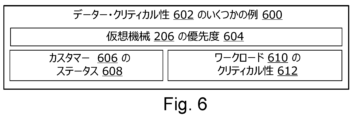
[00155] 600 データー・クリティカル性判断基準の例。
[00154] 506 Age of the battery, e.g., time since installation, number of charging cycles performed, number of times used between flashes.
[00155] 600 Examples of data criticality criteria.
[00156] 602 データー・クリティカル性判断基準。
[00157] 604 データーを生成した仮想機械に割り当てられる優先度。
[00158] 606 カスタマー、例えば、クラウドのテナント。
[00156] 602 Data Criticality Criteria.
[00157] 604 Priority assigned to the virtual machine that generated the data.
[00158] 606 Customer, e.g., a cloud tenant.
[00159] 608 カスタマーに割り当てられるステータス。例えば、SLAにおいて 明白にすることができる。
[00160] 610 ワークロード、たとえば、特定の計算ノードに割り当てられる処理タスク。
[00159] 608 Status assigned to the customer. For example, this may be made clear in the SLA.
[00160] 610 Workloads, e.g., processing tasks that are assigned to particular compute nodes.
[00161] 612 データーを含むワークロードに、またはデーターが生成された実行から割り当てられる優先度。
[00162] 702 物理機械、例えば、プロセッサー、回路、チップ、バッテリー、ディスプレイ、電源、筐体等。あらゆる埋め込みファームウェア、または物理機械の不揮発性メモリーに格納されたソフトウェアを含む。コンピューティング・システム102は、1つ以上の物理機械702を含む。
[00161] 612 A priority assigned to the workload containing the data or from which the data was generated.
[00162] 702 Physical machines, e.g., processors, circuits, chips, batteries, displays, power supplies, housings, etc. Including any embedded firmware or software stored in the non-volatile memory of the physical machine. Computing system 102 includes one or more
[00163] 704 クラウドまたは他のネットワークにおけるノード。計算ノード202およびストレージ・ノード212はノード704の例である。
[00164] 706 コンテナ。例えば、ユーザー空間仮想化を行う(provide)コンピューティング構造(construct)であり、それ自体はオペレーティング・システムを含まないが、それにもかかわらず、オペレーティング・システムに依存して実行する。
[00163] 704 Nodes in a cloud or other network. Compute nodes 202 and
[00164] 706 Container - A computing construct that provides, for example, user space virtualization, and does not itself contain an operating system, but nevertheless relies on an operating system to execute.
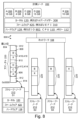
[00165] 800 1つ以上のストレージ・ノードとネットワークを組む1つ以上の計算ノードを有し、本明細書において教示するようなデーター保存機能が装備されたコンピューティング・システム。 [00165] 800 A computing system having one or more compute nodes networked with one or more storage nodes and equipped with data storage capabilities as taught herein.
[00166] 802 I/O(入力/出力)ハードウェアおよびソフトウェア。例えば、ポート、コネクター、ソケット、ネットワーク・インターフェース・カード。「IO」と呼ぶこともできる。 [00166] 802 I/O (input/output) hardware and software. For example, ports, connectors, sockets, network interface cards. Also called "IO."
[00167] 804 メモリーの最上位(top)。
[00168] 806 アパーチャのフラッシュ先端。
[00169] 808 アパーチャのフラッシュ後端。
[00167] 804 top of memory.
[00168] 806 Aperture flash tip.
[00169] 808 Flash trailing edge of aperture.
[00170] 810 アパーチャにおける未割り当て空間。
[00171] 812 同じメモリー・デバイス内であるがアパーチャの外側にあるメモリーの部分。
[00170] 810 Unallocated space in aperture.
[00171] 812 A portion of memory within the same memory device but outside the aperture.
[00172] 814 仮想アドレス空間と物理アドレス空間との間の論理マッピング。
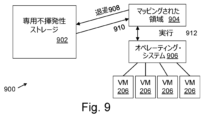
[00173] 900 仮想機械を実行するオペレーティング・システムまたはコンテナを有するシステムを含み、本明細書において教示するようなデーター保存機能が装備されコンピューティング・システム。
[00172] 814 A logical mapping between the virtual address space and the physical address space.
[00173] 900 A computing system equipped with data storage capabilities as taught herein, including a system having an operating system or container running a virtual machine.
[00174] 902 フラッシュされるデーターを受ける専用の不揮発性ストレージ112。
[00175] 904 専用ストレージ902にマッピングされるメモリー領域。バッテリー・バックアップ・メモリー・アパーチャ220は、領域904の一例である。
[00174] 902 Dedicated non-volatile storage 112 to receive the data to be flushed.
[00175] 904 A memory region that is mapped to the
[00176] 906 オペレーティング・システム。
[00177] 908 揮発性メモリーから、この揮発性メモリーをバックアップする専用不揮発性ストレージにデーターをコピーする退避動作。退避は、退避されるデーターの完全性に対する差し迫った脅威を全く伴わずに、意図的に行うことができ、または差し迫った脅威または発生している(current)脅威に応答して行われるフラッシュであってもよい。
[00176] 906 Operating System.
[00177] 908 An evacuation operation that copies data from volatile memory to dedicated non-volatile storage that backs up the volatile memory. The evacuation can be done intentionally without any immediate threat to the integrity of the data being evacuated, or it can be a flush done in response to an imminent or current threat.
[00178] 910 専用不揮発性ストレージから、この専用不揮発性ストレージによってバックアップされている揮発性メモリーにデーターをコピーする復元動作。
[00179] 912 プログラムの実行。プログラムを実行するアクト、またはプログラム動作のインスタンスを指すこともできる。
[00178] 910 A restore operation that copies data from the dedicated non-volatile storage to the volatile memory backed by the dedicated non-volatile storage.
[00179] 912 Execution of a program. May also refer to the act of executing a program or an instance of program operation.
[00180] 1000 フローチャート。また、1000は、図10のフローチャートによって示されるデーター保存方法、または図10のフローチャートにしたがうデーター保存方法にも言及する。 [00180] 1000 Flowchart. 1000 also refers to a data storage method as shown by or according to the flowchart of FIG. 10.
[00181] 1002 例えば、malloc()コール、コンストラクターの呼び出し、ファイルまたはブロックまたはブロブの退避、あるいは格納位置(バイト、ページ等)が未だ割り当てられていないデーターの格納を求める他の動作の結果として、クリティカル・データーを格納する要求を受ける。 [00181] 1002 A request is received to store critical data, for example as a result of a malloc() call, a constructor invocation, evacuation of a file or block or blob, or other operation that requires storage of data for which a storage location (byte, page, etc.) has not yet been allocated.
[00182] 1004 例えば、システム・メモリー管理ソフトウェア、空きリスト(free list)、空きチャンクを示すビット・ベクトル、または同様のメカニズムを使用して、メモリーの未割り当て部分を識別する。 [00182] 1004 Identify unallocated portions of memory, for example using system memory management software, a free list, a bit vector indicating free chunks, or a similar mechanism.
[00183] 1006 例えば、メモリー割り当てを追跡するデーター構造内にビットを設定することによって、メモリーの一部分に割り当て済みの印を付ける。
[00184] 1008 例えば、memcpy()によって使用される機能、ブロック・コピー等を実行することによって、データーのコピーをメモリー内に入力する。
[00183] 1006 Mark the portion of memory as allocated, for example, by setting a bit in a data structure that tracks memory allocation.
[00184] 1008 Put a copy of the data into memory, for example by performing a function such as that used by memcpy(), a block copy, etc.
[00185] 1010 例えば、ACPI準拠システム上でパワー・コマンドを受けることによって、または電圧レベル監視回路からの信号を受けることによって、データー完全性に対する脅威を検出する。 [00185] 1010 Detect threats to data integrity, for example, by receiving a power command on an ACPI compliant system or by receiving a signal from a voltage level monitoring circuit.
[00186] 1012 例えば、NVDIMMのDRAM部分からNVDIMMのフラッシュ部分にデーターをコピーすることによって、揮発性ストレージから専用不揮発性バックアップ・ストレージにデーターをフラッシュする。 [00186] 1012 Flushes data from the volatile storage to the dedicated non-volatile backup storage, for example, by copying data from the DRAM portion of the NVDIMM to the flash portion of the NVDIMM.
[00187] 1100 フローチャート。また、1100は、図11のフローチャート(図9のステップおよび図10のステップを組み込む)によって示される保存方法、または図11のフローチャートにしたがうデーター保存方法にも言及する。 [00187] 1100 Flowchart. 1100 also refers to a method of preservation as illustrated by the flowchart of FIG. 11 (which incorporates the steps of FIG. 9 and the steps of FIG. 10) or a method of preserving data according to the flowchart of FIG. 11.
[00188] 1102 データーを保存する、即ち、データーの少なくとも1つのコピーの完全性を維持する。
[00189] 1104 データー格納要求を受ける。
[00188] 1102 Store the data, i.e. maintain the integrity of at least one copy of the data.
[00189] 1104 A data storage request is received.
[00190] 1106 アパーチャ220のサイズまたは位置を決定もしくは指定する。
[00191] 1108 例えば、バイトまたはブロックを単位としたアパーチャ220のサイズ。
[00190] 1106 Determine or specify the size or location of the
[00191] 1108 Size of
[00192] 1110 アパーチャ220の位置。例えば、アパーチャを含む(contain)メモリー・デバイスの最も小さい物理アドレスからのアパーチャの両端のオフセット。
[00193] 1112 データー格納要求を送る。
[00192] 1110 Location of
[00193] 1112 Send a data storage request.
[00194] 1114 アパーチャのサイズを決定し直す。
[00195] 1115 アパーチャを移動させる。
[00196] 1116 非クリティカル・データーのみを保持するために、アパーチャの少なくとも指定された部分を予約する。
[00194] 1114 Resize aperture.
[00195] 1115 Move the aperture.
[00196] 1116 Reserve at least a specified portion of the aperture to hold only non-critical data.
[00197] 1118 アパーチャの予約部分。絶対または相対メモリー・アドレスによって、または総アパーチャ・サイズの割合(percentage)として指定することができる。
[00198] 1120 データーをコピーする、またはデーターを移動させる、または以前には割り当てられていなかったメモリーにデーターを挿入することによって、アパーチャの少なくとも一部分をディフラグすることによって、未割り当てであるメモリーの量を削減する、またはアパーチャのフラッシュ先端からの未割り当てメモリーの距離を延長する、または双方を行う。例えば、これを、同じユーザーまたは同じプロセスまたは同じファイルに属するメモリーの部分を統合することを伴う、別の「ディフラグ」の使用から区別するために、これを「フラッシュ・ディフラグ」と呼んでもよい。
[00197] 1118 Reserved portion of the aperture. Can be specified by absolute or relative memory address, or as a percentage of the total aperture size.
[00198] 1120 Defragment at least a portion of the aperture by copying data, or moving data, or inserting data into previously unallocated memory, thereby reducing the amount of memory that is unallocated, or increasing the distance of unallocated memory from the flush end of the aperture, or both. For example, this may be referred to as a "flash defrag" to distinguish it from other uses of "defrag" that involve consolidating portions of memory that belong to the same user or the same process or the same file.
[00199] 1122 アパーチャからのデーターの一部をフラッシュし損なう。この結果、データーの他のコピーが、アパーチャ以外のどこかで入手可能でなければ、そしてデーターの残りがフラッシュされた不揮発性ストレージ以外のどこかで入手可能でなければ、データーの少なくとも部分的な逸失が生じる。 [00199] 1122 Fail to flush some of the data from the aperture, resulting in at least partial loss of data if another copy of the data is not available elsewhere than the aperture, and if the remainder of the data is not available elsewhere than the flushed non-volatile storage.
[00200] 1124 物理機械内に常駐させる。たとえば、物理機械の一部であるメモリー(揮発性または不揮発性)に格納する。
[00201] 1126 アパーチャ外部、そしてアパーチャがフラッシュされる不揮発性ストレージ外部のどこかに、データーのコピーを保持する。
[00200] 1124 resides in a physical machine, e.g., stored in a memory (volatile or non-volatile) that is part of the physical machine.
[00201] 1126 Keep a copy of the data somewhere outside the aperture and outside the non-volatile storage where the aperture is flushed.
[00202] 1128 データーを移動させる。
[00203] 1130 空間を作る、即ち、メモリーの所与の部分を割り当て済みから空きに変更する。
[00202] 1128 Move the data.
[00203] 1130 Make space, i.e. change a given portion of memory from allocated to free.
[00204] 1132 データーをクリティカルに指定する。データーがユニットとして扱われるとき、そのユニットの任意の部分をクリティカルに指定すると、そのユニットもクリティカルに指定される。 [00204] 1132 Designate data as critical. When data is treated as a unit, designating any part of that unit as critical also designates the unit as critical.
[00205] 1134 割り当てられた部分間にある未割り当て量を削減する。
[00206] 1136 割り当て部分間にある未割り当て空間を消滅させる。
[00207] 1138 脅威に対抗してクリティカル・データーを保存する可能性を高める。
[00205] 1134 Reduce the unallocated amounts between the allocated portions.
[00206] 1136 Collapse any unallocated space between the allocated portions.
[00207] 1138 Increase the likelihood of preserving critical data against threats.
[00208] 1140 脅威に対抗してクリティカル・データーを保存する可能性。測定された確率(probability)または適正な評価でもよい。
[00209] 1142 ファームウェアを実行する。実行912の一例。
[00208] 1140 Likelihood of preserving critical data against a threat. Can be a measured probability or a proper assessment.
[00209] 1142 Execute Firmware. An example of execution 912.
[00210] 1144 他のいずれの参照番号も割り当てられていない、本開示において論じられるあらゆるステップ。
[00211] 動作環境
[00212] 図1を参照すると、実施形態の動作環境100は、少なくとも1つのコンピューター・システム102を含む。コンピューター・システム102は、マルチプロセッサー・コンピューター・システムであっても、またはなくてもよい。動作環境は、所与のコンピューター・システム内に1つ以上の機械を含むことができ、これらはクラスター化されても、クライアント-サーバー関係でネットワーク接続されても、および/またはクラウド内においてピア・ツー・ピアの形態でネットワーク接続されてもよい。個々の機械はコンピューター・システムであり、協働する機械のグループもコンピューター・システムである。所与のコンピューター・システム102が、例えば、アプリケーションを用いて、エンド・ユーザーのために構成されても、アドミニストレーターのためにサーバーとして構成されても、分散型処理ノードとして構成されても、および/または他の方法で構成されてもよい。
[00210] 1144 Any step discussed in this disclosure that is not assigned any other reference number.
[00211] Operating environment
[00212] With reference to Figure 1, an operating
[00213] 人間のユーザー104は、ディスプレイ、キーボード、およびその他の周辺機器106を使用することによって、タイプ入力されたテキスト、タッチ、音声、動き、コンピューター・ビジョン、ジェスチャ、および/またはI/Oの他の形態を通じて、コンピューター・システム102と対話処理することができる。画面126は、着脱可能な周辺機器106であってもよく、またはシステム102の統合部分であってもよい。ユーザー・インターフェースは、実施形態と1人以上の人間のユーザーとの間における対話処理を支援することができる。ユーザー・インターフェースは、コマンド・ライン・インターフェース、グラフィカル・ユーザー・インターフェース(GUI)、自然ユーザー・インターフェース(NUI)、音声コマンド・インターフェース、および/またはその他のユーザー・インターフェース(UI)表示を含んでもよく、これらは別個の選択肢として提示されてもよく、または統合されてもよい。 [00213] A human user 104 can interact with the computer system 102 through typed text, touch, voice, motion, computer vision, gestures, and/or other forms of I/O by using the display, keyboard, and other peripherals 106. The screen 126 can be a removable peripheral 106 or can be an integrated part of the system 102. A user interface can facilitate interaction between an embodiment and one or more human users. The user interface can include a command line interface, a graphical user interface (GUI), a natural user interface (NUI), a voice command interface, and/or other user interface (UI) presentations, which can be presented as separate options or can be integrated.
[00214] システム・アドミニストレーター、ネットワーク・アドミニストレーター、クラウド・アドミニストレーター、セキュリティ・アナリストおよび他のセキュリティ要員、操作要員、開発者、技術者、およびエンド・ユーザーは、各々、特定の型のユーザー104である。1人以上の人間の代わりに、例えば、システム102を検査し易くするために動作する自動化エージェント、スクリプト、再生ソフトウェア、デバイス等も、ユーザー104としてよい。記憶デバイスおよび/またはネットワーキング・デバイスは、それらのプロセッサー110からの離脱可能性(detachability)に応じて、ある実施形態では周辺機材として見なされ、他の実施形態ではシステム102の一部と見なされることもある。図1に示されていない他のコンピューター・システムも、技術的な方法で、コンピューター・システム102と、または、例えば、ネットワーク・インターフェース機材を通じて、ネットワーク108への1つ以上の接続を使用して、他のシステムの実施形態と相互作用することができる。 [00214] System administrators, network administrators, cloud administrators, security analysts and other security personnel, operational personnel, developers, engineers, and end users are each a particular type of user 104. Users 104 may also be automated agents, scripts, playback software, devices, etc., acting on behalf of one or more humans, for example, to facilitate testing of the system 102. Depending on their detachability from the processor 110, storage devices and/or networking devices may be considered peripheral equipment in some embodiments and part of the system 102 in other embodiments. Other computer systems not shown in FIG. 1 may also interact with the computer system 102 in a technical manner, or with other system embodiments using one or more connections to the network 108, for example, through network interface equipment.
[00215] 各コンピューター・システム102は、少なくとも1つのプロセッサー110を含む。コンピューター・システム102は、他の適したシステムと同様に、1つ以上のコンピューター読み取り可能記憶媒体112も含む。記憶媒体112は、異なる物理型のものであってもよい。記憶媒体112は、揮発性メモリー、不揮発性メモリー、所定位置固定媒体(fixed in place media)、リムーバブル媒体、磁気媒体、光媒体、ソリッド・ステート媒体、および/または他の種類の物理耐久記憶媒体(単なる伝搬信号または単なるエネルギーとは対立するものとして)であってもよい。具体的には、可搬型(即ち、外部)ハード・ドライブ、CD、DVD、メモリー・スティック、または他のリムーバブル不揮発性メモリー媒体のような、構成記憶媒体(configured medium)114は、挿入またそうでなければインストールされると、機能的にコンピューター・システムの技術的部分となり、そのコンテンツを、プロセッサー110との相互作用のためまたはプロセッサー110による使用のために、アクセス可能にすることができる。リムーバブルな構成記憶媒体114は、コンピューター読み取り可能記憶媒体112の例である。コンピューター読み取り可能記憶媒体112のいくつかの他の例には、内蔵RAM、ROM、ハード・ディスク、およびユーザー104によって容易に除去できない他のメモリー記憶デバイスが含まれる。現行の米国特許要件に従って、コンピューター読み取り可能媒体も、コンピューター読み取り可能記憶媒体も、コンピューター読み取り可能メモリーも、米国において係属中または付与されたいずれの請求項の下においても、信号自体でも単なるエネルギーでもない。
[00215] Each computer system 102 includes at least one processor 110. The computer system 102, like other suitable systems, also includes one or more computer-readable storage media 112. The storage media 112 may be of different physical types. The storage media 112 may be volatile memory, non-volatile memory, fixed in place media, removable media, magnetic media, optical media, solid state media, and/or other types of physically durable storage media (as opposed to merely propagating signals or merely energy). In particular, a configured
[00216] 記憶媒体114には、プロセッサー110によって実行可能なバイナリー命令116が構成される。「実行可能」(executable)とは、例えば、機械コード、解釈可能なコード、バイトコード、および/または仮想機械上で実行するコードを含むように、本明細書では広い意味で使用される。また、記憶媒体114には、命令116の実行による技術的効果のために、作成、修正、参照、および/またはそれ以外では使用されるデーター118が構成される。命令116およびデーター118は、これらが常駐するメモリーまたは他の記憶媒体114を構成する。このメモリーまたは他のコンピューター読み取り可能記憶媒体が所与のコンピューター・システムの機能部であるとき、命令116およびデーター118もこのコンピューター・システムを構成する。ある実施形態では、データー118の一部は、製品特性、在庫、物理測定値、設定値、画像、読み取り値、目標、分量等のような、実世界項目を表す。また、このようなデーターは、バックアップ、修復、コミット、中断、再フォーマット、および/またはその他の技術的処理によって変換される。
[00216]
[00217] 実施形態は、コンピューティング・デバイス(例えば、汎用コンピューター、サーバー、またはクラスター)において1つ以上のプロセッサーによって実行されるソフトウェア命令として実装されるというように説明される場合もあるが、このような説明は、可能な全ての実施形態を網羅することを意味するのではない。同じまたは同様の技術的効果を得るために、同じまたは同様の機能も、全体的または部分的に、直接ハードウェア・ロジックにおいて実装できる場合が多いことは、当業者には理解されよう。ソフトウェアの実装の代わりにまたはこれに加えて、本明細書において説明する技術的機能は、少なくとも部分的に、1つ以上のハードウェア・ロジック・コンポーネントによって実行することができる。ハードウェア・ロジック・コンポーネントは、ファームウェアを含んでも、ファームウェアによって制御されても、または双方でもよい。例えば、実施形態は、フィールド・プログラマブル・ゲート・アレイ(FPGA)、特定用途集積回路(ASIC)、特定用途標準製品(ASSP)、システム・オン・チップ・コンポーネント(SOC)、複合プログラマブル・ロジック・デバイス(CPLD)、および同様のコンポーネントというような、ハードウェア・ロジック・コンポーネント110、128を含んでもよく、更に そして他の実装も除外しない。実施形態のコンポーネントは、例えば、それらの入力、出力、および/またはそれらの技術的効果に基づいて、相互作用する機能モジュールに類別する(group)こともできる。 [00217] Although embodiments may be described as being implemented as software instructions executed by one or more processors in a computing device (e.g., a general purpose computer, a server, or a cluster), such description is not meant to be exhaustive of all possible embodiments. Those skilled in the art will appreciate that the same or similar functionality can often also be implemented, in whole or in part, directly in hardware logic to achieve the same or similar technical effect. Instead of or in addition to a software implementation, the technical functionality described herein may be performed, at least in part, by one or more hardware logic components. The hardware logic components may include firmware, be controlled by firmware, or both. For example, embodiments may include hardware logic components 110, 128 such as field programmable gate arrays (FPGAs), application specific integrated circuits (ASICs), application specific standard products (ASSPs), systems on chip components (SOCs), complex programmable logic devices (CPLDs), and similar components, and other implementations are not excluded. The components of the embodiments may also be grouped into interacting functional modules, for example, based on their inputs, outputs, and/or their technical effect.
[00218] プロセッサー110(例えば、CPU、ALU、FPU、および/またはGPU)、メモリー/記憶媒体112、およびディスプレイ126に加えて、動作環境は、実例をあげると、バッテリー、バス、電源、有線およびワイヤレス・ネットワーク・インターフェース・カードのような、他のハードウェア128も含むことができる。「画面」(screen)および「ディスプレイ」(display)という名詞は、本明細書では相互交換可能に使用される。ディスプレイ126は、1つ以上のタッチ・スクリーン、ペンまたはタブレットからの入力に応答する画面、または出力のためにのみ動作する画面を含むことができる。ある実施形態では、人間ユーザーI/Oデバイス(画面、キーボード、マウス、タブレット、マイクロフォン、スピーカー、動きセンサー等)のような周辺機器106は、1つ以上のプロセッサー110およびメモリーと動作可能に通信するように存在することもできる。 [00218] In addition to the processor 110 (e.g., CPU, ALU, FPU, and/or GPU), memory/storage media 112, and display 126, the operating environment may also include other hardware 128, such as, by way of example, batteries, buses, power supplies, wired and wireless network interface cards. The nouns "screen" and "display" are used interchangeably herein. The display 126 may include one or more touch screens, screens that respond to input from a pen or tablet, or screens that operate only for output. In some embodiments, peripherals 106, such as human user I/O devices (screen, keyboard, mouse, tablet, microphone, speaker, motion sensor, etc.), may also be present in operative communication with one or more processors 110 and memory.
[00219] ある実施形態では、このシステムは、有線および/またはワイヤレス・ネットワーク108によって接続された複数のコンピューターを含む。ネットワーキング・インターフェース機材128は、例えば、パケット交換ネットワーク・インターフェース・カード、ワイヤレス送受信機、または電話ネットワーク・インターフェースのようなネットワーク・コンポーネントを使用して、ネットワーク108へのアクセスを付与することができる。これらのコンポーネントは、所与のコンピューター・システム内に存在することができる。また、ネットワーキング・インターフェース機材、およびスイッチまたはルーターまたはファイアウォールのような他のネットワーク・コンポーネントの仮想化も、例えば、ソフトウェア定義ネットワーク、あるいはサンドボックス(sandboxed)環境または他のセキュア・クラウド・コンピューティング環境において、存在することができる。また、所与の実施形態は、直接メモリー・アクセス、リムーバブルな不揮発性記憶媒体、あるいは他の情報記憶検索および/または送信手法によって、技術的データーおよび/または技術的命令を伝達することもできる。 [00219] In one embodiment, the system includes multiple computers connected by wired and/or wireless networks 108. Networking interface equipment 128 can provide access to the network 108 using network components such as, for example, packet-switched network interface cards, wireless transceivers, or telephone network interfaces. These components can exist within a given computer system. Virtualization of the networking interface equipment and other network components such as switches or routers or firewalls can also exist, for example, in software-defined networks, or in sandboxed or other secure cloud computing environments. A given embodiment can also communicate technical data and/or technical instructions by direct memory access, removable non-volatile storage media, or other information storage, retrieval, and/or transmission techniques.
[00220] 尚、以上の態様および「動作環境」の下で本明細書において紹介される他の態様が、所与の実施形態の一部を形成できることは、当業者には認められよう。この文書の見出しは、機能(features)を実施形態と実施形態以外の機能集合に厳格に分類することを意図するのではない。 [00220] Those skilled in the art will recognize that these aspects, as well as other aspects introduced herein under "Operating Environment," may form part of a given embodiment. The headings in this document are not intended to rigidly classify features into embodiment and non-embodiment feature sets.
[00221] 1つ以上の項目が、図において、輪郭形態で示され、または括弧の中に掲示されているが、これらは必ずしも図示する動作環境の一部または全ての実施形態の一部ではないが、本明細書において論ずるように、動作環境またはいくつかの実施形態における項目と相互動作することができるということを強調するためである。だからと言って、輪郭形態でない項目や括弧がない項目が、いずれの図またはいずれの実施形態においても、必ず必要とされるという訳ではない。具体的には、図1は便宜上示されているのであり、図1に項目を含めることは、その項目、またはその項目の使用についての説明が、現在の技術革新の前に知られていたことを暗示するのではない。 [00221] One or more items are shown in outline form or in parentheses in the figures to emphasize that they are not necessarily part of some or all embodiments of the illustrated operating environment, but may interoperate with items in the operating environment or in some embodiments as discussed herein. Items not in outline form or without parentheses are not necessarily required to be present in any figure or in any embodiment. In particular, FIG. 1 is shown for convenience, and the inclusion of an item in FIG. 1 does not imply that the item, or a description of the item's use, was known prior to the current technological innovation.
[00222] 更にシステムについて
[00223] 図1から図11までを参照すると、ある実施形態は機能増強システム800または900を使用もしくは提供する。機能増強は、動作ステップとデバイス特性との組み合わせを実装して完全性の脅威314に対抗してデーターを保存することによって、データー保存を促進する(promote)のに役立つ。データー118は、クリティカル・データー412および非クリティカル・データー416に分割され、クリティカル・データーは1つ以上のバッテリー・バックアップ・メモリー218のアパーチャ220内の物理アドレス424に格納され、脅威が検出されたとき(1010)に非クリティカル・データーよりも先に、クリティカル・データーがフラッシュされる(1012)。バッテリー・バックアップ・メモリー・アパーチャ220は、バッテリーの特性406にしたがってサイズが決定され、条件が変化するに連れてサイズを変更することができる。ディフラガー(defragger)408は、クリティカル・データー412を格納するためのアパーチャの使用を最適化する。
[00222] More about the system
[00223] With reference to Figures 1 through 11, an embodiment uses or provides an
[00224] 図2のアーキテクチャ例によって示すように、データー118は、計算ノード202上で実行する(912)仮想機械206またはコンテナ706のような、ソース204によって生成されてもよい。これらのデーター・ソースは、システム・コード208を呼び出して、またはシステム・コード208に依存して、生成したデーター118をストレージ・ノード212に送る。この図2の例では、ストレージ・ノード212は高速揮発性メモリー402を有し、その少なくとも一部はバッテリー・バックアップ・メモリー218となっている。バッテリー・バックアップ・メモリー218の少なくとも一部は、本明細書において教示するように、クリティカル・データーを保存するのを補助するために、アパーチャ220としての使用に指定されている。ストレージ・ノード212および計算ノード202は、要求222(例えば、ここに格納するデーターがあります。識別子Zの下で格納されているデーターを返送して下さい)および応答224(例えば、格納成功、アパーチャに余裕なし、ここに要求されたデーターがあります、または他のステータスもしくはエラー・コード)を通じて通信する。要求222および応答224は、例えば、TCP/IPネットワーク108、イーサネット・ネットワーク108、ストレージ・エリア・ネットワーク108、またはこれらの組み合わせを通じて伝送する(travel)ことができる。
[00224] As illustrated by the example architecture of Figure 2, data 118 may be generated by sources 204, such as
[00225] 一般に、計算ノード-ストレージ・ノードの関係316は、必ずしも1対1ではない。1つの計算ノードが1つのストレージ・ノードに送ったまたは1つのストレージ・ノードから受信したデーターを処理し、あるいは複数のストレージ・ノードと通信することもできる。1つのストレージ・ノードが1つ以上の計算ノードに代わってデーターを格納することもできる。図8は、例えば、4つのストレージ・ノード212を使用する1つの計算ノード202を示す。
[00225] In general, the compute node-storage node relationship 316 is not necessarily one-to-one. A compute node may process data sent to or received from a storage node, or may communicate with multiple storage nodes. A storage node may store data on behalf of one or more compute nodes. FIG. 8, for example, shows a compute node 202 using four
[00226] 図2および図8に示すように、ある実施形態では、クリティカル・データー412は、ストレージ・ノードに跨がって複製されず、一方非クリティカル・データー416はストレージ・ノードに跨がって複製される。つまり、クリティカル・データーは、主にこのクリティカル・データーを不揮発性ストレージにフラッシュすることによって、またはそうすることによってのみ、脅威に対抗して保存され、一方非クリティカル・データーは、主に、それをノードに跨がって複製することによって、またはそうすることによってのみ、脅威に対抗して保存されるとしてよい。 [00226] As shown in Figures 2 and 8, in one embodiment, critical data 412 is not replicated across storage nodes, while non-critical data 416 is replicated across storage nodes. That is, critical data may be preserved against threats primarily, or only, by flushing the critical data to non-volatile storage, while non-critical data may be preserved against threats primarily, or only, by replicating it across nodes.
[00227] 図8において、クリティカル・データー412およびアパーチャ220における対応する割り当てエリア414は、仮想機械A、C、およびDに属し、図において丸い角によって示されている。一方、非クリティカル・データー416およびアパーチャ220における対応する割り当てエリア418は、仮想機械BおよびXに属し、図において直角の角によって示されている。仮想機械BおよびXに属するデーターのデーター複製226が示されており、ストレージ・ノードS1、S2、S3は仮想機械Bの非クリティカル・データー416の複製を有し、ストレージ・ノードS1、S2、S4は仮想機械Xの非クリティカル・データー416の複製を有する。
8, critical data 412 and corresponding allocation areas 414 in
[00228] 図8および図9は、システム・コード208のいくつかの例、即ち、カーネル120(例えば、ハイパーバイザー308、オペレーティング・システム906)およびファームウェア(たとえば、UEFIファームウェア310)を示す。計算ノードおよびストレージ・ノードは、コンピューティング・システム102であり、したがってハードウェアを含む。尚、明確化のために、メモリー112以外のハードウェアは図2では特に明示されて(called out)いないが、ハードウェアのいくつかの例、例えば、IO802およびCPU110は、メモリー112、218と共に、図8において明示されている。メモリー218は、アパーチャ220、アパーチャ外部のメモリー812、アパーチャ内部の割り当てメモリー418および414、ならびにアパーチャ内部の未割り当てメモリー810を含む。
8 and 9 show some examples of system code 208, namely kernel 120 (e.g., hypervisor 308, operating system 906) and firmware (e.g., UEFI firmware 310). The compute node and storage node are computing systems 102 and therefore include hardware. Note that for clarity, hardware other than memory 112 is not specifically called out in FIG. 2, but some examples of hardware, e.g., IO 802 and CPU 110, are shown in FIG. 8 along with memory 112, 218. Memory 218 includes
[00229] バッテリー・バックアップ・メモリー218の物理アドレス424、または他のアパーチャを含みマッピングされた揮発領域(aperture-containing mapped volatile region)904は、マッピング814によって、仮想アドレスにマッピングすることができる。マッピング814は、あるレベルの間接参照(indirection)を実施し、これによって、同じ退避908および復元910ファームウェアを、互いに異なる物理開始アドレス806および物理終端アドレス808を有するかもしれないアパーチャと共に使用することが可能になる。アパーチャ220のデーターがフラッシュされる先の不揮発性メモリー112は、NVDIMM404においてフラッシュまたは他の不揮発性ストレージ、あるいは他の専用不揮発性ストレージ902、もしくは双方を含むことができる。
[00229] The physical addresses 424 of the battery backed memory 218, or other aperture-containing mapped volatile region 904, can be mapped to virtual addresses by a
[00230] 図3は、あるコンピューティング環境100の種々の態様300を示す。これらについては、本開示における種々の時点において適宜説明する。
[00231] 図4は、革新的なデーター保存機能をコンピューティング・システム102に付加することができるデーター保存サブシステムの一例306を示す。サブシステム306のメモリーは、バッテリー・バックアップ・メモリー218、例えば、NVDIMM404においてアパーチャ220を含む。図4および図5において気付かれるように、バッテリーは、容量502、信頼性504、および経年数506の内1つ以上というような、追跡または指示対象となる特性406を有することができる。これらのバッテリー特性406は、互いに重複する、即ち、互いに影響を及ぼし合うこともある。例えば、信頼性は経年数と共に低下するとして差し支えない。また、サブシステム306は、バッテリー216によってバックアップされない揮発性メモリー402も含むことができる。
[00230] Figure 3 illustrates various aspects 300 of a
[00231] Figure 4 illustrates an example data storage subsystem 306 that can add innovative data storage capabilities to the computing system 102. The memory of the subsystem 306 includes a battery backed-up memory 218, e.g., an
[00232] 動作において、アパーチャ220は、クリティカル・データー412を収容する1つ以上の領域414を有し、アパーチャ220は、非クリティカル・データー416を収容する1つ以上の領域418を有することもできる。あるアパーチャ220は、例えば、図8に示すストレージ・ノードS2、S3、S4のように、少なくとも所与の時点において、非クリティカル・データーだけを収容することもできる。しかし、ここで関心の焦点になるのは、クリティカル・データーを収容するアパーチャ220である。具体的には、本開示は、データーの脅威に応答してクリティカル・データーをフラッシュするのに成功する可能性1140を高めるようにするには、どのようにしてクリティカル・データーをメモリー112に入力すればよいか(初期割り当てによって、またはディフラッギングによって、または双方)、つまり保存(1102)すればよいかについて情報提供する。
[00232] In operation, an
[00233] 図6は、クリティカル・データー412を非クリティカル・データー416から区別するために適用することができる判断基準602のいくつかの例600を示す。例えば、データーが仮想機械206またはコンテナ706または他のディジタル・アーチファクトによって生成された場合、このデーターをクリティカルに指定することができ、このアーチファクトは高い優先度604を有する。データー118が、支払いを行った特定のカスタマー606によってまたはその代わりに生成された場合、あるいはそれ以外ではクリティカル・データーを示すステータス608が得られた場合、クリティカルに指定する(1132)ことができる。同様に、データーが、クリティカル・データーを示す優先度またはステータス612を有する特定のワークロード610によって、またはその代わりに生成された場合、あるいは特定のワークロード610によって処理された場合、このデーターをクリティカルに指定する(1132)ことができる。これらの判断基準例を種々の方法で組み合わせることもでき、または他の判断基準602によって修正することもでき、あるいは双方でもよい。実例をあげると、(a)データーが高いステータスのカスタマーの高優先度仮想機械によって生成されたとき、このデーターをクリティカルに指定することができるが、それ以外の場合非クリティカルに指定することができる。(b)指定されたセキュア・サーバー・ブレード702上で実行する高ステータスのカスタマーの何らかの仮想機械によってデーターが生成されたとき、このデーターをクリティカルに指定することができるが、それ以外の場合非クリティカルに指定することができる。(c)指定された時間期間中に任意のカスタマーによってデーターが生成されたとき、このデーターをクリティカルに指定することができるが、それ以外の場合非クリティカルに指定することができる、等である。
[00233] Figure 6 illustrates some example criteria 600 that may be applied to distinguish critical data 412 from non-critical data 416. For example, data may be designated critical if it was generated by a
[00234] 図7は、あるコンピューティング・システム102の種々の例700を示す。これらについては、本開示の種々の時点において適宜説明する。
[00235] ある実施形態は、コンピューティング・システム102においてデーター保存サブシステム306を提供または使用する。データー保存サブシステム306は、アパーチャ220を有するバッテリー・バックアップ・メモリー218を含むことができる。アパーチャ220は、フラッシュ・オーダー312を有する。フラッシュ・オーダー312は、データー完全性の脅威314に応答して、データーをアパーチャからアパーチャ関連不揮発性ストレージ902にコピーする順序(order)である。フラッシュ・オーダーは、アパーチャのフラッシュ先端806と、アパーチャのフラッシュ後端808とを定める。
[00234] Figure 7 illustrates various examples 700 of certain computing systems 102, which are described as appropriate at various points in this disclosure.
[00235] Certain embodiments provide or use a data storage subsystem 306 in a computing system 102. The data storage subsystem 306 can include a battery backed up memory 218 having an
[00236] また、フラッシュ・オーダーは、「トップ-ダウン」(top-down)または「ボトム-アップ」(bottom-up)というような語句を使用して記述することもでき、大きい物理アドレス424程小さい物理アドレスよりも上にあると理解することとする。したがって、トップ-ダウン・フラッシュは、高い方のアドレスから開始し、低い方のアドレスに向かって進む。一方ボトム-アップ・フラッシュは、低い方のアドレスから開始し、高い方のアドレスに向かって進む。アパーチャのフラッシュ先端806は、トップ-ダウン・フラッシュ・オーダーでは、アパーチャのフラッシュ後端808よりも大きなアドレスを有し、ボトム-アップ・フラッシュ・オーダーでは、アパーチャのフラッシュ後端808よりも小さいアドレスを有する。図8では、アパーチャのフラッシュ先端806は、アパーチャのフラッシュ後端808よりも小さい物理アドレス424を有するので、ボトム-アップ(小さいアドレスから大きいアドレスへ)フラッシュ・オーダー312を示す。
[00236] The flush order may also be described using terms such as "top-down" or "bottom-up," with the understanding that larger
[00237] ある実施形態では、データー保存サブシステム306は、バッテリー・バックアップ・メモリー218と動作可能に通信するデーター保存回路304を含む。データー保存回路304は、データー保存ステップを実行するように構成される。データー保存ステップは、以下を含むことができる。 [00237] In one embodiment, the data storage subsystem 306 includes a data storage circuit 304 in operative communication with the battery backup memory 218. The data storage circuit 304 is configured to perform a data storage step. The data storage step may include:
(a)データー集合A-データー412をアパーチャに格納する要求222を受けるステップ(1002)。A-データーは、クリティカル・データーに指定されたデーターを含む。 (a) Step 1002 of receiving a request 222 to store a data set A-data 412 in an aperture. The A-data includes data designated as critical data.
(b)アパーチャの未割り当てメモリー810の一部分A-メモリー414を特定する(1004)。A-メモリーは、A-データーを保持できるだけ十分に大きく、A-メモリーは、アパーチャの他のいずれの未割り当てメモリーの他のいずれのアドレスよりもアパーチャのフラッシュ先端806に近いアドレス424を有する。
(b) Identify (1004) a portion A-memory 414 of the aperture's
(c)A-メモリーに割り当て済みの印を付け(1006)、A-データーのコピーをA-メモリーに入力する(1008)。
(d)データー集合Z-データー416をアパーチャに格納する要求222を受ける。Z-データーは、クリティカル・データーに指定されるデーターを全く含まない。
(c) Mark A-Memory as allocated (1006) and input a copy of the A-Data into A-Memory (1008).
(d) A request 222 is received to store in the aperture a data set Z-data 416. The Z-data does not include any data designated as critical data.
(e)アパーチャの未割り当てメモリー810の一部分Z-メモリーを特定する。Z-メモリーは、Z-データーを保持できるだけ十分に大きく、Z-メモリーは、アパーチャの他のいずれの未割り当てメモリーの他のいずれのアドレスよりも、アパーチャのフラッシュ後端808に近いアドレス424を有する。
(e) Identifying a portion of the aperture's
(f)Z-メモリーに割り当て済みの印を付け、Z-データーのコピーをZ-メモリーに入力する。
ここで、ラベル(a)から(f)までは、単に識別子として役割を果たすに過ぎず、したがって必ずしもこれら自体が動作の順序を指定する訳ではない。このデーター保存サブシステム306は、フラッシュ-オーダーにおいてクリティカル・データーを非クリティカル・データーよりも前にバッテリー・バックアップ・メモリーに入力することによって、クリティカル・データーをフラッシュするのに成功し(1012)、それによってクリティカル・データーを保存する可能性を高める。クリティカル・データー保存の可能性は、データーのクリティカル性を考慮せずに、即ち、クリティカル性を欠いて、バッテリー・バックアップ・メモリーにデーターを格納するアーキテクチャにおけるよりも高い。
(f) Mark the Z-Memory as allocated and enter a copy of the Z-Data into the Z-Memory.
Here, the labels (a) through (f) merely serve as identifiers and thus do not necessarily themselves specify an order of operations. The data retention subsystem 306 increases the likelihood of successfully flushing 1012 critical data, thereby preserving the critical data, by inputting the critical data to the battery-backed memory before the non-critical data in the flush-order. The likelihood of preserving the critical data is higher than in an architecture that stores data in the battery-backed memory without regard to the criticality of the data, i.e., lacking criticality.
[00238] ある実施形態では、バッテリー・バックアップ・メモリー・アパーチャ220は、ここではXと呼ばれるネットワーク・ノード704内に常駐し、またはネットワーク・ノード704によって制御され、A-データーをアパーチャに格納する要求222は、ここではYと呼ばれる異なるネットワーク・ノードから送られた。図8では、例えば、アパーチャはストレージ・ノード212、704 S1に常駐し、アパーチャ220における仮想機械Aに対するA-データーを格納する要求222は、S1以外の異なるネットワーク・ノードから、即ち、計算ノードから送られた。ある実施形態では、ネットワーク・ノードXは、クラウド302内にストレージ・ノードを含み、ネットワーク・ノードYは、クラウド内に計算ノードを含む。しかしながら、他の実施形態では、ノードがクラウド以外のネットワークに常駐することもできる。
[00238] In some embodiments, the battery backed
[00239] ある実施形態では、ネットワーク・ノードXおよびネットワーク・ノードYが、ここではRと呼ばれるストレージ関係316によって関係付けられる。ここで、Rは、MがNの代わりにデーターを格納するとき、2つのノードMおよびNがRによって関係付けられるように、定められる。ある場合には、Rは特定のノードXおよびYの1対1の関係ではないこともある。例えば、計算ノードが仮想機械VM7のクリティカル・データーをストレージ・ノードS7に送り、仮想機械VM8のクリティカル・データーをストレージ・ノードS8に送る場合もある。または、ストレージ・ノードS12が計算ノードC10からのクリティカル・データーを保持し、更に異なる計算ノードC11からのクリティカル・データーも保持する場合もある。勿論、多くの他の関係316の例も可能である。 [00239] In one embodiment, network node X and network node Y are related by a storage relationship 316, referred to herein as R, where R is defined such that two nodes M and N are related by R when M stores data on behalf of N. In some cases, R may not be a one-to-one relationship for particular nodes X and Y. For example, a compute node may send critical data for virtual machine VM7 to storage node S7 and critical data for virtual machine VM8 to storage node S8. Or, storage node S12 may hold critical data from compute node C10 and also hold critical data from a different compute node C11. Of course, many other examples of relationships 316 are possible.
[00240] ある実施形態では、バッテリー・バックアップ・メモリー218はNVDIMMメモリー404を含む。例えば、NVDIMM404は、NVDIMM-Fフラッシュ・メモリー、NVDIMM-Nバイト-アドレス可能メモリー、同じデバイス上にダイナミックRAMおよびNANDを有するNVDIMM-Pメモリー、NVDIMM-SWメモリー、またはNVRAM不揮発性RAMメモリーを含むことができる。NVDIMM-SWは、メモリー(例えば、DD4RAM)、ディスク、またはフラッシュ(例えば、SSDパーティション)、バッテリー、およびシグナリング・メカニズムを含むこともできる。 [00240] In one embodiment, battery backed-up memory 218 includes NVDIMM memory 404. For example, NVDIMM 404 may include NVDIMM-F flash memory, NVDIMM-N byte-addressable memory, NVDIMM-P memory with dynamic RAM and NAND on the same device, NVDIMM-SW memory, or NVRAM non-volatile RAM memory. NVDIMM-SW may also include memory (e.g., DD4RAM), disk, or flash (e.g., SSD partitions), a battery, and a signaling mechanism.
[00241] ある実施形態では、コンピューティング・システム102は仮想機械206を含み、データー集合A-データー412はデーター保存サブシステム306に仮想機械VM-Aから送られ、データー集合Z-データー416はデーター保存サブシステム306に仮想機械VM-Zから送られる。図8の例では、実例をあげると、クリティカル・データー集合412は増強ストレージ・ノードS1(したがってそのデーター保存サブシステム306に)に仮想機械Aから送られ、非クリティカル・データー集合416はS1に仮想機械Bから送られる。
[00241] In one embodiment, computing system 102 includes
[00242] 本明細書では、他のシステムの実施形態についても、直接説明するか、あるいは説明したプロセスまたは構成した媒体のシステム・バージョンとして導き出せる(derivable)ものとして説明し、コンピューティング・ハードウェアについての本明細書における広範な論述によって情報提供する。 [00242] Other system embodiments are also described herein, either directly or as being derivable as system versions of the described processes or configured media, and are informed by the extensive discussion herein of computing hardware.
[00243] 図において具体的なアーキテクチャの例を示したが、実施形態はこれらの例から逸脱してもよい。実例をあげると、異なる図に示した品目を1つの実施形態に纏めて含ませてもよく、1つの図に示す品目を省略してもよく、異なる品目において示される機能を、もっと少ない品目にまたは1つの品目に組み込んでもよく、品目の名称を変更してもよく、あるいは品目を互いに異なる接続にしてもよい。 [00243] Although specific architecture examples are shown in the figures, embodiments may deviate from these examples. For illustrative purposes, items shown in different figures may be included together in one embodiment, items shown in one figure may be omitted, functionality shown in different items may be combined into fewer items or into one item, items may be renamed, or items may be connected differently to one another.
[00244] 本明細書では、技術の態様を例示するのに役立てるために例を示すが、この文書内で示す例は、可能な実施形態の全てを説明するのではない。実施形態は、本明細書において提示する特定の例、コンポーネントの名称、最適化、アルゴリズムの選択、データー、データー型、構成、実施態様、配列、表示、特徴、手法、そしてシナリオにも限定されない。所与の実施形態は、実例をあげると、追加のまたは異なる技術的特徴、メカニズム、シーケンス、データー構造、または機能を含んでもよく、それ以外でも本明細書において提示する例から逸脱してもよい。 [00244] Examples are provided herein to help illustrate aspects of the technology, however, the examples provided within this document do not describe all possible embodiments. Embodiments are not limited to the specific examples, component names, optimizations, algorithm selections, data, data types, configurations, implementations, sequences, representations, features, techniques, and scenarios presented herein. A given embodiment may include, for example, additional or different technical features, mechanisms, sequences, data structures, or functions, or may otherwise deviate from the examples presented herein.
[00245] プロセス(別名、方法)
[00246] 図10は、本明細書において教示するデーター保存機能を有し、図1から図9までの1つ以上によって示される増強システムによって実行または補佐することができる方法の一例である、方法1000を示す。図10に示す受けるステップ1002、特定するステップ1004、印を付けるステップ1006、入力するステップ1008、検出するステップ1010、およびフラッシュするステップ1012について、本開示全体を通じて、これらの参照番号で明示的に引用しながら、そして引用せずに説明する。具体的には、図2、図8、および図9の論述は、図10に示すステップ1002から1012までに関係がある。
[00245] Process (aka method)
[00246] Figure 10 illustrates a
[00247] 図11は、更に、アクセス制御方法(その世界の法的な意味では「プロセス」と呼ぶこともできる)も示す。このアクセス制御方法は、増強データー保存機能を有するシステムの動作中に使用するのに適しており、図10に示すステップに対する何らかの改善(refinement)、補助、またはコンテキストに関するアクションを含む。また、図11は、図9または図10に示すステップも組み込む。特に明記されなければ、これらの図に示されるまたは他で開示される技術的プロセスは、例えば、データー保存サブシステム306によって自動的に実行される。また、プロセスは、人間のアドミニストレーターまたは他の人によるアクションが関与する範囲で、一部自動的にそして一部手作業で実行されてもよい。例えば、ある実施形態では、人間が、非クリティカル・データーのために予約される(1116)べきアパーチャの最小割合または最大割合を指定してもよい。本明細書において技術革新と考えられるプロセスには、全体的に手作業のものはない。所与の実施形態では、図示するプロセスのステップの内0以上は、恐らくは異なるパラメータまたはデーターを用いて、繰り返し動作する場合もある。また、実施形態におけるステップは、図10および図11に展開する、上から下への順序以外の異なる順序で実行することもできる。ステップは、順次、部分的に重複して、または完全に並列に実行することもできる。具体的には、プロセス中に実行されるステップを示すために、フローチャート1000のアクション項目またはフローチャート1100のアクション項目を横断する(traverse)順序は、プロセスの実行毎に変化してもよい。また、フローチャートの横断順序は、プロセスの実施形態毎に変化してもよい。また、実行するプロセスが動作可能であり、少なくとも1つの請求項に従うのであれば、ステップを省略する、組み合わせる、名称変更する、類別し直す、1つ以上の機械上で実行する、または図示するフローから逸脱することも可能である。
[00247] FIG. 11 also illustrates an access control method (which may be referred to as a "process" in the legal sense of the world). This access control method is suitable for use during operation of a system with enhanced data preservation capabilities and includes any refinement, auxiliary, or contextual actions to the steps illustrated in FIG. 10. FIG. 11 also incorporates the steps illustrated in FIG. 9 or FIG. 10. Unless otherwise specified, the technical processes illustrated in these figures or disclosed elsewhere are performed automatically, for example, by the data preservation subsystem 306. The processes may also be performed partly automatically and partly manually, to the extent that action by a human administrator or other person is involved. For example, in an embodiment, a human may specify a minimum or maximum percentage of the aperture that should be reserved (1116) for non-critical data. There is no entirely manual process considered innovation herein. In a given embodiment, zero or more of the steps of the illustrated process may operate repeatedly, perhaps with different parameters or data. Also, steps in the embodiments may be performed in a different order than the top-down order depicted in FIGS. 10 and 11. Steps may be performed sequentially, partially overlapping, or fully parallel. In particular, the order in which the action items of
[00248] ある実施形態は、コンピューティング・システムにおいてデーター保存方法を使用または提供する。この方法は、バッテリー・バックアップ・メモリーのアパーチャにデーター集合A-データーを格納する要求を受けるステップ1002を含むことができる。アパーチャは、フラッシュ・オーダー312を有する。フラッシュ・オーダーは、データー完全性の脅威314に応答して、データーをアパーチャからアパーチャ関連不揮発性ストレージにコピーする(908)順序である。フラッシュ・オーダーは、アパーチャのフラッシュ先端と、アパーチャのフラッシュ後端とを定める。A-データーは、クリティカル・データーに指定されたデーターを含む。 [00248] An embodiment uses or provides a method for preserving data in a computing system. The method can include receiving 1002 a request to store a data set A-data in an aperture of a battery backed memory. The aperture has a flush order 312. The flush order is an order in which data is copied 908 from the aperture to aperture associated non-volatile storage in response to a data integrity threat 314. The flush order defines a flush leading edge of the aperture and a flush trailing edge of the aperture. The A-data includes data designated as critical data.
[00249] また、この方法は、アパーチャの未割り当てメモリーの一部分A-メモリーを識別するステップ1004も含むことができ、A-メモリーはA-データーを保持できるだけ十分に大きく、A-メモリーは、アパーチャの他のいずれの未割り当てメモリーの他のいずれのアドレスよりもアパーチャのフラッシュ先端に近いアドレスを有する。また、この方法は、A-メモリーに割り当て済みの印を付けるステップ1006と、A-データーのコピーをA-メモリーに入力するステップ1008も含むことができる。 [00249] The method may also include step 1004 of identifying a portion A-memory of the aperture's unallocated memory, the A-memory being large enough to hold the A-data, the A-memory having an address closer to the flash tip of the aperture than any other address of any other unallocated memory of the aperture. The method may also include step 1006 of marking the A-memory as allocated, and step 1008 of inputting a copy of the A-data into the A-memory.
[00250] また、この方法は、データー集合Z-データーをアパーチャに格納する要求を受けるステップ1104も含むことができ、Z-データーは、クリティカル・データーに指定されたデーターを全く含まない。 [00250] The method may also include step 1104 of receiving a request to store a data set Z-data in the aperture, where the Z-data does not include any data designated as critical data.
[00251] また、この方法は、アパーチャの未割り当てメモリーの一部分Z-メモリーを特定するステップ1004も含むことができ、Z-メモリーはZ-データーを保持するだけ十分に大きく、Z-メモリーは、アパーチャの他のいずれの未割り当てメモリーの他のいずれのアドレスよりもアパーチャのフラッシュ後端に近いアドレスを有する。また、この方法は、Z-メモリーに割り当て済みの印を付けるステップ1006と、Z-データーのコピーをZ-メモリーに入力するステップ1008とを含むことができる。 [00251] The method may also include step 1004 of identifying a portion of the unallocated memory of the aperture, a Z-memory, the Z-memory being large enough to hold the Z-data, the Z-memory having an address closer to the flash trailing edge of the aperture than any other address of any other unallocated memory of the aperture. The method may also include step 1006 of marking the Z-memory as allocated, and step 1008 of inputting a copy of the Z-data into the Z-memory.
[00252] このような方法によって、フラッシュ-オーダーにおいて非クリティカル・データーの前にクリティカル・データーをバッテリー・バックアップ・メモリーに入力しない場合とは対照的に、フラッシュ-オーダーにおいて非クリティカル・データーの前にクリティカル・データーをバッテリー・バックアップ・メモリーに入力することによって、クリティカル・データーをフラッシュするのに成功し(1012)、したがってそれを保存する(1102)可能性1140が高くなる(1138)。 [00252] In this manner, by inputting the critical data into the battery-backed memory before the non-critical data in the flash-order, the likelihood 1140 of successfully flashing (1012) the critical data and thus preserving (1102) it is increased (1138) as opposed to not inputting the critical data into the battery-backed memory before the non-critical data in the flash-order.
[00253] ある実施形態では、この方法は、更に、少なくとも部分的に、バッテリー・バックアップ・メモリーのバッテリー特性に基づいて、アパーチャのサイズ1108を決定するステップ1106も含んでもよい。例えば、容量が小さいバッテリー、古いバッテリー、信頼性が低いバッテリー程、アパーチャが小さくなってもよい。ある実施形態では、この方法は、更に、少なくとも部分的に、バッテリー・バックアップ・メモリーのバッテリー特性に基づいて、アパーチャの位置1110を決定するステップ1106を含んでもよい。例えば、容量が小さい、古い、または信頼性が低いバッテリーによってバックアップされるメモリーにおけるアパーチャに代わって、新しい、容量が大きい、または信頼性が高いバッテリーによってバックアップされるメモリーにおいてアパーチャを選択してもよい。ある実施形態では、この方法は、少なくとも部分的に、バッテリー・バックアップ・メモリーのバッテリー特性における変化に基づいて、例えば、バッテリーがもっと新しい、大きい、または信頼性が高いバッテリーと交換されるときに、アパーチャ・サイズを大きくすることによって、アパーチャのサイズを変更するステップ1114、またはアパーチャを移動させるステップ1115を含んでもよい。本明細書において開示する他のステップと同様、これらのステップも所与の実施形態では組み合わせてもよい。 [00253] In some embodiments, the method may further include step 1106 of determining the size 1108 of the aperture based at least in part on the battery characteristics of the battery backed-up memory. For example, the aperture may be smaller for smaller capacity, older, or less reliable batteries. In some embodiments, the method may further include step 1106 of determining the location 1110 of the aperture based at least in part on the battery characteristics of the battery backed-up memory. For example, an aperture may be selected in a memory backed-up by a newer, larger, or more reliable battery instead of an aperture in a memory backed-up by a smaller capacity, older, or less reliable battery. In some embodiments, the method may include step 1114 of changing the size of the aperture or step 1115 of moving the aperture based at least in part on changes in the battery characteristics of the battery backed-up memory, for example by increasing the aperture size when the battery is replaced with a newer, larger, or more reliable battery. As with other steps disclosed herein, these steps may be combined in a given embodiment.
[00254] ある実施形態では、この方法は、更に、アパーチャの少なくともディフラグ部分をディフラグするステップ1120を含んでもよく、ディフラグ部分はクリティカル・データーを含む。本明細書の他の章で論じたように、ディフラッギング1120はフラッシュ・ディフラッギングを指す。統合ディフラッギングは、思わぬ結果(side-effect)が生じるかもしれないが、フラッシュ・ディフラッギング1120として機能するには本質的に十分でない。ディフラッギング1120は積極的(proactive)であってもよい。また、ディフラッギング1120が誘起されるのは、テナントまたはプロセスが終了するとき、テナントまたはプロセスから抜ける(vocate)とき、または移転するときでもよい。 [00254] In an embodiment, the method may further include defragmenting 1120 at least a defragmented portion of the aperture, the defragmented portion including the critical data. As discussed elsewhere herein, defragmenting 1120 refers to flash defragmenting. Integrated defragmenting may have side-effects, but is not inherently sufficient to function as flash defragmenting 1120. Defragmenting 1120 may be proactive. Defragmenting 1120 may also be triggered when a tenant or process is terminated, vocates, or transfers.
[00255] ある実施形態では、この方法は、更に、ワークロードのクリティカル性、仮想機械の優先度、またはカスタマー・ステータスという判断基準602の内、少なくとも1つに基づいて、A-データーの少なくとも一部分をクリティカル・データーに指定するステップ1132を含んでもよい。 [00255] In some embodiments, the method may further include step 1132 of designating at least a portion of the A-data as critical data based on at least one of the following criteria 602: workload criticality, virtual machine priority, or customer status.
[00256] ある実施形態では、この方法は、データー完全性の脅威を検出するステップ1010と、クリティカル・データーの全てをアパーチャから不揮発性ストレージにフラッシュするステップ1012と、少なくとも一部の非クリティカル・データーをアパーチャから不揮発性ストレージにフラッシュし損なうステップ1122とを含んでもよい。例えば、バッテリーに蓄えられている電力が、アパーチャ全体をフラッシュするには十分ではないかもしれないが、とは言え、全てのクリティカル・データーをフラッシュするには十分であるかもしれない。このシナリオ例は、バッテリー電力が十分であったならば、クリティカル・データーがフラッシュされてから非クリティカル・データーがフラッシュされ終えるように、クリティカル・データーを入力する利点を示す。 [00256] In one embodiment, the method may include step 1010 of detecting a data integrity threat, step 1012 of flushing all of the critical data from the aperture to non-volatile storage, and step 1122 of failing to flush at least some of the non-critical data from the aperture to non-volatile storage. For example, the power stored in the battery may not be sufficient to flush the entire aperture, but may be sufficient to flush all of the critical data. This example scenario illustrates the benefit of inputting the critical data so that, if there was sufficient battery power, the critical data is flushed before the non-critical data is flushed.
[00257] ある実施形態では、この方法は、データー完全性の脅威を検出するステップ1010と、少なくともクリティカル・データーの全てをアパーチャから不揮発性ストレージにフラッシュするステップ1012と、次いでフラッシュしたデーターの全てを不揮発性ストレージから復元するステップ910とを含んでもよい。フラッシュされたクリティカル・データーは、揮発性メモリー、データーがフラッシュされた元のバッテリー・バックアップ・メモリー、またはデーターがフラッシュされた元のバッテリー・バックアップ・メモリーとは異なるバッテリー・バックアップ・メモリーの内少なくとも1つに復元する(910)ことができる。 [00257] In one embodiment, the method may include detecting 1010 a data integrity threat, flushing 1012 at least all of the critical data from the aperture to non-volatile storage, and then restoring 910 all of the flushed data from the non-volatile storage. The flushed critical data may be restored 910 to at least one of a volatile memory, a battery-backed memory from which the data was flushed, or a battery-backed memory different from the battery-backed memory from which the data was flushed.
[00258] ある実施形態では、この方法は、アパーチャ外部、そしてアパーチャ関連不揮発性ストレージ外部に、Z-データーの少なくとも1つのコピーを保持するステップ1126を含んでもよい。即ち、データー保存用システムを構築するとき、非クリティカル・データーの複製は、クリティカル・データーが注意深い入力(placement)1008およびフラッシング1012に依拠することと両立する(compatible)。 [00258] In one embodiment, the method may include step 1126 of maintaining at least one copy of the Z-data outside the aperture and outside the aperture-associated non-volatile storage. That is, when constructing a system for preserving data, the duplication of non-critical data is compatible with the careful placement 1008 and flushing 1012 of critical data.
[00259] ある実施形態では、バッテリー・バックアップ・メモリーのアパーチャは、ここではMで示す物理機械内に常駐し(1124)、アパーチャにA-データーを格納する要求は、ここではNで示す異なる物理機械から送られた(1112)。例えば、図2または図8に示す構成では、計算ノードおよびストレージ・ノードは異なる物理機械にすることができる。代わりの構成では、これらは同じ基本物理ハードウェア上で実行する仮想デバイスであることも可能である。 [00259] In one embodiment, the battery-backed memory aperture resides (1124) in a physical machine, here denoted M, and the request to store A-data in the aperture comes (1112) from a different physical machine, here denoted N. For example, in the configurations shown in Figures 2 or 8, the compute node and the storage node can be different physical machines. In alternative configurations, they can be virtual devices running on the same underlying physical hardware.
[00260] ある実施形態では、この方法は、A-データーを1つのストレージ・ノードのみに格納し、Z-データーのコピーを複数のストレージ・ノードに格納するステップを含んでもよい。即ち、ある例では、クリティカル・データーの保存は入力1008およびフラッシング1012のみに依拠するが、非クリティカル・データーの保存は少なくとも部分的に複製226に依拠する。 [00260] In some embodiments, the method may include storing A-data on only one storage node and storing copies of Z-data on multiple storage nodes. That is, in one example, storage of critical data relies only on input 1008 and flushing 1012, while storage of non-critical data relies at least in part on replication 226.
[00261] 構成記憶媒体(configured storage medium)
[00262] ある実施形態は、構成コンピューター読み取り可能記憶媒体112を含む。記憶媒体112は、ディスク(磁気、光、またはこれら以外)、RAM、EEPROMS、または他のROM、および/または具体的にはコンピューター読み取り可能記憶媒体(単なる伝搬信号ではない)を含む、他の構成可能なメモリーを含むことができる。構成された記憶媒体とは、具体的に、CD、DVD、またはフラッシュ・メモリーのような、リムーバブル記憶媒体114としてもよい。リムーバブルであってもなくてもよく、揮発性であってもなくてもよい汎用メモリーは、アロケーター422、ディフラガー408、およびマッピング814というような品目を使用して、データー118および命令116の形態で構成して、実施形態にすることができる。データー118および命令116は、構成記憶媒体を形成するために、リムーバブル記憶媒体114および/またはネットワーク接続のような他のソースから読み取られる。構成記憶媒体112は、コンピューター・システム102に、本明細書において開示した通りに、データー保存のための技術的プロセス・ステップを実行させることができる。このため、図は、構成記憶媒体の実施形態およびプロセス(別名、方法)の実施形態、ならびにシステムおよびプロセスの実施形態を例示するのに役立つ。具体的には、図9、図10、または図11において示したプロセス・ステップ、もしくは本明細書において教示したプロセス・ステップはいずれも、記憶媒体を構成し、構成記憶媒体の実施形態を形成するために使用することができる。
[00261] configured storage medium
[00262] Some embodiments include computer readable storage media 112. Storage media 112 may include disks (magnetic, optical, or otherwise), RAM, EEPROMS, or other ROM, and/or Other configurable memory may be included, including computer readable storage media (not just propagating signals). Configurable storage media may specifically include CDs, DVDs, or flash memory. , and
[00263] ある実施形態は、データー118および命令116が構成されたコンピューター読み取り可能記憶媒体112、114を使用または提供する。命令116がプロセッサー110によって実行されると、コンピューティング・システムまたはそのサブシステムに、データー保存のための方法を実行させる。この方法は、複数の要求を受けるステップ1002を含む。各要求は、それぞれのデーター集合をバッテリー・バックアップ・メモリーのアパーチャ220に格納することを求める。アパーチャは、フラッシュ・オーダー312を有する。フラッシュ・オーダー312は、データー完全性の脅威に応答して、アパーチャからアパーチャ関連不揮発性ストレージにデーターをコピーする順序である。フラッシュ・オーダーは、アパーチャのフラッシュ先端806と、アパーチャのフラッシュ後端808とを定める。それぞれのデーター集合は、各々、クリティカル・データーに指定されたデーターを含む。
[00263] An embodiment uses or provides a computer
[00264] また、この方法は、要求の内少なくとも2つについて、アパーチャの未割り当てメモリーのそれぞれの部分を識別するステップ1004を含む。未割り当てメモリーの各部分は、それぞれのデーター集合を保持するだけ十分に大きく、識別された未割り当てメモリーのそれぞれの部分は、アパーチャの他のいずれの未割り当てメモリーの他のいずれのアドレスよりもアパーチャのフラッシュ先端に近いアドレスを有する。 [00264] The method also includes step 1004 of identifying, for at least two of the requests, respective portions of unallocated memory of the aperture, each portion of the unallocated memory being large enough to hold a respective set of data, each identified portion of the unallocated memory having an address closer to the flush tip of the aperture than any other address of any other unallocated memory of the aperture.
[00265] また、この方法は、要求の内少なくとも1つについて、識別された未割り当てメモリーのそれぞれの部分に、割り当て済みの印を付けるステップ1006と、それぞれのデーター集合のコピーをその中に入力するステップ1008とを含む。 [00265] The method also includes, for at least one of the requests, step 1006 marking each identified portion of unallocated memory as allocated and step 1008 inputting a copy of the respective data set therein.
[00266] また、この方法は、データー完全性の脅威を検出するステップ1010と、アパーチャにコピーされたクリティカル・データーの全てを、アパーチャから不揮発性ストレージにフラッシュするステップ1012とを含む。したがって、この方法は、データー完全性の脅威にも拘わらず、アパーチャにコピーされたクリティカル・データーの全てを保存する(1102)。 [00266] The method also includes step 1010 of detecting a data integrity threat and step 1012 of flushing all of the critical data copied to the aperture from the aperture to non-volatile storage. Thus, the method preserves (1102) all of the critical data copied to the aperture despite the data integrity threat.
[00267] ある実施形態では、この方法は、更に、アパーチャ・サイズ1108またはアパーチャ・アドレス1110の内少なくとも1つを指定するステップ1106を含み、この指定は、バッテリー容量502、バッテリーの経年数506、またはバッテリーの信頼性値504の内少なくとも1つに基づく。
[00267] In one embodiment, the method further includes step 1106 of assigning at least one of an aperture size 1108 or an aperture address 1110, the assignment being based on at least one of a
[00268] ある実施形態では、フラッシュするステップ1012は、統一拡張可能ファームウェア・インターフェースを有するファームウェア310を実行するステップ1142を含む。 [00268] In one embodiment, flashing step 1012 includes a step 1142 of executing firmware 310 having a unified extensible firmware interface.
[00269] ある実施形態では、この方法は、更に、クリティカル・データーに指定されていないデーターを保持するために、アパーチャの内少なくとも10パーセント1118を予約するステップ1116を含む。たとえば、20パーセントを予約すると、または30パーセントを予約する場合、各々、少なくとも10パーセントを予約する(1116)条件を十分に満たす(qualify as)。ある実施形態では、予約(1116)される部分1118は、せいぜい10パーセント、またはせいぜい20パーセントである。また、予約1116は、アパーチャまたはメモリー・パーティションをサブパーティションに分割することと見なす、または分割するように実施することもできる。 [00269] In one embodiment, the method further includes reserving 1116 at least 10 percent 1118 of the aperture to hold data not designated as critical data. For example, reserving 20 percent or reserving 30 percent, respectively, sufficiently qualifies as reserving 1116 at least 10 percent. In one embodiment, the reserved 1116 portion 1118 is at most 10 percent or at most 20 percent. The reservation 1116 may also be considered or implemented as dividing the aperture or memory partition into subpartitions.
[00270] ある実施形態では、この方法は、更に、クリティカル・データーに指定されたデーターの空間を作るために、クリティカル・データーに指定されていないデーターを、アパーチャ外部の記憶位置に移動させるステップ1128を含む。ある実施形態では、この方法は、アパーチャの少なくとも一部分をディフラグするステップ1120を含み、これによって、アパーチャの2つの割り当て済み部分間に以前に位置していた未割り当て部分を削減する(1134)または消滅させる(1136)。 [00270] In one embodiment, the method further includes step 1128 of moving data not designated as critical data to a storage location outside the aperture to make room for the data designated as critical data. In one embodiment, the method includes step 1120 of defragmenting at least a portion of the aperture, thereby reducing (1134) or eliminating (1136) an unallocated portion that was previously located between two allocated portions of the aperture.
[00271] 追加の例および観察事項
[00272] 尚、本開示のあらゆる部分、またはその中のあらゆる特定の詳細が、実施可能性、書面による説明、または最良の態様というような、法的判断基準を必ずしも満たす必要はないことは、当業者には認められよう。また、実施形態は、特定のネットワーク、プロトコル、ツール、識別子、フィールド、データー構造、関数、秘密または他の証明(secrets or other proofs)、あるいは本明細書において説明した他の実施態様の選択肢には限定されない。他のいずれの特許開示との明らかな矛盾は、本技術革新の所有者からであっても、本特許開示において提示される請求項を解釈するには全く役には立たない。これは本開示の全ての部分に関係することを理解した上で、いくつかの追加の例および観察事項を提供する。
[00271] Additional Examples and Observations
[00272] It will be appreciated by those skilled in the art that any part of this disclosure, or any particular detail therein, need not necessarily satisfy legal criteria such as enablement, written description, or best mode. Also, the embodiments are not limited to the specific networks, protocols, tools, identifiers, fields, data structures, functions, secrets or other proofs, or other implementation choices described herein. An apparent discrepancy with any other patent disclosure, even from the owner of this innovation, is of no use in interpreting the claims presented in this patent disclosure. We provide some additional examples and observations with the understanding that they relate to all parts of this disclosure.
[00273] ある実施形態では、揮発性メモリー402はバッテリー216によってバックアップされ、データーの完全性が脅かされるとき(314)(たとえば、差し迫った電力逸失またはリブートによって)、データー118のコピーを不揮発性ストレージ902において作成するために、素早くフラッシュする(1012)ことができる。フラッシング1012は、フラッシュ・オーダー312によって制約されるので、一部のデーターが安全な場所にフラッシュされないおそれがある。例えば、バッテリーの故障または消耗の結果、フラッシュが不完全になることもある。フラッシュは、データー・ライフサイクル処理(data lifecycle operation)の一例であり、他のいくつかの例には、割り当て、使用、複製、割り当て解除、移動、ディフラグ、および復元がある。
[00273] In one embodiment, the volatile memory 402 is backed up by a battery 216 and can be quickly flushed 1012 to create a copy of the data 118 in the
[00274] ある実施形態は、十分に大きなバッテリーをプロビジョニングするという目標を掲げて、設計および実装される。したがって、アパーチャ・サイズは、バッテリーが保護できるデーター118の量に依存するとしてよく、このデーター量はアーキテクトまたは開発者が決断する。したがって、バッテリーが大きい程、バッテリーが新しい程、バッテリーの信頼性が高い程、大きなアパーチャが得られ、逆に、バッテリーが小さい/古い/信頼性が低い程、またはバッテリー特性が不明である場合、アパーチャは小さくなるのはもっともである。また、バッテリーは、ある時間期間の経過に連れて、出力レベルが下がり(de-rated)/劣化するおそれがあるので、大量のデーターを退避させる能力は、時間の関数として影響を受ける可能性がある。アパーチャ220は、それに応じてサイズを変更することができる。
[00274] An embodiment is designed and implemented with the goal of provisioning a sufficiently large battery. The aperture size may therefore depend on the amount of data 118 the battery can protect, as determined by the architect or developer. Thus, larger batteries, newer batteries, and more reliable batteries may provide a larger aperture, and conversely, smaller/older/less reliable batteries, or unknown battery characteristics, may provide a smaller aperture. Also, batteries may become de-rated/degraded over a period of time, so the ability to evacuate large amounts of data may be affected as a function of time. The
[00275] ある実施形態では、混成配置命令(hybrid placement order)を実施し、これによって、クリティカル・データーはアパーチャのフラッシュ先端806またはその近くに集められ(group)、非クリティカル・データーはアパーチャのフラッシュ後端808またはその近くに集められる。非クリティカル・データーまたはクリティカル・データー(あるいは双方)は、他のアパーチャに、またはバッテリー・バックアップされたいずれのアパーチャの外部にある他のメモリーに複製することも可能である。
[00275] In one embodiment, a hybrid placement order is implemented whereby critical data is grouped at or near the
[00276] 本明細書において教示したデーター保存技術の存在は、場合によっては、文書化から、メモリー・マップ814から、データー・クリティカル性についての情報と組み合わされたメモリー・ダンプから、機械のプローブまたはそれらの間における通信から、合同検査アクション・グループ(JTAG)のデバッギングから、NVDIMM-SW退避/復元検査から、ファームウェアまたは他のコード・リストから、他の証拠から、あるいはこれらの組み合わせから推定することもできる。
[00276] The existence of the data preservation techniques taught herein may be inferred, in some cases, from documentation, from
[00277] ある実施形態は、NVDIMM-SW退避アルゴリズムを提供または使用する。このアルゴリズムは、ワークロードのクリティカル性612を、複数のNVDIMM-SWデーター集合を順位付けて並び替える方法として織り込む(factor in)ことができる。ある実施形態は、仮想機械ACPIアドレス範囲によって記述され、仮想機械間およびSCMパーティションにマッピングする(222、224)ストレージ・クラス・メモリー(SCM)パーティション904を実装する。これは、システム・ファームウェアのランタイム・コンポーネントにおいて、例えば、Intel/AMD社のCPUについてはUEFI/SMMにおいて、そしてARM社のCPUについてはUEFI/Trust Zonesにおいて、NVDIMM-SW退避ルーティング(routing)を誘導する(guide)。ある実施形態は、任意のグレースフルまたはアングレースフル・シャットダウンにおいてコンテンツ118を保護し(908)、仮想機械のコンテンツ118を、次のブート時に復元する(910)ことを可能にする。ある実施形態では、NVDIMM-SWは、データーへの素早いアクセスを確保し易くし、同時に、ノードがオフラインになるというようなサービスの混乱という事象においても、不揮発性ストアへのデーター・フラッシュを確保するのに役立つ。 [00277] An embodiment provides or uses an NVDIMM-SW evacuation algorithm that can factor in workload criticality 612 as a way to prioritize and sort multiple NVDIMM-SW data sets. An embodiment implements a Storage Class Memory (SCM) partition 904 that is described by the virtual machine ACPI address ranges and maps (222, 224) between the virtual machines and to the SCM partition. This guides the NVDIMM-SW evacuation routing in the runtime components of the system firmware, e.g., in UEFI/SMM for Intel/AMD CPUs and in UEFI/Trust Zones for ARM CPUs. Some embodiments allow the contents 118 to be protected (908) in any graceful or ungraceful shutdown and the virtual machine's contents 118 to be restored (910) upon the next boot. In some embodiments, the NVDIMM-SW helps ensure quick access to data while helping ensure data flush to a non-volatile store in the event of a service disruption, such as a node going offline.
[00278] ある実施形態では、フラッシュを誘起する可能性があるイベントには、例えば、順序正しいシャットダウン、ハード・リブート、またはソフト・リブートを含むことができる。 [00278] In some embodiments, events that may trigger a flush may include, for example, an orderly shutdown, a hard reboot, or a soft reboot.
[00279] 順序正しいシャットダウンは、実行中のソフトウェアに、ディレクトリー、割り当て表、およびデーターの編成を記述する他の構造の現行バージョンを退避することによって、データー改変を防止し、更にデーター自体を退避する機会を与える。例えば、シャットダウン・コマンドは、アプリおよび他のプロセスに、シャットダウンするように命令し、次いでこれらのプロセスに、データーを不揮発性メモリーにフラッシュし、開いているあらゆるファイルを閉じ、割り当てられているメモリーをOSに戻し開放する機会を与える。また、シャットダウン・コマンドは、デバイス・ドライバーに、IOデーターおよび現在のディレクトリー情報を、付随する(attached)デバイスにフラッシュするように命令する。ACPI準拠システムでは、シャットダウン・コマンドが、給電(Power)コマンドの発行を行わせることもでき、給電コマンドは、NVDIMMに、その揮発性部分からその不揮発性部分にデーターを退避させる(908)。 [00279] An orderly shutdown provides running software with the opportunity to protect data from modification by saving current versions of directories, allocation tables, and other structures that describe the organization of data, and also to save the data itself. For example, a shutdown command instructs apps and other processes to shut down, then gives those processes the opportunity to flush data to non-volatile memory, close any open files, and free allocated memory back to the OS. The shutdown command also instructs device drivers to flush IO data and current directory information to attached devices. In ACPI-compliant systems, the shutdown command can also cause a Power command to be issued, which causes the NVDIMM to save data from its volatile portion to its non-volatile portion (908).
[00280] ハード・リブートは、おそらく電源ボタン以外では、無電力で開始する。電力がシステムに与えられる。ブート・メモリー・コード(BIOS/EFI/UEFI)がPOSTを実行する。次いで、ブート・メモリー・コードがブートローダーをRブート・デバイスからAMにロードする。ブートローダーは、不揮発性作業メモリーからまたはネットワーク接続を介して、OSをRAMにロードする。ハード・リブートが開始したときにRAM内にあったものはいずれも、潜在的に上書きされる可能性がある。 [00280] A hard reboot begins with no power, other than perhaps a power button. Power is applied to the system. The boot memory code (BIOS/EFI/UEFI) runs POST. The boot memory code then loads the boot loader from the R boot device into the AM. The boot loader loads the OS into RAM, either from non-volatile working memory or over a network connection. Anything that was in RAM when the hard reboot began can potentially be overwritten.
[00281] ソフト・リブートは、システムへの給電から開始する。電源投入時の自己検査(POST:Power On Self-Test)を飛ばす。ブート・メモリー・コードは、ブートローダーをRAMにブート・デバイスからロードする。ブートローダーは、不揮発性作業メモリーから、またはネットワーク接続を介して、OSをRAMにロードする。ソフト・リブートが開始したときにRAM内にあったものはいずれも、潜在的に上書きされる可能性がある。 [00281] A soft reboot begins by applying power to the system. The Power On Self-Test (POST) is skipped. The boot memory code loads a boot loader into RAM from the boot device. The boot loader loads the OS into RAM from non-volatile working memory or over a network connection. Anything that was in RAM when the soft reboot began can potentially be overwritten.
[00282] ある実施態様では、OSが、OSブートの後UEFIランタイム機能のために保存するメモリー領域904を特定するため、およびOS使用のために取り戻すエリアを特定するために、システム・メモリー・マップを使用する。ある実施態様では、メモリー・マップは、UEFIプリブートの全てのフェーズにわたって展開される。コードおよびデーターを格納するためにメモリーが割り当てられるに連れて、および割り当てられるときに、メモリー・マップは変化する。メモリー割り当ての形式は、様々であり、コードおよびデーターの型に基づく。例えば、ブート・サービス・コード、ブート・サービス・データー、ランタイム・コード、ランタイム・データー、ACPINVSメモリー、SMM等に基づく。 [00282] In one embodiment, the OS uses a system memory map to identify memory regions 904 to preserve for UEFI runtime functions after OS boot, and to identify areas to reclaim for OS use. In one embodiment, the memory map is deployed throughout all phases of UEFI preboot. The memory map changes as and when memory is allocated to store code and data. The format of memory allocation varies and is based on the type of code and data. For example, boot services code, boot services data, runtime code, runtime data, ACPINVS memory, SMM, etc.
[00283] ある実施形態では、NVDIMM-SWが存在し、ファームウェア補助手段(firmware assisted means)を提供し、このファームウェア補助手段によって、DIMMおよびブロック・ストレージ・デバイス(NVMeまたはSATA等)の結合を通じて、不揮発性DIMMをエミュレートする。目標は、標準主導の手法を採用すること、つまりNVDIMM-SWデバイスをオペレーティング・システムにシームレスに公開する(publish)ことである。通常の動作モードでは、プリブート・ファームウェアは、利用可能なNVDIMM-SWデバイスをオペレーティング・システムに公開する。NVDIMM-SWを活用するアプリケーションからの全てのWRITE動作は、NVDIMM-SWと関連付けられたDIMM領域を目標とする。SAVE#は、グレースフルまたは非グレースフルいずれかのシャットダウンのシナリオの間に開始される。SAVE#動作は、システム・シャットダウンおよびその後の再開の前に完了する。RESTORE#動作は、制御がオペレーティング・システムに戻される前に、プリブート・ファームウェアによって開始される。NVDIMM-SWは、DDR4DIMMおよびオンボードのM.2 NVMeモジュールを結合することによって構築することができる。NVDIMM-SWパラダイムは、バイト・アドレス可能なメモリーをエミュレートするために、従前からのDIMMを再利用する。ある実施態様では、システムには、同じサイズおよび同じメモリー型の全てのDIMMが装備される(populate)。NVDIMM-SWは、2つの動作モード、即ち、NVDIMM非インターリーブまたはNVDIMMインターリーブのいずれかをサポートすることができる。NVDIMM非インターリーブでは、設定選択肢を通じて選択される不揮発性メモリーのサイズに応じて、スロット1上のDIMMが不揮発性NVDIMM(SW)NVDIMMとして選択される。最大不揮発性メモリー・サイズは、非グレースフルな退避のシナリオ中における電力持続期間に依存する。非インターリーブNVDIMM-SWは、NVDIMMーNと全く同じであるが、全てのI2C(シリアル・プロトコル)_DSM(デバイス特定方法)データーが代わりにエミュレートされることを除く。NVDIMMインターリーブでは、NUMAをサポートするために、ソケット内部にある全てのDIMMが一緒にインターリーブされる。また、各ソケットの最上位メモリーは、選択された不揮発性メモリー・サイズに基づいて、システム・メモリー・マップから、NVDIMM-SWとして区分けされる(carved out)。イベント処理(event handling)の目標は、データーを揮発性メモリーから不揮発性メモリー領域に退避しようと試みることである。また、ファームウェア・スタック(UEFI、BMC)は、帯域内(inband)および帯域外リスナー(out-of-band listeners)双方についてのエラーを記録する役割も担う。 [00283] In one embodiment, NVDIMM-SW is present and provides firmware assisted means to emulate a non-volatile DIMM through the coupling of DIMM and block storage devices (such as NVMe or SATA). The goal is to adopt a standards driven approach, seamlessly publishing NVDIMM-SW devices to the operating system. In normal operating mode, the pre-boot firmware exposes available NVDIMM-SW devices to the operating system. All WRITE operations from applications leveraging NVDIMM-SW are targeted to the DIMM region associated with the NVDIMM-SW. SAVE# is initiated during either graceful or non-graceful shutdown scenarios. The SAVE# operation is completed prior to system shutdown and subsequent resume. The RESTORE# operation is initiated by the pre-boot firmware before control is returned to the operating system. The NVDIMM-SW can be built by combining DDR4 DIMMs and an on-board M.2 NVMe module. The NVDIMM-SW paradigm reuses legacy DIMMs to emulate byte-addressable memory. In one embodiment, the system is populated with all DIMMs of the same size and memory type. The NVDIMM-SW can support two modes of operation: either NVDIMM non-interleaved or NVDIMM interleaved. In NVDIMM non-interleaved, the DIMM on slot 1 is selected as the non-volatile NVDIMM(SW) NVDIMM depending on the size of the non-volatile memory selected through a configuration option. The maximum non-volatile memory size depends on the power duration during non-graceful evacuation scenario. Non-interleaved NVDIMM-SW is exactly the same as NVDIMM-N, except that all I2C (serial protocol)_DSM (device specific method) data is emulated instead. In NVDIMM interleaved, all DIMMs within a socket are interleaved together to support NUMA. Also, the top memory of each socket is carved out as NVDIMM-SW from the system memory map based on the non-volatile memory size selected. The goal of event handling is to attempt to evacuate data from volatile memory to the non-volatile memory area. The firmware stack (UEFI, BMC) is also responsible for logging errors for both inband and out-of-band listeners.
[00284] いくつかの追加の組み合わせおよび変形
[00285] コード、データー構造、ロジック、コンポーネント、通信、および/またはそれらの機能的同等物のこれらの組み合わせの内任意のものを、以上で説明したシステムおよびそれらの変形(variation)の内任意のものと組み合わせることもできる。プロセスは、本明細書において説明した任意のステップを、動作可能な任意の部分集合または組み合わせまたはシーケンスに含めることもできる。各異形(variant)は、単独で、または他の異形の任意の1つ以上との組み合わせで行われてもよい。各異形は、前述のプロセスの内任意のものとともに行われてもよく、各プロセスは、他のプロセスの任意の1つ以上と組み合わせることもできる。各プロセスまたはプロセスの組み合わせは、異形を含んで、以上で説明した構成記憶媒体の組み合わせおよび異形の内任意のものと組み合わせることもできる。
[00284] Some additional combinations and variations
[00285] Any of these combinations of code, data structures, logic, components, communications, and/or functional equivalents thereof may be combined with any of the systems and variations thereof described above. A process may include any of the steps described herein in any operable subset or combination or sequence. Each variant may be performed alone or in combination with any one or more of the other variants. Each variant may be performed with any of the processes described above, and each process may be combined with any one or more of the other processes. Each process or combination of processes may be combined with any of the configuration storage medium combinations and variations described above, including variants.
[00286] 結論
[00287] 端的に言うと、本明細書において提示した教示は、コンピューティング・システムにおいてデーター保存機能を強化する(enhance)ために適用することができる。ある実施形態では、動作ステップとデバイス特性とを組み合わせることによって、完全性の脅威314に対抗してデーター118を保存し易くする。データー118は、カスタマー606の要求608、ワークロード610のクリティカル性612、または仮想機械206のクリティカル性604というような判断基準602に基づいて、クリティカル・データー412および非クリティカル・データー416に分割される。データー118は、計算ノード202において生成し、例えば、ストレージ・ノード212における格納のために送る(222)ことができる。クリティカル・データー412は、バッテリー・バックアップ・メモリー218のアパーチャ220において、物理アドレス424に格納され、ここから、フラッシュ・オーダー312にしたがって非クリティカル・データー416よりも前にフラッシュされる(1012)。フラッシュ・オーダー312は、バッテリー・バックアップ・メモリーの回路によって課せられ(impose)、または外部の力、例えば、システム・ファームウェア420によってバッテリー・バックアップ・メモリーに課せられる。フラッシュ・オーダー312は、例えば、ボトムアップNVDIMM404のフラッシュ・オーダーでもよい。複製されたコピーを保存する(1102)ためにそれをフラッシュする(1012)のに間に合わなかった場合、データー118の冗長コピー226(特に、非クリティカル・データー416)も保持する(1126)ことがでいる。バッテリー・バックアップ・メモリーのアパーチャ220は、バッテリーの特性406にしたがって、大きさが決められ(1106)そして配置され(1106)、条件が変化するに連れて、配置換え(1115)または大きさの決め直し(1114)を行うこともできる。フラッシュ・ディフラッギング1120は、特に、クリティカル・データー412を保持するアパーチャの部分414内において、アパーチャ220の使用を最適化するために行われる。
[00286] Conclusion
[00287] In short, the teachings presented herein can be applied to enhance data preservation in computing systems. In one embodiment, a combination of operational steps and device characteristics facilitates preserving data 118 against integrity threats 314. Data 118 is divided into critical data 412 and non-critical data 416 based on criteria 602, such as customer 606 requirements 608, workload 610 criticality 612, or
[00288] また、実施形態は、一般データー保護規則(GDPR:General Data Protection Regulation)のような、検査済みのおよび該当するセキュリティ管理およびプライバシー管理も含む、またはこれらから恩恵を受けると考えられる。例えば、マルウェアの注入または有効化(activation)によるコンピューティング・システムの悪用を防止するのに役立てるため、そして増強システムがプログラム実行中に処理するかもしれないいかなる個人またはプライベート情報も改竄されるのを防止するのに役立てるために、しかるべき対策を講じなければならないことは、暗黙裏に了解されよう。本明細書において教示したツールおよび技法の使用は、このような管理の使用と両立することができる。 [00288] It is also contemplated that embodiments may include or benefit from tested and applicable security and privacy controls, such as the General Data Protection Regulation (GDPR). It is implicitly understood that appropriate measures must be taken to help prevent misuse of the computing system, for example, through the injection or activation of malware, and to help prevent tampering with any personal or private information that the augmentation system may process during program execution. Use of the tools and techniques taught herein may be compatible with the use of such controls.
[00289] 本明細書では、特定実施形態について、プロセスとして、構成記憶媒体として、またはシステムとして、明示的に図示および説明したが、1つの種類の実施形態の論述が他の実施形態の種類にも総合的に広がることは認められよう。実例をあげると、図9、図10、および図11と関連付けたプロセスの説明は、構成記憶媒体を説明するのにも役立ち、更に他の図と関連付けて論じられたものと同様に、システムおよび製造の技術的効果および運用(operation)について説明するのにも役立つ。だからと言って、1つの実施形態からの限定が必ずしも他のものに読み込まれるということにはならない。具体的には、プロセスは、システムまたは構成メモリーのような製品について論じる間に提示されたデーター構造および構成に必ずしも限定されない。 [00289] Although certain embodiments are explicitly shown and described herein as processes, configuration storage media, or systems, it will be appreciated that discussion of one type of embodiment extends generally to other types of embodiments. By way of illustration, the description of the process in conjunction with Figures 9, 10, and 11 also serves to explain the configuration storage media, and further serves to explain the technical effects and operation of the systems and manufactures, as discussed in conjunction with the other figures. This does not mean that limitations from one embodiment are necessarily read into the other. In particular, the process is not necessarily limited to the data structures and configurations presented while discussing the system or product such as the configuration memory.
[00290] 尚、実装の詳細は、特定のAPI、特定のフィールド、特定の種類のコンポーネント(ハードウェアおよびソフトウェア)、および特定のサンプル・プログラムのような特定のコードに関連があるとしてよく、したがって全ての実施形態に必ずしも現れる訳ではないことは、当業者には理解されよう。また、詳細を論じるときに使用されたプログラムの識別子および何らかの他の用語は、実施態様に特定的であり、したがって必ずしもあらゆる実施形態に関連がある訳ではないことも、当業者には理解されよう。しかしながら、必ずしもここに提示する必要はないが、このような詳細は、コンテキストを提供することによって、読者を助けることができ、および/または本明細書において論じた技術の多くの可能な実施態様の内いくつかを例示することができる。 [00290] It should be understood by one of ordinary skill in the art that implementation details may relate to specific APIs, specific fields, specific types of components (hardware and software), and specific code, such as specific sample programs, and therefore may not necessarily appear in all embodiments. It should also be understood by one of ordinary skill in the art that program identifiers and any other terminology used when discussing the details are implementation specific and therefore may not necessarily be relevant to every embodiment. However, while not necessarily presented here, such details may assist the reader by providing context and/or illustrating some of the many possible implementations of the techniques discussed herein.
[00291] 全ての特許請求した実施形態または特許請求可能な実施形態を例示するが包括的でない技術的プロセス、技術的効果、技術的メカニズム、および技術的詳細を含む、本明細書において提示した項目に十分な注意を払えば、本開示および本明細書において説明した実施形態は、専門的技能(technical art)以外の主題を対象とするのではなく、原理または本来の原因もしくは動機のようなそれ自体のいずれの理念(any idea of itself)も、単なる結果自体も、心理作用または心的処理過程も、ビジネス・モデル(business method)または普及している経済的慣行も、人間の活動を組織化する単なる方法も、自然法則自体も、当然起こることまたはプロセスも、生体または生体の一部も、数式自体も、分離されたソフトウェア(isolated software)自体も、単に従来からのコンピューターも、全体的に知覚できないあらゆるものまたはあらゆる抽象的概念自体も、無意味な解決後の活動(post-solution activities)も、指定されていない装置上に全体的に実装されたあらゆる方法も、有用で具体的である結果を生み損ねたあらゆる方法も、全ての利用分野のあらゆる先の占有(preemption)も、特許保護が求められるまたは認可もしくは施行されている司法管轄地域の法律の下において特許保護には不適格なあらゆる他の主題も対象としないことは、当業者には理解されよう。 [00291] Given due attention to the items presented herein, including technical processes, technical effects, technical mechanisms, and technical details that are illustrative but not exhaustive of all claimed or claimable embodiments, it will be appreciated that the present disclosure and the embodiments described herein are not directed to subject matter other than the technical art, and are not directed to any idea of itself, such as a principle or inherent cause or motivation, a mere result in itself, a mental operation or mental processing, a business method or prevailing economic practice, a mere method of organizing human activity, a law of nature in itself, a natural occurrence or process, a living organism or part of a living organism, a mathematical formula in itself, isolated software in itself, a mere conventional computer, anything that is not perceptible in its entirety, or any abstract concept in itself, or any meaningless post-solution activity. Those skilled in the art will recognize that the present application does not cover any method, methodology or other activities implemented entirely on unspecified equipment, any methodology that fails to produce a useful, tangible result, any preemption of any field of use, or any other subject matter that is ineligible for patent protection under the laws of the jurisdiction in which patent protection is sought or granted or enforced.
[00292] 本明細書におけるある特徴Xを有する実施形態に対する引用、および本明細書の他の場所におけるある特徴Yを有する実施形態に対する引用は、特徴Xおよび特徴Y双方を有する実施形態を、この開示から除外することにはならない。但し、そのような除外が本明細書において明示的に述べられる場合を除く。全ての可能な否定的な請求項の限定は、実施形態の一部であると規定された特徴はいずれも、他の実施形態における包含から明示的に除去されてもよいという意味で、その特定の除外が本明細書におけるいずれの例にも示されなくても、本開示の範囲内に該当する。「実施形態」という用語は、本明細書では、「該当法規を遵守する形で適用される場合のプロセス、システム、製品、構成コンピューター読み取り可能記憶媒体、および/または本明細書における教示の他の例の」、より便利な形態として使用されるに過ぎない。したがって、所与の「実施形態」は、その実施形態が少なくとも1つの請求項と一致するのであれば、本明細書において開示した特徴の任意の組み合わせを含んでもよい。 [00292] Reference herein to an embodiment having a feature X and elsewhere herein to an embodiment having a feature Y does not exclude from this disclosure embodiments having both feature X and feature Y, unless such exclusion is expressly stated herein. All possible negative claim limitations fall within the scope of this disclosure, in the sense that any feature specified to be part of an embodiment may be expressly excluded from inclusion in other embodiments, even if that specific exclusion is not set forth in any example herein. The term "embodiment" is used herein merely as a more convenient form of "of the process, system, product, configuration computer-readable storage medium, and/or other examples of the teachings herein, when applied in a manner consistent with applicable law." Thus, a given "embodiment" may include any combination of features disclosed herein, provided that the embodiment is consistent with at least one claim.
[00293] 図に示されるあらゆる品目が、必ずしもあらゆる実施形態に存在する訳ではない。逆に、実施形態が、図に明示的に示されない品目(1つまたは複数)を含むこともある。ここでは、本文および図面において、具体的な例によって、いくつかの可能性を示したが、実施形態はこれらの例から逸脱してもよい。実例をあげると、ある例の特定の技術的効果または技術的特徴を、省略する、改名する、異なるグループに分ける、繰り返す、ハードウェアおよび/またはソフトウェアにおいて異なってインスタンス化するのでもよく、あるいはこれらの例の2つ以上に現れる効果または特徴の混合であってもよい。1つの位置において示される機能が、ある実施形態における異なる位置に設けられてもよく、全体的に見て相互作用するモジュールの集合体から所望の技術的効果を必ずしも除外することなく、所与の実装において機能性モジュールを種々の方法で定義できることは、当業者には認められよう。空間の制限のためまたは便宜上、図では別個のステップを1つのボックス内に一緒に示す場合もあるが、別々に実行可能であるのはもっともである。例えば、方法の所与の実行において、1つのステップを実行し、他のステップを実行しなくてもよい。 [00293] Not all items shown in the figures are necessarily present in every embodiment. Conversely, an embodiment may include an item or items not explicitly shown in the figures. Although specific examples have been provided herein in the text and drawings to illustrate some possibilities, embodiments may deviate from these examples. To give an example, certain technical effects or features of an example may be omitted, renamed, grouped differently, repeated, instantiated differently in hardware and/or software, or may be a mixture of effects or features that appear in two or more of the examples. Those skilled in the art will recognize that functionality shown in one location may be provided in a different location in an embodiment, and that functional modules may be defined in various ways in a given implementation without necessarily precluding the desired technical effect from the overall collection of interacting modules. Although separate steps may be shown together in a box in the figures due to space limitations or convenience, they may arguably be performed separately. For example, in a given execution of the method, one step may be performed and not another.
[00294] 全体を通じて、参照番号によって図面を参照した。図または本文において、所与の参照番号に関連する言葉遣いにおける明らかな矛盾はいずれも、その参照番号によって参照されるものの範囲を単に広げるものとして理解されてしかるべきである。同じ参照番号が使用されても、所与の参照番号の異なるインスタンスが、異なる実施形態を指すこともある。同様に、所与の参照番号が、動詞、名詞、および/または各々の対応するインスタンスを指すために使用されることもある。例えば、プロセッサー110が、命令を実行することによって、それらを処理する(110)ことができる。 [00294] Reference numbers are used throughout to refer to the drawings. Any apparent discrepancy in language associated with a given reference number, either in the figures or in the text, should be understood as merely broadening the scope of what is referenced by that reference number. Different instances of a given reference number may refer to different embodiments, even if the same reference number is used. Similarly, a given reference number may be used to refer to verbs, nouns, and/or their respective corresponding instances. For example, a processor 110 may process 110 instructions by executing them.
[00295] 本明細書において使用する場合、「a」、「an」、および「the」のような用語は、示される項目またはステップの1つ以上を含むものとする。具体的には、請求項において、ある項目を引用するときは、通常、少なくとも1つのそのような項目が存在することを意味し、そしてあるステップを引用するときは、そのステップの少なくとも1つのインスタンスが実行されることを意味する。同様に、「です」(is)および他の動詞単数形は、文法的な誤りや誤解を避けるために、コンテキストが許すときには、「です」(are)および他の複数形の可能性も包含することは理解されてしかるべきである。 [00295] As used herein, terms such as "a," "an," and "the" are intended to include one or more of the indicated item or step. Specifically, in the claims, a reference to an item ordinarily means that at least one such item is present, and a reference to a step generally means that at least one instance of the step is performed. Similarly, "is" and other singular verb forms should be understood to encompass "are" and other plural possibilities, where the context permits, to avoid grammatical errors or misunderstandings.
[00296] 見出しは便宜上に過ぎない。所与の話題についての情報は、見出しがその話題を示す章以外で見出されることもある。
[00297] 提出された全ての請求項および要約書は、明細書の一部である。
[00296] Headings are for convenience only: information on a given topic may be found outside the chapter whose heading identifies that topic.
[00297] All claims and the abstract as submitted are incorporated into the specification.
[00298] 本明細書において使用したいずれかの用語が業界標準を暗示するまたは業界標準に言及する限りにおいて、そして適用法がそのような標準の特定のバージョンの識別を要求する限りにおいて、本開示は、適用される特許法の下における本開示の最も速い優先日において、少なくとも草稿の形態で(もっと新しいバージョンがある場合、最終形態が優先される)公開されている標準の最新バージョンに言及することは理解されてしかるべきである。 [00298] To the extent any term used herein implies or refers to an industry standard, and to the extent applicable law requires identification of a particular version of such a standard, it should be understood that this disclosure refers to the most recent version of that standard that has been published, at least in draft form (if there is a more recent version, the final form shall take precedence), as of the earliest priority date of this disclosure under the applicable patent law.
[00299] 以上、例示的な実施形態について図面に示し以上で説明したが、請求項に明記した原理および概念から逸脱することなく、多数の変更を行うことができること、そしてこのような変更が必ずしも抽象的な概念全体を包含しないことは、当業者には明白であろう。主題について、構造的特徴および/または手順的アクトに特定の文言で説明したが、添付する請求項において定められる主題は、必ずしも、請求項の上で説明した特定の技術的特徴やアクトに限定されないことは理解されよう。所与の定義または例において識別されたあらゆる手段または態様または技術的効果が、あらゆる実施形態に存在することも、あらゆる実施形態において利用されることも必要でない。逆に、説明した特定の特徴およびアクトならびに効果は、請求項を実施するときの考慮のために、例として開示されたまでである。 [00299] While exemplary embodiments have been shown in the drawings and described above, it will be apparent to those skilled in the art that numerous modifications may be made without departing from the principles and concepts set forth in the claims, and that such modifications do not necessarily encompass the entire abstract concept. Although the subject matter has been described in specific language of structural features and/or procedural acts, it will be understood that the subject matter defined in the appended claims is not necessarily limited to the specific technical features and acts described above in the claims. It is not necessary that every means or aspect or technical effect identified in a given definition or example be present in or utilized in every embodiment. On the contrary, the specific features and acts and effects described are merely disclosed as examples for consideration in implementing the claims.
[00300] 全体の抽象的な理念を包み込むには足りないが請求項の均等の意味および範囲に該当する全ての変更は、法律によって認められる最大限の範囲まで、それらの範囲内に受け入れられるものとする。 [00300] All modifications that fall short of embracing the entire abstract idea but come within the meaning and range of equivalency of the claims are to be embraced within their scope to the maximum extent permitted by law.
Claims (20)
アパーチャを有するバッテリー・バックアップ・メモリーであって、前記メモリーは物理アドレス空間においてアドレスされるデジタル・データー格納位置を含み、前記アパーチャは前記デジタル・データー格納位置の少なくとも一部分を含み、前記アパーチャは物理アドレスのフラッシュ・オーダーを有し、前記物理アドレスのフラッシュ・オーダーは、データー完全性の脅威に応答して、前記アパーチャからアパーチャ関連不揮発性ストレージにデーターをコピーする順序であり、前記フラッシュ・オーダーは、前記アパーチャのフラッシュ先端物理アドレス(first-to-flush physical address end)および前記アパーチャのフラッシュ後端物理アドレス(last-to-flush physical address end)を定める、バッテリー・バックアップ・メモリーと、
前記バッテリー・バックアップ・メモリーと動作可能に通信するデーター保存回路であって、データー保存ステップを実行するように構成され、前記データー保存ステップは、
(a)データー集合A-データーを前記アパーチャに格納する要求を受けるステップであって、前記A-データーはクリティカル・データーと指定されたデーターを含む、ステップと、
(b)前記アパーチャの未割り当てメモリーの一部分A-メモリーを識別するステップであって、前記A-メモリーは前記A-データーを保持できるだけ十分に大きく、前記A-メモリーは、前記アパーチャの他のいずれの未割り当てメモリーの他のいずれの物理アドレスよりも前記アパーチャのフラッシュ先端物理アドレスに近い物理アドレスを有する、ステップと、
(c)前記A-メモリーに割り当て済みの印を付け、前記A-データーのコピーを前記A-メモリーに入力するステップと、
(d)データー集合Z-データーを前記アパーチャに格納する要求を受けるステップであって、前記Z-データーは、クリティカル・データーに指定されたデーターを全く含まない、ステップと、
(e)前記アパーチャの未割り当てメモリーの一部分Z-メモリーを識別するステップであって、前記Z-メモリーは前記Z-データーを保持できるだけ十分に大きく、前記Z-メモリーは前記アパーチャの他のいずれの未割り当てメモリーの他いずれの物理アドレスよりも前記アパーチャのフラッシュ後端物理アドレスに近い物理アドレスを有する、ステップと、
(f)前記Z-メモリーに割り当て済みの印を付け、前記Z-データーのコピーを前記Z-メモリーに入力するステップと
を含む、データー保存回路と
を備え、
データー・クリティカル性を考慮せずにデーターを前記バッテリー・バックアップ・メモリーに格納することによるよりも、クリティカル・データーをフラッシュするのに成功し、これによってそれを保存する可能性を高める、
データー保存サブシステム。 1. A data storage subsystem in a computing system, comprising:
a battery backed up memory having an aperture, the memory including digital data storage locations addressed in a physical address space, the aperture including at least a portion of the digital data storage locations, the aperture having a physical address flush order, the physical address flush order being an order for copying data from the aperture to an aperture associated non-volatile storage in response to a data integrity threat, the flush order defining a first-to-flush physical address end of the aperture and a last-to-flush physical address end of the aperture;
a data storage circuit in operative communication with the battery backup memory and configured to perform a data storage step, the data storage step comprising:
(a) receiving a request to store a data set A-data in said aperture, said A-data including data designated as critical data;
(b) identifying a portion A-memory of unallocated memory of said aperture, said A-memory being large enough to hold said A-data, said A-memory having a physical address closer to the flash tip physical address of said aperture than any other physical address of any other unallocated memory of said aperture;
(c) marking the A-Memory as allocated and inputting a copy of the A-Data into the A-Memory;
(d) receiving a request to store a data set Z-data in said aperture, said Z-data not including any data designated as critical data;
(e) identifying a portion of unallocated memory of said aperture, a Z-memory, said Z-memory being large enough to hold said Z-data, said Z-memory having a physical address closer to the flash back end physical address of said aperture than any other physical address of any other unallocated memory of said aperture;
(f) marking said Z-memory as allocated and inputting a copy of said Z-data into said Z-memory;
increasing the likelihood of successfully flushing and thereby preserving critical data, rather than by storing the data in the battery-backed memory without regard to the data's criticality;
Data storage subsystem.
データー集合A-データーをバッテリー・バックアップ・メモリーのアパーチャに格納する要求を受けるステップであって、前記メモリーは物理アドレス空間においてアドレスされるデジタル・データー格納位置を含み、前記アパーチャは前記デジタル・データー格納位置の少なくとも一部分を含み、前記アパーチャは物理アドレスのフラッシュ・オーダーを有し、前記物理アドレスのフラッシュ・オーダーは、データー完全性の脅威に応答して、前記アパーチャからアパーチャ関連不揮発性ストレージにデーターをコピーする順序であり、前記フラッシュ・オーダーは、前記アパーチャのフラッシュ先端物理アドレス(first-to-flush physical address end)および前記アパーチャのフラッシュ後端物理アドレス(last-to-flush physical address end)を定め、前記A-データーはクリティカル・データーと指定されたデーターを含む、ステップと、
前記アパーチャの未割り当てメモリーの一部分A-メモリーを識別するステップであって、前記A-メモリーは前記A-データーを保持できるだけ十分に大きく、前記A-メモリーは、前記アパーチャの他のいずれの未割り当てメモリーの他のいずれの物理アドレスよりも前記アパーチャのフラッシュ先端物理アドレスに近い物理アドレスを有する、ステップと、
前記A-メモリーに割り当て済みの印を付け、前記A-データーのコピーを前記A-メモリーに入力するステップと、
データー集合Z-データーを前記アパーチャに格納する要求を受けるステップであって、前記Z-データーは、クリティカル・データーに指定されたデーターを全く含まない、ステップと、
前記アパーチャの未割り当てメモリーの一部分Z-メモリーを識別するステップであって、前記Z-メモリーは前記Z-データーを保持できるだけ十分に大きく、前記Z-メモリーは前記アパーチャの他のいずれの未割り当てメモリーの他いずれの物理アドレスよりも前記アパーチャのフラッシュ後端物理アドレスに近い物理アドレスを有する、ステップと、
前記Z-メモリーに割り当て済みの印を付け、前記Z-データーのコピーを前記Z-メモリーに入力するステップと
を含み、
前記フラッシュ・オーダーにおいて前記クリティカル・データーを非クリティカル・データーよりも前に前記バッテリー・バックアップ・メモリーに入力することによって、クリティカル・データーをフラッシュするのに成功し、これによってそれを保存する可能性を高める、方法。 1. A method for storing data in a computing system, comprising:
receiving a request to store a set of data A-data in an aperture of a battery backed memory, the memory including digital data storage locations addressed in a physical address space, the aperture including at least a portion of the digital data storage locations, the aperture having a physical address flush order, the physical address flush order being an order for copying data from the aperture to an aperture associated non-volatile storage in response to a data integrity threat, the flush order defining a first-to-flush physical address end of the aperture and a last-to-flush physical address end of the aperture, the A-data including data designated as critical data;
identifying a portion of unallocated memory of said aperture, an A-memory, said A-memory being large enough to hold said A-data, said A-memory having a physical address closer to the flash tip physical address of said aperture than any other physical address of any other unallocated memory of said aperture;
marking said A-memory as allocated and inputting a copy of said A-data into said A-memory;
receiving a request to store a data set Z-data in said aperture, said Z-data not including any data designated as critical data;
identifying a portion of unallocated memory of said aperture, a Z-memory, said Z-memory being large enough to hold said Z-data, said Z-memory having a physical address closer to the flash back end physical address of said aperture than any other physical address of any other unallocated memory of said aperture;
marking said Z-memory as allocated and inputting a copy of said Z-data into said Z-memory;
The method of claim 1, further comprising: inputting the critical data into the battery backed memory before non-critical data in the flash order, thereby increasing the likelihood of successfully flashing and thereby preserving critical data.
少なくとも部分的に前記バッテリー・バックアップ・メモリーのバッテリー特性に基づいて前記アパーチャのサイズを決定するステップと、
少なくとも部分的に前記バッテリー・バックアップ・メモリーのバッテリー特性に基づいて、前記アパーチャの位置を決定するステップと、
少なくとも部分的に前記バッテリー・バックアップ・メモリーのバッテリー特性における変化に基づいて、前記アパーチャの大きさを決定し直すステップと、
少なくとも部分的に前記バッテリー・バックアップ・メモリーのバッテリー特性における変化に基づいて、前記アパーチャを移動させるステップと
のうちの少なくとも1つを更に含む方法。 8. The method of claim 7, further comprising:
determining a size of the aperture based at least in part on battery characteristics of the battery backed up memory;
determining a position of the aperture based at least in part on battery characteristics of the battery backed up memory;
resizing the aperture based at least in part on changes in battery characteristics of the battery backed up memory;
and moving the aperture based at least in part on changes in battery characteristics of the battery backed up memory.
前記データー完全性の脅威を検出するステップと、
前記クリティカル・データーの全てを前記アパーチャから前記アパーチャ関連不揮発性ストレージにフラッシュするステップと、
少なくとも一部の非クリティカル・データーを前記アパーチャから前記アパーチャ関連不揮発性ストレージにフラッシュし損なうステップと
を更に含む方法。 8. The method of claim 7, further comprising:
detecting a threat to said data integrity;
flushing all of the critical data from the aperture to the aperture associated non-volatile storage;
failing to flush at least some non-critical data from the aperture to the aperture-associated non-volatile storage.
前記データー完全性の脅威を検出するステップと、
前記クリティカル・データーの少なくとも全てを前記アパーチャから前記アパーチャ関連不揮発性ストレージにフラッシュするステップと、
その後、フラッシュした前記データーの全てを、前記アパーチャ関連不揮発性ストレージから、揮発性メモリーと、前記データーがフラッシュされた元である前記バッテリー・バックアップ・メモリーと、前記データーがフラッシュされた元である前記バッテリー・バックアップ・メモリーとは異なるバッテリー・バックアップ・メモリーとのうちの少なくとも1つに復元するステップと
を更に含む方法。 8. The method of claim 7, further comprising:
detecting a threat to said data integrity;
flushing at least all of the critical data from the aperture to the aperture-associated non-volatile storage;
thereafter restoring all of the flushed data from the aperture-associated non-volatile storage to at least one of a volatile memory, the battery-backed memory from which the data was flushed, and a battery-backed memory different from the battery-backed memory from which the data was flushed.
複数の要求を受けるステップであって、各要求は、それぞれのデーター集合のバッテリー・バックアップ・メモリーのアパーチャにおける格納を求め、前記メモリーは物理アドレス空間においてアドレスされるデジタル・データー格納位置を含み、前記アパーチャは前記デジタル・データー格納位置の少なくとも一部分を含み、前記アパーチャは物理アドレスのフラッシュ・オーダーを有し、前記物理アドレスのフラッシュ・オーダーは、データー完全性の脅威に応答して、前記アパーチャからアパーチャ関連不揮発性ストレージにデーターをコピーする順序であり、前記物理アドレスのフラッシュ・オーダーは、前記アパーチャのフラッシュ先端物理アドレス(first-to-flush physical address end)および前記アパーチャのフラッシュ後端物理アドレス(last-to-flush physical address end)を定め、それぞれのデーター集合の各々は、クリティカル・データーと指定されたデーターを含む、ステップと、
前記要求のうちの少なくとも2つについて、前記アパーチャの未割り当てメモリーのそれぞれの部分を識別するステップであって、未割り当てメモリーの各部分は、前記それぞれのデーター集合を保持できるだけ十分に大きく、未割り当てメモリーの識別された前記それぞれの部分は、前記アパーチャの他のいずれの未割り当てメモリーの他のいずれの物理アドレスよりも前記アパーチャのフラッシュ先端物理アドレスに近い物理アドレスを有する、ステップと、
前記要求のうちの少なくとも1つについて、未割り当てメモリーの識別された前記それぞれの部分に割り当て済みの印を付け、それに前記それぞれのデーター集合のコピーを入力するステップと、
前記データー完全性の脅威を検出するステップと、
前記アパーチャにコピーされた前記クリティカル・データーの全てを前記アパーチャから前記アパーチャ関連不揮発性ストレージにフラッシュするステップと
を含み、これによって、前記方法は、前記データー完全性の脅威にもかかわらず、前記アパーチャにコピーされた前記クリティカル・データーの全てを保存する、コンピューター読み取り可能記憶媒体。 A computer readable storage medium configured to contain data and instructions that, when executed, cause a data storage subsystem to perform a method for data storage in a computing system, the method comprising:
receiving a plurality of requests, each request calling for storage of a respective set of data in an aperture of a battery backed memory, the memory including digital data storage locations addressed in a physical address space, the aperture including at least a portion of the digital data storage locations, the aperture having a physical address flush order, the physical address flush order being an order for copying data from the aperture to an aperture associated non-volatile storage in response to a data integrity threat, the physical address flush order defining a first-to-flush physical address end of the aperture and a last-to-flush physical address end of the aperture, each of the respective sets of data including data designated as critical data;
identifying, for at least two of the requests, a respective portion of unallocated memory of the aperture, each portion of unallocated memory being large enough to hold the respective set of data, the respective identified portion of unallocated memory having a physical address that is closer to a flash tip physical address of the aperture than any other physical address of any other unallocated memory of the aperture;
for at least one of said requests, marking said respective identified portion of unallocated memory as allocated and inputting therein a copy of said respective data set;
detecting a threat to said data integrity;
and flushing all of the critical data copied to the aperture from the aperture to the aperture-associated non-volatile storage, whereby the method preserves all of the critical data copied to the aperture despite the data integrity threat.
クリティカル・データーと指定されたデーターのための空間を作るために、クリティカル・データーと指定されていないデーターを、前記アパーチャ―の外部の格納位置に移動するステップと、
前記アパーチャの少なくとも一部分をディフラグし、これによって、前記アパーチャの2つの割り当て部分の間に位置していた未割り当て部分を削減するか又は消滅させるステップと
のうちの少なくとも1つを更に含む、コンピューター読み取り可能記憶媒体。 17. The computer readable storage medium of claim 16, wherein the method further comprises:
moving data not designated as critical to a storage location outside said aperture to make room for data designated as critical;
and defragmenting at least a portion of the aperture, thereby reducing or eliminating an unallocated portion located between two allocated portions of the aperture.
Applications Claiming Priority (3)
| Application Number | Priority Date | Filing Date | Title |
|---|---|---|---|
| US16/546,337 US11113188B2 (en) | 2019-08-21 | 2019-08-21 | Data preservation using memory aperture flush order |
| US16/546,337 | 2019-08-21 | ||
| PCT/US2020/037681 WO2021034391A1 (en) | 2019-08-21 | 2020-06-15 | Data preservation using memory aperture flush order |
Publications (3)
| Publication Number | Publication Date |
|---|---|
| JP2022545012A JP2022545012A (en) | 2022-10-24 |
| JP2022545012A5 JP2022545012A5 (en) | 2023-06-21 |
| JP7586895B2 true JP7586895B2 (en) | 2024-11-19 |
Family
ID=71409548
Family Applications (1)
| Application Number | Title | Priority Date | Filing Date |
|---|---|---|---|
| JP2022511208A Active JP7586895B2 (en) | 2019-08-21 | 2020-06-15 | Data storage using memory aperture flash order |
Country Status (13)
| Country | Link |
|---|---|
| US (1) | US11113188B2 (en) |
| EP (1) | EP4018319B1 (en) |
| JP (1) | JP7586895B2 (en) |
| KR (1) | KR102879385B1 (en) |
| CN (1) | CN114222975B (en) |
| AU (1) | AU2020334772A1 (en) |
| BR (1) | BR112022000200A2 (en) |
| CA (1) | CA3147608A1 (en) |
| IL (1) | IL290568A (en) |
| MX (1) | MX2022002112A (en) |
| PH (1) | PH12022550425A1 (en) |
| WO (1) | WO2021034391A1 (en) |
| ZA (1) | ZA202200837B (en) |
Families Citing this family (10)
| Publication number | Priority date | Publication date | Assignee | Title |
|---|---|---|---|---|
| TWI774388B (en) * | 2019-02-23 | 2022-08-11 | 國立清華大學 | Method of data synchronization |
| US11720401B2 (en) * | 2020-03-27 | 2023-08-08 | Intel Corporation | Reclaiming and reusing pre-boot reserved memory post-boot |
| US11435920B2 (en) * | 2021-01-20 | 2022-09-06 | Western Digital Technologies, Inc. | Storage system and method for using read and write buffers in a memory |
| US11983111B2 (en) | 2021-08-19 | 2024-05-14 | Microsoft Technology Licensing, Llc | Systems and methods to flush data in persistent memory region to non-volatile memory using auxiliary processor |
| US11842069B2 (en) | 2022-01-14 | 2023-12-12 | Western Digital Technologies, Inc. | Storage system and method for delaying flushing of a write buffer based on a host-provided threshold |
| US12298897B2 (en) * | 2022-02-04 | 2025-05-13 | National Technology & Engineering Solutions Of Sandia, Llc | Architectural support for persistent applications |
| US11940913B2 (en) * | 2022-03-31 | 2024-03-26 | Microsoft Technology Licensing, Llc | Overflow signal caching and aggregation |
| US12450126B2 (en) | 2023-02-13 | 2025-10-21 | Pure Storage, Inc. | Automated backups in a distributed storage system |
| KR102639244B1 (en) | 2023-08-04 | 2024-02-21 | (주)그리드텍 | Method, server and system for providing integrated authentication solution based on single sign on |
| US20250306771A1 (en) * | 2024-04-02 | 2025-10-02 | Samsung Electronics Co., Ltd. | Systems and methods for selective data flushing |
Citations (8)
| Publication number | Priority date | Publication date | Assignee | Title |
|---|---|---|---|---|
| WO2000050997A1 (en) | 1999-02-22 | 2000-08-31 | Hitachi, Ltd. | Memory card, method for allotting logical address, and method for writing data |
| JP2004080405A (en) | 2002-08-19 | 2004-03-11 | Fuji Photo Film Co Ltd | Digital camera |
| JP2006277411A (en) | 2005-03-29 | 2006-10-12 | Toshiba Corp | Processor, memory, computer system, and data transfer method |
| JP2008262451A (en) | 2007-04-13 | 2008-10-30 | Matsushita Electric Ind Co Ltd | Memory power management device and memory power management method |
| JP2011005683A (en) | 2009-06-24 | 2011-01-13 | Fuji Xerox Co Ltd | Image processing apparatus and program |
| WO2011007599A1 (en) | 2009-07-17 | 2011-01-20 | 株式会社 東芝 | Memory management device |
| JP2013047979A (en) | 2004-05-03 | 2013-03-07 | Microsoft Corp | Performance improvement of non-volatile memory cache |
| US20150106410A1 (en) | 2013-10-10 | 2015-04-16 | Apple Inc. | Memory System with Shared File System |
Family Cites Families (91)
| Publication number | Priority date | Publication date | Assignee | Title |
|---|---|---|---|---|
| US6633964B2 (en) | 2001-03-30 | 2003-10-14 | Intel Corporation | Method and system using a virtual lock for boot block flash |
| US7073006B2 (en) | 2001-08-02 | 2006-07-04 | Intel Corporation | Implementing hardware interrupt event driven mechanism to offer soft real-time universal serial bus |
| US20030070115A1 (en) | 2001-10-05 | 2003-04-10 | Nguyen Tom L. | Logging and retrieving pre-boot error information |
| US7434068B2 (en) | 2001-10-19 | 2008-10-07 | Intel Corporation | Content protection in non-volatile storage devices |
| US7127579B2 (en) | 2002-03-26 | 2006-10-24 | Intel Corporation | Hardened extended firmware interface framework |
| US7143277B2 (en) | 2002-08-19 | 2006-11-28 | Intel Corporation | Methods and apparatus for event based console variable coherence maintenance in a pre-boot environment |
| US7337309B2 (en) | 2003-03-24 | 2008-02-26 | Intel Corporation | Secure online BIOS update schemes |
| US7174451B2 (en) | 2003-03-31 | 2007-02-06 | Intel Corporation | System and method for saving and/or restoring system state information over a network |
| US20040249992A1 (en) | 2003-04-30 | 2004-12-09 | Komarla Eshwari P. | Methods and apparatus to provide environment-based instruction selection |
| US7188238B2 (en) | 2003-05-21 | 2007-03-06 | Intel Corporation | Methods and apparatus to update a basic input/output system (BIOS) |
| US7440998B2 (en) | 2003-06-18 | 2008-10-21 | Intel Corporation | Provisioning for a modular server |
| US7587750B2 (en) | 2003-06-26 | 2009-09-08 | Intel Corporation | Method and system to support network port authentication from out-of-band firmware |
| US7444667B2 (en) | 2003-07-28 | 2008-10-28 | Intel Corporation | Method and apparatus for trusted blade device computing |
| US7370324B2 (en) | 2003-09-30 | 2008-05-06 | Intel Corporation | Switching between a service virtual machine and a guest virtual machine in a virtual machine monitor environment |
| US7562230B2 (en) | 2003-10-14 | 2009-07-14 | Intel Corporation | Data security |
| US20050240669A1 (en) | 2004-03-29 | 2005-10-27 | Rahul Khanna | BIOS framework for accommodating multiple service processors on a single server to facilitate distributed/scalable server management |
| US7496706B2 (en) | 2004-06-30 | 2009-02-24 | Intel Corporation | Message signaled interrupt redirection table |
| US7305544B2 (en) | 2004-12-10 | 2007-12-04 | Intel Corporation | Interleaved boot block to support multiple processor architectures and method of use |
| US7278006B2 (en) | 2004-12-30 | 2007-10-02 | Intel Corporation | Reducing memory fragmentation |
| US7366891B2 (en) | 2004-12-30 | 2008-04-29 | Intel Corporation | Methods and apparatus to provide dual-mode drivers in processor systems |
| US7673128B2 (en) | 2005-04-22 | 2010-03-02 | Intel Corporation | Methods and apparatus to facilitate fast restarts in processor systems |
| US20060288197A1 (en) | 2005-06-16 | 2006-12-21 | Swanson Robert C | Identifying an operating system associated with a boot path |
| US20070006048A1 (en) | 2005-06-29 | 2007-01-04 | Intel Corporation | Method and apparatus for predicting memory failure in a memory system |
| US7647474B2 (en) | 2005-09-27 | 2010-01-12 | Intel Corporation | Saving system context in the event of power loss |
| US20070157015A1 (en) | 2005-12-29 | 2007-07-05 | Swanson Robert C | Methods and apparatus to optimize boot speed |
| US20070234029A1 (en) | 2006-03-28 | 2007-10-04 | Rothman Michael A | Methods and apparatus for context sensitive component dispatch management |
| US20070234077A1 (en) | 2006-03-31 | 2007-10-04 | Rothman Michael A | Reducing power consumption by load imbalancing |
| US7406560B2 (en) | 2006-06-21 | 2008-07-29 | Intel Corporation | Using multiple non-volatile memory devices to store data in a computer system |
| US20080126650A1 (en) | 2006-09-21 | 2008-05-29 | Swanson Robert C | Methods and apparatus for parallel processing in system management mode |
| US7596714B2 (en) | 2006-11-20 | 2009-09-29 | Intel Corporation | Methods and apparatus to manage throttling in computing environments |
| US7945841B2 (en) | 2006-12-06 | 2011-05-17 | Intel Corporation | System and method for continuous logging of correctable errors without rebooting |
| US20080155277A1 (en) | 2006-12-26 | 2008-06-26 | Mallik Bulusu | Hardware partitioned trust |
| US7596643B2 (en) | 2007-02-07 | 2009-09-29 | Siliconsystems, Inc. | Storage subsystem with configurable buffer |
| US7987348B2 (en) | 2007-03-30 | 2011-07-26 | Intel Corporation | Instant on video |
| US7890811B2 (en) | 2007-06-29 | 2011-02-15 | Intel Corporation | Method and apparatus for improved memory reliability, availability and serviceability |
| US8391913B2 (en) | 2007-07-18 | 2013-03-05 | Intel Corporation | Software-defined radio support in sequestered partitions |
| US7793090B2 (en) | 2007-08-30 | 2010-09-07 | Intel Corporation | Dual non-volatile memories for a trusted hypervisor |
| US7831858B2 (en) | 2007-08-31 | 2010-11-09 | Intel Corporation | Extended fault resilience for a platform |
| US7900084B2 (en) | 2007-12-21 | 2011-03-01 | Intel Corporation | Reliable memory for memory controller with multiple channels |
| US8583908B2 (en) | 2007-12-31 | 2013-11-12 | Intel Corporation | Enhanced network and local boot of Unified Extensible Firmware Interface images |
| KR101497074B1 (en) | 2008-06-17 | 2015-03-05 | 삼성전자주식회사 | Nonvolatile memory system and its data management method |
| US8090977B2 (en) | 2009-12-21 | 2012-01-03 | Intel Corporation | Performing redundant memory hopping |
| US8219851B2 (en) | 2009-12-29 | 2012-07-10 | Intel Corporation | System RAS protection for UMA style memory |
| US9015268B2 (en) | 2010-04-02 | 2015-04-21 | Intel Corporation | Remote direct storage access |
| US8566613B2 (en) | 2010-06-11 | 2013-10-22 | Intel Corporation | Multi-owner deployment of firmware images |
| US8479017B2 (en) | 2010-06-21 | 2013-07-02 | Intel Corporation | System and method for N-ary locality in a security co-processor |
| US9063836B2 (en) | 2010-07-26 | 2015-06-23 | Intel Corporation | Methods and apparatus to protect segments of memory |
| US8499141B2 (en) | 2010-08-02 | 2013-07-30 | Intel Corporation | Multi-socket server management with RFID |
| US20120036308A1 (en) | 2010-08-06 | 2012-02-09 | Swanson Robert C | Supporting a secure readable memory region for pre-boot and secure mode operations |
| US8539245B2 (en) | 2010-08-06 | 2013-09-17 | Intel Corporation | Apparatus and method for accessing a secure partition in non-volatile storage by a host system enabled after the system exits a first instance of a secure mode |
| US8688812B2 (en) | 2010-09-23 | 2014-04-01 | Intel Corporation | Cluster computing—NIC based OS provision |
| US8428929B2 (en) | 2010-09-30 | 2013-04-23 | Intel Corporation | Demand based USB proxy for data stores in service processor complex |
| US20120159136A1 (en) | 2010-12-16 | 2012-06-21 | Rothman Michael A | Computer system boot enhancements with user override |
| US8370667B2 (en) | 2010-12-22 | 2013-02-05 | Intel Corporation | System context saving based on compression/decompression time |
| US20130325738A1 (en) | 2011-12-15 | 2013-12-05 | Robert C. Swanson | Location service for physical delivery |
| JP5890037B2 (en) | 2011-12-21 | 2016-03-22 | インテル コーポレイション | Location aware resource locator |
| US10275817B2 (en) | 2011-12-22 | 2019-04-30 | Intel Corporation | Obtaining vendor information using mobile internet devices |
| US9210148B2 (en) | 2011-12-30 | 2015-12-08 | Intel Corporation | Trusted application migration across computer nodes |
| CN104137072A (en) | 2011-12-30 | 2014-11-05 | 英特尔公司 | Method and apparatus for managing hardware errors in a multi-core environment |
| CN104205045B (en) | 2012-03-30 | 2017-06-09 | 英特尔公司 | Method, device and system for providing operating system payload |
| US9678863B2 (en) * | 2012-06-12 | 2017-06-13 | Sandisk Technologies, Llc | Hybrid checkpointed memory |
| US9098302B2 (en) | 2012-06-28 | 2015-08-04 | Intel Corporation | System and apparatus to improve boot speed in serial peripheral interface system using a baseboard management controller |
| US9384367B2 (en) | 2012-09-04 | 2016-07-05 | Intel Corporation | Measuring platform components with a single trusted platform module |
| US9454214B2 (en) | 2013-03-12 | 2016-09-27 | Intel Corporation | Memory state management for electronic device |
| US20150006962A1 (en) | 2013-06-27 | 2015-01-01 | Robert C. Swanson | Memory dump without error containment loss |
| EP3033676A1 (en) | 2013-08-14 | 2016-06-22 | Intel Corporation | Manageability redundancy for micro server and clustered system-on-a-chip deployments |
| CN105745617B (en) | 2013-10-31 | 2020-07-28 | 英特尔公司 | Selective power management for pre-boot firmware updates |
| US9413765B2 (en) | 2014-03-25 | 2016-08-09 | Intel Corporation | Multinode hubs for trusted computing |
| US9880859B2 (en) | 2014-03-26 | 2018-01-30 | Intel Corporation | Boot image discovery and delivery |
| US10146657B2 (en) | 2014-03-26 | 2018-12-04 | Intel Corporation | Initialization trace of a computing device |
| EP3180700B1 (en) * | 2014-08-15 | 2020-03-25 | Microsoft Technology Licensing, LLC | Flushing in file system |
| US10437742B2 (en) | 2014-10-10 | 2019-10-08 | Microsoft Technology Licensing, Llc | Vendor-specific peripheral device class identifiers |
| US10126950B2 (en) | 2014-12-22 | 2018-11-13 | Intel Corporation | Allocating and configuring persistent memory |
| EP3311286A4 (en) | 2015-06-17 | 2019-01-16 | Intel Corporation | Computing apparatus and method with persistent memory |
| US9886194B2 (en) | 2015-07-13 | 2018-02-06 | Samsung Electronics Co., Ltd. | NVDIMM adaptive access mode and smart partition mechanism |
| US10031674B2 (en) | 2015-10-07 | 2018-07-24 | Samsung Electronics Co., Ltd. | DIMM SSD addressing performance techniques |
| KR20170048114A (en) | 2015-10-26 | 2017-05-08 | 삼성전자주식회사 | Storage device and method for performing a write operation by storage device |
| US10115442B2 (en) | 2016-01-22 | 2018-10-30 | Microsoft Technology Licensing, Llc | Demand-based provisioning of volatile memory for use as non-volatile memory |
| US10133617B2 (en) * | 2016-07-01 | 2018-11-20 | Hewlett Packard Enterprise Development Lp | Failure notifications in multi-node clusters |
| US10452404B2 (en) | 2016-07-28 | 2019-10-22 | Microsoft Technology Licensing, Llc. | Optimized UEFI reboot process |
| US10025649B2 (en) | 2016-08-25 | 2018-07-17 | Microsoft Technology Licensing, Llc | Data error detection in computing systems |
| US10152393B2 (en) | 2016-08-28 | 2018-12-11 | Microsoft Technology Licensing, Llc | Out-of-band data recovery in computing systems |
| US20180107596A1 (en) | 2016-10-13 | 2018-04-19 | Microsoft Technology Licensing, Llc | Battery-based data persistence management in computing systems |
| US10402394B2 (en) | 2016-11-03 | 2019-09-03 | Veritas Technologies Llc | Systems and methods for flushing data in a virtual computing environment |
| US11243782B2 (en) | 2016-12-14 | 2022-02-08 | Microsoft Technology Licensing, Llc | Kernel soft reset using non-volatile RAM |
| US10839080B2 (en) | 2017-09-01 | 2020-11-17 | Microsoft Technology Licensing, Llc | Hardware-enforced firmware security |
| US10635553B2 (en) | 2017-10-20 | 2020-04-28 | Microsoft Technology Licensing, Llc | Error recovery in non-volatile storage partitions |
| US10713128B2 (en) | 2017-11-30 | 2020-07-14 | Microsoft Technology Licensing, Llc | Error recovery in volatile memory regions |
| US11157265B2 (en) | 2017-12-11 | 2021-10-26 | Microsoft Technology Licensing, Llc | Firmware update |
| US10552280B2 (en) | 2017-12-14 | 2020-02-04 | Microsoft Technology Licensing, Llc | In-band monitor in system management mode context for improved cloud platform availability |
| US10657052B2 (en) * | 2018-04-25 | 2020-05-19 | Dell Products, L.P. | Information handling system with priority based cache flushing of flash dual in-line memory module pool |
-
2019
- 2019-08-21 US US16/546,337 patent/US11113188B2/en active Active
-
2020
- 2020-06-15 MX MX2022002112A patent/MX2022002112A/en unknown
- 2020-06-15 EP EP20735781.5A patent/EP4018319B1/en active Active
- 2020-06-15 BR BR112022000200A patent/BR112022000200A2/en unknown
- 2020-06-15 PH PH1/2022/550425A patent/PH12022550425A1/en unknown
- 2020-06-15 CA CA3147608A patent/CA3147608A1/en active Pending
- 2020-06-15 WO PCT/US2020/037681 patent/WO2021034391A1/en not_active Ceased
- 2020-06-15 KR KR1020227005323A patent/KR102879385B1/en active Active
- 2020-06-15 AU AU2020334772A patent/AU2020334772A1/en not_active Abandoned
- 2020-06-15 JP JP2022511208A patent/JP7586895B2/en active Active
- 2020-06-15 CN CN202080056937.4A patent/CN114222975B/en active Active
-
2022
- 2022-01-18 ZA ZA2022/00837A patent/ZA202200837B/en unknown
- 2022-02-13 IL IL290568A patent/IL290568A/en unknown
Patent Citations (8)
| Publication number | Priority date | Publication date | Assignee | Title |
|---|---|---|---|---|
| WO2000050997A1 (en) | 1999-02-22 | 2000-08-31 | Hitachi, Ltd. | Memory card, method for allotting logical address, and method for writing data |
| JP2004080405A (en) | 2002-08-19 | 2004-03-11 | Fuji Photo Film Co Ltd | Digital camera |
| JP2013047979A (en) | 2004-05-03 | 2013-03-07 | Microsoft Corp | Performance improvement of non-volatile memory cache |
| JP2006277411A (en) | 2005-03-29 | 2006-10-12 | Toshiba Corp | Processor, memory, computer system, and data transfer method |
| JP2008262451A (en) | 2007-04-13 | 2008-10-30 | Matsushita Electric Ind Co Ltd | Memory power management device and memory power management method |
| JP2011005683A (en) | 2009-06-24 | 2011-01-13 | Fuji Xerox Co Ltd | Image processing apparatus and program |
| WO2011007599A1 (en) | 2009-07-17 | 2011-01-20 | 株式会社 東芝 | Memory management device |
| US20150106410A1 (en) | 2013-10-10 | 2015-04-16 | Apple Inc. | Memory System with Shared File System |
Also Published As
| Publication number | Publication date |
|---|---|
| EP4018319A1 (en) | 2022-06-29 |
| CN114222975B (en) | 2025-05-20 |
| EP4018319B1 (en) | 2023-05-10 |
| JP2022545012A (en) | 2022-10-24 |
| PH12022550425A1 (en) | 2023-03-27 |
| CA3147608A1 (en) | 2021-02-25 |
| ZA202200837B (en) | 2023-04-26 |
| MX2022002112A (en) | 2022-03-17 |
| KR20220050895A (en) | 2022-04-25 |
| BR112022000200A2 (en) | 2022-03-03 |
| KR102879385B1 (en) | 2025-10-31 |
| IL290568A (en) | 2022-04-01 |
| WO2021034391A1 (en) | 2021-02-25 |
| US20210056016A1 (en) | 2021-02-25 |
| CN114222975A (en) | 2022-03-22 |
| US11113188B2 (en) | 2021-09-07 |
| AU2020334772A1 (en) | 2022-03-10 |
Similar Documents
| Publication | Publication Date | Title |
|---|---|---|
| EP4018319B1 (en) | Data preservation using memory aperture flush order | |
| JP7489988B2 (en) | Reducing synchronization dependencies on garbage collection marking | |
| US8370835B2 (en) | Method for dynamically generating a configuration for a virtual machine with a virtual hard disk in an external storage device | |
| CN105164657A (en) | Selective backup of program data to non-volatile memory | |
| CN104252319A (en) | Backup management for multiple logical partitions | |
| JP7672403B2 (en) | Integrated reference and secondary marking | |
| WO2012131507A1 (en) | Running a plurality of instances of an application | |
| JPWO2013088818A1 (en) | Virtual computer system, virtualization mechanism, and data management method | |
| US11656888B2 (en) | Performing an application snapshot using process virtual machine resources | |
| US10838737B1 (en) | Restoration of memory content to restore machine state | |
| WO2024041351A1 (en) | Disabling processor facility on new processor generation without breaking binary compatibility | |
| US20240111857A1 (en) | Secure execution of a file on a copy device in a virtualized computing environment | |
| HK40066655B (en) | Data preservation using memory aperture flush order | |
| HK40066655A (en) | Data preservation using memory aperture flush order | |
| US11467889B2 (en) | System and method of utilizing legacy applications with secure memory medium portions | |
| RU2805768C2 (en) | Reducing dependence on synchronization in garbage collection tag | |
| Bem | Virtual machine for computer forensics–The open source perspective | |
| Nanavati | Operator, number please: mediating access to shared resources for efficiency and isolation | |
| CN102073529B (en) | The upgrade method of super kernel component and computer system | |
| JP2016076152A (en) | Error detection system, error detection method, and error detection program | |
| Rogers | Lightweight local cloning of kvm/qemu virtual machines | |
| Ng | An application for normal and critical operations in a tactical MLS system | |
| HK40056571A (en) | Reducing synchronization reliance in garbage collection marking | |
| CN102073529A (en) | Method and computer system for upgrading super kernel component |
Legal Events
| Date | Code | Title | Description |
|---|---|---|---|
| A521 | Request for written amendment filed |
Free format text: JAPANESE INTERMEDIATE CODE: A523 Effective date: 20230612 |
|
| A621 | Written request for application examination |
Free format text: JAPANESE INTERMEDIATE CODE: A621 Effective date: 20230612 |
|
| A131 | Notification of reasons for refusal |
Free format text: JAPANESE INTERMEDIATE CODE: A131 Effective date: 20240522 |
|
| A521 | Request for written amendment filed |
Free format text: JAPANESE INTERMEDIATE CODE: A523 Effective date: 20240806 |
|
| TRDD | Decision of grant or rejection written | ||
| A01 | Written decision to grant a patent or to grant a registration (utility model) |
Free format text: JAPANESE INTERMEDIATE CODE: A01 Effective date: 20241022 |
|
| A61 | First payment of annual fees (during grant procedure) |
Free format text: JAPANESE INTERMEDIATE CODE: A61 Effective date: 20241107 |
|
| R150 | Certificate of patent or registration of utility model |
Ref document number: 7586895 Country of ref document: JP Free format text: JAPANESE INTERMEDIATE CODE: R150 |
|
| RD02 | Notification of acceptance of power of attorney |
Free format text: JAPANESE INTERMEDIATE CODE: R3D02 |