JP7586894B2 - Methods and compositions for proteome-wide discovery of covalent ligands - Google Patents
Methods and compositions for proteome-wide discovery of covalent ligands Download PDFInfo
- Publication number
- JP7586894B2 JP7586894B2 JP2022505603A JP2022505603A JP7586894B2 JP 7586894 B2 JP7586894 B2 JP 7586894B2 JP 2022505603 A JP2022505603 A JP 2022505603A JP 2022505603 A JP2022505603 A JP 2022505603A JP 7586894 B2 JP7586894 B2 JP 7586894B2
- Authority
- JP
- Japan
- Prior art keywords
- protein
- compound
- group
- probe
- sample
- Prior art date
- Legal status (The legal status is an assumption and is not a legal conclusion. Google has not performed a legal analysis and makes no representation as to the accuracy of the status listed.)
- Active
Links
Images


Classifications
-
- G—PHYSICS
- G01—MEASURING; TESTING
- G01N—INVESTIGATING OR ANALYSING MATERIALS BY DETERMINING THEIR CHEMICAL OR PHYSICAL PROPERTIES
- G01N33/00—Investigating or analysing materials by specific methods not covered by groups G01N1/00 - G01N31/00
- G01N33/48—Biological material, e.g. blood, urine; Haemocytometers
- G01N33/50—Chemical analysis of biological material, e.g. blood, urine; Testing involving biospecific ligand binding methods; Immunological testing
- G01N33/58—Chemical analysis of biological material, e.g. blood, urine; Testing involving biospecific ligand binding methods; Immunological testing involving labelled substances
-
- G—PHYSICS
- G01—MEASURING; TESTING
- G01N—INVESTIGATING OR ANALYSING MATERIALS BY DETERMINING THEIR CHEMICAL OR PHYSICAL PROPERTIES
- G01N33/00—Investigating or analysing materials by specific methods not covered by groups G01N1/00 - G01N31/00
- G01N33/48—Biological material, e.g. blood, urine; Haemocytometers
- G01N33/50—Chemical analysis of biological material, e.g. blood, urine; Testing involving biospecific ligand binding methods; Immunological testing
- G01N33/68—Chemical analysis of biological material, e.g. blood, urine; Testing involving biospecific ligand binding methods; Immunological testing involving proteins, peptides or amino acids
- G01N33/6803—General methods of protein analysis not limited to specific proteins or families of proteins
- G01N33/6848—Methods of protein analysis involving mass spectrometry
Landscapes
- Life Sciences & Earth Sciences (AREA)
- Health & Medical Sciences (AREA)
- Engineering & Computer Science (AREA)
- Molecular Biology (AREA)
- Physics & Mathematics (AREA)
- Urology & Nephrology (AREA)
- Hematology (AREA)
- Immunology (AREA)
- Biomedical Technology (AREA)
- Chemical & Material Sciences (AREA)
- General Health & Medical Sciences (AREA)
- Pathology (AREA)
- Food Science & Technology (AREA)
- Medicinal Chemistry (AREA)
- Microbiology (AREA)
- Analytical Chemistry (AREA)
- Biochemistry (AREA)
- Cell Biology (AREA)
- General Physics & Mathematics (AREA)
- Biotechnology (AREA)
- Bioinformatics & Cheminformatics (AREA)
- Bioinformatics & Computational Biology (AREA)
- Spectroscopy & Molecular Physics (AREA)
- Biophysics (AREA)
- Proteomics, Peptides & Aminoacids (AREA)
- Other Investigation Or Analysis Of Materials By Electrical Means (AREA)
- Investigating Or Analysing Biological Materials (AREA)
- Measuring Or Testing Involving Enzymes Or Micro-Organisms (AREA)
- Peptides Or Proteins (AREA)
Description
関連出願の相互参照
本出願は、米国特許法第119条(e)の下で、2019年8月5日出願の米国特許第62/882,757号(その全内容は、参照によりその全体が組み込まれる)の優先権の利益を主張する。
CROSS-REFERENCE TO RELATED APPLICATIONS This application claims the benefit of priority under 35 U.S.C. §119(e) of U.S. Patent No. 62/882,757, filed August 5, 2019, the entire contents of which are incorporated by reference in their entirety.
発明の分野
本発明は、概して、標的発見、より具体的には、プロテオーム中のタンパク質と求電子化合物との共有結合相互作用を同定および定量化するための、比較質量分析法分析に基づくプロファイリング方法に関する。
FIELD OF THEINVENTION The present invention relates generally to target discovery and, more specifically, to a profiling method based on comparative mass spectrometry analysis for identifying and quantifying covalent interactions between proteins and electrophilic compounds in the proteome.
背景情報
多くの薬物および薬物候補は、細胞内の特定のタンパク質中のアミノ酸残基の共有結合修飾によって作用する。かかる共有結合修飾の主な形態は、薬物または薬物候補中の求電子部分と、タンパク質中の求核性アミノ酸との間で生じる。特定のタンパク質を共有結合的に修飾することができるさらなる化学プローブおよび薬物の発見は、天然の生物学的系における様々なタンパク質との化合物反応性を全体的にマッピングする一般的な方法から利益を得るであろう。
2. Background Information Many drugs and drug candidates act by covalent modification of amino acid residues in specific proteins in cells. The main form of such covalent modification occurs between electrophilic moieties in a drug or drug candidate and nucleophilic amino acids in proteins. The discovery of additional chemical probes and drugs that can covalently modify specific proteins would benefit from a general method of globally mapping compound reactivity with various proteins in natural biological systems.
全細胞プロテオーム中の様々な構成要素との反応性化学プローブの結合相互作用を同定および定量化するための改善された方法に対する需要が存在する。 There is a need for improved methods to identify and quantify binding interactions of reactive chemical probes with various components in the whole-cell proteome.
本発明は、数百または数千のタンパク質を用いる、求電子化合物の結合相互作用を並行して同定および定量化することによる、リガンド発見のための方法および組成物を提供する。 The present invention provides methods and compositions for ligand discovery by identifying and quantifying the binding interactions of electrophilic compounds with hundreds or thousands of proteins in parallel.
したがって、一実施形態では、開示は、目的のプローブ化合物に共有結合するタンパク質標的を同定するための方法を提供する。方法は、(a)プロテオミック試料(例えば、生細胞、細胞溶解物、または生きた動物)を、求電子部分、およびアルキン部分またはアジド部分などのクリック可能なタグを有するプローブ化合物と接触させることであって、求電子部分が、タンパク質標的中の求核性アミノ酸残基に共有結合する、ことと、(b)プロテオミック試料を分析して、プローブ化合物によって共有結合されるタンパク質を検出し、それによってタンパク質標的を同定することと、を含む。一態様では、クリック可能なタグは、検出可能な標識に共有結合的に連結し、求核性アミノ酸残基は、アルギニン、リジン、ヒスチジン、システイン、メチオニン、アスパラギン酸、グルタミン酸、セリン、トレオニン、チロシン、トリプトファン、およびそれらの誘導体から選択される。クリック可能なタグは、アルキン基であり得る。 Thus, in one embodiment, the disclosure provides a method for identifying a protein target that is covalently bound to a probe compound of interest. The method includes (a) contacting a proteomic sample (e.g., a live cell, a cell lysate, or a live animal) with a probe compound having an electrophilic moiety and a clickable tag, such as an alkyne or azide moiety, where the electrophilic moiety covalently binds to a nucleophilic amino acid residue in the protein target, and (b) analyzing the proteomic sample to detect proteins that are covalently bound by the probe compound, thereby identifying the protein target. In one aspect, the clickable tag is covalently linked to a detectable label, and the nucleophilic amino acid residue is selected from arginine, lysine, histidine, cysteine, methionine, aspartic acid, glutamic acid, serine, threonine, tyrosine, tryptophan, and derivatives thereof. The clickable tag can be an alkyne group.
別の実施形態では、開示は、タンパク質標的を同定するための方法を提供する。方法は、(a)第1のタンパク質含有試料を、求電子部分を有しかつ末端のクリック可能なタグを欠く競合化合物と接触させることと、(b)(a)の試料を、求電子部分および末端のクリック可能なタグを含むプローブ化合物と接触させることと、(c)第2のタンパク質含有試料をプローブ化合物と接触させることであって、求電子部分が、タンパク質標的中の求核性アミノ酸残基に結合する、ことと、(d)第1のタンパク質含有試料中のプローブ化合物で修飾されたタンパク質の量を、第2のタンパク質含有試料中のものと比較して検出することによって、タンパク質標的を同定することと、を含む。一実施形態では、プローブ化合物は、共有結合的に誘導体化されてクリック可能なタグから外れた検出可能な標識をさらに含む。いくつかの実施形態では、検出可能な標識は、ビオチンであり得る。求電子反応性アミノ酸残基は、アルギニン、リジン、ヒスチジン、システイン、メチオニン、アスパラギン酸、グルタミン酸、セリン、トレオニン、チロシン、トリプトファン、およびそれらの誘導体から選択され得る。クリック可能なタグは、アルキン基であり得る。 In another embodiment, the disclosure provides a method for identifying a protein target. The method includes: (a) contacting a first protein-containing sample with a competitor compound having an electrophilic moiety and lacking a terminal clickable tag; (b) contacting the sample of (a) with a probe compound comprising an electrophilic moiety and a terminal clickable tag; (c) contacting a second protein-containing sample with the probe compound, where the electrophilic moiety binds to a nucleophilic amino acid residue in the protein target; and (d) identifying the protein target by detecting the amount of probe compound-modified protein in the first protein-containing sample compared to that in the second protein-containing sample. In one embodiment, the probe compound further comprises a detectable label covalently derivatized off the clickable tag. In some embodiments, the detectable label can be biotin. The electrophilically reactive amino acid residue may be selected from arginine, lysine, histidine, cysteine, methionine, aspartic acid, glutamic acid, serine, threonine, tyrosine, tryptophan, and derivatives thereof. The clickable tag may be an alkyne group.
いくつかの実施形態では、方法は、第1のタンパク質含有試料および第2のタンパク質含有試料を、プローブ化合物中のクリック可能なタグとの反応性を有するリンカー基を含む検出可能な標識と反応させることをさらに含む。方法はまた、検出可能な標識をタグ付けされたタンパク質標的を富化することを含み得る。いくつかの実施形態では、方法は、富化したタンパク質標的のプロテアーゼ消化を実施することをさらに含み得る。いくつかの実施形態では、方法は、第1のタンパク質含有試料および第2のタンパク質含有試料中の、様々なプローブ化合物に結合したタンパク質の量を定量化し、かつ比較することを含み得る。定量化および比較は、タンデム質量タグ(TMT)を用いる液体クロマトグラフィー-質量分析法(LC-MS)を使用して実施することができる。 In some embodiments, the method further comprises reacting the first protein-containing sample and the second protein-containing sample with a detectable label that includes a linker group that is reactive with a clickable tag in the probe compound. The method may also comprise enriching the protein targets tagged with the detectable label. In some embodiments, the method may further comprise performing a protease digestion of the enriched protein targets. In some embodiments, the method may comprise quantifying and comparing the amount of protein bound to the various probe compounds in the first protein-containing sample and the second protein-containing sample. The quantification and comparison may be performed using liquid chromatography-mass spectrometry (LC-MS) using tandem mass tags (TMTs).
様々な実施形態では、方法は、(a)および(b)のプロテオミック試料を、タグ、例えば、ビオチンを有する化合物と反応させて、ビオチンタグをタンパク質標的にコンジュゲートすることをさらに含む。本化合物は、プローブ分子のクリック可能なタグと共有結合を形成することができる反応性基を有するであろう。タグがビオチンである場合、例えば、ビオチンで標識されたタンパク質標的は、次いで、ストレプトアビジンによって富化され、プロテアーゼ消化を施され得る。次いで、生じたペプチドを、等圧質量タグで化学標識し、比較質量分析法分析を容易にする。 In various embodiments, the method further comprises reacting the proteomic samples of (a) and (b) with a compound having a tag, e.g., biotin, to conjugate the biotin tag to the protein target. The compound will have a reactive group capable of forming a covalent bond with the clickable tag of the probe molecule. If the tag is biotin, for example, the biotin-labeled protein target can then be enriched with streptavidin and subjected to protease digestion. The resulting peptides are then chemically labeled with an isobaric mass tag to facilitate comparative mass spectrometry analysis.
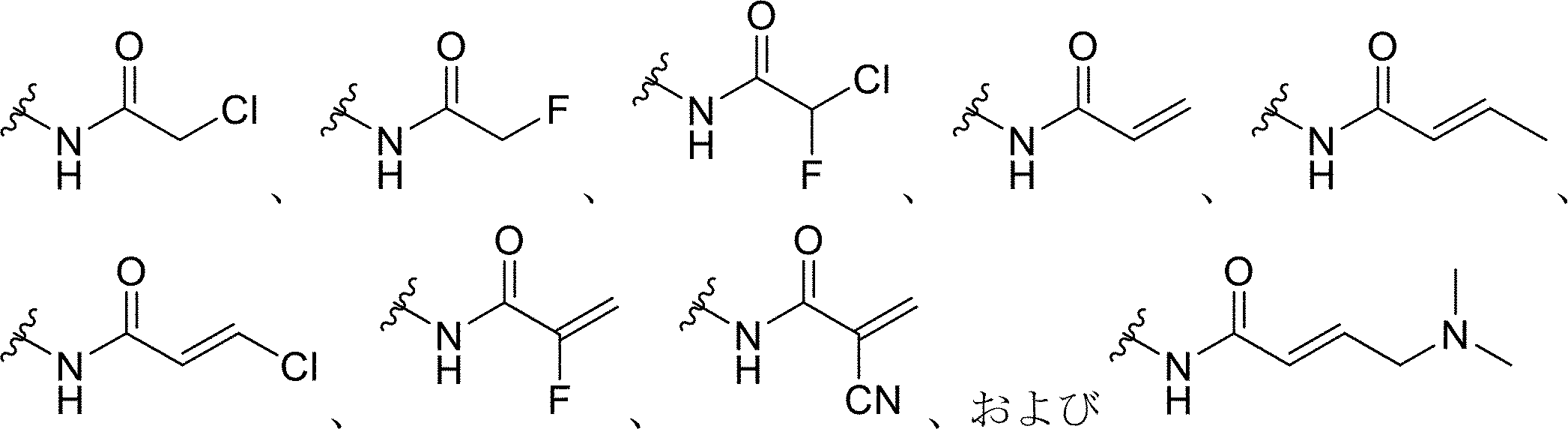
いくつかの実施形態では、プローブ化合物上の求電子基は、ハロゲン化アルキル、ハロアセチル、マレイミド、アジリジン、アクリロイルハロゲン、マレイミド、イソチオシアネート、イソシアネート、アシルアジド、N-ヒドロキシスクシンイミドエステル、スルホニルクロリド、エポキシド、オキシラン、カルボネート、イミドエステル、カルボジイミド、無水物、ジアゾアルカン、ジアゾアセチル、カルボニジルミダゾール(carbonydilmidazole)、およびカルボジイミドからなる群から選択され得る。いくつかの実施形態では、プローブ化合物上の求電子基は
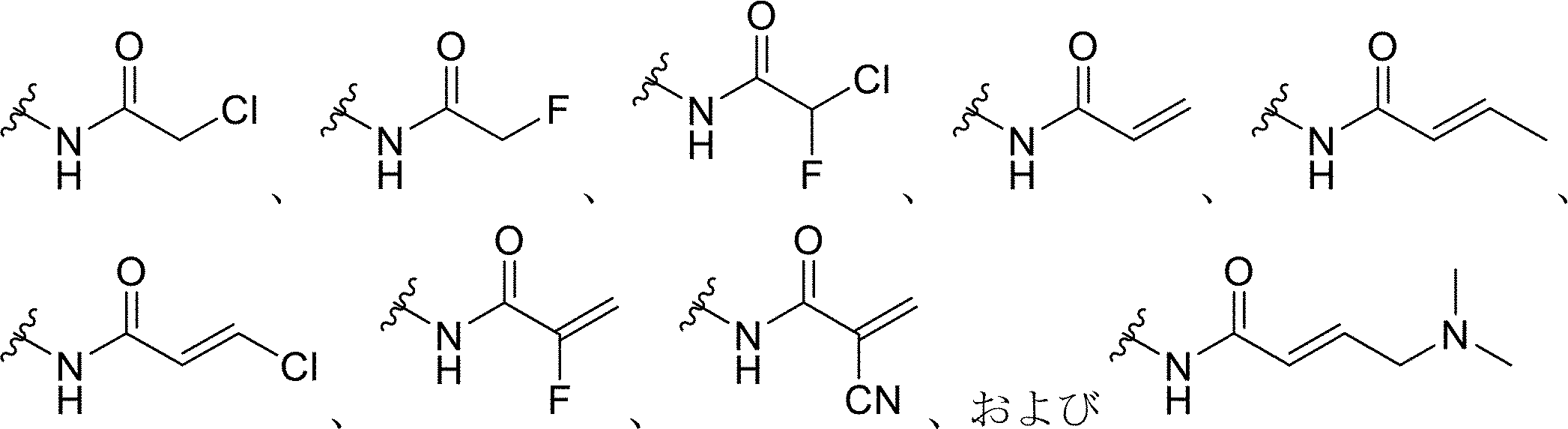
さらに別の実施形態では、開示は、検出可能な標識に共有結合的に連結したクリック可能なタグを含むプローブに共有結合した求核性アミノ酸残基を含む、修飾された非天然型タンパク質を提供する。いくつかの実施形態では、検出可能な標識は、ビオチンであり得る。様々な実施形態では、求電子反応性アミノ酸残基は、アルギニン、リジン、ヒスチジン、システイン、メチオニン、アスパラギン酸、グルタミン酸、セリン、トレオニン、チロシン、トリプトファン、およびそれらの誘導体から選択される。 In yet another embodiment, the disclosure provides modified non-naturally occurring proteins comprising a nucleophilic amino acid residue covalently attached to a probe comprising a clickable tag covalently linked to a detectable label. In some embodiments, the detectable label can be biotin. In various embodiments, the electrophilically reactive amino acid residue is selected from arginine, lysine, histidine, cysteine, methionine, aspartic acid, glutamic acid, serine, threonine, tyrosine, tryptophan, and derivatives thereof.
なお別の実施形態では、開示は、ハロゲン化アルキル、ハロアセチル、マレイミド、アジリジン、アクリロイルハロゲン、マレイミド、イソチオシアネート、イソシアネート、アシルアジド、N-ヒドロキシスクシンイミドエステル、スルホニルクロリド、エポキシド、オキシラン、カルボネート、イミドエステル、カルボジイミド、無水物、ジアゾアルカン、ジアゾアセチル、カルボニジルミダゾール、およびカルボジイミドからなる群から選択される求電子部分と、アルキン部分またはアジド部分などのクリック可能なタグとを有するプローブを提供し、クリック可能なタグは、任意選択的に、検出可能な標識に共有結合的に連結している。いくつかの実施形態では、検出可能な標識は、ビオチンであり得る。本明細書にさらに開示されるのは、生物学的アッセイを実施するためのプローブ化合物の使用である。
[本発明1001]
タンパク質標的を同定するための方法であって、
(a)プロテオミック試料を、求電子部分およびクリック可能なタグを含むプローブ化合物と接触させることであって、前記求電子部分が、前記タンパク質標的中の求核性アミノ酸残基に共有結合する、ことと、
(b)前記プロテオミック試料を分析して、前記タンパク質標的を検出し、それによって前記タンパク質標的を同定することと
を含む、前記方法。
[本発明1002]
前記クリック可能なタグが、検出可能な標識にさらに共有結合的に連結される、本発明1001の方法。
[本発明1003]
タンパク質標的を同定するための方法であって、
(a)第1のタンパク質含有試料を、求電子部分を有しかつ末端のクリック可能なタグを欠く競合化合物と接触させることと、
(b)(a)の前記試料を、前記求電子部分および前記末端のクリック可能なタグを含むプローブ化合物と接触させることと、
(c)第2のタンパク質含有試料を前記プローブ化合物と接触させることであって、前記求電子部分が、前記タンパク質標的中の求核性アミノ酸残基と結合する、ことと、
(d)前記第1のタンパク質含有試料中のプローブ化合物で修飾されたタンパク質の量を、前記第2のタンパク質含有試料中のプローブ化合物で修飾されたタンパク質の量と比較して検出することによって、前記タンパク質標的を同定することと
を含む、前記方法。
[本発明1004]
前記プローブ化合物が、共有結合的に誘導体化されて前記クリック可能なタグから外れた検出可能な標識をさらに含む、本発明1003の方法。
[本発明1005]
前記検出可能な標識が、ビオチンを含む、本発明1002または1004の方法。
[本発明1006]
前記求核性アミノ酸残基が、アルギニン、リジン、ヒスチジン、システイン、メチオニン、アスパラギン酸、グルタミン酸、セリン、トレオニン、チロシン、トリプトファン、およびそれらの誘導体からなる群から選択される、本発明1001~1005のいずれかの方法。
[本発明1007]
前記クリック可能なタグが、アルキン基である、本発明1001~1006のいずれかの方法。
[本発明1008]
前記プローブ化合物上の前記求電子基が、ハロゲン化アルキル、ハロアセチル、マレイミド、アジリジン、アクリロイルハロゲン、マレイミド、イソチオシアネート、イソシアネート、アシルアジド、N-ヒドロキシスクシンイミドエステル、スルホニルクロリド、エポキシド、オキシラン、カルボネート、イミドエステル、カルボジイミド、無水物、ジアゾアルカン、ジアゾアセチル、カルボニジルミダゾール、およびカルボジイミドからなる群から選択される、本発明1001~1007のいずれかの方法。
[本発明1009]
前記プローブ化合物上の前記求電子基が、
[化1]
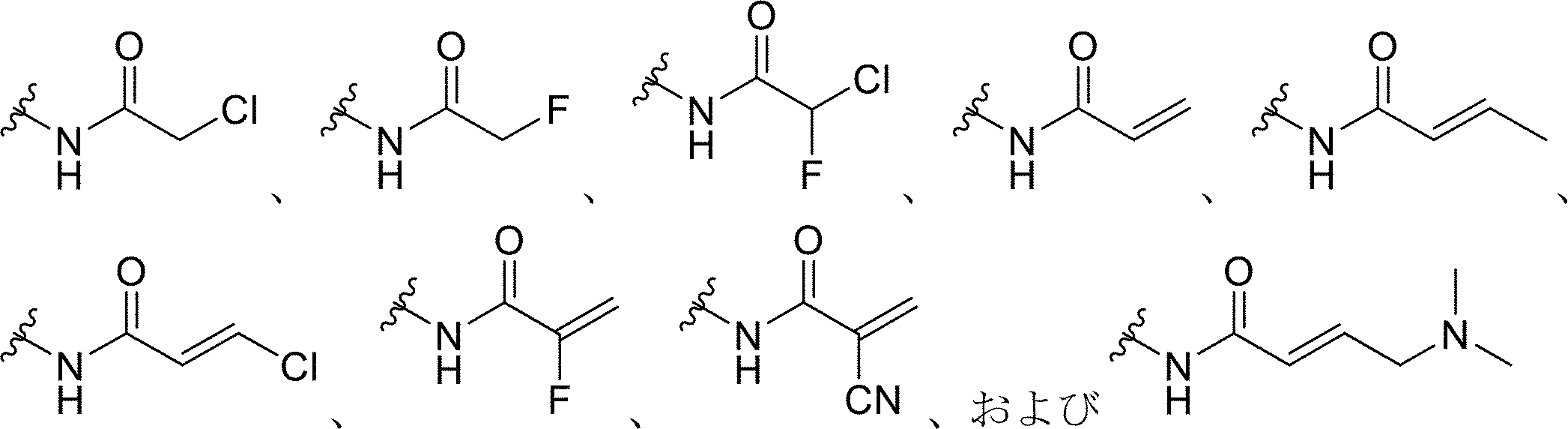
[本発明1010]
前記第1のタンパク質含有試料および前記第2のタンパク質含有試料を、前記プローブ化合物中の前記クリック可能なタグとの反応性を有するリンカー基を含む検出可能な標識と反応させることをさらに含む、本発明1003の方法。
[本発明1011]
前記検出可能な標識をタグ付けされたタンパク質標的を富化することをさらに含む、本発明1010の方法。
[本発明1012]
前記富化したタンパク質標的のプロテアーゼ消化を実施することをさらに含む、本発明1011の方法。
[本発明1013]
前記第1のタンパク質含有試料および前記第2のタンパク質含有試料中の、プローブ化合物に結合したタンパク質の量を定量化および比較することをさらに含む、本発明1012の方法。
[本発明1014]
前記定量化および比較を、タンデム質量タグ(TMT)を用いる液体クロマトグラフィー-質量分析法(LC-MS)を使用して実施する、本発明1013の方法。
[本発明1015]
クリック可能なタグを含むプローブ化合物に共有結合した求核性アミノ酸残基を含む、修飾された非天然型タンパク質。
[本発明1016]
前記求核性アミノ酸残基が、アルギニン、リジン、ヒスチジン、システイン、メチオニン、アスパラギン酸、グルタミン酸、セリン、トレオニン、チロシン、トリプトファン、およびそれらの誘導体からなる群から選択される、本発明1015のタンパク質。
[本発明1017]
ハロゲン化アルキル、ハロアセチル、マレイミド、アジリジン、アクリロイルハロゲン、マレイミド、イソチオシアネート、イソシアネート、アシルアジド、N-ヒドロキシスクシンイミドエステル、スルホニルクロリド、エポキシド、オキシラン、カルボネート、イミドエステル、カルボジイミド、無水物、ジアゾアルカン、ジアゾアセチル、カルボニジルミダゾール、およびカルボジイミドからなる群から選択される求電子部分と、クリック可能なタグとを含む、プローブ化合物。
[本発明1018]
前記クリック可能なタグが、検出可能な標識に共有結合的に連結される、本発明1017のプローブ化合物。
[本発明1019]
前記検出可能な標識が、ビオチンである、本発明1018のプローブ化合物。
[本発明1020]
生物学的アッセイを実施するための、本発明1017~1019のいずれかのプローブ化合物の使用。
In yet another embodiment, the disclosure provides a probe having an electrophilic moiety selected from the group consisting of alkyl halides, haloacetyls, maleimides, aziridines, acryloyl halogens, maleimides, isothiocyanates, isocyanates, acyl azides, N-hydroxysuccinimide esters, sulfonyl chlorides, epoxides, oxiranes, carbonates, imidoesters, carbodiimides, anhydrides, diazoalkanes, diazoacetyls, carbonidylmidazoles, and carbodiimides, and a clickable tag, such as an alkyne moiety or an azide moiety, optionally covalently linked to a detectable label. In some embodiments, the detectable label can be biotin. Further disclosed herein is the use of the probe compounds for performing biological assays.
[The present invention 1001]
1. A method for identifying a protein target, comprising:
(a) contacting a proteomic sample with a probe compound comprising an electrophilic moiety and a clickable tag, wherein the electrophilic moiety covalently binds to a nucleophilic amino acid residue in the protein target;
(b) analyzing the proteomic sample to detect and thereby identify the protein target;
The method comprising:
[The present invention 1002]
1001. The method of claim 1001, wherein said clickable tag is further covalently linked to a detectable label.
[The present invention 1003]
1. A method for identifying a protein target, comprising:
(a) contacting a first protein-containing sample with a competing compound that has an electrophilic moiety and lacks a terminal clickable tag;
(b) contacting the sample of (a) with a probe compound comprising the electrophilic moiety and a terminal clickable tag;
(c) contacting a second protein-containing sample with the probe compound, wherein the electrophilic moiety binds to a nucleophilic amino acid residue in the protein target; and
(d) identifying said protein target by detecting the amount of protein modified with the probe compound in said first protein-containing sample relative to the amount of protein modified with the probe compound in said second protein-containing sample;
The method comprising:
[The present invention 1004]
1004. The method of claim 1003, wherein said probe compound further comprises a detectable label covalently derivatized to said clickable tag.
[The present invention 1005]
The method of any one of claims 1002 to 1004, wherein the detectable label comprises biotin.
[The present invention 1006]
The method of any of claims 1001 to 1005, wherein said nucleophilic amino acid residue is selected from the group consisting of arginine, lysine, histidine, cysteine, methionine, aspartic acid, glutamic acid, serine, threonine, tyrosine, tryptophan, and derivatives thereof.
[The present invention 1007]
The method of any one of claims 1001 to 1006, wherein said clickable tag is an alkyne group.
[The present invention 1008]
The method of any one of claims 1001 to 1007, wherein the electrophilic group on the probe compound is selected from the group consisting of alkyl halides, haloacetyls, maleimides, aziridines, acryloyl halogens, maleimides, isothiocyanates, isocyanates, acyl azides, N-hydroxysuccinimide esters, sulfonyl chlorides, epoxides, oxiranes, carbonates, imidoesters, carbodiimides, anhydrides, diazoalkanes, diazoacetyls, carbonidylmidazoles, and carbodiimides.
[The present invention 1009]
The electrophilic group on the probe compound is
[Chemical formula 1]
[The present invention 1010]
The method of claim 1003, further comprising reacting said first protein-containing sample and said second protein-containing sample with a detectable label comprising a linker group reactive with said clickable tag in said probe compound.
[The present invention 1011]
The method of any one of
[The present invention 1012]
The method of any one of
[The present invention 1013]
The method of any one of
[The present invention 1014]
The method of the present invention, wherein said quantification and comparison is carried out using liquid chromatography-mass spectrometry (LC-MS) with tandem mass tags (TMT).
[The present invention 1015]
A modified non-naturally occurring protein comprising a nucleophilic amino acid residue covalently attached to a probe compound that comprises a clickable tag.
[The present invention 1016]
The protein of the present invention, wherein said nucleophilic amino acid residue is selected from the group consisting of arginine, lysine, histidine, cysteine, methionine, aspartic acid, glutamic acid, serine, threonine, tyrosine, tryptophan, and derivatives thereof.
[The present invention 1017]
A probe compound comprising an electrophilic moiety selected from the group consisting of alkyl halides, haloacetyls, maleimides, aziridines, acryloyl halogens, maleimides, isothiocyanates, isocyanates, acyl azides, N-hydroxysuccinimide esters, sulfonyl chlorides, epoxides, oxiranes, carbonates, imidoesters, carbodiimides, anhydrides, diazoalkanes, diazoacetyls, carbonidylmidazoles, and carbodiimides, and a clickable tag.
[The present invention 1018]
The probe compound of the present invention 1017, wherein said clickable tag is covalently linked to a detectable label.
[The present invention 1019]
The probe compound of the present invention, wherein the detectable label is biotin.
[The present invention 1020]
Use of a probe compound according to any of claims 1017 to 1019 for carrying out a biological assay.
発明の詳細な説明
本発明は、複合体プロテオーム中の様々なタンパク質との共有結合相互作用について、求電子化合物をプロファイリングするための革新的な方法に基づく。本方法は、全細胞プロテオーム中の数千のタンパク質との共有結合薬物または共有結合薬物候補の相互作用を同時に並行して同定および定量化することができる。
DETAILED DESCRIPTION OF THE PRESENTINVENTION The present invention is based on an innovative method for profiling electrophilic compounds for covalent interactions with various proteins in a complex proteome. The method is capable of simultaneously identifying and quantifying the interactions of covalent drugs or covalent drug candidates with thousands of proteins in the whole cell proteome in parallel.
本組成物および方法について記載する前に、かかる組成物、方法、および条件は変動し得るので、本発明が、記載される特定の方法および実験条件に限定されないことが理解されるものである。本発明の範囲が添付の特許請求の範囲にのみ限定されるので、本明細書で使用される用語が、単に特定の実施形態を記載する目的のためであり、限定することを意図しないことも理解されるものである。 Before describing the present compositions and methods, it is to be understood that this invention is not limited to the particular methods and experimental conditions described, as such compositions, methods, and conditions may vary. It is also to be understood that the terminology used herein is for the purpose of describing particular embodiments only, and is not intended to be limiting, since the scope of the present invention will be limited only by the appended claims.
本明細書および添付の特許請求の範囲で使用される場合、単数形「a」、「an」、および「the」は、文脈が明示的に別途示されない限り、複数への言及を含む。したがって、例えば、「方法」への言及は、本開示などを閲読する際に当業者には明らかになるであろう、本明細書に記載の1つ以上の種類の方法および/またはステップを含む。 As used herein and in the appended claims, the singular forms "a," "an," and "the" include plural references unless the context clearly dictates otherwise. Thus, for example, reference to a "method" includes one or more of the types of methods and/or steps described herein that will be apparent to those of skill in the art upon reading this disclosure or otherwise.
求電子基または求電子剤は、タンパク質またはポリペプチド中に存在するものを含む、多くの官能基と反応することができる。いくつかの実施形態では、チオール基を含有するN末端システインは、ハロゲンまたはマレイミドと反応し得る。チオール基は、ハロゲン化アルキル、ハロアセチル誘導体、マレイミド、アジリジン、アクリロイル誘導体、ハロゲン化アリールなどのアリール化剤などの多数のカップリング剤との反応性を有することが知られている。これらは、参照によりその全体が本明細書に組み込まれるG.T.Hermanson,”Bioconjugate Techniques”(Academic Press,San Diego,1996),pp.146-150に記載されている。いくつかの実施形態では、マレイミドは、特により高いpH範囲で、リジンの側鎖のε-アミノ基、またはアルギニンの5-グアニジノ基などのアミノ基と反応することができる。ハロゲン化アリールは、かかるアミノ基とも反応することができる。ハロアセチル誘導体は、ヒスチジンのイミダゾリル側鎖窒素、メチオニンの側鎖のチオエーテル基、リジンの側鎖のε-アミノ基、およびアルギニンの5-グアニジノ基と反応することができる。限定されないが、イソチオシアネート、イソシアネート、アシルアジド、N-ヒドロキシスクシンイミドエステル、スルホニルクロリド、エポキシド、オキシラン、カルボネート、イミドエステル、カルボジイミド、および無水物を含む、リジンの側鎖のε-アミノ基またはアルギニンの5-グアニジノ基と反応する、多くの他の求電子試薬を使用することができる。これらは、参照によりその全体が本明細書に組み込まれるG.T.Hermanson,”Bioconjugate Techniques”(Academic Press,San Diego,1996),pp.137-146に記載されている。加えて、いくつかの求電子試薬は、ジアゾアルカンおよびジアゾアセチル化合物、カルボニジルミダゾール、ならびにカルボジイミドなどの、アスパルテートおよびグルタメートのものなどのカルボキシレート側鎖と反応することができる。これらは、参照によりその全体が本明細書に組み込まれるG.T.Hermanson,”Bioconjugate Techniques”(Academic Press,San Diego,1996),pp.152-154に記載されている。さらに、反応性ハロアルカン誘導体を含む、セリン、トレオニン、およびチロシンの側鎖におけるものなどの、ヒドロキシル基と反応するであろう求電子試薬が知られている。これらは、参照によりその全体が本明細書に組み込まれるG.T.Hermanson,”Bioconjugate Techniques”(Academic Press,San Diego,1996),pp.154-158に記載されている。 Electrophilic groups or agents can react with many functional groups, including those present in proteins or polypeptides. In some embodiments, the N-terminal cysteine containing a thiol group can react with a halogen or maleimide. Thiol groups are known to have reactivity with a number of coupling agents, such as alkyl halides, haloacetyl derivatives, maleimides, aziridines, acryloyl derivatives, aryl halides, and other arylating agents. These are described in G. T. Hermanson, "Bioconjugate Techniques" (Academic Press, San Diego, 1996), pp. 146-150, which is incorporated herein by reference in its entirety. In some embodiments, maleimides can react with amino groups, such as the ε-amino group of the side chain of lysine, or the 5-guanidino group of arginine, especially at the higher pH range. Aryl halides can also react with such amino groups. Haloacetyl derivatives can react with the imidazolyl side chain nitrogen of histidine, the side chain thioether group of methionine, the side chain ε-amino group of lysine, and the 5-guanidino group of arginine. Many other electrophiles can be used that react with the side chain ε-amino group of lysine or the 5-guanidino group of arginine, including, but not limited to, isothiocyanates, isocyanates, acyl azides, N-hydroxysuccinimide esters, sulfonyl chlorides, epoxides, oxiranes, carbonates, imidoesters, carbodiimides, and anhydrides. These are described in G. T. Hermanson, "Bioconjugate Techniques" (Academic Press, San Diego, 1996), pp. 137-146, which is incorporated herein by reference in its entirety. In addition, several electrophiles can react with carboxylate side chains such as those of aspartate and glutamate, such as diazoalkanes and diazoacetyl compounds, carbonidylmidazoles, and carbodiimides. These are described in G. T. Hermanson, "Bioconjugate Techniques" (Academic Press, San Diego, 1996), pp. 152-154, which is incorporated herein by reference in its entirety. Furthermore, electrophiles are known that will react with hydroxyl groups, such as those in the side chains of serine, threonine, and tyrosine, including reactive haloalkane derivatives. These are described in G. T. Hermanson, "Bioconjugate Techniques" (Academic Press, San Diego, 1996), pp. 152-154, which is incorporated herein by reference in its entirety. Hermanson, "Bioconjugate Techniques" (Academic Press, San Diego, 1996), pp. 154-158.
いくつかの態様では、求電子剤または求電子基としては、限定されないが、ハロゲン化アルキル、ハロアセチル、マレイミド、アジリジン、アクリロイルハロゲン、マレイミド、イソチオシアネート、イソシアネート、アシルアジド、N-ヒドロキシスクシンイミドエステル、スルホニルクロリド、エポキシド、オキシラン、カルボネート、イミドエステル、カルボジイミド、無水物、ジアゾアルカン、ジアゾアセチル、カルボニジルミダゾール、およびカルボジイミドを挙げることができる。いくつかの態様では、求電子基は、
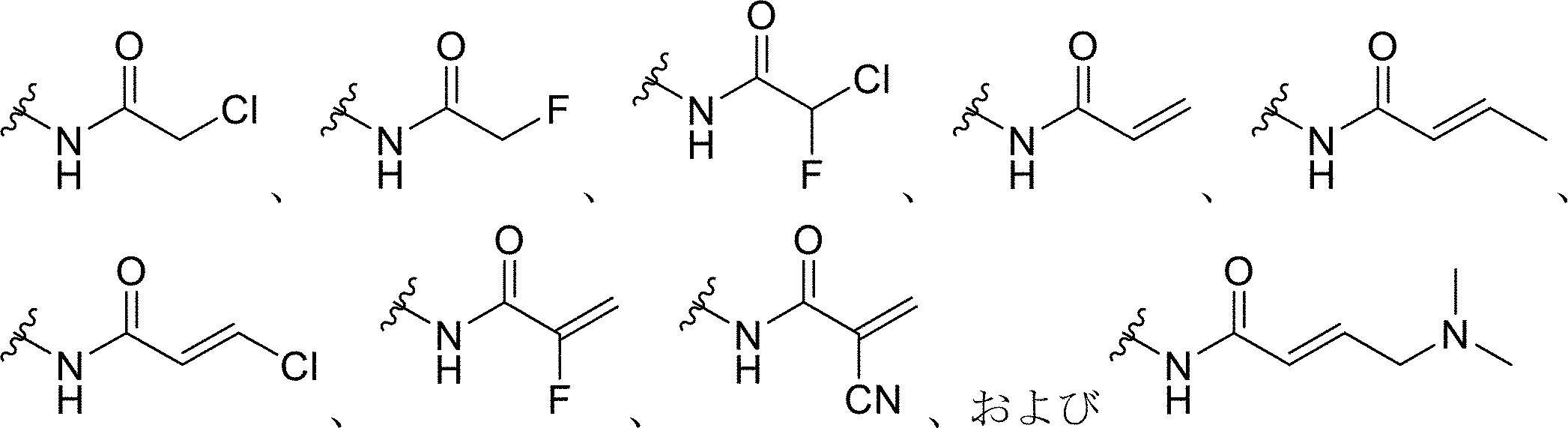
別途定義されない限り、本明細書で使用されるすべての技術用語および科学用語は、本発明が属する分野の当業者によって一般に理解されるのと同じ意味を有する。本明細書に記載されるものと同様または同等の任意の方法および材料を、本発明の実施または試験に使用することができるが、好ましい方法および材料を以下に記載する。 Unless otherwise defined, all technical and scientific terms used herein have the same meaning as commonly understood by one of ordinary skill in the art to which this invention belongs. Although any methods and materials similar or equivalent to those described herein can be used in the practice or testing of the present invention, the preferred methods and materials are described below.
本明細書で使用される場合、単独でまたは組み合わせた「アルキル」または「アルカン」という用語は、1~20個の炭素原子を含有する直鎖または分岐鎖アルキル基を指す。ある特定の実施形態では、当該アルキルは、1~10個の炭素原子を含むであろう。さらなる実施形態では、当該アルキルは、1~6個の炭素原子を含むであろう。アルキル基は、任意選択的に、本明細書で定義されるように置換され得る。アルキル基の例としては、メチル、エチル、n-プロピル、イソプロピル、n-ブチル、イソブチル、sec-ブチル、tert-ブチル、ペンチル、イソ-アミル、ヘキシル、オクチル、ノイルなどが挙げられる。本明細書で使用される場合、単独でまたは組み合わせた「アルキレン」という用語は、メチレン(-CH2-)などの2つ以上の位置に結合した直鎖または分岐鎖飽和炭化水素に由来する飽和脂肪族基を指す。別途指定されない限り、「アルキル」という用語は、「アルキレン」基を含み得る。 The term "alkyl" or "alkane", as used herein, alone or in combination, refers to a straight or branched chain alkyl group containing 1 to 20 carbon atoms. In certain embodiments, the alkyl will contain 1 to 10 carbon atoms. In further embodiments, the alkyl will contain 1 to 6 carbon atoms. The alkyl group may be optionally substituted as defined herein. Examples of alkyl groups include methyl, ethyl, n-propyl, isopropyl, n-butyl, isobutyl, sec-butyl, tert-butyl, pentyl, iso-amyl, hexyl, octyl, noyl, and the like. The term "alkylene", as used herein, alone or in combination, refers to a saturated aliphatic group derived from a straight or branched chain saturated hydrocarbon bonded at two or more positions, such as methylene (-CH 2 -). Unless otherwise specified, the term "alkyl" may include an "alkylene" group.
本明細書で使用される場合、単独でまたは組み合わせた「アシル」という用語は、アルケニル、アルキル、アリール、シクロアルキル、ヘテロアリール、ヘテロ環、またはカルボニルに結合した原子が炭素である任意の他の部分に結合したカルボニルを指す。「アセチル」基は、-C(O)CH3基を指す。「アルキルカルボニル」または「アルカノイル」基は、カルボニル基を通じて親分子部分に結合したアルキル基を指す。かかる基の例としては、メチルカルボニルおよびエチルカルボニルが挙げられる。アシル基の例としては、ホルミル、アルカノイル、およびアロイルが挙げられる。 The term "acyl," as used herein, alone or in combination, refers to a carbonyl bound to an alkenyl, alkyl, aryl, cycloalkyl, heteroaryl, heterocycle, or any other moiety where the atom bound to the carbonyl is carbon. An "acetyl" group refers to a -C(O) CH3 group. An "alkylcarbonyl" or "alkanoyl" group refers to an alkyl group bound to the parent molecular moiety through a carbonyl group. Examples of such groups include methylcarbonyl and ethylcarbonyl. Examples of acyl groups include formyl, alkanoyl, and aroyl.
本明細書で使用される場合、単独でまたは組み合わせた「ハロ」、「ハロゲン化物」、または「ハロゲン」という用語は、フッ素、塩素、臭素、またはヨウ素を指す。 As used herein, the terms "halo," "halide," or "halogen," alone or in combination, refer to fluorine, chlorine, bromine, or iodine.
開示は、目的のプローブに共有結合するタンパク質を同定するための、方法、Isobaric Mass Tagged Affinity Characterization(IMTAC(商標))を提供する。方法は、(a)生細胞、または細胞溶解物、または生きた動物などのプロテオミック試料を、求電子部分、およびアルキン部分などのクリック可能なタグを有するプローブと接触させることと、(b)プロテオミック試料を分析して、プローブによって共有結合されるタンパク質を検出し、それによって共有結合タンパク質標的を同定することと、を含み得る。 The disclosure provides a method, Isobaric Mass Tagged Affinity Characterization (IMTAC™), for identifying proteins that are covalently bound to a probe of interest. The method may include (a) contacting a proteomic sample, such as a live cell, or a cell lysate, or a live animal, with a probe having an electrophilic moiety and a clickable tag, such as an alkyne moiety, and (b) analyzing the proteomic sample to detect proteins that are covalently bound by the probe, thereby identifying the covalently bound protein target.
方法は、(a)1つのプロテオミック試料を2つのアリコートに分割することと、(b)第1のアリコートを、求電子部分を有し、クリック可能なタグを欠く競合化合物と接触させることと、(b)試料からの第2のアリコートを、DMSOまたは(a)で使用されるのと異なる量の同じ競合物と接触させることと、(c)試料の両方を、求電子部分およびアルキン部分などの追加の末端のクリック可能なタグを含有するプローブと接触させることと、(d)2つのアリコート中の、プローブに結合したタンパク質の量を比較することによって、タンパク質標的を同定することと、を含み得る。一実施形態では、プローブは、競合物と同一のコア構造および求電子部分を共有し、追加の末端アルキン部分を含有する。第1のアリコートをプローブ化合物と反応させる前に、第1のアリコートを競合化合物で事前に処理することによって、目的のタンパク質標的のみが検出されるであろうように、プローブ化合物と、第2のアリコートの対照として機能し得る、求核性アミノ酸残基を含むタンパク質との間のバックグラウンド相互作用を除去するのに役立つ。 The method may include (a) splitting a proteomic sample into two aliquots, (b) contacting the first aliquot with a competitor compound having an electrophilic moiety and lacking a clickable tag, (b) contacting a second aliquot from the sample with DMSO or a different amount of the same competitor used in (a), (c) contacting both samples with a probe containing an electrophilic moiety and an additional terminal clickable tag such as an alkyne moiety, and (d) identifying the protein target by comparing the amount of protein bound to the probe in the two aliquots. In one embodiment, the probe shares the same core structure and electrophilic moiety as the competitor and contains an additional terminal alkyne moiety. Pre-treating the first aliquot with the competitor compound before reacting it with the probe compound helps to remove background interactions between the probe compound and proteins containing nucleophilic amino acid residues, which may serve as a control for the second aliquot, so that only the protein target of interest will be detected.
求電子化合物のタンパク質標的の同定によって、タンパク質標的は、細胞機能および疾患関連性について評価されるであろう。タンパク質標的が、ヒト疾患、例えば、がんおよび炎症の進行に重要な役割を果たす場合、求電子化合物は、疾患、例えば、がんまたは炎症の治療のための医薬品としてさらに誘導体化され、開発され得る先導化合物とみなすことができる。 Upon identification of the protein target of an electrophilic compound, the protein target will be evaluated for cellular function and disease relevance. If the protein target plays an important role in the progression of human diseases, e.g., cancer and inflammation, the electrophilic compound can be considered as a lead compound that can be further derivatized and developed as a pharmaceutical for the treatment of the disease, e.g., cancer or inflammation.
様々な実施形態では、本発明はまた、本発明の方法によって求電子化合物の標的として同定されるタンパク質を提供する。
R1C≡CH
式(I)
In various embodiments, the invention also provides proteins identified as targets of electrophilic compounds by the methods of the invention.
R1C≡CH
Formula (I)
本明細書で使用される場合、クリック可能なタグの例は、式(I)を含む末端アルキン部分である。いくつかの実施形態では、R1は、求電子基を担持するコアであり得、求電子基は、ハロゲン化アルキル、ハロアセチル、マレイミド、アジリジン、アクリロイルハロゲン、マレイミド、イソチオシアネート、イソシアネート、アシルアジド、N-ヒドロキシスクシンイミドエステル、スルホニルクロリド、エポキシド、オキシラン、カルボネート、イミドエステル、カルボジイミド、無水物、ジアゾアルカン、ジアゾアセチル、カルボニジルミダゾール、およびカルボジイミドからなる群から選択され得る。 As used herein, an example of a clickable tag is a terminal alkyne moiety comprising formula (I): In some embodiments, R1 may be a core bearing an electrophilic group, which may be selected from the group consisting of alkyl halides, haloacetyls, maleimides, aziridines, acryloyl halogens, maleimides, isothiocyanates, isocyanates, acyl azides, N-hydroxysuccinimide esters, sulfonyl chlorides, epoxides, oxiranes, carbonates, imidoesters, carbodiimides, anhydrides, diazoalkanes, diazoacetyls, carbonidylmidazoles, and carbodiimides.
本明細書で使用される場合、「ポリペプチド」は、アミノ酸で構成され、当業者によってタンパク質として認識される組成物を指す。本明細書では、アミノ酸残基の従来の1文字または3文字のコードが使用される。「ポリペプチド」および「タンパク質」という用語は、本明細書では、任意の長さのアミノ酸の重合体を指すように同義的に使用される。重合体は、線状または分岐状であってもよく、修飾アミノ酸を含んでもよく、非アミノ酸によって中断されてもよい。用語はまた、天然に、または介入、例えば、ジスルフィド結合形成、グリコシル化、脂質化、アセチル化、リン酸化、もしくは標識構成要素とのコンジュゲーションなどの任意の他の操作もしくは修飾によって修飾されている、アミノ酸重合体を包含する。また、定義内に含まれるのは、例えば、アミノ酸の1つ以上の類似体(例えば、不自然なアミノ酸、合成アミノ酸などを含む)を含有するポリペプチド、ならびに当該技術分野において既知の他の修飾物である。 As used herein, "polypeptide" refers to a composition composed of amino acids and recognized as a protein by those of skill in the art. Conventional one-letter or three-letter codes for amino acid residues are used herein. The terms "polypeptide" and "protein" are used interchangeably herein to refer to polymers of amino acids of any length. The polymers may be linear or branched, may contain modified amino acids, and may be interrupted by non-amino acids. The term also encompasses amino acid polymers that are naturally occurring or modified by intervention, e.g., disulfide bond formation, glycosylation, lipidation, acetylation, phosphorylation, or any other manipulation or modification, such as conjugation with a labeling component. Also included within the definition are, for example, polypeptides that contain one or more analogs of an amino acid (including, e.g., unnatural amino acids, synthetic amino acids, etc.), as well as other modifications known in the art.
場合によっては、ポリペプチドの機能的断片は、約10~約80の長さのアミノ酸残基を含む。場合によっては、機能的断片は、約15~約70、約20~約60、約30~約50、または約40~約80の長さのアミノ酸残基を含む。場合によっては、機能的断片は、約10、15、20、25、30、35、40、45、50、55、60、70、80、またはそれ以上の長さのアミノ酸残基を含む。 In some cases, functional fragments of a polypeptide include from about 10 to about 80 amino acid residues in length. In some cases, functional fragments include from about 15 to about 70, from about 20 to about 60, from about 30 to about 50, or from about 40 to about 80 amino acid residues in length. In some cases, functional fragments include from about 10, 15, 20, 25, 30, 35, 40, 45, 50, 55, 60, 70, 80, or more amino acid residues in length.
タンデム質量分析法(MS/MSまたはMS2)は、化学試料を分析する能力を増加するために、追加の反応ステップを使用して2つ以上の質量分析器を一緒に結合させた機器分析における技法を指す。等圧質量タグと称される試薬のファミリーに属するタンデム質量タグ(TMT)は、タンパク質、ペプチド、および核酸などの生物学的巨大分子の質量分析法(MS)に基づく定量化および同定に使用される化学標識を指す。

スキーム1の例示的なTMTの化学構造によって示されるように、セット内のすべての質量タグ付け試薬は、アミン反応性NHSエステル基、スペーサーアーム(質量正規化剤)、およびMS/MS質量レポーターで構成される同じ公称質量(すなわち、等圧である)および化学構造を有する。高エネルギー衝突解離(HCD)および電子移動解離(ETD)によるMS/MS断片化部位もスキーム1に示されている。試薬は、アミン反応性NHSエステル基を介して、細胞に基づく試料または組織試料から調製されたペプチドを標識することができる。独自のレポーター質量は、MS/MSスペクトルの低質量領域にあるMS/MSスペクトルを生じる。これは、検出可能な標識の使用を介して標的タンパク質を富化した後、プローブ化合物によって標的化されたタンパク質からのペプチド断片化中の相対的なタンパク質発現レベルを報告するために使用することができる。
As shown by the chemical structure of the exemplary TMT in
いくつかの実施形態では、プローブ化合物は、標的タンパク質と共有結合した後、クリック可能なタグを介して検出可能な標識とのさらなる連結が可能になり得る。クリック可能なタグは、銅(I)媒介性クリックケミストリーを介したアルキン基とアジド基との間の反応などの官能性である。参照により本明細書に組み込まれるH.C.Kolb and K.B.Sharpless,Drug Discovery Today,2003,8(24);1128-1137を参照されたい。 In some embodiments, the probe compound, after covalent attachment to the target protein, may allow further linkage to a detectable label via a clickable tag. A clickable tag is a functionality such as a reaction between an alkyne group and an azide group via copper(I)-mediated click chemistry. See H. C. Kolb and K. B. Sharpless, Drug Discovery Today, 2003, 8(24); 1128-1137, incorporated herein by reference.
いくつかの実施形態では、小分子化合物は、反応性アミノ酸残基との結合について、本明細書に記載のプローブと競合する。場合によっては、小分子化合物は、化合物と反応性アミノ酸残基との相互作用を促進する断片部分を含む。場合によっては、小分子化合物は、疎水性相互作用、水素結合、またはそれらの組み合わせを促進する小分子断片を含む。多くの場合、リガンドは、非天然型であるか、または反応性アミノ酸残基もしくは反応性アミノ酸残基含有タンパク質のアミノ基との反応後に非天然型生成物を形成する。 In some embodiments, the small molecule compound competes with the probes described herein for binding to the reactive amino acid residue. In some cases, the small molecule compound includes a fragment portion that promotes interaction of the compound with the reactive amino acid residue. In some cases, the small molecule compound includes a small molecule fragment that promotes hydrophobic interactions, hydrogen bonds, or a combination thereof. In many cases, the ligand is non-naturally occurring or forms a non-naturally occurring product after reaction with the reactive amino acid residue or an amino group of a protein that contains a reactive amino acid residue.
以下の実施例は、本発明の利点および特色をさらに示すために提供されるが、本発明の範囲を限定することを意図しない。本実施例は、典型的な使用され得るものであるが、当業者に既知の他の手順、方法論、または技法を代替的に使用してもよい。 The following examples are provided to further illustrate the advantages and features of the present invention, but are not intended to limit the scope of the invention. The examples are typical of those that may be used, although other procedures, methodologies, or techniques known to those skilled in the art may alternatively be used.
実施例1
IMTAC(商標)を使用するプロテオームワイドな共有結合リガンドの発見
複合体プロテオーム中の様々なタンパク質との共有結合相互作用について、求電子小分子をプロファイリングするための方法について記載する。本方法は、求電子化合物と全細胞プロテオーム中の様々なタンパク質との間の共有結合相互作用を同定および定量化し、潜在的な療法を開発するためにさらに利用され得る新しい貴重なデータを提供することができる。
Example 1
Proteome-wide covalent ligand discovery using IMTAC™ A method is described for profiling electrophilic small molecules for covalent interactions with various proteins in a complex proteome. This method can identify and quantify covalent interactions between electrophilic compounds and various proteins in the whole cell proteome, providing new and valuable data that can be further utilized to develop potential therapeutics.
以下の方法論を利用して、開示の方法を実施した。 The disclosed method was carried out using the following methodology:
生細胞または細胞溶解物のプロテオームを2つの同一の量に分割する。 Divide the proteome of a live cell or cell lysate into two identical quantities.
競合物中の求電子剤の反応性に応じて10nM~100μMの範囲であり得る一定濃度で30~240分間、求電子競合物(競合物)で第1の試料を処理する。 Treat the first sample with an electrophilic competitor (competitor) for 30-240 minutes at a constant concentration that can range from 10 nM to 100 μM depending on the reactivity of the electrophile in the competitor.
陰性対照としてDMSOなどの純粋な溶媒で、第2の試料を処理する。第1の試料のように、インキュベーション時間を一貫して維持する(30~240分)。 Treat the second sample with pure solvent such as DMSO as a negative control. As with the first sample, keep the incubation time consistent (30-240 minutes).
競合物と同じコア構造および求電子部分を共有するが、追加の末端アルキン部分を含有する求電子プローブ(プローブ)で、両方の試料を処理する。 Treat both samples with an electrophilic probe (probe) that shares the same core structure and electrophilic moiety as the competitor, but contains an additional terminal alkyne moiety.
アゾ-ビオチン-アジドでクリックケミストリー反応を実施して、ビオチンタグをプローブで修飾されたタンパク質にコンジュゲートする。 A click chemistry reaction is performed with azo-biotin-azide to conjugate the biotin tag to the probe-modified protein.
ストレプトアビジン磁気ビーズで、ビオチン化タンパク質を富化する。 Enrich biotinylated proteins with streptavidin magnetic beads.
ビーズ上トリプシン消化を実施する。 Perform on-bead trypsin digestion.
生じたトリプシンペプチドをTMT(タンデム質量タグ)で標識し、標識したペプチドを収集し、溶液中で組み合わせる。 The resulting tryptic peptides are labeled with TMTs (tandem mass tags) and the labeled peptides are collected and combined in solution.
ジチオナイトナトリウムを使用して、プローブで標識されたペプチドを磁気ビーズから切断し、収集し、別個のチューブ内で組み合わせる。 The probe-labeled peptides are cleaved from the magnetic beads using sodium dithionite, collected, and combined in separate tubes.
前の2つのステップからの試料に、液体クロマトグラフィー高分解能質量分析法分析を施す。 Samples from the previous two steps are subjected to liquid chromatography-high resolution mass spectrometry analysis.
競合物で処理した試料とDMSOで処理した試料との間の1つの対象タンパク質のTMTレポーターイオンの強度の比は、競合物と対象タンパク質との間の結合相互作用の強度を示す。 The ratio of the intensities of the TMT reporter ion for one protein of interest between the competitor-treated sample and the DMSO-treated sample indicates the strength of the binding interaction between the competitor and the protein of interest.
プローブと標的タンパク質との結合親和性(IC50)は、競合物濃度を変動させ、多重TMT(6重または10重)を使用することによって得ることができる。 The binding affinity (IC 50 ) between the probe and the target protein can be obtained by varying the competitor concentration and using multiplexed TMTs (6-plex or 10-plex).
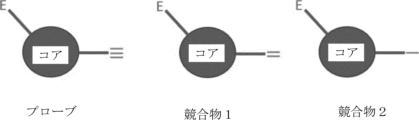
図1は、方法で使用されるプローブを示す概略図であり、一方、添付文書Aは、例えば、トリプシン消化されたペプチドを標識するために利用され得る例示的なタグを示す。 Figure 1 is a schematic diagram showing the probes used in the method, while Appendix A shows exemplary tags that may be utilized to label, for example, tryptic digested peptides.
図1を参照すると、構造図の「E」は、求電子官能基または求電子剤を示し、「コア」は、プローブ、競合物1、または競合物2分子のコア構造を指し、「-」(競合物2)、「=」(競合物1)、および「≡」(プローブ)は、個々の分子における具体的な追加の官能基を示す。プローブ設計の重要な側面としては、以下が挙げられる:1)すべての反応性プローブ(本明細書ではプローブと称される)は、コア構造、求電子基、およびアルキンタグなどのクリック可能なタグを含有する(以下の説明の例としてアルキンタグが使用されるであろう)、2)対応する競合化合物(本明細書では競合物と称される)は、同じコア構造および求電子基を含有するが、アルキンタグを欠く、3)プローブおよび競合物は、アルキン同等部分を除いて互いに同一の構造を有し得る(図1に示されるように、プローブは、三重結合含有末端アルキンを含有し、競合物1および競合物2は、代わって同等な位置にアルケンおよびアルカンを含有する)。
With reference to FIG. 1, "E" in the structural diagram indicates an electrophilic functional group or agent, "core" refers to the core structure of the probe,
実施例2
SK-MEL-28細胞プロテオームのIMTACスクリーニング
ヒトがん細胞プロテオームの調製。SK-MEL-28細胞を、37℃の5%の二酸化炭素(CO2)インキュベーターで、10%のウシ胎仔血清を補充したATCC配合Eagle’s Minimum Essential Medium(カタログ番号30-2003)中で培養した。インビトロ標識実験用に、細胞を90%のコンフルエンシーまで増殖させ、PBSで3回洗浄し、冷たいPBS中で破壊した。1400×gで3分間の遠心分離によって細胞ペレットを単離し、さらなる使用まで、細胞ペレットを-80℃で保管した。収集した細胞ペレットを、PBS緩衝液中での超音波処理によって溶解させた。各実験の前に、凍結細胞パレットから新たにプロテオームを調製した。

IMTAC Screening of SK-MEL-28 Cell Proteome Preparation of human cancer cell proteome. SK-MEL-28 cells were cultured in ATCC formulated Eagle's Minimum Essential Medium (cat. no. 30-2003) supplemented with 10% fetal bovine serum in a 5% carbon dioxide (CO 2 ) incubator at 37°C. For in vitro labeling experiments, cells were grown to 90% confluency, washed three times with PBS, and disrupted in cold PBS. Cell pellets were isolated by centrifugation at 1400×g for 3 min and stored at −80°C until further use. Collected cell pellets were lysed by sonication in PBS buffer. Proteomes were freshly prepared from frozen cell pallets before each experiment.
インビトロ化合物処理。スキーム2に示される化合物1および2を、参照により本明細書に組み込まれるWO2020/055504(PCT/US2019/041635)に従って設計および合成した。プロテオーム試料を、PBS中タンパク質1mg/溶液mLに希釈した。各プロファイリング実験用に、プロテオーム試料の一方のアリコート(0.5ml)を、対照として0.5μlのDMSOで処理し、他方のアリコートを、0.1μMの最終濃度のDMSO中0.5μlの化合物2で処理した。室温で60分間処理した後、氷冷したメタノールを試料に添加して、タンパク質を沈殿させた。沈殿物を0.5mlの氷冷したDPBS中に再懸濁させ、1mlのddH2O中に溶解させた1錠のRocheプロテアーゼ阻害剤錠剤を5μl添加した。
In vitro compound treatment.
インサイチュ化合物処理。15cmのペトリ皿内で、SK-MEL-28細胞を90%のコンフルエンシーまで増殖させた後、5%のCO2下、37℃で30分~1時間、20μlのDMSOを含有する20mlの培地で対照としてプレート1をインキュベートし、0.1μMの最終濃度の化合物2を含有する20mlの培地でプレート2をインキュベートする。細胞を20mlのDPBSで洗浄し、5%のCO2下、37℃でさらに30分~1時間、1μMの化合物1を含有する20mlの培地で両方のプレートをインキュベートする。細胞スクレーパーを使用して、10mlのDPBS中で細胞を収集する。Thermo Sorvall XT遠心分離器でスピンダウンした後、ペレットを0.5mlの氷冷したDPBS中に再懸濁させ、1mlのddH2O中に溶解させた1錠のRocheプロテアーゼ阻害剤錠剤を5μl添加する。Branson Sonifierプローブソニケーターを使用して細胞を溶解させ、Beckman Coulter Microfuge 20R遠心分離器を使用して溶解物をスピンダウンし、上清を収集した。
In situ compound treatment. SK-MEL-28 cells are grown to 90% confluency in 15 cm Petri dishes, then
クリックケミストリー。模擬試料または化合物で処理したプロテオーム試料(0.5mgの細胞溶解物)の各々を、1mMの最終濃度のTCEP、25mMのTBTA、および1mMのCuSO4を添加することによって、クリックケミストリー(アセチレン-アジド環化付加)を使用して、ビオチン-アゾ-アジド(100μMの最終濃度)またはDDE-ビオチン-アジド(250μMの最終濃度)とコンジュゲートした。試料を室温で1時間反応させた。クリックケミストリーステップの後、沈殿したタンパク質に氷冷したメタノールを添加した。 Click chemistry. Each of the mock or compound-treated proteome samples (0.5 mg cell lysate) was conjugated with biotin-azo-azide (100 μM final concentration) or DDE-biotin-azide (250 μM final concentration) using click chemistry (acetylene-azide cycloaddition) by adding 1 mM final concentration of TCEP, 25 mM TBTA, and 1 mM CuSO4 . The samples were allowed to react for 1 h at room temperature. After the click chemistry step, ice-cold methanol was added to the precipitated proteins.
酵素による消化。PBS中1.2%の200μlのSDSでタンパク質ペレットを再懸濁させ、DTT溶液(10mMの最終濃度)を添加し、60℃で30分間インキュベートする。室温の暗所で40分間、ヨードアセトアミド溶液(25mMの最終濃度でインキュベートする。事前に洗浄した磁気ビーズに試料を添加し、チューブリボルバーで混合しながら室温で1時間インキュベートする。PBS中4Mの尿素、およびPBS中1.2%のSDS、水、および100mMのTEABで、順次ビーズを洗浄する。100μlの50mMのTEABにビーズを再懸濁させ、1mg/mlの濃度の4μlのLys-Cトリプシンを各試料に添加する。37℃のEppendorf Thermomixerで一晩消化させる。 Enzymatic digestion. Resuspend protein pellet in 200 μl of 1.2% SDS in PBS, add DTT solution (10 mM final concentration) and incubate at 60°C for 30 min. Incubate with iodoacetamide solution (25 mM final concentration) for 40 min at room temperature in the dark. Add samples to pre-washed magnetic beads and incubate at room temperature for 1 h with mixing with a tube revolver. Wash beads sequentially with 4 M urea in PBS, 1.2% SDS in PBS, water, and 100 mM TEAB. Resuspend beads in 100 μl of 50 mM TEAB and add 4 μl of Lys-C trypsin at a concentration of 1 mg/ml to each sample. Digest overnight in an Eppendorf Thermomixer at 37°C.
TMT標識化。製造業者の指示書に従って、TMT標識化を実行した。簡潔には、使用直前に、TMT標識試薬を室温に平衡化する。0.8mgのバイアルでは、各バイアルに41μlの無水アセトニトリルを添加する。時折ボルテックスしながら、試薬を5分間溶解させる。チューブを短時間遠心分離して溶液を収集する。各試料に41μlのTMT標識試薬の各々を慎重に添加し、ピペッティングによってしっかりと混合する。室温で1時間、反応物をインキュベートする。8μlの5%のヒドロキシルアミンを試料に添加し、15分間インキュベートして反応をクエンチする。試料を含有するチューブを磁気スタンドに置き、上清を収集し、合わせる。各試料を200μlのDPBSで洗浄し、洗浄液を合わせ、もう一度繰り返す。最後に、上清を1つのチューブに合わせる。チューブを磁気スタンドに数分間置き、新しいチューブに移してビーズの残留物を除去する。 TMT labeling. TMT labeling was performed according to the manufacturer's instructions. Briefly, equilibrate the TMT labeling reagent to room temperature immediately before use. For 0.8 mg vials, add 41 μl of anhydrous acetonitrile to each vial. Allow the reagent to dissolve for 5 minutes with occasional vortexing. Centrifuge the tubes briefly to collect the solutions. Carefully add 41 μl of each of the TMT labeling reagents to each sample and mix thoroughly by pipetting. Incubate the reactions for 1 hour at room temperature. Add 8 μl of 5% hydroxylamine to the samples and incubate for 15 minutes to quench the reaction. Place the tubes containing the samples on a magnetic stand and collect and combine the supernatants. Wash each sample with 200 μl of DPBS, combine the washes and repeat once more. Finally, combine the supernatants into one tube. Place the tubes on the magnetic stand for a few minutes and transfer to a new tube to remove any bead residue.
LC/MSMS分析。TMTで標識した試料を、Oasis HLB(Waters)固相抽出カラムで脱塩した。溶出した有機試料を乾燥させた後、LC/MSMS分析用に、適切な20μlの5%のACN、0.1%のギ酸中で試料を再構成する。Easy-SprayソースおよびUltimate 3000 Nano-LCシステムを備えたOrbitrap Fusion Lumos Tribrid質量分析器を使用して、TMTで標識したペプチドを分析した。分離には、PepMap(商標)RSLC C18カラム(2μm、100A、75μm×25cm)を使用した。移動相は、勾配溶出液を使用する、水およびアセトニトリルからなった。カラムを平衡化し、0.3μl/分の流量の勾配条件下(表1)で溶出させた。試料注入体積は、6μlであった。
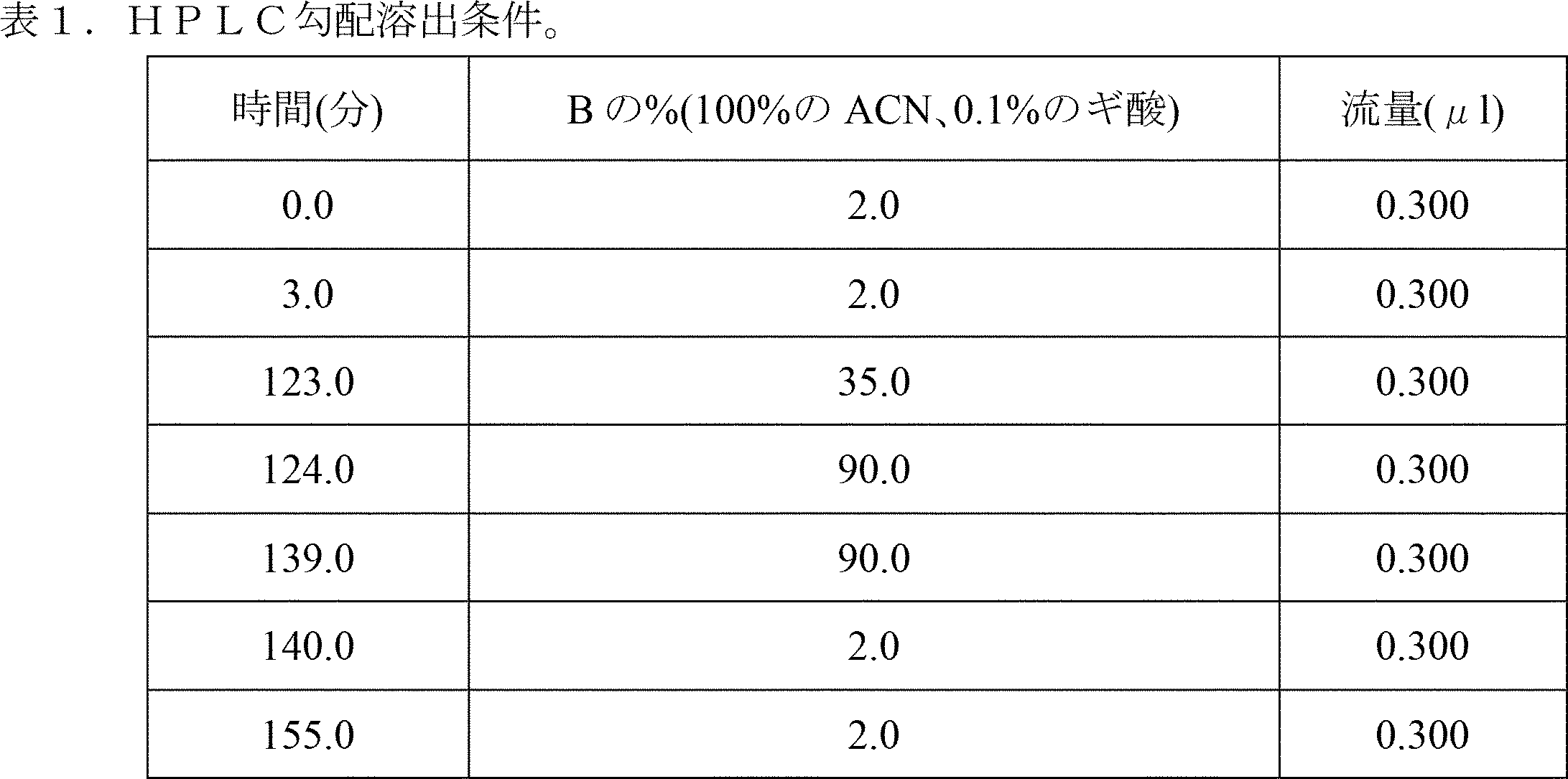
Orbitrap Fusion Lumos Tribrid質量分析器を以下のように操作した:完全MS分解能をm/z200で120,000に設定し、完全MS AGC目標値は50msの最大ITで4E5であり、RFレンズ値を30に設定した。m/zを375~1575に設定し、MIPS特性をペプチドに設定した。MS2スペクトルでは、強度閾値を1E4に設定し、MS2スペクトルでは、ddMS2 IT HCDモデルを使用し、単離幅を0.7m/zに設定し、活性化種類はHCDであり、HCD衝突エネルギー[%]は38であった。AGC目標値を1E5に設定し、MS2検出用に、分解能30,000でorbitrapを用いた。 The Orbitrap Fusion Lumos Tribrid mass analyzer was operated as follows: full MS resolution was set to 120,000 at m/z 200, full MS AGC target was 4E5 with a maximum IT of 50 ms, and RF lens value was set to 30. m/z was set to 375-1575, and MIPS feature was set to peptide. For MS2 spectra, intensity threshold was set to 1E4, and for MS2 spectra, ddMS2 IT HCD model was used, isolation width was set to 0.7 m/z, activation type was HCD, and HCD collision energy [%] was 38. AGC target was set to 1E5, and an orbitrap was used for MS2 detection with a resolution of 30,000.
Proteome Discovererおよび自社開発のソフトウェアを使用して、質量分析データを処理した。TMTタグシグナルをIMTACスコアに変換して、化合物1と標的タンパク質との間の見かけ結合親和性を表した。IMTACスコアが高いほど、化合物1とタンパク質との間の相互作用が強い。
Mass spectrometry data was processed using Proteome Discoverer and in-house developed software. The TMT tag signal was converted into an IMTAC score to represent the apparent binding affinity between
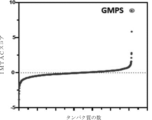
化合物1は、SK-MEL-28細胞でのIMATCスクリーニングにおいて、数百のタンパク質を同定した。結合しているタンパク質を含む化合物1間には、結合親和性の広範な分布が存在する。図2に示されるように、グアノシン一リン酸合成酵素(GMPS)を、化合物1のトップヒットとして同定した。図2は、本開示のいくつかの態様による、SK-Mel-28細胞内のプロテオームにおける化合物1のトップヒットとして同定されるグアノシン一リン酸合成酵素(GMPS)を示すグラフである。図2に示されるIMTACスコアは、TMCタグシグナルに由来し、本質的には、試験した小分子と試料中のすべての異なるタンパク質との間の結合強度の相対的な定量値を提供する。ゼロのIMTACスコアは、特定のタンパク質に対する結合親和性がほとんどないことを指摘する。より高いIMTACスコアは、小分子と標的タンパク質との間のより強い結合強度を示す。トップヒットGMPSと2番目ヒットとの間には大きなIMTACスコア差があり、プロテオーム内のGMPSに対する化合物1の高い選択性を示している。
GMPSは、キサントシン一リン酸をグアノシン一リン酸に変換する重要な酵素である。これは、プリン生合成デノボ経路の重要な構成要素である。リンパ球細胞は、プリン生合成デノボ経路のみを使用して、DNA合成の原材料を提供することができるので、デノボ経路を特異的に阻害することによって、免疫細胞の増殖を防止することができる。したがって、GMPS阻害剤は、SLE(全身性エリテマトーデス)などの自己免疫疾患の免疫抑制治療として機能し得る。 GMPS is a key enzyme that converts xanthosine monophosphate to guanosine monophosphate. It is a key component of the de novo purine biosynthetic pathway. Since lymphoid cells can only use the de novo purine biosynthetic pathway to provide the raw material for DNA synthesis, specifically inhibiting the de novo pathway can prevent immune cell proliferation. Therefore, GMPS inhibitors may function as immunosuppressive treatments for autoimmune diseases such as SLE (systemic lupus erythematosus).
1)質量分析法を使用して、化合物1のGMPSとの共有結合相互作用の確認および結合部位の同定、2)化合物1とGMPSとの係合のゲル内蛍光による測定、3)生化学的IC50の決定、ならびに4)細胞に基づくアッセイを使用して、化合物1の存在下でのGMPSの活性の測定、5)インビボ研究における有効性を含む、異なる生化学的アッセイおよび細胞に基づくアッセイを使用して、化合物1とGMPSとの相互作用を評価した。
The interaction of
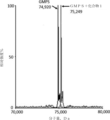
化合物1とGMPSとの共有結合相互作用を確認するために、37℃で1時間、1:2のモル比で組換えGMPSを化合物1とインキュベートし、質量分析法を使用して、329Daのタンパク質の質量増加を観察し、したがって、図3に示されるように、共有結合を確認した。図3は、化合物1の分子量に対応する、329ダルトン(Da)のはっきりとした質量シフトを誘導した、化合物1との組換えGMPSのインキュベーションを示すグラフである。化合物1の処理後にトリプシン化GMPSのMS/MSを分析することによって、Cys104として結合部位を同定した。
To confirm the covalent interaction of
実施例3
化合物1とGMPSとの間の結合の特徴評価
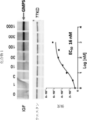
GMPSに対する化合物1の標的係合を測定するために、HEK293細胞を、10%のFBSを含有する適切な培地を含む6ウェルプレート中で約90%のコンフルエンスまで増殖させた。増殖培地を除去し、様々な濃度のプローブ(DMSO中1,000倍のストック溶液)またはビヒクル対照を含有する新鮮な培地で30分間、細胞を処理した。IC50測定のために、まず、30分間間隔で3回1nM~1000nMの37℃の化合物2でインキュベートし、次いで、さらに20分間37℃の100nMの化合物1で細胞を処理した。プローブ処理後、培地を除去し、細胞を氷冷したDulbeccoのPBS(DPBS)で2回洗浄した。細胞を収集し、プロテアーゼ阻害剤カクテル(Roche)を含む80μLのNP40溶解緩衝液(50mMのHEPES、pH7.4、1%のNP-40、150mMのNaCl)に、ペレットを再懸濁させた。溶解物を氷上で20分間インキュベートし、18,000×gで10分間、4℃で遠心分離することによって分画した。BCAアッセイ(Pierce)によって上清試料の各々からタンパク質濃度を測定し、1mg/mlに調節した。100μLの総体積中、25μMのTAMRA-アジド(Click Chemistry Tools)、1mMのトリス(2-カルボキシエチル)ホスフィン(TCEP、Thermo-Scientific)、100μMのトリス[(1-ベンジル-1H-1,2,3-トリアゾール-4-イル)メチル]アミン(TBTA、TCI)、および1mMのCuSO4(Sigma-Aldrich)の最終濃度で、CuACCを実施した。反応を室温の暗所で1時間実施した後、40μlの4×Laemmli試料緩衝液(Bio-Rad)を添加し、5分間煮沸することによって終了させた。30μlの試料を、4~20%のSDS-PAGEに充填し、分解した後、ChemiDoc MP画像化システム(Bio-Rad)で、532nmで励起させ、610nmで発光させて可視化した。図4に示されるように、蛍光画像を灰色スケールで表示し、ChemiDoc定量化ソフトウェアを使用して、蛍光シグナルの強度を定量化した。図4は、蛍光に基づくアッセイを使用した、SK-Mel-28細胞における、化合物1によるGMPSの用量依存的係合を示すグラフである。GraphPad Prismソフトウェア(GraphPad Software、La Jolla,CA)を用いて、EC50(16nM)値を計算した。
Example 3
Characterization of Binding Between
生化学的IC50決定のために、EPPS(pH7.8)、EDTA(100μM)、MgCl2(10mM)、ATP(2mM)、XMP(200μM)、グルタミン(5mM)を含有する反応緩衝液を調製した。ブランク緩衝液は、XMPが存在しないことを除いて、同じ成分を等濃度で調製した。EPPS(pH7.8)中の変動する濃度(0.1μM~100μMの範囲)で、タンパク質溶液を調製した。UV-visを動態モードに設定し、吸光度波長を290nMに設定した。ブランク緩衝液での自動零点規正に続いて、495μlの反応緩衝液を5μLの各タンパク質溶液でインキュベートし、所望の濃度の1000倍の0.5μLの薬物を反応混合物に添加し、30分間にわたって290nMでの吸光度の減少を観察した。Prism 7ソフトウェア(GraphPad Software、La Jolla,CA)での非線形回帰「用量応答阻害」モデルを使用して、プローブおよび競合物分子のIC50値を計算した。図5に示されるように、化合物1は、6.6nMのIC50を有し、非常に強力であることが示された。図5は、290nmでの吸光度の減少を監視することによる分光アッセイを使用した、化合物1のIC50の決定を示すグラフである。
For biochemical IC50 determinations, a reaction buffer was prepared containing EPPS (pH 7.8), EDTA (100 μM), MgCl2 (10 mM), ATP (2 mM), XMP (200 μM), and glutamine (5 mM). A blank buffer was prepared with the same components at equal concentrations, except that XMP was absent. Protein solutions were prepared at varying concentrations (ranging from 0.1 μM to 100 μM) in EPPS (pH 7.8). The UV-vis was set in kinetic mode, and the absorbance wavelength was set at 290 nM. Following autozeroing with blank buffer, 495 μl of reaction buffer was incubated with 5 μL of each protein solution, and 0.5 μL of drug at 1000-fold the desired concentration was added to the reaction mixture, and the decrease in absorbance at 290 nM was observed over 30 minutes. The IC50 values of the probe and competitor molecules were calculated using a nonlinear regression "dose-response inhibition" model in Prism 7 software (GraphPad Software, La Jolla, Calif.). As shown in Figure 5,
実施例4
化合物1の療法的効果のインビボ特徴評価
メラノーマCDXモデルを使用して、プリンサルベージデノボ経路を標的化することを通じて、化合物1の療法的潜在性のインビボ確認を提供した。このモデルには、SK-MEL-28腫瘍細胞(0.1mLのPBSおよびMatigel中5×10⁶、1:1)をBALB/cヌードマウスに皮下接種(sc)した。腫瘍サイズがおよそ150mm3(100~250mm3)に達したら、化合物1の治療を開始し、5日間1日2回、続いて9日間1日1回、皮下で与えた。治療期間を通じて、腫瘍サイズを記録した。対照と比較して、化合物1は腫瘍サイズを低減することが可能であり、開始した8日目には、図7に示されるように、治療期間の終わりまで低減増加に差がある。化合物1は、SK-ML-28腫瘍増殖を阻害した。60mg/kgの化合物1を、5日間1日2回、続いて9日間1日1回皮下で与えた。ビヒクル対照は、5%のDMSOおよび95%の20%の2-ヒドロキシプロピル-ベータ-シクロデキストリン溶液からなった。各群は8匹の雌マウスを含んだ。t検定は、GraphPad Softwareを使用して行った。図6は、SK-ML-28腫瘍増殖の化合物1阻害を示すグラフである。図6に示される全体的な傾向は、インビトロ活性がインビボ環境に転換した証拠を提供し、インビボ有効性の統計的に顕著な実証を達成するために化合物1の効力を向上させる必要があることを示した。
Example 4
In vivo characterization of the therapeutic efficacy of Compound 1 A melanoma CDX model was used to provide in vivo confirmation of the therapeutic potential of
図7は、本開示のいくつかの態様による、タンパク質標的を同定する方法を示すフローチャートである。ステップ701は、生細胞、細胞溶解物、または生きた動物のプロテオームを、試料1および試料2として2つの同一の試料に分割する。ステップ702は、試料1を競合化合物でインキュベートする。ステップ703は、プローブ化合物を、競合化合物で処置した試料1および試料2でインキュベートする。ステップ704は、検出可能な標識をそれぞれ、試料1および試料2と反応させ、これによって、標的タンパク質の富化が可能になる。ステップ705は、富化した標的タンパク質のプロテアーゼ消化を実施する。また、ステップ706は、タンデム質量タグ(TMT)を使用するタンデム質量分析法(MS/MS)を実施して、試料1および試料2からの富化された標的タンパク質を比較し、これによって、プローブ化合物を共有結合する標的タンパク質の同定および定量化が可能になる。
Figure 7 is a flow chart showing a method for identifying protein targets according to some aspects of the present disclosure. Step 701 splits a live cell, cell lysate, or live animal proteome into two identical samples as
本発明は、上の実施例を参照しながら説明されてきたが、修正および変形が、本発明の趣旨および範囲内に包含されることが理解されるであろう。本発明の例示的な実施例は、参照によりその全体が本明細書に組み込まれる添付文書Aとして本明細書に添付される。したがって、本発明は、以下の特許請求の範囲によってのみ限定される。 The invention has been described with reference to the above examples, but it will be understood that modifications and variations are encompassed within the spirit and scope of the invention. An illustrative example of the invention is attached hereto as Appendix A, which is incorporated herein by reference in its entirety. Accordingly, the invention is limited only by the scope of the following claims.
Claims (11)
(a)第1のタンパク質含有試料を、コア構造および求電子部分を含むが末端のクリック可能なタグを欠く競合化合物と接触させて、前記競合化合物で処理した試料を得る工程であって、前記クリック可能なタグが末端アルキン部分であり、前記求電子部分が前記タンパク質標的中の求核性アミノ酸残基に結合する、工程と、
(b)工程(a)の前記競合化合物で処理した試料を、同じコア構造、同じ求電子部分および前記クリック可能なタグを含むプローブ化合物と接触させる工程と、
(c)第2のタンパク質含有試料を前記競合化合物と接触させる工程なく、前記第2のタンパク質含有試料を前記プローブ化合物と接触させる工程と、
(d)前記第1のタンパク質含有試料中のプローブ化合物で修飾されたタンパク質の量を、前記第2のタンパク質含有試料中のプローブ化合物で修飾されたタンパク質の量と比較して検出することによって、前記タンパク質標的を同定する工程と
を含む、前記方法。 1. A method for identifying a protein target, comprising:
(a) contacting a first protein-containing sample with a competitor compound comprising a core structure and an electrophilic moiety but lacking a terminal clickable tag to obtain a competitor compound-treated sample, wherein the clickable tag is a terminal alkyne moiety and the electrophilic moiety binds to a nucleophilic amino acid residue in the protein target;
(b) contacting the sample treated with said competitor compound of step (a) with a probe compound comprising the same core structure, the same electrophilic moiety and said clickable tag;
(c) contacting the second protein-containing sample with the probe compound without contacting the second protein-containing sample with the competitor compound ;
(d) identifying the protein target by detecting the amount of protein modified with the probe compound in the first protein-containing sample relative to the amount of protein modified with the probe compound in the second protein-containing sample.
Applications Claiming Priority (3)
| Application Number | Priority Date | Filing Date | Title |
|---|---|---|---|
| US201962882757P | 2019-08-05 | 2019-08-05 | |
| US62/882,757 | 2019-08-05 | ||
| PCT/US2020/044897 WO2021026162A1 (en) | 2019-08-05 | 2020-08-04 | Method for proteome-wide discovery of covalent ligands and compositions thereof |
Publications (2)
| Publication Number | Publication Date |
|---|---|
| JP2022543560A JP2022543560A (en) | 2022-10-13 |
| JP7586894B2 true JP7586894B2 (en) | 2024-11-19 |
Family
ID=74502511
Family Applications (1)
| Application Number | Title | Priority Date | Filing Date |
|---|---|---|---|
| JP2022505603A Active JP7586894B2 (en) | 2019-08-05 | 2020-08-04 | Methods and compositions for proteome-wide discovery of covalent ligands |
Country Status (7)
| Country | Link |
|---|---|
| US (2) | US12392778B2 (en) |
| EP (1) | EP4010459A4 (en) |
| JP (1) | JP7586894B2 (en) |
| CN (1) | CN114174492A (en) |
| AU (1) | AU2020326694A1 (en) |
| CA (1) | CA3148610A1 (en) |
| WO (1) | WO2021026162A1 (en) |
Citations (2)
| Publication number | Priority date | Publication date | Assignee | Title |
|---|---|---|---|---|
| US20140193831A1 (en) | 2011-01-28 | 2014-07-10 | Gautier Semences | Seed trait prediction by activity-based protein profiling |
| WO2017070611A1 (en) | 2015-10-22 | 2017-04-27 | The Scripps Research Institute | Cysteine reactive probes and uses thereof |
Family Cites Families (8)
| Publication number | Priority date | Publication date | Assignee | Title |
|---|---|---|---|---|
| US10782295B2 (en) * | 2013-08-13 | 2020-09-22 | The Scripps Research Institute | Cysteine-reactive ligand discovery in proteomes |
| EP4219519A3 (en) * | 2016-04-01 | 2023-09-13 | Chromacode, Inc. | Competitive probes for engineering signal generation |
| GB2569252A (en) | 2016-08-31 | 2019-06-12 | Harvard College | Methods of combining the detection of biomolecules into a single assay using fluorescent in situ sequencing |
| WO2018067659A1 (en) * | 2016-10-04 | 2018-04-12 | University Of Southern California | A chemoproteomic approach for discovering covalent ligands for diverse protein targets |
| WO2018098473A1 (en) * | 2016-11-28 | 2018-05-31 | Dana-Farber Cancer Institute, Inc. | Reagents and methods for analysis of proteins and metabolites targeted by covalent probes |
| CN108627647B (en) * | 2017-03-24 | 2020-06-19 | 四川大学 | Detection and quantification method of post-translational modification proteomics |
| US11912664B2 (en) * | 2017-06-06 | 2024-02-27 | President And Fellows Of Harvard College | Determining small molecule-protein and protein-protein interactions |
| WO2020214336A2 (en) * | 2019-03-21 | 2020-10-22 | University Of Virginia Patent Foundation | Sulfur-heterocycle exchange chemistry and uses thereof |
-
2020
- 2020-08-04 WO PCT/US2020/044897 patent/WO2021026162A1/en not_active Ceased
- 2020-08-04 US US17/630,815 patent/US12392778B2/en active Active
- 2020-08-04 JP JP2022505603A patent/JP7586894B2/en active Active
- 2020-08-04 AU AU2020326694A patent/AU2020326694A1/en active Pending
- 2020-08-04 CN CN202080052454.7A patent/CN114174492A/en active Pending
- 2020-08-04 EP EP20850895.2A patent/EP4010459A4/en active Pending
- 2020-08-04 CA CA3148610A patent/CA3148610A1/en active Pending
-
2025
- 2025-07-30 US US19/285,818 patent/US20260023080A1/en active Pending
Patent Citations (3)
| Publication number | Priority date | Publication date | Assignee | Title |
|---|---|---|---|---|
| US20140193831A1 (en) | 2011-01-28 | 2014-07-10 | Gautier Semences | Seed trait prediction by activity-based protein profiling |
| WO2017070611A1 (en) | 2015-10-22 | 2017-04-27 | The Scripps Research Institute | Cysteine reactive probes and uses thereof |
| JP2019501363A (en) | 2015-10-22 | 2019-01-17 | ザ・スクリップス・リサーチ・インスティテュート | Cysteine reactive probes and their use |
Non-Patent Citations (3)
| Title |
|---|
| BACKUS, Keriann M., et al.,Proteome-wide covalent ligand discovery in native biological systems,Nature,Springer Nature,2016年,534(7608),570-574,https://doi.org/10.1038/nature18002,ESR D2 |
| ERDJUMENT-BROMAGE, Hediye; HUANG, Fang-Ke; NEUBERT, Thomas A.,A. Sample preparation for relative quantitation of proteins using tandem mass tags (TMT) and mass spectrometry (MS).,Methods and Protocols,Springer Nature,2018年,1741,135-149,https://doi.org/10.1007/978-1-4939-7659-1_11,ISR D3 |
| ROBERTS, Allison M., et al.,Chemoproteomic screening of covalent ligands reveals UBA5 as a novel pancreatic cancer target,ACS Chemical Biology,ACS,2017年,12(4),899-904,https://doi.org/10.1021/acschembio.7b00020,ESR D1 |
Also Published As
| Publication number | Publication date |
|---|---|
| EP4010459A4 (en) | 2023-09-06 |
| WO2021026162A1 (en) | 2021-02-11 |
| JP2022543560A (en) | 2022-10-13 |
| US12392778B2 (en) | 2025-08-19 |
| US20220276253A1 (en) | 2022-09-01 |
| US20260023080A1 (en) | 2026-01-22 |
| AU2020326694A1 (en) | 2022-03-17 |
| EP4010459A1 (en) | 2022-06-15 |
| CN114174492A (en) | 2022-03-11 |
| CA3148610A1 (en) | 2021-02-11 |
Similar Documents
| Publication | Publication Date | Title |
|---|---|---|
| Remsberg et al. | ABHD17 regulation of plasma membrane palmitoylation and N-Ras-dependent cancer growth | |
| Njomen et al. | Multi-tiered chemical proteomic maps of tryptoline acrylamide–protein interactions in cancer cells | |
| US11789025B2 (en) | Reagents and methods for analysis of proteins and metabolites targeted by covalent probes | |
| Backus | Applications of reactive cysteine profiling | |
| Gurcel et al. | Identification of new O-GlcNAc modified proteins using a click-chemistry-based tagging | |
| Chen et al. | Chemoproteomic profiling of targets of lipid-derived electrophiles by bioorthogonal aminooxy probe | |
| Gabizon et al. | A simple method for developing lysine targeted covalent protein reagents | |
| Sun et al. | Chemoproteomics reveals chemical diversity and dynamics of 4-oxo-2-nonenal modifications in cells | |
| US11226337B2 (en) | Chemoproteomic profiling of protein electrophilic and oxidative post-translational modifications | |
| Zhong et al. | A new rapid in vitro assay for assessing reactivity of acyl glucuronides | |
| Chang et al. | Synthesis of an electronically-tuned minimally interfering alkynyl photo-affinity label to measure small molecule–protein interactions | |
| Yang et al. | Comparative reactivity profiling of cysteine-specific probes by chemoproteomics | |
| Waghorn et al. | High sensitivity HPLC method for determination of the allysine concentration in tissue by use of a naphthol derivative | |
| US12493045B2 (en) | Multi-target crosslinkers and uses thereof | |
| Wu et al. | Research progress in isotope labeling/tags-based protein quantification and metrology technologies | |
| Pol et al. | Induced degradation of SNAP-fusion proteins | |
| Setner et al. | New ionization tags based on the structure of the 5-azoniaspiro [4.4] nonyl tag for a sensitive peptide sequencing by mass spectrometry | |
| US20260023080A1 (en) | Method for proteome-wide discovery of covalent ligands and compositions thereof | |
| Liu et al. | Chemical proteomic profiling of UTP-binding proteins in human cells | |
| Walpurgis et al. | Myostatin inhibitory peptides in sports drug testing | |
| EP3929587A1 (en) | Crosslinking reagent for bioconjugation for use in crosslinking proteomics, in particular crosslinking mass spectrometry analysis | |
| Chavas et al. | Unbiased mass spectrometry elucidation of the targets and mechanisms of activity-based probes: a case study involving sulfonyl fluorides | |
| Meng et al. | Decoding the protein methylome: Identification, validation, and functional insights | |
| US20240103005A1 (en) | N-acryloylindoles and methods of use | |
| US20250369981A1 (en) | Phenylglyoxal-Based Alkyne (PGA) Chemical Tag for Protein Citrullination Analysis |
Legal Events
| Date | Code | Title | Description |
|---|---|---|---|
| A621 | Written request for application examination |
Free format text: JAPANESE INTERMEDIATE CODE: A621 Effective date: 20230707 |
|
| RD04 | Notification of resignation of power of attorney |
Free format text: JAPANESE INTERMEDIATE CODE: A7424 Effective date: 20231108 |
|
| A977 | Report on retrieval |
Free format text: JAPANESE INTERMEDIATE CODE: A971007 Effective date: 20240229 |
|
| A131 | Notification of reasons for refusal |
Free format text: JAPANESE INTERMEDIATE CODE: A131 Effective date: 20240402 |
|
| A521 | Request for written amendment filed |
Free format text: JAPANESE INTERMEDIATE CODE: A523 Effective date: 20240702 |
|
| TRDD | Decision of grant or rejection written | ||
| A01 | Written decision to grant a patent or to grant a registration (utility model) |
Free format text: JAPANESE INTERMEDIATE CODE: A01 Effective date: 20241101 |
|
| A61 | First payment of annual fees (during grant procedure) |
Free format text: JAPANESE INTERMEDIATE CODE: A61 Effective date: 20241107 |
|
| R150 | Certificate of patent or registration of utility model |
Ref document number: 7586894 Country of ref document: JP Free format text: JAPANESE INTERMEDIATE CODE: R150 |