JP7586868B2 - Treatment of Hair Loss Disorders with Deuterated JAK Inhibitors - Google Patents
Treatment of Hair Loss Disorders with Deuterated JAK Inhibitors Download PDFInfo
- Publication number
- JP7586868B2 JP7586868B2 JP2022147751A JP2022147751A JP7586868B2 JP 7586868 B2 JP7586868 B2 JP 7586868B2 JP 2022147751 A JP2022147751 A JP 2022147751A JP 2022147751 A JP2022147751 A JP 2022147751A JP 7586868 B2 JP7586868 B2 JP 7586868B2
- Authority
- JP
- Japan
- Prior art keywords
- compound
- day
- pharma
- administered
- acceptable salt
- Prior art date
- Legal status (The legal status is an assumption and is not a legal conclusion. Google has not performed a legal analysis and makes no representation as to the accuracy of the status listed.)
- Active
Links
Images


Classifications
-
- A—HUMAN NECESSITIES
- A61—MEDICAL OR VETERINARY SCIENCE; HYGIENE
- A61K—PREPARATIONS FOR MEDICAL, DENTAL OR TOILETRY PURPOSES
- A61K31/00—Medicinal preparations containing organic active ingredients
- A61K31/33—Heterocyclic compounds
- A61K31/395—Heterocyclic compounds having nitrogen as a ring hetero atom, e.g. guanethidine or rifamycins
- A61K31/495—Heterocyclic compounds having nitrogen as a ring hetero atom, e.g. guanethidine or rifamycins having six-membered rings with two or more nitrogen atoms as the only ring heteroatoms, e.g. piperazine or tetrazines
- A61K31/505—Pyrimidines; Hydrogenated pyrimidines, e.g. trimethoprim
- A61K31/519—Pyrimidines; Hydrogenated pyrimidines, e.g. trimethoprim ortho- or peri-condensed with heterocyclic rings
-
- A—HUMAN NECESSITIES
- A61—MEDICAL OR VETERINARY SCIENCE; HYGIENE
- A61K—PREPARATIONS FOR MEDICAL, DENTAL OR TOILETRY PURPOSES
- A61K9/00—Medicinal preparations characterised by special physical form
- A61K9/0012—Galenical forms characterised by the site of application
- A61K9/0053—Mouth and digestive tract, i.e. intraoral and peroral administration
-
- A—HUMAN NECESSITIES
- A61—MEDICAL OR VETERINARY SCIENCE; HYGIENE
- A61K—PREPARATIONS FOR MEDICAL, DENTAL OR TOILETRY PURPOSES
- A61K9/00—Medicinal preparations characterised by special physical form
- A61K9/20—Pills, tablets, discs, rods
-
- A—HUMAN NECESSITIES
- A61—MEDICAL OR VETERINARY SCIENCE; HYGIENE
- A61K—PREPARATIONS FOR MEDICAL, DENTAL OR TOILETRY PURPOSES
- A61K9/00—Medicinal preparations characterised by special physical form
- A61K9/20—Pills, tablets, discs, rods
- A61K9/2004—Excipients; Inactive ingredients
- A61K9/2009—Inorganic compounds
-
- A—HUMAN NECESSITIES
- A61—MEDICAL OR VETERINARY SCIENCE; HYGIENE
- A61K—PREPARATIONS FOR MEDICAL, DENTAL OR TOILETRY PURPOSES
- A61K9/00—Medicinal preparations characterised by special physical form
- A61K9/20—Pills, tablets, discs, rods
- A61K9/2004—Excipients; Inactive ingredients
- A61K9/2013—Organic compounds, e.g. phospholipids, fats
-
- A—HUMAN NECESSITIES
- A61—MEDICAL OR VETERINARY SCIENCE; HYGIENE
- A61K—PREPARATIONS FOR MEDICAL, DENTAL OR TOILETRY PURPOSES
- A61K9/00—Medicinal preparations characterised by special physical form
- A61K9/20—Pills, tablets, discs, rods
- A61K9/2004—Excipients; Inactive ingredients
- A61K9/2022—Organic macromolecular compounds
- A61K9/2027—Organic macromolecular compounds obtained by reactions only involving carbon-to-carbon unsaturated bonds, e.g. polyvinyl pyrrolidone, poly(meth)acrylates
-
- A—HUMAN NECESSITIES
- A61—MEDICAL OR VETERINARY SCIENCE; HYGIENE
- A61K—PREPARATIONS FOR MEDICAL, DENTAL OR TOILETRY PURPOSES
- A61K9/00—Medicinal preparations characterised by special physical form
- A61K9/20—Pills, tablets, discs, rods
- A61K9/2004—Excipients; Inactive ingredients
- A61K9/2022—Organic macromolecular compounds
- A61K9/205—Polysaccharides, e.g. alginate, gums; Cyclodextrin
- A61K9/2054—Cellulose; Cellulose derivatives, e.g. hydroxypropyl methylcellulose
-
- A—HUMAN NECESSITIES
- A61—MEDICAL OR VETERINARY SCIENCE; HYGIENE
- A61P—SPECIFIC THERAPEUTIC ACTIVITY OF CHEMICAL COMPOUNDS OR MEDICINAL PREPARATIONS
- A61P17/00—Drugs for dermatological disorders
- A61P17/14—Drugs for dermatological disorders for baldness or alopecia
Landscapes
- Health & Medical Sciences (AREA)
- Chemical & Material Sciences (AREA)
- Life Sciences & Earth Sciences (AREA)
- Medicinal Chemistry (AREA)
- Pharmacology & Pharmacy (AREA)
- Animal Behavior & Ethology (AREA)
- General Health & Medical Sciences (AREA)
- Public Health (AREA)
- Veterinary Medicine (AREA)
- Epidemiology (AREA)
- Dermatology (AREA)
- Bioinformatics & Cheminformatics (AREA)
- Engineering & Computer Science (AREA)
- Chemical Kinetics & Catalysis (AREA)
- General Chemical & Material Sciences (AREA)
- Nuclear Medicine, Radiotherapy & Molecular Imaging (AREA)
- Organic Chemistry (AREA)
- Inorganic Chemistry (AREA)
- Biophysics (AREA)
- Molecular Biology (AREA)
- Nutrition Science (AREA)
- Physiology (AREA)
- Pharmaceuticals Containing Other Organic And Inorganic Compounds (AREA)
- Medicinal Preparation (AREA)
- Medicines That Contain Protein Lipid Enzymes And Other Medicines (AREA)
Description
関連出願
本出願は、2016年5月4日に出願された米国仮出願第62/331,827号明細書、2016年5月19日に出願された同第62/338,869号明細書、2016年11月7日に出願された同第62/418,774号明細書、2016年11月8日に出願された同第62/419,237号明細書、2016年12月14日に出願された同第62/434,404号明細書、2017年3月2日に出願された同第62/466,358号明細書および2017年5月1日に出願された同第62/492,758号明細書の利益を主張する。上記出願の教示全体が参照により本明細書に組み込まれる。
RELATED APPLICATIONS This application claims the benefit of U.S. Provisional Application Nos. 62/331,827, filed May 4, 2016, 62/338,869, filed May 19, 2016, 62/418,774, filed November 7, 2016, 62/419,237, filed November 8, 2016, 62/434,404, filed December 14, 2016, 62/466,358, filed March 2, 2017, and 62/492,758, filed May 1, 2017. The entire teachings of the above applications are incorporated herein by reference.
本発明は、重水素化JAK阻害剤による脱毛障害の処置に関する。 The present invention relates to the treatment of hair loss disorders with deuterated JAK inhibitors.
現在の多くの医薬品は、この医薬品の幅広い使用を妨げるまたはある特定の適応症でのこの医薬品の使用の制限する乏しい吸収、分布、代謝および/または排泄(ADME)特性に悩まされている。乏しいADME特性はまた、臨床試験で薬物候補から外れる主な理由でもある。場合によっては、製剤技術およびプロドラッグ戦略を利用して、ある特定のADME特性を改善し得るが、これらのアプローチは、多くの薬物および薬物候補に関して存在する根本的なADME問題に対処できないことが多い。そのような問題の1つは迅速な代謝であり、この迅速な代謝により、そうでなければ疾患の処置で非常に有効であるだろう多くの薬物が身体からあまりにも迅速に除去される。迅速な薬物クリアランスに対する可能な解決策は、薬物の十分に高い血漿レベルを達成する頻度または高投与である。しかしながら、このことは、多くの潜在的な処置上の問題(例えば、患者による投与レジメンの乏しい順守、用量が高くなるに伴い深刻になる副作用、および処置コストの増加)をもたらす。迅速に代謝される薬物はまた、患者を望ましくない毒性のまたは反応性の代謝産物に曝す場合もある。 Many current pharmaceuticals suffer from poor absorption, distribution, metabolism and/or excretion (ADME) properties that prevent the drug from being widely used or limit its use in certain indications. Poor ADME properties are also a major reason for drug candidates being dropped in clinical trials. In some cases, formulation techniques and prodrug strategies can be utilized to improve certain ADME properties, but these approaches often fail to address the underlying ADME problems that exist for many drugs and drug candidates. One such problem is rapid metabolism, which causes many drugs that would otherwise be very effective in treating diseases to be cleared too quickly from the body. A possible solution to rapid drug clearance is frequent or high dosing to achieve sufficiently high plasma levels of the drug. However, this results in many potential treatment problems, such as poor patient compliance with dosing regimens, more severe side effects with higher doses, and increased treatment costs. Rapidly metabolized drugs can also expose patients to undesirable toxic or reactive metabolites.
多くの医薬品に影響を及ぼす別のADME制限は、毒性のまたは生物学的に反応性の代謝産物の形成である。結果として、薬物が投与される一部の患者は毒性を経験する場合がある、またはそのような薬物の安全な投与は、患者に準最適な量の活性剤を投与するように制限される場合がある。ある特定の場合では、投与間隔または製剤化アプローチを変更することは臨床上の副作用を低減するのに役立ち得るが、そのような望ましくない代謝産物の形成は化合物の代謝に本来備わっていることが多い。 Another ADME limitation affecting many pharmaceutical products is the formation of toxic or biologically reactive metabolites. As a result, some patients to whom the drug is administered may experience toxicity, or safe administration of such drugs may be limited to administering suboptimal amounts of active agent to the patient. In certain cases, altering the dosing interval or formulation approach may help reduce clinical side effects, but the formation of such undesirable metabolites is often inherent to the metabolism of the compound.
いくつかの選択された場合では、代謝阻害剤が、あまりにも迅速に除去される薬剤と共投与される。それは、HIV感染を処置するために使用されるプロテアーゼ阻害剤クラスの薬物の場合である。FDAは、この薬物を、概してこの薬物の代謝の原因の酵素であるシトクロムP450酵素3A4(CYP3A4)の阻害剤であるリトナビルと共投与することを推奨する(非特許文献1を参照されたい)。しかしながら、リトナビルは副作用を引き起こし、既に異なる薬物の組合わせを摂取しなければならないHIV患者の錠剤負荷を増大させる。同様に、CYP2D6阻害剤キニジンは、情動調節障害の処置でのデキストロメトルファンの迅速なCYP2D6代謝を低減する目的でデキストロメトルファンに添加されている。しかしながら、キニジンは、可能性のある併用療法でのこのキニジンの使用を大きく制限する望ましくなく副作用を有する(非特許文献2;および非特許文献3を参照されたい)。 In some selected cases, metabolic inhibitors are co-administered with drugs that are cleared too quickly. This is the case for drugs of the protease inhibitor class used to treat HIV infection. The FDA generally recommends co-administering this drug with ritonavir, an inhibitor of the cytochrome P450 enzyme 3A4 (CYP3A4), the enzyme responsible for the metabolism of this drug (see 1). However, ritonavir causes side effects and increases the pill burden of HIV patients who must already take a combination of different drugs. Similarly, the CYP2D6 inhibitor quinidine has been added to dextromethorphan with the aim of reducing the rapid CYP2D6 metabolism of dextromethorphan in the treatment of affective dysregulation. However, quinidine has undesirable side effects that greatly limit its use in potential combination therapy (see 2; and 3).
一般に、薬物とチトクロムP450(CYP)阻害剤とを組み合わせることは、薬物クリアランスを低減するのに十分な戦略ではない。CYP酵素の活性の阻害は、同一の酵素により代謝される他の薬物の代謝およびクリアランスに影響を及ぼす可能性がある。CYPの阻害は、体内での他の薬物の毒性レベルまでの蓄積を引き起こす可能性がある。 In general, combining a drug with a cytochrome P450 (CYP) inhibitor is not a sufficient strategy to reduce drug clearance. Inhibition of the activity of a CYP enzyme can affect the metabolism and clearance of other drugs that are metabolized by the same enzyme. Inhibition of CYP can cause accumulation of other drugs in the body to toxic levels.
薬物の代謝特性を改善するための可能性がある魅力的な戦略は重水素改変である。このアプローチでは、1個または複数個の水素原子を重水素原子に置換することにより、薬物のCYP媒介性代謝を遅延させることまたは望ましくない代謝産物の形成を低減することが試みられる。重水素は、水素の安全で安定した非放射性同位体である。水素と比較して、重水素は炭素との強い結合を形成する。選択された場合では、重水素により付与される結合強度の増加は薬物のADME特性にプラスの影響を与え得、薬物の有効性、安全性および/または忍容性の改善の可能性をもたらす。同時に、重水素のサイズおよび形状は水素のサイズおよび形状と本質的に同一であることから、水素の重水素への置換は、水素のみを含む元々の化学物質と比較して薬物の生化学的な効力および選択性に影響を及ぼすとは予想されないだろう。 A potentially attractive strategy for improving the metabolic properties of drugs is deuterium modification. This approach attempts to delay the CYP-mediated metabolism of a drug or reduce the formation of undesirable metabolites by replacing one or more hydrogen atoms with deuterium atoms. Deuterium is a safe, stable, non-radioactive isotope of hydrogen. Compared to hydrogen, deuterium forms stronger bonds with carbon. In selected cases, the increased bond strength imparted by deuterium can positively affect the ADME properties of a drug, leading to the potential for improved efficacy, safety, and/or tolerability of the drug. At the same time, since the size and shape of deuterium are essentially identical to those of hydrogen, the substitution of hydrogen for deuterium would not be expected to affect the biochemical potency and selectivity of the drug compared to the original chemical entity containing only hydrogen.
過去35年にわたり、代謝速度への重水素置換の効果は、承認された薬物のうちのごく一部にのみ報告されている(例えば非特許文献4;非特許文献5(“Foster”);非特許文献6;非特許文献7(“Fisher”)を参照されたい)。結果は変化しやすく予測不可能であった。いくつかの化合物の場合、重水素化はインビボで代謝クリアランスの低下を引き起こした。他の場合では代謝に変化はなかった。さらに他のものは、代謝クリアランスの増加を示した。重水素効果のばらつきにより、専門家は、有害な代謝を阻害するための実行可能な薬物設計戦略としての重水素改変を疑問視するまたは却下するようにもなっている(Fosterの35頁およびFisherの101頁を参照されたい)。 Over the past 35 years, the effect of deuterium substitution on metabolic rate has been reported for only a small proportion of approved drugs (see, e.g., 4; 5 ("Foster"); 6; 7 ("Fisher"). Results have been variable and unpredictable. In some compounds, deuteration caused a decrease in metabolic clearance in vivo. In others, metabolism was unchanged. Still others showed an increase in metabolic clearance. The variability of deuterium effects has also led experts to question or dismiss deuterium modification as a viable drug design strategy to inhibit deleterious metabolism (see Foster, p. 35 and Fisher, p. 101).
薬物の代謝特性への重水素改変の効果は、重水素原子が既知の代謝部位で組み込まれる場合であっても予測可能ではない。重水素化薬物を実際に調製し且つ試験することによってのみ、代謝速度がその非重水素化対応物の代謝速度と異なるかどうかおよびどれくらい異なるかを測定し得る。例えばFukuto他(非特許文献8)を参照されたい。多くの薬物は代謝可能な複数の部位を有する。重水素置換が必要とされる部位および代謝への効果を確認するために必要な重水素化の程度は、もしあるならば、各薬剤で異なるだろう。 The effect of deuterium modification on the metabolic properties of a drug is not predictable, even when the deuterium atom is incorporated at a known metabolic site. Only by actually preparing and testing a deuterated drug can one determine whether and how much the metabolic rate differs from that of its non-deuterated counterpart. See, for example, Fukuto et al. (8). Many drugs have multiple sites at which they can be metabolized. The site at which deuterium substitution is required and the degree of deuteration required to see an effect on metabolism, if any, will be different for each drug.
ルキソリチニブリン酸塩は、Janus関連キナーゼ(Janus Associated Kinase)(JAK)JAK1およびJAK2を阻害するヘテロアリール置換ピロロ[2,3-d]ピリミジン(下記としても既知である:3(R)-シクロペンチル-3-[4-(7H-ピロロ[2,3-d]ピリミジン-4-イル)-1H-ピラゾール-1-イル]プロパンニトリルホスフェートおよび(R)-3-(4-(7H-ピロロ[2,3-d]ピリミジン-4-イル)-1H-ピラゾール-1-イル)-3-シクロペンチルプロパンニトリルホスフェート)である。これらのキナーゼは、造血および免疫機能に重要な多くのサイトカインおよび増殖因子のシグナル伝達を媒介する。JAKシグナル伝達は、サイトカインレセプターへのSTAT(シグナル伝達物質および転写活性化物質)の動員、STATの活性化およびその後の核への局在化を含み、遺伝子発現が調節される。 Ruxolitinib phosphate is a heteroaryl-substituted pyrrolo[2,3-d]pyrimidine (also known as 3(R)-cyclopentyl-3-[4-(7H-pyrrolo[2,3-d]pyrimidin-4-yl)-1H-pyrazol-1-yl]propanenitrile phosphate and (R)-3-(4-(7H-pyrrolo[2,3-d]pyrimidin-4-yl)-1H-pyrazol-1-yl)-3-cyclopentylpropanenitrile phosphate) that inhibits the Janus Associated Kinases (JAKs) JAK1 and JAK2. These kinases mediate the signaling of many cytokines and growth factors important for hematopoiesis and immune function. JAK signaling involves recruitment of STATs (signal transducers and activators of transcription) to cytokine receptors, their activation and subsequent localization to the nucleus, where gene expression is regulated.
ルキソリチニブリン酸塩は現在、中等のまたは高いリスクの骨髄線維症(例えば原発性骨髄線維症、真性多血症から移行した骨髄線維症、および本態性血小板血症から移行した骨髄線維症)の患者の処置に承認されている。ルキソリチニブリン酸塩は現在、追加の状態の処置に関する臨床試験中でもある。 Ruxolitinib is currently approved for the treatment of patients with intermediate- or high-risk myelofibrosis (e.g., primary myelofibrosis, myelofibrosis evolving from polycythemia vera, and myelofibrosis evolving from essential thrombocythemia). Ruxolitinib is also currently in clinical trials for the treatment of additional conditions.
ルキソリチニブの有益な活性にもかかわらず、上述した疾患および状態を処置するために新規の化合物が引き続き必要とされている。 Despite the beneficial activity of ruxolitinib, new compounds continue to be needed to treat the diseases and conditions mentioned above.
ルキソリチニブの重水素化類似体(例えば化合物(I)、(R)-3-(4-(7H-ピロロ[2,3-d]ピリミジン-4-イル)-1H-ピラゾール-1-イル)-3-(シクロペンチル-2,2,3,3,4,4,5,5-d8)プロパンニトリルまたはD8-ルキソリチニブとも称される)は脱毛障害(例えば円形脱毛症)の処置に有用であることを現在発見している。化合物(I)を下記構造式:

ある特定の実施形態では、化合物(I)を薬学的に許容される塩(例えばリン酸塩)として投与する。化合物(I)を1日当たり約4mg~約50mg(または化合物(I)リン酸塩等の塩をベースとする等価な重量)の範囲の用量で投与し得、1日当たり1回の用量または分割用量(例えば1日当たり2回)として投与する。これらの発見に基づいて、哺乳動物対象の脱毛障害を処置するための、化合物(I)またはその薬学的に許容される塩を使用する新規の治療法が本明細書で開示されている。 In certain embodiments, compound (I) is administered as a pharma- ceutically acceptable salt (e.g., phosphate salt). Compound (I) may be administered in a dose ranging from about 4 mg to about 50 mg (or the weight equivalent based on a salt such as compound (I) phosphate salt) per day, administered as a single dose or divided doses (e.g., twice per day). Based on these discoveries, novel therapeutic methods using compound (I) or a pharma- ceutically acceptable salt thereof for treating hair loss disorders in mammalian subjects are disclosed herein.
本発明の一態様は、Janus関連キナーゼ1(JAK1)および/またはJanus関連キナーゼ2(JAK2)の活性を調節する化合物により処置され得る脱毛障害を処置する方法である。この方法は、対象(例えば哺乳動物対象)に、有効な量の化合物(I)またはその薬学的に許容される塩(即ち、等価な量の薬学的に許容される塩(例えばリン酸塩))を1日当たり1回または2回投与することを含み、化合物(I)またはその薬学的に許容される塩の量は約4mg/日~約50mg/日の範囲であり、例えば約5mg/日、約10mg/日、約20mg/日、約30mg/日、約40mg/日または約50mg/日である。ある特定の実施形態では、化合物(I)またはその薬学的に許容される塩の量は、約4mg/日、8mg/日、16mg/日、32mg/日または48mg/日である。ある特定の実施形態では、化合物(I)またはその薬学的に許容される塩の量は、8mg/日、16mg/日、24mg/日または32mg/日である。ある特定の実施形態では、化合物(I)またはその薬学的に許容される塩の量は、8mg/日、16mg/日、24mg/日または32mg/日である。ある特定の実施形態では、化合物(I)またはその薬学的に許容される塩の量は、1日当たり4mg、8mg、12mgまたは16mgを2回である。ある特定の実施形態では、この脱毛障害は円形脱毛症である。ある特定の実施形態では、この対象はヒトである。好ましくは、化合物(I)またはその薬学的に許容される塩(例えばリン酸塩)を上記の投与量のいずれかで経口投与する。好ましくは、化合物(I)またはその薬学的に許容される塩を、錠剤である医薬製剤で上記の投与量のいずれかにて経口投与する。 One aspect of the invention is a method of treating hair loss disorders that can be treated with a compound that modulates the activity of Janus-associated kinase 1 (JAK1) and/or Janus-associated kinase 2 (JAK2). The method comprises administering to a subject (e.g., a mammalian subject) an effective amount of compound (I) or a pharma- ceutically acceptable salt thereof (i.e., an equivalent amount of a pharma- ceutically acceptable salt (e.g., a phosphate salt)) once or twice per day, wherein the amount of compound (I) or a pharma- ceutically acceptable salt thereof ranges from about 4 mg/day to about 50 mg/day, e.g., about 5 mg/day, about 10 mg/day, about 20 mg/day, about 30 mg/day, about 40 mg/day, or about 50 mg/day. In certain embodiments, the amount of compound (I) or a pharma- ceutically acceptable salt thereof is about 4 mg/day, 8 mg/day, 16 mg/day, 32 mg/day, or 48 mg/day. In certain embodiments, the amount of compound (I) or a pharma- ceutically acceptable salt thereof is 8 mg/day, 16 mg/day, 24 mg/day, or 32 mg/day. In certain embodiments, the amount of compound (I) or a pharma- ceutically acceptable salt thereof is 8 mg/day, 16 mg/day, 24 mg/day, or 32 mg/day. In certain embodiments, the amount of compound (I) or a pharma- ceutically acceptable salt thereof is 4 mg, 8 mg, 12 mg, or 16 mg twice per day. In certain embodiments, the hair loss disorder is alopecia areata. In certain embodiments, the subject is a human. Preferably, compound (I) or a pharma- ceutical acceptable salt thereof (e.g., a phosphate salt) is orally administered in any of the above dosages. Preferably, compound (I) or a pharma- ceutical acceptable salt thereof is orally administered in any of the above dosages in a pharmaceutical formulation that is a tablet.
代替の態様では、本発明は、脱毛障害を処置する方法であって、対象(例えば哺乳動物対象)に、有効な量の化合物(I)またはその薬学的に許容される塩(即ち、等価な量の薬学的に許容される塩(例えばリン酸塩))を局所投与することを含む方法を提供する。ある特定の実施形態では、この化合物を、局所投与用に製剤化されている医薬組成物(例えばクリーム剤、軟膏剤、ローション剤、フォーム剤または同類のもの)で投与する。 In an alternative aspect, the present invention provides a method of treating a hair loss disorder, comprising topically administering to a subject (e.g., a mammalian subject) an effective amount of compound (I) or a pharma- ceutically acceptable salt thereof (i.e., an equivalent amount of a pharma- ceutically acceptable salt, e.g., a phosphate salt). In certain embodiments, the compound is administered in a pharmaceutical composition (e.g., a cream, ointment, lotion, foam, or the like) that is formulated for topical administration.
別の態様では、本発明は、対象の毛の成長を誘導する方法を提供する。この方法は、哺乳動物対象に、有効な量の化合物(I)またはその薬学的に許容される塩(即ち、等価な量の薬学的に許容される塩(例えばリン酸塩))を1日当たり1回または2回投与することを含み、化合物(I)またはその薬学的に許容される塩の量は約4mg/日~約50mg/日の範囲であり、例えば約5mg/日、約10mg/日、約20mg/日、約30mg/日、約40mg/日または約50mg/日である。ある特定の実施形態では、化合物(I)またはその薬学的に許容される塩の量は、約4mg/日、8mg/日、16mg/日、32mg/日または48mg/日である。ある特定の実施形態では、化合物(I)またはその薬学的に許容される塩の量は、8mg/日、16mg/日、24mg/日または32mg/日である。ある特定の実施形態では、この対象は脱毛障害に罹患しており、さらなる実施形態では、この脱毛障害は円形脱毛症である。ある特定の実施形態では、この対象はヒトである。一実施形態では、この対象は6歳以上のヒトである。好ましくは、化合物(I)またはその薬学的に許容される塩(例えばリン酸塩)を、上記の投与量のいずれかで経口投与する。好ましくは、化合物(I)またはその薬学的に許容される塩を、錠剤である医薬製剤で上記の投与量のいずれかにて経口投与する。 In another aspect, the present invention provides a method of inducing hair growth in a subject. The method comprises administering to a mammalian subject an effective amount of compound (I) or a pharma- ceutically acceptable salt thereof (i.e., an equivalent amount of a pharma- ceutically acceptable salt (e.g., a phosphate salt) once or twice per day, wherein the amount of compound (I) or a pharma- ceutically acceptable salt thereof ranges from about 4 mg/day to about 50 mg/day, e.g., about 5 mg/day, about 10 mg/day, about 20 mg/day, about 30 mg/day, about 40 mg/day, or about 50 mg/day. In certain embodiments, the amount of compound (I) or a pharma- ceutically acceptable salt thereof is about 4 mg/day, 8 mg/day, 16 mg/day, 32 mg/day, or 48 mg/day. In certain embodiments, the amount of compound (I) or a pharma- ceutically acceptable salt thereof is 8 mg/day, 16 mg/day, 24 mg/day, or 32 mg/day. In certain embodiments, the subject suffers from a hair loss disorder, and in further embodiments, the hair loss disorder is alopecia areata. In certain embodiments, the subject is a human. In one embodiment, the subject is a human aged 6 years or older. Preferably, compound (I) or a pharma- ceutically acceptable salt thereof (e.g., a phosphate salt) is orally administered in any of the dosages described above. Preferably, compound (I) or a pharma- ceutically acceptable salt thereof is orally administered in any of the dosages described above in a pharmaceutical formulation that is a tablet.
本発明の別の態様は、Janus関連キナーゼ1(JAK1)および/またはJanus関連キナーゼ2(JAK2)の活性を調節する化合物により処置され得る自己免疫性皮膚障害障害を処置する方法である。この方法は、対象(例えば哺乳動物対象)に、有効な量の化合物(I)またはその薬学的に許容される塩(即ち、等価な量の薬学的に許容される塩(例えばリン酸塩))を1日当たり1回または2回投与することを含み、化合物(I)またはその薬学的に許容される塩の量は約4mg/日~約50mg/日の範囲であり、例えば約5mg/日、約10mg/日、約20mg/日、約30mg/日、約40mg/日または約50mg/日である。ある特定の実施形態では、化合物(I)またはその薬学的に許容される塩の量は、約4mg/日、8mg/日、16mg/日、32mg/日または48mg/日である。ある特定の実施形態では、化合物(I)またはその薬学的に許容される塩の量は、8mg/日、16mg/日、24mg/日または32mg/日である。ある特定の実施形態では、化合物(I)またはその薬学的に許容される塩の量は、8mg/日、16mg/日、24mg/日または32mg/日である。ある特定の実施形態では、化合物(I)またはその薬学的に許容される塩の量は、1日当たり4mg、8mg、12mgまたは16mgを2回である。ある特定の実施形態では、この自己免疫性皮膚障害は、円形脱毛症、白斑、アトピー性皮膚炎(湿疹(ezcema))または乾癬である。ある特定の実施形態では、この対象はヒトである。好ましくは、化合物(I)またはその薬学的に許容される塩(例えばリン酸塩)を上記の投与量のいずれかで経口投与する。好ましくは、化合物(I)またはその薬学的に許容される塩を、錠剤である医薬製剤で上記の投与量のいずれかにて経口投与する。 Another aspect of the invention is a method of treating an autoimmune skin disorder that can be treated with a compound that modulates the activity of Janus-associated kinase 1 (JAK1) and/or Janus-associated kinase 2 (JAK2). The method comprises administering to a subject (e.g., a mammalian subject) an effective amount of compound (I) or a pharma- ceutically acceptable salt thereof (i.e., an equivalent amount of a pharma- ceutically acceptable salt (e.g., a phosphate salt)) once or twice per day, wherein the amount of compound (I) or a pharma- ceutically acceptable salt thereof ranges from about 4 mg/day to about 50 mg/day, e.g., about 5 mg/day, about 10 mg/day, about 20 mg/day, about 30 mg/day, about 40 mg/day, or about 50 mg/day. In certain embodiments, the amount of compound (I) or a pharma- ceutically acceptable salt thereof is about 4 mg/day, 8 mg/day, 16 mg/day, 32 mg/day, or 48 mg/day. In certain embodiments, the amount of compound (I) or a pharma- ceutically acceptable salt thereof is 8 mg/day, 16 mg/day, 24 mg/day, or 32 mg/day. In certain embodiments, the amount of compound (I) or a pharma- ceutically acceptable salt thereof is 8 mg/day, 16 mg/day, 24 mg/day, or 32 mg/day. In certain embodiments, the amount of compound (I) or a pharma- ceutically acceptable salt thereof is 4 mg, 8 mg, 12 mg, or 16 mg twice per day. In certain embodiments, the autoimmune skin disorder is alopecia areata, vitiligo, atopic dermatitis (ezcema), or psoriasis. In certain embodiments, the subject is a human. Preferably, compound (I) or a pharma- ceutically acceptable salt thereof (e.g., a phosphate salt) is orally administered in any of the above dosages. Preferably, compound (I) or a pharma- ceutically acceptable salt thereof is orally administered in any of the above dosages in a pharmaceutical formulation that is a tablet.
本発明の別の態様は、Janusキナーゼ1(JAK1)および/またはJanusキナーゼ2(JAK2)の活性を調節する化合物により処置され得る脱毛障害の処置での使用のための化合物(I)またはその薬学的に許容される塩(即ち、等価の量の薬学的に許容される塩(例えばリン酸))である。この化合物を、本明細書で開示されている投与レジメンで投与し得る。ある特定の実施形態では、この脱毛障害は円形脱毛症である。 Another aspect of the invention is compound (I) or a pharma- ceutically acceptable salt thereof (i.e., an equivalent amount of a pharma- ceutically acceptable salt, e.g., phosphate) for use in treating a hair loss disorder that can be treated by a compound that modulates the activity of Janus kinase 1 (JAK1) and/or Janus kinase 2 (JAK2). The compound may be administered in the dosing regimens disclosed herein. In certain embodiments, the hair loss disorder is alopecia areata.
本発明のさらに別の態様は、Janus関連キナーゼ1(JAK1)および/またはJanus関連キナーゼ2(JAK2)の活性を調節する化合物により処置され得る脱毛障害を処置する方法のための薬物の製造のための、化合物(I)またはその薬学的に許容される塩(即ち、等価な量の薬学的に許容される塩(例えばリン酸塩))の使用である。この化合物を、本明細書で開示されている投与レジメンで投与し得る。ある特定の実施形態では、この脱毛障害は円形脱毛症である。 Yet another aspect of the present invention is the use of compound (I) or a pharma- ceutically acceptable salt thereof (i.e., an equivalent amount of a pharma- ceutically acceptable salt, e.g., a phosphate salt) for the manufacture of a medicament for a method of treating a hair loss disorder that can be treated by a compound that modulates the activity of Janus-associated kinase 1 (JAK1) and/or Janus-associated kinase 2 (JAK2). The compound may be administered in a dosing regimen disclosed herein. In certain embodiments, the hair loss disorder is alopecia areata.
本発明の別の態様は、約4mg~約50mgの範囲(例えば、約5mg、約10mg、約20mg、約30mg、約40mgまたは約50mg)での化合物(I)または等価な量のその薬学的に許容される塩(即ち、等価な量の薬学的に許容される塩(例えばリン酸塩))を、薬学的に許容される担体または希釈剤と一緒に含む医薬組成物である。ある特定の実施形態では、化合物(I)またはその薬学的に許容される塩の量は、約4mg、8mg、16mg、24mg、32mgまたは48mgである。ある特定の実施形態では、化合物(I)またはその薬学的に許容される塩の量は、4mg、8mg、12mgまたは16mgである。ある特定の実施形態では、この医薬組成物は錠剤である。 Another aspect of the invention is a pharmaceutical composition comprising compound (I) in the range of about 4 mg to about 50 mg (e.g., about 5 mg, about 10 mg, about 20 mg, about 30 mg, about 40 mg, or about 50 mg) or an equivalent amount of a pharma- ceutically acceptable salt thereof (i.e., an equivalent amount of a pharma- ceutically acceptable salt (e.g., a phosphate salt)), together with a pharma- ceutically acceptable carrier or diluent. In certain embodiments, the amount of compound (I) or a pharma- ceutically acceptable salt thereof is about 4 mg, 8 mg, 16 mg, 24 mg, 32 mg, or 48 mg. In certain embodiments, the amount of compound (I) or a pharma- ceutically acceptable salt thereof is 4 mg, 8 mg, 12 mg, or 16 mg. In certain embodiments, the pharmaceutical composition is a tablet.
即ち、本発明の要旨は以下のとおりである。
[1]哺乳動物対象の脱毛障害を処置する方法であって、前記対象に、1日当たり4mg~50mgの範囲の量の、下記構造式:
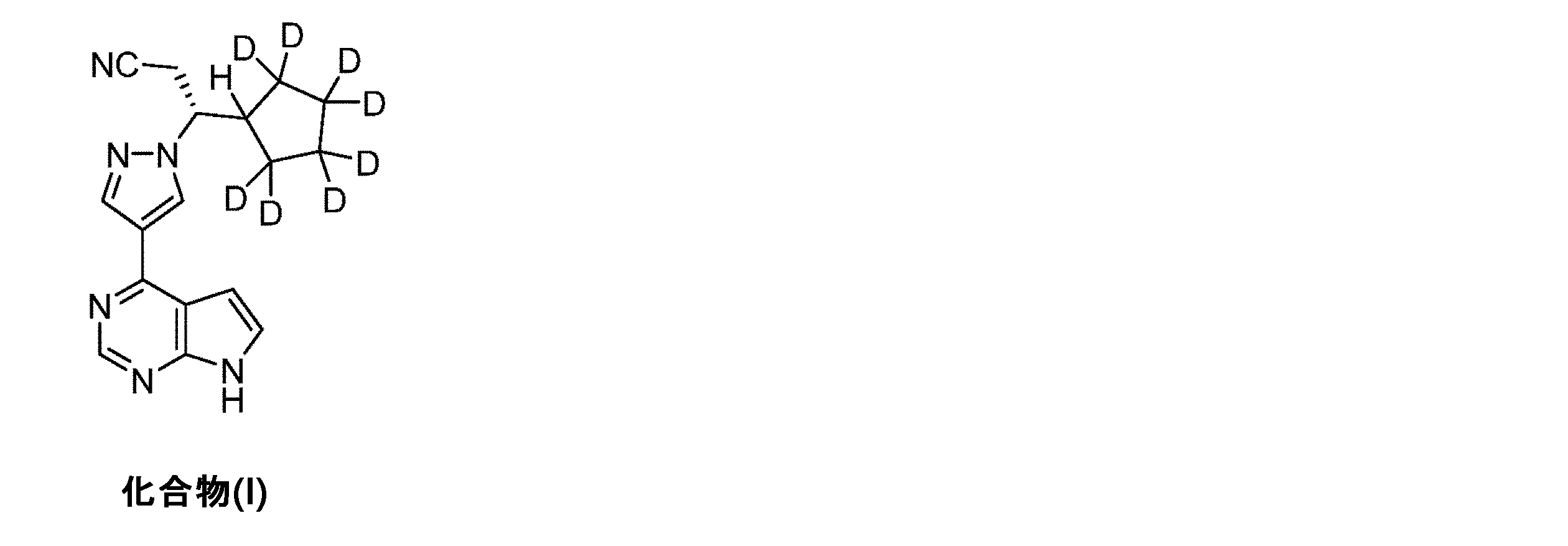
で表される化合物またはその薬学的に許容される塩を投与することを含む方法。
[2]前記脱毛障害は円形脱毛症である、[1]に記載の方法。
[3]前記対象に、約5mg/日、約10mg/日、約20mg/日、約30mg/日、約40mg/日または約50mg/日の化合物(I)またはその薬学的に許容される塩を投与することを含む[1]または[2]に記載の方法。
[4]前記対象に、約8mg/日、約12mg/日、約16mg/日または約24mg/日の化合物(I)またはその薬学的に許容される塩を投与することを含む[1]~[3]のいずれか一項に記載の方法。
[5]前記化合物を経口投与する、[1]~[4]のいずれか一項に記載の方法。
[6]前記化合物を錠剤である医薬製剤で投与する、[1]~[5]のいずれか一項に記載の方法。
[7]前記化合物を1日当たり1回投与する、[1]~[6]のいずれか一項に記載の方法。
[8]前記化合物を1日当たり2回投与する、[1]~[6]のいずれか一項に記載の方法。
[9]化合物(I)において、重水素に指定されていないあらゆる原子は、この原子の天然の同位体存在度で存在する、[1]~[8]のいずれか一項に記載の方法。
[10]薬学的に許容される担体または希釈剤と、4~50mgの、下記構造式:

で表される化合物またはその薬学的に許容される塩を含む医薬組成物。
[11]約5mg、約10mg、約20mg、約30mg、約40mgまたは約50mgの化合物(I)またはその薬学的に許容される塩を含む[10]に記載の医薬組成物。
[12]前記医薬組成物は経口投与に適している、[10]または[11]に記載の医薬組成物。
[13]前記組成物は錠剤である、[10]または[11]に記載の医薬組成物。
[14]前記組成物を1日当たり1回投与する、[10]~[13]のいずれか一項に記載の医薬組成物。
[15]前記組成物は、
(i)約5.2重量%の化合物(I)リン酸塩、
(ii)約90.8重量%の微結晶セルロース、
(iii)約2.5重量%のポビドン、
(iv)約0.5重量%のコロイド状二酸化ケイ素、および
(v)約1.0重量%のステアリン酸マグネシウム
を含む錠剤である、[10]に記載の医薬組成物。
[16]前記組成物は、約10.5mgの化合物(I)リン酸塩を含む200mg錠剤である、[15]に記載の医薬組成物。
[17]前記組成物は、
(i)約5.3重量%の化合物(I)リン酸塩、
(ii)約88.2重量%の微結晶セルロース、
(iii)約5.0重量%のポビドン、
(iv)約0.5重量%のコロイド状二酸化ケイ素、および
(v)約1.0重量%のステアリン酸マグネシウム
を含む錠剤である、[10]に記載の医薬組成物。
[18]前記組成物は、約10.6mgの化合物(I)リン酸塩を含む200mg錠剤である、[17]に記載の医薬組成物。
[19]前記組成物は、
(i)約10.6重量%の化合物(I)リン酸塩、
(ii)約82.9重量%の微結晶セルロース、
(iii)約5.0重量%のポビドン、
(iv)約0.5重量%のコロイド状二酸化ケイ素、および
(v)約1.0重量%のステアリン酸マグネシウム
を含む錠剤である、[10]に記載の医薬組成物。
[20]前記組成物は、約21.1mgの化合物(I)リン酸塩を含む200mg錠剤である、[19]に記載の医薬組成物。
[21]哺乳動物対象の脱毛障害を処置する方法であって、前記対象に、約4mgの、下記構造式:
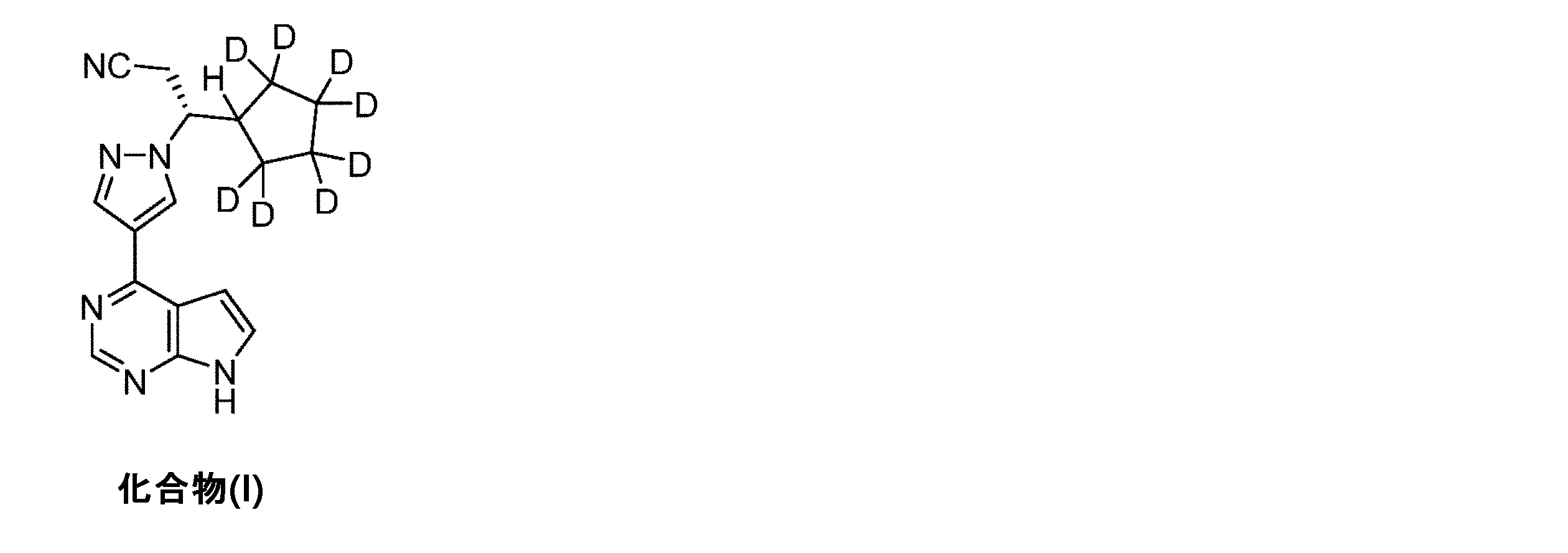
で表される化合物またはその薬学的に許容される塩を1日当たり2回投与することを含む方法。
[22]化合物(I)を約5.3mgのリン酸塩として1日当たり2回投与する、[21]に記載の方法。
[23]哺乳動物対象の脱毛障害を処置する方法であって、前記対象に、約8mgの、下記構造式:
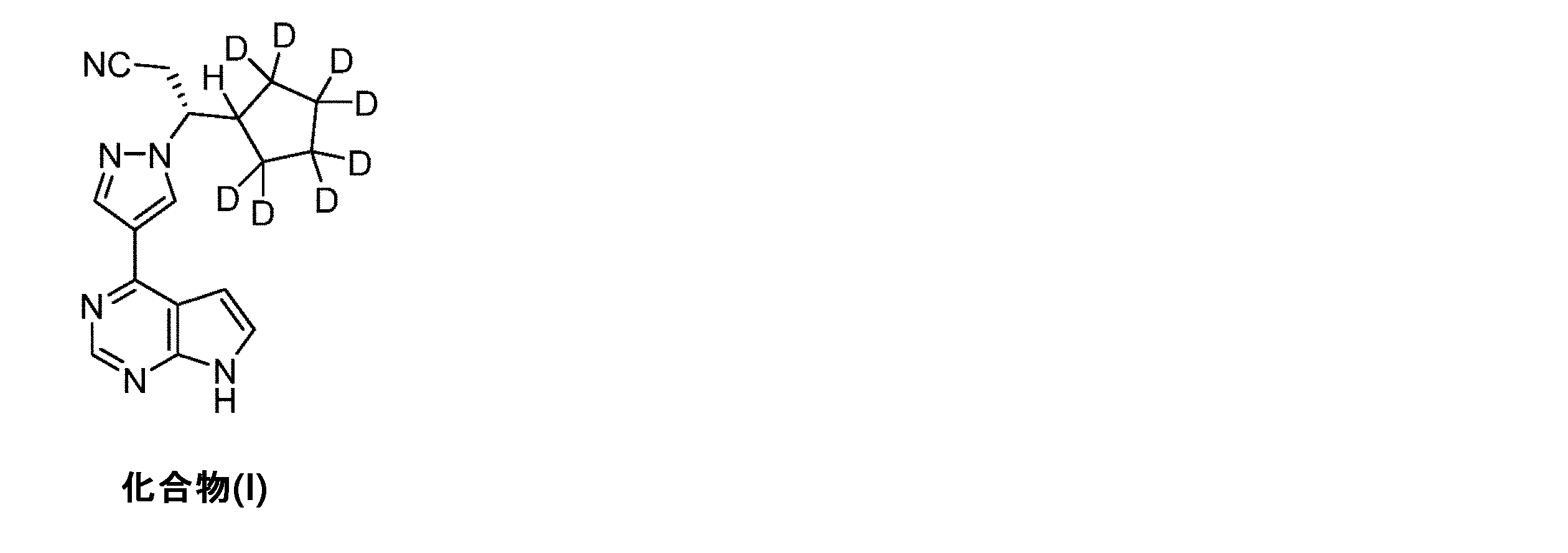
で表される化合物またはその薬学的に許容される塩を1日当たり2回投与することを含む方法。
[24]化合物(I)を約10.5mgのリン酸塩として1日当たり2回投与する[23]に記載の方法。
[25]哺乳動物対象の脱毛障害を処置する方法であって、前記対象に、約12mgの、下記構造式:

で表される化合物またはその薬学的に許容される塩を1日当たり2回投与することを含む方法。
[26]化合物(I)を約15.8mgのリン酸塩として1日当たり2回投与する、[25]に記載の方法。
[27]哺乳動物対象の脱毛障害を処置する方法であって、前記対象に、約16mgの、下記構造式:

で表される化合物またはその薬学的に許容される塩を1日当たり2回投与することを含む方法。
[28]化合物(I)を約21.1mgのリン酸塩として1日当たり2回投与する、[27]に記載の方法。
[29]前記脱毛障害は円形脱毛症である、[21]~[28]のいずれか一項に記載の方法。
[30]前記化合物を経口投与する、[21]~[29]のいずれか一項に記載の方法。
[31]前記化合物を錠剤である医薬製剤で投与する、[21]~[30]のいずれか一項に記載の方法。
That is, the gist of the present invention is as follows.
[1] A method for treating hair loss disorders in a mammalian subject, comprising administering to the subject an amount ranging from 4 mg to 50 mg per day of a compound having the following structural formula:
or a pharma- ceutically acceptable salt thereof.
[2] The method according to [1], wherein the hair loss disorder is alopecia areata.
[3] The method according to [1] or [2], comprising administering to the subject about 5 mg/day, about 10 mg/day, about 20 mg/day, about 30 mg/day, about 40 mg/day or about 50 mg/day of Compound (I) or a pharma- ceutically acceptable salt thereof.
[4] The method according to any one of [1] to [3], comprising administering to the subject about 8 mg/day, about 12 mg/day, about 16 mg/day, or about 24 mg/day of compound (I) or a pharma- ceutically acceptable salt thereof.
[5] The method according to any one of [1] to [4], wherein the compound is administered orally.
[6] The method according to any one of [1] to [5], wherein the compound is administered in a pharmaceutical formulation that is a tablet.
[7] The method according to any one of [1] to [6], wherein the compound is administered once per day.
[8] The method according to any one of [1] to [6], wherein the compound is administered twice per day.
[9] The method according to any one of [1] to [8], wherein in compound (I), any atom not designated as deuterium is present at the natural isotopic abundance of that atom.
[10] A pharmaceutical composition comprising a pharma- ceutically acceptable carrier or diluent and 4 to 50 mg of a compound of the following structural formula:
or a pharma- ceutically acceptable salt thereof.
[11] The pharmaceutical composition according to [10], comprising about 5 mg, about 10 mg, about 20 mg, about 30 mg, about 40 mg or about 50 mg of compound (I) or a pharma- ceutically acceptable salt thereof.
[12] The pharmaceutical composition according to [10] or [11], wherein the pharmaceutical composition is suitable for oral administration.
[13] The pharmaceutical composition according to [10] or [11], wherein the composition is a tablet.
[14] The pharmaceutical composition according to any one of [10] to [13], wherein the composition is administered once per day.
[15] The composition comprises:
(i) about 5.2% by weight of Compound (I) phosphate;
(ii) about 90.8% by weight of microcrystalline cellulose;
(iii) about 2.5% by weight of povidone;
(iv) about 0.5% by weight of colloidal silicon dioxide; and (v) about 1.0% by weight of magnesium stearate.
[16] The pharmaceutical composition of [15], wherein the composition is a 200 mg tablet containing about 10.5 mg of Compound (I) phosphate.
[17] The composition comprises:
(i) about 5.3% by weight of Compound (I) phosphate;
(ii) about 88.2% by weight of microcrystalline cellulose;
(iii) about 5.0% by weight of povidone;
(iv) about 0.5% by weight of colloidal silicon dioxide; and (v) about 1.0% by weight of magnesium stearate.
[18] The pharmaceutical composition of [17], wherein the composition is a 200 mg tablet containing about 10.6 mg of Compound (I) phosphate.
[19] The composition comprises:
(i) about 10.6% by weight of Compound (I) phosphate;
(ii) about 82.9% by weight of microcrystalline cellulose;
(iii) about 5.0% by weight of povidone;
(iv) about 0.5% by weight of colloidal silicon dioxide; and (v) about 1.0% by weight of magnesium stearate.
[20] The pharmaceutical composition of [19], wherein the composition is a 200 mg tablet containing about 21.1 mg of Compound (I) phosphate.
[21] A method for treating a hair loss disorder in a mammalian subject, comprising administering to the subject about 4 mg of a compound having the following structural formula:
or a pharma- ceutically acceptable salt thereof twice daily.
[22] The method according to [21], wherein compound (I) is administered twice a day in the form of about 5.3 mg of phosphate.
[23] A method for treating a hair loss disorder in a mammalian subject, comprising administering to the subject about 8 mg of a compound having the following structural formula:
or a pharma- ceutically acceptable salt thereof twice daily.
[24] The method according to [23], wherein compound (I) is administered twice a day in the form of about 10.5 mg of phosphate.
[25] A method for treating hair loss disorder in a mammalian subject, comprising administering to the subject about 12 mg of a compound having the following structural formula:
or a pharma- ceutically acceptable salt thereof twice daily.
[26] The method according to [25], wherein compound (I) is administered twice a day in the form of about 15.8 mg of phosphate.
[27] A method of treating a hair loss disorder in a mammalian subject, comprising administering to the subject about 16 mg of a compound having the following structural formula:
or a pharma- ceutically acceptable salt thereof twice daily.
[28] The method according to [27], wherein compound (I) is administered twice a day in the form of about 21.1 mg of phosphate.
[29] The method according to any one of [21] to [28], wherein the hair loss disorder is alopecia areata.
[30] The method according to any one of [21] to [29], wherein the compound is administered orally.
[31] The method according to any one of [21] to [30], wherein the compound is administered in a pharmaceutical formulation that is a tablet.
本発明により、重水素化JAK阻害剤による脱毛障害の処置が提供され得る。 The present invention can provide treatment for hair loss disorders with deuterated JAK inhibitors.
定義
用語「処置する」は、疾患(例えば、本明細書で詳述されている疾患または障害)の発症または進行を低減すること、抑制すること、減弱させること、減少させること、停止させることもしくは安定化させること、この疾患の重症度を低下させること、またはこの疾患と関連する症状を改善することを意味する。例えば、脱毛障害の処置として、毛の再成長、さらなる脱毛の予防、または脱毛速度の低下が挙げられる。
Definitions The term "treat" refers to reducing, inhibiting, attenuating, reducing, stopping or stabilizing the onset or progression of a disease (e.g., a disease or disorder detailed herein), reducing the severity of the disease, or improving the symptoms associated with the disease.For example, treating hair loss disorders includes hair regrowth, preventing further hair loss, or reducing the rate of hair loss.
「脱毛障害」は、身体の1つまたは複数の領域での毛の喪失を結果として引き起こすあらゆる状態または障害を意味する。脱毛障害として、男性型脱毛症、円形脱毛症、休止期脱毛症、円形脱毛症、完全脱毛症および全身性脱毛症が挙げられるがこれらに限定されない。 "Hair loss disorder" means any condition or disorder that results in the loss of hair in one or more areas of the body. Hair loss disorders include, but are not limited to, androgenetic alopecia, alopecia areata, telogen effluvium, alopecia areata, alopecia totalis, and alopecia universalis.
用語「哺乳動物」は、本明細書で使用される場合、ヒトならびに非ヒト哺乳動物(例えばネコ、イヌ、ヒツジ、ウシ、ブタ、ヤギ、非ヒト霊長類(例えばサルおよび類人猿)ならびに同類のもの)を含む。 The term "mammal" as used herein includes humans and non-human mammals, such as cats, dogs, sheep, cows, pigs, goats, non-human primates (e.g., monkeys and apes), and the like.
合成で使用される化学物質の起源に応じて、合成された化合物では天然の同位体存在度のいくらかの変動が起こることが認識されるだろう。そのため、ルキソリチニブの調製物は、少量の重水素化アイソトポログ(isotopologue)を本質的には含むだろう。自然界で豊富な安定した水素および炭素の同位体の濃度は、この変動にもかかわらず、本発明の化合物の安定した同位体置換の程度と比較して低く且つ重要ではない。例えばWada,E et al.,Seikagaku,1994,66:15;Gannes,LZ et al.,Comp Biochem Physiol Mol Integr Physiol,1998,119:725を参照されたい。 It will be appreciated that some variation in natural isotopic abundance occurs in the synthesized compounds depending on the origin of the chemicals used in the synthesis. Thus, preparations of ruxolitinib will inherently contain small amounts of deuterated isotopologues. Despite this variation, the concentrations of naturally abundant stable hydrogen and carbon isotopes are low and insignificant compared to the degree of stable isotopic substitution of the compounds of the present invention. See, e.g., Wada, E et al., Seikagaku, 1994, 66:15; Gannes, LZ et al., Comp Biochem Physiol Mol Integr Physiol, 1998, 119:725.
化合物(I)において、特定の同位体に具体的に指定されていないあらゆる原子は、その原子の任意の安定した同位体を表すように意図されている。別途述べない限り、ある位置が「H」または「水素」と具体的に指定されている場合、この位置は水素の天然存在度の同位体組成として水素を有すると理解される。同様に、別途述べない限り、ある位置が「D」または「重水素」と具体的に指定されている場合、この位置は、0.015%である重水素の天然存在度と比べて少なくとも3000倍大きい存在度で重水素を有すると理解される(即ち、重水素の少なくとも45%の組込み)。 In compound (I), any atom not specifically designated to a particular isotope is intended to represent any stable isotope of that atom. Unless otherwise stated, when a position is specifically designated as "H" or "hydrogen," the position is understood to have hydrogen as the isotopic composition of hydrogen's natural abundance. Similarly, unless otherwise stated, when a position is specifically designated as "D" or "deuterium," the position is understood to have deuterium at an abundance at least 3000 times greater than the natural abundance of deuterium, which is 0.015% (i.e., at least 45% incorporation of deuterium).
用語「同位体富化係数(isotopic enrichment factor)」は、本明細書で使用される場合、同位体の存在度と特定の同位体の天然存在度との間の比を意味する。 The term "isotopic enrichment factor" as used herein means the ratio between the abundance of an isotope and the natural abundance of a particular isotope.
他の実施形態では、本発明の化合物は、指定された各重水素原子に関する下記の同位体富化係数を有する:少なくとも3500(指定された各重水素原子で52.5%の重水素の組込み)、少なくとも4000(60%の重水素の組込み)、少なくとも4500(67.5%の重水素の組込み)、少なくとも5000(75%の重水素)、少なくとも5500(82.5%の重水素の組込み)、少なくとも6000(90%の重水素の組込み)、少なくとも6333.3(95%の重水素の組込み)、少なくとも6466.7(97%の重水素の組込み)、少なくとも6600(99%の重水素の組込み)または少なくとも6633.3(99.5%の重水素の組込み)。 In other embodiments, the compounds of the invention have the following isotopic enrichment factors for each designated deuterium atom: at least 3500 (52.5% deuterium incorporation at each designated deuterium atom), at least 4000 (60% deuterium incorporation), at least 4500 (67.5% deuterium incorporation), at least 5000 (75% deuterium), at least 5500 (82.5% deuterium incorporation), at least 6000 (90% deuterium incorporation), at least 6333.3 (95% deuterium incorporation), at least 6466.7 (97% deuterium incorporation), at least 6600 (99% deuterium incorporation), or at least 6633.3 (99.5% deuterium incorporation).
用語「アイソトポログ」は、同位体組成においてのみ化合物(I)と化学構造が異なる種を指す。 The term "isotopologue" refers to a species that differs in chemical structure from compound (I) only in isotopic composition.
用語「化合物」は、本発明に化合物に言及する場合、同一の化学構造を有する分子の集合体を指すが、但し、これらの分子の構成原子の間では同位体に変動が存在し得る。そのため、示した重水素原子を含む特定の化学構造により表される化合物は、この構造中の指定の重水素位置のうちの1箇所または複数箇所で水素原子を有する、より少量のアイソトポログも含むことが当業者には明らかであるだろう。本発明の化合物でのそのようなアイソトポログの相対量は、多くの因子(例えば、この化合物を製造するために使用される重水素化試薬の同位体純度、およびこの化合物を調製するために使用される様々な合成工程での重水素の組込み効率)に依存するだろう。 The term "compound," when referring to compounds of the present invention, refers to a collection of molecules having identical chemical structure, except that there may be isotopic variation among the constituent atoms of those molecules. Thus, it will be apparent to one of skill in the art that a compound represented by a particular chemical structure containing a deuterium atom as shown also includes lesser amount isotopologues having hydrogen atoms at one or more of the designated deuterium positions in the structure. The relative amounts of such isotopologues in a compound of the present invention will depend on many factors, such as the isotopic purity of the deuteration reagent used to make the compound and the efficiency of deuterium incorporation in the various synthetic steps used to prepare the compound.
本発明はまた、化合物(I)の塩も提供する。本発明の化合物の塩は、酸性基とこの化合物の塩基性基(例えばアミノ官能基)との間で形成される、または塩基性基とこの化合物の酸性基(例えばカルボキシル官能基基)との間で形成される。別の実施形態によれば、この化合物は、薬学的に許容される酸付加塩(例えばリン酸塩)である。 The present invention also provides salts of compound (I). A salt of a compound of the present invention is formed between an acidic group and a basic group of the compound (e.g., an amino functional group) or between a basic group and an acidic group of the compound (e.g., a carboxyl functional group). According to another embodiment, the compound is a pharma- ceutically acceptable acid addition salt (e.g., a phosphate salt).
用語「薬学的に許容される」は、本明細書で使用される場合、妥当な医学的判断の範囲内で、過度の毒性、刺激、アレルギー反応および同類のものを伴うことなくヒトおよび他の哺乳動物の組織との接触した使用に適しており且つ適正なベネフィット/リスク比に見合っている構成成分を指す。「薬学的に許容される塩」は、レシピエントへの投与時に本発明の化合物を直接的にまたは間接的に提供し得るあらゆる非毒性塩を意味する。「薬学的に許容される対イオン」とは、レシピエントへの投与時に、ある塩から放出された場合に非毒性である、この塩のイオン部分のことである。 The term "pharmacologically acceptable" as used herein refers to components that, within the scope of sound medical judgment, are suitable for use in contact with the tissues of humans and other mammals without undue toxicity, irritation, allergic response, and the like, and are commensurate with a reasonable benefit/risk ratio. "Pharmaceutically acceptable salt" means any non-toxic salt that, upon administration to a recipient, is capable of providing, directly or indirectly, a compound of the invention. "Pharmaceutically acceptable counterion" means an ionic portion of a salt that, when released from the salt, is non-toxic upon administration to a recipient.
薬学的に許容される塩を形成するために一般に利用される酸として下記が挙げられる:無機酸、例えば二硫化水素、塩酸、臭化水素酸、ヨウ化水素酸、硫酸およびリン酸、ならびに有機酸、例えばパラ-トルエンスルホン酸、サリチル酸、酒石酸、重酒石酸、アスコルビン酸、マレイン酸、ベシル酸、フマル酸、グルコン酸、グルクロン酸、ギ酸、グルタミン酸、メタンスルホン酸、エタンスルホン酸、ベンゼンスルホン酸、乳酸、シュウ酸、パラ-ブロモフェニルスルホン酸、炭酸、コハク酸、クエン酸、安息香酸および酢酸、ならびに関連する無機酸および有機酸。そのため、そのような薬学的に許容される塩として下記が挙げられる:硫酸塩、ピロ硫酸塩、重硫酸塩、亜硫酸塩、重亜硫酸塩、リン酸塩、リン酸一水素塩、リン酸二水素塩、メタリン酸塩、ピロリン酸塩、塩化物、臭化物、ヨウ化物、酢酸塩、プロピオン酸塩、デカン酸塩、カプリル酸塩、アクリル酸塩、ギ酸塩、イソ酪酸塩、カプリン酸塩、ヘプタン酸塩、プロピオール塩、シュウ酸塩、マロン酸塩、コハク酸塩、スベリン酸塩、セバシン酸塩、フマル酸塩、マレイン酸塩、ブチレン-1,4-ジオエート、ヘキサン-1,6-ジオエート、安息香酸塩、クロロ安息香酸塩、メチル安息香酸塩、ジニトロ安息香酸塩、ヒドロキシ安息香酸塩、メトキシ安息香酸塩、フタル酸塩、テレフタル酸塩、スルホン酸塩、キシレンスルホン酸塩、フェニル酢酸塩、フェニルプロピオン酸塩、フェニル酪酸塩、クエン酸塩、乳酸塩、β-ヒドロキシ酪酸塩、グリコール酸塩、マレイン酸塩、酒石酸塩、メタンスルホン酸塩、プロパンスルホン酸塩、ナフタレン-1-スルホネート、ナフタレン-2-スルホネート、マンデル酸塩および他の塩。一実施形態では、薬学的に許容される酸付加塩として、鉱酸(例えば塩酸および臭化水素酸)と形成されたもの、ならびに特に有機酸(例えばマレイン酸)と形成されたものが挙げられる。 Acids commonly utilized to form pharma- ceutically acceptable salts include inorganic acids such as hydrogen disulfide, hydrochloric acid, hydrobromic acid, hydroiodic acid, sulfuric acid, and phosphoric acid, and organic acids such as para-toluenesulfonic acid, salicylic acid, tartaric acid, bitartaric acid, ascorbic acid, maleic acid, besylic acid, fumaric acid, gluconic acid, glucuronic acid, formic acid, glutamic acid, methanesulfonic acid, ethanesulfonic acid, benzenesulfonic acid, lactic acid, oxalic acid, para-bromophenylsulfonic acid, carbonic acid, succinic acid, citric acid, benzoic acid, and acetic acid, and related inorganic and organic acids. Such pharma- ceutically acceptable salts include, for example, sulfate, pyrosulfate, bisulfate, sulfite, bisulfite, phosphate, monohydrogen phosphate, dihydrogen phosphate, metaphosphate, pyrophosphate, chloride, bromide, iodide, acetate, propionate, decanoate, caprylate, acrylate, formate, isobutyrate, caprate, heptanoate, propionate, oxalate, malonate, succinate, suberate, sebacate, fumarate, maleate, butylene-1,4-dioate, hexaphosphate ... San-1,6-dioate, benzoate, chlorobenzoate, methylbenzoate, dinitrobenzoate, hydroxybenzoate, methoxybenzoate, phthalate, terephthalate, sulfonate, xylenesulfonate, phenylacetate, phenylpropionate, phenylbutyrate, citrate, lactate, β-hydroxybutyrate, glycolate, maleate, tartrate, methanesulfonate, propanesulfonate, naphthalene-1-sulfonate, naphthalene-2-sulfonate, mandelate and other salts. In one embodiment, pharma- ceutically acceptable acid addition salts include those formed with mineral acids, such as hydrochloric acid and hydrobromic acid, and especially those formed with organic acids, such as maleic acid.
用語「安定した化合物」は、本明細書で使用される場合、この化合物の製造を可能にするのに十分な安定性を有し、且つ本明細書で詳述されている目的(例えば、治療用製品、治療用化合物の製造で使用される中間体、単離可能なまたは保管可能な中間体化合物への配合、治療薬に反応する疾患または状態の処置)に有用であるために十分な期間にわたりこの化合物の完全性を維持する化合物を指す。 The term "stable compound," as used herein, refers to a compound that has sufficient stability to permit manufacture of the compound and maintains the integrity of the compound for a period of time sufficient to be useful for the purposes detailed herein (e.g., as a therapeutic product, an intermediate used in the manufacture of a therapeutic compound, formulation into an isolatable or storable intermediate compound, treatment of a disease or condition responsive to a therapeutic agent).
「D」および「d」は両方とも重水素を指す。「立体異性体」は鏡像異性体およびジアステレオマーの両方を指す。「Ter」および「t-」はそれぞれ第三級を指す。「US」はアメリカ合衆国を指す。 "D" and "d" both refer to deuterium. "Stereoisomer" refers to both enantiomers and diastereomers. "Ter" and "t-" each refer to tertiary. "US" refers to the United States of America.
「重水素に置換された」は、1つまたは複数の水素原子の、対応する数の重水素原子による置き換えを指す。 "Deuterium substituted" refers to the replacement of one or more hydrogen atoms with a corresponding number of deuterium atoms.
一態様では、本発明は、JAK(JAK1、JAK2および/またはJAK3)の活性を調節する(例えば阻害する)化合物により処置され得る脱毛障害を処置する方法を提供する。この方法は、哺乳動物対象に、有効な量の化合物(I)またはその薬学的に許容される塩(即ち、等価な量の薬学的に許容される塩(例えばリン酸塩))を1日当たり1回または2回投与することを含み、式(I)またはその薬学的に許容される塩の量は約4mg/日~約50mg/日(例えば4mg/日~50mg/日)の範囲であり、例えば約5mg/日(例えば5mg/日)、約10mg/日(例えば10mg/日)、約20mg/日(例えば20mg/日)、約30mg/日(例えば30mg/日)、約40mg/日(例えば40mg/日)または約50mg/日(例えば50mg/日)である。 In one aspect, the present invention provides a method of treating hair loss disorders that can be treated with a compound that modulates (e.g., inhibits) the activity of JAK (JAK1, JAK2, and/or JAK3). The method comprises administering to a mammalian subject an effective amount of compound (I) or a pharma- ceutically acceptable salt thereof (i.e., an equivalent amount of a pharma- ceutically acceptable salt (e.g., a phosphate salt)) once or twice per day, wherein the amount of formula (I) or a pharma- ceutically acceptable salt thereof ranges from about 4 mg/day to about 50 mg/day (e.g., 4 mg/day to 50 mg/day), e.g., about 5 mg/day (e.g., 5 mg/day), about 10 mg/day (e.g., 10 mg/day), about 20 mg/day (e.g., 20 mg/day), about 30 mg/day (e.g., 30 mg/day), about 40 mg/day (e.g., 40 mg/day), or about 50 mg/day (e.g., 50 mg/day).
ある特定の実施形態では、脱毛障害を処置する方法で投与する化合物(I)またはその薬学的に許容される塩の量(即ち、等価な量の薬学的に許容される塩(例えばリン酸塩)は、約4mg/日(例えば4mg/日)、約8mg/日(例えば8mg/日)、約16mg/日(例えば16mg/日)、約32mg/日(例えば32mg/日)または約48mg/日(例えば48mg/日)である。 In certain embodiments, the amount of Compound (I) or a pharma- ceutically acceptable salt thereof (i.e., an equivalent amount of a pharma- ceutically acceptable salt (e.g., a phosphate salt) administered in a method of treating a hair loss disorder is about 4 mg/day (e.g., 4 mg/day), about 8 mg/day (e.g., 8 mg/day), about 16 mg/day (e.g., 16 mg/day), about 32 mg/day (e.g., 32 mg/day), or about 48 mg/day (e.g., 48 mg/day).
ある特定の実施形態では、脱毛障害を処置する方法で投与する化合物(I)またはその薬学的に許容される塩の量は、約8mg/日(例えば8mg/日)、約16mg/日(例えば16mg/日)、約24mg/日(例えば24mg/日)または約32mg/日(例えば32mg/日)である。ある特定の実施形態では、化合物(I)またはその薬学的に許容される塩の量は、約8mg/日(例えば8mg/日)、約12mg/日(例えば12mg/日)、約16mg/日(例えば16mg/日)または約24mg/日(例えば24mg/日)である。 In certain embodiments, the amount of Compound (I) or a pharma- ceutically acceptable salt thereof administered in the method of treating a hair loss disorder is about 8 mg/day (e.g., 8 mg/day), about 16 mg/day (e.g., 16 mg/day), about 24 mg/day (e.g., 24 mg/day), or about 32 mg/day (e.g., 32 mg/day). In certain embodiments, the amount of Compound (I) or a pharma- ceutically acceptable salt thereof is about 8 mg/day (e.g., 8 mg/day), about 12 mg/day (e.g., 12 mg/day), about 16 mg/day (e.g., 16 mg/day), or about 24 mg/day (e.g., 24 mg/day).
ある特定の実施形態では、脱毛障害を処置する方法で投与する化合物(I)またはその薬学的に許容される塩の量は、10.6mg/日の化合物(I)リン酸塩(例えば、1日当たり5.3mgの用量を2回として投与する)である。ある特定の実施形態では、化合物(I)またはその薬学的に許容される塩の量は、21.1mg/日の化合物(I)リン酸塩(例えば、1日当たり10.5mgの用量を2回として投与する)である。ある特定の実施形態では、化合物(I)またはその薬学的に許容される塩の量は、31.6mg/日の化合物(I)リン酸塩(例えば、1日当たり15.8mgの用量を2回として投与する)である。ある特定の実施形態では、化合物(I)またはその薬学的に許容される塩の量は、42.2mg/日の化合物(I)リン酸塩(例えば、1日当たり21.1mgの用量を2回として投与する)である。 In certain embodiments, the amount of compound (I) or a pharma- ceutically acceptable salt thereof administered in the method of treating hair loss disorders is 10.6 mg/day of compound (I) phosphate (e.g., administered as two doses of 5.3 mg per day). In certain embodiments, the amount of compound (I) or a pharma- ceutically acceptable salt thereof is 21.1 mg/day of compound (I) phosphate (e.g., administered as two doses of 10.5 mg per day). In certain embodiments, the amount of compound (I) or a pharma- ceutically acceptable salt thereof is 31.6 mg/day of compound (I) phosphate (e.g., administered as two doses of 15.8 mg per day). In certain embodiments, the amount of compound (I) or a pharma- ceutically acceptable salt thereof is 42.2 mg/day of compound (I) phosphate (e.g., administered as two doses of 21.1 mg per day).
ある特定の実施形態では、脱毛障害を処置する方法で投与する化合物(I)またはその薬学的に許容される塩の量は、1日当たり約4mg(例えば4mg)を2回である。具体的な実施形態では、化合物(I)を、1日当たり約5.3mg(例えば5.3mg)の化合物(I)リン酸塩を2回として投与する。ある特定の実施形態では、脱毛障害を処置する方法で投与する化合物(I)またはその薬学的に許容される塩は、1日当たり約8mg(例えば8mg)を2回である。具体的な実施形態では、化合物(I)を、1日当たり約10.5mg(例えば10.5mg)の化合物(I)リン酸塩を2回として投与する。 In certain embodiments, the amount of Compound (I) or a pharma- ceutically acceptable salt thereof administered in the method of treating a hair loss disorder is about 4 mg (e.g., 4 mg) twice per day. In a specific embodiment, Compound (I) is administered as about 5.3 mg (e.g., 5.3 mg) of Compound (I) phosphate twice per day. In certain embodiments, Compound (I) or a pharma- ceutically acceptable salt thereof administered in the method of treating a hair loss disorder is about 8 mg (e.g., 8 mg) twice per day. In a specific embodiment, Compound (I) is administered as about 10.5 mg (e.g., 10.5 mg) of Compound (I) phosphate twice per day.
ある特定の実施形態では、脱毛障害を処置する方法で投与する化合物(I)またはその薬学的に許容される塩の量は、1日当たり約12mg(例えば12mg)を2回である。具体的な実施形態では、化合物(I)を、1日当たり約15.8mg(例えば15.8mg)の化合物(I)リン酸塩を2回として投与する。ある特定の実施形態では、脱毛障害を処置する方法で投与する化合物(I)またはその薬学的に許容される塩の量は、1日当たり約16mg(例えば16mg)を2回である。具体的な実施形態では、化合物(I)を、1日当たり約21.1mg(例えば21.1mg)の化合物(I)リン酸塩を2回として投与する。ある特定の実施形態では、この脱毛障害は円形脱毛症である。ある特定の実施形態では、この対象はヒトである。一実施形態では、この対象は6歳以上のヒトである。好ましくは、化合物(I)またはその薬学的に許容される塩(例えばリン酸塩)を、本明細書で説明されている投与量のいずれかで経口投与する。好ましくは、化合物(I)またはその薬学的に許容される塩を、錠剤である医薬製剤で、本明細書で説明されている投与量のいずれかにて経口投与する。 In certain embodiments, the amount of compound (I) or a pharma- ceutically acceptable salt thereof administered in the method for treating hair loss disorders is about 12 mg (e.g., 12 mg) twice per day. In a specific embodiment, compound (I) is administered as about 15.8 mg (e.g., 15.8 mg) of compound (I) phosphate twice per day. In certain embodiments, the amount of compound (I) or a pharma- ceutically acceptable salt thereof administered in the method for treating hair loss disorders is about 16 mg (e.g., 16 mg) twice per day. In a specific embodiment, compound (I) is administered as about 21.1 mg (e.g., 21.1 mg) of compound (I) phosphate twice per day. In certain embodiments, the hair loss disorder is alopecia areata. In certain embodiments, the subject is a human. In one embodiment, the subject is a human aged 6 years or older. Preferably, compound (I) or a pharma- ceutically acceptable salt thereof (e.g., a phosphate salt) is administered orally in any of the dosages described herein. Preferably, compound (I) or a pharma- ceutically acceptable salt thereof is orally administered in a pharmaceutical formulation that is a tablet, at any of the dosages described herein.
別の態様では、本発明は、対象の毛の成長を誘導する方法を提供する。この方法は、哺乳動物対象に、有効な量の化合物(I)またはその薬学的に許容される塩(即ち、等価な量の薬学的に許容される塩(例えばリン酸塩))を1日当たり1回または2回投与することを含み、化合物(I)またはその薬学的に許容される塩の量は約4mg/日~約50mg/日(例えば4mg/日~50mg/日)の範囲であり、例えば約5mg/日(例えば5mg/日)、約10mg/日(例えば10mg/日)、約20mg/日(例えば20mg/日)、約30mg/日(例えば30mg/日)、約40mg/日(例えば40mg/日)または約50mg/日(例えば50mg/日)である。 In another aspect, the present invention provides a method of inducing hair growth in a subject. The method comprises administering to a mammalian subject an effective amount of Compound (I) or a pharma- ceutically acceptable salt thereof (i.e., an equivalent amount of a pharma- ceutically acceptable salt, e.g., a phosphate salt), once or twice per day, wherein the amount of Compound (I) or a pharma- ceutically acceptable salt thereof ranges from about 4 mg/day to about 50 mg/day (e.g., 4 mg/day to 50 mg/day), e.g., about 5 mg/day (e.g., 5 mg/day), about 10 mg/day (e.g., 10 mg/day), about 20 mg/day (e.g., 20 mg/day), about 30 mg/day (e.g., 30 mg/day), about 40 mg/day (e.g., 40 mg/day), or about 50 mg/day (e.g., 50 mg/day).
ある特定の実施形態では、毛の成長を誘導する方法で投与する化合物(I)またはその薬学的に許容される塩の量は、約4mg/日(例えば4mg/日)、約8mg/日(例えば8mg/日)、約16mg/日(例えば16mg/日)、約32mg/日(例えば32mg/日)または約48mg/日(例えば48mg/日)である。 In certain embodiments, the amount of Compound (I) or a pharma- ceutically acceptable salt thereof administered in a method for inducing hair growth is about 4 mg/day (e.g., 4 mg/day), about 8 mg/day (e.g., 8 mg/day), about 16 mg/day (e.g., 16 mg/day), about 32 mg/day (e.g., 32 mg/day), or about 48 mg/day (e.g., 48 mg/day).
ある特定の実施形態では、毛の成長を誘導する方法で投与する化合物(I)またはその薬学的に許容される塩の量は、約8mg/日(例えば8mg/日)、約16mg/日(例えば16mg/日)、約24mg/日(例えば24mg/日)または約32mg/日(例えば32mg/日)である。ある特定の実施形態では、毛の成長を誘導する方法で投与する化合物(I)またはその薬学的に許容される塩の量は、約8mg/日(例えば8mg/日)、約12mg/日(例えば12mg/日)、約16mg/日(例えば16mg/日)または約24mg/日(例えば24mg/日)である。 In certain embodiments, the amount of compound (I) or a pharma- ceutically acceptable salt thereof administered in a method for inducing hair growth is about 8 mg/day (e.g., 8 mg/day), about 16 mg/day (e.g., 16 mg/day), about 24 mg/day (e.g., 24 mg/day), or about 32 mg/day (e.g., 32 mg/day). In certain embodiments, the amount of compound (I) or a pharma- ceutically acceptable salt thereof administered in a method for inducing hair growth is about 8 mg/day (e.g., 8 mg/day), about 12 mg/day (e.g., 12 mg/day), about 16 mg/day (e.g., 16 mg/day), or about 24 mg/day (e.g., 24 mg/day).
ある特定の実施形態では、毛の成長を誘導する方法で投与する化合物(I)またはその薬学的に許容される塩の量は、10.6mg/日の化合物(I)リン酸塩(例えば、1日当たり5.3mgの用量を2回として投与する)である。ある特定の実施形態では、化合物(I)またはその薬学的に許容される塩の量は、21.1mg/日の化合物(I)リン酸塩(例えば、1日当たり10.5mgの用量を2回として投与する)である。ある特定の実施形態では、化合物(I)またはその薬学的に許容される塩の量は、31.6mg/日の化合物(I)リン酸塩(例えば、1日当たり15.8mgの用量を2回として投与する)である。ある特定の実施形態では、化合物(I)またはその薬学的に許容される塩の量は、42.2mg/日の化合物(I)リン酸塩(例えば、1日当たり21.1mgの用量を2回として投与する)である。 In certain embodiments, the amount of compound (I) or a pharma- ceutically acceptable salt thereof administered in the method of inducing hair growth is 10.6 mg/day of compound (I) phosphate (e.g., administered as two doses of 5.3 mg per day). In certain embodiments, the amount of compound (I) or a pharma- ceutically acceptable salt thereof is 21.1 mg/day of compound (I) phosphate (e.g., administered as two doses of 10.5 mg per day). In certain embodiments, the amount of compound (I) or a pharma- ceutically acceptable salt thereof is 31.6 mg/day of compound (I) phosphate (e.g., administered as two doses of 15.8 mg per day). In certain embodiments, the amount of compound (I) or a pharma- ceutically acceptable salt thereof is 42.2 mg/day of compound (I) phosphate (e.g., administered as two doses of 21.1 mg per day).
ある特定の実施形態では、毛の成長を誘導する方法で投与する化合物(I)またはその薬学的に許容される塩の量は、1日当たり約4mg(例えば4mg)を2回である。具体的な実施形態では、化合物(I)を、1日当たり約5.3mg(例えば5.3mg)の化合物(I)リン酸塩を2回として投与する。 In certain embodiments, the amount of Compound (I) or a pharma- ceutically acceptable salt thereof administered in a method of inducing hair growth is about 4 mg (e.g., 4 mg) twice per day. In a specific embodiment, Compound (I) is administered as about 5.3 mg (e.g., 5.3 mg) of Compound (I) phosphate twice per day.
ある特定の実施形態では、毛の成長を誘導する方法で投与する化合物(I)またはその薬学的に許容される塩の量は、1日当たり約8mg(例えば8mg)を2回である。具体的な実施形態では、化合物(I)を、1日当たり約10.5mg(例えば10.5mg)の化合物(I)リン酸塩を2回として投与する。 In certain embodiments, the amount of Compound (I) or a pharma- ceutically acceptable salt thereof administered in a method of inducing hair growth is about 8 mg (e.g., 8 mg) twice per day. In a specific embodiment, Compound (I) is administered as about 10.5 mg (e.g., 10.5 mg) of Compound (I) phosphate twice per day.
ある特定の実施形態では、毛の成長を誘導する方法で投与する化合物(I)またはその薬学的に許容される塩の量は、1日当たり約12mg(例えば12mg)を2回である。具体的な実施形態では、化合物(I)を、1日当たり約15.8mg(例えば15.8mg)の化合物(I)リン酸塩を2回として投与する。 In certain embodiments, the amount of Compound (I) or a pharma- ceutically acceptable salt thereof administered in a method of inducing hair growth is about 12 mg (e.g., 12 mg) twice per day. In a specific embodiment, Compound (I) is administered as about 15.8 mg (e.g., 15.8 mg) of Compound (I) phosphate twice per day.
ある特定の実施形態では、毛の成長を誘導する方法で投与する化合物(I)またはその薬学的に許容される塩の量は、1日当たり約16mg(例えば16mg)を2回である。具体的な実施形態では、化合物(I)を、1日当たり約21.1mg(例えば21.1mg)の化合物(I)リン酸塩を2回として投与する。 In certain embodiments, the amount of Compound (I) or a pharma- ceutically acceptable salt thereof administered in a method of inducing hair growth is about 16 mg (e.g., 16 mg) administered twice per day. In a specific embodiment, Compound (I) is administered as about 21.1 mg (e.g., 21.1 mg) of Compound (I) phosphate salt administered twice per day.
ある特定の実施形態では、この対象は脱毛障害に罹患しており、さらなる実施形態では、この脱毛障害は円形脱毛症である。ある特定の実施形態では、この対象はヒトである。一実施形態では、この対象は6歳以上のヒトである。好ましくは、化合物(I)またはその薬学的に許容される塩(例えばリン酸塩)を上記の投与量のいずれかで経口投与する。好ましくは、化合物(I)またはその薬学的に許容される塩を、錠剤である医薬製剤で、上記の投与量のいずれかにて経口投与する。 In certain embodiments, the subject suffers from a hair loss disorder, and in further embodiments, the hair loss disorder is alopecia areata. In certain embodiments, the subject is a human. In one embodiment, the subject is a human aged 6 years or older. Preferably, compound (I) or a pharma- ceutically acceptable salt thereof (e.g., a phosphate salt) is orally administered in any of the dosage amounts described above. Preferably, compound (I) or a pharma- ceutically acceptable salt thereof is orally administered in any of the dosage amounts described above in a pharmaceutical formulation that is a tablet.
脱毛障害として、男性型脱毛症、円形脱毛症、休止期脱毛症、完全脱毛症および全身性脱毛症が挙げられるがこれらに限定されない。 Hair loss disorders include, but are not limited to, androgenetic alopecia, alopecia areata, telogen effluvium, alopecia totalis, and alopecia universalis.
円形脱毛症は、最大650,000人のアメリカ人に常時影響を及ぼし得る、頭皮および身体での毛の部分的なまたは完全な喪失を引き起こす自己免疫疾患である。最も一般的に影響を受ける領域は頭皮ではあるが、毛が生えているあらゆる部位が単独でまたは頭皮と一緒に影響を受ける可能性がある。この疾患の発症は生涯を通して起こり得、女性および男性の両方に影響を及ぼす。円形脱毛症は、不安およびうつ病等の深刻な心理学的結果と関連している可能性がある。現在、円形脱毛症の処置用としてU.S.Food and Drug Administration(FDA)に承認された薬物はない。 Alopecia areata is an autoimmune disease that causes partial or complete loss of hair on the scalp and body that can affect up to 650,000 Americans at any one time. The most commonly affected area is the scalp, but any area that has hair can be affected alone or in conjunction with the scalp. Onset of the disease can occur throughout life and affects both women and men. Alopecia areata can be associated with serious psychological consequences, such as anxiety and depression. Currently, there are no drugs approved by the U.S. Food and Drug Administration (FDA) for the treatment of alopecia areata.
具体的な実施形態では、状態は、必要とする哺乳動物(例えばヒト)患者等の対象の円形脱毛症である。ある特定の実施形態では、この円形脱毛症は、中等度から重度の円形脱毛症(例えば、頭皮の少なくとも30%を超える脱毛、頭皮の少なくとも40%を超える脱毛、または頭皮の少なくとも50%を超える脱毛)である。 In specific embodiments, the condition is alopecia areata in a subject, such as a mammalian (e.g., human) patient in need thereof. In certain embodiments, the alopecia areata is moderate to severe alopecia areata (e.g., hair loss over at least 30% of the scalp, hair loss over at least 40% of the scalp, or hair loss over at least 50% of the scalp).
任意の態様の一実施形態では、本化合物を1日当たり1回経口投与する。任意の態様の他の実施形態では、この化合物を1日当たり2回経口投与する。 In one embodiment of any aspect, the compound is administered orally once per day. In another embodiment of any aspect, the compound is administered orally twice per day.
有効な用量はまた、当業者に認識されているように、下記によっても変動するだろう:処置される疾患、この疾患の重症度、投与経路、対象の性別、年齢および全身の健康状態、添加剤の使用、他の治療的処置(例えば、他の薬剤の使用)との共使用の可能性、ならびに処置する医師の判断。 The effective dose will also vary, as will be recognized by those of skill in the art, depending on the disease being treated, the severity of that disease, the route of administration, the sex, age, and general health of the subject, the use of excipients, the possibility of co-use with other therapeutic treatments (e.g., the use of other drugs), and the judgment of the treating physician.
化合物(I)またはその薬学的に許容される塩(例えばリン酸塩)の投与を、脱毛症を処置するのに必要な長さにわたり継続し得、例えば、1週間にわたり、2週間にわたり、1ヶ月にわたり、2ヶ月にわたり、3ヶ月にわたり、4ヶ月にわたり、6ヶ月にわたり、1年にわたり、2年にわたり、5年にわたり、10年にわたり、またはより長く継続し得る。 Administration of compound (I) or a pharma- ceutically acceptable salt thereof (e.g., a phosphate salt) may be continued for as long as necessary to treat the alopecia, for example, for one week, two weeks, one month, two months, three months, four months, six months, one year, two years, five years, ten years, or longer.
円形脱毛症等の脱毛障害の処置の有効性を様々な方法で測定し得、これらの方法のうちのいくつかは当分野で既知である。例えば、「脱毛症の重症度のツール(severity of alopecia tool)」(他にはSALTとして既知である)は、National Alopecia Areata Foundation作業委員会により開発された、脱毛の程度を評価するのに有効な評価スケールである。例えばOlsen EA,Hordinsky MK,Price VH,et al.Alopecia areata investigational assessment guidelines-Part II.J Am Acad Dermatol 2004:51:440-447(参照により本明細書に組み込まれる)を参照されたい。頭皮の4つの領域のそれぞれにおける脱毛のパーセンテージを測定し、合計を加算して複合スコアを達成することにより、患者のSALTスコアを算出する。毛の再成長はSALTスコアの低減に反映される。例えば、頭皮上に毛がない場合にはSALTスコアは100となり、毛が完全に再成長した場合にはSALTスコアは0となる。ある特定の実施形態では、本明細書で説明されている処置の方法は、処置後に少なくとも10ポイントのSALTスコア改善(例えば、処置前の100のSALTスコアから処置後の90のSALTスコアへの改善)をもたらし得る。さらなる実施形態では、本明細書で説明されている処置の方法は、少なくとも20ポイント、30ポイント、40ポイント、50ポイント、60ポイント、70ポイント、80ポイント、90ポイントまたは100ポイントのSALTスコア改善をもたらし得る。ある特定の実施形態では、本明細書で説明されている処置の方法は、処置後に、患者のSALTスコアにおけるベースラインからの少なくとも20%の改善、または患者のSALTスコアにおけるベースラインからの少なくとも30%の改善、または患者のSALTスコアにおけるベースラインからの少なくとも40%の改善、または患者のSALTスコアにおけるベースラインからの少なくとも50%の改善、または患者のSALTスコアにおけるベースラインからの少なくとも60%の改善、または患者のSALTスコアにおけるベースラインからの少なくとも70%の改善をもたらし得る。 The effectiveness of treatment of hair loss disorders such as alopecia areata can be measured in a variety of ways, some of which are known in the art. For example, the "severity of alopecia tool" (otherwise known as SALT) is a useful rating scale for assessing the extent of hair loss developed by the National Alopecia Areata Foundation Working Group. See, e.g., Olsen EA, Hordinsky MK, Price VH, et al. Alopecia areata investigational assessment guidelines-Part II. J Am Acad Dermatol 2004:51:440-447, incorporated herein by reference. The patient's SALT score is calculated by measuring the percentage of hair loss in each of the four scalp regions and adding the totals to achieve a composite score. Hair regrowth is reflected by a reduction in SALT score. For example, if there is no hair on the scalp, the SALT score is 100, and if hair is completely regrowth, the SALT score is 0. In certain embodiments, the treatment methods described herein can result in at least a 10-point improvement in SALT score after treatment (e.g., from a SALT score of 100 before treatment to a SALT score of 90 after treatment). In further embodiments, the treatment methods described herein can result in at least a 20-point, 30-point, 40-point, 50-point, 60-point, 70-point, 80-point, 90-point, or 100-point improvement in SALT score. In certain embodiments, the methods of treatment described herein may result in at least a 20% improvement from baseline in the patient's SALT score, or at least a 30% improvement from baseline in the patient's SALT score, or at least a 40% improvement from baseline in the patient's SALT score, or at least a 50% improvement from baseline in the patient's SALT score, or at least a 60% improvement from baseline in the patient's SALT score, or at least a 70% improvement from baseline in the patient's SALT score.
ある特定の実施形態では、処置を下記の期間にわたり継続する:少なくとも4週間、または少なくとも8週間、または少なくとも12週間、または少なくとも16週間、または少なくとも20週間、または少なくとも24週間、または少なくとも28週間、または少なくとも32週間、または少なくとも36週間、または少なくとも40週間、または少なくとも44週間、または少なくとも48週間、または少なくとも52週間。 In certain embodiments, treatment continues for a period of at least 4 weeks, or at least 8 weeks, or at least 12 weeks, or at least 16 weeks, or at least 20 weeks, or at least 24 weeks, or at least 28 weeks, or at least 32 weeks, or at least 36 weeks, or at least 40 weeks, or at least 44 weeks, or at least 48 weeks, or at least 52 weeks.
ある特定の実施形態では、化合物(I)またはその薬学的に許容される塩を第2の治療薬と組み合わせて投与する。好ましくは、この第2の治療薬は脱毛障害または自己免疫状態の処置で有用な薬剤であり、例えば、JAK1、JAK2もしくはJAK3および/またはSTAT1の阻害剤である。そのような阻害剤として、ルキソリチニブ、トファシチニブ、バリシチニブ、フィルゴチニブおよび同類のものが挙げられる。他の経口投与する第2の治療薬として、円形脱毛症の処置で使用される薬剤(例えば経口コルチコステロイド)が挙げられる。 In certain embodiments, compound (I) or a pharma- ceutically acceptable salt thereof is administered in combination with a second therapeutic agent. Preferably, the second therapeutic agent is an agent useful in the treatment of hair loss disorders or autoimmune conditions, such as inhibitors of JAK1, JAK2 or JAK3 and/or STAT1. Such inhibitors include ruxolitinib, tofacitinib, baricitinib, filgotinib, and the like. Other orally administered second therapeutic agents include agents used in the treatment of alopecia areata, such as oral corticosteroids.
第2の治療薬を含む医薬組成物の場合、この第2の治療薬の有効な量は、この薬剤のみを使用する単剤療法レジメンで通常利用される投与量の約20%~100%である。好ましくは、有効な量は、通常の単剤療法での用量の約70%~100%である。この第2の治療薬の通常の単剤療法での投与量は当分野で公知である。例えばWells et al.,eds.,Pharmacotherapy Handbook,2nd Edition,Appleton and Lange,Stamford,Conn.(2000);PDR Pharmacopoeia,Tarascon Pocket Pharmacopoeia 2000,Deluxe Edition,Tarascon Publishing,Loma Linda,Calif.(2000);ルキソリチニブおよびトファシチニブのFDA承認ラベリング情報;ならびにバリシチニブおよびフィルゴチニブの臨床試験情報を参照されたい。これらの参考文献のそれぞれは、その全体が参照により本明細書に組み込まれる。
For pharmaceutical compositions containing a second therapeutic agent, an effective amount of the second therapeutic agent is about 20% to 100% of the dosage typically utilized in a monotherapy regimen using only that agent. Preferably, the effective amount is about 70% to 100% of the typical monotherapy dose. Typical monotherapy dosages of the second therapeutic agent are known in the art. See, e.g., Wells et al., eds., Pharmacotherapy Handbook, 2nd Edition, Appleton and Lange, Stamford, Conn. (2000); PDR Pharmacopoeia,
上記で言及した第2の治療薬のうちのいくつかが本発明の化合物と相乗的に作用するであろうことが期待される。この相乗作用が起こる場合、第2の治療薬および/または化合物(I)もしくはその薬学的に許容される塩の有効な量を単剤療法で必要とされる量から低減することが可能になるだろう。このことは下記の利点を有する:第2の治療薬または化合物(I)もしくはその薬学的に許容される塩のいずれかの有害な副作用を最小限に抑えること、有効性の相乗的な改善、投与もしくは使用の容易さの改善、ならびに/または化合物の調製もしくは製剤化の全体的な費用の削減。 It is expected that some of the second therapeutic agents mentioned above will act synergistically with the compounds of the invention. If this synergy occurs, it will be possible to reduce the effective amount of the second therapeutic agent and/or compound (I) or a pharma- ceutically acceptable salt thereof from that required for monotherapy. This has the following advantages: minimizing adverse side effects of either the second therapeutic agent or compound (I) or a pharma- ceutically acceptable salt thereof, synergistic improvement in efficacy, improved ease of administration or use, and/or reduced overall cost of preparing or formulating the compound.
別の実施形態では、上記処置の方法のいずれかは、必要とする対象に1種または複数種の第2の治療薬を共投与するさらなる工程を含む。第2の治療薬の選択を、円形脱毛症等の脱毛障害の処置に有用であることが既知である、あらゆる別の治療薬から行ない得る。第2の治療薬の選択はまた、処置される特定の疾患または状態にも左右される。本発明の方法で採用され得る第2の治療薬の例は、化合物(I)またはその薬学的に許容される塩と第2の治療薬とを含む組み合わせ組成物での使用のために上記に記載されたものである。追加の治療薬として、円形脱毛症の処置で使用される薬剤(例えば局所用ミノキシジル、注入コルチコステロイド、およびアントラリンのクリーム剤または軟膏剤)が挙げられる。 In another embodiment, any of the above methods of treatment include the further step of co-administering one or more second therapeutic agents to a subject in need thereof. The second therapeutic agent may be selected from any other therapeutic agent known to be useful in treating hair loss disorders, such as alopecia areata. The selection of the second therapeutic agent will also depend on the particular disease or condition being treated. Examples of second therapeutic agents that may be employed in the methods of the invention are those described above for use in combination compositions comprising compound (I) or a pharma- ceutically acceptable salt thereof and a second therapeutic agent. Additional therapeutic agents include agents used in the treatment of alopecia areata, such as topical minoxidil, injected corticosteroids, and anthralin creams or ointments.
用語「共投与する」は、本明細書で使用される場合、第2の治療薬を、単一剤形(例えば、本発明の化合物と上記で説明されている第2の治療薬とを含む本発明の組成物)の一部としてまたは別々の複数の剤形として、化合物(I)またはその薬学的に許容される塩と一緒に投与し得ることを意味する。あるいは、この追加の薬剤を、化合物(I)またはその薬学的に許容される塩の投与前に、この投与と連続して、またはこの投与の後に投与し得る。そのような併用療法処置では、化合物(I)またはその薬学的に許容される塩と第2の治療薬との両方を従来の方法で投与する。化合物(I)またはその薬学的に許容される塩と第2の治療薬との両方を含む本発明の組成物の対象への投与は、同一の治療薬(あらゆる他の第2の治療薬または化合物(I)もしくはその薬学的に許容される塩)の、処置の過程の間での別々の時間での前記対象への別々の投与を除外しない。 The term "co-administered" as used herein means that the second therapeutic agent may be administered together with compound (I) or a pharma- ceutically acceptable salt thereof, either as part of a single dosage form (e.g., a composition of the invention comprising a compound of the invention and a second therapeutic agent as described above) or as separate multiple dosage forms. Alternatively, the additional agent may be administered prior to, consecutively with, or after administration of compound (I) or a pharma- ceutically acceptable salt thereof. In such combination therapy treatments, both compound (I) or a pharma- ceutically acceptable salt thereof and the second therapeutic agent are administered in a conventional manner. The administration of a composition of the invention comprising both compound (I) or a pharma- ceutically acceptable salt thereof and a second therapeutic agent to a subject does not preclude the separate administration of the same therapeutic agent (any other second therapeutic agent or compound (I) or a pharma- ceutically acceptable salt thereof) to said subject at separate times during the course of treatment.
これらの第2の治療薬の有効な量は当業者に公知であり、投与のためのガイダンスを、本明細書で参照されている特許および公開特許出願ならびにWells et al.,eds.,Pharmacotherapy Handbook,2nd Edition,Appleton and Lange,Stamford,Conn.(2000);PDR Pharmacopoeia,Tarascon Pocket Pharmacopoeia 2000,Deluxe Edition,Tarascon Publishing,Loma Linda,Calif.(2000)および他の医療テキストに見出し得る。しかしながら、この第2の治療薬の最適な有効量範囲を決定することは、十分に当業者の認識範囲内である。
Effective amounts of these second therapeutic agents are known to those of skill in the art, and guidance for administration can be found in the patents and published patent applications referenced herein, as well as in Wells et al., eds., Pharmacotherapy Handbook, 2nd Edition, Appleton and Lange, Stamford, Conn. (2000); PDR Pharmacopoeia,
本発明の一実施形態では、第2の治療薬を対象に投与する場合、化合物(I)またはその薬学的に許容される塩の有効な量は、この第2の治療薬を投与しない場合の有効な量と比べて少ない。別の実施形態では、この第2の治療薬の有効な量は、化合物(I)またはその薬学的に許容される塩を投与しない場合の有効な量と比べて少ない。このようにして、いずれかの薬剤の高用量と関連する望ましくない副作用を最小限に抑え得る。当業者には他の潜在的な利点(投与レジメンの改善および/または薬物コストの削減が挙げられるがこれらに限定されない)が明らかであるだろう。 In one embodiment of the invention, when a second therapeutic agent is administered to a subject, the effective amount of compound (I) or a pharma- ceutically acceptable salt thereof is less than the effective amount when the second therapeutic agent is not administered. In another embodiment, the effective amount of the second therapeutic agent is less than the effective amount when the second therapeutic agent is not administered. In this manner, undesirable side effects associated with high doses of either agent may be minimized. Other potential advantages, including but not limited to improved dosing regimens and/or reduced drug costs, will be apparent to one of skill in the art.
さらに別の態様では、本発明は、上記に記載されている対象の疾患、障害または症状の処置または予防のための、単一組成物または別々の剤形のいずれかとしての薬物の製造における、化合物(I)またはその薬学的に許容される塩(即ち、等価な量の薬学的に許容される塩(例えばリン酸塩))の単独でのまたは上記で説明されている第2の治療薬のうちの1種もしくは複数種と一緒での使用を提供する。本発明の別の態様は、本明細書で詳述されている対象の疾患、障害または症状の処置または予防での使用のための化合物(I)またはその薬学的に許容される塩である。 In yet another aspect, the present invention provides the use of compound (I) or a pharma- ceutically acceptable salt thereof (i.e., an equivalent amount of a pharma- ceutically acceptable salt (e.g., a phosphate salt) alone or together with one or more of the second therapeutic agents described above, in the manufacture of a medicament, either as a single composition or in separate dosage forms, for the treatment or prevention of a disease, disorder or condition of a subject as described above. Another aspect of the present invention is compound (I) or a pharma- ceutically acceptable salt thereof for use in the treatment or prevention of a disease, disorder or condition of a subject as detailed herein.
本発明の別の態様は、約4mg~約50mg(例えば約5mg、約10mg、約20mg、約30mg、約40mgもしくは約50mg)の範囲の化合物(I)または等価な量のその薬学的に許容される塩を薬学的に許容される担体または希釈剤と一緒に含む医薬組成物である。ある特定の実施形態では、化合物(I)またはその薬学的に許容される塩の量は、約4mg、8mg、16mg、24mg、32mgまたは48mgである。ある特定の実施形態では、化合物(I)またはその薬学的に許容される塩の量は、4mg、8mg、12mgまたは16mgである。ある特定の実施形態では、化合物(I)またはその薬学的に許容される塩の量は、5.3mgの化合物(I)リン酸である。ある特定の実施形態では、化合物(I)またはその薬学的に許容される塩の量は、10.5または10.6mgの化合物(I)リン酸塩である。ある特定の実施形態では、化合物(I)またはその薬学的に許容される塩の量は、15.8mgの化合物(I)リン酸塩である。ある特定の実施形態では、化合物(I)またはその薬学的に許容される塩の量は、21.1mgの化合物(I)リン酸塩である。ある特定の実施形態では、この医薬組成物は錠剤である。 Another aspect of the invention is a pharmaceutical composition comprising about 4 mg to about 50 mg (e.g., about 5 mg, about 10 mg, about 20 mg, about 30 mg, about 40 mg, or about 50 mg) of compound (I) or an equivalent amount of a pharma- ceutically acceptable salt thereof, together with a pharma- ceutically acceptable carrier or diluent. In certain embodiments, the amount of compound (I) or a pharma- ceutically acceptable salt thereof is about 4 mg, 8 mg, 16 mg, 24 mg, 32 mg, or 48 mg. In certain embodiments, the amount of compound (I) or a pharma- ceutically acceptable salt thereof is 4 mg, 8 mg, 12 mg, or 16 mg. In certain embodiments, the amount of compound (I) or a pharma- ceutically acceptable salt thereof is 5.3 mg of compound (I) phosphate. In certain embodiments, the amount of compound (I) or a pharma- ceutically acceptable salt thereof is 10.5 or 10.6 mg of compound (I) phosphate. In certain embodiments, the amount of compound (I) or a pharma- ceutically acceptable salt thereof is 15.8 mg of compound (I) phosphate. In certain embodiments, the amount of compound (I) or a pharma- ceutically acceptable salt thereof is 21.1 mg of compound (I) phosphate. In certain embodiments, the pharmaceutical composition is a tablet.
本発明の別の態様は、約4mg~約50mg(例えば約5mg、約10mg、約20mg、約30mg、約40mgもしくは約50mg)の範囲の化合物(I)または等価な量のその薬学的に許容される塩を薬学的に許容される担体または希釈剤と一緒に含む単位剤形(unit dose form)である。ある特定の実施形態では、化合物(I)またはその薬学的に許容される塩の量は、約4mg、8mg、16mg、24mg、32mgまたは48mgである。ある特定の実施形態では、化合物(I)またはその薬学的に許容される塩の量は、4mg、8mg、12mgまたは16mgである。ある特定の実施形態では、化合物(I)またはその薬学的に許容される塩の量は、5.3mgの化合物(I)リン酸塩である。ある特定の実施形態では、化合物(I)またはその薬学的に許容される塩の量は、10.5または10.6mgの化合物(I)リン酸塩である。ある特定の実施形態では、化合物(I)またはその薬学的に許容される塩の量は、15.8mgの化合物(I)リン酸塩である。ある特定の実施形態では、化合物(I)またはその薬学的に許容される塩の量は、21.1mgの化合物(I)リン酸塩である。ある特定の実施形態では、この単位剤形は錠剤である。 Another aspect of the invention is a unit dose form comprising about 4 mg to about 50 mg (e.g., about 5 mg, about 10 mg, about 20 mg, about 30 mg, about 40 mg, or about 50 mg) of compound (I) or an equivalent amount of a pharma- ceutically acceptable salt thereof, together with a pharma- ceutically acceptable carrier or diluent. In certain embodiments, the amount of compound (I) or a pharma- ceutically acceptable salt thereof is about 4 mg, 8 mg, 16 mg, 24 mg, 32 mg, or 48 mg. In certain embodiments, the amount of compound (I) or a pharma- ceutically acceptable salt thereof is 4 mg, 8 mg, 12 mg, or 16 mg. In certain embodiments, the amount of compound (I) or a pharma- ceutically acceptable salt thereof is 5.3 mg of compound (I) phosphate. In certain embodiments, the amount of compound (I) or a pharma- ceutically acceptable salt thereof is 10.5 or 10.6 mg of compound (I) phosphate. In certain embodiments, the amount of compound (I) or a pharma- ceutically acceptable salt thereof is 15.8 mg of compound (I) phosphate. In certain embodiments, the amount of compound (I) or a pharma- ceutically acceptable salt thereof is 21.1 mg of compound (I) phosphate. In certain embodiments, the unit dosage form is a tablet.
一実施形態では、重水素に指定されていないあらゆる原子は、化合物(I)またはその薬学的に許容される塩において、この原子の天然の同位体存在度で存在する。 In one embodiment, any atom not designated as deuterium is present in compound (I) or a pharma- ceutically acceptable salt thereof at the natural isotopic abundance of that atom.
化合物(I)またはその薬学的に許容される塩(例えばリン酸塩)の合成を、米国特許第9,249,149号明細書(この明細書の教示は参照により本明細書に組み込まれる)で説明されている方法を適宜改変して容易に達成し得る。例えば、米国特許第9,249,149号明細書には、D9-ルキソリチニブ生成物を生成するためのD9-中間体15の使用が説明されており、同第9,249,149号明細書で説明されている方法での中間体A


本明細書で詳述されている化合物を合成するために対応する重水素化されたおよび任意選択により同位体を含む試薬および/もしくは中間体を利用して、または同位体原子を化学構造に導入するために当分野で既知の標準的な合成プロトコルを援用して、そのような方法を実行し得る。 Such methods may be carried out utilizing corresponding deuterated and optionally isotopically-containing reagents and/or intermediates to synthesize the compounds detailed herein, or by employing standard synthetic protocols known in the art for introducing isotopic atoms into a chemical structure.
本発明はまた、有効な量の化合物(I)またはその薬学的に許容される塩(即ち、等価な量の薬学的に許容される塩(例えばリン酸塩))と、薬学的に許容される担体とを含む医薬組成物も提供する。この担体は、この製剤の他の成分に適合するという意味で「許容」され、薬学的に許容される担体の場合には、この薬物で使用される量にてこの担体のレシピエントに有害ではない。ある特定の実施形態では、この医薬組成物は単位剤形として提供される。 The present invention also provides pharmaceutical compositions comprising an effective amount of Compound (I) or a pharma- ceutically acceptable salt thereof (i.e., an equivalent amount of a pharma- ceutically acceptable salt, e.g., a phosphate salt), and a pharma- ceutically acceptable carrier. The carrier is "acceptable" in the sense of being compatible with the other ingredients of the formulation and, in the case of a pharma- ceutically acceptable carrier, not deleterious to the recipient of the carrier in the amounts employed in the drug. In certain embodiments, the pharmaceutical composition is provided in unit dosage form.
本発明は、薬学的に許容される担体または希釈剤と、4~50mgの、下記構造式:

本発明の医薬組成物で使用され得る薬学的に許容される担体、アジュバントおよび賦形剤として下記が挙げられるがこれらに限定されない:イオン交換体、アルミナ、ステアリン酸アルミニウム、レシチン、血清タンパク質、例えばヒト血清アルブミン、緩衝物質、例えばホスフェート、グリシン、ソルビン酸、ソルビン酸カリウム、飽和植物性脂肪酸の部分的グリセリド混合物、水、塩または電解質、例えば硫酸プロタミン、リン酸水素二ナトリウム、リン酸水素カリウム、塩化ナトリウム、亜鉛塩、コロイダルシリカ、三ケイ酸マグネシウム、ポリビニルピロリドン、セルロース系物質、ポリエチレングリコール、カルボキシメチルセルロースナトリウム、ポリアリレート、ワックス、ポリエチレン-ポリオキシプロピレン-ブロックポリマー、ポリエチレングリコールおよび羊毛脂。 Pharmaceutically acceptable carriers, adjuvants and excipients that may be used in the pharmaceutical compositions of the present invention include, but are not limited to, ion exchangers, alumina, aluminum stearate, lecithin, serum proteins such as human serum albumin, buffer substances such as phosphates, glycine, sorbic acid, potassium sorbate, partial glyceride mixtures of saturated vegetable fatty acids, water, salts or electrolytes such as protamine sulfate, disodium hydrogen phosphate, potassium hydrogen phosphate, sodium chloride, zinc salts, colloidal silica, magnesium trisilicate, polyvinylpyrrolidone, cellulosic substances, polyethylene glycol, sodium carboxymethylcellulose, polyarylates, waxes, polyethylene-polyoxypropylene-block polymers, polyethylene glycol and wool fat.
必要に応じて、医薬組成物中での本発明の化合物の溶解度および生物学的利用能を、当分野で公知の方法により増強し得る。1つの方法として、本製剤中での脂質添加剤の使用が挙げられる。“Oral Lipid-Based Formulations:Enhancing the Bioavailability of Poorly Water-Soluble Drugs(Drugs and the Pharmaceutical Sciences),”David J.Hauss,ed.Informa Healthcare,2007;および“Role of Lipid Excipients in Modifying Oral and Parenteral Drug Delivery:Basic Principles and Biological Examples,”Kishor M.Wasan,ed.Wiley-Interscience,2006を参照されたい。 If desired, the solubility and bioavailability of the compounds of the present invention in pharmaceutical compositions may be enhanced by methods known in the art. One method involves the use of lipid additives in the formulation. "Oral Lipid-Based Formulations: Enhancing the Bioavailability of Poorly Water-Soluble Drugs (Drugs and the Pharmaceutical Sciences)," David J. Hauss, ed. Informa Healthcare, 2007; and "Role of Lipid Excipients in Modifying Oral and Parenteral Drug Delivery: Basic Principles and Biological Examples," Kishor M. Wasan, ed. Wiley-Interscience, 2006.
生物学的利用能を増強する別の既知の方法は、ポロクサマー(例えばLUTROL(商標)およびPLURONIC(商標)(BASF Corporation))、またはエチレンオキシドおよびプロピレンオキシドのブロックコポリマーと共に任意選択で製剤化された本発明の化合物の非晶質形態の使用である。米国特許第7,014,866号明細書ならびに米国特許出願公開第20060094744号明細書および同第20060079502号明細書を参照されたい。 Another known method of enhancing bioavailability is the use of amorphous forms of the compounds of the invention, optionally formulated with poloxamers (e.g., LUTROL™ and PLURONIC™ (BASF Corporation)) or block copolymers of ethylene oxide and propylene oxide. See U.S. Pat. No. 7,014,866 and U.S. Patent Publication Nos. 20060094744 and 20060079502.
本発明の医薬組成物として、経口投与に適したものが挙げられる。他の製剤は、単位剤形(例えば錠剤、徐放性カプセル剤、顆粒剤)およびリポソームで好都合に提供され得、薬学の分野で公知の任意の方法により調製され得る。例えばRemington:The Science and Practice of Pharmacy,Lippincott Williams & Wilkins,Baltimore,MD(20th ed.2000)を参照されたい。 Pharmaceutical compositions of the invention include those suitable for oral administration. Other formulations may be conveniently provided in unit dosage form (e.g., tablets, sustained release capsules, granules) and liposomes and may be prepared by any method known in the art of pharmacy. See, e.g., Remington: The Science and Practice of Pharmacy, Lippincott Williams & Wilkins, Baltimore, MD (20th ed. 2000).
そのような調製方法は、1種または複数種の副成分を構成する担体等の成分を、投与する分子と混合する工程を含む。一般に、本組成物を、活性成分と液体担体、リポソームもしくは微粉化固体担体または両方とを均一に且つ密接に混合し、次いで必要に応じて製品を成形することにより調製する。 Such preparatory methods include the step of bringing into association with the molecule to be administered ingredients such as the carrier which constitutes one or more accessory ingredients. In general, the compositions are prepared by uniformly and intimately bringing into association the active ingredients with liquid carriers, liposomes or finely divided solid carriers, or both, and then, if necessary, shaping the product.
ある特定の実施形態では、本化合物を経口投与する。経口投与に適した本発明の組成物を、別々の単位、例えばカプセル剤、サシェ剤もしくは錠剤(それぞれ所定量の活性成分を含む)として;散剤もしくは顆粒剤として;水性液体もしくは非水性液体の溶液剤もしくは懸濁剤として;水中油型液体乳剤として;油中水型液体乳剤として;リポソーム中に充填して;またはボーラスとして等で提供し得る。軟質のゼラチンカプセルは、そのような懸濁剤を含むのに有用であり得、化合物の吸収速度を有利に増加させ得る。具体的な実施形態では、この化合物を錠剤として経口投与する。 In certain embodiments, the compound is administered orally. Compositions of the invention suitable for oral administration may be provided as discrete units, such as capsules, sachets or tablets (each containing a predetermined amount of the active ingredient); as powders or granules; as solutions or suspensions in aqueous or non-aqueous liquids; as oil-in-water liquid emulsions; as water-in-oil liquid emulsions; loaded into liposomes; or as boluses, etc. Soft gelatin capsules may be useful for containing such suspensions, which may advantageously increase the rate of absorption of the compound. In a specific embodiment, the compound is administered orally as a tablet.
経口使用のための錠剤の場合、一般的に使用される担体としてラクトースおよびコーンスターチが挙げられる。潤滑剤(例えばステアリン酸マグネシウム)も概して添加する。カプセル形態での経口投与の場合、有用な希釈剤としてラクトースおよび乾燥コーンスターチが挙げられる。水性懸濁剤を経口投与する場合、活性成分を乳化剤および懸濁化剤と組み合わせる。必要に応じて、ある特定の甘味剤および/または着香料および/または着色料を添加し得る。別の実施形態では、本組成物は錠剤の形態である。ある特定の実施形態では、この錠剤のための例示的な製剤化は米国特許第8,754,224号明細書で開示されており、この教示は参照により本明細書に組み込まれる。 In the case of tablets for oral use, commonly used carriers include lactose and cornstarch. Lubricants, such as magnesium stearate, are also generally added. For oral administration in capsule form, useful diluents include lactose and dried cornstarch. When aqueous suspensions are administered orally, the active ingredient is combined with emulsifying and suspending agents. Certain sweetening and/or flavoring and/or coloring agents may be added, if desired. In another embodiment, the composition is in the form of a tablet. In certain embodiments, an exemplary formulation for the tablet is disclosed in U.S. Pat. No. 8,754,224, the teachings of which are incorporated herein by reference.
特定の実施形態では、錠剤製剤は、約4mg~約50mgの化合物(I)または等価な量のその薬学的に許容される塩(例えばリン酸塩)と、下記の不活性成分:コロイド状二酸化ケイ素、ステアリン酸マグネシウム、微結晶セルロースおよびポビドンとを含む。湿式造粒後の圧縮により、化合物(I)またはその薬学的に許容される塩を含む錠剤が得られる。例えば、16mgの化合物(I)の等量を含む200mg錠剤を調製するために、10.6重量%の化合物(I)リン酸塩および64.44重量%のAvicel PH-101微結晶セルロースを高剪断造粒機中で混合し、混合の最中に8.5重量/重量%のKollidon 30水溶液(ポリビニルピロリドン(ポビドン)であるKollidon 30を含む;5重量%(この製剤の総重量を基準とする))を添加して顆粒を形成する。この顆粒を60±10℃にてオーブン中でトレイ乾燥させ、Quadro Comil U5粉砕機を使用して粉砕する。コミルスクリーン(comil screen)上で保持した顆粒を、ステンレス鋼製スパーテルを使用して#20メッシュの篩に押し通す。得られた粉砕顆粒を、Turbulaミキサー中でAvicel PH-200微結晶セルロース(18.5重量%)、Aerosil 200コロイド状二酸化ケイ素(0.5重量%)およびHyqualステアリン酸マグネシウム(1重量%)と混合して、最終ブレンドを形成する。この最終ブレンドを、0.451”×0.229”のD型改変カプセル形状金型(D-type modified capsule shape tooling)を備えたRiva Piccola回転プレスを使用して圧縮して200mg錠剤にする。各錠剤は21.1mgの化合物(I)(16mgの化合物(I)遊離塩基と等価)を含む。
In certain embodiments, the tablet formulation comprises about 4 mg to about 50 mg of Compound (I) or an equivalent amount of a pharma-
ceutically acceptable salt thereof (e.g., phosphate salt) and the following inactive ingredients: colloidal silicon dioxide, magnesium stearate, microcrystalline cellulose, and povidone. Compression after wet granulation results in a tablet containing Compound (I) or a pharma-
ceutically acceptable salt thereof. For example, to prepare a 200 mg tablet containing the equivalent of 16 mg of Compound (I), 10.6 wt. % of Compound (I) phosphate salt and 64.44 wt. % of Avicel PH-101 microcrystalline cellulose are mixed in a high shear granulator and 8.5 wt./wt. % of an aqueous solution of Kollidon 30 (containing
特定の実施形態では、この錠剤は、約10.5mgまたは約10.6mgの化合物(I)リン酸塩(8mgの化合物(I)遊離塩基と等価)を含む。 In certain embodiments, the tablet contains about 10.5 mg or about 10.6 mg of Compound (I) phosphate (equivalent to 8 mg of Compound (I) free base).
特定の実施形態では、この錠剤は下記の成分を含む。 In certain embodiments, the tablet contains the following ingredients:

別の特定の実施形態では、この錠剤は下記の成分を含む。 In another specific embodiment, the tablet contains the following ingredients:
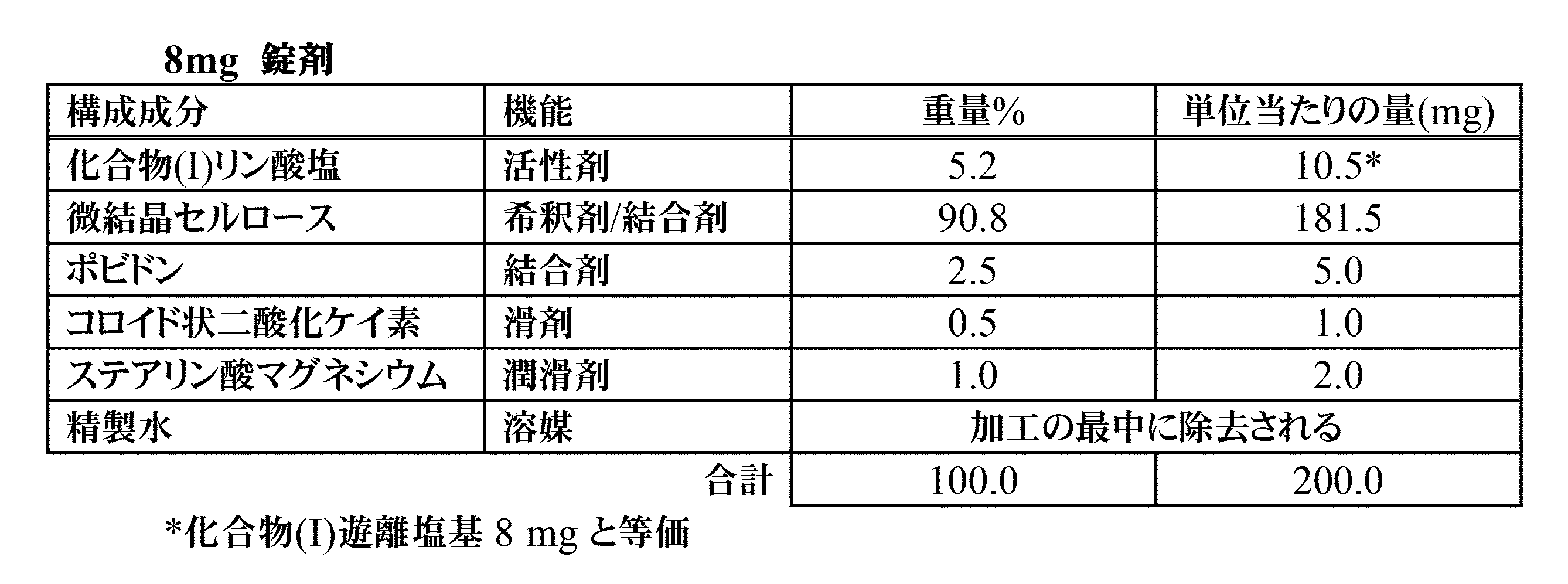
代替の特定の実施形態では、この錠剤は下記の成分を含む。 In an alternative specific embodiment, the tablet comprises the following ingredients:

さらに別の特定の実施形態では、この錠剤は下記の成分を含む。 In yet another specific embodiment, the tablet contains the following ingredients:

別の実施形態では、本発明の組成物は第2の治療薬をさらに含む。この第2の治療薬は、ルキソリチニブと同一の作用機序を有する化合物と共に投与した場合に有益な特性を有することが知られているまたは有益な特性を示すあらゆる化合物または治療薬から選択され得る。 In another embodiment, the composition of the invention further comprises a second therapeutic agent. The second therapeutic agent may be selected from any compound or therapeutic agent known to have or exhibit beneficial properties when administered together with a compound having the same mechanism of action as ruxolitinib.
好ましくは、この第2の治療薬は、脱毛障害または自己免疫状態の処置で有用な薬剤(例えば、JAK1、JAK2もしくはJAK3および/またはSTAT1の阻害剤)である。そのような阻害剤として、ルキソリチニブ、トファシチニブ、バリシチニブ、フィルゴチニブおよび同類のものが挙げられる。他の第2の治療薬として経口コルチコステロイドが挙げられる。 Preferably, the second therapeutic agent is an agent useful in treating hair loss disorders or autoimmune conditions (e.g., inhibitors of JAK1, JAK2 or JAK3 and/or STAT1). Such inhibitors include ruxolitinib, tofacitinib, baricitinib, filgotinib, and the like. Other second therapeutic agents include oral corticosteroids.
別の実施形態では、本発明は、化合物(I)またはその薬学的に許容される塩と上記で説明されている第2の治療薬のいずれかのうちの1種または複数種との別々の剤形であって、化合物(I)またはその薬学的に許容される塩と第2の治療薬とは互いに関連している、別々の剤形を提供する。用語「互いに関連している」は、本明細書で使用される場合、この別々の剤形が一緒に包装されており、または別方法で互いに結び付けられており、その結果、この別々の剤形が一緒に販売されて(互いに24時間未満内に、連続してまたは同時に)投与されることが意図されていることが容易に明らかであることを意味する。 In another embodiment, the present invention provides separate dosage forms of compound (I) or a pharma- ceutically acceptable salt thereof and one or more of any of the second therapeutic agents described above, wherein compound (I) or a pharma- ceutically acceptable salt thereof and the second therapeutic agent are associated with each other. The term "associated with each other" as used herein means that the separate dosage forms are packaged together or otherwise associated with each other such that it is readily apparent that the separate dosage forms are intended to be sold together and administered (within less than 24 hours of each other, either sequentially or simultaneously).
本発明の医薬組成物中において、化合物(I)またはその薬学的に許容される塩は有効な量で存在する。本明細書で使用される場合、用語「有効な量」は、適切な投与レジメンで投与した場合に標的の障害を処置するのに十分な量を指す。 In the pharmaceutical compositions of the present invention, compound (I) or a pharma- ceutically acceptable salt thereof is present in an effective amount. As used herein, the term "effective amount" refers to an amount sufficient to treat the target disorder when administered in a suitable dosing regimen.
動物およびヒトに関する投与量の相互関係(体表面の平方メートル当たりのミリグラムに基づく)は、Freireich et al.,Cancer Chemother.Rep,1966,50:219で説明されている。体表面積を対象の身長および体重から近似的に決定し得る。例えばScientific Tables,Geigy Pharmaceuticals,Ardsley,N.Y.,1970,537を参照されたい。 The interrelationship of dosages for animals and humans (based on milligrams per square meter of body surface) is described in Freireich et al., Cancer Chemother. Rep, 1966, 50:219. Body surface area can be approximately determined from the subject's height and weight. See, e.g., Scientific Tables, Geigy Pharmaceuticals, Ardsley, N.Y., 1970, 537.
一実施形態では、化合物(I)(遊離塩基としてまたは等価な量の薬学的に許容される塩(例えばリン酸塩)としてのいずれか)の有効な量は1日当たり約4mg~50mg(例えば1日当たり4mg~50mg)の範囲であり得、例えば、約5mg/日(例えば5mg/日)、約10mg/日(例えば10mg/日)、約20mg/日(例えば20mg/日)、約30mg/日(例えば30mg/日)、約40mg/日(例えば40mg/日)または約50mg/日(例えば50mg/日)であり得る。ある特定の実施形態では、この量は、約4mg/日(例えば4mg/日)、約8mg/日(例えば8mg/日)、約16mg/日(例えば16mg/日)、約24mg/日(例えば24mg/日)、約32mg/日(例えば32mg/日)または約48mg/日(例えば48mg/日)であり得る。一実施形態では、約4mg/日(例えば4mg/日)、約8mg/日(例えば8mg/日)、約16mg/日(例えば16mg/日)、約24mg/日(例えば24mg/日)、約32mg/日(例えば32mg/日)または約48mg/日(例えば48mg/日)の用量を1日当たり1回投与する。一具体例では、16mg/日の用量を、一緒に投与する(即ち単一用量として)化合物(I)(遊離塩基としてまたは等価な量の薬学的に許容される塩(例えばリン酸塩)としてのいずれか)の2錠の8mg錠剤として投与する。別の具体例では、16mg/日の用量を、化合物(I)(遊離塩基としてまたは等価な量の薬学的に許容される塩(例えばリン酸塩)としてのいずれか)の1錠の16mg錠剤として投与する。別の実施形態では、4mg/日、8mg/日、16mg/日、24mg/日、32mg/日または48mg/日の用量を、分割用量で1日当たり2回投与する(例えば、48mg/日の用量を、1日当たり24mgを2回として投与する)。別の実施形態では、8mg/日、16mg/日、24mg/日または32mg/日の用量を、分割用量で1日当たり2回投与する(例えば、32mg/日の用量を、16mgの化合物(I)(遊離塩基としてまたは等価な量の薬学的に許容される塩(例えばリン酸塩)としてのいずれか)を1日当たり2回として(即ち別々の用量で)投与する。具体的な一実施形態では、16mg/日の用量を、8mgの化合物(I)(遊離塩基としてまたは等価な量の薬学的に許容される塩(例えばリン酸塩)としてのいずれか)を1日当たり2回として(即ち別々の用量で)投与する。化合物(I)またはその薬学的に許容される塩の量への言及は、遊離塩基としての化合物(I)の述べた値と等価である化合物(I)の薬学的に許容される塩(例えばリン酸塩)の量を含む(例えば、10.5mgの化合物(I)リン酸塩は8mgの化合物(I)遊離塩基と等価である)ことが理解されるだろう。 In one embodiment, an effective amount of Compound (I) (either as the free base or as an equivalent amount of a pharma- ceutically acceptable salt (e.g., phosphate)) may range from about 4 mg to 50 mg per day (e.g., 4 mg to 50 mg per day), for example, about 5 mg/day (e.g., 5 mg/day), about 10 mg/day (e.g., 10 mg/day), about 20 mg/day (e.g., 20 mg/day), about 30 mg/day (e.g., 30 mg/day), about 40 mg/day (e.g., 40 mg/day), or about 50 mg/day (e.g., 50 mg/day). In certain embodiments, the amount may be about 4 mg/day (e.g., 4 mg/day), about 8 mg/day (e.g., 8 mg/day), about 16 mg/day (e.g., 16 mg/day), about 24 mg/day (e.g., 24 mg/day), about 32 mg/day (e.g., 32 mg/day), or about 48 mg/day (e.g., 48 mg/day). In one embodiment, a dose of about 4 mg/day (e.g., 4 mg/day), about 8 mg/day (e.g., 8 mg/day), about 16 mg/day (e.g., 16 mg/day), about 24 mg/day (e.g., 24 mg/day), about 32 mg/day (e.g., 32 mg/day), or about 48 mg/day (e.g., 48 mg/day) is administered once per day. In one embodiment, a dose of 16 mg/day is administered as two 8 mg tablets of Compound (I) (either as the free base or an equivalent amount of a pharma- ceutically acceptable salt (e.g., a phosphate salt)) administered together (i.e., as a single dose). In another embodiment, a dose of 16 mg/day is administered as one 16 mg tablet of Compound (I) (either as the free base or an equivalent amount of a pharma-ceutically acceptable salt (e.g., a phosphate salt). In another embodiment, a dose of 4 mg/day, 8 mg/day, 16 mg/day, 24 mg/day, 32 mg/day or 48 mg/day is administered in divided doses twice per day (e.g., a 48 mg/day dose is administered as two 24 mg doses per day). In another embodiment, a dose of 8 mg/day, 16 mg/day, 24 mg/day or 32 mg/day is administered twice per day in divided doses (e.g., a dose of 32 mg/day is administered as 16 mg of compound (I) (either as the free base or as an equivalent amount of a pharma- ceutically acceptable salt (e.g., a phosphate salt)) twice per day (i.e., in separate doses). In a specific embodiment, a dose of 16 mg/day is administered as 8 mg of compound (I) (either as the free base or as an equivalent amount of a pharma- ceutically acceptable salt (e.g., a phosphate salt)) twice per day (i.e., in separate doses). References to the amount of compound (I) or a pharma- ceutically acceptable salt thereof will be understood to include the amount of a pharma- ceutically acceptable salt (e.g., a phosphate salt) of compound (I) that is equivalent to the stated value of compound (I) as the free base (e.g., 10.5 mg of compound (I) phosphate salt is equivalent to 8 mg of compound (I) free base).
ある特定の実施形態では、化合物(I)またはその薬学的に許容される塩の有効な量は、1日当たり約4mg(例えば4mg)を2回である。具体的な実施形態では、有効な量の化合物(I)を、1日当たり約5.3mg(例えば5.3mg)の化合物(I)リン酸塩を2回として投与する。ある特定の実施形態では、化合物(I)またはその薬学的に許容される塩の有効な量は、1日当たり約8mg(例えば8mg)を2回である。具体的な実施形態では、化合物(I)を、1日当たり約10.5mg(例えば10.5mg)の化合物(I)リン酸塩を2回として投与する。 In certain embodiments, an effective amount of Compound (I) or a pharma- ceutically acceptable salt thereof is about 4 mg (e.g., 4 mg) twice per day. In specific embodiments, an effective amount of Compound (I) is administered as about 5.3 mg (e.g., 5.3 mg) of Compound (I) phosphate twice per day. In certain embodiments, an effective amount of Compound (I) or a pharma- ceutically acceptable salt thereof is about 8 mg (e.g., 8 mg) twice per day. In specific embodiments, Compound (I) is administered as about 10.5 mg (e.g., 10.5 mg) of Compound (I) phosphate twice per day.
ある特定の実施形態では、化合物(I)またはその薬学的に許容される塩の有効な量は、1日当たり約12mg(例えば12mg)を2回である。具体的な実施形態では、化合物(I)の有効な量は、1日当たり約15.8mg(例えば15.8mg)の化合物(I)リン酸塩を2回である。ある特定の実施形態では、化合物(I)またはその薬学的に許容される塩の有効な量は、1日当たり約16mg(例えば16mg)を2回である。具体的な実施形態では、化合物(I)の有効な量は、1日当たり約21.1mg(例えば21.1mg)の化合物(I)リン酸塩を2回である。 In certain embodiments, the effective amount of Compound (I) or a pharma- ceutically acceptable salt thereof is about 12 mg (e.g., 12 mg) twice per day. In specific embodiments, the effective amount of Compound (I) is about 15.8 mg (e.g., 15.8 mg) of Compound (I) phosphate twice per day. In certain embodiments, the effective amount of Compound (I) or a pharma- ceutically acceptable salt thereof is about 16 mg (e.g., 16 mg) twice per day. In specific embodiments, the effective amount of Compound (I) is about 21.1 mg (e.g., 21.1 mg) of Compound (I) phosphate twice per day.
実施例1.CYP3A4スーパーソームを使用するD-ルキソリチニブの代謝安定性の測定
材料および方法:
材料:CYP3A4スーパーソーム(商標)をCorning Gentestから入手した。β-ニコチンアミドアデニンジヌクレオチドホスフェート、還元型(NADPH)、塩化マグネシウム(MgCl2)およびジメチルスルホキシド(DMSO)をSigma-Aldrichから購入した。重水素化試験化合物をConcert Pharmaceuticalsから供給された。
Example 1. Measurement of metabolic stability of D-ruxolitinib using CYP3A4 supersomes Materials and methods:
Materials: CYP3A4 Supersome™ was obtained from Corning Gentest. β-Nicotinamide adenine dinucleotide phosphate, reduced form (NADPH), magnesium chloride (MgCl 2 ) and dimethylsulfoxide (DMSO) were purchased from Sigma-Aldrich. Deuterated test compounds were supplied by Concert Pharmaceuticals.
代謝安定性の測定:試験化合物の10mMストック溶液をDMSOで調製した。7.5mMストック溶液をアセトニトリル(ACN)で12.75μMに希釈した。CYP3A4スーパーソームを、3mMのMgCl2を含む0.1Mのリン酸カリウム緩衝液(pH7.4)で希釈した。この希釈したスーパーソームを、96ウェルディープウェルポリプロピレンプレートのウェルに3回の反復で入れた。このスーパーソームに12.75μMの試験化合物のアリコート10μLを添加し、この混合物を10分にわたり予熱した。予熱したNADPH溶液の添加により反応を開始させた。最終反応体積は0.5mLであり、0.1Mのリン酸カリウム緩衝液(pH7.4)および3mMのMgCl2中に50pmol/mLのCYP3A4スーパーソーム、0.25μMの試験化合物および2mMのNADPHを含んだ。この反応混合物を37℃でインキュベートし、0、5、10、20および30分でアリコート50μLを取り出し、内部標準を含む氷冷ACN 50μLが入ったシャローウェル96ウェルプレートに入れて反応を停止させた。このプレートを20分にわたり4℃で保管し、その後、このプレートのウェルに水100μLを入れ、次いで遠心分離により、沈殿したタンパク質をペレット化した。上清を別の96ウェルプレートに移し、Applied Bio-systems質量分析計を使用するLC-MS/MSにより、残存する親の量に関して分析した。 Measurement of metabolic stability: 10 mM stock solutions of test compounds were prepared in DMSO. 7.5 mM stock solutions were diluted to 12.75 μM with acetonitrile (ACN). CYP3A4 supersomes were diluted in 0.1 M potassium phosphate buffer (pH 7.4) containing 3 mM MgCl2 . The diluted supersomes were placed in triplicate in wells of a 96-well deep-well polypropylene plate. A 10 μL aliquot of 12.75 μM test compound was added to the supersomes and the mixture was preheated for 10 minutes. The reaction was initiated by the addition of preheated NADPH solution. The final reaction volume was 0.5 mL and contained 50 pmol/mL CYP3A4 supersomes, 0.25 μM test compound and 2 mM NADPH in 0.1 M potassium phosphate buffer (pH 7.4) and 3 mM MgCl2 . The reaction mixture was incubated at 37°C and 50 μL aliquots were removed at 0, 5, 10, 20 and 30 minutes and stopped by placing into a shallow well 96 well plate containing 50 μL ice cold ACN containing internal standard. The plate was stored at 4°C for 20 minutes after which the wells of the plate were filled with 100 μL water and then centrifuged to pellet the precipitated proteins. The supernatant was transferred to another 96 well plate and analyzed for the amount of parent remaining by LC-MS/MS using an Applied Bio-systems mass spectrometer.
データ解析:試験化合物のインビトロでのt1/2を、残存する親の%(ln)対インキュベーション時間の関係の直線回帰の傾きから算出した。
インビトロでのt1/2=0.693/k
k=-[残存する親の%(ln)対インキュベーション時間の直線回帰の傾き]
Microsoft Excel Softwareを使用してデータ解析を実施した。
Data analysis: The in vitro t 1/2 of test compounds was calculated from the slope of the linear regression of % parent remaining (ln) versus incubation time.
In vitro t 1/2 =0.693/k
k = - [slope of linear regression of % parent remaining (ln) versus incubation time]
Data analysis was performed using Microsoft Excel Software.
化合物(I)は非重水素化ルキソリチニブのt1/2と比べて約80%長いt1/2を有することを発見した。この結果は、CYP3A4スーパーソームアッセイにおいて式(I)がルキソリチニブと比べて実質的に代謝的に安定であることを示す。 Compound (I) was found to have a t 1/2 that is approximately 80% longer than that of non-deuterated ruxolitinib, indicating that compound (I) is substantially metabolically stable compared to ruxolitinib in the CYP3A4 supersome assay.
実施例2:ヒト肝臓ミクロソームを使用するD-ルキソリチニブの代謝安定性の測定
材料:ヒト肝臓ミクロソーム(20mg/mL)をXenotech,LLC(Lenexa,KS)から入手した。β-ニコチンアミドアデニンジヌクレオチドホスフェート、還元型(NADPH)、塩化マグネシウム(MgCl2)およびジメチルスルホキシド(DMSO)をSigma-Aldrichから購入した。重水素化試験化合物をConcert Pharmaceuticalsから供給された。
Example 2: Determination of metabolic stability of D-ruxolitinib using human liver microsomes Materials: Human liver microsomes (20 mg/mL) were obtained from Xenotech, LLC (Lenexa, KS). β-nicotinamide adenine dinucleotide phosphate, reduced form (NADPH), magnesium chloride (MgCl 2 ) and dimethyl sulfoxide (DMSO) were purchased from Sigma-Aldrich. Deuterated test compounds were supplied by Concert Pharmaceuticals.
代謝安定性の測定:試験化合物の7.5mMストック溶液をDMSOで調製した。この7.5mMストック溶液をアセトニトリル(ACN)で12.5μMに希釈した。ヒト肝臓ミクロソームを、3mMのMgCl2を含む0.1Mのリン酸カリウム緩衝液(pH7.4)で希釈した。この希釈したミクロソームを、96ウェルディープウェルポリプロピレンプレートのウェルに3回の反復で入れた。このミクロソームに12.5μMの試験化合物のアリコート10μLを添加し、この混合物を10分にわたり予熱した。予熱したNADPH溶液の添加により反応を開始させた。最終反応体積は0.5mLであり、0.1Mのリン酸カリウム緩衝液(pH7.4)および3mMのMgCl2中に5mg/mLのヒト肝臓ミクロソーム、0.25μMの試験化合物および2mMのNADPHを含んだ。この反応混合物を37℃でインキュベートし、0、5、10、20および30分でアリコート50μLを取り出し、内部標準を含む氷冷ACN 50μLが入ったシャローウェル96ウェルプレートに入れて反応を停止させた。このプレートを20分にわたり4℃で保管し、その後、このプレートのウェルに水100μLを入れ、次いで遠心分離により、沈殿したタンパク質をペレット化した。上清を別の96ウェルプレートに移し、Applied Bio-systems質量分析計を使用するLC-MS/MSにより、残存する親の量に関して分析した。 Measurement of metabolic stability: A 7.5 mM stock solution of test compound was prepared in DMSO. The 7.5 mM stock solution was diluted to 12.5 μM with acetonitrile (ACN). Human liver microsomes were diluted in 0.1 M potassium phosphate buffer (pH 7.4) containing 3 mM MgCl2 . The diluted microsomes were placed in triplicate in wells of a 96-well deep-well polypropylene plate. A 10 μL aliquot of 12.5 μM test compound was added to the microsomes and the mixture was preheated for 10 minutes. The reaction was started by the addition of preheated NADPH solution. The final reaction volume was 0.5 mL and contained 5 mg/mL human liver microsomes, 0.25 μM test compound and 2 mM NADPH in 0.1 M potassium phosphate buffer (pH 7.4) and 3 mM MgCl2 . The reaction mixture was incubated at 37°C and 50 μL aliquots were removed at 0, 5, 10, 20 and 30 minutes and stopped by placing into a shallow well 96 well plate containing 50 μL ice cold ACN containing internal standard. The plate was stored at 4°C for 20 minutes after which the wells of the plate were filled with 100 μL water and then centrifuged to pellet the precipitated proteins. The supernatant was transferred to another 96 well plate and analyzed for the amount of parent remaining by LC-MS/MS using an Applied Bio-systems mass spectrometer.
データ解析:試験化合物のインビトロでのt1/2を、残存する親の%(ln)対インキュベーション時間の関係の直線回帰の傾きから算出した。
インビトロでのt1/2=0.693/k
k=-[残存する親の%(ln)対インキュベーション時間の直線回帰の傾き]
Microsoft Excel Softwareを使用してデータ解析を実施した。
Data analysis: The in vitro t 1/2 of test compounds was calculated from the slope of the linear regression of % parent remaining (ln) versus incubation time.
In vitro t 1/2 =0.693/k
k = - [slope of linear regression of % parent remaining (ln) versus incubation time]
Data analysis was performed using Microsoft Excel Software.
化合物(I)は非重水素化ルキソリチニブのt1/2と比べて約75%長いt1/2を有することを発見した。この結果は、HLMアッセイにおいて化合物(I)がルキソリチニブと比べて実質的に代謝的に安定であることを示す。 Compound (I) was found to have a t 1/2 that is approximately 75% longer than that of non-deuterated ruxolitinib, indicating that compound (I) is substantially metabolically stable compared to ruxolitinib in the HLM assay.
実施例3:ヒト試験
単回漸増用量(SAD)試験:健康なボランティに、絶食条件下で化合物(I)またはプラセボの用量を投与した。この試験の目的は、リン酸塩としての化合物(I)8mg、16mg、32mgまたは48mg(例えば、化合物(I)リン酸塩10.5mgは化合物(I)遊離塩基8mgと等価である)の単回用量の薬物動態を評価することであった。各用量群に関して、6例の対象に化合物(I)を投与し、2例の対象にプラセボを投与した。この試験の設計を図1Aに示す。化合物(I)の代謝産物を分析した。化合物(I)の用量をカプセル中粉末としての化合物(I)リン酸塩として投与し、水と共に投与した。予備的結果を図1Bおよび図1Cに示す。
Example 3: Human Study Single Ascending Dose (SAD) Study: Healthy volunteers were administered doses of Compound (I) or placebo under fasting conditions. The purpose of this study was to evaluate the pharmacokinetics of a single dose of 8 mg, 16 mg, 32 mg, or 48 mg of Compound (I) as phosphate (e.g., 10.5 mg of Compound (I) phosphate is equivalent to 8 mg of Compound (I) free base). For each dose group, 6 subjects were administered Compound (I) and 2 subjects were administered placebo. The design of this study is shown in Figure 1A. Metabolites of Compound (I) were analyzed. Compound (I) doses were administered as Compound (I) phosphate as powder in capsules and administered with water. Preliminary results are shown in Figure 1B and Figure 1C.
複数回漸増用量試験:健康なボランティアに、絶食条件下で化合物(I)またはプラセボの用量を投与した。この試験の目的は、リン酸塩としての化合物(I)8mg、16mg、24mgまたは32mg(例えば、化合物(I)リン酸塩10.5mgは化合物(I)遊離塩基8mgと等価である)の毎日の投与の薬物動態を評価することであった。化合物(I)を、7日にわたり連続して1日当たり1回(QD)(8mg、24mg、32mgの用量)または1日当たり2回(BID)(合計16mg/日である2回の8mgの用量もしくは合計32mg/日である2回の16mgの用量)投与した。各用量群に関して、8例の対象に化合物(I)を投与し、2例の対象にプラセボを投与した。この試験の設計を図1Aに示す。化合物(I)の代謝産物を分析した。化合物(I)の用量を8mg錠剤として水と共に投与した。予備的結果を図1Bおよび図1Cに示す。 Multiple ascending dose study: Healthy volunteers were administered doses of Compound (I) or placebo under fasting conditions. The purpose of this study was to evaluate the pharmacokinetics of daily administration of 8 mg, 16 mg, 24 mg, or 32 mg of Compound (I) as phosphate (e.g., 10.5 mg of Compound (I) phosphate is equivalent to 8 mg of Compound (I) free base). Compound (I) was administered once per day (QD) (8 mg, 24 mg, 32 mg doses) or twice per day (BID) (two 8 mg doses totaling 16 mg/day or two 16 mg doses totaling 32 mg/day) for seven consecutive days. For each dose group, eight subjects received Compound (I) and two subjects received placebo. The design of this study is shown in Figure 1A. Metabolites of Compound (I) were analyzed. Compound (I) doses were administered as 8 mg tablets with water. Preliminary results are shown in Figures 1B and 1C.
最終結果を下記の表に示す。 The final results are shown in the table below.

このSAD試験の予備的結果を図1Bおよび図1Cに示す。このMAD試験の予備的結果を図2Bおよび図2Cに示す。このMAD試験の最終結果を下記の表に示す。図1および図2において、CTP-543は化合物(I)であり、リン酸塩として投与されている。 Preliminary results of the SAD study are shown in Figures 1B and 1C. Preliminary results of the MAD study are shown in Figures 2B and 2C. Final results of the MAD study are shown in the table below. In Figures 1 and 2, CTP-543 is compound (I) and is administered as the phosphate salt.

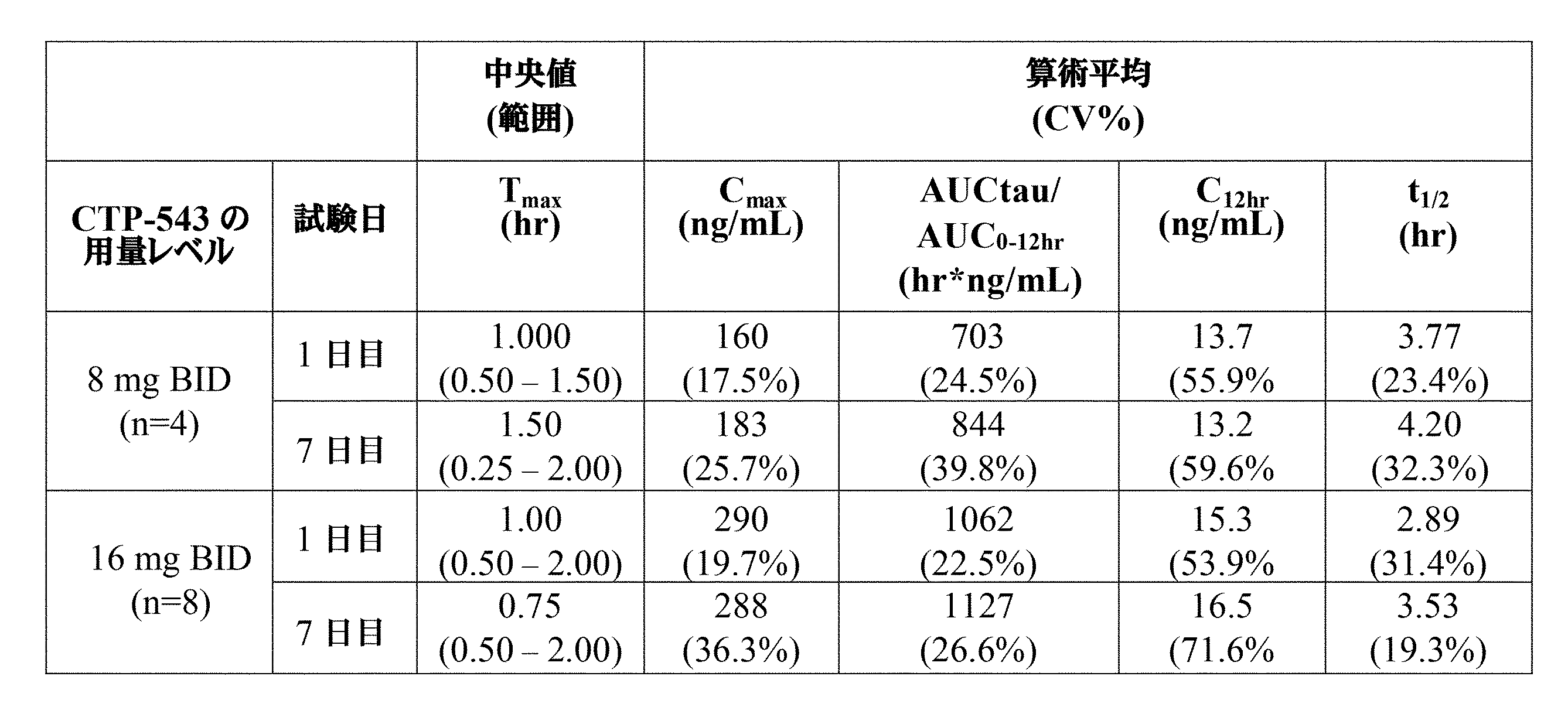
SAD試験およびMAD試験を合わせて、合計で77例の対象に投与した(60例にCTP-543を投与し、17例にプラセボを投与した)。CTP-543は迅速に吸収され、反復投与により蓄積しなかった。深刻な有害事象は報告されておらず、報告された最も一般的な有害事象は頭痛であった。CTP-543に関連する休薬および用量の変更は起きなかった。軽度の好中球減少症例は投与完了後に回復した、または回復傾向を見せた。重度の好中球減少症(グレート3または4)を観測しなかった。 A total of 77 subjects were dosed in the SAD and MAD studies combined (60 received CTP-543 and 17 received placebo). CTP-543 was rapidly absorbed and did not accumulate with repeated dosing. No serious adverse events were reported, with headache being the most common adverse event reported. No CTP-543-related dose interruptions or dose modifications occurred. Cases of mild neutropenia resolved or showed a tendency to resolve after completion of dosing. No severe neutropenia (grade 3 or 4) was observed.
第1相試験では、化合物(I)は一般的に良好な耐容性を示した。これらの試験に基づいて、8mg BID(1日当たり2回)、12mg BID、16mg BIDおよび32mg BIDの用量を選択した。 In Phase 1 studies, Compound (I) was generally well tolerated. Based on these studies, doses of 8 mg BID (twice daily), 12 mg BID, 16 mg BID and 32 mg BID were selected.
第1相試験のさらなる発見は、化合物(I)の16mg BID(下記で説明されている第2a相試験で評価される最高用量)の平均全身曝露は、中等度から重度の脱毛症の患者での毛の再成長の誘導で有効であることが示されている20mg BIDルキソリチニブの報告された平均曝露に関して公開されている発見(例えばJCI Insight.2016;1(15):e89790.doi:10.1172/jci.insight.89790.を参照されたい)に相当するように見えることを示す。 Further findings from the Phase 1 study indicate that the mean systemic exposure of Compound (I) at 16 mg BID (the highest dose evaluated in the Phase 2a study described below) appears to be comparable to published findings regarding the reported mean exposure of 20 mg BID ruxolitinib, which has been shown to be effective in inducing hair regrowth in patients with moderate to severe alopecia (see, e.g., JCI Insight. 2016;1(15):e89790.doi:10.1172/jci.insight.89790.).
第1相試験のMAD試験の最中に薬力学解析も実施して、IL-6媒介性JAK/STATシグナル伝達およびIFN-γ媒介性JAK/STATシグナル伝達の阻害を評価した。CTP-543(化合物(I))の確立された薬力学的活性と一致して、IL-6刺激性リン酸化STAT3(pSTAT3)の用量依存性減少を観測した。概して、全ての処置群でのpSTAT3阻害は、投与から24時間後にほぼベースライン値に戻った。同様に、円形脱毛症の病因で重要な役割を果たすと考えられているIFN-γ媒介性STAT1シグナル伝達は、評価した全ての用量にて疾病関連の免疫細胞型で有意に阻害された。 Pharmacodynamic analyses were also performed during the Phase 1 MAD study to evaluate inhibition of IL-6-mediated JAK/STAT signaling and IFN-γ-mediated JAK/STAT signaling. Consistent with the established pharmacodynamic activity of CTP-543 (compound (I)), we observed a dose-dependent decrease in IL-6-stimulated phosphorylated STAT3 (pSTAT3). Overall, pSTAT3 inhibition in all treatment groups returned to near baseline values 24 hours after dosing. Similarly, IFN-γ-mediated STAT1 signaling, which is believed to play an important role in the pathogenesis of alopecia areata, was significantly inhibited in disease-relevant immune cell types at all doses evaluated.
第2a相試験を、24週目での主要有効性解析により投与から12ヶ月後の化合物(I)の安全性および有効性を評価するように設計している。この第2a相試験は、中等度から重度の円形脱毛症の成人患者での化合物(I)の安全性および有効性を評価するための二重盲検無作為化プラセボコントロール並列用量試験である。約100例の患者を、リン酸塩としての化合物(I)の4種の用量(例えば、化合物(I)リン酸塩10.5mgは化合物(I)遊離塩基8mgと等価である)のうちの1種を投与するように無作為化する。化合物(I)の4種の用量は、1日当たり4、8(即ち、化合物(I)リン酸塩約10.5mg)、12および16mgを2回であり、プラセボを投与する患者群も存在する。主要な予後指標は、投与から24週後の脱毛症の重症度のツール(SALT)を利用する。この試験は、この試験に登録された全ての患者に化合物(I)を投与する追加の28週間の投与を含む。 The Phase 2a study is designed to evaluate the safety and efficacy of Compound (I) after 12 months of dosing with a primary efficacy analysis at 24 weeks. The Phase 2a study is a double-blind, randomized, placebo-controlled, parallel-dose study to evaluate the safety and efficacy of Compound (I) in adult patients with moderate to severe alopecia areata. Approximately 100 patients will be randomized to receive one of four doses of Compound (I) as the phosphate salt (e.g., 10.5 mg of Compound (I) phosphate is equivalent to 8 mg of Compound (I) free base). The four doses of Compound (I) are 4, 8 (i.e., about 10.5 mg of Compound (I) phosphate), 12 and 16 mg twice daily, with a placebo group. The primary prognostic indicator utilizes the Severity of Alopecia Tool (SALT) after 24 weeks of dosing. The study will include an additional 28 weeks of treatment with Compound (I) for all patients enrolled in the study.
さらに説明することなく、当業者は、上述の説明および例示的な実施例を使用して、本発明の化合物を製造し得、利用し得、且つ特許請求の範囲の方法を実施し得ると考えられる。上述の考察および実施例はある特定の好ましい実施形態の詳細な説明を提示するにすぎないことを理解すべきである。本発明の趣旨および範囲から逸脱することなく様々な改変および等価物が可能であることが当業者には明らかであるだろう。 Without further description, it is believed that one of ordinary skill in the art can, using the above description and illustrative examples, make and utilize the compounds of the present invention and practice the methods of the claims. It should be understood that the above discussion and examples merely present a detailed description of certain preferred embodiments. Various modifications and equivalents will be apparent to those skilled in the art without departing from the spirit and scope of the invention.
Claims (26)
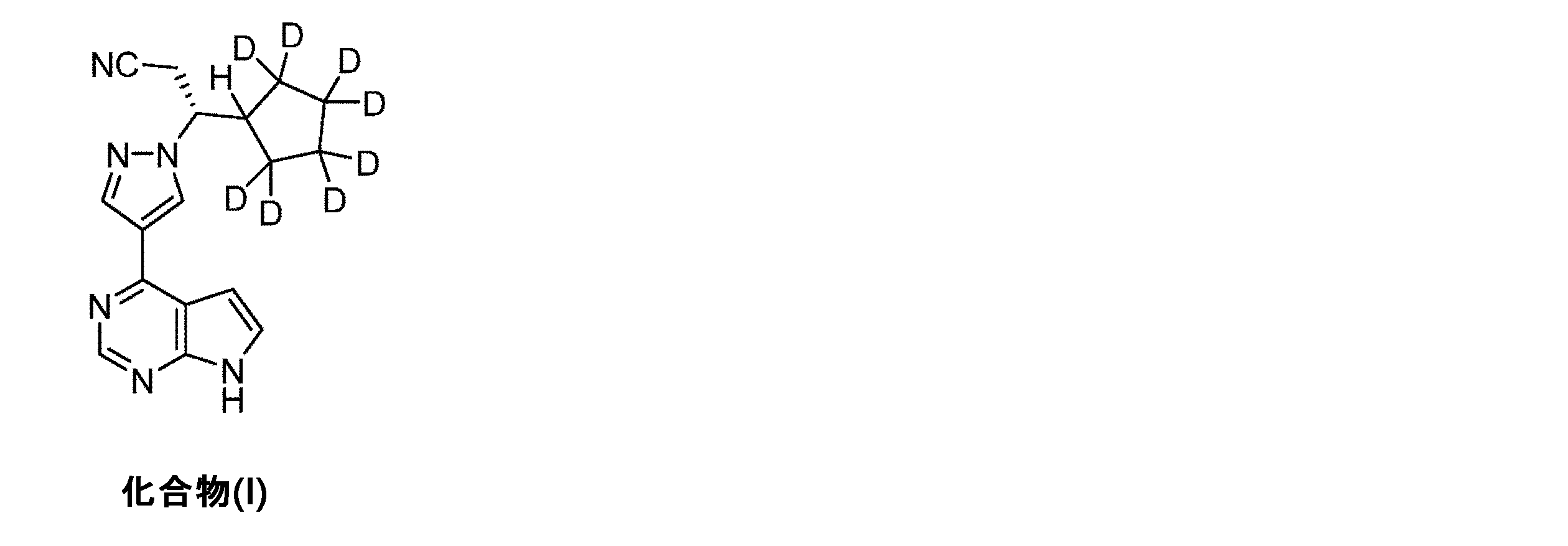
で表される化合物またはその薬学的に許容される塩を含む医薬製剤であって、前記脱毛障害は円形脱毛症であり、前記方法は、前記対象に、約8mg/日の前記化合物(I)またはその薬学的に許容される塩を投与することを含む、医薬製剤。 For use in a method of treating a hair loss disorder in a human subject, a compound having the following structural formula:
or a pharma- ceutical formulation comprising a compound represented by the formula:
前記化合物を錠剤である医薬製剤で投与する、請求項1~4のいずれか一項に記載の医薬製剤。 The pharmaceutical formulation according to any one of claims 1 to 4, wherein the compound is administered orally and/or the compound is administered in a pharmaceutical formulation that is a tablet.
前記化合物を錠剤である医薬製剤で投与する、請求項9に記載の医薬製剤。 10. The pharmaceutical formulation of claim 9, wherein the compound is administered orally and/or the compound is administered in a pharmaceutical formulation that is a tablet.

で表される化合物またはその薬学的に許容される塩を含む、脱毛障害を治療するための医薬組成物であって、前記脱毛障害は円形脱毛症であり、前記組成物は、1日当たり2回4mgの前記化合物としてまたは1日当たり1回8mgの前記化合物として投与される、医薬組成物。 A pharma- ceutically acceptable carrier or diluent and 4 mg of a compound of the following structure:
or a pharma- ceutical composition for treating a hair loss disorder comprising a compound represented by the formula:
(i)約2.6重量%の化合物(I)リン酸塩、
(ii)約90.9重量%の微結晶セルロース、
(iii)約5.0重量%のポビドン、
(iv)約0.5重量%のコロイド状二酸化ケイ素、および
(v)約1.0重量%のステアリン酸マグネシウム
を含む錠剤である、請求項11~13のいずれか一項に記載の医薬組成物。 The composition comprises:
(i) about 2.6% by weight of Compound (I) phosphate;
(ii) about 90.9% by weight of microcrystalline cellulose;
(iii) about 5.0% by weight of povidone;
14. The pharmaceutical composition of claim 11 , which is a tablet comprising: (iv) about 0.5% by weight of colloidal silicon dioxide; and (v) about 1.0% by weight of magnesium stearate.
Priority Applications (1)
| Application Number | Priority Date | Filing Date | Title |
|---|---|---|---|
| JP2024195175A JP2025026895A (en) | 2016-05-04 | 2024-11-07 | Treatment of Hair Loss Disorders with Deuterated JAK Inhibitors |
Applications Claiming Priority (16)
| Application Number | Priority Date | Filing Date | Title |
|---|---|---|---|
| US201662331827P | 2016-05-04 | 2016-05-04 | |
| US62/331,827 | 2016-05-04 | ||
| US201662338869P | 2016-05-19 | 2016-05-19 | |
| US62/338,869 | 2016-05-19 | ||
| US201662418774P | 2016-11-07 | 2016-11-07 | |
| US62/418,774 | 2016-11-07 | ||
| US201662419237P | 2016-11-08 | 2016-11-08 | |
| US62/419,237 | 2016-11-08 | ||
| US201662434404P | 2016-12-14 | 2016-12-14 | |
| US62/434,404 | 2016-12-14 | ||
| US201762466358P | 2017-03-02 | 2017-03-02 | |
| US62/466,358 | 2017-03-02 | ||
| US201762492758P | 2017-05-01 | 2017-05-01 | |
| US62/492,758 | 2017-05-01 | ||
| JP2018557837A JP7145080B2 (en) | 2016-05-04 | 2017-05-04 | Treatment of Hair Loss Disorders with Deuterated JAK Inhibitors |
| PCT/US2017/031142 WO2017192905A1 (en) | 2016-05-04 | 2017-05-04 | Treatment of hair loss disorders with deuterated jak inhibitors |
Related Parent Applications (1)
| Application Number | Title | Priority Date | Filing Date |
|---|---|---|---|
| JP2018557837A Division JP7145080B2 (en) | 2016-05-04 | 2017-05-04 | Treatment of Hair Loss Disorders with Deuterated JAK Inhibitors |
Related Child Applications (1)
| Application Number | Title | Priority Date | Filing Date |
|---|---|---|---|
| JP2024195175A Division JP2025026895A (en) | 2016-05-04 | 2024-11-07 | Treatment of Hair Loss Disorders with Deuterated JAK Inhibitors |
Publications (2)
| Publication Number | Publication Date |
|---|---|
| JP2022171838A JP2022171838A (en) | 2022-11-11 |
| JP7586868B2 true JP7586868B2 (en) | 2024-11-19 |
Family
ID=60203616
Family Applications (3)
| Application Number | Title | Priority Date | Filing Date |
|---|---|---|---|
| JP2018557837A Active JP7145080B2 (en) | 2016-05-04 | 2017-05-04 | Treatment of Hair Loss Disorders with Deuterated JAK Inhibitors |
| JP2022147751A Active JP7586868B2 (en) | 2016-05-04 | 2022-09-16 | Treatment of Hair Loss Disorders with Deuterated JAK Inhibitors |
| JP2024195175A Pending JP2025026895A (en) | 2016-05-04 | 2024-11-07 | Treatment of Hair Loss Disorders with Deuterated JAK Inhibitors |
Family Applications Before (1)
| Application Number | Title | Priority Date | Filing Date |
|---|---|---|---|
| JP2018557837A Active JP7145080B2 (en) | 2016-05-04 | 2017-05-04 | Treatment of Hair Loss Disorders with Deuterated JAK Inhibitors |
Family Applications After (1)
| Application Number | Title | Priority Date | Filing Date |
|---|---|---|---|
| JP2024195175A Pending JP2025026895A (en) | 2016-05-04 | 2024-11-07 | Treatment of Hair Loss Disorders with Deuterated JAK Inhibitors |
Country Status (21)
| Country | Link |
|---|---|
| US (3) | US10561659B2 (en) |
| EP (2) | EP3452039B1 (en) |
| JP (3) | JP7145080B2 (en) |
| KR (3) | KR20190003711A (en) |
| CN (2) | CN109069493A (en) |
| AU (3) | AU2017261286B2 (en) |
| BR (1) | BR112018072339A2 (en) |
| CA (1) | CA3022519A1 (en) |
| DK (1) | DK3452039T3 (en) |
| ES (1) | ES2988629T3 (en) |
| FI (1) | FI3452039T3 (en) |
| HR (1) | HRP20241345T1 (en) |
| HU (1) | HUE068643T2 (en) |
| LT (1) | LT3452039T (en) |
| MX (6) | MX388054B (en) |
| PL (1) | PL3452039T3 (en) |
| PT (1) | PT3452039T (en) |
| RS (1) | RS66006B1 (en) |
| SI (1) | SI3452039T1 (en) |
| SM (1) | SMT202400389T1 (en) |
| WO (1) | WO2017192905A1 (en) |
Families Citing this family (13)
| Publication number | Priority date | Publication date | Assignee | Title |
|---|---|---|---|---|
| LT3452039T (en) | 2016-05-04 | 2024-10-25 | Sun Pharmaceutical Industries, Inc. | TREATMENT OF HAIR LOSS DISORDER WITH DEUTERONATED JAK INHIBITORS |
| CA3129096A1 (en) * | 2019-02-06 | 2020-08-13 | Concert Pharmaceuticals, Inc. | Process for preparing enantiomerically enriched jak inhibitors |
| WO2021236139A1 (en) | 2020-05-21 | 2021-11-25 | Concert Pharmaceuticals, Inc. | Novel deuterated jak inhibitor and uses thereof |
| IL302401A (en) * | 2020-10-28 | 2023-06-01 | Sun Pharmaceutical Ind Inc | Regimens for the treatment of hair loss disorders with deuterated jak inhibitors |
| CN116916927A (en) * | 2020-10-28 | 2023-10-20 | 太阳医药工业公司 | Protocol for treating alopecia with deuterated JAK inhibitors |
| CN112402615A (en) * | 2020-11-11 | 2021-02-26 | 长沙晶易医药科技有限公司 | Compound external preparation for treating alopecia areata and preparation method thereof |
| CN118159272A (en) | 2021-08-11 | 2024-06-07 | 太阳医药工业公司 | Deuterated JAK inhibitors for treating hair loss disorders |
| EP4384173A1 (en) | 2021-08-12 | 2024-06-19 | Sun Pharmaceutical Industries, Inc. | Treatment of jak-inhibition-responsive disorders with prodrugs of jak inhibitors |
| EP4518863A1 (en) | 2022-05-04 | 2025-03-12 | Sun Pharmaceutical Industries, Inc. | Dosage regimens for treatment with deuterated jak inhibitors |
| US12364699B2 (en) * | 2023-10-10 | 2025-07-22 | Sun Pharmaceuticals Industries, Inc. | Method of treating hair loss disorders |
| US12247034B1 (en) * | 2024-04-19 | 2025-03-11 | Sun Pharmaceutical Industries, Inc. | Crystalline form of deuruxolitinib phosphate |
| WO2026020112A1 (en) * | 2024-07-19 | 2026-01-22 | Sun Pharmaceutical Industries, Inc. | Oral formulations of deuruxolitinib |
| US20260027120A1 (en) * | 2024-07-25 | 2026-01-29 | Sun Pharmaceutical Industries, Inc. | Methods of treatment of jak inhibition responsive conditions with deuterated jak inhibitors |
Citations (5)
| Publication number | Priority date | Publication date | Assignee | Title |
|---|---|---|---|---|
| JP2014500249A (en) | 2010-11-02 | 2014-01-09 | ザ トラスティース オブ コロンビア ユニバーシティ インザ シティ オブ ニューヨーク | How to treat alopecia |
| JP2015117185A (en) | 2013-12-17 | 2015-06-25 | コンサート ファーマシューティカルズ インコーポレイテッド | Deuteration derivatives of ruxolitinib |
| US20150239896A1 (en) | 2012-06-15 | 2015-08-27 | Concert Pharmaceuticals, Inc. | Deuterated Derivatives of Ruxolitinib |
| JP2015537030A (en) | 2012-11-15 | 2015-12-24 | インサイト・コーポレイションIncyte Corporation | Sustained release dosage form of ruxolitinib |
| JP7145080B2 (en) | 2016-05-04 | 2022-09-30 | コンサート ファーマシューティカルズ インコーポレイテッド | Treatment of Hair Loss Disorders with Deuterated JAK Inhibitors |
Family Cites Families (12)
| Publication number | Priority date | Publication date | Assignee | Title |
|---|---|---|---|---|
| GB9925962D0 (en) | 1999-11-02 | 1999-12-29 | Novartis Ag | Organic compounds |
| PT1390063E (en) | 2001-05-03 | 2005-03-31 | Hoffmann La Roche | NELFINAVIR AMORFO MESYLATE PHARMACEUTICAL DOSE FORM |
| US20060094744A1 (en) | 2004-09-29 | 2006-05-04 | Maryanoff Cynthia A | Pharmaceutical dosage forms of stable amorphous rapamycin like compounds |
| CN103214484B (en) | 2005-12-13 | 2016-07-06 | 因塞特控股公司 | Pyrrolo-[2,3-b] pyridine replaced as the heteroaryl of Janus inhibitors of kinases and pyrrolo-[2,3-b] pyrimidine |
| DK3219705T3 (en) | 2005-12-28 | 2020-04-14 | Vertex Pharma | PHARMACEUTICAL COMPOSITIONS OF THE AMORPHIC FORM OF N- [2,4-BIS (1,1-DIMETHYLETHYL) -5-HYDROXYPHENYL] -1,4-DIHYDRO-4-OXOQUINOLIN-3-CARBOXAMIDE |
| CL2008001709A1 (en) | 2007-06-13 | 2008-11-03 | Incyte Corp | Compounds derived from pyrrolo [2,3-b] pyrimidine, jak kinase modulators; pharmaceutical composition; and use in the treatment of diseases such as cancer, psoriasis, rheumatoid arthritis, among others. |
| PE20211639A1 (en) | 2009-01-15 | 2021-08-24 | Incyte Holdings Corp | PROCESSES FOR PREPARING JAK INHIBITORS AND RELATED INTERMEDIARY COMPOUNDS |
| US9198911B2 (en) | 2010-11-02 | 2015-12-01 | The Trustees Of Columbia University In The City Of New York | Methods for treating hair loss disorders |
| ES2694681T3 (en) | 2012-03-29 | 2018-12-26 | The Trustees Of Columbia University In The City Of New York | Methods to treat hair loss disorders |
| BR112015001839A2 (en) * | 2012-07-30 | 2017-07-04 | Concert Pharmaceuticals Inc | deuterated ibrutinib |
| CN104725380B (en) * | 2013-12-18 | 2019-06-28 | 康塞特医药品有限公司 | Deuterated derivatives of ruxolitinib |
| WO2015120110A2 (en) * | 2014-02-07 | 2015-08-13 | Auspex Pharmaceuticals, Inc. | Novel pharmaceutical formulations |
-
2017
- 2017-05-04 LT LTEPPCT/US2017/031142T patent/LT3452039T/en unknown
- 2017-05-04 ES ES17793380T patent/ES2988629T3/en active Active
- 2017-05-04 HU HUE17793380A patent/HUE068643T2/en unknown
- 2017-05-04 SM SM20240389T patent/SMT202400389T1/en unknown
- 2017-05-04 DK DK17793380.1T patent/DK3452039T3/en active
- 2017-05-04 KR KR1020187034867A patent/KR20190003711A/en not_active Ceased
- 2017-05-04 PT PT177933801T patent/PT3452039T/en unknown
- 2017-05-04 WO PCT/US2017/031142 patent/WO2017192905A1/en not_active Ceased
- 2017-05-04 FI FIEP17793380.1T patent/FI3452039T3/en active
- 2017-05-04 AU AU2017261286A patent/AU2017261286B2/en active Active
- 2017-05-04 MX MX2018013347A patent/MX388054B/en unknown
- 2017-05-04 BR BR112018072339-8A patent/BR112018072339A2/en not_active Application Discontinuation
- 2017-05-04 CA CA3022519A patent/CA3022519A1/en active Pending
- 2017-05-04 CN CN201780027427.2A patent/CN109069493A/en active Pending
- 2017-05-04 HR HRP20241345TT patent/HRP20241345T1/en unknown
- 2017-05-04 RS RS20241081A patent/RS66006B1/en unknown
- 2017-05-04 PL PL17793380.1T patent/PL3452039T3/en unknown
- 2017-05-04 EP EP17793380.1A patent/EP3452039B1/en active Active
- 2017-05-04 EP EP24175652.7A patent/EP4424367A3/en active Pending
- 2017-05-04 KR KR1020237019001A patent/KR102810262B1/en active Active
- 2017-05-04 SI SI201731552T patent/SI3452039T1/en unknown
- 2017-05-04 JP JP2018557837A patent/JP7145080B2/en active Active
- 2017-05-04 CN CN202610039132.8A patent/CN121868312A/en active Pending
- 2017-05-04 US US16/098,338 patent/US10561659B2/en active Active
- 2017-05-04 KR KR1020257015799A patent/KR20250070139A/en active Pending
-
2018
- 2018-10-31 MX MX2021014175A patent/MX2021014175A/en unknown
- 2018-10-31 MX MX2023002325A patent/MX2023002325A/en unknown
- 2018-10-31 MX MX2023002323A patent/MX2023002323A/en unknown
- 2018-10-31 MX MX2023002324A patent/MX2023002324A/en unknown
- 2018-10-31 MX MX2023002321A patent/MX2023002321A/en unknown
-
2019
- 2019-12-05 US US16/704,402 patent/US12076323B2/en active Active
-
2022
- 2022-09-16 JP JP2022147751A patent/JP7586868B2/en active Active
-
2023
- 2023-02-24 AU AU2023201112A patent/AU2023201112B2/en active Active
-
2024
- 2024-06-26 US US18/755,253 patent/US20240423986A1/en active Pending
- 2024-11-07 JP JP2024195175A patent/JP2025026895A/en active Pending
-
2025
- 2025-08-06 AU AU2025213576A patent/AU2025213576A1/en active Pending
Patent Citations (5)
| Publication number | Priority date | Publication date | Assignee | Title |
|---|---|---|---|---|
| JP2014500249A (en) | 2010-11-02 | 2014-01-09 | ザ トラスティース オブ コロンビア ユニバーシティ インザ シティ オブ ニューヨーク | How to treat alopecia |
| US20150239896A1 (en) | 2012-06-15 | 2015-08-27 | Concert Pharmaceuticals, Inc. | Deuterated Derivatives of Ruxolitinib |
| JP2015537030A (en) | 2012-11-15 | 2015-12-24 | インサイト・コーポレイションIncyte Corporation | Sustained release dosage form of ruxolitinib |
| JP2015117185A (en) | 2013-12-17 | 2015-06-25 | コンサート ファーマシューティカルズ インコーポレイテッド | Deuteration derivatives of ruxolitinib |
| JP7145080B2 (en) | 2016-05-04 | 2022-09-30 | コンサート ファーマシューティカルズ インコーポレイテッド | Treatment of Hair Loss Disorders with Deuterated JAK Inhibitors |
Non-Patent Citations (3)
| Title |
|---|
| J. Am. Acad. Dermatol.,2016年,Vol.74, No.2,p.1-5(p.370-371) |
| JAMA Dermatology,2016年,Vol.152, No.4,p.490-491 |
| Nat. Med.,2014年,Vol.20, No.9,p.1-17(p.1043-1049) |
Also Published As
Similar Documents
| Publication | Publication Date | Title |
|---|---|---|
| JP2025026895A (en) | Treatment of Hair Loss Disorders with Deuterated JAK Inhibitors | |
| US12285432B2 (en) | Treatment of hair loss disorders with deuterated JAK inhibitors | |
| US20230390292A1 (en) | Regimens for the treatment of hair loss disorders with deuterated jak inhibitors | |
| US20250275977A1 (en) | Dosage regimens for treatment with deuterated jak inhibitors | |
| HK40112813A (en) | Treatment of hair loss disorders with deuterated jak inhibitors | |
| EA052710B1 (en) | TREATMENT OF HAIR LOSS DISORDERS WITH DEUTERATED JAK INHIBITORS | |
| HK40002100A (en) | Treatment of hair loss disorders with deuterated jak inhibitors | |
| OA21444A (en) | Regimens For The Treatment Of Hair Loss Disorders With Deuterated Jak Inhibitors. |
Legal Events
| Date | Code | Title | Description |
|---|---|---|---|
| A621 | Written request for application examination |
Free format text: JAPANESE INTERMEDIATE CODE: A621 Effective date: 20221013 |
|
| A131 | Notification of reasons for refusal |
Free format text: JAPANESE INTERMEDIATE CODE: A131 Effective date: 20230829 |
|
| A601 | Written request for extension of time |
Free format text: JAPANESE INTERMEDIATE CODE: A601 Effective date: 20231113 |
|
| A711 | Notification of change in applicant |
Free format text: JAPANESE INTERMEDIATE CODE: A712 Effective date: 20231117 |
|
| A521 | Request for written amendment filed |
Free format text: JAPANESE INTERMEDIATE CODE: A523 Effective date: 20240229 |
|
| A131 | Notification of reasons for refusal |
Free format text: JAPANESE INTERMEDIATE CODE: A131 Effective date: 20240513 |
|
| A521 | Request for written amendment filed |
Free format text: JAPANESE INTERMEDIATE CODE: A523 Effective date: 20240809 |
|
| TRDD | Decision of grant or rejection written | ||
| A01 | Written decision to grant a patent or to grant a registration (utility model) |
Free format text: JAPANESE INTERMEDIATE CODE: A01 Effective date: 20241011 |
|
| A61 | First payment of annual fees (during grant procedure) |
Free format text: JAPANESE INTERMEDIATE CODE: A61 Effective date: 20241107 |
|
| R150 | Certificate of patent or registration of utility model |
Ref document number: 7586868 Country of ref document: JP Free format text: JAPANESE INTERMEDIATE CODE: R150 |