JP7586819B2 - Perineural administration of resiniferatoxin for the treatment of maladaptive pain - Google Patents
Perineural administration of resiniferatoxin for the treatment of maladaptive pain Download PDFInfo
- Publication number
- JP7586819B2 JP7586819B2 JP2021535038A JP2021535038A JP7586819B2 JP 7586819 B2 JP7586819 B2 JP 7586819B2 JP 2021535038 A JP2021535038 A JP 2021535038A JP 2021535038 A JP2021535038 A JP 2021535038A JP 7586819 B2 JP7586819 B2 JP 7586819B2
- Authority
- JP
- Japan
- Prior art keywords
- composition
- use according
- rtx
- nerve
- pharma
- Prior art date
- Legal status (The legal status is an assumption and is not a legal conclusion. Google has not performed a legal analysis and makes no representation as to the accuracy of the status listed.)
- Active
Links
- DSDNAKHZNJAGHN-MXTYGGKSSA-N resiniferatoxin Chemical compound C1=C(O)C(OC)=CC(CC(=O)OCC=2C[C@]3(O)C(=O)C(C)=C[C@H]3[C@@]34[C@H](C)C[C@@]5(O[C@@](O4)(CC=4C=CC=CC=4)O[C@@H]5[C@@H]3C=2)C(C)=C)=C1 DSDNAKHZNJAGHN-MXTYGGKSSA-N 0.000 title claims description 153
- IKYCZSUNGFRBJS-UHFFFAOYSA-N Euphorbia factor RL9 = U(1) = Resiniferatoxin Natural products COC1=CC(O)=CC(CC(=O)OCC=2CC3(O)C(=O)C(C)=CC3C34C(C)CC5(OC(O4)(CC=4C=CC=CC=4)OC5C3C=2)C(C)=C)=C1 IKYCZSUNGFRBJS-UHFFFAOYSA-N 0.000 title claims description 146
- DSDNAKHZNJAGHN-UHFFFAOYSA-N resinferatoxin Natural products C1=C(O)C(OC)=CC(CC(=O)OCC=2CC3(O)C(=O)C(C)=CC3C34C(C)CC5(OC(O4)(CC=4C=CC=CC=4)OC5C3C=2)C(C)=C)=C1 DSDNAKHZNJAGHN-UHFFFAOYSA-N 0.000 title claims description 146
- 229940073454 resiniferatoxin Drugs 0.000 title claims description 146
- 208000002193 Pain Diseases 0.000 title claims description 97
- 230000036407 pain Effects 0.000 title claims description 94
- 238000011282 treatment Methods 0.000 title claims description 49
- 239000000203 mixture Substances 0.000 claims description 168
- 238000000034 method Methods 0.000 claims description 123
- 239000003937 drug carrier Substances 0.000 claims description 45
- 241000282326 Felis catus Species 0.000 claims description 44
- 210000005036 nerve Anatomy 0.000 claims description 40
- 238000002347 injection Methods 0.000 claims description 38
- 239000007924 injection Substances 0.000 claims description 38
- 239000008194 pharmaceutical composition Substances 0.000 claims description 34
- FAPWRFPIFSIZLT-UHFFFAOYSA-M Sodium chloride Chemical group [Na+].[Cl-] FAPWRFPIFSIZLT-UHFFFAOYSA-M 0.000 claims description 21
- 210000003414 extremity Anatomy 0.000 claims description 19
- 210000004126 nerve fiber Anatomy 0.000 claims description 18
- 241000124008 Mammalia Species 0.000 claims description 15
- 238000002266 amputation Methods 0.000 claims description 12
- 230000001953 sensory effect Effects 0.000 claims description 12
- 208000004983 Phantom Limb Diseases 0.000 claims description 11
- 239000008363 phosphate buffer Substances 0.000 claims description 11
- 239000011780 sodium chloride Substances 0.000 claims description 11
- 206010056238 Phantom pain Diseases 0.000 claims description 10
- WQZGKKKJIJFFOK-GASJEMHNSA-N Glucose Natural products OC[C@H]1OC(O)[C@H](O)[C@@H](O)[C@@H]1O WQZGKKKJIJFFOK-GASJEMHNSA-N 0.000 claims description 9
- 208000013404 behavioral symptom Diseases 0.000 claims description 9
- 239000008121 dextrose Substances 0.000 claims description 9
- 230000000694 effects Effects 0.000 claims description 9
- 210000001640 nerve ending Anatomy 0.000 claims description 9
- 230000002159 abnormal effect Effects 0.000 claims description 8
- 241000282849 Ruminantia Species 0.000 claims description 7
- 150000003839 salts Chemical class 0.000 claims description 7
- 238000001356 surgical procedure Methods 0.000 claims description 7
- 210000003099 femoral nerve Anatomy 0.000 claims description 6
- 239000000244 polyoxyethylene sorbitan monooleate Substances 0.000 claims description 6
- 235000010482 polyoxyethylene sorbitan monooleate Nutrition 0.000 claims description 6
- 229920000053 polysorbate 80 Polymers 0.000 claims description 6
- 229940068968 polysorbate 80 Drugs 0.000 claims description 6
- 210000001364 upper extremity Anatomy 0.000 claims description 6
- 241000283690 Bos taurus Species 0.000 claims description 5
- 208000005890 Neuroma Diseases 0.000 claims description 5
- 241001494479 Pecora Species 0.000 claims description 5
- 210000005056 cell body Anatomy 0.000 claims description 5
- 229920001223 polyethylene glycol Polymers 0.000 claims description 5
- 210000003497 sciatic nerve Anatomy 0.000 claims description 5
- XLYOFNOQVPJJNP-UHFFFAOYSA-N water Substances O XLYOFNOQVPJJNP-UHFFFAOYSA-N 0.000 claims description 5
- 241000283707 Capra Species 0.000 claims description 4
- FBPFZTCFMRRESA-KVTDHHQDSA-N D-Mannitol Chemical compound OC[C@@H](O)[C@@H](O)[C@H](O)[C@H](O)CO FBPFZTCFMRRESA-KVTDHHQDSA-N 0.000 claims description 4
- 241000283073 Equus caballus Species 0.000 claims description 4
- 229930195725 Mannitol Natural products 0.000 claims description 4
- 239000002202 Polyethylene glycol Substances 0.000 claims description 4
- 239000000872 buffer Substances 0.000 claims description 4
- 239000000594 mannitol Substances 0.000 claims description 4
- 235000010355 mannitol Nutrition 0.000 claims description 4
- 150000005846 sugar alcohols Chemical class 0.000 claims description 4
- 241000282898 Sus scrofa Species 0.000 claims description 3
- 210000000578 peripheral nerve Anatomy 0.000 claims description 3
- 241000009328 Perro Species 0.000 claims description 2
- 210000004247 hand Anatomy 0.000 claims description 2
- 238000009472 formulation Methods 0.000 description 27
- 241001465754 Metazoa Species 0.000 description 23
- 238000011084 recovery Methods 0.000 description 14
- 210000003194 forelimb Anatomy 0.000 description 13
- 230000002093 peripheral effect Effects 0.000 description 13
- 238000012360 testing method Methods 0.000 description 13
- 210000000658 ulnar nerve Anatomy 0.000 description 13
- 108050004388 Transient receptor potential cation channel subfamily V member 1 Proteins 0.000 description 10
- 210000003169 central nervous system Anatomy 0.000 description 10
- 230000006872 improvement Effects 0.000 description 10
- 210000004027 cell Anatomy 0.000 description 9
- 230000006399 behavior Effects 0.000 description 8
- 210000002414 leg Anatomy 0.000 description 8
- 210000003594 spinal ganglia Anatomy 0.000 description 8
- 206010000362 Accessory carpal bone Diseases 0.000 description 7
- 210000002979 radial nerve Anatomy 0.000 description 7
- IAZDPXIOMUYVGZ-UHFFFAOYSA-N Dimethylsulphoxide Chemical compound CS(C)=O IAZDPXIOMUYVGZ-UHFFFAOYSA-N 0.000 description 6
- 241000282324 Felis Species 0.000 description 6
- 238000011887 Necropsy Methods 0.000 description 6
- 230000001684 chronic effect Effects 0.000 description 6
- 210000001617 median nerve Anatomy 0.000 description 6
- 230000009467 reduction Effects 0.000 description 6
- 230000002829 reductive effect Effects 0.000 description 6
- 241000700159 Rattus Species 0.000 description 5
- 230000002411 adverse Effects 0.000 description 5
- 230000009191 jumping Effects 0.000 description 5
- 210000002569 neuron Anatomy 0.000 description 5
- 230000003040 nociceptive effect Effects 0.000 description 5
- 210000000056 organ Anatomy 0.000 description 5
- 229920000136 polysorbate Polymers 0.000 description 5
- 229950008882 polysorbate Drugs 0.000 description 5
- LFQSCWFLJHTTHZ-UHFFFAOYSA-N Ethanol Chemical compound CCO LFQSCWFLJHTTHZ-UHFFFAOYSA-N 0.000 description 4
- 206010015548 Euthanasia Diseases 0.000 description 4
- 230000016571 aggressive behavior Effects 0.000 description 4
- 230000037396 body weight Effects 0.000 description 4
- 230000034994 death Effects 0.000 description 4
- 231100000517 death Toxicity 0.000 description 4
- 210000002683 foot Anatomy 0.000 description 4
- 210000000245 forearm Anatomy 0.000 description 4
- 208000014674 injury Diseases 0.000 description 4
- 238000007726 management method Methods 0.000 description 4
- 230000002085 persistent effect Effects 0.000 description 4
- 238000002360 preparation method Methods 0.000 description 4
- 239000000243 solution Substances 0.000 description 4
- 239000000126 substance Substances 0.000 description 4
- 210000001519 tissue Anatomy 0.000 description 4
- 206010003739 Attention-seeking behaviour Diseases 0.000 description 3
- 208000000094 Chronic Pain Diseases 0.000 description 3
- PIWKPBJCKXDKJR-UHFFFAOYSA-N Isoflurane Chemical compound FC(F)OC(Cl)C(F)(F)F PIWKPBJCKXDKJR-UHFFFAOYSA-N 0.000 description 3
- 206010028391 Musculoskeletal Pain Diseases 0.000 description 3
- 206010028851 Necrosis Diseases 0.000 description 3
- 206010070834 Sensitisation Diseases 0.000 description 3
- 208000027418 Wounds and injury Diseases 0.000 description 3
- 239000000556 agonist Substances 0.000 description 3
- 230000000202 analgesic effect Effects 0.000 description 3
- 238000004458 analytical method Methods 0.000 description 3
- 230000008901 benefit Effects 0.000 description 3
- YKPUWZUDDOIDPM-SOFGYWHQSA-N capsaicin Chemical class COC1=CC(CNC(=O)CCCC\C=C\C(C)C)=CC=C1O YKPUWZUDDOIDPM-SOFGYWHQSA-N 0.000 description 3
- 239000003795 chemical substances by application Substances 0.000 description 3
- 150000001875 compounds Chemical class 0.000 description 3
- 230000006378 damage Effects 0.000 description 3
- 239000002552 dosage form Substances 0.000 description 3
- 230000008030 elimination Effects 0.000 description 3
- 238000003379 elimination reaction Methods 0.000 description 3
- 229960002725 isoflurane Drugs 0.000 description 3
- 238000004898 kneading Methods 0.000 description 3
- 210000003141 lower extremity Anatomy 0.000 description 3
- 238000012544 monitoring process Methods 0.000 description 3
- 210000001107 musculocutaneous nerve Anatomy 0.000 description 3
- 230000017074 necrotic cell death Effects 0.000 description 3
- 229920001343 polytetrafluoroethylene Polymers 0.000 description 3
- 239000004810 polytetrafluoroethylene Substances 0.000 description 3
- 230000008569 process Effects 0.000 description 3
- 238000012216 screening Methods 0.000 description 3
- 230000008313 sensitization Effects 0.000 description 3
- 208000011580 syndromic disease Diseases 0.000 description 3
- 108010088751 Albumins Proteins 0.000 description 2
- 102000009027 Albumins Human genes 0.000 description 2
- 208000035404 Autolysis Diseases 0.000 description 2
- 108090000312 Calcium Channels Proteins 0.000 description 2
- 102000003922 Calcium Channels Human genes 0.000 description 2
- CURLTUGMZLYLDI-UHFFFAOYSA-N Carbon dioxide Chemical compound O=C=O CURLTUGMZLYLDI-UHFFFAOYSA-N 0.000 description 2
- 206010057248 Cell death Diseases 0.000 description 2
- 208000023890 Complex Regional Pain Syndromes Diseases 0.000 description 2
- 238000001134 F-test Methods 0.000 description 2
- 241000282412 Homo Species 0.000 description 2
- 206010061218 Inflammation Diseases 0.000 description 2
- 238000012313 Kruskal-Wallis test Methods 0.000 description 2
- 238000001295 Levene's test Methods 0.000 description 2
- 208000007256 Nevus Diseases 0.000 description 2
- 206010039424 Salivary hypersecretion Diseases 0.000 description 2
- 108010025083 TRPV1 receptor Proteins 0.000 description 2
- 102100029613 Transient receptor potential cation channel subfamily V member 1 Human genes 0.000 description 2
- 230000004913 activation Effects 0.000 description 2
- 210000003050 axon Anatomy 0.000 description 2
- 231100000871 behavioral problem Toxicity 0.000 description 2
- 230000002146 bilateral effect Effects 0.000 description 2
- 230000015572 biosynthetic process Effects 0.000 description 2
- 238000004820 blood count Methods 0.000 description 2
- 230000008859 change Effects 0.000 description 2
- 238000006243 chemical reaction Methods 0.000 description 2
- 230000002596 correlated effect Effects 0.000 description 2
- 230000007850 degeneration Effects 0.000 description 2
- 238000013461 design Methods 0.000 description 2
- 230000001627 detrimental effect Effects 0.000 description 2
- 208000037265 diseases, disorders, signs and symptoms Diseases 0.000 description 2
- 229930004069 diterpene Natural products 0.000 description 2
- 231100000673 dose–response relationship Toxicity 0.000 description 2
- 229940079593 drug Drugs 0.000 description 2
- 239000003814 drug Substances 0.000 description 2
- 210000004744 fore-foot Anatomy 0.000 description 2
- 230000009760 functional impairment Effects 0.000 description 2
- 230000035876 healing Effects 0.000 description 2
- 230000004054 inflammatory process Effects 0.000 description 2
- NOESYZHRGYRDHS-UHFFFAOYSA-N insulin Chemical compound N1C(=O)C(NC(=O)C(CCC(N)=O)NC(=O)C(CCC(O)=O)NC(=O)C(C(C)C)NC(=O)C(NC(=O)CN)C(C)CC)CSSCC(C(NC(CO)C(=O)NC(CC(C)C)C(=O)NC(CC=2C=CC(O)=CC=2)C(=O)NC(CCC(N)=O)C(=O)NC(CC(C)C)C(=O)NC(CCC(O)=O)C(=O)NC(CC(N)=O)C(=O)NC(CC=2C=CC(O)=CC=2)C(=O)NC(CSSCC(NC(=O)C(C(C)C)NC(=O)C(CC(C)C)NC(=O)C(CC=2C=CC(O)=CC=2)NC(=O)C(CC(C)C)NC(=O)C(C)NC(=O)C(CCC(O)=O)NC(=O)C(C(C)C)NC(=O)C(CC(C)C)NC(=O)C(CC=2NC=NC=2)NC(=O)C(CO)NC(=O)CNC2=O)C(=O)NCC(=O)NC(CCC(O)=O)C(=O)NC(CCCNC(N)=N)C(=O)NCC(=O)NC(CC=3C=CC=CC=3)C(=O)NC(CC=3C=CC=CC=3)C(=O)NC(CC=3C=CC(O)=CC=3)C(=O)NC(C(C)O)C(=O)N3C(CCC3)C(=O)NC(CCCCN)C(=O)NC(C)C(O)=O)C(=O)NC(CC(N)=O)C(O)=O)=O)NC(=O)C(C(C)CC)NC(=O)C(CO)NC(=O)C(C(C)O)NC(=O)C1CSSCC2NC(=O)C(CC(C)C)NC(=O)C(NC(=O)C(CCC(N)=O)NC(=O)C(CC(N)=O)NC(=O)C(NC(=O)C(N)CC=1C=CC=CC=1)C(C)C)CC1=CN=CN1 NOESYZHRGYRDHS-UHFFFAOYSA-N 0.000 description 2
- 210000003127 knee Anatomy 0.000 description 2
- 230000000670 limiting effect Effects 0.000 description 2
- 230000007774 longterm Effects 0.000 description 2
- 238000005259 measurement Methods 0.000 description 2
- 230000007246 mechanism Effects 0.000 description 2
- 238000012986 modification Methods 0.000 description 2
- 230000004048 modification Effects 0.000 description 2
- 210000001087 myotubule Anatomy 0.000 description 2
- 230000001537 neural effect Effects 0.000 description 2
- 231100000062 no-observed-adverse-effect level Toxicity 0.000 description 2
- 210000000929 nociceptor Anatomy 0.000 description 2
- 230000028043 self proteolysis Effects 0.000 description 2
- 210000001044 sensory neuron Anatomy 0.000 description 2
- 239000007787 solid Substances 0.000 description 2
- 210000000278 spinal cord Anatomy 0.000 description 2
- 230000000451 tissue damage Effects 0.000 description 2
- 231100000827 tissue damage Toxicity 0.000 description 2
- 210000003371 toe Anatomy 0.000 description 2
- 210000000689 upper leg Anatomy 0.000 description 2
- 239000003981 vehicle Substances 0.000 description 2
- 239000002699 waste material Substances 0.000 description 2
- QGVLYPPODPLXMB-UBTYZVCOSA-N (1aR,1bS,4aR,7aS,7bS,8R,9R,9aS)-4a,7b,9,9a-tetrahydroxy-3-(hydroxymethyl)-1,1,6,8-tetramethyl-1,1a,1b,4,4a,7a,7b,8,9,9a-decahydro-5H-cyclopropa[3,4]benzo[1,2-e]azulen-5-one Chemical compound C1=C(CO)C[C@]2(O)C(=O)C(C)=C[C@H]2[C@@]2(O)[C@H](C)[C@@H](O)[C@@]3(O)C(C)(C)[C@H]3[C@@H]21 QGVLYPPODPLXMB-UBTYZVCOSA-N 0.000 description 1
- GZNWHPFWQMQXII-UHFFFAOYSA-N 1-(2-ethylphenyl)pyrrole-2,5-dione Chemical compound CCC1=CC=CC=C1N1C(=O)C=CC1=O GZNWHPFWQMQXII-UHFFFAOYSA-N 0.000 description 1
- 102100036475 Alanine aminotransferase 1 Human genes 0.000 description 1
- 108010082126 Alanine transaminase Proteins 0.000 description 1
- 206010002091 Anaesthesia Diseases 0.000 description 1
- 108010003415 Aspartate Aminotransferases Proteins 0.000 description 1
- 102000004625 Aspartate Aminotransferases Human genes 0.000 description 1
- 208000031648 Body Weight Changes Diseases 0.000 description 1
- 241000282817 Bovidae Species 0.000 description 1
- 235000002566 Capsicum Nutrition 0.000 description 1
- 235000002568 Capsicum frutescens Nutrition 0.000 description 1
- 240000008574 Capsicum frutescens Species 0.000 description 1
- 108091005462 Cation channels Proteins 0.000 description 1
- 241000282994 Cervidae Species 0.000 description 1
- 208000017667 Chronic Disease Diseases 0.000 description 1
- 206010012335 Dependence Diseases 0.000 description 1
- 238000001061 Dunnett's test Methods 0.000 description 1
- 241000221079 Euphorbia <genus> Species 0.000 description 1
- 206010015719 Exsanguination Diseases 0.000 description 1
- 241000282818 Giraffidae Species 0.000 description 1
- 102000006395 Globulins Human genes 0.000 description 1
- 108010044091 Globulins Proteins 0.000 description 1
- 102000004877 Insulin Human genes 0.000 description 1
- 108090001061 Insulin Proteins 0.000 description 1
- YQEZLKZALYSWHR-UHFFFAOYSA-N Ketamine Chemical compound C=1C=CC=C(Cl)C=1C1(NC)CCCCC1=O YQEZLKZALYSWHR-UHFFFAOYSA-N 0.000 description 1
- 238000000585 Mann–Whitney U test Methods 0.000 description 1
- 208000028389 Nerve injury Diseases 0.000 description 1
- 208000012902 Nervous system disease Diseases 0.000 description 1
- 208000025966 Neurological disease Diseases 0.000 description 1
- 206010030113 Oedema Diseases 0.000 description 1
- 208000006187 Onycholysis Diseases 0.000 description 1
- OAICVXFJPJFONN-UHFFFAOYSA-N Phosphorus Chemical compound [P] OAICVXFJPJFONN-UHFFFAOYSA-N 0.000 description 1
- 241000758706 Piperaceae Species 0.000 description 1
- 206010035664 Pneumonia Diseases 0.000 description 1
- 229920002556 Polyethylene Glycol 300 Polymers 0.000 description 1
- 208000008630 Sialorrhea Diseases 0.000 description 1
- 238000000692 Student's t-test Methods 0.000 description 1
- 102000003566 TRPV1 Human genes 0.000 description 1
- 208000009979 Traumatic Amputation Diseases 0.000 description 1
- 230000003213 activating effect Effects 0.000 description 1
- 210000003766 afferent neuron Anatomy 0.000 description 1
- 230000004075 alteration Effects 0.000 description 1
- 239000003708 ampul Substances 0.000 description 1
- 230000037005 anaesthesia Effects 0.000 description 1
- 229940035676 analgesics Drugs 0.000 description 1
- 239000000730 antalgic agent Substances 0.000 description 1
- 230000003466 anti-cipated effect Effects 0.000 description 1
- 238000003782 apoptosis assay Methods 0.000 description 1
- 230000006907 apoptotic process Effects 0.000 description 1
- 239000007864 aqueous solution Substances 0.000 description 1
- 208000010668 atopic eczema Diseases 0.000 description 1
- 230000003542 behavioural effect Effects 0.000 description 1
- 230000005540 biological transmission Effects 0.000 description 1
- 230000004579 body weight change Effects 0.000 description 1
- RMRJXGBAOAMLHD-IHFGGWKQSA-N buprenorphine Chemical compound C([C@]12[C@H]3OC=4C(O)=CC=C(C2=4)C[C@@H]2[C@]11CC[C@]3([C@H](C1)[C@](C)(O)C(C)(C)C)OC)CN2CC1CC1 RMRJXGBAOAMLHD-IHFGGWKQSA-N 0.000 description 1
- 229960001736 buprenorphine Drugs 0.000 description 1
- 229960002504 capsaicin Drugs 0.000 description 1
- 235000017663 capsaicin Nutrition 0.000 description 1
- 229910002092 carbon dioxide Inorganic materials 0.000 description 1
- 239000001569 carbon dioxide Substances 0.000 description 1
- 230000009194 climbing Effects 0.000 description 1
- 230000019771 cognition Effects 0.000 description 1
- 230000001054 cortical effect Effects 0.000 description 1
- 239000003246 corticosteroid Substances 0.000 description 1
- 229960001334 corticosteroids Drugs 0.000 description 1
- 206010061428 decreased appetite Diseases 0.000 description 1
- 230000013872 defecation Effects 0.000 description 1
- 230000006735 deficit Effects 0.000 description 1
- 238000011161 development Methods 0.000 description 1
- HRLIOXLXPOHXTA-NSHDSACASA-N dexmedetomidine Chemical compound C1([C@@H](C)C=2C(=C(C)C=CC=2)C)=CN=C[N]1 HRLIOXLXPOHXTA-NSHDSACASA-N 0.000 description 1
- 229960004253 dexmedetomidine Drugs 0.000 description 1
- 235000015872 dietary supplement Nutrition 0.000 description 1
- 238000007865 diluting Methods 0.000 description 1
- 239000012895 dilution Substances 0.000 description 1
- 238000010790 dilution Methods 0.000 description 1
- ZZVUWRFHKOJYTH-UHFFFAOYSA-N diphenhydramine Chemical compound C=1C=CC=CC=1C(OCCN(C)C)C1=CC=CC=C1 ZZVUWRFHKOJYTH-UHFFFAOYSA-N 0.000 description 1
- 229960000520 diphenhydramine Drugs 0.000 description 1
- 201000010099 disease Diseases 0.000 description 1
- 208000035475 disorder Diseases 0.000 description 1
- 150000004141 diterpene derivatives Chemical class 0.000 description 1
- 125000000567 diterpene group Chemical group 0.000 description 1
- 230000007613 environmental effect Effects 0.000 description 1
- 150000002148 esters Chemical class 0.000 description 1
- 238000011156 evaluation Methods 0.000 description 1
- 230000007717 exclusion Effects 0.000 description 1
- 210000005117 flexor retinaculum Anatomy 0.000 description 1
- 235000012631 food intake Nutrition 0.000 description 1
- 210000000609 ganglia Anatomy 0.000 description 1
- 238000002695 general anesthesia Methods 0.000 description 1
- 230000005484 gravity Effects 0.000 description 1
- 230000003370 grooming effect Effects 0.000 description 1
- 210000002758 humerus Anatomy 0.000 description 1
- 230000003116 impacting effect Effects 0.000 description 1
- 230000001771 impaired effect Effects 0.000 description 1
- 230000002757 inflammatory effect Effects 0.000 description 1
- 239000003112 inhibitor Substances 0.000 description 1
- 229940125396 insulin Drugs 0.000 description 1
- 238000007913 intrathecal administration Methods 0.000 description 1
- 229960003299 ketamine Drugs 0.000 description 1
- 210000000265 leukocyte Anatomy 0.000 description 1
- 244000144972 livestock Species 0.000 description 1
- 210000005075 mammary gland Anatomy 0.000 description 1
- 238000002483 medication Methods 0.000 description 1
- 210000001037 metacarpus Anatomy 0.000 description 1
- DLEDLHFNQDHEOJ-UDTOXTEMSA-N mezerein Chemical compound O([C@@H]1[C@H]([C@@]23[C@H]4[C@](C(C(C)=C4)=O)(O)[C@H](O)[C@@]4(CO)O[C@H]4[C@H]3[C@H]3O[C@@](O2)(O[C@]31C(C)=C)C=1C=CC=CC=1)C)C(=O)\C=C\C=C\C1=CC=CC=C1 DLEDLHFNQDHEOJ-UDTOXTEMSA-N 0.000 description 1
- DLEDLHFNQDHEOJ-KVZAMRGJSA-N mezerein Natural products CC1C(OC(=O)C=C/C=C/c2ccccc2)C3(OC4(OC3C5C6OC6(CO)C(O)C7(O)C(C=C(C)C7=O)C15O4)c8ccccc8)C(=C)C DLEDLHFNQDHEOJ-KVZAMRGJSA-N 0.000 description 1
- 238000007431 microscopic evaluation Methods 0.000 description 1
- 230000027939 micturition Effects 0.000 description 1
- 210000002161 motor neuron Anatomy 0.000 description 1
- 210000003205 muscle Anatomy 0.000 description 1
- 230000008764 nerve damage Effects 0.000 description 1
- 210000000653 nervous system Anatomy 0.000 description 1
- 210000000118 neural pathway Anatomy 0.000 description 1
- 230000010004 neural pathway Effects 0.000 description 1
- 208000004296 neuralgia Diseases 0.000 description 1
- 208000021722 neuropathic pain Diseases 0.000 description 1
- 210000000440 neutrophil Anatomy 0.000 description 1
- 238000001543 one-way ANOVA Methods 0.000 description 1
- 239000003960 organic solvent Substances 0.000 description 1
- 230000008058 pain sensation Effects 0.000 description 1
- 238000007911 parenteral administration Methods 0.000 description 1
- 230000001575 pathological effect Effects 0.000 description 1
- 230000007170 pathology Effects 0.000 description 1
- 230000007310 pathophysiology Effects 0.000 description 1
- 230000008447 perception Effects 0.000 description 1
- 239000000825 pharmaceutical preparation Substances 0.000 description 1
- QGVLYPPODPLXMB-QXYKVGAMSA-N phorbol Natural products C[C@@H]1[C@@H](O)[C@]2(O)[C@H]([C@H]3C=C(CO)C[C@@]4(O)[C@H](C=C(C)C4=O)[C@@]13O)C2(C)C QGVLYPPODPLXMB-QXYKVGAMSA-N 0.000 description 1
- 239000011574 phosphorus Substances 0.000 description 1
- 229910052698 phosphorus Inorganic materials 0.000 description 1
- 230000037081 physical activity Effects 0.000 description 1
- 239000004033 plastic Substances 0.000 description 1
- 229920003023 plastic Polymers 0.000 description 1
- -1 polytetrafluoroethylene Polymers 0.000 description 1
- 230000003389 potentiating effect Effects 0.000 description 1
- 239000002244 precipitate Substances 0.000 description 1
- 229940071643 prefilled syringe Drugs 0.000 description 1
- 230000005522 programmed cell death Effects 0.000 description 1
- 235000018102 proteins Nutrition 0.000 description 1
- 102000004169 proteins and genes Human genes 0.000 description 1
- 108090000623 proteins and genes Proteins 0.000 description 1
- 230000008521 reorganization Effects 0.000 description 1
- 230000000717 retained effect Effects 0.000 description 1
- 230000002441 reversible effect Effects 0.000 description 1
- 230000000630 rising effect Effects 0.000 description 1
- 208000026451 salivation Diseases 0.000 description 1
- 230000011664 signaling Effects 0.000 description 1
- 210000002027 skeletal muscle Anatomy 0.000 description 1
- 238000000527 sonication Methods 0.000 description 1
- 241000894007 species Species 0.000 description 1
- 210000000952 spleen Anatomy 0.000 description 1
- 230000002269 spontaneous effect Effects 0.000 description 1
- 238000012453 sprague-dawley rat model Methods 0.000 description 1
- 238000000528 statistical test Methods 0.000 description 1
- 210000002784 stomach Anatomy 0.000 description 1
- 238000013517 stratification Methods 0.000 description 1
- 230000002459 sustained effect Effects 0.000 description 1
- 238000007910 systemic administration Methods 0.000 description 1
- 230000009885 systemic effect Effects 0.000 description 1
- 229940126703 systemic medication Drugs 0.000 description 1
- 238000012353 t test Methods 0.000 description 1
- 230000008685 targeting Effects 0.000 description 1
- 210000001541 thymus gland Anatomy 0.000 description 1
- 231100000607 toxicokinetics Toxicity 0.000 description 1
- 230000008733 trauma Effects 0.000 description 1
- 150000003626 triacylglycerols Chemical class 0.000 description 1
- 210000000623 ulna Anatomy 0.000 description 1
- 238000002604 ultrasonography Methods 0.000 description 1
- 238000011144 upstream manufacturing Methods 0.000 description 1
- 210000003462 vein Anatomy 0.000 description 1
- 235000019786 weight gain Nutrition 0.000 description 1
Classifications
-
- C—CHEMISTRY; METALLURGY
- C12—BIOCHEMISTRY; BEER; SPIRITS; WINE; VINEGAR; MICROBIOLOGY; ENZYMOLOGY; MUTATION OR GENETIC ENGINEERING
- C12N—MICROORGANISMS OR ENZYMES; COMPOSITIONS THEREOF; PROPAGATING, PRESERVING, OR MAINTAINING MICROORGANISMS; MUTATION OR GENETIC ENGINEERING; CULTURE MEDIA
- C12N15/00—Mutation or genetic engineering; DNA or RNA concerning genetic engineering, vectors, e.g. plasmids, or their isolation, preparation or purification; Use of hosts therefor
- C12N15/09—Recombinant DNA-technology
- C12N15/63—Introduction of foreign genetic material using vectors; Vectors; Use of hosts therefor; Regulation of expression
- C12N15/79—Vectors or expression systems specially adapted for eukaryotic hosts
- C12N15/82—Vectors or expression systems specially adapted for eukaryotic hosts for plant cells, e.g. plant artificial chromosomes (PACs)
-
- A—HUMAN NECESSITIES
- A61—MEDICAL OR VETERINARY SCIENCE; HYGIENE
- A61K—PREPARATIONS FOR MEDICAL, DENTAL OR TOILETRY PURPOSES
- A61K31/00—Medicinal preparations containing organic active ingredients
- A61K31/33—Heterocyclic compounds
- A61K31/335—Heterocyclic compounds having oxygen as the only ring hetero atom, e.g. fungichromin
- A61K31/357—Heterocyclic compounds having oxygen as the only ring hetero atom, e.g. fungichromin having two or more oxygen atoms in the same ring, e.g. crown ethers, guanadrel
-
- A—HUMAN NECESSITIES
- A61—MEDICAL OR VETERINARY SCIENCE; HYGIENE
- A61K—PREPARATIONS FOR MEDICAL, DENTAL OR TOILETRY PURPOSES
- A61K47/00—Medicinal preparations characterised by the non-active ingredients used, e.g. carriers or inert additives; Targeting or modifying agents chemically bound to the active ingredient
- A61K47/02—Inorganic compounds
-
- A—HUMAN NECESSITIES
- A61—MEDICAL OR VETERINARY SCIENCE; HYGIENE
- A61K—PREPARATIONS FOR MEDICAL, DENTAL OR TOILETRY PURPOSES
- A61K47/00—Medicinal preparations characterised by the non-active ingredients used, e.g. carriers or inert additives; Targeting or modifying agents chemically bound to the active ingredient
- A61K47/06—Organic compounds, e.g. natural or synthetic hydrocarbons, polyolefins, mineral oil, petrolatum or ozokerite
- A61K47/08—Organic compounds, e.g. natural or synthetic hydrocarbons, polyolefins, mineral oil, petrolatum or ozokerite containing oxygen, e.g. ethers, acetals, ketones, quinones, aldehydes, peroxides
- A61K47/10—Alcohols; Phenols; Salts thereof, e.g. glycerol; Polyethylene glycols [PEG]; Poloxamers; PEG/POE alkyl ethers
-
- A—HUMAN NECESSITIES
- A61—MEDICAL OR VETERINARY SCIENCE; HYGIENE
- A61K—PREPARATIONS FOR MEDICAL, DENTAL OR TOILETRY PURPOSES
- A61K47/00—Medicinal preparations characterised by the non-active ingredients used, e.g. carriers or inert additives; Targeting or modifying agents chemically bound to the active ingredient
- A61K47/06—Organic compounds, e.g. natural or synthetic hydrocarbons, polyolefins, mineral oil, petrolatum or ozokerite
- A61K47/26—Carbohydrates, e.g. sugar alcohols, amino sugars, nucleic acids, mono-, di- or oligo-saccharides; Derivatives thereof, e.g. polysorbates, sorbitan fatty acid esters or glycyrrhizin
-
- A—HUMAN NECESSITIES
- A61—MEDICAL OR VETERINARY SCIENCE; HYGIENE
- A61K—PREPARATIONS FOR MEDICAL, DENTAL OR TOILETRY PURPOSES
- A61K47/00—Medicinal preparations characterised by the non-active ingredients used, e.g. carriers or inert additives; Targeting or modifying agents chemically bound to the active ingredient
- A61K47/30—Macromolecular organic or inorganic compounds, e.g. inorganic polyphosphates
- A61K47/36—Polysaccharides; Derivatives thereof, e.g. gums, starch, alginate, dextrin, hyaluronic acid, chitosan, inulin, agar or pectin
-
- A—HUMAN NECESSITIES
- A61—MEDICAL OR VETERINARY SCIENCE; HYGIENE
- A61K—PREPARATIONS FOR MEDICAL, DENTAL OR TOILETRY PURPOSES
- A61K9/00—Medicinal preparations characterised by special physical form
- A61K9/0012—Galenical forms characterised by the site of application
- A61K9/0019—Injectable compositions; Intramuscular, intravenous, arterial, subcutaneous administration; Compositions to be administered through the skin in an invasive manner
-
- A—HUMAN NECESSITIES
- A61—MEDICAL OR VETERINARY SCIENCE; HYGIENE
- A61P—SPECIFIC THERAPEUTIC ACTIVITY OF CHEMICAL COMPOUNDS OR MEDICINAL PREPARATIONS
- A61P25/00—Drugs for disorders of the nervous system
-
- A—HUMAN NECESSITIES
- A61—MEDICAL OR VETERINARY SCIENCE; HYGIENE
- A61P—SPECIFIC THERAPEUTIC ACTIVITY OF CHEMICAL COMPOUNDS OR MEDICINAL PREPARATIONS
- A61P25/00—Drugs for disorders of the nervous system
- A61P25/02—Drugs for disorders of the nervous system for peripheral neuropathies
-
- A—HUMAN NECESSITIES
- A61—MEDICAL OR VETERINARY SCIENCE; HYGIENE
- A61P—SPECIFIC THERAPEUTIC ACTIVITY OF CHEMICAL COMPOUNDS OR MEDICINAL PREPARATIONS
- A61P25/00—Drugs for disorders of the nervous system
- A61P25/04—Centrally acting analgesics, e.g. opioids
-
- A—HUMAN NECESSITIES
- A61—MEDICAL OR VETERINARY SCIENCE; HYGIENE
- A61P—SPECIFIC THERAPEUTIC ACTIVITY OF CHEMICAL COMPOUNDS OR MEDICINAL PREPARATIONS
- A61P29/00—Non-central analgesic, antipyretic or antiinflammatory agents, e.g. antirheumatic agents; Non-steroidal antiinflammatory drugs [NSAID]
- A61P29/02—Non-central analgesic, antipyretic or antiinflammatory agents, e.g. antirheumatic agents; Non-steroidal antiinflammatory drugs [NSAID] without antiinflammatory effect
Landscapes
- Health & Medical Sciences (AREA)
- Chemical & Material Sciences (AREA)
- Life Sciences & Earth Sciences (AREA)
- General Health & Medical Sciences (AREA)
- Pharmacology & Pharmacy (AREA)
- Veterinary Medicine (AREA)
- Public Health (AREA)
- Animal Behavior & Ethology (AREA)
- Medicinal Chemistry (AREA)
- Epidemiology (AREA)
- Engineering & Computer Science (AREA)
- General Chemical & Material Sciences (AREA)
- Chemical Kinetics & Catalysis (AREA)
- Oil, Petroleum & Natural Gas (AREA)
- Organic Chemistry (AREA)
- Biomedical Technology (AREA)
- Bioinformatics & Cheminformatics (AREA)
- Genetics & Genomics (AREA)
- Nuclear Medicine, Radiotherapy & Molecular Imaging (AREA)
- Biochemistry (AREA)
- Molecular Biology (AREA)
- Inorganic Chemistry (AREA)
- Neurosurgery (AREA)
- Neurology (AREA)
- Dermatology (AREA)
- Pain & Pain Management (AREA)
- Wood Science & Technology (AREA)
- Biotechnology (AREA)
- General Engineering & Computer Science (AREA)
- Zoology (AREA)
- Rheumatology (AREA)
- Cell Biology (AREA)
- Physics & Mathematics (AREA)
- Biophysics (AREA)
- Plant Pathology (AREA)
- Microbiology (AREA)
- Pharmaceuticals Containing Other Organic And Inorganic Compounds (AREA)
- Medicinal Preparation (AREA)
Description
本願は、2018年12月21日出願の米国仮特許出願第62/784,212号の優先権の利益を主張し、その出願はあらゆる目的で参照により本明細書に組み込まれる。 This application claims the benefit of priority to U.S. Provisional Patent Application No. 62/784,212, filed December 21, 2018, which is incorporated herein by reference for all purposes.
本開示は、レシニフェラトキシン(RTX)を神経周囲投与するステップを含む、不適応性疼痛を処置する方法、およびこのような方法において使用するためのレシニフェラトキシンを提供する。 The present disclosure provides methods for treating maladaptive pain, comprising perineural administration of resiniferatoxin (RTX), and resiniferatoxin for use in such methods.
I.導入および概要
RTXは、赤トウガラシの辛味主成分であるカプサイシンの非常に強力なアナログとして作用する。RTXは、ユーフォルビア(Eurphorbia)のある特定種から単離された三環式ジテルペンである。ホモバニリル基は、カプサイシンの重要な構造的特色であり、レシニフェラトキシンを典型的なホルボール関連化合物と区別する、最も顕著な特色である。天然RTXは、以下の構造を有する。
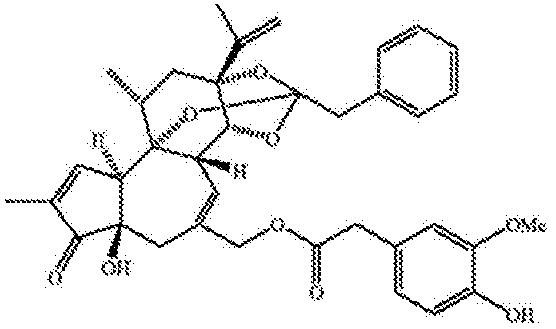
RTXおよびアナログ化合物、例えばチニアトキシンおよび他の化合物(ジテルペンの20-ホモバニリルエステル、例えば12-デオキシホルボール13-フェニルアセテート20-ホモバニレートおよびメゼレイン20-ホモバニレート)は、米国特許第4,939,194号、同第5,021,450号および同第5,232,684号に記載されている。他のレシニフェラトキシン型ホルボイドバニロイドも特定されている(Szallasi et al. (1999) Brit. J. Pharmacol. 128:428-434)。 RTX and analog compounds such as tiniatoxin and other compounds (20-homovanillyl esters of diterpenes, e.g., 12-deoxyphorbol 13-phenylacetate 20-homovanillate and mezerein 20-homovanillate) are described in U.S. Patents 4,939,194, 5,021,450, and 5,232,684. Other resiniferatoxin-type phorboid vanilloids have also been identified (Szallasi et al. (1999) Brit. J. Pharmacol. 128:428-434).
RTXは、TrpV1アゴニストとして公知である。一過性の受容体電位カチオンチャネルサブファミリーVメンバー1であるTrpV1(バニロイド受容体-1(VR1)としても公知)は、侵害受容一次求心性ニューロンにおいて顕著に発現される多量体のカチオンチャネルである(Caterina et al. (1997) Nature 389:816-824;Tominaga et al. (1998) Neuron 21:531-543)。TrpV1の活性化は、典型的には、疼痛性熱の適用によって神経末端において生じ、ある特定のタイプの炎症性刺激中に上方調節される。化学的アゴニストによる末梢組織におけるTrpV1の活性化は、カルシウムチャネルの開口および疼痛感覚の伝達をもたらす(Szalllasi et al. (1999) Mol. Pharmacol. 56:581-587)。しかし、TrpV1を発現するニューロンの細胞体(神経節)への、ある特定のTrpV1アゴニストの直接的な適用は、カルシウムチャネルを開口させ、プログラム細胞死(「アポトーシス」)に至る事象のカスケードを誘発する(Karai et al. (2004) J. of Clin. Invest. 113:1344-1352)。
不適応性疼痛は、治癒にもかかわらず生じ、存在している傷害または他の外部疼痛源には相関しない疼痛である。不適応性疼痛には、それに限定されるものではないが、切断手術を受けた者において生じる疼痛、例えば幻肢痛または断端痛が含まれ、ここでは、治癒プロセス中のニューロンの誤形成が、不適切なニューロンの接続および求心性侵害受容ニューロンの望ましくない活性をもたらし得る。幻肢症候群において経験される疼痛は、不適応性疼痛の一例である。より一般的には、不適応性疼痛は、例えば慢性または持続性求心性侵害受容ニューロン活性後に不適切な量の疼痛が生じ、中枢神経系における疼痛モジュレーション機序が関与する、任意の慢性状態において生じ得る。
不適応性疼痛の処置は、困難なことがある。鎮痛薬の全身投与は、副作用および/または依存性/嗜癖に関する問題に起因して、長期的には望ましくない。一方、侵害受容神経末端の部位における疼痛抑制物質の直接的な投与は、望ましくなく高い用量および/または頻繁な投薬を必要とするおそれがある。さらに、髄腔内および硬膜外投与は、脊髄に近接しているのでリスクがより高い。それにもかかわらず、既存の論文は、不適応性疼痛、例えば幻肢痛における後根神経節および中枢神経系の活性を暗示している。例えば、Subedi et al., Pain Res. Treatment (2011) 2011:864605, 8 pages(幻肢痛の機序における、皮質再構築を伴う中枢神経変化の関与を論じている)、Borkum, J. Rat-Emo. Cognitive-Behav. Ther. (2010) 28:4-24(慢性疼痛における不適応認知の役割を論じている)を参照されたい。現在では、不適応性疼痛の発生は末梢において惹起されるが、中枢神経系において感作をもたらし、その時点でその感作が、末梢治療の成功が期待されない根強い問題になっていると考えられている。したがって、現在の考えでは、後根神経節または中枢神経系を処置せずに後根神経節に対して末梢に位置する神経系の要素に焦点を合わせた処置は、後根神経節または中枢神経系を標的とする処置よりも有効性が低いまたは少ない場合があるという予測に至っている。したがって、当技術分野では、不適応性疼痛の処置において使用するための改善された方法および組成物を開発する必要がある。
RTX is known as a TrpV1 agonist. Transient receptor potential cation channel subfamily V member 1, TrpV1 (also known as vanilloid receptor-1 (VR1)), is a multimeric cation channel that is prominently expressed in nociceptive primary afferent neurons (Caterina et al. (1997) Nature 389:816-824; Tominaga et al. (1998) Neuron 21:531-543). Activation of TrpV1 typically occurs in nerve terminals upon application of painful heat and is upregulated during certain types of inflammatory stimuli. Activation of TrpV1 in peripheral tissues by chemical agonists results in the opening of calcium channels and the transmission of pain sensations (Szalllasi et al. (1999) Mol. Pharmacol. 56:581-587). However, direct application of certain TrpV1 agonists to the cell bodies (ganglia) of TrpV1-expressing neurons opens calcium channels and triggers a cascade of events that lead to programmed cell death ("apoptosis") (Karai et al. (2004) J. of Clin. Invest. 113:1344-1352).
Maladaptive pain is pain that occurs despite healing and does not correlate with existing injury or other external pain sources.Maladaptive pain includes, but is not limited to, pain that occurs in people who have undergone amputation surgery, such as phantom limb pain or stump pain, where the incorrect formation of neurons during the healing process can lead to inappropriate neuronal connections and undesirable activity of afferent nociceptive neurons.The pain experienced in phantom limb syndrome is an example of maladaptive pain.More generally, maladaptive pain can occur in any chronic condition where an inappropriate amount of pain occurs, for example, after chronic or persistent afferent nociceptive neuronal activity, and pain modulation mechanisms in the central nervous system are involved.
Treatment of maladaptive pain can be difficult. Systemic administration of analgesics is undesirable in the long term due to problems with side effects and/or dependency/addiction. On the other hand, direct administration of pain inhibitors at the site of nociceptive nerve endings may require undesirably high doses and/or frequent dosing. Furthermore, intrathecal and epidural administration is more risky due to its close proximity to the spinal cord. Nevertheless, existing literature implicates dorsal root ganglion and central nervous system activity in maladaptive pain, e.g., phantom limb pain. See, for example, Subedi et al., Pain Res. Treatment (2011) 2011:864605, 8 pages (discussing the involvement of central nervous changes with cortical reorganization in the mechanism of phantom limb pain), Borkum, J. Rat-Emo. Cognitive-Behav. Ther. (2010) 28:4-24 (discussing the role of maladaptive cognition in chronic pain). It is currently believed that the occurrence of maladaptive pain is initiated peripherally, but leads to sensitization in central nervous system, and at this point, this sensitization becomes a persistent problem that peripheral treatment is not expected to be successful.Therefore, current thinking leads to the prediction that the treatment that focuses on the elements of the nervous system that are located peripherally to dorsal root ganglion without treating dorsal root ganglion or central nervous system may be less effective or less effective than the treatment that targets dorsal root ganglion or central nervous system.Therefore, there is a need in the art to develop improved methods and compositions for use in the treatment of maladaptive pain.
本開示は、この必要性を満たし、かつ/または他の利益を提供することを目的とする。本明細書では、不適応性疼痛の処置のためにそれを必要とする対象にRTXを神経周囲投与する方法が提供される。本開示は、不適応性疼痛を処置するためのRTXの神経周囲投与が、例えば関節腔において侵害受容神経末端を標的にする処置よりも低用量および/または低頻度の投薬で有効な疼痛緩和を提供することができると同時に、脊髄近傍への投与と関連するリスクを回避することもできるという認識に部分的に基づく。神経周囲投与は、神経末端から下流であるが、細胞体(例えば、後根神経節における感覚ニューロン細胞体)の上流の神経線維(軸索)を標的にする。 The present disclosure is directed to meeting this need and/or providing other benefits. Provided herein are methods of perineural administration of RTX to a subject in need thereof for the treatment of maladaptive pain. The present disclosure is based in part on the recognition that perineural administration of RTX to treat maladaptive pain can provide effective pain relief at lower and/or less frequent dosing than treatments that target nociceptive nerve endings, for example, in the joint space, while also avoiding the risks associated with administration proximal to the spinal cord. Perineural administration targets nerve fibers (axons) downstream from the nerve terminals but upstream of the cell bodies (e.g., sensory neuron cell bodies in the dorsal root ganglion).
したがって、以下の例示的な実施形態が提供される。実施形態1は、不適応性疼痛を処置する方法であって、不適応性疼痛の処置を必要とする対象にレシニフェラトキシン(RTX)を末梢神経周囲投与するステップを含む方法である。 Accordingly, the following exemplary embodiments are provided: Embodiment 1 is a method for treating maladaptive pain, comprising the step of peripheral perineural administration of resiniferatoxin (RTX) to a subject in need of treatment for maladaptive pain.
実施形態2は、不適応性疼痛を処置する方法における使用のための、レシニフェラトキシン(RTX)を含む組成物であって、方法が、不適応性疼痛の処置を必要とする対象にRTXを末梢神経周囲投与するステップを含む、組成物である。 Embodiment 2 is a composition comprising resiniferatoxin (RTX) for use in a method for treating maladaptive pain, the method comprising the step of peripheral perineural administration of RTX to a subject in need of treatment for maladaptive pain.
実施形態3は、方法が、0.1μg~100μgの用量のRTXを投与するステップを含む、実施形態1または2に記載の使用のための方法または組成物である。実施形態4は、RTXの用量が、0.1~1μg、1~2μg、2~5μg、5~10μg、10~20μg、20~30μg、30~40μg、40~50μg、50~60μg、60~70μg、70~80μg、80~90μg、または90~100μgの範囲である、実施形態3に記載の使用のための方法または組成物である。 Embodiment 3 is a method or composition for use according to embodiment 1 or 2, wherein the method comprises administering a dose of RTX of 0.1 μg to 100 μg. Embodiment 4 is a method or composition for use according to embodiment 3, wherein the dose of RTX ranges from 0.1 to 1 μg, 1 to 2 μg, 2 to 5 μg, 5 to 10 μg, 10 to 20 μg, 20 to 30 μg, 30 to 40 μg, 40 to 50 μg, 50 to 60 μg, 60 to 70 μg, 70 to 80 μg, 80 to 90 μg, or 90 to 100 μg.
実施形態5は、RTXが、単一部位に神経周囲投与される、前述の実施形態のいずれか1つに記載の使用のための方法または組成物である。実施形態6は、RTXが、複数部位に神経周囲投与される、前述の実施形態のいずれか1つに記載の使用のための方法または組成物である。 Embodiment 5 is a method or composition for use according to any one of the preceding embodiments, in which the RTX is administered perineurally at a single site.Embodiment 6 is a method or composition for use according to any one of the preceding embodiments, in which the RTX is administered perineurally at multiple sites.
実施形態7は、RTXが、坐骨神経に神経周囲投与される、前述の実施形態のいずれか1つに記載の使用のための方法または組成物である。実施形態8は、RTXが、伏在神経に神経周囲投与される、前述の実施形態のいずれか1つに記載の使用のための方法または組成物である。実施形態9は、RTXが、大腿神経に神経周囲投与される、前述の実施形態のいずれか1つに記載の使用のための方法または組成物である。実施形態10は、RTXが、橈骨神経に神経周囲投与される、前述の実施形態のいずれか1つに記載の使用のための方法または組成物である。実施形態11は、RTXが、尺骨神経に神経周囲投与される、前述の実施形態のいずれか1つに記載の使用のための方法または組成物である。実施形態12は、RTXが、正中神経に神経周囲投与される、前述の実施形態のいずれか1つに記載の使用のための方法または組成物である。実施形態13は、RTXが、筋皮神経に神経周囲投与される、前述の実施形態のいずれか1つに記載の使用のための方法または組成物である。実施形態14は、RTXが、掌側指神経に神経周囲投与される、前述の実施形態のいずれか1つに記載の使用のための方法または組成物である。 Embodiment 7 is a method or composition for use according to any one of the preceding embodiments, wherein RTX is administered perineurally to the sciatic nerve.Embodiment 8 is a method or composition for use according to any one of the preceding embodiments, wherein RTX is administered perineurally to the saphenous nerve.Embodiment 9 is a method or composition for use according to any one of the preceding embodiments, wherein RTX is administered perineurally to the femoral nerve.Embodiment 10 is a method or composition for use according to any one of the preceding embodiments, wherein RTX is administered perineurally to the radial nerve.Embodiment 11 is a method or composition for use according to any one of the preceding embodiments, wherein RTX is administered perineurally to the ulnar nerve.Embodiment 12 is a method or composition for use according to any one of the preceding embodiments, wherein RTX is administered perineurally to the median nerve.Embodiment 13 is a method or composition for use according to any one of the preceding embodiments, wherein RTX is administered perineurally to the musculocutaneous nerve. Embodiment 14 is a method or composition for use according to any one of the preceding embodiments, wherein the RTX is administered perineurally to the palmar digital nerves.
実施形態15は、RTXが、1つまたは複数の指からの感覚入力に集合的に対応する複数部位に神経周囲投与される、前述の実施形態のいずれか1つに記載の使用のための方法または組成物である。実施形態16は、RTXが、足または手からの感覚入力に集合的に対応する複数部位に神経周囲投与される、前述の実施形態のいずれか1つに記載の使用のための方法または組成物である。実施形態17は、RTXが、前肢からの感覚入力に集合的に対応する複数部位に神経周囲投与される、前述の実施形態のいずれか1つに記載の使用のための方法または組成物である。実施形態18は、RTXが、肢からの感覚入力に集合的に対応する複数部位に神経周囲投与される、前述の実施形態のいずれか1つに記載の使用のための方法または組成物である。実施形態19は、RTXが、関節からの感覚入力に集合的に対応する複数部位に神経周囲投与される、前述の実施形態のいずれか1つに記載の使用のための方法または組成物である。 Embodiment 15 is a method or composition for use according to any one of the preceding embodiments, in which RTX is administered perineurally to multiple sites that collectively correspond to sensory input from one or more digits.Embodiment 16 is a method or composition for use according to any one of the preceding embodiments, in which RTX is administered perineurally to multiple sites that collectively correspond to sensory input from a foot or hand.Embodiment 17 is a method or composition for use according to any one of the preceding embodiments, in which RTX is administered perineurally to multiple sites that collectively correspond to sensory input from a forelimb.Embodiment 18 is a method or composition for use according to any one of the preceding embodiments, in which RTX is administered perineurally to multiple sites that collectively correspond to sensory input from a limb.Embodiment 19 is a method or composition for use according to any one of the preceding embodiments, in which RTX is administered perineurally to multiple sites that collectively correspond to sensory input from a joint.
実施形態20は、対象が、切断手術を受けた者である、前述の実施形態のいずれか1つに記載の使用のための方法または組成物である。実施形態21は、神経周囲投与が、切断部位の下流の1つまたは複数の神経線維を標的とする、前述の実施形態のいずれか1つに記載の使用のための方法または組成物である。実施形態22は、対象が、幻肢痛または断端痛に罹患している、前述の実施形態のいずれか1つに記載の使用のための方法または組成物である。実施形態23は、神経周囲投与が、切断部位の下流の少なくとも2つ、3つ、4つ、または5つの神経線維を標的とする、実施形態20~22のいずれか1つに記載の使用のための方法または組成物である。 Embodiment 20 is a method or composition for use according to any one of the preceding embodiments, wherein the subject has undergone amputation surgery.Embodiment 21 is a method or composition for use according to any one of the preceding embodiments, wherein the perineural administration targets one or more nerve fibers downstream of the amputation site.Embodiment 22 is a method or composition for use according to any one of the preceding embodiments, wherein the subject suffers from phantom limb pain or stump pain.Embodiment 23 is a method or composition for use according to any one of embodiments 20-22, wherein the perineural administration targets at least two, three, four, or five nerve fibers downstream of the amputation site.
実施形態24は、対象が、神経末端において異常神経成長を有する、前述の実施形態のいずれか1つに記載の使用のための方法または組成物である。実施形態25は、神経周囲投与が、その末梢端に異常成長を伴う神経の下流の1つまたは複数の神経線維を標的とする、実施形態24に記載の使用のための方法または組成物である。実施形態26は、神経周囲投与が、神経腫の下流の1つまたは複数の神経線維を標的とする、前述の実施形態のいずれか1つに記載の使用のための方法または組成物である。 Embodiment 24 is a method or composition for use according to any one of the preceding embodiments, wherein the subject has abnormal nerve growth at the nerve ending.Embodiment 25 is a method or composition for use according to embodiment 24, wherein the perineural administration targets one or more nerve fibers downstream of a nerve with abnormal growth at its distal end.Embodiment 26 is a method or composition for use according to any one of the preceding embodiments, wherein the perineural administration targets one or more nerve fibers downstream of a neuroma.
実施形態27は、前述の実施形態のいずれか1つに記載の使用のための方法または組成物であって、方法が、RTXおよび薬学的に許容される担体を含む医薬製剤を投与するステップを含む、方法または組成物である。実施形態28は、薬学的に許容される担体が、水を含む、実施形態27に記載の使用のための方法または組成物である。実施形態29は、薬学的に許容される担体が、ポリソルベート(登録商標)80を含む、実施形態27または28に記載の使用のための方法または組成物である。実施形態30は、薬学的に許容される担体が、ポリエチレングリコールを含む、実施形態27~29のいずれか1つに記載の使用のための方法または組成物である。実施形態31は、薬学的に許容される担体が、糖または糖アルコールを含む、実施形態27~30のいずれか1つに記載の使用のための方法または組成物である。実施形態32は、薬学的に許容される担体が、マンニトールを含む、実施形態31に記載の使用のための方法または組成物である。実施形態33は、薬学的に許容される担体が、デキストロースを含む、実施形態31または32に記載の使用のための方法または組成物である。実施形態34は、薬学的に許容される担体が、薬学的に許容される緩衝液を含む、実施形態27~33のいずれか1つに記載の使用のための方法または組成物である。実施形態35は、薬学的に許容される担体が、リン酸緩衝液を含む、実施形態34に記載の使用のための方法または組成物である。実施形態36は、医薬製剤が、6~7.6の範囲のpHを有する、実施形態27~35のいずれか1つに記載の使用のための方法または組成物である。実施形態37は、医薬製剤が、6~6.4、6.3~6.7、6.4~6.8、6.8~7.2、7~7.4、または7.2~7.6の範囲のpHを有する、実施形態36に記載の使用のための方法または組成物である。実施形態38は、医薬製剤が、6.5または7.2のpHを有する、実施形態36に記載の使用のための方法または組成物である。実施形態39は、薬学的に許容される担体が、薬学的に許容される塩を含む、実施形態27~38のいずれか1つに記載の使用のための方法または組成物である。実施形態40は、薬学的に許容される塩が、NaClである、実施形態39に記載の使用のための方法または組成物である。実施形態41は、医薬製剤におけるRTXの濃度が、0.02~0.1μg/mlまたは0.1~300μg/mlの範囲である、実施形態27~40のいずれか1つに記載の使用のための方法または組成物である。実施形態42は、医薬製剤におけるRTXの濃度が、0.02~0.1μg/ml、0.1~1μg/ml、1~5μg/ml、5~10μg/ml、10~20μg/ml、20~50μg/ml、50~100μg/ml、100~150μg/ml、150~200μg/ml、200~250μg/ml、または250~300μg/mlの範囲である、実施形態41に記載の使用のための方法または組成物である。実施形態43は、医薬製剤におけるRTXの濃度が、150~250μg/mlの範囲であるか、または約200μg/mlである、実施形態41または42に記載の使用のための方法または組成物である。実施形態43.1は、医薬製剤におけるRTXの濃度が、0.1~200μg/mlの範囲であり、必要に応じて医薬製剤におけるRTXの濃度が、0.1~50μg/mlの範囲である、実施形態41または42に記載の使用のための方法または組成物である。実施形態43.2は、RTXが、0.05~10mlの注射体積で投与され、必要に応じて注射体積が、0.05~0.2ml、0.2~0.5ml、0.5~1ml、1~2ml、2~5ml、または5~10mlの範囲である、前述の実施形態のいずれか1つに記載の使用のための方法または組成物である。 Embodiment 27 is a method or composition for use according to any one of the preceding embodiments, wherein the method comprises administering a pharmaceutical formulation comprising RTX and a pharma- ceutically acceptable carrier.Embodiment 28 is a method or composition for use according to embodiment 27, wherein the pharma- ceutically acceptable carrier comprises water.Embodiment 29 is a method or composition for use according to embodiment 27 or 28, wherein the pharma- ceutically acceptable carrier comprises Polysorbate 80.Embodiment 30 is a method or composition for use according to any one of embodiments 27-29, wherein the pharma- ceutically acceptable carrier comprises polyethylene glycol.Embodiment 31 is a method or composition for use according to any one of embodiments 27-30, wherein the pharma- ceutically acceptable carrier comprises a sugar or sugar alcohol.Embodiment 32 is a method or composition for use according to embodiment 31, wherein the pharma- ceutically acceptable carrier comprises mannitol. Embodiment 33 is a method or composition for use according to embodiment 31 or 32, wherein the pharma- ceutically acceptable carrier comprises dextrose.Embodiment 34 is a method or composition for use according to any one of embodiments 27-33, wherein the pharma- ceutically acceptable carrier comprises a pharma- ceutically acceptable buffer.Embodiment 35 is a method or composition for use according to embodiment 34, wherein the pharma- ceutically acceptable carrier comprises a phosphate buffer.Embodiment 36 is a method or composition for use according to any one of embodiments 27-35, wherein the pharmaceutical formulation has a pH in the range of 6 to 7.6.Embodiment 37 is a method or composition for use according to embodiment 36, wherein the pharmaceutical formulation has a pH in the range of 6 to 6.4, 6.3 to 6.7, 6.4 to 6.8, 6.8 to 7.2, 7 to 7.4, or 7.2 to 7.6.Embodiment 38 is a method or composition for use according to embodiment 36, wherein the pharmaceutical formulation has a pH of 6.5 or 7.2. Embodiment 39 is a method or composition for use according to any one of embodiments 27-38, wherein the pharma- ceutically acceptable carrier comprises a pharma- ceutically acceptable salt.Embodiment 40 is a method or composition for use according to embodiment 39, wherein the pharma- ceutically acceptable salt is NaCl.Embodiment 41 is a method or composition for use according to any one of embodiments 27-40, wherein the concentration of RTX in the pharmaceutical formulation ranges from 0.02 to 0.1 μg/ml or 0.1 to 300 μg/ml. Embodiment 42 is a method or composition for use according to embodiment 41, wherein the concentration of RTX in the pharmaceutical formulation ranges from 0.02 to 0.1 μg/ml, 0.1 to 1 μg/ml, 1 to 5 μg/ml, 5 to 10 μg/ml, 10 to 20 μg/ml, 20 to 50 μg/ml, 50 to 100 μg/ml, 100 to 150 μg/ml, 150 to 200 μg/ml, 200 to 250 μg/ml, or 250 to 300 μg/ml. Embodiment 43 is a method or composition for use according to embodiment 41 or 42, wherein the concentration of RTX in the pharmaceutical formulation ranges from 150 to 250 μg/ml, or is about 200 μg/ml. Embodiment 43.1 is a method or composition for use according to embodiment 41 or 42, in which the concentration of RTX in the pharmaceutical formulation ranges from 0.1 to 200 μg/ml, and optionally the concentration of RTX in the pharmaceutical formulation ranges from 0.1 to 50 μg/ml.Embodiment 43.2 is a method or composition for use according to any one of the preceding embodiments, in which RTX is administered in an injection volume of 0.05 to 10 ml, and optionally the injection volume ranges from 0.05 to 0.2 ml, 0.2 to 0.5 ml, 0.5 to 1 ml, 1 to 2 ml, 2 to 5 ml, or 5 to 10 ml.
実施形態44は、対象が、哺乳動物である、前述の実施形態のいずれか1つに記載の使用のための方法または組成物である。実施形態45は、対象が、ネコである、実施形態44に記載の使用のための方法または組成物である。実施形態46は、対象が、イヌである、実施形態44に記載の使用のための方法または組成物である。実施形態47は、対象が、ウマまたはブタである、実施形態44に記載の使用のための方法または組成物である。実施形態48は、哺乳動物が、反芻動物である、実施形態44に記載の使用のための方法または組成物である。実施形態49は、反芻動物が、ウシ、ヒツジ、またはヤギである、実施形態48に記載の使用のための方法または組成物である。実施形態50は、哺乳動物が、家畜化哺乳動物である、実施形態44~49のいずれか1つに記載の使用のための方法または組成物である。 Embodiment 44 is a method or composition for use according to any one of the preceding embodiments, wherein the subject is a mammal.Embodiment 45 is a method or composition for use according to embodiment 44, wherein the subject is a cat.Embodiment 46 is a method or composition for use according to embodiment 44, wherein the subject is a dog.Embodiment 47 is a method or composition for use according to embodiment 44, wherein the subject is a horse or a pig.Embodiment 48 is a method or composition for use according to embodiment 44, wherein the mammal is a ruminant.Embodiment 49 is a method or composition for use according to embodiment 48, wherein the ruminant is a cow, a sheep, or a goat.Embodiment 50 is a method or composition for use according to any one of embodiments 44-49, wherein the mammal is a domesticated mammal.
実施形態51は、対象が、ヒトである、実施形態44に記載の使用のための方法または組成物である。 Embodiment 51 is a method or composition for use according to embodiment 44, in which the subject is a human.
実施形態52は、処置が、不適応性疼痛の局所および中枢効果を低減する、前述の実施形態のいずれか1つに記載の使用のための方法または組成物である。実施形態53は、対象が、処置の前に不適応性疼痛の1つまたは複数の行動症状を有しており、処置が、1つまたは複数の行動症状を低減または排除する、前述の実施形態のいずれか1つに記載の使用のための方法または組成物である。 Embodiment 52 is a method or composition for use according to any one of the preceding embodiments, wherein the treatment reduces the local and central effects of maladaptive pain.Embodiment 53 is a method or composition for use according to any one of the preceding embodiments, wherein the subject has one or more behavioral symptoms of maladaptive pain prior to the treatment, and the treatment reduces or eliminates one or more behavioral symptoms.
II.詳細な説明
ここで、本発明のある特定の実施形態に詳細に言及し、その例を添付の図に例示する。本発明は、例示される実施形態と共に記載されるが、例示される実施形態は、本発明をそれらの実施形態に限定することを企図しないことが理解されよう。それとは対照的に、本発明は、あらゆる代替形態、改変形態、および等価形態を網羅することが企図され、それらは添付の特許請求の範囲によって定義される通り、本発明に含まれ得る。
II. DETAILED DESCRIPTION Reference will now be made in detail to certain embodiments of the invention, examples of which are illustrated in the accompanying figures. While the invention will be described in conjunction with the illustrated embodiments, it will be understood that they are not intended to limit the invention to those embodiments. On the contrary, the invention is intended to cover all alternatives, modifications, and equivalents, which may be included within the invention as defined by the appended claims.
本発明の教示を詳細に記載する前に、本開示は、具体的な組成物またはプロセスステップに限定されず、したがって変わり得ると理解されるべきである。本明細書および添付の特許請求の範囲において使用される場合、単数形「1つの(a)」、「1つの(an)」および「その(the)」は、状況によって別段明示されない限り、複数の参照物を含むことに留意すべきである。したがって、例えば「1つのコンジュゲート」への言及は、複数のコンジュゲートを含み、「1個の細胞」への言及は、複数の細胞などを含む。 Before describing the teachings of the present invention in detail, it is to be understood that the disclosure is not limited to specific compositions or process steps, as such may vary. It should be noted that as used in this specification and the appended claims, the singular forms "a," "an," and "the" include plural references unless the context clearly dictates otherwise. Thus, for example, a reference to "a conjugate" includes a plurality of conjugates, a reference to "a cell" includes a plurality of cells, and so forth.
数値範囲は、その範囲を規定する数の両端を含む。測定された測定可能な値は、有効桁およびその測定と関連する誤差を考慮して近似であると理解される。また、「含む(comprise)」、「含む(comprises)」、「含む(comprising)」、「含有する(contain)」、「含有する(contains)」、「含有する(containing)」、「含む(include)」、「含む(includes)」、および「含む(including)」の使用は、制限することを企図されない。前述の概要および詳細な説明は、共に、単に例示的および説明的であり、本発明の教示を制限しないと理解されるべきである。 Numerical ranges are inclusive of the endpoints of the numbers defining the range. Measurements of measurable values are understood to be approximate taking into account significant digits and errors associated with their measurement. Additionally, the use of "comprise," "comprises," "comprising," "contain," "contains," "containing," "include," "includes," and "including" are not intended to be limiting. Both the foregoing summary and detailed description are merely exemplary and explanatory and are not intended to limit the teachings of the present invention.
前述の明細書において具体的に記載されない限り、様々な構成成分を「含む(comprising)」ものとして列挙している本明細書の実施形態は、列挙された構成成分「からなる(consisting of)」または「から本質的になる(consisting essentially of)」ことも意図され、様々な構成成分「からなる(consisting of)」ものとして列挙している本明細書の実施形態は、列挙された構成成分を「含む(comprising)」またはそれ「から本質的になる(consisting essentially of)」ことも意図され、様々な構成成分「から本質的になる(consisting essentially of)」ものとして列挙している本明細書の実施形態は、列挙された構成成分「からなる(consisting of)」またはそれを「含む(comprising)」ことも意図される(この互換性は、特許請求の範囲におけるこれらの用語の使用には適用されない)。 Unless specifically stated otherwise in the foregoing specification, embodiments herein that recite various components as "comprising" are also intended to be "consisting of" or "consisting essentially of" the recited components, and embodiments herein that recite various components as "consisting of" are also intended to be "comprising" or "consisting essentially of" the recited components, and embodiments herein that recite various components as "consisting essentially of" are also intended to be "consisting of" or "comprising" the recited components (this interchangeability does not apply to the use of these terms in the claims).
本明細書で使用されるセクションの見出しは、単に構成目的のものであり、いかなる方式でも望ましい主題を制限するものと解釈されるべきではない。参照により組み込まれる任意の文献が、本明細書において定義された任意の用語と矛盾する場合には、本明細書が優先する。本発明の教示は、様々な実施形態と共に記載されるが、本発明の教示をこのような実施形態に限定することは企図されない。それとは対照的に、本発明の教示は、当業者によって認識される通り、様々な代替形態、改変形態、および等価形態を包含する。
A.定義
The section headings used herein are merely for organizational purposes and should not be construed as limiting the desired subject matter in any manner. In the event that any document incorporated by reference contradicts any term defined herein, the present specification shall control. Although the teachings of the present invention are described with various embodiments, it is not intended to limit the teachings of the present invention to such embodiments. To the contrary, the teachings of the present invention encompass various alternatives, modifications, and equivalents, as will be recognized by those skilled in the art.
A. Definitions
「末梢神経周囲投与」または簡単に「神経周囲投与」は、本明細書で使用される場合、末梢神経末端と細胞体との間の神経線維への投与である。例えば、神経周囲投与は、薬剤が神経線維と接触するように、末梢神経末端と神経細胞体との間の神経線維に十分に近接させてその薬剤を注射することを包含する。 "Peripheral perineural administration" or simply "perineural administration", as used herein, is administration to nerve fibers between a peripheral nerve ending and a cell body. For example, perineural administration includes injecting an agent in sufficient proximity to a nerve fiber between a peripheral nerve ending and a nerve cell body such that the agent contacts the nerve fiber.
「不適応性疼痛」は、組織が治癒した後、および/または組織損傷がない状態で持続する、実際の組織損傷には不相応な疼痛を指し、したがってその疼痛自体は、傷害などの現在の根本的な任意の疼痛源とは別の問題である。不適応性疼痛は、感覚ニューロンに影響を及ぼす損傷または疾患から生じる神経障害性疼痛とは異なる。 "Maladaptive pain" refers to pain that persists after tissue has healed and/or in the absence of tissue damage, that is disproportionate to actual tissue damage, and thus is itself a separate issue from any current underlying source of pain, such as injury. Maladaptive pain is distinct from neuropathic pain, which results from injury or disease affecting sensory neurons.
神経周囲投与の部位に関して使用される「下流」は、神経末端から遠位にある軸索に沿った部位を指し、したがって神経末端自体は、投与される薬剤によっては接触されない。 "Downstream," as used with respect to the site of perineural administration, refers to a site along the axon distal to the nerve terminal, such that the nerve terminal itself is not contacted by the administered agent.
「反芻動物」は、反芻胃を有する哺乳動物である。反芻動物の例として、それに限定されるものではないが、ウシ、ヒツジ、アンテロープ、シカ、およびキリンが挙げられる。 A "ruminant" is a mammal that has a ruminal stomach. Examples of ruminants include, but are not limited to, cattle, sheep, antelope, deer, and giraffes.
用語「またはそれらの組合せ(or a combination thereof)」および「またはそれらの組合せ(or combinations thereof)」は、本明細書で使用される場合、その用語に先行して列挙される用語のありとあらゆる並び替えおよび組合せを指す。例えば、「A、B、C、またはそれらの組合せ」は、A、B、C、AB、AC、BC、またはABCの少なくとも1つを含むことが企図され、特定の文脈において順序が重要である場合には、BA、CA、CB、ACB、CBA、BCA、BAC、またはCABを含むことも企図される。この例に続いて、BB、AAA、AAB、BBC、AAABCCCC、CBBAAA、CABABBなどの1つまたは複数の項目または用語の反復を含有する組合せは、明らかに含まれる。当業者は、文脈から別段明らかでない限り、任意の組合せの項目または用語の数には典型的に制限がないことを理解されよう。 The terms "or a combination thereof" and "or combinations thereof" as used herein refer to any and all permutations and combinations of the terms listed preceding the term. For example, "A, B, C, or a combination thereof" is intended to include at least one of A, B, C, AB, AC, BC, or ABC, and also BA, CA, CB, ACB, CBA, BCA, BAC, or CAB if order is important in the particular context. Following this example, combinations containing repeats of one or more items or terms, such as BB, AAA, AAB, BBC, AAABCCCC, CBBAAA, CABABB, are clearly included. Those skilled in the art will understand that there is typically no limit to the number of items or terms in any combination unless otherwise clear from the context.
「または」は、包含的な意味で使用され、すなわち文脈により別段必要とされない限り、「および/または」と等価である。
B.使用のための例示的な方法および組成物
"Or" is used in the inclusive sense, ie, equivalent to "and/or," unless otherwise required by context.
B. Exemplary Methods and Compositions for Use
本明細書では、不適応性疼痛を処置するための方法であって、不適応性疼痛の処置を必要とする対象にレシニフェラトキシン(RTX)を末梢神経周囲投与するステップを含む方法が提供される。また、不適応性疼痛を処置する方法において使用するためのRTXを含む組成物であって、方法が、不適応性疼痛の処置を必要とする対象にRTXを末梢神経周囲投与するステップを含む、組成物が提供される。本開示は、後根神経節および中枢神経系が、その起源を含めて不適応性疼痛において実質的役割を果たすという文献の説明(例えば、上記Subedi et al.およびBorkum)にもかかわらず、RTXの末梢神経周囲投与が、不適応性疼痛の著しい緩和を提供することができるという認識に部分的に基づく。いかなる特定の理論にも拘泥するものではないが、RTXの末梢神経周囲投与は、不適応性疼痛が、末梢処置によって対処される可能性が低い根強い問題としての中枢神経系における感作を伴うという概念に反して、後根神経節または中枢神経系の直接的な処置を必要とすることなく、局所的効果だけでなく不適応性疼痛を長期間低減または制御する中枢神経的効果も提供するのに十分な度合いまで、それに十分な期間、求心性侵害受容ニューロンによって伝えられるシグナルを中断することができる。したがって、本明細書に開示される通り、神経周囲経路を介して不適応性疼痛を処置するためのRTXの投与は、後根神経節もしくは中枢神経系の処置、または全身的処置およびそれに付随するリスクを伴わず、ならびに/あるいは侵害受容神経末端(例えば、関節腔、皮膚、または筋肉における)を標的にする処置と比較して投薬量および/または頻度を低減して有効な疼痛緩和を可能にするなどの、文献からは予測することができなかった利益を提供し得る。
1.対象
Provided herein is a method for treating maladaptive pain, comprising administering resiniferatoxin (RTX) perineurally to a subject in need of treatment for maladaptive pain.Also provided is a composition comprising RTX for use in a method for treating maladaptive pain, comprising administering RTX perineurally to a subject in need of treatment for maladaptive pain.The present disclosure is based in part on the recognition that, despite the literature's explanation that the dorsal root ganglion and the central nervous system play a substantial role in maladaptive pain, including its origin (e.g., Subedi et al. and Borkum, supra), perineural administration of RTX can provide significant relief of maladaptive pain. Without being bound by any particular theory, peripheral perineural administration of RTX can interrupt the signals conveyed by afferent nociceptive neurons to a sufficient degree and for a sufficient period of time to provide not only a local effect but also a central effect that reduces or controls maladaptive pain for a long period of time without requiring direct treatment of the dorsal root ganglion or central nervous system, contrary to the notion that maladaptive pain involves sensitization in the central nervous system as a persistent problem that is unlikely to be addressed by peripheral treatment. Thus, as disclosed herein, administration of RTX to treat maladaptive pain via perineural routes can provide benefits that could not be predicted from the literature, such as enabling effective pain relief without treatment of the dorsal root ganglion or central nervous system, or systemic treatment and its associated risks, and/or reduced dosage and/or frequency compared to treatment targeting nociceptive nerve endings (e.g., in joint cavities, skin, or muscles).
1. Target
本明細書に記載される組成物および方法は、RTXが有効となり、例えばTrpV1またはそのホモログに結合し活性化することができ、不適応性疼痛のための処置を必要とする、任意の対象に使用するためのものである。一部の実施形態では、対象は、哺乳動物である。一部の実施形態では、哺乳動物は、ヒトである。一部の実施形態では、哺乳動物は、ネコである。一部の実施形態では、哺乳動物は、イヌである。一部の実施形態では、哺乳動物は、反芻動物である。一部の実施形態では、哺乳動物は、ウマ、ウシ、ブタ、ヒツジ、またはヤギである。 The compositions and methods described herein are for use in any subject in need of treatment for maladaptive pain in which RTX is effective, e.g., capable of binding to and activating TrpV1 or a homolog thereof. In some embodiments, the subject is a mammal. In some embodiments, the mammal is a human. In some embodiments, the mammal is a cat. In some embodiments, the mammal is a dog. In some embodiments, the mammal is a ruminant. In some embodiments, the mammal is a horse, cow, pig, sheep, or goat.
一部の実施形態では、対象は、切断手術を受けた者である。一部の実施形態では、対象は、幻肢痛に罹患している。例えば、幻肢痛は、切断された指、手、前腕、腕、足趾、足、脚、またはその一部(例えば、脚、膝上または膝下について)の部位で生じ得る。一部の実施形態では、対象は、断端痛に罹患している。例えば、幻肢痛は、例えば、切断された指、手、前腕、腕、足趾、足、脚、またはその一部(例えば、脚、膝上または膝下について)の、切断後の残留肢の末端で生じ得る。幻肢痛または断端痛を有し得る対象の別の例は、抜爪動物、例えばネコである。一部の実施形態では、対象は、神経末端において異常神経成長を有する。例えば、神経末端における異常成長は、神経腫であり得る。 In some embodiments, the subject has undergone amputation surgery. In some embodiments, the subject suffers from phantom pain. For example, the phantom pain can occur at the site of an amputated finger, hand, forearm, arm, toe, foot, leg, or portion thereof (e.g., for a leg, above or below the knee). In some embodiments, the subject suffers from stump pain. For example, the phantom pain can occur at the end of a residual limb after amputation, for example, for an amputated finger, hand, forearm, arm, toe, foot, leg, or portion thereof (e.g., for a leg, above or below the knee). Another example of a subject that may have phantom pain or stump pain is a clawed animal, such as a cat. In some embodiments, the subject has abnormal nerve growth in a nerve ending. For example, the abnormal growth in a nerve ending can be a neuroma.
一部の実施形態では、対象は、処置の前に不適応性疼痛の1つまたは複数の行動症状を有しており、処置は、1つまたは複数の行動症状を低減または排除する。例えば、家畜動物において、不適応性疼痛の行動症状には、行動学的問題、例えば躾けられたときの攻撃性、または注意を引こうとする行動の減少(撫でられることを求めなくなる)が含まれ、ネコにおいては、排泄行動問題(例えば、ネコ用トイレの外での排尿または排便、ネコ用トイレの中に排泄物を掘って埋めない)が含まれる。
2.投与部位
In some embodiments, the subject has one or more behavioral symptoms of maladaptive pain prior to treatment, and treatment reduces or eliminates one or more behavioral symptoms. For example, in livestock animals, behavioral symptoms of maladaptive pain include behavioral problems, such as aggression when disciplined, or reduced attention-seeking behavior (not wanting to be petted), and in cats, elimination behavior problems (e.g., urinating or defecating outside the litter box, not digging and burying waste in the litter box).
2. Administration site
RTXは、不適応性疼痛に関与する神経に応じて、1つまたは2つ以上の部位に神経周囲投与され得る。一部の実施形態では、RTXは、単一部位に神経周囲投与される。 RTX may be administered perineurally at one or more sites depending on the nerves involved in the maladaptive pain. In some embodiments, RTX is administered perineurally at a single site.
一部の実施形態では、RTXは、大腿神経に神経周囲投与される。一部の実施形態では、RTXは、坐骨神経に神経周囲投与される。一部の実施形態では、RTXは、伏在神経に神経周囲投与される。一部の実施形態では、RTXは、橈骨神経に神経周囲投与される。一部の実施形態では、RTXは、尺骨神経に神経周囲投与される。一部の実施形態では、RTXは、正中神経に神経周囲投与される。一部の実施形態では、RTXは、筋皮神経に神経周囲投与される。一部の実施形態では、RTXは、掌側指神経に神経周囲投与される。坐骨神経は、脚(四足動物の場合には後肢)の後下部から走っている。伏在神経は、大腿神経の最大の皮枝であり、下腿(四足動物の場合には下後肢)に位置する。大腿神経は、脚の上大腿(四足動物の場合には上後肢)に位置する。橈骨神経は、上腕(四足動物の場合には上前肢)に位置する。尺骨神経は、前腕および手(四足動物の場合には前肢)に位置する。正中神経は、上腕(四足動物の場合には前肢)に位置する。筋皮神経は、腕(四足動物の場合には前肢)に位置し、上腕骨の中央の正中神経から枝分かれしている。掌側指神経は、手(四足動物の場合には前肢の末端分節に)に位置する。 In some embodiments, RTX is administered perineurally to the femoral nerve. In some embodiments, RTX is administered perineurally to the sciatic nerve. In some embodiments, RTX is administered perineurally to the saphenous nerve. In some embodiments, RTX is administered perineurally to the radial nerve. In some embodiments, RTX is administered perineurally to the ulnar nerve. In some embodiments, RTX is administered perineurally to the median nerve. In some embodiments, RTX is administered perineurally to the musculocutaneous nerve. In some embodiments, RTX is administered perineurally to the palmar digital nerve. The sciatic nerve runs from the lower posterior part of the leg (hind leg in the case of quadrupeds). The saphenous nerve is the largest cutaneous branch of the femoral nerve and is located in the lower leg (lower hind leg in the case of quadrupeds). The femoral nerve is located in the upper thigh of the leg (upper hind leg in the case of quadrupeds). The radial nerve is located in the upper arm (upper fore leg in the case of quadrupeds). The ulnar nerve is located in the forearm and hand (or in the forelimb in quadrupeds). The median nerve is located in the upper arm (or in the forelimb in quadrupeds). The musculocutaneous nerve is located in the arm (or in the forelimb in quadrupeds), branching off the median nerve at the middle of the humerus. The palmar digital nerves are located in the hand (or in the distal segments of the forelimb in quadrupeds).
一部の実施形態では、RTXは、複数部位に神経周囲投与される。例えば、坐骨および伏在神経の処置は、脚の疼痛をブロックすることができ、尺骨および掌側指神経の処置は、手の疼痛をブロックすることができ、橈骨および正中神経の処置は、上腕の疼痛をブロックすることができる。一部の実施形態では、RTXは、1つまたは複数の指からの感覚入力に集合的に対応する複数部位に神経周囲投与される。一部の実施形態では、RTXは、足または手からの感覚入力に集合的に対応する複数部位に神経周囲投与される。一部の実施形態では、RTXは、前肢(例えば、前腕または下腿)からの感覚入力に集合的に対応する複数部位に神経周囲投与される。一部の実施形態では、RTXは、肢(例えば、腕または脚)からの感覚入力に集合的に対応する複数部位に神経周囲投与される。一部の実施形態では、RTXは、関節からの感覚入力に集合的に対応する複数部位に神経周囲投与される。一部の実施形態では、複数部位には、複数の神経枝(例えば、尺骨神経の背枝および掌枝)が含まれる。 In some embodiments, RTX is administered perineurally to multiple sites. For example, treatment of the sciatic and saphenous nerves can block pain in the leg, treatment of the ulnar and palmar digital nerves can block pain in the hand, and treatment of the radial and median nerves can block pain in the upper arm. In some embodiments, RTX is administered perineurally to multiple sites that collectively correspond to sensory input from one or more fingers. In some embodiments, RTX is administered perineurally to multiple sites that collectively correspond to sensory input from the foot or hand. In some embodiments, RTX is administered perineurally to multiple sites that collectively correspond to sensory input from the forelimb (e.g., the forearm or lower leg). In some embodiments, RTX is administered perineurally to multiple sites that collectively correspond to sensory input from the limb (e.g., the arm or leg). In some embodiments, RTX is administered perineurally to multiple sites that collectively correspond to sensory input from a joint. In some embodiments, the multiple sites include multiple nerve branches (e.g., the dorsal and palmar branches of the ulnar nerve).
一部の実施形態では、(RTX)は、注射によって投与される。注射は、例えば1ccシリンジ、またはより一般的には、投薬体積に適したサイズのシリンジを使用して実施され得る。
3.投薬量
In some embodiments, (RTX) is administered by injection. Injection can be performed using, for example, a 1 cc syringe, or more generally, a syringe of an appropriate size for the dosage volume.
3. Dosage
一部の実施形態では、RTXは、0.1~100μgの用量で投与される。一部の実施形態では、RTXの用量は、0.1~0.5μg、0.5~1μg、1~2μg、2~5μg、5~10μg、10~20μg、20~30μg、30~40μg、40~50μg、50~60μg、60~70μg、70~80μg、80~90μg、または90~100μgの範囲である。例えば、抜爪ネコにおいて、例えば全用量2.5μgが、一方または両方の前肢に神経周囲投与され得る。ヒトにおいて、一部の実施形態では、25μgまでの用量(例えば、5~10μg、10~15μg、15~20μgもしくは20~25μg、または約5μg、約10μg、約15μg、約20μgもしくは約25μg)が投与される。一部の実施形態では、先に列挙した範囲のいずれかの全投薬量、例えば0.5~1μg、1~2μg、2~5μg、5~10μg、10~15μg、15~20μg、または20~25μgの全投薬量を用いる、2、3、または4ポイント神経ブロック技術が使用される。 In some embodiments, RTX is administered at a dose of 0.1-100 μg. In some embodiments, the dose of RTX ranges from 0.1-0.5 μg, 0.5-1 μg, 1-2 μg, 2-5 μg, 5-10 μg, 10-20 μg, 20-30 μg, 30-40 μg, 40-50 μg, 50-60 μg, 60-70 μg, 70-80 μg, 80-90 μg, or 90-100 μg. For example, in declawed cats, a total dose of, for example, 2.5 μg may be administered perineurally to one or both forelimbs. In humans, in some embodiments, a dose of up to 25 μg (e.g., 5-10 μg, 10-15 μg, 15-20 μg, or 20-25 μg, or about 5 μg, about 10 μg, about 15 μg, about 20 μg, or about 25 μg) is administered. In some embodiments, a 2-, 3-, or 4-point nerve block technique is used, using a total dosage in any of the ranges listed above, e.g., 0.5-1 μg, 1-2 μg, 2-5 μg, 5-10 μg, 10-15 μg, 15-20 μg, or 20-25 μg total dosage.
投薬量および体積は、神経線維の投与部位の近接度に応じて調整することができる。例えば、投与部位が神経に緊密に近接するように超音波または神経刺激物質が使用される場合、より低い用量および体積を使用することができる。あるいは、神経ブロック、例えば肩甲骨または坐骨ブロックは、所望の神経と接触させるために3~5mlなどのより大きい体積を使用して達成することができる。特に、RTXは、TRPV1受容体に特異的であり、したがってRTXに対して感受性になるのに十分なTRPV1受容体を有していない運動ニューロンなどの非標的神経には影響を及ぼさない。
4.製剤
Dosage and volume can be adjusted depending on the proximity of the administration site to the nerve fibers. For example, lower doses and volumes can be used when ultrasound or nerve stimulators are used such that the administration site is in close proximity to the nerve. Alternatively, nerve blocks, e.g., scapular or sciatic blocks, can be achieved using larger volumes, such as 3-5 ml, to contact the desired nerve. Notably, RTX is specific for the TRPV1 receptor and therefore does not affect non-target nerves, such as motor neurons, that do not have sufficient TRPV1 receptors to be sensitive to RTX.
4. Preparations
RTXの製剤の複数の例が、文献で入手可能である。例えば、Ueda et al. (2008) J. of Cardiovasc. Pharmacol. 51:513-520および米国特許出願公開第2015/0190509A1号を参照されたい。非経口投与(例えば、注射)のためのRTXの任意の適切な製剤が使用され得る。 Several examples of formulations of RTX are available in the literature. See, for example, Ueda et al. (2008) J. of Cardiovasc. Pharmacol. 51:513-520 and U.S. Patent Application Publication No. 2015/0190509A1. Any suitable formulation of RTX for parenteral administration (e.g., injection) may be used.
一部の実施形態では、先に論じた投薬量で存在し得るRTXは、薬学的に許容される担体と共に投与される。一部の実施形態では、薬学的に許容される担体は、水を含む。一部の実施形態では、薬学的に許容される担体は、ポリソルベート(登録商標)80を含む。一部の実施形態では、薬学的に許容される担体は、ポリエチレングリコールを含む。一部の実施形態では、薬学的に許容される担体は、糖または糖アルコールを含む。一部の実施形態では、薬学的に許容される担体は、マンニトールを含む。一部の実施形態では、薬学的に許容される担体は、デキストロースを含む。一部の実施形態では、薬学的に許容される担体は、薬学的に許容される緩衝液を含む。一部の実施形態では、薬学的に許容される担体は、リン酸緩衝液を含む。一部の実施形態では、薬学的に許容される担体は、薬学的に許容される塩を含む。一部の実施形態では、薬学的に許容される担体は、NaClを含む。一部の実施形態では、薬学的に許容される担体は、RTXを主に水性の組成物で希釈する前に溶解する助剤として使用される少数または残留構成成分として、エタノールまたはDMSOなどの有機溶媒を含む。 In some embodiments, the RTX, which may be present in the dosages discussed above, is administered with a pharma- ceutically acceptable carrier. In some embodiments, the pharma- ceutically acceptable carrier comprises water. In some embodiments, the pharma- ceutically acceptable carrier comprises Polysorbate® 80. In some embodiments, the pharma- ceutically acceptable carrier comprises polyethylene glycol. In some embodiments, the pharma- ceutically acceptable carrier comprises a sugar or sugar alcohol. In some embodiments, the pharma- ceutically acceptable carrier comprises mannitol. In some embodiments, the pharma- ceutically acceptable carrier comprises dextrose. In some embodiments, the pharma- ceutically acceptable carrier comprises a pharma- ceutically acceptable buffer. In some embodiments, the pharma- ceutically acceptable carrier comprises a phosphate buffer. In some embodiments, the pharma- ceutically acceptable carrier comprises a pharma- ceutically acceptable salt. In some embodiments, the pharma- ceutically acceptable carrier comprises NaCl. In some embodiments, the pharma- ceutically acceptable carrier comprises an organic solvent, such as ethanol or DMSO, as a minor or residual component used as an aid in dissolving the RTX prior to dilution in a predominantly aqueous composition.
製剤におけるRTXの濃度は、企図された用量の送達に適した任意の値であり得る。一部の実施形態では、医薬製剤におけるRTXの濃度は、0.1~300μg/mlの範囲である。一部の実施形態では、医薬製剤におけるRTXの濃度は、0.1~1μg/ml、1~5μg/ml、5~10μg/ml、10~20μg/ml、10~30μg/ml、20~30μg/ml、20~50μg/ml、50~100μg/ml、100~150μg/ml、150~200μg/ml、200~250μg/ml、または250~300μg/mlの範囲である。一部の実施形態では、医薬製剤におけるRTXの濃度は、150~250μg/mlの範囲、または200μg/mlである。一部の実施形態では、医薬製剤におけるRTXの濃度は、0.1~200μg/ml、例えば0.1~50μg/mlもしくは50~200μg/mlの範囲、または約0.1μg/ml、約0.2μg/ml、約0.5μg/ml、約1μg/ml、約1.5μg/ml、約2μg/ml、約5μg/ml、約10μg/ml、約20μg/ml、約25μg/ml、約50μg/ml、約100μg/mlもしくは約200μg/mlである。 The concentration of RTX in the formulation can be any value suitable for the delivery of the intended dose. In some embodiments, the concentration of RTX in the pharmaceutical formulation is in the range of 0.1-300 μg/ml. In some embodiments, the concentration of RTX in the pharmaceutical formulation is in the range of 0.1-1 μg/ml, 1-5 μg/ml, 5-10 μg/ml, 10-20 μg/ml, 10-30 μg/ml, 20-30 μg/ml, 20-50 μg/ml, 50-100 μg/ml, 100-150 μg/ml, 150-200 μg/ml, 200-250 μg/ml, or 250-300 μg/ml. In some embodiments, the concentration of RTX in the pharmaceutical formulation is in the range of 150-250 μg/ml, or 200 μg/ml. In some embodiments, the concentration of RTX in the pharmaceutical formulation is in the range of 0.1 to 200 μg/ml, e.g., 0.1 to 50 μg/ml or 50 to 200 μg/ml, or about 0.1 μg/ml, about 0.2 μg/ml, about 0.5 μg/ml, about 1 μg/ml, about 1.5 μg/ml, about 2 μg/ml, about 5 μg/ml, about 10 μg/ml, about 20 μg/ml, about 25 μg/ml, about 50 μg/ml, about 100 μg/ml, or about 200 μg/ml.
製剤は、神経周囲投与に適した任意のpHを有することができる。一部の実施形態では、RTXおよび薬学的に許容される担体を含む医薬製剤は、6~7.6の範囲のpHを有する。一部の実施形態では、RTXおよび薬学的に許容される担体を含む医薬製剤は、6~6.4、6.3~6.7、6.4~6.8、6.8~7.2、7~7.4、または7.2~7.6の範囲のpHを有する。一部の実施形態では、RTXおよび薬学的に許容される担体を含む医薬製剤は、6.5または7.2のpHを有する。 The formulation can have any pH suitable for perineural administration. In some embodiments, the pharmaceutical formulation comprising RTX and a pharma- ceutically acceptable carrier has a pH in the range of 6 to 7.6. In some embodiments, the pharmaceutical formulation comprising RTX and a pharma- ceutically acceptable carrier has a pH in the range of 6 to 6.4, 6.3 to 6.7, 6.4 to 6.8, 6.8 to 7.2, 7 to 7.4, or 7.2 to 7.6. In some embodiments, the pharmaceutical formulation comprising RTX and a pharma- ceutically acceptable carrier has a pH of 6.5 or 7.2.
一部の実施形態では、製剤は、ポリソルベート(登録商標)80およびデキストロースを含む。一部の実施形態では、ポリソルベート(登録商標)80の濃度は、2~4%w/vであり、および/またはデキストロースの濃度は、4~6%w/vである。一部の実施形態では、ポリソルベート(登録商標)80の濃度は、3%w/vであり、および/またはデキストロースの濃度は、5%w/vである。一部の実施形態では、前述の製剤のいずれかにおいて、RTXの濃度は、10~30μg/ml、例えば10μg/mlまたは25μg/mlであり得る。一部の実施形態では、製剤はさらに、例えば表1のリン酸緩衝液について示される濃度およびpHのリン酸緩衝液を含む。一部の実施形態では、製剤はさらに、例えば表1のNaClについて示される濃度のNaClを含む。リン酸緩衝液およびNaClは、共に存在する場合には、個々の製剤について示される濃度およびリン酸緩衝液のpHの組合せで存在し得る(ただし必ずしも存在するとは限らない)。 In some embodiments, the formulation comprises polysorbate 80 and dextrose. In some embodiments, the concentration of polysorbate 80 is 2-4% w/v and/or the concentration of dextrose is 4-6% w/v. In some embodiments, the concentration of polysorbate 80 is 3% w/v and/or the concentration of dextrose is 5% w/v. In some embodiments, the concentration of RTX in any of the foregoing formulations may be 10-30 μg/ml, e.g., 10 μg/ml or 25 μg/ml. In some embodiments, the formulation further comprises a phosphate buffer, e.g., at the concentration and pH indicated for the phosphate buffer in Table 1. In some embodiments, the formulation further comprises NaCl, e.g., at the concentration indicated for NaCl in Table 1. When present together, the phosphate buffer and NaCl may (but are not necessarily) be present in the combinations of concentrations and phosphate buffer pH indicated for the individual formulations.
RTXの例示的な製剤は、以下の表に示される。 Exemplary formulations of RTX are shown in the table below.

一部の実施形態では、表1に示される製剤におけるRTXの濃度は、本明細書で開示されるRTX濃度または濃度範囲のいずれかに調整される。例えば、一部の実施形態では、表1に示される製剤におけるRTXの濃度は、10~50μg/mlに調整される。別の例として、一部の実施形態では、表1に示される製剤におけるRTXの濃度は、10~30μg/mlに調整される。別の例として、一部の実施形態では、表1に示される製剤におけるRTXの濃度は、20~30μg/mlに調整される。別の例として、一部の実施形態では、表1に示される製剤におけるRTXの濃度は、25μg/mlに調整される。一部の実施形態では、表1に示される製剤におけるRTXの濃度は、0.1~100μg/mlもしくは0.1~50μg/ml、例えば0.1~25μg/ml、25~50μg/mlもしくは50~100μg/mlの範囲の濃度、または約0.1μg/ml、約0.2μg/ml、約0.5μg/ml、約1μg/ml、約1.5μg/ml、約2μg/ml、約5μg/ml、約10μg/ml、約20μg/ml、約25μg/ml、約50μg/mlもしくは約100μg/mlに調整される。 In some embodiments, the concentration of RTX in the formulation shown in Table 1 is adjusted to any of the RTX concentrations or concentration ranges disclosed herein. For example, in some embodiments, the concentration of RTX in the formulation shown in Table 1 is adjusted to 10-50 μg/ml. As another example, in some embodiments, the concentration of RTX in the formulation shown in Table 1 is adjusted to 10-30 μg/ml. As another example, in some embodiments, the concentration of RTX in the formulation shown in Table 1 is adjusted to 20-30 μg/ml. As another example, in some embodiments, the concentration of RTX in the formulation shown in Table 1 is adjusted to 25 μg/ml. In some embodiments, the concentration of RTX in the formulations shown in Table 1 is adjusted to a concentration in the range of 0.1 to 100 μg/ml or 0.1 to 50 μg/ml, e.g., 0.1 to 25 μg/ml, 25 to 50 μg/ml, or 50 to 100 μg/ml, or about 0.1 μg/ml, about 0.2 μg/ml, about 0.5 μg/ml, about 1 μg/ml, about 1.5 μg/ml, about 2 μg/ml, about 5 μg/ml, about 10 μg/ml, about 20 μg/ml, about 25 μg/ml, about 50 μg/ml, or about 100 μg/ml.
表1の製剤は、以下の例示的な方法(製剤3および5のために提供されるが、その他の製剤にも、当業者によって適合され得る)に従って調製され得る。製剤3は、pH7.2の30mMリン酸緩衝液を調製することによって作成され得る。次に、1.43%w/vポリソルベート(登録商標)80および0.86%w/vNaClを混合して、水性構成成分を形成する。20mgのRTXを、定容フラスコ中、水性構成成分100mLに添加する。次に、30mLのPEG300を添加し、溶液を超音波処理して、固体を溶解させる。水性構成成分を、約80%体積まで添加し、次にそれを超音波処理して混合する。RTXは時として、最初に水溶液およびPEGの界面に沈殿するが、超音波処理時に溶液に戻ることに留意すべきである。フラスコ中の全混合物を、水性構成成分で希釈して体積を合わせ、これを反転プロセスによって混合する。全製剤を、0.2μmポリテトラフルオロエチレン(PTFE)フィルターを介して濾過する。 The formulations in Table 1 may be prepared according to the following exemplary methods (provided for formulations 3 and 5, but may be adapted by one of skill in the art for other formulations). Formulation 3 may be made by preparing a 30 mM phosphate buffer at pH 7.2. Next, 1.43% w/v Polysorbate® 80 and 0.86% w/v NaCl are mixed to form the aqueous component. 20 mg of RTX is added to 100 mL of the aqueous component in a volumetric flask. Next, 30 mL of PEG 300 is added and the solution is sonicated to dissolve the solids. The aqueous component is added to approximately 80% volume, which is then sonicated and mixed. It should be noted that RTX sometimes precipitates at the interface of the aqueous solution and PEG initially, but returns to solution upon sonication. The entire mixture in the flask is diluted with the aqueous component to make up the volume, which is mixed by inversion process. All formulations are filtered through a 0.2 μm polytetrafluoroethylene (PTFE) filter.
製剤5は、pH7.2の30mMリン酸緩衝液を調製することによって作成され得る。次に、3.0%w/vポリソルベート(登録商標)80、0.8%w/vデキストロース、および0.54%w/vNaClを一緒に混合して、水性構成成分を形成する。20mgのRTXを、定容フラスコ中、水性構成成分100mLに添加する。水性構成成分を、約80%体積まで添加し、次にそれを超音波処理して、すべての固体を溶解させる。(あるいは、RTXを、最初に少量のエタノールまたはDMSOに完全に溶解させることができ、次にこの溶液を水性構成成分に添加することができる)。フラスコ中の全混合物を、水性構成成分で希釈して体積を合わせ、これを反転プロセスによって混合する。全製剤を、0.2μmPTFEフィルターを介して濾過する。 Formulation 5 can be made by preparing a 30 mM phosphate buffer at pH 7.2. Then, 3.0% w/v Polysorbate® 80, 0.8% w/v dextrose, and 0.54% w/v NaCl are mixed together to form the aqueous component. 20 mg of RTX is added to 100 mL of the aqueous component in a volumetric flask. The aqueous component is added to approximately 80% volume, which is then sonicated to dissolve all solids. (Alternatively, the RTX can be completely dissolved first in a small amount of ethanol or DMSO, and this solution can then be added to the aqueous component). The entire mixture in the flask is diluted to volume with the aqueous component, which is mixed by inversion process. The entire formulation is filtered through a 0.2 μm PTFE filter.
製剤11による製剤を、200μgのRTX、20mgのポリソルベート(登録商標)80(商業的に入手可能なポリソルベート(登録商標)80を使用する)、5.4mgの塩化ナトリウム、50mgのデキストロース、および30mM水性リン酸緩衝液、1mLまでの水(WFI)を使用して調製する。 A formulation according to formulation 11 is prepared using 200 μg RTX, 20 mg Polysorbate® 80 (commercially available Polysorbate® 80 is used), 5.4 mg sodium chloride, 50 mg dextrose, and 30 mM aqueous phosphate buffer, water to 1 mL (WFI).
一部の実施形態では、医薬製剤は、単位剤形である。このような形態では、調製物は、適切な量の活性構成成分を含有する単位用量に分割される。単位剤形は、パッケージされた調製物であってもよく、そのパッケージは、バイアル、アンプルまたは予め充填されたシリンジなどに別個の量の製剤を含有する。また、単位剤形は、例えば、復元のための溶液または凍結乾燥させた組成物であってもよい。 In some embodiments, the pharmaceutical preparation is in unit dosage form. In such form, the preparation is divided into unit doses containing appropriate quantities of the active component. The unit dosage form may be a packaged preparation, the package containing discrete quantities of the preparation, such as in a vial, an ampule or a prefilled syringe. The unit dosage form may also be, for example, a solution for reconstitution or a lyophilized composition.
製剤および投与のための技術に関するさらなる詳細は、Gennaro, A., Ed., Remington's Pharmaceutical Sciences, 18th Ed. (1990) (Mack Publishing Co., Easton, Pa.)に見出され得る。 Further details regarding techniques for formulation and administration can be found in Gennaro, A., Ed., Remington's Pharmaceutical Sciences, 18th Ed. (1990) (Mack Publishing Co., Easton, Pa.).
III.実施例
A.ネコにおける神経周囲投与試験のための研究設計
本明細書に記載の通り、RTXの局所領域的適用を、表2に示される通り耐容性、安全性、および鎮痛効果を評価するために、治療抵抗性の限局性不適応性疼痛を有するネコのコホートにおいて使用する。
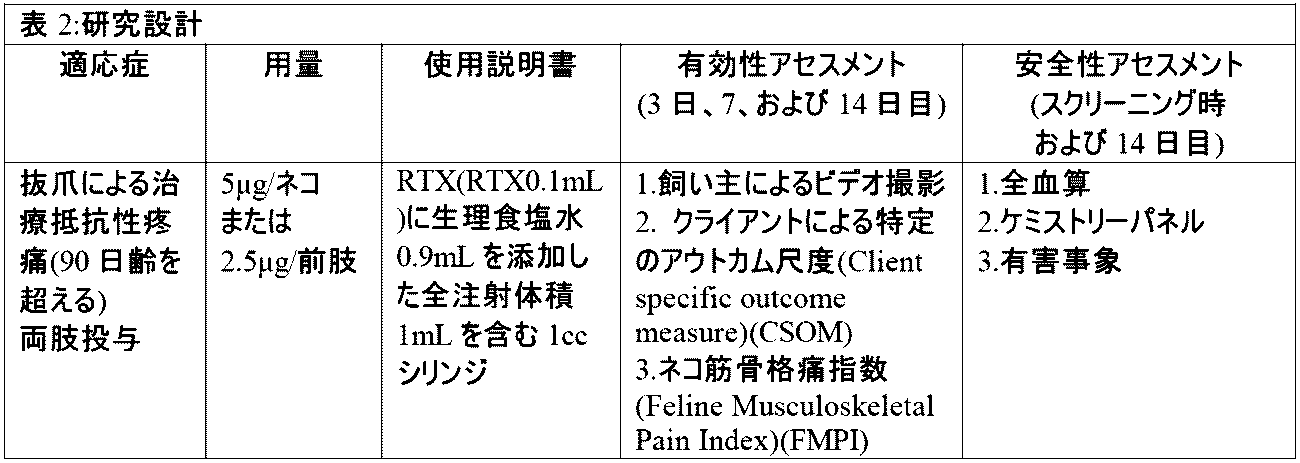
5μg/ネコまたは2.5μg/前肢の各用量を、RTX0.1mL(2.5μg)を注射用の滅菌生理食塩水0.9mLに希釈することによって、1ccインスリンシリンジ内で使用直前に調合する。処置のために、合計1.0mL(2.5μg)を、神経ブロックとして、各前肢について4カ所の注射部位にわたって等しく分配して注射する(注射部位1カ所当たり0.25ml)。 Each dose of 5 μg/cat or 2.5 μg/forelimb is prepared immediately prior to use in a 1 cc insulin syringe by diluting 0.1 mL (2.5 μg) of RTX into 0.9 mL of sterile saline for injection. For treatment, a total of 1.0 mL (2.5 μg) is injected as a nerve block, distributed equally across four injection sites for each forelimb (0.25 ml per injection site).
研究の組み入れ基準には、以下が含まれる。ネコに、抜爪外科手術後の限局性前肢疼痛が確認されていること、ネコが、標準疼痛管理に対して治療抵抗性である疼痛を経験しているか、または飼い主が、従来の処置とは異なる疼痛管理の探求を選択していること、飼っているネコが治療抵抗性疼痛に起因して生活の質の著しい低下を経験していると飼い主が述べていること、飼い主が、ネコの排泄行動問題(ネコ用トイレの外での排尿または排便、ネコ用トイレの中に排泄物を掘って埋めない)、躾けられたときの攻撃性もしくは注意を引こうとする行動の減少(撫でられることを求めなくなる)などの慢性不適応性疼痛状態に関する行動学的問題を報告していること、および/あるいは治療抵抗性疼痛に関する臨床徴候(すなわち、疼痛および運動性が生活の質に負の影響を及ぼしている)に起因して飼っているネコの安楽死を考慮していること、疼痛の処置のために一般に使用される医薬品(それらの医薬品が別の理由で処方されているとしても。例えばコルチコステロイド)が、研究への登録前に少なくとも2週間投与されているという条件で許容され、次の3週間はレジメンの変更が予測されないこと、ならびに処置日の少なくとも90日前に抜爪手順が実施されたこと。ネコはまた、少なくとも12カ月齢であり、体重が少なくとも2kgでなくてはならず、別の研究に参加していてはならず、または一次神経疾患に起因する機能障害を有していてはならない。 Study inclusion criteria included: cats with documented localized forelimb pain following declawing surgery; cats experiencing pain that is refractory to standard pain management or owners choosing to explore pain management outside of conventional treatment; owners stating that their cat is experiencing a significant decrease in quality of life due to treatment-resistant pain; owners reporting that their cat is experiencing chronic incompetence, such as elimination behavior problems (urinating or defecating outside of the litter box, not digging and burying waste in the litter box), reduced aggression or attention-seeking behavior when disciplined (no longer seeking petting). Cats were required to report behavioral problems related to a responsive pain state and/or were considering euthanasia of their cat due to clinical signs related to treatment-resistant pain (i.e., pain and mobility negatively impacting quality of life), and were allowed to take medications commonly used for the treatment of pain (even if prescribed for other reasons, e.g., corticosteroids) provided that they had been administered for at least 2 weeks prior to study enrollment, no changes in regimen were anticipated for the next 3 weeks, and the declawing procedure had been performed at least 90 days prior to the treatment date. Cats also had to be at least 12 months old, weigh at least 2 kg, and not be participating in another study or have functional impairments due to a primary neurological disease.
ネコは、以下の除外基準のいずれかを示している場合には研究から除外される。ネコが妊娠中もしくは授乳中であること、ネコが、研究の目的を妨害するおそれがある医薬品もしくは栄養補助食品を研究過程中に必要とすること、または疼痛の重症度が、処置前の-7日目もしくは0日目のいずれかにおいて研究者によって10ポイント尺度で5未満と評定されること。 Cats will be excluded from the study if they display any of the following exclusion criteria: the cat is pregnant or lactating, the cat requires medication or dietary supplements during the course of the study that may interfere with the objectives of the study, or pain severity is rated by the investigator as less than 5 on a 10-point scale on either day -7 or day 0 prior to treatment.
4ポイントの神経ブロックを、1)橈骨神経の浅枝、2)尺骨神経の背枝、3)正中神経および尺骨神経の掌枝の浅枝、ならびに4)尺骨神経の掌枝の深枝に、RTX0.25mLをそれぞれ注射することによって実施する。ネコの前肢末梢環節の局所領域ブロックについて公開されている技術に従って、前肢についてそれぞれ神経ブロックを実施する(Enomoto et al. (2016) J. Feline Med. Surg. 18:838-845)。橈骨神経の浅枝(RSbr nn)をブロックするために、肢を、背面を上に向け、手根を180°の伸展度で置く。25G×5/8インチの針を、橈骨手根(antebrachiocarpal)関節のレベルで肢の中央のポイントから皮下(SC)に挿入する。針を、ベベルを上に向けて肢の長軸に対して10~20°の角度でSCにおよそ10mm進める。針の先端が副橈側皮静脈および橈側皮静脈の合流点から3~5mmに達したら、注射を行う(0.25mL)。尺骨神経の背枝(UDbr n)をブロックするために、肢を、外側面を上に向けて置く。あるポイントは、副手根骨(ACb)と尺骨の茎状突起(SpU)との間に位置する、ACbの外側の同じレベルに位置する。25G×5/8インチ針を、SCの遠位から近位に挿入し、したがって、先端をACbとSpUとの間に形成された溝の中間点に置き、次に注射を行う(0.25mL)。正中神経(M n)および尺骨神経の掌枝の浅枝(UPbrS n)をブロックするために、肢を、掌側を上に向けて置く。25G×5/8インチ針を、手根肉球の遠位縁部におけるその外側およそ5mmのSCに、中手の長軸に垂直にベベルを上に向けて挿入する。そのポイントが、肢の外側面から内側面の距離の3分の2に位置するまで、針をSCに挿入する。注射物体積の3分の2をこのポイントに注入し、針を抜きながら残りの体積を注射する(0.25mL)。皮膚下の注射体積を、5秒間優しくマッサージする。尺骨神経の掌枝の深枝(UPbrDp n)をブロックするために、肢を、掌側を上に向けて置く。25G×5/8インチ針を、針が、ベベルを上に向けてACbの中間点の内側掌側と接触するように、ACbに対してほぼ垂直に中外側方向に挿入する。次に、針を背側に向け直し、屈筋支帯を貫通するまでACbの内側に2~3mm進入し、次に注射を行う(0.25mL)。 A four-point nerve block is performed by injecting 0.25 mL of RTX into: 1) the superficial branch of the radial nerve, 2) the dorsal branch of the ulnar nerve, 3) the superficial branches of the median and palmar branches of the ulnar nerve, and 4) the deep branch of the palmar branch of the ulnar nerve. Nerve blocks are performed for each forelimb according to published techniques for locoregional block of the forelimb peripheral segments in cats (Enomoto et al. (2016) J. Feline Med. Surg. 18:838-845). To block the superficial branch of the radial nerve (RSbr nn), the limb is placed dorsally up with the carpus in 180° extension. A 25G x 5/8 inch needle is inserted subcutaneously (SC) at a point in the middle of the limb at the level of the antebrachiocarpal joint. The needle is advanced approximately 10 mm into the SC with the bevel facing up at a 10-20° angle to the long axis of the limb. When the tip of the needle is 3-5 mm from the confluence of the accessory cephalic and cephalic veins, the injection is made (0.25 mL). To block the dorsal branch of the ulnar nerve (UDbr n), the limb is placed with the lateral side facing up. A point is located at the same level as the lateral side of the ACb, located between the accessory carpal bone (ACb) and the styloid process of the ulna (SpU). A 25G x 5/8 inch needle is inserted from distal to proximal into the SC, thus placing the tip at the midpoint of the groove formed between ACb and SpU, and then the injection is made (0.25 mL). To block the median nerve (M n) and the superficial branch of the palmar branch of the ulnar nerve (UPbrS n), the limb is placed with the palmar side facing up. A 25G x 5/8 inch needle is inserted into the SC approximately 5 mm lateral to the distal edge of the carpal pad, perpendicular to the long axis of the metacarpus, with the bevel facing up. The needle is inserted into the SC until the point is located two-thirds of the distance from the lateral to medial aspect of the limb. Two-thirds of the injection volume is injected at this point, and the remaining volume is injected as the needle is withdrawn (0.25 mL). The injection volume under the skin is gently massaged for 5 seconds. To block the deep branch of the palmar branch of the ulnar nerve (UPbrDp n), the limb is placed palm side up. A 25G x 5/8 inch needle is inserted in a mediolateral direction approximately perpendicular to ACb, with the needle facing up and contacting the medial palmar aspect of the midpoint of ACb. The needle is then redirected dorsally and advanced 2-3 mm medial to ACb until it penetrates the flexor retinaculum, then the injection is administered (0.25 mL).
RTXの注射の有効性を、質的アセスメント(ジャンプ、肢の操作)について、飼い主のビデオ撮影を使用して3日目、7日目および14日目にアセスメントし、ネコを、ネコ筋骨格痛指数(FMPI)およびクライアントによる特定のアウトカム尺度(CSOM)も使用して評価する。 Efficacy of RTX injections will be assessed on days 3, 7 and 14 using owner videotapes for qualitative assessments (jumping, limb manipulation) and cats will also be assessed using the Feline Musculoskeletal Pain Index (FMPI) and Client Specific Outcome Measures (CSOM).
CSOMでは、飼い主は、(Q1)遠位肢を伸ばす、「こねる」、ストレッチすること、(Q2)走ること、ならびに(Q3)ベッドおよび窓から飛び下りることの3つの特質について、1~5の尺度(1=問題なし、2=軽度困難、3=中程度、4=重度困難、および5=不可能)を使用してスコア化するように求められる。 In the CSOM, owners are asked to score three attributes using a 1-5 scale (1=no problem, 2=mild difficulty, 3=moderate difficulty, 4=severe difficulty, and 5=impossible) - (Q1) extending, "kneading," or stretching the distal limbs, (Q2) running, and (Q3) jumping out of the bed and window.
FMPIでは、ネコを、Q1~Q17と指定される17の特質について、0~4の尺度(0=全くできない、1=ほとんどできない、または大きな努力を要する、2=正常よりもやや悪化している、3=ほぼ正常、および4=正常)を使用してスコア化する。全FMPIスコアは、質問ごとのスコアの合計である。(0~68)の可能な範囲で、合計が高いほど機能障害が少ないことを示す。分析のために、全スコアまたはパーセント可能(percent possible)を使用することができる。Q1~Q17は、以下の通りである。歩く(Q1)、走る(Q2)、飛び上がる(Q3)、キッチンカウンターの高さまで飛び上がる(Q4)、飛び下りる(Q5)、階段を上る(Q6)、階段を降りる(Q7)、おもちゃで遊ぶ/おもちゃを追いかける(Q8)、他のペットと遊び、触れ合う(Q9)、静止位置から起き上がる(Q10)、横になるまたは座る(Q11)、ストレッチする(Q12)、毛づくろいをする(Q13)、飼い主と触れ合う(Q14)、触られるまたは手で扱われる(Q15)、食べる(Q16)、およびネコ用トイレを使用する(Q17)。 In the FMPI, cats are scored on 17 attributes designated Q1-Q17 using a scale of 0-4 (0=not at all, 1=very little or with great effort, 2=slightly worse than normal, 3=near normal, and 4=normal). The total FMPI score is the sum of the scores for each question, with a possible range of (0-68), with higher sums indicating less impairment. For analysis, either the total score or the percent possible can be used. Q1-Q17 are as follows: Walking (Q1), running (Q2), jumping (Q3), jumping up to kitchen counter height (Q4), jumping down (Q5), climbing stairs (Q6), descending stairs (Q7), playing with/chasing a toy (Q8), playing with and interacting with other pets (Q9), rising from a stationary position (Q10), lying or sitting (Q11), stretching (Q12), grooming (Q13), interacting with the owner (Q14), being touched or handled (Q15), eating (Q16), and using the litter box (Q17).
RTXの注射の安全性を、スクリーニング時に行った全血算(CBC)およびケミストリーパネルの結果を、14日目に得られた結果と比較することによってアセスメントする。ネコを、有害事象についてもモニタリングした。
B.不適応性疼痛に罹患している抜爪ネコへの神経周囲投与
The safety of RTX injections will be assessed by comparing the results of complete blood counts (CBC) and chemistry panels performed at screening with those obtained on Day 14. Cats were also monitored for adverse events.
B. Perineural administration in declawed cats suffering from maladaptive pain
RTX投与の耐容性、安全性、および鎮痛効果を、不適応性疼痛を有する抜爪ネコ一匹で評価した。ネコに、先の実施例Aに記載される通り、神経ブロックとして注射される合計1.0mL(2.5μg)のRTXを、各前肢につき4カ所の注射部位にわたって等しく分配した(注射部位1カ所当たり0.25ml)。RTX投与中、合併症は観察されなかった。RTXの注射は、一般に良好な耐容性を示した。注射の1時間後に浅速呼吸および唾液分泌の有害事象が認められたが、これらの事象は、共に2時間以内に解決した。ネコは、注射の12時間後には食欲低下からの自己治癒も示した。アレルギー様反応の徴候は観察されず、注射領域に、浮腫または疼痛の徴候はなかった。 The tolerability, safety, and analgesic efficacy of RTX administration were evaluated in one declawed cat with maladaptive pain. The cat was injected as a nerve block as described in Example A above with a total of 1.0 mL (2.5 μg) of RTX distributed equally across four injection sites on each forelimb (0.25 mL per injection site). No complications were observed during RTX administration. Injections of RTX were generally well tolerated. Adverse events of panting and salivation were noted 1 hour after injection, but both events resolved within 2 hours. The cat also showed self-healing from decreased appetite 12 hours after injection. No signs of an allergic-like reaction were observed, and there were no signs of edema or pain in the area of injection.
スクリーニング当日、ネコは、全CSOMスコア8およびQ1~Q3による軽度から中程度の困難を示していた。RTX注射後の14日目までに、ネコはQ1~Q3による軽度困難を経験しており、CSOMスコアは6であった。このネコにおいて、遠位肢を伸ばす、こねる、ストレッチする、および走ることのすべてについて改善が示された。CSOMも、7日目および14日目に評価したが、共に表3に示される通り3日目に対して改善が示された。 On the day of screening, the cat had a total CSOM score of 8 and mild to moderate difficulty with Q1-Q3. By day 14 after RTX injection, the cat was experiencing mild difficulty with Q1-Q3 and had a CSOM score of 6. Distal limb extension, kneading, stretching, and running all showed improvement in this cat. CSOM was also assessed on days 7 and 14, both of which showed improvement versus day 3 as shown in Table 3.
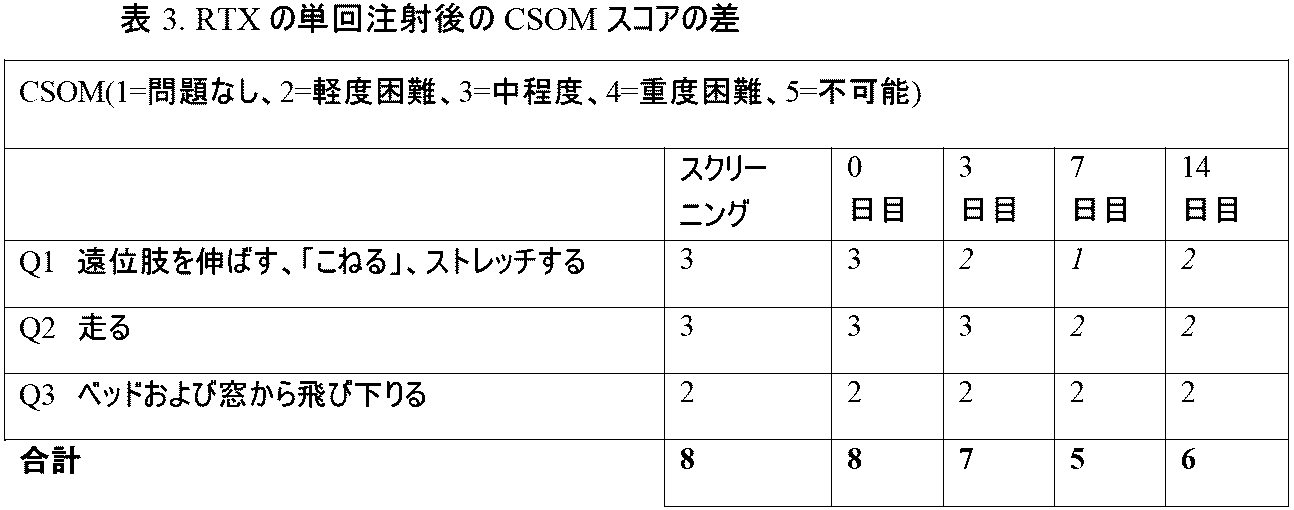
抜爪した指に関する疼痛と関連するRTX注射前後の身体検査の概要は、表4に提示される。
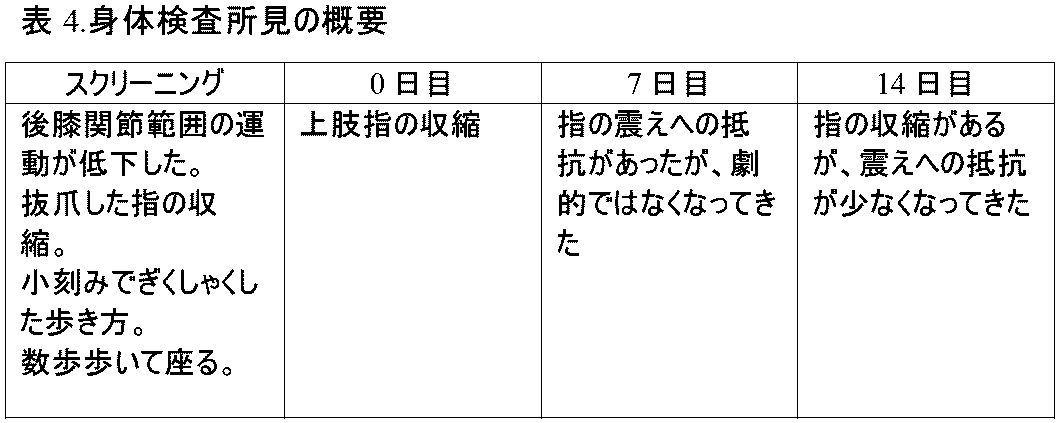
ネコへのRTXの単回注射の鎮痛効果を、ネコ筋骨格痛指数(FMPI)を使用して評価した(表5)。全FMPIスコアは、質問ごとのスコアの合計である。(0~68)の可能な範囲で、合計が高いほど機能障害が少ないことを示す。分析のために、全スコアまたはパーセント可能を使用することができる。スクリーニング当日および0日目に、ネコは、FMPIスコアが47であった。RTX注射後の14日目までに、ネコは、FMPIスコアが57となり、改善を示した。パーセント可能の算出は、ネコの全スコアを得、可能な全ポイント(答えた質問の数に4を掛けたもの)で割ることによって実施する。したがって、パーセント可能=(Q1~17スコアの合計)/(答えた質問の数*4)である。
さらにネコは、処置前に、排泄行動問題、躾けられたときの攻撃性、および注意を引こうとする行動の減少を示していた。この処置の前にそのネコに数年間疼痛があったと思われたが、これらの行動問題のそれぞれは、RTXの神経周囲投与後に好転した慢性不適応性疼痛状態に関するものであった。これらの結果は、末梢シグナル伝達の低減が、不適応性疼痛と関連する中枢神経系の持続的な長期的可塑性変化を有する可能性が高い対象においても、不適応性疼痛の中枢知覚を好転するのに十分となり得るという証拠である。 Additionally, the cat exhibited reduced elimination behavior problems, aggression when disciplined, and attention-seeking behaviors prior to treatment. Although the cat appeared to have been in pain for several years prior to the treatment, each of these behavior problems was related to a chronic maladaptive pain state that was reversed following perineural administration of RTX. These results are evidence that reduction in peripheral signaling can be sufficient to reverse central perception of maladaptive pain, even in subjects who are likely to have persistent long-term plastic changes in the central nervous system associated with maladaptive pain.
したがって、RTXの投与は、CSOMおよびFMPIスコアの改善によって示される通り、このネコにおいて安全で有効であった。効果は、少なくとも14日間持続した。
C.抜爪ネコにおける重症慢性遠位肢疼痛についての神経周囲レシニフェラトキシンの研究
Thus, administration of RTX was safe and effective in this cat, as demonstrated by improvements in CSOM and FMPI scores, with effects sustained for at least 14 days.
C. Perineural resiniferatoxin study of severe chronic distal limb pain in declawed cats
ネコの慢性遠位肢疼痛は、それらの生活の質(QoL)にとって有害である。この研究の目的は、慢性遠位上肢疼痛の証拠を有する抜爪ネコにおいて、唯一の神経周囲疼痛管理様式としてのRTXの使用を評価することであった。 Chronic distal limb pain in cats is detrimental to their quality of life (QoL). The aim of this study was to evaluate the use of RTX as the sole perineural pain management modality in declawed cats with evidence of chronic distal upper limb pain.
外科手術または外傷性切断中、かなりの量の外傷が、神経および周囲組織に生じた。この神経傷害は、神経末端(endings)を発芽させ、末端(terminals)を過興奮性にし、それが永続化し、局所炎症によって悪化する。 During surgery or traumatic amputation, a significant amount of trauma occurs to the nerve and surrounding tissue. This nerve injury causes the nerve endings to sprout and makes the terminals hyperexcitable, which is perpetuated and exacerbated by local inflammation.
切断後疼痛症候群に罹患しているヒトおよびネコ患者から得られた化学的証拠は、この多因子状態の発生が、局所性神経腫の形成、ならびにその後の末梢および中枢神経経路の変更に密接に関係していることを示唆している(Hanyu-Deutmeyer AA and Dulebohn SC. StatPearls [Internet]. Treasure Island (FL): StatPearls Publishing; 2018 Jan-2018 Apr 17)。ネコとヒト患者との間の病態生理および臨床提示の類似点により、ネコの抜爪後疼痛症候群は、残肢疼痛および複合性局所疼痛症候群(CRPS)のようなヒトにおける疼痛性不適応性疾患の理解を深めるための優れたトランスレーショナルツールに変わる。 Chemical evidence obtained from human and feline patients suffering from post-amputation pain syndrome suggests that the development of this multifactorial condition is closely related to the formation of focal neuromas and subsequent alterations of peripheral and central neural pathways (Hanyu-Deutmeyer AA and Dulebohn SC. StatPearls [Internet]. Treasure Island (FL): StatPearls Publishing; 2018 Jan-2018 Apr 17). The similarities in pathophysiology and clinical presentation between cats and human patients turn feline post-declawing pain syndrome into an excellent translational tool to improve the understanding of painful maladaptive disorders in humans, such as residual limb pain and complex regional pain syndrome (CRPS).
爪切除術後の重症合併症の結果として重症の両側慢性疼痛(90日超)に罹患しているネコを、この研究(探索的な非盲検の多施設臨床試験)に登録した。初期疼痛および生活の質(QoL)の低下について、13の症例を処置した。次に、両側遠位肢への神経周囲注射(リングブロック技術)を、全身麻酔(ジフェンヒドラミン、ブプレノルフィン、デクスメデトミジン、ケタミン、およびイソフルランの組合せ)の下で投与した。ネコの前肢末梢環節の神経ブロックについて公開されている技術(Enomoto et al., 2016)に従って、RTXの全用量を、1)橈骨神経の浅枝、2)尺骨神経の背枝、3)正中神経および尺骨神経の掌枝の浅枝、ならびに4)尺骨神経の掌枝の深枝に隣接して等しく分配した。合計2.5ug(n=7の群1において、前肢1本当たり1.25ug/1mL)および5ug(n=6の群2において、前肢1本当たり2.5ug/1mL)のRTXを、一度限りの処置として注射した。群2には、先の実施例Bにおいて詳細な結果が提供されているネコが含まれていた。続く28日間、QoLおよび疼痛のモニタリングを、クライアントによるネコの特定のアウトカム尺度(CSOMf)、ネコ筋骨格痛指数(FMPI)、2回の注射後の身体検査、ならびに注射後3日目、7日目、14日目および28日目のビデオ撮影を使用して達成した。 Cats suffering from severe bilateral chronic pain (>90 days) as a result of severe complications after onycholysis were enrolled in this study (an exploratory, open-label, multicenter clinical trial). Thirteen cases were treated for initial pain and impaired quality of life (QoL). Perineural injections (ring block technique) into the bilateral distal limbs were then administered under general anesthesia (a combination of diphenhydramine, buprenorphine, dexmedetomidine, ketamine, and isoflurane). Following published techniques for nerve blocks of the feline forelimb peripheral ring segments (Enomoto et al., 2016), the total dose of RTX was distributed equally adjacent to: 1) the superficial branch of the radial nerve, 2) the dorsal branch of the ulnar nerve, 3) the superficial branches of the median and palmar branches of the ulnar nerve, and 4) the deep branch of the palmar branch of the ulnar nerve. A total of 2.5ug (1.25ug/1mL per forepaw in Group 1, n=7) and 5ug (2.5ug/1mL per forepaw in Group 2, n=6) of RTX were injected as a one-off treatment. Group 2 included cats whose detailed results are provided in Example B above. Over the following 28 days, monitoring of QoL and pain was accomplished using a client specific cat outcome measure (CSOMf), a feline musculoskeletal pain index (FMPI), physical examination after the two injections, and videotapes on days 3, 7, 14, and 28 after injection.
両方の群において(群1では71.4%、群2では100%)、動物は、麻酔からの回復中に処置に関係する自然治癒反応を経験した。最も一般的な有害事象(AE)は、浅速呼吸(群1では57.1%、群2では83.3%)、発声(群1では57.1%、群2では83.3%)および唾液分泌過多(群1では71.4%、群2では50%)であり、それらは処置後4時間以内に解決した。 In both groups (71.4% in group 1 and 100% in group 2), animals experienced treatment-related spontaneous reactions during recovery from anesthesia. The most common adverse events (AEs) were panting (57.1% in group 1 and 83.3% in group 2), vocalization (57.1% in group 1 and 83.3% in group 2), and hypersalivation (71.4% in group 1 and 50% in group 2), which resolved within 4 hours after the procedure.
両方の群における提示および解決の日によって分析すると、AEの85%超が投与当日に提示され、同日に解決した(群1=86.6%[26/30]、群2=95.4%[21/22])。 When analyzed by date of presentation and resolution in both groups, >85% of AEs presented and resolved on the day of dosing (group 1 = 86.6% [26/30], group 2 = 95.4% [21/22]).
CSOMfおよびFMPIスコアは、28日間のモニタリング期間にわたって明らかな改善を示した。 CSOMf and FMPI scores showed clear improvement over the 28-day monitoring period.
両方の群において、飼い主は、QoLの改善を示すとみなされる自然行動(すなわち、社会化、こねる、および身体活動の改善)および病理学的な飼育行動(すなわち、飼い主および同居する他のペットに対する攻撃性、不適切な排尿および排便)の著しい変化を報告した。一部の場合には、これらの行動学的改善により、捨てられた患者を譲渡し、新居に移せるようになった。公式のモニタリング期間は28日間であったが、一部の場合には数カ月間(6カ月を超えて)、非公式に改善が報告された。少なくとも2匹のネコについて、振舞いの改善および負の行動の低減、ならびに毎日の全身医薬品の必要性の低減または排除を含めた改善が数カ月間継続したことが報告された。 In both groups, owners reported significant changes in natural behaviors (i.e., improved socialization, kneading, and physical activity) and pathological home behaviors (i.e., aggression toward owners and other household pets, inappropriate urination and defecation) that were deemed indicative of improved QoL. In some cases, these behavioral improvements allowed abandoned patients to be adopted and rehomed. The formal monitoring period was 28 days, but improvements were reported informally for several months (>6 months) in some cases. Improvements were reported for at least two cats that continued for several months, including improved behavior and reduced negative behaviors, and reduced or eliminated need for daily systemic medications.
したがって、この研究は、慢性疼痛管理のためのRTXの神経周囲注射が、生活の質に負の影響を及ぼす遠位上肢疼痛を有するネコを有効に処置することができ、その上、記載の用量での神経周囲へのRTXが、これらのネコにおいて良好な耐容性を示したという証拠を提供する。
D.ラットにおける神経ブロック注射としてのレシニフェラトキシンの14日間の回復期間を含む単回用量研究
Thus, this study provides evidence that perineural injections of RTX for chronic pain management can effectively treat cats with distal upper extremity pain that negatively impacts quality of life, and moreover, perineural RTX at the doses described was well tolerated in these cats.
D. Single-dose study with 14-day recovery period of resiniferatoxin as a nerve block injection in rats
この研究は、RTXが神経ブロック注射としてラットに単回用量として与えられた場合の、RTXの投与の安全性を決定することを目的としていた。 This study aimed to determine the safety of administration of RTX when given as a single dose to rats as a nerve block injection.
研究設計は、以下の通りであった。
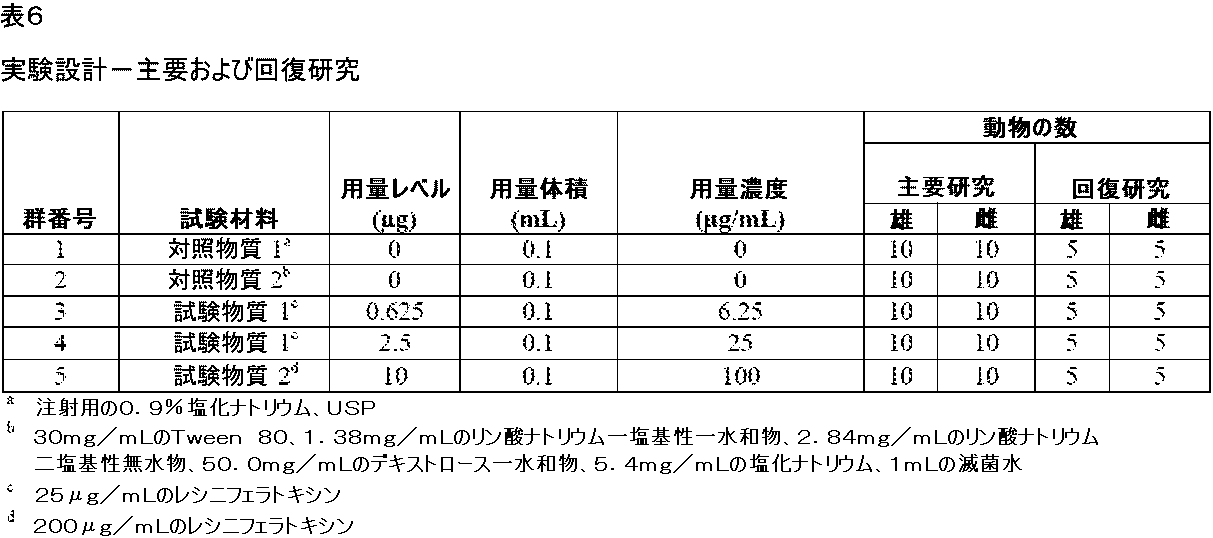

神経ブロック注射としてのレシニフェラトキシンの投与は、0.625μg、2.5μg、および10μgのレベルでラットにおいて良好な耐容性を示した。無毒性量レベル(NOAEL)は、10μgとみなされた。 Administration of resiniferatoxin as a nerve block injection was well tolerated in rats at levels of 0.625 μg, 2.5 μg, and 10 μg. The no observed adverse effect level (NOAEL) was considered to be 10 μg.
雄119匹および雌119匹のCrl:CD(SD)Sprague Dawleyラットを、Charles River Laboratories、Raleigh、NCから得た。動物は、投薬開始時に10週齢であり、体重が212~482gの間であった。 119 male and 119 female Crl:CD (SD) Sprague Dawley rats were obtained from Charles River Laboratories, Raleigh, NC. Animals were 10 weeks old and weighed between 212 and 482 g at the start of dosing.
雄および雌の動物を、類似の群平均体重を達成するために、層別化を用いて無作為的に群に別々に割り当てた。 Male and female animals were randomly assigned separately to groups with stratification to achieve similar group mean body weights.
投薬開始前に、研究において使用するのに適していないとみなされた割り当てられた動物は、同じ入荷分から得られた、同じ環境条件下で維持されていた代替動物によって置き換えた。

神経ブロック注射用量を、右大腿に与えた。用量投与のために動物を一時的に拘束した。用量投与のためにイソフルラン吸入により動物を鎮静させた。動物ごとに、投薬日を1日目と指定した。研究で死亡した、回復研究の動物については剖検を実施し、特定組織を保持した。動物を、剖検の前に冷蔵して自己分解を最小限に抑えた。 Nerve block injection doses were given in the right thigh. Animals were briefly restrained for dose administration. Animals were sedated with isoflurane inhalation for dose administration. For each animal, the day of dosing was designated as day 1. Necropsies were performed and selected tissues were retained for recovery study animals that died on study. Animals were refrigerated prior to necropsy to minimize autolysis.
人道的理由で、回復研究の動物を安楽死させた。動物に剖検を行った。動物を、剖検の前に冷蔵して自己分解を最小限に抑えた。 Animals in the recovery study were euthanized for humane reasons. Necropsies were performed on the animals. Animals were refrigerated prior to necropsy to minimize autolysis.
2日目の計画的安楽死まで生存した主要研究および回復の動物は、最終的な体重を記録し、臨床的病理の評価のために試料を収集し、動物をイソフルラン吸入によって安楽死させ、続いて全採血した。計画的安楽死まで生存した毒物動態研究の動物は、二酸化炭素吸入によって安楽死させた。 Main study and recovery animals that survived until scheduled euthanasia on day 2 had final body weights recorded, samples collected for clinical pathology evaluation, and animals were euthanized by isoflurane inhalation followed by exsanguination. Toxicokinetic study animals that survived until scheduled euthanasia were euthanized by carbon dioxide inhalation.
主要研究および回復の動物に、完全剖検検査を行った。計画的剖検のために、有資格動物病理学者が対応可能であった。 Main study and recovery animals underwent full necropsy examination. A qualified veterinary pathologist was available for planned necropsy.
すべての統計的試験を、5%有意レベルで実施した。すべての一対比較を、両側試験を使用して実施した。 All statistical tests were performed at the 5% significance level. All pairwise comparisons were performed using two-sided tests.
目的の一対比較を以下に列挙する。
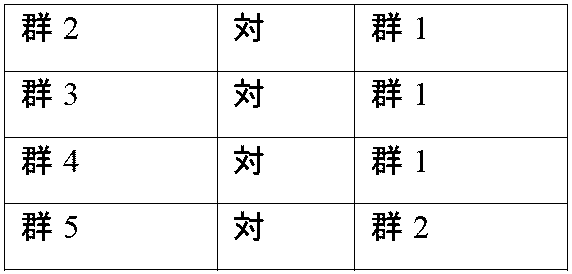
分析から、3つ未満の観察を伴う任意の群を除外した。 Any group with fewer than three observations was excluded from the analysis.
Levene試験を使用して、郡の分散均一性をアセスメントした。 The Levene test was used to assess homogeneity of variance across counties.
Levene試験が有意でない場合には包括的一元ANOVA F-試験を使用し、有意な場合にはKruskal-Wallis試験を使用して、群を比較した。包括的F-試験またはKruskal-Wallis試験が有意であることが見出された場合、次に、それぞれDunnettまたはDunn試験を使用して一対比較を実施した。2つの群を用いたデータセットを、Dunnett試験(Nevis 2012の表におけるt試験と同等)またはDunn試験(Nevis 2012の表におけるWilcoxon Rank-Sum試験と同等)を使用して比較した。
結果
Groups were compared using a global one-way ANOVA F-test if the Levene test was not significant, or a Kruskal-Wallis test if it was significant. If the global F-test or Kruskal-Wallis test was found to be significant, pairwise comparisons were then performed using Dunnett or Dunn tests, respectively. Datasets with two groups were compared using Dunnett tests (equivalent to t-tests in Nevis 2012 tables) or Dunn tests (equivalent to Wilcoxon Rank-Sum tests in Nevis 2012 tables).
result
対照および試験製剤におけるRTX濃度を決定するために、妥当性が検証された方法を使用した。群1および群2(ビヒクル)の試料のいずれにおいても、RTXは検出されなかった。群3~5における平均濃度は、それらの理論濃度の93.6%~117%の範囲であった。 A validated method was used to determine RTX concentrations in the control and test formulations. No RTX was detected in any of the Group 1 or Group 2 (vehicle) samples. The mean concentrations in Groups 3-5 ranged from 93.6% to 117% of their theoretical concentrations.
試験物質に関係する予定外の死亡または肉眼的観察はなかった。 There were no unscheduled deaths or gross observations related to the test substance.
10μgにおいて1~2日目の雄および1~14日目の雌で、RTX(レシニフェラトキシン)に関係する平均体重増加の統計的に有意な低減があり、これは対照と比較した平均体重の低減に相当していた。 At 10 μg, there was a statistically significant reduction in mean body weight gain associated with RTX (resiniferatoxin) in males on days 1-2 and in females on days 1-14, which corresponded to a reduction in mean body weight compared to controls.
2~7日目に、2.5μgにおいて雌だけおよび10μgにおいて雄だけで、食餌消費の統計的に有意な低減があった。 On days 2-7, there was a statistically significant reduction in food consumption in females only at 2.5 μg and in males only at 10 μg.
ある特定の白血球数、血小板数、フィブリノーゲン(fibrogin)、アスパラギン酸アミノトランスフェラーゼおよびアラニンアミノトランスフェラーゼ、総タンパク質、アルブミン、アルブミン/グロブリン比、リン、比重、ならびにトリグリセリドと共に、いくつかの他のパラメーターの様々な統計的に有意な差が認められた。しかしこれらの差は、以下の、絶対差が最小限であったこと、変化に明らかな用量応答関係がなかったこと、相関する顕微鏡的所見がなかったこと、絶対差が最小限であったこと、および/または変化に明らかな用量応答関係がなかったことの1つまたは複数に起因して有害であるとみなされることも、またはビヒクルもしくは試験物質に関係するとみなされることもなかった。さらに、それらの差は一般に、好中球が、10μgにおいて雌だけで統計的に有意に増大し、それが回復期間後に増大したままであったことを除いて、回復期間中に解決した。 A variety of statistically significant differences were noted in certain white blood cell counts, platelet counts, fibrogin, aspartate aminotransferase and alanine aminotransferase, total protein, albumin, albumin/globulin ratio, phosphorus, specific gravity, and triglycerides, along with several other parameters. However, these differences were not considered adverse or related to vehicle or test substance due to one or more of the following: minimal absolute differences, no clear dose-response relationship to the changes, no correlating microscopic findings, minimal absolute differences, and/or no clear dose-response relationship to the changes. Furthermore, the differences generally resolved during the recovery period, with the exception of neutrophils, which were statistically significantly increased only in females at 10 μg, and remained increased after the recovery period.
臨床化学パラメーターにおいて有害なRTX(レシニフェラトキシン)に関係する変化はなかった。 There were no adverse RTX (resiniferatoxin)-related changes in clinical chemistry parameters.
最終的に安楽死したまたは回復期間の動物において、試験物質に関係する肉眼的所見は認められなかった。観察された肉眼的所見は、この系統および年齢のラットにおいて一般に観察される性質に付随的であるとみなされ、かつ/または対照および処置動物において類似の発生率を有しており、したがって、RTXの投与には無関係とみなされた。 No test article-related gross findings were noted in animals that were ultimately euthanized or in the recovery period. Any gross findings observed were considered incidental to those generally observed in rats of this strain and age and/or had a similar incidence in control and treated animals and were therefore considered unrelated to administration of RTX.
統計的に有意なより低い絶対的および相対的脾臓重量が、RTX10μgを投与した両方の性別で観察された。このことは、顕微鏡的に、白脾髄のリンパ系細胞充実性の最小限の低減と相関していた。RTX10μgを投与した両方の性別におけるより低い絶対的および相対的胸腺重量は、顕微鏡的に、リンパ系細胞充実性の最小限から軽度の低減と相関していた。試験物質に関係する他の臓器重量変化は認められなかった。最終的な安楽死の際に認められた試験物質に関係する臓器重量変化は、回復期間の最後(15日目)には観察されなかった。 Statistically significant lower absolute and relative spleen weights were observed in both sexes receiving 10 μg RTX. This correlated with a minimal reduction in lymphoid cellularity of the white pulp microscopically. Lower absolute and relative thymus weights in both sexes receiving 10 μg RTX correlated with a minimal to mild reduction in lymphoid cellularity microscopically. No other test article related organ weight changes were noted. No test article related organ weight changes noted at terminal euthanasia were observed at the end of the recovery period (day 15).
単離された臓器の重量の値に、それらのそれぞれの対照とは統計的に異なる値があった。しかし、これらの値が毒物学的に関連することを示唆するパターン、傾向または相関データはなかった。したがって、観察された臓器重量差は偶発的であり、かつ/または体重変化と関係しており、RTXの投与とは無関係であるとみなされた。 There were values for the weights of isolated organs that were statistically different from their respective controls; however, there were no patterns, trends, or correlation data to suggest that these values were toxicologically relevant. Therefore, the observed organ weight differences were deemed to be incidental and/or related to body weight changes and unrelated to administration of RTX.
2日目に死亡したことが見出されたRTX(試験物質1)2.5μgの回復研究の雌、および13日目に安楽死した対照物質2を投与した回復研究の雌を含めた2匹の予定外死亡が、試験物質投与とは無関係に生じた。試験物質1を投与した動物の死亡は、吸引に関係する異物/肺の炎症に起因しており、一方、対照物質2を投与した動物の死亡は、肉眼的または顕微鏡的評価によっては説明することができず、瀕死状態と対照物質2との関係は排除することができなかった。 Two unscheduled deaths occurred unrelated to test article administration, including a female from the RTX (Test Article 1) 2.5 μg recovery study that was found to be dead on day 2, and a female from the Control Article 2-treated recovery study that was euthanized on day 13. The death of the Test Article 1-treated animal was attributed to aspiration-related foreign body/pulmonary inflammation, whereas the death of the Control Article 2-treated animal could not be explained by gross or microscopic evaluation, and a relationship between the moribund state and Control Article 2 could not be excluded.
結論として、0μg、0.625μg、2.5μg、または10μgの用量でのラットへの単回用量としてのRTXの神経ブロック注射は、試験物質に関係する死亡率、臓器重量の差、または肉眼的観察をもたらさなかった。≧2.5μgのRTXでは、乳腺において非有害な顕微鏡的変化(単細胞壊死)があり、10μgのRTXでは、骨格筋において顕微鏡的変化(筋線維変性/壊死)があったが、それらはすべて14日間の回復期間後に完全に回復した。対照物質2に関係する顕微鏡的変化が、投与部位に認められた(筋線維変性/壊死を伴うまたは伴わない混合細胞炎症)。これらの所見のすべては、14日間の回復期間後に完全に回復した。
特定の実施形態では、例えば以下の項目が提供される。
(項目1)
不適応性疼痛を処置する方法であって、不適応性疼痛の処置を必要とする対象にレシニフェラトキシン(RTX)を末梢神経周囲投与するステップを含む、方法。
(項目2)
不適応性疼痛を処置する方法における使用のための、レシニフェラトキシン(RTX)を含む組成物であって、前記方法が、不適応性疼痛の処置を必要とする対象にRTXを末梢神経周囲投与するステップを含む、組成物。
(項目3)
前記方法が、0.1μg~100μgの用量のRTXを投与するステップを含む、項目1または2に記載の使用のための方法または組成物。
(項目4)
前記RTXの用量が、0.1~1μg、1~2μg、2~5μg、5~10μg、10~20μg、20~30μg、30~40μg、40~50μg、50~60μg、60~70μg、70~80μg、80~90μg、または90~100μgの範囲である、項目3に記載の使用のための方法または組成物。
(項目5)
前記RTXが、単一部位、複数部位、坐骨神経、伏在神経、大腿神経、橈骨神経、尺骨神経、正中神経、筋皮神経、および/または掌側指神経に神経周囲投与される、前記項目のいずれか一項に記載の使用のための方法または組成物。
(項目6)
前記RTXが、1つまたは複数の指、足もしくは手、前肢、肢、および/または関節からの感覚入力に集合的に対応する複数部位に神経周囲投与される、前記項目のいずれか一項に記載の使用のための方法または組成物。
(項目7)
前記対象が、切断手術を受けた者である、前記項目のいずれか一項に記載の使用のための方法または組成物。
(項目8)
神経周囲投与が、切断部位の下流の1つまたは複数の神経線維を標的とする、前記項目のいずれか一項に記載の使用のための方法または組成物。
(項目9)
前記対象が、幻肢痛または断端痛に罹患している、前記項目のいずれか一項に記載の使用のための方法または組成物。
(項目10)
神経周囲投与が、切断部位の下流の少なくとも2つ、3つ、4つの、または5つの神経線維を標的とする、項目7から9のいずれか一項に記載の使用のための方法または組成物。
(項目11)
前記対象が、神経末端において異常神経成長を有する、前記項目のいずれか一項に記載の使用のための方法または組成物。
(項目12)
神経周囲投与が、その末梢端に異常成長を伴う神経の下流の1つまたは複数の神経線維を標的とする、項目11に記載の使用のための方法または組成物。
(項目13)
神経周囲投与が、神経腫の下流の1つまたは複数の神経線維を標的とする、先行する項目のいずれか一項に記載の使用のための方法または組成物。
(項目14)
前記方法が、前記RTXおよび薬学的に許容される担体を含む医薬製剤を投与するステップを含む、先行する項目のいずれか一項に記載の使用のための方法または組成物。
(項目15)
前記薬学的に許容される担体が、水を含む、項目14に記載の使用のための方法または組成物。
(項目16)
前記薬学的に許容される担体が、ポリソルベート(登録商標)80を含む、項目14または15に記載の使用のための方法または組成物。
(項目17)
前記薬学的に許容される担体が、ポリエチレングリコールを含む、項目14から16のいずれか一項に記載の使用のための方法または組成物。
(項目18)
前記薬学的に許容される担体が、糖または糖アルコールを含む、項目14から17のいずれか一項に記載の使用のための方法または組成物。
(項目19)
前記薬学的に許容される担体が、マンニトールを含む、項目18に記載の使用のための方法または組成物。
(項目20)
前記薬学的に許容される担体が、デキストロースを含む、項目18または19に記載の使用のための方法または組成物。
(項目21)
前記薬学的に許容される担体が、薬学的に許容される緩衝液を含む、項目14から20のいずれか一項に記載の使用のための方法または組成物。
(項目22)
前記薬学的に許容される担体が、リン酸緩衝液を含む、項目21に記載の使用のための方法または組成物。
(項目23)
前記医薬製剤が、6~7.6の範囲のpHを有する、項目14から22のいずれか一項に記載の使用のための方法または組成物。
(項目24)
前記医薬製剤が、6~6.4、6.3~6.7、6.4~6.8、6.8~7.2、7~7.4、または7.2~7.6の範囲のpHを有する、項目23に記載の使用のための方法または組成物。
(項目25)
前記医薬製剤が、6.5または7.2のpHを有する、項目23に記載の使用のための方法または組成物。
(項目26)
前記薬学的に許容される担体が、薬学的に許容される塩を含む、項目14から25のいずれか一項に記載の使用のための方法または組成物。
(項目27)
前記薬学的に許容される塩が、NaClである、項目26に記載の使用のための方法または組成物。
(項目28)
前記医薬製剤におけるRTXの濃度が、0.02~0.1μg/mlまたは0.1~300μg/mlの範囲である、項目14から27のいずれか一項に記載の使用のための方法または組成物。
(項目29)
前記医薬製剤におけるRTXの濃度が、0.02~0.1μg/ml、0.1~1μg/ml、1~5μg/ml、5~10μg/ml、10~20μg/ml、20~50μg/ml、50~100μg/ml、100~150μg/ml、150~200μg/ml、200~250μg/ml、または250~300μg/mlの範囲である、項目28に記載の使用のための方法または組成物。
(項目30)
前記医薬製剤におけるRTXの濃度が、150~250μg/mlの範囲であるか、または約200μg/mlである、項目28または29に記載の使用のための方法または組成物。
(項目31)
前記医薬製剤におけるRTXの濃度が、0.1~200μg/mlの範囲であり、必要に応じて前記医薬製剤におけるRTXの濃度が、0.1~50μg/mlの範囲である、項目28または29に記載の使用のための方法または組成物。
(項目32)
前記RTXが、0.05~10mlの注射体積で投与され、必要に応じて前記注射体積が、0.05~0.2ml、0.2~0.5ml、0.5~1ml、1~2ml、2~5ml、または5~10mlの範囲である、前記項目のいずれか一項に記載の使用のための方法または組成物。
(項目33)
前記対象が、哺乳動物である、前記項目のいずれか一項に記載の使用のための方法または組成物。
(項目34)
前記対象が、ネコ、イヌ、ウマ、ブタ、反芻動物、ウシ、ヒツジ、ヤギ、または家畜化哺乳動物である、項目33に記載の使用のための方法または組成物。
(項目35)
前記対象が、ヒトである、項目33に記載の使用のための方法または組成物。
(項目36)
前記処置が、前記不適応性疼痛の局所および中枢効果を低減する、前記項目のいずれか一項に記載の使用のための方法または組成物。
(項目37)
前記対象が、処置の前に不適応性疼痛の1つまたは複数の行動症状を有しており、前記処置が、前記1つまたは複数の行動症状を低減または排除する、前記項目のいずれか一項に記載の使用のための方法または組成物。
In conclusion, nerve block injections of RTX as a single dose to rats at doses of 0 μg, 0.625 μg, 2.5 μg, or 10 μg did not result in test article-related mortality, organ weight differences, or macroscopic observations. At ≧2.5 μg RTX, there were non-detrimental microscopic changes in mammary glands (single cell necrosis) and at 10 μg RTX, there were microscopic changes in skeletal muscle (myofiber degeneration/necrosis), all of which fully resolved after a 14-day recovery period. Microscopic changes related to control article 2 were noted at the administration site (mixed cell inflammation with or without myofiber degeneration/necrosis). All of these findings fully resolved after a 14-day recovery period.
In certain embodiments, for example, the following items are provided:
(Item 1)
1. A method for treating maladaptive pain, comprising the step of peripheral perineural administration of resiniferatoxin (RTX) to a subject in need of treatment for maladaptive pain.
(Item 2)
A composition comprising resiniferatoxin (RTX) for use in a method for treating maladaptive pain, the method comprising the step of peripheral perineural administration of RTX to a subject in need of treatment for maladaptive pain.
(Item 3)
3. The method or composition for use according to item 1 or 2, wherein the method comprises administering a dose of RTX between 0.1 μg and 100 μg.
(Item 4)
4. The method or composition for use according to item 3, wherein the dose of RTX is in the range of 0.1-1 μg, 1-2 μg, 2-5 μg, 5-10 μg, 10-20 μg, 20-30 μg, 30-40 μg, 40-50 μg, 50-60 μg, 60-70 μg, 70-80 μg, 80-90 μg, or 90-100 μg.
(Item 5)
The method or composition for use according to any one of the preceding items, wherein the RTX is administered perineurally at a single site, multiple sites, to the sciatic nerve, saphenous nerve, femoral nerve, radial nerve, ulnar nerve, median nerve, musculocutaneous nerve, and/or palmar digital nerve.
(Item 6)
The method or composition for use of any one of the preceding items, wherein the RTX is administered perineurally to multiple sites that collectively correspond to sensory input from one or more fingers, paws or hands, forelimbs, limbs, and/or joints.
(Item 7)
The method or composition for use according to any one of the preceding items, wherein the subject has undergone amputation surgery.
(Item 8)
The method or composition for use of any one of the preceding paragraphs, wherein perineural administration targets one or more nerve fibers downstream of the cut site.
(Item 9)
The method or composition for use according to any one of the preceding items, wherein the subject is suffering from phantom limb pain or stump pain.
(Item 10)
10. The method or composition for use according to any one of items 7 to 9, wherein the perineural administration targets at least two, three, four, or five nerve fibers downstream of the amputation site.
(Item 11)
The method or composition for use according to any one of the preceding paragraphs, wherein the subject has abnormal nerve growth in nerve endings.
(Item 12)
12. The method or composition for use according to claim 11, wherein the perineural administration targets one or more nerve fibers downstream of a nerve with abnormal growth at its distal end.
(Item 13)
The method or composition for use of any one of the preceding items, wherein the perineural administration targets one or more nerve fibers downstream of the neuroma.
(Item 14)
13. The method or composition for use of any one of the preceding items, wherein the method comprises administering a pharmaceutical formulation comprising the RTX and a pharma- ceutically acceptable carrier.
(Item 15)
15. The method or composition for use according to claim 14, wherein the pharma- ceutically acceptable carrier comprises water.
(Item 16)
16. The method or composition for use according to claim 14 or 15, wherein the pharma- ceutically acceptable carrier comprises Polysorbate 80.
(Item 17)
17. The method or composition for use according to any one of claims 14 to 16, wherein the pharma- ceutically acceptable carrier comprises polyethylene glycol.
(Item 18)
18. The method or composition for use according to any one of items 14 to 17, wherein the pharma- ceutically acceptable carrier comprises a sugar or sugar alcohol.
(Item 19)
19. The method or composition for use according to claim 18, wherein the pharma- ceutically acceptable carrier comprises mannitol.
(Item 20)
20. The method or composition for use according to item 18 or 19, wherein the pharma- ceutically acceptable carrier comprises dextrose.
(Item 21)
21. The method or composition for use according to any one of items 14 to 20, wherein the pharma- ceutically acceptable carrier comprises a pharma- ceutically acceptable buffer.
(Item 22)
22. The method or composition for use according to claim 21, wherein the pharma- ceutically acceptable carrier comprises a phosphate buffer.
(Item 23)
23. The method or composition for use according to any one of items 14 to 22, wherein the pharmaceutical formulation has a pH in the range of 6 to 7.6.
(Item 24)
24. The method or composition for use according to item 23, wherein the pharmaceutical formulation has a pH in the range of 6 to 6.4, 6.3 to 6.7, 6.4 to 6.8, 6.8 to 7.2, 7 to 7.4, or 7.2 to 7.6.
(Item 25)
24. The method or composition for use according to claim 23, wherein the pharmaceutical formulation has a pH of 6.5 or 7.2.
(Item 26)
26. The method or composition for use according to any one of items 14 to 25, wherein the pharma- ceutically acceptable carrier comprises a pharma- ceutically acceptable salt.
(Item 27)
27. The method or composition for use according to claim 26, wherein said pharma- ceutically acceptable salt is NaCl.
(Item 28)
28. The method or composition for use according to any one of items 14 to 27, wherein the concentration of RTX in the pharmaceutical formulation ranges from 0.02 to 0.1 μg/ml or from 0.1 to 300 μg/ml.
(Item 29)
29. The method or composition for use according to item 28, wherein the concentration of RTX in the pharmaceutical formulation is in the range of 0.02-0.1 μg/ml, 0.1-1 μg/ml, 1-5 μg/ml, 5-10 μg/ml, 10-20 μg/ml, 20-50 μg/ml, 50-100 μg/ml, 100-150 μg/ml, 150-200 μg/ml, 200-250 μg/ml, or 250-300 μg/ml.
(Item 30)
30. The method or composition for use according to item 28 or 29, wherein the concentration of RTX in the pharmaceutical formulation is in the range of 150-250 μg/ml or is about 200 μg/ml.
(Item 31)
30. The method or composition for use according to item 28 or 29, wherein the concentration of RTX in said pharmaceutical formulation is in the range of 0.1 to 200 μg/ml, optionally wherein the concentration of RTX in said pharmaceutical formulation is in the range of 0.1 to 50 μg/ml.
(Item 32)
2. The method or composition for use according to any one of the preceding items, wherein the RTX is administered in an injection volume of 0.05-10 ml, optionally wherein the injection volume is in the range of 0.05-0.2 ml, 0.2-0.5 ml, 0.5-1 ml, 1-2 ml, 2-5 ml, or 5-10 ml.
(Item 33)
The method or composition for use according to any one of the preceding items, wherein the subject is a mammal.
(Item 34)
34. The method or composition for use according to claim 33, wherein the subject is a cat, dog, horse, pig, ruminant, cow, sheep, goat, or domesticated mammal.
(Item 35)
34. The method or composition for use according to claim 33, wherein the subject is a human.
(Item 36)
The method or composition for use according to any one of the preceding items, wherein the treatment reduces the local and central effects of the maladaptive pain.
(Item 37)
The method or composition for use of any one of the preceding items, wherein the subject has one or more behavioral symptoms of maladaptive pain prior to treatment, and the treatment reduces or eliminates the one or more behavioral symptoms.
Claims (38)
Applications Claiming Priority (3)
| Application Number | Priority Date | Filing Date | Title |
|---|---|---|---|
| US201862784212P | 2018-12-21 | 2018-12-21 | |
| US62/784,212 | 2018-12-21 | ||
| PCT/US2019/068030 WO2020132553A1 (en) | 2018-12-21 | 2019-12-20 | Perineural administration of resiniferatoxin for treatment of maladaptive pain |
Publications (3)
| Publication Number | Publication Date |
|---|---|
| JP2022514014A JP2022514014A (en) | 2022-02-09 |
| JPWO2020132553A5 JPWO2020132553A5 (en) | 2022-12-27 |
| JP7586819B2 true JP7586819B2 (en) | 2024-11-19 |
Family
ID=71100359
Family Applications (1)
| Application Number | Title | Priority Date | Filing Date |
|---|---|---|---|
| JP2021535038A Active JP7586819B2 (en) | 2018-12-21 | 2019-12-20 | Perineural administration of resiniferatoxin for the treatment of maladaptive pain |
Country Status (11)
| Country | Link |
|---|---|
| US (1) | US12144886B2 (en) |
| EP (1) | EP3898991A4 (en) |
| JP (1) | JP7586819B2 (en) |
| KR (1) | KR20210108979A (en) |
| CN (1) | CN113490745A (en) |
| AU (1) | AU2019403441A1 (en) |
| CA (1) | CA3123222A1 (en) |
| IL (1) | IL283947A (en) |
| MX (1) | MX2021007453A (en) |
| SG (1) | SG11202105938RA (en) |
| WO (1) | WO2020132553A1 (en) |
Families Citing this family (7)
| Publication number | Priority date | Publication date | Assignee | Title |
|---|---|---|---|---|
| WO2019049112A1 (en) * | 2017-09-11 | 2019-03-14 | Sorrento Therapeutics, Inc. | Formulation of resiniferatoxin |
| AU2019403441A1 (en) | 2018-12-21 | 2021-06-10 | Vivasor, Inc. | Perineural administration of resiniferatoxin for treatment of maladaptive pain |
| US11254659B1 (en) | 2019-01-18 | 2022-02-22 | Centrexion Therapeutics Corporation | Capsaicinoid prodrug compounds and their use in treating medical conditions |
| US11447444B1 (en) | 2019-01-18 | 2022-09-20 | Centrexion Therapeutics Corporation | Capsaicinoid prodrug compounds and their use in treating medical conditions |
| WO2020154261A1 (en) | 2019-01-22 | 2020-07-30 | Sorrento Therapeutics, Inc. | Method for treating osteoarthritis pain by administering resiniferatoxin |
| US20240261258A1 (en) * | 2021-05-18 | 2024-08-08 | Sorrento Therapeutics, Inc. | Presurgical Perineural Administration of Resiniferatoxin For Reduction of Post-Operative Pain |
| US20250228765A1 (en) | 2024-01-15 | 2025-07-17 | Gruenenthal Gmbh | Treating knee joint pain by injecting resiniferatoxin at ultra low doses |
Citations (4)
| Publication number | Priority date | Publication date | Assignee | Title |
|---|---|---|---|---|
| JP2006522815A (en) | 2003-04-08 | 2006-10-05 | アルゴルクス ファーマスーティカルズ,インク | Production and purification of synthetic capsaicin |
| WO2008109026A1 (en) | 2007-03-05 | 2008-09-12 | Mt Cook Pharma | Pharmaceutical compositions for the localized treatment of neurogenic dysfunction |
| WO2017087803A1 (en) | 2015-11-20 | 2017-05-26 | Sorrento Therapeutics, Inc. | Methods for pain treatment using resiniferatoxin |
| JP2017513864A (en) | 2014-04-14 | 2017-06-01 | フレックス ファーマ, インコーポレイテッド | Ion channel activator and method of use |
Family Cites Families (13)
| Publication number | Priority date | Publication date | Assignee | Title |
|---|---|---|---|---|
| US6630515B2 (en) | 1997-08-28 | 2003-10-07 | Afferon Corporation | Urinary incontinence therapy |
| US20040146590A1 (en) | 2001-03-22 | 2004-07-29 | Iadarola Michael J | Molecular neurochirurgie for pain control administering locally capsaicin or resinferatoxin |
| JP2006515846A (en) * | 2002-12-13 | 2006-06-08 | ニューロジェン・コーポレーション | 2-Substituted quinazolin-4-ylamine analogues as capsaicin receptor modulators |
| US20040186182A1 (en) | 2002-12-18 | 2004-09-23 | Algorx | Administration of capsaicinoids |
| US7329664B2 (en) * | 2003-07-16 | 2008-02-12 | Neurogen Corporation | Substituted (7-pyridyl-4-phenylamino-quinazolin-2-yl)-methanol analogues |
| DK1838301T3 (en) * | 2004-12-28 | 2015-04-27 | Mestex Ag | Use of resiniferate toxin (RTX) for the preparation of a pain management agent |
| WO2014019095A1 (en) | 2012-08-03 | 2014-02-06 | Mestex Ag | Resiniferatoxin solution |
| IL298314B2 (en) | 2016-04-13 | 2025-04-01 | Univ Nebraska | Methods for administration and methods for treating cardiovascular diseases with resiniferatoxin |
| AU2019403441A1 (en) | 2018-12-21 | 2021-06-10 | Vivasor, Inc. | Perineural administration of resiniferatoxin for treatment of maladaptive pain |
| CA3124499A1 (en) | 2018-12-24 | 2020-07-02 | Sorrento Therapeutics, Inc. | Method for treating parkinson's disease by administering resiniferatoxin |
| WO2020154261A1 (en) | 2019-01-22 | 2020-07-30 | Sorrento Therapeutics, Inc. | Method for treating osteoarthritis pain by administering resiniferatoxin |
| AU2021292420A1 (en) | 2020-06-19 | 2023-02-09 | Vivasor, Inc. | Administration of resiniferatoxin for treatment of bladder pain or bladder cancer |
| US20240261258A1 (en) | 2021-05-18 | 2024-08-08 | Sorrento Therapeutics, Inc. | Presurgical Perineural Administration of Resiniferatoxin For Reduction of Post-Operative Pain |
-
2019
- 2019-12-20 AU AU2019403441A patent/AU2019403441A1/en not_active Abandoned
- 2019-12-20 JP JP2021535038A patent/JP7586819B2/en active Active
- 2019-12-20 CA CA3123222A patent/CA3123222A1/en active Pending
- 2019-12-20 EP EP19900434.2A patent/EP3898991A4/en not_active Withdrawn
- 2019-12-20 KR KR1020217022875A patent/KR20210108979A/en not_active Ceased
- 2019-12-20 MX MX2021007453A patent/MX2021007453A/en unknown
- 2019-12-20 SG SG11202105938RA patent/SG11202105938RA/en unknown
- 2019-12-20 WO PCT/US2019/068030 patent/WO2020132553A1/en not_active Ceased
- 2019-12-20 CN CN201980092224.0A patent/CN113490745A/en active Pending
-
2021
- 2021-06-11 US US17/345,545 patent/US12144886B2/en active Active
- 2021-06-13 IL IL283947A patent/IL283947A/en unknown
Patent Citations (4)
| Publication number | Priority date | Publication date | Assignee | Title |
|---|---|---|---|---|
| JP2006522815A (en) | 2003-04-08 | 2006-10-05 | アルゴルクス ファーマスーティカルズ,インク | Production and purification of synthetic capsaicin |
| WO2008109026A1 (en) | 2007-03-05 | 2008-09-12 | Mt Cook Pharma | Pharmaceutical compositions for the localized treatment of neurogenic dysfunction |
| JP2017513864A (en) | 2014-04-14 | 2017-06-01 | フレックス ファーマ, インコーポレイテッド | Ion channel activator and method of use |
| WO2017087803A1 (en) | 2015-11-20 | 2017-05-26 | Sorrento Therapeutics, Inc. | Methods for pain treatment using resiniferatoxin |
Also Published As
| Publication number | Publication date |
|---|---|
| EP3898991A4 (en) | 2022-09-14 |
| US12144886B2 (en) | 2024-11-19 |
| JP2022514014A (en) | 2022-02-09 |
| US20210393515A1 (en) | 2021-12-23 |
| WO2020132553A1 (en) | 2020-06-25 |
| EP3898991A1 (en) | 2021-10-27 |
| SG11202105938RA (en) | 2021-07-29 |
| CA3123222A1 (en) | 2020-06-25 |
| AU2019403441A1 (en) | 2021-06-10 |
| IL283947A (en) | 2021-07-29 |
| CN113490745A (en) | 2021-10-08 |
| KR20210108979A (en) | 2021-09-03 |
| MX2021007453A (en) | 2021-08-05 |
Similar Documents
| Publication | Publication Date | Title |
|---|---|---|
| JP7586819B2 (en) | Perineural administration of resiniferatoxin for the treatment of maladaptive pain | |
| KR950007233B1 (en) | How to remotely administer hyaluronic acid to a mammal | |
| JP5662492B2 (en) | Anti-inflammatory preparation | |
| JP7530365B2 (en) | Methods for treating osteoarthritis pain by administering resiniferatoxin - Patent Application 20070123333 | |
| Koh et al. | Effects of maropitant, acepromazine, and electroacupuncture on vomiting associated with administration of morphine in dogs | |
| McClure et al. | A preliminary field trial evaluating the efficacy of 4% polyacrylamide hydrogel in horses with osteoarthritis | |
| Iacopetti et al. | Effect of MLS® laser therapy with different dose regimes for the treatment of experimentally induced tendinopathy in sheep: pilot study | |
| Cojean et al. | Clinical management of avian renal disease | |
| CN103588672A (en) | Drug for treating cancer pain | |
| Ramzan | The racehorse: A veterinary manual | |
| US20240261258A1 (en) | Presurgical Perineural Administration of Resiniferatoxin For Reduction of Post-Operative Pain | |
| MX2014004362A (en) | Egg preparation with regenerating, analgesic and/or anti-inflammatory properties. | |
| Zhang et al. | Comparison of the effects of nefopam and tramadol on postoperative analgesia in dogs undergoing ovariohysterectomy. | |
| Koch et al. | Principles of Therapy for Lameness: SYSTEMIC/PARENTERAL | |
| EP1227826B1 (en) | Composition comprising an extract of perna canaliculus, methylsulfonylmethane and glucosamine and use thereof | |
| Easter | How to select cases and use autologous conditioned serum to treat proximal suspensory desmitis. | |
| CN118873649B (en) | Application of anti-CXCL 16 antibody in preparation of medicine for treating spinal cord injury | |
| Beebe | Chinese Herbal Medicine and Prolotherapy for Treatment of Forelimb Angular Deformity in a Juvenile Bactrian Camel. | |
| RU2722162C1 (en) | Method of treating tendon-ligamentous apparatus injuries in horses | |
| CA2577352A1 (en) | Canine and equine collagen joint health supplement | |
| US20210022993A1 (en) | Method of remotely controlling pain | |
| KR20170116498A (en) | Pharmaceutical composition for arthritis | |
| TW202406540A (en) | Use of flavonoids in combating snake venom-induced toxicity | |
| Bartels | Studies of local anaesthetics for velvet antler analgesia: a thesis presented in partial fulfilment of the requirements for the degree of Master of Science at Massey University | |
| Hailemariam Kefyalew et al. | Post-operative analgesic effect of epidural bupivacaine alone and bupivacaine with tramadol for ovariohysterectomy in bitches. |
Legal Events
| Date | Code | Title | Description |
|---|---|---|---|
| A521 | Request for written amendment filed |
Free format text: JAPANESE INTERMEDIATE CODE: A523 Effective date: 20221219 |
|
| A621 | Written request for application examination |
Free format text: JAPANESE INTERMEDIATE CODE: A621 Effective date: 20221219 |
|
| A131 | Notification of reasons for refusal |
Free format text: JAPANESE INTERMEDIATE CODE: A131 Effective date: 20231201 |
|
| A601 | Written request for extension of time |
Free format text: JAPANESE INTERMEDIATE CODE: A601 Effective date: 20240202 |
|
| A521 | Request for written amendment filed |
Free format text: JAPANESE INTERMEDIATE CODE: A523 Effective date: 20240603 |
|
| TRDD | Decision of grant or rejection written | ||
| A01 | Written decision to grant a patent or to grant a registration (utility model) |
Free format text: JAPANESE INTERMEDIATE CODE: A01 Effective date: 20240913 |
|
| A601 | Written request for extension of time |
Free format text: JAPANESE INTERMEDIATE CODE: A601 Effective date: 20241008 |
|
| A61 | First payment of annual fees (during grant procedure) |
Free format text: JAPANESE INTERMEDIATE CODE: A61 Effective date: 20241107 |
|
| R150 | Certificate of patent or registration of utility model |
Ref document number: 7586819 Country of ref document: JP Free format text: JAPANESE INTERMEDIATE CODE: R150 |
|
| S111 | Request for change of ownership or part of ownership |
Free format text: JAPANESE INTERMEDIATE CODE: R313113 |
|
| R350 | Written notification of registration of transfer |
Free format text: JAPANESE INTERMEDIATE CODE: R350 |