JP7586817B2 - SiCoPC Blends Containing Phosphazene and Silicone/Acrylate Impact Modifiers - Google Patents
SiCoPC Blends Containing Phosphazene and Silicone/Acrylate Impact Modifiers Download PDFInfo
- Publication number
- JP7586817B2 JP7586817B2 JP2021529736A JP2021529736A JP7586817B2 JP 7586817 B2 JP7586817 B2 JP 7586817B2 JP 2021529736 A JP2021529736 A JP 2021529736A JP 2021529736 A JP2021529736 A JP 2021529736A JP 7586817 B2 JP7586817 B2 JP 7586817B2
- Authority
- JP
- Japan
- Prior art keywords
- weight
- component
- alkyl
- mol
- composition according
- Prior art date
- Legal status (The legal status is an assumption and is not a legal conclusion. Google has not performed a legal analysis and makes no representation as to the accuracy of the status listed.)
- Active
Links
Classifications
-
- C—CHEMISTRY; METALLURGY
- C08—ORGANIC MACROMOLECULAR COMPOUNDS; THEIR PREPARATION OR CHEMICAL WORKING-UP; COMPOSITIONS BASED THEREON
- C08K—Use of inorganic or non-macromolecular organic substances as compounding ingredients
- C08K3/00—Use of inorganic substances as compounding ingredients
- C08K3/34—Silicon-containing compounds
-
- C—CHEMISTRY; METALLURGY
- C08—ORGANIC MACROMOLECULAR COMPOUNDS; THEIR PREPARATION OR CHEMICAL WORKING-UP; COMPOSITIONS BASED THEREON
- C08K—Use of inorganic or non-macromolecular organic substances as compounding ingredients
- C08K5/00—Use of organic ingredients
- C08K5/49—Phosphorus-containing compounds
- C08K5/5399—Phosphorus bound to nitrogen
-
- C—CHEMISTRY; METALLURGY
- C08—ORGANIC MACROMOLECULAR COMPOUNDS; THEIR PREPARATION OR CHEMICAL WORKING-UP; COMPOSITIONS BASED THEREON
- C08L—COMPOSITIONS OF MACROMOLECULAR COMPOUNDS
- C08L51/00—Compositions of graft polymers in which the grafted component is obtained by reactions only involving carbon-to-carbon unsaturated bonds; Compositions of derivatives of such polymers
- C08L51/08—Compositions of graft polymers in which the grafted component is obtained by reactions only involving carbon-to-carbon unsaturated bonds; Compositions of derivatives of such polymers grafted on to macromolecular compounds obtained otherwise than by reactions only involving unsaturated carbon-to-carbon bonds
- C08L51/085—Compositions of graft polymers in which the grafted component is obtained by reactions only involving carbon-to-carbon unsaturated bonds; Compositions of derivatives of such polymers grafted on to macromolecular compounds obtained otherwise than by reactions only involving unsaturated carbon-to-carbon bonds on to polysiloxanes
-
- C—CHEMISTRY; METALLURGY
- C08—ORGANIC MACROMOLECULAR COMPOUNDS; THEIR PREPARATION OR CHEMICAL WORKING-UP; COMPOSITIONS BASED THEREON
- C08L—COMPOSITIONS OF MACROMOLECULAR COMPOUNDS
- C08L69/00—Compositions of polycarbonates; Compositions of derivatives of polycarbonates
-
- C—CHEMISTRY; METALLURGY
- C08—ORGANIC MACROMOLECULAR COMPOUNDS; THEIR PREPARATION OR CHEMICAL WORKING-UP; COMPOSITIONS BASED THEREON
- C08L—COMPOSITIONS OF MACROMOLECULAR COMPOUNDS
- C08L69/00—Compositions of polycarbonates; Compositions of derivatives of polycarbonates
- C08L69/005—Polyester-carbonates
-
- C—CHEMISTRY; METALLURGY
- C08—ORGANIC MACROMOLECULAR COMPOUNDS; THEIR PREPARATION OR CHEMICAL WORKING-UP; COMPOSITIONS BASED THEREON
- C08L—COMPOSITIONS OF MACROMOLECULAR COMPOUNDS
- C08L83/00—Compositions of macromolecular compounds obtained by reactions forming in the main chain of the macromolecule a linkage containing silicon with or without sulfur, nitrogen, oxygen or carbon only; Compositions of derivatives of such polymers
- C08L83/10—Block- or graft-copolymers containing polysiloxane sequences
-
- C—CHEMISTRY; METALLURGY
- C08—ORGANIC MACROMOLECULAR COMPOUNDS; THEIR PREPARATION OR CHEMICAL WORKING-UP; COMPOSITIONS BASED THEREON
- C08L—COMPOSITIONS OF MACROMOLECULAR COMPOUNDS
- C08L2203/00—Applications
- C08L2203/30—Applications used for thermoforming
-
- C—CHEMISTRY; METALLURGY
- C08—ORGANIC MACROMOLECULAR COMPOUNDS; THEIR PREPARATION OR CHEMICAL WORKING-UP; COMPOSITIONS BASED THEREON
- C08L—COMPOSITIONS OF MACROMOLECULAR COMPOUNDS
- C08L2205/00—Polymer mixtures characterised by other features
- C08L2205/03—Polymer mixtures characterised by other features containing three or more polymers in a blend
Landscapes
- Chemical & Material Sciences (AREA)
- Health & Medical Sciences (AREA)
- Chemical Kinetics & Catalysis (AREA)
- Medicinal Chemistry (AREA)
- Polymers & Plastics (AREA)
- Organic Chemistry (AREA)
- Compositions Of Macromolecular Compounds (AREA)
Description
本発明は、熱可塑性成形コンパウンドを製造するためのポリカーボネート及びポリシロキサン-ポリカーボネートブロック共縮合物(以下、SiCoPC又はシロキサン含有ブロック共縮合物とも呼ばれる)を基礎とする組成物、成形コンパウンド自体、成形品を製造するための上記組成物又は上記成形コンパウンドの使用、並びに成形品自体に関する。 The present invention relates to a composition based on polycarbonate and a polysiloxane-polycarbonate block cocondensate (hereinafter also called SiCoPC or siloxane-containing block cocondensate) for producing a thermoplastic molding compound, to the molding compound itself, to the use of said composition or said molding compound for producing a molding, and to the molding as such.
他の熱可塑性プラスチックとのブレンドを含むポリカーボネート組成物は長い間知られている。この組成物中の成分及びそれらの割合を変えることにより、該組成物のコンパウンディングによって得られる成形コンパウンド及び該成形コンパウンドから製造される成形品の熱的特性、レオロジー特性、及び機械的特性を広範囲にわたる特定の要求に適合させることが可能となる。 Polycarbonate compositions, including blends with other thermoplastics, have been known for a long time. By varying the components in the composition and their proportions, it is possible to adapt the thermal, rheological and mechanical properties of the moulding compounds obtained by compounding the composition and of the moulded articles produced therefrom to a wide range of specific requirements.
さらに、多数の特許出願では、これらはゴム変性グラフトポリマーを使用することにより、靭性特性に関して改善され得ることが述べられている。リン含有難燃剤の使用により非常に良好な難燃性が達成され得ることも知られている。 Furthermore, in many patent applications it is stated that these can be improved in terms of toughness properties by using rubber modified graft polymers. It is also known that very good flame retardancy can be achieved by using phosphorus-containing flame retardants.
しかしながら、例えばリン酸エステル等の幾つかの難燃剤は、靭性を低下させ、可塑化作用を有するため、これらを使用することにより耐熱性も損なわれる。したがって、代替的にホスファゼンが難燃剤として使用され得る。ホスファゼンはリン酸エステルよりも費用効果が低く、溶融流動性を低下させるものの、良好な耐熱性とともに一般的に同様に許容可能な靭性特性の達成を可能にする。 However, some flame retardants, such as phosphate esters, reduce toughness and have a plasticizing effect, so that their use also impairs heat resistance. Therefore, phosphazenes can be used as alternative flame retardants. Although they are less cost-effective than phosphate esters and reduce melt flow properties, they generally allow the achievement of similarly acceptable toughness properties together with good heat resistance.
ポリシロキサン-ポリカーボネートブロック共縮合物は、一部の例では、例えば低温衝撃強度/低温ノッチ衝撃強度、耐薬品性及び野外耐候性並びに劣化特質及び耐燃性等の重要な特性に関して、従来のポリカーボネート(例えば、ビスフェノールAベースのホモポリカーボネート)に対して利点を示すことが知られている。 Polysiloxane-polycarbonate block cocondensates are known in some instances to exhibit advantages over conventional polycarbonates (e.g., bisphenol A-based homopolycarbonates) with respect to important properties such as low temperature impact strength/low temperature notched impact strength, chemical and field weathering resistance as well as aging characteristics and flame resistance.
これらのポリシロキサン-ポリカーボネートブロック共縮合物は、単独で又はホモポリカーボネートと一緒に、耐衝撃性改質剤及び難燃剤と組み合わせても使用することができる。 These polysiloxane-polycarbonate block cocondensates can also be used alone or together with homopolycarbonates in combination with impact modifiers and flame retardants.
特許文献1は、ポリカーボネート、ポリカーボネート-シロキサンコポリマー、耐衝撃性改質剤、及び難燃剤を含有する難燃化された熱可塑性組成物を開示している。耐衝撃性改質剤は、好ましくは、ブチルアクリレートベースのゴムを基礎とし、ビスフェノールAジホスフェート(BDP)が難燃剤として挙げられている。この組成物は、良好な難燃性とともに衝撃強度及び流動性等の良好な物理的特性を特徴とする。 Patent document 1 discloses a flame-retarded thermoplastic composition containing polycarbonate, polycarbonate-siloxane copolymer, impact modifier, and flame retardant. The impact modifier is preferably based on a butyl acrylate-based rubber, and bisphenol A diphosphate (BDP) is listed as the flame retardant. The composition is characterized by good physical properties such as impact strength and flowability along with good flame retardancy.
特許文献2は、ポリカーボネート-シロキサンコポリマー、無機充填剤、及びリン酸エステルベースの難燃剤を含有するポリカーボネート組成物を開示している。この組成物は、薄肉での良好な難燃性及び良好な機械的特性を特徴とする。 Patent document 2 discloses a polycarbonate composition containing a polycarbonate-siloxane copolymer, an inorganic filler, and a phosphate-based flame retardant. This composition is characterized by good flame retardancy and good mechanical properties in thin walls.
特許文献3は、ポリカーボネート、ポリカーボネート-シロキサンコポリマー、耐衝撃性改質剤、及びホスファゼンを含有する難燃化組成物を開示している。記載される耐衝撃性改質剤には、例えば、MBS、ABS、シリコーン/アクリレートベースの改質剤、ASA及びAESが含まれる。難燃剤としてホスファゼンを使用すると、良好な耐熱性とともに良好な靭性及び難燃性が達成される。 Patent document 3 discloses a flame retardant composition containing polycarbonate, polycarbonate-siloxane copolymer, impact modifier, and phosphazene. The impact modifiers described include, for example, MBS, ABS, silicone/acrylate-based modifiers, ASA, and AES. Using phosphazene as the flame retardant, good toughness and flame retardancy are achieved along with good heat resistance.
特許文献4は、ポリカーボネート、ポリカーボネート-シロキサンコポリマー、補強剤、リン系難燃剤、及び任意に耐衝撃性改質剤を含有する難燃性ポリマー組成物を開示している。適切な難燃剤は、リン酸エステル及びホスファゼンである。この組成物は、良好な剛性及び靭性とともに良好な加工性、外観、及び薄肉での難燃性を特徴とする。 Patent document 4 discloses a flame-retardant polymer composition containing polycarbonate, polycarbonate-siloxane copolymer, reinforcing agent, phosphorus-based flame retardant, and optionally an impact modifier. Suitable flame retardants are phosphate esters and phosphazenes. The composition is characterized by good processability, appearance, and flame retardancy in thin walls along with good stiffness and toughness.
特許文献5は、少なくとも1つのポリカーボネート、少なくとも1つの耐衝撃性改質剤、少なくとも1つの無機充填剤、及び少なくとも1つの難燃剤を含有する熱可塑性組成物を開示している。この組成物は、材料に剛性、靭性、流動性、難燃性、及び耐熱性に関する高い要求が課される物品に使用され得る。 Patent document 5 discloses a thermoplastic composition containing at least one polycarbonate, at least one impact modifier, at least one inorganic filler, and at least one flame retardant. This composition can be used in articles where high demands are placed on the material in terms of stiffness, toughness, flowability, flame retardancy, and heat resistance.
特許文献6は、ポリカーボネート、ポリカーボネート-ポリオルガノシロキサンコポリマー、及びホスファゼンを含有する透明な熱可塑性成形コンパウンドを開示している。この成形コンパウンドは、ドリップ防止剤を含有せず、良好な靭性、流動性、及び難燃性を特徴とする。 Patent document 6 discloses a transparent thermoplastic molding compound containing polycarbonate, polycarbonate-polyorganosiloxane copolymer, and phosphazene. This molding compound does not contain an anti-drip agent and is characterized by good toughness, flowability, and flame retardancy.
特許文献7は、ポリカーボネートと、シリコーンゴム、シリコーン-アクリレートゴム及びアクリレートゴムから選択されるグラフト基材を有するゴム変性グラフトポリマーと、ホスファゼンとを含有する組成物を開示している。この組成物は、良好な耐熱性、難燃性、ノッチ衝撃強度、及び耐薬品性を実現する。 Patent document 7 discloses a composition containing polycarbonate, a rubber-modified graft polymer having a graft substrate selected from silicone rubber, silicone-acrylate rubber, and acrylate rubber, and phosphazene. This composition achieves good heat resistance, flame retardancy, notch impact strength, and chemical resistance.
しかしながら、一部の用途では、開示された成形コンパウンド及び該成形コンパウンドから製造された成形品は、機械的特性、加水分解安定性、及び耐薬品性のバランスの点でまだ十分ではない。 However, for some applications, the disclosed molding compounds and molded articles produced therefrom still lack a sufficient balance of mechanical properties, hydrolytic stability, and chemical resistance.
さらに、ポリシロキサン-ポリカーボネートブロック共縮合物もグラフトポリマーも成形品の表面品質に悪影響を与える可能性がある。さらに、ポリシロキサン-ポリカーボネートブロック共縮合物は、例えばビスフェノールAベースのホモポリカーボネートよりも製造に費用がかかる。 Furthermore, both polysiloxane-polycarbonate block cocondensates and graft polymers can adversely affect the surface quality of the molded article. Furthermore, polysiloxane-polycarbonate block cocondensates are more expensive to produce than, for example, bisphenol A-based homopolycarbonates.
したがって、上述の特性に関して改善された全体的なプロファイルを提供する熱可塑性成形コンパウンドを製造するための難燃化組成物を製造することが望まれている。成形コンパウンドは、良好な表面特性を有する成形品に加工可能であることが好ましい。 It is therefore desirable to produce a flame retardant composition for producing a thermoplastic molding compound that provides an improved overall profile in terms of the above-mentioned properties. The molding compound is preferably processable into molded articles having good surface properties.
特に、成形品は、低温での良好なノッチ衝撃強度、良好な多軸靭性、すなわち、貫通試験における多軸靭性、高い剛性(引張弾性率)、加水分解により誘発される分子量低下及び薬品の影響に対する安定性、並びに好ましくは重大な表面欠陥のない高光沢を示すことが望まれている。 In particular, it is desired that the molded article exhibit good notch impact strength at low temperatures, good multiaxial toughness, i.e., multiaxial toughness in penetration testing, high stiffness (tensile modulus), stability against hydrolysis-induced molecular weight degradation and chemical influences, and preferably a high gloss without significant surface defects.
目下、驚くべきことに、以下の成分:
A)42重量%~80重量%、好ましくは45重量%~75重量%、特に好ましくは50重量%~70重量%の芳香族ポリカーボネート及び芳香族ポリエステルカーボネートからなる群より選択される少なくとも1種のポリマーと、
B)2重量%~38重量%、好ましくは5重量%~35重量%、特に好ましくは15重量%~35重量%の少なくとも1つのポリシロキサン-ポリカーボネートブロック共縮合物と、
C)1重量%~15重量%、好ましくは4重量%~12重量%、特に好ましくは5重量%~11重量%の少なくとも1つのゴム変性グラフトポリマーであって、
C.1)上記グラフトポリマーCに対して5重量%~95重量%、好ましくは7重量%~50重量%、特に好ましくは10重量%~30重量%の少なくとも1つのビニルモノマーのシェル、及び、
C.2)上記グラフトポリマーCに対して95重量%~5重量%、好ましくは93重量%~50重量%、特に好ましくは90重量%~70重量%のシリコーン-アクリレート複合ゴムのグラフト基材、
を含む、ゴム変性グラフトポリマーと、
D)2重量%~10重量%、好ましくは3重量%~8重量%、特に好ましくは4重量%~8重量%の少なくとも1つのホスファゼンと、
E)0重量%~10重量%、好ましくは0.1重量%~7重量%、特に好ましくは0.2重量%~5重量%の少なくとも1つの添加剤と、
を含有する又はこれらのみからなる、熱可塑性成形コンパウンドを製造するための組成物によって、有利な特性が示されることが見出された。
Currently, surprisingly, the following ingredients:
A) 42% to 80% by weight, preferably 45% to 75% by weight, particularly preferably 50% to 70% by weight, of at least one polymer selected from the group consisting of aromatic polycarbonates and aromatic polyester carbonates,
B) from 2% to 38% by weight, preferably from 5% to 35% by weight, particularly preferably from 15% to 35% by weight, of at least one polysiloxane-polycarbonate block cocondensate,
C) 1% to 15% by weight, preferably 4% to 12% by weight, particularly preferably 5% to 11% by weight, of at least one rubber-modified graft polymer,
C. 1) from 5% to 95% by weight, preferably from 7% to 50% by weight, particularly preferably from 10% to 30% by weight, of at least one vinyl monomer shell, based on the graft polymer C; and
C. 2) 95% by weight to 5% by weight, preferably 93% by weight to 50% by weight, particularly preferably 90% by weight to 70% by weight of a silicone-acrylate composite rubber graft substrate based on the graft polymer C;
A rubber-modified graft polymer comprising:
D) 2% to 10% by weight, preferably 3% to 8% by weight, particularly preferably 4% to 8% by weight, of at least one phosphazene,
E) 0% to 10% by weight, preferably 0.1% to 7% by weight, particularly preferably 0.2% to 5% by weight, of at least one additive;
It has been found that compositions for producing thermoplastic molding compounds, which contain or consist of, exhibit advantageous properties.
好ましい実施の形態では、上記組成物は、少なくとも90重量%、より好ましくは少なくとも95重量%、特に好ましくは100重量%が成分A、成分B、成分C、成分D、及び成分Eのみからなる。 In a preferred embodiment, the composition is composed of at least 90% by weight, more preferably at least 95% by weight, and most preferably 100% by weight, of only components A, B, C, D, and E.
成分A
本発明の文脈におけるポリカーボネートには、ホモポリカーボネートだけでなく、コポリカーボネート及び/又はポリエステルカーボネートも含まれ、ポリカーボネートは、既知のように線状又は分岐状であり得る。本発明によれば、ポリカーボネートの混合物を使用することも可能である。
Component A
Polycarbonates in the context of the present invention include not only homopolycarbonates but also copolycarbonates and/or polyestercarbonates, which may be linear or branched, as is known. It is also possible according to the present invention to use mixtures of polycarbonates.
芳香族ポリカーボネート及びポリエステルカーボネートの重量平均分子量Mwは、GPC(ビスフェノールAベースのポリカーボネートを標準として使用する塩化メチレン中でのゲル浸透クロマトグラフィー)によって測定される、15000g/mol~40000g/molの範囲、好ましくは20000g/mol~35000g/molの範囲、より好ましくは23000g/mol~33000g/molの範囲である。 The weight average molecular weight Mw of the aromatic polycarbonates and polyestercarbonates is in the range of 15000 g/mol to 40000 g/mol, preferably in the range of 20000 g/mol to 35000 g/mol, more preferably in the range of 23000 g/mol to 33000 g/mol, measured by GPC (gel permeation chromatography in methylene chloride using bisphenol A-based polycarbonate as standard).
本発明により使用されるポリカーボネート中のカーボネート基の最大80mol%、好ましくは20mol%~50mol%の部分を、芳香族ジカルボン酸エステル基によって置き換えることができる。炭酸からの酸基と芳香族ジカルボン酸からの酸基との両方を分子鎖へと組み込むこの種のポリカーボネートは、芳香族ポリエステルカーボネートと呼称される。本発明の文脈において、芳香族ポリエステルカーボネートは、熱可塑性芳香族ポリカーボネートという総称によって包含される。 Up to 80 mol %, preferably 20 mol % to 50 mol %, of the carbonate groups in the polycarbonates used according to the invention can be replaced by aromatic dicarboxylic acid ester groups. Polycarbonates of this type that incorporate both acid groups from carbonic acid and acid groups from aromatic dicarboxylic acids into the molecular chain are called aromatic polyester carbonates. In the context of the present invention, aromatic polyester carbonates are encompassed by the general term thermoplastic aromatic polycarbonates.
ポリカーボネートは、既知のように、ジフェノール、炭酸誘導体、任意に連鎖停止剤、及び任意に分岐剤から製造され、ポリエステルカーボネートは、炭酸誘導体の一部を芳香族ジカルボン酸又はジカルボン酸の誘導体によって、芳香族ポリカーボネート中のカーボネート構造単位が芳香族ジカルボン酸エステル構造単位によって置き換えられるべき程度に応じた度合いで置き換えることによって製造される。 Polycarbonates are prepared, as is known, from diphenols, carbonic acid derivatives, optionally chain terminators, and optionally branching agents, and polyestercarbonates are prepared by replacing part of the carbonic acid derivatives with aromatic dicarboxylic acids or derivatives of dicarboxylic acids to a degree that depends on the extent to which carbonate structural units in the aromatic polycarbonate should be replaced by aromatic dicarboxylic acid ester structural units.
ポリカーボネートの製造に適したジヒドロキシアリール化合物は、式(1):
HO-Z-OH (1)
(式中、Zは、6個~30個の炭素原子を有し、1つ以上の芳香族環を含み得て、置換されていてもよく、かつ架橋要素として脂肪族基又は環状脂肪族基又はアルキルアリール又はヘテロ原子を有し得る芳香族基である)の化合物である。
Dihydroxyaryl compounds suitable for the preparation of polycarbonates have the formula (1):
HO-Z-OH (1)
where Z is an aromatic group having 6 to 30 carbon atoms, which may contain one or more aromatic rings, which may be substituted, and which may have an aliphatic or cycloaliphatic group or an alkylaryl or heteroatom as a bridging element.
式(1)中のZが式(2):

R6及びR7は、互いに独立して、H、C1~C18-アルキル、C1~C18-アルコキシ、Cl若しくはBr等のハロゲン、又はそれぞれの場合に任意に置換されたアリール若しくはアラルキル、好ましくはH又はC1~C12-アルキル、特に好ましくはH又はC1~C8-アルキル、非常に特に好ましくはH又はメチルを表し、かつ、
Xは、単結合、-SO2-、-CO-、-O-、-S-、C1~C6-アルキレン、C2~C5-アルキリデン、又はC1~C6-アルキル、好ましくはメチル若しくはエチルによって置換されていてもよいC5~C6-シクロアルキリデンを表し、或いはヘテロ原子を含む更なる芳香族環に任意に縮合されていてもよいC6~C12-アリーレンを表す)の基である場合が好ましい。
Z in formula (1) is formula (2):
R 6 and R 7 independently of one another represent H, C 1 -C 18 -alkyl, C 1 -C 18 -alkoxy, halogen, such as Cl or Br, or in each case optionally substituted aryl or aralkyl, preferably H or C 1 -C 12 -alkyl, particularly preferably H or C 1 -C 8 -alkyl, very particularly preferably H or methyl, and
It is preferred if X is a radical of the formula: a single bond, -SO 2 -, -CO-, -O-, -S-, C 1 -C 6 -alkylene, C 2 -C 5 -alkylidene or C 5 -C 6 -cycloalkylidene optionally substituted by C 1 -C 6 -alkyl, preferably methyl or ethyl, or C 6 -C 12 -arylene optionally fused to a further aromatic ring containing heteroatoms.
Xが単結合、C1~C5-アルキレン、C2~C5-アルキリデン、C5~C6-シクロアルキリデン、-O-、-SO-、-CO-、-S-、-SO2-、又は式(2a):

ジヒドロキシアリール化合物(ジフェノール)の例は、ジヒドロキシベンゼン、ジヒドロキシジフェニル、ビス(ヒドロキシフェニル)アルカン、ビス(ヒドロキシフェニル)シクロアルカン、ビス(ヒドロキシフェニル)アリール、ビス(ヒドロキシフェニル)エーテル、ビス(ヒドロキシフェニル)ケトン、ビス(ヒドロキシフェニル)スルフィド、ビス(ヒドロキシフェニル)スルホン、ビス(ヒドロキシフェニル)スルホキシド、1,1’-ビス(ヒドロキシフェニル)ジイソプロピルベンゼン、並びにこれらの環アルキル化化合物及び環ハロゲン化化合物である。 Examples of dihydroxyaryl compounds (diphenols) are dihydroxybenzene, dihydroxydiphenyl, bis(hydroxyphenyl)alkanes, bis(hydroxyphenyl)cycloalkanes, bis(hydroxyphenyl)aryls, bis(hydroxyphenyl)ethers, bis(hydroxyphenyl)ketones, bis(hydroxyphenyl)sulfides, bis(hydroxyphenyl)sulfones, bis(hydroxyphenyl)sulfoxides, 1,1'-bis(hydroxyphenyl)diisopropylbenzene, and ring-alkylated and ring-halogenated compounds thereof.
本発明による使用のためのポリカーボネートを製造するのに適したジフェノールは、例えば、ヒドロキノン、レゾルシノール、ジヒドロキシジフェニル、ビス(ヒドロキシフェニル)アルカン、ビス(ヒドロキシフェニル)シクロアルカン、ビス(ヒドロキシフェニル)スルフィド、ビス(ヒドロキシフェニル)エーテル、ビス(ヒドロキシフェニル)ケトン、ビス(ヒドロキシフェニル)スルホン、ビス(ヒドロキシフェニル)スルホキシド、α,α’-ビス(ヒドロキシフェニル)ジイソプロピルベンゼン、並びにこれらのアルキル化化合物、環アルキル化化合物、及び環ハロゲン化化合物である。 Diphenols suitable for producing polycarbonates for use according to the invention are, for example, hydroquinone, resorcinol, dihydroxydiphenyl, bis(hydroxyphenyl)alkanes, bis(hydroxyphenyl)cycloalkanes, bis(hydroxyphenyl)sulfides, bis(hydroxyphenyl)ethers, bis(hydroxyphenyl)ketones, bis(hydroxyphenyl)sulfones, bis(hydroxyphenyl)sulfoxides, α,α'-bis(hydroxyphenyl)diisopropylbenzene, and their alkylated, ring-alkylated, and ring-halogenated compounds.
好ましいジフェノールは、4,4’-ジヒドロキシジフェニル、2,2-ビス(4-ヒドロキシフェニル)-1-フェニルプロパン、1,1-ビス(4-ヒドロキシフェニル)フェニルエタン、2,2-ビス(4-ヒドロキシフェニル)プロパン、2,4-ビス(4-ヒドロキシフェニル)-2-メチルブタン、1,3-ビス[2-(4-ヒドロキシフェニル)-2-プロピル]ベンゼン(ビスフェノールM)、2,2-ビス(3-メチル-4-ヒドロキシフェニル)プロパン、ビス(3,5-ジメチル-4-ヒドロキシフェニル)メタン、2,2-ビス(3,5-ジメチル-4-ヒドロキシフェニル)プロパン、ビス(3,5-ジメチル-4-ヒドロキシフェニル)スルホン、2,4-ビス(3,5-ジメチル-4-ヒドロキシフェニル)-2-メチルブタン、1,3-ビス[2-(3,5-ジメチル-4-ヒドロキシフェニル)-2-プロピル]ベンゼン、及び1,1-ビス(4-ヒドロキシフェニル)-3,3,5-トリメチルシクロヘキサン(ビスフェノールTMC)である。 Preferred diphenols are 4,4'-dihydroxydiphenyl, 2,2-bis(4-hydroxyphenyl)-1-phenylpropane, 1,1-bis(4-hydroxyphenyl)phenylethane, 2,2-bis(4-hydroxyphenyl)propane, 2,4-bis(4-hydroxyphenyl)-2-methylbutane, 1,3-bis[2-(4-hydroxyphenyl)-2-propyl]benzene (bisphenol M), 2,2-bis(3-methyl-4-hydroxyphenyl)propane, bis(3,5- bis(dimethyl-4-hydroxyphenyl)methane, 2,2-bis(3,5-dimethyl-4-hydroxyphenyl)propane, bis(3,5-dimethyl-4-hydroxyphenyl)sulfone, 2,4-bis(3,5-dimethyl-4-hydroxyphenyl)-2-methylbutane, 1,3-bis[2-(3,5-dimethyl-4-hydroxyphenyl)-2-propyl]benzene, and 1,1-bis(4-hydroxyphenyl)-3,3,5-trimethylcyclohexane (bisphenol TMC).
特に好ましいジフェノールは、4,4’-ジヒドロキシジフェニル、1,1-ビス(4-ヒドロキシフェニル)フェニルエタン、2,2-ビス(4-ヒドロキシフェニル)プロパン、2,2-ビス(3,5-ジメチル-4-ヒドロキシフェニル)プロパン、1,1-ビス(4-ヒドロキシフェニル)シクロヘキサン、及び1,1-ビス(4-ヒドロキシフェニル)-3,3,5-トリメチルシクロヘキサン(ビスフェノールTMC)である。 Particularly preferred diphenols are 4,4'-dihydroxydiphenyl, 1,1-bis(4-hydroxyphenyl)phenylethane, 2,2-bis(4-hydroxyphenyl)propane, 2,2-bis(3,5-dimethyl-4-hydroxyphenyl)propane, 1,1-bis(4-hydroxyphenyl)cyclohexane, and 1,1-bis(4-hydroxyphenyl)-3,3,5-trimethylcyclohexane (bisphenol TMC).
最も好ましいのは、2,2-ビス(4-ヒドロキシフェニル)プロパン(ビスフェノールA)である。 Most preferred is 2,2-bis(4-hydroxyphenyl)propane (bisphenol A).
これらの適切なジフェノール及び他の適切なジフェノールは、例として、米国特許第2999835号、米国特許第3148172号、米国特許第2991273号、米国特許第3271367号、米国特許第4982014号、及び米国特許第2999846号、独国特許出願公開第1570703号、独国特許出願公開第2063050号、独国特許出願公開第2036052号、独国特許出願公開第2211956号、及び独国特許出願公開第3832396号、仏国公開特許第1561518号、モノグラフ「H. Schnell, Chemistry and Physics of Polycarbonates, Interscience Publishers, New York 1964, p. 28ff and p. 102ff」及び「D.G. Legrand, J.T. Bendler, Handbook of Polycarbonate Science and Technology, Marcel Dekker New York 2000, p. 72ff」に記載されている。 These and other suitable diphenols are described, for example, in U.S. Pat. Nos. 2,999,835, 3,148,172, 2,991,273, 3,271,367, 4,982,014 and 2,999,846, DE-A-1,570,703, DE-A-2,063,050, DE-A-2,036,052, DE-A-2,211,956 and DE-A-3,832,396, FR-A-1,561,518, the monographs "H. Schnell, Chemistry and Physics of Polycarbonates, Interscience Publishers, New York 1964, p. 28ff and p. 102ff" and "D.G. Legrand, J.T. Bendler, Handbook of Polycarbonate Science and Technology, Marcel Dekker New York 2000, p. 72ff.
ホモポリカーボネートの場合には、1つだけのジフェノールが使用され、コポリカーボネートの場合には、2つ以上のジフェノールが使用される。使用されるジフェノールは、合成に添加されるあらゆる他の化学物質及び助剤と同様に、それら自体の合成、取り扱い、及び貯蔵に由来する汚染物質で汚染されていてもよい。しかしながら、可能な限り高純度の原材料を使用することが望ましい。 In the case of homopolycarbonates, only one diphenol is used, in the case of copolycarbonates, two or more diphenols are used. The diphenols used may be contaminated with contaminants from their own synthesis, handling, and storage, as well as any other chemicals and auxiliaries added to the synthesis. However, it is desirable to use raw materials of the highest possible purity.
分子量調節に必要とされる単官能性連鎖停止剤、例えばフェノール又はアルキルフェノール、特にフェノール、p-tert-ブチルフェノール、イソオクチルフェノール、クミルフェノール、それらのクロロ炭酸エステル若しくはモノカルボン酸のアシル塩化物、又はこれらの連鎖停止剤の混合物は、ビスフェノキシド(複数の場合もある)と一緒に反応に供給されるか、或いはホスゲン若しくはクロロ炭酸末端基が反応混合物中に依然として存在するならば、又はアシル塩化物及びクロロ炭酸エステルが連鎖停止剤である場合には得られるポリマーの十分なフェノール末端基が利用可能である限りは、合成の任意の所望の時点で添加される。しかしながら、連鎖停止剤(複数の場合もある)が、ホスゲン化の後にホスゲンがもはや存在しないが触媒がまだ添加されていない位置若しくは時点で添加される場合、又は触媒の前に若しくは触媒と一緒に若しくは触媒と並行して添加される場合が好ましい。 The monofunctional chain terminator required for molecular weight control, such as phenol or alkylphenols, in particular phenol, p-tert-butylphenol, isooctylphenol, cumylphenol, their chlorocarbonates or acyl chlorides of monocarboxylic acids, or a mixture of these chain terminators, is fed to the reaction together with the bisphenoxide(s) or is added at any desired point in the synthesis, provided that phosgene or chlorocarbonate end groups are still present in the reaction mixture, or, in the case of acyl chlorides and chlorocarbonates being chain terminators, sufficient phenol end groups are available for the resulting polymer. However, it is preferred if the chain terminator(s) is added after phosgenation at a position or point where phosgene is no longer present but the catalyst has not yet been added, or before or together with or in parallel with the catalyst.
使用される分岐剤又は分岐剤混合物は、合成に同様に添加されるが、典型的には連鎖停止剤の前に添加される。典型的に使用される化合物は、トリスフェノール、クアテルフェノール(quaterphenols)、又はトリカルボン酸若しくはテトラカルボン酸のアシル塩化物、或いはポリフェノールの混合物若しくはアシル塩化物の混合物である。 The branching agent or mixture of branching agents used is added to the synthesis as well, but typically before the chain terminator. Compounds typically used are trisphenols, quaterphenols, or acyl chlorides of tri- or tetracarboxylic acids, or mixtures of polyphenols or mixtures of acyl chlorides.
分岐剤として有用な3つ以上のフェノール性水酸基を有する化合物の幾つかは、例えば、フロログルシノール、4,6-ジメチル-2,4,6-トリ-(4-ヒドロキシフェニル)ヘプト-2-エン、4,6-ジメチル-2,4,6-トリ(4-ヒドロキシフェニル)ヘプタン、1,3,5-トリス(4-ヒドロキシフェニル)ベンゼン、1,1,1-トリ(4-ヒドロキシフェニル)エタン、トリス(4-ヒドロキシフェニル)フェニルメタン、2,2-ビス[4,4-ビス(4-ヒドロキシフェニル)シクロヘキシル]プロパン、2,4-ビス(4-ヒドロキシフェニルイソプロピル)フェノール、テトラ(4-ヒドロキシフェニル)メタンである。 Some of the compounds having three or more phenolic hydroxyl groups that are useful as branching agents are, for example, phloroglucinol, 4,6-dimethyl-2,4,6-tri-(4-hydroxyphenyl)hept-2-ene, 4,6-dimethyl-2,4,6-tri(4-hydroxyphenyl)heptane, 1,3,5-tris(4-hydroxyphenyl)benzene, 1,1,1-tri(4-hydroxyphenyl)ethane, tris(4-hydroxyphenyl)phenylmethane, 2,2-bis[4,4-bis(4-hydroxyphenyl)cyclohexyl]propane, 2,4-bis(4-hydroxyphenylisopropyl)phenol, and tetra(4-hydroxyphenyl)methane.
他の三官能性化合物は、2,4-ジヒドロキシ安息香酸、トリメシン酸、シアヌル酸クロリド、及び3,3-ビス(3-メチル-4-ヒドロキシフェニル)-2-オキソ-2,3-ジヒドロインドールである。 Other trifunctional compounds are 2,4-dihydroxybenzoic acid, trimesic acid, cyanuric chloride, and 3,3-bis(3-methyl-4-hydroxyphenyl)-2-oxo-2,3-dihydroindole.
好ましい分岐剤は、3,3-ビス(3-メチル-4-ヒドロキシフェニル)-2-オキソ-2,3-ジヒドロインドール及び1,1,1-トリ(4-ヒドロキシフェニル)エタンである。 Preferred branching agents are 3,3-bis(3-methyl-4-hydroxyphenyl)-2-oxo-2,3-dihydroindole and 1,1,1-tri(4-hydroxyphenyl)ethane.
使用される任意の分岐剤の量は、同様にそれぞれの場合に使用されるジフェノールのモル数に対して0.05mol%~2mol%である。 The amount of any branching agent used is likewise between 0.05 mol % and 2 mol % relative to the moles of diphenol used in each case.
分岐剤は、ジフェノール及び連鎖停止剤と一緒にアルカリ性水相中に初充填しても、又ホスゲン化の前に有機溶剤中に溶解させて添加してもよい。 The branching agent may be initially charged in the alkaline aqueous phase together with the diphenol and the chain terminator, or may be added dissolved in an organic solvent prior to phosgenation.
ポリカーボネートを製造するこれらの全ての措置は、当業者によく知られている。 All these procedures for producing polycarbonate are well known to those skilled in the art.
ポリエステルカーボネートを製造するのに適した芳香族ジカルボン酸は、例えば、オルトフタル酸、テレフタル酸、イソフタル酸、tert-ブチルイソフタル酸、3,3’-ジフェニルジカルボン酸、4,4’-ジフェニルジカルボン酸、4,4-ベンゾフェノンジカルボン酸、3,4’-ベンゾフェノンジカルボン酸、4,4’-ジフェニルエーテルジカルボン酸、4,4’-ジフェニルスルホンジカルボン酸、2,2-ビス(4-カルボキシフェニル)プロパン、トリメチル-3-フェニルインダン-4,5’-ジカルボン酸である。 Aromatic dicarboxylic acids suitable for producing polyester carbonates are, for example, orthophthalic acid, terephthalic acid, isophthalic acid, tert-butylisophthalic acid, 3,3'-diphenyldicarboxylic acid, 4,4'-diphenyldicarboxylic acid, 4,4-benzophenonedicarboxylic acid, 3,4'-benzophenonedicarboxylic acid, 4,4'-diphenyletherdicarboxylic acid, 4,4'-diphenylsulfonedicarboxylic acid, 2,2-bis(4-carboxyphenyl)propane, trimethyl-3-phenylindane-4,5'-dicarboxylic acid.
芳香族ジカルボン酸の中で、テレフタル酸及び/又はイソフタル酸を使用することが特に好ましい。 Among the aromatic dicarboxylic acids, it is particularly preferred to use terephthalic acid and/or isophthalic acid.
ジカルボン酸の誘導体には、ハロゲン化ジカルボニル及びジアルキルジカルボキシレート、特に、ジカルボニルクロリド及びジメチルジカルボキシレートが含まれる。 Derivatives of dicarboxylic acids include dicarbonyl halides and dialkyl dicarboxylates, especially dicarbonyl chloride and dimethyl dicarboxylate.
カーボネート基は、本質的に化学量論的にも定量的にも芳香族ジカルボン酸エステル基によって置き換えられるため、反応物同士のモル比は最終的なポリエステルカーボネートにも反映される。芳香族ジカルボン酸エステル基は、ランダムに又はブロック状に組み込まれ得る。 Carbonate groups are essentially stoichiometrically and quantitatively replaced by aromatic dicarboxylic acid ester groups, so that the molar ratio of the reactants is reflected in the final polyester carbonate. The aromatic dicarboxylic acid ester groups can be incorporated randomly or in blocks.
本発明により使用されるポリエステルカーボネートを含むポリカーボネートの好ましい製造様式は、既知の界面法及び既知の溶融エステル交換法である(例えば、国際公開第2004/063249号、国際公開第2001/05866号、国際公開第2000/105867号、米国特許第5,340,905号、米国特許第5,097,002号、米国特許第5,717,057号を参照)。 Preferred modes of production of polycarbonates, including polyestercarbonates, used according to the present invention are the known interfacial process and the known melt transesterification process (see, for example, WO 2004/063249, WO 2001/05866, WO 2000/105867, U.S. Pat. No. 5,340,905, U.S. Pat. No. 5,097,002, U.S. Pat. No. 5,717,057).
前者の場合、使用される酸誘導体は、好ましくはホスゲン及び任意にジカルボニル二塩化物であり、後者の場合、好ましくはジフェニルカーボネート及び任意にジカルボン酸ジエステルである。ポリカーボネート製造又はポリエステルカーボネート製造のための触媒、溶剤、後処理、反応条件等は、両方の場合において十分よく記載され、知られている。 In the former case, the acid derivatives used are preferably phosgene and optionally a dicarbonyl dichloride, in the latter case preferably diphenyl carbonate and optionally a dicarboxylic acid diester. Catalysts, solvents, work-up, reaction conditions etc. for the production of polycarbonates or polyester carbonates are in both cases well described and known.
成分Aとして最も好ましく使用されるのは、ビスフェノールAベースの芳香族ポリカーボネートである。 The most preferred component A is a bisphenol A-based aromatic polycarbonate.
成分B
ポリシロキサン-ポリカーボネートブロック共縮合物は、以下の構造単位:


The polysiloxane-polycarbonate block cocondensate comprises the following structural units:
非常に特に好ましい構造単位(4)は、ジメチルシロキサン単位、又はジフェニルシロキサン単位、メチル/フェニルシロキサン単位、又はジメチルシロキサン単位及びジフェニルシロキサン単位の混合物である。 Very particularly preferred structural units (4) are dimethylsiloxane units, or diphenylsiloxane units, methyl/phenylsiloxane units, or a mixture of dimethylsiloxane units and diphenylsiloxane units.
成分Bは、好ましくは2重量%~20重量%、好ましくは3重量%~10重量%の式(4)の構造単位を含み、これは以下ではシロキサンブロックとも呼ばれる。 Component B preferably contains from 2% to 20% by weight, preferably from 3% to 10% by weight, of structural units of formula (4), which are also referred to below as siloxane blocks.
構造単位(3)において、R1は、好ましくは、式(5):
HO-Z-OH (5)
(式中、Zは、1つ以上の芳香族環を含み得て、置換されていてもよく、かつ架橋要素として脂肪族基又はアルキルアリール又はヘテロ原子を有し得る、6個~30個の炭素原子を有する芳香族基である)に相当するジヒドロキシアリール化合物から誘導される。
In the structural unit (3), R 1 is preferably represented by the formula (5):
HO-Z-OH (5)
wherein Z is an aromatic group having 6 to 30 carbon atoms which may contain one or more aromatic rings, may be substituted, and may have aliphatic groups or alkylaryl or heteroatoms as bridging elements.
式(5)中のZが式(5a):

R6及びR7は、互いに独立して、H、C1~C18-アルキル、C1~C18-アルコキシ、Cl若しくはBr等のハロゲン、又はそれぞれの場合に任意に置換されたアリール若しくはアラルキルを表し、好ましくは互いに独立してH又はC1~C12-アルキル、特に好ましくはH又はC1~C8-アルキルを表し、非常に特に好ましくは互いに独立してH又はメチルを表し、かつ、
Xは、-CO-、-O-、-S-、C1~C6-アルキレン、C2~C5-アルキリデン、C6~C10-シクロアルキリデン、又はヘテロ原子を含む更なる芳香族環に任意に縮合されていてもよいC6~C12-アリーレンを表す)の基である場合が好ましい。
Z in formula (5) is formula (5a):
R6 and R7 independently of one another represent H, C 1 -C 18 -alkyl, C 1 -C 18 -alkoxy, halogen, such as Cl or Br, or in each case optionally substituted aryl or aralkyl, preferably independently of one another H or C 1 -C 12 -alkyl, particularly preferably H or C 1 -C 8 -alkyl, very particularly preferably independently of one another H or methyl, and
It is preferred if X is a radical of the formula -CO-, -O-, -S-, C 1 -C 6 -alkylene, C 2 -C 5 -alkylidene, C 6 -C 10 -cycloalkylidene or C 6 -C 12 -arylene which may optionally be fused to a further aromatic ring containing heteroatoms.
XがC1~C5-アルキレン、C2~C5-アルキリデン、C6~C9-シクロヘキシリデン、-O-、-SO-、-CO-、-S-、-SO2-、特に好ましくはイソプロピリデン、3,3,5-トリメチルシクロヘキシリデン又は酸素、特にイソプロピリデンを表す場合が好ましい。 Preference is given when X represents C 1 -C 5 -alkylene, C 2 -C 5 -alkylidene, C 6 -C 9 -cyclohexylidene, --O--, --SO--, --CO--, --S--, --SO 2 --, particularly preferably isopropylidene, 3,3,5-trimethylcyclohexylidene or oxygen, in particular isopropylidene.
本発明によるSiCoPCの製造に適した式(5)のジフェノールの例には、ヒドロキノン、レゾルシノール、ビス(ヒドロキシフェニル)アルカン、ビス(ヒドロキシフェニル)スルフィド、ビス(ヒドロキシフェニル)エーテル、ビス(ヒドロキシフェニル)ケトン、ビス(ヒドロキシフェニル)スルホン、ビス(ヒドロキシフェニル)スルホキシド、α,α’-ビス(ヒドロキシフェニル)ジイソプロピルベンゼン、並びに更にはこれらのアルキル化化合物、環アルキル化化合物、及び環ハロゲン化化合物が含まれる。 Examples of diphenols of formula (5) suitable for the preparation of SiCoPC according to the present invention include hydroquinone, resorcinol, bis(hydroxyphenyl)alkanes, bis(hydroxyphenyl)sulfides, bis(hydroxyphenyl)ethers, bis(hydroxyphenyl)ketones, bis(hydroxyphenyl)sulfones, bis(hydroxyphenyl)sulfoxides, α,α'-bis(hydroxyphenyl)diisopropylbenzene, and also alkylated, ring-alkylated, and ring-halogenated compounds thereof.
より好ましい式(5)のジフェノールは、4,4’-ジヒドロキシジフェニル、2,2-ビス(4-ヒドロキシフェニル)-1-フェニルプロパン、1,1-ビス(4-ヒドロキシフェニル)フェニルエタン、2,2-ビス(4-ヒドロキシフェニル)プロパン、2,2-ビス(3-メチル-4-ヒドロキシフェニル)プロパン、2,4-ビス(4-ヒドロキシフェニル)-2-メチルブタン、1,3-ビス[2-(4-ヒドロキシフェニル)-2-プロピル]ベンゼン(ビスフェノールM)、2,2-ビス(3-メチル-4-ヒドロキシフェニル)プロパン、ビス(3,5-ジメチル-4-ヒドロキシフェニル)メタン、2,2-ビス(3,5-ジメチル-4-ヒドロキシフェニル)プロパン、ビス(3,5-ジメチル-4-ヒドロキシフェニル)スルホン、2,4-ビス(3,5-ジメチル-4-ヒドロキシフェニル)-2-メチルブタン、1,3-ビス[2-(3,5-ジメチル-4-ヒドロキシフェニル)-2-プロピル]ベンゼン、1,1-ビス(4-ヒドロキシフェニル)シクロヘキサン、及び1,1-ビス(4-ヒドロキシフェニル)-3,3,5-トリメチルシクロヘキサンである。 More preferred diphenols of formula (5) are 4,4'-dihydroxydiphenyl, 2,2-bis(4-hydroxyphenyl)-1-phenylpropane, 1,1-bis(4-hydroxyphenyl)phenylethane, 2,2-bis(4-hydroxyphenyl)propane, 2,2-bis(3-methyl-4-hydroxyphenyl)propane, 2,4-bis(4-hydroxyphenyl)-2-methylbutane, 1,3-bis[2-(4-hydroxyphenyl)-2-propyl]benzene (bisphenol M), 2,2-bis(3-methyl-4-hydroxyphenyl)propane, bis(3,5-dimethyl-4-hydroxyphenyl)propane, bis(3,5-dimethyl-4-hydroxyphenyl)methane, 2,2-bis(3,5-dimethyl-4-hydroxyphenyl)propane, bis(3,5-dimethyl-4-hydroxyphenyl)sulfone, 2,4-bis(3,5-dimethyl-4-hydroxyphenyl)-2-methylbutane, 1,3-bis[2-(3,5-dimethyl-4-hydroxyphenyl)-2-propyl]benzene, 1,1-bis(4-hydroxyphenyl)cyclohexane, and 1,1-bis(4-hydroxyphenyl)-3,3,5-trimethylcyclohexane.
特に好ましい式(5)のジフェノールは、2,2-ビス(4-ヒドロキシフェニル)プロパン(BPA)、ヒドロキノン、1,1-ビス(4-ヒドロキシフェニル)-3,3,5-トリメチルシクロヘキサン、及び2,2-ビス(3-メチル-4-ヒドロキシフェニル)プロパンである。 Particularly preferred diphenols of formula (5) are 2,2-bis(4-hydroxyphenyl)propane (BPA), hydroquinone, 1,1-bis(4-hydroxyphenyl)-3,3,5-trimethylcyclohexane, and 2,2-bis(3-methyl-4-hydroxyphenyl)propane.
これらの適切なジフェノール及び更なる適切なジフェノールは市販されており、例えば「H. Schnell, Chemistry and Physics of Polycarbonates, Interscience Publishers, New York 1964, p. 28 ff; p. 102 ff」及び「D. G. Legrand, J. T. Bendler, Handbook of Polycarbonate Science and Technology, Marcel Dekker New York 2000, p. 72 ff.」に記載されている。 These and further suitable diphenols are commercially available and are described, for example, in H. Schnell, Chemistry and Physics of Polycarbonates, Interscience Publishers, New York 1964, p. 28 ff; p. 102 ff and D. G. Legrand, J. T. Bendler, Handbook of Polycarbonate Science and Technology, Marcel Dekker New York 2000, p. 72 ff.
一実施の形態では、シロキサンブロックは、以下の構造(6):

R2は、上記定義の通りであり、
nは、それぞれの場合に1H-NMR分光法によって決定される、10~400、好ましくは10~100、特に好ましくは15~50の平均数を表し、
kは、0又は1を表す)を有し得る。
In one embodiment, the siloxane block has the following structure (6):
R2 is as defined above;
n is an average number, determined in each case by 1 H-NMR spectroscopy, from 10 to 400, preferably from 10 to 100, particularly preferably from 15 to 50,
k may represent 0 or 1.
R3は、それぞれ独立して、以下の構造要素(7):

R4は、それぞれ独立して、水素、ハロゲン及び/又はC1~C10、好ましくはC1~C4の線状又は分岐状の、非置換又は一置換ないし四置換されたアルキル基又はアルコキシ基であり、ここで、これらのアルキル基及びアルコキシ基は、好ましくは非置換であり、R4は、特に好ましくは水素であり、
eは、0又は2~12、好ましくは2~6の自然数であり、eが0である場合にkは1である)又は式(8):

R 4 is independently hydrogen, halogen and/or a C 1 -C 10 , preferably C 1 -C 4 linear or branched, unsubstituted or mono- to tetra-substituted alkyl or alkoxy group, where these alkyl and alkoxy groups are preferably unsubstituted, and R 4 is particularly preferably hydrogen;
e is 0 or a natural number from 2 to 12, preferably from 2 to 6, and when e is 0, k is 1), or formula (8):
例として、かつ好ましくは、シロキサンブロックは、構造:
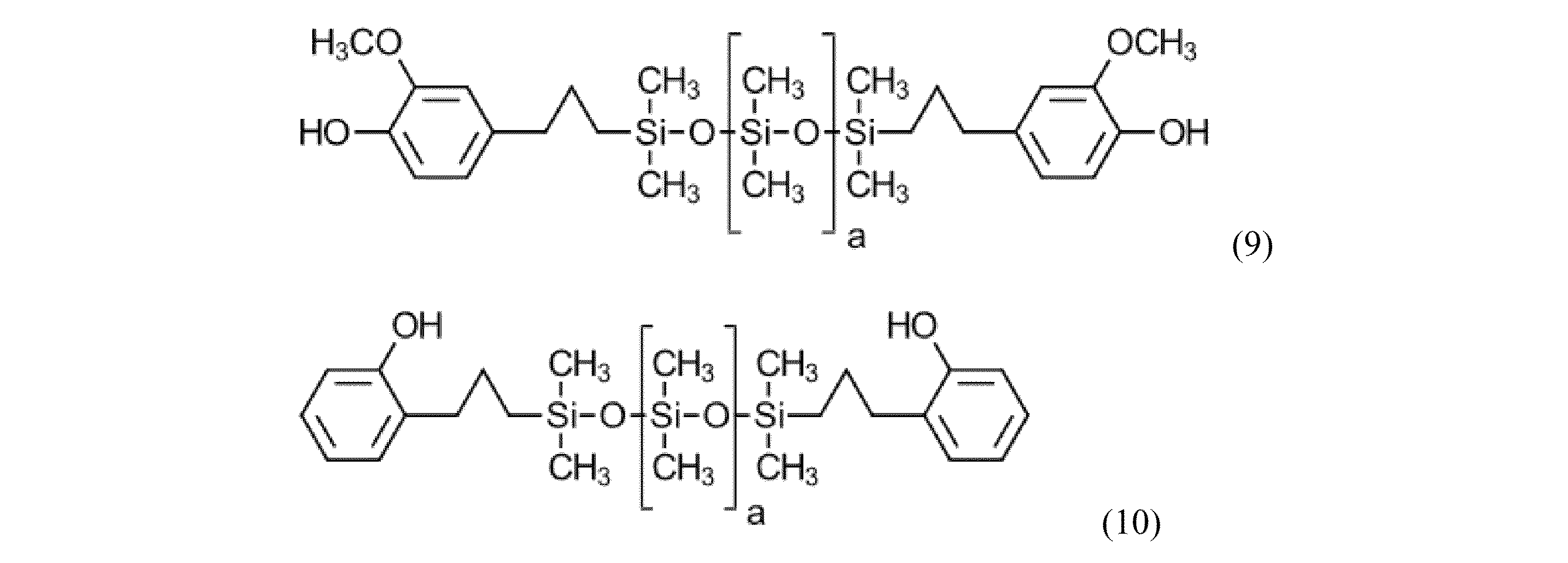
本明細書に示される全てのシロキサンブロック及び成分B全体の1H-NMR分光法は、重水素化塩素化溶剤、好ましくは重水素化クロロホルム又は重水素化ジクロロメタン中で実施され得る。適切な信号をそれぞれの場合に積分して比較する。 1 H-NMR spectroscopy of all siloxane blocks presented herein, and of component B as a whole, can be carried out in deuterated chlorinated solvents, preferably deuterated chloroform or deuterated dichloromethane. The appropriate signals are integrated in each case and compared.
例えば、構造9及び構造10では、0ppmから0.5ppmの間の化学シフトのSiCH3プロトンの積分と、約2.6ppmの化学シフトでの隣接CH2の積分とを使用することによって、aが決定される。 For example, for structures 9 and 10, a is determined by using the integral of the SiCH3 protons for chemical shifts between 0 ppm and 0.5 ppm and the integral of the adjacent CH2 proton at a chemical shift of approximately 2.6 ppm.
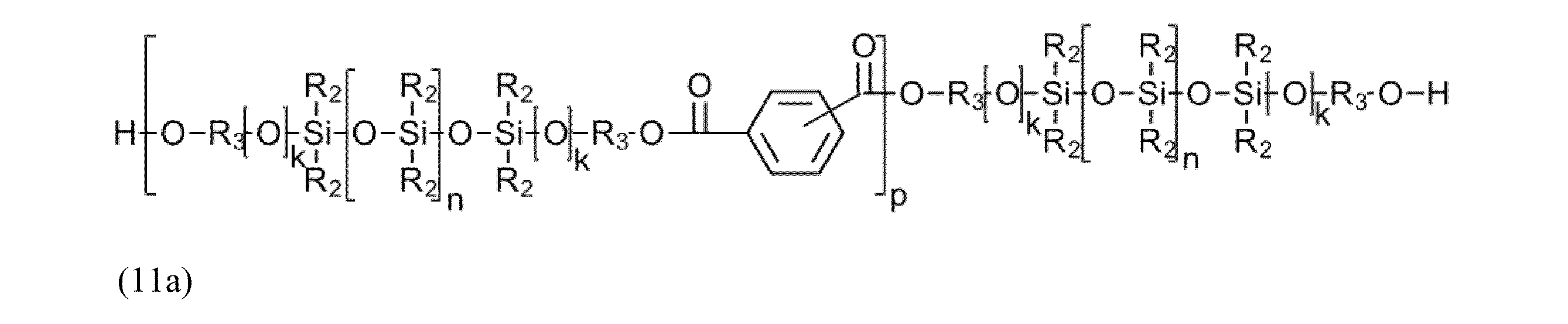
更なる実施の形態では、上述のシロキサンブロックを、テレフタル酸又はイソフタル酸を介して1回以上連結させて、以下の例示的な構造要素:

pは、0又は1を表し、
R2、R3、n及びkは、構造要素(6)について上記で定義した通りである)を得ることができる。
In further embodiments, the above-mentioned siloxane blocks are linked one or more times via terephthalic acid or isophthalic acid to give the following exemplary structural elements:
p represents 0 or 1;
R 2 , R 3 , n and k are as defined above for structural element (6).
ポリカーボネートとの反応又は式(5)若しくは式(5a)から誘導されたジフェノールとともにホスゲン若しくはジアリールカーボネートとの反応のための対応するシロキサンブロックは、それぞれ末端フェノール性OH基を有する。すなわち、
シロキサンブロックが式(12):
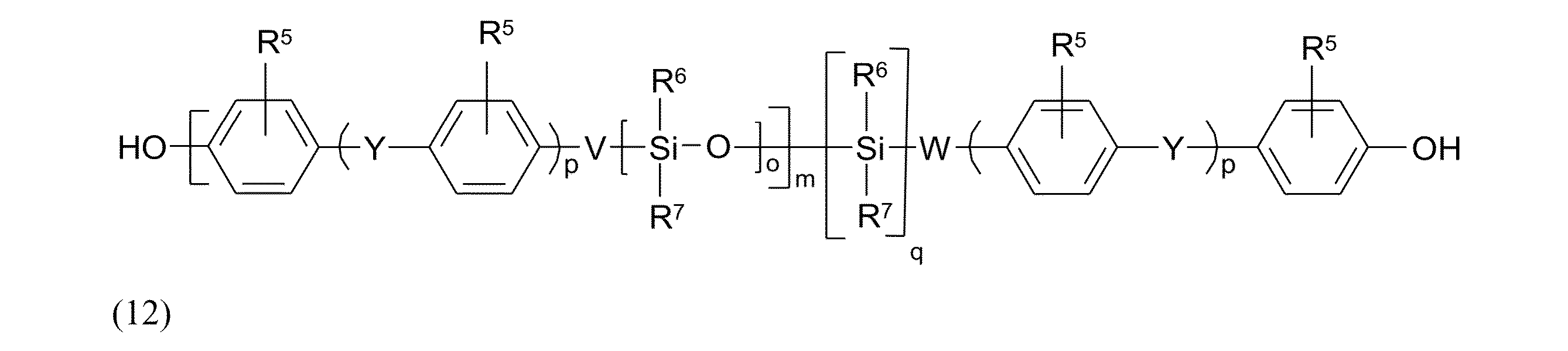
一般式(12)において、R5は、水素、又はC1~C4-アルキル、C1~C4-アルコキシ、好ましくは、水素、又はメチル、メチルオキシ、特に好ましくは水素を表す。 In the general formula (12), R 5 represents hydrogen or C 1 -C 4 -alkyl, C 1 -C 4 -alkoxy, preferably hydrogen or methyl, methyloxy, particularly preferably hydrogen.
R6及びR7は、互いに独立して、アリール、好ましくはフェニル、C1~C4アルキル、好ましくはメチル、特にメチルを表す。 R 6 and R 7 independently of each other represent aryl, preferably phenyl, C 1 -C 4 alkyl, preferably methyl, in particular methyl.
Yは、単結合、-CO-、-O-、C1~C5-アルキレン、C2~C5-アルキリデン、又はC1~C4-アルキルによって一置換若しくは多置換されていてもよいC5~C6-シクロアルキリデン基、好ましくは、単結合、-O-、イソプロピリデン、又はC1~C4-アルキルによって一置換若しくは多置換されていてもよいC5~C6-シクロアルキリデン基、特にイソプロピリデンを表す。 Y represents a single bond, -CO-, -O-, C1 - C5 -alkylene, C2 - C5 -alkylidene or a C5- C6 -cycloalkylidene group which may be mono- or polysubstituted by C1 - C4 -alkyl, preferably a single bond, -O-, isopropylidene or a C5 - C6 -cycloalkylidene group which may be mono- or polysubstituted by C1 - C4 -alkyl, in particular isopropylidene.
Vは、酸素、C1~C6アルキレン、又はC2~C5-アルキリデン、好ましくは、単結合、酸素、C3アルキレン、特に、酸素又はイソプロピリデンを表す。 V represents oxygen, C 1 -C 6 alkylene or C 2 -C 5 -alkylidene, preferably a single bond, oxygen, C 3 alkylene and in particular oxygen or isopropylidene.
Wは、単結合、S、C1~C6-アルキレン又はC2~C5-アルキリデン、好ましくは単結合、C3アルキレン又はイソプロピリデンを表し、ここで、qが1を表す場合にWは単結合ではない。 W represents a single bond, S, C 1 -C 6 -alkylene or C 2 -C 5 -alkylidene, preferably a single bond, C 3 alkylene or isopropylidene, whereby when q represents 1 W is not a single bond.
p及びqはそれぞれ、互いに独立して0又は1を表す。 p and q each independently represent 0 or 1.
oは、それぞれの場合に1H-NMR分光法によって決定される、10~400、好ましくは10~100、特に好ましくは15~50の繰返単位の平均数を表す。 o stands for the average number of repeating units, in each case determined by 1 H-NMR spectroscopy, of 10 to 400, preferably 10 to 100, particularly preferably 15 to 50.
oは、例えば、ブロックの2つの末端シロキサン単位、つまりO-Si(CH3)2の積分(約0.2ppmの化学シフト)に対する中央のSi-CH3プロトンの積分(約0.1ppmの化学シフト)を使用して決定される。 o is determined, for example, using the integral of the central Si-- CH.sub.3 proton (chemical shift of about 0.1 ppm) relative to the integrals of the two terminal siloxane units of the block, ie, O--Si( CH.sub.3 ).sub.2 (chemical shift of about 0.2 ppm).
mは、それぞれの場合に1H-NMR分光法によって決定される、1~10、好ましくは1~6、特に好ましくは1.5~5の繰返単位の平均数を表す。 m stands for the average number of repeat units, in each case determined by 1 H-NMR spectroscopy, of 1 to 10, preferably 1 to 6, particularly preferably 1.5 to 5.
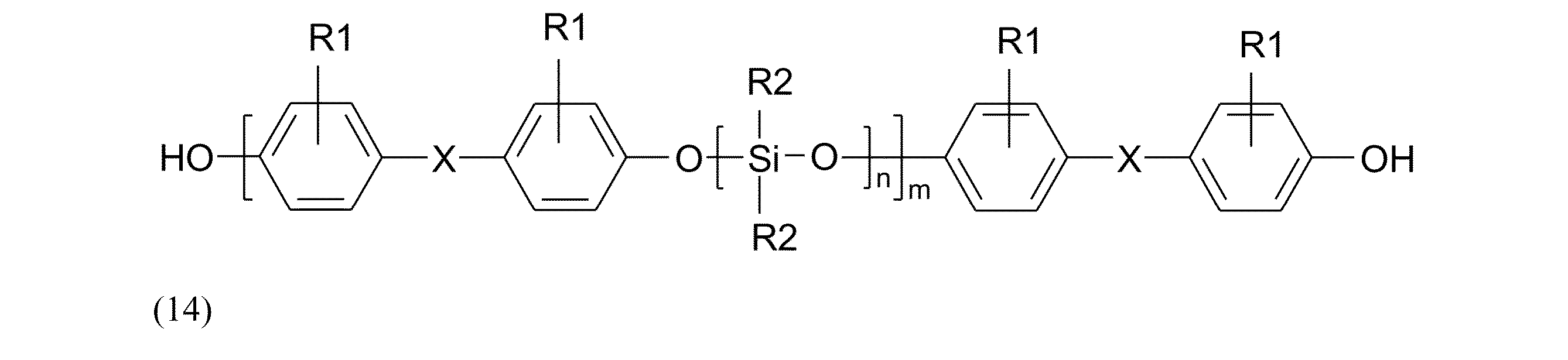
非常に特に好ましいのは、式(13)及び式(14):

R1は、水素、Cl、Br、C1~C4-アルキル、好ましくは水素又はメチル、特に好ましくは水素を表し、
R2は、互いに独立して、アリール又はアルキル、好ましくはメチルを表し、
Xは、単結合、-SO2-、-CO-、-O-、-S-、C1~C6-アルキレン、C2~C5-アルキリデン、又はヘテロ原子を含む更なる芳香族環に任意に縮合されていてもよいC6~C12-アリーレンを表し、
Xは、好ましくは、単結合、C1~C5-アルキレン、C2~C5-アルキリデン、C5~C12-シクロアルキリデン、-O-、-SO-、-CO-、-S-、-SO2-、特に好ましくは単結合、イソプロピリデン、C5~C12シクロアルキリデン又は酸素、非常に特に好ましくはイソプロピリデンを表し、
nは、それぞれの場合に1H-NMR分光法によって決定される、10~400、好ましくは10~100、特に好ましくは10~50の平均数を表し、かつ、
mは、それぞれの場合に1H-NMR分光法によって決定される、1~10、好ましくは1~6、特に好ましくは1.5~5の平均数を表す)のシロキサンである。
Very particular preference is given to compounds of the formula (13) and (14):
R1 represents hydrogen, Cl, Br, C 1 -C 4 -alkyl, preferably hydrogen or methyl, particularly preferably hydrogen,
R2 independently of each other represent aryl or alkyl, preferably methyl;
X represents a single bond, -SO 2 -, -CO-, -O-, -S-, C 1 -C 6 -alkylene, C 2 -C 5 -alkylidene or C 6 -C 12 -arylene, which may optionally be fused to a further aromatic ring containing a heteroatom;
X preferably represents a single bond, C 1 -C 5 -alkylene, C 2 -C 5 -alkylidene, C 5 -C 12 -cycloalkylidene, -O-, -SO-, -CO-, -S-, -SO 2 -, particularly preferably a single bond, isopropylidene, C 5 -C 12 -cycloalkylidene or oxygen, very particularly preferably isopropylidene,
n is an average number, determined in each case by 1 H-NMR spectroscopy, between 10 and 400, preferably between 10 and 100, particularly preferably between 10 and 50, and
m represents the average number of siloxanes, in each case determined by 1 H-NMR spectroscopy, from 1 to 10, preferably from 1 to 6, particularly preferably from 1.5 to 5.
構造11、構造13、及び構造14におけるnの決定は、oについて上記した方法に従って行われる。 The determination of n in structures 11, 13, and 14 is performed according to the method described above for o.
mの決定には、末端のフェニル基、例えば、末端のビスフェノールA由来の単位でのプロトンの積分、及び中央のフェニル基、例えば、中央のビスフェノールA由来の単位でのプロトンの積分が使用される。 To determine m, the integral of the protons in the terminal phenyl groups, e.g., in units derived from terminal bisphenol A, and the integral of the protons in the central phenyl groups, e.g., in units derived from central bisphenol A, are used.
特に良好な熱安定性及び色安定性を示すため、式14のシロキサンが最も好ましい。 Siloxanes of formula 14 are most preferred, as they exhibit particularly good thermal and color stability.
シロキサン成分、すなわちシロキサンブロックの重量平均分子量Mwは、ゲル浸透クロマトグラフィーによってBPA(ビスフェノールA)ポリカーボネート標準を使用して測定される、好ましくは3000g/mol~20000g/mol、特に好ましくは3500g/mol~15000g/molである。 The weight-average molecular weight Mw of the siloxane components, ie the siloxane blocks, is preferably from 3000 g/mol to 20 000 g/mol, particularly preferably from 3500 g/mol to 15 000 g/mol, determined by gel permeation chromatography using BPA (bisphenol A) polycarbonate standards.
式(12)~式(14)のシロキサンの製造は、例えば、独国特許出願公開第3334782号及び独国特許出願公開第19710081号に記載されている。 The preparation of siloxanes of formulae (12) to (14) is described, for example, in DE-A-3334782 and DE-A-19710081.
式(12)、式(13)、又は式(14)のシロキサン成分は、それぞれの場合に成分A)及び成分B)に対して、0.5重量%~50重量%、好ましくは1重量%~40重量%、特に好ましくは2重量%~20重量%、非常に特に好ましくは2.5重量%~10重量%の量で使用される。 The siloxane components of formula (12), formula (13) or formula (14) are used in an amount of 0.5% by weight to 50% by weight, preferably 1% by weight to 40% by weight, particularly preferably 2% by weight to 20% by weight and very particularly preferably 2.5% by weight to 10% by weight, based on components A) and B) in each case.
シロキサンブロックの製造は原則として知られており、これらは、例えば、米国特許出願公開第20130267665号に記載される方法によって製造され得る。 The preparation of siloxane blocks is known in principle and they can be prepared, for example, by the method described in US Patent Application Publication No. 20130267665.
ポリシロキサン-ポリカーボネートブロック共縮合物は、通常、ホスゲンを用いた界面法によってモノマーから工業的に製造される。ジフェノールカーボネートを使用する溶融エステル交換法によるこれらのポリシロキサン-ポリカーボネートブロック共縮合物の製造も知られている。 Polysiloxane-polycarbonate block cocondensates are usually produced industrially from monomers by the interfacial process with phosgene. The production of these polysiloxane-polycarbonate block cocondensates by the melt transesterification process using diphenol carbonate is also known.
界面法によるポリシロキサン-ポリカーボネートブロック共縮合物の製造は文献から知られており、例えば、米国特許出願公開第3189662号、米国特許出願公開第3419634号、独国特許出願公開第334782号、及び欧州特許第0122535号に記載されている。 The preparation of polysiloxane-polycarbonate block cocondensates by the interfacial method is known from the literature and is described, for example, in US Pat. No. 3,189,662, US Pat. No. 3,419,634, DE Pat. No. 334,782 and EP Pat. No. 0,122,535.
ビスフェノール、ジアリールカーボネート、シラノール末端のポリシロキサン、及び触媒からの溶融エステル交換法によるポリシロキサン-ポリカーボネートブロック共縮合物の製造は、米国特許第5227449号に記載されている。 The preparation of polysiloxane-polycarbonate block cocondensates from bisphenols, diaryl carbonates, silanol-terminated polysiloxanes, and catalysts by a melt transesterification process is described in U.S. Pat. No. 5,227,449.
ポリシロキサン-ポリカーボネートブロック共縮合物を製造する反応性押出法も記載されている。これは、例えば、米国特許第5414054号及び米国特許第5821321号において公開されている。 Reactive extrusion methods for producing polysiloxane-polycarbonate block cocondensates have also been described, for example in U.S. Pat. No. 5,414,054 and U.S. Pat. No. 5,821,321.
本発明によるポリシロキサン-ポリカーボネートブロック共縮合物は、好ましくは溶融エステル交換法において、より好ましくは反応性押出法において製造される。反応性押出法は、好ましくは、押出機又は高粘度反応器において溶融物中で以下の成分:
a)式(3)の少なくとも1つのポリマー含有構造単位、好ましくは芳香族ポリカーボネート、
b)好ましくは式9、式10、式11a、式12、式13、式14のいずれかによる少なくとも1つのヒドロキシルアリール末端の(ポリ)シロキサンを、
c)任意に、例えば触媒等の少なくとも1つの添加剤を使用して、
混合及び反応させることを含む。
The polysiloxane-polycarbonate block cocondensates according to the invention are preferably prepared in a melt transesterification process, more preferably in a reactive extrusion process. The reactive extrusion process preferably comprises mixing the following components in a melt in an extruder or high-viscosity reactor:
a) at least one polymer containing structural units of formula (3), preferably an aromatic polycarbonate;
b) at least one hydroxylaryl-terminated (poly)siloxane, preferably according to any of formulas 9, 10, 11a, 12, 13, and 14,
c) optionally using at least one additive, such as, for example, a catalyst,
This includes mixing and reacting.
押出機又は溶融反応器は、一軸スクリュー型反応器、二軸スクリュー型反応器、又は多軸スクリュー型反応器、例えば、遊星ローラー押出機又はリング押出機であり得る。大容量ニーダー反応器も関係し得る。 The extruder or melt reactor may be a single screw reactor, a twin screw reactor, or a multi-screw reactor, for example a planetary roller extruder or a ring extruder. Large volume kneader reactors may also be involved.
上記方法は、単一の装置、例えば二軸スクリュー型押出機でも、又は2段階で、すなわち反応器の組み合わせにおいても実施され得る。反応器の組み合わせは、好ましくは、二軸スクリュー押出機等の予備反応器及び高粘度反応器のみからなる。 The process can be carried out in a single apparatus, e.g. a twin-screw extruder, or in two stages, i.e. a reactor combination. The reactor combination preferably consists of only a prereactor, e.g. a twin-screw extruder, and a high-viscosity reactor.
上記方法は、好ましくは、280℃~400℃、好ましくは290℃~380℃、より好ましくは300℃~350℃の温度、及び0.001mbar~50mbar、好ましくは0.005mbar~40mbar、特に好ましくは0.02mbar~30mbar、非常に特に好ましくは0.03mbar~5mbarの圧力にて、好ましくは触媒の存在下で実施される。 The process is preferably carried out at a temperature of 280°C to 400°C, preferably 290°C to 380°C, more preferably 300°C to 350°C, and at a pressure of 0.001 mbar to 50 mbar, preferably 0.005 mbar to 40 mbar, particularly preferably 0.02 mbar to 30 mbar, very particularly preferably 0.03 mbar to 5 mbar, preferably in the presence of a catalyst.
成分C
成分Cは、ゴム変性グラフトポリマーを含む。これらのグラフトポリマーは、
C.1 成分Cに対して5重量%~95重量%、好ましくは7重量%~50重量%、特に好ましくは10重量%~30重量%の少なくとも1つのビニルモノマーを、
C.2 成分Cに対して95重量%~5重量%、好ましくは93重量%~50重量%、特に好ましくは90重量%~70重量%のシリコーン-アクリレート複合ゴムを基礎とする1つ以上のゴム状グラフト基材上に、
含む。
Component C
Component C comprises rubber modified graft polymers. These graft polymers include:
C. 1 5% to 95% by weight, preferably 7% to 50% by weight, particularly preferably 10% to 30% by weight, of at least one vinyl monomer, based on component C,
C. 2. On one or more rubbery graft substrates based on silicone-acrylate hybrid rubber in an amount of 95% to 5% by weight, preferably 93% to 50% by weight, particularly preferably 90% to 70% by weight, based on component C;
include.
ポリマー鎖の形成にビニルモノマーが使用され、これらはグラフト基材C.2に化学的に結合される。 Vinyl monomers are used to form polymer chains, which are chemically bonded to the graft substrate C.2.
グラフト基材は、10℃未満、好ましくは0℃未満、特に好ましくは-20℃未満のガラス転移温度を有する。 The graft substrate has a glass transition temperature of less than 10°C, preferably less than 0°C, and particularly preferably less than -20°C.
ガラス転移温度は、規格DIN EN 61006による動的示差熱量測定(DSC)によって10K/分の昇温速度で測定され、Tgは中点温度として定義される(接線法)。 The glass transition temperature is determined by differential dynamic calorimetry (DSC) according to standard DIN EN 61006 at a heating rate of 10 K/min, Tg being defined as the midpoint temperature (tangent method).
グラフト基材C.2は一般に、0.05μm~10μm、好ましくは0.1μm~5μm、特に好ましくは0.2μm~1μmの中央値粒子サイズ(d50)を有する。 The graft substrate C.2 generally has a median particle size (d 50 ) of 0.05 μm to 10 μm, preferably 0.1 μm to 5 μm, particularly preferably 0.2 μm to 1 μm.
中央値粒子サイズd50は、それぞれの場合に、粒子の50重量%がそれを上回り、粒子の50重量%がそれを下回る直径である。中央値粒子サイズd50は、超遠心分離によって測定され得る(W. Scholtan, H. Lange, Kolloid, Z. and Z. Polymere [polymers] 250 (1972), 782-1796)。 The median particle size d 50 is in each case the diameter above which 50% of the particles fall and below which 50% of the particles fall. The median particle size d 50 can be determined by ultracentrifugation (W. Scholtan, H. Lange, Kolloid, Z. and Z. Polymere [polymers] 250 (1972), 782-1796).
モノマーC.1は、好ましくは、
C.1.1 C.1に対して50重量部~99重量部、好ましくは60重量部~80重量部、特に70重量部~80重量部のビニル芳香族化合物及び/又は環置換されたビニル芳香族化合物(例えば、スチレン、α-メチルスチレン、p-メチルスチレン、p-クロロスチレン)及び/又は(C1~C8)-アルキルメタクリレート、例えばメチルメタクリレート、エチルメタクリレートと、
C.1.2 C.1に対して1重量部~50重量部、好ましくは20重量部~40重量部、特に20重量部~30重量部のシアン化ビニル(不飽和ニトリル、例えばアクリロニトリル及びメタクリロニトリル)及び/又は(C1~C8)-アルキル(メタ)アクリレート、例えばメチルメタクリレート、n-ブチルアクリレート、tert-ブチルアクリレート、及び/又は不飽和カルボン酸の誘導体(例えば、無水物及びイミド)、例えば無水マレイン酸及びN-フェニルマレイミドと、
の混合物である。
Monomer C.1 is preferably
C.1.1 50 to 99 parts by weight, preferably 60 to 80 parts by weight, in particular 70 to 80 parts by weight, based on C.1, of vinyl aromatic compounds and/or ring-substituted vinyl aromatic compounds (for example styrene, α-methylstyrene, p-methylstyrene, p-chlorostyrene) and/or (C 1 -C 8 )-alkyl methacrylates, for example methyl methacrylate, ethyl methacrylate,
C.1.2 1 to 50 parts by weight, based on C.1, preferably 20 to 40 parts by weight, in particular 20 to 30 parts by weight, of vinyl cyanides (unsaturated nitriles, such as acrylonitrile and methacrylonitrile) and/or (C 1 -C 8 )-alkyl (meth)acrylates, such as methyl methacrylate, n-butyl acrylate, tert-butyl acrylate, and/or derivatives of unsaturated carboxylic acids (for example anhydrides and imides), such as maleic anhydride and N-phenylmaleimide,
It is a mixture of.
好ましいモノマーC.1.1は、モノマーのスチレン、α-メチルスチレン及びメチルメタクリレートのうちの少なくとも1つから選択され、好ましいモノマーC.1.2は、モノマーのアクリロニトリル、無水マレイン酸及びメチルメタクリレートのうちの少なくとも1つから選択される。特に好ましいモノマーは、C.1.1のスチレン及びC.1.2のアクリロニトリル又はC.1.1=C.1.2のメチルメタクリレートである。 Preferred monomers C.1.1 are selected from at least one of the monomers styrene, α-methylstyrene and methyl methacrylate, and preferred monomers C.1.2 are selected from at least one of the monomers acrylonitrile, maleic anhydride and methyl methacrylate. Particularly preferred monomers are C.1.1 styrene and C.1.2 acrylonitrile or C.1.1=C.1.2 methyl methacrylate.
グラフトコポリマーCは、フリーラジカル重合によって、例えば、乳化重合、懸濁重合、溶液重合又は塊状重合によって、好ましくは乳化重合又は塊状重合によって、特に乳化重合によって製造される。 The graft copolymer C is prepared by free-radical polymerization, for example by emulsion, suspension, solution or bulk polymerization, preferably by emulsion or bulk polymerization, in particular by emulsion polymerization.
グラフト基材C.2のゲル含有量は、トルエン中の不溶性含分として測定されて、それぞれC.2に対して、少なくとも30重量%、好ましくは少なくとも40重量%、特に少なくとも60重量%である。 The gel content of the graft substrate C.2, measured as the insoluble content in toluene, is at least 30% by weight, preferably at least 40% by weight, in particular at least 60% by weight, based on C.2.
グラフト基材C.2のゲル含有量は、適切な溶剤中で25℃にて、これらの溶剤中での不溶性含分として測定される(M. Hoffmann, H. Kroemer, R. Kuhn, Polymeranalytik I und II, Georg Thieme-Verlag, Stuttgart 1977)。 The gel content of the graft substrate C.2 is determined in suitable solvents at 25° C. as the insoluble content in these solvents (M. Hoffmann, H. Kroemer, R. Kuhn, Polymeranalytik I und II, Georg Thieme-Verlag, Stuttgart 1977).
よく知られているように、グラフトモノマーは、グラフト反応においてグラフト基材上に必ずしも完全にグラフトされるとは限らないので、グラフトポリマーCは、本発明によればグラフトモノマーのグラフト基材の存在下での(共)重合によって得られ、後処理中に一緒に得られる生成物も含むと理解されるべきである。したがって、これらの生成物は、グラフトモノマーの遊離(コ)ポリマー、すなわち、ゴムに化学的に結合されていない(コ)ポリマーも含み得る。 Since, as is well known, the graft monomer is not necessarily completely grafted onto the graft substrate in the grafting reaction, the graft polymer C should be understood to also include products obtained according to the invention by (co)polymerization of the graft monomer in the presence of the graft substrate and obtained together during aftertreatment. These products may therefore also include free (co)polymers of the graft monomer, i.e. (co)polymers that are not chemically bound to the rubber.
シリコーン-アクリレート複合ゴム又は異なるシリコーン-アクリレート複合ゴムの混合物がグラフト基材C.2として使用される。これらのシリコーン-アクリレート複合ゴムは、好ましくは、5重量%~95重量%、好ましくは20重量%~80重量%、特に好ましくは25重量%~50重量%のシリコーンゴム含分C.2.1及び95重量%~5重量%、好ましくは80重量%~20重量%、特に好ましくは75重量%~50重量%のポリアルキル(メタ)アクリレートゴム含分C.2.2を含有するグラフト活性部位を有する複合ゴムであり、挙げられた2つのゴム成分は互いに浸透し合って複合ゴムとなっているため本質的に分離不可能である。 Silicone-acrylate hybrid rubbers or mixtures of different silicone-acrylate hybrid rubbers are used as the graft substrate C.2. These silicone-acrylate hybrid rubbers are preferably hybrid rubbers having graft active sites containing 5% to 95% by weight, preferably 20% to 80% by weight, particularly preferably 25% to 50% by weight of silicone rubber content C.2.1 and 95% to 5% by weight, preferably 80% to 20% by weight, particularly preferably 75% to 50% by weight of polyalkyl (meth)acrylate rubber content C.2.2, the two rubber components mentioned penetrating each other to form the hybrid rubber and therefore essentially inseparable.
シリコーンゴム及びポリアルキル(メタ)アクリレートゴムの特に好ましい割合により、良好な機械的特性、構成部品の良好な表面、及び加水分解による分子量低下及び薬品の影響に対する良好な耐性の特に有利な組み合わせがもたらされる。 The particularly preferred ratio of silicone rubber and polyalkyl(meth)acrylate rubber results in a particularly advantageous combination of good mechanical properties, good surface of the components, and good resistance to hydrolytic degradation and to the effects of chemicals.
シリコーン-アクリレート複合ゴムは知られており、例えば、米国特許第5,807,914号、欧州特許第430134号、及び米国特許第4888388号に記載されている。 Silicone-acrylate composite rubbers are known and are described, for example, in U.S. Pat. No. 5,807,914, European Patent No. 430134, and U.S. Pat. No. 4,888,388.
C.2のシリコーン-アクリレート複合ゴムの適切なシリコーンゴム成分C.2.1は、グラフト活性部位を有するシリコーンゴムであり、その製造方法は、例えば、米国特許第2891920号、米国特許第3294725号、独国特許出願公開第3631540号、欧州特許第249964号、欧州特許第430134号、及び米国特許第4888388号に記載されている。 Suitable silicone rubber component C.2.1 of the silicone-acrylate hybrid rubber of C.2 is a silicone rubber having graft active sites, the preparation of which is described, for example, in U.S. Pat. No. 2,891,920, U.S. Pat. No. 3,294,725, DE-A-3,631,540, EP-A-249,964, EP-A-430,134, and U.S. Pat. No. 4,888,388.
C.2.1によるシリコーンゴムは、好ましくは、シロキサンモノマー単位、架橋剤又は分岐剤(IV)、及び任意にグラフト剤(V)を使用する乳化重合によって製造される。 C. The silicone rubbers according to 2.1 are preferably prepared by emulsion polymerization using siloxane monomer units, a crosslinking or branching agent (IV), and optionally a grafting agent (V).
好ましく使用されるシロキサンモノマー単位の例には、ジメチルシロキサン、又は少なくとも3員環、好ましくは3員環~6員環の環状オルガノシロキサン、例えば、好ましくは、ヘキサメチルシクロトリシロキサン、オクタメチルシクロテトラシロキサン、デカメチルシクロペンタシロキサン、ドデカメチルシクロヘキサシロキサン、トリメチルトリフェニルシクロトリシロキサン、テトラメチルテトラフェニルシクロテトラシロキサン、オクタフェニルシクロテトラシロキサンが含まれる。 Examples of siloxane monomer units that are preferably used include dimethylsiloxane or cyclic organosiloxanes having at least three ring members, preferably three to six ring members, such as, preferably, hexamethylcyclotrisiloxane, octamethylcyclotetrasiloxane, decamethylcyclopentasiloxane, dodecamethylcyclohexasiloxane, trimethyltriphenylcyclotrisiloxane, tetramethyltetraphenylcyclotetrasiloxane, and octaphenylcyclotetrasiloxane.
有機シロキサンモノマーは、単独で又は2つ以上のモノマーを含む混合物の形で使用され得る。 The organosiloxane monomers may be used alone or in mixtures containing two or more monomers.
好ましくは使用される架橋剤又は分岐剤(IV)は、3つ又は4つ、特に好ましくは4つの官能性を有するシランベースの架橋剤である。好ましい例には、トリメトキシメチルシラン、トリエトキシフェニルシラン、テトラメトキシシラン、テトラエトキシシラン、テトラ-n-プロポキシシラン、及びテトラブトキシシランが含まれる。架橋剤は、単独で又は2つ以上の混合物で使用され得る。特に好ましいのは、テトラエトキシシランである。 The crosslinking or branching agent (IV) preferably used is a silane-based crosslinking agent having a functionality of three or four, particularly preferably four. Preferred examples include trimethoxymethylsilane, triethoxyphenylsilane, tetramethoxysilane, tetraethoxysilane, tetra-n-propoxysilane, and tetrabutoxysilane. The crosslinking agents can be used alone or in mixtures of two or more. Particularly preferred is tetraethoxysilane.
グラフト剤(V)の例には、β-メタクリロイルオキシエチルジメトキシメチルシラン、γ-メタクリロイルオキシプロピルメトキシジメチルシラン、γ-メタクリロイルオキシプロピルジメトキシメチルシラン、γ-メタクリロイルオキシプロピルトリメトキシシラン、γ-メタクリロイルオキシプロピルエトキシジエチルシラン、γ-メタクリロイルオキシプロピルジエトキシメチルシラン、δ-メタクリロイルオキシブチルジエトキシメチルシラン、又はこれらの混合物が含まれる。 Examples of the grafting agent (V) include β-methacryloyloxyethyldimethoxymethylsilane, γ-methacryloyloxypropylmethoxydimethylsilane, γ-methacryloyloxypropyldimethoxymethylsilane, γ-methacryloyloxypropyltrimethoxysilane, γ-methacryloyloxypropylethoxydiethylsilane, γ-methacryloyloxypropyldiethoxymethylsilane, δ-methacryloyloxybutyldiethoxymethylsilane, or mixtures thereof.
シリコーンゴムの総重量に対して0重量%~20重量%のグラフト剤を使用することが好ましい。 It is preferable to use 0% to 20% by weight of grafting agent based on the total weight of the silicone rubber.
シリコーンゴムは、例えば、米国特許第2891920号及び米国特許第3294725号に記載される乳化重合によって製造され得る。 Silicone rubber can be produced, for example, by emulsion polymerization as described in U.S. Pat. No. 2,891,920 and U.S. Pat. No. 3,294,725.
シリコーン-アクリレート複合ゴムの適切なポリアルキル(メタ)アクリレートゴム成分C.2.2は、アルキルメタクリレート及び/又はアルキルアクリレート、架橋剤(VI)、及びグラフト剤(VII)から製造され得る。好ましいアルキルメタクリレート及び/又はアルキルアクリレートの例には、C1~C8-アルキルエステル、例えば、メチルエステル、エチルエステル、n-ブチルエステル、t-ブチルエステル、n-プロピルエステル、n-ヘキシルエステル、n-オクチルエステル、n-ラウリルエステル、及び2-エチルヘキシルエステル、ハロアルキルエステル、好ましくはクロロエチルアクリレート等のハロC1~C8-アルキルエステル、及びこれらのモノマーの混合物が含まれる。特に好ましくは、n-ブチルアクリレートである。 Suitable polyalkyl(meth)acrylate rubber components C.2.2 of the silicone-acrylate composite rubber can be prepared from alkyl methacrylates and/or alkyl acrylates, a crosslinking agent (VI), and a grafting agent (VII). Examples of preferred alkyl methacrylates and/or alkyl acrylates include C 1 -C 8 -alkyl esters, such as methyl esters, ethyl esters, n-butyl esters, t-butyl esters, n-propyl esters, n-hexyl esters, n-octyl esters, n-lauryl esters, and 2-ethylhexyl esters, haloalkyl esters, preferably halo C 1 -C 8 -alkyl esters such as chloroethyl acrylate, and mixtures of these monomers. Particularly preferred is n-butyl acrylate.
シリコーン-アクリレートゴムのポリアルキル(メタ)アクリレートゴム成分に使用可能な架橋剤(VI)には、2つ以上の重合可能な二重結合を有するモノマーが含まれる。架橋モノマーの好ましい例は、3個~8個の炭素原子を有する不飽和モノカルボン酸と3個~12個の炭素原子を有する不飽和一価アルコール又は2個~4個のOH基及び2個~20個の炭素原子を有する飽和ポリオールとのエステル、例えば、エチレングリコールジメタクリレート、プロピレングリコールジメタクリレート、1,3-ブチレングリコールジメタクリレート、及び1,4-ブチレングリコールジメタクリレートである。架橋剤は、単独で又は少なくとも2つの架橋剤の混合物で使用され得る。 Crosslinking agents (VI) that can be used in the polyalkyl (meth)acrylate rubber component of the silicone-acrylate rubber include monomers having two or more polymerizable double bonds. Preferred examples of crosslinking monomers are esters of unsaturated monocarboxylic acids having 3 to 8 carbon atoms with unsaturated monohydric alcohols having 3 to 12 carbon atoms or saturated polyols having 2 to 4 OH groups and 2 to 20 carbon atoms, such as ethylene glycol dimethacrylate, propylene glycol dimethacrylate, 1,3-butylene glycol dimethacrylate, and 1,4-butylene glycol dimethacrylate. The crosslinking agents can be used alone or in a mixture of at least two crosslinking agents.
好ましいグラフト剤(VII)の例には、アリルメタクリレート、トリアリルシアヌレート、トリアリルイソシアヌレート、又はそれらの混合物が含まれる。架橋剤(VI)として、アリルメタクリレートも使用され得る。グラフト剤は、単独で又は少なくとも2つのグラフト剤の混合物で使用され得る。 Examples of preferred grafting agents (VII) include allyl methacrylate, triallyl cyanurate, triallyl isocyanurate, or mixtures thereof. As a crosslinking agent (VI), allyl methacrylate may also be used. The grafting agents may be used alone or in a mixture of at least two grafting agents.
架橋剤(VI)及びグラフト剤(VII)の量は、シリコーン-アクリレートゴムのポリアルキル(メタ)アクリレートゴム成分の総重量に対して0.1重量%~20重量%である。 The amount of crosslinker (VI) and grafting agent (VII) is 0.1% to 20% by weight based on the total weight of the polyalkyl(meth)acrylate rubber component of the silicone-acrylate rubber.
シリコーン-アクリレート複合ゴムは、最初にC.2.1のシリコーンゴムを水性ラテックスの形で製造することによって製造される。次いで、このラテックスに、使用されるアルキルメタクリレート及び/又はアルキルアクリレート、架橋剤(VI)、及びグラフト剤(VII)を添加して、重合を行う。 The silicone-acrylate hybrid rubber is produced by first preparing the silicone rubber of C.2.1 in the form of an aqueous latex. The alkyl methacrylate and/or alkyl acrylate to be used, the crosslinking agent (VI), and the grafting agent (VII) are then added to this latex and polymerization is carried out.
挙げられるシリコーン-アクリレート複合グラフトゴムは、モノマーC.1をゴム基材C.2にグラフトすることによって製造される。 The silicone-acrylate hybrid graft rubber is produced by grafting monomer C.1 onto rubber substrate C.2.
これは、例えば、欧州特許第249964号、欧州特許第430134号、及び米国特許第4888388号に記載される重合方法を使用して実施され得る。 This can be done, for example, using the polymerization methods described in EP 249964, EP 430134, and U.S. Pat. No. 4,888,388.
成分Cとして挙げられるシリコーン-アクリレート複合グラフトゴムは市販されている。例としては、三菱レイヨン株式会社のMetablen(商標)SX005、Metablen(商標)S-2001、及びMetablen(商標)S-2030が含まれる。 The silicone-acrylate hybrid graft rubbers listed as component C are commercially available. Examples include Metablen™ SX005, Metablen™ S-2001, and Metablen™ S-2030 from Mitsubishi Rayon Co., Ltd.
成分D
成分Dとして、ホスファゼン又は種々のホスファゼンの混合物が使用される。ホスファゼンは、式(15a)及び式(15b):

Rは、それぞれの場合に同一又は異なり、
アミン基、
それぞれの場合に任意にハロゲン化された、好ましくはフッ素ハロゲン化された、より好ましくはモノハロゲン化されたC1~C8-アルキル、好ましくはメチル、エチル、プロピル若しくはブチル、
C1~C8-アルコキシ、好ましくはメトキシ、エトキシ、プロポキシ若しくはブトキシ、
それぞれの場合に任意にアルキル置換された、好ましくはC1~C4-アルキル置換された、及び/又はハロゲン置換された、好ましくは塩素置換及び/又は臭素置換されたC5~C6-シクロアルキル、
それぞれの場合に任意にアルキル置換された、好ましくはC1~C4-アルキル置換された、及び/又はハロゲン置換された、好ましくは塩素置換、臭素置換、及び/又はヒドロキシル置換されたC6~C20-アリールオキシ、好ましくはフェノキシ、ナフチルオキシ、
それぞれの場合に任意にアルキル置換された、好ましくはC1~C4-アルキル置換された、及び/又はハロゲン置換された、好ましくは塩素置換及び/又は臭素置換されたC7~C12-アラルキル、好ましくはフェニル-C1~C4-アルキル、又は、
ハロゲン基、好ましくは塩素若しくはフッ素、又は、
OH基、
を表し、
kは、0又は1~15の数、好ましくは1~10の数である)の化合物である。
Component D
As component D, a phosphazene or a mixture of different phosphazenes is used. The phosphazenes are represented by the formula (15a) and the formula (15b):
R is the same or different in each occurrence,
Amine groups,
C 1 -C 8 -alkyl, preferably methyl, ethyl, propyl or butyl, optionally halogenated, preferably fluorohalogenated and more preferably monohalogenated;
C 1 -C 8 -alkoxy, preferably methoxy, ethoxy, propoxy or butoxy,
C 5 -C 6 -cycloalkyl, which in each case is optionally alkyl-substituted, preferably C 1 -C 4 -alkyl-substituted and/or halogen-substituted, preferably chlorine- and / or bromine-substituted;
C 6 -C 20 -aryloxy, preferably phenoxy, naphthyloxy, which are in each case optionally alkyl-substituted, preferably C 1 -C 4 -alkyl -substituted and/or halogen-substituted, preferably chlorine-, bromine- and/or hydroxyl-substituted;
C 7 -C 12 -aralkyl, preferably phenyl-C 1 -C 4 -alkyl, which in each case is optionally alkyl-substituted, preferably C 1 -C 4 -alkyl-substituted and/or halogen-substituted, preferably chlorine- and/or bromine -substituted, or
a halogen group, preferably chlorine or fluorine, or
OH group,
represents
and k is 0 or a number from 1 to 15, preferably a number from 1 to 10.
例えば反応が不完全な出発物質から、式(15a)又は式(15b)のホスファゼンがリンでハロゲン置換されている場合に、リンでハロゲン置換されたこのホスファゼンの割合は、好ましくは1000ppm未満、より好ましくは500ppm未満である。 When a phosphazene of formula (15a) or formula (15b) is halogen-substituted with phosphorus, for example from an incompletely reacted starting material, the proportion of this phosphazene halogen-substituted with phosphorus is preferably less than 1000 ppm, more preferably less than 500 ppm.
更に好ましい実施の形態では、同一のRを有するホスファゼンのみが使用される。 In a more preferred embodiment, only phosphazenes having the same R are used.
式(15b)の環状ホスファゼンが好ましく、プロポキシホスファゼン、フェノキシホスファゼン、メチルフェノキシホスファゼン、アミノホスファゼン及びフルオロアルキルホスファゼン、並びに更に以下の構造:
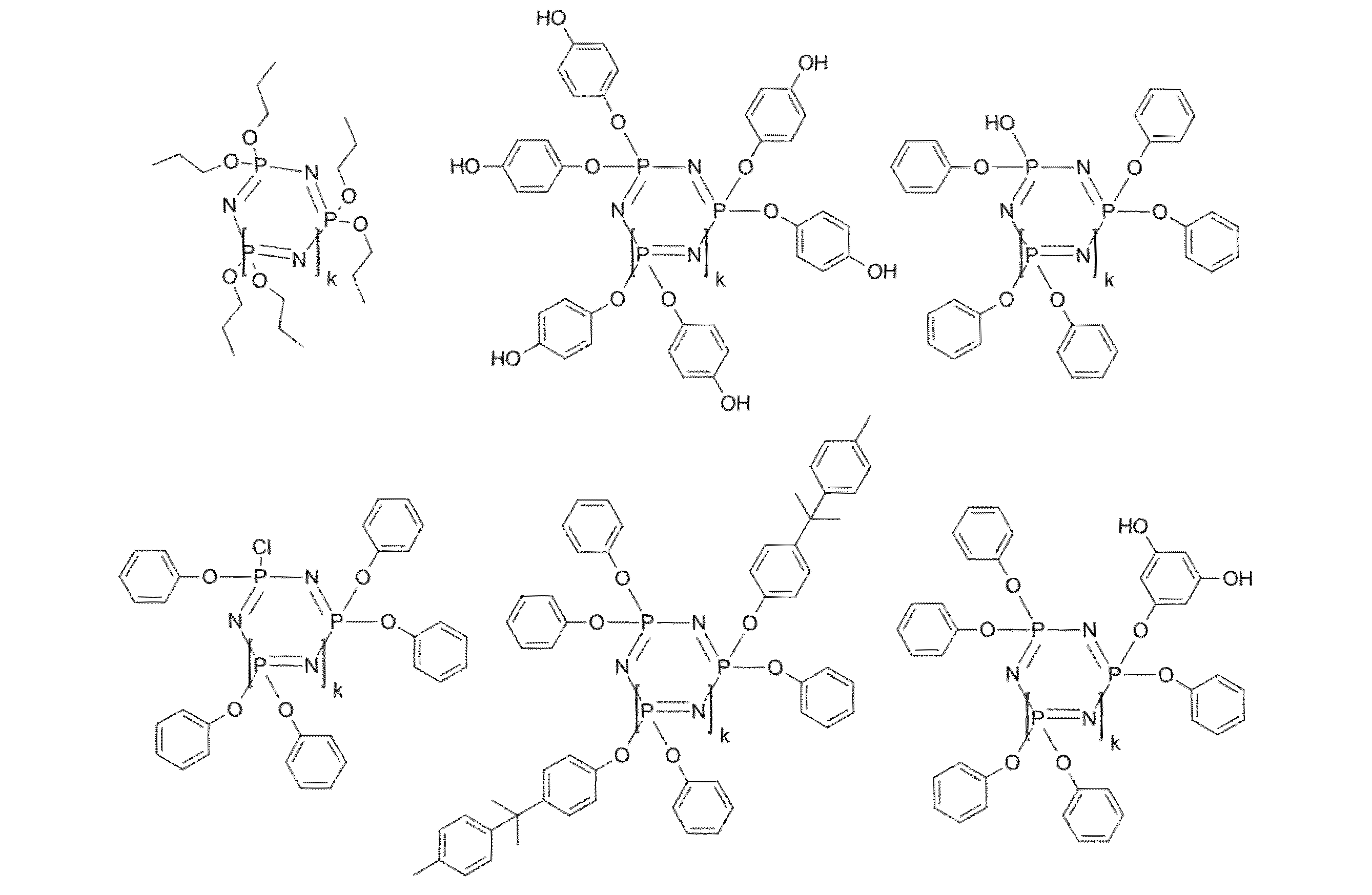
前掲の化合物では、k=1、2又は3である。 In the above compounds, k = 1, 2, or 3.
60mol%~98mol%、より好ましくは65mol%~85mol%のk=1であるオリゴマー(C1)の割合を有する、式(16):

成分Cは、成分Cに対して、65mol%~85mol%の三量体の割合(k=1)、10mol%~20mol%の四量体の割合(k=2)、5mol%~20mol%のより高次のオリゴマーのホスファゼンの割合(k=3、4、5、6及び7)、及び0mol%~2mol%のk≧8のホスファゼンオリゴマーの割合を有するフェノキシホスファゼンであることが好ましい。 Component C is preferably a phenoxyphosphazene having, relative to component C, a trimer ratio (k=1) of 65 mol% to 85 mol%, a tetramer ratio (k=2) of 10 mol% to 20 mol%, a higher oligomeric phosphazene ratio (k=3, 4, 5, 6, and 7) of 5 mol% to 20 mol%, and a phosphazene oligomer ratio of 0 mol% to 2 mol% with k≧8.
ホスファゼン及びその製造は、例えば、欧州特許出願公開第728811号、独国特許出願公開第1961668号、及び国際公開第97/40092号に記載されている。 Phosphazenes and their preparation are described, for example, in EP-A-728811, DE-A-1961668, and WO-A-97/40092.
コンパウンディング後であっても31P NMRによって、それぞれのブレンド試料中のホスファゼンのオリゴマーの組成を検出及び定量化することができる(化学シフト;三量体のδ:6.5ppm~10.0ppm;四量体のδ:-10ppm~-13.5ppm;より高次のオリゴマーのδ:-16.5ppm~-25.0ppm)。 Even after compounding, the composition of phosphazene oligomers in each blend sample can be detected and quantified by 31 P NMR (chemical shifts; trimer δ: 6.5 ppm to 10.0 ppm; tetramer δ: -10 ppm to -13.5 ppm; higher oligomer δ: -16.5 ppm to -25.0 ppm).
成分E
上記組成物は、成分Eとして、好ましくは、ドリップ防止剤、難燃性相乗剤、潤滑剤及び離型剤(例えば、ペンタエリスリトールテトラステアレート)、核形成剤、帯電防止剤、導電性添加剤、安定剤(例えば、加水分解安定剤、熱劣化安定剤、及びUV安定剤、並びに更にはエステル交換防止剤及び酸/塩基クエンチャー)、流動促進剤、相溶化剤、成分Cとは異なる更なる耐衝撃性改質剤(コア-シェル構造を有する又は有しない)、更なるポリマー成分(例えば、機能的なブレンド相手)、充填剤及び補強剤(例えば、タルク、ガラス繊維、炭素繊維)並びに染料及び顔料(例えば、二酸化チタン又は酸化鉄)からなる群より選択される1種以上の更なる添加剤を含み得る。
Component E
The composition may comprise, as component E, one or more further additives preferably selected from the group consisting of anti-drip agents, flame retardant synergists, lubricants and release agents (e.g. pentaerythritol tetrastearate), nucleating agents, antistatic agents, conductive additives, stabilizers (e.g. hydrolysis stabilizers, heat degradation stabilizers and UV stabilizers, and also transesterification inhibitors and acid/base quenchers), flow promoters, compatibilizers, further impact modifiers different from component C (with or without core-shell structure), further polymeric components (e.g. functional blend partners), fillers and reinforcing agents (e.g. talc, glass fibres, carbon fibres) and dyes and pigments (e.g. titanium dioxide or iron oxide).
使用可能なドリップ防止剤には、例えば、ポリテトラフルオロエチレン(PTFE)又はPTFE含有組成物、例えば、スチレン含有又はメチルメタクリレート含有のポリマー又はコポリマーを含む、粉末の形態の又は、例えば成分Bとの凝固混合物の形態のPTFEのマスターバッチが含まれる。 Anti-drip agents that can be used include, for example, polytetrafluoroethylene (PTFE) or PTFE-containing compositions, such as styrene-containing or methyl methacrylate-containing polymers or copolymers, including masterbatches of PTFE in the form of a powder or in the form of a coagulated mixture, for example with component B.
好ましい実施の形態では、上記組成物は、潤滑剤及び離型剤、安定剤、流動促進剤、ドリップ防止剤、発煙防止剤、並びに染料及び顔料からなる群より選択される少なくとも1種のポリマー添加剤を含有する。 In a preferred embodiment, the composition contains at least one polymer additive selected from the group consisting of lubricants and release agents, stabilizers, flow promoters, anti-drip agents, smoke suppressants, and dyes and pigments.
好ましい実施の形態では、上記組成物は、離型剤としてペンタエリスリトールテトラステアレートを含有する。 In a preferred embodiment, the composition contains pentaerythritol tetrastearate as a release agent.
好ましい実施の形態では、上記組成物は、安定剤として、立体障害フェノール、有機亜リン酸エステル、硫黄ベースの補助安定剤、並びに有機ブレンステッド酸及び無機ブレンステッド酸からなる群より選択される少なくとも1種の代表物を含有する。 In a preferred embodiment, the composition contains as stabilizer at least one representative selected from the group consisting of sterically hindered phenols, organic phosphites, sulfur-based co-stabilizers, and organic and inorganic Brønsted acids.
特に好ましい実施の形態では、上記組成物は、安定剤として、オクタデシル3-(3,5-ジ-tert-ブチル-4-ヒドロキシフェニル)プロピオネートとトリス(2,4-ジ-tert-ブチルフェニル)ホスファイトとの組み合わせを含有する。 In a particularly preferred embodiment, the composition contains a combination of octadecyl 3-(3,5-di-tert-butyl-4-hydroxyphenyl)propionate and tris(2,4-di-tert-butylphenyl)phosphite as a stabilizer.
成分E)が、それぞれの場合に成分A)~成分E)の合計に対して、0.05重量%~2.0重量%のドリップ防止剤、0.05重量%~2.0重量%の離型剤、及び0.05重量%~2.0重量%の安定剤を含有する場合が好ましい。 It is preferred that component E) contains, in each case relative to the total of components A) to E), 0.05% to 2.0% by weight of an anti-drip agent, 0.05% to 2.0% by weight of a release agent, and 0.05% to 2.0% by weight of a stabilizer.
成形コンパウンド及び成形品の製造
本発明による組成物を使用して、熱可塑性成形コンパウンドを製造することができる。
Production of Moulding Compounds and Moulded Articles The compositions according to the invention can be used to produce thermoplastic moulding compounds.
本発明による熱可塑性成形コンパウンドは、例えば、組成物のそれぞれの成分を混合し、これらの成分を、好ましくは200℃~320℃、特に好ましくは240℃~300℃の温度で、例えば内部混錬機、押出機、及び二軸スクリュー型システム等の慣用の装置中で既知のようにして溶融コンパウンディング及び溶融押出することによって製造され得る。 The thermoplastic molding compounds according to the invention can be produced, for example, by mixing the respective components of the composition and melt compounding and melt extruding these components in known manner in customary equipment, such as, for example, internal mixers, extruders and twin-screw systems, preferably at temperatures between 200°C and 320°C, particularly preferably between 240°C and 300°C.
本出願の文脈では、上記方法は一般的に、コンパウンディングと呼称される。 In the context of this application, the above method is generally referred to as compounding.
したがって、「成形コンパウンド」という用語は、組成物の成分を溶融コンパウンディング及び溶融押出した場合に得られる生成物を意味すると理解されるべきである。 The term "molding compound" should therefore be understood to mean the product obtained when the components of the composition are melt compounded and melt extruded.
組成物の個々の成分の混合は、既知のようにして、連続的に又は同時に、約20℃(室温)又はより高い温度で実施され得る。すなわち、例えば成分の一部を、押出機の主供給口を介して添加することができ、残りの成分を引き続き付属の押出機を介してコンパウンディング過程に供給することができる。 The mixing of the individual components of the composition can be carried out in a known manner, either sequentially or simultaneously, at temperatures of about 20° C. (room temperature) or higher. That is, for example, a portion of the components can be added through the main feed port of the extruder, and the remaining components can be subsequently fed to the compounding process through an auxiliary extruder.
本発明はまた、本発明による成形コンパウンドを製造する方法、及び成形品を製造するための成形コンパウンドの使用を提供する。 The invention also provides a method for producing a moulding compound according to the invention, and the use of the moulding compound for producing a moulded article.
本発明による成形コンパウンドを使用して、あらゆる種類の成形品を製造することができる。成形品は、例えば、射出成形法、押出法、及びブロー成形法によって製造され得る。更なる加工の形態は、事前に製造されたシート又はフィルムからの深絞りによる成形品の製造である。本発明による成形コンパウンドは、押出法、ブロー成形法、及び深絞り法による加工のために特に適している。 The molding compounds according to the invention can be used to produce any kind of molding. The moldings can be produced, for example, by injection molding, extrusion and blow molding processes. A further form of processing is the production of moldings by deep drawing from prefabricated sheets or films. The molding compounds according to the invention are particularly suitable for processing by extrusion, blow molding and deep drawing processes.
組成物の成分を、射出成形機又は押出装置へと直接的に計量供給して、成形品へと加工することもできる。 The components of the composition can also be metered directly into an injection molding machine or extrusion equipment and processed into molded articles.
本発明による組成物及び成形コンパウンドから製造可能なそのような成形品の例は、例えば、ジュースプレス、コーヒーマシン、ミキサー等の家電用品、モニター、フラットスクリーン、ノートブック、プリンター、コピー機等の事務機器、シート、配管、電気設備ダクト、窓、ドア、及びその他の建築分野用の異形材(内装及び屋外用途)並びに更にはスイッチ、プラグ及びソケット等の電気部品及び電子部品、及び商用車、特に自動車分野のための部材のための、あらゆる種類のフィルム、異形材、ハウジング部材である。本発明による組成物及び成形コンパウンドは、以下の成形品又は成形体を製造するのにも適している:船舶、航空機、バス及び他のモータービークル、モータービークル用の車体部品、小型変圧器を含む電気機器のハウジング、情報の処理及び送信用の機器のためのハウジング、医療機器のためのハウジング及び外装、マッサージ機器及びそのハウジング、子供用のおもちゃの乗り物、シート状の壁面要素、安全機器のためのハウジング、断熱輸送コンテナ、衛生設備及び浴室設備のための成形部材、換気口用の保護グリル、並びに園芸機器用のハウジング。 Examples of such molded articles which can be produced from the compositions and molding compounds according to the invention are, for example, household appliances such as juice presses, coffee machines, mixers, office equipment such as monitors, flat screens, notebooks, printers, copiers, seats, ducts, electrical installations, windows, doors and other profiles for the building sector (interior and exterior applications) and also electrical and electronic components such as switches, plugs and sockets, and commercial vehicles, in particular components for the automotive sector, all kinds of films, profiles, housing parts. The compositions and molding compounds according to the invention are also suitable for producing the following molded articles or bodies: ships, aircraft, buses and other motor vehicles, body parts for motor vehicles, housings for electrical equipment, including small transformers, housings for equipment for processing and transmitting information, housings and exteriors for medical equipment, massage equipment and its housing, children's toy vehicles, sheet-like wall elements, housings for safety equipment, thermally insulated transport containers, molded parts for sanitary and bathroom equipment, protective grilles for ventilation openings, and housings for gardening equipment.
本発明の更なる実施形態1~実施形態23を、以下に記載する。 Further embodiments 1 to 23 of the present invention are described below.
1. 以下の成分:
A)42重量%~80重量%の芳香族ポリカーボネート及び芳香族ポリエステルカーボネートからなる群より選択される少なくとも1種のポリマーと、
B)2重量%~38重量%の少なくとも1つのポリシロキサン-ポリカーボネートブロック共縮合物と、
C)1重量%~15重量%の少なくとも1つのゴム変性グラフトポリマーであって、
C.1)グラフトポリマーCに対して5重量%~95重量%の少なくとも1つのビニルモノマーから構成されるシェル、及び、
C.2)グラフトポリマーCに対して95重量%~5重量%のシリコーン-アクリレート複合ゴムから構成されるグラフト基材、
を含む、ゴム変性グラフトポリマーと、
D)2重量%~10重量%の少なくとも1つのホスファゼンと、
E)0重量%~10重量%の少なくとも1つの添加剤と、
を含有する又はこれらのみからなる、熱可塑性成形コンパウンドを製造するための組成物。
1. The following ingredients:
A) 42% to 80% by weight of at least one polymer selected from the group consisting of aromatic polycarbonates and aromatic polyester carbonates;
B) 2% to 38% by weight of at least one polysiloxane-polycarbonate block cocondensate;
C) 1% to 15% by weight of at least one rubber-modified graft polymer,
C. 1) a shell composed of 5% to 95% by weight, relative to the graft polymer C, of at least one vinyl monomer; and
C. 2) A graft base material composed of 95% by weight to 5% by weight of a silicone-acrylate composite rubber based on the graft polymer C;
A rubber-modified graft polymer comprising:
D) 2% to 10% by weight of at least one phosphazene;
E) 0% to 10% by weight of at least one additive;
1. A composition for producing a thermoplastic molding compound, comprising or consisting of:
2. グラフト基材C.2は、20重量%~80重量%のシリコーンゴム及び80重量%~20重量%のポリアルキル(メタ)アクリレートゴムを含有することを特徴とする、実施形態1による組成物。 2. Graft substrate C.2 is a composition according to embodiment 1, characterized in that it contains 20% to 80% by weight of silicone rubber and 80% to 20% by weight of polyalkyl (meth)acrylate rubber.
3. グラフト基材C.2は、25重量%~50重量%のシリコーンゴム及び75重量%~50重量%のポリアルキル(メタ)アクリレートゴムを含有することを特徴とする、実施形態2による組成物。 3. Graft substrate C.2 is a composition according to embodiment 2, characterized in that it contains 25% to 50% by weight of silicone rubber and 75% to 50% by weight of polyalkyl (meth)acrylate rubber.
4. 成分Bは、以下の構造9、構造10、及び構造12:


R5は、水素又はC1~C4アルキル、好ましくは水素又はメチルを表し、
R6及びR7は、互いに独立して、C1~C4アルキル、好ましくはメチルを表し、
Yは、単結合、-CO-、-O-、C1~C5-アルキレン、C2~C5-アルキリデン、又はC1~C4-アルキルによって一置換若しくは多置換されていてもよいC5~C6-シクロアルキリデン基、好ましくは単結合、-O-、イソプロピリデン、又はC1~C4-アルキルによって一置換若しくは多置換されていてもよいC5~C6-シクロアルキリデン基を表し、
Vは、酸素、C1~C6アルキレン、又はC2~C5-アルキリデン、好ましくは単結合、酸素、又はC3アルキレン、特に酸素又はイソプロピリデンを表し、
Wは、単結合、S、C1~C6-アルキレン又はC2~C5-アルキリデン、好ましくは単結合、C3アルキレン又はイソプロピリデンを表し、ここで、qが1を表す場合にWは単結合ではなく、
p及びqはそれぞれ、互いに独立して0又は1を表し、
oは、それぞれの場合に1H-NMR分光法によって決定される、10~400、好ましくは10~100の繰返単位の平均数を表し、かつ、
mは、それぞれの場合に1H-NMR分光法によって決定される、1~6、好ましくは2~5の繰返単位の平均数を表す)の少なくとも1つから誘導されるシロキサンブロックを含むことを特徴とする、前述の実施形態のいずれかによる組成物。
4. Component B is represented by the following structures 9, 10, and 12:
R 5 represents hydrogen or C 1 -C 4 alkyl, preferably hydrogen or methyl;
R 6 and R 7 , independently of each other, represent C 1 -C 4 alkyl, preferably methyl;
Y represents a single bond, -CO-, -O-, C 1 -C 5 -alkylene, C 2 -C 5 -alkylidene or a C 5 -C 6 -cycloalkylidene group which may be mono- or polysubstituted by C 1 -C 4 -alkyl, preferably a single bond, -O-, isopropylidene or a C 5 -C 6 -cycloalkylidene group which may be mono- or polysubstituted by C 1 -C 4 -alkyl,
V represents oxygen, C 1 -C 6 alkylene or C 2 -C 5 -alkylidene, preferably a single bond, oxygen or C 3 alkylene, in particular oxygen or isopropylidene;
W represents a single bond, S, C 1 -C 6 -alkylene or C 2 -C 5 -alkylidene, preferably a single bond, C 3 alkylene or isopropylidene, where if q represents 1 then W is not a single bond,
p and q each independently represent 0 or 1;
o represents the average number of repeating units, determined in each case by 1 H-NMR spectroscopy, between 10 and 400, preferably between 10 and 100, and
The composition according to any of the previous embodiments, characterized in that it comprises siloxane blocks derived from at least one of the following:
5. 成分Bは、以下の構造:
R1は、水素、Cl、Br、C1~C4-アルキル、好ましくは水素又はメチルを表し、
R2は、独立して、アリール又はアルキル、好ましくはメチルを表し、
Xは、単結合、C1~C5-アルキレン、C2~C5-アルキリデン、C5~C12-シクロアルキリデン、-O-、-SO-、-CO-、-S-、-SO2-、好ましくは単結合、イソプロピリデン、C5~C12シクロアルキリデン又は酸素、非常に特に好ましくはイソプロピリデンを表し、
nは、1H-NMR分光法によって決定される、10から150の間の数であり、
mは、1H-NMR分光法によって決定される、1~10の数である)から誘導されるシロキサンブロックを含むことを特徴とする、実施形態1又は2による組成物。
5. Component B has the following structure:
R1 represents hydrogen, Cl, Br, C 1 -C 4 -alkyl, preferably hydrogen or methyl;
R2 independently represents aryl or alkyl, preferably methyl;
X represents a single bond, C 1 -C 5 -alkylene, C 2 -C 5 -alkylidene, C 5 -C 12 -cycloalkylidene, -O-, -SO-, -CO-, -S-, -SO 2 -, preferably a single bond, isopropylidene, C 5 -C 12 cycloalkylidene or oxygen, very particularly preferably isopropylidene,
n is a number between 10 and 150 as determined by 1 H-NMR spectroscopy;
3. The composition according to embodiment 1 or 2, comprising a siloxane block derived from: (m is a number from 1 to 10, as determined by 1 H-NMR spectroscopy).
6. Xは、イソプロピリデンを表す、実施形態5による組成物。 6. The composition according to embodiment 5, wherein X represents isopropylidene.
7. 成分Bは、2重量%~20重量%の割合のシロキサンブロックを含むことを特徴とする、前述の実施形態のいずれかによる組成物。 7. A composition according to any of the preceding embodiments, characterized in that component B contains siloxane blocks in a proportion of 2% to 20% by weight.
8. 成分Bは、3重量%~10重量%の割合のシロキサンブロックを含むことを特徴とする、前述の実施形態のいずれかによる組成物。 8. A composition according to any of the previous embodiments, characterized in that component B contains siloxane blocks in a proportion of 3% to 10% by weight.
9. 成分B中のシロキサン成分の分子量は、ゲル浸透クロマトグラフィーによってBPA(ビスフェノールA)ポリカーボネート標準を使用して測定される、3000g/mol~20000g/molであることを特徴とする、前述の実施形態のいずれかによる組成物。 9. A composition according to any of the preceding embodiments, characterized in that the molecular weight of the siloxane component in component B is from 3,000 g/mol to 20,000 g/mol, as measured by gel permeation chromatography using a BPA (bisphenol A) polycarbonate standard.
10. 成分B中のシロキサン成分の分子量は、ゲル浸透クロマトグラフィーによってBPA(ビスフェノールA)ポリカーボネート標準を使用して測定される、3500g/mol~15000g/molであることを特徴とする、前述の実施形態のいずれかによる組成物。 10. A composition according to any of the preceding embodiments, characterized in that the molecular weight of the siloxane component in component B is from 3,500 g/mol to 15,000 g/mol, as measured by gel permeation chromatography using a BPA (bisphenol A) polycarbonate standard.
11. 成分C.1としてメチルメタクリレートが使用されることを特徴とする、前述の実施形態のいずれかによる組成物。 11. A composition according to any of the previous embodiments, characterized in that methyl methacrylate is used as component C.1.
12. 成分Aは、塩化メチレン中でのゲル浸透クロマトグラフィーによってビスフェノールAベースのポリカーボネートを標準として使用して測定される、23000g/mol~33000g/molの重量平均分子量Mwを有することを特徴とする、前述の実施形態のいずれかによる組成物。 12. A composition according to any of the previous embodiments, wherein component A has a weight average molecular weight Mw of 23,000 g/mol to 33,000 g/mol, measured by gel permeation chromatography in methylene chloride using a bisphenol A-based polycarbonate as standard.
13. 成分Aとして、ビスフェノールAベースの芳香族ポリカーボネートを使用することを特徴とする、前述の実施形態のいずれかによる組成物。 13. A composition according to any of the preceding embodiments, characterized in that as component A, a bisphenol A-based aromatic polycarbonate is used.
14. 成分Dは、式(15b):

kは、1又は1~10の整数を表し、
ここで、三量体の含有量(k=1)は、成分Cに対して60mol%~98mol%であり、かつ、
Rは、それぞれの場合に同一又は異なり、アミン基、それぞれの場合に任意にハロゲン化された、好ましくはフッ素ハロゲン化されたC1~C8-アルキル、好ましくはメチル、エチル、プロピル若しくはブチル、C1~C8-アルコキシ、好ましくはメトキシ、エトキシ、プロポキシ若しくはブトキシ、それぞれの場合に任意にアルキル置換された、好ましくはC1~C4-アルキル置換された、及び/又はハロゲン置換された、好ましくは塩素置換及び/又は臭素置換されたC5~C6-シクロアルキル、それぞれの場合に任意にアルキル置換された、好ましくはC1~C4-アルキル置換された、及び/又はハロゲン置換された、好ましくは塩素置換、臭素置換、及び/又はヒドロキシル置換されたC6~C20-アリールオキシ、好ましくはフェノキシ、ナフチルオキシ、それぞれの場合に任意にアルキル置換された、好ましくはC1~C4-アルキル置換された、及び/又はハロゲン置換された、好ましくは塩素置換及び/又は臭素置換されたC7~C12-アラルキル、好ましくはフェニル-C1~C4-アルキル、又はハロゲン基、好ましくは塩素、又はOH基を表す)の環状ホスファゼンであることを特徴とする、前述の実施形態のいずれかによる組成物。
14. Component D is represented by formula (15b):
k represents 1 or an integer from 1 to 10;
Here, the content of trimers (k=1) is 60 mol% to 98 mol% relative to component C, and
R is, in each case identical or different, an amine group, in each case optionally halogenated, preferably fluorohalogenated C 1 -C 8 -alkyl, preferably methyl, ethyl, propyl or butyl, C 1 -C 8 -alkoxy, preferably methoxy, ethoxy, propoxy or butoxy, in each case optionally alkyl-substituted, preferably C 1 -C 4 -alkyl-substituted and/or halogen-substituted, preferably chlorine- and/or bromine-substituted C 5 -C 6 -cycloalkyl, in each case optionally alkyl-substituted, preferably C 1 -C 4 -alkyl-substituted and/or halogen-substituted, preferably chlorine-, bromine- and/or hydroxyl-substituted C 6 -C 20 -aryloxy, preferably phenoxy, naphthyloxy, in each case optionally alkyl-substituted, preferably C 1 -C 4 -alkyl-substituted and/or halogen-substituted, preferably chlorine-, bromine- and/or hydroxyl-substituted C 7 -C 12 -aralkyl, preferably phenyl-C The composition according to any of the previous embodiments, characterized in that it is a cyclic phosphazene of the formula (I) wherein R 1 -C 4 -alkyl or halogen group, preferably chlorine, or OH group is represented.
15. 成分Dは、R=フェノキシである環状ホスファゼンであることを特徴とする、実施形態15による組成物。 15. The composition according to embodiment 15, wherein component D is a cyclic phosphazene where R=phenoxy.
16. それぞれの場合に成分Dに対して、65mol%~85mol%の三量体の割合(k=1)、10mol%~20mol%の四量体の割合(k=2)、5mol%~15mol%のより高次のオリゴマーのホスファゼンの割合(k=3、4、5、6及び7)、及び0mol%~1mol%のk≧8のホスファゼンオリゴマーの割合を有することを特徴とする、実施形態14及び15のいずれかによる組成物。 16. A composition according to any of embodiments 14 and 15, characterized in that it has, in each case relative to component D, a proportion of trimers (k=1) of 65 mol% to 85 mol%, a proportion of tetramers (k=2) of 10 mol% to 20 mol%, a proportion of higher oligomeric phosphazenes (k=3, 4, 5, 6 and 7) of 5 mol% to 15 mol%, and a proportion of phosphazene oligomers with k≧8 of 0 mol% to 1 mol%.
17. 成分Eは、タルクを含有することを特徴とする、前述の実施形態のいずれかによる組成物。 17. A composition according to any of the preceding embodiments, wherein component E contains talc.
18.
45重量%~75重量%の成分Aと、
5重量%~35重量%の成分Bと、
4重量%~12重量%の成分Cと、
3重量%~9重量%の成分Dと、
0.1重量%~8重量%の成分Eと、
を含有する、前述の実施形態のいずれかによる組成物。
18.
45% to 75% by weight of component A;
5% to 35% by weight of component B;
4% to 12% by weight of component C;
3% to 9% by weight of component D;
0.1% to 8% by weight of component E;
A composition according to any of the previous embodiments, comprising:
19.
50重量%~70重量%の成分Aと、
15重量%~35重量%の成分Bと、
5重量%~11重量%の成分Cと、
4重量%~8重量%の成分Dと、
0.2重量%~5重量%の成分Eと、
を含有する、前述の実施形態のいずれかによる組成物。
19.
50% to 70% by weight of component A;
15% to 35% by weight of component B;
5% to 11% by weight of component C;
4% to 8% by weight of component D;
0.2% to 5% by weight of component E;
A composition according to any of the previous embodiments, comprising:
20. 成分A、成分B、成分C、成分D、及び成分Eのみからなる、前述の実施形態のいずれかによる組成物。 20. A composition according to any of the preceding embodiments, consisting only of components A, B, C, D, and E.
21. 成形品の製造のための、前述の実施形態1~20のいずれかによる組成物の使用。 21. Use of a composition according to any of the preceding embodiments 1 to 20 for the manufacture of a molded article.
22. 前述の実施形態1~20のいずれかによる組成物から製造された成形コンパウンド。 22. A molding compound made from a composition according to any one of the preceding embodiments 1 to 20.
23. 前述の実施形態1~20のいずれかによる組成物、又は実施形態22による成形コンパウンドから得ることができる成形品。 23. A molded article obtainable from a composition according to any one of the preceding embodiments 1 to 20, or a molding compound according to embodiment 22.
成分A:
26500g/molの重量平均分子量Mw(塩化メチレン中でのGPCによってビスフェノールAベースのポリカーボネートを標準として使用して測定)を有するビスフェノールAベースの線状ポリカーボネート
成分B:
約4のMVR(300℃、1.2kgで測定;ISO 1133)及び約5重量%のシロキサンブロック含有量を有する、ビスフェノールA及び構造(13):

成分C-1
グラフト基材としての86重量%のシリコーン-アクリレート複合ゴム上の14重量%のメチルメタクリレートから構成されるグラフトポリマーであって、シリコーン-アクリレート複合ゴムが36重量%のシリコーンゴム及び64重量%のポリアルキル(メタ)アクリレートゴムを含有し、2つの挙げられるゴム成分は互いに浸透し合って複合ゴムとなっているため本質的に分離不可能である、グラフトポリマー
成分C-2
グラフト基材としての83重量%のシリコーン-アクリレート複合ゴム上の17重量%のメチルメタクリレートから構成されるグラフトポリマーであって、シリコーン-アクリレート複合ゴムが11重量%のシリコーンゴム及び89重量%のポリアルキル(メタ)アクリレートゴムを含有し、2つの挙げられるゴム成分は互いに浸透し合って複合ゴムとなっているため本質的に分離不可能である、グラフトポリマー
成分C-3
グラフト基材としての89重量%のシリコーン-アクリレート複合ゴム上の11重量%のメチルメタクリレートの反応により生成されるグラフトポリマーであって、シリコーン-アクリレート複合ゴムが92重量%のシリコーンゴム及び8重量%のポリアルキル(メタ)アクリレートゴムを含有し、2つの挙げられるゴム成分は互いに浸透し合って複合ゴムとなっているため本質的に分離不可能である、グラフトポリマー
成分C-4
15重量%のメチルメタクリレートのシェルが85重量%のポリブタジエン-スチレンゴム基材上にグラフトされているMBS型のグラフトポリマー(EXL 2650A、Dow Chemical社)
成分D:
70mol%のk=1のオリゴマーの割合、18mol%のk=2のオリゴマーの割合、及び12mol%のk>3のオリゴマーの割合を有する式(16):

成分E-1:
99%のタルク含有量、0.4%の酸化鉄含有量、0.4%の酸化アルミニウム含有量、6.0%の強熱減量、9.55のpH(EN ISO 787-9:1995による)、0.65μmのD50(沈降分析)、13.5m2/gのBET表面積を有する圧縮タルク(タイプ:HTPultra5c、製造業者:Imifabi社)
成分E-2:
Cycolac INP449:SANコポリマーマトリックス中に含まれる50重量%のPTFEから構成されるSabic社製のポリテトラフルオロエチレン(PTFE)調製物
成分E-3:
Irganox B 900(80%のIrgafos(商標)168(トリス(2,4-ジ-tert-ブチルフェニル)ホスファイト)及び20%のIrganox(商標)1076(2,6-ジ-tert-ブチル-4-(オクタデカンオキシカルボニルエチル)フェノール)の混合物)(BASF社(ルートヴィヒスハーフェン、ドイツ))
成分E-4:
ペンタエリスリトールテトラステアレート(離型剤)
成分E-5:
Black Pearls(商標)800(Cabot Corp.社、ベルギー):カーボンブラック顔料
Component A:
Bisphenol A-based linear polycarbonate component B having a weight average molecular weight Mw of 26,500 g/mol (measured by GPC in methylene chloride using a bisphenol A-based polycarbonate as standard):
Bisphenol A and structure (13): having an MVR of about 4 (measured at 300° C., 1.2 kg; ISO 1133) and a siloxane block content of about 5% by weight:
Graft polymer component C-2, which is a graft polymer composed of 14% by weight of methyl methacrylate on 86% by weight of silicone-acrylate composite rubber as a graft substrate, the silicone-acrylate composite rubber containing 36% by weight of silicone rubber and 64% by weight of polyalkyl (meth)acrylate rubber, the two listed rubber components interpenetrating each other to form a composite rubber and therefore essentially inseparable.
Graft polymer component C-3, which is composed of 17% by weight of methyl methacrylate on 83% by weight of silicone-acrylate composite rubber as a graft substrate, the silicone-acrylate composite rubber containing 11% by weight of silicone rubber and 89% by weight of polyalkyl (meth)acrylate rubber, the two listed rubber components interpenetrating each other to form a composite rubber and therefore essentially inseparable.
Graft polymer component C-4, which is a graft polymer produced by the reaction of 11% by weight of methyl methacrylate on 89% by weight of silicone-acrylate hybrid rubber as a graft substrate, the silicone-acrylate hybrid rubber containing 92% by weight of silicone rubber and 8% by weight of polyalkyl (meth)acrylate rubber, the two listed rubber components interpenetrating each other to form a hybrid rubber and therefore essentially inseparable.
A graft polymer of the MBS type (EXL 2650A, Dow Chemical Co.) in which a shell of 15% by weight of methyl methacrylate is grafted onto an 85% by weight polybutadiene-styrene rubber substrate.
Component D:
Formula (16): having a proportion of 70 mol% of k=1 oligomers, 18 mol% of k=2 oligomers, and 12 mol% of k>3 oligomers:
Compressed talc (type: HTPultra5c, manufacturer: Imifabi) with a talc content of 99%, an iron oxide content of 0.4%, an aluminum oxide content of 0.4%, a loss on ignition of 6.0%, a pH of 9.55 (according to EN ISO 787-9:1995), a D50 (sedimentation analysis) of 0.65 μm and a BET surface area of 13.5 m 2 /g.
Component E-2:
Cycolac INP449: A polytetrafluoroethylene (PTFE) formulation from Sabic consisting of 50% by weight PTFE in a SAN copolymer matrix. Component E-3:
Irganox B 900 (a mixture of 80% Irgafos™ 168 (tris(2,4-di-tert-butylphenyl)phosphite) and 20% Irganox™ 1076 (2,6-di-tert-butyl-4-(octadecaneoxycarbonylethyl)phenol) from BASF, Ludwigshafen, Germany)
Component E-4:
Pentaerythritol tetrastearate (mold release agent)
Component E-5:
Black Pearls™ 800 (Cabot Corp., Belgium): carbon black pigment
本発明による成形コンパウンドの製造及び試験
上記成分を、Werner & Pfleiderer社製のZSK-25二軸スクリュー押出機において260℃の溶融温度で混合した。Arburg社の270E射出成形機において260℃の溶融温度及び80℃の金型温度で成形品を製造した。
Preparation and testing of molding compounds according to the invention The above components were mixed in a Werner & Pfleiderer ZSK-25 twin screw extruder at a melt temperature of 260° C. Moldings were produced in an Arburg 270E injection molding machine at a melt temperature of 260° C. and a mold temperature of 80° C.
耐加水分解性の尺度として使用されるのは、造粒物を95℃及び100%の相対湿度で7日間貯蔵する間の260℃でのMVR(ISO 1133、2012年版に従う、5kgの負荷の適用)のパーセンテージ変化である。 The measure used for hydrolysis resistance is the percentage change in MVR (applied 5 kg load according to ISO 1133, 2012 edition) at 260°C during storage of the granulation at 95°C and 100% relative humidity for 7 days.
弾性率は、ISO 527(1996年版)に従って室温で測定される。 The elastic modulus is measured at room temperature according to ISO 527 (1996 edition).
IZODノッチ衝撃強度を、ISO 180/U(2013年版)に従って80mm×10mm×4mmの寸法を有する試験バーで-20℃にて測定した。 The IZOD notch impact strength was measured at -20°C on test bars with dimensions of 80 mm x 10 mm x 4 mm according to ISO 180/U (2013 edition).
多軸応力下での材料の延性の尺度として、ISO 6603-2(2002年版)による貫通試験における最大力が使用される。これは、60mm×60mm×2mmの寸法を有する試験片で23℃にて実施される。 As a measure of the ductility of a material under multiaxial stress, the maximum force in the penetration test according to ISO 6603-2 (2002 edition) is used. This is carried out at 23 °C on test specimens with dimensions of 60 mm x 60 mm x 2 mm.
難燃性は、UL94Vに従って127mm×12.7mm×1.5mmの寸法のストリップで評価される。 Flame retardancy is evaluated according to UL94V on strips with dimensions of 127mm x 12.7mm x 1.5mm.
耐薬品性の尺度として、室温での菜種油中での応力亀裂(ESC)抵抗性を使用した。溶融温度260℃で射出成形された80mm×10mm×4mmの寸法の試験片を、張付け型(clamping template)により2.4%の外繊維ひずみに供し、液体中に完全に浸漬させて、環境応力亀裂によって誘発される破壊破損に必要とされる時間を測定する。この試験方法はISO 22088(2006年版)を基礎としている。 As a measure of chemical resistance, stress cracking (ESC) resistance in rapeseed oil at room temperature was used. Test specimens with dimensions 80 mm x 10 mm x 4 mm, injection molded at a melt temperature of 260°C, are subjected to an outer fiber strain of 2.4% by means of a clamping template and fully immersed in the liquid to measure the time required for destructive failure induced by environmental stress cracking. The test method is based on ISO 22088 (2006 edition).
表面品質を評価するために、60mm×40mm×2mmの寸法を有するシート試料を290℃の射出成形温度で製造し、その後に目視検査する。射出成形品の光沢のある均質な表面は「$」で示され、小さなマークがある場合は「*」で示される。シートが艶消しである場合に、これは相応して注記される。 To evaluate the surface quality, sheet samples with dimensions 60 mm x 40 mm x 2 mm are produced at an injection molding temperature of 290 ° C. and then visually inspected. A shiny homogeneous surface of the injection molding is indicated with a "$", small marks, if any, are indicated with a " * ". If the sheet is matte, this is noted accordingly.
表1~表3の全ての成形コンパウンドは、1.5mmで少なくともV1のUL94V評点を達成する。 All molding compounds in Tables 1-3 achieve a UL94V rating of at least V1 at 1.5 mm.


表1~表4からの例により、本発明による組成物及び成形品が、良好な低温ノッチ衝撃強度、貫通試験における高い最大力(すなわち、良好な多軸靭性)、高い剛性、加水分解により誘発される分子量低下に対する良好な安定性(低いMVRの増加)及び高い耐薬品性の良好なバランスを示すことが分かる。 The examples from Tables 1 to 4 show that compositions and molded articles according to the present invention exhibit a good balance of good low temperature notch impact strength, high maximum force in penetration testing (i.e., good multiaxial toughness), high stiffness, good stability against hydrolysis induced molecular weight degradation (low MVR increase), and high chemical resistance.
成分Bを含まないと(比較1)、ノッチ衝撃強度及び耐薬品性はより不良となる。 If component B is not included (Comparison 1), the notch impact strength and chemical resistance are poorer.
成分Bの割合が過度に高いと、表面品質が幾らか低下する場合があり(表2)、貫通試験における靭性及び剛性と同様に、耐加水分解性が低下する。 If the proportion of component B is too high, the surface quality may be somewhat reduced (Table 2) and the hydrolysis resistance will be reduced, as will the toughness and stiffness in the penetration test.
靭性及び耐薬品性の点での成分Bの使用の利点が最も顕著であって、剛性及び貫通試験における靭性がまだ大幅に低下していない20重量%及び30重量%の成分Bを含む実施例の組成物が特に有利である。 The advantages of using component B in terms of toughness and chemical resistance are most pronounced, with the example compositions containing 20% and 30% by weight of component B being particularly advantageous, as their stiffness and toughness in the penetration test are not significantly reduced.
成分C-1の使用も同様に好ましい。このグラフトポリマーは、特に良好な耐薬品性、低温での良好なノッチ衝撃強度及び熱により誘発される分子量低下に対する高い安定性、並びに良好な成形品表面をもたらす(表3)。 The use of component C-1 is also preferred. This graft polymer provides particularly good chemical resistance, good notch impact strength at low temperatures and high stability against heat-induced molecular weight degradation, as well as a good molded part surface (Table 3).
表4のデータは、最終的に、本発明によるグラフトポリマーが、MBSグラフトポリマーと比較して、全体的に有利な特性プロファイルの達成を可能にすることを示している。特に、本発明によるグラフトポリマーの使用によって、MBSよりも加水分解安定性及び耐薬品性が改善される一方で、調査された他の特性は同様のレベルである。 The data in Table 4 finally show that the grafted polymer according to the invention allows the achievement of an overall advantageous property profile compared to the MBS grafted polymer. In particular, the use of the grafted polymer according to the invention improves the hydrolytic stability and chemical resistance over MBS, while the other properties investigated are at similar levels.
Claims (16)
A)42重量%~80重量%の芳香族ポリカーボネート及び芳香族ポリエステルカーボネートからなる群より選択される少なくとも1種のポリマーと、
B)2重量%~38重量%の少なくとも1つのポリシロキサン-ポリカーボネートブロック共縮合物と、
C)1重量%~15重量%の少なくとも1つのゴム変性グラフトポリマーであって、
C.1)前記グラフトポリマーCに対して5重量%~95重量%の少なくとも1つのビニルモノマーから構成されるシェル、及び、
C.2)前記グラフトポリマーCに対して95重量%~5重量%のシリコーン-アクリレート複合ゴムから構成されるグラフト基材、
を含む、ゴム変性グラフトポリマーと、
D)2重量%~10重量%の少なくとも1つのホスファゼンと、
E)0重量%~10重量%の少なくとも1つの添加剤と、
を含有する又はこれらのみからなる、熱可塑性成形コンパウンドを製造するための組成物。 Ingredients below:
A) 42% to 80% by weight of at least one polymer selected from the group consisting of aromatic polycarbonates and aromatic polyester carbonates;
B) 2% to 38% by weight of at least one polysiloxane-polycarbonate block cocondensate;
C) 1% to 15% by weight of at least one rubber-modified graft polymer,
C. 1) a shell composed of 5% to 95% by weight of at least one vinyl monomer, based on the graft polymer C; and
C. 2) A graft base material composed of 95% by weight to 5% by weight of a silicone-acrylate composite rubber based on the graft polymer C;
A rubber-modified graft polymer comprising:
D) 2% to 10% by weight of at least one phosphazene;
E) 0% to 10% by weight of at least one additive;
A composition for producing a thermoplastic molding compound, comprising or consisting of:

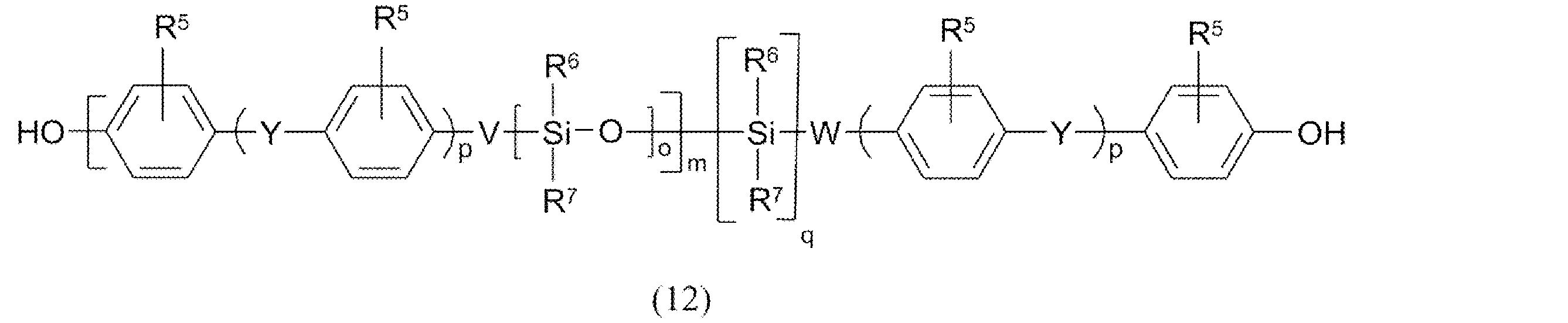
R5は、水素又はC1~C4アルキルを表し、
R6及びR7は、互いに独立して、C1~C4アルキルを表し、
Yは、単結合、-CO-、-O-、C1~C5-アルキレン、C2~C5-アルキリデン、又はC1~C4-アルキルによって一置換若しくは多置換されていてもよいC5~C6-シクロアルキリデン基を表し、
Vは、酸素、C1~C6アルキレン、又はC2~C5-アルキリデンを表し、
Wは、単結合、S、C1~C6-アルキレン又はC2~C5-アルキリデンを表し、ここで、qが1を表す場合にWは単結合ではなく、
p及びqはそれぞれ、互いに独立して0又は1を表し、
oは、それぞれの場合に1H-NMR分光法によって決定される、10~400の繰返単位の平均数を表し、かつ、
mは、それぞれの場合に1H-NMR分光法によって決定される、1~6の繰返単位の平均数を表す)の少なくとも1つから誘導されるシロキサンブロックを含むことを特徴とする、請求項1又は2に記載の組成物。 The component B is represented by the following structures 9, 10, and 12:
R5 represents hydrogen or C1 - C4 alkyl;
R 6 and R 7 , independently of each other, represent C 1 -C 4 alkyl;
Y represents a single bond, -CO-, -O-, C 1 -C 5 -alkylene, C 2 -C 5 -alkylidene or a C 5 -C 6 -cycloalkylidene group which may be mono- or polysubstituted by C 1 -C 4 -alkyl,
V represents oxygen, C 1 -C 6 alkylene or C 2 -C 5 -alkylidene;
W represents a single bond, S, C 1 -C 6 -alkylene or C 2 -C 5 -alkylidene, where when q represents 1 W is not a single bond,
p and q each independently represent 0 or 1;
o represents the average number of repeating units, in each case determined by 1 H-NMR spectroscopy, between 10 and 400, and
3. The composition according to claim 1, characterized in that it comprises siloxane blocks derived from at least one of the following: (wherein m represents the average number of repeating units from 1 to 6, determined in each case by 1 H-NMR spectroscopy).

R1は、水素、Cl、Br、C1~C4-アルキルを表し、R2は、独立して、アリール又はアルキルを表し、
Xは、単結合、C1~C5-アルキレン、C2~C5-アルキリデン、C5~C12-シクロアルキリデン、-O-、-SO-、-CO-、-S-、-SO2-を表し、
nは、1H-NMR分光法によって決定される、10から150の間の数であり、
mは、1H-NMR分光法によって決定される、1~10の数である)から誘導されるシロキサンブロックを含むことを特徴とする、請求項1又は2に記載の組成物。 The component B has the following structure:
R1 represents hydrogen, Cl, Br, C 1 -C 4 -alkyl and R2 represents independently aryl or alkyl;
X represents a single bond, C 1 -C 5 -alkylene, C 2 -C 5 -alkylidene, C 5 -C 12 -cycloalkylidene, -O-, -SO-, -CO-, -S-, -SO 2 -;
n is a number between 10 and 150 as determined by 1 H-NMR spectroscopy;
3. The composition according to claim 1, characterized in that it contains siloxane blocks derived from (m is a number from 1 to 10, as determined by 1 H-NMR spectroscopy).

kは、1又は1~10の整数を表し、
ここで、三量体の含有量(k=1)は、成分Cに対して60mol%~98mol%であり、かつ、
Rは、それぞれの場合に同一又は異なり、アミン基、それぞれの場合に任意にハロゲン化されたC1~C8-アルキル、C1~C8-アルコキシ、それぞれの場合に任意にアルキル置換された、及び/又はハロゲン置換されたC5~C6-シクロアルキル、それぞれの場合に任意にアルキル置換された、及び/又はハロゲン置換された、及び/又はヒドロキシル置換されたC6~C20-アリールオキシ、それぞれの場合に任意にアルキル置換された、及び/又はハロゲン置換されたC7~C12-アラルキル、又はハロゲン基、又はOH基を表す)の環状ホスファゼンであることを特徴とする、請求項1~6のいずれか一項に記載の組成物。 Component D is represented by formula (15b):
k represents 1 or an integer from 1 to 10;
Here, the content of trimers (k=1) is 60 mol% to 98 mol% relative to component C, and
7. Composition according to claim 1, characterized in that it is a cyclic phosphazene, in which R is, identically or differently, an amine group, in each case optionally halogenated C 1 -C 8 -alkyl, C 1 -C 8 -alkoxy, in each case optionally alkyl- and/or halogen-substituted C 5 -C 6 -cycloalkyl, in each case optionally alkyl- and/or halogen-substituted and/or hydroxyl-substituted C 6 -C 20 -aryloxy, in each case optionally alkyl- and/or halogen-substituted C 7 -C 12 -aralkyl, or a halogen group, or an OH group.
15重量%~35重量%の前記成分Bと、
5重量%~11重量%の前記成分Cと、
4重量%~8重量%の前記成分Dと、
0.2重量%~5重量%の前記成分Eと、
を含有する、請求項1~10のいずれか一項に記載の組成物。 50% to 70% by weight of component A;
15% to 35% by weight of component B;
5% to 11% by weight of component C;
4% to 8% by weight of component D;
0.2% to 5% by weight of component E;
The composition according to any one of claims 1 to 10, comprising:


R1は、水素、Cl、Br、CR1 is hydrogen, Cl, Br, C 11 ~C~C 44 -アルキルを表し、- represents alkyl,
R2は、独立して、アリール又はアルキルを表し、R2 independently represents aryl or alkyl;
Xは、単結合、CX is a single bond, C 11 ~C~C 55 -アルキレン、C-Alkylene, C 22 ~C~C 55 -アルキリデン、C-Alkylidene, C 55 ~C~C 1212 -シクロアルキリデン、-O-、-SO-、-CO-、-S-、-SO-Cycloalkylidene, -O-, -SO-, -CO-, -S-, -SO 22 -を表し、- represents
nは、n is 11 H-NMR分光法によって決定される、10から150の間の数であり、is a number between 10 and 150, as determined by H-NMR spectroscopy;
mは、m is, 11 H-NMR分光法によって決定される、1.5~5の数である)から誘導されるシロキサンブロックを含むことを特徴とする、請求項1に記載の組成物。13. The composition of claim 1, comprising siloxane blocks derived from (a) 1,2-diphenyl ether (B) 1,3,4-triphenyl ether (C) 1,4,5-triphenyl ether (D) 1,5,6-triphenyl ether (E) 1,6,7-triphenyl ether (F) 1,7,8-triphenyl ether (H) 1,8,9-triphenyl ether (I) 1,9,10-triphenyl ether (J) 1,10,11-triphenyl ether (J) 1,10,12-triphenyl ether (J) 1,10,13-triphenyl ether (H) 1,10,14-triphenyl ether (J)
Applications Claiming Priority (3)
| Application Number | Priority Date | Filing Date | Title |
|---|---|---|---|
| EP18209203.1 | 2018-11-29 | ||
| EP18209203 | 2018-11-29 | ||
| PCT/EP2019/080067 WO2020108922A1 (en) | 2018-11-29 | 2019-11-04 | Sicopc blend containing phosphazene and silicone/acrylate impact modifier |
Publications (2)
| Publication Number | Publication Date |
|---|---|
| JP2022510884A JP2022510884A (en) | 2022-01-28 |
| JP7586817B2 true JP7586817B2 (en) | 2024-11-19 |
Family
ID=64559564
Family Applications (1)
| Application Number | Title | Priority Date | Filing Date |
|---|---|---|---|
| JP2021529736A Active JP7586817B2 (en) | 2018-11-29 | 2019-11-04 | SiCoPC Blends Containing Phosphazene and Silicone/Acrylate Impact Modifiers |
Country Status (6)
| Country | Link |
|---|---|
| US (1) | US11634578B2 (en) |
| EP (1) | EP3887449B1 (en) |
| JP (1) | JP7586817B2 (en) |
| CN (1) | CN113166531A (en) |
| TW (1) | TW202030259A (en) |
| WO (1) | WO2020108922A1 (en) |
Families Citing this family (11)
| Publication number | Priority date | Publication date | Assignee | Title |
|---|---|---|---|---|
| US11751415B2 (en) | 2018-02-02 | 2023-09-05 | Oti Lumionics Inc. | Materials for forming a nucleation-inhibiting coating and devices incorporating same |
| JP7555600B2 (en) | 2019-04-18 | 2024-09-25 | オーティーアイ ルミオニクス インコーポレーテッド | Materials for forming nucleation-inhibiting coatings and devices incorporating same - Patents.com |
| JP7576337B2 (en) | 2019-05-08 | 2024-11-01 | オーティーアイ ルミオニクス インコーポレーテッド | Materials for forming nucleation-inhibiting coatings and devices incorporating same - Patents.com |
| CN111073248B (en) * | 2019-12-16 | 2021-12-03 | 上海长伟锦磁工程塑料有限公司 | Hydrolysis-resistant, illumination-resistant and low-temperature-resistant halogen-free flame-retardant polycarbonate composite material and preparation method thereof |
| US11985841B2 (en) | 2020-12-07 | 2024-05-14 | Oti Lumionics Inc. | Patterning a conductive deposited layer using a nucleation inhibiting coating and an underlying metallic coating |
| JP7670532B2 (en) * | 2021-04-06 | 2025-04-30 | 帝人株式会社 | Polycarbonate resin composition and molded article thereof |
| US20250206945A1 (en) * | 2022-03-25 | 2025-06-26 | Covestro Deutschland Ag | Polycarbonate Compositions Having a High CTI |
| WO2023180228A1 (en) * | 2022-03-25 | 2023-09-28 | Covestro Deutschland Ag | Polycarbonate compositions having a high cti |
| WO2024228403A1 (en) * | 2023-05-04 | 2024-11-07 | Mitsubishi Chemical Corporation | Flame-retardant composition |
| WO2026012684A1 (en) | 2024-07-12 | 2026-01-15 | Sabic Global Technologies B.V. | Flame retardant thermoplastic composition |
| EP4692198A1 (en) * | 2024-08-05 | 2026-02-11 | SABIC Global Technologies B.V. | Flame retardant thermoplastic composition |
Citations (5)
| Publication number | Priority date | Publication date | Assignee | Title |
|---|---|---|---|---|
| JP2014058607A (en) | 2012-09-14 | 2014-04-03 | Idemitsu Kosan Co Ltd | Polycarbonate resin composition and its molded article |
| JP2015108120A (en) | 2013-10-07 | 2015-06-11 | 三菱エンジニアリングプラスチックス株式会社 | Resin composition, resin molded article and manufacturing method of resin molded article |
| JP2015137308A (en) | 2014-01-22 | 2015-07-30 | 帝人株式会社 | Flame retardant carbon fiber reinforced polycarbonate resin composition |
| JP2015537096A (en) | 2012-12-07 | 2015-12-24 | バイエル・マテリアルサイエンス・アクチェンゲゼルシャフトBayer MaterialScience AG | Flame Retardant Polycarbonate Molding Composition VI |
| JP2017088738A (en) | 2015-11-10 | 2017-05-25 | 三菱レイヨン株式会社 | Polycarbonate resin composition, molded body |
Family Cites Families (50)
| Publication number | Priority date | Publication date | Assignee | Title |
|---|---|---|---|---|
| DE334782C (en) | 1921-03-18 | Jagenberg Werke Ag | Ring spinning machine with brakable runners | |
| US2891920A (en) | 1955-01-26 | 1959-06-23 | Dow Corning | Polymerization of organopolysiloxanes in aqueous emulsion |
| DE1007996B (en) | 1955-03-26 | 1957-05-09 | Bayer Ag | Process for the production of thermoplastics |
| US2991273A (en) | 1956-07-07 | 1961-07-04 | Bayer Ag | Process for manufacture of vacuum moulded parts of high molecular weight thermoplastic polycarbonates |
| US3148172A (en) | 1956-07-19 | 1964-09-08 | Gen Electric | Polycarbonates of dihydroxyaryl ethers |
| US2999846A (en) | 1956-11-30 | 1961-09-12 | Schnell Hermann | High molecular weight thermoplastic aromatic sulfoxy polycarbonates |
| US2999835A (en) | 1959-01-02 | 1961-09-12 | Gen Electric | Resinous mixture comprising organo-polysiloxane and polymer of a carbonate of a dihydric phenol, and products containing same |
| US3189662A (en) | 1961-01-23 | 1965-06-15 | Gen Electric | Organopolysiloxane-polycarbonate block copolymers |
| GB1024024A (en) | 1963-04-08 | 1966-03-30 | Dow Corning | Improvements in or relating to polymerising or co-polymerising organosilicon compounds |
| GB1122003A (en) | 1964-10-07 | 1968-07-31 | Gen Electric | Improvements in aromatic polycarbonates |
| US3419634A (en) | 1966-01-03 | 1968-12-31 | Gen Electric | Organopolysiloxane polycarbonate block copolymers |
| NL152889B (en) | 1967-03-10 | 1977-04-15 | Gen Electric | PROCESS FOR PREPARING A LINEAR POLYCARBONATE COPOLYMER AND ORIENTABLE TEXTILE FIBER OF THIS COPOLYMER. |
| DE2036052A1 (en) | 1970-07-21 | 1972-01-27 | Milchwirtschafthche Forschungs und Untersuchungs Gesellschaft mbH, 2100 Hamburg | Working up of additives in fat and protein - contng foodstuffs |
| DE2063052A1 (en) | 1970-12-22 | 1972-07-13 | Bayer | Saponification-resistant polycarbonates |
| DE2063050C3 (en) | 1970-12-22 | 1983-12-15 | Bayer Ag, 5090 Leverkusen | Saponification-resistant polycarbonates, processes for their production and their use |
| DE2211956A1 (en) | 1972-03-11 | 1973-10-25 | Bayer Ag | PROCESS FOR THE PREPARATION OF SEAP-STABLE BLOCK COPOLYCARBONATES |
| DE3334782A1 (en) | 1983-04-19 | 1984-10-25 | Bayer Ag, 5090 Leverkusen | METHOD FOR PRODUCING POLYDIORGANOSILOXANES WITH HYDROXYARYLOXY END GROUPS |
| US4877831B1 (en) | 1986-06-17 | 1993-12-21 | Mitsubishi Rayon Co.,Ltd. | Polycarbonate resin composition |
| DE3631540A1 (en) | 1986-09-17 | 1988-03-24 | Bayer Ag | THERMOPLASTIC MOLDS WITH HIGH AGING RESISTANCE AND GOOD DEEP TEMPERATURE |
| DE3853032T2 (en) | 1987-09-21 | 1995-09-14 | Mitsubishi Rayon Co | Polycarbonate resin composition. |
| BR8903379A (en) | 1988-07-11 | 1990-03-13 | Ge Plastics Japan Ltd | PROCESS FOR PREPARATION OF POLYCARBONATES |
| NO170326C (en) | 1988-08-12 | 1992-10-07 | Bayer Ag | DIHYDROKSYDIFENYLCYKLOALKANER |
| DE3844633A1 (en) | 1988-08-12 | 1990-04-19 | Bayer Ag | Dihydroxydiphenylcycloalkanes, their preparation, and their use for the preparation of high-molecular-weight polycarbonates |
| DE69027976T2 (en) | 1989-11-27 | 1997-03-06 | Mitsubishi Rayon Co | High impact graft copolymers and resin compositions |
| US5227449A (en) | 1990-07-02 | 1993-07-13 | Xerox Corporation | Photoconductive imaging members with polycarbonate binders |
| DE4238123C2 (en) | 1992-11-12 | 2000-03-09 | Bayer Ag | Process for the production of thermoplastic polycarbonates |
| US5414054A (en) | 1994-06-01 | 1995-05-09 | Miles Inc. | Copolycarbonate having improved low-temperature impact strength |
| US5717057A (en) | 1994-12-28 | 1998-02-10 | General Electric Company | Method of manufacturing polycarbonate |
| EP0728811B1 (en) | 1995-02-27 | 2003-09-17 | Mitsubishi Chemical Corporation | Flame retardant thermoplastic resin composition |
| US5807914A (en) | 1995-07-05 | 1998-09-15 | Mitsubishi Engineering-Plastics Corporation | Glass fiber-reinforced polycarbonate resin composition |
| DE19615230A1 (en) | 1996-04-18 | 1997-10-23 | Basf Ag | Flame retardant thermoplastic molding compounds |
| DE19710081A1 (en) | 1997-03-12 | 1998-09-17 | Bayer Ag | Process for the preparation of polysiloxane-polysiloxane-polycarbonate block cocondensates |
| US5821321A (en) | 1997-09-16 | 1998-10-13 | Bayer Corporation | Molding composition having improved impact strength |
| DE19933128A1 (en) | 1999-07-19 | 2001-01-25 | Bayer Ag | Polycarbonate and its molded body |
| DE19933132A1 (en) | 1999-07-19 | 2001-01-25 | Bayer Ag | Process for the production of modified polycarbonates |
| DE10300598A1 (en) | 2003-01-10 | 2004-07-22 | Bayer Ag | Process for the production of polycarbonates |
| US7232854B2 (en) | 2004-02-03 | 2007-06-19 | General Electric Company | Polycarbonate compositions with thin-wall flame retardance |
| US20090023871A9 (en) | 2004-08-05 | 2009-01-22 | General Electric Company | Flame retardant thermoplastic polycarbonate compositions, method of manufacture, and method of use thereof |
| WO2013155046A1 (en) | 2012-04-10 | 2013-10-17 | Momentive Performance Materials Gmbh | Process for producing functional siloxanes of controlled structure |
| US9018286B2 (en) | 2012-05-24 | 2015-04-28 | Sabic Global Technologies B.V. | Flame retardant polycarbonate compositions, methods of manufacture thereof and articles comprising the same |
| US20140371360A1 (en) * | 2013-05-24 | 2014-12-18 | Sabic Global Technologies B.V. | Flame retardant polycarbonate compositions, methods of manufacture thereof and articles comprising the same |
| JP6577162B2 (en) | 2013-08-07 | 2019-09-18 | 帝人株式会社 | Transparent flame retardant thermoplastic resin composition and molded article thereof |
| KR102065122B1 (en) | 2013-08-16 | 2020-01-10 | 사빅 글로벌 테크놀러지스 비.브이. | High modulus and ultra-high ductility blended thermoplastic compositions |
| EP3055344B1 (en) * | 2013-10-08 | 2025-03-12 | Covestro Deutschland AG | Polysiloxane-polycarbonate block cocondensates |
| KR20160079786A (en) | 2013-11-01 | 2016-07-06 | 사빅 글로벌 테크놀러지스 비.브이. | Reinforced flame retardant polycarbonate composition and molded article comprising same |
| US9382418B2 (en) * | 2014-02-28 | 2016-07-05 | Samsung Sdi Co., Ltd. | Flame retardant thermoplastic resin composition and molded article comprising the same |
| US20170247539A1 (en) | 2014-10-22 | 2017-08-31 | Sabic Global Technologies B.V. | Polycarbonate/polyester composition and article prepared therefrom |
| CN110072918B (en) | 2016-12-19 | 2021-10-22 | 科思创德国股份有限公司 | Production of siloxane-containing block copolycarbonates with the aid of compatibilizers |
| EP3728467A1 (en) * | 2017-12-18 | 2020-10-28 | SABIC Global Technologies B.V. | Polycarbonate compositions having improved chemical resistance, articles formed thereof, and methods of manufacture |
| CN113366061B (en) * | 2018-12-10 | 2023-06-13 | 科思创知识产权两合公司 | Polycarbonate compositions |
-
2019
- 2019-11-04 JP JP2021529736A patent/JP7586817B2/en active Active
- 2019-11-04 EP EP19795027.2A patent/EP3887449B1/en active Active
- 2019-11-04 CN CN201980078940.3A patent/CN113166531A/en active Pending
- 2019-11-04 US US17/294,498 patent/US11634578B2/en active Active
- 2019-11-04 WO PCT/EP2019/080067 patent/WO2020108922A1/en not_active Ceased
- 2019-11-27 TW TW108143090A patent/TW202030259A/en unknown
Patent Citations (5)
| Publication number | Priority date | Publication date | Assignee | Title |
|---|---|---|---|---|
| JP2014058607A (en) | 2012-09-14 | 2014-04-03 | Idemitsu Kosan Co Ltd | Polycarbonate resin composition and its molded article |
| JP2015537096A (en) | 2012-12-07 | 2015-12-24 | バイエル・マテリアルサイエンス・アクチェンゲゼルシャフトBayer MaterialScience AG | Flame Retardant Polycarbonate Molding Composition VI |
| JP2015108120A (en) | 2013-10-07 | 2015-06-11 | 三菱エンジニアリングプラスチックス株式会社 | Resin composition, resin molded article and manufacturing method of resin molded article |
| JP2015137308A (en) | 2014-01-22 | 2015-07-30 | 帝人株式会社 | Flame retardant carbon fiber reinforced polycarbonate resin composition |
| JP2017088738A (en) | 2015-11-10 | 2017-05-25 | 三菱レイヨン株式会社 | Polycarbonate resin composition, molded body |
Also Published As
| Publication number | Publication date |
|---|---|
| JP2022510884A (en) | 2022-01-28 |
| TW202030259A (en) | 2020-08-16 |
| EP3887449B1 (en) | 2022-09-28 |
| US20210403707A1 (en) | 2021-12-30 |
| WO2020108922A1 (en) | 2020-06-04 |
| EP3887449A1 (en) | 2021-10-06 |
| CN113166531A (en) | 2021-07-23 |
| US11634578B2 (en) | 2023-04-25 |
| KR20210098974A (en) | 2021-08-11 |
Similar Documents
| Publication | Publication Date | Title |
|---|---|---|
| US11634578B2 (en) | SiCoPC blend containing phosphazene and silicone/acrylate impact modifier | |
| KR101851808B1 (en) | Scratch-resistant, impact-resistant polycarbonate moulding compositions having good mechanical properties ⅱ | |
| TWI466946B (en) | Flame retardant impact-modified polycarbonate compositions | |
| CN100408629C (en) | Flame-resistant polycarbonate moulding materials | |
| KR101726455B1 (en) | Flame-protected impact strength modified polycarbonate compounds | |
| KR20150093753A (en) | Flame-retardant polycarbonate molding materials vi | |
| CN115551945B (en) | Flame retardant polycarbonate composition | |
| TW201406858A (en) | PC/ABS compositions having a good resistance to heat and chemicals | |
| KR20150093752A (en) | Flame-retardant polycarbonate molding materials v | |
| EP4153682B1 (en) | Flame-retardant polycarbonate composition | |
| JP7254588B2 (en) | Polycarbonate resin composition and molded article | |
| KR101703364B1 (en) | Impact strength modified polycarbonate compounds | |
| KR101773637B1 (en) | Scratch-resistant, impact-resistant polycarbonate moulding compositions with good mechanical properties i | |
| KR102963635B1 (en) | SiCoPC blend containing phosphazene and silicon/acrylate impact modifier | |
| CN110088199A (en) | Thermoplastic compounds with good mechanical properties | |
| CN113939562A (en) | Thermoplastic resin composition and molded article formed therefrom | |
| CN114729179B (en) | Flame retardant polycarbonate-polyester blends | |
| CN110099961B (en) | Polycarbonate compositions with good mechanical properties | |
| US20260117063A1 (en) | Polycarbonate composition | |
| US20240376310A1 (en) | Hydrolysis-Resistant Polycarbonate Composition |
Legal Events
| Date | Code | Title | Description |
|---|---|---|---|
| A621 | Written request for application examination |
Free format text: JAPANESE INTERMEDIATE CODE: A621 Effective date: 20221102 |
|
| A977 | Report on retrieval |
Free format text: JAPANESE INTERMEDIATE CODE: A971007 Effective date: 20231212 |
|
| A131 | Notification of reasons for refusal |
Free format text: JAPANESE INTERMEDIATE CODE: A131 Effective date: 20231220 |
|
| A521 | Request for written amendment filed |
Free format text: JAPANESE INTERMEDIATE CODE: A523 Effective date: 20240319 |
|
| A711 | Notification of change in applicant |
Free format text: JAPANESE INTERMEDIATE CODE: A712 Effective date: 20240401 |
|
| A521 | Request for written amendment filed |
Free format text: JAPANESE INTERMEDIATE CODE: A523 Effective date: 20240925 |
|
| TRDD | Decision of grant or rejection written | ||
| A01 | Written decision to grant a patent or to grant a registration (utility model) |
Free format text: JAPANESE INTERMEDIATE CODE: A01 Effective date: 20241022 |
|
| A61 | First payment of annual fees (during grant procedure) |
Free format text: JAPANESE INTERMEDIATE CODE: A61 Effective date: 20241107 |
|
| R150 | Certificate of patent or registration of utility model |
Ref document number: 7586817 Country of ref document: JP Free format text: JAPANESE INTERMEDIATE CODE: R150 |