JP7586810B2 - Gene therapy vector for the treatment of Danon disease - Google Patents
Gene therapy vector for the treatment of Danon disease Download PDFInfo
- Publication number
- JP7586810B2 JP7586810B2 JP2021500664A JP2021500664A JP7586810B2 JP 7586810 B2 JP7586810 B2 JP 7586810B2 JP 2021500664 A JP2021500664 A JP 2021500664A JP 2021500664 A JP2021500664 A JP 2021500664A JP 7586810 B2 JP7586810 B2 JP 7586810B2
- Authority
- JP
- Japan
- Prior art keywords
- fold
- lamp
- vector
- seq
- identity
- Prior art date
- Legal status (The legal status is an assumption and is not a legal conclusion. Google has not performed a legal analysis and makes no representation as to the accuracy of the status listed.)
- Active
Links
Images










Classifications
-
- A—HUMAN NECESSITIES
- A61—MEDICAL OR VETERINARY SCIENCE; HYGIENE
- A61K—PREPARATIONS FOR MEDICAL, DENTAL OR TOILETRY PURPOSES
- A61K38/00—Medicinal preparations containing peptides
- A61K38/16—Peptides having more than 20 amino acids; Gastrins; Somatostatins; Melanotropins; Derivatives thereof
- A61K38/17—Peptides having more than 20 amino acids; Gastrins; Somatostatins; Melanotropins; Derivatives thereof from animals; from humans
- A61K38/177—Receptors; Cell surface antigens; Cell surface determinants
-
- A—HUMAN NECESSITIES
- A61—MEDICAL OR VETERINARY SCIENCE; HYGIENE
- A61K—PREPARATIONS FOR MEDICAL, DENTAL OR TOILETRY PURPOSES
- A61K48/00—Medicinal preparations containing genetic material which is inserted into cells of the living body to treat genetic diseases; Gene therapy
- A61K48/005—Medicinal preparations containing genetic material which is inserted into cells of the living body to treat genetic diseases; Gene therapy characterised by an aspect of the 'active' part of the composition delivered, i.e. the nucleic acid delivered
- A61K48/0066—Manipulation of the nucleic acid to modify its expression pattern, e.g. enhance its duration of expression, achieved by the presence of particular introns in the delivered nucleic acid
-
- A—HUMAN NECESSITIES
- A61—MEDICAL OR VETERINARY SCIENCE; HYGIENE
- A61P—SPECIFIC THERAPEUTIC ACTIVITY OF CHEMICAL COMPOUNDS OR MEDICINAL PREPARATIONS
- A61P13/00—Drugs for disorders of the urinary system
- A61P13/12—Drugs for disorders of the urinary system of the kidneys
-
- A—HUMAN NECESSITIES
- A61—MEDICAL OR VETERINARY SCIENCE; HYGIENE
- A61P—SPECIFIC THERAPEUTIC ACTIVITY OF CHEMICAL COMPOUNDS OR MEDICINAL PREPARATIONS
- A61P21/00—Drugs for disorders of the muscular or neuromuscular system
-
- A—HUMAN NECESSITIES
- A61—MEDICAL OR VETERINARY SCIENCE; HYGIENE
- A61P—SPECIFIC THERAPEUTIC ACTIVITY OF CHEMICAL COMPOUNDS OR MEDICINAL PREPARATIONS
- A61P3/00—Drugs for disorders of the metabolism
-
- A—HUMAN NECESSITIES
- A61—MEDICAL OR VETERINARY SCIENCE; HYGIENE
- A61P—SPECIFIC THERAPEUTIC ACTIVITY OF CHEMICAL COMPOUNDS OR MEDICINAL PREPARATIONS
- A61P3/00—Drugs for disorders of the metabolism
- A61P3/08—Drugs for disorders of the metabolism for glucose homeostasis
- A61P3/10—Drugs for disorders of the metabolism for glucose homeostasis for hyperglycaemia, e.g. antidiabetics
-
- A—HUMAN NECESSITIES
- A61—MEDICAL OR VETERINARY SCIENCE; HYGIENE
- A61P—SPECIFIC THERAPEUTIC ACTIVITY OF CHEMICAL COMPOUNDS OR MEDICINAL PREPARATIONS
- A61P9/00—Drugs for disorders of the cardiovascular system
-
- A—HUMAN NECESSITIES
- A61—MEDICAL OR VETERINARY SCIENCE; HYGIENE
- A61P—SPECIFIC THERAPEUTIC ACTIVITY OF CHEMICAL COMPOUNDS OR MEDICINAL PREPARATIONS
- A61P9/00—Drugs for disorders of the cardiovascular system
- A61P9/04—Inotropic agents, i.e. stimulants of cardiac contraction; Drugs for heart failure
-
- A—HUMAN NECESSITIES
- A61—MEDICAL OR VETERINARY SCIENCE; HYGIENE
- A61P—SPECIFIC THERAPEUTIC ACTIVITY OF CHEMICAL COMPOUNDS OR MEDICINAL PREPARATIONS
- A61P9/00—Drugs for disorders of the cardiovascular system
- A61P9/10—Drugs for disorders of the cardiovascular system for treating ischaemic or atherosclerotic diseases, e.g. antianginal drugs, coronary vasodilators, drugs for myocardial infarction, retinopathy, cerebrovascula insufficiency, renal arteriosclerosis
-
- C—CHEMISTRY; METALLURGY
- C07—ORGANIC CHEMISTRY
- C07K—PEPTIDES
- C07K14/00—Peptides having more than 20 amino acids; Gastrins; Somatostatins; Melanotropins; Derivatives thereof
- C07K14/435—Peptides having more than 20 amino acids; Gastrins; Somatostatins; Melanotropins; Derivatives thereof from animals; from humans
- C07K14/705—Receptors; Cell surface antigens; Cell surface determinants
- C07K14/70596—Molecules with a "CD"-designation not provided for elsewhere
-
- C—CHEMISTRY; METALLURGY
- C12—BIOCHEMISTRY; BEER; SPIRITS; WINE; VINEGAR; MICROBIOLOGY; ENZYMOLOGY; MUTATION OR GENETIC ENGINEERING
- C12N—MICROORGANISMS OR ENZYMES; COMPOSITIONS THEREOF; PROPAGATING, PRESERVING, OR MAINTAINING MICROORGANISMS; MUTATION OR GENETIC ENGINEERING; CULTURE MEDIA
- C12N15/00—Mutation or genetic engineering; DNA or RNA concerning genetic engineering, vectors, e.g. plasmids, or their isolation, preparation or purification; Use of hosts therefor
- C12N15/09—Recombinant DNA-technology
- C12N15/63—Introduction of foreign genetic material using vectors; Vectors; Use of hosts therefor; Regulation of expression
- C12N15/79—Vectors or expression systems specially adapted for eukaryotic hosts
- C12N15/85—Vectors or expression systems specially adapted for eukaryotic hosts for animal cells
- C12N15/86—Viral vectors
-
- A—HUMAN NECESSITIES
- A61—MEDICAL OR VETERINARY SCIENCE; HYGIENE
- A61K—PREPARATIONS FOR MEDICAL, DENTAL OR TOILETRY PURPOSES
- A61K38/00—Medicinal preparations containing peptides
-
- A—HUMAN NECESSITIES
- A61—MEDICAL OR VETERINARY SCIENCE; HYGIENE
- A61K—PREPARATIONS FOR MEDICAL, DENTAL OR TOILETRY PURPOSES
- A61K48/00—Medicinal preparations containing genetic material which is inserted into cells of the living body to treat genetic diseases; Gene therapy
-
- C—CHEMISTRY; METALLURGY
- C12—BIOCHEMISTRY; BEER; SPIRITS; WINE; VINEGAR; MICROBIOLOGY; ENZYMOLOGY; MUTATION OR GENETIC ENGINEERING
- C12N—MICROORGANISMS OR ENZYMES; COMPOSITIONS THEREOF; PROPAGATING, PRESERVING, OR MAINTAINING MICROORGANISMS; MUTATION OR GENETIC ENGINEERING; CULTURE MEDIA
- C12N2750/00—MICROORGANISMS OR ENZYMES; COMPOSITIONS THEREOF; PROPAGATING, PRESERVING, OR MAINTAINING MICROORGANISMS; MUTATION OR GENETIC ENGINEERING; CULTURE MEDIA ssDNA viruses
- C12N2750/00011—Details
- C12N2750/14011—Parvoviridae
- C12N2750/14111—Dependovirus, e.g. adenoassociated viruses
- C12N2750/14141—Use of virus, viral particle or viral elements as a vector
- C12N2750/14143—Use of virus, viral particle or viral elements as a vector viral genome or elements thereof as genetic vector
-
- C—CHEMISTRY; METALLURGY
- C12—BIOCHEMISTRY; BEER; SPIRITS; WINE; VINEGAR; MICROBIOLOGY; ENZYMOLOGY; MUTATION OR GENETIC ENGINEERING
- C12N—MICROORGANISMS OR ENZYMES; COMPOSITIONS THEREOF; PROPAGATING, PRESERVING, OR MAINTAINING MICROORGANISMS; MUTATION OR GENETIC ENGINEERING; CULTURE MEDIA
- C12N2799/00—Uses of viruses
- C12N2799/02—Uses of viruses as vector
- C12N2799/021—Uses of viruses as vector for the expression of a heterologous nucleic acid
- C12N2799/022—Uses of viruses as vector for the expression of a heterologous nucleic acid where the vector is derived from an adenovirus
-
- C—CHEMISTRY; METALLURGY
- C12—BIOCHEMISTRY; BEER; SPIRITS; WINE; VINEGAR; MICROBIOLOGY; ENZYMOLOGY; MUTATION OR GENETIC ENGINEERING
- C12N—MICROORGANISMS OR ENZYMES; COMPOSITIONS THEREOF; PROPAGATING, PRESERVING, OR MAINTAINING MICROORGANISMS; MUTATION OR GENETIC ENGINEERING; CULTURE MEDIA
- C12N2799/00—Uses of viruses
- C12N2799/02—Uses of viruses as vector
- C12N2799/04—Uses of viruses as vector in vivo
-
- C—CHEMISTRY; METALLURGY
- C12—BIOCHEMISTRY; BEER; SPIRITS; WINE; VINEGAR; MICROBIOLOGY; ENZYMOLOGY; MUTATION OR GENETIC ENGINEERING
- C12N—MICROORGANISMS OR ENZYMES; COMPOSITIONS THEREOF; PROPAGATING, PRESERVING, OR MAINTAINING MICROORGANISMS; MUTATION OR GENETIC ENGINEERING; CULTURE MEDIA
- C12N2810/00—Vectors comprising a targeting moiety
- C12N2810/50—Vectors comprising as targeting moiety peptide derived from defined protein
- C12N2810/80—Vectors comprising as targeting moiety peptide derived from defined protein from vertebrates
- C12N2810/85—Vectors comprising as targeting moiety peptide derived from defined protein from vertebrates mammalian
-
- C—CHEMISTRY; METALLURGY
- C12—BIOCHEMISTRY; BEER; SPIRITS; WINE; VINEGAR; MICROBIOLOGY; ENZYMOLOGY; MUTATION OR GENETIC ENGINEERING
- C12N—MICROORGANISMS OR ENZYMES; COMPOSITIONS THEREOF; PROPAGATING, PRESERVING, OR MAINTAINING MICROORGANISMS; MUTATION OR GENETIC ENGINEERING; CULTURE MEDIA
- C12N2830/00—Vector systems having a special element relevant for transcription
- C12N2830/001—Vector systems having a special element relevant for transcription controllable enhancer/promoter combination
-
- C—CHEMISTRY; METALLURGY
- C12—BIOCHEMISTRY; BEER; SPIRITS; WINE; VINEGAR; MICROBIOLOGY; ENZYMOLOGY; MUTATION OR GENETIC ENGINEERING
- C12N—MICROORGANISMS OR ENZYMES; COMPOSITIONS THEREOF; PROPAGATING, PRESERVING, OR MAINTAINING MICROORGANISMS; MUTATION OR GENETIC ENGINEERING; CULTURE MEDIA
- C12N2830/00—Vector systems having a special element relevant for transcription
- C12N2830/008—Vector systems having a special element relevant for transcription cell type or tissue specific enhancer/promoter combination
Landscapes
- Health & Medical Sciences (AREA)
- Life Sciences & Earth Sciences (AREA)
- Chemical & Material Sciences (AREA)
- Engineering & Computer Science (AREA)
- Organic Chemistry (AREA)
- Genetics & Genomics (AREA)
- General Health & Medical Sciences (AREA)
- Bioinformatics & Cheminformatics (AREA)
- Medicinal Chemistry (AREA)
- Veterinary Medicine (AREA)
- Pharmacology & Pharmacy (AREA)
- Animal Behavior & Ethology (AREA)
- Public Health (AREA)
- Zoology (AREA)
- Biotechnology (AREA)
- Molecular Biology (AREA)
- Biochemistry (AREA)
- Nuclear Medicine, Radiotherapy & Molecular Imaging (AREA)
- Chemical Kinetics & Catalysis (AREA)
- General Chemical & Material Sciences (AREA)
- Wood Science & Technology (AREA)
- Biomedical Technology (AREA)
- General Engineering & Computer Science (AREA)
- Biophysics (AREA)
- Epidemiology (AREA)
- Immunology (AREA)
- Proteomics, Peptides & Aminoacids (AREA)
- Cardiology (AREA)
- Gastroenterology & Hepatology (AREA)
- Cell Biology (AREA)
- Diabetes (AREA)
- Heart & Thoracic Surgery (AREA)
- Physics & Mathematics (AREA)
- Virology (AREA)
- Plant Pathology (AREA)
- Microbiology (AREA)
- Toxicology (AREA)
- Urology & Nephrology (AREA)
- Hematology (AREA)
- Obesity (AREA)
Description
関連出願
本願は、その全体が参照により本明細書中に組み込まれる、2018年7月12日に出願された米国特許仮出願番号62/697,302の優先権を主張する。
RELATED APPLICATIONS This application claims priority to U.S. Provisional Patent Application No. 62/697,302, filed July 12, 2018, which is incorporated herein by reference in its entirety.
配列表
本願は、EFS-Webを介して電子的に提出され、テキスト形式で電子的に提出された配列表が含まれている。テキストファイルは、2019年7月11日に作成された、「ROPA_011_01WO_SeqList_ST25.txt」という表題の、約62キロバイトのサイズを有する配列表を含む。このテキストファイルに含まれる配列表は、本明細書の一部であり、その全体が参照により本明細書中に組み込まれる。
SEQUENCE LISTING This application has been submitted electronically via EFS-Web and contains a Sequence Listing that has been submitted electronically in text format. The text file contains a Sequence Listing entitled "ROPA_011_01WO_SeqList_ST25.txt", created on July 11, 2019, and having a size of approximately 62 kilobytes. The Sequence Listing contained in this text file is a part of the present specification and is incorporated herein by reference in its entirety.
発明の分野
本発明は、概して、リソソーム関連膜タンパク質2(LAMP-2、CD107bとしても知られる)における変異に関連する疾患の遺伝子療法に関する。
FIELD OF THEINVENTION The present invention relates generally to gene therapy for diseases associated with mutations in lysosomal-associated membrane protein 2 (LAMP-2, also known as CD107b).
背景
リソソーム関連膜タンパク質2(LAMP-2、CD107bとしても知られる)は、リソソーム関連膜糖タンパク質をコードする遺伝子である。遺伝子の選択的スプライシングによって、3つのアイソフォーム:LAMP-2A、LAMP-2B、及びLAMP-2Cが生成される。LAMP-2における機能欠失変異は、オートファジー障害に関連する家族性心筋症であるダノン病をはじめとするヒトの疾患と関連する。
BACKGROUND Lysosome-associated membrane protein 2 (LAMP-2, also known as CD107b) is a gene encoding a lysosome-associated membrane glycoprotein. Alternative splicing of the gene generates three isoforms: LAMP-2A, LAMP-2B, and LAMP-2C. Loss-of-function mutations in LAMP-2 are associated with human diseases, including Danon disease, a familial cardiomyopathy associated with impaired autophagy.
国際特許出願公開第WO2017127565A1号(特許文献1)は、Hashem,et al.,Stem Cells.2015 Jul;33(7):2343-50(非特許文献1)で記載されているような、LAMP-2変異を有する患者由来のヒト誘導多能性幹細胞(hiPSC)におけるLAMP-2の過剰発現の結果、酸化的ストレスレベル及びアポトーシス細胞死が減少し、疾患病態生理学におけるLAMP-2Bの重要性が確認されることを開示している。 International Patent Application Publication No. WO2017127565A1 (Patent Document 1) discloses that overexpression of LAMP-2 in human induced pluripotent stem cells (hiPSCs) from patients with LAMP-2 mutations, as described in Hashem, et al., Stem Cells. 2015 Jul;33(7):2343-50 (Non-Patent Document 1), results in reduced oxidative stress levels and apoptotic cell death, confirming the importance of LAMP-2B in disease pathophysiology.
当該技術分野では依然としてLAMP-2の遺伝子療法ベクターに関するニーズがある。本開示は、そのような遺伝子療法ベクター、その使用方法、医薬組成物などを提供する。 There remains a need in the art for gene therapy vectors for LAMP-2. The present disclosure provides such gene therapy vectors, methods of use thereof, pharmaceutical compositions, and the like.
本開示は、LAMP-2ポリペプチドをコードするポリヌクレオチド配列を含む改善された遺伝子療法ベクター、その使用方法、医薬組成物などを提供する。 The present disclosure provides improved gene therapy vectors comprising polynucleotide sequences encoding LAMP-2 polypeptides, methods of use thereof, pharmaceutical compositions, and the like.
一態様では、本開示は、リソソーム関連膜タンパク質2(LAMP-2)のアイソフォーム又はその機能的変異体をコードする導入遺伝子を含む発現カセットを含む遺伝子療法ベクターを提供し、導入遺伝子は、ヒト宿主細胞における発現についてコドン最適化されている。 In one aspect, the present disclosure provides a gene therapy vector comprising an expression cassette that includes a transgene encoding an isoform of lysosomal associated membrane protein 2 (LAMP-2) or a functional variant thereof, the transgene being codon-optimized for expression in a human host cell.
一実施形態において、発現カセットは配列番号2よりも少ないCpG部位を含む。 In one embodiment, the expression cassette contains fewer CpG sites than SEQ ID NO:2.
一実施形態において、発現カセットは配列番号2よりも少ないクリプティックスプライス部位を含む。 In one embodiment, the expression cassette contains fewer cryptic splice sites than SEQ ID NO:2.
一実施形態において、発現カセットは配列番号2よりも少ない代替オープンリーディングフレームをコードする。 In one embodiment, the expression cassette encodes fewer alternative open reading frames than SEQ ID NO:2.
一実施形態において、導入遺伝子は配列番号3~5から選択される配列に対して少なくとも95%の同一性を共有する。 In one embodiment, the transgene shares at least 95% identity to a sequence selected from SEQ ID NOs: 3-5.
一実施形態において、導入遺伝子は配列番号3~5から選択される配列に対して少なくとも99%の同一性を共有する。 In one embodiment, the transgene shares at least 99% identity to a sequence selected from SEQ ID NOs: 3-5.
一実施形態において、導入遺伝子は配列番号3~5から選択される配列を含む。 In one embodiment, the transgene comprises a sequence selected from SEQ ID NOs: 3-5.
一実施形態において、導入遺伝子は配列番号3に対して少なくとも95%の同一性を共有する。 In one embodiment, the transgene shares at least 95% identity to SEQ ID NO:3.
一実施形態において、導入遺伝子は配列番号3に対して少なくとも99%の同一性を共有する。 In one embodiment, the transgene shares at least 99% identity to SEQ ID NO:3.
一実施形態において、導入遺伝子は配列番号3と同一の配列を含む。 In one embodiment, the transgene comprises a sequence identical to SEQ ID NO:3.
一実施形態において、発現カセットは、導入遺伝子に機能的に連結されたコンセンサス最適化Kozak配列を含み、任意選択的に、コンセンサス最適化Kozak配列は配列番号6を含む。 In one embodiment, the expression cassette comprises a consensus optimized Kozak sequence operably linked to the transgene, and optionally, the consensus optimized Kozak sequence comprises SEQ ID NO:6.
一実施形態において、発現カセットは導入遺伝子に機能的に連結された完全長ポリA配列を含み、任意選択的に、完全長ポリA配列は配列番号7を含む。 In one embodiment, the expression cassette comprises a full-length polyA sequence operably linked to the transgene, and optionally, the full-length polyA sequence comprises SEQ ID NO:7.
一実施形態において、発現カセットは、代替mRNAを生成することができる導入遺伝子に対して5’の開始部位を含まない。 In one embodiment, the expression cassette does not contain a start site 5' to the transgene that can generate an alternative mRNA.
一実施形態において、発現カセットは、5’から3’方向で、機能的に連結された、第一逆末端反復、エンハンサ/プロモータ領域、コンセンサス最適化Kozak配列、導入遺伝子、完全長ポリA配列を含む3’未翻訳領域、及び第二逆末端反復を含む。 In one embodiment, the expression cassette comprises, in a 5' to 3' orientation, a first inverted terminal repeat, an enhancer/promoter region, a consensus optimized Kozak sequence, a transgene, a 3' untranslated region including a full-length polyA sequence, and a second inverted terminal repeat operably linked thereto.
一実施形態において、エンハンサ/プロモータ領域は、5’から3’方向で、CMV IEエンハンサとニワトリβアクチンプロモータとを含む。 In one embodiment, the enhancer/promoter region comprises, in the 5' to 3' direction, a CMV IE enhancer and a chicken β-actin promoter.
一実施形態において、発現カセットは、配列番号8~10から選択される配列に対して少なくとも95%の同一性を共有する。 In one embodiment, the expression cassette shares at least 95% identity to a sequence selected from SEQ ID NOs: 8-10.
一実施形態において、発現カセットは、配列番号8~10から選択される配列に対して完全同一性を共有する。 In one embodiment, the expression cassette shares complete identity with a sequence selected from SEQ ID NOs: 8-10.
第二の態様において、本開示は、それを必要とする対象においてダノン病又は別のオートファジー障害の一つ以上の症状を防止、軽減、改善、減少、阻害、除去及び/又は逆転する方法であって、対象に本開示の任意の遺伝子療法ベクターを投与することを含む方法を提供する。 In a second aspect, the present disclosure provides a method of preventing, alleviating, ameliorating, reducing, inhibiting, eliminating, and/or reversing one or more symptoms of Danon disease or another autophagy disorder in a subject in need thereof, comprising administering to the subject any of the gene therapy vectors of the present disclosure.
一実施形態では、ベクターを、静脈内、動脈内、心臓内、冠動脈内、心筋内、腎内、尿道内、硬膜外、及び筋肉内からなる群から選択される経路により投与する。 In one embodiment, the vector is administered by a route selected from the group consisting of intravenous, intraarterial, intracardiac, intracoronary, intramyocardial, intrarenal, intraurethral, epidural, and intramuscular.
一実施形態において、オートファジー障害は、末期心不全、心筋梗塞、薬物中毒、糖尿病、末期腎不全、及び老化からなる群から選択される。 In one embodiment, the autophagy disorder is selected from the group consisting of end-stage heart failure, myocardial infarction, drug addiction, diabetes, end-stage renal failure, and aging.
一実施形態において、対象はヒトである。 In one embodiment, the subject is a human.
一実施形態において、対象は、ダノン病又は別のオートファジー障害の症状を呈している。 In one embodiment, the subject exhibits symptoms of Danon disease or another autophagy disorder.
一実施形態において、対象は、減少しているか又は検出不能なLAMP-2発現を有すると特定されている。 In one embodiment, the subject is identified as having reduced or undetectable LAMP-2 expression.
一実施形態において、対象は、変異LAMP-2遺伝子を有すると特定されている。 In one embodiment, the subject has been identified as having a mutated LAMP-2 gene.
第三の態様において、本開示は、ダノン病又は別のオートファジー障害の一つ以上の症状の防止、軽減、改善、減少、阻害、除去、及び/又は逆転において使用するための医薬組成物であって、本開示の任意の遺伝子療法ベクターを含む、医薬組成物を提供する。 In a third aspect, the present disclosure provides a pharmaceutical composition for use in preventing, alleviating, ameliorating, reducing, inhibiting, eliminating, and/or reversing one or more symptoms of Danon disease or another autophagy disorder, the pharmaceutical composition comprising any of the gene therapy vectors of the present disclosure.
[本発明1001]
リソソーム関連膜タンパク質2(LAMP-2)のアイソフォーム又はその機能的変異体をコードする導入遺伝子を含む発現カセットを含む遺伝子療法ベクターであって、前記導入遺伝子がヒト宿主細胞における発現のために最適化されている、遺伝子療法ベクター。
[本発明1002]
前記導入遺伝子が、ヒト宿主細胞における発現のためにコドン最適化されている、本発明1001の遺伝子療法ベクター。
[本発明1003]
前記発現カセットが、配列番号2よりも少ないCpG部位を含む、本発明1001又は本発明1002の遺伝子療法ベクター。
[本発明1004]
前記発現カセットが、配列番号2よりも少ないクリプティックスプライス部位を含む、本発明1001~1003のいずれかの遺伝子療法ベクター。
[本発明1005]
前記発現カセットが、配列番号2よりも少ない代替オープンリーディングフレームをコードする、本発明1001~1004のいずれかの遺伝子療法ベクター。
[本発明1006]
前記導入遺伝子が、配列番号3~5から選択される配列に対して少なくとも95%の同一性又は少なくとも99%の同一性を共有する、本発明1001~1004のいずれかの遺伝子療法ベクター。
[本発明1007]
前記導入遺伝子が、配列番号3~5から選択される配列を含む、本発明1006の遺伝子療法ベクター。
[本発明1008]
前記導入遺伝子が、配列番号3と少なくとも95%の同一性を共有するか、又は配列番号3と同一である、本発明1007の遺伝子療法ベクター。
[本発明1009]
前記発現カセットがコンセンサス最適化Kozak配列を含み、任意選択的に、前記コンセンサス最適化Kozak配列が配列番号6を含む、本発明1001~1008のいずれかの遺伝子療法ベクター。
[本発明1010]
前記発現カセットが完全長ポリA配列を含み、任意選択的に、前記完全長ポリA配列が配列番号7を含む、本発明1001~1009のいずれかの遺伝子療法ベクター。
[本発明1011]
前記発現カセットが、代替mRNAを生成することができる前記導入遺伝子に対して5’の開始部位を含まない、本発明1001~1010のいずれかの遺伝子療法ベクター。
[本発明1012]
前記発現カセットが、5’から3’の方向で、第一の逆方向末端反復、エンハンサ/プロモータ領域、イントロン、コンセンサス最適化Kozak配列、前記導入遺伝子、完全長ポリA配列を含む3’未翻訳領域、及び第二の逆方向末端反復を含む、本発明1001~1011のいずれかの遺伝子療法ベクター。
[本発明1013]
前記エンハンサ/プロモータ領域が、5’から3’の方向で、CMV IEエンハンサとニワトリβアクチンプロモータとを含み、任意選択的に、前記エンハンサ/プロモータ領域が、ニワトリβアクチン遺伝子の第一エクソン及び第一イントロンと、ウサギβグロビン遺伝子のスプライスアクセプタとをさらに含む、本発明1012の遺伝子療法ベクター。
[本発明1014]
前記発現カセットが、配列番号8~10から選択される配列に対して少なくとも95%の同一性を共有する、本発明1001~1013のいずれかの遺伝子療法ベクター。
[本発明1015]
前記発現カセットが、配列番号8~10から選択される配列に対して完全同一性を共有する、本発明1014の遺伝子療法ベクター。
[本発明1016]
前記発現カセットが、配列番号3に対して少なくとも95%の同一性を共有するか、又は配列番号8と同一である、本発明1014の遺伝子療法ベクター。
[本発明1017]
前記ベクターが、アデノ随伴ウイルス(AAV)ベクターである、本発明1001~1016のいずれかの遺伝子療法ベクター。
[本発明1018]
本発明1001~1017のいずれかの遺伝子療法ベクターを含む、医薬組成物。
[本発明1019]
それを必要とする対象においてダノン病又は別のオートファジー障害を治療又は防止する方法であって、
前記対象に対して、本発明1001~1017のいずれかの遺伝子療法ベクター又は本発明1018の医薬組成物を投与すること
を含む、方法。
[本発明1020]
前記ベクター又は医薬組成物が、静脈内、動脈内、心臓内、冠動脈内、心筋内、腎内、尿道内、硬膜外、及び筋肉内からなる群から選択される経路を介して投与される、本発明1019の方法。
[本発明1021]
前記オートファジー障害が、末期心不全、心筋梗塞、薬物中毒、糖尿病、末期腎不全、及び老化からなる群から選択される、本発明1019又は本発明1020の方法。
[本発明1022]
前記対象がヒトである、本発明1019~1021のいずれかの方法。
[本発明1023]
前記対象が、ダノン病又は別のオートファジー障害の症状を示している、本発明1019~1022のいずれかの方法。
[本発明1024]
前記対象が、減少しているか又は検出不能なLAMP-2発現を有すると特定されている、本発明1019~1023のいずれかの方法。
[本発明1025]
前記対象が、変異LAMP-2遺伝子を有すると特定されている、本発明1019~1024のいずれかの方法。
[本発明1026]
前記遺伝子療法ベクターを投与すると、未処置の対象と比較して、心臓におけるLAMP-2Bポリヌクレオチド及び/又はLAMP-2Bタンパク質の発現が増加する、本発明1019~1025のいずれかの方法。
[本発明1027]
前記遺伝子療法ベクターを投与すると、未処置の対象と比較して、心臓におけるLAMP-2Bポリヌクレオチド及び/又はLAMP-2Bタンパク質の発現が、少なくとも約1.2倍、少なくとも約1.3倍、少なくとも約1.4倍、少なくとも約1.5倍、少なくとも約1.6倍、少なくとも約1.7倍、少なくとも約1.8倍、少なくとも約1.9倍、少なくとも約2.0倍、少なくとも約2.2倍、少なくとも約2.3倍、少なくとも約2.4倍、少なくとも約2.5倍、少なくとも約3倍、又は少なくとも約4倍増加する、本発明1019~1026のいずれかの方法。
[本発明1028]
前記遺伝子療法ベクターを投与すると、未処置の対象の肝臓における発現と比較して、肝臓におけるLAMP-2Bポリヌクレオチド及び/又はLAMP-2Bタンパク質の発現が、最大で約1.1倍、最大で約1.2倍、最大で約1.3倍、最大で約1.4倍、又は最大で約1.5倍増加する、本発明1019~1027のいずれかの方法。
[本発明1029]
対象においてLAMP-2Bを発現する方法であって、
アデノ随伴ウイルス(AAV)ベクターを前記対象に対して全身投与すること
を含み、
前記AAVベクターが、配列番号3と少なくとも95%の同一性を共有する導入遺伝子を含む発現カセットを含むか、又は配列番号3と同一であり、
前記導入遺伝子が、エンハンサ/プロモータ領域に機能的に連結され、
前記AAVベクターを前記対象に対して全身投与すると、前記AAVベクターの投与前のLAMP-2Bの発現又は未処置の対照対象におけるLAMP-2Bの発現と比較して、LAMP-2Bの発現が増加する、方法。
[本発明1030]
前記全身投与が静脈内投与を含む、本発明1029の方法。
[本発明1031]
前記AAVベクターを、前記対象の全体重1キログラム(vg)あたり、約1×10 12 ~5×10 14 ベクターゲノム(vg)の前記AAVベクター(vg/kg)の用量で投与する、本発明1029又は本発明1030の方法。
[本発明1032]
前記AAVベクターを、約1×10 13 ~5×10 14 vg/kgの用量で投与する、本発明1031の方法。
[本発明1033]
前記AAVベクターを、約5×10 13 ~3×10 14 vg/kgの用量で投与する、本発明1031の方法。
[本発明1034]
前記AAVベクターを、約5×10 13 ~1×10 14 vg/kgの用量で投与する、本発明1031の方法。
[本発明1035]
前記エンハンサ/プロモータ領域が、5’から3’の方向で、CMV IEエンハンサとニワトリβアクチンプロモータとを含み、任意選択的に、前記エンハンサ/プロモータ領域が、ニワトリβアクチン遺伝子の第一エクソン及び第一イントロンと、ウサギβグロビン遺伝子のスプライスアクセプタとをさらに含む、本発明1029~1034のいずれかの方法。
[本発明1036]
前記発現カセットが、前記導入遺伝子に機能的に連結されたコンセンサス最適化Kozak配列を含み、任意選択的に、前記コンセンサス最適化Kozak配列が配列番号6を含む、本発明1029~1035のいずれかの方法。
[本発明1037]
前記発現カセットが、前記導入遺伝子に機能的に連結された完全長ポリA配列を含み、任意選択的に、前記完全長ポリA配列が配列番号7を含む、本発明1029~1036のいずれかの方法。
[本発明1038]
前記発現カセットが、代替mRNAを生成することができる前記導入遺伝子に対して5’の開始部位を含まない、本発明1029~1037のいずれかの方法。
[本発明1039]
前記発現カセットが、5’から3’の方向で、機能的に連結された、第一の逆方向末端反復、エンハンサ/プロモータ領域、イントロン、コンセンサス最適化Kozak配列、前記導入遺伝子、完全長ポリA配列を含む3’未翻訳領域、及び第二の逆方向末端反復を含み、前記発現カセットが、前記導入遺伝子の開始コドンに対して5’の開始コドンを含まない、本発明1029~1038のいずれかの方法。
[本発明1040]
前記対象が霊長類である、本発明1029~1039のいずれかの方法。
[本発明1041]
前記対象が、減少しているか若しくは検出不能なLAMP-2発現を有すると特定されているか、又は有する疑いがある、本発明1029~1040のいずれかの方法。
[本発明1042]
前記対象が変異LAMP-2遺伝子を有する、本発明1029~1041のいずれかの方法。
[本発明1043]
前記対象がダノン病の症状を示している、本発明1029~1042のいずれかの方法。
[本発明1044]
前記対象が、ダノン病にかかっているか、またはダノン病のリスクがある、本発明1029~1043のいずれかの方法。
[本発明1045]
前記遺伝子療法ベクターを投与すると、未処置の対象と比較して、心臓におけるLAMP-2Bポリヌクレオチド及び/又はLAMP-2Bタンパク質の発現が増加する、本発明1029~1044のいずれかの方法。
[本発明1046]
前記遺伝子療法ベクターを投与すると、未処置の対象と比較して、心臓におけるLAMP-2Bポリヌクレオチド及び/又はLAMP-2Bタンパク質の発現が、少なくとも約1.2倍、少なくとも約1.3倍、少なくとも約1.4倍、少なくとも約1.5倍、少なくとも約1.6倍、少なくとも約1.7倍、少なくとも約1.8倍、少なくとも約1.9倍、少なくとも約2.0倍、少なくとも約2.2倍、少なくとも約2.3倍、少なくとも約2.4倍、少なくとも約2.5倍、少なくとも約3倍、又は少なくとも約4倍増加する、本発明1029~1045のいずれかの方法。
[本発明1047]
前記遺伝子療法ベクターを投与すると、未処置の対象の肝臓における発現と比較して、肝臓におけるLAMP-2Bポリヌクレオチド及び/又はLAMP-2Bタンパク質の発現が、最大で約1.1倍、最大で約1.2倍、最大で約1.3倍、最大で約1.4倍、又は最大で約1.5倍増加する、本発明1029~1047のいずれかの方法。
[本発明1048]
配列番号3~5又はその機能的変異体のいずれか一つに対して少なくとも90%、少なくとも91%、少なくとも92%、少なくとも93%、少なくとも94%、少なくとも95%、少なくとも96%、少なくとも97%、少なくとも98%、少なくとも99%、又は少なくとも100%の同一性を共有するポリヌクレオチド配列を含む、ポリヌクレオチド。
[本発明1049]
前記ポリヌクレオチド配列が、配列番号3又はその機能的変異体に対して少なくとも90%、少なくとも91%、少なくとも92%、少なくとも93%、少なくとも94%、少なくとも95%、少なくとも96%、少なくとも97%、少なくとも98%、少なくとも99%、又は少なくとも100%の同一性を共有する、本発明1048のポリヌクレオチド。
[本発明1050]
前記ポリヌクレオチド配列が、配列番号3に対して少なくとも90%、少なくとも91%、少なくとも92%、少なくとも93%、少なくとも94%、少なくとも95%、少なくとも96%、少なくとも97%、少なくとも98%、少なくとも99%、又は少なくとも100%の同一性を共有する、本発明1049のポリヌクレオチド。
[本発明1051]
前記ポリヌクレオチド配列が、配列番号3からなる、本発明1050のポリヌクレオチド。
[本発明1052]
LAMP-2B又はその機能的変異体をコードする導入遺伝子である、本発明1048~1051のいずれかのポリヌクレオチド。
[本発明1053]
本発明1048~1052のいずれかのポリヌクレオチドを含む、発現カセット。
[本発明1054]
CAGプロモータ(配列番号22)に対して少なくとも80%の同一性、90%の同一性、95%の同一性、又は100%の同一性を共有するエンハンサ/プロモータ領域を含む、本発明1053の発現カセット。
[本発明1055]
CMVプロモータ(配列番号23)、SV40プロモータ(配列番号24)、PGKプロモータ(配列番号25)、及び/又はヒトβアクチンプロモータ(配列番号26)から選択される配列に対して少なくとも80%の同一性、90%の同一性、95%の同一性、又は100%の同一性を共有するエンハンサ/プロモータ領域を含む、本発明1053の発現カセット。
[本発明1056]
配列番号27に対して少なくとも80%の同一性、90%の同一性、95%の同一性、又は100%の同一性を共有する3’UTRを含む、本発明1053~1055のいずれかの発現カセット。
[本発明1057]
CAGプロモータ(配列番号7)に対して少なくとも80%の同一性、90%の同一性、95%の同一性、又は100%の同一性を共有するポリアデニル化配列を含む、本発明1053~1056のいずれかの発現カセット。
[本発明1058]
5’から3’の順で:
(a)CAGプロモータ(配列番号22)に対して少なくとも80%の同一性、90%の同一性、95%の同一性、又は100%の同一性を共有する、エンハンサ/プロモータ領域;
(b)配列番号3に対して少なくとも90%、少なくとも91%、少なくとも92%、少なくとも93%、少なくとも94%、少なくとも95%、少なくとも96%、少なくとも97%、少なくとも98%、少なくとも99%、又は少なくとも100%の同一性を共有する、LAMP-2Bタンパク質をコードするポリヌクレオチド配列;
(c)配列番号27に対して少なくとも80%の同一性、90%の同一性、95%の同一性、又は100%の同一性を共有する、3’UTR;及び
(d)CAGプロモータ(配列番号7)に対して少なくとも80%の同一性、90%の同一性、95%の同一性、又は100%の同一性を共有する、ポリアデニル化配列
を含む、発現カセット。
[本発明1059]
前記機能的LAMP-2Bが、配列番号1に対して少なくとも少なくとも90%、少なくとも91%、少なくとも92%、少なくとも93%、少なくとも94%、少なくとも95%、少なくとも96%、少なくとも97%、少なくとも98%、少なくとも99%、又は少なくとも100%の同一性を共有する、本発明1058の発現カセット。
[本発明1060]
LAMP-2Bタンパク質をコードする前記ポリヌクレオチド配列が、配列番号2に対して最大で90%、最大で91%、最大で92%、最大で93%、最大で94%、最大で95%、最大で96%、最大で97%、最大で98%、最大で99%、又は最大で100%の同一性を共有する、本発明1058又は本発明1059の発現カセット。
[本発明1061]
(i)配列番号11に対して少なくとも80%の同一性、90%の同一性、95%の同一性、又は100%の同一性を共有する5’ITRと、(ii)配列番号12に対して少なくとも80%の同一性、90%の同一性、95%の同一性、又は100%の同一性を共有する5’ITRと、に隣接している本発明1053~1069のいずれかの発現カセットを含む、AAVベクター。
[本発明1062]
AAV9カプシドを含む、本発明1061のAAVベクター。
[本発明1063]
前記AAV9カプシドが、配列番号27のアミノ酸1~736、配列番号27のアミノ酸138~736、及び/又は配列番号27のアミノ酸203~736に対して少なくとも95%の同一性を共有する、本発明1062のAAVベクター。
[本発明1064]
配列番号8~10のいずれか一つに対して少なくとも90%、少なくとも91%、少なくとも92%、少なくとも93%、少なくとも94%、少なくとも95%、少なくとも96%、少なくとも97%、少なくとも98%、少なくとも99%、又は少なくとも100%の同一性を共有するポリヌクレオチド配列を含む、ポリヌクレオチド。
[本発明1065]
前記ポリヌクレオチド配列が、配列番号8に対して少なくとも90%、少なくとも91%、少なくとも92%、少なくとも93%、少なくとも94%、少なくとも95%、少なくとも96%、少なくとも97%、少なくとも98%、少なくとも99%、又は少なくとも100%の同一性を共有する、本発明1064のポリヌクレオチド。
[本発明1066]
前記ポリヌクレオチド配列が、配列番号8からなる、本発明1065のポリヌクレオチド。
[本発明1067]
LAMP-2B又はその機能的変異体をコードする発現カセットを含む、本発明1065~1066のいずれかのポリヌクレオチド。
[本発明1068]
(i)配列番号11に対して少なくとも80%の同一性、90%の同一性、95%の同一性、若しくは100%の同一性を共有する5’ITRと、(ii)配列番号12に対して少なくとも80%の同一性、90%の同一性、95%の同一性、若しくは100%の同一性を共有する5’ITRと、のいずれか又は両方を含む、本発明1065~1067のいずれかのポリヌクレオチド。
[本発明1069]
本発明1065~1068のいずれかのポリヌクレオチドを含む、AAVベクター。
[本発明1070]
前記AAVベクターが、AAV9カプシドを含む、本発明1069のAAVベクター。
[本発明1071]
前記AAV9カプシドが、配列番号27のアミノ酸1~736、配列番号27のアミノ酸138~736、及び/又は配列番号27のアミノ酸203~736に対して少なくとも95%の同一性を共有する、本発明1071のAAVベクター。
[本発明1072]
それを必要とする対象においてダノン病を治療する方法であって、
本発明1061~1063又は本発明1069~1071のいずれかのAAVベクターを前記対象に静脈内投与すること
を含む、方法。
[本発明1073]
前記遺伝子療法ベクターを投与すると、未処置の対象と比較して、心臓におけるLAMP-2Bポリヌクレオチド及び/又はLAMP-2Bタンパク質の発現が、少なくとも約1.2倍、少なくとも約1.3倍、少なくとも約1.4倍、少なくとも約1.5倍、少なくとも約1.6倍、少なくとも約1.7倍、少なくとも約1.8倍、少なくとも約1.9倍、少なくとも約2.0倍、少なくとも約2.2倍、少なくとも約2.3倍、少なくとも約2.4倍、少なくとも約2.5倍、少なくとも約3倍、又は少なくとも約4倍増加する、本発明1072の方法。
[本発明1074]
前記遺伝子療法ベクターを投与すると、未処置の対象の肝臓における発現と比較して、肝臓におけるLAMP-2Bポリヌクレオチド及び/又はLAMP-2Bタンパク質の発現が、最大で約1.1倍、最大で約1.2倍、最大で約1.3倍、最大で約1.4倍、又は最大で約1.5倍増加する、本発明1072又は本発明1073の方法。
発明の他の特徴及び利点は、以下の詳細な説明及び特許請求の範囲から明らかであり、これに含まれる。
[The present invention 1001]
A gene therapy vector comprising an expression cassette containing a transgene encoding an isoform of lysosomal-associated membrane protein 2 (LAMP-2) or a functional variant thereof, wherein the transgene is optimized for expression in a human host cell.
[The present invention 1002]
The gene therapy vector of the present invention, wherein said transgene is codon-optimized for expression in a human host cell.
[The present invention 1003]
The gene therapy vector of claim 1001 or 1002, wherein said expression cassette contains fewer CpG sites than SEQ ID NO:2.
[The present invention 1004]
The gene therapy vector of any of claims 1001 to 1003, wherein the expression cassette contains fewer cryptic splice sites than SEQ ID NO:2.
[The present invention 1005]
The gene therapy vector of any of claims 1001 to 1004, wherein said expression cassette encodes an alternative open reading frame which is less than SEQ ID NO:2.
[The present invention 1006]
The gene therapy vector of any of claims 1001 to 1004, wherein said transgene shares at least 95% identity or at least 99% identity to a sequence selected from SEQ ID NOs: 3 to 5.
[The present invention 1007]
The gene therapy vector of the present invention, wherein said transgene comprises a sequence selected from SEQ ID NOs: 3-5.
[The present invention 1008]
1007. The gene therapy vector of the present invention, wherein said transgene shares at least 95% identity with SEQ ID NO:3 or is identical to SEQ ID NO:3.
[The present invention 1009]
The gene therapy vector of any of claims 1001 to 1008, wherein said expression cassette comprises a consensus optimized Kozak sequence, optionally wherein said consensus optimized Kozak sequence comprises SEQ ID NO:6.
[The present invention 1010]
The gene therapy vector of any of claims 1001 to 1009, wherein said expression cassette comprises a full-length polyA sequence, optionally wherein said full-length polyA sequence comprises SEQ ID NO:7.
[The present invention 1011]
The gene therapy vector of any of claims 1001 to 1010, wherein said expression cassette does not comprise an initiation site 5' to said transgene capable of producing an alternative mRNA.
[The present invention 1012]
Any of the gene therapy vectors of claims 1001 to 1011, wherein the expression cassette comprises, in the 5' to 3' direction, a first inverted terminal repeat, an enhancer/promoter region, an intron, a consensus optimized Kozak sequence, the transgene, a 3' untranslated region comprising a full-length polyA sequence, and a second inverted terminal repeat.
[The present invention 1013]
The gene therapy vector of the present invention, wherein the enhancer/promoter region comprises, in a 5' to 3' direction, a CMV IE enhancer and a chicken beta-actin promoter, and optionally, the enhancer/promoter region further comprises the first exon and first intron of a chicken beta-actin gene and a splice acceptor of a rabbit beta-globin gene.
[The present invention 1014]
The gene therapy vector of any of claims 1001 to 1013, wherein said expression cassette shares at least 95% identity to a sequence selected from SEQ ID NOs: 8 to 10.
[The present invention 1015]
The gene therapy vector of the present invention, wherein said expression cassette shares complete identity to a sequence selected from SEQ ID NOs: 8-10.
[The present invention 1016]
1014. A gene therapy vector according to the present invention, wherein said expression cassette shares at least 95% identity with SEQ ID NO:3 or is identical to SEQ ID NO:8.
[The present invention 1017]
The gene therapy vector of any one of claims 1001 to 1016, wherein said vector is an adeno-associated virus (AAV) vector.
[The present invention 1018]
A pharmaceutical composition comprising any one of the gene therapy vectors of the present invention 1001 to 1017.
[The present invention 1019]
1. A method of treating or preventing Danon disease or another autophagy disorder in a subject in need thereof, comprising:
administering to said subject a gene therapy vector according to any one of claims 1001 to 1017 or a pharmaceutical composition according to claim 1018.
A method comprising:
[The present invention 1020]
The method of the present invention, wherein the vector or pharmaceutical composition is administered via a route selected from the group consisting of intravenous, intra-arterial, intracardiac, intracoronary, intramyocardial, intrarenal, intraurethral, epidural, and intramuscular.
[The present invention 1021]
The method of invention 1019 or invention 1020, wherein said autophagy disorder is selected from the group consisting of end-stage heart failure, myocardial infarction, drug addiction, diabetes, end-stage renal failure, and aging.
[The present invention 1022]
The method of any one of claims 1019 to 1021, wherein the subject is a human.
[The present invention 1023]
The method of any of claims 1019 to 1022, wherein the subject exhibits symptoms of Danon disease or another autophagy disorder.
[The present invention 1024]
The method of any of claims 1019 to 1023, wherein said subject is identified as having reduced or undetectable LAMP-2 expression.
[The present invention 1025]
The method of any of claims 1019 to 1024, wherein the subject is identified as having a mutated LAMP-2 gene.
[The present invention 1026]
The method of any of claims 1019 to 1025, wherein administration of said gene therapy vector increases expression of LAMP-2B polynucleotide and/or LAMP-2B protein in the heart compared to an untreated subject.
[The present invention 1027]
Any of the methods of claims 1019 to 1026, wherein administration of the gene therapy vector results in an increase in expression of LAMP-2B polynucleotide and/or LAMP-2B protein in the heart by at least about 1.2 fold, at least about 1.3 fold, at least about 1.4 fold, at least about 1.5 fold, at least about 1.6 fold, at least about 1.7 fold, at least about 1.8 fold, at least about 1.9 fold, at least about 2.0 fold, at least about 2.2 fold, at least about 2.3 fold, at least about 2.4 fold, at least about 2.5 fold, at least about 3 fold, or at least about 4 fold compared to an untreated subject.
[The present invention 1028]
Any of the methods of claims 1019 to 1027, wherein administration of the gene therapy vector increases expression of LAMP-2B polynucleotide and/or LAMP-2B protein in the liver by up to about 1.1 fold, up to about 1.2 fold, up to about 1.3 fold, up to about 1.4 fold, or up to about 1.5 fold compared to expression in the liver of an untreated subject.
[The present invention 1029]
1. A method for expressing LAMP-2B in a subject, comprising:
systemically administering an adeno-associated virus (AAV) vector to said subject;
Including,
the AAV vector comprises an expression cassette comprising a transgene that shares at least 95% identity with SEQ ID NO:3 or is identical to SEQ ID NO:3;
the transgene is operably linked to an enhancer/promoter region;
The method, wherein systemic administration of the AAV vector to the subject increases expression of LAMP-2B compared to expression of LAMP-2B prior to administration of the AAV vector or compared to expression of LAMP-2B in an untreated control subject.
[The present invention 1030]
1029. The method of claim 1029, wherein said systemic administration comprises intravenous administration.
[The present invention 1031]
The method of claim 1029 or claim 1030, wherein the AAV vector is administered at a dose of about 1×10 12 to 5×10 14 vector genomes (vg) of the AAV vector per kilogram (vg) of total body weight of the subject (vg/kg).
[The present invention 1032]
The method of claim 1031, wherein said AAV vector is administered at a dose of about 1×10 13 to 5×10 14 vg/kg.
[The present invention 1033]
The method of claim 1031, wherein said AAV vector is administered at a dose of about 5×10 13 to 3×10 14 vg/kg.
[The present invention 1034]
The method of claim 1031, wherein said AAV vector is administered at a dose of about 5×10 13 to 1×10 14 vg/kg.
[The present invention 1035]
Any of the methods of claims 1029 to 1034, wherein the enhancer/promoter region comprises, in a 5' to 3' direction, a CMV IE enhancer and a chicken beta-actin promoter, and optionally, the enhancer/promoter region further comprises the first exon and first intron of a chicken beta-actin gene and a splice acceptor of a rabbit beta-globin gene.
[The present invention 1036]
1036. The method of any of claims 1029 to 1035, wherein the expression cassette comprises a consensus optimized Kozak sequence operably linked to the transgene, and optionally, the consensus optimized Kozak sequence comprises SEQ ID NO:6.
[The present invention 1037]
1037. The method of any of claims 1029 to 1036, wherein said expression cassette comprises a full-length polyA sequence operably linked to said transgene, and optionally, said full-length polyA sequence comprises SEQ ID NO:7.
[The present invention 1038]
1038. The method of any of claims 1029 to 1037, wherein said expression cassette does not comprise a start site 5' to said transgene capable of producing alternative mRNAs.
[The present invention 1039]
Any of the methods of claims 1029 to 1038, wherein the expression cassette comprises, operably linked in a 5' to 3' direction, a first inverted terminal repeat, an enhancer/promoter region, an intron, a consensus optimized Kozak sequence, the transgene, a 3' untranslated region comprising a full-length poly A sequence, and a second inverted terminal repeat, and wherein the expression cassette does not comprise a start codon 5' to the start codon of the transgene.
[The present invention 1040]
The method of any one of claims 1029 to 1039, wherein the subject is a primate.
[The present invention 1041]
The method of any of claims 1029 to 1040, wherein said subject has been identified as or is suspected of having reduced or undetectable LAMP-2 expression.
[The present invention 1042]
The method of any one of claims 1029 to 1041, wherein the subject has a mutated LAMP-2 gene.
[The present invention 1043]
The method of any one of claims 1029 to 1042, wherein the subject exhibits symptoms of Danon disease.
[The present invention 1044]
The method of any of claims 1029 to 1043, wherein the subject has or is at risk for Danon disease.
[The present invention 1045]
The method of any of claims 1029 to 1044, wherein administration of said gene therapy vector increases expression of LAMP-2B polynucleotide and/or LAMP-2B protein in the heart compared to an untreated subject.
[The present invention 1046]
Any of the methods of claims 1029 to 1045, wherein administration of the gene therapy vector results in an increase in expression of LAMP-2B polynucleotide and/or LAMP-2B protein in the heart by at least about 1.2 fold, at least about 1.3 fold, at least about 1.4 fold, at least about 1.5 fold, at least about 1.6 fold, at least about 1.7 fold, at least about 1.8 fold, at least about 1.9 fold, at least about 2.0 fold, at least about 2.2 fold, at least about 2.3 fold, at least about 2.4 fold, at least about 2.5 fold, at least about 3 fold, or at least about 4 fold compared to an untreated subject.
[The present invention 1047]
Any of the methods of claims 1029 to 1047, wherein administration of the gene therapy vector increases expression of LAMP-2B polynucleotide and/or LAMP-2B protein in the liver by up to about 1.1 fold, up to about 1.2 fold, up to about 1.3 fold, up to about 1.4 fold, or up to about 1.5 fold compared to expression in the liver of an untreated subject.
[The present invention 1048]
A polynucleotide comprising a polynucleotide sequence sharing at least 90%, at least 91%, at least 92%, at least 93%, at least 94%, at least 95%, at least 96%, at least 97%, at least 98%, at least 99%, or at least 100% identity to any one of SEQ ID NOs:3-5 or functional variants thereof.
[The present invention 1049]
The polynucleotide of the present invention, wherein the polynucleotide sequence shares at least 90%, at least 91%, at least 92%, at least 93%, at least 94%, at least 95%, at least 96%, at least 97%, at least 98%, at least 99%, or at least 100% identity to SEQ ID NO:3 or a functional variant thereof.
[The present invention 1050]
The polynucleotide of the present invention 1049, wherein the polynucleotide sequence shares at least 90%, at least 91%, at least 92%, at least 93%, at least 94%, at least 95%, at least 96%, at least 97%, at least 98%, at least 99%, or at least 100% identity to SEQ ID NO:3.
[The present invention 1051]
The polynucleotide of the present invention, wherein the polynucleotide sequence consists of SEQ ID NO:3.
[The present invention 1052]
The polynucleotide of any one of 1048 to 1051, which is a transgene encoding LAMP-2B or a functional mutant thereof.
[The present invention 1053]
An expression cassette comprising any one of the polynucleotides of the present invention 1048 to 1052.
[The present invention 1054]
An expression cassette of 1053 of the present invention comprising an enhancer/promoter region that shares at least 80% identity, 90% identity, 95% identity, or 100% identity to the CAG promoter (SEQ ID NO:22).
[The present invention 1055]
An expression cassette of the present invention 1053 comprising an enhancer/promoter region sharing at least 80% identity, 90% identity, 95% identity, or 100% identity to a sequence selected from a CMV promoter (SEQ ID NO:23), an SV40 promoter (SEQ ID NO:24), a PGK promoter (SEQ ID NO:25), and/or a human β-actin promoter (SEQ ID NO:26).
[The present invention 1056]
The expression cassette of any of claims 1053 to 1055, comprising a 3'UTR that shares at least 80% identity, 90% identity, 95% identity, or 100% identity to SEQ ID NO:27.
[The present invention 1057]
The expression cassette of any of 1053 to 1056 of the present invention, comprising a polyadenylation sequence sharing at least 80% identity, 90% identity, 95% identity, or 100% identity to the CAG promoter (SEQ ID NO: 7).
[The present invention 1058]
In 5' to 3' order:
(a) an enhancer/promoter region that shares at least 80% identity, 90% identity, 95% identity, or 100% identity to the CAG promoter (SEQ ID NO:22);
(b) a polynucleotide sequence encoding a LAMP-2B protein that shares at least 90%, at least 91%, at least 92%, at least 93%, at least 94%, at least 95%, at least 96%, at least 97%, at least 98%, at least 99%, or at least 100% identity to SEQ ID NO:3;
(c) a 3'UTR that shares at least 80% identity, 90% identity, 95% identity, or 100% identity to SEQ ID NO: 27; and
(d) a polyadenylation sequence that shares at least 80% identity, 90% identity, 95% identity, or 100% identity to the CAG promoter (SEQ ID NO: 7).
An expression cassette comprising:
[The present invention 1059]
The expression cassette of the present invention 1058, wherein said functional LAMP-2B shares at least at least 90%, at least 91%, at least 92%, at least 93%, at least 94%, at least 95%, at least 96%, at least 97%, at least 98%, at least 99%, or at least 100% identity to SEQ ID NO:1.
[The present invention 1060]
The expression cassette of the present invention 1058 or 1059, wherein the polynucleotide sequence encoding the LAMP-2B protein shares at most 90%, at most 91%, at most 92%, at most 93%, at most 94%, at most 95%, at most 96%, at most 97%, at most 98%, at most 99%, or at most 100% identity to SEQ ID NO:2.
[The present invention 1061]
An AAV vector comprising an expression cassette of any of SEQ ID NOs: 1053 to 1069 of the present invention flanked by (i) a 5' ITR that shares at least 80%, 90%, 95% or 100% identity with SEQ ID NO: 11, and (ii) a 5' ITR that shares at least 80%, 90%, 95% or 100% identity with SEQ ID NO: 12.
[The present invention 1062]
The AAV vector of the present invention 1061, comprising an AAV9 capsid.
[The present invention 1063]
1062. The AAV vector of the present invention, wherein the AAV9 capsid shares at least 95% identity to
[The present invention 1064]
A polynucleotide comprising a polynucleotide sequence sharing at least 90%, at least 91%, at least 92%, at least 93%, at least 94%, at least 95%, at least 96%, at least 97%, at least 98%, at least 99%, or at least 100% identity to any one of SEQ ID NOs:8-10.
[The present invention 1065]
The polynucleotide of the present invention, wherein the polynucleotide sequence shares at least 90%, at least 91%, at least 92%, at least 93%, at least 94%, at least 95%, at least 96%, at least 97%, at least 98%, at least 99%, or at least 100% identity to SEQ ID NO:8.
[The present invention 1066]
The polynucleotide of the present invention, wherein the polynucleotide sequence consists of SEQ ID NO:8.
[The present invention 1067]
1067. The polynucleotide of any one of claims 1065 to 1066, comprising an expression cassette encoding LAMP-2B or a functional variant thereof.
[The present invention 1068]
Any of the polynucleotides 1065 to 1067 of the present invention, comprising either or both of: (i) a 5'ITR that shares at least 80%, 90%, 95% or 100% identity with SEQ ID NO:11; and (ii) a 5'ITR that shares at least 80%, 90%, 95% or 100% identity with SEQ ID NO:12.
[The present invention 1069]
An AAV vector comprising any one of the polynucleotides of the present invention 1065 to 1068.
[The present invention 1070]
The AAV vector of the present invention, wherein the AAV vector comprises an AAV9 capsid.
[The present invention 1071]
1071. The AAV vector of the present invention, wherein the AAV9 capsid shares at least 95% identity to
[The present invention 1072]
1. A method of treating Danon disease in a subject in need thereof, comprising:
Intravenously administering to the subject any one of the AAV vectors of the present invention 1061 to 1063 or 1069 to 1071.
A method comprising:
[The present invention 1073]
The method of the present invention 1072, wherein administration of the gene therapy vector results in an increase in expression of LAMP-2B polynucleotide and/or LAMP-2B protein in the heart by at least about 1.2 fold, at least about 1.3 fold, at least about 1.4 fold, at least about 1.5 fold, at least about 1.6 fold, at least about 1.7 fold, at least about 1.8 fold, at least about 1.9 fold, at least about 2.0 fold, at least about 2.2 fold, at least about 2.3 fold, at least about 2.4 fold, at least about 2.5 fold, at least about 3 fold, or at least about 4 fold, compared to an untreated subject.
[The present invention 1074]
The method of claim 1072 or 1073, wherein administration of the gene therapy vector increases expression of LAMP-2B polynucleotide and/or LAMP-2B protein in the liver by up to about 1.1 fold, up to about 1.2 fold, up to about 1.3 fold, up to about 1.4 fold, or up to about 1.5 fold compared to expression in the liver of an untreated subject.
Other features and advantages of the invention will be apparent from and are included in the following detailed description and claims.
発明の詳細な説明
本開示は、LAMP-2のアイソフォーム(例えば、LAMP-2B)をコードする、改善されたポリヌクレオチド配列、発現カセット、及びベクター、並びに関連する医薬組成物、及びLAMP-2欠乏又は変異に関連する疾患及び障害を治療するためのそれらの使用を提供する。本発明者らは、LAMP-2Bの遺伝子配列に対する修飾の結果、導入遺伝子発現が増大することを見出した。加えて、LAMP-2Bを発現する遺伝子療法ベクターの発現カセット中に特定配列要素が存在することで、導入遺伝子発現が改善される。したがって、本明細書中で開示されているLAMP-2ポリヌクレオチド配列、発現カセット、及びベクターは、以前の遺伝子療法ベクターよりも高レベルのLAMP-2発現を治療上関連する組織において達成できることをはじめとする利点を提供する。
DETAILED DESCRIPTION OF THE DISCLOSURE The present disclosure provides improved polynucleotide sequences, expression cassettes, and vectors encoding isoforms of LAMP-2 (e.g., LAMP-2B), as well as related pharmaceutical compositions and their use for treating diseases and disorders associated with LAMP-2 deficiency or mutation. The inventors have found that modifications to the gene sequence of LAMP-2B result in increased transgene expression. In addition, the presence of specific sequence elements in the expression cassette of gene therapy vectors expressing LAMP-2B improves transgene expression. Thus, the LAMP-2 polynucleotide sequences, expression cassettes, and vectors disclosed herein provide advantages including the ability to achieve higher levels of LAMP-2 expression in therapeutically relevant tissues than previous gene therapy vectors.
ヒトLAMP-2Bの野生型ポリペプチド配列(配列番号1)及びヒトLAMP-2Bをコードする野生型ポリヌクレオチド配列(配列番号2)は、それぞれ以下のとおりである。

本明細書中で開示するのは、リソソーム関連膜タンパク質2(LAMP-2)のアイソフォーム又はその機能的変異体をコードする修飾ポリヌクレオチド配列である。ある特定の実施形態において、修飾ポリヌクレオチド配列は、LAMP-2のアイソフォームをコードする野生型ポリヌクレオチドと比較して、以下の修飾のうちの一つ以上を含む:コドン最適化、CpG枯渇、クリプティックスプライス部位の除去、又は代替オープンリーディングフレーム(ORF)数の減少。いくつかの実施形態において、修飾ポリヌクレオチドは、LAMP-2A、LAMP-2B、LAMP-2C又はこれらのアイソフォームのいずれかの機能的変異体をコードする。実施形態において、本開示は、配列番号2と比較して、一つ以上のヌクレオチド置換を含むLAMP-2B又はその機能的変異体をコードするポリヌクレオチド配列又は導入遺伝子を提供する。実施形態において、導入遺伝子は、配列番号3~5から選択される配列に対して少なくとも85%、86%、87%、88%、89%、90%、91%、92%、93%、94%、95%、96%、97%、98%、99%、又は完全同一性を共有する。本開示は、少なくとも三つの、LAMP-2Bをコードする例示的変異体導入遺伝子配列(配列番号3~5)を提供する。
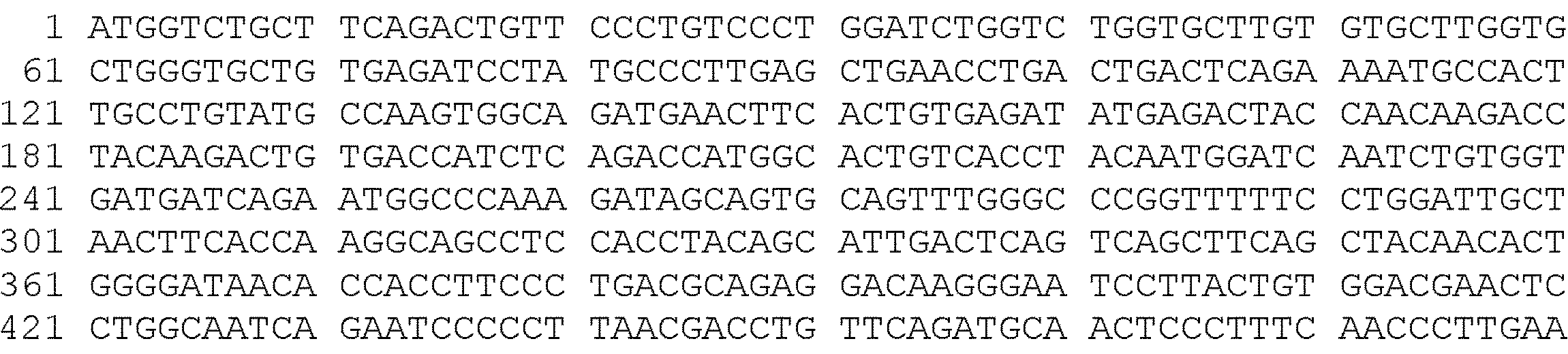
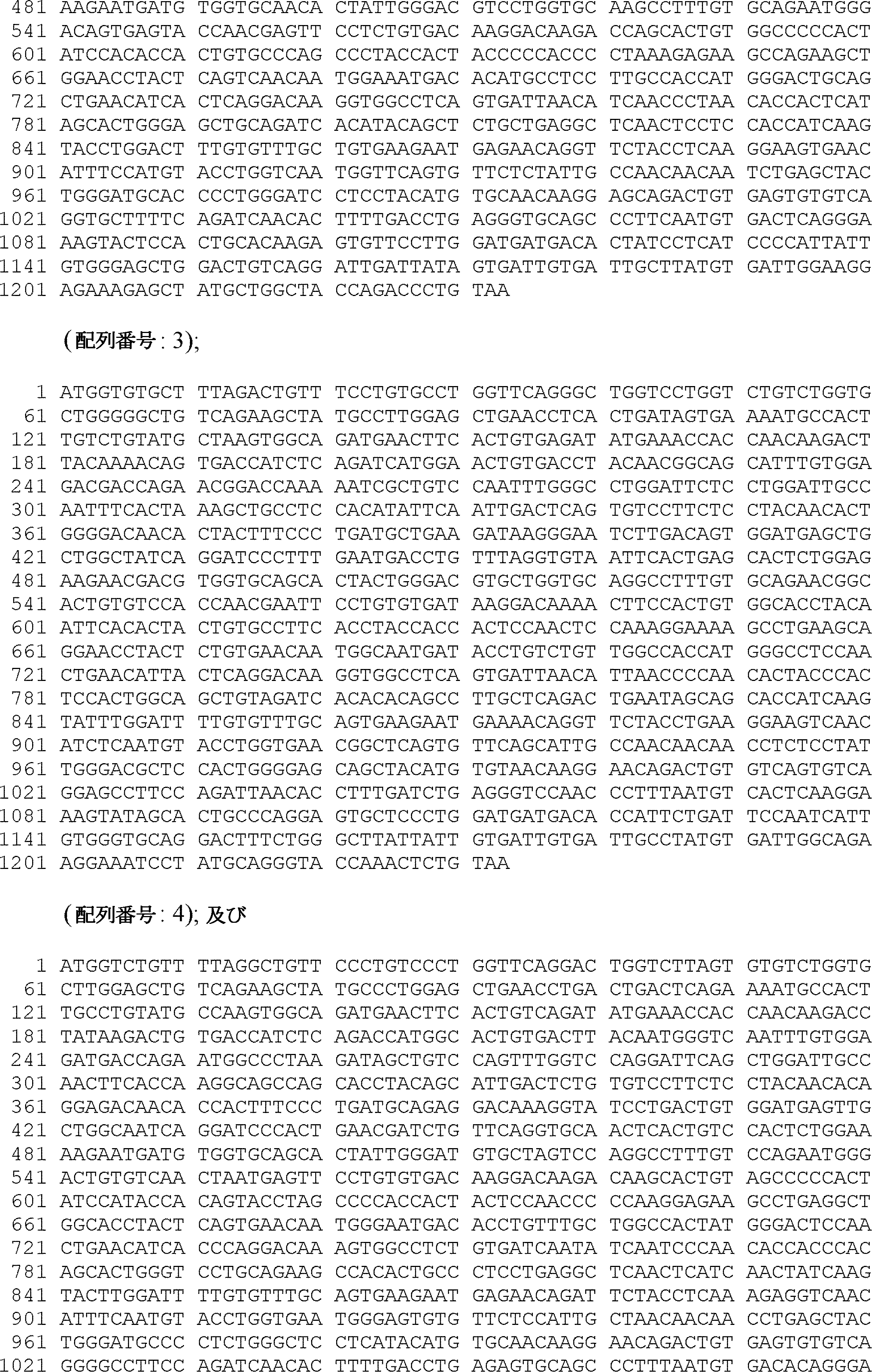

一実施形態において、導入遺伝子は、配列番号3~5から選択される配列に対して少なくとも95%の同一性を共有する。一実施形態において、導入遺伝子は、配列番号3~5から選択される配列に対して少なくとも99%の同一性を共有する。一実施形態において、導入遺伝子は配列番号3~5から選択される配列を含む。一実施形態において、導入遺伝子は、配列番号3に対して少なくとも85%、86%、87%、88%、89%、90%、91%、92%、93%、94%、95%、96%、97%、98%、99%、又は完全同一性を共有する。一実施形態において、導入遺伝子は、配列番号4に対して少なくとも85%、86%、87%、88%、89%、90%、91%、92%、93%、94%、95%、96%、97%、98%、99%、又は完全同一性を共有する。一実施形態において、導入遺伝子は、配列番号5に対して少なくとも85%、86%、87%、88%、89%、90%、91%、92%、93%、94%、95%、96%、97%、98%、99%、又は完全同一性を共有する。 In one embodiment, the transgene shares at least 95% identity to a sequence selected from SEQ ID NOs: 3-5. In one embodiment, the transgene shares at least 99% identity to a sequence selected from SEQ ID NOs: 3-5. In one embodiment, the transgene comprises a sequence selected from SEQ ID NOs: 3-5. In one embodiment, the transgene shares at least 85%, 86%, 87%, 88%, 89%, 90%, 91%, 92%, 93%, 94%, 95%, 96%, 97%, 98%, 99%, or complete identity to SEQ ID NO: 3. In one embodiment, the transgene shares at least 85%, 86%, 87%, 88%, 89%, 90%, 91%, 92%, 93%, 94%, 95%, 96%, 97%, 98%, 99%, or complete identity to SEQ ID NO: 4. In one embodiment, the transgene shares at least 85%, 86%, 87%, 88%, 89%, 90%, 91%, 92%, 93%, 94%, 95%, 96%, 97%, 98%, 99%, or complete identity to SEQ ID NO:5.
いくつかの実施形態において、導入遺伝子は、配列番号3~5のいずれか一つの部分配列と類似または同じである。いくつかの実施形態において、導入遺伝子は、配列番号3~5のいずれか一つの部分配列を含む。様々な実施形態において、部分配列は、少なくとも約50nt、少なくとも約100nt、少なくとも約150nt、少なくとも約250nt、少なくとも約200nt、少なくとも約350nt、少なくとも約450nt、少なくとも約400nt、少なくとも約450nt、少なくとも約550nt、少なくとも約600nt、少なくとも約650nt、少なくとも約600nt、少なくとも約650nt、少なくとも約700nt、少なくとも約750nt、少なくとも約800nt、少なくとも約850nt、少なくとも約900nt、少なくとも約950nt、又は少なくとも約1000ntの長さを有する、完全配列中の任意の連続ヌクレオチド(nt)セットを含み得る。 In some embodiments, the transgene is similar or identical to a subsequence of any one of SEQ ID NOs: 3-5. In some embodiments, the transgene comprises a subsequence of any one of SEQ ID NOs: 3-5. In various embodiments, the subsequence may comprise any set of contiguous nucleotides (nt) in the complete sequence having a length of at least about 50 nt, at least about 100 nt, at least about 150 nt, at least about 250 nt, at least about 200 nt, at least about 350 nt, at least about 450 nt, at least about 400 nt, at least about 450 nt, at least about 550 nt, at least about 600 nt, at least about 650 nt, at least about 600 nt, at least about 650 nt, at least about 700 nt, at least about 750 nt, at least about 800 nt, at least about 850 nt, at least about 900 nt, at least about 950 nt, or at least about 1000 nt.
いくつかの実施形態において、導入遺伝子は、配列番号3~5のいずれか一つのヌクレオチド1~500、250~750、500~1000、又は750~1240を含む部分配列に対して少なくとも95%の同一性を共有する。一実施形態において、導入遺伝子は、配列番号3~5のいずれか一つのヌクレオチド1~500、250~750、500~1000、又は750~1240を含む部分配列に対して少なくとも99%の同一性を共有する。一実施形態において、導入遺伝子は、配列番号3~5のいずれか一つのヌクレオチド1~500、250~750、500~1000、又は750~1240を含む配列を含む。実施形態において、導入遺伝子は、配列番号3~5のいずれか一つのヌクレオチド1~500、250~750、500~1000、又は750~1240を含む部分配列に対して少なくとも85%、86%、87%、88%、89%、90%、91%、92%、93%、94%、95%、96%、97%、98%、99%、又は完全同一性を共有する。実施形態において、導入遺伝子は、配列番号3のヌクレオチド1~500、250~750、500~1000、又は750~1240を含む部分配列に対して少なくとも85%、86%、87%、88%、89%、90%、91%、92%、93%、94%、95%、96%、97%、98%、99%、又は完全同一性を共有する。実施形態において、導入遺伝子は、配列番号3のヌクレオチド1~500、250~750、500~1000、又は750~1240を含む部分配列に対して少なくとも85%、86%、87%、88%、89%、90%、91%、92%、93%、94%、95%、96%、97%、98%、99%、又は完全同一性を共有する。 In some embodiments, the transgene shares at least 95% identity to a subsequence including nucleotides 1-500, 250-750, 500-1000, or 750-1240 of any one of SEQ ID NOs:3-5. In one embodiment, the transgene shares at least 99% identity to a subsequence including nucleotides 1-500, 250-750, 500-1000, or 750-1240 of any one of SEQ ID NOs:3-5. In one embodiment, the transgene comprises a sequence including nucleotides 1-500, 250-750, 500-1000, or 750-1240 of any one of SEQ ID NOs:3-5. In embodiments, the transgene shares at least 85%, 86%, 87%, 88%, 89%, 90%, 91%, 92%, 93%, 94%, 95%, 96%, 97%, 98%, 99%, or complete identity to a subsequence including nucleotides 1-500, 250-750, 500-1000, or 750-1240 of any one of SEQ ID NOs: 3-5. In embodiments, the transgene shares at least 85%, 86%, 87%, 88%, 89%, 90%, 91%, 92%, 93%, 94%, 95%, 96%, 97%, 98%, 99%, or complete identity to a subsequence including nucleotides 1-500, 250-750, 500-1000, or 750-1240 of SEQ ID NO:3. In embodiments, the transgene shares at least 85%, 86%, 87%, 88%, 89%, 90%, 91%, 92%, 93%, 94%, 95%, 96%, 97%, 98%, 99%, or complete identity to a subsequence including nucleotides 1-500, 250-750, 500-1000, or 750-1240 of SEQ ID NO:3.
ある特定の実施形態において、導入遺伝子は、LAMP-2A、LAMP-2B、若しくはLAMP-2Cのいずれかを含むLAMP-2の様々なアイソフォームのいずれか、又はこれらのアイソフォームのいずれかの機能的フラグメント若しくは変異体をコードする。したがって、特定の実施形態において、発現カセットは、LAMP-2A、LAMP-2B、若しくはLAMP-2Cのいずれか、又はその機能的フラグメント若しくは変異体をコードする最適化されたポリヌクレオチド配列であって、対応する野生型ポリヌクレオチド配列と比べて、以下から選択される一つ以上の修飾をはじめとする一つ以上の修飾を含む:LAMP-2A、LAMP-2B、又はLAMP-2Cをコードする導入遺伝子配列のコドン最適化;発現カセット又は導入遺伝子配列は、その対応する野生型配列よりも少ないCpG部位を含む;発現カセット又は導入遺伝子配列は、その対応する野生型配列よりも少ないCpG部位を含む;発現カセット又は導入遺伝子配列は、その対応する野生型配列よりも少ないクリプティックスプライス部位を含む;及び/又は発現カセット又は導入遺伝子配列は、その対応する野生型配列よりも少ないオープンリーディングフレームを含む。特定の実施形態において、最適化配列は、ヒト細胞における増大した発現のために最適化される。LAMP-2A及びLAMP-2Cアイソフォームをコードする野生型ヒトポリヌクレオチド配列は、それぞれ配列番号29及び30に示されている。ヒトLAMP-2A及びLAMP-2Cタンパク質の野生型配列は、それぞれ配列番号34及び35に示されている。また、野生型LAMP-2アイソフォームの配列及びコーディング配列は、公開されている。本明細書はLAMP-2Bに関して具体的な実施形態を記載しているが、LAMP-2A又はLAMP-2Cを各実施形態において代替的に使用できると理解される。 In certain embodiments, the transgene encodes any of the various isoforms of LAMP-2, including any of LAMP-2A, LAMP-2B, or LAMP-2C, or a functional fragment or variant of any of these isoforms. Thus, in certain embodiments, the expression cassette is an optimized polynucleotide sequence encoding either LAMP-2A, LAMP-2B, or LAMP-2C, or a functional fragment or variant thereof, which comprises one or more modifications compared to the corresponding wild-type polynucleotide sequence, including one or more modifications selected from the following: codon optimization of the transgene sequence encoding LAMP-2A, LAMP-2B, or LAMP-2C; the expression cassette or transgene sequence comprises fewer CpG sites than its corresponding wild-type sequence; the expression cassette or transgene sequence comprises fewer CpG sites than its corresponding wild-type sequence; the expression cassette or transgene sequence comprises fewer cryptic splice sites than its corresponding wild-type sequence; and/or the expression cassette or transgene sequence comprises fewer open reading frames than its corresponding wild-type sequence. In certain embodiments, the optimized sequence is optimized for increased expression in human cells. Wild-type human polynucleotide sequences encoding the LAMP-2A and LAMP-2C isoforms are set forth in SEQ ID NOs: 29 and 30, respectively. The wild-type sequences of human LAMP-2A and LAMP-2C proteins are shown in SEQ ID NOs: 34 and 35, respectively. Additionally, the sequences and coding sequences of wild-type LAMP-2 isoforms have been published. Although specific embodiments are described herein with respect to LAMP-2B, it is understood that LAMP-2A or LAMP-2C can be used alternatively in each embodiment.
野生型LAMP-2A(配列番号29)及び野生型LAMP-2C(配列番号30)のコーディング配列は、少なくともヌクレオチド1~1080にわたって野生型LAMP-2Bのコーディング配列(配列番号2)に対して100%同一である。したがって、本明細書中で開示する導入遺伝子、発現カセット、及びベクターが、LAMP-2A(配列番号29)又は野生型LAMP-2C(配列番号30)のいずれかの3’末端(ヌクレオチド1081~末端)を、LAMP-2B(例えば、配列番号3~5のいずれかの最適化LAMP-2B)のヌクレオチド1081~1233の代わりに置換することによって、LAMP-2のこれらのアイソフォームの発現に適合させることができることは、当業者には容易に理解されるであろう。例えば、本発明の実施形態は、配列番号3~5の最適化されたLAMP-2B遺伝子配列、それぞれ配列番号31~33、のヌクレオチド1~1080を利用する。 The coding sequences of wild-type LAMP-2A (SEQ ID NO:29) and wild-type LAMP-2C (SEQ ID NO:30) are 100% identical to the coding sequence of wild-type LAMP-2B (SEQ ID NO:2) over at least nucleotides 1-1080. Thus, it will be readily apparent to one of skill in the art that the transgenes, expression cassettes, and vectors disclosed herein can be adapted for expression of these isoforms of LAMP-2 by substituting the 3' end (nucleotides 1081 to the end) of either LAMP-2A (SEQ ID NO:29) or wild-type LAMP-2C (SEQ ID NO:30) in place of nucleotides 1081-1233 of LAMP-2B (e.g., any of the optimized LAMP-2B of SEQ ID NOs:3-5). For example, embodiments of the present invention utilize nucleotides 1-1080 of the optimized LAMP-2B gene sequences of SEQ ID NOs:3-5, SEQ ID NOs:31-33, respectively.
一実施形態において、導入遺伝子は、配列番号31~33から選択される配列に対して少なくとも95%の同一性を共有する。一実施形態において、導入遺伝子は配列番号31~33から選択される配列に対して少なくとも99%の同一性を共有する。一実施形態において、導入遺伝子は配列番号31~33から選択される配列を含む。一実施形態において、導入遺伝子は、配列番号31に対して少なくとも85%、86%、87%、88%、89%、90%、91%、92%、93%、94%、95%、96%、97%、98%、99%、又は完全同一性を共有する。一実施形態において、導入遺伝子は、配列番号32に対して少なくとも85%、86%、87%、88%、89%、90%、91%、92%、93%、94%、95%、96%、97%、98%、99%、又は完全同一性を共有する。一実施形態において、導入遺伝子は、配列番号33に対して少なくとも85%、86%、87%、88%、89%、90%、91%、92%、93%、94%、95%、96%、97%、98%、99%、又は完全同一性を共有する。場合によっては、導入遺伝子は、基準配列、例えば、「天然」又は「野生型」LAMP-2B配列のポリヌクレオチド配列とは異なるポリヌクレオチド配列を有する。いくつかの実施形態において、導入遺伝子は、基準配列と最大で70%、71%、72%、73%、74%、75%、76%、77%、78%、79%、80%、81%、82%、83%、84%、85%、86%、87%、88%、89%、90%、91%、92%、93%、94%、又は95%の同一性を共有する。いくつかの実施形態において、基準配列は配列番号2である。例えば、配列番号3は、配列番号2に対して78.5%の同一性を共有する。 In one embodiment, the transgene shares at least 95% identity to a sequence selected from SEQ ID NOs:31-33. In one embodiment, the transgene shares at least 99% identity to a sequence selected from SEQ ID NOs:31-33. In one embodiment, the transgene comprises a sequence selected from SEQ ID NOs:31-33. In one embodiment, the transgene shares at least 85%, 86%, 87%, 88%, 89%, 90%, 91%, 92%, 93%, 94%, 95%, 96%, 97%, 98%, 99%, or complete identity to SEQ ID NO:31. In one embodiment, the transgene shares at least 85%, 86%, 87%, 88%, 89%, 90%, 91%, 92%, 93%, 94%, 95%, 96%, 97%, 98%, 99%, or complete identity to SEQ ID NO:32. In one embodiment, the transgene shares at least 85%, 86%, 87%, 88%, 89%, 90%, 91%, 92%, 93%, 94%, 95%, 96%, 97%, 98%, 99%, or complete identity to SEQ ID NO: 33. In some cases, the transgene has a polynucleotide sequence that differs from the polynucleotide sequence of a reference sequence, e.g., a "native" or "wild-type" LAMP-2B sequence. In some embodiments, the transgene shares up to 70%, 71%, 72%, 73%, 74%, 75%, 76%, 77%, 78%, 79%, 80%, 81%, 82%, 83%, 84%, 85%, 86%, 87%, 88%, 89%, 90%, 91%, 92%, 93%, 94%, or 95% identity to the reference sequence. In some embodiments, the reference sequence is SEQ ID NO: 2. For example, SEQ ID NO:3 shares 78.5% identity with SEQ ID NO:2.
場合によっては、導入遺伝子は、基準配列、例えば、「天然」又は「野生型」LAMP-2A配列のポリヌクレオチド配列とは異なるポリヌクレオチド配列を有する。いくつかの実施形態において、導入遺伝子は、基準配列と最大で70%、71%、72%、73%、74%、75%、76%、77%、78%、79%、80%、81%、82%、83%、84%、85%、86%、87%、88%、89%、90%、91%、92%、93%、94%、又は95%の同一性を共有する。いくつかの実施形態において、基準配列は、配列番号29に示される野生型ヒトLAMP-2A配列である。 In some cases, the transgene has a polynucleotide sequence that differs from the polynucleotide sequence of a reference sequence, e.g., a "natural" or "wild-type" LAMP-2A sequence. In some embodiments, the transgene shares up to 70%, 71%, 72%, 73%, 74%, 75%, 76%, 77%, 78%, 79%, 80%, 81%, 82%, 83%, 84%, 85%, 86%, 87%, 88%, 89%, 90%, 91%, 92%, 93%, 94%, or 95% identity with the reference sequence. In some embodiments, the reference sequence is the wild-type human LAMP-2A sequence set forth in SEQ ID NO:29.
場合によっては、導入遺伝子は、基準配列、例えば、「天然」又は「野生型」LAMP-2C配列のポリヌクレオチド配列とは異なるポリヌクレオチド配列を有する。いくつかの実施形態において、導入遺伝子は、基準配列と最大で70%、71%、72%、73%、74%、75%、76%、77%、78%、79%、80%、81%、82%、83%、84%、85%、86%、87%、88%、89%、90%、91%、92%、93%、94%、又は95%の同一性を共有する。いくつかの実施形態において、基準配列は、配列番号30に示される野生型ヒトLAMP-2A配列である。 In some cases, the transgene has a polynucleotide sequence that differs from the polynucleotide sequence of a reference sequence, e.g., a "natural" or "wild-type" LAMP-2C sequence. In some embodiments, the transgene shares up to 70%, 71%, 72%, 73%, 74%, 75%, 76%, 77%, 78%, 79%, 80%, 81%, 82%, 83%, 84%, 85%, 86%, 87%, 88%, 89%, 90%, 91%, 92%, 93%, 94%, or 95% identity with the reference sequence. In some embodiments, the reference sequence is the wild-type human LAMP-2A sequence set forth in SEQ ID NO:30.
一実施形態において、導入遺伝子はヒト宿主細胞における発現のためにコドン最適化されている。一実施形態において、導入遺伝子コーディング配列は、低頻度で表されるコドンを高頻度で表されるコドンで置換することによって、発現を増強するように、修飾、又は「コドン最適化」される。コーディング配列は、翻訳のためにアミノ酸をコードするmRNA配列の一部である。翻訳中、61のトリヌクレオチドコドンの各々が20のアミノ酸のうちの1つに翻訳され、遺伝子コードの縮重、又は重複性をもたらす。しかしながら、異なる細胞型、及び異なる動物種は、同じアミノ酸を異なる頻度でコードするtRNA(それぞれアンチコドンを有する)を利用する。遺伝子配列が、対応するtRNAによって低頻度で表されるコドンを含む場合、リボソーム翻訳機構は遅く、効率的な翻訳を妨げる可能性がある。発現は、コーディング配列が同じタンパク質配列であるが、高度に表されるコドンを利用する、及び/又は高度に発現されたヒトタンパク質によって利用されるように、改変される、特定の種についての「コドン最適化」によって改善することができる(Cid-Arregui et al.,2003;J.Virol.77:4928)。 In one embodiment, the transgene is codon-optimized for expression in a human host cell. In one embodiment, the transgene coding sequence is modified, or "codon-optimized," to enhance expression by replacing low-represented codons with high-represented codons. The coding sequence is the portion of the mRNA sequence that codes for amino acids for translation. During translation, each of the 61 trinucleotide codons is translated into one of 20 amino acids, resulting in the degeneracy, or redundancy, of the genetic code. However, different cell types and different animal species utilize tRNAs (each with an anticodon) that code for the same amino acid at different frequencies. If a genetic sequence contains codons that are low-represented by the corresponding tRNA, the ribosomal translation machinery may be slowed down, preventing efficient translation. Expression can be improved by "codon optimization" for a particular species, where the coding sequence is the same protein sequence but modified to utilize highly represented codons and/or those utilized by highly expressed human proteins (Cid-Arregui et al., 2003; J. Virol. 77:4928).
いくつかの実施形態において、導入遺伝子のコーディング配列は、哺乳動物又は霊長類において低頻度で発現されるコドンを、霊長類において高頻度で発現されるコドンで置換するように修飾される。例えば、いくつかの実施形態において、導入遺伝子は、基準ポリペプチド(例えば、野生型LAMP-2B;配列番号3)に対して少なくとも85%の配列同一性-例えば、基準ポリペプチドに対して、少なくとも90%の配列同一性、少なくとも95%の配列同一性、少なくとも98%の同一性、又は少なくとも99%の同一性を有するポリペプチドをコードする-ここで、コーディング配列の少なくとも一つのコドンは、上記または本明細書中で開示される配列において、対応するコドンよりもヒトにおいて高いtRNA頻度を有する。 In some embodiments, the coding sequence of the transgene is modified to replace a codon that is expressed at low frequency in a mammal or primate with a codon that is expressed at high frequency in a primate. For example, in some embodiments, the transgene encodes a polypeptide having at least 85% sequence identity to a reference polypeptide (e.g., wild-type LAMP-2B; SEQ ID NO:3) - e.g., at least 90% sequence identity, at least 95% sequence identity, at least 98% identity, or at least 99% identity to the reference polypeptide - where at least one codon of the coding sequence has a higher tRNA frequency in humans than the corresponding codon in the sequences disclosed above or herein.
一実施形態において、導入遺伝子は、配列番号2よりも少ない代替オープンリーディングフレームを含む。一実施形態において、導入遺伝子は、所望の導入遺伝子をコードしないオープンリーディングフレーム(ORF)の停止又は除去によって発現を増強するように修飾される。オープンリーディングフレーム(ORF)は、開始コドンに続くものであり、終止コドンを含まない核酸配列である。ORFは、順方向又は逆方向であり得、関心対象の遺伝子と比較して、「フレーム内」又は「フレーム外」であり得る。そのようなオープンリーディングフレームは、発現カセットにおいて関心対象の遺伝子と共に発現される可能性を有し、望ましくない悪影響をもたらし得る。いくつかの実施形態において、導入遺伝子は、コドン使用頻度をさらに改変することによってオープンリーディングフレームを除去するように修飾されている。これは、コードされたアミノ酸配列を保存し、任意選択的に、関心対象の遺伝子中の高度に利用されたコドンを維持(すなわち、20%未満の頻度のコドンを回避)しつつ、一つ以上の開始コドン(ATG)を除去すること、及び/又は一つ以上の終止コドン(TAG、TAA、若しくはTGA)を逆方向若しくはフレーム外で所望のORFに導入することによって行うことができる。 In one embodiment, the transgene contains fewer alternative open reading frames than SEQ ID NO:2. In one embodiment, the transgene is modified to enhance expression by terminating or removing open reading frames (ORFs) that do not code for the desired transgene. An open reading frame (ORF) is a nucleic acid sequence that follows a start codon and does not contain a stop codon. ORFs can be forward or reverse and can be "in frame" or "out of frame" compared to the gene of interest. Such open reading frames have the potential to be expressed along with the gene of interest in the expression cassette and can result in undesirable adverse effects. In some embodiments, the transgene is modified to remove open reading frames by further modifying the codon usage. This can be done by removing one or more start codons (ATG) and/or introducing one or more stop codons (TAG, TAA, or TGA) in a reversed or out-of-frame orientation into the desired ORF, while preserving the encoded amino acid sequence and, optionally, maintaining highly utilized codons in the gene of interest (i.e., avoiding codons with a frequency of less than 20%).
いくつかの実施形態において、発現カセットは、導入遺伝子の開始コドンに対して5’の、最大で1つ、最大で2つ、最大で3つ、最大で4つ、又は最大で5つの開始コドンを含む。いくつかの実施形態において、発現カセットは、導入遺伝子の開始コドンに対して5’の開始コドンを含まない。いくつかの実施形態において、5’UTR中の一つ以上のATGコドン、プロモータ、エンハンサ、プロモータ/エンハンサエレメント、又は導入遺伝子の開始コドンに対して5’の他の配列が、一つ以上のクリプティック開始部位を除去した後も残存する。いくつかの実施形態において、発現カセットは、誤ったmRNAを生成する導入遺伝子の上流のクリプティック開始部位を含まない。 In some embodiments, the expression cassette includes up to one, up to two, up to three, up to four, or up to five start codons 5' to the start codon of the transgene. In some embodiments, the expression cassette does not include a start codon 5' to the start codon of the transgene. In some embodiments, one or more ATG codons in the 5'UTR, promoter, enhancer, promoter/enhancer element, or other sequences 5' to the start codon of the transgene remain after removal of the one or more cryptic start sites. In some embodiments, the expression cassette does not include a cryptic start site upstream of the transgene that would generate erroneous mRNA.
本開示の変形では、導入遺伝子コーディング配列は、非導入遺伝子ORFのコドン最適化若しくは除去又は両技術を使用することによって最適化することができる。場合によっては、コドン最適化の間に導入されたORFを除去するために、コドン最適化後に非導入遺伝子ORFを除去又は最小化する。 In variations of the present disclosure, the transgene coding sequence can be optimized by codon optimization or removal of non-transgene ORFs, or by using both techniques. In some cases, non-transgene ORFs are removed or minimized after codon optimization to remove ORFs introduced during codon optimization.
一実施形態において、導入遺伝子は、配列番号2よりも少ないCpG部位を含む。理論によって拘束されないが、ポリヌクレオチド配列中のCpG部位の存在は、ポリヌクレオチド配列を含むウイルスベクターに対する宿主の望ましくない免疫応答と関連すると考えられる。いくつかの実施形態において、導入遺伝子は、CpG部位の数を減少させるように設計される。例示的方法が、米国特許出願公開第US20020065236A1号に提示されている。 In one embodiment, the transgene contains fewer CpG sites than SEQ ID NO:2. Without being bound by theory, it is believed that the presence of CpG sites in a polynucleotide sequence is associated with an undesirable host immune response to a viral vector containing the polynucleotide sequence. In some embodiments, the transgene is engineered to reduce the number of CpG sites. Exemplary methods are presented in U.S. Patent Application Publication No. US20020065236A1.
一実施形態において、導入遺伝子は、配列番号2よりも少ないクリプティックスプライス部位を含む。最適化のために、GeneArt(登録商標)ソフトウェアを使用して、例えば、GC含有量を増加、及び/又はクリプティックスプライス部位を除去して、転写サイレンシングを回避し、したがって導入遺伝子発現を増加させることができる。あるいは、当該技術分野で公知の任意の最適化法を使用することができる。クリプティックスプライス部位の除去は、例えば、国際特許出願公開第WO2004015106A1号で記載されている。 In one embodiment, the transgene contains fewer cryptic splice sites than SEQ ID NO:2. For optimization, GeneArt® software can be used, for example, to increase the GC content and/or remove cryptic splice sites to avoid transcriptional silencing and thus increase transgene expression. Alternatively, any optimization method known in the art can be used. Removal of cryptic splice sites is described, for example, in International Patent Application Publication No. WO2004015106A1.
また、LAMP-2Bをコードする発現カセット及び遺伝子療法ベクターも本明細書中で開示する。ある特定の実施形態において、発現カセット及び遺伝子療法ベクターは、本明細書中で開示されているコドン最適化又は変異体LAMP-2Bポリヌクレオチド配列又は導入遺伝子配列を含む。 Also disclosed herein are expression cassettes and gene therapy vectors encoding LAMP-2B. In certain embodiments, the expression cassettes and gene therapy vectors comprise codon-optimized or mutant LAMP-2B polynucleotide sequences or transgene sequences disclosed herein.
特定の実施形態において、LAMP-2Bをコードする発現カセット又は遺伝子療法ベクターは:コンセンサス最適化Kozak配列と、完全長ポリアデニル化(ポリA)配列(又は完全長ポリAの切断されたポリAでの置換)とを含み、上流(すなわち、5’)又はクリプティック開始コドン(すなわち、ATG部位)はほとんど又は全く含まない。いくつかの実施形態において、発現カセットは、代替mRNAを生成することができる導入遺伝子に対して5’の開始部位を含まない。ある特定の実施形態において、発現カセット又は遺伝子療法ベクターは、LMAP-2Bをコードする配列、例えば、本明細書中で開示するコドン最適化若しくは変異体LAMP-2Bポリヌクレオチド配列又は導入遺伝子配列を含む。 In certain embodiments, an expression cassette or gene therapy vector encoding LAMP-2B includes: a consensus optimized Kozak sequence and a full-length polyadenylation (polyA) sequence (or replacement of the full-length polyA with a truncated polyA), with few or no upstream (i.e., 5') or cryptic start codons (i.e., ATG sites). In some embodiments, the expression cassette does not include a 5' start site for a transgene capable of generating alternative mRNAs. In certain embodiments, the expression cassette or gene therapy vector includes a sequence encoding LAMP-2B, e.g., a codon-optimized or mutant LAMP-2B polynucleotide sequence or transgene sequence disclosed herein.
場合によっては、発現カセットは、第一の逆方向末端反復、エンハンサ/プロモータ領域、コンセンサス最適化Kozak配列、導入遺伝子(例えば、本明細書中で開示するLAMP-2Bをコードする導入遺伝子)、完全長ポリA配列を含む3’未翻訳領域、及び第二の逆方向末端反復の2つ以上を含む。いくつかの実施形態において、逆方向末端反復(ITR)の一方又は両方は、AAV1、AAV2、AAV3、AAV4、AAV5、AAV6、AAV7、若しくはAAV9 ITR、又は当該技術分野で公知のいずれか一つのITRである。いくつかの実施形態において、発現カセットは、正確に2つのITRを含む。いくつかの実施形態において、ITRは両方ともAAV2、AAV5、又はAAV9 ITRである。いくつかの実施形態において、ITRは両方ともAAV2 ITRである。 In some cases, the expression cassette comprises two or more of a first inverted terminal repeat, an enhancer/promoter region, a consensus optimized Kozak sequence, a transgene (e.g., a transgene encoding LAMP-2B as disclosed herein), a 3' untranslated region comprising a full-length polyA sequence, and a second inverted terminal repeat. In some embodiments, one or both of the inverted terminal repeats (ITRs) are AAV1, AAV2, AAV3, AAV4, AAV5, AAV6, AAV7, or AAV9 ITRs, or any one ITR known in the art. In some embodiments, the expression cassette comprises exactly two ITRs. In some embodiments, the ITRs are both AAV2, AAV5, or AAV9 ITRs. In some embodiments, the ITRs are both AAV2 ITRs.
一実施形態において、発現カセットは、導入遺伝子に機能的に連結されたKozak配列を含む。一実施形態において、Kozak配列は、配列番号6を含むか又は配列番号6からなるコンセンサス最適化Kozak配列である。

様々な実施形態において、発現カセットは、導入遺伝子に機能的に連結された代替Kozak配列を含む。一実施形態において、Kozak配列は、配列番号14~18のいずれか一つを含むかまたは配列番号14~18のいずれか一つからなる代替Kozak配列である。
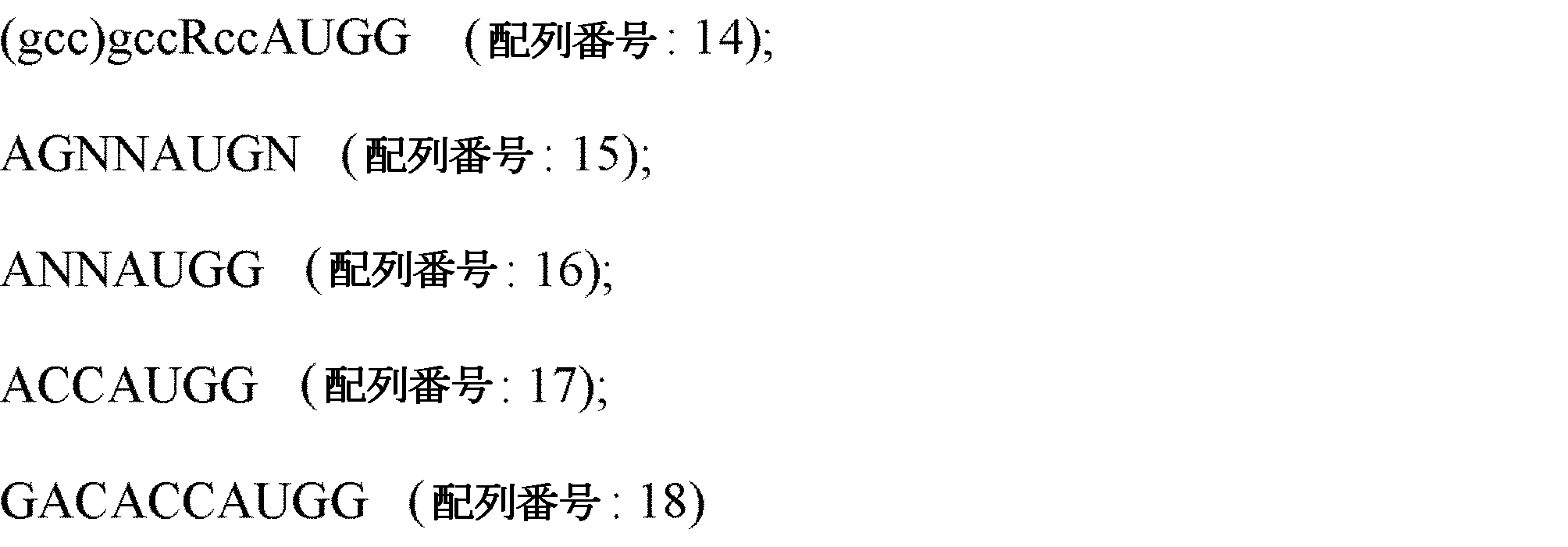
いくつかの実施形態において、発現カセットはKozak配列を含まない。 In some embodiments, the expression cassette does not contain a Kozak sequence.
配列番号14において、小文字は、塩基が変わり得る場所で最も一般的な塩基を示し;大文字は高度に保存された塩基を示す;アデニン又はグアニンを示す。配列番号14において、括弧中の配列(gcc)は任意選択的である。配列番号15~17において、「N」は任意の塩基を示す。 In SEQ ID NO:14, lower case letters indicate the most common base where the base can vary; capital letters indicate highly conserved bases; adenine or guanine. In SEQ ID NO:14, the sequence in brackets (gcc) is optional. In SEQ ID NOs:15-17, "N" indicates any base.
様々な配列をこのコンセンサス最適化Kozak配列の代わりに翻訳開始部位として使用することができ、他の配列を特定し試験することは、当業者の技術範囲内である。Kozak M.An analysis of vertebrate mRNA sequences:intimations of translational control.J.Cell Biol.115(4):887-903(1991)を参照。 A variety of sequences can be used as translation initiation sites in place of this consensus optimized Kozak sequence, and it is within the skill of one of ordinary skill in the art to identify and test other sequences. See Kozak M. Analysis of inverted mRNA sequences: intimations of translational control. J. Cell Biol. 115(4):887-903 (1991).
一実施形態において、発現カセットは、導入遺伝子に機能的に連結された完全長ポリA配列を含む。一実施形態において、完全長ポリA配列は、配列番号7を含む。

制限なく、ウシ成長ホルモンポリアデニル化シグナル(bGHpA)(配列番号19)、SV40初期/後期ポリアデニル化シグナル(配列番号20)、及びヒト成長ホルモン(HGH)ポリアデニル化シグナル(配列番号21)を含む様々な代替ポリA配列を、本開示の発現カセットで使用することができる。
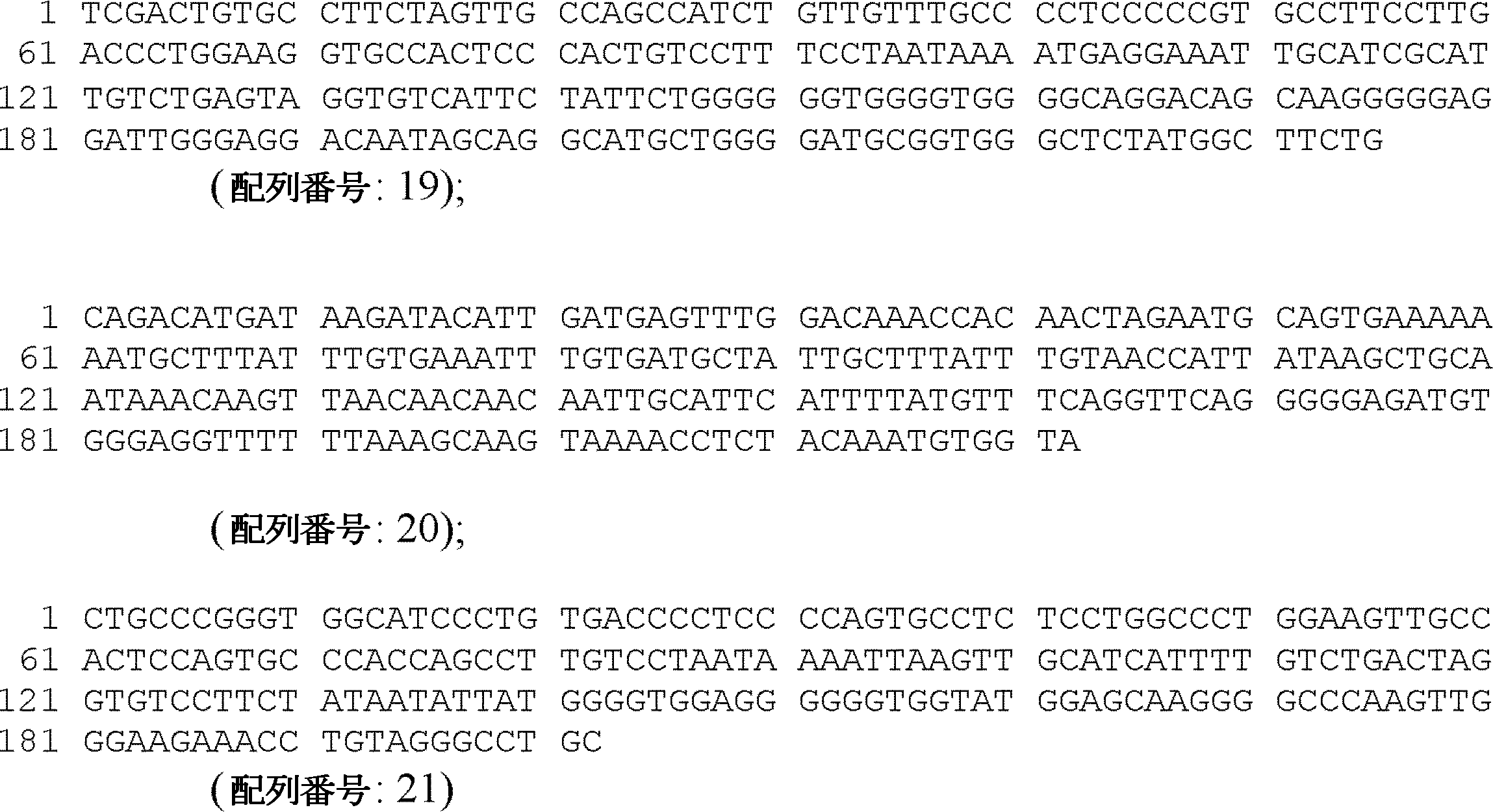
いくつかの実施形態において、発現カセットは、ポリA配列の活性フラグメントを含む。特定の実施形態において、ポリA配列の活性フラグメントは、20塩基対(bp)未満、50bp未満、100bp未満、又は150bp未満の、例えば、本明細書中で開示するポリA配列のいずれかを含むか、またはこれらからなる。 In some embodiments, the expression cassette comprises an active fragment of a polyA sequence. In certain embodiments, the active fragment of a polyA sequence comprises or consists of less than 20 base pairs (bp), less than 50 bp, less than 100 bp, or less than 150 bp, e.g., any of the polyA sequences disclosed herein.
場合によっては、導入遺伝子の発現は、発現カセットが競合するORFを含まないことを確実にすることによって増大する。一実施形態において、発現カセットは、導入遺伝子の開始コドンの5’の20、30、40、50、60、70、80、90、100、200、300、400、又は500塩基対以内の開始コドンを含まない。いくつかの実施形態において、発現カセットは導入遺伝子の開始コドンの5’に開始コドンを含まない。いくつかの実施形態において、発現カセットは、代替mRNAを生成することができる導入遺伝子に対して5’の開始部位を含まない。 In some cases, expression of the transgene is increased by ensuring that the expression cassette does not contain a competing ORF. In one embodiment, the expression cassette does not contain a start codon within 20, 30, 40, 50, 60, 70, 80, 90, 100, 200, 300, 400, or 500 base pairs 5' of the start codon of the transgene. In some embodiments, the expression cassette does not contain a start codon 5' of the start codon of the transgene. In some embodiments, the expression cassette does not contain a start site 5' to the transgene that can generate an alternative mRNA.
一実施形態において、発現カセットは、5’から3’の方向で、機能的に連結された、第一の逆方向末端反復、エンハンサ/プロモータ領域、イントロン、コンセンサス最適化Kozak配列、導入遺伝子、完全長ポリA配列を含む3’未翻訳領域、及び第二の逆方向末端反復を含み、発現カセットは、代替mRNAを生成することができる導入遺伝子に対して5’の開始部位を含まない。 In one embodiment, the expression cassette comprises, in a 5' to 3' orientation, a first inverted terminal repeat, an enhancer/promoter region, an intron, a consensus optimized Kozak sequence, a transgene, a 3' untranslated region comprising a full-length polyA sequence, and a second inverted terminal repeat operably linked thereto, wherein the expression cassette does not include a start site 5' to the transgene capable of generating an alternative mRNA.
いくつかの実施形態において、エンハンサ/プロモータ領域は、5’から3’の方向で:CMV IEエンハンサ及びニワトリβアクチンプロモータを含む。一実施形態において、エンハンサ/プロモータ領域はCAGプロモータ(配列番号22)を含む。本明細書中で使用する場合、「CAGプロモータ」は、CMV初期エンハンサエレメント、ニワトリβアクチンプロモータ、ニワトリβアクチン遺伝子の第一エクソン及び第一イントロン、並びにウサギβグロビン遺伝子からのスプライスアクセプタを含むポリヌクレオチド配列を指す。

いくつかの実施形態において、エンハンサ/プロモータ領域は偏在性プロモータを含む。いくつかの実施形態において、エンハンサ/プロモータ領域は、CMVプロモータ(配列番号23)、SV40プロモータ(配列番号24)、PGKプロモータ(配列番号25)、及び/又はヒトβアクチンプロモータ(配列番号26)を含む。いくつかの実施形態において、エンハンサ/プロモータ領域は、配列番号23~26のいずれか一つと少なくとも75%、80%、85%、90%、95%、96%、97%、98%、99%、又は100%の配列同一性を共有するポリヌクレオチドを含む。


さらなる例示的プロモータとしては、限定されるものではないが、ヒト伸長因子1αプロモータ(EFS)、SV40初期プロモータ、マウス乳がんウイルス長末端反復(LTR)プロモータ;アデノウイルス主要後期プロモータ(Ad MLP);単純ヘルペスウイルス(HSV)プロモータ、関心対象の遺伝子に対して異種の内因性細胞プロモータ、サイトメガロウイルス(CMV)プロモータ、例えばCMV前初期プロモータ領域(CMVIE)、ラウス肉腫ウイルス(RSV)プロモータ、合成プロモータ、ハイブリッドプロモータなどが挙げられる。
Further exemplary promoters include, but are not limited to,
いくつかの実施形態において、3’UTRは、配列番号27と少なくとも75%、80%、85%、90%、95%、96%、97%、98%、99%、又は100%の配列同一性を共有するポリヌクレオチド(WPRE要素)を含む。

いくつかの実施形態において、発現カセットは、配列番号8~10から選択される配列に対して少なくとも95%の同一性を共有する。一実施形態において、発現カセットは、配列番号8~10から選択される配列に対して完全同一性を共有するか、または配列番号8~10から選択される配列に対して少なくとも80%、少なくとも85%、少なくとも90%、少なくとも95%、少なくとも98%、又は少なくとも99%の同一性を共有する。


ある特定の実施形態において、発現カセットは、限定されるものではないが、本明細書中で開示する修飾のいずれかを含む配列番号8~10から選択される配列と比較して、一つ以上の修飾を含む。特定の実施形態において、一つ以上の修飾は:一つ以上(例えば、全部)の上流ATG配列の除去、Kozak配列の、限定されるものではないが、本明細書中に開示されているもののいずれかを含む最適化コンセンサスKozak配列又は別のKozak配列での置換、及び/又はポリアデニル化配列の、限定されるものではないが、本明細書中に開示されているもののいずれかを含む完全長ポリアデニル化配列若しくは別のポリアデニル化配列での置換、の一つ以上を含む。これらの例示的発現カセット内の遺伝要素の例示的構造を図1Bに示す。 In certain embodiments, the expression cassette comprises one or more modifications compared to a sequence selected from SEQ ID NOs: 8-10, including, but not limited to, any of the modifications disclosed herein. In certain embodiments, the one or more modifications comprise one or more of: removal of one or more (e.g., all) upstream ATG sequences, replacement of the Kozak sequence with an optimized consensus Kozak sequence, including, but not limited to, any of those disclosed herein or another Kozak sequence, and/or replacement of the polyadenylation sequence with a full-length polyadenylation sequence, including, but not limited to, any of those disclosed herein or another polyadenylation sequence. Exemplary structures of genetic elements within these exemplary expression cassettes are shown in FIG. 1B.
一実施形態において、ベクターはアデノ随伴ウイルス(AAV)ベクターである。一実施形態において、発現カセットは、配列番号11及び12から選択される逆方向末端反復(ITR)配列を含む。

関連する実施形態において、本開示は、本明細書中で開示する発現カセットを含む遺伝子療法ベクターを提供する。概して、本明細書中で記載する遺伝子療法ベクターは、リソソーム関連膜タンパク質2(LAMP-2)の一つ以上のアイソフォームをコードするポリヌクレオチドを含む発現カセットを含み、LAMP-2の発現が、それを必要とする対象(例えば、ダノン病又は少なくとも一つにはLAMP-2発現欠損に起因するオートファジーフラックス欠損によって特徴づけられる別の障害に罹っている対象)において、LAMP-2タンパク質発現レベル及び/又はオートファジーフラックスの欠損を部分的又は全体的に矯正することを可能にする。特定の実施形態において、発現カセットは、本明細書中で開示するLAMP-2、例えば、配列番号3~5、又はその機能的変異体をコードするポリヌクレオチド配列を含む。いくつかの実施形態において、変異体配列は、配列番号3~5のいずれかに対して少なくとも90%、少なくとも95%、少なくとも98%、又は少なくとも99%の同一性を有する。いくつかの実施形態において、変異体は、配列番号3~5のいずれかの配列のフラグメント、例えば、配列番号3~5のいずれかの配列の少なくとも50%、少なくとも60%、少なくとも70%、少なくとも80%、少なくとも90%、又は少なくとも95%を有するフラグメントである。遺伝子療法ベクターはウイルスまたは非ウイルスベクターである。例示的非ウイルスベクターとしては、例えば、裸のDNA、カチオン性リポソーム複合体、カチオン性ポリマー複合体、カチオン性リポソーム-ポリマー複合体、及びエクソソームが挙げられる。ウイルスベクターの例としては、限定されるものではないが、アデノウイルス、レトロウイルス、レンチウイルス、ヘルペスウイルス、及びアデノ随伴ウイルス(AAV)ベクターが挙げられる。 In a related embodiment, the disclosure provides a gene therapy vector comprising an expression cassette as disclosed herein. Generally, the gene therapy vectors described herein comprise an expression cassette comprising a polynucleotide encoding one or more isoforms of lysosomal associated membrane protein 2 (LAMP-2), such that expression of LAMP-2 allows partial or total correction of defects in LAMP-2 protein expression levels and/or autophagic flux in a subject in need thereof (e.g., a subject suffering from Danon disease or another disorder characterized by an autophagic flux defect due at least in part to a defect in LAMP-2 expression). In certain embodiments, the expression cassette comprises a polynucleotide sequence encoding LAMP-2 as disclosed herein, e.g., SEQ ID NOs: 3-5, or a functional variant thereof. In some embodiments, the variant sequence has at least 90%, at least 95%, at least 98%, or at least 99% identity to any of SEQ ID NOs: 3-5. In some embodiments, the variant is a fragment of any of SEQ ID NOs: 3-5, e.g., a fragment having at least 50%, at least 60%, at least 70%, at least 80%, at least 90%, or at least 95% of any of SEQ ID NOs: 3-5. The gene therapy vector is a viral or non-viral vector. Exemplary non-viral vectors include, for example, naked DNA, cationic liposome complexes, cationic polymer complexes, cationic liposome-polymer complexes, and exosomes. Examples of viral vectors include, but are not limited to, adenovirus, retrovirus, lentivirus, herpes virus, and adeno-associated virus (AAV) vectors.
ある特定の実施形態において、ウイルスベクターはAAVベクターである。AAVは4.7kbの一本鎖DNAウイルスである。野生型AAVは非病原性であり、任意の公知疾患と病因学的関連性を有さないので、AAVに基づいた組換えベクターは優れた臨床的安全性と関連する。加えて、AAVは、多数の組織における非常に効率的な遺伝子送達及び持続的導入遺伝子発現の可能性を提供する。「AAVベクター」によって、制限なく、AAV1、AAV2、AAV3、AAV4、AAV5、AAV6、AAV7、AAV8、AAV9、AAV10、AAVrh.10、AAVrh.74などを含む、アデノ随伴ウイルス血清型由来のベクターを意味する。AAVベクターは、全体又は一部で欠失しているAAV野生型遺伝子の一つ以上、例えば、rep及び/又はcap遺伝子を有し得るが、機能的隣接逆方向末端反復(ITR)配列を保持する。機能的ITR配列は、AAVビリオンの救済、複製及びパッケージングに必要である。したがって、AAVベクターは、少なくとも、ウイルスの複製及びパッケージングのためにシスで必要とされるそれら配列(例えば、機能的ITR)を含むと本明細書中では定義される。ITRは、野生型ヌクレオチド配列である必要はなく、当該配列が機能的救済、複製及びパッケージングを提供する限り、例えば、ヌクレオチドの挿入、欠失又は置換によって改変されていてもよい。AAVベクターは、限定されるものではないが、一つ以上の修飾カプシドタンパク質(例えば、VP1、VP2及び/又はVP3)を含む、他の修飾を含んでもよい。例えば、カプシドタンパク質は、指向性を改変する、及び/又は免疫原性を減少させるように、修飾することができる。 In certain embodiments, the viral vector is an AAV vector. AAV is a 4.7 kb single-stranded DNA virus. Because wild-type AAV is non-pathogenic and has no etiological association with any known disease, recombinant vectors based on AAV are associated with excellent clinical safety. In addition, AAV offers the potential for highly efficient gene delivery and sustained transgene expression in multiple tissues. By "AAV vector" is meant vectors derived from adeno-associated virus serotypes, including, without limitation, AAV1, AAV2, AAV3, AAV4, AAV5, AAV6, AAV7, AAV8, AAV9, AAV10, AAVrh. 10, AAVrh. 74, etc. AAV vectors may have one or more of the AAV wild-type genes deleted in whole or in part, e.g., the rep and/or cap genes, but retain functional adjacent inverted terminal repeat (ITR) sequences. Functional ITR sequences are necessary for rescue, replication and packaging of AAV virions. Thus, an AAV vector is defined herein to include at least those sequences (e.g., functional ITRs) required in cis for viral replication and packaging. The ITRs need not be wild-type nucleotide sequences, but may be modified, for example, by insertion, deletion or substitution of nucleotides, so long as the sequences provide functional rescue, replication and packaging. AAV vectors may include other modifications, including, but not limited to, one or more modified capsid proteins (e.g., VP1, VP2 and/or VP3). For example, capsid proteins can be modified to alter tropism and/or reduce immunogenicity.
野生型AAVは非病原性であり、任意の公知疾患と病因学的関連性を有さないので、AAVに基づく組換えベクターは、優れた臨床的安全性と関連する。加えて、AAVは、多数の組織における非常に効率的な遺伝子送達及び持続的導入遺伝子発現の可能性を提供する。AAV1、AAV2、AAV3、AAV4、AAV5、AAV6、AAV7、AAV8、AAV9、AAV10、AAVrh.10、AAVrh.74等を含む、AAVの様々な血清型が公知である。AAVベクターは、全体又は一部で欠失したAAV野生型遺伝子の一つ以上、例えば、rep及び/又はcap遺伝子を有し得るが、機能的隣接逆方向末端反復(ITR)配列を保持する。組換えAAVベクターの血清型は、そのカプシドによって決定される。国際特許公開第WO2003042397A2号は、AAV1、AAV2、AAV3、AAV8、AAV9、及びrh10のものを含む、様々なカプシド配列を開示している。国際特許公開第WO2013078316A1号は、AAVrh74からのVP1のポリペプチド配列を開示している。多種多様な天然に存在するか又は遺伝子組換えAAVカプシド配列が当該技術分野で公知である。 Because wild-type AAV is non-pathogenic and has no etiological association with any known disease, recombinant vectors based on AAV are associated with excellent clinical safety. In addition, AAV offers the potential for highly efficient gene delivery and sustained transgene expression in multiple tissues. Various serotypes of AAV are known, including AAV1, AAV2, AAV3, AAV4, AAV5, AAV6, AAV7, AAV8, AAV9, AAV10, AAVrh. 10, AAVrh. 74, etc. AAV vectors may have one or more of the AAV wild-type genes deleted in whole or in part, e.g., the rep and/or cap genes, but retain functional flanking inverted terminal repeat (ITR) sequences. The serotype of a recombinant AAV vector is determined by its capsid. International Patent Publication No. WO2003042397A2 discloses a variety of capsid sequences, including those of AAV1, AAV2, AAV3, AAV8, AAV9, and rhlO. International Patent Publication No. WO2013078316A1 discloses the polypeptide sequence of VP1 from AAVrh74. A wide variety of naturally occurring or recombinant AAV capsid sequences are known in the art.
例示的非限定的カプシドは、配列番号28の配列(又はそのVP1、VP2、若しくはVP3フラグメント)を有するAAV9カプシドである。いくつかの実施形態において、本開示のAAVベクターは、配列番号28の全配列、又は配列番号28のアミノ酸138~736にわたって、又は配列番号28のアミノ酸203~736にわたって、少なくとも93%、少なくとも94%、少なくとも95%、少なくとも96%、少なくとも97%、少なくとも98%、少なくとも99%、又は少なくとも100%の同一性を共有するカプシドタンパク質を含む。
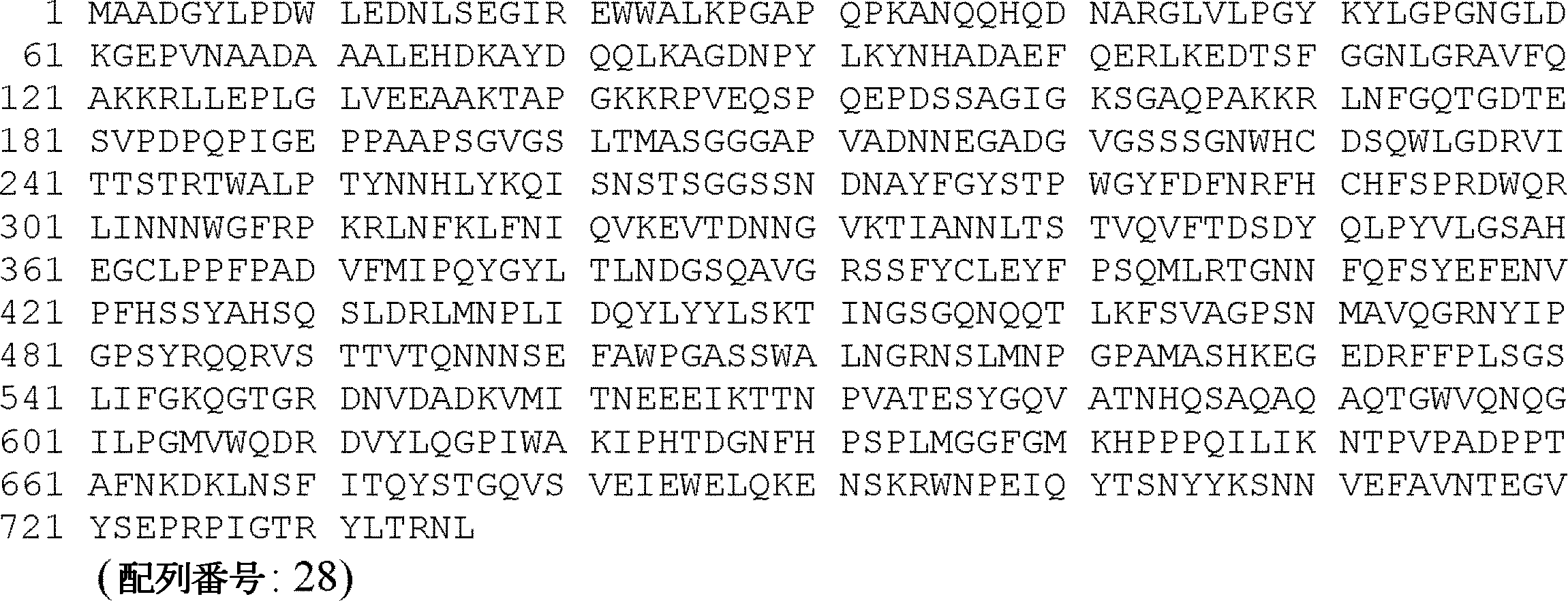
AAV発現ベクターは、転写の方向で機能的に連結された成分として、転写開始領域、関心対象のDNA(すなわち、LAMP-2遺伝子)及び転写停止領域を含む制御要素を少なくとも提供する公知技術を使用して構築される。 AAV expression vectors are constructed using known techniques to provide at least the following control elements, including a transcription initiation region, a DNA of interest (i.e., the LAMP-2 gene), and a transcription termination region, as components operably linked in the direction of transcription.
いくつかの実施形態において、ウイルスベクターはAAV9ベクターである。いくつかの実施形態において、ウイルスベクターの発現カセットには、AAV2逆方向末端反復(ITR)が隣接している。開示されたベクターの代替実施形態で使用されるITRとしては、限定されるものではないが、AAV2、AAV3、AAV4、AAV5、AAV6、AAV7、AAV8、及びAAV9が挙げられる。いくつかの実施形態において、ウイルスベクターはAAV2/9ベクターである。AAV2/9という表記は、AAV2のITRとAAV9のカプシドとを有するAAVベクターを指す。本開示の他の実施形態には、限定されるものではないが、AAV2/9、AAV5/9、AAVrh74、AAV2/rh74、AAV5/9、及びAAV5/rh74ベクターが含まれる。当該技術分野で公知の他のITRを使用することができる。本開示のベクターで有用な例示的ITR(及び他のAAV成分)としては、限定されるものではないが、米国特許第6936466B2号、米国特許第9169494B2号、米国特許出願第20050220766A1号、米国特許出願第20190022249A1号、及び米国特許第7282199B2号で記載されているものが挙げられ、これは、それぞれそれらの全体が参照により本明細書中に組み込まれる。 In some embodiments, the viral vector is an AAV9 vector. In some embodiments, the expression cassette of the viral vector is flanked by AAV2 inverted terminal repeats (ITRs). ITRs used in alternative embodiments of the disclosed vectors include, but are not limited to, AAV2, AAV3, AAV4, AAV5, AAV6, AAV7, AAV8, and AAV9. In some embodiments, the viral vector is an AAV2/9 vector. The designation AAV2/9 refers to an AAV vector having an AAV2 ITR and an AAV9 capsid. Other embodiments of the present disclosure include, but are not limited to, AAV2/9, AAV5/9, AAVrh74, AAV2/rh74, AAV5/9, and AAV5/rh74 vectors. Other ITRs known in the art can be used. Exemplary ITRs (and other AAV components) useful in the vectors of the present disclosure include, but are not limited to, those described in U.S. Pat. No. 6,936,466 B2, U.S. Pat. No. 9,169,494 B2, U.S. Patent Application No. 20050220766 A1, U.S. Patent Application No. 20190022249 A1, and U.S. Pat. No. 7,282,199 B2, each of which is incorporated herein by reference in its entirety.
いくつかの実施形態において、ベクターは、レトロウイルスベクター、又はより具体的には、レンチウイルスベクターである。本明細書中で使用する場合、「レトロウイルス」又は「レトロウイルスの」という語は、そのゲノムRNAを線状二本鎖DNAコピーに逆転写し、続いてそのゲノムDNAを宿主ゲノムに共有結合的に組込む、RNAウイルスを指す。レトロウイルスベクターは遺伝子送達のための一般的なツールである(Miller,2000,Nature.357:455-460)。ウイルスは、一旦宿主ゲノムに組み込まれると、「プロウイルス」と呼ばれる。プロウイルスは、RNAポリメラーゼIIのテンプレートしての役割を果たし、当該ウイルスによってコードされたRNA分子の発現を指示する。 In some embodiments, the vector is a retroviral vector, or more specifically, a lentiviral vector. As used herein, the term "retrovirus" or "retroviral" refers to an RNA virus that reverse transcribes its genomic RNA into a linear double-stranded DNA copy, which then covalently integrates the genomic DNA into the host genome. Retroviral vectors are common tools for gene delivery (Miller, 2000, Nature. 357:455-460). Once a virus is integrated into the host genome, it is called a "provirus." The provirus serves as a template for RNA polymerase II to direct the expression of the RNA molecule encoded by the virus.
例示的レトロウイルス(Retroviridae科)には、限定されるものではないが、以下のものが含まれる:(1)ガンマレトロウイルス属、例えば、マロニーネズミ白血病ウイルス(M-MuLV)、マロニーネズミ肉腫ウイルス(MoMSV)、ネズミ乳がんウイルス(MuMTV)、テナガザル白血病ウイルス(GaLV)、及びネコ白血病ウイルス(FLV)、(2)スプマウイルス属、例えば、類人猿フォーミーウイルス、(3)レンチウイルス属、例えば、ヒト免疫不全ウイルス-1及び類人猿免疫不全ウイルス。 Exemplary retroviruses (family Retroviridae) include, but are not limited to, the following: (1) the genus Gammaretrovirus, e.g., Maloney murine leukemia virus (M-MuLV), Maloney murine sarcoma virus (MoMSV), murine mammary tumor virus (MuMTV), gibbon ape leukemia virus (GaLV), and feline leukemia virus (FLV); (2) the genus Spumavirus, e.g., ape foamy virus; (3) the genus Lentivirus, e.g., human immunodeficiency virus-1 and ape immunodeficiency virus.
本明細書中で使用する場合、「レンチウイルスの」又は「レンチウイルス」という語は、複雑なレトロウイルスの群(又は属)を指す。例示的レンチウイルスとしては、限定されるものではないが:HIV(ヒト免疫不全ウイルス;HIV1型、及びHIV2型を含む;ビスナ-マエディウイルス(VMV)ウイルス;ヤギ関節炎-脳炎ウイルス(CAEV);ウマ感染性貧血ウイルス(EIAV);ネコ免疫不全ウイルス(FIV);ウシ免疫不全ウイルス(BIV);及び類人猿免疫不全ウイルス(SIV)を含む。一実施形態において、HIVベースのベクター骨格(すなわち、HIVシス作用性配列要素)が好ましい。
As used herein, the term "lentiviral" or "lentivirus" refers to a group (or genus) of complex retroviruses. Exemplary lentiviruses include, but are not limited to: HIV (human immunodeficiency virus; including
レトロウイルスベクター、及びさらに詳細には、レンチウイルスベクターは、本発明を実施する際に使用することができる。したがって、「レトロウイルスベクター」という語は、本明細書中で使用する場合、「レンチウイルスベクター」を含むことを意図し;「レトロウイルス」という語は、本明細書中で使用する場合、「レンチウイルス」を含むことを意図する。 Retroviral vectors, and more particularly lentiviral vectors, can be used in the practice of the present invention. Thus, the term "retroviral vector" as used herein is intended to include "lentiviral vector"; and the term "retrovirus" as used herein is intended to include "lentivirus."
ウイルスベクターという語は、核酸を細胞中に移動させることができるベクター若しくはウイルス粒子、又は転移核酸自体のいずれかを指す可能性がある。ウイルスベクターは、主にウイルスに由来する構造的及び/又は機能的遺伝要素を含む。「レトロウイルスベクター」という語は、主にレトロウイルスに由来する、構造的及び機能的遺伝要素、又はその部分を含むウイルスベクターを指す。「レンチウイルスベクター」という語は、主にレンチウイルスに由来するLTRを含む構造的及び機能的遺伝要素、又はその部分を含むウイルスベクターを指す。「ハイブリッド」という語は、ベクター、LTR、又はレトロウイルス配列、例えば、レンチウイルス配列及び非レンチウイルスウイルス配列の両方を含む他の核酸を指す。一実施形態において、ハイブリッドベクターは、逆転写、複製、組込み及び/又はパッケージング用の、レトロウイルス配列、例えば、レンチウイルス配列を含むベクター又はトランスファープラスミドを指す。 The term viral vector can refer to either a vector or viral particle capable of transferring a nucleic acid into a cell, or the transfer nucleic acid itself. A viral vector contains structural and/or functional genetic elements that are primarily derived from a virus. The term "retroviral vector" refers to a viral vector that contains structural and functional genetic elements, or portions thereof, that are primarily derived from a retrovirus. The term "lentiviral vector" refers to a viral vector that contains structural and functional genetic elements, or portions thereof, that are primarily derived from a lentivirus, including LTRs. The term "hybrid" refers to a vector, LTR, or other nucleic acid that contains both retroviral sequences, e.g., lentiviral sequences, and non-lentiviral sequences. In one embodiment, a hybrid vector refers to a vector or transfer plasmid that contains retroviral sequences, e.g., lentiviral sequences, for reverse transcription, replication, integration, and/or packaging.
特定の実施形態において、「レンチウイルスベクター」及び「レンチウイルス発現ベクター」という語は、レンチウイルストランスファープラスミド及び/又は感染性レンチウイルス粒子を指すために使用される場合がある。例えば、クローニング部位、プロモータ、調節要素、異種核酸などの要素について本明細書中で言及する場合、これらの要素の配列は、本発明のレンチウイルス粒子においてはRNA形態で存在し、本発明のDNAプラスミドにおいてはDNA形態で存在すると理解されたい。 In certain embodiments, the terms "lentiviral vector" and "lentiviral expression vector" may be used to refer to lentiviral transfer plasmids and/or infectious lentiviral particles. When elements such as cloning sites, promoters, regulatory elements, heterologous nucleic acids, etc. are mentioned herein, it is understood that the sequences of these elements are present in RNA form in the lentiviral particles of the invention and in DNA form in the DNA plasmids of the invention.
ある特定の実施形態によると、ウイルスベクター骨格配列のほとんど又はすべては、レンチウイルス、例えば、HIV-1由来である。しかしながら、レンチウイルス配列の多くの異なる供給源を使用することができ、ある特定のレンチウイルス配列における多数の置換及び改変は、トランスファーベクターの本明細書で記載する機能を実施する能力を損なうことなく調節することができると理解されたい。さらに、様々なレンチウイルスベクターが当該技術分野では公知であり、以下を参照:Naldini et al.,(1996a、1996b、及び1998);Zufferey et al.,(1997);Dull et al.,1998、米国特許第6,013,516号;及び同第5,994,136号、これらの多くは、本発明のウイルスベクター又はトランスファープラスミドを産生するに適合させることができる。 According to certain embodiments, most or all of the viral vector backbone sequences are derived from a lentivirus, e.g., HIV-1. However, it should be understood that many different sources of lentiviral sequences can be used, and that numerous substitutions and modifications in a particular lentiviral sequence can be accommodated without impairing the ability of the transfer vector to perform the functions described herein. Additionally, a variety of lentiviral vectors are known in the art, see Naldini et al., (1996a, 1996b, and 1998); Zufferey et al., (1997); Dull et al., 1998, U.S. Patent Nos. 6,013,516 and 5,994,136, many of which can be adapted to produce the viral vectors or transfer plasmids of the present invention.
本明細書中で開示されるLAMP-2B導入遺伝子配列は、様々な実施形態において、当該技術分野で公知の、又はあらかじめ見いだされた、任意のベクター系において使用される。必要以上の実験をせずに成功の合理的期待のある他のベクター系で導入遺伝子配列を使用することは当業者の技術範囲内であるので、本発明は、本明細書中で記載される任意の特定のウイルスベクターに限定されない。 The LAMP-2B transgene sequences disclosed herein, in various embodiments, are used in any vector system known or previously discovered in the art. The present invention is not limited to any particular viral vector described herein, as it is within the skill of one in the art to use the transgene sequences in other vector systems with a reasonable expectation of success without undue experimentation.
本発明の実施において有用な遺伝子導入ウイルスベクターは、分子生物学の分野で周知の方法論を利用して構築することができる。典型的には、導入遺伝子を有するウイルスベクターは、導入遺伝子をコードするポリヌクレオチド、好適な調節要素及び細胞形質導入を媒介する、ウイルスタンパク質の産生に必要な要素からアセンブリングされる。そのような組換えウイルスは、当該技術分野で公知の技術によって、例えば、パッケージング細胞をトランスフェクトすることによるか、又はヘルパープラスミド若しくはウイルスでの一過性トランスフェクションによって産生することができる。ウイルスパッケージング細胞の典型例としては、限定されるものではないが、HeLa細胞、SF9細胞(任意選択的にバクロウイルスヘルパーベクターを使用してもよい)、293細胞などが挙げられる。米国特許出願第20170218395A1号で記載されるように、ヘルペスウイルスベースの系を使用して、AAVベクターを産生することができる。そのような複製欠損の組換えウイルスを産生するための詳細なプロトコルは、例えば、国際公開第95/14785号、国際公開第96/22378号、米国特許第5,882,877号、米国特許第6,013,516号、米国特許第4,861,719号、米国特許第5,278,056号及び国際公開第94/19478号で見出すことができ、その各々の全内容は、参照により本明細書中に組み込まれる。 Gene transfer viral vectors useful in the practice of the present invention can be constructed using methodologies well known in the field of molecular biology. Typically, a viral vector carrying a transgene is assembled from a polynucleotide encoding the transgene, suitable regulatory elements, and elements necessary for the production of viral proteins that mediate cell transduction. Such recombinant viruses can be produced by techniques known in the art, for example, by transfecting packaging cells or by transient transfection with helper plasmids or viruses. Exemplary viral packaging cells include, but are not limited to, HeLa cells, SF9 cells (optionally using baculovirus helper vectors), 293 cells, and the like. AAV vectors can be produced using a herpes virus-based system, as described in U.S. Patent Application No. 20170218395A1. Detailed protocols for producing such replication-defective recombinant viruses can be found, for example, in WO 95/14785, WO 96/22378, U.S. Pat. No. 5,882,877, U.S. Pat. No. 6,013,516, U.S. Pat. No. 4,861,719, U.S. Pat. No. 5,278,056, and WO 94/19478, the entire contents of each of which are incorporated herein by reference.
本開示はまた、本明細書中で開示する発現カセット又はベクター(例えば、遺伝子療法ベクター)と、一つ以上の薬剤的に許容される担体、希釈剤又は賦形剤とを含む医薬組成物も提供する。特定の実施形態において、医薬組成物は、本明細書中で開示する発現カセットを含むAAVベクターを含み、例えば、発現カセットは、LAMP-2Bをコードするコドン最適化導入遺伝子、例えば、配列番号3~5のいずれか及びその変異体を含む。医薬組成物、例えば、オートファジーフラックス欠損によって特徴づけられる障害(例えば、ダノン病)を防止又は治療する際に使用するための医薬組成物であって、治療有効量の、本明細書中で開示される発現カセット又はベクターであって、LAMP-2の一つ以上のアイソフォームをコードするポリヌクレオチドの核酸配列を含む、発現カセット又はベクターを含む医薬組成物が提供される。 The present disclosure also provides pharmaceutical compositions comprising an expression cassette or vector (e.g., a gene therapy vector) disclosed herein and one or more pharma- ceutically acceptable carriers, diluents, or excipients. In certain embodiments, the pharmaceutical composition comprises an AAV vector comprising an expression cassette disclosed herein, e.g., the expression cassette comprises a codon-optimized transgene encoding LAMP-2B, e.g., any of SEQ ID NOS: 3-5 and variants thereof. Pharmaceutical compositions, e.g., pharmaceutical compositions for use in preventing or treating disorders characterized by autophagy flux deficiency (e.g., Danon disease), are provided that comprise a therapeutically effective amount of an expression cassette or vector disclosed herein, the expression cassette or vector comprising a nucleic acid sequence of a polynucleotide encoding one or more isoforms of LAMP-2.
本発明の実施で有用なAAVベクターは、アデノウイルスベース及びヘルパーを含まない系を含む様々な系を使用してAAVビリオン(ウイルス粒子)にパッケージすることができる。AAVバイオロジーにおける標準的方法としては、Kwon and Schaffer.Pharm Res.(2008)25(3):489-99;Wu et al.Mol.Ther.(2006)14(3):316-27.Burger et al.Mol.Ther.(2004)10(2):302-17;Grimm et al.Curr Gene Ther.(2003)3(4):281-304;Deyle DR,Russell DW.Curr Opin Mol Ther.(2009)11(4):442-447;McCarty et al.Gene Ther.(2001)8(16):1248-54;及びDuan et al.Mol Ther.(2001)4(4):383-91で記載されているものが挙げられる。ヘルパーを含まない系は、米国特許第6,004,797号;米国特許第7,588,772号;及び米国特許第7,094,604号に記載されているものを含んでいた。 AAV vectors useful in the practice of the invention can be packaged into AAV virions (virus particles) using a variety of systems, including adenovirus-based and helper-free systems. Standard methods in AAV biology include those described in Kwon and Schaffer. Pharm Res. (2008) 25(3): 489-99; Wu et al. Mol. Ther. (2006) 14(3): 316-27; Burger et al. Mol. Ther. (2004) 10(2): 302-17; Grimm et al. Curr Gene Ther. (2003) 3(4): 281-304; Deyle DR, Russell DW. Curr Opin Mol Ther. (2009) 11(4):442-447; McCarty et al. Gene Ther. (2001) 8(16):1248-54; and Duan et al. Mol Ther. (2001) 4(4):383-91. Helper-free systems included those described in U.S. Pat. No. 6,004,797; U.S. Pat. No. 7,588,772; and U.S. Pat. No. 7,094,604.
発現カセット又はベクターを含む医薬組成物は、選択された投与様式、例えば、脳室内、心筋内、冠動脈内、静脈内、動脈内、腎臓内、尿道内、硬膜外又は筋肉内投与に適した任意の形態であってよい。一つ以上のLAMP-2アイソフォームをコードするポリヌクレオチドを含む遺伝子療法ベクターを、唯一の活性剤として、又は他の活性剤と組み合わせて、単位投与形態で、従来の薬学的支援を用いて混合物として、動物及び人間に対して投与することができる。いくつかの実施形態において、医薬組成物は、本開示の遺伝子療法ベクターのいずれかを用いてエクスビボで形質導入された細胞を含む。 Pharmaceutical compositions containing expression cassettes or vectors may be in any form suitable for the selected mode of administration, e.g., intraventricular, intramyocardial, intracoronary, intravenous, intraarterial, intrarenal, intraurethral, epidural or intramuscular administration. Gene therapy vectors containing polynucleotides encoding one or more LAMP-2 isoforms can be administered to animals and humans as the sole active agent or in combination with other active agents, in unit dosage forms, as mixtures with conventional pharmaceutical support. In some embodiments, the pharmaceutical composition comprises cells transduced ex vivo with any of the gene therapy vectors disclosed herein.
いくつかの実施形態において、ウイルスベクター(例えば、AAVベクター)、又はそのベクターを含む医薬組成物は、全身投与された場合に有効である。例えば、本開示のウイルスベクターは、場合によっては、対象(例えば、ヒト以外の霊長類又はヒトなどの霊長類)に対して静脈内投与すると有効性を示す。いくつかの実施形態において、本開示のウイルスベクターは、全身投与された場合に様々な組織で(例えば、心臓、筋肉、及び/又は肺で)LAMP-2Bの発現を誘導することができる。特定の実施形態において、配列番号3に対して実質的に同一、又は同一である導入遺伝子を含むAAV9ベクターを対象に静脈内投与すると、心臓組織におけるLAMP-2Bの検出可能な発現が起こる。いくつかの実施形態において、LAMP-2Bの発現は、対象の心臓の左心室、右心室、左心房、及び右心房の一つ以上、又は全部で検出可能である。いくつかの実施形態において、LAMP-2Bの発現は、対象の心臓の左心室の小領域1及び/又は小領域2で検出可能である。
In some embodiments, the viral vector (e.g., AAV vector), or pharmaceutical composition comprising the vector, is effective when administered systemically. For example, the viral vector of the present disclosure is, in some cases, effective when administered intravenously to a subject (e.g., a primate, such as a non-human primate or a human). In some embodiments, the viral vector of the present disclosure can induce expression of LAMP-2B in various tissues (e.g., in the heart, muscle, and/or lungs) when administered systemically. In certain embodiments, intravenous administration of an AAV9 vector comprising a transgene substantially identical, or identical to SEQ ID NO:3, to a subject results in detectable expression of LAMP-2B in cardiac tissue. In some embodiments, expression of LAMP-2B is detectable in one or more, or all, of the left ventricle, right ventricle, left atrium, and right atrium of the subject's heart. In some embodiments, expression of LAMP-2B is detectable in
「検出可能な発現」は、典型的には、ウイルスベクターで処置していない対照対象又は組織と比較して少なくとも5%、10%、15%、20%又はそれ以上の導入遺伝子発現を指す。いくつかの実施形態において、検出可能な発現とは、無ベクター対照よりも少なくとも1.5倍、少なくとも2倍、少なくとも2.5倍、少なくとも3倍、少なくとも5倍、少なくとも10倍、少なくとも20倍、少なくとも50倍、又は少なくとも100倍高い発現を意味する。導入遺伝子発現は、細胞における野生型又は内在性遺伝子の発現からの増加として決定することができる(導入遺伝子の発現が内在性遺伝子の発現に影響を及ぼし得る可能性の原因となる)。導入遺伝子発現はまた、導入遺伝子mRNA転写物上に存在するが、内在性遺伝子のmRNA転写物上には存在しない配列のRT-PCR検出によって決定することもできる。例えば、転写物の3’UTRを使用して、内在性遺伝子の発現と無関係の導入遺伝子の発現を決定することができる(異なる3’UTRを有し得る)。導入遺伝子によってコードされたポリペプチドの発現は、以下の実施例で記載するように、ウェスタンブロット若しくは酵素結合面根来吸着検査法(ELISA)、又は当該技術分野で公知の他の方法によって、評価することができる。タンパク質の野生型及び外因性コピーに対して交差反応性である抗体を使用してもよい。場合によっては、外因性タンパク質に対して特異的な抗体を特定し、使用して、導入遺伝子発現を決定することができる。当業者は、標的細胞又は組織を考慮して適切な検出方法を設計することができる。場合によっては、発現は、標準曲線を使用して定量的に測定される。標準曲線は、精製LAMP-2タンパク質を使用して、実施例で記載するか、または当該技術分野で公知の方法によって作成することができる。あるいは、導入遺伝子の発現は、対応するmRNAの定量化によって評価することができる。 "Detectable expression" typically refers to at least 5%, 10%, 15%, 20% or more transgene expression compared to a control subject or tissue not treated with the viral vector. In some embodiments, detectable expression means expression that is at least 1.5-fold, at least 2-fold, at least 2.5-fold, at least 3-fold, at least 5-fold, at least 10-fold, at least 20-fold, at least 50-fold, or at least 100-fold higher than a no-vector control. Transgene expression can be determined as an increase from the expression of the wild-type or endogenous gene in the cell (accounting for the possibility that expression of the transgene may affect expression of the endogenous gene). Transgene expression can also be determined by RT-PCR detection of sequences present on the transgene mRNA transcript but not on the mRNA transcript of the endogenous gene. For example, the 3'UTR of the transcript can be used to determine expression of the transgene independent of expression of the endogenous gene (which may have a different 3'UTR). Expression of the polypeptide encoded by the transgene can be assessed by Western blot or enzyme-linked immunosorbent assay (ELISA), as described in the Examples below, or other methods known in the art. Antibodies that are cross-reactive to wild-type and exogenous copies of the protein may be used. In some cases, antibodies specific to the exogenous protein can be identified and used to determine transgene expression. Those skilled in the art can design appropriate detection methods in consideration of the target cells or tissues. In some cases, expression is quantitatively measured using a standard curve. A standard curve can be generated using purified LAMP-2 protein as described in the Examples or by methods known in the art. Alternatively, expression of the transgene can be assessed by quantification of the corresponding mRNA.
いくつかの実施形態において、心臓組織におけるLAMP-2Bの検出可能な発現は、対象の体重1キログラム(kg)あたりのベクターゲノム(vg)で、5×10¹⁴vg/kg以下、3×1014vg/kg以下、2×1014vg/kg以下、1×1014vg/kg以下、9×1013vg/kg以下、8×1013vg/kg以下、7×1013vg/kg以下、6×1013vg/kg以下、5×1013vg/kg以下、4×1013vg/kg以下、3×1013vg/kg以下、2×1013vg/kg以下、又は1×1013vg/kg以下の用量で起こる。 In some embodiments, detectable expression of LAMP-2B in cardiac tissue occurs at a dose of 5x10¹⁴ vg/kg or less, 3x10¹⁴ vg/kg or less, 2x10¹⁴ vg/kg or less, 1x10¹⁴ vg/kg or less, 9x10¹³ vg/ kg or less, 8x10¹³ vg/kg or less, 7x10¹³ vg/kg or less, 6x10¹³ vg/kg or less, 5x10¹³ vg/kg or less, 4x10¹³ vg/kg or less, 3x10¹³ vg /kg or less, 2x10¹³ vg/kg or less, or 1x10¹³ vg/kg or less of vector genomes (vg) per kilogram (kg) of subject body weight.
いくつかの実施形態において、心臓組織におけるLAMP-2Bの検出可能な発現は、対象の体重1キログラム(kg)あたりのベクターゲノム(vg)で、1×10¹³vg/kg~2×1013vg/kg、2×1013vg/kg~3×1013vg/kg、3×1013vg/kg~4×1013vg/kg、4×1013vg/kg~5×1013vg/kg、5×1013vg/kg~6×1013vg/kg、6×1013vg/kg~7×1013vg/kg、7×1013vg/kg~8×1013vg/kg、8×1013vg/kg~9×1013vg/kg、9×1013vg/kg~1×1014vg/kg、1×1014vg/kg~2×1014vg/kg、2×1014vg/kg~3×1014vg/kg、又は3×1014vg/kg~5×1014vg/kgの用量で起こる。 In some embodiments, detectable expression of LAMP-2B in cardiac tissue is between 1x10¹³ vg/kg and 2x10¹³ vg/kg, 2x10¹³ vg/kg and 3x10¹³ vg/kg, 3x10¹³ vg/kg and 4x10¹³ vg/kg, 4x10¹³ vg /kg and 5x10¹³ vg /kg, 5x10¹³ vg/kg and 6x10¹³ vg /kg, 6x10¹³ vg/kg and 7x10¹³ vg/kg, 7x10¹³ vg/kg and 8x10¹³ vg/kg , 8x10¹³ vg/kg and 9x10¹³ The administration of 1×10 14 vg/kg may occur at a dose of 9×10 13 vg/kg to 1×10 14 vg/kg, 1×10 14 vg/kg to 2×10 14 vg/kg, 2×10 14 vg/kg to 3×10 14 vg/kg, or 3×10 14 vg/kg to 5×10 14 vg/kg.
いくつかの実施形態において、心臓組織におけるLAMP-2Bの検出可能な発現は、対象の体重1キログラム(kg)あたりのベクターゲノム(vg)で、1×10¹³vg/kg~3×1013vg/kg、3×1013vg/kg~5×1013vg/kg、5×1013vg/kg~7×1013vg/kg、7×1013vg/kg~9×1013vg/kg、9×1013vg/kg~2×1014vg/kg、又は2×1014vg/kg~5×1014vg/kgの用量で起こる。いくつかの実施形態において、心臓組織におけるLAMP-2Bの検出可能な発現は、対象の体重1キログラム(kg)あたりのベクターゲノム(vg)で、1×1013vg/kg~5×1013vg/kg、5×1013vg/kg~9×1013vg/kg、9×1013vg/kg~5×1014vg/kgの用量で起こる。いくつかの実施形態において、心臓組織におけるLAMP-2Bの検出可能な発現は、対象の体重1キログラム(kg)あたりのベクターゲノム(vg)で、1×1013vg/kg~9×1013vg/kg、又は9×1013vg/kg~5×1014vg/kgの用量で起こる。 In some embodiments, detectable expression of LAMP-2B in cardiac tissue occurs at a dose of 1x10¹³ vg/kg to 3x10¹³ vg/kg, 3x10¹³ vg/kg to 5x10¹³ vg/kg, 5x10¹³ vg/kg to 7x10¹³ vg/kg, 7x10¹³ vg/kg to 9x10¹³ vg /kg , 9x10¹³ vg/kg to 2x10¹⁴ vg/kg, or 2x10¹⁴ vg/kg to 5x10¹⁴ vg /kg vector genomes (vg ) per kilogram (kg) of subject body weight. In some embodiments, detectable expression of LAMP-2B in cardiac tissue occurs at a dose of 1x10¹³ vg/kg to 5x10¹³ vg /kg, 5x10¹³ vg /kg to 9x10¹³ vg/kg, 9x10¹³ vg/kg to 5x10¹⁴ vg/kg vector genomes (vg) per kilogram (kg) of subject body weight. In some embodiments, detectable expression of LAMP-2B in cardiac tissue occurs at a dose of 1x10¹³ vg/kg to 9x10¹³ vg/kg, or 9x10¹³ vg /kg to 5x10¹⁴ vg/kg vector genomes (vg) per kilogram (kg) of subject body weight.
いくつかの実施形態において、心臓組織におけるLAMP-2Bの検出可能な発現は、対象の体重1キログラム(kg)あたりのベクターゲノム(vg)で、1×10¹³vg/kg~5×1013vg/kg、5×1013vg/kg~1×1014vg/kg、又は1×1014vg/kg~5×1014vg/kgの用量で起こる。 In some embodiments, detectable expression of LAMP-2B in cardiac tissue occurs at a dose of 1x10¹³ vg/kg to 5x10¹³ vg /kg, 5x10¹³ vg/kg to 1x10¹⁴ vg/kg, or 1x10¹⁴ vg/kg to 5x10¹⁴ vg/kg vector genomes ( vg ) per kilogram (kg) of subject body weight.
いくつかの実施形態において、心臓組織におけるLAMP-2Bの検出可能な発現は、対象の体重1キログラム(kg)あたりのベクターゲノム(vg)で、1×10¹³vg/kg~5×1014vg/kgの用量で起こる。いくつかの実施形態において、心臓組織におけるLAMP-2Bの検出可能な発現は、対象の体重1キログラム(kg)あたりのベクターゲノム(vg)で、1×1013vg/kg~1×1014の用量で起こる。 In some embodiments, detectable expression of LAMP-2B in cardiac tissue occurs at a dose of 1×10 13 vg/kg to 5×10 14 vg/kg vector genomes (vg) per kilogram (kg) of subject body weight. In some embodiments, detectable expression of LAMP-2B in cardiac tissue occurs at a dose of 1×10 13 vg/kg to 1×10 14 vector genomes (vg) per kilogram (kg) of subject body weight.
様々な実施形態において、医薬組成物は、注射することができる処方用の薬剤的に許容されるビヒクル(例えば、担体、希釈剤及び賦形剤)を含む。例示的賦形剤にはポロキサマーが含まれる。ウイルスベクター(AAVを含む)用の処方緩衝液は、概して、凝集を防止する塩と、ベクターの粘着性を低減する他の賦形剤(例えば、ポロキサマー)とを含む。これらは、特に、等張液、塩溶液(リン酸一ナトリウム若しくは二ナトリウム、塩化ナトリウム、カリウム、カルシウム若しくはマグネシウム等、又はそのような塩の混合物)であってもよいし、又は乾燥、特に、場合によって、滅菌水若しくは生理食塩水を添加すると、注射液の復元が可能になる凍結乾燥組成物であってもよい。有利には、処方は、(例えば、0℃未満、約-60℃、又は約-72℃で)凍結した場合、貯蔵及び使用について安定である。 In various embodiments, the pharmaceutical composition comprises a pharma- ceutically acceptable vehicle (e.g., carriers, diluents and excipients) for an injectable formulation. Exemplary excipients include poloxamers. Formulation buffers for viral vectors (including AAV) generally contain salts to prevent aggregation and other excipients (e.g., poloxamers) to reduce vector stickiness. These may be isotonic solutions, salt solutions (monosodium or disodium phosphate, sodium, potassium, calcium or magnesium chloride, etc., or mixtures of such salts), among others, or may be dry, and in particular lyophilized compositions that allow reconstitution of the injectable solution upon the addition of sterile water or saline, as the case may be. Advantageously, the formulation is stable for storage and use when frozen (e.g., below 0° C., at about −60° C., or at about −72° C.).
リソソーム障害及び/又はダノン病を治療する例示的方法は、国際特許公開第2018/170239A1号で提示されており、これはその全体が本明細書中に組み込まれる。本開示の導入遺伝子、発現カセット、及びベクターは、インビボ(例えば、全身、特に、静脈内使用)及びエクスビボ使用の両方に有用である。LAMP-2B導入遺伝子及び機能的プロモータを使用して、患者の自家性造血幹・前駆細胞(HSPC)をエクスビボで遺伝子修正することができ、これを次に患者に再移植して、患者の骨髄を再配置させることができ、これは、患者の残りの人生で「正常」な細胞のリザーバーとなる。いくつかの実施形態では、レンチウイルスベクターをエクスビボ遺伝子修正のために使用するが、他の非ウイルス又はウイルスベクターをレンチウイルスベクターの代わりに使用することもできる。本開示は、ドナーHSPCを使用した同種移植を想定する。いくつかの実施形態において、レンチウイルスベクターは、自己不活型(SIN)レンチウイルスベクターである。いくつかの実施形態において、HSPCは、例えば、顆粒球-コロニー刺激因子(G-CSF)及び/又はプレリキサホルを使用して動員した末梢血由来である。 Exemplary methods of treating lysosomal disorders and/or Danon disease are presented in International Patent Publication No. WO 2018/170239 A1, which is incorporated herein in its entirety. The transgenes, expression cassettes, and vectors of the present disclosure are useful for both in vivo (e.g., systemic, particularly intravenous use) and ex vivo use. Using a LAMP-2B transgene and a functional promoter, the patient's autologous hematopoietic stem and progenitor cells (HSPCs) can be ex vivo gene corrected, which can then be reimplanted into the patient to repopulate the patient's bone marrow, which will become a reservoir of "normal" cells for the rest of the patient's life. In some embodiments, lentiviral vectors are used for ex vivo gene correction, although other non-viral or viral vectors can be used in place of lentiviral vectors. The present disclosure contemplates allogeneic transplantation using donor HSPCs. In some embodiments, the lentiviral vector is a self-inactivating (SIN) lentiviral vector. In some embodiments, the HSPCs are derived from peripheral blood mobilized using, for example, granulocyte-colony stimulating factor (G-CSF) and/or plerixafor.
別の態様において、本開示は、それを必要とする対象において、ダノン病又は別のオートファジー障害の一つ以上の症状を防止、軽減、改善、減少、阻害、除去、及び/又は逆転する方法であって、対象に対して、本開示の遺伝子療法ベクターを投与することを含む方法を提供する。「ダノン病」という語は、多系統臨床症状を伴うX染色体優性骨格筋及び心筋障害を指す。ダノン病変異は、リソソーム関連膜タンパク質2(LAMP-2)タンパク質発現の不在をもたらす。主な臨床的特徴としては、骨格筋症及び心筋症、心伝導異常、認知的困難、及び網膜疾患が挙げられる。男性は、典型的には、女性よりも早期かつより深刻な影響を受ける。 In another aspect, the disclosure provides a method of preventing, alleviating, ameliorating, reducing, inhibiting, eliminating, and/or reversing one or more symptoms of Danon disease or another autophagy disorder in a subject in need thereof, comprising administering to the subject a gene therapy vector of the disclosure. The term "Danon disease" refers to an X-linked dominant skeletal and cardiac muscle disorder with multisystem clinical manifestations. Danon disease mutations result in the absence of lysosomal associated membrane protein 2 (LAMP-2) protein expression. Primary clinical features include skeletal myopathy and cardiomyopathy, cardiac conduction abnormalities, cognitive difficulties, and retinal disease. Males are typically affected earlier and more severely than females.
一実施形態において、ベクターを、非経口、静脈内、動脈内、心臓内、冠動脈内、心筋内、腎内、尿道内、硬膜外、及び筋肉内からなる群から選択される経路を介して投与する。一実施形態では、ベクターを複数回投与する。一実施形態では、ベクターを、ベクターの筋肉内注射によって投与する。一実施形態では、ベクターは、骨格筋へベクターを注射することによって投与する。一実施形態では、発現カセットは、筋肉特異的プロモータ、任意選択的に、Takeshita et al.Muscle creatine kinase/SV40 hybrid promoter for muscle-targeted long-term transgene expression.Int J Mol Med.2007 Feb;19(2):309-15で記載されているような筋肉クレアチンキナーゼ(MCK)プロモータ若しくはMCK/SV40ハイブリッドプロモータを含む。一実施形態では、ベクターを、心臓内注射によって投与する。 In one embodiment, the vector is administered via a route selected from the group consisting of parenteral, intravenous, intraarterial, intracardiac, intracoronary, intramyocardial, intrarenal, intraurethral, epidural, and intramuscular. In one embodiment, the vector is administered multiple times. In one embodiment, the vector is administered by intramuscular injection of the vector. In one embodiment, the vector is administered by injecting the vector into a skeletal muscle. In one embodiment, the expression cassette comprises a muscle-specific promoter, optionally comprising a promoter selected from the group consisting of Takeshita et al. Muscle creatine kinase/SV40 hybrid promoter for muscle-targeted long-term transgene expression. Int J Mol Med. 2007 Feb;19(2):309-15, or a muscle creatine kinase (MCK) promoter or an MCK/SV40 hybrid promoter. In one embodiment, the vector is administered by intracardiac injection.
一実施形態において、ベクター、例えば、AAVベクターを、全身投与し、さらに詳細には静脈内投与する。有利には、本来の又は野生型LAMP-2B配列を使用する場合、ベクターを、同じ応答が観察されるのに必要な用量よりも少ない用量(1mLあたりのvg、vg/kg体重、又はvg/min/kg)で投与する。特定の実施形態において、ベクターは、本明細書中で開示するLAMP-2Bをコードするポリヌクレオチドを含む発現カセットを含むAAV2/9ベクターである。 In one embodiment, the vector, e.g., an AAV vector, is administered systemically, more particularly intravenously. Advantageously, when using a native or wild-type LAMP-2B sequence, the vector is administered at a lower dose (vg per mL, vg/kg body weight, or vg/min/kg) than would be required to observe the same response. In a particular embodiment, the vector is an AAV2/9 vector that includes an expression cassette that includes a polynucleotide encoding LAMP-2B as disclosed herein.
いくつかの実施形態において、本開示は、対象においてLAMP-2Bを発現する方法であって、アデノ随伴ウイルス(AAV)ベクターを対象に対して全身投与することを含み、AAVベクターは、配列番号3と少なくとも95%の同一性を共有する導入遺伝子を含む発現カセットを含むか、又は配列番号3と同一であり、導入遺伝子はエンハンサ/プロモータ領域に対して機能的に連結されており、AAVベクターを対象に対して全身投与すると、AAVベクターの投与又は未処置の対照対象におけるLAMP-2Bの発現の前のLAMP-2Bの発現と比較して、LAMP-2Bの発現が増加する。いくつかの実施形態において、AAVベクターはAAV2/9ベクターである。特定の実施形態において、発現カセットは、本明細書中で開示される要素のいずれかを含む。いくつかの実施形態において、全身投与は静脈内投与を含む。いくつかの実施形態において、対象はダノン病の症状を示している。いくつかの実施形態において、対象はダノン病にかかっているか、またはダノン病のリスクがある。 In some embodiments, the disclosure provides a method of expressing LAMP-2B in a subject, comprising systemically administering to the subject an adeno-associated virus (AAV) vector, wherein the AAV vector comprises an expression cassette comprising a transgene that shares at least 95% identity with SEQ ID NO:3 or is identical to SEQ ID NO:3, the transgene being operably linked to an enhancer/promoter region, and wherein systemically administering the AAV vector to the subject increases expression of LAMP-2B compared to expression of LAMP-2B prior to administration of the AAV vector or expression of LAMP-2B in an untreated control subject. In some embodiments, the AAV vector is an AAV2/9 vector. In certain embodiments, the expression cassette comprises any of the elements disclosed herein. In some embodiments, the systemic administration comprises intravenous administration. In some embodiments, the subject exhibits symptoms of Danon disease. In some embodiments, the subject has Danon disease or is at risk for Danon disease.
いくつかの実施形態において、AAVベクターを、約1×10¹²~5×10¹⁴ベクターゲノム(vg)の、対象の全体重1キログラム(vg)あたりのAAVベクター(vg/kg)の用量で投与する。いくつかの実施形態において、AAVベクターを、約1×1013~5×1014vg/kgの用量で投与する。いくつかの実施形態において、AAVベクターを、約5×1013~3×1014vg/kgの用量で投与する。いくつかの実施形態において、AAVベクターを、約5×1013~1×1014vg/kgの用量で投与する。いくつかの実施形態において、AAVベクターを、約1×1012vg/kg未満、約3×1012vg/kg未満、約5×1012vg/kg未満、約7×1012vg/kg未満、約1×1013vg/kg未満、約3×1013vg/kg未満、約5×1013vg/kg未満、約7×1013vg/kg未満、約1×1014vg/kg未満、約3×1014vg/kg未満、約5×1014vg/kg未満、約7×1014vg/kg未満、約1×1015vg/kg未満、約3×1015vg/kg未満、約5×1015vg/kg未満、又は約7×1015vg/kg未満の用量で投与する。 In some embodiments, the AAV vector is administered at a dose of about 1×10 12 to 5×10 14 vector genomes (vg) AAV vector per kilogram (vg) of total subject body weight (vg/kg). In some embodiments, the AAV vector is administered at a dose of about 1×10 13 to 5×10 14 vg/kg. In some embodiments, the AAV vector is administered at a dose of about 5×10 13 to 3×10 14 vg/kg. In some embodiments, the AAV vector is administered at a dose of about 5×10 13 to 1×10 14 vg/kg. In some embodiments, the AAV vector is administered at a concentration of less than about 1×10 12 vg/kg, less than about 3×10 12 vg/kg, less than about 5×10 12 vg/kg, less than about 7×10 12 vg/kg, less than about 1×10 13 vg/kg, less than about 3×10 13 vg/kg, less than about 5×10 13 vg/kg, less than about 7×10 13 vg/kg, less than about 1×10 14 vg/kg, less than about 3×10 14 vg/kg, less than about 5×10 14 vg/kg, less than about 7×10 14 vg/kg, less than about 1×10 15 vg/kg, less than about 3×10 15 vg/kg, less than about 5×10 15 vg/kg, or less than about 7×10 15 The dose is administered at less than vg/kg.
いくつかの実施形態において、AAVベクターを、約1×10¹²vg/kg、約3×1012vg/kg、約5×1012vg/kg、約7×1012vg/kg、約1×1013vg/kg、約3×1013vg/kg、約5×1013vg/kg、約7×1013vg/kg、約1×1014vg/kg、約3×1014vg/kg、約5×1014vg/kg、約7×1014vg/kg、約1×1015vg/kg、約3×1015vg/kg、約5×1015vg/kg、又は約7×1015vg/kgの用量で投与する。 In some embodiments, the AAV vector is administered at a dose of about 1×10 12 vg/kg, about 3×10 12 vg/kg, about 5×10 12 vg/kg, about 7×10 12 vg/kg, about 1×10 13 vg/kg, about 3×10 13 vg/kg, about 5×10 13 vg/kg, about 7×10 13 vg/kg, about 1×10 14 vg/kg, about 3×10 14 vg/kg, about 5×10 14 vg/kg, about 7×10 14 vg/kg, about 1×10 15 vg/kg, about 3×10 15 vg/kg, about 5×10 15 vg/kg, or about 7×10 15 vg/kg.
いくつかの実施形態において、AAVベクターを、1×10¹²vg/kg、3×1012vg/kg、5×1012vg/kg、7×1012vg/kg、1×1013vg/kg、3×1013vg/kg、5×1013vg/kg、7×1013vg/kg、1×1014vg/kg、3×1014vg/kg、5×1014vg/kg、7×1014vg/kg、1×1015vg/kg、3×1015vg/kg、5×1015vg/kg、又は7×1015vg/kgの用量で投与する。 In some embodiments, the AAV vector is administered at a dose of 1x10¹² vg/ kg , 3x10¹² vg/kg, 5x10¹² vg/kg, 7x10¹² vg /kg, 1x10¹³ vg /kg, 3x10¹³ vg/kg, 5x10¹³ vg/kg, 7x10¹³ vg/kg, 1x10¹⁴ vg/kg , 3x10¹⁴ vg/kg, 5x10¹⁴ vg/kg, 7x10¹⁴ vg/kg , 1x10¹⁵ vg/kg, 3x10¹⁵ vg/ kg , 5x10¹⁵ vg/kg, or 7x10¹⁵ vg/kg.
いくつかの実施形態では、レンチウイルスベクターを、約1×10¹²~5×10¹⁴ベクターゲノム(vg)の、対象の全体重キログラム(vg)あたりのレンチウイルスベクター(vg/kg)の用量で投与する。いくつかの実施形態では、レンチウイルスベクターを約1×1013~5×1014vg/kgの用量で投与する。いくつかの実施形態では、レンチウイルスベクターを約5×1013~3×1014vg/kgの用量で投与する。いくつかの実施形態では、レンチウイルスベクターを、約5×1013~1×1014vg/kgの用量で投与する。いくつかの実施形態では、レンチウイルスベクターを、約1×1012vg/kg未満、約3×1012vg/kg未満、約5×1012vg/kg未満、約7×1012vg/kg未満、約1×1013vg/kg未満、約3×1013vg/kg未満、約5×1013vg/kg未満、約7×1013vg/kg未満、約1×1014vg/kg未満、約3×1014vg/kg未満、約5×1014vg/kg未満、約7×1014vg/kg未満、約1×1015vg/kg未満、約3×1015vg/kg未満、約5×1015vg/kg未満、又は約7×1015vg/kg未満の用量で投与する。 In some embodiments, the lentiviral vector is administered at a dose of about 1×10 12 to 5×10 14 vector genomes (vg) of lentiviral vector per kilogram (vg) of total subject body weight (vg/kg). In some embodiments, the lentiviral vector is administered at a dose of about 1×10 13 to 5×10 14 vg/kg. In some embodiments, the lentiviral vector is administered at a dose of about 5×10 13 to 3×10 14 vg/kg. In some embodiments, the lentiviral vector is administered at a dose of about 5×10 13 to 1×10 14 vg/kg. In some embodiments, the lentiviral vector is administered at a concentration of less than about 1×10 12 vg/kg, less than about 3×10 12 vg/kg, less than about 5×10 12 vg/kg, less than about 7×10 12 vg/kg, less than about 1×10 13 vg/kg, less than about 3×10 13 vg/kg, less than about 5×10 13 vg/kg, less than about 7×10 13 vg/kg, less than about 1×10 14 vg/kg, less than about 3×10 14 vg/kg, less than about 5×10 14 vg/kg, less than about 7×10 14 vg/kg, less than about 1×10 15 vg/kg, less than about 3×10 15 vg/kg, less than about 5×10 15 vg/kg, or less than about 7×10 15 The dose is administered at less than vg/kg.
いくつかの実施形態では、レンチウイルスベクターを、約1×10¹²vg/kg、約3×1012vg/kg、約5×1012vg/kg、約7×1012vg/kg、約1×1013vg/kg、約3×1013vg/kg、約5×1013vg/kg、約7×1013vg/kg、約1×1014vg/kg、約3×1014vg/kg、約5×1014vg/kg、約7×1014vg/kg、約1×1015vg/kg、約3×1015vg/kg、約5×1015vg/kg、又は約7×1015vg/kgの用量で投与する。 In some embodiments, the lentiviral vector is administered at a dose of about 1x10¹² vg/kg, about 3x10¹² vg/kg, about 5x10¹² vg/kg, about 7x10¹² vg/kg, about 1x10¹³ vg /kg, about 3x10¹³ vg/kg, about 5x10¹³ vg/kg, about 7x10¹³ vg/kg, about 1x10¹⁴ vg/kg, about 3x10¹⁴ vg/kg, about 5x10¹⁴ vg/kg, about 7x10¹⁴ vg/kg, about 1x10¹⁵ vg/kg, about 3x10¹⁵ vg/kg, about 5x10¹⁵ vg/kg, or about 7x10¹⁵ vg/kg.
いくつかの実施形態では、レンチウイルスベクターを、1×10¹²vg/kg、3×1012vg/kg、5×1012vg/kg、7×1012vg/kg、1×1013vg/kg、3×1013vg/kg、5×1013vg/kg、7×1013vg/kg、1×1014vg/kg、3×1014vg/kg、5×1014vg/kg、7×1014vg/kg、1×1015vg/kg、3×1015vg/kg、5×1015vg/kg、又は7×1015vg/kgの用量で投与する。 In some embodiments, the lentiviral vector is administered at a dose of 1x10¹² vg/kg, 3x10¹² vg/kg, 5x10¹² vg/kg, 7x10¹² vg / kg , 1x10¹³ vg/kg, 3x10¹³ vg/kg, 5x10¹³ vg / kg , 7x10¹³ vg/kg , 1x10¹⁴ vg/kg , 3x10¹⁴ vg/kg, 5x10¹⁴ vg/kg, 7x10¹⁴ vg/kg , 1x10¹⁵ vg/kg, 3x10¹⁵ vg/kg , 5x10¹⁵ vg/kg, or 7x10¹⁵ vg/kg.
いくつかの実施形態では、ウイルスベクターを、約1×10¹²~5×10¹⁴ベクターゲノム(vg)の、対象の全体重1キログラム(vg)あたりのウイルスベクター(vg/kg)の用量で投与する。いくつかの実施形態では、ウイルスベクターを、約1×1013~5×1014vg/kgの用量で投与する。いくつかの実施形態では、ウイルスベクターを、約5×1013~3×1014vg/kgの用量で投与する。いくつかの実施形態では、ウイルスベクターを、約5×1013~1×1014vg/kgの用量で投与する。いくつかの実施形態では、ウイルスベクターを、約1×1012vg/kg未満、約3×1012vg/kg未満、約5×1012vg/kg未満、約7×1012vg/kg未満、約1×1013vg/kg未満、約3×1013vg/kg未満、約5×1013vg/kg未満、約7×1013vg/kg未満、約1×1014vg/kg未満、約3×1014vg/kg未満、約5×1014vg/kg未満、約7×1014vg/kg未満、約1×1015vg/kg未満、約3×1015vg/kg未満、約5×1015vg/kg未満、又は約7×1015vg/kg未満の用量で投与する。 In some embodiments, the viral vector is administered at a dose of about 1×10 12 to 5×10 14 vector genomes (vg) viral vector per kilogram (vg) of total subject body weight (vg/kg). In some embodiments, the viral vector is administered at a dose of about 1×10 13 to 5×10 14 vg/kg. In some embodiments, the viral vector is administered at a dose of about 5×10 13 to 3×10 14 vg/kg. In some embodiments, the viral vector is administered at a dose of about 5×10 13 to 1×10 14 vg/kg. In some embodiments, the viral vector is administered at a concentration of less than about 1×10 12 vg/kg, less than about 3×10 12 vg/kg, less than about 5×10 12 vg/kg, less than about 7×10 12 vg/kg, less than about 1×10 13 vg/kg, less than about 3×10 13 vg/kg, less than about 5×10 13 vg/kg, less than about 7×10 13 vg/kg, less than about 1×10 14 vg/kg, less than about 3×10 14 vg/kg, less than about 5×10 14 vg/kg, less than about 7×10 14 vg/kg, less than about 1×10 15 vg/kg, less than about 3×10 15 vg/kg, less than about 5×10 15 vg/kg, or less than about 7×10 15 The dose is administered at less than vg/kg.
いくつかの実施形態では、ウイルスベクターを、約1×10¹²vg/kg、約3×1012vg/kg、約5×1012vg/kg、約7×1012vg/kg、約1×1013vg/kg、約3×1013vg/kg、約5×1013vg/kg、約7×1013vg/kg、約1×1014vg/kg、約3×1014vg/kg、約5×1014vg/kg、約7×1014vg/kg、約1×1015vg/kg、約3×1015vg/kg、約5×1015vg/kg、又は約7×1015vg/kgの用量で投与する。 In some embodiments, the viral vector is administered at a dose of about 1x10¹² vg/kg, about 3x10¹² vg/kg, about 5x10¹² vg/kg, about 7x10¹² vg/kg, about 1x10¹³ vg /kg, about 3x10¹³ vg/kg, about 5x10¹³ vg/kg, about 7x10¹³ vg/kg, about 1x10¹⁴ vg/kg, about 3x10¹⁴ vg/kg, about 5x10¹⁴ vg/kg, about 7x10¹⁴ vg/kg, about 1x10¹⁵ vg/kg, about 3x10¹⁵ vg/kg, about 5x10¹⁵ vg/kg, or about 7x10¹⁵ vg/kg.
いくつかの実施形態では、ウイルスベクターを、1×10¹²vg/kg、3×1012vg/kg、5×1012vg/kg、7×1012vg/kg、1×1013vg/kg、3×1013vg/kg、5×1013vg/kg、7×1013vg/kg、1×1014vg/kg、3×1014vg/kg、5×1014vg/kg、7×1014vg/kg、1×1015vg/kg、3×1015vg/kg、5×1015vg/kg、又は7×1015vg/kgの用量で投与する。 In some embodiments, the viral vector is administered at a dose of 1x10¹² vg/kg, 3x10¹² vg/kg, 5x10¹² vg/kg, 7x10¹² vg /kg, 1x10¹³ vg/ kg , 3x10¹³ vg/kg, 5x10¹³ vg /kg, 7x10¹³ vg/kg, 1x10¹⁴ vg/kg , 3x10¹⁴ vg/kg, 5x10¹⁴ vg/kg, 7x10¹⁴ vg/kg , 1x10¹⁵ vg/kg , 3x10¹⁵ vg/kg, 5x10¹⁵ vg/kg, or 7x10¹⁵ vg/ kg .
いくつかの実施形態において、AAVベクターを、約1×10¹²~5×10¹⁴ベクターゲノム(vg)の、対象の全体重1キログラム(vg)あたりのAAVベクター(vg/kg)の用量で全身投与する。いくつかの実施形態において、AAVベクターを、約1×1013~5×1014vg/kgの用量で全身投与する。いくつかの実施形態において、AAVベクターを、約5×1013~3×1014vg/kgの用量で全身投与する。いくつかの実施形態において、AAVベクターを、約5×1013~1×1014vg/kgの用量で全身投与する。いくつかの実施形態において、AAVベクターを、約1×1012vg/kg未満、約3×1012vg/kg未満、約5×1012vg/kg未満、約7×1012vg/kg未満、約1×1013vg/kg未満、約3×1013vg/kg未満、約5×1013vg/kg未満、約7×1013vg/kg未満、約1×1014vg/kg未満、約3×1014vg/kg未満、約5×1014vg/kg未満、約7×1014vg/kg未満、約1×1015vg/kg未満、約3×1015vg/kg未満、約5×1015vg/kg未満、又は約7×1015vg/kg未満の用量で全身投与する。 In some embodiments, the AAV vector is administered systemically at a dose of about 1×10 12 to 5×10 14 vector genomes (vg) AAV vector per kilogram (vg) of total subject body weight (vg/kg). In some embodiments, the AAV vector is administered systemically at a dose of about 1×10 13 to 5×10 14 vg/kg. In some embodiments, the AAV vector is administered systemically at a dose of about 5×10 13 to 3×10 14 vg/kg. In some embodiments, the AAV vector is administered systemically at a dose of about 5×10 13 to 1×10 14 vg/kg. In some embodiments, the AAV vector is administered at a concentration of less than about 1×10 12 vg/kg, less than about 3×10 12 vg/kg, less than about 5×10 12 vg/kg, less than about 7×10 12 vg/kg, less than about 1×10 13 vg/kg, less than about 3×10 13 vg/kg, less than about 5×10 13 vg/kg, less than about 7×10 13 vg/kg, less than about 1×10 14 vg/kg, less than about 3×10 14 vg/kg, less than about 5×10 14 vg/kg, less than about 7×10 14 vg/kg, less than about 1×10 15 vg/kg, less than about 3×10 15 vg/kg, less than about 5×10 15 vg/kg, or less than about 7×10 15 The dose is administered systemically at less than 100 mg/kg.
いくつかの実施形態において、AAVベクターを、約1×10¹²vg/kg、約3×1012vg/kg、約5×1012vg/kg、約7×1012vg/kg、約1×1013vg/kg、約3×1013vg/kg、約5×1013vg/kg、約7×1013vg/kg、約1×1014vg/kg、約3×1014vg/kg、約5×1014vg/kg、約7×1014vg/kg、約1×1015vg/kg、約3×1015vg/kg、約5×1015vg/kg、又は約7×1015vg/kgの用量で全身投与する。 In some embodiments, the AAV vector is administered systemically at a dose of about 1×10 12 vg/kg, about 3×10 12 vg/kg, about 5×10 12 vg/kg, about 7×10 12 vg/kg, about 1×10 13 vg/kg, about 3×10 13 vg/kg, about 5×10 13 vg/kg, about 7×10 13 vg/kg, about 1×10 14 vg/kg, about 3×10 14 vg/kg, about 5×10 14 vg/kg, about 7×10 14 vg/kg, about 1×10 15 vg/kg, about 3×10 15 vg/kg, about 5×10 15 vg/kg, or about 7×10 15 vg/kg.
いくつかの実施形態において、AAVベクターを、1×10¹²vg/kg、3×1012vg/kg、5×1012vg/kg、7×1012vg/kg、1×1013vg/kg、3×1013vg/kg、5×1013vg/kg、7×1013vg/kg、1×1014vg/kg、3×1014vg/kg、5×1014vg/kg、7×1014vg/kg、1×1015vg/kg、3×1015vg/kg、5×1015vg/kg、又は7×1015vg/kgの用量で全身投与する。 In some embodiments, the AAV vector is administered systemically at a dose of 1x10¹² vg / kg, 3x10¹² vg/kg, 5x10¹² vg/kg, 7x10¹² vg / kg , 1x10¹³ vg /kg, 3x10¹³ vg/kg, 5x10¹³ vg/kg, 7x10¹³ vg/kg, 1x10¹⁴ vg/kg , 3x10¹⁴ vg/kg, 5x10¹⁴ vg/kg, 7x10¹⁴ vg/kg , 1x10¹⁵ vg/kg, 3x10¹⁵ vg /kg, 5x10¹⁵ vg/kg, or 7x10¹⁵ vg/kg.
いくつかの実施形態において、レンチウイルスベクターを、約1×1012~5×1014ベクターゲノム(vg)の、対象の全体重1キログラム(vg)あたりのレンチウイルスベクター(vg/kg)の用量で全身投与する。いくつかの実施形態において、レンチウイルスベクターを、約1×1013~5×1014vg/kgの用量で全身投与する。いくつかの実施形態では、レンチウイルスベクターを、約5×1013~3×1014vg/kgの用量で全身投与する。いくつかの実施形態において、レンチウイルスベクターを、約5×1013~1×1014vg/kgの用量で全身投与する。いくつかの実施形態において、レンチウイルスベクターを、約1×1012vg/kg未満、約3×1012vg/kg未満、約5×1012vg/kg未満、約7×1012vg/kg未満、約1×1013vg/kg未満、約3×1013vg/kg未満、約5×1013vg/kg未満、約7×1013vg/kg未満、約1×1014vg/kg未満、約3×1014vg/kg未満、約5×1014vg/kg未満、約7×1014vg/kg未満、約1×1015vg/kg未満、約3×1015vg/kg未満、約5×1015vg/kg未満、又は約7×1015vg/kg未満の用量で全身投与する。 In some embodiments, the lentiviral vector is administered systemically at a dose of about 1×10 12 to 5×10 14 vector genomes (vg) of lentiviral vector per kilogram (vg) of total subject body weight (vg/kg). In some embodiments, the lentiviral vector is administered systemically at a dose of about 1×10 13 to 5×10 14 vg/kg. In some embodiments, the lentiviral vector is administered systemically at a dose of about 5×10 13 to 3×10 14 vg/kg. In some embodiments, the lentiviral vector is administered systemically at a dose of about 5×10 13 to 1×10 14 vg/kg. In some embodiments, the lentiviral vector is administered at a concentration of less than about 1×10 12 vg/kg, less than about 3×10 12 vg/kg, less than about 5×10 12 vg/kg, less than about 7×10 12 vg/kg, less than about 1×10 13 vg/kg, less than about 3×10 13 vg/kg, less than about 5×10 13 vg/kg, less than about 7×10 13 vg/kg, less than about 1×10 14 vg/kg, less than about 3×10 14 vg/kg, less than about 5×10 14 vg/kg, less than about 7×10 14 vg/kg, less than about 1×10 15 vg/kg, less than about 3×10 15 vg/kg, less than about 5×10 15 vg/kg, or less than about 7×10 15 The dose is administered systemically at less than 100 mg/kg.
いくつかの実施形態において、レンチウイルスベクターを、約1×10¹²vg/kg、約3×1012vg/kg、約5×1012vg/kg、約7×1012vg/kg、約1×1013vg/kg、約3×1013vg/kg、約5×1013vg/kg、約7×1013vg/kg、約1×1014vg/kg、約3×1014vg/kg、約5×1014vg/kg、約7×1014vg/kg、約1×1015vg/kg、約3×1015vg/kg、約5×1015vg/kg、又は約7×1015vg/kgの用量で全身投与する。 In some embodiments, the lentiviral vector is administered systemically at a dose of about 1x10¹² vg/kg, about 3x10¹² vg/kg, about 5x10¹² vg/kg, about 7x10¹² vg /kg, about 1x10¹³ vg /kg, about 3x10¹³ vg/kg, about 5x10¹³ vg/kg, about 7x10¹³ vg/kg, about 1x10¹⁴ vg/kg, about 3x10¹⁴ vg/kg, about 5x10¹⁴ vg /kg, about 7x10¹⁴ vg/kg, about 1x10¹⁵ vg/kg, about 3x10¹⁵ vg/kg, about 5x10¹⁵ vg /kg, or about 7x10¹⁵ vg/kg.
いくつかの実施形態において、レンチウイルスベクターを、1×10¹²vg/kg、3×1012vg/kg、5×1012vg/kg、7×1012vg/kg、1×1013vg/kg、3×1013vg/kg、5×1013vg/kg、7×1013vg/kg、1×1014vg/kg、3×1014vg/kg、5×1014vg/kg、7×1014vg/kg、1×1015vg/kg、3×1015vg/kg、5×1015vg/kg、又は7×1015vg/kgの用量で全身投与する。 In some embodiments, the lentiviral vector is administered systemically at a dose of 1x10¹² vg/kg, 3x10¹² vg/kg, 5x10¹² vg/kg, 7x10¹² vg / kg , 1x10¹³ vg /kg , 3x10¹³ vg/kg, 5x10¹³ vg/kg, 7x10¹³ vg/kg, 1x10¹⁴ vg/kg , 3x10¹⁴ vg/kg, 5x10¹⁴ vg/kg , 7x10¹⁴ vg/kg , 1x10¹⁵ vg/kg, 3x10¹⁵ vg/kg, 5x10¹⁵ vg/kg, or 7x10¹⁵ vg/kg.
いくつかの実施形態において、ウイルスベクターを、約1×1012~5×10¹⁴ベクターゲノム(vg)の、対象の全体重1キログラム(vg)あたりのウイルスベクター(vg/kg)の用量で全身投与する。いくつかの実施形態において、ウイルスベクターを、約1×1013~5×1014vg/kgの用量で全身投与する。いくつかの実施形態では、ウイルスベクターを、約5×1013~3×1014vg/kgの用量で全身投与する。いくつかの実施形態において、ウイルスベクターを、約5×1013~1×1014vg/kgの用量で全身投与する。いくつかの実施形態において、ウイルスベクターを、約1×1012vg/kg未満、約3×1012vg/kg未満、約5×1012vg/kg未満、約7×1012vg/kg未満、約1×1013vg/kg未満、約3×1013vg/kg未満、約5×1013vg/kg未満、約7×1013vg/kg未満、約1×1014vg/kg未満、約3×1014vg/kg未満、約5×1014vg/kg未満、約7×1014vg/kg未満、約1×1015vg/kg未満、約3×1015vg/kg未満、約5×1015vg/kg未満、又は約7×1015vg/kg未満の用量で全身投与する。 In some embodiments, the viral vector is administered systemically at a dose of about 1×10 12 to 5×10 14 vector genomes (vg) viral vector per kilogram (vg) of total subject body weight (vg/kg). In some embodiments, the viral vector is administered systemically at a dose of about 1×10 13 to 5×10 14 vg/kg. In some embodiments, the viral vector is administered systemically at a dose of about 5×10 13 to 3×10 14 vg/kg. In some embodiments, the viral vector is administered systemically at a dose of about 5×10 13 to 1×10 14 vg/kg. In some embodiments, the viral vector is administered at a concentration of less than about 1×10 12 vg/kg, less than about 3×10 12 vg/kg, less than about 5×10 12 vg/kg, less than about 7×10 12 vg/kg, less than about 1×10 13 vg/kg, less than about 3×10 13 vg/kg, less than about 5×10 13 vg/kg, less than about 7×10 13 vg/kg, less than about 1×10 14 vg/kg, less than about 3×10 14 vg/kg, less than about 5×10 14 vg/kg, less than about 7×10 14 vg/kg, less than about 1×10 15 vg/kg, less than about 3×10 15 vg/kg, less than about 5×10 15 vg/kg, or less than about 7×10 15 The dose is administered systemically at less than 100 mg/kg.
いくつかの実施形態において、ウイルスベクターを、約1×10¹²vg/kg、約3×1012vg/kg、約5×1012vg/kg、約7×1012vg/kg、約1×1013vg/kg、約3×1013vg/kg、約5×1013vg/kg、約7×1013vg/kg、約1×1014vg/kg、約3×1014vg/kg、約5×1014vg/kg、約7×1014vg/kg、約1×1015vg/kg、約3×1015vg/kg、約5×1015vg/kg、又は約7×1015vg/kgの用量で全身投与する。 In some embodiments, the viral vector is administered systemically at a dose of about 1× 10 vg/kg, about 3× 10 vg/kg, about 5× 10 vg/kg, about 7× 10 vg/kg, about 1× 10 vg/kg, about 3× 10 vg/kg, about 5× 10 vg/kg, about 7× 10 vg/kg, about 1× 10 vg/kg, about 3× 10 vg/kg, about 5× 10 vg/kg, about 7× 10 vg/kg, about 1× 10 vg/kg, about 3× 10 vg/kg, about 5× 10 vg/kg, or about 7× 10 vg/kg.
いくつかの実施形態において、ウイルスベクターを、1×10¹²vg/kg、3×1012vg/kg、5×1012vg/kg、7×1012vg/kg、1×1013vg/kg、3×1013vg/kg、5×1013vg/kg、7×1013vg/kg、1×1014vg/kg、3×1014vg/kg、5×1014vg/kg、7×1014vg/kg、1×1015vg/kg、3×1015vg/kg、5×1015vg/kg、又は7×1015vg/kgの用量で全身投与する。 In some embodiments, the viral vector is administered systemically at a dose of 1x10¹² vg / kg, 3x10¹² vg/kg, 5x10¹² vg/kg, 7x10¹² vg / kg , 1x10¹³ vg /kg, 3x10¹³ vg/kg, 5x10¹³ vg/kg, 7x10¹³ vg/kg, 1x10¹⁴ vg/kg , 3x10¹⁴ vg/kg, 5x10¹⁴ vg/kg, 7x10¹⁴ vg/kg , 1x10¹⁵ vg/kg, 3x10¹⁵ vg /kg, 5x10¹⁵ vg/kg, or 7x10¹⁵ vg/kg.
いくつかの実施形態において、AAVベクターを、約1×1012~5×10¹⁴ベクターゲノム(vg)の対象の全体重1キログラム(vg)あたりのAAVベクター(vg/kg)の用量で静脈内投与する。いくつかの実施形態において、AAVベクターを、約1×1013~5×1014vg/kgの用量で静脈内投与する。いくつかの実施形態において、AAVベクターを、約5×1013~3×1014vg/kgの用量で静脈内投与する。いくつかの実施形態において、AAVベクターを、約5×1013~1×1014vg/kgの用量で静脈内投与する。いくつかの実施形態において、AAVベクターを、約1×1012vg/kg未満、約3×1012vg/kg未満、約5×1012vg/kg未満、約7×1012vg/kg未満、約1×1013vg/kg未満、約3×1013vg/kg未満、約5×1013vg/kg未満、約7×1013vg/kg未満、約1×1014vg/kg未満、約3×1014vg/kg未満、約5×1014vg/kg未満、約7×1014vg/kg未満、約1×1015vg/kg未満、約3×1015vg/kg未満、約5×1015vg/kg未満、又は約7×1015vg/kg未満の用量で静脈内投与する。 In some embodiments, the AAV vector is administered intravenously at a dose of about 1×10 12 to 5×10 14 vector genomes (vg) AAV vector per kilogram (vg) of the subject's total body weight (vg/kg). In some embodiments, the AAV vector is administered intravenously at a dose of about 1×10 13 to 5×10 14 vg/kg. In some embodiments, the AAV vector is administered intravenously at a dose of about 5×10 13 to 3×10 14 vg/kg. In some embodiments, the AAV vector is administered intravenously at a dose of about 5×10 13 to 1×10 14 vg/kg. In some embodiments, the AAV vector is administered at a concentration of less than about 1×10 12 vg/kg, less than about 3×10 12 vg/kg, less than about 5×10 12 vg/kg, less than about 7×10 12 vg/kg, less than about 1×10 13 vg/kg, less than about 3×10 13 vg/kg, less than about 5×10 13 vg/kg, less than about 7×10 13 vg/kg, less than about 1×10 14 vg/kg, less than about 3×10 14 vg/kg, less than about 5×10 14 vg/kg, less than about 7×10 14 vg/kg, less than about 1×10 15 vg/kg, less than about 3×10 15 vg/kg, less than about 5×10 15 vg/kg, or less than about 7×10 15 The dose is administered intravenously at less than 100 mg/kg.
いくつかの実施形態において、AAVベクターを、約1×10¹²vg/kg、約3×1012vg/kg、約5×1012vg/kg、約7×1012vg/kg、約1×1013vg/kg、約3×1013vg/kg、約5×1013vg/kg、約7×1013vg/kg、約1×1014vg/kg、約3×1014vg/kg、約5×1014vg/kg、約7×1014vg/kg、約1×1015vg/kg、約3×1015vg/kg、約5×1015vg/kg、又は約7×1015vg/kgの用量で静脈内投与する。 In some embodiments, the AAV vector is administered intravenously at a dose of about 1×10 12 vg/kg, about 3×10 12 vg/kg, about 5×10 12 vg/kg, about 7×10 12 vg/kg, about 1×10 13 vg/kg, about 3×10 13 vg/kg, about 5×10 13 vg/kg, about 7×10 13 vg/kg, about 1×10 14 vg/kg, about 3×10 14 vg/kg, about 5×10 14 vg/kg, about 7×10 14 vg/kg, about 1×10 15 vg/kg, about 3×10 15 vg/kg, about 5×10 15 vg/kg, or about 7×10 15 vg/kg.
いくつかの実施形態において、AAVベクターを、1×10¹²vg/kg、3×1012vg/kg、5×1012vg/kg、7×1012vg/kg、1×1013vg/kg、3×1013vg/kg、5×1013vg/kg、7×1013vg/kg、1×1014vg/kg、3×1014vg/kg、5×1014vg/kg、7×1014vg/kg、1×1015vg/kg、3×1015vg/kg、5×1015vg/kg、又は7×1015vg/kgの用量で静脈内投与する。 In some embodiments, the AAV vector is administered intravenously at a dose of 1x10¹² vg/ kg , 3x10¹² vg/kg, 5x10¹² vg/kg, 7x10¹² vg / kg , 1x10¹³ vg /kg, 3x10¹³ vg/kg, 5x10¹³ vg/kg, 7x10¹³ vg/kg, 1x10¹⁴ vg/kg , 3x10¹⁴ vg/kg, 5x10¹⁴ vg/kg, 7x10¹⁴ vg/kg , 1x10¹⁵ vg/kg, 3x10¹⁵ vg /kg, 5x10¹⁵ vg/kg, or 7x10¹⁵ vg/kg.
いくつかの実施形態において、レンチウイルスベクターを、約1×1012~5×1014ベクターゲノム(vg)の、対象の全体重1キログラム(vg)あたりのレンチウイルスベクター(vg/kg)の用量で静脈内投与する。いくつかの実施形態において、レンチウイルスベクターを、約1×1013~5×1014vg/kgの用量で静脈内投与する。いくつかの実施形態では、レンチウイルスベクターを、約5×1013~3×1014vg/kgの用量で静脈内投与する。いくつかの実施形態において、レンチウイルスベクターを、約5×1013~1×1014vg/kgの用量で静脈内投与する。いくつかの実施形態において、レンチウイルスベクターを、約1×1012vg/kg未満、約3×1012vg/kg未満、約5×1012vg/kg未満、約7×1012vg/kg未満、約1×1013vg/kg未満、約3×1013vg/kg未満、約5×1013vg/kg未満、約7×1013vg/kg未満、約1×1014vg/kg未満、約3×1014vg/kg未満、約5×1014vg/kg未満、約7×1014vg/kg未満、約1×1015vg/kg未満、約3×1015vg/kg未満、約5×1015vg/kg未満、又は約7×1015vg/kg未満の用量で静脈内投与する。 In some embodiments, the lentiviral vector is administered intravenously at a dose of about 1×10 12 to 5×10 14 vector genomes (vg) of lentiviral vector per kilogram (vg) of total subject body weight (vg/kg). In some embodiments, the lentiviral vector is administered intravenously at a dose of about 1×10 13 to 5×10 14 vg/kg. In some embodiments, the lentiviral vector is administered intravenously at a dose of about 5×10 13 to 3×10 14 vg/kg. In some embodiments, the lentiviral vector is administered intravenously at a dose of about 5×10 13 to 1×10 14 vg/kg. In some embodiments, the lentiviral vector is administered at a concentration of less than about 1×10 12 vg/kg, less than about 3×10 12 vg/kg, less than about 5×10 12 vg/kg, less than about 7×10 12 vg/kg, less than about 1×10 13 vg/kg, less than about 3×10 13 vg/kg, less than about 5×10 13 vg/kg, less than about 7×10 13 vg/kg, less than about 1×10 14 vg/kg, less than about 3×10 14 vg/kg, less than about 5×10 14 vg/kg, less than about 7×10 14 vg/kg, less than about 1×10 15 vg/kg, less than about 3×10 15 vg/kg, less than about 5×10 15 vg/kg, or less than about 7×10 15 The dose is administered intravenously at less than 100 mg/kg.
いくつかの実施形態において、レンチウイルスベクターを、約1×10¹²vg/kg、約3×1012vg/kg、約5×1012vg/kg、約7×1012vg/kg、約1×1013vg/kg、約3×1013vg/kg、約5×1013vg/kg、約7×1013vg/kg、約1×1014vg/kg、約3×1014vg/kg、約5×1014vg/kg、約7×1014vg/kg、約1×1015vg/kg、約3×1015vg/kg、約5×1015vg/kg、又は約7×1015vg/kgの用量で静脈内投与する。 In some embodiments, the lentiviral vector is administered intravenously at a dose of about 1x10¹² vg /kg, about 3x10¹² vg/kg, about 5x10¹² vg/kg, about 7x10¹² vg/kg, about 1x10¹³ vg /kg, about 3x10¹³ vg/kg, about 5x10¹³ vg/kg, about 7x10¹³ vg/kg, about 1x10¹⁴ vg/kg, about 3x10¹⁴ vg/kg, about 5x10¹⁴ vg/kg, about 7x10¹⁴ vg/kg, about 1x10¹⁵ vg/kg, about 3x10¹⁵ vg/kg, about 5x10¹⁵ vg/kg, or about 7x10¹⁵ vg/kg.
いくつかの実施形態において、レンチウイルスベクターを、1×10¹²vg/kg、3×1012vg/kg、5×1012vg/kg、7×1012vg/kg、1×1013vg/kg、3×1013vg/kg、5×1013vg/kg、7×1013vg/kg、1×1014vg/kg、3×1014vg/kg、5×1014vg/kg、7×1014vg/kg、1×1015vg/kg、3×1015vg/kg、5×1015vg/kg、又は7×1015vg/kgの用量で静脈内投与する。 In some embodiments, the lentiviral vector is administered intravenously at a dose of 1x10¹² vg/kg, 3x10¹² vg/kg, 5x10¹² vg/kg, 7x10¹² vg / kg , 1x10¹³ vg /kg , 3x10¹³ vg/kg, 5x10¹³ vg/kg, 7x10¹³ vg/kg, 1x10¹⁴ vg/kg , 3x10¹⁴ vg/kg, 5x10¹⁴ vg/kg , 7x10¹⁴ vg/kg , 1x10¹⁵ vg/kg, 3x10¹⁵ vg/kg, 5x10¹⁵ vg/kg, or 7x10¹⁵ vg/kg.
いくつかの実施形態において、ウイルスベクターを、約1×1012~5×10¹⁴ベクターゲノム(vg)の、対象の全体重1キログラム(vg)あたりのウイルスベクター(vg/kg)の用量で静脈内投与する。いくつかの実施形態において、ウイルスベクターを、約1×1013~5×1014vg/kgの用量で静脈内投与する。いくつかの実施形態では、ウイルスベクターを、約5×1013~3×1014vg/kgの用量で静脈内投与する。いくつかの実施形態において、ウイルスベクターを約5×1013~1×1014vg/kgの用量で静脈内投与する。いくつかの実施形態において、ウイルスベクターを、約1×1012vg/kg未満、約3×1012vg/kg未満、約5×1012vg/kg未満、約7×1012vg/kg未満、約1×1013vg/kg未満、約3×1013vg/kg未満、約5×1013vg/kg未満、約7×1013vg/kg未満、約1×1014vg/kg未満、約3×1014vg/kg未満、約5×1014vg/kg未満、約7×1014vg/kg未満、約1×1015vg/kg未満、約3×1015vg/kg未満、約5×1015vg/kg未満、又は約7×1015vg/kg未満の用量で静脈内投与する。 In some embodiments, the viral vector is administered intravenously at a dose of about 1×10 12 to 5×10 14 vector genomes (vg) viral vector per kilogram (vg) of total subject body weight (vg/kg). In some embodiments, the viral vector is administered intravenously at a dose of about 1×10 13 to 5×10 14 vg/kg. In some embodiments, the viral vector is administered intravenously at a dose of about 5×10 13 to 3×10 14 vg/kg. In some embodiments, the viral vector is administered intravenously at a dose of about 5×10 13 to 1×10 14 vg/kg. In some embodiments, the viral vector is administered at a concentration of less than about 1×10 12 vg/kg, less than about 3×10 12 vg/kg, less than about 5×10 12 vg/kg, less than about 7×10 12 vg/kg, less than about 1×10 13 vg/kg, less than about 3×10 13 vg/kg, less than about 5×10 13 vg/kg, less than about 7×10 13 vg/kg, less than about 1×10 14 vg/kg, less than about 3×10 14 vg/kg, less than about 5×10 14 vg/kg, less than about 7×10 14 vg/kg, less than about 1×10 15 vg/kg, less than about 3×10 15 vg/kg, less than about 5×10 15 vg/kg, or less than about 7×10 15 The dose is administered intravenously at less than 100 mg/kg.
いくつかの実施形態において、ウイルスベクターを、約1×10¹²vg/kg、約3×1012vg/kg、約5×1012vg/kg、約7×1012vg/kg、約1×1013vg/kg、約3×1013vg/kg、約5×1013vg/kg、約7×1013vg/kg、約1×1014vg/kg、約3×1014vg/kg、約5×1014vg/kg、約7×1014vg/kg、約1×1015vg/kg、約3×1015vg/kg、約5×1015vg/kg、又は約7×1015vg/kgの用量で静脈内投与する。 In some embodiments, the viral vector is administered intravenously at a dose of about 1× 10 vg/kg, about 3× 10 vg/kg, about 5× 10 vg/kg, about 7× 10 vg/kg, about 1× 10 vg/kg, about 3× 10 vg/kg, about 5× 10 vg/kg, about 7× 10 vg/kg, about 1× 10 vg/kg, about 3× 10 vg/kg, about 5× 10 vg/kg, about 7× 10 vg/kg, about 1× 10 vg/kg, about 3× 10 vg/kg, about 5× 10 vg/kg, or about 7× 10 vg/kg.
いくつかの実施形態において、ウイルスベクターを、1×10¹²vg/kg、3×1012vg/kg、5×1012vg/kg、7×1012vg/kg、1×1013vg/kg、3×1013vg/kg、5×1013vg/kg、7×1013vg/kg、1×1014vg/kg、3×1014vg/kg、5×1014vg/kg、7×1014vg/kg、1×1015vg/kg、3×1015vg/kg、5×1015vg/kg、又は7×1015vg/kgの用量で静脈内投与する。 In some embodiments, the viral vector is administered intravenously at a dose of 1x10¹² vg / kg, 3x10¹² vg/kg, 5x10¹² vg/kg, 7x10¹² vg / kg , 1x10¹³ vg /kg, 3x10¹³ vg/kg, 5x10¹³ vg/kg, 7x10¹³ vg/kg, 1x10¹⁴ vg/kg , 3x10¹⁴ vg/kg, 5x10¹⁴ vg/kg, 7x10¹⁴ vg/kg , 1x10¹⁵ vg/kg, 3x10¹⁵ vg/kg, 5x10¹⁵ vg/kg, or 7x10¹⁵ vg/ kg .
全身(又はさらに詳細には静脈内)投与の結果、いくつかの実施形態では、対象の一つ以上の組織(例えば、心臓、筋肉、及び/又は肝臓)において、導入遺伝子から発現されたmRNAの形態で、mRNAとしてLAMP-2Bポリヌクレオチドが発現される。いくつかの実施形態において、LAMP-2BポリヌクレオチドのmRNAとしての発現は、未処置の対象又は対照ベクターで処置した対象における発現と比較して、心臓において少なくとも約1.2倍、少なくとも約1.3倍、少なくとも約1.4倍、少なくとも約1.5倍、少なくとも約1.6倍、少なくとも約1.7倍、少なくとも約1.8倍、少なくとも約1.9倍、少なくとも約2.0倍、少なくとも約2.2倍、少なくとも約2.3倍、少なくとも約2.4倍、少なくとも約2.5倍、少なくとも約3倍、又は少なくとも約4倍増加する。いくつかの実施形態において、mRNAとしてのLAMP-2Bポリヌクレオチドの発現は、未処置の対象又は対照ベクターで処置された対象における発現と比較して、心臓において、少なくとも1.2倍、少なくとも1.3倍、少なくとも1.4倍、少なくとも1.5倍、少なくとも1.6倍、少なくとも1.7倍、少なくとも1.8倍、少なくとも1.9倍、少なくとも2.0倍、少なくとも2.2倍、少なくとも2.3倍、少なくとも2.4倍、少なくとも2.5倍、少なくとも3倍、又は少なくとも4倍増加する。いくつかの実施形態において、mRNAとしてのLAMP-2Bポリヌクレオチドの発現は、未処置の対象又は対照ベクターで処置された対象における発現と比較して、心臓において、1.2倍、1.3倍、1.4倍、1.5倍、1.6倍、1.7倍、1.8倍、1.9倍、2.0倍、2.2倍、2.3倍、2.4倍、2.5倍、3倍、又は4倍増加する。 Systemic (or more particularly, intravenous) administration results in, in some embodiments, expression of the LAMP-2B polynucleotide as mRNA in one or more tissues (e.g., heart, muscle, and/or liver) of the subject in the form of mRNA expressed from the transgene. In some embodiments, expression of the LAMP-2B polynucleotide as mRNA is increased by at least about 1.2-fold, at least about 1.3-fold, at least about 1.4-fold, at least about 1.5-fold, at least about 1.6-fold, at least about 1.7-fold, at least about 1.8-fold, at least about 1.9-fold, at least about 2.0-fold, at least about 2.2-fold, at least about 2.3-fold, at least about 2.4-fold, at least about 2.5-fold, at least about 3-fold, or at least about 4-fold in the heart compared to expression in untreated subjects or subjects treated with a control vector. In some embodiments, expression of the LAMP-2B polynucleotide as mRNA is increased by at least 1.2-fold, at least 1.3-fold, at least 1.4-fold, at least 1.5-fold, at least 1.6-fold, at least 1.7-fold, at least 1.8-fold, at least 1.9-fold, at least 2.0-fold, at least 2.2-fold, at least 2.3-fold, at least 2.4-fold, at least 2.5-fold, at least 3-fold, or at least 4-fold in the heart compared to expression in untreated subjects or subjects treated with a control vector. In some embodiments, expression of the LAMP-2B polynucleotide as mRNA is increased by 1.2-fold, 1.3-fold, 1.4-fold, 1.5-fold, 1.6-fold, 1.7-fold, 1.8-fold, 1.9-fold, 2.0-fold, 2.2-fold, 2.3-fold, 2.4-fold, 2.5-fold, 3-fold, or 4-fold in the heart compared to expression in untreated subjects or subjects treated with a control vector.
いくつかの実施形態において、mRNAとしてのLAMP-2Bポリヌクレオチドの発現は、未処置の対象又は対照ベクターで処置された対象における発現と比較して、筋肉において、少なくとも約1.2倍、少なくとも約1.3倍、少なくとも約1.4倍、少なくとも約1.5倍、少なくとも約1.6倍、少なくとも約1.7倍、少なくとも約1.8倍、少なくとも約1.9倍、少なくとも約2.0倍、少なくとも約2.2倍、少なくとも約2.3倍、少なくとも約2.4倍、少なくとも約2.5倍、少なくとも約3倍、又は少なくとも約4倍増加する。いくつかの実施形態において、mRNAとしてのLAMP-2Bポリヌクレオチドの発現は、未処置の対象又は対照ベクターで処置された対象における発現と比較して、筋肉において、少なくとも1.2倍、少なくとも1.3倍、少なくとも1.4倍、少なくとも1.5倍、少なくとも1.6倍、少なくとも1.7倍、少なくとも1.8倍、少なくとも1.9倍、少なくとも2.0倍、少なくとも2.2倍、少なくとも2.3倍、少なくとも2.4倍、少なくとも2.5倍、少なくとも3倍、又は少なくとも4倍増加する。いくつかの実施形態において、mRNAとしてのLAMP-2Bポリヌクレオチドの発現は、未処置の対象又は対照ベクターで処置された対象における発現と比較して、筋肉において、1.2倍、1.3倍、1.4倍、1.5倍、1.6倍、1.7倍、1.8倍、1.9倍、2.0倍、2.2倍、2.3倍、2.4倍、2.5倍、3倍、又は4倍増加する。 In some embodiments, expression of the LAMP-2B polynucleotide as mRNA is increased by at least about 1.2-fold, at least about 1.3-fold, at least about 1.4-fold, at least about 1.5-fold, at least about 1.6-fold, at least about 1.7-fold, at least about 1.8-fold, at least about 1.9-fold, at least about 2.0-fold, at least about 2.2-fold, at least about 2.3-fold, at least about 2.4-fold, at least about 2.5-fold, at least about 3-fold, or at least about 4-fold in muscle compared to expression in untreated subjects or subjects treated with a control vector. In some embodiments, expression of the LAMP-2B polynucleotide as mRNA is increased by at least 1.2-fold, at least 1.3-fold, at least 1.4-fold, at least 1.5-fold, at least 1.6-fold, at least 1.7-fold, at least 1.8-fold, at least 1.9-fold, at least 2.0-fold, at least 2.2-fold, at least 2.3-fold, at least 2.4-fold, at least 2.5-fold, at least 3-fold, or at least 4-fold in muscle compared to expression in untreated subjects or subjects treated with a control vector. In some embodiments, expression of the LAMP-2B polynucleotide as mRNA is increased by 1.2-fold, 1.3-fold, 1.4-fold, 1.5-fold, 1.6-fold, 1.7-fold, 1.8-fold, 1.9-fold, 2.0-fold, 2.2-fold, 2.3-fold, 2.4-fold, 2.5-fold, 3-fold, or 4-fold in muscle compared to expression in untreated subjects or subjects treated with a control vector.
いくつかの実施形態において、LAMP-2B導入遺伝子は、対象の心臓で発現され、肝臓では発現されない。いくつかの実施形態において、mRNAとしてのLAMP-2Bポリヌクレオチドの発現は、肝臓と比較して、心臓では、少なくとも約1.2倍、少なくとも約1.3倍、少なくとも約1.4倍、少なくとも約1.5倍、少なくとも約1.6倍、少なくとも約1.7倍、少なくとも約1.8倍、少なくとも約1.9倍、少なくとも約2.0倍、少なくとも約2.2倍、少なくとも約2.3倍、少なくとも約2.4倍、少なくとも約2.5倍、少なくとも約3倍、又は少なくとも約4倍であることが観察される。いくつかの実施形態において、mRNAとしてのLAMP-2Bポリヌクレオチドの発現は、肝臓と比較して、心臓では、少なくとも1.2倍、少なくとも1.3倍、少なくとも1.4倍、少なくとも1.5倍、少なくとも1.6倍、少なくとも1.7倍、少なくとも1.8倍、少なくとも1.9倍、少なくとも2.0倍、少なくとも2.2倍、少なくとも2.3倍、少なくとも2.4倍、少なくとも2.5倍、少なくとも3倍、又は少なくとも4倍であることが観察される。いくつかの実施形態において、mRNAとしてのLAMP-2Bポリヌクレオチドの発現は、肝臓と比較して、心臓では、1.2倍、1.3倍、1.4倍、1.5倍、1.6倍、1.7倍、1.8倍、1.9倍、2.0倍、2.2倍、2.3倍、2.4倍、2.5倍、3倍、又は4倍であることが観察される。 In some embodiments, the LAMP-2B transgene is expressed in the heart and not in the liver of a subject. In some embodiments, expression of the LAMP-2B polynucleotide as mRNA is observed to be at least about 1.2-fold, at least about 1.3-fold, at least about 1.4-fold, at least about 1.5-fold, at least about 1.6-fold, at least about 1.7-fold, at least about 1.8-fold, at least about 1.9-fold, at least about 2.0-fold, at least about 2.2-fold, at least about 2.3-fold, at least about 2.4-fold, at least about 2.5-fold, at least about 3-fold, or at least about 4-fold higher in the heart compared to the liver. In some embodiments, expression of LAMP-2B polynucleotides as mRNA is observed to be at least 1.2-fold, at least 1.3-fold, at least 1.4-fold, at least 1.5-fold, at least 1.6-fold, at least 1.7-fold, at least 1.8-fold, at least 1.9-fold, at least 2.0-fold, at least 2.2-fold, at least 2.3-fold, at least 2.4-fold, at least 2.5-fold, at least 3-fold, or at least 4-fold higher in the heart compared to the liver. In some embodiments, expression of LAMP-2B polynucleotides as mRNA is observed to be at least 1.2-fold, at least 1.3-fold, at least 1.4-fold, at least 1.5-fold, at least 1.6-fold, at least 1.7-fold, at least 1.8-fold, at least 1.9-fold, at least 2.0-fold, at least 2.2-fold, 2.3-fold, 2.4-fold, 2.5-fold, at least 3-fold, or at least 4-fold higher in the heart compared to the liver.
いくつかの実施形態において、野生型又は機能的LAMP-2Bタンパク質の発現は、未処置の対象又は対照ベクターで処置された対象における発現と比較して、心臓において、少なくとも約1.2倍、少なくとも約1.3倍、少なくとも約1.4倍、少なくとも約1.5倍、少なくとも約1.6倍、少なくとも約1.7倍、少なくとも約1.8倍、少なくとも約1.9倍、少なくとも約2.0倍、少なくとも約2.2倍、少なくとも約2.3倍、少なくとも約2.4倍、少なくとも約2.5倍、少なくとも約3倍、又は少なくとも約4倍増加する。いくつかの実施形態において、野生型又は機能的LAMP-2Bタンパク質の発現は、未処置の対象又は対照ベクターで処置された対象における発現と比較して、心臓において、少なくとも1.2倍、少なくとも1.3倍、少なくとも1.4倍、少なくとも1.5倍、少なくとも1.6倍、少なくとも1.7倍、少なくとも1.8倍、少なくとも1.9倍、少なくとも2.0倍、少なくとも2.2倍、少なくとも2.3倍、少なくとも2.4倍、少なくとも2.5倍、少なくとも3倍、又は少なくとも4倍増加する。いくつかの実施形態において、野生型又は機能的LAMP-2Bタンパク質の発現は、未処置の対象又は対照ベクターで処置された対象における発現と比較して、心臓において、1.2倍、1.3倍、1.4倍、1.5倍、1.6倍、1.7倍、1.8倍、1.9倍、2.0倍、2.2倍、2.3倍、2.4倍、2.5倍、3倍、又は4倍増加する。 In some embodiments, expression of wild-type or functional LAMP-2B protein is increased by at least about 1.2-fold, at least about 1.3-fold, at least about 1.4-fold, at least about 1.5-fold, at least about 1.6-fold, at least about 1.7-fold, at least about 1.8-fold, at least about 1.9-fold, at least about 2.0-fold, at least about 2.2-fold, at least about 2.3-fold, at least about 2.4-fold, at least about 2.5-fold, at least about 3-fold, or at least about 4-fold in the heart compared to expression in untreated subjects or subjects treated with a control vector. In some embodiments, expression of wild-type or functional LAMP-2B protein is increased by at least 1.2-fold, at least 1.3-fold, at least 1.4-fold, at least 1.5-fold, at least 1.6-fold, at least 1.7-fold, at least 1.8-fold, at least 1.9-fold, at least 2.0-fold, at least 2.2-fold, at least 2.3-fold, at least 2.4-fold, at least 2.5-fold, at least 3-fold, or at least 4-fold in the heart compared to expression in untreated subjects or subjects treated with a control vector. In some embodiments, expression of wild-type or functional LAMP-2B protein is increased by 1.2-fold, 1.3-fold, 1.4-fold, 1.5-fold, 1.6-fold, 1.7-fold, 1.8-fold, 1.9-fold, 2.0-fold, 2.2-fold, 2.3-fold, 2.4-fold, 2.5-fold, 3-fold, or 4-fold in the heart compared to expression in untreated subjects or subjects treated with a control vector.
いくつかの実施形態において、野生型又は機能的LAMP-2Bタンパク質の発現は、肝臓と比較して、心臓では、少なくとも約1.2倍、少なくとも約1.3倍、少なくとも約1.4倍、少なくとも約1.5倍、少なくとも約1.6倍、少なくとも約1.7倍、少なくとも約1.8倍、少なくとも約1.9倍、少なくとも約2.0倍、少なくとも約2.2倍、少なくとも約2.3倍、又は少なくとも5倍であることが観察される。いくつかの実施形態において、野生型又は機能的LAMP-2Bタンパク質の発現は、肝臓と比較して、心臓では、少なくとも1.2倍、少なくとも1.3倍、少なくとも1.4倍、少なくとも1.5倍、少なくとも1.6倍、少なくとも1.7倍、少なくとも1.8倍、少なくとも1.9倍、少なくとも2.0倍、少なくとも2.2倍、少なくとも2.3倍、少なくとも2.4倍、少なくとも2.5倍、少なくとも3倍、又は少なくとも4倍であることが観察される。いくつかの実施形態において、野生型又は機能的LAMP-2Bタンパク質の発現は、肝臓と比較して、心臓では、1.2倍、1.3倍、1.4倍、1.5倍、1.6倍、1.7倍、1.8倍、1.9倍、2.0倍、2.2倍、2.3倍、2.4倍、2.5倍、3倍、又は4倍であることが観察される。 In some embodiments, expression of wild-type or functional LAMP-2B protein is observed to be at least about 1.2-fold, at least about 1.3-fold, at least about 1.4-fold, at least about 1.5-fold, at least about 1.6-fold, at least about 1.7-fold, at least about 1.8-fold, at least about 1.9-fold, at least about 2.0-fold, at least about 2.2-fold, at least about 2.3-fold, or at least 5-fold higher in the heart compared to the liver. In some embodiments, expression of wild-type or functional LAMP-2B protein is observed to be at least 1.2-fold, at least 1.3-fold, at least 1.4-fold, at least 1.5-fold, at least 1.6-fold, at least 1.7-fold, at least 1.8-fold, at least 1.9-fold, at least 2.0-fold, at least 2.2-fold, at least 2.3-fold, at least 2.4-fold, at least 2.5-fold, at least 3-fold, or at least 4-fold higher in the heart compared to the liver. In some embodiments, expression of wild-type or functional LAMP-2B protein is observed to be 1.2-fold, 1.3-fold, 1.4-fold, 1.5-fold, 1.6-fold, 1.7-fold, 1.8-fold, 1.9-fold, 2.0-fold, 2.2-fold, 2.3-fold, 2.4-fold, 2.5-fold, 3-fold, or 4-fold higher in the heart compared to the liver.
いくつかの実施形態において、遺伝子療法ベクターの投与の結果、未処置の対象の肝臓における発現と比較して、肝臓での野生型又は機能的LAMP-2Bタンパク質の発現が最大で約1.1倍、最大で約1.2倍、最大で約1.3倍、最大で約1.4倍、最大で約1.5倍、最大で約1.6倍、最大で約1.7倍、最大で約1.8倍、最大で約1.9倍、又は最大で約2倍増加する。いくつかの実施形態において、遺伝子療法ベクターの投与の結果、未処置の対象の肝臓における発現と比較して、肝臓での野生型又は機能的LAMP-2Bタンパク質の発現が最大で1.1倍、最大で1.2倍、最大で1.3倍、最大で1.4倍、最大で1.5倍、最大で1.6倍、最大で1.7倍、最大で1.8倍、最大で1.9倍、又は最大で2倍増加する。いくつかの実施形態において、遺伝子療法ベクターの投与の結果、未処置の対象の肝臓における発現と比較して、肝臓での野生型又は機能的LAMP-2Bタンパク質の発現が1.1倍、1.2倍、1.3倍、1.4倍、1.5倍、1.6倍、1.7倍、1.8倍、1.9倍、又は2倍増加する。 In some embodiments, administration of the gene therapy vector results in an increase in expression of wild-type or functional LAMP-2B protein in the liver by up to about 1.1 fold, up to about 1.2 fold, up to about 1.3 fold, up to about 1.4 fold, up to about 1.5 fold, up to about 1.6 fold, up to about 1.7 fold, up to about 1.8 fold, up to about 1.9 fold, or up to about 2 fold compared to expression in the liver of an untreated subject. In some embodiments, administration of the gene therapy vector results in an increase in expression of wild-type or functional LAMP-2B protein in the liver by up to about 1.1 fold, up to about 1.2 fold, up to about 1.3 fold, up to about 1.4 fold, up to about 1.5 fold, up to about 1.6 fold, up to about 1.7 fold, up to about 1.8 fold, up to about 1.9 fold, or up to about 2 fold compared to expression in the liver of an untreated subject. In some embodiments, administration of the gene therapy vector results in a 1.1-fold, 1.2-fold, 1.3-fold, 1.4-fold, 1.5-fold, 1.6-fold, 1.7-fold, 1.8-fold, 1.9-fold, or 2-fold increase in expression of wild-type or functional LAMP-2B protein in the liver compared to expression in the liver of an untreated subject.
一実施形態において、本開示は、それを必要とする対象において、疾患又は障害、任意選択的にダノン病を治療する方法であって、細胞を本開示に係る遺伝子療法ベクターと接触させ、細胞を対象に投与することを含む方法を提供する。一実施形態において、細胞は幹細胞であり、任意選択的に、多能性幹細胞である。一実施形態において、幹細胞は、心臓組織への分化が可能である。一実施形態において、幹細胞は、筋肉組織、例えば、心筋組織及び/又は骨格筋組織への分化が可能である。一実施形態において、幹細胞は自家性である。一実施形態において、幹細胞は誘導多能性幹細胞(iPSC)である。 In one embodiment, the disclosure provides a method of treating a disease or disorder, optionally Danon disease, in a subject in need thereof, comprising contacting a cell with a gene therapy vector of the disclosure and administering the cell to the subject. In one embodiment, the cell is a stem cell, optionally a pluripotent stem cell. In one embodiment, the stem cell is capable of differentiation into cardiac tissue. In one embodiment, the stem cell is capable of differentiation into muscle tissue, e.g., cardiac muscle tissue and/or skeletal muscle tissue. In one embodiment, the stem cell is autologous. In one embodiment, the stem cell is an induced pluripotent stem cell (iPSC).
一実施形態において、疾患又は障害はオートファジー障害である。いくつかの実施形態において、オートファジー障害は、限定されるものではないが、末期心不全、心筋梗塞、薬物中毒、糖尿病、末期腎不全、及び老化からなる群から選択される。一実施形態において、対象は哺乳動物、例えば、ヒトである。一実施形態において、対象はダノン病又は別のオートファジー障害の症状を示している。一実施形態において、対象は、減少しているか又は検出不能なLAMP-2発現を有するとして特定されている。一実施形態において、対象は、変異LAMP-2遺伝子を有するとして特定されている。 In one embodiment, the disease or disorder is an autophagy disorder. In some embodiments, the autophagy disorder is selected from the group consisting of, but not limited to, end-stage heart failure, myocardial infarction, drug addiction, diabetes, end-stage renal failure, and aging. In one embodiment, the subject is a mammal, e.g., a human. In one embodiment, the subject exhibits symptoms of Danon disease or another autophagy disorder. In one embodiment, the subject has been identified as having reduced or undetectable LAMP-2 expression. In one embodiment, the subject has been identified as having a mutated LAMP-2 gene.
本明細書中に記載する方法を使用した治療に適している対象/患者としては、限定されるものではないが、不十分なオートファジーフラックスによって特徴づけられる疾患又は障害(例えば、ダノン病並びに、限定されるものではないが、収縮期及び拡張期心不全、心筋梗塞、薬物中毒(例えば、アントラサイクリン、クロロキン及びその誘導体)、糖尿病、末期腎疾患、及び老化を含む他の公知オートファジー障害)のリスクがあるが、症状を示していない個体、並びに現在症状を示している対象が挙げられる。そのような対象は、変異LAMP-2遺伝子を有するとして、又は減少しているか若しくは検出不能なレベルのLAMP-2発現を有するとして特定されていてもよい。 Subjects/patients suitable for treatment using the methods described herein include, but are not limited to, individuals at risk for but not showing symptoms of a disease or disorder characterized by insufficient autophagic flux (e.g., Danon disease and other known autophagy disorders including, but not limited to, systolic and diastolic heart failure, myocardial infarction, drug toxicity (e.g., anthracyclines, chloroquine and derivatives), diabetes, end-stage renal disease, and aging), as well as currently symptomatic subjects. Such subjects may be identified as having a mutant LAMP-2 gene or as having reduced or undetectable levels of LAMP-2 expression.
いくつかの実施形態において、患者はヒトである。いくつかの実施形態において、患者は、小児、青年、又は成人のヒトである。いくつかの実施形態において、患者は、1、2、3、4、5、6、7、8、9、10、11、12、13、14、15、16、17、18、19、若しくは20歳であるか、又は20歳を超える。いくつかの実施形態において、患者は20~50歳である。いくつかの実施形態において、患者は50~65歳である。いくつかの実施形態において、患者は、1~5、2~6、3~7、4~8、5~9、6~10、7~11、8~12、9~13、10~14、11~15、12~16、13~17、14~18、15~19、又は16~20歳である。いくつかの実施形態において、患者は、5~6、6~7、7~8、8~9、9~10、10~11、11~12、12~13、13~14、14~15、15~16、16~17、17~18、18~19、19~20、又は20~21歳である。特定の実施形態では、患者は15~16歳である。 In some embodiments, the patient is a human. In some embodiments, the patient is a child, adolescent, or adult human. In some embodiments, the patient is 1, 2, 3, 4, 5, 6, 7, 8, 9, 10, 11, 12, 13, 14, 15, 16, 17, 18, 19, or 20 years old, or over 20 years old. In some embodiments, the patient is 20-50 years old. In some embodiments, the patient is 50-65 years old. In some embodiments, the patient is 1-5, 2-6, 3-7, 4-8, 5-9, 6-10, 7-11, 8-12, 9-13, 10-14, 11-15, 12-16, 13-17, 14-18, 15-19, or 16-20 years old. In some embodiments, the patient is 5-6, 6-7, 7-8, 8-9, 9-10, 10-11, 11-12, 12-13, 13-14, 14-15, 15-16, 16-17, 17-18, 18-19, 19-20, or 20-21 years old. In certain embodiments, the patient is 15-16 years old.
いくつかの実施形態において、患者はヒト男性である。いくつかの実施形態において、患者は、小児、青年、又は成人のヒト男性である。いくつかの実施形態において、患者は、1、2、3、4、5、6、7、8、9、10、11、12、13、14、15、16、17、18、19、若しくは20歳の男性、又は20歳を超える男性である。いくつかの実施形態において、患者は20~50歳の男性である。いくつかの実施形態において、患者は50~65歳の男性である。いくつかの実施形態において、患者は、1~5、2~6、3~7、4~8、5~9、6~10、7~11、8~12、9~13、10~14、11~15、12~16、13~17、14~18、15~19、又は16~20歳の男性である。いくつかの実施形態において、患者は、5~6、6~7、7~8、8~9、9~10、10~11、11~12、12~13、13~14、14~15、15~16、16~17、17~18、18~19、19~20、又は20~21歳の男性である。特定の実施形態では、患者は15~16歳である。 In some embodiments, the patient is a human male. In some embodiments, the patient is a child, adolescent, or adult human male. In some embodiments, the patient is a 1, 2, 3, 4, 5, 6, 7, 8, 9, 10, 11, 12, 13, 14, 15, 16, 17, 18, 19, or 20 year old male, or a male over 20 years old. In some embodiments, the patient is a 20-50 year old male. In some embodiments, the patient is a 50-65 year old male. In some embodiments, the patient is a 1-5, 2-6, 3-7, 4-8, 5-9, 6-10, 7-11, 8-12, 9-13, 10-14, 11-15, 12-16, 13-17, 14-18, 15-19, or 16-20 year old male. In some embodiments, the patient is a male between 5-6, 6-7, 7-8, 8-9, 9-10, 10-11, 11-12, 12-13, 13-14, 14-15, 15-16, 16-17, 17-18, 18-19, 19-20, or 20-21 years of age. In certain embodiments, the patient is between 15-16 years of age.
いくつかの実施形態において、患者はヒト女性である。いくつかの実施形態において、患者は、小児、青年、又は成人のヒト女性である。いくつかの実施形態において、患者は、1、2、3、4、5、6、7、8、9、10、11、12、13、14、15、16、17、18、19、若しくは20歳の女性、又は20歳を超える女性である。いくつかの実施形態において、患者は20~50歳の女性である。いくつかの実施形態において、患者は50~65歳女性である。 In some embodiments, the patient is a human female. In some embodiments, the patient is a child, adolescent, or adult human female. In some embodiments, the patient is a 1, 2, 3, 4, 5, 6, 7, 8, 9, 10, 11, 12, 13, 14, 15, 16, 17, 18, 19, or 20 year old female, or a female over 20 years old. In some embodiments, the patient is a female between 20 and 50 years old. In some embodiments, the patient is a female between 50 and 65 years old.
いくつかの実施形態において、対象は、不十分なオートファジーフラックスによって特徴づけられる疾患又は障害(例えば、ダノン病並びに、限定されるものではないが、収縮期及び拡張期心不全、心筋梗塞、薬物中毒、糖尿病、末期腎疾患、及び老化を含む他の公知オートファジー障害)の症状を示している。症状は、活発に現れていてもよいし、あるいは(例えば、薬物治療により)抑制若しくは制御されているか又は寛解期であってもよい。対象は、例えば、資格のある医師によって障害を有していると診断されている場合もあるし、診断されていない場合もある。 In some embodiments, the subject exhibits symptoms of a disease or disorder characterized by insufficient autophagic flux (e.g., Danon disease and other known autophagy disorders including, but not limited to, systolic and diastolic heart failure, myocardial infarction, drug addiction, diabetes, end-stage renal disease, and aging). The symptoms may be active, or may be suppressed or controlled (e.g., by drug treatment) or in remission. The subject may or may not have been diagnosed as having the disorder, e.g., by a qualified physician.
定義
「リソソーム関連膜タンパク質2」及び「LAMP-2」という語は、同義的に:(1)LAMP-2核酸によってコードされるアミノ酸配列(例えば、GenBank受入番号NM_002294.2(アイソフォームA).NM_013995.2(アイソフォームB)、NM_001122606.1(アイソフォームC)を参照)又はLAMP-2ポリペプチドのアミノ酸配列(例えば、GenBank受入番号NP_002285.1(アイソフォームA)、NP_054701.1(アイソフォームB)、NP_001116078.1(アイソフォームC)を参照)に対して、好ましくは、少なくとも約25、50、100、200、300、400、又はそれ以上のアミノ酸の領域にわたって、あるいは全長にわたって、約90%を超えるアミノ酸配列同一性、例えば、91%、92%、93%、94%、95%、96%、97%、98%若しくは99%又はそれ以上のアミノ酸配列同一性を有するアミノ酸配列を有する;(2)LAMP-2ポリペプチド(例えば、本明細書中で記載するLAMP-2ポリペプチド)のアミノ酸配列;又はLAMP-2核酸(例えば、本明細書中で記載するLAMP-2ポリヌクレオチド)によってコードされるアミノ酸配列、及びそれらの保存的に修飾された変異体を含む免疫源に対する抗体、例えば、ポリクローナル抗体と結合する;(3)LAMP-2タンパク質をコードする核酸配列、及びそれらの保存的に修飾された変異体に対応するアンチセンス鎖に対してストリンジェントなハイブリダイゼーション条件下で特異的にハイブリダイズする;(4)LAMP-2核酸(例えば、本明細書中で記載するようなLAMP-2ポリヌクレオチド、及び本明細書中で記載するようなLAMP-2ポリペプチドをコードするLAMP-2ポリヌクレオチド)に対して、好ましくは、少なくとも約25、50、100、200、500、1000、2000若しくはそれ以上のヌクレオチドの領域にわたって、又は全長にわたって、約90%超、好ましくは、約91%超、92%超、93%超、94%超、95%超、96%超、97%超、98%超、99%超、又はそれ以上のヌクレオチド配列同一性を有する核酸配列を有する、核酸及びポリペプチド多型変異体、対立遺伝子、突然変異体、及び種間相同体を指す。
DEFINITIONS The terms "lysosome-associated
「リソソーム関連膜タンパク質2B」及び「LAMP-2B」という語は、同義的に:(1)LAMP-2B核酸によってコードされるアミノ酸配列(例えば、NM_013995.2を参照)又はLAMP-2Bポリペプチドのアミノ酸配列(例えば、NP_054701.1を参照)に対して、好ましくは少なくとも約25、50、100、200、300、400、又はそれ以上のアミノ酸の領域にわたって、あるいは全長にわたって、約90%を超えるアミノ酸配列同一性、例えば、91%、92%、93%、94%、95%、96%、97%、98%又は99%又はそれ以上のアミノ酸配列同一性を有するアミノ酸配列を有する;(2)LAMP-2Bポリペプチド(例えば、本明細書中に記載するLAMP-2Bポリペプチド)のアミノ酸配列;又はLAMP-2B核酸(例えば、本明細書中で記載するLAMP-2Bポリヌクレオチド)によってコードされるアミノ酸配列、及びそれらの保存的に修飾された変異体を含む免疫源に対する抗体、例えばポリクローナル抗体と結合する;(3)LAMP-2Bタンパク質をコードする核酸配列、及びそれらの保存的に修飾された変異体に対応するアンチセンス鎖に対してストリンジェントなハイブリダイゼーション条件下で特異的にハイブリダイズする;(4)LAMP-2B核酸(例えば、本明細書中で記載するようなLAMP-2Bポリヌクレオチド、及び本明細書中で記載するようなLAMP-2BポリペプチドをコードするLAMP-2Bポリヌクレオチド)に対して、好ましくは少なくとも約25、50、100、200、500、1000、2000若しくはそれ以上のヌクレオチドの領域にわたって、又は全長にわたって、約90%超、好ましくは約91%超、92%超、93%超、94%超、95%超、96%超、97%超、98%超、99%超、又はそれ以上のヌクレオチド配列同一性を有する核酸配列を有する、核酸及びポリペプチド多型変異体、対立遺伝子、突然変異体、及び種間相同体を指す。 The terms "lysosome-associated membrane protein 2B" and "LAMP-2B" are used interchangeably to refer to: (1) a sequence that is greater than about 90% identical to the amino acid sequence encoded by a LAMP-2B nucleic acid (see, e.g., NM_013995.2) or the amino acid sequence of a LAMP-2B polypeptide (see, e.g., NP_054701.1), preferably over a region of at least about 25, 50, 100, 200, 300, 400, or more amino acids, or over the entire length of the sequence; (2) an immunogen comprising the amino acid sequence of a LAMP-2B polypeptide (e.g., a LAMP-2B polypeptide described herein); or an amino acid sequence encoded by a LAMP-2B nucleic acid (e.g., a LAMP-2B polynucleotide described herein), and conservatively modified variants thereof. (3) specifically hybridize under stringent hybridization conditions to the antisense strand corresponding to a nucleic acid sequence encoding a LAMP-2B protein, and conservatively modified variants thereof; (4) refers to nucleic acid and polypeptide polymorphic variants, alleles, mutants, and interspecies homologs having a nucleic acid sequence with greater than about 90%, preferably greater than about 91%, greater than 92%, greater than 93%, greater than 94%, greater than 95%, greater than 96%, greater than 97%, greater than 98%, greater than 99%, or greater than nucleotide sequence identity over a region of, or over the entire length of, preferably at least about 25, 50, 100, 200, 500, 1000, 2000 or more nucleotides, to a LAMP-2B nucleic acid (e.g., a LAMP-2B polynucleotide as described herein, and a LAMP-2B polynucleotide encoding a LAMP-2B polypeptide as described herein).
タンパク質(例えば、LAMP-2B)に関する「機能的変異体」という語は、タンパク質の一つ以上の機能的属性を保持する、少なくとも約30、少なくとも約40、少なくとも約50、少なくとも約60、少なくとも約70、又は少なくとも約80のアミノ酸残基を有する、ポリペプチド配列、又はポリペプチド配列のフラグメントを指す。例えば、LAMP-2Bの機能的変異体は:(1)ヒト心筋細胞機能の調節(Chi et al.(2019)PNAS USA 116(2)556-565);(2)ダノン病における代謝的及び生理的機能の改善(Adler et al.(2019)J.Am.College Cardiology S0735-1097(19)31295-1);及び/又は(3)オートファジー(Rowland et al.(2016)J.Cell Sci.(2016)129,2135-2143)などの一つ以上の機能を保持するLAMP-2B(本明細書中で定義するとおり)である。 The term "functional variant" with respect to a protein (e.g., LAMP-2B) refers to a polypeptide sequence, or a fragment of a polypeptide sequence, having at least about 30, at least about 40, at least about 50, at least about 60, at least about 70, or at least about 80 amino acid residues that retains one or more functional attributes of the protein. For example, a functional variant of LAMP-2B is a LAMP-2B (as defined herein) that retains one or more functions, such as: (1) regulating human cardiomyocyte function (Chi et al. (2019) PNAS USA 116(2)556-565); (2) improving metabolic and physiological function in Danon disease (Adler et al. (2019) J. Am. College Cardiology S0735-1097(19)31295-1); and/or (3) autophagy (Rowland et al. (2016) J. Cell Sci. (2016) 129, 2135-2143).
LAMP-2Bは、ルーメンドメイン(残基29~375)、膜貫通ドメイン(残基376~399)、及び細胞質ドメイン(残基400~410)を有する。UniProt受入番号P13473を参照。LAMP-2B機能としては、シャペロン媒介オートファジー、様々なストレスに応答して、また長い生物学的半減期のタンパク質の正常なターンオーバーの一部として、タンパク質のリソソーム分解を媒介するプロセス(Cuervo et al.Science 273:501-503(1996),Cuervo et al.J.Cell Sci.113:4441-4450(2000)、Bandyopadhyay et al.Mol.Cell.Biol.28:5747-5763(2008),Li et al.Exp.Cell Res.327:48-56(2014),Hubert et al.Biol.Open 5:1516-1529(2016))が挙げられる。LAMP-2Bは、リソソーム分解のためにGAPDH及びMLLT11を標的とし得る。LAMP-2Bは、オートファジーの間のオートファゴソームとリソソームとの融合に必要とされ得る。LAMP2が欠損している細胞は、正常なレベルのVAMP8を発現するが、オートファゴソーム上にSTX17を蓄積することができず、これがオートファゴソームとリソソームとの間の融合の欠損の最も説得力のある説明であることが示唆されている。LAMP-2Bは、オートファゴソームの内容物の正常な分解に必要とされ得る。LAMP-2Bは、リソソームタンパク質分解におけるその機能によって外来性抗原の効率的なMHCIIで媒介される提示に必要とされ得る;エンドソーム/リソソーム区画においてプロテアーゼによって生成される抗原ペプチドは、発生期MHCIIサブユニットによって捕捉される(Crotzer et al.Immunology 131:318-330(2010))。 LAMP-2B has a lumenal domain (residues 29-375), a transmembrane domain (residues 376-399), and a cytoplasmic domain (residues 400-410). See UniProt accession number P13473. LAMP-2B functions include chaperone-mediated autophagy, a process that mediates the lysosomal degradation of proteins in response to various stresses and as part of the normal turnover of proteins with long biological half-lives (Cuervo et al. Science 273:501-503 (1996), Cuervo et al. J. Cell Sci. 113:4441-4450 (2000), Bandyopadhyay et al. Mol. Cell. Biol. 28:5747-5763 (2008), Li et al. Exp. Cell Res. 327:48-56 (2014), Hubert et al. Biol. Open 5:1516-1529 (2016)). LAMP-2B may target GAPDH and MLLT11 for lysosomal degradation. LAMP-2B may be required for the fusion of autophagosomes with lysosomes during autophagy. Cells deficient in LAMP2 express normal levels of VAMP8 but fail to accumulate STX17 on autophagosomes, suggesting that this is the most plausible explanation for the defect in fusion between autophagosomes and lysosomes. LAMP-2B may be required for normal degradation of autophagosome contents. LAMP-2B may be required for efficient MHCII-mediated presentation of foreign antigens through its function in lysosomal protein degradation; antigenic peptides generated by proteases in the endosomal/lysosomal compartment are captured by nascent MHCII subunits (Crotzer et al. Immunology 131:318-330 (2010)).
LAMP-2Bの機能的変異体は、したがって、前述の機能のいずれかを媒介することができるLAMP-2Bのフラグメントを含む。いくつかの実施形態において、LAMP-2Bの機能フラグメントは、ルーメンドメイン、膜貫通ドメイン、及び細胞質ドメインの一つ以上を含む。いくつかの実施形態において、LAMP-2Bの機能的変異体は、天然LAMP-2Bに対して一つ以上のC末端又はN末端欠失を含む。いくつかの実施形態において、LAMP-2Bの機能的変異体は、天然LAMP-2B関して一つ以上の内部欠失を含む。 A functional variant of LAMP-2B thus includes a fragment of LAMP-2B capable of mediating any of the aforementioned functions. In some embodiments, a functional fragment of LAMP-2B includes one or more of the lumenal domain, the transmembrane domain, and the cytoplasmic domain. In some embodiments, a functional variant of LAMP-2B includes one or more C-terminal or N-terminal deletions relative to native LAMP-2B. In some embodiments, a functional variant of LAMP-2B includes one or more internal deletions relative to native LAMP-2B.
二つ以上の核酸又はポリペプチド配列の関連での「同一の」又は%「同一性」という語は、同じであるか、又は特定されたパーセンテージの同じアミノ酸残基若しくはヌクレオチドを有する二つ以上の配列又は部分配列を指す(すなわち、比較ウィンドウ、又は以下の配列比較アルゴリズムのうちの一つを使用して、又はマニュアルアラインメント及び目視検査によって測定される指定の領域にわたる最大一致について比較し整列させた場合、例えば、本明細書中で記載するようなLAMP-2ポリヌクレオチド又はポリペプチド配列に対して特定の領域にわたって、少なくとも約80%の同一性、例えば、少なくとも約85%、90%、91%、92%、93%、94%、95%、96%、97%、98%、99%の同一性を共有する。そのような配列はしたがって、「実質的に同一である」とされる。この定義はまた、試験配列の補体も指す。好ましくは、同一性は、少なくとも約25アミノ酸若しくはヌクレオチド長にわたって、例えば、50、100、200、300、400アミノ酸若しくはヌクレオチド長の領域にわたって、又は基準配列の全長にわたって、存在する。 The term "identical" or percent "identity" in the context of two or more nucleic acid or polypeptide sequences refers to two or more sequences or subsequences that are the same or have a specified percentage of the same amino acid residues or nucleotides (i.e., when compared and aligned for maximum correspondence over a comparison window or designated region as measured using one of the sequence comparison algorithms below or by manual alignment and visual inspection, e.g., for a LAMP-2 polynucleotide or polypeptide sequence as described herein). They share at least about 80% identity over a particular region, e.g., at least about 85%, 90%, 91%, 92%, 93%, 94%, 95%, 96%, 97%, 98%, 99% identity. Such sequences are thus said to be "substantially identical." This definition also refers to the complement of the test sequence. Preferably, identity exists over a region that is at least about 25 amino acids or nucleotides in length, e.g., over a region that is 50, 100, 200, 300, 400 amino acids or nucleotides in length, or over the entire length of the reference sequence.
配列比較のために、典型的には、1つの配列が基準配列としての機能を果たし、これに対して試験配列を比較する。配列比較アルゴリズムを使用する場合、試験配列及び基準配列をコンピュータに入力し、必要ならば、部分配列座標を指定し、配列アルゴリズムプログラムパラメータを指定する。デフォルトプログラムパラメータを使用できるか、または代替パラメータを指定できる。次いで、配列比較アルゴリズムはプログラムパラメータに基づいて基準配列に対する試験配列の%配列同一性を算出する。LAMP-2核酸及びタンパク質に対する核酸及びタンパク質の配列比較のために、BLAST及びBLAST2.0アルゴリズム及びデフォルトパラメータが使用される。 For sequence comparison, typically one sequence serves as a reference sequence to which test sequences are compared. When using a sequence comparison algorithm, test and reference sequences are entered into a computer, subsequence coordinates are designated, if necessary, and sequence algorithm program parameters are designated. Default program parameters can be used, or alternative parameters can be designated. The sequence comparison algorithm then calculates the percent sequence identity of the test sequence relative to the reference sequence based on the program parameters. For sequence comparison of nucleic acids and proteins to LAMP-2 nucleic acids and proteins, the BLAST and BLAST 2.0 algorithms and default parameters are used.
「比較ウィンドウ」は、本明細書中で使用する場合、20~600、通常、約50~約200、さらに一般的には約100~約150からなる群から選択される複数の連続する位置のうちのいずれか一つのセグメントであって、配列を、2つの配列を最適に整列させた後の同じ数の連続する位置の基準配列と比較することができるセグメントへの言及を含む。比較のための配列のアラインメント法は当該技術分野で周知である。比較のための配列の最適アラインメントは、例えば、Smith & Waterman,Adv.Appl.Math.2:482(1981)の局所相同性アルゴリズムによるかるか、Needleman & Wunsch,J.Mol.Biol.48:443(1970)の相同性アラインメントアルゴリズムによるか、Pearson & Lipman,Proc.Nat’l.Acad.Sci.USA 85:2444(1988)の類似法によるか、これらのアルゴリズム(Wisconsin Genetics Software Package,Genetics Computer Group,575 Science Dr.,Madison,WlのGAP、BESTFIT、FASTA、及びTFASTA)のコンピュータ制御の実施によるか、又はマニュアルアラインメント及び目視検査(例えば、Ausubel et al.,eds.,Current Protocols in Molecular Biology(1995補遺)を参照)により、実施することができる。%配列同一性及び配列類似性を決定するために好適なアルゴリズムの例はBLAST及びBLAST2.0アルゴリズムであり、これらは、Altschul et al.,J.Mol.Biol.215:403-410(1990)及びAltschul et al.,Nucleic Acids Res.25:3389-3402(1977)にそれぞれ記載されている。BLAST分析を実施するためのソフトウェアは、National Center for Biotechnology Information(www.ncbi.nlm.nih.gov/)から公的に入手可能である。 "Comparison window", as used herein, includes reference to any one segment of a plurality of contiguous positions selected from the group consisting of 20 to 600, usually about 50 to about 200, more usually about 100 to about 150, in which a sequence can be compared to a reference sequence of the same number of contiguous positions after optimally aligning the two sequences. Methods for aligning sequences for comparison are well known in the art. Optimal alignment of sequences for comparison can be performed, for example, by the local homology algorithm of Smith & Waterman, Adv. Appl. Math. 2:482 (1981), by the homology alignment algorithm of Needleman & Wunsch, J. Mol. Biol. 48:443 (1970), or by the homology alignment algorithm of Pearson & Lipman, Proc. Nat'l. Acad. Sci. USA 85:2444 (1988), by computer-controlled implementations of these algorithms (GAP, BESTFIT, FASTA, and TFASTA, Wisconsin Genetics Software Package, Genetics Computer Group, 575 Science Dr., Madison, Wis.), or by manual alignment and visual inspection (see, e.g., Ausubel et al., eds., Current Protocols in Molecular Biology (1995 Supplement)). Examples of suitable algorithms for determining percent sequence identity and sequence similarity are the BLAST and BLAST 2.0 algorithms, which are described in Altschul et al., J. Mol. Biol. 215:403-410 (1990) and Altschul et al., Nucleic Acids Res. 25:3389-3402 (1977), respectively. Software for performing BLAST analyses is publicly available from the National Center for Biotechnology Information (www.ncbi.nlm.nih.gov/).
二つの核酸配列又はポリペプチドが実質的に同一であるという兆候は、第一核酸によってコードされるポリペプチドが以下に記載するように、第二核酸によってコードされるポリペプチドに対する抗体と免疫学的に交差反応することである。したがって、例えば、二つのペプチドが保存的置換によってのみ異なる場合、ポリペプチドは、典型的には、第二ポリペプチドに対して実質的に同一である。二つの核酸配列が実質的に同一であるという別の兆候は、二つの分子又はそれらの補体が、ストリンジェントな条件下で互いにハイブリダイズすることである。二つの核酸配列が実質的に同一であるというさらに別の兆候は、同じプライマーを使用して配列を増幅できることである。 An indication that two nucleic acid sequences or polypeptides are substantially identical is that the polypeptide encoded by the first nucleic acid cross-reacts immunologically with an antibody to the polypeptide encoded by the second nucleic acid, as described below. Thus, for example, where the two peptides differ only by conservative substitutions, the polypeptide is typically substantially identical to the second polypeptide. Another indication that two nucleic acid sequences are substantially identical is that the two molecules or their complements hybridize to each other under stringent conditions. Yet another indication that two nucleic acid sequences are substantially identical is that the same primers can be used to amplify the sequences.
本明細書中で使用する場合、「投与する」とは、例えば、経腸、非経口、肺、及び局所/経皮投与をはじめとする、局所及び全身投与を指す。本明細書中に記載する方法において用いられる化合物(例えば、一つ以上のLAMP-2アイソフォームをコードするポリヌクレオチド)の投与経路としては、例えば、対象に対する、経口(per os(P.O.))投与、経鼻若しくは吸入投与、坐剤としての投与、局所接触、経皮送達(例えば、経皮パッチを介する)、クモ膜下(IT)投与、静脈内(「iv」)投与、腹腔内(「ip」)投与、筋肉内(「im」)投与、病巣内投与、又は皮下(「sc」)投与、又は徐放性デバイス、例えば、ミニ浸透圧ポンプ、デポー製剤などの移植が挙げられる。投与は、非経口及び経粘膜(例えば、経口、経鼻、経腟、経直腸、又は経皮)をはじめとする任意の経路によることができる。非経口投与としては、例えば、静脈内、筋肉内、動脈内、腎内、尿道内、心臓内、冠動脈内、心筋内、皮内、硬膜外、皮下、腹腔内、脳室内、イオン泳動及び頭蓋内が挙げられる。他の送達様式としては、限定されるものではないが、リポソーム製剤、点滴静注、経皮パッチなどの使用が挙げられる。 As used herein, "administering" refers to local and systemic administration, including, for example, enteral, parenteral, pulmonary, and topical/transdermal administration. Routes of administration of the compounds (e.g., polynucleotides encoding one or more LAMP-2 isoforms) used in the methods described herein include, for example, oral (per os (P.O.)), intranasal or inhalation administration, administration as a suppository, topical contact, transdermal delivery (e.g., via a transdermal patch), intrathecal (IT), intravenous ("iv"), intraperitoneal ("ip"), intramuscular ("im"), intralesional, or subcutaneous ("sc") administration, or implantation of a sustained release device, such as a mini-osmotic pump, depot formulation, or the like, to a subject. Administration can be by any route, including parenteral and transmucosal (e.g., oral, nasal, vaginal, rectal, or transdermal). Parenteral administration includes, for example, intravenous, intramuscular, intraarterial, intrarenal, intraurethral, intracardiac, intracoronary, intramyocardial, intradermal, epidural, subcutaneous, intraperitoneal, intraventricular, iontophoretic, and intracranial. Other modes of delivery include, but are not limited to, the use of liposomal formulations, intravenous infusion, transdermal patches, and the like.
「全身投与」及び「全身的に投与」という語は、化合物又は組成物を哺乳動物に投与して、化合物又は組成物が、循環系を介して医薬作用の標的部位をはじめとする体内の部位に送達されるようにする方法を指す。全身投与としては、限定されるものではないが、経口、鼻内、経直腸及び非経口(例えば、筋肉内、静脈内、動脈内、経皮及び皮下などの、消化管を介するもの以外)投与が挙げられる。 The terms "systemic administration" and "administered systemically" refer to a method of administering a compound or composition to a mammal such that the compound or composition is delivered to a site in the body, including a target site of pharmaceutical action, via the circulatory system. Systemic administration includes, but is not limited to, oral, intranasal, rectal, and parenteral (e.g., other than via the digestive tract, such as intramuscular, intravenous, intraarterial, transdermal, and subcutaneous) administration.
「同時投与」又は「並行投与」という語は、例えば、化合物(例えば、LAMP-2ポリヌクレオチド)及び/又はその類似体及び別の活性剤に関して使用される場合、化合物及び/又は類似体を活性剤との投与を、両者が生理作用を同時に達成できるように投与することを指す。しかしながら、2つの薬剤は一緒に投与する必要はない。ある特定の実施形態において、一方の薬剤の投与は、他方の投与に先だって行うことができる。同時生理作用は、必ずしも両薬剤が循環中に同時に存在することを必要とするとは限らない。しかしながら、ある特定の実施形態では、同時投与の結果、典型的には、両薬剤が体内(例えば、血漿中)に、任意の所与の用量についての最大血清濃度のかなりの割合(例えば、20%以上、例えば、30%又は40%以上、例えば、50%又は60%以上、例えば、70%又は80%又は90%以上)で同時に存在することとなる。 The terms "co-administration" or "concurrent administration", for example, when used in reference to a compound (e.g., a LAMP-2 polynucleotide) and/or analog thereof and another active agent, refer to administration of the compound and/or analog with the active agent such that both achieve a physiological effect simultaneously. However, the two agents need not be administered together. In certain embodiments, administration of one agent can precede administration of the other. A simultaneous physiological effect does not necessarily require that both agents be present in the circulation at the same time. However, in certain embodiments, co-administration typically results in both agents being present in the body (e.g., in the plasma) at a significant percentage (e.g., 20% or more, e.g., 30% or 40% or more, e.g., 50% or 60% or more, e.g., 70% or 80% or 90% or more) of the maximum serum concentration for any given dose.
「有効量」又は「薬学上有効な量」という語は、所望の結果、例えば、オートファジーの障害又は欠損を特徴とする疾患(例えば、ダノン病)の極度の重篤度を減少させるために充分な量の一つ以上のLAMP-2アイソフォームの発現の増加をもたらすために必要な一つ以上の化合物(例えば、遺伝子療法ベクター)の量及び/若しくは投薬量、並びに/又は投薬計画を指す。 The term "effective amount" or "pharmacologically effective amount" refers to the amount and/or dosage of one or more compounds (e.g., gene therapy vectors) and/or dosing regimen required to produce a desired result, e.g., increased expression of one or more LAMP-2 isoforms in an amount sufficient to reduce the severity of a disease characterized by impaired or deficient autophagy (e.g., Danon disease).
「投与させる」という表現は、医療専門家(例えば、医師)、又は対象の医療を管理する人による行動であって、問題になっている薬剤(複数可)/化合物(複数可)の対象への投与を管理及び/又は可能にする行動を指す。投与させることは、適切な治療若しくは予防レジメンの診断及び/若しくは決定、並びに/又は対象に対して特定の薬剤(複数可)/化合物を処方することを含み得る。そのような処方は、例えば、処方箋を書くこと、医療記録に注釈を施すことなどが含まれ得る。 The term "administering" refers to an action by a medical professional (e.g., a physician) or a person managing the medical care of a subject, to administer and/or enable the administration of the agent(s)/compound(s) in question to a subject. Administering may include diagnosing and/or determining an appropriate therapeutic or prophylactic regimen and/or prescribing a particular agent(s)/compound for a subject. Such prescribing may include, for example, writing a prescription, annotating a medical record, etc.
本明細書中で使用する場合、「治療する」及び「治療」という語は、この用語が適用される疾患若しくは状態のいずれか、又はかかる疾患若しくは状態の一つ以上の症状の、開始の遅延、進行の妨害若しくは逆転、重篤度の減少、又は軽減若しくは防止を指す。「治療する」及び「治療」という語はまた、疾患若しくは状態の一つ以上の症状の防止、軽減、改善、減少、阻害、除去、及び/又は逆転も含む。 As used herein, the terms "treat" and "treatment" refer to delaying the onset of, preventing or reversing the progression of, reducing the severity of, or alleviating or preventing any of the diseases or conditions to which the terms apply, or one or more symptoms of such diseases or conditions. The terms "treat" and "treatment" also include preventing, alleviating, ameliorating, reducing, inhibiting, eliminating, and/or reversing one or more symptoms of a disease or condition.
「軽減する」という語は、当該病状若しくは疾患の一つ以上の症状の減少若しくは除去、及び/又は当該病状若しくは疾患の一つ以上の症状の開始若しくは重篤度の減速若しくは遅延、及び/又は当該病状若しくは疾患の防止を指す。ある特定の実施形態において、病状又は疾患の一つ以上の症状の減少又は除去は、例えば、LAMP-2の一つ以上のアイソフォームの発現レベルにおける測定可能で持続的増加を含み得る。 The term "alleviate" refers to the reduction or elimination of one or more symptoms of the condition or disease, and/or the slowing or delaying of the onset or severity of one or more symptoms of the condition or disease, and/or the prevention of the condition or disease. In certain embodiments, the reduction or elimination of one or more symptoms of the condition or disease can include, for example, a measurable and sustained increase in the expression levels of one or more isoforms of LAMP-2.
本明細書中で使用する場合、「本質的に~からなる」という表現は、方法又は組成物で記載する活性な医薬品の属又は種を指し、さらに、記載した症状又は目的について、単独では実質的な活性を有さない他の薬剤も含み得る。 As used herein, the phrase "consisting essentially of" refers to the genus or species of active pharmaceutical agent described in the method or composition, and may further include other agents that, by themselves, have no substantial activity for the described condition or purpose.
「対象」、「個体」、「患者」という語は、同義的に、哺乳動物、好ましくはヒト又はヒト以外の霊長類を指すが、家畜化された哺乳動物(例えば、イヌ又はネコ)、実験用哺乳動物(例えば、マウス、ラット、ウサギ、ハムスター、モルモット)及び農業用哺乳動物(例えば、ウマ、ウシ、ブタ、ヒツジ)も指す。様々な実施形態において、対象は、ヒト(例えば、成人男性、成人女性、青年男性、青年女性、男児、女児)であり得る。 The terms "subject," "individual," and "patient" refer interchangeably to a mammal, preferably a human or non-human primate, but also to domesticated mammals (e.g., dogs or cats), laboratory mammals (e.g., mice, rats, rabbits, hamsters, guinea pigs), and agricultural mammals (e.g., horses, cows, pigs, sheep). In various embodiments, the subject can be a human (e.g., an adult male, an adult female, an adolescent male, an adolescent female, a boy, a girl).
「遺伝子導入」又は「遺伝子送達」という語は、外来DNAを宿主細胞に確実に挿入するための方法又は系を指す。そのような方法は、非統合的転移DNAの一過性発現、転移レプリコン(例えば、エピソーム)の染色体外複製及び発現、又は宿主細胞のゲノムDNAへの転移遺伝物質の組込みをもたらし得る。 The terms "gene transfer" or "gene delivery" refer to methods or systems for reliably inserting foreign DNA into a host cell. Such methods may result in the transient expression of non-integrated transferred DNA, the extrachromosomal replication and expression of a transferred replicon (e.g., an episome), or the integration of the transferred genetic material into the genomic DNA of the host cell.
「ベクター」という語は、本明細書中で使用する場合、別の核酸分子を移動又は輸送することができる核酸分子を指す。転移核酸は、概して、ベクター核酸分子に連結され、例えば、挿入される。ベクターは、細胞において、自律増殖を指示するか、若しくは転写を逆転する配列を含み得るか、又は宿主細胞DNAへの組込みを可能にするために充分な配列を含み得る。「ベクター」は、遺伝子療法ベクターを含む。本明細書中で使用する場合、「遺伝子療法ベクター」という語は、遺伝子療法を実施する際に、例えば、治療ポリペプチドをコードするポリヌクレオチド配列を対象に送達する際に、使用することができるベクターを指す。遺伝子療法ベクターは、治療効果のあるポリペプチドをコードする核酸分子(「導入遺伝子」)、例えば、LAMP-2B又は対象に導入された場合に補充遺伝子療法に有用な他の遺伝子を含み得る。有用なベクターとしては、限定されるものではないが、ウイルスベクターが挙げられる。 The term "vector" as used herein refers to a nucleic acid molecule capable of transferring or transporting another nucleic acid molecule. A transfer nucleic acid is generally linked, e.g., inserted, into a vector nucleic acid molecule. A vector may contain sequences that direct autonomous replication or reverse transcription in a cell, or may contain sequences sufficient to allow integration into host cell DNA. "Vector" includes gene therapy vectors. As used herein, the term "gene therapy vector" refers to a vector that can be used in performing gene therapy, e.g., in delivering a polynucleotide sequence encoding a therapeutic polypeptide to a subject. A gene therapy vector may contain a nucleic acid molecule ("transgene") that encodes a therapeutic polypeptide, e.g., LAMP-2B, or other genes useful for replacement gene therapy when introduced into a subject. Useful vectors include, but are not limited to, viral vectors.
本明細書中で使用する場合、「発現カセット」という語は、発現カセットに組み込まれる治療効果のあるポリペプチド(例えば、LAMP-2B)をコードするポリヌクレオチド(「導入遺伝子」)の発現を適切な状況で誘導することができるDNA断片を指す。宿主細胞に導入されると、発現カセットは、とりわけ、導入遺伝子をRNAに転写する細胞の機構を指示することができ、通常、これはその後さらに処理され、最終的に治療効果のあるポリペプチドに翻訳される。発現カセットは遺伝子療法ベクターに含まれ得る。概して、発現カセットという語は、5’ITRに対して5’のポリヌクレオチド配列と、3’ITRに対して3’のポリヌクレオチド配列とを除外する。 As used herein, the term "expression cassette" refers to a DNA fragment capable of inducing expression, under appropriate circumstances, of a polynucleotide ("transgene") encoding a therapeutic polypeptide (e.g., LAMP-2B) incorporated into the expression cassette. When introduced into a host cell, the expression cassette can, among other things, direct the cellular machinery to transcribe the transgene into RNA, which is usually then further processed and ultimately translated into a therapeutic polypeptide. The expression cassette can be included in a gene therapy vector. Generally, the term expression cassette excludes polynucleotide sequences 5' to the 5' ITR and 3' to the 3' ITR.
本明細書で言及され特定されている全ての特許、特許公報、及び他の刊行物は、あらゆる目的のためにそれらの全体として参照により本明細書中で個別かつ明示的に組み込まれる。 All patents, patent publications, and other publications mentioned or identified in this specification are individually and expressly incorporated by reference herein in their entirety for all purposes.
実施例1:Lamp-2B導入遺伝子変異体を使用する強化された遺伝子発現
図2に示す遺伝子発現カセットを、LAMP-2B導入遺伝子発現用のプラスミドベースの緑色蛍光タンパク質(GFP)レポータ系中で構築した。プラスミドは、LAMP-2B導入遺伝子、2Aペプチド、及び強化緑色蛍光タンパク質(eGFP)をコードする単一のオープンリーディングフレームを含んでいた。2Aペプチドの翻訳後自己切断の結果、LAMP-2B及びeGFPが当モル量で同時発現された。野生型LAMP-2Bコーディング配列(配列番号2)及びLAMP-2Bコーディング配列の3つのコドン変異体(コドン変異体1、2及び3;それぞれ配列番号3~5)を導入遺伝子として試験した。三つのコドン変異体は、野生型LAMP-2Bコーディング配列と比較して、CpGの数が減少し、クリプティック部位が除去され、オープンリーディングフレームの数が減少していた。
Example 1: Enhanced gene expression using Lamp-2B transgene mutants A gene expression cassette as shown in FIG. 2 was constructed in a plasmid-based green fluorescent protein (GFP) reporter system for LAMP-2B transgene expression. The plasmid contained a single open reading frame encoding the LAMP-2B transgene, the 2A peptide, and enhanced green fluorescent protein (eGFP). Post-translational autocleavage of the 2A peptide resulted in the co-expression of LAMP-2B and eGFP in equimolar amounts. The wild-type LAMP-2B coding sequence (SEQ ID NO:2) and three codon mutants of the LAMP-2B coding sequence (
CellBIND96ウェルプレート(NUNC #3300)の40個のウェルを、0.1%の水中ゼラチン(Millipore ES-006-B)で1時間室温にてコーティングした。約88,000の誘導多能性幹細胞(iPSC)由来の心筋細胞(VWR MSPP-CMC10001)を、各ウェル中、播種培地(VWR #M1001)中に37℃及び5%二酸化炭素(CO2)にて蒔いた。4時間後、培地を、37℃及び5%CO2にあらかじめ平衡化した、維持培地(VWR#M1003)に変えた。トランスフェクション混合物は、6μLのトランスフェクション試薬(ViaFect Promega #E4982)を128μLの0.015μg/μLのOptiMEM中プラスミド(野生型又はコドン変異体1、2、若しくは3)又はOptiMEM+ViaFectのみ(陰性対照)に添加することによって調製し、10~20分間インキュベートした。100μLのこのトランスフェクション混合物を37℃及び5%CO2にあらかじめ平衡化した1mLの維持培地に添加した。
Forty wells of a CellBIND 96-well plate (NUNC #3300) were coated with 0.1% gelatin in water (Millipore ES-006-B) for 1 hour at room temperature. Approximately 88,000 induced pluripotent stem cell (iPSC)-derived cardiomyocytes (VWR MSPP-CMC10001) were plated into each well in Seeding Medium (VWR #M1001) at 37°C and 5% carbon dioxide ( CO2 ). After 4 hours, the medium was changed to Maintenance Medium (VWR #M1003) pre-equilibrated to 37°C and 5% CO2 . Transfection mixtures were prepared by adding 6 μL of transfection reagent (ViaFect Promega #E4982) to 128 μL of 0.015 μg/μL plasmid (wild type or
初回播種の約28時間後、100μLの、維持培地中のこのトランスフェクション混合物を各ウェルに添加した。培地へのトランスフェクション混合物の添加の約48時間後、細胞を撮像し、自動共焦点顕微鏡(Perkin Elmer Operetta CLS、Harmony version4.5ソフトウェア)で、GFP陽性細胞(図3)及びそれらの平均蛍光強度(図4)について分析した。トランスフェクションの2又は7日後の細胞の免疫蛍光画像を、それぞれ図5及び図6に示す。
Approximately 28 hours after initial seeding, 100 μL of this transfection mixture in maintenance medium was added to each well. Approximately 48 hours after addition of the transfection mixture to the medium, cells were imaged and analyzed for GFP-positive cells (Figure 3) and their mean fluorescence intensity (Figure 4) with an automated confocal microscope (Perkin Elmer Operetta CLS, Harmony version 4.5 software). Immunofluorescence images of
図3は、コドン変異体1(「CO1」)又は2(「CO2」)を使用すると、野生型導入遺伝子と比較して、有意に多数の細胞においてGFPの発現が得られたことを示す(約9倍多い)。同様に、図4は、コドン変異体1(「CO1」)及び2(「CO2」)でトランスフェクトされた細胞における平均GFP強度が野生型よりも1.5倍高いことを示した。 Figure 3 shows that the use of codon variants 1 ("CO1") or 2 ("CO2") resulted in expression of GFP in a significantly greater number of cells compared to the wild-type transgene (approximately 9-fold more). Similarly, Figure 4 shows that the average GFP intensity in cells transfected with codon variants 1 ("CO1") and 2 ("CO2") was 1.5-fold higher than the wild-type.
実施例2:最適化LAMP-2B遺伝子療法ベクター
最適化AAV遺伝子療法ベクターは、実施例1で記載したLAMP-2B最適化変異体、CO1配列を組換えAAVベクターの発現カセットに挿入することによって、産生した。AAV調節カセットは、上流クリプティックATG配列の除去、最適化コンセンサスKozak配列、及び/又は完全長ポリアデニル化配列の使用によって修飾する。ベクターを、導入遺伝子の上流の一つ以上のさらなるATG部位、非最適化Kozak配列、及び/又は非完全長ポリアデニル化配列を含む対照組換えAAVベクターと比較して試験する。ベクターを、ダノン患者iPSC由来の心筋細胞においてインビトロで、及びダノン病のLAMP-2-/-ノックアウトマウスモデルにおいて試験する。最適化AAV遺伝子療法カセット及びベクターは、対照組換えAAVベクターと比較して、より高レベルの発現及び/又はより高いパーセンテージの細胞における発現をもたらすと予想される。
Example 2: Optimized LAMP-2B Gene Therapy Vectors Optimized AAV gene therapy vectors were generated by inserting the LAMP-2B optimized variant, CO1 sequence, described in Example 1, into the expression cassette of a recombinant AAV vector. The AAV regulatory cassette is modified by removal of the upstream cryptic ATG sequence, the use of an optimized consensus Kozak sequence, and/or a full-length polyadenylation sequence. The vectors are tested in comparison to a control recombinant AAV vector that contains one or more additional ATG sites upstream of the transgene, a non-optimized Kozak sequence, and/or a non-full-length polyadenylation sequence. The vectors are tested in vitro in cardiomyocytes derived from Danon patient iPSCs and in the LAMP-2 −/− knockout mouse model of Danon disease. The optimized AAV gene therapy cassettes and vectors are expected to result in higher levels of expression and/or expression in a higher percentage of cells compared to the control recombinant AAV vector.
実施例3:AAV9-LAMP-2B.v1.2のインビトロ評価
AAV遺伝子療法カセット及びベクターは、LAMP-2B変異体配列CO1(配列番号3)を、導入遺伝子の上流にクリプティック開始部位を有さず、最適化コンセンサスKozak配列、及びウサギグロビンからの完全長ポリアデニル化(ポリA)配列を有する組換えAAVプラスミドベクターに挿入することによって産生した(「LAMP-2B.v.1.2”;発現カセット:配列番号8)。LAMP-2B.v1.2を、最適化Kozak配列及びミニ-ポリAを含まず、野生型LAMP-2B導入遺伝子(導入遺伝子配列:配列番号2)を有する調節カセットである、LAMP-2B v1.0と比較した。
Example 3: In Vitro Evaluation of AAV9-LAMP-2B.v1.2 AAV gene therapy cassettes and vectors were generated by inserting the LAMP-2B mutant sequence CO1 (SEQ ID NO:3) into a recombinant AAV plasmid vector with no cryptic initiation site upstream of the transgene, an optimized consensus Kozak sequence, and a full-length polyadenylation (polyA) sequence from rabbit globin ("LAMP-2B.v1.2"; expression cassette: SEQ ID NO:8). LAMP-2B.v1.2 was compared to LAMP-2B v1.0, a regulatory cassette without the optimized Kozak sequence and mini-polyA, and with a wild-type LAMP-2B transgene (transgene sequence: SEQ ID NO:2).
HEK293細胞を使用して、3-プラスミドを用いてウイルス粒子を生成し、無ヘルパーウイルス系を使用して、LAMP-2B発現カセットの側面に位置するAAV2 ITRを有する、血清型9カプシドタンパク質及びウイルスゲノムを含む組換えAAV粒子を生成させた。発現カセットは、CMV IEエンハンサ(CMV IE)、ニワトリβ-アクチン(CBA)プロモータ、及びCBAイントロンスプライスドナーを含む上流キメラ「CAG」プロモータによって駆動されるヒトコドン最適化LAMP-2Bコーディング配列(v1.2又はv1.0)を含む(図1A)。発現カセットはまた、下流WPRE要素を含み、ウサギβグロビンポリアデニル化シグナル(RGpA)で終わる。HEK293細胞をLAMP-2B.v1.2プラスミドベクター又はLAMP-2B.v1.0プラスミドベクター、pAAV2/9パッケージングプラスミド、及びpAd-ヘルパーアデノウイルスヘルパープラスミドで一時的にトランスフェクトした。 HEK293 cells were used to generate viral particles using the 3-plasmid and a helper-free virus system was used to generate recombinant AAV particles containing serotype 9 capsid protein and viral genome with AAV2 ITRs flanking a LAMP-2B expression cassette. The expression cassette contains the human codon-optimized LAMP-2B coding sequence (v1.2 or v1.0) driven by an upstream chimeric "CAG" promoter containing the CMV IE enhancer (CMV IE), chicken β-actin (CBA) promoter, and a CBA intron splice donor (Figure 1A). The expression cassette also contains a downstream WPRE element and terminates with a rabbit β-globin polyadenylation signal (RGpA). HEK293 cells were transfected with LAMP-2B.v1.2 plasmid vector or LAMP-2B.v1.2 plasmid vector. v1.0 plasmid vector, pAAV2/9 packaging plasmid, and pAd-helper adenovirus helper plasmid were transiently transfected.
CHO-Lec2細胞を24ウェルプレート中、1.2×10⁵細胞/mLで10%FBS及び1%Normocinを含むMEM-α中に播種した。翌日、CHO-Lec2細胞を、AAV9-LAMP-2B.v1.0、AAV9-LAMP-2B.v1.2、又はLAMP-2B導入遺伝子の代わりにGFPを有する同じベクターのいずれかを有する無血清MEMα培地中で形質導入した(MOI 3×10⁵)。形質導入後7日に、溶解物を、Mammalian Cell Lysisキット(Sigma)を使用して収集し、全タンパク質を、製造業者の指示どおりにMicroBCAキットを使用して定量化した。タンパク質をSDS-PAGEによって分離し、ニトロセルロース膜上に移し、LAMP-2B(1:500)及びGAPDH(1:10,000)について免疫ブロッティングした。AAV9最適化LAMP-2B.v1.2で形質導入したCHO-Lec2細胞は、元のAAV9-野生型LAMP-2B.v1.0で形質導入したCHO-Lec2細胞と比較して増加した発現を示した(図7A)。LAMP-2Bは、AAV9-GFPベクター単独で形質導入した細胞では検出されなかった(図7A)。 CHO-Lec2 cells were seeded in 24-well plates at 1.2x10⁵ cells/mL in MEM-α containing 10% FBS and 1% Normocin. The next day, CHO-Lec2 cells were transduced in serum-free MEMα medium with either AAV9-LAMP-2B.v1.0, AAV9-LAMP-2B.v1.2, or the same vector carrying GFP instead of the LAMP-2B transgene (MOI 3x10⁵ ). Seven days after transduction, lysates were collected using a Mammalian Cell Lysis kit (Sigma) and total protein was quantified using a MicroBCA kit as per the manufacturer's instructions. Proteins were separated by SDS-PAGE, transferred onto nitrocellulose membranes, and immunoblotted for LAMP-2B (1:500) and GAPDH (1:10,000). CHO-Lec2 cells transduced with AAV9-optimized LAMP-2B.v1.2 showed increased expression compared to CHO-Lec2 cells transduced with the original AAV9-wild-type LAMP-2B.v1.0 (Figure 7A). LAMP-2B was not detected in cells transduced with the AAV9-GFP vector alone (Figure 7A).
LAMP-2B発現をまた、細胞溶解物中でELISAにより定量した。簡単に言うと、96ウェルプレートを抗LAMP-2B抗体(クローン:H4B4)でコーティングし、溶解物をウェルに添加し、抗LAMP-2Bポリクローナル抗体(1:500、Thermo Fisher PA;5-24575)を使用して検出を実施し、続いてHRPコンジュゲート抗ウサギ抗体(1:3000、Sigma)と共にインキュベーションした。AAV9最適化LAMP-2B.v1.2ベクターでの形質導入の結果、AAV9-野生型LAMP-2B.v1.0で形質導入した細胞と比較して、LAMP-2B発現が約7倍増加した(図7B)。 LAMP-2B expression was also quantified by ELISA in cell lysates. Briefly, 96-well plates were coated with anti-LAMP-2B antibody (clone: H4B4), lysates were added to the wells, and detection was performed using anti-LAMP-2B polyclonal antibody (1:500, Thermo Fisher PA; 5-24575), followed by incubation with HRP-conjugated anti-rabbit antibody (1:3000, Sigma). Transduction with the AAV9-optimized LAMP-2B. v1.2 vector resulted in an approximately 7-fold increase in LAMP-2B expression compared to cells transduced with AAV9-wild-type LAMP-2B. v1.0 (Figure 7B).
心筋細胞は、ダノン病にかかっている個体から生成されたiPSC由来であった。律動収縮及び純度についての選択後、ダノン病心筋細胞を、AAV9-Luc(陰性対照)、AAV9-野生型LAMP-2B.v1.0又はAAV9最適化LAMP-2B.v1.2の様々なウイルスゲノムコピー(vg)で形質導入した。形質導入後10日に、形質導入した心筋細胞を4%パラホルムアルデヒドで固定し、透過処理し、30分間5%無IgG BSA中でブロックし、マウス抗ヒトLAMP-2B抗体(1:25、クローン:H4B4)又はウサギ抗α-アクチニン抗体(1:200、#A7811、Sigma)のいずれかと共に1時間インキュベートした。細胞を1X PBSで洗浄して残存する非結合一次抗体を除去し、適切な抗マウスAlexaFluor標識二次抗体及び200ng/mLのDAPIに60分間室温で供した。次にウェルを撮像前にPBSで洗浄した。ヒトLAMP-2B発現は、最高の力価(8.45×1010vg/ウェル)のAAV9-野生型LAMP-2B.v1.0で形質導入した心筋細胞と比較して、低力価(1.56×108vg/ウェル)AAV9最適化LAMP-2B.v1.2ベクターで形質導入した心筋細胞においてより高いレベルで発現された(図8A及び図8B)。 Cardiomyocytes were derived from iPSCs generated from individuals suffering from Danon disease. After selection for rhythmic contractions and purity, Danon disease cardiomyocytes were transduced with various viral genome copies (vg) of AAV9-Luc (negative control), AAV9-wild type LAMP-2B.v1.0 or AAV9-optimized LAMP-2B.v1.2. Ten days after transduction, transduced cardiomyocytes were fixed with 4% paraformaldehyde, permeabilized, blocked in 5% IgG-free BSA for 30 min, and incubated with either mouse anti-human LAMP-2B antibody (1:25, clone: H4B4) or rabbit anti-α-actinin antibody (1:200, #A7811, Sigma) for 1 h. Cells were washed with 1× PBS to remove residual unbound primary antibody and subjected to appropriate anti-mouse AlexaFluor-labeled secondary antibody and 200 ng/mL DAPI for 60 min at room temperature. Wells were then washed with PBS before imaging. Human LAMP-2B expression was expressed at higher levels in cardiomyocytes transduced with low titer (1.56×10 8 vg/well) AAV9-optimized LAMP-2B.v1.2 vector compared to cardiomyocytes transduced with the highest titer (8.45×10 10 vg/well) AAV9-wildtype LAMP-2B.v1.0 (FIGS. 8A and 8B).
ウェスタンブロット分析を形質導入したダノン病心筋細胞で実施した。0.983×10⁹vg/ウェルのAAV9最適化LAMP-2B.v1.2は、AAV9-野生型LAM2B.v1.0(1.347×109vg/ウェル)又はAAV9-Luc(1.167×109vg/ウェル)ベクターのいずれかで形質導入した細胞においてLAMP-2Bタンパク質が検出されないのに対して、有意なLAMP-2Bの発現タンパク質を示した(図8C)。まとめると、これらの結果は、最適化AAV9-LAMP-2B.v1.2ベクターが、元のAAV9-野生型LAMP-2B.v1.0ベクターよりも有意に高いレベルでダノン病心筋細胞においてヒトLAMP-2B発現を媒介することを示す。 Western blot analysis was performed on transduced Danon cardiomyocytes. AAV9-optimized LAMP-2B.v1.2 at 0.983x10⁹ vg/well showed significant LAMP-2B expression protein, whereas no LAMP-2B protein was detected in cells transduced with either AAV9-wild type LAMP-2B.v1.0 (1.347x10⁹ vg /well) or AAV9-Luc ( 1.167x10⁹ vg/well) vectors (Figure 8C). Collectively, these results indicate that the optimized AAV9-LAMP-2B.v1.2 vector mediates human LAMP-2B expression in Danon cardiomyocytes at a significantly higher level than the original AAV9-wild type LAMP-2B.v1.0 vector.
実施例4:ダノン病のマウスモデルにおけるAAV9-LAMP-2B.v1.2のインビボ評価
LAMP-2欠損マウスに、1×10¹³vg/kgの、元のヒトLAMP-2B(AAV9-LAMP-2B.v1.0)、最適化ヒトLAMP-2B(AAV9-LAMP-2B.v1.2、コドン変異体1-配列番号3)又はビヒクル単独を含むAAV9ウイルスベクターを静脈内注射した。治療後6週に、マウスを処分し、LAMP-2B発現について分析するために心筋組織を収集した。
Example 4: In vivo evaluation of AAV9-LAMP-2B.v1.2 in a mouse model of Danon disease LAMP-2-deficient mice were intravenously injected with AAV9 viral vectors containing 1x10¹³ vg/kg of original human LAMP-2B (AAV9-LAMP-2B.v1.0), optimized human LAMP-2B (AAV9-LAMP-2B.v1.2, codon variant 1 - SEQ ID NO:3) or vehicle alone. Six weeks after treatment, mice were sacrificed and myocardial tissues were collected for analysis of LAMP-2B expression.
方法
ベクターコピー数の定量分析のために、DNA全体を、DNeasy Blood及び組織キットを製造業者のガイドラインにしたがって使用して凍結組織から単離した。DNA濃度及び完全性を分光光度法により評価した。qPCRを実施して、WPRE遺伝子についてTaqPath ProAmpマスターミックス(Applied Biosystems)と、
順:



order:
RNeasy Fibrous Tissue Miniキットを製造業者のプロトコルにしたがって使用してRNAを心臓から抽出し精製した。RNA濃度及び完全性を分光光度法により評価した。iScript cDNA Synthesisキットを使用してRNAを逆転写し、cDNAを定量リアルタイム(qRT)-PCRのためのテンプレートとして使用した。WPRE遺伝子についてTaqPath ProAmpマスターミックスと、
順:



order:
タンパク質抽出のために、組織を瞬間凍結し、粉砕し、その後の組織粉末を、プロテアーゼ及びホスファターゼ阻害剤カクテルを含むタンパク質溶解緩衝液(100mM Tris、300mM NaCl、20mM EDTA、2%NP-40、0.2%SDS)中で消化した。部分的タンパク質溶解物をガラス繊維グラインダーに通し、氷上、10秒間隔で5秒の3バーストで、30振幅ミクロンパワーにて超音波処理した。サンプルを12000rpmで15分間遠心分離し、次いで上清を収集した。サンプル中のタンパク質の濃度を、Lowryアッセイにより決定した。タンパク質(20μg/サンプル)を、10~20%SDS-PAGEを用いて分離し、急速ドライ転写技術によりPVDF膜に移した。次に、膜を5%乳(0.1%Tween-20を含むPBS中に可溶化した脱脂粉乳)中で1時間ブロックし、抗ヒトLAMP-2B(1:100、H4B4)、抗マウスLAMP-2B(1:100)又は抗GAPDH(1:1000、#32233、Santa Cruz)抗体と共に一晩4℃にてインキュベートした。膜を洗浄し、次いで適切なHRPコンジュゲート二次抗体(1:10,000)と共に1時間室温にてインキュベートした。ブロットを、WesternBright(商標)Sirius基質を用いて展開させ、続いてBioRadゲル撮像装置で撮像した。 For protein extraction, tissues were flash frozen and ground, and the subsequent tissue powder was digested in protein lysis buffer (100 mM Tris, 300 mM NaCl, 20 mM EDTA, 2% NP-40, 0.2% SDS) containing protease and phosphatase inhibitor cocktail. The partial protein lysate was passed through a glass fiber grinder and sonicated on ice with 30 amplitude micron power for 3 bursts of 5 seconds with 10 second intervals. Samples were centrifuged at 12000 rpm for 15 minutes and then the supernatant was collected. The concentration of protein in the samples was determined by Lowry assay. Proteins (20 μg/sample) were separated using 10-20% SDS-PAGE and transferred to PVDF membranes by rapid dry transfer technique. Membranes were then blocked in 5% milk (nonfat dry milk solubilized in PBS with 0.1% Tween-20) for 1 hour and incubated with anti-human LAMP-2B (1:100, H4B4), anti-mouse LAMP-2B (1:100) or anti-GAPDH (1:1000, #32233, Santa Cruz) antibodies overnight at 4°C. Membranes were washed and then incubated with the appropriate HRP-conjugated secondary antibody (1:10,000) for 1 hour at room temperature. Blots were developed using WesternBright™ Sirius substrate and subsequently imaged on a BioRad gel imager.
免疫蛍光分析のために、組織は、30%スクロース/PBS中4℃で凍結保護し、最適切削温度(OCT)封入剤中に包埋し、次いで、組織を標準的クリオトームで8~10μmの厚さに切断した。低温切開片を次に4%PFAで5分間固定し、0.2%Triton-Xで5分間透過処理し、1%BSA、3%血清、1%PBS中冷水フィッシュゼラチンで30分間ブロックした。セクションを、Alexa Fluor 647及びウサギ抗ジストロフィン抗体に直接コンジュゲートしたマウス抗ヒトLAMP-2B抗体(1:50、H4B4)と共に一晩4℃にてインキュベートした。次に、スライドを、抗ウサギAlexa Fluor 488二次抗体及びDAPI(1:2000、#D9542、Sigma)と共に30分間室温にてインキュベートした。スライドを次に、Olympus FluoView FV1000共焦点顕微鏡を使用して撮像した。スキャン速度、オフセット、電圧及びゲインは、所与の日のすべての画像を得る間、一定に保った。 For immunofluorescence analysis, tissues were cryoprotected in 30% sucrose/PBS at 4°C, embedded in optimal cutting temperature (OCT) mounting medium, and then cut into 8-10 μm thickness on a standard cryotome. Cryosections were then fixed in 4% PFA for 5 min, permeabilized in 0.2% Triton-X for 5 min, and blocked in 1% BSA, 3% serum, 1% cold fish gelatin in PBS for 30 min. Sections were incubated overnight at 4°C with Alexa Fluor 647 and mouse anti-human LAMP-2B antibody directly conjugated to rabbit anti-dystrophin antibody (1:50, H4B4). Slides were then incubated with anti-rabbit Alexa Fluor 488 secondary antibody and DAPI (1:2000, #D9542, Sigma) for 30 min at room temperature. Slides were then imaged using an Olympus FluoView FV1000 confocal microscope. Scan speed, offset, voltage and gain were kept constant during acquisition of all images on a given day.
結果
定量PCRをAAV9で処置されたLAMP-2欠損マウスの心臓組織に関して実施した。同様のウイルスコピー数が野生型及び最適化LAMP-2B含有ベクターで処置されたマウスの心臓組織において観察されたが(図9A)、AAV9最適化LAMP-2B.v1.2の転写は、AAV9-野生型LAMP-2B.v1.0と比較してほぼ7倍増加した(図9B)。心臓組織におけるv1.0及びv1.2ウイルスベクターの同様の形質導入にかかわらず、ヒトLAMP-2BmRNA発現の誘導は、v1.2を用いて有意に増強された。
Results Quantitative PCR was performed on cardiac tissues of LAMP-2-deficient mice treated with AAV9. Similar viral copy numbers were observed in cardiac tissues of mice treated with wild-type and optimized LAMP-2B-containing vectors (Figure 9A), but transcription of AAV9-optimized LAMP-2B.v1.2 was increased nearly 7-fold compared to AAV9-wild-type LAMP-2B.v1.0 (Figure 9B). Despite similar transduction of v1.0 and v1.2 viral vectors in cardiac tissues, induction of human LAMP-2B mRNA expression was significantly enhanced with v1.2.
AAV9最適化LAMP-2B.v1.2ベクターを静脈内注射したLAMP-2欠損マウスもまた、AAV9-野生型LAMP-2B.v1.0で処置したLAMP2欠損マウス又はビヒクル対照と比較して、心臓組織において有意に高いレベルのヒトLAMP-2Bタンパク質を示した(図9C)。同様の結果が、免疫蛍光染色で得られた:ヒトLAMP-2Bは、AAV9最適化LAMP-2B.v1.2で処置したLAMP-2欠損マウスの心臓組織において高度に誘導された(図9D)。まとめると、これらのデータは、AAV9最適化LAMP-2B.v1.2ベクターを使用したウイルス形質導入は、同じ用量のAAV9-野生型LAMP-2B.v1.0と比較して、インビボで心臓組織においてヒトLAMP-2Bタンパク質の発現の増加をもたらすことを示す。 LAMP-2-deficient mice intravenously injected with AAV9-optimized LAMP-2B. v1.2 vector also showed significantly higher levels of human LAMP-2B protein in cardiac tissue compared to LAMP2-deficient mice treated with AAV9-wild-type LAMP-2B. v1.0 or vehicle control (Figure 9C). Similar results were obtained with immunofluorescence staining: human LAMP-2B was highly induced in cardiac tissue of LAMP-2-deficient mice treated with AAV9-optimized LAMP-2B. v1.2 (Figure 9D). Taken together, these data indicate that viral transduction using AAV9-optimized LAMP-2B. v1.2 vector results in increased expression of human LAMP-2B protein in cardiac tissue in vivo compared to the same dose of AAV9-wild-type LAMP-2B. v1.0.
実施例4:ヒト以外の霊長類におけるAAV9-LAMP-2B.v1.2のインビボ評価
ヒト以外の霊長類に、1×10¹³vg/kgの、実施例2に記載するコドン変異体LAMP-2B(v1.2、コドン変異体1-配列番号3)を含むAAV9ウイルスベクター、又はビヒクル対照のいずれかを静脈内注射した。治療後8週間に、ヒト以外の霊長類を人道的に処分し、心臓、筋肉、肝臓及び脳組織をLAMP-2B発現の分析のために収集した。
Example 4: In vivo evaluation of AAV9-LAMP-2B.v1.2 in non-human primates Non-human primates were intravenously injected with 1x10¹³ vg/kg of either an AAV9 viral vector containing the codon mutant LAMP-2B (v1.2, codon mutant 1 - SEQ ID NO:3) described in Example 2, or a vehicle control. Eight weeks after treatment, non-human primates were humanely terminated and heart, muscle, liver and brain tissues were collected for analysis of LAMP-2B expression.
方法
ベクターコピー数の定量分析のために、凍結組織から、Qiagen DNeasyキットを製造業者のガイドラインにしたがって使用して、DNA全体を単離した。DNA濃度及び完全性を分光光度法により評価した。単離されたDNAに対する定量PCRを、WPRE遺伝子についてTaqMan UniversalマスターミックスII(Applied Biosystems)と、
順:



order:
RNAは、RNeasy Fibrous Tissue Miniキット(Qiagen)を使用して心臓及び骨格筋から抽出し精製し、またRNeasy Lipid 組織キット(Qiagen)を製造業者のプロトコルにしたがって使用して肝臓及び脳から、抽出し精製した。RNA濃度及び完全性を、NanoDrop分光光度計を使用して評価した。RNAを、SuperScript IV VILOマスターミックス(ThermoFisher)を使用して逆転写し、そしてcDNAを定量リアルタイム(qRT)-PCR用のテンプレートとして使用した。qRT-PCRは、TaqMan UniversalマスターミックスIIと、
WPRE遺伝子の、順:



The WPRE gene, in this order:
RNAScope技術を用いたmRNAの半定量分析のために、心臓組織を10%中性緩衝ホルマリン中に固定し、パラフィン中に包埋し、薄片にした。導入遺伝子mRNAを、WPRE-O3プローブ(#518628、ACD)とRNAscope 2.5 LS REDを使用して検出した。1より多いドットを有する細胞は陽性とみなし、陽性細胞のパーセンテージを5つのカテゴリー:0%、1~25%、26~50%、51~75%又は100%にビニングした。 For semi-quantitative analysis of mRNA using RNAScope technology, cardiac tissues were fixed in 10% neutral buffered formalin, embedded in paraffin and sectioned. Transgene mRNA was detected using WPRE-O3 probe (#518628, ACD) with RNAscope 2.5 LS RED. Cells with more than one dot were considered positive and the percentage of positive cells was binned into five categories: 0%, 1-25%, 26-50%, 51-75% or 100%.
ウェスタンブロット分析のために、125mgの心臓組織を、Next Advance Bullet系を用いて500μLの溶解緩衝液中で均質化した。タンパク質濃度を、BCAキット(ThermoFisher)を使用して決定し、タンパク質(50μg/サンプル)を、SDS-PAGEを使用して分離し、次いで ニトロセルロース膜に移した。膜を次いで、マウス抗ヒトLAMP2(1:100)で調査し、洗浄し、次いでHRPコンジュゲート抗マウス抗体とともにインキュベートした。ECL基質及びBioRad ChemiDoc MP系を使用してブロットを展開させた。 For Western blot analysis, 125 mg of cardiac tissue was homogenized in 500 μL of lysis buffer using a Next Advance Bullet system. Protein concentration was determined using a BCA kit (ThermoFisher) and proteins (50 μg/sample) were separated using SDS-PAGE and then transferred to nitrocellulose membranes. The membranes were then probed with mouse anti-human LAMP2 (1:100), washed, and then incubated with HRP-conjugated anti-mouse antibody. Blots were developed using ECL substrate and the BioRad ChemiDoc MP system.
LAMP-2B ELISAのために、タンパク質抽出を上記のように実施した。プレートをマウス抗LAMP2抗体(クローン:H4B4,#NBP2-22217,Novus Biologicals)でコーティングし、100μgの組織溶解物を各ウェルに添加し、抗LAMP2ポリクローナル抗体(#AF6228、R&D Systems)を使用して検出を実施し、続いてHRPコンジュゲートロバ抗ヤギ抗体(#AP180P、Millipore)と共にインキュベーションした。 For LAMP-2B ELISA, protein extraction was performed as described above. Plates were coated with mouse anti-LAMP2 antibody (clone: H4B4, #NBP2-22217, Novus Biologicals), 100 μg of tissue lysate was added to each well, and detection was performed using anti-LAMP2 polyclonal antibody (#AF6228, R&D Systems), followed by incubation with HRP-conjugated donkey anti-goat antibody (#AP180P, Millipore).
結果
定量PCRをAAV9処置霊長類の様々な組織に関して実施した。ウイルスコピー数は、ビヒクル対照と比較して、AAV9-LAMP-2B.v1.2ベクターを1×10¹³vg/kgで注射した霊長類の心臓、筋肉及び肝臓組織で増加した(図10A)。ベクターゲノムは、左及び右心室並びに左及び右心房を含む、調べたすべての心室で検出された(図10B)。ベクターmRNAは、未処置ビヒクル対照と比較して、処置された霊長類の心臓、骨格筋及び肝臓組織において有意なレベルで検出された(図10C及び図10D)。インサイチュRNA分析は、心臓及び肝臓組織の約25~75%がベクターmRNAを発現することを示した(図10E及び図10F)。これらのデータは、1×1013vg/kgのAAV9最適化LAMP-2B.v1.2を霊長類に全身投与すると、インビボで心臓組織において効率的な形質導入及び発現が得られることを示す。
Results Quantitative PCR was performed on various tissues of AAV9-treated primates. Viral copy numbers were increased in heart, muscle, and liver tissues of primates injected with 1×10 13 vg/kg AAV9-LAMP-2B.v1.2 vector compared to vehicle controls (FIG. 10A). Vector genomes were detected in all ventricles examined, including the left and right ventricles and the left and right atria (FIG. 10B). Vector mRNA was detected at significant levels in heart, skeletal muscle, and liver tissues of treated primates compared to untreated vehicle controls (FIGS. 10C and 10D). In situ RNA analysis showed that approximately 25-75% of heart and liver tissues expressed vector mRNA (FIGS. 10E and 10F). These data support the conclusion that 1×10 13 vg/kg AAV9-optimized LAMP-2B.v1.2 vector increased viral copy numbers in heart, muscle, and liver tissues of primates injected with 1×10 13 vg/kg AAV9-optimized LAMP-2B.v1.2 vector compared to vehicle controls (FIG. 10C). We show that systemic administration of v1.2 in primates results in efficient transduction and expression in cardiac tissue in vivo.
ウェスタンブロット分析は、1×10¹³vg/kgのLAMP-2B.v1.2で全身処置した霊長類は、未処置対照と比較して、心臓の左及び右心室並びに左心房において増加したヒトLAMP-2Bタンパク質を示すことを示した(図10G及び図10H)。ELISAはまた、ヒトLAMP-2Bタンパク質が、未処置対照と比較して、AAV9-LAMP-2B.v1.2ベクターで処置した霊長類の心臓の左心室及び心房、並びに骨格筋組織で増加することも示した(図10I及び図10J)。AAV9.LAMP-2B.v1.2を用いたベクター形質導入によって、インビボでの霊長類の心臓組織においてヒトLAMP-2Bタンパク質が発現される。 Western blot analysis showed that primates treated systemically with 1×10 13 vg/kg LAMP-2B.v1.2 showed increased human LAMP-2B protein in the left and right ventricles of the heart and in the left atrium compared to untreated controls (FIGS. 10G and 10H). ELISA also showed that human LAMP-2B protein was increased in the left ventricle and atrium of the heart and in skeletal muscle tissue of primates treated with the AAV9-LAMP-2B.v1.2 vector compared to untreated controls (FIGS. 10I and 10J). Vector transduction with AAV9.LAMP-2B.v1.2 results in the expression of human LAMP-2B protein in primate heart tissue in vivo.
Claims (19)
(a)ヒト宿主細胞における発現のためにコドン最適化されている、
(b)配列番号2よりも少ないCpG部位を含む、
(c)配列番号2よりも少ないクリプティックスプライス部位を含む、かつ/又は
(d)配列番号2よりも少ない代替オープンリーディングフレームを含む、
請求項1に記載の遺伝子療法ベクター。 The transgene is
(a) is codon-optimized for expression in a human host cell;
(b) contains fewer CpG sites than SEQ ID NO:2;
(c) contains fewer cryptic splice sites than SEQ ID NO:2; and/or (d) contains fewer alternative open reading frames than SEQ ID NO:2.
The gene therapy vector of claim 1.
前記AAVベクターが前記対象に対して全身投与されることを特徴とし、
前記AAVベクターが、リソソーム関連膜タンパク質2(LAMP-2)のアイソフォームをコードする導入遺伝子を含む発現カセットを含み、
前記導入遺伝子が配列番号3を含み、
前記導入遺伝子が、エンハンサ/プロモータ領域に機能的に連結され、かつ
前記AAVベクターを前記対象に対して全身投与すると、前記AAVベクターの投与前のLAMP-2Bの発現又は未処置の対照対象におけるLAMP-2Bの発現と比較して、LAMP-2Bの発現が増加する、医薬組成物。 A pharmaceutical composition for expressing LAMP-2B in a subject, comprising an adeno-associated virus (AAV) vector,
The AAV vector is administered systemically to the subject;
the AAV vector comprises an expression cassette comprising a transgene encoding an isoform of lysosomal-associated membrane protein 2 (LAMP-2);
the transgene comprises SEQ ID NO:3,
The pharmaceutical composition, wherein the transgene is operably linked to an enhancer/promoter region, and when the AAV vector is systemically administered to the subject, expression of LAMP-2B is increased compared to the expression of LAMP-2B before administration of the AAV vector or the expression of LAMP-2B in an untreated control subject.
(a)前記ベクターが、前記対象の全体重1キログラム(vg)あたり、約1×10¹²~5×10¹⁴ベクターゲノム(vg)の前記ベクター(vg/kg)の用量で投与される、
(b)前記ベクターが、約1×10¹³~5×10¹⁴vg/kgの用量で投与される、
(c)前記ベクターが、約5×10¹³~3×10¹⁴vg/kgの用量で投与される、又は
(d)前記ベクターが、約5×10¹³~1×10¹⁴vg/kgの用量で投与される、
請求項9~11のいずれか一項に記載の医薬組成物。 The vector is administered via intravenous administration, and optionally,
(a) the vector is administered at a dose of about 1×10 12 to 5×10 14 vector genomes (vg) of the vector per kilogram (vg) of total body weight of the subject (vg/kg);
(b) the vector is administered at a dose of about 1×10 13 to 5×10 14 vg/kg;
(c) the vector is administered at a dose of about 5×10 13 to 3×10 14 vg/kg; or (d) the vector is administered at a dose of about 5×10 13 to 1×10 14 vg/kg;
A pharmaceutical composition according to any one of claims 9 to 11 .
(a)前記対象がダノン病若しくは別のオートファジー障害の症状を示している、
(b)前記対象が、減少しているか若しくは検出不能なLAMP-2発現を有するとして同定されている、かつ/又は
(c)前記対象が変異LAMP-2遺伝子を有するとして同定されている、
請求項9~12のいずれか一項に記載の医薬組成物。 wherein the subject is a human, and optionally
(a) the subject exhibits symptoms of Danon disease or another autophagy disorder,
(b) the subject has been identified as having reduced or undetectable LAMP-2 expression, and/or (c) the subject has been identified as having a mutated LAMP-2 gene.
A pharmaceutical composition according to any one of claims 9 to 12 .
(a)未処置の対象と比較して、心臓におけるLAMP-2Bポリヌクレオチド及び/若しくはLAMP-2Bタンパク質の発現が増加する、
(b)未処置の対象と比較して、心臓におけるLAMP-2Bポリヌクレオチド及び/若しくはLAMP-2Bタンパク質の発現が、少なくとも約1.2倍、少なくとも約1.3倍、少なくとも約1.4倍、少なくとも約1.5倍、少なくとも約1.6倍、少なくとも約1.7倍、少なくとも約1.8倍、少なくとも約1.9倍、少なくとも約2.0倍、少なくとも約2.2倍、少なくとも約2.3倍、少なくとも約2.4倍、少なくとも約2.5倍、少なくとも約3倍、若しくは少なくとも約4倍増加する、かつ/又は
(c)未処置の対象の肝臓における発現と比較して、肝臓におけるLAMP-2Bポリヌクレオチド及び/若しくはLAMP-2Bタンパク質の発現が、最大で約1.1倍、最大で約1.2倍、最大で約1.3倍、最大で約1.4倍、若しくは最大で約1.5倍増加する、
請求項9~13のいずれか一項に記載の医薬組成物。 By administration of the pharmaceutical composition,
(a) increased expression of LAMP-2B polynucleotide and/or LAMP-2B protein in the heart compared to untreated subjects;
(b) expression of LAMP-2B polynucleotide and/or LAMP-2B protein in the heart is increased by at least about 1.2-fold, at least about 1.3-fold, at least about 1.4-fold, at least about 1.5-fold, at least about 1.6-fold, at least about 1.7-fold, at least about 1.8-fold, at least about 1.9-fold, at least about 2.0-fold, at least about 2.2-fold, at least about 2.3-fold, at least about 2.4-fold, at least about 2.5-fold, at least about 3-fold, or at least about 4-fold compared to expression in an untreated subject; and/or (c) expression of LAMP-2B polynucleotide and/or LAMP-2B protein in the liver is increased by up to about 1.1-fold, up to about 1.2-fold, up to about 1.3-fold, up to about 1.4-fold, or up to about 1.5-fold compared to expression in the liver of an untreated subject.
A pharmaceutical composition according to any one of claims 9 to 13 .
(a)5’から3’の方向で、CMV IEエンハンサとニワトリβアクチンプロモータとを含み、任意選択的に、ニワトリβアクチン遺伝子の第一エクソン及び第一イントロンと、ウサギβグロビン遺伝子のスプライスアクセプタとをさらに含む、エンハンサ/プロモータ領域を含む、
(b)配列番号6を含むKozak配列を含む、
(c)配列番号7を含む完全長ポリA配列を含む、
(d)5’から3’の方向で、機能的に連結された、第一の逆方向末端反復、エンハンサ/プロモータ領域、イントロン、コンセンサス最適化Kozak配列、前記導入遺伝子、完全長ポリA配列を含む3’未翻訳領域、及び第二の逆方向末端反復を含み、前記発現カセットが、前記導入遺伝子の開始コドンに対して5’の開始コドンを含まない、
請求項9~14のいずれか一項に記載の医薬組成物。 The expression cassette comprises:
(a) comprising, in a 5' to 3' direction, a CMV IE enhancer and a chicken β-actin promoter, and optionally further comprising a first exon and a first intron of the chicken β-actin gene and a splice acceptor of a rabbit β-globin gene;
(b) comprises a Kozak sequence comprising SEQ ID NO:6;
(c) comprising a full-length polyA sequence comprising SEQ ID NO:7;
(d) comprising, operably linked in a 5' to 3' direction, a first inverted terminal repeat, an enhancer/promoter region, an intron, a consensus optimized Kozak sequence, the transgene, a 3' untranslated region comprising a full-length poly A sequence, and a second inverted terminal repeat, wherein the expression cassette does not comprise a start codon 5' to the start codon of the transgene.
A pharmaceutical composition according to any one of claims 9 to 14 .
(a)配列番号3~5のいずれか一つ、又は
(b)配列番号3
を含むポリヌクレオチド配列を含む、ポリヌクレオチド。 A polynucleotide encoding an isoform of lysosome-associated membrane protein 2 (LAMP-2) or a functional variant thereof,
(a) any one of SEQ ID NOs: 3 to 5; or
(b) SEQ ID NO: 3
A polynucleotide comprising a polynucleotide sequence comprising :
(b)配列番号23~26から選択される配列に対して少なくとも90%の同一性、95%の同一性、若しくは100%の同一性を共有するエンハンサ/プロモータ領域、
(c)配列番号27に対して少なくとも90%の同一性、95%の同一性、若しくは100%の同一性を共有する3’UTR、
(d)配列番号7に対して少なくとも90%の同一性、95%の同一性、若しくは100%の同一性を共有するポリアデニル化配列、
(e)5’から3’の順で:
(i)配列番号22に対して少なくとも90%の同一性、95%の同一性、若しくは100%の同一性を共有する、エンハンサ/プロモータ領域;
(ii)配列番号3を含む、LAMP-2Bタンパク質をコードするポリヌクレオチド配列;
(iii)配列番号27に対して少なくとも90%の同一性、95%の同一性、若しくは100%の同一性を共有する、3’UTR;及び
(iv)配列番号7に対して少なくとも90%の同一性、95%の同一性、若しくは100%の同一性を共有する、ポリアデニル化配列
を含む、請求項17に記載の発現カセット。 (a) an enhancer/promoter region that shares at least 90% identity, 95% identity, or 100% identity to SEQ ID NO:22;
(b) an enhancer/promoter region that shares at least 90% identity, 95% identity, or 100% identity to a sequence selected from SEQ ID NOs: 23-26;
(c) a 3'UTR that shares at least 90% identity, 95% identity, or 100% identity to SEQ ID NO: 27;
(d) a polyadenylation sequence sharing at least 90% identity, 95% identity, or 100% identity to SEQ ID NO:7;
(e) In 5' to 3' order:
(i) an enhancer/promoter region that shares at least 90% identity, 95% identity, or 100% identity to SEQ ID NO:22;
(ii) a polynucleotide sequence encoding the LAMP-2B protein , comprising SEQ ID NO:3;
(iii) a 3'UTR that shares at least 90% identity, 95% identity, or 100% identity to SEQ ID NO:27; and (iv) a polyadenylation sequence that shares at least 90% identity, 95% identity, or 100% identity to SEQ ID NO: 7 .
(ii)配列番号12に対して少なくとも90%の同一性、95%の同一性、又は100%の同一性を共有する3’ITRと、
に隣接している請求項17又は18に記載の発現カセットを含む、AAVベクターであって、任意選択的にAAV9カプシド又はAAVrh.74カプシドを含み、任意選択的に、前記AAV9カプシドが、配列番号27のアミノ酸1~736、配列番号27のアミノ酸138~736、及び/又は配列番号27のアミノ酸203~736に対して少なくとも95%の同一性を共有する、AAVベクター。 (i) a 5' ITR that shares at least 90% identity, 95% identity, or 100% identity to SEQ ID NO:11;
(ii) a 3' ITR that shares at least 90% identity, 95% identity, or 100% identity to SEQ ID NO:12; and
19. An AAV vector comprising the expression cassette of claim 17 or 18 flanked by an AAVrh.74 capsid, optionally an AAV9 capsid or an AAVrh.74 capsid, optionally wherein the AAV9 capsid shares at least 95% identity to amino acids 1-736 of SEQ ID NO:27, amino acids 138-736 of SEQ ID NO:27, and/or amino acids 203-736 of SEQ ID NO:27.
Priority Applications (1)
| Application Number | Priority Date | Filing Date | Title |
|---|---|---|---|
| JP2024114749A JP2024150588A (en) | 2018-07-12 | 2024-07-18 | Gene therapy vector for the treatment of Danon disease |
Applications Claiming Priority (3)
| Application Number | Priority Date | Filing Date | Title |
|---|---|---|---|
| US201862697302P | 2018-07-12 | 2018-07-12 | |
| US62/697,302 | 2018-07-12 | ||
| PCT/US2019/041465 WO2020014523A1 (en) | 2018-07-12 | 2019-07-11 | Gene therapy vectors for treatment of danon disease |
Related Child Applications (1)
| Application Number | Title | Priority Date | Filing Date |
|---|---|---|---|
| JP2024114749A Division JP2024150588A (en) | 2018-07-12 | 2024-07-18 | Gene therapy vector for the treatment of Danon disease |
Publications (3)
| Publication Number | Publication Date |
|---|---|
| JP2021531752A JP2021531752A (en) | 2021-11-25 |
| JPWO2020014523A5 JPWO2020014523A5 (en) | 2022-07-14 |
| JP7586810B2 true JP7586810B2 (en) | 2024-11-19 |
Family
ID=69141704
Family Applications (2)
| Application Number | Title | Priority Date | Filing Date |
|---|---|---|---|
| JP2021500664A Active JP7586810B2 (en) | 2018-07-12 | 2019-07-11 | Gene therapy vector for the treatment of Danon disease |
| JP2024114749A Pending JP2024150588A (en) | 2018-07-12 | 2024-07-18 | Gene therapy vector for the treatment of Danon disease |
Family Applications After (1)
| Application Number | Title | Priority Date | Filing Date |
|---|---|---|---|
| JP2024114749A Pending JP2024150588A (en) | 2018-07-12 | 2024-07-18 | Gene therapy vector for the treatment of Danon disease |
Country Status (12)
| Country | Link |
|---|---|
| US (2) | US10703797B2 (en) |
| EP (1) | EP3820537A4 (en) |
| JP (2) | JP7586810B2 (en) |
| KR (1) | KR102918544B1 (en) |
| CN (1) | CN112512596B (en) |
| AU (1) | AU2019299970B2 (en) |
| BR (1) | BR112021000509A2 (en) |
| CA (1) | CA3106010A1 (en) |
| IL (1) | IL279918A (en) |
| MX (1) | MX2021000443A (en) |
| SG (1) | SG11202100022SA (en) |
| WO (1) | WO2020014523A1 (en) |
Families Citing this family (18)
| Publication number | Priority date | Publication date | Assignee | Title |
|---|---|---|---|---|
| CN109641063B (en) | 2016-04-20 | 2022-11-15 | 能源环境和技术研究中心O.A., M.P. | Compositions and methods for enhancing gene expression of PKLR |
| CN111163810B (en) | 2017-10-16 | 2024-09-10 | 能源环境和技术研究中心O.A.,M.P. | Lentiviral vector for delivering PKLR to treat pyruvate kinase deficiency |
| SG11202008400SA (en) | 2018-04-11 | 2020-09-29 | Rocket Pharmaceuticals Ltd | Compositions and methods for stem cell transplant |
| CA3096293A1 (en) | 2018-04-27 | 2019-10-31 | Rocket Pharmaceuticals, Ltd. | Gene therapy for cns degeneration |
| KR20210125999A (en) * | 2019-02-12 | 2021-10-19 | 스페이스크래프트 세븐, 엘엘씨 | Gene therapy vectors for the treatment of Danone's disease |
| EP4087489B1 (en) | 2020-01-08 | 2025-05-14 | Vitruvia Holdings Inc. | Methods and computing system for processing ultrasound image to determine health of subdermal tissue |
| WO2022017630A1 (en) * | 2020-07-23 | 2022-01-27 | Ucl Business Ltd | GENE THERAPY VECTOR FOR eEF1A2 AND USES THEREOF |
| WO2022026516A1 (en) * | 2020-07-29 | 2022-02-03 | The Board Of Regents Of The University Of Texas System | Transgene cassettes, aav vectors, and aav viral vectors for expression of human codon-optimized cstb |
| CA3185267A1 (en) | 2020-08-07 | 2022-02-10 | Spacecraft Seven, Llc | Plakophilin-2 (pkp2) gene therapy using aav vector |
| EP4217010A4 (en) * | 2020-09-28 | 2025-01-08 | Tacit Therapeutics, Inc. | Trans-splicing system for tissue-specific replacement of rna sequences |
| EP4228610A1 (en) * | 2020-10-13 | 2023-08-23 | Kriya Therapeutics, Inc. | Viral vector constructs for delivery of nucleic acids encoding cytokines and uses thereof for treating cancer |
| IL303012A (en) * | 2020-11-20 | 2023-07-01 | Baylor College Medicine | Suppression of Hippo signaling in the stem cell niche promotes skeletal muscle regeneration |
| AU2021396150A1 (en) * | 2020-12-07 | 2023-07-06 | Spacecraft Seven, Llc | Treatment of danon disease |
| JP2024523707A (en) * | 2021-07-08 | 2024-06-28 | テナヤ セラピューティクス, インコーポレイテッド | Optimized Expression Cassettes for Gene Therapy |
| KR20240052034A (en) | 2021-09-03 | 2024-04-22 | 태시트 테라퓨틱스, 인코포레이티드 | RNA editing through recruitment of spliceosome components |
| JP7772920B2 (en) * | 2021-09-08 | 2025-11-18 | ククムラボ インコーポレーテッド | A plasmid platform for stable expression and transfer of biomolecules |
| CN117916379A (en) * | 2021-09-08 | 2024-04-19 | 株式会社梦想实验室 | Plasmid platform for stable expression and delivery of biomolecules |
| WO2025217543A1 (en) * | 2024-04-12 | 2025-10-16 | AskBio Inc. | Therapeutic adeno-associated virus using codon optimized nucleic acid encoding lamp2b |
Citations (1)
| Publication number | Priority date | Publication date | Assignee | Title |
|---|---|---|---|---|
| WO2017127565A1 (en) | 2016-01-19 | 2017-07-27 | The Regents Of The University Of California | Methods for the treatment of danon disease and other disorders of autophagy |
Family Cites Families (38)
| Publication number | Priority date | Publication date | Assignee | Title |
|---|---|---|---|---|
| US5139941A (en) | 1985-10-31 | 1992-08-18 | University Of Florida Research Foundation, Inc. | AAV transduction vectors |
| US4861719A (en) | 1986-04-25 | 1989-08-29 | Fred Hutchinson Cancer Research Center | DNA constructs for retrovirus packaging cell lines |
| US5278056A (en) | 1988-02-05 | 1994-01-11 | The Trustees Of Columbia University In The City Of New York | Retroviral packaging cell lines and process of using same |
| US5670488A (en) | 1992-12-03 | 1997-09-23 | Genzyme Corporation | Adenovirus vector for gene therapy |
| WO1992001070A1 (en) | 1990-07-09 | 1992-01-23 | The United States Of America, As Represented By The Secretary, U.S. Department Of Commerce | High efficiency packaging of mutant adeno-associated virus using amber suppressions |
| US5173414A (en) | 1990-10-30 | 1992-12-22 | Applied Immune Sciences, Inc. | Production of recombinant adeno-associated virus vectors |
| AU663725B2 (en) | 1991-08-20 | 1995-10-19 | United States Of America, Represented By The Secretary, Department Of Health And Human Services, The | Adenovirus mediated transfer of genes to the gastrointestinal tract |
| CA2156725A1 (en) | 1993-02-22 | 1994-09-01 | Warren S. Pear | Production of high titer helper-free retroviruses by transient transfection |
| FR2712812B1 (en) | 1993-11-23 | 1996-02-09 | Centre Nat Rech Scient | Composition for the production of therapeutic products in vivo. |
| IL116816A (en) | 1995-01-20 | 2003-05-29 | Rhone Poulenc Rorer Sa | Cell for the production of a defective recombinant adenovirus or an adeno-associated virus and the various uses thereof |
| US6013516A (en) | 1995-10-06 | 2000-01-11 | The Salk Institute For Biological Studies | Vector and method of use for nucleic acid delivery to non-dividing cells |
| US6004797A (en) | 1995-11-09 | 1999-12-21 | Avigen, Inc. | Adenovirus helper-free recombinant AAV Virion production |
| US6346415B1 (en) | 1997-10-21 | 2002-02-12 | Targeted Genetics Corporation | Transcriptionally-activated AAV inverted terminal repeats (ITRS) for use with recombinant AAV vectors |
| US5994136A (en) | 1997-12-12 | 1999-11-30 | Cell Genesys, Inc. | Method and means for producing high titer, safe, recombinant lentivirus vectors |
| US20020065236A1 (en) * | 1998-09-09 | 2002-05-30 | Yew Nelson S. | CpG reduced plasmids and viral vectors |
| CN103555677B (en) | 2001-11-13 | 2018-01-30 | 宾夕法尼亚大学托管会 | The method for the novel sequences that detection and/or identification adeno-associated virus (AAV) sequence and separation are identified |
| WO2003052051A2 (en) | 2001-12-17 | 2003-06-26 | The Trustees Of The University Of Pennsylvania | Adeno-associated virus (aav) serotype 8 sequences |
| US7858367B2 (en) | 2002-04-30 | 2010-12-28 | Duke University | Viral vectors and methods for producing and using the same |
| AU2003274397A1 (en) | 2002-06-05 | 2003-12-22 | University Of Florida | Production of pseudotyped recombinant aav virions |
| EP1529105B1 (en) | 2002-08-12 | 2012-10-03 | Société de commercialisation des produits de la recherche appliquée SOCPRA Sciences Santé et Humaines s.e.c. | Methods to reprogram splice site selection in pre-messenger rnas |
| AU2003295881A1 (en) * | 2002-11-25 | 2004-06-18 | Exelixis, Inc. | Lamps as modifiers of the p53 pathway and methods of use |
| DK3211085T3 (en) | 2003-09-30 | 2021-06-21 | Univ Pennsylvania | CLADS OF ADENO-ASSOCIATED VIRUS (AAV), SEQUENCES, VECTORS CONTAINING THESE AND USES THEREOF |
| EP1981546B1 (en) | 2006-02-06 | 2014-06-04 | The Medical Research and Infrastructure Fund of the Tel-Aviv Sourasky Medical Center | Enzyme replacement therapy for treating lysosomal storage diseases |
| US7588772B2 (en) | 2006-03-30 | 2009-09-15 | Board Of Trustees Of The Leland Stamford Junior University | AAV capsid library and AAV capsid proteins |
| US8324367B2 (en) | 2006-11-03 | 2012-12-04 | Medtronic, Inc. | Compositions and methods for making therapies delivered by viral vectors reversible for safety and allele-specificity |
| PT3252161T (en) | 2007-06-06 | 2022-02-01 | Genzyme Corp | Gene therapy for lysosomal storage diseases |
| US9169494B2 (en) | 2010-01-12 | 2015-10-27 | The University Of North Carolina At Chapel Hill | Restrictive inverted terminal repeats for viral vectors |
| EP2571530A4 (en) * | 2010-05-20 | 2014-03-05 | Univ Rochester | METHODS AND COMPOSITIONS RELATED TO AUTOPHAGIA MODULATION |
| US9434928B2 (en) | 2011-11-23 | 2016-09-06 | Nationwide Children's Hospital, Inc. | Recombinant adeno-associated virus delivery of alpha-sarcoglycan polynucleotides |
| US10648001B2 (en) * | 2012-07-11 | 2020-05-12 | Sangamo Therapeutics, Inc. | Method of treating mucopolysaccharidosis type I or II |
| HUE051612T2 (en) | 2012-07-11 | 2021-03-01 | Sangamo Therapeutics Inc | Methods and compositions for the treatment of lysosomal storage diseases |
| CN104936606A (en) | 2012-10-17 | 2015-09-23 | 泰莱托恩基金会 | Gene therapy for glycogen storage diseases |
| WO2015196179A1 (en) | 2014-06-20 | 2015-12-23 | University Of Florida Research Foundation, Inc. | Methods of packaging multiple adeno-associated virus vectors |
| US11535665B2 (en) * | 2015-05-13 | 2022-12-27 | The Trustees Of The University Of Pennsylvania | AAV-mediated expression of anti-influenza antibodies and methods of use thereof |
| CN110536966A (en) * | 2016-09-08 | 2019-12-03 | 能源环境和技术研究中心O.A.,M.P. | Gene therapy for patients with Fanconi anemia |
| JP7059285B2 (en) * | 2016-09-30 | 2022-04-25 | エステベ プアルマセウティカルス, エッセ.ア. | Adeno-associated virus vector for the treatment of mucopolysaccharidosis |
| AU2018236353B2 (en) | 2017-03-15 | 2023-12-21 | The Regents Of The University Of California | Methods of treating lysosomal disorders |
| KR20210125999A (en) * | 2019-02-12 | 2021-10-19 | 스페이스크래프트 세븐, 엘엘씨 | Gene therapy vectors for the treatment of Danone's disease |
-
2019
- 2019-07-11 CN CN201980049274.0A patent/CN112512596B/en active Active
- 2019-07-11 CA CA3106010A patent/CA3106010A1/en active Pending
- 2019-07-11 JP JP2021500664A patent/JP7586810B2/en active Active
- 2019-07-11 BR BR112021000509-9A patent/BR112021000509A2/en unknown
- 2019-07-11 WO PCT/US2019/041465 patent/WO2020014523A1/en not_active Ceased
- 2019-07-11 SG SG11202100022SA patent/SG11202100022SA/en unknown
- 2019-07-11 KR KR1020217003946A patent/KR102918544B1/en active Active
- 2019-07-11 MX MX2021000443A patent/MX2021000443A/en unknown
- 2019-07-11 EP EP19835189.2A patent/EP3820537A4/en active Pending
- 2019-07-11 AU AU2019299970A patent/AU2019299970B2/en active Active
- 2019-12-27 US US16/729,002 patent/US10703797B2/en active Active
-
2021
- 2021-01-03 IL IL279918A patent/IL279918A/en unknown
- 2021-01-08 US US17/144,933 patent/US20210381003A1/en not_active Abandoned
-
2024
- 2024-07-18 JP JP2024114749A patent/JP2024150588A/en active Pending
Patent Citations (1)
| Publication number | Priority date | Publication date | Assignee | Title |
|---|---|---|---|---|
| WO2017127565A1 (en) | 2016-01-19 | 2017-07-27 | The Regents Of The University Of California | Methods for the treatment of danon disease and other disorders of autophagy |
Also Published As
| Publication number | Publication date |
|---|---|
| SG11202100022SA (en) | 2021-01-28 |
| IL279918A (en) | 2021-03-01 |
| KR20210030965A (en) | 2021-03-18 |
| EP3820537A1 (en) | 2021-05-19 |
| JP2021531752A (en) | 2021-11-25 |
| US20210381003A1 (en) | 2021-12-09 |
| EP3820537A4 (en) | 2022-04-13 |
| AU2019299970B2 (en) | 2025-12-11 |
| CA3106010A1 (en) | 2020-01-16 |
| WO2020014523A1 (en) | 2020-01-16 |
| BR112021000509A2 (en) | 2021-04-06 |
| JP2024150588A (en) | 2024-10-23 |
| AU2019299970A1 (en) | 2021-01-28 |
| US10703797B2 (en) | 2020-07-07 |
| CN112512596A (en) | 2021-03-16 |
| KR102918544B1 (en) | 2026-01-27 |
| US20200148745A1 (en) | 2020-05-14 |
| CN112512596B (en) | 2025-12-12 |
| MX2021000443A (en) | 2021-05-28 |
Similar Documents
| Publication | Publication Date | Title |
|---|---|---|
| JP7586810B2 (en) | Gene therapy vector for the treatment of Danon disease | |
| JP7807825B2 (en) | Pharmaceutical Composition | |
| US20220143215A1 (en) | Gene therapy vectors for treatment of danon disease | |
| JP7623299B2 (en) | Gene therapy vectors for infantile malignant osteopetrosis | |
| RU2808459C2 (en) | Gene therapy vectors for treatment of danon's disease | |
| JP2026050416A (en) | Methods for the treatment of Danon disease and other autophagy disorders | |
| RU2777571C2 (en) | Methods for treatment of danon's disease and other autophagy disorders | |
| CA3011731C (en) | Methods for the treatment of danon disease and other disorders of autophagy | |
| HK40096493A (en) | Methods for the treatment of danon disease and other disorders of autophagy | |
| BR112018014633B1 (en) | GENE THERAPY VECTOR AND VECTOR USES | |
| HK40000046B (en) | Methods for the treatment of danon disease and other disorders of autophagy | |
| HK40000046A (en) | Methods for the treatment of danon disease and other disorders of autophagy |
Legal Events
| Date | Code | Title | Description |
|---|---|---|---|
| A521 | Request for written amendment filed |
Free format text: JAPANESE INTERMEDIATE CODE: A523 Effective date: 20220706 |
|
| A621 | Written request for application examination |
Free format text: JAPANESE INTERMEDIATE CODE: A621 Effective date: 20220706 |
|
| RD04 | Notification of resignation of power of attorney |
Free format text: JAPANESE INTERMEDIATE CODE: A7424 Effective date: 20230704 |
|
| A131 | Notification of reasons for refusal |
Free format text: JAPANESE INTERMEDIATE CODE: A131 Effective date: 20230814 |
|
| A601 | Written request for extension of time |
Free format text: JAPANESE INTERMEDIATE CODE: A601 Effective date: 20231110 |
|
| A521 | Request for written amendment filed |
Free format text: JAPANESE INTERMEDIATE CODE: A523 Effective date: 20240214 |
|
| A02 | Decision of refusal |
Free format text: JAPANESE INTERMEDIATE CODE: A02 Effective date: 20240319 |
|
| A521 | Request for written amendment filed |
Free format text: JAPANESE INTERMEDIATE CODE: A523 Effective date: 20240718 |
|
| A911 | Transfer to examiner for re-examination before appeal (zenchi) |
Free format text: JAPANESE INTERMEDIATE CODE: A911 Effective date: 20240726 |
|
| TRDD | Decision of grant or rejection written | ||
| A01 | Written decision to grant a patent or to grant a registration (utility model) |
Free format text: JAPANESE INTERMEDIATE CODE: A01 Effective date: 20241010 |
|
| A61 | First payment of annual fees (during grant procedure) |
Free format text: JAPANESE INTERMEDIATE CODE: A61 Effective date: 20241107 |
|
| R150 | Certificate of patent or registration of utility model |
Ref document number: 7586810 Country of ref document: JP Free format text: JAPANESE INTERMEDIATE CODE: R150 |
|
| S111 | Request for change of ownership or part of ownership |
Free format text: JAPANESE INTERMEDIATE CODE: R313113 |
|
| R350 | Written notification of registration of transfer |
Free format text: JAPANESE INTERMEDIATE CODE: R350 |