JP7579639B2 - Neuroactive steroids, compositions and uses thereof - Google Patents
Neuroactive steroids, compositions and uses thereof Download PDFInfo
- Publication number
- JP7579639B2 JP7579639B2 JP2020008895A JP2020008895A JP7579639B2 JP 7579639 B2 JP7579639 B2 JP 7579639B2 JP 2020008895 A JP2020008895 A JP 2020008895A JP 2020008895 A JP2020008895 A JP 2020008895A JP 7579639 B2 JP7579639 B2 JP 7579639B2
- Authority
- JP
- Japan
- Prior art keywords
- substituted
- unsubstituted
- certain embodiments
- alkyl
- hydrogen
- Prior art date
- Legal status (The legal status is an assumption and is not a legal conclusion. Google has not performed a legal analysis and makes no representation as to the accuracy of the status listed.)
- Active
Links
Classifications
-
- A—HUMAN NECESSITIES
- A61—MEDICAL OR VETERINARY SCIENCE; HYGIENE
- A61K—PREPARATIONS FOR MEDICAL, DENTAL OR TOILETRY PURPOSES
- A61K31/00—Medicinal preparations containing organic active ingredients
- A61K31/56—Compounds containing cyclopenta[a]hydrophenanthrene ring systems; Derivatives thereof, e.g. steroids
- A61K31/575—Compounds containing cyclopenta[a]hydrophenanthrene ring systems; Derivatives thereof, e.g. steroids substituted in position 17 beta by a chain of three or more carbon atoms, e.g. cholane, cholestane, ergosterol, sitosterol
-
- A—HUMAN NECESSITIES
- A61—MEDICAL OR VETERINARY SCIENCE; HYGIENE
- A61K—PREPARATIONS FOR MEDICAL, DENTAL OR TOILETRY PURPOSES
- A61K31/00—Medicinal preparations containing organic active ingredients
- A61K31/56—Compounds containing cyclopenta[a]hydrophenanthrene ring systems; Derivatives thereof, e.g. steroids
-
- A—HUMAN NECESSITIES
- A61—MEDICAL OR VETERINARY SCIENCE; HYGIENE
- A61K—PREPARATIONS FOR MEDICAL, DENTAL OR TOILETRY PURPOSES
- A61K31/00—Medicinal preparations containing organic active ingredients
- A61K31/56—Compounds containing cyclopenta[a]hydrophenanthrene ring systems; Derivatives thereof, e.g. steroids
- A61K31/565—Compounds containing cyclopenta[a]hydrophenanthrene ring systems; Derivatives thereof, e.g. steroids not substituted in position 17 beta by a carbon atom, e.g. estrane, estradiol
- A61K31/568—Compounds containing cyclopenta[a]hydrophenanthrene ring systems; Derivatives thereof, e.g. steroids not substituted in position 17 beta by a carbon atom, e.g. estrane, estradiol substituted in positions 10 and 13 by a chain having at least one carbon atom, e.g. androstanes, e.g. testosterone
-
- A—HUMAN NECESSITIES
- A61—MEDICAL OR VETERINARY SCIENCE; HYGIENE
- A61P—SPECIFIC THERAPEUTIC ACTIVITY OF CHEMICAL COMPOUNDS OR MEDICINAL PREPARATIONS
- A61P25/00—Drugs for disorders of the nervous system
- A61P25/28—Drugs for disorders of the nervous system for treating neurodegenerative disorders of the central nervous system, e.g. nootropic agents, cognition enhancers, drugs for treating Alzheimer's disease or other forms of dementia
-
- A—HUMAN NECESSITIES
- A61—MEDICAL OR VETERINARY SCIENCE; HYGIENE
- A61P—SPECIFIC THERAPEUTIC ACTIVITY OF CHEMICAL COMPOUNDS OR MEDICINAL PREPARATIONS
- A61P25/00—Drugs for disorders of the nervous system
- A61P25/30—Drugs for disorders of the nervous system for treating abuse or dependence
-
- A—HUMAN NECESSITIES
- A61—MEDICAL OR VETERINARY SCIENCE; HYGIENE
- A61P—SPECIFIC THERAPEUTIC ACTIVITY OF CHEMICAL COMPOUNDS OR MEDICINAL PREPARATIONS
- A61P39/00—General protective or antinoxious agents
-
- A—HUMAN NECESSITIES
- A61—MEDICAL OR VETERINARY SCIENCE; HYGIENE
- A61P—SPECIFIC THERAPEUTIC ACTIVITY OF CHEMICAL COMPOUNDS OR MEDICINAL PREPARATIONS
- A61P43/00—Drugs for specific purposes, not provided for in groups A61P1/00-A61P41/00
-
- C—CHEMISTRY; METALLURGY
- C01—INORGANIC CHEMISTRY
- C01B—NON-METALLIC ELEMENTS; COMPOUNDS THEREOF; METALLOIDS OR COMPOUNDS THEREOF NOT COVERED BY SUBCLASS C01C
- C01B3/00—Hydrogen; Gaseous mixtures containing hydrogen; Separation of hydrogen from mixtures containing it; Purification of hydrogen
- C01B3/02—Production of hydrogen or of gaseous mixtures containing a substantial proportion of hydrogen
- C01B3/04—Production of hydrogen or of gaseous mixtures containing a substantial proportion of hydrogen by decomposition of inorganic compounds, e.g. ammonia
- C01B3/047—Decomposition of ammonia
-
- C—CHEMISTRY; METALLURGY
- C07—ORGANIC CHEMISTRY
- C07J—STEROIDS
- C07J1/00—Normal steroids containing carbon, hydrogen, halogen or oxygen, not substituted in position 17 beta by a carbon atom, e.g. estrane, androstane
- C07J1/0003—Androstane derivatives
- C07J1/0018—Androstane derivatives substituted in position 17 beta, not substituted in position 17 alfa
- C07J1/0022—Androstane derivatives substituted in position 17 beta, not substituted in position 17 alfa the substituent being an OH group free esterified or etherified
- C07J1/0029—Ethers
-
- C—CHEMISTRY; METALLURGY
- C07—ORGANIC CHEMISTRY
- C07J—STEROIDS
- C07J3/00—Normal steroids containing carbon, hydrogen, halogen or oxygen, substituted in position 17 beta by one carbon atom
-
- C—CHEMISTRY; METALLURGY
- C07—ORGANIC CHEMISTRY
- C07J—STEROIDS
- C07J31/00—Normal steroids containing one or more sulfur atoms not belonging to a hetero ring
- C07J31/006—Normal steroids containing one or more sulfur atoms not belonging to a hetero ring not covered by C07J31/003
-
- C—CHEMISTRY; METALLURGY
- C07—ORGANIC CHEMISTRY
- C07J—STEROIDS
- C07J41/00—Normal steroids containing one or more nitrogen atoms not belonging to a hetero ring
- C07J41/0005—Normal steroids containing one or more nitrogen atoms not belonging to a hetero ring the nitrogen atom being directly linked to the cyclopenta(a)hydro phenanthrene skeleton
-
- C—CHEMISTRY; METALLURGY
- C07—ORGANIC CHEMISTRY
- C07J—STEROIDS
- C07J41/00—Normal steroids containing one or more nitrogen atoms not belonging to a hetero ring
- C07J41/0033—Normal steroids containing one or more nitrogen atoms not belonging to a hetero ring not covered by C07J41/0005
- C07J41/0055—Normal steroids containing one or more nitrogen atoms not belonging to a hetero ring not covered by C07J41/0005 the 17-beta position being substituted by an uninterrupted chain of at least three carbon atoms which may or may not be branched, e.g. cholane or cholestane derivatives, optionally cyclised, e.g. 17-beta-phenyl or 17-beta-furyl derivatives
-
- C—CHEMISTRY; METALLURGY
- C07—ORGANIC CHEMISTRY
- C07J—STEROIDS
- C07J43/00—Normal steroids having a nitrogen-containing hetero ring spiro-condensed or not condensed with the cyclopenta(a)hydrophenanthrene skeleton
- C07J43/003—Normal steroids having a nitrogen-containing hetero ring spiro-condensed or not condensed with the cyclopenta(a)hydrophenanthrene skeleton not condensed
-
- C—CHEMISTRY; METALLURGY
- C07—ORGANIC CHEMISTRY
- C07J—STEROIDS
- C07J7/00—Normal steroids containing carbon, hydrogen, halogen or oxygen substituted in position 17 beta by a chain of two carbon atoms
- C07J7/0005—Normal steroids containing carbon, hydrogen, halogen or oxygen substituted in position 17 beta by a chain of two carbon atoms not substituted in position 21
- C07J7/0065—Normal steroids containing carbon, hydrogen, halogen or oxygen substituted in position 17 beta by a chain of two carbon atoms not substituted in position 21 substituted in position 20 by an OH group free esterified or etherified
- C07J7/007—Normal steroids containing carbon, hydrogen, halogen or oxygen substituted in position 17 beta by a chain of two carbon atoms not substituted in position 21 substituted in position 20 by an OH group free esterified or etherified not substituted in position 17 alfa
-
- C—CHEMISTRY; METALLURGY
- C07—ORGANIC CHEMISTRY
- C07J—STEROIDS
- C07J9/00—Normal steroids containing carbon, hydrogen, halogen or oxygen substituted in position 17 beta by a chain of more than two carbon atoms, e.g. cholane, cholestane, coprostane
-
- F—MECHANICAL ENGINEERING; LIGHTING; HEATING; WEAPONS; BLASTING
- F02—COMBUSTION ENGINES; HOT-GAS OR COMBUSTION-PRODUCT ENGINE PLANTS
- F02B—INTERNAL-COMBUSTION PISTON ENGINES; COMBUSTION ENGINES IN GENERAL
- F02B43/00—Engines characterised by operating on gaseous fuels; Plants including such engines
- F02B43/10—Engines or plants characterised by use of other specific gases, e.g. acetylene, oxyhydrogen
- F02B43/12—Methods of operating
-
- G—PHYSICS
- G01—MEASURING; TESTING
- G01N—INVESTIGATING OR ANALYSING MATERIALS BY DETERMINING THEIR CHEMICAL OR PHYSICAL PROPERTIES
- G01N24/00—Investigating or analyzing materials by the use of nuclear magnetic resonance, electron paramagnetic resonance or other spin effects
- G01N24/08—Investigating or analyzing materials by the use of nuclear magnetic resonance, electron paramagnetic resonance or other spin effects by using nuclear magnetic resonance
-
- G—PHYSICS
- G01—MEASURING; TESTING
- G01N—INVESTIGATING OR ANALYSING MATERIALS BY DETERMINING THEIR CHEMICAL OR PHYSICAL PROPERTIES
- G01N33/00—Investigating or analysing materials by specific methods not covered by groups G01N1/00 - G01N31/00
- G01N33/48—Biological material, e.g. blood, urine; Haemocytometers
- G01N33/50—Chemical analysis of biological material, e.g. blood, urine; Testing involving biospecific ligand binding methods; Immunological testing
- G01N33/5005—Chemical analysis of biological material, e.g. blood, urine; Testing involving biospecific ligand binding methods; Immunological testing involving human or animal cells
- G01N33/5008—Chemical analysis of biological material, e.g. blood, urine; Testing involving biospecific ligand binding methods; Immunological testing involving human or animal cells for testing or evaluating the effect of chemical or biological compounds, e.g. drugs, cosmetics
-
- G—PHYSICS
- G01—MEASURING; TESTING
- G01N—INVESTIGATING OR ANALYSING MATERIALS BY DETERMINING THEIR CHEMICAL OR PHYSICAL PROPERTIES
- G01N33/00—Investigating or analysing materials by specific methods not covered by groups G01N1/00 - G01N31/00
- G01N33/48—Biological material, e.g. blood, urine; Haemocytometers
- G01N33/50—Chemical analysis of biological material, e.g. blood, urine; Testing involving biospecific ligand binding methods; Immunological testing
- G01N33/68—Chemical analysis of biological material, e.g. blood, urine; Testing involving biospecific ligand binding methods; Immunological testing involving proteins, peptides or amino acids
- G01N33/6893—Chemical analysis of biological material, e.g. blood, urine; Testing involving biospecific ligand binding methods; Immunological testing involving proteins, peptides or amino acids related to diseases not provided for elsewhere
- G01N33/6896—Neurological disorders, e.g. Alzheimer's disease
-
- G—PHYSICS
- G01—MEASURING; TESTING
- G01N—INVESTIGATING OR ANALYSING MATERIALS BY DETERMINING THEIR CHEMICAL OR PHYSICAL PROPERTIES
- G01N33/00—Investigating or analysing materials by specific methods not covered by groups G01N1/00 - G01N31/00
- G01N33/48—Biological material, e.g. blood, urine; Haemocytometers
- G01N33/50—Chemical analysis of biological material, e.g. blood, urine; Testing involving biospecific ligand binding methods; Immunological testing
- G01N33/92—Chemical analysis of biological material, e.g. blood, urine; Testing involving biospecific ligand binding methods; Immunological testing involving lipids, e.g. cholesterol, lipoproteins, or their receptors
-
- C—CHEMISTRY; METALLURGY
- C01—INORGANIC CHEMISTRY
- C01B—NON-METALLIC ELEMENTS; COMPOUNDS THEREOF; METALLOIDS OR COMPOUNDS THEREOF NOT COVERED BY SUBCLASS C01C
- C01B2203/00—Integrated processes for the production of hydrogen or synthesis gas
- C01B2203/08—Methods of heating or cooling
- C01B2203/0805—Methods of heating the process for making hydrogen or synthesis gas
- C01B2203/0811—Methods of heating the process for making hydrogen or synthesis gas by combustion of fuel
- C01B2203/0822—Methods of heating the process for making hydrogen or synthesis gas by combustion of fuel the fuel containing hydrogen
-
- C—CHEMISTRY; METALLURGY
- C01—INORGANIC CHEMISTRY
- C01B—NON-METALLIC ELEMENTS; COMPOUNDS THEREOF; METALLOIDS OR COMPOUNDS THEREOF NOT COVERED BY SUBCLASS C01C
- C01B2203/00—Integrated processes for the production of hydrogen or synthesis gas
- C01B2203/10—Catalysts for performing the hydrogen forming reactions
- C01B2203/1041—Composition of the catalyst
-
- C—CHEMISTRY; METALLURGY
- C01—INORGANIC CHEMISTRY
- C01B—NON-METALLIC ELEMENTS; COMPOUNDS THEREOF; METALLOIDS OR COMPOUNDS THEREOF NOT COVERED BY SUBCLASS C01C
- C01B2203/00—Integrated processes for the production of hydrogen or synthesis gas
- C01B2203/12—Feeding the process for making hydrogen or synthesis gas
- C01B2203/1205—Composition of the feed
-
- C—CHEMISTRY; METALLURGY
- C01—INORGANIC CHEMISTRY
- C01B—NON-METALLIC ELEMENTS; COMPOUNDS THEREOF; METALLOIDS OR COMPOUNDS THEREOF NOT COVERED BY SUBCLASS C01C
- C01B2203/00—Integrated processes for the production of hydrogen or synthesis gas
- C01B2203/16—Controlling the process
- C01B2203/1614—Controlling the temperature
- C01B2203/1623—Adjusting the temperature
-
- C—CHEMISTRY; METALLURGY
- C01—INORGANIC CHEMISTRY
- C01B—NON-METALLIC ELEMENTS; COMPOUNDS THEREOF; METALLOIDS OR COMPOUNDS THEREOF NOT COVERED BY SUBCLASS C01C
- C01B2203/00—Integrated processes for the production of hydrogen or synthesis gas
- C01B2203/80—Aspect of integrated processes for the production of hydrogen or synthesis gas not covered by groups C01B2203/02 - C01B2203/1695
- C01B2203/84—Energy production
-
- C—CHEMISTRY; METALLURGY
- C07—ORGANIC CHEMISTRY
- C07J—STEROIDS
- C07J1/00—Normal steroids containing carbon, hydrogen, halogen or oxygen, not substituted in position 17 beta by a carbon atom, e.g. estrane, androstane
- C07J1/0003—Androstane derivatives
- C07J1/0011—Androstane derivatives substituted in position 17 by a keto group
-
- C—CHEMISTRY; METALLURGY
- C07—ORGANIC CHEMISTRY
- C07J—STEROIDS
- C07J1/00—Normal steroids containing carbon, hydrogen, halogen or oxygen, not substituted in position 17 beta by a carbon atom, e.g. estrane, androstane
- C07J1/0003—Androstane derivatives
- C07J1/0018—Androstane derivatives substituted in position 17 beta, not substituted in position 17 alfa
- C07J1/0022—Androstane derivatives substituted in position 17 beta, not substituted in position 17 alfa the substituent being an OH group free esterified or etherified
-
- C—CHEMISTRY; METALLURGY
- C07—ORGANIC CHEMISTRY
- C07J—STEROIDS
- C07J13/00—Normal steroids containing carbon, hydrogen, halogen or oxygen having a carbon-to-carbon double bond from or to position 17
- C07J13/005—Normal steroids containing carbon, hydrogen, halogen or oxygen having a carbon-to-carbon double bond from or to position 17 with double bond in position 16 (17)
-
- C—CHEMISTRY; METALLURGY
- C07—ORGANIC CHEMISTRY
- C07J—STEROIDS
- C07J13/00—Normal steroids containing carbon, hydrogen, halogen or oxygen having a carbon-to-carbon double bond from or to position 17
- C07J13/007—Normal steroids containing carbon, hydrogen, halogen or oxygen having a carbon-to-carbon double bond from or to position 17 with double bond in position 17 (20)
-
- C—CHEMISTRY; METALLURGY
- C07—ORGANIC CHEMISTRY
- C07J—STEROIDS
- C07J17/00—Normal steroids containing carbon, hydrogen, halogen or oxygen, having an oxygen-containing hetero ring not condensed with the cyclopenta(a)hydrophenanthrene skeleton
-
- C—CHEMISTRY; METALLURGY
- C07—ORGANIC CHEMISTRY
- C07J—STEROIDS
- C07J21/00—Normal steroids containing carbon, hydrogen, halogen or oxygen having an oxygen-containing hetero ring spiro-condensed with the cyclopenta(a)hydrophenanthrene skeleton
-
- C—CHEMISTRY; METALLURGY
- C07—ORGANIC CHEMISTRY
- C07J—STEROIDS
- C07J21/00—Normal steroids containing carbon, hydrogen, halogen or oxygen having an oxygen-containing hetero ring spiro-condensed with the cyclopenta(a)hydrophenanthrene skeleton
- C07J21/005—Ketals
- C07J21/008—Ketals at position 17
-
- C—CHEMISTRY; METALLURGY
- C07—ORGANIC CHEMISTRY
- C07J—STEROIDS
- C07J41/00—Normal steroids containing one or more nitrogen atoms not belonging to a hetero ring
- C07J41/0033—Normal steroids containing one or more nitrogen atoms not belonging to a hetero ring not covered by C07J41/0005
- C07J41/0055—Normal steroids containing one or more nitrogen atoms not belonging to a hetero ring not covered by C07J41/0005 the 17-beta position being substituted by an uninterrupted chain of at least three carbon atoms which may or may not be branched, e.g. cholane or cholestane derivatives, optionally cyclised, e.g. 17-beta-phenyl or 17-beta-furyl derivatives
- C07J41/0061—Normal steroids containing one or more nitrogen atoms not belonging to a hetero ring not covered by C07J41/0005 the 17-beta position being substituted by an uninterrupted chain of at least three carbon atoms which may or may not be branched, e.g. cholane or cholestane derivatives, optionally cyclised, e.g. 17-beta-phenyl or 17-beta-furyl derivatives one of the carbon atoms being part of an amide group
-
- C—CHEMISTRY; METALLURGY
- C07—ORGANIC CHEMISTRY
- C07J—STEROIDS
- C07J41/00—Normal steroids containing one or more nitrogen atoms not belonging to a hetero ring
- C07J41/0033—Normal steroids containing one or more nitrogen atoms not belonging to a hetero ring not covered by C07J41/0005
- C07J41/0088—Normal steroids containing one or more nitrogen atoms not belonging to a hetero ring not covered by C07J41/0005 containing unsubstituted amino radicals
-
- C—CHEMISTRY; METALLURGY
- C07—ORGANIC CHEMISTRY
- C07J—STEROIDS
- C07J51/00—Normal steroids with unmodified cyclopenta(a)hydrophenanthrene skeleton not provided for in groups C07J1/00 - C07J43/00
-
- C—CHEMISTRY; METALLURGY
- C07—ORGANIC CHEMISTRY
- C07J—STEROIDS
- C07J7/00—Normal steroids containing carbon, hydrogen, halogen or oxygen substituted in position 17 beta by a chain of two carbon atoms
- C07J7/0005—Normal steroids containing carbon, hydrogen, halogen or oxygen substituted in position 17 beta by a chain of two carbon atoms not substituted in position 21
- C07J7/001—Normal steroids containing carbon, hydrogen, halogen or oxygen substituted in position 17 beta by a chain of two carbon atoms not substituted in position 21 substituted in position 20 by a keto group
- C07J7/0015—Normal steroids containing carbon, hydrogen, halogen or oxygen substituted in position 17 beta by a chain of two carbon atoms not substituted in position 21 substituted in position 20 by a keto group not substituted in position 17 alfa
- C07J7/002—Normal steroids containing carbon, hydrogen, halogen or oxygen substituted in position 17 beta by a chain of two carbon atoms not substituted in position 21 substituted in position 20 by a keto group not substituted in position 17 alfa not substituted in position 16
-
- C—CHEMISTRY; METALLURGY
- C07—ORGANIC CHEMISTRY
- C07J—STEROIDS
- C07J9/00—Normal steroids containing carbon, hydrogen, halogen or oxygen substituted in position 17 beta by a chain of more than two carbon atoms, e.g. cholane, cholestane, coprostane
- C07J9/005—Normal steroids containing carbon, hydrogen, halogen or oxygen substituted in position 17 beta by a chain of more than two carbon atoms, e.g. cholane, cholestane, coprostane containing a carboxylic function directly attached or attached by a chain containing only carbon atoms to the cyclopenta[a]hydrophenanthrene skeleton
Landscapes
- Health & Medical Sciences (AREA)
- Chemical & Material Sciences (AREA)
- Organic Chemistry (AREA)
- General Health & Medical Sciences (AREA)
- Life Sciences & Earth Sciences (AREA)
- Engineering & Computer Science (AREA)
- Biomedical Technology (AREA)
- Medicinal Chemistry (AREA)
- Immunology (AREA)
- Molecular Biology (AREA)
- Veterinary Medicine (AREA)
- Pharmacology & Pharmacy (AREA)
- Animal Behavior & Ethology (AREA)
- Public Health (AREA)
- Urology & Nephrology (AREA)
- Hematology (AREA)
- Physics & Mathematics (AREA)
- Bioinformatics & Cheminformatics (AREA)
- Analytical Chemistry (AREA)
- Biochemistry (AREA)
- General Physics & Mathematics (AREA)
- Pathology (AREA)
- Epidemiology (AREA)
- Neurology (AREA)
- Neurosurgery (AREA)
- Food Science & Technology (AREA)
- Cell Biology (AREA)
- Biotechnology (AREA)
- Microbiology (AREA)
- Chemical Kinetics & Catalysis (AREA)
- Nuclear Medicine, Radiotherapy & Molecular Imaging (AREA)
- General Chemical & Material Sciences (AREA)
- Toxicology (AREA)
- High Energy & Nuclear Physics (AREA)
- Psychiatry (AREA)
- Combustion & Propulsion (AREA)
- Proteomics, Peptides & Aminoacids (AREA)
- Tropical Medicine & Parasitology (AREA)
- Biophysics (AREA)
- Endocrinology (AREA)
Description
本出願は、2013年3月13日に出願された米国仮特許出願第61/780,671
号に対する米国特許法第119条(e)項の下での優先権を主張する。この出願は、本明
細書中に参考として援用される。
This application is a continuation of U.S. Provisional Patent Application No. 61/780,671, filed March 13, 2013.
This application claims priority under 35 U.S.C. § 119(e) to US Pat. No. 6,349,363, filed on Oct. 23, 2002, which is incorporated herein by reference.
発明の背景
脳の興奮性は、昏睡から痙攣に及ぶ連続である動物の覚醒レベルとして定義され、様々
な神経伝達物質によって制御される。一般に、神経伝達物質は、ニューロン膜を越えたイ
オンのコンダクタンスの制御に関与する。静止時、ニューロン膜は、およそ-70mVの
電位(または膜電圧)を有し、細胞内部は、細胞外部に対して負である。その電位(電圧
)は、ニューロン半透膜を越えたイオン(K+、Na+、Cl-、有機アニオン)バラン
スの結果である。神経伝達物質は、前シナプス小胞に貯蔵され、ニューロン性活動電位の
結果として放出される。シナプス間隙に放出されると、アセチルコリンなどの興奮性化学
伝達物質は、膜の脱分極(-70mVから-50mVへの電位の変化)を引き起こす。こ
の作用は、アセチルコリンによって刺激されてNa+イオンの膜透過性を高めるシナプス
後ニコチンレセプターによって媒介される。膜電位の低下は、シナプス後活動電位を発生
させる確率を高め、それは、ニューロンの興奮性を上昇させる。
2. Background of the Invention Brain excitability is defined as the level of arousal of an animal, which is a continuum ranging from coma to convulsions, and is controlled by various neurotransmitters. In general, neurotransmitters are involved in controlling the conductance of ions across the neuronal membrane. At rest, the neuronal membrane has a potential (or membrane voltage) of approximately -70 mV, with the cell interior being negative with respect to the cell exterior. The potential (voltage) is the result of the balance of ions (K+, Na+, Cl-, organic anions) across the neuronal semipermeable membrane. Neurotransmitters are stored in presynaptic vesicles and released as a result of neuronal action potentials. When released into the synaptic cleft, excitatory chemical transmitters such as acetylcholine cause membrane depolarization (a change in potential from -70 mV to -50 mV). This effect is mediated by postsynaptic nicotinic receptors, which are stimulated by acetylcholine to increase membrane permeability to Na+ ions. A decrease in membrane potential increases the probability of generating a postsynaptic action potential, which increases the excitability of the neuron.
NMDAレセプターは、CNSにおいて高度に発現され、興奮性シナプス伝達に関わる
。これらのレセプターの活性化は、いくつかの状況ではシナプス可塑性に寄与し、他の状
況では興奮毒性に関与する。これらのレセプターは、神経伝達物質であるグルタミン酸塩
およびグリシンの結合の後にCa2+を通すリガンド開口型(ligand-gated
)イオンチャネルであり、興奮性神経伝達および正常なCNS機能に不可欠である。NM
DAレセプターは、NR1、NR2および/またはNR3サブユニットを含むヘテロマー
複合体であり、外因性および内因性リガンドに対して異なる認識部位を有する。これらの
認識部位は、グリシンならびにグルタミン酸塩アゴニストおよびモジュレーターに対する
結合部位を含む。正のモジュレーターは、向知性薬としての臨床使用の可能性、およびグ
ルタミン酸作動性伝達が低下しているかまたは不完全である精神障害の処置における臨床
使用の可能性を有する治療薬として有用であり得る(例えば、Horakら、J.of
Neuroscience,2004,24(46),10318-10325を参照の
こと)。対照的に、負のモジュレーターは、グルタミン酸作動性伝達が病的に増加してい
る精神障害(例えば、処置抵抗性うつ病)の処置における臨床使用の可能性を有する治療
薬(therapeutic agenst)として有用であり得る。
NMDA receptors are highly expressed in the CNS and are involved in excitatory synaptic transmission. Activation of these receptors contributes to synaptic plasticity in some contexts and is involved in excitotoxicity in others. These receptors act as ligand-gated receptors that allow Ca2+ to pass after binding of the neurotransmitters glutamate and glycine.
) ion channels that are essential for excitatory neurotransmission and normal CNS function.
DA receptors are heteromeric complexes containing NR1, NR2 and/or NR3 subunits and have distinct recognition sites for exogenous and endogenous ligands. These recognition sites include binding sites for glycine and glutamate agonists and modulators. Positive modulators may be useful as therapeutic agents with potential clinical use as nootropics and in the treatment of psychiatric disorders in which glutamatergic transmission is reduced or defective (see, e.g., Horak et al., J. of Neurosci. 1999, 143:131-132, 2002).
Neuroscience, 2004, 24(46), 10318-10325.) In contrast, negative modulators may be useful as therapeutic agents with potential clinical use in the treatment of psychiatric disorders in which glutamatergic transmission is pathologically increased (e.g., treatment-resistant depression).
硫酸プレグレノロン(PS)などの神経刺激性ステロイドは、いくつかのタイプの神経
伝達物質レセプター(例えば、GABAAレセプター、グリシンレセプター、AMPAレ
セプター、カイニン酸レセプターおよびNMDAレセプター)に対して直接的な調節作用
を発揮すると示されている。NMDAレセプターは、PSによって正に調節される;しか
しながら、調節の程度は、例えば、レセプターのサブユニット組成に応じて、かなり異な
る。
PSに加えて、他のいくつかの3β-ヒドロキシステロイドが、NMDAレセプターを
増強すると示されている(例えば、Paulら、J.Pharm.and Exp.Th
er.1994,271,677-682;Madauら、Program No.61
3.2/B87.2009 Neuroscience Meeting Planne
r.Chicago,IL:Society for Neuroscience,20
09;Connickら、Program No.613.1/B86.2009 Ne
uroscience Meeting Planner.Chicago,IL:So
ciety for Neuroscience,2009;Paulら、J.Neur
osci.2013,33,17290-17300を参照のこと)。
Neuroactive steroids such as pregnenolone sulfate (PS) have been shown to exert direct modulatory effects on several types of neurotransmitter receptors, such as GABAA, glycine, AMPA, kainate and NMDA receptors. NMDA receptors are positively regulated by PS; however, the degree of modulation varies considerably, depending, for example, on the subunit composition of the receptor.
In addition to PS, several other 3β-hydroxysteroids have been shown to potentiate NMDA receptors (see, e.g., Paul et al., J. Pharm. and Exp. Th.
er. 1994, 271, 677-682; Madau et al., Program No. 61
3.2/B87.2009 Neuroscience Meeting Planne
r. Chicago, IL: Society for Neuroscience, 20.
09; Connick et al., Program No. 613.1/B86.2009 Ne
uroscience Meeting Planner. Chicago, IL: So
Society for Neuroscience, 2009; Paul et al., J. Neur
(see osci. 2013, 33, 17290-17300).
発明の要旨
患者、例えば、本明細書中に記載される障害を有する患者を評価するかまたは処置する
方法が、とりわけ本明細書中に記載され、その方法は、a)必要に応じて患者サンプルを
取得する工程;b)対照基準と比較したときの24(S)-ヒドロキシコレステロールの
レベルの変化についてサンプルの評価を取得する工程および/またはそのサンプルを評価
する工程を含む。ある特定の実施形態において、その方法は、有効量の、24(S)-ヒ
ドロキシコレステロールまたは構造的に関係するステロールもしくはステロイド、オキシ
ステロール、NMDARのアゴニストまたはNMDARの正のアロステリックモジュレー
ター(positive allosteric modulator)(PAM)ある
いは式(I)の化合物などの本明細書中に記載される化合物を患者に投与する工程をさら
に含む。ある特定の実施形態において、その方法は、有効量の、NMDARのアンタゴニ
ストもしくはNMDARの負のアロステリックモジュレーター(negative al
losteric modulator)(NAM)または式(I)の化合物などの本明
細書中に記載される化合物を患者に投与する工程をさらに含む。いくつかの実施形態にお
いて、その方法は、24(s)-ヒドロキシコレステロールの内在活性または内在量を高
める(例えば、増加させる)化合物(例えば、24(s)-ヒドロキシコレステロールを
代謝する酵素を阻害する化合物、例えば、24-ヒドロキシコレステロール7アルファ-
ヒドロキシラーゼ(CYP39)を阻害する化合物)を被験体に投与する工程をさらに含
む。いくつかの実施形態において、その方法は、24(s)-ヒドロキシコレステロール
の内在活性または内在量を減少させる化合物(例えば、24(s)-ヒドロキシコレステ
ロールを生成する酵素を活性化する化合物、例えば、コレステロール24(S)-ヒドロ
キシラーゼ(CYP46)を活性化する化合物)を患者に投与する工程をさらに含む。
SUMMARY OF THE DISCLOSURE Described herein, inter alia, are methods of evaluating or treating a patient, e.g., a patient having a disorder described herein, the methods comprising the steps of: a) optionally obtaining a patient sample; b) obtaining and/or evaluating the sample for changes in the level of 24(S)-hydroxycholesterol as compared to a control standard. In certain embodiments, the methods further comprise administering to the patient an effective amount of 24(S)-hydroxycholesterol or a structurally related sterol or steroid, an oxysterol, an agonist of NMDAR or a positive allosteric modulator of NMDAR (PAM), or a compound described herein, such as a compound of formula (I). In certain embodiments, the methods further comprise administering to the patient an effective amount of an antagonist of NMDAR or a negative allosteric modulator of NMDAR (PAM),
In some embodiments, the method further comprises administering to the patient a compound described herein, such as a neurolosteric modulator (NAM) or a compound of formula (I). In some embodiments, the method further comprises administering to the patient a compound that enhances (e.g., increases) the endogenous activity or amount of 24(s)-hydroxycholesterol (e.g., a compound that inhibits an enzyme that metabolizes 24(s)-hydroxycholesterol, e.g., 24-hydroxycholesterol 7alpha-
In some embodiments, the method further comprises administering to the subject a compound that decreases the endogenous activity or amount of 24(s)-hydroxycholesterol (e.g., a compound that activates an enzyme that produces 24(s)-hydroxycholesterol, e.g., a compound that activates cholesterol 24(S)-hydroxylase (CYP46)).
ある特定の実施形態において、24(S)-ヒドロキシコレステロール、構造的に関係
するステロールもしくはステロイドまたはオキシステロールは、天然に存在する化合物(
例えば、被験体の脳に天然に存在する化合物)、例えば、天然に存在するステロールまた
はステロイドである。いくつかの実施形態において、上記方法は、24(S)-ヒドロキ
シコレステロールを被験体に投与する工程を含む。いくつかの実施形態において、上記方
法は、式(I)の化合物などの本明細書中に記載される化合物を被験体に投与する工程を
含む。ある特定の実施形態において、上記方法は、有効量の、NMDARのアンタゴニス
トもしくはNMDARの負のアロステリックモジュレーター(NAM)または式(I)の
化合物などの本明細書中に記載される化合物を患者に投与する工程を含む。いくつかの実
施形態において、上記方法は、24(s)-ヒドロキシコレステロールの内在活性または
内在量を高める(例えば、増加させる)化合物(例えば、24(s)-ヒドロキシコレス
テロールを代謝する酵素を阻害する化合物、例えば、24-ヒドロキシコレステロール7
アルファ-ヒドロキシラーゼ(CYP39)を阻害する化合物)を被験体に投与する工程
を含む。いくつかの実施形態において、上記方法は、24(s)-ヒドロキシコレステロ
ールの内在活性または内在量を減少させる化合物(例えば、24(s)-ヒドロキシコレ
ステロールを生成する酵素を活性化する化合物、例えば、コレステロール24(S)-ヒ
ドロキシラーゼ(CYP46)を活性化する化合物)を患者に投与する工程をさらに含む
。
In certain embodiments, 24(S)-hydroxycholesterol, structurally related sterols or steroids, or oxysterols are naturally occurring compounds (
For example, a compound that is naturally present in the brain of the subject), e.g., a naturally occurring sterol or steroid. In some embodiments, the method includes administering 24(S)-hydroxycholesterol to the subject. In some embodiments, the method includes administering to the subject a compound described herein, such as a compound of Formula (I). In certain embodiments, the method includes administering to the patient an effective amount of an NMDAR antagonist or a NMDAR negative allosteric modulator (NAM) or a compound described herein, such as a compound of Formula (I). In some embodiments, the method includes administering to the patient a compound that enhances (e.g., increases) the endogenous activity or amount of 24(s)-hydroxycholesterol (e.g., a compound that inhibits an enzyme that metabolizes 24(s)-hydroxycholesterol, e.g., 24-hydroxycholesterol 7
In some embodiments, the method further comprises administering to the subject a compound that decreases the endogenous activity or amount of 24(s)-hydroxycholesterol (e.g., a compound that activates an enzyme that produces 24(s)-hydroxycholesterol, e.g., a compound that activates cholesterol 24(S)-hydroxylase (CYP46)).
いくつかの実施形態において、24(S)-ヒドロキシコレステロールは、対照基準と
比較され、ここで、その対照基準は、患者から予め取得された基準である。いくつかの実
施形態において、対照基準は、患者サンプルに関連しない外部対照基準(例えば、ユニバ
ーサル基準または処置および/もしくは診断のガイドラインからの基準)である。いくつ
かの実施形態において、24(S)-ヒドロキシコレステロールのレベルが、基準と比べ
て低下しているとき、上記方法は、その患者が、24(S)-ヒドロキシコレステロール
または構造的に関係するステロールもしくはステロイド、オキシステロール、NMDAR
のアゴニストまたはNMDARの正のアロステリックモジュレーター(PAM)、24(
s)-ヒドロキシコレステロールの内在活性または内在量を高める(例えば、増加させる
)化合物(例えば、24(s)-ヒドロキシコレステロールを代謝する酵素を阻害する化
合物、例えば、24-ヒドロキシコレステロール7アルファ-ヒドロキシラーゼ(CYP
39)を阻害する化合物)あるいは式(I)の化合物などの本明細書中に記載される化合
物による処置に対する好適な候補であることを示唆する。ある特定の実施形態において、
24(S)-ヒドロキシコレステロールのレベルが、対照基準と比べて上昇しているとき
、上記方法は、その患者が、NMDARのアンタゴニスト、NMDARの負のアロステリ
ックモジュレーター(NAM)または24(s)-ヒドロキシコレステロールの内在活性
もしくは内在量を減少させる化合物(例えば、24(s)-ヒドロキシコレステロールを
生成する酵素を活性化する化合物、例えば、コレステロール24(S)-ヒドロキシラー
ゼ(CYP46)を活性化する化合物)による処置に対する好適な候補であることを示唆
する。ある特定の実施形態において、上記方法は、有効量の、24(S)-ヒドロキシコ
レステロールまたは構造的に関係するステロールもしくはステロイド、オキシステロール
、NMDARのアゴニストまたはNMDARの正のアロステリックモジュレーター(PA
M)、24(s)-ヒドロキシコレステロールの内在活性または内在量を高める(例えば
、増加させる)化合物(例えば、24(s)-ヒドロキシコレステロールを代謝する酵素
を阻害する化合物、例えば、24-ヒドロキシコレステロール7アルファ-ヒドロキシラ
ーゼ(CYP39)を阻害する化合物)あるいは式(I)の化合物などの本明細書中に記
載される化合物を患者に投与する工程をさらに含む。ある特定の実施形態において、上記
方法は、24(S)-ヒドロキシコレステロールまたは構造的に関係するステロールもし
くはステロイド、オキシステロール、NMDARのアゴニストまたはNMDARの正のア
ロステリックモジュレーター(PAM)、24(s)-ヒドロキシコレステロールの内在
活性または内在量を高める(例えば、増加させる)化合物(例えば、24(s)-ヒドロ
キシコレステロールを代謝する酵素を阻害する化合物、例えば、24-ヒドロキシコレス
テロール7アルファ-ヒドロキシラーゼ(CYP39)を阻害する化合物)あるいは式(
I)の化合物などの本明細書中に記載される化合物による患者の処置を控える工程をさら
に含む。ある特定の実施形態において、上記方法は、有効量の、NMDARのアンタゴニ
ストもしくはNMDARの負のアロステリックモジュレーター(NAM)、24(s)-
ヒドロキシコレステロールの内在活性もしくは内在量を減少させる化合物(例えば、24
(s)-ヒドロキシコレステロールを生成する酵素を活性化する化合物、例えば、コレス
テロール24(S)-ヒドロキシラーゼ(CYP46)を活性化する化合物)または式(
I)の化合物などの本明細書中に記載される化合物を患者に投与する工程をさらに含む。
In some embodiments, the 24(S)-hydroxycholesterol is compared to a control standard, where the control standard is a standard previously obtained from the patient. In some embodiments, the control standard is an external control standard not related to the patient sample (e.g., a universal standard or a standard from a treatment and/or diagnostic guideline). In some embodiments, when the level of 24(S)-hydroxycholesterol is decreased compared to the standard, the method determines whether the patient is receiving 24(S)-hydroxycholesterol or a structurally related sterol or steroid, oxysterol, NMDAR, or a combination thereof.
agonists or NMDAR positive allosteric modulators (PAMs), 24 (
Compounds that enhance (e.g., increase) the endogenous activity or amount of 24(s)-hydroxycholesterol (e.g., compounds that inhibit an enzyme that metabolizes 24(s)-hydroxycholesterol, e.g., 24-hydroxycholesterol 7 alpha-hydroxylase (CYP
39)) or a compound described herein, such as a compound of formula (I).
When the level of 24(S)-hydroxycholesterol is elevated compared to a control baseline, the method suggests that the patient is a suitable candidate for treatment with an NMDAR antagonist, an NMDAR negative allosteric modulator (NAM), or a compound that reduces the endogenous activity or amount of 24(s)-hydroxycholesterol (e.g., a compound that activates an enzyme that produces 24(s)-hydroxycholesterol, e.g., a compound that activates cholesterol 24(S)-hydroxylase (CYP46). In certain embodiments, the method comprises administering an effective amount of 24(S)-hydroxycholesterol or a structurally related sterol or steroid, oxysterol, NMDAR agonist, or NMDAR positive allosteric modulator (PAAM) to the patient.
In certain embodiments, the method further comprises administering to the patient an agent comprising 24(S)-hydroxycholesterol or a structurally related sterol or steroid, an oxysterol, an agonist of the NMDAR or a positive allosteric modulator (PAM) of the NMDAR, a compound that enhances (e.g., increases) the endogenous activity or amount of 24(s)-hydroxycholesterol (e.g., a compound that inhibits an enzyme that metabolizes 24(s)-hydroxycholesterol, e.g., a compound that inhibits 24-hydroxycholesterol 7 alpha-hydroxylase (CYP39)), or a compound described herein, such as a compound of formula (I). In certain embodiments, the method further comprises administering to the patient an agent comprising 24(S)-hydroxycholesterol or a structurally related sterol or steroid, an oxysterol, an agonist of the NMDAR or a positive allosteric modulator (PAM) of the NMDAR, a compound that enhances (e.g., increases) the endogenous activity or amount of 24(s)-hydroxycholesterol (e.g., a compound that inhibits an enzyme that metabolizes 24(s)-hydroxycholesterol, e.g., a compound that inhibits 24-hydroxycholesterol 7 alpha-hydroxylase (CYP39)), or a compound of formula (I).
In certain embodiments, the method further comprises the step of refraining from treating the patient with a compound described herein, such as the compound of formula I). In certain embodiments, the method further comprises the step of refraining from treating the patient with an effective amount of an antagonist of NMDAR or a negative allosteric modulator of NMDAR (NAM), 24(s)-
Compounds that decrease the endogenous activity or amount of hydroxycholesterol (e.g., 24
(s)-hydroxycholesterol-producing enzyme activating compounds, e.g., cholesterol 24(S)-hydroxylase (CYP46) activating compounds) or compounds of the formula (
The method further comprises administering to the patient a compound described herein, such as a compound of formula I).
いくつかの実施形態において、24(S)-ヒドロキシコレステロールのレベルが、対
照基準と比べて上昇しているかまたは対照基準と比べて低下しているとき、患者は、24
(s)ヒドロキシコレステロールの合成または代謝に関わる生合成酵素における変異また
は多型についてさらに評価される。いくつかの実施形態において、24(S)-ヒドロキ
シコレステロールのレベルが、対照基準と比べて上昇しているかまたは対照基準と比べて
低下しているとき、患者は、24(s)ヒドロキシコレステロールの合成または代謝に関
わる生合成酵素に変異または多型を有すると判定される。
In some embodiments, the patient is diagnosed with 24(S)-hydroxycholesterol when the level of 24(S)-hydroxycholesterol is elevated compared to a control baseline or decreased compared to a control baseline.
The patient is further evaluated for a mutation or polymorphism in a biosynthetic enzyme involved in the synthesis or metabolism of 24(s)-hydroxycholesterol. In some embodiments, the patient is determined to have a mutation or polymorphism in a biosynthetic enzyme involved in the synthesis or metabolism of 24(s)-hydroxycholesterol when the level of 24(S)-hydroxycholesterol is elevated compared to a control reference or decreased compared to a control reference.
ある特定の実施形態において、24(S)-ヒドロキシコレステロールのレベルは、被
験体における24(S)-ヒドロキシコレステロールまたはそのフラグメントもしくは代
謝産物のレベルの評価によって計測される。ある特定の実施形態において、24(S)-
ヒドロキシコレステロールのレベルは、クロマトグラフィー(例えば、HPLC)法、分
光学的(例えば、MS)方法または核磁気共鳴(NMR)法によって計測される。
In certain embodiments, the level of 24(S)-hydroxycholesterol is measured by assessing the level of 24(S)-hydroxycholesterol or a fragment or metabolite thereof in a subject.
Hydroxycholesterol levels are measured by chromatographic (eg, HPLC), spectroscopic (eg, MS) or nuclear magnetic resonance (NMR) methods.
ある特定の実施形態において、患者サンプルは、体液サンプル、例えば、血液サンプル
である。ある特定の実施形態において、患者サンプルは、生検材料、例えば、脳生検材料
、単離検体または外科検体である。ある特定の実施形態において、患者サンプルは、治療
を施す前に取得される。ある特定の実施形態において、第1の治療は、患者の評価の前、
および/あるいは24(S)-ヒドロキシコレステロールまたは構造的に関係するステロ
ールもしくはステロイド、オキシステロール、NMDARのアゴニストまたはNMDAR
の正のアロステリックモジュレーター(PAM)、24(s)-ヒドロキシコレステロー
ルの内在活性または内在量を高める(例えば、増加させる)化合物(例えば、24(s)
-ヒドロキシコレステロールを代謝する酵素を阻害する化合物、例えば、24-ヒドロキ
シコレステロール7アルファ-ヒドロキシラーゼ(CYP39)を阻害する化合物)ある
いは式(I)の化合物などの本明細書中に記載される化合物の投与の前に施される。ある
特定の実施形態において、患者サンプルは、24(S)-ヒドロキシコレステロールまた
は構造的に関係するステロールもしくはステロイド、オキシステロール、NMDARのア
ゴニストまたはNMDARの正のアロステリックモジュレーター(PAM)、24(s)
-ヒドロキシコレステロールの内在活性または内在量を高める(例えば、増加させる)化
合物(例えば、24(s)-ヒドロキシコレステロールを代謝する酵素を阻害する化合物
、例えば、24-ヒドロキシコレステロール7アルファ-ヒドロキシラーゼ(CYP39
)を阻害する化合物)あるいは式(I)の化合物などの本明細書中に記載される化合物の
投与以外の治療を施した後に取得される。ある特定の実施形態において、第1の治療は、
患者の評価の前、および/あるいはNMDARのアンタゴニストもしくはNMDARの負
のアロステリックモジュレーター(NAM)、24(s)-ヒドロキシコレステロールの
内在活性もしくは内在量を減少させる化合物(例えば、24(s)-ヒドロキシコレステ
ロールを生成する酵素を活性化する化合物、例えば、コレステロール24(S)-ヒドロ
キシラーゼ(CYP46)を活性化する化合物)または式(I)の化合物などの本明細書
中に記載される化合物の投与の前に施される。ある特定の実施形態において、患者サンプ
ルは、NMDARのアンタゴニストもしくはNMDARの負のアロステリックモジュレー
ター(NAM)、24(s)-ヒドロキシコレステロールの内在活性もしくは内在量を減
少させる化合物(例えば、24(s)-ヒドロキシコレステロールを生成する酵素を活性
化する化合物、例えば、コレステロール24(S)-ヒドロキシラーゼ(CYP46)を
活性化する化合物)あるいは式(I)の化合物などの本明細書中に記載される化合物の投
与以外の治療を施した後に取得される。
In certain embodiments, the patient sample is a bodily fluid sample, e.g., a blood sample. In certain embodiments, the patient sample is a biopsy, e.g., a brain biopsy, an isolated specimen, or a surgical specimen. In certain embodiments, the patient sample is obtained prior to administering a treatment. In certain embodiments, the first treatment is administered prior to evaluation of the patient,
and/or 24(S)-hydroxycholesterol or structurally related sterols or steroids, oxysterols, agonists of NMDAR or NMDAR receptors.
positive allosteric modulators (PAMs) of 24(s)-hydroxycholesterol; compounds that enhance (e.g., increase) the endogenous activity or amount of 24(s)-hydroxycholesterol (e.g., 24(s)
In certain embodiments, the patient sample is administered prior to administration of a compound that inhibits an enzyme that metabolizes 24(S)-hydroxycholesterol, e.g., a compound that inhibits 24-hydroxycholesterol 7 alpha-hydroxylase (CYP39), or a compound described herein, such as a compound of formula (I). In certain embodiments, the patient sample is administered prior to administration of a compound that inhibits 24(S)-hydroxycholesterol or a structurally related sterol or steroid, an oxysterol, an agonist of the NMDAR or a positive allosteric modulator (PAM) of the NMDAR, 24(s)
a compound that enhances (e.g., increases) the endogenous activity or amount of 24(s)-hydroxycholesterol (e.g., a compound that inhibits an enzyme that metabolizes 24(s)-hydroxycholesterol, e.g., 24-hydroxycholesterol 7 alpha-hydroxylase (CYP39)
In certain embodiments, the first treatment is administered after administration of a treatment other than the administration of a compound that inhibits the expression of a serotonin receptor agonist (SAR) or a compound described herein, such as a compound of formula (I).
The patient samples are taken prior to evaluation and/or administration of an NMDAR antagonist or a NMDAR negative allosteric modulator (NAM), a compound that decreases the endogenous activity or amount of 24(s)-hydroxycholesterol (e.g., a compound that activates an enzyme that produces 24(s)-hydroxycholesterol, e.g., a compound that activates cholesterol 24(S)-hydroxylase (CYP46)), or a compound described herein, such as a compound of formula (I). In certain embodiments, patient samples are taken following administration of a treatment other than administration of an NMDAR antagonist or a NMDAR negative allosteric modulator (NAM), a compound that decreases the endogenous activity or amount of 24(s)-hydroxycholesterol (e.g., a compound that activates an enzyme that produces 24(s)-hydroxycholesterol, e.g., a compound that activates cholesterol 24(S)-hydroxylase (CYP46)), or a compound described herein, such as a compound of formula (I).
1つの態様において、24(S)-ヒドロキシコレステロールと相互作用できる複数の
作用物質を備えるキットまたは製品も本明細書中に記載される。ある特定の実施形態にお
いて、その作用物質は、NMDARまたはNMDAである。いくつかの実施形態において
、作用物質は、放射性標識または蛍光標識などの標識である/これらを含む。いくつかの
実施形態において、その作用物質は、24(S)-ヒドロキシコレステロールと相互作用
するプローブである。
Also described herein, in one aspect, is a kit or article of manufacture that comprises a plurality of agents capable of interacting with 24(S)-hydroxycholesterol. In certain embodiments, the agent is NMDAR or NMDA. In some embodiments, the agent is/includes a label, such as a radioactive label or a fluorescent label. In some embodiments, the agent is a probe that interacts with 24(S)-hydroxycholesterol.
ある特定の実施形態において、24(S)-ヒドロキシコレステロールは、患者サンプ
ル、例えば、血液、血漿、血清、脳脊髄液、循環および間質液レベルまたは外科検体から
得られる。
In certain embodiments, 24(S)-hydroxycholesterol is obtained from a patient sample, such as blood, plasma, serum, cerebrospinal fluid, circulating and interstitial fluid levels, or a surgical specimen.
ある特定の実施形態において、24(S)-ヒドロキシコレステロールのレベルに対す
る値が、測定される。ある特定の実施形態において、その値は、対照基準、例えば、患者
サンプルの24(S)-ヒドロキシコレステロールのレベルと比較される。
In certain embodiments, a value for the level of 24(S)-hydroxycholesterol is measured, hi certain embodiments, the value is compared to a control standard, e.g., the level of 24(S)-hydroxycholesterol in a patient sample.
1つの態様において、被験体サンプル中の、24(S)-ヒドロキシコレステロールと
相互作用できる作用物質(例えば、プローブ、NMDAまたはNMDAR)を含む24(
S)-ヒドロキシコレステロールのレベルをアッセイする方法も本明細書中に記載され;
ここで、その方法は、24(S)-ヒドロキシコレステロールのレベルをアッセイする工
程を含む。
In one embodiment, a 24(S)-hydroxycholesterol-containing agent (e.g., a probe, NMDA or NMDAR) capable of interacting with 24(S)-hydroxycholesterol in a subject sample is
Also described herein are methods for assaying levels of 5)-hydroxycholesterol;
Here, the method includes the step of assaying the level of 24(S)-hydroxycholesterol.
ある特定の実施形態において、24(S)-ヒドロキシコレステロールは、患者サンプ
ル、例えば、血液、血漿、血清、脳脊髄液、循環および間質液レベルまたは外科検体から
得られる。
In certain embodiments, 24(S)-hydroxycholesterol is obtained from a patient sample, such as blood, plasma, serum, cerebrospinal fluid, circulating and interstitial fluid levels, or a surgical specimen.
ある特定の実施形態において、24(S)-ヒドロキシコレステロールのレベルに対す
る値が、測定される。ある特定の実施形態において、その値は、対照基準、例えば、患者
サンプルの24(S)-ヒドロキシコレステロールのレベルと比較される。
In certain embodiments, a value for the level of 24(S)-hydroxycholesterol is measured, hi certain embodiments, the value is compared to a control standard, e.g., the level of 24(S)-hydroxycholesterol in a patient sample.
1つの態様において、24(S)-ヒドロキシコレステロールおよび24(S)-ヒド
ロキシコレステロールと相互作用できる作用物質(例えば、プローブ、NMDAまたはN
MDAR)を含む反応混合物も本明細書中に記載される。
In one embodiment, 24(S)-hydroxycholesterol and an agent capable of interacting with 24(S)-hydroxycholesterol (e.g., a probe, NMDA or N
Also described herein are reaction mixtures that include MDAR.
1つの態様において、反応混合物を作製する方法も本明細書中に記載され、その方法は
、
24(S)-ヒドロキシコレステロールを、24(S)-ヒドロキシコレステロールと相
互作用できる作用物質(例えば、プローブ、NMDAまたはNMDAR)と混和する工程
を含む。
In one aspect, a method of making a reaction mixture is also described herein, the method comprising:
The method includes combining 24(S)-hydroxycholesterol with an agent capable of interacting with 24(S)-hydroxycholesterol (eg, a probe, NMDA or NMDAR).
本明細書中に記載される新規化合物は、潜在的なNMDAレセプターモジュレーター(
例えば、正のアロステリックモジュレーター(すなわち、PAM)または負のアロステリ
ックモジュレーター(すなわち、NAM))ならびに24(S)-ヒドロキシコレステロ
ールの内在活性を増加させるかまたは減少させるがゆえに広範囲のCNS関連症状(精神
分裂病、うつ病、双極性障害(例えば、Iおよび/またはII)、統合失調感情障害、気
分障害、不安障害、人格障害、精神病、強迫性障害、外傷後ストレス障害(PTSD)、
自閉症圏障害(ASD)、気分変調(軽症うつ病)、社会不安障害、強迫性障害(OCD
)、疼痛(例えば、有痛性症候群または障害)、睡眠障害、記憶障害(例えば、記憶機能
障害)、痴呆、アルツハイマー病、発作性障害(例えば、癲癇)、外傷性脳損傷、脳卒中
、嗜癖障害(例えば、オピエート類、コカインおよび/またはアルコールに対する嗜癖)
、自閉症、ハンチントン病、不眠、パーキンソン病、離脱症候群または耳鳴を含むがこれ
らに限定されない)の予防および/または処置にとって有用な化合物である。これらの化
合物は、改善されたインビボ効力、薬物動態学的(PK)特性、経口バイオアベイラビリ
ティ、製剤化適性(formulatability)、安定性および/または安全性を
示すと予想される。いくつかの実施形態において、本明細書中に記載される化合物は、学
習を改善するために使用され得る。いくつかの実施形態において、本明細書中に記載され
る化合物は、過量服用、例えば、薬物の過量服用(例えば、ケタミンまたはPCPの過量
服用)を処置するために使用され得る。
The novel compounds described herein are potential NMDA receptor modulators (
For example, positive allosteric modulators (i.e., PAMs) or negative allosteric modulators (i.e., NAMs) and 24(S)-hydroxycholesterol can be used to increase or decrease the intrinsic activity of 24(S)-hydroxycholesterol, thereby improving a wide range of CNS-related conditions, including schizophrenia, depression, bipolar disorder (e.g., I and/or II), schizoaffective disorder, mood disorders, anxiety disorders, personality disorders, psychosis, obsessive-compulsive disorder, post-traumatic stress disorder (PTSD),
Autism spectrum disorder (ASD), dysthymia (mild depression), social anxiety disorder, obsessive-compulsive disorder (OCD)
), pain (e.g., painful syndromes or disorders), sleep disorders, memory disorders (e.g., memory dysfunction), dementia, Alzheimer's disease, seizure disorders (e.g., epilepsy), traumatic brain injury, stroke, addictive disorders (e.g., addiction to opiates, cocaine and/or alcohol).
The compounds are useful for the prevention and/or treatment of disorders including, but not limited to, chronic obstructive pulmonary disease, autism, Huntington's disease, insomnia, Parkinson's disease, withdrawal syndrome, or tinnitus. These compounds are expected to exhibit improved in vivo efficacy, pharmacokinetic (PK) properties, oral bioavailability, formulatability, stability, and/or safety. In some embodiments, the compounds described herein can be used to improve learning. In some embodiments, the compounds described herein can be used to treat overdoses, e.g., drug overdoses (e.g., ketamine or PCP overdoses).
本明細書中に記載される方法、例えば、評価および処置の方法は、本明細書中に記載さ
れる化合物とともに使用され得る。本明細書中に記載される例示的な化合物としては、N
MDARのアゴニストまたはNMDARの正のアロステリックモジュレーター(PAM)
が挙げられる。いくつかの実施形態において、本明細書中に記載される化合物は、NMD
ARの負のアロステリックモジュレーター(NAM)である。本明細書中に記載される化
合物は、天然に存在するおよび天然に存在しないステロイドおよびステロール(例えば、
24(S)-ヒドロキシコレステロール(hydrxcholesterol))も含む
。いくつかの実施形態において、その化合物は、オキシステロールである。いくつかの実
施形態において、その化合物は、式(I)の化合物に示されているように、C-17β側
アルキル側鎖(side alkyl side chain)を有し、ステロイド骨格
の様々な位置に随意の置換を有する3-βヒドロキシルステロイドである。いくつかの実
施形態において、上記方法は、24(s)-ヒドロキシコレステロールの内在活性または
内在量を高める(例えば、増加させる)化合物(例えば、24(s)-ヒドロキシコレス
テロールを代謝する酵素を阻害する化合物、例えば、24-ヒドロキシコレステロール7
アルファ-ヒドロキシラーゼ(CYP39)を阻害する化合物)または24(s)-ヒド
ロキシコレステロールの内在活性もしくは内在量を減少させる化合物(例えば、24(s
)-ヒドロキシコレステロールを生成する酵素を活性化する化合物、例えば、コレステロ
ール24(S)-ヒドロキシラーゼ(CYP46)を活性化する化合物)とともに使用さ
れる。
The methods described herein, e.g., methods of evaluation and treatment, can be used with the compounds described herein. Exemplary compounds described herein include N
MDAR agonists or NMDAR positive allosteric modulators (PAMs)
In some embodiments, the compounds described herein are useful in treating NMD.
The compounds described herein are negative allosteric modulators (NAMs) of the AR. The compounds described herein are capable of inhibiting naturally occurring and non-naturally occurring steroids and sterols, such as
In some embodiments, the compound is an oxysterol. In some embodiments, the compound is a 3-β hydroxyl steroid with a C-17β side alkyl side chain, as shown in the compound of formula (I), with optional substitutions at various positions on the steroid backbone. In some embodiments, the method includes administering to a subject a compound that enhances (e.g., increases) the endogenous activity or amount of 24(s)-hydroxycholesterol (e.g., a compound that inhibits an enzyme that metabolizes 24(s)-hydroxycholesterol, e.g., 24-hydroxycholesterol 7).
alpha-hydroxylase (CYP39)) or a compound that reduces the endogenous activity or amount of 24(s)-hydroxycholesterol (e.g., a compound that inhibits 24(s)-hydroxycholesterol
In some cases, the drug is used in combination with a compound that activates an enzyme that produces 24(S)-hydroxycholesterol, such as a compound that activates cholesterol 24(S)-hydroxylase (CYP46).
いくつかの実施形態において、本明細書中に記載される方法、例えば、本明細書中に記
載される評価または処置の方法において使用される化合物は、式(I)に記載の化合物:

またはその薬学的に許容され得る塩、溶媒和化合物、プロドラッグ、立体異性体、互変異
性体、同位体バリアントもしくはN-オキシドあるいはそれらの組み合わせであり;
式中:
Zは、式(i)、(ii)、(iii)、(iv)または(v)の基であり:
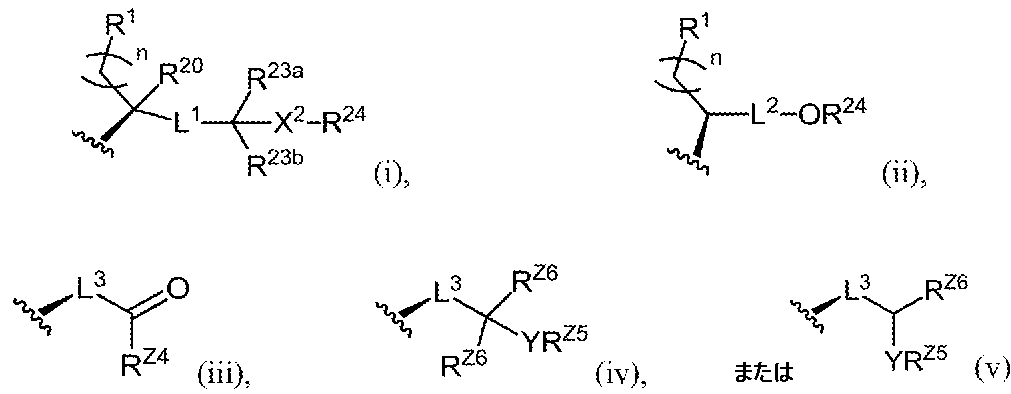
L1、L2、L3、X1、X2、Y、RZ4、RZ5、RZ6、n、R1、R2、R3a
、R3b、R4a、R4b、R6a、R6b、R7a、R7b、R11a、R11b、R
14、R17、R19、R20、R23a、R23bおよびR24は、本明細書中で定義
されるとおりであり;C3位における基-XR3bは、アルファまたはベータである。
In some embodiments, the compound used in the methods described herein, e.g., the methods of evaluation or treatment described herein, is a compound according to formula (I):
or a pharma- ceutically acceptable salt, solvate, prodrug, stereoisomer, tautomer, isotopic variant, or N-oxide thereof, or any combination thereof;
In the formula:
Z is a group of formula (i), (ii), (iii), (iv) or (v):
L 1 , L 2 , L 3 , X 1 , X 2 , Y, R Z4 , R Z5 , R Z6 , n, R 1 , R 2 , R 3a
, R 3b , R 4a , R 4b , R 6a , R 6b , R 7a , R 7b , R 11a , R 11b , R
14 , R 17 , R 19 , R 20 , R 23a , R 23b and R 24 are as defined herein; the group -XR 3b at the C3 position is alpha or beta.
例えば、ある特定の実施形態において、式(I)化合物は、式(I-w)の化合物:

またはその薬学的に許容され得る塩であり;
式中:
Zは、式(i)、(ii)、(iii)、(iv)または(v)の基であり:

L1およびL2は、結合、置換または非置換C1-C6アルキレン、置換または非置換C
2-C6アルケニレン、置換または非置換C2-C6アルキニレン、置換または非置換ヘ
テロC1-C6アルキレン、置換または非置換ヘテロC2-C6アルケニレンおよび置換
または非置換ヘテロC2-C6アルキニレンからなる群より選択され;
L3は、置換もしくは非置換C1-C6アルキレン、置換もしくは非置換C2-C6アル
ケニレン、置換もしくは非置換C2-C6アルキニレン、置換もしくは非置換ヘテロC1
-C6アルキレン、置換もしくは非置換ヘテロC2-C6アルケニレンまたは置換もしく
は非置換ヘテロC2-C6アルキニレンであり;
X1およびX2の各実例は、独立して、-O-、-S-または-NH-であり;
R1は、水素または置換もしくは非置換アルキルであり;
R3bは、水素であり;
R3aは、水素、置換もしくは非置換アルキル、置換もしくは非置換アルケニルまたは置
換もしくは非置換アルキニルであり;
R2、R11aおよびR11bの各実例は、独立して、水素または-ORB1であり、こ
こで、RB1は、水素または置換もしくは非置換アルキルであるか、あるいはR11aお
よびR11bは、一体となって、オキソ(=O)基を形成し;
R6aおよびR6bの各々は、独立して、水素、ハロまたは置換もしくは非置換アルキル
であり、

は、単結合または二重結合を表すが、但し、二重結合が存在する場合、R6aまたはR6
bのうちの一方は存在せず、単結合が存在する場合、C5における水素は、アルファ位ま
たはベータ位であり;
R19およびR20の各実例は、独立して、水素または-CH3であり;
R23aおよびR23bの各実例は、独立して、水素、ハロゲンまたは置換もしくは非置
換アルキルであるか、あるいはR23aおよびR23bは、共に接続して、置換または非
置換C3-C6シクロアルキルを形成し;
R24は、水素または置換もしくは非置換アルキルであり;
Yは、-O-、-S-または-NRZ5-であり;
RZ4は、独立して、置換もしくは非置換アルキル、置換もしくは非置換アルケニル、置
換もしくは非置換アルキニル、置換もしくは非置換カルボシクリル、置換もしくは非置換
ヘテロシクリル、置換もしくは非置換アリール、置換もしくは非置換ヘテロアリール、-
ORZ5、-SRZ5または-N(RZ5)2であり;
RZ5の各実例は、独立して、水素または置換もしくは非置換アルキルであり;
RZ6の各実例は、独立して、水素または置換もしくは非置換アルキルであるか、あるい
は2つのRZ6基は、接続して、C3-6炭素環を形成し;
下付き文字nは、0または1であるが;
但し、以下の化合物は、明確に除外される:

いくつかの実施形態において、本明細書中に記載される方法において使用される化合物は
、
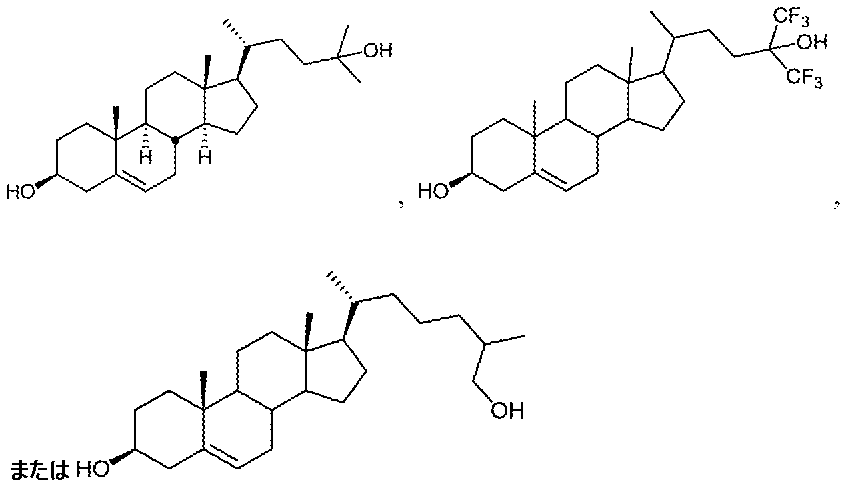
である。
For example, in certain embodiments, the compound of formula (I) is a compound of formula (I-w):
or a pharma- ceutically acceptable salt thereof;
In the formula:
Z is a group of formula (i), (ii), (iii), (iv) or (v):
L 1 and L 2 are each a bond, a substituted or unsubstituted C 1 -C 6 alkylene, a substituted or unsubstituted C
selected from the group consisting of 2 - C6 alkenylene, substituted or unsubstituted C2 - C6 alkynylene, substituted or unsubstituted hetero C1 - C6 alkylene, substituted or unsubstituted hetero C2 - C6 alkenylene and substituted or unsubstituted hetero C2 - C6 alkynylene;
L 3 is a substituted or unsubstituted C 1 -C 6 alkylene, a substituted or unsubstituted C 2 -C 6 alkenylene, a substituted or unsubstituted C 2 -C 6 alkynylene, a substituted or unsubstituted hetero C 1
-C6 alkylene, substituted or unsubstituted hetero C2 - C6 alkenylene, or substituted or unsubstituted hetero C2 - C6 alkynylene;
Each instance of X 1 and X 2 is independently -O-, -S-, or -NH-;
R 1 is hydrogen or substituted or unsubstituted alkyl;
R 3b is hydrogen;
R 3a is hydrogen, substituted or unsubstituted alkyl, substituted or unsubstituted alkenyl, or substituted or unsubstituted alkynyl;
Each instance of R 2 , R 11a , and R 11b is independently hydrogen or -OR B1 , where R B1 is hydrogen or substituted or unsubstituted alkyl, or R 11a and R 11b together form an oxo (=O) group;
Each of R 6a and R 6b is independently hydrogen, halo, or substituted or unsubstituted alkyl;
represents a single bond or a double bond, provided that when a double bond is present, R 6a or R 6
When one of b is absent and a single bond is present, the hydrogen at C5 is in the alpha or beta position;
Each instance of R 19 and R 20 is independently hydrogen or -CH 3 ;
each instance of R 23a and R 23b is independently hydrogen, halogen, or substituted or unsubstituted alkyl, or R 23a and R 23b are joined together to form a substituted or unsubstituted C 3 -C 6 cycloalkyl;
R 24 is hydrogen or substituted or unsubstituted alkyl;
Y is -O-, -S- or -NR Z5 -;
R Z4 is independently substituted or unsubstituted alkyl, substituted or unsubstituted alkenyl, substituted or unsubstituted alkynyl, substituted or unsubstituted carbocyclyl, substituted or unsubstituted heterocyclyl, substituted or unsubstituted aryl, substituted or unsubstituted heteroaryl, -
-OR Z5 , -SR Z5 or -N(R Z5 ) 2 ;
Each instance of R Z5 is independently hydrogen or substituted or unsubstituted alkyl;
Each instance of R Z6 is independently hydrogen or substituted or unsubstituted alkyl, or two R Z6 groups are joined to form a C 3-6 carbocyclic ring;
The subscript n is 0 or 1;
However, the following compounds are specifically excluded:
In some embodiments, the compounds used in the methods described herein are
It is.
ある特定の実施形態において、Zは、以下の式の基である:

ある特定の実施形態において、L3は、以下の式の基であり:
式中、pは、1、2または3であり;RZ7およびRZ8の各実例は、独立して、水素、
ハロ、置換もしくは非置換C1-6アルキルまたは-ORZ5である。
In certain embodiments, L3 is a group of the formula:
wherein p is 1, 2, or 3; each instance of R Z7 and R Z8 is independently hydrogen,
It is halo, substituted or unsubstituted C 1-6 alkyl or —OR Z5 .
ある特定の実施形態において、L3は、以下の式の基であり:

式中、wは、0もしくは1であり、かつpは、1、2もしくは3であるか、またはwは、
1であり、かつpは、0、1、2もしくは3であり;RZ7およびRZ8の各実例は、独
立して、水素、ハロ、置換もしくは非置換C1-6アルキルまたは-ORZ5である。
In certain embodiments, L3 is a group of the formula:
wherein w is 0 or 1 and p is 1, 2 or 3, or w is
1 and p is 0, 1, 2 or 3; each instance of R Z7 and R Z8 is independently hydrogen, halo, substituted or unsubstituted C 1-6 alkyl, or —OR Z5 .
ある特定の実施形態において、L3は、以下の式の基である:

ある特定の実施形態において、L3は、以下の式の基である:

ある特定の実施形態において、L3は、以下の式の基である:

ある特定の実施形態において、Zは、式

である。
In certain embodiments, Z is of the formula
It is.
ある特定の実施形態において、基
は、以下の式である:


is the formula:
ある特定の実施形態において、Zは、式

である。
In certain embodiments, Z is of the formula
It is.
ある特定の実施形態において、Yは、-O-であり、L3は、アルキレン基またはヘテ
ロアルキレン基である。
In certain embodiments, Y is --O-- and L 3 is an alkylene group or a heteroalkylene group.
ある特定の実施形態において、基

は、以下の式である:

is the formula:
ある特定の実施形態において、Zは、式

である。
In certain embodiments, Z is of the formula
It is.
ある特定の実施形態において、Yは、-O-であり、L3は、アルキレンまたはヘテロ
アルキレンである。
In certain embodiments, Y is --O-- and L 3 is alkylene or heteroalkylene.
ある特定の実施形態において、基

は、以下の式である:

is the formula:
ある特定の実施形態において、基-X1R3bは、ベータ位に存在し、R3aは、アル
ファ位に存在する。ある特定の実施形態において、-X1R3bは、-OHである。ある
特定の実施形態において、R3aは、水素である。ある特定の実施形態において、R3a
は、置換または非置換アルキルである。ある特定の実施形態において、R6bは、ハロゲ
ンまたは置換もしくは非置換アルキルである。ある特定の実施形態において、R2は、水
素または-ORB1である。ある特定の実施形態において、R11bは、水素または-O
RB1であり、R11aは、水素である。ある特定の実施形態において、R11aおよび
R11bは、一体となって、オキソ基を形成する。ある特定の実施形態において、
は、単結合を表し、C5における水素は、アルファ位に存在する。ある特定の実施形態に
おいて、
は、二重結合を表す。ある特定の実施形態において、R19は、-CH3である。
In certain embodiments, the group -X 1 R 3b is in the beta position and R 3a is in the alpha position. In certain embodiments, -X 1 R 3b is -OH. In certain embodiments, R 3a is hydrogen. In certain embodiments, R 3a is
is substituted or unsubstituted alkyl. In certain embodiments, R 6b is halogen or substituted or unsubstituted alkyl. In certain embodiments, R 2 is hydrogen or -OR B1 . In certain embodiments, R 11b is hydrogen or -O
R is R B1 and R 11a is hydrogen. In certain embodiments, R 11a and R 11b together form an oxo group.
represents a single bond and the hydrogen at C5 is in the alpha position.
represents a double bond. In certain embodiments, R 19 is -CH 3 .
別の態様において、本発明の化合物および薬学的に許容され得るキャリアを含む薬学的
組成物が提供される。ある特定の実施形態において、本発明の化合物は、有効量で提供さ
れる。ある特定の実施形態において、本発明の化合物は、治療有効量で提供される。ある
特定の実施形態において、本発明の化合物は、予防有効量で提供される。
In another aspect, a pharmaceutical composition is provided that comprises the compound of the present invention and a pharma- ceutically acceptable carrier.In certain embodiments, the compound of the present invention is provided in an effective amount.In certain embodiments, the compound of the present invention is provided in a therapeutically effective amount.In certain embodiments, the compound of the present invention is provided in a prophylactically effective amount.
ある特定の態様において、本発明の化合物は、NMDAレセプターの負のアロステリッ
クモジュレーター(NAM)として提供されるがゆえに、精神分裂病、うつ病、双極性障
害(IおよびII)、統合失調感情障害、気分障害、不安障害、人格障害、精神病、強迫
性障害、外傷後ストレス障害(PTSD)、自閉症圏障害(ASD)、気分変調(軽症う
つ病)、社会不安障害、強迫性障害(OCD)、すべての疼痛症候群および障害、睡眠障
害、記憶障害および痴呆(アルツハイマー病、癲癇および任意の発作性障害を含む)、外
傷性脳損傷(TBI)、脳卒中、嗜癖障害(オピエート類およびコカインおよびアルコー
ルを含む)、自閉症、ハンチントン病、不眠、パーキンソン病、離脱症候群または耳鳴を
含むがこれらに限定されない広範囲のCNS症状の予防および/または処置に有用である
。例えば、1つの態様において、NMDAレセプターの調節の方法が提供され、その方法
は、有効量の本発明の化合物を、それを必要とする被験体に投与する工程を含む。別の態
様において、CNS活性を調節する方法が提供され、その方法は、有効量の本発明の化合
物を、それを必要とする被験体に投与する工程を含む。なおも別の態様において、脳の興
奮性を調節する方法が提供され、その方法は、有効量の本発明の化合物を、それを必要と
する被験体に投与する工程を含む。
In certain embodiments, the compounds of the present invention are provided as negative allosteric modulators (NAMs) of the NMDA receptor and are therefore useful for the prevention and/or treatment of a wide range of CNS conditions, including, but not limited to, schizophrenia, depression, bipolar disorder (I and II), schizoaffective disorder, mood disorders, anxiety disorders, personality disorders, psychosis, obsessive-compulsive disorder, post-traumatic stress disorder (PTSD), autism spectrum disorder (ASD), dysthymia (mild depression), social anxiety disorder, obsessive-compulsive disorder (OCD), all pain syndromes and disorders, sleep disorders, memory disorders and dementia (including Alzheimer's disease, epilepsy and any seizure disorder), traumatic brain injury (TBI), stroke, addictive disorders (including opiates and cocaine and alcohol), autism, Huntington's disease, insomnia, Parkinson's disease, withdrawal syndromes or tinnitus. For example, in one embodiment, a method of modulating an NMDA receptor is provided, comprising administering to a subject in need thereof an effective amount of a compound of the invention. In another embodiment, a method of modulating CNS activity is provided, comprising administering to a subject in need thereof an effective amount of a compound of the invention. In yet another embodiment, a method of modulating brain excitability is provided, comprising administering to a subject in need thereof an effective amount of a compound of the invention.
他の目的および利点は、次の詳細な説明、実施例および請求項を考慮に入れることによ
って、当業者には明らかになるだろう。
特定の実施形態では、例えば以下が提供される:
(項目1)
患者、例えば、本明細書中に記載される障害を有する患者を評価するかまたは処置する方法であって、該方法は、
a)必要に応じて患者サンプルを取得する工程;
b)対照基準と比較したときの24(S)-ヒドロキシコレステロールのレベルの変化について、該サンプルの評価を取得する工程および/または該サンプルを評価する工程
を含む、方法。
(項目2)
有効量の、24(S)-ヒドロキシコレステロールまたは構造的に関係するステロールもしくはステロイド、オキシステロール、NMDARのアゴニストまたはNMDARの正のアロステリックモジュレーター(PAM)あるいは式(I)の化合物などの本明細書中に記載される化合物を(例えば、前記サンプルの前記評価に応答性の)前記患者に投与する工程をさらに含む、項目1に記載の方法。
(項目3)
有効量の、NMDARのアンタゴニストまたはNMDARの負のアロステリックモジュレーター(NAM)を(例えば、前記サンプルの前記評価に応答性の)前記患者に投与する工程をさらに含む、項目1に記載の方法。
(項目4)
有効量の、24(s)-ヒドロキシコレステロールの内在活性または内在量を高める(例えば、増加させる)化合物(例えば、24(s)-ヒドロキシコレステロールを代謝する酵素を阻害する化合物(例えば、24-ヒドロキシコレステロール7アルファ-ヒドロキシラーゼ(CYP39)を阻害する化合物))を(例えば、前記サンプルの前記評価に応答性の)前記患者に投与する工程をさらに含む、項目1に記載の方法。
(項目5)
有効量の、24(s)-ヒドロキシコレステロールの内在活性または内在量を減少させる化合物(例えば、24(s)-ヒドロキシコレステロールを生成する酵素を活性化する化合物(例えば、コレステロール24(S)-ヒドロキシラーゼ(CYP46)を活性化する化合物))を(例えば、前記サンプルの前記評価に応答性の)前記患者に投与する工程をさらに含む、項目1に記載の方法。
(項目6)
前記方法が、前記患者を処置する工程をさらに含み、該患者は、記憶障害について処置されるか、または学習を改善するために処置される、項目1に記載の方法。
(項目7)
前記方法が、前記患者を薬物の過量服用について処置する工程をさらに含む、項目1に記載の方法。
Other objects and advantages will become apparent to those skilled in the art from a consideration of the following detailed description, examples and claims.
In certain embodiments, for example, the following are provided:
(Item 1)
A method of evaluating or treating a patient, e.g., a patient having a disorder described herein, the method comprising:
a) obtaining a patient sample as required;
b) obtaining and/or evaluating the sample for a change in the level of 24(S)-hydroxycholesterol as compared to a control standard.
(Item 2)
The method of claim 1, further comprising administering to said patient (e.g., responsive to said evaluating said sample) an effective amount of 24(S)-hydroxycholesterol or a structurally related sterol or steroid, an oxysterol, an agonist of NMDAR or a positive allosteric modulator (PAM) of NMDAR, or a compound described herein, such as a compound of formula (I).
(Item 3)
13. The method of claim 1, further comprising administering to the patient (e.g., responsive to said evaluating said sample) an effective amount of an NMDAR antagonist or an NMDAR negative allosteric modulator (NAM).
(Item 4)
2. The method of claim 1, further comprising administering to said patient (e.g., responsive to said evaluating said sample) an effective amount of a compound that enhances (e.g., increases) the endogenous activity or amount of 24(s)-hydroxycholesterol (e.g., a compound that inhibits an enzyme that metabolizes 24(s)-hydroxycholesterol (e.g., a compound that inhibits 24-hydroxycholesterol 7 alpha-hydroxylase (CYP39)).
(Item 5)
2. The method of claim 1, further comprising administering to the patient (e.g., responsive to said evaluating said sample) an effective amount of a compound that decreases the endogenous activity or amount of 24(s)-hydroxycholesterol (e.g., a compound that activates an enzyme that produces 24(s)-hydroxycholesterol (e.g., a compound that activates cholesterol 24(S)-hydroxylase (CYP46)).
(Item 6)
13. The method of claim 1, wherein the method further comprises treating the patient, wherein the patient is treated for memory impairment or is treated to improve learning.
(Item 7)
13. The method of claim 1, wherein the method further comprises treating the patient for drug overdose.
定義
化学的定義
0 具体的な官能基および化学用語の定義を下記でより詳細に説明する。化学元素は、元
素周期表、CASバージョン、Handbook of Chemistry and
Physics,75th Ed.,内表紙に従って特定され、具体的な官能基は、一般
に、その中に記載されているとおりに定義される。さらに、有機化学の一般原理、ならび
に具体的な官能性部分および反応性は、Thomas Sorrell,Organic
Chemistry,University Science Books,Saus
alito,1999;Smith and March,March’s Advan
ced Organic Chemistry,5th Edition,John W
iley & Sons,Inc.,New York,2001;Larock,Co
mprehensive Organic Transformations,VCH
Publishers,Inc.,New York,1989;およびCarruth
ers,Some Modern Methods of Organic Synth
esis,3rd Edition,Cambridge University Pr
ess,Cambridge,1987に記載されている。
Definition Chemical Definition
Definitions of specific functional groups and chemical terms are described in more detail below. Chemical elements are defined as follows:
Physics, 75th Ed., inside cover, and specific functional groups are generally defined as described therein. Further, general principles of organic chemistry, and specific functional moieties and reactivities are described in detail in Thomas Sorrell, Organic Chemistry, Vol.
Chemistry, University Science Books, Saus
alito, 1999; Smith and March, March's Advan
ced Organic Chemistry, 5th Edition, John W.
iley & Sons, Inc. , New York, 2001; Larock, Co.
organic transformations, VCH
Publishers, Inc., New York, 1989; and Carruth
ers, Some Modern Methods of Organic Synth
esis, 3rd Edition, Cambridge University Pr
ess, Cambridge, 1987.
本明細書に記載される化合物は、1つまたはそれを超える不斉中心を含み得、ゆえに、
様々な異性形態、例えば、鏡像異性体および/またはジアステレオマーとして存在し得る
。例えば、本明細書中に記載される化合物は、個々の鏡像異性体、ジアステレオマーもし
くは幾何異性体の形態であり得るか、またはラセミ混合物および1つまたはそれを超える
立体異性体に濃縮された混合物をはじめとした立体異性体の混合物の形態であり得る。異
性体は、キラル高圧液体クロマトグラフィー(HPLC)ならびにキラル塩の形成および
結晶化を含む当業者に公知の方法によって混合物から単離され得るか;または好ましい異
性体が、不斉合成によって調製され得る。例えば、Jacquesら、Enantiom
ers,Racemates and Resolutions(Wiley Inte
rscience,New York,1981);Wilenら、Tetrahedr
on 33:2725(1977);Eliel,Stereochemistry o
f Carbon Compounds(McGraw-Hill,NY,1962);
およびWilen,Tables of Resolving Agents and
Optical Resolutions p.268(E.L.Eliel,Ed.,
Univ.of Notre Dame Press,Notre Dame,IN 1
972)を参照のこと。本発明は、他の異性体を実質的に含まない個々の異性体として、
あるいは、様々な異性体の混合物として、本明細書中に記載される化合物をさらに包含す
る。
The compounds described herein may contain one or more asymmetric centers and therefore,
Various isomeric forms, such as enantiomers and/or diastereomers, may exist. For example, the compounds described herein may be in the form of individual enantiomers, diastereomers or geometric isomers, or may be in the form of mixtures of stereoisomers, including racemic mixtures and mixtures enriched in one or more stereoisomers. Isomers may be isolated from mixtures by methods known to those skilled in the art, including chiral high pressure liquid chromatography (HPLC) and the formation and crystallization of chiral salts; or preferred isomers may be prepared by asymmetric synthesis. See, for example, Jacques et al., Enantiomers of the Invention, 1999, 144:1311-1320, 1999, 1999, 1999, 1999, 1999, 1999, 1999, 1999, 1999, 1999, 1999, 1990, 1990, 1991, 1992, 1993, 1994, 1995, 1996, 1997, 1999, 1998, 1999, 1990, 1991, 1992, 1993, 1994, 1995, 1996, 1997, 1998, 19 ...0, 1991, 1992, 1993, 1994, 1995, 1996, 1997, 1998, 1999, 1
ers, Racemates and Resolutions (Wiley Inte
rscience, New York, 1981); Wilen et al., Tetrahedr
on 33:2725 (1977); Eliel, Stereochemistry o
f Carbon Compounds (McGraw-Hill, NY, 1962);
and Wilen, Tables of Resolving Agents and
Optical Resolutions p. 268 (E. L. Eliel, Ed.,
Univ. of Notre Dame Press, Notre Dame, IN 1
The present invention relates to the individual isomers, substantially free of other isomers,
Alternatively, it further includes the compounds described herein as mixtures of various isomers.
値の範囲を列挙するとき、それは、その範囲内の各値および部分範囲を包含すると意図
される。例えば、「C1-6アルキル」は、C1、C2、C3、C4、C5、C6、C1
-6、C1-5、C1-4、C1-3、C1-2、C2-6、C2-5、C2-4、C2
-3、C3-6、C3-5、C3-4、C4-6、C4-5およびC5-6アルキルを包
含すると意図される。
When a range of values is recited, it is intended to encompass each value and subrange within that range. For example, "C 1-6 alkyl" includes C 1 , C 2 , C 3 , C 4 , C 5 , C 6 , C 1
-6 , C 1-5 , C 1-4 , C 1-3 , C 1-2 , C 2-6 , C 2-5 , C 2-4 , C 2
It is intended to include C-3 , C -6 , C -5 , C - 4 , C- 6 , C-5 and C -5-6 alkyl.
以下の用語は、下記にそれらとともに提示される意味を有すると意図されており、本発
明の説明および意図される範囲の理解に有用である。化合物、そのような化合物を含む薬
学的組成物ならびにそのような化合物および組成物を使用する方法を含み得る本発明を説
明する際、以下の用語は、存在する場合、別段示されない限り、以下の意味を有する。本
明細書中に記載されるとき、下記に定義される部分のいずれもが、種々の置換基で置換さ
れ得ること、およびそれぞれの定義が、下記に示されるようなそれらの範囲内にそのよう
な置換部分を含むと意図されることも理解されるべきである。別段述べられない限り、用
語「置換される」は、下記に示されるように定義されるべきである。用語「基」および「
ラジカル」は、本明細書中で使用されるとき、相互交換可能であると考えられ得ることが
、さらに理解されるべきである。冠詞「a」および「an」は、1つの、または1つより
多い(すなわち、少なくとも1つの)、その冠詞の文法上の目的語を指すために本明細書
中で使用され得る。例として、「アナログ(an analogue)」は、1つのアナ
ログまたは1つより多いアナログを意味する。
The following terms are intended to have the meanings presented therewith below and are useful in describing and understanding the intended scope of the present invention. In describing the present invention, which may include compounds, pharmaceutical compositions containing such compounds, and methods of using such compounds and compositions, the following terms, when present, have the following meanings unless otherwise indicated. As described herein, it should also be understood that any of the moieties defined below may be substituted with various substituents, and each definition is intended to include such substituted moieties within their scope as set forth below. Unless otherwise stated, the term "substituted" should be defined as set forth below. The terms "group" and "
It should be further understood that the terms "radical" and "radical" as used herein can be considered interchangeable. The articles "a" and "an" can be used herein to refer to one or to more than one (i.e., to at least one) of the grammatical object of the article. By way of example, "an analogue" means one analogue or more than one analogue.
「アルキル」とは、1~20個の炭素原子を有する直鎖または分枝鎖の飽和炭化水素基
のラジカル(「C1-20アルキル」)のことを指す。いくつかの実施形態において、ア
ルキル基は、1~12個の炭素原子を有する(「C1-12アルキル」)。いくつかの実
施形態において、アルキル基は、1~10個の炭素原子を有する(「C1-10アルキル
」)。いくつかの実施形態において、アルキル基は、1~9個の炭素原子を有する(「C
1-9アルキル」)。いくつかの実施形態において、アルキル基は、1~8個の炭素原子
を有する(「C1-8アルキル」)。いくつかの実施形態において、アルキル基は、1~
7個の炭素原子を有する(「C1-7アルキル」)。いくつかの実施形態において、アル
キル基は、1~6個の炭素原子を有する(本明細書中で「低級アルキル」とも称される「
C1-6アルキル」)。いくつかの実施形態において、アルキル基は、1~5個の炭素原
子を有する(「C1-5アルキル」)。いくつかの実施形態において、アルキル基は、1
~4個の炭素原子を有する(「C1-4アルキル」)。いくつかの実施形態において、ア
ルキル基は、1~3個の炭素原子を有する(「C1-3アルキル」)。いくつかの実施形
態において、アルキル基は、1~2個の炭素原子を有する(「C1-2アルキル」)。い
くつかの実施形態において、アルキル基は、1つの炭素原子を有する(「C1アルキル」
)。いくつかの実施形態において、アルキル基は、2~6個の炭素原子を有する(「C2
-6アルキル」)。C1-6アルキル基の例としては、メチル(C1)、エチル(C2)
、n-プロピル(C3)、イソプロピル(C3)、n-ブチル(C4)、tert-ブチ
ル(C4)、sec-ブチル(C4)、iso-ブチル(C4)、n-ペンチル(C5)
、3-ペンタニル(C5)、アミル(C5)、ネオペンチル(C5)、3-メチル-2-
ブタニル(C5)、第3級アミル(C5)およびn-ヘキシル(C6)が挙げられる。ア
ルキル基のさらなる例としては、n-ヘプチル(C7)、n-オクチル(C8)などが挙
げられる。別段特定されない限り、アルキル基の各実例は、独立して、必要に応じて置換
され、すなわち、非置換である(「非置換アルキル」)か、または1つもしくはそれを超
える置換基;例えば、1~5個の置換基、1~3個の置換基もしくは1つの置換基で置換
される(「置換アルキル」)。ある特定の実施形態において、アルキル基は、非置換C1
-10アルキル(例えば、-CH3)である。ある特定の実施形態において、アルキル基
は、置換C1-10アルキルである。通常のアルキルの省略形としては、Me(-CH3
)、Et(-CH2CH3)、iPr(-CH(CH3)2)、nPr(-CH2CH2
CH3)、n-Bu(-CH2CH2CH2CH3)またはi-Bu(-CH2CH(C
H3)2)が挙げられる。
"Alkyl" refers to the radical of a straight or branched chain saturated hydrocarbon group having from 1 to 20 carbon atoms ("C 1-20 alkyl"). In some embodiments, an alkyl group has from 1 to 12 carbon atoms ("C 1-12 alkyl"). In some embodiments, an alkyl group has from 1 to 10 carbon atoms ("C 1-10 alkyl"). In some embodiments, an alkyl group has from 1 to 9 carbon atoms ("C
In some embodiments, an alkyl group has from 1 to 8 carbon atoms ("C 1-8 alkyl"). In some embodiments, an alkyl group has from 1 to
In some embodiments, an alkyl group has from 1 to 6 carbon atoms (also referred to herein as a "lower alkyl").
In some embodiments, an alkyl group has from 1 to 5 carbon atoms ("C 1-5 alkyl"). In some embodiments, an alkyl group has from 1 to 5 carbon atoms ("C 1-5 alkyl").
In some embodiments, an alkyl group has from 1 to 4 carbon atoms ("C 1-4 alkyl"). In some embodiments, an alkyl group has from 1 to 3 carbon atoms ("C 1-3 alkyl"). In some embodiments, an alkyl group has 1 to 2 carbon atoms ("C 1-2 alkyl"). In some embodiments, an alkyl group has 1 carbon atom ("C 1 alkyl").
In some embodiments, the alkyl group has 2 to 6 carbon atoms ("C 2
Examples of C 1-6 alkyl groups include methyl (C 1 ) , ethyl (C 2 ) ,
, n-propyl (C 3 ), isopropyl (C 3 ), n-butyl (C 4 ), tert-butyl (C 4 ), sec-butyl (C 4 ), iso-butyl (C 4 ), n-pentyl (C 5 )
, 3-pentanyl (C 5 ), amyl (C 5 ), neopentyl (C 5 ), 3-methyl-2-
butanyl (C 5 ), tertiary amyl (C 5 ), and n-hexyl (C 6 ). Further examples of alkyl groups include n-heptyl (C 7 ), n-octyl (C 8 ), and the like. Unless otherwise specified, each instance of an alkyl group is independently optionally substituted, i.e., unsubstituted (an "unsubstituted alkyl") or substituted with one or more substituents; for example, 1 to 5 substituents, 1 to 3 substituents, or 1 substituent (a "substituted alkyl"). In certain embodiments, an alkyl group is an unsubstituted C 1
-10 alkyl (e.g., -CH 3 ). In certain embodiments, the alkyl group is a substituted C 1-10 alkyl. Common abbreviations for alkyl include Me(-CH 3
), Et(-CH 2 CH 3 ), iPr(-CH(CH 3 ) 2 ), nPr(-CH 2 CH 2
CH 3 ), n-Bu(-CH 2 CH 2 CH 2 CH 3 ) or i-Bu(-CH 2 CH(C
H3 ) 2 ).
本明細書中で使用されるとき、「アルキレン」、「アルケニレン」および「アルキニレ
ン」とは、それぞれアルキル基、アルケニル基およびアルキニル基の二価のラジカルのこ
とを指す。炭素の範囲または数が、特定の「アルキレン」、「アルケニレン」および「ア
ルキニレン」基に対して提供されるとき、その範囲または数は、直鎖状の二価の炭素鎖に
おける炭素の範囲または数のことを指すと理解される。「アルキレン」、「アルケニレン
」および「アルキニレン」基は、本明細書中に記載されるような1つまたはそれを超える
置換基で置換され得るか、または非置換であり得る。
As used herein, "alkylene,""alkenylene," and "alkynylene" refer to divalent radicals of alkyl, alkenyl, and alkynyl groups, respectively. When a range or number of carbons is provided for a particular "alkylene,""alkenylene," and "alkynylene" group, it is understood that the range or number refers to the range or number of carbons in a linear, divalent carbon chain. "Alkylene,""alkenylene," and "alkynylene" groups can be substituted or unsubstituted with one or more substituents as described herein.
「アルキレン」とは、二価のラジカルを提供するように2つの水素が除去されたアルキ
ル基のことを指し、それは、置換または非置換であり得る。非置換アルキレン基としては
、メチレン(-CH2-)、エチレン(-CH2CH2-)、プロピレン(-CH2CH
2CH2-)、ブチレン(-CH2CH2CH2CH2-)、ペンチレン(-CH2CH
2CH2CH2CH2-)、ヘキシレン(-CH2CH2CH2CH2CH2CH2-)
などが挙げられるがこれらに限定されない。例示的な置換アルキレン基、例えば、1つま
たはそれを超えるアルキル(メチル)基で置換されたアルキレン基としては、置換メチレ
ン(-CH(CH3)-、(-C(CH3)2-)、置換エチレン(-CH(CH3)C
H2-、-CH2CH(CH3)-、-C(CH3)2CH2-、-CH2C(CH3)
2-)、置換プロピレン(-CH(CH3)CH2CH2-、-CH2CH(CH3)C
H2-、-CH2CH2CH(CH3)-、-C(CH3)2CH2CH2-、-CH2
C(CH3)2CH2-、-CH2CH2C(CH3)2-)などが挙げられるがこれら
に限定されない。
"Alkylene" refers to an alkyl group from which two hydrogens have been removed to provide a divalent radical, which can be substituted or unsubstituted. Unsubstituted alkylene groups include methylene (-CH 2 -), ethylene (-CH 2 CH 2 -), propylene (-CH 2 CH
2 CH 2 --), butylene (-CH 2 CH 2 CH 2 CH 2 --), pentylene (-CH 2 CH
2 CH 2 CH 2 CH 2 -), hexylene (-CH 2 CH 2 CH 2 CH 2 CH 2 CH 2 -)
Exemplary substituted alkylene groups, for example, alkylene groups substituted with one or more alkyl (methyl) groups, include substituted methylene (-CH(CH 3 )-, (-C(CH 3 ) 2 -), substituted ethylene (-CH(CH 3 )C
H 2 -, -CH 2 CH(CH 3 )-, -C(CH 3 ) 2 CH 2 -, -CH 2 C(CH 3 )
2 -), substituted propylene (-CH(CH 3 )CH 2 CH 2 -, -CH 2 CH(CH 3 )C
H 2 -, -CH 2 CH 2 CH(CH 3 )-, -C(CH 3 ) 2 CH 2 CH 2 -, -CH 2
Examples include, but are not limited to, —C(CH 3 ) 2 CH 2 —, —CH 2 CH 2 C(CH 3 ) 2 —.
「アルケニル」とは、2~20個の炭素原子、1つまたはそれを超える炭素-炭素二重
結合(例えば、1、2、3または4つの二重結合)を有し、三重結合を有しない直鎖また
は分枝鎖の炭化水素基のラジカル(「C2-20アルケニル」)のことを指す。いくつか
の実施形態において、アルケニル基は、2~10個の炭素原子を有する(「C2-10ア
ルケニル」)。いくつかの実施形態において、アルケニル基は、2~9個の炭素原子を有
する(「C2-9アルケニル」)。いくつかの実施形態において、アルケニル基は、2~
8個の炭素原子を有する(「C2-8アルケニル」)。いくつかの実施形態において、ア
ルケニル基は、2~7個の炭素原子を有する(「C2-7アルケニル」)。いくつかの実
施形態において、アルケニル基は、2~6個の炭素原子を有する(「C2-6アルケニル
」)。いくつかの実施形態において、アルケニル基は、2~5個の炭素原子を有する(「
C2-5アルケニル」)。いくつかの実施形態において、アルケニル基は、2~4個の炭
素原子を有する(「C2-4アルケニル」)。いくつかの実施形態において、アルケニル
基は、2~3個の炭素原子を有する(「C2-3アルケニル」)。いくつかの実施形態に
おいて、アルケニル基は、2個の炭素原子を有する(「C2アルケニル」)。1つまたは
それを超える炭素-炭素二重結合は、内部に存在し得るか(例えば、2-ブテニル)また
は末端に存在し得る(例えば、1-ブテニル)。C2-4アルケニル基の例としては、エ
テニル(C2)、1-プロペニル(C3)、2-プロペニル(C3)、1-ブテニル(C
4)、2-ブテニル(C4)、ブタジエニル(C4)などが挙げられる。C2-6アルケ
ニル基の例としては、上述のC2-4アルケニル基、ならびにペンテニル(C5)、ペン
タジエニル(C5)、ヘキセニル(C6)などが挙げられる。アルケニルのさらなる例と
しては、ヘプテニル(C7)、オクテニル(C8)、オクタトリエニル(C8)などが挙
げられる。別段特定されない限り、アルケニル基の各実例は、独立して、必要に応じて置
換され、すなわち、非置換である(「非置換アルケニル」)かまたは1つもしくはそれを
超える置換基、例えば、1~5個の置換基、1~3個の置換基もしくは1つの置換基で置
換される(「置換アルケニル」)。ある特定の実施形態において、アルケニル基は、非置
換C2-10アルケニルである。ある特定の実施形態において、アルケニル基は、置換C
2-10アルケニルである。
"Alkenyl" refers to the radical of a straight or branched chain hydrocarbon group having from 2 to 20 carbon atoms, one or more carbon-carbon double bonds (e.g., 1, 2, 3 or 4 double bonds) and no triple bonds ("C 2-20 alkenyl"). In some embodiments, an alkenyl group has from 2 to 10 carbon atoms ("C 2-10 alkenyl"). In some embodiments, an alkenyl group has from 2 to 9 carbon atoms ("C 2-9 alkenyl"). In some embodiments, an alkenyl group has from 2 to 10 carbon atoms ("C 2-10 alkenyl"). In some embodiments, an alkenyl group has from 2 to 9 carbon atoms ("C 2-9 alkenyl").
In some embodiments, an alkenyl group has from 2 to 8 carbon atoms ("C 2-8 alkenyl"). In some embodiments, an alkenyl group has from 2 to 7 carbon atoms ("C 2-7 alkenyl"). In some embodiments, an alkenyl group has from 2 to 6 carbon atoms ("C 2-6 alkenyl"). In some embodiments, an alkenyl group has from 2 to 5 carbon atoms ("C
In some embodiments, an alkenyl group has from 2 to 4 carbon atoms ("C 2-4 alkenyl"). In some embodiments, an alkenyl group has from 2 to 3 carbon atoms ("C 2-3 alkenyl"). In some embodiments, an alkenyl group has 2 carbon atoms ("C 2 alkenyl"). The one or more carbon-carbon double bonds can be internal (e.g., 2 - butenyl) or terminal (e.g., 1-butenyl). Examples of C 2-4 alkenyl groups include ethenyl (C 2 ), 1-propenyl (C 3 ), 2-propenyl (C 3 ), 1-butenyl ( C 4 ), 2-propenyl (C 5 ), 2-butenyl (C 6 ), 1-butenyl (C 7 ), 1-butenyl (C 8 ), 1-butenyl (C 9 ).
Examples of C 2-6 alkenyl groups include the C 2-4 alkenyl groups mentioned above, as well as pentenyl (C 5 ), pentadienyl (C 5 ) , hexenyl (C 6 ), and the like. Further examples of alkenyl include heptenyl (C 7 ), octenyl (C 8 ), octatrienyl (C 8 ), and the like. Unless otherwise specified, each instance of an alkenyl group is independently optionally substituted, i.e. , unsubstituted ("unsubstituted alkenyl") or substituted with one or more substituents, for example, 1-5 substituents, 1-3 substituents, or 1 substituent ("substituted alkenyl"). In certain embodiments, an alkenyl group is an unsubstituted C 2-10 alkenyl. In certain embodiments, an alkenyl group is a substituted C
It is 2-10 alkenyl.
「アルケニレン」とは、二価のラジカルを提供するように2つの水素が除去されたアル
ケニル基のことを指し、それは、置換または非置換であり得る。例示的な非置換の二価の
アルケニレン基としては、エテニレン(-CH=CH-)およびプロペニレン(例えば、
-CH=CHCH2-、-CH2-CH=CH-)が挙げられるがこれらに限定されない
。例示的な置換アルケニレン基、例えば、1つまたはそれを超えるアルキル(メチル)基
で置換されたアルケニレン基としては、置換エチレン(-C(CH3)=CH-、-CH
=C(CH3)-)、置換プロピレン(例えば、-C(CH3)=CHCH2-、-CH
=C(CH3)CH2-、-CH=CHCH(CH3)-、-CH=CHC(CH3)2
-、-CH(CH3)-CH=CH-、-C(CH3)2-CH=CH-、-CH2-C
(CH3)=CH-、-CH2-CH=C(CH3)-)などが挙げられるがこれらに限
定されない。
"Alkenylene" refers to an alkenyl group from which two hydrogens have been removed to provide a divalent radical, which can be substituted or unsubstituted. Exemplary unsubstituted divalent alkenylene groups include ethenylene (-CH=CH-) and propenylene (e.g.,
Exemplary substituted alkenylene groups, for example, alkenylene groups substituted with one or more alkyl (methyl) groups, include, but are not limited to, substituted ethylene (-C(CH 3 ) = CH-, -CH
═C(CH 3 )—), substituted propylene (e.g., —C(CH 3 )═CHCH 2 —, —CH
=C(CH 3 )CH 2 -, -CH=CHCH(CH 3 )-, -CH=CHC(CH 3 ) 2
-, -CH(CH 3 )-CH=CH-, -C(CH 3 ) 2 -CH=CH-, -CH 2 -C
Examples include, but are not limited to, -(CH 3 )═CH-, -CH 2 -CH═C(CH 3 )-.
「アルキニル」とは、2~20個の炭素原子、1つまたはそれを超える炭素-炭素三重
結合(例えば、1、2、3または4つの三重結合)および必要に応じて1つまたはそれを
超える二重結合(例えば、1、2、3または4つの二重結合)を有する直鎖または分枝鎖
の炭化水素基のラジカル(「C2-20アルキニル」)のことを指す。1つまたはそれを
超える三重結合および1つまたはそれを超える二重結合を有するアルキニル基は、「エン
-イエン」基とも称される。いくつかの実施形態において、アルキニル基は、2~10個
の炭素原子を有する(「C2-10アルキニル」)。いくつかの実施形態において、アル
キニル基は、2~9個の炭素原子を有する(「C2-9アルキニル」)。いくつかの実施
形態において、アルキニル基は、2~8個の炭素原子を有する(「C2-8アルキニル」
)。いくつかの実施形態において、アルキニル基は、2~7個の炭素原子を有する(「C
2-7アルキニル」)。いくつかの実施形態において、アルキニル基は、2~6個の炭素
原子を有する(「C2-6アルキニル」)。いくつかの実施形態において、アルキニル基
は、2~5個の炭素原子を有する(「C2-5アルキニル」)。いくつかの実施形態にお
いて、アルキニル基は、2~4個の炭素原子を有する(「C2-4アルキニル」)。いく
つかの実施形態において、アルキニル基は、2~3個の炭素原子を有する(「C2-3ア
ルキニル」)。いくつかの実施形態において、アルキニル基は、2個の炭素原子を有する
(「C2アルキニル」)。1つまたはそれを超える炭素-炭素三重結合は、内部に存在し
得るか(例えば、2-ブチニル)または末端に存在し得る(例えば、1-ブチニル)。C
2-4アルキニル基の例としては、エチニル(C2)、1-プロピニル(C3)、2-プ
ロピニル(C3)、1-ブチニル(C4)、2-ブチニル(C4)などが挙げられるがこ
れらに限定されない。C2-6アルケニル基の例としては、上述のC2-4アルキニル基
、ならびにペンチニル(C5)、ヘキシニル(C6)などが挙げられる。アルキニルのさ
らなる例としては、ヘプチニル(C7)、オクチニル(C8)などが挙げられる。別段特
定されない限り、アルキニル基の各実例は、独立して、必要に応じて置換され、すなわち
、非置換である(「非置換アルキニル」)か、または1つもしくはそれを超える置換基;
例えば、1~5個の置換基、1~3個の置換基もしくは1つの置換基で置換される(「置
換アルキニル」)。ある特定の実施形態において、アルキニル基は、非置換C2-10ア
ルキニルである。ある特定の実施形態において、アルキニル基は、置換C2-10アルキ
ニルである。
"Alkynyl" refers to the radical of a straight or branched chain hydrocarbon group having from 2 to 20 carbon atoms, one or more carbon-carbon triple bonds (e.g., 1, 2, 3 or 4 triple bonds) and optionally one or more double bonds (e.g., 1, 2, 3 or 4 double bonds) ("C 2-20 alkynyl"). Alkynyl groups having one or more triple bonds and one or more double bonds are also referred to as "ene-yene" groups. In some embodiments, an alkynyl group has from 2 to 10 carbon atoms ("C 2-10 alkynyl"). In some embodiments, an alkynyl group has from 2 to 9 carbon atoms ("C 2-9 alkynyl"). In some embodiments, an alkynyl group has from 2 to 8 carbon atoms ("C 2-8 alkynyl").
In some embodiments, an alkynyl group has 2 to 7 carbon atoms ("C
In some embodiments, an alkynyl group has from 2 to 6 carbon atoms ("C 2-6 alkynyl"). In some embodiments, an alkynyl group has from 2 to 5 carbon atoms ("C 2-5 alkynyl"). In some embodiments, an alkynyl group has from 2 to 4 carbon atoms ("C 2-4 alkynyl"). In some embodiments, an alkynyl group has from 2 to 3 carbon atoms ("C 2-3 alkynyl"). In some embodiments, an alkynyl group has 2 carbon atoms ("C 2 alkynyl"). The one or more carbon-carbon triple bonds can be internal (e.g., 2 - butynyl) or terminal (e.g., 1-butynyl). C
Examples of 2-4 alkynyl groups include, but are not limited to, ethynyl (C 2 ), 1-propynyl (C 3 ), 2-propynyl (C 3 ), 1-butynyl (C 4 ), 2-butynyl (C 4 ), and the like. Examples of C 2-6 alkenyl groups include the C 2-4 alkynyl groups mentioned above, as well as pentynyl (C 5 ), hexynyl (C 6 ), and the like. Further examples of alkynyl include heptynyl (C 7 ), octynyl (C 8 ), and the like. Unless otherwise specified, each instance of an alkynyl group is independently optionally substituted, i.e., unsubstituted ("unsubstituted alkynyl") or has one or more substituents;
For example, it is substituted with 1 to 5 substituents, 1 to 3 substituents, or 1 substituent (a "substituted alkynyl"). In certain embodiments, an alkynyl group is an unsubstituted C 2-10 alkynyl. In certain embodiments, an alkynyl group is a substituted C 2-10 alkynyl.
「アルキニレン」とは、二価のラジカルを提供するように2つの水素が除去された直鎖
のアルキニル基のことを指し、それは、置換または非置換であり得る。例示的な二価のア
ルキニレン基としては、置換または非置換エチニレン、置換または非置換プロピニレンな
どが挙げられるがこれらに限定されない。
"Alkynylene" refers to a straight chain alkynyl group from which two hydrogens have been removed to provide a divalent radical, which can be substituted or unsubstituted. Exemplary divalent alkynylene groups include, but are not limited to, substituted or unsubstituted ethynylene, substituted or unsubstituted propynylene, and the like.
用語「ヘテロアルキル」は、本明細書中で使用されるとき、親鎖の中に1つまたはそれ
を超える(例えば、1、2、3または4つの)ヘテロ原子(例えば、酸素、硫黄、窒素、
ホウ素、ケイ素、リン)をさらに含む本明細書中で定義されるようなアルキル基のことを
指し、ここで、その1つもしくはそれを超えるヘテロ原子は、親炭素鎖の中の隣接する炭
素原子間に挿入されており、かつ/または1つもしくはそれを超えるヘテロ原子は、炭素
原子と親分子との間、すなわち、接着点の間に挿入されている。ある特定の実施形態にお
いて、ヘテロアルキル基とは、1~10個の炭素原子および1、2、3または4個のヘテ
ロ原子を有する飽和基(「ヘテロC1-10アルキル」)のことを指す。いくつかの実施
形態において、ヘテロアルキル基は、1~9個の炭素原子および1、2、3または4個の
ヘテロ原子を有する飽和基(「ヘテロC1-9アルキル」)である。いくつかの実施形態
において、ヘテロアルキル基は、1~8個の炭素原子および1、2、3または4個のヘテ
ロ原子を有する飽和基(「ヘテロC1-8アルキル」)である。いくつかの実施形態にお
いて、ヘテロアルキル基は、1~7個の炭素原子および1、2、3または4個のヘテロ原
子を有する飽和基(「ヘテロC1-7アルキル」)である。いくつかの実施形態において
、ヘテロアルキル基は、1~6個の炭素原子および1、2または3個のヘテロ原子を有す
る基(「ヘテロC1-6アルキル」)である。いくつかの実施形態において、ヘテロアル
キル基は、1~5個の炭素原子および1または2個のヘテロ原子を有する飽和基(「ヘテ
ロC1-5アルキル」)である。いくつかの実施形態において、ヘテロアルキル基は、1
~4個の炭素原子および1または2個のヘテロ原子を有する飽和基(「ヘテロC1-4ア
ルキル」)である。いくつかの実施形態において、ヘテロアルキル基は、1~3個の炭素
原子および1つのヘテロ原子を有する飽和基(「ヘテロC1-3アルキル」)である。い
くつかの実施形態において、ヘテロアルキル基は、1~2個の炭素原子および1つのヘテ
ロ原子を有する飽和基(「ヘテロC1-2アルキル」)である。いくつかの実施形態にお
いて、ヘテロアルキル基は、1つの炭素原子および1つのヘテロ原子を有する飽和基(「
ヘテロC1アルキル」)である。いくつかの実施形態において、ヘテロアルキル基は、2
~6個の炭素原子および1または2個のヘテロ原子を有する飽和基(「ヘテロC2-6ア
ルキル」)である。別段特定されない限り、ヘテロアルキル基の各実例は、独立して、非
置換である(「非置換ヘテロアルキル」)か、または1つもしくはそれを超える置換基で
置換される(「置換ヘテロアルキル」)。ある特定の実施形態において、ヘテロアルキル
基は、非置換ヘテロC1-10アルキルである。ある特定の実施形態において、ヘテロア
ルキル基は、置換ヘテロC1-10アルキルである。
The term "heteroalkyl," as used herein, refers to an alkyl group having one or more (e.g., 1, 2, 3, or 4) heteroatoms (e.g., oxygen, sulfur, nitrogen,
"heteroalkyl" refers to an alkyl group as defined herein further comprising one or more heteroatoms (such as aryl, aryl, boron, silicon, phosphorus) in which one or more heteroatoms are inserted between adjacent carbon atoms in the parent carbon chain and/or one or more heteroatoms are inserted between a carbon atom and the parent molecule, i.e., between the point of attachment. In certain embodiments, heteroalkyl groups refer to saturated groups having 1 to 10 carbon atoms and 1, 2, 3, or 4 heteroatoms ("heteroC 1-10 alkyl"). In some embodiments, heteroalkyl groups are saturated groups having 1 to 9 carbon atoms and 1, 2, 3, or 4 heteroatoms ("heteroC 1-9 alkyl"). In some embodiments, heteroalkyl groups are saturated groups having 1 to 8 carbon atoms and 1, 2, 3, or 4 heteroatoms ("heteroC 1-8 alkyl"). In some embodiments, heteroalkyl groups are saturated groups having 1 to 7 carbon atoms and 1, 2, 3, or 4 heteroatoms ("heteroC 1-7 alkyl"). In some embodiments, a heteroalkyl group is a group having 1 to 6 carbon atoms and 1, 2, or 3 heteroatoms ("heteroC 1-6 alkyl"). In some embodiments, a heteroalkyl group is a saturated group having 1 to 5 carbon atoms and 1 or 2 heteroatoms ("heteroC 1-5 alkyl"). In some embodiments, a heteroalkyl group is a saturated group having 1 to 5 carbon atoms and 1 or 2 heteroatoms ("heteroC 1-5 alkyl").
In some embodiments, a heteroalkyl group is a saturated group having 1 to 4 carbon atoms and 1 or 2 heteroatoms ("heteroC 1-4 alkyl"). In some embodiments, a heteroalkyl group is a saturated group having 1 to 3 carbon atoms and 1 heteroatom ("heteroC 1-3 alkyl"). In some embodiments, a heteroalkyl group is a saturated group having 1 to 2 carbon atoms and 1 heteroatom ("heteroC 1-2 alkyl"). In some embodiments, a heteroalkyl group is a saturated group having 1 carbon atom and 1 heteroatom ("heteroC 1-2 alkyl").
In some embodiments, the heteroalkyl group is a 2-alkyl group.
Heteroalkyl groups are saturated groups having up to 6 carbon atoms and 1 or 2 heteroatoms ("heteroC 2-6 alkyl"). Unless otherwise specified, each instance of a heteroalkyl group is independently unsubstituted ("unsubstituted heteroalkyl") or substituted with one or more substituents ("substituted heteroalkyl"). In certain embodiments, a heteroalkyl group is an unsubstituted heteroC 1-10 alkyl. In certain embodiments, a heteroalkyl group is a substituted heteroC 1-10 alkyl.
用語「ヘテロアルケニル」は、本明細書中で使用されるとき、1つまたはそれを超える
(例えば、1、2、3または4つの)ヘテロ原子(例えば、酸素、硫黄、窒素、ホウ素、
ケイ素、リン)をさらに含む本明細書中で定義されるようなアルケニル基のことを指し、
ここで、その1つもしくはそれを超えるヘテロ原子は、親炭素鎖の中の隣接する炭素原子
間に挿入されており、かつ/または1つもしくはそれを超えるヘテロ原子は、炭素原子と
親分子との間、すなわち、接着点の間に挿入されている。ある特定の実施形態において、
ヘテロアルケニル基とは、2~10個の炭素原子、少なくとも1つの二重結合および1、
2、3または4個のヘテロ原子を有する基(「ヘテロC2-10アルケニル」)のことを
指す。いくつかの実施形態において、ヘテロアルケニル基は、2~9個の炭素原子、少な
くとも1つの二重結合および1、2、3または4個のヘテロ原子を有する(「ヘテロC2
-9アルケニル」)。いくつかの実施形態において、ヘテロアルケニル基は、2~8個の
炭素原子、少なくとも1つの二重結合および1、2、3または4個のヘテロ原子を有する
(「ヘテロC2-8アルケニル」)。いくつかの実施形態において、ヘテロアルケニル基
は、2~7個の炭素原子、少なくとも1つの二重結合および1、2、3または4個のヘテ
ロ原子を有する(「ヘテロC2-7アルケニル」)。いくつかの実施形態において、ヘテ
ロアルケニル基は、2~6個の炭素原子、少なくとも1つの二重結合および1、2または
3個のヘテロ原子を有する(「ヘテロC2-6アルケニル」)。いくつかの実施形態にお
いて、ヘテロアルケニル基は、2~5個の炭素原子、少なくとも1つの二重結合および1
または2個のヘテロ原子を有する(「ヘテロC2-5アルケニル」)。いくつかの実施形
態において、ヘテロアルケニル基は、2~4個の炭素原子、少なくとも1つの二重結合お
よび1または2個のヘテロ原子を有する(「ヘテロC2-4アルケニル」)。いくつかの
実施形態において、ヘテロアルケニル基は、2~3個の炭素原子、少なくとも1つの二重
結合および1つのヘテロ原子を有する(「ヘテロC2-3アルケニル」)。いくつかの実
施形態において、ヘテロアルケニル基は、2~6個の炭素原子、少なくとも1つの二重結
合および1または2個のヘテロ原子を有する(「ヘテロC2-6アルケニル」)。別段特
定されない限り、ヘテロアルケニル基の各実例は、独立して、非置換である(「非置換ヘ
テロアルケニル」)か、または1つもしくはそれを超える置換基で置換される(「置換ヘ
テロアルケニル」)。ある特定の実施形態において、ヘテロアルケニル基は、非置換ヘテ
ロC2-10アルケニルである。ある特定の実施形態において、ヘテロアルケニル基は、
置換ヘテロC2-10アルケニルである。
The term "heteroalkenyl," as used herein, refers to an alkyl group containing one or more (e.g., 1, 2, 3, or 4) heteroatoms (e.g., oxygen, sulfur, nitrogen, boron,
refers to an alkenyl group as defined herein further containing an atom (silicon, phosphorus);
wherein the one or more heteroatoms are inserted between adjacent carbon atoms in the parent carbon chain and/or the one or more heteroatoms are inserted between a carbon atom and the parent molecule, i.e., between the points of attachment. In certain embodiments,
Heteroalkenyl groups are groups having from 2 to 10 carbon atoms, at least one double bond and one,
In some embodiments, heteroalkenyl groups have 2 to 9 carbon atoms, at least one double bond and 1, 2, 3, or 4 heteroatoms ("heteroC 2-10 alkenyl " ).
In some embodiments, heteroalkenyl groups have from 2 to 8 carbon atoms, at least one double bond, and 1 , 2, 3, or 4 heteroatoms ("heteroC 2-8 alkenyl "). In some embodiments, heteroalkenyl groups have from 2 to 7 carbon atoms, at least one double bond, and 1, 2, 3, or 4 heteroatoms ("heteroC 2-7 alkenyl"). In some embodiments, heteroalkenyl groups have from 2 to 6 carbon atoms, at least one double bond, and 1, 2, or 3 heteroatoms ("heteroC 2-6 alkenyl"). In some embodiments, heteroalkenyl groups have from 2 to 5 carbon atoms, at least one double bond, and 1, 2, or 3 heteroatoms ("heteroC 2-6 alkenyl").
or 2 heteroatoms ("heteroC 2-5 alkenyl"). In some embodiments, a heteroalkenyl group has 2 to 4 carbon atoms, at least one double bond, and 1 or 2 heteroatoms ("heteroC 2-4 alkenyl"). In some embodiments, a heteroalkenyl group has 2 to 3 carbon atoms, at least one double bond, and 1 heteroatom ("heteroC 2-3 alkenyl"). In some embodiments, a heteroalkenyl group has 2 to 6 carbon atoms, at least one double bond, and 1 or 2 heteroatoms ("heteroC 2-6 alkenyl"). Unless otherwise specified, each instance of a heteroalkenyl group is independently unsubstituted ("unsubstituted heteroalkenyl") or substituted with one or more substituents ("substituted heteroalkenyl"). In certain embodiments, a heteroalkenyl group is unsubstituted heteroC 2-10 alkenyl. In certain embodiments, a heteroalkenyl group is
It is a substituted hetero C 2-10 alkenyl.
用語「ヘテロアルキニル」は、本明細書中で使用されるとき、1つまたはそれを超える
(例えば、1、2、3または4つの)ヘテロ原子(例えば、酸素、硫黄、窒素、ホウ素、
ケイ素、リン)をさらに含む本明細書中で定義されるようなアルキニル基のことを指し、
ここで、その1つもしくはそれを超えるヘテロ原子は、親炭素鎖の中の隣接する炭素原子
間に挿入されており、かつ/または1つもしくはそれを超えるヘテロ原子は、炭素原子と
親分子との間、すなわち、接着点の間に挿入されている。ある特定の実施形態において、
ヘテロアルキニル基とは、2~10個の炭素原子、少なくとも1つの三重結合および1、
2、3または4個のヘテロ原子を有する基(「ヘテロC2-10アルキニル」)のことを
指す。いくつかの実施形態において、ヘテロアルキニル基は、2~9個の炭素原子、少な
くとも1つの三重結合および1、2、3または4個のヘテロ原子を有する(「ヘテロC2
-9アルキニル」)。いくつかの実施形態において、ヘテロアルキニル基は、2~8個の
炭素原子、少なくとも1つの三重結合および1、2、3または4個のヘテロ原子を有する
(「ヘテロC2-8アルキニル」)。いくつかの実施形態において、ヘテロアルキニル基
は、2~7個の炭素原子、少なくとも1つの三重結合および1、2、3または4個のヘテ
ロ原子を有する(「ヘテロC2-7アルキニル」)。いくつかの実施形態において、ヘテ
ロアルキニル基は、2~6個の炭素原子、少なくとも1つの三重結合および1、2または
3個のヘテロ原子を有する(「ヘテロC2-6アルキニル」)。いくつかの実施形態にお
いて、ヘテロアルキニル基は、2~5個の炭素原子、少なくとも1つの三重結合および1
または2個のヘテロ原子を有する(「ヘテロC2-5アルキニル」)。いくつかの実施形
態において、ヘテロアルキニル基は、2~4個の炭素原子、少なくとも1つの三重結合お
よび1または2個のヘテロ原子を有する(「ヘテロC2-4アルキニル」)。いくつかの
実施形態において、ヘテロアルキニル基は、2~3個の炭素原子、少なくとも1つの三重
結合および1つのヘテロ原子を有する(「ヘテロC2-3アルキニル」)。いくつかの実
施形態において、ヘテロアルキニル基は、2~6個の炭素原子、少なくとも1つの三重結
合および1または2個のヘテロ原子を有する(「ヘテロC2-6アルキニル」)。別段特
定されない限り、ヘテロアルキニル基の各実例は、独立して、非置換である(「非置換ヘ
テロアルキニル」)か、または1つもしくはそれを超える置換基で置換される(「置換ヘ
テロアルキニル」)。ある特定の実施形態において、ヘテロアルキニル基は、非置換ヘテ
ロC2-10アルキニルである。ある特定の実施形態において、ヘテロアルキニル基は、
置換ヘテロC2-10アルキニルである。
The term "heteroalkynyl," as used herein, refers to an alkyl group containing one or more (e.g., 1, 2, 3, or 4) heteroatoms (e.g., oxygen, sulfur, nitrogen, boron,
refers to an alkynyl group as defined herein further containing an atom (silicon, phosphorus);
wherein the one or more heteroatoms are inserted between adjacent carbon atoms in the parent carbon chain and/or the one or more heteroatoms are inserted between a carbon atom and the parent molecule, i.e., between the points of attachment. In certain embodiments,
Heteroalkynyl groups are groups having from 2 to 10 carbon atoms, at least one triple bond and one,
In some embodiments, a heteroalkynyl group has 2 to 9 carbon atoms, at least one triple bond and 1, 2, 3, or 4 heteroatoms ("heteroC 2-10 alkynyl " ).
In some embodiments, heteroalkynyl groups have from 2 to 8 carbon atoms, at least one triple bond, and 1 , 2, 3, or 4 heteroatoms ("heteroC 2-8 alkynyl "). In some embodiments, heteroalkynyl groups have from 2 to 7 carbon atoms, at least one triple bond, and 1, 2, 3, or 4 heteroatoms ("heteroC 2-7 alkynyl"). In some embodiments, heteroalkynyl groups have from 2 to 6 carbon atoms, at least one triple bond, and 1, 2, or 3 heteroatoms ("heteroC 2-6 alkynyl"). In some embodiments, heteroalkynyl groups have from 2 to 5 carbon atoms, at least one triple bond, and 1, 2, or 3 heteroatoms ("heteroC 2-6 alkynyl").
or 2 heteroatoms ("heteroC 2-5 alkynyl"). In some embodiments, a heteroalkynyl group has 2 to 4 carbon atoms, at least one triple bond, and 1 or 2 heteroatoms ("heteroC 2-4 alkynyl"). In some embodiments, a heteroalkynyl group has 2 to 3 carbon atoms, at least one triple bond, and 1 heteroatom ("heteroC 2-3 alkynyl"). In some embodiments, a heteroalkynyl group has 2 to 6 carbon atoms, at least one triple bond, and 1 or 2 heteroatoms ("heteroC 2-6 alkynyl"). Unless otherwise specified, each instance of a heteroalkynyl group is independently unsubstituted ("unsubstituted heteroalkynyl") or substituted with one or more substituents ("substituted heteroalkynyl"). In certain embodiments, a heteroalkynyl group is unsubstituted heteroC 2-10 alkynyl. In certain embodiments, a heteroalkynyl group is
It is substituted heteroC 2-10 alkynyl.
本明細書中で使用されるとき、「アルキレン」、「アルケニレン」、「アルキニレン」
、「ヘテロアルキレン」、「ヘテロアルケニレン」および「ヘテロアルキニレン」とは、
それぞれアルキル、アルケニル、アルキニル基、ヘテロアルキル、ヘテロアルケニルおよ
びヘテロアルキニル基の二価のラジカルのことを指す。炭素の範囲または数が、特定の「
アルキレン」、「アルケニレン」、「アルキニレン」、「ヘテロアルキレン」、「ヘテロ
アルケニレン」または「ヘテロアルキニレン」基に対して提供されるとき、その範囲また
は数は、直鎖状の二価の炭素鎖における炭素の範囲または数のことを指すと理解される。
「アルキレン」、「アルケニレン」、「アルキニレン」、「ヘテロアルキレン」、「ヘテ
ロアルケニレン」および「ヘテロアルキニレン」基は、本明細書中に記載されるような1
つもしくはそれを超える置換基で置換され得るか、または非置換であり得る。
As used herein, "alkylene,""alkenylene," and "alkynylene"
"Heteroalkylene", "heteroalkenylene" and "heteroalkynylene" are
Each of these refers to a divalent radical of an alkyl, alkenyl, alkynyl, heteroalkyl, heteroalkenyl, or heteroalkynyl group.
When provided for an "alkylene,""alkenylene,""alkynylene,""heteroalkylene,""heteroalkenylene," or "heteroalkynylene" group, it is understood that the range or number refers to the range or number of carbons in a linear divalent carbon chain.
"Alkylene,""alkenylene,""alkynylene,""heteroalkylene,""heteroalkenylene," and "heteroalkynylene" groups refer to any one of the heteroaryl groups as defined herein.
It may be substituted with one or more substituents or it may be unsubstituted.
「アリール」とは、芳香環系として提供される6~14個の環炭素原子および0個のヘ
テロ原子を有する単環式または多環式(例えば、二環式または三環式)の4n+2芳香環
系(例えば、環状に並んだ状態で共有される6、10または14個のπ電子を有する)の
ラジカル(「C6-14アリール」)のことを指す。いくつかの実施形態において、アリ
ール基は、6個の環炭素原子を有する(「C6アリール」;例えば、フェニル)。いくつ
かの実施形態において、アリール基は、10個の環炭素原子を有する(「C10アリール
」;例えば、ナフチル、例えば、1-ナフチルおよび2-ナフチル)。いくつかの実施形
態において、アリール基は、14個の環炭素原子を有する(「C14アリール」;例えば
、アントラシル)。「アリール」は、上で定義されたようなアリール環が1つまたはそれ
を超えるカルボシクリル基またはヘテロシクリル基と融合した環系も含み、ここで、その
ラジカルまたは接着点は、アリール環上に存在し、そのような場合、炭素原子の数は、ア
リール環系の中の炭素原子の数を引き続き指摘する。典型的なアリール基としては、アセ
アントリレン、アセナフチレン、アセフェナントリレン、アントラセン、アズレン、ベン
ゼン、クリセン、コロネン、フルオランテン、フルオレン、ヘキサセン、ヘキサフェン、
ヘキサレン、as-インダセン、s-インダセン、インダン、インデン、ナフタレン、オ
クタセン、オクタフェン、オクタレン、オバレン、ペンタ-2,4-ジエン、ペンタセン
、ペンタレン、ペンタフェン、ペリレン、フェナレン、フェナントレン、ピセン、プレイ
アデン、ピレン、ピラントレン、ルビセン、トリフェニレンおよびトリナフタレンから得
られる基が挙げられるがこれらに限定されない。特に、アリール基には、フェニル、ナフ
チル、インデニルおよびテトラヒドロナフチルが含まれる。別段特定されない限り、アリ
ール基の各実例は、独立して、必要に応じて置換され、すなわち、非置換である(「非置
換アリール」)か、または1つもしくはそれを超える置換基で置換される(「置換アリー
ル」)。ある特定の実施形態において、アリール基は、非置換C6-14アリールである
。ある特定の実施形態において、アリール基は、置換C6-14アリールである。
"Aryl" refers to a radical of a monocyclic or polycyclic (e.g., bicyclic or tricyclic) 4n+2 aromatic ring system (e.g., having 6, 10 or 14 pi electrons shared in a ring arrangement) having 6 to 14 ring carbon atoms and 0 heteroatoms provided in the aromatic ring system ("C 6-14 aryl"). In some embodiments, an aryl group has 6 ring carbon atoms ("C 6 aryl"; e.g., phenyl). In some embodiments, an aryl group has 10 ring carbon atoms ("C 10 aryl"; e.g., naphthyl, e.g., 1-naphthyl and 2-naphthyl). In some embodiments, an aryl group has 14 ring carbon atoms ("C 14 aryl"; e.g., anthracyl). "Aryl" also includes ring systems in which an aryl ring as defined above is fused to one or more carbocyclyl or heterocyclyl groups, where the radical or point of attachment is on the aryl ring, and in such cases the number of carbon atoms continues to refer to the number of carbon atoms in the aryl ring system. Exemplary aryl groups include aceanthrylene, acenaphthylene, acephenanthrylene, anthracene, azulene, benzene, chrysene, coronene, fluoranthene, fluorene, hexacene, hexaphene,
Examples of aryl groups include, but are not limited to, groups derived from hexalene, as-indacene, s-indacene, indane, indene, naphthalene, octacene, octaphene, octalene, ovalene, penta-2,4-diene, pentacene, pentalene, pentaphene, perylene, phenalene, phenanthrene, picene, pleiadene, pyrene, pyranthrene, rubicene, triphenylene, and trinaphthalene. In particular, aryl groups include phenyl, naphthyl, indenyl, and tetrahydronaphthyl. Unless otherwise specified, each instance of an aryl group is independently optionally substituted, i.e., unsubstituted ("unsubstituted aryl") or substituted with one or more substituents ("substituted aryl"). In certain embodiments, the aryl group is unsubstituted C 6-14 aryl. In certain embodiments, the aryl group is substituted C 6-14 aryl.
ある特定の実施形態において、ハロ、C1-C8アルキル、C1-C8ハロアルキル、
シアノ、ヒドロキシ、C1-C8アルコキシおよびアミノから選択される基のうちの1つ
またはそれを超える基で置換されるアリール基。
In certain embodiments, halo, C 1 -C 8 alkyl, C 1 -C 8 haloalkyl,
An aryl group substituted with one or more groups selected from cyano, hydroxy, C 1 -C 8 alkoxy and amino.
代表的な置換アリールの例としては、以下

が挙げられ、式中、R56およびR57のうちの1つは、水素であり得、R56およびR
57のうちの少なくとも1つは、各々独立して、C1-C8アルキル、C1-C8ハロア
ルキル、4~10員ヘテロシクリル、アルカノイル、C1-C8アルコキシ、ヘテロアリ
ールオキシ、アルキルアミノ、アリールアミノ、ヘテロアリールアミノ、NR58COR
59、NR58SOR59NR58SO2R59、COOアルキル、COOアリール、C
ONR58R59、CONR58OR59、NR58R59、SO2NR58R59、S
-アルキル、SOアルキル、SO2アルキル、Sアリール、SOアリール、SO2アリー
ルから選択されるか;またはR56およびR57は、接続して、5~8個の原子、N、O
もしくはSの群から選択される1つもしくはそれを超えるヘテロ原子を必要に応じて含む
環式環(飽和または不飽和)を形成し得る。R60およびR61は、独立して、水素、C
1-C8アルキル、C1-C4ハロアルキル、C3-C10シクロアルキル、4~10員
ヘテロシクリル、C6-C10アリール、置換C6-C10アリール、5~10員ヘテロ
アリールまたは置換5~10員ヘテロアリールである。
Representative examples of substituted aryl are as follows:
wherein one of R 56 and R 57 can be hydrogen ;
At least one of 57 is independently selected from C 1 -C 8 alkyl, C 1 -C 8 haloalkyl, 4- to 10-membered heterocyclyl, alkanoyl, C 1 -C 8 alkoxy, heteroaryloxy, alkylamino, arylamino, heteroarylamino, NR 58 COR
59 , NR 58 SOR 59 NR 58 SO 2 R 59 , COO alkyl, COO aryl, C
ONR 58 R 59 , CONR 58 OR 59 , NR 58 R 59 , SO 2 NR 58 R 59 , S
-alkyl, SOalkyl, SO2alkyl , Saryl, SOaryl, SO2aryl ; or R 56 and R 57 , when joined, are selected from 5 to 8 atoms, N, O
R 60 and R 61 may form a cyclic ring (saturated or unsaturated) optionally containing one or more heteroatoms selected from the group consisting of H, C ...
It is 1 - C8 alkyl, C1 - C4 haloalkyl, C3 - C10 cycloalkyl, 4-10 membered heterocyclyl, C6 - C10 aryl, substituted C6 - C10 aryl, 5-10 membered heteroaryl or substituted 5-10 membered heteroaryl.
融合したヘテロシクリル基を有する他の代表的なアリール基としては、以下

が挙げられ:式中、各Wは、C(R66)2、NR66、OおよびSから選択され;各Y
は、カルボニル、NR66、OおよびSから選択され;R66は、独立して、水素、C1
-C8アルキル、C3-C10シクロアルキル、4~10員ヘテロシクリル、C6-C1
0アリールおよび5~10員ヘテロアリールである。
Other representative aryl groups having a fused heterocyclyl group include the following:
wherein each W is selected from C(R 66 ) 2 , NR 66 , O, and S;
is selected from carbonyl, NR 66 , O and S; R 66 is independently hydrogen, C 1
-C8 alkyl, C3 - C10 cycloalkyl, 4- to 10-membered heterocyclyl, C6 - C1
0 aryl and 5-10 membered heteroaryl.
「融合したアリール」とは、その環炭素のうちの2つを第2のアリール環もしくはヘテ
ロアリール環またはカルボシクリル環もしくはヘテロシクリル環と共通して有するアリー
ルのことを指す。
"Fused aryl" refers to an aryl having two of its ring carbons in common with a second aryl or heteroaryl ring, or a carbocyclyl or heterocyclyl ring.
「アラルキル」は、本明細書中で定義されるようなアルキルおよびアリールのサブセッ
トであり、必要に応じて置換されるアリール基によって置換された必要に応じて置換され
るアルキル基のことを指す。
"Aralkyl" is a subset of alkyl and aryl, as defined herein, and refers to an optionally substituted alkyl group substituted by an optionally substituted aryl group.
「ヘテロアリール」とは、芳香環系として提供される環炭素原子および1~4個の環ヘ
テロ原子を有する5~10員の単環式または二環式の4n+2芳香環系(例えば、環状に
並んだ状態で共有される6または10個のπ電子を有する)のラジカルのことを指し、こ
こで、各ヘテロ原子は、独立して、窒素、酸素および硫黄から選択される(「5~10員
ヘテロアリール」)。1つまたはそれを超える窒素原子を含むヘテロアリール基では、接
着点は、結合価が許容するとき、炭素原子または窒素原子であり得る。ヘテロアリール二
環式環系は、一方または両方の環に1つまたはそれを超えるヘテロ原子を含み得る。「ヘ
テロアリール」には、上で定義されたようなヘテロアリール環が1つまたはそれを超える
カルボシクリル基またはヘテロシクリル基と融合された環系が含まれ、ここで、その接着
点は、ヘテロアリール環上に存在し、そのような場合、環メンバーの数は、ヘテロアリー
ル環系の環メンバーの数を引き続き指摘する。「ヘテロアリール」には、上で定義された
ようなヘテロアリール環が1つまたはそれを超えるアリール基と融合した環系も含まれ、
ここで、その接着点は、アリール環上またはヘテロアリール環上に存在し、そのような場
合、環メンバーの数は、融合された(アリール/ヘテロアリール)環系の中の環メンバー
の数を指摘する。一方の環がヘテロ原子を含まない二環式ヘテロアリール基(例えば、イ
ンドリル、キノリニル、カルバゾリルなど)、接着点は、いずれかの環、すなわち、ヘテ
ロ原子を有する環(例えば、2-インドリル)またはヘテロ原子を含まない環(例えば、
5-インドリル)上に存在し得る。
"Heteroaryl" refers to the radical of a 5-10 membered monocyclic or bicyclic 4n+2 aromatic ring system (e.g., having 6 or 10 pi-electrons shared in a ring arrangement) having ring carbon atoms and 1-4 ring heteroatoms provided as the aromatic ring system, where each heteroatom is independently selected from nitrogen, oxygen and sulfur ("5-10 membered heteroaryl"). In heteroaryl groups containing one or more nitrogen atoms, the point of attachment may be a carbon atom or a nitrogen atom, as permitted by valence. Heteroaryl bicyclic ring systems may contain one or more heteroatoms in one or both rings. "Heteroaryl" includes ring systems in which a heteroaryl ring as defined above is fused to one or more carbocyclyl or heterocyclyl groups, where the point of attachment is on the heteroaryl ring, and in such cases the number of ring members continues to refer to the number of ring members of the heteroaryl ring system. "Heteroaryl" also includes ring systems in which a heteroaryl ring, as defined above, is fused to one or more aryl groups;
wherein the point of attachment is on the aryl ring or on the heteroaryl ring, and in such cases the number of ring members refers to the number of ring members in the fused (aryl/heteroaryl) ring system. For bicyclic heteroaryl groups where one ring does not contain heteroatoms (e.g., indolyl, quinolinyl, carbazolyl, etc.), the point of attachment can be on either ring, i.e., the ring with a heteroatom (e.g., 2-indolyl) or the ring without a heteroatom (e.g.,
5-indolyl).
いくつかの実施形態において、ヘテロアリール基は、芳香環系として提供される環炭素
原子および1~4個の環ヘテロ原子を有する5~10員の芳香環系であり、ここで、各ヘ
テロ原子は、独立して、窒素、酸素および硫黄から選択される(「5~10員ヘテロアリ
ール」)。いくつかの実施形態において、ヘテロアリール基は、芳香環系として提供され
る環炭素原子および1~4個の環ヘテロ原子を有する5~8員の芳香環系であり、ここで
、各ヘテロ原子は、独立して、窒素、酸素および硫黄から選択される(「5~8員ヘテロ
アリール」)。いくつかの実施形態において、ヘテロアリール基は、芳香環系として提供
される環炭素原子および1~4個の環ヘテロ原子を有する5~6員の芳香環系であり、こ
こで、各ヘテロ原子は、独立して、窒素、酸素および硫黄から選択される(「5~6員ヘ
テロアリール」)。いくつかの実施形態において、5~6員ヘテロアリールは、窒素、酸
素および硫黄から選択される1~3個の環ヘテロ原子を有する。いくつかの実施形態にお
いて、5~6員ヘテロアリールは、窒素、酸素および硫黄から選択される1~2個の環ヘ
テロ原子を有する。いくつかの実施形態において、5~6員ヘテロアリールは、窒素、酸
素および硫黄から選択される1つの環ヘテロ原子を有する。別段特定されない限り、ヘテ
ロアリール基の各実例は、独立して、必要に応じて置換され、すなわち、非置換である(
「非置換ヘテロアリール」)か、または1つもしくはそれを超える置換基で置換される(
「置換ヘテロアリール」)。ある特定の実施形態において、ヘテロアリール基は、非置換
5~14員ヘテロアリールである。ある特定の実施形態において、ヘテロアリール基は、
置換5~14員ヘテロアリールである。
In some embodiments, a heteroaryl group is a 5-10 membered aromatic ring system having ring carbon atoms and 1-4 ring heteroatoms provided as an aromatic ring system, where each heteroatom is independently selected from nitrogen, oxygen, and sulfur ("5-10 membered heteroaryl"). In some embodiments, a heteroaryl group is a 5-8 membered aromatic ring system having ring carbon atoms and 1-4 ring heteroatoms provided as an aromatic ring system, where each heteroatom is independently selected from nitrogen, oxygen, and sulfur ("5-8 membered heteroaryl"). In some embodiments, a heteroaryl group is a 5-6 membered aromatic ring system having ring carbon atoms and 1-4 ring heteroatoms provided as an aromatic ring system, where each heteroatom is independently selected from nitrogen, oxygen, and sulfur ("5-6 membered heteroaryl"). In some embodiments, a 5-6 membered heteroaryl has 1-3 ring heteroatoms selected from nitrogen, oxygen, and sulfur. In some embodiments, a 5-6 membered heteroaryl has 1-2 ring heteroatoms selected from nitrogen, oxygen, and sulfur. In some embodiments, a 5-6 membered heteroaryl has one ring heteroatom selected from nitrogen, oxygen, and sulfur. Unless otherwise specified, each instance of a heteroaryl group is independently optionally substituted, i.e., unsubstituted (
"Unsubstituted heteroaryl") or substituted with one or more substituents ("unsubstituted heteroaryl").
"Substituted heteroaryl." In certain embodiments, a heteroaryl group is an unsubstituted 5-14 membered heteroaryl. In certain embodiments, a heteroaryl group is
It is a substituted 5-14 membered heteroaryl.
1つのヘテロ原子を含む例示的な5員ヘテロアリール基としては、ピロリル、フラニル
およびチオフェニルが挙げられるがこれらに限定されない。2個のヘテロ原子を含む例示
的な5員ヘテロアリール基としては、イミダゾリル、ピラゾリル、オキサゾリル、イソオ
キサゾリル、チアゾリルおよびイソチアゾリルが挙げられるがこれらに限定されない。3
個のヘテロ原子を含む例示的な5員ヘテロアリール基としては、トリアゾリル、オキサジ
アゾリルおよびチアジアゾリルが挙げられるがこれらに限定されない。4個のヘテロ原子
を含む例示的な5員ヘテロアリール基としては、テトラゾリルが挙げられるがこれに限定
されない。1つのヘテロ原子を含む例示的な6員ヘテロアリール基としては、ピリジニル
が挙げられるがこれに限定されない。2個のヘテロ原子を含む例示的な6員ヘテロアリー
ル基としては、ピリダジニル、ピリミジニルおよびピラジニルが挙げられるがこれらに限
定されない。3または4個のヘテロ原子を含む例示的な6員ヘテロアリール基としては、
それぞれトリアジニルおよびテトラジニルが挙げられるがこれらに限定されない。1つの
ヘテロ原子を含む例示的な7員ヘテロアリール基としては、アゼピニル、オキセピニルお
よびチエピニルが挙げられるがこれらに限定されない。例示的な5,6-二環式ヘテロア
リール基としては、インドリル、イソインドリル、インダゾリル、ベンゾトリアゾリル、
ベンゾチオフェニル、イソベンゾチオフェニル、ベンゾフラニル、ベンゾイソフラニル、
ベンゾイミダゾリル、ベンゾオキサゾリル、ベンゾイソオキサゾリル、ベンゾオキサジア
ゾリル、ベンゾチアゾリル、ベンゾイソチアゾリル、ベンゾチアジアゾリル、インドリジ
ニルおよびプリニルが挙げられるがこれらに限定されない。例示的な6,6-二環式ヘテ
ロアリール基としては、ナフチリジニル、プテリジニル、キノリニル、イソキノリニル、
シンノリニル、キノキサリニル、フタラジニルおよびキナゾリニルが挙げられるがこれら
に限定されない。
Exemplary 5-membered heteroaryl groups containing one heteroatom include, but are not limited to, pyrrolyl, furanyl, and thiophenyl. Exemplary 5-membered heteroaryl groups containing two heteroatoms include, but are not limited to, imidazolyl, pyrazolyl, oxazolyl, isoxazolyl, thiazolyl, and isothiazolyl.
Exemplary 5-membered heteroaryl groups containing one heteroatom include, but are not limited to, triazolyl, oxadiazolyl, and thiadiazolyl. Exemplary 5-membered heteroaryl groups containing four heteroatoms include, but are not limited to, tetrazolyl. Exemplary 6-membered heteroaryl groups containing one heteroatom include, but are not limited to, pyridinyl. Exemplary 6-membered heteroaryl groups containing two heteroatoms include, but are not limited to, pyridazinyl, pyrimidinyl, and pyrazinyl. Exemplary 6-membered heteroaryl groups containing three or four heteroatoms include, but are not limited to,
Exemplary 7-membered heteroaryl groups containing one heteroatom include, but are not limited to, azepinyl, oxepinyl, and thiepinyl. Exemplary 5,6-bicyclic heteroaryl groups include, but are not limited to, indolyl, isoindolyl, indazolyl, benzotriazolyl,
Benzothiophenyl, isobenzothiophenyl, benzofuranyl, benzisofuranyl,
Exemplary 6,6-bicyclic heteroaryl groups include, but are not limited to, benzimidazolyl, benzoxazolyl, benzisoxazolyl, benzoxadiazolyl, benzothiazolyl, benzisothiazolyl, benzothiadiazolyl, indolizinyl and purinyl. Exemplary 6,6-bicyclic heteroaryl groups include naphthyridinyl, pteridinyl, quinolinyl, isoquinolinyl,
These include, but are not limited to, cinnolinyl, quinoxalinyl, phthalazinyl and quinazolinyl.
代表的なヘテロアリールの例としては、以下:

が挙げられ、式中、各Yは、カルボニル、N、NR65、OおよびSから選択され;R6
5は、独立して、水素、C1-C8アルキル、C3-C10シクロアルキル、4~10員
ヘテロシクリル、C6-C10アリールおよび5~10員ヘテロアリールである。
Representative examples of heteroaryl include the following:
wherein each Y is selected from carbonyl, N, NR 65 , O, and S ;
5 is independently hydrogen, C 1 -C 8 alkyl, C 3 -C 10 cycloalkyl, 4- to 10-membered heterocyclyl, C 6 -C 10 aryl, and 5- to 10-membered heteroaryl.
「ヘテロアラルキル」は、本明細書中で定義されるような、アルキルおよびヘテロアリ
ールのサブセットであり、必要に応じて置換されるヘテロアリール基によって置換された
必要に応じて置換されるアルキル基のことを指す。
"Heteroaralkyl" is a subset of alkyl and heteroaryl, as defined herein, and refers to an optionally substituted alkyl group substituted by an optionally substituted heteroaryl group.
「カルボシクリル」または「炭素環式」とは、非芳香環系に3~10個の環炭素原子(
「C3-10カルボシクリル」)および0個のヘテロ原子を有する非芳香族の環式の炭化
水素基のラジカルのことを指す。いくつかの実施形態において、カルボシクリル基は、3
~8個の環炭素原子を有する(「C3-8カルボシクリル」)。いくつかの実施形態にお
いて、カルボシクリル基は、3~6個の環炭素原子を有する(「C3-6カルボシクリル
」)。いくつかの実施形態において、カルボシクリル基は、3~6個の環炭素原子を有す
る(「C3-6カルボシクリル」)。いくつかの実施形態において、カルボシクリル基は
、5~10個の環炭素原子を有する(「C5-10カルボシクリル」)。例示的なC3-
6カルボシクリル基としては、シクロプロピル(C3)、シクロプロペニル(C3)、シ
クロブチル(C4)、シクロブテニル(C4)、シクロペンチル(C5)、シクロペンテ
ニル(C5)、シクロヘキシル(C6)、シクロヘキセニル(C6)、シクロヘキサジエ
ニル(C6)などが挙げられるがこれらに限定されない。例示的なC3-8カルボシクリ
ル基としては、上述のC3-6カルボシクリル基、ならびにシクロヘプチル(C7)、シ
クロヘプテニル(C7)、シクロヘプタジエニル(C7)、シクロヘプタトリエニル(C
7)、シクロオクチル(C8)、シクロオクテニル(C8)、ビシクロ[2.2.1]ヘ
プタニル(C7)、ビシクロ[2.2.2]オクタニル(C8)などが挙げられるがこれ
らに限定されない。例示的なC3-10カルボシクリル基としては、上述のC3-8カル
ボシクリル基、ならびにシクロノニル(C9)、シクロノネニル(C9)、シクロデシル
(C10)、シクロデセニル(C10)、オクタヒドロ-1H-インデニル(C9)、デ
カヒドロナフタレニル(C10)、スピロ[4.5]デカニル(C10)などが挙げられ
るがこれらに限定されない。前述の例が例証するように、ある特定の実施形態において、
カルボシクリル基は、単環式である(「単環式カルボシクリル」)か、または融合された
環系、架橋された環系もしくはスピロ環系(例えば、二環式系)を含み(「二環式カルボ
シクリル」)、飽和であり得るか、または部分不飽和であり得る。「カルボシクリル」は
、上で定義されたようなカルボシクリル環が、1つまたはそれを超えるアリール基または
ヘテロアリール基と融合している環系も含み、ここで、接着点は、カルボシクリル環上に
存在し、そのような場合、炭素の数は、炭素環系の中の炭素の数を引き続き指摘する。別
段特定されない限り、カルボシクリル基の各実例は、独立して、必要に応じて置換され、
すなわち、非置換である(「非置換カルボシクリル」)か、または1つもしくはそれを超
える置換基で置換される(「置換カルボシクリル」)。ある特定の実施形態において、カ
ルボシクリル基は、非置換C3-10カルボシクリルである。ある特定の実施形態におい
て、カルボシクリル基は、置換C3-10カルボシクリルである。
"Carbocyclyl" or "carbocyclic" means a ring system having 3 to 10 ring carbon atoms (e.g.,
"C 3-10 carbocyclyl" refers to the radical of a non-aromatic cyclic hydrocarbon group having 3
In some embodiments, a carbocyclyl group has from 3 to 8 ring carbon atoms ("C 3-8 carbocyclyl"). In some embodiments, a carbocyclyl group has from 3 to 6 ring carbon atoms ("C 3-6 carbocyclyl"). In some embodiments, a carbocyclyl group has from 3 to 6 ring carbon atoms ("C 3-6 carbocyclyl"). In some embodiments, a carbocyclyl group has from 5 to 10 ring carbon atoms ("C 5-10 carbocyclyl"). Exemplary C 3-
Exemplary C 3-6 carbocyclyl groups include, but are not limited to, cyclopropyl (C 3 ), cyclopropenyl (C 3 ), cyclobutyl (C 4 ), cyclobutenyl (C 4 ), cyclopentyl (C 5 ), cyclopentenyl (C 5 ), cyclohexyl (C 6 ), cyclohexenyl (C 6 ), cyclohexadienyl (C 6 ), and the like. Exemplary C 3-8 carbocyclyl groups include the C 3-6 carbocyclyl groups mentioned above, as well as cycloheptyl (C 7 ), cycloheptenyl (C 7 ), cycloheptadienyl (C 7 ), cycloheptatrienyl (C 8 ), and the like.
Exemplary C 3-10 carbocyclyl groups include, but are not limited to, the C 3-8 carbocyclyl groups mentioned above, as well as cyclononyl (C 9 ), cyclononenyl (C 9 ) , cyclodecyl (C 10 ), cyclodecenyl (C 10 ), octahydro- 1H -indenyl (C 9 ) , decahydronaphthalenyl (C 10 ), spiro[4.5]decanyl (C 10 ) , and the like. As the foregoing examples illustrate, in certain embodiments,
A carbocyclyl group can be monocyclic ("monocyclic carbocyclyl") or can include fused, bridged or spiro ring systems (e.g., bicyclic systems) ("bicyclic carbocyclyl") and can be saturated or partially unsaturated. "Carbocyclyl" also includes ring systems in which a carbocyclyl ring, as defined above, is fused to one or more aryl or heteroaryl groups, where the point of attachment is on the carbocyclyl ring, and in such cases the number of carbons continues to refer to the number of carbons in the carbocyclyl ring system. Unless otherwise specified, each instance of a carbocyclyl group is independently optionally substituted,
That is, it is unsubstituted (an "unsubstituted carbocyclyl") or substituted with one or more substituents (a "substituted carbocyclyl"). In certain embodiments, a carbocyclyl group is an unsubstituted C 3-10 carbocyclyl. In certain embodiments, a carbocyclyl group is a substituted C 3-10 carbocyclyl.
いくつかの実施形態において、「カルボシクリル」は、3~10個の環炭素原子を有す
る単環式の飽和カルボシクリル基(「C3-10シクロアルキル」)である。いくつかの
実施形態において、シクロアルキル基は、3~8個の環炭素原子を有する(「C3-8シ
クロアルキル」)。いくつかの実施形態において、シクロアルキル基は、3~6個の環炭
素原子を有する(「C3-6シクロアルキル」)。いくつかの実施形態において、シクロ
アルキル基は、5~6個の環炭素原子を有する(「C5-6シクロアルキル」)。いくつ
かの実施形態において、シクロアルキル基は、5~10個の環炭素原子を有する(「C5
-10シクロアルキル」)。C5-6シクロアルキル基の例としては、シクロペンチル(
C5)およびシクロヘキシル(C5)が挙げられる。C3-6シクロアルキル基の例とし
ては、上述のC5-6シクロアルキル基、ならびにシクロプロピル(C3)およびシクロ
ブチル(C4)が挙げられる。C3-8シクロアルキル基の例としては、上述のC3-6
シクロアルキル基、ならびにシクロヘプチル(C7)およびシクロオクチル(C8)が挙
げられる。別段特定されない限り、シクロアルキル基の各実例は、独立して、非置換であ
る(「非置換シクロアルキル」)か、または1つもしくはそれを超える置換基で置換され
る(「置換シクロアルキル」)。ある特定の実施形態において、シクロアルキル基は、非
置換C3-10シクロアルキルである。ある特定の実施形態において、シクロアルキル基
は、置換C3-10シクロアルキルである。
In some embodiments, a "carbocyclyl" is a monocyclic saturated carbocyclyl group having from 3 to 10 ring carbon atoms ("C 3-10 cycloalkyl"). In some embodiments, a cycloalkyl group has from 3 to 8 ring carbon atoms ("C 3-8 cycloalkyl"). In some embodiments, a cycloalkyl group has from 3 to 6 ring carbon atoms ("C 3-6 cycloalkyl"). In some embodiments, a cycloalkyl group has from 5 to 6 ring carbon atoms ("C 5-6 cycloalkyl"). In some embodiments, a cycloalkyl group has from 5 to 10 ring carbon atoms ("C 5
Examples of C 5-6 cycloalkyl groups include cyclopentyl (
Examples of C 3-6 cycloalkyl groups include the above - mentioned C 5-6 cycloalkyl groups as well as cyclopropyl (C 3 ) and cyclobutyl (C 4 ). Examples of C 3-8 cycloalkyl groups include the above-mentioned C 3-6
Cycloalkyl groups include cycloalkyl groups, as well as cycloheptyl (C 7 ) and cyclooctyl (C 8 ). Unless otherwise specified, each instance of a cycloalkyl group is independently unsubstituted ("unsubstituted cycloalkyl") or substituted with one or more substituents ("substituted cycloalkyl"). In certain embodiments, a cycloalkyl group is an unsubstituted C 3-10 cycloalkyl. In certain embodiments, a cycloalkyl group is a substituted C 3-10 cycloalkyl.
「ヘテロシクリル」または「複素環式」とは、環炭素原子および1~4個の環ヘテロ原
子を有する3~10員の非芳香環系のラジカルのことを指し、ここで、各ヘテロ原子は、
独立して、窒素、酸素、硫黄、ホウ素、リンおよびケイ素から選択される(「3~10員
ヘテロシクリル」)。1つまたはそれを超える窒素原子を含むヘテロシクリル基において
、接着点は、結合価が許容するとき、炭素原子または窒素原子であり得る。ヘテロシクリ
ル基は、単環式であり得る(「単環式ヘテロシクリル」)か、または融合された環系、架
橋された環系もしくはスピロ環系、例えば、二環式系であり得(「二環式ヘテロシクリル
」)、飽和であり得るか、または部分不飽和であり得る。ヘテロシクリル二環式環系は、
一方または両方の環に1つまたはそれを超えるヘテロ原子を含み得る。「ヘテロシクリル
」には、上で定義されたようなヘテロシクリル環が1つまたはそれを超えるカルボシクリ
ル基と融合された環系(ここで、接着点は、カルボシクリル環上もしくはヘテロシクリル
環上に存在する)または上で定義されたようなヘテロシクリル環が1つまたはそれを超え
るアリール基もしくはヘテロアリール基と融合された環系(ここで、接着点は、ヘテロシ
クリル環上に存在する)も含まれ、そのような場合、環メンバーの数は、ヘテロシクリル
環系の中の環メンバーの数を引き続き指摘する。別段特定されない限り、ヘテロシクリル
の各実例は、独立して、必要に応じて置換され、すなわち、非置換である(「非置換ヘテ
ロシクリル」)か、または1つもしくはそれを超える置換基で置換される(「置換ヘテロ
シクリル」)。ある特定の実施形態において、ヘテロシクリル基は、非置換3~10員ヘ
テロシクリルである。ある特定の実施形態において、ヘテロシクリル基は、置換3~10
員ヘテロシクリルである。
"Heterocyclyl" or "heterocyclic" refers to a radical of a 3- to 10-membered non-aromatic ring system having ring carbon atoms and from 1 to 4 ring heteroatoms, where each heteroatom is
are independently selected from nitrogen, oxygen, sulfur, boron, phosphorus and silicon ("3- to 10-membered heterocyclyl"). In heterocyclyl groups containing one or more nitrogen atoms, the point of attachment may be a carbon atom or a nitrogen atom, where valence permits. Heterocyclyl groups may be monocyclic ("monocyclic heterocyclyl") or may be fused, bridged or spiro ring systems, e.g., bicyclic systems ("bicyclic heterocyclyl"), saturated or partially unsaturated. Heterocyclyl bicyclic ring systems are:
One or both rings may contain one or more heteroatoms. "Heterocyclyl" also includes ring systems in which a heterocyclyl ring as defined above is fused to one or more carbocyclyl groups (where the point of attachment is on the carbocyclyl ring or on the heterocyclyl ring) or to one or more aryl or heteroaryl groups (where the point of attachment is on the heterocyclyl ring), in which case the number of ring members continues to refer to the number of ring members in the heterocyclyl ring system. Unless otherwise specified, each instance of heterocyclyl is independently optionally substituted, i.e., unsubstituted ("unsubstituted heterocyclyl") or substituted with one or more substituents ("substituted heterocyclyl"). In certain embodiments, a heterocyclyl group is an unsubstituted 3-10 membered heterocyclyl. In certain embodiments, a heterocyclyl group is a substituted 3-10 membered heterocyclyl.
It is a membered heterocyclyl.
いくつかの実施形態において、ヘテロシクリル基は、環炭素原子および1~4個の環ヘ
テロ原子を有する5~10員の非芳香環系であり、ここで、各ヘテロ原子は、独立して、
窒素、酸素、硫黄、ホウ素、リンおよびケイ素から選択される(「5~10員ヘテロシク
リル」)。いくつかの実施形態において、ヘテロシクリル基は、環炭素原子および1~4
個の環ヘテロ原子を有する5~8員の非芳香環系であり、ここで、各ヘテロ原子は、独立
して、窒素、酸素および硫黄から選択される(「5~8員ヘテロシクリル」)。いくつか
の実施形態において、ヘテロシクリル基は、環炭素原子および1~4個の環ヘテロ原子を
有する5~6員の非芳香環系であり、ここで、各ヘテロ原子は、独立して、窒素、酸素お
よび硫黄から選択される(「5~6員ヘテロシクリル」)。いくつかの実施形態において
、5~6員ヘテロシクリルは、窒素、酸素および硫黄から選択される1~3個の環ヘテロ
原子を有する。いくつかの実施形態において、5~6員ヘテロシクリルは、窒素、酸素お
よび硫黄から選択される1~2個の環ヘテロ原子を有する。いくつかの実施形態において
、5~6員ヘテロシクリルは、窒素、酸素および硫黄から選択される1つの環ヘテロ原子
を有する。
In some embodiments, the heterocyclyl group is a 5-10 membered non-aromatic ring system having ring carbon atoms and 1-4 ring heteroatoms, where each heteroatom is independently:
In some embodiments, a heterocyclyl group is selected from nitrogen, oxygen, sulfur, boron, phosphorus, and silicon (a "5- to 10-membered heterocyclyl"). In some embodiments, a heterocyclyl group is selected from ring carbon atoms and 1 to 4
In some embodiments, a heterocyclyl group is a 5-8 membered non-aromatic ring system having ring carbon atoms and 1 to 4 ring heteroatoms, where each heteroatom is independently selected from nitrogen, oxygen, and sulfur (a "5-8 membered heterocyclyl"). In some embodiments, a heterocyclyl group is a 5-6 membered non-aromatic ring system having ring carbon atoms and 1 to 4 ring heteroatoms, where each heteroatom is independently selected from nitrogen, oxygen, and sulfur (a "5-6 membered heterocyclyl"). In some embodiments, a 5-6 membered heterocyclyl has 1 to 3 ring heteroatoms selected from nitrogen, oxygen, and sulfur. In some embodiments, a 5-6 membered heterocyclyl has 1 to 2 ring heteroatoms selected from nitrogen, oxygen, and sulfur. In some embodiments, a 5-6 membered heterocyclyl has 1 ring heteroatom selected from nitrogen, oxygen, and sulfur.
1つのヘテロ原子を含む例示的な3員ヘテロシクリル基としては、アジルジニル、オキ
シラニル、チオレニルが挙げられるがこれらに限定されない。1つのヘテロ原子を含む例
示的な4員ヘテロシクリル基としては、アゼチジニル、オキセタニルおよびチエタニルが
挙げられるがこれらに限定されない。1つのヘテロ原子を含む例示的な5員ヘテロシクリ
ル基としては、テトラヒドロフラニル、ジヒドロフラニル、テトラヒドロチオフェニル、
ジヒドロチオフェニル、ピロリジニル、ジヒドロピロリルおよびピロリル-2,5-ジオ
ンが挙げられるがこれらに限定されない。2個のヘテロ原子を含む例示的な5員ヘテロシ
クリル基としては、ジオキソラニル、オキサスルフラニル、ジスルフラニルおよびオキサ
ゾリジン-2-オンが挙げられるがこれらに限定されない。3個のヘテロ原子を含む例示
的な5員ヘテロシクリル基としては、トリアゾリニル、オキサジアゾリニルおよびチアジ
アゾリニルが挙げられるがこれらに限定されない。1つのヘテロ原子を含む例示的な6員
ヘテロシクリル基としては、ピペリジニル、テトラヒドロピラニル、ジヒドロピリジニル
およびチアニルが挙げられるがこれらに限定されない。2個のヘテロ原子を含む例示的な
6員ヘテロシクリル基としては、ピペラジニル、モルホリニル、ジチアニル、ジオキサニ
ルが挙げられるがこれらに限定されない。2個のヘテロ原子を含む例示的な6員ヘテロシ
クリル基としては、トリアジニル(triazinanyl)が挙げられるがこれに限定
されない。1つのヘテロ原子を含む例示的な7員ヘテロシクリル基としては、アゼパニル
、オキセパニルおよびチエパニルが挙げられるがこれらに限定されない。1つのヘテロ原
子を含む例示的な8員ヘテロシクリル基としては、アゾカニル、オキセカニルおよびチオ
カニルが挙げられるがこれらに限定されない。C6アリール環に融合された例示的な5員
ヘテロシクリル基(本明細書中で5,6-二環式複素環式環とも称される)としては、イ
ンドリニル、イソインドリニル、ジヒドロベンゾフラニル、ジヒドロベンゾチエニル、ベ
ンゾオキサゾリノニルなどが挙げられるがこれらに限定されない。アリール環に融合され
た例示的な6員ヘテロシクリル基(本明細書中で6,6-二環式複素環式環とも称される
)としては、テトラヒドロキノリニル、テトラヒドロイソキノリニルなどが挙げられるが
これらに限定されない。
Exemplary 3-membered heterocyclyl groups containing one heteroatom include, but are not limited to, azirdinyl, oxiranyl, and thiorenyl. Exemplary 4-membered heterocyclyl groups containing one heteroatom include, but are not limited to, azetidinyl, oxetanyl, and thietanyl. Exemplary 5-membered heterocyclyl groups containing one heteroatom include, but are not limited to, tetrahydrofuranyl, dihydrofuranyl, tetrahydrothiophenyl,
Exemplary 5-membered heterocyclyl groups containing two heteroatoms include, but are not limited to, dihydrothiophenyl, pyrrolidinyl, dihydropyrrolyl, and pyrrolyl-2,5-dione. Exemplary 5-membered heterocyclyl groups containing two heteroatoms include, but are not limited to, dioxolanyl, oxasulfuranyl, disulfuranyl, and oxazolidin-2-one. Exemplary 5-membered heterocyclyl groups containing three heteroatoms include, but are not limited to, triazolinyl, oxadiazolinyl, and thiadiazolinyl. Exemplary 6-membered heterocyclyl groups containing one heteroatom include, but are not limited to, piperidinyl, tetrahydropyranyl, dihydropyridinyl, and thianyl. Exemplary 6-membered heterocyclyl groups containing two heteroatoms include, but are not limited to, piperazinyl, morpholinyl, dithianyl, dioxanyl. Exemplary 6-membered heterocyclyl groups containing two heteroatoms include, but are not limited to, triazinyl. Exemplary 7-membered heterocyclyl groups containing one heteroatom include, but are not limited to, azepanyl, oxepanyl, and thiepanyl. Exemplary 8-membered heterocyclyl groups containing one heteroatom include, but are not limited to, azocanyl, oxecanyl, and thiocanyl. Exemplary 5-membered heterocyclyl groups (also referred to herein as 5,6-bicyclic heterocyclic rings) fused to a C6 aryl ring include, but are not limited to, indolinyl, isoindolinyl, dihydrobenzofuranyl, dihydrobenzothienyl, benzoxazolinonyl, and the like. Exemplary 6-membered heterocyclyl groups (also referred to herein as 6,6-bicyclic heterocyclic rings) fused to an aryl ring include, but are not limited to, tetrahydroquinolinyl, tetrahydroisoquinolinyl, and the like.
ヘテロシクリル基の特定の例が、以下の例証的な例:

に示され、式中、各Wは、CR67、C(R67)2、NR67、OおよびSから選択さ
れ;各Yは、NR67、OおよびSから選択され;R67は、独立して、水素、C1-C
8アルキル、C3-C10シクロアルキル、4~10員ヘテロシクリル、C6-C10ア
リール、5~10員ヘテロアリールである。これらのヘテロシクリル環は、アシル、アシ
ルアミノ、アシルオキシ、アルコキシ、アルコキシカルボニル、アルコキシカルボニルア
ミノ、アミノ、置換アミノ、アミノカルボニル(カルバモイルまたはアミド)、アミノカ
ルボニルアミノ、アミノスルホニル、スルホニルアミノ、アリール、アリールオキシ、ア
ジド、カルボキシル、シアノ、シクロアルキル、ハロゲン、ヒドロキシ、ケト、ニトロ、
チオール、-S-アルキル、-S-アリール、-S(O)-アルキル,-S(O)-アリ
ール、-S(O)2-アルキルおよび-S(O)2-アリールからなる群より選択される
1つまたはそれを超える基で必要に応じて置換され得る。置換基は、例えば、ラクタム誘
導体および尿素誘導体を提供する、カルボニルまたはチオカルボニルを含む。
Particular examples of heterocyclyl groups are the following illustrative examples:
wherein each W is selected from CR 67 , C(R 67 ) 2 , NR 67 , O, and S; each Y is selected from NR 67 , O, and S; R 67 is independently selected from hydrogen, C 1 -C
The heterocyclyl rings are selected from the group consisting of acyl , acylamino, acyloxy , alkoxy, alkoxycarbonyl, alkoxycarbonylamino, amino, substituted amino, aminocarbonyl ( carbamoyl or amido) , aminocarbonylamino, aminosulfonyl, sulfonylamino , aryl, aryloxy, azido, carboxyl, cyano, cycloalkyl, halogen, hydroxy, keto, nitro,
It may be optionally substituted with one or more groups selected from the group consisting of thiol, -S-alkyl, -S-aryl, -S(O)-alkyl, -S(O)-aryl, -S(O) 2 -alkyl and -S(O) 2 -aryl. Substituents include, for example, carbonyl or thiocarbonyl, providing lactam and urea derivatives.
「ヘテロ」は、化合物または化合物上に存在する基を説明するために使用されるとき、
その化合物または基における1つまたはそれを超える炭素原子が、窒素、酸素または硫黄
ヘテロ原子によって置き換えられていることを意味する。ヘテロは、1~5個、特に1~
3個のヘテロ原子を有する、アルキルなどの上に記載されたヒドロカルビル基のいずれか
に適用され得る(例えば、ヘテロアルキル、シクロアルキル、例えば、ヘテロシクリル、
アリール、例えば、ヘテロアリール、シクロアルケニル、例えば、シクロヘテロアルケニ
ルなど)。
"Hetero," when used to describe a compound or a group present on a compound,
It means that one or more carbon atoms in the compound or group are replaced by a nitrogen, oxygen or sulfur heteroatom. Hetero means 1 to 5, especially 1 to 5,
The heteroatoms may be any of the hydrocarbyl groups described above, such as alkyl, heteroalkyl, cycloalkyl, e.g., heterocyclyl,
aryl, for example, heteroaryl, cycloalkenyl, for example, cycloheteroalkenyl, etc.);
「アシル」とは、ラジカル-C(O)R20のことを指し、ここで、R20は、水素、
本明細書中で定義されるような、置換もしくは非置換(unsubstitued)アル
キル、置換もしくは非置換アルケニル、置換もしくは非置換アルキニル、置換もしくは非
置換カルボシクリル、置換もしくは非置換ヘテロシクリル、置換もしくは非置換アリール
または置換もしくは非置換ヘテロアリールである。「アルカノイル」は、R20が水素以
外の基であるアシル基である。代表的なアシル基としては、ホルミル(-CHO)、アセ
チル(-C(=O)CH3)、シクロヘキシルカルボニル、シクロヘキシルメチルカルボ
ニル、ベンゾイル(-C(=O)Ph)、ベンジルカルボニル(-C(=O)CH2Ph
)、-C(O)-C1-C8アルキル、-C(O)-(CH2)t(C6-C10アリー
ル)、-C(O)-(CH2)t(5~10員ヘテロアリール)、-C(O)-(CH2
)t(C3-C10シクロアルキル)および-C(O)-(CH2)t(4~10員ヘテ
ロシクリル)(ここで、tは、0~4の整数である)が挙げられるがこれらに限定されな
い。ある特定の実施形態において、R21は、ハロもしくはヒドロキシで置換されたC1
-C8アルキル;あるいはC3-C10シクロアルキル、4~10員ヘテロシクリル、C
6-C10アリール、アリールアルキル、5~10員ヘテロアリールまたはヘテロアリー
ルアルキルであり、それらの各々は、非置換C1-C4アルキル、ハロ、非置換C1-C
4アルコキシ、非置換C1-C4ハロアルキル、非置換C1-C4ヒドロキシアルキルも
しくは非置換C1-C4ハロアルコキシまたはヒドロキシで置換される。
"Acyl" refers to the radical -C(O) R20 , where R20 is hydrogen,
and substituted or unsubstituted alkyl, substituted or unsubstituted alkenyl, substituted or unsubstituted alkynyl, substituted or unsubstituted carbocyclyl, substituted or unsubstituted heterocyclyl, substituted or unsubstituted aryl, or substituted or unsubstituted heteroaryl, as defined herein. "Alkanoyl" is an acyl group where R 20 is a group other than hydrogen. Representative acyl groups include formyl (-CHO), acetyl (-C(=O)CH 3 ), cyclohexylcarbonyl, cyclohexylmethylcarbonyl, benzoyl (-C(=O)Ph), benzylcarbonyl (-C(=O)CH 2 Ph).
), -C(O)-C 1 -C 8 alkyl, -C(O)-(CH 2 ) t (C 6 -C 10 aryl), -C(O)-(CH 2 ) t (5-10 membered heteroaryl), -C(O)-(CH 2
In certain embodiments, R 21 is a C 1 substituted with halo or hydroxy .
-C 8 alkyl; or C 3 -C 10 cycloalkyl, 4- to 10-membered heterocyclyl, C
6 - C10 aryl, arylalkyl, 5-10 membered heteroaryl or heteroarylalkyl, each of which is selected from unsubstituted C1 - C4 alkyl, halo, ...
4 alkoxy, unsubstituted C 1 -C 4 haloalkyl, unsubstituted C 1 -C 4 hydroxyalkyl or unsubstituted C 1 -C 4 haloalkoxy or hydroxy.
「アシルアミノ」とは、ラジカル-NR22C(O)R23のことを指し、ここで、R
22およびR23の各実例は、独立して、水素、本明細書中で定義されるような、置換も
しくは非置換アルキル、置換もしくは非置換アルケニル、置換もしくは非置換アルキニル
、置換もしくは非置換カルボシクリル、置換もしくは非置換ヘテロシクリル、置換もしく
は非置換アリールまたは置換もしくは非置換ヘテロアリールであるか、あるいはR22は
、アミノ保護基である。例示的な「アシルアミノ」基としては、ホルミルアミノ、アセチ
ルアミノ、シクロヘキシルカルボニルアミノ、シクロヘキシルメチル-カルボニルアミノ
、ベンゾイルアミノおよびベンジルカルボニルアミノが挙げられるがこれらに限定されな
い。特定の例示的な「アシルアミノ」基は、-NR24C(O)-C1-C8アルキル、
-NR24C(O)-(CH2)t(C6-C10アリール)、-NR24C(O)-(
CH2)t(5~10員ヘテロアリール)、-NR24C(O)-(CH2)t(C3-
C10シクロアルキル)および-NR24C(O)-(CH2)t(4~10員ヘテロシ
クリル)(ここで、tは、0~4の整数である)であり、各R24は、独立して、Hまた
はC1-C8アルキルを表す。ある特定の実施形態において、R25は、H、ハロもしく
はヒドロキシで置換されたC1-C8アルキル;C3-C10シクロアルキル、4~10
員ヘテロシクリル、C6-C10アリール、アリールアルキル、5~10員ヘテロアリー
ルまたはヘテロアリールアルキルであり、それらの各々は、非置換C1-C4アルキル、
ハロ、非置換C1-C4アルコキシ、非置換C1-C4ハロアルキル、非置換C1-C4
ヒドロキシアルキルもしくは非置換C1-C4ハロアルコキシまたはヒドロキシで置換さ
れ;R26は、H、ハロもしくはヒドロキシで置換されたC1-C8アルキル;C3-C
10シクロアルキル、4~10員ヘテロシクリル、C6-C10アリール、アリールアル
キル、5~10員ヘテロアリールまたはヘテロアリールアルキルであり、それらの各々は
、非置換C1-C4アルキル、ハロ、非置換C1-C4アルコキシ、非置換C1-C4ハ
ロアルキル、非置換C1-C4ヒドロキシアルキルもしくは非置換C1-C4ハロアルコ
キシまたはヒドロキシルで置換されるが;但し、R25およびR26の少なくとも1つは
、H以外である。
"Acylamino" refers to the radical -NR 22 C(O)R 23 , where R
Each instance of R22 and R23 is independently hydrogen, substituted or unsubstituted alkyl, substituted or unsubstituted alkenyl, substituted or unsubstituted alkynyl, substituted or unsubstituted carbocyclyl, substituted or unsubstituted heterocyclyl, substituted or unsubstituted aryl or substituted or unsubstituted heteroaryl as defined herein, or R22 is an amino protecting group. Exemplary "acylamino" groups include, but are not limited to, formylamino, acetylamino, cyclohexylcarbonylamino, cyclohexylmethyl-carbonylamino, benzoylamino and benzylcarbonylamino. Particular exemplary "acylamino" groups are -NR24C (O) -C1 - C8 alkyl,
-NR24C (O)-( CH2 ) t ( C6 - C10aryl ), -NR24C (O)-(
CH 2 ) t (5- to 10-membered heteroaryl), -NR 24 C(O)-(CH 2 ) t (C 3 -
and -NR24C (O)-( CH2 ) t (4-10 membered heterocyclyl), where t is an integer from 0 to 4, and each R24 independently represents H or C1 - C8 alkyl. In certain embodiments, R25 is H , C1 - C8 alkyl substituted with halo or hydroxy; C3 - C10 cycloalkyl, 4-10
5-10 membered heterocyclyl, C 6 -C 10 aryl, arylalkyl, 5-10 membered heteroaryl or heteroarylalkyl, each of which is unsubstituted C 1 -C 4 alkyl,
Halo, unsubstituted C 1 -C 4 alkoxy, unsubstituted C 1 -C 4 haloalkyl, unsubstituted C 1 -C 4
R 26 is H, C 1 -C 8 alkyl substituted with halo or hydroxy; C 3 -C
10 cycloalkyl, 4-10 membered heterocyclyl, C 6 -C 10 aryl, arylalkyl, 5-10 membered heteroaryl or heteroarylalkyl, each of which is substituted with unsubstituted C 1 -C 4 alkyl, halo, unsubstituted C 1 -C 4 alkoxy, unsubstituted C 1 -C 4 haloalkyl, unsubstituted C 1 -C 4 hydroxyalkyl or unsubstituted C 1 -C 4 haloalkoxy or hydroxyl; with the proviso that at least one of R 25 and R 26 is other than H.
「アシルオキシ」とは、ラジカル-OC(O)R27のことを指し、ここで、R27は
、水素、本明細書中で定義されるような、置換もしくは非置換アルキル、置換もしくは非
置換アルケニル、置換もしくは非置換アルキニル、置換もしくは非置換カルボシクリル、
置換もしくは非置換ヘテロシクリル、置換もしくは非置換アリールまたは置換もしくは非
置換ヘテロアリールである。代表的な例としては、ホルミル、アセチル、シクロヘキシル
カルボニル、シクロヘキシルメチルカルボニル、ベンゾイルおよびベンジルカルボニルが
挙げられるがこれらに限定されない。ある特定の実施形態において、R28は、ハロもし
くはヒドロキシで置換されたC1-C8アルキル;C3-C10シクロアルキル、4~1
0員ヘテロシクリル、C6-C10アリール、アリールアルキル、5~10員ヘテロアリ
ールまたはヘテロアリールアルキルであり、それらの各々は、非置換C1-C4アルキル
、ハロ、非置換C1-C4アルコキシ、非置換C1-C4ハロアルキル、非置換C1-C
4ヒドロキシアルキルもしくは非置換C1-C4ハロアルコキシまたはヒドロキシで置換
される。
"Acyloxy" refers to the radical -OC(O) R27 , where R27 is hydrogen, substituted or unsubstituted alkyl, substituted or unsubstituted alkenyl, substituted or unsubstituted alkynyl, substituted or unsubstituted carbocyclyl, as defined herein.
Representative examples include, but are not limited to, formyl, acetyl, cyclohexylcarbonyl, cyclohexylmethylcarbonyl, benzoyl, and benzylcarbonyl. In certain embodiments, R 28 is selected from the group consisting of C 1 -C 8 alkyl substituted with halo or hydroxy; C 3 -C 10 cycloalkyl, 4-1
0-membered heterocyclyl, C 6 -C 10 aryl, arylalkyl, 5-10 membered heteroaryl or heteroarylalkyl, each of which is unsubstituted C 1 -C 4 alkyl, halo, unsubstituted C 1 -C 4 alkoxy, unsubstituted C 1 -C 4 haloalkyl, unsubstituted C 1 -C
4 hydroxyalkyl or unsubstituted C 1 -C 4 haloalkoxy or hydroxy.
「アルコキシ」とは、基-OR29のことを指し、ここで、R29は、置換もしくは非
置換アルキル、置換もしくは非置換アルケニル、置換もしくは非置換アルキニル、置換も
しくは非置換カルボシクリル、置換もしくは非置換ヘテロシクリル、置換もしくは非置換
アリールまたは置換もしくは非置換ヘテロアリールである。特定のアルコキシ基は、メト
キシ、エトキシ、n-プロポキシ、イソプロポキシ、n-ブトキシ、tert-ブトキシ
、sec-ブトキシ、n-ペントキシ、n-ヘキソキシおよび1,2-ジメチルブトキシ
である。特定のアルコキシ基は、低級アルコキシ、すなわち、1~6個の炭素原子を有す
るアルコキシである。さらなる特定のアルコキシ基は、1~4個の炭素原子を有する。
"Alkoxy" refers to the group -OR 29 , where R 29 is substituted or unsubstituted alkyl, substituted or unsubstituted alkenyl, substituted or unsubstituted alkynyl, substituted or unsubstituted carbocyclyl, substituted or unsubstituted heterocyclyl, substituted or unsubstituted aryl, or substituted or unsubstituted heteroaryl. Particular alkoxy groups are methoxy, ethoxy, n-propoxy, isopropoxy, n-butoxy, tert-butoxy, sec-butoxy, n-pentoxy, n-hexoxy, and 1,2-dimethylbutoxy. Particular alkoxy groups are lower alkoxy, that is, alkoxy having 1 to 6 carbon atoms. Further particular alkoxy groups have 1 to 4 carbon atoms.
ある特定の実施形態において、R29は、アミノ、置換アミノ、C6-C10アリール
、アリールオキシ、カルボキシル、シアノ、C3-C10シクロアルキル、4~10員ヘ
テロシクリル、ハロゲン、5~10員ヘテロアリール、ヒドロキシル、ニトロ、チオアル
コキシ、チオアリールオキシ、チオール、アルキル-S(O)-、アリール-S(O)-
、アルキル-S(O)2-およびアリール-S(O)2-からなる群より選択される1つ
またはそれを超える置換基、例えば、1~5個の置換基、特に、1~3個の置換基、特に
、1つの置換基を有する基である。例示的な「置換アルコキシ」基としては、-O-(C
H2)t(C6-C10アリール)、-O-(CH2)t(5~10員ヘテロアリール)
、-O-(CH2)t(C3-C10シクロアルキル)および-O-(CH2)t(4~
10員ヘテロシクリル)(ここで、tは、0~4の整数である)が挙げられるが、これら
に限定されず、存在する任意のアリール、ヘテロアリール、シクロアルキルまたはヘテロ
シクリル基は、それら自体が、非置換C1-C4アルキル、ハロ、非置換C1-C4アル
コキシ、非置換C1-C4ハロアルキル、非置換C1-C4ヒドロキシアルキルもしくは
非置換C1-C4ハロアルコキシまたはヒドロキシによって置換され得る。特定の例示的
な「置換アルコキシ」基は、-OCF3、-OCH2CF3、-OCH2Ph、-OCH
2-シクロプロピル、-OCH2CH2OHおよび-OCH2CH2NMe2である。
In certain embodiments, R 29 is amino, substituted amino, C 6 -C 10 aryl, aryloxy, carboxyl, cyano, C 3 -C 10 cycloalkyl, 4-10 membered heterocyclyl, halogen, 5-10 membered heteroaryl, hydroxyl, nitro, thioalkoxy, thioaryloxy, thiol, alkyl-S(O)—, aryl-S(O)—
, alkyl-S(O) 2 -, and aryl-S(O) 2 -, for example 1 to 5 substituents, particularly 1 to 3 substituents, and especially 1 substituent. Exemplary "substituted alkoxy" groups include -O-(C
-H2 ) t ( C6 - C10 aryl), -O-( CH2 ) t (5-10 membered heteroaryl)
, -O-(CH 2 ) t (C 3 -C 10 cycloalkyl) and -O-(CH 2 ) t (4 to
and 10-membered heterocyclyl, where t is an integer from 0 to 4, any aryl, heteroaryl, cycloalkyl, or heterocyclyl groups present may themselves be substituted by unsubstituted C 1 -C 4 alkyl, halo, unsubstituted C 1 -C 4 alkoxy, unsubstituted C 1 -C 4 haloalkyl, unsubstituted C 1 -C 4 hydroxyalkyl, or unsubstituted C 1 -C 4 haloalkoxy, or hydroxy. Certain exemplary "substituted alkoxy" groups are -OCF 3 , -OCH 2 CF 3 , -OCH 2 Ph, -OCH
2 -Cyclopropyl, -OCH 2 CH 2 OH and -OCH 2 CH 2 NMe 2 .
「アミノ」とは、ラジカル-NH2のことを指す。 "Amino" refers to the radical -NH2 .
「置換アミノ」とは、式-N(R38)2のアミノ基のことを指し、ここで、R38は
、水素、置換もしくは非置換アルキル、置換もしくは非置換アルケニル、置換もしくは非
置換アルキニル、置換もしくは非置換カルボシクリル、置換もしくは非置換ヘテロシクリ
ル、置換もしくは非置換アリール、置換もしくは非置換ヘテロアリールまたはアミノ保護
基であり、ここで、R38の少なくとも1つは、水素ではない。ある特定の実施形態にお
いて、各R38は、独立して、水素、C1-C8アルキル、C3-C8アルケニル、C3
-C8アルキニル、C6-C10アリール、5~10員ヘテロアリール、4~10員ヘテ
ロシクリルもしくはC3-C10シクロアルキル;またはハロもしくはヒドロキシで置換
されたC1-C8アルキル;ハロもしくはヒドロキシで置換されたC3-C8アルケニル
;ハロもしくはヒドロキシで置換されたC3-C8アルキニル、または-(CH2)t(
C6-C10アリール)、-(CH2)t(5~10員ヘテロアリール)、-(CH2)
t(C3-C10シクロアルキル)もしくは-(CH2)t(4~10員ヘテロシクリル
)(ここで、tは、0~8の整数である)から選択され、それらの各々は、非置換C1-
C4アルキル、ハロ、非置換C1-C4アルコキシ、非置換C1-C4ハロアルキル、非
置換C1-C4ヒドロキシアルキルもしくは非置換C1-C4ハロアルコキシまたはヒド
ロキシによって置換されるか;あるいは両方のR38基が接続して、アルキレン基を形成
する。
"Substituted amino" refers to an amino group of the formula -N(R 38 ) 2 , where R 38 is hydrogen, substituted or unsubstituted alkyl, substituted or unsubstituted alkenyl, substituted or unsubstituted alkynyl, substituted or unsubstituted carbocyclyl, substituted or unsubstituted heterocyclyl, substituted or unsubstituted aryl, substituted or unsubstituted heteroaryl, or an amino protecting group, where at least one of R 38 is not hydrogen. In certain embodiments, each R 38 is independently hydrogen, C 1 -C 8 alkyl, C 3 -C 8 alkenyl, C 3
-C8 alkynyl, C6 - C10 aryl, 5-10 membered heteroaryl, 4-10 membered heterocyclyl or C3 - C10 cycloalkyl; or C1 - C8 alkyl substituted with halo or hydroxy; C3 - C8 alkenyl substituted with halo or hydroxy; C3 - C8 alkynyl substituted with halo or hydroxy, or -( CH2 ) t (
C 6 -C 10 aryl), -(CH 2 ) t (5-10 membered heteroaryl), -(CH 2 )
t (C 3 -C 10 cycloalkyl) or -(CH 2 ) t (4- to 10-membered heterocyclyl), where t is an integer from 0 to 8, each of which is selected from unsubstituted C 1 -
substituted by C 4 alkyl, halo, unsubstituted C 1 -C 4 alkoxy, unsubstituted C 1 -C 4 haloalkyl, unsubstituted C 1 -C 4 hydroxyalkyl or unsubstituted C 1 -C 4 haloalkoxy or hydroxy; or both R 38 groups join to form an alkylene group.
例示的な「置換アミノ」基としては、-NR39-C1-C8アルキル、-NR39-
(CH2)t(C6-C10アリール)、-NR39-(CH2)t(5~10員ヘテロ
アリール)、-NR39-(CH2)t(C3-C10シクロアルキル)および-NR3
9-(CH2)t(4~10員ヘテロシクリル)(ここで、tは、0~4、例えば、1ま
たは2の整数である)が挙げられるが、これらに限定されず、各R39は、独立して、H
またはC1-C8アルキルを表し;存在する任意のアルキル基は、それら自体が、ハロ、
置換もしくは非置換アミノまたはヒドロキシによって置換され得;存在する任意のアリー
ル、ヘテロアリール、シクロアルキルまたはヘテロシクリル基は、それら自体が、非置換
C1-C4アルキル、ハロ、非置換C1-C4アルコキシ、非置換C1-C4ハロアルキ
ル、非置換C1-C4ヒドロキシアルキルもしくは非置換C1-C4ハロアルコキシまた
はヒドロキシによって置換され得る。誤解を避けるために、用語「置換アミノ」は、下記
に定義されるような、アルキルアミノ、置換アルキルアミノ、アルキルアリールアミノ、
置換アルキルアリールアミノ、アリールアミノ、置換アリールアミノ、ジアルキルアミノ
および置換ジアルキルアミノの基を含む。置換アミノは、一置換アミノ基と二置換アミノ
基の両方を包含する。
Exemplary "substituted amino" groups include, but are not limited to, -NR 39 -C 1 -C 8 alkyl, -NR 39 -
(CH 2 ) t (C 6 -C 10 aryl), -NR 39 -(CH 2 ) t (5-10 membered heteroaryl), -NR 39 -(CH 2 ) t (C 3 -C 10 cycloalkyl) and -NR 3
9- (CH 2 ) t (4-10 membered heterocyclyl), where t is an integer from 0 to 4, e.g., 1 or 2; each R 39 is independently H
or C 1 -C 8 alkyl; any alkyl groups present may themselves represent halo,
any aryl, heteroaryl, cycloalkyl or heterocyclyl groups present may themselves be substituted by unsubstituted C 1 -C 4 alkyl, halo, unsubstituted C 1 -C 4 alkoxy, unsubstituted C 1 -C 4 haloalkyl, unsubstituted C 1 -C 4 hydroxyalkyl or unsubstituted C 1 -C 4 haloalkoxy or hydroxy. For the avoidance of doubt, the term "substituted amino" includes alkylamino, substituted alkylamino, alkylaryl ...
Substituted alkylarylamino, arylamino, substituted arylamino, dialkylamino and substituted dialkylamino groups are included. Substituted amino includes both mono- and di-substituted amino groups.
「アジド」とは、ラジカル-N3のことを指す。 "Azide" refers to the radical -N3 .
「カルバモイル」または「アミド」とは、ラジカル-C(O)NH2のことを指す。 "Carbamoyl" or "amide" refers to the radical -C(O) NH2 .
「置換カルバモイル」または「置換アミド」とは、ラジカル-C(O)N(R62)2
のことを指し、ここで、各R62は、独立して、水素、置換もしくは非置換アルキル、置
換もしくは非置換アルケニル、置換もしくは非置換アルキニル、置換もしくは非置換カル
ボシクリル、置換もしくは非置換ヘテロシクリル、置換もしくは非置換アリール、置換も
しくは非置換ヘテロアリールまたはアミノ保護基であり、ここで、R62の少なくとも1
つは、水素ではない。ある特定の実施形態において、R62は、H、C1-C8アルキル
、C3-C10シクロアルキル、4~10員ヘテロシクリル、C6-C10アリール、ア
ラルキル、5~10員ヘテロアリールおよびヘテロアラルキル;またはハロもしくはヒド
ロキシで置換されたC1-C8アルキル;またはC3-C10シクロアルキル、4~10
員ヘテロシクリル、C6-C10アリール、アラルキル、5~10員ヘテロアリールもし
くはヘテロアラルキルから選択され、それらの各々は、非置換C1-C4アルキル、ハロ
、非置換C1-C4アルコキシ、非置換C1-C4ハロアルキル、非置換C1-C4ヒド
ロキシアルキルもしくは非置換C1-C4ハロアルコキシまたはヒドロキシによって置換
されるが;但し、少なくとも1つのR62は、H以外である。
"Substituted carbamoyl" or "substituted amide" refers to the radical -C(O)N(R 62 ) 2
wherein each R 62 is independently hydrogen, substituted or unsubstituted alkyl, substituted or unsubstituted alkenyl, substituted or unsubstituted alkynyl, substituted or unsubstituted carbocyclyl, substituted or unsubstituted heterocyclyl, substituted or unsubstituted aryl, substituted or unsubstituted heteroaryl, or an amino protecting group, wherein at least one of R 62 is
In certain embodiments, R 62 is H, C 1 -C 8 alkyl, C 3 -C 10 cycloalkyl, 4-10 membered heterocyclyl, C 6 -C 10 aryl, aralkyl, 5-10 membered heteroaryl and heteroaralkyl; or C 1 -C 8 alkyl substituted with halo or hydroxy; or C 3 -C 10 cycloalkyl, 4-10 membered heterocyclyl, C 6 -C 10 aryl, aralkyl, 5-10 membered heteroaryl and heteroaralkyl;
membered heterocyclyl, C 6 -C 10 aryl, aralkyl, 5-10 membered heteroaryl or heteroaralkyl, each of which is substituted by unsubstituted C 1 -C 4 alkyl, halo, unsubstituted C 1 -C 4 alkoxy, unsubstituted C 1 -C 4 haloalkyl, unsubstituted C 1 -C 4 hydroxyalkyl or unsubstituted C 1 -C 4 haloalkoxy or hydroxy; with the proviso that at least one R 62 is other than H.
例示的な「置換カルバモイル」基としては、-C(O)NR64-C1-C8アルキル
、-C(O)NR64-(CH2)t(C6-C10アリール)、-C(O)N64-(
CH2)t(5~10員ヘテロアリール)、-C(O)NR64-(CH2)t(C3-
C10シクロアルキル)および-C(O)NR64-(CH2)t(4~10員ヘテロシ
クリル)(ここで、tは、0~4の整数である)が挙げられるが、これらに限定されず、
各R64は、独立して、HまたはC1-C8アルキルを表し、存在する任意のアリール、
ヘテロアリール、シクロアルキルまたはヘテロシクリル基は、それら自体が、非置換C1
-C4アルキル、ハロ、非置換C1-C4アルコキシ、非置換C1-C4ハロアルキル、
非置換C1-C4ヒドロキシアルキルもしくは非置換C1-C4ハロアルコキシまたはヒ
ドロキシによって置換され得る。
Exemplary "substituted carbamoyl" groups include, but are not limited to, -C(O)NR 64 -C 1 -C 8 alkyl, -C(O)NR 64 -(CH 2 ) t (C 6 -C 10 aryl), -C(O)N 64 -(
CH 2 ) t (5- to 10-membered heteroaryl), -C(O)NR 64 -(CH 2 ) t (C 3 -
-C10 cycloalkyl) and -C(O) NR64- ( CH2 ) t (4-10 membered heterocyclyl) where t is an integer from 0 to 4;
Each R 64 independently represents H or C 1 -C 8 alkyl, with any aryl present,
The heteroaryl, cycloalkyl or heterocyclyl groups are themselves unsubstituted C 1
—C4 alkyl, halo, unsubstituted C 1 -C 4 alkoxy, unsubstituted C 1 -C 4 haloalkyl,
It may be substituted by unsubstituted C 1 -C 4 hydroxyalkyl or unsubstituted C 1 -C 4 haloalkoxy or hydroxy.
「カルボキシ」とは、ラジカル-C(O)OHのことを指す。 "Carboxy" refers to the radical -C(O)OH.
「シアノ」とは、ラジカル-CNのことを指す。 "Cyano" refers to the radical -CN.
「ハロ」または「ハロゲン」とは、フルオロ(F)、クロロ(Cl)、ブロモ(Br)
およびヨード(I)のことを指す。ある特定の実施形態において、ハロ基は、フルオロま
たはクロロである。
"Halo" or "halogen" refers to fluoro (F), chloro (Cl), bromo (Br),
and iodo (I). In certain embodiments, a halo group is fluoro or chloro.
「ヒドロキシ」とは、ラジカル-OHのことを指す。 "Hydroxy" refers to the radical -OH.
「ニトロ」とは、ラジカル-NO2のことを指す。 "Nitro" refers to the radical -NO2 .
「シクロアルキルアルキル」とは、アルキル基がシクロアルキル基で置換されたアルキ
ルラジカルのことを指す。典型的なシクロアルキルアルキル基としては、シクロプロピル
メチル、シクロブチルメチル、シクロペンチルメチル、シクロヘキシルメチル、シクロヘ
プチルメチル、シクロオクチルメチル、シクロプロピルエチル、シクロブチルエチル、シ
クロペンチルエチル、シクロヘキシルエチル、シクロヘプチルエチルおよびシクロオクチ
ルエチルなどが挙げられるがこれらに限定されない。
"Cycloalkylalkyl" refers to an alkyl radical in which the alkyl group is substituted with a cycloalkyl group. Exemplary cycloalkylalkyl groups include, but are not limited to, cyclopropylmethyl, cyclobutylmethyl, cyclopentylmethyl, cyclohexylmethyl, cycloheptylmethyl, cyclooctylmethyl, cyclopropylethyl, cyclobutylethyl, cyclopentylethyl, cyclohexylethyl, cycloheptylethyl, and cyclooctylethyl.
「ヘテロシクリルアルキル」とは、アルキル基がヘテロシクリル基で置換されたアルキ
ルラジカルのことを指す。典型的なヘテロシクリルアルキル基としては、ピロリジニルメ
チル、ピペリジニルメチル、ピペラジニルメチル、モルホリニルメチル、ピロリジニルエ
チル、ピペリジニルエチル、ピペラジニルエチル、モルホリニルエチルなどが挙げられる
がこれらに限定されない。
"Heterocyclylalkyl" refers to an alkyl radical in which the alkyl group is substituted with a heterocyclyl group. Exemplary heterocyclylalkyl groups include, but are not limited to, pyrrolidinylmethyl, piperidinylmethyl, piperazinylmethyl, morpholinylmethyl, pyrrolidinylethyl, piperidinylethyl, piperazinylethyl, morpholinylethyl, and the like.
「シクロアルケニル」とは、3~10個の炭素原子を有し、単一の環式環または複数の
縮合環(融合された環系および架橋された環系を含む)を有し、少なくとも1つ、特に1
~2個のオレフィン不飽和の部位を有する、置換または非置換カルボシクリル基のことを
指す。そのようなシクロアルケニル基は、例として、単環構造(例えば、シクロヘキセニ
ル、シクロペンテニル、シクロプロペニルなど)を含む。
"Cycloalkenyl" refers to a group having from 3 to 10 carbon atoms, a single cyclic ring or multiple condensed rings (including fused and bridged ring systems), and at least one, and especially at least one
Cycloalkenyl groups refer to substituted or unsubstituted carbocyclyl groups having up to two sites of olefinic unsaturation. Such cycloalkenyl groups include, by way of example, single ring structures such as cyclohexenyl, cyclopentenyl, cyclopropenyl, and the like.
「融合したシクロアルケニル」とは、その環炭素原子のうちの2つを第2の脂肪族環ま
たは芳香環と共通して有し、シクロアルケニル環に芳香族性を付与するように配置された
オレフィン不飽和を有するシクロアルケニルのことを指す。
"Fused cycloalkenyl" refers to a cycloalkenyl having two of its ring carbon atoms in common with a second aliphatic or aromatic ring, and having olefinic unsaturation arranged so as to confer aromaticity to the cycloalkenyl ring.
「エテニル」とは、置換または非置換-(C=C)-のことを指す。 "Ethenyl" refers to substituted or unsubstituted -(C=C)-.
「エチレン」とは、置換または非置換-(C-C)-のことを指す。 "Ethylene" refers to substituted or unsubstituted -(C-C)-.
「エチニル」とは、-(C≡C)-のことを指す。 "Ethynyl" refers to -(C≡C)-.
「窒素含有ヘテロシクリル」基は、少なくとも1つの窒素原子を含む4~7員の非芳香
族環式基、例えば、以下に限定されないが、モルホリン、ピペリジン(例えば、2-ピペ
リジニル、3-ピペリジニルおよび4-ピペリジニル)、ピロリジン(例えば、2-ピロ
リジニルおよび3-ピロリジニル)、アゼチジン、ピロリドン、イミダゾリン、イミダゾ
リジノン、2-ピラゾリン、ピラゾリジン、ピペラジンおよびN-アルキルピペラジン(
例えば、N-メチルピペラジン)のことを意味する。特定の例としては、アゼチジン、ピ
ペリドンおよびピペラゾンが挙げられる。
A "nitrogen-containing heterocyclyl" group refers to a 4- to 7-membered non-aromatic cyclic group containing at least one nitrogen atom, such as, but not limited to, morpholine, piperidine (e.g., 2-piperidinyl, 3-piperidinyl, and 4-piperidinyl), pyrrolidine (e.g., 2-pyrrolidinyl and 3-pyrrolidinyl), azetidine, pyrrolidone, imidazoline, imidazolidinone, 2-pyrazoline, pyrazolidine, piperazine, and N-alkylpiperazines (e.g., 1-methylphenyl)-2-pyrrolidinyl.
For example, N-methylpiperazine. Specific examples include azetidine, piperidone and piperazone.
「チオケト」とは、基=Sのことを指す。 "Thioketo" refers to the group =S.
本明細書中で定義されるような、アルキル、アルケニル、アルキニル、カルボシクリル
、ヘテロシクリル、アリールおよびヘテロアリール基は、必要に応じて置換される(例え
ば、「置換」もしくは「非置換」アルキル、「置換」もしくは「非置換」アルケニル、「
置換」もしくは「非置換」アルキニル、「置換」もしくは「非置換」カルボシクリル、「
置換」もしくは「非置換」ヘテロシクリル、「置換」もしくは「非置換」アリールまたは
「置換」もしくは「非置換」ヘテロアリール基)。一般に、用語「置換される」は、用語
「必要に応じて」が前に付くかまたは付かないかに関係なく、ある基(例えば、炭素原子
または窒素原子)に存在する少なくとも1つの水素が、許容できる置換基、例えば、置換
の際に、安定した化合物、例えば、転位、環化、脱離または他の反応などによって変換を
自発的に起こさない化合物を生じる置換基で置き換えられることを意味する。別段示され
ない限り、「置換」基は、その基の1つまたはそれを超える置換可能な位置に置換基を有
し、任意の所与の構造における1つより多い位置が置換されるとき、その置換基は、各位
置において同じであるかまたは異なる。用語「置換される」は、安定した化合物の形成を
もたらす本明細書中に記載される置換基のいずれかの、許容できる有機化合物の置換基の
すべてによる置換を含むと企図される。本発明は、安定した化合物に到達するためにその
ような組み合わせのいずれかおよびすべてを企図する。本発明の目的のために、窒素など
のヘテロ原子は、ヘテロ原子の結合価を満たし、安定した部分の形成をもたらす、水素置
換基および/または本明細書中に記載されるような任意の好適な置換基を有し得る。
As defined herein, alkyl, alkenyl, alkynyl, carbocyclyl, heterocyclyl, aryl, and heteroaryl groups can be optionally substituted (e.g., "substituted" or "unsubstituted" alkyl, "substituted" or "unsubstituted" alkenyl, "
"substituted" or "unsubstituted" alkynyl, "substituted" or "unsubstituted" carbocyclyl,
"Substituted" or "unsubstituted" heterocyclyl, "substituted" or "unsubstituted" aryl, or "substituted" or "unsubstituted" heteroaryl group). In general, the term "substituted", whether preceded by the term "optionally" or not, means that at least one hydrogen present in a group (e.g., a carbon or nitrogen atom) is replaced with a permissible substituent, e.g., a substituent that, upon substitution, results in a stable compound, e.g., a compound that does not spontaneously undergo transformation, such as by rearrangement, cyclization, elimination or other reaction. Unless otherwise indicated, a "substituted" group has a substituent at one or more substitutable positions of the group, and when more than one position in any given structure is substituted, the substituents are either the same or different at each position. The term "substituted" is intended to include the substitution of any of the substituents described herein with all of the permissible substituents of organic compounds that result in the formation of a stable compound. The present invention contemplates any and all such combinations in order to arrive at a stable compound. For purposes of this invention, the heteroatoms such as nitrogen may have hydrogen substituents and/or any suitable substituents as described herein which satisfy the valence of the heteroatom and result in the formation of a stable moiety.
例示的な炭素原子置換基としては、ハロゲン、-CN、-NO2、-N3、-SO2H
、-SO3H、-OH、-ORaa、-ON(Rbb)2、-N(Rbb)2、-N(R
bb)3
+X-、-N(ORcc)Rbb、-SH、-SRaa、-SSRcc、-C(
=O)Raa、-CO2H、-CHO、-C(ORcc)2、-CO2Raa、-OC(
=O)Raa、-OCO2Raa、-C(=O)N(Rbb)2、-OC(=O)N(R
bb)2、-NRbbC(=O)Raa、-NRbbCO2Raa、-NRbbC(=O
)N(Rbb)2、-C(=NRbb)Raa、-C(=NRbb)ORaa、-OC(
=NRbb)Raa、-OC(=NRbb)ORaa、-C(=NRbb)N(Rbb)
2、-OC(=NRbb)N(Rbb)2、-NRbbC(=NRbb)N(Rbb)2
、-C(=O)NRbbSO2Raa、-NRbbSO2Raa、-SO2N(Rbb)
2、-SO2Raa、-SO2ORaa、-OSO2Raa、-S(=O)Raa、-O
S(=O)Raa、-Si(Raa)3、-OSi(Raa)3 -C(=S)N(Rb
b)2、-C(=O)SRaa、-C(=S)SRaa、-SC(=S)SRaa、-S
C(=O)SRaa、-OC(=O)SRaa、-SC(=O)ORaa、-SC(=O
)Raa、-P(=O)2Raa、-OP(=O)2Raa、-P(=O)(Raa)2
、-OP(=O)(Raa)2、-OP(=O)(ORcc)2、-P(=O)2N(R
bb)2、-OP(=O)2N(Rbb)2、-P(=O)(NRbb)2、-OP(=
O)(NRbb)2、-NRbbP(=O)(ORcc)2、-NRbbP(=O)(N
Rbb)2、-P(Rcc)2、-P(Rcc)3、-OP(Rcc)2、-OP(Rc
c)3、-B(Raa)2、-B(ORcc)2、-BRaa(ORcc)、C1-10
アルキル、C1-10ペルハロアルキル、C2-10アルケニル、C2-10アルキニル
、C3-10カルボシクリル、3~14員ヘテロシクリル、C6-14アリールおよび5
~14員ヘテロアリールが挙げられるが、これらに限定されず、ここで、アルキル、アル
ケニル、アルキニル、カルボシクリル、ヘテロシクリル、アリールおよびヘテロアリール
の各々は、独立して、0、1、2、3、4または5個のRdd基で置換されるか;
または炭素原子上の2つのジェミナル水素は、基=O、=S、=NN(Rbb)2、=N
NRbbC(=O)Raa、=NNRbbC(=O)ORaa、=NNRbbS(=O)
2Raa、=NRbbもしくは=NORccで置き換えられ;
Raaの各実例は、独立して、C1-10アルキル、C1-10ペルハロアルキル、C2
-10アルケニル、C2-10アルキニル、C3-10カルボシクリル、3~14員ヘテ
ロシクリル、C6-14アリールおよび5~14員ヘテロアリールから選択されるか、ま
たは2つのRaa基は、接続して、3~14員ヘテロシクリル環もしくは5~14員ヘテ
ロアリール環を形成し、ここで、アルキル、アルケニル、アルキニル、カルボシクリル、
ヘテロシクリル、アリールおよびヘテロアリールの各々は、独立して、0、1、2、3、
4または5個のRdd基で置換され;
Rbbの各実例は、独立して、水素、-OH、-ORaa、-N(Rcc)2、-CN、
-C(=O)Raa、-C(=O)N(Rcc)2、-CO2Raa、-SO2Raa、
-C(=NRcc)ORaa、-C(=NRcc)N(Rcc)2、-SO2N(Rcc
)2、-SO2Rcc、-SO2ORcc、-SORaa、-C(=S)N(Rcc)2
、-C(=O)SRcc、-C(=S)SRcc、-P(=O)2Raa、-P(=O)
(Raa)2、-P(=O)2N(Rcc)2、-P(=O)(NRcc)2,C1-1
0アルキル、C1-10ペルハロアルキル、C2-10アルケニル、C2-10アルキニ
ル、C3-10カルボシクリル、3~14員ヘテロシクリル、C6-14アリールおよび
5~14員ヘテロアリールから選択されるか、または2つのRbb基は、接続して、3~
14員ヘテロシクリル環もしくは5~14員ヘテロアリール環を形成し、ここで、アルキ
ル、アルケニル、アルキニル、カルボシクリル、ヘテロシクリル、アリールおよびヘテロ
アリールの各々は、独立して、0、1、2、3、4または5個のRdd基で置換され;
Rccの各実例は、独立して、水素、C1-10アルキル、C1-10ペルハロアルキル
、C2-10アルケニル、C2-10アルキニル、C3-10カルボシクリル、3~14
員ヘテロシクリル、C6-14アリールおよび5~14員ヘテロアリールから選択される
か、または2つのRcc基は、接続して、3~14員ヘテロシクリル環もしくは5~14
員ヘテロアリール環を形成し、ここで、アルキル、アルケニル、アルキニル、カルボシク
リル、ヘテロシクリル、アリールおよびヘテロアリールの各々は、独立して、0、1、2
、3、4または5個のRdd基で置換され;
Rddの各実例は、独立して、ハロゲン、-CN、-NO2、-N3、-SO2H、-S
O3H、-OH、-ORee、-ON(Rff)2、-N(Rff)2、-N(Rff)
3
+X-、-N(ORee)Rff、-SH、-SRee、-SSRee、-C(=O)
Ree、-CO2H、-CO2Ree、-OC(=O)Ree、-OCO2Ree、-C
(=O)N(Rff)2、-OC(=O)N(Rff)2、-NRffC(=O)Ree
、-NRffCO2Ree、-NRffC(=O)N(Rff)2、-C(=NRff)
ORee、-OC(=NRff)Ree、-OC(=NRff)ORee、-C(=NR
ff)N(Rff)2、-OC(=NRff)N(Rff)2、-NRffC(=NRf
f)N(Rff)2,-NRffSO2Ree、-SO2N(Rff)2、-SO2Re
e、-SO2ORee、-OSO2Ree、-S(=O)Ree、-Si(Ree)3、
-OSi(Ree)3、-C(=S)N(Rff)2、-C(=O)SRee、-C(=
S)SRee、-SC(=S)SRee、-P(=O)2Ree、-P(=O)(Ree
)2、-OP(=O)(Ree)2、-OP(=O)(ORee)2、C1-6アルキル
、C1-6ペルハロアルキル、C2-6アルケニル、C2-6アルキニル、C3-10カ
ルボシクリル、3~10員ヘテロシクリル、C6-10アリール、5~10員ヘテロアリ
ールから選択され、ここで、アルキル、アルケニル、アルキニル、カルボシクリル、ヘテ
ロシクリル、アリールおよびヘテロアリールの各々は、独立して、0、1、2、3、4も
しくは5個のRgg基で置換されるか、または2つのジェミナルRdd置換基は、一体と
なって、=Oもしくは=Sを形成し得;
Reeの各実例は、独立して、C1-6アルキル、C1-6ペルハロアルキル、C2-6
アルケニル、C2-6アルキニル、C3-10カルボシクリル、C6-10アリール、3
~10員ヘテロシクリルおよび3~10員ヘテロアリールから選択され、ここで、アルキ
ル、アルケニル、アルキニル、カルボシクリル、ヘテロシクリル、アリールおよびヘテロ
アリールの各々は、独立して、0、1、2、3、4または5個のRgg基で置換され;
Rffの各実例は、独立して、水素、C1-6アルキル、C1-6ペルハロアルキル、C
2-6アルケニル、C2-6アルキニル、C3-10カルボシクリル、3~10員ヘテロ
シクリル、C6-10アリールおよび5~10員ヘテロアリールから選択されるか、また
は2つのRff基は、接続して、3~14員ヘテロシクリル環もしくは5~14員ヘテロ
アリール環を形成し、ここで、アルキル、アルケニル、アルキニル、カルボシクリル、ヘ
テロシクリル、アリールおよびヘテロアリールの各々は、独立して、0、1、2、3、4
または5個のRgg基で置換され;
Rggの各実例は、独立して、ハロゲン、-CN、-NO2、-N3、-SO2H、-S
O3H、-OH、-OC1-6アルキル、-ON(C1-6アルキル)2、-N(C1-
6アルキル)2、-N(C1-6アルキル)3
+X-、-NH(C1-6アルキル)2
+
X-、-NH2(C1-6アルキル)+X-、-NH3
+X-、-N(OC1-6アルキ
ル)(C1-6アルキル)、-N(OH)(C1-6アルキル)、-NH(OH)、-S
H、-SC1-6アルキル、-SS(C1-6アルキル)、-C(=O)(C1-6アル
キル)、-CO2H、-CO2(C1-6アルキル)、-OC(=O)(C1-6アルキ
ル)、-OCO2(C1-6アルキル)、-C(=O)NH2、-C(=O)N(C1-
6アルキル)2、-OC(=O)NH(C1-6アルキル)、-NHC(=O)(C1-
6アルキル)、-N(C1-6アルキル)C(=O)(C1-6アルキル)、-NHCO
2(C1-6アルキル)、-NHC(=O)N(C1-6アルキル)2、-NHC(=O
)NH(C1-6アルキル)、-NHC(=O)NH2、-C(=NH)O(C1-6ア
ルキル),-OC(=NH)(C1-6アルキル)、-OC(=NH)OC1-6アルキ
ル、-C(=NH)N(C1-6アルキル)2、-C(=NH)NH(C1-6アルキル
)、-C(=NH)NH2、-OC(=NH)N(C1-6アルキル)2、-OC(NH
)NH(C1-6アルキル)、-OC(NH)NH2、-NHC(NH)N(C1-6ア
ルキル)2、-NHC(=NH)NH2、-NHSO2(C1-6アルキル)、-SO2
N(C1-6アルキル)2、-SO2NH(C1-6アルキル)、-SO2NH2,-S
O2C1-6アルキル、-SO2OC1-6アルキル、-OSO2C1-6アルキル、-
SOC1-6アルキル、-Si(C1-6アルキル)3、-OSi(C1-6アルキル)
3 -C(=S)N(C1-6アルキル)2、C(=S)NH(C1-6アルキル)、C
(=S)NH2、-C(=O)S(C1-6アルキル)、-C(=S)SC1-6アルキ
ル、-SC(=S)SC1-6アルキル、-P(=O)2(C1-6アルキル)、-P(
=O)(C1-6アルキル)2、-OP(=O)(C1-6アルキル)2、-OP(=O
)(OC1-6アルキル)2、C1-6アルキル、C1-6ペルハロアルキル、C2-6
アルケニル、C2-6アルキニル、C3-10カルボシクリル、C6-10アリール、3
~10員ヘテロシクリル、5~10員ヘテロアリールであるか;または2つのジェミナル
Rgg置換基は、一体となって、=Oもしくは=Sを形成し得;ここで、X-は、対イオ
ンである。
Exemplary carbon atom substituents include halogen, -CN, -NO 2 , -N 3 , -SO 2 H.
, -SO 3 H, -OH, -OR aa , -ON(R bb ) 2 , -N(R bb ) 2 , -N(R
bb ) 3 + X − , -N(OR cc )R bb , -SH, -SR aa , -SSR cc , -C(
=O)R aa , -CO 2 H, -CHO, -C(OR cc ) 2 , -CO 2 R aa , -OC(
=O)R aa , -OCO 2 R aa , -C(=O)N(R bb ) 2 , -OC(=O)N(R
bb ) 2 , -NR bb C(=O)R aa , -NR bb CO 2 R aa , -NR bb C(=O
)N(R bb ) 2 , -C(=NR bb )R aa , -C(=NR bb )OR aa , -OC(
=NR bb )R aa , -OC(=NR bb )OR aa , -C(=NR bb )N(R bb )
2 , -OC(=NR bb )N(R bb ) 2 , -NR bb C(=NR bb )N(R bb ) 2
, -C(=O)NR bb SO 2 R aa , -NR bb SO 2 R aa , -SO 2 N(R bb )
2 , -SO 2 R aa , -SO 2 OR aa , -OSO 2 R aa , -S(=O)R aa , -O
S(=O)R aa , -Si(R aa ) 3 , -OSi(R aa ) 3 -C(=S)N(R b
b ) 2 , -C(=O)SR aa , -C(=S)SR aa , -SC(=S)SR aa , -S
C(=O)SR aa , -OC(=O)SR aa , -SC(=O)OR aa , -SC(=O
)R aa , -P(=O) 2 R aa , -OP(=O) 2 R aa , -P(=O)(R aa ) 2
, -OP(=O)(R aa ) 2 , -OP(=O)(OR cc ) 2 , -P(=O) 2 N(R
bb ) 2 , -OP(=O) 2 N(R bb ) 2 , -P(=O)(NR bb ) 2 , -OP(=
O)(NR bb ) 2 , -NR bb P(=O)(OR cc ) 2 , -NR bb P(=O)(N
R bb ) 2 , -P(R cc ) 2 , -P(R cc ) 3 , -OP(R cc ) 2 , -OP(R c
c ) 3 , -B(R aa ) 2 , -B(OR cc ) 2 , -BR aa (OR cc ), C 1-10
alkyl, C 1-10 perhaloalkyl, C 2-10 alkenyl, C 2-10 alkynyl, C 3-10 carbocyclyl, 3- to 14-membered heterocyclyl, C 6-14 aryl and 5
1 to 14 membered heteroaryl, where each of the alkyl, alkenyl, alkynyl, carbocyclyl, heterocyclyl, aryl, and heteroaryl is independently substituted with 0, 1, 2, 3, 4, or 5 Rdd groups;
or the two geminal hydrogens on the carbon atom are groups =O, =S, =NN(R bb ) 2 , =N
NR bb C(=O)R aa ,=NNR bb C(=O)OR aa ,=NNR bb S(=O)
2 R aa is replaced by =NR bb or =NOR cc ;
Each instance of R aa is independently C 1-10 alkyl, C 1-10 perhaloalkyl, C 2
-10 alkenyl, C 2-10 alkynyl, C 3-10 carbocyclyl, 3- to 14-membered heterocyclyl, C 6-14 aryl and 5- to 14-membered heteroaryl, or two R aa groups joined to form a 3- to 14-membered heterocyclyl ring or a 5- to 14-membered heteroaryl ring, wherein alkyl, alkenyl, alkynyl, carbocyclyl,
Each of heterocyclyl, aryl and heteroaryl is independently 0, 1, 2, 3,
substituted with 4 or 5 Rdd groups;
Each instance of R bb is independently hydrogen, —OH, —OR aa , —N(R cc ) 2 , —CN,
-C(=O)R aa , -C(=O)N(R cc ) 2 , -CO 2 R aa , -SO 2 R aa ,
-C(=NR cc )OR aa , -C(=NR cc )N(R cc ) 2 , -SO 2 N(R cc
) 2 , -SO 2 R cc , -SO 2 OR cc , -SOR aa , -C(=S)N(R cc ) 2
, -C(=O)SR cc , -C(=S)SR cc , -P(=O) 2 R aa , -P(=O)
(R aa ) 2 , -P(=O) 2 N(R cc ) 2 , -P(=O)(NR cc ) 2 , C 1-1
or two R bb groups are connected to form a 3- to 14-membered heteroaryl group, selected from C 1-10 alkyl, C 1-10 perhaloalkyl, C 2-10 alkenyl, C 2-10 alkynyl, C 3-10 carbocyclyl, 3- to 14-membered heterocyclyl, C 6-14 aryl and 5- to 14-membered heteroaryl;
forming a 14-membered heterocyclyl ring or a 5- to 14-membered heteroaryl ring, where each of the alkyl, alkenyl, alkynyl, carbocyclyl, heterocyclyl, aryl, and heteroaryl is independently substituted with 0, 1, 2, 3, 4, or 5 Rdd groups;
Each instance of R cc is independently hydrogen, C 1-10 alkyl, C 1-10 perhaloalkyl, C 2-10 alkenyl, C 2-10 alkynyl, C 3-10 carbocyclyl, 3-14
or two R cc groups are connected to form a 3- to 14-membered heterocyclyl ring or a 5- to 14-membered heteroaryl ring.
and forming a heteroaryl ring, wherein each of alkyl, alkenyl, alkynyl, carbocyclyl, heterocyclyl, aryl and heteroaryl independently represents 0, 1, 2, 3, 4, 5, 6, 7, 8, 9, 10, 11, 12, 13, 14, 15, 16, 17, 18, 19, 20, 21, 22, 23, 24, 25, 26, 27, 28, 29, 30, 31, 32, 33, 34, 35, 36, 37, 38, 39, 40, 41, 42, 43, 44, 45, 46, 47, 48, 49, 50, 51, 52, 53, 54, 55, 56,
, 3, 4 or 5 Rdd groups;
Each instance of R dd is independently halogen, -CN, -NO 2 , -N 3 , -SO 2 H, -S
O 3 H, -OH, -OR ee , -ON(R ff ) 2 , -N(R ff ) 2 , -N(R ff )
3 +
R ee , -CO 2 H, -CO 2 R ee , -OC(=O)R ee , -OCO 2 R ee , -C
(=O)N(R ff ) 2 , -OC(=O)N(R ff ) 2 , -NR ff C(=O)R ee
, -NR ff CO 2 R ee , -NR ff C(=O)N(R ff ) 2 , -C(=NR ff )
OR ee , -OC(=NR ff )R ee , -OC(=NR ff )OR ee , -C(=NR
ff )N(R ff ) 2 , -OC(=NR ff )N(R ff ) 2 , -NR ff C(=NR f
f ) N(R ff ) 2 , -NR ff SO 2 R ee , -SO 2 N(R ff ) 2 , -SO 2 R e
e , -SO 2 OR ee , -OSO 2 R ee , -S(=O)R ee , -Si(R ee ) 3 ,
-OSi(R ee ) 3 , -C(=S)N(R ff ) 2 , -C(=O)SR ee , -C(=
S)SR ee , -SC(=S)SR ee , -P(=O) 2 R ee , -P(=O)(R ee
) 2 , -OP(=O)(R ee ) 2 , -OP(=O)(OR ee ) 2 , selected from C 1-6 alkyl, C 1-6 perhaloalkyl, C 2-6 alkenyl, C 2-6 alkynyl, C 3-10 carbocyclyl, 3-10 membered heterocyclyl, C 6-10 aryl, 5-10 membered heteroaryl, wherein each of the alkyl, alkenyl, alkynyl, carbocyclyl, heterocyclyl, aryl and heteroaryl is independently substituted with 0, 1, 2, 3, 4 or 5 R gg groups or two geminal R dd substituents may together form =O or =S;
Each instance of R ee is independently C 1-6 alkyl, C 1-6 perhaloalkyl, C 2-6
alkenyl, C 2-6 alkynyl, C 3-10 carbocyclyl, C 6-10 aryl, 3
3-10 membered heterocyclyl, and 3-10 membered heteroaryl, where each of the alkyl, alkenyl, alkynyl, carbocyclyl, heterocyclyl, aryl, and heteroaryl is independently substituted with 0, 1, 2, 3, 4, or 5 Rgg groups;
Each instance of R ff is independently hydrogen, C 1-6 alkyl, C 1-6 perhaloalkyl, C
or two R ff groups are joined to form a 3-14 membered heterocyclyl ring or a 5-14 membered heteroaryl ring, wherein each of alkyl , alkenyl, alkynyl , carbocyclyl, heterocyclyl , aryl, and heteroaryl is independently selected from 0, 1, 2, 3, 4, 5, 6, 7, 8, 9, 10, 11, 12, 13, 14, 15, 16, 17, 18, 19, 20, 21, 22, 23, 24, 25, 26, 27, 28, 29, 30, 31, 32, 33, 34, 35, 36, 37, 38, 39, 40, 41, 42, 43, 44, 45, 46, 47, 48, 49, 50, 51, 52, 53, 54, 55, 56, 57, 58, 59, 60, 61, 62, 63, 64, 65, 66, 67, 68, 69, 70, 71, 72, 73, 74, 75, 76, 77, 78, 79, 80, 81, 82, 83, 84, 85, 86, 87, 88, 89, 90, 91, 92, 93, 94, 95, 96, 97, 98, 99, 100, 101, 102, 103, 104, 105, 106, 107, 108, 109, 10
or substituted with 5 Rgg groups;
Each instance of R gg is independently halogen, -CN, -NO 2 , -N 3 , -SO 2 H, -S
O 3 H, -OH, -OC 1-6 alkyl, -ON(C 1-6 alkyl) 2 , -N(C 1-
6 alkyl) 2 , -N(C 1-6 alkyl) 3 + X - , -NH(C 1-6 alkyl) 2 +
X − , —NH 2 (C 1-6 alkyl) + X − , —NH 3 + X − , —N(OC 1-6 alkyl) (C 1-6 alkyl), —N(OH) (C 1-6 alkyl), —NH(OH), —S
H, -SC 1-6 alkyl, -SS(C 1-6 alkyl), -C(=O)(C 1-6 alkyl), -CO 2 H, -CO 2 (C 1-6 alkyl), -OC(=O)(C 1-6 alkyl), -OCO 2 (C 1-6 alkyl), -C(=O)NH 2 , -C(=O)N(C 1-
6 alkyl ) , -OC(=O)NH(C 1-6 alkyl), -NHC(=O)(C 1-
6 alkyl), -N(C 1-6 alkyl)C(=O)(C 1-6 alkyl), -NHCO
2 (C 1-6 alkyl), -NHC(=O)N(C 1-6 alkyl) 2 , -NHC(=O
)NH(C 1-6 alkyl), -NHC(=O)NH 2 , -C(=NH)O(C 1-6 alkyl), -OC(=NH)(C 1-6 alkyl), -OC(=NH)OC 1-6 alkyl, -C(=NH)N(C 1-6 alkyl) 2 , -C(=NH)NH(C 1-6 alkyl), -C(=NH)NH 2 , -OC(=NH)N(C 1-6 alkyl) 2 , -OC(NH
)NH(C 1-6 alkyl), -OC(NH)NH 2 , -NHC(NH)N(C 1-6 alkyl) 2 , -NHC(=NH)NH 2 , -NHSO 2 (C 1-6 alkyl), -SO 2
N(C 1-6 alkyl) 2 , -SO 2 NH(C 1-6 alkyl), -SO 2 NH 2 , -S
O 2 C 1-6 alkyl, —SO 2 OC 1-6 alkyl, —OSO 2 C 1-6 alkyl, —
SOC 1-6 alkyl, -Si(C 1-6 alkyl) 3 , -OSi(C 1-6 alkyl)
3 -C(=S)N(C 1-6 alkyl) 2 , C(=S)NH(C 1-6 alkyl), C
(=S)NH 2 , -C(=O)S(C 1-6 alkyl), -C(=S)SC 1-6 alkyl, -SC(=S)SC 1-6 alkyl, -P(=O) 2 (C 1-6 alkyl), -P(
═O)(C 1-6 alkyl) 2 , -OP(═O)(C 1-6 alkyl) 2 , -OP(═O)
)(OC 1-6 alkyl) 2 , C 1-6 alkyl, C 1-6 perhaloalkyl, C 2-6
alkenyl, C 2-6 alkynyl, C 3-10 carbocyclyl, C 6-10 aryl, 3
-10 membered heterocyclyl, 5-10 membered heteroaryl; or two geminal R gg substituents can be taken together to form =O or =S; where X - is a counterion.
「対イオン」または「アニオン性対イオン」は、電気的中性を維持するためにカチオン
性の第4級アミノ基と会合した負に帯電した基である。例示的な対イオンとしては、ハロ
ゲン化物イオン(例えば、F-、Cl-、Br-、I-)、NO3
-、ClO4
-、OH
-、H2PO4
-、HSO4
-、スルホン酸イオン(例えば、メタンスルホン酸、トリフ
ルオロメタンスルホン酸、p-トルエンスルホン酸、ベンゼンスルホン酸、10-カンフ
ァースルホン酸、ナフタレン-2-スルホン酸、ナフタレン-1-スルホン酸-5-スル
ホン酸、エタン-1-スルホン酸-2-スルホン酸など)およびカルボン酸イオン(例え
ば、酢酸、エタン酸、プロパン酸、安息香酸、グリセリン酸、乳酸、酒石酸、グリコレー
ル酸など)が挙げられる。
A "counterion" or "anionic counterion" is a negatively charged group associated with a cationic quaternary amino group to maintain electroneutrality. Exemplary counterions include halide ions (e.g., F - , Cl - , Br - , I - ), NO 3 - , ClO 4 - , OH ...
- , H 2 PO 4 - , HSO 4 - , sulfonate ions (e.g., methanesulfonic acid, trifluoromethanesulfonic acid, p-toluenesulfonic acid, benzenesulfonic acid, 10-camphorsulfonic acid, naphthalene-2-sulfonic acid, naphthalene-1-sulfonic acid-5-sulfonic acid, ethane-1-sulfonic acid-2-sulfonic acid, etc.) and carboxylate ions (e.g., acetic acid, ethanoic acid, propanoic acid, benzoic acid, glyceric acid, lactic acid, tartaric acid, glycoleric acid, etc.).
窒素原子は、結合価が許容するとき、置換または非置換であり得、窒素原子には、第1
級、第2級、第3級および第4級窒素原子が含まれる。例示的な窒素原子置換基(sub
stitutents)としては、水素、-OH、-ORaa、-N(Rcc)2、-C
N、-C(=O)Raa、-C(=O)N(Rcc)2、-CO2Raa、-SO2Ra
a、-C(=NRbb)Raa、-C(=NRcc)ORaa、-C(=NRcc)N(
Rcc)2、-SO2N(Rcc)2、-SO2Rcc、-SO2ORcc、-SORa
a、-C(=S)N(Rcc)2、-C(=O)SRcc、-C(=S)SRcc、-P
(=O)2Raa、-P(=O)(Raa)2、-P(=O)2N(Rcc)2、-P(
=O)(NRcc)2、C1-10アルキル、C1-10ペルハロアルキル、C2-10
アルケニル、C2-10アルキニル、C3-10カルボシクリル、3~14員ヘテロシク
リル、C6-14アリールおよび5~14員ヘテロアリールが挙げられるがこれらに限定
されないか、または窒素原子に付着された2つのRcc基は、接続して、3~14員ヘテ
ロシクリル環もしくは5~14員ヘテロアリール環を形成し、ここで、アルキル、アルケ
ニル、アルキニル、カルボシクリル、ヘテロシクリル、アリールおよびヘテロアリールの
各々は、独立して、0、1、2、3、4または5個のRdd基で置換され、Raa、Rb
b、RccおよびRddは、上で定義されたとおりである。
The nitrogen atom may be substituted or unsubstituted, as permitted by valence, and the nitrogen atom may include a first
Exemplary nitrogen atom substituents include primary, secondary, tertiary and quaternary nitrogen atoms.
Examples of the citrutants include hydrogen, -OH, -OR aa , -N(R cc ) 2 , -C
N, -C(=O)R aa , -C(=O)N(R cc ) 2 , -CO 2 R aa , -SO 2 R a
a , -C(=NR bb )R aa , -C(=NR cc )OR aa , -C(=NR cc )N(
R cc ) 2 , -SO 2 N(R cc ) 2 , -SO 2 R cc , -SO 2 OR cc , -SOR a
a , -C(=S)N(R cc ) 2 , -C(=O)SR cc , -C(=S)SR cc , -P
(=O) 2 R aa , -P(=O)(R aa ) 2 , -P(=O) 2 N(R cc ) 2 , -P(
═O)(NR cc ) 2 , C 1-10 alkyl, C 1-10 perhaloalkyl, C 2-10
or two R cc groups attached to a nitrogen atom are joined to form a 3-14 membered heterocyclyl ring or a 5-14 membered heteroaryl ring, where each of the alkyl, alkenyl , alkynyl , carbocyclyl, heterocyclyl , aryl, and heteroaryl is independently substituted with 0, 1, 2, 3, 4, or 5 R dd groups ; and R aa , R b
b , R cc and R dd are as defined above.
ある特定の実施形態において、窒素原子上に存在する置換基は、アミノ保護基(本明細
書中で窒素保護基とも称される)である。アミノ保護基としては、-OH、-ORaa、
-N(Rcc)2、-C(=O)Raa、-C(=O)N(Rcc)2、-CO2Raa
、-SO2Raa、-C(=NRcc)Raa、-C(=NRcc)ORaa、-C(=
NRcc)N(Rcc)2、-SO2N(Rcc)2、-SO2Rcc、-SO2ORc
c、-SORaa、-C(=S)N(Rcc)2、-C(=O)SRcc、-C(=S)
SRcc、C1-10アルキル(例えば、アラルキル、ヘテロアラルキル)、C2-10
アルケニル、C2-10アルキニル、C3-10カルボシクリル、3~14員ヘテロシク
リル、C6-14アリールおよび5~14員ヘテロアリール基が挙げられるが、これらに
限定されず、ここで、アルキル、アルケニル、アルキニル、カルボシクリル、ヘテロシク
リル、アラルキル、アリールおよびヘテロアリールの各々は、独立して、0、1、2、3
、4または5個のRdd基で置換され、Raa、Rbb、RccおよびRddは、本明細
書中で定義されるとおりである。アミノ保護基は、当該分野で周知であり、アミノ保護基
には、Protecting Groups in Organic Synthesi
s,T.W.Greene and P.G.M.Wuts,3rd edition,
John Wiley & Sons,1999(参照により本明細書中に援用される)
に詳細に記載されているものが含まれる。
In certain embodiments, the substituent present on the nitrogen atom is an amino protecting group (also referred to herein as a nitrogen protecting group). Amino protecting groups include -OH, -OR aa ,
-N(R cc ) 2 , -C(=O)R aa , -C(=O)N(R cc ) 2 , -CO 2 R aa
, -SO 2 R aa , -C(=NR cc )R aa , -C(=NR cc )OR aa , -C(=
NR cc )N(R cc ) 2 , -SO 2 N(R cc ) 2 , -SO 2 R cc , -SO 2 OR c
c , -SOR aa , -C(=S)N(R cc ) 2 , -C(=O)SR cc , -C(=S)
SR cc , C 1-10 alkyl (e.g., aralkyl, heteroaralkyl), C 2-10
and 5-14 membered heteroaryl groups, wherein each of alkyl, alkenyl , alkynyl, carbocyclyl, heterocyclyl, aralkyl, aryl, and heteroaryl independently represents 0, 1, 2 , 3, 4, 5, 6 , 7, 8, 9, 10, 11, 12, 13, 14, 15, 16, 17, 18, 19, 20, 21, 22, 23, 24, 25, 26, 27, 28, 29, 30, 31, 32, 33, 34, 35, 36, 37, 38, 39, 40, 41, 42, 43, 44, 45, 46, 47, 48, 49, 50, 51, 52, 53, 54, 55, 56, 57, 58, 59, 60, 61, 62, 63, 64, 65, 66, 67, 68, 69, 70, 71, 72, 73, 74, 75, 76, 77, 78, 79, 80, 81, 82, 83, 84, 85, 86, 87, 88, 89, 90, 91, 92, 93, 94, 95, 96, 97, 98, 99, 100, 101, 102, 103, 104, 105, 106, 107, 108, 109, 108, 109, 109, 108, 109
, 4 or 5 Rdd groups, where R aa , R bb , R cc and R dd are as defined herein. Amino protecting groups are well known in the art and include those described in Protecting Groups in Organic Synthesis, Vol. 1, No. 1, pp. 111-115, 2002, and 2003.
s, T. W. Greene and P. G. M. Wuts, 3rd edition,
John Wiley & Sons, 1999 (incorporated herein by reference).
These include those described in detail in.
例えば、アミド基などのアミノ保護基(例えば、-C(=O)Raa)としては、ホル
ムアミド、アセトアミド、クロロアセトアミド、トリクロロアセトアミド、トリフルオロ
アセトアミド、フェニルアセトアミド、3-フェニルプロパンアミド、ピコリンアミド、
3-ピリジルカルボキサミド、N-ベンゾイルフェニルアラニル誘導体、ベンズアミド、
p-フェニルベンズアミド、o-ニトロフェニルアセトアミド(nitophenyla
cetamide)、o-ニトロフェノキシアセトアミド、アセトアセトアミド、(N’
-ジチオベンジルオキシアシルアミノ)アセトアミド、3-(p-ヒドロキシフェニル)
プロパンアミド、3-(o-ニトロフェニル)プロパンアミド、2-メチル-2-(o-
ニトロフェノキシ)プロパンアミド、2-メチル-2-(o-フェニルアゾフェノキシ)
プロパンアミド、4-クロロブタンアミド、3-メチル-3-ニトロブタンアミド、o-
ニトロシンナミド、N-アセチルメチオニン誘導体、o-ニトロベンズアミドおよびo-
(ベンゾイルオキシメチル)ベンズアミドが挙げられるがこれらに限定されない。
For example, amino protecting groups such as amide groups (for example, -C(=O)R aa ) include formamide, acetamide, chloroacetamide, trichloroacetamide, trifluoroacetamide, phenylacetamide, 3-phenylpropanamide, picolinamide,
3-pyridylcarboxamides, N-benzoylphenylalanyl derivatives, benzamides,
p-Phenylbenzamide, o-Nitrophenylacetamide
acetamide), o-nitrophenoxyacetamide, acetoacetamide, (N'
-dithiobenzyloxyacylamino)acetamide, 3-(p-hydroxyphenyl)
Propanamide, 3-(o-nitrophenyl)propanamide, 2-methyl-2-(o-
nitrophenoxy)propanamide, 2-methyl-2-(o-phenylazophenoxy)
Propanamide, 4-chlorobutanamide, 3-methyl-3-nitrobutanamide, o-
Nitrocinnamide, N-acetylmethionine derivatives, o-nitrobenzamide and o-
(benzoyloxymethyl)benzamide.
カルバメート基などのアミノ保護基(例えば、-C(=O)ORaa)としては、メチ
ルカルバメート、エチルカルバメート(ethyl carbamante)、9-フル
オレニルメチルカルバメート(Fmoc)、9-(2-スルホ)フルオレニルメチルカル
バメート、9-(2,7-ジブロモ)フルオロエニルメチルカルバメート、2,7-ジ-
t-ブチル-[9-(10,10-ジオキソ-10,10,10,10-テトラヒドロチ
オキサンチル)]メチルカルバメート(DBD-Tmoc)、4-メトキシフェナシルカ
ルバメート(Phenoc)、2,2,2-トリクロロエチルカルバメート(Troc)
、2-トリメチルシリルエチルカルバメート(Teoc)、2-フェニルエチルカルバメ
ート(hZ)、1-(1-アダマンチル)-1-メチルエチルカルバメート(Adpoc
)、1,1-ジメチル-2-ハロエチルカルバメート、1,1-ジメチル-2,2-ジブ
ロモエチルカルバメート(DB-t-BOC)、1,1-ジメチル-2,2,2-トリク
ロロエチルカルバメート(TCBOC)、1-メチル-1-(4-ビフェニリル)エチル
カルバメート(Bpoc)、1-(3,5-ジ-t-ブチルフェニル)-1-メチルエチ
ルカルバメート(t-Bumeoc)、2-(2’-および4’-ピリジル)エチルカル
バメート(Pyoc)、2-(N,N-ジシクロヘキシルカルボキサミド)エチルカルバ
メート、t-ブチルカルバメート(BOC)、1-アダマンチルカルバメート(Adoc
)、ビニルカルバメート(Voc)、アリルカルバメート(Alloc)、1-イソプロ
ピルアリルカルバメート(Ipaoc)、シンナミルカルバメート(Coc)、4-ニト
ロシンナミルカルバメート(Noc)、8-キノリルカルバメート、N-ヒドロキシピペ
リジニルカルバメート、アルキルジチオカルバメート、ベンジルカルバメート(Cbz)
、p-メトキシベンジルカルバメート(Moz)、p-ニトロベンジル(nitoben
zyl)カルバメート、p-ブロモベンジルカルバメート、p-クロロベンジルカルバメ
ート、2,4-ジクロロベンジルカルバメート、4-メチルスルフィニルベンジルカルバ
メート(Msz)、9-アントリルメチルカルバメート、ジフェニルメチルカルバメート
、2-メチルチオエチルカルバメート、2-メチルスルホニルエチルカルバメート、2-
(p-トルエンスルホニル)エチルカルバメート、[2-(1,3-ジチアニル)]メチ
ルカルバメート(Dmoc)、4-メチルチオフェニルカルバメート(Mtpc)、2,
4-ジメチルチオフェニルカルバメート(Bmpc)、2-ホスホニオエチルカルバメー
ト(Peoc)、2-トリフェニルホスホニオイソプロピルカルバメート(Ppoc)、
1,1-ジメチル-2-シアノエチルカルバメート、m-クロロ-p-アシルオキシベン
ジルカルバメート、p-(ジヒドロキシボリル)ベンジルカルバメート、5-ベンゾイソ
オキサゾリルメチルカルバメート、2-(トリフルオロメチル)-6-クロモニルメチル
カルバメート(Tcroc)、m-ニトロフェニルカルバメート、3,5-ジメトキシベ
ンジルカルバメート、o-ニトロベンジルカルバメート、3,4-ジメトキシ-6-ニト
ロベンジルカルバメート、フェニル(o-ニトロフェニル)メチルカルバメート、t-ア
ミルカルバメート、S-ベンジルチオカルバメート、p-シアノベンジルカルバメート、
シクロブチルカルバメート、シクロヘキシルカルバメート、シクロペンチルカルバメート
、シクロプロピルメチルカルバメート、p-デシルオキシベンジルカルバメート、2,2
-ジメトキシアシルビニルカルバメート、o-(N,N-ジメチルカルボキサミド)ベン
ジルカルバメート、1,1-ジメチル-3-(N,N-ジメチルカルボキサミド)プロピ
ルカルバメート、1,1-ジメチルプロピニルカルバメート、ジ(2-ピリジル)メチル
カルバメート、2-フラニルメチルカルバメート、2-ヨードエチルカルバメート、イソ
ボルニル(isoborynl)カルバメート、イソブチルカルバメート、イソニコチニ
ルカルバメート、p-(p’-メトキシフェニルアゾ)ベンジルカルバメート、1-メチ
ルシクロブチルカルバメート、1-メチルシクロヘキシルカルバメート、1-メチル-1
-シクロプロピルメチルカルバメート、1-メチル-1-(3,5-ジメトキシフェニル
)エチルカルバメート、1-メチル-1-(p-フェニルアゾフェニル)エチルカルバメ
ート、1-メチル-1-フェニルエチルカルバメート、1-メチル-1-(4-ピリジル
)エチルカルバメート、フェニルカルバメート、p-(フェニルアゾ)ベンジルカルバメ
ート、2,4,6-トリ-t-ブチルフェニルカルバメート、4-(トリメチルアンモニ
ウム)ベンジルカルバメートおよび2,4,6-トリメチルベンジルカルバメートが挙げ
られるがこれらに限定されない。
Amino-protecting groups such as carbamate groups (for example, -C(=O)OR aa ) include methyl carbamate, ethyl carbamate, 9-fluorenylmethyl carbamate (Fmoc), 9-(2-sulfo)fluorenylmethyl carbamate, 9-(2,7-dibromo)fluoroenylmethyl carbamate, 2,7-di-
t-Butyl-[9-(10,10-dioxo-10,10,10,10-tetrahydrothioxanthyi)]methylcarbamate (DBD-Tmoc), 4-methoxyphenacylcarbamate (Phenoc), 2,2,2-trichloroethylcarbamate (Troc)
, 2-trimethylsilylethyl carbamate (Teoc), 2-phenylethyl carbamate (hZ), 1-(1-adamantyl)-1-methylethyl carbamate (Adpoc)
), 1,1-dimethyl-2-haloethyl carbamate, 1,1-dimethyl-2,2-dibromoethyl carbamate (DB-t-BOC), 1,1-dimethyl-2,2,2-trichloroethyl carbamate (TCBOC), 1-methyl-1-(4-biphenylyl)ethyl carbamate (Bpoc), 1-(3,5-di-t-butylphenyl)-1-methylethyl carbamate (t-Bumeoc), 2-(2'- and 4'-pyridyl)ethyl carbamate (Pyoc), 2-(N,N-dicyclohexylcarboxamido)ethyl carbamate, t-butyl carbamate (BOC), 1-adamantyl carbamate (Adoc
), vinyl carbamate (Voc), allyl carbamate (Alloc), 1-isopropyl allyl carbamate (Ipaoc), cinnamyl carbamate (Coc), 4-nitrocinnamyl carbamate (Noc), 8-quinolyl carbamate, N-hydroxypiperidinyl carbamate, alkyl dithiocarbamate, benzyl carbamate (Cbz)
, p-methoxybenzyl carbamate (Moz), p-nitrobenzyl (
zyl) carbamate, p-bromobenzyl carbamate, p-chlorobenzyl carbamate, 2,4-dichlorobenzyl carbamate, 4-methylsulfinylbenzyl carbamate (Msz), 9-anthrylmethyl carbamate, diphenylmethyl carbamate, 2-methylthioethyl carbamate, 2-methylsulfonylethyl carbamate, 2-
(p-toluenesulfonyl)ethyl carbamate, [2-(1,3-dithianyl)]methyl carbamate (Dmoc), 4-methylthiophenyl carbamate (Mtpc), 2,
4-Dimethylthiophenylcarbamate (Bmpc), 2-phosphonioethylcarbamate (Peoc), 2-triphenylphosphonioisopropylcarbamate (Ppoc),
1,1-dimethyl-2-cyanoethyl carbamate, m-chloro-p-acyloxybenzyl carbamate, p-(dihydroxyboryl)benzyl carbamate, 5-benzisoxazolylmethyl carbamate, 2-(trifluoromethyl)-6-chromonylmethyl carbamate (Tcroc), m-nitrophenyl carbamate, 3,5-dimethoxybenzyl carbamate, o-nitrobenzyl carbamate, 3,4-dimethoxy-6-nitrobenzyl carbamate, phenyl(o-nitrophenyl)methyl carbamate, t-amyl carbamate, S-benzylthiocarbamate, p-cyanobenzyl carbamate,
Cyclobutyl carbamate, cyclohexyl carbamate, cyclopentyl carbamate, cyclopropyl methyl carbamate, p-decyloxybenzyl carbamate, 2,2
-dimethoxyacylvinylcarbamate, o-(N,N-dimethylcarboxamido)benzyl carbamate, 1,1-dimethyl-3-(N,N-dimethylcarboxamido)propyl carbamate, 1,1-dimethylpropynyl carbamate, di(2-pyridyl)methyl carbamate, 2-furanylmethyl carbamate, 2-iodoethyl carbamate, isobornyl carbamate, isobutyl carbamate, isonicotinyl carbamate, p-(p'-methoxyphenylazo)benzyl carbamate, 1-methylcyclobutyl carbamate, 1-methylcyclohexyl carbamate, 1-methyl-1
cyclopropylmethylcarbamate, 1-methyl-1-(3,5-dimethoxyphenyl)ethyl carbamate, 1-methyl-1-(p-phenylazophenyl)ethyl carbamate, 1-methyl-1-phenylethyl carbamate, 1-methyl-1-(4-pyridyl)ethyl carbamate, phenyl carbamate, p-(phenylazo)benzyl carbamate, 2,4,6-tri-t-butylphenyl carbamate, 4-(trimethylammonium)benzyl carbamate and 2,4,6-trimethylbenzyl carbamate.
スルホンアミド基などのアミノ保護基(例えば、-S(=O)2Raa)としては、p
-トルエンスルホンアミド(Ts)、ベンゼンスルホンアミド、2,3,6,-トリメチ
ル-4-メトキシベンゼンスルホンアミド(Mtr)、2,4,6-トリメトキシベンゼ
ンスルホンアミド(Mtb)、2,6-ジメチル-4-メトキシベンゼンスルホンアミド
(Pme)、2,3,5,6-テトラメチル-4-メトキシベンゼンスルホンアミド(M
te)、4-メトキシベンゼンスルホンアミド(Mbs)、2,4,6-トリメチルベン
ゼンスルホンアミド(Mts)、2,6-ジメトキシ-4-メチルベンゼンスルホンアミ
ド(iMds)、2,2,5,7,8-ペンタメチルクロマン-6-スルホンアミド(P
mc)、メタンスルホンアミド(Ms)、β-トリメチルシリルエタンスルホンアミド(
SES)、9-アントラセンスルホンアミド、4-(4’,8’-ジメトキシナフチルメ
チル)ベンゼンスルホンアミド(DNMBS)、ベンジルスルホンアミド、トリフルオロ
メチルスルホンアミドおよびフェナシルスルホンアミドが挙げられるがこれらに限定され
ない。
As an amino protecting group such as a sulfonamide group (for example, -S(=O) 2 R aa ),
-toluenesulfonamide (Ts), benzenesulfonamide, 2,3,6,-trimethyl-4-methoxybenzenesulfonamide (Mtr), 2,4,6-trimethoxybenzenesulfonamide (Mtb), 2,6-dimethyl-4-methoxybenzenesulfonamide (Pme), 2,3,5,6-tetramethyl-4-methoxybenzenesulfonamide (M
te), 4-methoxybenzenesulfonamide (Mbs), 2,4,6-trimethylbenzenesulfonamide (Mts), 2,6-dimethoxy-4-methylbenzenesulfonamide (iMds), 2,2,5,7,8-pentamethylchroman-6-sulfonamide (P
mc), methanesulfonamide (Ms), β-trimethylsilylethanesulfonamide (
SES), 9-anthracenesulfonamide, 4-(4',8'-dimethoxynaphthylmethyl)benzenesulfonamide (DNMBS), benzylsulfonamide, trifluoromethylsulfonamide, and phenacylsulfonamide.
他のアミノ保護基としては、フェノチアジニル-(10)-アシル誘導体、N’-p-
トルエンスルホニルアミノアシル誘導体、N’-フェニルアミノチオアシル誘導体、N-
ベンゾイルフェニルアラニル誘導体、N-アセチルメチオニン誘導体、4,5-ジフェニ
ル-3-オキサゾリン-2-オン、N-フタルイミド、N-ジチアスクシンイミド(Dt
s)、N-2,3-ジフェニルマレイミド、N-2,5-ジメチルピロール、N-1,1
,4,4-テトラメチルジシリルアザシクロペンタン付加物(STABASE)、5-置
換1,3-ジメチル-1,3,5-トリアザシクロヘキサン-2-オン、5-置換1,3
-ジベンジル-1,3,5-トリアザシクロヘキサン-2-オン、1-置換3,5-ジニ
トロ-4-ピリドン、N-メチルアミン、N-アリルアミン、N-[2-(トリメチルシ
リル)エトキシ]メチルアミン(SEM)、N-3-アセトキシプロピルアミン、N-(
1-イソプロピル-4-ニトロ-2-オキソ-3-ピロオリン-3-イル)アミン、第四
級アンモニウム塩、N-ベンジルアミン、N-ジ(4-メトキシフェニル)メチルアミン
、N-5-ジベンゾスベリルアミン、N-トリフェニルメチルアミン(Tr)、N-[(
4-メトキシフェニル)ジフェニルメチル]アミン(MMTr)、N-9-フェニルフル
オレニルアミン(PhF)、N-2,7-ジクロロ-9-フルオレニルメチレンアミン、
N-フェロセニルメチルアミノ(Fcm)、N-2-ピコリルアミノN’-オキシド、N
-1,1-ジメチルチオメチレンアミン、N-ベンジリデンアミン、N-p-メトキシベ
ンジリデンアミン、N-ジフェニルメチレンアミン、N-[(2-ピリジル)メシチル]
メチレンアミン、N-(N’,N’-ジメチルアミノメチレン)アミン、N,N’-イソ
プロピリデンジアミン、N-p-ニトロベンジリデンアミン、N-サリチリデンアミン、
N-5-クロロサリチリデンアミン、N-(5-クロロ-2-ヒドロキシフェニル)フェ
ニルメチレンアミン、N-シクロヘキシリデンアミン、N-(5,5-ジメチル-3-オ
キソ-1-シクロヘキセニル)アミン、N-ボラン誘導体、N-ジフェニルボリン酸誘導
体、N-[フェニル(ペンタアシルクロム-またはタングステン)アシル]アミン、N-
銅キレート、N-亜鉛キレート、N-ニトロアミン、N-ニトロソアミン、アミンN-オ
キシド、ジフェニルホスフィンアミド(Dpp)、ジメチルチオホスフィンアミド(Mp
t)、ジフェニルチオホスフィンアミド(Ppt)、ジアルキルホスホルアミデート、ジ
ベンジルホスホルアミデート、ジフェニルホスホルアミデート、ベンゼンスルフェンアミ
ド、o-ニトロベンゼンスルフェンアミド(Nps)、2,4-ジニトロベンゼンスルフ
ェンアミド、ペンタクロロベンゼンスルフェンアミド、2-ニトロ-4-メトキシベンゼ
ンスルフェンアミド、トリフェニルメチルスルフェンアミドおよび3-ニトロピリジンス
ルフェンアミド(Npys)が挙げられるがこれらに限定されない。
Other amino protecting groups include phenothiazinyl-(10)-acyl derivatives, N'-p-
Toluenesulfonylaminoacyl derivatives, N'-phenylaminothioacyl derivatives, N-
Benzoylphenylalanyl derivatives, N-acetylmethionine derivatives, 4,5-diphenyl-3-oxazolin-2-one, N-phthalimide, N-dithiasuccinimide (Dt
s), N-2,3-diphenylmaleimide, N-2,5-dimethylpyrrole, N-1,1
,4,4-Tetramethyldisilylazacyclopentane adduct (STABASE), 5-substituted 1,3-dimethyl-1,3,5-triazacyclohexan-2-one, 5-substituted 1,3
-Dibenzyl-1,3,5-triazacyclohexan-2-one, 1-substituted 3,5-dinitro-4-pyridone, N-methylamine, N-allylamine, N-[2-(trimethylsilyl)ethoxy]methylamine (SEM), N-3-acetoxypropylamine, N-(
1-isopropyl-4-nitro-2-oxo-3-pyrrololine-3-yl)amine, quaternary ammonium salts, N-benzylamine, N-di(4-methoxyphenyl)methylamine, N-5-dibenzosuberylamine, N-triphenylmethylamine (Tr), N-[(
4-Methoxyphenyl)diphenylmethyl]amine (MMTr), N-9-phenylfluorenylamine (PhF), N-2,7-dichloro-9-fluorenylmethyleneamine,
N-Ferrocenylmethylamino (Fcm), N-2-picolylamino N'-oxide, N
-1,1-dimethylthiomethyleneamine, N-benzylideneamine, N-p-methoxybenzylideneamine, N-diphenylmethyleneamine, N-[(2-pyridyl)mesityl]
Methyleneamine, N-(N',N'-dimethylaminomethylene)amine, N,N'-isopropylidenediamine, N-p-nitrobenzylideneamine, N-salicylideneamine,
N-5-chlorosalicylideneamine, N-(5-chloro-2-hydroxyphenyl)phenylmethyleneamine, N-cyclohexylideneamine, N-(5,5-dimethyl-3-oxo-1-cyclohexenyl)amine, N-borane derivatives, N-diphenylborinic acid derivatives, N-[phenyl(pentaacylchromium- or tungsten)acyl]amine, N-
Copper chelates, N-zinc chelates, N-nitroamines, N-nitrosamines, amine N-oxides, diphenylphosphinamide (Dpp), dimethylthiophosphinamide (Mp
These include, but are not limited to, diphenylthiophosphinamide (Ppt), dialkyl phosphoramidates, dibenzyl phosphoramidate, diphenyl phosphoramidate, benzenesulfenamide, o-nitrobenzenesulfenamide (Nps), 2,4-dinitrobenzenesulfenamide, pentachlorobenzenesulfenamide, 2-nitro-4-methoxybenzenesulfenamide, triphenylmethylsulfenamide, and 3-nitropyridine sulfenamide (Npys).
ある特定の実施形態において、酸素原子上に存在する置換基は、酸素保護基(ヒドロキ
シル保護基とも称される)である。酸素保護基としては、-Raa、-N(Rbb)2、
-C(=O)SRaa、-C(=O)Raa、-CO2Raa、-C(=O)N(Rbb
)2、-C(=NRbb)Raa、-C(=NRbb)ORaa、-C(=NRbb)N
(Rbb)2、-S(=O)Raa、-SO2Raa、-Si(Raa)3、-P(Rc
c)2、-P(Rcc)3、-P(=O)2Raa、-P(=O)(Raa)2、-P(
=O)(ORcc)2、-P(=O)2N(Rbb)2、および-P(=O)(NRbb
)2が挙げられるが、これらに限定されず、ここで、Raa、RbbおよびRccは、本
明細書中で定義されるとおりである。酸素保護基は、当該分野で周知であり、それらには
、Protecting Groups in Organic Synthesis,
T.W.Greene and P.G.M.Wuts,3rd edition,Jo
hn Wiley & Sons,1999(参照により本明細書中に援用される)に詳
細に記載されているものが含まれる。
In certain embodiments, the substituent present on the oxygen atom is an oxygen protecting group (also referred to as a hydroxyl protecting group). Oxygen protecting groups include -R aa , -N(R bb ) 2 ,
-C(=O)SR aa , -C(=O)R aa , -CO 2 R aa , -C(=O)N(R bb
) 2 , -C(=NR bb )R aa , -C(=NR bb )OR aa , -C(=NR bb )N
(R bb ) 2 , -S(=O)R aa , -SO 2 R aa , -Si(R aa ) 3, -P(R c
c ) 2 , -P(R cc ) 3 , -P(=O) 2 R aa , -P(=O)(R aa ) 2 , -P(
═O)(OR cc ) 2 , -P(═O) 2 N(R bb ) 2 , and -P(═O)(NR bb
) 2 , where R aa , R bb and R cc are as defined herein. Oxygen protecting groups are well known in the art and include those described in Protecting Groups in Organic Synthesis,
T. W. Greene and P. G. M. Wuts, 3rd edition, Jo
Wiley & Sons, 1999, incorporated herein by reference.
例示的な酸素保護基としては、メチル、メトキシルメチル(MOM)、メチルチオメチ
ル(MTM)、t-ブチルチオメチル、(フェニルジメチルシリル)メトキシメチル(S
MOM)、ベンジルオキシメチル(BOM)、p-メトキシベンジルオキシメチル(PM
BM)、(4-メトキシフェノキシ)メチル(p-AOM)、グアイアコールメチル(G
UM)、t-ブトキシメチル、4-ペンテニルオキシメチル(POM)、シロキシメチル
、2-メトキシエトキシメチル(MEM)、2,2,2-トリクロロエトキシメチル、ビ
ス(2-クロロエトキシ)メチル、2-(トリメチルシリル)エトキシメチル(SEMO
R)、テトラヒドロピラニル(THP)、3-ブロモテトラヒドロピラニル、テトラヒド
ロチオピラニル、1-メトキシシクロヘキシル、4-メトキシテトラヒドロピラニル(M
THP)、4-メトキシテトラヒドロチオピラニル、4-メトキシテトラヒドロチオピラ
ニルS,S-ジオキシド、1-[(2-クロロ-4-メチル)フェニル]-4-メトキシ
ピペリジン-4-イル(CTMP)、1,4-ジオキサン-2-イル、テトラヒドロフラ
ニル、テトラヒドロチオフラニル、2,3,3a,4,5,6,7,7a-オクタヒドロ
-7,8,8-トリメチル-4,7-メタノベンゾフラン-2-イル、1-エトキシエチ
ル、1-(2-クロロエトキシ)エチル、1-メチル-1-メトキシエチル、1-メチル
-1-ベンジルオキシエチル、1-メチル-1-ベンジルオキシ-2-フルオロエチル、
2,2,2-トリクロロエチル、2-トリメチルシリルエチル、2-(フェニルセレニル
)エチル、t-ブチル、アリル、p-クロロフェニル、p-メトキシフェニル、2,4-
ジニトロフェニル、ベンジル(Bn)、p-メトキシベンジル、3,4-ジメトキシベン
ジル、o-ニトロベンジル、p-ニトロベンジル、p-ハロベンジル、2,6-ジクロロ
ベンジル、p-シアノベンジル、p-フェニルベンジル、2-ピコリル、4-ピコリル、
3-メチル-2-ピコリルN-オキシド、ジフェニルメチル、p,p’-ジニトロベンズ
ヒドリル、5-ジベンゾスベリル、トリフェニルメチル、α-ナフチルジフェニルメチル
、p-メトキシフェニルジフェニルメチル、ジ(p-メトキシフェニル)フェニルメチル
、トリ(p-メトキシフェニル)メチル、4-(4’-ブロモフェナシルオキシフェニル
)ジフェニルメチル、4,4’,4”-トリス(4,5-ジクロロフタルイミドフェニル
)メチル、4,4’,4”-トリス(レブリノイルオキシフェニル)メチル、4,4’,
4”-トリス(ベンゾイルオキシフェニル)メチル、3-(イミダゾール-1-イル)ビ
ス(4’,4”-ジメトキシフェニル)メチル、1,1-ビス(4-メトキシフェニル)
-1’-ピレニルメチル、9-アントリル、9-(9-フェニル)キサンテニル、9-(
9-フェニル-10-オキソ)アントリル、1,3-ベンゾジスルフラン-2-イル、ベ
ンゾイソチアゾリルS,S-ジオキシド、トリメチルシリル(TMS)、トリエチルシリ
ル(TES)、トリイソプロピルシリル(TIPS)、ジメチルイソプロピルシリル(I
PDMS)、ジエチルイソプロピルシリル(DEIPS)、ジメチルテキシルシリル、t
-ブチルジメチルシリル(TBDMS)、t-ブチルジフェニルシリル(TBDPS)、
トリベンジルシリル、トリ-p-キシリルシリル、トリフェニルシリル、ジフェニルメチ
ルシリル(DPMS)、t-ブチルメトキシフェニルシリル(TBMPS)、ホルメート
、ベンゾイルホルメート、アセテート、クロロアセテート、ジクロロアセテート、トリク
ロロアセテート、トリフルオロアセテート、メトキシアセテート、トリフェニルメトキシ
アセテート、フェノキシアセテート、p-クロロフェノキシアセテート、3-フェニルプ
ロピオネート、4-オキソペンタノエート(レブリネート)、4,4-(エチレンジチオ
)ペンタノエート(レブリノイルジチオアセタール)、ピバロエート、アダマントエート
、クロトネート、4-メトキシクロトネート、ベンゾエート、p-フェニルベンゾエート
、2,4,6-トリメチルベンゾエート(メシトエート)、アルキルメチルカーボネート
、9-フルオレニルメチルカーボネート(Fmoc)、アルキルエチルカーボネート、ア
ルキル2,2,2-トリクロロエチルカーボネート(Troc)、2-(トリメチルシリ
ル)エチルカーボネート(TMSEC)、2-(フェニルスルホニル)エチルカーボネー
ト(Psec)、2-(トリフェニルホスホニオ)エチルカーボネート(Peoc)、ア
ルキルイソブチルカーボネート、アルキルビニルカーボネートアルキルアリルカーボネー
ト、アルキルp-ニトロフェニルカーボネート、アルキルベンジルカーボネート、アルキ
ルp-メトキシベンジルカーボネート、アルキル3,4-ジメトキシベンジルカーボネー
ト、アルキルo-ニトロベンジルカーボネート、アルキルp-ニトロベンジルカーボネー
ト、アルキルS-ベンジルチオカーボネート、4-エトキシ-1-ナフチル(napth
thyl)カーボネート、メチルジチオカーボネート、2-ヨードベンゾエート、4-ア
ジドブチレート、4-ニトロ-4-メチルペンタノエート、o-(ジブロモメチル)ベン
ゾエート、2-ホルミルベンゼンスルホネート、2-(メチルチオメトキシ)エチル、4
-(メチルチオメトキシ)ブチレート、2-(メチルチオメトキシメチル)ベンゾエート
、2,6-ジクロロ-4-メチルフェノキシアセテート、2,6-ジクロロ-4-(1,
1,3,3-テトラメチルブチル)フェノキシアセテート、2,4-ビス(1,1-ジメ
チルプロピル)フェノキシアセテート、クロロジフェニルアセテート、イソブチレート、
モノスクシノエート、(E)-2-メチル-2-ブテノエート、o-(メトキシアシル)
ベンゾエート,α-ナフトエート、ニトレート、アルキルN,N,N’,N’-テトラメ
チルホスホロジアミデート、アルキルN-フェニルカルバメート、ボレート、ジメチルホ
スフィノチオイル、アルキル2,4-ジニトロフェニルスルフェネート、スルフェート、
メタンスルホネート(メシレート)、ベンジルスルホネートおよびトシレート(Ts)が
挙げられるがこれらに限定されない。
Exemplary oxygen protecting groups include methyl, methoxylmethyl (MOM), methylthiomethyl (MTM), t-butylthiomethyl, (phenyldimethylsilyl)methoxymethyl (S
MOM), benzyloxymethyl (BOM), p-methoxybenzyloxymethyl (PM
BM), (4-methoxyphenoxy)methyl (p-AOM), guaiacol methyl (G
UM), t-butoxymethyl, 4-pentenyloxymethyl (POM), siloxymethyl, 2-methoxyethoxymethyl (MEM), 2,2,2-trichloroethoxymethyl, bis(2-chloroethoxy)methyl, 2-(trimethylsilyl)ethoxymethyl (SEMO
R), tetrahydropyranyl (THP), 3-bromotetrahydropyranyl, tetrahydrothiopyranyl, 1-methoxycyclohexyl, 4-methoxytetrahydropyranyl (M
THP), 4-methoxytetrahydrothiopyranyl, 4-methoxytetrahydrothiopyranyl S,S-dioxide, 1-[(2-chloro-4-methyl)phenyl]-4-methoxypiperidin-4-yl (CTMP), 1,4-dioxan-2-yl, tetrahydrofuranyl, tetrahydrothiofuranyl, 2,3,3a,4,5,6,7,7a-octahydro-7,8,8-trimethyl-4,7-methanobenzofuran-2-yl, 1-ethoxyethyl, 1-(2-chloroethoxy)ethyl, 1-methyl-1-methoxyethyl, 1-methyl-1-benzyloxyethyl, 1-methyl-1-benzyloxy-2-fluoroethyl,
2,2,2-trichloroethyl, 2-trimethylsilylethyl, 2-(phenylselenyl)ethyl, t-butyl, allyl, p-chlorophenyl, p-methoxyphenyl, 2,4-
dinitrophenyl, benzyl (Bn), p-methoxybenzyl, 3,4-dimethoxybenzyl, o-nitrobenzyl, p-nitrobenzyl, p-halobenzyl, 2,6-dichlorobenzyl, p-cyanobenzyl, p-phenylbenzyl, 2-picolyl, 4-picolyl,
3-Methyl-2-picolyl N-oxide, diphenylmethyl, p,p'-dinitrobenzhydryl, 5-dibenzosuberyl, triphenylmethyl, α-naphthyldiphenylmethyl, p-methoxyphenyldiphenylmethyl, di(p-methoxyphenyl)phenylmethyl, tri(p-methoxyphenyl)methyl, 4-(4'-bromophenacyloxyphenyl)diphenylmethyl, 4,4',4"-tris(4,5-dichlorophthalimidophenyl)methyl, 4,4',4"-tris(levulinoyloxyphenyl)methyl, 4,4',
4"-tris(benzoyloxyphenyl)methyl, 3-(imidazol-1-yl)bis(4',4"-dimethoxyphenyl)methyl, 1,1-bis(4-methoxyphenyl)
-1'-pyrenylmethyl, 9-anthryl, 9-(9-phenyl)xanthenyl, 9-(
9-phenyl-10-oxo)anthryl, 1,3-benzodisulfuran-2-yl, benzisothiazolyl S,S-dioxide, trimethylsilyl (TMS), triethylsilyl (TES), triisopropylsilyl (TIPS), dimethylisopropylsilyl (I
PDMS), diethylisopropylsilyl (DEIPS), dimethylthexylsilyl, t
-butyldimethylsilyl (TBDMS), t-butyldiphenylsilyl (TBDPS),
tribenzylsilyl, tri-p-xylylsilyl, triphenylsilyl, diphenylmethylsilyl (DPMS), t-butylmethoxyphenylsilyl (TBMPS), formate, benzoylformate, acetate, chloroacetate, dichloroacetate, trichloroacetate, trifluoroacetate, methoxyacetate, triphenylmethoxyacetate, phenoxyacetate, p-chlorophenoxyacetate, 3-phenylpropionate, 4-oxopentanoate (levulinate), 4,4-(ethylenedithio)pentanoate (levulinoyldithioacetal), pivaloate, adamantoate, crotonate, 4-methoxycrotonate, benzoate, p-phenylbenzoate, 2,4,6-trimethylbenzoate (mesitoate), alkyl methyl carbonate , 9-fluorenylmethyl carbonate (Fmoc), alkyl ethyl carbonate, alkyl 2,2,2-trichloroethyl carbonate (Troc), 2-(trimethylsilyl)ethyl carbonate (TMSEC), 2-(phenylsulfonyl)ethyl carbonate (Psec), 2-(triphenylphosphonio)ethyl carbonate (Peoc), alkyl isobutyl carbonate, alkyl vinyl carbonate, alkyl allyl carbonate, alkyl p-nitrophenyl carbonate, alkyl benzyl carbonate, alkyl p-methoxybenzyl carbonate, alkyl 3,4-dimethoxybenzyl carbonate, alkyl o-nitrobenzyl carbonate, alkyl p-nitrobenzyl carbonate, alkyl S-benzylthiocarbonate, 4-ethoxy-1-naphthyl (naphthyl)
thyl) carbonate, methyl dithiocarbonate, 2-iodobenzoate, 4-azidobutyrate, 4-nitro-4-methylpentanoate, o-(dibromomethyl)benzoate, 2-formylbenzenesulfonate, 2-(methylthiomethoxy)ethyl, 4
-(methylthiomethoxy)butyrate, 2-(methylthiomethoxymethyl)benzoate, 2,6-dichloro-4-methylphenoxyacetate, 2,6-dichloro-4-(1,
1,3,3-tetramethylbutyl)phenoxyacetate, 2,4-bis(1,1-dimethylpropyl)phenoxyacetate, chlorodiphenylacetate, isobutyrate,
Monosuccinoate, (E)-2-methyl-2-butenoate, o-(methoxyacyl)
Benzoate, α-naphthoate, nitrate, alkyl N,N,N',N'-tetramethylphosphorodiamidate, alkyl N-phenylcarbamate, borate, dimethylphosphinothioyl, alkyl 2,4-dinitrophenylsulfenate, sulfate,
These include, but are not limited to, methanesulfonate (mesylate), benzylsulfonate and tosylate (Ts).
ある特定の実施形態において、硫黄原子上に存在する置換基は、硫黄保護基(チオール
保護基とも称される)である。硫黄保護基としては、-Raa、-N(Rbb)2、-C
(=O)SRaa、-C(=O)Raa、-CO2Raa、-C(=O)N(Rbb)2
、-C(=NRbb)Raa、-C(=NRbb)ORaa、-C(=NRbb)N(R
bb)2、-S(=O)Raa、-SO2Raa、-Si(Raa)3、-P(Rcc)
2、-P(Rcc)3、-P(=O)2Raa、-P(=O)(Raa)2、-P(=O
)(ORcc)2、-P(=O)2N(Rbb)2、および-P(=O)(NRbb)2
が挙げられるが、これらに限定されず、ここで、Raa、RbbおよびRccは、本明細
書中で定義されるとおりである。硫黄保護基は、当該分野で周知であり、それらには、P
rotecting Groups in Organic Synthesis,T.
W.Greene and P.G.M.Wuts,3rd edition,John
Wiley & Sons,1999(参照により本明細書中に援用される)に詳細に
記載されているものが含まれる。
In certain embodiments, the substituent present on the sulfur atom is a sulfur protecting group (also referred to as a thiol protecting group). Sulfur protecting groups include -R aa , -N(R bb ) 2 , -C
(=O)SR aa , -C(=O)R aa , -CO 2 R aa , -C(=O)N(R bb ) 2
, -C(=NR bb )R aa , -C(=NR bb )OR aa , -C(=NR bb )N(R
bb ) 2 , -S(=O)R aa , -SO 2 R aa , -Si(R aa ) 3, -P(R cc )
2 , -P(R cc ) 3 , -P(=O) 2 R aa , -P(=O)(R aa ) 2 , -P(=O
)(OR cc ) 2 , -P(═O) 2 N(R bb ) 2 , and -P(═O)(NR bb ) 2
where R aa , R bb and R cc are as defined herein. Sulfur protecting groups are well known in the art and include, but are not limited to, P
Protecting Groups in Organic Synthesis, T.
W. Greene and P. G. M. Wuts, 3rd edition, John
Wiley & Sons, 1999, incorporated herein by reference.
「本発明の化合物」および等価な表現は、本明細書中の上に記載されたような化合物、
特に、列挙されたおよび/または記載された本明細書中の任意の式に記載の化合物を包含
すると意味されており、この表現は、文脈がそれを許す場合、プロドラッグ、薬学的に許
容され得る塩および溶媒和化合物、例えば、水和物を含む。同様に、中間体への言及は、
それら自体が特許請求されているか否かに関係なく、文脈がそれを許す場合、それらの塩
および溶媒和化合物を包含すると意味される。
"Compounds of the invention" and equivalent expressions refer to compounds as described herein above,
In particular, it is meant to encompass the compounds according to any formula listed and/or described herein, and this expression includes prodrugs, pharma- ceutically acceptable salts and solvates, e.g., hydrates, where the context so permits. Similarly, reference to intermediates is
Whether or not they themselves are claimed, their salts and solvates are meant to be embraced where the context so permits.
これらのおよび他の例示的な置換基は、詳細な説明、実施例および請求項において、よ
り詳細に記載される。本発明は、置換基の上記の例示的な列挙によっていかなる様式でも
限定されないと意図されている。
These and other exemplary substituents are described in more detail in the detailed description, examples, and claims. It is not intended that the invention be limited in any way by the above exemplary recitation of substituents.
他の定義
「薬学的に許容され得る」は、連邦政府もしくは州政府の規制当局または米国以外の国
における対応する当局によって認可されているまたは認可され得るという意味、あるいは
動物、より詳細にはヒトにおける使用について米国薬局方または他の一般に認められてい
る薬局方に列挙されているという意味である。
Other Definitions "Pharmaceutically acceptable" means approved or capable of being approved by a regulatory authority of the Federal or state government or a corresponding authority in a country other than the United States, or listed in the United States Pharmacopeia or other generally recognized pharmacopoeias for use in animals, and more particularly in humans.
「薬学的に許容され得る塩」とは、薬学的に許容され得、かつ親化合物の所望の薬理学
的活性を有する、本発明の化合物の塩のことを指す。特に、そのような塩は、無毒性であ
り、無機酸付加塩または有機酸付加塩および無機塩基付加塩または有機塩基付加塩であり
得る。具体的には、そのような塩としては:(1)無機酸(例えば、塩酸、臭化水素酸、
硫酸、硝酸、リン酸など)と形成される酸付加塩;もしくは有機酸(例えば、酢酸、プロ
ピオン酸、ヘキサン酸、シクロペンタンプロピオン酸、グリコール酸、ピルビン酸、乳酸
、マロン酸、コハク酸、リンゴ酸、マレイン酸、フマル酸、酒石酸、クエン酸、安息香酸
、3-(4-ヒドロキシベンゾイル)安息香酸、桂皮酸、マンデル酸、メタンスルホン酸
、エタンスルホン酸、1,2-エタン-ジスルホン酸、2-ヒドロキシエタンスルホン酸
、ベンゼンスルホン酸、4-クロロベンゼンスルホン酸、2-ナフタレンスルホン酸、4
-トルエンスルホン酸、カンファースルホン酸、4-メチルビシクロ[2.2.2]-オ
クタ-2-エン-1-カルボン酸、グルコヘプトン酸、3-フェニルプロピオン酸、トリ
メチル酢酸、第3級ブチル酢酸、ラウリル硫酸、グルコン酸、グルタミン酸、ヒドロキシ
ナフトエ酸、サリチル酸、ステアリン酸、ムコン酸など)と形成される酸付加塩;あるい
は(2)親化合物に存在する酸性プロトンが、金属イオン、例えば、アルカリ金属イオン
、アルカリ土類イオンもしくはアルミニウムイオンによって置き換えられるか;または有
機塩基(例えば、エタノールアミン、ジエタノールアミン、トリエタノールアミン、N-
メチルグルカミンなど)と配位するときに形成される塩が挙げられる。塩には、さらに、
単なる例として、ナトリウム、カリウム、カルシウム、マグネシウム、アンモニウム、テ
トラアルキルアンモニウムなど;および化合物が塩基性官能基を含むとき、無毒性の有機
酸または無機酸の塩(例えば、塩酸塩、臭化水素酸塩、酒石酸塩、メシル酸塩、酢酸塩、
マレイン酸塩、シュウ酸塩など)が挙げられる。用語「薬学的に許容され得るカチオン」
とは、酸性官能基の許容され得るカチオン性対イオンのことを指す。そのようなカチオン
は、ナトリウム、カリウム、カルシウム、マグネシウム、アンモニウム、テトラアルキル
アンモニウムカチオンなどによって例示される(例えば、Berge,ら、J.Phar
m.Sci.66(1):1-79(Jan.”77を参照のこと)。
"Pharmaceutically acceptable salt" refers to a salt of a compound of the present invention that is pharma- ceutically acceptable and has the desired pharmacological activity of the parent compound. In particular, such salts are non-toxic and may be inorganic or organic acid addition salts and inorganic or organic base addition salts. Specifically, such salts include: (1) salts of inorganic acids (e.g., hydrochloric acid, hydrobromic acid,
or with organic acids (e.g., acetic acid, propionic acid, hexanoic acid, cyclopentanepropionic acid, glycolic acid, pyruvic acid, lactic acid, malonic acid, succinic acid, malic acid, maleic acid, fumaric acid, tartaric acid, citric acid, benzoic acid, 3-(4-hydroxybenzoyl)benzoic acid, cinnamic acid, mandelic acid, methanesulfonic acid, ethanesulfonic acid, 1,2-ethane-disulfonic acid, 2-hydroxyethanesulfonic acid, benzenesulfonic acid, 4-chlorobenzenesulfonic acid, 2-naphthalenesulfonic acid, 4-hydroxybenzoylbenzoic ...
-toluenesulfonic acid, camphorsulfonic acid, 4-methylbicyclo[2.2.2]-oct-2-ene-1-carboxylic acid, glucoheptonic acid, 3-phenylpropionic acid, trimethylacetic acid, tertiary butylacetic acid, lauryl sulfuric acid, gluconic acid, glutamic acid, hydroxynaphthoic acid, salicylic acid, stearic acid, muconic acid, etc.); or (2) acid addition salts in which an acidic proton present in the parent compound is replaced by a metal ion, e.g., an alkali metal ion, an alkaline earth ion, or an aluminum ion; or an organic base (e.g., ethanolamine, diethanolamine, triethanolamine, N-
methylglucamine, etc.
By way of example only, sodium, potassium, calcium, magnesium, ammonium, tetraalkylammonium, and the like; and, when the compound contains a basic functional group, non-toxic salts of organic or inorganic acids (e.g., hydrochloride, hydrobromide, tartrate, mesylate, acetate,
Maleate, oxalate, etc. The term "Pharmaceutically acceptable cation"
refers to acceptable cationic counterions of acidic functional groups. Such cations are exemplified by sodium, potassium, calcium, magnesium, ammonium, tetraalkylammonium cations, and the like (see, e.g., Berge, et al., J. Phar
M. Sci. 66(1):1-79 (see Jan. "77).
「薬学的に許容され得るビヒクル」とは、本発明の化合物とともに投与される、希釈剤
、佐剤、賦形剤またはキャリアのことを指す。
"Pharmaceutically acceptable vehicle" refers to a diluent, adjuvant, excipient, or carrier with which a compound of the invention is administered.
「薬学的に許容され得る代謝的に切断可能な基」とは、インビボで切断されて、本明細
書に示される構造式の親分子をもたらす基のことを指す。代謝的に切断可能な基の例とし
ては、-COR、-COOR、-CONRRおよび-CH2ORラジカルが挙げられ、こ
こで、Rは、各存在において、アルキル、トリアルキルシリル、炭素環式アリール、また
はアルキル、ハロゲン、ヒドロキシもしくはアルコキシのうちの1つもしくはそれを超え
る基で置換された炭素環式アリールから独立して選択される。代表的な代謝的に切断可能
な基の具体的な例としては、アセチル、メトキシカルボニル、ベンゾイル、メトキシメチ
ルおよびトリメチルシリル基が挙げられる。
A "pharmacologically acceptable metabolically cleavable group" refers to a group that is cleaved in vivo to provide a parent molecule of the structural formula depicted herein. Examples of metabolically cleavable groups include -COR, -COOR, -CONRR and -CH 2 OR radicals, where R is independently selected at each occurrence from alkyl, trialkylsilyl, carbocyclic aryl, or carbocyclic aryl substituted with one or more of alkyl, halogen, hydroxy, or alkoxy. Specific examples of representative metabolically cleavable groups include acetyl, methoxycarbonyl, benzoyl, methoxymethyl, and trimethylsilyl groups.
「プロドラッグ」とは、切断可能な基を有し、加溶媒分解によってまたは生理条件下に
おいて、インビボで薬学的に活性である本発明の化合物になる化合物(本発明の化合物の
誘導体を含む)のことを指す。そのような例としては、コリンエステル誘導体など、N-
アルキルモルホリンエステルなどが挙げられるがこれらに限定されない。本発明の化合物
の他の誘導体は、それらの酸と酸誘導体の両方の形態で活性を有するが、しばしば、酸感
受性の形態では、哺乳動物生物において可溶性、組織適合性または遅延放出の利点を提供
する(Bundgard,H.,Design of Prodrugs,pp.7-9
,21-24,Elsevier,Amsterdam 1985を参照のこと)。プロ
ドラッグには、当業者に周知の酸誘導体、例えば、親酸と好適なアルコールとの反応によ
って調製されるエステル、あるいは親酸化合物と置換もしくは非置換アミンまたは酸無水
物もしくは混合無水物との反応によって調製されるアミドが含まれる。本発明の化合物上
のペンダント酸性基から誘導される単純な脂肪族または芳香族のエステル、アミドおよび
無水物は、特別なプロドラッグである。場合によっては、二重エステルタイプのプロドラ
ッグ(例えば、(アシルオキシ)アルキルエステルまたは((アルコキシカルボニル)オ
キシ)アルキルエステル)を調製することが望ましい。詳細には、本発明の化合物のC1
~C8アルキル、C2-C8アルケニル、C2-C8アルキニル、アリール、C7-C1
2置換アリールおよびC7-C12アリールアルキルエステル。
"Prodrug" refers to compounds (including derivatives of the compounds of the invention) that have cleavable groups and that, upon solvolysis or under physiological conditions, become compounds of the invention that are pharma- ceutical active in vivo. Examples of such compounds include N-
Other derivatives of the compounds of the invention have activity in both their acid and acid derivative forms, but often the acid-sensitive form offers advantages of solubility, tissue compatibility, or delayed release in the mammalian organism (Bundgard, H., Design of Prodrugs, pp. 7-9).
, 21-24, Elsevier, Amsterdam 1985). Prodrugs include acid derivatives well known to those skilled in the art, such as esters prepared by reaction of the parent acid with a suitable alcohol, or amides prepared by reaction of the parent acid compound with a substituted or unsubstituted amine or an acid anhydride or mixed anhydride. Simple aliphatic or aromatic esters, amides and anhydrides derived from pendant acidic groups on the compounds of this invention are particular prodrugs. In some cases it is desirable to prepare double ester type prodrugs, such as (acyloxy)alkyl esters or ((alkoxycarbonyl)oxy)alkyl esters. In particular, the C1
to C8 alkyl, C2 - C8 alkenyl, C2 - C8 alkynyl, aryl, C7 - C1
Disubstituted aryl and C 7 -C 12 aryl alkyl esters.
「溶媒和化合物」とは、通常は加溶媒分解反応によって、溶媒と会合している化合物の
形態または水と会合している化合物の形態(「水和物」とも称される)のことを指す。こ
の物理的会合には、水素結合が含まれる。従来の溶媒としては、水、エタノール、酢酸な
どが挙げられる。本発明の化合物は、例えば、結晶の形態で調製され得、溶媒和され得る
かまたは水和され得る。好適な溶媒和化合物には、薬学的に許容され得る溶媒和化合物(
例えば、水和物)が含まれ、化学量論的溶媒和化合物と非化学量論的溶媒和化合物の両方
がさらに含まれる。ある特定の場合、溶媒和化合物は、例えば、1つまたはそれを超える
溶媒分子が結晶性固体の結晶格子の中に組み込まれるとき、単離が可能であり得る。「溶
媒和化合物」は、溶液相と単離可能な溶媒和化合物の両方を包含する。代表的な溶媒和化
合物としては、水和物、エタノラートおよびメタノラートが挙げられる。
"Solvate" refers to a form of a compound that is associated with a solvent or with water, usually by a solvolysis reaction (also called a "hydrate"). This physical association includes hydrogen bonding. Conventional solvents include water, ethanol, acetic acid, and the like. The compounds of the present invention may be prepared, for example, in crystalline form, and may be solvated or hydrated. Suitable solvates include pharma- ceutically acceptable solvates (
For example, hydrates), and further including both stoichiometric and non-stoichiometric solvates. In certain cases, the solvate may be capable of isolation, for example, when one or more solvent molecules are incorporated into the crystal lattice of a crystalline solid. "Solvate" encompasses both solution-phase and isolatable solvates. Representative solvates include hydrates, ethanolates, and methanolates.
投与が企図される「被験体」としては、ヒト(すなわち、任意の年齢群の男性または女
性、例えば、小児被験体(例えば、乳児、小児、青年)または成人被験体(例えば、若年
成人、中年成人または老人))および/または非ヒト動物、例えば、哺乳動物(例えば、
霊長類(例えば、カニクイザル、アカゲザル)、ウシ、ブタ、ウマ、ヒツジ、ヤギ、げっ
歯類、ネコおよび/またはイヌ)が挙げられるがこれらに限定されない。ある特定の実施
形態において、被験体は、ヒトである。ある特定の実施形態において、被験体は、非ヒト
動物である。用語「ヒト」、「患者」および「被験体」は、本明細書中で交換可能に使用
される。
"Subjects" to which administration is contemplated include humans (i.e., male or female of any age group, e.g., pediatric subjects (e.g., infants, children, adolescents) or adult subjects (e.g., young adults, middle-aged adults, or geriatrics)) and/or non-human animals, e.g., mammals (e.g.,
The subject may be any animal, including, but not limited to, primates (e.g., cynomolgus monkeys, rhesus monkeys), cows, pigs, horses, sheep, goats, rodents, cats and/or dogs. In certain embodiments, the subject is a human. In certain embodiments, the subject is a non-human animal. The terms "human", "patient" and "subject" are used interchangeably herein.
「有効量」は、疾患を処置するためまたは予防するために被験体に投与されたたとき、
そのような処置または予防をもたらすのに十分な化合物の量を意味する。「有効量」は、
化合物、疾患およびその重症度、ならびに処置される被験体の年齢、体重などに応じて変
動し得る。「治療有効量」は、治療的な処置に有効な量のことを指す。「予防有効量」は
、予防的な処置に有効な量のことを指す。
An "effective amount" is an amount that, when administered to a subject to treat or prevent a disease,
"Effective amount" refers to that amount of a compound sufficient to effect such treatment or prevention.
It may vary depending on the compound, the disease and its severity, and the age, weight, etc. of the subject to be treated. A "therapeutically effective amount" refers to an amount effective for therapeutic treatment. A "prophylactically effective amount" refers to an amount effective for prophylactic treatment.
「予防する」または「予防」または「予防的な処置」は、疾患または障害を獲得するま
たは発症するリスクの低減(すなわち、疾患の少なくとも1つの臨床徴候を、病原体にま
だ曝露されていない被験体または疾患発生の前にその疾患の素因を有する被験体において
発症させないこと)を指す。
"Prevent" or "prevention" or "prophylactic treatment" refers to reducing the risk of acquiring or developing a disease or disorder (i.e., preventing at least one clinical sign of the disease from developing in a subject who has not yet been exposed to a pathogen or in a subject who has a predisposition to the disease prior to disease development).
用語「予防法」は、「予防」に関係し、その目的が疾患の処置または治癒ではなく予防
である措置または手順のことを指す。予防的な措置の非限定的な例としては、ワクチンの
投与;例えば、拘束に起因して、血栓症のリスクがある入院患者への低分子量ヘパリンの
投与;およびマラリアが風土病である地理的地域またはマラリアに接触する(contr
acting)リスクが高い地理的地域への訪問に先立ったクロロキンなどの抗マラリア
剤の投与が挙げられ得る。
The term "prophylaxis" is related to "prevention" and refers to a measure or procedure whose purpose is to prevent, rather than treat or cure, a disease. Non-limiting examples of prophylactic measures include administration of a vaccine; administration of low molecular weight heparin to hospitalized patients who are at risk of thrombosis, for example, due to restraint; and administration of malaria to patients in geographical areas where malaria is endemic or who are exposed to malaria.
These may include administering an antimalarial drug such as chloroquine prior to visiting a high-risk geographic area.
任意の疾患もしくは障害を「処置する」または任意の疾患もしくは障害の「処置」また
は「治療的な処置」は、1つの実施形態では、その疾患または障害を回復させること(す
なわち、疾患を停止すること、またはその臨床徴候の少なくとも1つの症状発現、程度も
しくは重症度を低減させること)を指す。別の実施形態において、「処置する」または「
処置」とは、少なくとも1つの物理的パラメータを回復させることを指し、その回復は、
被験体が認識できない場合がある。さらに別の実施形態において、「処置する」または「
処置」とは、疾患または障害を物理的に調節すること(例えば、認識可能な徴候の安定化
)、生理的に調節すること(例えば、生理的パラメータの安定化)のいずれかまたはその
両方のことを指す。さらなる実施形態において、「処置する」または「処置」は、疾患の
進行を遅らせることに関する。
"Treating" any disease or disorder or "treatment" or "therapeutic treatment" of any disease or disorder refers, in one embodiment, to reversing the disease or disorder (i.e., halting the disease or reducing the manifestation, extent or severity of at least one of its clinical signs). In another embodiment, "treating" or "
"Treatment" refers to ameliorating at least one physical parameter, which amelioration includes:
In yet another embodiment, "treat" or "
"Treatment" refers to either physically modulating the disease or disorder (e.g., stabilizing a discernible symptom), physiologically modulating the disease or disorder (e.g., stabilizing a physiological parameter), or both. In a further embodiment, "treating" or "treatment" relates to slowing the progression of the disease.
本明細書中で使用されるとき、用語「同位体バリアント」とは、化合物であって、その
ような化合物を構成する1つまたはそれを超える原子において非天然の比率の同位体を含
む化合物のことを指す。例えば、化合物の「同位体バリアント」は、1つまたはそれを超
える非放射性同位体、例えば、ジュウテリウム(2HまたはD)、炭素-13(13C)
、窒素-15(15N)などを含み得る。そのような同位体置換が行われている化合物に
おいて、以下の原子は、存在する場合、例えば、任意の水素が2H/Dであり得るか、任
意の炭素が13Cであり得るか、または任意の窒素が15Nであり得るように、変化し得
ること、ならびにそのような原子の存在および位置は、当該分野の技術の範囲内で決定さ
れ得ることが、理解されるだろう。同様に、本発明は、放射性同位体を有する同位体バリ
アントの調製を含み得、その場合、例えば、得られた化合物は、薬物および/または基質
の組織分布研究に使用され得る。放射性同位体であるトリチウム、すなわち、3H、およ
び炭素-14、すなわち14Cは、それらの組み込みの容易さおよび検出手段が準備され
ていることに鑑みて、この目的のために特に有用である。さらに、陽電子放出同位体(例
えば、11C、18F、15Oおよび13N)で置換された化合物が、調製され得、その
化合物は、基質レセプターの占有度を調べるための陽電子放出断層撮影(PET)研究に
おいて有用だろう。放射性であるかまたは放射性でない、本明細書中に提供される化合物
のすべての同位体バリアントが、本発明の範囲内に包含されると意図される。
As used herein, the term "isotopic variant" refers to a compound that contains unnatural proportions of isotopes at one or more of the atoms that constitute such compound. For example, an "isotopic variant" of a compound may contain one or more non-radioactive isotopes, such as deuterium ( 2H or D), carbon-13 ( 13C ), or a combination of both.
, nitrogen-15 ( 15 N), and the like. In compounds in which such isotopic substitutions have been made, it will be understood that the following atoms, if present, may be varied, for example, any hydrogen may be 2 H/D, any carbon may be 13 C, or any nitrogen may be 15 N, and that the presence and location of such atoms can be determined within the skill of the art. Similarly, the invention may include the preparation of isotopic variants having radioactive isotopes, where, for example, the resulting compounds may be used in drug and/or substrate tissue distribution studies. The radioactive isotopes tritium, i.e., 3 H, and carbon-14, i.e., 14 C, are particularly useful for this purpose in view of their ease of incorporation and ready means of detection. Additionally, compounds substituted with positron emitting isotopes, such as 11 C, 18 F, 15 O and 13 N, can be prepared and would be useful in positron emission tomography (PET) studies to examine substrate receptor occupancy. All isotopic variants of the compounds provided herein, whether radioactive or not, are intended to be encompassed within the scope of the present invention.
同じ分子式を有するが、原子の結合の性質もしくは順序または原子の空間的配列が異な
る化合物は、「異性体」と呼ばれることも理解されるべきである。原子の空間的配列が異
なる異性体は、「立体異性体」と呼ばれる。
It should also be understood that compounds that have the same molecular formula but differ in the nature or sequence of bonding of their atoms or the arrangement of their atoms in space are referred to as "isomers." Isomers that differ in the arrangement of their atoms in space are referred to as "stereoisomers."
互いに鏡像でない立体異性体は、「ジアステレオマー」と呼ばれ、互いに重ね合せるこ
とができない鏡像であるものは、「鏡像異性体」と呼ばれる。化合物が、不斉中心を有す
るとき、例えば、それが4つの異なる基に結合されているとき、1対の鏡像異性体が存在
し得る。鏡像異性体は、その不斉中心の絶対配置によって特徴づけられ得、Cahnおよ
びPrelogのR-およびS-配列規則(sequencing rules)によっ
て記載されるか、またはその分子が偏光面を回転する様式によって記載され、右旋性もし
くは左旋性として(すなわち、それぞれ、(+)または(-)-異性体として)指摘され
る。キラル化合物は、個々の鏡像異性体として存在し得るか、またはそれらの混合物とし
て存在し得る。等しい比率の鏡像異性体を含む混合物は、「ラセミ混合物」と呼ばれる。
Stereoisomers that are not mirror images of one another are called "diastereomers" and those that are non-superimposable mirror images of each other are called "enantiomers". When a compound has an asymmetric center, for example, when it is bonded to four different groups, a pair of enantiomers may exist. Enantiomers may be characterized by the absolute configuration of their asymmetric center and described by the R- and S-sequencing rules of Cahn and Prelog, or by the way the molecule rotates the plane of polarized light and is designated as dextrorotatory or levorotatory (i.e., as (+) or (-)-isomers, respectively). Chiral compounds can exist as individual enantiomers or as mixtures thereof. A mixture containing equal proportions of enantiomers is called a "racemic mixture".
「互変異性体」とは、特定の化合物構造の相互交換可能な形態であって、水素原子およ
び電子の転位(displacement)が異なる化合物を指す。したがって、2つの
構造が、π電子および原子(通常はH)の移動によって平衡状態であり得る。例えば、エ
ノールおよびケトンは、酸または塩基のいずれかでの処理によって迅速に相互変換される
ので、互変異性体である。互変異性の別の例は、同様に酸または塩基での処理によって形
成される、フェニルニトロメタンのaci-型およびニトロ-型である。互変異性体は、
目的の化合物の最適な化学的反応性および生物学的活性の達成に有意義であり得る。
"Tautomers" refer to interchangeable forms of a particular compound structure that differ in the displacement of hydrogen atoms and electrons. Thus, two structures may be in equilibrium with the movement of pi electrons and atoms (usually H). For example, enols and ketones are tautomers because they are rapidly interconverted by treatment with either acid or base. Another example of tautomerism is the aci- and nitro- forms of phenylnitromethane, which are also formed by treatment with acid or base. Tautomers are:
This can be beneficial in achieving optimal chemical reactivity and biological activity of the compound of interest.
本明細書中で使用されるとき、純粋な鏡像異性化合物は、その化合物の他の鏡像異性体
または立体異性体を実質的に含まない(すなわち、鏡像体過剰である)。言い換えると、
「S」型の化合物は、「R」型の化合物を実質的に含まず、したがって、「R」型の鏡像
体過剰である。用語「鏡像異性的に純粋な」または「純粋な鏡像異性体」は、化合物が、
75重量%超、80重量%超、85重量%超、90重量%超、91重量%超、92重量%
超、93重量%超、94重量%超、95重量%超、96重量%超、97重量%超、98重
量%超、98.5重量%超、99重量%超、99.2重量%超、99.5重量%超、99
.6重量%超、99.7重量%超、99.8重量%超または99.9重量%超の鏡像異性
体を含むことを表す。ある特定の実施形態において、重量は、化合物のすべての鏡像異性
体または立体異性体の総重量に基づく。
As used herein, a pure enantiomer is substantially free of other enantiomers or stereoisomers of the compound (i.e., in enantiomeric excess).
The "S" forms of the compounds are substantially free of the "R" forms of the compounds and are thus in enantiomeric excess of the "R" forms. The term "enantiomerically pure" or "pure enantiomer" means that a compound is
More than 75% by weight, more than 80% by weight, more than 85% by weight, more than 90% by weight, more than 91% by weight, 92% by weight
super, more than 93% by weight, more than 94% by weight, more than 95% by weight, more than 96% by weight, more than 97% by weight, more than 98% by weight, more than 98.5% by weight, more than 99% by weight, more than 99.2% by weight, more than 99.5% by weight, 99
.6%, 99.7%, 99.8% or 99.9% by weight of an enantiomer. In certain embodiments, the weight is based on the total weight of all enantiomers or stereoisomers of the compound.
本明細書中で使用されるとき、別段示されない限り、用語「鏡像異性的に純粋なR-化
合物」とは、少なくとも約80重量%のR-化合物および多くとも約20重量%のS-化
合物、少なくとも約90重量%のR-化合物および多くとも約10重量%のS-化合物、
少なくとも約95重量%のR-化合物および多くとも約5重量%のS-化合物、少なくと
も約99重量%のR-化合物および多くとも約1重量%のS-化合物、少なくとも約99
.9重量%のR-化合物または多くとも約0.1重量%のS-化合物のことを指す。ある
特定の実施形態において、重量は、化合物の総重量に基づく。
As used herein, unless otherwise indicated, the term "enantiomerically pure R-compound" refers to an enantiomerically pure R-compound that is at least about 80% by weight of R-compounds and at most about 20% by weight of S-compounds, at least about 90% by weight of R-compounds and at most about 10% by weight of S-compounds,
At least about 95% by weight of R-compounds and at most about 5% by weight of S-compounds, at least about 99% by weight of R-compounds and at most about 1% by weight of S-compounds, at least about 99% by weight of
.9% by weight of R-compounds or at most about 0.1% by weight of S-compounds. In certain embodiments, the weights are based on the total weight of the compounds.
本明細書中で使用されるとき、別段示されない限り、用語「鏡像異性的に純粋なS-化
合物」または「S-化合物」とは、少なくとも約80重量%のS-化合物および多くとも
約20重量%のR-化合物、少なくとも約90重量%のS-化合物および多くとも約10
重量%のR-化合物、少なくとも約95重量%のS-化合物および多くとも約5重量%の
R-化合物、少なくとも約99重量%のS-化合物および多くとも約1重量%のR-化合
物または少なくとも約99.9重量%のS-化合物および多くとも約0.1重量%のR-
化合物のことを指す。ある特定の実施形態において、重量は、化合物の総重量に基づく。
As used herein, unless otherwise indicated, the term "enantiomerically pure S-compound" or "S-compound" refers to an enantiomerically pure S-compound that is at least about 80% by weight of S-compounds and at most about 20% by weight of R-compounds, at least about 90% by weight of S-compounds and at most about 10% by weight of R-compounds,
% by weight of R-compounds, at least about 95% by weight of S-compounds and at most about 5% by weight of R-compounds, at least about 99% by weight of S-compounds and at most about 1% by weight of R-compounds or at least about 99.9% by weight of S-compounds and at most about 0.1% by weight of R-compounds.
In certain embodiments, the weight is based on the total weight of the compound.
本明細書中に提供される組成物において、鏡像異性的に純粋な化合物またはその薬学的
に許容され得る塩、溶媒和化合物、水和物もしくはプロドラッグは、他の活性成分または
不活性成分とともに存在し得る。例えば、鏡像異性的に純粋なR-化合物を含む薬学的組
成物は、例えば、約90%の賦形剤および約10%の鏡像異性的に純粋なR-化合物を含
み得る。ある特定の実施形態において、そのような組成物における鏡像異性的に純粋なR
-化合物は、例えば、その化合物の総重量基準で、少なくとも約95重量%のR-化合物
および多くとも約5重量%のS-化合物を含み得る。例えば、鏡像異性的に純粋なS-化
合物を含む薬学的組成物は、例えば、約90%の賦形剤および約10%の鏡像異性的に純
粋なS-化合物を含み得る。ある特定の実施形態において、そのような組成物における鏡
像異性的に純粋なS-化合物は、例えば、その化合物の総重量基準で、少なくとも約95
重量%のS-化合物および多くとも約5重量%のR-化合物を含み得る。ある特定の実施
形態において、活性成分は、賦形剤またはキャリアをほとんどまたはまったく伴わずに製
剤化され得る。
In the compositions provided herein, the enantiomerically pure compound or a pharma- ceutically acceptable salt, solvate, hydrate or prodrug thereof may be present together with other active or inactive ingredients. For example, a pharmaceutical composition comprising an enantiomerically pure R-compound may contain, for example, about 90% excipients and about 10% of the enantiomerically pure R-compound. In certain embodiments, the enantiomerically pure R-compound in such a composition may be present together with other active or inactive ingredients.
The enantiomerically pure S-compound may, for example, comprise at least about 95% by weight of the R-compound and at most about 5% by weight of the S-compound, based on the total weight of the compound. For example, a pharmaceutical composition comprising an enantiomerically pure S-compound may, for example, comprise about 90% excipients and about 10% of the enantiomerically pure S-compound. In certain embodiments, the enantiomerically pure S-compound in such a composition may, for example, comprise at least about 95% by weight of the R-compound and at most about 5% by weight of the S-compound, based on the total weight of the compound.
% by weight of the S-compound and up to about 5% by weight of the R-compound. In certain embodiments, the active ingredient may be formulated with few or no excipients or carriers.
本発明の化合物は、1つまたはそれを超える不斉中心を有することがあり;ゆえに、そ
のような化合物は、個々の(R)-もしくは(S)-立体異性体またはそれらの混合物と
して生成され得る。
The compounds of the present invention may possess one or more asymmetric centers; such compounds may therefore be produced as individual (R)- or (S)-stereoisomers or mixtures thereof.
別段示されない限り、本明細書および請求項における特定の化合物の記載または呼称は
、個々の鏡像異性体と、それらのラセミ混合物またはそうでない混合物の両方を含むと意
図されている。立体化学を決定するための方法および立体異性体を分離するための方法は
、当該分野で周知である。
Unless otherwise indicated, the description or reference of a particular compound in the specification and claims is intended to include both the individual enantiomers and mixtures thereof, racemic or not, The methods for determining stereochemistry and for separating stereoisomers are well known in the art.
安定した化学的に実現可能な複素環式環におけるヘテロ原子の最大数は、その環が芳香
族であるかまたは非芳香族であるかに関係なく、その環のサイズ、不飽和度およびヘテロ
原子の原子価によって決定されることは、有機合成の当業者に認識されるだろう。一般に
、複素環式環は、その芳香族複素環が化学的に実現可能であり、かつ安定である限り、1
~4個のヘテロ原子を有し得る。
本発明のある特定の実施形態の詳細な説明
It will be recognized by those skilled in the art of organic synthesis that the maximum number of heteroatoms in a stable, chemically feasible heterocyclic ring is determined by the size of the ring, the degree of unsaturation, and the valence of the heteroatoms, regardless of whether the ring is aromatic or non-aromatic. In general, a heterocyclic ring may contain up to one or more aromatic heteroatoms, as long as the aromatic heterocycle is chemically feasible and stable.
It may have up to 4 heteroatoms.
Detailed Description of Certain Embodiments of the Invention
ある特定の態様において、NMDAレセプターモジュレーターとしての、したがって、
広範囲のCNS症状、とりわけ、精神分裂病、うつ病、双極性障害(例えば、Iおよび/
またはII)、統合失調感情障害、気分障害、不安障害、人格障害、精神病、強迫性障害
、外傷後ストレス障害(PTSD)、自閉症圏障害(ASD)、気分変調(軽症うつ病)
、社会不安障害、強迫性障害(OCD)、疼痛(例えば、有痛性症候群または障害)、睡
眠障害、記憶障害、痴呆、アルツハイマー病、発作性障害(例えば、癲癇)、外傷性脳損
傷、脳卒中、嗜癖障害(例えば、オピエート類、コカインおよび/またはアルコールに対
する嗜癖)、自閉症、ハンチントン病、不眠、パーキンソン病、離脱症候群または耳鳴の
予防および/または処置に有用な、3-αおよび3β-ヒドロキシステロイド化合物が、
本明細書中に提供される。これらの化合物は、改善されたインビボ効力、薬物動態学的特
性(PK)特性、経口バイオアベイラビリティ、製剤化適性、安定性および/または安全
性を示すと予想される。
In certain embodiments, as NMDA receptor modulators,
A wide range of CNS conditions, particularly schizophrenia, depression, bipolar disorder (e.g., I and/or
or II), schizoaffective disorder, mood disorder, anxiety disorder, personality disorder, psychosis, obsessive-compulsive disorder, post-traumatic stress disorder (PTSD), autism spectrum disorder (ASD), dysthymia (mild depression)
, social anxiety disorder, obsessive-compulsive disorder (OCD), pain (e.g., painful syndrome or disorder), sleep disorder, memory disorder, dementia, Alzheimer's disease, seizure disorder (e.g., epilepsy), traumatic brain injury, stroke, addictive disorders (e.g., addiction to opiates, cocaine and/or alcohol), autism, Huntington's disease, insomnia, Parkinson's disease, withdrawal syndrome or tinnitus.
Provided herein, these compounds are expected to exhibit improved in vivo efficacy, pharmacokinetic (PK) properties, oral bioavailability, suitability for formulation, stability and/or safety.
化合物
本明細書中に記載される例示的な化合物としては、NMDARのアゴニストまたはNM
DARの正のアロステリックモジュレーター(PAM)が挙げられる。いくつかの実施形
態において、本明細書中に記載される化合物は、NMDARのアンタゴニストまたはNA
Mを含む。本明細書中に記載される化合物は、天然に存在するおよび天然に存在しないス
テロイドおよびステロール(例えば、24(S)-ヒドロキシコレステロール)を含む。
いくつかの実施形態において、その化合物は、オキシステロールである。いくつかの実施
形態において、その化合物は、式(I)の化合物に示されているように、C-17β側ア
ルキル側鎖、およびステロイド骨格の様々な位置に随意の置換を有する3-βヒドロキシ
ルステロイドである。さらなる例示的な化合物としては、24(s)-ヒドロキシコレス
テロールの内在活性もしくは内在量を高める(例えば、増加させる)化合物(例えば、2
4(s)-ヒドロキシコレステロールを代謝する酵素を阻害する化合物、例えば、24-
ヒドロキシコレステロール7アルファ-ヒドロキシラーゼ(CYP39)を阻害する化合
物)または24(s)-ヒドロキシコレステロールの内在活性もしくは内在量を減少させ
る化合物(例えば、24(s)-ヒドロキシコレステロールを生成する酵素を活性化する
化合物、例えば、コレステロール24(S)-ヒドロキシラーゼ(CYP46)を活性化
する化合物)が挙げられる。
Compounds Exemplary compounds described herein include compounds that are agonists of the NMDAR or NMDA receptors.
In some embodiments, the compounds described herein are NMDAR positive allosteric modulators (PAMs).
M. The compounds described herein include naturally occurring and non-naturally occurring steroids and sterols, such as 24(S)-hydroxycholesterol.
In some embodiments, the compound is an oxysterol. In some embodiments, the compound is a 3-β hydroxyl steroid with a C-17 β-alkyl side chain and optional substitutions at various positions on the steroid backbone, as shown in the compound of formula (I). Further exemplary compounds include compounds that enhance (e.g., increase) the endogenous activity or amount of 24(s)-hydroxycholesterol (e.g., 2
Compounds that inhibit the enzyme that metabolizes 4(s)-hydroxycholesterol, e.g., 24-
Compounds that inhibit hydroxycholesterol 7alpha-hydroxylase (CYP39) or that decrease the endogenous activity or amount of 24(s)-hydroxycholesterol (e.g., compounds that activate an enzyme that produces 24(s)-hydroxycholesterol, e.g., compounds that activate cholesterol 24(S)-hydroxylase (CYP46)).
いくつかの実施形態において、本明細書中に記載される方法、例えば、本明細書中に記載される評価または処置の方法において使用される化合物は、式(I)に記載の化合物:

またはその薬学的に許容され得る塩、溶媒和化合物、プロドラッグ、立体異性体、互変異性体、同位体バリアントもしくはN-オキシドあるいはそれらの組み合わせであり;
式中:
Zは、式(i)、(ii)、(iii)、(iv)または(v)の基であり:

L1およびL2は、結合、置換もしくは非置換C1-C6アルキレン、置換もしくは非置換C2-C6アルケニレン、置換もしくは非置換C2-C6アルキニレン、置換もしくは非置換ヘテロC1-C6アルキレン、置換もしくは非置換ヘテロC2-C6アルケニレンおよび置換もしくは非置換ヘテロC2-C6アルキニレンからなる群より選択され;
L3は、置換もしくは非置換C1-C6アルキレン、置換もしくは非置換C2-C6アルケニレン、置換もしくは非置換C2-C6アルキニレン、置換もしくは非置換ヘテロC1-C6アルキレン、置換もしくは非置換ヘテロC2-C6アルケニレンまたは置換もしくは非置換ヘテロC2-C6アルキニレンであり;
X1およびX2の各実例は、独立して、-O-、-S-、-N(RX)-であり、ここで、RXの各実例は、独立して、水素、置換もしくは非置換アルキル、置換もしくは非置換アルケニル、置換もしくは非置換アルキニル、置換もしくは非置換カルボシクリル、置換もしくは非置換ヘテロシクリル、置換もしくは非置換アリール、置換もしくは非置換ヘテロアルキルまたはアミノ保護基であり;
R1は、水素、置換もしくは非置換アルキル、置換もしくは非置換アルケニル、置換もしくは非置換アルキニル、置換もしくは非置換カルボシクリル、置換もしくは非置換ヘテロシクリル、置換もしくは非置換アリール、置換もしくは非置換ヘテロアリール、ハロ、-N3、-NO2、-SCN、-CN、-ORA1、-SRA1、-N(RA1)2、-N=NRA1、-N=C(RA1)2、-N(ORA1)(RA1)、-C(=O)RA1、-C(=O)ORA1、-C(=O)SRA1、-C(=O)N(RA1)2、-C(=O)N(ORA1)(RA1)、-OC(=O)RA1、-OC(=O)ORA1、-OC(=O)SRA1、-OC(=O)N(RA1)2、-NRA1C(=O)RA1、-NRA1C(=O)ORA1、-NRA1C(=O)SRA1、-NRA1C(=O)N(RA1)2、-SC(=O)RA2、-SC(=O)ORA1、-SC(=O)SRA1、-SC(=O)N(RA1)2、-OS(=O)2RA2、-OS(=O)2ORA1、-S-S(=O)2RA2、-S-S(=O)2ORA1、-S(=O)RA2、-SO2RA2、-NRA1SO2RA2、または-SO2N(RA1)2であり、ここで、RA1は、水素、置換もしくは非置換アルキル、置換もしくは非置換アルケニル、置換もしくは非置換アルキニル、置換もしくは非置換カルボシクリル、置換もしくは非置換ヘテロシクリル、置換もしくは非置換アリールまたは置換もしくは非置換ヘテロアリール、酸素原子に付着されているときは酸素保護基、硫黄原子に付着されているときは硫黄保護基、窒素原子に付着されているときは窒素保護基であるか、あるいは2つのRA1基は、接続して、置換または非置換の複素環式環を形成し;RA2は、置換もしくは非置換アルキル、置換もしくは非置換アルケニル、置換もしくは非置換アルキニル、置換もしくは非置換カルボシクリル、置換もしくは非置換ヘテロシクリル、置換もしくは非置換アリールまたは置換もしくは非置換ヘテロアリールであるか、あるいはRA1基およびRA2基は、接続して、置換または非置換の複素環式環を形成し;
R2、R4a、R4b、R7a、R7b、R11aおよびR11bの各実例は、独立して、水素、-OH、ハロ、置換もしくは非置換アルキル、置換もしくは非置換アルケニル、置換もしくは非置換アルキニル、置換もしくは非置換カルボシクリル、置換もしくは非置換ヘテロシクリル、置換もしくは非置換アリール、置換もしくは非置換ヘテロアリール、-N3、-NO2、-SCN、-CN、-ORB1、-SRB1、-N(RB1)2、-N=NRB1、-N=C(RB1)2、-N(ORB1)(RB1)、-C(=O)RB1、-C(=O)ORB1、-C(=O)SRB1、-C(=O)N(Rb1)2、-C(=O)N(ORB1)(RB1)、-OC(=O)RB1、-OC(=O)ORB1、-OC(=O)SRB1、-OC(=O)N(RB1)2、-NRB1C(=O)RB1、-NRB1C(=O)ORB1、-NRB1C(=O)SRB1、-NRB1C(=O)N(RB1)2、-SC(=O)RB2、-SC(=O)ORB1、-SC(=O)SRB1、-SC(=O)N(RB1)2、-OS(=O)2RB2、-OS(=O)2ORB1、-S-S(=O)2RB2、-S-S(=O)2ORB1、-S(=O)RB2、-SO2RB2、-NRB1SO2RB2、または-SO2N(RB1)2であり、ここで、RB1は、水素、置換もしくは非置換アルキル、置換もしくは非置換アルケニル、置換もしくは非置換アルキニル、置換もしくは非置換カルボシクリル、置換もしくは非置換ヘテロシクリル、置換もしくは非置換アリールまたは置換もしくは非置換ヘテロアリール、酸素原子に付着されているときは酸素保護基、硫黄原子に付着されているときは硫黄保護基、窒素原子に付着されているときは窒素保護基であるか、あるいは2つのRB1基は、接続して、置換または非置換の複素環式環を形成し;RB2は、置換もしくは非置換アルキル、置換もしくは非置換アルケニル、置換もしくは非置換アルキニル、置換もしくは非置換カルボシクリル、置換もしくは非置換ヘテロシクリル、置換もしくは非置換アリールまたは置換もしくは非置換ヘテロアリールであるか、あるいはRB1基およびRB2基は、接続して、置換または非置換の複素環式環を形成するか;または必要に応じて、R4aおよびR4bの各々ならびに/もしくはR7aおよびR7bの各々ならびに/もしくはR11aおよびR11bの各々は、一体となって、オキソ(=O)基を形成し;
R3aは、水素、置換もしくは非置換アルキル、置換もしくは非置換アルケニル、置換もしくは非置換アルキニル、置換もしくは非置換カルボシクリル、置換もしくは非置換ヘテロシクリル、置換もしくは非置換アリールまたは置換もしくは非置換ヘテロアリールであり;
R3bは、水素、-C(=O)RC1、-C(=O)ORC1、-C(=O)SRC1、-C(=O)N(RC1)2、-S(=O)2RC2、-S(=O)2ORC1、-P(=O)2RC2、-P(=O)2ORC1、-P(=O)(ORC1)2、-P(=O)(RC2)2、または-P(=O)(RC2)(ORC1)であり、ここで、RC1は、水素、置換もしくは非置換アルキル、置換もしくは非置換アルケニル、置換もしくは非置換アルキニル、置換もしくは非置換カルボシクリル、置換もしくは非置換ヘテロシクリル、置換もしくは非置換アリールまたは置換もしくは非置換ヘテロアリール、酸素原子に付着されているときは酸素保護基、硫黄原子に付着されているときは硫黄保護基、窒素原子に付着されているときは窒素保護基であるか、あるいは2つのRC1基は、接続して、置換または非置換の複素環式環を形成し;RC2は、置換もしくは非置換アルキル、置換もしくは非置換アルケニル、置換もしくは非置換アルキニル、置換もしくは非置換カルボシクリル、置換もしくは非置換ヘテロシクリル、置換もしくは非置換アリールまたは置換もしくは非置換ヘテロアリールであり;
R6aおよびR6bの各々は、独立して、水素、ハロ、置換もしくは非置換アルキル、置換もしくは非置換アルケニルまたは置換もしくは非置換アルキニルであり、
R14は、水素または置換もしくは非置換アルキルであり;
R17は、水素、ハロ、置換もしくは非置換アルキル、置換もしくは非置換アルケニル、置換もしくは非置換アルキニル、置換もしくは非置換カルボシクリル、置換もしくは非置換ヘテロシクリル、置換もしくは非置換アリール、置換もしくは非置換ヘテロアリールまたは-ORD1であり、ここで、RD1は、水素、置換もしくは非置換アルキル、置換もしくは非置換アルケニル、置換もしくは非置換アルキニル、置換もしくは非置換カルボシクリル、置換もしくは非置換ヘテロシクリル、置換もしくは非置換アリール、置換もしくは非置換ヘテロアリールまたは酸素保護基であり;
R18、R19およびR20の各実例は、独立して、水素または置換もしくは非置換アルキルであり;
R23aおよびR23bの各実例は、独立して、水素、ハロゲンまたは置換もしくは非置換アルキルであるか、あるいはR23aおよびR23bは、共に接続して、置換もしくは非置換C3-C6シクロアルキルを形成し;
R24は、水素、置換もしくは非置換アルキル、置換もしくは非置換アルケニル、置換もしくは非置換アルキニル、置換もしくは非置換カルボシクリル、置換もしくは非置換ヘテロシクリル、置換もしくは非置換アリール、置換もしくは非置換ヘテロアリール、-C(=O)RE1、-C(=O)ORE1、-C(=O)SRE1、-C(=O)N(RE1)2、-S(=O)2RE2、-S(=O)2ORE1、-P(=O)2RE2、-P(=O)2ORE1、-P(=O)(ORE1)2、-P(=O)(RE2)2、または-P(=O)(RE2)(ORE1)であり、ここで、RE1は、水素、置換もしくは非置換アルキル、置換もしくは非置換アルケニル、置換もしくは非置換アルキニル、置換もしくは非置換カルボシクリル、置換もしくは非置換ヘテロシクリル、置換もしくは非置換アリールまたは置換もしくは非置換ヘテロアリール、酸素原子に付着されているときは酸素保護基、硫黄原子に付着されているときは硫黄保護基、窒素原子に付着されているときは窒素保護基であるか、あるいは2つのRE1基は、接続して、置換または非置換の複素環式環を形成し;RE2は、置換もしくは非置換アルキル、置換もしくは非置換アルケニル、置換もしくは非置換アルキニル、置換もしくは非置換カルボシクリル、置換もしくは非置換ヘテロシクリル、置換もしくは非置換アリールまたは置換もしくは非置換ヘテロアリールであり;
Yは、-O-、-S-または-NRZ5-であり;
RZ4は、独立して、置換もしくは非置換アルキル、置換もしくは非置換アルケニル、置換もしくは非置換アルキニル、置換もしくは非置換カルボシクリル、置換もしくは非置換ヘテロシクリル、置換もしくは非置換アリール、置換もしくは非置換ヘテロアリール、-ORZ5、-SRZ5または-N(RZ5)2であり;
RZ5の各実例は、独立して、水素、置換もしくは非置換アルキル、置換もしくは非置換アルケニル、置換もしくは非置換アルキニル、置換もしくは非置換カルボシクリル、置換もしくは非置換ヘテロシクリル、置換もしくは非置換アリール、置換もしくは非置換ヘテロアリール、酸素原子に付着されているときは酸素保護基、硫黄原子に付着されているときは硫黄保護基、窒素原子に付着されているときは窒素保護基であるか、または2つのRZ5基は、接続して、置換もしくは非置換の複素環式環を形成し;
RZ6の各実例は、独立して、水素または置換もしくは非置換アルキルであるか、あるいは2つのRZ6基は、接続して、C3-6炭素環を形成し;
下付き文字nは、0、1、2または3である。
In some embodiments, the compound used in the methods described herein, e.g., the methods of evaluation or treatment described herein, is a compound according to formula (I):
or a pharma- ceutically acceptable salt, solvate, prodrug, stereoisomer, tautomer, isotopic variant, or N-oxide thereof, or any combination thereof;
In the formula:
Z is a group of formula (i), (ii), (iii), (iv) or (v):
L 1 and L 2 are selected from the group consisting of a bond, substituted or unsubstituted C 1 -C 6 alkylene, substituted or unsubstituted C 2 -C 6 alkenylene, substituted or unsubstituted C 2 -C 6 alkynylene, substituted or unsubstituted hetero C 1 -C 6 alkylene, substituted or unsubstituted hetero C 2 -C 6 alkenylene and substituted or unsubstituted hetero C 2 -C 6 alkynylene;
L 3 is substituted or unsubstituted C 1 -C 6 alkylene, substituted or unsubstituted C 2 -C 6 alkenylene, substituted or unsubstituted C 2 -C 6 alkynylene, substituted or unsubstituted hetero C 1 -C 6 alkylene, substituted or unsubstituted hetero C 2 -C 6 alkenylene or substituted or unsubstituted hetero C 2 -C 6 alkynylene;
Each instance of X 1 and X 2 is independently -O-, -S-, -N(R x )-, where each instance of R x is independently hydrogen, substituted or unsubstituted alkyl, substituted or unsubstituted alkenyl, substituted or unsubstituted alkynyl, substituted or unsubstituted carbocyclyl, substituted or unsubstituted heterocyclyl, substituted or unsubstituted aryl, substituted or unsubstituted heteroalkyl, or an amino protecting group;
R 1 is hydrogen, substituted or unsubstituted alkyl, substituted or unsubstituted alkenyl, substituted or unsubstituted alkynyl, substituted or unsubstituted carbocyclyl, substituted or unsubstituted heterocyclyl, substituted or unsubstituted aryl, substituted or unsubstituted heteroaryl, halo, -N 3 , -NO 2 , -SCN, -CN, -OR A1 , -SR A1 , -N(R A1 ) 2 , -N=NR A1 , -N=C(R A1 ) 2 , -N(OR A1 )(R A1 ), -C(=O)R A1 , -C(=O)OR A1 , -C(=O)SR A1 , -C(=O)N(R A1 ) 2 , -C(=O)N(OR A1 )(R A1 ), -OC(=O)R A1 . , -OC(=O)OR A1 , -OC(=O)SR A1 , -OC(=O)N(R A1 ) 2 , -NR A1 C(=O)R A1 , -NR A1 C(=O)OR A1 , -NR A1 C(=O)SR A1 , -NR A1 C(=O)N(R A1 ) 2 , -SC(=O)R A2 , -SC(=O)OR A1 , -SC(=O)SR A1 , -SC(=O)N(R A1 ) 2 , -OS(=O) 2 R A2 , -OS(=O) 2 OR A1 , -SS(=O) 2 R A2 , -SS(=O) 2 OR A1 , -S(=O)R A2 , -SO 2 R A2 , -NR A1 SO 2 R A2 , or -SO 2 N(R A1 ) 2 , where R A1 is hydrogen, substituted or unsubstituted alkyl, substituted or unsubstituted alkenyl, substituted or unsubstituted alkynyl, substituted or unsubstituted carbocyclyl, substituted or unsubstituted heterocyclyl, substituted or unsubstituted aryl or substituted or unsubstituted heteroaryl, an oxygen protecting group when attached to an oxygen atom, a sulfur protecting group when attached to a sulfur atom, a nitrogen protecting group when attached to a nitrogen atom, or two R A1 groups are joined to form a substituted or unsubstituted heterocyclic ring; R A2 is substituted or unsubstituted alkyl, substituted or unsubstituted alkenyl, substituted or unsubstituted alkynyl, substituted or unsubstituted carbocyclyl, substituted or unsubstituted heterocyclyl, substituted or unsubstituted aryl or substituted or unsubstituted heteroaryl, or the R A1 and R A2 groups are joined to form a substituted or unsubstituted heterocyclic ring;
Each instance of R 2 , R 4a , R 4b , R 7a , R 7b , R 11a and R 11b is independently hydrogen, —OH, halo, substituted or unsubstituted alkyl, substituted or unsubstituted alkenyl, substituted or unsubstituted alkynyl, substituted or unsubstituted carbocyclyl, substituted or unsubstituted heterocyclyl, substituted or unsubstituted aryl, substituted or unsubstituted heteroaryl, —N 3 , —NO 2 , —SCN, —CN, —OR B1 , —SR B1 , —N(R B1 ) 2 , —N═NR B1 , —N═C(R B1 ) 2 , —N(OR B1 )(R B1 ), —C(═O)R B1 , —C(═O)OR B1 , —C(═O)SR B1 , -C(=O)N(R b1 ) 2 , -C(=O)N(OR B1 )(R B1 ), -OC(=O)R B1 , -OC(=O)OR B1 , -OC(=O)SR B1 , -OC(=O)N(R B1 ) 2 , -NR B1 C(=O)R B1 , -NR B1 C(=O)OR B1 , -NR B1 C(=O)SR B1 , -NR B1 C(=O)N(R B1 ) 2 , -SC(=O)R B2 , -SC(=O)OR B1 , -SC(=O)SR B1 , -SC(=O)N(R B1 ) 2 , -OS(=O) 2 R B2 , -OS(=O) 2 OR B1 , -S-S(=O) 2 R B2 , -S-S(=O) 2 OR B1 , -S(=O)R B2 , -SO 2 R B2 , -NR B1 SO 2 R B2 , or -SO 2 N(R B1 ) 2 , where R B1 is hydrogen, substituted or unsubstituted alkyl, substituted or unsubstituted alkenyl, substituted or unsubstituted alkynyl, substituted or unsubstituted carbocyclyl, substituted or unsubstituted heterocyclyl, substituted or unsubstituted aryl or substituted or unsubstituted heteroaryl, an oxygen protecting group when attached to an oxygen atom, a sulfur protecting group when attached to a sulfur atom, or a nitrogen protecting group when attached to a nitrogen atom, or two R B1 groups are joined to form a substituted or unsubstituted heterocyclic ring; B2 is substituted or unsubstituted alkyl, substituted or unsubstituted alkenyl, substituted or unsubstituted alkynyl, substituted or unsubstituted carbocyclyl, substituted or unsubstituted heterocyclyl, substituted or unsubstituted aryl or substituted or unsubstituted heteroaryl, or the R B1 and R B2 groups are joined to form a substituted or unsubstituted heterocyclic ring; or optionally, each of R 4a and R 4b and/or each of R 7a and R 7b and/or each of R 11a and R 11b are joined to form an oxo (=O) group;
R 3a is hydrogen, substituted or unsubstituted alkyl, substituted or unsubstituted alkenyl, substituted or unsubstituted alkynyl, substituted or unsubstituted carbocyclyl, substituted or unsubstituted heterocyclyl, substituted or unsubstituted aryl, or substituted or unsubstituted heteroaryl;
R 3b is hydrogen, -C(=O)R C1 , -C(=O)OR C1 , -C(=O)SR C1 , -C(=O)N(R C1 ) 2 , -S(=O) 2 R C2 , -S(=O) 2 OR C1 , -P(=O) 2 R C2 , -P(=O) 2 OR C1 , -P(=O)(OR C1 ) 2 , -P(=O)(R C2 ) 2 , or -P(=O)(R C2 )(OR C1 ), where R C1 is hydrogen, substituted or unsubstituted alkyl, substituted or unsubstituted alkenyl, substituted or unsubstituted alkynyl, substituted or unsubstituted carbocyclyl, substituted or unsubstituted heterocyclyl, substituted or unsubstituted aryl or substituted or unsubstituted heteroaryl, an oxygen protecting group when attached to an oxygen atom, a sulfur protecting group when attached to a sulfur atom, a nitrogen protecting group when attached to a nitrogen atom, or two R C1 groups are joined to form a substituted or unsubstituted heterocyclic ring; R C2 is substituted or unsubstituted alkyl, substituted or unsubstituted alkenyl, substituted or unsubstituted alkynyl, substituted or unsubstituted carbocyclyl, substituted or unsubstituted heterocyclyl, substituted or unsubstituted aryl or substituted or unsubstituted heteroaryl;
Each of R 6a and R 6b is independently hydrogen, halo, substituted or unsubstituted alkyl, substituted or unsubstituted alkenyl, or substituted or unsubstituted alkynyl;
R 14 is hydrogen or substituted or unsubstituted alkyl;
R 17 is hydrogen, halo, substituted or unsubstituted alkyl, substituted or unsubstituted alkenyl, substituted or unsubstituted alkynyl, substituted or unsubstituted carbocyclyl, substituted or unsubstituted heterocyclyl, substituted or unsubstituted aryl, substituted or unsubstituted heteroaryl, or -OR D1 , where R D1 is hydrogen, substituted or unsubstituted alkyl, substituted or unsubstituted alkenyl, substituted or unsubstituted alkynyl, substituted or unsubstituted carbocyclyl, substituted or unsubstituted heterocyclyl, substituted or unsubstituted aryl, substituted or unsubstituted heteroaryl, or an oxygen protecting group;
Each instance of R 18 , R 19 and R 20 is independently hydrogen or substituted or unsubstituted alkyl;
each instance of R 23a and R 23b is independently hydrogen, halogen, or substituted or unsubstituted alkyl, or R 23a and R 23b are joined together to form a substituted or unsubstituted C 3 -C 6 cycloalkyl;
R 24 is hydrogen, substituted or unsubstituted alkyl, substituted or unsubstituted alkenyl, substituted or unsubstituted alkynyl, substituted or unsubstituted carbocyclyl, substituted or unsubstituted heterocyclyl, substituted or unsubstituted aryl, substituted or unsubstituted heteroaryl, -C(=O)R E1 , -C(=O)OR E1 , -C(=O)SR E1 , -C(=O)N(R E1 ) 2 , -S(=O) 2 R E2 , -S(=O) 2 OR E1 , -P(=O) 2 R E2 , -P(=O) 2 OR E1 , -P(=O)(OR E1 ) 2 , -P(=O)(R E2 ) 2 , or -P(=O)(R E2 )(OR E1 ), where R E1 is hydrogen, substituted or unsubstituted alkyl, substituted or unsubstituted alkenyl, substituted or unsubstituted alkynyl, substituted or unsubstituted carbocyclyl, substituted or unsubstituted heterocyclyl, substituted or unsubstituted aryl or substituted or unsubstituted heteroaryl, an oxygen protecting group when attached to an oxygen atom, a sulfur protecting group when attached to a sulfur atom, a nitrogen protecting group when attached to a nitrogen atom, or two R E1 groups are joined to form a substituted or unsubstituted heterocyclic ring; R E2 is substituted or unsubstituted alkyl, substituted or unsubstituted alkenyl, substituted or unsubstituted alkynyl, substituted or unsubstituted carbocyclyl, substituted or unsubstituted heterocyclyl, substituted or unsubstituted aryl or substituted or unsubstituted heteroaryl;
Y is -O-, -S- or -NR Z5 -;
R Z4 is independently substituted or unsubstituted alkyl, substituted or unsubstituted alkenyl, substituted or unsubstituted alkynyl, substituted or unsubstituted carbocyclyl, substituted or unsubstituted heterocyclyl, substituted or unsubstituted aryl, substituted or unsubstituted heteroaryl, -OR Z5 , -SR Z5 or -N(R Z5 ) 2 ;
Each instance of R Z5 is independently hydrogen, substituted or unsubstituted alkyl, substituted or unsubstituted alkenyl, substituted or unsubstituted alkynyl, substituted or unsubstituted carbocyclyl, substituted or unsubstituted heterocyclyl, substituted or unsubstituted aryl, substituted or unsubstituted heteroaryl, an oxygen protecting group when attached to an oxygen atom, a sulfur protecting group when attached to a sulfur atom, a nitrogen protecting group when attached to a nitrogen atom, or two R Z5 groups are joined to form a substituted or unsubstituted heterocyclic ring;
Each instance of R Z6 is independently hydrogen or substituted or unsubstituted alkyl, or two R Z6 groups are joined to form a C 3-6 carbocyclic ring;
The subscript n is 0, 1, 2 or 3.
ある特定の実施形態において、R3aが、Hであり、nが、1であり、R19が、Me
であるとき;R1は、H、アルキル、アルケニルまたはアルキニル以外である。ある特定
の実施形態において、R3aが、Hであり、R3bが、-COMeであり、R19が、M
eであり、nが、0であるとき;R1は、OHである。ある特定の実施形態において、R
3aが、Hであり、nが、0であり、R20が、アルキルであるとき;R1は、OH以外
である。ある特定の実施形態において、R19が、Meであるとき;R1は、H、アルキ
ル、アルケニルまたはアルキニル以外である。ある特定の実施形態において、R1は、H
であり;R19は、Me以外である。ある特定の実施形態において、R1およびR3aの
各々は、Hであり;R19は、Me以外である。
In certain embodiments, R 3a is H, n is 1, and R 19 is Me
R 1 is other than H, alkyl, alkenyl, or alkynyl. In certain embodiments, R 3a is H, R 3b is -COMe, and R 19 is M
e and n is 0; R 1 is OH. In certain embodiments, R
When 3a is H, n is 0, and R 20 is alkyl; R 1 is other than OH. In certain embodiments, when R 19 is Me; R 1 is other than H, alkyl, alkenyl, or alkynyl. In certain embodiments, R 1 is H
and R 19 is other than Me. In certain embodiments, each of R 1 and R 3a is H; and R 19 is other than Me.
ある特定の実施形態において、R3aが、Hであるとき、R1は、H、置換もしくは非置換アルキル、置換もしくは非置換アルケニルまたは置換もしくは非置換アルキニル以外である。ある特定の実施形態において、R3aが、Hであるとき、R1は、置換もしくは非置換カルボシクリル、置換もしくは非置換ヘテロシクリル、置換もしくは非置換アリール、置換もしくは非置換ヘテロアリール、ハロ、-N3、-NO2、-SCN、-CN、-ORA1、-SRA1、-N(RA1)2、-N=NRA1、-N=C(RA1)2、-N(ORA1)(RA1)、-C(=O)RA1、-C(=O)ORA1、-C(=O)SRA1、-C(=O)N(RA1)2、-C(=O)N(ORA1)(RA1)、-OC(=O)RA1、-OC(=O)ORA1、-OC(=O)SRA1、-OC(=O)N(RA1)2、-NRA1C(=O)RA1、-NRA1C(=O)ORA1、-NRA1C(=O)SRA1、-NRA1C(=O)N(RA1)2、-SC(=O)RA2、-SC(=O)ORA1、-SC(=O)SRA1、-SC(=O)N(RA1)2、-OS(=O)2RA2、-OS(=O)2ORA1、-S-S(=O)2RA2、-S-S(=O)2ORA1、-S(=O)RA2、-SO2RA2、-NRA1SO2RA2、または-SO2N(RA1)2である。 In certain embodiments, when R 3a is H, R 1 is other than H, substituted or unsubstituted alkyl, substituted or unsubstituted alkenyl, or substituted or unsubstituted alkynyl. In certain embodiments, when R 3a is H, R 1 is substituted or unsubstituted carbocyclyl, substituted or unsubstituted heterocyclyl, substituted or unsubstituted aryl, substituted or unsubstituted heteroaryl, halo, -N 3 , -NO 2 , -SCN, -CN, -OR A1 , -SR A1 , -N(R A1 ) 2 , -N=NR A1 , -N=C(R A1 ) 2 , -N(OR A1 )(R A1 ), -C(=O)R A1 , -C(=O)OR A1 , -C(=O)SR A1 , -C(=O)N(R A1 ) 2 , -C(=O)N(OR A1 )(R A1 ), -OC(=O)R A1 , -OC(=O)OR A1 , -OC(=O)SR A1 , -OC(=O)N(R A1 ) 2 , -NR A1 C(=O)OR A1 , -NR A1 C(=O)SR A1 , -NR A1 C(= O )N(R A1 ) 2 , -SC(= O)R A2 , -SC(=O)OR A1 , -SC(=O)SR A1 , -SC (=O)N(R A1 ) 2 , -OS(=O) 2 R A2 , -OS(=O) 2 OR A1 , -S-S(=O) 2 R A2 , -S-S(=O) 2 OR A1 , -S(=O)R A2 , -SO 2 R A2 , -NR A1 SO 2 R A2 , or -SO 2 N(R A1 ) 2 .
ある特定のさらなる実施形態において、以下の化合物:
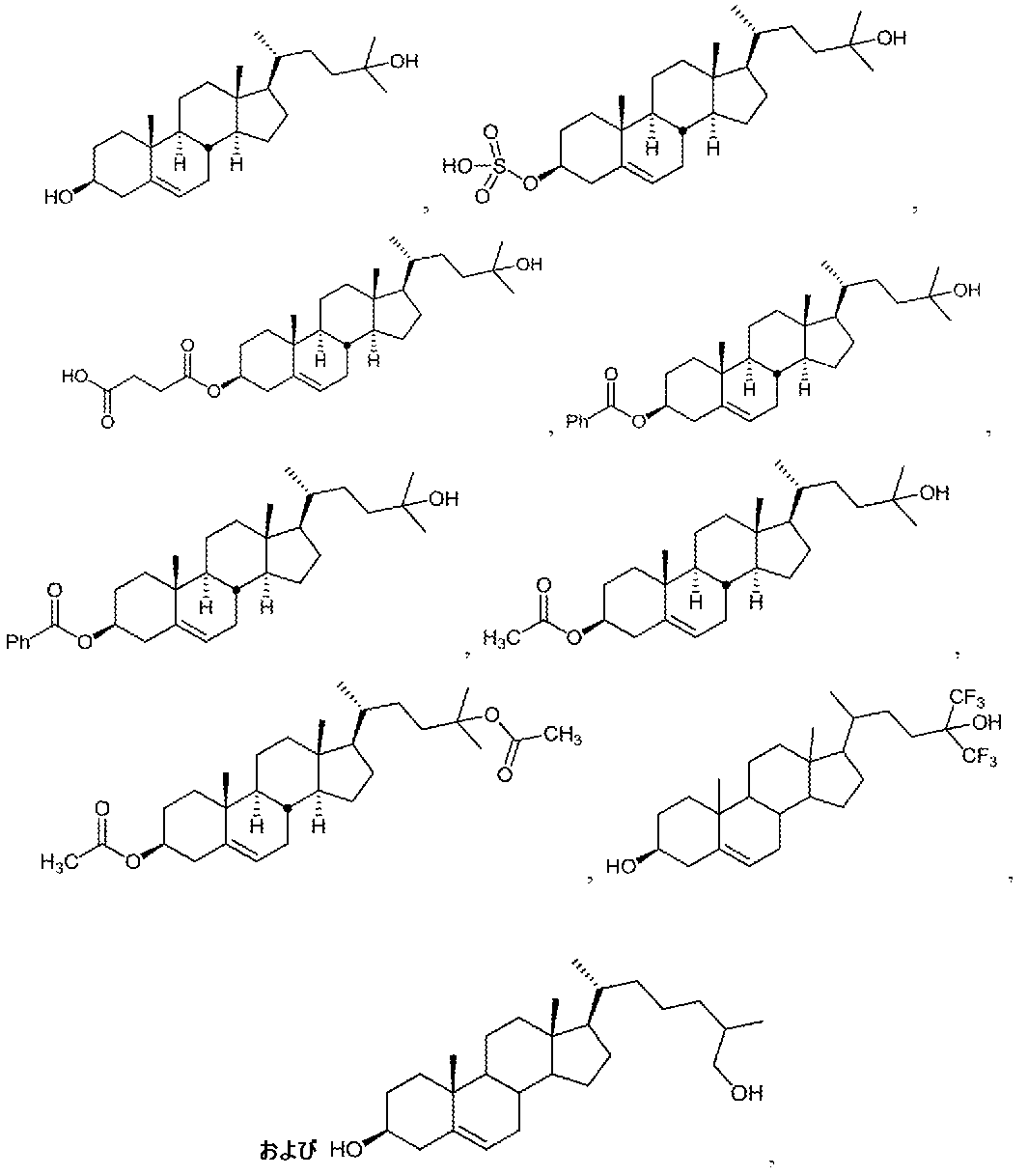
ならびにそれらの薬学的に許容され得る塩、溶媒和化合物、プロドラッグ、立体異性体、
互変異性体、同位体バリアントもしくはN-オキシドまたはそれらの組み合わせは、明確
に除外される。
In certain further embodiments, the following compound:
and pharma- ceutically acceptable salts, solvates, prodrugs, stereoisomers thereof,
Tautomers, isotopic variants or N-oxides, or combinations thereof, are expressly excluded.
R3aの様々な実施形態
上で一般に定義されたように、R3aは、水素、置換もしくは非置換アルキル、置換も
しくは非置換アルケニル、置換もしくは非置換アルキニル、置換もしくは非置換カルボシ
クリル、置換もしくは非置換ヘテロシクリル、置換もしくは非置換アリールまたは置換も
しくは非置換ヘテロアリールである。R3aは、アルファ位(下)またはベータ位(上)
に存在し得ることが、広く理解される。ある特定の実施形態において、R3aは、アルフ
ァである。ある特定の実施形態において、R3aは、ベータである。
Various embodiments of R 3a As generally defined above, R 3a is hydrogen, substituted or unsubstituted alkyl, substituted or unsubstituted alkenyl, substituted or unsubstituted alkynyl, substituted or unsubstituted carbocyclyl, substituted or unsubstituted heterocyclyl, substituted or unsubstituted aryl or substituted or unsubstituted heteroaryl. R 3a may be located at the alpha position (down) or the beta position (up).
It is broadly understood that R 3a may be present at any one of the following positions: In certain embodiments, R 3a is alpha In certain embodiments, R 3a is beta.
ある特定の実施形態において、R3aは、水素である。 In certain embodiments, R 3a is hydrogen.
ある特定の実施形態において、R3aは、置換または非置換アルキル、例えば、置換も
しくは非置換C1-6アルキル、置換もしくは非置換C1-2アルキル、置換もしくは非
置換C2-3アルキル、置換もしくは非置換C3-4アルキル、置換もしくは非置換C4
-5アルキルまたは置換もしくは非置換C5-6アルキルである。例示的なR3aC1-
6アルキル基としては、置換または非置換の、メチル(C1)、エチル(C2)、n-プ
ロピル(C3)、イソプロピル(C3)、n-ブチル(C4)、tert-ブチル(C4
)、sec-ブチル(C4)、iso-ブチル(C4)、n-ペンチル(C5)、3-ペ
ンタニル(C5)、アミル(C5)、ネオペンチル(C5)、3-メチル-2-ブタニル
(C5)、第3級アミル(C5)、n-ヘキシル(C6)、1、2、3、4、5、6、7
、8、9、10個またはそれを超えるフルオロ基で置換されたC1-6アルキル(例えば
、-CF3、-CH2F、-CHF2、ジフルオロエチルおよび2,2,2-トリフルオ
ロ-1,1-ジメチル-エチル)、1、2、3、4、5、6、7、8、9、10個または
それを超えるクロロ基で置換されたC1-6アルキル(例えば、-CH2Cl、-CHC
l2)およびアルコキシ基で置換されたC1-6アルキル(例えば、-CH2OCH3お
よび-CH2OCH2CH3)が挙げられるがこれらに限定されない。ある特定の実施形
態において、R3aは、置換アルキルであり、例えば、R3aは、ハロアルキル、アルコ
キシアルキルまたはアミノアルキルである。ある特定の実施形態において、R3aは、M
e、Et、n-Pr、n-Bu、i-Bu、フルオロメチル、クロロメチル、ジフルオロ
メチル、トリフルオロメチル、トリフルオロエチル、ジフルオロエチル、2,2,2-ト
リフルオロ-1,1-ジメチル-エチル、メトキシメチル、メトキシエチルまたはエトキ
シメチルである。ある特定の実施形態において、R3aは、Me、Et、n-Pr、n-
Buまたはi-Buである。ある特定の実施形態において、R3aは、メトキシメチル、
エトキシメチル、プロポキシメチル、メトキシエチルまたはエトキシエチルである。ある
特定の実施形態において、R3aは、トリフルオロメトキシメチルである。ある特定の実
施形態において、R3aは、フルオロメチル、クロロメチル、ジフルオロメチル、トリフ
ルオロメチル、ジフルオロエチル、トリフルオロエチルまたは2,2,2-トリフルオロ
-1,1-ジメチル-エチルである。ある特定の実施形態において、R3aは、トリフル
オロメチルである。
In certain embodiments, R 3a is substituted or unsubstituted alkyl, for example, substituted or unsubstituted C 1-6 alkyl, substituted or unsubstituted C 1-2 alkyl, substituted or unsubstituted C 2-3 alkyl, substituted or unsubstituted C 3-4 alkyl, substituted or unsubstituted C 4
-5 alkyl or substituted or unsubstituted C 5-6 alkyl.
6. The alkyl group may be substituted or unsubstituted, such as methyl (C 1 ), ethyl (C 2 ), n-propyl (C 3 ), isopropyl (C 3 ), n-butyl (C 4 ), tert-butyl (C 4
), sec-butyl (C 4 ), iso-butyl (C 4 ), n-pentyl (C 5 ), 3-pentanyl (C 5 ), amyl (C 5 ), neopentyl (C 5 ), 3-methyl-2-butanyl (C 5 ), tertiary amyl (C 5 ), n-hexyl (C 6 ), 1, 2, 3, 4, 5, 6, 7
, C 1-6 alkyl substituted with 8, 9, 10 or more fluoro groups (e.g., -CF 3 , -CH 2 F, -CHF 2 , difluoroethyl and 2,2,2-trifluoro-1,1-dimethyl-ethyl), C 1-6 alkyl substituted with 1, 2, 3, 4, 5, 6, 7, 8, 9, 10 or more chloro groups (e.g., -CH 2 Cl, -CHC
In certain embodiments, R 3a is a substituted alkyl, e.g., R 3a is haloalkyl, alkoxyalkyl, or aminoalkyl. In certain embodiments, R 3a is a substituted alkyl , e.g., R 3a is haloalkyl, alkoxyalkyl, or aminoalkyl. In certain embodiments, R 3a is a substituted alkyl, e.g., R 3a is haloalkyl , alkoxyalkyl, or aminoalkyl.
In certain embodiments, R 3a is Me, Et, n-Pr, n-Bu, i-Bu, fluoromethyl, chloromethyl, difluoromethyl, trifluoromethyl, trifluoroethyl, difluoroethyl, 2,2,2- trifluoro -1,1-dimethyl-ethyl, methoxymethyl, methoxyethyl, or ethoxymethyl.
In certain embodiments, R 3a is methoxymethyl,
In certain embodiments, R 3a is ethoxymethyl, propoxymethyl, methoxyethyl or ethoxyethyl. In certain embodiments, R 3a is trifluoromethoxymethyl. In certain embodiments, R 3a is fluoromethyl, chloromethyl, difluoromethyl, trifluoromethyl, difluoroethyl, trifluoroethyl or 2,2,2-trifluoro-1,1-dimethyl-ethyl. In certain embodiments, R 3a is trifluoromethyl.
ある特定の実施形態において、R3aは、置換または非置換アルケニル、例えば、置換
もしくは非置換C2-6アルケニル、置換もしくは非置換C2-3アルケニル、置換もし
くは非置換C3-4アルケニル、置換もしくは非置換C4-5アルケニルまたは置換もし
くは非置換C5-6アルケニルである。ある特定の実施形態において、R3aは、非置換
の、またはアルキル、ハロ、ハロアルキル、アルコキシアルキルもしくはヒドロキシルか
らなる群より選択される1つもしくはそれを超える置換基で置換された、エテニル(C2
)、プロペニル(C3)またはブテニル(C4)である。ある特定の実施形態において、
R3aは、非置換の、またはアルキル、ハロ、ハロアルキル、アルコキシアルキルもしく
はヒドロキシで置換された、エテニル、プロペニルまたはブテニルである。ある特定の実
施形態において、R3aは、エテニルである。
In certain embodiments, R 3a is substituted or unsubstituted alkenyl, such as substituted or unsubstituted C 2-6 alkenyl, substituted or unsubstituted C 2-3 alkenyl, substituted or unsubstituted C 3-4 alkenyl, substituted or unsubstituted C 4-5 alkenyl, or substituted or unsubstituted C 5-6 alkenyl. In certain embodiments, R 3a is ethenyl (C 2 , unsubstituted or substituted with one or more substituents selected from the group consisting of alkyl, halo, haloalkyl, alkoxyalkyl, or hydroxyl.
), propenyl (C 3 ) or butenyl (C 4 ).
R 3a is ethenyl, propenyl, or butenyl, unsubstituted or substituted with alkyl, halo, haloalkyl, alkoxyalkyl, or hydroxy. In certain embodiments, R 3a is ethenyl.
ある特定の実施形態において、R3aは、置換または非置換アルキニル、例えば、置換
もしくは非置換C2-6アルキニル、置換もしくは非置換C2-3アルキニル、置換もし
くは非置換C3-4アルキニル、置換もしくは非置換C4-5アルキニルまたは置換もし
くは非置換C5-6アルキニルである。例示的な置換または非置換R3aアルキニル基と
しては、非置換の、またはアルキル、ハロ、ハロアルキル(例えば、CF3)、アルコキ
シアルキル、シクロアルキル(例えば、シクロプロピルまたはシクロブチル)もしくはヒ
ドロキシルで置換された、エチニル、プロピニルまたはブチニルが挙げられるがこれらに
限定されない。ある特定の実施形態において、R3aは、トリフルオロエチニル、シクロ
プロピルエチニル、シクロブチルエチニルおよびプロピニル、フルオロプロピニルおよび
クロロエチニルからなる群より選択される。ある特定の実施形態において、R3aは、非
置換の、または置換もしくは非置換アリール、置換もしくは非置換ヘテロアリール、置換
もしくは非置換カルボシクリルおよび置換もしくは非置換ヘテロシクリルからなる群より
選択される1つもしくはそれを超える置換基で置換された、エチニル(C2)、プロピニ
ル(C3)またはブチニル(C4)である。ある特定の実施形態において、R3aは、置
換フェニルで置換された、エチニル(C2)、プロピニル(C3)またはブチニル(C4
)である。ある特定の実施形態において、そのフェニル置換基(substituten
t)は、ハロ、アルキル、トリフルオロアルキル、アルコキシ、アシル、アミノまたはア
ミドからなる群より選択される1つまたはそれを超える置換基でさらに置換される。ある
特定の実施形態において、R3aは、置換もしくは非置換の、ピロリル、イミダゾリル、
ピラゾリル、オキサゾイル、チアゾリル、イソオキサゾイル、1,2,3-トリアゾリル
、1,2,4-トリアゾリル、オキサジアゾリル、チアジアゾリルもしくはテトラゾリル
で置換された、エチニル(C2)、プロピニル(C3)またはブチニル(C4)である。
In certain embodiments, R 3a is substituted or unsubstituted alkynyl, such as substituted or unsubstituted C 2-6 alkynyl, substituted or unsubstituted C 2-3 alkynyl, substituted or unsubstituted C 3-4 alkynyl, substituted or unsubstituted C 4-5 alkynyl, or substituted or unsubstituted C 5-6 alkynyl. Exemplary substituted or unsubstituted R 3a alkynyl groups include, but are not limited to, ethynyl, propynyl, or butynyl, unsubstituted or substituted with alkyl, halo, haloalkyl (e.g., CF 3 ), alkoxyalkyl, cycloalkyl (e.g., cyclopropyl or cyclobutyl), or hydroxyl. In certain embodiments, R 3a is selected from the group consisting of trifluoroethynyl, cyclopropylethynyl, cyclobutylethynyl, and propynyl, fluoropropynyl, and chloroethynyl. In certain embodiments, R 3a is ethynyl (C 2 ), propynyl (C 3 ), or butynyl (C 4 ), unsubstituted or substituted with one or more substituents selected from the group consisting of substituted or unsubstituted aryl, substituted or unsubstituted heteroaryl, substituted or unsubstituted carbocyclyl, and substituted or unsubstituted heterocyclyl. In certain embodiments, R 3a is ethynyl (C 2 ), propynyl (C 3 ), or butynyl (C 4 ) , substituted with a substituted phenyl .
In certain embodiments, the phenyl substituent
t) is further substituted with one or more substituents selected from the group consisting of halo, alkyl, trifluoroalkyl, alkoxy, acyl, amino, or amido. In certain embodiments, R 3a is substituted or unsubstituted pyrrolyl, imidazolyl,
It is ethynyl (C 2 ), propynyl (C 3 ) or butynyl (C 4 ) substituted by pyrazolyl, oxazoyl, thiazolyl, isoxazoyl, 1,2,3-triazolyl, 1,2,4-triazolyl, oxadiazolyl, thiadiazolyl or tetrazolyl.
ある特定の実施形態において、R3aは、非置換の、またはアルキル、ハロ、ハロアル
キル、アルコキシアルキルもしくはヒドロキシルで置換された、エチニル、プロピニルま
たはブチニルである。ある特定の実施形態において、R3aは、置換または非置換アリー
ルで置換された、エチニルまたはプロピニルである。ある特定の実施形態において、R3
aは、非置換のフェニルまたはハロ、アルキル、アルコキシ、ハロアルキル、トリハロア
ルキルもしくはアシルで置換されたフェニルで置換された、エチニルあるいはプロピニル
である。ある特定の実施形態において、R3aは、置換または非置換カルボシクリルで置
換された、エチニルまたはプロピニルである。ある特定の実施形態において、R3aは、
置換または非置換の、シクロプロピル、シクロブチル、シクロペンチルまたはシクロヘキ
シルで置換された、エチニルまたはプロピニルである。ある特定の実施形態において、R
3aは、置換または非置換ヘテロアリールで置換された、エチニルまたはプロピニルであ
る。ある特定の実施形態において、R3aは、置換または非置換の、ピリジニルまたはピ
リミジニルで置換された、エチニルまたはプロピニルである。ある特定の実施形態におい
て、R3aは、置換または非置換の、ピロリル、イミダゾリル、ピラゾリル、オキサゾイ
ル、チアゾリル、イソオキサゾイル、1,2,3-トリアゾリル、1,2,4-トリアゾ
リル、オキサジアゾリル、チアジアゾリル、テトラゾリルで置換された、エチニルまたは
プロピニルである。ある特定の実施形態において、R3aは、置換または非置換ヘテロシ
クリルで置換された、エチニルまたはプロピニルである。ある特定の実施形態において、
R3aは、置換または非置換の、ピロリジニル、ピペリジニル、ピペラジニルまたはモル
ホリニル(mopholinyl)で置換された、エチニルまたはプロピニルである。あ
る特定の実施形態において、R3aは、ヒドロキシルまたはアルコキシで置換された、プ
ロピニルまたはブチニルである。ある特定の実施形態において、R3aは、メトキシまた
はエトキシで置換された、プロピニルまたはブチニルである。ある特定の実施形態におい
て、R3aは、Clで置換された、エチニルまたはプロピニルである。ある特定の実施形
態において、R3aは、トリフルオロメチルで置換された、エチニルまたはプロピニルで
ある。
In certain embodiments, R 3a is ethynyl, propynyl, or butynyl, unsubstituted or substituted with alkyl, halo, haloalkyl, alkoxyalkyl, or hydroxyl. In certain embodiments, R 3a is ethynyl or propynyl, substituted with substituted or unsubstituted aryl. In certain embodiments, R 3a is ethynyl or propynyl, unsubstituted or substituted with alkyl, halo, haloalkyl, alkoxyalkyl, or hydroxyl.
a is ethynyl or propynyl substituted with unsubstituted phenyl or phenyl substituted with halo, alkyl, alkoxy, haloalkyl, trihaloalkyl or acyl. In certain embodiments, R 3a is ethynyl or propynyl substituted with substituted or unsubstituted carbocyclyl. In certain embodiments, R 3a is
ethynyl or propynyl, substituted or unsubstituted with cyclopropyl, cyclobutyl, cyclopentyl, or cyclohexyl. In certain embodiments, R
3a is ethynyl or propynyl substituted with substituted or unsubstituted heteroaryl. In certain embodiments, R 3a is ethynyl or propynyl substituted with substituted or unsubstituted pyridinyl or pyrimidinyl. In certain embodiments, R 3a is ethynyl or propynyl substituted with substituted or unsubstituted pyrrolyl, imidazolyl, pyrazolyl, oxazoyl, thiazolyl, isoxazoyl, 1,2,3-triazolyl, 1,2,4-triazolyl, oxadiazolyl, thiadiazolyl, tetrazolyl. In certain embodiments, R 3a is ethynyl or propynyl substituted with substituted or unsubstituted heterocyclyl. In certain embodiments,
R 3a is ethynyl or propynyl substituted with substituted or unsubstituted pyrrolidinyl, piperidinyl, piperazinyl or morpholinyl. In certain embodiments, R 3a is propynyl or butynyl substituted with hydroxyl or alkoxy. In certain embodiments, R 3a is propynyl or butynyl substituted with methoxy or ethoxy. In certain embodiments, R 3a is ethynyl or propynyl substituted with Cl. In certain embodiments, R 3a is ethynyl or propynyl substituted with trifluoromethyl.
ある特定の実施形態において、R3aは、置換または非置換カルボシクリル、例えば、
置換もしくは非置換C3-6カルボシクリル、置換もしくは非置換C3-4カルボシクリ
ル、置換もしくは非置換C4-5カルボシクリルまたは置換もしくは非置換C5-6カル
ボシクリルである。
In certain embodiments, R 3a is a substituted or unsubstituted carbocyclyl, such as,
It is a substituted or unsubstituted C 3-6 carbocyclyl, a substituted or unsubstituted C 3-4 carbocyclyl, a substituted or unsubstituted C 4-5 carbocyclyl or a substituted or unsubstituted C 5-6 carbocyclyl.
ある特定の実施形態において、R3aは、置換または非置換ヘテロシクリル、例えば、
置換もしくは非置換3~6員ヘテロシクリル、置換もしくは非置換3~4員ヘテロシクリ
ル、置換もしくは非置換4~5員ヘテロシクリルまたは置換もしくは非置換5~6員ヘテ
ロシクリルである。
In certain embodiments, R 3a is substituted or unsubstituted heterocyclyl, such as,
It is a substituted or unsubstituted 3- to 6-membered heterocyclyl, a substituted or unsubstituted 3- to 4-membered heterocyclyl, a substituted or unsubstituted 4- to 5-membered heterocyclyl, or a substituted or unsubstituted 5- to 6-membered heterocyclyl.
ある特定の実施形態において、R3aは、置換または非置換アリールである。ある特定
の実施形態において、R3aは、置換または非置換フェニルである。
In certain embodiments, R 3a is substituted or unsubstituted aryl.In certain embodiments, R 3a is substituted or unsubstituted phenyl.
ある特定の実施形態において、R3aは、置換または非置換ヘテロアリール、例えば、
必要に応じて置換される5~6員ヘテロアリールである。
In certain embodiments, R 3a is substituted or unsubstituted heteroaryl, for example,
It is an optionally substituted 5-6 membered heteroaryl.
R3aのさらなる実施形態は、置換または非置換アルキル、置換または非置換アルケニ
ルおよび置換または非置換アルキニル基として、以下:

に描写され、式中、R3cの各実例は、水素、ハロまたは-ORF1であり、ここで、R
F1は、置換または非置換アルキルであり;R3dの各実例は、水素、ハロあるいは置換
もしくは非置換アルキル、置換もしくは非置換カルボシクリルまたは置換もしくは非置換
ヘテロシクリルである。
Further embodiments of R 3a as substituted or unsubstituted alkyl, substituted or unsubstituted alkenyl and substituted or unsubstituted alkynyl groups include the following:
wherein each instance of R 3c is hydrogen, halo, or -OR F1 , where R
F1 is substituted or unsubstituted alkyl; each instance of R 3d is hydrogen, halo, or substituted or unsubstituted alkyl, substituted or unsubstituted carbocyclyl, or substituted or unsubstituted heterocyclyl.
ある特定の実施形態において、少なくとも1つのR3cは、水素である。ある特定の実
施形態において、少なくとも2つのR3cは、水素である。ある特定の実施形態において
、各R3cは、水素である。ある特定の実施形態において、少なくとも1つのR3cは、
ハロゲン(例えば、フルオロ、クロロ、ブロモ、ヨード)である。ある特定の実施形態に
おいて、少なくとも2つのR3cは、ハロゲン(例えば、フルオロ、クロロ、ブロモ、ヨ
ード)である。ある特定の実施形態において、各R3cは、ハロゲン(例えば、基-CF
3を提供するフルオロ)である。ある特定の実施形態において、少なくとも1つのR3c
は、-ORF1(例えば、OMeまたはOEt)である。ある特定の実施形態において、
少なくとも2つのR3cは、-ORF1(例えば、OMeまたはOEt)である。ある特
定の実施形態において、少なくとも1つのR3cは、水素、F、-OMeまたは-OEt
である。ある特定の実施形態において、R3cの1つは、F、-OMeまたはOEtであ
り;残りは、Hである。
In certain embodiments, at least one R 3c is hydrogen. In certain embodiments, at least two R 3c are hydrogen. In certain embodiments, each R 3c is hydrogen. In certain embodiments, at least one R 3c is
In certain embodiments, at least two R 3c are halogen (e.g., fluoro, chloro, bromo, iodo). In certain embodiments, each R 3c is halogen (e.g., a group -CF
In certain embodiments, at least one R 3c is fluoro .
is -OR F1 (e.g., OMe or OEt).
At least two R 3c are -OR F1 (eg, OMe or OEt). In certain embodiments, at least one R 3c is hydrogen, F, -OMe or -OEt
In certain embodiments, one of R 3c is F, —OMe, or OEt;
ある特定の実施形態において、少なくとも1つのR3dは、水素である。ある特定の実
施形態において、各R2cは、水素である。ある特定の実施形態において、少なくとも1
つのR3dは、ハロゲン(例えば、フルオロ、クロロ、ブロモ、ヨード)である。ある特
定の実施形態において、各R3dは、ハロゲン(例えば、フルオロ、クロロ、ブロモ、ヨ
ード)である。ある特定の実施形態において、各R3dは、アルキルであり、例えば、各
R2cは、Meである。ある特定の実施形態において、一方のR3dは、アルキルであり
;他方は、水素であり、例えば、一方のR3dは、Meであり;他方は、水素である。あ
る特定の実施形態において、一方のR3dは、置換または非置換カルボシクリル、例えば
、シクロプロピルまたはシクロブチルであり、他方は、水素である。ある特定の実施形態
において、少なくとも1つのR3dは、水素、-F、-Br、-Cl、-I、-CH3、
-CF3、シクロプロピルまたはシクロブチルである。ある特定の実施形態において、R
3dの各実例は、Hである。ある特定の実施形態において、R3dの各実例は、ハロゲン
(例えば、フルオロ、クロロ、ブロモ、ヨード)である。ある特定の実施形態において、
R3dの各実例は、アルキル、例えば、-CH3、-CF3、-CH2CH2Clである
。ある特定の実施形態において、R3dの各実例は、置換または非置換カルボシクリル、
例えば、シクロプロピルまたはシクロブチルである。ある特定の実施形態において、R3
dは、置換または非置換シクロプロピルである。ある特定の実施形態において、R3dの
各実例は、水素、-F、-Br、-Cl、-I、-CH3、-CF3、-CH2CH2C
l、シクロプロピルまたはシクロブチルである。ある特定の実施形態において、R3dは
、MeまたはClである。ある特定の実施形態において、R3dは、置換または非置換ヘ
テロシクリルである。
In certain embodiments, at least one R 3d is hydrogen. In certain embodiments, each R 2c is hydrogen. In certain embodiments, at least one
One R 3d is halogen (e.g., fluoro, chloro, bromo, iodo). In certain embodiments, each R 3d is halogen (e.g., fluoro, chloro, bromo, iodo). In certain embodiments, each R 3d is alkyl, e.g., each R 2c is Me. In certain embodiments, one R 3d is alkyl; the other is hydrogen, e.g., one R 3d is Me; the other is hydrogen. In certain embodiments, one R 3d is substituted or unsubstituted carbocyclyl, e.g., cyclopropyl or cyclobutyl, and the other is hydrogen. In certain embodiments, at least one R 3d is hydrogen, -F, -Br, -Cl, -I, -CH 3 ,
-CF 3 , cyclopropyl or cyclobutyl.
Each instance of 3d is H. In certain embodiments, each instance of R 3d is halogen (e.g., fluoro, chloro, bromo, iodo).
Each instance of R 3d is alkyl, for example, -CH 3 , -CF 3 , -CH 2 CH 2 Cl. In certain embodiments, each instance of R 3d is substituted or unsubstituted carbocyclyl,
For example, cyclopropyl or cyclobutyl .
In certain embodiments, each instance of R 3d is hydrogen , -F, -Br, -Cl, -I, -CH 3 , -CF 3 , -CH 2 CH 2 C.
In certain embodiments, R 3d is substituted or unsubstituted heterocyclyl. ...
-X1-R3bの様々な実施形態
上で一般に定義されたように、基-X1R3bに対して、X1は、独立して、-O-、-S-または-N(RX)-であり、ここで、RXの各実例は、独立して、水素、置換もしくは非置換アルキル、置換もしくは非置換アルケニル、置換もしくは非置換アルキニル、置換もしくは非置換カルボシクリル、置換もしくは非置換ヘテロシクリル、置換もしくは非置換アリール、置換もしくは非置換ヘテロアルキルまたはアミノ保護基であり;R3bは、水素、-C(=O)RC1、-C(=O)ORC1、-C(=O)SRC1、-C(=O)N(RC1)2、-S(=O)2RC1、-S(=O)2ORC1、-P(=O)2RC1、-P(=O)2ORC1、-P(=O)(ORC1)2、-P(=O)(RC1)2、または-P(=O)(RC1)(ORC1)であり、ここで、RC1は、水素、置換もしくは非置換アルキル、置換もしくは非置換アルケニル、置換もしくは非置換アルキニル、置換もしくは非置換カルボシクリル、置換もしくは非置換ヘテロシクリル、置換もしくは非置換アリールまたは置換もしくは非置換ヘテロアリール、酸素原子に付着されているときは酸素保護基、硫黄原子に付着されているときは硫黄保護基、窒素原子に付着されているときは窒素保護基であるか、あるいは2つのRC1基は、接続して、置換もしくは非置換の複素環式環を形成する。基-X1-R3bは、アルファ位(下)またはベータ位(上)に存在し得ることが、広く理解される。ある特定の実施形態において、基-X1-R3bは、アルファである。ある特定の実施形態において、基-X1-R3bは、ベータである。
Various embodiments of -X 1 -R 3b As generally defined above, for the group -X 1 R 3b , X 1 is independently -O-, -S- or -N(R X )-, where each instance of R X is independently hydrogen, substituted or unsubstituted alkyl, substituted or unsubstituted alkenyl, substituted or unsubstituted alkynyl, substituted or unsubstituted carbocyclyl, substituted or unsubstituted heterocyclyl, substituted or unsubstituted aryl, substituted or unsubstituted heteroalkyl or an amino protecting group; R 3b is hydrogen, -C(=O)R C1 , -C(=O)OR C1 , -C(=O)SR C1 , -C(=O)N(R C1 ) 2 , -S(=O) 2 R C1 , -S(=O) 2 OR C1 , -P(=O) 2 R C1 , -P(=O) 2ORCl , -P(=O)( ORCl ) 2 , -P (=O)( RCl ) 2 , or -P(=O)( RCl )( ORCl ), where RCl is hydrogen, substituted or unsubstituted alkyl, substituted or unsubstituted alkenyl, substituted or unsubstituted alkynyl, substituted or unsubstituted carbocyclyl, substituted or unsubstituted heterocyclyl, substituted or unsubstituted aryl or substituted or unsubstituted heteroaryl, an oxygen protecting group when attached to an oxygen atom, a sulfur protecting group when attached to a sulfur atom, a nitrogen protecting group when attached to a nitrogen atom, or two RCl groups are joined to form a substituted or unsubstituted heterocyclic ring. It is broadly understood that the group -X1 - R3b can be at the alpha position (down) or the beta position (up). In certain embodiments, the group -X 1 -R 3b is alpha. In certain embodiments, the group -X 1 -R 3b is beta.
ある特定の実施形態において、X1は、-O-である。ある特定の実施形態において、
X1は、-S-である。ある特定の実施形態において、X1は、-N(RX)-である。
ある特定の実施形態において、RXは、アルキルである。ある特定の実施形態において、
RXは、Me、Etまたはi-Prである。ある特定の実施形態において、RXは、Hで
あり、すなわち、X1は、-NH-である。
In certain embodiments, X 1 is —O—.
X 1 is -S- In certain embodiments, X 1 is -N(R X )-.
In certain embodiments, R X is alkyl.
R 1 X is Me, Et or i-Pr. In certain embodiments, R 1 X is H, ie, X 1 is -NH-.
ある特定の実施形態において、R3bは、水素である。例えば、ある特定の実施形態に
おいて、基-X1R3bは、-OHである。ある特定の実施形態において、基-X1R3
bは、-SHである。ある特定の実施形態において、基-X1R3bは、-NH2または
-NHRXである。
In certain embodiments, R 3b is hydrogen. For example, in certain embodiments, the group -X 1 R 3b is -OH. In certain embodiments, the group -X 1 R 3
b is -SH. In certain embodiments, the group -X 1 R 3b is -NH 2 or -NHR X.
ある特定の実施形態において、R3bは、-C(=O)RC1、-C(=O)ORC1、-C(=O)SRC1、-C(=O)N(RC1)2、-S(=O)2RC1、-S(=O)2ORC1、-P(=O)2RC1、-P(=O)2ORC1、-P(=O)(ORC1)2、-P(=O)(RC1)2、または-P(=O)(RC1)(ORC1)である。 In certain embodiments, R 3b is -C(=O)R C1 , -C(=O)OR C1 , -C(=O)SR C1 , -C(=O)N(R C1 ) 2 , -S(=O) 2 R C1 , -S(=O) 2 OR C1 , -P(=O) 2 R C1 , -P(=O) 2 OR C1 , -P(=O)(OR C1 ) 2 , -P(=O)(R C1 ) 2 , or -P(=O)(R C1 )(OR C1 ).
ある特定の実施形態において、RC1の少なくとも1つの実例は、水素または保護基、
すなわち、酸素原子に付着されているときは酸素保護基、硫黄原子に付着されているとき
は硫黄保護基または窒素原子に付着されているときは窒素保護基である。ある特定の実施
形態において、RC1の少なくとも1つの実例は、水素である。
In certain embodiments, at least one instance of R C1 is hydrogen or a protecting group,
That is, when attached to an oxygen atom, it is an oxygen protecting group, when attached to a sulfur atom, it is a sulfur protecting group, or when attached to a nitrogen atom, it is a nitrogen protecting group. In certain embodiments, at least one instance of R is hydrogen.
ある特定の実施形態において、RC1の少なくとも1つの実例は、置換または非置換ア
ルキル、例えば、置換もしくは非置換C1-6アルキル、置換もしくは非置換C1-2ア
ルキル、置換もしくは非置換C2-3アルキル、置換もしくは非置換C3-4アルキル、
置換もしくは非置換C4-5アルキルまたは置換もしくは非置換C5-6アルキルである
。例示的なRC1C1-6アルキル基としては、置換または非置換の、メチル(C1)、
エチル(C2)、n-プロピル(C3)、イソプロピル(C3)、n-ブチル(C4)、
tert-ブチル(C4)、sec-ブチル(C4)、iso-ブチル(C4)、n-ペ
ンチル(C5)、3-ペンタニル(C5)、アミル(C5)、ネオペンチル(C5)、3
-メチル-2-ブタニル(C5)、第3級アミル(C5)、n-ヘキシル(C6)、1、
2、3、4、5、6、7、8、9、10個またはそれを超えるフルオロ基で置換されたC
1-6アルキル(例えば、-CF3、-CH2F、-CHF2、ジフルオロエチルおよび
2,2,2-トリフルオロ-1,1-ジメチル-エチル)、1、2、3、4、5、6、7
、8、9、10個またはそれを超えるクロロ基で置換されたC1-6アルキル(例えば、
-CH2Cl、-CHCl2)およびアルコキシ基で置換されたC1-6アルキル(例え
ば、-CH2OCH3および-CH2OCH2CH3)が挙げられるがこれらに限定され
ない。
In certain embodiments, at least one instance of R C1 is substituted or unsubstituted alkyl, for example, substituted or unsubstituted C 1-6 alkyl, substituted or unsubstituted C 1-2 alkyl, substituted or unsubstituted C 2-3 alkyl, substituted or unsubstituted C 3-4 alkyl,
Exemplary R C1 C 1-6 alkyl groups include substituted or unsubstituted methyl ( C 1 ),
Ethyl (C 2 ), n-propyl (C 3 ), isopropyl (C 3 ), n-butyl (C 4 ),
tert-Butyl (C 4 ), sec-Butyl (C 4 ), iso-Butyl (C 4 ), n-Pentyl (C 5 ), 3-Pentanyl (C 5 ), amyl (C 5 ), neopentyl (C 5 ), 3
-methyl-2-butanyl (C 5 ), tertiary amyl (C 5 ), n-hexyl (C 6 ), 1,
C substituted with 2, 3, 4, 5, 6, 7, 8, 9, 10 or more fluoro groups
1-6 alkyl (e.g., —CF 3 , —CH 2 F, —CHF 2 , difluoroethyl and 2,2,2-trifluoro-1,1-dimethyl-ethyl), 1, 2, 3, 4, 5, 6, 7
, C 1-6 alkyl substituted with 8, 9, 10 or more chloro groups (e.g.,
-CH 2 Cl, -CHCl 2 ) and C 1-6 alkyl substituted with alkoxy groups (eg, -CH 2 OCH 3 and -CH 2 OCH 2 CH 3 ).
ある特定の実施形態において、RC1の少なくとも1つの実例は、置換または非置換ア
ルケニル、例えば、置換もしくは非置換C2-6アルケニル、置換もしくは非置換C2-
3アルケニル、置換もしくは非置換C3-4アルケニル、置換もしくは非置換C4-5ア
ルケニルまたは置換もしくは非置換C5-6アルケニルである。
In certain embodiments, at least one instance of R C1 is substituted or unsubstituted alkenyl, for example, substituted or unsubstituted C 2-6 alkenyl, substituted or unsubstituted C 2-
3 alkenyl, substituted or unsubstituted C 3-4 alkenyl, substituted or unsubstituted C 4-5 alkenyl or substituted or unsubstituted C 5-6 alkenyl.
ある特定の実施形態において、RC1の少なくとも1つの実例は、置換または非置換ア
ルキニル、例えば、置換もしくは非置換C2-6アルキニル、置換もしくは非置換C2-
3アルキニル、置換もしくは非置換C3-4アルキニル、置換もしくは非置換C4-5ア
ルキニルまたは置換もしくは非置換C5-6アルキニルである。
In certain embodiments, at least one instance of R C1 is substituted or unsubstituted alkynyl, for example, substituted or unsubstituted C 2-6 alkynyl, substituted or unsubstituted C 2-
3 alkynyl, substituted or unsubstituted C 3-4 alkynyl, substituted or unsubstituted C 4-5 alkynyl or substituted or unsubstituted C 5-6 alkynyl.
ある特定の実施形態において、RC1の少なくとも1つの実例は、置換または非置換カ
ルボシクリル、例えば、置換もしくは非置換C3-6カルボシクリル、置換もしくは非置
換C3-4カルボシクリル、置換もしくは非置換C4-5カルボシクリルまたは置換もし
くは非置換C5-6カルボシクリルである。
In certain embodiments, at least one instance of R C1 is substituted or unsubstituted carbocyclyl, for example, substituted or unsubstituted C 3-6 carbocyclyl, substituted or unsubstituted C 3-4 carbocyclyl, substituted or unsubstituted C 4-5 carbocyclyl, or substituted or unsubstituted C 5-6 carbocyclyl.
ある特定の実施形態において、RC1の少なくとも1つの実例は、置換または非置換ヘ
テロシクリル、例えば、置換もしくは非置換3~6員ヘテロシクリル、置換もしくは非置
換3~4員ヘテロシクリル、置換もしくは非置換4~5員ヘテロシクリルまたは置換もし
くは非置換5~6員ヘテロシクリルである。
In certain embodiments, at least one instance of R C1 is substituted or unsubstituted heterocyclyl, e.g., substituted or unsubstituted 3- to 6-membered heterocyclyl, substituted or unsubstituted 3- to 4-membered heterocyclyl, substituted or unsubstituted 4- to 5-membered heterocyclyl, or substituted or unsubstituted 5- to 6-membered heterocyclyl.
ある特定の実施形態において、RC1の少なくとも1つの実例は、置換または非置換ア
リール、例えば、置換または非置換フェニルである。
In certain embodiments, at least one instance of R C1 is substituted or unsubstituted aryl, for example, substituted or unsubstituted phenyl.
ある特定の実施形態において、RC1の少なくとも1つの実例は、置換または非置換ヘ
テロアリール、例えば、必要に応じて置換される5~6員ヘテロアリールである。
In certain embodiments, at least one instance of R C1 is substituted or unsubstituted heteroaryl, eg, an optionally substituted 5-6 membered heteroaryl.
ある特定の実施形態において、2つのRC1基は、接続して、置換または非置換の複素
環式環、例えば、置換もしくは非置換ピペリジニル環、置換もしくは非置換ピペラジニル
環または置換もしくは非置換モルホリニル環を形成する。
In certain embodiments, two R C1 groups are joined to form a substituted or unsubstituted heterocyclic ring, for example, a substituted or unsubstituted piperidinyl ring, a substituted or unsubstituted piperazinyl ring, or a substituted or unsubstituted morpholinyl ring.
ある特定の実施形態において、R3bは、-C(=O)RC1、-C(=O)ORC1
、-C(=O)N(RC1)2または-C(=O)N(ORC1)(RC1)であり、こ
こで、RC1は、本明細書中で定義されるとおりである。
In certain embodiments, R 3b is -C(=O)R C1 , -C(=O)OR C1
, -C(=O)N(R C1 ) 2 or -C(=O)N(OR C1 )(R C1 ), where R C1 is as defined herein.
ある特定の実施形態において、R3bは、-C(=O)RC1であり、例えば、RC1
は、例えば、置換または非置換の、メチル(C1)、エチル(C2)、n-プロピル(C
3)、イソプロピル(C3)、n-ブチル(C4)、tert-ブチル(C4)、sec
-ブチル(C4)、iso-ブチル(C4)、n-ペンチル(C5)、3-ペンタニル(
C5)、アミル(C5)、ネオペンチル(C5)、3-メチル-2-ブタニル(C5)、
第3級アミル(C5)またはn-ヘキシル(C6)である。ある特定の実施形態において
、R3bは、-C(=O)CH3である。ある特定の実施形態において、R3bは、-C
(=O)(CH2)mCO2Hであり、ここで、mは、2以上5以下の整数である。ある
特定の実施形態において、mは、2である。ある特定の実施形態において、mは、3であ
る。ある特定の実施形態において、mは、4である。ある特定の実施形態において、mは
、5である。ある特定の実施形態において、R3bは、-C(=O)CH2CH2C(=
O)OHである。
In certain embodiments, R 3b is —C(═O)R C1 , for example, R C1
is, for example, a substituted or unsubstituted methyl (C 1 ), ethyl (C 2 ), n-propyl (C
3 ), isopropyl (C 3 ), n-butyl (C 4 ), tert-butyl (C 4 ), sec
-butyl (C 4 ), iso-butyl (C 4 ), n-pentyl (C 5 ), 3-pentanyl (
C 5 ), amyl (C 5 ), neopentyl (C 5 ), 3-methyl-2-butanyl (C 5 ),
tertiary amyl (C 5 ) or n-hexyl (C 6 ). In certain embodiments, R 3b is -C(=O)CH 3. In certain embodiments, R 3b is -C
(=O)(CH 2 ) m CO 2 H, where m is an integer from 2 to 5, inclusive. In certain embodiments, m is 2. In certain embodiments, m is 3. In certain embodiments, m is 4. In certain embodiments, m is 5. In certain embodiments, R 3b is -C(=O)CH 2 CH 2 C(=
O) OH.
ある特定の実施形態において、R3bは、-C(=O)ORC1であり、例えば、RC
1は、例えば、置換または非置換の、メチル(C1)、エチル(C2)、n-プロピル(
C3)、イソプロピル(C3)、n-ブチル(C4)、tert-ブチル(C4)、se
c-ブチル(C4)、iso-ブチル(C4)、n-ペンチル(C5)、3-ペンタニル
(C5)、アミル(C5)、ネオペンチル(C5)、3-メチル-2-ブタニル(C5)
、第3級アミル(C5)またはn-ヘキシル(C6)である。
In certain embodiments, R 3b is —C(═O)OR C1 , for example, R C
1 is, for example, a substituted or unsubstituted methyl (C 1 ), ethyl (C 2 ), n-propyl (
C 3 ), isopropyl (C 3 ), n-butyl (C 4 ), tert-butyl (C 4 ), se
c-Butyl (C 4 ), iso-Butyl (C 4 ), n-Pentyl (C 5 ), 3-Pentanyl (C 5 ), Amyl (C 5 ), Neopentyl (C 5 ), 3-Methyl-2-butanyl (C 5 )
, tertiary amyl (C 5 ) or n-hexyl (C 6 ).
ある特定の実施形態において、R3bは、-C(=O)SRC1であり、例えば、RC
1は、例えば、置換または非置換の、メチル(C1)、エチル(C2)、n-プロピル(
C3)、イソプロピル(C3)、n-ブチル(C4)、tert-ブチル(C4)、se
c-ブチル(C4)、iso-ブチル(C4)、n-ペンチル(C5)、3-ペンタニル
(C5)、アミル(C5)、ネオペンチル(C5)、3-メチル-2-ブタニル(C5)
、第3級アミル(C5)またはn-ヘキシル(C6)である。
In certain embodiments, R 3b is —C(═O)SR C1 , for example, R C
1 is, for example, a substituted or unsubstituted methyl (C 1 ), ethyl (C 2 ), n-propyl (
C 3 ), isopropyl (C 3 ), n-butyl (C 4 ), tert-butyl (C 4 ), se
c-Butyl (C 4 ), iso-Butyl (C 4 ), n-Pentyl (C 5 ), 3-Pentanyl (C 5 ), Amyl (C 5 ), Neopentyl (C 5 ), 3-Methyl-2-butanyl (C 5 )
, tertiary amyl (C 5 ) or n-hexyl (C 6 ).
ある特定の実施形態において、R3bは、-C(=O)N(RC1)2、例えば、-C
(=O)NH2または-C(=O)NHRC1であり、ここで、RC1は、例えば、置換
もしくは非置換の、メチル(C1)、エチル(C2)、n-プロピル(C3)、イソプロ
ピル(C3)、n-ブチル(C4)、tert-ブチル(C4)、sec-ブチル(C4
)、iso-ブチル(C4)、n-ペンチル(C5)、3-ペンタニル(C5)、アミル
(C5)、ネオペンチル(C5)、3-メチル-2-ブタニル(C5)、第3級アミル(
C5)もしくはn-ヘキシル(C6)であるか、またはR1は、-C(=O)N(RC1
)2であり、ここで、その2つのRC1基は、接続して、置換または非置換の複素環式環
、例えば、置換もしくは非置換ピペリジニル環、置換もしくは非置換ピペラジニル環また
は置換もしくは非置換モルホリニル環を形成する。
In certain embodiments, R 3b is —C(═O)N(R C1 ) 2 , for example, —C
(=O) NH2 or -C(=O)NHR C1 , where R C1 is, for example, substituted or unsubstituted methyl (C 1 ), ethyl (C 2 ) , n-propyl (C 3 ), isopropyl (C 3 ), n-butyl (C 4 ), tert-butyl (C 4 ) , sec -butyl (C 4
), iso-butyl (C 4 ), n-pentyl (C 5 ), 3-pentanyl (C 5 ), amyl (C 5 ), neopentyl (C 5 ), 3-methyl-2-butanyl (C 5 ), tertiary amyl (
C 5 ) or n-hexyl (C 6 ), or R 1 is —C(═O)N(R C1
) 2 , where the two R C1 groups are joined to form a substituted or unsubstituted heterocyclic ring, for example a substituted or unsubstituted piperidinyl ring, a substituted or unsubstituted piperazinyl ring, or a substituted or unsubstituted morpholinyl ring.
ある特定の実施形態において、R3bは、-S(=O)2RC1または-S(=O)2
ORC1であり、ここで、RC1は、例えば、水素、または置換もしくは非置換の、メチ
ル(C1)、エチル(C2)、n-プロピル(C3)、イソプロピル(C3)、n-ブチ
ル(C4)、tert-ブチル(C4)、sec-ブチル(C4)、iso-ブチル(C
4)、n-ペンチル(C5)、3-ペンタニル(C5)、アミル(C5)、ネオペンチル
(C5)、3-メチル-2-ブタニル(C5)、第3級アミル(C5)もしくはn-ヘキ
シル(C6)、または置換もしくは非置換フェニルである。ある特定の実施形態において
、R3bは、-S(=O)2RC1である。ある特定の実施形態において、R3bは、-
S(=O)2ORC1、例えば、-SO3Hである。
In certain embodiments, R 3b is -S(=O) 2 R C1 or -S(=O) 2
OR C1 , where R C1 is, for example, hydrogen or substituted or unsubstituted methyl (C 1 ), ethyl (C 2 ), n-propyl (C 3 ), isopropyl (C 3 ), n-butyl (C 4 ) , tert-butyl (C 4 ), sec-butyl (C 4 ), iso-butyl (C
4 ), n-pentyl (C 5 ), 3-pentanyl (C 5 ), amyl (C 5 ), neopentyl (C 5 ), 3-methyl-2-butanyl (C 5 ), tertiary amyl (C 5 ) or n-hexyl (C 6 ), or substituted or unsubstituted phenyl. In certain embodiments, R 3b is -S(=O) 2 R C1 . In certain embodiments, R 3b is -
S(=O) 2 OR C1 is, for example, -SO 3 H.
ある特定の実施形態において、R3bは、-P(=O)2RC1、-P(=O)2OR
C1、-P(=O)(ORC1)2、-P(=O)(RC1)2または-P(=O)(R
C1)(ORC1)であり、ここで、各RC1は、例えば、独立して、水素、置換または
非置換の、メチル(C1)、エチル(C2)、n-プロピル(C3)、イソプロピル(C
3)、n-ブチル(C4)、tert-ブチル(C4)、sec-ブチル(C4)、is
o-ブチル(C4)、n-ペンチル(C5)、3-ペンタニル(C5)、アミル(C5)
、ネオペンチル(C5)、3-メチル-2-ブタニル(C5)、第3級アミル(C5)も
しくはn-ヘキシル(C6)または置換もしくは非置換フェニルである。ある特定の実施
形態において、R3bは、-P(=O)2RC1である。ある特定の実施形態において、
R1は、-P(=O)2ORC1である。ある特定の実施形態において、R3bは、-P
(=O)(ORC1)2である。ある特定の実施形態において、R1は、-P(=O)(
RC1)2である。ある特定の実施形態において、R3bは、-P(=O)(RC1)(
ORC1)である。
In certain embodiments, R 3b is -P(=O) 2 R C1 , -P(=O) 2 OR
C1 , -P(=O)(OR C1 ) 2 , -P(=O)(R C1 ) 2 or -P(=O)(R
C1 )(OR C1 ), where each R C1 is, for example, independently hydrogen, substituted or unsubstituted methyl (C 1 ), ethyl (C 2 ), n-propyl (C 3 ), isopropyl (C
3 ), n-butyl (C 4 ), tert-butyl (C 4 ), sec-butyl (C 4 ), is
o-Butyl (C 4 ), n-Pentyl (C 5 ), 3-Pentanyl (C 5 ), Amyl (C 5 )
, neopentyl (C 5 ), 3-methyl-2-butanyl (C 5 ), tertiary amyl (C 5 ) or n-hexyl (C 6 ), or substituted or unsubstituted phenyl. In certain embodiments, R 3b is -P(=O) 2 R C1 . In certain embodiments,
R 1 is -P(=O) 2 OR C1 . In certain embodiments, R 3b is -P
(=O)(OR C1 ) 2. In certain embodiments, R 1 is -P(=O)(
R C1 ) 2. In certain embodiments, R 3b is -P(=O)(R C1 ) (
OR C1 ).
Zが式(i)または(ii)の基である様々な実施形態
ある特定の実施形態において、Zは、式(i)の基である:

他の実施形態において、Zは、式(ii)の基である:

上で一般に定義されたように、L1およびL2は、結合である(すなわち、換言すれば
、存在しない)か、あるいは置換もしくは非置換C1-C6アルキレン、置換もしくは非
置換C2-C6アルケニレン、置換もしくは非置換C2-C6アルキニレン、置換もしく
は非置換ヘテロC1-C6アルキレン、置換もしくは非置換ヘテロC2-C6アルケニレ
ンまたは置換もしくは非置換ヘテロC2-C6アルキニレンである。
As generally defined above, L 1 and L 2 are a bond (i.e., in other words, absent) or a substituted or unsubstituted C 1 -C 6 alkylene, substituted or unsubstituted C 2 -C 6 alkenylene, substituted or unsubstituted C 2 -C 6 alkynylene, substituted or unsubstituted hetero C 1 -C 6 alkylene, substituted or unsubstituted hetero C 2 -C 6 alkenylene or substituted or unsubstituted hetero C 2 -C 6 alkynylene.
ある特定の実施形態において、L1またはL2は、結合である。 In certain embodiments, L 1 or L 2 is a bond.
ある特定の実施形態において、L1またはL2は、置換または非置換C1-C6アルキ
レンである。ある特定の実施形態において、L1またはL2は、置換または非置換C1-
C4アルキレンである。ある特定の実施形態において、L1またはL2は、置換または非
置換C1-C3アルキレンである。ある特定の実施形態において、L1またはL2は、置
換または非置換C1-C2アルキレンである。ある特定の実施形態において、L1または
L2は、置換または非置換C1アルキレンである。ある特定の実施形態において、L1ま
たはL2は、置換または非置換C2アルキレンである。ある特定の実施形態において、L
1またはL2は、置換または非置換C3アルキレンである。ある特定の実施形態において
、L1またはL2は、置換または非置換C4アルキレンである。ある特定の実施形態にお
いて、L1またはL2は、置換または非置換C5アルキレンである。ある特定の実施形態
において、L1またはL2は、置換または非置換C6アルキレンである。ある特定の実施
形態において、L1またはL2は、置換または非置換アルキルおよびハロからなる群より
選択される1つまたはそれを超える置換基で置換された、上に記載されたようなアルキレ
ン基である。ある特定の実施形態において、L1またはL2は、-CH2-、-CHMe
-、-CMe2-、-CH2-CH2-、-CF2-CH2-、-CH2-CMe2-、
-CH2-CH2-CH2-または-CH2-CH2-CMe2-である。
In certain embodiments, L 1 or L 2 is a substituted or unsubstituted C 1 -C 6 alkylene.
In certain embodiments, L 1 or L 2 is a substituted or unsubstituted C 1 -C 3 alkylene. In certain embodiments, L 1 or L 2 is a substituted or unsubstituted C 1 -C 2 alkylene. In certain embodiments, L 1 or L 2 is a substituted or unsubstituted C 1 alkylene. In certain embodiments, L 1 or L 2 is a substituted or unsubstituted C 2 alkylene. In certain embodiments, L
In certain embodiments, L 1 or L 2 is a substituted or unsubstituted C 3 alkylene. In certain embodiments, L 1 or L 2 is a substituted or unsubstituted C 4 alkylene. In certain embodiments, L 1 or L 2 is a substituted or unsubstituted C 5 alkylene. In certain embodiments, L 1 or L 2 is a substituted or unsubstituted C 6 alkylene. In certain embodiments, L 1 or L 2 is an alkylene group as described above substituted with one or more substituents selected from the group consisting of substituted or unsubstituted alkyl and halo. In certain embodiments, L 1 or L 2 is -CH 2 -, -CHMe, -CHMe- ...
-, -CMe 2 -, -CH 2 -CH 2 -, -CF 2 -CH 2 -, -CH 2 -CMe 2 -,
-CH2- CH2 - CH2- or -CH2 - CH2 - CMe2- .
ある特定の実施形態において、L1またはL2は、置換または非置換C2-C6アルケ
ニレンである。ある特定の実施形態において、L1またはL2は、置換または非置換C2
-C5アルケニレンである。ある特定の実施形態において、L1またはL2は、置換また
は非置換C2-C4アルケニレンである。ある特定の実施形態において、L1またはL2
は、置換または非置換C2-C3アルケニレンである。ある特定の実施形態において、L
1またはL2は、置換または非置換C2アルケニレンである。ある特定の実施形態におい
て、L1またはL2は、置換または非置換C3アルケニレンである。ある特定の実施形態
において、L1またはL2は、置換または非置換C4アルケニレンである。ある特定の実
施形態において、L1またはL2は、置換または非置換C5アルケニレンである。ある特
定の実施形態において、L1またはL2は、置換または非置換C6アルケニレンである。
ある特定の実施形態において、L1またはL2は、置換または非置換アルキルおよびハロ
からなる群より選択される1つまたはそれを超える置換基で置換された、上に記載された
ようなアルケニレン基である。
In certain embodiments, L 1 or L 2 is a substituted or unsubstituted C 2 -C 6 alkenylene. In certain embodiments, L 1 or L 2 is a substituted or unsubstituted C 2
In certain embodiments, L 1 or L 2 is a substituted or unsubstituted C 2 -C 4 alkenylene. In certain embodiments, L 1 or L 2 is a substituted or unsubstituted C 2 -C 4 alkenylene.
is substituted or unsubstituted C 2 -C 3 alkenylene. In certain embodiments, L
L 1 or L 2 is a substituted or unsubstituted C 2 alkenylene. In certain embodiments, L 1 or L 2 is a substituted or unsubstituted C 3 alkenylene. In certain embodiments, L 1 or L 2 is a substituted or unsubstituted C 4 alkenylene. In certain embodiments, L 1 or L 2 is a substituted or unsubstituted C 5 alkenylene. In certain embodiments, L 1 or L 2 is a substituted or unsubstituted C 6 alkenylene.
In certain embodiments, L 1 or L 2 is an alkenylene group, as described above, substituted with one or more substituents selected from the group consisting of substituted or unsubstituted alkyl and halo.
ある特定の実施形態において、L1またはL2は、置換または非置換C2-C6アルキ
ニレンである。ある特定の実施形態において、L1またはL2は、置換または非置換C2
-C5アルキニレンである。ある特定の実施形態において、L1またはL2は、置換また
は非置換C2-C4アルキニレンである。ある特定の実施形態において、L1またはL2
は、置換または非置換C2-C3アルキニレンである。ある特定の実施形態において、L
1またはL2は、置換または非置換C2アルキニレンである。ある特定の実施形態におい
て、L1またはL2は、置換または非置換C3アルキニレンである。ある特定の実施形態
において、L1またはL2は、置換または非置換C4アルキニレンである。ある特定の実
施形態において、L1は、置換または非置換C5アルキニレンである。ある特定の実施形
態において、L1またはL2は、置換または非置換C6アルキニレンである。ある特定の
実施形態において、L1またはL2は、置換または非置換アルキルおよびハロからなる群
より選択される1つまたはそれを超える置換基で置換された、上に記載されたようなアル
キニレン基である。
In certain embodiments, L 1 or L 2 is a substituted or unsubstituted C 2 -C 6 alkynylene. In certain embodiments, L 1 or L 2 is a substituted or unsubstituted C 2
In certain embodiments, L 1 or L 2 is a substituted or unsubstituted C 2 -C 4 alkynylene. In certain embodiments, L 1 or L 2 is a substituted or unsubstituted C 2 -C 4 alkynylene.
is substituted or unsubstituted C 2 -C 3 alkynylene. In certain embodiments, L
L 1 or L 2 is a substituted or unsubstituted C 2 alkynylene. In certain embodiments, L 1 or L 2 is a substituted or unsubstituted C 3 alkynylene. In certain embodiments, L 1 or L 2 is a substituted or unsubstituted C 4 alkynylene. In certain embodiments, L 1 is a substituted or unsubstituted C 5 alkynylene. In certain embodiments, L 1 or L 2 is a substituted or unsubstituted C 6 alkynylene. In certain embodiments, L 1 or L 2 is an alkynylene group as described above substituted with one or more substituents selected from the group consisting of substituted or unsubstituted alkyl and halo.
さらに、ある特定の実施形態において、L1またはL2は、置換または非置換ヘテロC
1-6アルキレン、例えば、置換もしくは非置換ヘテロC1-2アルキレン、置換もしく
は非置換ヘテロC2-3アルキレン、置換もしくは非置換ヘテロC3-4アルキレン、置
換もしくは非置換ヘテロC4-5アルキレンまたは置換もしくは非置換ヘテロC5-6ア
ルキレンである。ある特定の実施形態において、L1またはL2は、置換または非置換ヘ
テロC2-6アルケニレン(alkyenlene)、例えば、置換もしくは非置換ヘテ
ロC2-3アルケニレン、置換もしくは非置換ヘテロC3-4アルケニレン、置換もしく
は非置換ヘテロC4-5アルケニレンまたは置換もしくは非置換ヘテロC5-6アルケニ
レンである。ある特定の実施形態において、L1またはL2は、置換または非置換ヘテロ
C2-6アルキニレン、例えば、置換もしくは非置換ヘテロC2-3アルキニレン、置換
もしくは非置換ヘテロC3-4アルキニレン、置換もしくは非置換ヘテロC4-5アルキ
ニレンまたは置換もしくは非置換ヘテロC5-6アルキニレンである。上記の実例のいず
れかにおいて、ある特定の実施形態において、L1またはL2は、非置換の、あるいはハ
ロ(例えば、フルオロ)または置換もしくは非置換C1-6アルキルで置換された、ヘテ
ロアルキレン、ヘテロアルケニレンまたはヘテロアルキニレンである。
Furthermore, in certain embodiments, L 1 or L 2 is a substituted or unsubstituted heterocyclic C
In certain embodiments, L 1 or L 2 is substituted or unsubstituted heteroC 2-6 alkenylene, such as substituted or unsubstituted heteroC 1-2 alkylene, substituted or unsubstituted heteroC 2-3 alkylene, substituted or unsubstituted heteroC 3-4 alkylene, substituted or unsubstituted heteroC 4-5 alkylene, or substituted or unsubstituted heteroC 5-6 alkylene. In certain embodiments, L 1 or L 2 is substituted or unsubstituted heteroC 2-6 alkenylene, such as substituted or unsubstituted heteroC 2-3 alkenylene, substituted or unsubstituted heteroC 3-4 alkenylene, substituted or unsubstituted heteroC 4-5 alkenylene, or substituted or unsubstituted heteroC 5-6 alkenylene. In certain embodiments, L 1 or L 2 is substituted or unsubstituted heteroC 2-6 alkynylene, such as substituted or unsubstituted heteroC 2-3 alkynylene, substituted or unsubstituted heteroC 3-4 alkynylene, substituted or unsubstituted heteroC 4-5 alkynylene, or substituted or unsubstituted heteroC 5-6 alkynylene. In any of the above examples, in certain embodiments, L 1 or L 2 is heteroalkylene, heteroalkenylene, or heteroalkynylene that is unsubstituted or substituted with halo (e.g., fluoro) or substituted or unsubstituted C 1-6 alkyl.
上で一般に定義されたように、R1は、水素、置換もしくは非置換アルキル、置換もしくは非置換アルケニル、置換もしくは非置換アルキニル、置換もしくは非置換カルボシクリル、置換もしくは非置換ヘテロシクリル、置換もしくは非置換アリール、置換もしくは非置換ヘテロアリール、ハロ、-N3、-NO2、-SCN、-CN、-ORA1、-SRA1、-N(RA1)2、-N=NRA1、-N=C(RA1)2、-N(ORA1)(RA1)、-C(=O)RA1、-C(=O)ORA1、-C(=O)SRA1、-C(=O)N(RA1)2、-C(=O)N(ORA1)(RA1)、-OC(=O)RA1、-OC(=O)ORA1、-OC(=O)SRA1、-OC(=O)N(RA1)2、-NRA1C(=O)RA1、-NRA1C(=O)ORA1、-NRA1C(=O)SRA1、-NRA1C(=O)N(RA1)2、-SC(=O)RA2、-SC(=O)ORA1、-SC(=O)SRA1、-SC(=O)N(RA1)2、-OS(=O)2RA2、-OS(=O)2ORA1、-S-S(=O)2RA2、-S-S(=O)2ORA1、-S(=O)RA2、-SO2RA2、-NRA1SO2RA2、または-SO2N(RA1)2であり、ここで、RA1は、水素、置換もしくは非置換アルキル、置換もしくは非置換アルケニル、置換もしくは非置換アルキニル、置換もしくは非置換カルボシクリル、置換もしくは非置換ヘテロシクリル、置換もしくは非置換アリールまたは置換もしくは非置換ヘテロアリール、酸素原子に付着されているときは酸素保護基、硫黄原子に付着されているときは硫黄保護基、窒素原子に付着されているときは窒素保護基であるか、あるいは2つのRA1基は、接続して、置換または非置換の複素環式環を形成し;RA2は、置換もしくは非置換アルキル、置換もしくは非置換アルケニル、置換もしくは非置換アルキニル、置換もしくは非置換カルボシクリル、置換もしくは非置換ヘテロシクリル、置換もしくは非置換アリールまたは置換もしくは非置換ヘテロアリールであるか、あるいはRA1基およびRA2基は、接続して、置換または非置換の複素環式環を形成する。 As generally defined above, R 1 is hydrogen, substituted or unsubstituted alkyl, substituted or unsubstituted alkenyl, substituted or unsubstituted alkynyl, substituted or unsubstituted carbocyclyl, substituted or unsubstituted heterocyclyl, substituted or unsubstituted aryl, substituted or unsubstituted heteroaryl, halo, -N 3 , -NO 2 , -SCN, -CN, -OR A1 , -SR A1 , -N(R A1 ) 2 , -N=NR A1 , -N= C(R A1 ) 2 , -N(OR A1 )(R A1 ) , -C ( =O)R A1 , -C(=O)OR A1 , -C(=O)SR A1 , -C(=O)N(R A1 ) 2 , -C(=O)N(OR A1 )(R A1 ), -OC(=O)R A1 , -OC(=O)OR A1 , -OC(=O)SR A1 , -OC(=O)N(R A1 ) 2 , -NR A1 C(=O)R A1 , -NR A1 C(=O)OR A1 , -NR A1 C(=O)SR A1 , -NR A1 C(=O)N(R A1 ) 2 , -SC(=O)R A2 , -SC(=O)OR A1 , -SC(=O)SR A1 , -SC(=O)N(R A1 ) 2 , -OS(=O) 2 R A2 , -OS(=O) 2 OR A1 , -SS(=O) 2 R A2 , -S-S(=O) 2ORA1 , -S(=O)R A2 , -SO2R A2 , -NR A1SO2R A2 , or -SO2N (R A1 ) 2 , where R A1 is hydrogen, substituted or unsubstituted alkyl, substituted or unsubstituted alkenyl , substituted or unsubstituted alkynyl, substituted or unsubstituted carbocyclyl, substituted or unsubstituted heterocyclyl, substituted or unsubstituted aryl or substituted or unsubstituted heteroaryl, an oxygen protecting group when attached to an oxygen atom, a sulfur protecting group when attached to a sulfur atom, a nitrogen protecting group when attached to a nitrogen atom, or two R A1 groups are joined to form a substituted or unsubstituted heterocyclic ring; A2 is substituted or unsubstituted alkyl, substituted or unsubstituted alkenyl, substituted or unsubstituted alkynyl, substituted or unsubstituted carbocyclyl, substituted or unsubstituted heterocyclyl, substituted or unsubstituted aryl or substituted or unsubstituted heteroaryl, or the R A1 and R A2 groups are joined to form a substituted or unsubstituted heterocyclic ring.
ある特定の実施形態において、R1は、水素である。 In certain embodiments, R 1 is hydrogen.
ある特定の実施形態において、R1は、置換もしくは非置換アルキル、置換もしくは非
置換アルケニルまたは置換もしくは非置換アルキニルである。ある特定の実施形態におい
て、R1は、置換または非置換アルキル、例えば、Me、Etまたはi-Prである。あ
る特定の実施形態において、R1は、置換もしくは非置換アルケニル、例えば、置換もし
くは非置換エテニルまたは置換もしくは非置換プロペニルである。ある特定の実施形態に
おいて、R1は、置換または非置換アルキニルである。
In certain embodiments, R 1 is substituted or unsubstituted alkyl, substituted or unsubstituted alkenyl, or substituted or unsubstituted alkynyl. In certain embodiments, R 1 is substituted or unsubstituted alkyl, such as Me, Et, or i-Pr. In certain embodiments, R 1 is substituted or unsubstituted alkenyl, such as substituted or unsubstituted ethenyl or substituted or unsubstituted propenyl. In certain embodiments, R 1 is substituted or unsubstituted alkynyl.
ある特定の実施形態において、R1は、置換もしくは非置換カルボシクリルまたは置換
もしくは非置換ヘテロシクリルから選択される。
In certain embodiments, R 1 is selected from substituted or unsubstituted carbocyclyl or substituted or unsubstituted heterocyclyl.
ある特定の実施形態において、R1は、置換または非置換アリール、例えば、フェニル
である。
In certain embodiments, R 1 is substituted or unsubstituted aryl, for example, phenyl.
ある特定の実施形態において、R1は、置換または非置換ヘテロアリール、例えば、ピ
ロリル、イミダゾリル、ピラゾリル、オキサゾイル、チアゾリル、イソオキサゾイル、1
,2,3-トリアゾリル、1,2,4-トリアゾリル、オキサジアゾリル、チアジアゾリ
ル、テトラゾリル、ピリジニル、ピリミジニル、ピラジニル、キノリニル、イソキノリニ
ル、キナゾニル、キノキシリニル、ナフチリジニル、インドリル、インダゾリル、ベンゾ
イミダゾリル(benzimidazloyl)、ピロロピリジニル、ピロロピリミジニ
ル、ピリドピリミジニルまたはプリニルから選択される置換または非置換ヘテロアリール
である。ある特定の実施形態において、そのヘテロアリール基は、置換または非置換アル
キル、ハロアルキル、アルケニル、置換または非置換アルキニル、オキソ、ヒドロキシ(
hydoxy)、ハロ、アルコキシ、-S-アルキル、置換または非置換アリール、置換
または非置換ヘテロアリール、置換または非置換-SO-アルキル、置換または非置換-
SO2-アルキル、置換または非置換-SO-アリール、置換または非置換-SO2-ア
リール、置換または非置換-SO-ヘテロアリール、置換または非置換-SO2-ヘテロ
アリール、アミノ、シアノおよびアシルから選択される1つまたはそれを超える基で置換
される。ある特定の実施形態において、R1は、イミダゾリル、ピラゾリル、1,2,3
-トリアゾリル、1,2,4-トリアゾリル、オキサジアゾリル、チアジアゾリルまたは
テトラゾリルであり;各々、非置換であるか、またはオキソ、Me、F、Cl、-CNお
よび-CF3から独立して選択される1つもしくは2つの基で置換される。ある特定の実
施形態において、R1は、キノリニル、イソキノリニルまたはプリニルであり;各々、非
置換であるか、またはオキソ、Me、F、Cl、-CNおよび-CF3から独立して選択
される1つもしくは2つの基で置換される。
In certain embodiments, R 1 is a substituted or unsubstituted heteroaryl, such as pyrrolyl, imidazolyl, pyrazolyl, oxazoyl, thiazolyl, isoxazoyl, 1
In certain embodiments, the heteroaryl group is a substituted or unsubstituted heteroaryl selected from substituted or unsubstituted alkyl, haloalkyl, alkenyl, substituted or unsubstituted alkynyl, oxo, hydroxy, hydroxypropyl ...
hydroxy), halo, alkoxy, -S-alkyl, substituted or unsubstituted aryl, substituted or unsubstituted heteroaryl, substituted or unsubstituted -SO-alkyl, substituted or unsubstituted -
In certain embodiments, R 1 is substituted with one or more groups selected from SO 2 -alkyl , substituted or unsubstituted -SO-aryl, substituted or unsubstituted -SO 2 -aryl, substituted or unsubstituted -SO-heteroaryl, substituted or unsubstituted -SO 2 -heteroaryl, amino, cyano, and acyl.
-triazolyl, 1,2,4-triazolyl, oxadiazolyl, thiadiazolyl, or tetrazolyl; each unsubstituted or substituted with 1 or 2 groups independently selected from oxo, Me, F, Cl, -CN, and -CF3 . In certain embodiments, R 1 is quinolinyl, isoquinolinyl, or purinyl; each unsubstituted or substituted with 1 or 2 groups independently selected from oxo, Me, F, Cl, -CN, and -CF3 .
ある特定の実施形態において、R1は、-ORA1である。ある特定の実施形態におい
て、R1は、-O-キノリニル、-O-イソキノリニル、-O-プリニルであり、各々、
非置換であるか、またはMe、F、Cl、-CNおよび-CF3から独立して選択される
1つもしくは2つの基で置換される。ある特定の実施形態において、R1は、-OHまた
は-O-CO-CH2-CH2-CO2Hである。
In certain embodiments, R 1 is -OR A1 . In certain embodiments, R 1 is -O-quinolinyl, -O-isoquinolinyl, -O-purinyl, each of
It is unsubstituted or substituted with one or two groups independently selected from Me, F, Cl, -CN, and -CF 3. In certain embodiments, R 1 is -OH or -O-CO-CH 2 -CH 2 -CO 2 H.
ある特定の実施形態において、R1は、-SRA1である。ある特定の実施形態におい
て、R1は、S-キノリニル、-S-イソキノリニルまたは-S-プリニルであり、各々
、非置換であるか、またはMe、F、Cl、-CNおよび-CF3から独立して選択され
る1つもしくは2つの基で置換される。ある特定の実施形態において、R1は、-SHで
ある。
In certain embodiments, R 1 is -SR A1 . In certain embodiments, R 1 is -S-quinolinyl, -S-isoquinolinyl, or -S-purinyl, each of which is unsubstituted or substituted with 1 or 2 groups independently selected from Me, F, Cl, -CN, and -CF 3. In certain embodiments, R 1 is -SH.
ある特定の実施形態において、R1は、-OS(=O)2RA2である。ある特定の実
施形態において、R1は、-OS(=O)2ORA1;例えば、-O-SO3Hである。
ある特定の実施形態において、R1は、-S-S(=O)2RA2である。ある特定の実
施形態において、R1は、-S-S(=O)2ORA1;例えば、-S-SO3Hである
。
In certain embodiments, R 1 is -OS(=O) 2 R A2 In certain embodiments, R 1 is -OS(=O) 2 OR A1 ; for example, -O-SO 3 H.
In certain embodiments, R 1 is -S-S(=O) 2 R A2 . In certain embodiments, R 1 is -S-S(=O) 2 OR A1 ; for example, -S-SO 3 H.
上で一般に定義されたように、R20は、独立して、水素または置換もしくは非置換ア
ルキルである。ある特定の実施形態において、R20は、水素である。ある特定の実施形
態において、R20は、置換または非置換アルキル(例えば、-CH3)である。
As generally defined above, R 20 is independently hydrogen or substituted or unsubstituted alkyl. In certain embodiments, R 20 is hydrogen. In certain embodiments, R 20 is substituted or unsubstituted alkyl (e.g., --CH 3 ).
上で一般に定義されたように、R23aおよびR23bの各実例は、独立して、水素、
ハロゲンまたは置換もしくは非置換アルキルであるか、あるいはR23aおよびR23b
は、共に接続して、置換または非置換C3-C6シクロアルキルを形成する。ある特定の
実施形態において、R23aおよびR23bの各実例は、水素である。ある特定の実施形
態において、R23aおよびR23bの一方は、ハロゲン、例えば、フルオロであり、R
23aおよびR23bの他方は、水素、ハロゲンまたは置換もしくは非置換アルキルであ
る。ある特定の実施形態において、R23aおよびR23bの各実例は、ハロゲン、例え
ば、フルオロである。ある特定の実施形態において、R23aおよびR23bの各実例は
、独立して、置換または非置換アルキルである。ある特定の実施形態において、R23a
およびR23bの各々は、Meである。ある特定の実施形態において、R23aおよびR
23bの一方は、Hである。ある特定の実施形態において、R23aおよびR23bの一
方は、Hであり;他方は、置換または非置換アルキルである。ある特定の実施形態におい
て、R23aおよびR23bの一方は、Hであり;他方は、MeまたはEtである。ある
特定の実施形態において、R23aおよびR23bは、共に接続して、置換または非置換
C3-C6シクロアルキルを形成する。ある特定の実施形態において、R23aおよびR
23bは、共に接続して、置換または非置換シクロプロピルを形成する。
As generally defined above, each instance of R 23a and R 23b is independently hydrogen;
halogen or substituted or unsubstituted alkyl, or R 23a and R 23b
are joined together to form a substituted or unsubstituted C 3 -C 6 cycloalkyl. In certain embodiments, each instance of R 23a and R 23b is hydrogen. In certain embodiments, one of R 23a and R 23b is halogen, e.g., fluoro, and R
The other of R 23a and R 23b is hydrogen, halogen, or substituted or unsubstituted alkyl. In certain embodiments, each instance of R 23a and R 23b is halogen, e.g., fluoro. In certain embodiments, each instance of R 23a and R 23b is independently substituted or unsubstituted alkyl. In certain embodiments, R 23a
and R 23b are each Me. In certain embodiments, R 23a and R
and one of R 23a and R 23b is H. In certain embodiments, one of R 23a and R 23b is H; the other is substituted or unsubstituted alkyl. In certain embodiments, one of R 23a and R 23b is H; the other is Me or Et. In certain embodiments , R 23a and R 23b are joined together to form a substituted or unsubstituted C 3 -C 6 cycloalkyl. In certain embodiments, R 23a and R
23b are linked together to form a substituted or unsubstituted cyclopropyl.
ある特定の実施形態において、基

は、以下の式である:

is the formula:
上で一般に定義されたように、X2は、独立して、-O-、-S-または-N(RX)
であり、ここで、RXの各実例は、独立して、水素、置換もしくは非置換アルキル、置換
もしくは非置換アルケニル、置換もしくは非置換アルキニル、置換もしくは非置換カルボ
シクリル、置換もしくは非置換ヘテロシクリル、置換もしくは非置換アリール、置換もし
くは非置換ヘテロアルキルまたはアミノ保護基である。
X2 is independently -O-, -S- or -N( Rx ) as generally defined above.
where each instance of R X is independently hydrogen, substituted or unsubstituted alkyl, substituted or unsubstituted alkenyl, substituted or unsubstituted alkynyl, substituted or unsubstituted carbocyclyl, substituted or unsubstituted heterocyclyl, substituted or unsubstituted aryl, substituted or unsubstituted heteroalkyl, or an amino protecting group.
ある特定の実施形態において、X2は、-O-である。ある特定の実施形態において、
X2は、-S-である。ある特定の実施形態において、X2は、-N(RX)-である。
ある特定の実施形態において、RXは、アルキルである。ある特定の実施形態において、
RXは、Me、Etまたはi-Prである。ある特定の実施形態において、RXは、水素
である。
In certain embodiments, X2 is -O-.
X 2 is -S- In certain embodiments, X 2 is -N(R X )-.
In certain embodiments, R X is alkyl.
R 1 X is Me, Et or i-Pr. In certain embodiments, R 1 X is hydrogen.
ある特定の実施形態において、X1は、-O-であり、X2は、-O-である。ある特
定の実施形態において、X1は、-O-であり、X2は、-S-である。ある特定の実施
形態において、X1は、-O-であり、X2は、-N(RX)-である。ある特定の実施
形態において、X1は、-S-であり、X2は、-O-である。ある特定の実施形態にお
いて、X1は、-S-であり、X2は、-S-である。ある特定の実施形態において、X
1は、-S-であり、X2は、-N(RX)-である。ある特定の実施形態において、X
1は、-N(RX)-であり、X2は、-O-である。ある特定の実施形態において、X
1は、-N(RX)-であり、X2は、-S-である。ある特定の実施形態において、X
1は、-N(RX)-であり、X2は、-N(RX)-である。
In certain embodiments, X 1 is -O- and X 2 is -O-. In certain embodiments, X 1 is -O- and X 2 is -S-. In certain embodiments, X 1 is -O- and X 2 is -N(R X )-. In certain embodiments, X 1 is -S- and X 2 is -O-. In certain embodiments, X 1 is -S- and X 2 is -S- . In certain embodiments, X
In certain embodiments, X 1 is -S- and X 2 is -N(R X )-.
In certain embodiments, X 1 is —N(R X )— and X 2 is —O—.
In certain embodiments, X 1 is -N(R x )- and X 2 is -S-.
X 1 is —N(R x )— and X 2 is —N(R x )—.
上で一般に定義されたように、R24は、H、置換もしくは非置換アルキル、置換もしくは非置換アルケニル、置換もしくは非置換アルキニル、置換もしくは非置換カルボシクリル、置換もしくは非置換ヘテロシクリル、置換もしくは非置換アリール、置換もしくは非置換ヘテロアリール、-C(=O)RE1、-C(=O)ORE1、-C(=O)SRE1、-C(=O)N(RE1)2、-S(=O)2RE2、-S(=O)2ORE1、-P(=O)2RE2、-P(=O)2ORE1、-P(=O)(ORE1)2、-P(=O)(RE2)2、または-P(=O)(RE2)(ORE1)である。 As generally defined above, R 24 is H, substituted or unsubstituted alkyl, substituted or unsubstituted alkenyl, substituted or unsubstituted alkynyl, substituted or unsubstituted carbocyclyl, substituted or unsubstituted heterocyclyl, substituted or unsubstituted aryl, substituted or unsubstituted heteroaryl, -C(=O)R E1 , -C(=O)OR E1 , -C(=O)SR E1 , -C(=O)N(R E1 ) 2 , -S(=O) 2 R E2 , -S(=O) 2 OR E1 , -P(=O) 2 R E2 , -P(=O) 2 OR E1 , -P(=O)(OR E1 ) 2 , -P(=O)(R E2 ) 2 , or -P(=O)(R E2 )(OR E1 ).
ある特定の実施形態において、R24は、水素である。 In certain embodiments, R 24 is hydrogen.
ある特定の実施形態において、R24は、置換または非置換アルキルである。ある特定
の実施形態において、R24は、非置換の、またはハロおよび(or and)ヒドロキ
シルからなる群より選択される1つもしくはそれを超える置換基で置換された、アルキル
である。ある特定の実施形態において、R24は、置換または非置換アルケニルである。
ある特定の実施形態において、R24は、置換または非置換アルキニルである。ある特定
の実施形態において、R24は、置換または非置換カルボシクリルである。ある特定の実
施形態において、R24は、置換または非置換ヘテロシクリルである。ある特定の実施形
態において、R24は、置換もしくは非置換アリールである。ある特定の実施形態におい
て、R24は、置換または非置換ヘテロアリールである。
In certain embodiments, R 24 is substituted or unsubstituted alkyl. In certain embodiments, R 24 is unsubstituted or substituted with one or more substituents selected from the group consisting of halo and (or and) hydroxyl. In certain embodiments, R 24 is substituted or unsubstituted alkenyl.
In certain embodiments, R 24 is substituted or unsubstituted alkynyl. In certain embodiments, R 24 is substituted or unsubstituted carbocyclyl. In certain embodiments, R 24 is substituted or unsubstituted heterocyclyl. In certain embodiments, R 24 is substituted or unsubstituted aryl. In certain embodiments, R 24 is substituted or unsubstituted heteroaryl.
ある特定の実施形態において、R24は、-C(=O)RE1であり、例えば、R24
は、-C(=O)(CH2)pCO2Hであり、ここで、pは、2以上5以下の整数であ
る。ある特定の実施形態において、pは、2である。ある特定の実施形態において、pは
、3である。ある特定の実施形態において、pは、4である。ある特定の実施形態におい
て、pは、5である。ある特定の実施形態において、R24は、-C(=O)ORE1で
ある。ある特定の実施形態において、R24は、-C(=O)SRE1である。ある特定
の実施形態において、R24は、-C(=O)N(RE1)2である。ある特定の実施形
態において、R24は、-S(=O)2RE2である。ある特定の実施形態において、R
24は、-S(=O)2ORE1;例えば、-SO3Hである。ある特定の実施形態にお
いて、R24は、-P(=O)2RE2である。ある特定の実施形態において、R24は
、-P(=O)2ORE1である。ある特定の実施形態において、R24は、-P(=O
)(ORE1)2である。ある特定の実施形態において、R24は、-P(=O)(RE
2)2である。ある特定の実施形態において、R24は、-P(=O)(RE2)(OR
E1)である。
In certain embodiments, R 24 is —C(═O)R E1 , for example, R 24
is -C(=O)(CH 2 ) p CO 2 H, where p is an integer from 2 to 5, inclusive. In certain embodiments, p is 2. In certain embodiments, p is 3. In certain embodiments, p is 4. In certain embodiments, p is 5. In certain embodiments, R 24 is -C(=O)OR E1 . In certain embodiments, R 24 is -C(=O)SR E1 . In certain embodiments, R 24 is -C(=O)N(R E1 ) 2. In certain embodiments, R 24 is -S(=O) 2 R E2 . In certain embodiments, R
For example, -SO 3 H. In certain embodiments, R 24 is -P(=O) 2 R E2 . In certain embodiments, R 24 is -P(=O) 2 OR E1 . In certain embodiments, R 24 is -P(=O) 2 OR E1 .
)(OR E1 ) 2. In certain embodiments, R 24 is -P(=O)(R E
2 ) 2. In certain embodiments, R 24 is -P(=O)(R E2 )(OR
E1 ).
上で一般に定義されたように、下付き文字nは、0、1、2または3である。ある特定
の実施形態において、nは、0である。ある特定の実施形態において、nは、1である。
ある特定の実施形態において、nは、2である。ある特定の実施形態において、nは、3
である。
Zが式(iii)、(iv)または(v)の基である様々な実施形態
As generally defined above, the subscript n is 0, 1, 2, or 3. In certain embodiments, n is 0. In certain embodiments, n is 1.
In certain embodiments, n is 2. In certain embodiments, n is 3.
It is.
Various embodiments in which Z is a group of formula (iii), (iv) or (v)
ある特定の実施形態において、Zは、式(iii)、(iv)または(v)の基である
:

ある特定の実施形態において、L3は、置換または非置換C1-6アルキレン、例えば
、置換もしくは非置換C1-2アルキレン、置換もしくは非置換C2-3アルキレン、置
換もしくは非置換C3-4アルキレン、置換もしくは非置換C4-5アルキレンまたは置
換もしくは非置換C5-6アルキレンである。ある特定の実施形態において、L3は、置
換または非置換C2-6アルケニレン、例えば、置換もしくは非置換C2-3アルケニレ
ン、置換もしくは非置換C3-4アルケニレン、置換もしくは非置換C4-5アルケニレ
ンまたは置換もしくは非置換C5-6アルケニレンである。ある特定の実施形態において
、L3は、置換または非置換C2-6アルキニレン、例えば、置換もしくは非置換C2-
3アルキニレン、置換もしくは非置換C3-4アルキニレン、置換もしくは非置換C4-
5アルキニレンまたは置換もしくは非置換C5-6アルキニレンである。上記の実例のい
ずれかにおいて、ある特定の実施形態において、L3は、非置換の、あるいはハロ(例え
ば、フルオロ)、置換もしくは非置換C1-6アルキルおよび/または-ORZ5で置換
された、アルキレン、アルケニレンまたはアルキニレンである。
In certain embodiments, L 3 is substituted or unsubstituted C 1-6 alkylene, for example, substituted or unsubstituted C 1-2 alkylene, substituted or unsubstituted C 2-3 alkylene, substituted or unsubstituted C 3-4 alkylene, substituted or unsubstituted C 4-5 alkylene, or substituted or unsubstituted C 5-6 alkylene. In certain embodiments, L 3 is substituted or unsubstituted C 2-6 alkenylene, for example, substituted or unsubstituted C 2-3 alkenylene, substituted or unsubstituted C 3-4 alkenylene, substituted or unsubstituted C 4-5 alkenylene, or substituted or unsubstituted C 5-6 alkenylene. In certain embodiments, L 3 is substituted or unsubstituted C 2-6 alkynylene, for example, substituted or unsubstituted C 2-
3 alkynylene, substituted or unsubstituted C 3-4 alkynylene, substituted or unsubstituted C 4-
In any of the above examples, in certain embodiments, L 3 is an alkylene, alkenylene or alkynylene that is unsubstituted or substituted with halo (e.g., fluoro), substituted or unsubstituted C 1-6 alkyl and /or -OR Z5 .
さらに、ある特定の実施形態において、L3は、置換または非置換ヘテロC1-6アル
キレン、例えば、置換もしくは非置換ヘテロC1-2アルキレン、置換もしくは非置換ヘ
テロC2-3アルキレン、置換もしくは非置換ヘテロC3-4アルキレン、置換もしくは
非置換ヘテロC4-5アルキレンまたは置換もしくは非置換ヘテロC5-6アルキレンで
ある。ある特定の実施形態において、L3は、置換または非置換ヘテロC2-6アルケニ
レン、例えば、置換もしくは非置換ヘテロC2-3アルケニレン、置換もしくは非置換ヘ
テロC3-4アルケニレン、置換もしくは非置換ヘテロC4-5アルケニレンまたは置換
もしくは非置換ヘテロC5-6アルケニレンである。ある特定の実施形態において、L3
は、置換または非置換ヘテロC2-6アルキニレン、例えば、置換もしくは非置換ヘテロ
C2-3アルキニレン、置換もしくは非置換ヘテロC3-4アルキニレン、置換もしくは
非置換ヘテロC4-5アルキニレンまたは置換もしくは非置換ヘテロC5-6アルキニレ
ンである。上記の実例のいずれかにおいて、ある特定の実施形態において、L3は、非置
換の、あるいはハロ(例えば、フルオロ)、置換もしくは非置換C1-6アルキルおよび
/または-ORZ5で置換された、ヘテロアルキレン、ヘテロアルケニレンまたはヘテロ
アルキニレンである。
Further, in certain embodiments, L 3 is substituted or unsubstituted hetero C 1-6 alkylene, for example, substituted or unsubstituted hetero C 1-2 alkylene, substituted or unsubstituted hetero C 2-3 alkylene, substituted or unsubstituted hetero C 3-4 alkylene, substituted or unsubstituted hetero C 4-5 alkylene, or substituted or unsubstituted hetero C 5-6 alkylene. In certain embodiments, L 3 is substituted or unsubstituted hetero C 2-6 alkenylene, for example, substituted or unsubstituted hetero C 2-3 alkenylene, substituted or unsubstituted hetero C 3-4 alkenylene, substituted or unsubstituted hetero C 4-5 alkenylene, or substituted or unsubstituted hetero C 5-6 alkenylene. In certain embodiments, L 3
is substituted or unsubstituted heteroC 2-6 alkynylene, for example, substituted or unsubstituted heteroC 2-3 alkynylene, substituted or unsubstituted heteroC 3-4 alkynylene, substituted or unsubstituted heteroC 4-5 alkynylene or substituted or unsubstituted heteroC 5-6 alkynylene. In any of the above examples, in certain embodiments, L 3 is heteroalkylene, heteroalkenylene or heteroalkynylene that is unsubstituted or substituted with halo (e.g., fluoro), substituted or unsubstituted C 1-6 alkyl and/or -OR Z5 .
上記または下記の実例のいずれかにおいて、ある特定の実施形態において、少なくとも
1つのRZ5は、水素である。
In any of the above or below examples, in certain embodiments, at least one R Z5 is hydrogen.
上記または下記の実例のいずれかにおいて、ある特定の実施形態において、RZ5の少
なくとも1つの実例は、置換または非置換アルキル、例えば、置換もしくは非置換C1-
6アルキル、置換もしくは非置換C1-2アルキル、置換もしくは非置換C2-3アルキ
ル、置換もしくは非置換C3-4アルキル、置換もしくは非置換C4-5アルキルまたは
置換もしくは非置換C5-6アルキルである。例示的なRZ5C1-6アルキル基として
は、置換または非置換の、メチル(C1)、エチル(C2)、n-プロピル(C3)、イ
ソプロピル(C3)、n-ブチル(C4)、tert-ブチル(C4)、sec-ブチル
(C4)、iso-ブチル(C4)、n-ペンチル(C5)、3-ペンタニル(C5)、
アミル(C5)、ネオペンチル(C5)、3-メチル-2-ブタニル(C5)、第3級ア
ミル(C5)、n-ヘキシル(C6)、1、2、3、4、5、6、7、8、9、10個ま
たはそれを超えるフルオロ基で置換されたC1-6アルキル(例えば、-CF3、-CH
2F、-CHF2、ジフルオロエチルおよび2,2,2-トリフルオロ-1,1-ジメチ
ル-エチル)、1、2、3、4、5、6、7、8、9、10個またはそれを超えるクロロ
基で置換されたC1-6アルキル(例えば、-CH2Cl、-CHCl2)およびアルコ
キシ基で置換されたC1-6アルキル(例えば、-CH2OCH3および-CH2OCH
2CH3)が挙げられるがこれらに限定されない。
In any of the above or below examples, in certain embodiments, at least one instance of R Z5 is substituted or unsubstituted alkyl, for example, substituted or unsubstituted C 1-
Exemplary R Z5 C 1-6 alkyl groups include substituted or unsubstituted methyl (C 1 ) , ethyl (C 2 ), n-propyl (C 3 ), isopropyl (C 3 ), n-butyl (C 4 ), tert-butyl (C 4 ) , sec-butyl (C 4 ), iso-butyl (C 4 ) , n - pentyl (C 5 ), 3 - pentanyl (C 5 ),
amyl (C 5 ), neopentyl (C 5 ), 3-methyl-2-butanyl (C 5 ), tertiary amyl (C 5 ), n-hexyl (C 6 ), C 1-6 alkyl substituted with 1, 2, 3, 4, 5, 6, 7, 8, 9, 10 or more fluoro groups (e.g., —CF 3 , —CH
2 F, -CHF 2 , difluoroethyl and 2,2,2-trifluoro-1,1-dimethyl-ethyl), C 1-6 alkyl substituted with 1, 2, 3, 4, 5, 6, 7, 8, 9, 10 or more chloro groups (e.g., -CH 2 Cl, -CHCl 2 ) and C 1-6 alkyl substituted with alkoxy groups (e.g., -CH 2 OCH 3 and -CH 2 OCH
2CH3 ) .
上記または下記の実例のいずれかにおいて、ある特定の実施形態において、RZ5の少
なくとも1つの実例は、置換または非置換アルケニル、例えば、置換もしくは非置換C2
-6アルケニル、置換もしくは非置換C2-3アルケニル、置換もしくは非置換C3-4
アルケニル、置換もしくは非置換C4-5アルケニルまたは置換もしくは非置換C5-6
アルケニルである。
In any of the above or below examples, in certain embodiments, at least one instance of R Z5 is a substituted or unsubstituted alkenyl, such as a substituted or unsubstituted C 2
-6 alkenyl, substituted or unsubstituted C 2-3 alkenyl, substituted or unsubstituted C 3-4
Alkenyl, substituted or unsubstituted C 4-5 alkenyl or substituted or unsubstituted C 5-6
It is alkenyl.
上記または下記の実例のいずれかにおいて、ある特定の実施形態において、RZ5の少
なくとも1つの実例は、置換または非置換アルキニル、例えば、置換もしくは非置換C2
-6アルキニル、置換もしくは非置換C2-3アルキニル、置換もしくは非置換C3-4
アルキニル、置換もしくは非置換C4-5アルキニルまたは置換もしくは非置換C5-6
アルキニルである。
In any of the above or below examples, in certain embodiments, at least one instance of R Z5 is a substituted or unsubstituted alkynyl, such as a substituted or unsubstituted C 2
-6 alkynyl, substituted or unsubstituted C 2-3 alkynyl, substituted or unsubstituted C 3-4
Alkynyl, substituted or unsubstituted C 4-5 alkynyl or substituted or unsubstituted C 5-6
It is alkynyl.
上記または下記の実例のいずれかにおいて、ある特定の実施形態において、RZ5の少
なくとも1つの実例は、置換または非置換カルボシクリル、例えば、置換もしくは非置換
C3-6カルボシクリル、置換もしくは非置換C3-4カルボシクリル、置換もしくは非
置換C4-5カルボシクリルまたは置換もしくは非置換C5-6カルボシクリルである。
In any of the above or below examples, in certain embodiments, at least one instance of R Z5 is substituted or unsubstituted carbocyclyl, for example, substituted or unsubstituted C 3-6 carbocyclyl, substituted or unsubstituted C 3-4 carbocyclyl, substituted or unsubstituted C 4-5 carbocyclyl or substituted or unsubstituted C 5-6 carbocyclyl.
上記または下記の実例のいずれかにおいて、ある特定の実施形態において、RZ5の少
なくとも1つの実例は、置換または非置換ヘテロシクリル、例えば、置換もしくは非置換
3~6員ヘテロシクリル、置換もしくは非置換3~4員ヘテロシクリル、置換もしくは非
置換4~5員ヘテロシクリルまたは置換もしくは非置換5~6員ヘテロシクリルである。
In any of the above or below examples, in certain embodiments, at least one instance of R Z5 is substituted or unsubstituted heterocyclyl, e.g., substituted or unsubstituted 3- to 6-membered heterocyclyl, substituted or unsubstituted 3- to 4-membered heterocyclyl, substituted or unsubstituted 4- to 5-membered heterocyclyl, or substituted or unsubstituted 5- to 6-membered heterocyclyl.
上記または下記の実例のいずれかにおいて、ある特定の実施形態において、RZ5の少
なくとも1つの実例は、置換または非置換アリール、例えば、置換または非置換フェニル
である。
In any of the above or below examples, in certain embodiments, at least one instance of R Z5 is substituted or unsubstituted aryl, for example, substituted or unsubstituted phenyl.
上記または下記の実例のいずれかにおいて、ある特定の実施形態において、RZ5の少
なくとも1つの実例は、置換または非置換ヘテロアリール、例えば、必要に応じて置換さ
れる5~6員ヘテロアリールである。
In any of the above or below examples, in certain embodiments, at least one instance of R Z5 is substituted or unsubstituted heteroaryl, eg, optionally substituted 5-6 membered heteroaryl.
上記または下記の実例のいずれかにおいて、ある特定の実施形態において、RZ5は、
保護基、例えば、酸素原子に付着されているときは酸素保護基、硫黄原子に付着されてい
るときは硫黄保護基、窒素原子に付着されているときは窒素保護基である。
In any of the above or below examples, in certain embodiments, R Z5 is
Protecting groups include, for example, an oxygen protecting group when attached to an oxygen atom, a sulfur protecting group when attached to a sulfur atom, and a nitrogen protecting group when attached to a nitrogen atom.
2つのRZ5が窒素原子に付着されているある特定の実施形態において、その2つのR
Z5基は、接続して、置換または非置換の複素環式環、例えば、置換もしくは非置換ピペ
リジニル環、置換もしくは非置換ピペラジニル環または置換もしくは非置換モルホリニル
環を形成する。
In certain embodiments where two R Z5 are attached to a nitrogen atom, the two R
The Z5 groups are joined to form a substituted or unsubstituted heterocyclic ring, for example, a substituted or unsubstituted piperidinyl ring, a substituted or unsubstituted piperazinyl ring, or a substituted or unsubstituted morpholinyl ring.
さらに、上記または下記の実例のいずれかにおいて、ある特定の実施形態において、R
Z6の各実例は、独立して、水素、置換もしくは非置換アルキルであるか、または2つの
RZ6基は、接続して、C3-6炭素環を形成する。
Further, in any of the above or below examples, in certain embodiments, R
Each instance of Z6 is independently hydrogen, substituted or unsubstituted alkyl, or two R Z6 groups are joined to form a C 3-6 carbocyclic ring.
ある特定の実施形態において、RZ6の少なくとも1つの実例は、水素である。 In certain embodiments, at least one instance of R Z6 is hydrogen.
ある特定の実施形態において、RZ6の少なくとも1つの実例は、置換または非置換ア
ルキル、例えば、置換もしくは非置換C1-6アルキル、置換もしくは非置換C1-2ア
ルキル、置換もしくは非置換C2-3アルキル、置換もしくは非置換C3-4アルキル、
置換もしくは非置換C4-5アルキルまたは置換もしくは非置換C5-6アルキルである
。例示的なRZ4C1-6アルキル基としては、置換または非置換の、メチル(C1)、
エチル(C2)、n-プロピル(C3)、イソプロピル(C3)、n-ブチル(C4)、
tert-ブチル(C4)、sec-ブチル(C4)、iso-ブチル(C4)、n-ペ
ンチル(C5)、3-ペンタニル(C5)、アミル(C5)、ネオペンチル(C5)、3
-メチル-2-ブタニル(C5)、第3級アミル(C5)、n-ヘキシル(C6)、1、
2、3、4、5、6、7、8、9、10個またはそれを超えるフルオロ基で置換されたC
1-6アルキル(例えば、-CF3、-CH2F、-CHF2、ジフルオロエチルおよび
2,2,2-トリフルオロ-1,1-ジメチル-エチル)、1、2、3、4、5、6、7
、8、9、10個またはそれを超えるクロロ基で置換されたC1-6アルキル(例えば、
-CH2Cl、-CHCl2)およびアルコキシ基で置換されたC1-6アルキル(例え
ば、-CH2OCH3および-CH2OCH2CH3)が挙げられるがこれらに限定され
ない。
In certain embodiments, at least one instance of R Z6 is substituted or unsubstituted alkyl, for example, substituted or unsubstituted C 1-6 alkyl, substituted or unsubstituted C 1-2 alkyl, substituted or unsubstituted C 2-3 alkyl, substituted or unsubstituted C 3-4 alkyl,
Exemplary R Z4 C 1-6 alkyl groups include substituted or unsubstituted methyl (C 1 ),
Ethyl (C 2 ), n-propyl (C 3 ), isopropyl (C 3 ), n-butyl (C 4 ),
tert-Butyl (C 4 ), sec-Butyl (C 4 ), iso-Butyl (C 4 ), n-Pentyl (C 5 ), 3-Pentanyl (C 5 ), amyl (C 5 ), neopentyl (C 5 ), 3
-methyl-2-butanyl (C 5 ), tertiary amyl (C 5 ), n-hexyl (C 6 ), 1,
C substituted with 2, 3, 4, 5, 6, 7, 8, 9, 10 or more fluoro groups
1-6 alkyl (e.g., —CF 3 , —CH 2 F, —CHF 2 , difluoroethyl and 2,2,2-trifluoro-1,1-dimethyl-ethyl), 1, 2, 3, 4, 5, 6, 7
, C 1-6 alkyl substituted with 8, 9, 10 or more chloro groups (e.g.,
-CH 2 Cl, -CHCl 2 ) and C 1-6 alkyl substituted with alkoxy groups (eg, -CH 2 OCH 3 and -CH 2 OCH 2 CH 3 ).
ある特定の実施形態において、2つのRZ6基は、接続して、C3-6炭素環、例えば
、置換もしくは非置換シクロプロピル環、置換もしくは非置換シクロブチル環、置換もし
くは非置換シクロペンチル環または置換もしくは非置換シクロヘキシル環を形成する。
In certain embodiments, two R Z6 groups join to form a C 3-6 carbocyclic ring, for example a substituted or unsubstituted cyclopropyl ring, a substituted or unsubstituted cyclobutyl ring, a substituted or unsubstituted cyclopentyl ring, or a substituted or unsubstituted cyclohexyl ring.
ある特定の実施形態において、RZ4は、置換または非置換アルキル、例えば、置換も
しくは非置換C1-6アルキル、置換もしくは非置換C1-2アルキル、置換もしくは非
置換C2-3アルキル、置換もしくは非置換C3-4アルキル、置換もしくは非置換C4
-5アルキルまたは置換もしくは非置換C5-6アルキルである。例示的なRZ4C1-
6アルキル基としては、置換または非置換の、メチル(C1)、エチル(C2)、n-プ
ロピル(C3)、イソプロピル(C3)、n-ブチル(C4)、tert-ブチル(C4
)、sec-ブチル(C4)、iso-ブチル(C4)、n-ペンチル(C5)、3-ペ
ンタニル(C5)、アミル(C5)、ネオペンチル(C5)、3-メチル-2-ブタニル
(C5)、第3級アミル(C5)、n-ヘキシル(C6)、1、2、3、4、5、6、7
、8、9、10個またはそれを超えるフルオロ基で置換されたC1-6アルキル(例えば
、-CF3、-CH2F、-CHF2、ジフルオロエチルおよび2,2,2-トリフルオ
ロ-1,1-ジメチル-エチル)、1、2、3、4、5、6、7、8、9、10個または
それを超えるクロロ基で置換されたC1-6アルキル(例えば、-CH2Cl、-CHC
l2)およびアルコキシ基で置換されたC1-6アルキル(例えば、-CH2OCH3お
よび-CH2OCH2CH3)が挙げられるがこれらに限定されない。
In certain embodiments, R Z4 is substituted or unsubstituted alkyl, for example, substituted or unsubstituted C 1-6 alkyl, substituted or unsubstituted C 1-2 alkyl, substituted or unsubstituted C 2-3 alkyl, substituted or unsubstituted C 3-4 alkyl, substituted or unsubstituted C 4
-5 alkyl or substituted or unsubstituted C 5-6 alkyl. Exemplary R Z4 C 1-
6. The alkyl group may be substituted or unsubstituted, such as methyl (C 1 ), ethyl (C 2 ), n-propyl (C 3 ), isopropyl (C 3 ), n-butyl (C 4 ), tert-butyl (C 4
), sec-butyl (C 4 ), iso-butyl (C 4 ), n-pentyl (C 5 ), 3-pentanyl (C 5 ), amyl (C 5 ), neopentyl (C 5 ), 3-methyl-2-butanyl (C 5 ), tertiary amyl (C 5 ), n-hexyl (C 6 ), 1, 2, 3, 4, 5, 6, 7
, C 1-6 alkyl substituted with 8, 9, 10 or more fluoro groups (e.g., -CF 3 , -CH 2 F, -CHF 2 , difluoroethyl and 2,2,2-trifluoro-1,1-dimethyl-ethyl), C 1-6 alkyl substituted with 1, 2, 3, 4, 5, 6, 7, 8, 9, 10 or more chloro groups (e.g., -CH 2 Cl, -CHC
l 2 ) and C 1-6 alkyl substituted with alkoxy groups (eg, -CH 2 OCH 3 and -CH 2 OCH 2 CH 3 ).
ある特定の実施形態において、RZ4は、置換または非置換アルケニル、例えば、置換
もしくは非置換C2-6アルケニル、置換もしくは非置換C2-3アルケニル、置換もし
くは非置換C3-4アルケニル、置換もしくは非置換C4-5アルケニルまたは置換もし
くは非置換C5-6アルケニルである。
In certain embodiments, R Z4 is substituted or unsubstituted alkenyl, for example, substituted or unsubstituted C 2-6 alkenyl, substituted or unsubstituted C 2-3 alkenyl, substituted or unsubstituted C 3-4 alkenyl, substituted or unsubstituted C 4-5 alkenyl or substituted or unsubstituted C 5-6 alkenyl.
ある特定の実施形態において、RZ4は、置換または非置換アルキニル、例えば、置換
もしくは非置換C2-6アルキニル、置換もしくは非置換C2-3アルキニル、置換もし
くは非置換C3-4アルキニル、置換もしくは非置換C4-5アルキニルまたは置換もし
くは非置換C5-6アルキニルである。
In certain embodiments, R Z4 is substituted or unsubstituted alkynyl, for example, substituted or unsubstituted C 2-6 alkynyl, substituted or unsubstituted C 2-3 alkynyl, substituted or unsubstituted C 3-4 alkynyl, substituted or unsubstituted C 4-5 alkynyl or substituted or unsubstituted C 5-6 alkynyl.
ある特定の実施形態において、RZ4は、置換または非置換カルボシクリル、例えば、
置換もしくは非置換C3-6カルボシクリル、置換もしくは非置換C3-4カルボシクリ
ル、置換もしくは非置換C4-5カルボシクリルまたは置換もしくは非置換C5-6カル
ボシクリルである。
In certain embodiments, R Z4 is a substituted or unsubstituted carbocyclyl, such as
It is a substituted or unsubstituted C 3-6 carbocyclyl, a substituted or unsubstituted C 3-4 carbocyclyl, a substituted or unsubstituted C 4-5 carbocyclyl or a substituted or unsubstituted C 5-6 carbocyclyl.
ある特定の実施形態において、RZ4は、置換または非置換ヘテロシクリル、例えば、
置換もしくは非置換3~6員ヘテロシクリル、置換もしくは非置換3~4員ヘテロシクリ
ル、置換もしくは非置換4~5員ヘテロシクリルまたは置換もしくは非置換5~6員ヘテ
ロシクリルである。
In certain embodiments, R Z4 is substituted or unsubstituted heterocyclyl, such as
It is a substituted or unsubstituted 3- to 6-membered heterocyclyl, a substituted or unsubstituted 3- to 4-membered heterocyclyl, a substituted or unsubstituted 4- to 5-membered heterocyclyl, or a substituted or unsubstituted 5- to 6-membered heterocyclyl.
ある特定の実施形態において、RZ4は、置換または非置換アリール、例えば、置換ま
たは非置換フェニルである。
In certain embodiments, R Z4 is substituted or unsubstituted aryl, for example, substituted or unsubstituted phenyl.
ある特定の実施形態において、RZ4は、置換または非置換ヘテロアリール、例えば、
必要に応じて置換される5~6員ヘテロアリールである。
In certain embodiments, R Z4 is substituted or unsubstituted heteroaryl, such as,
It is an optionally substituted 5-6 membered heteroaryl.
ある特定の実施形態において、RZ4は、-ORZ5であり、ここで、RZ5は、本明
細書中で定義されるとおりであり、例えば、RZ5は、水素、メチル(C1)、エチル(
C2)、n-プロピル(C3)、イソプロピル(C3)、n-ブチル(C4)、tert
-ブチル(C4)、sec-ブチル(C4)、iso-ブチル(C4)、n-ペンチル(
C5)、3-ペンタニル(C5)、アミル(C5)、ネオペンチル(C5)、3-メチル
-2-ブタニル(C5)、第3級アミル(C5)またはn-ヘキシル(C6)である。
In certain embodiments, R Z4 is —OR Z5 , where R Z5 is as defined herein, for example, R Z5 is hydrogen, methyl (C 1 ), ethyl (
C 2 ), n-propyl (C 3 ), isopropyl (C 3 ), n-butyl (C 4 ), tert
-Butyl (C 4 ), sec-butyl (C 4 ), iso-butyl (C 4 ), n-pentyl (
C 5 ), 3-pentanyl (C 5 ), amyl (C 5 ), neopentyl (C 5 ), 3-methyl-2-butanyl (C 5 ), tertiary amyl (C 5 ) or n-hexyl (C 6 ).
ある特定の実施形態において、RZ4は、-SRZ5であり、ここで、RZ5は、本明
細書中で定義されるとおりであり、例えば、RZ5は、水素、メチル(C1)、エチル(
C2)、n-プロピル(C3)、イソプロピル(C3)、n-ブチル(C4)、tert
-ブチル(C4)、sec-ブチル(C4)、iso-ブチル(C4)、n-ペンチル(
C5)、3-ペンタニル(C5)、アミル(C5)、ネオペンチル(C5)、3-メチル
-2-ブタニル(C5)、第3級アミル(C5)またはn-ヘキシル(C6)である。
In certain embodiments, R Z4 is -SR Z5 , where R Z5 is as defined herein, for example, R Z5 is hydrogen, methyl (C 1 ), ethyl (
C 2 ), n-propyl (C 3 ), isopropyl (C 3 ), n-butyl (C 4 ), tert
-Butyl (C 4 ), sec-butyl (C 4 ), iso-butyl (C 4 ), n-pentyl (
C 5 ), 3-pentanyl (C 5 ), amyl (C 5 ), neopentyl (C 5 ), 3-methyl-2-butanyl (C 5 ), tertiary amyl (C 5 ) or n-hexyl (C 6 ).
ある特定の実施形態において、RZ4は、-N(RZ5)2であり、例えば、RZ4は
、-NH2または-NHRZ5であり、ここで、RZ5は、本明細書中で定義されるとお
りであり、例えば、RZ5は、水素、メチル(C1)、エチル(C2)、n-プロピル(
C3)、イソプロピル(C3)、n-ブチル(C4)、tert-ブチル(C4)、se
c-ブチル(C4)、iso-ブチル(C4)、n-ペンチル(C5)、3-ペンタニル
(C5)、アミル(C5)、ネオペンチル(C5)、3-メチル-2-ブタニル(C5)
、第3級アミル(C5)もしくはn-ヘキシル(C6)であるか、またはRZ4は、-N
(RZ5)2であり、ここで、その2つのRZ5基は、接続して、置換または非置換の複
素環式環、例えば、置換もしくは非置換ピペリジニル環、置換もしくは非置換ピペラジニ
ル環または置換もしくは非置換モルホリニル環を形成する。
In certain embodiments, R Z4 is -N(R Z5 ) 2 , e.g., R Z4 is -NH 2 or -NHR Z5 , where R Z5 is as defined herein, e.g., R Z5 is hydrogen, methyl (C 1 ), ethyl (C 2 ), n-propyl (C 3 ), propyl (C 4 ), propyl (C 5 ), propyl (C 6 ), propyl (C 7 ), propyl (C 8 ), propyl (C 9 ), propyl (C 10 ), propyl (C 11 ), propyl (C 12 ), propyl (C 13 ), propyl (C 14 ), propyl (C 15 ), propyl (C 16 ), propyl (C 17 ), propyl (C 18 ), propyl (C 19 ), propyl (C 2 ...
C 3 ), isopropyl (C 3 ), n-butyl (C 4 ), tert-butyl (C 4 ), se
c-Butyl (C 4 ), iso-Butyl (C 4 ), n-Pentyl (C 5 ), 3-Pentanyl (C 5 ), Amyl (C 5 ), Neopentyl (C 5 ), 3-Methyl-2-butanyl (C 5 )
, tertiary amyl (C 5 ) or n-hexyl (C 6 ), or R Z4 is -N
(R Z5 ) 2 , where the two R Z5 groups are joined to form a substituted or unsubstituted heterocyclic ring, for example, a substituted or unsubstituted piperidinyl ring, a substituted or unsubstituted piperazinyl ring, or a substituted or unsubstituted morpholinyl ring.
具体的なL3アルキレン基は、本明細書中で企図される。例えば、ある特定の実施形態
において、L3は、以下の式のアルキレン基であり:
式中、pは、1、2または3であり;RZ7およびRZ8の各実例は、独立して、水素、
ハロ、置換もしくは非置換C1-6アルキルまたは-ORZ5である。ある特定の実施形
態において、pは、1である。ある特定の実施形態において、pは、2である。ある特定
の実施形態において、pは、3である。
Specific L3 alkylene groups are contemplated herein. For example, in certain embodiments, L3 is an alkylene group of the formula:
wherein p is 1, 2, or 3; each instance of R Z7 and R Z8 is independently hydrogen,
halo, substituted or unsubstituted C 1-6 alkyl, or -OR Z5 . In certain embodiments, p is 1. In certain embodiments, p is 2. In certain embodiments, p is 3.
また、具体的なL3アルケニレン基が本明細書中で企図される。例えば、ある特定の実
施形態において、L3は、以下の式のアルケニレン基であり:

式中、qは、0、1または2であり;RZ7およびRZ8の各実例は、独立して、水素、
ハロ、置換もしくは非置換C1-6アルキルまたは-ORZ5である。ある特定の実施形
態において、qは、0である。ある特定の実施形態において、qは、1である。ある特定
の実施形態において、qは、2である。
Also contemplated herein are specific L3 alkenylene groups. For example, in certain embodiments, L3 is an alkenylene group of the formula:
wherein q is 0, 1, or 2; each instance of R Z7 and R Z8 is independently hydrogen,
halo, substituted or unsubstituted C 1-6 alkyl, or -OR Z5 . In certain embodiments, q is 0. In certain embodiments, q is 1. In certain embodiments, q is 2.
また、具体的なL3ヘテロアルキレン基が本明細書中で企図され、例えば、ある特定の
実施形態において、L3は、以下の式のヘテロアルキレン基であり:

式中、wは、0もしくは1であり、pは、1、2もしくは3であるか、またはwは、1で
あり、pは、0、1、2もしくは3であり;RZ7およびRZ8の各実例は、独立して、
水素、ハロ、置換もしくは非置換C1-6アルキルまたは-ORZ5である。
Specific L3 heteroalkylene groups are also contemplated herein, for example, in certain embodiments, L3 is a heteroalkylene group of the formula:
wherein w is 0 or 1 and p is 1, 2 or 3, or w is 1 and p is 0, 1, 2 or 3; each instance of R and R is independently
It is hydrogen, halo, substituted or unsubstituted C 1-6 alkyl or —OR Z5 .
ある特定の実施形態において、pは、0である。ある特定の実施形態において、pは、
1である。ある特定の実施形態において、pは、2である。ある特定の実施形態において
、pは、3である。ある特定の実施形態において、wは、0である。ある特定の実施形態
において、wは、1である。ある特定の実施形態において、wは、0であり、pは、1で
ある。ある特定の実施形態において、wは、0であり、pは、2である。ある特定の実施
形態において、wは、0であり、pは、3である。ある特定の実施形態において、wは、
1であり、pは、1である。ある特定の実施形態において、wは、1であり、pは、2で
ある。ある特定の実施形態において、wは、1であり、pは、3である。
In certain embodiments, p is 0. In certain embodiments, p is
In certain embodiments, p is 1. In certain embodiments, p is 2. In certain embodiments, p is 3. In certain embodiments, w is 0. In certain embodiments, w is 1. In certain embodiments, w is 0 and p is 1. In certain embodiments, w is 0 and p is 2. In certain embodiments, w is 0 and p is 3. In certain embodiments, w is
In certain embodiments, w is 1 and p is 1. In certain embodiments, w is 1 and p is 2. In certain embodiments, w is 1 and p is 3.
例えば、wが0である、ある特定の実施形態では、以下の式のL3ヘテロアルキレン基
が提供され:
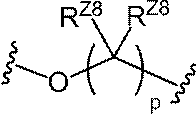
式中、pおよびRZ8は、本明細書中で定義されるとおりである。
For example, in certain embodiments where w is 0, L3 heteroalkylene groups of the following formula are provided:
wherein p and R Z8 are as defined herein.
wが1である、ある特定の実施形態では、以下の式のL3ヘテロアルキレン基が提供さ
れ:
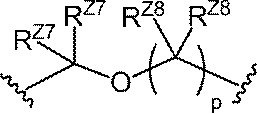
式中、p、R27およびRZ8は、本明細書中で定義されるとおりである。
In certain embodiments where w is 1, L3 heteroalkylene groups of the following formula are provided:
wherein p, R 27 and R Z8 are as defined herein.
ある特定の実施形態において、RZ7の少なくとも1つの実例は、水素である。上記の
実例のいずれかにおいて、ある特定の実施形態において、RZ7の少なくとも1つの実例
は、ハロ、例えば、フルオロである。上記の実例のいずれかにおいて、ある特定の実施形
態において、RZ7の少なくとも1つの実例は、置換または非置換C1-6アルキル、例
えば、置換もしくは非置換C1-2アルキル、置換もしくは非置換C2-3アルキル、置
換もしくは非置換C3-4アルキル、置換もしくは非置換C4-5アルキルまたは置換も
しくは非置換C5-6アルキルである。例示的なRZ7C1-6アルキル基としては、置
換または非置換の、メチル(C1)、エチル(C2)、n-プロピル(C3)、イソプロ
ピル(C3)、n-ブチル(C4)、tert-ブチル(C4)、sec-ブチル(C4
)、iso-ブチル(C4)、n-ペンチル(C5)、3-ペンタニル(C5)、アミル
(C5)、ネオペンチル(C5)、3-メチル-2-ブタニル(C5)、第3級アミル(
C5)、n-ヘキシル(C6)、1、2、3、4、5、6、7、8、9、10個またはそ
れを超えるフルオロ基で置換されたC1-6アルキル(例えば、-CF3、-CH2F、
-CHF2、ジフルオロエチルおよび2,2,2-トリフルオロ-1,1-ジメチル-エ
チル)、1、2、3、4、5、6、7、8、9、10個またはそれを超えるクロロ基で置
換されたC1-6アルキル(例えば、-CH2Cl、-CHCl2)およびアルコキシ基
で置換されたC1-6アルキル(例えば、-CH2OCH3および-CH2OCH2CH
3)が挙げられるがこれらに限定されない。上記の実例のいずれかにおいて、ある特定の
実施形態において、RZ7の少なくとも1つの実例は、-CH3、-CF3、-CH2C
H3(Et)または-CH(CH3)2(iPr)である。上記の実例のいずれかにおい
て、ある特定の実施形態において、RZ7の少なくとも1つの実例は、-ORZ5、例え
ば、-OHである。
In certain embodiments, at least one instance of R Z7 is hydrogen. In any of the above instances, in certain embodiments, at least one instance of R Z7 is halo, e.g., fluoro. In any of the above instances, in certain embodiments, at least one instance of R Z7 is substituted or unsubstituted C 1-6 alkyl, e.g., substituted or unsubstituted C 1-2 alkyl, substituted or unsubstituted C 2-3 alkyl, substituted or unsubstituted C 3-4 alkyl, substituted or unsubstituted C 4-5 alkyl, or substituted or unsubstituted C 5-6 alkyl. Exemplary R Z7 C 1-6 alkyl groups include substituted or unsubstituted methyl (C 1 ), ethyl (C 2 ), n-propyl (C 3 ), isopropyl (C 3 ), n-butyl (C 4 ), tert-butyl (C 4 ), sec-butyl (C 4
), iso-butyl (C 4 ), n-pentyl (C 5 ), 3-pentanyl (C 5 ), amyl (C 5 ), neopentyl (C 5 ), 3-methyl-2-butanyl (C 5 ), tertiary amyl (
C 5 ), n-hexyl (C 6 ), C 1-6 alkyl substituted with 1, 2, 3, 4, 5, 6, 7, 8, 9, 10 or more fluoro groups (e.g., —CF 3 , —CH 2 F,
-CHF 2 , difluoroethyl and 2,2,2-trifluoro-1,1-dimethyl-ethyl), C 1-6 alkyl substituted with 1, 2, 3, 4, 5, 6, 7, 8, 9, 10 or more chloro groups (e.g., -CH 2 Cl, -CHCl 2 ) and C 1-6 alkyl substituted with alkoxy groups (e.g., -CH 2 OCH 3 and -CH 2 OCH 2 CH
In any of the above examples, in certain embodiments, at least one instance of R Z7 is -CH 3 , -CF 3 , -CH 2 C
H 3 (Et) or -CH(CH 3 ) 2 (iPr).In any of the above examples, in certain embodiments, at least one instance of R Z7 is -OR Z5 , for example, -OH.
ある特定の実施形態において、RZ8の少なくとも1つの実例は、水素である。上記の
実例のいずれかにおいて、ある特定の実施形態において、RZ8の少なくとも1つの実例
は、ハロ、例えば、フルオロである。上記の実例のいずれかにおいて、ある特定の実施形
態において、RZ8の少なくとも1つの実例は、置換または非置換C1-6アルキル、例
えば、置換もしくは非置換C1-2アルキル、置換もしくは非置換C2-3アルキル、置
換もしくは非置換C3-4アルキル、置換もしくは非置換C4-5アルキルまたは置換も
しくは非置換C5-6アルキルである。例示的なRZ8C1-6アルキル基としては、置
換または非置換の、メチル(C1)、エチル(C2)、n-プロピル(C3)、イソプロ
ピル(C3)、n-ブチル(C4)、tert-ブチル(C4)、sec-ブチル(C4
)、iso-ブチル(C4)、n-ペンチル(C5)、3-ペンタニル(C5)、アミル
(C5)、ネオペンチル(C5)、3-メチル-2-ブタニル(C5)、第3級アミル(
C5)、n-ヘキシル(C6)、1、2、3、4、5、6、7、8、9、10個またはそ
れを超えるフルオロ基で置換されたC1-6アルキル(例えば、-CF3、-CH2F、
-CHF2、ジフルオロエチルおよび2,2,2-トリフルオロ-1,1-ジメチル-エ
チル)、1、2、3、4、5、6、7、8、9、10個またはそれを超えるクロロ基で置
換されたC1-6アルキル(例えば、-CH2Cl、-CHCl2)およびアルコキシ基
で置換されたC1-6アルキル(例えば、-CH2OCH3および-CH2OCH2CH
3)が挙げられるがこれらに限定されない。上記の実例のいずれかにおいて、ある特定の
実施形態において、RZ8の少なくとも1つの実例は、-CH3、-CF3、-CH2C
H3(Et)または-CH(CH3)2(iPr)である。上記の実例のいずれかにおい
て、ある特定の実施形態において、RZ8の少なくとも1つの実例は、-ORZ5、例え
ば、-OHである。
In certain embodiments, at least one instance of R Z8 is hydrogen. In any of the above instances, in certain embodiments, at least one instance of R Z8 is halo, e.g., fluoro. In any of the above instances, in certain embodiments, at least one instance of R Z8 is substituted or unsubstituted C 1-6 alkyl, e.g., substituted or unsubstituted C 1-2 alkyl, substituted or unsubstituted C 2-3 alkyl, substituted or unsubstituted C 3-4 alkyl, substituted or unsubstituted C 4-5 alkyl, or substituted or unsubstituted C 5-6 alkyl. Exemplary R Z8 C 1-6 alkyl groups include substituted or unsubstituted methyl (C 1 ), ethyl (C 2 ), n-propyl (C 3 ), isopropyl (C 3 ), n-butyl (C 4 ), tert-butyl (C 4 ), sec-butyl (C 4
), iso-butyl (C 4 ), n-pentyl (C 5 ), 3-pentanyl (C 5 ), amyl (C 5 ), neopentyl (C 5 ), 3-methyl-2-butanyl (C 5 ), tertiary amyl (
C 5 ), n-hexyl (C 6 ), C 1-6 alkyl substituted with 1, 2, 3, 4, 5, 6, 7, 8, 9, 10 or more fluoro groups (e.g., —CF 3 , —CH 2 F,
-CHF 2 , difluoroethyl and 2,2,2-trifluoro-1,1-dimethyl-ethyl), C 1-6 alkyl substituted with 1, 2, 3, 4, 5, 6, 7, 8, 9, 10 or more chloro groups (e.g., -CH 2 Cl, -CHCl 2 ) and C 1-6 alkyl substituted with alkoxy groups (e.g., -CH 2 OCH 3 and -CH 2 OCH 2 CH
In any of the above examples, in certain embodiments, at least one instance of R Z8 is -CH 3 , -CF 3 , -CH 2 C
H 3 (Et) or -CH(CH 3 ) 2 (iPr).In any of the above examples, in certain embodiments, at least one instance of R Z8 is -OR Z5 , for example, -OH.
例示的なL3アルキレン基としては、以下が挙げられるがこれらに限定されない:

例示的なL3アルケニレン基としては、以下が挙げられるがこれらに限定されない:

例示的なL3ヘテロアルキレン基としては、以下が挙げられるがこれらに限定されない
:

ある特定の実施形態において、基

(式中、L3は、アルキレンまたはヘテロアルキレン基である)は、以下の式である:


where L3 is an alkylene or heteroalkylene group is of the formula:
ある特定の実施形態において、基

(式中、Yは、-O-であり、L3は、アルキレンまたはヘテロアルキレン基である)は
、以下の式である:


where Y is -O- and L3 is an alkylene or heteroalkylene group is of the formula:
ある特定の実施形態において、基

(式中、Yは、-NH-であり、L3は、アルキレンまたはヘテロアルキレン基である)
は、以下の式である:
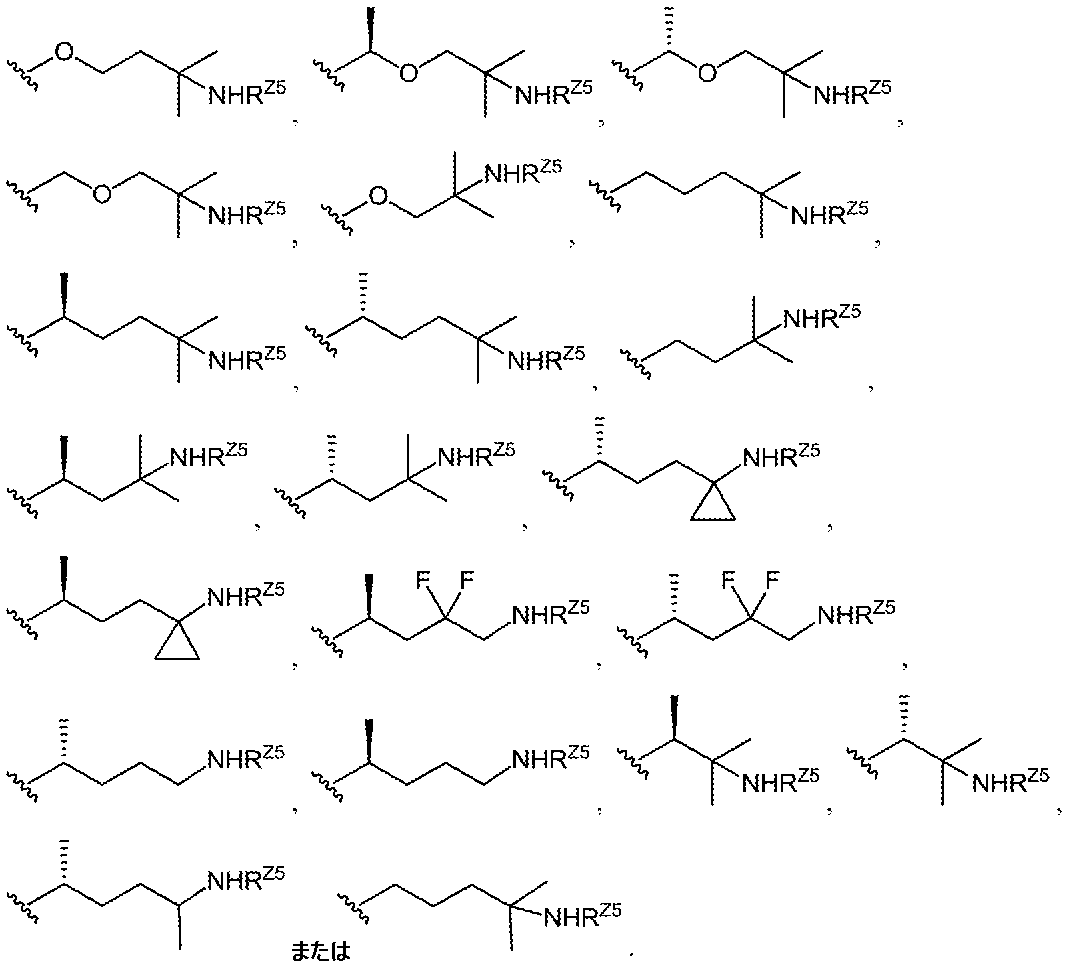
(wherein Y is -NH- and L3 is an alkylene or heteroalkylene group).
is the formula:
ある特定の実施形態において、基

(式中、Yは、-O-であり、L3は、アルキレンまたはヘテロアルキレン基である)は
、以下の式である:

where Y is -O- and L3 is an alkylene or heteroalkylene group is of the formula:
ある特定の実施形態において、基

(式中、Yは、-NH-であり、L3は、アルキレンまたはヘテロアルキレン基である)
は、以下の式である:

(wherein Y is -NH- and L3 is an alkylene or heteroalkylene group).
is the formula:
R2、R11aおよびR11bの様々な実施形態
上で一般に定義されたように、R2、R11aおよびR11bの各実例は、独立して、H、-OH、ハロ、置換もしくは非置換アルキル、置換もしくは非置換アルケニルまたは置換もしくは非置換アルキニル、置換もしくは非置換カルボシクリル、置換もしくは非置換ヘテロシクリル、置換もしくは非置換アリール、置換もしくは非置換ヘテロアリール、-N3、-NO2、-SCN、-CN、-ORB1、-SRB1、-N(RB1)2、-N=NRB1、-N=C(RB1)2、-N(ORB1)(RB1)、-C(=O)RB1、-C(=O)ORB1、-C(=O)SRB1、-C(=O)N(Rb1)2、-C(=O)N(ORB1)(RB1)、-OC(=O)RB1、-OC(=O)ORB1、-OC(=O)SRB1、-OC(=O)N(RB1)2、-NRB1C(=O)RB1、-NRB1C(=O)ORB1、-NRB1C(=O)SRB1、-NRB1C(=O)N(RB1)2、-SC(=O)RB2、-SC(=O)ORB1、-SC(=O)SRB1、-SC(=O)N(RB1)2、-OS(=O)2RB2、-OS(=O)2ORB1、-S-S(=O)2RB2、-S-S(=O)2ORB1、-S(=O)RB2、-SO2RB2、-NRB1SO2RB2、または-SO2N(RB1)2であり、かつ/あるいはR11aおよびR11bは、一体となって、オキソ(=O)基を形成する。
Various Embodiments of R 2 , R 11a and R 11b As generally defined above, each instance of R 2 , R 11a and R 11b independently represents H, —OH, halo, substituted or unsubstituted alkyl, substituted or unsubstituted alkenyl or substituted or unsubstituted alkynyl, substituted or unsubstituted carbocyclyl, substituted or unsubstituted heterocyclyl, substituted or unsubstituted aryl, substituted or unsubstituted heteroaryl, —N 3 , —NO 2 , —SCN, —CN, —OR B1 , —SR B1 , —N(R B1 ) 2 , —N═NR B1 , —N═C(R B1 ) 2 , —N(OR B1 )(R B1 ), —C(═O)R B1 , —C( ═O )OR B1 , —C(═O)SR B1 . , -C(=O)N(R b1 ) 2 , -C(=O)N(OR B1 )(R B1 ), -OC(=O)R B1 , -OC(=O)OR B1 , -OC(=O)SR B1 , -OC(=O)N(R B1 ) 2 , -NR B1 C(=O)R B1 , -NR B1 C(=O)OR B1 , -NR B1 C(=O)SR B1 , -NR B1 C(=O)N(R B1 ) 2 , -SC(=O)R B2 , -SC(=O)OR B1 , -SC(=O)SR B1 , -SC(=O)N(R B1 ) 2 , -OS(=O) 2R B2 , -OS(=O) 2OR B1 , -S-S(=O) 2R B2 , -S-S(=O) 2OR B1 , -S(=O)R B2 , -SO 2R B2 , -NR B1 SO 2R B2 , or -SO 2N (R B1 ) 2 , and/or R 11a and R 11b together form an oxo (=O) group.
ある特定の実施形態において、R2は、Hである。ある特定の実施形態において、R2
は、置換または非置換アルキルである。ある特定の実施形態において、R2は、置換また
は非置換アルケニルである。ある特定の実施形態において、R2は、置換または非置換ア
ルキニルである。ある特定の実施形態において、R2は、-ORB1である。ある特定の
実施形態において、R2は、-SRB1である。ある特定の実施形態において、R2は、
-N(RB1)2である。ある特定の実施形態において、R2は、H、ハロ、置換もしく
は非置換アルキル、置換もしくは非置換アルケニル、置換もしくは非置換アルキニル、-
ORB1、-SRB1または-N(RB1)2である。ある特定の実施形態において、R
2は、F、Cl、Me、Et、n-Pr、メトキシ、エトキシ、プロポキシ、ブトキシ、
エチニル、ヒドロキシブチニル、メトキシプロピニル、クロロエチニルまたはシクロプロ
ピニルである。ある特定の実施形態において、R2は、CF3、アミノまたはジメチルア
ミノである。ある特定の実施形態において、R2は、アルファ位の非水素基である。ある
特定の実施形態において、R2は、ベータ位の非水素基である。
In certain embodiments, R 2 is H. In certain embodiments, R 2
is substituted or unsubstituted alkyl. In certain embodiments, R 2 is substituted or unsubstituted alkenyl. In certain embodiments, R 2 is substituted or unsubstituted alkynyl. In certain embodiments, R 2 is -OR B1 . In certain embodiments, R 2 is -SR B1 . In certain embodiments, R 2 is
In certain embodiments, R 2 is H, halo, substituted or unsubstituted alkyl, substituted or unsubstituted alkenyl, substituted or unsubstituted alkynyl, -
OR B1 , -SR B1 or -N(R B1 ) 2. In certain embodiments, R
2 is F, Cl, Me, Et, n-Pr, methoxy, ethoxy, propoxy, butoxy,
In certain embodiments, R2 is ethynyl, hydroxybutynyl, methoxypropynyl, chloroethynyl, or cyclopropynyl. In certain embodiments, R2 is CF3 , amino, or dimethylamino. In certain embodiments, R2 is a non-hydrogen group in the alpha position. In certain embodiments, R2 is a non-hydrogen group in the beta position.
ある特定の実施形態において、R11aおよびR11bの各実例は、水素である。ある特
定の実施形態において、R11aおよびR11bの一方は、水素である。ある特定の実施
形態において、R11aおよびR11bの一方は、水素であり;他方は、-ORB1、-
SRB1または-N(RB1)2である。ある特定の実施形態において、R11aおよび
R11bの一方は、Hであり;他方は、-OH、-OMe、アミノまたはジアルキルアミ
ノである。ある特定の実施形態において、R11bは、非水素基であり、R11aは、水
素である。ある特定の実施形態において、R11aは、非水素基であり、R11bは、水
素である。
In certain embodiments, each instance of R 11a and R 11b is hydrogen. In certain embodiments, one of R 11a and R 11b is hydrogen. In certain embodiments, one of R 11a and R 11b is hydrogen; the other is -OR B1 , -
SR 11a or -N(R 11b ) 2. In certain embodiments, one of R 11a and R 11b is H; the other is -OH, -OMe, amino, or dialkylamino. In certain embodiments, R 11b is a non-hydrogen group and R 11a is hydrogen. In certain embodiments, R 11a is a non-hydrogen group and R 11b is hydrogen.
ある特定の実施形態において、R11aおよびR11bは、一体となって、オキソ基を
形成する。
R4a、R4b、R6、R7a、R7b、R14、R17、R18およびR19の様々
な実施形態
In certain embodiments, R 11a and R 11b together form an oxo group.
Various embodiments of R4a , R4b , R6 , R7a , R7b , R14 , R17 , R18 and R19
上で一般に定義されたように、R4a、R4b、R7aおよびR7bの各実例は、独立して、水素、-OH、ハロ、置換もしくは非置換アルキル、置換もしくは非置換アルケニル、置換もしくは非置換アルキニル、置換もしくは非置換カルボシクリル、置換もしくは非置換ヘテロシクリル、置換もしくは非置換アリール、置換もしくは非置換ヘテロアリール、-N3、-NO2、-SCN、-CN、-ORB1、-SRB1、-N(RB1)2、-N=NRB1、-N=C(RB1)2、-N(ORB1)(RB1)、-C(=O)RB1、-C(=O)ORB1、-C(=O)SRB1、-C(=O)N(Rb1)2、-C(=O)N(ORB1)(RB1)、-OC(=O)RB1、-OC(=O)ORB1、-OC(=O)SRB1、-OC(=O)N(RB1)2、-NRB1C(=O)RB1、-NRB1C(=O)ORB1、-NRB1C(=O)SRB1、-NRB1C(=O)N(RB1)2、-SC(=O)RB2、-SC(=O)ORB1、-SC(=O)SRB1、-SC(=O)N(RB1)2、-OS(=O)2RB2、-OS(=O)2ORB1、-S-S(=O)2RB2、-S-S(=O)2ORB1、-S(=O)RB2、-SO2RB2、-NRB1SO2RB2、または-SO2N(RB1)2であり、ここで、RB1は、水素、置換もしくは非置換アルキル、置換もしくは非置換アルケニル、置換もしくは非置換アルキニル、置換もしくは非置換カルボシクリル、置換もしくは非置換ヘテロシクリル、置換もしくは非置換アリールまたは置換もしくは非置換ヘテロアリール、酸素原子に付着されているときは酸素保護基、硫黄原子に付着されているときは硫黄保護基、窒素原子に付着されているときは窒素保護基であるか、あるいは2つのRB1基は、接続して、置換または非置換の複素環式環を形成し;RB2は、置換もしくは非置換アルキル、置換もしくは非置換アルケニル、置換もしくは非置換アルキニル、置換もしくは非置換カルボシクリル、置換もしくは非置換ヘテロシクリル、置換もしくは非置換アリールまたは置換もしくは非置換ヘテロアリールであるか、あるいはRB1基およびRB2基は、接続して、置換または非置換の複素環式環を形成するか;または必要に応じて、R4aおよびR4bの各々ならびに/またはR7aおよびR7bの各々は、一体となって、オキソ(=O)基を形成する。 As generally defined above, each instance of R 4a , R 4b , R 7a and R 7b is independently hydrogen, —OH, halo, substituted or unsubstituted alkyl, substituted or unsubstituted alkenyl, substituted or unsubstituted alkynyl, substituted or unsubstituted carbocyclyl, substituted or unsubstituted heterocyclyl, substituted or unsubstituted aryl, substituted or unsubstituted heteroaryl, —N 3 , —NO 2 , —SCN, —CN, —OR B1 , —SR B1 , —N(R B1 ) 2 , —N═NR B1 , —N═C(R B1 ) 2 , —N(OR B1 )(R B1 ), —C(═O)R B1 , —C(═O)OR B1 , —C(═O)SR B1 , —C(═O)N(R b1 ) 2 , -C(=O)N(OR B1 )(R B1 ), -OC(=O)R B1 , -OC(=O)OR B1 , -OC(=O)SR B1 , -OC(=O)N(R B1 ) 2 , -NR B1 C(=O)R B1 , -NR B1 C(=O)OR B1 , -NR B1 C(=O)SR B1 , -NR B1 C(=O)N(R B1 ) 2 , -SC(=O)R B2 , -SC(=O)OR B1 , -SC(=O)SR B1 , -SC(=O)N(R B1 ) 2 , -OS(=O) 2 R B2 , -OS(=O) 2 OR B1 , -S-S(=O) 2 R B2 , -S-S(=O) 2 OR B1 , -S(=O)R B2 , -SO 2 R B2 , -NR B1 SO 2 R B2 , or -SO 2 N(R B1 ) 2 , where R B1 is hydrogen, substituted or unsubstituted alkyl, substituted or unsubstituted alkenyl, substituted or unsubstituted alkynyl, substituted or unsubstituted carbocyclyl, substituted or unsubstituted heterocyclyl, substituted or unsubstituted aryl or substituted or unsubstituted heteroaryl, an oxygen protecting group when attached to an oxygen atom, a sulfur protecting group when attached to a sulfur atom, a nitrogen protecting group when attached to a nitrogen atom, or two R B1 groups are joined to form a substituted or unsubstituted heterocyclic ring; B2 is substituted or unsubstituted alkyl, substituted or unsubstituted alkenyl, substituted or unsubstituted alkynyl, substituted or unsubstituted carbocyclyl, substituted or unsubstituted heterocyclyl, substituted or unsubstituted aryl or substituted or unsubstituted heteroaryl, or the R B1 and R B2 groups are joined to form a substituted or unsubstituted heterocyclic ring; or optionally, each of R 4a and R 4b and/or each of R 7a and R 7b are joined to form an oxo (=O) group.
ある特定の実施形態において、R4aおよびR4bの各実例は、水素である。ある特定
の実施形態において、R4aおよびR4bの一方は、水素である。ある特定の実施形態に
おいて、R4aおよびR4bの一方は、水素であり;他方は、置換もしくは非置換アルキ
ル、置換もしくは非置換アルケニルまたは置換もしくは非置換アルキニルである。ある特
定の実施形態において、R4aおよびR4bの一方は、水素であり;他方は、Me、Et
、エテニル、エチニル、プロペニルまたはプロピニルである。ある特定の実施形態におい
て、R4aおよびR4bの各々は、独立して、置換または非置換アルキルである。ある特
定の実施形態において、R4aおよびR4bの各々は、Meである。
In certain embodiments, each instance of R 4a and R 4b is hydrogen. In certain embodiments, one of R 4a and R 4b is hydrogen. In certain embodiments, one of R 4a and R 4b is hydrogen; the other is substituted or unsubstituted alkyl, substituted or unsubstituted alkenyl, or substituted or unsubstituted alkynyl. In certain embodiments, one of R 4a and R 4b is hydrogen; the other is Me, Et
, ethenyl, ethynyl, propenyl or propynyl. In certain embodiments, each of R 4a and R 4b is independently substituted or unsubstituted alkyl. In certain embodiments, each of R 4a and R 4b is Me.
ある特定の実施形態において、R7aおよびR7bの各実例は、水素である。 In certain embodiments, each instance of R 7a and R 7b is hydrogen.
上で一般に定義されたように、R6aおよびR6bの各々は、独立して、水素、ハロ、
置換もしくは非置換アルキル、置換もしくは非置換アルケニルまたは置換もしくは非置換
アルキニルであり、
は、単結合または二重結合を表すが、但し、二重結合が環Bに存在する場合、R6aまた
はR6bの一方は、存在せず、単結合が環Bに存在する場合、C5における水素は、アル
ファ位またはベータ位である。
As generally defined above, each of R 6a and R 6b is independently hydrogen, halo,
substituted or unsubstituted alkyl, substituted or unsubstituted alkenyl, or substituted or unsubstituted alkynyl;
represents a single bond or a double bond, with the proviso that when a double bond is present in ring B, one of R 6a or R 6b is absent, and when a single bond is present in ring B, the hydrogen at C5 is in the alpha or beta position.
が単結合を表すある特定の実施形態において、R6aおよびR6bの各実例は、水素であ
る。ある特定の実施形態において、R6aおよびR6bの各実例は、ハロ、例えば、フル
オロである。
In certain embodiments where represents a single bond, each instance of R 6a and R 6b is hydrogen.In certain embodiments, each instance of R 6a and R 6b is halo, for example fluoro.

が単結合を表すある特定の実施形態において、R6aは、水素であり、R6bは、ハロ、
置換もしくは非置換アルキル、置換もしくは非置換アルケニルまたは置換もしくは非置換
アルキニルである。ある特定の実施形態において、R6aは、水素であり、R6bは、ハ
ロ(例えば、フルオロ)である。ある特定の実施形態において、R6aは、水素であり、
R6bは、置換または非置換アルキル、例えば、置換もしくは非置換C1-6アルキル、
置換もしくは非置換C1-2アルキル、置換もしくは非置換C2-3アルキル、置換もし
くは非置換C3-4アルキル、置換もしくは非置換C4-5アルキルまたは置換もしくは
非置換C5-6アルキル、例えば、メチル、エチル、プロピルまたはイソプロピルである
。ある特定の実施形態において、R6aは、水素であり、R6bは、置換または非置換ア
ルケニルである。ある特定の実施形態において、R6aは、水素であり、R6bは、置換
または非置換アルキニルである。
In certain embodiments where R 6a represents a single bond, R 6b is halo,
In certain embodiments, R 6a is hydrogen and R 6b is halo (e.g., fluoro). In certain embodiments, R 6a is hydrogen and R 6b is substituted or unsubstituted alkyl, substituted or unsubstituted alkenyl, or substituted or unsubstituted alkynyl. In certain embodiments, R 6a is hydrogen and R 6b is halo (e.g., fluoro). In certain embodiments, R 6a is hydrogen and
R 6b is substituted or unsubstituted alkyl, for example, substituted or unsubstituted C 1-6 alkyl;
In certain embodiments, R 6a is hydrogen and R 6b is substituted or unsubstituted alkenyl . In certain embodiments , R 6a is hydrogen and R 6b is substituted or unsubstituted alkynyl.
が単結合を表すある特定の実施形態において、R6bは、水素であり、R6aは、ハロ、
置換もしくは非置換アルキル、置換もしくは非置換アルケニルまたは置換もしくは非置換
アルキニルである。ある特定の実施形態において、R6bは、水素であり、R6aは、ハ
ロ(例えば、フルオロ)である。ある特定の実施形態において、R6bは、水素であり、
R6aは、置換または非置換アルキル、例えば、置換もしくは非置換C1-6アルキル、
置換もしくは非置換C1-2アルキル、置換もしくは非置換C2-3アルキル、置換もし
くは非置換C3-4アルキル、置換もしくは非置換C4-5アルキルまたは置換もしくは
非置換C5-6アルキル、例えば、メチル、エチル、プロピルまたはイソプロピルである
。ある特定の実施形態において、R6bは、水素であり、R6aは、置換または非置換ア
ルケニルである。ある特定の実施形態において、R6bは、水素であり、R6aは、置換
または非置換アルキニルである。
In certain embodiments where R 6b represents a single bond, R 6a is halo,
In certain embodiments, R 6b is hydrogen and R 6a is halo (e.g., fluoro). In certain embodiments, R 6b is hydrogen and R 6a is substituted or unsubstituted alkyl, substituted or unsubstituted alkenyl, or substituted or unsubstituted alkynyl. In certain embodiments, R 6b is hydrogen and R 6a is halo (e.g., fluoro). In certain embodiments, R 6b is hydrogen and
R 6a is substituted or unsubstituted alkyl, for example, substituted or unsubstituted C 1-6 alkyl;
In certain embodiments, R 6b is hydrogen and R 6a is substituted or unsubstituted alkenyl. In certain embodiments, R 6b is hydrogen and R 6a is substituted or unsubstituted alkynyl.
が二重結合を表すある特定の実施形態において、R6aは、水素である。
が二重結合を表すある特定の実施形態において、R6aは、ハロ、例えば、フルオロであ
る。

が二重結合を表すある特定の実施形態において、R6aは、置換または非置換アルキル、
例えば、置換もしくは非置換C1-6アルキル、置換もしくは非置換C1-2アルキル、
置換もしくは非置換C2-3アルキル、置換もしくは非置換C3-4アルキル、置換もし
くは非置換C4-5アルキルまたは置換もしくは非置換C5-6アルキル、例えば、メチ
ル、エチル、プロピルまたはイソプロピルである。
が二重結合を表すある特定の実施形態において、R6aは、置換または非置換アルケニル
である。
が二重結合を表すある特定の実施形態において、R6aは、置換または非置換アルキニル
である。
In certain embodiments where represents a double bond, R 6a is hydrogen.
In certain embodiments where represents a double bond, R 6a is halo, for example fluoro.
In certain embodiments, R 6a is substituted or unsubstituted alkyl,
For example, substituted or unsubstituted C 1-6 alkyl, substituted or unsubstituted C 1-2 alkyl,
It is substituted or unsubstituted C 2-3 alkyl, substituted or unsubstituted C 3-4 alkyl, substituted or unsubstituted C 4-5 alkyl or substituted or unsubstituted C 5-6 alkyl, for example methyl, ethyl, propyl or isopropyl.
In certain embodiments where represents a double bond, R 6a is a substituted or unsubstituted alkenyl.
In certain embodiments where represents a double bond, R 6a is a substituted or unsubstituted alkynyl.
上で一般に定義されたように、R17は、水素、ハロ、置換もしくは非置換アルキル、
置換もしくは非置換アルケニル、置換もしくは非置換アルキニル、置換もしくは非置換カ
ルボシクリル、置換もしくは非置換ヘテロシクリル、置換もしくは非置換アリール、置換
もしくは非置換ヘテロアリールまたは-ORD1である。ある特定の実施形態において、
R17は、水素である。ある特定の実施形態において、R17は、ハロである。ある特定
の実施形態において、R17は、置換または非置換アルキルである。ある特定の実施形態
において、R17は、置換または非置換アルケニルである。ある特定の実施形態において
、R17は、置換または非置換アルキニルである。ある特定の実施形態において、R17
は、置換または非置換カルボシクリルである。ある特定の実施形態において、R17は、
置換または非置換ヘテロシクリルである。ある特定の実施形態において、R17は、置換
または非置換アリールである。ある特定の実施形態において、R17は、置換または非置
換ヘテロアリールである。ある特定の実施形態において、R17は、-ORD1(例えば
、-OH)である。
As generally defined above, R 17 is hydrogen, halo, substituted or unsubstituted alkyl,
substituted or unsubstituted alkenyl, substituted or unsubstituted alkynyl, substituted or unsubstituted carbocyclyl, substituted or unsubstituted heterocyclyl, substituted or unsubstituted aryl, substituted or unsubstituted heteroaryl, or -OR D1 . In certain embodiments,
R 17 is hydrogen. In certain embodiments, R 17 is halo. In certain embodiments, R 17 is substituted or unsubstituted alkyl. In certain embodiments, R 17 is substituted or unsubstituted alkenyl. In certain embodiments , R 17 is substituted or unsubstituted alkynyl. In certain embodiments, R 17 is substituted or unsubstituted alkynyl.
is substituted or unsubstituted carbocyclyl. In certain embodiments, R 17 is
In certain embodiments, R 17 is substituted or unsubstituted heterocyclyl. In certain embodiments, R 17 is substituted or unsubstituted aryl. In certain embodiments, R 17 is substituted or unsubstituted heteroaryl. In certain embodiments, R 17 is -OR D1 (e.g., -OH).
上で一般に定義されたように、R14は、Hまたは置換もしくは非置換アルキルである
。ある特定の実施形態において、R14は、Hである。ある特定の実施形態において、R
14は、置換または非置換アルキル(例えば、-CH3)である。
As generally defined above, R 14 is H or substituted or unsubstituted alkyl. In certain embodiments, R 14 is H. In certain embodiments, R
14 is a substituted or unsubstituted alkyl (eg, --CH 3 ).
上で一般に定義されたように、R18は、独立して、水素または置換もしくは非置換ア
ルキルである。ある特定の実施形態において、R18は、水素である。ある特定の実施形
態において、R18は、置換または非置換アルキル(例えば、-CH3)である。
As generally defined above, R 18 is independently hydrogen or substituted or unsubstituted alkyl. In certain embodiments, R 18 is hydrogen. In certain embodiments, R 18 is substituted or unsubstituted alkyl (e.g., -CH 3 ).
上で一般に定義されたように、R19は、独立して、水素または置換もしくは非置換ア
ルキルである。ある特定の実施形態において、R19は、水素である。ある特定の実施形
態において、R19は、置換または非置換アルキル(例えば、-CH3)である。
As generally defined above, R 19 is independently hydrogen or substituted or unsubstituted alkyl. In certain embodiments, R 19 is hydrogen. In certain embodiments, R 19 is substituted or unsubstituted alkyl (e.g., -CH 3 ).
ある特定の実施形態において、R14は、水素であり、R18は、-CH3であり、R
19は、-CH3である。
In certain embodiments, R 14 is hydrogen, R 18 is —CH 3 and R
19 is -CH3 .
ある特定の実施形態において、R14は、水素であり、R18は、-CH3であり、R
19は、水素である。
In certain embodiments, R 14 is hydrogen, R 18 is —CH 3 and R
19 is hydrogen.
式(I)のさらなる実施形態
上記の実施形態の様々な組み合わせが、本明細書中でさらに企図される。例えば、ある
特定の実施形態において、式(I)の化合物は、式(I-w)の化合物:
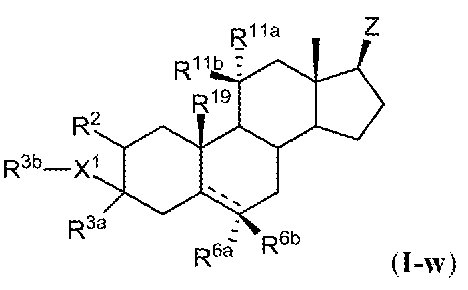
またはその薬学的に許容され得る塩、溶媒和化合物、プロドラッグ、立体異性体、互変異
性体、同位体バリアントもしくはN-オキシドあるいはそれらの組み合わせである。ある
特定の実施形態において、R3bは、水素である。ある特定の実施形態において、C3位
における基-X1R3bは、ベータである。ある特定の実施形態において、R3aは、水
素または置換もしくは非置換アルキルである。ある特定の実施形態において、R2は、水
素または-ORB1である。ある特定の実施形態において、R11aは、水素であり、R
11bは、水素または-ORB1である。
が単結合を表すある特定の実施形態において、R5は、アルファ(下)であり、R6aは
、水素である。ある特定の実施形態において、

は、二重結合を表す。ある特定の実施形態において、R6aおよびR6bは、両方とも水
素である。ある特定の実施形態において、R6aは、ハロ、例えば、フルオロ、またはア
ルキルである。ある特定の実施形態において、R6bは、ハロ、例えば、フルオロ、また
はアルキルであり、R6aは、水素である。ある特定の実施形態において、R6aおよび
R6bは、両方ともハロ、例えば、フルオロである。ある特定の実施形態において、R1
9は、メチルである。
Further embodiments of formula (I) Various combinations of the above embodiments are further contemplated herein. For example, in certain embodiments, the compound of formula (I) may be a compound of formula (I-w):
or a pharma- ceutically acceptable salt, solvate, prodrug, stereoisomer, tautomer, isotopic variant, or N-oxide thereof, or a combination thereof. In certain embodiments, R 3b is hydrogen. In certain embodiments, the group -X 1 R 3b at the C3 position is beta. In certain embodiments, R 3a is hydrogen or substituted or unsubstituted alkyl. In certain embodiments, R 2 is hydrogen or -OR B1 . In certain embodiments, R 11a is hydrogen and R
11b is hydrogen or -OR B1 .
In certain embodiments where represents a single bond, R 5 is alpha (down) and R 6a is hydrogen.
represents a double bond. In certain embodiments, R 6a and R 6b are both hydrogen. In certain embodiments, R 6a is halo, e.g., fluoro, or alkyl. In certain embodiments, R 6b is halo, e.g., fluoro, or alkyl, and R 6a is hydrogen. In certain embodiments, R 6a and R 6b are both halo, e.g., fluoro. In certain embodiments, R 1
9 is methyl.
ある特定の実施形態において、式(I)の化合物は、式(I-x)の化合物:

またはその薬学的に許容され得る塩、溶媒和化合物、プロドラッグ、立体異性体、互変異
性体、同位体バリアントもしくはN-オキシドあるいはそれらの組み合わせである。ある
特定の実施形態において、C3位における基-OHは、ベータである。ある特定の実施形
態において、R3aは、水素または置換もしくは非置換アルキルである。ある特定の実施
形態において、R2は、水素または-ORB1である。ある特定の実施形態において、R
11aは、水素であり、R11bは、水素または-ORB1である。
が単結合を表すある特定の実施形態において、R5は、アルファ(下)であり、R6aは
、水素である。ある特定の実施形態において、

は、二重結合を表す。ある特定の実施形態において、R6aおよびR6bは、両方とも水
素である。ある特定の実施形態において、R6aは、ハロ、例えば、フルオロ、またはア
ルキルである。ある特定の実施形態において、R6bは、ハロ、例えば、フルオロ、また
はアルキルであり、R6aは、水素である。ある特定の実施形態において、R6aおよび
R6bは、両方ともハロ、例えば、フルオロである。ある特定の実施形態において、R1
9は、メチルである。
In certain embodiments, the compound of formula (I) is a compound of formula (I-x):
or a pharma- ceutically acceptable salt, solvate, prodrug, stereoisomer, tautomer, isotopic variant, or N-oxide thereof, or a combination thereof. In certain embodiments, the group -OH at the C3 position is beta. In certain embodiments, R3a is hydrogen or substituted or unsubstituted alkyl. In certain embodiments, R2 is hydrogen or -ORB1 . In certain embodiments, R
11a is hydrogen and R 11b is hydrogen or -OR B1 .
In certain embodiments where represents a single bond, R 5 is alpha (down) and R 6a is hydrogen.
represents a double bond. In certain embodiments, R 6a and R 6b are both hydrogen. In certain embodiments, R 6a is halo, e.g., fluoro, or alkyl. In certain embodiments, R 6b is halo, e.g., fluoro, or alkyl, and R 6a is hydrogen. In certain embodiments, R 6a and R 6b are both halo, e.g., fluoro. In certain embodiments, R 1
9 is methyl.
ある特定の実施形態において、式(I)の化合物は、式(I-y)の化合物:

またはその薬学的に許容され得る塩、溶媒和化合物、プロドラッグ、立体異性体、互変異
性体、同位体バリアントもしくはN-オキシドあるいはそれらの組み合わせである。ある
特定の実施形態において、C3位における基-OHは、ベータである。ある特定の実施形
態において、R3aは、水素または置換もしくは非置換アルキルである。ある特定の実施
形態において、R2は、水素または-ORB1である。ある特定の実施形態において、R
11aは、水素であり、R11bは、水素または-ORB1である。
が単結合を表すある特定の実施形態において、R5は、アルファ(下)であり、R6aは
、水素である。ある特定の実施形態において、
は、二重結合を表す。ある特定の実施形態において、R6aおよびR6bは、両方とも水
素である。ある特定の実施形態において、R6aは、ハロ、例えば、フルオロ、またはア
ルキルである。ある特定の実施形態において、R6bは、ハロ、例えば、フルオロ、また
はアルキルであり、R6aは、水素である。ある特定の実施形態において、R6aおよび
R6bは、両方ともハロ、例えば、フルオロである。
In certain embodiments, the compound of formula (I) is a compound of formula (I-y):
or a pharma- ceutically acceptable salt, solvate, prodrug, stereoisomer, tautomer, isotopic variant, or N-oxide thereof, or a combination thereof. In certain embodiments, the group -OH at the C3 position is beta. In certain embodiments, R3a is hydrogen or substituted or unsubstituted alkyl. In certain embodiments, R2 is hydrogen or -ORB1 . In certain embodiments, R
11a is hydrogen and R 11b is hydrogen or -OR B1 .
In certain embodiments where represents a single bond, R 5 is alpha (down) and R 6a is hydrogen.
represents a double bond. In certain embodiments, R 6a and R 6b are both hydrogen. In certain embodiments, R 6a is halo, e.g., fluoro, or alkyl. In certain embodiments, R 6b is halo, e.g., fluoro, or alkyl, and R 6a is hydrogen. In certain embodiments, R 6a and R 6b are both halo, e.g., fluoro.
ある特定の実施形態において、式(I)の化合物は、式(I-z)の化合物:

またはその薬学的に許容され得る塩、溶媒和化合物、プロドラッグ、立体異性体、互変異
性体、同位体バリアントもしくはN-オキシドあるいはそれらの組み合わせである。ある
特定の実施形態において、C3位における基-OHは、ベータである。ある特定の実施形
態において、R3aは、水素または置換もしくは非置換アルキルである。ある特定の実施
形態において、R2は、水素または-ORB1である。ある特定の実施形態において、R
11aは、水素であり、R11bは、水素または-ORB1である。
が単結合を表すある特定の実施形態において、R5は、アルファ(下)であり、R6aは
、水素である。ある特定の実施形態において、

は、二重結合を表す。ある特定の実施形態において、R6aおよびR6bは、両方とも水
素である。ある特定の実施形態において、R6aは、ハロ、例えば、フルオロ、またはア
ルキルである。ある特定の実施形態において、R6bは、ハロ、例えば、フルオロ、また
はアルキルであり、R6aは、水素である。ある特定の実施形態において、R6aおよび
R6bは、両方ともハロ、例えば、フルオロである。
In certain embodiments, the compound of formula (I) is a compound of formula (I-z):
or a pharma- ceutically acceptable salt, solvate, prodrug, stereoisomer, tautomer, isotopic variant, or N-oxide thereof, or a combination thereof. In certain embodiments, the group -OH at the C3 position is beta. In certain embodiments, R3a is hydrogen or substituted or unsubstituted alkyl. In certain embodiments, R2 is hydrogen or -ORB1 . In certain embodiments, R
11a is hydrogen and R 11b is hydrogen or -OR B1 .
In certain embodiments where represents a single bond, R 5 is alpha (down) and R 6a is hydrogen.
represents a double bond. In certain embodiments, R 6a and R 6b are both hydrogen. In certain embodiments, R 6a is halo, e.g., fluoro, or alkyl. In certain embodiments, R 6b is halo, e.g., fluoro, or alkyl, and R 6a is hydrogen. In certain embodiments, R 6a and R 6b are both halo, e.g., fluoro.
ある特定の実施形態において、式(I)の化合物は、式(I-a1)、(I-a2)ま
たは(I-a3)の化合物:

またはその薬学的に許容され得る塩、溶媒和化合物、プロドラッグ、立体異性体、互変異
性体、同位体バリアントもしくはN-オキシドあるいはそれらの組み合わせである。ある
特定の実施形態において、R3bは、水素である。ある特定の実施形態において、C3位
における基-OR3bは、ベータである。ある特定の実施形態において、R3aは、水素
または置換もしくは非置換アルキルである。ある特定の実施形態において、R2は、水素
または-ORB1である。ある特定の実施形態において、R11aは、水素であり、R1
1bは、水素または-ORB1である。ある特定の実施形態において、R6aおよびR6
bは、両方とも水素である。ある特定の実施形態において、R6aは、ハロ、例えば、フ
ルオロ、またはアルキルである。ある特定の実施形態において、R6bは、ハロ、例えば
、フルオロ、またはアルキルであり、R6aは、水素である。ある特定の実施形態におい
て、R6aおよびR6bは、両方ともハロ、例えば、フルオロである。
In certain embodiments, the compound of formula (I) is a compound of formula (I-a1), (I-a2) or (I-a3):
or a pharma- ceutically acceptable salt, solvate, prodrug, stereoisomer, tautomer, isotopic variant, or N-oxide thereof, or a combination thereof. In certain embodiments, R 3b is hydrogen. In certain embodiments, the group -OR 3b at the C3 position is beta. In certain embodiments, R 3a is hydrogen or substituted or unsubstituted alkyl. In certain embodiments, R 2 is hydrogen or -OR B1 . In certain embodiments, R 11a is hydrogen and R 1
1b is hydrogen or -OR B1 . In certain embodiments, R 6a and R 6
b are both hydrogen. In certain embodiments, R 6a is halo, e.g., fluoro, or alkyl. In certain embodiments, R 6b is halo, e.g., fluoro, or alkyl, and R 6a is hydrogen. In certain embodiments, R 6a and R 6b are both halo, e.g., fluoro.
ある特定の実施形態において、式(I)の化合物は、式(I-b1)、(I-b2)も
しくは(I-b3)の化合物:

またはその薬学的に許容され得る塩、溶媒和化合物、プロドラッグ、立体異性体、互変異
性体、同位体バリアントもしくはN-オキシドあるいはそれらの組み合わせである。ある
特定の実施形態において、R3bは、水素である。ある特定の実施形態において、R3a
は、水素または置換もしくは非置換アルキルである。ある特定の実施形態において、R2
は、水素または-ORB1である。ある特定の実施形態において、R11aは、水素であ
り、R11bは、水素または-ORB1である。ある特定の実施形態において、R6aお
よびR6bは、両方とも水素である。ある特定の実施形態において、R6aは、ハロ、例
えば、フルオロ、またはアルキルである。ある特定の実施形態において、R6bは、ハロ
、例えば、フルオロ、またはアルキルであり、R6aは、水素である。ある特定の実施形
態において、R6aおよびR6bは、両方ともハロ、例えば、フルオロである。
In certain embodiments, the compound of formula (I) is a compound of formula (I-b1), (I-b2) or (I-b3):
or a pharma- ceutically acceptable salt, solvate, prodrug, stereoisomer, tautomer, isotopic variant, or N-oxide thereof, or a combination thereof. In certain embodiments, R 3b is hydrogen. In certain embodiments, R 3a
is hydrogen or substituted or unsubstituted alkyl. In certain embodiments, R 2
is hydrogen or -OR B1 . In certain embodiments, R 11a is hydrogen and R 11b is hydrogen or -OR B1 . In certain embodiments, R 6a and R 6b are both hydrogen. In certain embodiments, R 6a is halo, e.g., fluoro, or alkyl. In certain embodiments, R 6b is halo, e.g., fluoro, or alkyl, and R 6a is hydrogen. In certain embodiments, R 6a and R 6b are both halo, e.g., fluoro.
ある特定の実施形態において、式(I)の化合物は、式(I-c1)、(I-c2)も
しくは(I-c3)の化合物:

またはその薬学的に許容され得る塩、溶媒和化合物、プロドラッグ、立体異性体、互変異
性体、同位体バリアントもしくはN-オキシドあるいはそれらの組み合わせである。ある
特定の実施形態において、R3bは、水素である。ある特定の実施形態において、R3a
は、水素または置換もしくは非置換アルキルである。ある特定の実施形態において、R2
は、水素または-ORB1である。ある特定の実施形態において、R11aは、水素であ
り、R11bは、水素または-ORB1である。ある特定の実施形態において、R6aお
よびR6bは、両方とも水素である。ある特定の実施形態において、R6aは、ハロ、例
えば、フルオロ、またはアルキルである。ある特定の実施形態において、R6bは、ハロ
、例えば、フルオロ、またはアルキルであり、R6aは、水素である。ある特定の実施形
態において、R6aおよびR6bは、両方ともハロ、例えば、フルオロである。
In certain embodiments, the compound of formula (I) is a compound of formula (I-c1), (I-c2) or (I-c3):
or a pharma- ceutically acceptable salt, solvate, prodrug, stereoisomer, tautomer, isotopic variant, or N-oxide thereof, or a combination thereof. In certain embodiments, R 3b is hydrogen. In certain embodiments, R 3a
is hydrogen or substituted or unsubstituted alkyl. In certain embodiments, R 2
is hydrogen or -OR B1 . In certain embodiments, R 11a is hydrogen and R 11b is hydrogen or -OR B1 . In certain embodiments, R 6a and R 6b are both hydrogen. In certain embodiments, R 6a is halo, e.g., fluoro, or alkyl. In certain embodiments, R 6b is halo, e.g., fluoro, or alkyl, and R 6a is hydrogen. In certain embodiments, R 6a and R 6b are both halo, e.g., fluoro.
ある特定の実施形態において、上記化合物は、式(I-d)の化合物:
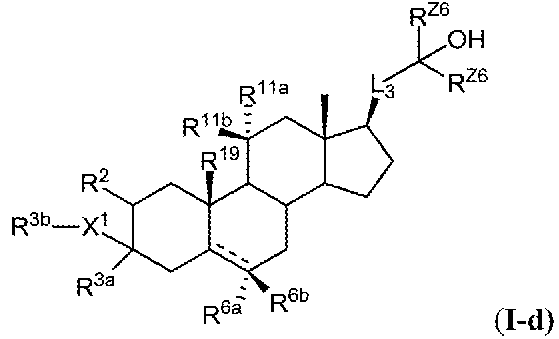
またはその薬学的に許容され得る塩、溶媒和化合物、プロドラッグ、立体異性体、互変異
性体、同位体バリアントもしくはN-オキシドあるいはそれらの組み合わせである。ある
特定の実施形態において、R3bは、水素である。ある特定の実施形態において、C3位
における基-X1R3bは、ベータである。ある特定の実施形態において、R3aは、水
素または置換もしくは非置換アルキルである。ある特定の実施形態において、R2は、水
素または-ORB1である。ある特定の実施形態において、R11aは、水素であり、R
11bは、水素または-ORB1である。
が単結合を表すある特定の実施形態において、R5は、アルファ(下)であり、R6aは
、水素である。ある特定の実施形態において、
は、二重結合を表す。ある特定の実施形態において、R6aおよびR6bは、両方とも水
素である。ある特定の実施形態において、R6aは、ハロ、例えば、フルオロ、またはア
ルキルである。ある特定の実施形態において、R6bは、ハロ、例えば、フルオロ、また
はアルキルであり、R6aは、水素である。ある特定の実施形態において、R6aおよび
R6bは、両方ともハロ、例えば、フルオロである。ある特定の実施形態において、R1
9は、メチルである。ある特定の実施形態において、各RZ6は、独立して、水素または
メチルである。
In certain embodiments, the compound is a compound of formula (I-d):
or a pharma- ceutically acceptable salt, solvate, prodrug, stereoisomer, tautomer, isotopic variant, or N-oxide thereof, or a combination thereof. In certain embodiments, R 3b is hydrogen. In certain embodiments, the group -X 1 R 3b at the C3 position is beta. In certain embodiments, R 3a is hydrogen or substituted or unsubstituted alkyl. In certain embodiments, R 2 is hydrogen or -OR B1 . In certain embodiments, R 11a is hydrogen and R
11b is hydrogen or -OR B1 .
In certain embodiments where represents a single bond, R 5 is alpha (down) and R 6a is hydrogen.
represents a double bond. In certain embodiments, R 6a and R 6b are both hydrogen. In certain embodiments, R 6a is halo, e.g., fluoro, or alkyl. In certain embodiments, R 6b is halo, e.g., fluoro, or alkyl, and R 6a is hydrogen. In certain embodiments, R 6a and R 6b are both halo, e.g., fluoro. In certain embodiments, R 1
9 is methyl. In certain embodiments, each R Z6 is independently hydrogen or methyl.
ある特定の実施形態において、上記化合物は、式(I-e)の化合物:

またはその薬学的に許容され得る塩、溶媒和化合物、プロドラッグ、立体異性体、互変異
性体、同位体バリアントもしくはN-オキシドあるいはそれらの組み合わせである。ある
特定の実施形態において、R3aは、水素または置換もしくは非置換アルキルである。あ
る特定の実施形態において、R2は、水素または-ORB1である。ある特定の実施形態
において、R11aは、水素であり、R11bは、水素または-ORB1である。

が単結合を表すある特定の実施形態において、R5は、アルファ(下)であり、R6aは
、水素である。ある特定の実施形態において、
は、二重結合を表す。ある特定の実施形態において、R6aおよびR6bは、両方とも水
素である。ある特定の実施形態において、R6aは、ハロ、例えば、フルオロ、またはア
ルキルである。ある特定の実施形態において、R6bは、ハロ、例えば、フルオロ、また
はアルキルであり、R6aは、水素である。ある特定の実施形態において、R6aおよび
R6bは、両方ともハロ、例えば、フルオロである。ある特定の実施形態において、R1
9は、メチルである。ある特定の実施形態において、各RZ6は、独立して、水素または
メチルである。
In certain embodiments, the compound is a compound of formula (I-e):
or a pharma- ceutically acceptable salt, solvate, prodrug, stereoisomer, tautomer, isotopic variant, or N-oxide thereof, or combinations thereof. In certain embodiments, R 3a is hydrogen or substituted or unsubstituted alkyl. In certain embodiments, R 2 is hydrogen or -OR B1 . In certain embodiments, R 11a is hydrogen and R 11b is hydrogen or -OR B1 .
In certain embodiments where represents a single bond, R 5 is alpha (down) and R 6a is hydrogen.
represents a double bond. In certain embodiments, R 6a and R 6b are both hydrogen. In certain embodiments, R 6a is halo, e.g., fluoro, or alkyl. In certain embodiments, R 6b is halo, e.g., fluoro, or alkyl, and R 6a is hydrogen. In certain embodiments, R 6a and R 6b are both halo, e.g., fluoro. In certain embodiments, R 1
9 is methyl. In certain embodiments, each R Z6 is independently hydrogen or methyl.
ある特定の実施形態において、上記化合物は、式(I-f)の化合物:

またはその薬学的に許容され得る塩、溶媒和化合物、プロドラッグ、立体異性体、互変異
性体、同位体バリアントもしくはN-オキシドあるいはそれらの組み合わせである。ある
特定の実施形態において、R3bは、水素である。ある特定の実施形態において、C3位
における基-X1R3bは、ベータである。ある特定の実施形態において、R3aは、水
素または置換もしくは非置換アルキルである。ある特定の実施形態において、R2は、水
素または-ORB1である。ある特定の実施形態において、R11aは、水素であり、R
11bは、水素または-ORB1である。
が単結合を表すある特定の実施形態において、R5は、アルファ(下)であり、R6aは
、水素である。ある特定の実施形態において、
は、二重結合を表す。ある特定の実施形態において、R6aおよびR6bは、両方とも水
素である。ある特定の実施形態において、R6aは、ハロ、例えば、フルオロ、またはア
ルキルである。ある特定の実施形態において、R6bは、ハロ、例えば、フルオロ、また
はアルキルであり、R6aは、水素である。ある特定の実施形態において、R6aおよび
R6bは、両方ともハロ、例えば、フルオロである。ある特定の実施形態において、R1
9は、メチルである。ある特定の実施形態において、各RZ6は、独立して、水素または
メチルである。ある特定の実施形態において、RZ5は、水素またはメチルである。
In certain embodiments, the compound is a compound of formula (If):
or a pharma- ceutically acceptable salt, solvate, prodrug, stereoisomer, tautomer, isotopic variant, or N-oxide thereof, or a combination thereof. In certain embodiments, R 3b is hydrogen. In certain embodiments, the group -X 1 R 3b at the C3 position is beta. In certain embodiments, R 3a is hydrogen or substituted or unsubstituted alkyl. In certain embodiments, R 2 is hydrogen or -OR B1 . In certain embodiments, R 11a is hydrogen and R
11b is hydrogen or -OR B1 .
In certain embodiments where represents a single bond, R 5 is alpha (down) and R 6a is hydrogen.
represents a double bond. In certain embodiments, R 6a and R 6b are both hydrogen. In certain embodiments, R 6a is halo, e.g., fluoro, or alkyl. In certain embodiments, R 6b is halo, e.g., fluoro, or alkyl, and R 6a is hydrogen. In certain embodiments, R 6a and R 6b are both halo, e.g., fluoro. In certain embodiments, R 1
In certain embodiments, R 9 is methyl. In certain embodiments, each R Z6 is independently hydrogen or methyl. In certain embodiments, R Z5 is hydrogen or methyl.
ある特定の実施形態において、上記化合物は、式(I-g)の化合物:

またはその薬学的に許容され得る塩、溶媒和化合物、プロドラッグ、立体異性体、互変異
性体、同位体バリアントもしくはN-オキシドあるいはそれらの組み合わせである。ある
特定の実施形態において、R3aは、水素または置換もしくは非置換アルキルである。あ
る特定の実施形態において、R2は、水素または-ORB1である。ある特定の実施形態
において、R11aは、水素であり、R11bは、水素または-ORB1である。

が単結合を表すある特定の実施形態において、R5は、アルファ(下)であり、R6aは
、水素である。ある特定の実施形態において、

は、二重結合を表す。ある特定の実施形態において、R6aおよびR6bは、両方とも水
素である。ある特定の実施形態において、R6aは、ハロ、例えば、フルオロ、またはア
ルキルである。ある特定の実施形態において、R6bは、ハロ、例えば、フルオロ、また
はアルキルであり、R6aは、水素である。ある特定の実施形態において、R6aおよび
R6bは、両方ともハロ、例えば、フルオロである。ある特定の実施形態において、R1
9は、メチルである。ある特定の実施形態において、各RZ6は、独立して、水素または
メチルである。ある特定の実施形態において、RZ5は、水素またはメチルである。
In certain embodiments, the compound is a compound of formula (I-g):
or a pharma- ceutically acceptable salt, solvate, prodrug, stereoisomer, tautomer, isotopic variant, or N-oxide thereof, or combinations thereof. In certain embodiments, R 3a is hydrogen or substituted or unsubstituted alkyl. In certain embodiments, R 2 is hydrogen or -OR B1 . In certain embodiments, R 11a is hydrogen and R 11b is hydrogen or -OR B1 .
In certain embodiments where represents a single bond, R 5 is alpha (down) and R 6a is hydrogen.
represents a double bond. In certain embodiments, R 6a and R 6b are both hydrogen. In certain embodiments, R 6a is halo, e.g., fluoro, or alkyl. In certain embodiments, R 6b is halo, e.g., fluoro, or alkyl, and R 6a is hydrogen. In certain embodiments, R 6a and R 6b are both halo, e.g., fluoro. In certain embodiments, R 1
In certain embodiments, R 9 is methyl. In certain embodiments, each R 6 is independently hydrogen or methyl. In certain embodiments, R 5 is hydrogen or methyl.
ある特定の実施形態において、上記化合物は、式(I-h)の化合物:

またはその薬学的に許容され得る塩、溶媒和化合物、プロドラッグ、立体異性体、互変異
性体、同位体バリアントもしくはN-オキシドあるいはそれらの組み合わせである。ある
特定の実施形態において、R3bは、水素である。ある特定の実施形態において、C3位
における基-X1R3bは、ベータである。ある特定の実施形態において、R3aは、水
素または置換もしくは非置換アルキルである。ある特定の実施形態において、R2は、水
素または-ORB1である。ある特定の実施形態において、R11aは、水素であり、R
11bは、水素または-ORB1である。
が単結合を表すある特定の実施形態において、R5は、アルファ(下)であり、R6aは
、水素である。ある特定の実施形態において、

は、二重結合を表す。ある特定の実施形態において、R6aおよびR6bは、両方とも水
素である。ある特定の実施形態において、R6aは、ハロ、例えば、フルオロ、またはア
ルキルである。ある特定の実施形態において、R6bは、ハロ、例えば、フルオロ、また
はアルキルであり、R6aは、水素である。ある特定の実施形態において、R6aおよび
R6bは、両方ともハロ、例えば、フルオロである。ある特定の実施形態において、R1
9は、メチルである。ある特定の実施形態において、RZ6は、イソプロピルである。
In certain embodiments, the compound is a compound of formula (Ih):
or a pharma- ceutically acceptable salt, solvate, prodrug, stereoisomer, tautomer, isotopic variant, or N-oxide thereof, or a combination thereof. In certain embodiments, R 3b is hydrogen. In certain embodiments, the group -X 1 R 3b at the C3 position is beta. In certain embodiments, R 3a is hydrogen or substituted or unsubstituted alkyl. In certain embodiments, R 2 is hydrogen or -OR B1 . In certain embodiments, R 11a is hydrogen and R
11b is hydrogen or -OR B1 .
In certain embodiments where represents a single bond, R 5 is alpha (down) and R 6a is hydrogen.
represents a double bond. In certain embodiments, R 6a and R 6b are both hydrogen. In certain embodiments, R 6a is halo, e.g., fluoro, or alkyl. In certain embodiments, R 6b is halo, e.g., fluoro, or alkyl, and R 6a is hydrogen. In certain embodiments, R 6a and R 6b are both halo, e.g., fluoro. In certain embodiments, R 1
9 is methyl. In certain embodiments, R Z6 is isopropyl.
ある特定の実施形態において、上記化合物は、式(I-i)の化合物:

またはその薬学的に許容され得る塩、溶媒和化合物、プロドラッグ、立体異性体、互変異
性体、同位体バリアントもしくはN-オキシドあるいはそれらの組み合わせである。ある
特定の実施形態において、R3aは、水素または置換もしくは非置換アルキルである。あ
る特定の実施形態において、R2は、水素または-ORB1である。ある特定の実施形態
において、R11aは、水素であり、R11bは、水素または-ORB1である。
が単結合を表すある特定の実施形態において、R5は、アルファ(下)であり、R6aは
、水素である。ある特定の実施形態において、
は、二重結合を表す。ある特定の実施形態において、R6aおよびR6bは、両方とも水
素である。ある特定の実施形態において、R6aは、ハロ、例えば、フルオロ、またはア
ルキルである。ある特定の実施形態において、R6bは、ハロ、例えば、フルオロ、また
はアルキルであり、R6aは、水素である。ある特定の実施形態において、R6aおよび
R6bは、両方ともハロ、例えば、フルオロである。ある特定の実施形態において、R1
9は、メチルである。ある特定の実施形態において、RZ6は、イソプロピルである。
In certain embodiments, the compound is a compound of formula (I-i):
or a pharma- ceutically acceptable salt, solvate, prodrug, stereoisomer, tautomer, isotopic variant, or N-oxide thereof, or combinations thereof. In certain embodiments, R 3a is hydrogen or substituted or unsubstituted alkyl. In certain embodiments, R 2 is hydrogen or -OR B1 . In certain embodiments, R 11a is hydrogen and R 11b is hydrogen or -OR B1 .
In certain embodiments where represents a single bond, R 5 is alpha (down) and R 6a is hydrogen.
represents a double bond. In certain embodiments, R 6a and R 6b are both hydrogen. In certain embodiments, R 6a is halo, e.g., fluoro, or alkyl. In certain embodiments, R 6b is halo, e.g., fluoro, or alkyl, and R 6a is hydrogen. In certain embodiments, R 6a and R 6b are both halo, e.g., fluoro. In certain embodiments, R 1
9 is methyl. In certain embodiments, R Z6 is isopropyl.
式(I)のさらなる実施形態は、以下の式の化合物を含む:


ある特定の実施形態において、上記化合物は、以下の化合物:


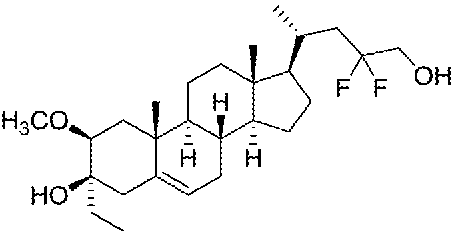
のいずれか1つまたはその薬学的に許容され得る塩、溶媒和化合物、プロドラッグ、立体
異性体、互変異性体、同位体バリアントもしくはN-オキシドあるいはそれらの組み合わ
せである。
In certain embodiments, the compound is the following compound:
or a pharma- ceutically acceptable salt, solvate, prodrug, stereoisomer, tautomer, isotopic variant, or N-oxide thereof, or combinations thereof.
ある特定の実施形態において、上記化合物は、以下の化合物:


のいずれか1つまたはその薬学的に許容され得る塩、溶媒和化合物、プロドラッグ、立体
異性体、互変異性体、同位体バリアントもしくはN-オキシドあるいはそれらの組み合わ
せである。
In certain embodiments, the compound is the following compound:
or a pharma- ceutically acceptable salt, solvate, prodrug, stereoisomer, tautomer, isotopic variant, or N-oxide thereof, or combinations thereof.
ある特定の実施形態において、上記化合物は、以下の化合物:


のいずれか1つまたはその薬学的に許容され得る塩、溶媒和化合物、プロドラッグ、立体
異性体、互変異性体、同位体バリアントもしくはN-オキシドあるいはそれらの組み合わ
せである。
In certain embodiments, the compound is the following compound:
or a pharma- ceutically acceptable salt, solvate, prodrug, stereoisomer, tautomer, isotopic variant, or N-oxide thereof, or combinations thereof.
ある特定の実施形態において、上記化合物は、以下の化合物:


のいずれか1つまたはその薬学的に許容され得る塩、溶媒和化合物、プロドラッグ、立体
異性体、互変異性体、同位体バリアントもしくはN-オキシドあるいはそれらの組み合わ
せである。
In certain embodiments, the compound is the following compound:
or a pharma- ceutically acceptable salt, solvate, prodrug, stereoisomer, tautomer, isotopic variant, or N-oxide thereof, or combinations thereof.
ある特定の実施形態において、上記化合物は、以下の化合物:


のいずれか1つまたはその薬学的に許容され得る塩、溶媒和化合物、プロドラッグ、立体
異性体、互変異性体、同位体バリアントもしくはN-オキシドあるいはそれらの組み合わ
せである。
In certain embodiments, the compound is the following compound:
or a pharma- ceutically acceptable salt, solvate, prodrug, stereoisomer, tautomer, isotopic variant, or N-oxide thereof, or combinations thereof.
ある特定の実施形態において、上記化合物は、以下の化合物:
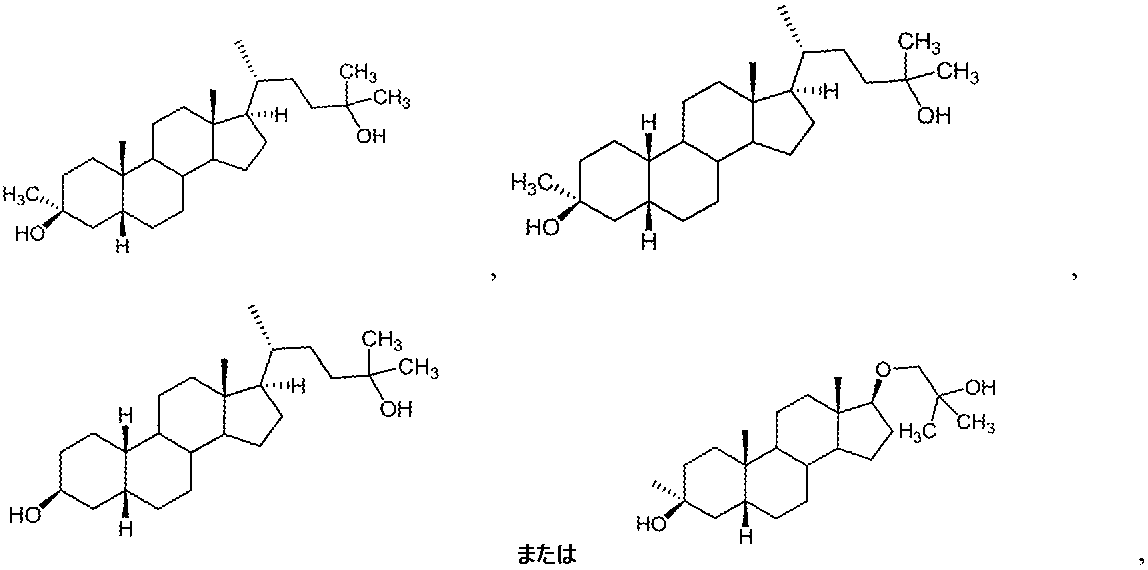
のいずれか1つまたはその薬学的に許容され得る塩、溶媒和化合物、プロドラッグ、立体
異性体、互変異性体、同位体バリアントもしくはN-オキシドあるいはそれらの組み合わ
せである。
In certain embodiments, the compound is the following compound:
or a pharma- ceutically acceptable salt, solvate, prodrug, stereoisomer, tautomer, isotopic variant, or N-oxide thereof, or combinations thereof.
ある特定の実施形態において、上記化合物は、以下の化合物:

のいずれか1つまたはその薬学的に許容され得る塩、溶媒和化合物、プロドラッグ、立体
異性体、互変異性体、同位体バリアントもしくはN-オキシドあるいはそれらの組み合わ
せである。
In certain embodiments, the compound is the following compound:
or a pharma- ceutically acceptable salt, solvate, prodrug, stereoisomer, tautomer, isotopic variant, or N-oxide thereof, or combinations thereof.
ある特定の実施形態において、上記化合物は、式(I)の化合物は、式(I-q)の化
合物

およびその薬学的に許容され得る塩であり;
式中:
R1は、置換または非置換の脂肪族(alphatic)であり;
R2は、水素、ハロゲン、置換もしくは非置換C1-6アルキル、置換もしくは非置換シ
クロプロピルまたは-ORA2であり、ここで、RA2は、水素または置換もしくは非置
換アルキルであり;
R3aは、水素または-ORA3であり、ここで、RA3は、水素または置換もしくは非
置換アルキルであり、R3bは、水素であるか;またはR3aおよびR3bは、一体とな
って、オキソ(=O)基を形成し;
R4は、水素、置換もしくは非置換アルキルまたはハロゲンであり;
Xは、-C(RX)2-または-O-であり、ここで、RXは、水素もしくはフッ素であ
るか、または1つのRX基およびR5bは、一体となって、二重結合を形成し;
R5aおよびR5bの各実例は、独立して、水素またはフッ素であり;
R6aは、置換および非置換アルキル、置換および非置換アルケニル、置換および非置換
アルキニル、置換および非置換カルボシクリル、置換および非置換ヘテロシクリル、置換
および非置換アリールならびに置換および非置換ヘテロアリール基からなる群より選択さ
れる非水素基であり、ここで、その非水素基は、フッ素で必要に応じて置換され;
R6bは、水素、またはフッ素で必要に応じて置換される置換もしくは非置換アルキル基
であり;
は、単結合または二重結合を表すが、但し、単結合が存在する場合、C5における水素は
、アルファ配置であり;
さらに但し:
(1)RX、R5aおよびR5bのうちの少なくとも1つは、フッ素であるか;または
(2)R6aおよびR6bのうちの少なくとも1つは、フッ素で置換された非水素基であ
るか;または
(3)R6aは、2~10個の炭素原子を含む非水素基である。
In certain embodiments, the compound of formula (I) is a compound of formula (I-q)
and pharma- ceutically acceptable salts thereof;
In the formula:
R 1 is substituted or unsubstituted alphatic;
R 2 is hydrogen, halogen, substituted or unsubstituted C 1-6 alkyl, substituted or unsubstituted cyclopropyl, or -OR A2 , where R A2 is hydrogen or substituted or unsubstituted alkyl;
R 3a is hydrogen or -OR A3 , where R A3 is hydrogen or substituted or unsubstituted alkyl and R 3b is hydrogen; or R 3a and R 3b together form an oxo (=O) group;
R4 is hydrogen, substituted or unsubstituted alkyl or halogen;
X is -C( Rx ) 2- or -O-, where Rx is hydrogen or fluorine, or one Rx group and R5b together form a double bond;
Each instance of R 5a and R 5b is independently hydrogen or fluorine;
R 6a is a non-hydrogen group selected from the group consisting of substituted and unsubstituted alkyl, substituted and unsubstituted alkenyl, substituted and unsubstituted alkynyl, substituted and unsubstituted carbocyclyl, substituted and unsubstituted heterocyclyl, substituted and unsubstituted aryl and substituted and unsubstituted heteroaryl groups, wherein the non-hydrogen group is optionally substituted with fluorine;
R 6b is hydrogen or a substituted or unsubstituted alkyl group optionally substituted with fluorine;
represents a single or double bond, with the proviso that if a single bond is present, the hydrogen at C5 is in the alpha configuration;
Furthermore, however:
(1) at least one of R x , R 5a and R 5b is fluorine; or (2) at least one of R 6a and R 6b is a non-hydrogen group substituted with fluorine; or (3) R 6a is a non-hydrogen group containing from 2 to 10 carbon atoms.
ある特定の実施形態において、本発明の化合物は、薬学的に許容され得る塩である。 In certain embodiments, the compounds of the present invention are pharma- ceutically acceptable salts.
本明細書中で広く説明されるように、C5における水素がベータ配置で提供される式(
I-q)の化合物は、C5における水素がアルファであるかまたは二重結合がC5-C6
に存在する化合物と比べてNMDA増強の減少を示す。したがって、式(I-q)の化合
物は、式(I-qA)および(I-qB)の化合物:

ならびにその薬学的に許容され得る塩だけを包含する。
As broadly described herein , the formula (
Compounds I-q) are those in which the hydrogen at C5 is alpha or the double bond is C5 - C6
Thus, the compounds of formula (I-q) exhibit reduced NMDA potentiation compared to compounds present in formula (I-qA) and (I-qB):
As well as pharma- ceutically acceptable salts thereof are included.
式(I-q)の化合物の基R1
本明細書中で一般に定義されるように、R1は、置換または非置換の脂肪族、すなわち
、置換もしくは非置換アルキル、置換もしくは非置換アルケニル、置換もしくは非置換ア
ルキニルまたは置換もしくは非置換カルボシクリルである。
Group R 1 in compounds of formula (I-q)
As generally defined herein, R 1 is a substituted or unsubstituted aliphatic, ie, substituted or unsubstituted alkyl, substituted or unsubstituted alkenyl, substituted or unsubstituted alkynyl, or substituted or unsubstituted carbocyclyl.
ある特定の実施形態において、R1は、置換または非置換アルキル、例えば、置換もし
くは非置換C1-6アルキル、置換もしくは非置換C1-2アルキル、置換もしくは非置
換C2-3アルキル、置換もしくは非置換C3-4アルキル、置換もしくは非置換C4-
5アルキルまたは置換もしくは非置換C5-6アルキルである。例示的なR1C1-6ア
ルキル基としては、置換または非置換の、メチル(C1)、エチル(C2)、n-プロピ
ル(C3)、イソプロピル(C3)、n-ブチル(C4)、tert-ブチル(C4)、
sec-ブチル(C4)、iso-ブチル(C4)、n-ペンチル(C5)、3-ペンタ
ニル(C5)、アミル(C5)、ネオペンチル(C5)、3-メチル-2-ブタニル(C
5)、第3級アミル(C5)、n-ヘキシル(C6)、1、2、3、4、5、6、7、8
、9、10個またはそれを超えるフルオロ基で置換されたC1-6アルキル(例えば、-
CF3、-CH2F、-CHF2、ジフルオロエチルおよび2,2,2-トリフルオロ-
1,1-ジメチル-エチル)、1、2、3、4、5、6、7、8、9、10個またはそれ
を超えるクロロ基で置換されたC1-6アルキル(例えば、-CH2Cl、-CHCl2
)およびアルコキシ基で置換されたC1-6アルキル(例えば、-CH2OCH3、-C
H2OCH2CH3、-CH2O-シクロプロピル)が挙げられるがこれらに限定されな
い。ある特定の実施形態において、R1は、置換アルキルであり、例えば、R1は、ハロ
アルキル、アルコキシアルキルまたはアミノアルキルである。ある特定の実施形態におい
て、R1は、Me、Et、n-Pr、n-Bu、i-Bu、フルオロメチル、クロロメチ
ル、ジフルオロメチル、トリフルオロメチル、トリフルオロエチル、ジフルオロエチル、
2,2,2-トリフルオロ-1,1-ジメチル-エチル、メトキシメチル、メトキシエチ
ルまたはエトキシメチルである。
In certain embodiments, R 1 is substituted or unsubstituted alkyl, for example, substituted or unsubstituted C 1-6 alkyl, substituted or unsubstituted C 1-2 alkyl, substituted or unsubstituted C 2-3 alkyl, substituted or unsubstituted C 3-4 alkyl, substituted or unsubstituted C 4-
Exemplary R 1 C 1-6 alkyl groups include substituted or unsubstituted methyl (C 1 ), ethyl (C 2 ), n-propyl (C 3 ), isopropyl (C 3 ), n-butyl (C 4 ), tert-butyl (C 4 ),
sec-Butyl (C 4 ), iso-Butyl (C 4 ), n-Pentyl (C 5 ), 3-Pentanyl (C 5 ), Amyl (C 5 ), Neopentyl (C 5 ), 3-Methyl-2-butanyl (C
5 ), tertiary amyl (C 5 ), n-hexyl (C 6 ), 1, 2, 3, 4, 5, 6, 7, 8
, C 1-6 alkyl substituted with 9, 10 or more fluoro groups (e.g., -
CF 3 , —CH 2 F, —CHF 2 , difluoroethyl and 2,2,2-trifluoro-
1,1-dimethyl-ethyl), C 1-6 alkyl substituted with 1, 2, 3, 4, 5, 6, 7, 8, 9, 10 or more chloro groups (e.g., —CH 2 Cl, —CHCl 2
) and C 1-6 alkyl substituted with an alkoxy group (e.g., —CH 2 OCH 3 , —C
In certain embodiments, R 1 is selected from the group consisting of , but not limited to, aryl, aryloxy ...
It is 2,2,2-trifluoro-1,1-dimethyl-ethyl, methoxymethyl, methoxyethyl or ethoxymethyl.
ある特定の実施形態において、R1は、非置換C1-3アルキルであり、例えば、R1
は、-CH3、-CH2CH3、-CH2CH2CH3または-CH2CH2CH2CH
3である。
In certain embodiments, R 1 is unsubstituted C 1-3 alkyl, for example, R 1
is -CH3 , -CH2CH3 , -CH2CH2CH3 or -CH2CH2CH2CH2CH
The answer is 3 .
ある特定の実施形態において、R1は、1つまたはそれを超えるフッ素原子で置換され
たアルキルであり;例えば、R1は、-CH2F、-CHF2または-CF3である。
In certain embodiments, R 1 is alkyl substituted with one or more fluorine atoms; for example, R 1 is --CH 2 F, --CHF 2 , or --CF 3 .
ある特定の実施形態において、R1は、1つまたはそれを超える-ORA1基で置換さ
れたアルキルであり、ここで、RA1は、水素または置換もしくは非置換アルキルである
。ある特定の実施形態において、R1は、-CH2ORA1であり、例えば、ここで、R
A1は、水素、-CH3、-CH2CH3または-CH2CH2CH3である。
In certain embodiments, R 1 is alkyl substituted with one or more -OR A1 groups, where R A1 is hydrogen or substituted or unsubstituted alkyl. In certain embodiments, R 1 is -CH 2 OR A1 , for example, where R
A1 is hydrogen, -CH3 , -CH2CH3 or -CH2CH2CH3 .
ある特定の実施形態において、R1は、置換または非置換アルケニル、例えば、置換も
しくは非置換C2-6アルケニル、置換もしくは非置換C2-3アルケニル、置換もしく
は非置換C3-4アルケニル、置換もしくは非置換C4-5アルケニルまたは置換もしく
は非置換C5-6アルケニルである。ある特定の実施形態において、R1は、非置換の、
またはアルキル、ハロ、ハロアルキル、アルコキシアルキルもしくはヒドロキシルからな
る群より選択される1つもしくはそれを超える置換基で置換された、エテニル(C2)、
プロペニル(C3)またはブテニル(C4)である。ある特定の実施形態において、R1
は、非置換の、またはアルキル、ハロ、ハロアルキル、アルコキシアルキルもしくはヒド
ロキシで置換された、エテニル、プロペニルまたはブテニルである。ある特定の実施形態
において、R1は、エテニルである。
In certain embodiments, R 1 is a substituted or unsubstituted alkenyl, such as substituted or unsubstituted C 2-6 alkenyl, substituted or unsubstituted C 2-3 alkenyl, substituted or unsubstituted C 3-4 alkenyl, substituted or unsubstituted C 4-5 alkenyl, or substituted or unsubstituted C 5-6 alkenyl.
or ethenyl (C 2 ), substituted with one or more substituents selected from the group consisting of alkyl, halo, haloalkyl, alkoxyalkyl, or hydroxyl;
propenyl (C 3 ) or butenyl (C 4 ). In certain embodiments, R 1
is ethenyl, propenyl, or butenyl, unsubstituted or substituted with alkyl, halo, haloalkyl, alkoxyalkyl, or hydroxy. In certain embodiments, R 1 is ethenyl.
ある特定の実施形態において、R1は、置換または非置換アルキニル、例えば、置換も
しくは非置換C2-6アルキニル、置換もしくは非置換C2-3アルキニル、置換もしく
は非置換C3-4アルキニル、置換もしくは非置換C4-5アルキニルまたは置換もしく
は非置換C5-6アルキニルである。例示的な置換または非置換のR1アルキニル基とし
ては、非置換の、またはアルキル、ハロ、ハロアルキル(例えば、CF3)、アルコキシ
アルキル、シクロアルキル(例えば、シクロプロピルまたはシクロブチル)もしくはヒド
ロキシルで置換された、エチニル、プロピニルまたはブチニルが挙げられるがこれらに限
定されない。ある特定の実施形態において、R1は、トリフルオロエチニル、シクロプロ
ピルエチニル、シクロブチルエチニルおよびプロピニル、フルオロプロピニルおよびクロ
ロエチニルからなる群より選択される。ある特定の実施形態において、R1は、非置換の
、または置換もしくは非置換アリール、置換もしくは非置換ヘテロアリール、置換もしく
は非置換カルボシクリルおよび置換もしくは非置換ヘテロシクリルからなる群より選択さ
れる1つもしくはそれを超える置換基で置換された、エチニル(C2)、プロピニル(C
3)またはブチニル(C4)である。ある特定の実施形態において、R1は、置換フェニ
ルで置換された、エチニル(C2)、プロピニル(C3)またはブチニル(C4)である
。ある特定の実施形態において、そのフェニル置換基は、ハロ、アルキル、トリフルオロ
アルキル、アルコキシ、アシル、アミノまたはアミドからなる群より選択される1つまた
はそれを超える置換基でさらに置換される。ある特定の実施形態において、R1は、置換
または非置換の、ピロリル、イミダゾリル、ピラゾリル、オキサゾイル、チアゾリル、イ
ソオキサゾイル、1,2,3-トリアゾリル、1,2,4-トリアゾリル、オキサジアゾ
リル、チアジアゾリルまたはテトラゾリルで置換された、エチニル(C2)、プロピニル
(C3)またはブチニル(C4)である。
In certain embodiments, R 1 is substituted or unsubstituted alkynyl, such as substituted or unsubstituted C 2-6 alkynyl, substituted or unsubstituted C 2-3 alkynyl, substituted or unsubstituted C 3-4 alkynyl, substituted or unsubstituted C 4-5 alkynyl, or substituted or unsubstituted C 5-6 alkynyl. Exemplary substituted or unsubstituted R 1 alkynyl groups include, but are not limited to, ethynyl, propynyl, or butynyl, unsubstituted or substituted with alkyl, halo, haloalkyl (e.g., CF 3 ), alkoxyalkyl, cycloalkyl (e.g., cyclopropyl or cyclobutyl), or hydroxyl. In certain embodiments, R 1 is selected from the group consisting of trifluoroethynyl, cyclopropylethynyl, cyclobutylethynyl, and propynyl, fluoropropynyl, and chloroethynyl. In certain embodiments, R 1 is selected from the group consisting of ethynyl (C 2 ), propynyl (C 3 ), unsubstituted or substituted with one or more substituents selected from the group consisting of substituted or unsubstituted aryl, substituted or unsubstituted heteroaryl, substituted or unsubstituted carbocyclyl, and substituted or unsubstituted heterocyclyl.
In certain embodiments, R 1 is ethynyl (C 2 ), propynyl (C 3 ) or butynyl (C 4 ) substituted with a substituted phenyl. In certain embodiments, the phenyl substituent is further substituted with one or more substituents selected from the group consisting of halo, alkyl, trifluoroalkyl, alkoxy, acyl, amino or amido. In certain embodiments, R 1 is ethynyl (C 2 ), propynyl (C 3 ) or butynyl (C 4 ) substituted with a substituted or unsubstituted pyrrolyl, imidazolyl, pyrazolyl, oxazoyl, thiazolyl, isoxazoyl, 1,2,3-triazolyl, 1,2,4 -triazolyl, oxadiazolyl, thiadiazolyl or tetrazolyl.
ある特定の実施形態において、R1は、非置換の、またはアルキル、ハロ、ハロアルキ
ル、アルコキシアルキルもしくはヒドロキシルで置換された、エチニル、プロピニルまた
はブチニルである。ある特定の実施形態において、R1は、置換または非置換アリールで
置換された、エチニルまたはプロピニルである。ある特定の実施形態において、R1は、
非置換のフェニルまたはハロ、アルキル、アルコキシ、ハロアルキル、トリハロアルキル
もしくはアシルで置換されたフェニルで置換された、エチニルまたはプロピニルである。
ある特定の実施形態において、R1は、置換または非置換カルボシクリルで置換された、
エチニルまたはプロピニルである。ある特定の実施形態において、R3aは、置換または
非置換の、シクロプロピル、シクロブチル、シクロペンチルまたはシクロヘキシルで置換
された、エチニルまたはプロピニルである。ある特定の実施形態において、R1は、置換
または非置換ヘテロアリールで置換された、エチニルまたはプロピニルである。ある特定
の実施形態において、R1は、置換または非置換の、ピリジニルまたはピリミジニルで置
換された、エチニルまたはプロピニルである。ある特定の実施形態において、R1は、置
換または非置換の、ピロリル、イミダゾリル、ピラゾリル、オキサゾイル、チアゾリル、
イソオキサゾイル、1,2,3-トリアゾリル、1,2,4-トリアゾリル、オキサジア
ゾリル、チアジアゾリル、テトラゾリルで置換された、エチニルまたはプロピニルである
。ある特定の実施形態において、R1は、置換または非置換ヘテロシクリルで置換された
、エチニルまたはプロピニルである。ある特定の実施形態において、R1は、置換または
非置換の、ピロリジニル、ピペリジニル、ピペラジニルまたはモルホリニルで置換された
、エチニルまたはプロピニルである。ある特定の実施形態において、R1は、ヒドロキシ
ルまたはアルコキシで置換された、プロピニルまたはブチニルである。ある特定の実施形
態において、R1は、メトキシまたはエトキシで置換された、プロピニルまたはブチニル
である。ある特定の実施形態において、R1は、クロロで置換された、エチニルまたはプ
ロピニルである。ある特定の実施形態において、R1は、トリフルオロメチルで置換され
た、エチニルまたはプロピニルである。
In certain embodiments, R 1 is ethynyl, propynyl, or butynyl, unsubstituted or substituted with alkyl, halo, haloalkyl, alkoxyalkyl, or hydroxyl. In certain embodiments, R 1 is ethynyl or propynyl, substituted with substituted or unsubstituted aryl. In certain embodiments, R 1 is
It is ethynyl or propynyl substituted with unsubstituted phenyl or phenyl substituted with halo, alkyl, alkoxy, haloalkyl, trihaloalkyl or acyl.
In certain embodiments, R 1 is substituted with a substituted or unsubstituted carbocyclyl.
In certain embodiments, R 3a is ethynyl or propynyl substituted with substituted or unsubstituted cyclopropyl, cyclobutyl, cyclopentyl, or cyclohexyl. In certain embodiments, R 1 is ethynyl or propynyl substituted with substituted or unsubstituted heteroaryl. In certain embodiments, R 1 is ethynyl or propynyl substituted with substituted or unsubstituted pyridinyl or pyrimidinyl. In certain embodiments, R 1 is substituted or unsubstituted pyrrolyl, imidazolyl, pyrazolyl, oxazoyl, thiazolyl,
In certain embodiments, R 1 is ethynyl or propynyl substituted with isoxazoyl, 1,2,3-triazolyl, 1,2,4-triazolyl, oxadiazolyl, thiadiazolyl, tetrazolyl. In certain embodiments, R 1 is ethynyl or propynyl substituted with substituted or unsubstituted heterocyclyl. In certain embodiments, R 1 is ethynyl or propynyl substituted with substituted or unsubstituted pyrrolidinyl, piperidinyl, piperazinyl, or morpholinyl. In certain embodiments, R 1 is propynyl or butynyl substituted with hydroxyl or alkoxy. In certain embodiments, R 1 is propynyl or butynyl substituted with methoxy or ethoxy. In certain embodiments, R 1 is ethynyl or propynyl substituted with chloro. In certain embodiments, R 1 is ethynyl or propynyl substituted with trifluoromethyl.
ある特定の実施形態において、R1は、置換または非置換カルボシクリル、例えば、置
換もしくは非置換C3-6カルボシクリル、置換もしくは非置換C3-4カルボシクリル
、置換もしくは非置換C4-5カルボシクリルまたは置換もしくは非置換C5-6カルボ
シクリルである。ある特定の実施形態において、R1は、置換もしくは非置換シクロプロ
ピルまたは置換もしくは非置換シクロブチルである。
式(I-q)の化合物の基R2、R3a、R3bおよびR4
In certain embodiments, R 1 is substituted or unsubstituted carbocyclyl, such as substituted or unsubstituted C 3-6 carbocyclyl, substituted or unsubstituted C 3-4 carbocyclyl, substituted or unsubstituted C 4-5 carbocyclyl, or substituted or unsubstituted C 5-6 carbocyclyl. In certain embodiments, R 1 is substituted or unsubstituted cyclopropyl or substituted or unsubstituted cyclobutyl.
The groups R 2 , R 3a , R 3b and R 4 of the compounds of formula (Iq)
本明細書中で一般に定義されるように、R2は、水素、ハロゲン、置換もしくは非置換
C1-6アルキル、置換もしくは非置換シクロプロピルまたは-ORA2であり、ここで
、RA2は、水素または置換もしくは非置換アルキルである。ある特定の実施形態におい
て、R2は、水素である。ある特定の実施形態において、R2は、ハロゲン、例えば、フ
ルオロ、クロロ、ブロモまたはヨードである。ある特定の実施形態において、R2は、フ
ルオロまたはクロロである。ある特定の実施形態において、R2は、置換または非置換C
1-6アルキル、例えば、置換もしくは非置換C1-2アルキル、置換もしくは非置換C
2-3アルキル、置換もしくは非置換C3-4アルキル、置換もしくは非置換C4-5ア
ルキルまたは置換もしくは非置換C5-6アルキルである。ある特定の実施形態において
、R2は、-CH3、-CH2CH3、-CH2CH2CH3またはシクロプロピルであ
る。ある特定の実施形態において、R2は、-ORA2である。ある特定の実施形態にお
いて、RA2は、水素である。ある特定の実施形態において、RA2は、置換または非置
換アルキル、例えば、置換もしくは非置換C1-6アルキル、置換もしくは非置換C1-
2アルキル、置換もしくは非置換C2-3アルキル、置換もしくは非置換C3-4アルキ
ル、置換もしくは非置換C4-5アルキルまたは置換もしくは非置換C5-6アルキルで
ある。ある特定の実施形態において、RA2は、水素、-CH3、-CH2CH3または
-CH2CH2CH3、すなわち、式-OH、-OCH3、-OCH2CH3または-O
CH2CH2CH3の基R2を提供するものである。ある特定の実施形態において、R2
は、アルファ配置の非水素置換基である。ある特定の実施形態において、R2は、ベータ
配置の非水素置換基である。
As generally defined herein, R 2 is hydrogen, halogen, substituted or unsubstituted C 1-6 alkyl, substituted or unsubstituted cyclopropyl, or -OR A2 , where R A2 is hydrogen or substituted or unsubstituted alkyl. In certain embodiments, R 2 is hydrogen. In certain embodiments, R 2 is halogen, such as fluoro, chloro, bromo, or iodo. In certain embodiments, R 2 is fluoro or chloro. In certain embodiments, R 2 is substituted or unsubstituted C
1-6 alkyl, for example, substituted or unsubstituted C 1-2 alkyl, substituted or unsubstituted C
In certain embodiments, R 2 is -CH 3 , -CH 2 CH 3 , -CH 2 CH 2 CH 3 or cyclopropyl . In certain embodiments, R 2 is -OR A2 . In certain embodiments, R A2 is hydrogen. In certain embodiments, R A2 is substituted or unsubstituted alkyl, for example, substituted or unsubstituted C 1-6 alkyl , substituted or unsubstituted C 1-
In certain embodiments, R A2 is hydrogen, —CH 3 , —CH 2 CH 3 or —CH 2 CH 2 CH 3 , i.e., a group of the formula —OH , —OCH 3 , —OCH 2 CH 3 or —O
In certain embodiments, R 2 is a group of CH 2 CH 2 CH 3 .
is a non-hydrogen substituent in the alpha configuration. In certain embodiments, R2 is a non-hydrogen substituent in the beta configuration.
本明細書中で一般に定義されるように、R3aは、水素または-ORA3であり、ここ
で、RA3は、水素または置換もしくは非置換アルキルであり、R3bは、水素であるか
;あるいはR3aおよびR3bは、一体となって、オキソ(=O)基を形成する。
As generally defined herein, R 3a is hydrogen or -OR A3 , where R A3 is hydrogen or substituted or unsubstituted alkyl and R 3b is hydrogen; or R 3a and R 3b together form an oxo (=O) group.
ある特定の実施形態において、R3aとR3bの両方は、両方とも水素である。 In certain embodiments, both R 3a and R 3b are both hydrogen.
ある特定の実施形態において、R3aおよびR3bは、一体となって、オキソ(=O)
基を形成する。
In certain embodiments, R 3a and R 3b together represent oxo (═O).
Form a group.
ある特定の実施形態において、R3aは、-ORA3であり、R3bは、水素である。
R3aが-ORA3である、ある特定の実施形態において、R3aは、アルファ配置また
はベータ配置である。R3aが-ORA3である、ある特定の実施形態において、R3a
は、アルファ配置である。R3aが-ORA3である、ある特定の実施形態において、R
3aは、ベータ配置である。ある特定の実施形態において、RA3は、水素である。ある
特定の実施形態において、RA3は、置換または非置換アルキル、例えば、置換もしくは
非置換C1-6アルキル、置換もしくは非置換C1-2アルキル、置換もしくは非置換C
2-3アルキル、置換もしくは非置換C3-4アルキル、置換もしくは非置換C4-5ア
ルキルまたは置換もしくは非置換C5-6アルキルである。ある特定の実施形態において
、RA3は、水素、-CH3、-CH2CH3または-CH2CH2CH3、すなわち、
式-OH、-OCH3、-OCH2CH3または-OCH2CH2CH3の基R3aを提
供するものである。
In certain embodiments, R 3a is --OR A3 and R 3b is hydrogen.
In certain embodiments where R 3a is -OR A3 , R 3a is in the alpha or beta configuration.
In certain embodiments where R 3a is -OR A3 , R
3a is in the beta configuration. In certain embodiments, R A3 is hydrogen. In certain embodiments, R A3 is substituted or unsubstituted alkyl, for example, substituted or unsubstituted C 1-6 alkyl, substituted or unsubstituted C 1-2 alkyl, substituted or unsubstituted C
In certain embodiments, R A3 is hydrogen, —CH 3 , —CH 2 CH 3 or —CH 2 CH 2 CH 3 , i.e.,
A group R 3a of formula -OH, -OCH 3 , -OCH 2 CH 3 or -OCH 2 CH 2 CH 3 is provided.
本明細書中で一般に定義されるように、R4は、水素、置換もしくは非置換アルキルま
たはハロゲンである。ある特定の実施形態において、R4は、水素である。ある特定の実
施形態において、R4は、ハロゲン、例えば、フルオロである。ある特定の実施形態にお
いて、R4は、置換または非置換アルキル、例えば、置換もしくは非置換C1-6アルキ
ル、置換もしくは非置換C1-2アルキル、置換もしくは非置換C2-3アルキル、置換
もしくは非置換C3-4アルキル、置換もしくは非置換C4-5アルキルまたは置換もし
くは非置換C5-6アルキルである。ある特定の実施形態において、R4は、C1アルキ
ル、例えば、-CH3または-CF3である。ある特定の実施形態において、R4は、水
素、-CH3または-Fである。

が単結合を表すある特定の実施形態において、R4は、アルファ配置の非水素置換基であ
る。
が単結合を表すある特定の実施形態において、R4は、ベータ配置の非水素置換基である
。
As generally defined herein, R 4 is hydrogen, substituted or unsubstituted alkyl, or halogen. In certain embodiments, R 4 is hydrogen. In certain embodiments, R 4 is halogen, e.g., fluoro. In certain embodiments, R 4 is substituted or unsubstituted alkyl, e.g., substituted or unsubstituted C 1-6 alkyl, substituted or unsubstituted C 1-2 alkyl, substituted or unsubstituted C 2-3 alkyl, substituted or unsubstituted C 3-4 alkyl, substituted or unsubstituted C 4-5 alkyl, or substituted or unsubstituted C 5-6 alkyl. In certain embodiments, R 4 is C 1 alkyl, e.g., -CH 3 or -CF 3. In certain embodiments, R 4 is hydrogen, -CH 3 , or -F.
In certain embodiments where represents a single bond, R 4 is a non-hydrogen substituent in the alpha configuration.
In certain embodiments where represents a single bond, R 4 is a non-hydrogen substituent in the beta configuration.
式(I-q)の化合物の基X、R5a、R5b、R6aおよびR6b
本明細書中で一般に定義されるように、Xは、-C(RX)2-または-O-であり、
ここで、RXは、水素もしくはフッ素であるか、または1つのRX基およびR5bは、一
体となって、二重結合を形成し;R5aおよびR5bの各々は、独立して、水素またはフ
ッ素であり;R6aは、置換および非置換アルキル、置換および非置換アルケニル、置換
および非置換アルキニル、置換および非置換カルボシクリル、置換および非置換ヘテロシ
クリル、置換および非置換アリールならびに置換および非置換ヘテロアリール基からなる
群より選択される非水素基であり、ここで、その非水素基は、フッ素で必要に応じて置換
され;R6bは、水素、またはフッ素で必要に応じて置換される置換もしくは非置換アル
キル基であるが;但し:(1)RX、R5aおよびR5bのうちの少なくとも1つは、フ
ッ素であるか;または(2)R6aおよびR6bのうちの少なくとも1つは、フッ素で置
換された非水素基であるか;または(3)R6aは、2~10個の炭素原子を含む非水素
基である。
Groups X, R 5a , R 5b , R 6a and R 6b of compounds of formula (Iq)
As generally defined herein, X is -C(R X ) 2 - or -O-;
wherein R X is hydrogen or fluorine, or one R X group and R 5b together form a double bond; each of R 5a and R 5b is independently hydrogen or fluorine; R 6a is a non-hydrogen group selected from the group consisting of substituted and unsubstituted alkyl, substituted and unsubstituted alkenyl, substituted and unsubstituted alkynyl, substituted and unsubstituted carbocyclyl, substituted and unsubstituted heterocyclyl, substituted and unsubstituted aryl, and substituted and unsubstituted heteroaryl groups, where the non-hydrogen group is optionally substituted with fluorine; R 6b is hydrogen, or a substituted or unsubstituted alkyl group optionally substituted with fluorine; with the proviso that: (1) at least one of R X , R 5a , and R 5b is fluorine; or (2) at least one of R 6a and R 6b is a non-hydrogen group substituted with fluorine; or (3) R 6a is a non-hydrogen group containing 2 to 10 carbon atoms.
ある特定の実施形態において、Xは、-O-である。ある特定の実施形態において、X
は、-CH2-である。ある特定の実施形態において、Xは、-CF2-である。
In certain embodiments, X is -O-.
is —CH 2 —. In certain embodiments, X is —CF 2 —.
ある特定の実施形態において、R5aおよびR5bのうちの少なくとも1つは、水素で
ある。ある特定の実施形態において、R5aおよびR5bのうちの少なくとも1つは、フ
ッ素である。ある特定の実施形態において、R5aおよびR5bは、両方とも水素である
。ある特定の実施形態において、R5aおよびR5bは、両方ともフッ素である。ある特
定の実施形態において、RXおよびR5bは、一体となって、二重結合、例えば、cis
またはtrans二重結合を形成する。
In certain embodiments, at least one of R 5a and R 5b is hydrogen. In certain embodiments, at least one of R 5a and R 5b is fluorine. In certain embodiments, R 5a and R 5b are both hydrogen. In certain embodiments, R 5a and R 5b are both fluorine. In certain embodiments, R X and R 5b together form a double bond, e.g., a cis bond.
Or a trans double bond is formed.
ある特定の実施形態において、R6aは、フッ素で置換されていない、本明細書中に記
載されるような非水素基である。ある特定の実施形態において、R6aは、置換もしくは
非置換アルキル(例えば、-CH3、-CH2CH3、-CH(CH3)2)、置換もし
くは非置換アルケニル、置換もしくは非置換アルキニルまたは置換もしくは非置換カルボ
シクリル(例えば、イソプロパノール)である。ある特定の実施形態において、R6aは
、フッ素で置換された、本明細書中に記載されるような非水素基である。
In certain embodiments, R 6a is a non-hydrogen group as described herein that is not substituted with fluorine. In certain embodiments, R 6a is a substituted or unsubstituted alkyl (e.g., -CH 3 , -CH 2 CH 3 , -CH(CH 3 ) 2 ), substituted or unsubstituted alkenyl, substituted or unsubstituted alkynyl, or substituted or unsubstituted carbocyclyl (e.g., isopropanol). In certain embodiments, R 6a is a non-hydrogen group as described herein that is substituted with fluorine.
ある特定の実施形態において、R6aは、本明細書中に記載されるような非水素基であ
り、R6bは、水素である。ある特定の実施形態において、R6aは、本明細書中に記載
されるような非水素基であり、R6bは、フッ素によって必要に応じて置換される置換ま
たは非置換アルキル基である。ある特定の実施形態において、R6bは、フッ素で置換さ
れていないアルキル基である。ある特定の実施形態において、R6aは、フッ素で置換さ
れたアルキル基である。
In certain embodiments, R 6a is a non-hydrogen group as described herein and R 6b is hydrogen. In certain embodiments, R 6a is a non-hydrogen group as described herein and R 6b is a substituted or unsubstituted alkyl group optionally substituted with fluorine. In certain embodiments, R 6b is an alkyl group that is not substituted with fluorine. In certain embodiments, R 6a is an alkyl group substituted with fluorine.
ある特定の実施形態において、R6bは、水素である。ある特定の実施形態において、
R6bは、フッ素によって必要に応じて置換される、置換または非置換アルキル、例えば
、置換もしくは非置換C1-6アルキル、置換もしくは非置換C1-2アルキル、置換も
しくは非置換C2-3アルキル、置換もしくは非置換C3-4アルキル、置換もしくは非
置換C4-5アルキルまたは置換もしくは非置換C5-6アルキルである。ある特定の実
施形態において、R6bは、フッ素によって必要に応じて置換されるC1アルキル、例え
ば、-CH3または-CF3である。
In certain embodiments, R 6b is hydrogen.
R 6b is substituted or unsubstituted alkyl, optionally substituted with fluorine, for example, substituted or unsubstituted C 1-6 alkyl, substituted or unsubstituted C 1-2 alkyl, substituted or unsubstituted C 2-3 alkyl, substituted or unsubstituted C 3-4 alkyl, substituted or unsubstituted C 4-5 alkyl or substituted or unsubstituted C 5-6 alkyl. In certain embodiments, R 6b is C 1 alkyl, optionally substituted with fluorine, for example, -CH 3 or -CF 3 .
ある特定の実施形態において、R6aは、置換または非置換アルキル、例えば、置換も
しくは非置換C1-6アルキル、置換もしくは非置換C1-2アルキル、置換もしくは非
置換C2-3アルキル、置換もしくは非置換C3-4アルキル、置換もしくは非置換C4
-5アルキルまたは置換もしくは非置換C5-6アルキルである。例示的なR6aC1-
6アルキル基としては、置換または非置換メチル(C1)、置換または非置換エチル(C
2)、置換または非置換n-プロピル(C3)、置換または非置換イソプロピル(C3)
、置換または非置換n-ブチル(C4)、置換または非置換tert-ブチル(C4)、
置換または非置換sec-ブチル(C4)、置換または非置換iso-ブチル(C4)、
置換または非置換n-ペンチル(C5)、置換または非置換3-ペンタニル(C5)、置
換または非置換アミル(C5)、置換または非置換ネオペンチル(C5)、置換または非
置換3-メチル-2-ブタニル(C5)、置換または非置換第3級アミル(C5)、置換
または非置換n-ヘキシル(C6)が挙げられるがこれらに限定されない。ある特定の実
施形態において、R6aは、1つまたはそれを超えるフッ素、例えば、1、2、3、4個
またはそれを超えるフッ素で置換された、上に記載されたようなアルキルである。ある特
定の実施形態において、R6aは、-CF3、-CH2F、-CHF2、ジフルオロエチ
ルまたは2,2,2-トリフルオロ-1,1-ジメチル-エチル)である。ある特定の実
施形態において、R6aは、1つまたはそれを超える-ORA6基で置換された、上に記
載されたようなアルキルであり、ここで、RA6は、水素または置換もしくは非置換アル
キルである。ある特定の実施形態において、R6aは、-CH2ORA6、-CH2CH
2ORA6または-CH2CH2CH2ORA6、例えば、-CH2OCH3、-CH2
CH2OCH3または-CH2CH2CH2OCH3である。
In certain embodiments, R 6a is substituted or unsubstituted alkyl, for example, substituted or unsubstituted C 1-6 alkyl, substituted or unsubstituted C 1-2 alkyl, substituted or unsubstituted C 2-3 alkyl, substituted or unsubstituted C 3-4 alkyl, substituted or unsubstituted C 4
-5 alkyl or substituted or unsubstituted C 5-6 alkyl.
6. The alkyl group may be substituted or unsubstituted methyl (C 1 ), substituted or unsubstituted ethyl (C
2 ), substituted or unsubstituted n-propyl (C 3 ), substituted or unsubstituted isopropyl (C 3 ).
, substituted or unsubstituted n-butyl (C 4 ), substituted or unsubstituted tert-butyl (C 4 ),
substituted or unsubstituted sec-butyl (C 4 ), substituted or unsubstituted iso-butyl (C 4 ),
Examples include, but are not limited to, substituted or unsubstituted n-pentyl (C 5 ), substituted or unsubstituted 3-pentanyl (C 5 ), substituted or unsubstituted amyl (C 5 ), substituted or unsubstituted neopentyl (C 5 ), substituted or unsubstituted 3-methyl-2-butanyl (C 5 ), substituted or unsubstituted tertiary amyl (C 5 ), substituted or unsubstituted n-hexyl (C 6 ). In certain embodiments, R 6a is alkyl, as described above, substituted with one or more fluorines, for example, 1, 2, 3, 4 or more fluorines. In certain embodiments, R 6a is -CF 3 , -CH 2 F, -CHF 2 , difluoroethyl or 2,2,2-trifluoro-1,1-dimethyl-ethyl). In certain embodiments, R 6a is alkyl, as described above, substituted with one or more -OR A6 groups, where R A6 is hydrogen or substituted or unsubstituted alkyl .
2 OR A6 or -CH 2 CH 2 CH 2 OR A6 , for example, -CH 2 OCH 3 , -CH 2
-CH2OCH3 or -CH2CH2CH2OCH3 .
ある特定の実施形態において、R6aは、フッ素で必要に応じて置換される、置換また
は非置換アルケニル、例えば、置換もしくは非置換C2-6アルケニル、置換もしくは非
置換C2-3アルケニル、置換もしくは非置換C3-4アルケニル、置換もしくは非置換
C4-5アルケニルまたは置換もしくは非置換C5-6アルケニルである。ある特定の実
施形態において、R6aは、置換もしくは非置換ビニル(C2)または置換もしくは非置
換アリル(C3)である。
In certain embodiments, R 6a is substituted or unsubstituted alkenyl, for example, substituted or unsubstituted C 2-6 alkenyl, substituted or unsubstituted C 2-3 alkenyl, substituted or unsubstituted C 3-4 alkenyl, substituted or unsubstituted C 4-5 alkenyl or substituted or unsubstituted C 5-6 alkenyl, optionally substituted with fluorine. In certain embodiments, R 6a is substituted or unsubstituted vinyl (C 2 ) or substituted or unsubstituted allyl (C 3 ).
ある特定の実施形態において、R6aは、フッ素で必要に応じて置換される、置換また
は非置換アルキニル、例えば、置換もしくは非置換C2-6アルキニル、置換もしくは非
置換C2-3アルキニル、置換もしくは非置換C3-4アルキニル、置換もしくは非置換
C4-5アルキニルまたは置換もしくは非置換C5-6アルキニルである。ある特定の実
施形態において、R6aは、置換もしくは非置換エチニル(C2)または置換もしくは非
置換プロパルギル(C3)である。
In certain embodiments, R 6a is substituted or unsubstituted alkynyl, for example, substituted or unsubstituted C 2-6 alkynyl, substituted or unsubstituted C 2-3 alkynyl, substituted or unsubstituted C 3-4 alkynyl, substituted or unsubstituted C 4-5 alkynyl or substituted or unsubstituted C 5-6 alkynyl, optionally substituted with fluorine. In certain embodiments, R 6a is substituted or unsubstituted ethynyl (C 2 ) or substituted or unsubstituted propargyl (C 3 ).
ある特定の実施形態において、R6aは、フッ素で必要に応じて置換される、置換また
は非置換カルボシクリル、例えば、置換もしくは非置換C3-6カルボシクリル、置換も
しくは非置換C3-4カルボシクリル、置換もしくは非置換C4-5カルボシクリルまた
は置換もしくは非置換C5-6カルボシクリルである。ある特定の実施形態において、R
6aは、置換または非置換シクロプロピルである。
In certain embodiments, R 6a is a substituted or unsubstituted carbocyclyl, such as a substituted or unsubstituted C 3-6 carbocyclyl, a substituted or unsubstituted C 3-4 carbocyclyl, a substituted or unsubstituted C 4-5 carbocyclyl, or a substituted or unsubstituted C 5-6 carbocyclyl, optionally substituted with fluorine.
6a is a substituted or unsubstituted cyclopropyl.
ある特定の実施形態において、R6aは、フッ素で必要に応じて置換される、置換また
は非置換ヘテロシクリル、例えば、置換もしくは非置換C3-6ヘテロシクリル、置換も
しくは非置換C3-4ヘテロシクリル、置換もしくは非置換C4-5ヘテロシクリルまた
は置換もしくは非置換C5-6ヘテロシクリルである。
In certain embodiments, R 6a is a substituted or unsubstituted heterocyclyl, for example, a substituted or unsubstituted C 3-6 heterocyclyl, a substituted or unsubstituted C 3-4 heterocyclyl, a substituted or unsubstituted C 4-5 heterocyclyl or a substituted or unsubstituted C 5-6 heterocyclyl, optionally substituted with fluorine.
ある特定の実施形態において、R6aは、フッ素で必要に応じて置換される、置換また
は非置換アリール、例えば、置換または非置換フェニルである。
In certain embodiments, R 6a is substituted or unsubstituted aryl, for example substituted or unsubstituted phenyl, optionally substituted with fluorine.
ある特定の実施形態において、R6aは、フッ素で必要に応じて置換される、置換また
は非置換ヘテロアリール、例えば、必要に応じて置換される5~6員ヘテロアリールであ
る。
In certain embodiments, R 6a is a substituted or unsubstituted heteroaryl, eg, an optionally substituted 5-6 membered heteroaryl, optionally substituted with fluorine.
ある特定の実施形態において、R6aは、2個以上10個以下の炭素原子、例えば、2
個以上9個以下、2個以上8個以下、2個以上7個以下、2個以上6個以下、2個以上5
個以下、2個以上4個以下または2個以上3個以下の炭素原子を含む非水素基である。例
えば、ある特定の実施形態において、R6aは、置換もしくは非置換C2-3アルキル、
置換もしくは非置換C2-3アルケニル、置換もしくは非置換C2-3アルキニルまたは
置換もしくは非置換C3カルボシクリルである。
In certain embodiments, R 6a is a group having from 2 to 10 carbon atoms, e.g.,
2 to 9 pieces, 2 to 8 pieces, 2 to 7 pieces, 2 to 6 pieces, 2 to 5 pieces
For example, in certain embodiments, R 6a is a substituted or unsubstituted C 2-3 alkyl,
It is a substituted or unsubstituted C2-3 alkenyl, a substituted or unsubstituted C2-3 alkynyl or a substituted or unsubstituted C3 carbocyclyl.
ある特定の実施形態において、RX、R5aおよびR5bのうちの少なくとも1つは、
フッ素であるか;またはR6aおよびR6bのうちの少なくとも1つは、フッ素で置換さ
れた非水素基であり;R6aは、置換もしくは非置換C1-3アルキル、置換もしくは非
置換C1-3アルケニル、置換もしくは非置換C1-3アルキニルまたは置換もしくは非
置換C3カルボシクリルである。
In certain embodiments, at least one of R x , R 5a , and R 5b is
or at least one of R 6a and R 6b is a non-hydrogen group substituted with fluorine; and R 6a is substituted or unsubstituted C 1-3 alkyl, substituted or unsubstituted C 1-3 alkenyl, substituted or unsubstituted C 1-3 alkynyl, or substituted or unsubstituted C 3 carbocyclyl.
ある特定の実施形態において、R6aおよびR6bは、同じ基である。ある特定の実施
形態において、R6aおよびR6bは、異なる基であり、R6aに付着されている炭素は
、(S)または(R)配置である。ある特定の実施形態において、R6aに付着されてい
る炭素は、(S)配置である。ある特定の実施形態において、R6aに付着されている炭
素は、(R)配置である。ある特定の実施形態において、R6aは、-CF3であり、R
6bは、水素またはC1-4アルキルである。ある特定の実施形態において、R6aは、
フッ素で置換された非水素基であり、R6bは、-CH3である。ある特定の実施形態に
おいて、R6aは、1つまたはそれを超える-ORA6基で置換され、ここで、RA6は
、水素または置換もしくは非置換アルキルである。ある特定の実施形態において、R6a
は、置換もしくは非置換C2-4アルキル、置換もしくは非置換C2-3アルケニル、置
換もしくは非置換C2-3アルキニルまたは置換もしくは非置換C3カルボシクリルであ
り、R6bは、-CH3である。ある特定の実施形態において、R6aは、非置換C2-
4アルキル、非置換C2-3アルケニルまたは非置換C2-3アルキニルまたは非置換C
3カルボシクリルであり、R6bは、-CH3である。ある特定の実施形態において、R
6aは、フッ素で置換された非水素基であり、R6bは、-CH3である。
In certain embodiments, R 6a and R 6b are the same group. In certain embodiments, R 6a and R 6b are different groups and the carbon attached to R 6a is in the (S) or (R) configuration. In certain embodiments, the carbon attached to R 6a is in the (S) configuration. In certain embodiments, the carbon attached to R 6a is in the (R) configuration. In certain embodiments, R 6a is -CF3 and R
6b is hydrogen or C 1-4 alkyl. In certain embodiments, R 6a is
R 6a is a non-hydrogen group substituted with fluorine, and R 6b is -CH 3. In certain embodiments, R 6a is substituted with one or more -OR A6 groups, where R A6 is hydrogen or substituted or unsubstituted alkyl. In certain embodiments, R 6a
In certain embodiments, R 6a is an unsubstituted C 2-4 alkyl, substituted or unsubstituted C 2-3 alkenyl, substituted or unsubstituted C 2-3 alkynyl, or substituted or unsubstituted C 3 carbocyclyl, and R 6b is -CH 3. In certain embodiments, R 6a is an unsubstituted C 2-
4 alkyl, unsubstituted C2-3 alkenyl or unsubstituted C2-3 alkynyl or unsubstituted C
3 carbocyclyl and R 6b is -CH 3. In certain embodiments, R
6a is a non-hydrogen group substituted with fluorine and R 6b is -CH3 .
ある特定の実施形態の様々な組み合わせ
ある特定の実施形態の様々な組み合わせが、本明細書中でさらに企図される。
Various Combinations of Certain Embodiments Various combinations of certain embodiments are further contemplated herein.
例えば、Xが-CH2-であり、R5aおよびR5bが両方とも水素である、ある特定
の実施形態において、式(I-qa)の化合物:

またはその薬学的に許容され得る塩が提供される。ある特定の実施形態において、R6a
は、2~10個の炭素原子を含む非水素基である。ある特定の実施形態において、R6a
およびR6bのうちの少なくとも1つは、フッ素で置換された非水素基である。ある特定
の実施形態において、R6aに付着されている炭素は、(S)配置である。ある特定の実
施形態において、R6aに付着されている炭素は、(R)配置である。ある特定の実施形
態において、R6aは、1つまたはそれを超えるフッ素で必要に応じて置換されるメチル
(C1)、例えば、-CH3または-CF3である。ある特定の実施形態において、R6
aは、置換もしくは非置換エチル(C2)、置換もしくは非置換n-プロピル(C3)ま
たは置換もしくは非置換イソプロピル(C3)である。ある特定の実施形態において、R
6aは、-CH2ORA6、-CH2CH2ORA6または-CH2CH2CH2ORA
6である。ある特定の実施形態において、R6aは、置換もしくは非置換ビニル(C2)
または置換もしくは非置換アリル(C3)である。ある特定の実施形態において、R6a
は、置換もしくは非置換エチニル(C2)または置換もしくは非置換プロパルギル(C3
)である。ある特定の実施形態において、R6aは、置換または非置換シクロプロピルで
ある。ある特定の実施形態において、R6bは、水素である。ある特定の実施形態におい
て、R6bは、-CH3または-CF3である。ある特定の実施形態において、
は、単結合を表し、C5における水素は、アルファである。ある特定の実施形態において
、
は、二重結合を表す。ある特定の実施形態において、R1は、-CH3または-CH2C
H3である。ある特定の実施形態において、R2は、水素、-OH、-OCH3、-OC
H2CH3、-OCH2CH2CH3、-CH3、-CH2CH3、-CH2CH2CH
3、シクロプロピル、フルオロまたはクロロである。ある特定の実施形態において、R2
は、アルファ配置の非水素置換基である。ある特定の実施形態において、R2は、ベータ
配置の非水素置換基である。ある特定の実施形態において、R3aおよびR3bは、両方
とも水素である。ある特定の実施形態において、R3aおよびR3bは、一体となって、
=O(オキソ)を形成する。ある特定の実施形態において、R4は、水素である。
For example, in certain embodiments where X is -CH 2 - and R 5a and R 5b are both hydrogen, the compound of formula (I-qa):
or a pharma- ceutically acceptable salt thereof. In certain embodiments, R
is a non-hydrogen group containing 2 to 10 carbon atoms.
and at least one of R 6b is a non-hydrogen group substituted with fluorine. In certain embodiments, the carbon attached to R 6a is in the (S) configuration. In certain embodiments, the carbon attached to R 6a is in the (R) configuration. In certain embodiments, R 6a is methyl (C 1 ) optionally substituted with one or more fluorines, e.g., -CH 3 or -CF 3. In certain embodiments, R 6
a is substituted or unsubstituted ethyl (C 2 ), substituted or unsubstituted n-propyl (C 3 ), or substituted or unsubstituted isopropyl (C 3 ). In certain embodiments, R
6a is -CH 2 OR A6 , -CH 2 CH 2 OR A6 or -CH 2 CH 2 CH 2 OR A
In certain embodiments, R 6a is substituted or unsubstituted vinyl(C 2 ) .
or substituted or unsubstituted aryl (C 3 ). In certain embodiments, R 6a
is a substituted or unsubstituted ethynyl (C 2 ) or a substituted or unsubstituted propargyl (C 3
In certain embodiments, R 6a is substituted or unsubstituted cyclopropyl. In certain embodiments, R 6b is hydrogen. In certain embodiments, R 6b is -CH3 or -CF3 . In certain embodiments,
represents a single bond and the hydrogen at C5 is alpha. In certain embodiments,
represents a double bond. In certain embodiments, R 1 is -CH 3 or -CH 2 C
In certain embodiments, R 2 is hydrogen, —OH, —OCH 3 , —OC
H 2 CH 3 , -OCH 2 CH 2 CH 3 , -CH 3 , -CH 2 CH 3 , -CH 2 CH 2 CH
3 , cyclopropyl , fluoro or chloro.
is a non-hydrogen substituent in the alpha configuration. In certain embodiments, R 2 is a non-hydrogen substituent in the beta configuration. In certain embodiments, R 3a and R 3b are both hydrogen. In certain embodiments, R 3a and R 3b together are
=O (oxo). In certain embodiments, R4 is hydrogen.
Xが-CH2-であり、R5aおよびR5bが両方ともフッ素である、ある特定の実施
形態では、式(I-qb)の化合物:
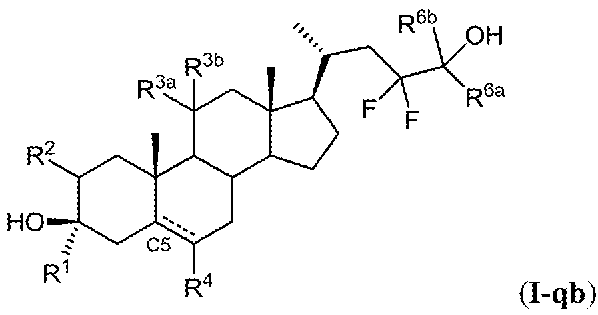
またはその薬学的に許容され得る塩が提供される。ある特定の実施形態において、R6a
は、2~10個の炭素原子を含む非水素基である。ある特定の実施形態において、R6a
およびR6bのうちの少なくとも1つは、フッ素で置換された非水素基である。ある特定
の実施形態において、R6aに付着されている炭素は、(S)配置である。ある特定の実
施形態において、R6aに付着されている炭素は、(R)配置である。ある特定の実施形
態において、R6aは、1つまたはそれを超えるフッ素で必要に応じて置換されるメチル
(C1)、例えば、-CH3または-CF3である。ある特定の実施形態において、R6
aは、置換もしくは非置換エチル(C2)、置換もしくは非置換n-プロピル(C3)ま
たは置換もしくは非置換イソプロピル(C3)である。ある特定の実施形態において、R
6aは、-CH2ORA6、-CH2CH2ORA6または-CH2CH2CH2ORA
6である。ある特定の実施形態において、R6aは、置換もしくは非置換ビニル(C2)
または置換もしくは非置換アリル(C3)である。ある特定の実施形態において、R6a
は、置換もしくは非置換エチニル(C2)または置換もしくは非置換プロパルギル(C3
)である。ある特定の実施形態において、R6aは、置換または非置換シクロプロピルで
ある。ある特定の実施形態において、R6bは、水素である。ある特定の実施形態におい
て、R6bは、-CH3または-CF3である。ある特定の実施形態において、

は、単結合を表し、C5における水素は、アルファである。ある特定の実施形態において
、

は、二重結合を表す。ある特定の実施形態において、R1は、-CH3または-CH2C
H3である。ある特定の実施形態において、R2は、水素、-OH、-OCH3、-OC
H2CH3、-OCH2CH2CH3、-CH3、-CH2CH3、-CH2CH2CH
3、シクロプロピル、フルオロまたはクロロである。ある特定の実施形態において、R2
は、アルファ配置の非水素置換基である。ある特定の実施形態において、R2は、ベータ
配置の非水素置換基である。ある特定の実施形態において、R3aおよびR3bは、両方
とも水素である。ある特定の実施形態において、R3aおよびR3bは、一体となって、
=O(オキソ)を形成する。ある特定の実施形態において、R4は、水素である。
In certain embodiments where X is —CH 2 — and R 5a and R 5b are both fluorine, the compound of formula (I-qb):
or a pharma- ceutically acceptable salt thereof. In certain embodiments, R
is a non-hydrogen group containing 2 to 10 carbon atoms.
and at least one of R 6b is a non-hydrogen group substituted with fluorine. In certain embodiments, the carbon attached to R 6a is in the (S) configuration. In certain embodiments, the carbon attached to R 6a is in the (R) configuration. In certain embodiments, R 6a is methyl (C 1 ) optionally substituted with one or more fluorines, e.g., -CH 3 or -CF 3. In certain embodiments, R 6
a is substituted or unsubstituted ethyl (C 2 ), substituted or unsubstituted n-propyl (C 3 ), or substituted or unsubstituted isopropyl (C 3 ). In certain embodiments, R
6a is -CH 2 OR A6 , -CH 2 CH 2 OR A6 or -CH 2 CH 2 CH 2 OR A
In certain embodiments, R 6a is substituted or unsubstituted vinyl(C 2 ) .
or substituted or unsubstituted aryl (C 3 ). In certain embodiments, R 6a
is a substituted or unsubstituted ethynyl (C 2 ) or a substituted or unsubstituted propargyl (C 3
In certain embodiments, R 6a is substituted or unsubstituted cyclopropyl. In certain embodiments, R 6b is hydrogen. In certain embodiments, R 6b is -CH3 or -CF3 . In certain embodiments,
represents a single bond and the hydrogen at C5 is alpha. In certain embodiments,
represents a double bond. In certain embodiments, R 1 is -CH 3 or -CH 2 C
In certain embodiments, R 2 is hydrogen, —OH, —OCH 3 , —OC
H 2 CH 3 , -OCH 2 CH 2 CH 3 , -CH 3 , -CH 2 CH 3 , -CH 2 CH 2 CH
3 , cyclopropyl , fluoro or chloro.
is a non-hydrogen substituent in the alpha configuration. In certain embodiments, R 2 is a non-hydrogen substituent in the beta configuration. In certain embodiments, R 3a and R 3b are both hydrogen. In certain embodiments, R 3a and R 3b together are
=O (oxo). In certain embodiments, R4 is hydrogen.
Xが-C(RX)2-であり、1つのRX基およびR5bが一体となってtrans二
重結合を形成する、ある特定の実施形態では、式(I-qc)の化合物:

またはその薬学的に許容され得る塩が提供される。ある特定の実施形態において、R6a
は、2~10個の炭素原子を含む非水素基である。ある特定の実施形態において、R6a
およびR6bのうちの少なくとも1つは、フッ素で置換された非水素基である。ある特定
の実施形態において、R6aに付着されている炭素は、(S)配置である。ある特定の実
施形態において、R6aに付着されている炭素は、(R)配置である。ある特定の実施形
態において、R6aは、1つまたはそれを超えるフッ素で必要に応じて置換されるメチル
(C1)、例えば、-CH3または-CF3である。ある特定の実施形態において、R6
aは、置換もしくは非置換エチル(C2)、置換もしくは非置換n-プロピル(C3)ま
たは置換もしくは非置換イソプロピル(C3)である。ある特定の実施形態において、R
6aは、-CH2ORA6、-CH2CH2ORA6または-CH2CH2CH2ORA
6である。ある特定の実施形態において、R6aは、置換もしくは非置換ビニル(C2)
または置換もしくは非置換アリル(C3)である。ある特定の実施形態において、R6a
は、置換もしくは非置換エチニル(C2)または置換もしくは非置換プロパルギル(C3
)である。ある特定の実施形態において、R6aは、置換または非置換シクロプロピルで
ある。ある特定の実施形態において、R6bは、水素である。ある特定の実施形態におい
て、R6bは、-CH3または-CF3である。ある特定の実施形態において、
は、単結合を表し、C5における水素は、アルファである。ある特定の実施形態において
、

は、二重結合を表す。ある特定の実施形態において、R1は、-CH3または-CH2C
H3である。ある特定の実施形態において、R2は、水素、-OH、-OCH3、-OC
H2CH3、-OCH2CH2CH3、-CH3、-CH2CH3、-CH2CH2CH
3、シクロプロピル、フルオロまたはクロロである。ある特定の実施形態において、R2
は、アルファ配置の非水素置換基である。ある特定の実施形態において、R2は、ベータ
配置の非水素置換基である。ある特定の実施形態において、R3aおよびR3bは、両方
とも水素である。ある特定の実施形態において、R3aおよびR3bは、一体となって、
=O(オキソ)を形成する。ある特定の実施形態において、R4は、水素である。
In certain embodiments where X is -C(R X ) 2 - and one R X group and R 5b together form a trans double bond, the compound of formula (I-qc):
or a pharma- ceutically acceptable salt thereof. In certain embodiments, R
is a non-hydrogen group containing 2 to 10 carbon atoms.
and at least one of R 6b is a non-hydrogen group substituted with fluorine. In certain embodiments, the carbon attached to R 6a is in the (S) configuration. In certain embodiments, the carbon attached to R 6a is in the (R) configuration. In certain embodiments, R 6a is methyl (C 1 ) optionally substituted with one or more fluorines, e.g., -CH 3 or -CF 3. In certain embodiments, R 6
a is substituted or unsubstituted ethyl (C 2 ), substituted or unsubstituted n-propyl (C 3 ), or substituted or unsubstituted isopropyl (C 3 ). In certain embodiments, R
6a is -CH 2 OR A6 , -CH 2 CH 2 OR A6 or -CH 2 CH 2 CH 2 OR A
In certain embodiments, R 6a is substituted or unsubstituted vinyl(C 2 ) .
or substituted or unsubstituted aryl (C 3 ). In certain embodiments, R 6a
is a substituted or unsubstituted ethynyl (C 2 ) or a substituted or unsubstituted propargyl (C 3
In certain embodiments, R 6a is substituted or unsubstituted cyclopropyl. In certain embodiments, R 6b is hydrogen. In certain embodiments, R 6b is -CH3 or -CF3 . In certain embodiments,
represents a single bond and the hydrogen at C5 is alpha. In certain embodiments,
represents a double bond. In certain embodiments, R 1 is -CH 3 or -CH 2 C
In certain embodiments, R 2 is hydrogen, —OH, —OCH 3 , —OC
H 2 CH 3 , -OCH 2 CH 2 CH 3 , -CH 3 , -CH 2 CH 3 , -CH 2 CH 2 CH
3 , cyclopropyl , fluoro or chloro.
is a non-hydrogen substituent in the alpha configuration. In certain embodiments, R 2 is a non-hydrogen substituent in the beta configuration. In certain embodiments, R 3a and R 3b are both hydrogen. In certain embodiments, R 3a and R 3b together are
=O (oxo). In certain embodiments, R4 is hydrogen.
ある特定の実施形態において、式(I-q)の化合物は、式(I-qd)の化合物:

またはその薬学的に許容され得る塩から選択される。ある特定の実施形態において、R6
aは、2~10個の炭素原子を含む非水素基である。ある特定の実施形態において、R6
aおよびR6bのうちの少なくとも1つは、フッ素で置換された非水素基である。ある特
定の実施形態において、R6aに付着されている炭素は、(S)配置である。ある特定の
実施形態において、R6aに付着されている炭素は、(R)配置である。ある特定の実施
形態において、R6aは、1つまたはそれを超えるフッ素で必要に応じて置換されるメチ
ル(C1)、例えば、-CH3または-CF3である。ある特定の実施形態において、R
6aは、置換もしくは非置換エチル(C2)、置換もしくは非置換n-プロピル(C3)
または置換もしくは非置換イソプロピル(C3)である。ある特定の実施形態において、
R6aは、-CH2ORA6、-CH2CH2ORA6または-CH2CH2CH2OR
A6である。ある特定の実施形態において、R6aは、置換もしくは非置換ビニル(C2
)または置換もしくは非置換アリル(C3)である。ある特定の実施形態において、R6
aは、置換もしくは非置換エチニル(C2)または置換もしくは非置換プロパルギル(C
3)である。ある特定の実施形態において、R6aは、置換または非置換シクロプロピル
である。ある特定の実施形態において、R6bは、水素である。ある特定の実施形態にお
いて、R6bは、-CH3または-CF3である。ある特定の実施形態において、
は、単結合を表し、C5における水素は、アルファである。ある特定の実施形態において
、
は、二重結合を表す。ある特定の実施形態において、R1は、-CH3または-CH2C
H3である。
In certain embodiments, the compound of formula (I-q) is a compound of formula (I-qd):
or a pharma- ceutically acceptable salt thereof.
a is a non-hydrogen group containing 2 to 10 carbon atoms.
At least one of R 6a and R 6b is a non-hydrogen group substituted with fluorine. In certain embodiments, the carbon attached to R 6a is in the (S) configuration. In certain embodiments, the carbon attached to R 6a is in the (R) configuration. In certain embodiments, R 6a is methyl (C 1 ) optionally substituted with one or more fluorines, e.g., -CH 3 or -CF 3. In certain embodiments, R
6a is a substituted or unsubstituted ethyl (C 2 ), a substituted or unsubstituted n-propyl (C 3 ),
or substituted or unsubstituted isopropyl (C 3 ).
R 6a is -CH 2 OR A6 , -CH 2 CH 2 OR A6 or -CH 2 CH 2 CH 2 OR
In certain embodiments, R 6a is substituted or unsubstituted vinyl (C 2
) or substituted or unsubstituted aryl (C 3 ). In certain embodiments, R 6
a is substituted or unsubstituted ethynyl (C 2 ) or substituted or unsubstituted propargyl (C
3 ). In certain embodiments, R 6a is substituted or unsubstituted cyclopropyl. In certain embodiments, R 6b is hydrogen. In certain embodiments, R 6b is -CH 3 or -CF 3. In certain embodiments,
represents a single bond and the hydrogen at C5 is alpha. In certain embodiments,
represents a double bond. In certain embodiments, R 1 is -CH 3 or -CH 2 C
H3 .
ある特定の実施形態において、式(I-q)の化合物は、式(I-qe)の化合物:

またはその薬学的に許容され得る塩から選択される。ある特定の実施形態において、R6
aは、2~10個の炭素原子を含む非水素基である。ある特定の実施形態において、R6
aおよびR6bのうちの少なくとも1つは、フッ素で置換された非水素基である。ある特
定の実施形態において、R6aに付着されている炭素は、(S)配置である。ある特定の
実施形態において、R6aに付着されている炭素は、(R)配置である。ある特定の実施
形態において、R6aは、1つまたはそれを超えるフッ素で必要に応じて置換されるメチ
ル(C1)、例えば、-CH3または-CF3である。ある特定の実施形態において、R
6aは、置換もしくは非置換エチル(C2)、置換もしくは非置換n-プロピル(C3)
または置換もしくは非置換イソプロピル(C3)である。ある特定の実施形態において、
R6aは、-CH2ORA6、-CH2CH2ORA6または-CH2CH2CH2OR
A6である。ある特定の実施形態において、R6aは、置換もしくは非置換ビニル(C2
)または置換もしくは非置換アリル(C3)である。ある特定の実施形態において、R6
aは、置換もしくは非置換エチニル(C2)または置換もしくは非置換プロパルギル(C
3)である。ある特定の実施形態において、R6aは、置換または非置換シクロプロピル
である。ある特定の実施形態において、R6bは、水素である。ある特定の実施形態にお
いて、R6bは、-CH3または-CF3である。ある特定の実施形態において、R1は
、-CH3または-CH2CH3である。
In certain embodiments, the compound of formula (I-q) is a compound of formula (I-qe):
or a pharma- ceutically acceptable salt thereof.
a is a non-hydrogen group containing 2 to 10 carbon atoms.
At least one of R 6a and R 6b is a non-hydrogen group substituted with fluorine. In certain embodiments, the carbon attached to R 6a is in the (S) configuration. In certain embodiments, the carbon attached to R 6a is in the (R) configuration. In certain embodiments, R 6a is methyl (C 1 ) optionally substituted with one or more fluorines, e.g., -CH 3 or -CF 3. In certain embodiments, R
6a is a substituted or unsubstituted ethyl (C 2 ), a substituted or unsubstituted n-propyl (C 3 ),
or substituted or unsubstituted isopropyl (C 3 ).
R 6a is -CH 2 OR A6 , -CH 2 CH 2 OR A6 or -CH 2 CH 2 CH 2 OR
In certain embodiments, R 6a is substituted or unsubstituted vinyl (C 2
) or substituted or unsubstituted aryl (C 3 ). In certain embodiments, R 6
a is substituted or unsubstituted ethynyl (C 2 ) or substituted or unsubstituted propargyl (C
3 ). In certain embodiments, R 6a is substituted or unsubstituted cyclopropyl. In certain embodiments, R 6b is hydrogen. In certain embodiments, R 6b is -CH 3 or -CF 3. In certain embodiments, R 1 is -CH 3 or -CH 2 CH 3 .
ある特定の実施形態において、式(I-q)の化合物は、式(I-qf)の化合物:
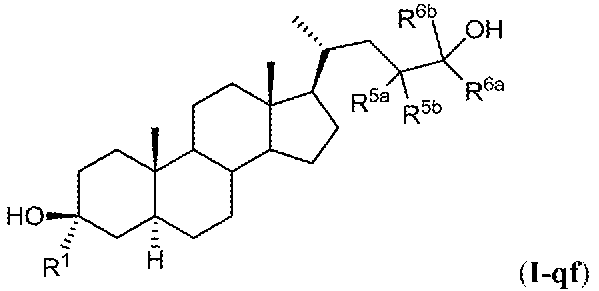
またはその薬学的に許容され得る塩から選択される。ある特定の実施形態において、R6
aは、2~10個の炭素原子を含む非水素基である。ある特定の実施形態において、R6
aおよびR6bのうちの少なくとも1つは、フッ素で置換された非水素基である。ある特
定の実施形態において、R6aに付着されている炭素は、(S)配置である。ある特定の
実施形態において、R6aに付着されている炭素は、(R)配置である。ある特定の実施
形態において、R6aは、1つまたはそれを超えるフッ素で必要に応じて置換されるメチ
ル(C1)、例えば、-CH3または-CF3である。ある特定の実施形態において、R
6aは、置換もしくは非置換エチル(C2)、置換もしくは非置換n-プロピル(C3)
または置換もしくは非置換イソプロピル(C3)である。ある特定の実施形態において、
R6aは、-CH2ORA6、-CH2CH2ORA6または-CH2CH2CH2OR
A6である。ある特定の実施形態において、R6aは、置換もしくは非置換ビニル(C2
)または置換もしくは非置換アリル(C3)である。ある特定の実施形態において、R6
aは、置換もしくは非置換エチニル(C2)または置換もしくは非置換プロパルギル(C
3)である。ある特定の実施形態において、R6aは、置換または非置換シクロプロピル
である。ある特定の実施形態において、R6bは、水素である。ある特定の実施形態にお
いて、R6bは、-CH3または-CF3である。ある特定の実施形態において、R1は
、-CH3または-CH2CH3である。
In certain embodiments, the compound of formula (I-q) is a compound of formula (I-qf):
or a pharma- ceutically acceptable salt thereof.
a is a non-hydrogen group containing 2 to 10 carbon atoms.
At least one of R 6a and R 6b is a non-hydrogen group substituted with fluorine. In certain embodiments, the carbon attached to R 6a is in the (S) configuration. In certain embodiments, the carbon attached to R 6a is in the (R) configuration. In certain embodiments, R 6a is methyl (C 1 ) optionally substituted with one or more fluorines, e.g., -CH 3 or -CF 3. In certain embodiments, R
6a is a substituted or unsubstituted ethyl (C 2 ), a substituted or unsubstituted n-propyl (C 3 ),
or substituted or unsubstituted isopropyl (C 3 ).
R 6a is -CH 2 OR A6 , -CH 2 CH 2 OR A6 or -CH 2 CH 2 CH 2 OR
In certain embodiments, R 6a is substituted or unsubstituted vinyl (C 2
) or substituted or unsubstituted aryl (C 3 ). In certain embodiments, R 6
a is substituted or unsubstituted ethynyl (C 2 ) or substituted or unsubstituted propargyl (C
3 ). In certain embodiments, R 6a is substituted or unsubstituted cyclopropyl. In certain embodiments, R 6b is hydrogen. In certain embodiments, R 6b is -CH 3 or -CF 3. In certain embodiments, R 1 is -CH 3 or -CH 2 CH 3 .
ある特定の実施形態において、式(I-q)の化合物は:


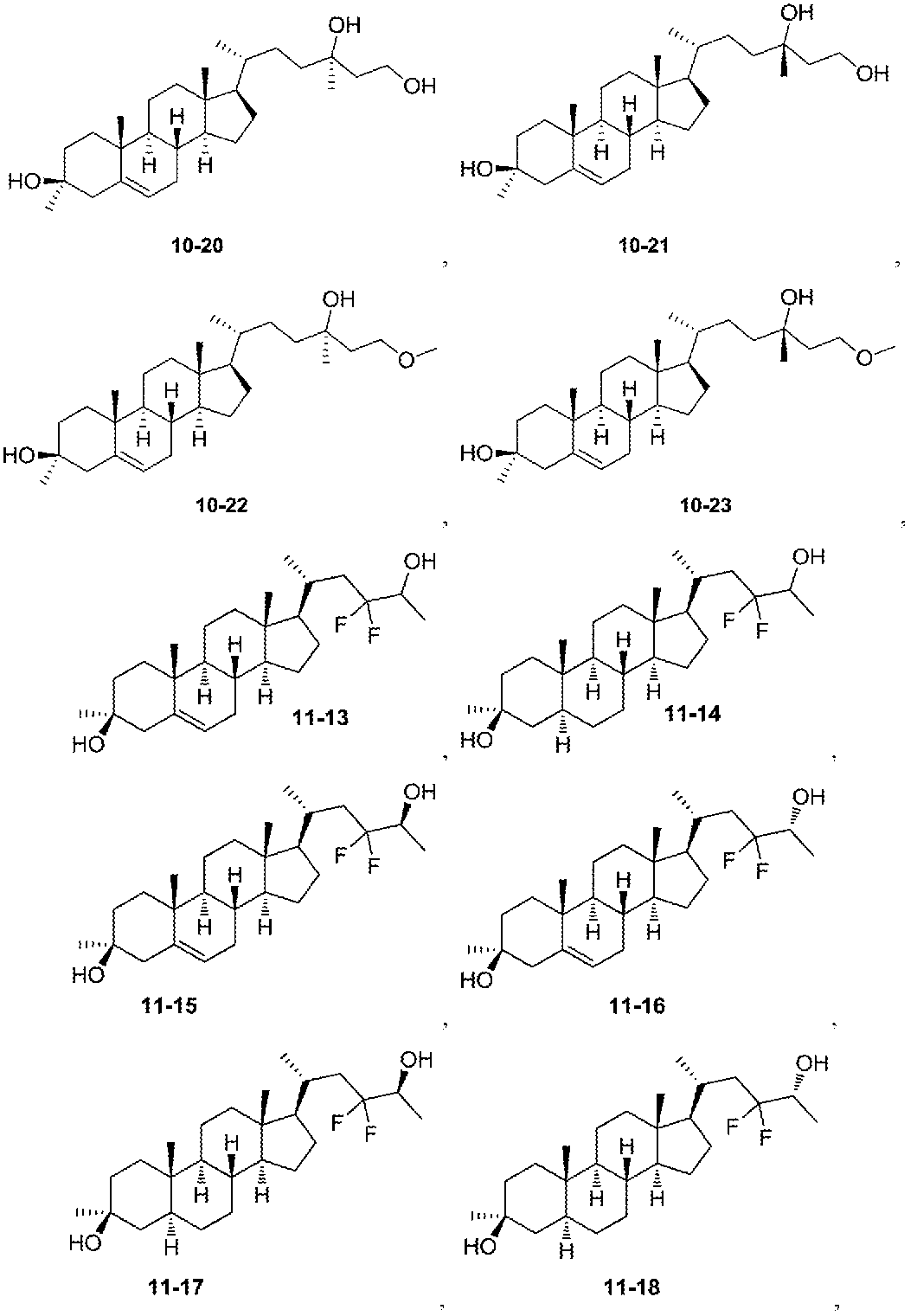

およびそれらの薬学的に許容され得る塩からなる群より選択される。
In certain embodiments, the compound of formula (I-q) is:
and pharma- ceutically acceptable salts thereof.
薬学的組成物
別の態様において、本発明は、薬学的に許容され得るキャリアおよび有効量の式(I)
の化合物を含む薬学的組成物を提供する。
Pharmaceutical Compositions In another aspect, the present invention provides a pharmaceutical composition comprising a pharma- ceutical ...
The present invention provides a pharmaceutical composition comprising the compound of formula (I).
医薬品として使用されるとき、本明細書中に提供される化合物は、典型的には薬学的組
成物の形態で投与される。そのような組成物は、薬学分野において周知の様式で調製され
得、そのような組成物は、少なくとも1つの活性な化合物を含む。
When used as pharmaceuticals, the compounds provided herein are typically administered in the form of a pharmaceutical composition, which may be prepared in a manner well known in the pharmaceutical art and which contains at least one active compound.
薬学的組成物に関する1つの実施形態において、上記キャリアは、非経口キャリア、経
口または局所キャリアである。
In one embodiment of the pharmaceutical composition, the carrier is a parenteral carrier, an oral or a topical carrier.
本発明は、医薬品または医薬として使用するための、本発明の化合物またはその薬学的
組成物にも関する。
The present invention also relates to a compound of the present invention or a pharmaceutical composition thereof for use as a medicine or medicament.
通常、本明細書中に提供される化合物は、治療有効量で投与される。実際に投与される
化合物の量は、処置される症状、選択された投与経路、投与される実際の化合物、個々の
患者の齢、体重および応答、患者の症状の重症度などを含む関連する状況に鑑みて、典型
的には医師によって決定され得る。
Generally, the compounds provided herein are administered in a therapeutically effective amount. The amount of compound actually administered can typically be determined by a physician in view of the relevant circumstances, including the condition being treated, the selected route of administration, the actual compound being administered, the age, weight and response of the individual patient, the severity of the patient's condition, etc.
本明細書中に提供される薬学的組成物は、経口、直腸、経皮的、皮下、静脈内、筋肉内
および鼻腔内を含む種々の経路によって投与され得る。意図される送達経路に応じて、本
明細書中に提供される化合物は、好ましくは、注射可能な組成物もしくは経口組成物のい
ずれかとして製剤化されるか、または軟膏として、ローションとしてもしくはパッチとし
て(すべて経皮投与用)製剤化される。
The pharmaceutical compositions provided herein can be administered by various routes, including oral, rectal, transdermal, subcutaneous, intravenous, intramuscular and intranasal.Depending on the intended delivery route, the compounds provided herein are preferably formulated as either injectable or oral compositions, or as ointments, lotions or patches (all for transdermal administration).
経口投与用の組成物は、バルク液の溶液もしくは懸濁液、または原末の形態をとり得る
。しかしながら、より一般的には、正確な投薬を容易にするために、組成物は、単位剤形
で提供される。用語「単位剤形」とは、ヒト被験体用および他の哺乳動物用の単位投薬量
として適した物理的に別個の単位のことを指し、各単位は、所望の治療効果をもたらすよ
うに計算された所定量の活性な材料を、好適な薬学的賦形剤とともに含む。典型的な単位
剤形としては、液体組成物の充填済みで計量済みのアンプルもしくは注射器または固体組
成物の場合は丸剤、錠剤、カプセルなどが挙げられる。そのような組成物において、化合
物は、通常、微量成分(約0.1~約50重量%または好ましくは、約1~約40重量%
)であり、残りは、様々なビヒクルまたはキャリアおよび所望の投薬形態の形成に役立つ
加工助剤である。
Compositions for oral administration may take the form of solutions or suspensions in bulk liquid, or bulk powders. More commonly, however, compositions are provided in unit dosage forms to facilitate accurate dosing. The term "unit dosage form" refers to physically discrete units suitable as unitary dosages for human subjects and other mammals, each unit containing a predetermined quantity of active material calculated to produce a desired therapeutic effect, together with a suitable pharmaceutical excipient. Typical unit dosage forms include prefilled, premeasured ampoules or syringes of liquid compositions or pills, tablets, capsules, and the like in the case of solid compositions. In such compositions, the compounds are usually present in minor amounts (from about 0.1 to about 50% by weight, or preferably from about 1 to about 40% by weight).
) and the remainder are various vehicles or carriers and processing aids that aid in forming the desired dosage form.
経口投与に適した液体形態は、好適な水性または非水性のビヒクルを、緩衝剤、懸濁剤
および分散剤、着色料、香料などとともに含み得る。固体形態は、例えば、以下の成分の
うちのいずれか、または同様の性質の化合物を含み得る:結合剤(例えば、微結晶性セル
ロース、トラガカントゴムまたはゼラチン);賦形剤(例えば、デンプンもしくはラクト
ース)、崩壊剤(例えば、アルギン酸、Primogelまたはコーンスターチ);滑沢
剤(例えば、ステアリン酸マグネシウム);滑剤(例えば、コロイド状二酸化ケイ素);
甘味剤(例えば、スクロースまたはサッカリン);または香味剤(例えば、ペパーミント
、サリチル酸メチルまたはオレンジ香料)。
Liquid forms suitable for oral administration may include a suitable aqueous or nonaqueous vehicle with buffers, suspending and dispersing agents, colorants, flavors, etc. Solid forms may include, for example, any of the following ingredients, or compounds of a similar nature: binders (e.g., microcrystalline cellulose, gum tragacanth, or gelatin); excipients (e.g., starch or lactose); disintegrating agents (e.g., alginic acid, Primogel, or corn starch); lubricants (e.g., magnesium stearate); glidants (e.g., colloidal silicon dioxide);
a sweetening agent (eg, sucrose or saccharin); or a flavoring agent (eg, peppermint, methyl salicylate, or orange flavoring).
注射可能な組成物は、典型的には、注射可能な滅菌された食塩水もしくはリン酸緩衝食
塩水または当該分野で公知の他の注射可能なキャリアに基づく。従来と同様に、そのよう
な組成物における活性な化合物は、典型的には微量成分であり、しばしば、約0.05~
10重量%であり、残りは、注射可能なキャリアなどである。
Injectable compositions are typically based on injectable sterile saline or phosphate buffered saline or other injectable carriers known in the art. As is conventional, the active compound in such compositions is typically a minor component, often from about 0.05 to 100 mg/kg.
10% by weight, the remainder being the injectable carrier etc.
経皮的組成物は、典型的には、活性成分を通常、約0.01~約20重量%、好ましく
は、約0.1~約20重量%、好ましくは、約0.1~約10重量%、より好ましくは、
約0.5~約15重量%の範囲の量で含む局所軟膏またはクリームとして製剤化される。
軟膏として製剤化されるとき、活性成分は、典型的にはパラフィン性または水混和性の軟
膏基剤と組み合わされ得る。あるいは、活性成分は、例えば、水中油型クリーム基剤を用
いて、クリームに製剤化され得る。そのような経皮的製剤は、当該分野で周知であり、通
常、活性成分または製剤の安定性の皮膚浸透性を向上させるさらなる成分を含む。すべて
のそのような公知の経皮的製剤および成分が、本明細書中に提供される範囲内に含まれる
。
Transdermal compositions typically contain the active ingredient in an amount of from about 0.01 to about 20% by weight, preferably from about 0.1 to about 20% by weight, more preferably from about 0.1 to about 10% by weight, more preferably
It may be formulated as a topical ointment or cream containing the active ingredient in an amount ranging from about 0.5 to about 15% by weight.
When formulated as ointment, active ingredient can be typically combined with paraffinic or water-miscible ointment base.Alternatively, active ingredient can be formulated into cream, for example, with oil-in-water cream base.Such transdermal formulations are well known in the art, and usually contain additional components that improve the skin penetration of active ingredient or the stability of formulation.All such known transdermal formulations and components are included within the scope provided herein.
本明細書中に提供される化合物は、経皮的デバイスによっても投与され得る。したがっ
て、経皮的送達は、レザバータイプもしくは多孔質膜タイプまたは固体マトリックス種類
のパッチを使用して達成され得る。
The compounds provided herein can also be administered by a transdermal device.Thus, transdermal delivery can be accomplished using a patch either of the reservoir or porous membrane type or of a solid matrix variety.
経口投与可能であるか、注射可能であるか、または局所投与可能である組成物に対する
上に記載された構成要素は、単なる代表である。他の材料ならびに加工法などは、Rem
ington’s Pharmaceutical Sciences,17th ed
ition,1985,Mack Publishing Company,Easto
n,PennsylvaniaのPart8(参照により本明細書中に援用される)に示
されている。
The components described above for compositions that can be administered orally, injectably, or topically are merely representative. Other materials and processing methods, etc. are described in Rem.
Inton's Pharmaceutical Sciences, 17th ed.
ition, 1985, Mack Publishing Company, Easto
n, Pennsylvania, Part 8, which is incorporated herein by reference.
経口投与可能であるか、注射可能であるか、または局所投与可能である組成物に対する
上に記載された構成要素は、単なる代表である。他の材料ならびに加工法などは、Rem
ington’s The Science and Practice of Pha
rmacy,21st edition,2005,Publisher:Lippin
cott Williams & WilkinsのPart8(参照により本明細書中
に援用される)に示されている。
The components described above for compositions that can be administered orally, injectably, or topically are merely representative. Other materials and processing methods, etc. are described in Rem.
Inton's The Science and Practice of Pha
rmacy, 21st edition, 2005, Publisher: Lippin
Part 8 of Cott Williams & Wilkins, incorporated herein by reference.
本発明の化合物は、徐放形態でまたは徐放薬物送達系からも投与され得る。代表的な徐
放材料の説明は、Remington’s Pharmaceutical Scien
cesに見られ得る。
The compounds of the invention can also be administered in sustained release forms or from sustained release drug delivery systems. A description of representative sustained release materials can be found in Remington's Pharmaceutical Sciences, 1999, ed.
ces.
本発明は、本発明の化合物の薬学的に許容され得る製剤にも関する。1つの実施形態に
おいて、その製剤は、水を含む。別の実施形態において、その製剤は、シクロデキストリ
ン誘導体を含む。最も一般的なシクロデキストリンは、連結された糖部分上に1つまたは
それを超える置換基を必要に応じて含む、6、7および8個のα-1,4連結型グルコー
ス単位からそれぞれなるα-、β-およびγ-シクロデキストリンであり、これらは、メ
チル化置換、ヒドロキシアルキル化置換、アシル化置換およびスルホアルキルエーテル置
換を含むがこれらに限定されない。ある特定の実施形態において、シクロデキストリンは
、スルホアルキルエーテルβ-シクロデキストリン、例えば、Captisol(登録商
標)としても知られるスルホブチルエーテルβ-シクロデキストリンである。例えば、米
国特許第5,376,645号を参照のこと。ある特定の実施形態において、製剤は、ヘ
キサプロピル-β-シクロデキストリンを含む。より詳細な実施形態において、製剤は、
ヘキサプロピル-β-シクロデキストリン(水中10~50%)を含む。
The present invention also relates to pharma- ceutically acceptable formulations of the compounds of the invention. In one embodiment, the formulation comprises water. In another embodiment, the formulation comprises a cyclodextrin derivative. The most common cyclodextrins are α-, β-, and γ-cyclodextrins, consisting of 6, 7, and 8 α-1,4 linked glucose units, respectively, optionally containing one or more substituents on the linked sugar moieties, including, but not limited to, methylated, hydroxyalkylated, acylated, and sulfoalkyl ether substituted. In certain embodiments, the cyclodextrin is a sulfoalkyl ether β-cyclodextrin, e.g., sulfobutyl ether β-cyclodextrin, also known as Captisol®. See, e.g., U.S. Patent No. 5,376,645. In certain embodiments, the formulation comprises hexapropyl-β-cyclodextrin. In more particular embodiments, the formulation comprises
Contains hexapropyl-β-cyclodextrin (10-50% in water).
本発明は、本発明の化合物の薬学的に許容され得る酸付加塩にも関する。その薬学的に
許容され得る塩を調製するために使用され得る酸は、無毒性酸付加塩、すなわち、薬理学
的に許容され得るアニオンを含む塩、例えば、塩酸塩、ヨウ化水素酸塩、臭化水素酸塩、
硝酸塩、硫酸塩、重硫酸塩、リン酸塩、酢酸塩、乳酸塩、クエン酸塩、酒石酸塩、コハク
酸塩、マレイン酸塩、フマル酸塩、安息香酸塩、パラ-トルエンスルホン酸塩などを形成
する酸である。
The present invention also relates to pharma- ceutically acceptable acid addition salts of the compounds of the present invention. The acids that can be used to prepare the pharma- ceutically acceptable salts include non-toxic acid addition salts, i.e., salts containing pharmacologically acceptable anions, such as hydrochloride, hydroiodide, hydrobromide,
Acids that form nitrates, sulfates, bisulfates, phosphates, acetates, lactates, citrates, tartrates, succinates, maleates, fumarates, benzoates, para-toluenesulfonates, and the like.
以下の製剤実施例は、本発明に従って調製され得る代表的な薬学的組成物を例証するも
のである。しかしながら、本発明は、以下の薬学的組成物に限定されない。
The following formulation examples illustrate representative pharmaceutical compositions that may be prepared according to the present invention, but the present invention is not limited to the following pharmaceutical compositions.
例示的製剤1-錠剤:本発明の化合物を乾燥粉末として乾燥ゼラチン結合剤とおよそ1
:2の重量比で混合し得る。微量のステアリン酸マグネシウムを滑沢剤として加える。そ
の混合物を打錠機で240~270mgの錠剤(1錠あたり80~90mgの活性な化合
物)に形成する。
Exemplary Formulation 1—Tablets: A compound of the invention is administered as a dry powder with a dry gelatin binder in approximately 1
The mixture may be mixed in a weight ratio of 0.1:2. A trace amount of magnesium stearate is added as a lubricant. The mixture is formed into 240-270 mg tablets (80-90 mg of active compound per tablet) in a tablet press.
例示的製剤2-カプセル:本発明の化合物を乾燥粉末としてデンプン希釈剤とおよそ1
:1の重量比で混合し得る。その混合物を250mgのカプセル(1カプセルあたり12
5mgの活性な化合物)に充填する。
Exemplary Formulation 2—Capsules: The compound of the invention is mixed as a dry powder with a starch diluent in approximately 1
The mixture can be mixed in a weight ratio of 1:1. The mixture can be packed into 250 mg capsules (12 mg per capsule).
5 mg of active compound).
例示的製剤3-液剤:本発明の化合物(125mg)をスクロース(1.75g)およ
びキサンタンガム(4mg)と混合し得、得られた混合物をブレンドし、No.10メッ
シュU.S.シーブに通し、次いで、予め調製しておいた、微結晶性セルロースおよびカ
ルボキシメチルセルロースナトリウム(11:89,50mg)の水溶液と混合し得る。
安息香酸ナトリウム(10mg)、香料および着色料を水で希釈し、撹拌しながら加える
。次いで、5mLの総体積をもたらすのに十分な水を加え得る。
Exemplary Formulation 3—Solution: A compound of the invention (125 mg) can be mixed with sucrose (1.75 g) and xanthan gum (4 mg), and the resulting mixture can be blended, passed through a No. 10 mesh U.S. sieve, and then mixed with a previously prepared solution of microcrystalline cellulose and sodium carboxymethylcellulose (11:89, 50 mg) in water.
Sodium benzoate (10 mg), flavor, and color are diluted with water and added, with stirring. Sufficient water can then be added to bring the total volume to 5 mL.
例示的製剤4-錠剤:本発明の化合物を乾燥粉末として乾燥ゼラチン結合剤とおよそ1
:2の重量比で混合し得る。微量のステアリン酸マグネシウムを滑沢剤として加える。そ
の混合物を打錠機で450~900mgの錠剤(150~300mgの活性な化合物)に
形成する。
Exemplary Formulation 4—Tablets: A compound of the invention is administered as a dry powder with a dry gelatin binder in approximately 1 mL of tablet form.
The mixture may be mixed in a weight ratio of 0.1:2. A trace amount of magnesium stearate is added as a lubricant. The mixture is formed into 450-900 mg tablets (150-300 mg of active compound) in a tablet press.
例示的製剤5-注射剤:本発明の化合物を滅菌された緩衝食塩水の注射可能な水性媒体
におよそ5mg/mLの濃度まで溶解し得るかまたは懸濁し得る。
Exemplary Formulation 5 - Injection: A compound of the invention may be dissolved or suspended in sterile, buffered saline injectable aqueous medium to a concentration of approximately 5 mg/mL.
例示的製剤6-錠剤:本発明の化合物を乾燥粉末として乾燥ゼラチン結合剤とおよそ1
:2の重量比で混合し得る。微量のステアリン酸マグネシウムを滑沢剤として加える。そ
の混合物を打錠機で90~150mgの錠剤(1錠あたり30~50mgの活性な化合物
)に形成する。
Exemplary Formulation 6—Tablets: A compound of the invention is administered as a dry powder with a dry gelatin binder in approximately 1 mL of tablet form.
The mixture may be mixed in a weight ratio of 0.1:2. A trace amount of magnesium stearate is added as a lubricant. The mixture is formed into 90-150 mg tablets (30-50 mg of active compound per tablet) in a tablet press.
例示的製剤7-錠剤:本発明の化合物を乾燥粉末として乾燥ゼラチン結合剤とおよそ1
:2の重量比で混合し得る。微量のステアリン酸マグネシウムを滑沢剤として加える。そ
の混合物を打錠機で30~90mgの錠剤(1錠あたり10~30mgの活性な化合物)
に形成する。
Exemplary Formulation 7—Tablets: A compound of the invention is administered as a dry powder with a dry gelatin binder in approximately 1
The mixture may be mixed in a weight ratio of 0.1:2. A trace amount of magnesium stearate is added as a lubricant. The mixture is pressed into 30-90 mg tablets (10-30 mg of active compound per tablet).
is formed.
例示的製剤8-錠剤:本発明の化合物を乾燥粉末として乾燥ゼラチン結合剤とおよそ1
:2の重量比で混合し得る。微量のステアリン酸マグネシウムを滑沢剤として加える。そ
の混合物を打錠機で0.3~30mgの錠剤(1錠あたり0.1~10mgの活性な化合
物)に形成する。
Exemplary Formulation 8—Tablets: A compound of the invention is administered as a dry powder with a dry gelatin binder in approximately 1 mL of tablet form.
The mixture may be mixed in a weight ratio of 0.3 mg to 30 mg tablets (0.1-10 mg of active compound per tablet) in a tablet press. A trace amount of magnesium stearate is added as a lubricant. The mixture is formed into 0.3-30 mg tablets (0.1-10 mg of active compound per tablet).
例示的製剤9-錠剤:本発明の化合物を乾燥粉末として乾燥ゼラチン結合剤とおよそ1
:2の重量比で混合し得る。微量のステアリン酸マグネシウムを滑沢剤として加える。そ
の混合物を打錠機で150~240mgの錠剤(1錠あたり50~80mgの活性な化合
物)に形成する。
Exemplary Formulation 9—Tablets: A compound of the invention is administered as a dry powder with a dry gelatin binder in approximately 1
The mixture may be mixed in a weight ratio of 0.1:2. A trace amount of magnesium stearate is added as a lubricant. The mixture is formed into 150-240 mg tablets (50-80 mg of active compound per tablet) in a tablet press.
例示的製剤10-錠剤:本発明の化合物を乾燥粉末として乾燥ゼラチン結合剤とおよそ
1:2の重量比で混合し得る。微量のステアリン酸マグネシウムを滑沢剤として加える。
その混合物を打錠機で270~450mgの錠剤(1錠あたり90~150mgの活性な
化合物)に形成する。
Exemplary Formulation 10 - Tablet: A compound of the invention may be mixed as a dry powder with a dry gelatin binder in an approximate 1:2 weight ratio. A trace amount of magnesium stearate is added as a lubricant.
The mixture is formed into 270-450 mg tablets (90-150 mg of active compound per tablet) in a tablet press.
注射用量レベルは、約0.1mg/kg/時~少なくとも10mg/kg/時の範囲で
ある(すべて、約1~約120時間、特に、24~96時間にわたる)。約0.1mg/
kg~約10mg/kgまたはそれを超える前負荷ボーラス(preloading b
olus)を投与することによっても、適正な定常状態レベルが達成され得る。最大総用
量は、40~80kgのヒト患者に対して約2g/日を超えないと予想される。
Injection dose levels range from about 0.1 mg/kg/hour to at least 10 mg/kg/hour (all over a period of about 1 to about 120 hours, particularly 24 to 96 hours).
kg to about 10 mg/kg or more preloading bolus
Adequate steady state levels may also be achieved by administering 0.1 mg/kg of ethanol (olus). The maximum total dose is not expected to exceed about 2 g/day for a 40-80 kg human patient.
長期間の症状の予防および/または処置の場合、処置レジメンは、通常、何ヶ月または
何年にもわたるので、患者の利便性および許容度のためには経口投薬が好ましい。経口投
薬に関しては、1日に1~5用量、特に2~4用量、典型的には3用量の経口投与が代表
的なレジメンである。これらの投薬パターンを用いて、各用量は、約0.01~約20m
g/kgの本明細書中に提供される化合物をもたらし、好ましい用量は、各々、約0.1
~約10mg/kg、特に、約1~約5mg/kgをもたらす。
For prevention and/or treatment of long-term conditions, treatment regimens usually span months or years, and oral dosing is preferred for patient convenience and tolerance. For oral dosing, oral administration of 1 to 5 doses, particularly 2 to 4 doses, typically 3 doses per day is a typical regimen. With these dosing patterns, each dose is administered in the range of about 0.01 to about 20 mg.
g/kg of a compound provided herein, with preferred doses being about 0.1
to about 10 mg/kg, particularly from about 1 to about 5 mg/kg.
経皮的用量は、一般に、注射用量を用いて達成されるものと同様またはそれより低い血
中濃度をもたらすように選択される。
Transdermal doses are generally selected to produce blood levels similar to or lower than those achieved with an injection dose.
CNS障害の発生を予防するために使用されるとき、本明細書中に提供される化合物は
、上に記載された投薬レベルで、その症状を発症するリスクがある被験体に、典型的には
医師の助言に基づいておよび医師の管理下で投与され得る。特定の症状を発症するリスク
がある被験体としては、一般に、その症状の家族歴を有する被験体、または遺伝子検査も
しくはスクリーニングによってその症状を特に発症しやすいと同定された被験体が挙げら
れる。
評価、処置および使用の方法
When used to prevent the development of CNS disorders, the compounds provided herein can be administered at the dosage levels described above to subjects at risk of developing the condition, typically under the advice and supervision of a physician. Subjects at risk of developing a particular condition generally include subjects who have a family history of the condition, or subjects who have been identified by genetic testing or screening as being particularly susceptible to developing the condition.
Methods of Assessment, Treatment and Use
患者、例えば、本明細書中に記載される障害を有する患者を評価するかまたは処置する
方法が、とりわけ本明細書中に記載される。いくつかの実施形態において、本明細書中に
記載される化合物(例えば、有効量の本明細書中に記載される化合物)が、患者に投与さ
れる。いくつかの実施形態において、上記方法は、必要に応じて患者サンプルを取得する
工程、ならびに対照基準と比較したときの24(S)-ヒドロキシコレステロールのレベ
ルの変化について、サンプルの評価を取得する工程および/またはサンプルを評価する工
程を含む。ある特定の実施形態において、その評価に応じて、患者は、本明細書中に記載
される障害について本明細書中に記載される化合物で処置され、例えば、患者は、有効量
の、24(S)-ヒドロキシコレステロールまたは構造的に関係するステロールもしくは
ステロイド、オキシステロール、NMDARのアゴニストまたはNMDARの正のアロス
テリックモジュレーター(PAM)、24(s)-ヒドロキシコレステロールの内在活性
または内在量を高める(例えば、増加させる)化合物(例えば、24(s)-ヒドロキシ
コレステロールを代謝する酵素を阻害する化合物、例えば、24-ヒドロキシコレステロ
ール7アルファ-ヒドロキシラーゼ(CYP39)を阻害する化合物)あるいは式(I)
の化合物などの本明細書中に記載される化合物を投与される。いくつかの実施形態におい
て、その化合物は、NMDARのアンタゴニストもしくはNAMまたは24(s)-ヒド
ロキシコレステロールの内在活性もしくは内在量を減少させる化合物(例えば、24(s
)-ヒドロキシコレステロールを生成する酵素を活性化する化合物、例えば、コレステロ
ール24(S)-ヒドロキシラーゼ(CYP46)を活性化する化合物)である。
Described herein, inter alia, are methods of evaluating or treating a patient, e.g., a patient having a disorder described herein. In some embodiments, a compound described herein (e.g., an effective amount of a compound described herein) is administered to the patient. In some embodiments, the method includes obtaining a patient sample as needed, and obtaining an evaluation of the sample and/or evaluating the sample for changes in the level of 24(S)-hydroxycholesterol as compared to a control standard. In certain embodiments, responsive to the evaluation, the patient is treated with a compound described herein for a disorder described herein, e.g., the patient is administered an effective amount of 24(S)-hydroxycholesterol or a structurally related sterol or steroid, an oxysterol, an agonist of NMDAR or a positive allosteric modulator (PAM) of NMDAR, a compound that enhances (e.g., increases) the endogenous activity or amount of 24(s)-hydroxycholesterol (e.g., a compound that inhibits an enzyme that metabolizes 24(s)-hydroxycholesterol, e.g., a compound that inhibits 24-hydroxycholesterol 7 alpha-hydroxylase (CYP39)), or a compound of formula (I)
In some embodiments, the compound is an antagonist of NMDAR or a compound that reduces the endogenous activity or amount of 24(s)-hydroxycholesterol (e.g., 24(s
)-hydroxycholesterol producing enzymes, such as compounds that activate cholesterol 24(S)-hydroxylase (CYP46).
「取得する(Acquire)」または「取得する(acquiring)」は、これ
らの用語が本明細書中で使用されるとき、物理的実体または値を「直接取得すること」ま
たは「間接的に取得すること」によって、物理的実体、または値、例えば、数値の所有権
を得ることを指す。「直接取得すること」は、プロセスを行うこと(例えば、合成方法ま
たは分析方法を行うこと)により、物理的実体または値を得ることを意味する。「間接的
に取得すること」とは、別の団体または供給源(例えば、物理的実体または値を直接取得
した第三者の研究室)から物理的実体または値を受け取ることを指す。物理的実体を直接
取得することは、物理的な物質、例えば、出発物質の物理的変化を含むプロセスを行うこ
とを含む。例示的な変化としては、2つまたはそれを超える出発物質から物理的実体を生
成すること、物質を剪断するかまたは断片化すること、物質を分離するかまたは精製する
こと、2つまたはそれを超える別個の実体を混合物にまとめること、共有結合または非共
有結合を破壊することまたは形成することを含む化学反応を行うことが挙げられる。値を
直接取得することは、サンプルまたは別の物質の物理的変化を含むプロセスを行うこと、
例えば、物質、例えば、サンプル、被検体または試薬の物理的変化を含む分析プロセスを
行うこと(時折、本明細書中で「物理的解析」と称される)、分析方法、例えば、以下の
うちの1つまたはそれを超えるものを含む方法を行うこと:物質、例えば、被検体または
そのフラグメントもしくは他の誘導体を別の物質から分離するかまたは精製すること;被
検体またはそのフラグメントもしくは他の誘導体を、別の物質、例えば、緩衝剤、溶媒ま
たは反応体と混和すること;あるいは例えば、被検体の第1の原子と第2の原子との間の
共有結合もしくは非共有結合を破壊するかまたは形成することによって;あるいは試薬ま
たはそのフラグメントもしくは他の誘導体の構造を変化させることによって、例えば、そ
の試薬の第1の原子と第2の原子との間の共有結合もしくは非共有結合を破壊するかまた
は形成することによって、被検体またはそのフラグメントもしくは他の誘導体の構造を変
化させることを含む。
"Acquire" or "acquiring", as these terms are used herein, refers to taking ownership of a physical entity or value, e.g., a numerical value, by "directly acquiring" or "indirectly acquiring" the physical entity or value. "Directly acquiring" means obtaining a physical entity or value by performing a process (e.g., performing a synthetic or analytical method). "Indirectly acquiring" refers to receiving a physical entity or value from another entity or source (e.g., a third-party laboratory that directly acquired the physical entity or value). Directly acquiring a physical entity includes performing a process that involves a physical change of a physical substance, e.g., a starting material. Exemplary changes include generating a physical entity from two or more starting materials, shearing or fragmenting a material, separating or purifying a material, combining two or more separate entities into a mixture, and performing a chemical reaction that includes breaking or forming a covalent or non-covalent bond. Directly acquiring a value includes performing a process that involves a physical change of a sample or another material,
For example, performing an analytical process (sometimes referred to herein as "physical analysis") that involves a physical change of a substance, e.g., a sample, analyte, or reagent, including performing an analytical method, e.g., a method that involves one or more of the following: separating or purifying a substance, e.g., an analyte, or a fragment or other derivative thereof, from another substance; combining the analyte, or a fragment or other derivative thereof, with another substance, e.g., a buffer, solvent, or reactant; or altering the structure of the analyte, or a fragment or other derivative thereof, e.g., by breaking or forming a covalent or non-covalent bond between a first atom and a second atom of the analyte; or altering the structure of a reagent, or a fragment or other derivative thereof, e.g., by breaking or forming a covalent or non-covalent bond between a first atom and a second atom of the reagent.
「サンプルを取得する」は、この用語が本明細書中で使用されるとき、サンプル、例え
ば、組織サンプルまたは核酸サンプルを「直接取得すること」または「間接的に取得する
こと」によって、そのサンプルの所有権を得ることを指す。「サンプルを直接取得するこ
と」は、プロセスを行うこと(例えば、手術または抽出などの物理的方法を行うこと)に
より、サンプルを得ることを意味する。「サンプルを間接的に取得すること」とは、別の
団体または供給源(例えば、サンプルを直接取得した第三者の研究室)からサンプルを受
け取ることを指す。サンプルを直接取得することは、物理的な物質、例えば、出発物質(
例えば、組織、例えば、ヒト患者の中の組織または患者から予め単離された組織)の物理
的変化を含むプロセスを行うことを含む。例示的な変化としては、出発物質から物理的実
体を調製すること、組織を解剖するかまたは掻爬すること;物質(例えば、サンプル組織
または核酸サンプル)を分離するかまたは精製すること;2つまたはそれを超える別個の
実体を混合物にまとめること;共有結合または非共有結合を破壊するかまたは形成するこ
とを含む化学反応を行うことが挙げられる。サンプルを直接取得することは、サンプルま
たは別の物質の物理的変化を含むプロセス、例えば、上に記載されたようなものを行うこ
とを含む。
"Obtaining a sample," as the term is used herein, refers to taking ownership of a sample, e.g., a tissue or nucleic acid sample, by "directly obtaining" or "indirectly obtaining" the sample. "Obtaining a sample directly" means obtaining a sample by performing a process, e.g., performing a physical method such as surgery or extraction. "Obtaining a sample indirectly" refers to receiving a sample from another entity or source, e.g., a third party laboratory that directly obtained the sample. Obtaining a sample directly does not involve the physical possession of a physical substance, e.g., a starting material (e.g., a nucleic acid sample).
For example, it includes performing a process that involves a physical change of a tissue, e.g., a tissue in a human patient or tissue previously isolated from a patient. Exemplary changes include preparing a physical entity from a starting material, dissecting or scraping a tissue; separating or purifying a material (e.g., a sample tissue or a nucleic acid sample); combining two or more separate entities into a mixture; performing a chemical reaction that involves breaking or forming a covalent or non-covalent bond. Directly obtaining a sample includes performing a process that involves a physical change of the sample or another material, e.g., as described above.
本明細書中で使用されるとき、「候補」である患者は、対照の患者または患者群と比べ
て、特定の治療的レジメンに応答する可能性がある患者である。「候補でない」患者は、
対照の患者または患者群と比べて、特定の治療的レジメンに応答する可能性がない患者で
ある。
As used herein, a "candidate" patient is one who is likely to respond to a particular therapeutic regimen compared to a control patient or group of patients. A "non-candidate" patient is one who is likely to respond to a particular therapeutic regimen compared to a control patient or group of patients.
A patient who is less likely to respond to a particular therapeutic regimen than a control patient or group of patients.
本明細書中に提供される化合物および薬学的組成物には、ヒトおよび非ヒト哺乳動物を
含む哺乳動物におけるCNS症状を予防するためおよび/または処置するための治療薬と
しての用途が見出される。したがって、先に述べたように、本発明は、列挙された処置方
法、ならびにそのような方法のための化合物、およびそのような方法に有用な医薬の調製
のためのそのような化合物の使用を本発明の範囲内に含み、それらにまで及ぶ。1つの態
様において、本明細書中に記載される化合物は、例えば、哺乳動物におけるCNS症状を
処置するため(例えば、精神分裂病、うつ病、双極性障害(例えば、Iおよび/またはI
I)、統合失調感情障害、気分障害、不安障害、人格障害、精神病、強迫性障害、外傷後
ストレス障害(PTSD)、自閉症圏障害(ASD)、気分変調(軽症うつ病)、社会不
安障害、強迫性障害(OCD)、疼痛(例えば、有痛性症候群または障害)、睡眠障害、
記憶障害(例えば、記憶機能障害)、痴呆、アルツハイマー病、発作性障害(例えば、癲
癇)、外傷性脳損傷(TBI)、脳卒中、嗜癖障害(例えば、オピエート類、コカインお
よび/またはアルコールに対する嗜癖)、自閉症、ハンチントン病、不眠、パーキンソン
病、離脱症候群または耳鳴を処置するため)の治療薬として企図される。いくつかの実施
形態において、本明細書中に記載される化合物は、被験体における学習を改善する(例え
ば、認知(cognative)機能を改善する)ために使用され得る。ある特定の実施
形態において、本発明の化合物は、うつ病、不安、気分障害、睡眠障害、記憶障害(例え
ば、記憶機能障害)、外傷性脳損傷、脳卒中、癲癇、認知機能不全(cognative
disfunction)および精神分裂病の処置において有用である。いくつかの実
施形態において、本明細書中に記載される化合物は、過量服用、例えば、薬物の過量服用
(例えば、ケタミンまたはPCPの過量服用)を処置するために使用され得る。
The compounds and pharmaceutical compositions provided herein find use as therapeutic agents for preventing and/or treating CNS conditions in mammals, including human and non-human mammals. Thus, as noted above, the invention includes and extends within its scope the recited methods of treatment, as well as compounds for such methods, and the use of such compounds for the preparation of medicaments useful for such methods. In one aspect, the compounds described herein are used to treat, for example, CNS conditions in mammals, such as schizophrenia, depression, bipolar disorder (e.g., I and/or I
I), schizoaffective disorder, mood disorder, anxiety disorder, personality disorder, psychosis, obsessive-compulsive disorder, post-traumatic stress disorder (PTSD), autism spectrum disorder (ASD), dysthymia (mild depression), social anxiety disorder, obsessive-compulsive disorder (OCD), pain (e.g., painful syndrome or disorder), sleep disorder,
The compounds are contemplated as therapeutic agents for treating memory disorders (e.g., memory dysfunction), dementia, Alzheimer's disease, seizure disorders (e.g., epilepsy), traumatic brain injury (TBI), stroke, addictive disorders (e.g., addiction to opiates, cocaine and/or alcohol), autism, Huntington's disease, insomnia, Parkinson's disease, withdrawal syndromes, or tinnitus. In some embodiments, the compounds described herein can be used to improve learning (e.g., improve cognitive function) in a subject. In certain embodiments, the compounds of the present invention are used to treat depression, anxiety, mood disorders, sleep disorders, memory disorders (e.g., memory dysfunction), traumatic brain injury, stroke, epilepsy, cognitive dysfunction,
In some embodiments, the compounds described herein are useful in treating overdose, e.g., drug overdose (e.g., ketamine or PCP overdose).
NMDA調節に関係する例示的なCNS症状としては、適応障害、不安障害(強迫性障
害、心的外傷後ストレス障害、社会恐怖、全般性不安障害を含む)、認知障害(アルツハ
イマー病および他の形態の痴呆を含む)、解離性障害、摂食障害、気分障害(うつ病、双
極性障害および気分変調性障害を含む)、精神分裂病または他の精神病性障害(統合失調
感情障害を含む)、睡眠障害(不眠を含む)、物質乱用関連障害、人格障害(強迫性人格
障害を含む)、自閉症圏障害(Shank群のタンパク質に対する変異が関わるものを含
む)、神経発達障害(レット症候群を含む)、疼痛(急性および慢性疼痛を含む)、発作
性障害(癲癇重積状態および一遺伝子型の癲癇、例えば、Dravet病、ならびに結節
性硬化症複合体(TSC)を含む)、脳卒中、外傷性脳損傷、運動障害(ハンチントン病
およびパーキンソン病を含む)および耳鳴が挙げられるがこれらに限定されない。
Exemplary CNS conditions related to NMDA modulation include, but are not limited to, adjustment disorders, anxiety disorders (including obsessive-compulsive disorder, post-traumatic stress disorder, social phobia, generalized anxiety disorder), cognitive disorders (including Alzheimer's disease and other forms of dementia), dissociative disorders, eating disorders, mood disorders (including depression, bipolar disorder, and dysthymic disorder), schizophrenia or other psychotic disorders (including schizoaffective disorder), sleep disorders (including insomnia), substance abuse-related disorders, personality disorders (including obsessive-compulsive personality disorder), autism spectrum disorders (including those involving mutations to the Shank family of proteins), neurodevelopmental disorders (including Rett syndrome), pain (including acute and chronic pain), seizure disorders (including status epilepticus and monogenic forms of epilepsy, e.g., Dravet's disease, and tuberous sclerosis complex (TSC)), stroke, traumatic brain injury, movement disorders (including Huntington's disease and Parkinson's disease), and tinnitus.
別の態様において、脳の興奮性に関連する症状を起こしやすいかまたはその症状に苦し
んでいる哺乳動物を評価するかまたは処置する方法が提供され、その方法は、有効量の本
明細書中に記載される1つまたはそれを超える薬学的組成物を投与する工程を含む。
In another aspect, a method of evaluating or treating a mammal susceptible to or afflicted with a condition associated with brain excitability is provided, the method comprising administering an effective amount of one or more pharmaceutical compositions described herein.
別の態様において、鎮静または麻酔を誘導する方法が提供される。別の態様において、
適応障害、不安障害、認知障害、解離性障害、摂食障害、気分障害、精神分裂病または他
の精神病性障害、睡眠障害、物質関連障害、人格障害、自閉症圏障害、神経発達障害、疼
痛、発作性障害、脳卒中、外傷性脳損傷、運動障害および耳鳴に関連する症状を起こしや
すいかまたはその症状に苦しんでいる哺乳動物を評価するかまたは処置する方法が提供さ
れる。
In another embodiment, a method of inducing sedation or anesthesia is provided.
Methods are provided for evaluating or treating a mammal susceptible to or afflicted with conditions associated with adjustment disorders, anxiety disorders, cognitive disorders, dissociative disorders, eating disorders, mood disorders, schizophrenia or other psychotic disorders, sleep disorders, substance-related disorders, personality disorders, autism spectrum disorders, neurodevelopmental disorders, pain, seizure disorders, stroke, traumatic brain injury, movement disorders, and tinnitus.
なおも別の態様において、医薬品、例えば、特に、上述の症状および疾患の処置または
予防における医薬品としての本発明の化合物の使用が提供される。
In yet another aspect there is provided the use of a compound of the invention as a pharmaceutical, for example in particular in the treatment or prophylaxis of the aforementioned conditions and diseases.
さらになおも別の態様において、上述の症状および疾患のうちの1つを処置するためま
たは予防するための医薬を製造する方法が提供される。
In still yet another aspect, a method is provided for the manufacture of a medicament for treating or preventing one of the aforementioned conditions and diseases.
さらになおも別の態様において、本発明は、疾患または症状を予防するため、処置する
ため、回復させるためまたは管理するための方法を提供し、その方法は、そのような予防
、処置、回復または管理を必要とする被験体に、予防有効量または治療有効量の本発明の
化合物またはその薬学的組成物を投与する工程を含む。
In still yet another aspect, the present invention provides a method for preventing, treating, ameliorating or managing a disease or condition, which method comprises administering to a subject in need of such prevention, treatment, amelioration or management a prophylactically or therapeutically effective amount of a compound of the present invention or a pharmaceutical composition thereof.
なおも別の態様において、本発明は、脳の興奮性に関連する疾患または状態を処置する
医薬を製造するための、本発明の化合物の使用を提供する。1つの実施形態において、そ
の疾患または症状は、うつ病、不安、精神分裂病、睡眠障害、記憶障害および気分障害か
ら選択される。
In yet another aspect, the present invention provides the use of a compound of the present invention for the manufacture of a medicament for treating a disease or condition associated with brain excitability, hi one embodiment, the disease or condition is selected from depression, anxiety, schizophrenia, sleep disorders, memory disorders and mood disorders.
なおも別の態様において、本発明は、脳の興奮性に関連する疾患を処置するために、哺
乳動物、例えば、人間を処置する方法を提供し、その方法は、前記哺乳動物を有効量の本
発明の化合物またはその組成物で処置する工程を含む。
In yet another aspect, the present invention provides a method of treating a mammal, e.g., a human, for treating a disease associated with brain excitability, the method comprising treating said mammal with an effective amount of a compound of the present invention or a composition thereof.
なおも別の態様において、本発明は、本発明の化合物と別の薬理学的に活性な作用物質
との併用を提供する。
In yet another aspect, the present invention provides a combination of a compound of the present invention with another pharmacologically active agent.
本明細書中に提供される化合物は、単独の活性な作用物質として投与され得るか、また
は他の作用物質と併用して投与され得る。併用での投与は、例えば、別個の、連続した、
同時のおよび交互の投与を含む、当業者に明らかな任意の手法によって進められ得る。
The compounds provided herein can be administered as the sole active agent or can be administered in combination with other agents. The administration in combination can be, for example, separate, sequential,
This may proceed by any technique apparent to those skilled in the art, including simultaneous and alternating administration.
本明細書中に記載される本発明がより十分に理解され得るように、以下の実施例が示さ
れる。本願に記載される合成実施例および生物学的実施例は、本明細書中に提供される化
合物、薬学的組成物および方法を例証するために提供されるものであって、いかなる方法
でもそれらの範囲を限定するものとみなされるべきでない。
In order that the invention described herein may be more fully understood, the following examples are set forth. The synthetic and biological examples described herein are provided to illustrate the compounds, pharmaceutical compositions and methods provided herein, and are not to be construed as in any way limiting the scope thereof.
材料および方法
本明細書中に提供される化合物は、容易に入手可能な出発物質から、以下の一般的な方
法および手順を用いて調製することができる。典型的なまたは好ましいプロセス条件(す
なわち、反応温度、時間、反応体のモル比、溶媒、圧力など)が与えられている場合、別
段述べられない限り、他のプロセス条件も使用できると認識されるだろう。最適な反応条
件は、使用される特定の反応体または溶媒によって変化し得るが、そのような条件は、当
業者が日常的な最適化によって決定し得る。
Materials and Methods The compounds provided herein can be prepared from readily available starting materials using the following general methods and procedures. Where typical or preferred process conditions (i.e., reaction temperature, time, molar ratio of reactants, solvent, pressure, etc.) are given, it will be recognized that other process conditions can also be used unless otherwise stated. Optimal reaction conditions may vary depending on the specific reactants or solvents used, but such conditions can be determined by those skilled in the art through routine optimization.
さらに、当業者には明白であるように、ある特定の官能基が、望まれない反応を起こさ
ないようにするために従来の保護基が必要である場合がある。特定の官能基にとって好適
な保護基の選択、ならびに好適な保護条件および脱保護条件の選択は、当該分野で周知で
ある。例えば、数多くの保護基、ならびにそれらの導入および除去は、T.W.Gree
ne and P.G.M.Wuts,Protecting Groups in O
rganic Synthesis,Second Edition,Wiley,Ne
w York,1991およびその中に引用されている参考文献に記載されている。
Additionally, as will be apparent to those skilled in the art, conventional protecting groups may be necessary to prevent certain functional groups from undergoing undesired reactions. The selection of a suitable protecting group for a particular functional group, as well as suitable protection and deprotection conditions, are well known in the art. For example, numerous protecting groups and their introduction and removal are described in detail in T. W. Gree, "Protective Groups for Organic Synthesis," vol. 14, no. 1, pp. 111-115, 1999.
ne and P. G. M. Wuts, Protecting Groups in O
rganic Synthesis, Second Edition, Wiley, Ne
W York, 1991 and the references cited therein.
本明細書中に提供される化合物は、公知の標準的な手順によって単離され得、精製され
得る。そのような手順としては、再結晶、カラムクロマトグラフィーまたはHPLCが挙
げられる(がこれらに限定されない)。以下のスキームは、本明細書中に列挙される代表
的な置換ビアリールアミドの調製に関する詳述とともに提示される。本明細書中に提供さ
れる化合物は、有機合成の当業者によって、公知のまたは商業的に入手可能な出発物質お
よび試薬から調製され得る。
The compounds provided herein can be isolated and purified by known standard procedures, including (but not limited to) recrystallization, column chromatography or HPLC. The following schemes are presented with details on the preparation of representative substituted biaryl amides listed herein. The compounds provided herein can be prepared from known or commercially available starting materials and reagents by those skilled in the art of organic synthesis.
本明細書中に提供される鏡像異性的に純粋な化合物は、当業者に公知の任意の手法に従
って調製され得る。例えば、それらは、好適な光学的に純粋な前駆体からのキラル合成も
しくは不斉合成によって調製され得るか、または任意の従来の手法によって、例えば、キ
ラルカラム、TLCを使用するクロマトグラフィー分割によって、もしくはジアステレオ
異性体の調製、それらの分離および所望の鏡像異性体の再生によって、ラセミ体から得ら
れ得る。例えば、“Enantiomers,Racemates and Resol
utions,”J.Jacques,A.Collet,and S.H.Wilen
,(Wiley-Interscience,New York,1981);S.H.
Wilen,A.Collet,and J.Jacques,Tetrahedron
,2725(1977);E.L.Eliel Stereochemistry of
Carbon Compounds(McGraw-Hill,NY,1962);お
よびS.H.Wilen Tables of Resolving Agents a
nd Optical Resolutions 268(E.L.Eliel ed.
,Univ.of Notre Dame Press,Notre Dame,IN,
1972,Stereochemistry of Organic Compound
s,Ernest L.Eliel,Samuel H.Wilen and Lewi
s N.Manda(1994 John Wiley & Sons,Inc.)およ
びStereoselective Synthesis A Practical A
pproach,Miha’ly No’gra’di(1995 VCH Publi
shers,Inc.,NY,NY)を参照のこと。
The enantiomerically pure compounds provided herein can be prepared according to any technique known to those skilled in the art. For example, they can be prepared by chiral or asymmetric synthesis from suitable optically pure precursors, or can be obtained from the racemates by any conventional technique, for example, by chromatographic resolution using chiral columns, TLC, or by preparation of diastereoisomers, their separation and regeneration of the desired enantiomer. See, for example, "Enantiomers, Racemates and Resols" in
utions,” J. Jacques, A. Collet, and S.H. Wilen.
, (Wiley-Interscience, New York, 1981); H.
Wilen, A. Collet, and J. Jacques, Tetrahedron
, 2725 (1977); E. L. Eliel Stereochemistry of
Carbon Compounds (McGraw-Hill, NY, 1962); and S. H. Wilen Tables of Resolving Agents a
and Optical Resolutions 268 (E.L. Eliel ed.
, Univ. of Notre Dame Press, Notre Dame, IN,
1972, Stereochemistry of Organic Compound
s, Ernest L. Eliel, Samuel H. Wilen and Lewis
s N. Manda (1994 John Wiley & Sons, Inc.) and Stereoselective Synthesis A Practical A
pproach, Miha'ly No'gra'di (1995 VCH Publi
See Shers, Inc., NY, NY.
ある特定の実施形態では、本発明の鏡像異性体的に純粋な化合物は、ラセミ体と、好適
な光学活性な酸または塩基との反応によって得られ得る。好適な酸または塩基としては、
Bighleyら、1995,Encyclopedia of Pharmaceut
ical Technology,vol.13の中のSalt Forms of D
rugs and Adsorption,Swarbrick & Boylan,e
ds.,Marcel Dekker,New York;ten Hoeve & H
.Wynberg,1985,Journal of Organic Chemist
ry 50:4508-4514;Dale & Mosher,1973,J.Am.
Chem.Soc.95:512;およびCRC Handbook of Optic
al Resolution via Diastereomeric Salt Fo
rmation(この内容の全体が、参照により本明細書に援用される)に記載されてい
るものが挙げられる。
In certain embodiments, enantiomerically pure compounds of the present invention can be obtained by reaction of a racemate with a suitable optically active acid or base. Suitable acids or bases include:
Bigley et al., 1995, Encyclopedia of Pharmaceut
Salt Forms of Digital Technology, vol. 13
rugs and Adsorption, Swarbrick & Boylan, e.
ds. , Marcel Dekker, New York; ten Hoeve & H.
.. Wynberg, 1985, Journal of Organic Chemist
ry 50:4508-4514; Dale & Mosher, 1973, J. Am.
Chem. Soc. 95:512; and CRC Handbook of Optic
al Resolution via Diastereomeric Salt Fo
rmation, the contents of which are incorporated herein by reference in their entirety.
鏡像異性体的に純粋な化合物は、使用される特定の酸分割剤および使用される特定の酸
鏡像異性体の溶解特性に応じて、結晶化されたジアステレオマーまたは母液からも回収さ
れ得る。そのようにして回収された特定の化合物の同一性および光学純度は、当該分野で
公知の旋光分析法または他の分析方法によって測定され得る。次いで、それらのジアステ
レオ異性体(diasteroisomers)は、例えば、クロマトグラフィーまたは
分別結晶法によって分離され得、所望の鏡像異性体が、適切な塩基または酸での処理によ
って再生され得る。他方の鏡像異性体は、同様の様式でラセミ体から得られ得るか、また
は最初の分離液から作り上げられ得る。ある特定の実施形態では、鏡像異性体的に純粋な
化合物は、キラルクロマトグラフィーによってラセミ化合物から分離され得る。鏡像異性
体を分離する際に使用するための様々なキラルカラムおよび溶離剤が利用可能であり、分
離に適した条件は、当業者に公知の方法によって実験に基づいて決定され得る。本明細書
中に提供される鏡像異性体の分離における用途で利用可能な例示的なキラルカラムとして
は、CHIRALCEL(登録商標)OB、CHIRALCEL(登録商標)OB-H、
CHIRALCEL(登録商標)OD、CHIRALCEL(登録商標)OD-H、CH
IRALCEL(登録商標)OF、CHIRALCEL(登録商標)OG、CHIRAL
CEL(登録商標)OJおよびCHIRALCEL(登録商標)OKが挙げられるがこれ
らに限定されない。
Enantiomerically pure compounds may also be recovered from the crystallized diastereomers or mother liquors, depending on the particular acid resolving agent used and the solubility properties of the particular acid enantiomer used. The identity and optical purity of the particular compound so recovered may be measured by polarimetry or other analytical methods known in the art. The diastereoisomers may then be separated, for example, by chromatography or fractional crystallization, and the desired enantiomer may be regenerated by treatment with an appropriate base or acid. The other enantiomer may be obtained from the racemate in a similar manner or may be worked up from the initial separation. In certain embodiments, enantiomerically pure compounds may be separated from the racemate by chiral chromatography. A variety of chiral columns and eluents are available for use in separating enantiomers, and suitable conditions for separation may be empirically determined by methods known to those skilled in the art. Exemplary chiral columns available for use in the separation of enantiomers provided herein include CHIRALCEL® OB, CHIRALCEL® OB-H,
CHIRALCEL (registered trademark) OD, CHIRALCEL (registered trademark) OD-H, CH
IRALCEL(R) OF, CHIRALCEL(R) OG, CHIRAL
These include, but are not limited to, CEL® OJ and CHIRALCEL® OK.
合成手順
本発明の化合物を調製するための一般的なプロセスが、本発明のさらなる実施形態とし
て提供され、一般化されたスキーム1~13および実施例1~36において例証される。
スキーム1~13に対して、定義されていない場合、R’はアルキルであり、R23は、
R23aまたはR23bであり;X1、L1、R1、R3a、R3b、R23aおよびR
23bは、本明細書中に記載されるとおりである。
スキーム1.3α-置換-3β-ヒドロキシステロイドの合成

スキーム2.3α-置換-3β-ヒドロキシステロイドの合成

スキーム3.3β-アミノ-および3β-アルキルアミノステロイドの合成

スキーム4.硫酸ステロイドの合成

スキーム5.ステロイド3β-エステルおよびアミドの合成

スキーム6.3-オキソステロイドの合成

スキーム7.21-ヘテロアリール-3β-ヒドロキシステロイドの合成

スキーム8.3α-置換-3β-ヒドロキシステロイドの合成

スキーム9.3α-置換-3β-ヒドロキシステロイドの合成

スキーム10.3α-置換-3β-ヒドロキシステロイドの合成

スキーム11.3α-置換-3β-ヒドロキシステロイドの合成

スキーム12.3α-置換-3β-ヒドロキシステロイドの合成

スキーム13.3α-置換-3β-ヒドロキシステロイドの合成

For Schemes 1-13, unless defined, R' is alkyl and R 23 is
R 23a or R 23b ; X 1 , L 1 , R 1 , R 3a , R 3b , R 23a and R
23b is as described herein.
Scheme 1. Synthesis of 3α-substituted-3β-hydroxysteroids
Scheme 2. Synthesis of 3α-substituted-3β-hydroxysteroids
Scheme 3. Synthesis of 3β-amino- and 3β-alkylamino steroids
Scheme 4. Synthesis of steroid sulfates
Scheme 5. Synthesis of steroid 3β-esters and amides
Scheme 6. Synthesis of 3-oxosteroids
Scheme 7. Synthesis of 21-heteroaryl-3β-hydroxysteroids
Scheme 8. Synthesis of 3α-substituted-3β-hydroxysteroids
Scheme 9. Synthesis of 3α-substituted-3β-hydroxysteroids
Scheme 10. Synthesis of 3α-substituted-3β-hydroxysteroids
Scheme 11. Synthesis of 3α-substituted-3β-hydroxysteroids
Scheme 12. Synthesis of 3α-substituted-3β-hydroxysteroids
Scheme 13. Synthesis of 3α-substituted-3β-hydroxysteroids
実施例1.化合物ST-200-A-001の調製

化合物2の調製:トルエン(600mL)中の、ケトン1(50.0g,0.17mo
l,1.0eq)およびエチレングリコール(62mL)の溶液に、p-トルエンスルホ
ン酸(1.4g,7.28mmol)を加えた。その反応混合物を、ディーン-スターク
トラップを用いて、一晩、加熱還流した。LCMSは、出発物質が完全に消費されたこと
を示した。その混合物を室温に冷却し、酢酸エチル(500mL)で希釈し、炭酸水素ナ
トリウム飽和水溶液(300mL×2)およびブライン(300mL×2)で洗浄した。
有機相を硫酸ナトリウムで乾燥させ、真空中で濃縮することにより、粗生成物2を得て(
64.0g,100%)、それをさらに精製することなく、次の工程で直接使用した。1
H NMR: (400 MHz, CDCl3) δ 5.35 (d, J=5.6
Hz, 1H), 3.97-3.82 (m, 4H), 3.59-3.47 (
m, 1H), 2.34-2.21(m, 2H), 2.06-1.94 (m,
2H), 1.90-1.74 (m, 3H), 1.73-1.64 (m, 1H
), 1.63-1.33 (m, 10H), 1.32-1.19 (m, 1H)
, 1.14-1.03 (m, 1H), 1.01 (s, 3H), 0.99-
0.93 (m, 1H), 0.86 (s, 3H).
Example 1. Preparation of compound ST-200-A-001
Preparation of compound 2: ketone 1 (50.0 g, 0.17 mo) in toluene (600 mL)
To a solution of 1.1 ml (1.0 eq) and ethylene glycol (62 mL) was added p-toluenesulfonic acid (1.4 g, 7.28 mmol). The reaction mixture was heated to reflux overnight with a Dean-Stark trap. LCMS showed the starting material was completely consumed. The mixture was cooled to room temperature, diluted with ethyl acetate (500 mL) and washed with saturated aqueous sodium bicarbonate (300 mL x 2) and brine (300 mL x 2).
The organic phase was dried over sodium sulfate and concentrated in vacuo to give the crude product 2 (
64.0 g, 100%), which was used directly in the next step without further purification.
H NMR: (400 MHz, CDCl3) δ 5.35 (d, J=5.6
Hz, 1H), 3.97-3.82 (m, 4H), 3.59-3.47 (
m, 1H), 2.34-2.21 (m, 2H), 2.06-1.94 (m,
2H), 1.90-1.74 (m, 3H), 1.73-1.64 (m, 1H
), 1.63-1.33 (m, 10H), 1.32-1.19 (m, 1H)
, 1.14-1.03 (m, 1H), 1.01 (s, 3H), 0.99-
0.93 (m, 1H), 0.86 (s, 3H).
化合物3の調製:乾燥CH2Cl2(1200mL)中の化合物2(32g,96mm
ol,1.0eq)の溶液に、Dess-Martin(81g,192mmol,2.
0eq)を0℃において数回に分けて加えた。次いで、その反応混合物を室温において3
時間撹拌した。TLC(PE:EA=3:1)は、出発物質が完全に消費されたことを示
した。その混合物をNaHCO3/Na2S2O3=1:3の飽和水溶液(1L)でクエ
ンチした。有機相をブライン(500mL)で洗浄し、Na2SO4で乾燥させ、溶媒を
蒸発させることにより、粗生成物3を得て(33.0g,100%)、それをさらに精製
することなく、次の工程で直接使用した。1H NMR: (400 MHz, CDC
l3) δ 5.34 (d, J=5.2 Hz, 1H), 3.77-4.00
(m, 4H), 3.19-3.39 (m, 1H), 2.83 (dd, J=
16.44, 2.13 Hz, 1H), 2.38-2.59 (m, 1H),
2.21-2.37 (m, 1H), 1.95-2.09 (m, 3H), 1.
54-1.73 (m, 4H), 1.74-1.90 (m, 2H), 1.37
-1.51 (m, 3H), 1.21-1.34 (m, 2H), 1.19 (
s, 3H), 0.98-1.12 (m, 1H), 0.83-0.93 (m,
3H).
Preparation of compound 3: Compound 2 (32 g, 96 mmHg) in dry CH2Cl2 (1200 mL )
ol, 1.0 eq) was added to a solution of Dess-Martin (81 g, 192 mmol, 2.
0 eq) was added in portions at 0° C. The reaction mixture was then stirred at room temperature for 3
The mixture was stirred for 1 h. TLC (PE:EA=3:1) showed that the starting material was completely consumed. The mixture was quenched with saturated aqueous NaHCO3 / Na2S2O3 =1: 3 (1 L). The organic phase was washed with brine (500 mL), dried over Na2SO4 , and the solvent was evaporated to give crude product 3 (33.0 g, 100%), which was used directly in the next step without further purification. 1H NMR: (400 MHz, CDC
l3) δ 5.34 (d, J=5.2 Hz, 1H), 3.77-4.00
(m, 4H), 3.19-3.39 (m, 1H), 2.83 (dd, J=
16.44, 2.13 Hz, 1H), 2.38-2.59 (m, 1H),
2.21-2.37 (m, 1H), 1.95-2.09 (m, 3H), 1.
54-1.73 (m, 4H), 1.74-1.90 (m, 2H), 1.37
-1.51 (m, 3H), 1.21-1.34 (m, 2H), 1.19 (
s, 3H), 0.98-1.12 (m, 1H), 0.83-0.93 (m,
3H).
MADの調製:トルエン(300mL)中の化合物5(96g,436mmol,1.
0eq)の溶液に、室温のAlMe3の溶液(109mL,218mmol,0.5eq
,ヘキサン中2M)を加えたところ、その時点において、直ちにメタンガスが発生した。
得られた混合物を室温において1時間撹拌し、いかなる精製も行わずに、次の工程におい
てトルエン中のMADの溶液として使用した。
Preparation of MAD: Compound 5 (96 g, 436 mmol, 1.
To a solution of AlMe3 (109 mL, 218 mmol, 0.5 eq) at room temperature,
, 2M in hexane) was added, at which point methane gas was immediately evolved.
The resulting mixture was stirred at room temperature for 1 h and used in the next step without any purification as a solution of MAD in toluene.
化合物4の調製:トルエン(300mL)中のMAD(218mmol,2.3eq,
調製したばかりのもの)の溶液に、-78℃のトルエン(100mL)中の化合物4(3
3g,96mmol,1.0eq)の溶液を1時間にわたって窒素下で滴下した。次いで
、その反応混合物を30分間撹拌し、MeMgBr(205mL,288mmol,3.
0eq,トルエン中1.4M)の溶液を-78℃において滴下した。その反応混合物を-
40℃まで温め、この温度で3時間撹拌した。TLC(PE:EA=3:1)は、出発物
質が完全に消費されたことを示した。その混合物をNH4Cl飽和水溶液(200mL)
に注ぎ込み、EAで抽出した(150mL×2)。合わせた有機相をNa2SO4で乾燥
させ、溶媒を蒸発させることにより、粗生成物を得た。その粗生成物を、PE:EA(1
5:1)で溶出されるシリカゲルクロマトグラフィーによって精製することにより、生成
物(7.64g,22%)を白色粉末として得た。
1H NMR: (400 MHz, CDCl3) δ 5.30 (d, J=5.
2 Hz, 1H), 3.75-4.04 (m, 4H), 2.42 (d, J
=13.6 Hz, 1H), 1.88-2.12 (m, 3H), 1.73-1
.86 (m, 2H), 1.64-1.72 (m, 2H), 1.52-1.6
3 (m, 4H), 1.35-1.51 (m, 4H), 1.19-1.32
(m, 1H), 1.12-1.18 (m, 1H), 1.10 (s, 3H
), 0.99-1.03 (m, 3H), 0.92-0.98 (m, 1H),
0.86 (s, 3H).
Preparation of compound 4: MAD (218 mmol, 2.3 eq,
To a solution of compound 4 (3 mL) in toluene (100 mL) at -78 °C,
A solution of MeMgBr (205 mL, 288 mmol, 3.3 g, 96 mmol, 1.0 eq) was added dropwise over 1 h under nitrogen. The reaction mixture was then stirred for 30 min and added MeMgBr (205 mL, 288 mmol, 3.
A solution of 1.0 eq, 1.4 M in toluene was added dropwise at -78°C. The reaction mixture was
Warm to 40° C. and stir at this temperature for 3 h. TLC (PE:EA=3:1) showed that the starting material was completely consumed. The mixture was washed with saturated aqueous NH 4 Cl (200 mL).
The crude product was poured into PE:EA (150 mL x 2) and extracted with EA. The combined organic phase was dried over Na2SO4 and the solvent was evaporated to give the crude product.
Purification by silica gel chromatography eluting with C5H 2 O (5:1) gave the product (7.64 g, 22%) as a white powder.
1 H NMR: (400 MHz, CDCl3) δ 5.30 (d, J=5.
2 Hz, 1H), 3.75-4.04 (m, 4H), 2.42 (d, J
=13.6 Hz, 1H), 1.88-2.12 (m, 3H), 1.73-1
.. 86 (m, 2H), 1.64-1.72 (m, 2H), 1.52-1.6
3 (m, 4H), 1.35-1.51 (m, 4H), 1.19-1.32
(m, 1H), 1.12-1.18 (m, 1H), 1.10 (s, 3H
), 0.99-1.03 (m, 3H), 0.92-0.98 (m, 1H),
0.86 (s, 3H).
化合物INT A:THF(200mL)中の化合物4(6.0g,17.3mmol
,1.0eq)の溶液に、HCl水溶液(35mL,1M)およびアセトン(35mL)
を加えた。その反応混合物を室温において一晩撹拌した。TLC(PE:EA=3:1)
は、反応が完了したことを示唆した。次いで、その反応混合物をEA(200mL)で希
釈し、NaHCO3飽和水溶液(200mL)で洗浄し、Na2SO4で乾燥させ、減圧
下で蒸発させることにより、生成物を得た(5.2g,99.2%)。1H NMR:
(400 MHz, CDCl3) δ 5.27 (d, J=6.8 Hz, 1H
), 2.45-2.35 (m, 2H), 2.09-1.84 (m, 4 H)
, 1.82-1.57 (m, 6H), 1.50-1.35 (m, 4H),
1.26-1.08 (m, 4H), 1.05 (s, 3 H), 0.95 (
s, 3 H), 0.86 (s, 3 H).
Compound INT A: Compound 4 (6.0 g, 17.3 mmol) in THF (200 mL)
, 1.0 eq) was added to a solution of aqueous HCl (35 mL, 1 M) and acetone (35 mL).
The reaction mixture was stirred at room temperature overnight. TLC (PE:EA=3:1)
suggested that the reaction was complete. The reaction mixture was then diluted with EA (200 mL), washed with saturated aqueous NaHCO3 (200 mL), dried over Na2SO4 , and evaporated under reduced pressure . This gave the product (5.2 g, 99.2%). 1 H NMR:
(400 MHz, CDCl3) δ 5.27 (d, J=6.8 Hz, 1H
), 2.45-2.35 (m, 2H), 2.09-1.84 (m, 4H)
, 1.82-1.57 (m, 6H), 1.50-1.35 (m, 4H),
1.26-1.08 (m, 4H), 1.05 (s, 3H), 0.95 (
s, 3 H), 0.86 (s, 3 H).
化合物A_001_1:THF(50mL)中のPPh3CH3Br(28.3g,7
9.35mmol)の溶液に、室温のTHF(20mL)中のt-BuOK(8.96g
,79.35mmol)の溶液を加えた。1時間撹拌した後、THF(10mL)に溶解
されたINT A(4.0g,13.22mmol)を滴下した。その反応混合物を3時
間還流した。その反応混合物を室温に冷却し、飽和NH4Clでクエンチし、EAで抽出
した。合わせた有機層をブラインで洗浄し、乾燥させ、濃縮することにより、粗生成物を
得て、それをフラッシュカラムクロマトグラフィー(PE/EA=15/1)によって精
製することにより、化合物A_001_1(3.2g,Y=80%)を白色固体として得
た。1H NMR: (400 MHz, CDCl3) δ 5.32 (d, J=
5.2 Hz, 1H), 4.65-4.64 (m, 2H), 2.50-2.4
2 (m, 2H), 2.27-2.22 (m, 1H), 2.07-1.97
(m, 1H), 1.87-1.68 (m, 4H), 1.68-1.49 (m
, 7H), 1.40-1.15 (m, 4H), 1.12 (s, 3H),
1.05 (s, 3H), 1.04-0.96 (m, 1H), 0.80 (s
, 3H).
Compound A_001_1: PPh3CH3Br ( 28.3 g, 7
To a solution of t-BuOK (8.96 g, 9.35 mmol) in THF (20 mL) at room temperature
A solution of INT A (4.0 g, 13.22 mmol) dissolved in THF (10 mL) was added. After stirring for 1 h, INT A (4.0 g, 13.22 mmol) dissolved in THF (10 mL) was added dropwise. The reaction mixture was refluxed for 3 h. The reaction mixture was cooled to room temperature, quenched with saturated NH 4 Cl, and extracted with EA. The combined organic layers were washed with brine, dried, and concentrated to give the crude product, which was purified by flash column chromatography (PE/EA=15/1) to give compound A_001_1 (3.2 g, Y=80%) as a white solid. 1 H NMR: (400 MHz, CDCl3) δ 5.32 (d, J=
5.2 Hz, 1H), 4.65-4.64 (m, 2H), 2.50-2.4
2 (m, 2H), 2.27-2.22 (m, 1H), 2.07-1.97
(m, 1H), 1.87-1.68 (m, 4H), 1.68-1.49 (m
, 7H), 1.40-1.15 (m, 4H), 1.12 (s, 3H),
1.05 (s, 3H), 1.04-0.96 (m, 1H), 0.80 (s
, 3H).
化合物A_001_2の調製:CH2Cl2(5mL)中の、化合物A_001_1(
300mg,1.0mmol,1.0eq)およびプロピオル酸メチル(250mg,3
.0mmol,3.0eq)の溶液に、25℃において撹拌しながらEt2AlCl(4
mL,4.0mmol,4.0eq,トルエン中1M)を滴下し、次いで、その反応混合
物を一晩撹拌した。TLC(PE/EA=3/1)は、出発物質が完全に消費されたこと
を示唆した。その溶液をNaHCO3飽和水溶液(5mL)で洗浄し、Na2SO4で乾
燥させ、減圧下で濃縮することにより、粗生成物を得て、それをPE:EA(15:1)
で溶出されるシリカゲルクロマトグラフィーによって精製することにより、所望の生成物
(200mg,52%)を白色粉末として得た。1H NMR: (400 MHz,
CDCl3) δ 7.03-6.97 (m, 1H), 5.86 (dd, J1
=1.2Hz, J2=15.6Hz, 1H), 5.35 (d, J=1.2Hz
, 1H), 5.32 (d, J=5.2Hz, 1H), 3.72 (s, 3
H), 2.87 (d, J=6.8 Hz, 2H), 2.42 (d, J=1
3.2 Hz, 1H), 2.13-1.95 (m, 3H), 2.00-1.4
0 (m, 11H), 1.40-1.20 (m, 4H), 1.11 (s,
3H), 1.06 (s, 3H), 0.90-0.82 (m, 3H), 0.
78 (s, 3H).
Preparation of compound A_001_2: Compound A_001_1 (
300 mg, 1.0 mmol, 1.0 eq) and methyl propiolate (250 mg, 3
Et 2 AlCl (4.0 mmol, 3.0 eq) was added to a solution of 4.0 mmol, 3.0 eq) at 25° C. with stirring.
A 15:1 mixture of PE:EA (1 mL, 4.0 mmol, 4.0 eq, 1 M in toluene) was added dropwise and the reaction mixture was then stirred overnight. TLC (PE/EA = 3/1) suggested that the starting material was completely consumed. The solution was washed with saturated aqueous NaHCO3 (5 mL), dried over Na2SO4 , and concentrated under reduced pressure to give the crude product, which was then purified by PE:EA (15:1).
Purification by silica gel chromatography eluted with 500 Hz to give the desired product (200 mg, 52%) as a white powder. 1 H NMR: (400 MHz,
CDCl 3 ) δ 7.03-6.97 (m, 1H), 5.86 (dd, J 1
=1.2Hz, J2 =15.6Hz, 1H), 5.35 (d, J=1.2Hz
, 1H), 5.32 (d, J=5.2Hz, 1H), 3.72 (s, 3
H), 2.87 (d, J=6.8 Hz, 2H), 2.42 (d, J=1
3.2 Hz, 1H), 2.13-1.95 (m, 3H), 2.00-1.4
0 (m, 11H), 1.40-1.20 (m, 4H), 1.11 (s,
3H), 1.06 (s, 3H), 0.90-0.82 (m, 3H), 0.
78 (s, 3H).
化合物A_001_3の調製:EA(5mL)中の化合物A_001_2(192mg
,0.5mmol,1.0eq)の溶液に、N2下でPd/C(5%,40mg)を加え
た。その懸濁液を真空下で脱気し、H2で数回パージした。次いで、その混合物をH2バ
ルーン下で30℃において1時間撹拌した。TLC(PE:EA=3:1)は、反応が完
了したことを示した。その懸濁液をセライトパッドで濾過し、そのパッドをEAで洗浄し
た(5mL×2)。合わせた濾液を濃縮乾固させることにより、生成物(185mg,9
5%)を白色粉末として得た。1H NMR: (400 MHz, CDCl3) δ
5.31 (d, J=4.4Hz, 1H), 3.67 (s, 3H), 2.
42 (d, J=13.2 Hz, 1H), 2.35-2.28 (m, 2H)
, 2.02-1.92 (m, 2H), 1.90-1.60 (m, 6H),
1.55-1.30 (m, 6H), 1.30-1.13 (m, 5H), 1.
12 (s, 3H), 1.02(s, 3H), 1.00-0.75 (m, 4
H), 0.58 (s, 3H).
Preparation of compound A_001_3: Compound A_001_2 (192 mg) in EA (5 mL)
To a solution of 1,2-dichlorophenyl ether (1,2-dichlorophenyl ether, 0.5 mmol, 1.0 eq) was added Pd/C (5%, 40 mg) under N2 . The suspension was degassed under vacuum and purged with H2 several times. The mixture was then stirred under a H2 balloon at 30°C for 1 h. TLC (PE:EA = 3:1) showed the reaction was complete. The suspension was filtered through a Celite pad and the pad was washed with EA (5 mL x 2). The combined filtrate was concentrated to dryness to give the product (185 mg, 9
5%) as a white powder. 1 H NMR: (400 MHz, CDCl 3 ) δ
5.31 (d, J=4.4Hz, 1H), 3.67 (s, 3H), 2.
42 (d, J=13.2 Hz, 1H), 2.35-2.28 (m, 2H)
, 2.02-1.92 (m, 2H), 1.90-1.60 (m, 6H),
1.55-1.30 (m, 6H), 1.30-1.13 (m, 5H), 1.
12 (s, 3H), 1.02 (s, 3H), 1.00-0.75 (m, 4
H), 0.58 (s, 3H).
化合物ST-200-A-001の調製:THF(5mL)中の化合物A_001_3
(150mg,0.386mmol,1.0eq)の溶液に、MeLi(2mL,3.2
00mmol,8.3eq,THF中1.6M)を窒素下、-78℃において滴下した。
滴下後、その反応混合物を-40℃まで温め、1時間撹拌した。TLC(PE:EA=3
:1)は、反応が完了したことを示した。その反応混合物をNH4Cl飽和水溶液(10
mL)でクエンチし、EAで抽出した(10mL×2)。合わせた有機層を減圧下で濃縮
することにより、粗生成物を得て、それをPE:EA(10:1)で溶出されるシリカゲ
ルクロマトグラフィーによって精製することにより、生成物(91mg,60%)を白色
粉末として得た。1H NMR: (400 MHz, CDCl3) δ 5.31
(d, J=5.6Hz, 1H), 2.43 (d, J=13.2 Hz, 1H
), 2.05-1.95 (m, 2H), 1.90-1.60 (m, 6H),
1.21 (s, 6H), 1.12 (s, 3H), 1.11-1.04 (
m, 1H), 1.03 (s, 3H), 1.01-0.92 (m, 2H),
0.58 (s, 3H).
Preparation of compound ST-200-A-001: Compound A_001_3 in THF (5 mL)
(150 mg, 0.386 mmol, 1.0 eq) was added to a solution of MeLi (2 mL, 3.2
0.00 mmol, 8.3 eq, 1.6 M in THF) was added dropwise at -78°C under nitrogen.
After the addition, the reaction mixture was warmed to -40°C and stirred for 1 hour. TLC (PE:EA=3
The reaction mixture was washed with saturated aqueous NH 4 Cl (10:1).
The mixture was quenched with 10 mL of ethyl acetate and extracted with EA (10 mL x 2). The combined organic layers were concentrated under reduced pressure to give the crude product, which was purified by silica gel chromatography eluted with PE:EA (10:1) to give the product (91 mg, 60%) as a white powder. 1 H NMR: (400 MHz, CDCl 3 ) δ 5.31
(d, J=5.6Hz, 1H), 2.43 (d, J=13.2Hz, 1H
), 2.05-1.95 (m, 2H), 1.90-1.60 (m, 6H),
1.21 (s, 6H), 1.12 (s, 3H), 1.11-1.04 (
m, 1H), 1.03 (s, 3H), 1.01-0.92 (m, 2H),
0.58 (s, 3H).
実施例2.化合物ST-200-A-003の調製

化合物A_003_1の調製:乾燥THF(15mL)中のPh3PEtBr(12.
25g,33.00mmol,10.0eq)の溶液に、乾燥THF(10mL)中のt
-BuOK(3.70g,33.00mmol,10.0eq)の溶液をN2下、0℃に
おいて滴下した。その混合物を室温において1.5時間撹拌した。次いで、THF(10
mL)中のINT A(1.00g,3.31mmol,1.0eq)の溶液を滴下し、
得られた混合物を70℃において4時間撹拌した。TLC(PE:EA=3:1)は、出
発物質が完全に消費されたことを示唆した。その反応物をNH4Cl飽和水溶液(50m
L)でクエンチし、EAで抽出した(30mL×2)。合わせた有機相をNa2SO4で
乾燥させ、真空中で濃縮した。残渣を、シリカゲルにおけるカラムクロマトグラフィー(
溶離剤:PE:EA=12:1)によって精製することにより、生成物(900mg,9
0.9%)を白色粉末として得た。1H NMR: (400 MHz, CDCl3)
δ 5.32 (d, J=5.2Hz, 1H), 5.15-5.12 (m,
1H), 2.44-2.30 (m, 3H), 2.29-2.21 (m, 1H
), 2.05-1.97 (m, 2H), 1.81-1.45 (m, 14H)
, 1.30-1.15 (m, 3 H), 1.12 (s, 3H), 1.02
(s, 3H), 0.95-1.01 (m, 1H), 0.90 (s, 3H
).
Example 2. Preparation of compound ST-200-A-003
Preparation of compound A_003_1: Ph3PEtBr (12.
To a solution of 25 g, 33.00 mmol, 10.0 eq) in dry THF (10 mL) was added
A solution of -BuOK (3.70 g, 33.00 mmol, 10.0 eq) was added dropwise under N2 at 0 °C. The mixture was stirred at room temperature for 1.5 h. Then, THF (10
A solution of INT A (1.00 g, 3.31 mmol, 1.0 eq) in 1 mL of 100 ml of 10 ...
The resulting mixture was stirred at 70° C. for 4 h. TLC (PE:EA=3:1) indicated that the starting material was completely consumed. The reaction was diluted with saturated aqueous NH 4 Cl (50 mL).
The mixture was quenched with ethyl acetate (10 mL) and extracted with EA (30 mL x 2). The combined organic phase was dried over Na2SO4 and concentrated in vacuo. The residue was purified by column chromatography on silica gel (
The product (900 mg, 9
0.9%) as a white powder. 1H NMR: (400 MHz, CDCl3)
δ 5.32 (d, J=5.2Hz, 1H), 5.15-5.12 (m,
1H), 2.44-2.30 (m, 3H), 2.29-2.21 (m, 1H
), 2.05-1.97 (m, 2H), 1.81-1.45 (m, 14H)
, 1.30-1.15 (m, 3H), 1.12 (s, 3H), 1.02
(s, 3H), 0.95-1.01 (m, 1H), 0.90 (s, 3H
).
化合物A_003_2の調製:乾燥DCM(15mL)中の、化合物A_003_1(
1.00g,3.20mmol,1.0eq)およびプロピオル酸メチル(0.67g,
8.00mmol,2.5eq)の溶液に、Et2AlCl(12.8mL,12.8m
mol,4.0eq,トルエン中1M)の溶液を、撹拌しながら0℃において滴下した。
次いで、その反応物を室温まで温め、一晩撹拌した。TLC(PE:EA=5:1)は、
出発物質が完全に消費されたことを示唆した。その混合物をNaHCO3飽和水溶液(3
0mL)でクエンチし、DCMで抽出した(30mL×2)。合わせた有機相をNa2S
O4で乾燥させ、真空中で濃縮した。残渣を、シリカゲルにおけるカラムクロマトグラフ
ィー(溶離剤:PE:EA=10:1)によって精製することにより、生成物(1.00
g,78.7%)を白色粉末として得た。1H NMR: (400 MHz, CDC
l3) δ 6.97-6.91 (m, 1 H) 5.82 (d, J=16 H
z, 1 H), 5.42-5.41 (m, 1H), 5.32 (d, J=5
.2Hz, 1H), 3.73 (s, 3 H), 3.04-3.00 (m,
1 H), 2.43 (d, J=12.8 Hz, 1H), 2.11-1.97
(m, 3H), 1.88-1.50 (m, 12H), 1.40-1.20
(m, 3 H), 1.21-1.26 (m, 1H), 1.18 (d, J=
6.78 Hz, 3H), 1.12 (s, 3H), 1.04 (s, 3H)
, 0.82 (s, 3H).
Preparation of compound A_003_2: Compound A_003_1 (
1.00 g, 3.20 mmol, 1.0 eq) and methyl propiolate (0.67 g,
To a solution of Et2AlCl (12.8 mL, 12.8 mmol, 2.5 eq) was added
mol, 4.0 eq, 1M in toluene) was added dropwise at 0° C. with stirring.
The reaction was then allowed to warm to room temperature and stirred overnight. TLC (PE:EA=5:1) showed:
This indicated that the starting material had been completely consumed. The mixture was then washed with saturated aqueous NaHCO3 (3
The mixture was quenched with 100 mL of ethyl acetate and extracted with DCM (30 mL x 2). The combined organic phase was washed with Na2S
It was dried over O4 and concentrated in vacuo. The residue was purified by column chromatography on silica gel (eluent: PE:EA=10:1) to give the product (1.00 ml).
g, 78.7%) as a white powder. 1 H NMR: (400 MHz, CDC
l3) δ 6.97-6.91 (m, 1 H) 5.82 (d, J=16 H
z, 1H), 5.42-5.41 (m, 1H), 5.32 (d, J=5
.. 2Hz, 1H), 3.73 (s, 3H), 3.04-3.00 (m,
1 H), 2.43 (d, J=12.8 Hz, 1H), 2.11-1.97
(m, 3H), 1.88-1.50 (m, 12H), 1.40-1.20
(m, 3H), 1.21-1.26 (m, 1H), 1.18 (d, J=
6.78 Hz, 3H), 1.12 (s, 3H), 1.04 (s, 3H)
, 0.82 (s, 3H).
化合物A_003_3の調製:EA(15mL)中の化合物A_003_2(160m
g,0.40mmol)の溶液に、Pd/C(30mg,5%)を加えた。次いで、その
反応物を15psiのH2圧力下、室温において2時間撹拌した。TLC(PE/EA=
3/1)は、出発物質が完全に消費されたことを示した。次いで、その反応混合物を濾過
し、濾液を減圧下で蒸発させることにより、生成物を得た(150mg,92.8%)。
1H NMR: (400 MHz, CDCl3) δ 5.32 (d, J=5.
2Hz, 1H), 3.67 (s, 3 H), 2.48-1.96 (m, 7
H), 1.90-1.62 (m, 5H), 1.60 -1.55 (m, 7H
), 1.11 (s, 3H), 1.03-0.99 (m, 3 H), 0.9
5-0.93 (m, 2H), 0.70-0.66 (m, 2 H)。
Preparation of compound A_003_3: Compound A_003_2 (160 mL) in EA (15 mL)
To a solution of 1,2-dichlorophenyl ether (1.2g, 0.40mmol) was added Pd/C (30mg, 5%). The reaction was then stirred at room temperature under 15psi H2 pressure for 2h. TLC (PE/EA=
3/1) indicated complete consumption of the starting material. The reaction mixture was then filtered and the filtrate was evaporated under reduced pressure to give the product (150 mg, 92.8%).
1 H NMR: (400 MHz, CDCl3) δ 5.32 (d, J=5.
2Hz, 1H), 3.67 (s, 3H), 2.48-1.96 (m, 7
H), 1.90-1.62 (m, 5H), 1.60-1.55 (m, 7H
), 1.11 (s, 3H), 1.03-0.99 (m, 3H), 0.9
5-0.93 (m, 2H), 0.70-0.66 (m, 2H).
化合物ST-200-A-003の調製:N2保護下の乾燥THF(1mL)中の化合
物A_003_2(100mg,0.25mmol,1.0eq)の溶液に、-78℃の
MeLi(1.56mL,2.50mmol,THF中1.6M)を滴下し、その混合物
をこの温度で30分間撹拌した。TLC(PE:EA=3:1)は、反応が完了したこと
を示した。その反応混合物をNH4Cl飽和水溶液(5mL)でクエンチし、EAで抽出
した(5mL×2)。合わせた有機層を減圧下で濃縮することにより、粗生成物を得て、
それをPE:EA(10:1)で溶出されるシリカゲルクロマトグラフィーによって精製
することにより、生成物(45mg,45%)を白色粉末として得た。1H NMR:
(400 MHz, CDCl3) δ 5.30 (d, J=5.2Hz, 1H)
, 2.42 (d, J=12 Hz, 1 H), 2.02-1.98 (m,
3 H), 1.92-1.66 (m, 3 H), 1.61-1.56 (m,
2 H), 1.55-1.54 (m, 2H), 1.53-1.23 (m, 1
1 H), 1.20 (s, 6H), 1.10 (s, 3 H), 1.05
(s, 3H), 1.02 (s, 3 H), 0.95-0.90 (m, 3
H), 0.68 (s, 3 H)。
実施例3.化合物ST-200-A-007の調製

It was purified by silica gel chromatography eluted with PE:EA (10:1) to give the product (45 mg, 45%) as a white powder. 1 H NMR:
(400 MHz, CDCl3) δ 5.30 (d, J=5.2Hz, 1H)
, 2.42 (d, J=12 Hz, 1 H), 2.02-1.98 (m,
3 H), 1.92-1.66 (m, 3 H), 1.61-1.56 (m,
2H), 1.55-1.54 (m, 2H), 1.53-1.23 (m, 1
1 H), 1.20 (s, 6H), 1.10 (s, 3H), 1.05
(s, 3H), 1.02 (s, 3H), 0.95-0.90 (m, 3
H), 0.68 (s, 3H).
Example 3. Preparation of compound ST-200-A-007
化合物INT Eの調製:氷浴における9-BBN(THF中0.5M,133mL,
66.6mmol,10.0eq)の溶液に、THF(10mL)中のA_001_1(
2.0g,6.66mmol,1.0eq)の溶液を滴下した。その反応混合物を60℃
に加熱し、20時間撹拌した。その混合物を0℃に冷却し、10%NaOH水溶液(20
mL)に続いて30%H2O2水溶液(30%,10mL)を加えた。その混合物を0℃
において2時間撹拌し、次いで、EAで抽出した(30mL×3)。合わせた有機層をブ
ライン(30mL)で洗浄し、Na2SO4で乾燥させ、真空中で濃縮することにより、
粗生成物を得て、それをPE/EA(10/1)によって溶出されるフラッシュカラムク
ロマトグラフィーで精製することにより、INT E(1.0g,47%)を白色固体と
して得た。1H NMR: (400 MHz, CDCl3) δ 5.30 (d,
J=5.2Hz, 1H), 3.75-3.71 (dd, J1=10.4Hz,
J2=6.8Hz, 1H), 3.58-3.53 (dd, J1=10.4Hz
, J2=7.6Hz, 1H), 2.43-2.41 (d, J=10.4Hz,
1H), 2.02-1.96 (m, 2H), 1.91 -1.75 (m,
3H), 1.72-1.44 (m, 10H), 1.33-1.20 (m, 5
H), 1.18 (s, 3H), 1.06 (s, 3H), 1.04-0.9
9 (m, 1H), 0.67 (s, 3H)。
Preparation of compound INT E: 9-BBN (0.5 M in THF, 133 mL,
To a solution of A_001_1 (66.6 mmol, 10.0 eq) in THF (10 mL)
The reaction mixture was heated to 60° C.
The mixture was heated to 0° C. and stirred for 20 h. The mixture was cooled to 0° C. and diluted with 10% aqueous NaOH (20
10 mL) was added followed by 30% H2O2 aqueous solution (30%, 10 mL). The mixture was then cooled to 0 °C .
The mixture was stirred at rt for 2 h and then extracted with EA (30 mL x 3). The combined organic layers were washed with brine (30 mL), dried over Na2SO4 , and concentrated in vacuo to give
The crude product was purified by flash column chromatography eluted with PE/EA (10/1) to give INT E (1.0 g, 47%) as a white solid. 1 H NMR: (400 MHz, CDCl 3 ) δ 5.30 (d,
J=5.2Hz, 1H), 3.75-3.71 (dd, J 1 =10.4Hz,
J 2 =6.8Hz, 1H), 3.58-3.53 (dd, J 1 =10.4Hz
, J 2 =7.6Hz, 1H), 2.43-2.41 (d, J=10.4Hz,
1H), 2.02-1.96 (m, 2H), 1.91 -1.75 (m,
3H), 1.72-1.44 (m, 10H), 1.33-1.20 (m, 5
H), 1.18 (s, 3H), 1.06 (s, 3H), 1.04-0.9
9 (m, 1H), 0.67 (s, 3H).
化合物INT Bの調製:氷浴におけるDCM(10mL)中のINT E(100m
g,0.314mmol,1.0eq)の溶液に、Dess-Martin試薬(265
mg,0.628mmol,2.0eq)を加えた。その反応混合物を室温まで温め、2
時間撹拌した。その混合物を、水(20mL)中の、NaS2O3(4.5g)およびN
aHCO3(1.5g)の溶液に注ぎ込み、EAで抽出した(20mL×3)。合わせた
有機層をブライン(20mL)で洗浄し、Na2SO4で乾燥させ、真空中で濃縮するこ
とにより、粗生成物(100mg,100%)を得て、それをさらに精製することなく、
次の工程で直接使用した。
Preparation of compound INT B: INT E (100 ml) in DCM (10 mL) in ice bath.
g, 0.314 mmol, 1.0 eq) was added to a solution of Dess-Martin reagent (265
The reaction mixture was allowed to warm to room temperature and 2
The mixture was stirred for 2 h. The mixture was diluted with NaSO (4.5 g) and N
Poured into a solution of aHCO 3 (1.5 g) and extracted with EA (20 mL x 3). The combined organic layers were washed with brine (20 mL), dried over Na 2 SO 4 and concentrated in vacuo to give the crude product (100 mg, 100%) which was carried on without further purification.
Used directly in the next step.
化合物A_007_1の調製:トルエン(10mL)中の、INT B(100mg,
0.316mmol,1.0eq)とPh3P=CHCOOCH3(634mg,1.8
9mmol,6.0eq)との混合物を、80℃において3時間撹拌し、次いで、真空中
で濃縮した。残渣をPE/EA(12/1)によって溶出されるフラッシュカラムクロマ
トグラフィーで精製することにより、生成物A_007_1(65mg,55.2%)を
白色固体として得た。1H NMR: (400 MHz, CDCl3) δ 6.9
9-6.93 (dd, J1=16 Hz, J2=8.4Hz, 1H), 5.8
2-5.77 (dd, J1=15.6 Hz, J2=1.2Hz, 1H), 5
.30 (d, J=5.2Hz, 1H), 3.73 (s, 3H), 2.42
(d, J=12.4Hz, 1H), 2.14-2.11 (m, 1H), 2
.05-1.99 (m, 2H), 1.98-1.41 (m, 15H), 1.
29-1.24 (m, 2H), 1.12-1.14 (m, 1H), 1.12
(s, 3H), 1.06 (s, 3H), 1.02-0.95 (m, 1H
), 0.66 (s, 3H)。
Preparation of compound A_007_1: INT B (100 mg,
0.316 mmol, 1.0 eq) and Ph3P = CHCOOCH3 (634 mg, 1.8
The mixture of A_007_1 (65 mg, 55.2%) with 1,2-dichlorophenyl ether (1,2-dichlorophenyl ether) was stirred at 80° C. for 3 h and then concentrated in vacuo. The residue was purified by flash column chromatography eluted with PE/EA (12/1) to give the product A_007_1 (65 mg, 55.2%) as a white solid. 1 H NMR: (400 MHz, CDCl 3 ) δ 6.9
9-6.93 (dd, J 1 = 16 Hz, J 2 = 8.4 Hz, 1H), 5.8
2-5.77 (dd, J 1 =15.6 Hz, J 2 =1.2Hz, 1H), 5
.. 30 (d, J=5.2Hz, 1H), 3.73 (s, 3H), 2.42
(d, J=12.4Hz, 1H), 2.14-2.11 (m, 1H), 2
.. 05-1.99 (m, 2H), 1.98-1.41 (m, 15H), 1.
29-1.24 (m, 2H), 1.12-1.14 (m, 1H), 1.12
(s, 3H), 1.06 (s, 3H), 1.02-0.95 (m, 1H
), 0.66 (s, 3H).
化合物A_007_2の調製:EA(5mL)中の、化合物A_007_1(65mg
,0.174mmol,1.0eq)とPd/C(5%,20mg)との混合物を、H2
(1気圧)下、室温において2時間撹拌した。その混合物を濾過し、濾液を真空中で濃縮
することにより、生成物A_007_2を得て(65mg,100%)、それをさらに精
製することなく、次の工程で直接使用した。
Preparation of compound A_007_2: Compound A_007_1 (65 mg) in EA (5 mL)
A mixture of 1,2-dichlorophenyl ether (0.174 mmol, 1.0 eq) and Pd/C (5%, 20 mg) was added to H
(1 atm) at room temperature for 2 h. The mixture was filtered and the filtrate was concentrated in vacuo to give the product A_007_2 (65 mg, 100%), which was used directly in the next step without further purification.
化合物ST-200-A-007の調製:-78℃のTHF(2mL)中のA_007
_2(65mg,0.17mmol,1.0eq)の溶液に、CH3Li(THF中1.
6M,1mL,1.7mmol,10.0eq)を窒素下で滴下した。その反応混合物を
室温まで温め、1時間撹拌した。その混合物をNH4Cl飽和水溶液(10mL)でクエ
ンチし、次いで、EAで抽出した(5mL×2)。合わせた有機層をブライン(5mL)
で洗浄し、Na2SO4で乾燥させ、真空中で濃縮することにより、粗生成物を得て、そ
れをフラッシュカラムクロマトグラフィー(溶離剤:PE/EA=8/1)によって精製
することにより、ST-200-A-007(27mg,41%)を白色固体として得た
。1H NMR: (400 MHz, CDCl3) δ 5.30 (d, J=5
.2Hz, 1H), 2.42 (d, J=15.2 Hz, 1H), 2.02
-1.96 (m, 2H), 1.86 -1.38 (m, 14H), 1.25
-1.14 (m, 4H), 1.21 (s, 6H), 1.11 (s, 3H
), 1.09-1.05 (m, 2H) 1.02 (s, 3H), 1.01-
0.94 (m, 3H), 0.61 (s, 3H)。
Preparation of compound ST-200-A-007: A_007 in THF (2 mL) at -78 °C
To a solution of 2 (65 mg, 0.17 mmol, 1.0 eq) was added CH 3 Li (1.
6M, 1 mL, 1.7 mmol, 10.0 eq) was added dropwise under nitrogen. The reaction mixture was warmed to room temperature and stirred for 1 h. The mixture was quenched with saturated aqueous NH 4 Cl (10 mL) and then extracted with EA (5 mL×2). The combined organic layers were washed with brine (5 mL) and
The crude product was purified by flash column chromatography (eluent: PE/EA=8/1) to give ST-200-A- 007 ( 27 mg, 41%) as a white solid. 1 H NMR: (400 MHz, CDCl 3 ) δ 5.30 (d, J=5
.. 2Hz, 1H), 2.42 (d, J=15.2 Hz, 1H), 2.02
-1.96 (m, 2H), 1.86 -1.38 (m, 14H), 1.25
-1.14 (m, 4H), 1.21 (s, 6H), 1.11 (s, 3H
), 1.09-1.05 (m, 2H) 1.02 (s, 3H), 1.01-
0.94 (m, 3H), 0.61 (s, 3H).
実施例4.化合物ST-200-A-011の調製

化合物INT Dの調製:MeOH(30mL)およびTHF(15mL)中のINT
A(2.00g,6.58mmol,1.0eq)の溶液に、CeCl3.7H2O(
2.45g,6.58mmol,1.0eq)を加えた。その反応混合物を室温において
10分間撹拌した。次いで、NaBH4(0.50g,13.16mmol,2.0eq
)をゆっくり加え、得られた混合物を室温において30分間撹拌した。TLC(PE/E
A=3/1)は、反応が完了したことを示した。その反応混合物を、NH4Cl飽和水溶
液(50mL)を加えることによってクエンチし、EAで抽出した(50mL×2)。合
わせた有機層をNa2SO4で乾燥させ、蒸発乾固させることにより、所望の生成物(1
.84g,91%)を白色固体として得た。1H NMR: (400 MHz, C
DCl3) δ 5.30 (d, J=5.2 Hz, 1H), 3.65 (t,
J=8.6 Hz, 1H), 2.43 (d, J=13.2 Hz, 1H),
2.09-1.97 (m, 3H), 1.97-1.68 (m, 3H), 1
.64-1.38 (m, 5H), 1.31-1.20 (m, 2H), 1.1
9-1.16 (m, 1H), 1.11 (s, 3H), 1.11-1.04
(m, 1H), 1.03 (s, 3H), 1.01-0.93 (m, 2H)
, 0.88-0.84 (m, 1H), 0.76 (s, 3H)。
Example 4. Preparation of compound ST-200-A-011
Preparation of compound INT D: INT D in MeOH (30 mL) and THF (15 mL)
A solution of A (2.00 g, 6.58 mmol, 1.0 eq) was added with CeCl 3 .7H 2 O (
2.45 g, 6.58 mmol, 1.0 eq) was added. The reaction mixture was stirred at room temperature for 10 min. Then NaBH 4 (0.50 g, 13.16 mmol, 2.0 eq) was added.
) was slowly added and the resulting mixture was stirred at room temperature for 30 minutes.
A = 3/1) indicated the reaction was complete. The reaction mixture was quenched by adding saturated aqueous NH4Cl (50 mL) and extracted with EA (50 mL x 2). The combined organic layers were dried over Na2SO4 and evaporated to dryness to give the desired product (1H, 2H, 3H, 4H, 5H, 6H, 7H, 8H, 9H, 10H, 11H, 12H, 13H, 14H, 15H, 16H, 17H, 18H, 19H, 20H, 21H, 22H, 23H, 24H, 25H, 26H, 27H, 28H, 29H, 30H, 31H, 32H, 33H, 34H, 35H, 36H, 37H, 38H, 39H,
. 84 g, 91%) was obtained as a white solid. 1 H NMR: (400 MHz, C
DCl3) δ 5.30 (d, J=5.2 Hz, 1H), 3.65 (t,
J=8.6 Hz, 1H), 2.43 (d, J=13.2 Hz, 1H),
2.09-1.97 (m, 3H), 1.97-1.68 (m, 3H), 1
.. 64-1.38 (m, 5H), 1.31-1.20 (m, 2H), 1.1
9-1.16 (m, 1H), 1.11 (s, 3H), 1.11-1.04
(m, 1H), 1.03 (s, 3H), 1.01-0.93 (m, 2H)
, 0.88-0.84 (m, 1H), 0.76 (s, 3H).
化合物A_011_1の調製:DCM(10mL)中のINT D(500mg,1.
63mmol,1.0eq)の溶液に、プロピオル酸メチル(325mg,3.30mm
ol,2.0eq)およびNMM(287mg,3.30mmol,2.0eq)を順に
加えた。その反応混合物を室温において2日間撹拌した。TLC(PE/EA=3/1)
は、反応が完了したことを示した。その反応混合物をNaHCO3飽和水溶液(20mL
)およびブライン(20mL)で洗浄し、Na2SO4で乾燥させ、蒸発乾固させること
により、粗生成物を得た。残渣を、PE:EA(15:1)で溶出されるシリカゲルクロ
マトグラフィーによって精製することにより、所望の生成物(274mg,43%)を白
色固体として得た。1H NMR: (400 MHz, CDCl3) δ 7.5
4 (d, J=12.8 Hz, 1H), 5. 29 (d, J=5.2 Hz
, 1H), 5.24 (d, J=12.8 Hz, 1H), 3.88 (t,
J=8.2 Hz, 1H), 3.68 (s, 3H), 2.42 (d, J
=13.2 Hz, 1H), 2.19-2.09 (m, 1H), 2.00-1
.89 (m, 2H), 1.88-1.84 (m, 1H), 1.80-1.7
0 (m, 2H), 1.62-1.50 (m, 5H), 1.49-1.41
(m, 2H), 1.39-1.29 (m, 1H), 1.19-1.10 (m
, 2H), 1.11 (s, 3H), 1.02 (s, 3H), 1.00-
0.91 (m, 2H), 0.79 (s, 3H)。
Preparation of compound A_011_1: INT D (500 mg, 1.
To a solution of methyl propiolate (325 mg, 3.30 mm
ol, 2.0 eq) and NMM (287 mg, 3.30 mmol, 2.0 eq) were added in sequence. The reaction mixture was stirred at room temperature for 2 days. TLC (PE/EA=3/1)
indicated that the reaction was complete. The reaction mixture was diluted with saturated aqueous NaHCO3 (20 mL
) and brine (20 mL), dried over Na2SO4 , and evaporated to dryness to give the crude product. The residue was purified by silica gel chromatography eluted with PE:EA (15:1) to give the desired product (274 mg, 43 %) as a white solid. 1H NMR: (400 MHz, CDCl3) δ 7.5
4 (d, J=12.8 Hz, 1H), 5. 29 (d, J=5.2 Hz
, 1H), 5.24 (d, J=12.8 Hz, 1H), 3.88 (t,
J=8.2 Hz, 1H), 3.68 (s, 3H), 2.42 (d, J
=13.2 Hz, 1H), 2.19-2.09 (m, 1H), 2.00-1
.. 89 (m, 2H), 1.88-1.84 (m, 1H), 1.80-1.7
0 (m, 2H), 1.62-1.50 (m, 5H), 1.49-1.41
(m, 2H), 1.39-1.29 (m, 1H), 1.19-1.10 (m
, 2H), 1.11 (s, 3H), 1.02 (s, 3H), 1.00-
0.91 (m, 2H), 0.79 (s, 3H).
化合物A_011_2の調製:EA(5mL)中の化合物A_011_1(50mg,
0.128mmol)の溶液に、5%Pd/C(50%,25mg)をアルゴン下で加え
た。その懸濁液を真空下で脱気し、H2で数回パージした。その混合物をH2バルーン下
、室温において4時間撹拌した。TLC(PE/EA=3/1)は、出発物質が完全に消
費されたことを示した。次いで、その懸濁液をセライトパッドで濾過し、そのパッドをE
Aで洗浄した(5mL×3)。合わせた濾液を濃縮乾固させることにより、生成物(48
mg,96%)を白色固体として得て、それを精製することなく、次の工程で直接使用し
た。1H NMR: (400 MHz, CDCl3) δ 5.30 (d, J
=5.2 Hz, 1H), 3.77-3.69 (m, 2H), 3.66 (s
, 3H), 3.32 (t, J=8.4 Hz, 1H), 2.56 (t,
J=6.4 Hz, 2H), 2.42 (d, J=12.4 Hz, 1H),
2.00-1.89 (m, 4H), 1.81-1.67 (m, 2H), 1.
57-1.44 (m, 6H), 1.43-1.32 (m, 1H), 1.30
-1.13 (m, 4H), 1.11 (s, 3H), 1.02 (s, 3H
), 0.99-0.91 (m, 2H), 0.74 (s, 3H)。
Preparation of compound A_011_2: Compound A_011_1 (50 mg,
To a solution of 0.128 mmol) was added 5% Pd/C (50%, 25 mg) under argon. The suspension was degassed under vacuum and purged with H2 several times. The mixture was stirred under a H2 balloon at room temperature for 4 h. TLC (PE/EA=3/1) showed that the starting material was completely consumed. The suspension was then filtered through a Celite pad and the pad was washed with E
The combined filtrate was concentrated to dryness to give the product (48).
mg, 96%) as a white solid, which was used directly in the next step without purification. 1 H NMR: (400 MHz, CDCl3) δ 5.30 (d, J
=5.2 Hz, 1H), 3.77-3.69 (m, 2H), 3.66 (s
, 3H), 3.32 (t, J=8.4 Hz, 1H), 2.56 (t,
J=6.4 Hz, 2H), 2.42 (d, J=12.4 Hz, 1H),
2.00-1.89 (m, 4H), 1.81-1.67 (m, 2H), 1.
57-1.44 (m, 6H), 1.43-1.32 (m, 1H), 1.30
-1.13 (m, 4H), 1.11 (s, 3H), 1.02 (s, 3H
), 0.99-0.91 (m, 2H), 0.74 (s, 3H).
化合物ST-200-A-011の調製:無水THF(5mL)中の化合物A_011
_2(60mg,0.16mmol,1.0eq)の溶液に、MeLi(1mL,1.6
0mmol,10.0eq,Et2O中1.6M)をN2下、-78℃において滴下した
。その反応混合物を-78℃において30分間撹拌し、次いで、さらに30分間室温まで
温めた。TLC(PE/EA=3/1)は、出発物質が完全に消費されたことを示した。
その反応混合物をNH4Cl飽和水溶液(5mL)でクエンチした。得られた溶液をEA
で抽出した(5mL×3)。合わせた有機層をブライン(10mL)で洗浄し、Na2S
O4で乾燥させ、真空中で濃縮した。残渣を、PE:EA(10:1)で溶出されるシリ
カゲルクロマトグラフィーによって精製することにより、目標の生成物(25mg,42
%)を白色固体として得た。1H NMR: (400 MHz, CDCl3) δ
5.29 (d, J=4.8Hz, 1H), 3.80-3.62 (m, 2H
), 3.27 (t, J=8.4 Hz, 1H), 2.39 (d, J=13
.2 Hz, 1H), 2.05-1.86 (m, 4H), 1.76-1.64
(m, 3H), 1.59-1.37 (m, 8H), 1.27-1.20 (
m, 1H), 1.19 (s, 6H), 1.12-1.08 (m, 2H),
1.07 (s, 3H), 0.99 (s, 3H), 0.98-0.89 (
m, 2H), 0.72 (s, 3H)。
Preparation of compound ST-200-A-011: Compound A_011 in anhydrous THF (5 mL)
To a solution of _2 (60 mg, 0.16 mmol, 1.0 eq), MeLi (1 mL, 1.6
To the reaction mixture was added dropwise under N at −78° C. The reaction mixture was stirred at −78° C. for 30 min and then warmed to room temperature for another 30 min. TLC (PE/EA=3/ 1 ) showed that the starting material was completely consumed.
The reaction mixture was quenched with saturated aqueous NH 4 Cl (5 mL).
The combined organic layers were washed with brine (10 mL) and extracted with Na 2 S
The residue was purified by silica gel chromatography eluted with PE: EA (10:1) to give the target product (25 mg, 42
%) as a white solid. 1 H NMR: (400 MHz, CDCl3) δ
5.29 (d, J=4.8Hz, 1H), 3.80-3.62 (m, 2H
), 3.27 (t, J=8.4 Hz, 1H), 2.39 (d, J=13
.. 2 Hz, 1H), 2.05-1.86 (m, 4H), 1.76-1.64
(m, 3H), 1.59-1.37 (m, 8H), 1.27-1.20 (
m, 1H), 1.19 (s, 6H), 1.12-1.08 (m, 2H),
1.07 (s, 3H), 0.99 (s, 3H), 0.98-0.89 (
m, 2H), 0.72 (s, 3H).
実施例5.化合物ST-200-A-013の調製

DMSO(1mL)中のINT E(150mg,0.471mmol,1.0eq)
の溶液に、KOH(53mg,0.942mmol,2.0eq)および2,2-ジメチ
ルオキシラン(340mg,4.717mmol,10.0eq)を加えた。その反応混
合物を50℃において16時間撹拌した。TLC(PE/EA=3/1)は、出発物質が
完全に消費されたことを示した。その混合物を室温に冷却し、酢酸エチル(20mL)で
希釈し、NH4Cl飽和水溶液(10mL×2)および水(10mL×2)で洗浄した。
有機相を硫酸ナトリウムで乾燥させ、真空中で濃縮することにより、粗生成物を得て、そ
れをカラムクロマトグラフィーに続いてprep-HPLC精製によって精製することに
より、純粋な生成物ST-200-A-013を得た(14mg,8%)。1H NMR
(400MHz, CDCl3) δ 5.30 (d, J=5.2Hz, 1H)
, 3.57-3.48 (m, 1H), 3.38-3.35 (m, 1H),
3.20 (s, 2H), 2.42-2.40 (m, 1H), 2.03-1.
85 (m, 3H), 1.76 (m, 4H), 1.55-1.43 (m,
4H), 1.25 (s, 3H), 1.28-1.25 (m, 6H), 1.
17-1.13 (m, 2H), 1.11 (s, 3H), 1.06-0.96
(m, 5H), 0.92-0.79 (m, 2H), 0.65 (s, 3H
)。
Example 5. Preparation of compound ST-200-A-013
INT E (150 mg, 0.471 mmol, 1.0 eq) in DMSO (1 mL)
To the solution was added KOH (53 mg, 0.942 mmol, 2.0 eq) and 2,2-dimethyloxirane (340 mg, 4.717 mmol, 10.0 eq). The reaction mixture was stirred at 50° C. for 16 h. TLC (PE/EA=3/1) showed that the starting material was completely consumed. The mixture was cooled to room temperature, diluted with ethyl acetate (20 mL), and washed with saturated aqueous NH 4 Cl (10 mL×2) and water (10 mL×2).
The organic phase was dried over sodium sulfate and concentrated in vacuo to give the crude product, which was purified by column chromatography followed by prep-HPLC purification to give the pure product ST- 200 -A-013 (14 mg, 8%).
(400MHz, CDCl3) δ 5.30 (d, J=5.2Hz, 1H)
, 3.57-3.48 (m, 1H), 3.38-3.35 (m, 1H),
3.20 (s, 2H), 2.42-2.40 (m, 1H), 2.03-1.
85 (m, 3H), 1.76 (m, 4H), 1.55-1.43 (m,
4H), 1.25 (s, 3H), 1.28-1.25 (m, 6H), 1.
17-1.13 (m, 2H), 1.11 (s, 3H), 1.06-0.96
(m, 5H), 0.92-0.79 (m, 2H), 0.65 (s, 3H
).
実施例6.化合物ST-200-A-017の調製

DMSO(3mL)中の、化合物INT D(150mg,0.49mmol,1.0
eq)および2,2-ジメチルオキシラン(1.5g,20.8mol,42.0eq)
の溶液に、KOH(56mg,1.0mmol,2.0eq)を加え、次いで、その反応
混合物を60℃において5時間撹拌した。TLC(PE:EA=3:1)は、反応が完了
したことを示唆した。その溶液を室温に冷却し、水(10mL)で希釈し、EAで抽出し
た(5mL×2)。合わせた有機層を減圧下で濃縮することにより、粗生成物を得て、そ
れをpre-HPLCによって精製することにより、生成物(6.6mg,3.5%)を
白色粉末として得た。1H NMR: (400 MHz, CDCl3) δ 5.3
0 (d, J=5.2Hz, 1H), 3.33 (t, J=8.0Hz, 1H
), 3.29-3.22 (m, 2H), 2.40-2.50 (m, 2H),
2.05-1.85 (m, 4H), 1.82-1.65 (m, 2H), 1
.60-1.35 (m, 9H), 1.34- 1.22 (m, 1H), 1.
20-1.15 (m, 6H), 1.14-1.11 (m, 1H), 1.12
(s, 3H), 1.05 (s, 3H), 0.90-1.00 (m, 2H
), 0.79 (s, 3H)。
Example 6. Preparation of compound ST-200-A-017
Compound INT D (150 mg, 0.49 mmol, 1.0
eq) and 2,2-dimethyloxirane (1.5 g, 20.8 mol, 42.0 eq)
To the solution was added KOH (56 mg, 1.0 mmol, 2.0 eq), and then the reaction mixture was stirred at 60° C. for 5 h. TLC (PE:EA=3:1) suggested the reaction was complete. The solution was cooled to room temperature, diluted with water (10 mL), and extracted with EA (5 mL×2). The combined organic layers were concentrated under reduced pressure to give the crude product, which was purified by pre-HPLC to give the product (6.6 mg, 3.5%) as a white powder. 1 H NMR: (400 MHz, CDCl 3 ) δ 5.3
0 (d, J=5.2Hz, 1H), 3.33 (t, J=8.0Hz, 1H
), 3.29-3.22 (m, 2H), 2.40-2.50 (m, 2H),
2.05-1.85 (m, 4H), 1.82-1.65 (m, 2H), 1
.. 60-1.35 (m, 9H), 1.34-1.22 (m, 1H), 1.
20-1.15 (m, 6H), 1.14-1.11 (m, 1H), 1.12
(s, 3H), 1.05 (s, 3H), 0.90-1.00 (m, 2H
), 0.79 (s, 3H).
実施例7.化合物ST-200-A-021の調製

THF/H2O(4mL,1/1)中の化合物A_001_3(150mg,0.39
mmol,1.0eq)の溶液に、LiOH(90mg,2.20mmol,5.6eq
)を加えた。その反応物を室温において一晩撹拌した。TLC(PE/EA=3/1)は
、化合物A_001_3が完全に消費されたことを示した。その混合物を水(3mL)で
希釈し、MTBEで洗浄し(5mL×2)、次いで、1M HCl水溶液でpH=4に酸
性化した。沈殿物を濾過により回収し、真空中で乾燥させることにより、生成物を得た(
54mg,37.3%)。1H NMR: (400 MHz, CDCl3) δ 5
.30 (d, J=5.2 Hz, 2H), 2.43-2.37 (m, 1H)
, 2.37-2.33 (m, 2H), 2.05-1.93 (m, 2H),
1.90-1.79 (m, 2H), 1.78-1.61 (m, 6H), 1.
61-1.50 (m, 6H), 1.50-1.37 (m, 3H), 1.34
-1.13 (m, 4 H), 1.12 (s, 3H), 1.02 (s, 3
H), 0.93-1.01 (m, 3H), 0.61 (s, 3H)。
Example 7. Preparation of compound ST-200-A-021
Compound A_001_3 (150 mg, 0.39 mL) in THF/ H2O (4 mL, 1/1)
To a solution of LiOH (90 mg, 2.20 mmol, 5.6 eq
) was added. The reaction was stirred at room temperature overnight. TLC (PE/EA=3/1) showed that compound A_001_3 was completely consumed. The mixture was diluted with water (3 mL), washed with MTBE (5 mL×2), and then acidified to pH=4 with 1M HCl aqueous solution. The precipitate was collected by filtration and dried in vacuum to give the product (
54 mg, 37.3%). 1H NMR: (400 MHz, CDCl3) δ 5
.. 30 (d, J=5.2 Hz, 2H), 2.43-2.37 (m, 1H)
, 2.37-2.33 (m, 2H), 2.05-1.93 (m, 2H),
1.90-1.79 (m, 2H), 1.78-1.61 (m, 6H), 1.
61-1.50 (m, 6H), 1.50-1.37 (m, 3H), 1.34
-1.13 (m, 4H), 1.12 (s, 3H), 1.02 (s, 3H)
H), 0.93-1.01 (m, 3H), 0.61 (s, 3H).
実施例8.化合物ST-200-A-022およびST-200-A-023の調製

化合物7の調製:トルエン(450mL)中の、ケトン6(16.7g,52.71m
mol,1.0eq)およびエチレングリコール(20mL)の溶液に、p-トルエンス
ルホン酸(418mg,2.20mmol)を加えた。その反応混合物を、ディーン-ス
タークトラップを用いて一晩、加熱還流した。LCMSは、出発物質が完全に消費された
ことを示した。その混合物を室温に冷却し、酢酸エチル(400mL)で希釈し、炭酸水
素ナトリウム飽和水溶液(200mL×2)およびブライン(200mL×2)で洗浄し
た。有機相を硫酸ナトリウムで乾燥させ、真空中で濃縮することにより、粗生成物7を得
て(19.0g,100%)、それをさらに精製することなく、次の工程で直接使用した
。1H NMR: (400 MHz, CDCl3) δ 5.34 (d, J=5
.2 Hz, 2H), 4.00-3.85 (m, 4H), 3.53-3.51
(m, 1H), 2.28-2.22(m, 2H), 2.12-2.00 (m
, 1H), 1.99-1.95 (m, 1H), 1.86-1.73 (m,
5H), 1.71-1.44 (m, 8H), 1.29 (s, 3H), 1.
08 (s, 3H), 1.07 (s, 3H), 1.06-0.92 (m,
1H), 0.77 (s, 3H)。
Example 8. Preparation of compounds ST-200-A-022 and ST-200-A-023
Preparation of compound 7: Preparation of ketone 6 (16.7 g, 52.71 m) in toluene (450 mL)
To a solution of 1,2-dichlorophenyl ether (1.0 mol, 1.0 eq) and ethylene glycol (20 mL) was added p-toluenesulfonic acid (418 mg, 2.20 mmol). The reaction mixture was heated to reflux overnight with a Dean-Stark trap. LCMS showed the starting material was completely consumed. The mixture was cooled to room temperature, diluted with ethyl acetate (400 mL) and washed with saturated aqueous sodium bicarbonate (200 mL x 2) and brine (200 mL x 2). The organic phase was dried over sodium sulfate and concentrated in vacuo to give the crude product 7 (19.0 g, 100%), which was used directly in the next step without further purification. 1 H NMR: (400 MHz, CDCl3) δ 5.34 (d, J=5
.. 2 Hz, 2H), 4.00-3.85 (m, 4H), 3.53-3.51
(m, 1H), 2.28-2.22 (m, 2H), 2.12-2.00 (m
, 1H), 1.99-1.95 (m, 1H), 1.86-1.73 (m,
5H), 1.71-1.44 (m, 8H), 1.29 (s, 3H), 1.
08 (s, 3H), 1.07 (s, 3H), 1.06-0.92 (m,
1H), 0.77 (s, 3H).
化合物8の調製:乾燥CH2Cl2(700mL)中の化合物7(19.0g,52.
71mmol,1.0eq)の溶液に、Dess-Martin(45.0g,105.
42mmol,2.0eq)を数回に分けて0℃において加えた。次いで、その反応混合
物を室温において3時間撹拌した。TLC(PE/EA=3/1)は、出発物質が完全に
消費されたことを示した。その混合物をNaHCO3/Na2S2O3の飽和水溶液(1
L,1/3)でクエンチした。有機相をブライン(500mL)で洗浄し、Na2SO4
で乾燥させ、溶媒を減圧下で蒸発させることにより、粗生成物8を得て(19.0g,1
00%)、それをさらに精製することなく、次の工程で直接使用した。1H NMR:
(400 MHz, CDCl3) δ 5.33 (d, J=5.2 Hz, 2
H), 4.01-3.85 (m, 4H), 3.34-3.21 (m, 1H)
, 2.82 (dd, J=16.31, 2.01 Hz, 1H), 2.59-
2.40 (m, 1H), 2.37-2.25 (m, 1H), 2.13-1.
95 (m, 5H), 1.87-1.41 (m, 13H), 1.30 (s,
3H), 1.21-1.15 (m, 5H), 0.81 (s, 3H)。
Preparation of compound 8: Compound 7 (19.0 g, 52.0 mL) in dry CH2Cl2 (700 mL) was dissolved in 100 mL of ethyl acetate .
To a solution of Dess-Martin (45.0 g, 105.71 mmol, 1.0 eq) was added
42 mmol, 2.0 eq) was added in portions at 0° C. Then the reaction mixture was stirred at room temperature for 3 h. TLC (PE/EA=3/1) showed that the starting material was completely consumed. The mixture was washed with a saturated aqueous solution of NaHCO 3 /Na 2 S 2 O 3 (1
The organic phase was washed with brine (500 mL) and added Na 2 SO 4
The crude product 8 was obtained by drying at 40° C. for 1 hour at 40° C. and evaporating the solvent under reduced pressure (19.0 g, 1
00%) which was used directly in the next step without further purification. 1 H NMR:
(400 MHz, CDCl3) δ 5.33 (d, J=5.2 Hz, 2
H), 4.01-3.85 (m, 4H), 3.34-3.21 (m, 1H)
, 2.82 (dd, J=16.31, 2.01 Hz, 1H), 2.59-
2.40 (m, 1H), 2.37-2.25 (m, 1H), 2.13-1.
95 (m, 5H), 1.87-1.41 (m, 13H), 1.30 (s,
3H), 1.21-1.15 (m, 5H), 0.81 (s, 3H).
化合物9の調製:MAD(158mL,158mmol,3.0eq,トルエン中1M
,ST-200-A-001の合成に記載されたような方法によって調製されたもの)の
溶液に、トルエン中の化合物8(19.0g,52.71mmol,1.0eq)の溶液
を窒素下、-78℃において加えた。次いで、その反応混合物をこの温度で30分間撹拌
した。MeMgBr(53mL,159mmol,3.0eq,Et2O中3M)の溶液
を-78℃において滴下した。その反応混合物を-40℃まで温め、この温度で3時間撹
拌した。TLC(PE:EA=3:1)は、出発物質が完全に消費されたことを示した。
その混合物をNH4Cl飽和水溶液(300mL)に注ぎ込み、EAで抽出した(150
mL×2)。合わせた有機相をNa2SO4で乾燥させ、溶媒を減圧下で蒸発させること
により、粗生成物を得た。その粗生成物をPE:EA(15:1)で溶出されるシリカゲ
ルクロマトグラフィーによって精製することにより、生成物(7.70g,39%)を白
色粉末として得た。1H NMR: (400 MHz, CDCl3) δ 5.3
1 (d, J=5.2 Hz, 2H), 4.01-3.85 (m, 4H),
2.42 (d, J=12 Hz, 1H), 2.04-1.96 (m, 1H)
, 1.96-1.95 (m, 2H), 1.85-1.66 (m, 5H),
1.66-1.61 (m, 2H), 1.61 -1.36 (m, 7H), 1
.33 (s, 3H), 1.26-1.13 (m, 3H), 1.11 (s,
3H), 1.05 (s, 3 H), 0.91-1.00 (m, 2 H),
0.80 (s, 3 H)。
Preparation of compound 9: MAD (158 mL, 158 mmol, 3.0 eq, 1M in toluene
To a solution of 1,2-dimethylphenylsulfate (prepared by the method as described in the synthesis of ST-200-A-001) was added a solution of compound 8 (19.0 g, 52.71 mmol, 1.0 eq) in toluene under nitrogen at −78° C. Then the reaction mixture was stirred at this temperature for 30 min. A solution of MeMgBr (53 mL, 159 mmol, 3.0 eq, 3 M in Et 2 O) was added dropwise at −78° C. The reaction mixture was warmed to −40° C. and stirred at this temperature for 3 h. TLC (PE:EA=3:1) showed that the starting material was completely consumed.
The mixture was poured into saturated aqueous NH 4 Cl (300 mL) and extracted with EA (150
The combined organic phase was dried over Na2SO4 and the solvent was evaporated under reduced pressure to give the crude product. The crude product was purified by silica gel chromatography eluted with PE:EA (15:1) to give the product (7.70 g, 39%) as a white powder. 1H NMR: (400 MHz, CDCl3) δ 5.3
1 (d, J=5.2 Hz, 2H), 4.01-3.85 (m, 4H),
2.42 (d, J=12 Hz, 1H), 2.04-1.96 (m, 1H)
, 1.96-1.95 (m, 2H), 1.85-1.66 (m, 5H),
1.66-1.61 (m, 2H), 1.61 -1.36 (m, 7H), 1
.. 33 (s, 3H), 1.26-1.13 (m, 3H), 1.11 (s,
3H), 1.05 (s, 3H), 0.91-1.00 (m, 2H),
0.80 (s, 3H).
化合物INT Cの調製:THF(20mL)中の化合物9(2.7g,7.21mm
ol,1.0eq)の溶液に、HCl水溶液(10mL,1M)およびアセトン(10m
L)を加えた。その反応混合物を室温において一晩撹拌した。TLC(PE:EA=3:
1)は、反応が完了したことを示唆した。次いで、その反応混合物をEA(50mL)で
希釈し、NaHCO3飽和水溶液で洗浄し(50mL×2)、Na2SO4で乾燥させ、
減圧下で蒸発させることにより、生成物(2.10g,88.2%)を白色粉末として得
た。1H NMR: (400 MHz, CDCl3) δ 5.31 (d, J
=5.2 Hz, 2H), 2.55-2.50 (m, 1H), 2.40 (d
, J=12Hz, 1H), 2.20 -2.19 (m, 1H), 2.15-
2.10 (m, 3H), 2.08-1.94 (m, 3H), 1.83-1.
76 (m, 1H), 1.74 -1.65 (m, 3H), 1.62 (s,
3H), 1.61-1.39 (m, 7H), 1.30-1.13 (m, 4
H), 1.12 (s, 3H), 1.01 (s, 3H), 0.61-0.6
5 (m, 3H)。
Preparation of compound INT C: Compound 9 (2.7 g, 7.21 mmHg) in THF (20 mL)
A solution of 1.0 eq) of HCl (10 mL, 1 M) and acetone (10 mL) was added.
L) was added. The reaction mixture was stirred at room temperature overnight. TLC (PE:EA=3:
1) suggested that the reaction was complete. The reaction mixture was then diluted with EA (50 mL), washed with saturated aqueous NaHCO3 (50 mL x 2), dried over Na2SO4 , and
Evaporation under reduced pressure gave the product (2.10 g, 88.2%) as a white powder. 1 H NMR: (400 MHz, CDCl3) δ 5.31 (d, J
=5.2 Hz, 2H), 2.55-2.50 (m, 1H), 2.40 (d
, J=12Hz, 1H), 2.20 -2.19 (m, 1H), 2.15-
2.10 (m, 3H), 2.08-1.94 (m, 3H), 1.83-1.
76 (m, 1H), 1.74 -1.65 (m, 3H), 1.62 (s,
3H), 1.61-1.39 (m, 7H), 1.30-1.13 (m, 4
H), 1.12 (s, 3H), 1.01 (s, 3H), 0.61-0.6
5 (m, 3H).
化合物A_022_1の調製:MeOH(10mL)およびTHF(5mL)中のIN
T C(700mg,2.1mmol,1.0eq)の溶液に、NaBH4(160mg
,4.2mmol,2.0feq)を5回に分けて加えた。その反応混合物を室温におい
て1時間撹拌した。TLC(PE/EA=3/1)は、出発物質が完全に消費されたこと
を示した。その混合物をNH4Cl飽和水溶液(50mL)でクエンチし、EAで抽出し
た(20mL×2)。合わせた有機層を水(20mL)およびブライン(20mL)で洗
浄し、硫酸ナトリウムで乾燥させ、真空中で濃縮することにより、所望の生成物A_02
2_1を得た(600mg,86%)。
Preparation of compound A_022_1: IN in MeOH (10 mL) and THF (5 mL)
To a solution of TC (700 mg, 2.1 mmol, 1.0 eq), NaBH 4 (160 mg
, 4.2 mmol, 2.0 feq) was added in five portions. The reaction mixture was stirred at room temperature for 1 h. TLC (PE/EA=3/1) showed that the starting material was completely consumed. The mixture was quenched with saturated aqueous NH 4 Cl (50 mL) and extracted with EA (20 mL×2). The combined organic layers were washed with water (20 mL) and brine (20 mL), dried over sodium sulfate, and concentrated in vacuo to give the desired product A_02.
2_1 was obtained (600 mg, 86%).
化合物ST-200-A-022およびST-200-A-023の調製:DCM(1
5mL)中のA_022_1(570mmol,1.717mmol,1.0eq)の溶
液に、TEA(867mg,8.585mmol,5.0eq)およびDMAP(63m
g,0.515mmol,0.3eq)を加えた。次いで、BzCl(961mg,6.
867mmol,4.0eq)を滴下した。得られた混合物を室温において16時間撹拌
し、次いで、1M HCl水溶液を加えることによって、中和した。水層を分離し、DC
Mで抽出した(10mL×3)。合わせた有機層をNaHCO3飽和水溶液(10mL)
およびブライン(10mL)で洗浄し、硫酸ナトリウムで乾燥させ、真空中で濃縮した。
残渣を、PE:EA(15:1)で溶出されるシリカゲルクロマトグラフィーによって精
製することにより、生成物(360mg,46.6%)を白色(write)固体として
得て、それをSFC分離に適用することにより、目標のST-200-A-022(10
0mg)およびST-200-A-023(70mg)を得た。1H NMR(ST-2
00-A-022): (400 MHz, CDCl3) δ 8.06 (d, J
=7.2 Hz, 2H), 7.61-7.50 (m, 1H), 7.49-7.
40 (m, 2H), 5.30 (d, J=5.2 Hz, 2H), 5.19
-5.08 (m, 1H), 2.40 (d, J=12Hz, 1H), 2.0
3-1.86 (m, 3H), 1.85-1.64 (m, 5H), 1.58-
1.30 (m, 7H), 1.27 (d, J=6.0 Hz, 3H), 1.
23-1.06 (m, 6H), 1.01-0.83 (m, 5H), 0.68
(s, 3H). 1H NMR(ST-200-A-023): (400 MH
z, CDCl3) δ 8.01 (d, J=8.4Hz, 2H), 7.58-
7.50 (m, 1H), 7.47-7.39 (m, 2H), 5.31 (d
, J=6.0 Hz, 2H), 5.24-5.14 (m, 1H), 2.43
(d, J=13.2Hz, 1H), 2.05-1.87 (m, 4H), 1
.82-1.61 (m, 5H), 1.55-1.38 (m, 4H), 1.3
6 (d, J=6.0 Hz, 3H), 1.29-1.14 (m, 4H),
1.12 (s, 3H), 1.04-0.95 (m, 4H), 0.74 (s
, 3H)。
Preparation of compounds ST-200-A-022 and ST-200-A-023: DCM (1
To a solution of A_022_1 (570 mmol, 1.717 mmol, 1.0 eq) in 10 mL of ethyl acetate was added TEA (867 mg, 8.585 mmol, 5.0 eq) and DMAP (63 mg, 1.0 eq).
g, 0.515 mmol, 0.3 eq) was then added. BzCl (961 mg, 6.
The resulting mixture was stirred at room temperature for 16 hours and then neutralized by adding 1M aqueous HCl. The aqueous layer was separated and diluted with DC
The combined organic layers were extracted with saturated aqueous NaHCO3 (10 mL).
and brine (10 mL), dried over sodium sulfate and concentrated in vacuo.
The residue was purified by silica gel chromatography eluted with PE:EA (15:1) to give the product (360 mg, 46.6%) as a white (write) solid, which was applied to SFC separation to obtain the target ST-200-A-022 (10
0 mg) and ST-200-A - 023 (70 mg).
00-A-022): (400 MHz, CDCl3) δ 8.06 (d, J
=7.2 Hz, 2H), 7.61-7.50 (m, 1H), 7.49-7.
40 (m, 2H), 5.30 (d, J=5.2 Hz, 2H), 5.19
-5.08 (m, 1H), 2.40 (d, J=12Hz, 1H), 2.0
3-1.86 (m, 3H), 1.85-1.64 (m, 5H), 1.58-
1.30 (m, 7H), 1.27 (d, J=6.0 Hz, 3H), 1.
23-1.06 (m, 6H), 1.01-0.83 (m, 5H), 0.68
(s, 3H). 1H NMR (ST-200-A-023): (400 MH
z, CDCl3) δ 8.01 (d, J=8.4Hz, 2H), 7.58-
7.50 (m, 1H), 7.47-7.39 (m, 2H), 5.31 (d
, J=6.0 Hz, 2H), 5.24-5.14 (m, 1H), 2.43
(d, J=13.2Hz, 1H), 2.05-1.87 (m, 4H), 1
.. 82-1.61 (m, 5H), 1.55-1.38 (m, 4H), 1.3
6 (d, J=6.0 Hz, 3H), 1.29-1.14 (m, 4H),
1.12 (s, 3H), 1.04-0.95 (m, 4H), 0.74 (s
, 3H).
実施例9.化合物ST-200-C-001の調製
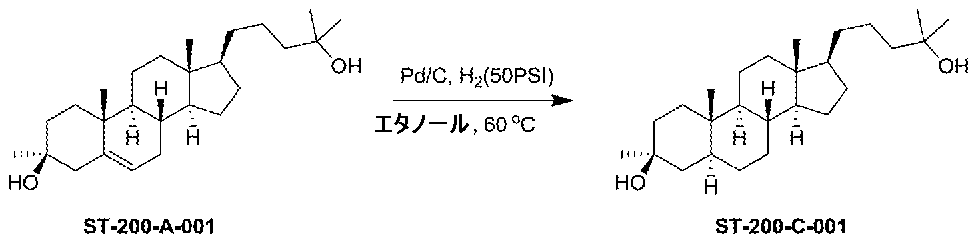
エタノール(10mL)中の化合物ST-200-A-001(65mg,0.167
mmol,1.0eq)の溶液に、Pd/C(10%,15mg)をN2下で加えた。そ
の懸濁液を真空下で脱気し、H2で数回パージした。次いで、その混合物を50psiの
水素圧力下、60℃において24時間撹拌した。TLC(PE:EA=3:1)は、反応
が完了したことを示した。その懸濁液をセライトパッドで濾過し、そのパッドをエタノー
ルで洗浄した(5mL×2)。合わせた濾液を濃縮乾固させることにより、粗生成物を得
て、それをPE:EA(10:1)で溶出されるシリカゲルクロマトグラフィーによって
精製することにより、生成物(28mg,43%)を白色粉末として得た。1H NMR
: (400 MHz, CDCl3) δ 1.90-1.87 (m, 1H),
1.75-1.60 (m, 4H), 1.82-1.65 (m, 2H), 1.
55-1.30 (m, 12H), 1.27-1.23 (m, 6H), 1.2
2 (s, 6H), 1.18-0.95 (m, 8H), 0.82 (s, 3
H), 0.72 -0.65 (m, 1H), 0.55 (s, 3H)。
Example 9. Preparation of compound ST-200-C-001
Compound ST-200-A-001 (65 mg, 0.167 mL) in ethanol (10 mL)
To a solution of 1.2 mmol, 1.0 eq) was added Pd/C (10%, 15 mg) under N2 . The suspension was degassed under vacuum and purged with H2 several times. The mixture was then stirred at 60°C under 50 psi hydrogen pressure for 24 h. TLC (PE:EA = 3:1) showed the reaction was complete. The suspension was filtered through a Celite pad and the pad was washed with ethanol (5 mL x 2). The combined filtrate was concentrated to dryness to give the crude product, which was purified by silica gel chromatography eluted with PE:EA (10:1) to give the product (28 mg, 43%) as a white powder. 1H NMR
: (400 MHz, CDCl 3 ) δ 1.90-1.87 (m, 1H),
1.75-1.60 (m, 4H), 1.82-1.65 (m, 2H), 1.
55-1.30 (m, 12H), 1.27-1.23 (m, 6H), 1.2
2 (s, 6H), 1.18-0.95 (m, 8H), 0.82 (s, 3
H), 0.72 -0.65 (m, 1H), 0.55 (s, 3H).
実施例10.化合物ST-200-C-003およびST-200-C-003Aの調
製

EtOH(30mL)中の化合物ST-200-A-003(40.0mg,0.10
mmol,1.0eq)の溶液に、Pd/C(10mg)を加えた。その混合物を50p
siの水素圧力下、60℃において一晩撹拌した。1H NMRは、反応が完了したこと
を示唆した。次いで、その混合物をセライトパッドで濾過し、濾液を減圧下で蒸発させた
。残渣を、シリカゲルにおけるカラムクロマトグラフィー(溶離剤:PE:EA=2:1
)によって精製することにより、純粋な生成物ST-200-C-003(12.0mg
,29.8%)およびST-200-C-003A(0.8mg,2.3 %)を白色粉
末として得た。1H NMR (ST-200-C-003): (400 MHz,
CDCl3) δ 1.97-1.83 (m, 2H), 1.65-1.55 (m
, 7H), 1.55-1.42 (m, 4H), 1.41-1.2841 (m
, 6H), 1.27-1.21 (m, 5H), 1.20 (s, 6H),
1.16-0.95 (m, 7H), 0.92 (d, J=6.27 Hz, 3
H), 0.81 (s, 3 H), 0.65 (s, 3 H). 1H N
MR (ST-200-C-003A): (400 MHz, CDCl3) δ 1
.98-1.79 (m, 4H), 1.64-1.53 (m, 6H), 1.5
2 -1.29 (m, 7H), 1.25-1.22 (m, 6H), 1.22
(s, 3H), 1.20 (s, 3H), 1.05 (s, 3H), 0.
96 (s, 3H), 0.91 (d, J=6.53 Hz, 3H), 0.8
6-0.80 (m, 2H), 0.65 (s, 3H)。
Example 10. Preparation of compounds ST-200-C-003 and ST-200-C-003A
Compound ST-200-A-003 (40.0 mg, 0.10
To a solution of 1.0 mmol, 1.0 eq) was added Pd/C (10 mg).
The mixture was stirred overnight at 60° C. under si hydrogen pressure. 1 H NMR suggested the reaction was complete. The mixture was then filtered through a pad of Celite and the filtrate was evaporated under reduced pressure. The residue was purified by column chromatography on silica gel (eluent: PE:EA=2:1
) to obtain the pure product ST-200-C-003 (12.0 mg
, 29.8%) and ST-200-C-003A (0.8 mg, 2.3%) were obtained as white powders. 1 H NMR (ST-200-C-003): (400 MHz,
CDCl3) δ 1.97-1.83 (m, 2H), 1.65-1.55 (m
, 7H), 1.55-1.42 (m, 4H), 1.41-1.2841 (m
, 6H), 1.27-1.21 (m, 5H), 1.20 (s, 6H),
1.16-0.95 (m, 7H), 0.92 (d, J=6.27 Hz, 3
H), 0.81 (s, 3 H), 0.65 (s, 3 H). 1 H N
MR (ST-200-C-003A): (400 MHz, CDCl3) δ 1
.. 98-1.79 (m, 4H), 1.64-1.53 (m, 6H), 1.5
2 -1.29 (m, 7H), 1.25-1.22 (m, 6H), 1.22
(s, 3H), 1.20 (s, 3H), 1.05 (s, 3H), 0.
96 (s, 3H), 0.91 (d, J=6.53 Hz, 3H), 0.8
6-0.80 (m, 2H), 0.65 (s, 3H).
実施例11.化合物ST-200-C-007の調製

化合物10の調製:エタノール(400mL)中の、化合物1(28.0g,0.09
7mol,1.0eq)とPd/C(3.5g)との混合物を、40psiの水素圧力下
、室温において一晩水素化した。その懸濁液をセライトパッドで濾過し、そのパッドをエ
タノールで洗浄した(20mL×3)。合わせた濾液を濃縮乾固させることにより、生成
物(28.0g,0.097mol,100%)を白色固体として得た。1H NMR
(400 MHz, CDCl3) δ 3.63-3.53 (m, 1H), 2.
42 (dd, J=19.2, 8.4 Hz, 1H), 2.11-2.06 (
m, 1H), 19.6-1.87 (m, 1H) , 1.83-1.09 (m
, 18H) , 1.04-0.91 (m, 2H) , 0.85 (s, 3H
) , 0.82 (s, 3H)。
Example 11. Preparation of compound ST-200-C-007
Preparation of Compound 10: Compound 1 (28.0 g, 0.09 ml) in ethanol (400 mL)
A mixture of 1.7 mol, 1.0 eq) and Pd/C (3.5 g) was hydrogenated under 40 psi hydrogen pressure at room temperature overnight. The suspension was filtered through a pad of Celite and the pad was washed with ethanol (20 mL x 3). The combined filtrate was concentrated to dryness to give the product (28.0 g, 0.097 mol, 100%) as a white solid. 1 H NMR
(400 MHz, CDCl3) δ 3.63-3.53 (m, 1H), 2.
42 (dd, J=19.2, 8.4 Hz, 1H), 2.11-2.06 (
m, 1H), 19.6-1.87 (m, 1H), 1.83-1.09 (m
, 18H), 1.04-0.91 (m, 2H), 0.85 (s, 3H
), 0.82 (s, 3H).
化合物11の調製:トルエン(300mL)中の、化合物10(28.0g,0.09
7mol,1.0eq)およびエチレングリコール(30mL)の溶液に、p-トルエン
スルホン酸(0.7g,3.64mmol)を加えた。その反応混合物を、ディーン-ス
タークトラップを用いて一晩加熱還流した。LCMSは、出発物質が完全に消費されたこ
とを示した。その混合物を室温に冷却し、酢酸エチル(250mL)で希釈し、炭酸水素
ナトリウム飽和水溶液(100mL×2)およびブライン(100mL×2)で洗浄した
。有機相を硫酸ナトリウムで乾燥させ、真空中で濃縮することにより、粗生成物11を得
て(30.0g,0.090mol,93%)、それをさらに精製することなく、次の工
程で直接使用した。1H NMR: (400 MHz, CDCl3) δ4.02-
3.78 (m, 4H), 3.68-3.48 (m, 1H), 2.04-1.
92 (m, 1H), 1.80-1.54 (m, 8H), 1.46 -1.3
2 (m, 5H), 1.31-1.19(m, 5H), 1.14-1.05 (
m, 1H), 1.02-0.86 (m, 2H), 0.83 (s, 3 H)
, 0.80 (s, 3 H), 0.72-0.61 (m, 1 H)。
Preparation of compound 11: Compound 10 (28.0 g, 0.09 ml) in toluene (300 mL)
To a solution of 1,3-dichlorophenyl ether (1.7 mol, 1.0 eq) and ethylene glycol (30 mL) was added p-toluenesulfonic acid (0.7 g, 3.64 mmol). The reaction mixture was heated to reflux overnight with a Dean-Stark trap. LCMS showed the starting material was completely consumed. The mixture was cooled to room temperature, diluted with ethyl acetate (250 mL) and washed with saturated aqueous sodium bicarbonate (100 mL x 2) and brine (100 mL x 2). The organic phase was dried over sodium sulfate and concentrated in vacuo to give the crude product 11 (30.0 g, 0.090 mol, 93%), which was used directly in the next step without further purification. 1 H NMR: (400 MHz, CDCl3) δ 4.02-
3.78 (m, 4H), 3.68-3.48 (m, 1H), 2.04-1.
92 (m, 1H), 1.80-1.54 (m, 8H), 1.46 -1.3
2 (m, 5H), 1.31-1.19 (m, 5H), 1.14-1.05 (
m, 1H), 1.02-0.86 (m, 2H), 0.83 (s, 3H)
, 0.80 (s, 3 H), 0.72-0.61 (m, 1 H).
化合物12の調製:乾燥DCM(300mL)中の化合物11(30.0g,0.09
0mol,1.0eq)の溶液に、Dess-Martin酸化体(76.0g,0.1
80mol,2.0eq)を0℃において加えた。その反応混合物を0℃において30分
間、次いで、室温において2時間撹拌した。LCMSは、出発物質が完全に消費されたこ
とを示した。その混合物を、飽和NaHCO3/Na2SO3の混合水溶液(200mL
,1/3)でクエンチし、次いで、DCM(250mL)で希釈した。有機層を炭酸水素
ナトリウム飽和水溶液(100mL×2)およびブライン(100mL×2)で洗浄し、
硫酸ナトリウムで乾燥させ、真空中で濃縮することにより、粗生成物12を得て(24.
0g,0.072mol,80%)、それをさらに精製することなく、次の工程で直接使
用した。
Preparation of compound 12: Compound 11 (30.0 g, 0.09 ml) in dry DCM (300 mL)
Dess-Martin oxidized product (76.0 g, 0.1 mol, 1.0 eq) was added to a solution of
80 mol, 2.0 eq) was added at 0° C. The reaction mixture was stirred at 0° C. for 30 min and then at room temperature for 2 h. LCMS showed that the starting material was completely consumed. The mixture was washed with a mixture of saturated aqueous NaHCO 3 /Na 2 SO 3 (200 mL).
The mixture was quenched with 100 mL of 1/3 hexanes water and then diluted with DCM (250 mL). The organic layer was washed with saturated aqueous sodium bicarbonate (100 mL x 2) and brine (100 mL x 2),
Drying over sodium sulfate and concentration in vacuo gave the crude product 12 (24.
0 g, 0.072 mol, 80%) which was used directly in the next step without further purification.
化合物13の調製:乾燥トルエン(300mL)中のMAD(2.16mol,3.0
eq,ST-200-A-001の合成に記載されたような方法によって調製されたもの
)の溶液に、化合物12(24.0g,0.072mol,1.0eq)を-78℃にお
いて滴下し、その混合物を、窒素下、-78℃において30分間撹拌した。次いで、Me
MgBr(72mL,2.16mol,3.0eq,エーテル中3M)を-78℃におい
て滴下し、得られた混合物を同じ温度において2時間撹拌した。LCMSは、出発物質が
完全に消費されたことを示した。その反応混合物をNH4Cl4飽和水溶液(400mL
)に注ぎ込み、EAで抽出した(exacted)(300mL×2)。合わせた有機層
をブラインで洗浄し(200mL×2)、硫酸ナトリウムで乾燥させ、真空中で濃縮した
。残渣を、PE:EA(15:1)で溶出されるシリカゲルクロマトグラフィーによって
精製することにより、生成物13(16.0g,0.046mol,72%)を白色固体
として得た。1H NMR: (400 MHz, CDCl3) δ 3.95-3.
88 (m, 2 H), 3.87-3.82 (m, 2 H), 2.02-1.
92 (m, 1 H) , 1.84-1.73 (m, 1 H), 1.71-1
.50 (m, 9 H), 1.50-1.43 (m, 1 H) ,1.42-1
.33 (m, 4 H), 1.33-1.28 (m 1 H), 1.27-1.
19 (m, 7 H) ,1.08-0.88 (m, 2 H) , 0.83 (
s, 3 H) ,0.81 (s, 3 H)。
Preparation of compound 13: MAD (2.16 mol, 3.0
To a solution of 1,3-dichlorophenyl ether (prepared by the method described in the synthesis of ST-200-A-001, eq.) was added compound 12 (24.0 g, 0.072 mol, 1.0 eq.) dropwise at −78° C., and the mixture was stirred under nitrogen at −78° C. for 30 minutes. Then, Me
MgBr (72 mL, 2.16 mol, 3.0 eq, 3M in ether) was added dropwise at −78° C., and the resulting mixture was stirred at the same temperature for 2 h. LCMS showed that the starting material was completely consumed. The reaction mixture was diluted with saturated aqueous NH 4 Cl 4 (400 mL).
) and exacted with EA (300 mL x 2). The combined organic layers were washed with brine (200 mL x 2), dried over sodium sulfate and concentrated in vacuo. The residue was purified by silica gel chromatography eluted with PE:EA (15:1) to give the product 13 (16.0 g, 0.046 mol, 72%) as a white solid. 1 H NMR: (400 MHz, CDCl3) δ 3.95-3.
88 (m, 2 H), 3.87-3.82 (m, 2 H), 2.02-1.
92 (m, 1 H), 1.84-1.73 (m, 1 H), 1.71-1
.. 50 (m, 9 H), 1.50-1.43 (m, 1 H), 1.42-1
.. 33 (m, 4 H), 1.33-1.28 (m 1 H), 1.27-1.
19 (m, 7 H), 1.08-0.88 (m, 2 H), 0.83 (
s, 3 H) ,0.81 (s, 3 H).
化合物INT Gの調製:1M HCl水溶液(60mL)、アセトン(60mL)お
よびTHF(350mmL)中の化合物13(16.0g,46.0mmol,1.0e
q)の混合物を、室温において一晩撹拌し、次いで、水(200mL)で希釈し、CO2
が放出されなくなるまで、固体NaHCO3で中和した。その混合物をEAで抽出した(
300mL×2)。合わせた有機層を、ブラインで洗浄し(200mL×2)、硫酸ナト
リウムで乾燥させ、真空中で濃縮することにより、生成物INT G(14.0g,46
.0mmol,100%)を白色固体として得た。
1H NMR: (400 MHz, CDCl3) δ 2.44 (dd, J=1
9.20, 8.41 Hz, 1 H), 2.13-2.01 (m, 1 H)
,1.98-1.89 (m, 1 H) , 1.85-1.76 (m, 2 H)
, 1.69-1.60 (m, 3 H), 1.59-1.42 (m, 5 H)
,1.33-1.13 (m, 10 H), 1.08-0.94 (m, 2 H
), 0.86 (s, 3 H), 0.84 (s, 3 H), 0.68-0.
77 (m, 1 H)。
Preparation of compound INT G: Compound 13 (16.0 g, 46.0 mmol, 1.0 e) in 1M aqueous HCl (60 mL), acetone (60 mL) and THF (350 mmL).
The mixture of q) was stirred at room temperature overnight, then diluted with water (200 mL) and
The mixture was neutralized with solid NaHCO3 until no more was released. The mixture was extracted with EA (
The combined organic layers were washed with brine (200 mL x 2), dried over sodium sulfate and concentrated in vacuo to give the product INT G (14.0 g, 46
0 mmol, 100%) as a white solid.
1 H NMR: (400 MHz, CDCl3) δ 2.44 (dd, J=1
9.20, 8.41 Hz, 1 H), 2.13-2.01 (m, 1 H)
, 1.98-1.89 (m, 1 H), 1.85-1.76 (m, 2 H)
, 1.69-1.60 (m, 3 H), 1.59-1.42 (m, 5 H)
, 1.33-1.13 (m, 10 H), 1.08-0.94 (m, 2 H
), 0.86 (s, 3 H), 0.84 (s, 3 H), 0.68-0.
77 (m, 1 H).
化合物14の調製:THF(10mL)中のPPh3CH3Br(1.4g,3.94
mmol,5.0eq)の溶液に、THF(5mL)中のt-BuOK(442mg,3
.94mmol,5.0eq)の溶液を室温において加えた。1時間撹拌した後、THF
(5mL)中のINT G(0.2g,0.657mmol,1.0eq)の溶液を滴下
した。その反応混合物を3時間還流し、次いで、室温に冷却し、NH4Cl飽和水溶液(
50mL)でクエンチし、EAで抽出した(20mL×2)。合わせた有機層をブライン
(20mL)で洗浄し、硫酸ナトリウムで乾燥させ、真空中で濃縮することにより、粗生
成物を得て、それをフラッシュカラムクロマトグラフィー(溶離剤:PE/EA=15/
1)によって精製することにより、化合物14(180mg,90%)を白色固体として
得た。1H NMR: (400 MHz, CDCl3) δ 4.62 (d, J
=6.4Hz, 2H), 2.51-2.44 (m, 1H), 2.24-2.2
2 (m, 1H), 1.82-1.78 (m, 1H), 1.75-1.30
(m, 9H), 1.29-1.11 (m, 11H), 1.03-0.95 (
m, 3H), 0.83 (s, 3H), 0.77 (s, 3H), 0.72
-0.68 (m, 1H)。
Preparation of compound 14: PPh3CH3Br (1.4 g, 3.94 mL) in THF (10 mL) .
To a solution of t-BuOK (442 mg, 3 mmol, 5.0 eq) in THF (5 mL) was added
A solution of 1.94 mmol, 5.0 eq) was added at room temperature. After stirring for 1 hour, THF
A solution of INT G (0.2 g, 0.657 mmol, 1.0 eq) in 10 mL of ethyl acetate was added dropwise. The reaction mixture was refluxed for 3 h, then cooled to room temperature and washed with saturated aqueous NH 4 Cl (
The mixture was quenched with 50 mL) and extracted with EA (20 mL x 2). The combined organic layers were washed with brine (20 mL), dried over sodium sulfate, and concentrated in vacuo to give the crude product, which was purified by flash column chromatography (eluent: PE/EA=15/
1) to give compound 14 (180 mg, 90%) as a white solid. 1 H NMR: (400 MHz, CDCl 3 ) δ 4.62 (d, J
=6.4Hz, 2H), 2.51-2.44 (m, 1H), 2.24-2.2
2 (m, 1H), 1.82-1.78 (m, 1H), 1.75-1.30
(m, 9H), 1.29-1.11 (m, 11H), 1.03-0.95 (
m, 3H), 0.83 (s, 3H), 0.77 (s, 3H), 0.72
-0.68 (m, 1H).
化合物INT Iの調製:氷浴における9-BBN(THF中0.5M,50mL,2
5.00mmol,8.0eq)の溶液に、THF(10mL)中の化合物14(0.9
5g,3.14mmol,1.0eq)の溶液を滴下した。その反応混合物を60℃に加
熱し、20時間撹拌した。その混合物を0℃に冷却し、10%NaOH水溶液(20mL
)に続いて30%H2O2水溶液(10mL)を加えた。得られた混合物を0℃において
2時間撹拌し、次いで、EAで抽出した(10mL×2)。合わせた有機層をブライン(
10mL)で洗浄し、硫酸ナトリウムで乾燥させ、真空中で濃縮することにより、粗生成
物を得て、それをフラッシュカラムクロマトグラフィー(溶離剤:PE/EA=10/1
)によって精製することにより、INT I(0.63g,63%)を白色固体として得
た。1H NMR: (400 MHz, CDCl3) δ 3.74-3.69 (
dd, J1=10.4Hz, J2=6.8Hz, 1H), 3.56-3.52
(dd, J1=10.4Hz, J2=7.6Hz, 1H), 1.86-1.80
(m, 2H), 1.69-1.44 (m, 11H), 1.41-1.26
(m, 4H), 1.25-1.21 (m, 5H), 1.19-0.99 (m
, 5H), 0.93-0.91 (m, 5H), 0.81 (s, 3H),
0.74-0.68 (m, 1H), 0.64 (s, 3H)。
Preparation of compound INT I: 9-BBN (0.5 M in THF, 50 mL, 2
To a solution of compound 14 (0.9 mmol, 8.0 eq) in THF (10 mL) was added
A solution of 10% NaOH (20 mL, 1.5 g, 3.14 mmol, 1.0 eq) was added dropwise. The reaction mixture was heated to 60° C. and stirred for 20 h. The mixture was cooled to 0° C. and 10% aqueous NaOH (20 mL) was added dropwise.
) followed by 30% H2O2 aqueous solution (10 mL). The resulting mixture was stirred at 0°C for 2 h and then extracted with EA (10 mL x 2). The combined organic layers were washed with brine (
10 mL), dried over sodium sulfate and concentrated in vacuo to give the crude product, which was purified by flash column chromatography (eluent: PE/EA=10/1
) to give INT I (0.63 g, 63%) as a white solid. 1 H NMR: (400 MHz, CDCl 3 ) δ 3.74-3.69 (
dd, J 1 =10.4Hz, J 2 =6.8Hz, 1H), 3.56-3.52
(dd, J 1 =10.4Hz, J 2 =7.6Hz, 1H), 1.86-1.80
(m, 2H), 1.69-1.44 (m, 11H), 1.41-1.26
(m, 4H), 1.25-1.21 (m, 5H), 1.19-0.99 (m
, 5H), 0.93-0.91 (m, 5H), 0.81 (s, 3H),
0.74-0.68 (m, 1H), 0.64 (s, 3H).
化合物INT Jの調製:氷浴におけるDCM(20mL)中のINT I(500m
g,1.56mmol,1.0eq)の溶液に、Dess-Martin試薬(1.3g
,3.12mmol,2.0eq)を加えた。その反応混合物を室温まで温め、2時間撹
拌した。その混合物を、水(20mL)中のNaS2O3(5g)およびNaHCO3(
1.5g)の溶液に注ぎ込み、EAで抽出した(20mL×2)。合わせた有機層をブラ
イン(20mL)で洗浄し、硫酸ナトリウムで乾燥させ、真空中で濃縮することにより、
粗生成物を得て(500mg,100%)、それをさらに精製することなく、次の工程で
直接使用した。
Preparation of compound INT J: INT I (500 ml) in DCM (20 mL) in ice bath.
g, 1.56 mmol, 1.0 eq) was added to a solution of Dess-Martin reagent (1.3 g
, 3.12 mmol, 2.0 eq) was added. The reaction mixture was warmed to room temperature and stirred for 2 h. The mixture was diluted with NaS 2 O 3 (5 g) and NaHCO 3 (
1.5 g) and extracted with EA (20 mL x 2). The combined organic layers were washed with brine (20 mL), dried over sodium sulfate and concentrated in vacuo to give
The crude product was obtained (500 mg, 100%), which was used directly in the next step without further purification.
化合物C_007_1の調製:トルエン(30mL)中の、INT J(500mg,
1.57mmol,1.0eq)とPh3P=CHCOOCH3(3.1g,8.27m
mol,6.0eq)との混合物を80℃において3時間撹拌した。その混合物を真空中
で濃縮し、残渣をフラッシュカラムクロマトグラフィー(溶離剤:PE/EA=12/1
)によって精製することにより、生成物C_007_1(188mg,32%)を白色固
体として得た。
Preparation of compound C_007_1: INT J (500 mg,
1.57 mmol, 1.0 eq) and Ph3P = CHCOOCH3 (3.1 g, 8.27 m
The mixture was stirred at 80° C. for 3 hours. The mixture was concentrated in vacuo, and the residue was purified by flash column chromatography (eluent: PE/EA=12/1).
) to afford the product C_007_1 (188 mg, 32%) as a white solid.
化合物C_007_2の調製:EA(10mL)中の、化合物C_007_1(188
mg,0.5mmol,1.0eq)とPd/C(5%,60mg)との混合物を、H2
(1気圧)下、室温において2時間撹拌した。その混合物を濾過し、濾液を真空中で濃縮
することにより、生成物C_007_2を得て(189mg,100%)、それをさらに
精製することなく、次の工程で直接使用した。
Preparation of compound C_007_2: Compound C_007_1 (188
A mixture of 1.0 mg (0.5 mmol, 1.0 eq) and Pd/C (5%, 60 mg) was added to H
The mixture was stirred under (1 atm) at room temperature for 2 h. The mixture was filtered and the filtrate was concentrated in vacuo to give the product C_007_2 (189 mg, 100%), which was used directly in the next step without further purification.
化合物ST-200-C-007の調製:-78℃のTHF(2mL)中の化合物C_
007_2(100mg,0.26mmol,1.0eq)の溶液に、CH3Li(TH
F中1.6M,1.6mL,2.6mmol,10.0eq)を窒素下で滴下した。その
反応混合物を室温まで温め、1時間撹拌した。NH4Cl飽和水溶液(10mL)を加え
ることにより、その反応をクエンチし、その混合物をEAで抽出した(10mL×2)。
合わせた有機層をブライン(10mL)で洗浄し、硫酸ナトリウムで乾燥させ、真空中で
濃縮することにより、粗生成物を得て、それをフラッシュカラムクロマトグラフィー(溶
離剤:PE/EA=8/1)によって精製することにより、目標のST-200-C-0
07(32.7mg,32.7%)を白色固体として得た。1H NMR: (400
MHz, CDCl3) δ 1.82-1.81 (m, 1H), 1.75-1.
57 (m, 7H), 1.56-1.26 (m, 10H), 1.24 (s,
3H), 1.20 (s, 6H), 1.18-0.83 (m, 10H),
0.81 (s, 3H), 0.71-0.66 (m, 1H), 0.58 (s
, 3H)。
Preparation of compound ST-200-C-007: Compound C_ in THF (2 mL) at -78 °C
A solution of 007_2 (100 mg, 0.26 mmol, 1.0 eq) was added to CH 3 Li(TH
F (1.6 M, 1.6 mL, 2.6 mmol, 10.0 eq) was added dropwise under nitrogen. The reaction mixture was warmed to room temperature and stirred for 1 h. The reaction was quenched by adding saturated aqueous NH 4 Cl (10 mL) and the mixture was extracted with EA (10 mL×2).
The combined organic layer was washed with brine (10 mL), dried over sodium sulfate, and concentrated in vacuo to give the crude product, which was purified by flash column chromatography (eluent: PE/EA=8/1) to give the target ST-200-C-0.
07 (32.7 mg, 32.7%) was obtained as a white solid. 1 H NMR: (400
MHz, CDCl 3 ) δ 1.82-1.81 (m, 1H), 1.75-1.
57 (m, 7H), 1.56-1.26 (m, 10H), 1.24 (s,
3H), 1.20 (s, 6H), 1.18-0.83 (m, 10H),
0.81 (s, 3H), 0.71-0.66 (m, 1H), 0.58 (s
, 3H).
実施例12.化合物ST-200-C-011の調製

化合物INT Hの調製:MeOH(20mL)およびTHF(8mL)中のINT
G(1.00g,3.28mmol,1.0eq)の溶液に、CeCl3.7H2O(1
.22g,3.28mmol,1.0eq)を加えた。次いで、NaBH4(0.25g
,6.56mmol,2.0eq)を5回に分けて加え、その混合物を室温において1時
間撹拌した。その反応物スラリーをNH4Cl飽和水溶液(50mL)でクエンチし、E
Aで抽出した(20mL×3)。合わせた有機層をブライン(30mL)で洗浄し、硫酸
ナトリウムで乾燥させ、真空中で濃縮することにより、所望の生成物(0.97g,97
%)を白色固体として得た。1H NMR: (400MHz, CDCl3) δ
3.62 (t, J=8.4 Hz, 1H), 2.10-2.04 (m, 1H
), 1.79-1.77 (m, 1H), 1.70-1.35 (m, 13H)
, 1.31-1.15 (m, 11H), 1.14-0.84 (m, 5H),
0.81 (s, 3H), 0.72 (s, 3H), 0.70-0.61 (
m, 1H)。
Example 12. Preparation of compound ST-200-C-011
Preparation of compound INT H: INT H in MeOH (20 mL) and THF (8 mL)
A solution of G (1.00 g, 3.28 mmol, 1.0 eq) was added with CeCl 3 .7H 2 O (1
.22 g , 3.28 mmol, 1.0 eq) was then added.
, 6.56 mmol, 2.0 eq) was added in five portions and the mixture was stirred at room temperature for 1 h. The reaction slurry was quenched with saturated aqueous NH 4 Cl (50 mL) and E
The combined organic layers were washed with brine (30 mL), dried over sodium sulfate, and concentrated in vacuo to give the desired product (0.97 g, 97% ethyl acetate, 10 ...
%) as a white solid. 1 H NMR: (400 MHz, CDCl3) δ
3.62 (t, J=8.4 Hz, 1H), 2.10-2.04 (m, 1H
), 1.79-1.77 (m, 1H), 1.70-1.35 (m, 13H)
, 1.31-1.15 (m, 11H), 1.14-0.84 (m, 5H),
0.81 (s, 3H), 0.72 (s, 3H), 0.70-0.61 (
m, 1H).
化合物C_011_1の調製:DCM(20mL)中のINT H(500mg,1.
63mmol,1.0eq)の溶液に、NMM(830mg,8.21mmol,5.0
eq)およびプロピオル酸メチル(690mg,8.21mmol,5.0eq)を加え
た。その混合物を室温において16時間撹拌し、次いで、水(30mL)およびブライン
(30mL)で洗浄し、硫酸ナトリウムで乾燥させ、真空中で濃縮した。残渣を、PE:
EA(15:1)で溶出されるシリカゲルクロマトグラフィーによって精製することによ
り、生成物(500mg,78.6%)を白色固体として得た。1H NMR: (40
0MHz, CDCl3) δ= 7.53 (d, J=12.4 Hz, 1H),
5.24 (d, J=12.4 Hz, 1H), 3.86 (t, J=8.4
Hz, 1H), 3.68 (s, 3H), 2.18-2.06 (m, 1H
), 1.84-1.81 (m, 1H), 1.70-0.85 (m, 30H)
, 0.81 (s, 3H), 0.78 (s, 3H), 0.72-0.64
(m, 1H)。
Preparation of compound C_011_1: INT H (500 mg, 1.
To a solution of NMM (830 mg, 8.21 mmol, 5.0 eq.)
eq) and methyl propiolate (690 mg, 8.21 mmol, 5.0 eq) were added. The mixture was stirred at room temperature for 16 h, then washed with water (30 mL) and brine (30 mL), dried over sodium sulfate, and concentrated in vacuo. The residue was purified by PE:
Purification by silica gel chromatography eluted with EA (15:1) gave the product (500 mg, 78.6%) as a white solid. 1 H NMR: (40
0MHz, CDCl3) δ=7.53 (d, J=12.4Hz, 1H),
5.24 (d, J=12.4 Hz, 1H), 3.86 (t, J=8.4
Hz, 1H), 3.68 (s, 3H), 2.18-2.06 (m, 1H
), 1.84-1.81 (m, 1H), 1.70-0.85 (m, 30H)
, 0.81 (s, 3H), 0.78 (s, 3H), 0.72-0.64
(m, 1H).
化合物C_011_2の調製:EA(20mL)中のC_011_1(500mg,1
.289mmol,1.0eq)の溶液に、Pd/C(10%,50mg)を加えた。そ
の懸濁液を真空下で脱気し、H2で数回パージした。その混合物を、30psiの水素圧
力下、30℃において16時間撹拌した。TLC(PE/EA=3/1)は、その反応が
完了したことを示した。その懸濁液をセライトパッドで濾過し、そのパッドをEAで洗浄
した(20mL×5)。合わせた濾液を真空中で濃縮することにより、生成物(430m
g,85.5%)を白色固体として得た。
Preparation of compound C_011_2: C_011_1 (500 mg, 1 mL) in EA (20 mL)
To a solution of 1.289 mmol, 1.0 eq) was added Pd/C (10%, 50 mg). The suspension was degassed under vacuum and purged with H2 several times. The mixture was stirred at 30 °C under 30 psi hydrogen pressure for 16 h. TLC (PE/EA = 3/1) showed the reaction was complete. The suspension was filtered through a Celite pad and the pad was washed with EA (20 mL x 5). The combined filtrate was concentrated in vacuum to give the product (430 mM).
g, 85.5%) as a white solid.
化合物ST-200-C-011の調製:乾燥THF(1mL)中のC_011_2(
100mg,0.256mmol,1.0eq)の溶液に、MeLi(1.3mL,2.
048mmol,8.0eq)を、N2下、-78℃において滴下した。得られた混合物
をこの温度で0.5時間撹拌し、次いで、その温度を室温まで昇温させ、この温度でさら
に1時間撹拌した。TLC(PE/EA=3/1)は、その反応が完了したことを示した
。その混合物をNH4Cl飽和水溶液でクエンチし、EAで抽出した(10mL×3)。
合わせた有機層をブライン(10mL)で洗浄し、硫酸ナトリウムで乾燥させ、真空中で
濃縮した。残渣を、PE:EA(10:1)で溶出されるシリカゲルクロマトグラフィー
によって精製することにより、生成物(30mg,30%)を白色固体として得た。1H
NMR (400MHz, CDCl3) δ3.86 (s, 1H), 3.78
-3.61 (m, 2H), 3.29 (t, J=8.3 Hz, 1H), 2
.10-1.95 (m, 1H), 1.90-1.81 (m, 1H), 1.7
4 (t, J=5.6 Hz, 2H), 1.69-1.61 (m, 3H),
1.55-1.28 (m, 9H), 1.24-1.22 (m, 9H), 1.
22-0.83 (m, 8H), 0.81 (s, 3H), 0.74 (s,
3H), 0.69-0.62 (m, 1H)。
Preparation of compound ST-200-C-011: C_011_2(
To a solution of MeLi (1.3 mL, 2.
To the reaction mixture was added dropwise under N2 at -78°C. The resulting mixture was stirred at this temperature for 0.5 h, then the temperature was allowed to rise to room temperature and stirred at this temperature for an additional 1 h. TLC (PE/EA = 3/1) showed the reaction was complete. The mixture was quenched with saturated aqueous NH4Cl solution and extracted with EA (10 mL x 3).
The combined organic layers were washed with brine (10 mL), dried over sodium sulfate and concentrated in vacuo . The residue was purified by silica gel chromatography eluted with PE:EA (10:1) to give the product (30 mg, 30%) as a white solid.
NMR (400MHz, CDCl3) δ3.86 (s, 1H), 3.78
-3.61 (m, 2H), 3.29 (t, J=8.3 Hz, 1H), 2
.. 10-1.95 (m, 1H), 1.90-1.81 (m, 1H), 1.7
4 (t, J=5.6 Hz, 2H), 1.69-1.61 (m, 3H),
1.55-1.28 (m, 9H), 1.24-1.22 (m, 9H), 1.
22-0.83 (m, 8H), 0.81 (s, 3H), 0.74 (s,
3H), 0.69-0.62 (m, 1H).
実施例13.化合物ST-200-C-013の調製
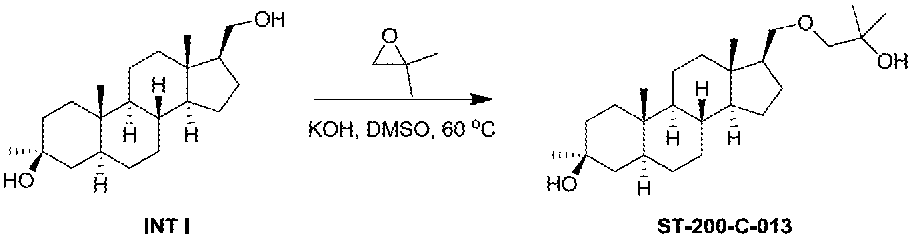
DMSO(1mL)中のINT I(150mg,0.469mmol,1.0eq)
の溶液に、KOH(53mg,0.937mmol,2.0eq)および2,2-ジメチ
ルオキシラン(337mg,4.687mmol,10.0eq)を加えた。その反応混
合物を50℃において16時間撹拌した。TLC(PE/EA=10/1)は、出発物質
が完全に消費されたことを示した。その混合物を室温に冷却し、酢酸エチル(20mL)
で希釈し、NH4Cl飽和水溶液(10mL×2)および水(10mL×2)で洗浄した
。有機相を硫酸ナトリウムで乾燥させ、真空中で濃縮することにより、粗生成物を得て、
それをカラムクロマトグラフィーに続いてprep-HPLCによって精製することによ
り、純粋な生成物ST-200-C-013を得た(26mg,15.8%)。1H N
MR: (400 MHz, CDCl3) δ 3.72 (dd, J=7.3,
9.3 Hz, 1H), 3.35 (dd, J=6.8, 9.3 Hz, 1H
), 3.21 (s, 2H), 2.34 (s, 1H), 1.84-1.80
(m, 1H), 1.79-1.63 (m, 5H), 1.54-1.27 (
m, 8H), 1.25 (s, 3H), 1.19 (s, 6H), 1.18
-0.83 (m, 7H), 0.81 (s, 3H), 0.74-0.65 (
m, 1H), 0.63 (s, 3H)。
Example 13. Preparation of compound ST-200-C-013
INT I (150 mg, 0.469 mmol, 1.0 eq) in DMSO (1 mL)
To the solution of was added KOH (53 mg, 0.937 mmol, 2.0 eq) and 2,2-dimethyloxirane (337 mg, 4.687 mmol, 10.0 eq). The reaction mixture was stirred at 50° C. for 16 h. TLC (PE/EA=10/1) showed that the starting material was completely consumed. The mixture was cooled to room temperature and washed with ethyl acetate (20 mL).
and washed with saturated aqueous NH 4 Cl (10 mL×2) and water (10 mL×2). The organic phase was dried over sodium sulfate and concentrated in vacuo to give the crude product.
It was purified by column chromatography followed by prep-HPLC to give the pure product ST-200-C-013 (26 mg, 15.8%).
MR: (400 MHz, CDCl3) δ 3.72 (dd, J=7.3,
9.3 Hz, 1H), 3.35 (dd, J=6.8, 9.3 Hz, 1H
), 3.21 (s, 2H), 2.34 (s, 1H), 1.84-1.80
(m, 1H), 1.79-1.63 (m, 5H), 1.54-1.27 (
m, 8H), 1.25 (s, 3H), 1.19 (s, 6H), 1.18
-0.83 (m, 7H), 0.81 (s, 3H), 0.74-0.65 (
m, 1H), 0.63 (s, 3H).
実施例14.化合物ST-200-C-017およびST-200-C-017Aの調
製

EtOH(10mL)中の、ST-200-A-017(60mg,0.159mmo
l,1.0eq)およびPd/C(10mg)の溶液を、50psiの水素圧力下、50
℃において16時間撹拌した。その反応溶液をセライトパッドで濾過し、濾液を真空中で
濃縮した。残渣を、PE:EA(20:1)で溶出されるシリカゲルクロマトグラフィー
によって精製することにより、ST-200-C-017(21mg)およびST-20
0-C-017A(4.6mg)を白色固体として得た。1H NMR (ST-200
-C-017): (400 MHz, CDCl3) δ 3.73-3.71 (m
, 1H), 3.31 (t, J=8.4Hz, 1H), 3.27-3.22
(m, 2H), 2.48 (s, 1H), 2.01-1.91 (m, 1H)
, 1.88-1.84 (m, 1H), 1.68-1.52 (m, 4H),
1.51-1.49 (m, 4H), 1.47-1.42 (m, 1H), 1.
31 - 1.24 (m, 7H), 1.20-1.83 (m, 6H), 1.
15-1.10 (m, 1H), 1.03-0.95 (m, 2H), 0.90
-0.85 (m, 1H), 0.81 (s, 3H), 0.65 (s,3H)
, 0.70-0.61 (m, 1H). 1H NMR (ST-200-C-01
7a): (400 MHz, CDCl3) δ 3.33 (t, J=8.4Hz
, 1H), 3.27-3.22 (m, 2H), 2.45 (s, 1H),
2.10-1.91 (m, 1H), 1.89-1.78 (m, 3H), 1.
69-1.61 (m, 1H), 1.58-1.51 (m, 1H), 1.50
-1.30 (m, 7H), 1.29-1.24 (m, 5H), 1.20 (
s, 3H), 1.29-1.10 (m, 8H), 1.09-1.01 (m,
1H), 0.98 (s, 3H), 0.75 (s, 3H)。
Example 14. Preparation of compounds ST-200-C-017 and ST-200-C-017A
ST-200-A-017 (60 mg, 0.159 mmol) in EtOH (10 mL)
A solution of 50 ml of 1.0 eq) and Pd/C (10 mg) was heated at 500° C. under 50 psi hydrogen pressure.
The reaction solution was stirred at 4° C. for 16 h. The reaction solution was filtered through a pad of Celite, and the filtrate was concentrated in vacuo. The residue was purified by silica gel chromatography eluted with PE:EA (20:1) to give ST-200-C-017 (21 mg) and ST-200-C-021 (26 mg).
0-C-017A (4.6 mg) was obtained as a white solid. 1 H NMR (ST-200
-C-017): (400 MHz, CDCl3) δ 3.73-3.71 (m
, 1H), 3.31 (t, J=8.4Hz, 1H), 3.27-3.22
(m, 2H), 2.48 (s, 1H), 2.01-1.91 (m, 1H)
, 1.88-1.84 (m, 1H), 1.68-1.52 (m, 4H),
1.51-1.49 (m, 4H), 1.47-1.42 (m, 1H), 1.
31-1.24 (m, 7H), 1.20-1.83 (m, 6H), 1.
15-1.10 (m, 1H), 1.03-0.95 (m, 2H), 0.90
-0.85 (m, 1H), 0.81 (s, 3H), 0.65 (s, 3H)
, 0.70-0.61 (m, 1H). 1H NMR (ST-200-C-01
7a): (400 MHz, CDCl3) δ 3.33 (t, J=8.4Hz
, 1H), 3.27-3.22 (m, 2H), 2.45 (s, 1H),
2.10-1.91 (m, 1H), 1.89-1.78 (m, 3H), 1.
69-1.61 (m, 1H), 1.58-1.51 (m, 1H), 1.50
-1.30 (m, 7H), 1.29-1.24 (m, 5H), 1.20 (
s, 3H), 1.29-1.10 (m, 8H), 1.09-1.01 (m,
1H), 0.98 (s, 3H), 0.75 (s, 3H).
実施例15.化合物3-アルファ-A2および3-ベータ-A2の調製
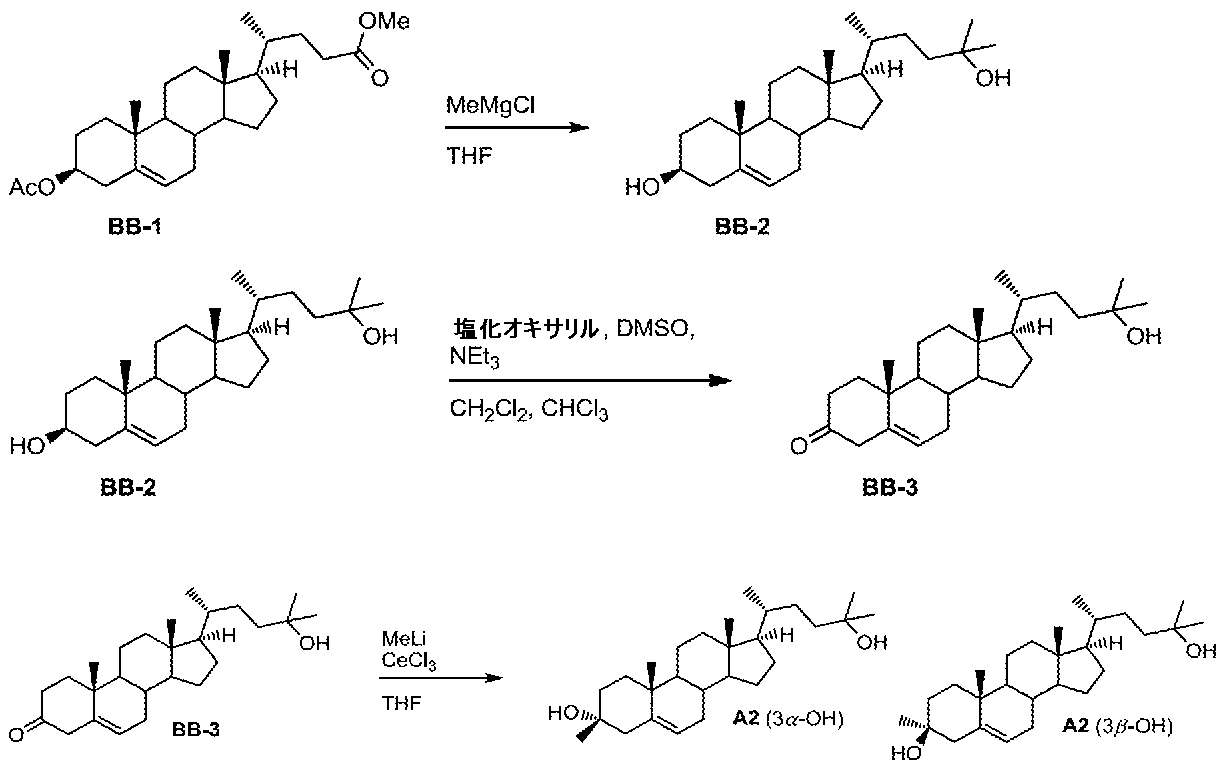
化合物BB-2の調製:Steroids(2006)71:18に記載されているよ
うに調製された、THF(35mL)中のBB-1(1.75g,4.06mmol)の
溶液を窒素下において0℃に冷却した。塩化メチルマグネシウム(THF中22%(w/
w),19.5mL,58.1mmol)を滴下した。0℃での撹拌を15分間続け、反
応混合物を室温まで昇温させ、撹拌を2時間続けた。NH4Cl飽和水溶液(5mL)を
ゆっくり加えた。沈殿物が形成され、水(10mL)を加えることによってそれを溶解し
た。EtOAc(50mL)およびブライン(20mL)を加えた。層を分離した。水層
をEtOAcで抽出した(2×50mL)。合わせた有機層をNa2SO4で乾燥させ、
溶媒を真空中で除去した。残渣をジクロロメタン(50mL)と同時蒸発させた。BB-
2(1.54g,3.95mmol,97%)をオフホワイトの固体として得た。1HN
MR (400 MHz, CDCl3): δ(ppm): 5.32 - 5.43
(1H, m), 3.46 - 3.61 (1H, m), 1.20 (3H,
s), 1.19 (3H, s), 1.01 (3H, s), 0.93 (3
H, d, J = 6.6 Hz), 0.68 (3H, s)。
Example 15. Preparation of compounds 3-alpha-A2 and 3-beta-A2
Preparation of compound BB-2: A solution of BB-1 (1.75 g, 4.06 mmol) in THF (35 mL), prepared as described in Steroids (2006) 71:18, was cooled to 0° C. under nitrogen. Methylmagnesium chloride (22% (w/v) in THF) was added.
w), 19.5 mL, 58.1 mmol) was added dropwise. Stirring at 0° C. was continued for 15 min, the reaction mixture was allowed to warm to room temperature and stirring was continued for 2 h. Saturated aqueous NH 4 Cl (5 mL) was added slowly. A precipitate formed which was dissolved by adding water (10 mL). EtOAc (50 mL) and brine (20 mL) were added. The layers were separated. The aqueous layer was extracted with EtOAc (2×50 mL). The combined organic layers were dried over Na 2 SO 4 and
The solvent was removed in vacuo. The residue was co-evaporated with dichloromethane (50 mL). BB-
2 (1.54 g, 3.95 mmol, 97%) was obtained as an off-white solid.
MR (400 MHz, CDCl 3 ): δ (ppm): 5.32 - 5.43
(1H, m), 3.46 - 3.61 (1H, m), 1.20 (3H,
s), 1.19 (3H, s), 1.01 (3H, s), 0.93 (3
H, d, J = 6.6 Hz), 0.68 (3H, s).
化合物BB-3の調製:オーブンで乾燥させたフラスコにおいて、ジクロロメタン(1
9mL)中の塩化オキサリル(0.622mL,7.26mmol)の溶液を窒素下で-
78℃に冷却した。ジメチルスルホキシド(0.60mL,8.47mmol)をゆっく
り加えた。25分後、CHCl3(38mL)中のBB-2(0.470g,1.209
mmol)の溶液を25分間にわたって滴下した。その溶液を-78℃において2.5時
間撹拌した。トリエチルアミン(3.36ml,24.19mmol)を-78℃におい
て滴下した。撹拌を15分間続けた。冷却浴を除去し、撹拌を10分間続けた。NH4C
l飽和水溶液(10mL)を加え、反応混合物を5分間撹拌した。ジクロロメタン(50
mL)および水(20mL)を加えた。層を分離し、有機層を水(20mL)で洗浄した
。合わせた水層をブライン(20mL)で希釈し、EtOAcで抽出した(2×75mL
)。合わせた有機層をNa2SO4で乾燥させ、溶媒を真空中で除去した。フラッシュク
ロマトグラフィー(ヘプタン,5%~30%EtOAc)によって、BB-3(238m
g,0616mmol,51%)を白色固体として得た。1HNMR (400 MHz
, CDCl3): δ(ppm): 5.31 - 5.38 (1H, m), 3
.22 - 3.34 (1H, m), 2.83 (1H, dd, J = 16
.4 Hz, 2.1 Hz), 2.41 - 2.54 (1H, m), 2.2
5 - 2.34 (1H, m), 1.95 - 2.08 (3H, m), 1
.82 -1.93 (1H, m), 1.21 (3H, s), 1.20 (3
H, s), 1.19 (3H, s), 0.94 (3H, d, J = 6.
5 Hz), 0.71 (3H, s)。
Preparation of compound BB-3: In an oven-dried flask, dichloromethane (1
A solution of oxalyl chloride (0.622 mL, 7.26 mmol) in 10 mL of oxalyl chloride was stirred under nitrogen for 1 hour.
Cool to 78° C. Dimethyl sulfoxide (0.60 mL, 8.47 mmol) was added slowly. After 25 min, BB-2 (0.470 g, 1.209 mmol) in CHCl 3 (38 mL) was added.
A solution of 1.2 mmol) of NH 4 C was added dropwise over 25 min. The solution was stirred at −78° C. for 2.5 h. Triethylamine (3.36 ml, 24.19 mmol) was added dropwise at −78° C. Stirring was continued for 15 min. The cooling bath was removed and stirring was continued for 10 min.
Saturated aqueous ethyl acetate (10 mL) was added and the reaction mixture was stirred for 5 minutes.
1 mL) and water (20 mL) were added. The layers were separated and the organic layer was washed with water (20 mL). The combined aqueous layers were diluted with brine (20 mL) and extracted with EtOAc (2×75 mL).
The combined organic layers were dried over Na 2 SO 4 and the solvent was removed in vacuo. Flash chromatography (heptane, 5% to 30% EtOAc) gave BB-3 (238 m
g, 0.616 mmol , 51%) was obtained as a white solid.
, CDCl 3 ): δ (ppm): 5.31 - 5.38 (1H, m), 3
.. 22 - 3.34 (1H, m), 2.83 (1H, dd, J = 16
.. 4 Hz, 2.1 Hz), 2.41 - 2.54 (1H, m), 2.2
5 - 2.34 (1H, m), 1.95 - 2.08 (3H, m), 1
.. 82 -1.93 (1H, m), 1.21 (3H, s), 1.20 (3
H, s), 1.19 (3H, s), 0.94 (3H, d, J = 6.
5 Hz), 0.71 (3H, s).
化合物3-α-OH A2および3-β-OH A2の調製:グローブボックス内の、
火炎乾燥したフラスコにおいて、THF(脱気したもの,3mL)を、無水塩化セリウム
(III)(0.319g,1.29mmol)に加えた。その懸濁液をRTにおいて一
晩撹拌した。粒子の細かい白色懸濁液をそのグローブボックスから取り出した。THF(
乾燥,1mL)を加え、その(thew)混合物をアルゴン下、RTにおいて15分間撹
拌した。アルゴン下において、その粒子の細かい白色懸濁液を-78℃に冷却した。この
温度において、Et2O中1.6Mのメチルリチウム(0.79mL,1.27mmol
)を滴下した。黄色の懸濁液が形成され、それを-78℃において1.5時間撹拌した。
THF(乾燥,2mL)中のBB-3(0.100g,0.259mmol)の溶液を5
分間にわたって滴下した。その反応混合物の色は、黄色から茶色に変化した。反応混合物
を-78℃において45分間撹拌した。冷却浴を除去し、反応混合物を10分間撹拌した
。5%AcOH水溶液(2mL)を加えた。反応混合物は、無色透明の溶液に変化した。
EtOAc(10mL)を加えた。混合物をRTまで昇温させた。層を分離し、水層をE
tOAcで抽出した(2×10mL)。合わせた有機層を硫酸ナトリウムで乾燥させ、溶
媒を真空中で除去した。フラッシュクロマトグラフィー(H,5%~20%EtOAc)
により、化合物A2(3α-OH)(33mg,0.082mmol;63.5%)およ
び化合物A2(3β-OH)(13mg,0.032mmol;25.0%)を得た(3
α-OH):1H-NMR (400 MHz, CDCl3): δ(ppm): 5
.43 - 5.38 (m, 1H), 2.46 - 2.37 (m, 1H),
2.05 - 1.80 (m, 4H), 1.73 - 1.23 (m, 15
H), 1.22 (s, 3H), 1.20 (s, 3H), 1.19 (s,
3H), 1.18 - 0.99 (m, 9H), 0.98 (s, 1H),
0.94 (d, J = 6.5 Hz, 3H), 0.68 (s, 3H).
(3β-OH): 1H-NMR (400 MHz, CDCl3): δ(ppm
): 5.34 - 5.28 (m, 1H), 2.47 - 2.38 (m,
1H), 2.07 - 1.92 (m, 3H), 1.91 - 1.66 (m
, 3H), 1.63 - 1.24 (m, 13H), 1.20 (s, 3H
), 1.19 (s, 3H), 1.18 - 1.12 (m, 3H), 1.
11 (s, 3H), 1.10 - 1.02 (m, 2H), 1.01 (s
, 3H), 1.00 - 0.94 (m, 1H), 0.93 (d, J =
6.5 Hz, 3H), 0.91 - 0.82 (m, 1H), 0.68
(s, 3H)。
Preparation of compounds 3-α-OH A2 and 3-β-OH A2: In a glove box,
In a flame-dried flask, THF (degassed, 3 mL) was added to anhydrous cerium(III) chloride (0.319 g, 1.29 mmol). The suspension was stirred overnight at RT. The fine white suspension was removed from the glove box. THF (
Dry, 1 mL) was added and the mixture was stirred under argon at RT for 15 min. The fine white suspension was cooled to −78° C. under argon. At this temperature, 1.6 M methyllithium in EtO (0.79 mL, 1.27 mmol) was added.
) was added dropwise. A yellow suspension was formed which was stirred at -78°C for 1.5 h.
A solution of BB-3 (0.100 g, 0.259 mmol) in THF (dry, 2 mL) was added to 5 mL of
The mixture was added dropwise over a period of 45 minutes. The color of the reaction mixture changed from yellow to brown. The reaction mixture was stirred at -78°C for 45 minutes. The cooling bath was removed and the reaction mixture was stirred for 10 minutes. 5% aqueous AcOH (2 mL) was added. The reaction mixture changed to a clear, colorless solution.
EtOAc (10 mL) was added. The mixture was allowed to warm to RT. The layers were separated and the aqueous layer was diluted with EtOAc.
Extraction with EtOAc (2×10 mL). The combined organic layers were dried over sodium sulfate and the solvent was removed in vacuo. Flash chromatography (H, 5% to 20% EtOAc)
Compound A2 (3α-OH) (33 mg, 0.082 mmol; 63.5%) and Compound A2 (3β-OH) (13 mg, 0.032 mmol; 25.0%) were obtained by the above procedure (3
α-OH): 1 H-NMR (400 MHz, CDCl 3 ): δ (ppm): 5
.. 43 - 5.38 (m, 1H), 2.46 - 2.37 (m, 1H),
2.05 - 1.80 (m, 4H), 1.73 - 1.23 (m, 15
H), 1.22 (s, 3H), 1.20 (s, 3H), 1.19 (s,
3H), 1.18 - 0.99 (m, 9H), 0.98 (s, 1H),
0.94 (d, J = 6.5 Hz, 3H), 0.68 (s, 3H).
(3β-OH): 1 H-NMR (400 MHz, CDCl 3 ): δ (ppm
): 5.34 - 5.28 (m, 1H), 2.47 - 2.38 (m,
1H), 2.07 - 1.92 (m, 3H), 1.91 - 1.66 (m
, 3H), 1.63 - 1.24 (m, 13H), 1.20 (s, 3H
), 1.19 (s, 3H), 1.18 - 1.12 (m, 3H), 1.
11 (s, 3H), 1.10 - 1.02 (m, 2H), 1.01 (s
, 3H), 1.00 - 0.94 (m, 1H), 0.93 (d, J =
6.5 Hz, 3H), 0.91 - 0.82 (m, 1H), 0.68
(s, 3H).
実施例16.化合物3-アルファ-A28および3-ベータ-A28の調製

グローブボックス内の、火炎乾燥したフラスコにおいて、THF(脱気したもの,1.
5mL)を、無水塩化セリウム(III)(0.207g,0.841mmol)に加え
た。その懸濁液をRTにおいて一晩撹拌した。粒子の細かい白色懸濁液をそのグローブボ
ックスから取り出し、アルゴン下で15分間撹拌した。アルゴン下において、その粒子の
細かい白色懸濁液を-78℃に冷却した。この温度において、ベンゼン/シクロヘキサン
中0.5Mのエチルリチウム(1.68mL,0.841mmol)を滴下した。黄色の
懸濁液が形成され、それを-78℃において30分間撹拌した。THF(乾燥,1.5m
L)中のBB-3(0.065g,0.168mmol)の溶液を3分間にわたって滴下
した。その反応混合物の色は、黄色から茶色に変化した。反応混合物を-78℃において
45分間撹拌した。茶色の乳濁した懸濁液が得られ、TLC(H/E;2:1)は、出発
物質の完全な変換およびより極性のスポットの形成を示した。冷却浴を除去し、反応混合
物を10分間撹拌した。5%AcOH水溶液(2mL)を加えた。ブライン(2mL)を
加えた後、反応混合物は、無色透明の溶液に変化した。EtOAc(5mL)を加えた。
混合物をRTまで昇温させた。層を分離し、水層をEtOAcで抽出した(2×5mL)
。合わせた有機層を硫酸ナトリウムで乾燥させ、溶媒を真空中で除去した。60mgの白
色固体が得られた。AgNO3(H,5%~20%EtOAc)を含浸させたシリカゲル
における分離によって、化合物A28(3α-OH)(6mg,0.014mmol;8
.56%)および化合物A28(3β-OH)(4mg,0.0096mmol;5.7
1%)が得られた。(3α-OH):1H-NMR (400 MHz, CDCl3)
: δ(ppm): 5.45 - 5.38 (m, 1H), 2.40 - 2.
33 (m, 1H), 2.05 -1.93 (m, 2H), 1.92 - 1
.80 (m, 2H), 1.75 - 1.23 (m, 15H), 1.20
(s, 3H), 1.19 (s, 3H), 1.18 - 0.98 (m, 7
H), 0.97 (s, 3H), 0.96 - 0.90 (m, 6H), 0
.89 - 0.81 (m, 2H), 0.68 (s, 3H). (3β-OH
): 1H-NMR (400 MHz, CDCl3): δ(ppm): 5.33
- 5.25 (m, 1H), 2.41 - 2.31 (m, 1H), 2.
06 - 1.93 (m, 3H), 1.90 - 1.78 (m, 1H),
1.77 - 1.23 (m, 20H), 1.20 (s, 3H), 1.19
(s, 3H), 1.17 - 1.05 (m, 5H), 1.03 (s,
3H), 1.01 - 0.95 (m, 1H), 0.93 (d, J = 6
.5 Hz, 3H), 0.92 - 0.88 (m, 1H), 0.84 (t
, J = 7.4 Hz, 3H), 0.67 (s, 3H)。
Example 16. Preparation of compounds 3-alpha-A28 and 3-beta-A28
In a flame-dried flask inside a glove box, add THF (degassed, 1.
Cerium(III) chloride (0.207 g, 0.841 mmol) was added to anhydrous cerium(III) chloride (0.5 mL). The suspension was stirred at RT overnight. The fine white suspension was removed from the glove box and stirred under argon for 15 min. Under argon, the fine white suspension was cooled to -78°C. At this temperature, ethyllithium 0.5 M in benzene/cyclohexane (1.68 mL, 0.841 mmol) was added dropwise. A yellow suspension was formed which was stirred at -78°C for 30 min. THF (dry, 1.5 mL) was added to the suspension. The suspension was stirred at -78°C for 30 min.
A solution of BB-3 (0.065 g, 0.168 mmol) in 10 mL of ethyl acetate was added dropwise over 3 min. The color of the reaction mixture changed from yellow to brown. The reaction mixture was stirred at -78 °C for 45 min. A brown milky suspension was obtained and TLC (H/E; 2:1) showed complete conversion of the starting material and the formation of a more polar spot. The cooling bath was removed and the reaction mixture was stirred for 10 min. 5% aqueous AcOH (2 mL) was added. After addition of brine (2 mL), the reaction mixture changed to a clear colorless solution. EtOAc (5 mL) was added.
The mixture was allowed to warm to RT. The layers were separated and the aqueous layer was extracted with EtOAc (2×5 mL).
The combined organic layers were dried over sodium sulfate and the solvent was removed in vacuo. 60 mg of a white solid was obtained. Separation on silica gel impregnated with AgNO 3 (H, 5% to 20% EtOAc) gave compound A28 (3α-OH) (6 mg, 0.014 mmol;
. 56%) and compound A28 (3β-OH) (4 mg, 0.0096 mmol; 5.7
1%) was obtained. (3α-OH): 1 H-NMR (400 MHz, CDCl 3 )
: δ (ppm): 5.45 - 5.38 (m, 1H), 2.40 - 2.
33 (m, 1H), 2.05 -1.93 (m, 2H), 1.92 - 1
.. 80 (m, 2H), 1.75 - 1.23 (m, 15H), 1.20
(s, 3H), 1.19 (s, 3H), 1.18 - 0.98 (m, 7
H), 0.97 (s, 3H), 0.96 - 0.90 (m, 6H), 0
.. 89 - 0.81 (m, 2H), 0.68 (s, 3H). (3β-OH
): 1 H-NMR (400 MHz, CDCl 3 ): δ (ppm): 5.33
- 5.25 (m, 1H), 2.41 - 2.31 (m, 1H), 2.
06 - 1.93 (m, 3H), 1.90 - 1.78 (m, 1H),
1.77 - 1.23 (m, 20H), 1.20 (s, 3H), 1.19
(s, 3H), 1.17 - 1.05 (m, 5H), 1.03 (s,
3H), 1.01 - 0.95 (m, 1H), 0.93 (d, J = 6
.. 5 Hz, 3H), 0.92 - 0.88 (m, 1H), 0.84 (t
, J = 7.4 Hz, 3H), 0.67 (s, 3H).
実施例17.化合物B6の調製

化合物B6aの調製。無水酢酸(15.36ml,164mmol)を、窒素雰囲気下
、ピリジン(90ml)中のスティグマステロール(Stigmasterol)(22
.5g,54.5mmol)の懸濁液に加え、その混合物を室温において42時間インキ
ュベートした。TLC[ヘプタン(2):酢酸エチル(1)]は、p-アニスアルデヒド
染色後に、より高い溶出性の生成物への完全な変換を示した。その反応混合物に水(30
0ml)を加えることにより、過剰な無水酢酸をクエンチした。1時間撹拌した後、白色
固体を濾過し、水で念入りに洗浄した(9×250ml)。その白色固体を、ビーカー1
杯の水酸化ナトリウムの存在下、40℃の真空オーブンにおいて週末にわたって乾燥させ
ることにより、生成物B6a(24.63g,54.2mmol,収率=99%)を白色
粉末として得た。B6aを、以下の実験においてそのまま使用した。1HNMR (40
0 MHz, CDCl3) δ(ppm): 5.38-5.37 (1H, m),
5.15 (1H, dd, J=15.1, 8.6 Hz), 5.01 (1H
, dd, J=15.1, 8.6 Hz), 4.64-4.56 (1H, m)
, 2.33-2.31 (2H, m), 2.03 (3H, s), 1.90-
1.82 (2H, m), 1.75-1.65 (1H, m), 1.02 (6
H, t, J=3.2 Hz), 0.86-0.78 (9H, m), 0.68
(3H, s)。
Example 17. Preparation of compound B6
Preparation of Compound B6a. Acetic anhydride (15.36 ml, 164 mmol) was dissolved in stigmasterol (22 ml) in pyridine (90 ml) under nitrogen atmosphere.
100 ml of 1,2-dichlorophenyl ether (1.5 g, 54.5 mmol) was added to a suspension of 1,2-dichlorophenyl ether (1.5 g, 54.5 mmol) and the mixture was incubated at room temperature for 42 h. TLC [heptane (2):ethyl acetate (1)] showed complete conversion to the more highly eluting product after p-anisaldehyde staining. The reaction mixture was diluted with water (30
The excess acetic anhydride was quenched by adding 100 ml of acetic anhydride (1.0 ml). After stirring for 1 hour, the white solid was filtered and washed thoroughly with water (9 x 250 ml). The white solid was placed in beaker 1.
Drying in a vacuum oven at 40° C. over the weekend in the presence of a cup of sodium hydroxide gave the product B6a (24.63 g, 54.2 mmol, yield=99%) as a white powder. B6a was used as is in the following experiments. 1 H NMR (40
0 MHz, CDCl 3 ) δ (ppm): 5.38-5.37 (1H, m),
5.15 (1H, dd, J=15.1, 8.6 Hz), 5.01 (1H
, dd, J=15.1, 8.6 Hz), 4.64-4.56 (1H, m)
, 2.33-2.31 (2H, m), 2.03 (3H, s), 1.90-
1.82 (2H, m), 1.75-1.65 (1H, m), 1.02 (6
H, t, J=3.2 Hz), 0.86-0.78 (9H, m), 0.68
(3H, s).
化合物B6bの調製。n-ヘプタン(100ml)中のヨードベンゼン(3.66ml
,32.7mmol)の溶液に、臭素(1.754ml,34.1mmol)を加え、そ
の溶液を窒素雰囲気下で-5℃に冷却した。n-ヘプタン(700ml)中のスティグマ
ステリル(Stigmasteryl)アセテートB6a(13.5g,29.7mmo
l)の溶液もまた窒素雰囲気下で-5℃に冷却し、激しく撹拌し、上で調製された溶液を
、その溶液の淡黄色を維持するように、窒素雰囲気下で2.5時間にわたって滴下した。
得られた溶液を一晩撹拌し、次いで、濾過した。TLC[ヘプタン(9):酢酸エチル(
1)]は、バニリン染色後に、わずかに溶出性が低い生成物への完全な変換を示した。そ
の溶液を、乾固するまで真空下で濃縮した。残渣を、カラム(900g)クロマトグラフ
ィー[ヘプタン(95):ジイソプロピルエーテル(5)]によって精製した。純粋な生
成物を含む画分を回収し、減圧下で蒸発させることにより、B6b(9.06g,14.
7mmol,収率=50%)を白色粉末として得た。B6bを、以下の実験においてその
まま使用した。1HNMR (400 MHz, CDCl3) δ(ppm): 5.
48 (1H, sep, J=5.4 Hz), 5.15 (1H, dd, J=
15.1, 8.6 Hz), 5.02 (1H, dd, J=15.1, 8.6
Hz), 4.84 (1H, brd), 2.05 (3H, s), 1.46
(3H, s), 1.01 (3H, d, J=6.6 Hz), 0.90-0
.79 (15H, m), 0.72 (3H, s)。
Preparation of compound B6b. Iodobenzene (3.66 ml) in n-heptane (100 ml)
To a solution of stigmasteryl acetate B6a (13.5 g, 29.7 mmol) in n-heptane (700 ml) was added bromine (1.754 ml, 34.1 mmol) and the solution was cooled to −5° C. under nitrogen.
The solution of l) was also cooled to -5°C under nitrogen and stirred vigorously, and the solution prepared above was added dropwise over 2.5 hours under nitrogen so as to maintain the pale yellow color of the solution.
The resulting solution was stirred overnight and then filtered. TLC [heptane (9):ethyl acetate (
1)] showed complete conversion to the slightly less eluting product after vanillin staining. The solution was concentrated under vacuum to dryness. The residue was purified by column (900 g) chromatography [heptane (95):diisopropyl ether (5)]. Fractions containing pure product were collected and evaporated under reduced pressure to give B6b (9.06 g, 14.
7 mmol, yield=50%) was obtained as a white powder. B6b was used as is in the following experiments. 1 H NMR (400 MHz, CDCl 3 ) δ(ppm): 5.
48 (1H, sep, J=5.4 Hz), 5.15 (1H, dd, J=
15.1, 8.6 Hz), 5.02 (1H, dd, J=15.1, 8.6
Hz), 4.84 (1H, brd), 2.05 (3H, s), 1.46
(3H, s), 1.01 (3H, d, J=6.6 Hz), 0.90-0
.. 79 (15H, m), 0.72 (3H, s).
化合物B6cの調製。モレキュラーシーブで乾燥させたジクロロメタン(240ml)
およびピリジン(3.05ml,37.7mmol)中の5α,6β-ジブロモスティグ
マスタン(Dibromostigmastan)-3β-イルアセテートB6b(8.
11g,13.20mmol)の溶液を、液体窒素/酢酸エチル浴において冷却した。そ
の溶液に、オゾンリッチ酸素流を、焼結ガラス噴霧器を通じて1時間通した。反応混合物
の色は、わずかに青色になった。TLC[ヘプタン(9):酢酸エチル(1)]は、UV
254において、出発物質の完全な変換を示した。オゾン分解反応を停止した。その反応
混合物を直ちに氷酢酸(33.2ml,581mmol)と亜鉛末(21.57g,33
0mmol)との混合物に注ぎ込み、室温において一晩撹拌した。その溶液を濾過し、水
(200ml)、10%炭酸水素ナトリウム水溶液(200ml)、5%水酸化ナトリウ
ム水溶液(200ml)およびブライン(200ml)で連続的に洗浄し、次いで、無水
硫酸ナトリウムで乾燥させた。溶媒を蒸発させることにより、粗コレスタ-5-エン-3
β-オール-22-アールB6cを得て、それをフラッシュカラム(300g)クロマト
グラフィー[ヘプタン(100=>90):酢酸エチル(0=>10)]によって精製し
た。生成物を含む画分を回収し、減圧下で蒸発させることにより、コレスタ-5-エン-
3β-オール-22-アールB6c(2.58g,6.93mmol,収率=53%)を
白色粉末として得た。B6cを、以下の実験においてそのまま使用した。1HNMR (
400 MHz, CDCl3) δ(ppm): 9.57 (1H, d, J=3
.3 Hz), 5.38 (1H, brd), 4.65-4.56 (1H, m
), 2.41-2.28 (3H, m), 2.04 (3H, s), 2.03
-1.92 (2H, m), 1.91-1.81 (3H, m), 1.13 (
3H, d, J=6.8 Hz), 1.03 (3H, s), 0.73 (3H
, s)。
Preparation of Compound B6c. Dichloromethane (240 ml) dried over molecular sieves
and 5α,6β-Dibromostigmastan-3β-yl acetate B6b (8.
A solution of 11 g (13.20 mmol) of ethyl acetate was cooled in a liquid nitrogen/ethyl acetate bath. A stream of ozone-rich oxygen was passed through a sintered glass atomizer for 1 h. The reaction mixture became slightly blue in color. TLC [heptane (9):ethyl acetate (1)] showed no visible UV light.
At 254° C. , the reaction showed complete conversion of the starting material. The ozonolysis reaction was stopped. The reaction mixture was immediately diluted with glacial acetic acid (33.2 ml, 581 mmol) and zinc dust (21.57 g, 33
The mixture was poured into a mixture of 100 mmol) and stirred at room temperature overnight. The solution was filtered and washed successively with water (200 ml), 10% aqueous sodium bicarbonate solution (200 ml), 5% aqueous sodium hydroxide solution (200 ml) and brine (200 ml), then dried over anhydrous sodium sulfate. The solvent was evaporated to give crude cholest-5-ene-3.
β-ol-22-al B6c was obtained, which was purified by flash column (300 g) chromatography [heptane (100=>90):ethyl acetate (0=>10)]. The product-containing fractions were collected and evaporated under reduced pressure to give cholest-5-ene-
3β-ol-22-al B6c (2.58 g, 6.93 mmol, yield=53%) was obtained as a white powder. B6c was used as is in the following experiments.
400 MHz, CDCl3) δ (ppm): 9.57 (1H, d, J=3
.. 3 Hz), 5.38 (1H, brd), 4.65-4.56 (1H, m
), 2.41-2.28 (3H, m), 2.04 (3H, s), 2.03
-1.92 (2H, m), 1.91-1.81 (3H, m), 1.13 (
3H, d, J=6.8 Hz), 1.03 (3H, s), 0.73 (3H
, s).
化合物B6dの調製。アルゴン雰囲気下、-10℃の乾燥THF(6.4mL)中の(
メトキシメチル)トリフェニル-ホスホニウムクロリド(0.789g,2.30mmo
l)の溶液に、ヘキサン類中1.6Mのn-BuLi(1.342mL,2.15mmo
l)を加えた。その溶液を室温において5分間撹拌した後、乾燥THF(1.3mL)中
のB6c(0.2g,0.54mmol)を加えた。その混合物を室温において30分間
撹拌した。その反応混合物をNH4Cl飽和水溶液(75mL)に注ぎ込み、CH2Cl
2(50mL)で2回抽出した。合わせた有機層を、ブラインで洗浄し、Na2SO4に
おいて乾燥させ、粗生成物をフラッシュカラムクロマトグラフィー(シリカ,ヘプタン/
酢酸エチル,1:0->88:12)によって精製することにより、B6dを得た(10
3mg,0.29mmol,収率=54%)。B6dは、NMRによると、1:1のE/
Z混合物として得られた。1HNMR (400 MHz, CDCl3) δ(ppm
): 6.24 (0.5H, d, J=12.6 Hz), 5.74 (0.5H
, d, J=6.2 Hz), 5.34 (1H, brd), 4.59 (0.
5H, dd, J=12.5, 9.3 Hz), 4.17 (0.5H, dd,
J=9.8, 6.3 Hz), 3.58-3.46 (1H, m), 3.55
(1.5H, s), 3.47 (1.5H, s), 2.67-2.54 (0
.5H, m), 2.33-2.18 (2H, m), 2.04-1.78 (6
H, m), 1.77-1.65 (1H, m), 1.04 (1.5H, d,
J=6.6 Hz), 1.01 (3H, s), 0.98 (1.5H, d,
J=6.7 Hz), 0.72 (1.5H, s), 0.69 (1.5H,
s)。
Preparation of Compound B6d. (6.4 mL) of dry THF at −10° C. under an argon atmosphere was dissolved in
methoxymethyl)triphenyl-phosphonium chloride (0.789 g, 2.30 mmol)
A solution of 1.6 M n-BuLi (1.342 mL, 2.15 mmol) in hexanes was added to the solution.
After the solution was stirred at room temperature for 5 min, B6c (0.2 g, 0.54 mmol) in dry THF (1.3 mL) was added. The mixture was stirred at room temperature for 30 min. The reaction mixture was poured into saturated aqueous NH 4 Cl (75 mL) and CH 2 Cl was added.
The combined organic layers were washed with brine, dried over Na2SO4 , and the crude product was purified by flash column chromatography (silica, heptane/
Purification with ethyl acetate, 1:0→88:12 gave B6d (10
3 mg, 0.29 mmol, yield = 54%). B6d was determined to be a 1:1 E/O product by NMR.
Obtained as a Z mixture. 1H NMR (400 MHz, CDCl3) δ (ppm
): 6.24 (0.5H, d, J=12.6 Hz), 5.74 (0.5H
, d, J=6.2 Hz), 5.34 (1H, brd), 4.59 (0.
5H, dd, J=12.5, 9.3 Hz), 4.17 (0.5H, dd,
J=9.8, 6.3 Hz), 3.58-3.46 (1H, m), 3.55
(1.5H, s), 3.47 (1.5H, s), 2.67-2.54 (0
.. 5H, m), 2.33-2.18 (2H, m), 2.04-1.78 (6
H, m), 1.77-1.65 (1H, m), 1.04 (1.5H, d,
J=6.6 Hz), 1.01 (3H, s), 0.98 (1.5H, d,
J=6.7 Hz), 0.72 (1.5H, s), 0.69 (1.5H,
s).
化合物B6eの調製。無水酢酸(0.079mL,0.84mmol)を、窒素雰囲気
下のピリジン(3mL)中のB6d(0.1g,0.279mmol)の懸濁液に加え、
その混合物を室温において42時間インキュベートした。その反応混合物に水(60mL
)を加えることにより、過剰な無水酢酸をクエンチした。1時間撹拌した後、白色固体を
濾過し、水で念入りに洗浄した(9×250mL)。その白色固体を、40℃の真空オー
ブンにおいて一晩乾燥させることにより、生成物B6eを得た(111mg,0.28m
mol,収率=99%)。1HNMR (400 MHz, CDCl3) δ(ppm
): 6.24 (0.5H, d, J=12.6 Hz), 5.73 (0.5H
, d, J=6.2 Hz), 5.37 (1H, brd), 4.66-4.5
5 (1H, m), 4.59 (0.5H, dd, J=12.5, 9.3 H
z), 4.17 (0.5H, dd, J=9.8, 6.3 Hz), 3.55
(1.5H, s), 3.47 (1.5H, s), 2.66-2.54 (0
.5H, m), 2.35-2.28 (2H, m), 2.03 (3H, s)
, 2.02-1.91 (3H, m), 1.90-1.81 (2H, m),
1.77-1.66 (1H, m), 1.04 (1.5H, d, J=6.6
Hz), 1.02 (3H, s), 0.99 (1.5H, d, J=6.6
Hz), 0.72 (1.5H, s), 0.69 (1.5H, s)。
Preparation of compound B6e. Acetic anhydride (0.079 mL, 0.84 mmol) was added to a suspension of B6d (0.1 g, 0.279 mmol) in pyridine (3 mL) under a nitrogen atmosphere;
The mixture was incubated at room temperature for 42 hours. The reaction mixture was diluted with water (60 mL
The excess acetic anhydride was quenched by the addition of 1×250 mL of acetic acid. After stirring for 1 h, the white solid was filtered and washed thoroughly with water (9×250 mL). The white solid was dried overnight in a vacuum oven at 40° C. to give the product B6e (111 mg, 0.28 m
mol, yield = 99%). 1 HNMR (400 MHz, CDCl3) δ (ppm
): 6.24 (0.5H, d, J=12.6 Hz), 5.73 (0.5H
, d, J=6.2 Hz), 5.37 (1H, brd), 4.66-4.5
5 (1H, m), 4.59 (0.5H, dd, J=12.5, 9.3H
z), 4.17 (0.5H, dd, J=9.8, 6.3 Hz), 3.55
(1.5H, s), 3.47 (1.5H, s), 2.66-2.54 (0
.. 5H, m), 2.35-2.28 (2H, m), 2.03 (3H, s)
, 2.02-1.91 (3H, m), 1.90-1.81 (2H, m),
1.77-1.66 (1H, m), 1.04 (1.5H, d, J=6.6
Hz), 1.02 (3H, s), 0.99 (1.5H, d, J=6.6
Hz), 0.72 (1.5H, s), 0.69 (1.5H, s).
化合物B6fの調製。アセトン(9mL)中のB6e(0.111g,0.28mmo
l)の溶液に、0.1M HCl水溶液(1mL,0.10mmol)を加えた。得られ
た白色懸濁液を室温において1時間撹拌した後、70℃において1時間および室温におい
て一晩撹拌した。その混合物を70℃で2時間加熱し、室温に冷却し、H2O(50mL
)で希釈した。その反応混合物を乾固するまで蒸発させ、MeOH(50mL)およびC
H2Cl2(10mL)と同時蒸発させた。これは、所望の生成物とジメチルアセタール
との混合物であるとみられる。アセトン(10mL)中のこの混合物(0.12g,0.
28mmol)の溶液に、0.1M HCl水溶液(1mL,0.10mmol)を加え
た。得られた白色懸濁液を70℃において2時間撹拌した。1,4-ジオキサン(5mL
)を加え、それにより、不溶性物質を溶解させた。その反応混合物をさらに2時間70℃
に加熱し、室温まで冷却させ、週末にわたって撹拌した。その反応混合物をH2O(50
mL)で希釈し、CH2Cl2で抽出した(3×50mL)。合わせた有機層をブライン
で洗浄し、Na2SO4において乾燥させ、溶媒を蒸発させた。その粗生成物をCH2C
l2(10mL)と同時蒸発させることにより、B6fを得た(119mg,0.31m
mol,収率=111%)。1HNMR (400 MHz, CDCl3) δ(pp
m): 9.75 (1H, m), 5.37, (1H, brd), 4.66-
.454 (1H, m), 2.47 (1H, dd, J=15.8, 2.4
Hz), 2.36-2.28 (2H, m), 2.17 (1H, ddd, J
=15.8, 9.3, 3.3 Hz), 2.03 (3H, s), 1.02
(3H, d, J=6.4 Hz), 1.02 (3H, s), 0.70 (3
H, s)。
Preparation of compound B6f. B6e (0.111 g, 0.28 mmol) in acetone (9 mL)
To a solution of 100 ml of 0.1 M aqueous HCl (1 mL, 0.10 mmol) was added. The resulting white suspension was stirred at room temperature for 1 h, then at 70° C. for 1 h and at room temperature overnight. The mixture was heated at 70° C. for 2 h, cooled to room temperature, and diluted with H 2 O (50 mL).
The reaction mixture was evaporated to dryness and diluted with MeOH (50 mL) and C
Coevaporate with H2Cl2 (10 mL). This is believed to be a mixture of the desired product and dimethyl acetal. Dissolve this mixture (0.12 g, 0.5 ml) in acetone (10 mL).
To a solution of 1,4-dioxane (5 mL, 28 mmol) was added 0.1 M aqueous HCl (1 mL, 0.10 mmol). The resulting white suspension was stirred at 70° C. for 2 h.
) was added, thereby dissolving the insoluble material. The reaction mixture was then heated at 70° C. for an additional 2 hours.
The reaction mixture was heated to rt , cooled to rt and stirred over the weekend.
The mixture was diluted with 10 mL of ethyl acetate and extracted with CH 2 Cl 2 (3×50 mL). The combined organic layers were washed with brine, dried over Na 2 SO 4 and the solvent was evaporated. The crude product was extracted with CH 2 Cl 2 (3×50 mL).
Coevaporation with 10 mL of 1,2-dichloromethane gave B6f (119 mg, 0.31 m
mol, yield = 111%). 1 HNMR (400 MHz, CDCl3) δ(pp
m): 9.75 (1H, m), 5.37, (1H, brd), 4.66-
.. 454 (1H, m), 2.47 (1H, dd, J=15.8, 2.4
Hz), 2.36-2.28 (2H, m), 2.17 (1H, ddd, J
=15.8, 9.3, 3.3 Hz), 2.03 (3H, s), 1.02
(3H, d, J=6.4 Hz), 1.02 (3H, s), 0.70 (3
H, s).
化合物B6gの調製。化合物B6f(0.11g,0.285mmol)をt-ブタノ
ール(5mL)、乾燥THF(1mL)および2-メチル-2-ブテン(0.512mL
,4.84mmol)に溶解した。その溶液を撹拌し、冷浴を用いて冷却した。その溶液
に、脱塩水(3ml)中の、NaClO2(0.028g,0.313mmol)および
K2HPO4(0.043g,0.313mmol)の溶液を5分間にわたってゆっくり
加え、その混合物を0℃において2時間撹拌した。その混合物を室温において一晩撹拌し
た。その反応混合物に、H2O(3mL)に溶解された、追加のNaClO2(0.02
8g,0.313mmol)およびK2HPO4(0.043g,0.313mmol)
をゆっくり加え、撹拌を2時間続けた。その反応混合物をNH4Cl飽和水溶液(250
mL)に注ぎ込み、CH2Cl2(75mL)で3回抽出した。合わせた有機層をNa2
SO4で乾燥させ、濾過し、減圧下で蒸発させた。白色固体残渣(2.26g,163%
)を石油エーテル40-60(10mL)中でトリチュレートした(triturate
d)。その白色固体を濾過し、石油エーテル40-60(5mL)で2回洗浄し、0.5
時間にわたって風乾させることにより、B6fを得た(0.089g,0.22mmol
,収率=78%)。1HNMR (400 MHz, CDCl3) δ(ppm):
10.0 (1H, bs), 5.37 (1H, brd), 4.66-4.55
(1H, m), 2.53-2.44 (1H, m), 2.36-2.26 (
2H, m), 2.04 (3H, s), 1.04 (3H, d, J=6.4
Hz), 1.02 (3H, s), 0.72 (3H, s)。
Preparation of Compound B6g: Compound B6f (0.11 g, 0.285 mmol) was dissolved in t-butanol (5 mL), dry THF (1 mL) and 2-methyl-2-butene (0.512 mL).
, 4.84 mmol). The solution was stirred and cooled using a cold bath. To the solution was slowly added a solution of NaClO 2 (0.028 g, 0.313 mmol) and K 2 HPO 4 (0.043 g, 0.313 mmol) in demineralized water (3 mL) over a period of 5 min, and the mixture was stirred at 0° C. for 2 h. The mixture was stirred at room temperature overnight. Additional NaClO 2 (0.02 g, 0.313 mmol), dissolved in H 2 O (3 mL), was added to the reaction mixture.
8g, 0.313mmol) and K2HPO4 (0.043g, 0.313mmol )
was slowly added and stirring was continued for 2 h. The reaction mixture was diluted with saturated aqueous NH 4 Cl (250
The mixture was poured into 100 mL of water and extracted three times with CH 2 Cl 2 (75 mL). The combined organic layers were poured into 100 mL of Na 2 Cl 2 (75 mL).
Dry over SO4 , filter and evaporate under reduced pressure. White solid residue (2.26 g, 163%)
) was triturated in petroleum ether 40-60 (10 mL).
d) The white solid was filtered and washed twice with petroleum ether 40-60 (5 mL) and diluted with 0.5
After air drying for 1 h, B6f (0.089 g, 0.22 mmol) was obtained.
, yield=78%). 1H NMR (400 MHz, CDCl3) δ (ppm):
10.0 (1H, bs), 5.37 (1H, brd), 4.66-4.55
(1H, m), 2.53-2.44 (1H, m), 2.36-2.26 (
2H, m), 2.04 (3H, s), 1.04 (3H, d, J=6.4
Hz), 1.02 (3H, s), 0.72 (3H, s).
化合物B6hの調製。CH2Cl2(10mL)中のB6g(0.09g,0.224
mmol)の溶液に、塩化オキサリル(0.048mL,0.56mmol)およびDM
F(cat)を加えた。その溶液を室温において2時間撹拌した。その反応混合物を乾燥
MeOH(150mL,3703mmol)で希釈し、すべての固体が溶解するまで40
℃において撹拌した。その反応混合物を、乾固するまで蒸発させ、粗生成物をフラッシュ
カラムクロマトグラフィー(シリカ,ヘプタン/酢酸エチル,1:0->95:5)によ
って精製し、THFと2回同時蒸発させることにより、B6hを得た(85mg,0.2
0mmol,収率=91%)。1HNMR (400 MHz, CDCl3) δ(p
pm): 5.37 (1H, brd), 4.66-4.55 (1H, m),
3.66 (3H, s), 2.43 (1H, dd, J=14.1, 2.9
Hz), 2.38-2.25 (2H, m), 2.04 (3H, s), 1.
02 (3H, s), 0.99 (3H, d, J=6.2 Hz), 0.72
(3H, s)。
Preparation of compound B6h. B6g (0.09 g, 0.224 mL ) in CH2Cl2 (10 mL)
To a solution of 1.2 mmol of oxalyl chloride (0.048 mL, 0.56 mmol) and DM
F(cat) was added. The solution was stirred at room temperature for 2 h. The reaction mixture was diluted with dry MeOH (150 mL, 3703 mmol) and stirred for 40 min until all solids were dissolved.
The reaction mixture was evaporated to dryness and the crude product was purified by flash column chromatography (silica, heptane/ethyl acetate, 1:0->95:5) and coevaporated twice with THF to give B6h (85 mg, 0.2 mL).
0 mmol, yield = 91%). 1H NMR (400 MHz, CDCl3) δ(p
pm): 5.37 (1H, brd), 4.66-4.55 (1H, m),
3.66 (3H, s), 2.43 (1H, dd, J=14.1, 2.9
Hz), 2.38-2.25 (2H, m), 2.04 (3H, s), 1.
02 (3H, s), 0.99 (3H, d, J=6.2 Hz), 0.72
(3H, s).
化合物B6の調製。乾燥THF(3mL)中のB6h(0.085g,0.20mmo
l)の溶液をアルゴン雰囲気下において0℃に冷却した。THF中3.0MのMeMgC
l(0.68mL,2.04mmol)を、注射器を使用して滴下した。その反応混合物
を0℃において1時間撹拌した後、室温において2時間撹拌した。THF中3.0MのM
eMgCl(0.68mL,2.04mmol)を再度室温において加え、一晩撹拌を続
けた。その反応混合物をNH4Cl飽和水溶液(75mL)でクエンチし、CH2Cl2
で3回抽出した(3×50mL)。合わせた有機層をブラインで洗浄し、Na2SO4に
おいて乾燥させ、粗生成物をフラッシュカラムクロマトグラフィー(シリカ,ヘプタン/
酢酸エチル,1:0->4:1)によって精製することにより、B6(45mg,0.1
2mmol,収率=59%)を白色綿毛状固体として得た。1HNMR (400 MH
z, CDCl3) δ(ppm): 5.35 (1H, brd), 3.53 (
1H, sep, J=5.1 Hz), 2.34-2.17 (2H, m), 2
.03 (1H, dt, J=12.6, 3.3 Hz), 2.01-1.94
(1H, m), 1.93-1.79 (3H, m), 1.23 (6H, s)
, 1.06 (3H, d, J=6.5 Hz), 1.01 (3H, s),
0.72 (3H, s)。
Preparation of compound B6. B6h (0.085 g, 0.20 mmol) in dry THF (3 mL)
A solution of 3.0 M MeMgCl in THF was cooled to 0° C. under an argon atmosphere.
M1 (0.68 mL, 2.04 mmol) was added dropwise using a syringe. The reaction mixture was stirred at 0° C. for 1 h and then at room temperature for 2 h.
eMgCl (0.68 mL, 2.04 mmol) was added again at room temperature and stirring was continued overnight. The reaction mixture was quenched with saturated aqueous NH 4 Cl (75 mL) and CH 2 Cl 2
The combined organic layers were washed with brine, dried over Na2SO4 and the crude product purified by flash column chromatography (silica, heptane/
Purification with ethyl acetate, 1:0->4:1 gave B6 (45 mg, 0.1
2 mmol, yield=59%) was obtained as a white fluffy solid.
z, CDCl3) δ (ppm): 5.35 (1H, brd), 3.53 (
1H, sep, J=5.1 Hz), 2.34-2.17 (2H, m), 2
.. 03 (1H, dt, J=12.6, 3.3 Hz), 2.01-1.94
(1H, m), 1.93-1.79 (3H, m), 1.23 (6H, s)
, 1.06 (3H, d, J=6.5 Hz), 1.01 (3H, s),
0.72 (3H, s).
実施例18.化合物B7の調製

化合物B7dの調製:コレスタ-5-エン-3β-オール-22-アールB7c(1.
33g,3.57mmol)をt-ブタノール(75ml)、テトラヒドロフラン(乾燥
)(15ml)および2-メチル-2-ブテン(13.22ml,125mmol)に溶
解した。その溶液を撹拌し、冷浴を用いて冷却した。脱塩水(45ml)中の、亜塩素酸
ナトリウム(0.355g,3.93mmol)およびリン酸二水素カリウムp.a.(
0.534g,3.93mmol)の調製したばかりの溶液を、上記溶液に30分間にわ
たってゆっくり加え、その混合物を0℃において2時間撹拌した。氷浴を除去し、その混
合物の温度を室温に上げ、一晩撹拌した。TLC[ヘプタン(2):酢酸エチル(1)]
は、バニリン染色後に、より低い溶出性の生成物への部分的な変換を示した。その反応混
合物に、水(45ml)に溶解された、追加の亜塩素酸ナトリウム(0.355g,3.
93mmol)およびリン酸二水素カリウムp.a.(0.534g,3.93mmol
)をゆっくり加え、撹拌を2時間続けた。TLC[ヘプタン(2):酢酸エチル(1)]
は、バニリン染色後に、より低い溶出性の生成物への完全な変換を示した。その反応混合
物を塩化アンモニウム飽和水溶液(250ml)に注ぎ込み、ジクロロメタン(100m
l)で3回抽出した。合わせた有機層を硫酸ナトリウムで乾燥させ、濾過し、減圧下で蒸
発させた。残渣を、トルエン(50ml)に続いてジクロロメタン(50ml)で2回ス
トリッピングした(stripped)。白色固体残渣(2.26g,163%)を石油
エーテル40-60(10ml)中で0.5時間トリチュレートした。その白色固体を濾
過し、石油エーテル40-60(10ml)で2回洗浄し、0.5時間風乾させることに
より(真空ポンプをオンにしたままで)、B7d(1.27g,3.26mmol,収率
=91%)を白色粉末として得た。B7dを、以下の実験においてそのまま使用した。1
HNMR (400 MHz, CDCl3) δ(ppm): 10.31 (1H,
bs), 5.37 (1H, brd), 4.65-4.56 (1H, m),
2.47-2.39 (1H, m), 2.36-2.26 (2H, m), 2
.04 (3H, s), 2.01-1.92 (2H, m), 1.90-1.7
6 (3H, m), 1.24 (3H, d, J=6.8 Hz), 1.02
(3H, s), 0.71 (3H, s)。
Example 18. Preparation of compound B7
Preparation of Compound B7d: Cholest-5-en-3β-ol-22-al B7c (1.
33 g, 3.57 mmol) was dissolved in t-butanol (75 ml), tetrahydrofuran (dry) (15 ml) and 2-methyl-2-butene (13.22 ml, 125 mmol). The solution was stirred and cooled using a cold bath. Sodium chlorite (0.355 g, 3.93 mmol) and potassium dihydrogen phosphate p.a. (
A freshly prepared solution of 0.534 g (3.93 mmol) was slowly added to the above solution over 30 min and the mixture was stirred at 0° C. for 2 h. The ice bath was removed and the mixture was allowed to warm to room temperature and stirred overnight. TLC [heptane (2):ethyl acetate (1)]
showed partial conversion to a less elutable product after vanillin staining. Additional sodium chlorite (0.355 g, 3.0 mL) dissolved in water (45 mL) was added to the reaction mixture.
93 mmol) and potassium dihydrogen phosphate p.a. (0.534 g, 3.93 mmol)
) was added slowly and stirring was continued for 2 hours. TLC [heptane (2): ethyl acetate (1)]
showed complete conversion to the less eluting product after vanillin staining. The reaction mixture was poured into saturated aqueous ammonium chloride (250 ml) and dichloromethane (100 ml) was added.
The mixture was extracted three times with toluene (50 ml) followed by dichloromethane (50 ml). The combined organic layers were dried over sodium sulfate, filtered and evaporated under reduced pressure. The residue was stripped twice with toluene (50 ml) followed by dichloromethane (50 ml). The white solid residue (2.26 g, 163%) was triturated in petroleum ether 40-60 (10 ml) for 0.5 h. The white solid was filtered, washed twice with petroleum ether 40-60 (10 ml) and air-dried for 0.5 h (with the vacuum pump on) to give B7d (1.27 g, 3.26 mmol, yield=91%) as a white powder. B7d was used as is in the following experiments. 1
HNMR (400 MHz, CDCl3) δ (ppm): 10.31 (1H,
bs), 5.37 (1H, brd), 4.65-4.56 (1H, m),
2.47-2.39 (1H, m), 2.36-2.26 (2H, m), 2
.. 04 (3H, s), 2.01-1.92 (2H, m), 1.90-1.7
6 (3H, m), 1.24 (3H, d, J=6.8 Hz), 1.02
(3H, s), 0.71 (3H, s).
化合物B7eの調製。カルボン酸B7d(0.1g,0.257mmol)をジクロロ
メタン(10ml)に溶解した。塩化オキサリル(0.044mL,0.515mmol
)およびN,N-ジメチルホルムアミド(1滴)を加え、その反応混合物を1時間撹拌し
た。その反応物のサンプルをメタノールに注ぎ、乾固するまで蒸発させ、TLC[ヘプタ
ン(3):酢酸エチル(1)]で分析したところ、それは、バニリン染色後に、メチルエ
ステルへの完全な変換を示した。その反応混合物をメタノール(50mL,1234mm
ol)(モレキュラーシーブで乾燥させたもの)で希釈し、減圧下で蒸発させ、無水トル
エンおよびジクロロメタンでストリッピングした。残渣を、フラッシュカラム(4g)ク
ロマトグラフィー[ヘプタン(99=>80):酢酸エチル(1=>20)]によって精
製した。生成物を含む画分を回収し、減圧下で蒸発させることにより、B7eを得た(0
.104g,0.257mmol,収率=100%)。B7eを、トルエン(2×5ml
)、ジクロロメタン(2×5ml)および無水テトラヒドロフラン(2×5ml)でスト
リッピングし、次の反応工程においてそのまま使用した。1HNMR (400 MHz
, CDCl3) δ(ppm): 5.37 (1H, brd), 4.65-4.
56 (1H, m), 3.65 (3H, s), 2.47-2.38 (1H,
m), 2.36-2.26 (2H, m), 2.03 (3H, s), 2.
01-1.92 (2H, m), 1.90-1.82 (2H, m), 1.19
(3H, d, J=6.8 Hz), 1.02 (3H, s), 0.69 (
3H, s)。
Preparation of compound B7e. Carboxylic acid B7d (0.1 g, 0.257 mmol) was dissolved in dichloromethane (10 ml). Oxalyl chloride (0.044 mL, 0.515 mmol) was added.
) and N,N-dimethylformamide (1 drop) were added and the reaction mixture was stirred for 1 h. A sample of the reaction was poured into methanol, evaporated to dryness, and analyzed by TLC [heptane(3):ethyl acetate(1)], which showed complete conversion to the methyl ester after vanillin staining. The reaction mixture was diluted with methanol (50 mL, 1234 mm
The mixture was diluted with 1,000 ml of toluene (dried over molecular sieves), evaporated under reduced pressure, and stripped with anhydrous toluene and dichloromethane. The residue was purified by flash column (4 g) chromatography [heptane (99=>80):ethyl acetate (1=>20)]. The product-containing fractions were collected and evaporated under reduced pressure to give B7e (0.01 ml).
104 g, 0.257 mmol, yield = 100%). B7e was dissolved in toluene (2 x 5 ml
), dichloromethane (2 x 5 ml) and anhydrous tetrahydrofuran (2 x 5 ml) and used as is in the next reaction step.
, CDCl3) δ (ppm): 5.37 (1H, brd), 4.65-4.
56 (1H, m), 3.65 (3H, s), 2.47-2.38 (1H,
m), 2.36-2.26 (2H, m), 2.03 (3H, s), 2.
01-1.92 (2H, m), 1.90-1.82 (2H, m), 1.19
(3H, d, J=6.8 Hz), 1.02 (3H, s), 0.69 (
3H, s).
化合物B7の調製。メチルエステルB7e(0.104g,0.258mmol)をテ
トラヒドロフラン(乾燥)(2.6ml)に溶解し、アルゴン下の氷浴において冷却した
。20分後、THF中3.0Mの塩化メチルマグネシウム(0.861ml,2.58m
mol)を、注射器を介して滴下した。いくらかの気体の放出が観察された。その反応混
合物を0.5時間撹拌した後、冷浴を除去し、撹拌を2時間続けた。TLC[ヘプタン(
3):酢酸エチル(1)]は、バニリン染色後に、出発物質から2つのより低い溶出性の
生成物への完全な変換を示した。撹拌を1時間続けた。その反応混合物を、撹拌しながら
塩化アンモニウム飽和水溶液(75ml)に注ぎ、ジクロロメタンで抽出した(3×50
ml)。抽出物を合わせ、硫酸ナトリウムで乾燥させ、蒸発させた。残渣を、メタノール
(2ml)中で0.5時間トリチュレートし、白色固体を濾過し、濾過残渣をメタノール
(2ml)で洗浄した。フィルター上には、ほとんど材料は残らず、その大部分は濾液中
に存在した。濾液および濾過残渣を合わせ、フラッシュカラムクロマトグラフィー[ヘプ
タン(99=>70):酢酸エチル(1=>30)]によって精製した。生成物を含む画
分を回収し、減圧下で蒸発させた。残渣を、40℃の真空オーブンにおいて一晩乾燥させ
ることにより、B7(0.044g,0.122mmol,収率=47%)を白色固体と
して得た。1HNMR (400 MHz, CDCl3) δ(ppm): 5.35
(1H, m), 3.53 (1H, sep, J=5.2 Hz), 2.34
-2.19 (2H, m), 2.10 (1H, dt, J=12.6, 3.4
Hz), 2.03-1.88 (2H, m), 1.88-1.79 (2H,
m), 1.20 (3H, s), 1.15 (3H, s), 1.00 (3H
, s), 0.98 (3H, d, J=6.9 Hz), 0.73 (3H, s)
。
Preparation of compound B7. The methyl ester B7e (0.104 g, 0.258 mmol) was dissolved in tetrahydrofuran (dry) (2.6 ml) and cooled in an ice bath under argon. After 20 min, 3.0 M methylmagnesium chloride in THF (0.861 ml, 2.58 mmol) was added.
mol) was added dropwise via syringe. Some gas evolution was observed. The reaction mixture was stirred for 0.5 h, after which the cold bath was removed and stirring was continued for 2 h. TLC [heptane (
3):ethyl acetate (1)] showed complete conversion of the starting material to two less eluting products after vanillin staining. Stirring was continued for 1 h. The reaction mixture was poured into saturated aqueous ammonium chloride solution (75 ml) with stirring and extracted with dichloromethane (3×50 ml).
ml). The extracts were combined, dried over sodium sulfate and evaporated. The residue was triturated in methanol (2 ml) for 0.5 h, the white solid was filtered and the filter residue was washed with methanol (2 ml). Very little material remained on the filter, most of it in the filtrate. The filtrate and filter residue were combined and purified by flash column chromatography [heptane (99=>70):ethyl acetate (1=>30)]. The product containing fractions were collected and evaporated under reduced pressure. The residue was dried overnight in a vacuum oven at 40° C. to give B7 (0.044 g, 0.122 mmol, yield=47%) as a white solid. 1 HNMR (400 MHz, CDCl3) δ(ppm): 5.35
(1H, m), 3.53 (1H, sep, J=5.2 Hz), 2.34
-2.19 (2H, m), 2.10 (1H, dt, J=12.6, 3.4
Hz), 2.03-1.88 (2H, m), 1.88-1.79 (2H,
m), 1.20 (3H, s), 1.15 (3H, s), 1.00 (3H
, s), 0.98 (3H, d, J=6.9 Hz), 0.73 (3H, s)
.
実施例19.化合物B8の調製

化合物B8bの調製。火炎乾燥した丸底フラスコにおいて、テトラヒドロフラン(乾燥
)(1ml)中のNaHMDS(0.070ml,0.349mmol)の溶液を、-7
8℃のテトラヒドロフラン(乾燥)(1ml)中のシリルオキシホスホネートエステルB
8a(0.143g,0.403mmol)の溶液に加えた。その溶液を、アルゴン雰囲
気下、-78℃において15分間撹拌した。次いで、テトラヒドロフラン(乾燥)(1m
l)中のコレスタ-5-エン-3β-オール-22-アールB7c(0.1g,0.26
8mmol)の溶液を、注射器を介してゆっくり加えた。その反応混合物を室温までゆっ
くり温め、20時間撹拌した。TLC[ヘプタン(3):酢酸エチル(1)]は、バニリ
ン染色後に、より高い溶出性の生成物への部分的な変換を示した。その反応混合物を、塩
化アンモニウム飽和水溶液(50ml)を加えることによってクエンチし、ジクロロメタ
ンで抽出した(3×50ml)。合わせた有機層を水(50ml)で洗浄し、硫酸ナトリ
ウムで乾燥させ、真空中で濃縮した。残渣を、フラッシュカラム(4g)クロマトグラフ
ィー[ヘプタン(100=>90):ジイソプロピルエーテル(0=>10)]によって
精製した。生成物を含む画分を回収し、減圧下で蒸発させることにより、生成物B8b(
0.117g,0.187mmol,収率=70%)を白色粉末として得た。NMRによ
ると、E異性体とZ異性体との7:3混合物が得られた。1HNMR (400 MHz
, CDCl3) δ(ppm): 5.70 (1H, d, J=10.4 Hz)
, 5.23 (1H, brd), 5.17-5.13 (1H, m), 4.5
1-4.40 (1H, m), 4.11-4.00 (2H, m), 3.16-
3.07 (0.3H[Z異性体], m), 2.68-2.57 (0.7H[E異
性体], m), 2.20-2.10 (2H, m), 1.89 (3H, s)
, 1.89-1.77 (2H, m), 1.75-1.67 (2H, m),
0.89-0.85 (6H, m), 0.84-0.77 (10H, m), 0
.59 (0.9H[Z異性体], s), 0.57 (2.1H[E異性体], s
), 0.05-0.00 (6H, m)。
Example 19. Preparation of compound B8
Preparation of Compound B8b. In a flame-dried round-bottom flask, a solution of NaHMDS (0.070 ml, 0.349 mmol) in tetrahydrofuran (dry) (1 ml) was added to -7
Silyloxyphosphonate ester B in tetrahydrofuran (dry) (1 ml) at 8° C.
A solution of 8a (0.143 g, 0.403 mmol) was added. The solution was stirred at −78° C. for 15 min under an argon atmosphere. Tetrahydrofuran (dry) (1 ml) was then added.
Cholesta-5-en-3β-ol-22-al B7c (0.1 g, 0.26 l)
A solution of 1,2-dichloromethane (1.8 mmol) was slowly added via syringe. The reaction mixture was allowed to slowly warm to room temperature and stirred for 20 h. TLC [heptane (3):ethyl acetate (1)] showed partial conversion to the more highly eluting product after vanillin staining. The reaction mixture was quenched by addition of saturated aqueous ammonium chloride (50 ml) and extracted with dichloromethane (3×50 ml). The combined organic layers were washed with water (50 ml), dried over sodium sulfate and concentrated in vacuo. The residue was purified by flash column (4 g) chromatography [heptane (100=>90):diisopropyl ether (0=>10)]. The product-containing fractions were collected and evaporated under reduced pressure to give product B8b (
0.117 g, 0.187 mmol, yield = 70%) was obtained as a white powder. NMR showed a 7:3 mixture of E and Z isomers. 1 H NMR (400 MHz
, CDCl3 ) δ (ppm): 5.70 (1H, d, J=10.4 Hz)
, 5.23 (1H, brd), 5.17-5.13 (1H, m), 4.5
1-4.40 (1H, m), 4.11-4.00 (2H, m), 3.16-
3.07 (0.3H [Z isomer], m), 2.68-2.57 (0.7H [E isomer], m), 2.20-2.10 (2H, m), 1.89 (3H, s)
, 1.89-1.77 (2H, m), 1.75-1.67 (2H, m),
0.89-0.85 (6H, m), 0.84-0.77 (10H, m), 0
.. 59 (0.9H [Z isomer], s), 0.57 (2.1H [E isomer], s
), 0.05-0.00 (6H, m).
化合物B8cの調製。氷酢酸(0.060ml,1.047mmol)およびフッ化セ
シウム(0.080g,0.524mmol)を、窒素雰囲気下、0℃のアセトニトリル
(無水)(4ml)中のB8b(0.1g,0.175mmol)の懸濁液に加えた。得
られた混合物を0℃において30分間撹拌し、室温において2時間撹拌した。LCMS-
NQAD(酸)は、不確かな生成物質量で、出発物質から生成物にほとんど変換されてい
ないことを示した。その反応混合物にジクロロメタン(2ml)を加えたところ、その反
応混合物は、直ちに黄色の透明溶液に変化した。その反応混合物を一晩撹拌した。その反
応混合物に追加のフッ化セシウム(0.080g,0.524mmol)を加え、撹拌を
24時間続けた。その反応混合物に再度、追加のフッ化セシウム(0.080g,0.5
24mmol)を加え、撹拌を4時間続けた。TLC[ヘプタン(3):酢酸エチル(1
)]は、出発物質がまだ少しその反応混合物中に存在することを示したが、その反応混合
物をジクロロメタン(75ml)で希釈し、炭酸水素ナトリウム飽和水溶液(50ml)
で洗浄した。有機層を硫酸ナトリウムで乾燥させ、減圧下で濃縮した。残渣を、フラッシ
ュカラム(25g)クロマトグラフィー[ヘプタン(100=>90):酢酸エチル(0
=>10)]によって精製することにより、残っている出発物質を除去した(TLCにお
いてのみ可視である)。生成物を含む画分を回収し、減圧下で蒸発させることにより、生
成物B8cを得た(0.051g,0.111mmol,収率=64%)。1HNMR
(400 MHz, CDCl3) δ(ppm): 5.37 (1H, brd),
4.65-4.55 (1H, m), 4.31, (2H, q, J=7.1
Hz), 2.89 (1H, dd, J=16.8, 3.0 Hz), 2.57
(1H, dd, J=16.8, 9.9 Hz), 2.37-2.25 (2H
, m), 2.04 (3H, s), 2.09-1.91 (2H, m), 1
.90-1.77 (3H, m), 1.37 (3H, t, J=7.1 Hz)
, 1.02 (3H, s), 0.97 (3H, d, J=6.5 Hz),
0.72 (3H, s)。
Preparation of compound B8c. Glacial acetic acid (0.060 ml, 1.047 mmol) and cesium fluoride (0.080 g, 0.524 mmol) were added to a suspension of B8b (0.1 g, 0.175 mmol) in acetonitrile (anhydrous) (4 ml) at 0° C. under nitrogen atmosphere. The resulting mixture was stirred at 0° C. for 30 minutes and at room temperature for 2 hours. LCMS-
NQAD (acid) showed little conversion of starting material to product with uncertain product mass. Dichloromethane (2 ml) was added to the reaction mixture, which immediately turned to a clear yellow solution. The reaction mixture was stirred overnight. Additional cesium fluoride (0.080 g, 0.524 mmol) was added to the reaction mixture and stirring was continued for 24 hours. Additional cesium fluoride (0.080 g, 0.524 mmol) was added to the reaction mixture again and stirring was continued for 24 hours.
24 mmol) was added and stirring was continued for 4 h. TLC [heptane (3): ethyl acetate (1
)] indicated that some starting material was still present in the reaction mixture, but the reaction mixture was diluted with dichloromethane (75 ml) and saturated aqueous sodium bicarbonate (50 ml) was added.
The organic layer was dried over sodium sulfate and concentrated under reduced pressure. The residue was purified by flash column (25 g) chromatography [heptane (100 => 90): ethyl acetate (0
=>10)] to remove remaining starting material (visible only on TLC). Product containing fractions were collected and evaporated under reduced pressure to give product B8c (0.051 g, 0.111 mmol, yield = 64%).
(400 MHz, CDCl 3 ) δ (ppm): 5.37 (1H, brd),
4.65-4.55 (1H, m), 4.31, (2H, q, J=7.1
Hz), 2.89 (1H, dd, J=16.8, 3.0 Hz), 2.57
(1H, dd, J=16.8, 9.9 Hz), 2.37-2.25 (2H
, m), 2.04 (3H, s), 2.09-1.91 (2H, m), 1
.. 90-1.77 (3H, m), 1.37 (3H, t, J=7.1 Hz)
, 1.02 (3H, s), 0.97 (3H, d, J=6.5 Hz),
0.72 (3H, s).
化合物B8dの調製。ジクロロメタン(1ml)中のB8c(0.051g,0.11
1mmol)の溶液を窒素雰囲気下、氷浴において0.5時間冷却した。ジエチルアミノ
硫黄トリフルオリド(DAST)(0.027ml,0.222mmol)を加え、その
反応混合物を室温まで昇温させ、一晩撹拌した。追加のジエチルアミノ硫黄トリフルオリ
ド(DAST)(0.027ml,0.222mmol)を加え、撹拌を20時間続けた
。TLC[ヘプタン(3):酢酸エチル(1)]は、バニリン染色後に、出発物質がまだ
完全に消費されていないことを示した。LCMS-ELSD(塩基):m/z(+)=4
21を有するrt=3.43における47%生成物が、所望の生成物に対応し、アセテー
ト基が排除される[M-CH3COOH+H]+。その反応混合物をジクロロメタン(5
0ml)で希釈し、飽和炭酸水素ナトリウム(50ml)で洗浄した。水層を分離し、ジ
クロロメタン(50ml)で2回抽出した。抽出物を、先の有機層と合わせ、硫酸ナトリ
ウムで乾燥させ、減圧下で蒸発させた。残渣を、フラッシュカラムクロマトグラフィー[
ヘプタン(100=>90):酢酸エチル(0=>90)]によって精製した。生成物を
含む画分を回収し、減圧下で蒸発させ、ジクロロメタン(5ml)でストリッピングする
ことにより、生成物B8dを得た(0.027g,0.056mmol,収率=51%)
。1HNMR (400 MHz, CDCl3) δ(ppm): 5.37 (1H
, brd), 4.65-4.55 (1H, m), 4.32, (2H, q,
J=7.1 Hz), 2.37-2.28 (2H, m), 2.27-2.09
(1H, m), 2.03 (3H, s), 2.04-1.92 (2H, m
), 1.90-1.81 (3H, m), 1.35 (3H, t, J=7.1
Hz), 1.06 (3H, d, J=6.1 Hz), 1.02 (3H,
s), 0.88 (6H, t, J=6.8 Hz), 0.70 (3H, s)
。
Preparation of compound B8d. B8c (0.051 g, 0.11 g) in dichloromethane (1 ml)
A solution of 1 mmol) was cooled in an ice bath under nitrogen for 0.5 h. Diethylaminosulfur trifluoride (DAST) (0.027 ml, 0.222 mmol) was added and the reaction mixture was allowed to warm to room temperature and stirred overnight. Additional diethylaminosulfur trifluoride (DAST) (0.027 ml, 0.222 mmol) was added and stirring was continued for 20 h. TLC [heptane (3): ethyl acetate (1)] showed after vanillin staining that the starting material was still not completely consumed. LCMS-ELSD (base): m/z (+) = 4
The 47% product at rt=3.43 with 21 corresponds to the desired product, in which the acetate group is eliminated [M-CH 3 COOH+H] + . The reaction mixture was diluted with dichloromethane (5
The mixture was diluted with 0.0 ml of ethyl acetate and washed with saturated sodium bicarbonate (50 ml). The aqueous layer was separated and extracted twice with dichloromethane (50 ml). The extracts were combined with the previous organic layer, dried over sodium sulfate and evaporated under reduced pressure. The residue was purified by flash column chromatography [
Heptane (100=>90):ethyl acetate (0=>90)]. The product containing fractions were collected, evaporated under reduced pressure and stripped with dichloromethane (5 ml) to give product B8d (0.027 g, 0.056 mmol, yield=51%).
. 1 HNMR (400 MHz, CDCl 3 ) δ (ppm): 5.37 (1H
, brd), 4.65-4.55 (1H, m), 4.32, (2H, q,
J=7.1 Hz), 2.37-2.28 (2H, m), 2.27-2.09
(1H, m), 2.03 (3H, s), 2.04-1.92 (2H, m
), 1.90-1.81 (3H, m), 1.35 (3H, t, J=7.1
Hz), 1.06 (3H, d, J=6.1 Hz), 1.02 (3H,
s), 0.88 (6H, t, J=6.8 Hz), 0.70 (3H, s)
.
化合物B8の調製。化合物B8d(0.027g,0.056mmol)を、アルゴン
雰囲気下でテトラヒドロフラン(乾燥)(1ml)に溶解した。その混合物を氷浴におい
て15分間冷却し、THF中2.4Mの水素化アルミニウムリチウム(0.047ml,
0.112mmol)を徐々に加えた。いくらかの気体の放出が観察された。その反応混
合物を冷却し、1時間撹拌した。TLC[ヘプタン(3):酢酸エチル(1)]は、バニ
リン染色後に、主に1つのより低い溶出性の生成物への完全な変換を示した。氷浴を除去
し、撹拌を1時間続けた。その反応混合物を塩化アンモニウム飽和水溶液(50ml)で
クエンチし、ジクロロメタン(50ml)で3回抽出した。合わせた抽出物を硫酸ナトリ
ウムで乾燥させ、減圧下で蒸発させた。残渣を、フラッシュカラム(4gシリカ)クロマ
トグラフィー[ヘプタン(100=>85):酢酸エチル(0=>15)]によって精製
した。生成物を含む画分を回収し、減圧下で蒸発させた。残渣を、メタノールの入ったバ
イアル(4ml)に移し、そのメタノールを、窒素流の下、37℃において蒸発させた。
残渣を、40℃の真空オーブンにおいて一晩乾燥させることにより、生成物B8を得た(
0.011g,0.028mmol,収率=49%)。1HNMR (400 MHz,
CDCl3) δ(ppm): 5.35 (1H, m), 3.71 (2H,
t, J=12.8 Hz), 3.58-3.48 (1H, m), 2.35-2
.18 (2H, m), 2.15-1.93 (3H, m), 1.92-1.7
3 (5H, m), 1.70-1.40 (9H, m), 1.08 (3H,
d, J=6.5 Hz), 1.01 (3H, s), 0.72 (3H, s)
。
Preparation of Compound B8. Compound B8d (0.027 g, 0.056 mmol) was dissolved in tetrahydrofuran (dry) (1 ml) under an argon atmosphere. The mixture was cooled in an ice bath for 15 minutes and 2.4 M lithium aluminum hydride in THF (0.047 ml,
0.112 mmol) was added slowly. Some gas evolution was observed. The reaction mixture was cooled and stirred for 1 h. TLC [heptane (3): ethyl acetate (1)] showed complete conversion mainly to one less eluting product after vanillin staining. The ice bath was removed and stirring was continued for 1 h. The reaction mixture was quenched with saturated aqueous ammonium chloride solution (50 ml) and extracted three times with dichloromethane (50 ml). The combined extracts were dried over sodium sulfate and evaporated under reduced pressure. The residue was purified by flash column (4 g silica) chromatography [heptane (100 => 85): ethyl acetate (0 => 15)]. The product containing fractions were collected and evaporated under reduced pressure. The residue was transferred to a vial with methanol (4 ml) and the methanol was evaporated at 37°C under a stream of nitrogen.
The residue was dried overnight in a vacuum oven at 40° C. to give product B8 (
0.011 g, 0.028 mmol, yield = 49%). 1 H NMR (400 MHz,
CDCl3 ) δ (ppm): 5.35 (1H, m), 3.71 (2H,
t, J=12.8 Hz), 3.58-3.48 (1H, m), 2.35-2
.. 18 (2H, m), 2.15-1.93 (3H, m), 1.92-1.7
3 (5H, m), 1.70-1.40 (9H, m), 1.08 (3H,
d, J=6.5 Hz), 1.01 (3H, s), 0.72 (3H, s)
.
実施例20.化合物B10の調製

アルゴン下の火炎乾燥したフラスコにおいて、THF(乾燥,2mL)中の、BB-1
(100mg,0.23mmol)およびチタン(IV)イソプロポキシド(0.07m
L,0.23mmol)の溶液を0℃に冷却した。エチルマグネシウムブロミド(THF
中1.0M,1.16mL)を滴下した。反応混合物を0℃において15分間撹拌したと
ころ、TLC(H/E;2:1)は、出発物質および2つの新しいスポットを示した。反
応混合物をRTまで昇温させ、撹拌を1時間続けた。次いで、反応混合物を0℃に冷却し
、エチルマグネシウムブロミド(THF中1.0M,1.16mL)を滴下した。反応混
合物を0℃において15分間撹拌した。TLC(H/E;2:1)は、完全な変換および
単一の新しいスポットを示した。その反応混合物をEt2O(2mL)で希釈した。NH
4Cl飽和水溶液(2mL)およびH2O(2mL)を0℃において加えた。固体を綿で
濾別し、濾過ケークをEt2O(10mL)で洗浄した。無色の層を分離し、水層を、E
t2O(20mL)およびEt2OとEtOAcとの混合物(20mL;1:1)で抽出
した。有機層をNa2SO4で乾燥させ、溶媒を真空中で除去した。125mgの白色固
体が得られた。フラッシュクロマトグラフィー(ヘプタン,5%~30%EtOAc)に
より、化合物B10を得た(37mg,0.096mmol;41.2%)。1H-NM
R (400 MHz, CDCl3) δ(ppm): 5.36-5.35 (m,
1H), 3.58 - 3.46 (m, 1H), 2.32 - 2.21 (
m, 2H), 2.03 - 1.93 (m, 2H), 1.91 - 1.80
(m, 3H) 1.77 (s, 1H), 1.69 - 1.37 (m, 1
0H), 1.34 - 0.82 (m, 9H), 1.01 (s, 3H),
0.93 (d, J = 6.6 Hz, 3H), 0.75 - 0.71 (m
, 2H), 0.69 (s, 3H), 0.46 - 0.39 (m, 2H)
。
Example 20. Preparation of compound B10
In a flame-dried flask under argon, BB-1 in THF (dry, 2 mL)
(100 mg, 0.23 mmol) and titanium(IV) isopropoxide (0.07 mmol).
A solution of ethylmagnesium bromide (THF, 0.23 mmol) was cooled to 0° C.
The reaction mixture was stirred at 0° C. for 15 min, whereupon TLC (H/E; 2:1) showed starting material and two new spots. The reaction mixture was allowed to warm to RT and stirring was continued for 1 h. The reaction mixture was then cooled to 0° C. and ethylmagnesium bromide (1.0 M in THF, 1.16 mL) was added dropwise. The reaction mixture was stirred at 0° C. for 15 min. TLC (H/E; 2:1) showed complete conversion and a single new spot. The reaction mixture was diluted with Et 2 O (2 mL). NH
Saturated aqueous NaCl (2 mL) and H 2 O (2 mL) were added at 0° C. The solids were filtered off through cotton and the filter cake was washed with Et 2 O (10 mL). The colorless layers were separated and the aqueous layer was washed with Et 2 O (10 mL).
Extraction with t 2 O (20 mL) and a mixture of Et 2 O and EtOAc (20 mL; 1:1). The organic layer was dried over Na 2 SO 4 and the solvent was removed in vacuo. 125 mg of a white solid was obtained. Flash chromatography (heptane, 5% to 30% EtOAc) gave compound B10 (37 mg, 0.096 mmol; 41.2%). 1H-NMR
R (400 MHz, CDCl 3 ) δ (ppm): 5.36-5.35 (m,
1H), 3.58 - 3.46 (m, 1H), 2.32 - 2.21 (
m, 2H), 2.03 - 1.93 (m, 2H), 1.91 - 1.80
(m, 3H) 1.77 (s, 1H), 1.69 - 1.37 (m, 1
0H), 1.34 - 0.82 (m, 9H), 1.01 (s, 3H),
0.93 (d, J = 6.6 Hz, 3H), 0.75 - 0.71 (m
, 2H), 0.69 (s, 3H), 0.46 - 0.39 (m, 2H)
.
実施例21.化合物B13a~B14の調製

化合物B13aの調製。0℃のピリジン(15ml)中のBB-2(762mg,1.
961mmol)の溶液に、無水酢酸(0.185ml,1.961mmol)およびD
MAP(23.95mg,0.196mmol)を加えた(ゆっくり溶解するわずかに黄
色がかった懸濁液)。その混合物をRTにおいて一晩撹拌した。TLC(ヘプタン/Et
OAc 2:1)は、完全な変換を示した。そのRMをEtOAc(100ml)および
水(100ml)で希釈し、層を分離した。水層をEtOAcで抽出した(2×)。有機
層を合わせ、水(3×)およびブラインで洗浄し、Na2SO4で乾燥させ、濃縮した。
得られた固体を、トルエン、EtOHおよびDCMと3回、同時蒸発させた。その材料を
フラッシュクロマトグラフィー(40grシリカ,ヘプタン中4~40%EtOAc,D
CMとともにローディング)によって精製した。化合物B13a(687mg,1.59
5mmol;81%)を白色固体として得た。1HNMR (300MHz, CDCl
3): δ(ppm): 5.37 (1H, d, 5.1 Hz), 4.60 (
1H, m), 1.99 (3H, s), 1.20 (6H, s), 1.01
(3H, s), 0.93 (3H, d, J = 6.6 Hz), 0.68
(3H, s)。
Example 21. Preparation of compounds B13a to B14
Preparation of Compound B13a: BB-2 (762 mg, 1.
To a solution of acetic anhydride (0.185 ml, 1.961 mmol) and D
MAP (23.95 mg, 0.196 mmol) was added (slowly dissolving slightly yellowish suspension). The mixture was stirred at RT overnight. TLC (heptane/Et
C. EtOAc (2:1) showed complete conversion. The RM was diluted with EtOAc (100 ml) and water (100 ml) and the layers were separated. The aqueous layer was extracted with EtOAc (2.times.). The organic layers were combined, washed with water (3.times.) and brine, dried over Na.sub.2SO.sub.4 and concentrated.
The resulting solid was co-evaporated three times with toluene, EtOH and DCM. The material was purified by flash chromatography (40 gr silica, 4-40% EtOAc in heptane, D
Compound B13a (687 mg, 1.59 g, loaded with CM) was purified by
5 mmol; 81%) was obtained as a white solid. 1H NMR (300 MHz, CDCl
3 ): δ (ppm): 5.37 (1H, d, 5.1 Hz), 4.60 (
1H, m), 1.99 (3H, s), 1.20 (6H, s), 1.01
(3H, s), 0.93 (3H, d, J = 6.6 Hz), 0.68
(3H, s).
化合物B13bの調製。窒素下のジクロロメタン(8.5ml)中の化合物B13a(
687mg,1.595mmol)の溶液に、TMS-N3(0.233ml,1.75
5mmol)に続いてBF3.OEt2(0.842ml,3.19mmol)を加えた
。その混合物をRTにおいて2時間撹拌した。TLCは、より高い溶出性のスポットへの
ほぼ完全な変換を示した。不純物が存在した。さらに30分撹拌し、その後、そのRMを
2M NaOH(25ml)およびDCM(25ml)で希釈した。層を分離した。水層
をDCMで抽出した(2×)。有機層を合わせ、ブラインで洗浄し、Na2SO4で乾燥
させ、濃縮し、
フラッシュクロマトグラフィー(flash chromatgraphy)(40gr
シリカ,ヘプタン中4~40%EtOAc,DCMとともにローディング)によって精製
することにより、化合物B13bを得た(660mg,1.376mmol;86%)。
1HNMR (300MHz, CDCl3): δ(ppm): 5.37 (1H,
d, 4.8 Hz), 4.60 (1H, m), 2.03 (3H, s),
1.20 (6H, s), 1.01 (3H, s), 0.93 (3H, d
, J = 6.6 Hz), 0.68 (3H, s)。
Preparation of compound B13b. Compound B13a (
To a solution of 687 mg, 1.595 mmol) of TMS-N 3 (0.233 ml, 1.75
5 mmol) followed by BF3.OEt2 (0.842 ml, 3.19 mmol) were added. The mixture was stirred at RT for 2 h. TLC showed almost complete conversion to a higher eluting spot. Impurities were present. After stirring for an additional 30 min, the RM was diluted with 2M NaOH (25 ml) and DCM (25 ml). The layers were separated. The aqueous layer was extracted with DCM (2x). The organic layers were combined, washed with brine, dried over Na2SO4 , concentrated and
Flash chromatography (40 gr
Purification by silica, 4-40% EtOAc in heptane, loaded with DCM) gave compound B13b (660 mg, 1.376 mmol; 86%).
1 HNMR (300 MHz, CDCl 3 ): δ (ppm): 5.37 (1H,
d, 4.8 Hz), 4.60 (1H, m), 2.03 (3H, s),
1.20 (6H, s), 1.01 (3H, s), 0.93 (3H, d
, J = 6.6 Hz), 0.68 (3H, s).
化合物B13の調製。アルゴン下、0℃のジエチルエーテル(乾燥)(15ml)中の
化合物B13b(660mg,1.448mmol)の溶液に、Et2O中のLiAlH
4(0.797ml,3.19mmol)を加えた(白色懸濁液が形成された)。その混
合物を0℃において30分間およびRTにおいて1時間撹拌し、その後、TLCは、低い
溶出性のスポット(アミン)へのSMの完全な変換を示した。その混合物を、再度0℃に
冷却し、水(0.057ml,3.19mmol)およびNaOHの4M水溶液(0.7
97ml,3.19mmol)を加えた。RTにおいて30分間撹拌し、ジエチルエーテ
ルおよびTHFを用いてセライトで濾過した。有機層をNa2SO4で乾燥させ、溶媒を
蒸発させた。その粗生成物を重力カラムクロマトグラフィー(100grシリカ,DCM
とともにローディング)によって精製した。まず、そのカラムをDCM:MeOH(95
:5)で溶出することにより、すべての不純物を洗い流した。次いで、そのカラムをDC
M:MeOH中7M NH3(95:5)で溶出することにより、化合物B13を得た(
400mg,1.032mmol;71.2%)。1HNMR (300MHz, CD
Cl3): δ(ppm): 5.35 (1H, d, 5.1 Hz), 3.51
(1H, m), 1.07 (6H, s), 1.01 (3H, s), 0.
93 (3H, d, J = 6.6 Hz), 0.68 (3H, s)。
Preparation of compound B13. A solution of compound B13b (660 mg, 1.448 mmol) in diethyl ether (dry) (15 ml) at 0° C. under argon was diluted with LiAlH
4 (0.797 ml, 3.19 mmol) was added (a white suspension formed). The mixture was stirred at 0° C. for 30 min and at RT for 1 h, after which TLC showed complete conversion of SM to a lower eluting spot (amine). The mixture was cooled again to 0° C. and diluted with water (0.057 ml, 3.19 mmol) and 4 M aqueous NaOH (0.7
97 ml, 3.19 mmol) was added. Stirred at RT for 30 min and filtered through Celite with diethyl ether and THF. The organic layer was dried over Na2SO4 and the solvent was evaporated. The crude product was purified by gravity column chromatography (100 gr silica, DCM
The column was first purified by loading with DCM:MeOH (95
All impurities were washed away by elution with DC
M: Compound B13 was obtained by elution with 7M NH3 in MeOH (95:5) (
400 mg, 1.032 mmol; 71.2%). 1 HNMR (300MHz, CD
Cl3 ): δ (ppm): 5.35 (1H, d, 5.1 Hz), 3.51
(1H, m), 1.07 (6H, s), 1.01 (3H, s), 0.
93 (3H, d, J = 6.6 Hz), 0.68 (3H, s).
化合物B14の調製。化合物B13(50mg,0.129mmol)を、わずかに加
熱することによってテトラヒドロフラン(乾燥)(2ml)に溶解し、次いで、MeI(
8.07μl,0.129mmol)(10mLのTHF中の81マイクロリットルのM
eIの原液から1mL)およびK2CO3(21.39mg,0.155mmol)を加
えた。rtにおいて一晩撹拌した。固体を濾別し、水で洗浄し、乾燥させた。その混合物
を、DCM/MeOH中7N NH397.5/2.5、15ml/分、1分間の画分に
おいて実施される12g充填済みフラッシュカラム(GraceResolve(商標)
)において精製した。このようにして、化合物B14(18mg,0.045mmol,
34.7%)を得た。1HNMR (400MHz, CDCl3): δ(ppm):
5.35 (1H, d, 4.8 Hz), 3.53 (1H, m), 2.3
0 (3H, s), 1.02 (9H, s), 0.93 (3H, d, J
= 6.6 Hz), 0.68 (3H, s)。
Preparation of Compound B14. Compound B13 (50 mg, 0.129 mmol) was dissolved in tetrahydrofuran (dry) (2 ml) by slight heating, and then MeI (
8.07 μl, 0.129 mmol) (81 μl M in 10 mL THF
eI (1 mL from a stock solution) and K2CO3 (21.39 mg, 0.155 mmol) were added. Stirred at rt overnight. The solid was filtered off, washed with water and dried. The mixture was purified using a 12 g packed flash column (GraceResolve™) run in DCM/7N NH3 in MeOH 97.5/2.5, 15 ml/min, 1 min fractions.
) was purified in this manner. Compound B14 (18 mg, 0.045 mmol,
34.7%) was obtained. 1H NMR (400 MHz, CDCl3 ): δ (ppm):
5.35 (1H, d, 4.8 Hz), 3.53 (1H, m), 2.3
0 (3H, s), 1.02 (9H, s), 0.93 (3H, d, J
= 6.6 Hz), 0.68 (3H, s).
実施例22.化合物B17の調製
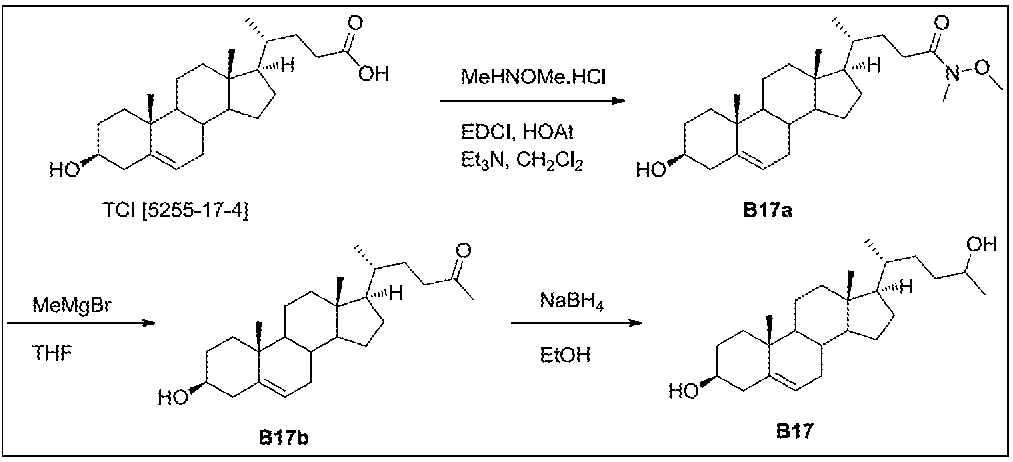
化合物B17aの調製。1-(3-ジメチルアミノプロピル)-3-エチルカルボジイ
ミド塩酸塩(EDCI)(0.282g,1.468mmol)および1-ヒドロキシ-
7-アザベンゾトリアゾール(HOAt)(0.018g,0.133mmol)を、0
℃において、窒素雰囲気下のジクロロメタン(15ml)中の、3β-ヒドロキシコラン
酸(hydroxy cholenic acid)(0.5g,1.335mmol)
、N,O-ジメチルヒドロキシルアミン塩酸塩(0.143g,1.468mmol)お
よびN,N-ジイソプロピルエチルアミン(0.256ml,1.468mmol)の溶
液に加えた。その反応混合物を、週末にわたって室温まで昇温させた。追加の1-(3-
ジメチルアミノプロピル)-3-エチルカルボジイミド塩酸塩(EDCI)(0.282
g,1.468mmol)および1-ヒドロキシ-7-アザベンゾトリアゾール(HOA
t)(0.018g,0.133mmol)を加え、撹拌を2時間続けた。その反応物を
ジクロロメタン(100ml)で希釈し、0.5N硫酸水素カリウム水溶液(75ml)
および炭酸水素ナトリウム飽和水溶液(75ml)で洗浄し、硫酸ナトリウムで乾燥させ
、減圧下で蒸発させた。残渣を、フラッシュカラム(4gシリカ)クロマトグラフィー[
ヘプタン(80=>66):酢酸エチル(20=>33)]によって精製した。生成物を
含む画分を回収し、減圧下で蒸発させた。残渣を、メタノールでストリッピングし、40
℃において一晩乾燥させることにより、B17a(0.495g,1.185mmol,
収率=89%)を白色粉末として得た。1HNMR (400 MHz, CDCl3)
δ(ppm): 5.36-5.35 (1H, m), 3.69 (3H, s)
, 3.58-3.48 (1H, m), 3.18 (3H, s), 2.49-
2.41 (1H, m), 2.37-2.20 (3H, m), 2.03-1.
96 (2H, m), 1.96-1.75 (4H, m), 1.01 (3H,
s), 0.95 (3H, d, J=6.5 Hz), 0.69 (3H, s
)。
Example 22. Preparation of compound B17
Preparation of Compound B17a. 1-(3-Dimethylaminopropyl)-3-ethylcarbodiimide hydrochloride (EDCI) (0.282 g, 1.468 mmol) and 1-hydroxy-
7-Azabenzotriazole (HOAt) (0.018 g, 0.133 mmol) was added to 0
3β-hydroxy cholenic acid (0.5 g, 1.335 mmol) in dichloromethane (15 ml) at 37 °C under nitrogen atmosphere
To a solution of N,O-dimethylhydroxylamine hydrochloride (0.143 g, 1.468 mmol) and N,N-diisopropylethylamine (0.256 ml, 1.468 mmol) was added. The reaction mixture was allowed to warm to room temperature over the weekend. Additional 1-(3-
Dimethylaminopropyl)-3-ethylcarbodiimide hydrochloride (EDCI) (0.282
g, 1.468 mmol) and 1-hydroxy-7-azabenzotriazole (HOA
t) (0.018 g, 0.133 mmol) was added and stirring was continued for 2 h. The reaction was diluted with dichloromethane (100 mL) and diluted with 0.5 N aqueous potassium hydrogen sulfate (75 mL).
The residue was purified by flash column (4 g silica) chromatography [
The mixture was purified with an aqueous elution solvent of [heptane (80=>66):ethyl acetate (20=>33)]. The fractions containing the product were collected and evaporated under reduced pressure. The residue was stripped with methanol and concentrated to 40
C. overnight to give B17a (0.495 g, 1.185 mmol,
Yield = 89%) as a white powder. 1H NMR (400 MHz, CDCl3 )
δ (ppm): 5.36-5.35 (1H, m), 3.69 (3H, s)
, 3.58-3.48 (1H, m), 3.18 (3H, s), 2.49-
2.41 (1H, m), 2.37-2.20 (3H, m), 2.03-1.
96 (2H, m), 1.96-1.75 (4H, m), 1.01 (3H,
s), 0.95 (3H, d, J=6.5 Hz), 0.69 (3H, s
).
化合物B17bの調製。アルゴン雰囲気下において、B17a(0.2g,0.479
mmol)をテトラヒドロフラン(乾燥)(5ml)に溶解し、-75℃に冷却した。ジ
エチルエーテル中のメチルマグネシウムブロミド3.0M(0.798ml,2.394
mmol)を滴下した(発熱性で、温度は-40℃に上昇した)。滴下の後、その反応混
合物を-75℃に低下させた。冷浴を除去し、その反応混合物を20分間にわたって室温
まで昇温させ、5時間撹拌した。TLC[ヘプタン(2):酢酸エチル(1)]は、バニ
リン染色後に、より高い溶出性の生成物への完全な変換を示した。その反応混合物を、塩
化アンモニウム飽和水溶液(75ml)を加えることによってクエンチし、ジクロロメタ
ンで抽出した(2×75ml)。合わせた抽出物を硫酸ナトリウムで乾燥させ、減圧下で
蒸発させた。残渣を、フラッシュカラム(4g)クロマトグラフィー[ヘプタン(80=
>66):酢酸エチル(20=>33)]によって精製した。生成物を含む画分を回収し
、減圧下で蒸発させた。残渣を、メタノールでストリッピングし、40℃において一晩乾
燥させることにより、B17b(0.117g,0.314mmol,収率=66%)を
白色固体として得た。生成物を次の工程でそのまま使用した。1HNMR (400 M
Hz, CDCl3) δ(ppm): 5.36-5.34 (1H, m), 3.
56-3.48 (1H, m), 2.50-2.30 (2H, m) 2.30-
2.19 (2H, m), 2.14 (3H, s), 2.02-1.94 (2
H, m), 1.90-1.81 (3H, m), 1.01 (3H, s),
0.91 (3H, d, J=6.5 Hz), 0.67 (3H, s)。
Preparation of compound B17b. B17a (0.2 g, 0.479 g) was dissolved in argon.
The methylmagnesium bromide 3.0M in diethyl ether (0.798 ml, 2.394 mmol) was dissolved in tetrahydrofuran (dry) (5 ml) and cooled to -75°C.
(mmol) was added dropwise (exothermic, temperature rose to -40°C). After addition, the reaction mixture was cooled to -75°C. The cold bath was removed and the reaction mixture was allowed to warm to room temperature over 20 min and stirred for 5 h. TLC [heptane (2):ethyl acetate (1)] showed complete conversion to the more highly eluting product after vanillin staining. The reaction mixture was quenched by addition of saturated aqueous ammonium chloride (75 ml) and extracted with dichloromethane (2 x 75 ml). The combined extracts were dried over sodium sulfate and evaporated under reduced pressure. The residue was purified by flash column (4 g) chromatography [heptane (80 =
The product was purified by hexanes (20 => 33)]. Fractions containing the product were collected and evaporated under reduced pressure. The residue was stripped with methanol and dried overnight at 40°C to give B17b (0.117 g, 0.314 mmol, yield = 66%) as a white solid. The product was used directly in the next step. 1H NMR (400 M)
Hz, CDCl 3 ) δ (ppm): 5.36-5.34 (1H, m), 3.
56-3.48 (1H, m), 2.50-2.30 (2H, m) 2.30-
2.19 (2H, m), 2.14 (3H, s), 2.02-1.94 (2
H, m), 1.90-1.81 (3H, m), 1.01 (3H, s),
0.91 (3H, d, J=6.5 Hz), 0.67 (3H, s).
化合物B17の調製。化合物B17b(0.117g,0.314mmol)を、窒素
雰囲気下でエタノール(Abs)(5ml)に溶解し、0℃に冷却した。水素化ホウ素ナ
トリウム(0.018g,0.471mmol)を一度に加え(発泡しないように注意す
る)、その反応混合物を室温までゆっくり昇温させた。3時間撹拌した後、TLC[ヘプ
タン(2):酢酸エチル(1)]は、バニリン染色後に、出発物質の完全な消費を示した
。過剰な水素化ホウ素ナトリウムを、塩化アンモニウム飽和水溶液(50ml)を用いて
分解した。その反応混合物をジクロロメタンで抽出した(3×50ml)。抽出物を合わ
せ、硫酸ナトリウムで乾燥させ、減圧下で蒸発させた。残渣を、40℃の真空オーブンに
おいて一晩乾燥させることにより、B17(0.105g,0.280mmol,収率=
89%)を白色固体として得た。1HNMR (400 MHz, CDCl3) δ(
ppm): 5.36-5.34 (1H, m), 3.75 (1H, q, J=
5.8 Hz), 3.53 (1H, sep, J=5.5 Hz), 2.32-
2.20 (2H, m), 2.02-1.95 (2H, m), 1.90-1.
79 (3H, m), 1.19 (3H, dd, J=6.1, 2.1 Hz)
, 1.01 (3H, s), 0.93 (3H, d, J=5.5 Hz),
0.68 (3H, s)。
Preparation of Compound B17. Compound B17b (0.117 g, 0.314 mmol) was dissolved in ethanol (Abs) (5 ml) under nitrogen atmosphere and cooled to 0° C. Sodium borohydride (0.018 g, 0.471 mmol) was added in one portion (careful to avoid foaming) and the reaction mixture was allowed to warm slowly to room temperature. After stirring for 3 hours, TLC [heptane (2): ethyl acetate (1)] showed complete consumption of starting material after vanillin staining. Excess sodium borohydride was destroyed with saturated aqueous ammonium chloride solution (50 ml). The reaction mixture was extracted with dichloromethane (3×50 ml). The extracts were combined, dried over sodium sulfate and evaporated under reduced pressure. The residue was dried overnight in a vacuum oven at 40° C. to give B17 (0.105 g, 0.280 mmol, yield=
89%) as a white solid. 1H NMR (400 MHz, CDCl3) δ(
ppm): 5.36-5.34 (1H, m), 3.75 (1H, q, J=
5.8 Hz), 3.53 (1H, sep, J=5.5 Hz), 2.32-
2.20 (2H, m), 2.02-1.95 (2H, m), 1.90-1.
79 (3H, m), 1.19 (3H, dd, J=6.1, 2.1 Hz)
, 1.01 (3H, s), 0.93 (3H, d, J=5.5 Hz),
0.68 (3H, s).
実施例23.化合物B18の調製
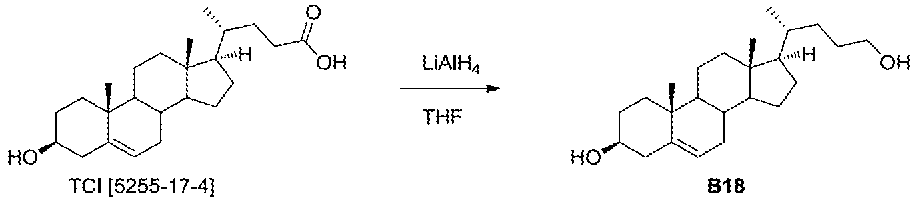
3β-ヒドロキシコラン酸(0.1g,0.267mmol)を、アルゴン雰囲気下で
テトラヒドロフラン(乾燥)(5ml)に懸濁した。THF中2.4Mの水素化アルミニ
ウムリチウム(0.222ml,0.534mmol)を徐々に加えた。いくらかの気体
の放出が観察された。その反応混合物を60℃に加熱し、一晩撹拌した。TLC[ヘプタ
ン(2):酢酸エチル(1)]は、モリブデン染色後に、より高い溶出性の生成物への完
全な変換を示した。酢酸エチル(50ml)および水(50ml)を慎重に加えることに
より、過剰な試薬を無効にした。不溶性物質を濾過し、酢酸エチルで洗浄した(3×5m
l)。洗液を濾液と合わせ、有機相を分離した。水相を酢酸エチル(25ml)でさらに
2回抽出し、合わせた抽出物をブライン(75ml)で洗浄し、硫酸ナトリウムで乾燥さ
せ、減圧下で蒸発させることにより、生成物B18(0.032g,0.089mmol
,収率=33%)を白色粉末として得た。1HNMR (400 MHz, CDCl3
) δ(ppm): 5.36-5.35 (1H, m), 3.65-3.58 (
2H, bs), 3.57-3.48 (1H, m), 2.32-2.20 (2
H, m), 2.03-1.93 (2H, m), 1.89-1.79 (3H,
m), 1.01 (3H, s), 0.94 (3H, d, J=6.5 Hz
), 0.68 (3H, s)。
Example 23. Preparation of compound B18
3β-Hydroxycholanic acid (0.1 g, 0.267 mmol) was suspended in tetrahydrofuran (dry) (5 ml) under an argon atmosphere. Lithium aluminium hydride 2.4 M in THF (0.222 ml, 0.534 mmol) was slowly added. Some gas evolution was observed. The reaction mixture was heated to 60° C. and stirred overnight. TLC [heptane (2): ethyl acetate (1)] showed complete conversion to the more highly eluting product after molybdenum staining. Excess reagent was destroyed by careful addition of ethyl acetate (50 ml) and water (50 ml). The insoluble material was filtered and washed with ethyl acetate (3×5 ml).
l). The washings were combined with the filtrate and the organic phase was separated. The aqueous phase was extracted two more times with ethyl acetate (25 ml) and the combined extracts were washed with brine (75 ml), dried over sodium sulfate and evaporated under reduced pressure to give product B18 (0.032 g, 0.089 mmol).
, yield = 33 % ) as a white powder.
) δ (ppm): 5.36-5.35 (1H, m), 3.65-3.58 (
2H, bs), 3.57-3.48 (1H, m), 2.32-2.20 (2
H, m), 2.03-1.93 (2H, m), 1.89-1.79 (3H,
m), 1.01 (3H, s), 0.94 (3H, d, J=6.5 Hz
), 0.68 (3H, s).
実施例24.C12、C32およびC33の調製

化合物C12の調製。化合物C12e(300mg,0.720mmol)をテトラヒ
ドロフラン(乾燥)(7ml)に溶解し、アルゴン下で4℃に冷却した。次いで、THF
中3Mの塩化メチルマグネシウム(2.400ml,7.20mmol)を、その温度が
7℃を超えないような速度で注射器を介して加えた。4℃において20分間、次いで、r
tにおいて撹拌した。2時間後、TLCは、完全な反応を明らかにした。そのrxを、N
H4Clの飽和撹拌溶液に投下し、EtOAcで抽出した(2×)。すべての生成物が有
機層に溶解することを確実にするために、いくらかのMeOHを加えた。抽出物を乾燥さ
せ(ブライン、Na2SO4)、蒸発させた。残渣を、少量のMeOH(約5ml)中で
撹拌し、白色固体を濾別し、乾燥させた:化合物C12(168mg,0.448mmo
l;62.3%)。1HNMR (400MHz, DMSO-D6): δ(ppm)
: 5.36 (1H, d, 4.6 Hz), 4.61 (1H, d, J=4
.3 Hz), 4.03 (1H, s), 3.26 (1H, m), 2.32
(1H, m), 1.03 (6H, s), 0.87 (3H, d, J=6
.6 Hz), 0.65 (3H, s)。
Example 24. Preparation of C12, C32 and C33
Preparation of compound C12. Compound C12e (300 mg, 0.720 mmol) was dissolved in tetrahydrofuran (dry) (7 ml) and cooled to 4° C. under argon. Then, THF
Methylmagnesium chloride (2.400 ml, 7.20 mmol) in 3M aqueous solution was added via syringe at such a rate that the temperature did not exceed 7° C. After 20 min at 4° C.,
After 2 h, TLC revealed a complete reaction.
It was dropped into a stirred saturated solution of H 4 Cl and extracted with EtOAc (2×). Some MeOH was added to ensure all the product was dissolved in the organic layer. The extracts were dried (brine, Na 2 SO 4 ) and evaporated. The residue was stirred in a small amount of MeOH (approximately 5 ml) and the white solid was filtered off and dried: Compound C12 (168 mg, 0.448 mmol).
l; 62.3%). 1 HNMR (400MHz, DMSO-D 6 ): δ (ppm)
: 5.36 (1H, d, 4.6 Hz), 4.61 (1H, d, J=4
.. 3 Hz), 4.03 (1H, s), 3.26 (1H, m), 2.32
(1H, m), 1.03 (6H, s), 0.87 (3H, d, J=6
.. 6 Hz), 0.65 (3H, s).
化合物C32aの調製。化合物C12e(74mg,0.178mmol)をエタノー
ル(Abs)(10ml)に溶解し、パラジウム,10%木炭担持(18.90mg,0
.018mmol)を加えた。そのrxに窒素、連続して水素を流した。それをrtにお
いて激しく撹拌した。2時間後のLCMSは、完全な変換を示唆したのに対して、TLC
は、いかなる変化も示さなかった。そのrxに再度、窒素を流し、Pd/Cをフリットチ
ューブ(fritted tube)(3フリット)で濾別した。Pd/Cはなおも濾液
中に存在した。EtOHを蒸発させ、残渣をDCMに溶解し、小さな綿栓で濾過した。こ
れにより、透明の溶液が得られた。DCMを蒸発させることにより、化合物C32aを得
た(68mg,0.162mmol;91%収率)。さらに精製することなく、そのまま
使用した。1HNMR (400MHz, CDCl3): δ(ppm): 4.68
(1H, m), 3.66 (3H, s), 2.02 (3H, s), 0.
91 (3H, d, J=6.6 Hz), 0.66 (3H, s)。
Preparation of Compound C32a. Compound C12e (74 mg, 0.178 mmol) was dissolved in ethanol (Abs) (10 ml) and palladium, 10% on charcoal (18.90 mg, 0
0.018 mmol) was added. The rx was flushed with nitrogen followed by hydrogen. It was stirred vigorously at rt. LCMS after 2 h indicated complete conversion, whereas TLC
did not show any change. The rx was flushed with nitrogen again and the Pd/C was filtered off with a fritted tube (3 frits). Pd/C was still present in the filtrate. EtOH was evaporated and the residue was dissolved in DCM and filtered through a small cotton plug. This gave a clear solution. Evaporation of DCM gave compound C32a (68 mg, 0.162 mmol; 91% yield). Used as is without further purification. 1 HNMR (400 MHz, CDCl 3 ): δ (ppm): 4.68
(1H, m), 3.66 (3H, s), 2.02 (3H, s), 0.
91 (3H, d, J=6.6 Hz), 0.66 (3H, s).
化合物C32の調製。化合物C32a(68mg,0.162mmol)をテトラヒド
ロフラン(乾燥)(1.5ml)に溶解し、アルゴン下で0℃に冷却した。次いで、塩化
メチルマグネシウム(0.541mL,1.624mmol)を加えた。激しい気体の放
出が見られる。0℃において撹拌し、3分後、rtにおいて撹拌した。2時間後、少しの
塩化メチルマグネシウム(0.1mL,0.300mmol)をさらに加えた。rtで一
晩撹拌した。翌日、そのrxを50mlのNH4Cl飽和水溶液に注ぎ込み、EtOAc
で3回抽出した。EtOAcを乾燥させ(ブライン、硫酸塩)、蒸発させた。残渣を、カ
ラムクロマトグラフィーによって精製した:粗混合物を、溶解を助ける数滴のMeOHと
ともにDCMに溶解し、充填済みフラッシュシリカカラムに適用した。それを、5分間の
100%ヘプタン;20分間の0=>20%EtOAc/ヘプタンおよび20分間の20
%EtOAc/ヘプタン均一濃度を用いて、30ml/分の30秒の画分で溶出した。生
成物の画分を合わせ、溶媒を蒸発させ、白色固体残渣をEt2O中でトリチュレートし、
濾別し、乾燥させることにより、化合物C32を得た(25mg,0.063mg;38
.8%収率)。1HNMR (400MHz, CDCl3): δ(ppm): 3.
58 (1H, m), 1.19 (6H, s), 0.91 (3H, d, J
=6.6 Hz), 0.66 (3H, s)。
Preparation of compound C32. Compound C32a (68 mg, 0.162 mmol) was dissolved in tetrahydrofuran (dry) (1.5 ml) and cooled to 0° C. under argon. Methylmagnesium chloride (0.541 mL, 1.624 mmol) was then added. Vigorous gas evolution was observed. Stirred at 0° C. and after 3 min at rt. After 2 h, a small amount of methylmagnesium chloride (0.1 mL, 0.300 mmol) was added. Stirred at rt overnight. The next day, the rx was poured into 50 ml of saturated aqueous NH4Cl and washed with EtOAc.
Extracted three times with 100% heptane for 5 min; 0=>20% EtOAc/heptane for 20 min and 20% 100% 15% 20% 25% 10% 20% 15% 25% 10% 25% 15% 20% 15 ...
The product fractions were combined, the solvent evaporated and the white solid residue was triturated in EtO.
After filtering and drying, compound C32 was obtained (25 mg, 0.063 mg;
.8% yield). 1H NMR (400 MHz, CDCl3 ): δ(ppm): 3.
58 (1H, m), 1.19 (6H, s), 0.91 (3H, d, J
=6.6 Hz), 0.66 (3H, s).
化合物C33aの調製。化合物C12(110mg,0.294mmol)をトルエン
(乾燥)(7ml)に懸濁し、1-メチル-4-ピペリドン(1.666mg,0.01
5mmol)およびアルミニウムイソプロポキシド(93mg,1.028mmol)を
加えた。還流温度において4時間撹拌した。TLC:まだs.m.が存在している。さら
にアルミニウムイソプロポキシド(100mg,0.884mmol)を加えた。還流を
続けた。2時間後、さらにアルミニウムイソプロポキシド(100mg,0.884mm
ol)を加えた。還流を3時間続けた。次いで、最後の量のアルミニウムイソプロポキシ
ド(100mg,0.884mmol)を加えた。さらに2時間還流した。次いで、その
rxをrtまで冷却させ、EtOAcで希釈し、1N HClで抽出することにより、そ
れら3つを除去した。黄色の水層をEtOAcで2回抽出した。合わせたEtOAc画分
を1N HClで洗浄し(3×)、乾燥させ(ブライン、硫酸塩)、蒸発させた。残渣を
、DIPEでストリッピングすることにより、白色粉末が残った。この粗混合物を、少し
のMeOHを含むCHCl3において適用され、30ml/分で勾配をかけて行われる、
40g充填済みフラッシュカラム(GraceResolve(商標))において精製し
た:2分間の100%ヘプタン;38分間の0=>20%ヘプタン/EtOAc;10分
間の20%ヘプタン/EtOAc;フラクションサイズ30秒。このようにして、生成物
C33a(84mg,0.225mmol;77%)を得た。1HNMR (400MH
z, CDCl3): □(ppm): 5.82 (1H, s), 1.20 (6
H, s), 0.93 (3H, d, J=6.5 Hz), 0.73 (3H,
s)。
Preparation of compound C33a. Compound C12 (110 mg, 0.294 mmol) was suspended in toluene (dry) (7 ml) and 1-methyl-4-piperidone (1.666 mg, 0.01
5 mmol) and aluminum isopropoxide (93 mg, 1.028 mmol). Stirred at reflux for 4 h. TLC: still s.m. present. More aluminum isopropoxide (100 mg, 0.884 mmol) was added. Reflux was continued. After 2 h, more aluminum isopropoxide (100 mg, 0.884 mmol) was added.
100 mg (0.884 mmol) was added. Refluxing was continued for 3 h. A final amount of aluminum isopropoxide (100 mg, 0.884 mmol) was then added. Refluxing was continued for another 2 h. The rx was then cooled to rt, diluted with EtOAc, and the three were removed by extraction with 1N HCl. The yellow aqueous layer was extracted twice with EtOAc. The combined EtOAc fractions were washed with 1N HCl (3x), dried (brine, sulfate), and evaporated. The residue was stripped with DIPE to leave a white powder. This crude mixture was applied in CHCl3 with some MeOH, run as a gradient at 30 ml/min,
Purification was performed on a 40 g pre-packed flash column (GraceResolve™): 100% heptane for 2 min; 0=>20% heptane/EtOAc for 38 min; 20% heptane/EtOAc for 10 min; fraction size 30 sec. Thus, the product C33a (84 mg, 0.225 mmol; 77%) was obtained. 1 H NMR (400 MH
z, CDCl 3 ): □ (ppm): 5.82 (1H, s), 1.20 (6
H, s), 0.93 (3H, d, J=6.5 Hz), 0.73 (3H,
s).
化合物C33bの調製。化合物C33a(84mg,0.225mmol)をエタノー
ル(25ml)に溶解し、窒素を流した。次いで、炭酸カルシウム担持パラジウム(Pd
として約10%;23.99mg,0.023mmol,10%)を加え、そのrxに再
度、窒素を流した。次いで、そのrxに水素を流し、水素下で激しく撹拌した。3時間後
、TLCは、反応の完了を示唆した。それに再度、窒素を流し、触媒をhyfloで濾別
し、EtOHを蒸発させた。その混合物を、ヘプタン/EtOAc 9/1の均一濃度で
行われる、12g充填済みフラッシュカラム(GraceResolve(商標))にお
いて精製した;サンプルをDCM中で適用した;15ml/分、1分のフラクションサイ
ズ;このようにして、生成物C33b(40mg,0.107mmol;47.4%)を
得た。1HNMR (400MHz, CDCl3): δ(ppm): 2.60 (
1H, t, J=14.4 Hz), 1.20 (6H, s), 0.93 (3
H, d, J=6.5 Hz), 0.70 (3H, s)。
Preparation of Compound C33b. Compound C33a (84 mg, 0.225 mmol) was dissolved in ethanol (25 ml) and flushed with nitrogen. Then, palladium on calcium carbonate (Pd
10% as ethyl acetate; 23.99 mg, 0.023 mmol, 10%) was added and the rx was flushed again with nitrogen. The rx was then flushed with hydrogen and stirred vigorously under hydrogen. After 3 hours, TLC indicated the reaction was complete. It was flushed again with nitrogen, the catalyst was filtered off with hyflo and the EtOH was evaporated. The mixture was purified on a 12 g packed flash column (GraceResolve™) run isocratically with heptane/EtOAc 9/1; the sample was applied in DCM; 15 ml/min, 1 min fraction size; thus obtaining the product C33b (40 mg, 0.107 mmol; 47.4%). 1 HNMR (400 MHz, CDCl 3 ): δ(ppm): 2.60 (
1H, t, J=14.4 Hz), 1.20 (6H, s), 0.93 (3
H, d, J=6.5 Hz), 0.70 (3H, s).
化合物C33の調製。化合物C33b(5mg,0.013mmol)をテトラヒドロ
フラン(乾燥)(1ml)に溶解し、-78℃に冷却した。次いで、K-セレクトリド(
0.020mmol,0.020ml)を加え、その反応混合物を窒素下で6時間撹拌し
た。10%NaOH溶液(0.1mL)を加えた後、30%過酸化水素溶液(0.2mL
)を加えることによって、その反応を停止した。その反応混合物を室温まで温め、撹拌を
30分間続けた。その混合物を酢酸エチルで抽出し、合わせた有機層をブラインで洗浄し
、Na2SO4で乾燥させ、濾過し、蒸発させた。その粗生成物を、2:1ヘプタン/E
tOAcを使用するフラッシュカラムクロマトグラフィーによって精製した。このように
して、化合物C33(2.2mg,0.00502mmol;37.6%)を得た。LC
MS:83%純粋、17%の3α-OH異性体を含む。1HNMR (400MHz,
CDCl3): δ(ppm): 4.12 (1H, t, J=2.7 Hz),
1.20 (6H, s), 0.92 (3H, d, J=6.6 Hz), 0.
67 (3H, s)。
Preparation of compound C33. Compound C33b (5 mg, 0.013 mmol) was dissolved in tetrahydrofuran (dry) (1 ml) and cooled to -78°C. Then, K-selectride (
0.020 mmol, 0.020 ml) was added and the reaction mixture was stirred under nitrogen for 6 hours. 10% NaOH solution (0.1 mL) was added followed by 30% hydrogen peroxide solution (0.2 mL).
The reaction was quenched by the addition of 2:1 heptane/Et. The reaction mixture was allowed to warm to room temperature and stirring was continued for 30 min. The mixture was extracted with ethyl acetate and the combined organic layers were washed with brine, dried over Na2SO4, filtered and evaporated. The crude product was purified by 2:1 heptane/Et.
Purification was performed by flash column chromatography using tOAc. Thus, compound C33 (2.2 mg, 0.00502 mmol; 37.6%) was obtained. LC
MS: 83% pure, containing 17% 3α-OH isomer. 1 H NMR (400 MHz,
CDCl3 ): δ (ppm): 4.12 (1H, t, J=2.7 Hz),
1.20 (6H, s), 0.92 (3H, d, J=6.6 Hz), 0.
67 (3H,s).
実施例25.D15の調製

化合物C33b(40mg,0.107mmol)を、アルゴン下でテトラヒドロフラ
ン(乾燥)(1ml)に溶解し、-78℃に冷却した。次いで、1.6Mメチルリチウム
(0.320mmol,0.200ml)を加えた。-78℃において撹拌した。2時間
後のTLC:なおも多くのs.m.が存在する。そのrxをゆっくりr.t.に到達させ
た。1時間後のTLC:なおも多くのs.m.が存在し、粘稠な沈殿物が存在する。溶解
を助けるために、さらにテトラヒドロフラン(乾燥)(1mL)を加えた。30分後;r
xは、ほぼ完全に溶解した。撹拌を1時間続けた。TLC:s.m.がなおも存在するが
90+%変換。そのrxを30分以上撹拌し、次いで、クエンチした。NH4Cl飽和水
溶液を加え、生成物をDCMで抽出した(3×)。32mgの収量(粗)。水層をNaC
lで飽和させ、今回はEtOAcで再度抽出した(3×)。この時点で、36mgの粗生
成物。その混合物を、15ml/分で勾配をかけて行われる12g充填済みフラッシュカ
ラム(GraceResolve(商標))において精製した:2分間の100%ヘプタ
ン;28分間の0=>15%ヘプタン/EtOAc;20分間の15%ヘプタン/EtO
Ac;フラクションサイズ60秒。このようにして、生成物D15(11mg,0.02
7mmol;25.05%)を得た。1HNMR (400MHz, CDCl3):
δ(ppm): 1.21 (3H, s), 1.20 (6H, s), 0.92
(3H, d, J=6.5 Hz), 0.67 (3H, s)。
Example 25. Preparation of D15
Compound C33b (40 mg, 0.107 mmol) was dissolved in tetrahydrofuran (dry) (1 ml) under argon and cooled to -78°C. Then 1.6 M methyllithium (0.320 mmol, 0.200 ml) was added. Stirred at -78°C. TLC after 2 hours: still lots of s.m. present. The rx was allowed to slowly reach r.t. TLC after 1 hour: still lots of s.m. present and a sticky precipitate. More tetrahydrofuran (dry) (1 mL) was added to aid dissolution. After 30 minutes;
x was almost completely dissolved. Stirring was continued for 1 h. TLC: 90+% conversion, although s.m. was still present. The rx was stirred for 30 min more and then quenched. Saturated aqueous NH4Cl was added and the product was extracted with DCM (3x). Yield 32 mg (crude). The aqueous layer was washed with NaCl.
The mixture was saturated with 100% heptane and extracted again (3x), this time with EtOAc. At this point, 36 mg of crude product. The mixture was purified on a 12 g packed flash column (GraceResolve™) running a gradient at 15 ml/min: 100% heptane for 2 min; 0=>15% heptane/EtOAc for 28 min; 15% heptane/EtO for 20 min.
Ac; fraction size 60 seconds. Thus, product D15 (11 mg, 0.02
7 mmol; 25.05%) was obtained. 1 H NMR (400 MHz, CDCl 3 ):
δ (ppm): 1.21 (3H, s), 1.20 (6H, s), 0.92
(3H, d, J=6.5 Hz), 0.67 (3H, s).
実施例26.D10およびD16の調製

3-アルファ-D16化合物の調製。化合物D10a(68mg,0.182mmol
)をアルゴン下でテトラヒドロフラン(乾燥)(2ml)に溶解し、0℃に冷却した。次
いで、塩化メチルマグネシウム(0.605ml,1.815mmol)を加えた。10
分後、そのrxをrtにおいて3時間撹拌した。次いで、そのrxを100mLのNH4
Cl飽和水溶液に加え、rxの容器をTHFおよびDCMですすぎ、DCMとともに0.
5時間撹拌した。生成物をDCMでさらに2回抽出した。DCMを乾燥させ(ブライン、
硫酸塩)、蒸発させ、30ml/分のフラクション30秒で行われるシリカカラムにおい
て精製した。勾配(Grandient):5分間の100%ヘプタン;25分間の10
0/0H/EtOAc=>80/20ヘプタン/EtOAc;20分間の80/20ヘプ
タン/EtOAc。このようにして、化合物D16(3α-OH)(21mg,0.05
4mmol;29.6%)を得た。1HNMR (400MHz, CDCl3): δ
(ppm): 1.19 (9H, s), 0.91 (3H, d, J=6.6
Hz), 0.66 (3H, s)。
Example 26. Preparation of D10 and D16
Preparation of 3-alpha-D16 compound. Compound D10a (68 mg, 0.182 mmol)
) was dissolved in tetrahydrofuran (dry) (2 ml) under argon and cooled to 0° C. Then, methylmagnesium chloride (0.605 ml, 1.815 mmol) was added.
After 3 min, the rx was stirred at rt for 3 h. The rx was then added with 100 mL of NH
Cl saturated aqueous solution, rinse rx vessel with THF and DCM, add 0.
Stirred for 5 h. The product was extracted with DCM two more times. The DCM was dried (brine,
Sulfate), evaporated and purified on a silica column run at 30 ml/min fractions for 30 seconds. Gradient: 100% heptane for 5 min; 100% heptane for 25 min;
0/0H/EtOAc => 80/20 heptane/EtOAc; 80/20 heptane/EtOAc for 20 min. Thus, compound D16 (3α-OH) (21 mg, 0.05
4 mmol; 29.6%) was obtained. 1 H NMR (400 MHz, CDCl 3 ): δ
(ppm): 1.19 (9H, s), 0.91 (3H, d, J=6.6
Hz), 0.66 (3H, s).
3-ベータ-D16化合物の調製。化合物D10a(57mg,0.152mmol)
をアルゴン下でトルエン(乾燥)(1ml)に溶解し、-78℃に冷却した。次いで、ト
ルエン中0.4M溶液のMAD(1.141ml,0.456mmol)を加えた。-7
8℃において10分間撹拌した後、ジエチルエーテル中1.6M溶液のメチルリチウム(
0.285ml,0.456mmol)を加えた。アルゴン下、-78℃において2時間
撹拌した。その温度において2時間後、その反応物を撹拌させ、rtまで温めた。さらに
2時間後、それを飽和NH4Clに加えることによってクエンチした。rxの容器をEt
OAcですすいだ。生成物をEtOAcで抽出した(2×)。EtOAcを乾燥させ(ブ
ライン、Na2SO4)、蒸発させた。その混合物を、DCM中で適用され、30ml/
分で勾配をかけて行われる12g充填済みフラッシュカラム(GraceResolve
(商標))において精製した:5分間の100%ヘプタン;25分間の0=>15%ヘプ
タン/EtOAc;20分間の15%ヘプタン/EtOAc;フラクションサイズ30秒
。このようにして、生成物D16(3β-OH)(35mg,0.090mmol;58
.8%)を得た。1HNMR (400MHz, CDCl3): δ(ppm): 1
.23 (3H, s), 1.20 (6H, s), 0.91 (3H, d,
J=6.6 Hz), 0.66 (3H, s)。
Preparation of 3-beta-D16 compound. Compound D10a (57 mg, 0.152 mmol)
was dissolved in toluene (dry) (1 ml) under argon and cooled to -78°C. A 0.4 M solution of MAD in toluene (1.141 ml, 0.456 mmol) was then added.
After stirring for 10 min at 8° C., a 1.6 M solution of methyllithium (
0.285 ml, 0.456 mmol) was added. Stirred under argon at -78°C for 2 h. After 2 h at that temperature, the reaction was allowed to stir and warm to rt. After an additional 2 h, it was quenched by adding saturated NH4Cl. The rx vessel was poured into Et
The mixture was washed with 30 ml/L of DCM and rinsed with 10 ml of EtOAc. The product was extracted with EtOAc (2x). The EtOAc was dried (brine, Na2SO4) and evaporated. ... of EtOAc.
A 12 g packed flash column (GraceResolve) was used with a gradient of 1 min.
(trademark): 100% heptane for 5 min; 0=>15% heptane/EtOAc for 25 min; 15% heptane/EtOAc for 20 min; fraction size 30 sec. Thus, product D16 (3β-OH) (35 mg, 0.090 mmol; 58
.8%) was obtained. 1H NMR (400 MHz, CDCl3 ): δ(ppm): 1
.. 23 (3H, s), 1.20 (6H, s), 0.91 (3H, d,
J=6.6 Hz), 0.66 (3H, s).
化合物D10aの調製。化合物C32(222mg,0.589mmol)を、わずか
に加熱することによってクロロホルム(乾燥)(15ml)に溶解した。次いで、その溶
液を水浴において冷却し(冷却時に結晶化しなかった)、PCC(191mg,0.88
4mmol)を加えた。なおも水浴内で撹拌した。1時間後のTLC:約60~70%変
換。一晩撹拌した。次いで、その溶液を分液漏斗に移し、沈着物をDCMで広範囲に洗浄
し、その分液漏斗に加えた。0.5N KHSO4で洗浄した。水相をDCMで洗浄し、
有機相を合わせ、Na2SO4で乾燥させ(ブラインなし)、蒸発させた。その混合物を
、30ml/分で勾配をかけて行われる12g充填済みフラッシュカラム(GraceR
esolve(商標))において精製した:5分間の100%H;25分間の0=>15
%H/EA;20分間の15%H/EA;フラクションサイズ30秒、100本のチュー
ブ。このようにして、化合物(Coumpound)D10a(132mg,0.352
mmol;59.8%)を得た。1HNMR (400MHz, CDCl3): δ(
ppm): 1.20 (6H, s), 0.92 (3H, d, J=6.6 H
z), 0.69 (3H, s)。
Preparation of Compound D10a. Compound C32 (222 mg, 0.589 mmol) was dissolved in chloroform (dry) (15 ml) by slight heating. The solution was then cooled in a water bath (did not crystallize upon cooling) and PCC (191 mg, 0.88 mmol) was added.
4 mmol) was added. Still stirring in the water bath. TLC after 1 h: approx. 60-70% conversion. Stirred overnight. The solution was then transferred to a separatory funnel and the precipitate was washed extensively with DCM and added to the separatory funnel. Washed with 0.5 N KHSO 4. The aqueous phase was washed with DCM and
The organic phases were combined, dried over Na2SO4 (no brine) and evaporated. The mixture was passed through a 12 g packed flash column (GraceR ) running a gradient at 30 ml/min.
eluve™): 100% H for 5 min; 0=>15 for 25 min
% H/EA; 15% H/EA for 20 min; fraction size 30 sec, 100 tubes. Compound D10a (132 mg, 0.352
1H NMR (400 MHz, CDCl3 ): δ(
ppm): 1.20 (6H, s), 0.92 (3H, d, J=6.6H
z), 0.69 (3H, s).
化合物D10の調製。化合物D10a(73mg,0.195mmol)をアルゴン下
でテトラヒドロフラン(乾燥)(2ml)に溶解し、トリフルオロメチルトリメチルシラ
ン(0.086ml,0.585mmol)およびフッ化セシウム(2.96mg,0.
019mmol)を加えた。rtにおいて撹拌した。その溶液は、ゆっくりとわずかに黄
色になった。3時間後のTLC:完全な変換。そのrxをDCMで希釈し、水で抽出した
。相分離しなかった。ブライン(等体積)を加えた。うまく分離した。水層を再度DCM
で抽出し;DCMを合わせ、乾燥させ(Na2SO4)、蒸発させた。103mgの粗生
成物(102%)。ヘプタン中の0=>2.5%DIPEの勾配をかけて30分間行われ
る12g充填済みカラムにおけるフラッシュカラム。このようにして、不純TMS-中間
体を、3α-および3β-OH生成物の不純混合物として得て、そのまま使用した:その
中間体を1,4-ジオキサン(4ml)に溶解し、1N HCl(1mL,1.000m
mol)を加える。rtにおいて撹拌した。1時間後のTLC:s.m.が無くなった。
水を加え、生成物をDCMで3回抽出し、Na2SO4で乾燥させ、蒸発させた。その粗
生成物を、12分間のMeCN/水95/5=>0/100の勾配をかけて、次いで、1
2分間の100%水という均一濃度で行われるC18-カラムにおいて精製した。このよ
うにして、化合物D10(14mg,0.030mmol;22.9%)を得た。1HN
MR (400MHz, CDCl3): δ(ppm): 1.19 (6H, s)
, 0.91 (3H, d, J=6.6 Hz), 0.67 (3H, s)。
Preparation of Compound D10. Compound D10a (73 mg, 0.195 mmol) was dissolved in tetrahydrofuran (dry) (2 ml) under argon, and trifluoromethyltrimethylsilane (0.086 ml, 0.585 mmol) and cesium fluoride (2.96 mg, 0.
0.019 mmol) was added. Stirred at rt. The solution slowly turned slightly yellow. TLC after 3 h: complete conversion. The rx was diluted with DCM and extracted with water. No phase separation. Brine (equal volume) was added. Separation was successful. The aqueous layer was washed again with DCM.
Extracted with ; DCM was combined, dried (Na2SO4) and evaporated. 103 mg crude product (102%). Flash column on a 12 g packed column with a gradient of 0 => 2.5% DIPE in heptane run over 30 min. The impure TMS-intermediate was thus obtained as an impure mixture of 3α- and 3β-OH products and used as such: the intermediate was dissolved in 1,4-dioxane (4 ml) and diluted with 1N HCl (1 mL, 1.000 ml).
mol) was added. Stirred at rt. TLC after 1 h: s.m. was gone.
Water was added and the product was extracted three times with DCM, dried over Na2SO4 and evaporated. The crude product was run on a gradient of MeCN/water 95/5 => 0/100 over 12 min, then
The product was purified on a C18-column run in 100% water isocratic for 2 min. Thus, compound D10 (14 mg, 0.030 mmol; 22.9%) was obtained.
MR (400MHz, CDCl3 ): δ (ppm): 1.19 (6H, s)
, 0.91 (3H, d, J=6.6 Hz), 0.67 (3H, s).
実施例27.化合物D1の調製

火炎乾燥したチューブにおいて、THF(乾燥,1mL)中の、化合物D13a(97
mg,0.250mmol)およびトリフルオロメチルトリメチルシラン(0.119m
l,0.749mmol)の無色透明の溶液をアルゴン下で0℃に冷却した。フッ化セシ
ウム(20mg,0.132mmol)を加えた。反応混合物は、無色のままであり、そ
れを0℃において5分間撹拌した。冷却浴を除去し、撹拌をRTにおいて1.5時間続け
た。反応混合物は、茶色-黄色になった。TLC(ヘプタン/EtOAc,1:1)完全
な変換。反応混合物をRTにおいて一晩静置させた。H2O(1mL)およびEtOAc
(5mL)を加えた。層を分離し、水層をEtOAcで抽出した(2×5mL)。合わせ
た有機層をNa2SO4で乾燥させ、溶媒を真空中で除去した。フラッシュクロマトグラ
フィー(ヘプタン,5%~20%EtOAc)は、不純3-OTMS中間体をもたらす。
これをそのまま使用した:HCl水溶液(1N,1mL)を、THF(1mL)中の3-
OTMS中間体の溶液に加えた。反応混合物をRTにおいて一晩撹拌した。TLC(H/
E;1:1)完全な変換。溶媒を真空中で除去した。黄色固体が得られた。フラッシュク
ロマトグラフィー(ヘプタン;15%~35%EtOAc)による精製から、化合物D1
が得られた(36mg,0.078mmol;31.4%)。1H-NMR (400
MHz, CDCl3): □(ppm): 1.20 (6H, s), 0.96
(3H, s), 0.89 (3H, d, J=10.6 Hz), 0.65 (
3H, s)。
Example 27. Preparation of compound D1
In a flame-dried tube, compound D13a (97
mg, 0.250 mmol) and trifluoromethyltrimethylsilane (0.119 m
A clear, colorless solution of 1,3-dichloromethane (1:1, 0.749 mmol) was cooled to 0° C. under argon. Cesium fluoride (20 mg, 0.132 mmol) was added. The reaction mixture remained colorless and was stirred at 0° C. for 5 min. The cooling bath was removed and stirring was continued at RT for 1.5 h. The reaction mixture became brown-yellow. TLC (heptane/EtOAc, 1:1) complete conversion. The reaction mixture was allowed to stand at RT overnight. H2O (1 mL) and EtOAc were added to obtain a solution of 1,3-dichloromethane (1:1, 0.749 mmol). Cesium fluoride (20 mg, 0.132 mmol) was added. The reaction mixture remained colorless and was stirred at 0° C. for 5 min. The cooling bath was removed and stirring was continued at RT for 1.5 h. The reaction mixture became brown-yellow. TLC (heptane/EtOAc, 1:1) complete conversion. The reaction mixture was allowed to stand at RT overnight.
(5 mL) was added. The layers were separated and the aqueous layer was extracted with EtOAc (2×5 mL). The combined organic layers were dried over Na2SO4 and the solvent was removed in vacuo. Flash chromatography (heptane, 5% to 20% EtOAc) afforded the impure 3-OTMS intermediate.
This was used as is: aqueous HCl (1N, 1 mL) was dissolved in 3-
The solution of OTMS intermediate was added. The reaction mixture was stirred at RT overnight. TLC (H/
E; 1:1) Complete conversion. The solvent was removed in vacuo. A yellow solid was obtained. Purification by flash chromatography (heptane; 15% to 35% EtOAc) gave compound D1.
The compound was obtained (36 mg, 0.078 mmol; 31.4% ) .
MHz, CDCl3 ): □ (ppm): 1.20 (6H, s), 0.96
(3H, s), 0.89 (3H, d, J=10.6 Hz), 0.65 (
3H, s).
実施例28.D2a~D2化合物の調製

化合物D2aの調製。アルゴン雰囲気下において、化合物BB-1a(1g,2.57
mmol)をメタノール(25ml)に溶解し、およびパラジウム,10%活性炭担持(
0.137g,0.129mmol)を加えた。アルゴン雰囲気を水素(バルーン)によ
って置き換え、その反応混合物を室温において一晩激しく撹拌した。その反応混合物をh
yfloで濾過し、濾過残渣をメタノール(50ml)およびジクロロメタン(2×50
ml)で洗浄した。濾液および洗液を合わせ、減圧下で蒸発させることにより、生成物D
2a(1.01g,2.57mmol,収率=100%)を白色粉末として得た。1HN
MR (400 MHz, CDCl3) δ(ppm): 3.66 (3H, s)
, 3.59 (1H, oct, J=5.1 Hz), 2.35 (1H, dd
d, J=15.4, 10.3, 5.1 Hz), 2.21 (1H, ddd,
J=15.8, 9.5, 6.3 Hz), 1.94 (1H, dt, J=1
2.4, 3.3 Hz), 0.91 (3H, d, J=6.4 Hz), 0.
65 (3H, s), 0.62 (1H, ddd, J=14.8, 8.1,
4.1 Hz)。
Example 28. Preparation of D2a to D2 compounds
Preparation of Compound D2a. Compound BB-1a (1 g, 2.57
(mmol) was dissolved in methanol (25 ml) and palladium, 10% on activated carbon (
The argon atmosphere was replaced by hydrogen (balloon) and the reaction mixture was stirred vigorously at room temperature overnight.
The filter residue was diluted with methanol (50 ml) and dichloromethane (2×50
The filtrate and washings were combined and evaporated under reduced pressure to give product D
2a (1.01 g, 2.57 mmol, yield = 100%) was obtained as a white powder.
MR (400 MHz, CDCl 3 ) δ (ppm): 3.66 (3H, s)
, 3.59 (1H, oct, J=5.1 Hz), 2.35 (1H, dd
d, J=15.4, 10.3, 5.1 Hz), 2.21 (1H, ddd,
J=15.8, 9.5, 6.3 Hz), 1.94 (1H, dt, J=1
2.4, 3.3 Hz), 0.91 (3H, d, J=6.4 Hz), 0.
65 (3H, s), 0.62 (1H, ddd, J=14.8, 8.1,
4.1 Hz).
化合物D2bの調製。ジクロロメタン(10ml)(モレキュラーシーブで乾燥させた
もの)中のクロロクロム酸ピリジニウム(PCC)(0.969g,4.49mmol)
の懸濁液を、窒素雰囲気下で0℃に冷却した。ジクロロメタン(5ml)(モレキュラー
シーブで乾燥させたもの)中のD2a(0.585g,1.498mmol)の溶液を徐
々に加えた。1時間撹拌した後、橙色から暗褐色への色の変化が観察された。氷浴を除去
し、撹拌を3.5時間続けた。TLC[ヘプタン(2):酢酸エチル(1)]は、バニリ
ン染色後に、より高い溶出性の生成物への明瞭な完全な変換を示した。その反応混合物を
、ヘプタン/酢酸エチルの2:1混合物(15ml)で希釈し、ショートシリカパッド(
30g)で溶出し、そのパッドをヘプタン/酢酸エチル/ジクロロメタン2:1:1(6
0ml)で2回すすいだ。その溶出液を0.5N硫酸水素カリウム水溶液(90ml)で
洗浄した。その洗液をジクロロメタン(90ml)で逆抽出し、この抽出物を先の有機層
と合わせ、硫酸ナトリウムで乾燥させ、濾過し、減圧下で蒸発させた。残渣を、ジクロロ
メタンで2回ストリッピングすることにより、D2b(0.555g,1.428mmo
l,収率=95%)を白色固体として得た。1HNMR (400 MHz, CDCl
3) δ(ppm): 3.66 (3H, s), 2.04-1.94 (2H,
m), 1.91-1.74 (2H, m), 1.73-1.66 (1H, m)
, 1.01 (3H, s), 0.92 (3H, d, J=6.4 Hz),
0.64 (3H, s)。
Preparation of compound D2b: Pyridinium chlorochromate (PCC) (0.969 g, 4.49 mmol) in dichloromethane (10 ml) (dried over molecular sieves)
A suspension of was cooled to 0° C. under nitrogen atmosphere. A solution of D2a (0.585 g, 1.498 mmol) in dichloromethane (5 ml) (dried over molecular sieves) was slowly added. After stirring for 1 h, a color change from orange to dark brown was observed. The ice bath was removed and stirring was continued for 3.5 h. TLC [heptane (2):ethyl acetate (1)] showed clean complete conversion to the more highly eluting product after vanillin staining. The reaction mixture was diluted with a 2:1 mixture of heptane/ethyl acetate (15 ml) and purified by filtration using a short silica pad (
30 g) and the pad was purified with heptane/ethyl acetate/dichloromethane 2:1:1 (6
The eluate was washed with 0.5N aqueous potassium hydrogen sulfate (90 mL). The washes were back-extracted with dichloromethane (90 mL) and this extract was combined with the previous organic layer, dried over sodium sulfate, filtered, and evaporated under reduced pressure. The residue was stripped twice with dichloromethane to give D2b (0.555 g, 1.428 mmol).
1, yield = 95%) as a white solid. 1H NMR (400 MHz, CDCl
3 ) δ (ppm): 3.66 (3H, s), 2.04-1.94 (2H,
m), 1.91-1.74 (2H, m), 1.73-1.66 (1H, m)
, 1.01 (3H, s), 0.92 (3H, d, J=6.4 Hz),
0.64 (3H, s).
化合物D2cの調製。アルゴン雰囲気下において、ジブロモメタン(1.268ml,
18.01mmol)をテトラヒドロフラン(乾燥)(30ml)中の亜鉛の撹拌懸濁液
(3.99ml,57.9mmol)に加えた(わずかに発熱性)。その混合物をドライ
アイス/アセトニトリル浴において-40℃に冷却し、10分間撹拌した。温度が-30
℃を超えないような速度で、塩化チタン(IV)(1.533ml,13.90mmol
)を徐々に加えた(非常に発熱性)。ドライアイス/アセトニトリル浴を除去し、その混
合物を、氷浴内で4時間、0~5℃の内部温度において撹拌した。黒色の懸濁液の一部(
約3ml)を、室温において、テトラヒドロフラン(乾燥)(10ml)中のD2b(0
.1g,0.257mmol)の溶液に加えた。その混合物を10分間撹拌した。TLC
[ヘプタン(2):酢酸エチル(1)]は、モリブデン染色後に、その反応混合物中に主
に出発物質が存在することを示した。上記懸濁液の別の一部(約3ml)を加え、撹拌を
5分間続けた。TLC[ヘプタン(2):酢酸エチル(1)]は、モリブデン染色後に、
その反応混合物中に主に出発物質がなおも存在することを示した。上記懸濁液の残りを加
え、5分間撹拌した後、TLC[ヘプタン(2):酢酸エチル(1)]は、モリブデン染
色後に、出発物質から主に1つの非常に無極性の生成物への完全な変換を示した。その反
応混合物を炭酸水素ナトリウム飽和水溶液(100ml)に注ぎ(発泡しないように注意
する)、酢酸エチル(100ml)で3回抽出した。合わせた抽出物をブライン(150
ml)で洗浄し、硫酸ナトリウムで乾燥させ、減圧下で蒸発させた。残渣を、溶離剤をヘ
プタン中の0~5%ジイソプロピルエーテルという勾配で使用するシリカゲル(12gフ
ラッシュカラム)においてクロマトグラフィー分析することにより、D2c(0.058
g,0.150mmol,収率=58%)を白色固体生成物として得た。1HNMR (
400 MHz, CDCl3) δ(ppm): 4.55 (2H, brd),
3.66 (3H, s), 2.35 (1H, ddd, J=15.4, 10.
3, 5.1 Hz), 2.21 (1H, ddd, J=15.8, 9.7,
6.4 Hz), 2.19-2.09 (2H, m), 2.06-1.71 (6
H, m), 1.69-1.61 (1H, m), 0.91 (3H, d, J
=6.4 Hz), 0.85 (3H, s), 0.69-0.60 (1H, m
), 0.65 (3H, s)。
Preparation of Compound D2c. Under an argon atmosphere, dibromomethane (1.268 ml,
A solution of 18.01 mmol) was added (slightly exothermic) to a stirred suspension of zinc (3.99 ml, 57.9 mmol) in tetrahydrofuran (dry) (30 ml). The mixture was cooled to -40°C in a dry ice/acetonitrile bath and stirred for 10 minutes.
Titanium(IV) chloride (1.533 ml, 13.90 mmol) was added at a rate such that the temperature did not exceed 100°C.
) was added slowly (highly exothermic). The dry ice/acetonitrile bath was removed and the mixture was stirred in the ice bath for 4 hours at an internal temperature of 0-5° C. A portion of the black suspension (
D2b (approximately 3 ml) in tetrahydrofuran (dry) (10 ml) at room temperature.
To a solution of 1.1 g, 0.257 mmol) was added. The mixture was stirred for 10 minutes. TLC
[heptane(2):ethyl acetate(1)] showed, after molybdenum staining, mainly starting material in the reaction mixture. Another portion of the above suspension (about 3 ml) was added and stirring was continued for 5 min. TLC [heptane(2):ethyl acetate(1)] showed, after molybdenum staining,
The reaction mixture showed mainly starting material still present. After adding the rest of the suspension and stirring for 5 min, TLC [heptane (2): ethyl acetate (1)] showed complete conversion of starting material to mainly one very non-polar product after molybdenum staining. The reaction mixture was poured into saturated aqueous sodium bicarbonate (100 ml) (taking care to avoid foaming) and extracted three times with ethyl acetate (100 ml). The combined extracts were washed with brine (150
The residue was washed with water (0.058 ml), dried over sodium sulfate and evaporated under reduced pressure. The residue was chromatographed on silica gel (12 g flash column) using a gradient of 0-5% diisopropyl ether in heptane as eluent to give D2c (0.058 ml).
g, 0.150 mmol, yield = 58%) as a white solid product.
400 MHz, CDCl 3 ) δ (ppm): 4.55 (2H, brd),
3.66 (3H, s), 2.35 (1H, ddd, J=15.4, 10.
3, 5.1 Hz), 2.21 (1H, ddd, J=15.8, 9.7,
6.4 Hz), 2.19-2.09 (2H, m), 2.06-1.71 (6
H, m), 1.69-1.61 (1H, m), 0.91 (3H, d, J
=6.4 Hz), 0.85 (3H, s), 0.69-0.60 (1H, m
), 0.65 (3H, s).
化合物D2dの調製。乾燥ジクロロメタン(2ml)(モレキュラーシーブ(mols
ieves)で乾燥させたもの)中のD2c(0.058g,0.150mmol)の溶
液に、窒素雰囲気下において炭酸カリウム(無水)(0.027g,0.195mmol
)を加えた。得られた混合物を氷/水浴内で冷却し、固体の3-クロロペルオキシ安息香
酸(70~75%)(mCPBA)(0.039g,0.158mmol)を一度に加え
た。その反応混合物を一晩撹拌した。TLC[ヘプタン(9):酢酸エチル(1)]は、
バニリン染色後に、明瞭な部分的な変換を示した。追加の炭酸カリウム(無水)(0.0
27g,0.195mmol)および3-クロロペルオキシ安息香酸(70~75%)(
m-CPBA)(0.039g,0.158mmol)を加え、撹拌を2時間続けた。T
LC[ヘプタン(9):酢酸エチル(1)]は、バニリン染色後に、完全な変換を示した
。その反応混合物を濾過し、沈殿した安息香酸塩をジクロロメタンで洗浄した(2×5m
l)。溶媒を真空中で除去することにより、D2d(0.060g,0.149mmol
,収率=99%)を白色固体残渣として得た。NMRによると、α-O-ジアステレオ異
性体とβ-O-ジアステレオ異性体との2:1混合物が得られた。1HNMR(400M
Hz,CDCl3)δ(ppm):3.66(3H,s),2.62(0.33H[α-
ジアステレオ異性体],d,J=4.8Hz),2.61(0.33H[α-ジアステレ
オ異性体],d,J=4.9Hz),2.57(0.33H[β-ジアステレオ異性体]
,bs),2.35(1H,ddd,J=15.4,10.3,5.1Hz),2.21
(1H,ddd,J=15.7,9.4,6.3Hz),2.10-1.99(1H,m
),1.99-1.92(1H,m),0.91(3H,d,J=6.4Hz),0.8
6(1H[β-ジアステレオ異性体],s,),0.84(2H[α-ジアステレオ異性
体],s),0.66(3H,s)。
Preparation of Compound D2d. Dry dichloromethane (2 ml) (molecular sieves (mols
A solution of D2c (0.058 g, 0.150 mmol) in potassium carbonate (anhydrous) (0.027 g, 0.195 mmol) was added under a nitrogen atmosphere.
) was added. The resulting mixture was cooled in an ice/water bath and solid 3-chloroperoxybenzoic acid (70-75%) (mCPBA) (0.039 g, 0.158 mmol) was added in one portion. The reaction mixture was stirred overnight. TLC [heptane (9): ethyl acetate (1)] showed
Vanillin staining showed clear partial conversion. Additional potassium carbonate (anhydrous) (0.0
27 g, 0.195 mmol) and 3-chloroperoxybenzoic acid (70-75%) (
m-CPBA) (0.039 g, 0.158 mmol) was added and stirring was continued for 2 h.
LC [heptane(9):ethyl acetate(1)] showed complete conversion after vanillin staining. The reaction mixture was filtered and the precipitated benzoate was washed with dichloromethane (2×5 ml).
The solvent was removed in vacuo to give D2d (0.060 g, 0.149 mmol).
NMR showed a 2:1 mixture of α-O- and β-O-diastereoisomers.
Hz, CDCl 3 ) δ (ppm): 3.66 (3H, s), 2.62 (0.33H[α-
diastereoisomer], d, J = 4.8 Hz), 2.61 (0.33H [α-diastereoisomer], d, J = 4.9 Hz), 2.57 (0.33H [β-diastereoisomer]
, bs), 2.35 (1H, ddd, J=15.4, 10.3, 5.1Hz), 2.21
(1H, ddd, J=15.7, 9.4, 6.3Hz), 2.10-1.99 (1H, m
), 1.99-1.92 (1H, m), 0.91 (3H, d, J=6.4Hz), 0.8
6 (1H [β-diastereoisomer], s,), 0.84 (2H [α-diastereoisomer], s), 0.66 (3H, s).
化合物D2e(α-OHおよびβ-OH)の調製。メタノール(過剰乾燥(extra
dry))(5.5ml)中のD2d(0.055g,0.137mmol)の混合物
を無色透明の溶液が得られるまで加熱した。その溶液を窒素雰囲気下で室温まで冷却させ
、メタノール中のナトリウムメトキシドの5.4M(30wt.%)溶液(0.239m
mol,0.080ml)を加えた。その反応混合物を加熱還流し、一晩撹拌した。TL
C[ヘプタン(4):酢酸エチル(1)]は、バニリン染色後に、完全な変換を示したが
、生成物は目では見えなかった。その反応混合物を塩化アンモニウムの飽和水溶液(50
ml)に注ぎ、ジクロロメタン(50ml)で3回抽出した。合わせた抽出物を硫酸ナト
リウムで乾燥させ、蒸発させた。TLCによると、非常に極性の生成物が形成された。そ
の反応混合物中に水が存在することに起因して、メチルエステル部分は、カルボン酸に加
水分解された。残渣をジクロロメタン(10ml)に溶解した。塩化オキサリル(0.0
78g,0.612mmol,0.053ml)およびN,N-ジメチルホルムアミド(
cat.)を加え、その反応混合物を2時間撹拌した。サンプルをメタノールに注ぎ、乾
固するまで蒸発させ、TLC[ジクロロメタン(98):メタノール(2)]において分
析したところ、モリブデン染色後に、メチルエステルへの完全な変換が示された。その反
応混合物をメタノール(150ml)(モレキュラーシーブで乾燥させたもの)で希釈し
、40℃の減圧下で蒸発させた。残渣を、フラッシュカラム(12g)クロマトグラフィ
ー[ヘプタン(100=>80):酢酸エチル(0=>20)]によって精製した。2つ
の生成物画分が得られ、それらを別々に回収し、減圧下で蒸発させることにより、D2e
(α-OH)(0.035g,0.081mmol,収率=33%)およびD2e(β-
OH)(0.032g,0.074mmol,収率=30%)を白色固体として得た。D
2e(α-OH)およびD2e(β-OH)を、以下の実験においてそのまま使用した。
D2e(α-OH):1HNMR (400 MHz, CDCl3) δ(ppm):
3.66 (3H, s), 3.38 (3H, s), 3.18 (2H, s
), 2.35 (1H, ddd, J=15.4, 10.3, 5.1 Hz),
2.21 (1H, ddd, J=15.7, 9.4, 6.3 Hz), 2.
02 (1H, bs), 1.94 (1H, dt, J=12.3, 3.0 H
z), 1.90-1.73 (2H, m), 0.91 (3H, d, J=6.
4 Hz), 0.74 (3H, s), 0.65 (3H, s).D2e (β
-OH): 1HNMR (400 MHz, CDCl3) δ(ppm): 3.6
6 (3H, s), 3.39 (3H, s), 3.37 (2H, d, J=
4.3 Hz), 2.54 (1H, bs), 2.35 (1H, ddd, J
=15.4, 10.3, 5.1 Hz), 2.21 (1H, ddd, J=1
5.8, 9.5, 6.3 Hz), 1.95 (1H, dt, J=12.5,
3.0 Hz), 1.90-1.73 (2H, m), 0.91 (3H, d
, J=6.4 Hz), 0.83 (3H, s), 0.65 (3H, s)。
Preparation of compound D2e (α-OH and β-OH). Methanol (extra dry)
A mixture of D2d (0.055 g, 0.137 mmol) in D2d (5.5 mL) was heated until a clear, colorless solution was obtained. The solution was cooled to room temperature under a nitrogen atmosphere and diluted with 0.239 mL of a 5.4 M (30 wt. %) solution of sodium methoxide in methanol.
mol, 0.080 ml) was added. The reaction mixture was heated to reflux and stirred overnight.
C [heptane(4):ethyl acetate(1)] showed complete conversion after vanillin staining, but no product was visible. The reaction mixture was diluted with a saturated aqueous solution of ammonium chloride (50
The residue was poured into dichloromethane (10 ml) and extracted three times with dichloromethane (50 ml). The combined extracts were dried over sodium sulfate and evaporated. A very polar product was formed by TLC. Due to the presence of water in the reaction mixture, the methyl ester moiety was hydrolyzed to the carboxylic acid. The residue was dissolved in dichloromethane (10 ml). Oxalyl chloride (0.0
78 g, 0.612 mmol, 0.053 ml) and N,N-dimethylformamide (
cat.) was added and the reaction mixture was stirred for 2 h. A sample was poured into methanol, evaporated to dryness and analyzed by TLC [dichloromethane (98):methanol (2)] which showed complete conversion to the methyl ester after molybdenum staining. The reaction mixture was diluted with methanol (150 ml) (dried over molecular sieves) and evaporated under reduced pressure at 40° C. The residue was purified by flash column (12 g) chromatography [heptane (100=>80):ethyl acetate (0=>20)]. Two product fractions were obtained which were collected separately and evaporated under reduced pressure to give D2e.
(α-OH) (0.035 g, 0.081 mmol, yield = 33%) and D2e (β-
OH) (0.032 g, 0.074 mmol, yield = 30%) was obtained as a white solid.
2e (α-OH) and D2e (β-OH) were used as is in the following experiments.
D2e (α-OH): 1 HNMR (400 MHz, CDCl 3 ) δ (ppm):
3.66 (3H, s), 3.38 (3H, s), 3.18 (2H, s
), 2.35 (1H, ddd, J=15.4, 10.3, 5.1 Hz),
2.21 (1H, ddd, J=15.7, 9.4, 6.3 Hz), 2.
02 (1H, bs), 1.94 (1H, dt, J=12.3, 3.0 H
z), 1.90-1.73 (2H, m), 0.91 (3H, d, J=6.
4 Hz), 0.74 (3H, s), 0.65 (3H, s). D2e (β
-OH): 1 HNMR (400 MHz, CDCl 3 ) δ (ppm): 3.6
6 (3H, s), 3.39 (3H, s), 3.37 (2H, d, J=
4.3 Hz), 2.54 (1H, bs), 2.35 (1H, ddd, J
=15.4, 10.3, 5.1 Hz), 2.21 (1H, ddd, J=1
5.8, 9.5, 6.3 Hz), 1.95 (1H, dt, J=12.5,
3.0 Hz), 1.90-1.73 (2H, m), 0.91 (3H, d
, J=6.4 Hz), 0.83 (3H, s), 0.65 (3H, s).
化合物D2(α-OH)の調製。火炎乾燥した丸底フラスコ(100ml)において、
D2e(α-OH)(0.035g,0.081mmol)をテトラヒドロフラン(乾燥
)(1ml)に溶解し、アルゴン下の氷浴内で0.5時間冷却した。THF中3.0Mの
塩化メチルマグネシウム(0.805mmol,0.268ml)を、注射器を介して加
えた。いくらかの気体の放出が観察された。その反応混合物を2時間撹拌した後、TLC
[ヘプタン(1):酢酸エチル(1)]は、モリブデン染色後に、出発物質からより低い
溶出性の生成物への完全な変換を示した。その反応混合物を塩化アンモニウム飽和水溶液
(20ml)とジクロロメタン(20ml)とに分配し、2日間放置した。有機層を分離
し、水層をジクロロメタン(20ml)でさらに2回抽出した。抽出物を合わせ、硫酸ナ
トリウムで乾燥させ、蒸発させた。残渣を、フラッシュカラム(12g)クロマトグラフ
ィー[ヘプタン(100=>80):酢酸エチル(0=>20)]によって精製した。生
成物を含む画分を回収し、40℃において減圧下で蒸発させた。残渣を、ジクロロメタン
/メタノール中の溶液としてバイアルに移し、窒素流の下、37℃において蒸発させた。
白色固体残渣を45℃の真空オーブンにおいて一晩乾燥させることにより、D2(α-O
H)(0.025g,0.055mmol,収率=68%)を白色粉末として得た。1H
NMR (400 MHz, CDCl3) δ(ppm): 3.38 (3H, s
), 3.18 (2H, s), 1.98 (1H, bs), 1.95 (1H
, dt, J=12.5, 3.2 Hz), 1.88-1.79 (1H, m)
, 1.68-1.61 (1H, m), 1.20 (3H, s), 1.19
(3H, s), 0.91, (3H, d, J=6.5 Hz), 0.74 (
3H, s), 0.65 (3H, s)。
Preparation of compound D2 (α-OH): In a flame-dried round-bottom flask (100 ml),
D2e(α-OH) (0.035 g, 0.081 mmol) was dissolved in tetrahydrofuran (dry) (1 ml) and cooled in an ice bath under argon for 0.5 h. Methylmagnesium chloride 3.0 M in THF (0.805 mmol, 0.268 ml) was added via syringe. Some gas evolution was observed. The reaction mixture was stirred for 2 h, after which TLC showed
[heptane (1):ethyl acetate (1)] showed complete conversion of starting material to the less eluting product after molybdenum staining. The reaction mixture was partitioned between saturated aqueous ammonium chloride (20 ml) and dichloromethane (20 ml) and left for 2 days. The organic layer was separated and the aqueous layer was extracted twice more with dichloromethane (20 ml). The extracts were combined, dried over sodium sulfate and evaporated. The residue was purified by flash column (12 g) chromatography [heptane (100 => 80): ethyl acetate (0 => 20)]. Fractions containing the product were collected and evaporated under reduced pressure at 40°C. The residue was transferred to a vial as a solution in dichloromethane/methanol and evaporated at 37°C under a stream of nitrogen.
The white solid residue was dried overnight in a vacuum oven at 45° C. to obtain D2(α-O
H ) (0.025 g, 0.055 mmol, yield = 68%) was obtained as a white powder.
NMR (400 MHz, CDCl 3 ) δ (ppm): 3.38 (3H, s
), 3.18 (2H, s), 1.98 (1H, bs), 1.95 (1H
, dt, J=12.5, 3.2 Hz), 1.88-1.79 (1H, m)
, 1.68-1.61 (1H, m), 1.20 (3H, s), 1.19
(3H, s), 0.91, (3H, d, J=6.5 Hz), 0.74 (
3H, s), 0.65 (3H, s).
化合物D2(β-OH)の調製。火炎乾燥した丸底フラスコ(100ml)において、
D2e(β-OH)(0.035g,0.081mmol)をテトラヒドロフラン(乾燥
)(1ml)に溶解し、アルゴン下の氷浴内で0.5時間冷却した。THF中3.0Mの
塩化メチルマグネシウム(0.805mmol,0.268ml)を、注射器を介して加
えた。いくらかの気体の放出が観察された。その反応混合物を2時間撹拌した後、TLC
[ヘプタン(1):酢酸エチル(1)]は、モリブデン染色後に、出発物質からより低い
溶出性の生成物への完全な変換を示した。その反応混合物を塩化アンモニウム飽和水溶液
(20ml)とジクロロメタン(20ml)とに分配し、2日間放置した。有機層を分離
し、水層をジクロロメタン(20ml)でさらに2回抽出した。抽出物を合わせ、硫酸ナ
トリウムで乾燥させ、蒸発させた。残渣を、フラッシュカラム(12g)クロマトグラフ
ィー[ヘプタン(100=>80):酢酸エチル(0=>20)]によって精製した。生
成物を含む画分を回収し、40℃において減圧下で蒸発させた。残渣を、ジクロロメタン
/メタノール中の溶液としてバイアルに移し、窒素流の下、37℃において蒸発させた。
白色固体残渣を45℃の真空オーブンにおいて一晩乾燥させることにより、D2(β-O
H)(0.018g,0.039mmol,収率=53%)を白色粉末として得た。1H
NMR (400 MHz, CDCl3) δ(ppm): 3.40 (3H, s
), 3.39 (1H, d, J=9.2 Hz), 3.36 (1H, d,
J=9.2 Hz), 2.51 (1H, bs), 1.96 (1H, dt,
J=12.4, 3.1 Hz), 1.89-1.77 (1H, m), 1.20
(6H, s), 0.91, (3H, d, J=6.5 Hz), 0.83
(3H, s), 0.65 (3H, s)。
Preparation of compound D2 (β-OH). In a flame-dried round-bottom flask (100 ml),
D2e(β-OH) (0.035 g, 0.081 mmol) was dissolved in tetrahydrofuran (dry) (1 ml) and cooled in an ice bath under argon for 0.5 h. Methylmagnesium chloride 3.0 M in THF (0.805 mmol, 0.268 ml) was added via syringe. Some gas evolution was observed. The reaction mixture was stirred for 2 h, after which TLC showed
[heptane (1):ethyl acetate (1)] showed complete conversion of starting material to the less eluting product after molybdenum staining. The reaction mixture was partitioned between saturated aqueous ammonium chloride (20 ml) and dichloromethane (20 ml) and left for 2 days. The organic layer was separated and the aqueous layer was extracted twice more with dichloromethane (20 ml). The extracts were combined, dried over sodium sulfate and evaporated. The residue was purified by flash column (12 g) chromatography [heptane (100 => 80): ethyl acetate (0 => 20)]. Fractions containing the product were collected and evaporated under reduced pressure at 40°C. The residue was transferred to a vial as a solution in dichloromethane/methanol and evaporated at 37°C under a stream of nitrogen.
The white solid residue was dried overnight in a vacuum oven at 45° C. to obtain D2(β-O
H ) (0.018 g, 0.039 mmol, yield = 53%) was obtained as a white powder.
NMR (400 MHz, CDCl 3 ) δ (ppm): 3.40 (3H, s
), 3.39 (1H, d, J=9.2 Hz), 3.36 (1H, d,
J=9.2 Hz), 2.51 (1H, bs), 1.96 (1H, dt,
J=12.4, 3.1 Hz), 1.89-1.77 (1H, m), 1.20
(6H, s), 0.91, (3H, d, J=6.5 Hz), 0.83
(3H, s), 0.65 (3H, s).
実施例29.3-アルファ-D3および3-ベータ-D6の調製

化合物D6aの調製。アルゴン雰囲気下の乾燥DMF(7.5mL)中の、18-クラ
ウン-6(0.315g,1.192mmol)およびKHF2(0.233g,2.9
8mmol)の溶液に、D5c(0.3g,0.745mmol)を加えた。その反応混
合物を、150℃まで一晩加熱した。さらにKHF2(0.233g,2.98mmol
)を加え、加熱を8時間続けた。その混合物を室温に冷却し、H2O(150mL)に注
ぎ、EtOAc(100mL)とともに30分間撹拌した。水層をEtOAc(200m
L)で2回抽出した。合わせた有機層をブライン(2×)で洗浄し、Na2SO4で乾燥
させ、濾過し、減圧下で蒸発させた。その粗生成物を、フラッシュカラムクロマトグラフ
ィー(シリカ,ヘプタン/酢酸エチル,1:0->85:15)によって精製することに
より、生成物D6aを得た(71mg,0.17mmol,収率=23%)。NMRによ
ると、D6aは、3:1のcis/trans混合物として得られた。1HNMR (4
00 MHz, CDCl3) δ(ppm): 4.18 (1.5H [cis異性
体 (β-OH)], d, J= 47.8 Hz), 4.15 (0.5H [t
rans異性体 (α-OH)], d, J= 48 Hz), 3.66 (3H,
s), 2.35 (1H, ddd, J=15.4 ,10.3, 5.2 Hz
), 2.21 (1H, ddd, J=15.8, 9.5, 6.3 Hz),
0.98 (3H, s), 0.91 (3H, d, J=6.4 Hz), 0.
65 (3H, s)。
Example 29. Preparation of 3-alpha-D3 and 3-beta-D6
Preparation of Compound D6a. 18-crown-6 (0.315 g, 1.192 mmol) and KHF 2 (0.233 g, 2.9 mmol) were dissolved in dry DMF (7.5 mL) under argon atmosphere.
To a solution of D5c (0.3 g, 0.745 mmol) was added D5c (0.3 g, 0.745 mmol). The reaction mixture was heated to 150° C. overnight. Further KHF 2 (0.233 g, 2.98 mmol) was added.
) was added and heating was continued for 8 h. The mixture was cooled to room temperature, poured into H2O (150 mL) and stirred with EtOAc (100 mL) for 30 min. The aqueous layer was washed with EtOAc (200 mL).
The crude product was purified by flash column chromatography (silica, heptane/ethyl acetate, 1 :0->85:15) to give product D6a ( 71 mg, 0.17 mmol, yield=23%). According to NMR, D6a was obtained as a 3:1 cis/trans mixture. 1 HNMR (4
00 MHz, CDCl3) δ (ppm): 4.18 (1.5H [cis isomer (β-OH)], d, J= 47.8 Hz), 4.15 (0.5H [t
rans isomer (α-OH)], d, J = 48 Hz), 3.66 (3H,
s), 2.35 (1H, ddd, J=15.4, 10.3, 5.2 Hz
), 2.21 (1H, ddd, J=15.8, 9.5, 6.3 Hz),
0.98 (3H, s), 0.91 (3H, d, J=6.4 Hz), 0.
65 (3H,s).
化合物D6(β-OH)およびD3(α-OH)の調製。化合物D6a(0.071g
,0.168mmol)をトルエン(50mL)と同時蒸発させ、アルゴン雰囲気下にお
いて乾燥THF(2mL)に溶解し、0℃に冷却した。THF中3.0MのMeMgCl
(0.560mL,1.680mmol,)を、注射器を使用して加えた。その反応混合
物を0℃において2時間撹拌した。その反応混合物をNH4Cl飽和水溶液(50mL)
でクエンチし、CH2Cl2(100mL)で3回抽出した。合わせた有機層をブライン
で洗浄し、Na2SO4において乾燥させ、粗生成物をフラッシュカラムクロマトグラフ
ィー(シリカ,ヘプタン/酢酸エチル,1:0->85:15)によって精製することに
より、D6(β-OH)(23mg,0.05mmol,収率=32%)およびD3(α
-OH)(8mg,0.007mmol,収率=4%)を得た。D6(β-OH):1H
NMR (400 MHz, CDCl3) δ(ppm): 4.19 (2H, d
, J= 47.8 Hz), 2.00-1.94 (1H, m), 1.76-1
.69 (1H, m), 1.20 (6H, s), 0.98 (3H, s),
0.91 (3H, d, J=6.5 Hz), 0.65 (3H, s). D
3 (α-OH): 1HNMR (400 MHz, CDCl3) δ(ppm):
4.15 (2H, d, J= 47.8 Hz), 1.96 (1H, dt,
J=12.4, 3.2 Hz), 1.89-1.78 (1H, m), 1.2
0 (3H, s), 1.19 (3H, s), 0.92 (3H, d, J=
6.5 Hz), 0.76 (3H, s), 0.65 (3H, s)。
Preparation of Compounds D6 (β-OH) and D3 (α-OH). Compound D6a (0.071 g
, 0.168 mmol) was coevaporated with toluene (50 mL), dissolved in dry THF (2 mL) under an argon atmosphere, and cooled to 0° C. 3.0 M MeMgCl in THF
(0.560 mL, 1.680 mmol) was added using a syringe. The reaction mixture was stirred at 0° C. for 2 h. The reaction mixture was diluted with saturated aqueous NH 4 Cl (50 mL).
The mixture was quenched with and extracted three times with CH 2 Cl 2 (100 mL). The combined organic layers were washed with brine, dried over Na 2 SO 4 and the crude product was purified by flash column chromatography (silica, heptane/ethyl acetate, 1:0->85:15) to give D6(β-OH) (23 mg, 0.05 mmol, yield=32%) and D3(α
D6(β-OH): 1H
NMR (400 MHz, CDCl3) δ (ppm): 4.19 (2H, d
, J= 47.8 Hz), 2.00-1.94 (1H, m), 1.76-1
.. 69 (1H, m), 1.20 (6H, s), 0.98 (3H, s),
0.91 (3H, d, J=6.5 Hz), 0.65 (3H, s). D
3 (α-OH): 1 HNMR (400 MHz, CDCl3) δ (ppm):
4.15 (2H, d, J= 47.8 Hz), 1.96 (1H, dt,
J=12.4, 3.2 Hz), 1.89-1.78 (1H, m), 1.2
0 (3H, s), 1.19 (3H, s), 0.92 (3H, d, J=
6.5 Hz), 0.76 (3H, s), 0.65 (3H, s).
実施例30.化合物D4の調製

化合物D4aの調製。BB-3(0.448g,1.153mmol)を、アルゴン雰
囲気下においてEtOH(abs)(12mL)およびMeOH(6mL)に懸濁し、パ
ラジウム,10%活性炭担持(0.012g,0.012mmol)を加えた。アルゴン
雰囲気を水素(雰囲気)によって置き換え、その反応混合物を、室温において2時間激し
く撹拌した。撹拌を3日間続けた。その反応混合物をhyfloで濾過し、乾固するまで
蒸発させた。残渣を、酢酸(5mL)、EtOAc(5mL)および1,4-ジオキサン
(5mL)に懸濁し、透明の溶液が得られるまで加熱した。その反応混合物を室温に冷却
し、パラジウム,10%活性炭担持(0.012g,0.012mmol)をアルゴン雰
囲気下において加えた。アルゴン雰囲気を水素(雰囲気)によって置き換え、その反応混
合物を室温において一晩激しく撹拌した。その反応混合物をhyfloで濾過し、MeO
H(2×50mL)およびCH2Cl2(50mL)で洗浄した。溶媒を蒸発させ、残渣
を、NaHCO3飽和水溶液を用いてトリチュレートし、濾別し、40℃の真空オーブン
において一晩乾燥させることにより、D4a(385mg,0.99mmol,収率=8
5%)を白色固体として得た。1HNMR (400 MHz, CDCl3) δ(p
pm): 3.59 (1H, sep, J=5.3 Hz), 1.96 (1H,
dt, J=9.3, 3.1 Hz), 1.98-1.75 (2H, m),
1.71 (1H, dt, J=13.2, 3.4 Hz), 1.65 (1H,
dq, J=13.0, 3.4 Hz), 1.19 (6H, s), 0.91
, (3H, d, J=6.5 Hz), 0.80 (3H, s), 0.65
(3H, s)。
Example 30. Preparation of compound D4
Preparation of compound D4a. BB-3 (0.448 g, 1.153 mmol) was suspended in EtOH(abs) (12 mL) and MeOH (6 mL) under argon atmosphere and palladium, 10% on activated carbon (0.012 g, 0.012 mmol) was added. The argon atmosphere was replaced by hydrogen (atmosphere) and the reaction mixture was stirred vigorously at room temperature for 2 h. Stirring was continued for 3 days. The reaction mixture was filtered through hyflo and evaporated to dryness. The residue was suspended in acetic acid (5 mL), EtOAc (5 mL) and 1,4-dioxane (5 mL) and heated until a clear solution was obtained. The reaction mixture was cooled to room temperature and palladium, 10% on activated carbon (0.012 g, 0.012 mmol) was added under argon atmosphere. The argon atmosphere was replaced by hydrogen (atmosphere) and the reaction mixture was stirred vigorously at room temperature overnight. The reaction mixture was filtered through hyflo and diluted with MeO
The mixture was washed with H (2×50 mL) and CH 2 Cl 2 (50 mL). The solvent was evaporated and the residue was triturated with saturated aqueous NaHCO3, filtered off and dried in a vacuum oven at 40° C. overnight to give D4a (385 mg, 0.99 mmol, yield=8.5 mL).
5%) as a white solid. 1 H NMR (400 MHz, CDCl 3 ) δ(p
pm): 3.59 (1H, sep, J=5.3 Hz), 1.96 (1H,
dt, J=9.3, 3.1 Hz), 1.98-1.75 (2H, m),
1.71 (1H, dt, J=13.2, 3.4 Hz), 1.65 (1H,
dq, J=13.0, 3.4 Hz), 1.19 (6H, s), 0.91
, (3H, d, J=6.5 Hz), 0.80 (3H, s), 0.65
(3H, s).
化合物D4bの調製。窒素雰囲気下の乾燥CH2Cl2(4mL)中のクロロクロム酸
ピリジニウム(PCC)(0.248g,1.152mmol)の氷冷溶液に、乾燥CH
2Cl2(4mL)中のD4a(0.3g,0.768mmol)の懸濁液を加えた。乾
燥CHCl3(4mL)中の溶液として再溶解された固体材料を滴下した。その反応混合
物を0℃において30分間撹拌した後、室温において2時間撹拌した。再度、クロロクロ
ム酸ピリジニウム(PCC)(0.248g,1.152mmol)を、室温において一
度に加え、その反応混合物を一晩撹拌した。その反応混合物を、砂、シリカ(5g)およ
びhyfloのショートパッドで溶出し、そのパッドをCH2Cl2(100mL)です
すいだ。溶出液(elute)を0.5N KHSO4水溶液(100ml)で2回洗浄
した。合わせた洗液をCH2Cl2(100mL)で1回抽出し、合わせた有機層をNa
2SO4で乾燥させ、濾過し、減圧下で蒸発させることにより、D4b(306mg,0
.79mmol,収率=103%)を橙色/茶色固体として得た。1HNMR (400
MHz, CDCl3) δ(ppm): 2.38 (1H, td, J=14.
5, 6.4 Hz), 2.32-2.21 (2H, m), 2.15-1.93
(3H, m), 1.90-1.79 (1H, m), 1.75-1.65 (
1H, m), 1.20 (6H, s), 1.01 (3H, s), 0.92
(3H, d, J=6.4 Hz), 0.78-0.64 (1H, m), 0
.68 (3H, s)。
Preparation of Compound D4b. To an ice-cold solution of pyridinium chlorochromate (PCC) (0.248 g, 1.152 mmol) in dry CH2Cl2 (4 mL) under a nitrogen atmosphere was added 10 mL of dry CH2Cl2 .
A suspension of D4a (0.3 g, 0.768 mmol) in 2 Cl 2 (4 mL) was added. The solid material, redissolved as a solution in dry CHCl 3 (4 mL), was added dropwise. The reaction mixture was stirred at 0° C. for 30 min, then at room temperature for 2 h. Pyridinium chlorochromate (PCC) (0.248 g, 1.152 mmol) was again added in one portion at room temperature, and the reaction mixture was stirred overnight. The reaction mixture was eluted through a short pad of sand, silica (5 g) and hyflo, rinsing the pad with CH 2 Cl 2 (100 mL). The elute was washed twice with 0.5 N aqueous KHSO 4 (100 ml). The combined washings were extracted once with CH 2 Cl 2 (100 mL), and the combined organic layers were washed with Na
2SO4 , filtered and evaporated under reduced pressure to give D4b (306 mg, 0.01 ml) .
. 79 mmol, yield = 103%) was obtained as an orange/brown solid. 1 H NMR (400
MHz, CDCl3 ) δ (ppm): 2.38 (1H, td, J=14.
5, 6.4 Hz), 2.32-2.21 (2H, m), 2.15-1.93
(3H, m), 1.90-1.79 (1H, m), 1.75-1.65 (
1H, m), 1.20 (6H, s), 1.01 (3H, s), 0.92
(3H, d, J=6.4 Hz), 0.78-0.64 (1H, m), 0
.. 68 (3H, s).
化合物D4cの調製。火炎乾燥した反応チューブにおいて、乾燥THF(2.5mL)
中の、D4b(0.1g,0.257mmol)および(トリフルオロメチル)トリメチ
ルシラン(0.053mL,0.34mmol)の溶液をアルゴン下で0℃に冷却した。
CsF(スパーテル先端)を加え、その反応混合物を0℃において5分間撹拌した。冷浴
を除去し、撹拌を室温において一晩続けた。その反応混合物に追加の(トリフルオロメチ
ル)トリメチルシラン(0.053ml,0.34mmol)およびCsF(スパーテル
先端)を加え、アルゴン雰囲気下での撹拌を3時間続けた。H2O(50mL)およびE
tOAc(50mL)を加えた。30分間撹拌した後、層を分離した。水層をEtOAc
(50mL)で2回抽出した。合わせた有機層をNa2SO4で乾燥させ、溶媒を真空中
で除去した。D4c(163mg,0.31mmol,収率=119%)は、淡黄色油状
物として得られた。1HNMR (400 MHz, CDCl3) δ(ppm):
2.04-1.92 (1H, m), 1.90-1.68 (2H, m), 1.
09 (3H, s), 1.08 (3H, s), 0.80 (3H, s),
0.73 (3H, s), 0.55 (3H, s), 0.03 (12H, m
)。
Preparation of Compound D4c. In a flame-dried reaction tube, dry THF (2.5 mL)
A solution of D4b (0.1 g, 0.257 mmol) and (trifluoromethyl)trimethylsilane (0.053 mL, 0.34 mmol) in was cooled to 0° C. under argon.
CsF (spatula tip) was added and the reaction mixture was stirred at 0° C. for 5 min. The cold bath was removed and stirring was continued at room temperature overnight. Additional (trifluoromethyl)trimethylsilane (0.053 ml, 0.34 mmol) and CsF (spatula tip) were added to the reaction mixture and stirring under argon atmosphere was continued for 3 h. H 2 O (50 mL) and E
tOAc (50 mL) was added. After stirring for 30 min, the layers were separated. The aqueous layer was washed with EtOAc.
(50 mL) twice. The combined organic layers were dried over Na2SO4 and the solvent was removed in vacuo. D4c (163 mg, 0.31 mmol, yield = 119%) was obtained as a pale yellow oil. 1H NMR (400 MHz, CDCl3 ) δ (ppm):
2.04-1.92 (1H, m), 1.90-1.68 (2H, m), 1.
09 (3H, s), 1.08 (3H, s), 0.80 (3H, s),
0.73 (3H, s), 0.55 (3H, s), 0.03 (12H, m
).
化合物D4の調製。1,4-ジオキサン(8mL)中のD4c(0.137g,0.2
58mmol)の溶液に、1M HCl水溶液(2mL,2.0mmol)を加えた。そ
の黄色の溶液を室温において3時間撹拌した。その反応混合物をH2O(50mL)で希
釈し、CH2Cl2で抽出した(3×50mL)。合わせた有機層をNaHCO3飽和水
溶液、ブラインで洗浄し、Na2SO4において乾燥させ、溶媒を蒸発させた。その粗生
成物を、フラッシュカラムクロマトグラフィー(シリカ,ヘプタン/EtOAc,1:0
->4:1)によって精製し、CH2Cl2から結晶化することにより、D4(44mg
,0.10mmol,収率=37%)を白色固体として得た。1HNMR (400 M
Hz, CDCl3) δ(ppm): 2.09-2.02 (1H, m), 1.
98 (1H, s), 1.96 (1H, dt, J=12.8, 3.4 Hz
), 1.88-1.77 (2H, m), 1.72-1.61 (3H, m),
1.20 (3H, s), 1.19 (3H, s), 0.92 (3H, d
, J=6.6 Hz), 0.85(3H, s), 0.65 (3H, s)。
Preparation of compound D4. D4c (0.137 g, 0.2 mL) in 1,4-dioxane (8 mL)
To a solution of 1M HCl (2 mL, 2.0 mmol) was added 1M aqueous HCl (2 mL, 2.0 mmol). The yellow solution was stirred at room temperature for 3 h. The reaction mixture was diluted with H2O (50 mL) and extracted with CH2Cl2 (3 x 50 mL). The combined organic layers were washed with saturated aqueous NaHCO3 , brine, dried over Na2SO4 , and the solvent was evaporated. The crude product was purified by flash column chromatography (silica, heptane/EtOAc, 1:0
->4:1) and crystallized from CH 2 Cl 2 to give D4 (44 mg).
, 0.10 mmol, yield = 37%) was obtained as a white solid.
Hz, CDCl 3 ) δ (ppm): 2.09-2.02 (1H, m), 1.
98 (1H, s), 1.96 (1H, dt, J=12.8, 3.4 Hz
), 1.88-1.77 (2H, m), 1.72-1.61 (3H, m),
1.20 (3H, s), 1.19 (3H, s), 0.92 (3H, d
, J=6.6 Hz), 0.85 (3H, s), 0.65 (3H, s).
実施例31.化合物D5の調製

化合物D5aの調製。乾燥トルエン(80mL)中の、BB-1(2g,5.15mm
ol)およびAl(iPrO)3(3.68g,18.01mmol)の溶液に、1-メ
チル-4-ピペリドン(29.1g,257mmol,29.7mL)を加えた。その溶
液を3時間、撹拌還流した。その反応混合物を室温に冷却し、0.5M HCl水溶液(
80mL)、ブライン(80mL)およびEt2O(120mL)で希釈した。有機層を
EtOAcで抽出した(3×100mL)。合わせた有機層をNa2SO4で乾燥させ、
濾過し、溶媒を真空中で除去した。残渣を、1M HCl水溶液(250mL)で希釈し
、EtOAcで抽出した(2×250mL)。有機溶媒をブラインで洗浄し、Na2SO
4で乾燥させ、乾固するまで蒸発させた。その粗生成物を、フラッシュカラムクロマトグ
ラフィー(シリカ,ヘプタン/酢酸エチル,1:0->9:1)によって精製し、CH2
Cl2と同時蒸発させることにより、D5aを得た(1.27g,3.27mmol,収
率=64%)。1HNMR (400 MHz, CDCl3) δ(ppm): 5.
72 (1H, s), 3.67 (3H, s), 2.48-2.17 (6H,
m), 2.02 (1H, dt, J=9.6, 3.8 Hz), 1.94-
1.75 (3H, m), 1.69 (1H, td, J=14.0, 4.7
Hz), 1.18 (3H, s), 0.92 (3H, d, J=6.4 Hz
), 0.71 (3H, s)。
Example 31. Preparation of compound D5
Preparation of Compound D5a. BB-1 (2 g, 5.15 mm) in dry toluene (80 mL)
To a solution of 1-methyl-4-piperidone (29.1 g, 257 mmol, 29.7 mL) and Al(iPrO) (3.68 g, 18.01 mmol) was added 1 -methyl-4-piperidone (29.1 g, 257 mmol, 29.7 mL). The solution was stirred at reflux for 3 h. The reaction mixture was cooled to room temperature and washed with 0.5 M aqueous HCl (
The mixture was diluted with ethyl acetate (80 mL), brine (80 mL) and Et2O (120 mL). The organic layer was extracted with EtOAc (3 x 100 mL). The combined organic layers were dried over Na2SO4 and
Filtration and removal of the solvent in vacuo. The residue was diluted with 1M aqueous HCl (250 mL) and extracted with EtOAc (2×250 mL). The organic solvent was washed with brine and Na 2 SO
The crude product was purified by flash column chromatography (silica, heptane/ethyl acetate , 1:0->9:1) and extracted with CH 2
Co-evaporation with Cl2 gave D5a (1.27 g, 3.27 mmol, yield = 64%). 1 H NMR (400 MHz, CDCl3) δ (ppm): 5.
72 (1H, s), 3.67 (3H, s), 2.48-2.17 (6H,
m), 2.02 (1H, dt, J=9.6, 3.8 Hz), 1.94-
1.75 (3H, m), 1.69 (1H, td, J=14.0, 4.7
Hz), 1.18 (3H, s), 0.92 (3H, d, J=6.4 Hz
), 0.71 (3H, s).
化合物D5bの調製。無水EtOH(150mL)中のD5a(1.26g,3.26
mmol)の懸濁液を、出発物質が溶解するまで加熱した。その溶液を室温に冷却し、ア
ルゴン雰囲気下にした。炭酸カルシウム担持パラジウム,10%(w/w)(cat.)
を加え、水素(雰囲気)をその反応混合物の中に15分間流した。その反応混合物を、水
素雰囲気下、室温において一晩撹拌した。その反応混合物にアルゴンを流し、固体をセラ
イト/シリカゲルで濾過し、フィルターをEtOH(75ml)で洗浄した。溶媒を真空
中で除去し、粗生成物をフラッシュカラムクロマトグラフィー(シリカ,ヘプタン/酢酸
エチル,1:0->9:1)によって精製することにより、生成物D5bを得た(1.1
2g,2.16mmol,収率=75%)。NMRによると、D5bは、3:1のcis
/trans混合物として得られた。1HNMR (400 MHz, CDCl3)
δ(ppm): 3.67 (3H, s), 2.70 (1H, t, J=14.
2 Hz), 1.02 (2H[cis異性体], s), 1.00 (1H[tr
ans異性体], s), 0.92 (3H, d, J=6.4 Hz), 0.6
8 (3H, s)。
Preparation of compound D5b. D5a (1.26 g, 3.26 mL) in absolute EtOH (150 mL)
A suspension of 10 mmol) of 100% palladium on calcium carbonate (cat.) was heated until the starting material was dissolved. The solution was cooled to room temperature and placed under an argon atmosphere.
was added and hydrogen (atmosphere) was flushed through the reaction mixture for 15 min. The reaction mixture was stirred overnight at room temperature under hydrogen atmosphere. The reaction mixture was flushed with argon and the solids were filtered through Celite/silica gel and the filter was washed with EtOH (75 ml). The solvent was removed in vacuo and the crude product was purified by flash column chromatography (silica, heptane/ethyl acetate, 1:0->9:1) to give product D5b (1.1
2 g, 2.16 mmol, yield = 75%). NMR showed that D5b is a 3:1 cis
/trans mixture. 1H NMR (400 MHz, CDCl3)
δ (ppm): 3.67 (3H, s), 2.70 (1H, t, J=14.
2 Hz), 1.02 (2H [cis isomer], s), 1.00 (1H [tr
ans isomer], s), 0.92 (3H, d, J=6.4 Hz), 0.6
8 (3H, s).
化合物D5cの調製。窒素雰囲気下の乾燥DMSO(10mL)中のヨウ化トリメチル
スルホキソニウム(0.747g,3.39mmol)の溶液に、NaH(鉱油中60%
分散体)(0.075g,3.13mmol)を一度に加えた。その反応混合物を30分
間撹拌し、乾燥THF(10mL)中のD5b(1.014g,2.61mmol)の溶
液を加えた。その反応混合物を1時間撹拌した後、追加のヨウ化トリメチルスルホキソニ
ウム(0.747g,3.39mmol)およびNaH(鉱油中60%分散体)(0.0
75g,3.13mmol)を加えた。その混合物を2時間撹拌した。その反応混合物を
NH4Cl飽和水溶液(150mL)とCH2Cl2(150mL)とに分配した。水層
をCH2Cl2(100mL)で抽出し、合わせた有機層をブラインで洗浄し、Na2S
O4において乾燥させ、乾固するまで蒸発させた。その粗生成物を、フラッシュカラムク
ロマトグラフィー(シリカ,ヘプタン/酢酸エチル,1:0->88:12)によって精
製することにより、生成物D5cを得た(1g,2.48mmol,収率=75%)。N
MRによると、D5cは、cis/trans混合物として得られた。1HNMR (4
00 MHz, CDCl3) δ(ppm): 3.67 (3H, s), 2.6
4-2.60 (2H, m), 2.42-2.30 (2H, m), 2.27-
2.16 (1H, m), 0.99 (3H, s), 0.92 (3H, d,
J=6.4 Hz), 0.66 (3H, s)。
Preparation of Compound D5c. To a solution of trimethylsulfoxonium iodide (0.747 g, 3.39 mmol) in dry DMSO (10 mL) under a nitrogen atmosphere was added NaH (60% in mineral oil).
Dispersion) (0.075 g, 3.13 mmol) was added in one portion. The reaction mixture was stirred for 30 min and a solution of D5b (1.014 g, 2.61 mmol) in dry THF (10 mL) was added. The reaction mixture was stirred for 1 h, after which additional trimethylsulfoxonium iodide (0.747 g, 3.39 mmol) and NaH (60% dispersion in mineral oil) (0.0
Aqueous solution of NH4Cl (150 mL) and CH2Cl2 (150 mL) was added. The mixture was stirred for 2 h. The reaction mixture was partitioned between saturated aqueous NH4Cl (150 mL) and CH2Cl2 (150 mL). The aqueous layer was extracted with CH2Cl2 (100 mL ) and the combined organic layers were washed with brine and extracted with Na2S .
It was dried over O4 and evaporated to dryness. The crude product was purified by flash column chromatography (silica, heptane/ethyl acetate, 1:0->88:12) to give the product D5c (1 g, 2.48 mmol, yield=75%).
According to MR , D5c was obtained as a cis/trans mixture.
00 MHz, CDCl3) δ (ppm): 3.67 (3H, s), 2.6
4-2.60 (2H, m), 2.42-2.30 (2H, m), 2.27-
2.16 (1H, m), 0.99 (3H, s), 0.92 (3H, d,
J=6.4 Hz), 0.66 (3H, s).
化合物D5dの調製。窒素雰囲気下のMeOH(2.5mL)中のD5c(0.1g,
0.248mmol)の懸濁液に、KOtBu(0.056g,0.497mmol)を
一度に加えた。その反応混合物を還流するまで3時間加熱し、室温に一晩冷却した。その
混合物をCH2Cl2(5mL)で希釈し、NH4Cl飽和水溶液(25mL)に注いだ
。水層をCH2Cl2で抽出した(3×25mL)。合わせた有機層をNa2SO4で乾
燥させ、濾過し、減圧下で蒸発させた。その粗生成物を、フラッシュカラムクロマトグラ
フィー(シリカ,ヘプタン/酢酸エチル,1:0->9:1)によって精製し、CH2C
l2(5mL)と同時蒸発させることにより、生成物D5dを得た(0.08g,0.1
8mmol,収率=74%)。NMRによると、D5dは、約2:1のcis/tran
s混合物として得られた。1HNMR(400MHz,CDCl3)δ(ppm):3.
66(3H,s),3.39(2H[cis異性体(β-OH)],s),3.38(1
H[trans異性体(α-OH)],s),3.24-3.12(2H[cis異性体
(β-OH)/trans異性体(α-OH)],m),2.35 (1H, ddd,
J=15.4, 10.3, 5.1 Hz), 2.21 (1H, ddd, J
=15.8, 9.5, 6.3 Hz), 2.04 (1H, bs), 1.98
-1.92 (1H, m), 1.92-1.75 (3H, m), 0.96 (
3H, s), 0.91 (3H, d, J=6.4 Hz), 0.64 (3H
, s)。
Preparation of compound D5d. D5c (0.1 g,
To a suspension of 1,2-dichloromethane (0.248 mmol) was added KOtBu (0.056 g, 0.497 mmol) in one portion. The reaction mixture was heated to reflux for 3 h and cooled to room temperature overnight. The mixture was diluted with CH 2 Cl 2 (5 mL) and poured into saturated aqueous NH 4 Cl (25 mL). The aqueous layer was extracted with CH 2 Cl 2 (3×25 mL). The combined organic layers were dried over Na 2 SO 4 , filtered, and evaporated under reduced pressure. The crude product was purified by flash column chromatography (silica, heptane/ethyl acetate, 1:0->9:1) and purified by elution with CH 2 Cl 2 (1×25 mL).
Coevaporation with 5 mL of 1H2O (5 mL) gave the product D5d (0.08 g, 0.1
8 mmol, yield = 74%). NMR showed that D5d is a cis/tran copolymer of about 2:1.
s mixture. 1 H NMR (400 MHz, CDCl 3 ) δ (ppm): 3.
66 (3H, s), 3.39 (2H [cis isomer (β-OH)], s), 3.38 (1
H [trans isomer (α-OH)], s), 3.24-3.12 (2H [cis isomer (β-OH)/trans isomer (α-OH)], m), 2.35 (1H, ddd,
J=15.4, 10.3, 5.1 Hz), 2.21 (1H, ddd, J
=15.8, 9.5, 6.3 Hz), 2.04 (1H, bs), 1.98
-1.92 (1H, m), 1.92-1.75 (3H, m), 0.96 (
3H, s), 0.91 (3H, d, J=6.4 Hz), 0.64 (3H
, s).
化合物D5の調製。火炎乾燥した丸底フラスコ(100mL)において、D5d(0.
080g,0.184mmol)を窒素雰囲気下において乾燥THF(3mL)に溶解し
、0℃に冷却した。THF中3.0MのMeMgCl(0.614mL,1.841mm
ol)を、注射器を使用して加えた。その反応混合物を0℃において1.5時間撹拌した
。その反応混合物をNH4Cl飽和水溶液(20mL)でクエンチし、CH2Cl2で3
回抽出した(3×20mL)。合わせた有機層をブラインで洗浄し、Na2SO4におい
て乾燥させ、粗生成物を、フラッシュカラムクロマトグラフィー(シリカ,ヘプタン/酢
酸エチル,1:0->85:15)によって精製することにより、D5を得た(36mg
,0.08mmol,収率=45%)。1HNMR (400 MHz, CDCl3)
δ(ppm): 3.39 (3H, s), 3.22 (1H, d, J=9.
0 Hz), 3.20 (1H, d, 9.0 Hz), 1.20 6H, s)
, 0.97 (3H, s), 0.91 (3H, d, J=6.5 Hz),
0.65 (3H, s)。
Preparation of Compound D5. In a flame-dried round-bottom flask (100 mL) was added D5d (0.
0.080 g, 0.184 mmol) was dissolved in dry THF (3 mL) under a nitrogen atmosphere and cooled to 0° C. 3.0 M MeMgCl in THF (0.614 mL, 1.841 mmol) was dissolved in dry THF (3 mL) under a nitrogen atmosphere and cooled to 0° C.
100 ml of NH 4 Cl was added using a syringe. The reaction mixture was stirred at 0° C. for 1.5 h. The reaction mixture was quenched with saturated aqueous NH 4 Cl (20 mL) and diluted with CH 2 Cl 2
The combined organic layers were washed with brine, dried over Na 2 SO 4 and the crude product was purified by flash column chromatography (silica, heptane/ethyl acetate, 1:0->85:15) to give D5 (36 mg
, 0.08 mmol, yield = 45%). 1H NMR (400 MHz, CDCl3)
δ (ppm): 3.39 (3H, s), 3.22 (1H, d, J=9.
0 Hz), 3.20 (1H, d, 9.0 Hz), 1.20 6H, s)
, 0.97 (3H, s), 0.91 (3H, d, J=6.5 Hz),
0.65 (3H, s).
実施例32.C3-アルファ-D13化合物およびC3-ベータ-D13化合物の調製

アルゴン下、0℃において、ジエチルエーテル中1.6Mのメチルリチウム(0.26
mL,0.412mmol)を、THF(乾燥,1mL)中のD13a(0.080g,
0.206mmol)の溶液に滴下した。滴下の際に、白色沈殿物が形成された。THF
(乾燥,5mL)を加えた。0℃での撹拌を10分間続けた。反応混合物をRTまで昇温
させ、撹拌を1時間続けた。TLC(H/E,1:1)は、出発物質および2つのより極
性のスポットを示した。ジエチルエーテル中1.6Mのメチルリチウム(0.39mL,
0.618mmol)を、アルゴン下、RTにおいて加えた。撹拌を一晩続けた。反応混
合物は、黄色溶液に変化した。溶媒を真空中で除去した。THF(乾燥,1mL)を、ア
ルゴン下、RTにおいて加えた。ジエチルエーテル中1.6Mのメチルリチウム(0.2
6mL,0.412mmol)を滴下し、反応混合物をRTにおいて3時間撹拌した。塩
化アンモニウム飽和水溶液(10mL)、H2O(5mL)およびジエチルエーテル(2
0mL)を加えた。層を分離し、水層をジエチルエーテルで抽出した(2×25mL)。
合わせた有機層を硫酸ナトリウムで乾燥させ、溶媒を真空中で除去した。フラッシュクロ
マトグラフィー(H,5%~25%EtOAc)により、13mgの3ベータ-ヒドロキ
シジアステレオ異性体および12mgの3アルファ-ヒドロキシジアステレオ異性体が得
られた。化合物D13(3α-OH)(12mg,0.030mmol;14.4%)お
よび化合物D13(3β-OH)(13mg,0.032mmol;15.6%)。(3
α-OH):1H-NMR (400 MHz, CDCl3): δ(ppm): 2
.03 - 1.92 (m, 2H), 1.90 - 1.79 (m, 2H),
1.78 - 1.70 (m, 1H), 1.63 - 0.99 (m, 25
H), 1.25 (s, 3H), 1.20 (s, 3H), 1.19 (s,
3H), 0.93 (s, 3H), 0.91 (d, J = 6.5 Hz,
3H), 0.64 (s, 3H). (3β-OH): 1H-NMR (400
MHz, CDCl3): δ(ppm): 2.00 - 1.78 (m, 4H
), 1.67 - 0.99 (m, 25H), 1.22 (s, 3H), 1
.20 (s, br, 6H), 0.96 (s, 3H), 0.94 - 0.
86 (m, 4H), 0.65 (s, 3H)。
Example 32. Preparation of C3-alpha-D13 and C3-beta-D13 compounds
1.6 M methyllithium (0.26 M) in diethyl ether at 0° C. under argon
D13a (0.080 g, mL, 0.412 mmol) in THF (dry, 1 mL)
0.206 mmol) was added dropwise to a solution of THF. Upon addition, a white precipitate formed.
(dry, 5 mL) was added. Stirring at 0° C. was continued for 10 min. The reaction mixture was allowed to warm to RT and stirring was continued for 1 h. TLC (H/E, 1:1) showed starting material and two more polar spots. 1.6 M methyllithium in diethyl ether (0.39 mL,
0.618 mmol) was added at RT under argon. Stirring was continued overnight. The reaction mixture turned into a yellow solution. The solvent was removed in vacuo. THF (dry, 1 mL) was added at RT under argon. 1.6 M methyllithium in diethyl ether (0.2
6 mL, 0.412 mmol) was added dropwise and the reaction mixture was stirred at RT for 3 h. Aqueous saturated ammonium chloride solution (10 mL), H 2 O (5 mL) and diethyl ether (2
0 mL) was added. The layers were separated and the aqueous layer was extracted with diethyl ether (2 x 25 mL).
The combined organic layers were dried over sodium sulfate and the solvent removed in vacuo. Flash chromatography (H, 5% to 25% EtOAc) afforded 13 mg of the 3 beta-hydroxy diastereoisomer and 12 mg of the 3 alpha-hydroxy diastereoisomer. Compound D13 (3α-OH) (12 mg, 0.030 mmol; 14.4%) and Compound D13 (3β-OH) (13 mg, 0.032 mmol; 15.6%). (3
α-OH): 1 H-NMR (400 MHz, CDCl 3 ): δ (ppm): 2
.. 03 - 1.92 (m, 2H), 1.90 - 1.79 (m, 2H),
1.78 - 1.70 (m, 1H), 1.63 - 0.99 (m, 25
H), 1.25 (s, 3H), 1.20 (s, 3H), 1.19 (s,
3H), 0.93 (s, 3H), 0.91 (d, J = 6.5 Hz,
3H), 0.64 (s, 3H). (3β-OH): 1H -NMR (400
MHz, CDCl 3 ): δ (ppm): 2.00 - 1.78 (m, 4H
), 1.67 - 0.99 (m, 25H), 1.22 (s, 3H), 1
.. 20 (s, br, 6H), 0.96 (s, 3H), 0.94 - 0.
86 (m, 4H), 0.65 (s, 3H).
実施例33.化合物C3-アルファおよびC3-ベータD14の調製

火炎乾燥した反応チューブ(20mL)において、D4b(0.1g,0.257mm
ol)をアルゴン雰囲気下において乾燥THF(3mL)に溶解し、-10℃に冷却した
。THF中3.0MのMeMgCl(0.86mL,2.57mmol)を、注射器を使
用して滴下した。THF中3.0MのMeMgCl(0.68mL,2.04mmol)
。その反応混合物は、1.5時間の間に室温に達し、それを室温において2時間撹拌した
。その反応混合物を、NH4Cl飽和水溶液(100mL)の撹拌溶液に注ぎ込み、CH
2Cl2で3回抽出した(3×75mL)。合わせた有機層をブラインで洗浄し、Na2
SO4において乾燥させ、粗生成物を、フラッシュカラムクロマトグラフィー(シリカ,
ヘプタン/酢酸エチル,1:0->4:1)によって精製することにより、D14(α-
OH)(28mg,0.07mmol,収率=27%)とD14(β-OH)(21mg
,0.05mmol,収率=20%)の両方を白色固体として得た。D14(α-OH)
:1HNMR (400 MHz, CDCl3) δ(ppm): 1.95 (1H
, dt, J=12.3, 3.1 Hz), 1.89-1.77 (1H, m)
, 1.65 (1H, dq, J=12.7, 3.3 Hz), 1.20 (9
H, s), 0.92 (3H, d, J=6.5 Hz), 0.75 (3H,
s), 0.78-0.69 (1H, m), 0.65 (3H, s). D1
4 (β-OH): 1HNMR (400 MHz, CDCl3) δ(ppm):
1.96 (1H, dt, J=12.5, 3.3 Hz), 1.89-1.7
7 (1H, m), 1.25 (3H, s), 1.20 (3H, s), 1
.19 (3H, s), 0.92 (3H, d, J=6.5 Hz), 0.8
1(3H, s), 0.65 (3H, s), 0.70-0.61 (1H, m
)。
実施例34.6-ジフルオロアナログの合成

(a)H2SO4、MeOH、一晩還流、97%;(b)Jones試薬、アセトン、0
℃30分、60%;(c)HCl、MeOH、一晩rt、44%;(d)Ac2O、ピリ
ジン、70℃、一晩、92%;(e)DAST(neat)、40℃、4日間、42℃;
(f)HCl、MeOH、THF、一晩rt;(g)Dess-Martinペルヨージ
ナン、CH2Cl2、一晩rt;(h)MeMgBr、THF、0℃。
実施例35.5,6-アルケニル-6-モノフルオロアナログの合成

(a)H2SO4、MeOH、一晩還流、97%;(b)Jones試薬、アセトン、0
℃30分、60%;(c)HCl、MeOH、一晩rt、44%;(d)Ac2O、ピリ
ジン、70℃、一晩、92%;(e)DAST(neat)、cat.発煙H2SO4;
(f)HCl、MeOH、THF、一晩rt;(g)Dess-Martinペルヨージ
ナン、CH2Cl2、一晩rt;(h)MeMgBr、THF、0℃。
実施例36.6-ベータ-メチルアナログの合成

(a)エタン-1,2-ジオール、cat.TsOH、トルエン、一晩還流;(b)Ac
2O、ピリジン、一晩rt;(c)BH3、THF、NaOH/H2O2、0℃その後r
t;(d)Dess-Martinペルヨージナン、CH2Cl2、一晩rt;(e)メ
チルトリフェニルホスホニウムブロミド、カリウムtert-ブトキシド、THF、室温
;(f)TCDI、DMAP、CH2Cl2、40℃;(g)Ph3SnH、AIBN、
トルエン、110℃;(h)炭酸カリウム、MeOH、一晩rt;(i)MeMgBr、
THF、0℃。

(a)3M HCl、アセトン;(b)(エチル)-トリフェニルホスホニウムブロミド
、t-BuOK、THF、65℃;(e)メチルアクリレート、EtAlCl2、DCM
、rt;(f)10%Pd/C、H2、EtOAc;(g)MeMgBr、THF、0℃
。
Example 33. Preparation of compounds C3-alpha and C3-beta D14
In a flame-dried reaction tube (20 mL), D4b (0.1 g, 0.257 mm
ol) was dissolved in dry THF (3 mL) under an argon atmosphere and cooled to -10°C. 3.0 M MeMgCl in THF (0.86 mL, 2.57 mmol) was added dropwise using a syringe. 3.0 M MeMgCl in THF (0.68 mL, 2.04 mmol)
The reaction mixture reached room temperature over 1.5 h and was stirred at room temperature for 2 h. The reaction mixture was poured into a stirred solution of saturated aqueous NH4Cl (100 mL) and diluted with CH
The mixture was extracted three times with 2 Cl 2 (3×75 mL). The combined organic layers were washed with brine and
After drying over SO4 , the crude product was purified by flash column chromatography (silica,
Purification with heptane/ethyl acetate, 1:0→4:1 gave D14 (α-
OH) (28 mg, 0.07 mmol, yield = 27%) and D14(β-OH) (21 mg
, 0.05 mmol, yield = 20%) were obtained as white solids.
: 1 HNMR (400 MHz, CDCl 3 ) δ (ppm): 1.95 (1H
, dt, J=12.3, 3.1 Hz), 1.89-1.77 (1H, m)
, 1.65 (1H, dq, J=12.7, 3.3 Hz), 1.20 (9
H, s), 0.92 (3H, d, J=6.5 Hz), 0.75 (3H,
s), 0.78-0.69 (1H, m), 0.65 (3H, s). D1
4 (β-OH): 1 HNMR (400 MHz, CDCl 3 ) δ (ppm):
1.96 (1H, dt, J=12.5, 3.3 Hz), 1.89-1.7
7 (1H, m), 1.25 (3H, s), 1.20 (3H, s), 1
.. 19 (3H, s), 0.92 (3H, d, J=6.5 Hz), 0.8
1 (3H, s), 0.65 (3H, s), 0.70-0.61 (1H, m
).
Example 34. Synthesis of 6-difluoro analogues
(a) H2SO4, MeOH, reflux overnight, 97%; (b) Jones reagent, acetone, 0
°C 30 min, 60%; (c) HCl, MeOH, overnight rt, 44%; (d) AcO, pyridine, 70 °C, overnight, 92%; (e) DAST (neat), 40 °C, 4 days, 42 °C;
(f) HCl, MeOH, THF, overnight rt; (g) Dess-Martin periodinane, CH2Cl2, overnight rt; (h) MeMgBr, THF, 0°C.
Example 35. Synthesis of 5,6-alkenyl-6-monofluoro analogs
(a) H2SO4 , MeOH, reflux overnight, 97%; (b ) Jones reagent, acetone, 0
C. 30 min, 60%; (c) HCl, MeOH, overnight rt, 44%; (d) Ac.sub.2O , pyridine, 70.degree. C., overnight, 92%; (e) DAST (neat), cat. fuming H.sub.2SO.sub.4;
(f) HCl, MeOH, THF, overnight rt; (g) Dess-Martin periodinane, CH2Cl2, overnight rt; (h) MeMgBr, THF, 0°C.
Example 36. Synthesis of 6-beta-methyl analogue
(a) ethane-1,2-diol, cat. TsOH, toluene, reflux overnight; (b) Ac
2 O, pyridine, overnight at rt; (c) BH 3 , THF, NaOH/H 2 O 2 , 0° C. then at rt
(d) Dess-Martin periodinane, CH 2 Cl 2 , overnight rt; (e) methyltriphenylphosphonium bromide, potassium tert-butoxide, THF, rt; (f) TCDI, DMAP, CH 2 Cl 2 , 40° C.; (g) Ph 3 SnH, AIBN,
Toluene, 110° C.; (h) Potassium carbonate, MeOH, overnight at rt; (i) MeMgBr,
THF, 0°C.
(a) 3M HCl, acetone; (b) (ethyl)-triphenylphosphonium bromide, t-BuOK, THF, 65° C.; (e) methyl acrylate, EtAlCl2, DCM.
, rt; (f) 10% Pd/C, H2, EtOAc; (g) MeMgBr, THF, 0°C
.
アッセイ方法
本発明の化合物は、文献に記載されている様々なインビトロおよびインビボアッセイを
用いて評価され得る;それらの例を下記で説明する。
Assay Methods The compounds of the invention may be evaluated using a variety of in vitro and in vivo assays described in the literature; examples of which are set out below.
以下の実施例は、本明細書中に提供される化合物の生物学的活性、薬学的組成物および
方法を例証するために提供されるが、いかなる様式でもそれらの範囲を限定するものとみ
なされるべきでない。
The following examples are provided to illustrate the biological activity of the compounds, pharmaceutical compositions and methods provided herein, but should not be construed as in any way limiting the scope thereof.
NMDA調節活性アッセイ
本発明の化合物は、PaulらによってJ.Pharm.and Exp.Ther.
1994,271,677-682に記載されたアッセイを使用して、NMDA調節活性
について試験されるかまたは試験され得る。そのアッセイプロトコルを、下記に転載する
。
NMDA Modulating Activity Assay The compounds of the present invention are capable of modulating the NMDA receptor signaling pathway as described by Paul et al. in J. Pharm. and Exp. Ther.
1994, 271, 677-682, the assay protocol of which is reproduced below.
(1)細胞培養
19日齢のSprague-Dawleyラット胚由来の海馬ニューロンを、以前に記
載されたように(Segal,J.NeurophysioL 50 1249-126
4,1983)、初代培養として維持する。簡潔には、海馬組織を切除し、機械的に破壊
し、10%ウシ胎仔血清、10%ウマ血清および2mMグルタミンが補充されたアール塩
を含む改変イーグル培地(Sigma)が入った、ポリ-L-リジン(Sigma,St
.Louis,MO)でコーティングされたガラス底の35mm培養皿にその細胞懸濁液
をプレーティングする。N3血清サプリメント(Guthrieら、Brain Res
.420 313-323,1987から改変したもの)は、ウシ血清アルブミン,0.
001%;トランスフェリン,20mg/リットル;インスリン,10mg/リットル;
セレン,60nM;コルチコステロン,40μg/リットル;トリヨードチロニン,20
μg/リットル;プロゲステロン,40nM;およびプトレッシン,200μMからなり
、これを上記培地に加える。細胞を、10%CO2および90%空気を含む加湿雰囲気に
おいてインキュベートする。プレーティング後、ウシ胎仔血清を欠く培養液を7日ごとに
加える。7~14日後に、培養中の細胞を使用する。
(1) Cell Culture Hippocampal neurons from 19-day-old Sprague-Dawley rat embryos were cultured as previously described (Segal, J. Neurophysiol 50 1249-126).
4, 1983) and maintained as primary cultures. Briefly, hippocampal tissue was dissected, mechanically disrupted, and cultured in poly-L-lysine (Sigma, St. Louis, MO) in modified Eagle's medium with Earle's salts (Sigma) supplemented with 10% fetal bovine serum, 10% horse serum, and 2 mM glutamine.
The cell suspension is plated on 35 mm glass-bottom culture dishes coated with N3 serum supplement (Guthrie et al., Brain Res. 2013, 14:131-135, 2013).
. 420 313-323, 1987) is bovine serum albumin, 0.
001%; Transferrin, 20 mg/L; Insulin, 10 mg/L;
Selenium, 60 nM; corticosterone, 40 μg/liter; triiodothyronine, 20
The medium is supplemented with 10 μg/liter; progesterone, 40 nM; and putrescine, 200 μM. The cells are incubated in a humidified atmosphere containing 10% CO2 and 90% air. After plating, medium lacking fetal bovine serum is added every 7 days. The cells in culture are used after 7-14 days.
(2)細胞内Ca++の計測
培養物を、以下を含む(単位はミリモル濃度の量)緩衝液で3回洗浄する:NaCl,
145;KCl,2.5;HEPES,10;CaCl2,1;およびグルコース,10
(NaOHでpH7.4に調整され、スクロースで315~325mOsmの重量オスモ
ル濃度に調整されたもの)。次いで、その培養物をフラ-2アセトキシメチルエステル2
~5μMとともに30~45分間、37℃の暗所においてインキュベートする。インキュ
ベーション時間の後、培養物を再度、緩衝液で3回洗浄し(ished)、エステルの完
全な加水分解を可能にするために≧15mmにわたって静置させる。目的のニューロンを
、およそ250μ1/分の速度(37℃)において緩衝液で灌流する。灌流デバイスは、
細胞からおよそ500μmに位置する共通の先端に排出される10本のチューブの水冷ジ
ャケット付きアレイからなった。すべての溶液が、電圧感受性Na+電流を排除するため
の0.5μMテトロドトキシン、およびNMDAレセプター上のストリキニーネ非感受性
グリシン部位を飽和させるための2~5μMグリシンを含んだ。
(2) Measurement of Intracellular Ca ++ Cultures are washed three times with buffer containing (amounts in millimolar units): NaCl,
KCl, 2.5; HEPES, 10; CaCl2 , 1; and glucose, 10.
(pH adjusted to 7.4 with NaOH and osmolality adjusted to 315-325 mOsm with sucrose). The culture was then solubilized with Fura-2 acetoxymethyl ester 2
5 μM for 30-45 minutes in the dark at 37° C. After the incubation period, the cultures are again ished 3 times with buffer and allowed to settle over ≧15 mm to allow complete hydrolysis of the ester. Neurons of interest are perfused with buffer at a rate of approximately 250 μl/min (37° C.). The perfusion device is
It consisted of a water-cooled jacketed array of 10 tubes exiting into a common tip located approximately 500 μm from the cell. All solutions contained 0.5 μM tetrodotoxin to eliminate voltage-sensitive Na + currents, and 2-5 μM glycine to saturate the strychnine-insensitive glycine site on the NMDA receptor.
Ca++感受性指示薬フラ-2を用いるミクロ分光蛍光分析法(microspect
rofluorimetry)によって、[Ca++]を計測する(Grodenら、C
ell Calcium 12:279-287,1991)。二波長照度測定システム
(SPEX-DM3000 AR-CM,SPEX Industries,Ediso
n,NJ)を備えたNikon倒立顕微鏡を用いてニューロンを照射する。
Microspectrofluorometry using the Ca ++- sensitive indicator Fura-2
[Ca ++ ] was measured by fluorofluorimetry (Groden et al., 2003).
ell Calcium 12:279-287, 1991). Dual wavelength illuminance measurement system (SPEX-DM3000 AR-CM, SPEX Industries, Ediso
Neurons are illuminated using a Nikon inverted microscope equipped with a 350 nm focusing iris (n, NJ).
フラ-2の励起は、340nmおよび380nmで生じ、放射光を510nmでモニタ
ーした。ニューロンは、位相差顕微鏡によって可視化され、それらの特徴的な形態によっ
て容易に同定される。光電子増倍管に達する光を、目的の細胞によって放射される光に、
ピンホールによって限定する。光子数を、後の解析のためにデジタル形式で保存する。較
正は、Grynkiewiczら(J.Biol.Chem.280,34440-34
50,1985)によって記載されたように行う。以下(単位はミリモル濃度の量):K
Cl,130;NaCl,17;HEPES,10;グルコース,10;CaCl2,2
;およびイオノマイシン,0.015を含む緩衝液(pH7.2,37℃)に細胞を浸す
ことによって、Ca++飽和時の蛍光比(Rmax)をインサイチュで測定する。いくつ
かの較正用緩衝液は、ミトコンドリアの酸化的リン酸化を脱共役するために10μMのシ
アン化カルボニル-m-クロロフェニル-ヒドラゾンを含んだ。ゼロのCa++での蛍光
比(Rmin)を測定するために、3mM EGTAおよび80μM EGTAアセトキ
シメチルエステルをCaCl2の代わりに用いるように緩衝液を改変する。285nMの
見かけのKd(Grodenら、1991)を[Ca++]iの計算に用いる。
Excitation of Fura-2 occurred at 340 nm and 380 nm, and emitted light was monitored at 510 nm. Neurons are visualized by phase contrast microscopy and are easily identified by their characteristic morphology. The light reaching the photomultiplier tube was subtracted from the light emitted by the cells of interest.
The photon count is limited by a pinhole. The photon count is stored in digital form for later analysis. Calibration is performed according to the method described by Grynkiewicz et al. (J. Biol. Chem. 280, 34440-34440).
50, 1985) using the following (amounts in millimolar units): K
Cl, 130; NaCl, 17; HEPES, 10; glucose, 10; CaCl2 , 2
Fluorescence ratios at Ca ++ saturation (R max ) are measured in situ by bathing cells in a buffer (pH 7.2, 37°C) containing 0.015 ionomycin and 0.015 sulphuric acid. Some calibration buffers contained 10 μM carbonyl cyanide-m-chlorophenyl-hydrazone to uncouple mitochondrial oxidative phosphorylation. To measure fluorescence ratios at zero Ca ++ (R min ), buffers are modified to substitute 3 mM EGTA and 80 μM EGTA acetoxymethyl ester for CaCl 2. An apparent K d of 285 nM (Groden et al., 1991) is used to calculate [Ca ++ ] i .
電気生理学アッセイ
本発明の化合物を、PetrovicらによってJ.Neuroscience 16
0(2009)616-628に記載されたような電気生理学アッセイにおいて試験する
か、または試験され得る。そのアッセイプロトコルを下記に転載する。
Electrophysiological Assays Compounds of the invention were assayed using the electrophysiological assays described by Petrovic et al. in J. Neuroscience 16
0 (2009) 616-628, the assay protocol of which is reproduced below.
(1)海馬培養
初代解離海馬培養物を生後1~2日齢のラットから調製する。動物を断頭し、海馬を切
除する。トリプシン消化に続いて機械的解離を用いることにより、細胞懸濁液を調製する
。単一細胞を、500,000細胞/cm2の密度で、ポリリジンがコーティングされた
31mmまたは12mmのカバーグラス上にプレーティングする。ニューロン培養物を、
グルタミン(0.5mM)およびB27無血清サプリメント(Invitrogen)が
補充されたNeurobasalTM-A(Invitrogen,Carlsbad,
CA,USA)培地中で維持する。
(1) Hippocampal Culture Primary dissociated hippocampal cultures are prepared from 1-2 day old rats. Animals are decapitated and the hippocampus is excised. Cell suspensions are prepared using trypsin digestion followed by mechanical dissociation. Single cells are plated on polylysine coated 31 mm or 12 mm coverslips at a density of 500,000 cells/ cm2 . Neuronal cultures are
Neurobasal™-A (Invitrogen, Carlsbad, CA) supplemented with glutamine (0.5 mM) and B27 serum-free supplement (Invitrogen) was used.
The cells are maintained in culture medium (California, USA).
(2)HEK293細胞のトランスフェクションおよび維持
HEK293細胞(American Type Culture Collecti
on,ATTC No.CRL1573,Rockville,MD,USA)を、5%
ウシ胎仔血清を含むOpti-MEM(登録商標)I(Invitrogen)中、37
℃において培養し、以前に記載されたような(Caisら、Neuroscience
151:428-438,2008)NR1-1a/NR2B/緑色蛍光タンパク質(G
FP)プラスミドでトランスフェクトする。簡潔には、NR1、NR2およびGFPをコ
ードする等量(0.3μg)のcDNA(pQBI25,Takara,Otsu,Sh
iga,Japan)を、0.9μlのMatra-A試薬(IBA,Goetting
en,Germany)と混合し、24ウェルプレート上のコンフルエントなHEK29
3細胞に加える。トリプシン処理後、それらの細胞を、20mM MgCl2、1mM
D,L-2-アミノ-5-ホスホノペンタン酸および3mMキヌレン酸が補充された1%
ウシ胎仔血清を含むOpti-MEM(登録商標)Iに再懸濁し、ポリリジンがコーティ
ングされた30mmのカバーガラス上にプレーティングする。NMDARサブユニットを
コードする以下の遺伝子を使用する:NR1-1a(GenBankアクセッション番号
U08261)(Hollmannら、Neuron 10:943-954 1993
)およびNR2B(GenBankアクセッション番号M91562)(Monyerら
、Science,256:1217-1221,1992)。
(2) Transfection and maintenance of HEK293 cells HEK293 cells (American Type Culture Collection) were cultured at 100°C for 1 h.
on, ATTC No. CRL1573, Rockville, MD, USA) at 5%
In Opti-MEM® I (Invitrogen) containing fetal bovine serum, 37
The cells were cultured at 4 °C and incubated for 1 h as previously described (Cais et al., Neuroscience 2013).
151:428-438, 2008) NR1-1a/NR2B/Green Fluorescent Protein (G
Briefly, equal amounts (0.3 μg) of cDNAs encoding NR1, NR2 and GFP (pQBI25, Takara, Otsu, Sh
iga, Japan) was added to 0.9 μl of Matra-A reagent (IBA, Goetting
The cells were mixed with 100% ethanol (Fujikura, Germany) and cultured in confluent HEK29 cells on a 24-well plate.
After trypsinization, the cells were added to 20 mM MgCl2, 1 mM
1% supplemented with D,L-2-amino-5-phosphonopentanoic acid and 3 mM kynurenic acid
The cells are resuspended in Opti-MEM® I containing fetal bovine serum and plated onto polylysine-coated 30 mm glass coverslips. The following gene encoding the NMDAR subunit is used: NR1-1a (GenBank Accession No. U08261) (Hollmann et al., Neuron 10:943-954 1993).
) and NR2B (GenBank accession number M91562) (Monyer et al., Science, 256:1217-1221, 1992).
(3)培養細胞からの記録および薬物適用
HEK293のトランスフェクション終了の24~48時間後に実験を行う;5~8日
間、培養して維持されたニューロンを使用する。80%~90%のキャパシタンスおよび
直列抵抗(<10MΩ)補償後、パッチクランプ増幅器でホールセル電圧固定記録を行う
。アゴニスト誘導応答を、8極ベッセルフィルター(Frequency Device
s,Haverhill,MA,USA)を用いて1kHzで低域フィルタリングし、5
kHzでデジタルサンプリングし、pCLAMPソフトウェアバージョン9(Axon
Instruments)を使用して解析する。ホウケイ酸ガラスから引いたパッチピペ
ット(3~4MΩ)を、(単位はmM)125グルコン酸、15CsCl、5EGTA、
10Hepes、3MgCl2、0.5CaCl2および2ATP-Mg塩を含むCs+
ベースの細胞内液(Cs-ICS)(CsOHで7.2にpHを調整した)で満たす。細
胞外液(ECS)は、(単位はmM)160NaCl、2.5KCl、10Hepes、
10グルコース、0.2EDTAおよび0.7CaCl2を含んだ(NaOHで7.3に
pHを調整した)。いくつかの実験では、示されるとおり、CaCl2の濃度を0.2m
M(EDTAなし)に低下させるか2mMに上昇させる。NMDARコアゴニストである
グリシン(10μM)が、コントロール溶液および試験溶液中に存在する。テトロドトキ
シン(0.5μM)およびビククリンメトクロリド(10μM)を、培養海馬ニューロン
に対する実験において使用する。本発明の化合物の溶液を、ジメチルスルホキシド(DM
SO)中の調製したばかりの20mMストックから作製する。同じ濃度のDMSOをすべ
てのECS中で維持する。マイクロプロセッサ制御マルチバレル高速灌流システムを、約
10msという細胞周囲の溶液交換の時定数で使用することにより、試験溶液およびコン
トロール溶液を適用する(Vyklickyら、J Physiol Lond 470
:575-600 1990)。
(3) Recordings from cultured cells and drug application Experiments are performed 24-48 hours after the end of HEK293 transfection; neurons maintained in culture for 5-8 days are used. Whole-cell voltage-clamp recordings are performed with a patch-clamp amplifier after 80%-90% capacitance and series resistance (<10 MΩ) compensation. Agonist-induced responses are recorded using an 8-pole Bessel filter (Frequency Devices,
The signal was low-pass filtered at 1 kHz using a 50-nm filter (Haverhill, MA, USA) and
The data was digitally sampled at 10 kHz and recorded using pCLAMP software version 9 (Axon
Patch pipettes (3-4 MΩ) pulled from borosilicate glass were filled with (in mM) 125 gluconate, 15 CsCl, 5 EGTA,
Cs + containing 10 Hepes, 3 MgCl2, 0.5 CaCl2 and 2 ATP-Mg salt
Fill with base intracellular solution (Cs-ICS) (pH adjusted to 7.2 with CsOH). Extracellular solution (ECS) is (in mM): 160 NaCl, 2.5 KCl, 10 Hepes,
The solution contained 10 glucose, 0.2 EDTA, and 0.7 CaCl2 (pH adjusted to 7.3 with NaOH). In some experiments, the concentration of CaCl2 was increased to 0.2 mM as indicated.
The concentration of the compound is reduced to 0.5 mM (no EDTA) or increased to 2 mM. The NMDAR coagonist glycine (10 μM) is present in control and test solutions. Tetrodotoxin (0.5 μM) and bicuculline methchloride (10 μM) are used in experiments on cultured hippocampal neurons. Solutions of the compounds of the invention are diluted in dimethylsulfoxide (DMSO) and then diluted with 10 μM ethanol.
The ECS is made from a freshly prepared 20 mM stock in DMSO. The same concentration of DMSO is maintained in all ECS. Test and control solutions are applied using a microprocessor-controlled multi-barrel fast perfusion system with a time constant for solution exchange around the cells of approximately 10 ms (Vyklicky et al., J Physiol Lond 470).
:575-600 1990).
本発明の化合物を、本明細書中に記載される合成方法に従って調製し、当業者に公知の
従来の方法を用いることによってそれらの純度を試験する。
The compounds of the invention are prepared according to the synthetic methods described herein and their purity is tested by using conventional methods known to those of skill in the art.
インビトロにおけるNMDA結合
化合物をスクリーニングすることにより、インビトロにおけるNMDA結合のモジュレ
ーターとしてのそれらの可能性を判定することができる。これらのアッセイは、上で論じ
られた手順に従って行われるかまたは行われ得る。
In Vitro NMDA Binding Compounds can be screened to determine their potential as modulators of NMDA binding in vitro. These assays are or can be performed according to the procedures discussed above.
インビボ薬理学
体重が15~20gの雄のNSAマウスを、Harlan Sprague-Dawl
ey(San Diego,CA)から入手する。到着したら、それらを、12時間(0
7.00~19.00昼)の昼夜サイクルで、一定温度(23.0°±2.5℃)の部屋
の中の、滅菌された床敷材料が入った標準的なポリカーボネートケージ(1ケージあたり
4匹)に収容する。食餌(Teklad LM 485)および水は、自由に入手可能で
ある。マウスを実験前に最低4日間、順化させる。
In vivo pharmacology. Male NSA mice weighing 15-20 g were cultured at 100°C for 1 h at 4°C.
Upon arrival, they are stored at 4°C for 12 hours (0
Mice are housed in standard polycarbonate cages (4 per cage) with sterile bedding material in a room at constant temperature (23.0°±2.5° C.) with a day-night cycle of 7.00-19.00 day. Food (Teklad LM 485) and water are available ad libitum. Mice are allowed to acclimate for a minimum of 4 days prior to experimentation.
ワイヤ懸垂試験
ワイヤ懸垂試験では、詰め物をした表面の上(25cm)に水平に吊された金属ワイヤ
(直径2mm)からなる特注の装置を使用した。マウスを尾の基部で保持し、前足をワイ
ヤと接触させ、次いで、放す。合格としてスコア付けされるためには、動物は、5秒以内
に両後足をワイヤと接触させる必要がある。結果を素量的に処理する。
Wire Suspension Test The wire suspension test used a custom-made apparatus consisting of a metal wire (2 mm diameter) suspended horizontally above a padded surface (25 cm). Mice were held by the base of the tail and the front paws were brought into contact with the wire and then released. To be scored as a pass, the animal had to bring both hind paws into contact with the wire within 5 seconds. Results were processed quantitatively.
薬物代謝および薬物動態:HERGアッセイ
HERGカリウムチャネルを安定に発現するHEK293細胞を電気生理学的研究に使
用する。HEK細胞におけるこのチャネルの安定したトランスフェクションのための方法
は、他の箇所に見られ得る(Zhouら、Biophys.J.74:230-41,1
998)。実験日の前に、細胞を培養フラスコから収集し、カバーガラス上の10%ウシ
胎仔血清(FCS)を含む標準的な最小必須培地(MEM)にプレーティングする。プレ
ーティングされた細胞を、95%O2/5%CO2の雰囲気で維持された37℃の培養器
内で保管する。収集の15~28時後に細胞を調べる。
Drug Metabolism and Pharmacokinetics: HERG Assay HEK293 cells stably expressing the HERG potassium channel are used for electrophysiological studies. Methods for stable transfection of this channel in HEK cells can be found elsewhere (Zhou et al., Biophys. J. 74:230-41, 1999).
Prior to the day of the experiment, cells are harvested from culture flasks and plated in standard Minimum Essential Medium (MEM) containing 10% fetal calf serum (FCS) on glass coverslips. Plated cells are kept in a 37° C. incubator maintained in an atmosphere of 95% O 2 /5% CO 2. Cells are examined 15-28 hours after harvest.
ホールセルモードの標準的なパッチクランプ法を用いてHERG電流を調べる。実験中
、以下の組成(mM)の標準的な外液で細胞を灌流する:NaCl,130;KCl,4
;CaCl2,2;MgCl2,1;グルコース,10;HEPES,5;NaOHでp
H7.4。パッチクランプ増幅器およびパッチピペットを使用してホールセル記録を行い
、そのパッチピペットは、以下の組成(mM)の標準的な内液で充填されたとき、1~3
MOhmの抵抗を有する:KCl,130;MgATP,5;MgCl2,1.0;HE
PES,10;EGTA 5,KOHでpH7.2。15MOhmより低いアクセス抵抗
および>1GOhmのシール抵抗を有する細胞だけを、さらなる実験に許容する。直列抵
抗補償を最大80%まで適用した。リークサブトラクションを行わない。しかしながら、
許容され得るアクセス抵抗は、記録される電流の大きさ、および安全に使用され得る直列
抵抗補償レベルに依存した。
HERG currents are studied using standard patch clamp techniques in the whole-cell mode. During the experiment, the cells are perfused with a standard external solution with the following composition (mM): NaCl, 130; KCl, 4
CaCl2 , 2; MgCl2 , 1; glucose, 10; HEPES, 5; NaOH
H7.4. Whole-cell recordings were performed using a patch clamp amplifier and patch pipettes that were filled with a standard internal solution of the following composition (in mM): 1-3
Resistance in MOhms: KCl, 130; MgATP, 5; MgCl2 , 1.0; HE
PES, 10; EGTA 5, pH 7.2 with KOH. Only cells with an access resistance lower than 15 MOhm and a seal resistance >1 GOhm are accepted for further experiments. Series resistance compensation was applied up to 80%. No leak subtraction was performed. However,
The acceptable access resistance depended on the magnitude of the current being recorded and the level of series resistance compensation that could be safely used.
ホールセル配置が達成され、ピペット溶液での細胞透析に十分な時間(>5分)が経過
した後、標準的な電圧プロトコルを細胞に適用して膜電流を誘発する。この電圧プロトコ
ルは、以下のとおりである。膜を1000ミリ秒間、-80mVの保持電位から+40m
Vに脱分極させる。この後、保持電圧へと戻る降下電圧ランプ(descending
voltage ramp)(速度0.5mVミリ秒-1)が続いた。この電圧プロトコ
ルを、この実験全体を通して4秒ごとに継続的に細胞に適用する(0.25Hz)。この
ランプ中に約-40mVを誘発するピーク電流の振幅を計測する。安定した誘発電流応答
が外液において得られたら、ビヒクル(標準的な外液中、0.5%DMSO)を蠕動ポン
プ(peristalic pump)によって10~20分間適用する。ビヒクルコン
トロール条件において誘発電流応答の振幅の変化が最小であるという条件で、0.3、1
、3または10mMのいずれかの試験化合物を10分間適用する。この10分の時間は、
供給溶液がポンプを介してチューブを通って溶液レザーバから記録チャンバーを通過する
時間を含んだ。化合物溶液への細胞の曝露時間は、チャンバーウェル内の薬物濃度が、試
みている濃度に達した後、5分より長かった。その後、可逆性を評価するための10~2
0分間の洗浄時間がある。最後に、細胞を、高用量の、特異的なIKr遮断剤であるドフ
ェチリド(5mM)に曝露することにより、非感受性内因性電流を評価する。
After whole-cell configuration is achieved and sufficient time (>5 min) has elapsed for cell dialysis with the pipette solution, a standard voltage protocol is applied to the cell to elicit membrane currents. The voltage protocol is as follows: the membrane is biased from a holding potential of -80 mV to +40 mV for 1000 ms.
V, followed by a descending voltage ramp back to the holding voltage.
This was followed by a voltage ramp (rate 0.5 mV ms -1 ). This voltage protocol is applied to the cells continuously (0.25 Hz) every 4 seconds throughout the experiment. The amplitude of the peak current elicited during this ramp is measured at approximately -40 mV. Once a stable evoked current response is obtained in the external solution, vehicle (0.5% DMSO in standard external solution) is applied by a peristalic pump for 10-20 minutes. Varying the voltage at 0.3, 1, or 2 V is measured, provided that there is minimal change in the amplitude of the evoked current response in the vehicle control condition.
Either 1, 3 or 10 mM of the test compound is applied for 10 minutes. This 10 minute period is
This included the time for the feeding solution to pass from the solution reservoir through the tubing via the pump to the recording chamber. The exposure time of the cells to the compound solution was >5 min after the drug concentration in the chamber wells had reached the target concentration. This was followed by 10-20 min for the evaluation of reversibility.
There is a 0 min wash period. Finally, the insensitive endogenous currents are assessed by exposing the cells to a high dose of the specific IKr blocker dofetilide (5 mM).
すべての実験を室温(23±1℃)において行う。誘発膜電流を、コンピュータにおい
てオンラインで記録し、パッチクランプ増幅器および特定のデータ解析ソフトウェアを使
用して、500~1KHz(Bessel-3dB)でフィルタリングし、1~2KHz
でサンプリングした。約-40mVで発生するピーク電流振幅を、コンピュータにおいて
オフラインで計測する。
All experiments are performed at room temperature (23±1° C.). Evoked membrane currents are recorded online on a computer and filtered at 500-1 KHz (Bessel-3 dB) and 1-2 KHz using a patch clamp amplifier and specific data analysis software.
The peak current amplitude, occurring at approximately -40 mV, is measured offline on a computer.
ビヒクルコントロール条件下および薬物存在下における10個の振幅値の算術平均を計
算する。各実験におけるINの減少パーセントを、以下の式を用いて、正規化された電流
値によって得た:IN=(1-ID/IC)×100(式中、IDは、薬物存在下での平
均電流値であり、ICは、コントロール条件下での平均電流値である)。別個の実験を、
各薬物濃度に対してまたは時間をマッチさせたコントロールに対して行い、各実験におけ
る算術平均をその研究の結果として定義する。
The arithmetic mean of the 10 amplitude values under vehicle control conditions and in the presence of drug is calculated. The percentage reduction in IN in each experiment was obtained by normalizing the current values using the following formula: IN = (1 - ID/IC) x 100, where ID is the average current value in the presence of drug and IC is the average current value under control conditions. Separate experiments were performed.
The arithmetic mean for each experiment performed for each drug concentration or for time-matched controls is defined as the result of the study.
薬物代謝および薬物動態:ヒト肝ミクロソーム(HLM)における半減期
試験化合物(1μM)を、100mMリン酸カリウム緩衝液(pH7.4)中の、3.
3mM MgCl2および0.78mg/mL HLM(HL101)とともに、96深
ウェルプレートにおいて37℃でインキュベートする。反応混合物を、非P450群とP
450群の2群に分ける。NADPHを、P450群の反応混合物にだけ加える。P45
0群のサンプルのアリコートを、0、10、30および60分の時点において回収し、こ
こで、0分の時点は、NADPHをP450群の反応混合物に加えた時間を示唆した。非
P450群のサンプルのアリコートを、-10および65分の時点において回収する。回
収されたアリコートを、内標準を含むアセトニトリル溶液で抽出する。沈殿タンパク質を
、遠心機でスピンダウンさせる(2000rpm、15分)。上清中の化合物濃度を、L
C/MS/MSシステムによって計測する。化合物/内標準のピーク面積比の自然対数を
時間に対してプロットすることによって、半減期値を得る。それらの点を通る最良適合の
線の傾きから、代謝速度(k)が得られ、以下の方程式を用いて、それを半減期値に変換
する:半減期=ln2/k。
Drug metabolism and pharmacokinetics: Half-life in human liver microsomes (HLM) Test compounds (1 μM) were dissolved in 3.
The reaction mixture is incubated with 3 mM MgCl2 and 0.78 mg/mL HLM (HL101) at 37° C. in a 96-deep well plate. The reaction mixture is divided into a non-P450 group and a P
The reaction mixture is divided into two groups, P450 and P450. NADPH is added only to the reaction mixture of the P450 group.
Aliquots of samples from group 0 were collected at 0, 10, 30 and 60 min, where 0 min indicated the time when NADPH was added to the reaction mixture of the P450 group. Aliquots of samples from non-P450 group were collected at -10 and 65 min. The collected aliquots were extracted with acetonitrile solution containing internal standard. The precipitated proteins were spun down in a centrifuge (2000 rpm, 15 min). The compound concentration in the supernatant was determined by the L
The half-life values are measured by a C/MS/MS system. Half-life values are obtained by plotting the natural logarithm of the compound/internal standard peak area ratio versus time. The slope of the line of best fit through the points gives the metabolic rate (k), which is converted to a half-life value using the following equation: Half-life=ln2/k.
実施例37.NMDA増強データ
ホールセルパッチクランプ法を用いることにより、HEK細胞において発現されるNM
DAレセプター(GRIN1/GRIN2Aサブユニット)に対する化合物(0.1mM
および1.0mM)の効果を調査した。NMDAレセプターを発現する安定にトランスフ
ェクトされた細胞からのNMDA/グリシンピーク電流および定常状態電流を記録し、こ
れらの電流に対する試験品の調節効果を調査した。
Example 37. NMDA Potentiation Data Using whole-cell patch clamp techniques, NMDA potentiation data was obtained from NMDA-expressed cells in HEK cells.
Compounds against DA receptor (GRIN1/GRIN2A subunit) (0.1 mM
The effects of NMDA/glycine peak and steady-state currents from stably transfected cells expressing the NMDA receptor were recorded and the modulatory effects of test articles on these currents were examined.
細胞をヒトGRIN1(バリアントNR1-3)で安定的にトランスフェクトした(L
ipofectamine(商標))。これらの細胞を、GRIN2A cDNAおよび
CD8(pLeu)アンチジーンcDNAで一過性にトランスフェクトした。トランスフ
ェクションの約24~72時間後、1μlのDynabeads M-45 CD8を加
えることにより、首尾よくトランスフェクトされた細胞を同定した(Jurmanら、B
iotechniques(1994)17:876-881)。細胞を50~80%コ
ンフルエンスまで継代した。PatchMasterソフトウェアを使用してHEKA
EPC-10増幅器でホールセル電流を計測した。記録用の細胞培養皿を顕微鏡のディッ
シュホルダーに置き、浴液で継続的に灌流した(1ml/分)。ピペット溶液を含む、細
胞に適用されたすべての溶液を、室温で維持した(19℃~30℃)。パッチ電極とトラ
ンスフェクトされた個々のHEK293細胞との間のギガオームシールの形成後(ピペッ
ト抵抗範囲:2.5MW~6.0MW;シール抵抗範囲:>1GW)、ピペット先端を横
断する細胞膜を破断して、細胞内部への電気的アクセスを確実にした(ホールセルパッチ
配置)。安定したシールを確立することができたら、パッチクランプされた細胞への30
μM NMDA(および5.0μMグリシン)の5秒間の適用(2回適用)におけるNM
DAの内向き電流を計測した。それらの細胞を-80mVの保持電位で電圧固定した。
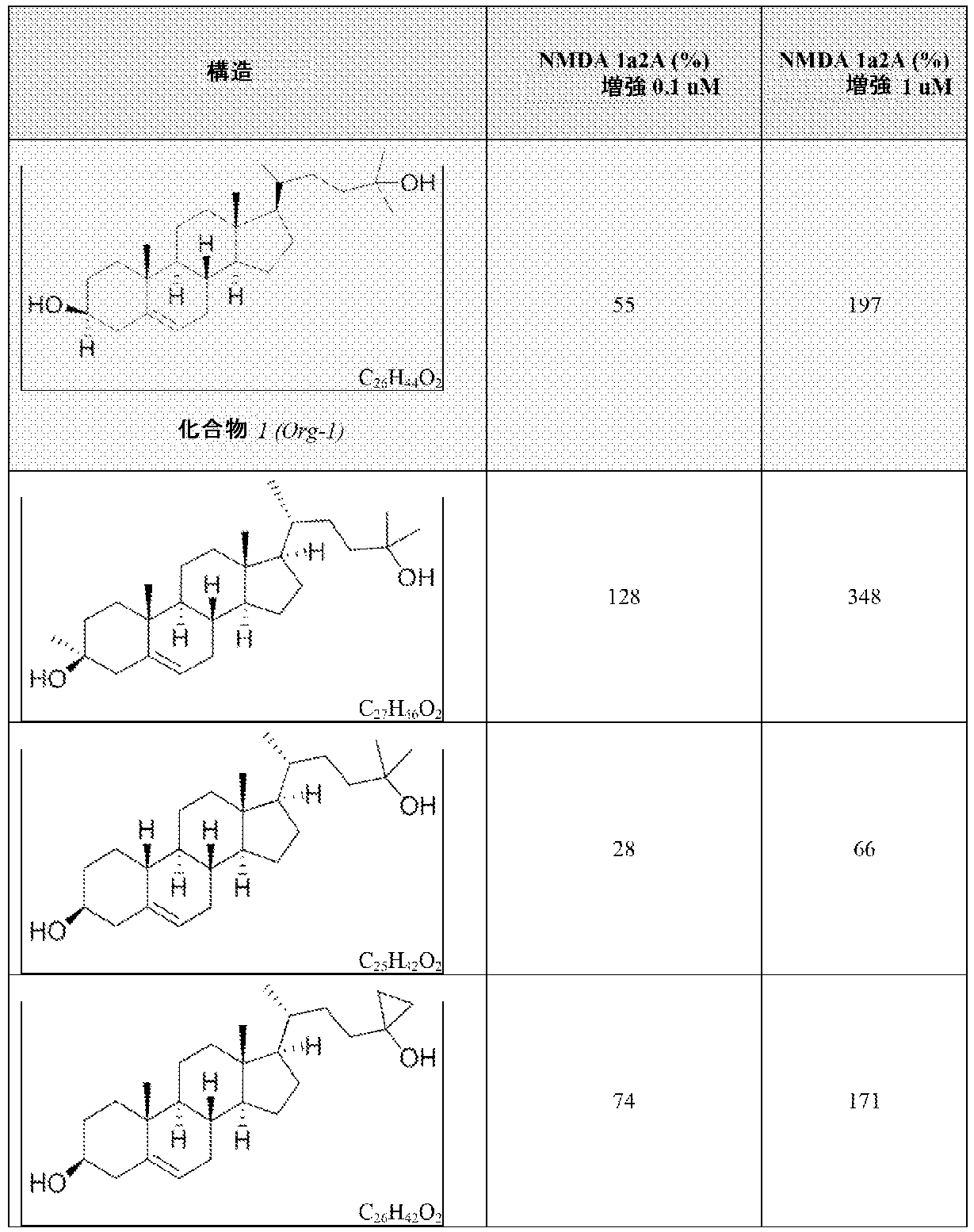


ipofectamine™). These cells were transiently transfected with GRIN2A cDNA and CD8 (pLeu) antigene cDNA. Approximately 24-72 hours after transfection, successfully transfected cells were identified by adding 1 μl of Dynabeads M-45 CD8 (Jurman et al., B
iotechniques (1994) 17:876-881). Cells were passaged until 50-80% confluence.
Whole-cell currents were measured with an EPC-10 amplifier. Recording cell culture dishes were placed in a microscope dish holder and continuously perfused with bath solution (1 ml/min). All solutions applied to the cells, including the pipette solution, were kept at room temperature (19°C-30°C). After formation of a gigaohm seal between the patch electrode and an individual transfected HEK293 cell (pipette resistance range: 2.5 MW-6.0 MW; seal resistance range: >1 GW), the cell membrane across the pipette tip was ruptured to ensure electrical access to the cell interior (whole-cell patch configuration). Once a stable seal could be established, patch-clamped cells were then subjected to 30 min of incubation.
NMDA (and 5.0 μM glycine) for 5 seconds (two applications)
DA inward currents were measured. The cells were voltage clamped at a holding potential of -80 mV.
他の実施形態
請求項において、冠詞(例えば「a」、「an」および「the」)は、それとは反対
のことが示されないかまたは別途文脈から明らかでない限り、1つまたは1つより多いこ
とを意味することがある。ある群の1つまたはそれを超えるメンバー間に「または」を含
む請求項または記載は、それとは反対のことが示されないかまたは別途文脈から明らかで
ない限り、1つ、1つより多い、またはすべての群メンバーが、所与の生成物もしくはプ
ロセスに存在するか、所与の生成物もしくはプロセスにおいて用いられるか、または所与
の生成物もしくはプロセスに別途関連していることが満たされるとみなされる。本発明は
、その群の正確に1つのメンバーが、所与の生成物もしくはプロセスに存在するか、所与
の生成物もしくはプロセスにおいて用いられるか、または所与の生成物もしくはプロセス
に別途関連している実施形態を含む。本発明は、1つより多いまたはすべての群メンバー
が所与の生成物もしくはプロセスに存在するか、所与の生成物もしくはプロセスにおいて
用いられるか、または所与の生成物もしくはプロセスに別途関連している実施形態を含む
。
Other Embodiments In the claims, articles (e.g., "a,""an," and "the") may mean one or more than one, unless indicated to the contrary or otherwise clear from the context. A claim or description containing "or" between one or more members of a group is deemed to be satisfied that one, more than one, or all group members are present in, used in, or otherwise relevant to a given product or process, unless indicated to the contrary or otherwise clear from the context. The invention includes embodiments in which exactly one member of the group is present in, used in, or otherwise relevant to a given product or process. The invention includes embodiments in which more than one or all group members are present in, used in, or otherwise relevant to a given product or process.
さらに、本発明は、列挙される請求項のうちの1項またはそれを超える請求項からの1
つまたはそれを超える限定、エレメント、節および記述用語が別の請求項に導入されるす
べてのバリエーション、組み合わせおよび順列を包含する。例えば、別の請求項に従属し
ている任意の請求項は、同じ基本請求項に従属している他の任意の請求項に見られる1つ
またはそれを超える限定を含むように改変され得る。エレメントが、例えば、マーカッシ
ュ群形式で、リストとして提示されている場合、それらのエレメントの各部分群も開示さ
れ、任意のエレメントをその群から除去することができる。一般に、本発明または本発明
の態様は、特定のエレメントおよび/または特徴を含むと言及される場合、本発明または
本発明の態様のある特定の実施形態が、そのようなエレメントおよび/または特徴からな
るか、またはそれらから本質的になると理解されるべきである。単純にするために、それ
らの実施形態は、本明細書中に具体的にそのとおりの言葉で示されていない。用語「含む
(comprising)」および「含む(containing)」は、オープンであ
ると意図されており、追加のエレメントまたは工程を含めることを許容することにも注意
される。範囲が与えられている場合、終点を含む。さらに、別途示されないか、または文
脈および当業者の理解から別途明らかでない限り、範囲として表現されている値は、文脈
が明らかに他のことを指示しない限り、本発明の異なる実施形態において述べられた範囲
内の任意の具体的な値または部分範囲をその範囲の下限の単位の10分の1まで想定する
ことができる。
Furthermore, the present invention relates to one or more of the enumerated claims.
The claims encompass all variations, combinations, and permutations of one or more limitations, elements, clauses, and descriptive terms introduced into another claim. For example, any claim that is dependent on another claim may be modified to include one or more limitations found in any other claim that is dependent on the same base claim. Where elements are presented as a list, e.g., in Markush group format, each subgroup of those elements is also disclosed, and any element may be removed from the group. In general, when the invention or aspects of the invention are referred to as comprising certain elements and/or features, it should be understood that certain embodiments of the invention or aspects of the invention consist of or consist essentially of such elements and/or features. For simplicity, those embodiments have not been specifically termed herein. It is also noted that the terms "comprising" and "containing" are intended to be open and allow for the inclusion of additional elements or steps. Where ranges are given, the endpoints are included. Furthermore, unless otherwise indicated or otherwise clear from the context and the understanding of one of ordinary skill in the art, values expressed as ranges can assume any specific value or subrange within the stated range in different embodiments of the invention to one tenth of the unit of the lower limit of that range, unless the context clearly dictates otherwise.
本願は、様々な発行特許、公開特許出願、学術論文および他の刊行物に言及しており、
これらのすべてが参照により本明細書中に援用される。援用される任意の参考文献と本明
細書との間に矛盾がある場合、本明細書が支配するものとする。さらに、従来技術に入る
本発明の任意の特定の実施形態は、請求項のいずれか1つまたはそれを超える請求項から
明確に除外してよい。そのような実施形態は、当業者に公知であるとみなされるので、そ
の除外が本明細書に明確に示されていない場合でもそれらを除外してよい。本発明の任意
の特定の実施形態は、従来技術の存在に関係していてもしていなくても、何らかの理由で
任意の請求項から除外されることがある。
This application refers to various issued patents, published patent applications, journal articles and other publications.
All of which are incorporated herein by reference. In the event of any inconsistency between any incorporated reference and this specification, this specification shall control. Furthermore, any particular embodiment of the present invention that falls within the prior art may be expressly excluded from any one or more of the claims. Such embodiments may be excluded even if the exclusion is not expressly set forth herein, since they are deemed to be known to those skilled in the art. Any particular embodiment of the present invention may be excluded from any claim for any reason, whether or not related to the existence of prior art.
当業者は、単なる日常的な実験法を用いて、本明細書中に記載される具体的な実施形態
に対する多くの等価物を認識し得るかまたは突き止めることができるだろう。本明細書中
に記載される本実施形態の範囲は、上記の説明に限定されると意図されておらず、むしろ
添付の請求項に示されるとおりである。当業者は、以下の請求項において定義されるよう
な本発明の精神または範囲から逸脱することなく、この説明に様々な変更および改変が行
われ得ることを認識するだろう。
Those skilled in the art will recognize or be able to ascertain, using no more than routine experimentation, many equivalents to the specific embodiments described herein. The scope of the embodiments described herein is not intended to be limited to the above description, but rather is as set forth in the appended claims. Those skilled in the art will recognize that various changes and modifications can be made to this description without departing from the spirit or scope of the invention as defined in the following claims.
Claims (6)
a)必要に応じて患者サンプルを取得する工程;
b)対照基準と比較したときの24(S)-ヒドロキシコレステロールのレベルの変化について該サンプルの評価を取得するおよび/または該サンプルを評価する工程;
c)該サンプルにおいて24(S)-ヒドロキシコレステロールの変化したレベルを有する該患者に該組成物を投与する工程
を包含し、該式(I-w)の化合物は、以下の構造:

X1は、-O-であり;
R3bは、水素であり;
R3aは、水素、非置換C1-6アルキルまたはハロゲンもしくは-ORaaで置換されたC1-6アルキルであり、RaaはC1-10アルキルであり;
R2、R11aおよびR11bの各実例は、独立して、水素であり;
R6aおよびR6bの各々は、独立して、水素であり;そして

R19は、水素または-CH3であり;そして
Zは、
a) obtaining a patient sample as required;
b) obtaining and/or evaluating the sample for a change in the level of 24(S)-hydroxycholesterol as compared to a control standard;
c) administering the composition to the patient having an altered level of 24(S)-hydroxycholesterol in the sample, wherein the compound of formula (I-w) has the following structure:
X1 is -O-;
R 3b is hydrogen;
R 3a is hydrogen, unsubstituted C 1-6 alkyl or C 1-6 alkyl substituted with halogen or -OR aa , where R aa is C 1-10 alkyl;
Each instance of R 2 , R 11a , and R 11b is independently hydrogen;
Each of R 6a and R 6b is independently hydrogen; and
R 19 is hydrogen or -CH 3 ; and Z is
Priority Applications (2)
| Application Number | Priority Date | Filing Date | Title |
|---|---|---|---|
| JP2022011876A JP2022044802A (en) | 2013-03-13 | 2022-01-28 | Neurostimulatory steroids, compositions and their use |
| JP2024137715A JP2024159822A (en) | 2013-03-13 | 2024-08-19 | Neuroactive steroids, compositions and uses thereof |
Applications Claiming Priority (3)
| Application Number | Priority Date | Filing Date | Title |
|---|---|---|---|
| US201361780671P | 2013-03-13 | 2013-03-13 | |
| US61/780,671 | 2013-03-13 | ||
| JP2016502201A JP2016514967A (en) | 2013-03-13 | 2014-03-13 | Nerve stimulating steroids, compositions and uses thereof |
Related Parent Applications (1)
| Application Number | Title | Priority Date | Filing Date |
|---|---|---|---|
| JP2016502201A Division JP2016514967A (en) | 2013-03-13 | 2014-03-13 | Nerve stimulating steroids, compositions and uses thereof |
Related Child Applications (2)
| Application Number | Title | Priority Date | Filing Date |
|---|---|---|---|
| JP2022011876A Division JP2022044802A (en) | 2013-03-13 | 2022-01-28 | Neurostimulatory steroids, compositions and their use |
| JP2024137715A Division JP2024159822A (en) | 2013-03-13 | 2024-08-19 | Neuroactive steroids, compositions and uses thereof |
Publications (2)
| Publication Number | Publication Date |
|---|---|
| JP2020062050A JP2020062050A (en) | 2020-04-23 |
| JP7579639B2 true JP7579639B2 (en) | 2024-11-08 |
Family
ID=51625426
Family Applications (4)
| Application Number | Title | Priority Date | Filing Date |
|---|---|---|---|
| JP2016502201A Withdrawn JP2016514967A (en) | 2013-03-13 | 2014-03-13 | Nerve stimulating steroids, compositions and uses thereof |
| JP2020008895A Active JP7579639B2 (en) | 2013-03-13 | 2020-01-23 | Neuroactive steroids, compositions and uses thereof |
| JP2022011876A Pending JP2022044802A (en) | 2013-03-13 | 2022-01-28 | Neurostimulatory steroids, compositions and their use |
| JP2024137715A Pending JP2024159822A (en) | 2013-03-13 | 2024-08-19 | Neuroactive steroids, compositions and uses thereof |
Family Applications Before (1)
| Application Number | Title | Priority Date | Filing Date |
|---|---|---|---|
| JP2016502201A Withdrawn JP2016514967A (en) | 2013-03-13 | 2014-03-13 | Nerve stimulating steroids, compositions and uses thereof |
Family Applications After (2)
| Application Number | Title | Priority Date | Filing Date |
|---|---|---|---|
| JP2022011876A Pending JP2022044802A (en) | 2013-03-13 | 2022-01-28 | Neurostimulatory steroids, compositions and their use |
| JP2024137715A Pending JP2024159822A (en) | 2013-03-13 | 2024-08-19 | Neuroactive steroids, compositions and uses thereof |
Country Status (13)
| Country | Link |
|---|---|
| US (1) | US20160022701A1 (en) |
| EP (2) | EP2970504A4 (en) |
| JP (4) | JP2016514967A (en) |
| CN (3) | CN112057457A (en) |
| AU (5) | AU2014243819A1 (en) |
| BR (1) | BR112015022934A8 (en) |
| CA (1) | CA2905346C (en) |
| HK (1) | HK1220472A1 (en) |
| IL (5) | IL313113A (en) |
| MX (2) | MX2015012437A (en) |
| RU (2) | RU2021111681A (en) |
| WO (1) | WO2014160441A1 (en) |
| ZA (1) | ZA201506807B (en) |
Families Citing this family (31)
| Publication number | Priority date | Publication date | Assignee | Title |
|---|---|---|---|---|
| EP1959966B1 (en) | 2005-11-28 | 2020-06-03 | Marinus Pharmaceuticals, Inc. | Ganaxolone formulations and methods for the making and use thereof |
| AU2012304412A1 (en) | 2011-09-08 | 2014-03-27 | Sage Therapeutics, Inc. | Neuroactive steroids, compositions, and uses thereof |
| PT2968369T (en) | 2013-03-13 | 2018-12-05 | Sage Therapeutics Inc | NEUROACTIVE STEROIDS AND METHODS FOR USE |
| WO2015195967A1 (en) * | 2014-06-18 | 2015-12-23 | Sage Therapeutics, Inc. | Oxysterols and methods of use thereof |
| CA2963938C (en) * | 2014-10-07 | 2023-10-24 | Sage Therapeutics, Inc. | Neuroactive compounds and methods of use thereof |
| EP3319610A4 (en) * | 2015-07-06 | 2019-03-06 | Sage Therapeutics, Inc. | OXYSTEOLS AND METHODS OF USE |
| CN113292623A (en) * | 2015-07-06 | 2021-08-24 | 萨奇治疗股份有限公司 | Pregnansterol and methods of use thereof |
| PT3319612T (en) * | 2015-07-06 | 2021-08-24 | Sage Therapeutics Inc | OXISTEROLS AND METHODS OF USE THEREOF |
| AU2016297821B2 (en) | 2015-07-30 | 2020-03-12 | Intercept Pharmaceuticals, Inc. | Methods for preparation of bile acids and derivatives thereof |
| EA036155B1 (en) | 2015-10-16 | 2020-10-06 | Маринус Фармасьютикалс, Инк. | Injectable neurosteroid formulations containing nanoparticles |
| ES2921010T3 (en) * | 2016-04-01 | 2022-08-16 | Sage Therapeutics Inc | Oxysterols and procedures for their use |
| US10752653B2 (en) | 2016-05-06 | 2020-08-25 | Sage Therapeutics, Inc. | Oxysterols and methods of use thereof |
| ES2884071T3 (en) | 2016-07-07 | 2021-12-10 | Sage Therapeutics Inc | 11-substituted 24-hydroxysteroles for the treatment of NMDA-related conditions |
| MX2019001669A (en) | 2016-08-11 | 2019-09-27 | Ovid Therapeutics Inc | METHODS AND COMPOSITIONS FOR THE TREATMENT OF EPILEPTIC DISORDERS. |
| US10391105B2 (en) | 2016-09-09 | 2019-08-27 | Marinus Pharmaceuticals Inc. | Methods of treating certain depressive disorders and delirium tremens |
| ES2935057T3 (en) * | 2016-09-30 | 2023-03-01 | Sage Therapeutics Inc | C7 substituted oxysterols and these compounds for use as NMDA modulators |
| BR112019008032A2 (en) * | 2016-10-18 | 2019-09-03 | Sage Therapeutics, Inc. | oxyesterols and methods of use thereof |
| EP4105223B1 (en) * | 2016-10-18 | 2025-04-30 | Sage Therapeutics, Inc. | Oxysterols and methods of use thereof |
| GB201812382D0 (en) | 2018-07-30 | 2018-09-12 | Nzp Uk Ltd | Compounds |
| WO2020027344A1 (en) * | 2018-08-03 | 2020-02-06 | Takeda Pharmaceutical Company Limited | Ch24h inhibitors for mdd use |
| US20210346366A1 (en) * | 2018-09-20 | 2021-11-11 | Takeda Pharmaceutical Company Limited | Ch24h inhibitors for pain use |
| US11266662B2 (en) | 2018-12-07 | 2022-03-08 | Marinus Pharmaceuticals, Inc. | Ganaxolone for use in prophylaxis and treatment of postpartum depression |
| EP4009982A4 (en) | 2019-08-05 | 2023-08-09 | Marinus Pharmaceuticals, Inc. | GANAXOLONE FOR USE IN THE TREATMENT OF STATUS EPILEPTICUS |
| CN110702929B (en) * | 2019-09-05 | 2023-08-15 | 首都医科大学附属北京安定医院 | Use of 27-hydroxycholesterols for the preparation of products for diagnosing schizophrenia |
| CN110646626B (en) * | 2019-09-05 | 2023-08-15 | 首都医科大学附属北京安定医院 | Use of 24-hydroxycholesterol for the preparation of a product for diagnosing or early diagnosing schizophrenia |
| US10857163B1 (en) | 2019-09-30 | 2020-12-08 | Athenen Therapeutics, Inc. | Compositions that preferentially potentiate subtypes of GABAA receptors and methods of use thereof |
| MX2022006014A (en) | 2019-12-06 | 2022-06-22 | Marinus Pharmaceuticals Inc | Ganaxolone for use in treating tuberous sclerosis complex. |
| WO2023028278A2 (en) * | 2021-08-25 | 2023-03-02 | Sage Therapeutics, Inc. | Positive nmda-modulating compounds and methods of use thereof |
| KR102749670B1 (en) * | 2021-09-28 | 2025-01-03 | 경희대학교 산학협력단 | Novel Cholic Acid Derivatives and uses thereof |
| CN114409718A (en) * | 2021-12-31 | 2022-04-29 | 湖北武当安泰药业有限公司 | Method for preparing epiandrosterone by catalytic hydrogenation of dehydroepiandrosterone |
| WO2024195903A1 (en) * | 2023-03-21 | 2024-09-26 | 경희대학교 산학협력단 | Novel cholic acid derivative and use thereof |
Citations (1)
| Publication number | Priority date | Publication date | Assignee | Title |
|---|---|---|---|---|
| JP2005508368A (en) | 2001-11-08 | 2005-03-31 | ザ ユニバーシティー オブ シカゴ | Methods for treating diseases associated with high cholesterol levels |
Family Cites Families (11)
| Publication number | Priority date | Publication date | Assignee | Title |
|---|---|---|---|---|
| US5376645A (en) | 1990-01-23 | 1994-12-27 | University Of Kansas | Derivatives of cyclodextrins exhibiting enhanced aqueous solubility and the use thereof |
| GB0019290D0 (en) * | 2000-08-04 | 2000-09-27 | Symphar Sa | Methods for inducing apolipoprotein E secretion |
| EP1461028A4 (en) * | 2001-12-07 | 2007-07-25 | Univ California | TREATMENT OF MACULAR DEGENERATION WITH AGING |
| AU2003288231A1 (en) * | 2002-12-13 | 2004-07-09 | Bayer Healthcare Ag | Cholesterol 24-hydroxylase (cyp46) as therapeutic target for the treatment of alzheimer's disease |
| US8604011B2 (en) * | 2004-09-27 | 2013-12-10 | The Regents Of The University Of California | Therapy for treatment of chronic degenerative brain diseases and nervous system injury |
| JP2009528291A (en) * | 2006-02-27 | 2009-08-06 | ザ リージェンツ オブ ザ ユニバーシティ オブ カリフォルニア | Oxysterol compounds and hedgehog pathway |
| WO2008057468A1 (en) * | 2006-11-02 | 2008-05-15 | Curis, Inc. | Small organic molecule regulators of cell proliferation |
| CN101842355A (en) * | 2007-06-20 | 2010-09-22 | 奥斯拜客斯制药有限公司 | Substituted N-arylpyridones as fibrosis inhibitors |
| US8969525B2 (en) * | 2010-11-09 | 2015-03-03 | Enzo Life Sciences, Inc. | Hydroxycholesterol immunoassay |
| US20150031655A1 (en) * | 2011-04-15 | 2015-01-29 | University Of North Dakota | Combination of liver x receptor modulator and estrogen receptor modulator for the treatment of age-related diseases |
| AU2012304412A1 (en) * | 2011-09-08 | 2014-03-27 | Sage Therapeutics, Inc. | Neuroactive steroids, compositions, and uses thereof |
-
2014
- 2014-03-13 HK HK16108549.1A patent/HK1220472A1/en unknown
- 2014-03-13 US US14/775,401 patent/US20160022701A1/en not_active Abandoned
- 2014-03-13 CN CN202010902354.0A patent/CN112057457A/en active Pending
- 2014-03-13 CA CA2905346A patent/CA2905346C/en active Active
- 2014-03-13 JP JP2016502201A patent/JP2016514967A/en not_active Withdrawn
- 2014-03-13 CN CN202410635379.7A patent/CN119269811A/en active Pending
- 2014-03-13 IL IL313113A patent/IL313113A/en unknown
- 2014-03-13 MX MX2015012437A patent/MX2015012437A/en unknown
- 2014-03-13 BR BR112015022934A patent/BR112015022934A8/en not_active Application Discontinuation
- 2014-03-13 CN CN201480025060.7A patent/CN105164161A/en active Pending
- 2014-03-13 RU RU2021111681A patent/RU2021111681A/en unknown
- 2014-03-13 WO PCT/US2014/026633 patent/WO2014160441A1/en not_active Ceased
- 2014-03-13 EP EP14775126.7A patent/EP2970504A4/en not_active Withdrawn
- 2014-03-13 EP EP21152843.5A patent/EP3865135A3/en not_active Withdrawn
- 2014-03-13 AU AU2014243819A patent/AU2014243819A1/en not_active Abandoned
- 2014-03-13 RU RU2015143463A patent/RU2015143463A/en unknown
- 2014-03-13 IL IL286970A patent/IL286970B2/en unknown
-
2015
- 2015-09-10 IL IL24157615A patent/IL241576B/en active IP Right Grant
- 2015-09-11 MX MX2021001659A patent/MX2021001659A/en unknown
- 2015-09-14 ZA ZA2015/06807A patent/ZA201506807B/en unknown
-
2018
- 2018-12-12 AU AU2018278924A patent/AU2018278924A1/en not_active Abandoned
-
2019
- 2019-09-19 IL IL269471A patent/IL269471B/en active IP Right Grant
-
2020
- 2020-01-23 JP JP2020008895A patent/JP7579639B2/en active Active
- 2020-05-28 AU AU2020203502A patent/AU2020203502A1/en not_active Abandoned
-
2021
- 2021-02-11 IL IL280813A patent/IL280813B/en unknown
-
2022
- 2022-01-28 JP JP2022011876A patent/JP2022044802A/en active Pending
- 2022-03-09 AU AU2022201660A patent/AU2022201660A1/en not_active Abandoned
-
2024
- 2024-05-31 AU AU2024203671A patent/AU2024203671A1/en active Pending
- 2024-08-19 JP JP2024137715A patent/JP2024159822A/en active Pending
Patent Citations (1)
| Publication number | Priority date | Publication date | Assignee | Title |
|---|---|---|---|---|
| JP2005508368A (en) | 2001-11-08 | 2005-03-31 | ザ ユニバーシティー オブ シカゴ | Methods for treating diseases associated with high cholesterol levels |
Non-Patent Citations (3)
| Title |
|---|
| BMC Neurol. (2011) vol.11, 121 |
| Neuroreport (2000) vol.11, no.9, p.1959-1962 |
| Neurosci. Lett. (2009) vol.462, issue 1, p.89-93 |
Also Published As
Similar Documents
| Publication | Publication Date | Title |
|---|---|---|
| JP7579639B2 (en) | Neuroactive steroids, compositions and uses thereof | |
| JP7786665B2 (en) | Neuroactive steroids, compositions, and uses thereof | |
| HK40057477A (en) | Neuroactive steroids for use in therapy | |
| HK40103457A (en) | Neuroactive steroids, compositions, and uses thereof | |
| RU2808165C2 (en) | Neuroactive steroids, compositions and their use | |
| HK1200173B (en) | Neuroactive steroids, compositions, and uses thereof |
Legal Events
| Date | Code | Title | Description |
|---|---|---|---|
| A621 | Written request for application examination |
Free format text: JAPANESE INTERMEDIATE CODE: A621 Effective date: 20200123 |
|
| A131 | Notification of reasons for refusal |
Free format text: JAPANESE INTERMEDIATE CODE: A131 Effective date: 20201211 |
|
| A601 | Written request for extension of time |
Free format text: JAPANESE INTERMEDIATE CODE: A601 Effective date: 20210310 |
|
| A521 | Request for written amendment filed |
Free format text: JAPANESE INTERMEDIATE CODE: A523 Effective date: 20210610 |
|
| A131 | Notification of reasons for refusal |
Free format text: JAPANESE INTERMEDIATE CODE: A131 Effective date: 20211028 |
|
| A02 | Decision of refusal |
Free format text: JAPANESE INTERMEDIATE CODE: A02 Effective date: 20220527 |
|
| A521 | Request for written amendment filed |
Free format text: JAPANESE INTERMEDIATE CODE: A523 Effective date: 20220927 |
|
| C60 | Trial request (containing other claim documents, opposition documents) |
Free format text: JAPANESE INTERMEDIATE CODE: C60 Effective date: 20220927 |
|
| C11 | Written invitation by the commissioner to file amendments |
Free format text: JAPANESE INTERMEDIATE CODE: C11 Effective date: 20221005 |
|
| A911 | Transfer to examiner for re-examination before appeal (zenchi) |
Free format text: JAPANESE INTERMEDIATE CODE: A911 Effective date: 20221017 |
|
| C21 | Notice of transfer of a case for reconsideration by examiners before appeal proceedings |
Free format text: JAPANESE INTERMEDIATE CODE: C21 Effective date: 20221018 |
|
| A912 | Re-examination (zenchi) completed and case transferred to appeal board |
Free format text: JAPANESE INTERMEDIATE CODE: A912 Effective date: 20221111 |
|
| C211 | Notice of termination of reconsideration by examiners before appeal proceedings |
Free format text: JAPANESE INTERMEDIATE CODE: C211 Effective date: 20221115 |
|
| A601 | Written request for extension of time |
Free format text: JAPANESE INTERMEDIATE CODE: A601 Effective date: 20240723 |
|
| A521 | Request for written amendment filed |
Free format text: JAPANESE INTERMEDIATE CODE: A523 Effective date: 20240819 |
|
| A61 | First payment of annual fees (during grant procedure) |
Free format text: JAPANESE INTERMEDIATE CODE: A61 Effective date: 20241028 |
|
| R150 | Certificate of patent or registration of utility model |
Ref document number: 7579639 Country of ref document: JP Free format text: JAPANESE INTERMEDIATE CODE: R150 |