JP7539733B1 - Method for recycling polyester-containing materials - Google Patents
Method for recycling polyester-containing materials Download PDFInfo
- Publication number
- JP7539733B1 JP7539733B1 JP2023108237A JP2023108237A JP7539733B1 JP 7539733 B1 JP7539733 B1 JP 7539733B1 JP 2023108237 A JP2023108237 A JP 2023108237A JP 2023108237 A JP2023108237 A JP 2023108237A JP 7539733 B1 JP7539733 B1 JP 7539733B1
- Authority
- JP
- Japan
- Prior art keywords
- polyester
- alcoholysis
- alcohol
- solvent
- recycling
- Prior art date
- Legal status (The legal status is an assumption and is not a legal conclusion. Google has not performed a legal analysis and makes no representation as to the accuracy of the status listed.)
- Active
Links
Images
Classifications
-
- Y—GENERAL TAGGING OF NEW TECHNOLOGICAL DEVELOPMENTS; GENERAL TAGGING OF CROSS-SECTIONAL TECHNOLOGIES SPANNING OVER SEVERAL SECTIONS OF THE IPC; TECHNICAL SUBJECTS COVERED BY FORMER USPC CROSS-REFERENCE ART COLLECTIONS [XRACs] AND DIGESTS
- Y02—TECHNOLOGIES OR APPLICATIONS FOR MITIGATION OR ADAPTATION AGAINST CLIMATE CHANGE
- Y02W—CLIMATE CHANGE MITIGATION TECHNOLOGIES RELATED TO WASTEWATER TREATMENT OR WASTE MANAGEMENT
- Y02W30/00—Technologies for solid waste management
- Y02W30/50—Reuse, recycling or recovery technologies
- Y02W30/62—Plastics recycling; Rubber recycling
Landscapes
- Separation, Recovery Or Treatment Of Waste Materials Containing Plastics (AREA)
Abstract
【課題】ポリエステルを含む物質を新たな手段によって再資源化する方法の提供を図る。【解決手段】ポリエステルを含む物質を触媒とアルコール存在下、溶媒中でアルコリシスさせる工程と、前記工程で得られたアルコリシス生成物を分離する工程を含む、ポリエステルを含む物質の再資源化方法。具体的には、ポリエステルを含む物質を格納する槽とポリエステルのアルコリシス生成物を分離する槽及び/又は経路とを有する装置を用いて実施する。【選択図】 図1[Problem] To provide a method for recycling polyester-containing materials by a new means. [Solution] A method for recycling polyester-containing materials, comprising the steps of alcoholyzing a polyester-containing material in a solvent in the presence of a catalyst and an alcohol, and separating the alcoholysis product obtained in the above step. Specifically, the method is carried out using an apparatus having a tank for storing the polyester-containing material and a tank and/or a path for separating the alcoholysis product of polyester. [Selected Figure] Figure 1
Description
本発明は、ポリエステルを含む物質の再資源化方法に関する。 The present invention relates to a method for recycling materials that contain polyester.
プラスチックは安価で耐久性に優れた材料である。特に、ポリエチレンテレフタレート(PET)は、その利便性により繊維、フィルム、ボトルなど幅広い分野に応用され、過去数十年で急激に生産・消費されてきた。一方、耐久性に優れる反面、容易に分解されにくいことから、世界中の埋め立て地を埋め尽くし、マイクロプラスチックによる海洋汚染問題などの地球環境破壊という社会課題が露見している。
このような背景から、PETをはじめとするプラスチックごみのリサイクル技術の開発が望まれている。日本では欧米と比較して、焼却処理した際に発生する熱エネルギーを活用するサーマルリサイクルの割合が高いが、二酸化炭素の排出による地球温暖化への懸念がある。そこで、ポリエステル廃棄物のケミカルリサイクル、すなわち、ポリエステル廃棄物を化学的にモノマーに変換・回収し、このモノマーを再利用する方法について多くの研究がなされている。
Plastics are inexpensive and durable materials. In particular, polyethylene terephthalate (PET) is used in a wide range of fields, such as fibers, films, and bottles, due to its convenience, and has been rapidly produced and consumed in the past few decades. However, while it is durable, it is not easily degradable, and this has led to social issues such as the destruction of the global environment, such as filling up landfills around the world and causing marine pollution by microplastics.
In light of this, there is a need to develop recycling technologies for PET and other plastic waste. In Japan, compared to Europe and the United States, the proportion of thermal recycling, which utilizes the thermal energy generated during incineration, is high, but there are concerns about global warming due to carbon dioxide emissions. Therefore, much research has been conducted on chemical recycling of polyester waste, that is, methods of chemically converting polyester waste into monomers, recovering them, and reusing these monomers.
特許文献1には、超臨界アルコールを用いて、PET等の芳香族ポリエステルからそのモノマー成分である芳香族二価カルボン酸ジメチルと二価アルコールを連続処理で製造する方法が示されている。しかし、300℃以上の高温を必要とする。
特許文献2には、ポリエステルをアルキレングリコールによって解重合反応を行い、次いでメタノールとのエステル交換をおこなうことでテレフタル酸ジメチルを製造する方法が示されている。しかし、アルキレングリコールを150℃以上で留去する必要がある。
特許文献3には、ポリエステル(PET)、ポリプロピレン(PP)およびポリエチレン(PE)を主成分とするプラスチック層とアルミニウム層を含む多層フィルムの再生方法が開示されている。この発明では、多層フィルム廃棄物のアルミニウムを選択的に溶解させて層分離を誘導し、比重差を用いてPPとPEとの混合物層とPET層に分離する。また、比重差により分離されたPETの純度を高めるために、有機溶媒を用いて、PET層に含まれたPPとPEを抽出することにより、多層フィルムの主構成成分をPET、PPとPEとの混合物、およびアルミニウム成分にそれぞれ分離する。しかし、アルミニウムを溶解させるので、再資源化するためにエネルギーを要する。
特許文献4には、塩基触媒と1価アルコールとグリコール捕捉剤としての炭酸ジエステルまたはテトラアルコキシシランと含むポリエステル解重合用の触媒組成物および当該触媒組成物を用いたポリエステル解重合方法が示されている。しかし、PETの構成成分であるエチレングリコールが安定的に捕捉されることにより、再びPET原料として使用するには、生成される炭酸エチレンをエチレングリコールに分解させる必要が生じる。
本発明は、上記のような従来技術の問題点を克服するためになされたもので、ポリエステルを含む物質を新たな手段によって再資源化する方法を提供することを目的とする。 The present invention was made to overcome the problems with the conventional technology described above, and aims to provide a new method for recycling materials containing polyester.
本発明者らは、前記課題を解決するために鋭意研究した結果、ポリエステルを含む物質を触媒とアルコール存在下、溶媒中でアルコリシスさせる工程と、前記工程で得られたアルコリシス生成物を分離する工程を含む、ポリエステルを含む物質の再資源化方法を見いだした。より具体的には、ポリエステルを含む物質を格納する槽とポリエステルのアルコリシス生成物を分離する槽及び/又は経路とを有する装置を用いることを特徴とする、前記ポリエステルを含む物質の再資源化方法を見いだし、本発明を完成するに至った。 As a result of intensive research to solve the above problems, the inventors have discovered a method for recycling polyester-containing materials, which includes a step of alcoholyzing a polyester-containing material in a solvent in the presence of a catalyst and an alcohol, and a step of separating the alcoholysis product obtained in the above step. More specifically, they have discovered a method for recycling polyester-containing materials, which is characterized by using an apparatus having a tank for storing the polyester-containing material and a tank and/or a path for separating the alcoholysis product of the polyester, and have completed the present invention.
ポリエステルを含む物質(a)としては、後述するようにポリエステル樹脂製品であっても構わないし、ポリエステル成分が含まれているものであっても構わないし、さらに複数のフィルムが積層された積層体の形態をとるものであっても構わない。
本発明は、後述するように様々なポリエステルに適用することができるものであり特に制限されないが、一例だけを示せば、ポリエチレンテレフタレートを示すことができる。
触媒(b)としては、後述するように様々な金属塩や含窒素有機塩基化合物を用いることができるもので特に制限されないが、例えばアルカリ金属アルコキシド及び含窒素有機塩基化合物からなる群から選択された少なくとも1種を選択して実施することができる。より具体的には、ナトリウムメトキシド及び/又は1,5,7-トリアザビシクロ[4.4.0]デカ-5-エンを一例として示すことができる。
アルコール(c)についても後述するように様々なものを少なくとも1種を選択することができ、特に制限はないが、炭素数1~8の一価のアルコールであることが好ましく、単なる一具体例としてメタノールを示すことができる。
溶媒(d)についても後述するように特に制限されるものではないが、再資源化の観点から反応系中でアルコリシス生成物と反応するものを除外する。
例えば前記アルコリシスの反応系中でアルコリシス生成物と反応しないものの群から少なくとも何れか1種を選択することができるが、一具体例としてトルエンを示すことができる。
The polyester-containing substance (a) may be a polyester resin product as described below, may contain a polyester component, or may be in the form of a laminate in which multiple films are laminated.
The present invention can be applied to various polyesters as described below, and is not particularly limited. One example is polyethylene terephthalate.
As the catalyst (b), various metal salts and nitrogen-containing organic base compounds can be used as described later, and are not particularly limited, but for example, at least one selected from the group consisting of alkali metal alkoxides and nitrogen-containing organic base compounds can be selected for implementation. More specifically, sodium methoxide and/or 1,5,7-triazabicyclo[4.4.0]dec-5-ene can be mentioned as an example.
As for the alcohol (c), at least one of various types can be selected as described later, and there is no particular limitation. However, it is preferably a monohydric alcohol having 1 to 8 carbon atoms, and methanol can be given as a simple example.
As described later, the solvent (d) is not particularly limited, but from the viewpoint of recycling, those which react with the alcoholysis product in the reaction system are excluded.
For example, at least one of the above-mentioned groups of compounds that do not react with the alcoholysis product in the alcoholysis reaction system can be selected, and toluene can be given as a specific example.
また本発明は、ポリエステルを含む物質(a)を触媒(b)とアルコール(c)存在下、溶媒(d)中でアルコリシスさせる工程(A)を行い、工程(A)で得られたアルコリシス生成物を分離する工程(B)に加えて、工程(A)で得られた前記アルコリシス生成物以外の物質を分離する工程(C)を付加した再資源化方法として実施することもできる。 The present invention can also be practiced as a recycling method that includes step (A) of alcoholysing a polyester-containing substance (a) in a solvent (d) in the presence of a catalyst (b) and an alcohol (c), and step (B) of separating the alcoholysis product obtained in step (A), and additional step (C) of separating substances other than the alcoholysis product obtained in step (A).
本発明は、ポリエステルを含む物質の再資源化について、新たな手段を提供することができたものである。
また、本発明を実施することによって、ポリエステルを含む物質を焼却処分等することなく、再資源化を図ることができるものであり、二酸化炭素の排出量削減にも貢献することができるものである。
The present invention can provide a new means for recycling materials containing polyester.
Furthermore, by carrying out the present invention, materials containing polyester can be recycled without being incinerated or otherwise disposed of, which can contribute to reducing carbon dioxide emissions.
本発明におけるポリエステルを含む物質(a)をアルコリシスによって再資源化する方法は、触媒(b)とアルコール(c)とを含み、溶媒(d)中でおこなわれる。これらの成分の配合比率は、アルコリシスが良好に進行する範囲で適宜変更して実施することができる。
以下、本発明に用いられる各成分について詳細に説明する。なお、以下の説明において例示する原料は本発明の構成を限定するものではなく、本発明の趣旨を逸脱しない範囲で変更を加えてもよい。
The method of recycling the polyester-containing material (a) by alcoholysis in the present invention is carried out in a solvent (d) containing a catalyst (b) and an alcohol (c). The blending ratio of these components can be appropriately changed within a range in which the alcoholysis proceeds well.
Each component used in the present invention will be described in detail below. Note that the raw materials exemplified in the following description do not limit the configuration of the present invention, and may be modified within the scope of the present invention.
ポリエステルを含む物質(a)
本発明のポリエステルを含む物質(a)には、1つの態様として、ポリエステル樹脂製品を包含する。代表的なポリエステル樹脂製品としては、ポリエチレンテレフタレート(PET)、非結晶性ポリエチレンテレフタレート(A-PET)、グリコール変性ポリエチレンテレフタレート(G-PET)、ポリトリメチレンテレフタレート(PTT)、ポリブチレンテレフタレート(PBT)、ポリエチレンナフタレート(PEN)、ポリブチレンナフタレート(PBN)、ポリアリレート(PAR)、ポリカプロラクトン(PCL)、ポリ乳酸(PLA)、ポリエチレンアジペート(PEA)などが挙げられる。これらのポリエステル樹脂製品は単独で用いてもよく、2種以上を組み合わせて用いることができる。
(a) polyester-containing material
The polyester-containing material (a) of the present invention includes, as one embodiment, a polyester resin product. Representative polyester resin products include polyethylene terephthalate (PET), non-crystalline polyethylene terephthalate (A-PET), glycol-modified polyethylene terephthalate (G-PET), polytrimethylene terephthalate (PTT), polybutylene terephthalate (PBT), polyethylene naphthalate (PEN), polybutylene naphthalate (PBN), polyarylate (PAR), polycaprolactone (PCL), polylactic acid (PLA), polyethylene adipate (PEA), and the like. These polyester resin products may be used alone or in combination of two or more.
本発明のポリエステルを含む物質(a)には、別の態様として、ポリエステル成分が含まれているものであってもよく、食品用トレー、繊維、接着剤、粘着剤、インキ、塗膜などを包含する。例えば、混紡繊維のように、物理的にポリエステル成分と綿、アクリル、レーヨンなどのその他の成分が混合されたものでもよく、染料や顔料等が混合されたものでもよい。また、成分の一部が化学的に変性されたものであってもよい。ラミネート用ポリエステル系接着剤について例示すると、ポリエステルポリウレタン、ポリエステルポリエーテル、ポリエステルポリエーテルポリウレタンなどを用いることができる。 The polyester-containing material (a) of the present invention may, in another embodiment, contain a polyester component, and includes food trays, fibers, adhesives, pressure sensitive adhesives, inks, coatings, etc. For example, it may be a physical mixture of a polyester component with other components such as cotton, acrylic, rayon, etc., as in blended fibers, or it may be a mixture of dyes, pigments, etc. In addition, some of the components may be chemically modified. Examples of polyester-based adhesives for lamination include polyester polyurethane, polyester polyether, polyester polyether polyurethane, etc.
本発明のポリエステルを含む物質(a)には、さらに別の態様として、複数のフィルムが積層された積層体も包含する。使用できるフィルムに特に制限はないが、PETなどのポリエステルフィルム;低密度ポリエチレン(LDPE)、高密度ポリエチレン(HDPE)、二軸延伸ポリプロピレン(OPP)、無延伸ポリプロピレン(CPP)などのオレフィンフィルム;アルミ箔等の金属フィルム;ナイロンフィルム;ポリビニルアルコール(PVA)フィルム;セルロースフィルム;アクリルフィルム;ポリフェニルサルフィド(PPS)フィルム;ポリイミド(PI)フィルム;塩ビ系フィルム;PTFEなどのフッ素樹脂系フィルム;紙製フィルムなどを用いることができる。これらは蒸着層が形成されたフィルムでもよい。また、着色されたフィルムでもよい。
本発明のポリエステルを含む物質(a)がポリエステルフィルムを含む積層体の場合、ポリエステルフィルムがアルコリシスされることで他の積層フィルムと分離されるため、再資源化を図ることができる。また、ポリエステルフィルムを含まない積層体であっても、ポリエステル系接着剤によって貼り合わせられている積層体であれば、接着剤成分がアルコリシスされることで接着剤によって貼り合わせられていたフィルムが分離されるため、再資源化を図ることができる。
The polyester-containing material (a) of the present invention also includes, as another embodiment, a laminate in which a plurality of films are laminated. There is no particular limitation on the film that can be used, and examples of the film that can be used include polyester films such as PET; olefin films such as low-density polyethylene (LDPE), high-density polyethylene (HDPE), biaxially oriented polypropylene (OPP), and non-oriented polypropylene (CPP); metal films such as aluminum foil; nylon films; polyvinyl alcohol (PVA) films; cellulose films; acrylic films; polyphenylsulfide (PPS) films; polyimide (PI) films; vinyl chloride films; fluororesin films such as PTFE; and paper films. These may be films on which a vapor deposition layer is formed. They may also be colored films.
In the case where the polyester-containing substance (a) of the present invention is a laminate containing a polyester film, the polyester film is separated from other laminate films by alcoholysis, and thus recycling can be promoted. Even in the case of a laminate not containing a polyester film, if the laminate is bonded with a polyester-based adhesive, the adhesive component is alcoholysed, and thus the films bonded with the adhesive are separated, and thus recycling can be promoted.
ポリエステルを含む物質(a)は、前記態様に応じて、様々な形態をとることができる。例えば、塊、繊維、フィルム、ペレットなどの固体状態で用いることができる。また、液体状態で用いることもできる。 The polyester-containing substance (a) can take various forms depending on the above-mentioned embodiment. For example, it can be used in a solid state such as a lump, fiber, film, or pellet. It can also be used in a liquid state.
触媒(b)
本発明の触媒(b)としては、金属塩や含窒素有機塩基化合物を用いることができる。
Catalyst (b)
As the catalyst (b) of the present invention, a metal salt or a nitrogen-containing organic base compound can be used.
金属塩としては、アルカリ金属の水酸化物、炭酸塩、脂肪酸塩、アルコキシド;アルカリ土類金属の水酸化物、炭酸塩、脂肪酸塩、アルコキシド、酸化物;遷移金属の水酸化物、炭酸塩、脂肪酸塩、アルコキシドを用いることができる。特に、アルカリ金属アルコキシドを用いることが望ましい。これらの触媒は単独で用いてもよく、2種以上を組み合わせて用いることができる。 As the metal salt, hydroxides, carbonates, fatty acid salts, and alkoxides of alkali metals; hydroxides, carbonates, fatty acid salts, alkoxides, and oxides of alkaline earth metals; and hydroxides, carbonates, fatty acid salts, and alkoxides of transition metals can be used. In particular, it is preferable to use alkali metal alkoxides. These catalysts can be used alone or in combination of two or more.
アルカリ金属アルコキシドとしては、リチウムメトキシド、リチウムエトキシド、リチウムtert-ブトキシド、ナトリウムメトキシド、ナトリウムエトキシド、ナトリウムtert-ブトキシド、カリウムメトキシド、カリウムエトキシド、カリウムtert-ブトキシドが例示される。これらの中では特に、ナトリウムメトキシドを用いることが好ましい。 Examples of alkali metal alkoxides include lithium methoxide, lithium ethoxide, lithium tert-butoxide, sodium methoxide, sodium ethoxide, sodium tert-butoxide, potassium methoxide, potassium ethoxide, and potassium tert-butoxide. Of these, it is particularly preferable to use sodium methoxide.
含窒素有機塩基化合物としては、トリメチルアミン、トリエチルアミン、トリブチルアミン、ピラゾール、イミダゾール、N-メチルイミダゾール、ベンゾイミダゾール、N-メチルベンゾイミダゾール、トリアゾール類、ベンゾトリアゾール、ピリジン、キノリン、イソキノリン、トリアジン類、1,5,7-トリアザビシクロ[4.4.0]デカ-5-エン(TBD)、1,8 -アザビシクロ[5.4.0]ウンデカ-7-エン(DBU)、1,3-ジメシチルイミダゾル-2-イリデン。これらの中では特に、TBDを用いることが好ましい。 The nitrogen-containing organic base compounds include trimethylamine, triethylamine, tributylamine, pyrazole, imidazole, N-methylimidazole, benzimidazole, N-methylbenzimidazole, triazoles, benzotriazole, pyridine, quinoline, isoquinoline, triazines, 1,5,7-triazabicyclo[4.4.0]dec-5-ene (TBD), 1,8-azabicyclo[5.4.0]undec-7-ene (DBU), and 1,3-dimesitylimidazol-2-ylidene. Of these, it is particularly preferable to use TBD.
ポリエステルを含む物質(a)中のポリエステル成分100重量部に対して、触媒(b)の添加量は0.1重量部以上200重量部以下であることが好ましい。より好ましくは1重量部以上100重量部以下である。さらに好ましくは3重量部以上80重量部以下である。
触媒(b)の添加量はアルコリシスが進行する範囲で調整するとよい。多い場合には、コストが増加するだけでなく、アルコリシス生成物の精製に手間がかかりやすくなる。また、少ない場合には、触媒の失活によりアルコリシスが十分に進まないおそれがある。
The amount of catalyst (b) added is preferably 0.1 parts by weight or more and 200 parts by weight or less, more preferably 1 part by weight or more and 100 parts by weight or less, and even more preferably 3 parts by weight or more and 80 parts by weight or less, relative to 100 parts by weight of the polyester component in the polyester-containing substance (a).
The amount of catalyst (b) added should be adjusted within the range in which alcoholysis proceeds. If the amount is too high, not only will the cost increase, but purification of the alcoholysis product will become more time-consuming. If the amount is too low, the catalyst may be deactivated, and alcoholysis may not proceed sufficiently.
アルコール(c)
本発明のアルコール(c)としては、特に制限はないが、炭素数1~8の一価のアルコールであることが好ましい。
Alcohol (c)
The alcohol (c) of the present invention is not particularly limited, but is preferably a monohydric alcohol having 1 to 8 carbon atoms.
一価のアルコールとしては、メタノール、エタノール、1-プロパノール、2-プロパノール、1-ブタノール、2-ブタノール、tert-ブタノール、2-エチルヘキサノール、ベンジルアルコールが例示される。これらは単独で用いてもよく、2種以上を組み合わせて用いることができる。これらの中では、1級アルコールであることが好ましく、特にメタノールであることが好ましい。 Examples of monohydric alcohols include methanol, ethanol, 1-propanol, 2-propanol, 1-butanol, 2-butanol, tert-butanol, 2-ethylhexanol, and benzyl alcohol. These may be used alone or in combination of two or more. Of these, primary alcohols are preferred, and methanol is particularly preferred.
ポリエステルを含む物質(a)中のポリエステル成分100重量部に対して、アルコール(c)の添加量は10重量部以上1000重量部以下であることが好ましい。より好ましくは20重量部以上800重量部以下である。さらに好ましくは30重量部以上600重量部以下である。
アルコール(c)の添加量はアルコリシスが進行する範囲で調整するとよい。多い場合には、コストが増加する。また、少ない場合には、アルコリシスが十分に進行しない。なお、少ない場合は、さらにアルコール(c)を追加することでアルコリシスは再び進行する。
The amount of the alcohol (c) added is preferably 10 parts by weight or more and 1000 parts by weight or less, more preferably 20 parts by weight or more and 800 parts by weight or less, and even more preferably 30 parts by weight or more and 600 parts by weight or less, relative to 100 parts by weight of the polyester component in the polyester-containing substance (a).
The amount of alcohol (c) added may be adjusted within the range in which alcoholysis proceeds. If the amount is too much, the cost increases. If the amount is too little, alcoholysis does not proceed sufficiently. If the amount is too little, alcoholysis can be resumed by adding more alcohol (c).
溶媒(d)
本発明の溶媒(d)は、アルコリシスの反応系中でアルコリシス生成物と反応するものを除外する。
例えば、ポリエチレンテレフタレートのアルコリシスにおいて、炭酸ジメチルを溶媒として選択すると、ポリエチレンテレフタレートのアルコリシスによって生成するエチレングリコールと炭酸ジメチルが反応し、炭酸エチレンへと変化するため、再資源化の観点で溶媒として好適ではない。また、溶媒の再利用を考えた場合に、沸点が高すぎると蒸留操作で熱エネルギーを多く必要とするため、好ましくは200℃以下であり、より好ましくは150℃以下、さらに好ましくは120℃以下である。
このような溶媒としては、トルエン、アセトニトリル、N,N-ジメチルホルムアミド、ジメチルスルホキシド、n-ヘキサン、シクロヘキサン、1,2-ジクロロメタン、テトラヒドロフラン、メチルエチルケトン、酢酸エチルを用いることができる。これらはアルコリシスを阻害しなければ適宜選択することができ、単独で用いてもよく、2種以上を組み合わせて用いることができる。
Solvent (d)
The solvent (d) of the present invention excludes those which react with the alcoholysis product in the alcoholysis reaction system.
For example, in the alcoholysis of polyethylene terephthalate, if dimethyl carbonate is selected as the solvent, ethylene glycol produced by the alcoholysis of polyethylene terephthalate reacts with dimethyl carbonate to convert to ethylene carbonate, which is not suitable as a solvent from the viewpoint of recycling. In addition, when considering the reuse of the solvent, if the boiling point is too high, a large amount of heat energy is required for the distillation operation, so that the boiling point is preferably 200° C. or less, more preferably 150° C. or less, and even more preferably 120° C. or less.
Examples of such a solvent include toluene, acetonitrile, N,N-dimethylformamide, dimethylsulfoxide, n-hexane, cyclohexane, 1,2-dichloromethane, tetrahydrofuran, methyl ethyl ketone, and ethyl acetate. These can be appropriately selected as long as they do not inhibit alcoholysis, and may be used alone or in combination of two or more.
本発明に含まれる溶媒(d)の比率は、ポリエステルを含む物質(a)の重量や形状に応じて適宜調整することができる。多い場合には、反応装置が大型化となり、結果としてポリエステルを含む物質(a)の処理能力が下がることとなる。また、少ない場合には、触媒(b)、アルコール(c)とポリエステルを含む物質(a)との接触が悪くなり、アルコリシスが進行しにくくなる。 The ratio of the solvent (d) included in the present invention can be adjusted appropriately depending on the weight and shape of the polyester-containing substance (a). If the ratio is too high, the reaction apparatus will become larger, resulting in a decrease in the processing capacity of the polyester-containing substance (a). If the ratio is too low, the contact between the catalyst (b), alcohol (c) and the polyester-containing substance (a) will be poor, making it difficult for alcoholysis to proceed.
その他の成分(e)
上記(a)~(d)に加え、その他の成分として、乾燥剤やアルコリシスに関与しない物質が含まれていてもよい。これらは本発明の構成を限定するものではなく、本発明の趣旨を逸脱しない範囲で適宜加えてもよい。
Other components (e)
In addition to the above (a) to (d), other components such as a drying agent and a substance not involved in alcoholysis may be included. These do not limit the configuration of the present invention, and may be added appropriately within the scope of the present invention.
乾燥剤
乾燥剤には、物理的乾燥剤と化学的乾燥剤がある。これらの乾燥剤は単独で用いてもよく、2種以上を組み合わせて用いることができる。
Desiccants include physical desiccants and chemical desiccants. These desiccants may be used alone or in combination of two or more kinds.
物理的乾燥剤には、乾燥剤内部のマトリックス構造によって水分及び/又は湿気の移動経路が増大することを利用したものや、乾燥剤との水分及び/又は湿気の吸着等の物理的相互作用を利用したものがある。具体的には、シリカゲル、モレキュラーシーブ、ゼオライト、活性炭等が挙げられる。 Physical desiccants include those that utilize the increased mobility of moisture and/or humidity due to the matrix structure inside the desiccant, and those that utilize physical interactions such as the adsorption of moisture and/or humidity with the desiccant. Specific examples include silica gel, molecular sieves, zeolites, and activated carbon.
化学的乾燥剤には、化学的に反応することで水分及び/又は湿気を吸着することを利用したものがある。具体的には、酸化カルシウム、酸化バリウム、酸化マグネシウム等の金属酸化物;硫酸ナトリウム、硫酸カルシウム、硫酸マグネシウム、塩化カルシウム、塩化マグネシウム等の金属塩;五酸化二燐;ビニルトリメトキシシラン、ジメチルジメトキシシラン、メチルトリメトキシシラン、メチルトリエトキシシラン、テトラメトキシシラン、テトラエトキシシラン、ジフェニルジメトキシシラン、フェニルトリメトキシシラン等のシラン化合物;オルトギ酸メチル、オルトギ酸エチル、オルト酢酸メチル、オルト酢酸エチル等のオルトエステル化合物等が挙げられる。ただし、アルコリシス生成物と反応するものは、再資源化の観点から除外する。 Some chemical desiccants use a chemical reaction to adsorb moisture and/or humidity. Specific examples include metal oxides such as calcium oxide, barium oxide, and magnesium oxide; metal salts such as sodium sulfate, calcium sulfate, magnesium sulfate, calcium chloride, and magnesium chloride; diphosphorus pentoxide; silane compounds such as vinyltrimethoxysilane, dimethyldimethoxysilane, methyltrimethoxysilane, methyltriethoxysilane, tetramethoxysilane, tetraethoxysilane, diphenyldimethoxysilane, and phenyltrimethoxysilane; and orthoester compounds such as methyl orthoformate, ethyl orthoformate, methyl orthoacetate, and ethyl orthoacetate. However, those that react with the alcoholysis product are excluded from the perspective of recycling.
アルコリシスに関与しない物質
本発明において、アルコリシスに関与しない物質が含まれていてもよい。例えば、低密度ポリエチレン(LDPE)、高密度ポリエチレン(HDPE)、二軸延伸ポリプロピレン(OPP)、無延伸ポリプロピレン(CPP)などのオレフィンフィルム;アルミ箔等の金属フィルム;ナイロンフィルム;PTFEなどのフッ素樹脂系フィルムなどが挙げられる。これらのフィルムは、蒸着層が形成されたフィルムでもよい。また、着色されたフィルムでもよい。
さらに、紙、ポリスチレン(PS)シート、食塩等も挙げられる。
Substances not involved in alcoholysis In the present invention, a substance not involved in alcoholysis may be included. Examples include olefin films such as low density polyethylene (LDPE), high density polyethylene (HDPE), biaxially oriented polypropylene (OPP), and non-oriented polypropylene (CPP); metal films such as aluminum foil; nylon films; and fluororesin films such as PTFE. These films may be films on which a vapor deposition layer is formed. Also, they may be colored films.
Further examples include paper, polystyrene (PS) sheets, table salt, and the like.
本発明中のアルコリシスは、20℃以上100℃未満、好ましくは30以上90℃未満、さらに好ましくは40以上80℃未満で進行することが好ましい。20℃未満であると触媒活性が十分ではない。また、100℃以上でもアルコリシスは進行するが、エネルギーコストの観点から好ましくない。 The alcoholysis in the present invention preferably proceeds at a temperature of 20°C or higher but lower than 100°C, preferably 30°C or higher but lower than 90°C, and more preferably 40°C or higher but lower than 80°C. If the temperature is lower than 20°C, the catalytic activity is insufficient. Although alcoholysis also proceeds at a temperature of 100°C or higher, this is not preferred from the viewpoint of energy costs.
本発明のアルコリシスは、常圧又は減圧下で行うことができるが、加圧下で行ってもよい。
反応時間は、ポリエステルを含む物質(a)がアルコリシスするまでの時間とすればよく、例えば0.5~24時間とすることができる。アルコリシスを完全に進行させずに、途中段階で生成物の分離工程に移行してもよい。
The alcoholysis of the present invention can be carried out under normal pressure or reduced pressure, but may also be carried out under increased pressure.
The reaction time may be the time required for the polyester-containing substance (a) to undergo alcoholysis, and may be, for example, 0.5 to 24 hours. The alcoholysis may not be allowed to proceed completely, and a product separation step may be performed at an intermediate stage.
工程(A)
本発明におけるポリエステルを含む物質(a)を触媒(b)とアルコール(c)存在下、溶媒(d)中でアルコリシスさせる工程(A)について、以下、PETフィルムを含む複数の異種フィルムの積層体を例にとって詳細に説明する。
ポリエステルを含む積層体(a)、触媒(b)、アルコール(c)、溶媒(d)を反応容器に入れ、撹拌しながら加熱する。このとき、アルコリシスによって、テレフタル酸誘導体、エチレングリコール(以下、これらを「アルコリシス生成物」と定義する)が得られる。一方、反応容器中にはアルコリシスせずに残ったPET残渣、触媒残渣、PET以外のフィルム(以下、これらを「アルコリシス生成物以外の物質」と定義する)も存在する。
Step (A)
The process (A) of the present invention, in which a polyester-containing substance (a) is subjected to alcoholysis in a solvent (d) in the presence of a catalyst (b) and an alcohol (c), will be described in detail below using a laminate of multiple different films including a PET film as an example.
A polyester-containing laminate (a), a catalyst (b), an alcohol (c), and a solvent (d) are placed in a reaction vessel and heated with stirring. At this time, a terephthalic acid derivative and ethylene glycol (hereinafter defined as "alcoholization product") are obtained by alcoholysis. Meanwhile, PET residues, catalyst residues, and films other than PET that remain without alcoholysis (hereinafter defined as "substances other than alcoholysis product") are also present in the reaction vessel.
工程(B)
前記工程(A)で得られたアルコリシス生成物を分離する工程(B)について、説明する。
前記工程(A)で得られたアルコリシス生成物が固体状態の場合は、通常のろ過又は熱時ろ過によって分離することができる。ろ過操作に用いられるフィルターは特に限定されず、対象に応じてサイズや素材を適宜選択することができる。
前記工程(A)で得られたアルコリシス生成物が液体状態の場合は、ろ過操作によって分離することができない。よって、例えば、濃縮して再結晶する方法や、抽出する方法によって分離することができるが、これらの方法に限定するものではない。
Step (B)
Step (B) of separating the alcoholysis product obtained in step (A) will now be described.
When the alcoholysis product obtained in the step (A) is in a solid state, it can be separated by normal filtration or hot filtration. The filter used for the filtration operation is not particularly limited, and the size and material can be appropriately selected depending on the target.
When the alcoholysis product obtained in the step (A) is in a liquid state, it cannot be separated by a filtration operation, and therefore it can be separated, for example, by a method of concentration and recrystallization or a method of extraction, but is not limited to these methods.
工程(C)
前記工程(B)に加えて、アルコリシス生成物以外の物質を分離する工程を含めても良い。
既知の技術を用いて、前記工程(B)同様に、分離操作をおこなうことができる。
Step (C)
In addition to the step (B), a step of separating substances other than the alcoholysis product may be included.
The separation operation can be carried out using known techniques in the same manner as in step (B) above.
装置の実施の形態
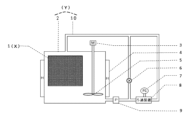
次に図1を参照して、槽1(X)と槽2及び/又は経路10(Y)とを有する装置の一実施の形態について説明するが、装置については様々な形態のものを採用して実施することができる。
Next, referring to FIG. 1, one embodiment of an apparatus having a tank 1 (X) and a
任意の固体を通過させないフィルター等で囲まれた槽1(X)にポリエステルを含む物質(a)、槽2及び/又は経路10(Y)に触媒(b)とアルコール(c)、溶媒(d)を入れ、(a)~(d)が接触するように混合する。ここで、槽1中のポリエステルを含む物質(a)は槽1の周囲にあるフィルターを通過できないが、アルコリシスが進行すると、反応溶液に溶解したアルコリシス生成物のみが槽1を通過できるような構造となる。槽2には必要に応じてヒーター4を配置して反応温度の調整を行うようにしても構わない。
A polyester-containing substance (a) is placed in tank 1 (X) surrounded by a filter or the like that does not allow any solids to pass through, and a catalyst (b), alcohol (c), and solvent (d) are placed in
混合方法としては、磁器回転子による撹拌、撹拌翼による機械撹拌、循環による混合などを挙げることができる。図1の例では、モーター3に接続された回転軸先端の撹拌翼5による撹拌の例を示した。槽2中の液及び槽2に接続された経路10中の液は、経路途中に配置されたポンプ9によって循環するもので、この例では経路10中に、流量調整用のバルブ6と、圧力計7及びろ過装置8が並列に配置されている。
槽1(X)、槽2及び/又は経路10(Y)等の再資源化に用いる装置の素材は、再資源化を阻害しなければ、適宜選択可能である。
Examples of mixing methods include stirring with a ceramic rotor, mechanical stirring with a stirring blade, mixing by circulation, etc. In the example of Fig. 1, an example of stirring with a
The materials of the equipment used for recycling, such as the tank 1 (X), the
アルコリシスの進行は、アルコリシス率Aを下記式(1)に基づいて評価することができる。
アルコリシス率A[%]=(1-アルコリシス後の(a)の重量/アルコリシス前の(a)の重量)×100・・・(式1)
The progress of alcoholysis can be evaluated based on the alcoholysis rate A according to the following formula (1).
Alcoholysis rate A [%]=(1−weight of (a) after alcoholysis/weight of (a) before alcoholysis)×100 (Equation 1)
次に示す実施例では、下記の基準によってその評価結果を示した。
アルコリシス率Aが90%以上:◎
アルコリシス率Aが60%以上90%未満:〇
アルコリシス率Aが30%以上60%未満:△
アルコリシス率Aが30%未満:×
In the following examples, the evaluation results are shown according to the following criteria.
Alcohololysis rate A is 90% or more: ◎
Alcohololysis rate A is 60% or more and less than 90%: ◯ Alcohololysis rate A is 30% or more and less than 60%: △
Alcohololysis rate A is less than 30%: ×
以下、実施例により本発明を更に具体的に説明するが、本発明は以下の実施例に制限されるものではない。 The present invention will be explained in more detail below with reference to examples, but the present invention is not limited to the following examples.
以下に示す実施例では、特に説明がない限り以下の試薬を用いた。
ポリエステルを含む物質(a)
・PETペレット(市販品)
・ポリエステルポリウレタンラミネート接着剤(ロックペイント(株)製、アドロックRU-77/H-7)、以下「ポリエステル系接着剤」と略記
・ポリエーテルポリウレタンラミネート接着剤(ロックペイント(株)製、アドロックRN-230/HN-230)、以下「ポリエーテル系接着剤」と略記
触媒(b)
・ナトリウムメトキシド(富士フィルム和光純薬(株)製、和光一級グレード)
・1,5,7-トリアザビシクロ[4.4.0]デカ-5-エン(東京化成工業(株)製)
アルコール(c)
・メタノール(富士フィルム和光純薬(株)製、超脱水グレード)
溶媒(d)
・トルエン(関東化学(株)製、特級グレード)
フィルム
・PETフィルム(東洋紡(株)製、東洋紡エステルフィルムE5102)
・OPPフィルム(東洋紡(株)製、パイレンフィルム-OT P2241)
・CPPフィルム(東洋紡(株)製、パイレンフィルム-CT P1146)
・ナイロンフィルム(ユニチカ(株)製、エンブレムONBC-RT)
・アルミ箔(東洋アルミニウム(株)製)
フィルター
・目開き 0.5mm ステンレス製
In the examples shown below, the following reagents were used unless otherwise specified.
(a) polyester-containing material
・PET pellets (commercially available)
Polyester polyurethane laminate adhesive (manufactured by Rock Paint Co., Ltd., Adlock RU-77/H-7), hereinafter abbreviated as "polyester adhesive" Polyether polyurethane laminate adhesive (manufactured by Rock Paint Co., Ltd., Adlock RN-230/HN-230), hereinafter abbreviated as "polyether adhesive" Catalyst (b)
・Sodium methoxide (manufactured by Fujifilm Wako Pure Chemical Industries, Ltd., Wako Grade 1)
1,5,7-triazabicyclo[4.4.0]dec-5-ene (Tokyo Chemical Industry Co., Ltd.)
Alcohol (c)
Methanol (Fujifilm Wako Pure Chemical Industries, ultra-dehydrated grade)
Solvent (d)
- Toluene (Kanto Chemical Co., Ltd., special grade)
Film: PET film (Toyobo Ester Film E5102, manufactured by Toyobo Co., Ltd.)
- OPP film (Toyobo Co., Ltd., Pylen Film-OT P2241)
-CPP film (Toyobo Co., Ltd., Pylen Film-CT P1146)
- Nylon film (manufactured by Unitika Ltd., Emblem ONBC-RT)
- Aluminum foil (manufactured by Toyo Aluminum Co., Ltd.)
Filter, mesh size 0.5mm, stainless steel
[実施例1]
PETペレット(6重量部)を入れた反応容器に、ナトリウムメトキシド(1重量部)、メタノール(2重量部)を加えた。合計が100重量部になるようにトルエンを加えて、65℃条件で2時間撹拌した。
反応終了後、反応溶液をフィルターでろ過し、ろ過残渣を水で洗浄した。ろ過残渣として未反応のPETペレットは得られなかった。アルコリシス率は100%であった。
[Example 1]
Sodium methoxide (1 part by weight) and methanol (2 parts by weight) were added to a reaction vessel containing PET pellets (6 parts by weight). Toluene was added so that the total amount became 100 parts by weight, and the mixture was stirred at 65° C. for 2 hours.
After the reaction was completed, the reaction solution was filtered through a filter, and the filtration residue was washed with water. No unreacted PET pellets were obtained as the filtration residue. The alcoholysis rate was 100%.
[実施例2]
実施例1の条件において、ナトリウムメトキシドを0.3重量部に減量して、同様に実施した。アルコリシス率は100%であった。
[Example 2]
The same procedure was carried out under the same conditions as in Example 1, except that the amount of sodium methoxide was reduced to 0.3 parts by weight. The alcoholysis rate was 100%.
[実施例3]
実施例1の条件において、ナトリウムメトキシドを4重量部に増量して、同様に実施した。アルコリシス率は100%であった。
[Example 3]
The same procedure was carried out under the same conditions as in Example 1, except that the amount of sodium methoxide was increased to 4 parts by weight. The alcoholysis rate was 100%.
[実施例4]
実施例1の条件において、メタノールを40重量部に増量して、同様に実施した。アルコリシス率は84.1%であった。
[Example 4]
The same procedure was carried out under the same conditions as in Example 1, except that the amount of methanol was increased to 40 parts by weight. The alcoholysis rate was 84.1%.
[実施例5]
実施例1の条件において、PETペレットを白PETフィルム(東洋紡(株)製、東洋紡エステルフィルムE-5102に白インキが印刷されたもの)に変更して、同様に実施した。アルコリシス率は95.9%であった。
[Example 5]
The same experiment was carried out under the conditions of Example 1, except that the PET pellets were replaced with white PET film (Toyobo Ester Film E-5102 printed with white ink, manufactured by Toyobo Co., Ltd.). The alcoholysis rate was 95.9%.
[実施例6]
実施例1の条件において、PETペレットをアルミナ透明蒸着PETフィルム(東レフィルム加工(株)製、バリアロックス1011SBR2)に変更して、同様に実施した。アルコリシス率は100%であった。
[Example 6]
The same experiment was carried out under the conditions of Example 1, except that the PET pellets were replaced with an alumina transparent vapor-deposited PET film (Barrierox 1011SBR2, manufactured by Toray Advanced Film Co., Ltd.). The alcoholysis rate was 100%.
[実施例7]
実施例1の条件において、PETペレットをポリエステル繊維((株)フジックス製、キング ハイ・スパン ボタンつけ糸)に変更して、同様に実施した。アルコリシス率は90.0%であった。
[Example 7]
The same procedure was carried out under the conditions of Example 1, except that the PET pellets were replaced with polyester fiber (King High Span button thread, manufactured by Fujix Co., Ltd.). The alcoholysis rate was 90.0%.
[実施例8]
実施例1の条件において、PETペレットを脂肪族系ポリエステル樹脂(ロックペイント(株)製、アドロックRU-10)に変更して、同様に実施した。アルコリシス率は100%であった。
なお、ここで用いたポリエステル樹脂は反応溶液に溶解し、ろ過による単離ができないので、反応終了後、反応溶液をGPC(ゲル浸透クロマトグラフィー)により単離・定性し、アルコリシスされていないポリエステル樹脂が認められないことを確認した。
[Example 8]
The same experiment was carried out under the conditions of Example 1, except that the PET pellets were replaced with an aliphatic polyester resin (Adlock RU-10, manufactured by Rock Paint Co., Ltd.). The alcoholysis rate was 100%.
In addition, since the polyester resin used here was dissolved in the reaction solution and could not be isolated by filtration, after completion of the reaction, the reaction solution was isolated and characterized by GPC (gel permeation chromatography), and it was confirmed that no unalcoholized polyester resin was found.
[実施例9]
実施例1の条件において、PETペレットをエポキシ樹脂(三菱ケミカルグループ(株)製、jER1055K、35重量部)とポリエステル樹脂(ダイセル-オルネクス(株)製、CRYLCOAT1713、65重量部)を粉砕混合し、160℃で20分間熱架橋させた樹脂に変更して、同様に実施した。アルコリシス率は45.8%であった。
[Example 9]
The same procedure was carried out under the conditions of Example 1, except that the PET pellets were replaced with a resin prepared by grinding and mixing an epoxy resin (35 parts by weight of jER1055K manufactured by Mitsubishi Chemical Group Corporation) and a polyester resin (65 parts by weight of CRYLCOAT1713 manufactured by Daicel-Allnex Corporation) and thermally crosslinking the resin at 160° C. for 20 minutes. The alcoholysis rate was 45.8%.
[実施例10]
実施例1の条件において、PETペレットをエコA-PETフィルム(市販品)に変更して、同様に実施した。アルコリシス率は100%であった。
[Example 10]
The same experiment was carried out under the conditions of Example 1, except that the PET pellets were replaced with Eco A-PET film (a commercially available product). The alcoholysis rate was 100%.
[実施例11]
実施例1の条件において、PETペレットをG-PETフレーク(市販品)に変更して、同様に実施した。アルコリシス率は83.2%であった。
[Example 11]
The same experiment was carried out under the conditions of Example 1, except that the PET pellets were replaced with G-PET flakes (commercially available product). The alcoholysis rate was 83.2%.
[実施例12]
実施例1の条件において、ナトリウムメトキシドを1,5,7-トリアザビシクロ[4.4.0]デカ-5-エン(1重量部)に変更して、同様に実施した。アルコリシス率は93.3%であった。
[Example 12]
The same procedure was carried out as in Example 1, except that sodium methoxide was replaced with 1,5,7-triazabicyclo[4.4.0]dec-5-ene (1 part by weight). The alcoholysis rate was 93.3%.
[実施例13]
実施例1の条件において、メタノールをベンジルアルコール(東京化成工業(株)製、6.75重量部)に変更して、同様に実施した。アルコリシス率は93.0%であった。
[Example 13]
The same procedure was carried out under the same conditions as in Example 1, except that methanol was replaced with benzyl alcohol (Tokyo Chemical Industry Co., Ltd., 6.75 parts by weight). The alcoholysis rate was 93.0%.
[実施例14]
実施例1の条件において、メタノールをエタノール(富士フィルム和光純薬(株)製、超脱水グレード、3重量部)に、トルエンを酢酸エチル(関東化学(株)製、特級グレード)に変更して、同様に実施した。アルコリシス率は98.5%であった。
[Example 14]
The same procedure was carried out under the conditions of Example 1, except that methanol was replaced with ethanol (Fujifilm Wako Pure Chemical Industries, Ltd., ultra-dehydrated grade, 3 parts by weight) and toluene was replaced with ethyl acetate (Kanto Chemical Industries, Ltd., special grade). The alcoholysis rate was 98.5%.
[実施例15]
実施例1の条件において、トルエンをアセトニトリル(富士フィルム和光純薬(株)製、特級グレード)に変更して、同様に実施した。アルコリシス率は99.7%であった。
[Example 15]
The same procedure was carried out under the conditions of Example 1, except that toluene was replaced with acetonitrile (special grade, manufactured by Fujifilm Wako Pure Chemical Industries, Ltd.). The alcoholysis rate was 99.7%.
[実施例16]
実施例1の条件において、トルエンをテトラヒドロフラン(富士フィルム和光純薬(株)製、超脱水グレード(安定剤含有))に変更して、同様に実施した。アルコリシス率は94.0%であった。
[Example 16]
The same procedure was carried out under the conditions of Example 1, except that toluene was replaced with tetrahydrofuran (manufactured by Fujifilm Wako Pure Chemical Industries, Ltd., ultra-dehydrated grade (containing stabilizer)). The alcoholysis rate was 94.0%.
[実施例17]
実施例1の条件において、OPPフィルム(6重量部)を加え、同様に実施した。反応溶液をフィルターでろ過し、得られたろ過残渣のうち、未反応のPETペレットとOPPフィルムを分離し、未反応のPETペレットを回収した。アルコリシス率は99.7%であった。
[Example 17]
The same procedure was carried out under the conditions of Example 1, except that an OPP film (6 parts by weight) was added. The reaction solution was filtered through a filter, and the unreacted PET pellets and the OPP film were separated from the resulting filtration residue, and the unreacted PET pellets were recovered. The alcoholysis rate was 99.7%.
[実施例18]
実施例1の条件において、ナイロンフィルム(6重量部)を加え、同様に実施した。反応溶液をフィルターでろ過し、得られたろ過残渣のうち、未反応のPETペレットとナイロンフィルムを分離し、未反応のPETペレットを回収した。アルコリシス率は97.9%であった。
[Example 18]
The same procedure was carried out under the conditions of Example 1, except that nylon film (6 parts by weight) was added. The reaction solution was filtered through a filter, and the unreacted PET pellets and nylon film were separated from the resulting filtration residue, and the unreacted PET pellets were recovered. The alcoholysis rate was 97.9%.
[実施例19]
実施例1の条件において、アルミ箔(6重量部)を加え、同様に実施した。反応溶液をフィルターでろ過し、得られたろ過残渣はアルミ箔であり、未反応のPETペレットは得られなかった。アルコリシス率は100%であった。
[Example 19]
The same procedure was carried out under the conditions of Example 1, except that aluminum foil (6 parts by weight) was added. The reaction solution was filtered through a filter, and the filtration residue obtained was aluminum foil, and no unreacted PET pellets were obtained. The alcoholysis rate was 100%.
[比較例1]
実施例1の条件において、ナトリウムメトキシドを水酸化ナトリウム (関東化学(株)製、鹿1級、1重量部)に変更して、同様に実施した。アルコリシス率は16.2%であった。
[Comparative Example 1]
The same procedure was carried out under the conditions of Example 1, except that sodium methoxide was replaced with sodium hydroxide (Kanto Chemical Co., Ltd.,
[比較例2]
実施例1の条件において、メタノールをエチレングリコール (富士フィルム和光純薬(株)製、脱水グレード、4重量部)に変更して、同様に実施した。アルコリシス率は0%であった。
[Comparative Example 2]
The same procedure was carried out under the conditions of Example 1, except that methanol was replaced with ethylene glycol (Fujifilm Wako Pure Chemical Industries, Ltd., dehydrated grade, 4 parts by weight). The alcoholysis rate was 0%.
[比較例3]
実施例1の条件において、メタノールを加えずに、同様に実施した。アルコリシス率は0%であった。
[Comparative Example 3]
The same procedure was carried out under the conditions of Example 1, but without adding methanol. The alcoholysis rate was 0%.
次に、ポリエステルを含む物質(a)として、表3記載の構成のラミネートフィルムを用いた場合のアルコリシスについて、検討した。
ここで、分離率Bは下記式2に基づいて評価した。
分離率B[%]=(1-アルコリシス後の未分離のラミネートフィルムの重量/アルコリシス前のラミネートフィルムの重量)×100 ・・・(式2)
分離率Bが90%以上:◎
分離率Bが60%以上90%未満:〇
分離率Bが30%以上60%未満:△
分離率Bが30%未満:×
Next, alcoholysis was examined when a laminate film having the composition shown in Table 3 was used as the polyester-containing substance (a).
Here, the separation rate B was evaluated based on the following
Separation rate B [%] = (1 - weight of unseparated laminate film after alcoholysis / weight of laminate film before alcoholysis) x 100 (Equation 2)
Separation rate B is 90% or more: ◎
Separation rate B is 60% or more and less than 90%: 〇 Separation rate B is 30% or more and less than 60%: △
Separation rate B is less than 30%: ×
[実施例20]
PETフィルム/ポリエステル系接着剤/OPPフィルムの構成のラミネートフィルム(6重量部)を反応容器に入れ、ナトリウムメトキシド(1重量部)、メタノール(2重量部)を加えた。合計が100重量部になるようにトルエンを加えて、25℃条件でペイントシェイカー(浅田鉄工製)を用いて4時間振とうさせた。
反応終了後、反応溶液をフィルターでろ過し、ろ過残渣を水で洗浄したが、未分離のラミネートフィルムは回収されなかった。分離率は100%であった。
[Example 20]
A laminate film (6 parts by weight) having a composition of PET film/polyester adhesive/OPP film was placed in a reaction vessel, and sodium methoxide (1 part by weight) and methanol (2 parts by weight) were added. Toluene was added so that the total amount became 100 parts by weight, and the mixture was shaken at 25° C. for 4 hours using a paint shaker (manufactured by Asada Iron Works).
After the reaction was completed, the reaction solution was filtered and the filter residue was washed with water, but no unseparated laminate film was recovered. The separation rate was 100%.
[実施例21]
実施例20の条件において、ラミネートフィルムの構成をPETフィルム/ポリエステル系接着剤/CPPフィルムに変更して、同様に実施した。分離率は100%であった。
[Example 21]
The same experiment was carried out under the conditions of Example 20, except that the laminate film configuration was changed to PET film/polyester adhesive/CPP film. The separation rate was 100%.
[実施例22]
実施例20の条件において、ラミネートフィルムの構成をPETフィルム/ポリエステル系接着剤/ナイロンフィルムに変更して、同様に実施した。分離率は100%であった。
[Example 22]
The same experiment was carried out under the conditions of Example 20, except that the laminate film configuration was changed to PET film/polyester adhesive/nylon film. The separation rate was 100%.
[実施例23]
実施例20の条件において、ラミネートフィルムの構成をPETフィルム/ポリエステル系接着剤/アルミ箔に変更して、同様に実施した。分離率は100%であった。反応終了時、アルミ箔は溶解せずに、フィルムの形状を維持していた。
[Example 23]
The same procedure was carried out under the conditions of Example 20, except that the laminate film was changed to a PET film/polyester adhesive/aluminum foil. The separation rate was 100%. At the end of the reaction, the aluminum foil did not dissolve and the shape of the film was maintained.
[実施例24]
実施例20の条件において、ラミネートフィルムの構成をナイロンフィルム/ポリエステル系接着剤/アルミ箔に変更して、同様に実施した。分離率は100%であった。
反応終了時、アルミ箔は溶解せずに、フィルムの形状を維持していた。
[Example 24]
The same experiment was carried out under the conditions of Example 20, except that the laminate film configuration was changed to nylon film/polyester adhesive/aluminum foil. The separation rate was 100%.
At the end of the reaction, the aluminum foil was not dissolved and maintained the shape of a film.
[実施例25]
実施例20の条件において、ラミネートフィルムの構成をPETフィルム/ポリエステル系接着剤/ナイロンフィルム/ポリエステル系接着剤/アルミ箔に変更して、同様に実施した。分離率は100%であった。
反応終了時、アルミ箔は溶解せずに、フィルムの形状を維持していた。
[Example 25]
The same experiment was carried out under the conditions of Example 20, except that the laminate film configuration was changed to PET film/polyester adhesive/nylon film/polyester adhesive/aluminum foil. The separation rate was 100%.
At the end of the reaction, the aluminum foil was not dissolved and maintained the shape of a film.
[実施例26]
実施例20の条件において、ラミネートフィルムの構成をPETフィルム/ポリエーテル系接着剤/ナイロンフィルムに変更して、同様に実施した。分離率94.0%であった。
[Example 26]
The same experiment was carried out under the conditions of Example 20, except that the laminate film configuration was changed to PET film/polyether adhesive/nylon film. The separation rate was 94.0%.
[実施例27]
実施例20の条件において、ラミネートフィルムに代えて紙ラベル付きPET製卵パックを用いて、同様に実施した。分離率は100%であった。
[Example 27]
The same experiment was carried out under the conditions of Example 20, except that a PET egg carton with a paper label was used instead of the laminate film. The separation rate was 100%.
[実施例28]
実施例20の条件において、ラミネートフィルムに代えて、ポリエステル65%綿35%の混紡繊維を用いて、同様に実施した。分離率は34.5%であった。
[Example 28]
The same experiment was carried out under the conditions of Example 20, except that a blend of 65% polyester and 35% cotton was used instead of the laminate film. The separation rate was 34.5%.
[比較例4]
実施例20の条件において、ラミネートフィルムの構成をOPPフィルム/ポリエーテル系接着剤/CPPフィルムに変更して、同様に実施した。分離率は0%であった。
[Comparative Example 4]
The same experiment was carried out under the conditions of Example 20, except that the laminate film configuration was changed to OPP film/polyether adhesive/CPP film. The separation rate was 0%.
1 槽
2 槽
3 モーター
4 ヒーター
5 撹拌翼
6 バルブ
7 圧力計
8 ろ過装置
9 ポンプ
1
Claims (7)
前記工程(A)で得られたアルコリシス生成物を分離する工程(B)と、
前記アルコリシス生成物以外の物質を分離する工程(C)とを備えた、
ポリエステルを含む物質(a)の再資源化方法において、
触媒(b)は、リチウムメトキシド、リチウムエトキシド、リチウムtert-ブトキシド、ナトリウムメトキシド、ナトリウムエトキシド、ナトリウムtert-ブトキシド、カリウムメトキシド、カリウムエトキシド、カリウムtert-ブトキシド、トリメチルアミン、トリエチルアミン、トリブチルアミン、ピラゾール、イミダゾール、N-メチルイミダゾール、ベンゾイミダゾール、N-メチルベンゾイミダゾール、トリアゾール類、ベンゾトリアゾール、ピリジン、キノリン、イソキノリン、トリアジン類、1,5,7-トリアザビシクロ[4.4.0]デカ-5-エン(TBD)、1,8 -アザビシクロ[5.4.0]ウンデカ-7-エン(DBU)及び1,3-ジメシチルイミダゾル-2-イリデンからなる群から選択された少なくとも1種であり、
溶媒(d)がトルエンを含むものであり、
アルコール(c)/溶媒(d)=1/12.9~1/45.9の重量比であり、
該アルコリシスが20℃以上100℃未満で進行することを特徴とするポリエステルを含む物質(a)の再資源化方法。 A step (A) of subjecting a polyester-containing substance (a) to alcoholysis in a solvent (d) in the presence of a catalyst (b) and an alcohol (c);
A step (B) of separating the alcoholysis product obtained in the step (A) ;
and (C) separating substances other than the alcoholysis product.
A method for recycling a polyester-containing material (a), comprising the steps of:
The catalyst (b) is at least one selected from the group consisting of lithium methoxide, lithium ethoxide, lithium tert-butoxide, sodium methoxide, sodium ethoxide, sodium tert-butoxide, potassium methoxide, potassium ethoxide, potassium tert-butoxide, trimethylamine, triethylamine, tributylamine, pyrazole, imidazole, N-methylimidazole, benzimidazole, N-methylbenzimidazole, triazoles, benzotriazole, pyridine, quinoline, isoquinoline, triazines, 1,5,7-triazabicyclo[4.4.0]dec-5-ene (TBD), 1,8-azabicyclo[5.4.0]undec-7-ene (DBU), and 1,3-dimesitylimidazol-2-ylidene;
The solvent (d) contains toluene;
The weight ratio of alcohol (c)/solvent (d) is 1/12.9 to 1/45.9;
The method for recycling a polyester-containing substance (a) is characterized in that the alcoholysis proceeds at a temperature of 20°C or higher and lower than 100°C.
ポリエステルを含む物質(a)中のポリエステル成分100重量部に対して、アルコール(c)の添加量が10~112.5重量部であることを特徴とする請求項1に記載の再資源化方法。 The alcohol (c) is a monohydric alcohol having 1 to 8 carbon atoms;
2. The method for recycling according to claim 1, wherein the amount of the alcohol (c) added is 10 to 112.5 parts by weight per 100 parts by weight of the polyester component in the polyester-containing substance (a).
前記複数のフィルムの少なくとも1種は、PETフィルム又はナイロンフィルムであり、At least one of the films is a PET film or a nylon film;
前記接着剤は、ポリエステル系接着剤とポリエーテル系接着剤との少なくとも1種であり、The adhesive is at least one of a polyester adhesive and a polyether adhesive,
触媒(b)は、ナトリウムメトキシドであり、Catalyst (b) is sodium methoxide;
溶媒(d)は、トルエンであることを特徴とする請求項1記載の再資源化方法。2. The method according to claim 1, wherein the solvent (d) is toluene.
アルコール(c)がメタノールであり、The alcohol (c) is methanol;
溶媒(d)がトルエンであることを特徴とする請求項1に記載の再資源化方法。2. The method according to claim 1, wherein the solvent (d) is toluene.
Priority Applications (4)
| Application Number | Priority Date | Filing Date | Title |
|---|---|---|---|
| JP2023108237A JP7539733B1 (en) | 2023-06-30 | 2023-06-30 | Method for recycling polyester-containing materials |
| PCT/JP2024/022079 WO2025004907A1 (en) | 2023-06-30 | 2024-06-18 | Method for recycling polyester-containing substance |
| JP2024563272A JP7791611B2 (en) | 2023-06-30 | 2024-06-18 | Method for recycling polyester-containing materials |
| JP2025197389A JP2026012582A (en) | 2023-06-30 | 2025-11-18 | Method for recycling polyester-containing materials |
Applications Claiming Priority (1)
| Application Number | Priority Date | Filing Date | Title |
|---|---|---|---|
| JP2023108237A JP7539733B1 (en) | 2023-06-30 | 2023-06-30 | Method for recycling polyester-containing materials |
Publications (2)
| Publication Number | Publication Date |
|---|---|
| JP7539733B1 true JP7539733B1 (en) | 2024-08-26 |
| JP2025007073A JP2025007073A (en) | 2025-01-17 |
Family
ID=92499066
Family Applications (3)
| Application Number | Title | Priority Date | Filing Date |
|---|---|---|---|
| JP2023108237A Active JP7539733B1 (en) | 2023-06-30 | 2023-06-30 | Method for recycling polyester-containing materials |
| JP2024563272A Active JP7791611B2 (en) | 2023-06-30 | 2024-06-18 | Method for recycling polyester-containing materials |
| JP2025197389A Pending JP2026012582A (en) | 2023-06-30 | 2025-11-18 | Method for recycling polyester-containing materials |
Family Applications After (2)
| Application Number | Title | Priority Date | Filing Date |
|---|---|---|---|
| JP2024563272A Active JP7791611B2 (en) | 2023-06-30 | 2024-06-18 | Method for recycling polyester-containing materials |
| JP2025197389A Pending JP2026012582A (en) | 2023-06-30 | 2025-11-18 | Method for recycling polyester-containing materials |
Country Status (2)
| Country | Link |
|---|---|
| JP (3) | JP7539733B1 (en) |
| WO (1) | WO2025004907A1 (en) |
Citations (2)
| Publication number | Priority date | Publication date | Assignee | Title |
|---|---|---|---|---|
| JP2020533395A (en) | 2017-09-15 | 2020-11-19 | 9449710 カナダ インク. | Formation of terephthalic acid esters |
| JP2023506948A (en) | 2019-12-20 | 2023-02-20 | イーストマン ケミカル カンパニー | Catalyst for PET methanol decomposition |
Family Cites Families (7)
| Publication number | Priority date | Publication date | Assignee | Title |
|---|---|---|---|---|
| JP3447623B2 (en) | 1999-07-29 | 2003-09-16 | 独立行政法人産業技術総合研究所 | Continuous production method of monomer from aromatic polyester |
| KR100528646B1 (en) | 2005-01-24 | 2005-11-15 | 한국생산기술연구원 | A recycling method of multilayer packaging film waste |
| JP2012131729A (en) | 2010-12-21 | 2012-07-12 | Teijin Ltd | Method for preparing dimethyl terephthalate from polyester |
| WO2022060153A1 (en) * | 2020-09-18 | 2022-03-24 | 한국화학연구원 | Depolymerization catalyst of polymer comprising ester functional group, and depolymerization method using same |
| JP7805624B2 (en) | 2021-02-18 | 2026-01-26 | 国立研究開発法人産業技術総合研究所 | How to decompose polyester |
| US20240166590A1 (en) * | 2021-04-12 | 2024-05-23 | Korea Research Institute Of Chemical Technology | Method for producing terephthalate derivative by transesterification of dimethyl terephthalate |
| CN114904542A (en) * | 2022-04-25 | 2022-08-16 | 中国科学院青岛生物能源与过程研究所 | A composite catalyst for catalytic degradation of polyester/polycarbonate plastic and its preparation method and application |
-
2023
- 2023-06-30 JP JP2023108237A patent/JP7539733B1/en active Active
-
2024
- 2024-06-18 JP JP2024563272A patent/JP7791611B2/en active Active
- 2024-06-18 WO PCT/JP2024/022079 patent/WO2025004907A1/en active Pending
-
2025
- 2025-11-18 JP JP2025197389A patent/JP2026012582A/en active Pending
Patent Citations (2)
| Publication number | Priority date | Publication date | Assignee | Title |
|---|---|---|---|---|
| JP2020533395A (en) | 2017-09-15 | 2020-11-19 | 9449710 カナダ インク. | Formation of terephthalic acid esters |
| JP2023506948A (en) | 2019-12-20 | 2023-02-20 | イーストマン ケミカル カンパニー | Catalyst for PET methanol decomposition |
Non-Patent Citations (1)
| Title |
|---|
| Kurokawa et al.,Methanolysis of polyethylene terephthalate in the presence of aluminium triisopropoxide catalyst to,Polymer Degradation and Stability,2003年,79,529-533 |
Also Published As
| Publication number | Publication date |
|---|---|
| WO2025004907A1 (en) | 2025-01-02 |
| JPWO2025004907A1 (en) | 2025-01-02 |
| JP2026012582A (en) | 2026-01-23 |
| JP7791611B2 (en) | 2025-12-24 |
| JP2025007073A (en) | 2025-01-17 |
Similar Documents
| Publication | Publication Date | Title |
|---|---|---|
| CN1273524C (en) | Recycling methods for PET bottles | |
| EP1227075B1 (en) | Method for separating and recovering dimethyl terephthalate and ethylene glycol from polyester waste | |
| JP6876332B2 (en) | Depolymerization of polyethylene terephthalate | |
| CA2934544C (en) | Method for forming an aromatic diacid and/or an aromatic diacid precursor from a polyester-containing feedstock | |
| CN1195727C (en) | Method for producing and refining bis-β-hydroxyethyl terephthalate | |
| CN1140561C (en) | Method for handling residues containing dihydroxy compounds | |
| CN1234676C (en) | dimethyl terephthalate composition and process for producing the same | |
| KR20240093927A (en) | Method for recovering dialkyl terephthalate from feedstock | |
| WO2010071019A1 (en) | Method for producing 2-hydroxyisobutyric acid polymer and method for depolymerizing same | |
| KR100635622B1 (en) | How to clean and decontaminate polyester | |
| JP7539733B1 (en) | Method for recycling polyester-containing materials | |
| JP2006335856A (en) | Polyester depolymerization method, polyester monomer recovery method using the method | |
| JP6122650B2 (en) | Method for producing polyester and method for producing polyester molded body | |
| JP2012067200A (en) | Method of depolymerizing polyester | |
| TW591049B (en) | Method for recycling PET bottle | |
| JP2008254232A (en) | Multilayered molding and method for manufacturing the same | |
| JP2026026065A (en) | Disassembly method | |
| JP2025171443A (en) | Method for separating polyester | |
| WO2025192196A1 (en) | Chemical for separation and separation method | |
| JP2006232966A (en) | Decomposition method of (meth) acrylic resin | |
| JP2026026066A (en) | Material recycling methods | |
| WO2025173524A1 (en) | Method for separating polyester | |
| JP2025171442A (en) | Polyester-decomposing composition and method for decomposing polyester | |
| JP2008254231A (en) | Multilayered molding and its manufacturing method | |
| CN119866326A (en) | Process for the mechanochemical depolymerization of polyesters |
Legal Events
| Date | Code | Title | Description |
|---|---|---|---|
| A621 | Written request for application examination |
Free format text: JAPANESE INTERMEDIATE CODE: A621 Effective date: 20230822 |
|
| A871 | Explanation of circumstances concerning accelerated examination |
Free format text: JAPANESE INTERMEDIATE CODE: A871 Effective date: 20230822 |
|
| A131 | Notification of reasons for refusal |
Free format text: JAPANESE INTERMEDIATE CODE: A131 Effective date: 20231003 |
|
| A521 | Request for written amendment filed |
Free format text: JAPANESE INTERMEDIATE CODE: A523 Effective date: 20231201 |
|
| A131 | Notification of reasons for refusal |
Free format text: JAPANESE INTERMEDIATE CODE: A131 Effective date: 20231219 |
|
| A601 | Written request for extension of time |
Free format text: JAPANESE INTERMEDIATE CODE: A601 Effective date: 20240209 |
|
| A521 | Request for written amendment filed |
Free format text: JAPANESE INTERMEDIATE CODE: A523 Effective date: 20240416 |
|
| TRDD | Decision of grant or rejection written | ||
| A01 | Written decision to grant a patent or to grant a registration (utility model) |
Free format text: JAPANESE INTERMEDIATE CODE: A01 Effective date: 20240716 |
|
| A61 | First payment of annual fees (during grant procedure) |
Free format text: JAPANESE INTERMEDIATE CODE: A61 Effective date: 20240806 |
|
| R150 | Certificate of patent or registration of utility model |
Ref document number: 7539733 Country of ref document: JP Free format text: JAPANESE INTERMEDIATE CODE: R150 |