JP7517618B2 - Binder for aqueous inkjet ink, aqueous inkjet ink, and printed layer - Google Patents
Binder for aqueous inkjet ink, aqueous inkjet ink, and printed layer Download PDFInfo
- Publication number
- JP7517618B2 JP7517618B2 JP2023556367A JP2023556367A JP7517618B2 JP 7517618 B2 JP7517618 B2 JP 7517618B2 JP 2023556367 A JP2023556367 A JP 2023556367A JP 2023556367 A JP2023556367 A JP 2023556367A JP 7517618 B2 JP7517618 B2 JP 7517618B2
- Authority
- JP
- Japan
- Prior art keywords
- mass
- acid
- meth
- glycol
- aqueous
- Prior art date
- Legal status (The legal status is an assumption and is not a legal conclusion. Google has not performed a legal analysis and makes no representation as to the accuracy of the status listed.)
- Active
Links
Classifications
-
- C—CHEMISTRY; METALLURGY
- C09—DYES; PAINTS; POLISHES; NATURAL RESINS; ADHESIVES; COMPOSITIONS NOT OTHERWISE PROVIDED FOR; APPLICATIONS OF MATERIALS NOT OTHERWISE PROVIDED FOR
- C09D—COATING COMPOSITIONS, e.g. PAINTS, VARNISHES OR LACQUERS; FILLING PASTES; CHEMICAL PAINT OR INK REMOVERS; INKS; CORRECTING FLUIDS; WOODSTAINS; PASTES OR SOLIDS FOR COLOURING OR PRINTING; USE OF MATERIALS THEREFOR
- C09D11/00—Inks
- C09D11/30—Inkjet printing inks
-
- B—PERFORMING OPERATIONS; TRANSPORTING
- B41—PRINTING; LINING MACHINES; TYPEWRITERS; STAMPS
- B41J—TYPEWRITERS; SELECTIVE PRINTING MECHANISMS, i.e. MECHANISMS PRINTING OTHERWISE THAN FROM A FORME; CORRECTION OF TYPOGRAPHICAL ERRORS
- B41J2/00—Typewriters or selective printing mechanisms characterised by the printing or marking process for which they are designed
- B41J2/005—Typewriters or selective printing mechanisms characterised by the printing or marking process for which they are designed characterised by bringing liquid or particles selectively into contact with a printing material
- B41J2/01—Ink jet
-
- C—CHEMISTRY; METALLURGY
- C08—ORGANIC MACROMOLECULAR COMPOUNDS; THEIR PREPARATION OR CHEMICAL WORKING-UP; COMPOSITIONS BASED THEREON
- C08F—MACROMOLECULAR COMPOUNDS OBTAINED BY REACTIONS ONLY INVOLVING CARBON-TO-CARBON UNSATURATED BONDS
- C08F283/00—Macromolecular compounds obtained by polymerising monomers on to polymers provided for in subclass C08G
- C08F283/006—Macromolecular compounds obtained by polymerising monomers on to polymers provided for in subclass C08G on to polymers provided for in C08G18/00
-
- C—CHEMISTRY; METALLURGY
- C08—ORGANIC MACROMOLECULAR COMPOUNDS; THEIR PREPARATION OR CHEMICAL WORKING-UP; COMPOSITIONS BASED THEREON
- C08F—MACROMOLECULAR COMPOUNDS OBTAINED BY REACTIONS ONLY INVOLVING CARBON-TO-CARBON UNSATURATED BONDS
- C08F283/00—Macromolecular compounds obtained by polymerising monomers on to polymers provided for in subclass C08G
- C08F283/006—Macromolecular compounds obtained by polymerising monomers on to polymers provided for in subclass C08G on to polymers provided for in C08G18/00
- C08F283/008—Macromolecular compounds obtained by polymerising monomers on to polymers provided for in subclass C08G on to polymers provided for in C08G18/00 on to unsaturated polymers
-
- C—CHEMISTRY; METALLURGY
- C08—ORGANIC MACROMOLECULAR COMPOUNDS; THEIR PREPARATION OR CHEMICAL WORKING-UP; COMPOSITIONS BASED THEREON
- C08G—MACROMOLECULAR COMPOUNDS OBTAINED OTHERWISE THAN BY REACTIONS ONLY INVOLVING UNSATURATED CARBON-TO-CARBON BONDS
- C08G18/00—Polymeric products of isocyanates or isothiocyanates
- C08G18/06—Polymeric products of isocyanates or isothiocyanates with compounds having active hydrogen
- C08G18/08—Processes
- C08G18/0804—Manufacture of polymers containing ionic or ionogenic groups
- C08G18/0819—Manufacture of polymers containing ionic or ionogenic groups containing anionic or anionogenic groups
- C08G18/0823—Manufacture of polymers containing ionic or ionogenic groups containing anionic or anionogenic groups containing carboxylate salt groups or groups forming them
-
- C—CHEMISTRY; METALLURGY
- C08—ORGANIC MACROMOLECULAR COMPOUNDS; THEIR PREPARATION OR CHEMICAL WORKING-UP; COMPOSITIONS BASED THEREON
- C08G—MACROMOLECULAR COMPOUNDS OBTAINED OTHERWISE THAN BY REACTIONS ONLY INVOLVING UNSATURATED CARBON-TO-CARBON BONDS
- C08G18/00—Polymeric products of isocyanates or isothiocyanates
- C08G18/06—Polymeric products of isocyanates or isothiocyanates with compounds having active hydrogen
- C08G18/08—Processes
- C08G18/10—Prepolymer processes involving reaction of isocyanates or isothiocyanates with compounds having active hydrogen in a first reaction step
-
- C—CHEMISTRY; METALLURGY
- C08—ORGANIC MACROMOLECULAR COMPOUNDS; THEIR PREPARATION OR CHEMICAL WORKING-UP; COMPOSITIONS BASED THEREON
- C08G—MACROMOLECULAR COMPOUNDS OBTAINED OTHERWISE THAN BY REACTIONS ONLY INVOLVING UNSATURATED CARBON-TO-CARBON BONDS
- C08G18/00—Polymeric products of isocyanates or isothiocyanates
- C08G18/06—Polymeric products of isocyanates or isothiocyanates with compounds having active hydrogen
- C08G18/08—Processes
- C08G18/16—Catalysts
- C08G18/22—Catalysts containing metal compounds
- C08G18/24—Catalysts containing metal compounds of tin
- C08G18/244—Catalysts containing metal compounds of tin tin salts of carboxylic acids
- C08G18/246—Catalysts containing metal compounds of tin tin salts of carboxylic acids containing also tin-carbon bonds
-
- C—CHEMISTRY; METALLURGY
- C08—ORGANIC MACROMOLECULAR COMPOUNDS; THEIR PREPARATION OR CHEMICAL WORKING-UP; COMPOSITIONS BASED THEREON
- C08G—MACROMOLECULAR COMPOUNDS OBTAINED OTHERWISE THAN BY REACTIONS ONLY INVOLVING UNSATURATED CARBON-TO-CARBON BONDS
- C08G18/00—Polymeric products of isocyanates or isothiocyanates
- C08G18/06—Polymeric products of isocyanates or isothiocyanates with compounds having active hydrogen
- C08G18/28—Polymeric products of isocyanates or isothiocyanates with compounds having active hydrogen characterised by the compounds used containing active hydrogen
- C08G18/30—Low-molecular-weight compounds
- C08G18/32—Polyhydroxy compounds; Polyamines; Hydroxyamines
- C08G18/3225—Polyamines
- C08G18/3228—Polyamines acyclic
-
- C—CHEMISTRY; METALLURGY
- C08—ORGANIC MACROMOLECULAR COMPOUNDS; THEIR PREPARATION OR CHEMICAL WORKING-UP; COMPOSITIONS BASED THEREON
- C08G—MACROMOLECULAR COMPOUNDS OBTAINED OTHERWISE THAN BY REACTIONS ONLY INVOLVING UNSATURATED CARBON-TO-CARBON BONDS
- C08G18/00—Polymeric products of isocyanates or isothiocyanates
- C08G18/06—Polymeric products of isocyanates or isothiocyanates with compounds having active hydrogen
- C08G18/28—Polymeric products of isocyanates or isothiocyanates with compounds having active hydrogen characterised by the compounds used containing active hydrogen
- C08G18/30—Low-molecular-weight compounds
- C08G18/32—Polyhydroxy compounds; Polyamines; Hydroxyamines
- C08G18/3225—Polyamines
- C08G18/3228—Polyamines acyclic
- C08G18/3231—Hydrazine or derivatives thereof
-
- C—CHEMISTRY; METALLURGY
- C08—ORGANIC MACROMOLECULAR COMPOUNDS; THEIR PREPARATION OR CHEMICAL WORKING-UP; COMPOSITIONS BASED THEREON
- C08G—MACROMOLECULAR COMPOUNDS OBTAINED OTHERWISE THAN BY REACTIONS ONLY INVOLVING UNSATURATED CARBON-TO-CARBON BONDS
- C08G18/00—Polymeric products of isocyanates or isothiocyanates
- C08G18/06—Polymeric products of isocyanates or isothiocyanates with compounds having active hydrogen
- C08G18/28—Polymeric products of isocyanates or isothiocyanates with compounds having active hydrogen characterised by the compounds used containing active hydrogen
- C08G18/30—Low-molecular-weight compounds
- C08G18/34—Carboxylic acids; Esters thereof with monohydroxyl compounds
- C08G18/348—Hydroxycarboxylic acids
-
- C—CHEMISTRY; METALLURGY
- C08—ORGANIC MACROMOLECULAR COMPOUNDS; THEIR PREPARATION OR CHEMICAL WORKING-UP; COMPOSITIONS BASED THEREON
- C08G—MACROMOLECULAR COMPOUNDS OBTAINED OTHERWISE THAN BY REACTIONS ONLY INVOLVING UNSATURATED CARBON-TO-CARBON BONDS
- C08G18/00—Polymeric products of isocyanates or isothiocyanates
- C08G18/06—Polymeric products of isocyanates or isothiocyanates with compounds having active hydrogen
- C08G18/28—Polymeric products of isocyanates or isothiocyanates with compounds having active hydrogen characterised by the compounds used containing active hydrogen
- C08G18/40—High-molecular-weight compounds
- C08G18/42—Polycondensates having carboxylic or carbonic ester groups in the main chain
- C08G18/44—Polycarbonates
-
- C—CHEMISTRY; METALLURGY
- C08—ORGANIC MACROMOLECULAR COMPOUNDS; THEIR PREPARATION OR CHEMICAL WORKING-UP; COMPOSITIONS BASED THEREON
- C08G—MACROMOLECULAR COMPOUNDS OBTAINED OTHERWISE THAN BY REACTIONS ONLY INVOLVING UNSATURATED CARBON-TO-CARBON BONDS
- C08G18/00—Polymeric products of isocyanates or isothiocyanates
- C08G18/06—Polymeric products of isocyanates or isothiocyanates with compounds having active hydrogen
- C08G18/28—Polymeric products of isocyanates or isothiocyanates with compounds having active hydrogen characterised by the compounds used containing active hydrogen
- C08G18/40—High-molecular-weight compounds
- C08G18/48—Polyethers
- C08G18/4854—Polyethers containing oxyalkylene groups having four carbon atoms in the alkylene group
-
- C—CHEMISTRY; METALLURGY
- C08—ORGANIC MACROMOLECULAR COMPOUNDS; THEIR PREPARATION OR CHEMICAL WORKING-UP; COMPOSITIONS BASED THEREON
- C08G—MACROMOLECULAR COMPOUNDS OBTAINED OTHERWISE THAN BY REACTIONS ONLY INVOLVING UNSATURATED CARBON-TO-CARBON BONDS
- C08G18/00—Polymeric products of isocyanates or isothiocyanates
- C08G18/06—Polymeric products of isocyanates or isothiocyanates with compounds having active hydrogen
- C08G18/28—Polymeric products of isocyanates or isothiocyanates with compounds having active hydrogen characterised by the compounds used containing active hydrogen
- C08G18/67—Unsaturated compounds having active hydrogen
-
- C—CHEMISTRY; METALLURGY
- C08—ORGANIC MACROMOLECULAR COMPOUNDS; THEIR PREPARATION OR CHEMICAL WORKING-UP; COMPOSITIONS BASED THEREON
- C08G—MACROMOLECULAR COMPOUNDS OBTAINED OTHERWISE THAN BY REACTIONS ONLY INVOLVING UNSATURATED CARBON-TO-CARBON BONDS
- C08G18/00—Polymeric products of isocyanates or isothiocyanates
- C08G18/06—Polymeric products of isocyanates or isothiocyanates with compounds having active hydrogen
- C08G18/70—Polymeric products of isocyanates or isothiocyanates with compounds having active hydrogen characterised by the isocyanates or isothiocyanates used
- C08G18/72—Polyisocyanates or polyisothiocyanates
- C08G18/74—Polyisocyanates or polyisothiocyanates cyclic
- C08G18/75—Polyisocyanates or polyisothiocyanates cyclic cycloaliphatic
- C08G18/751—Polyisocyanates or polyisothiocyanates cyclic cycloaliphatic containing only one cycloaliphatic ring
- C08G18/752—Polyisocyanates or polyisothiocyanates cyclic cycloaliphatic containing only one cycloaliphatic ring containing at least one isocyanate or isothiocyanate group linked to the cycloaliphatic ring by means of an aliphatic group
- C08G18/753—Polyisocyanates or polyisothiocyanates cyclic cycloaliphatic containing only one cycloaliphatic ring containing at least one isocyanate or isothiocyanate group linked to the cycloaliphatic ring by means of an aliphatic group containing one isocyanate or isothiocyanate group linked to the cycloaliphatic ring by means of an aliphatic group having a primary carbon atom next to the isocyanate or isothiocyanate group
- C08G18/755—Polyisocyanates or polyisothiocyanates cyclic cycloaliphatic containing only one cycloaliphatic ring containing at least one isocyanate or isothiocyanate group linked to the cycloaliphatic ring by means of an aliphatic group containing one isocyanate or isothiocyanate group linked to the cycloaliphatic ring by means of an aliphatic group having a primary carbon atom next to the isocyanate or isothiocyanate group and at least one isocyanate or isothiocyanate group linked to a secondary carbon atom of the cycloaliphatic ring, e.g. isophorone diisocyanate
-
- C—CHEMISTRY; METALLURGY
- C08—ORGANIC MACROMOLECULAR COMPOUNDS; THEIR PREPARATION OR CHEMICAL WORKING-UP; COMPOSITIONS BASED THEREON
- C08G—MACROMOLECULAR COMPOUNDS OBTAINED OTHERWISE THAN BY REACTIONS ONLY INVOLVING UNSATURATED CARBON-TO-CARBON BONDS
- C08G18/00—Polymeric products of isocyanates or isothiocyanates
- C08G18/06—Polymeric products of isocyanates or isothiocyanates with compounds having active hydrogen
- C08G18/70—Polymeric products of isocyanates or isothiocyanates with compounds having active hydrogen characterised by the isocyanates or isothiocyanates used
- C08G18/72—Polyisocyanates or polyisothiocyanates
- C08G18/74—Polyisocyanates or polyisothiocyanates cyclic
- C08G18/75—Polyisocyanates or polyisothiocyanates cyclic cycloaliphatic
- C08G18/758—Polyisocyanates or polyisothiocyanates cyclic cycloaliphatic containing two or more cycloaliphatic rings
-
- C—CHEMISTRY; METALLURGY
- C08—ORGANIC MACROMOLECULAR COMPOUNDS; THEIR PREPARATION OR CHEMICAL WORKING-UP; COMPOSITIONS BASED THEREON
- C08L—COMPOSITIONS OF MACROMOLECULAR COMPOUNDS
- C08L75/00—Compositions of polyureas or polyurethanes; Compositions of derivatives of such polymers
- C08L75/04—Polyurethanes
- C08L75/06—Polyurethanes from polyesters
-
- C—CHEMISTRY; METALLURGY
- C08—ORGANIC MACROMOLECULAR COMPOUNDS; THEIR PREPARATION OR CHEMICAL WORKING-UP; COMPOSITIONS BASED THEREON
- C08L—COMPOSITIONS OF MACROMOLECULAR COMPOUNDS
- C08L75/00—Compositions of polyureas or polyurethanes; Compositions of derivatives of such polymers
- C08L75/04—Polyurethanes
- C08L75/08—Polyurethanes from polyethers
-
- C—CHEMISTRY; METALLURGY
- C08—ORGANIC MACROMOLECULAR COMPOUNDS; THEIR PREPARATION OR CHEMICAL WORKING-UP; COMPOSITIONS BASED THEREON
- C08L—COMPOSITIONS OF MACROMOLECULAR COMPOUNDS
- C08L75/00—Compositions of polyureas or polyurethanes; Compositions of derivatives of such polymers
- C08L75/04—Polyurethanes
- C08L75/12—Polyurethanes from compounds containing nitrogen and active hydrogen, the nitrogen atom not being part of an isocyanate group
-
- C—CHEMISTRY; METALLURGY
- C09—DYES; PAINTS; POLISHES; NATURAL RESINS; ADHESIVES; COMPOSITIONS NOT OTHERWISE PROVIDED FOR; APPLICATIONS OF MATERIALS NOT OTHERWISE PROVIDED FOR
- C09D—COATING COMPOSITIONS, e.g. PAINTS, VARNISHES OR LACQUERS; FILLING PASTES; CHEMICAL PAINT OR INK REMOVERS; INKS; CORRECTING FLUIDS; WOODSTAINS; PASTES OR SOLIDS FOR COLOURING OR PRINTING; USE OF MATERIALS THEREFOR
- C09D11/00—Inks
- C09D11/02—Printing inks
- C09D11/10—Printing inks based on artificial resins
- C09D11/102—Printing inks based on artificial resins containing macromolecular compounds obtained by reactions other than those only involving unsaturated carbon-to-carbon bonds
-
- C—CHEMISTRY; METALLURGY
- C09—DYES; PAINTS; POLISHES; NATURAL RESINS; ADHESIVES; COMPOSITIONS NOT OTHERWISE PROVIDED FOR; APPLICATIONS OF MATERIALS NOT OTHERWISE PROVIDED FOR
- C09D—COATING COMPOSITIONS, e.g. PAINTS, VARNISHES OR LACQUERS; FILLING PASTES; CHEMICAL PAINT OR INK REMOVERS; INKS; CORRECTING FLUIDS; WOODSTAINS; PASTES OR SOLIDS FOR COLOURING OR PRINTING; USE OF MATERIALS THEREFOR
- C09D11/00—Inks
- C09D11/02—Printing inks
- C09D11/10—Printing inks based on artificial resins
- C09D11/106—Printing inks based on artificial resins containing macromolecular compounds obtained by reactions only involving carbon-to-carbon unsaturated bonds
-
- C—CHEMISTRY; METALLURGY
- C09—DYES; PAINTS; POLISHES; NATURAL RESINS; ADHESIVES; COMPOSITIONS NOT OTHERWISE PROVIDED FOR; APPLICATIONS OF MATERIALS NOT OTHERWISE PROVIDED FOR
- C09D—COATING COMPOSITIONS, e.g. PAINTS, VARNISHES OR LACQUERS; FILLING PASTES; CHEMICAL PAINT OR INK REMOVERS; INKS; CORRECTING FLUIDS; WOODSTAINS; PASTES OR SOLIDS FOR COLOURING OR PRINTING; USE OF MATERIALS THEREFOR
- C09D11/00—Inks
- C09D11/02—Printing inks
- C09D11/10—Printing inks based on artificial resins
- C09D11/106—Printing inks based on artificial resins containing macromolecular compounds obtained by reactions only involving carbon-to-carbon unsaturated bonds
- C09D11/107—Printing inks based on artificial resins containing macromolecular compounds obtained by reactions only involving carbon-to-carbon unsaturated bonds from unsaturated acids or derivatives thereof
-
- C—CHEMISTRY; METALLURGY
- C09—DYES; PAINTS; POLISHES; NATURAL RESINS; ADHESIVES; COMPOSITIONS NOT OTHERWISE PROVIDED FOR; APPLICATIONS OF MATERIALS NOT OTHERWISE PROVIDED FOR
- C09D—COATING COMPOSITIONS, e.g. PAINTS, VARNISHES OR LACQUERS; FILLING PASTES; CHEMICAL PAINT OR INK REMOVERS; INKS; CORRECTING FLUIDS; WOODSTAINS; PASTES OR SOLIDS FOR COLOURING OR PRINTING; USE OF MATERIALS THEREFOR
- C09D11/00—Inks
- C09D11/30—Inkjet printing inks
- C09D11/32—Inkjet printing inks characterised by colouring agents
- C09D11/322—Pigment inks
-
- D—TEXTILES; PAPER
- D06—TREATMENT OF TEXTILES OR THE LIKE; LAUNDERING; FLEXIBLE MATERIALS NOT OTHERWISE PROVIDED FOR
- D06P—DYEING OR PRINTING TEXTILES; DYEING LEATHER, FURS OR SOLID MACROMOLECULAR SUBSTANCES IN ANY FORM
- D06P1/00—General processes of dyeing or printing textiles, or general processes of dyeing leather, furs, or solid macromolecular substances in any form, classified according to the dyes, pigments, or auxiliary substances employed
- D06P1/44—General processes of dyeing or printing textiles, or general processes of dyeing leather, furs, or solid macromolecular substances in any form, classified according to the dyes, pigments, or auxiliary substances employed using insoluble pigments or auxiliary substances, e.g. binders
-
- D—TEXTILES; PAPER
- D06—TREATMENT OF TEXTILES OR THE LIKE; LAUNDERING; FLEXIBLE MATERIALS NOT OTHERWISE PROVIDED FOR
- D06P—DYEING OR PRINTING TEXTILES; DYEING LEATHER, FURS OR SOLID MACROMOLECULAR SUBSTANCES IN ANY FORM
- D06P1/00—General processes of dyeing or printing textiles, or general processes of dyeing leather, furs, or solid macromolecular substances in any form, classified according to the dyes, pigments, or auxiliary substances employed
- D06P1/44—General processes of dyeing or printing textiles, or general processes of dyeing leather, furs, or solid macromolecular substances in any form, classified according to the dyes, pigments, or auxiliary substances employed using insoluble pigments or auxiliary substances, e.g. binders
- D06P1/52—General processes of dyeing or printing textiles, or general processes of dyeing leather, furs, or solid macromolecular substances in any form, classified according to the dyes, pigments, or auxiliary substances employed using insoluble pigments or auxiliary substances, e.g. binders using compositions containing synthetic macromolecular substances
- D06P1/5207—Macromolecular compounds obtained by reactions involving only carbon-to-carbon unsaturated bonds
- D06P1/5214—Polymers of unsaturated compounds containing no COOH groups or functional derivatives thereof
-
- D—TEXTILES; PAPER
- D06—TREATMENT OF TEXTILES OR THE LIKE; LAUNDERING; FLEXIBLE MATERIALS NOT OTHERWISE PROVIDED FOR
- D06P—DYEING OR PRINTING TEXTILES; DYEING LEATHER, FURS OR SOLID MACROMOLECULAR SUBSTANCES IN ANY FORM
- D06P1/00—General processes of dyeing or printing textiles, or general processes of dyeing leather, furs, or solid macromolecular substances in any form, classified according to the dyes, pigments, or auxiliary substances employed
- D06P1/44—General processes of dyeing or printing textiles, or general processes of dyeing leather, furs, or solid macromolecular substances in any form, classified according to the dyes, pigments, or auxiliary substances employed using insoluble pigments or auxiliary substances, e.g. binders
- D06P1/52—General processes of dyeing or printing textiles, or general processes of dyeing leather, furs, or solid macromolecular substances in any form, classified according to the dyes, pigments, or auxiliary substances employed using insoluble pigments or auxiliary substances, e.g. binders using compositions containing synthetic macromolecular substances
- D06P1/5264—Macromolecular compounds obtained otherwise than by reactions involving only unsaturated carbon-to-carbon bonds
- D06P1/5285—Polyurethanes; Polyurea; Polyguanides
-
- D—TEXTILES; PAPER
- D06—TREATMENT OF TEXTILES OR THE LIKE; LAUNDERING; FLEXIBLE MATERIALS NOT OTHERWISE PROVIDED FOR
- D06P—DYEING OR PRINTING TEXTILES; DYEING LEATHER, FURS OR SOLID MACROMOLECULAR SUBSTANCES IN ANY FORM
- D06P5/00—Other features in dyeing or printing textiles, or dyeing leather, furs, or solid macromolecular substances in any form
- D06P5/30—Ink jet printing
-
- C—CHEMISTRY; METALLURGY
- C08—ORGANIC MACROMOLECULAR COMPOUNDS; THEIR PREPARATION OR CHEMICAL WORKING-UP; COMPOSITIONS BASED THEREON
- C08L—COMPOSITIONS OF MACROMOLECULAR COMPOUNDS
- C08L2207/00—Properties characterising the ingredient of the composition
- C08L2207/53—Core-shell polymer
-
- C—CHEMISTRY; METALLURGY
- C08—ORGANIC MACROMOLECULAR COMPOUNDS; THEIR PREPARATION OR CHEMICAL WORKING-UP; COMPOSITIONS BASED THEREON
- C08L—COMPOSITIONS OF MACROMOLECULAR COMPOUNDS
- C08L2312/00—Crosslinking
- C08L2312/02—Crosslinking with dienes
Landscapes
- Chemical & Material Sciences (AREA)
- Organic Chemistry (AREA)
- Chemical Kinetics & Catalysis (AREA)
- Polymers & Plastics (AREA)
- Health & Medical Sciences (AREA)
- Medicinal Chemistry (AREA)
- Engineering & Computer Science (AREA)
- Materials Engineering (AREA)
- Wood Science & Technology (AREA)
- Life Sciences & Earth Sciences (AREA)
- Textile Engineering (AREA)
- Manufacturing & Machinery (AREA)
- Inks, Pencil-Leads, Or Crayons (AREA)
- Ink Jet (AREA)
- Ink Jet Recording Methods And Recording Media Thereof (AREA)
Description
本発明は、水性インクジェットインク用バインダー、水性インクジェットインク、及び印刷層に関する。 The present invention relates to a binder for an aqueous inkjet ink, an aqueous inkjet ink, and a printed layer.
インクジェット(IJ)記録装置はインク組成物の小液滴を飛翔させ、紙などの記録媒体に付着させて印刷を行う印刷方式である。オンデマンド印刷需要の高まりを背景に、IJプリンターは近年、産業用ワイドフォーマット用途、テキスタイル用途、軟包装用途などで急速に利用が拡大している。Inkjet (IJ) recording devices use a printing method in which small droplets of an ink composition are ejected and deposited on a recording medium such as paper. With the growing demand for on-demand printing, the use of inkjet printers has rapidly expanded in recent years for industrial wide-format applications, textile applications, and flexible packaging applications.
前記インクジェット記録装置に用いられるインクジェット用インクとしては、例えば、破断伸度が300%以上のポリカーボネート系ウレタン樹脂を含むものが提案されている(特許文献1参照)。しかしながら、このインクは、近年、より高度に要求される印刷物の耐擦過性や耐洗濯性が不十分であるという問題があった。As an inkjet ink for use in the inkjet recording device, for example, one containing a polycarbonate-based urethane resin with a breaking elongation of 300% or more has been proposed (see Patent Document 1). However, this ink has a problem in that it is insufficient in terms of the scratch resistance and washability of printed matter, which are increasingly required in recent years.
本発明が解決しようとする課題は、耐擦過性及び耐洗濯性に優れた印刷物が得られる水性インクジェットインク用バインダーを提供することである。The problem that the present invention aims to solve is to provide a binder for aqueous inkjet inks that can produce printed matter with excellent abrasion resistance and washability.
本発明者等は、上記の課題を解決するため鋭意研究した結果、特定の複合樹脂及び水性媒体を含有する水性インクジェットインク用バインダーが、上記課題を解決し得ることを見出し、発明を完成させた。As a result of intensive research into solving the above problems, the inventors discovered that a binder for aqueous inkjet inks containing a specific composite resin and an aqueous medium can solve the above problems, and thus completed the invention.
すなわち、本発明は、複合樹脂(A)及び水性媒体(B)を含有する水性インクジェットインク用バインダーであって、前記複合樹脂(A)が、酸基を有するポリウレタン(a1)を含むシェル部と、脂肪族共役ジエンを必須原料とする重合体(a2)を含むコア部とを有するコアシェル型粒子を形成していることを特徴とする水性インクジェットインク用バインダーに関する。That is, the present invention relates to a binder for an aqueous inkjet ink, which contains a composite resin (A) and an aqueous medium (B), characterized in that the composite resin (A) forms core-shell type particles having a shell portion containing a polyurethane (a1) having an acid group and a core portion containing a polymer (a2) whose essential raw material is an aliphatic conjugated diene.
本発明の水性インクジェットインク用バインダーは、普通紙やコート紙、フィルム等の印刷物の耐擦過性及び布帛の耐洗濯性に優れることから、各種記録媒体への印刷に好適に用いることができる。The binder for aqueous inkjet inks of the present invention has excellent abrasion resistance for printed matter such as plain paper, coated paper, and film, and excellent washability for fabrics, and can therefore be suitably used for printing on various recording media.
本発明の水性インクジェットインク用バインダーは、複合樹脂(A)及び水性媒体(B)を含有する水性インクジェットインク用バインダーであって、前記複合樹脂(A)が、酸基を有するポリウレタン(a1)を含むシェル部と、脂肪族共役ジエンを必須原料とする重合体(a2)を含むコア部とを有するコアシェル型粒子を形成しているものである。The binder for aqueous inkjet ink of the present invention is a binder for aqueous inkjet ink containing a composite resin (A) and an aqueous medium (B), in which the composite resin (A) forms core-shell type particles having a shell portion containing polyurethane (a1) having an acid group and a core portion containing polymer (a2) having an aliphatic conjugated diene as an essential raw material.
前記複合樹脂(A)のコアシェル型粒子は、前記ポリウレタン(a1)が前記重合体(a2)の一部又は全部を内部に取り込み被覆する形態を有するものであり、前記水性媒体(B)中に分散していることが好ましい。The core-shell particles of the composite resin (A) preferably have a morphology in which the polyurethane (a1) incorporates and coats part or all of the polymer (a2) therein, and are dispersed in the aqueous medium (B).
前記複合樹脂(A)のシェル部を構成する前記ポリウレタン(a1)は、ポリオールとポリイソシアネートとの反応により得られるが、前記ポリウレタン(a1)の有する酸基は、前記ポリオールを構成する一成分として、酸基を有するポリオールを使用することによって、前記ポリウレタン(a1)中に容易に導入することができる。The polyurethane (a1) constituting the shell portion of the composite resin (A) is obtained by the reaction of a polyol with a polyisocyanate, and the acid groups of the polyurethane (a1) can be easily introduced into the polyurethane (a1) by using a polyol having an acid group as one of the components constituting the polyol.
前記酸基を有するポリオールとしては、カルボキシル基又はスルホン酸基を有するジオールが挙げられ、カルボキシル基を有するジオールを含むことが好ましい。前記カルボキシル基を有するジオールとしては、例えば、2,2-ジメチロールプロピオン酸、2,2-ジメチロールブタン酸、2,2-ジメチロール酪酸、2,2-ジメチロール吉草酸等が挙げられる。これらの中でも2,2-ジメチロールプロピオン酸が好ましい。また、前記カルボキシル基を有するポリオールと各種ポリカルボン酸とを反応させて得られるカルボキシル基を有するポリエステルポリオールも使用することもできる。前記ポリカルボン酸としては、コハク酸、アジピン酸、セバシン酸、ドデカンジカルボン酸等の脂肪族ポリカルボン酸;1,4-シクロヘキサンジカルボン酸、シクロヘキサントリカルボン酸等の脂環式ポリカルボン酸;テレフタル酸、イソフタル酸、フタル酸、ナフタレンジカルボン酸等の芳香族ポリカルボン酸;これらの酸無水物等が挙げられる。なお、これらのポリオールは、単独で用いることも2種以上併用することもできる。 The polyol having an acid group includes a diol having a carboxyl group or a sulfonic acid group, and preferably includes a diol having a carboxyl group. Examples of the diol having a carboxyl group include 2,2-dimethylolpropionic acid, 2,2-dimethylolbutanoic acid, 2,2-dimethylolbutyric acid, and 2,2-dimethylolvaleric acid. Among these, 2,2-dimethylolpropionic acid is preferable. In addition, polyester polyols having a carboxyl group obtained by reacting the polyol having a carboxyl group with various polycarboxylic acids can also be used. Examples of the polycarboxylic acid include aliphatic polycarboxylic acids such as succinic acid, adipic acid, sebacic acid, and dodecanedicarboxylic acid; alicyclic polycarboxylic acids such as 1,4-cyclohexanedicarboxylic acid and cyclohexanetricarboxylic acid; aromatic polycarboxylic acids such as terephthalic acid, isophthalic acid, phthalic acid, and naphthalenedicarboxylic acid; and acid anhydrides thereof. These polyols can be used alone or in combination of two or more.
前記スルホン酸基を有するポリオールとしては、例えば、5-スルホイソフタル酸、スルホテレフタル酸、4-スルホフタル酸、5[4-スルホフェノキシ]イソフタル酸等のジカルボン酸またそれらの塩と、前記芳香族構造を有するポリエステルポリオールの製造に使用可能なものとして例示した低分子量ポリオールとを反応させて得られるポリエスルポリオールが挙げられる。なお、これらのポリオールは、単独で用いることも2種以上併用することもできる。 Examples of polyols having sulfonic acid groups include polyester polyols obtained by reacting dicarboxylic acids such as 5-sulfoisophthalic acid, sulfoterephthalic acid, 4-sulfophthalic acid, and 5[4-sulfophenoxy]isophthalic acid or salts thereof with the low molecular weight polyols exemplified as those usable in the production of polyester polyols having an aromatic structure. These polyols can be used alone or in combination of two or more.
前記酸基を有するポリオールと組み合わせ使用可能なその他のポリオールとしては、例えば、ポリエーテルポリオール、ポリエステルポリオール、ポリカーボネートポリオール等が挙げられる。Other polyols that can be used in combination with the polyol having an acid group include, for example, polyether polyols, polyester polyols, polycarbonate polyols, etc.
前記ポリエーテルポリオールとしては、例えば、活性水素原子を2個以上有する化合物の1種または2種以上を開始剤として、アルキレンオキサイドを付加重合させたもの等が挙げられる。Examples of the polyether polyol include those obtained by addition polymerization of alkylene oxide using one or more compounds having two or more active hydrogen atoms as an initiator.
前記開始剤としては、例えば、エチレングリコール、ジエチレングリコール、トリエチレングリコール、トリメチレングリコール、1,2-プロパンジオ-ル、1,3-プロパンジオ-ル、1,3-ブタンジオール、1,4-ブタンジオール、1,6-ヘキサンジオール、ネオペンチルグリコール、グリセリン、トリメチロールエタン、トリメチロールプロパン、ソルビトール、蔗糖、アコニット糖、トリメリット酸、ヘミメリット酸、リン酸、エチレンジアミン、ジエチレントリアミン、トリイソプロパノールアミン、ピロガロール、ジヒドロキシ安息香酸、ヒドロキシフタル酸、1,2,3-プロパントリチオール等が挙げられる。Examples of the initiator include ethylene glycol, diethylene glycol, triethylene glycol, trimethylene glycol, 1,2-propanediol, 1,3-propanediol, 1,3-butanediol, 1,4-butanediol, 1,6-hexanediol, neopentyl glycol, glycerin, trimethylolethane, trimethylolpropane, sorbitol, sucrose, aconite sugar, trimellitic acid, hemimellitic acid, phosphoric acid, ethylenediamine, diethylenetriamine, triisopropanolamine, pyrogallol, dihydroxybenzoic acid, hydroxyphthalic acid, 1,2,3-propanetrithiol, and the like.
前記アルキレンオキシドとしては、エチレンオキサイド、プロピレンオキサイド、ブチレンオキサイド、スチレンオキサイド、エピクロロヒドリン、テトラヒドロフラン等が挙げられる。 Examples of the alkylene oxide include ethylene oxide, propylene oxide, butylene oxide, styrene oxide, epichlorohydrin, tetrahydrofuran, etc.
また、前記ポリエステルポリオールとしては、例えば、低分子量のポリオールとポリカルボン酸とをエステル化反応して得られる脂肪族ポリエステルポリオールや芳香族ポリエステルポリオール、ε-カプロラクトン等の環状エステル化合物を開環重合反応して得られるポリエステルや、これらの共重合ポリエステル等が挙げられる。Examples of the polyester polyol include aliphatic polyester polyols and aromatic polyester polyols obtained by an esterification reaction between a low molecular weight polyol and a polycarboxylic acid, polyesters obtained by a ring-opening polymerization reaction of a cyclic ester compound such as ε-caprolactone, and copolymer polyesters thereof.
前記ポリエステルポリオールの製造に用いられる低分子量のポリオールとしては、例えば、エチレングリコール、ジエチレングリコール、トリエチレングリコール、テトラエチレングリコール、1,2-プロパンジオール、1 ,3-プロパンジオール、ジプロピレングリコール、トリプロピレングリコール、1,2-ブタンジオール、1,3-ブタンジオール、1,4-ブタンジオール、2,3-ブタンジオール、1,5-ペンタンジオール、ネオペンチルグリコール、1,5-ヘキサンジオール、1,6-ヘキサンジオール、2,5-ヘキサンジオール、1,7-ヘプタンジオール、1,8-オクタンジオール、1,9-ノナンジオール、1,10-デカンジオール、1,11-ウンデカンジオール、1,12-ドデカンジオール、2-メチル-1,3-プロパンジオール、ネオペンチルグリコール、2-ブチル-2-エチル-1,3-プロパンジオール、3-メチル-1,5-ペンタンジオール、2-エチル-1,3-ヘキサンジオール、2-メチル-1,8-オクタンジオール、グリセリン、トリメチロ-ルプロパン、ジトリメチロールプロパン、トリメチロールプロパン、ペンタエリスリトール等の分子量が50~300である脂肪族ポリオール;シクロヘキサンジメタノール、水添ビスフェノールA等の脂環式構造を有するポリオール;ビスフェノールA及びビスフェノールF等の芳香族構造を有するポリオールなどが挙げられる。Examples of low molecular weight polyols used in the production of the polyester polyols include ethylene glycol, diethylene glycol, triethylene glycol, tetraethylene glycol, 1,2-propanediol, 1,3-propanediol, dipropylene glycol, tripropylene glycol, 1,2-butanediol, 1,3-butanediol, 1,4-butanediol, 2,3-butanediol, 1,5-pentanediol, neopentyl glycol, 1,5-hexanediol, 1,6-hexanediol, 2,5-hexanediol, 1,7-heptanediol, 1,8-octanediol, 1,9-nonanediol, 1,10-decanediol, 1,11-undecanediol, 1,12-dodecanediol, 2-methyl-1,3-prop ... Examples of the polyols include aliphatic polyols having a molecular weight of 50 to 300, such as butyl glycol, 2-butyl-2-ethyl-1,3-propanediol, 3-methyl-1,5-pentanediol, 2-ethyl-1,3-hexanediol, 2-methyl-1,8-octanediol, glycerin, trimethylolpropane, ditrimethylolpropane, trimethylolpropane, and pentaerythritol; polyols having an alicyclic structure, such as cyclohexanedimethanol and hydrogenated bisphenol A; and polyols having an aromatic structure, such as bisphenol A and bisphenol F.
また、前記ポリカルボン酸としては、例えば、コハク酸、アジピン酸、セバシン酸、ドデカンジカルボン酸等の脂肪族ポリカルボン酸;1,4-シクロヘキサンジカルボン酸、シクロヘキサントリカルボン酸等の脂環式ポリカルボン酸;テレフタル酸、イソフタル酸、フタル酸、ナフタレンジカルボン酸等の芳香族ポリカルボン酸;それらの無水物またはエステル化物などが挙げられる。Examples of the polycarboxylic acids include aliphatic polycarboxylic acids such as succinic acid, adipic acid, sebacic acid, and dodecanedicarboxylic acid; alicyclic polycarboxylic acids such as 1,4-cyclohexanedicarboxylic acid and cyclohexanetricarboxylic acid; aromatic polycarboxylic acids such as terephthalic acid, isophthalic acid, phthalic acid, and naphthalenedicarboxylic acid; and anhydrides or esters thereof.
前記ポリカーボネートポリオールとしては、例えば、炭酸エステルとポリオールとを反応させて得られるものや、ホスゲンとビスフェノールA等とを反応させて得られるものを使用することができる。 The polycarbonate polyol may be, for example, one obtained by reacting a carbonate ester with a polyol, or one obtained by reacting phosgene with bisphenol A, etc.
前記炭酸エステルとしては、メチルカーボネートや、ジメチルカーボネート、エチルカーボネート、ジエチルカーボネート、シクロカーボネート、ジフェニルカーボネ-ト等を使用することできる。 As the carbonate ester, methyl carbonate, dimethyl carbonate, ethyl carbonate, diethyl carbonate, cyclocarbonate, diphenyl carbonate, etc. can be used.
前記炭酸エステルと反応しうるポリオールとしては、例えば、エチレングリコール、ジエチレングリコール、トリエチレングリコール、1,2-プロピレングリコール、1,3-プロピレングリコール、ジプロピレングリコール、1,4-ブタンジオール、1,3-ブタンジオール、1,2-ブタンジオール、2,3-ブタンジオール、1,5-ペンタンジオール、1,5-ヘキサンジオール、2,5-ヘキサンジオール、1,6-ヘキサンジオール、1,7-ヘプタンジオール、1,8-オクタンジオール、1,9-ノナンジオール、1,10-デカンジオール、1,11-ウンデカンジオール、1,12-ドデカンジオール、3-メチル-1,5-ペンタンジオール、2-エチル-1,3-ヘキサンジオール、2-メチル-1,3-プロパンジオール、2-メチル-1,8-オクタンジオール、2-ブチル-2-エチルプロパンジオール、2-メチル-1,8-オクタンジオール、ネオペンチルグリコール、1,4-シクロヘキサンジオール、1,4-シクロヘキサンジメタノール、ハイドロキノン、レゾルシン、ビスフェノール-A、ビスフェノール-F、4,4’-ビフェノール等の比較的低分子量のジヒドロキシ化合物や、ポリエチレングリコール、ポリプロピレングリコール、ポリテトラメチレングリコール等のポリエーテルポリオールや、ポリヘキサメチレンアジペート、ポリヘキサメチレンサクシネート、ポリカプロラクトン等のポリエステルポリオールなどを使用することができる。Examples of polyols that can react with the carbonate ester include ethylene glycol, diethylene glycol, triethylene glycol, 1,2-propylene glycol, 1,3-propylene glycol, dipropylene glycol, 1,4-butanediol, 1,3-butanediol, 1,2-butanediol, 2,3-butanediol, 1,5-pentanediol, 1,5-hexanediol, 2,5-hexanediol, 1,6-hexanediol, 1,7-heptanediol, 1,8-octanediol, 1,9-nonanediol, 1,10-decanediol, 1,11-undecanediol, 1,12-dodecanediol, 3-methyl-1,5-pentanediol, 2-ethyl-1,3-hexanediol, and .... Examples of the polyether polyol that can be used include relatively low molecular weight dihydroxy compounds such as cyclohexanediol, 2-methyl-1,3-propanediol, 2-methyl-1,8-octanediol, 2-butyl-2-ethylpropanediol, 2-methyl-1,8-octanediol, neopentyl glycol, 1,4-cyclohexanediol, 1,4-cyclohexanedimethanol, hydroquinone, resorcin, bisphenol-A, bisphenol-F, and 4,4'-biphenol; polyether polyols such as polyethylene glycol, polypropylene glycol, and polytetramethylene glycol; and polyester polyols such as polyhexamethylene adipate, polyhexamethylene succinate, and polycaprolactone.
前記酸基を有するポリオールの使用量は、前記ポリウレタン(a1)の製造に使用するポリオールの全量に対して、3~50質量%が好ましい。The amount of the polyol having an acid group used is preferably 3 to 50 mass% based on the total amount of polyol used to produce the polyurethane (a1).
前記ポリイソシアネートとしては、例えば、フェニレンジイソシアネート、トリレンジイソシアネート、ジフェニルメタンジイソシアネート、ナフタレンジイソシアネート等の芳香族ジイソシアネート;ヘキサメチレンジイソシアネート、リジンジイソシアネート、シクロヘキサンジイソシアネート、イソホロンジイソシアネート、ジシクロヘキシルメタンジイソシアネート、キシリレンジイソシアネート、テトラメチルキシリレンジイソシアネート等の脂肪族または脂肪族環式構造を有するジイソシアネートなどが挙げられるが、耐擦過性及び耐洗濯性がより向上することから、脂肪族環式構造を有するジイソシアネートが好ましい。なお、これらのポリイソシアネートは、単独で用いることも2種以上併用することもできる。Examples of the polyisocyanate include aromatic diisocyanates such as phenylene diisocyanate, tolylene diisocyanate, diphenylmethane diisocyanate, and naphthalene diisocyanate; and diisocyanates having an aliphatic or alicyclic structure such as hexamethylene diisocyanate, lysine diisocyanate, cyclohexane diisocyanate, isophorone diisocyanate, dicyclohexylmethane diisocyanate, xylylene diisocyanate, and tetramethylxylylene diisocyanate. Diisocyanates having an aliphatic cyclic structure are preferred because they provide improved abrasion resistance and wash resistance. These polyisocyanates can be used alone or in combination of two or more.
前記ポリイソシアネートに含まれるイソシアネート基(NCO)と、前記ポリオールに含まれる水酸基(OH)とのモル比(NCO/OH)は、0.9~2が好ましい。The molar ratio (NCO/OH) of the isocyanate groups (NCO) contained in the polyisocyanate to the hydroxyl groups (OH) contained in the polyol is preferably 0.9 to 2.
また、前記ポリウレタン(a1)としては、ポリアミン等の鎖伸長剤を使用し高分子量化したものを使用してもよい。In addition, the polyurethane (a1) may be one that has been made to have a high molecular weight by using a chain extender such as a polyamine.
前記ポリアミンとしては、例えば、エチレンジアミン、1,2-プロパンジアミン、1,6-ヘキサメチレンジアミン、ピペラジン、2,5-ジメチルピペラジン、イソホロンジアミン、4,4’-ジシクロヘキシルメタンジアミン、3,3’-ジメチル-4,4’-ジシクロヘキシルメタンジアミン、1,4-シクロヘキサンジアミン等のジアミン;N-ヒドロキシメチルアミノエチルアミン、N-ヒドロキシエチルアミノエチルアミン、N-ヒドロキシプロピルアミノプロピルアミン、N-エチルアミノエチルアミン、N-メチルアミノプロピルアミン等の1個の1級アミノ基と1個の2級アミノ基を有するジアミン;ジエチレントリアミン、ジプロピレントリアミン、トリエチレンテトラミン等のポリアミン;ヒドラジン、N,N’-ジメチルヒドラジン、1,6-ヘキサメチレンビスヒドラジン等のヒドラジン化合物;コハク酸ジヒドラジッド、アジピン酸ジヒドラジド、グルタル酸ジヒドラジド、セバシン酸ジヒドラジド、イソフタル酸ジヒドラジド等のジヒドラジド化合物;β-セミカルバジドプロピオン酸ヒドラジド、3-セミカルバジド-プロピル-カルバジン酸エステル、セミカルバジッド-3-セミカルバジドメチル-3,5,5-トリメチルシクロヘキサン等のセミカルバジド化合物を使用することができる。なお、これらのポリアミンは、単独で用いることも2種以上併用することもできる。 Examples of the polyamines include diamines such as ethylenediamine, 1,2-propanediamine, 1,6-hexamethylenediamine, piperazine, 2,5-dimethylpiperazine, isophoronediamine, 4,4'-dicyclohexylmethanediamine, 3,3'-dimethyl-4,4'-dicyclohexylmethanediamine, and 1,4-cyclohexanediamine; diamines having one primary amino group and one secondary amino group such as N-hydroxymethylaminoethylamine, N-hydroxyethylaminoethylamine, N-hydroxypropylaminopropylamine, N-ethylaminoethylamine, and N-methylaminopropylamine; amines; polyamines such as diethylenetriamine, dipropylenetriamine, and triethylenetetramine; hydrazine compounds such as hydrazine, N,N'-dimethylhydrazine, and 1,6-hexamethylenebishydrazine; dihydrazide compounds such as succinic acid dihydrazide, adipic acid dihydrazide, glutaric acid dihydrazide, sebacic acid dihydrazide, and isophthalic acid dihydrazide; and semicarbazide compounds such as β-semicarbazide propionic acid hydrazide, 3-semicarbazide-propyl-carbazic acid ester, and semicarbazide-3-semicarbazide methyl-3,5,5-trimethylcyclohexane. These polyamines can be used alone or in combination of two or more.
前記ポリアミンは、ポリアミンが有するアミノ基と、ウレタンプレポリマーの有するイソシアネート基との当量比が、0.8~1で使用することが好ましい。It is preferable to use the polyamine in an equivalent ratio of 0.8 to 1 between the amino groups of the polyamine and the isocyanate groups of the urethane prepolymer.
前記鎖伸長反応は、ポリウレタンの水分散体を製造した後、前記水分散体と前記ポリアミン等の鎖伸長剤とを混合することによって行うことが好ましい。The chain extension reaction is preferably carried out by producing an aqueous dispersion of polyurethane and then mixing the aqueous dispersion with a chain extender such as a polyamine.
前記ポリウレタン(a1)の酸価は、水分散性、耐擦過性、及び耐洗濯性のバランスがより向上することから、10~70mgKOH/gが好ましく、15~65mgKOH/gがより好ましい。The acid value of the polyurethane (a1) is preferably 10 to 70 mg KOH/g, and more preferably 15 to 65 mg KOH/g, since this improves the balance of water dispersibility, abrasion resistance, and washability.
本発明におけるポリウレタン(a1)の酸価は、原料組成から計算により得られる値である。The acid value of polyurethane (a1) in the present invention is a value obtained by calculation from the raw material composition.
前記ポリウレタン(a1)の重量平均分子量は、水分散性、耐擦過性、及び耐洗濯性のバランスがより向上することから、10,000~500,000が好ましく、10,000~300,000がより好ましい。The weight average molecular weight of the polyurethane (a1) is preferably 10,000 to 500,000, and more preferably 10,000 to 300,000, as this provides a better balance of water dispersibility, abrasion resistance, and washability.
本発明において、重量平均分子量及び数平均分子量は、特記ない限り、ポリスチレンを標準試料としてゲル・パーミエーション・クロマトグラフィ法(GPC)により測定した値である。In the present invention, unless otherwise specified, the weight average molecular weight and number average molecular weight are values measured by gel permeation chromatography (GPC) using polystyrene as a standard sample.
前記ポリウレタン(a1)の酸基は、前記複合樹脂(A)の水分散性がより向上することから、塩基性化合物で中和されていることが好ましい。It is preferable that the acid groups of the polyurethane (a1) are neutralized with a basic compound, since this further improves the water dispersibility of the composite resin (A).
前記塩基性化合物としては、例えば、モノメチルアミン、ジメチルアミン、トリメチルアミン、モノエチルアミン、ジエチルアミン、トリエチルアミン、モノプロピルアミン、ジプロピルアミン、トリプロピルアミン等のアルキルアミン;モノエタノールアミン、ジエタノールアミン、モノイソプロパノールアミン、ジイソプロパノールアミン、N-メチルエタノールアミン、N,N-ジメチルエタノールアミン、N,N-ジエチルエタノールアミン、2-アミノ-2-メチルプロパノール、2-(ジメチルアミノ)-2-メチルプロパノール、N-メチルジエタノールアミン等のアルカノールアミン;エチレンジアミン、ジエチレントリアミン、トリエチレンテトラミン、テトラエチレンペンタミン等の多価アミンなどの有機アミン、アンモニア(水)、水酸化ナトリウム、水酸化カリウム、水酸化リチウム等の金属水酸化物などが挙げられるが、耐擦過性及び耐洗濯性がより向上することから、金属水酸化物が好ましく、水酸化カリウムがより好ましい。なお、これらの塩基性化合物は、単独で用いることも2種以上併用することもできる。Examples of the basic compound include alkylamines such as monomethylamine, dimethylamine, trimethylamine, monoethylamine, diethylamine, triethylamine, monopropylamine, dipropylamine, and tripropylamine; alkanolamines such as monoethanolamine, diethanolamine, monoisopropanolamine, diisopropanolamine, N-methylethanolamine, N,N-dimethylethanolamine, N,N-diethylethanolamine, 2-amino-2-methylpropanol, 2-(dimethylamino)-2-methylpropanol, and N-methyldiethanolamine; organic amines such as polyvalent amines such as ethylenediamine, diethylenetriamine, triethylenetetramine, and tetraethylenepentamine; ammonia (water); and metal hydroxides such as sodium hydroxide, potassium hydroxide, and lithium hydroxide. Metal hydroxides are preferred, and potassium hydroxide is more preferred, because they further improve abrasion resistance and wash resistance. These basic compounds can be used alone or in combination of two or more.
前記複合樹脂(A)のコア部を構成する重合体(a2)は、脂肪族共役ジエン、必要に応じてその他の不飽和単量体の重合反応により得られる。The polymer (a2) constituting the core portion of the composite resin (A) is obtained by a polymerization reaction of an aliphatic conjugated diene and, if necessary, other unsaturated monomers.
前記脂肪族共役ジエンとしては、例えば、1,3-ブタジエン、イソプレン、2,3-ジメチル-1,3-ブタジエン、1,3-ペンタジエン、1,3-ヘキサジエン、1,3-ヘプタジエン、2,3-ジメチルブタジエン、3-メチル-1,3-ペンタジエン、2-クロル-1,3-ブタジエン等が挙げられるが、耐擦過性、及び耐洗濯性がより向上することから、1,3-ブタジエン、イソプレンが好ましい。これらの脂肪族共役ジエンは、単独で用いることも2種以上併用することもできる。 Examples of the aliphatic conjugated dienes include 1,3-butadiene, isoprene, 2,3-dimethyl-1,3-butadiene, 1,3-pentadiene, 1,3-hexadiene, 1,3-heptadiene, 2,3-dimethylbutadiene, 3-methyl-1,3-pentadiene, and 2-chloro-1,3-butadiene. However, 1,3-butadiene and isoprene are preferred because they provide improved abrasion resistance and washing resistance. These aliphatic conjugated dienes can be used alone or in combination of two or more.
前記その他の不飽和単量体としては、例えば、メチル(メタ)アクリレート、エチル(メタ)アクリレート、プロピル(メタ)アクリレート、ブチル(メタ)アクリレート、イソブチル(メタ)アクリレート、tert-ブチル(メタ)アクリレート、ペンチル(メタ)アクリレート、3-メチルブチル(メタ)アクリレート、ネオペンチル(メタ)アクリレート、イソアミル(メタ)アクリレート、ヘキシル(メタ)アクリレート、ヘプチル(メタ)アクリレート、オクチル(メタ)アクリレート、2-エチルヘキシル(メタ)アクリレート、イソオクチル(メタ)アクリレート、ノニル(メタ)アクリレート、ドデシル(メタ)アクリレート、トリデシル(メタ)アクリレート、ステアリル(メタ)アクリレート、イソステアリル(メタ)アクリレート、ヘキサデシル(メタ)アクリレート、等の炭素原子数4~22のアルキル(メタ)アクリレート;
シクロペンチル(メタ)アクリレート、シクロヘキシル(メタ)アクリレート、イソボルニル(メタ)アクリレート等の炭素原子数6~20のシクロアルキル(メタ)アクリレート;
フェニル(メタ)アクリレート等のアリル(メタ)アクリレート;
ベンジル(メタ)アクリレート、フェネチル(メタ)アクリレート等の炭素原子数10~20のアラルキル(メタ)アクリレート;
フェノキシエチル(メタ)アクリレート等のアリルオキシアルキル(メタ)アクリレート;
クロトン酸メチル、クロトン酸エチル等のクロトン酸アルキルエステル;
ジメチルマレート、ジブチルマレート、ジメチルフマレート、ジブチルフマレート、ジメチルイタコネート、ジブチルイタコネート等の不飽和ジカルボン酸アルキルエステル;
スチレン、p-tert-ブチルスチレン、α-メチルスチレン、ビニルトルエン、ビニルピリジン、クロロスチレン、クロロメチルスチレン等の芳香族ビニルモノマー;
(メタ)アクリロニトリル、クロトノニトリル、(メタ)アクリルアミド、N-メチル(メタ)アクリルアミド、N-イソプロピル(メタ)アクリルアミド、N-ヒドロキシエチル(メタ)アクリルアミド、N-メチロール(メタ)アクリルアミド、N-メトキシエチル(メタ)アクリルアミド、N,N-ジメチル(メタ)アクリルアミド、N,N-ジエチル(メタ)アクリルアミド、N,N-ジメチルアミノエチル(メタ)アクリレート、N,N-ジメチルアミノプロピル(メタ)アクリルアミド、N,N-ジエチルアミノエチル(メタ)アクリレート、N,N-ジエチルアミノプロピル(メタ)アクリレート、N-(メタ)アクリロイルモルホリン、N-(メタ)アクリロイルピロリジン、N-ビニルホルムアミド、N-ビニルピロリドン、N-ビニルイミダゾール、N-ビニルカルバゾール、N-ビニルキノリン、N-ビニルピペリジン等の窒素原子含有モノマー(好ましくは1置換又は2置換の(メタ)アクリルアミド(置換基が結合して環を形成しているものも含む))及び該窒素原子含有モノマーの塩化メチル塩;
フッ化ビニル、フッ化ビニリデン、テトラフルオロエチレン、クロロトリフルオロエチエレン、ヘキサフルオロプロピレン、塩化ビニル、塩化ビニリデン等のハロゲン化オレフィン;エチレン、プロピレン、イソブチレン、1-ブテン等のα-オレフィン;
酢酸ビニル、プロピオン酸ビニル、ピバリン酸ビニル、バーサティック酸ビニル、安息香酸ビニル、ネオデカン酸ビニル等のカルボン酸ビニルエステル;
メチルビニルエーテル、エチルビニルエーテル、n-ブチルビニルエーテル、イソブチルビニルエーテル等のアルキルビニルエーテル;シクロヘキシルビニルエーテル等のシクロアルキルビニルエーテル;
アクロレイン、メチルビニルケトン等のカルボニル基含有モノマー;
ポリエチレングリコール(メタ)アクリレート、メトキシポリエチレングリコール(メタ)アクリレート、ポリエチレングリコールポリプロピレングリコール共重合(メタ)アクリレート、メトキシポリエチレングリコールポリプロピレングリコール共重合(メタ)アクリレート、ポリエチレングリコールポリテトラメチレングリコール共重合(メタ)アクリレート、メトキシポリエチレングリコールポリテトラメチレングリコール共重合(メタ)アクリレート等のポリオキシエチレン基含有(メタ)アクリルモノマー;
パーフルオロシクロヘキシル(メタ)アクリレート、ジ-パーフルオロシクロヘキシルフマレート、N-イソプロピルフルオロオクタンスルフォン酸アミドエチル(メタ)アクリレート等のフルオロアルキル基含有モノマー;
無水マレイン酸、無水シトラコン酸、無水メサコン酸、無水イタコン酸、テトラヒドロ無水フタル酸等の不飽和ジカルボン酸類無水物;
グリシジル(メタ)アクリレート、アリルグリシジルエーテル、テトラヒドロフルフリル(メタ)アクリレート等の環状エーテル含有モノマー;
ビニリトリクロロシラン、ビニルトリエトキシシラン、ビニルトリス(β-メトキシエトキシ)シラン、γ-(メタ)アクリロキシプロピルトリメトキシシラン等のシリル基含有モノマー;
2-ヒドロキシエチル(メタ)アクリレート、2-ヒドロキシプロピル(メタ)アクリレート、2-ヒドロキシブチル(メタ)アクリレート、4-ヒドロキシブチル(メタ)アクリレート、2-ヒドロキシエチルビニルエーテル、4-ヒドロキシブチルビニルエーテル、2-ヒドロキシエチルアリルエーテル等のヒドロキシ基含有モノマー;
ビニルスルホン酸、3-アクリロキシプロパン-1-スルホン酸、3-アクリロキシオクチルオキシベンゼンスルホン酸、3-アクリロキシベンゼンジアゾスルホン酸、3-アクリロキシアゾベンゼン-4’-スルホン酸、2-アクリロイルアミノ-2-メチルプロパン-1-スルホン酸、2-アクリロイルアミド-2-メチルプロパンスルホン酸、アクリロニトリル-tert-ブチルスルホン酸等のビニル基含有スルホン酸化合物並びにそれらの塩;
などが挙げられる。なお、これらの単量体は単独で用いることも2種以上併用することもできる。
Examples of the other unsaturated monomers include alkyl (meth)acrylates having 4 to 22 carbon atoms, such as methyl (meth)acrylate, ethyl (meth)acrylate, propyl (meth)acrylate, butyl (meth)acrylate, isobutyl (meth)acrylate, tert-butyl (meth)acrylate, pentyl (meth)acrylate, 3-methylbutyl (meth)acrylate, neopentyl (meth)acrylate, isoamyl (meth)acrylate, hexyl (meth)acrylate, heptyl (meth)acrylate, octyl (meth)acrylate, 2-ethylhexyl (meth)acrylate, isooctyl (meth)acrylate, nonyl (meth)acrylate, dodecyl (meth)acrylate, tridecyl (meth)acrylate, stearyl (meth)acrylate, isostearyl (meth)acrylate, and hexadecyl (meth)acrylate;
cycloalkyl(meth)acrylates having 6 to 20 carbon atoms, such as cyclopentyl(meth)acrylate, cyclohexyl(meth)acrylate, and isobornyl(meth)acrylate;
Allyl (meth)acrylates such as phenyl (meth)acrylate;
Aralkyl (meth)acrylates having 10 to 20 carbon atoms, such as benzyl (meth)acrylate and phenethyl (meth)acrylate;
Allyloxyalkyl (meth)acrylates such as phenoxyethyl (meth)acrylate;
Crotonate alkyl esters such as methyl crotonate and ethyl crotonate;
Unsaturated dicarboxylic acid alkyl esters such as dimethyl malate, dibutyl malate, dimethyl fumarate, dibutyl fumarate, dimethyl itaconate, and dibutyl itaconate;
Aromatic vinyl monomers such as styrene, p-tert-butylstyrene, α-methylstyrene, vinyltoluene, vinylpyridine, chlorostyrene, and chloromethylstyrene;
(Meth)acrylonitrile, crotononitrile, (meth)acrylamide, N-methyl(meth)acrylamide, N-isopropyl(meth)acrylamide, N-hydroxyethyl(meth)acrylamide, N-methylol(meth)acrylamide, N-methoxyethyl(meth)acrylamide, N,N-dimethyl(meth)acrylamide, N,N-diethyl(meth)acrylamide, N,N-dimethylaminoethyl(meth)acrylate, N,N-dimethylaminopropyl(meth)acrylamide, N,N-diethyl(meth)acrylamide nitrogen atom-containing monomers such as N,N-diethylaminoethyl (meth)acrylate, N,N-diethylaminopropyl (meth)acrylate, N-(meth)acryloylmorpholine, N-(meth)acryloylpyrrolidine, N-vinylformamide, N-vinylpyrrolidone, N-vinylimidazole, N-vinylcarbazole, N-vinylquinoline, and N-vinylpiperidine (preferably mono- or di-substituted (meth)acrylamides (including those in which the substituents are bonded to form a ring)), and methyl chloride salts of such nitrogen atom-containing monomers;
Halogenated olefins such as vinyl fluoride, vinylidene fluoride, tetrafluoroethylene, chlorotrifluoroethylene, hexafluoropropylene, vinyl chloride, and vinylidene chloride; α-olefins such as ethylene, propylene, isobutylene, and 1-butene;
Vinyl carboxylates such as vinyl acetate, vinyl propionate, vinyl pivalate, vinyl versatate, vinyl benzoate, and vinyl neodecanoate;
Alkyl vinyl ethers such as methyl vinyl ether, ethyl vinyl ether, n-butyl vinyl ether, and isobutyl vinyl ether; cycloalkyl vinyl ethers such as cyclohexyl vinyl ether;
Carbonyl group-containing monomers such as acrolein and methyl vinyl ketone;
Polyoxyethylene group-containing (meth)acrylic monomers such as polyethylene glycol (meth)acrylate, methoxypolyethylene glycol (meth)acrylate, polyethylene glycol polypropylene glycol copolymer (meth)acrylate, methoxypolyethylene glycol polypropylene glycol copolymer (meth)acrylate, polyethylene glycol polytetramethylene glycol copolymer (meth)acrylate, and methoxypolyethylene glycol polytetramethylene glycol copolymer (meth)acrylate;
Fluoroalkyl group-containing monomers, such as perfluorocyclohexyl (meth)acrylate, di-perfluorocyclohexyl fumarate, and N-isopropylfluorooctanesulfonic acid amidoethyl (meth)acrylate;
Unsaturated dicarboxylic acid anhydrides, such as maleic anhydride, citraconic anhydride, mesaconic anhydride, itaconic anhydride, and tetrahydrophthalic anhydride;
Cyclic ether-containing monomers such as glycidyl (meth)acrylate, allyl glycidyl ether, and tetrahydrofurfuryl (meth)acrylate;
Silyl group-containing monomers, such as vinyltrichlorosilane, vinyltriethoxysilane, vinyltris(β-methoxyethoxy)silane, and γ-(meth)acryloxypropyltrimethoxysilane;
Hydroxy group-containing monomers such as 2-hydroxyethyl (meth)acrylate, 2-hydroxypropyl (meth)acrylate, 2-hydroxybutyl (meth)acrylate, 4-hydroxybutyl (meth)acrylate, 2-hydroxyethyl vinyl ether, 4-hydroxybutyl vinyl ether, and 2-hydroxyethyl allyl ether;
Vinyl group-containing sulfonic acid compounds, such as vinyl sulfonic acid, 3-acryloxypropane-1-sulfonic acid, 3-acryloxyoctyloxybenzenesulfonic acid, 3-acryloxybenzenediazosulfonic acid, 3-acryloxyazobenzene-4'-sulfonic acid, 2-acryloylamino-2-methylpropane-1-sulfonic acid, 2-acryloylamide-2-methylpropanesulfonic acid, and acrylonitrile-tert-butylsulfonic acid, as well as salts thereof;
These monomers can be used alone or in combination of two or more.
なお、本発明において、「(メタ)アクリレート」とは、メタクリレートとアクリレートの一方又は両方をいう。In the present invention, "(meth)acrylate" refers to either or both of methacrylate and acrylate.
前記重合体(a2)の単量体原料中の前記脂肪族共役ジエンは、耐擦過性及び耐洗濯性がより向上することから、50質量%以上が好ましく、70質量%以上がより好ましく、90質量%以上がさらに好ましい。The aliphatic conjugated diene in the monomer raw material for the polymer (a2) is preferably 50% by mass or more, more preferably 70% by mass or more, and even more preferably 90% by mass or more, since this further improves the abrasion resistance and washing resistance.
前記重合体を重合する際は、重合開始剤を共存させることが好ましい。前記重合開始剤としては、2,2’-アゾビス(イソブチロニトリル)、2,2’-アゾビス(2-メチルブチロニトリル)、2,2’-アゾビス(2-メチルプロピオンアミジン)二塩酸塩、4,4’-アゾビス(4-シアノ)吉草酸、2,2’-アゾビス(2-アミジノプロパン)ジヒドロクロライド等のアゾ化合物;ベンゾイルパーオキサイド、tert-ブチルハイドロパーオキサイド、tert-ブチルパーオキシピバレート、tert-ブチルパーオキシベンゾエート、tert-ブチルパーオキシ-2-エチルヘキサノエート、ジ-tert-ブチルパーオキサイド、ジ-tert-ブチルハイドロパーオキサイド、クメンハイドロパーオキサイド、ベンゾイルパーオキサイド、ラウロイルパーオキサイド、デカノイルパーオキサイド、tert-ブチルクミルパーオキサイド、ジクミルパーオキサイド、tert-ブチルパーオキシラウレート、tert-ブチルパーオキシベンゾエート、クメンハイドロパーオキサイド、パラメンタンハイドロパーオキサイド、等の有機過酸化物;過酸化水素、過硫酸アンモニウム、過硫酸カリウム、過硫酸ナトリウム等の無機過酸化物などを使用することができる。When polymerizing the polymer, it is preferable to use a polymerization initiator. Examples of the polymerization initiator include azo compounds such as 2,2'-azobis(isobutyronitrile), 2,2'-azobis(2-methylbutyronitrile), 2,2'-azobis(2-methylpropionamidine) dihydrochloride, 4,4'-azobis(4-cyano)valeric acid, and 2,2'-azobis(2-amidinopropane) dihydrochloride; benzoyl peroxide, tert-butyl hydroperoxide, tert-butyl peroxypivalate, tert-butyl peroxybenzoate, tert-butylperoxy-2-ethylhexanoate, and di-tert-butyl peroxypropane. Examples of peroxides that can be used include organic peroxides such as chiral peroxide, di-tert-butyl hydroperoxide, cumene hydroperoxide, benzoyl peroxide, lauroyl peroxide, decanoyl peroxide, tert-butylcumyl peroxide, dicumyl peroxide, tert-butyl peroxylaurate, tert-butyl peroxybenzoate, cumene hydroperoxide, and paramenthane hydroperoxide; and inorganic peroxides such as hydrogen peroxide, ammonium persulfate, potassium persulfate, and sodium persulfate.
前記重合開始剤は、前記重合体(a2)の単量体原料の合計100質量部に対して、0.005~5質量部が好ましく、0.01~1質量部がより好ましく、0.02~0.2質量部がさらに好ましい。The polymerization initiator is preferably present in an amount of 0.005 to 5 parts by mass, more preferably 0.01 to 1 part by mass, and even more preferably 0.02 to 0.2 parts by mass, per 100 parts by mass of the total monomer raw materials for polymer (a2).
前記ポリウレタン(a1)と前記重合体(a2)との質量比(a1/a2)は、耐擦過性及び耐洗濯性がより向上することから、95/5~50/50が好ましく、90/10~65/35がより好ましい。The mass ratio (a1/a2) of the polyurethane (a1) to the polymer (a2) is preferably 95/5 to 50/50, and more preferably 90/10 to 65/35, since this further improves abrasion resistance and washing resistance.
前記水性媒体(B)としては、水、水と混和する有機溶剤及びこれらの混合物が挙げられる。水と混和する有機溶剤としては、例えば、メタノール、エタノール、n-プロパノール、イソプロピルアルコール、1,2-プロピレングリコール、1,3-ブチレングリコール等のアルコール溶剤;アセトン、メチルエチルケトン等のケトン溶剤;エチレングリコール-n-ブチルエーテル、ジエチレングリコール-n-ブチルエーテル、ジエチレングリコールモノエチルエーテルアセテート、ジエチレングリコールジメチルエーテル、プロピレングリコールメチルエーテル、ジプロピレングリコールメチルエーテル、ジプロピレングリコールジメチルエーテル、ジプロピレングリコール-n-ブチルエーテル、トリプロピレングリコールメチルエーテル等のグリコールエーテル溶剤;N-メチル-2-ピロリドン、N-エチル-2-ピロリドン等のラクタム溶剤;N,N-ジメチルホルムアミド等のアミド溶剤などが挙げられ、ケトン溶剤が好ましい。 Examples of the aqueous medium (B) include water, organic solvents miscible with water, and mixtures thereof. Examples of organic solvents miscible with water include alcohol solvents such as methanol, ethanol, n-propanol, isopropyl alcohol, 1,2-propylene glycol, and 1,3-butylene glycol; ketone solvents such as acetone and methyl ethyl ketone; glycol ether solvents such as ethylene glycol-n-butyl ether, diethylene glycol-n-butyl ether, diethylene glycol monoethyl ether acetate, diethylene glycol dimethyl ether, propylene glycol methyl ether, dipropylene glycol methyl ether, dipropylene glycol dimethyl ether, dipropylene glycol-n-butyl ether, and tripropylene glycol methyl ether; lactam solvents such as N-methyl-2-pyrrolidone and N-ethyl-2-pyrrolidone; and amide solvents such as N,N-dimethylformamide, with ketone solvents being preferred.
前記水性媒体(B)は、安全性や環境に対する負荷低減を考慮すると、水のみ、又は、水及び水と混和する有機溶剤との混合物が好ましく、水のみがより好ましい。水の含有率は、前記水性媒体(B)中、50質量%以上が好ましく、70質量%以上がより好ましい。Considering safety and reducing the burden on the environment, the aqueous medium (B) is preferably water alone or a mixture of water and an organic solvent miscible with water, more preferably water alone. The water content in the aqueous medium (B) is preferably 50% by mass or more, more preferably 70% by mass or more.
前記水性媒体(B)の含有率は、水性インクジェットインク用バインダー中、30~80質量%が好ましく、50~70質量%がより好ましい。The content of the aqueous medium (B) in the aqueous inkjet ink binder is preferably 30 to 80% by mass, and more preferably 50 to 70% by mass.
本発明の水性インクジェットインク用バインダーは、さらに、添加剤(C)として、架橋剤、可塑剤、帯電防止剤、ワックス、界面活性剤、光安定剤、流動調整剤、染料、レベリング剤、レオロジーコントロール剤、紫外線吸収剤、酸化防止剤、光触媒性化合物、防腐剤、粘度調整剤、pH調整剤、キレート剤等を含んでいてもよい。The binder for aqueous inkjet ink of the present invention may further contain additives (C) such as crosslinkers, plasticizers, antistatic agents, waxes, surfactants, light stabilizers, flow regulators, dyes, leveling agents, rheology control agents, UV absorbers, antioxidants, photocatalytic compounds, preservatives, viscosity adjusters, pH adjusters, chelating agents, etc.
前記添加剤(C)の含有量は、前記複合樹脂(A)100質量部に対して、20質量部以下が好ましく、10質量部以下がより好ましい。The content of the additive (C) is preferably 20 parts by mass or less, and more preferably 10 parts by mass or less, per 100 parts by mass of the composite resin (A).
前記複合樹脂(A)は、前記ポリウレタン(a1)の存在下で、前記重合体(a2)の単量体原料を重合することにより得られる。The composite resin (A) is obtained by polymerizing the monomer raw material of the polymer (a2) in the presence of the polyurethane (a1).
本発明の水性インクジェットインク用バインダーは、例えば、前記ポリウレタン(a1)の有する酸基の一部又は全部を、塩基性化合物を用いて中和し、得られた中和物を水性媒体(B)中に分散させることによって、前記ポリウレタン(a1)の水分散体を製造する工程(I)、次いで、得られた前記ポリウレタン(a1)の水分散体中に、脂肪族共役ジエン及び必要に応じてその他の不飽和単量体を供給し、ラジカル重合を行う工程(II)により得ることができる。この際、疎水性である脂肪族共役ジエンは、前記ポリウレタン(a1)の粒子内に取り込まれるため、前記ポリウレタン(a1)を含むシェル部と、前記アクリル重合体(a2)を含むコア部とを有するコアシェル型粒子が形成される。また、前記ラジカル重合の際は、必要に応じて、前記添加剤(C)を共存させてもよく、重合反応後に前記添加剤(C)を添加してもよい。The binder for aqueous inkjet inks of the present invention can be obtained, for example, by neutralizing some or all of the acid groups of the polyurethane (a1) with a basic compound, dispersing the obtained neutralized product in an aqueous medium (B) to produce an aqueous dispersion of the polyurethane (a1), and then supplying an aliphatic conjugated diene and, if necessary, other unsaturated monomers to the obtained aqueous dispersion of the polyurethane (a1) in a step (II) of performing radical polymerization. At this time, the hydrophobic aliphatic conjugated diene is incorporated into the particles of the polyurethane (a1), so that core-shell type particles having a shell portion containing the polyurethane (a1) and a core portion containing the acrylic polymer (a2) are formed. In addition, during the radical polymerization, the additive (C) may be present as necessary, and the additive (C) may be added after the polymerization reaction.
本発明の水性インクジェットインクは、前記水性インクジェットインク用バインダー及び着色剤を含有するものであるが、さらに、有機溶剤、表面調整剤、顔料分散剤、乾燥抑止剤、浸透剤、界面活性剤等を含んでいてもよい。The aqueous inkjet ink of the present invention contains the aqueous inkjet ink binder and a colorant, and may further contain an organic solvent, a surface conditioner, a pigment dispersant, a drying inhibitor, a penetrating agent, a surfactant, etc.
前記着色剤としては、染料及び顔料が挙げられ、顔料を含むことが好ましい。 The colorants include dyes and pigments, and it is preferable that they contain pigments.
前記顔料としては、例えば、カラーインデックス(The Society of Dyers and Colourists出版)でピグメントに分類されている化合物を用いることができ、無機顔料や有機顔料が挙げられる。 As the pigment, for example, a compound classified as a pigment in the Color Index (published by The Society of Dyers and Colourists) can be used, and examples of the pigment include inorganic pigments and organic pigments.
前記無機顔料としては、酸化鉄;カーボンブラック(コンタクト法、ファーネス法、サーマル法等により製造されたカーボンブラック);酸化チタン等が挙げられる。 Examples of inorganic pigments include iron oxide; carbon black (carbon black produced by the contact method, furnace method, thermal method, etc.); titanium oxide, etc.
前記カーボンブラックとしては、例えば、#2300、#2200B、#990、#900、#960、#980、#33、#40、#45、#45L、#52、HCF88、MA7、MA8、MA100等(以上、三菱ケミカル株式会社製);Ravenシリーズ(5750、5250、5000、3500、1255、700等)(以上、コロンビア社製);Regalシリーズ(400R、330R、660R等)、Mogulシリーズ(L、700等)、Monarchシリーズ(800、880、900、1000、10、1300、1400等)(以上、キャボット社製);Color Blackシリーズ(FW1、FW2、FW2V、FW18、FW200、S150、S160、S1)、Printexシリーズ(35、U、V、1400U等)、Special Blckシリーズ(6、5、4、4A等)、NIPEXシリーズ(150、160、170、180、95、90、85、80、75等)(以上、オリオン・エンジニアドカーボンズ株式会社製)などが挙げられる。Examples of the carbon black include #2300, #2200B, #990, #900, #960, #980, #33, #40, #45, #45L, #52, HCF88, MA7, MA8, MA100, etc. (all manufactured by Mitsubishi Chemical Corporation); Raven series (5750, 5250, 5000, 3500, 1255, 700, etc.) (all manufactured by Columbia Chemical); Regal series (400R, 330R, 660R, etc.), Mogul series (L, 700, etc.), Monarch series (800, 880, 900, 1000, 10, 1300, 1400, etc.) (all manufactured by Cabot Corporation); Color Black series (FW1, FW2, FW2V, FW18, FW200, S150, S160, S1), Printex series (35, U, V, 1400U, etc.), Special Black series (6, 5, 4, 4A, etc.), NIPEX series (150, 160, 170, 180, 95, 90, 85, 80, 75, etc.) (all manufactured by Orion Engineered Carbons Co., Ltd.).
前記有機顔料としては、1種又は2種以上を用いることができ、化学構造によれば、アゾレーキ顔料、不溶性アゾ顔料、縮合アゾ顔料、キレートアゾ顔料等のアゾ顔料;フタロシアニン顔料、ペリレン顔料、ペリノン顔料、アントラキノン顔料、キナクリドン顔料、ジオキサジン顔料、チオインジゴ顔料、イソインドリン顔料、キノフタロン顔料等の多環式顔料;塩基性染料型キレート、酸性染料型キレート等の染料キレート;ニトロ顔料;ニトロソ顔料;アニリンブラック等が挙げられる。The organic pigments may be of one or more types, and according to their chemical structure, examples include azo pigments such as azo lake pigments, insoluble azo pigments, condensed azo pigments, and chelate azo pigments; polycyclic pigments such as phthalocyanine pigments, perylene pigments, perinone pigments, anthraquinone pigments, quinacridone pigments, dioxazine pigments, thioindigo pigments, isoindoline pigments, and quinophthalone pigments; dye chelates such as basic dye chelates and acid dye chelates; nitro pigments; nitroso pigments; aniline black, etc.
前記有機顔料としては、具体的には、
C.I.ピグメントイエロー1、2、12、13、14、16、17、73、74、75、83、93、95、97、98、109、110、114、120、128、129、138、150、151、154、155、174、180、185等のイエロー顔料;
C.I.ピグメントレッド5、7、12、48(Ca)、48(Mn)、57(Ca)、57:1、112、122、123、146、150、168、176、184、185、202、209、213、269、282等のマゼンダ顔料;
C.I.ピグメントブルー1、2、3、15、15:1、15:2、15:3、15:4、15:6、16、22、60、63、66等のシアン顔料;
C.I.ピグメントオレンジ5、13、16、17、34、36、43、51、64、71等のオレンジ顔料;
C.I.ピグメントバイオレット1、3、5:1、16、19、23、38等のバイオレット顔料;
C.I.ピグメントグリーン1、4、7、8、10、17、18、36等のグリーン顔料;
C.I.ピグメントレッド1、2、3、5、17、22、23、31、38、48:2、48:3、48:4、49:1、52:2、53:1、57:1、60:1、63:1、63:2、64:1、81、83、88、101、104、105、106、108、112、114、122、123、146、149、150、166、168、170、172、177、178、179、184、185、190、193、202、207、208、209、213、219、224、254、264等のレッド顔料などが挙げられる。
Specific examples of the organic pigment include:
Yellow pigments such as C.I. Pigment Yellow 1, 2, 12, 13, 14, 16, 17, 73, 74, 75, 83, 93, 95, 97, 98, 109, 110, 114, 120, 128, 129, 138, 150, 151, 154, 155, 174, 180, 185;
Magenta pigments such as C.I. Pigment Red 5, 7, 12, 48(Ca), 48(Mn), 57(Ca), 57:1, 112, 122, 123, 146, 150, 168, 176, 184, 185, 202, 209, 213, 269, 282;
Cyan pigments such as C.I. Pigment Blue 1, 2, 3, 15, 15:1, 15:2, 15:3, 15:4, 15:6, 16, 22, 60, 63, 66;
Orange pigments such as C.I. Pigment Orange 5, 13, 16, 17, 34, 36, 43, 51, 64, 71;
Violet pigments such as C.I. Pigment Violet 1, 3, 5:1, 16, 19, 23, 38;
Green pigments such as C.I. Pigment Green 1, 4, 7, 8, 10, 17, 18, 36;
C.I. Pigment Red 1, 2, 3, 5, 17, 22, 23, 31, 38, 48:2, 48:3, 48:4, 49:1, 52:2, 53:1, 57:1, 60:1, 63:1, 63:2, 64:1, 81, 83, 88, 101, 104, 105, 106, 108, 112, 114, 122, 123, 146, 149, 150, 166, 168, 170, 172, 177, 178, 179, 184, 185, 190, 193, 202, 207, 208, 209, 213, 219, 224, 254, 264 and other red pigments.
前記顔料の一次粒子径は、分散性の観点から、好ましくは25μm以下、より好ましくは10μm以下、さらに好ましくは1μm以下であり、安定性の観点から、例えば10m以上、30nm以上であってもよい。前記一次粒子径は、透過型電子顕微鏡(TEM)により測定できる。The primary particle diameter of the pigment is preferably 25 μm or less, more preferably 10 μm or less, and even more preferably 1 μm or less from the viewpoint of dispersibility, and may be, for example, 10 nm or more, 30 nm or more from the viewpoint of stability. The primary particle diameter can be measured by a transmission electron microscope (TEM).
前記顔料の体積平均粒子径は、分散性の観点から、好ましくは1μm以下、より好ましくは250nm以下、さらに好ましくは200nm以下であり、安定性の観点から、例えば10nm以上、50nm以上であってもよい。前記顔料の体積平均粒子径は、レーザー回折法により測定できる。The volume average particle diameter of the pigment is preferably 1 μm or less, more preferably 250 nm or less, and even more preferably 200 nm or less from the viewpoint of dispersibility, and may be, for example, 10 nm or more, 50 nm or more from the viewpoint of stability. The volume average particle diameter of the pigment can be measured by a laser diffraction method.
前記顔料の含有率は、前記着色剤中、好ましくは80質量%以上、より好ましくは9質量%以上、さらに好ましくは95質量%以上であり、上限は100質量%である。The content of the pigment in the colorant is preferably 80% by mass or more, more preferably 9% by mass or more, and even more preferably 95% by mass or more, with the upper limit being 100% by mass.
前記着色剤の含有率は、前記インクジェットインク組成物の固形分中、好ましくは1質量%以上、より好ましくは5質量%以上、さらに好ましくは10質量%以上であり、好ましくは90質量%以下、より好ましくは80質量%以下、さらに好ましくは70質量%以下である。The content of the colorant in the solids content of the inkjet ink composition is preferably 1% by mass or more, more preferably 5% by mass or more, and even more preferably 10% by mass or more, and is preferably 90% by mass or less, more preferably 80% by mass or less, and even more preferably 70% by mass or less.
前記顔料分散剤は、親水部と疎水部とを有する化合物であり、水性媒体中における顔料の分散性を向上する作用を有する。該顔料分散剤としては、スチレン-(メタ)アクリル酸共重合体、スチレン-(メタ)アクリル酸エステル-(メタ)アクリル酸共重合体、(メタ)アクリル酸エステル-(メタ)アクリル酸共重合体等のスチレン-アクリル酸共重合体等が挙げられる。前記スチレン-アクリル酸共重合体を用いる場合、前記水性顔料分散体には、水酸化カリウム等の塩基性化合物が共存していてもよい。The pigment dispersant is a compound having a hydrophilic portion and a hydrophobic portion, and has the effect of improving the dispersibility of the pigment in an aqueous medium. Examples of the pigment dispersant include styrene-acrylic acid copolymers such as styrene-(meth)acrylic acid copolymer, styrene-(meth)acrylic acid ester-(meth)acrylic acid copolymer, and (meth)acrylic acid ester-(meth)acrylic acid copolymer. When the styrene-acrylic acid copolymer is used, a basic compound such as potassium hydroxide may also be present in the aqueous pigment dispersion.
前記顔料分散剤の含有量は、前記着色剤100質量部に対して、好ましくは5質量部以上、より好ましくは10質量部以上、さらに好ましくは20質量部以上であり、好ましくは100質量部以下、より好ましくは70質量部以下、さらに好ましくは50質量部以下である。The content of the pigment dispersant is preferably 5 parts by mass or more, more preferably 10 parts by mass or more, and even more preferably 20 parts by mass or more, relative to 100 parts by mass of the colorant, and is preferably 100 parts by mass or less, more preferably 70 parts by mass or less, and even more preferably 50 parts by mass or less.
前記有機溶剤としては、親水性有機溶剤(25℃において水と混和しうる有機溶剤)が好ましく、具体的には、アセトン、メチルエチルケトン、メチルブチルケトン、メチルイソブチルケトン等のケトン溶剤;メタノール、エタノール、1-プロパノール、2-プロパノール、2-メチル-1-プロパノール、1-ブタノール、2-ブタノール、ペンチルアルコール、2-メトキシエタノール等のアルコール溶剤;テトラヒドロフラン、1,4-ジオキサン、1,2-ジメトキシエタン等のエーテル溶剤;ジメチルホルムアミド、N-メチルピロリドン等のアミド溶剤;エチレングリコール、ジエチレングリコール、トリエチレングリコール、テトラエチレングリコール、プロピレングリコール、ジプロピレングリコール、ポリエチレングリコール、ポリプロピレングリコール等のグリコール溶剤;ブタンジオール、ペンタンジオール、ヘキサンジオール、およびこれらと同族のジオール等のジオール溶剤;ラウリン酸プロピレングリコール等のグリコールエステル溶剤;ジエチレングリコールモノエチルエーテル、ジエチレングリコールモノブチルエーテル、ジエチレングリコールモノヘキシルエーテル、プロピレングリコールモノエチルエーテル、プロピレングリコールモノメチルエーテル、ジプロピレングリコールモノエチルエーテル、トリエチレングリコールモノエチルエーテル等のグリコールエーテル溶剤;スルホラン;γ-ブチロラクトン等のラクトン溶剤;N-メチルピロリドン、N-(2-ヒドロキシエチル)ピロリドン、2-ピロリドン等のラクタム溶剤;アセトニトリル等のニトリル溶剤;グリセリン;ポリオキシアルキレンを付加したグリセリン等のグリセリン誘導体等;これらの1種又は2種以上の混合溶剤などが挙げられる。As the organic solvent, hydrophilic organic solvents (organic solvents that are miscible with water at 25°C) are preferred, specifically, ketone solvents such as acetone, methyl ethyl ketone, methyl butyl ketone, and methyl isobutyl ketone; alcohol solvents such as methanol, ethanol, 1-propanol, 2-propanol, 2-methyl-1-propanol, 1-butanol, 2-butanol, pentyl alcohol, and 2-methoxyethanol; ether solvents such as tetrahydrofuran, 1,4-dioxane, and 1,2-dimethoxyethane; amide solvents such as dimethylformamide and N-methylpyrrolidone; glycol solvents such as ethylene glycol, diethylene glycol, triethylene glycol, tetraethylene glycol, propylene glycol, dipropylene glycol, polyethylene glycol, and polypropylene glycol; butanediol, pentanediol, and the like. Examples of the solvent include diol solvents such as diol, hexanediol, and diols of the same group as these; glycol ester solvents such as propylene glycol laurate; glycol ether solvents such as diethylene glycol monoethyl ether, diethylene glycol monobutyl ether, diethylene glycol monohexyl ether, propylene glycol monoethyl ether, propylene glycol monomethyl ether, dipropylene glycol monoethyl ether, and triethylene glycol monoethyl ether; sulfolane; lactone solvents such as γ-butyrolactone; lactam solvents such as N-methylpyrrolidone, N-(2-hydroxyethyl)pyrrolidone, and 2-pyrrolidone; nitrile solvents such as acetonitrile; glycerin; glycerin derivatives such as glycerin to which polyoxyalkylene has been added; and mixed solvents of one or more of these.
前記有機溶剤は、分散性及び保存安定性の観点から、前記顔料100質量部に対して、好ましくは1~300質量部、より好ましくは4~200質量部である。From the viewpoints of dispersibility and storage stability, the organic solvent is preferably 1 to 300 parts by mass, and more preferably 4 to 200 parts by mass, per 100 parts by mass of the pigment.
前記水性インクジェットインクは、予め、前記着色剤、前記顔料分散剤、前記有機溶剤、前記水性媒体及び必要に応じて用いる塩基性化合物を混合分散させることで、着色剤分散体を調製し、さらに、前記樹脂組成物、乾燥抑止剤、浸透剤、界面活性剤等の添加剤を混合することによって、製造することができる。前記着色剤分散体を調製する際、混合分散法としては、湿式分散法、混練分散法等が挙げられ、湿式分散法が好ましい。The aqueous inkjet ink can be produced by mixing and dispersing the colorant, the pigment dispersant, the organic solvent, the aqueous medium, and a basic compound used as necessary to prepare a colorant dispersion, and then mixing the resin composition, a drying inhibitor, a penetrating agent, a surfactant, and other additives. When preparing the colorant dispersion, examples of the mixing and dispersion method include a wet dispersion method and a kneading dispersion method, with the wet dispersion method being preferred.
乾燥抑止剤としては、水性媒体との混和性があり、インクジェットプリンターのヘッドの目詰まり防止効果が得られるものを使用することが好ましく、例えば、グリセリン、エチレングリコール、ジエチレングリコール、トリエチレングリコール、トリエチレングリコールモノ-n-ブチルエーテル、分子量2000以下のポリエチレングリコール、プロピレングリコール、ジプロピレングリコール、トリプロピレングリコール、1,3-プロピレングリコール、イソプロピレングリコール、イソブチレングリコール、1,4-ブタンジオール、1,3-ブタンジオール、1,5-ペンタンジオール、1,6-ヘキサンジオール、メソエリスリトール、ペンタエリスリトール、等が挙げられる。なかでも、前記乾燥抑止剤としては、グリセリン、トリエチレングリコールを使用することが、安全性が高く、インクの乾燥性、吐出性能に優れた効果を付与できるため好ましい。前記乾燥抑剤の含有率は、前記水性インクジェットインク中、3~50質量%であることが好ましい。As the drying inhibitor, it is preferable to use one that is miscible with the aqueous medium and has an effect of preventing clogging of the inkjet printer head, such as glycerin, ethylene glycol, diethylene glycol, triethylene glycol, triethylene glycol mono-n-butyl ether, polyethylene glycol with a molecular weight of 2000 or less, propylene glycol, dipropylene glycol, tripropylene glycol, 1,3-propylene glycol, isopropylene glycol, isobutylene glycol, 1,4-butanediol, 1,3-butanediol, 1,5-pentanediol, 1,6-hexanediol, mesoerythritol, pentaerythritol, etc. Among them, it is preferable to use glycerin and triethylene glycol as the drying inhibitor, since they are highly safe and can impart excellent effects to the drying property and ejection performance of the ink. The content of the drying inhibitor in the aqueous inkjet ink is preferably 3 to 50% by mass.
前記浸透剤としては、例えばエタノール、イソプロピルアルコール等の低級アルコール;エチレングリコールヘキシルエーテル、ジエチレングリコールブチルエーテル、プロピレングリコールプロピルエーテル等のアルキルアルコールのグリコールモノエーテルが挙げられる。前記浸透剤の含有率は、記録媒体へのインクの浸透性の改良や、記録媒体上でのインクのドット径を調整する観点から、前記水性インクジェットインク中、0.01~10質量%であることが好ましい。Examples of the penetrant include lower alcohols such as ethanol and isopropyl alcohol; and glycol monoethers of alkyl alcohols such as ethylene glycol hexyl ether, diethylene glycol butyl ether, and propylene glycol propyl ether. The content of the penetrant in the aqueous inkjet ink is preferably 0.01 to 10% by mass from the viewpoints of improving the permeability of the ink into the recording medium and adjusting the ink dot diameter on the recording medium.
前記界面活性剤としては、例えば、アニオン性界面活性剤、ノニオン性界面活性剤、カチオン性界面活性剤、両性界面活性剤等が挙げられ、表面張力等のインク特性を調整する観点から、アニオン性界面活性剤、ノニオン性界面活性剤が好ましい。 Examples of the surfactant include anionic surfactants, nonionic surfactants, cationic surfactants, amphoteric surfactants, etc., and from the viewpoint of adjusting ink properties such as surface tension, anionic surfactants and nonionic surfactants are preferred.
アニオン性界面活性剤としては、例えば、アルキルベンゼンスルホン酸塩、アルキルフェニルスルホン酸塩、アルキルナフタレンスルホン酸塩、高級脂肪酸塩、高級脂肪酸エステルの硫酸エステル塩、高級脂肪酸エステルのスルホン酸塩、高級アルコールエーテルの硫酸エステル塩及びスルホン酸塩、高級アルキルスルホコハク酸塩、ポリオキシエチレンアルキルエーテルカルボン酸塩、ポリオキシエチレンアルキルエーテル硫酸塩、アルキルリン酸塩、ポリオキシエチレンアルキルエーテルリン酸塩等が挙げられ、これらの具体例として、ドデシルベンゼンスルホン酸塩、イソプロピルナフタレンスルホン酸塩、モノブチルフェニルフェノールモノスルホン酸塩、モノブチルビフェニルスルホン酸塩、ジブチルフェニルフェノールジスルホン酸塩等が好ましい。Examples of anionic surfactants include alkylbenzenesulfonates, alkylphenylsulfonates, alkylnaphthalenesulfonates, higher fatty acid salts, sulfate ester salts of higher fatty acid esters, sulfonates of higher fatty acid esters, sulfate ester salts and sulfonates of higher alcohol ethers, higher alkyl sulfosuccinates, polyoxyethylene alkyl ether carboxylates, polyoxyethylene alkyl ether sulfates, alkyl phosphates, polyoxyethylene alkyl ether phosphates, etc., and specific examples of these that are preferred are dodecylbenzenesulfonate, isopropylnaphthalenesulfonate, monobutylphenylphenol monosulfonate, monobutylbiphenylsulfonate, dibutylphenylphenol disulfonate, etc.
ノニオン性界面活性剤としては、例えば、ポリオキシエチレンアルキルエーテル、ポリオキシエチレンアルキルフェニルエーテル、ポリオキシエチレン脂肪酸エステル、ソルビタン脂肪酸エステル、ポリオキシエチレンソルビタン脂肪酸エステル、ポリオキシエチレンソルビトール脂肪酸エステル、グリセリン脂肪酸エステル、ポリオキシエチレングリセリン脂肪酸エステル、ポリグリセリン脂肪酸エステル、ショ糖脂肪酸エステル、ポリオキシエチレンアルキルアミン、ポリオキシエチレン脂肪酸アミド、脂肪酸アルキロールアミド、アルキルアルカノールアミド、アセチレングリコール、アセチレングリコールのオキシエチレン付加物、ポリエチレングリコールポリプロピレングリコールブロックコポリマー等を挙げることができ、これらの中では、ポリオキシエチレンノニルフェニルエーテル、ポリオキシエチレンオクチルフェニルエーテル、ポリオキシエチレンドデシルフェニルエーテル、ポリオキシエチレンアルキルエーテル、ポリオキシエチレン脂肪酸エステル、ソルビタン脂肪酸エステル、ポリオキシエチレンソルビタン脂肪酸エステル、脂肪酸アルキロールアミド、アセチレングリコール、アセチレングリコールのオキシエチレン付加物、ポリエチレングリコールポリプロピレングリコールブロックコポリマーが好ましい。Examples of nonionic surfactants include polyoxyethylene alkyl ethers, polyoxyethylene alkylphenyl ethers, polyoxyethylene fatty acid esters, sorbitan fatty acid esters, polyoxyethylene sorbitan fatty acid esters, polyoxyethylene sorbitol fatty acid esters, glycerin fatty acid esters, polyoxyethylene glycerin fatty acid esters, polyglycerin fatty acid esters, sucrose fatty acid esters, polyoxyethylene alkylamines, polyoxyethylene fatty acid amides, fatty acid alkylol amides, alkyl alkanol amides, acetylene glycol, oxyethylene adducts of acetylene glycol, polyethylene glycol polypropylene glycol block copolymers, and the like. Of these, polyoxyethylene nonylphenyl ether, polyoxyethylene octylphenyl ether, polyoxyethylene dodecylphenyl ether, polyoxyethylene alkyl ethers, polyoxyethylene fatty acid esters, sorbitan fatty acid esters, polyoxyethylene sorbitan fatty acid esters, fatty acid alkylol amides, acetylene glycol, oxyethylene adducts of acetylene glycol, and polyethylene glycol polypropylene glycol block copolymers are preferred.
その他の界面活性剤として、ポリシロキサンオキシエチレン付加物のようなシリコーン系界面活性剤;パーフルオロアルキルカルボン酸塩、パーフルオロアルキルスルホン酸塩、オキシエチレンパーフルオロアルキルエーテルのようなフッ素系界面活性剤;スピクリスポール酸、ラムノリピド、リゾレシチンのようなバイオサーファクタント等を使用してもよい。Other surfactants that may be used include silicone-based surfactants such as polysiloxane oxyethylene adducts; fluorine-based surfactants such as perfluoroalkyl carboxylates, perfluoroalkyl sulfonates, and oxyethylene perfluoroalkyl ethers; and biosurfactants such as spiculisporic acid, rhamnolipids, and lysolecithin.
前記界面活性剤の含有率は、印刷画像等のにじみ等を効果的に防止する観点から、前記水性インクジェットインク中、好ましくは0.001~2質量%であり、より好ましくは0.001~1.5質量%であり、さらに好ましくは0.01~1質量%である。From the viewpoint of effectively preventing bleeding of printed images, etc., the content of the surfactant in the aqueous inkjet ink is preferably 0.001 to 2% by mass, more preferably 0.001 to 1.5% by mass, and even more preferably 0.01 to 1% by mass.
インクジェット記録用水性インクは、各種記録媒体への印刷に使用することができる。前記記録媒体としては、複写機で一般的に使用されているコピー用紙(PPC紙)等の吸収性の記録媒体、インクの吸収層を有する記録媒体、インクの吸収性を有しない非吸水性の記録媒体、インクの吸水性の低い難吸収性の記録媒体、布帛、フィルム等がありうる。The aqueous ink for inkjet recording can be used for printing on various recording media. The recording media can be absorbent recording media such as copy paper (PPC paper) commonly used in copiers, recording media having an ink absorbing layer, non-absorbent recording media that do not absorb ink, poorly absorbent recording media with low ink absorbency, fabrics, films, etc.
本発明の水性インクジェットインク用バインダーは、保存安定性及び吐出性、並びに、印刷物の耐擦過性及び耐洗濯性に優れることから、各種記録媒体への印刷に有用である。The binder for aqueous inkjet ink of the present invention has excellent storage stability and ejection properties, as well as excellent abrasion resistance and washability of printed matter, making it useful for printing on various recording media.
以下に本発明を具体的な実施例を挙げてより詳細に説明する。なお、重量平均分子量及び平均粒子径は、下記の測定条件で測定したものである。The present invention will be described in more detail below with reference to specific examples. The weight average molecular weight and average particle size were measured under the following measurement conditions.
[GPC測定条件]
測定装置:高速GPC装置(東ソー株式会社製「HLC-8220GPC」)
カラム:東ソー株式会社製の下記のカラムを直列に接続して使用した。
「TSKgel G5000」(7.8mmI.D.×30cm)×1本
「TSKgel G4000」(7.8mmI.D.×30cm)×1本
「TSKgel G3000」(7.8mmI.D.×30cm)×1本
「TSKgel G2000」(7.8mmI.D.×30cm)×1本
検出器:RI(示差屈折計)
カラム温度:40℃
溶離液:テトラヒドロフラン(THF)
流速:1.0mL/分
注入量:100μL(試料濃度4mg/mLのテトラヒドロフラン溶液)
標準試料:下記の単分散ポリスチレンを用いて検量線を作成した。
[GPC measurement conditions]
Measurement device: High-speed GPC device ("HLC-8220GPC" manufactured by Tosoh Corporation)
Column: The following columns manufactured by Tosoh Corporation were used, connected in series.
"TSKgel G5000" (7.8mm I.D. x 30cm) x 1 "TSKgel G4000" (7.8mm I.D. x 30cm) x 1 "TSKgel G3000" (7.8mm I.D. x 30cm) x 1 "TSKgel G2000" (7.8mm I.D. x 30cm) x 1 Detector: RI (differential refractometer)
Column temperature: 40°C
Eluent: tetrahydrofuran (THF)
Flow rate: 1.0 mL/min Injection volume: 100 μL (sample concentration 4 mg/mL in tetrahydrofuran solution)
Standard sample: A calibration curve was prepared using the following monodisperse polystyrene.
(単分散ポリスチレン)
東ソー株式会社製「TSKgel 標準ポリスチレン A-500」
東ソー株式会社製「TSKgel 標準ポリスチレン A-1000」
東ソー株式会社製「TSKgel 標準ポリスチレン A-2500」
東ソー株式会社製「TSKgel 標準ポリスチレン A-5000」
東ソー株式会社製「TSKgel 標準ポリスチレン F-1」
東ソー株式会社製「TSKgel 標準ポリスチレン F-2」
東ソー株式会社製「TSKgel 標準ポリスチレン F-4」
東ソー株式会社製「TSKgel 標準ポリスチレン F-10」
東ソー株式会社製「TSKgel 標準ポリスチレン F-20」
東ソー株式会社製「TSKgel 標準ポリスチレン F-40」
東ソー株式会社製「TSKgel 標準ポリスチレン F-80」
東ソー株式会社製「TSKgel 標準ポリスチレン F-128」
東ソー株式会社製「TSKgel 標準ポリスチレン F-288」
東ソー株式会社製「TSKgel 標準ポリスチレン F-550」
(Monodisperse polystyrene)
"TSKgel Standard Polystyrene A-500" manufactured by Tosoh Corporation
"TSKgel Standard Polystyrene A-1000" manufactured by Tosoh Corporation
"TSKgel Standard Polystyrene A-2500" manufactured by Tosoh Corporation
"TSKgel Standard Polystyrene A-5000" manufactured by Tosoh Corporation
"TSKgel Standard Polystyrene F-1" manufactured by Tosoh Corporation
"TSKgel Standard Polystyrene F-2" manufactured by Tosoh Corporation
"TSKgel Standard Polystyrene F-4" manufactured by Tosoh Corporation
"TSKgel Standard Polystyrene F-10" manufactured by Tosoh Corporation
"TSKgel Standard Polystyrene F-20" manufactured by Tosoh Corporation
"TSKgel Standard Polystyrene F-40" manufactured by Tosoh Corporation
"TSKgel Standard Polystyrene F-80" manufactured by Tosoh Corporation
"TSKgel Standard Polystyrene F-128" manufactured by Tosoh Corporation
"TSKgel Standard Polystyrene F-288" manufactured by Tosoh Corporation
"TSKgel Standard Polystyrene F-550" manufactured by Tosoh Corporation
[粒子径測定条件]
水性インクジェットインク用バインダーを水で希釈し、濃度0.1質量%の希釈分散体とした後、この希釈分散体を用い、粒子径測定装置(マイクロトラック・ベル株式会社製「ナノトラックWaveII」:動的光散乱法により算出)にて測定し、50%メジアン径を平均粒子径とした。
[Particle size measurement conditions]
The binder for the aqueous inkjet ink was diluted with water to prepare a diluted dispersion with a concentration of 0.1% by mass. This diluted dispersion was then used to measure the particle size using a particle size measuring device ("Nanotrac Wave II" manufactured by Microtrac-Bell Corporation: calculated by dynamic light scattering method), and the 50% median diameter was taken as the average particle size.
(合成例1:アクリルマクロマー(1)の合成)
温度計、攪拌装置、還流冷却管及び窒素導入管を備えた4ッ口フラスコに、メチルエチルケトン 700質量部を仕込み、次いで前記反応容器中にメチルメタクリレート 291質量部と3-メルカプト-1,2-プロパンジオール 8.7質量部と2,2’-アゾビス(2-メチルプロピオニトリル) 0.15質量部を供給し、反応させることによって、数平均分子量3000の片末端に2個の水酸基を有するビニル重合体として、アクリルマクロマー(1)を得た。
(Synthesis Example 1: Synthesis of Acrylic Macromer (1))
A four-neck flask equipped with a thermometer, a stirrer, a reflux condenser, and a nitrogen inlet tube was charged with 700 parts by mass of methyl ethyl ketone, and then 291 parts by mass of methyl methacrylate, 8.7 parts by mass of 3-mercapto-1,2-propanediol, and 0.15 parts by mass of 2,2'-azobis(2-methylpropionitrile) were fed into the reaction vessel and reacted to obtain acrylic macromer (1) as a vinyl polymer having two hydroxyl groups at one end and a number average molecular weight of 3,000.
(製造例1:酸基を有するポリウレタン(a1-1)の製造)
温度計、攪拌装置、還流冷却管及び窒素導入管を備えた4つ口フラスコに、PTMG1k(三菱ケミカル製「PTMG1000」;数平均分子量1000のポリテトラメチレンエーテルグリコール)50.9質量部、及び2,2-ジメチロールプロピオン酸(DMPA)12.6質量部を入れ、十分に撹拌させた。次いで、イソホロンジイソシアネート(IPDI)31.5質量部、触媒としてジブチルスズジラウリレート0.01質量部を加え、75℃で4時間反応させた。反応後、メチルエチルケトン(MEK)で固形分濃度が60質量%になるようMEKを入れ、30分撹拌させるとともに、40℃以下まで冷却し、ウレタンプレポリマー溶液を得た。得られたウレタンプレポリマー溶液に水酸化カリウム5.0質量部を加え、酸基を中和させた。次いで強攪拌下で固形分濃度が18%になるようイオン交換水を添加し、ポリウレタンを乳化させた。反応完結後、減圧蒸留によりMEKを留去し、酸基を有するポリウレタン(a1-1)の水分散体を得た。この水分散体の不揮発分は30質量%であった。
(Production Example 1: Production of Polyurethane (a1-1) Having Acid Groups)
In a four-neck flask equipped with a thermometer, a stirrer, a reflux condenser and a nitrogen inlet tube, 50.9 parts by mass of PTMG1k ("PTMG1000" manufactured by Mitsubishi Chemical; polytetramethylene ether glycol having a number average molecular weight of 1000) and 12.6 parts by mass of 2,2-dimethylolpropionic acid (DMPA) were placed and thoroughly stirred. Then, 31.5 parts by mass of isophorone diisocyanate (IPDI) and 0.01 parts by mass of dibutyltin dilaurate as a catalyst were added and reacted at 75°C for 4 hours. After the reaction, methyl ethyl ketone (MEK) was added so that the solid content concentration was 60% by mass, and the mixture was stirred for 30 minutes and cooled to 40°C or less to obtain a urethane prepolymer solution. 5.0 parts by mass of potassium hydroxide was added to the obtained urethane prepolymer solution to neutralize the acid group. Then, ion-exchanged water was added under strong stirring so that the solid content concentration was 18%, and the polyurethane was emulsified. After completion of the reaction, MEK was removed by distillation under reduced pressure to obtain an aqueous dispersion of polyurethane (a1-1) having an acid group. The non-volatile content of this aqueous dispersion was 30% by mass.
(製造例2:酸基を有するポリウレタン(a1-2)の製造)
原料配合を表1に変更した以外は、製造例1と同様にして、酸基を有するポリウレタン(a1-2)の水分散体を得た。この水分散体の不揮発分は30質量%であった。
(Production Example 2: Production of Polyurethane (a1-2) Having Acid Groups)
An aqueous dispersion of a polyurethane (a1-2) having an acid group was obtained in the same manner as in Production Example 1, except that the raw material composition was changed to that shown in Table 1. The nonvolatile content of this aqueous dispersion was 30% by mass.
(製造例3:酸基を有するポリウレタン(a1-3)の製造)
原料配合を表1に変更した以外は、製造例1と同様にして、酸基を有するウレタンプレポリマー溶液を得た。得られたウレタンプレポリマー溶液に水酸化カリウム1.9質量部を加え、酸基を中和させた。次いで強攪拌下で固形分濃度が18%になるようイオン交換水を添加し、エチレンジアミンを2.7質量部滴下し、伸長反応を行った。反応完結後、減圧蒸留によりMEKを留去し、酸基を有するポリウレタン(a1-3)の水分散体を得た。この水分散体の不揮発分は30質量%であった。
(Production Example 3: Production of Polyurethane (a1-3) Having Acid Groups)
A urethane prepolymer solution having an acid group was obtained in the same manner as in Production Example 1, except that the raw material composition was changed to that shown in Table 1. 1.9 parts by mass of potassium hydroxide was added to the obtained urethane prepolymer solution to neutralize the acid group. Next, ion-exchanged water was added under strong stirring so that the solid content concentration became 18%, and 2.7 parts by mass of ethylenediamine was added dropwise to carry out an elongation reaction. After completion of the reaction, MEK was distilled off by reduced pressure distillation to obtain an aqueous dispersion of polyurethane (a1-3) having an acid group. The non-volatile content of this aqueous dispersion was 30% by mass.
(製造例4:酸基を有するポリウレタン(a1-4)の製造)
原料配合を表1に変更した以外は、製造例3と同様にして、酸基を有するポリウレタン(a1-4)の水分散体を得た。この水分散体の不揮発分は30質量%であった。
(Production Example 4: Production of Polyurethane (a1-4) Having Acid Groups)
An aqueous dispersion of a polyurethane (a1-4) having an acid group was obtained in the same manner as in Production Example 3, except that the raw material composition was changed to that shown in Table 1. The nonvolatile content of this aqueous dispersion was 30% by mass.
(製造例5:酸基を有するポリウレタン(a1-5)の製造)
原料配合を表1に変更した以外は、製造例1と同様にして、酸基を有するポリウレタン(a1-5)の水分散体を得た。この水分散体の不揮発分は30質量%であった。
(Production Example 5: Production of Polyurethane (a1-5) Having Acid Groups)
An aqueous dispersion of a polyurethane (a1-5) having an acid group was obtained in the same manner as in Production Example 1, except that the raw material composition was changed to that shown in Table 1. The nonvolatile content of this aqueous dispersion was 30% by mass.
(製造例6:酸基を有するポリウレタン(a1-6)の製造)
原料配合を表1に変更した以外は、製造例1と同様にして、酸基を有するポリウレタン(a1-6)の水分散体を得た。この水分散体の不揮発分は30質量%であった。
(Production Example 6: Production of Polyurethane (a1-6) Having Acid Groups)
An aqueous dispersion of a polyurethane (a1-6) having an acid group was obtained in the same manner as in Production Example 1, except that the raw material composition was changed to that shown in Table 1. The nonvolatile content of this aqueous dispersion was 30% by mass.
上記で得た酸基を有するポリウレタン(a1-1)~(a1-6)の配合を表1に示す。The compositions of the polyurethanes (a1-1) to (a1-6) having acid groups obtained above are shown in Table 1.
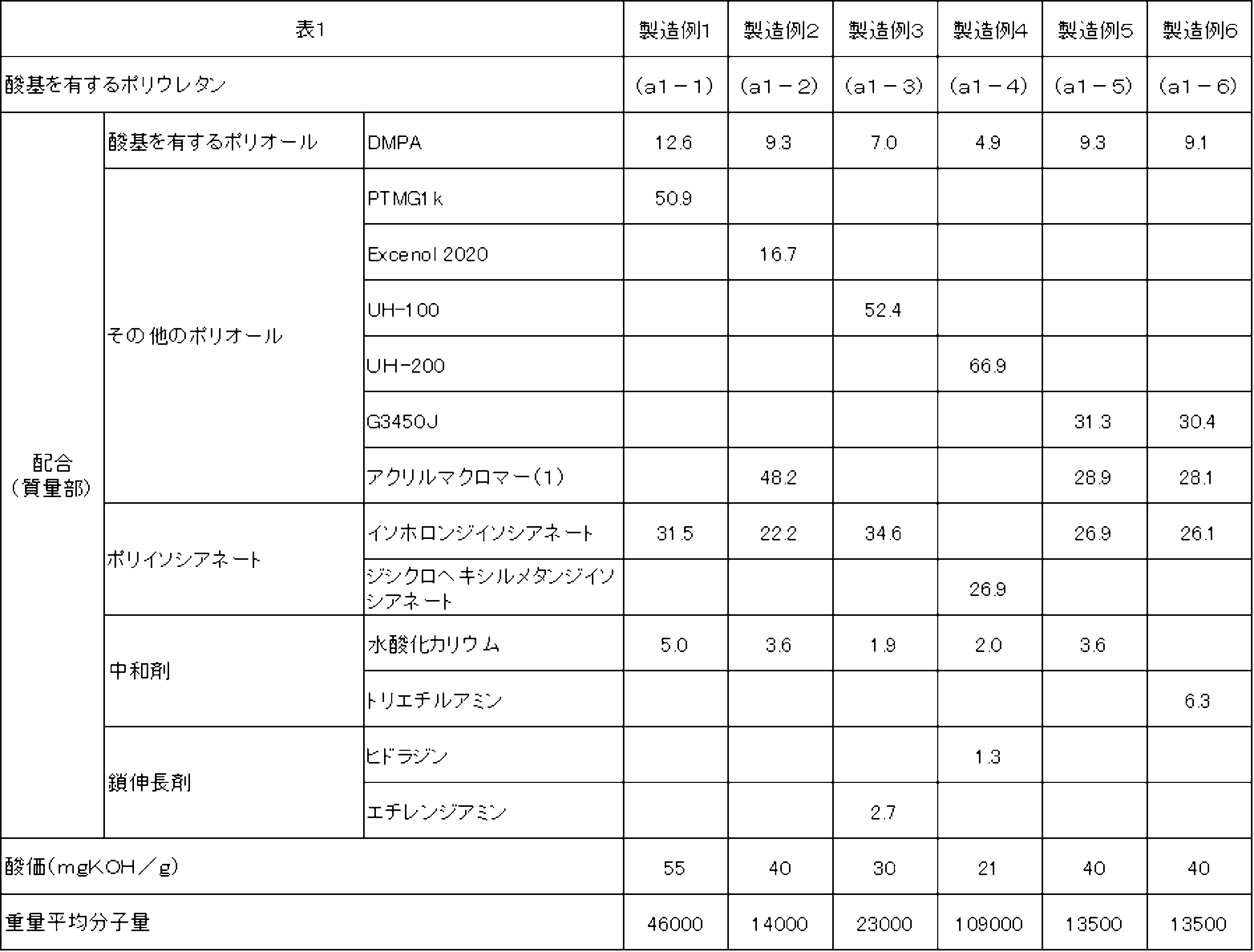
表1中の略号は下記の通りである。
PTMG1k:三菱ケミカル製「PTMG1000」;数平均分子量1000のポリテトラメチレンエーテルグリコール
Excenol 2020:AGC製「Excenol 2020」;数平均分子量2000のポリプロピレングリコール
UH-100:宇部興産製「ETERNACOLL UH-100」;数平均分子量1000の結晶性ポリカーボネートジオール
UH-200:宇部興産製「ETERNACOLL UH-200」;数平均分子量2000の結晶性ポリカーボネートジオール
G3450J:旭化成製「DURANOL G3450J」;数平均分子量800の非晶性ポリカーボネートジオール
The abbreviations in Table 1 are as follows.
PTMG1k: Mitsubishi Chemical's "PTMG1000"; polytetramethylene ether glycol with a number average molecular weight of 1000. Excenol 2020: AGC's "Excenol 2020"; polypropylene glycol with a number average molecular weight of 2000. UH-100: Ube Industries'"ETERNACOLLUH-100"; crystalline polycarbonate diol with a number average molecular weight of 1000.
UH-200: "ETERNACOLL UH-200" manufactured by Ube Industries; crystalline polycarbonate diol with a number average molecular weight of 2000. G3450J: "DURANOL G3450J" manufactured by Asahi Kasei; amorphous polycarbonate diol with a number average molecular weight of 800.
(実施例1:水性インクジェットインク用バインダー(1)の製造)
製造例1で得た酸基を有するポリウレタン(a1-1)の水分散体233.40質量部にイオン交換水236.59質量部を加え、イソプレン29.99質量部、及びスチレン0.01質量部を過硫酸アンモニウム(APS)0.01質量部でモノマー一括乳化重合(反応温度80℃)の条件下で反応させて、次に未反応モノマー除去の濃縮を行い、水分量を20質量%に調整し水性インクジェットインク用バインダー(1)を得た。質量比(a1/a2)は、70/30であった。また、複合樹脂の粒度分布は単一のピークを示し、コアシェル粒子を形成していることが確認され、平均粒子径は40nmであった。
(Example 1: Production of binder (1) for aqueous inkjet ink)
236.59 parts by mass of ion-exchanged water was added to 233.40 parts by mass of the aqueous dispersion of polyurethane (a1-1) having an acid group obtained in Production Example 1, and 29.99 parts by mass of isoprene and 0.01 parts by mass of styrene were reacted with 0.01 parts by mass of ammonium persulfate (APS) under the condition of monomer batch emulsion polymerization (reaction temperature 80°C), and then the mixture was concentrated to remove unreacted monomers, and the water content was adjusted to 20% by mass to obtain a binder (1) for aqueous inkjet inks. The mass ratio (a1/a2) was 70/30. In addition, the particle size distribution of the composite resin showed a single peak, and it was confirmed that core-shell particles were formed, and the average particle size was 40 nm.
(実施例2~6:水性インクジェットインク用バインダー(2)~(6)の製造)
実施例1で使用した酸基を有するポリウレタン(a1-1)の水分散体を、酸基を有するポリウレタン(a1-2)~(a1-6)の水分散体に変更した以外は、実施例1と同様にして、水性インクジェットインク用バインダー(2)~(6)を得た。質量比(a1/a2)は、全て70/30であった。また、複合樹脂の粒度分布は単一のピークを示し、コアシェル粒子を形成していることが確認され、平均粒子径は水性インクジェットインク用バインダー(2)が111nm、水性インクジェットインク用バインダー(3)が95nm、水性インクジェットインク用バインダー(4)が42nm、水性インクジェットインク用バインダー(5)が33nm、水性インクジェットインク用バインダー(6)が38nmであった。
(Examples 2 to 6: Production of binders (2) to (6) for aqueous inkjet inks)
Binders (2) to (6) for aqueous inkjet inks were obtained in the same manner as in Example 1, except that the aqueous dispersion of polyurethane (a1-1) having an acid group used in Example 1 was changed to aqueous dispersions of polyurethanes (a1-2) to (a1-6) having an acid group. The mass ratio (a1/a2) was 70/30 in all cases. The particle size distribution of the composite resin showed a single peak, confirming the formation of core-shell particles, and the average particle diameters were 111 nm for binder (2) for aqueous inkjet ink, 95 nm for binder (3), 42 nm for binder (4), 33 nm for binder (5), and 38 nm for binder (6).
(比較例1:水性インクジェットインク用バインダー(R1))
製造例1で得た酸基を有するポリウレタン(a1-1)の水分散体を、水性インクジェットインク用バインダー(R1)とした。
(Comparative Example 1: Binder for Water-Based Inkjet Ink (R1))
The aqueous dispersion of the polyurethane (a1-1) having an acid group obtained in Production Example 1 was used as a binder (R1) for aqueous inkjet inks.
[顔料分散体の製造]
ミニプラネタリーミキサー(株式会社愛工舎mini-PLM)の0.5Lジャケット付タンクに、50質量部のC.I.ピグメントレッド122(DIC株式会社製「FASTOGEN Super Magenta RY」)C.I.ピグメントブルー15:3(DIC株式会社製、SBG-SD)、10質量部のスチレン-アクリル酸共重合体(重量平均分子量11,000、酸価180 mgKOH/g)を順番に投入し、ジャケット付タンクの温度を80℃に加温した状態で、自転回転数80rpm、公転回転数25rpmで10分間撹拌した。
次に、ジャケット付タンクの温度を80℃に保温した状態で、5.3質量部の34質量%水酸化カリウム水溶液、30質量部のトリエチレングリコールを前記組成物に加え、自転回転数80rpm、公転回転数25rpmで60分間混練を行うことによって、固形状の混練物を得た。
前記混練物に、イオン交換水100質量部とトリエチレングリコール10質量部を加え、ジューサーミキサーで10分間攪拌混合した。イオン交換水とProxel-GXL(ロンザジャパン株式会社)を混合することによって、顔料濃度が15.0質量%、トリエチレングリコール濃度が12.0質量%、Proxel-GXL濃度が0.1質量%、不揮発分が18.2質量%の水性顔料分散体を得た。
[Preparation of pigment dispersion]
Into a 0.5 L jacketed tank of a mini planetary mixer (Aikosha mini-PLM Co., Ltd.), 50 parts by mass of C.I. Pigment Red 122 (DIC Corporation's "FASTOGEN Super Magenta RY"), C.I. Pigment Blue 15:3 (DIC Corporation, SBG-SD), and 10 parts by mass of styrene-acrylic acid copolymer (weight average molecular weight 11,000, acid value 180 mgKOH/g) were sequentially charged, and the temperature of the jacketed tank was heated to 80 ° C., and the mixture was stirred for 10 minutes at a rotation speed of 80 rpm and a revolution speed of 25 rpm.
Next, with the temperature of the jacketed tank kept at 80°C, 5.3 parts by mass of a 34% by mass aqueous potassium hydroxide solution and 30 parts by mass of triethylene glycol were added to the composition, and the mixture was kneaded for 60 minutes at a rotation speed of 80 rpm and an orbital speed of 25 rpm to obtain a solid kneaded product.
To the kneaded product, 100 parts by mass of ion-exchanged water and 10 parts by mass of triethylene glycol were added, and the mixture was stirred and mixed for 10 minutes using a juicer mixer. By mixing the ion-exchanged water and Proxel-GXL (Lonza Japan Co., Ltd.), an aqueous pigment dispersion having a pigment concentration of 15.0% by mass, a triethylene glycol concentration of 12.0% by mass, a Proxel-GXL concentration of 0.1% by mass, and a non-volatile content of 18.2% by mass was obtained.
[水性インクジェットインクの製造]
上記で得た顔料分散体20.0質量部、前記水性インクジェット用バインダー3.3質量部、2-ピロリジノン(BASF社製)8.0質量部、トリエチレングリコールモノ-n-ブチルエーテル(東京化成工業株式会社製)8.0質量部、グリセリン(花王株式会社製)3.0質量部、サーフィノール440(非イオン系界面活性剤、エボニックジャパン株式会社製)0.5質量部、イオン交換水57.3質量部を1時間撹拌した。
次に、5質量%水酸化カリウム水溶液を用いpHを9~9.8の範囲内に調整したものを、孔径5~10μmのフィルターでろ過することによって、水性インクジェットインク(顔料濃度3.0%、ウレタン固形分濃度1.0%)を得た。
[Production of Water-Based Inkjet Inks]
20.0 parts by mass of the pigment dispersion obtained above, 3.3 parts by mass of the aqueous inkjet binder, 8.0 parts by mass of 2-pyrrolidinone (manufactured by BASF), 8.0 parts by mass of triethylene glycol mono-n-butyl ether (manufactured by Tokyo Chemical Industry Co., Ltd.), 3.0 parts by mass of glycerin (manufactured by Kao Corporation), 0.5 parts by mass of Surfynol 440 (nonionic surfactant, manufactured by Evonik Japan Ltd.), and 57.3 parts by mass of ion-exchanged water were stirred for 1 hour.
Next, the pH was adjusted to within the range of 9 to 9.8 using a 5% by mass aqueous solution of potassium hydroxide, and the solution was filtered through a filter having a pore size of 5 to 10 μm to obtain an aqueous inkjet ink (pigment concentration 3.0%, urethane solids concentration 1.0%).
[耐擦過性の評価]
上記で得た水性インクジェットインクを市販のインクジェットプリンターENVY4500(HP社製)ブランクインクカートリッジに充填し、写真印刷用紙(HPアドバンスフォトペーパー HP社製)の印刷面に印字濃度設定100%のベタ印刷を行った。印刷物を常温下で1分間乾燥した後、学振式摩擦試験機を用いて荷重200gの条件にて印刷士紙と同じ紙で印刷面を3往復摩擦させた。
次に、前記印刷物の印刷面をスキャン処理して画像データ化し、下記の式に基づきピクセル残存率(%)を算出し、下記の基準により、耐擦過性を評価した。
ピクセル残存率(%)=(擦過試験後の着色部のピクセル数)/(擦過試験前の着色部のピクセル数)×100
〇:40%以上
△:20%以上40%未満
×:20%未満
[Evaluation of Scratch Resistance]
The aqueous inkjet ink obtained above was filled into a blank ink cartridge of a commercially available inkjet printer ENVY4500 (manufactured by HP Corporation), and a solid print was performed on the printing surface of photo printing paper (HP Advance Photo Paper, manufactured by HP Corporation) with a print density setting of 100%. The printed matter was dried at room temperature for 1 minute, and then the printed surface was rubbed three times back and forth with the same paper as the printer's paper using a Gakushin type friction tester under a load of 200 g.
Next, the printed surface of the printed matter was scanned to convert it into image data, and the pixel survival rate (%) was calculated based on the following formula, and the scratch resistance was evaluated based on the following criteria.
Pixel remaining rate (%)=(number of pixels in colored part after abrasion test)/(number of pixels in colored part before abrasion test)×100
◯: 40% or more △: 20% or more but less than 40% ×: Less than 20%
[耐洗濯性の評価]
綿ブロード全面を染色後、150℃で5分間乾燥させた。その後JISL0844:2011に基づいて調製した洗濯液を50℃に加温し、前記綿ブロードを浸漬(30分間)させた。次いでフードミキサー中で1分間攪拌させ、取り出した試験用サンプルを水で洗った後乾燥した。積分球分光測色計X-Riteでミキサー攪拌後の綿ブロードの光学濃度(OD)を測定した。下記の式に基づきOD保持率(%)を算出し、下記の基準により、耐洗濯性を評価した。
OD保持率(%)=(攪拌後の綿ブロードのOD)/(洗濯液浸漬前の綿ブロードのOD)×100
〇:50%以上
△:45%以上50%未満
×:45%未満
[Evaluation of washing resistance]
After dyeing the entire surface of the cotton broadcloth, it was dried at 150°C for 5 minutes. After that, a washing liquid prepared based on JIS L0844:2011 was heated to 50°C, and the cotton broadcloth was immersed (30 minutes). Then, it was stirred in a food mixer for 1 minute, and the test sample was taken out, washed with water, and then dried. The optical density (OD) of the cotton broadcloth after stirring in the mixer was measured using an integrating sphere spectrophotometer X-Rite. The OD retention rate (%) was calculated based on the following formula, and the wash resistance was evaluated according to the following criteria.
OD retention rate (%)=(OD of cotton broadcloth after stirring)/(OD of cotton broadcloth before immersion in laundry liquid)×100
◯: 50% or more △: 45% or more but less than 50% ×: Less than 45%
上記で得た水性インクジェットインク用バインダー(1)~(5)及び(R1)の配合及び評価結果を表2に示す。The formulations and evaluation results of the aqueous inkjet ink binders (1) to (5) and (R1) obtained above are shown in Table 2.
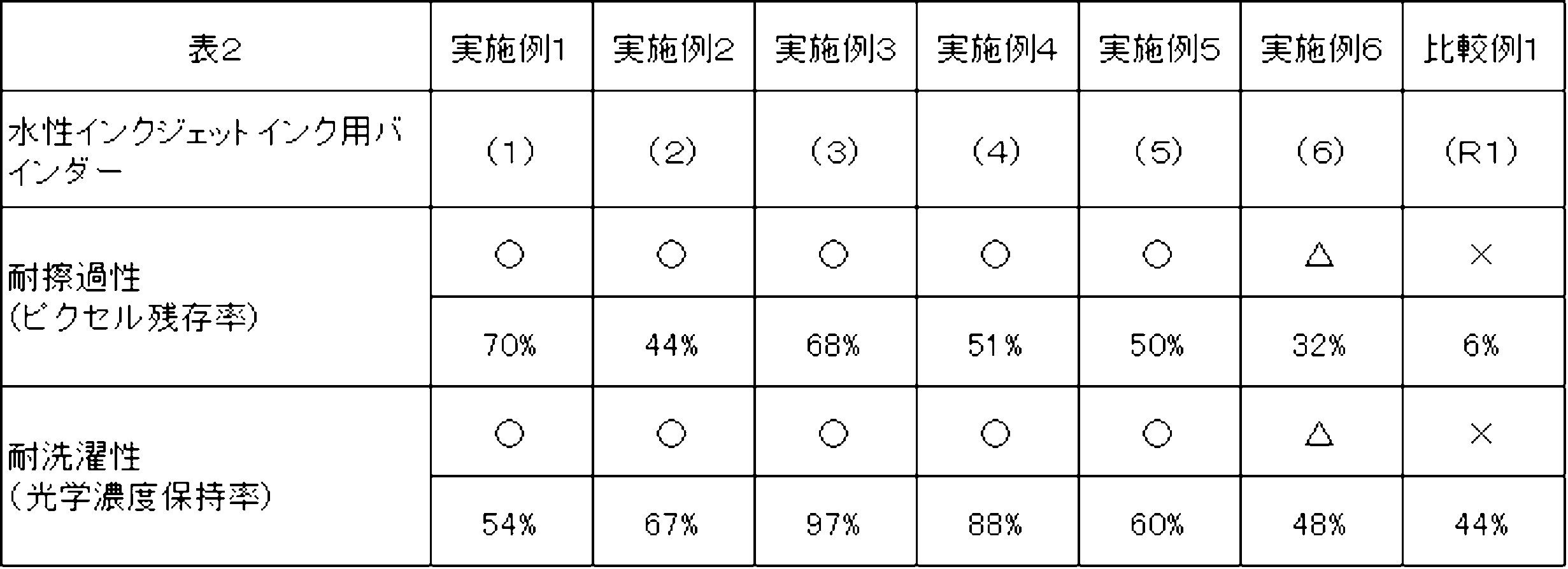
本発明の水性インクジェットインク用バインダーである実施例1~6から得られる印刷物は、耐擦過性及び耐洗濯性に優れることが確認された。 It was confirmed that the printed matter obtained from Examples 1 to 6, which are binders for aqueous inkjet inks of the present invention, has excellent abrasion resistance and washing resistance.
一方、比較例1は、本発明の必須成分であるラテックス(a2)を含まないウレタン樹脂を用いた例であるが、得られる印刷物は耐擦過性及び耐洗濯性に劣ることが確認された。On the other hand, Comparative Example 1 is an example in which a urethane resin that does not contain latex (a2), which is an essential component of the present invention, was used, and it was confirmed that the resulting printed matter had poor abrasion resistance and washing resistance.
Claims (6)
Applications Claiming Priority (3)
| Application Number | Priority Date | Filing Date | Title |
|---|---|---|---|
| JP2021176291 | 2021-10-28 | ||
| JP2021176291 | 2021-10-28 | ||
| PCT/JP2022/039034 WO2023074513A1 (en) | 2021-10-28 | 2022-10-20 | Binder for aqueous inkjet inks, aqueous inkjet ink, and printed layer |
Publications (2)
| Publication Number | Publication Date |
|---|---|
| JPWO2023074513A1 JPWO2023074513A1 (en) | 2023-05-04 |
| JP7517618B2 true JP7517618B2 (en) | 2024-07-17 |
Family
ID=86159426
Family Applications (1)
| Application Number | Title | Priority Date | Filing Date |
|---|---|---|---|
| JP2023556367A Active JP7517618B2 (en) | 2021-10-28 | 2022-10-20 | Binder for aqueous inkjet ink, aqueous inkjet ink, and printed layer |
Country Status (5)
| Country | Link |
|---|---|
| US (1) | US20240409761A1 (en) |
| EP (1) | EP4394004A4 (en) |
| JP (1) | JP7517618B2 (en) |
| CN (1) | CN117999323B (en) |
| WO (1) | WO2023074513A1 (en) |
Families Citing this family (1)
| Publication number | Priority date | Publication date | Assignee | Title |
|---|---|---|---|---|
| JP7635858B2 (en) * | 2021-10-28 | 2025-02-26 | Dic株式会社 | Binder for aqueous inkjet ink, aqueous inkjet ink, and printed layer |
Citations (4)
| Publication number | Priority date | Publication date | Assignee | Title |
|---|---|---|---|---|
| JP2012246486A (en) | 2010-11-30 | 2012-12-13 | Dic Corp | Binder for inkjet printing ink, ink for inkjet printing, printed matter, and method for producing binder |
| JP2013194206A (en) | 2012-03-22 | 2013-09-30 | Dic Corp | Method for producing binder for inkjet printing ink, inkjet printing ink, and printed matter |
| JP2013199606A (en) | 2012-03-26 | 2013-10-03 | Dic Corp | Method of producing binder for inkjet printing ink, inkjet printing ink and printed matter |
| JP2016520667A (en) | 2013-03-14 | 2016-07-14 | キャボット コーポレイションCabot Corporation | Core shell polymer material |
Family Cites Families (12)
| Publication number | Priority date | Publication date | Assignee | Title |
|---|---|---|---|---|
| JP3289314B2 (en) * | 1992-06-17 | 2002-06-04 | 大日本インキ化学工業株式会社 | Aqueous coating composition |
| JPH0631788A (en) * | 1992-07-21 | 1994-02-08 | Dainippon Ink & Chem Inc | Packaging material manufacturing method |
| JP3972373B2 (en) * | 1994-08-25 | 2007-09-05 | 大日本インキ化学工業株式会社 | Aqueous printing ink composition and method for producing the same |
| JP3770011B2 (en) * | 1999-11-16 | 2006-04-26 | セイコーエプソン株式会社 | Recording method for printing on recording medium using two liquids |
| JP2004149600A (en) * | 2002-10-29 | 2004-05-27 | Sharp Corp | Aqueous ink composition, ink for ink jet recording, ink jet recording method, and recorded matter |
| US8939568B2 (en) * | 2010-04-14 | 2015-01-27 | Hewlett-Packard Development Company, L.P. | Ink composition containing polyurethane vinyl hybrid latexes |
| JP4984196B1 (en) * | 2010-11-30 | 2012-07-25 | Dic株式会社 | Ink jet printing ink binder, ink jet printing ink containing the same, and printed matter |
| JP2012246460A (en) * | 2011-05-31 | 2012-12-13 | Seiko Epson Corp | Ink composition and inkjet recording method |
| JP6119919B2 (en) | 2014-12-24 | 2017-04-26 | Dic株式会社 | Printing agents and fabrics |
| JP7201422B2 (en) * | 2018-12-21 | 2023-01-10 | サカタインクス株式会社 | Active energy ray-curable flexographic printing ink composition |
| JP7190957B2 (en) * | 2019-04-03 | 2022-12-16 | サカタインクス株式会社 | Active energy ray-curable flexographic printing ink composition |
| JP2021155557A (en) * | 2020-03-27 | 2021-10-07 | セイコーエプソン株式会社 | Inkjet ink composition, ink set, inkjet recording method |
-
2022
- 2022-10-20 US US18/699,442 patent/US20240409761A1/en active Pending
- 2022-10-20 WO PCT/JP2022/039034 patent/WO2023074513A1/en not_active Ceased
- 2022-10-20 EP EP22886841.0A patent/EP4394004A4/en active Pending
- 2022-10-20 JP JP2023556367A patent/JP7517618B2/en active Active
- 2022-10-20 CN CN202280063412.2A patent/CN117999323B/en active Active
Patent Citations (4)
| Publication number | Priority date | Publication date | Assignee | Title |
|---|---|---|---|---|
| JP2012246486A (en) | 2010-11-30 | 2012-12-13 | Dic Corp | Binder for inkjet printing ink, ink for inkjet printing, printed matter, and method for producing binder |
| JP2013194206A (en) | 2012-03-22 | 2013-09-30 | Dic Corp | Method for producing binder for inkjet printing ink, inkjet printing ink, and printed matter |
| JP2013199606A (en) | 2012-03-26 | 2013-10-03 | Dic Corp | Method of producing binder for inkjet printing ink, inkjet printing ink and printed matter |
| JP2016520667A (en) | 2013-03-14 | 2016-07-14 | キャボット コーポレイションCabot Corporation | Core shell polymer material |
Also Published As
| Publication number | Publication date |
|---|---|
| CN117999323B (en) | 2026-01-27 |
| US20240409761A1 (en) | 2024-12-12 |
| JPWO2023074513A1 (en) | 2023-05-04 |
| EP4394004A1 (en) | 2024-07-03 |
| CN117999323A (en) | 2024-05-07 |
| WO2023074513A1 (en) | 2023-05-04 |
| EP4394004A4 (en) | 2025-01-15 |
Similar Documents
| Publication | Publication Date | Title |
|---|---|---|
| TWI445780B (en) | Pigment dispersion and water-based pigmented jet inks | |
| JP4984196B1 (en) | Ink jet printing ink binder, ink jet printing ink containing the same, and printed matter | |
| JP5170345B2 (en) | Binder for inkjet printing ink, ink for inkjet printing, printed matter, and method for producing binder | |
| JP6119919B2 (en) | Printing agents and fabrics | |
| JP6447776B2 (en) | Pigment dispersant, aqueous pigment dispersion, and method for producing aqueous pigment dispersion | |
| JP2019094377A (en) | Aqueous recording liquid set, and method for manufacturing printed matter using the same | |
| CN107208365B (en) | Printing agent, fabric and manufacturing method of printing agent | |
| JP6866613B2 (en) | Core-shell modified pigments and aqueous pigment dispersions | |
| JPWO2018207636A1 (en) | PRINTING AGENT, INKJET RECORDING PRINTING AGENT, PRINTED MATERIAL AND MANUFACTURING METHOD | |
| CN117999323B (en) | Binder for aqueous inkjet ink, and printed layer | |
| JP6797349B2 (en) | Method for manufacturing water-based pigment dispersion and water-based ink for inkjet recording | |
| JP7635858B2 (en) | Binder for aqueous inkjet ink, aqueous inkjet ink, and printed layer | |
| US10240054B2 (en) | Method for manufacturing aqueous pigment dispersion and aqueous ink for inkjet recording | |
| JP7332071B2 (en) | Binder resin composition for water-based inkjet ink, water-based inkjet ink, and printing layer | |
| JP2017226935A (en) | Printing agents and fabrics | |
| JP7625850B2 (en) | Binder resin composition for aqueous inkjet ink, aqueous inkjet ink and printed layer | |
| JP6886601B2 (en) | Printed matter manufacturing method | |
| JP6650126B2 (en) | Textiles and fabrics | |
| JP2021183731A (en) | Method for producing printed matter | |
| JP7772271B2 (en) | Binder for inkjet printing ink, inkjet printing ink and printed matter | |
| JP6435917B2 (en) | Aqueous pigment dispersion and aqueous ink | |
| JP2010195965A (en) | Binder for ink-jet pigment ink | |
| WO2025115737A1 (en) | Aqueous ink composition for inkjet printing, and printed matter | |
| WO2025204496A1 (en) | Ink for textile printing, ink set for textile printing, and textile printing method | |
| JP6579357B2 (en) | Aqueous pigment dispersion and aqueous ink |
Legal Events
| Date | Code | Title | Description |
|---|---|---|---|
| A621 | Written request for application examination |
Free format text: JAPANESE INTERMEDIATE CODE: A621 Effective date: 20231128 |
|
| A871 | Explanation of circumstances concerning accelerated examination |
Free format text: JAPANESE INTERMEDIATE CODE: A871 Effective date: 20231128 |
|
| A131 | Notification of reasons for refusal |
Free format text: JAPANESE INTERMEDIATE CODE: A131 Effective date: 20240213 |
|
| A521 | Request for written amendment filed |
Free format text: JAPANESE INTERMEDIATE CODE: A523 Effective date: 20240411 |
|
| TRDD | Decision of grant or rejection written | ||
| A01 | Written decision to grant a patent or to grant a registration (utility model) |
Free format text: JAPANESE INTERMEDIATE CODE: A01 Effective date: 20240604 |
|
| A61 | First payment of annual fees (during grant procedure) |
Free format text: JAPANESE INTERMEDIATE CODE: A61 Effective date: 20240617 |
|
| R150 | Certificate of patent or registration of utility model |
Ref document number: 7517618 Country of ref document: JP Free format text: JAPANESE INTERMEDIATE CODE: R150 |