JP7501552B2 - Method for producing polybutylene terephthalate - Google Patents
Method for producing polybutylene terephthalate Download PDFInfo
- Publication number
- JP7501552B2 JP7501552B2 JP2022012059A JP2022012059A JP7501552B2 JP 7501552 B2 JP7501552 B2 JP 7501552B2 JP 2022012059 A JP2022012059 A JP 2022012059A JP 2022012059 A JP2022012059 A JP 2022012059A JP 7501552 B2 JP7501552 B2 JP 7501552B2
- Authority
- JP
- Japan
- Prior art keywords
- pbt
- producing
- acid
- polybutylene terephthalate
- ppm
- Prior art date
- Legal status (The legal status is an assumption and is not a legal conclusion. Google has not performed a legal analysis and makes no representation as to the accuracy of the status listed.)
- Active
Links
- 229920001707 polybutylene terephthalate Polymers 0.000 title claims description 146
- 238000004519 manufacturing process Methods 0.000 title claims description 49
- -1 polybutylene terephthalate Polymers 0.000 title claims description 39
- QTBSBXVTEAMEQO-UHFFFAOYSA-N Acetic acid Chemical compound CC(O)=O QTBSBXVTEAMEQO-UHFFFAOYSA-N 0.000 claims description 141
- KKEYFWRCBNTPAC-UHFFFAOYSA-N Terephthalic acid Chemical compound OC(=O)C1=CC=C(C(O)=O)C=C1 KKEYFWRCBNTPAC-UHFFFAOYSA-N 0.000 claims description 100
- 239000002994 raw material Substances 0.000 claims description 38
- 238000000465 moulding Methods 0.000 claims description 27
- 150000001875 compounds Chemical class 0.000 claims description 23
- LPNBBFKOUUSUDB-UHFFFAOYSA-N p-toluic acid Chemical compound CC1=CC=C(C(O)=O)C=C1 LPNBBFKOUUSUDB-UHFFFAOYSA-N 0.000 claims description 22
- 229920005989 resin Polymers 0.000 claims description 21
- 239000011347 resin Substances 0.000 claims description 21
- OFOBLEOULBTSOW-UHFFFAOYSA-N Malonic acid Chemical compound OC(=O)CC(O)=O OFOBLEOULBTSOW-UHFFFAOYSA-N 0.000 claims description 20
- 150000002009 diols Chemical class 0.000 claims description 14
- 239000008188 pellet Substances 0.000 claims description 14
- 125000002777 acetyl group Chemical group [H]C([H])([H])C(*)=O 0.000 claims description 12
- 238000001746 injection moulding Methods 0.000 claims description 12
- 239000000463 material Substances 0.000 claims description 12
- HUMNYLRZRPPJDN-KWCOIAHCSA-N benzaldehyde Chemical group O=[11CH]C1=CC=CC=C1 HUMNYLRZRPPJDN-KWCOIAHCSA-N 0.000 claims description 11
- 125000003944 tolyl group Chemical group 0.000 claims description 11
- GOUHYARYYWKXHS-UHFFFAOYSA-N 4-formylbenzoic acid Chemical compound OC(=O)C1=CC=C(C=O)C=C1 GOUHYARYYWKXHS-UHFFFAOYSA-N 0.000 claims description 8
- 238000004898 kneading Methods 0.000 claims description 8
- 239000012778 molding material Substances 0.000 claims description 4
- 238000000034 method Methods 0.000 description 33
- 239000000047 product Substances 0.000 description 33
- WYURNTSHIVDZCO-UHFFFAOYSA-N Tetrahydrofuran Chemical compound C1CCOC1 WYURNTSHIVDZCO-UHFFFAOYSA-N 0.000 description 26
- 235000019646 color tone Nutrition 0.000 description 24
- 239000003054 catalyst Substances 0.000 description 22
- 238000005886 esterification reaction Methods 0.000 description 22
- 229910052751 metal Inorganic materials 0.000 description 19
- 238000002425 crystallisation Methods 0.000 description 18
- 230000008025 crystallization Effects 0.000 description 18
- 239000002184 metal Substances 0.000 description 18
- 239000000243 solution Substances 0.000 description 18
- WERYXYBDKMZEQL-UHFFFAOYSA-N butane-1,4-diol Chemical compound OCCCCO WERYXYBDKMZEQL-UHFFFAOYSA-N 0.000 description 17
- 238000006068 polycondensation reaction Methods 0.000 description 17
- RTAQQCXQSZGOHL-UHFFFAOYSA-N Titanium Chemical compound [Ti] RTAQQCXQSZGOHL-UHFFFAOYSA-N 0.000 description 16
- 239000000835 fiber Substances 0.000 description 15
- YLQBMQCUIZJEEH-UHFFFAOYSA-N tetrahydrofuran Natural products C=1C=COC=1 YLQBMQCUIZJEEH-UHFFFAOYSA-N 0.000 description 13
- 229910017052 cobalt Inorganic materials 0.000 description 12
- 239000010941 cobalt Substances 0.000 description 12
- GUTLYIVDDKVIGB-UHFFFAOYSA-N cobalt atom Chemical compound [Co] GUTLYIVDDKVIGB-UHFFFAOYSA-N 0.000 description 12
- 238000001816 cooling Methods 0.000 description 12
- 239000011572 manganese Substances 0.000 description 11
- 238000006243 chemical reaction Methods 0.000 description 10
- 238000004821 distillation Methods 0.000 description 10
- 229910052748 manganese Inorganic materials 0.000 description 10
- 229920000642 polymer Polymers 0.000 description 10
- 239000012763 reinforcing filler Substances 0.000 description 10
- 239000010936 titanium Substances 0.000 description 10
- 229910052719 titanium Inorganic materials 0.000 description 10
- 238000009835 boiling Methods 0.000 description 9
- 238000001125 extrusion Methods 0.000 description 9
- 230000000737 periodic effect Effects 0.000 description 9
- PWHULOQIROXLJO-UHFFFAOYSA-N Manganese Chemical compound [Mn] PWHULOQIROXLJO-UHFFFAOYSA-N 0.000 description 8
- 125000003178 carboxy group Chemical group [H]OC(*)=O 0.000 description 8
- 230000006866 deterioration Effects 0.000 description 8
- 238000002844 melting Methods 0.000 description 8
- 230000008018 melting Effects 0.000 description 8
- 238000010438 heat treatment Methods 0.000 description 7
- 238000006116 polymerization reaction Methods 0.000 description 7
- 125000000391 vinyl group Chemical group [H]C([*])=C([H])[H] 0.000 description 7
- XLYOFNOQVPJJNP-UHFFFAOYSA-N water Substances O XLYOFNOQVPJJNP-UHFFFAOYSA-N 0.000 description 7
- OKKJLVBELUTLKV-UHFFFAOYSA-N Methanol Chemical compound OC OKKJLVBELUTLKV-UHFFFAOYSA-N 0.000 description 6
- KWYUFKZDYYNOTN-UHFFFAOYSA-M Potassium hydroxide Chemical compound [OH-].[K+] KWYUFKZDYYNOTN-UHFFFAOYSA-M 0.000 description 6
- HEMHJVSKTPXQMS-UHFFFAOYSA-M Sodium hydroxide Chemical compound [OH-].[Na+] HEMHJVSKTPXQMS-UHFFFAOYSA-M 0.000 description 6
- QAOWNCQODCNURD-UHFFFAOYSA-N Sulfuric acid Chemical compound OS(O)(=O)=O QAOWNCQODCNURD-UHFFFAOYSA-N 0.000 description 6
- 239000003795 chemical substances by application Substances 0.000 description 6
- 230000000694 effects Effects 0.000 description 6
- 125000002887 hydroxy group Chemical group [H]O* 0.000 description 6
- 239000000155 melt Substances 0.000 description 6
- 239000000203 mixture Substances 0.000 description 6
- LYCAIKOWRPUZTN-UHFFFAOYSA-N Ethylene glycol Chemical compound OCCO LYCAIKOWRPUZTN-UHFFFAOYSA-N 0.000 description 5
- 239000000654 additive Substances 0.000 description 5
- 230000007062 hydrolysis Effects 0.000 description 5
- QPFMBZIOSGYJDE-UHFFFAOYSA-N 1,1,2,2-tetrachloroethane Chemical compound ClC(Cl)C(Cl)Cl QPFMBZIOSGYJDE-UHFFFAOYSA-N 0.000 description 4
- URLKBWYHVLBVBO-UHFFFAOYSA-N Para-Xylene Chemical group CC1=CC=C(C)C=C1 URLKBWYHVLBVBO-UHFFFAOYSA-N 0.000 description 4
- ISWSIDIOOBJBQZ-UHFFFAOYSA-N Phenol Chemical compound OC1=CC=CC=C1 ISWSIDIOOBJBQZ-UHFFFAOYSA-N 0.000 description 4
- NBIIXXVUZAFLBC-UHFFFAOYSA-N Phosphoric acid Chemical compound OP(O)(O)=O NBIIXXVUZAFLBC-UHFFFAOYSA-N 0.000 description 4
- ADCOVFLJGNWWNZ-UHFFFAOYSA-N antimony trioxide Chemical compound O=[Sb]O[Sb]=O ADCOVFLJGNWWNZ-UHFFFAOYSA-N 0.000 description 4
- 238000013329 compounding Methods 0.000 description 4
- 230000007797 corrosion Effects 0.000 description 4
- 238000005260 corrosion Methods 0.000 description 4
- 150000002148 esters Chemical group 0.000 description 4
- 238000011156 evaluation Methods 0.000 description 4
- 230000002349 favourable effect Effects 0.000 description 4
- 239000003063 flame retardant Substances 0.000 description 4
- 238000006460 hydrolysis reaction Methods 0.000 description 4
- 239000011256 inorganic filler Substances 0.000 description 4
- 229910003475 inorganic filler Inorganic materials 0.000 description 4
- WPBNNNQJVZRUHP-UHFFFAOYSA-L manganese(2+);methyl n-[[2-(methoxycarbonylcarbamothioylamino)phenyl]carbamothioyl]carbamate;n-[2-(sulfidocarbothioylamino)ethyl]carbamodithioate Chemical compound [Mn+2].[S-]C(=S)NCCNC([S-])=S.COC(=O)NC(=S)NC1=CC=CC=C1NC(=S)NC(=O)OC WPBNNNQJVZRUHP-UHFFFAOYSA-L 0.000 description 4
- 150000003018 phosphorus compounds Chemical class 0.000 description 4
- 239000002904 solvent Substances 0.000 description 4
- 239000012756 surface treatment agent Substances 0.000 description 4
- 150000003609 titanium compounds Chemical class 0.000 description 4
- FLVQOAUAIBIIGO-UHFFFAOYSA-N 4-hydroxybutyl acetate Chemical compound CC(=O)OCCCCO FLVQOAUAIBIIGO-UHFFFAOYSA-N 0.000 description 3
- WVDDGKGOMKODPV-UHFFFAOYSA-N Benzyl alcohol Chemical compound OCC1=CC=CC=C1 WVDDGKGOMKODPV-UHFFFAOYSA-N 0.000 description 3
- PEDCQBHIVMGVHV-UHFFFAOYSA-N Glycerine Chemical group OCC(O)CO PEDCQBHIVMGVHV-UHFFFAOYSA-N 0.000 description 3
- 239000002253 acid Substances 0.000 description 3
- 229940058905 antimony compound for treatment of leishmaniasis and trypanosomiasis Drugs 0.000 description 3
- 150000001463 antimony compounds Chemical class 0.000 description 3
- IISBACLAFKSPIT-UHFFFAOYSA-N bisphenol A Chemical compound C=1C=C(O)C=CC=1C(C)(C)C1=CC=C(O)C=C1 IISBACLAFKSPIT-UHFFFAOYSA-N 0.000 description 3
- YHWCPXVTRSHPNY-UHFFFAOYSA-N butan-1-olate;titanium(4+) Chemical compound [Ti+4].CCCC[O-].CCCC[O-].CCCC[O-].CCCC[O-] YHWCPXVTRSHPNY-UHFFFAOYSA-N 0.000 description 3
- 230000000052 comparative effect Effects 0.000 description 3
- 230000032050 esterification Effects 0.000 description 3
- 238000009616 inductively coupled plasma Methods 0.000 description 3
- 239000007788 liquid Substances 0.000 description 3
- 229910052749 magnesium Inorganic materials 0.000 description 3
- 239000011777 magnesium Substances 0.000 description 3
- 150000002681 magnesium compounds Chemical class 0.000 description 3
- VTHJTEIRLNZDEV-UHFFFAOYSA-L magnesium dihydroxide Chemical compound [OH-].[OH-].[Mg+2] VTHJTEIRLNZDEV-UHFFFAOYSA-L 0.000 description 3
- 239000000347 magnesium hydroxide Substances 0.000 description 3
- 229910001862 magnesium hydroxide Inorganic materials 0.000 description 3
- 150000002736 metal compounds Chemical class 0.000 description 3
- 150000002739 metals Chemical class 0.000 description 3
- 239000012046 mixed solvent Substances 0.000 description 3
- 238000002156 mixing Methods 0.000 description 3
- UTOPWMOLSKOLTQ-UHFFFAOYSA-N octacosanoic acid Chemical compound CCCCCCCCCCCCCCCCCCCCCCCCCCCC(O)=O UTOPWMOLSKOLTQ-UHFFFAOYSA-N 0.000 description 3
- 230000000704 physical effect Effects 0.000 description 3
- 238000011084 recovery Methods 0.000 description 3
- 239000002002 slurry Substances 0.000 description 3
- 239000003381 stabilizer Substances 0.000 description 3
- 239000000126 substance Substances 0.000 description 3
- 238000005979 thermal decomposition reaction Methods 0.000 description 3
- 229920005992 thermoplastic resin Polymers 0.000 description 3
- 239000002699 waste material Substances 0.000 description 3
- RNFJDJUURJAICM-UHFFFAOYSA-N 2,2,4,4,6,6-hexaphenoxy-1,3,5-triaza-2$l^{5},4$l^{5},6$l^{5}-triphosphacyclohexa-1,3,5-triene Chemical compound N=1P(OC=2C=CC=CC=2)(OC=2C=CC=CC=2)=NP(OC=2C=CC=CC=2)(OC=2C=CC=CC=2)=NP=1(OC=1C=CC=CC=1)OC1=CC=CC=C1 RNFJDJUURJAICM-UHFFFAOYSA-N 0.000 description 2
- FJKROLUGYXJWQN-UHFFFAOYSA-N 4-hydroxybenzoic acid Chemical compound OC(=O)C1=CC=C(O)C=C1 FJKROLUGYXJWQN-UHFFFAOYSA-N 0.000 description 2
- VTYYLEPIZMXCLO-UHFFFAOYSA-L Calcium carbonate Chemical compound [Ca+2].[O-]C([O-])=O VTYYLEPIZMXCLO-UHFFFAOYSA-L 0.000 description 2
- AEMRFAOFKBGASW-UHFFFAOYSA-N Glycolic acid Chemical compound OCC(O)=O AEMRFAOFKBGASW-UHFFFAOYSA-N 0.000 description 2
- FYYHWMGAXLPEAU-UHFFFAOYSA-N Magnesium Chemical compound [Mg] FYYHWMGAXLPEAU-UHFFFAOYSA-N 0.000 description 2
- 229920000877 Melamine resin Polymers 0.000 description 2
- GRYLNZFGIOXLOG-UHFFFAOYSA-N Nitric acid Chemical compound O[N+]([O-])=O GRYLNZFGIOXLOG-UHFFFAOYSA-N 0.000 description 2
- 239000004698 Polyethylene Substances 0.000 description 2
- GWEVSGVZZGPLCZ-UHFFFAOYSA-N Titan oxide Chemical compound O=[Ti]=O GWEVSGVZZGPLCZ-UHFFFAOYSA-N 0.000 description 2
- HEDRZPFGACZZDS-MICDWDOJSA-N Trichloro(2H)methane Chemical compound [2H]C(Cl)(Cl)Cl HEDRZPFGACZZDS-MICDWDOJSA-N 0.000 description 2
- MCMNRKCIXSYSNV-UHFFFAOYSA-N Zirconium dioxide Chemical compound O=[Zr]=O MCMNRKCIXSYSNV-UHFFFAOYSA-N 0.000 description 2
- 238000010521 absorption reaction Methods 0.000 description 2
- WNLRTRBMVRJNCN-UHFFFAOYSA-N adipic acid Chemical compound OC(=O)CCCCC(O)=O WNLRTRBMVRJNCN-UHFFFAOYSA-N 0.000 description 2
- 125000003172 aldehyde group Chemical group 0.000 description 2
- LJCFOYOSGPHIOO-UHFFFAOYSA-N antimony pentoxide Chemical compound O=[Sb](=O)O[Sb](=O)=O LJCFOYOSGPHIOO-UHFFFAOYSA-N 0.000 description 2
- 239000003963 antioxidant agent Substances 0.000 description 2
- TZCXTZWJZNENPQ-UHFFFAOYSA-L barium sulfate Chemical compound [Ba+2].[O-]S([O-])(=O)=O TZCXTZWJZNENPQ-UHFFFAOYSA-L 0.000 description 2
- QMKYBPDZANOJGF-UHFFFAOYSA-N benzene-1,3,5-tricarboxylic acid Chemical group OC(=O)C1=CC(C(O)=O)=CC(C(O)=O)=C1 QMKYBPDZANOJGF-UHFFFAOYSA-N 0.000 description 2
- WPYMKLBDIGXBTP-UHFFFAOYSA-N benzoic acid Chemical compound OC(=O)C1=CC=CC=C1 WPYMKLBDIGXBTP-UHFFFAOYSA-N 0.000 description 2
- 239000006227 byproduct Substances 0.000 description 2
- 239000011575 calcium Substances 0.000 description 2
- 229910052791 calcium Inorganic materials 0.000 description 2
- 229940043430 calcium compound Drugs 0.000 description 2
- 150000001674 calcium compounds Chemical class 0.000 description 2
- 230000003197 catalytic effect Effects 0.000 description 2
- PFURGBBHAOXLIO-UHFFFAOYSA-N cyclohexane-1,2-diol Chemical compound OC1CCCCC1O PFURGBBHAOXLIO-UHFFFAOYSA-N 0.000 description 2
- 230000007547 defect Effects 0.000 description 2
- 238000003795 desorption Methods 0.000 description 2
- WOZVHXUHUFLZGK-UHFFFAOYSA-N dimethyl terephthalate Chemical compound COC(=O)C1=CC=C(C(=O)OC)C=C1 WOZVHXUHUFLZGK-UHFFFAOYSA-N 0.000 description 2
- 238000005516 engineering process Methods 0.000 description 2
- 239000003822 epoxy resin Substances 0.000 description 2
- 238000000605 extraction Methods 0.000 description 2
- 239000000945 filler Substances 0.000 description 2
- LNTHITQWFMADLM-UHFFFAOYSA-N gallic acid Chemical group OC(=O)C1=CC(O)=C(O)C(O)=C1 LNTHITQWFMADLM-UHFFFAOYSA-N 0.000 description 2
- YBMRDBCBODYGJE-UHFFFAOYSA-N germanium dioxide Chemical compound O=[Ge]=O YBMRDBCBODYGJE-UHFFFAOYSA-N 0.000 description 2
- 239000011521 glass Substances 0.000 description 2
- 239000003365 glass fiber Substances 0.000 description 2
- 238000005984 hydrogenation reaction Methods 0.000 description 2
- 239000012535 impurity Substances 0.000 description 2
- 238000002347 injection Methods 0.000 description 2
- 239000007924 injection Substances 0.000 description 2
- 239000012796 inorganic flame retardant Substances 0.000 description 2
- QQVIHTHCMHWDBS-UHFFFAOYSA-N isophthalic acid Chemical compound OC(=O)C1=CC=CC(C(O)=O)=C1 QQVIHTHCMHWDBS-UHFFFAOYSA-N 0.000 description 2
- JVTAAEKCZFNVCJ-UHFFFAOYSA-N lactic acid Chemical compound CC(O)C(O)=O JVTAAEKCZFNVCJ-UHFFFAOYSA-N 0.000 description 2
- UEGPKNKPLBYCNK-UHFFFAOYSA-L magnesium acetate Chemical compound [Mg+2].CC([O-])=O.CC([O-])=O UEGPKNKPLBYCNK-UHFFFAOYSA-L 0.000 description 2
- 239000011654 magnesium acetate Substances 0.000 description 2
- 229940069446 magnesium acetate Drugs 0.000 description 2
- 235000011285 magnesium acetate Nutrition 0.000 description 2
- 238000005259 measurement Methods 0.000 description 2
- 238000000691 measurement method Methods 0.000 description 2
- 125000002496 methyl group Chemical group [H]C([H])([H])* 0.000 description 2
- 239000010445 mica Substances 0.000 description 2
- 229910052618 mica group Inorganic materials 0.000 description 2
- 238000003541 multi-stage reaction Methods 0.000 description 2
- 229910017604 nitric acid Inorganic materials 0.000 description 2
- BDJRBEYXGGNYIS-UHFFFAOYSA-N nonanedioic acid Chemical compound OC(=O)CCCCCCCC(O)=O BDJRBEYXGGNYIS-UHFFFAOYSA-N 0.000 description 2
- GLDOVTGHNKAZLK-UHFFFAOYSA-N octadecan-1-ol Chemical compound CCCCCCCCCCCCCCCCCCO GLDOVTGHNKAZLK-UHFFFAOYSA-N 0.000 description 2
- 150000002896 organic halogen compounds Chemical class 0.000 description 2
- WVDDGKGOMKODPV-ZQBYOMGUSA-N phenyl(114C)methanol Chemical compound O[14CH2]C1=CC=CC=C1 WVDDGKGOMKODPV-ZQBYOMGUSA-N 0.000 description 2
- 235000011007 phosphoric acid Nutrition 0.000 description 2
- XNGIFLGASWRNHJ-UHFFFAOYSA-N phthalic acid Chemical compound OC(=O)C1=CC=CC=C1C(O)=O XNGIFLGASWRNHJ-UHFFFAOYSA-N 0.000 description 2
- WLJVNTCWHIRURA-UHFFFAOYSA-N pimelic acid Chemical compound OC(=O)CCCCCC(O)=O WLJVNTCWHIRURA-UHFFFAOYSA-N 0.000 description 2
- BASFCYQUMIYNBI-UHFFFAOYSA-N platinum Chemical compound [Pt] BASFCYQUMIYNBI-UHFFFAOYSA-N 0.000 description 2
- 229920000515 polycarbonate Polymers 0.000 description 2
- 239000004417 polycarbonate Substances 0.000 description 2
- 229920000647 polyepoxide Polymers 0.000 description 2
- 229920000573 polyethylene Polymers 0.000 description 2
- 229920000137 polyphosphoric acid Polymers 0.000 description 2
- 238000000746 purification Methods 0.000 description 2
- CYIDZMCFTVVTJO-UHFFFAOYSA-N pyromellitic acid Chemical group OC(=O)C1=CC(C(O)=O)=C(C(O)=O)C=C1C(O)=O CYIDZMCFTVVTJO-UHFFFAOYSA-N 0.000 description 2
- CXMXRPHRNRROMY-UHFFFAOYSA-N sebacic acid Chemical compound OC(=O)CCCCCCCCC(O)=O CXMXRPHRNRROMY-UHFFFAOYSA-N 0.000 description 2
- TYFQFVWCELRYAO-UHFFFAOYSA-N suberic acid Chemical compound OC(=O)CCCCCCC(O)=O TYFQFVWCELRYAO-UHFFFAOYSA-N 0.000 description 2
- CZDYPVPMEAXLPK-UHFFFAOYSA-N tetramethylsilane Chemical compound C[Si](C)(C)C CZDYPVPMEAXLPK-UHFFFAOYSA-N 0.000 description 2
- 229920001187 thermosetting polymer Polymers 0.000 description 2
- OGIDPMRJRNCKJF-UHFFFAOYSA-N titanium oxide Inorganic materials [Ti]=O OGIDPMRJRNCKJF-UHFFFAOYSA-N 0.000 description 2
- VXUYXOFXAQZZMF-UHFFFAOYSA-N titanium(IV) isopropoxide Chemical compound CC(C)O[Ti](OC(C)C)(OC(C)C)OC(C)C VXUYXOFXAQZZMF-UHFFFAOYSA-N 0.000 description 2
- 238000004448 titration Methods 0.000 description 2
- 238000005809 transesterification reaction Methods 0.000 description 2
- KQTIIICEAUMSDG-UHFFFAOYSA-N tricarballylic acid Chemical group OC(=O)CC(C(O)=O)CC(O)=O KQTIIICEAUMSDG-UHFFFAOYSA-N 0.000 description 2
- ARCGXLSVLAOJQL-UHFFFAOYSA-N trimellitic acid Chemical group OC(=O)C1=CC=C(C(O)=O)C(C(O)=O)=C1 ARCGXLSVLAOJQL-UHFFFAOYSA-N 0.000 description 2
- HVLLSGMXQDNUAL-UHFFFAOYSA-N triphenyl phosphite Chemical compound C=1C=CC=CC=1OP(OC=1C=CC=CC=1)OC1=CC=CC=C1 HVLLSGMXQDNUAL-UHFFFAOYSA-N 0.000 description 2
- DNIAPMSPPWPWGF-VKHMYHEASA-N (+)-propylene glycol Chemical compound C[C@H](O)CO DNIAPMSPPWPWGF-VKHMYHEASA-N 0.000 description 1
- DNIAPMSPPWPWGF-GSVOUGTGSA-N (R)-(-)-Propylene glycol Chemical compound C[C@@H](O)CO DNIAPMSPPWPWGF-GSVOUGTGSA-N 0.000 description 1
- YPFDHNVEDLHUCE-UHFFFAOYSA-N 1,3-propanediol Substances OCCCO YPFDHNVEDLHUCE-UHFFFAOYSA-N 0.000 description 1
- PXGZQGDTEZPERC-UHFFFAOYSA-N 1,4-cyclohexanedicarboxylic acid Chemical compound OC(=O)C1CCC(C(O)=O)CC1 PXGZQGDTEZPERC-UHFFFAOYSA-N 0.000 description 1
- RTBFRGCFXZNCOE-UHFFFAOYSA-N 1-methylsulfonylpiperidin-4-one Chemical compound CS(=O)(=O)N1CCC(=O)CC1 RTBFRGCFXZNCOE-UHFFFAOYSA-N 0.000 description 1
- NICMVXRQHWVBAP-UHFFFAOYSA-N 2,6-ditert-butyl-4-octylphenol Chemical compound CCCCCCCCC1=CC(C(C)(C)C)=C(O)C(C(C)(C)C)=C1 NICMVXRQHWVBAP-UHFFFAOYSA-N 0.000 description 1
- DNUYOWCKBJFOGS-UHFFFAOYSA-N 2-[[10-(2,2-dicarboxyethyl)anthracen-9-yl]methyl]propanedioic acid Chemical compound C1=CC=C2C(CC(C(=O)O)C(O)=O)=C(C=CC=C3)C3=C(CC(C(O)=O)C(O)=O)C2=C1 DNUYOWCKBJFOGS-UHFFFAOYSA-N 0.000 description 1
- FGTYTUFKXYPTML-UHFFFAOYSA-N 2-benzoylbenzoic acid Chemical compound OC(=O)C1=CC=CC=C1C(=O)C1=CC=CC=C1 FGTYTUFKXYPTML-UHFFFAOYSA-N 0.000 description 1
- KXGFMDJXCMQABM-UHFFFAOYSA-N 2-methoxy-6-methylphenol Chemical compound [CH]OC1=CC=CC([CH])=C1O KXGFMDJXCMQABM-UHFFFAOYSA-N 0.000 description 1
- ZDFKSZDMHJHQHS-UHFFFAOYSA-N 2-tert-butylbenzoic acid Chemical compound CC(C)(C)C1=CC=CC=C1C(O)=O ZDFKSZDMHJHQHS-UHFFFAOYSA-N 0.000 description 1
- ROZXEONOGAWMSN-UHFFFAOYSA-N 3-(2-carboxyethylsulfanyl)pentadecanoic acid Chemical compound CCCCCCCCCCCCC(CC(O)=O)SCCC(O)=O ROZXEONOGAWMSN-UHFFFAOYSA-N 0.000 description 1
- VPWNQTHUCYMVMZ-UHFFFAOYSA-N 4,4'-sulfonyldiphenol Chemical compound C1=CC(O)=CC=C1S(=O)(=O)C1=CC=C(O)C=C1 VPWNQTHUCYMVMZ-UHFFFAOYSA-N 0.000 description 1
- QLIQIXIBZLTPGQ-UHFFFAOYSA-N 4-(2-hydroxyethoxy)benzoic acid Chemical compound OCCOC1=CC=C(C(O)=O)C=C1 QLIQIXIBZLTPGQ-UHFFFAOYSA-N 0.000 description 1
- WVDRSXGPQWNUBN-UHFFFAOYSA-N 4-(4-carboxyphenoxy)benzoic acid Chemical compound C1=CC(C(=O)O)=CC=C1OC1=CC=C(C(O)=O)C=C1 WVDRSXGPQWNUBN-UHFFFAOYSA-N 0.000 description 1
- NEQFBGHQPUXOFH-UHFFFAOYSA-N 4-(4-carboxyphenyl)benzoic acid Chemical compound C1=CC(C(=O)O)=CC=C1C1=CC=C(C(O)=O)C=C1 NEQFBGHQPUXOFH-UHFFFAOYSA-N 0.000 description 1
- 229940090248 4-hydroxybenzoic acid Drugs 0.000 description 1
- KAUQJMHLAFIZDU-UHFFFAOYSA-N 6-Hydroxy-2-naphthoic acid Chemical compound C1=C(O)C=CC2=CC(C(=O)O)=CC=C21 KAUQJMHLAFIZDU-UHFFFAOYSA-N 0.000 description 1
- NIXOWILDQLNWCW-UHFFFAOYSA-M Acrylate Chemical compound [O-]C(=O)C=C NIXOWILDQLNWCW-UHFFFAOYSA-M 0.000 description 1
- 241000251468 Actinopterygii Species 0.000 description 1
- 239000005995 Aluminium silicate Substances 0.000 description 1
- NLXLAEXVIDQMFP-UHFFFAOYSA-N Ammonium chloride Substances [NH4+].[Cl-] NLXLAEXVIDQMFP-UHFFFAOYSA-N 0.000 description 1
- VHUUQVKOLVNVRT-UHFFFAOYSA-N Ammonium hydroxide Chemical compound [NH4+].[OH-] VHUUQVKOLVNVRT-UHFFFAOYSA-N 0.000 description 1
- 239000004114 Ammonium polyphosphate Substances 0.000 description 1
- 229910052582 BN Inorganic materials 0.000 description 1
- 239000005711 Benzoic acid Substances 0.000 description 1
- ZOXJGFHDIHLPTG-UHFFFAOYSA-N Boron Chemical compound [B] ZOXJGFHDIHLPTG-UHFFFAOYSA-N 0.000 description 1
- PZNSFCLAULLKQX-UHFFFAOYSA-N Boron nitride Chemical compound N#B PZNSFCLAULLKQX-UHFFFAOYSA-N 0.000 description 1
- OYPRJOBELJOOCE-UHFFFAOYSA-N Calcium Chemical compound [Ca] OYPRJOBELJOOCE-UHFFFAOYSA-N 0.000 description 1
- OKTJSMMVPCPJKN-UHFFFAOYSA-N Carbon Chemical compound [C] OKTJSMMVPCPJKN-UHFFFAOYSA-N 0.000 description 1
- 229920000049 Carbon (fiber) Polymers 0.000 description 1
- GHKOFFNLGXMVNJ-UHFFFAOYSA-N Didodecyl thiobispropanoate Chemical compound CCCCCCCCCCCCOC(=O)CCSCCC(=O)OCCCCCCCCCCCC GHKOFFNLGXMVNJ-UHFFFAOYSA-N 0.000 description 1
- MYMOFIZGZYHOMD-UHFFFAOYSA-N Dioxygen Chemical compound O=O MYMOFIZGZYHOMD-UHFFFAOYSA-N 0.000 description 1
- 239000004593 Epoxy Substances 0.000 description 1
- 101000652226 Homo sapiens Suppressor of cytokine signaling 6 Proteins 0.000 description 1
- 239000004609 Impact Modifier Substances 0.000 description 1
- 239000004640 Melamine resin Substances 0.000 description 1
- ALQSHHUCVQOPAS-UHFFFAOYSA-N Pentane-1,5-diol Chemical compound OCCCCCO ALQSHHUCVQOPAS-UHFFFAOYSA-N 0.000 description 1
- JKIJEFPNVSHHEI-UHFFFAOYSA-N Phenol, 2,4-bis(1,1-dimethylethyl)-, phosphite (3:1) Chemical compound CC(C)(C)C1=CC(C(C)(C)C)=CC=C1OP(OC=1C(=CC(=CC=1)C(C)(C)C)C(C)(C)C)OC1=CC=C(C(C)(C)C)C=C1C(C)(C)C JKIJEFPNVSHHEI-UHFFFAOYSA-N 0.000 description 1
- OAICVXFJPJFONN-UHFFFAOYSA-N Phosphorus Chemical compound [P] OAICVXFJPJFONN-UHFFFAOYSA-N 0.000 description 1
- 229920002845 Poly(methacrylic acid) Polymers 0.000 description 1
- 229930182556 Polyacetal Natural products 0.000 description 1
- 239000004952 Polyamide Substances 0.000 description 1
- 239000004721 Polyphenylene oxide Substances 0.000 description 1
- 239000004734 Polyphenylene sulfide Substances 0.000 description 1
- 239000004743 Polypropylene Substances 0.000 description 1
- 239000004793 Polystyrene Substances 0.000 description 1
- XBDQKXXYIPTUBI-UHFFFAOYSA-M Propionate Chemical compound CCC([O-])=O XBDQKXXYIPTUBI-UHFFFAOYSA-M 0.000 description 1
- XBDQKXXYIPTUBI-UHFFFAOYSA-N Propionic acid Chemical compound CCC(O)=O XBDQKXXYIPTUBI-UHFFFAOYSA-N 0.000 description 1
- 239000012494 Quartz wool Substances 0.000 description 1
- 229910052581 Si3N4 Inorganic materials 0.000 description 1
- VYPSYNLAJGMNEJ-UHFFFAOYSA-N Silicium dioxide Chemical compound O=[Si]=O VYPSYNLAJGMNEJ-UHFFFAOYSA-N 0.000 description 1
- 235000021355 Stearic acid Nutrition 0.000 description 1
- KDYFGRWQOYBRFD-UHFFFAOYSA-N Succinic acid Natural products OC(=O)CCC(O)=O KDYFGRWQOYBRFD-UHFFFAOYSA-N 0.000 description 1
- 102100030530 Suppressor of cytokine signaling 6 Human genes 0.000 description 1
- ZJCCRDAZUWHFQH-UHFFFAOYSA-N Trimethylolpropane Chemical group CCC(CO)(CO)CO ZJCCRDAZUWHFQH-UHFFFAOYSA-N 0.000 description 1
- 229910021536 Zeolite Inorganic materials 0.000 description 1
- XMUZQOKACOLCSS-UHFFFAOYSA-N [2-(hydroxymethyl)phenyl]methanol Chemical compound OCC1=CC=CC=C1CO XMUZQOKACOLCSS-UHFFFAOYSA-N 0.000 description 1
- KMNWCNNLFBCDJR-UHFFFAOYSA-N [Si].[K] Chemical compound [Si].[K] KMNWCNNLFBCDJR-UHFFFAOYSA-N 0.000 description 1
- 239000006096 absorbing agent Substances 0.000 description 1
- 159000000021 acetate salts Chemical class 0.000 description 1
- 150000007513 acids Chemical class 0.000 description 1
- NIXOWILDQLNWCW-UHFFFAOYSA-N acrylic acid group Chemical group C(C=C)(=O)O NIXOWILDQLNWCW-UHFFFAOYSA-N 0.000 description 1
- 229920000122 acrylonitrile butadiene styrene Polymers 0.000 description 1
- 239000001361 adipic acid Substances 0.000 description 1
- 235000011037 adipic acid Nutrition 0.000 description 1
- 230000002411 adverse Effects 0.000 description 1
- 229910052782 aluminium Inorganic materials 0.000 description 1
- XAGFODPZIPBFFR-UHFFFAOYSA-N aluminium Chemical compound [Al] XAGFODPZIPBFFR-UHFFFAOYSA-N 0.000 description 1
- WNROFYMDJYEPJX-UHFFFAOYSA-K aluminium hydroxide Chemical compound [OH-].[OH-].[OH-].[Al+3] WNROFYMDJYEPJX-UHFFFAOYSA-K 0.000 description 1
- PNEYBMLMFCGWSK-UHFFFAOYSA-N aluminium oxide Inorganic materials [O-2].[O-2].[O-2].[Al+3].[Al+3] PNEYBMLMFCGWSK-UHFFFAOYSA-N 0.000 description 1
- 229910000147 aluminium phosphate Inorganic materials 0.000 description 1
- 235000012211 aluminium silicate Nutrition 0.000 description 1
- QGZKDVFQNNGYKY-UHFFFAOYSA-N ammonia Natural products N QGZKDVFQNNGYKY-UHFFFAOYSA-N 0.000 description 1
- 235000011114 ammonium hydroxide Nutrition 0.000 description 1
- 235000019826 ammonium polyphosphate Nutrition 0.000 description 1
- 229920001276 ammonium polyphosphate Polymers 0.000 description 1
- JFCQEDHGNNZCLN-UHFFFAOYSA-N anhydrous glutaric acid Natural products OC(=O)CCCC(O)=O JFCQEDHGNNZCLN-UHFFFAOYSA-N 0.000 description 1
- 239000002216 antistatic agent Substances 0.000 description 1
- 239000007864 aqueous solution Substances 0.000 description 1
- 239000004760 aramid Substances 0.000 description 1
- 229920003235 aromatic polyamide Polymers 0.000 description 1
- 239000010425 asbestos Substances 0.000 description 1
- 238000004380 ashing Methods 0.000 description 1
- 229910052788 barium Inorganic materials 0.000 description 1
- DSAJWYNOEDNPEQ-UHFFFAOYSA-N barium atom Chemical compound [Ba] DSAJWYNOEDNPEQ-UHFFFAOYSA-N 0.000 description 1
- 239000011324 bead Substances 0.000 description 1
- 235000010233 benzoic acid Nutrition 0.000 description 1
- 235000019445 benzyl alcohol Nutrition 0.000 description 1
- 229910052790 beryllium Inorganic materials 0.000 description 1
- ATBAMAFKBVZNFJ-UHFFFAOYSA-N beryllium atom Chemical compound [Be] ATBAMAFKBVZNFJ-UHFFFAOYSA-N 0.000 description 1
- VCCBEIPGXKNHFW-UHFFFAOYSA-N biphenyl-4,4'-diol Chemical group C1=CC(O)=CC=C1C1=CC=C(O)C=C1 VCCBEIPGXKNHFW-UHFFFAOYSA-N 0.000 description 1
- 238000000071 blow moulding Methods 0.000 description 1
- 229910052796 boron Inorganic materials 0.000 description 1
- 150000001639 boron compounds Chemical class 0.000 description 1
- GDTBXPJZTBHREO-UHFFFAOYSA-N bromine Substances BrBr GDTBXPJZTBHREO-UHFFFAOYSA-N 0.000 description 1
- 229910052794 bromium Inorganic materials 0.000 description 1
- KDYFGRWQOYBRFD-NUQCWPJISA-N butanedioic acid Chemical compound O[14C](=O)CC[14C](O)=O KDYFGRWQOYBRFD-NUQCWPJISA-N 0.000 description 1
- VSGNNIFQASZAOI-UHFFFAOYSA-L calcium acetate Chemical compound [Ca+2].CC([O-])=O.CC([O-])=O VSGNNIFQASZAOI-UHFFFAOYSA-L 0.000 description 1
- 239000001639 calcium acetate Substances 0.000 description 1
- 235000011092 calcium acetate Nutrition 0.000 description 1
- 229960005147 calcium acetate Drugs 0.000 description 1
- 229910000019 calcium carbonate Inorganic materials 0.000 description 1
- AXCZMVOFGPJBDE-UHFFFAOYSA-L calcium dihydroxide Chemical compound [OH-].[OH-].[Ca+2] AXCZMVOFGPJBDE-UHFFFAOYSA-L 0.000 description 1
- FUFJGUQYACFECW-UHFFFAOYSA-L calcium hydrogenphosphate Chemical compound [Ca+2].OP([O-])([O-])=O FUFJGUQYACFECW-UHFFFAOYSA-L 0.000 description 1
- 239000000920 calcium hydroxide Substances 0.000 description 1
- 229910001861 calcium hydroxide Inorganic materials 0.000 description 1
- BRPQOXSCLDDYGP-UHFFFAOYSA-N calcium oxide Chemical compound [O-2].[Ca+2] BRPQOXSCLDDYGP-UHFFFAOYSA-N 0.000 description 1
- 239000000292 calcium oxide Substances 0.000 description 1
- ODINCKMPIJJUCX-UHFFFAOYSA-N calcium oxide Inorganic materials [Ca]=O ODINCKMPIJJUCX-UHFFFAOYSA-N 0.000 description 1
- 239000004917 carbon fiber Substances 0.000 description 1
- BVKZGUZCCUSVTD-UHFFFAOYSA-N carbonic acid Chemical class OC(O)=O BVKZGUZCCUSVTD-UHFFFAOYSA-N 0.000 description 1
- 230000015556 catabolic process Effects 0.000 description 1
- 239000000919 ceramic Substances 0.000 description 1
- 239000012295 chemical reaction liquid Substances 0.000 description 1
- PMMYEEVYMWASQN-IMJSIDKUSA-N cis-4-Hydroxy-L-proline Chemical compound O[C@@H]1CN[C@H](C(O)=O)C1 PMMYEEVYMWASQN-IMJSIDKUSA-N 0.000 description 1
- 239000004927 clay Substances 0.000 description 1
- 229910052570 clay Inorganic materials 0.000 description 1
- 150000001869 cobalt compounds Chemical class 0.000 description 1
- 239000003086 colorant Substances 0.000 description 1
- 239000000470 constituent Substances 0.000 description 1
- 238000007796 conventional method Methods 0.000 description 1
- 229920001577 copolymer Polymers 0.000 description 1
- 238000007334 copolymerization reaction Methods 0.000 description 1
- 239000003484 crystal nucleating agent Substances 0.000 description 1
- 238000005520 cutting process Methods 0.000 description 1
- QSAWQNUELGIYBC-UHFFFAOYSA-N cyclohexane-1,2-dicarboxylic acid Chemical compound OC(=O)C1CCCCC1C(O)=O QSAWQNUELGIYBC-UHFFFAOYSA-N 0.000 description 1
- XBZSBBLNHFMTEB-UHFFFAOYSA-N cyclohexane-1,3-dicarboxylic acid Chemical compound OC(=O)C1CCCC(C(O)=O)C1 XBZSBBLNHFMTEB-UHFFFAOYSA-N 0.000 description 1
- 238000000354 decomposition reaction Methods 0.000 description 1
- 230000007423 decrease Effects 0.000 description 1
- 238000006731 degradation reaction Methods 0.000 description 1
- 235000019700 dicalcium phosphate Nutrition 0.000 description 1
- MHJAJDCZWVHCPF-UHFFFAOYSA-L dimagnesium phosphate Chemical compound [Mg+2].OP([O-])([O-])=O MHJAJDCZWVHCPF-UHFFFAOYSA-L 0.000 description 1
- 229910000395 dimagnesium phosphate Inorganic materials 0.000 description 1
- HNPSIPDUKPIQMN-UHFFFAOYSA-N dioxosilane;oxo(oxoalumanyloxy)alumane Chemical compound O=[Si]=O.O=[Al]O[Al]=O HNPSIPDUKPIQMN-UHFFFAOYSA-N 0.000 description 1
- 229910001882 dioxygen Inorganic materials 0.000 description 1
- NJLLQSBAHIKGKF-UHFFFAOYSA-N dipotassium dioxido(oxo)titanium Chemical compound [K+].[K+].[O-][Ti]([O-])=O NJLLQSBAHIKGKF-UHFFFAOYSA-N 0.000 description 1
- 238000002845 discoloration Methods 0.000 description 1
- 239000000975 dye Substances 0.000 description 1
- 239000000706 filtrate Substances 0.000 description 1
- 239000004088 foaming agent Substances 0.000 description 1
- 239000011888 foil Substances 0.000 description 1
- 125000000524 functional group Chemical group 0.000 description 1
- 229940074391 gallic acid Drugs 0.000 description 1
- 235000004515 gallic acid Nutrition 0.000 description 1
- 239000007789 gas Substances 0.000 description 1
- 238000002290 gas chromatography-mass spectrometry Methods 0.000 description 1
- 229910052732 germanium Inorganic materials 0.000 description 1
- GNPVGFCGXDBREM-UHFFFAOYSA-N germanium atom Chemical compound [Ge] GNPVGFCGXDBREM-UHFFFAOYSA-N 0.000 description 1
- 150000002291 germanium compounds Chemical class 0.000 description 1
- 229940119177 germanium dioxide Drugs 0.000 description 1
- 239000008187 granular material Substances 0.000 description 1
- 238000005469 granulation Methods 0.000 description 1
- 230000003179 granulation Effects 0.000 description 1
- 239000010439 graphite Substances 0.000 description 1
- 229910002804 graphite Inorganic materials 0.000 description 1
- 238000000673 graphite furnace atomic absorption spectrometry Methods 0.000 description 1
- 239000012760 heat stabilizer Substances 0.000 description 1
- 239000001307 helium Substances 0.000 description 1
- 229910052734 helium Inorganic materials 0.000 description 1
- SWQJXJOGLNCZEY-UHFFFAOYSA-N helium atom Chemical group [He] SWQJXJOGLNCZEY-UHFFFAOYSA-N 0.000 description 1
- XXMIOPMDWAUFGU-UHFFFAOYSA-N hexane-1,6-diol Chemical compound OCCCCCCO XXMIOPMDWAUFGU-UHFFFAOYSA-N 0.000 description 1
- 238000004128 high performance liquid chromatography Methods 0.000 description 1
- WGCNASOHLSPBMP-UHFFFAOYSA-N hydroxyacetaldehyde Natural products OCC=O WGCNASOHLSPBMP-UHFFFAOYSA-N 0.000 description 1
- 230000001976 improved effect Effects 0.000 description 1
- 239000004615 ingredient Substances 0.000 description 1
- 239000012784 inorganic fiber Substances 0.000 description 1
- 239000012948 isocyanate Substances 0.000 description 1
- ZFSLODLOARCGLH-UHFFFAOYSA-N isocyanuric acid Chemical compound OC1=NC(O)=NC(O)=N1 ZFSLODLOARCGLH-UHFFFAOYSA-N 0.000 description 1
- NLYAJNPCOHFWQQ-UHFFFAOYSA-N kaolin Chemical compound O.O.O=[Al]O[Si](=O)O[Si](=O)O[Al]=O NLYAJNPCOHFWQQ-UHFFFAOYSA-N 0.000 description 1
- 239000004310 lactic acid Substances 0.000 description 1
- 235000014655 lactic acid Nutrition 0.000 description 1
- 239000004973 liquid crystal related substance Substances 0.000 description 1
- 239000007791 liquid phase Substances 0.000 description 1
- 150000004668 long chain fatty acids Chemical class 0.000 description 1
- 239000000314 lubricant Substances 0.000 description 1
- 229940097364 magnesium acetate tetrahydrate Drugs 0.000 description 1
- ZLNQQNXFFQJAID-UHFFFAOYSA-L magnesium carbonate Chemical compound [Mg+2].[O-]C([O-])=O ZLNQQNXFFQJAID-UHFFFAOYSA-L 0.000 description 1
- 239000001095 magnesium carbonate Substances 0.000 description 1
- 229910000021 magnesium carbonate Inorganic materials 0.000 description 1
- 239000000395 magnesium oxide Substances 0.000 description 1
- CPLXHLVBOLITMK-UHFFFAOYSA-N magnesium oxide Inorganic materials [Mg]=O CPLXHLVBOLITMK-UHFFFAOYSA-N 0.000 description 1
- XKPKPGCRSHFTKM-UHFFFAOYSA-L magnesium;diacetate;tetrahydrate Chemical compound O.O.O.O.[Mg+2].CC([O-])=O.CC([O-])=O XKPKPGCRSHFTKM-UHFFFAOYSA-L 0.000 description 1
- AXZKOIWUVFPNLO-UHFFFAOYSA-N magnesium;oxygen(2-) Chemical compound [O-2].[Mg+2] AXZKOIWUVFPNLO-UHFFFAOYSA-N 0.000 description 1
- 230000007257 malfunction Effects 0.000 description 1
- 150000002697 manganese compounds Chemical class 0.000 description 1
- JDSHMPZPIAZGSV-UHFFFAOYSA-N melamine Chemical compound NC1=NC(N)=NC(N)=N1 JDSHMPZPIAZGSV-UHFFFAOYSA-N 0.000 description 1
- IJFXRHURBJZNAO-UHFFFAOYSA-N meta--hydroxybenzoic acid Natural products OC(=O)C1=CC=CC(O)=C1 IJFXRHURBJZNAO-UHFFFAOYSA-N 0.000 description 1
- VNWKTOKETHGBQD-UHFFFAOYSA-N methane Chemical compound C VNWKTOKETHGBQD-UHFFFAOYSA-N 0.000 description 1
- ITNVWQNWHXEMNS-UHFFFAOYSA-N methanolate;titanium(4+) Chemical compound [Ti+4].[O-]C.[O-]C.[O-]C.[O-]C ITNVWQNWHXEMNS-UHFFFAOYSA-N 0.000 description 1
- 239000004200 microcrystalline wax Substances 0.000 description 1
- 235000019808 microcrystalline wax Nutrition 0.000 description 1
- DNIAPMSPPWPWGF-UHFFFAOYSA-N monopropylene glycol Natural products CC(O)CO DNIAPMSPPWPWGF-UHFFFAOYSA-N 0.000 description 1
- 239000004206 montan acid ester Substances 0.000 description 1
- 235000013872 montan acid ester Nutrition 0.000 description 1
- GOQYKNQRPGWPLP-UHFFFAOYSA-N n-heptadecyl alcohol Natural products CCCCCCCCCCCCCCCCCO GOQYKNQRPGWPLP-UHFFFAOYSA-N 0.000 description 1
- RXOHFPCZGPKIRD-UHFFFAOYSA-N naphthalene-2,6-dicarboxylic acid Chemical compound C1=C(C(O)=O)C=CC2=CC(C(=O)O)=CC=C21 RXOHFPCZGPKIRD-UHFFFAOYSA-N 0.000 description 1
- SLCVBVWXLSEKPL-UHFFFAOYSA-N neopentyl glycol Chemical compound OCC(C)(C)CO SLCVBVWXLSEKPL-UHFFFAOYSA-N 0.000 description 1
- 238000006386 neutralization reaction Methods 0.000 description 1
- 239000012299 nitrogen atmosphere Substances 0.000 description 1
- 229910017464 nitrogen compound Inorganic materials 0.000 description 1
- 150000002830 nitrogen compounds Chemical class 0.000 description 1
- QIQXTHQIDYTFRH-UHFFFAOYSA-N octadecanoic acid Chemical compound CCCCCCCCCCCCCCCCCC(O)=O QIQXTHQIDYTFRH-UHFFFAOYSA-N 0.000 description 1
- OQCDKBAXFALNLD-UHFFFAOYSA-N octadecanoic acid Natural products CCCCCCCC(C)CCCCCCCCC(O)=O OQCDKBAXFALNLD-UHFFFAOYSA-N 0.000 description 1
- OEIJHBUUFURJLI-UHFFFAOYSA-N octane-1,8-diol Chemical compound OCCCCCCCCO OEIJHBUUFURJLI-UHFFFAOYSA-N 0.000 description 1
- TWNQGVIAIRXVLR-UHFFFAOYSA-N oxo(oxoalumanyloxy)alumane Chemical compound O=[Al]O[Al]=O TWNQGVIAIRXVLR-UHFFFAOYSA-N 0.000 description 1
- 239000012188 paraffin wax Substances 0.000 description 1
- WXZMFSXDPGVJKK-UHFFFAOYSA-N pentaerythritol Chemical group OCC(CO)(CO)CO WXZMFSXDPGVJKK-UHFFFAOYSA-N 0.000 description 1
- 229920001568 phenolic resin Polymers 0.000 description 1
- 239000005011 phenolic resin Substances 0.000 description 1
- 150000002989 phenols Chemical class 0.000 description 1
- 125000000951 phenoxy group Chemical group [H]C1=C([H])C([H])=C(O*)C([H])=C1[H] 0.000 description 1
- 239000013034 phenoxy resin Substances 0.000 description 1
- 229920006287 phenoxy resin Polymers 0.000 description 1
- ACVYVLVWPXVTIT-UHFFFAOYSA-N phosphinic acid Chemical compound O[PH2]=O ACVYVLVWPXVTIT-UHFFFAOYSA-N 0.000 description 1
- 150000003014 phosphoric acid esters Chemical class 0.000 description 1
- 239000000049 pigment Substances 0.000 description 1
- 239000004014 plasticizer Substances 0.000 description 1
- 229910052697 platinum Inorganic materials 0.000 description 1
- 229920002239 polyacrylonitrile Polymers 0.000 description 1
- 229920002647 polyamide Polymers 0.000 description 1
- 229920000728 polyester Polymers 0.000 description 1
- 229920000139 polyethylene terephthalate Polymers 0.000 description 1
- 239000005020 polyethylene terephthalate Substances 0.000 description 1
- 229920006324 polyoxymethylene Polymers 0.000 description 1
- 229920001955 polyphenylene ether Polymers 0.000 description 1
- 229920006380 polyphenylene oxide Polymers 0.000 description 1
- 229920000069 polyphenylene sulfide Polymers 0.000 description 1
- 229920001155 polypropylene Polymers 0.000 description 1
- 229920002223 polystyrene Polymers 0.000 description 1
- 229920005990 polystyrene resin Polymers 0.000 description 1
- 229920000166 polytrimethylene carbonate Polymers 0.000 description 1
- 230000002265 prevention Effects 0.000 description 1
- 235000013772 propylene glycol Nutrition 0.000 description 1
- 238000000425 proton nuclear magnetic resonance spectrum Methods 0.000 description 1
- JUJWROOIHBZHMG-RALIUCGRSA-N pyridine-d5 Chemical compound [2H]C1=NC([2H])=C([2H])C([2H])=C1[2H] JUJWROOIHBZHMG-RALIUCGRSA-N 0.000 description 1
- 238000004064 recycling Methods 0.000 description 1
- 238000011160 research Methods 0.000 description 1
- 229910052895 riebeckite Inorganic materials 0.000 description 1
- 230000000630 rising effect Effects 0.000 description 1
- 150000003839 salts Chemical class 0.000 description 1
- 150000004756 silanes Chemical class 0.000 description 1
- 150000003377 silicon compounds Chemical class 0.000 description 1
- 229910052814 silicon oxide Inorganic materials 0.000 description 1
- 229920002545 silicone oil Polymers 0.000 description 1
- 229920002050 silicone resin Polymers 0.000 description 1
- 229910052709 silver Inorganic materials 0.000 description 1
- 239000004332 silver Substances 0.000 description 1
- WXMKPNITSTVMEF-UHFFFAOYSA-M sodium benzoate Chemical compound [Na+].[O-]C(=O)C1=CC=CC=C1 WXMKPNITSTVMEF-UHFFFAOYSA-M 0.000 description 1
- 239000004299 sodium benzoate Substances 0.000 description 1
- 235000010234 sodium benzoate Nutrition 0.000 description 1
- 239000008117 stearic acid Substances 0.000 description 1
- 238000003756 stirring Methods 0.000 description 1
- 229910052712 strontium Inorganic materials 0.000 description 1
- CIOAGBVUUVVLOB-UHFFFAOYSA-N strontium atom Chemical compound [Sr] CIOAGBVUUVVLOB-UHFFFAOYSA-N 0.000 description 1
- 238000004381 surface treatment Methods 0.000 description 1
- 239000000454 talc Substances 0.000 description 1
- 229910052623 talc Inorganic materials 0.000 description 1
- ZWPWUVNMFVVHHE-UHFFFAOYSA-N terephthalic acid Chemical compound OC(=O)C1=CC=C(C(O)=O)C=C1.OC(=O)C1=CC=C(C(O)=O)C=C1 ZWPWUVNMFVVHHE-UHFFFAOYSA-N 0.000 description 1
- 150000003504 terephthalic acids Chemical class 0.000 description 1
- ISIJQEHRDSCQIU-UHFFFAOYSA-N tert-butyl 2,7-diazaspiro[4.5]decane-7-carboxylate Chemical compound C1N(C(=O)OC(C)(C)C)CCCC11CNCC1 ISIJQEHRDSCQIU-UHFFFAOYSA-N 0.000 description 1
- 238000009283 thermal hydrolysis Methods 0.000 description 1
- 150000003568 thioethers Chemical class 0.000 description 1
- XJDNKRIXUMDJCW-UHFFFAOYSA-J titanium tetrachloride Chemical compound Cl[Ti](Cl)(Cl)Cl XJDNKRIXUMDJCW-UHFFFAOYSA-J 0.000 description 1
- DPNUIZVZBWBCPB-UHFFFAOYSA-J titanium(4+);tetraphenoxide Chemical class [Ti+4].[O-]C1=CC=CC=C1.[O-]C1=CC=CC=C1.[O-]C1=CC=CC=C1.[O-]C1=CC=CC=C1 DPNUIZVZBWBCPB-UHFFFAOYSA-J 0.000 description 1
- QXJQHYBHAIHNGG-UHFFFAOYSA-N trimethylolethane Chemical group OCC(C)(CO)CO QXJQHYBHAIHNGG-UHFFFAOYSA-N 0.000 description 1
- WGKLOLBTFWFKOD-UHFFFAOYSA-N tris(2-nonylphenyl) phosphite Chemical compound CCCCCCCCCC1=CC=CC=C1OP(OC=1C(=CC=CC=1)CCCCCCCCC)OC1=CC=CC=C1CCCCCCCCC WGKLOLBTFWFKOD-UHFFFAOYSA-N 0.000 description 1
- NSBGJRFJIJFMGW-UHFFFAOYSA-N trisodium;stiborate Chemical compound [Na+].[Na+].[Na+].[O-][Sb]([O-])([O-])=O NSBGJRFJIJFMGW-UHFFFAOYSA-N 0.000 description 1
- 229910021642 ultra pure water Inorganic materials 0.000 description 1
- 239000012498 ultrapure water Substances 0.000 description 1
- 239000002351 wastewater Substances 0.000 description 1
- 238000004065 wastewater treatment Methods 0.000 description 1
- 239000001993 wax Substances 0.000 description 1
- 239000010456 wollastonite Substances 0.000 description 1
- 229910052882 wollastonite Inorganic materials 0.000 description 1
- 239000010457 zeolite Substances 0.000 description 1
- 150000003752 zinc compounds Chemical class 0.000 description 1
- 150000003755 zirconium compounds Chemical class 0.000 description 1
Landscapes
- Manufacture Of Macromolecular Shaped Articles (AREA)
- Polyesters Or Polycarbonates (AREA)
Description
本発明は、ポリブチレンテレフタレート(以下「PBT」と略記することがある)に関し、詳しくは、ポリマーの色調が好ましくかつ加熱時の酢酸の発生の少ないPBTとその製造方法に関する。
本発明はまた、このPBTを用いた、電気電子部品、自動車部品などに好適に使用することができるコンパウンド製品及びその製造方法、並びに成形品及びその製造方法に関する。
本発明はまた、このPBTを用いた、フィルム、シート、又はフィラメントである成形品に関する。
The present invention relates to polybutylene terephthalate (hereinafter sometimes abbreviated as "PBT"), and more particularly to PBT which has a favorable polymer color tone and generates little acetic acid when heated, and a method for producing the same.
The present invention also relates to a compound product using this PBT that can be suitably used for electric/electronic parts, automobile parts, etc., and a method for producing the same, as well as a molded article and a method for producing the same.
The present invention also relates to a molded article, such as a film, sheet, or filament, made using this PBT.
ジカルボン酸成分の主成分としてテレフタル酸(以下「TPA」と略記することがある)を用い、ジオール成分の主成分として1,4-ブタンジオール(以下「BDO」と略記することがある)を用いたPBTは、優れた機械特性、耐熱性、成形性及びリサイクル性を有し、機械強度も高く耐薬品性にも優れていることから、自動車や電気・電子機器のコネクター、リレー及びスイッチなどの工業用成形品の材料として広く使用されている。更には、フィルム、シート、繊維(フィラメント)などにも広く利用されており、これに伴い、高品質なPBTとその製造方法が求められている。 PBT, which uses terephthalic acid (hereinafter sometimes abbreviated as "TPA") as the main dicarboxylic acid component and 1,4-butanediol (hereinafter sometimes abbreviated as "BDO") as the main diol component, has excellent mechanical properties, heat resistance, moldability and recyclability, and has high mechanical strength and excellent chemical resistance, so it is widely used as a material for industrial molded products such as connectors, relays and switches for automobiles and electrical and electronic devices. It is also widely used in films, sheets, fibers (filaments), etc., and as a result, there is a demand for high-quality PBT and a method for producing it.
PBTの製造方法は、ジカルボン酸成分としてジメチルテレフタレートを原料とするエステル交換法と、テレフタル酸を原料とする直接重合法とに大別される。
エステル交換法は、反応の副生物として発生するメタノール(沸点65℃)とテトラヒドロフラン(以下「THF」と略記することがある)(沸点66℃)の沸点が近いために、回収後の蒸留分離が困難であるという欠点を有している。
一方、直接重合法は、メタノールの発生もなく、原料原単位もエステル交換法に比べて良好なことから、注目されつつある。しかして、近年、各種用途の成形品として供するため、特に直接重合法を用いたPBTの色調、とりわけ黄色味(b値)を改善する技術が求められている。
Methods for producing PBT are roughly divided into an ester exchange method using dimethyl terephthalate as a dicarboxylic acid component as a raw material, and a direct polymerization method using terephthalic acid as a raw material.
The transesterification method has a drawback in that the boiling points of methanol (boiling point 65° C.) and tetrahydrofuran (hereinafter sometimes abbreviated as “THF”) (boiling point 66° C.), which are generated as by-products of the reaction, are close to each other, making it difficult to separate them by distillation after recovery.
On the other hand, the direct polymerization method is attracting attention because it does not generate methanol and has a better raw material unit consumption rate than the transesterification method. However, in recent years, there has been a demand for a technology to improve the color tone, especially the yellowness (b value) of PBT produced by the direct polymerization method in order to use it as a molded product for various applications.
この色調問題を解決するために、例えば、PBT製造時の重縮合温度を規定する方法が提案されている(特許文献1参照)。 To solve this color problem, a method has been proposed that specifies the polycondensation temperature during PBT production (see Patent Document 1).
原料のテレフタル酸について述べると、直接重合法由来のテレフタル酸にはしばしば触媒由来のコバルトやマンガンが残存しており、これらが色調を悪化させる。また、テレフタル酸製造工程中で副生する4-カルボキシベンズアルデヒド(以下「4CBA」と略記することがある)も色調を悪化させることが知られている。 Regarding the raw material terephthalic acid, terephthalic acid derived from the direct polymerization method often contains residual cobalt and manganese from the catalyst, which deteriorate the color tone. In addition, 4-carboxybenzaldehyde (hereinafter sometimes abbreviated as "4CBA"), which is a by-product in the terephthalic acid manufacturing process, is also known to deteriorate the color tone.
特許文献2では、黄色味を減少させるために、不純物の少ないテレフタル酸を使用することが検討されているが、この場合 テレフタル酸の精製工程が複雑になる。またPBTとした場合、黄色みが少なくなる一方で、黄色みが少なすぎると青色みが強くなることになり、好ましくない。 In Patent Document 2, the use of terephthalic acid with fewer impurities is considered in order to reduce the yellowness, but in this case, the purification process of terephthalic acid becomes complicated. Furthermore, while the yellowness is reduced when PBT is used, if the yellowness is too low, the blue color becomes stronger, which is not preferable.
また、テレフタル酸中にはその製法によっては不純物として酢酸が含有されている場合がある。例えば、テレフタル酸の代表的な製造方法の一つとしてp-キシレンを酢酸溶媒中、コバルト、マンガン及び臭素化合物よりなる触媒の存在下、分子状酸素により液相酸化する方法があるが、生成したテレフタル酸中には微量の酢酸が残存する場合がある。 Depending on the manufacturing method, terephthalic acid may contain acetic acid as an impurity. For example, one of the most common methods for manufacturing terephthalic acid is to oxidize p-xylene in a liquid phase with molecular oxygen in an acetic acid solvent in the presence of a catalyst consisting of cobalt, manganese, and a bromine compound, but trace amounts of acetic acid may remain in the produced terephthalic acid.
このようなテレフタル酸を用いると、エステル化反応中に酢酸とBDOとが反応し、BDOの酢酸エステルである1-アセトキシ-4-ヒドロキシブタンが発生する。発生したアセチル基を有する1-アセトキシ-4-ヒドロキシブタンは、PBTにアセチル末端構造を形成する。このアセチル末端は、例えば、混練や成形時の熱により加水分解し、酢酸を発生させる。発生した酢酸は金属製の重合装置や成形機器、真空関連機器などを劣化させる原因となる。
PBTのアセチル末端は更に成形品とした場合も同様に、熱分解、加水分解によって、酢酸を発生させる。発生した酢酸は、例えば、電気電子部品向けに使用した場合、金属接点部分を腐食させ、動作不良の原因となる。
When such terephthalic acid is used, acetic acid and BDO react during the esterification reaction to generate 1-acetoxy-4-hydroxybutane, which is an acetate ester of BDO. The 1-acetoxy-4-hydroxybutane having the generated acetyl group forms an acetyl terminal structure in the PBT. This acetyl terminal is hydrolyzed by heat during kneading or molding, for example, to generate acetic acid. The generated acetic acid causes deterioration of metallic polymerization equipment, molding equipment, vacuum-related equipment, and the like.
Similarly, when the acetyl end of PBT is molded into a product, it generates acetic acid through thermal decomposition and hydrolysis. When the acetic acid is used for, for example, electrical and electronic components, it corrodes metal contacts and causes malfunctions.
また、1-アセトキシ-4-ヒドロキシブタンは、その一部がエステル化反応中に元の酢酸に加水分解され、エステル化反応時に留出液として留出するが、エステル化反応槽に酢酸が存在すると装置が腐食しやすくなるのでより耐久性のある高級材質が必要となる。更に、エステル化反応槽からの留出液からTHFを回収する蒸留工程においても酢酸は腐食を発生させる原因となる。また、THFの蒸留塔の低沸点側(塔頂)にはTHFが得られ、高沸点側(塔底)には酢酸と水が濃縮されるが、ここでも、酢酸による腐食防止のために、高級材質が必要となる。また、酢酸濃度が高い場合には排水処理の中和処理が必要となり、PBT製造コストの高騰につながる。 In addition, part of the 1-acetoxy-4-hydroxybutane is hydrolyzed to the original acetic acid during the esterification reaction, and is distilled out as a distillate during the esterification reaction. However, the presence of acetic acid in the esterification reaction tank makes the equipment more susceptible to corrosion, so more durable and high-quality materials are required. Furthermore, acetic acid also causes corrosion in the distillation process in which THF is recovered from the distillate from the esterification reaction tank. THF is obtained on the low-boiling side (top) of the THF distillation tower, while acetic acid and water are concentrated on the high-boiling side (bottom), and here too, high-quality materials are required to prevent corrosion by acetic acid. Furthermore, when the acetic acid concentration is high, neutralization treatment is required for wastewater treatment, which leads to rising PBT production costs.
このようなことから、色調に優れると共に、酢酸の発生が抑制されたPBTが望まれる。 For these reasons, there is a demand for PBT that has excellent color tone and suppresses the generation of acetic acid.
本発明の目的は、ポリマーの色調が好ましく、即ち黄色味や青色みが少なく、かつ加熱時に酢酸の発生の少ないPBT及びその製造方法の提供に存する。本発明の目的はまた、シート、フィルム、モノフィラメント、繊維、電気電子部品、自動車部品などに好適に使用することができるPBTコンパウンド製品及びその製造方法並びにPBT成形品及びその製造方法の提供に存する。 The object of the present invention is to provide PBT that has a favorable polymer color tone, i.e., has little yellow or blue tinge, and generates little acetic acid when heated, and a method for producing the same. The object of the present invention is also to provide PBT compound products and a method for producing the same, as well as PBT molded products and a method for producing the same, that can be suitably used for sheets, films, monofilaments, fibers, electric and electronic parts, automobile parts, etc.
本発明者らは上記の課題を解決すべく鋭意検討を重ねた結果、末端ベンズアルデヒド基及び末端メチルフェニル基をそれぞれ特定量同時に有するPBTを用いることで、これらの課題を解決することができることを知見し、本発明を完成するに至った。このことは同時に特定量の末端アセチル基を有するPBTを用いることでより高度に達成できる。そして、このことはPBTのジカルボン酸原料としてそれぞれ特定量の4-カルボキシベンズアルデヒド(以下「4CBA」と略記することがある。)及びp-トルイル酸(以下「p-TA」と略記することがある)を含むテレフタル酸を用いることにより達成できることを知見した。また、これらのPBTを用いて適切な条件下でコンパウンドを得て成形品を製造するならば、各種用途に用い得る好適な成形品が得られることを知見した。
本発明はこれらの知見に基づき完成されたもので、その要旨は次の通りである。
The present inventors have conducted intensive research to solve the above problems, and have found that these problems can be solved by using PBT having specific amounts of terminal benzaldehyde groups and terminal methylphenyl groups, and have completed the present invention. This can be achieved to a greater extent by using PBT having specific amounts of terminal acetyl groups. The inventors have also found that this can be achieved by using terephthalic acid containing specific amounts of 4-carboxybenzaldehyde (hereinafter sometimes abbreviated as "4CBA") and p-toluic acid (hereinafter sometimes abbreviated as "p-TA") as dicarboxylic acid raw materials for PBT. The inventors have also found that if compounds are obtained using these PBTs under appropriate conditions to produce molded articles, suitable molded articles that can be used for various applications can be obtained.
The present invention was completed based on these findings, and the gist of the present invention is as follows.
[1] 末端ベンズアルデヒド基濃度が0.03~0.07当量/トンであり、末端メチルフェニル基濃度が0.3~0.8当量/トンであることを特徴とするポリブチレンテレフタレート。 [1] Polybutylene terephthalate characterized in that the terminal benzaldehyde group concentration is 0.03 to 0.07 equivalents/ton and the terminal methylphenyl group concentration is 0.3 to 0.8 equivalents/ton.
[2] 末端アセチル基濃度が0.3当量/トン以下である、[1]に記載のポリブチレンテレフタレート。 [2] Polybutylene terephthalate according to [1], having a terminal acetyl group concentration of 0.3 equivalents/ton or less.
[3] ジカルボン酸成分とジオール成分とを反応させてポリブチレンテレフタレートを製造する方法において、該ジカルボン酸成分として、4-カルボキシベンズアルデヒド含有量が5~25ppmで、p-トルイル酸含有量が85~185ppmのテレフタル酸を用いることを特徴とする[1]又は[2]に記載のポリブチレンテレフタレートの製造方法。 [3] A method for producing polybutylene terephthalate according to [1] or [2], characterized in that in the method for producing polybutylene terephthalate by reacting a dicarboxylic acid component with a diol component, terephthalic acid having a 4-carboxybenzaldehyde content of 5 to 25 ppm and a p-toluic acid content of 85 to 185 ppm is used as the dicarboxylic acid component.
[4] 前記テレフタル酸の酢酸含有量が200ppm以下であることを特徴とする[3]に記載のポリブチレンテレフタレートの製造方法。 [4] The method for producing polybutylene terephthalate described in [3], characterized in that the acetic acid content of the terephthalic acid is 200 ppm or less.
[5] 原料の少なくとも一部として、[1]又は[2]に記載のポリブチレンテレフタレートのペレットを使用したことを特徴とするコンパウンド製品。 [5] A compound product characterized by using pellets of polybutylene terephthalate according to [1] or [2] as at least a part of the raw material.
[6] 原料の少なくとも一部として、[1]又は[2]に記載のポリブチレンテレフタレートのペレットを使用し、押出機を使用して混練することを特徴とするコンパウンド製品の製造方法。 [6] A method for producing a compound product, characterized in that pellets of polybutylene terephthalate according to [1] or [2] are used as at least a part of the raw material, and are kneaded using an extruder.
[7] 前記押出機による混練樹脂温度が320℃以下である、[6]に記載のコンパウンド製品の製造方法。 [7] The method for producing a compound product described in [6], in which the resin mixing temperature by the extruder is 320°C or less.
[8] 成形材料の少なくとも一部として、[5]に記載のコンパウンド製品を使用したことを特徴とする成形品。 [8] A molded product characterized by using the compound product described in [5] as at least a part of the molding material.
[9] 成形材料の少なくとも一部として、[5]に記載のコンパウンド製品を使用して射出成形機を使用して成形することを特徴とする成形品の製造方法。 [9] A method for producing a molded product, comprising using the compound product described in [5] as at least a part of the molding material and molding the product using an injection molding machine.
[10] 原料の少なくとも一部として、[1]又は[2]に記載のポリブチレンテレフタレートのペレットを使用したことを特徴とするフィルム、シート又はフィラメントである成形品。 [10] A molded product that is a film, sheet, or filament, characterized in that the polybutylene terephthalate pellets described in [1] or [2] are used as at least a part of the raw material.
[11] 原料の少なくとも一部として、[1]又は[2]に記載のポリブチレンテレフタレートのペレットを使用し、押出機を使用して成形することを特徴とする成形品の製造方法。 [11] A method for producing a molded product, characterized in that the polybutylene terephthalate pellets described in [1] or [2] are used as at least a part of the raw material, and molded using an extruder.
[12] 前記成形時の溶融樹脂温度が280℃以下である、[9]又は[11]に記載の成形品の製造方法。 [12] The method for producing a molded product according to [9] or [11], wherein the molten resin temperature during molding is 280°C or less.
[13] 原料の少なくとも一部としてリサイクル原料を使用する、[9]、[11]又は[12]に記載の成形品の製造方法。 [13] A method for producing a molded product according to [9], [11] or [12], in which recycled materials are used as at least a portion of the raw materials.
本発明のPBTは、ポリマーの色調が好ましく、即ち黄色味、青色みが少なく、かつ加熱時に酢酸の発生が少ないので、そのコンパウンド及びそれを用いて得られる成形品は、色調が良好で商品価値が高いと共に、金属を腐食させる酢酸の発生が少ない。従って得られる成形品は各種の用途、例えば電気電子部品、自動車部品、フィルム、シート、フィラメントなどとして好ましく使用できる。 The PBT of the present invention has a favorable polymer color tone, i.e., it is less yellowish or blueish, and generates little acetic acid when heated, so the compound and molded products obtained using it have good color tone and high commercial value, and generate little acetic acid, which corrodes metals. Therefore, the molded products obtained can be used for various purposes, such as electrical and electronic parts, automobile parts, films, sheets, filaments, etc.
以下、本発明を詳細に説明するが、以下に記載する構成要件の説明は、本発明の実施態様の代表例であり、これらの内容に本発明は限定されるものではない。
なお、本発明において、ジカルボン酸成分における「主成分」とは、当該成分中に50モル%以上含まれる成分をいう。また、ジオール成分における「主成分」についても同様である。
また、「ppm」とは「質量ppm」をさす。
The present invention will be described in detail below. However, the following explanations of the constituent elements are representative examples of the embodiments of the present invention, and the present invention is not limited to these contents.
In the present invention, the "main component" of the dicarboxylic acid component refers to a component that is contained in the dicarboxylic acid component in an amount of 50 mol % or more. The same applies to the "main component" of the diol component.
Additionally, "ppm" refers to "ppm by mass."
<PBT>
(ジカルボン酸成分・ジオール成分・共重合成分)
本発明において、PBTとは、テレフタル酸成分及び1,4-ブタンジオール(BDO)成分がエステル結合した構造を有し、ジカルボン酸成分の50モル%以上がテレフタル酸成分から成り、ジオール成分の50モル%以上がBDOから成るポリマーを言う。全ジカルボン酸成分中のテレフタル酸成分の割合は、好ましくは70モル%以上、更に好ましくは80モル%以上、特に好ましくは95モル%以上であり、全ジオール成分中のBDOの割合は、好ましくは70モル%以上、より好ましくは80モル%以上、更に好ましくは95モル%以上である。テレフタル酸成分又はBDOが50モル%より少ない場合は、PBTの結晶化速度が低下し、成形性の悪化を招いてしまう。
<PBT>
(Dicarboxylic acid component, diol component, copolymer component)
In the present invention, PBT refers to a polymer having a structure in which a terephthalic acid component and a 1,4-butanediol (BDO) component are ester-bonded, in which 50 mol % or more of the dicarboxylic acid component is composed of a terephthalic acid component, and 50 mol % or more of the diol component is composed of BDO. The proportion of the terephthalic acid component in all dicarboxylic acid components is preferably 70 mol % or more, more preferably 80 mol % or more, and particularly preferably 95 mol % or more, and the proportion of BDO in all diol components is preferably 70 mol % or more, more preferably 80 mol % or more, and even more preferably 95 mol % or more. If the terephthalic acid component or BDO is less than 50 mol %, the crystallization rate of PBT decreases, leading to deterioration of moldability.
本発明において、テレフタル酸以外のジカルボン酸には特に制限はなく、例えば、フタル酸、イソフタル酸、4,4’-ジフェニルジカルボン酸、4,4’-ジフェニルエーテルジカルボン酸、4,4’-ベンゾフェノンジカルボン酸、4,4’-ジフェノキシエタンジカルボン酸、4,4’-ジフェニルスルホンジカルボン酸、2,6-ナフタレンジカルボン酸などの芳香族ジカルボン酸、1,2-シクロヘキサンジカルボン酸、1,3-シクロヘキサンジカルボン酸、1,4-シクロヘキサンジカルボン酸などの脂環式ジカルボン酸、マロン酸、コハク酸、グルタル酸、アジピン酸、ピメリン酸、スベリン酸、アゼライン酸、セバシン酸などの脂肪族ジカルボン酸などを挙げることができる。これらのテレフタル酸成分以外のジカルボン酸成分は、1種のみを用いてもよく、2種以上を混合して用いてもよい。 In the present invention, the dicarboxylic acid other than terephthalic acid is not particularly limited, and examples thereof include aromatic dicarboxylic acids such as phthalic acid, isophthalic acid, 4,4'-diphenyldicarboxylic acid, 4,4'-diphenyletherdicarboxylic acid, 4,4'-benzophenonedicarboxylic acid, 4,4'-diphenoxyethanedicarboxylic acid, 4,4'-diphenylsulfonedicarboxylic acid, and 2,6-naphthalenedicarboxylic acid, alicyclic dicarboxylic acids such as 1,2-cyclohexanedicarboxylic acid, 1,3-cyclohexanedicarboxylic acid, and 1,4-cyclohexanedicarboxylic acid, and aliphatic dicarboxylic acids such as malonic acid, succinic acid, glutaric acid, adipic acid, pimelic acid, suberic acid, azelaic acid, and sebacic acid. These dicarboxylic acid components other than terephthalic acid may be used alone or in combination of two or more.
本発明においては、BDO以外のジオール成分には特に制限はなく、例えば、エチレングリコール、1,2-プロパンジオール、1,3-プロパンジオール、1,5-ペンタンジオール、ネオペンチルグリコール、1,6-ヘキサンジオール、1,8-オクタンジオール、ジブチレングリコール等の脂肪族ジオール、1,2-シクロヘキサンジオール、1,4-シクロヘキサンジオール、1,1-シクロヘキサンジメチロール、1,4-シクロヘキサンジメチロール等の脂環式ジオール、キシリレングリコール、4,4’-ジヒドロキシビフェニル、2,2-ビス(4-ヒドロキシフェニル)プロパン、ビス(4-ヒドロキシフェニル)スルホン等の芳香族ジオール等を挙げることができる。
これらのBDO以外のジオール成分についても、1種のみを用いてもよく、2種以上を混合して用いてもよい。
In the present invention, the diol component other than BDO is not particularly limited, and examples thereof include aliphatic diols such as ethylene glycol, 1,2-propanediol, 1,3-propanediol, 1,5-pentanediol, neopentyl glycol, 1,6-hexanediol, 1,8-octanediol, and dibutylene glycol; alicyclic diols such as 1,2-cyclohexanediol, 1,4-cyclohexanediol, 1,1-cyclohexanedimethylol, and 1,4-cyclohexanedimethylol; and aromatic diols such as xylylene glycol, 4,4'-dihydroxybiphenyl, 2,2-bis(4-hydroxyphenyl)propane, and bis(4-hydroxyphenyl)sulfone.
As for these diol components other than BDO, one type may be used alone, or two or more types may be used in combination.
本発明においては、更に、乳酸、グリコール酸、m-ヒドロキシ安息香酸、p-ヒドロキシ安息香酸、6-ヒドロキシ-2-ナフタレンカルボン酸、p-β-ヒドロキシエトキシ安息香酸などのヒドロキシカルボン酸、アルコキシカルボン酸、ステアリルアルコール、ベンジルアルコール、ステアリン酸、安息香酸、t-ブチル安息香酸、ベンゾイル安息香酸などの単官能成分、トリカルバリル酸、トリメリット酸、トリメシン酸、ピロメリット酸、没食子酸、トリメチロールエタン、トリメチロールプロパン、グリセロール、ペンタエリスリトール等の三官能以上の多官能成分などの1種又は2種以上を共重合成分として使用することができる。 In the present invention, one or more of the following may be used as copolymerization components: hydroxycarboxylic acids such as lactic acid, glycolic acid, m-hydroxybenzoic acid, p-hydroxybenzoic acid, 6-hydroxy-2-naphthalenecarboxylic acid, and p-β-hydroxyethoxybenzoic acid; monofunctional components such as alkoxycarboxylic acids, stearyl alcohol, benzyl alcohol, stearic acid, benzoic acid, t-butylbenzoic acid, and benzoylbenzoic acid; and polyfunctional components having three or more functional groups such as tricarballylic acid, trimellitic acid, trimesic acid, pyromellitic acid, gallic acid, trimethylolethane, trimethylolpropane, glycerol, and pentaerythritol.
(PBTの末端基)
本発明のPBTは、末端ベンズアルデヒド基と末端メチルフェニル基がそれぞれ特定量存在するPBTであることを特徴の一つとする。
本発明のPBTの末端ベンズアルデヒド基は、その製法から、PBT原料中の4CBA由来の末端アルデヒド基と称することもあるが、後述する測定方法により特定したものであり、4CBA由来に限定されるものではない。同様に、本発明のPBTの末端メチルフェニル基は、その製法から、PBT原料中のp-トルイル酸由来の末端メチル基と称することもあるが、後述する測定方法により特定したものであり、p-トルイル酸由来に限定されるものではない。
(End group of PBT)
One of the characteristics of the PBT of the present invention is that it is a PBT having specific amounts of terminal benzaldehyde groups and terminal methylphenyl groups.
The terminal benzaldehyde group of the PBT of the present invention is sometimes called a terminal aldehyde group derived from 4CBA in the PBT raw material because of its manufacturing method, but it is specified by the measurement method described later and is not limited to being derived from 4CBA. Similarly, the terminal methylphenyl group of the PBT of the present invention is sometimes called a terminal methyl group derived from p-toluic acid in the PBT raw material because of its manufacturing method, but it is specified by the measurement method described later and is not limited to being derived from p-toluic acid.
末端ベンズアルデヒド基、例えば比較的安価なテレフタル酸に起因する4CBA由来の末端アルデヒド基がPBTに存在すると、このPBTの色調が悪化する、即ち黄色味や青色味が強くなるが、末端メチルフェニル基、例えばp-トルイル酸由来の末端メチル基が特定量存在すると、この理由は定かではないが、このような色調の欠点が軽減される。PBTに末端ベンズアルデヒド基及び末端メチルフェニル基の特定量が存在することで、このような黄色味や青色味の発現が抑制される効果は、従来知見されていない効果である。 When terminal benzaldehyde groups, for example terminal aldehyde groups derived from 4CBA resulting from relatively inexpensive terephthalic acid, are present in PBT, the color tone of the PBT deteriorates, i.e., the yellow or blue tinge becomes stronger; however, when a specific amount of terminal methylphenyl groups, for example terminal methyl groups derived from p-toluic acid, are present, such color tone defects are reduced, although the reason for this is unclear. The effect of suppressing the appearance of such yellow or blue tinges by the presence of specific amounts of terminal benzaldehyde groups and terminal methylphenyl groups in PBT is an effect that has not been previously discovered.
本発明のPBTにおいて、末端ベンズアルデヒド基濃度は、0.03当量/トン以上であり、0.04当量/トン以上が好ましく、0.05当量/トン以上がより好ましい。その上限は、0.07当量/トン以下であり、好ましくは0.06当量/トン以下である。
また、本発明のPBTの末端メチルフェニル基濃度は、0.3~0.8当量/トンであり、0.4~0.7当量/トンが好ましく、0.5~0.6当量/トンがより好ましい。
In the PBT of the present invention, the terminal benzaldehyde group concentration is 0.03 equivalents/ton or more, preferably 0.04 equivalents/ton or more, and more preferably 0.05 equivalents/ton or more. The upper limit is 0.07 equivalents/ton or less, preferably 0.06 equivalents/ton or less.
The terminal methylphenyl group concentration of the PBT of the present invention is from 0.3 to 0.8 equivalents/ton, preferably from 0.4 to 0.7 equivalents/ton, and more preferably from 0.5 to 0.6 equivalents/ton.
末端ベンズアルデヒド基濃度及び末端メチルフェニル基濃度がこれらの範囲にあるとき、本発明の効果が好ましく発揮される。これらの末端基の値がこれらの範囲を外れた場合は、PBTの黄色味が強くなったり、また青味が強くなったりして好ましくない。 When the terminal benzaldehyde group concentration and the terminal methylphenyl group concentration are within these ranges, the effects of the present invention are preferably exhibited. If the values of these terminal groups are outside these ranges, the PBT will undesirably become more yellowish or more blueish.
また、本発明のPBTは、末端アセチル基濃度が0.3当量/トン以下であることが好ましく、0.2当量/トン以下であることがより好ましい。末端アセチル基濃度が上記上限以下であると、加熱による酢酸の発生を抑制することができる。
末端アセチル基濃度の下限には特に制限はないが通常0.1当量/トン程度である。
The PBT of the present invention preferably has a terminal acetyl group concentration of 0.3 equivalents/ton or less, more preferably 0.2 equivalents/ton or less. When the terminal acetyl group concentration is equal to or less than the above upper limit, generation of acetic acid due to heating can be suppressed.
There is no particular lower limit to the terminal acetyl group concentration, but it is usually about 0.1 equivalent/ton.
なお、本発明のPBTには、上記以外の末端基も含まれている。 The PBT of the present invention also contains terminal groups other than those mentioned above.
本発明のPBTの末端カルボキシル基濃度は、通常0.1~50当量/トン、好ましくは1~40当量/トン、より好ましくは5~30当量/トン、特に好ましくは7~25当量/トンであり、最も好ましくは10~19当量/トンである。末端カルボキシル基濃度が高すぎる場合は耐加水分解性が悪化することがある。この値を0.1当量/トン未満とするためには、例えば極めて少量の製造規模とするなど、経済的に不利な条件を採用せざるを得ず現実的ではない。 The terminal carboxyl group concentration of the PBT of the present invention is usually 0.1 to 50 equivalents/ton, preferably 1 to 40 equivalents/ton, more preferably 5 to 30 equivalents/ton, particularly preferably 7 to 25 equivalents/ton, and most preferably 10 to 19 equivalents/ton. If the terminal carboxyl group concentration is too high, hydrolysis resistance may deteriorate. In order to make this value less than 0.1 equivalents/ton, it is necessary to adopt economically disadvantageous conditions, such as an extremely small production scale, which is not realistic.
また、本発明のPBTの末端ヒドロキシル基濃度は、通常43~120当量/トン、好ましくは50~110当量/トン、より好ましくは55~100当量/トン、特に好ましくは60~90当量/トンである。末端ヒドロキシル基濃度が高すぎる場合は成形などの溶融時に末端ヒドロキシル基の分解によるテトラヒドロフラン(THF)の発生量が多くなる。例えば、成形時にTHFが発生し、成形品にシルバー等の、THFに由来する外観不良が発生し、好ましくない。末端ヒドロキシル基濃度が上記下限以上であれば、PBTの製造が容易である。 The terminal hydroxyl group concentration of the PBT of the present invention is usually 43 to 120 equivalents/ton, preferably 50 to 110 equivalents/ton, more preferably 55 to 100 equivalents/ton, and particularly preferably 60 to 90 equivalents/ton. If the terminal hydroxyl group concentration is too high, a large amount of tetrahydrofuran (THF) is generated due to decomposition of the terminal hydroxyl groups during melting such as molding. For example, THF is generated during molding, which is undesirable as it causes appearance defects due to THF, such as silver on the molded product. If the terminal hydroxyl group concentration is equal to or higher than the above lower limit, PBT can be easily manufactured.
また、本発明のPBTの末端ビニル基濃度は、通常0.1~13当量/トン、好ましくは0.5~12当量/トン、より好ましくは1~11当量/トンである。末端ビニル基濃度が高すぎると、色調悪化の原因となる。成形時の熱履歴により、末端ビニル基濃度は更に上昇する傾向にあるため、成形温度が高い場合や、リサイクル工程を有する製造方法の場合には、更に色調悪化が顕著となる。末端ビニル基濃度が上記下限以上であれば、PBTの製造が容易である。 The terminal vinyl group concentration of the PBT of the present invention is usually 0.1 to 13 equivalents/ton, preferably 0.5 to 12 equivalents/ton, and more preferably 1 to 11 equivalents/ton. If the terminal vinyl group concentration is too high, it will cause deterioration in color tone. The terminal vinyl group concentration tends to increase further due to the thermal history during molding, so if the molding temperature is high or if the manufacturing method includes a recycling process, the color tone will deteriorate even more significantly. If the terminal vinyl group concentration is equal to or higher than the above lower limit, PBT can be easily manufactured.
なお、PBTの末端ベンズアルデヒド基濃度、末端メチルフェニル基濃度、末端アセチル基濃度、末端カルボキシル基濃度、末端ヒドロキシル基濃度、末端ビニル基濃度は、後掲の実施例の項に記載の方法で求めることができる。 The terminal benzaldehyde group concentration, terminal methylphenyl group concentration, terminal acetyl group concentration, terminal carboxyl group concentration, terminal hydroxyl group concentration, and terminal vinyl group concentration of PBT can be determined by the method described in the Examples section below.
(コバルト・マンガン含有量)
本発明のPBTにはテレフタル酸の製造時の触媒に由来するコバルトやマンガンが含まれている場合がある。本発明のPBT中のコバルト及びマンガンの量は色調や熱安定性の観点からそれぞれ0.15ppm以下であることが好ましい。この値はそれぞれ0.10ppm以下がより好ましく、0.07ppm以下が更に好ましく、0.05ppm以下が最も好ましい。なお、コバルト及びマンガンはそれぞれ0.01ppm存在しても実質的に障害にはならない。
(Cobalt/Manganese content)
The PBT of the present invention may contain cobalt and manganese derived from the catalyst used in the production of terephthalic acid. From the viewpoint of color tone and thermal stability, the amount of cobalt and manganese in the PBT of the present invention is preferably 0.15 ppm or less, respectively. This value is more preferably 0.10 ppm or less, further preferably 0.07 ppm or less, and most preferably 0.05 ppm or less, respectively. Incidentally, the presence of 0.01 ppm of cobalt and manganese each does not substantially cause a problem.
<PBTの製造方法>
本発明のPBTの製造方法は、以下に記載するテレフタル酸をジカルボン酸成分として用いること以外は、常法に従って製造することができる。例えば、PBTは、テレフタル酸を主成分とするジカルボン酸成分と、PBTを主成分とするジオール成分とを、所定割合で撹拌下に混合して原料スラリーとする工程、次いで、該原料スラリーを常圧又は減圧下で加熱して、エステル化反応させPBT低重合体(オリゴマー)とする工程、次いで、得られたオリゴマーを漸次減圧するとともに、加熱して、溶融重縮合反応させPBTを得る溶融重縮合工程を経て製造される。
<Method of manufacturing PBT>
The method for producing PBT of the present invention can be carried out according to a conventional method, except that terephthalic acid described below is used as the dicarboxylic acid component. For example, PBT is produced through a process in which a dicarboxylic acid component mainly composed of terephthalic acid and a diol component mainly composed of PBT are mixed under stirring in a predetermined ratio to obtain a raw material slurry, then the raw material slurry is heated under normal or reduced pressure to cause an esterification reaction to obtain a PBT low polymer (oligomer), and then the obtained oligomer is gradually reduced in pressure and heated to cause a melt polycondensation reaction to obtain PBT.
オリゴマーとする工程の例としては、単一のエステル化反応槽、又は複数のエステル化反応槽を直列に接続した多段反応装置を用いて、該反応で生成する水と余剰のジオール成分を系外に除去しながら、エステル化反応率(原料ジカルボン酸成分の全カルボキシル基のうちジオール成分と反応してエステル化したものの割合)が、通常90%以上に達するまで行い、触媒を用いて又は用いずに、常圧又は減圧下、エステル化反応を行って、オリゴマーを得る方法が挙げられる。通常、エステル化反応の温度は210~230℃程度、圧力は、10~133kPa程度、滞留時間は1~4時間程度である。 An example of the process for producing oligomers is a method in which an esterification reaction is carried out using a single esterification reaction tank or a multi-stage reaction apparatus in which multiple esterification reaction tanks are connected in series, with or without a catalyst, under normal or reduced pressure, while removing water produced in the reaction and excess diol components from the system, until the esterification reaction rate (the proportion of all carboxyl groups in the raw dicarboxylic acid component that have reacted with the diol component and been esterified) usually reaches 90% or more, to obtain oligomers. The esterification reaction is usually carried out at a temperature of about 210 to 230°C, a pressure of about 10 to 133 kPa, and a residence time of about 1 to 4 hours.
溶融重縮合工程の例としては、単一の溶融重縮合槽、又は複数の溶融重縮合槽を直列に接続し、例えば、第1段目が撹拌翼を備えた完全混合型の反応器、第2段及び第3段目が撹拌翼を備えた横型プラグフロー型の反応器からなる多段反応装置を用いて、触媒の存在下、減圧下で加温しながら生成するジオールを系外に留出させる方法が挙げられる。 An example of the melt polycondensation process is a method in which a single melt polycondensation tank or multiple melt polycondensation tanks are connected in series, and a multi-stage reaction apparatus is used, for example, with the first stage being a complete mixing type reactor equipped with an agitator, and the second and third stages being horizontal plug-flow type reactors equipped with agitators, in which the diol produced is distilled out of the system while being heated under reduced pressure in the presence of a catalyst.
通常、重縮合反応の温度は210~280℃、好ましくは220~250℃程度、圧力は27kPa以下、好ましくは13kPa以下の減圧状態で行う。反応槽は単独でも多段でもよいが、着色や劣化を抑え、ビニル基などの末端基の増加を抑制するため、少なくとも1つの反応槽において、通常1.3kPa以下、好ましくは0.3kPa以下の高真空下で行うのがよい。反応速度を高めるには、例えば減圧度を高める、昇温速度を速める、反応液面の更新速度を上げるなどの条件を採るとよい。 The polycondensation reaction is usually carried out at a temperature of 210 to 280°C, preferably about 220 to 250°C, under reduced pressure of 27 kPa or less, preferably 13 kPa or less. The reaction tank may be a single tank or multiple tanks, but in order to prevent discoloration and deterioration and to suppress an increase in terminal groups such as vinyl groups, it is recommended that at least one reaction tank be carried out under a high vacuum of usually 1.3 kPa or less, preferably 0.3 kPa or less. To increase the reaction rate, it is recommended to adopt conditions such as increasing the degree of reduced pressure, accelerating the rate of temperature rise, and increasing the rate of renewal of the reaction liquid surface.
重縮合反応で得られたPBTは、通常、重縮合反応槽の底部に設けられた抜き出し口からストランド状又はシート状で抜き出した後、水冷しながら又は水冷後、カッターで切断してペレット状又はチップ状などの粒状体(例えば長さ3~10mm程度)とする。 The PBT obtained by the polycondensation reaction is usually extracted in the form of a strand or sheet from an outlet provided at the bottom of the polycondensation reaction tank, and then cut with a cutter while being cooled with water or after being cooled with water to form pellets, chips, or other granular material (e.g., about 3 to 10 mm in length).
(原料テレフタル酸)
<テレフタル酸共存物>
本発明のPBTを得るためには、原料のジカルボン酸成分として4CBA及びp-トルイル酸をそれぞれ特定量含有するテレフタル酸を用いるとよい。即ち、4CBA含有量が5~25ppm、好ましくは6~20ppmで、p-トルイル酸含有量が85~185ppm、好ましくは105~180ppm、より好ましくは142~175ppmのテレフタル酸を用いる。4CBA及びp-トルイル酸の含有量が上記範囲を外れた場合は、得られるPBTの黄色味が強くなったり、また青味が強くなったりして好ましくない。4CBA及びp-トルイル酸の含有量が上記範囲内であれば、本発明の効果が好ましく発揮される。
(Raw material terephthalic acid)
<Terephthalic acid coexistence>
In order to obtain the PBT of the present invention, it is preferable to use terephthalic acid containing specific amounts of 4CBA and p-toluic acid as dicarboxylic acid components of the raw material. That is, terephthalic acid having a 4CBA content of 5 to 25 ppm, preferably 6 to 20 ppm, and a p-toluic acid content of 85 to 185 ppm, preferably 105 to 180 ppm, more preferably 142 to 175 ppm is used. If the contents of 4CBA and p-toluic acid are out of the above ranges, the obtained PBT will have a strong yellowish or bluish tinge, which is not preferable. If the contents of 4CBA and p-toluic acid are within the above ranges, the effects of the present invention will be preferably exhibited.
また原料テレフタル酸は、酢酸の含有量が200ppm以下であることが望ましく、150ppm以下であることがより好ましく、130ppmであることが更に好ましい。酢酸の含有量が上記上限以下であるテレフタル酸を使用してPBTを製造した場合、製造されたPBTから発生する酢酸が少なくなり好ましい。
一方、原料テレフタル酸の酢酸含有量の下限は、通常10ppm未満程度である。
The raw material terephthalic acid preferably has an acetic acid content of 200 ppm or less, more preferably 150 ppm or less, and even more preferably 130 ppm or less. When PBT is produced using terephthalic acid having an acetic acid content of the above upper limit or less, the amount of acetic acid generated from the produced PBT is reduced, which is preferable.
On the other hand, the lower limit of the acetic acid content in the raw material terephthalic acid is usually less than about 10 ppm.
4CBA、p-トルイル酸、更には酢酸の含有量が上記範囲のテレフタル酸は、テレフタル酸の製造工程における精製条件を調整することで得ることができる。以下に記載する残存触媒量についても同様である。 Terephthalic acid with the above-mentioned ranges of 4CBA, p-toluic acid, and acetic acid content can be obtained by adjusting the purification conditions in the terephthalic acid production process. The same applies to the amount of remaining catalyst described below.
<残存触媒>
本発明のPBTの製造に使用する原料テレフタル酸には、テレフタル酸製造時の残存触媒であるコバルト及びマンガンがそれぞれ含まれる場合がある。原料テレフタル酸中のこのコバルト及びマンガンの量は、得られるPBTの色調や熱安定性の観点からそれぞれ0.20ppm以下であることが好ましく、0.15ppm以下であることがより好ましく、0.10ppm以下であることが更に好ましく、0.07ppm以下であることが最も好ましい。コバルト及びマンガンは、テレフタル酸中にそれぞれ0.01ppm存在しても実質的に障害にはならない。
<Remaining catalyst>
The raw material terephthalic acid used in the production of the PBT of the present invention may contain cobalt and manganese, which are residual catalysts during the production of terephthalic acid. From the viewpoint of the color tone and thermal stability of the resulting PBT, the amount of cobalt and manganese in the raw material terephthalic acid is preferably 0.20 ppm or less, more preferably 0.15 ppm or less, even more preferably 0.10 ppm or less, and most preferably 0.07 ppm or less. The presence of 0.01 ppm of each of cobalt and manganese in terephthalic acid does not substantially cause a problem.
(重縮合触媒)
ジオール成分とジカルボン酸成分とのエステル化反応で得られたオリゴマーを重縮合する際には、通常、触媒としてチタン化合物と、好ましくは更に周期表2A族金属化合物が使用される。
これらの触媒成分は、エステル化反応に使用して、そのまま重縮合反応を行ってもよいし、エステル化反応では使用せずに、又は、チタン触媒のみを使用し、残りの触媒成分は重縮合段階で追加してもよい。更には、エステル化反応で、最終的に使用する触媒量の一部を使用し、重縮合反応の進行と共に適宜追加することもできる。何れにしても、本発明においては、最終的に得られるPBT中に、必然的にチタン及び好ましくは周期表2A族金属が含有されるが、その量については後述する。
(Polycondensation catalyst)
When the oligomer obtained by the esterification reaction between the diol component and the dicarboxylic acid component is polycondensed, a titanium compound and preferably a compound of a metal of Group 2A of the Periodic Table are usually used as a catalyst.
These catalyst components may be used in the esterification reaction and then used in the polycondensation reaction, or may not be used in the esterification reaction, or may be used only with the titanium catalyst and the remaining catalyst components added at the polycondensation stage. Furthermore, a part of the catalyst amount finally used in the esterification reaction may be used, and the remaining catalyst may be added as the polycondensation reaction proceeds. In any case, in the present invention, titanium and preferably a metal of Group 2A of the Periodic Table are inevitably contained in the PBT finally obtained, and the amount thereof will be described later.
チタン化合物の具体例としては、酸化チタン、四塩化チタン等の無機チタン化合物、テトラメチルチタネート、テトライソプロピルチタネート、テトラブチルチタネート等のチタンアルコラート、テトラフェニルチタネート等のチタンフェノラート等が挙げられる。これらは1種のみを用いてもよく、2種以上を混合して用いてもよい。
これらの中ではテトラアルキルチタネートが好ましく、その中ではテトラブチルチタネートが好ましい。
Specific examples of titanium compounds include inorganic titanium compounds such as titanium oxide and titanium tetrachloride, titanium alcoholates such as tetramethyl titanate, tetraisopropyl titanate, and tetrabutyl titanate, and titanium phenolates such as tetraphenyl titanate, etc. These may be used alone or in combination of two or more.
Of these, tetraalkyl titanates are preferred, and of these, tetrabutyl titanate is preferred.
本発明のPBTにおけるチタン触媒の含有量は、チタン原子としてPBTに対する質量比で5~100ppmであることが好ましい。この量は10ppm以上がより好ましく、20ppm以上が更に好ましく、25ppm以上が最も好ましい。またこの量は90ppm以下がより好ましく、80ppm以下が更に好ましく、60ppm以下が特に好ましく、50ppm以下がとりわけ好ましく、40ppm以下が最も好ましい。
チタンの含有量が多過ぎる場合は、色調、耐加水分解性、溶液ヘイズが悪化、得られる成形品においてフィッシュアイの増加が発生する。少な過ぎる場合は重合性が悪化する。
The content of the titanium catalyst in the PBT of the present invention is preferably 5 to 100 ppm by mass ratio of titanium atoms to the PBT. This amount is more preferably 10 ppm or more, even more preferably 20 ppm or more, and most preferably 25 ppm or more. This amount is more preferably 90 ppm or less, even more preferably 80 ppm or less, particularly preferably 60 ppm or less, particularly preferably 50 ppm or less, and most preferably 40 ppm or less.
If the titanium content is too high, the color tone, hydrolysis resistance, and solution haze deteriorate, and the number of fish eyes increases in the obtained molded product. If the titanium content is too low, polymerization properties deteriorate.
本発明における周期表2A族金属化合物の具体例としては、ベリリウム、マグネシウム、カルシウム、ストロンチウム、バリウムの各種化合物が挙げられるが、取り扱いや入手の容易さ、触媒効果の点から、マグネシウム化合物及び/又はカルシウム化合物が好ましく、特に、触媒効果に優れるマグネシウム化合物が好ましい。マグネシウム化合物の具体例としては、酢酸マグネシウム、水酸化マグネシウム、炭酸マグネシウム、酸化マグネシウム、マグネシウムアルコキサイド、燐酸水素マグネシウム等が挙げられる。カルシウム化合物の具体例としては、酢酸カルシウム、水酸化カルシウム、炭酸カルシウム、酸化カルシウム、カルシウムアルコキサイド、燐酸水素カルシウム等が挙げられる。これらの周期表2A族金属化合物は、1種のみを用いてもよく、2種以上を混合して用いてもよい。
これらの中では酢酸マグネシウムが好ましい。
Specific examples of the periodic table Group 2A metal compound in the present invention include various compounds of beryllium, magnesium, calcium, strontium, and barium, but from the viewpoints of ease of handling and availability, and catalytic effect, magnesium compounds and/or calcium compounds are preferred, and magnesium compounds with excellent catalytic effect are particularly preferred. Specific examples of magnesium compounds include magnesium acetate, magnesium hydroxide, magnesium carbonate, magnesium oxide, magnesium alkoxide, magnesium hydrogen phosphate, etc. Specific examples of calcium compounds include calcium acetate, calcium hydroxide, calcium carbonate, calcium oxide, calcium alkoxide, calcium hydrogen phosphate, etc. These periodic table Group 2A metal compounds may be used alone or in combination of two or more.
Of these, magnesium acetate is preferred.
本発明のPBTにおける周期表2A族金属の含有量は、特に制限されないが、周期表2A族金属原子としてPBTに対する質量比で3~150ppmであることが好ましい。この量は5ppm以上がより好ましく、10ppm以上が更に好ましい。またこの量は50ppm以下がより好ましく、40pp以下が更に好ましく、30ppm以下が特に好ましく、15ppm以下が最も好ましい。周期表2A族金属の含有量が多過ぎる場合は、色調、耐加水分解性などが悪化し、少な過ぎる場合は重合性が悪化する。周期表2A族金属の酢酸塩を使用する場合、酢酸源が反応系に入るので、PBT中の周期表2A族金属量として、15ppm以下が好ましい。 The content of the Group 2A metal in the PBT of the present invention is not particularly limited, but is preferably 3 to 150 ppm by mass ratio of the metal atom in the Group 2A metal to the PBT. This amount is more preferably 5 ppm or more, and even more preferably 10 ppm or more. This amount is more preferably 50 ppm or less, even more preferably 40 ppm or less, particularly preferably 30 ppm or less, and most preferably 15 ppm or less. If the content of the Group 2A metal in the Periodic Table is too high, the color tone and hydrolysis resistance are deteriorated, and if it is too low, the polymerizability is deteriorated. When an acetate salt of a Group 2A metal in the Periodic Table is used, since the acetic acid source enters the reaction system, the amount of the Group 2A metal in the PBT is preferably 15 ppm or less.
本発明のPBTに含まれるチタン原子と周期表2A族金属原子のモル比(周期表2A族金属/チタン)は、通常0.01~100、好ましくは0.1~10、より好ましくは0.3~3、更に好ましくは0.3~1.5である。 The molar ratio of titanium atoms to Group 2A metal atoms in the periodic table (Group 2A metal/titanium) contained in the PBT of the present invention is usually 0.01 to 100, preferably 0.1 to 10, more preferably 0.3 to 3, and even more preferably 0.3 to 1.5.
PBT中のチタン原子などの金属含有量は、湿式灰化などの方法でポリマー中の金属を回収した後、原子発光、原子吸光、InductivelyCoupledPlasma(ICP)等の方法を使用して測定することができる。 The content of metals such as titanium atoms in PBT can be measured using methods such as atomic emission, atomic absorption, and Inductively Coupled Plasma (ICP) after recovering the metals in the polymer using methods such as wet ashing.
本発明のPBTの製造に際しては、前記のチタン化合物や周期表2A族金属化合物とは別に、三酸化アンチモン等のアンチモン化合物、二酸化ゲルマニウム、四酸化ゲルマニウム等のゲルマニウム化合物、マンガン化合物、亜鉛化合物、ジルコニウム化合物、コバルト化合物、正燐酸、亜燐酸、次亜燐酸、ポリ燐酸、それらのエステルや金属塩などの燐化合物、水酸化ナトリウム、安息香酸ナトリウム等の反応助剤を使用してもよい。 In the production of the PBT of the present invention, in addition to the titanium compounds and periodic table Group 2A metal compounds, antimony compounds such as antimony trioxide, germanium compounds such as germanium dioxide and germanium tetroxide, manganese compounds, zinc compounds, zirconium compounds, cobalt compounds, phosphorus compounds such as orthophosphoric acid, phosphorous acid, hypophosphorous acid, polyphosphoric acid, their esters and metal salts, sodium hydroxide, sodium benzoate, and other reaction aids may be used.
<PBTの物性>
(固有粘度)
本発明のPBTをコンパウンド、射出成形に使用する場合、PBTの固有粘度は通常0.6~1.3dL/gであることが好ましい。固有粘度が0.6dL/g未満の場合は成形品の機械的強度が不十分となり、1.3dL/gを超える場合は溶融粘度が高くなり、流動性が悪化して、成形性が悪化する傾向にある。本発明のPBTの固有粘度は、より好ましくは0.65~1.26dL/g、更に好ましくは0.7~1.2dL/gである。
<Physical properties of PBT>
(Intrinsic Viscosity)
When the PBT of the present invention is used for compounding or injection molding, the intrinsic viscosity of the PBT is preferably 0.6 to 1.3 dL/g. If the intrinsic viscosity is less than 0.6 dL/g, the mechanical strength of the molded product becomes insufficient, and if it exceeds 1.3 dL/g, the melt viscosity becomes high, the fluidity deteriorates, and moldability tends to deteriorate. The intrinsic viscosity of the PBT of the present invention is more preferably 0.65 to 1.26 dL/g, and even more preferably 0.7 to 1.2 dL/g.
また、本発明のPBTペレットをフィルム、シート又はフィラメントの押出し用途に使用する場合、PBTの固有粘度は、通常1.00~1.60dL/g、好ましくは1.03~1.50dL/g、更に好ましくは1.05~1.55dL/g、特に好ましくは1.10~1.50dL/g、とりわけ好ましくは1.15~1.35dL/gである。固有粘度が1.00dL/g未満の場合は、押出成形性が悪化し、樹脂のドローダウンや成形損を招き、フィルム等の押出成形品の機械的強度が不十分となったり、溶融粘度が低くなり、流動性が高すぎて、押出成形性が悪化する。一方、固有粘度が1.60dL/gを超える場合は溶融粘度が高くなり、流動性が悪化して、押出成形性が悪化する傾向にある。 When the PBT pellets of the present invention are used for extrusion of films, sheets, or filaments, the intrinsic viscosity of the PBT is usually 1.00 to 1.60 dL/g, preferably 1.03 to 1.50 dL/g, more preferably 1.05 to 1.55 dL/g, particularly preferably 1.10 to 1.50 dL/g, and particularly preferably 1.15 to 1.35 dL/g. If the intrinsic viscosity is less than 1.00 dL/g, the extrusion moldability is deteriorated, leading to drawdown of the resin and molding loss, resulting in insufficient mechanical strength of extrusion molded products such as films, or the melt viscosity is low and the fluidity is too high, resulting in poor extrusion moldability. On the other hand, if the intrinsic viscosity exceeds 1.60 dL/g, the melt viscosity is high, the fluidity is deteriorated, and the extrusion moldability tends to be deteriorated.
PBTの固有粘度は、後掲の実施例の項に記載の方法で求めることができる。 The intrinsic viscosity of PBT can be determined by the method described in the Examples section below.
(降温結晶化温度)
本発明のPBTの降温結晶化温度は、通常160~200℃、好ましくは170~195℃、より好ましくは175~190℃である。
本発明における降温結晶化温度とは、示差走査熱量計を使用して樹脂が溶融した状態から降温速度20℃/minで冷却した際に現れる結晶化による発熱ピークの温度である。降温結晶化温度は、結晶化速度と対応し、降温結晶化温度が高いほど結晶化速度が速いため、射出成形に際して冷却時間を短縮し、生産性を高めることができる。降温結晶化温度が低い場合は、射出成形に際して結晶化に時間が掛かり、射出成形後の冷却時間を長くせざるを得なくなり、成形サイクルが伸びて生産性が低下する傾向にある。
PBTの降温結晶化温度は、後掲の実施例の項に記載の方法で求めることができる。
(Crystallization temperature)
The crystallization temperature of the PBT of the present invention is usually 160 to 200°C, preferably 170 to 195°C, and more preferably 175 to 190°C.
The cooling crystallization temperature in the present invention is the temperature of the exothermic peak due to crystallization that appears when the resin is cooled from a molten state at a temperature drop rate of 20°C/min using a differential scanning calorimeter. The cooling crystallization temperature corresponds to the crystallization rate, and the higher the cooling crystallization temperature, the faster the crystallization rate, so that the cooling time during injection molding can be shortened and productivity can be increased. If the cooling crystallization temperature is low, it takes a long time for crystallization during injection molding, and the cooling time after injection molding must be extended, which tends to lengthen the molding cycle and reduce productivity.
The temperature-lowering crystallization temperature of PBT can be determined by the method described in the Examples section below.
(溶液ヘイズ)
本発明のPBTの溶液ヘイズは、特に制限されないが、通常10%以下、好ましくは5%以下、より好ましくは3%以下、更に好ましくは1%以下である。溶液ヘイズが高い場合は、異物も増加する傾向があるため、商品価値を著しく落とす。溶液ヘイズは、チタン触媒の失活が大きい場合に上昇する傾向がある。
PBTの溶液ヘイズは、後掲の実施例の項に記載の方法で求めることができる。
(Solution Haze)
The solution haze of the PBT of the present invention is not particularly limited, but is usually 10% or less, preferably 5% or less, more preferably 3% or less, and even more preferably 1% or less. When the solution haze is high, the amount of foreign matter also tends to increase, significantly lowering the commercial value. The solution haze tends to increase when the titanium catalyst is largely deactivated.
The solution haze of PBT can be determined by the method described in the Examples section below.
<コンパウンド化>
本発明のPBTは、PBT製造段階又はPBTを製造したのち必要に応じ各種の添加剤ないしは配合材を加えてコンパウンド製品とすることができる。
<Compounding>
The PBT of the present invention can be made into a compound product by adding various additives or compounding materials as required during or after the production of the PBT.
例えば、抗酸化剤として、2,6-ジ-t-ブチル-4-オクチルフェノール、ペンタエリスリチル-テトラキス〔3-(3’,5’-t-ブチル-4’-ヒドロキシフェニル)プロピオネート〕等のフェノール化合物、ジラウリル-3,3’-チオジプロピオネート、ペンタエリスリチル-テトラキス(3-ラウリルチオジプロピオネート)等のチオエーテル化合物、トリフェニルホスファイト、トリス(ノニルフェニル)ホスファイト、トリス(2,4-ジ-t-ブチルフェニル)ホスファイト等の燐化合物など、離型剤としてパラフィンワックス、マイクロクリスタリンワックス、ポリエチレンワックス、モンタン酸やモンタン酸エステルに代表される長鎖脂肪酸及びそのエステル、シリコーンオイルなどを添加してもよい。 For example, antioxidants may include phenolic compounds such as 2,6-di-t-butyl-4-octylphenol and pentaerythrityl-tetrakis [3-(3',5'-t-butyl-4'-hydroxyphenyl)propionate], thioether compounds such as dilauryl-3,3'-thiodipropionate and pentaerythrityl-tetrakis (3-laurylthiodipropionate), and phosphorus compounds such as triphenyl phosphite, tris (nonylphenyl) phosphite, and tris (2,4-di-t-butylphenyl) phosphite. Release agents may include paraffin wax, microcrystalline wax, polyethylene wax, long-chain fatty acids and their esters, such as montanic acid and montanic acid esters, and silicone oil.
また、本発明のPBTには、強化充填材を配合することができる。強化充填材としては、特に制限されないが、例えば、ガラス繊維、カーボン繊維、シリカ・アルミナ繊維、ジルコニア繊維、ホウ素繊維、窒化ホウ素繊維、窒化ケイ素チタン酸カリウム繊維、金属繊維などの無機繊維、芳香族ポリアミド繊維、フッ素樹脂繊維などの有機繊維などが挙げられる。これらの強化充填材は、2種以上を組み合わせて使用することもできる。上記の強化充填材の中では、無機充填材、特にガラス繊維が好適に使用される。 In addition, the PBT of the present invention can be blended with a reinforcing filler. The reinforcing filler is not particularly limited, but examples include inorganic fibers such as glass fiber, carbon fiber, silica-alumina fiber, zirconia fiber, boron fiber, boron nitride fiber, potassium silicon nitride titanate fiber, and metal fiber, and organic fibers such as aromatic polyamide fiber and fluororesin fiber. Two or more of these reinforcing fillers can also be used in combination. Of the above reinforcing fillers, inorganic fillers, especially glass fiber, are preferably used.
強化充填材が無機繊維又は有機繊維である場合、その平均繊維径は、特に制限されないが、通常1~100μm、好ましくは2~50μm、更に好ましくは3~30μm、特に好ましくは5~20μmである。また、平均繊維長は、特に制限されないが、通常0.1~20mm、好ましくは1~10mmである。 When the reinforcing filler is an inorganic or organic fiber, the average fiber diameter is not particularly limited, but is usually 1 to 100 μm, preferably 2 to 50 μm, more preferably 3 to 30 μm, and particularly preferably 5 to 20 μm. The average fiber length is not particularly limited, but is usually 0.1 to 20 mm, and preferably 1 to 10 mm.
強化充填材は、PBTとの界面密着性を向上させるため、収束剤又は表面処理剤で表面処理して使用することが好ましい。収束剤又は表面処理剤としては、例えば、エポキシ系化合物、アクリル系化合物、イソシアネート系化合物、シラン系化合物、チタネート系化合物などの官能性化合物が挙げられる。強化充填材は、収束剤又は表面処理剤により予め表面処理しておくことができ、又は、PBT組成物の調製の際に、収束剤又は表面処理剤を添加して表面処理することもできる。強化充填材の添加量は、PBT100質量部に対し、通常150質量部以下、好ましくは5~100質量部である。 In order to improve the interfacial adhesion with PBT, it is preferable to use the reinforcing filler after surface treatment with a converging agent or surface treatment agent. Examples of converging agents or surface treatment agents include functional compounds such as epoxy compounds, acrylic compounds, isocyanate compounds, silane compounds, and titanate compounds. The reinforcing filler can be surface-treated in advance with a converging agent or surface treatment agent, or the reinforcing filler can be surface-treated by adding a converging agent or surface treatment agent when preparing the PBT composition. The amount of reinforcing filler added is usually 150 parts by mass or less, preferably 5 to 100 parts by mass, per 100 parts by mass of PBT.
本発明のPBTには、強化充填材と共に他の充填材を配合することができる。配合する他の充填材としては、例えば、板状無機充填材、セラミックビーズ、アスベスト、ワラストナイト、タルク、クレー、マイカ、ゼオライト、カオリン、チタン酸カリウム、硫酸バリウム、酸化チタン、酸化ケイ素、酸化アルミニウム、水酸化マグネシウム等が挙げられる。これらは、2種以上を組み合わせて使用することもできる。板状無機充填材を配合することにより、得られる成形品の異方性及びソリを低減することができる。板状無機充填材としては、例えば、ガラスフレーク、雲母、金属箔などを挙げることができる。これらの中ではガラスフレークが好適に使用される。 The PBT of the present invention can be blended with other fillers together with the reinforcing filler. Examples of the other fillers that can be blended include plate-like inorganic fillers, ceramic beads, asbestos, wollastonite, talc, clay, mica, zeolite, kaolin, potassium titanate, barium sulfate, titanium oxide, silicon oxide, aluminum oxide, magnesium hydroxide, and the like. These can also be used in combination of two or more. By blending plate-like inorganic fillers, the anisotropy and warpage of the resulting molded product can be reduced. Examples of plate-like inorganic fillers include glass flakes, mica, and metal foil. Of these, glass flakes are preferably used.
また、本発明のPBTには、難燃性を付与するために難燃剤を配合することができる。難燃剤としては、特に制限されず、例えば、有機ハロゲン化合物、アンチモン化合物、リン化合物、その他の有機難燃剤、無機難燃剤などが挙げられる。有機ハロゲン化合物としては、例えば、臭素化ポリカーボネート、臭素化エポキシ樹脂、臭素化フェノキシ樹脂、臭素化ポリフェニレンエーテル樹脂、臭素化ポリスチレン樹脂、臭素化ビスフェノールA、ポリペンタブロモベンジルアクリレート等が挙げられる。アンチモン化合物としては、例えば、三酸化アンチモン、五酸化アンチモン、アンチモン酸ソーダ等が挙げられる。リン化合物としては、例えば、リン酸エステル、ポリリン酸、ポリリン酸アンモニウム、赤リン等が挙げられる。その他の有機難燃剤としては、例えば、メラミン、シアヌール酸などの窒素化合物などが挙げられる。その他の無機難燃剤としては、例えば、水酸化アルミニウム、水酸化マグネシウム、ケイ素化合物、ホウ素化合物などが挙げられる。これらは、2種以上を組み合わせて使用することもできる。 In addition, a flame retardant can be blended into the PBT of the present invention to impart flame retardancy. The flame retardant is not particularly limited, and examples thereof include organic halogen compounds, antimony compounds, phosphorus compounds, other organic flame retardants, and inorganic flame retardants. Examples of organic halogen compounds include brominated polycarbonate, brominated epoxy resin, brominated phenoxy resin, brominated polyphenylene ether resin, brominated polystyrene resin, brominated bisphenol A, and polypentabromobenzyl acrylate. Examples of antimony compounds include antimony trioxide, antimony pentoxide, and sodium antimonate. Examples of phosphorus compounds include phosphate esters, polyphosphoric acid, ammonium polyphosphate, and red phosphorus. Examples of other organic flame retardants include nitrogen compounds such as melamine and cyanuric acid. Examples of other inorganic flame retardants include aluminum hydroxide, magnesium hydroxide, silicon compounds, and boron compounds. These can also be used in combination of two or more.
本発明のPBTには、必要に応じ、上記以外の慣用の添加剤などを配合することができる。斯かる添加剤としては、特に制限されず、例えば、酸化防止剤、耐熱安定剤などの安定剤の他、滑剤、離型剤、触媒失活剤、結晶核剤、結晶化促進剤などが挙げられる。これらの添加剤は、重合途中又は重合後に添加することができる。更に、PBTに、所望の性能を付与するため、紫外線吸収剤、耐候安定剤などの安定剤、染顔料などの着色剤、帯電防止剤、発泡剤、可塑剤、耐衝撃性改良剤などを配合することができる。 The PBT of the present invention can be blended with conventional additives other than those mentioned above, if necessary. Such additives are not particularly limited, and examples include stabilizers such as antioxidants and heat stabilizers, as well as lubricants, release agents, catalyst deactivators, crystal nucleating agents, and crystallization promoters. These additives can be added during or after polymerization. Furthermore, in order to impart desired performance to the PBT, stabilizers such as ultraviolet absorbers and weathering stabilizers, colorants such as dyes and pigments, antistatic agents, foaming agents, plasticizers, impact modifiers, and the like can be blended.
本発明のPBTには、必要に応じて、ポリエチレン、ポリプロピレン、ポリスチレン、ポリアクリロニトリル、ポリメタクリル酸エステル、ABS樹脂、ポリカーボネート、ポリアミド、ポリフェニレンサルファイド、ポリエチレンテレフタレート、液晶ポリエステル、ポリアセタール、ポリフェニレンオキサイド等の熱可塑性樹脂、フェノール樹脂、メラミン樹脂、シリコーン樹脂、エポキシ樹脂などの熱硬化性樹脂を配合することができる。これらの熱可塑性樹脂及び熱硬化性樹脂は、2種以上を組み合わせて使用することもできる。 The PBT of the present invention can be blended with thermoplastic resins such as polyethylene, polypropylene, polystyrene, polyacrylonitrile, polymethacrylic acid ester, ABS resin, polycarbonate, polyamide, polyphenylene sulfide, polyethylene terephthalate, liquid crystal polyester, polyacetal, polyphenylene oxide, and thermosetting resins such as phenolic resin, melamine resin, silicone resin, and epoxy resin, as necessary. Two or more of these thermoplastic resins and thermosetting resins can also be used in combination.
前記の種々の添加剤や樹脂等の付加成分の配合方法は、特に制限されないが、ベント口から脱揮できる設備を有する1軸又は2軸の押出機を用いてPBTペレットに溶融混練する方法が好ましい。各成分は、付加的成分を含めて、混練機に一括して供給することができ、あるいは、順次供給することもできる。また、付加的成分を含めて、各成分から選ばれた2種以上の成分を予め混合しておくこともできる。 The method of compounding the various additives and additional components such as resins is not particularly limited, but a method of melt-kneading the PBT pellets using a single-screw or twin-screw extruder equipped with a vent port for volatilization is preferred. Each component, including the additional components, can be fed to the kneader all at once, or they can be fed sequentially. Also, two or more components selected from each component, including the additional components, can be mixed in advance.
本発明のPBTを原料の少なくとも一部として用いて、上記の通り、押出機により溶融混練を行って本発明のコンパウンド製品とする場合、押出機における混練樹脂温度を320℃以下とすることが好ましい。この混練樹脂温度が320℃以下であれば熱分解が抑制される傾向にある。この観点から、押出機における混練樹脂温度は310℃以下であることがより好ましく、300℃以下であることが更に好ましい。一方、均一な溶融性の確保の観点から、押出機における混練樹脂温度は240℃以上、特に250℃以上であることが好ましい。 When the PBT of the present invention is used as at least a part of the raw material and melt-kneaded in an extruder as described above to produce the compound product of the present invention, it is preferable that the kneading resin temperature in the extruder is 320°C or less. If the kneading resin temperature is 320°C or less, thermal decomposition tends to be suppressed. From this viewpoint, it is more preferable that the kneading resin temperature in the extruder is 310°C or less, and even more preferable that it is 300°C or less. On the other hand, from the viewpoint of ensuring uniform melting, it is preferable that the kneading resin temperature in the extruder is 240°C or more, particularly 250°C or more.
<成形方法>
本発明のPBT及び本発明のPBTを含む本発明のコンパウンド製品の成形加工方法は、特に制限されず、熱可塑性樹脂について一般に使用されている成形法、すなわち、射出成形、中空成形、押出成形、プレス成形などの成形法を適用することができる。
<Molding method>
The method for molding the PBT of the present invention and the compound product of the present invention containing the PBT of the present invention is not particularly limited, and molding methods generally used for thermoplastic resins, i.e., molding methods such as injection molding, blow molding, extrusion molding, and press molding, can be applied.
(射出成形)
上記成形法のうち、自動車部品、電気・電子部品に使用する場合には射出成形機を使用することが好ましい。
この射出成形時の溶融樹脂温度は280℃以下であることが好ましい。この溶融樹脂温度が280℃以下であれば熱分解が抑制される点で好ましい。この観点から、射出成形時の溶融樹脂温度は275℃以下であることがより好ましく、270℃以下であることが更に好ましい。一方、均一な溶融性の確保の観点から、射出成形時の溶融樹脂温度は240℃以上、特に250℃以上であることが好ましい。
(injection molding)
Of the above molding methods, it is preferable to use an injection molding machine when used for automobile parts and electric/electronic parts.
The molten resin temperature during injection molding is preferably 280° C. or lower. If the molten resin temperature is 280° C. or lower, this is preferable in that thermal decomposition is suppressed. From this viewpoint, the molten resin temperature during injection molding is more preferably 275° C. or lower, and further preferably 270° C. or lower. On the other hand, from the viewpoint of ensuring uniform melting, the molten resin temperature during injection molding is preferably 240° C. or higher, particularly preferably 250° C. or higher.
(押出成形)
本発明のPBTは、特に、着色が少なく、薄物の場合には透明性に優れているため、押出成形によるシート、フィルム、モノフィラメント(繊維を含む)などの用途において改良効果が顕著である。
(Extrusion molding)
The PBT of the present invention is less colored and has excellent transparency, particularly in the case of thin products, and therefore has a remarkable improving effect in applications such as sheets, films, and monofilaments (including fibers) produced by extrusion molding.
本発明のPBTを用いたフィルム、シート、フィラメントの成形温度は、特に制限されないが、成形温度即ち、溶融樹脂温度が高いと色調の悪化や、末端カルボキシル基濃度の上昇、ひいては耐加水分解性の悪化を招くため、通常280℃以下、好ましくは265℃以下、更に好ましくは260℃以下である。本発明の成形品(フィルム、シート、フィラメント)は、原料PBTペレット中にフィッシュアイの原因となる高粘度物が含まれていないため、上記の様な低温で成形しても、フィッシュアイの発生が少なく、これまで困難であったフィッシュアイ低減と成形時の熱劣化防止を両立させることができる。
ただし、均一な溶融性の確保の観点から、この溶融樹脂温度は240℃以上、特に250℃以上であることが好ましい。
The molding temperature for films, sheets, and filaments using the PBT of the present invention is not particularly limited, but since a high molding temperature, i.e., a high molten resin temperature, leads to deterioration in color tone, an increase in the concentration of terminal carboxyl groups, and ultimately deterioration in hydrolysis resistance, the molding temperature is usually 280° C. or less, preferably 265° C. or less, and more preferably 260° C. or less. Since the molded product (film, sheet, filament) of the present invention does not contain a high-viscosity substance that causes fisheyes in the raw material PBT pellets, even when molded at such a low temperature as described above, the occurrence of fisheyes is small, and it is possible to achieve both reduction in fisheyes and prevention of thermal degradation during molding, which have been difficult to achieve up until now.
However, from the viewpoint of ensuring uniform melting, the molten resin temperature is preferably 240° C. or higher, particularly preferably 250° C. or higher.
<リサイクル原料の使用>
本発明のPBT又は本発明のコンパウンド製品の成形に際しては、廃棄物低減、コスト低減、本発明の改良効果の観点から、成形材料の少なくとも一部としてリサイクル原料を使用してもよい。この場合であっても、リサイクル原料の使用割合が所定値以下であれば物性の低下が許容範囲であり、好ましい。
<Use of recycled materials>
When molding the PBT of the present invention or the compound product of the present invention, recycled raw materials may be used as at least a part of the molding material from the viewpoints of reducing waste, reducing costs, and obtaining the improved effect of the present invention. Even in this case, as long as the ratio of recycled raw materials used is equal to or less than a predetermined value, the deterioration of physical properties is within an acceptable range, which is preferable.
ここで、リサイクル原料としては、本発明のPBTペレットを使用して成形した際に生成する成形品以外の部分、フィルム端部またはシート端部に代表される製造時に生成した商品価値のない部分などを原料や材料が挙げられる。この際、ランナーやスプール、フィルム端部やシート端部などをそのままの形状でリサイクルしてもよいし、原料の供給器や成形機のスクリューへの食い込み性に悪影響を及ぼす等、生産に不都合が生じる場合は、造粒、切断、粉砕などの加工を施してもよい。 Here, examples of recycled raw materials include raw materials and ingredients such as parts other than the molded product produced when molding using the PBT pellets of the present invention, and parts that have no commercial value produced during production, such as film ends or sheet ends. In this case, runners, spools, film ends, sheet ends, etc. may be recycled in their original form, or if they cause inconvenience to production, such as adversely affecting the feeder of the raw material or the ability to bite into the screw of the molding machine, they may be processed by granulation, cutting, crushing, etc.
原料または材料に占めるリサイクル原料の比率は、リサイクル原料を含む全原料または全材料の質量をA、リサイクル原料の質量をCとする時、以下の式(1)を満たすことが好ましい。中でも以下の式(2)、特には以下の式(3)を満たすことが推奨される。
0.01 ≦ C/A ≦ 0.5 ・・・・・(1)
0.05 ≦ C/A ≦ 0.4 ・・・・・(2)
0.10 ≦ C/A ≦ 0.3 ・・・・・(3)
The ratio of recycled raw materials to the total raw materials or materials, where A is the mass of all raw materials or materials including recycled raw materials and C is the mass of recycled raw materials, preferably satisfies the following formula (1). It is particularly recommended to satisfy the following formula (2), and in particular the following formula (3).
0.01≦C/A≦0.5 (1)
0.05≦C/A≦0.4 (2)
0.10≦C/A≦0.3 (3)
リサイクル原料の比率が高い場合は、色調の悪化や、異物の増大、末端カルボキシル基濃度の上昇を招き、リサイクル原料の比率が低い場合は、廃棄物低減、コスト低減等において十分な効果が得られない。 If the ratio of recycled materials is high, it can lead to a deterioration in color tone, an increase in foreign matter, and an increase in the concentration of terminal carboxyl groups, while if the ratio of recycled materials is low, sufficient effects cannot be achieved in terms of reducing waste and costs.
以下、実施例により本発明を更に詳細に説明するが、本発明は、その要旨を超えない限り、以下の実施例に何ら限定されるものではない。
なお、以下の諸例で採用した物性及び評価項目の測定方法は次の通りである。
The present invention will be described in more detail below with reference to examples. However, the present invention is not limited to the following examples in any way as long as the gist of the present invention is not exceeded.
The methods for measuring the physical properties and evaluation items used in the following examples are as follows.
(1)固有粘度(IV)
ウベローデ型粘度計を使用し次の要領で求めた。すなわち、フェノール/テトラクロロエタン(質量比1/1)の混合溶媒を使用し、30℃において、濃度1.0g/dLのポリマー溶液及び溶媒のみの落下秒数を測定し、以下の式より求めた。
IV=((1+4KHηsp)0.5-1)/(2KH・C)
(但し、ηsp=η0-1であり、ηはポリマー溶液の落下秒数、η0は溶媒の落下秒数、Cはポリマー溶液濃度(g/dL)、KHはハギンスの定数であり、0.33を採用した。)
(1) Intrinsic Viscosity (IV)
The viscosity was determined using an Ubbelohde viscometer as follows: A mixed solvent of phenol/tetrachloroethane (mass ratio 1/1) was used, and the number of seconds it took for a polymer solution with a concentration of 1.0 g/dL and the solvent alone to fall at 30° C. was measured, and the viscosity was determined from the following formula:
IV = ((1 + 4K H η sp ) 0.5 - 1) / (2K H · C)
(Here, η sp =η 0 -1, η is the number of seconds it takes for the polymer solution to fall, η 0 is the number of seconds it takes for the solvent to fall, C is the polymer solution concentration (g/dL), and K H is Huggins' constant, which was set to 0.33.)
(2)チタン及び周期表2A族金属濃度
電子工業用高純度硫酸及び硝酸でPBTを湿式分解し、高分解能ICP(InductivelyCoupledPlasma)-MS(MassSpectrometer)(サーモクエスト社製)を使用して測定した。
(2) Titanium and Periodic Table Group 2A Metal Concentration PBT was wet decomposed with high-purity sulfuric acid and nitric acid for the electronics industry, and the concentration was measured using a high-resolution ICP (Inductively Coupled Plasma)-MS (Mass Spectrometer) (manufactured by ThermoQuest).
(3)末端ベンズアルデヒド基濃度、末端メチルフェニル基濃度、末端アセチル基・末端ビニル基・末端ヒドロキシル基濃度
微量のテトラメチルシランを含む重クロロホルム/重ヘキサフルオロイソプロパノール/重ピリジン(21/9/1体積比)混合溶媒でPBTを溶解し、AVANCE NEO分光計(Bruker社製)を用いて1H NMRスペクトルを測定した。化学シフトの基準は、テトラメチルシランのシグナルを0.00ppmとした。
(3) Concentration of terminal benzaldehyde group, terminal methylphenyl group, terminal acetyl group, terminal vinyl group, and terminal hydroxyl group PBT was dissolved in a mixed solvent of deuterated chloroform/deuterated hexafluoroisopropanol/deuterated pyridine (volume ratio 21/9/1) containing a trace amount of tetramethylsilane, and 1 H NMR spectrum was measured using an AVANCE NEO spectrometer (manufactured by Bruker). The chemical shift reference was set to 0.00 ppm for the signal of tetramethylsilane.
(4)末端カルボキシル基濃度
ベンジルアルコール25mLにPBT又はオリゴマー0.5gを溶解し、水酸化ナトリウムの0.01モル/Lベンジルアルコール溶液を使用して滴定して求めた。
(4) Terminal Carboxyl Group Concentration 0.5 g of PBT or oligomer was dissolved in 25 mL of benzyl alcohol, and the solution was titrated with a 0.01 mol/L benzyl alcohol solution of sodium hydroxide to determine the terminal carboxyl group concentration.
(5)融点(Tm)・降温結晶化温度
パーキンエルマー社製示差走査熱量計「型式DSC7」を使用し、昇温速度20℃/minで室温から300℃まで昇温した後、降温速度20℃/minで80℃まで降温し、吸熱ピークの温度を融点とし、発熱ピークの温度を降温結晶化温度とした。降温結晶化温度が高いほど結晶化速度が速く、成形サイクルが短くなる。
(5) Melting point (Tm) and cooling crystallization temperature Using a PerkinElmer differential scanning calorimeter "Model DSC7", the temperature was raised from room temperature to 300°C at a heating rate of 20°C/min, and then cooled to 80°C at a heating rate of 20°C/min. The endothermic peak temperature was taken as the melting point, and the exothermic peak temperature was taken as the cooling crystallization temperature. The higher the cooling crystallization temperature, the faster the crystallization rate and the shorter the molding cycle.
(6)色調
日本電色(株)製色差計「Z-300A型」を使用し、L、a、b表色系で評価した。b値が低いほど黄色味が少なく好ましい。但し、b値が-2.2よりも低くなると黄色みは少ないものの、青みが増して色調が好ましくない。
b値は、-2.2~1.5の範囲が好ましく、より好ましくは-2.1~1.3、更に好ましくは-2.0~1.2である。
(6) Color Tone: Using a color difference meter "Z-300A" manufactured by Nippon Denshoku Co., Ltd., evaluation was performed in the L, a, b color system. The lower the b value, the less yellowish the color is, which is preferable. However, when the b value is lower than -2.2, the color tone is unfavorable because the color tone is less yellowish but more blueish.
The b value is preferably in the range of -2.2 to 1.5, more preferably -2.1 to 1.3, and further preferably -2.0 to 1.2.
(7)酢酸発生量
120℃で8時間真空乾燥したPBTペレットを270℃のメルトインデクサーに充填し、10分間溶融した後、押出し、冷却後、すぐに、アルミ防湿袋に入れて、溶融時に発生した成分が揮発して抜けないように密閉した。
事前に、熱脱着管(ゲステル社製、TDU管)と、TDU用トランスポートアダプタを200℃で30分乾燥機で乾燥させたものを使用して、以下の方法で酢酸の測定を行った。
溶融熱処理した試料50(±2)mgを精秤してTDU管に挿入した。このTDU管を40℃の加熱脱着装置(ゲステル社製「TDU」)に導入した後、管内をヘリウムで置換し12℃/sec.の速度で250℃まで昇温して10分間熱抽出した。この熱抽出の間、石英ウールを充填したGC注入口(ゲステル社製「CIS4」)を-150℃に冷却することにより、試料より発生した揮発成分を捕集した。ここで、試料を挿入していない空のTDU管を同様に処理しブランクとした。GC注入口で冷却捕集した成分は、捕集部分を250℃まで急速に加熱することにより気化させてGCカラムに導入しGC/MS(アジレント社製「7890GC」/アジレント社製「5977MSD」)測定を行い、酢酸量を確認した。酢酸発生量が少ないほど、好ましいことを示す。
(7) Amount of acetic acid generated PBT pellets vacuum dried at 120° C. for 8 hours were loaded into a melt indexer at 270° C., melted for 10 minutes, extruded, and cooled. Immediately after, the pellets were placed in an aluminum moisture-proof bag and sealed to prevent the components generated during melting from volatilizing out.
A thermal desorption tube (TDU tube, manufactured by Gestell) and a transport adapter for the TDU were dried in a dryer at 200° C. for 30 minutes in advance, and acetic acid was measured by the following method.
50 (±2) mg of the melt-heat-treated sample was precisely weighed and inserted into a TDU tube. This TDU tube was introduced into a 40°C thermal desorption apparatus ("TDU" manufactured by Gestell), and then the inside of the tube was replaced with helium, and the temperature was raised to 250°C at a rate of 12°C/sec. for 10 minutes for thermal extraction. During this thermal extraction, the volatile components generated from the sample were collected by cooling a GC injection port ("CIS4" manufactured by Gestell) filled with quartz wool to -150°C. Here, an empty TDU tube without a sample inserted was treated in the same manner as above to serve as a blank. The components collected by cooling at the GC injection port were vaporized by rapidly heating the collection portion to 250°C, and introduced into a GC column, where they were measured by GC/MS ("7890GC" manufactured by Agilent/"5977MSD" manufactured by Agilent) to confirm the amount of acetic acid. The lower the amount of acetic acid generated, the more preferable it was.
(8)蒸留排水中の酢酸濃度
試料1~20gを水に溶解し、0.1N KOH溶液を滴定液とした自動滴定装置にて終点まで滴定を行い、滴定開始から終点までの滴定量から測定液中の酢酸を算出した。
(8) Acetic acid concentration in distillation wastewater 1 to 20 g of a sample was dissolved in water, and titration was carried out to the end point using an automatic titrator with a 0.1 N KOH solution as the titrant. The acetic acid in the measurement solution was calculated from the titration amount from the start to the end point.
(9)溶液ヘイズ
フェノール/テトラクロロエタン=3/2(質量比)の混合溶媒20mLにPBT2.70gを110℃で30分間溶解させた後、30℃の恒温水槽で15分間冷却し、日本電色(株)製濁度計「NDH-300A」を使用し、セル長10mmで測定した。溶液ヘイズの値が低いほど透明性が良好であることを示す。
(9) Solution Haze 2.70 g of PBT was dissolved in 20 mL of a mixed solvent of phenol/tetrachloroethane = 3/2 (mass ratio) at 110 ° C. for 30 minutes, and then cooled in a thermostatic water bath at 30 ° C. for 15 minutes, and the haze was measured using a turbidity meter "NDH-300A" manufactured by Nippon Denshoku Co., Ltd. with a cell length of 10 mm. The lower the solution haze value, the better the transparency.
(10)フィッシュアイ数の測定
PBTを窒素雰囲気下、140℃で4時間乾燥し、連続押出フィルム成形装置(OCS社製「ME-20/26V2&CR-7&FS-5」)により、次の条件でフィルム成形を行い、フィッシュアイ(個/m2)を測定した。フィッシュアイ数は、フィルムを製膜しつつ装置付属のCCDカメラにより、1m2の面積中に存在する長径16μm以上のサイズの個数を自動的にカウントして測定した。この値が小さいほど、成形外観に優れることを示している。中でも1,000個/m2以下であることが好ましい。
シリンダー温度(ノズルからホッパー下の間の4か所の温度):250℃-250℃-250℃-250℃
スクリュー回転数:100rpm
樹脂圧:75MPa
チルロール温度:50℃
フィルム厚み:50μm
(10) Measurement of fisheye count PBT was dried at 140°C for 4 hours under a nitrogen atmosphere, and a film was formed under the following conditions using a continuous extrusion film forming apparatus ("ME-20/26V2&CR-7&FS-5" manufactured by OCS Corporation), and the number of fisheyes (number/ m2 ) was measured. The number of fisheyes was measured by automatically counting the number of fisheyes with a major axis of 16 µm or more present in an area of 1 m2 using a CCD camera attached to the apparatus while the film was being formed. The smaller this value, the more excellent the molded appearance. Of these, it is preferable that the number be 1,000 fisheyes/ m2 or less.
Cylinder temperature (temperature at four points between the nozzle and the bottom of the hopper): 250℃-250℃-250℃-250℃
Screw rotation speed: 100 rpm
Resin pressure: 75 MPa
Chill roll temperature: 50°C
Film thickness: 50 μm
(11)コバルト(Co)及びマンガン(Mn)含有量
白金るつぼ中にテレフタル酸またはPBT試料1.0gを秤量し、電子工業用高純度硫酸を5mL添加後、加熱により炭化物を生成させた。この際、完全に炭化物を生成するまで硫酸の添加を繰り返した。生成した炭化物を800℃で灰化させた後、電子工業用高純度硝酸2mLで希釈した。この溶液中の金属元素をグラファイトファーネス原子吸光光度計(バリアンテクノロジーズジャパンリミテッド製「GF-AAS」)により定量し、テレフタル酸またはPBT当たりの量(ppm)に換算した。
(11) Cobalt (Co) and Manganese (Mn) Content 1.0 g of terephthalic acid or PBT sample was weighed into a platinum crucible, 5 mL of high-purity sulfuric acid for electronics industry was added, and carbide was generated by heating. In this case, sulfuric acid was repeatedly added until carbide was completely generated. The generated carbide was incinerated at 800°C and then diluted with 2 mL of high-purity nitric acid for electronics industry. The metal elements in this solution were quantified using a graphite furnace atomic absorption spectrophotometer ("GF-AAS" manufactured by Varian Technologies Japan Limited) and converted into the amount (ppm) per terephthalic acid or PBT.
(12)テレフタル酸中の4CBA含有量、p-TA含有量
試料を2N-アンモニア水溶液に溶解させ、超純水にて所定濃度に希釈後、ODSカラムを装着した高速液体クロマトグラフィーで測定した。
(12) 4CBA Content and p-TA Content in Terephthalic Acid A sample was dissolved in a 2N aqueous ammonia solution, diluted to a predetermined concentration with ultrapure water, and then measured by high performance liquid chromatography equipped with an ODS column.
(13)テレフタル酸中の酢酸含有量
試料を2N-水酸化カリウム水溶液に溶解させ、リン酸水溶液で酸析後、濾紙で濾過し、濾液中に含まれる酢酸を、DB-FFAPキャピラリーカラムを装着したガスクロマトグラフィーを使用し定量した。内部標準物質としてはプロピオン酸水溶液を使用した。
(13) Acetic acid content in terephthalic acid A sample was dissolved in a 2N potassium hydroxide aqueous solution, precipitated with an aqueous phosphoric acid solution, and filtered through a filter paper. The acetic acid content in the filtrate was quantified using a gas chromatograph equipped with a DB-FFAP capillary column. An aqueous propionic acid solution was used as the internal standard.
[テレフタル酸]
以下の実施例及び比較例でPBTの製造原料として使用したテレフタル酸(以下、「TPA」と略記することがある)は、酢酸溶媒中でコバルト及びマンガンを含む触媒の存在下、p-キシレンの酸化を行い、更に水素添加により精製を行う工程を経て製造したものであるが、この過程でコバルトやマンガン、4CBA、p-TA及び酢酸がそれぞれ一定量含まれ得る。これらの含有量は製造条件によって異なるが、本発明においては表1及び表2の数値となるよう、これらのテレフタル酸を単独で又はブレンドして用いた。
ブレンドに用いたテレフタル酸は、水素添加反応未実施のテレフタル酸も含まれる。
[Terephthalic acid]
Terephthalic acid (hereinafter sometimes abbreviated as "TPA") used as a raw material for producing PBT in the following Examples and Comparative Examples was produced through a process in which p-xylene was oxidized in an acetic acid solvent in the presence of a catalyst containing cobalt and manganese, and then purified by hydrogenation, and during this process, certain amounts of cobalt, manganese, 4CBA, p-TA, and acetic acid may be contained. The contents of these vary depending on the production conditions, but in the present invention, these terephthalic acids were used alone or in blends so as to obtain the values in Tables 1 and 2.
The terephthalic acid used in the blend includes terephthalic acid that has not been subjected to a hydrogenation reaction.
[実施例1]
次に示す要領でPBTの製造を行った。
[Example 1]
The PBT was produced as follows.
表1に示すCo、Mn、4CBA、p-TA、及び酢酸含有量のテレフタル酸1.00モルに対して、BDOを1.80モルの割合で混合したスラリーをエステル化率99%のPBTオリゴマーを充填したスクリュー型撹拌機を有するエステル化反応槽に連続的に供給しエステル化反応を行った。エステル化反応槽にはPBTに対しチタンが40ppmとなる量のテトラブチルチタネート触媒を含むBDO溶液を供給した。BDOとテレフタル酸のモル比は3.2になるように追加のBDOをエステル化槽に供給した。反応槽の温度は226℃、圧力は60kPa、平均滞留時間は180分であった。 A slurry of 1.00 moles of terephthalic acid with the Co, Mn, 4CBA, p-TA, and acetic acid contents shown in Table 1 and 1.80 moles of BDO was continuously fed to an esterification reaction tank having a screw-type agitator filled with PBT oligomer with an esterification rate of 99%, and an esterification reaction was carried out. A BDO solution containing a tetrabutyl titanate catalyst in an amount to give 40 ppm titanium relative to the PBT was fed to the esterification reaction tank. Additional BDO was fed to the esterification tank so that the molar ratio of BDO to terephthalic acid was 3.2. The temperature of the reaction tank was 226°C, the pressure was 60 kPa, and the average residence time was 180 minutes.
次いでエステル化率96.5%となったPBTオリゴマーを第1重縮合反応槽に連続的に移送した。第1重縮合反応槽では、PBTに対しマグネシウムが10ppmとなる量の酢酸マグネシウム4水塩触媒の存在下、連続的に重縮合反応を行った。反応温度は230℃、圧力は3.9kPa、平均滞留時間は120分であった。次いでこの生成物を第2重縮合反応槽に移送し、連続的に重縮合反応を行った。反応温度は240℃、圧力は130Pa、平均滞留時間は80分であった。 The PBT oligomer with an esterification rate of 96.5% was then continuously transferred to the first polycondensation reaction tank. In the first polycondensation reaction tank, a polycondensation reaction was continuously carried out in the presence of magnesium acetate tetrahydrate catalyst in an amount that resulted in 10 ppm of magnesium relative to the PBT. The reaction temperature was 230°C, the pressure was 3.9 kPa, and the average residence time was 120 minutes. This product was then transferred to the second polycondensation reaction tank, where a polycondensation reaction was continuously carried out. The reaction temperature was 240°C, the pressure was 130 Pa, and the average residence time was 80 minutes.
得られたポリマーは、抜出用ギヤポンプにより抜出ラインを経由し、フィルターを通してダイスヘッドからストランド状に連続的に抜き出し、回転式カッターでカッティングしてPBTペレット(長径約3mm、短径約2mm、長さ約4mm)を得た。 The resulting polymer was passed through a discharge line by a gear pump, and was continuously discharged in the form of strands from a die head through a filter, and cut with a rotary cutter to obtain PBT pellets (major axis approximately 3 mm, minor axis approximately 2 mm, length approximately 4 mm).
得られたPBTの固有粘度(IV)は0.85dL/gであった。このPBTの色調(b値)を測定したところ-1.1と良好で、また270℃-10分間加熱処理後の酢酸発生量は1ppm未満と少なかった。
また、このPBTの融点は224.5℃、降温結晶化温度は180.0℃であった。
The intrinsic viscosity (IV) of the resulting PBT was 0.85 dL/g. The color tone (b value) of this PBT was measured and found to be good at -1.1, and the amount of acetic acid generated after heat treatment at 270°C for 10 minutes was small at less than 1 ppm.
The melting point of this PBT was 224.5°C, and the crystallization temperature upon cooling was 180.0°C.
なお、エステル化反応槽からの留出液からTHFを回収するため蒸留塔で蒸留操作を行った。蒸留塔の低沸点側(塔頂)には主成分がTHFの組成液が得られ、高沸点側(塔底)には主成分が水の酢酸含有組成液が得られた。この混合液中の酢酸濃度は、蒸留塔の材質の腐食及び廃液の処理コストの観点から低いこと、例えば300ppm以下が好ましいが、10ppm未満であった。
得られたPBTの評価結果を表1にまとめた。
In addition, a distillation operation was performed in a distillation column to recover THF from the distillate from the esterification reaction tank. A composition liquid containing THF as the main component was obtained on the low boiling point side (top) of the distillation column, and an acetic acid-containing composition liquid containing water as the main component was obtained on the high boiling point side (bottom). The acetic acid concentration in this mixture is preferably low, for example, 300 ppm or less, from the viewpoint of corrosion of the material of the distillation column and waste liquid treatment costs, but was less than 10 ppm.
The evaluation results of the obtained PBT are summarized in Table 1.
[実施例2~4、比較例1~6]
実施例1において、原料テレフタル酸として、表1,2に示すCo、Mn、4CBA、p-TA、及び酢酸含有量のテレフタル酸を用い、表1,2に示す触媒条件とするほかは実施例1と同様にしてPBTを得、同様に評価を行い、結果を表1,2に示した。
[Examples 2 to 4, Comparative Examples 1 to 6]
In Example 1, as the raw material terephthalic acid, terephthalic acid having the Co, Mn, 4CBA, p-TA, and acetic acid contents shown in Tables 1 and 2 was used, and PBT was obtained in the same manner as in Example 1 except that the catalyst conditions shown in Tables 1 and 2 were used. The evaluation was performed in the same manner, and the results are shown in Tables 1 and 2.
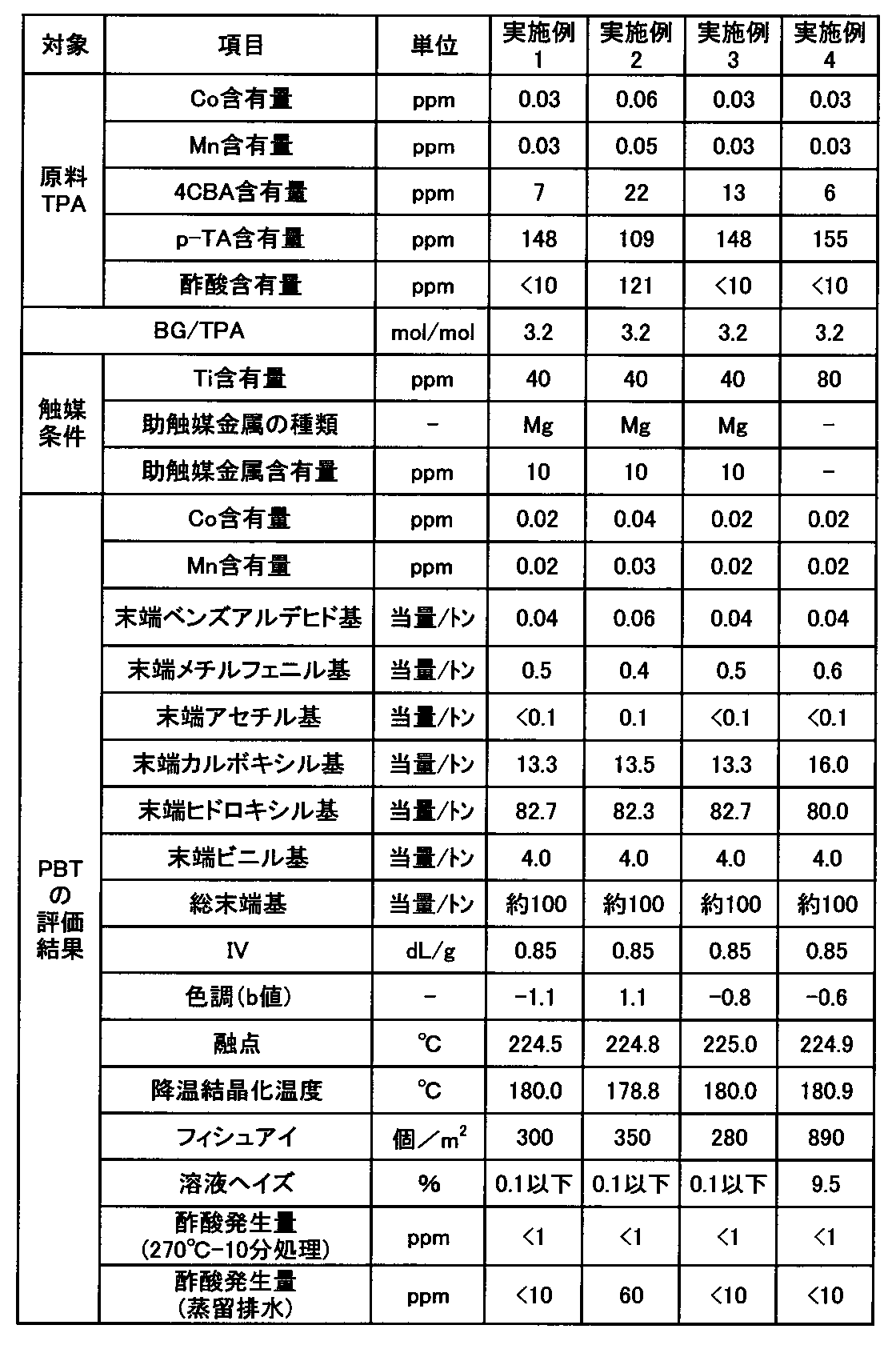

表1に示されるように、本発明の要件を満たす、実施例1~4のPBTは、好ましい色調(b値)を有し、酢酸発生量も少なく、高品質のPBTであった。またTHF回収工程における蒸留塔の高沸点側成分の酢酸濃度も低かった。
これに対して、表2に示されるように、本発明の要件を満たさない比較例1~6のPBTは、色調(b値)が好ましくなく、また加熱時の酢酸発生量が多く、好ましくないPBTであった。更にTHF回収工程における蒸留塔の高沸点側成分の酢酸濃度も高かった。
As shown in Table 1, the PBT of Examples 1 to 4, which satisfied the requirements of the present invention, had a favorable color tone (b value), generated a small amount of acetic acid, and was high quality PBT. In addition, the acetic acid concentration in the high boiling point component of the distillation column in the THF recovery step was also low.
In contrast, as shown in Table 2, the PBTs of Comparative Examples 1 to 6, which do not satisfy the requirements of the present invention, had undesirable color tones (b values) and generated a large amount of acetic acid upon heating, making them undesirable PBTs. Furthermore, the acetic acid concentration in the high boiling point component of the distillation column in the THF recovery step was also high.
Claims (8)
4-カルボキシベンズアルデヒド含有量が5~25ppmで、p-トルイル酸含有量が105~185ppmのテレフタル酸を用いることにより、
末端ベンズアルデヒド基濃度が0.03~0.07当量/トンであり、
末端メチルフェニル基濃度が0.3~0.8当量/トンであり、
末端アセチル基濃度が0.3当量/トン以下であるポリブチレンテレフタレートを製造することを特徴とするポリブチレンテレフタレートの製造方法。 In a method for producing polybutylene terephthalate by reacting a dicarboxylic acid component with a diol component,
By using terephthalic acid having a 4-carboxybenzaldehyde content of 5 to 25 ppm and a p-toluic acid content of 105 to 185 ppm,
The terminal benzaldehyde group concentration is 0.03 to 0.07 equivalents/ton;
The terminal methylphenyl group concentration is 0.3 to 0.8 equivalents/ton;
A method for producing polybutylene terephthalate, comprising producing polybutylene terephthalate having a terminal acetyl group concentration of 0.3 equivalents/ton or less .
Priority Applications (1)
| Application Number | Priority Date | Filing Date | Title |
|---|---|---|---|
| JP2022012059A JP7501552B2 (en) | 2022-01-28 | 2022-01-28 | Method for producing polybutylene terephthalate |
Applications Claiming Priority (1)
| Application Number | Priority Date | Filing Date | Title |
|---|---|---|---|
| JP2022012059A JP7501552B2 (en) | 2022-01-28 | 2022-01-28 | Method for producing polybutylene terephthalate |
Publications (2)
| Publication Number | Publication Date |
|---|---|
| JP2023110545A JP2023110545A (en) | 2023-08-09 |
| JP7501552B2 true JP7501552B2 (en) | 2024-06-18 |
Family
ID=87546281
Family Applications (1)
| Application Number | Title | Priority Date | Filing Date |
|---|---|---|---|
| JP2022012059A Active JP7501552B2 (en) | 2022-01-28 | 2022-01-28 | Method for producing polybutylene terephthalate |
Country Status (1)
| Country | Link |
|---|---|
| JP (1) | JP7501552B2 (en) |
Families Citing this family (1)
| Publication number | Priority date | Publication date | Assignee | Title |
|---|---|---|---|---|
| JP7509272B2 (en) * | 2022-05-16 | 2024-07-02 | 三菱ケミカル株式会社 | Polybutylene terephthalate and its manufacturing method |
Citations (1)
| Publication number | Priority date | Publication date | Assignee | Title |
|---|---|---|---|---|
| JP2005105262A (en) | 2003-09-09 | 2005-04-21 | Mitsubishi Chemicals Corp | Polybutylene terephthalate and method for producing the same |
Family Cites Families (1)
| Publication number | Priority date | Publication date | Assignee | Title |
|---|---|---|---|---|
| JP4055913B2 (en) * | 1994-04-26 | 2008-03-05 | 三菱瓦斯化学株式会社 | Method for producing high purity terephthalic acid |
-
2022
- 2022-01-28 JP JP2022012059A patent/JP7501552B2/en active Active
Patent Citations (1)
| Publication number | Priority date | Publication date | Assignee | Title |
|---|---|---|---|---|
| JP2005105262A (en) | 2003-09-09 | 2005-04-21 | Mitsubishi Chemicals Corp | Polybutylene terephthalate and method for producing the same |
Also Published As
| Publication number | Publication date |
|---|---|
| JP2023110545A (en) | 2023-08-09 |
Similar Documents
| Publication | Publication Date | Title |
|---|---|---|
| CN1938361B (en) | Polybutylene terephthalate | |
| JP5121125B2 (en) | Polybutylene terephthalate | |
| KR100869538B1 (en) | Polybutylene terephthalate pellet, compound product and molded article thereof, and processes for producing these | |
| JP3911251B2 (en) | Method for producing polybutylene terephthalate resin | |
| JP4725028B2 (en) | Polybutylene terephthalate | |
| TWI338013B (en) | Polybutylene terephthalate | |
| JP2023110545A (en) | Polybutylene terephthalate and method for producing the same | |
| JP2004091756A (en) | Polybutylene terephthalate resin | |
| CN100424114C (en) | Process for producing polybutylene terephthalate | |
| JP7509272B2 (en) | Polybutylene terephthalate and its manufacturing method | |
| JP7563531B2 (en) | Polybutylene terephthalate and its manufacturing method | |
| TWI424000B (en) | Process for producing polybutylene terephthalate | |
| JP2023138389A (en) | Polybutylene terephthalate and its manufacturing method | |
| JP4725027B2 (en) | Polybutylene terephthalate | |
| JP4591187B2 (en) | Method for producing polybutylene terephthalate | |
| JP4725029B2 (en) | Polybutylene terephthalate | |
| JP4626343B2 (en) | Polybutylene terephthalate pellets, compound products and molded articles thereof, and methods for producing the same | |
| JP7559786B2 (en) | Dibutylene glycol copolymerized polybutylene terephthalate and its manufacturing method, compound product and its manufacturing method, and molded product and its manufacturing method | |
| JP2005105262A (en) | Polybutylene terephthalate and method for producing the same | |
| CN100457801C (en) | Polybutylene terephthalate film and sheet, and method for producing same | |
| JP4544127B2 (en) | Polybutylene terephthalate and method for producing the same | |
| JP4544228B2 (en) | Method for producing polybutylene terephthalate | |
| JP7559785B2 (en) | Dibutylene glycol copolymerized polybutylene terephthalate pellets and manufacturing method thereof, and molded article and manufacturing method thereof | |
| JP4525411B2 (en) | Polybutylene terephthalate pellets | |
| JP4635481B2 (en) | Polybutylene terephthalate |
Legal Events
| Date | Code | Title | Description |
|---|---|---|---|
| A621 | Written request for application examination |
Free format text: JAPANESE INTERMEDIATE CODE: A621 Effective date: 20230203 |
|
| A131 | Notification of reasons for refusal |
Free format text: JAPANESE INTERMEDIATE CODE: A131 Effective date: 20231128 |
|
| A977 | Report on retrieval |
Free format text: JAPANESE INTERMEDIATE CODE: A971007 Effective date: 20231128 |
|
| A601 | Written request for extension of time |
Free format text: JAPANESE INTERMEDIATE CODE: A601 Effective date: 20240117 |
|
| A521 | Request for written amendment filed |
Free format text: JAPANESE INTERMEDIATE CODE: A523 Effective date: 20240315 |
|
| TRDD | Decision of grant or rejection written | ||
| A01 | Written decision to grant a patent or to grant a registration (utility model) |
Free format text: JAPANESE INTERMEDIATE CODE: A01 Effective date: 20240507 |
|
| A61 | First payment of annual fees (during grant procedure) |
Free format text: JAPANESE INTERMEDIATE CODE: A61 Effective date: 20240520 |
|
| R150 | Certificate of patent or registration of utility model |
Ref document number: 7501552 Country of ref document: JP Free format text: JAPANESE INTERMEDIATE CODE: R150 |