JP7463531B2 - Manufacturing process of orthogonal diatomite functional filler products - Google Patents
Manufacturing process of orthogonal diatomite functional filler products Download PDFInfo
- Publication number
- JP7463531B2 JP7463531B2 JP2022546563A JP2022546563A JP7463531B2 JP 7463531 B2 JP7463531 B2 JP 7463531B2 JP 2022546563 A JP2022546563 A JP 2022546563A JP 2022546563 A JP2022546563 A JP 2022546563A JP 7463531 B2 JP7463531 B2 JP 7463531B2
- Authority
- JP
- Japan
- Prior art keywords
- diatomite
- ore
- functional filler
- powder
- diatomaceous earth
- Prior art date
- Legal status (The legal status is an assumption and is not a legal conclusion. Google has not performed a legal analysis and makes no representation as to the accuracy of the status listed.)
- Active
Links
Images


Classifications
-
- B—PERFORMING OPERATIONS; TRANSPORTING
- B01—PHYSICAL OR CHEMICAL PROCESSES OR APPARATUS IN GENERAL
- B01J—CHEMICAL OR PHYSICAL PROCESSES, e.g. CATALYSIS OR COLLOID CHEMISTRY; THEIR RELEVANT APPARATUS
- B01J20/00—Solid sorbent compositions or filter aid compositions; Sorbents for chromatography; Processes for preparing, regenerating or reactivating thereof
- B01J20/30—Processes for preparing, regenerating, or reactivating
- B01J20/305—Addition of material, later completely removed, e.g. as result of heat treatment, leaching or washing, e.g. for forming pores
-
- C—CHEMISTRY; METALLURGY
- C09—DYES; PAINTS; POLISHES; NATURAL RESINS; ADHESIVES; COMPOSITIONS NOT OTHERWISE PROVIDED FOR; APPLICATIONS OF MATERIALS NOT OTHERWISE PROVIDED FOR
- C09C—TREATMENT OF INORGANIC MATERIALS, OTHER THAN FIBROUS FILLERS, TO ENHANCE THEIR PIGMENTING OR FILLING PROPERTIES ; PREPARATION OF CARBON BLACK ; PREPARATION OF INORGANIC MATERIALS WHICH ARE NO SINGLE CHEMICAL COMPOUNDS AND WHICH ARE MAINLY USED AS PIGMENTS OR FILLERS
- C09C1/00—Treatment of specific inorganic materials other than fibrous fillers; Preparation of carbon black
- C09C1/28—Compounds of silicon
- C09C1/30—Silicic acid
- C09C1/3009—Physical treatment, e.g. grinding; treatment with ultrasonic vibrations
- C09C1/3018—Grinding
-
- B—PERFORMING OPERATIONS; TRANSPORTING
- B01—PHYSICAL OR CHEMICAL PROCESSES OR APPARATUS IN GENERAL
- B01J—CHEMICAL OR PHYSICAL PROCESSES, e.g. CATALYSIS OR COLLOID CHEMISTRY; THEIR RELEVANT APPARATUS
- B01J20/00—Solid sorbent compositions or filter aid compositions; Sorbents for chromatography; Processes for preparing, regenerating or reactivating thereof
- B01J20/02—Solid sorbent compositions or filter aid compositions; Sorbents for chromatography; Processes for preparing, regenerating or reactivating thereof comprising inorganic material
- B01J20/10—Solid sorbent compositions or filter aid compositions; Sorbents for chromatography; Processes for preparing, regenerating or reactivating thereof comprising inorganic material comprising silica or silicate
- B01J20/14—Diatomaceous earth
-
- B—PERFORMING OPERATIONS; TRANSPORTING
- B01—PHYSICAL OR CHEMICAL PROCESSES OR APPARATUS IN GENERAL
- B01J—CHEMICAL OR PHYSICAL PROCESSES, e.g. CATALYSIS OR COLLOID CHEMISTRY; THEIR RELEVANT APPARATUS
- B01J20/00—Solid sorbent compositions or filter aid compositions; Sorbents for chromatography; Processes for preparing, regenerating or reactivating thereof
- B01J20/30—Processes for preparing, regenerating, or reactivating
- B01J20/3021—Milling, crushing or grinding
-
- B—PERFORMING OPERATIONS; TRANSPORTING
- B01—PHYSICAL OR CHEMICAL PROCESSES OR APPARATUS IN GENERAL
- B01J—CHEMICAL OR PHYSICAL PROCESSES, e.g. CATALYSIS OR COLLOID CHEMISTRY; THEIR RELEVANT APPARATUS
- B01J20/00—Solid sorbent compositions or filter aid compositions; Sorbents for chromatography; Processes for preparing, regenerating or reactivating thereof
- B01J20/30—Processes for preparing, regenerating, or reactivating
- B01J20/3078—Thermal treatment, e.g. calcining or pyrolizing
-
- C—CHEMISTRY; METALLURGY
- C01—INORGANIC CHEMISTRY
- C01B—NON-METALLIC ELEMENTS; COMPOUNDS THEREOF; METALLOIDS OR COMPOUNDS THEREOF NOT COVERED BY SUBCLASS C01C
- C01B33/00—Silicon; Compounds thereof
- C01B33/113—Silicon oxides; Hydrates thereof
- C01B33/12—Silica; Hydrates thereof, e.g. lepidoic silicic acid
- C01B33/18—Preparation of finely divided silica neither in sol nor in gel form; After-treatment thereof
-
- C—CHEMISTRY; METALLURGY
- C09—DYES; PAINTS; POLISHES; NATURAL RESINS; ADHESIVES; COMPOSITIONS NOT OTHERWISE PROVIDED FOR; APPLICATIONS OF MATERIALS NOT OTHERWISE PROVIDED FOR
- C09C—TREATMENT OF INORGANIC MATERIALS, OTHER THAN FIBROUS FILLERS, TO ENHANCE THEIR PIGMENTING OR FILLING PROPERTIES ; PREPARATION OF CARBON BLACK ; PREPARATION OF INORGANIC MATERIALS WHICH ARE NO SINGLE CHEMICAL COMPOUNDS AND WHICH ARE MAINLY USED AS PIGMENTS OR FILLERS
- C09C1/00—Treatment of specific inorganic materials other than fibrous fillers; Preparation of carbon black
- C09C1/28—Compounds of silicon
- C09C1/30—Silicic acid
- C09C1/3009—Physical treatment, e.g. grinding; treatment with ultrasonic vibrations
- C09C1/3027—Drying, calcination
-
- C—CHEMISTRY; METALLURGY
- C09—DYES; PAINTS; POLISHES; NATURAL RESINS; ADHESIVES; COMPOSITIONS NOT OTHERWISE PROVIDED FOR; APPLICATIONS OF MATERIALS NOT OTHERWISE PROVIDED FOR
- C09C—TREATMENT OF INORGANIC MATERIALS, OTHER THAN FIBROUS FILLERS, TO ENHANCE THEIR PIGMENTING OR FILLING PROPERTIES ; PREPARATION OF CARBON BLACK ; PREPARATION OF INORGANIC MATERIALS WHICH ARE NO SINGLE CHEMICAL COMPOUNDS AND WHICH ARE MAINLY USED AS PIGMENTS OR FILLERS
- C09C3/00—Treatment in general of inorganic materials, other than fibrous fillers, to enhance their pigmenting or filling properties
- C09C3/04—Physical treatment, e.g. grinding or treatment with ultrasonic vibrations
- C09C3/041—Grinding
-
- C—CHEMISTRY; METALLURGY
- C09—DYES; PAINTS; POLISHES; NATURAL RESINS; ADHESIVES; COMPOSITIONS NOT OTHERWISE PROVIDED FOR; APPLICATIONS OF MATERIALS NOT OTHERWISE PROVIDED FOR
- C09C—TREATMENT OF INORGANIC MATERIALS, OTHER THAN FIBROUS FILLERS, TO ENHANCE THEIR PIGMENTING OR FILLING PROPERTIES ; PREPARATION OF CARBON BLACK ; PREPARATION OF INORGANIC MATERIALS WHICH ARE NO SINGLE CHEMICAL COMPOUNDS AND WHICH ARE MAINLY USED AS PIGMENTS OR FILLERS
- C09C3/00—Treatment in general of inorganic materials, other than fibrous fillers, to enhance their pigmenting or filling properties
- C09C3/04—Physical treatment, e.g. grinding or treatment with ultrasonic vibrations
- C09C3/043—Drying, calcination
-
- C—CHEMISTRY; METALLURGY
- C01—INORGANIC CHEMISTRY
- C01P—INDEXING SCHEME RELATING TO STRUCTURAL AND PHYSICAL ASPECTS OF SOLID INORGANIC COMPOUNDS
- C01P2002/00—Crystal-structural characteristics
- C01P2002/80—Crystal-structural characteristics defined by measured data other than those specified in group C01P2002/70
- C01P2002/88—Crystal-structural characteristics defined by measured data other than those specified in group C01P2002/70 by thermal analysis data, e.g. TGA, DTA, DSC
-
- C—CHEMISTRY; METALLURGY
- C01—INORGANIC CHEMISTRY
- C01P—INDEXING SCHEME RELATING TO STRUCTURAL AND PHYSICAL ASPECTS OF SOLID INORGANIC COMPOUNDS
- C01P2006/00—Physical properties of inorganic compounds
- C01P2006/10—Solid density
-
- C—CHEMISTRY; METALLURGY
- C01—INORGANIC CHEMISTRY
- C01P—INDEXING SCHEME RELATING TO STRUCTURAL AND PHYSICAL ASPECTS OF SOLID INORGANIC COMPOUNDS
- C01P2006/00—Physical properties of inorganic compounds
- C01P2006/60—Optical properties, e.g. expressed in CIELAB-values
-
- C—CHEMISTRY; METALLURGY
- C01—INORGANIC CHEMISTRY
- C01P—INDEXING SCHEME RELATING TO STRUCTURAL AND PHYSICAL ASPECTS OF SOLID INORGANIC COMPOUNDS
- C01P2006/00—Physical properties of inorganic compounds
- C01P2006/60—Optical properties, e.g. expressed in CIELAB-values
- C01P2006/62—L* (lightness axis)
-
- C—CHEMISTRY; METALLURGY
- C01—INORGANIC CHEMISTRY
- C01P—INDEXING SCHEME RELATING TO STRUCTURAL AND PHYSICAL ASPECTS OF SOLID INORGANIC COMPOUNDS
- C01P2006/00—Physical properties of inorganic compounds
- C01P2006/60—Optical properties, e.g. expressed in CIELAB-values
- C01P2006/63—Optical properties, e.g. expressed in CIELAB-values a* (red-green axis)
-
- C—CHEMISTRY; METALLURGY
- C01—INORGANIC CHEMISTRY
- C01P—INDEXING SCHEME RELATING TO STRUCTURAL AND PHYSICAL ASPECTS OF SOLID INORGANIC COMPOUNDS
- C01P2006/00—Physical properties of inorganic compounds
- C01P2006/60—Optical properties, e.g. expressed in CIELAB-values
- C01P2006/64—Optical properties, e.g. expressed in CIELAB-values b* (yellow-blue axis)
Landscapes
- Chemical & Material Sciences (AREA)
- Organic Chemistry (AREA)
- Analytical Chemistry (AREA)
- Chemical Kinetics & Catalysis (AREA)
- Inorganic Chemistry (AREA)
- Physics & Mathematics (AREA)
- Thermal Sciences (AREA)
- Life Sciences & Earth Sciences (AREA)
- Geochemistry & Mineralogy (AREA)
- Silicon Compounds (AREA)
- Solid-Sorbent Or Filter-Aiding Compositions (AREA)
- Compounds Of Iron (AREA)
Description
(優先権主張)
本出願は、参照により本明細書に組み込まれる、2020年1月30日に出願された米国特許出願第16/777,132号の優先権を主張する。
(Priority Claim)
This application claims priority to U.S. Patent Application No. 16/777,132, filed January 30, 2020, which is incorporated herein by reference.
(技術分野)
本開示は、一般に、検出不可能又は検出可能なクリストバライト含有量を有する白色フラックス焼成珪藻土機能性フィラー製品の製造プロセスに関する。より具体的には、本開示は、媒体ミルと分級機との組み合わせを利用して、直行法によって製造される珪藻土機能性フィラー製品の製造プロセスに関する。
(Technical field)
The present disclosure generally relates to a process for producing a white flux calcined diatomite functional filler product having undetectable or detectable cristobalite content. More specifically, the present disclosure relates to a process for producing a diatomite functional filler product produced by an orthogonal process utilizing a combination of a media mill and a classifier.
(背景)
珪藻は、珪藻類珪藻(Bacillariophyceae)の任意のメンバーに属し、湖(湖沼起源)及び海洋(海洋起源)生息地の堆積鉱床に約12,000の異なる種が見られる。珪藻細胞は、被殻と呼ばれる非晶質の水和生体二酸化ケイ素(シリカ)の細胞壁に囲まれているという独特の特徴を有する。これらの被殻は、シリカ鉱物学のオパールA相にあると考えられており、形態に幅広い多様性を示すが、通常はほぼ左右対称である。被殻は、不活性物質であるシリカで構成されているため、珪藻被殻は、地質学的堆積物内で膨大な期間にわたって完全に保存されている。
(background)
Diatoms are any member of the family Bacillariophyceae, which are found in sedimentary deposits in lake (lacustrine origin) and marine (marine origin) habitats, with approximately 12,000 different species. Diatom cells have the unique feature of being surrounded by a cell wall of amorphous hydrated biogenic silicon dioxide (silica), called a frustule. These frustules are considered to be in the opal A phase of silica mineralogy, and show a wide diversity in morphology, but are usually nearly bilaterally symmetrical. Because the frustules are composed of silica, an inert material, diatom frustules are perfectly preserved over vast periods of time within geological deposits.
また、珪藻化石の形成中に該珪藻化石と共に、有機汚染物質及び他の鉱物、例えば、粘土、火山灰、方解石、ドロマイト、及び長石も堆積する。珪藻被殻がそれ自体に結晶性シリカを一切含まない場合でも、結晶性シリカの形態である石英の形態の珪砂が、地層に堆積することもあり得る。海洋堆積物の珪藻土中に石英が見られるのは一般的であるが、湖沼堆積物の珪藻土中には、石英を含まないものも、粉砕及び乾燥、その後の機械的空気分級を使用した分離によって容易に遊離される石英粒子を含むものもある。また、時間の経過と共に、オパールAシリカからの相変換の結果として石英粒子が形成され得る。即ち、珪藻の死後、オパールA相は、部分的に脱水状態になり得、一連の段階で、オパールAから、より短距離の分子秩序を有し、且つ水和水がより少ないオパールCT相及びオパールC相などの他の形態のオパールに変換される。適切な条件下で非常に長い期間を経て、オパールCTは石英に変換され得る。 Organic contaminants and other minerals, such as clay, volcanic ash, calcite, dolomite, and feldspar, are also deposited along with the diatom fossils during their formation. Even if the diatom frustules themselves do not contain any crystalline silica, quartz sand, a form of crystalline silica, may be deposited in the formation. Quartz is commonly found in marine sediment diatomites, while some lake sediment diatomites are either quartz-free or contain quartz particles that are easily liberated by crushing and drying followed by separation using mechanical air classification. Over time, quartz particles may also form as a result of phase transformation from opal A silica. That is, after the death of the diatoms, the opal A phase may become partially dehydrated and, in a series of steps, convert from opal A to other forms of opal, such as opal CT and opal C phases, which have shorter-range molecular order and less water of hydration. Under the right conditions and over very long periods of time, opal CT may be converted to quartz.
オパール珪藻骨格(opaline diatom skeleton)の形態で存在する珪藻土の非晶質シリカはまた、アルミナ、鉄、アルカリ金属、及びアルカリ土類金属を含み得る。有機物を含まないベースで決定される典型的な市販の珪藻土鉱石は、約80~約90+重量%の範囲のシリカ、約0.6~約8重量%の範囲のアルミナ(Al2O3)、約0.2~約3.5重量%の範囲の酸化鉄(Fe2O3)、約1重量%未満の量のNa2O及びMgOなどのアルカリ金属酸化物、約0.3~約3重量%の範囲のCaO、及び例えば、P2O5及びTiO2などの少量の他の不純物の化学分析を示し得る。しかしながら、選択された堆積物では、シリカ濃度は、SiO2が約97重量%と高い濃度であり得る。 The amorphous silica of diatomite, present in the form of an opaline diatom skeleton, may also contain alumina, iron, alkali metals, and alkaline earth metals. A typical commercial diatomite ore determined on an organic-free basis may exhibit a chemical analysis of silica in the range of about 80 to about 90+ weight percent, alumina ( Al2O3 ) in the range of about 0.6 to about 8 weight percent, iron oxide ( Fe2O3 ) in the range of about 0.2 to about 3.5 weight percent, alkali metal oxides such as Na2O and MgO in amounts less than about 1 weight percent, CaO in the range of about 0.3 to about 3 weight percent, and small amounts of other impurities such as, for example, P2O5 and TiO2 . However, in selected deposits, the silica concentration may be as high as about 97 weight percent SiO2 .
商用グレードの鉱石では、化石珪藻から構成される鉱物である珪藻土中の被殻の独特の微細な多孔性が、高い表面積、低いかさ密度、及び高い吸収能力を含む特定の製品特性を提供する。マクロ細孔、メソ細孔、及び微小孔で構成される珪藻土鉱石の複雑な多孔質構造は、珪藻土製品の使用を含む特定の調合物に必要な湿潤性と高い吸収能力を提供する。 In commercial grade ores, the unique microporosity of the frustules in diatomaceous earth, a mineral composed of fossil diatoms, provides certain product properties including high surface area, low bulk density, and high absorbent capacity. The complex porous structure of diatomaceous earth ores, composed of macropores, mesopores, and micropores, provides the wettability and high absorbent capacity required for certain formulations involving the use of diatomaceous earth products.
例えば、不活性シリカ組成物に由来する化学的安定性と被殻の高い多孔性との組み合わせにより、珪藻土は、商業的ろ過用途に有用である。珪藻土製品は、飲料(例えば、ビール、ワイン、スピリッツ、及びジュース)、油(脂肪、石油)、水(スイミングプール、飲料水)、化学製品(ドライクリーニング液、TiO2添加剤)、摂取可能な薬剤(抗生物質)、冶金(冷却液)、農産食品中間体(アミノ酸、ゼラチン、酵母)、及び砂糖を含め、いくつかの業界で固液分離(ろ過)に長年使用されてきた。ろ過とは別に、独特の珪藻土の特性により、プラスチック、断熱材、研磨剤、塗料、紙、アスファルトにおける機能性フィラー材料、及びダイナマイトのベースとしても使用することができる。さらに、珪藻土製品は、特定の市販の触媒の処理に有用であり、クロマトグラフィー担体として使用され、且つ気液クロマトグラフィー法にも適している。 For example, the combination of chemical stability from the inert silica composition and high porosity of the frustule makes diatomaceous earth useful for commercial filtration applications. Diatomaceous earth products have been used for many years for solid-liquid separation (filtration) in several industries, including beverages (e.g., beer, wine, spirits, and juices), oils (fats, petroleum), water (swimming pools, drinking water), chemicals (dry cleaning fluids, TiO2 additives), ingestible pharmaceuticals (antibiotics), metallurgy (coolants), agro-food intermediates (amino acids, gelatin, yeast), and sugar. Apart from filtration, the unique properties of diatomaceous earth also allow it to be used as a functional filler material in plastics, insulation, abrasives, paints, paper, asphalt, and as a base for dynamite. In addition, diatomaceous earth products are useful in the treatment of certain commercial catalysts, are used as chromatographic supports, and are also suitable for gas-liquid chromatographic processes.
(商用グレードの珪藻土鉱石の処理)
珪藻土ろ過助剤及び機能性フィラー製品の製造のための焼成原料として機能する商用グレードの天然珪藻土鉱石の典型的な化学的特性は、高品位の化学的性質を有する鉱石から構成されている。高品位鉱石から製造されたろ過助剤製品の抽出可能な不純物及び遠心分離湿潤密度は、歴史的に、低品位鉱石から製造された製品の特性よりも望ましいと考えられてきた。長い年月を経て、珪藻土堆積物は、典型的には約4重量%未満のアルミナ含有量及び約2重量%未満の酸化鉄含有量を有する原料鉱石を選択的に採掘することによって高品位にされてきた。フラックス剤で焼成すると、高品位の化学的性質を有する珪藻土鉱石は、白色のろ過助剤製品となり、望ましい高い白色度と明るさを備えた機能性フィラー製品を提供する。
(Processing commercial grade diatomite ore)
The typical chemical properties of commercial grade natural diatomite ores that serve as calcined feedstocks for the production of diatomite filter aids and functional filler products are comprised of ores with high grade chemistry. The extractable impurities and centrifuge wet density of filter aid products produced from high grade ores have historically been considered more desirable than the properties of products produced from lower grade ores. Over time, diatomite deposits have been made high grade by selectively mining raw ores that typically have an alumina content of less than about 4% by weight and an iron oxide content of less than about 2% by weight. When calcined with fluxing agents, the high grade chemistry of diatomite ores results in white filter aid products and functional filler products with desirable high whiteness and brightness.
上で最初に述べたように、珪藻土製品は、珪藻土鉱石の処理から得られる。珪藻土鉱石には、最大約70%の自由水分と、様々な有機及び無機物質とが含まれ得る。従って、ろ過プロセス又は機能性フィラーの用途で珪藻土を使用する前に、供給材料は、破砕、粉砕、乾燥、重鉱物分離、焼成、及びグリット分離の単位操作の一部又はすべてを含み得るコンディショニングプロセスに供する。例えば、珪藻土鉱石を破砕し、粉砕し、そしてフラッシュ乾燥させて水分と重鉱物廃棄物を除去し、天然ろ過助剤(原料に大量の有機化合物及び抽出可能な金属が含まれていない場合)又は天然機能性フィラー(鉱石が自然な明るい色をしている場合)を形成することができる。他の例では、珪藻土原料を粉砕し、フラッシュ乾燥させて水分を除去し、焼成して有機汚染物質を追い出し、可溶性無機物質をより不活性な酸化物、ケイ酸塩、又はアルミノケイ酸塩に変換することができる。鉱石のアルミナ及び酸化鉄含有量がそれぞれ約5.0重量%及び約2.0重量%未満の場合、焼成製品の色は、ソーダ灰の存在下で明るい白色に変化し得る。焼成はまた、最終製品の密度も低下させることができ、これは、塗料調合物における機能性フィラー用途に望ましい機能である。 As first mentioned above, diatomite products are obtained from the processing of diatomite ore. Diatomite ore can contain up to about 70% free moisture and various organic and inorganic materials. Therefore, prior to using diatomite in a filtration process or functional filler application, the feedstock is subjected to a conditioning process that may include some or all of the unit operations of crushing, grinding, drying, heavy mineral separation, calcination, and grit separation. For example, diatomite ore can be crushed, ground, and flash dried to remove moisture and heavy mineral waste to form a natural filter aid (if the feedstock does not contain significant amounts of organic compounds and extractable metals) or a natural functional filler (if the ore has a natural light color). In other examples, diatomite feedstock can be crushed, flash dried to remove moisture, and calcined to drive off organic contaminants and convert soluble inorganic materials to more inert oxides, silicates, or aluminosilicates. When the alumina and iron oxide content of the ore is less than about 5.0% and 2.0% by weight, respectively, the color of the calcined product can change to bright white in the presence of soda ash. Calcination can also reduce the density of the final product, a desirable feature for functional filler applications in paint formulations.
図1は、低不純物珪藻土鉱石を原料として利用して、高速流量ろ過媒体及び機能性フィラー副産物を製造する典型的な珪藻土製造施設で使用されるプロセス100の流れ図を示す。このプロセスは、鉱山から高品位で低不純物の珪藻土鉱石を選択することから開始し(工程102)、該珪藻土鉱石は、典型的には約30重量%~約60重量%の範囲の含水率を有する。
Figure 1 shows a flow diagram of a
次に、製造プラントでの製造プロセス100は、原料鉱石を破砕して乾燥の準備をすることを含む。天然珪藻土鉱物を乾燥させる最も経済的且つ実用的な手段は、供給材料の粉砕とフラッシュ乾燥を同時に行うこと(工程104)によるものであり、その結果、固結物がディアグロメレーションされ、水分が約2重量%~約10重量%まで除去される。フラッシュ乾燥には、1段階又は2段階の処理が含まれ得る。1段階のフラッシュ乾燥プロセスは、乾燥材料の一部を湿った供給材料にリサイクルして、乾燥機に入る供給材料の水分含有量を低減し、製品の水分目標が確実に1回でパスするようにすることができる。別法では、1段階のフラッシュ乾燥機は、部分的に乾燥した粒子が該乾燥機の排出材料から分級され、該乾燥機に入る供給材料に戻される静的コーン分級機を備え得る。2段階のフラッシュ乾燥は、2段階の供給材料の同時の粉砕及び乾燥、又は第1段階の同時の粉砕及び乾燥と第2段階の空気圧式熱風輸送乾燥のいずれかを含む。インライン静的分級機を使用すると、プロセスでの粒子の保持時間が最小限に抑えられるため、粒子の分解が最小限の乾燥製品が得られ、従って、2段階のフラッシュ乾燥システムや1段階のリサイクルシステムよりも密度の低い材料が得られる。
Next, the
次に、重鉱物及び他の廃棄不純物を除去するための供給材料の物理的選鉱(工程106)を、異なる形態の機械的空気分級機を使用して行う。石英などの結晶性シリカ鉱物は、プロセス100のこの段階で除去することができる。砂、チャート、及びその他の粒子などの重鉱物も分離される。選鉱工程106は、原料鉱石からグリットを除去するのに役立つが、供給材料の化学的性質及び密度に大きな影響を与えない。
The feed material is then physically beneficiated (step 106) to remove heavy minerals and other waste impurities using different forms of mechanical air classifiers. Crystalline silica minerals such as quartz can be removed at this stage of the
次に、フラックス剤、典型的にはソーダ灰(炭酸ナトリウム)を選鉱した粉末に空気圧で混合し(工程150)、次いで、供給ビンに収集して、粉末の熱焼結(フラックス焼成とも呼ばれる)(工程108)のためのロータリーキルンへの材料の一定の供給速度を提供する。この熱処理により、鉱石中の有機物が燃焼して除去され、より細かい粒子と粗い粒子の凝集が促進され、ある程度の多孔性が失われることで製品の表面積が減少し、結果として得られる材料の透過性が向上する。さらに、フラックス焼成により、魅力的な光学特性(高い白色度)を備えた機能性フィラーグレードの製品が得られる。直接焼成プロセス(フラックス剤の非存在下での焼成)を使用する場合、結果として得られる珪藻土製品は、光学特性が不良であるため、ほとんどの機能性フィラー用途での使用が制限される。フラックス焼成工程108は、約870℃~約1,250℃の温度範囲で行い、天然に存在する珪藻土の水和非晶質シリカ構造を部分的又は完全に脱水する。焼成は、ロータリーキルン又は回転か焼炉での珪藻土鉱石の熱処理によって行う。
A fluxing agent, typically soda ash (sodium carbonate), is then pneumatically mixed into the beneficiated powder (step 150) and then collected in a feed bin to provide a constant feed rate of material to a rotary kiln for thermal sintering of the powder (also called flux calcination) (step 108). This heat treatment burns off and removes the organic matter in the ore, promotes agglomeration of the finer and coarser particles, and reduces the surface area of the product by eliminating some porosity, improving the transparency of the resulting material. In addition, flux calcination results in functional filler grade products with attractive optical properties (high whiteness). When using the direct calcination process (calcination in the absence of fluxing agents), the resulting diatomite products have poor optical properties that limit their use in most functional filler applications. The
フラックス焼成材料のキルン排出物は、通常は凝集しており、通常は非常に広範な粒度分布を示す微細な珪藻土粉末を生成するために分散ファンを通過させなければならない。従って、ろ過用途に許容される高速流量ろ過助剤製品を製造するためには、プロセス100を継続して、粉末を機械的又は空気分級にかけ(工程110)、バグハウス中の機能性フィラー製品としてのより細かい部分を約10~約30重量%除去し(工程112)、そしてより粗い部分を、透過性が著しく増した高速流量ろ過助剤としてサイクロンに収集する(工程114)。任意に、非常に粗い粒子をさらに分散させて分級し、ろ過助剤部分の粒径要件を制御することができる。
The flux calcined material kiln discharge is usually agglomerated and must be passed through a dispersion fan to produce a fine diatomite powder that usually exhibits a very broad particle size distribution. Therefore, to produce a high-flow filter aid product acceptable for filtration applications, the
機能性フィラーとしての珪藻土の使用は、近年、様々な用途で人気を得ており、この高品位製品の需要は著しく増加している。現在、機能性フィラーグレードは、プロセス100で証明されているように、ろ過助剤の製造と併せて、またその不可欠な部分として製造される。これらのプロセスでの機能性フィラーの収率は、全製造の約30重量%未満であり得るため、業界のフィラー需要の増加に対応するために、より多くのろ過助剤を製造する必要がある。珪藻土機能性フィラー製品の需要が高まっているが、ろ過用途での珪藻土ろ過助剤の使用は、膜などの新しいろ過技術の導入により近年減少している。ろ過助剤製品に対して不釣り合いな機能性フィラーの需要により、ろ過助剤製品の余剰と機能性フィラーグレードの不足の問題を珪藻土製造業者に引き起こした。
The use of diatomaceous earth as a functional filler has gained popularity in recent years in a variety of applications, and the demand for this high-grade product has increased significantly. Currently, functional filler grades are produced in conjunction with and as an integral part of the production of filter aids, as evidenced by
高効率分級機を設置してキルン排出製品からより微細な粒子を回収して、より粗いフラックス焼成ろ過助剤製品の一部を粉砕することによって、ろ過助剤の製造中の機能性フィラー製品の収率を改善しようと様々な試みがなされてきた。しかしながら、機能性フィラーの収率を高めるためのこのアプローチは、色に関しては製品の品質が不十分である。これは、ろ過助剤製品が主に粗い粒子であり、同時製造されるより細かいフィラー粒子と比較して色が明るくないためである。粗い粒子は、より大きなサイズの珪藻から構成されており、それらの集団にソーダ灰を分散させて、ロータリーキルンでの焼成中に白色の明るい色を提供することは、フィラーグレードを構成するより小さな珪藻ほどは効率的ではない。さらに、より粗いフラックス焼成ろ過助剤製品の一部を粉砕するとまた、機能性フィラー製品の密度が不所望に増加すると共に機能性が一部失われる。従って、ろ過助剤製品を粉砕してより細かい粒子に変換して機能性フィラーグレードを増加させても、機能性フィラーの需要増加の問題は解決しない。 Various attempts have been made to improve the yield of functional filler product during the production of filter aids by installing high-efficiency classifiers to recover finer particles from the kiln discharge product and grinding a portion of the coarser flux-calcined filter aid product. However, this approach to increase the yield of functional filler results in an unsatisfactory product quality in terms of color. This is because the filter aid product is mainly coarse particles, which are not bright in color compared to the finer filler particles that are simultaneously produced. The coarse particles are composed of larger sized diatoms, and dispersing soda ash in their population to provide a white bright color during firing in a rotary kiln is not as efficient as for the smaller diatoms that make up the filler grades. Furthermore, grinding a portion of the coarser flux-calcined filter aid product also undesirably increases the density of the functional filler product and loses some of its functionality. Thus, grinding the filter aid product to convert it to finer particles to increase the functional filler grade does not solve the problem of increasing demand for functional fillers.
従って、ろ過助剤製品との同時製造によって、珪藻土機能性フィラー製造の従来の方法に勝る解決策を提供することが望ましいであろう。有益なことに、この解決策は、実質的にすべてのフラックス焼成キルン排出材料を、所望の製品仕様の機能性フィラーグレードに変換するプロセスを含むことになる。このような解決策では、上記の供給の不均衡を引き起こす不要なろ過助剤を一切生成することなく、機能性フィラーを直行製品として製造することができる。さらに、本明細書に開示される製造方法の他の望ましい特徴及び特性は、添付の図面及び前述の背景と併せて、後続の詳細な説明及び添付の特許請求の範囲から明らかになるであろう。 It would therefore be desirable to provide a solution that goes beyond conventional methods of diatomite functional filler production by co-production with a filter aid product. Advantageously, this solution would include a process to convert substantially all of the flux calcination kiln discharge material into a functional filler grade of the desired product specification. In such a solution, the functional filler can be produced as a straight-through product without producing any of the unwanted filter aid that causes the above-mentioned supply imbalance. Additionally, other desirable features and characteristics of the manufacturing methods disclosed herein will become apparent from the following detailed description and the appended claims, taken in conjunction with the accompanying drawings and the foregoing background.
(簡単な概要)
この概要は、詳細な説明でさらに説明する簡略化した形式で選ばれた概念を説明するために提供する。この概要は、請求する主題の重要な又は本質的な特徴を明らかにすることを意図するものでも、請求する主題の範囲を決定する際の補助として使用することを意図するものでもない。
(Brief summary)
This Summary is provided to explain selected concepts in a simplified form that are further described in the Detailed Description. This Summary is not intended to identify key or essential features of the claimed subject matter, nor is it intended to be used as an aid in determining the scope of the claimed subject matter.
例示的な一実施態様では、珪藻土機能性フィラー製品の製造方法は:珪藻土鉱石を選択する工程;該珪藻土鉱石の粉砕とフラッシュ乾燥を同時に行う工程;粉砕してフラッシュ乾燥させた珪藻土鉱石を選鉱する工程;該選鉱した珪藻土鉱石をフラックス剤とブレンドする工程;該ブレンドした珪藻土鉱石とフラックス剤を焼成して、最初の珪藻土粉末を生成する工程;該最初の珪藻土粉末を空気分級して、該珪藻土機能性フィラー製品を含む第1の部分及び粗い粒子を含む第2の部分を生成する工程;該粗い粒子をさらに粉砕して、追加の珪藻土粉末を生成する工程;及び該追加の珪藻土粉末を再循環させて、該追加の珪藻土粉末を該最初の珪藻土粉末とブレンドする工程を含む。 In one exemplary embodiment, a method for making a diatomite functional filler product includes the steps of: selecting a diatomite ore; simultaneously grinding and flash drying the diatomite ore; beneficiating the ground and flash dried diatomite ore; blending the beneficiated diatomite ore with a fluxing agent; calcining the blended diatomite ore and fluxing agent to produce an initial diatomite powder; air classifying the initial diatomite powder to produce a first portion comprising the diatomite functional filler product and a second portion comprising coarse particles; further grinding the coarse particles to produce additional diatomite powder; and recirculating the additional diatomite powder and blending the additional diatomite powder with the initial diatomite powder.
別の例示的な実施態様では、結晶性シリカが検出不可能な珪藻土機能性フィラー製品の製造方法が開示され、該方法は:アルミナ含有量が約3.0~約4.5重量%であり、酸化鉄含有量が約1.2~約2重量%であり、且つ遠心分離湿潤密度が約0.32 g / l(約20.0 lb / ft3)未満である珪藻土鉱石を選択する工程;該珪藻土鉱石の粉砕とフラッシュ乾燥を同時に行う工程;該粉砕してフラッシュ乾燥させた珪藻土鉱石を選鉱する工程;該選鉱した珪藻土鉱石をフラックス剤とブレンドする工程;該フラックス剤を噴霧水で可溶化する工程;該ブレンドした珪藻土鉱石と該可溶化フラックス剤を約677℃~約1,093℃(約1,250°F~約2,000°F)の温度で約20分~約40分の範囲の時間焼成して最初の珪藻土粉末を生成する工程;該最初の珪藻土粉末を空気分級して、該珪藻土機能性フィラー製品を含む第1の部分及び粗い粒子を含む第2の部分を生成する工程;該粗い粒子をさらに粉砕して、追加の珪藻土粉末を生成する工程;及び該追加の珪藻土粉末を再循環させて、該追加の珪藻土粉末を該最初の珪藻土粉末とブレンドする工程を含む。 In another exemplary embodiment, a method for producing a diatomite functional filler product with no detectable crystalline silica is disclosed, the method comprising: producing a diatomite functional filler product having an alumina content of about 3.0 to about 4.5 wt.%, an iron oxide content of about 1.2 to about 2 wt.%, and a centrifuged wet density of about 0.32 g/l (about 20.0 lb/ft 3 ); beneficiating the ground and flash dried diatomite ore; blending the beneficiated diatomite ore with a fluxing agent; solubilizing the fluxing agent with a water spray; calcining the blended diatomite ore and the solubilized fluxing agent at a temperature of about 677° C. to about 1,093° C. (about 1,250° F. to about 2,000° F.) for a time period ranging from about 20 minutes to about 40 minutes to produce an initial diatomite powder; air classifying the initial diatomite powder to produce a first portion comprising the diatomite functional filler product and a second portion comprising coarse particles; further grinding the coarse particles to produce additional diatomite powder; and recirculating the additional diatomite powder and blending the additional diatomite powder with the initial diatomite powder.
さらに別の例示的な実施態様では、結晶性シリカが検出可能な珪藻土機能性フィラー製品の製造方法が開示され、該方法は:アルミナ含有量が約3.0重量%未満であり、酸化鉄含有量が約1.7重量%未満であり、且つ遠心分離湿潤密度が約0.32 g / l(約20.0 lb / ft3)未満である珪藻土鉱石を選択する工程;該珪藻土鉱石の粉砕とフラッシュ乾燥を同時に行う工程;該粉砕してフラッシュ乾燥させた珪藻土鉱石を選鉱する工程;該選鉱した珪藻土鉱石をフラックス剤とブレンドする工程;該ブレンドした珪藻土鉱石とフラックス剤を約760℃~約1,177℃(約1,400°F~約2,150°F)の温度で約20分~約40分の範囲の時間焼成して最初の珪藻土粉末を生成する工程;該最初の珪藻土粉末を空気分級して、該珪藻土機能性フィラー製品を含む第1の部分及び粗い粒子を含む第2の部分を生成する工程;該粗い粒子をさらに粉砕して、追加の珪藻土粉末を生成する工程;及び該追加の珪藻土粉末を再循環させて、該追加の珪藻土粉末を該最初の珪藻土粉末とブレンドする工程を含む。 In yet another exemplary embodiment, a method for producing a diatomite functional filler product with detectable crystalline silica is disclosed, the method comprising: producing a diatomite functional filler product having an alumina content of less than about 3.0 wt.%, an iron oxide content of less than about 1.7 wt.%, and a centrifuged wet density of less than about 0.32 g/l (about 20.0 lb/ft3 ). beneficiating the ground and flash dried diatomite ore; blending the beneficiated diatomite ore with a fluxing agent; calcining the blended diatomite ore and fluxing agent at a temperature of about 760° C. to about 1,177° C. (about 1,400° F. to about 2,150° F.) for a time period ranging from about 20 minutes to about 40 minutes to produce an initial diatomite powder; air classifying the initial diatomite powder to produce a first portion comprising the diatomite functional filler product and a second portion comprising coarse particles; further grinding the coarse particles to produce additional diatomite powder; and recirculating the additional diatomite powder and blending the additional diatomite powder with the initial diatomite powder.
(図面の簡単な説明)
本開示は、以下の図面と併せて説明し、各図面における同様の数字は、同様の要素を示す。
BRIEF DESCRIPTION OF THE DRAWINGS
The present disclosure is described in conjunction with the following drawings, in which like numbers refer to like elements in each drawing.
図2Bは、本開示の例示的な実施態様による、結晶性シリカが検出可能な直行珪藻土機能性フィラーの製造プロセスの流れ図である。 Figure 2B is a flow diagram of a manufacturing process for an orthogonal diatomite functional filler with detectable crystalline silica according to an exemplary embodiment of the present disclosure.
(詳細な説明)
以下の詳細な説明は、本質的に単なる例示であり、本発明又は本発明の用途及び使用を限定することを意図するものではない。本明細書で使用する「例示的」という語は、「例、実例、又は例示として役立つ」ことを意味する。従って、本明細書で「例示的」として記載するどの実施態様も、必ずしも他の実施態様よりも好ましい又は有利であると解釈するべきではない。本明細書に記載のすべての実施態様は、当業者が本発明を作成又は使用することを可能にするために示し、特許請求の範囲によって規定される本発明の範囲を限定しない例示的な実施態様である。さらに、前述の技術分野、背景、簡単な概要、又は以下の詳細な説明に示される明示的又は暗示的な理論に拘束されることを意図するものではない。
Detailed Description
The following detailed description is merely exemplary in nature and is not intended to limit the invention or the application and uses of the invention. As used herein, the word "exemplary" means "serving as an example, instance, or illustration." Thus, any embodiment described herein as "exemplary" should not necessarily be construed as preferred or advantageous over other embodiments. All embodiments described herein are exemplary embodiments presented to enable any person skilled in the art to make or use the invention, and do not limit the scope of the invention, which is defined by the claims. Furthermore, there is no intention to be bound by any expressed or implied theory presented in the preceding technical field, background, brief summary, or the following detailed description.
具体的に述べられていないか、又は文脈から明らかでない限り、本明細書で使用する「約」という語は、当技術分野における通常の許容範囲内、例えば、平均の2標準偏差以内であると理解される。「約」は、記載の値の10%、5%、1%、又は0.5%以内であると理解することができる。文脈から明らかでない限り、本明細書に示すすべての数値は、「約」という語によって修正される。 Unless specifically stated or clear from the context, the term "about" as used herein is understood to mean within normal tolerances in the art, e.g., within 2 standard deviations of the mean. "About" can be understood to mean within 10%, 5%, 1%, or 0.5% of the stated value. Unless clear from the context, all numerical values provided herein are modified by the term "about."
本開示は、直行白色フラックス焼成珪藻土機能性フィラー製品の製造プロセスを説明する。特に、第1の実施態様では、本開示は、珪藻土を含む機能性フィラー製品の製造プロセスを説明し、該珪藻土は、それらの天然アルミナ及び酸化鉄含有量で具体的に選択され、次いで、焼成中にソーダフラックスの存在下でクリストバライトの生成を引き起こすメカニズムを抑制する傾向がある原料調製及び熱処理法で処理された鉱石に由来する。本開示はまた、第2の実施態様では、原料調製と焼成の代替の方法の後に生成される石英又はクリストバライトの形態の結晶性シリカを含む珪藻土製品である、珪藻土を含む直行機能性フィラー製品を説明する。 The present disclosure describes a process for the manufacture of an orthogonal white flux calcined diatomite functional filler product. In particular, in a first embodiment, the present disclosure describes a process for the manufacture of a functional filler product comprising diatomite, the diatomite being derived from ores specifically selected for their natural alumina and iron oxide content and then treated with a feed preparation and heat treatment method that tends to suppress the mechanisms that cause the formation of cristobalite in the presence of soda flux during calcination. The present disclosure also describes, in a second embodiment, an orthogonal functional filler product comprising diatomite, the diatomite product comprising crystalline silica in the form of quartz or cristobalite produced after an alternative method of feed preparation and calcination.
以下の表1は、本開示の第1の実施態様による、ヘグマン値1.0の機能性フィラー製品の例示的な物理的及び化学的特性を示す(ヘグマンゲージの説明については、以下の「直行珪藻土機能性フィラー製品の特性評価方法」のセクションを参照)。結晶性シリカが検出不可能な(ND)及び検出可能な(MW)直行製品のバージョンが示されている。加えて、以下の表2は、本開示の第2の実施態様による、ND及びMW結晶性シリカ製品のバージョンと同様に、ヘグマン値2.0のフィラー製品の例示的な物理的及び化学的特性を示す。表1及び表2に示されている値は概算値であることに留意し、この値は最大+/-10%変動し得ることを理解されたい。
表1
ヘグマン値1.0の直行フィラー製品の物理的及び化学的特性

ヘグマン値2.0の直行フィラー製品の物理的及び化学的特性

table 1
Physical and chemical properties of orthogonal filler products with Hegman value of 1.0
Physical and chemical properties of Hegman 2.0 cross-filler products
最初に上で述べたように、上記の表1及び表2に記載の製品は、処理前の珪藻土鉱石に由来する。珪藻土鉱石は、天然に存在する様々な形や大きさの珪藻から構成されている。平均して、これらの珪藻の粒度分布は、ロータリーキルンでの焼成用の原料として調製される場合、約1~約100ミクロンの範囲である。図1のプロセス100に示されるように、珪藻土ろ過助剤及びフィラー製品の製造は、フラックス焼成(工程108)中に原料に微細なソーダ灰粉末150を導入して、キルン排出時に白色の明るい色の製品を得ることを含む。焼成中のソーダ灰と珪藻粒子との化学反応は、物質移動プロセスであり、結果として、より細かい珪藻粒子が、より粗い珪藻粒子よりも比較的明るくなる。従って、より明るい微細な機能性フィラー製品は、フラックス焼成プロセス後のより微細な珪藻粒子のふるい分けから得られる。従来技術では、フィラーの収率を改善するためのより粗い珪藻の粉砕は、上記のように、大きな珪藻の内部は完全にはフラックス焼成されず、従ってそれほど明るい色を示さず、機能性フィラー製品としての使用に適切でない可能性があるため、通常は回避される。
As initially stated above, the products described in Tables 1 and 2 above are derived from diatomite ore prior to processing. Diatomite ore is composed of naturally occurring diatoms of various shapes and sizes. On average, the particle size distribution of these diatoms ranges from about 1 to about 100 microns when prepared as a feedstock for calcination in a rotary kiln. As shown in
本開示の方法によると、白色フラックス焼成ろ過助剤の製造により副産物として製造される従来の珪藻土機能性フィラー製品とは対照的に、表1及び表2に記載の直行ND及びMW機能性フィラー製品は、ロータリーキルンからのフラックス焼成材料のすべて(又は実質的にすべて)を機能性フィラーグレードに変換することによって製造される。直行機能性フィラー製品を製造するこの新規なアプローチは、製品の白色を劣化させることなく、フラックス焼成材料を選択的に粉砕及び分級することによって可能になる。製品の色は、珪藻土原料鉱石を焼成用に調製する新規な方法の結果として、これらの製造方法で維持され、これにより、小さい珪藻と大きい珪藻の両方へのソーダ灰の質量拡散が促進される。次に、本開示の第1及び第2の実施態様の両方の方法を以下に説明する。 In accordance with the methods of the present disclosure, in contrast to conventional diatomite functional filler products produced as a by-product from the production of white flux calcined filter aid, the straight-through ND and MW functional filler products described in Tables 1 and 2 are produced by converting all (or substantially all) of the flux calcined material from the rotary kiln into functional filler grades. This novel approach to producing straight-through functional filler products is made possible by selectively grinding and classifying the flux calcined material without degrading the white color of the product. The color of the product is maintained in these production methods as a result of the novel method of preparing the diatomite feed ore for calcination, which promotes mass diffusion of soda ash to both small and large diatoms. The methods of both the first and second embodiments of the present disclosure are now described below.
(ND結晶性シリカを含む直行機能性フィラー製品の製造方法)
本開示の第1の実施態様では、ND結晶性シリカを含む直行機能性フィラー製品の製造方法は、アルミナ含有量が約3.0~約4.5重量%の範囲であり、酸化鉄含有量が約1.2~約2.0重量%の範囲である珪藻土鉱石の選択で開始する。これらの範囲を下回るどのアルミナ又は酸化鉄の化学的性質も、フラックス焼成プロセス中にクリストバライトを形成する傾向があるが、これらの範囲を超えるどの化学的性質も、許容できない色の製品をもたらす。化学的性質に加えて、この方法はまた、密度が約20 lb /ft3(約0.32g / ml)未満の珪藻土鉱石を選択することを含み、この選択が、直行粉砕処理中の機能性フィラー製品の密度の低下を相殺する。以下の表3は、この第1の実施態様に従って使用するのに適した鉱石のいくつかの例示的な化学的及び物理的特性を示す(CWDは、遠心分離湿潤密度を指す)。
表3
珪藻土鉱石キルン原料の例示的な化学的及び物理的特性

In a first embodiment of the present disclosure, the method for producing an orthogonal functional filler product containing ND crystalline silica begins with the selection of a diatomite ore having an alumina content ranging from about 3.0 to about 4.5 wt.% and an iron oxide content ranging from about 1.2 to about 2.0 wt.%. Any alumina or iron oxide chemistry below these ranges will tend to form cristobalite during the flux calcination process, while any chemistry above these ranges will result in an unacceptable color product. In addition to the chemistry, the method also includes selecting a diatomite ore having a density less than about 20 lb/ ft3 (about 0.32 g/ml), which offsets the loss of density of the functional filler product during the orthogonal milling process. Table 3 below shows some exemplary chemical and physical properties of ores suitable for use according to this first embodiment (CWD refers to centrifuged wet density).
Table 3
Exemplary Chemical and Physical Properties of Diatomite Ore Kiln Feedstock
一般に、既知の珪藻土機能性フィラーの製造は、機能性フィラー製品に必要な白色の明るい色の仕様を達成するために、アルミナ含有量が約1.0~約3.0重量%の範囲であり、酸化鉄含有量が約1.5重量%未満である鉱石を利用する。従って、本実施態様の独特の態様は、先行技術で使用されるものと比較して高いアルミナ及び酸化鉄の化学的性質を有する鉱石を利用するが、従来使用されていた低アルミナ及び低酸化鉄の鉱石の色の明るさと同様の色の明るさを示すフラックス焼成材料を生成することができる。 Generally, known diatomite functional filler manufacture utilizes ores with alumina contents ranging from about 1.0 to about 3.0 weight percent and iron oxide contents less than about 1.5 weight percent to achieve the white, bright color specifications required for functional filler products. Thus, a unique aspect of the present embodiment utilizes ores with higher alumina and iron oxide chemistries compared to those used in the prior art, yet can produce flux-calcined materials that exhibit color brightness similar to that of previously used low alumina and low iron oxide ores.
図2Aは、本開示の直行珪藻土機能性フィラーの製造方法の実施態様による例示的なプロセス200の流れ図である。特に、製造プロセス200は、結晶性シリカが検出不可能な機能性フィラー製品を製造するのに適している。プロセス200は、工程210で開始し、上記のように、密度及び化学的要件を満たす適切な珪藻土粗鉱を識別して選択する。適切な珪藻土粗鉱は、そのアルミナ及び酸化鉄含有量の蛍光X線(XRF)バルク化学の結果に基づいて識別して選択する。適切な遠心分離湿潤密度(CWD)で珪藻土粗鉱を識別するために、粗鉱の代表的なサンプルを乾燥させ、ハンマーで粉砕して80メッシュサイズにする。次いで、この粉末のサンプルをCWD試験して、遠心分離湿潤密度が約0.32 g / l(約20.0 lb / ft3)未満であるかどうかを判断する。遠心分離湿潤密度試験及びXRF化学分析を行うための標準的な操作手順は、本明細書の以下の本開示の「直行珪藻土機能性フィラー製品の特性評価方法」のセクションに記載する。この場合も同様に、製造プロセス200は、アルミナ含有量が約3.0~約4.5重量%、酸化鉄含有量が約1.2~約2重量%である珪藻土鉱石を使用して行う。
FIG. 2A is a flow diagram of an
次に、工程220で、鉱石を、粉砕及びフラッシュ乾燥の同時プロセスに供する。この工程は、使用するフラッシュ乾燥システムに応じて、1段階又は2段階で行うことができる。フラッシュ乾燥システムへの供給水分は、約40~約60重量%の範囲であり得、典型的には、乾燥後には約5重量%未満に低下することになる。ろ過助剤が主製品であり、機能性フィラーグレードが副産物である従来の珪藻土プロセスでは、フラッシュ乾燥システムを操作して、より粗い粒度分布を形成する。従来のプロセスとは異なり、フラッシュ乾燥工程220の間に、原料の粉砕を強化することによって、最終的な粉砕分級プロセスの効率を改善する傾向にある、乾燥材料の粒径の減少に努めた。より微細なフラッシュ乾燥製品はまた、ソーダ灰のより微細な粒子への物質移動がはるかに効率的であるため、フラックス焼成製品の色を改善するのにも役立つ。粉砕に使用する粉砕媒体は、媒体ミルのタイプに応じて、約3mm~約50mmのサイズの範囲であり得るセラミックアルミナボールを含み得る。この実施態様で使用する媒体ミルの例は、エアスェプト媒体ミル、ボールミル、及びドラムミルである。
Next, in
その後、ブロック220からの乾燥粉末を、工程230で乾燥重鉱物不純物廃棄物分離(選鉱)に供し、空気分離機又は空気分級機の使用により鉱石中の石英、チャート、砂、及び他の重い異物を除去する。石英の濃度及び該石英を鉱石中に拡散させる方法に応じて、この分離工程230は、鉱石の石英含有量を分析検出限界未満に低減することができ、従って、結晶性シリカが検出不可能な最終的な機能性フィラー製品を提供することができる。工程230の単位操作は、重鉱物不純物の除去に効果的であり、天然珪藻土鉱石の全体的なバルク化学に大きな影響を与えない。次いで、微粉砕されたソーダ灰粉末を、工程230で得られた選鉱した珪藻土微粉末に空気圧でブレンドし(工程150)、珪藻土粒子の表面へのソーダ灰の分布を最大化する。クリストバライト含有量が検出不可能なフラックス焼成キルン排出製品を製造するために使用するフラックス剤の量は、約2.0重量%~約6.0重量%、例えば、約3.0重量%~約5.0重量%の範囲であり得る。
The dry powder from
次に、本開示における新規なアプローチの1つとして、ブレンドされたソーダ灰をその場で可溶化して、焼成用の供給粉末を調製する工程240を行う。この工程240では、粉末を、連続リボンブレンダに供給し、約5.0重量%~約15重量%の噴霧水を使用して、珪藻土粒子の表面上のソーダ灰を選択的に可溶化する。可溶化ソーダ灰は、従来の製造プロセスで使用される乾燥ソーダ灰粉末と比較して小さい珪藻と大きい珪藻の両方とのより効率的な相互作用を提供し、その後の焼成処理でより良いフラックス作用をもたらす。
Next, one novel approach in this disclosure involves in-situ solubilization of the blended soda ash to prepare a feed powder for calcination,
従って、可溶化工程240に続いて、フラックス焼成キルン排出製品が明るい白色になるように焼成プロセス条件を選択する焼成工程250を行う。排出製品の透過性が最も重要である従来のプロセスとは異なり、この実施態様の焼成条件は、製品の凝集が最小となるように設計され、これにより、製品の透過性に関係なく、機能性フィラーの製造に必要なより高い微粉製品の収率となる。キルンからの微粉の収率が高いほど、粗い粒子の粉砕を少なくすることが可能となり、その結果、機能性フィラー製品の密度が低くなる。
Thus, the
焼成工程250の別の独特の態様は、より低い焼成温度での原料鉱石のより高いアルミナ及び酸化鉄の化学的性質であっても、可溶化ソーダ灰がキルン排出物の輝度をより高めることができる。より低い焼成温度、十分に分散された可溶化ソーダ灰、及びより高いアルミナ及び酸化鉄の化学的性質の組み合わせが、検出不可能なクリストバライト含有量のフラックス焼成製品を提供する要因である。
Another unique aspect of the
前述の態様によると、工程240からの原料を、約677℃~約1,093℃(約1,250°F~約2,000°F)の範囲のキルン温度プロファイルを使用して、約20分~約40分の範囲の時間焼成することができる。例えば、原料は、約760℃~約1,093℃(約1,400°F~約2,000°F)の範囲のキルン温度プロファイルを使用して、約15分~約30分の範囲の時間焼成することができる。フラックス焼成工程250は、原料がキルンバーナの火炎と直接接触する直接燃焼キルンで行うことができる。フラックス焼成製品の明るい白色はまた、焼成中のキルンの雰囲気がわずかに還元された条件下、即ち、不完全燃焼を引き起こす空気と燃料の化学量論比である時に強めることができる。
According to the aforementioned embodiment, the raw materials from
焼成に続いて、プロセス200は、工程260に続き、この工程260では、ロータリーキルンからの排出物を、周囲空気をシステム内に引き込み、材料を収集サイクロン及びバグハウスに空気圧で運ぶことによって冷却し、微粉末に分散させる。工程260は、ソーダ灰粉末を用いて従来通り製造された製品と比較して、フラックス焼成製品の分散を容易にする、この実施態様の別の独特の態様を示している。即ち、可溶化ソーダ灰の存在下でキルン内で生成された凝集物は、弱い結合を示し、これにより、工程260で処理した粒子の分散が改善される。
Following calcination,
次いで、工程270で、工程260からの完全に分散された材料を、上部供給又は下部供給として設計することができる空気分級機に供給する。機能性フィラー製品の製造では色の劣化が懸念されるため、分級システムのすべての接触部品は、例えば白色アルミナ材料から形成し、セラミックで裏打ちすることができる。分級機の操作で使用される変数の1つは、分級ホイールの速度であり、該速度は、細かい製品のカットでは増加させ、粗い製品のカットでは減少させることができる。空気分級機からの微粉排出物を、機能性フィラー製品として収集し(工程290)、粗い部分は、さらなる粉砕プロセスに戻す(工程280)。工程270では、フラックス焼成材料の少なくとも約85重量%、例えば少なくとも約90重量%を機能性フィラー製品として排出することができる。
At
次に、工程280で、分級システムからの粗い部分をさらに粉砕する。分級システムからの粗い部分を粉砕する前に、材料を分離機に通して、焼成プロセスからのガラスやミルからのすべての欠けた又は摩耗した媒体などのすべての重い粒子を除去することができる。ここでも同様に、工程280での粉砕に使用する研削媒体は、媒体ミルのタイプに応じて、約3mm~約50mmのサイズの範囲であり得るセラミックアルミナボールを含み得る。この実施態様で使用する媒体ミルの例は、エアスェプト媒体ミル、ボールミル、及びドラムミルである。工程280から得られるさらに粉砕された粉末は、空気分級機に戻し、再び工程270に供する。
Next, in
直行機能性フィラー製品を製造するための本実施態様のさらに独特の態様は、フィラー製品の考慮される特性である遠心分離湿潤密度(CWD)の制御に関連する。分級粉砕回路(即ち、工程270及び280)において製品の緻密化を制御するために使用する少なくとも2つのプロセス変数が存在する。第1に、製品の緻密化を最小限にするために、工程280で使用する媒体ミルを、ミル排出物の粒度分布が、空気分級機への新しい原料の粒度分布と同様になるように操作することができる。具体的には、D10粒径は、分級機への新しい原料の粒径に類似し得る。第2に、比較的高度の分散を工程270で達成して、分級粉砕回路(即ち、粗い部分)の再循環負荷をはるかに小さくすることができ、これが、機能性フィラー製品への粉砕による緻密化の寄与を最小限にする。従って、プロセス200の結果として、ND機能性フィラー製品は、従来のようなろ過助剤製造の副産物としてではなく、上記の表1に記載の材料特性を有する主製品として製造される。
A further unique aspect of the present embodiment for producing an orthogonal functional filler product relates to the control of the centrifugal wet density (CWD), a considered property of the filler product. There are at least two process variables used to control the densification of the product in the classifier grinding circuit (i.e., steps 270 and 280). First, to minimize product densification, the media mill used in
(結晶性シリカが検出可能な直行機能性フィラー製品の調製方法)
本開示の第2の実施態様による、結晶性シリカが検出可能な(MW)直行機能性フィラー製品の調製方法を以下に記載する。第1の実施態様とは対照的に、珪藻土鉱石を、非常に低いアルミナ及び酸化鉄含有量を有するように選択し、これにより、一般に、フラックス焼成後に明るい白色になる。これらの鉱石のアルミナ及び酸化鉄含有量はそれぞれ、約3.0重量%未満及び約1.7重量%未満の範囲であり、これらの化学物質は、フラックス焼成プロセス中にクリストバライトを形成する傾向がある。これらの鉱石の多くは、ろ過助剤と機能性フィラーの両方の同時製造に使用されるため、CWDが低くなる傾向があり、この低いCWDは、直行粉砕処理の実施に有用である。以下の表4は、この第2の実施態様による使用に適した鉱石のいくつかの例示的な化学的及び物理的特性を示す。
表4
結晶性シリカが検出可能なフィラーの製造用の珪藻土鉱石キルン原料の例示的な化学的及び物理的特性

The method for preparing an orthogonal functional filler product with detectable crystalline silica (MW) according to the second embodiment of the present disclosure is described below. In contrast to the first embodiment, the diatomite ores are selected to have very low alumina and iron oxide content, which generally results in a bright white color after flux calcination. The alumina and iron oxide content of these ores ranges from less than about 3.0% by weight and less than about 1.7% by weight, respectively, and these chemicals tend to form cristobalite during the flux calcination process. Many of these ores tend to have low CWD because they are used to simultaneously produce both filter aids and functional fillers, which is useful for implementing orthogonal grinding processes. Table 4 below shows some exemplary chemical and physical properties of ores suitable for use according to this second embodiment.
Table 4
Exemplary Chemical and Physical Properties of Diatomite Ore Kiln Feedstock for the Production of Fillers with Detectable Crystalline Silica
図2Bは、本開示の第2の実施態様による、結晶性シリカが検出可能な直行珪藻土機能性フィラー製造のためのプロセス300の流れ図を例示する。プロセス300は、工程310で開始し、上記のように、密度及び化学的要件を満たす適切な珪藻土粗鉱を選択する。珪藻土粗鉱は、そのアルミナ及び酸化鉄含有量の蛍光X線(XRF)バルク化学の結果に基づいて選択する。適切な遠心分離湿潤密度(CWD)で珪藻土粗鉱を識別するために、粗鉱の代表的なサンプルを乾燥させ、ハンマーで粉砕して80メッシュサイズにする。次いで、この粉末のサンプルをCWD試験して、遠心分離湿潤密度が約0.32 g / l(約20.0 lb / ft3)未満であるかどうかを判断する。この場合も同様に、遠心分離湿潤密度試験及びXRF化学分析を行うための標準的な操作手順は、本明細書の以下の本開示の「直行珪藻土機能性フィラー製品の特性評価方法」のセクションに記載する。
FIG. 2B illustrates a flow diagram of a
次に、工程320で、鉱石を、粉砕及びフラッシュ乾燥の同時プロセスに供する。この工程は、使用するフラッシュ乾燥システムに応じて、1段階又は2段階で行うことができる。フラッシュ乾燥システムへの供給水分は、約40~約60重量%の範囲であり得、典型的には、乾燥後には約5重量%未満に低下することになる。ろ過助剤が主製品であり、機能性フィラーグレードが副産物である従来の珪藻土プロセスでは、フラッシュ乾燥システムを操作して、より粗い粒度分布を形成する。従来のプロセスとは異なり、フラッシュ乾燥工程220の間に、原料の粉砕を強化することによって、最終的な粉砕分級プロセスの効率を改善する傾向にある、乾燥材料の粒径の減少に努めた。より微細なフラッシュ乾燥製品はまた、ソーダ灰のより微細な粒子への物質移動がはるかに効率的であるため、フラックス焼成製品の色を改善するのにも役立つ。粉砕に使用する粉砕媒体は、媒体ミルのタイプに応じて、約3mm~約50mmのサイズの範囲であり得るセラミックアルミナボールを含み得る。この実施態様で使用する媒体ミルの例は、エアスェプト媒体ミル、ボールミル、及びドラムミルである。
Next, in
その後、ブロック320からの乾燥粉末を、工程330で乾燥重鉱物不純物廃棄物分離(選鉱)に供し、空気分離機又は空気分級機の使用により鉱石中の石英、チャート、砂、及び他の重い異物を除去する。石英の濃度及び該石英を鉱石中に拡散させる方法に応じて、この分離工程330は、鉱石の石英含有量を分析検出限界未満に低減することができ、従って、結晶性シリカが検出不可能な最終的な機能性フィラー製品を提供することができる。工程330の単位操作は、重鉱物不純物の除去に効果的であり、天然珪藻土鉱石の全体的なバルク化学に大きな影響を与えない。次いで、微粉砕されたソーダ灰粉末を、工程330で得られた選鉱した珪藻土微粉末に空気圧でブレンドし(工程150)、珪藻土粒子の表面へのソーダ灰の分布を最大化する。クリストバライト含有量が検出不可能なフラックス焼成キルン排出製品を製造するために使用するフラックス剤の量は、約2.0重量%~約6.0重量%、例えば、約3.0重量%~約5.0重量%の範囲であり得る。
The dry powder from
次に、選鉱工程330に続いて、フラックス焼成キルン排出製品が明るい白色になるように焼成プロセス条件を選択する焼成工程340を行う。排出製品の透過性が最も重要である従来のプロセスとは異なり、この実施態様の焼成条件は、製品の凝集が最小となるように設計され、これにより、製品の透過性に関係なく、機能性フィラーの製造に必要なより高い微粉製品収率となる。キルンからの微粉の収率が高いほど、粗い粒子の粉砕を少なくなすることが可能となり、その結果、機能性フィラー製品の密度が低くなる。
The
前述の態様によると、工程330からの原料を、約760℃~約1,177℃(約1,400°F~約2,150°F)の範囲のキルン温度プロファイルを使用して、約20分~約40分の範囲の時間焼成することができる。例えば、原料は、約820℃~約1, 093℃(約1,510°F~約2,000°F)の範囲のキルン温度プロファイルを使用して、約15分~約30分の範囲の時間焼成することができる。フラックス焼成工程340は、原料がキルンバーナの火炎と直接接触する直接燃焼キルンで行うことができる。フラックス焼成製品の明るい白色はまた、焼成中のキルンの雰囲気がわずかに還元された条件下、即ち、不完全燃焼を引き起こす空気と燃料の化学量論比である時に強めることができる。
According to the aforementioned embodiment, the raw material from
焼成に続いて、プロセス300は、工程350に続き、この工程350では、ロータリーキルンからの排出物を、周囲空気をシステム内に引き込み、材料を収集サイクロン及びバグハウスに空気圧で運ぶことによって冷却し、微粉末に分散させる。工程350は、ソーダ灰粉末を用いて従来通り製造された製品と比較して、フラックス焼成製品の分散を容易にする、この実施態様の別の独特の態様を示している。即ち、可溶化ソーダ灰の存在下でキルン内で生成された凝集物は、弱い結合を示し、これにより、工程350で処理した粒子の分散が改善される。
Following calcination,
次いで、工程360で、工程350からの完全に分散された材料を、上部供給又は下部供給として設計することができる空気分級機に供給する。機能性フィラー製品の製造では色の劣化が懸念されるため、分級システムのすべての接触部品は、例えば白色アルミナ材料から形成し、セラミックで裏打ちすることができる。分級機の操作で使用される変数の1つは、分級ホイールの速度であり、該速度は、細かい製品のカットでは増加させ、粗い製品のカットでは減少させることができる。空気分級機からの微粉排出物を、機能性フィラー製品として収集し(工程380)、粗い部分は、さらなる粉砕プロセスに戻す(工程370)。工程360では、フラックス焼成材料の少なくとも約85重量%、例えば少なくとも約90重量%を機能性フィラー製品として排出することができる。
At
次に、工程370で、分級システムからの粗い部分をさらに粉砕する。分級システムからの粗い部分を粉砕する前に、材料を分離機に通して、焼成プロセスからのガラスやミルからのすべての欠けた又は摩耗した媒体などのすべての重い粒子を除去することができる。ここでも同様に、工程370での粉砕に使用する研削媒体は、媒体ミルのタイプに応じて、約3mm~約50mmのサイズの範囲であり得るセラミックアルミナボールを含み得る。この実施態様で使用する媒体ミルの例は、エアスェプト媒体ミル、ボールミル、及びドラムミルである。工程370から得られるさらに粉砕された粉末は、空気分級機に戻し、再び工程360に供する。
Next, in
直行機能性フィラー製品を製造するための本実施態様のさらに独特の態様は、フィラー製品の考慮される特性である遠心分離湿潤密度(CWD)の制御に関連する。分級粉砕回路(即ち、工程360及び370)において製品の緻密化を制御するために使用する少なくとも2つのプロセス変数が存在する。第1に、製品の緻密化を最小限にするために、工程370で使用する媒体ミルを、ミル排出物の粒度分布が、空気分級機への新しい原料の粒度分布と同様になるように操作することができる。具体的には、D10粒径は、分級機への新しい原料の粒径に類似し得る。第2に、比較的高度の分散を工程360で達成して、分級粉砕回路(即ち、粗い部分)の再循環負荷をはるかに小さくすることができ、これが、機能性フィラー製品への粉砕による緻密化の寄与を最小限にする。従って、プロセス300の結果として、MW機能性フィラー製品は、従来のようなろ過助剤製造の副産物としてではなく、上記の表2に記載の材料特性を有する主製品として製造される。
A further unique aspect of the present embodiment for producing an orthogonal functional filler product relates to the control of the centrifugal wet density (CWD), a considered property of the filler product. There are at least two process variables used to control the densification of the product in the classifier grinding circuit (i.e., steps 360 and 370). First, to minimize product densification, the media mill used in
(直行珪藻土機能性フィラー製品の特性評価方法)
本開示の直行珪藻土機能性フィラー製品の特性評価方法は、以下のセクションで詳細に説明する。
(Method for evaluating the properties of functional filler products made from orthogonal diatomite)
The method for characterizing the orthogonal diatomite functional filler products of the present disclosure is described in detail in the following section.
(バルク化学)
珪藻土は、主に珪藻の骨格の残骸を含み、且つマグネシウム、カルシウム、ナトリウム、アルミニウム、及び鉄などのいくつかの少量の不純物と共に主にシリカを含む。様々な元素の割合は、珪藻土の堆積源によって異なり得る。珪藻土に見られる生物起源シリカは、水和した非晶質シリカ鉱物の形態であり、一般に、様々な量の水和水を含む様々なオパールと見なされている。珪藻土の他のマイナーなシリカ源は、細かく散らばった石英、チャート、及び砂に由来し得る。しかしながら、これらのマイナーなシリカ源は、生物起源珪藻シリカ種の複雑な多孔質構造を有していない。
(Bulk Chemistry)
Diatomite contains primarily the remains of diatom skeletons and primarily silica, with some minor impurities such as magnesium, calcium, sodium, aluminum, and iron. The proportions of the various elements may vary depending on the depositional source of the diatomite. The biogenic silica found in diatomite is a form of hydrated amorphous silica minerals, generally considered to be various opals containing various amounts of water of hydration. Other minor sources of silica in diatomite may come from finely dispersed quartz, chert, and sand. However, these minor sources of silica do not have the complex porous structure of the biogenic diatomite silica species.
天然珪藻土鉱石及び製品のバルク化学は、ほとんどの場合、該鉱石から製造される製品の品質に影響を及ぼし、一般に、抽出可能な金属の特性及びフラックス焼成ろ過助剤製品のクリストバライト含有量に影響を与える。XRF(X線蛍光)分光法は、珪藻土材料のバルク化学を決定するための分析方法の選択肢として広く受け入れられており、材料の元素組成を決定するために使用される非破壊分析技術である。XRF分析装置は、特定の元素に固有である一連の特徴的な蛍光X線を生成することによってサンプルの化学的性質を決定するため、XRF分光法は、材料組成の定性及び定量分析のための優れた技術である。本明細書で報告する直行珪藻土機能性フィラー製品のバルク化学の試験では、5gの乾燥粉末サンプルと1gのX線混合粉末結合剤をSpex(登録商標)ミルで微粉砕し、次いで、プレスしてペレットにする。このペレットを、バルク化学を決定するために、珪藻土の参照平均で事前に較正した自動波長分散(WD)XRF装置に投入する。シリカ構造内の水和の自然な減少に対応するために、すべての例の総ミネラル含有量は、強熱減量(LOI)又はそれぞれの高酸化物(high oxide)の強熱ベースで報告する。本明細書で使用する「強熱ベースで」は、シリカ構造内の水和水の影響なしで測定された鉱物酸化物含有量を意味する。 The bulk chemistry of natural diatomite ores and products most often affects the quality of products made from the ores, generally influencing the characteristics of extractable metals and the cristobalite content of flux-calcined filter aid products. XRF (X-ray fluorescence) spectroscopy is widely accepted as the analytical method of choice for determining the bulk chemistry of diatomite materials and is a non-destructive analytical technique used to determine the elemental composition of materials. XRF analyzers determine the chemistry of a sample by producing a series of characteristic fluorescent X-rays that are specific to certain elements, making XRF spectroscopy an excellent technique for qualitative and quantitative analysis of material composition. In testing the bulk chemistry of the orthogonal diatomite functional filler products reported herein, 5 g of dry powder sample and 1 g of X-ray mixed powder binder are pulverized in a Spex® mill and then pressed into pellets. The pellets are loaded into an automated wavelength dispersive (WD) XRF instrument, previously calibrated with a reference average of diatomite, to determine the bulk chemistry. To accommodate the natural loss of hydration within the silica structure, the total mineral content for all examples is reported on a loss on ignition (LOI) or ignition basis of the respective high oxide. As used herein, "on ignition basis" refers to the mineral oxide content measured without the effect of water of hydration within the silica structure.
(遠心分離湿潤密度)
天然珪藻土鉱石又は製品の湿潤密度は、ろ過プロセス中に粒子状物質の捕捉に利用可能な空隙体積の尺度である。湿潤密度は、多くの場合、珪藻土ろ過媒体の単位消費量と相関している。言い換えれば、低い遠心分離湿潤密度を有する珪藻土ろ過媒体は、多くの場合、ろ過処理における珪藻土製品の単位消費量を少なくする。
(Centrifugation Wet Density)
The wet density of a natural diatomite ore or product is a measure of the void volume available for trapping particulate matter during the filtration process. Wet density is often correlated with the unit consumption of diatomite filtration media. In other words, diatomite filtration media with a low centrifugal wet density often consumes less unit of diatomite product in the filtration process.
珪藻土機能性フィラー製品の湿潤密度を特徴付けるために、いくつかの方法が使用されてきた。本開示で使用する方法は、以下の透過性試験方法で説明するような遠心分離湿潤密度(CWD)及び/又は湿潤かさ密度(WBD)である。このCWD試験方法は、米国特許第6,464,770号;同第5,656,568号;及び同第6,653,255号などの先行技術で公知である。この試験方法では、最初に10mlの脱イオン水を15mlの目盛り付き遠心分離ガラス管に加え、1gの乾燥粉末サンプルを該管に入れる。vortex-genie 2シェーカーを使用して、サンプルを水中に完全に分散させる。次いで、数ミリリットルの脱イオン水を使用して管の側面をすすぎ、すべての粒子が懸濁し、内容物が15ミリリットルのマークに達するようにする。次いで、管を、モデル221スイングバケットローター(International Equipment Company; Needham Heights, Mass, USA)を備えたIEC Centra(登録商標)MP-4R遠心分離機で2,680rpmで5分間遠心分離することができる。遠心分離後、固形物を乱すことなくチューブを注意深く取り除くことができ、沈殿した物質のレベル(即ち、体積)を、cm3単位で測定される目盛り付きマークで読み取って記録することができる。粉末の遠心分離湿潤密度は、サンプルの質量を測定体積で除すことによって容易に計算することができる。遠心分離湿潤密度は、サンプルの重量を体積で除してg/ml単位で決定する。62.428の換算係数を適用して、遠心分離湿潤密度をlb /ft3単位で得る。本明細書に記載の珪藻土製品のWBDは、約13 lb /ft3~約22 lb /ft3又は約15 lb /ft3~約20 lb /ft3の範囲であり得る。 Several methods have been used to characterize the wet density of diatomite functional filler products. The methods used in this disclosure are centrifuged wet density (CWD) and/or wet bulk density (WBD) as described in the Permeability Test Method below. This CWD test method is known in the prior art, such as U.S. Patent Nos. 6,464,770; 5,656,568; and 6,653,255. In this test method, 10 ml of deionized water is first added to a 15 ml graduated glass centrifuge tube, and 1 g of dry powder sample is placed in the tube. A vortex-genie 2 shaker is used to completely disperse the sample in the water. A few milliliters of deionized water are then used to rinse the sides of the tube so that all particles are suspended and the contents reach the 15 milliliter mark. The tube can then be centrifuged at 2,680 rpm for 5 minutes in an IEC Centra® MP-4R centrifuge with a Model 221 swinging bucket rotor (International Equipment Company; Needham Heights, Mass, USA). After centrifugation, the tube can be carefully removed without disturbing the solids, and the level (i.e., volume) of the settled material can be read and recorded at the graduated marks measured in cm3 . The centrifuged wet density of a powder can be easily calculated by dividing the mass of the sample by the measured volume. Centrifuged wet density is determined in g/ml by dividing the weight of the sample by the volume. A conversion factor of 62.428 is applied to obtain the centrifuged wet density in lb/ ft3 . The WBD of the diatomite products described herein can range from about 13 lb/ ft3 to about 22 lb/ ft3 , or from about 15 lb/ ft3 to about 20 lb/ ft3 .
(光学特性)
直行珪藻土機能性フィラー製品の光学特性を、L*a*b*色空間として、国際照明委員会(CIE)によって定義された色空間を使用することによって特徴付ける。L *座標は、輝度を表し、反射光強度(0~100)の尺度であり、a*座標は、緑(負の値)と赤(正の値)の間の色の変化を示す値を表し、b*座標は、青(負の値)と黄色(正の値)の間の色の変化を示す値を表す。Konica Minolta(登録商標)色彩色差計CR-400を使用して、本明細書に記載のサンプルの光学特性を測定する。
(optical properties)
The optical properties of the orthogonal diatomite functional filler products are characterized by using the color space defined by the International Commission on Illumination (CIE) as the L * a * b * color space. The L* coordinate represents luminance and is a scale of reflected light intensity (0-100), the a* coordinate represents the value indicating the color change between green (negative value) and red (positive value), and the b* coordinate represents the value indicating the color change between blue (negative value) and yellow (positive value). A Konica Minolta® Colorimeter CR-400 is used to measure the optical properties of the samples described herein.
代表的な乾燥サンプル(約2g又はメーターの測定先端を覆うのに十分な量)を採取し、乳鉢と乳棒を使用して粉砕する。得られた粉砕粉末を白い紙に広げ、平らな表面で押圧して、固まった滑らかな粉末表面を形成する。色彩色差計を粉末に押し付け、測定値を記録した。 A representative dry sample (approximately 2 g or enough to cover the measuring tip of the meter) was taken and ground using a mortar and pestle. The resulting ground powder was spread onto white paper and pressed with a flat surface to form a solid, smooth powder surface. A colorimeter was pressed into the powder and the measurement was recorded.
(粒径)
粒径は、当業者に現在公知又は本明細書に記載の任意の適切な測定技術によって測定することができる。例えば、粒径、及び粒度分布(「PSD」)などの粒径特性は、Microtrac S3500レーザー粒径分析装置(Microtrac, Inc, Montgomeryville, Pennsylvania, USA)を使用して測定し、約0.12μm~約704μmの範囲の粒径に対して粒度分布を決定することができる。簡単に説明すると、試験では、少量のサンプル(ひとつまみのサンプル)をMicrotrac分析装置のサンプルセルに入れ、続いて10秒間穏やかに超音波処理して粒子を分散させる。レーザーが粒子に入射し、粒子からの散乱光が検出器に収集される。自動相関関数を使用して散乱強度を分析し、並進拡散係数を決定する。次いで、この拡散係数を使用して、体積ベースで報告される粒径を決定する。所与の粒子のサイズは、直径については、球相当径又は「ESD」としても知られる球の相当径で表される。中央粒径又はd50値は、粒子の50重量%がd50値未満のESDを有する値である。d10値は、粒子の10重量%がd10値未満のESDを有する値である。同様に、d90値は、粒子の90重量%がd90値未満のESDを有する値である。
(Particle size)
Particle size can be measured by any suitable measurement technique currently known to one of skill in the art or described herein. For example, particle size characteristics such as particle size and particle size distribution ("PSD") can be measured using a Microtrac S3500 laser particle size analyzer (Microtrac, Inc, Montgomeryville, Pennsylvania, USA) to determine particle size distribution for particle sizes ranging from about 0.12 μm to about 704 μm. Briefly, the test involves placing a small amount of sample (a pinch of sample) into the sample cell of the Microtrac analyzer followed by gentle sonication for 10 seconds to disperse the particles. A laser is incident on the particles and the scattered light from the particles is collected by a detector. The scattered intensity is analyzed using an autocorrelation function to determine the translational diffusion coefficient. This diffusion coefficient is then used to determine the particle size, which is reported on a volume basis. The size of a given particle is expressed in terms of diameter, the equivalent diameter of a sphere, also known as the equivalent spherical diameter or "ESD". The median particle size or d50 value is the value at which 50% of the particles by weight have an ESD less than the d50 value. The d10 value is the value at which 10% by weight of the particles have an ESD less than the d10 value. Similarly, the d90 value is the value at which 90% by weight of the particles have an ESD less than the d90 value.
(ヘグマンゲージ)
ヘグマンゲージ及び関連する試験方法は、顔料-展色剤系における機能性添加剤粉末の分散度又は粉砕度の尺度を提供する。この試験方法を使用して、機能性添加剤が、望ましい表面の滑らかさやその他の特性を有する完成した膜(塗料又はプラスチック)を具体化するのに適切なサイズであるかどうかを判断する。ヘグマン値は、0(粗い粒子)~8(非常に細かい粒子)の範囲であり、サンプリングされた粉末の粒度分布のより粗い端部に関連している。ヘグマンゲージ及び試験方法は、米国材料試験協会(ASTM)の方法D1210に詳細に説明されている。ゲージ自体は、深さが減少する非常に浅いチャネルが機械加工されている研磨鋼棒である。このチャネルには、ヘグマン値(0~8)に対応するグラデーションがその縁に付けられている。粉末サンプルが、液体ビヒクル(塗料、油など)内に分散され、少量の懸濁液がチャネルの深い端部に注がれる。次いで、スクレーパーを使用して、懸濁液をチャネルの浅い端部に向かって引き寄せる。次いで、ゲージのチャネルを、反射光で目視検証し、懸濁液が最初に斑点模様を示す点がヘグマン値に対応する。
(Hegman gauge)
The Hegman gauge and associated test method provide a measure of the degree of dispersion or grinding of functional additive powders in a pigment-vehicle system. This test method is used to determine whether the functional additive is of the proper size to embody a finished film (paint or plastic) with the desired surface smoothness and other properties. The Hegman value ranges from 0 (coarse grain) to 8 (very fine grain) and is associated with the coarser end of the particle size distribution of the sampled powder. The Hegman gauge and test method are described in detail in American Society for Testing and Materials (ASTM) method D1210. The gauge itself is a polished steel bar into which very shallow channels of decreasing depth are machined. The channels are marked on their edges with a gradation that corresponds to the Hegman value (0 to 8). The powder sample is dispersed in a liquid vehicle (paint, oil, etc.) and a small amount of the suspension is poured into the deep end of the channel. A scraper is then used to draw the suspension towards the shallow end of the channel. The channels of the gauge are then visually inspected in reflected light and the point at which the suspension first exhibits a mottled appearance corresponds to the Hegman value.
(クリストバライトの定量)
天然珪藻土鉱石を熱処理して、より明るい白色のより高い透過性のフラックス焼成製品を製造すると、粒子が焼結及び凝集して、製品のオパール型構造を脱水する効果が得られる。天然の未処理珪藻土における最も一般的なオパールの形態であるオパールA相は、熱処理中にオパールCT及び/又はオパールCに変換され得、さらなる熱又は高温にさらされると、クリストバライト鉱物相に変換される。ある条件下では、オパール相は、水和水を一切含まないシリカの結晶形である石英及びクリストバライトに変換され得る。珪藻土の複雑な多孔質構造は、結晶形の二酸化ケイ素を含む製品で維持できるが、そのような製品は、結晶性シリカの形のある程度構造化されていない融解ニ酸化ケイ素も含み得ることに留意されたい。
(Quantitative Analysis of Cristobalite)
Heat treatment of natural diatomite ores to produce brighter white, more transparent flux-calcined products has the effect of sintering and agglomerating the particles, dehydrating the opal-type structure of the product. The most common form of opal in natural untreated diatomite, opal A phase, can be converted to opal CT and/or opal C during heat treatment, which upon exposure to additional heat or elevated temperatures, converts to the cristobalite mineral phase. Under certain conditions, the opal phase can be converted to quartz and cristobalite, which are crystalline forms of silica that do not contain any water of hydration. It is noted that while the complex porous structure of diatomite can be maintained in products containing crystalline forms of silicon dioxide, such products may also contain some degree of unstructured fused silicon dioxide in the form of crystalline silica.
珪藻土製品のサンプルがクリストバライトを含むかどうかを決定するために、本開示では2つの別個の試験方法を使用した。使用した試験方法は、X線回折(XRD)を使用するOSHA法及び示差走査熱量測定の使用に基づいている。これらの試験方法については、以下のセクションで説明する。 Two separate test methods were used in this disclosure to determine whether samples of diatomaceous earth products contain cristobalite. The test methods used are based on an OSHA method using X-ray diffraction (XRD) and the use of differential scanning calorimetry. These test methods are described in the following sections.
(石英及びクリストバライト測定用のOSHA ID -142バージョン4.0)
OSHA ID-142は、主に職業環境において呼吸性の結晶性シリカを測定するために使用される公開されたプロトコルである。OSHA ID-142は、NIOSH7500法に基づいており、ごく最近では2016年5月に更新された。プロトコルは、空気サイクロンで収集された呼吸性ダストサンプルのX線回折(XRD)による分析を目的としており、サンプリング手順、サンプル調製、分析、干渉、計算、及び方法確認に関する明示的かつ詳細な指示を含む。ダストサンプルを、PVC膜上に収集し、呼吸性ダストの総量を決定するために正確に計量する。続いて、膜を溶媒に溶解し、浮遊したダストをXRD分析のために非常に薄い層の銀膜に再堆積させた。分析できるサンプル当たりのダストの総質量は、この係数によって約2mgに制限される。この方法は、バルクサンプルにも使用することができる(細かく粉砕し、銀膜に堆積させ、そして2 mgのアリコートに制限する)。回折パターンを、石英及びクリストバライトに関連するピークについて調べる。これらが存在することが判明した場合、ピーク正味強度を外部較正基準と比較することによって相を定量する。信頼できる定量限界(RQL)は、石英(9.8μg /サンプル)で約0.5%、クリストバライト(20.6μg /サンプル)で1.0%であり、検出限界は、これらのレベルの半分よりわずかに低い。
(OSHA ID -142 Version 4.0 for Quartz and Cristobalite Measurements)
OSHA ID-142 is a published protocol used to measure respirable crystalline silica primarily in occupational environments. OSHA ID-142 is based on the NIOSH 7500 method and was most recently updated in May 2016. The protocol is intended for the analysis by X-ray diffraction (XRD) of respirable dust samples collected in an air cyclone and includes explicit and detailed instructions on sampling procedures, sample preparation, analysis, interferences, calculations, and method validation. Dust samples are collected on a PVC film and accurately weighed to determine the total amount of respirable dust. The film is subsequently dissolved in a solvent and the suspended dust redeposited on a very thin layer of silver film for XRD analysis. The total mass of dust per sample that can be analyzed is limited by this factor to approximately 2 mg. The method can also be used for bulk samples (finely ground, deposited on a silver film, and limited to 2 mg aliquots). Diffraction patterns are examined for peaks associated with quartz and cristobalite. If these are found to be present, the phases are quantified by comparing the peak net intensities to external calibration standards. Reliable limits of quantification (RQLs) are approximately 0.5% for quartz (9.8 μg/sample) and 1.0% for cristobalite (20.6 μg/sample), with detection limits slightly less than half of these levels.
OSHA法は、結晶性シリカ多形に関連する回折ピーク位置の許容範囲を指定する(ピークは、クリストバライト及び石英の両方で予想される0.05° 2θ以内でなければならない)。加えて、正味強度が各ピークの確立された全手順の検出限界(DLOP)よりも大きい2次及び3次ピークを明確に特定する必要がある(セクション4.1の方法に記載)。これらの条件がクリストバライト及び/又は石英で満たされていない場合は、クリストバライト及び/又は石英の存在が報告されていない(ND)。 OSHA methods specify acceptable ranges for the diffraction peak positions associated with crystalline silica polymorphs (peaks must be within 0.05° 2θ of those expected for both cristobalite and quartz). In addition, secondary and tertiary peaks with net intensities greater than the established DLOP for each peak must be clearly identified (as described in Methods in Section 4.1). If these conditions are not met for cristobalite and/or quartz, then the presence of cristobalite and/or quartz is reported as not present (ND).
OSHAプロトコルは、オパールC相に具体的に対応していないが、珪藻土製品のバルクサンプルでのこの方法の使用により、オパールCとクリストバライトが事実上区別される。オパールCを含む製品は、クリストバライトを含まないとして報告されるが、クリストバライトを含む製品は、クリストバライトを含むとして報告される(クリストバライトの量がサンプルの総質量の1.0%を超える場合)。 Although the OSHA protocol does not specifically address the opal C phase, use of this method on bulk samples of diatomite products effectively distinguishes between opal C and cristobalite. Products containing opal C are reported as not containing cristobalite, while products containing cristobalite are reported as containing cristobalite (if the amount of cristobalite is greater than 1.0% of the total mass of the sample).
(手順の概要)
(1)標準:Spexで粉砕された天然珪藻土アリコート(10~200μgの各標準から2.000mg DEサンプルにした)に異なる質量のNISTクリストバライト及び石英標準(1879b及び1878a)を加えることによって、クリストバライトと石英の両方の標準曲線を作成する。スパイクされた各サンプルを、PVC膜で再計量し、次いで、テトラヒドロフラン(THF)で消化及びブレンドし、セクション3.3のID-142で指定されるように銀膜に再堆積させる。銀膜上の安定した標準を、XRDを使用して分析し、標準曲線を、一次及び二次回折ピークに対して確立する(1秒当たりのカウントでの正味強度を標準の質量及び濃度と比較する)。
(Procedure Overview)
(1) Standards: Standard curves for both cristobalite and quartz are prepared by spiking different masses of NIST cristobalite and quartz standards (1879b and 1878a) into Spex-ground natural diatomaceous earth aliquots (10-200 μg of each standard to 2.000 mg DE samples). Each spiked sample is re-weighed onto a PVC membrane, then digested and blended with tetrahydrofuran (THF) and redeposited onto a silver film as specified in ID-142 in section 3.3. The stabilized standards on the silver film are analyzed using XRD and standard curves are established for the first and second order diffraction peaks (net intensity in counts per second is compared to the mass and concentration of the standards).
(2)サンプル:約1gの代表的な乾燥サンプルをSpexミル(ジルコニアシリンダー及びボール)に入れ、10分間粉砕する。この粉砕したサンプルから、1.500~2.000mgを事前に計量したPVC膜に配置し、次いで、テトラヒドロフラン(THF)で消化及びブレンドし、セクション3.4.2のID-142で指定されるように銀膜上に再堆積させる。銀膜上にマウントされた安定したサンプルを、XRDを使用して分析する。スキャンする2θの範囲は、20.0°~22.5°、25.5°~27.2°、30.7°~32.1°、及び37.0°~39.0°(銀のピーク)を含む。 (2) Sample: Approximately 1 g of a representative dry sample is placed in a Spex mill (zirconia cylinder and ball) and ground for 10 minutes. From this ground sample, 1,500-2,000 mg is placed on a pre-weighed PVC membrane, then digested and blended with tetrahydrofuran (THF) and redeposited on a silver film as specified in ID-142 in section 3.4.2. The stabilized sample mounted on the silver film is analyzed using XRD. The 2θ ranges scanned include 20.0°-22.5°, 25.5°-27.2°, 30.7°-32.1°, and 37.0°-39.0° (silver peak).
(3)分析:スキャンした回折パターンを、一次銀ピークが38.114° 2θが中心となるように必要に応じて調整する。次いで、スキャンを調べて、石英及びクリストバライトの一次及び二次ピークが、以下の表5に示すように規定された2θの範囲に存在するかどうかを確認する。その場合、すべてのピークの正味強度をソフトウェアを使用して決定し、クリストバライトと石英の量を、確立された標準曲線に基づいて計算する。ピーク正味強度が、いずれかの相でもRQL未満の推定相含有量(石英で0.5%、クリストバライトで1.0%)となる場合、特定の相が検出されたと報告されるが、定量されない。石英又はクリストバライトの規定された2θの範囲にピークが存在しない場合は、特定の相(石英又はクリストバライト)が検出されなかったと報告される。
表5
石英及びクリストバライトのXRDピーク範囲(表3.5.1.1のID-142に基づく)

Table 5
XRD Peak Ranges for Quartz and Cristobalite (Based on ID-142 in Table 3.5.1.1)
本明細書に詳述するすべてのXRD作業は、CuKα放射線、サンプルの回転、グラファイトモノクロメータ、及びシンチレーション検出器を備えた、MDI(商標)Datascan5ソフトウェアで制御されるSiemens(登録商標)D5000回折計を使用して行う。電力設定は、50KV及び36mAであり、ステップサイズが0.02°で、1ステップ当たり6秒である(銀のピークの場合は、0.02°で、1ステップ当たり1秒である)。JADE(商標)(2010)ソフトウェアをXRDスキャンの分析に使用する。 All XRD work detailed herein is performed using a Siemens® D5000 diffractometer with CuKα radiation, sample rotation, a graphite monochromator, and a scintillation detector, controlled by MDI™ Datascan5 software. Power settings are 50 KV and 36 mA, with a step size of 0.02° and 6 seconds per step (for the silver peak, 0.02° and 1 second per step). JADE™ (2010) software is used for analysis of the XRD scans.
(示差走査熱量測定によるクリストバライトの存在の確認)
示差走査熱量測定(DSC)分析を使用して、サンプルが加熱、冷却、又は一定温度で等温的に保持されたときに該サンプルで生成される熱流を測定することによって、温度又は時間の関数として材料の挙動を調べる。DSC技術は、そのような転移中に吸収又は放出される熱の量を測定することができ、ガラス転移などのより微妙な物理的変化を観察するために使用することができる。
(Confirmation of the presence of cristobalite by differential scanning calorimetry)
Differential scanning calorimetry (DSC) analysis is used to examine the behavior of materials as a function of temperature or time by measuring the heat flow generated in a sample as it is heated, cooled, or held isothermally at a constant temperature. DSC techniques can measure the amount of heat absorbed or released during such transitions and can be used to observe more subtle physical changes, such as glass transitions.
クリストバライトは、200℃~300℃の範囲で、α(低)からβ(高)クリストバライトへの可逆的な変位型相転移を受けることが確立されている。この作業で行われた試験は、DEに由来するクリストバライトの転移温度が、石英に由来するクリストバライトの転移温度よりも大幅に低いようであることを示し(175~210℃対240~270℃)、これは、恐らく、石英の比較的純粋なシリカと比較して珪藻土に関連するかなりの非シリカ成分が原因である。この作業中に収集したデータは、オパールC相が、約170℃未満のクリストバライトで見られるよりも大幅に低い温度で、わずかな可逆的な相変化を受けることも示唆している。この「相変化」は、場合によりガラス転移温度を示す。 It is established that cristobalite undergoes a reversible displacive phase transformation from α (low) to β (high) cristobalite in the range of 200°C to 300°C. Tests performed in this work indicate that the transition temperature of cristobalite derived from DE appears to be significantly lower than that of cristobalite derived from quartz (175-210°C vs. 240-270°C), likely due to the significant non-silica components associated with diatomaceous earth compared to the relatively pure silica of quartz. Data collected during this work also suggest that the opal C phase undergoes a slight reversible phase change at temperatures significantly lower than those seen in cristobalite below about 170°C. This "phase change" possibly indicates a glass transition temperature.
DSCの結果が2つの可逆的相変化(200℃以上でより高い温度変化)を示す場合があり、これは、XRDの結果がその通りであることを示さない可能性がある製品中にある程度の(不純)クリストバライトが存在することを示し得る。従って、DSCは、最初のXRD試験がサンプルにクリストバライトが含まれているかどうかについて決定的な答えを示さない場合に有用なツールであり得る。 There are cases where the DSC results show two reversible phase changes (higher temperature changes above 200°C) which may indicate the presence of some (impurity) cristobalite in the product where the XRD results may not indicate that to be the case. Thus, DSC can be a useful tool when the initial XRD test does not give a conclusive answer as to whether the sample contains cristobalite or not.
DSC試験では、サンプルの調製は、乾燥させて微粉化した珪藻土の少量のアリコートを、覆われた40μlのアルミニウムパンに封入することを含む。パンとカバーは、ピンセット及び/又は吸引マニピュレーターで取り扱う。各アルミニウムパンを、微量天びんを使用して風袋計量し、珪藻土のサンプルをパンに入れて計量する。珪藻土のサンプルのサイズは、典型的には5.000mg~13.000mgの間で様々である。サンプルをパンに入れて計量したら、該サンプルの上にアルミニウム製のカバープレートを載せる。この集合体をダイに配置し、Perkin Elmer Universal Crimper Pressを使用して密封する。この封入したサンプルを、DSC試験が行われるまで外部汚染を防止するために密封された試験管に入れる。 For DSC testing, sample preparation involves sealing a small aliquot of dried, micronized diatomaceous earth into a covered 40 μl aluminum pan. The pan and cover are handled with tweezers and/or a suction manipulator. Each aluminum pan is tared using a microbalance and a sample of diatomaceous earth is placed into the pan and weighed. The size of the diatomaceous earth samples typically varies between 5,000 mg and 13,000 mg. Once the sample is placed into the pan and weighed, an aluminum cover plate is placed over the sample. The assembly is placed into a die and sealed using a Perkin Elmer Universal Crimper Press. The sealed sample is placed into a sealed test tube to prevent external contamination until DSC testing is performed.
Intracooler IIを備えたPerkin Elmer DSC 4000機器をDSCスキャンに使用する。DSC 4000は、-70℃~450℃の温度範囲で分析することができる。DSC 4000は、Perkin-Elmerから提供された亜鉛及びインジウム基準物質を使用して四半期ごとに校正される。 A Perkin Elmer DSC 4000 instrument equipped with an Intracooler II is used for DSC scans. The DSC 4000 is capable of analysis over a temperature range of -70°C to 450°C. The DSC 4000 is calibrated quarterly using zinc and indium reference materials provided by Perkin-Elmer.
質量及び識別データを入力した後、封入した各サンプルを、以下の機器パラメータを使用して分析する:
(1)100℃に加熱し、1分間保持する。
(2)毎分10.00℃のレートで100℃から300℃まで加熱する。
(3)毎分10.00℃のレートで300℃から95℃まで冷却する。
データを収集して、Perkin-Elmer PYRISソフトウェアを使用して分析した。
After the mass and identification data have been entered, each encapsulated sample is analyzed using the following instrument parameters:
(1) Heat to 100°C and hold for 1 minute.
(2) Heat from 100°C to 300°C at a rate of 10.00°C per minute.
(3) Cool from 300°C to 95°C at a rate of 10.00°C per minute.
Data were collected and analyzed using Perkin-Elmer PYRIS software.
結果の解釈:純粋クリストバライト(SiO2が99%を超える)は、加熱段階中に240℃~270℃でDSCサーモグラムに示されるように可逆的相変態を受け、冷却段階中はわずかに低い温度で転移する。フラックス焼成珪藻土のサンプル中によく見られる不純クリストバライト(SiO2が95%~99%)は、195℃~220℃(加熱相)でαからβへの相変態を受ける。オパールCを含むサンプルは、加熱中に140℃~175℃での相転移を示す。図3は、クリストバライトのピークがない、加熱中に140℃~175℃で相転移するオパールCの存在を示す示差走査熱量測定(DSC)プロットを示す。クリストバライトとオパールCの区別は、175℃~195℃の温度で転移が示される場合は困難である。加えて、2つの可逆的な相転移を示すDSCサーモグラムは、図4に例示するように、XRDの結果に基づくと必ずしも明らかではないが、同じサンプル内にオパールC相とクリストバライトの両方が存在することを示している。 Interpretation of the results: Pure cristobalite (>99% SiO2 ) undergoes a reversible phase transformation as shown in the DSC thermograms at 240°C-270°C during the heating stage and at a slightly lower temperature during the cooling stage. Impure cristobalite (95%-99% SiO2 ), commonly found in flux-calcined diatomite samples, undergoes an α to β phase transformation at 195°C-220°C (heating phase). Samples containing opal C show a phase transformation at 140°C-175°C during heating. Figure 3 shows a differential scanning calorimetry (DSC) plot showing the presence of opal C, which undergoes a phase transformation at 140°C-175°C during heating, with no cristobalite peaks. Distinguishing between cristobalite and opal C is difficult when the transition is shown at temperatures between 175°C-195°C. In addition, DSC thermograms showing two reversible phase transitions, as exemplified in Figure 4, indicate the presence of both opal C phase and cristobalite within the same sample, although this is not necessarily evident based on the XRD results.
(例示的な実施例)
次に、本開示の様々な実施態様を、以下の非限定的な例によって例示する。添付の特許請求の範囲で規定される本発明の範囲から逸脱することなく、様々な変更及び修正を、以下の実施例及びプロセスに適用できることに留意されたい。従って、以下の実施例は、単なる例示として解釈されるべきであり、決して限定するものではないことに留意されたい。
Illustrative Examples
Various embodiments of the present disclosure will now be illustrated by the following non-limiting examples. It should be noted that various changes and modifications can be applied to the following examples and processes without departing from the scope of the present invention defined in the appended claims. Therefore, it should be noted that the following examples should be interpreted as merely illustrative and in no way limiting.
本開示の結晶性シリカ含有量が検出不可能な直行機能性フィラー珪藻土製品の様々な製品の実施例を以下に示し、1.0~3.0のヘグマン範囲をカバーするフィラー製品を示す。これらの実施例では、直行プロセスを使用したMW珪藻土機能性フィラー製品も示す。これらの実施例は、限定ではなく説明のために示す。 Various product examples of the orthogonal functional filler diatomite products of the present disclosure having undetectable crystalline silica content are provided below, illustrating filler products covering the Hegman range of 1.0 to 3.0. These examples also illustrate MW diatomite functional filler products using the orthogonal process. These examples are provided for illustration and not limitation.
(結晶性シリカ含有量が検出不可能な直行珪藻土機能性フィラー製品)
天然珪藻土粗鉱を見つけて、鉱床から採掘して備蓄した。備蓄からの複合サンプルを乾燥させ、ハンマーで粉砕して、80メッシュサイズにした。次いで、粉砕した粉末のサンプルを、XRF試験法を使用して分析し、鉱石のバルク化学を決定し、アルミナ及び酸化鉄のバルク化学が望ましい範囲内にあることを確認した。天然鉱石サンプルの石英含有量も、XRD試験法を使用して分析した。サンプルのバルク化学組成及び石英含有量の分析のための標準的な操作手順は、本明細書の上記の本開示の「直行珪藻土機能性フィラー製品の特性評価方法」のセクションに記載する。
(Orthogonal diatomite functional filler product with undetectable crystalline silica content)
Natural crude diatomite ore was found, mined from the deposit and stockpiled. Composite samples from the stockpile were dried and hammer ground to 80 mesh size. Samples of the ground powder were then analyzed using XRF testing to determine the bulk chemistry of the ore and to confirm that the bulk chemistry of alumina and iron oxide was within the desired range. The quartz content of the natural ore samples was also analyzed using XRD testing. Standard operating procedures for the analysis of the bulk chemical composition and quartz content of the samples are described herein above in the "Methods for Characterizing Orthogonal Diatomite Functional Filler Products" section of this disclosure.
実施例における結晶性シリカ含有量が検出不可能な直行珪藻土機能性フィラー製品の調製に使用する天然の原料鉱石のバルク化学は、酸化アルミニウムが3.0重量%~4.5重量%であり、且つ酸化鉄が1.2重量%~2.0重量%の範囲であった。供給材料中の石英含有量は、分析の検出限界未満(ND)であることが分かった。 The bulk chemistry of the natural feed ore used to prepare the orthogonal diatomite functional filler products with undetectable crystalline silica content in the examples ranged from 3.0% to 4.5% aluminum oxide and 1.2% to 2.0% iron oxide by weight. The quartz content in the feed material was found to be below the detection limit of analysis (ND).
複合サンプルの分析に基づいて、約100乾燥トンの備蓄を、ブロック210で始まり、ブロック270まで続く図2Aの製造プロセス200の後に珪藻土処理プラントに通して処理して、フラックス焼成珪藻土分散粉末を得た。次いで、この粉末を、製造プロセス200のブロック270及びブロック280の回路に続く分級粉砕プロセスの原料として使用して、異なるグレードのフィラー製品を製造した。ロータリーキルン焼成のプロセス条件及び天然の原料鉱石の組成を以下の表6に示す。冷却して分散させたフラックス焼成珪藻土粉末の粒度分布も示す。
表6
結晶性シリカ含有量が検出不可能な例示的な直行珪藻土フィラー機能性製品のロータリーキルン焼成のプロセス条件

Table 6
Process conditions for rotary kiln firing of exemplary orthogonal diatomite filler functional products with undetectable crystalline silica content
(結晶性シリカ含有量が検出可能な直行珪藻土機能性フィラー製品)
天然珪藻土粗鉱を見つけて、鉱床から採掘して備蓄した。備蓄からの複合サンプルを乾燥させ、ハンマーで粉砕して、80メッシュサイズにした。次いで、粉砕した粉末のサンプルを、XRF試験法を使用して分析し、鉱石のバルク化学を決定し、アルミナ及び酸化鉄のバルク化学が望ましい範囲内にあることを確認した。結晶性シリカ含有量が検出不可能なフィラーグレードの処理とは異なり、天然鉱石サンプルの石英含有量は、この高品位鉱石の焼成中にほとんどすべての場合にクリストバライトが形成されるため、製品の特性にとって重要な要件ではない。サンプルのバルク化学組成の分析のための標準的な操作手順は、本明細書の上記の本開示の「直行珪藻土機能性フィラー製品の特性評価方法」のセクションに記載する。
(Orthogonal diatomite functional filler product with detectable crystalline silica content)
Natural crude diatomite ore was found, mined from the deposit and stockpiled. Composite samples from the stockpile were dried and hammer crushed to 80 mesh size. The crushed powder samples were then analyzed using XRF testing methods to determine the bulk chemistry of the ore and to confirm that the bulk chemistry of alumina and iron oxide was within the desired range. Unlike filler grade processing, where the crystalline silica content is undetectable, the quartz content of the natural ore samples is not a critical requirement for product properties, as cristobalite is formed in almost all cases during the calcination of this high grade ore. The standard operating procedure for the analysis of the bulk chemical composition of the samples is described herein above in the "Methods for Characterizing Orthogonal Diatomite Functional Filler Products" section of this disclosure.
本開示における結晶性シリカ含有量が検出可能な直行珪藻土機能性フィラー製品の調製に使用する天然原鉱のバルク化学は、アルミナが3.0重量%未満、酸化鉄が1.7重量%未満であった。 The bulk chemistry of the natural ore used to prepare the orthogonal diatomite functional filler products with detectable crystalline silica content in this disclosure was less than 3.0 wt% alumina and less than 1.7 wt% iron oxide.
複合サンプルの分析に基づいて、約100乾燥トンの備蓄を、ブロック310で始まり、ブロック360まで続く図2Bの製造プロセス300の後に珪藻土処理プラントに通して処理して、フラックス焼成珪藻土分散粉末を得た。次いで、この粉末を、製造プロセス300のブロック360及びブロック370の回路に続く分級粉砕プロセスの原料として使用して、異なるグレードのフィラー製品を製造した。ロータリーキルン焼成のプロセス条件及び天然の原料鉱石の組成を以下の表7に示す。冷却して分散させたフラックス焼成珪藻土粉末の粒度分布も表7に示す。
表7
結晶性シリカ含有量が検出不可能な例示的な直行珪藻土フィラー機能性製品のロータリーキルン焼成のプロセス条件

Table 7
Process conditions for rotary kiln firing of exemplary orthogonal diatomite filler functional products with undetectable crystalline silica content
図5に例示するパイロットスケール分級粉砕システム500を、機能性フィラーグレードの製造に使用した。システム500は、一般に、原料を含む供給ビン502、及び分級機空気を該供給ビンに運ぶ分級機空気入口504を備える。この実施例では、粉砕を、空気分級機506に結合されたエアスェプト媒体ミル512を使用して行った。分級機微粉製品を、フィラー製品としてバグハウス508に収集し、分級機粗排出物を機械的空気分離機510に供給した。機械的空気分離機510の設置は、2つの目的、即ち、最終的に媒体ミルを出る非常に小さな摩耗した媒体を除去すること、及びまた、焼成プロセス中に生成された重いガラス状粒子を排除することに役立った。これらの不要な材料をシステムから除去することは、循環負荷からの蓄積により時間経過と共に生じる製品の緻密化を最小限にする助けとなった。このシステム500は、結晶性シリカが検出不可能な製品と結晶性シリカが検出可能な製品の両方の製造に使用した。原料及び空気を、高効率空気分級機506で処理し、該空気分級機が、微粉製品をバグハウス508に出力する。
A pilot-scale
(実施例1)
一方のグレードが検出不可能な結晶性シリカを有し、他方のグレードがクリストバライトの形態の結晶性シリカを有する、ヘグマン値1.0の例示的な直行機能性フィラー製品の特性を以下の表8に示す。検出不可能なフィラーグレードは、アルミナと酸化鉄がより多い鉱石から形成したが、検出可能なグレードは、アルミナと酸化鉄含有量が非常に少ない珪藻土鉱石から形成した。不純物が少ない鉱石では、対応するフラックス焼成製品の色は、はるかに明るくなるが、クリストバライトも生じる。検出不可能な結晶性シリカグレードと検出可能な結晶性シリカグレードとの色の違いを、Y及びb*の色価によって表す。
表8
ヘグマン値1.0の直行フィラー製品の物理的及び化学的特性

The properties of an exemplary orthogonal functional filler product with a Hegman value of 1.0, one grade having undetectable crystalline silica and the other having crystalline silica in the form of cristobalite, are shown below in Table 8. The undetectable filler grades were made from ores with higher alumina and iron oxides, while the detectable grades were made from diatomite ores with very low alumina and iron oxide content. The ores with fewer impurities produce corresponding flux-calcined products that are much lighter in color, but also produce cristobalite. The color difference between the undetectable and detectable crystalline silica grades is expressed in terms of the Y and b* color values.
Table 8
Physical and chemical properties of orthogonal filler products with Hegman value of 1.0
機能性フィラーが30重量%未満であり、副産物として製造される従来の方法で製造された珪藻土機能性フィラー製品とは異なり、これらの直行フィラーの製品収率はほぼ100%である。これらの直行フィラー製品の製造ロスは、分離機段階での重い粒子の除去に起因していた。高効率分級機を粉砕分級回路で使用すると、シャープなD95サイズのカットが可能になり、現在入手可能な市販製品と比較して高い艶消し効率が得られる。 Unlike conventionally produced diatomite functional filler products, which contain less than 30% by weight of functional filler and are produced as a by-product, the product yield of these orthogonal fillers is nearly 100%. The production losses of these orthogonal filler products were due to the removal of heavy particles at the separator stage. The use of a high-efficiency classifier in the grinding and classification circuit allows for a sharp D95 size cut, resulting in high matting efficiency compared to currently available commercial products.
(実施例2)
以下の表9は、粉砕及びカットの程度を増加させて粒径をはるかに細かくすることによってヘグマン値2.0の製品を製造するために分級及び粉砕した、本実施例の例示的な結晶性シリカが検出不可能及び検出可能な珪藻土機能性フィラー製品の特性を示す。分級機の速度を上げて製品のヘグマン値が約2.0に達するようにしてより細かい粒径を実現した。一般に、製品密度は、より細かい粒度分布によりヘグマン値1.0の製品と比較して高くなる。これらの製品の特性は、従来のプロセスによって副産物として製造される製品と同じである。
表9
ヘグマン値2.0の直行フィラー製品の物理的及び化学的特性

Table 9 below shows the properties of the exemplary non-detectable and detectable crystalline silica diatomite functional filler products of this example, which were classified and ground to produce a Hegman value of 2.0 product by increasing the degree of grinding and cutting to produce a much finer particle size. The finer particle size was achieved by increasing the classifier speed to allow the product to reach a Hegman value of about 2.0. In general, the product density is higher compared to the Hegman value of 1.0 product due to the finer particle size distribution. The properties of these products are the same as those produced as by-products by conventional processes.
Table 9
Physical and chemical properties of Hegman 2.0 cross-filler products
(実施例3)
本開示の直行5A、5B、6A、及び6Bの例示的な珪藻土機能性フィラー製品を以下の表10に示す。これらは、ヘグマン値4.0の細かさのフィラー製品であった。直行製品5A及び5Bは、結晶性シリカが検出不可能な特性を示す予想通りの製品を表すが、直行6A及び6Bの製品は、開発のために使用した珪藻土鉱石に石英が含まれていなかったため、主にクリストバライトの存在により、結晶性シリカを含む製品を示した。これらの直行フィラー製造プロセスの収率は、従来の方法で製造されたヘグマン値4.0のどの珪藻土製品よりも大幅に高かった。実際には、ヘグマン値4.0の珪藻土フィラー製品は、カットの細かさのために、製造が最も難しく、最高の収率が約10重量%にすぎない。
表10
ヘグマン値4.0の直行フィラー製品の物理的及び化学的特性
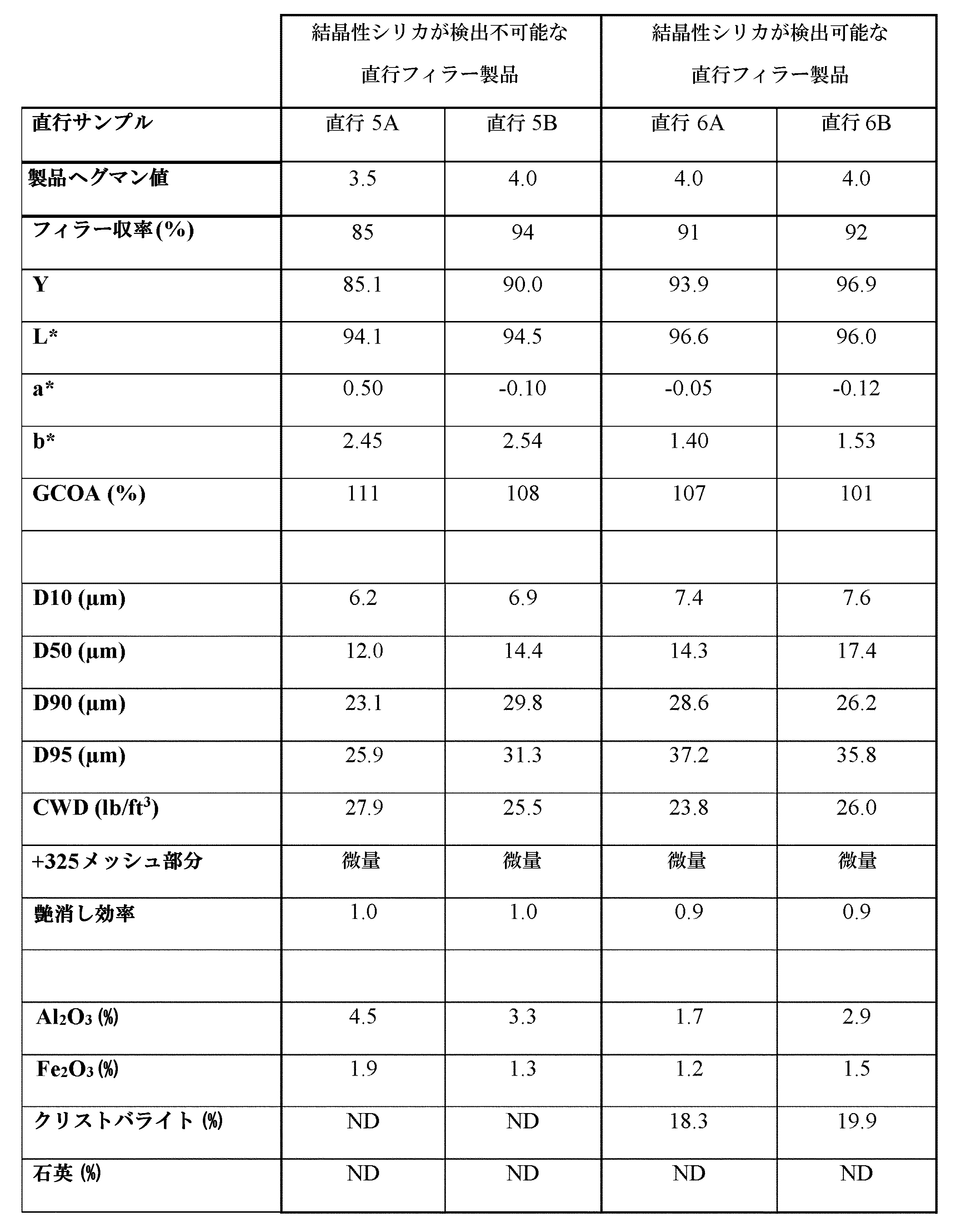
Exemplary straight diatomite functional filler products of the present disclosure, straight 5A, 5B, 6A, and 6B, are shown in Table 10 below. These were filler products with a Hegman value of 4.0 fineness. Straight 5A and 5B products represent the expected products with undetectable crystalline silica properties, whereas straight 6A and 6B products represent products with crystalline silica, primarily due to the presence of cristobalite, since the diatomite ore used for development did not contain quartz. The yields of these straight filler manufacturing processes were significantly higher than any of the conventionally manufactured Hegman value 4.0 diatomite products. In fact, the Hegman value 4.0 diatomite filler products are the most difficult to manufacture due to the fineness of the cut, with the highest yields being only about 10% by weight.
Table 10
Physical and chemical properties of Hegman 4.0 orthogonal filler products
従って、本開示は、直行白色フラックス焼成珪藻土機能性フィラー製品の製造プロセスの様々な実施態様を提供してきた。特に、第1の実施態様では、本開示は、珪藻土を含む機能性フィラー製品の製造プロセスを提供し、該珪藻土は、鉱石の天然アルミナ及び酸化鉄含有量で特別に選択され、次いで焼成中にソーダフラックスの存在下でクリストバライトの生成を引き起こすメカニズムを抑制する傾向がある原料の調製及び熱処理方法で処理された鉱石に由来する。本開示はまた、第2の実施態様では、珪藻土を含む直行機能性フィラー製品を提供し、該珪藻土製品は、原料の調製及び焼成の代替方法の後に形成される石英又はクリストバライトの形態の結晶性シリカを含む。 Thus, the present disclosure has provided various embodiments of a process for the manufacture of an orthogonal white flux calcined diatomite functional filler product. In particular, in a first embodiment, the present disclosure provides a process for the manufacture of a functional filler product comprising diatomite, the diatomite being derived from an ore that has been specially selected for the natural alumina and iron oxide content of the ore and then treated with a feedstock preparation and heat treatment method that tends to suppress the mechanisms that cause the formation of cristobalite in the presence of soda flux during calcination. The present disclosure also provides, in a second embodiment, an orthogonal functional filler product comprising diatomite, the diatomite product comprising crystalline silica in the form of quartz or cristobalite formed after an alternative method of feedstock preparation and calcination.
少なくとも1つの例示的な実施態様を本発明の前述の詳細な説明で示したが、膨大な数の変形が存在することを理解されたい。また、1つ又は複数の例示的な実施態様は、単なる例であり、本発明の範囲、適用可能性、又は構成を決して制限するものではないことも理解されたい。むしろ、前述の詳細な説明は、本発明の例示的な実施態様を行うための便利なロードマップを当業者に提供することになる。添付の特許請求の範囲に記載の本発明の範囲から逸脱することなく、例示的な実施態様に記載の要素の機能及び配置に様々な変更を加えることができることを理解されたい。 While at least one exemplary embodiment has been set forth in the foregoing detailed description of the invention, it should be understood that a vast number of variations exist. It should also be understood that the exemplary embodiment or embodiments are merely examples, and are not intended to limit the scope, applicability, or configuration of the invention in any way. Rather, the foregoing detailed description will provide those skilled in the art with a convenient road map for making exemplary embodiments of the invention. It should be understood that various changes can be made in the function and arrangement of elements described in the exemplary embodiment without departing from the scope of the invention as set forth in the appended claims.
本明細書では、第1及び第2などの関係を表す用語などは、実体又は動作間のあらゆる実際のそのような関係又は順序を必ずしも要求することも意味することもなく、ある実体又は動作を別の実体又は動作から区別するためにのみ使用することができる。例えば、「第1」、「第2」、「第3」などの数字の序数は、請求項の文言で特に規定されていない限り、単に複数の異なる単数を示し、いかなる順序や順番を意味するものではない。任意の請求項の文章の順番は、請求項の文言によって具体的に規定されていない限り、そのような順番に従って処理工程を時間的又は論理的な順序で実施しなければならないことを意味するものではない。処理工程は、任意の順序で交換が請求項の文言と矛盾せず、論理的に無意味でない限り、本発明の範囲から逸脱することなく、このような交換が可能である。
本件出願は、以下の態様の発明を提供する。
(態様1)
珪藻土機能性フィラー製品の製造方法であって:
珪藻土鉱石を選択する工程;
該珪藻土鉱石の粉砕とフラッシュ乾燥を同時に行う工程;
該粉砕してフラッシュ乾燥させた珪藻土鉱石を選鉱する工程;
該選鉱した珪藻土鉱石をフラックス剤とブレンドする工程;
該ブレンドした珪藻土鉱石及び該フラックス剤を焼成して、最初の珪藻土粉末を生成する工程;
該最初の珪藻土粉末を空気分級して、該珪藻土機能性フィラー製品を含む第1の部分及び粗い粒子を含む第2の部分を生成する工程;
該粗い粒子をさらに粉砕して、追加の珪藻土粉末を生成する工程;及び
該追加の珪藻土粉末を再循環させて、該追加の珪藻土粉末を該最初の珪藻土粉末とブレンドする工程を含む、前記方法。
(態様2)
前記珪藻土鉱石を選択する工程が、アルミナ含有量が約3.0~約4.5重量%であり、且つ酸化鉄含有量が約1.2~約2重量%である珪藻土鉱石を選択する工程を含む、態様1記載の方法。
(態様3)
前記珪藻土鉱石を選択する工程が、アルミナ含有量が約3.0重量%未満、酸化鉄含有量が約1.7重量%未満である珪藻土鉱石を選択する工程を含む、態様1記載の方法。
(態様4)
前記珪藻土鉱石を選択する工程が、遠心分離湿潤密度が約0.32 g / l(約20.0 lb / ft
3
)未満である珪藻土鉱石を選択する工程を含む、態様1記載の方法。
(態様5)
前記ブレンドする工程に続いて、前記フラックス剤を噴霧水で可溶化する工程をさらに含む、態様1記載の方法。
(態様6)
前記焼成する工程の前に、前記フラックス剤を噴霧水で可溶化する工程をさらに含む、態様5記載の方法。
(態様7)
前記フラックス剤を可溶化する工程が、該フラックス剤を約5.0重量%~約15重量%の噴霧水で可溶化する工程を含み、該噴霧水の重量%が、前記ブレンドした珪藻土鉱石及び該フラックス剤に基づいている、態様6記載の方法。
(態様8)
前記焼成する工程が、約677℃~約1,093℃(約1,250°F~約2,000°F)の温度で、約20分~約40分の範囲の時間行われる、態様1記載の方法。
(態様9)
前記焼成する工程が、約760℃~約1,177℃(約1,400°F~約2,150°F)の温度で約20分~約40分の範囲の時間行われる、態様1記載の方法。
(態様10)
前記空気分級する工程が、空気分級して、ヘグマンゲージ値が約1.0~約4.0である珪藻土機能性フィラー製品を含む第1の部分を生成する工程を含む、態様1記載の方法。
(態様11)
前記選鉱した珪藻土鉱石を前記フラックス剤とブレンドする工程が、該選鉱した珪藻土鉱石をソーダ灰とブレンドする工程を含む、態様1記載の方法。
(態様12)
結晶性シリカが検出不可能な珪藻土機能性フィラー製品の製造方法であって:
アルミナ含有量が約3.0~約4.5重量%であり、酸化鉄含有量が約1.2~約2重量%であり、且つ遠心湿潤密度が約0.32 g / l(約20.0 lb/ ft
3
)未満である珪藻土鉱石を選択する工程;
該珪藻土鉱石の粉砕とフラッシュ乾燥を同時に行う工程;
該粉砕してフラッシュ乾燥させた珪藻土鉱石を選鉱する工程;
該選鉱した珪藻土鉱石をフラックス剤とブレンドする工程;
該フラックス剤を噴霧水で可溶化する工程;
該ブレンドした珪藻土鉱石及び該可溶化したフラックス剤を約677℃~約1,093℃(約1,250°F~約2,000°F)の温度で約20分~約40分の範囲の時間焼成して、最初の珪藻土粉末を生成する工程;
該最初の珪藻土粉末を空気分級して、該珪藻土機能性フィラー製品を含む第1の部分及び粗い粒子を含む第2の部分を生成する工程;
該粗い粒子をさらに粉砕して、追加の珪藻土粉末を生成する工程;及び
該追加の珪藻土粉末を再循環させて、該追加の珪藻土粉末を該最初の珪藻土粉末とブレンドする工程を含む、前記方法。
(態様13)
前記フラックス剤を可溶化する工程が、該フラックス剤を約5.0重量%~約15重量%の噴霧水で可溶化する工程を含み、該噴霧水の重量%が、前記ブレンドした珪藻土鉱石及び該フラックス剤に基づいている、態様12記載の方法。
(態様14)
前記ブレンドした珪藻土鉱石及び前記可溶化したフラックス剤を焼成する工程が、該ブレンドした珪藻土鉱石及び該可溶化したフラックス剤を約760℃~約1,093℃(約1,400°F~約2,000°F)の温度で焼成する工程を含む、態様12記載の方法。
(態様15)
前記空気分級する工程が、空気分級して、ヘグマンゲージ値が約1.0~約4.0である珪藻土機能性フィラー製品を含む第1の部分を生成する工程を含む、態様12記載の方法。
(態様16)
前記選鉱した珪藻土鉱石を前記フラックス剤とブレンドする工程が、該選鉱した珪藻土鉱石をソーダ灰とブレンドする工程を含む、態様12記載の方法。
(態様17)
結晶性シリカが検出可能な珪藻土機能性フィラー製品の製造方法であって:
アルミナ含有量が約3.0重量%未満であり、酸化鉄含有量が約1.7重量%未満であり、且つ遠心湿潤密度が約0.32 g / l(約20.0 lb/ ft
3
)未満である珪藻土鉱石を選択する工程;
該珪藻土鉱石の粉砕とフラッシュ乾燥を同時に行う工程;
該粉砕してフラッシュ乾燥させた珪藻土鉱石を選鉱する工程;
該選鉱した珪藻土鉱石をフラックス剤とブレンドする工程;
該ブレンドした珪藻土鉱石及び該フラックス剤を約760℃~約1177℃(約1,400°F~約2,150°F)の温度で約20分~約40分の範囲の時間焼成して最初の珪藻土粉末を生成する工程;
該最初の珪藻土粉末を空気分級して、該珪藻土機能性フィラー製品を含む第1の部分及び粗い粒子を含む第2の部分を生成する工程;
該粗い粒子をさらに粉砕して、追加の珪藻土粉末を生成する工程;及び
該追加の珪藻土粉末を再循環させて、該追加の珪藻土粉末を該最初の珪藻土粉末とブレンドする工程を含む、前記方法。
(態様18)
前記ブレンドした珪藻土鉱石及び前記可溶化したフラックス剤を焼成する工程が、該ブレンドした珪藻土鉱石及び該可溶化したフラックス剤を820℃~約1,093℃(約1,510°F~約2,000°F)の温度で焼成する工程を含む、態様17記載の方法。
(態様19)
前記空気分級する工程が、空気分級して、ヘグマンゲージ値が約1.0~約4.0である珪藻土機能性フィラー製品を含む第1の部分を生成する工程を含む、態様17記載の方法。
(態様20)
前記選鉱した珪藻土鉱石を前記フラックス剤とブレンドする工程が、該選鉱した珪藻土鉱石をソーダ灰とブレンドする工程を含む、態様17記載の方法。
As used herein, terms expressing relationships such as first and second do not necessarily require or imply any actual relationship or order between the entities or operations, but may only be used to distinguish one entity or operation from another. For example, ordinal numbers such as "first,""second,""third," etc., merely indicate multiple distinct singular numbers and do not imply any order or sequence, unless otherwise specified by the claim language. The order of any claim text does not imply that the process steps must be performed in chronological or logical order according to such order, unless specifically specified by the claim language. Process steps may be interchanged in any order without departing from the scope of the invention, so long as such interchange is consistent with the claim language and is not logically meaningless.
The present application provides the following aspects of the invention.
(Aspect 1)
1. A method for producing a diatomaceous earth functional filler product, comprising:
selecting a diatomite ore;
simultaneously grinding and flash drying the diatomaceous earth ore;
beneficiating the crushed and flash dried diatomite ore;
blending the beneficiated diatomite ore with a fluxing agent;
calcining the blended diatomite ore and the fluxing agent to produce an initial diatomite powder;
air classifying the initial diatomite powder to produce a first portion comprising the diatomite functional filler product and a second portion comprising coarse particles;
further grinding the coarse particles to produce additional diatomaceous earth powder; and
The method includes the step of recycling the additional diatomaceous earth powder and blending the additional diatomaceous earth powder with the initial diatomaceous earth powder.
(Aspect 2)
2. The method of
(Aspect 3)
2. The method of
(Aspect 4)
2. The method of
(Aspect 5)
2. The method of
(Aspect 6)
6. The method of embodiment 5, further comprising the step of solubilizing the fluxing agent with spray water prior to the firing step.
(Aspect 7)
7. The method of claim 6, wherein solubilizing the fluxing agent comprises solubilizing the fluxing agent with about 5.0 wt.% to about 15 wt.% spray water, the weight percentage of the spray water being based on the blended diatomaceous earth ore and the fluxing agent.
(Aspect 8)
2. The method of
(Aspect 9)
2. The method of
(Aspect 10)
2. The method of
(Aspect 11)
2. The method of
(Aspect 12)
1. A method for producing a diatomite functional filler product having no detectable crystalline silica, comprising:
selecting a diatomite ore having an alumina content of about 3.0 to about 4.5 weight percent, an iron oxide content of about 1.2 to about 2 weight percent, and a centrifuged wet density of less than about 0.32 g/l (about 20.0 lb/ft3 ) ;
simultaneously grinding and flash drying the diatomaceous earth ore;
beneficiating the crushed and flash dried diatomite ore;
blending the beneficiated diatomite ore with a fluxing agent;
solubilizing the fluxing agent with spray water;
calcining the blended diatomite ore and the solubilized fluxing agent at a temperature of about 677° C. to about 1,093° C. (about 1,250° F. to about 2,000° F.) for a time period ranging from about 20 minutes to about 40 minutes to produce an initial diatomite powder;
air classifying the initial diatomite powder to produce a first portion comprising the diatomite functional filler product and a second portion comprising coarse particles;
further grinding the coarse particles to produce additional diatomaceous earth powder; and
The method includes the step of recycling the additional diatomaceous earth powder and blending the additional diatomaceous earth powder with the initial diatomaceous earth powder.
(Aspect 13)
13. The method of claim 12, wherein solubilizing the fluxing agent comprises solubilizing the fluxing agent with about 5.0 wt.% to about 15 wt.% spray water, the weight percentage of the spray water being based on the blended diatomaceous earth ore and the fluxing agent.
(Aspect 14)
13. The method of embodiment 12, wherein calcining the blended diatomite ore and the solubilized fluxing agent comprises calcining the blended diatomite ore and the solubilized fluxing agent at a temperature of from about 760° C. to about 1093° C. (about 1400° F. to about 2000° F.).
(Aspect 15)
13. The method of embodiment 12, wherein said air classifying step comprises air classifying to produce a first portion comprising a diatomaceous earth functional filler product having a Hegman Gauge value of about 1.0 to about 4.0.
(Aspect 16)
13. The method of claim 12, wherein blending the beneficiated diatomite ore with the fluxing agent comprises blending the beneficiated diatomite ore with soda ash.
(Aspect 17)
1. A method for producing a diatomite functional filler product having detectable crystalline silica, comprising:
selecting a diatomite ore having an alumina content of less than about 3.0% by weight, an iron oxide content of less than about 1.7% by weight, and a centrifugal wet density of less than about 0.32 g/l (about 20.0 lb/ft3 ) ;
simultaneously grinding and flash drying the diatomaceous earth ore;
beneficiating the crushed and flash dried diatomite ore;
blending the beneficiated diatomite ore with a fluxing agent;
calcining the blended diatomite ore and the fluxing agent at a temperature of about 760° C. to about 1177° C. (about 1,400° F. to about 2,150° F.) for a time period ranging from about 20 minutes to about 40 minutes to produce an initial diatomite powder;
air classifying the initial diatomite powder to produce a first portion comprising the diatomite functional filler product and a second portion comprising coarse particles;
further grinding the coarse particles to produce additional diatomaceous earth powder; and
The method includes the step of recycling the additional diatomaceous earth powder and blending the additional diatomaceous earth powder with the initial diatomaceous earth powder.
(Aspect 18)
18. The method of embodiment 17, wherein calcining the blended diatomite ore and the solubilized fluxing agent comprises calcining the blended diatomite ore and the solubilized fluxing agent at a temperature of from about 1,510°F to about 2,000°F (820°C to about 1,093°C).
(Aspect 19)
20. The method of embodiment 17, wherein said air classifying step comprises air classifying to produce a first portion comprising the diatomite functional filler product having a Hegman Gauge value of about 1.0 to about 4.0.
(Aspect 20)
18. The method of embodiment 17, wherein blending the beneficiated diatomite ore with the fluxing agent comprises blending the beneficiated diatomite ore with soda ash.
Claims (14)
珪藻土鉱石を選択する工程;
該珪藻土鉱石の粉砕とフラッシュ乾燥を同時に行う工程;
該粉砕してフラッシュ乾燥させた珪藻土鉱石を選鉱する工程;
該選鉱した珪藻土鉱石をフラックス剤とブレンドする工程;
該ブレンドする工程に続いて、該フラックス剤を噴霧水で可溶化する工程;
該ブレンドした珪藻土鉱石及び該フラックス剤を焼成して、最初の珪藻土粉末を生成する工程;
該最初の珪藻土粉末を空気分級して、該珪藻土機能性フィラー製品を含む第1の部分及び粗い粒子を含む第2の部分を生成する工程;
該粗い粒子をさらに粉砕して、追加の珪藻土粉末を生成する工程;及び
該追加の珪藻土粉末を再循環させて、該追加の珪藻土粉末を該最初の珪藻土粉末とブレンドする工程を含む、前記方法。 1. A method for producing a diatomaceous earth functional filler product, comprising:
selecting a diatomite ore;
simultaneously grinding and flash drying the diatomaceous earth ore;
beneficiating the crushed and flash dried diatomite ore;
blending the beneficiated diatomite ore with a fluxing agent;
following said blending step, solubilizing said fluxing agent with a water spray;
calcining the blended diatomite ore and the fluxing agent to produce an initial diatomite powder;
air classifying the initial diatomite powder to produce a first portion comprising the diatomite functional filler product and a second portion comprising coarse particles;
further grinding the coarse particles to produce additional diatomaceous earth powder; and recycling the additional diatomaceous earth powder and blending the additional diatomaceous earth powder with the initial diatomaceous earth powder.
アルミナ含有量が約3.0重量%未満であり、酸化鉄含有量が約1.7重量%未満であり、且つ遠心湿潤密度が約0.32 g / l(約20.0 lb/ ft3)未満である珪藻土鉱石を選択する工程;
該珪藻土鉱石の粉砕とフラッシュ乾燥を同時に行う工程;
該粉砕してフラッシュ乾燥させた珪藻土鉱石を選鉱する工程;
該選鉱した珪藻土鉱石をフラックス剤とブレンドする工程;
該ブレンドする工程に続いて、該フラックス剤を噴霧水で可溶化する工程;
該ブレンドした珪藻土鉱石及び該フラックス剤を約760℃~約1177℃(約1,400°F~約2,150°F)の温度で約20分~約40分の範囲の時間焼成して最初の珪藻土粉末を生成する工程;
該最初の珪藻土粉末を空気分級して、該珪藻土機能性フィラー製品を含む第1の部分及び粗い粒子を含む第2の部分を生成する工程;
該粗い粒子をさらに粉砕して、追加の珪藻土粉末を生成する工程;及び
該追加の珪藻土粉末を再循環させて、該追加の珪藻土粉末を該最初の珪藻土粉末とブレンドする工程を含む、前記方法。 1. A method for producing a diatomite functional filler product having detectable crystalline silica, comprising:
selecting a diatomite ore having an alumina content of less than about 3.0% by weight, an iron oxide content of less than about 1.7% by weight, and a centrifugal wet density of less than about 0.32 g/l (about 20.0 lb/ ft3 );
simultaneously grinding and flash drying the diatomaceous earth ore;
beneficiating the crushed and flash dried diatomite ore;
blending the beneficiated diatomite ore with a fluxing agent;
following said blending step, solubilizing said fluxing agent with a water spray;
calcining the blended diatomite ore and the fluxing agent at a temperature of about 760° C. to about 1177° C. (about 1,400° F. to about 2,150° F.) for a time period ranging from about 20 minutes to about 40 minutes to produce an initial diatomite powder;
air classifying the initial diatomite powder to produce a first portion comprising the diatomite functional filler product and a second portion comprising coarse particles;
further grinding the coarse particles to produce additional diatomaceous earth powder; and recycling the additional diatomaceous earth powder and blending the additional diatomaceous earth powder with the initial diatomaceous earth powder.
Priority Applications (1)
| Application Number | Priority Date | Filing Date | Title |
|---|---|---|---|
| JP2023206779A JP2024037818A (en) | 2020-01-30 | 2023-12-07 | Orthogonal diatomaceous earth functional filler product manufacturing process |
Applications Claiming Priority (3)
| Application Number | Priority Date | Filing Date | Title |
|---|---|---|---|
| US16/777,132 US20210238426A1 (en) | 2020-01-30 | 2020-01-30 | Process for making direct-run diatomite functional filler products |
| US16/777,132 | 2020-01-30 | ||
| PCT/US2021/015045 WO2021154700A1 (en) | 2020-01-30 | 2021-01-26 | Processes for making direct-run diatomite functional filler products |
Related Child Applications (1)
| Application Number | Title | Priority Date | Filing Date |
|---|---|---|---|
| JP2023206779A Division JP2024037818A (en) | 2020-01-30 | 2023-12-07 | Orthogonal diatomaceous earth functional filler product manufacturing process |
Publications (2)
| Publication Number | Publication Date |
|---|---|
| JP2023506584A JP2023506584A (en) | 2023-02-16 |
| JP7463531B2 true JP7463531B2 (en) | 2024-04-08 |
Family
ID=74673339
Family Applications (2)
| Application Number | Title | Priority Date | Filing Date |
|---|---|---|---|
| JP2022546563A Active JP7463531B2 (en) | 2020-01-30 | 2021-01-26 | Manufacturing process of orthogonal diatomite functional filler products |
| JP2023206779A Pending JP2024037818A (en) | 2020-01-30 | 2023-12-07 | Orthogonal diatomaceous earth functional filler product manufacturing process |
Family Applications After (1)
| Application Number | Title | Priority Date | Filing Date |
|---|---|---|---|
| JP2023206779A Pending JP2024037818A (en) | 2020-01-30 | 2023-12-07 | Orthogonal diatomaceous earth functional filler product manufacturing process |
Country Status (7)
| Country | Link |
|---|---|
| US (1) | US20210238426A1 (en) |
| EP (1) | EP4096820A1 (en) |
| JP (2) | JP7463531B2 (en) |
| KR (1) | KR20220116552A (en) |
| CN (1) | CN115362017A (en) |
| AU (1) | AU2021212652B2 (en) |
| WO (1) | WO2021154700A1 (en) |
Families Citing this family (1)
| Publication number | Priority date | Publication date | Assignee | Title |
|---|---|---|---|---|
| CN118218251A (en) * | 2023-07-19 | 2024-06-21 | 姜国栋 | A diatomite dry physical mineral processing technology and its application |
Citations (5)
| Publication number | Priority date | Publication date | Assignee | Title |
|---|---|---|---|---|
| US20090011240A1 (en) | 2007-07-06 | 2009-01-08 | Ep Minerals, Llc | Crystalline silica-free diatomaceous earth filter aids and methods of manufacturing the same |
| US20090181848A1 (en) | 2007-07-06 | 2009-07-16 | Ep Minerals, Llc | Crystalline silica-free diatomaceous earth blended filter aids and methods of manufacturing the same |
| US20140000487A1 (en) | 2009-11-10 | 2014-01-02 | Imerys Filtration Minerals, Inc. | Calcined diatomite products with low cristobalite content |
| JP2018532585A (en) | 2015-10-23 | 2018-11-08 | イーピー ミネラルス,エルエルシー | Diatomaceous earth products |
| US20190351355A1 (en) | 2017-01-06 | 2019-11-21 | Ep Minerals, Llc | Ultra-high purity, ultra-high performance diatomite filtration media |
Family Cites Families (11)
| Publication number | Priority date | Publication date | Assignee | Title |
|---|---|---|---|---|
| US1986301A (en) * | 1935-01-01 | Blending and air separation of | ||
| US3499778A (en) * | 1966-11-22 | 1970-03-10 | Johns Manville | Diatomaceous silica pigments and the like |
| FR1593603A (en) * | 1967-10-30 | 1970-06-01 | ||
| US4325844A (en) * | 1980-05-20 | 1982-04-20 | Manville Service Corporation | Method of preparing diatomite for rapid calcination |
| EP0302965A3 (en) * | 1987-08-11 | 1989-08-02 | Manville Corporation | Novel porous extruded shape biocarrier materials |
| JP3447770B2 (en) * | 1993-06-30 | 2003-09-16 | 昭和化学工業株式会社 | Method for producing diatomaceous earth filter aids and fillers by baking in a gas stream bed |
| US5656568A (en) | 1995-08-11 | 1997-08-12 | Advanced Minerals Corporation | Highly purified biogenic silica product |
| US6464770B1 (en) | 2000-08-08 | 2002-10-15 | Advanced Minerals Corporation | Perlite products with controlled particle size distribution |
| EP3565662A4 (en) * | 2017-01-06 | 2020-08-19 | EP Minerals, LLC | ULTRA HIGH PERFORMANCE AND HIGH PURITY BIOGENIC SILICA FILTRATION MEDIA |
| WO2019009930A1 (en) * | 2017-07-06 | 2019-01-10 | Ep Minerals, Llc | White opaline flux-calcined diatomite products |
| CN108905958A (en) * | 2018-07-13 | 2018-11-30 | 临江市长白山助滤剂有限公司 | A kind of preparation method of super-cell |
-
2020
- 2020-01-30 US US16/777,132 patent/US20210238426A1/en not_active Abandoned
-
2021
- 2021-01-26 AU AU2021212652A patent/AU2021212652B2/en active Active
- 2021-01-26 CN CN202180026321.7A patent/CN115362017A/en active Pending
- 2021-01-26 EP EP21707469.9A patent/EP4096820A1/en not_active Withdrawn
- 2021-01-26 WO PCT/US2021/015045 patent/WO2021154700A1/en not_active Ceased
- 2021-01-26 KR KR1020227025967A patent/KR20220116552A/en not_active Ceased
- 2021-01-26 JP JP2022546563A patent/JP7463531B2/en active Active
-
2023
- 2023-12-07 JP JP2023206779A patent/JP2024037818A/en active Pending
Patent Citations (5)
| Publication number | Priority date | Publication date | Assignee | Title |
|---|---|---|---|---|
| US20090011240A1 (en) | 2007-07-06 | 2009-01-08 | Ep Minerals, Llc | Crystalline silica-free diatomaceous earth filter aids and methods of manufacturing the same |
| US20090181848A1 (en) | 2007-07-06 | 2009-07-16 | Ep Minerals, Llc | Crystalline silica-free diatomaceous earth blended filter aids and methods of manufacturing the same |
| US20140000487A1 (en) | 2009-11-10 | 2014-01-02 | Imerys Filtration Minerals, Inc. | Calcined diatomite products with low cristobalite content |
| JP2018532585A (en) | 2015-10-23 | 2018-11-08 | イーピー ミネラルス,エルエルシー | Diatomaceous earth products |
| US20190351355A1 (en) | 2017-01-06 | 2019-11-21 | Ep Minerals, Llc | Ultra-high purity, ultra-high performance diatomite filtration media |
Also Published As
| Publication number | Publication date |
|---|---|
| EP4096820A1 (en) | 2022-12-07 |
| WO2021154700A1 (en) | 2021-08-05 |
| US20210238426A1 (en) | 2021-08-05 |
| KR20220116552A (en) | 2022-08-23 |
| AU2021212652B2 (en) | 2024-03-21 |
| AU2021212652A1 (en) | 2022-07-21 |
| CN115362017A (en) | 2022-11-18 |
| JP2024037818A (en) | 2024-03-19 |
| JP2023506584A (en) | 2023-02-16 |
Similar Documents
| Publication | Publication Date | Title |
|---|---|---|
| CN108430616B (en) | Method for determining mineralogical characteristics of calcined and flux calcined diatomaceous earth products | |
| JP7362144B2 (en) | Recycled aluminum silicate material and particulate mixture containing recycled aluminum silicate material | |
| US11511220B2 (en) | Ultra-high purity, ultra-high performance diatomite filtration media | |
| US11633713B2 (en) | Ultra-high performance and high purify biogenic silica filtration media | |
| JP2024037818A (en) | Orthogonal diatomaceous earth functional filler product manufacturing process | |
| Moradi et al. | Electrostatic beneficiation of diatomaceous earth | |
| US12134082B2 (en) | Ultra-low surface charge biogenic silica filtration media | |
| WO2019027473A1 (en) | White functional additives derived from filtration spent cake containing diatomite | |
| CN113631258B (en) | High efficiency functional additive product | |
| Kirabira et al. | Beneficiation and Evaluation of Mutaka kaolin | |
| HK1257532B (en) | Methods of determining the mineralogy of calcined and flux-calcined diatomite products | |
| Suh et al. | An investigation on the processes for the purification of alumina by using the wash-grinding method |
Legal Events
| Date | Code | Title | Description |
|---|---|---|---|
| A521 | Request for written amendment filed |
Free format text: JAPANESE INTERMEDIATE CODE: A523 Effective date: 20221004 |
|
| A621 | Written request for application examination |
Free format text: JAPANESE INTERMEDIATE CODE: A621 Effective date: 20221004 |
|
| A871 | Explanation of circumstances concerning accelerated examination |
Free format text: JAPANESE INTERMEDIATE CODE: A871 Effective date: 20221228 |
|
| A131 | Notification of reasons for refusal |
Free format text: JAPANESE INTERMEDIATE CODE: A131 Effective date: 20230404 |
|
| A521 | Request for written amendment filed |
Free format text: JAPANESE INTERMEDIATE CODE: A523 Effective date: 20230629 |
|
| A02 | Decision of refusal |
Free format text: JAPANESE INTERMEDIATE CODE: A02 Effective date: 20230808 |
|
| A521 | Request for written amendment filed |
Free format text: JAPANESE INTERMEDIATE CODE: A523 Effective date: 20231207 |
|
| A911 | Transfer to examiner for re-examination before appeal (zenchi) |
Free format text: JAPANESE INTERMEDIATE CODE: A911 Effective date: 20231225 |
|
| TRDD | Decision of grant or rejection written | ||
| A01 | Written decision to grant a patent or to grant a registration (utility model) |
Free format text: JAPANESE INTERMEDIATE CODE: A01 Effective date: 20240305 |
|
| A61 | First payment of annual fees (during grant procedure) |
Free format text: JAPANESE INTERMEDIATE CODE: A61 Effective date: 20240327 |
|
| R150 | Certificate of patent or registration of utility model |
Ref document number: 7463531 Country of ref document: JP Free format text: JAPANESE INTERMEDIATE CODE: R150 |