JP7463501B2 - Electrochemical device and electronic device including same - Google Patents
Electrochemical device and electronic device including same Download PDFInfo
- Publication number
- JP7463501B2 JP7463501B2 JP2022519794A JP2022519794A JP7463501B2 JP 7463501 B2 JP7463501 B2 JP 7463501B2 JP 2022519794 A JP2022519794 A JP 2022519794A JP 2022519794 A JP2022519794 A JP 2022519794A JP 7463501 B2 JP7463501 B2 JP 7463501B2
- Authority
- JP
- Japan
- Prior art keywords
- negative electrode
- mixture layer
- electrode mixture
- less
- positive electrode
- Prior art date
- Legal status (The legal status is an assumption and is not a legal conclusion. Google has not performed a legal analysis and makes no representation as to the accuracy of the status listed.)
- Active
Links
Classifications
-
- H—ELECTRICITY
- H01—ELECTRIC ELEMENTS
- H01M—PROCESSES OR MEANS, e.g. BATTERIES, FOR THE DIRECT CONVERSION OF CHEMICAL ENERGY INTO ELECTRICAL ENERGY
- H01M4/00—Electrodes
- H01M4/02—Electrodes composed of, or comprising, active material
- H01M4/36—Selection of substances as active materials, active masses, active liquids
- H01M4/58—Selection of substances as active materials, active masses, active liquids of inorganic compounds other than oxides or hydroxides, e.g. sulfides, selenides, tellurides, halogenides or LiCoFy; of polyanionic structures, e.g. phosphates, silicates or borates
- H01M4/583—Carbonaceous material, e.g. graphite-intercalation compounds or CFx
- H01M4/587—Carbonaceous material, e.g. graphite-intercalation compounds or CFx for inserting or intercalating light metals
-
- H—ELECTRICITY
- H01—ELECTRIC ELEMENTS
- H01M—PROCESSES OR MEANS, e.g. BATTERIES, FOR THE DIRECT CONVERSION OF CHEMICAL ENERGY INTO ELECTRICAL ENERGY
- H01M4/00—Electrodes
- H01M4/02—Electrodes composed of, or comprising, active material
- H01M4/64—Carriers or collectors
- H01M4/66—Selection of materials
- H01M4/663—Selection of materials containing carbon or carbonaceous materials as conductive part, e.g. graphite, carbon fibres
-
- H—ELECTRICITY
- H01—ELECTRIC ELEMENTS
- H01M—PROCESSES OR MEANS, e.g. BATTERIES, FOR THE DIRECT CONVERSION OF CHEMICAL ENERGY INTO ELECTRICAL ENERGY
- H01M10/00—Secondary cells; Manufacture thereof
- H01M10/05—Accumulators with non-aqueous electrolyte
- H01M10/056—Accumulators with non-aqueous electrolyte characterised by the materials used as electrolytes, e.g. mixed inorganic/organic electrolytes
- H01M10/0564—Accumulators with non-aqueous electrolyte characterised by the materials used as electrolytes, e.g. mixed inorganic/organic electrolytes the electrolyte being constituted of organic materials only
- H01M10/0566—Liquid materials
- H01M10/0567—Liquid materials characterised by the additives
-
- H—ELECTRICITY
- H01—ELECTRIC ELEMENTS
- H01M—PROCESSES OR MEANS, e.g. BATTERIES, FOR THE DIRECT CONVERSION OF CHEMICAL ENERGY INTO ELECTRICAL ENERGY
- H01M10/00—Secondary cells; Manufacture thereof
- H01M10/05—Accumulators with non-aqueous electrolyte
- H01M10/052—Li-accumulators
-
- H—ELECTRICITY
- H01—ELECTRIC ELEMENTS
- H01M—PROCESSES OR MEANS, e.g. BATTERIES, FOR THE DIRECT CONVERSION OF CHEMICAL ENERGY INTO ELECTRICAL ENERGY
- H01M10/00—Secondary cells; Manufacture thereof
- H01M10/05—Accumulators with non-aqueous electrolyte
- H01M10/052—Li-accumulators
- H01M10/0525—Rocking-chair batteries, i.e. batteries with lithium insertion or intercalation in both electrodes; Lithium-ion batteries
-
- H—ELECTRICITY
- H01—ELECTRIC ELEMENTS
- H01M—PROCESSES OR MEANS, e.g. BATTERIES, FOR THE DIRECT CONVERSION OF CHEMICAL ENERGY INTO ELECTRICAL ENERGY
- H01M10/00—Secondary cells; Manufacture thereof
- H01M10/05—Accumulators with non-aqueous electrolyte
- H01M10/056—Accumulators with non-aqueous electrolyte characterised by the materials used as electrolytes, e.g. mixed inorganic/organic electrolytes
- H01M10/0564—Accumulators with non-aqueous electrolyte characterised by the materials used as electrolytes, e.g. mixed inorganic/organic electrolytes the electrolyte being constituted of organic materials only
- H01M10/0566—Liquid materials
- H01M10/0568—Liquid materials characterised by the solutes
-
- H—ELECTRICITY
- H01—ELECTRIC ELEMENTS
- H01M—PROCESSES OR MEANS, e.g. BATTERIES, FOR THE DIRECT CONVERSION OF CHEMICAL ENERGY INTO ELECTRICAL ENERGY
- H01M10/00—Secondary cells; Manufacture thereof
- H01M10/05—Accumulators with non-aqueous electrolyte
- H01M10/056—Accumulators with non-aqueous electrolyte characterised by the materials used as electrolytes, e.g. mixed inorganic/organic electrolytes
- H01M10/0564—Accumulators with non-aqueous electrolyte characterised by the materials used as electrolytes, e.g. mixed inorganic/organic electrolytes the electrolyte being constituted of organic materials only
- H01M10/0566—Liquid materials
- H01M10/0569—Liquid materials characterised by the solvents
-
- H—ELECTRICITY
- H01—ELECTRIC ELEMENTS
- H01M—PROCESSES OR MEANS, e.g. BATTERIES, FOR THE DIRECT CONVERSION OF CHEMICAL ENERGY INTO ELECTRICAL ENERGY
- H01M10/00—Secondary cells; Manufacture thereof
- H01M10/05—Accumulators with non-aqueous electrolyte
- H01M10/058—Construction or manufacture
-
- H—ELECTRICITY
- H01—ELECTRIC ELEMENTS
- H01M—PROCESSES OR MEANS, e.g. BATTERIES, FOR THE DIRECT CONVERSION OF CHEMICAL ENERGY INTO ELECTRICAL ENERGY
- H01M10/00—Secondary cells; Manufacture thereof
- H01M10/42—Methods or arrangements for servicing or maintenance of secondary cells or secondary half-cells
- H01M10/4235—Safety or regulating additives or arrangements in electrodes, separators or electrolyte
-
- H—ELECTRICITY
- H01—ELECTRIC ELEMENTS
- H01M—PROCESSES OR MEANS, e.g. BATTERIES, FOR THE DIRECT CONVERSION OF CHEMICAL ENERGY INTO ELECTRICAL ENERGY
- H01M4/00—Electrodes
- H01M4/02—Electrodes composed of, or comprising, active material
- H01M4/13—Electrodes for accumulators with non-aqueous electrolyte, e.g. for lithium-accumulators; Processes of manufacture thereof
-
- H—ELECTRICITY
- H01—ELECTRIC ELEMENTS
- H01M—PROCESSES OR MEANS, e.g. BATTERIES, FOR THE DIRECT CONVERSION OF CHEMICAL ENERGY INTO ELECTRICAL ENERGY
- H01M4/00—Electrodes
- H01M4/02—Electrodes composed of, or comprising, active material
- H01M4/13—Electrodes for accumulators with non-aqueous electrolyte, e.g. for lithium-accumulators; Processes of manufacture thereof
- H01M4/131—Electrodes based on mixed oxides or hydroxides, or on mixtures of oxides or hydroxides, e.g. LiCoOx
-
- H—ELECTRICITY
- H01—ELECTRIC ELEMENTS
- H01M—PROCESSES OR MEANS, e.g. BATTERIES, FOR THE DIRECT CONVERSION OF CHEMICAL ENERGY INTO ELECTRICAL ENERGY
- H01M4/00—Electrodes
- H01M4/02—Electrodes composed of, or comprising, active material
- H01M4/13—Electrodes for accumulators with non-aqueous electrolyte, e.g. for lithium-accumulators; Processes of manufacture thereof
- H01M4/133—Electrodes based on carbonaceous material, e.g. graphite-intercalation compounds or CFx
-
- H—ELECTRICITY
- H01—ELECTRIC ELEMENTS
- H01M—PROCESSES OR MEANS, e.g. BATTERIES, FOR THE DIRECT CONVERSION OF CHEMICAL ENERGY INTO ELECTRICAL ENERGY
- H01M4/00—Electrodes
- H01M4/02—Electrodes composed of, or comprising, active material
- H01M4/13—Electrodes for accumulators with non-aqueous electrolyte, e.g. for lithium-accumulators; Processes of manufacture thereof
- H01M4/134—Electrodes based on metals, Si or alloys
-
- H—ELECTRICITY
- H01—ELECTRIC ELEMENTS
- H01M—PROCESSES OR MEANS, e.g. BATTERIES, FOR THE DIRECT CONVERSION OF CHEMICAL ENERGY INTO ELECTRICAL ENERGY
- H01M4/00—Electrodes
- H01M4/02—Electrodes composed of, or comprising, active material
- H01M4/36—Selection of substances as active materials, active masses, active liquids
-
- H—ELECTRICITY
- H01—ELECTRIC ELEMENTS
- H01M—PROCESSES OR MEANS, e.g. BATTERIES, FOR THE DIRECT CONVERSION OF CHEMICAL ENERGY INTO ELECTRICAL ENERGY
- H01M4/00—Electrodes
- H01M4/02—Electrodes composed of, or comprising, active material
- H01M4/36—Selection of substances as active materials, active masses, active liquids
- H01M4/362—Composites
- H01M4/366—Composites as layered products
-
- H—ELECTRICITY
- H01—ELECTRIC ELEMENTS
- H01M—PROCESSES OR MEANS, e.g. BATTERIES, FOR THE DIRECT CONVERSION OF CHEMICAL ENERGY INTO ELECTRICAL ENERGY
- H01M4/00—Electrodes
- H01M4/02—Electrodes composed of, or comprising, active material
- H01M4/36—Selection of substances as active materials, active masses, active liquids
- H01M4/38—Selection of substances as active materials, active masses, active liquids of elements or alloys
- H01M4/381—Alkaline or alkaline earth metals elements
- H01M4/382—Lithium
-
- H—ELECTRICITY
- H01—ELECTRIC ELEMENTS
- H01M—PROCESSES OR MEANS, e.g. BATTERIES, FOR THE DIRECT CONVERSION OF CHEMICAL ENERGY INTO ELECTRICAL ENERGY
- H01M4/00—Electrodes
- H01M4/02—Electrodes composed of, or comprising, active material
- H01M4/36—Selection of substances as active materials, active masses, active liquids
- H01M4/38—Selection of substances as active materials, active masses, active liquids of elements or alloys
- H01M4/386—Silicon or alloys based on silicon
-
- H—ELECTRICITY
- H01—ELECTRIC ELEMENTS
- H01M—PROCESSES OR MEANS, e.g. BATTERIES, FOR THE DIRECT CONVERSION OF CHEMICAL ENERGY INTO ELECTRICAL ENERGY
- H01M4/00—Electrodes
- H01M4/02—Electrodes composed of, or comprising, active material
- H01M4/36—Selection of substances as active materials, active masses, active liquids
- H01M4/48—Selection of substances as active materials, active masses, active liquids of inorganic oxides or hydroxides
- H01M4/485—Selection of substances as active materials, active masses, active liquids of inorganic oxides or hydroxides of mixed oxides or hydroxides for inserting or intercalating light metals, e.g. LiTi2O4 or LiTi2OxFy
-
- H—ELECTRICITY
- H01—ELECTRIC ELEMENTS
- H01M—PROCESSES OR MEANS, e.g. BATTERIES, FOR THE DIRECT CONVERSION OF CHEMICAL ENERGY INTO ELECTRICAL ENERGY
- H01M4/00—Electrodes
- H01M4/02—Electrodes composed of, or comprising, active material
- H01M4/36—Selection of substances as active materials, active masses, active liquids
- H01M4/48—Selection of substances as active materials, active masses, active liquids of inorganic oxides or hydroxides
- H01M4/52—Selection of substances as active materials, active masses, active liquids of inorganic oxides or hydroxides of nickel, cobalt or iron
- H01M4/525—Selection of substances as active materials, active masses, active liquids of inorganic oxides or hydroxides of nickel, cobalt or iron of mixed oxides or hydroxides containing iron, cobalt or nickel for inserting or intercalating light metals, e.g. LiNiO2, LiCoO2 or LiCoOxFy
-
- H—ELECTRICITY
- H01—ELECTRIC ELEMENTS
- H01M—PROCESSES OR MEANS, e.g. BATTERIES, FOR THE DIRECT CONVERSION OF CHEMICAL ENERGY INTO ELECTRICAL ENERGY
- H01M4/00—Electrodes
- H01M4/02—Electrodes composed of, or comprising, active material
- H01M4/36—Selection of substances as active materials, active masses, active liquids
- H01M4/58—Selection of substances as active materials, active masses, active liquids of inorganic compounds other than oxides or hydroxides, e.g. sulfides, selenides, tellurides, halogenides or LiCoFy; of polyanionic structures, e.g. phosphates, silicates or borates
- H01M4/5825—Oxygenated metallic salts or polyanionic structures, e.g. borates, phosphates, silicates, olivines
-
- H—ELECTRICITY
- H01—ELECTRIC ELEMENTS
- H01M—PROCESSES OR MEANS, e.g. BATTERIES, FOR THE DIRECT CONVERSION OF CHEMICAL ENERGY INTO ELECTRICAL ENERGY
- H01M4/00—Electrodes
- H01M4/02—Electrodes composed of, or comprising, active material
- H01M4/62—Selection of inactive substances as ingredients for active masses, e.g. binders, fillers
-
- H—ELECTRICITY
- H01—ELECTRIC ELEMENTS
- H01M—PROCESSES OR MEANS, e.g. BATTERIES, FOR THE DIRECT CONVERSION OF CHEMICAL ENERGY INTO ELECTRICAL ENERGY
- H01M4/00—Electrodes
- H01M4/02—Electrodes composed of, or comprising, active material
- H01M4/62—Selection of inactive substances as ingredients for active masses, e.g. binders, fillers
- H01M4/624—Electric conductive fillers
- H01M4/625—Carbon or graphite
-
- H—ELECTRICITY
- H01—ELECTRIC ELEMENTS
- H01M—PROCESSES OR MEANS, e.g. BATTERIES, FOR THE DIRECT CONVERSION OF CHEMICAL ENERGY INTO ELECTRICAL ENERGY
- H01M4/00—Electrodes
- H01M4/02—Electrodes composed of, or comprising, active material
- H01M4/64—Carriers or collectors
- H01M4/66—Selection of materials
- H01M4/661—Metal or alloys, e.g. alloy coatings
-
- H—ELECTRICITY
- H01—ELECTRIC ELEMENTS
- H01M—PROCESSES OR MEANS, e.g. BATTERIES, FOR THE DIRECT CONVERSION OF CHEMICAL ENERGY INTO ELECTRICAL ENERGY
- H01M4/00—Electrodes
- H01M4/02—Electrodes composed of, or comprising, active material
- H01M2004/021—Physical characteristics, e.g. porosity, surface area
-
- H—ELECTRICITY
- H01—ELECTRIC ELEMENTS
- H01M—PROCESSES OR MEANS, e.g. BATTERIES, FOR THE DIRECT CONVERSION OF CHEMICAL ENERGY INTO ELECTRICAL ENERGY
- H01M4/00—Electrodes
- H01M4/02—Electrodes composed of, or comprising, active material
- H01M2004/026—Electrodes composed of, or comprising, active material characterised by the polarity
- H01M2004/027—Negative electrodes
-
- H—ELECTRICITY
- H01—ELECTRIC ELEMENTS
- H01M—PROCESSES OR MEANS, e.g. BATTERIES, FOR THE DIRECT CONVERSION OF CHEMICAL ENERGY INTO ELECTRICAL ENERGY
- H01M4/00—Electrodes
- H01M4/02—Electrodes composed of, or comprising, active material
- H01M2004/026—Electrodes composed of, or comprising, active material characterised by the polarity
- H01M2004/028—Positive electrodes
-
- H—ELECTRICITY
- H01—ELECTRIC ELEMENTS
- H01M—PROCESSES OR MEANS, e.g. BATTERIES, FOR THE DIRECT CONVERSION OF CHEMICAL ENERGY INTO ELECTRICAL ENERGY
- H01M10/00—Secondary cells; Manufacture thereof
- H01M10/42—Methods or arrangements for servicing or maintenance of secondary cells or secondary half-cells
- H01M2010/4292—Aspects relating to capacity ratio of electrodes/electrolyte or anode/cathode
-
- H—ELECTRICITY
- H01—ELECTRIC ELEMENTS
- H01M—PROCESSES OR MEANS, e.g. BATTERIES, FOR THE DIRECT CONVERSION OF CHEMICAL ENERGY INTO ELECTRICAL ENERGY
- H01M2300/00—Electrolytes
- H01M2300/0017—Non-aqueous electrolytes
- H01M2300/0025—Organic electrolyte
-
- Y—GENERAL TAGGING OF NEW TECHNOLOGICAL DEVELOPMENTS; GENERAL TAGGING OF CROSS-SECTIONAL TECHNOLOGIES SPANNING OVER SEVERAL SECTIONS OF THE IPC; TECHNICAL SUBJECTS COVERED BY FORMER USPC CROSS-REFERENCE ART COLLECTIONS [XRACs] AND DIGESTS
- Y02—TECHNOLOGIES OR APPLICATIONS FOR MITIGATION OR ADAPTATION AGAINST CLIMATE CHANGE
- Y02E—REDUCTION OF GREENHOUSE GAS [GHG] EMISSIONS, RELATED TO ENERGY GENERATION, TRANSMISSION OR DISTRIBUTION
- Y02E60/00—Enabling technologies; Technologies with a potential or indirect contribution to GHG emissions mitigation
- Y02E60/10—Energy storage using batteries
Landscapes
- Chemical & Material Sciences (AREA)
- Chemical Kinetics & Catalysis (AREA)
- Electrochemistry (AREA)
- General Chemical & Material Sciences (AREA)
- Engineering & Computer Science (AREA)
- Materials Engineering (AREA)
- Inorganic Chemistry (AREA)
- Manufacturing & Machinery (AREA)
- Condensed Matter Physics & Semiconductors (AREA)
- General Physics & Mathematics (AREA)
- Physics & Mathematics (AREA)
- Composite Materials (AREA)
- Crystallography & Structural Chemistry (AREA)
- Battery Electrode And Active Subsutance (AREA)
- Secondary Cells (AREA)
- Electric Double-Layer Capacitors Or The Like (AREA)
Description
本発明は、エネルギー貯蔵分野に関し、具体的に、電気化学装置及びそれを含む電子装置に関し、特にリチウムイオン電池に関する。 The present invention relates to the field of energy storage, specifically to electrochemical devices and electronic devices containing the same, and in particular to lithium-ion batteries.
技術の発展及び携帯装置への需要の増加につれて、電気化学装置(例えば、リチウムイオン電池)への需要が著しく増加している。高いエネルギー密度、優れた寿命及びサイクル特性をあわせて持つリチウムイオン電池は研究の方向の一つである。 With the development of technology and the increasing demand for portable devices, the demand for electrochemical devices (e.g., lithium-ion batteries) is increasing significantly. Lithium-ion batteries, which combine high energy density with excellent life and cycle characteristics, are one of the research directions.
リチウムイオン電池の理論容量は負極活物質の種類によって変わる。サイクルの進行に伴い、リチウムイオン電池には、通常、充電/放電容量低下の現象が起こり、それによって、リチウムイオン電池の性能が劣化する。近年では、リチウムイオン電池の製造において、環境への負担を軽減するなどのため、水性媒体を分散媒体として使用する水性スラリー組成物がますます注目されるが、水性スラリーは、スラリー組成物における泡の存在により、活物質層に複数のピンホール、ピット等の欠陥が生じ、それによって、電気化学装置のサイクル特性及び高温保存特性が影響される。 The theoretical capacity of a lithium-ion battery varies depending on the type of negative electrode active material. As the cycle progresses, lithium-ion batteries usually experience a phenomenon of a decrease in charge/discharge capacity, which deteriorates the performance of the lithium-ion battery. In recent years, in the production of lithium-ion batteries, aqueous slurry compositions using an aqueous medium as a dispersion medium have been attracting more and more attention in order to reduce the burden on the environment, but the aqueous slurry causes defects such as multiple pinholes and pits in the active material layer due to the presence of bubbles in the slurry composition, which affects the cycle characteristics and high-temperature storage characteristics of the electrochemical device.
それに鑑みて、改善されたサイクル特性、保存特性及び安全特性を有する電気化学装置及びそれを含む電子装置を提供する必要は確かにある。 In view of this, there is certainly a need to provide electrochemical devices and electronic devices including the same that have improved cycle characteristics, storage characteristics and safety characteristics.
本発明の実施例は、電気化学装置及びそれを含む電子装置を提供することで、少なくとも一種の関連分野に存在する問題を少なくともある程度に解決する。 Embodiments of the present invention address, at least to some extent, problems present in at least one related field by providing an electrochemical device and an electronic device including the same.
本発明の一つの態様では、正極、電解液、及び負極を含む電気化学装置が提供され、前記電解液は、リンと酸素を有する化合物を含み、前記負極は、負極集電体、及び前記負極集電体上に形成した負極合剤層を含み、100回の充放電サイクル後、前記負極合剤層の総表面積に対して、前記負極合剤層の表面のリチウム析出面積は2%以下である。 In one aspect of the present invention, an electrochemical device is provided that includes a positive electrode, an electrolyte, and a negative electrode, the electrolyte includes a compound having phosphorus and oxygen, the negative electrode includes a negative electrode current collector, and a negative electrode mixture layer formed on the negative electrode current collector, and after 100 charge/discharge cycles, the lithium deposition area on the surface of the negative electrode mixture layer is 2% or less of the total surface area of the negative electrode mixture layer.
本発明のいくつかの実施例によれば、前記電解液は、
(a)モノフルオロリン酸リチウムと、
(b)ジフルオロリン酸リチウムと、
(c)リン酸エステルと、
(d)ホスホン酸環状無水物と、
(e)式1で示される化合物と、
のうちの少なくとも一種を含み、

(a) lithium monofluorophosphate;
(b) lithium difluorophosphate; and
(c) a phosphate ester; and
(d) a phosphonic acid cyclic anhydride; and
(e) a compound represented by formula 1;
At least one of the following is included:
本発明のいくつかの実施例によれば、前記電解液は前記式1で示される化合物を含み、前記式1で示される化合物は、

本発明のいくつかの実施例によれば、前記電解液はリン酸エステルを含み、前記リン酸エステルは式2を有し、
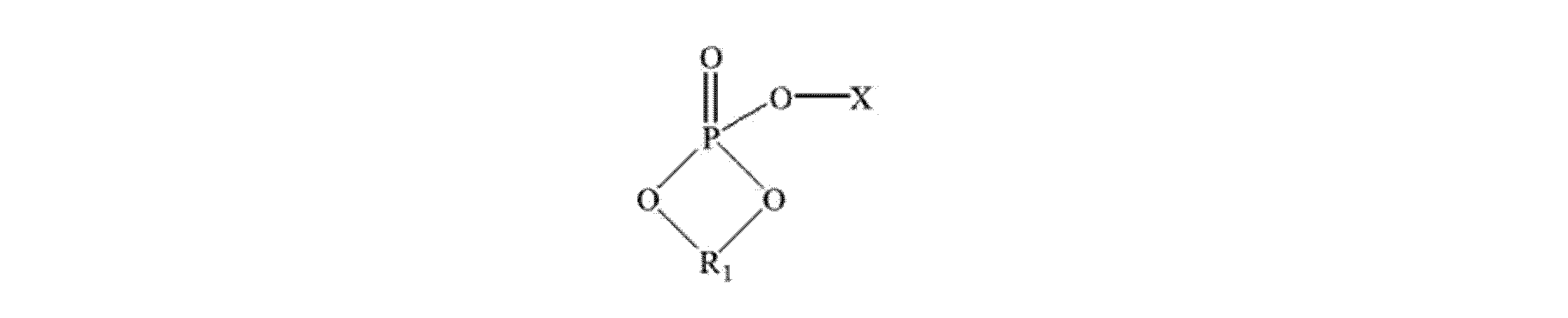
ここで、Xは1~5個の炭素原子を有する直鎖若しくは分岐アルキル基、又は-SiR2R3R4であり、R2、R3及びR4はそれぞれ独立して1~5個の炭素原子を有するアルキル基であり、
R1は、2~3個の炭素原子を有し、且つ以下の置換基で置換されたアルキレン基であり、前記置換基は、少なくとも1つのフッ素原子、または、少なくとも1つのフッ素原子を含み、且つ1~3個の炭素原子を有するアルキル基である。
According to some embodiments of the present invention, the electrolyte comprises a phosphate ester, the phosphate ester having the formula 2:
wherein X is a linear or branched alkyl group having 1 to 5 carbon atoms, or -SiR2R3R4 , where R2 , R3 , and R4 are each independently an alkyl group having 1 to 5 carbon atoms;
R 1 is an alkylene group having 2 to 3 carbon atoms and substituted with the following substituents, wherein the substituent is at least one fluorine atom or an alkyl group containing at least one fluorine atom and having 1 to 3 carbon atoms.
本発明のいくつかの実施例によれば、前記電解液の総重量に対して、前記リンと酸素を有する化合物の含有量は0.001wt%~10wt%である。 According to some embodiments of the present invention, the content of the phosphorus and oxygen-containing compound is 0.001 wt % to 10 wt % based on the total weight of the electrolyte.
本発明のいくつかの実施例によれば、前記負極合剤層は炭素材料を含み、前記炭素材料は、
(a)比表面積が5m2/g未満であることと、
(b)メディアン径が5μm~30μmであることと、
(c)表面にアモルファスカーボンを有することと、
のうちの少なくとも一つの特徴を有する。
According to some embodiments of the present invention, the negative electrode mixture layer includes a carbon material, and the carbon material is
(a) a specific surface area of less than 5 m 2 /g;
(b) the median diameter is 5 μm to 30 μm;
(c) having amorphous carbon on the surface;
The present invention has at least one of the following characteristics.
本発明のいくつかの実施例によれば、前記負極合剤層は、
(a)厚さが200μm以下であることと、
(b)10%~60%の孔隙率を有することと、
(c)直径15mm、重量12グラムのボールが前記負極合剤層上に落下した場合、前記負極合剤層に亀裂を発生させるボールの最小高さが50cm以上であることと、
のうちの少なくとも一つの特徴を有する。
According to some embodiments of the present invention, the negative electrode mixture layer is
(a) having a thickness of 200 μm or less;
(b) having a porosity of 10% to 60%;
(c) when a ball having a diameter of 15 mm and a weight of 12 grams is dropped onto the negative electrode mixture layer, the minimum height of the ball that causes a crack in the negative electrode mixture layer is 50 cm or more;
The present invention has at least one of the following characteristics.
本発明のいくつかの実施例によれば、前記負極合剤層は助剤を含み、前記助剤は、
(a)ポリエーテルシロキサンを含むことと、
(b)酸化電位は4.5V以上であり、還元電位は0.5V以下であることと、
(c)前記助剤を0.1wt%含む水溶液の表面張力は30mN/m以下であることと、
のうちの少なくとも一つの特徴を有する。
According to some embodiments of the present invention, the negative electrode mixture layer includes an auxiliary agent, and the auxiliary agent is
(a) comprising a polyether siloxane;
(b) the oxidation potential is 4.5 V or more and the reduction potential is 0.5 V or less;
(c) the surface tension of an aqueous solution containing 0.1 wt % of the auxiliary is 30 mN/m or less;
The present invention has at least one of the following characteristics.
本発明のいくつかの実施例によれば、前記負極合剤層の総重量に対して、前記助剤の含有量は3000ppm以下である。 According to some embodiments of the present invention, the content of the auxiliary agent is 3000 ppm or less based on the total weight of the negative electrode mixture layer.
本発明のもう一つの態様では、本発明による電気化学装置を含む電子装置が提供される。 In another aspect of the present invention, there is provided an electronic device comprising an electrochemical device according to the present invention.
本発明の実施例の追加の態様及び利点は、部分的に後続の説明で説明され、示されるか、又は本発明の実施例の実施を通じて説明される。 Additional aspects and advantages of embodiments of the invention are described and illustrated in part in the following description, or may be learned through the practice of embodiments of the invention.
以下、本発明の実施例を詳しく説明する。本発明の実施例は、本発明を限定するものとして解釈されるべきではない。 The following provides a detailed description of examples of the present invention. The examples should not be construed as limiting the present invention.
本文にて用いられる以下の用語は、特に断らない限り、以下に示される意味を有する。 The following terms used in this document have the meanings indicated below unless otherwise specified.
発明を実施するための形態及び請求の範囲において、用語「うちの少なくとも一つ」又はその他の類似な用語に繋げる項目のリストは、リストされる項目の任意の組み合わせを意味することができる。例えば、項目A及びBがリストされると、フレーズ「A及びBのうちの少なくとも一つ」は、Aのみ、Bのみ、又は、A及びBを意味する。もう一つの実例において、項目A、B及びCがリストされると、フレーズ「A、B及びCのうちの少なくとも一つ」は、Aのみ;又はBのみ;Cのみ;A及びB(Cを除く);A及びC(Bを除く);B及びC(Aを除く);又はA、B及びCの全て、を意味する。項目Aは一つの要素又は複数の要素を含んでもよい。項目Bは一つの要素又は複数の要素を含んでもよい。項目Cは一つの要素又は複数の要素を含んでもよい。用語「うちの少なくとも一種」は用語「うちの少なくとも一つ」と同じ意味を有する。 In the detailed description and claims, a list of items followed by the term "at least one of" or other similar terminology can mean any combination of the listed items. For example, if items A and B are listed, the phrase "at least one of A and B" means A only, B only, or A and B. In another example, if items A, B, and C are listed, the phrase "at least one of A, B, and C" means A only; or B only; C only; A and B (excluding C); A and C (excluding B); B and C (excluding A); or all of A, B, and C. Item A may include one element or multiple elements. Item B may include one element or multiple elements. Item C may include one element or multiple elements. The term "at least one of" has the same meaning as the term "at least one of".
本発明に使用されたように、用語「炭化水素基」は、アルキル基、アルケニル基、アルキニル基を含む。 As used herein, the term "hydrocarbon group" includes alkyl groups, alkenyl groups, and alkynyl groups.
本発明に使用されたように、用語「アルキル基」は、1~20個の炭素原子を有する直鎖飽和炭化水素構造と予期される。「アルキル基」は、3~20個の炭素原子を有する分岐鎖又は環状炭化水素構造と予期される。具体的な炭素数を有するアルキル基が指定された場合、その炭素数を有する全ての幾何異性体を含むことが予期される。従って、例えば、「ブチル基」とは、n-ブチル基、s-ブチル基、イソブチル基、t-ブチル基及びシクロブチル基を含むことを意味する。「プロピル基」は、n-プロピル基、イソプロピル基及びシクロプロピル基を含む。アルキル基の実例は、メチル基、エチル基、n-プロピル基、イソプロピル基、シクロプロピル基、n-ブチル基、イソブチル基、s-ブチル基、t-ブチル基、シクロブチル基、n-ペンチル基、イソペンチル基、ネオペンチル基、シクロペンチル基、メチルシクロペンチル基、エチルシクロペンチル基、n-ヘキシル基、イソヘキシル基、シクロヘキシル基、n-ヘプチル基、オクチル基、シクロプロピル基、シクロブチル基、ノルボルニル基等を含むが、それらに限定されるものではない。 As used herein, the term "alkyl group" is contemplated as a straight chain saturated hydrocarbon structure having 1 to 20 carbon atoms. An "alkyl group" is contemplated as a branched or cyclic hydrocarbon structure having 3 to 20 carbon atoms. When an alkyl group having a specific number of carbon atoms is specified, it is contemplated to include all geometric isomers having that number of carbon atoms. Thus, for example, "butyl group" is meant to include n-butyl group, s-butyl group, isobutyl group, t-butyl group, and cyclobutyl group. "Propyl group" includes n-propyl group, isopropyl group, and cyclopropyl group. Examples of alkyl groups include, but are not limited to, methyl, ethyl, n-propyl, isopropyl, cyclopropyl, n-butyl, isobutyl, s-butyl, t-butyl, cyclobutyl, n-pentyl, isopentyl, neopentyl, cyclopentyl, methylcyclopentyl, ethylcyclopentyl, n-hexyl, isohexyl, cyclohexyl, n-heptyl, octyl, cyclopropyl, cyclobutyl, norbornyl, and the like.
本発明に使用されたように、用語「アルケニル基」とは、直鎖又は分岐鎖を有する不飽和炭化水素基であって、少なくとも一つ、通常は1個、2個又は3個の炭素炭素二重結合を有する一価のものを指す。前記アルケニル基は、特に定義されない限り、通常、2~20個の炭素原子を有するものであり、(例えば)-C2-4アルケニル基、-C2-6アルケニル基、及び-C2-10アルケニル基を含む。代表的なアルケニル基は、(例えば)ビニル基、n-プロペニル基、イソプロペニル基、n-ブト-2-エニル基、ブト-3-エニル基、n-ヘキサ-3-エニル基等を含む。 As used herein, the term "alkenyl" refers to a monovalent straight or branched chain unsaturated hydrocarbon group having at least one, and typically one, two or three carbon-carbon double bonds. The alkenyl group, unless otherwise defined, typically will have from 2 to 20 carbon atoms and includes (for example) -C2-4 alkenyl, -C2-6 alkenyl, and -C2-10 alkenyl. Representative alkenyl groups include (for example) vinyl, n-propenyl, isopropenyl, n-but-2-enyl, but-3-enyl, n-hex-3-enyl, and the like.
本発明に使用されたように、用語「アルキニル基」とは、直鎖又は分岐鎖を有する不飽和炭化水素基であって、少なくとも一つ、通常は1個、2個又は3個の炭素炭素三重結合を有する一価のものを指す。前記アルキニル基は、特に定義されない限り、通常、2~20個の炭素原子を有するものであり、(例えば)-C2-4アルキニル基、-C3-6アルキニル基、及び-C3-10アルキニル基を含む。代表的なアルキニル基は、(例えば)エチニル基、プロプ-2-イニル基(n-プロピニル基)、n-ブト-2-イニル基、n-ヘキサ-3-イニル基等を含む。 As used herein, the term "alkynyl" refers to a monovalent straight or branched chain unsaturated hydrocarbon group having at least one, and typically one, two or three carbon-carbon triple bonds. The alkynyl group, unless otherwise defined, typically will have from 2 to 20 carbon atoms and includes (for example) -C2-4 alkynyl, -C3-6 alkynyl, and -C3-10 alkynyl. Representative alkynyl groups include (for example) ethynyl, prop-2-ynyl (n-propynyl), n-but-2-ynyl, n-hex-3-ynyl, and the like.
本発明に使用されたように、用語「アルキレン基」とは、直鎖又は分岐鎖を有する二価の飽和炭化水素基を意味する。前記アルキレン基は、特に定義されない限り、通常、2~10個の炭素原子を有するものであり、(例えば)-C2-3アルキレン基、及び-C2-6アルキレン基を含む。代表的なアルキレン基は、(例えば)メチレン基、エタン-1,2-ジイル基(「エチレン基」)、プロパン-1,2-ジイル、プロパン-1,3-ジイル、ブタン-1,4-ジイル、ペンタン-1,5-ジイルなどを含む。 As used herein, the term "alkylene group" means a divalent saturated hydrocarbon group having a straight or branched chain. The alkylene group, unless otherwise defined, will typically have from 2 to 10 carbon atoms and includes (for example) -C2-3 alkylene and -C2-6 alkylene groups. Representative alkylene groups include (for example) methylene, ethane-1,2-diyl ("ethylene"), propane-1,2-diyl, propane-1,3-diyl, butane-1,4-diyl, pentane-1,5-diyl, and the like.
用語「アリール基」とは、単環(例えば、フェニル基)又は縮合環を有する一価の芳香族炭化水素を意味する。縮合環系は、完全に不飽和な環系(例えば、ナフタレン)及び部分的に不飽和な環系(例えば、1,2,3,4-テトラヒドロナフタレン)を含む。前記アリール基は、特に定義されない限り、通常、6~26個の炭素原子を有するものであり、(例えば)-C6-10アリール基を含む。代表的なアリール基は、(例えば)フェニル基、メチルフェニル基、プロピルフェニル基、イソプロピルフェニル基、ベンジル基、及び、ナフタレン-1-イル基、ナフタレン-2-イル基等を含む。 The term "aryl group" means a monovalent aromatic hydrocarbon having a single ring (e.g., a phenyl group) or fused rings. Fused ring systems include fully unsaturated ring systems (e.g., naphthalene) and partially unsaturated ring systems (e.g., 1,2,3,4-tetrahydronaphthalene). The aryl groups, unless otherwise defined, typically have from 6 to 26 carbon atoms and include (for example) -C6-10 aryl groups. Representative aryl groups include (for example) phenyl, methylphenyl, propylphenyl, isopropylphenyl, benzyl, and naphthalen-1-yl, naphthalen-2-yl groups, and the like.
本発明に使用されたように、用語「ハロゲン」とは、周期表の第17族の安定な原子、例えば、フッ素、塩素、臭素、又はヨウ素を指す。 As used herein, the term "halogen" refers to a stable atom in Group 17 of the periodic table, such as fluorine, chlorine, bromine, or iodine.
電気化学装置(例えば、リチウムイオン電池)の理論容量は負極活物質の種類によって変わる。サイクルの進行に伴い、電気化学装置には、通常、充電/放電容量低下の現象が起こる。それは、電気化学装置は充電及び/又は放電の過程で、電極の界面に変化が起こることにより、電極活物質がその機能を発揮できなくなるからである。 The theoretical capacity of an electrochemical device (e.g., a lithium-ion battery) varies depending on the type of negative electrode active material. As the cycle progresses, the electrochemical device usually experiences a decrease in charge/discharge capacity. This is because changes occur at the electrode interface during the charging and/or discharging process, causing the electrode active material to no longer be able to perform its function.
本発明は、特定の負極材料と特定の電解液との組み合わせを使用することで、電気化学装置のサイクル過程での界面安定性を保証し、それによって、電気化学装置のサイクル特性及び高温保存特性を向上させる。 By using a combination of a specific negative electrode material and a specific electrolyte, the present invention ensures interfacial stability during cycling of an electrochemical device, thereby improving the cycle characteristics and high-temperature storage characteristics of the electrochemical device.
本発明の特定の負極材料は、負極活物質層の表面のリチウム析出面積を制御することにより達成するものである。リチウム析出面積は、負極スラリーに助剤を添加する、又は負極活物質層の表面に助剤コート層を配置する方法で、制御することができる。さらに、リチウム析出面積は、電解液の組成の調整、特殊構造の添加剤の添加、又は正負極極片の圧縮密度(Compaction density)、正極活性材料の割合の調整などで制御することができる。 The specific negative electrode material of the present invention is achieved by controlling the lithium deposition area on the surface of the negative electrode active material layer. The lithium deposition area can be controlled by adding an auxiliary agent to the negative electrode slurry or by disposing an auxiliary coating layer on the surface of the negative electrode active material layer. Furthermore, the lithium deposition area can be controlled by adjusting the composition of the electrolyte, adding an additive with a special structure, or adjusting the compaction density of the positive and negative electrode pieces or the proportion of the positive electrode active material.
一つの実施例において、本発明は下記の正極、負極、及び電解液を含む電気化学装置を提供する。 In one embodiment, the present invention provides an electrochemical device comprising the following positive electrode, negative electrode, and electrolyte:
I、負極
負極は、負極集電体、及び前記負極集電体の一つ又は二つの表面上に配置される負極合剤層を含む。
I. Negative Electrode The negative electrode includes a negative electrode current collector and a negative electrode mixture layer disposed on one or two surfaces of the negative electrode current collector.
1、負極合剤層
負極合剤層は負極活物質層を含み、負極活物質層は負極活物質を含む。負極合剤層は、単層でも複層でもよく、複層負極活物質における各層は、同様な、又は異なる負極活物質を含んでもよい。負極活物質は、可逆的にリチウムイオンなどの金属イオンを吸蔵及び放出することができるあらゆるものである。いくつかの実施例において、充電中にリチウム金属が意図せずに負極上に析出することを防ぐため、負極活物質の充電可能容量は正極活物質の放電容量より大きい。
1. Negative electrode mixture layer The negative electrode mixture layer includes a negative electrode active material layer, and the negative electrode active material layer includes a negative electrode active material. The negative electrode mixture layer may be a single layer or a multi-layer, and each layer in the multi-layer negative electrode active material may include similar or different negative electrode active materials. The negative electrode active material is anything that can reversibly absorb and release metal ions, such as lithium ions. In some embodiments, the chargeable capacity of the negative electrode active material is greater than the discharge capacity of the positive electrode active material to prevent lithium metal from unintentionally depositing on the negative electrode during charging.
(1)リチウム析出面積
本発明の電気化学装置の一つの主要な特徴は、100回の充放電サイクル後、前記負極合剤層の総表面積に対して、前記負極合剤層の表面のリチウム析出面積は2%以下である。いくつかの実施例において、100回の充放電サイクル後、前記負極合剤層の総表面積に対して、前記負極合剤層の表面のリチウム析出面積は1%以下である。いくつかの実施例において、100回の充放電サイクル後、前記負極合剤層の総表面積に対して、前記負極合剤層の表面のリチウム析出面積は0.5%以下である。
(1) Lithium Deposition Area One of the main features of the electrochemical device of the present invention is that after 100 charge/discharge cycles, the lithium deposition area on the surface of the negative electrode mixture layer is 2% or less relative to the total surface area of the negative electrode mixture layer. In some embodiments, after 100 charge/discharge cycles, the lithium deposition area on the surface of the negative electrode mixture layer is 1% or less relative to the total surface area of the negative electrode mixture layer. In some embodiments, after 100 charge/discharge cycles, the lithium deposition area on the surface of the negative electrode mixture layer is 0.5% or less relative to the total surface area of the negative electrode mixture layer.
負極合剤層のリチウム析出面積は、負極合剤層の表面の性質を反映でき、負極合剤層を特徴づける物理化学パラメータの一つである。リチウム析出面積が小さいほど、負極合剤層の表面が平らになり、ピンホール又はピットの欠陥が少なくなり、電気化学装置のサイクル特性及び高温保存特性を著しく改善することができる。負極合剤層のリチウム析出面積は複数の要因に影響され、主に助剤及び負極合剤層の孔隙率等を含む。 The lithium deposition area of the negative electrode mixture layer can reflect the surface properties of the negative electrode mixture layer and is one of the physicochemical parameters that characterize the negative electrode mixture layer. The smaller the lithium deposition area, the flatter the surface of the negative electrode mixture layer and the fewer the defects of pinholes or pits, which can significantly improve the cycle characteristics and high-temperature storage characteristics of the electrochemical device. The lithium deposition area of the negative electrode mixture layer is affected by several factors, mainly including the auxiliary agent and the porosity of the negative electrode mixture layer, etc.
負極合剤層が上記のリチウム析出面積を有する場合、安定性が良好な合剤層界面が得られ、それによって、リチウムイオン電池が充放電サイクル中に改善されたサイクル特性、保存特性及び安全特性を有するようになる。 When the negative electrode mixture layer has the above-mentioned lithium deposition area, a mixture layer interface with good stability is obtained, and the lithium ion battery thereby has improved cycle characteristics, storage characteristics, and safety characteristics during charge/discharge cycles.
(2)接触角
本発明のいくつかの実施例によれば、接触角測定法で測定された、前記負極合剤層の非水溶媒に対する接触角は60°以下である。いくつかの実施例において、接触角測定法で測定された、前記負極合剤層の非水溶媒に対する接触角は50°以下である。いくつかの実施例において、接触角測定法で測定された、前記負極合剤層の非水溶媒に対する接触角は30°以下である。負極合剤層が非水溶媒に対して上記のような接触角を有する場合、負極合剤層の界面に欠陥が少なく、電気化学装置の充放電サイクルでの安定性が良好であり、電気化学装置のサイクル特性及び高温保存特性が保証される。
(2) Contact angle According to some embodiments of the present invention, the contact angle of the negative electrode mixture layer with respect to the non-aqueous solvent measured by a contact angle measurement method is 60° or less. In some embodiments, the contact angle of the negative electrode mixture layer with respect to the non-aqueous solvent measured by a contact angle measurement method is 50° or less. In some embodiments, the contact angle of the negative electrode mixture layer with respect to the non-aqueous solvent measured by a contact angle measurement method is 30° or less. When the negative electrode mixture layer has the above-mentioned contact angle with respect to the non-aqueous solvent, there are few defects at the interface of the negative electrode mixture layer, the stability in the charge/discharge cycle of the electrochemical device is good, and the cycle characteristics and high-temperature storage characteristics of the electrochemical device are guaranteed.
本発明のいくつかの実施例によれば、前記接触角測定法とは、前記負極合剤層の表面に3マイクロリットルのジエチルカーボネートの液滴を滴下した後に、100秒間以内に前記液滴の前記負極合剤層の表面での接触角を測定することを指す。 According to some embodiments of the present invention, the contact angle measurement method refers to dropping a 3 microliter droplet of diethyl carbonate onto the surface of the negative electrode mixture layer, and then measuring the contact angle of the droplet on the surface of the negative electrode mixture layer within 100 seconds.
本発明のいくつかの実施例によれば、接触角測定法で測定された、前記非水溶媒の前記負極合剤層上での液滴直径は30mm以下である。いくつかの実施例において、接触角測定法で測定された、前記非水溶媒の前記負極合剤層上での液滴直径は20mm以下である。いくつかの実施例において、接触角測定法で測定された、前記非水溶媒の前記負極合剤層上での液滴直径は15mm以下である。いくつかの実施例において、接触角測定法で測定された、前記非水溶媒の前記負極合剤層上での液滴直径は10mm以下である。負極合剤層が非水溶媒に対して上記の接触角を有するとともに、前記非水溶媒が上記の液滴直径を有する場合、電気化学装置のサイクル特性及び高温保存特性がさらに向上する。 According to some embodiments of the present invention, the droplet diameter of the nonaqueous solvent on the negative electrode mixture layer measured by contact angle measurement is 30 mm or less. In some embodiments, the droplet diameter of the nonaqueous solvent on the negative electrode mixture layer measured by contact angle measurement is 20 mm or less. In some embodiments, the droplet diameter of the nonaqueous solvent on the negative electrode mixture layer measured by contact angle measurement is 15 mm or less. In some embodiments, the droplet diameter of the nonaqueous solvent on the negative electrode mixture layer measured by contact angle measurement is 10 mm or less. When the negative electrode mixture layer has the above contact angle with the nonaqueous solvent and the nonaqueous solvent has the above droplet diameter, the cycle characteristics and high-temperature storage characteristics of the electrochemical device are further improved.
負極合剤層の非水溶媒に対する接触角及び非水溶媒の液滴直径は以下の方法で測定される。負極合剤層の表面に3マイクロリットルのジエチルカーボネートを滴下し、100秒間以内に、JC2000D3E型接触角測定装置で液滴直径を測定し、5点フィッティング法(即ち、まず、液滴の左右の2つの端点を求め、液固界面を確定し、そして液滴の輪郭で3点を選択する)でフィッティングし、負極合剤層の非水溶媒に対する接触角が得られる。各サンプルを少なくとも3回測定し、差が5°未満のデータを少なくとも3個選択し、平均値を取り、負極合剤層の非水溶媒に対する接触角が得られる。接触角の測定に用いられる非水溶媒は、ジエチルカーボネート、メチルエチルカーボネート、ジメチルカーボネート、メチルプロピルカーボネート、又はメチルイソプロピルカーボネートなどの一般的に使用される電解液溶媒を選択してもよい。 The contact angle of the negative electrode mixture layer to the non-aqueous solvent and the droplet diameter of the non-aqueous solvent are measured by the following method. 3 microliters of diethyl carbonate is dropped onto the surface of the negative electrode mixture layer, and the droplet diameter is measured within 100 seconds using a JC2000D3E contact angle measuring device. The droplet diameter is measured using a five-point fitting method (i.e., first, the two left and right end points of the droplet are obtained, the liquid-solid interface is determined, and three points are selected on the outline of the droplet) to obtain the contact angle of the negative electrode mixture layer to the non-aqueous solvent. Each sample is measured at least three times, and at least three pieces of data with a difference of less than 5° are selected and averaged to obtain the contact angle of the negative electrode mixture layer to the non-aqueous solvent. The non-aqueous solvent used in the contact angle measurement may be a commonly used electrolyte solvent such as diethyl carbonate, methyl ethyl carbonate, dimethyl carbonate, methyl propyl carbonate, or methyl isopropyl carbonate.
(3)炭素材料
本発明のいくつかの実施例によれば、前記負極合剤層は炭素材料を含む。
(3) Carbon Material According to some embodiments of the present invention, the negative electrode mixture layer includes a carbon material.
本発明のいくつかの実施例によれば、前記負極合剤層は、人造黒鉛、天然黒鉛、メソカーボンマイクロビーズ、ソフトカーボン、ハードカーボン、及びアモルファスカーボンのうちの少なくとも一種を含む。 According to some embodiments of the present invention, the negative electrode mixture layer includes at least one of artificial graphite, natural graphite, mesocarbon microbeads, soft carbon, hard carbon, and amorphous carbon.
本発明のいくつかの実施例によれば、前記炭素材料の形状は、繊維状、球状、粒状、及び鱗片状を含むが、それらに限定されない。 According to some embodiments of the present invention, the shape of the carbon material includes, but is not limited to, fibers, spheres, granules, and flakes.
本発明のいくつかの実施例によれば、前記炭素材料は、
(a)比表面積(BET)が5m2/g未満であることと、
(b)メディアン径(D50)が5μm~30μmであることと、
(c)表面にアモルファスカーボンを有することと、
のうちの少なくとも一つの特徴を有する。
According to some embodiments of the present invention, the carbon material comprises:
(a) a specific surface area (BET) of less than 5 m 2 /g;
(b) the median diameter (D50) is 5 μm to 30 μm;
(c) having amorphous carbon on the surface;
The present invention has at least one of the following characteristics.
比表面積(BET)
いくつかの実施例において、前記炭素材料は5m2/g未満の比表面積を有する。いくつかの実施例において、前記炭素材料は3m2/g未満の比表面積を有する。いくつかの実施例において、前記炭素材料は1m2/g未満の比表面積を有する。いくつかの実施例において、前記炭素材料は0.1m2/g超の比表面積を有する。いくつかの実施例において、前記炭素材料は0.7m2/g未満の比表面積を有する。いくつかの実施例において、前記炭素材料は0.5m2/g未満の比表面積を有する。いくつかの実施例において、前記炭素材料の比表面積は上記の任意の二つの数値からなる範囲内にある。前記炭素材料の比表面積が上記の範囲内にある場合、リチウムが電極の表面に析出することを抑制し、負極と電解液との反応によりガスが生成することを抑制することができる。
Specific surface area (BET)
In some embodiments, the carbon material has a specific surface area of less than 5 m 2 /g. In some embodiments, the carbon material has a specific surface area of less than 3 m 2 /g. In some embodiments, the carbon material has a specific surface area of less than 1 m 2 /g. In some embodiments, the carbon material has a specific surface area of more than 0.1 m 2 /g. In some embodiments, the carbon material has a specific surface area of less than 0.7 m 2 /g. In some embodiments, the carbon material has a specific surface area of less than 0.5 m 2 /g. In some embodiments, the specific surface area of the carbon material is within the range consisting of any two of the above values. When the specific surface area of the carbon material is within the above range, it is possible to suppress the deposition of lithium on the surface of the electrode and the generation of gas due to the reaction between the negative electrode and the electrolyte.
炭素材料の比表面積(BET)は、以下の方法により測定することができる。表面積計(大倉理研製全自動表面積測定装置)を使用し、窒素ガス流通下で、350℃にて、試料に15分間の予備乾燥を行い、そして窒素ガスの大気圧に対する相対圧力値を0.3に正確に調整した窒素ヘリウム混合ガスを使用し、ガス流動法による窒素吸着BET1点法で測定する。 The specific surface area (BET) of carbon materials can be measured by the following method. Using a surface area meter (fully automatic surface area measuring device manufactured by Ohkura Riken), the sample is pre-dried for 15 minutes at 350°C under nitrogen gas flow, and then the specific surface area is measured by the nitrogen adsorption BET one-point method using a gas flow method, using a nitrogen-helium mixed gas in which the relative pressure value of the nitrogen gas to the atmospheric pressure is precisely adjusted to 0.3.
メディアン径(D50)
前記炭素材料のメディアン径(D50)とは、レーザ回折/散乱法で得られた体積基準の平均粒子径を指す。いくつかの実施例において、前記炭素材料は5μm~30μmのメディアン径(D50)を有する。いくつかの実施例において、前記炭素材料は10μm~25μmのメディアン径(D50)を有する。いくつかの実施例において、前記炭素材料は15μm~20μmのメディアン径(D50)を有する。いくつかの実施例において、前記炭素材料は1μm、3μm、5μm、7μm、10μm、15μm、20μm、25μm、30μm又は以上の任意の二つの数値の範囲内にあるメディアン径(D50)を有する。前記炭素材料のメディアン径が上記の範囲内にある場合、電気化学装置の不可逆な容量が比較的に小さく、且つ負極に均一に塗布されやすい。
Median diameter (D50)
The median diameter (D50) of the carbon material refers to the volume-based average particle diameter obtained by a laser diffraction/scattering method. In some embodiments, the carbon material has a median diameter (D50) of 5 μm to 30 μm. In some embodiments, the carbon material has a median diameter (D50) of 10 μm to 25 μm. In some embodiments, the carbon material has a median diameter (D50) of 15 μm to 20 μm. In some embodiments, the carbon material has a median diameter (D50) of 1 μm, 3 μm, 5 μm, 7 μm, 10 μm, 15 μm, 20 μm, 25 μm, 30 μm, or a range of any two of the above values. When the median diameter of the carbon material is within the above range, the irreversible capacity of the electrochemical device is relatively small, and it is easy to apply uniformly to the negative electrode.
前記炭素材料のメディアン径(D50)は、炭素材料をポリオキシエチレン(20)ソルビタンモノラウレートの0.2wt%水溶液(10mL)に分散させ、レーザ回折/散乱式粒度分布測定装置(堀場製作所社製LA-700)で測定される。 The median diameter (D50) of the carbon material is measured by dispersing the carbon material in a 0.2 wt % aqueous solution (10 mL) of polyoxyethylene (20) sorbitan monolaurate and using a laser diffraction/scattering particle size distribution analyzer (LA-700 manufactured by Horiba, Ltd.).
X線回折スペクトルパラメータ
本発明のいくつかの実施例によれば、学振法に基づくX線回折スペクトルにおいて、前記炭素材料の格子面(002面)の層間距離が、0.335nm~0.360nmの範囲内にあり、0.335nm~0.350nmの範囲内にあり、又は0.335nm~0.345nmの範囲内にある。
X-Ray Diffraction Spectrum Parameters According to some embodiments of the present invention, in an X-ray diffraction spectrum based on the Gakushin method, the interlayer distance of the lattice plane (002 plane) of the carbon material is in the range of 0.335 nm to 0.360 nm, in the range of 0.335 nm to 0.350 nm, or in the range of 0.335 nm to 0.345 nm.
本発明のいくつかの実施例によれば、学振法に基づくX線回折スペクトルにおいて、前記炭素材料の微結晶サイズ(Lc)は1.0nm超、又は1.5nm超である。 According to some embodiments of the present invention, the crystallite size (Lc) of the carbon material is greater than 1.0 nm or greater than 1.5 nm in an X-ray diffraction spectrum based on the Gakushin method.
ラマンスペクトルパラメータ
いくつかの実施例において、前記炭素材料のラマンR値は、0.01超、0.03超、又は0.1超である。いくつかの実施例において、前記炭素材料のラマンR値は1.5未満、1.2未満、1.0未満、又は0.5未満である。いくつかの実施例において、前記炭素材料のラマンR値は、上記の任意の二つの数値からなる範囲内にある。
Raman Spectral Parameters In some embodiments, the carbon material has a Raman R value greater than 0.01, greater than 0.03, or greater than 0.1. In some embodiments, the carbon material has a Raman R value less than 1.5, less than 1.2, less than 1.0, or less than 0.5. In some embodiments, the carbon material has a Raman R value within the range consisting of any two of the above values.
前記炭素材料の1580cm-1付近のラマン半値幅は特に制限されない。いくつかの実施例において、前記炭素材料の1580cm-1付近のラマン半値幅は10cm-1超、又は15cm-1超である。いくつかの実施例において、前記炭素材料の1580cm-1付近のラマン半値幅は、100cm-1未満、80cm-1未満、60cm-1未満、又は40cm-1未満である。いくつかの実施例において、前記炭素材料の1580cm-1付近のラマン半値幅は、上記の任意の二つの数値からなる範囲内にある。 The Raman half-width of the carbon material near 1580 cm -1 is not particularly limited. In some embodiments, the Raman half-width of the carbon material near 1580 cm -1 is greater than 10 cm -1 , or greater than 15 cm -1 . In some embodiments, the Raman half-width of the carbon material near 1580 cm -1 is less than 100 cm -1 , less than 80 cm -1 , less than 60 cm -1 , or less than 40 cm -1 . In some embodiments, the Raman half-width of the carbon material near 1580 cm -1 is within the range consisting of any two of the above numerical values.
ラマンR値及びラマン半値幅は、炭素材料の表面の結晶性を示す指標である。適度な結晶化度は、充電及び放電過程中でリチウムを収容する炭素材料の層間サイトを、消えないように維持することができ、それによって、炭素材料の化学安定性に有利である。 The Raman R value and Raman half-width are indicators of the crystallinity of the surface of the carbon material. A moderate degree of crystallinity can maintain the interlayer sites of the carbon material that accommodate lithium during the charging and discharging process, thereby being advantageous for the chemical stability of the carbon material.
ラマンR値及び/又はラマン半値幅が前記のような範囲内にある場合、炭素材料は負極表面で適宜な被膜を形成し、電気化学装置の保存特性、サイクル特性以及負荷特性等の改善に有利であるとともに、炭素材料と電解液との反応による効率低下及びガスの生成を抑制することができる。 When the Raman R value and/or Raman half-width are within the above-mentioned ranges, the carbon material forms an appropriate coating on the negative electrode surface, which is advantageous for improving the storage characteristics, cycle characteristics, and load characteristics of the electrochemical device, and can suppress the decrease in efficiency and gas generation due to the reaction between the carbon material and the electrolyte.
ラマンR値又はラマン半値幅は、アルゴンイオンレーザラマン分光法で測定されることができる。測定は、ラマン分光器(日本分光社製のラマン分光器)を使用し、試料を測定セル内へ自然落下させて充填し、セル内のサンプル表面にアルゴンイオンレーザを照射しながら、セルをレーザと垂直な面で回転させることによって行なう。得られたラマンスペクトルに対して、1580cm-1付近のピークPAの強度IA及び1360cm-1付近のピークPBの強度IBを測定し、その強度比R(R=IB/IA)を算出する。 The Raman R value or Raman half-width can be measured by argon ion laser Raman spectroscopy. The measurement is performed by using a Raman spectrometer (Raman spectrometer manufactured by JASCO Corporation) to fill a measurement cell with a sample by gravity, and rotating the cell on a plane perpendicular to the laser while irradiating the sample surface in the cell with an argon ion laser. For the obtained Raman spectrum, the intensity IA of the peak PA near 1580 cm −1 and the intensity IB of the peak PB near 1360 cm −1 are measured, and the intensity ratio R (R=IB/IA) is calculated.
上記のラマンスペクトル法の測定条件は以下の通りである。
・アルゴンイオンレーザ波長:514.5nm
・試料上のレーザパワー:15-25mW
・解像度:10-20cm-1
・測定範囲:1100cm-1-1730cm-1
・ラマンR値、ラマン半値幅の解析:バックグラウンド処理
・スムージング処理:単純平均、コンボリューシヨン5ポイント
The measurement conditions for the above Raman spectroscopy are as follows.
Argon ion laser wavelength: 514.5 nm
Laser power on sample: 15-25mW
Resolution: 10-20 cm -1
Measurement range: 1100 cm -1 -1730 cm -1
・Analysis of Raman R value and Raman half-width: background processing ・Smoothing processing: simple average, convolution 5 points
円形度
「円形度」は次のように定義される。円形度=(粒子の投影形状と同じ面積を有する相当円の周囲長)/(粒子の投影形状の実際の周囲長)。円形度が1.0である場合、理論的な真球である。
Circularity "Circularity" is defined as follows: Circularity = (perimeter of an equivalent circle having the same area as the projected shape of a particle) / (actual perimeter of the projected shape of a particle). A circularity of 1.0 is a theoretical perfect sphere.
いくつかの実施例において、前記炭素材料の粒子径が3μm~40μmであり、かつ円形度が0.1超、0.5超、0.8超、0.85超、0.9超、又は1.0である。 In some embodiments, the particle size of the carbon material is between 3 μm and 40 μm, and the circularity is greater than 0.1, greater than 0.5, greater than 0.8, greater than 0.85, greater than 0.9, or greater than 1.0.
高電流密度充放電特性に対して、炭素材料の円形度が大きいほど、充填性が高くなり、それは粒子間の抵抗を抑制することに有利であり、それによって電気化学装置の高電流密度充放電特性が改善される。 With regard to high current density charge/discharge characteristics, the greater the circularity of the carbon material, the higher the packing ability, which is advantageous in suppressing the resistance between particles, thereby improving the high current density charge/discharge characteristics of the electrochemical device.
炭素材料の円形度は、フロー式粒子画像分析装置(シスメックス社製FPIA)を使用して測定されることができる。0.2gの試料をポリオキシエチレン(20)ソルビタンモノラウレートの0.2wt%水溶液(50mL)に分散させ、出力パワー60Wで28kHzの超音波を1分間照射した後、検出範囲を0.6μm~400μmに指定し、粒子径が3μm~40μmの範囲の粒子を測定する。 The circularity of the carbon material can be measured using a flow particle image analyzer (Sysmex FPIA). 0.2 g of the sample is dispersed in a 0.2 wt % aqueous solution (50 mL) of polyoxyethylene (20) sorbitan monolaurate, and irradiated with 28 kHz ultrasound at an output power of 60 W for 1 minute. The detection range is then set to 0.6 μm to 400 μm, and particles with diameters in the range of 3 μm to 40 μm are measured.
円形度を高める方法は特に制限されない。電極を調製する時の炭素材料の粒子間の空隙の形状を均一にするための球状化処理を採用することができる。球状化処理は、せん断力または圧縮力を与えるなどの機械的方法によって実施してもよく、複数の微粒子をバインダーまたは粒子自身の有する付着力によって造粒するなどの機械的/物理的方法によって実施してもよい。球状化処理を実施することで、炭素材料粒子をほぼ真球状にする。 There are no particular limitations on the method for increasing the circularity. A spheroidization process can be used to make the shape of the voids between the particles of the carbon material uniform when preparing the electrode. The spheroidization process may be performed by a mechanical method such as applying a shear force or a compressive force, or by a mechanical/physical method such as granulating multiple fine particles using a binder or the adhesive force of the particles themselves. By performing the spheroidization process, the carbon material particles become almost perfectly spherical.
タップ密度
いくつかの実施例において、前記炭素材料のタップ密度は、0.1g/cm3超、0.5g/cm3超、0.7g/cm3超、又は1g/cm3超である。いくつかの実施例において、前記炭素材料のタップ密度は、2g/cm3未満、1.8g/cm3未満、又は1.6g/cm3未満である。いくつかの実施例において、前記炭素材料のタップ密度は、上記の任意の二つの数値からなる範囲内にある。炭素材料のタップ密度が上記の範囲内にある場合、電気化学装置の容量を確保することができるとともに、炭素材料の粒子間の抵抗の増加を抑制することができる。
Tap Density In some embodiments, the tap density of the carbon material is greater than 0.1 g/ cm3 , greater than 0.5 g/ cm3 , greater than 0.7 g/ cm3 , or greater than 1 g/ cm3 . In some embodiments, the tap density of the carbon material is less than 2 g/ cm3 , less than 1.8 g/ cm3 , or less than 1.6 g/ cm3 . In some embodiments, the tap density of the carbon material is within a range consisting of any two of the above numerical values. When the tap density of the carbon material is within the above range, the capacity of the electrochemical device can be ensured and an increase in the resistance between the particles of the carbon material can be suppressed.
炭素材料のタップ密度は、以下の方法で測定することができる。試料を目開き300μmの篩に通過させて、20cm3のタッピングセルに落下させて、セルの上端面まで試料を満たした後、粉体密度測定器(例えば、株式会社セイシン製Tap densor)を使用して、ストローク長10mmのタッピングを1000回行い、この時の体積及び試料の質量から、タップ密度を算出する。 The tap density of the carbon material can be measured by the following method: A sample is passed through a sieve with an opening of 300 μm and dropped into a 20 cm3 tapping cell to fill the cell with the sample up to the upper end face, and then tapping is performed 1000 times with a stroke length of 10 mm using a powder density measuring device (e.g., Tap densor manufactured by Seishin Co., Ltd.), and the tap density is calculated from the volume and mass of the sample at this time.
配向比
いくつかの実施例において、前記炭素材料の配向比は、0.005超、0.01超、又は0.015超である。いくつかの実施例において、前記炭素材料の配向比は、0.67未満である。いくつかの実施例において、前記炭素材料の配向比は、上記の任意の二つの数値からなる範囲内にある。炭素材料の配向比が上記の範囲内にある場合、電気化学装置に優れた高密度充放電特性を持たせることができる。
Orientation Ratio In some embodiments, the orientation ratio of the carbon material is greater than 0.005, greater than 0.01, or greater than 0.015. In some embodiments, the orientation ratio of the carbon material is less than 0.67. In some embodiments, the orientation ratio of the carbon material is within the range consisting of any two of the above values. When the orientation ratio of the carbon material is within the above range, the electrochemical device can have excellent high-density charge and discharge characteristics.
炭素材料の配向比は、試料を加圧成型した後、X線回折で測定されることができる。試料0.47gを直径17mmの成形機に充填し、58.8MN・m-2で圧縮して得られた成形体を、粘土を用いて測定用試料ホルダーの面と同一面になるようにセットして、X線回折測定を行う。得られた炭素の(110)回折及び(004)回折のピーク強度から、(110)回折ピーク強度/(004)回折ピーク強度に示される比を算出する。 The orientation ratio of the carbon material can be measured by X-ray diffraction after the sample is pressure molded. 0.47 g of the sample is filled into a molding machine with a diameter of 17 mm, compressed at 58.8 MN m -2 , and the molded body obtained is set to be flush with the surface of the measurement sample holder using clay, and X-ray diffraction measurement is performed. From the peak intensities of the (110) diffraction and (004) diffraction of the obtained carbon, the ratio shown in the (110) diffraction peak intensity/(004) diffraction peak intensity is calculated.
X線回折の測定条件は以下の通りである。
・ターゲット:Cu(Kα線)グラファイトモノクロメーター
・スリット:発散スリット=0.5度;受光スリット=0.15mm;散乱スリット=0.5度
・測定範囲とステップ角度/測定時間(「2θ」は回折角を示す):
(110)面:75度≦2θ≦80度 1度/60秒
(004)面:52度≦2θ≦57度 1度/60秒
The conditions for the X-ray diffraction measurement are as follows.
Target: Cu (Kα ray) graphite monochromator Slits: Divergence slit = 0.5 degrees; receiving slit = 0.15 mm; scattering slit = 0.5 degrees Measurement range and step angle/measurement time ("2θ" indicates the diffraction angle):
(110) surface: 75 degrees ≦ 2θ ≦ 80 degrees 1 degree/60 seconds (004) surface: 52 degrees ≦ 2θ ≦ 57 degrees 1 degree/60 seconds
アスペクト比
いくつかの実施例において、前記炭素材料のアスペクト比は、1超、2超、又は3超である。いくつかの実施例において、前記炭素材料のアスペクト比は、10未満、8未満、又は5未満である。いくつかの実施例において、前記炭素材料のアスペクト比は、上記の任意の二つの数値からなる範囲内にある。
Aspect Ratio In some embodiments, the aspect ratio of the carbon material is greater than 1, greater than 2, or greater than 3. In some embodiments, the aspect ratio of the carbon material is less than 10, less than 8, or less than 5. In some embodiments, the aspect ratio of the carbon material is within the range consisting of any two of the above values.
炭素材料のアスペクト比が上記の範囲内にある場合、さらに均一に塗布することができ、それによって、電気化学装置に優れた高電流密度充放電特性を持たせることができる。 When the aspect ratio of the carbon material is within the above range, it can be applied more uniformly, thereby providing the electrochemical device with excellent high current density charge/discharge characteristics.
(4)孔隙率
本発明のいくつかの実施例によれば、前記負極合剤層の孔隙率は10%~60%である。いくつかの実施例において、前記負極合剤層の孔隙率は15%~50%である。いくつかの実施例において、前記負極合剤層の孔隙率は20%~40%である。いくつかの実施例において、前記負極合剤層の孔隙率は25%~30%である。いくつかの実施例において、前記負極合剤層の孔隙率は10%、15%、20%、25%、30%、35%、40%、45%、50%、55%、60%であり、又は以上の任意の二つの数値からなる範囲内にある。
(4) Porosity According to some embodiments of the present invention, the porosity of the negative electrode mixture layer is 10% to 60%. In some embodiments, the porosity of the negative electrode mixture layer is 15% to 50%. In some embodiments, the porosity of the negative electrode mixture layer is 20% to 40%. In some embodiments, the porosity of the negative electrode mixture layer is 25% to 30%. In some embodiments, the porosity of the negative electrode mixture layer is 10%, 15%, 20%, 25%, 30%, 35%, 40%, 45%, 50%, 55%, 60%, or within a range consisting of any two of the above values.
前記負極合剤層の孔隙率は、真密度測定計AccuPyc II 1340で測定し、各サンプルに対して少なくとも3回の測定を行い、少なくとも3つのデータを選択し、平均値を計算することで、測定される。負極合剤層の孔隙率は、以下の式で計算される。孔隙率=(V1-V2)/V1×100%、V1は見かけ体積であり、V1=サンプルの表面積×サンプルの厚さ×サンプルの数量;V2は真体積である。 The porosity of the negative electrode mixture layer is measured by a true density measuring instrument AccuPyc II 1340, performing at least three measurements for each sample, selecting at least three data, and calculating the average value. The porosity of the negative electrode mixture layer is calculated by the following formula: Porosity = (V1 - V2) / V1 x 100%, where V1 is the apparent volume, V1 = surface area of sample x thickness of sample x number of samples; V2 is the true volume.
(5)厚さ
負極合剤層の厚さとは、負極集電体のいずれかの片側にある負極合剤層の厚さを指す。いくつかの実施例において、前記負極合剤層の厚さは200μm以下である。いくつかの実施例において、前記負極合剤層の厚さは150μm以下である。いくつかの実施例において、前記負極合剤層の厚さは100μm以下である。いくつかの実施例において、前記負極合剤層の厚さは50μm以下である。いくつかの実施例において、前記負極合剤層の厚さは15μm以上である。いくつかの実施例において、前記負極合剤層の厚さは20μm以上である。いくつかの実施例において、前記負極合剤層の厚さは30μm以上である。いくつかの実施例において、負極合剤層の厚さは、上記の任意の二つの数値からなる範囲内にある。
(5) Thickness The thickness of the negative electrode mixture layer refers to the thickness of the negative electrode mixture layer on either side of the negative electrode current collector. In some embodiments, the thickness of the negative electrode mixture layer is 200 μm or less. In some embodiments, the thickness of the negative electrode mixture layer is 150 μm or less. In some embodiments, the thickness of the negative electrode mixture layer is 100 μm or less. In some embodiments, the thickness of the negative electrode mixture layer is 50 μm or less. In some embodiments, the thickness of the negative electrode mixture layer is 15 μm or more. In some embodiments, the thickness of the negative electrode mixture layer is 20 μm or more. In some embodiments, the thickness of the negative electrode mixture layer is 30 μm or more. In some embodiments, the thickness of the negative electrode mixture layer is within the range consisting of any two of the above numerical values.
(6)負極合剤層のボール落下試験
本発明のいくつかの実施例によれば、直径15mm、重量12グラムのボールが前記負極合剤層上に落下した場合、前記負極合剤層に亀裂を発生させるボールの最小高さは50cm以上である。いくつかの実施例によれば、直径15mm、重量12グラムのボールが前記負極合剤層上に落下した場合、前記負極合剤層に亀裂を発生させるボールの最小高さは150cm以下である。
(6) Ball Drop Test of Negative Electrode Mixture Layer According to some embodiments of the present invention, when a ball having a diameter of 15 mm and a weight of 12 grams is dropped onto the negative electrode mix layer, the minimum height of the ball that causes a crack in the negative electrode mix layer is 50 cm or more. According to some embodiments, when a ball having a diameter of 15 mm and a weight of 12 grams is dropped onto the negative electrode mix layer, the minimum height of the ball that causes a crack in the negative electrode mix layer is 150 cm or less.
負極合剤層に亀裂を発生させるボールの最小高さは合剤層の界面に関連する。前記最小高さが50cm以上である場合、負極合剤層の界面が割れる時、望まない方向で亀裂が発生することはない。 The minimum height of the ball that will cause a crack in the negative electrode mixture layer is related to the interface of the mixture layer. If the minimum height is 50 cm or more, when the interface of the negative electrode mixture layer cracks, the crack will not occur in an undesired direction.
縦方向(Machine Direction、MD)と横方向(Transverse Direction、TD)とのバランスを取った上で、前記負極合剤層に亀裂を発生させるボールの最小高さは負極合剤層の厚さ及び孔隙率に関連する。負極合剤層の厚さが大きいほど、負極合剤層に亀裂を発生させるボールの最小高さは大きくなるが、厚すぎた負極合剤層は、電気化学装置のエネルギー密度を低下させる。負極合剤層の孔隙率が小さいほど、前記負極合剤層に亀裂を発生させるボールの最小高さは大きくなるが、低すぎた孔隙率は、電気化学装置の電気化学特性(例えば、レート特性)を低下させる。 After balancing the machine direction (MD) and transverse direction (TD), the minimum height of the ball that will cause a crack in the negative electrode mixture layer is related to the thickness and porosity of the negative electrode mixture layer. The thicker the negative electrode mixture layer, the greater the minimum height of the ball that will cause a crack in the negative electrode mixture layer, but a negative electrode mixture layer that is too thick will reduce the energy density of the electrochemical device. The smaller the porosity of the negative electrode mixture layer, the greater the minimum height of the ball that will cause a crack in the negative electrode mixture layer, but a porosity that is too low will reduce the electrochemical characteristics (e.g., rate characteristics) of the electrochemical device.
(7)助剤
本発明のいくつかの実施例によれば、前記負極合剤層はさらに助剤を含む。
(7) Auxiliary Agent According to some embodiments of the present invention, the negative electrode mixture layer further includes an auxiliary agent.
本発明のいくつかの実施例によれば、前記助剤は、
(a)ポリエーテルシロキサンを含むことと、
(b)酸化電位が4.5V以上であり、還元電位は0.5V以下であることと、
(c)前記助剤を0.1wt%含む水溶液の表面張力が30mN/m以下であることと、
のうちの少なくとも一つの特徴を有する。
According to some embodiments of the present invention, the auxiliary agent is
(a) comprising a polyether siloxane;
(b) the oxidation potential is 4.5 V or more and the reduction potential is 0.5 V or less;
(c) the surface tension of an aqueous solution containing 0.1 wt % of the auxiliary is 30 mN/m or less;
The present invention has at least one of the following characteristics.
ポリエーテルシロキサン
いくつかの実施例において、前記助剤はポリエーテルシロキサンを含む。いくつかの実施例において、前記ポリエーテルシロキサンはSi-C結合及びSi-O結合を有する。いくつかの実施例において、前記ポリエーテルシロキサンは、複合シリコーンポリエーテル複合物、ポリエーテル変性トリシロキサン、又はポリエーテル変性シリコーンポリエーテルシロキサンのうちの少なくとも一種を含む。
Polyethersiloxane In some embodiments, the coagent comprises a polyethersiloxane. In some embodiments, the polyethersiloxane has Si-C bonds and Si-O bonds. In some embodiments, the polyethersiloxane comprises at least one of a hybrid silicone polyether hybrid, a polyether modified trisiloxane, or a polyether modified silicone polyether siloxane.
ポリエーテルシロキサンの実例は、トリシロキサン界面活性剤(CAS No.3390-61-2;28855-11-0)、シリコーン界面活性剤(Sylgard 309)、ジヒドロキシポリジメチルシロキサン((PMX-0156))、又はメチルシリコーンオイルポリジメチルシロキサン(CAS No.63148-62-9)を含むが、それらに限定されない。 Examples of polyether siloxanes include, but are not limited to, trisiloxane surfactants (CAS No. 3390-61-2; 28855-11-0), silicone surfactants (Sylgard 309), dihydroxypolydimethylsiloxane ((PMX-0156)), or methylsilicone oil polydimethylsiloxane (CAS No. 63148-62-9).
上記のポリエーテルシロキサンは、単独で、又は任意に組み合わせて使用してもよい。前記助剤が二種又は多種のポリエーテルシロキサンを含む場合、ポリエーテルシロキサンの含有量は、二種又は多種のポリエーテルシロキサンの合計含有量である。いくつかの実施例において、前記負極合剤層の総重量に対して、前記ポリエーテルシロキサンの含有量は3000ppm以下、2000ppm以下、1000ppm以下、500ppm以下、300ppm以下、又は200ppm以下である。ポリエーテルシロキサンの含有量が上記の範囲内にある場合、電気化学装置の出力パワー特性、負荷特性、低温特性、サイクル特性、及び高温保存特性等の特性を改善することに有利である。 The polyethersiloxanes may be used alone or in any combination. When the auxiliary contains two or more types of polyethersiloxanes, the content of the polyethersiloxane is the total content of the two or more types of polyethersiloxanes. In some embodiments, the content of the polyethersiloxane is 3000 ppm or less, 2000 ppm or less, 1000 ppm or less, 500 ppm or less, 300 ppm or less, or 200 ppm or less, relative to the total weight of the negative electrode mixture layer. When the content of the polyethersiloxane is within the above range, it is advantageous to improve the output power characteristics, load characteristics, low temperature characteristics, cycle characteristics, high temperature storage characteristics, and other characteristics of the electrochemical device.
酸化/還元電位
いくつかの実施例において、前記助剤の酸化電位は4.5V以上であり、且つ還元電位は0.5V以下である。いくつかの実施例において、前記助剤の酸化電位は5V以上であり、且つ還元電位は0.3V以下である。上記の酸化/還元電位を有する助剤は、電気化学特性が安定で、電気化学装置のサイクル特性及び高温保存特性の改善に有利である。
Oxidation/Reduction Potential In some embodiments, the oxidation potential of the auxiliary agent is 4.5 V or more, and the reduction potential is 0.5 V or less. In some embodiments, the oxidation potential of the auxiliary agent is 5 V or more, and the reduction potential is 0.3 V or less. An auxiliary agent having the above oxidation/reduction potential has stable electrochemical properties and is advantageous for improving the cycle properties and high-temperature storage properties of an electrochemical device.
表面張力
いくつかの実施例において、前記助剤を0.1wt%含む水溶液の表面張力は30mN/m以下である。いくつかの実施例において、前記助剤を0.1wt%含む水溶液の表面張力は25mN/m以下である。いくつかの実施例において、前記助剤を0.1wt%含む水溶液の表面張力は20mN/m以下である。いくつかの実施例において、前記助剤を0.1wt%含む水溶液の表面張力は15mN/m以下である。いくつかの実施例において、前記助剤を0.1wt%含む水溶液の表面張力は10mN/m以下である。上記の表面張力を有する助剤は、負極合剤層に良好な界面を持たせ、電気化学装置のサイクル特性及び高温保存特性の改善に有利である。
Surface tension In some embodiments, the surface tension of the aqueous solution containing 0.1 wt % of the auxiliary is 30 mN/m or less. In some embodiments, the surface tension of the aqueous solution containing 0.1 wt % of the auxiliary is 25 mN/m or less. In some embodiments, the surface tension of the aqueous solution containing 0.1 wt % of the auxiliary is 20 mN/m or less. In some embodiments, the surface tension of the aqueous solution containing 0.1 wt % of the auxiliary is 15 mN/m or less. In some embodiments, the surface tension of the aqueous solution containing 0.1 wt % of the auxiliary is 10 mN/m or less. The auxiliary having the above surface tension provides a good interface to the negative electrode mixture layer, which is advantageous for improving the cycle characteristics and high-temperature storage characteristics of the electrochemical device.
前記助剤の表面張力は、次の方法で測定されることができる。JC2000D3E型接触角測定器を使用し、固形分が1%の助剤の水溶液を測定し、各サンプルを少なくとも3回測定し、データを少なくとも3個選択し、平均値を取り、助剤の表面張力が得られる。 The surface tension of the auxiliary agent can be measured by the following method. Using a JC2000D3E contact angle meter, measure an aqueous solution of the auxiliary agent with a solid content of 1%, measure each sample at least three times, select at least three pieces of data, and take the average value to obtain the surface tension of the auxiliary agent.
(8)その他の成分
微量元素
本発明のいくつかの実施例によれば、前記負極合剤層はさらに、モリブデン、鉄、及び銅のうちの少なくとも一種の金属を含む。それらの金属元素は、負極活物質における導電能力の悪い有機物の一部と反応することができ、それによって、負極活物質の表面の成膜に有利である。
(8) Other Components Trace Elements According to some embodiments of the present invention, the negative electrode mixture layer further contains at least one metal selected from the group consisting of molybdenum, iron, and copper. These metal elements can react with a part of the organic matter in the negative electrode active material that has poor electrical conductivity, and are therefore advantageous for the formation of a film on the surface of the negative electrode active material.
本発明のいくつかの実施例によれば、上記の金属元素は微量で前記負極合剤層に存在し、過量の金属元素は、導電しない副産物を生成して負極の表面に付着しやすい。いくつかの実施例において、前記負極合剤層の総重量に対して、前記少なくとも一種の金属の含有量は0.05wt%以下である。いくつかの実施例において、前記少なくとも一種の金属の含有量は0.03wt%以下である。いくつかの実施例において、前記少なくとも一種の金属の含有量は0.01wt%以下である。 According to some embodiments of the present invention, the above metal elements are present in the negative electrode mixture layer in trace amounts, and excessive metal elements tend to generate non-conductive by-products and adhere to the surface of the negative electrode. In some embodiments, the content of the at least one metal is 0.05 wt % or less based on the total weight of the negative electrode mixture layer. In some embodiments, the content of the at least one metal is 0.03 wt % or less. In some embodiments, the content of the at least one metal is 0.01 wt % or less.
ケイ素及び/又はスズを含む材料
本発明のいくつかの実施例によれば、前記負極合剤層はさらに、ケイ素含有材料、スズ含有材料、合金材料のうちの少なくとも一種を含む。本発明のいくつかの実施例によれば、前記負極合剤層はさらに、ケイ素含有材料、及びスズ含有材料のうちの少なくとも一種を含む。いくつかの実施例において、前記負極合剤層はさらに、ケイ素含有材料、ケイ素炭素複合材料、ケイ素酸素材料、合金材料、及びリチウム含有金属複合酸化物材料のうちの一種又は多種を含む。いくつかの実施例において、前記負極合剤層はさらに、他の種類の負極活物質を含む。例えば、一種又は多種のリチウムと合金を形成することができる金属元素及び半金属元素を含む材料である。いくつかの実施例において、前記金属元素及び半金属元素の実例は、Mg、B、Al、Ga、In、Si、Ge、Sn、Pb、Bi、Cd、Ag、Zn、Hf、Zr、Y、Pd、及びPtを含むが、それらに限定されない。いくつかの実施例において、前記金属元素及び半金属元素の実例は、Si、Sn、及びそれらの組み合わせを含む。Si及びSnは、優れたリチウムイオン放出能力を有し、リチウムイオン電池に高いエネルギー密度を与えることができる。いくつかの実施例において、他の種類の負極活物質はさらに、金属酸化物、及び高分子化合物のうちの一種又は多種を含む。いくつかの実施例において、前記金属酸化物は、酸化鉄、酸化ルテニウム、及び酸化モリブデンを含むが、それらに限定されない。いくつかの実施例において、前記高分子化合物は、ポリアセチレン、ポリアニリン、及びポリピロールを含むが、それらに限定されない。
Materials containing silicon and/or tin According to some embodiments of the present invention, the negative electrode mixture layer further includes at least one of a silicon-containing material, a tin-containing material, and an alloy material. According to some embodiments of the present invention, the negative electrode mixture layer further includes at least one of a silicon-containing material and a tin-containing material. In some embodiments, the negative electrode mixture layer further includes one or more of a silicon-containing material, a silicon carbon composite material, a silicon oxygen material, an alloy material, and a lithium-containing metal composite oxide material. In some embodiments, the negative electrode mixture layer further includes another type of negative electrode active material. For example, a material containing one or more metal elements and metalloid elements that can form an alloy with lithium. In some embodiments, examples of the metal elements and metalloid elements include, but are not limited to, Mg, B, Al, Ga, In, Si, Ge, Sn, Pb, Bi, Cd, Ag, Zn, Hf, Zr, Y, Pd, and Pt. In some embodiments, examples of the metal elements and metalloid elements include Si, Sn, and combinations thereof. Si and Sn have excellent lithium ion release capabilities and can provide high energy density to lithium ion batteries. In some embodiments, other types of negative electrode active materials further include one or more of metal oxides and polymer compounds. In some embodiments, the metal oxides include, but are not limited to, iron oxide, ruthenium oxide, and molybdenum oxide. In some embodiments, the polymer compounds include, but are not limited to, polyacetylene, polyaniline, and polypyrrole.
負極導電材料
いくつかの実施例において、前記負極合剤層はさらに、負極導電材料を含み、当該導電材料は、化学変化を起こさない限り、あらゆる導電材料を含んでもよい。導電材料の制限ではない例示は、炭素による材料(例えば、天然黒鉛、人造黒鉛、カーボンブラック、アセチレンブラック、ケッチェンブラック、カーボンファイバー等)、導電性重合体(例えば、ポリフェニレン誘導体)、及びそれらの混合物を含む。
In some embodiments, the negative electrode mixture layer further includes a negative electrode conductive material, which may include any conductive material as long as it does not undergo chemical change. Non-limiting examples of the conductive material include carbon-based materials (e.g., natural graphite, artificial graphite, carbon black, acetylene black, ketjen black, carbon fiber, etc.), conductive polymers (e.g., polyphenylene derivatives), and mixtures thereof.
負極バインダー
いくつかの実施例において、前記負極合剤層はさらに、負極粘着剤を含む。負極粘着剤は、負極活物質粒子同士の粘着及び負極活物質と集電体との粘着を向上させることができる。負極粘着剤の種類は特に制限されず、電解液又は電極製造時に用いられる溶媒に対して安定な材料であればよい。
In some embodiments, the negative electrode mixture layer further includes a negative electrode adhesive. The negative electrode adhesive can improve adhesion between the negative electrode active material particles and between the negative electrode active material and the current collector. The type of the negative electrode adhesive is not particularly limited, and it may be a material that is stable against the electrolyte or the solvent used in the manufacture of the electrode.
負極粘着剤の実例は、ポリエチレン、ポリプロピレン、ポリエチレンテレフタレート、ポリメタクリル酸メチル、芳香族ポリアミド、ポリイミド、セルロース、ニトロセルロースなどの樹脂系高分子;スチレンブタジエンゴム(SBR)、イソプレンゴム、ブタジエンゴム、フッ素ゴム、アクリロニトリル-ブタジエンゴム(NBR)、エチレン-プロピレンゴムなどのゴム状高分子;スチレン-ブタジエン-スチレンブロック共重合体又はその水素化物;エチレン-プロピレン-ジエン三元共重合体(EPDM)、スチレン-エチレン-ブタジエン-スチレン共重合体、スチレン-イソプレン-スチレンブロック共重合体又はそれらの水素化物などの熱可塑性エラストマー状高分子;シンジオタクチック-1,2-ポリブタジエン、ポリ酢酸ビニル、エチレン-酢酸ビニル共重合体、プロピレン-α-オレフィン共重合体などの軟質樹脂状高分子;ポリフッ化ビニリデン、ポリテトラフルオロエチレン、フッ素化ポリフッ化ビニリデン、ポリテトラフルオロエチレン-エチレン共重合体などのフッ素系高分子;アルカリ金属イオン(例えば、リチウムイオン)のイオン伝導性を有する高分子組成物等を含むが、それらに限定されない。上記の負極粘着剤は単独で、又は任意に組み合わせて使用してもよい。 Examples of negative electrode adhesives include resin-based polymers such as polyethylene, polypropylene, polyethylene terephthalate, polymethyl methacrylate, aromatic polyamide, polyimide, cellulose, and nitrocellulose; rubber-like polymers such as styrene-butadiene rubber (SBR), isoprene rubber, butadiene rubber, fluororubber, acrylonitrile-butadiene rubber (NBR), and ethylene-propylene rubber; styrene-butadiene-styrene block copolymers or their hydrogenated products; ethylene-propylene-diene terpolymers (EPDM), and styrene-ethylene-butadiene-styrene copolymers. Thermoplastic elastomeric polymers such as styrene-isoprene-styrene block copolymers or hydrogenated products thereof; soft resinous polymers such as syndiotactic-1,2-polybutadiene, polyvinyl acetate, ethylene-vinyl acetate copolymers, and propylene-α-olefin copolymers; fluorine-based polymers such as polyvinylidene fluoride, polytetrafluoroethylene, fluorinated polyvinylidene fluoride, and polytetrafluoroethylene-ethylene copolymers; polymer compositions having ionic conductivity for alkali metal ions (e.g., lithium ions), and the like, but are not limited to these. The above negative electrode adhesives may be used alone or in any combination.
いくつかの実施例において、負極合剤層の総重量に対して、前記負極バインダーの含有量は0.1wt%超、0.5wt%超、又は0.6wt%超である。いくつかの実施例において、負極合剤層の総重量に対して、前記負極バインダーの含有量は20wt%未満、15wt%未満、10wt%未満、又は8wt%未満である。いくつかの実施例において、前記負極バインダーの含有量は、上記の任意の二つの数値からなる範囲内にある。負極バインダーの含有量が上記の範囲にある場合、電気化学装置の容量及び負極の強度を十分に保証することができる。 In some embodiments, the content of the negative electrode binder is greater than 0.1 wt%, greater than 0.5 wt%, or greater than 0.6 wt%, based on the total weight of the negative electrode mixture layer. In some embodiments, the content of the negative electrode binder is less than 20 wt%, less than 15 wt%, less than 10 wt%, or less than 8 wt%, based on the total weight of the negative electrode mixture layer. In some embodiments, the content of the negative electrode binder is within a range consisting of any two of the above numerical values. When the content of the negative electrode binder is within the above range, the capacity of the electrochemical device and the strength of the negative electrode can be sufficiently guaranteed.
負極合剤層がゴム状高分子(例えば、SBR)を含有する場合、いくつかの実施例において、負極合剤層の総重量に対して、前記負極バインダーの含有量は0.1wt%超、0.5wt%超、又は0.6wt%超である。いくつかの実施例において、負極合剤層の総重量に対して、前記負極バインダーの含有量は5wt%未満、3wt%未満、又は2wt%未満である。いくつかの実施例において、負極合剤層の総重量に対して、前記負極バインダーの含有量は、上記の任意の二つの数値からなる範囲内にある。 When the negative electrode mixture layer contains a rubber-like polymer (e.g., SBR), in some embodiments, the content of the negative electrode binder is greater than 0.1 wt%, greater than 0.5 wt%, or greater than 0.6 wt%, based on the total weight of the negative electrode mixture layer. In some embodiments, the content of the negative electrode binder is less than 5 wt%, less than 3 wt%, or less than 2 wt%, based on the total weight of the negative electrode mixture layer. In some embodiments, the content of the negative electrode binder is within the range consisting of any two of the above numerical values, based on the total weight of the negative electrode mixture layer.
負極合剤層がフッ素系高分子(例えば、ポリフッ化ビニリデン)を含有する場合、いくつかの実施例において、負極合剤層の総重量に対して、前記負極バインダーの含有量は1wt%超、2wt%超、又は3wt%超である。いくつかの実施例において、負極合剤層の総重量に対して、前記負極バインダーの含有量は15wt%未満、10wt%未満、又は8wt%未満である。負極合剤層の総重量に対して、前記負極バインダーの含有量は、上記の任意の二つの数値からなる範囲内にある。 When the negative electrode mixture layer contains a fluorine-based polymer (e.g., polyvinylidene fluoride), in some embodiments, the content of the negative electrode binder is greater than 1 wt%, greater than 2 wt%, or greater than 3 wt%, based on the total weight of the negative electrode mixture layer. In some embodiments, the content of the negative electrode binder is less than 15 wt%, less than 10 wt%, or less than 8 wt%, based on the total weight of the negative electrode mixture layer. The content of the negative electrode binder is within the range consisting of any two of the above numerical values, based on the total weight of the negative electrode mixture layer.
溶媒
負極スラリーを形成するための溶媒の種類は特に制限されず、負極活物質、負極バインダー、並びに必要に応じて用いられた増粘剤及び導電材料を溶解又は分散させることができる溶媒であればよい。いくつかの実施例において、負極スラリーを形成するための溶媒は、水系溶媒及び有機系溶媒のいずれか一種を使用してもよい。水系溶媒の実例は、水、アルコールなどを含むが、それらに限定されない。有機系溶媒の実例は、N-メチルピロリドン(NMP)、ジメチルホルムアミド、ジメチルアセトアミド、メチルエチルケトン、シクロヘキサノン、酢酸メチル、アクリル酸メチル、ジエチレントリアミン、N,N-ジメチルアミノプロピルアミン、テトラヒドロフラン(THF)、トルエン、アセトン、ジエチルエーテル、ヘキサメチルホスホルアミド、ジメチルスルホキシド、ベンゼン、キシレン、キノリン、ピリジン、メチルナフタレン、ヘキサン等を含むが、それらに限定されない。上記の溶媒は単独で、又は任意に組み合わせて使用してもよい。
Solvent The type of solvent for forming the negative electrode slurry is not particularly limited, and may be any solvent capable of dissolving or dispersing the negative electrode active material, the negative electrode binder, and the thickener and conductive material used as necessary. In some embodiments, the solvent for forming the negative electrode slurry may be any one of an aqueous solvent and an organic solvent. Examples of aqueous solvents include, but are not limited to, water, alcohol, and the like. Examples of organic solvents include, but are not limited to, N-methylpyrrolidone (NMP), dimethylformamide, dimethylacetamide, methyl ethyl ketone, cyclohexanone, methyl acetate, methyl acrylate, diethylenetriamine, N,N-dimethylaminopropylamine, tetrahydrofuran (THF), toluene, acetone, diethyl ether, hexamethylphosphoramide, dimethylsulfoxide, benzene, xylene, quinoline, pyridine, methylnaphthalene, hexane, and the like. The above solvents may be used alone or in any combination.
増粘剤
増粘剤は、通常、負極スラリーの粘度を調整するために使用されるものである。増粘剤の種類は特に制限されず、その実例は、カルボキシメチルセルロース、メチルセルロース、ヒドロキシメチルセルロース、エチルセルロース、ポリビニルアルコール、酸化デンプン、リン酸化デンプン、カゼイン及びそれらの塩を含むが、それらに限定されない。上記の増粘剤は単独で、又は任意に組み合わせて使用してもよい。
Thickeners are generally used to adjust the viscosity of the negative electrode slurry. The type of thickener is not particularly limited, and examples include, but are not limited to, carboxymethyl cellulose, methyl cellulose, hydroxymethyl cellulose, ethyl cellulose, polyvinyl alcohol, oxidized starch, phosphorylated starch, casein, and salts thereof. The above thickeners may be used alone or in any combination.
いくつかの実施例において、負極合剤層の総重量に対して、前記増粘剤の含有量は0.1wt%超、0.5wt%超、又は0.6wt%超である。いくつかの実施例において、負極合剤層の総重量に対して、前記増粘剤の含有量は5wt%未満、3wt%未満、又は2wt%未満である。増粘剤の含有量が上記の範囲内にある場合、電気化学装置の容量の低下及び抵抗の増加を抑制することができるとともに、負極スラリーが良好な塗布性を有することを確保することができる。 In some embodiments, the content of the thickener is greater than 0.1 wt%, greater than 0.5 wt%, or greater than 0.6 wt%, based on the total weight of the negative electrode mixture layer. In some embodiments, the content of the thickener is less than 5 wt%, less than 3 wt%, or less than 2 wt%, based on the total weight of the negative electrode mixture layer. When the content of the thickener is within the above ranges, it is possible to suppress a decrease in capacity and an increase in resistance of the electrochemical device, and it is possible to ensure that the negative electrode slurry has good coatability.
(9)表面被覆
いくつかの実施例において、負極合剤層は表面にその組成と異なる物質を付着してもよい。負極合剤層の表面付着物質の実例は、酸化アルミニウム、二酸化ケイ素、二酸化チタン、酸化ジルコニウム、酸化マグネシウム、酸化カルシウム、酸化ホウ素、酸化アンチモン、酸化ビスマスなどの酸化物;硫酸リチウム、硫酸ナトリウム、硫酸カリウム、硫酸マグネシウム、硫酸カルシウム、硫酸アルミニウム等の硫酸塩;炭酸リチウム、炭酸カルシウム、炭酸マグネシウム等の炭酸塩等を含むが、それらに限定されない。
(9) Surface Coating In some embodiments, the negative electrode mixture layer may have a substance attached to its surface that is different from its composition. Examples of the substance attached to the surface of the negative electrode mixture layer include, but are not limited to, oxides such as aluminum oxide, silicon dioxide, titanium dioxide, zirconium oxide, magnesium oxide, calcium oxide, boron oxide, antimony oxide, and bismuth oxide; sulfates such as lithium sulfate, sodium sulfate, potassium sulfate, magnesium sulfate, calcium sulfate, and aluminum sulfate; carbonates such as lithium carbonate, calcium carbonate, and magnesium carbonate.
(10)負極活物質の含有量
いくつかの実施例において、負極合剤層の総重量に対して、負極活物質の含有量は80wt%超、82wt%超、又は84wt%超である。いくつかの実施例において、負極合剤層の総重量に対して、負極活物質の含有量は99wt%未満、又は、98wt%未満である。いくつかの実施例において、負極合剤層の総重量に対して、負極活物質の含有量は、上記の任意の二つの数値からなる範囲内にある。
(10) Anode Active Material Content In some embodiments, the anode active material content is greater than 80 wt%, greater than 82 wt%, or greater than 84 wt%, based on the total weight of the anode mixture layer. In some embodiments, the anode active material content is less than 99 wt%, or less than 98 wt%, based on the total weight of the anode mixture layer. In some embodiments, the anode active material content is within the range consisting of any two of the above values, based on the total weight of the anode mixture layer.
(11)負極活物質の密度
いくつかの実施例において、負極合剤層における負極活物質の密度は1g/cm3超、1.2g/cm3超、又は1.3g/cm3超である。いくつかの実施例において、負極合剤層における負極活物質の密度は2.2g/cm3未満、2.1g/cm3未満、2.0g/cm3未満、又は1.9g/cm3未満である。いくつかの実施例において、負極合剤層における負極活物質の密度は、上記の任意の二つの数値からなる範囲内にある。
(11) Density of negative electrode active material In some embodiments, the density of the negative electrode active material in the negative electrode mixture layer is greater than 1 g/cm 3 , greater than 1.2 g/cm 3 , or greater than 1.3 g/cm 3 . In some embodiments, the density of the negative electrode active material in the negative electrode mixture layer is less than 2.2 g/cm 3 , less than 2.1 g/cm 3 , less than 2.0 g/cm 3 , or less than 1.9 g/cm 3 . In some embodiments, the density of the negative electrode active material in the negative electrode mixture layer is within the range consisting of any two of the above numerical values.
負極活物質の密度が上記の範囲内にある場合、負極活物質粒子の破壊を防止することができ、電気化学装置の初期不可逆容量の増加又は負極集電体/負極活物質界面付近で電解液の浸透性が低下することによる高電流密度充放電特性の劣化を抑制することができ、さらに、電気化学装置の容量の低下及び抵抗の増加を抑制することができる。 When the density of the negative electrode active material is within the above range, it is possible to prevent the destruction of the negative electrode active material particles, suppress an increase in the initial irreversible capacity of the electrochemical device or a deterioration in the high current density charge/discharge characteristics due to a decrease in the permeability of the electrolyte near the negative electrode current collector/negative electrode active material interface, and further suppress a decrease in the capacity and an increase in the resistance of the electrochemical device.
2、負極集電体
負極活物質を保持するための集電体として、任意の公知の集電体が用いられる。負極集電体の実例は、アルミニウム、銅、ニッケル、ステンレス鋼、ニッケルめっき鋼等の金属材料を含むが、それらに限定されない。いくつかの実施例において、負極集電体は銅である。
2. Negative electrode current collector Any known current collector can be used as the current collector for holding the negative electrode active material. Examples of the negative electrode current collector include, but are not limited to, metal materials such as aluminum, copper, nickel, stainless steel, nickel-plated steel, etc. In some embodiments, the negative electrode current collector is copper.
負極集電体が金属材料である場合、負極集電体の形態は、金属箔、金属円柱、金属コイル、金属板、金属薄膜、エキスパンドメタル、パンチメタル、発泡メタル等を含むが、それらに限定されない。いくつかの実施例において、負極集電体は金属薄膜である。いくつかの実施例において、負極集電体は銅箔である。いくつかの実施例において、負極集電体は、圧延法による圧延銅箔又は電解法による電解銅箔である。 When the negative electrode current collector is a metal material, the form of the negative electrode current collector includes, but is not limited to, a metal foil, a metal cylinder, a metal coil, a metal plate, a metal thin film, an expanded metal, a punched metal, a metal foam, and the like. In some embodiments, the negative electrode current collector is a metal thin film. In some embodiments, the negative electrode current collector is a copper foil. In some embodiments, the negative electrode current collector is a rolled copper foil by a rolling method or an electrolytic copper foil by an electrolytic method.
いくつかの実施例において、負極集電体の厚さは1μm超、又は5μm超である。いくつかの実施例において、負極集電体の厚さは100μm未満、又は50μm未満である。いくつかの実施例において、負極集電体の厚さは、上記の任意の二つの数値からなる範囲内にある。 In some embodiments, the thickness of the negative electrode current collector is greater than 1 μm, or greater than 5 μm. In some embodiments, the thickness of the negative electrode current collector is less than 100 μm, or less than 50 μm. In some embodiments, the thickness of the negative electrode current collector is within the range consisting of any two of the above values.
負極集電体と負極合剤層との厚さ比とは、電解液が注入される前の片面の負極合剤層の厚さと負極集電体の厚さとの比を指し、その数値は特に限制されない。いくつかの実施例において、負極集電体と負極合剤層との厚さの比は150未満、20未満、又は10未満である。いくつかの実施例において、負極集電体と負極合剤層との厚さの比は0.1超、0.4超、又は、1超である。いくつかの実施例において、負極集電体と負極合剤層との厚さの比は、上記の任意の二つの数値からなる範囲内にある。負極集電体と負極合剤層との厚さの比が上記の範囲内にある場合、電気化学装置の容量を確保することができるとともに、高電流密度充放電時の負極集電体の放熱を抑制することができる。 The thickness ratio of the negative electrode current collector to the negative electrode mixture layer refers to the ratio of the thickness of the negative electrode mixture layer on one side before the electrolyte is injected to the thickness of the negative electrode current collector, and the numerical value is not particularly limited. In some embodiments, the thickness ratio of the negative electrode current collector to the negative electrode mixture layer is less than 150, less than 20, or less than 10. In some embodiments, the thickness ratio of the negative electrode current collector to the negative electrode mixture layer is greater than 0.1, greater than 0.4, or greater than 1. In some embodiments, the thickness ratio of the negative electrode current collector to the negative electrode mixture layer is within a range consisting of any two numerical values described above. When the thickness ratio of the negative electrode current collector to the negative electrode mixture layer is within the above range, the capacity of the electrochemical device can be ensured and heat dissipation of the negative electrode current collector during high current density charging and discharging can be suppressed.
II、電解液
本発明の電気化学装置に使用される電解液は電解質及び当該電解質を溶解させる溶媒を含む。いくつかの実施例において、本発明の電気化学装置に使用される電解液はさらに、添加剤を含む。
II. Electrolyte The electrolyte used in the electrochemical device of the present invention includes an electrolyte and a solvent to dissolve the electrolyte. In some embodiments, the electrolyte used in the electrochemical device of the present invention further includes an additive.
本発明の電気化学装置の一つの主な特徴は、前記電解液が、リンと酸素を有する化合物を含むことにある。 One of the main features of the electrochemical device of the present invention is that the electrolyte contains a compound having phosphorus and oxygen.
本発明のいくつかの実施例によれば、前記電解液の総重量に対して、前記リンと酸素を有する化合物の含有量は、0.001wt%~10wt%である。いくつかの実施例において、前記電解液の総重量に対して、前記リンと酸素を有する化合物の含有量は、0.005wt%~8wt%である。いくつかの実施例において、前記電解液の総重量に対して、前記リンと酸素を有する化合物の含有量は、0.01wt%~5wt%である。いくつかの実施例において、前記電解液の総重量に対して、前記リンと酸素を有する化合物の含有量は、0.05wt%~3wt%である。いくつかの実施例において、前記電解液の総重量に対して、前記リンと酸素を有する化合物の含有量は、0.1wt%~2wt%である。いくつかの実施例において、前記電解液の総重量に対して、前記リンと酸素を有する化合物の含有量は、0.5wt%~1wt%である。 According to some embodiments of the present invention, the content of the compound having phosphorus and oxygen is 0.001 wt% to 10 wt% based on the total weight of the electrolyte. In some embodiments, the content of the compound having phosphorus and oxygen is 0.005 wt% to 8 wt% based on the total weight of the electrolyte. In some embodiments, the content of the compound having phosphorus and oxygen is 0.01 wt% to 5 wt% based on the total weight of the electrolyte. In some embodiments, the content of the compound having phosphorus and oxygen is 0.05 wt% to 3 wt% based on the total weight of the electrolyte. In some embodiments, the content of the compound having phosphorus and oxygen is 0.1 wt% to 2 wt% based on the total weight of the electrolyte. In some embodiments, the content of the compound having phosphorus and oxygen is 0.5 wt% to 1 wt% based on the total weight of the electrolyte.
本発明のいくつかの実施例によれば、前記電解液は、
(a)モノフルオロリン酸リチウムと、
(b)ジフルオロリン酸リチウムと、
(c)リン酸エステルと、
(d)ホスホン酸環状無水物と、
(e)式1で示される化合物と、
のうちの少なくとも一種を含み、

(a) lithium monofluorophosphate;
(b) lithium difluorophosphate; and
(c) a phosphate ester; and
(d) a phosphonic acid cyclic anhydride; and
(e) a compound represented by formula 1;
At least one of the following is included:
(a)モノフルオロリン酸リチウム
いくつかの実施例において、前記電解液の総重量に対して、前記モノフルオロリン酸リチウムの含有量は、0.001wt%~10wt%である。いくつかの実施例において、前記電解液の総重量に対して、前記モノフルオロリン酸リチウムの含有量は、0.005wt%~8wt%である。いくつかの実施例において、前記電解液の総重量に対して、前記モノフルオロリン酸リチウムの含有量は、0.01wt%~5wt%である。いくつかの実施例において、前記電解液の総重量に対して、前記モノフルオロリン酸リチウムの含有量は、0.05wt%~3wt%である。いくつかの実施例において、前記電解液の総重量に対して、前記モノフルオロリン酸リチウムの含有量は、0.1wt%~2wt%である。いくつかの実施例において、前記電解液の総重量に対して、前記モノフルオロリン酸リチウムの含有量は、0.5wt%~1wt%である。
(a) Lithium Monofluorophosphate In some embodiments, the content of the lithium monofluorophosphate is 0.001 wt % to 10 wt % based on the total weight of the electrolyte. In some embodiments, the content of the lithium monofluorophosphate is 0.005 wt % to 8 wt % based on the total weight of the electrolyte. In some embodiments, the content of the lithium monofluorophosphate is 0.01 wt % to 5 wt % based on the total weight of the electrolyte. In some embodiments, the content of the lithium monofluorophosphate is 0.05 wt % to 3 wt % based on the total weight of the electrolyte. In some embodiments, the content of the lithium monofluorophosphate is 0.1 wt % to 2 wt % based on the total weight of the electrolyte. In some embodiments, the content of the lithium monofluorophosphate is 0.5 wt % to 1 wt % based on the total weight of the electrolyte.
(b)ジフルオロリン酸リチウム
いくつかの実施例において、前記電解液の総重量に対して、前記ジフルオロリン酸リチウムの含有量は、0.001wt%~10wt%である。いくつかの実施例において、前記電解液の総重量に対して、前記ジフルオロリン酸リチウムの含有量は、0.005wt%~8wt%である。いくつかの実施例において、前記電解液の総重量に対して、前記ジフルオロリン酸リチウムの含有量は、0.01wt%~5wt%である。いくつかの実施例において、前記電解液の総重量に対して、前記ジフルオロリン酸リチウムの含有量は、0.05wt%~3wt%である。いくつかの実施例において、前記電解液の総重量に対して、前記ジフルオロリン酸リチウムの含有量は、0.1wt%~2wt%である。いくつかの実施例において、前記電解液の総重量に対して、前記ジフルオロリン酸リチウムの含有量は、0.5wt%~1wt%である。
(b) Lithium difluorophosphate In some embodiments, the content of the lithium difluorophosphate is 0.001 wt % to 10 wt % based on the total weight of the electrolyte. In some embodiments, the content of the lithium difluorophosphate is 0.005 wt % to 8 wt % based on the total weight of the electrolyte. In some embodiments, the content of the lithium difluorophosphate is 0.01 wt % to 5 wt % based on the total weight of the electrolyte. In some embodiments, the content of the lithium difluorophosphate is 0.05 wt % to 3 wt % based on the total weight of the electrolyte. In some embodiments, the content of the lithium difluorophosphate is 0.1 wt % to 2 wt % based on the total weight of the electrolyte. In some embodiments, the content of the lithium difluorophosphate is 0.5 wt % to 1 wt % based on the total weight of the electrolyte.
(c)リン酸エステル
本発明のいくつかの実施例によれば、前記リン酸エステルは式2を有し、

ここで、Xは1~5個の炭素原子を有する直鎖若しくは分岐アルキル基、又は-SiR2R3R4であり、ここで、R2、R3及びR4はそれぞれ独立して1~5個の炭素原子を有するアルキル基であり、且つ、
R1は、2~3個の炭素原子を有し、且つ以下の置換基で置換されたアルキレン基であり、前記置換基は、少なくとも1つのフッ素原子、または、少なくとも1つのフッ素原子を含み、且つ1~3個の炭素原子を有するアルキル基である。
(c) Phosphate Ester According to some embodiments of the present invention, the phosphate ester has the formula 2:
wherein X is a linear or branched alkyl group having 1 to 5 carbon atoms, or -SiR2R3R4 , wherein R2 , R3 , and R4 are each independently an alkyl group having 1 to 5 carbon atoms; and
R 1 is an alkylene group having 2 to 3 carbon atoms and substituted with the following substituents, wherein the substituent is at least one fluorine atom or an alkyl group containing at least one fluorine atom and having 1 to 3 carbon atoms.
本発明のいくつかの実施例によれば、式2において、Xは-SiR2R3R4であり、R1は、2~3個の炭素原子を有し、且つ以下の置換基で置換されたアルキレン基であり、前記置換基は、少なくとも1つのフッ素原子、または、少なくとも1つのフッ素原子を含み、且つ1~3個の炭素原子を有するアルキル基である。 According to some embodiments of the present invention, in formula 2 , X is -SiR2R3R4 , and R1 is an alkylene group having 2 to 3 carbon atoms and substituted with the following substituents: at least one fluorine atom, or an alkyl group containing at least one fluorine atom and having 1 to 3 carbon atoms.
本発明のいくつかの実施例によれば、前記式2で示される化合物は、式2a~式2hで示される化合物のうちの少なくとも一種である。
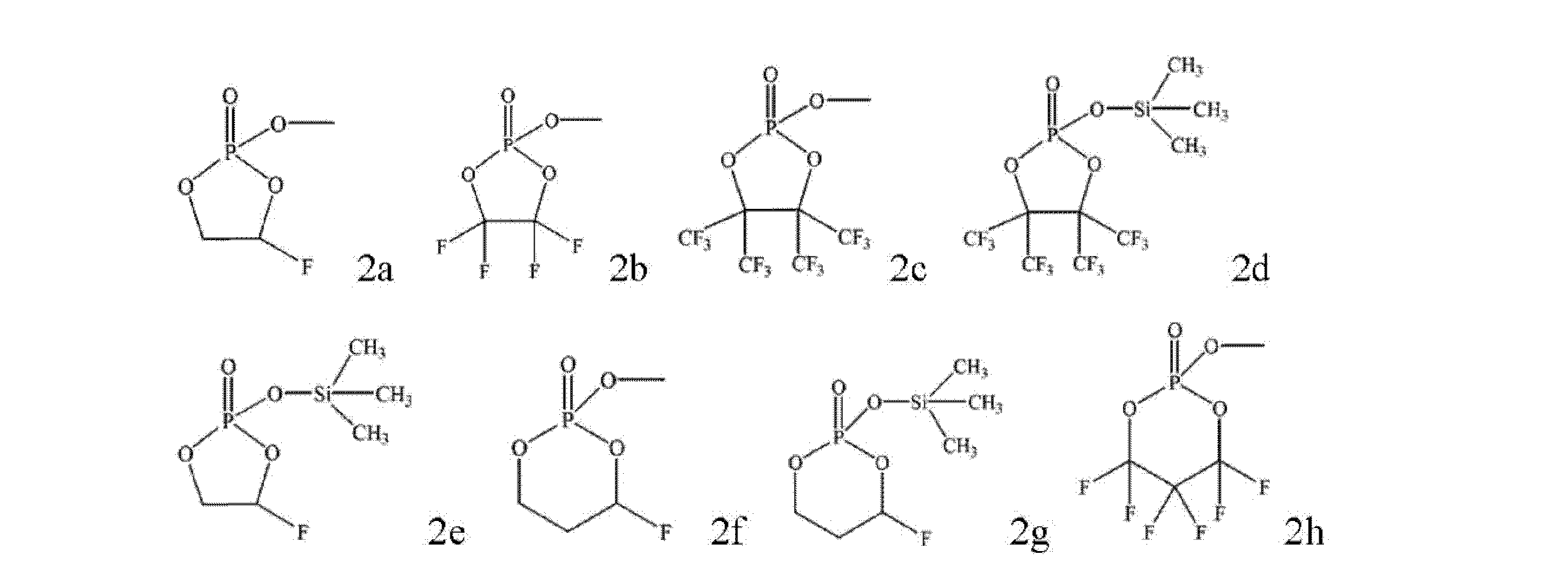
本発明のいくつかの実施例によれば、前記電解液の総重量に対して、前記式2で示される化合物の含有量は、0.001wt%~10wt%である。いくつかの実施例において、前記電解液の総重量に対して、前記式2で示される化合物の含有量は、0.005wt%~9wt%である。いくつかの実施例において、前記電解液の総重量に対して、前記式2で示される化合物の含有量は、0.01wt%~8wt%である。いくつかの実施例において、前記電解液の総重量に対して、前記式2で示される化合物の含有量は、0.05wt%~7wt%である。いくつかの実施例において、前記電解液の総重量に対して、前記式2で示される化合物の含有量は、0.1wt%~6wt%である。いくつかの実施例において、前記電解液の総重量に対して、前記式2で示される化合物の含有量は、0.5wt%~5wt%である。いくつかの実施例において、前記電解液の総重量に対して、前記式2で示される化合物の含有量は、1wt%~4wt%である。いくつかの実施例において、前記電解液の総重量に対して、前記式2で示される化合物の含有量は、2wt%~3wt%である。 According to some embodiments of the present invention, the content of the compound represented by formula 2 is 0.001 wt % to 10 wt % based on the total weight of the electrolyte. In some embodiments, the content of the compound represented by formula 2 is 0.005 wt % to 9 wt % based on the total weight of the electrolyte. In some embodiments, the content of the compound represented by formula 2 is 0.01 wt % to 8 wt % based on the total weight of the electrolyte. In some embodiments, the content of the compound represented by formula 2 is 0.05 wt % to 7 wt % based on the total weight of the electrolyte. In some embodiments, the content of the compound represented by formula 2 is 0.1 wt % to 6 wt % based on the total weight of the electrolyte. In some embodiments, the content of the compound represented by formula 2 is 0.5 wt % to 5 wt % based on the total weight of the electrolyte. In some embodiments, the content of the compound represented by formula 2 is 1 wt % to 4 wt % based on the total weight of the electrolyte. In some embodiments, the content of the compound represented by formula 2 is 2 wt % to 3 wt % based on the total weight of the electrolyte.
(d)ホスホン酸環状無水物
いくつかの実施例において、前記ホスホン酸環状無水物は、式3で示される化合物の一種又は多種を含む。
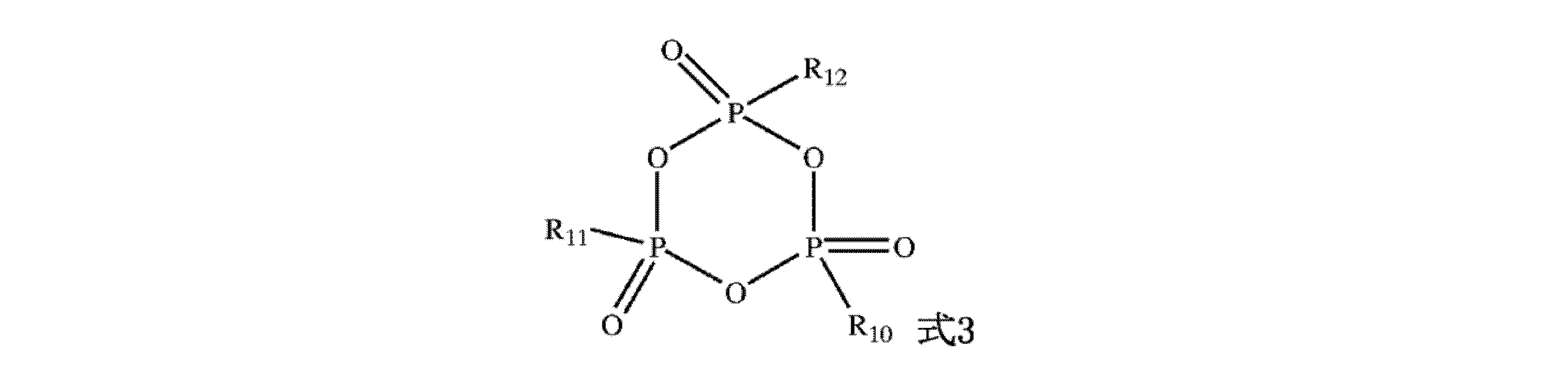
いくつかの実施例において、前記ホスホン酸環状無水物は、以下化合物を含むが、それらに限定されない。


いくつかの実施例において、前記電解液の総重量に対して、前記ホスホン酸環状無水物の含有量は、0.01wt%~10wt%である。いくつかの実施例において、前記電解液の総重量に対して、前記ホスホン酸環状無水物の含有量は、0.05wt%~8wt%である。いくつかの実施例において、前記電解液の総重量に対して、前記ホスホン酸環状無水物の含有量は、0.1wt%~5wt%である。いくつかの実施例において、前記電解液の総重量に対して、前記ホスホン酸環状無水物の含有量は、0.5wt%~3wt%である。いくつかの実施例において、前記電解液の総重量に対して、前記ホスホン酸環状無水物の含有量は、1wt%~2wt%である。 In some embodiments, the content of the phosphonic acid cyclic anhydride is 0.01 wt % to 10 wt % based on the total weight of the electrolyte. In some embodiments, the content of the phosphonic acid cyclic anhydride is 0.05 wt % to 8 wt % based on the total weight of the electrolyte. In some embodiments, the content of the phosphonic acid cyclic anhydride is 0.1 wt % to 5 wt % based on the total weight of the electrolyte. In some embodiments, the content of the phosphonic acid cyclic anhydride is 0.5 wt % to 3 wt % based on the total weight of the electrolyte. In some embodiments, the content of the phosphonic acid cyclic anhydride is 1 wt % to 2 wt % based on the total weight of the electrolyte.
(e)式1で示される化合物
本発明のいくつかの実施例によれば、前記式1で示される化合物は、以下の構造式のうちの少なくとも一種を含む。
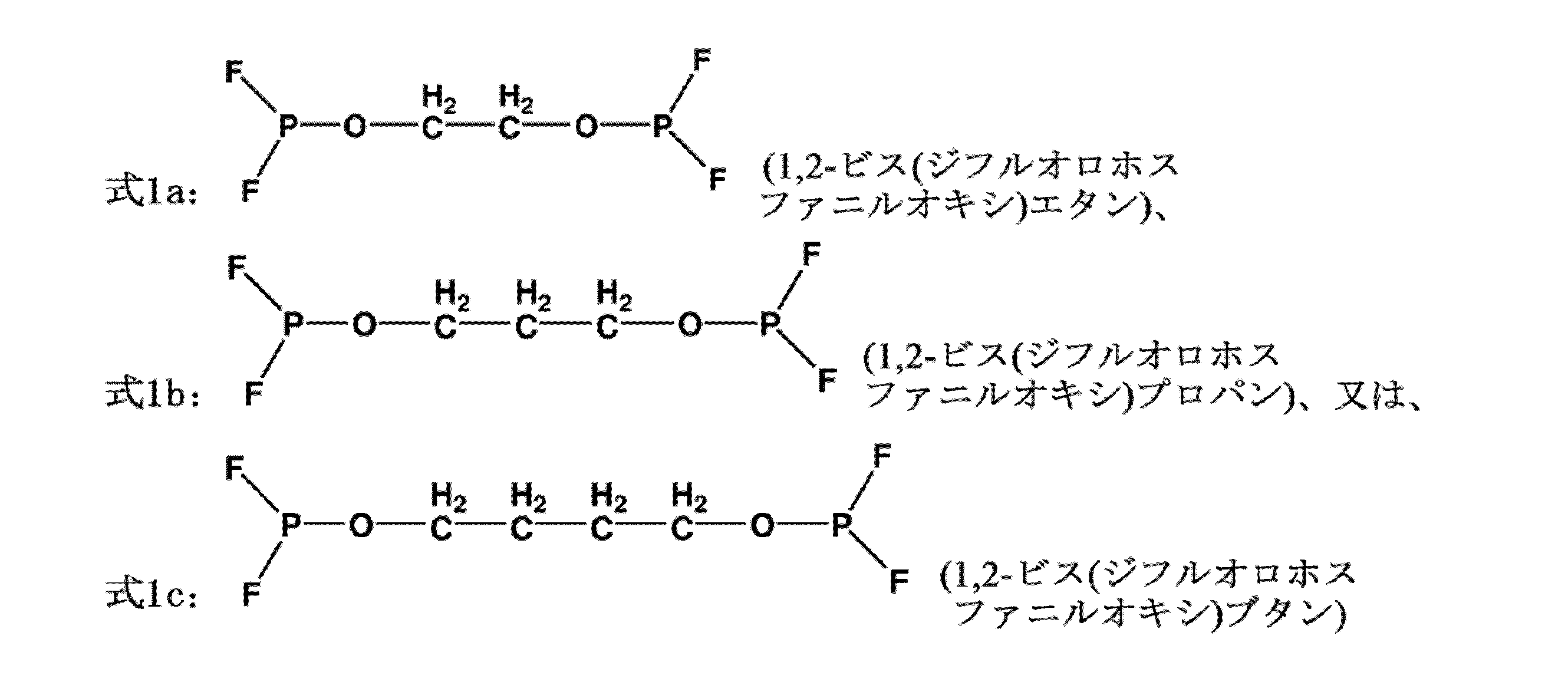
いくつかの実施例において、前記電解液の総重量に対して、前記式1で示される化合物の含有量は、0.01wt%~15wt%である。いくつかの実施例において、前記電解液の総重量に対して、前記式1で示される化合物の含有量は、0.05wt%~12wt%である。いくつかの実施例において、前記電解液の総重量に対して、前記式1で示される化合物の含有量は、0.1wt%~10wt%である。いくつかの実施例において、前記電解液の総重量に対して、前記式1で示される化合物の含有量は、0.5wt%~8wt%である。いくつかの実施例において、前記電解液の総重量に対して、前記式1で示される化合物の含有量は、1wt%~5wt%である。いくつかの実施例において、前記電解液の総重量に対して、前記式1で示される化合物の含有量は、2wt%~4wt%である。 In some embodiments, the content of the compound represented by formula 1 is 0.01 wt % to 15 wt % based on the total weight of the electrolyte. In some embodiments, the content of the compound represented by formula 1 is 0.05 wt % to 12 wt % based on the total weight of the electrolyte. In some embodiments, the content of the compound represented by formula 1 is 0.1 wt % to 10 wt % based on the total weight of the electrolyte. In some embodiments, the content of the compound represented by formula 1 is 0.5 wt % to 8 wt % based on the total weight of the electrolyte. In some embodiments, the content of the compound represented by formula 1 is 1 wt % to 5 wt % based on the total weight of the electrolyte. In some embodiments, the content of the compound represented by formula 1 is 2 wt % to 4 wt % based on the total weight of the electrolyte.
溶媒
いくつかの実施例において、前記電解液は、さらに先行技術で既知されたいずれの電解液の溶媒として用いられる非水溶媒を含む。
Solvent In some embodiments, the electrolyte further comprises a non-aqueous solvent that can be used as a solvent for any electrolyte known in the art.
いくつかの実施例において、前記非水溶媒は、環状炭酸エステル、鎖状炭酸エステル、環状カルボン酸エステル、鎖状カルボン酸エステル、環状エーテル、鎖状エーテル、リン含有有機溶媒、硫黄含有有機溶媒、及び芳香族フッ素含有溶媒の一種又は多種を含むが、それらに限定されない。 In some embodiments, the non-aqueous solvent includes, but is not limited to, one or more of cyclic carbonates, chain carbonates, cyclic carboxylates, chain carboxylates, cyclic ethers, chain ethers, phosphorus-containing organic solvents, sulfur-containing organic solvents, and aromatic fluorine-containing solvents.
いくつかの実施例において、前記環状炭酸エステルの実例は、エチレンカーボネート(EC)、プロピレンカーボネート(PC)、及びブチレンカーボネートのうちの一種又は多種を含むが、それらに限定されない。いくつかの実施例においては、前記環状炭酸エステルは、3~6個の炭素原子を有する。 In some embodiments, examples of the cyclic carbonate include, but are not limited to, one or more of ethylene carbonate (EC), propylene carbonate (PC), and butylene carbonate. In some embodiments, the cyclic carbonate has 3 to 6 carbon atoms.
いくつかの実施例において、前記鎖状炭酸エステルの実例は、ジメチルカーボネート、メチルエチルカーボネート、ジエチルカーボネート(DEC)、メチルn-プロピルカーボネート、エチルn-プロピルカーボネート、ジn-プロピルカーボネート等の鎖状炭酸エステル等のうちの一種又は多種を含むが、それらに限定されない。フッ素に置換された鎖状炭酸エステルの実例は、ビス(フルオロメチル)カーボネート、ビス(ジフルオロメチル)カーボネート、ビス(トリスフルオロメチル)カーボネート、ビス(2-フルオロエチル)カーボネート、ビス(2,2-ジフルオロエチル)カーボネート、ビス(2,2,2-トリフルオロエチル)カーボネート、2-フルオロエチルメチルカーボネート、2,2-ジフルオロエチルメチルカーボネート、及び2,2,2-トリフルオロエチルメチルカーボネート等のうちの一種又は多種を含むが、それらに限定されない。 In some embodiments, examples of the chain carbonate ester include, but are not limited to, one or more of chain carbonate esters such as dimethyl carbonate, methyl ethyl carbonate, diethyl carbonate (DEC), methyl n-propyl carbonate, ethyl n-propyl carbonate, di n-propyl carbonate, etc. Examples of fluorine-substituted chain carbonate esters include, but are not limited to, one or more of bis(fluoromethyl)carbonate, bis(difluoromethyl)carbonate, bis(trisfluoromethyl)carbonate, bis(2-fluoroethyl)carbonate, bis(2,2-difluoroethyl)carbonate, bis(2,2,2-trifluoroethyl)carbonate, 2-fluoroethylmethylcarbonate, 2,2-difluoroethylmethylcarbonate, and 2,2,2-trifluoroethylmethylcarbonate, etc.
いくつかの実施例において、前記環状カルボン酸エステルの実例は、γ-ブチロラクトン、及びγ-バレロラクトンのうちの一種又は多種を含むが、それらに限定されない。いくつかの実施例において、環状カルボン酸エステルの水素原子の一部はフッ素で置換されてもよい。 In some embodiments, examples of the cyclic carboxylic acid ester include, but are not limited to, one or more of gamma-butyrolactone and gamma-valerolactone. In some embodiments, some of the hydrogen atoms of the cyclic carboxylic acid ester may be substituted with fluorine.
いくつかの実施例において、前記鎖状カルボン酸エステルの実例は、酢酸メチル、酢酸エチル、酢酸プロピル、酢酸イソプロピル、酢酸ブチル、酢酸sec-ブチル、酢酸イソブチル、酢酸t-ブチル、プロピオン酸メチル、プロピオン酸エチル、プロピオン酸プロピル、プロピオン酸イソプロピル、酪酸メチル、酪酸エチル、酪酸プロピル、イソ酪酸メチル、イソ酪酸エチル、吉草酸メチル、吉草酸エチル、ピバル酸メチル、及びピバル酸エチル等のうちの一種又は多種を含むが、それらに限定されない。いくつかの実施例において、鎖状カルボン酸エステルの水素原子の一部はフッ素で置換されてもよい。いくつかの実施例において、フッ素で置換された鎖状カルボン酸エステルの実例は、トリフルオロ酢酸メチル、トリフルオロ酢酸エチル、トリフルオロ酢酸プロピル、トリフルオロ酢酸ブチル、及びトリフルオロ酢酸2,2,2-トリフルオロエチルなどを含むが、それらに限定されない。 In some embodiments, examples of the chain carboxylic acid ester include, but are not limited to, one or more of methyl acetate, ethyl acetate, propyl acetate, isopropyl acetate, butyl acetate, sec-butyl acetate, isobutyl acetate, t-butyl acetate, methyl propionate, ethyl propionate, propyl propionate, isopropyl propionate, methyl butyrate, ethyl butyrate, propyl butyrate, methyl isobutyrate, ethyl isobutyrate, methyl valerate, ethyl valerate, methyl pivalate, and ethyl pivalate. In some embodiments, some of the hydrogen atoms of the chain carboxylic acid ester may be substituted with fluorine. In some embodiments, examples of the chain carboxylic acid ester substituted with fluorine include, but are not limited to, methyl trifluoroacetate, ethyl trifluoroacetate, propyl trifluoroacetate, butyl trifluoroacetate, and 2,2,2-trifluoroethyl trifluoroacetate.
いくつかの実施例において、前記環状エーテルの実例は、テトラヒドロフラン、2-メチルテトラヒドロフラン、1,3-ジオキソラン、2-メチル1,3-ジオキソラン、4-メチル1,3-ジオキソラン、1,3-ジオキサン、1,4-ジオキサン、及びジメトキシプロパンのうちの一種又は多種を含むが、それらに限定されない。 In some embodiments, examples of the cyclic ether include, but are not limited to, one or more of tetrahydrofuran, 2-methyltetrahydrofuran, 1,3-dioxolane, 2-methyl-1,3-dioxolane, 4-methyl-1,3-dioxolane, 1,3-dioxane, 1,4-dioxane, and dimethoxypropane.
いくつかの実施例において、前記鎖状エーテルの実例は、ジメトキシメタン、1,1-ジメトキシエタン、1,2-ジメトキシエタン、ジエトキシメタン、1,1-ジエトキシエタン、1,2-ジエトキシエタン、エトキシメトキシメタン、1,1-エトキシメトキシエタン、及び1,2-エトキシメトキシエタンなどのうちの一種又は多種を含むが、それらに限定されない。 In some embodiments, examples of the chain ether include, but are not limited to, one or more of dimethoxymethane, 1,1-dimethoxyethane, 1,2-dimethoxyethane, diethoxymethane, 1,1-diethoxyethane, 1,2-diethoxyethane, ethoxymethoxymethane, 1,1-ethoxymethoxyethane, and 1,2-ethoxymethoxyethane.
いくつかの実施例において、前記リン含有有機溶媒の実例は、リン酸トリメチル、リン酸トリエチル、リン酸ジメチルエチル、リン酸メチルジエチル、リン酸エチレンメチル、リン酸エチレンエチル、リン酸トリフェニル、亜リン酸トリメチル、亜リン酸トリエチル、亜リン酸トリフェニル、リン酸トリス(2,2,2-トリフルオロエチル)、及びリン酸トリス(2,2,3,3,3-ペンタフルオロプロピル)等のうちの一種又は多種を含むが、それらに限定されない。 In some embodiments, examples of the phosphorus-containing organic solvent include, but are not limited to, one or more of trimethyl phosphate, triethyl phosphate, dimethylethyl phosphate, methyldiethyl phosphate, ethylenemethyl phosphate, ethyleneethyl phosphate, triphenyl phosphate, trimethyl phosphite, triethyl phosphite, triphenyl phosphite, tris(2,2,2-trifluoroethyl) phosphate, and tris(2,2,3,3,3-pentafluoropropyl) phosphate.
いくつかの実施例において、前記硫黄含有有機溶媒の実例は、スルホラン、2-メチルスルホラン、3-メチルスルホラン、ジメチルスルホン、ジエチルスルホン、エチルメチルスルホン、メチルプロピルスルホン、ジメチルスルホキシド、メタンスルホン酸メチル、メタンスルホン酸エチル、エタンスルホン酸メチル、エタンスルホン酸エチル、硫酸ジメチル、硫酸ジエチル、及び硫酸ジブチルのうちの一種又は多種を含むが、それらに限定されない。いくつかの実施例において、硫黄含有有機溶媒の水素原子の一部はフッ素で置換されてもよい。 In some embodiments, examples of the sulfur-containing organic solvent include, but are not limited to, one or more of sulfolane, 2-methylsulfolane, 3-methylsulfolane, dimethylsulfone, diethylsulfone, ethylmethylsulfone, methylpropylsulfone, dimethylsulfoxide, methylmethanesulfonate, ethylmethanesulfonate, methylethanesulfonate, ethylethanesulfonate, dimethylsulfate, diethylsulfate, and dibutylsulfate. In some embodiments, some of the hydrogen atoms of the sulfur-containing organic solvent may be replaced with fluorine.
いくつかの実施例において、前記芳香族フッ素含有溶媒は、フルオロベンゼン、ジフルオロベンゼン、トリフルオロベンゼン、テトラフルオロベンゼン、ペンタフルオロベンゼン、ヘキサフルオロベンゼン、及びトリフルオロメチルベンゼンのうちの一種又は多種を含むが、それらに限定されない。 In some embodiments, the aromatic fluorine-containing solvent includes, but is not limited to, one or more of fluorobenzene, difluorobenzene, trifluorobenzene, tetrafluorobenzene, pentafluorobenzene, hexafluorobenzene, and trifluoromethylbenzene.
いくつかの実施例において、本発明の電解液に使用される溶媒は、環状炭酸エステル、鎖状炭酸エステル、環状カルボン酸エステル、鎖状カルボン酸エステル、及びそれらの組み合せを含む。いくつかの実施例において、本発明の電解液に使用される溶媒は、エチレンカーボネート、プロピレンカーボネート、ジエチルカーボネート、プロピオン酸エチル、プロピオン酸プロピル、酢酸n-プロピル、酢酸エチル、及びそれらの組み合せ、からなる群から選択された有機溶媒を含む。いくつかの実施例において、本発明の電解液に使用される溶媒は、エチレンカーボネート、プロピレンカーボネート、ジエチルカーボネート、プロピオン酸エチル、プロピオン酸プロピル、γ-ブチロラクトン、及びそれらの組み合せを含む。 In some embodiments, the solvent used in the electrolyte of the present invention includes a cyclic carbonate ester, a chain carbonate ester, a cyclic carboxylate ester, a chain carboxylate ester, and combinations thereof. In some embodiments, the solvent used in the electrolyte of the present invention includes an organic solvent selected from the group consisting of ethylene carbonate, propylene carbonate, diethyl carbonate, ethyl propionate, propyl propionate, n-propyl acetate, ethyl acetate, and combinations thereof. In some embodiments, the solvent used in the electrolyte of the present invention includes ethylene carbonate, propylene carbonate, diethyl carbonate, ethyl propionate, propyl propionate, gamma-butyrolactone, and combinations thereof.
電解液に鎖状カルボン酸エステル及び/又は環状カルボン酸エステルを入れた後、鎖状カルボン酸エステル及び/又は環状カルボン酸エステルは電極の表面にパッシベーション膜を形成し、それによって、電気化学装置の断続的な充電サイクル後の容量維持率を向上させる。いくつかの実施例において、前記電解液は1wt%~60wt%の鎖状カルボン酸エステル、環状カルボン酸エステル、及びそれらの組み合わせを含有する。いくつかの実施例において、前記電解液は、プロピオン酸エチル、プロピオン酸プロピル、γ-ブチロラクトン、及びそれらの組み合わせを含有し、電解液の総重量に対して、その組み合わせの含有量は1wt%~60wt%、10wt%~60wt%、10wt%~50wt%、20wt%~50wt%である。いくつかの実施例において、電解液の総重量に対して、前記電解液は1wt%~60wt%、10wt%~60wt%、20wt%~50wt%、20wt%~40wt%、又は30wt%のプロピオン酸プロピルを含有する。 After the chain carboxylic acid ester and/or the cyclic carboxylic acid ester are added to the electrolyte, the chain carboxylic acid ester and/or the cyclic carboxylic acid ester form a passivation film on the surface of the electrode, thereby improving the capacity retention rate after intermittent charging cycles of the electrochemical device. In some embodiments, the electrolyte contains 1 wt% to 60 wt% of the chain carboxylic acid ester, the cyclic carboxylic acid ester, and combinations thereof. In some embodiments, the electrolyte contains ethyl propionate, propyl propionate, gamma-butyrolactone, and combinations thereof, and the content of the combination is 1 wt% to 60 wt%, 10 wt% to 60 wt%, 10 wt% to 50 wt%, or 20 wt% to 50 wt% based on the total weight of the electrolyte. In some embodiments, the electrolyte contains 1 wt% to 60 wt%, 10 wt% to 60 wt%, 20 wt% to 50 wt%, 20 wt% to 40 wt%, or 30 wt% propyl propionate, based on the total weight of the electrolyte.
添加剤
いくつかの実施例において、前記添加剤の実例は、フッ素化炭酸エステル、炭素炭素二重結合を含む炭酸ビニルエステル、硫黄酸素二重結合を含む化合物及び酸無水物のうちの一種又は多種を含むが、それらに限定されない。
Additives In some embodiments, examples of the additives include, but are not limited to, one or more of fluorinated carbonates, vinyl carbonates containing carbon-carbon double bonds, compounds containing sulfur-oxygen double bonds, and acid anhydrides.
いくつかの実施例において、前記電解液の総重量に対して、前記添加剤の含有量は、0.01wt%~15wt%、0.1wt%~10wt%、又は1wt%~5wt%である。 In some embodiments, the content of the additive is 0.01 wt% to 15 wt%, 0.1 wt% to 10 wt%, or 1 wt% to 5 wt% based on the total weight of the electrolyte.
本発明の実施例によれば、前記電解液の総重量に対して、前記プロピオン酸エステルの含有量は、前記添加剤の1.5~30倍、1.5~20倍、2~20倍、又は5-20倍である。 According to an embodiment of the present invention, the content of the propionate ester is 1.5 to 30 times, 1.5 to 20 times, 2 to 20 times, or 5-20 times that of the additive, based on the total weight of the electrolyte.
いくつかの実施例において、前記添加剤は、一種又は多種のフッ素化炭酸エステルを含む。リチウムイオン電池が充電/放電の場合、フッ素化炭酸エステルは、プロピオン酸エステルとともに負極の表面上に安定な保護膜を形成し、それによって、電解液の分解反応を抑制する。 In some embodiments, the additive comprises one or more fluorinated carbonates. When the lithium-ion battery is charged/discharged, the fluorinated carbonate forms a stable protective film on the surface of the negative electrode together with the propionate, thereby inhibiting the decomposition reaction of the electrolyte.
いくつかの実施例において、前記フッ素化炭酸エステルは式C=O(OR1)(OR2)で示される構造を有し、ここで、R1及びR2はそれぞれ1~6個の炭素原子を有するアルキル基又はハロアルキル基から選択され、R1及びR2のうちの少なくとも一つは1~6個の炭素原子を有するハロアルキル基から選択され、且つR1及びR2は、任意にそれらがつながる原子とともに5員~7員環を形成する。 In some embodiments, the fluorinated carbonate has a structure represented by the formula C=O( OR1 )( OR2 ), where R1 and R2 are each selected from an alkyl group or a haloalkyl group having 1 to 6 carbon atoms, at least one of R1 and R2 is selected from a haloalkyl group having 1 to 6 carbon atoms, and R1 and R2 , optionally together with the atom to which they are attached, form a 5- to 7-membered ring.
いくつかの実施例において、前記フッ素化炭酸エステルの実例は、フルオロエチレンカーボネート、シス4,4-ジフルオロエチレンカーボネート、トランス4,4-ジフルオロエチレンカーボネート、4,5-ジフルオロエチレンカーボネート、4-フルオロ-4-メチルエチレンカーボネート、4-フルオロ-5-メチルエチレンカーボネート、トリフルオロメチルメチルカーボネート、トリフルオロエチルメチルカーボネート、及びトリフルオロエチルエチルカーボネート等のうちの一種又は多種を含むが、それらに限定されない。 In some embodiments, examples of the fluorinated carbonate ester include, but are not limited to, one or more of fluoroethylene carbonate, cis 4,4-difluoroethylene carbonate, trans 4,4-difluoroethylene carbonate, 4,5-difluoroethylene carbonate, 4-fluoro-4-methylethylene carbonate, 4-fluoro-5-methylethylene carbonate, trifluoromethyl methyl carbonate, trifluoroethyl methyl carbonate, and trifluoroethyl ethyl carbonate.
いくつかの実施例において、前記添加剤は、一種又は多種の炭素炭素二重結合を含む炭酸ビニルエステルを含む。前記炭素炭素二重結合を含む炭酸ビニルエステルの実例は、ビニレンカーボネート、メチルビニレンカーボネート、エチルエチレンカーボネート、1,2-ジメチルエチレンカーボネート、1,2-ジエチルエチレンカーボネート、フルオロビニレンカーボネート、トリフルオロメチルビニレンカーボネート;ビニルエチレンカーボネート、1-メチル-2-ビニルエチレンカーボネート、1-エチル-2-ビニルエチレンカーボネート、1-n-プロピル-2-ビニルエチレンカーボネート、1-メチル-2-ビニルエチレンカーボネート、1,1-ジビニルエチレンカーボネート、1,2-ジビニルエチレンカーボネート、1,1-ジメチル-2-メチレンエチレンカーボネート、及び1,1-ジエチル-2-メチレンエチレンカーボネート等のうちの一種又は多種を含むが、それらに限定されない。いくつかの実施例において、前記炭素炭素二重結合を含む炭酸ビニルエステルは、獲得の易さ及びより優れた効果が実現できることから、ビニレンカーボネートを含む。 In some embodiments, the additive comprises one or more vinyl esters of carbon-carbon double bonds. Examples of vinyl esters of carbon-carbon double bonds include, but are not limited to, one or more of vinylene carbonate, methyl vinylene carbonate, ethyl ethylene carbonate, 1,2-dimethyl ethylene carbonate, 1,2-diethyl ethylene carbonate, fluorovinylene carbonate, trifluoromethyl vinylene carbonate; vinyl ethylene carbonate, 1-methyl-2-vinyl ethylene carbonate, 1-ethyl-2-vinyl ethylene carbonate, 1-n-propyl-2-vinyl ethylene carbonate, 1-methyl-2-vinyl ethylene carbonate, 1,1-divinyl ethylene carbonate, 1,2-divinyl ethylene carbonate, 1,1-dimethyl-2-methylene ethylene carbonate, and 1,1-diethyl-2-methylene ethylene carbonate. In some embodiments, the vinyl carbonate ester containing a carbon-carbon double bond includes vinylene carbonate because it is easy to obtain and can achieve better effects.
いくつかの実施例において、前記添加剤は、一種又は多種の硫黄酸素二重結合を含む化合物を含む。前記硫黄酸素二重結合を含む化合物の実例は、環状硫酸エステル、鎖状硫酸エステル、鎖状スルホン酸エステル、環状スルホン酸エステル、鎖状亜硫酸エステル、及び環状亜硫酸エステル等のうちの一種又は多種を含むが、それらに限定されない。 In some embodiments, the additive comprises one or more compounds that contain a sulfur-oxygen double bond. Examples of compounds that contain a sulfur-oxygen double bond include, but are not limited to, one or more of cyclic sulfates, linear sulfates, linear sulfonates, cyclic sulfonates, linear sulfites, and cyclic sulfites.
前記環状硫酸エステルの実例は、1,2-エチレンスルフェート、1,2-プロピレンスルフェート、1,3-プロピレンスルフェート、1,2-ブチレンスルフェート、1,3-ブチレンスルフェート、1,4-ブチレンスルフェート、1,2-ペンチレンスルフェート、1,3-ペンチレンスルフェート、1,4-ペンチレンスルフェート及び1,5-ペンチレンスルフェートなどのうちの一種又は多種を含むが、それらに限定されない。 Examples of the cyclic sulfate ester include, but are not limited to, one or more of 1,2-ethylene sulfate, 1,2-propylene sulfate, 1,3-propylene sulfate, 1,2-butylene sulfate, 1,3-butylene sulfate, 1,4-butylene sulfate, 1,2-pentylene sulfate, 1,3-pentylene sulfate, 1,4-pentylene sulfate, and 1,5-pentylene sulfate.
前記鎖状硫酸エステルの実例は、ジメチルスルフェート、エチルメチルスルフェート及びジエチルスルフェートなどのうちの一種又は多種を含むが、それらに限定されない。 Examples of the chain sulfate ester include, but are not limited to, one or more of dimethyl sulfate, ethyl methyl sulfate, and diethyl sulfate.
前記鎖状スルホン酸エステルの実例は、フルオロスルホン酸メチル、及びフルオロスルホン酸エチル等のフルオロスルホン酸エステル、メタンスルホン酸メチル、メタンスルホン酸エチル、ジメタンスルホン酸ブチル、2-(メタンスルホニルオキシ)プロピオン酸メチル、及び2-(メタンスルホニルオキシ)プロピオン酸エチル等のうちの一種又は多種を含むが、それらに限定されない。 Examples of the chain sulfonate ester include, but are not limited to, one or more of fluorosulfonate esters such as methyl fluorosulfonate and ethyl fluorosulfonate, methyl methanesulfonate, ethyl methanesulfonate, butyl dimethanesulfonate, methyl 2-(methanesulfonyloxy)propionate, and ethyl 2-(methanesulfonyloxy)propionate.
前記環状スルホン酸エステルの実例は、1,3-プロパンスルトン、1-フルオロ-1,3-プロパンスルトン、2-フルオロ-1,3-プロパンスルトン、3-フルオロ-1,3-プロパンスルトン、1-メチル-1,3-プロパンスルトン、2-メチル-1,3-プロパンスルトン、3-メチル-1,3-プロパンスルトン、1-プロペン-1,3-スルトン、2-プロペン-1,3-スルトン、1-フルオロ-1-プロペン-1,3-スルトン、2-フルオロ-1-プロペン-1,3-スルトン、3-フルオロ-1-プロペン-1,3-スルトン、1-フルオロ-2-プロペン-1,3-スルトン、2-フルオロ-2-プロペン-1,3-スルトン、3-フルオロ-2-プロペン-1,3-スルトン、1-メチル-1-プロペン-1,3-スルトン、2-メチル-1-プロペン-1,3-スルトン、3-メチル-1-プロペン-1,3-スルトン、1-メチル-2-プロペン-1,3-スルトン、2-メチル-2-プロペン-1,3-スルトン、3-メチル-2-プロペン-1,3-スルトン、1,4-ブタンスルトン、1,5-ペンタンスルトン、メタンジスルホン酸メチレン、及びメタンジスルホン酸エチレン等のうちの一種又は多種を含むが、それらに限定されない。 Examples of the cyclic sulfonic acid esters include 1,3-propane sultone, 1-fluoro-1,3-propane sultone, 2-fluoro-1,3-propane sultone, 3-fluoro-1,3-propane sultone, 1-methyl-1,3-propane sultone, 2-methyl-1,3-propane sultone, 3-methyl-1,3-propane sultone, 1-propene-1,3-sultone, 2-propene-1,3-sultone, 1-fluoro-1-propene-1,3-sultone, 2-fluoro-1-propene-1,3-sultone, 3-fluoro-1-propene-1,3-sultone, 1-fluoro-2-propene-1,3 -sultone, 2-fluoro-2-propene-1,3-sultone, 3-fluoro-2-propene-1,3-sultone, 1-methyl-1-propene-1,3-sultone, 2-methyl-1-propene-1,3-sultone, 3-methyl-1-propene-1,3-sultone, 1-methyl-2-propene-1,3-sultone, 2-methyl-2-propene-1,3-sultone, 3-methyl-2-propene-1,3-sultone, 1,4-butane sultone, 1,5-pentane sultone, methylene methane disulfonate, and ethylene methane disulfonate, among others, but are not limited thereto.
前記鎖状亜硫酸エステルの実例は、ジメチルスルファイト、エチルメチルスルファイト及びジエチルスルファイトなどのうちの一種又は多種を含むが、それらに限定されない。 Examples of the chain sulfite ester include, but are not limited to, one or more of dimethyl sulfite, ethyl methyl sulfite, and diethyl sulfite.
前記環状亜硫酸エステルの実例は、1,2-エチレンスルファイト、1,2-プロピレンスルファイト、1,3-プロピレンスルファイト、1,2-ブチレンスルファイト、1,3-ブチレンスルファイト、1,4-ブチレンスルファイト、1,2-ペンチレンスルファイト、1,3-ペンチレンスルファイト、1,4-ペンチレンスルファイト及び1,5-ペンチレンスルファイトなどのうちの一種又は多種を含むが、それらに限定されない。 Examples of the cyclic sulfite ester include, but are not limited to, one or more of 1,2-ethylene sulfite, 1,2-propylene sulfite, 1,3-propylene sulfite, 1,2-butylene sulfite, 1,3-butylene sulfite, 1,4-butylene sulfite, 1,2-pentylene sulfite, 1,3-pentylene sulfite, 1,4-pentylene sulfite, and 1,5-pentylene sulfite.
いくつかの実施例において、前記添加剤は、一種又は多種の酸無水物を含む。前記酸無水物の実例は、カルボン酸無水物、ジスルホン酸無水物、及びカルボン酸スルホン酸無水物のうちの一種又は多種を含むが、それらに限定されない。前記カルボン酸無水物の実例は、コハク酸無水物、グルタル酸無水物、及びマレイン酸無水物のうちの一種又は多種を含むが、それらに限定されない。前記ジスルホン酸無水物の実例は、エタンジスルホン酸無水物、及びプロパンジスルホン酸無水物のうちの一種又は多種を含むが、それらに限定されない。前記カルボン酸スルホン酸無水物の実例は、スルホ安息香酸無水物、スルホプロピオン酸無水物、及びスルホ酪酸無水物のうちの一種又は多種を含むが、それらに限定されない。 In some embodiments, the additive comprises one or more acid anhydrides. Examples of the acid anhydrides include, but are not limited to, one or more of carboxylic acid anhydrides, disulfonic acid anhydrides, and carboxylic acid sulfonic acid anhydrides. Examples of the carboxylic acid anhydrides include, but are not limited to, one or more of succinic acid anhydride, glutaric acid anhydride, and maleic acid anhydride. Examples of the disulfonic acid anhydrides include, but are not limited to, one or more of ethane disulfonic acid anhydride and propane disulfonic acid anhydride. Examples of the carboxylic acid sulfonic acid anhydrides include, but are not limited to, one or more of sulfobenzoic acid anhydride, sulfopropionic acid anhydride, and sulfobutyric acid anhydride.
いくつかの実施例において、前記添加剤は、フッ素化炭酸エステルと炭素炭素二重結合を含む炭酸ビニルエステルとの組み合わせである。いくつかの実施例において、前記添加剤は、フッ素化炭酸エステルと硫黄酸素二重結合を含む化合物との組み合わせである。いくつかの実施例において、前記添加剤は、フッ素化炭酸エステルと2-4個のシアノ基を有する化合物との組み合わせである。いくつかの実施例において、前記添加剤は、フッ素化炭酸エステルと環状カルボン酸エステルとの組み合わせである。いくつかの実施例において、前記添加剤は、フッ素化炭酸エステルとホスホン酸環状無水物との組み合わせである。いくつかの実施例において、前記添加剤は、フッ素化炭酸エステルとカルボン酸無水物との組み合わせである。いくつかの実施例において、前記添加剤は、フッ素化炭酸エステルとスルホン酸無水物との組み合わせである。いくつかの実施例において、前記添加剤は、フッ素化炭酸エステルとカルボン酸スルホン酸無水物との組み合わせである。 In some embodiments, the additive is a combination of a fluorinated carbonate ester and a vinyl carbonate ester containing a carbon-carbon double bond. In some embodiments, the additive is a combination of a fluorinated carbonate ester and a compound containing a sulfur-oxygen double bond. In some embodiments, the additive is a combination of a fluorinated carbonate ester and a compound having 2-4 cyano groups. In some embodiments, the additive is a combination of a fluorinated carbonate ester and a cyclic carboxylic acid ester. In some embodiments, the additive is a combination of a fluorinated carbonate ester and a phosphonic acid cyclic anhydride. In some embodiments, the additive is a combination of a fluorinated carbonate ester and a carboxylic acid anhydride. In some embodiments, the additive is a combination of a fluorinated carbonate ester and a sulfonic acid anhydride. In some embodiments, the additive is a combination of a fluorinated carbonate ester and a carboxylic acid sulfonic acid anhydride.
電解質
電解質は、特に制限されず、任意に電解質として公知されたものを用いてもよい。リチウム二次電池の場合、通常、リチウム塩が用いられる。電解質の実例は、LiPF6、LiBF4、LiClO4、LiAlF4、LiSbF6、LiTaF6、LiWF7等の無機リチウム塩;LiWOF5等のタングステン酸リチウム類;HCO2Li、CH3CO2Li、CH2FCO2Li、CHF2CO2Li、CF3CO2Li、CF3CH2CO2Li、CF3CF2CO2Li、CF3CF2CF2CO2Li、CF3CF2CF2CF2CO2Li等のカルボン酸リチウム塩類;FSO3Li、CH3SO3Li、CH2FSO3Li、CHF2SO3Li、CF3SO3Li、CF3CF2SO3Li、CF3CF2CF2SO3Li、CF3CF2CF2CF2SO3Li等のスルホン酸リチウム塩類;LiN(FCO)2、LiN(FCO)(FSO2)、LiN(FSO2)2、LiN(FSO2)(CF3SO2)、LiN(CF3SO2)2、LiN(C2F5SO2)2、リチウム環状1,2-パーフルオロエタンビススルホンイミド、リチウム環状1,3-パーフルオロプロパンビススルホンイミド、LiN(CF3SO2)(C4F9SO2)等のイミドリチウム塩類;LiC(FSO2)3、LiC(CF3SO2)3、LiC(C2F5SO2)3等のリチウムメチラート塩類;リチウムビス(マロネート)ボレート、リチウムジフルオロ(マロネート)ボレート等のリチウム(マロナト)ボレート塩類;リチウムトリス(マロネート)ホスフェート、リチウムジフルオロビス(マロネート)ホスフェート、リチウムテトラフルオロ(マロネート)ホスフェート等のリチウム(マロナト)ホスフェート塩類;及び、LiPF4(CF3)2、LiPF4(C2F5)2、LiPF4(CF3SO2)2、LiPF4(C2F5SO2)2、LiBF3CF3、LiBF3C2F5、LiBF3C3F7、LiBF2(CF3)2、LiBF2(C2F5)2、LiBF2(CF3SO2)2、LiBF2(C2F5SO2)2等のフッ素含有有機リチウム塩類;リチウムジフルオロオキサレートボレート、リチウムビス(オキサレート)ボレート等のリチウムオキサラトボレート塩類;リチウムテトラフルオロオキサレートホスフェート、リチウムジフルオロビス(オキサレート)ホスフェート、リチウムトリス(オキサレート)ホスフェート等のリチウム(オキサラト)ホスフェート塩類等を含むが、それらに限定されない。
Electrolyte The electrolyte is not particularly limited, and any known electrolyte may be used. In the case of a lithium secondary battery, a lithium salt is usually used. Illustrative examples of electrolytes are inorganic lithium salts such as LiPF6 , LiBF4 , LiClO4 , LiAlF4 , LiSbF6 , LiTaF6 , LiWF7 ; lithium tungstates such as LiWOF5 ; lithium carboxylates such as HCO2Li , CH3CO2Li , CH2FCO2Li , CHF2CO2Li , CF3CO2Li , CF3CH2CO2Li , CF3CF2CO2Li , CF3CF2CF2CO2Li , CF3CF2CF2CF2CO2Li , CF3CF2CF2CF2CF2CO2Li ; FSO3Li , CH3SO3Li , CH2FSO3Li , CH2 ... Li, CHF 2 SO 3 Li, CF 3 SO 3 Li, CF 3 CF 2 SO 3 Li, CF 3 CF 2 CF 2 SO 3 Li, CF 3 CF 2 CF 2 CF 2 SO 3 Li, CF 3 CF 2 CF 2 CF 2 SO 3 Li; LiN(FCO) 2 , LiN(FCO)(FSO 2 ), LiN(FSO 2 ) 2 , LiN(FSO 2 )(CF 3 SO 2 ), LiN(CF 3 SO 2 ) 2 , LiN(C 2 F 5 SO 2 ) 2 , lithium cyclic 1,2-perfluoroethane bissulfonimide, lithium cyclic 1,3-perfluoropropane bissulfonimide, LiN(CF 3 SO 2 )(C 4 F lithium methylate salts such as LiC( FSO2 ) 3 , LiC( CF3SO2 ) 3 , and LiC( C2F5SO2 ) 3 ; lithium ( malonato ) borate salts such as lithium bis( malonate )borate and lithium difluoro( malonate )borate; lithium (malonato)phosphate salts such as lithium tris(malonate)phosphate, lithium difluorobis(malonate)phosphate, and lithium tetrafluoro(malonate)phosphate; and lithium tetrafluoro(malonate)phosphate salts such as LiPF4 ( CF3 ) 2 , LiPF4 ( C2F5 ) 2 , LiPF4 ( CF3SO2 ) 2 , and LiPF4 ( C2F5SO2 ) 2 . fluorine- containing organic lithium salts such as LiBF3CF3 , LiBF3C2F5 , LiBF3C3F7 , LiBF2(CF3)2, LiBF2(C2F5)2, LiBF2(CF3SO2 ) 2 , LiBF2 (C2F5SO2)2 ; lithium oxalatoborate salts such as lithium difluorooxalatoborate, lithium bis( oxalato )borate; lithium (oxalato ) phosphate salts such as lithium tetrafluorooxalate phosphate, lithium difluorobis(oxalato)phosphate, lithium tris(oxalato)phosphate, and the like.
いくつかの実施例において、電解質は、電気化学装置の出力パワー特性、高レート充放電特性、高温保存特性、及びサイクル特性等の改善に寄与することから、LiPF6、LiSbF6、LiTaF6、FSO3Li、CF3SO3Li、LiN(FSO2)2、LiN(FSO2)(CF3SO2)、LiN(CF3SO2)2、LiN(C2F5SO2)2、リチウム環状1,2-パーフルオロエタンビススルホンイミド、リチウム環状1,3-パーフルオロプロパンビススルホンイミド、LiC(FSO2)3、LiC(CF3SO2)3、LiC(C2F5SO2)3、LiBF3CF3、LiBF3C2F5、LiPF3(CF3)3、LiPF3(C2F5)3、リチウムジフルオロオキサレートボレート、リチウムビス(オキサレート)ボレート、及びリチウムジフルオロビス(オキサレート)ホスフェートから選択される。 In some embodiments, the electrolyte contributes to improving the output power characteristics, high rate charge/discharge characteristics, high temperature storage characteristics, cycle characteristics, and the like of the electrochemical device, and therefore, LiPF 6 , LiSbF 6 , LiTaF 6 , FSO 3 Li, CF 3 SO 3 Li, LiN(FSO 2 ) 2 , LiN(FSO 2 )(CF 3 SO 2 ), LiN(CF 3 SO 2 ) 2 , LiN(C 2 F 5 SO 2 ) 2 , lithium cyclic 1,2-perfluoroethane bissulfonimide, lithium cyclic 1,3-perfluoropropane bissulfonimide, LiC(FSO 2 ) 3 , LiC(CF 3 SO 2 ) 3 , LiC(C 2 F 5 SO 2 ) 3 , LiBF 3 CF 3 , LiBF3C2F5 , LiPF3 ( CF3)3, LiPF3(C2F5 ) 3 , lithium difluorooxalatoborate, lithium bis( oxalato )borate , and lithium difluorobis(oxalato)phosphate.
電解質の含有量は、本発明の効果を損なわない限り、特に制限されない。いくつかの実施例において、電解液におけるリチウムの合計モル濃度は、0.3mol/L以上超、0.4mol/L超、又は0.5mol/L超である。いくつかの実施例において、電解液におけるリチウムの合計モル濃度は、3mol/L未満、2.5mol/L未満、又は2.0mol/L以下未満である。いくつかの実施例において、電解液におけるリチウムの合計モル濃度は、上記の任意の二つの数値からなる範囲内にある。電解質の濃度が上記の範囲内にある場合、荷電粒子としてのリチウムの量が十分となり、また、粘度を適切な範囲にすることができるため、良好な導電率を確保しやすい。 The content of the electrolyte is not particularly limited as long as it does not impair the effects of the present invention. In some embodiments, the total molar concentration of lithium in the electrolyte is more than 0.3 mol/L, more than 0.4 mol/L, or more than 0.5 mol/L. In some embodiments, the total molar concentration of lithium in the electrolyte is less than 3 mol/L, less than 2.5 mol/L, or less than 2.0 mol/L. In some embodiments, the total molar concentration of lithium in the electrolyte is within a range consisting of any two of the above numerical values. When the concentration of the electrolyte is within the above range, the amount of lithium as a charged particle is sufficient, and the viscosity can be set to an appropriate range, making it easy to ensure good conductivity.
二種以上の電解質を使用した場合、電解質は、ホウ酸塩、シュウ酸塩、及びフルオロスルホン酸塩からなる群から選択される少なくとも一種の塩を含む。いくつかの実施例において、電解質は、シュウ酸塩、及びフルオロスルホン酸塩からなる群から選択される少なくとも一種の塩を含む。いくつかの実施例において、電解質は、リチウム塩を含む。いくつかの実施例において、電解質の総重量に対して、ホウ酸塩、シュウ酸塩、及びフルオロスルホン酸塩からなる群から選択される塩の含有量は、0.01wt%超、又は0.1wt%超である。いくつかの実施例において、電解質の総重量に対して、ホウ酸塩、シュウ酸塩、及びフルオロスルホン酸塩からなる群から選択される塩の含有量は、20wt%未満、又は10wt%未満である。いくつかの実施例において、ホウ酸塩、シュウ酸塩、及びフルオロスルホン酸塩からなる群から選択される塩の含有量は、上記の任意の二つの数値からなる範囲内にある。 When two or more electrolytes are used, the electrolyte comprises at least one salt selected from the group consisting of borate, oxalate, and fluorosulfonate. In some embodiments, the electrolyte comprises at least one salt selected from the group consisting of oxalate and fluorosulfonate. In some embodiments, the electrolyte comprises a lithium salt. In some embodiments, the content of the salt selected from the group consisting of borate, oxalate, and fluorosulfonate is greater than 0.01 wt %, or greater than 0.1 wt %, based on the total weight of the electrolyte. In some embodiments, the content of the salt selected from the group consisting of borate, oxalate, and fluorosulfonate is less than 20 wt %, or less than 10 wt %, based on the total weight of the electrolyte. In some embodiments, the content of the salt selected from the group consisting of borate, oxalate, and fluorosulfonate is within the range consisting of any two of the above values.
いくつかの実施例において、電解質は、ホウ酸塩、シュウ酸塩、及びフルオロスルホン酸塩からなる群から選択される一種以上のもの、並びにそれ以外の一種以上の塩を含む。それ以外の塩として、上記で例示されたリチウム塩が挙げられ、いくつかの実施例において、その他の塩は、LiPF6、LiN(FSO2)(CF3SO2)、LiN(CF3SO2)2、LiN(C2F5SO2)2、リチウム環状1,2-パーフルオロエタンビススルホンイミド、リチウム環状1,3-パーフルオロプロパンビススルホンイミド、LiC(FSO2)3、LiC(CF3SO2)3、LiC(C2F5SO2)3、LiBF3CF3、LiBF3C2F5、LiPF3(CF3)3、LiPF3(C2F5)3である。いくつかの実施例において、それ以外の塩は、LiPF6である。 In some embodiments, the electrolyte comprises one or more salts selected from the group consisting of borates, oxalates, and fluorosulfonates, as well as one or more other salts. Other salts include the lithium salts exemplified above, and in some embodiments, the other salts are LiPF 6 , LiN(FSO 2 )(CF 3 SO 2 ), LiN(CF 3 SO 2 ) 2 , LiN(C 2 F 5 SO 2 ) 2 , lithium cyclic 1,2-perfluoroethane bissulfonimide, lithium cyclic 1,3-perfluoropropane bissulfonimide, LiC(FSO 2 ) 3 , LiC(CF 3 SO 2 ) 3 , LiC(C 2 F 5 SO 2 ) 3 , LiBF 3 CF 3 , LiBF 3 C 2 F 5 , LiPF 3 (CF 3 ) 3 , and LiPF 3 (C 2 F 5 ) 3 . In some embodiments, the other salt is LiPF6 .
いくつかの実施例において、電解質の総重量に対して、それ以外の塩の含有量は、0.01wt%超、又は0.1wt%超である。いくつかの実施例において、電解質の総重量に対して、それ以外の塩の含有量は、20wt%未満、15wt%未満、又は10wt%未満である。いくつかの実施例において、それ以外の塩の含有量は、上記の任意の二つの数値からなる範囲内にある。上記の含有量を有するのそれ以外の塩は、電解液の導電率と粘度とのバランスに寄与する。 In some embodiments, the content of the other salts is greater than 0.01 wt %, or greater than 0.1 wt %, based on the total weight of the electrolyte. In some embodiments, the content of the other salts is less than 20 wt %, less than 15 wt %, or less than 10 wt %, based on the total weight of the electrolyte. In some embodiments, the content of the other salts is within a range consisting of any two of the above values. The other salts in the above amounts contribute to the balance between the conductivity and viscosity of the electrolyte.
電解液において、上記の溶媒、添加剤、及び電解質塩に加えて、必要に応じて、負極被膜形成剤、正極保護剤、過充電防止剤等の追加添加剤を含有してもよい。添加剤として、通常、非水電解質の二次電池にて使用される添加剤を使用してもよく、その実例は、ビニレンカーボネート、コハク酸無水物、ビフェニル、シクロヘキシルベンゼン、2,4-ジフルオロアニソール、プロパンスルトン、プロペンスルトン等を含むが、それらに限定されない。それらの添加剤は、単独で、又は任意に組み合わせて使用してもよい。なお、電解液中のそれらの添加剤の含有量は、特に制限されず、当該添加剤の種類等に応じて、適宜に設定すればよい。いくつかの実施例において、電解液の総重量に対して、添加剤の含有量は、5wt%未満、0.01wt%~5wt%の範囲内にあり、又は0.2wt%~5wt%の範囲内にある。 In addition to the above-mentioned solvent, additives, and electrolyte salt, the electrolyte may contain additional additives such as an anode film forming agent, a cathode protector, and an overcharge inhibitor, as necessary. As the additive, an additive that is usually used in a secondary battery with a non-aqueous electrolyte may be used, and examples thereof include, but are not limited to, vinylene carbonate, succinic anhydride, biphenyl, cyclohexylbenzene, 2,4-difluoroanisole, propane sultone, propene sultone, and the like. These additives may be used alone or in any combination. The content of these additives in the electrolyte is not particularly limited, and may be appropriately set depending on the type of the additive, etc. In some embodiments, the content of the additive is less than 5 wt%, in the range of 0.01 wt% to 5 wt%, or in the range of 0.2 wt% to 5 wt%, based on the total weight of the electrolyte.
III、正極
正極は、正極集電体、及び前記正極集電体の一つ又は二つの表面上に配置される正極合剤層を含む。
III. Positive Electrode The positive electrode includes a positive electrode current collector and a positive electrode mixture layer disposed on one or two surfaces of the positive electrode current collector.
1、正極合剤層
正極合剤層は、正極活物質層を含み、前記正極活物質層は、正極活物質を含む。前記正極活物質層は、単層、又は複層であってもよい。複層正極活物質における各層は、同様な、又は異なる正極活物質を含んでもよい。正極活物質は、任意のリチウムイオンなどの金属イオンを可逆的に吸蔵及び放出することができるものである。
1. Positive electrode mixture layer The positive electrode mixture layer includes a positive electrode active material layer, and the positive electrode active material layer includes a positive electrode active material. The positive electrode active material layer may be a single layer or a multi-layer. Each layer in the multi-layer positive electrode active material may include the same or different positive electrode active material. The positive electrode active material is capable of reversibly absorbing and releasing any metal ion, such as lithium ion.
正極活物質の種類は、特に制限されず、電気化学的に金属イオン(例えば、リチウムイオン)を吸藏及び放出することができればよい。いくつかの実施例において、正極活物質は、リチウム及び少なくとも一種の遷移金属を含むものである。正極活物質の実例は、リチウム遷移金属複合酸化物、及びリチウム含有遷移金属リン酸化合物を含むが、それらに限定されない。 The type of positive electrode active material is not particularly limited as long as it can electrochemically absorb and release metal ions (e.g., lithium ions). In some embodiments, the positive electrode active material contains lithium and at least one transition metal. Examples of positive electrode active materials include, but are not limited to, lithium transition metal composite oxides and lithium-containing transition metal phosphate compounds.
いくつかの実施例において、リチウム遷移金属複合酸化物における遷移金属は、V、Ti、Cr、Mn、Fe、Co、Ni、Cu等を含む。いくつかの実施例において、リチウム遷移金属複合酸化物は、LiCoO2等のリチウムコバルト複合酸化物、LiNiO2等のリチウムニッケル複合酸化物、LiMnO2、LiMn2O4、Li2MnO4等のリチウムマンガン複合酸化物、LiNi1/3Mn1/3Co1/3O2、LiNi0.5Mn0.3Co0.2O2等のリチウムニッケルマンガンコバルト複合酸化物を含み、ここで、それらのリチウム遷移金属複合酸化物の主体としての遷移金属原子の一部が、Na、K、B、F、Al、Ti、V、Cr、Mn、Fe、Co、Li、Ni、Cu、Zn、Mg、Ga、Zr、Si、Nb、Mo、Sn、W等のその他の元素で置換される。リチウム遷移金属複合酸化物の実例は、LiNi0.5Mn0.5O2、LiNi0.85Co0.10Al0.05O2、LiNi0.33Co0.33Mn0.33O2、LiNi0.45Co0.10Al0.45O2、LiMn1.8Al0.2O4、及びLiMn1.5Ni0.5O4等を含むが、それらに限定されない。リチウム遷移金属複合酸化物の組み合わせの実例は、LiCoO2とLiMn2O4との組み合わせを含むが、それらに限定されず、ここで、LiMn2O4におけるMnの一部は、遷移金属で置換されてもよく(例えば、LiNi0.33Co0.33Mn0.33O2)、LiCoO2におけるCoの一部は、遷移金属で置換されてもよい。 In some embodiments, the transition metal in the lithium transition metal complex oxide includes V, Ti, Cr, Mn, Fe, Co, Ni, Cu, and the like. In some embodiments, the lithium transition metal composite oxide includes a lithium cobalt composite oxide such as LiCoO2 , a lithium nickel composite oxide such as LiNiO2 , a lithium manganese composite oxide such as LiMnO2 , LiMn2O4 , Li2MnO4 , and a lithium nickel manganese cobalt composite oxide such as LiNi1 / 3Mn1 / 3Co1 / 3O2 , LiNi0.5Mn0.3Co0.2O2 , in which a part of the transition metal atoms as the main component of the lithium transition metal composite oxide is replaced with other elements such as Na, K , B, F, Al, Ti, V, Cr, Mn, Fe, Co, Li, Ni, Cu, Zn, Mg, Ga, Zr, Si, Nb, Mo, Sn, W, and the like. Examples of lithium transition metal composite oxides include , but are not limited to , LiNi0.5Mn0.5O2 , LiNi0.85Co0.10Al0.05O2 , LiNi0.33Co0.33Mn0.33O2 , LiNi0.45Co0.10Al0.45O2 , LiMn1.8Al0.2O4 , and LiMn1.5Ni0.5O4 . Examples of combinations of lithium transition metal composite oxides include, but are not limited to, combinations of LiCoO2 and LiMn2O4, where a portion of the Mn in LiMn2O4 may be replaced with a transition metal (e.g., LiNi0.33Co0.33Mn0.33O2 ) , and a portion of the Co in LiCoO2 may be replaced with a transition metal.
いくつかの実施例において、リチウム含有遷移金属リン酸化合物における遷移金属は、V、Ti、Cr、Mn、Fe、Co、Ni、Cu等を含む。いくつかの実施例において、リチウム含有遷移金属リン酸化合物は、LiFePO4、Li3Fe2(PO4)3、LiFeP2O7等のリン酸鉄類、LiCoPO4等のリン酸コバルト類を含み、ここで、それらのリチウム含有遷移金属リン酸化合物の主体のとしての遷移金属原子の一部が、Al、Ti、V、Cr、Mn、Fe、Co、Li、Ni、Cu、Zn、Mg、Ga、Zr、Nb、Si等のその他の元素で置換される。 In some embodiments, the transition metal in the lithium-containing transition metal phosphate compound includes V, Ti, Cr, Mn, Fe, Co, Ni, Cu, etc. In some embodiments, the lithium-containing transition metal phosphate compound includes iron phosphates such as LiFePO4 , Li3Fe2 ( PO4 ) 3 , LiFeP2O7 , and cobalt phosphates such as LiCoPO4 , where some of the transition metal atoms as the main body of the lithium-containing transition metal phosphate compound are replaced with other elements such as Al, Ti, V, Cr, Mn, Fe, Co, Li, Ni, Cu, Zn, Mg, Ga, Zr, Nb, and Si.
いくつかの実施例において、正極活物質は、電気化学装置の連続充電特性を向上させることができるリン酸リチウムを含む。リン酸リチウムの使用は制限されない。いくつかの実施例において、正極活物質とリン酸リチウムとが混合して使用される。いくつかの実施例において、上記の正極活物質とリン酸リチウムとの総重量に対して、リン酸リチウムの含有量は、0.1wt%超、0.3wt%超、又は0.5wt%超である。いくつかの実施例において、上記の正極活物質とリン酸リチウムとの総重量に対して、リン酸リチウムの含有量は、10wt%未満、8wt%未満、又は5wt%未満である。いくつかの実施例において、リン酸リチウムの含有量は、上記の任意の二つの数値からなる範囲内にある。 In some embodiments, the positive electrode active material includes lithium phosphate, which can improve the continuous charging characteristics of the electrochemical device. The use of lithium phosphate is not limited. In some embodiments, the positive electrode active material and lithium phosphate are mixed and used. In some embodiments, the content of lithium phosphate is greater than 0.1 wt%, greater than 0.3 wt%, or greater than 0.5 wt%, based on the total weight of the positive electrode active material and lithium phosphate. In some embodiments, the content of lithium phosphate is less than 10 wt%, less than 8 wt%, or less than 5 wt%, based on the total weight of the positive electrode active material and lithium phosphate. In some embodiments, the content of lithium phosphate is within the range consisting of any two of the above values.
表面被覆
上記の正極活物質の表面には、正極活物質とは異なる組成の物質が付着していてもよい。表面付着物質の実例は、酸化アルミニウム、二酸化ケイ素、二酸化チタン、酸化ジルコニウム、酸化マグネシウム、酸化カルシウム、酸化ホウ素、酸化アンチモン、酸化ビスマスなどの酸化物、硫酸リチウム、硫酸ナトリウム、硫酸カリウム、硫酸マグネシウム、硫酸カルシウム、硫酸アルミニウム等の硫酸塩、炭酸リチウム、炭酸カルシウム、炭酸マグネシウム等の炭酸塩等を含むが、それらに限定されない。
Surface Coating A material having a different composition from the positive electrode active material may be attached to the surface of the positive electrode active material. Examples of the surface-attached material include, but are not limited to, oxides such as aluminum oxide, silicon dioxide, titanium dioxide, zirconium oxide, magnesium oxide, calcium oxide, boron oxide, antimony oxide, and bismuth oxide, sulfates such as lithium sulfate, sodium sulfate, potassium sulfate, magnesium sulfate, calcium sulfate, and aluminum sulfate, and carbonates such as lithium carbonate, calcium carbonate, and magnesium carbonate.
これらの表面付着物質は、表面付着物質を溶媒に溶解又は懸濁させることにより、正極活物質に含浸添加し、そして乾燥する方法;表面付着物質の前駆体を溶媒に溶解又は懸濁させ、正極活物質に含浸添加した後、加熱等により反応させる方法;及び正極活物質の前駆体に添加して同時に焼成する方法などの方法により、正極活物質の表面に付着させることができる。炭素を付着させる場合、炭素材料(例えば、活性炭等)を機械的に付着させる方法を使用してもよい。 These surface-attaching substances can be attached to the surface of the positive electrode active material by, for example, dissolving or suspending the surface-attaching substance in a solvent, impregnating the positive electrode active material, and then drying; dissolving or suspending a precursor of the surface-attaching substance in a solvent, impregnating the positive electrode active material, and then reacting the material by heating or the like; or adding the material to a precursor of the positive electrode active material and simultaneously baking the material. When attaching carbon, a method of mechanically attaching a carbon material (e.g., activated carbon, etc.) may also be used.
いくつかの実施例において、正極合剤層の総重量に対して、表面付着物質の含有量は、0.1ppm超、1ppm超、又は10ppm超である。いくつかの実施例において、正極合剤層の総重量に対して、表面付着物質の含有量は、20%未満、10%未満、又は10%未満である。いくつかの実施例において、正極合剤層の総重量に対して、表面付着物質の含有量は、上記の任意の二つの数値からなる範囲内にある。 In some embodiments, the content of the surface-attached substance is greater than 0.1 ppm, greater than 1 ppm, or greater than 10 ppm, relative to the total weight of the positive electrode mixture layer. In some embodiments, the content of the surface-attached substance is less than 20%, less than 10%, or less than 10%, relative to the total weight of the positive electrode mixture layer. In some embodiments, the content of the surface-attached substance is within a range consisting of any two of the above numerical values, relative to the total weight of the positive electrode mixture layer.
正極活物質の表面付着物質により、正極活物質の表面における電解液の酸化反応を抑制することができ、電気化学装置の寿命を向上させることができる。表面付着物質の量が少なすぎると、その効果は十分に発揮することができない。表面付着物質の量が多すぎると、リチウムイオンの出入りが妨害されることにより、抵抗が増加することがある。 The surface-attached substance on the positive electrode active material can suppress the oxidation reaction of the electrolyte on the surface of the positive electrode active material, thereby improving the life of the electrochemical device. If the amount of surface-attached substance is too small, the effect cannot be fully exerted. If the amount of surface-attached substance is too large, the movement of lithium ions in and out can be hindered, which can increase resistance.
本発明において、正極活物質の表面に正極活物質とは異なる組成の物質が付着しているものも、「正極活物質」と称される。 In the present invention, a positive electrode active material having a substance with a different composition attached to its surface is also referred to as a "positive electrode active material."
形状
いくつかの実施例において、正極活物質粒子の形状は、塊状、多面体状、球状、楕円体状、板状、針状、及び柱状等を含むが、それらに限定されない。いくつかの実施例において、正極活物質粒子は、一次粒子、二次粒子、又はそれらの組み合わせを含む。いくつかの実施例において、一次粒子は凝集して二次粒子を形成してもよい。
Shape In some embodiments, the shape of the positive electrode active material particles includes, but is not limited to, chunks, polyhedrons, spheres, ellipsoids, plates, needles, columns, etc. In some embodiments, the positive electrode active material particles include primary particles, secondary particles, or combinations thereof. In some embodiments, the primary particles may aggregate to form secondary particles.
タップ密度
いくつかの実施例において、正極活物質のタップ密度は、0.5g/cm3超、0.8g/cm3超、又は1.0g/cm3超である。正極活物質のタップ密度が上記の範囲内にある場合、正極合剤層が形成する時に必要とされる分散媒体の量並びに導電材料及び正極粘着剤の必要量を抑制することができ、それによって、正極活物質の充填率及び電気化学装置の容量を確保することができる。タップ密度の高い複合酸化物粉体を使用することで、密度の高い正極合剤層を形成することができる。タップ密度は、通常、大きいほど好ましく、上限は特にない。いくつかの実施例において、正極活物質のタップ密度は、4.0g/cm3未満、3.7g/cm3未満、又は3.5g/cm3未満である。正極活物質のタップ密度は、上記の上限を有する場合、負荷特性の低下を抑制することができる。
Tap density In some embodiments, the tap density of the positive electrode active material is greater than 0.5 g/cm 3 , greater than 0.8 g/cm 3 , or greater than 1.0 g/cm 3. When the tap density of the positive electrode active material is within the above range, the amount of dispersion medium required when forming the positive electrode mixture layer and the amount of conductive material and positive electrode adhesive required can be suppressed, thereby ensuring the filling rate of the positive electrode active material and the capacity of the electrochemical device. By using a complex oxide powder with a high tap density, a high-density positive electrode mixture layer can be formed. The tap density is usually preferably as high as possible, and there is no particular upper limit. In some embodiments, the tap density of the positive electrode active material is less than 4.0 g/cm 3 , less than 3.7 g/cm 3 , or less than 3.5 g/cm 3. When the tap density of the positive electrode active material has the above upper limit, the deterioration of the load characteristics can be suppressed.
正極活物質のタップ密度は、正極活物質粉体5g~10gを10mLのガラス製メスシリンダーに入れ、ストローク20mmで200回タップした時の粉体充填密度(タップ密度)として求める。 The tap density of the positive electrode active material is determined as the powder packing density (tap density) when 5 g to 10 g of the positive electrode active material powder is placed in a 10 mL glass measuring cylinder and tapped 200 times with a stroke of 20 mm.
メディアン径(D50)
正極活物質粒子が一次粒子である場合、正極活物質粒子のメディアン径(D50)とは、正極活物質粒子の一次粒子径を指す。正極活物質粒子の一次粒子が凝集し、二次粒子になる場合、正極活物質粒子のメディアン径(D50)とは、正極活物質粒子の二次粒子径を指す。
Median diameter (D50)
When the positive electrode active material particles are primary particles, the median diameter (D50) of the positive electrode active material particles refers to the primary particle diameter of the positive electrode active material particles. When the primary particles of the positive electrode active material particles are aggregated to form secondary particles, the median diameter (D50) of the positive electrode active material particles refers to the secondary particle diameter of the positive electrode active material particles.
いくつかの実施例において、正極活物質粒子のメディアン径(D50)は、0.3μm超、0.5μm超、0.8μm超、又は1.0μm超である。いくつかの実施例において、正極活物質粒子のメディアン径(D50)は30μm未満、27μm未満、25μm未満、又は22μm未満である。いくつかの実施例において、正極活物質粒子のメディアン径(D50)は、上記の任意の二つの数値からなる範囲内にある。正極活物質粒子のメディアン径(D50)が上記の範囲内にある場合、タップ密度の高い正極活物質が得られ、電気化学装置の性能の低下を抑制することができる。一方、電気化学装置の正極の調製過程で(即ち、正極活物質、導電材料、及びバインダー等を溶媒でスラリー化し、フィルム状に塗布される場合)、スジが発生するなどの問題を防ぐことができる。ここで、異なるメディアン径を有する二種以上の正極活物質を混合することで、正極調製時の充填性をさらに向上させることができる。 In some embodiments, the median diameter (D50) of the positive electrode active material particles is greater than 0.3 μm, greater than 0.5 μm, greater than 0.8 μm, or greater than 1.0 μm. In some embodiments, the median diameter (D50) of the positive electrode active material particles is less than 30 μm, less than 27 μm, less than 25 μm, or less than 22 μm. In some embodiments, the median diameter (D50) of the positive electrode active material particles is within a range consisting of any two of the above values. When the median diameter (D50) of the positive electrode active material particles is within the above range, a positive electrode active material with a high tap density can be obtained, and the deterioration of the performance of the electrochemical device can be suppressed. On the other hand, during the preparation of the positive electrode of the electrochemical device (i.e., when the positive electrode active material, conductive material, binder, etc. are slurried with a solvent and applied in the form of a film), problems such as the occurrence of streaks can be prevented. Here, by mixing two or more positive electrode active materials having different median diameters, the filling property during the preparation of the positive electrode can be further improved.
正極活物質粒子のメディアン径(D50)は、レーザ回折/散乱式粒度分布測定装置で測定することができる。粒度分布計としてHORIBA社製のLA-920を用いる場合、0.1wt%のヘキサメタリン酸ナトリウム水溶液を測定時に使用される分散媒体とし、5分間の超音波分散させた後に、測定屈折率を1.24に設定して測定する。 The median diameter (D50) of the positive electrode active material particles can be measured using a laser diffraction/scattering particle size distribution analyzer. When using a HORIBA LA-920 particle size distribution analyzer, a 0.1 wt% aqueous solution of sodium hexametaphosphate is used as the dispersion medium during measurement, and after ultrasonic dispersion for 5 minutes, the measurement refractive index is set to 1.24.
平均一次粒子径
正極活物質粒子の一次粒子が凝集して二次粒子を形成する場合、いくつかの実施例において、正極活物質の平均一次粒子径は、0.05μm超、0.1μm超、又は0.5μm超である。いくつかの実施例において、正極活物質の平均一次粒子径は、5μm未満、4μm未満、3μm未満、又は2μm未満である。いくつかの実施例において、正極活物質の平均一次粒子径は、上記の任意の二つの数値からなる範囲内にある。正極活物質の平均一次粒子径が上記の範囲内にある場合、粉体の充填性及び比表面積を確保し、電池性能の低下を抑制し、適度の結晶性を得ることができ、それによって、電気化学装置の充放電の可逆性を確保することができる。
Average primary particle size When the primary particles of the positive electrode active material particles are aggregated to form secondary particles, in some embodiments, the average primary particle size of the positive electrode active material is greater than 0.05 μm, greater than 0.1 μm, or greater than 0.5 μm. In some embodiments, the average primary particle size of the positive electrode active material is less than 5 μm, less than 4 μm, less than 3 μm, or less than 2 μm. In some embodiments, the average primary particle size of the positive electrode active material is within a range consisting of any two of the above values. When the average primary particle size of the positive electrode active material is within the above range, the packing property and specific surface area of the powder can be ensured, the deterioration of the battery performance can be suppressed, and appropriate crystallinity can be obtained, thereby ensuring the reversibility of charging and discharging the electrochemical device.
正極活物質の平均一次粒子径は、走査電子顕微鏡(SEM)によって得られた画像を観察することで得られる。倍率が10000倍のSEM画像において、任意の50個の一次粒子について、水平方向の直線に対する一次粒子の左右の境界線による切片の最長値を求め、それらの平均値を求めることで、平均一次粒子径が得られる。 The average primary particle diameter of the positive electrode active material can be obtained by observing images obtained by a scanning electron microscope (SEM). In an SEM image with a magnification of 10,000 times, the longest intercept value of the horizontal line at the left and right boundary lines of the primary particles is calculated for any 50 primary particles, and the average value of these is calculated to obtain the average primary particle diameter.
比表面積(BET)
いくつかの実施例において、正極活物質の比表面積(BET)は、0.1m2/g超、0.2m2/g超、又は0.3m2/g超である。いくつかの実施例において、正極活物質の比表面積(BET)は、50m2/g未満、40m2/g未満、又は30m2/g未満である。いくつかの実施例において、正極活物質の比表面積(BET)は、上記の任意の二つの数値からなる範囲内にある。正極活物質の比表面積(BET)が上記の範囲内にある場合、電気化学装置の性能を確保することができるとともに、正極活物質を良好な塗布性を有するようにすることができる。
Specific surface area (BET)
In some embodiments, the specific surface area (BET) of the positive electrode active material is greater than 0.1 m 2 /g, greater than 0.2 m 2 /g, or greater than 0.3 m 2 /g. In some embodiments, the specific surface area (BET) of the positive electrode active material is less than 50 m 2 /g, less than 40 m 2 /g, or less than 30 m 2 /g. In some embodiments, the specific surface area (BET) of the positive electrode active material is within a range consisting of any two of the above values. When the specific surface area (BET) of the positive electrode active material is within the above range, the performance of the electrochemical device can be ensured and the positive electrode active material can have good coating properties.
正極活物質の比表面積(BET)は、以下の方法により測定することができる。表面積計(例えば、大倉理研製全自動表面積測定装置)を使用し、窒素ガス流通下で、150℃にて、試料に30分間の予備乾燥を行い、そして窒素ガスの大気圧に対する相対圧力値を0.3に正確に調整した窒素ヘリウム混合ガスを使用し、ガス流動法による窒素吸着BET1点法で測定する。 The specific surface area (BET) of the positive electrode active material can be measured by the following method. Using a surface area meter (e.g., a fully automatic surface area measuring device manufactured by Okura Riken), the sample is pre-dried for 30 minutes at 150°C under nitrogen gas flow, and then the specific surface area (BET) is measured by the nitrogen adsorption one-point BET method using a gas flow method, using a nitrogen-helium mixed gas in which the relative pressure of the nitrogen gas to the atmospheric pressure is precisely adjusted to 0.3.
正極導電材料
正極導電材料の種類は制限されず、いずれの既知の導電材料を使用してもよい。正極導電材料の実例は、天然黒鉛、人造黒鉛等の黒鉛;アセチレンブラック等のカーボンブラック;ニードルコークス等のアモルファスカーボン等の炭素材料;カーボンナノチューブ;グラフェン等を含むが、それらに限定されない。上記の正極導電材料は、単独で、又は任意に組み合わせて使用してもよい。
Positive electrode conductive material The type of positive electrode conductive material is not limited, and any known conductive material may be used. Examples of positive electrode conductive materials include, but are not limited to, graphite such as natural graphite and artificial graphite; carbon black such as acetylene black; carbon materials such as amorphous carbon such as needle coke; carbon nanotubes; graphene, etc. The above positive electrode conductive materials may be used alone or in any combination.
いくつかの実施例において、正極合剤層の総重量に対して、正極導電材料の含有量は、0.01wt%超、0.1wt%超、又は1wt%超である。いくつかの実施例において、正極合剤層の総重量に対して、正極導電材料の含有量は、50wt%未満、30wt%以下未満、又は15wt%未満である。正極導電材料の含有量が上記の範囲内にある場合、導電性及び電気化学装置の容量を十分に確保することができる。 In some embodiments, the content of the positive electrode conductive material is greater than 0.01 wt%, greater than 0.1 wt%, or greater than 1 wt%, based on the total weight of the positive electrode mixture layer. In some embodiments, the content of the positive electrode conductive material is less than 50 wt%, less than 30 wt%, or less than 15 wt%, based on the total weight of the positive electrode mixture layer. When the content of the positive electrode conductive material is within the above range, the conductivity and capacity of the electrochemical device can be sufficiently ensured.
正極バインダー
正極合剤層の製造中に使用された正極バインダーの種類は、特に制限されず、塗布法の場合、電極製造時に使用される液体媒体に溶解又は分散できる材料であればよい。正極バインダーの実例は、ポリエチレン、ポリプロピレン、ポリエチレンテレフタレート、ポリメタクリル酸メチル、ポリイミド、芳香族ポリアミド、セルロース、ニトロセルロース等の樹脂系高分子;スチレンブタジエンゴム(SBR)、アクリロニトリルブタジエンゴム(NBR)、フッ素ゴム、イソプレンゴム、ブタジエンゴム、エチレン-プロピレンゴム等のゴム状高分子;スチレン-ブタジエン-スチレンブロック共重合体又はその水素化物、エチレン-プロピレン-ジエン三元共重合体(EPDM)、スチレン-エチレン-ブタジエン-エチレン共重合体、スチレン-イソプレン-スチレンブロック共重合体又はその水素化物等の熱可塑性エラストマー状高分子;シンジオタクチック-1,2-ポリブタジエン、ポリ酢酸ビニル、エチレン-酢酸ビニル共重合体、プロピレン-α-オレフィン共重合体などの軟質樹脂状高分子;ポリフッ化ビニリデン(PVDF)、ポリテトラフルオロエチレン、フッ素化ポリフッ化ビニリデン、ポリテトラフルオロエチレン-エチレン共重合体などのフッ素系高分子;アルカリ金属イオン(特に、リチウムイオン)のイオン伝導性を有する高分子組成物等のうちの一種又は多種を含むが、それらに限定されない。上記の正極バインダーは、単独で、又は任意に組み合わせて使用してもよい。
Positive electrode binder The type of positive electrode binder used during the production of the positive electrode mixture layer is not particularly limited, and in the case of a coating method, it may be a material that can be dissolved or dispersed in the liquid medium used during the production of the electrode. Examples of positive electrode binders include resin-based polymers such as polyethylene, polypropylene, polyethylene terephthalate, polymethyl methacrylate, polyimide, aromatic polyamide, cellulose, and nitrocellulose; rubber-like polymers such as styrene butadiene rubber (SBR), acrylonitrile butadiene rubber (NBR), fluororubber, isoprene rubber, butadiene rubber, and ethylene-propylene rubber; styrene-butadiene-styrene block copolymers or their hydrogenated products, ethylene-propylene-diene ternary copolymers (EPDM), styrene-ethylene-butadiene-ethylene copolymers, styrene- Thermoplastic elastomeric polymers such as isoprene-styrene block copolymers or hydrogenated products thereof; soft resinous polymers such as syndiotactic-1,2-polybutadiene, polyvinyl acetate, ethylene-vinyl acetate copolymers, and propylene-α-olefin copolymers; fluorine-based polymers such as polyvinylidene fluoride (PVDF), polytetrafluoroethylene, fluorinated polyvinylidene fluoride, and polytetrafluoroethylene-ethylene copolymers; polymer compositions having ionic conductivity for alkali metal ions (particularly lithium ions), and the like, but are not limited thereto. The above positive electrode binders may be used alone or in any combination.
いくつかの実施例において、正極合剤層の総重量に対して、正極バインダーの含有量は、0.1wt%超、1wt%超、又は1.5wt%超である。いくつかの実施例において、正極合剤層の総重量に対して、正極バインダーの含有量は、80wt%未満、60wt%未満、40wt%未満、又は10wt%未満である。正極バインダーの含有量が上記の範囲内にある場合、正極を良好な導電性及び十分な機械的強度を有するようにし、そして電気化学装置の容量を保証することができる。 In some embodiments, the content of the positive electrode binder is greater than 0.1 wt%, greater than 1 wt%, or greater than 1.5 wt%, based on the total weight of the positive electrode mixture layer. In some embodiments, the content of the positive electrode binder is less than 80 wt%, less than 60 wt%, less than 40 wt%, or less than 10 wt%, based on the total weight of the positive electrode mixture layer. When the content of the positive electrode binder is within the above ranges, the positive electrode can have good electrical conductivity and sufficient mechanical strength, and the capacity of the electrochemical device can be guaranteed.
溶媒
正極スラリーを形成するための溶媒の種類は特に制限されず、正極活物質、導電材料、正極バインダー、及び必要に応じて用いられた増粘剤を溶解又は分散させることができる溶媒であればよい。正極スラリーを形成するための溶媒の実例は、水系溶媒及び有機系溶媒のいずれか一種を含んでもよい。水系媒体の実例は、水、及びアルコールと水との混合媒体等を含むが、それらに限定されない。有機系媒体の実例は、ヘキサン等の脂肪族炭化水素類;ベンゼン、トルエン、キシレン、メチルナフタレン等の芳香族炭化水素類;キノリン、ピリジンなどの複素環化合物;アセトン、メチルエチルケトン、シクロヘキサノン等のケトン類;酢酸メチル、アクリル酸メチル等のエステル類;ジエチレントリアミン、N,N-ジメチルアミノプロピルアミン等のアミン類;ジエチルエーテル、プロピレンオキシド、テトラヒドロフラン(THF)等のエーテル類;N-メチルピロリドン(NMP)、ジメチルホルムアミド、ジメチルアセトアミド等のアミド類;ヘキサメチルホスホルアミド、ジメチルスルホキシド等の非プロトン性極性溶媒等を含むが、それらに限定されない。
Solvent The type of solvent for forming the positive electrode slurry is not particularly limited, and may be any solvent capable of dissolving or dispersing the positive electrode active material, the conductive material, the positive electrode binder, and the thickener used as necessary. Examples of the solvent for forming the positive electrode slurry may include any one of an aqueous solvent and an organic solvent. Examples of the aqueous medium include, but are not limited to, water, and a mixed medium of alcohol and water. Examples of organic media include, but are not limited to, aliphatic hydrocarbons such as hexane; aromatic hydrocarbons such as benzene, toluene, xylene, methylnaphthalene, etc.; heterocyclic compounds such as quinoline and pyridine; ketones such as acetone, methyl ethyl ketone, cyclohexanone, etc.; esters such as methyl acetate and methyl acrylate; amines such as diethylenetriamine and N,N-dimethylaminopropylamine; ethers such as diethyl ether, propylene oxide, tetrahydrofuran (THF), etc.; amides such as N-methylpyrrolidone (NMP), dimethylformamide, dimethylacetamide, etc.; aprotic polar solvents such as hexamethylphosphoramide and dimethylsulfoxide, etc.
増粘剤
増粘剤は、通常、スラリーの粘度を調整するために使用されるものである。水系媒体を使用する場合、増粘剤及びスチレンブタジエンゴム(SBR)エマルジョンを使用してスラリー化を行うことができる。増粘剤の種類は特に制限されず、その実例は、カルボキシメチルセルロース、メチルセルロース、ヒドロキシメチルセルロース、エチルセルロース、ポリビニルアルコール、酸化デンプン、リン酸化デンプン、カゼイン及びそれらの塩などを含むが、それらに限定されない。上記の増粘剤は単独で、又は任意に組み合わせて使用してもよい。
Thickeners Thickeners are generally used to adjust the viscosity of the slurry. When using an aqueous medium, the slurry can be made using a thickener and a styrene butadiene rubber (SBR) emulsion. The type of thickener is not particularly limited, and examples thereof include, but are not limited to, carboxymethyl cellulose, methyl cellulose, hydroxymethyl cellulose, ethyl cellulose, polyvinyl alcohol, oxidized starch, phosphorylated starch, casein, and salts thereof. The above thickeners may be used alone or in any combination.
いくつかの実施例において、正極合剤層の総重量に対して、増粘剤の含有量は、0.1wt%超、0.2wt%超、又は0.3wt%超である。いくつかの実施例において、正極合剤層の総重量に対して、増粘剤の含有量は、5wt%未満、3wt%未満、又は2wt%未満である。いくつかの実施例において、正極合剤層の総重量に対して、増粘剤の含有量は、上記の任意の二つの数値からなる範囲内にある。増粘剤の含有量が上記の範囲内にある場合、正極スラリーを良好な塗布性を有するようにするとともに、電気化学装置の容量の低下及び抵抗の増加を抑制することができる。 In some embodiments, the content of the thickener is greater than 0.1 wt%, greater than 0.2 wt%, or greater than 0.3 wt%, based on the total weight of the positive electrode mixture layer. In some embodiments, the content of the thickener is less than 5 wt%, less than 3 wt%, or less than 2 wt%, based on the total weight of the positive electrode mixture layer. In some embodiments, the content of the thickener is within a range consisting of any two of the above values, based on the total weight of the positive electrode mixture layer. When the content of the thickener is within the above range, the positive electrode slurry has good coatability and the capacity decrease and resistance increase of the electrochemical device can be suppressed.
正極活物質の含有量
いくつかの実施例において、正極合剤層の総重量に対して、正極活物質の含有量は80wt%超、82wt%超、又は84wt%超である。いくつかの実施例において、正極合剤層の総重量に対して、正極活物質の含有量は99wt%未満、又は、98wt%未満である。いくつかの実施例において、正極合剤層の総重量に対して、正極活物質の含有量は、上記の任意の二つの数値からなる範囲内にある。正極活物質の含有量が上記の範囲内にある場合、正極合剤層における正極活物質の電気容量を確保するとともに、正極の強度を維持することができる。
Content of Positive Electrode Active Material In some embodiments, the content of the positive electrode active material is more than 80 wt%, more than 82 wt%, or more than 84 wt%, based on the total weight of the positive electrode mixture layer. In some embodiments, the content of the positive electrode active material is less than 99 wt%, or less than 98 wt%, based on the total weight of the positive electrode mixture layer. In some embodiments, the content of the positive electrode active material is within a range consisting of any two of the above numerical values based on the total weight of the positive electrode mixture layer. When the content of the positive electrode active material is within the above range, the electric capacity of the positive electrode active material in the positive electrode mixture layer can be ensured and the strength of the positive electrode can be maintained.
正極活物質の密度
塗布、乾燥して得られた正極合剤層に対して、正極活物質の充填密度を高めるために、ハンドプレス又はロールプレスなどにより圧密処理を行ってもよい。いくつかの実施例において、正極合剤層の密度は、1.5g/cm3超、2g/cm3超、又は2.2g/cm3超である。いくつかの実施例において、正極合剤層の密度は、5g/cm3未満、4.5g/cm3未満、又は4g/cm3未満である。いくつかの実施例において、正極合剤層の密度は、上記の任意の二つの数値からなる範囲内にある。正極合剤層の密度が上記の範囲内にある場合、電気化学装置を良好な充放電特性を有するようにするとともに、抵抗の増加を抑制することができる。
Density of Positive Electrode Active Material The positive electrode mixture layer obtained by coating and drying may be subjected to a consolidation treatment by hand pressing, roll pressing, or the like in order to increase the packing density of the positive electrode active material. In some embodiments, the density of the positive electrode mixture layer is greater than 1.5 g/cm 3 , greater than 2 g/cm 3 , or greater than 2.2 g/cm 3. In some embodiments, the density of the positive electrode mixture layer is less than 5 g/cm 3 , less than 4.5 g/cm 3 , or less than 4 g/cm 3. In some embodiments, the density of the positive electrode mixture layer is within a range consisting of any two of the above numerical values. When the density of the positive electrode mixture layer is within the above range, the electrochemical device can have good charge/discharge characteristics and can suppress an increase in resistance.
正極合剤層の厚さ
正極合剤層の厚さとは、正極集電体のいずれかの片側における正極合剤層の厚さを指す。いくつかの実施例において、正極合剤層の厚さは、10μm超、又は20μm超である。いくつかの実施例において、正極合剤層の厚さは、500μm未満、又は450μm未満である。
The thickness of the positive electrode mixture layer refers to the thickness of the positive electrode mixture layer on either side of the positive electrode current collector. In some embodiments, the thickness of the positive electrode mixture layer is greater than 10 μm, or greater than 20 μm. In some embodiments, the thickness of the positive electrode mixture layer is less than 500 μm, or less than 450 μm.
正極活物質の製造方法
正極活物質は、無機化合物を製造するための一般的な方法で製造することができる。球状又は楕円体状の正極活物質を製造するために、以下の製造方法を採用することができる。遷移金属の原料物質を水等の溶媒に溶解又は粉砕・分散させ、撹拌しながらpHを調整し、球状の前駆体を製造して回収し、必要に応じてそれを乾燥させた後にLiOH、Li2CO3、LiNO3等のLi源を入れ、高温で焼成し、正極活物質が得られる。
2. Method for Producing Positive Electrode Active Material The positive electrode active material can be produced by a general method for producing inorganic compounds. The following method can be adopted to produce a spherical or ellipsoidal positive electrode active material. The raw material of a transition metal is dissolved or pulverized/dispersed in a solvent such as water, and the pH is adjusted while stirring to produce and recover a spherical precursor. If necessary, it is dried, and then a Li source such as LiOH , Li2CO3 , or LiNO3 is added and calcined at a high temperature to obtain a positive electrode active material.
2、正極集電体
正極集電体の種類は特に制限されず、いずれの既知の正極集電体として適する材料であってもよい。正極集電体の実例は、アルミニウム、ステンレス鋼、ニッケルメッキ、チタン、タンタル等の金属材料;カーボンクロス、カーボンペーパー等の炭素材料を含むが、それらに限定されない。いくつかの実施例において、正極集電体は金属材料である。いくつかの実施例において、正極集電体はアルミニウムである。
2. Positive electrode current collector The type of the positive electrode current collector is not particularly limited, and may be any known material suitable as a positive electrode current collector. Examples of the positive electrode current collector include, but are not limited to, metal materials such as aluminum, stainless steel, nickel plating, titanium, tantalum, etc.; carbon materials such as carbon cloth, carbon paper, etc. In some embodiments, the positive electrode current collector is a metal material. In some embodiments, the positive electrode current collector is aluminum.
正極集電体の形態は特に制限されない。正極集電体が金属材料である場合、正極集電体の形態は、金属箔、金属円柱、金属コイル、金属板、金属薄膜、エキスパンドメタル、パンチメタル、発泡メタル等を含むが、それらに限定されない。正極集電体が炭素材料である場合、正極集電体の形態は、炭素板、炭素フィルム、炭素円柱等を含むが、それらに限定されない。いくつかの実施例において、正極集電体は金属薄膜である。いくつかの実施例において、前記金属薄膜はメッシュ状である。前記金属薄膜の厚さは、特に制限されない。いくつかの実施例において、前記金属薄膜の厚さは、1μm超、3μm超、又は5μm超である。いくつかの実施例において、前記金属薄膜の厚さは、1mm未満、100μm未満、又は50μm未満である。いくつかの実施例において、前記金属薄膜の厚さは、上記の任意の二つの数値からなる範囲内にある。 The shape of the positive electrode current collector is not particularly limited. When the positive electrode current collector is a metal material, the shape of the positive electrode current collector includes, but is not limited to, a metal foil, a metal cylinder, a metal coil, a metal plate, a metal thin film, an expanded metal, a punched metal, a foamed metal, and the like. When the positive electrode current collector is a carbon material, the shape of the positive electrode current collector includes, but is not limited to, a carbon plate, a carbon film, a carbon cylinder, and the like. In some embodiments, the positive electrode current collector is a metal thin film. In some embodiments, the metal thin film is in a mesh shape. The thickness of the metal thin film is not particularly limited. In some embodiments, the thickness of the metal thin film is greater than 1 μm, greater than 3 μm, or greater than 5 μm. In some embodiments, the thickness of the metal thin film is less than 1 mm, less than 100 μm, or less than 50 μm. In some embodiments, the thickness of the metal thin film is within the range consisting of any two of the above numerical values.
正極集電体と正極合剤層との電子接触抵抗を低減するために、正極集電体の表面は、導電助剤を含んでもよい。導電助剤の実例は、炭素、及び金、白金、銀等の貴金属類を含むが、それらに限定されない。 To reduce the electronic contact resistance between the positive electrode current collector and the positive electrode mixture layer, the surface of the positive electrode current collector may contain a conductive additive. Examples of conductive additives include, but are not limited to, carbon and precious metals such as gold, platinum, and silver.
正極集電体と正極合剤層との厚さ比とは、電解液が注入される前の片面の正極合剤層の厚さと正極集電体の厚さとの比を指し、その数値は特に限制されない。いくつかの実施例において、正極集電体と正極合剤層との厚さの比は20未満、15未満、又は10未満である。いくつかの実施例において、正極集電体と正極合剤層との厚さの比は0.5超、0.8超、又は、1超である。いくつかの実施例において、正極集電体と正極合剤層との厚さの比は、上記の任意の二つの数値からなる範囲内にある。正極集電体と正極合剤層との厚さの比が上記の範囲内にある場合、高電流密度充放電時の正極集電体の放熱を抑制することができ、電気化学装置の容量を確保することができる。 The thickness ratio of the positive electrode current collector to the positive electrode mixture layer refers to the ratio of the thickness of the positive electrode mixture layer on one side before the electrolyte is injected to the thickness of the positive electrode current collector, and the numerical value is not particularly limited. In some embodiments, the thickness ratio of the positive electrode current collector to the positive electrode mixture layer is less than 20, less than 15, or less than 10. In some embodiments, the thickness ratio of the positive electrode current collector to the positive electrode mixture layer is greater than 0.5, greater than 0.8, or greater than 1. In some embodiments, the thickness ratio of the positive electrode current collector to the positive electrode mixture layer is within a range consisting of any two numerical values described above. When the thickness ratio of the positive electrode current collector to the positive electrode mixture layer is within the above range, the heat dissipation of the positive electrode current collector during high current density charging and discharging can be suppressed, and the capacity of the electrochemical device can be secured.
3、正極の構成と製造方法
正極は、集電体上に正極活物質及びバインダーを含有する正極合剤層を形成することで製造することができる。正極活物質を使用する正極の制造は、通常の方法で行うことができる。即ち、正極活物質及びバインダー、並びに必要に応じた導電材料及び増粘剤等などを乾式混合し、シート状に形成し、得られたシート状のものを正極集電体上に圧接すること、あるいは、それらの材料を液体媒体に溶解又は分散させ、スラリーを調製し、当該スラリーを正極集電体上に塗布して、乾燥させて集電体上に正極合剤層を形成することにより、正極が得られる。
3. Positive electrode configuration and manufacturing method The positive electrode can be manufactured by forming a positive electrode mixture layer containing a positive electrode active material and a binder on a current collector. The manufacturing of a positive electrode using a positive electrode active material can be performed by a normal method. That is, the positive electrode active material and the binder, as well as a conductive material and a thickener as necessary, are dry-mixed, formed into a sheet, and the obtained sheet is pressed onto a positive electrode current collector, or the materials are dissolved or dispersed in a liquid medium to prepare a slurry, and the slurry is applied onto a positive electrode current collector and dried to form a positive electrode mixture layer on the current collector, thereby obtaining a positive electrode.
IV、セパレータ
短絡を防止するため、正極と負極との間に、通常、セパレータが配置されている。この場合、本発明の電解液は、通常、当該セパレータに含浸して使用される。
IV. Separator In order to prevent short circuit, a separator is usually placed between the positive electrode and the negative electrode. In this case, the electrolyte of the present invention is usually impregnated into the separator before use.
セパレータの材料及び形状は、特に限制されず、本発明の効果を著しく損なわなければよい。前記セパレータは、本発明の電解液に対して安定な材料で形成された樹脂、ガラス繊維、無機物等であってもよい。いくつかの実施例において、前記セパレータは、保液性に優れる多孔質シート又は不織布状形態の物質等を含む。樹脂又はガラス繊維であるセパレータの材料の実例は、ポリオレフィン、芳香族ポリアミド、ポリテトラフルオロエチレン、ポリエーテルスルホン、ガラスフィルターなどを含むが、それらに限定されない。いくつかの実施例において、前記セパレータの材料はガラスフィルターである。いくつかの実施例において、前記ポリオレフィンは、ポリエチレン又はポリプロピレンである。いくつかの実施例において、前記ポリオレフィンはポリプロピレンである。上記のセパレータの材料は単独で、又は任意に組み合わせて使用してもよい。 The material and shape of the separator are not particularly limited as long as they do not significantly impair the effects of the present invention. The separator may be a resin, glass fiber, inorganic material, etc., formed of a material stable to the electrolyte of the present invention. In some embodiments, the separator includes a porous sheet or nonwoven fabric-like material having excellent liquid retention. Examples of the separator material that is a resin or glass fiber include, but are not limited to, polyolefin, aromatic polyamide, polytetrafluoroethylene, polyethersulfone, glass filter, etc. In some embodiments, the separator material is a glass filter. In some embodiments, the polyolefin is polyethylene or polypropylene. In some embodiments, the polyolefin is polypropylene. The above separator materials may be used alone or in any combination.
前記セパレータは、上記の材料を積層してなる材料であってもよく、その実例は、ポリプロピレン、ポリエチレン、ポリプロピレンをこの順に積層してなる三層セパレータ等を含むが、それらに限定されない。 The separator may be a material formed by laminating the above-mentioned materials, examples of which include, but are not limited to, a three-layer separator formed by laminating polypropylene, polyethylene, and polypropylene in this order.
無機物の材料の実例は、酸化アルミニウム、二酸化ケイ素等の酸化物、窒化アルミニウム、窒化ケイ素等の窒化物、硫酸塩(例えば、硫酸バリウム、硫酸カルシウム等)を含むが、それらに限定されない。無機物の形態は、粒子状又は繊維状を含むが、それらに限定されない。 Examples of inorganic materials include, but are not limited to, oxides such as aluminum oxide and silicon dioxide, nitrides such as aluminum nitride and silicon nitride, and sulfates (e.g., barium sulfate, calcium sulfate, etc.). The form of the inorganic material includes, but is not limited to, particulate or fibrous.
前記セパレータの形態は、フィルム形態であってもよく、その実例は、不織布、織布、微多孔質フィルム等を含むが、それらに限定されない。フィルム形態において、前記セパレータの孔径は0.01μm~1μmであり、厚さは5μm~50μmである。上記の独立したフィルム状セパレータ以外に、樹脂類の粘着剤を使用して正極及び/又は負極の表面に上記の無機物粒子を含有する複合多孔層を形成してなるセパレータ、例えば、フッ素樹脂を粘着剤とし、90%粒子径が1μm未満である酸化アルミニウム粒子を正極の両面に多孔層を形成させてなるセパレータを使用してもよい。 The separator may be in the form of a film, examples of which include, but are not limited to, nonwoven fabric, woven fabric, microporous film, etc. In the film form, the pore size of the separator is 0.01 μm to 1 μm, and the thickness is 5 μm to 50 μm. In addition to the above independent film-like separator, a separator may be used in which a composite porous layer containing the above inorganic particles is formed on the surface of the positive electrode and/or negative electrode using a resin adhesive, for example, a separator in which a porous layer is formed on both sides of the positive electrode using aluminum oxide particles with a 90% particle size of less than 1 μm using a fluororesin as an adhesive.
前記セパレータの厚さは任意である。いくつかの実施例において、前記セパレータの厚さは、1μm超、5μm超、又は8μm超である。いくつかの実施例において、前記セパレータの厚さは、50μm未満、40μm未満、又は30μm未満である。いくつかの実施例において、前記セパレータの厚さは、上記の任意の二つの数値からなる範囲内にある。前記セパレータの厚さが上記の範囲内にある場合、絶縁性及び機械的強度を確保することができ、電気化学装置のレート特性及びエネルギー密度を確保することができる。 The thickness of the separator is arbitrary. In some embodiments, the thickness of the separator is greater than 1 μm, greater than 5 μm, or greater than 8 μm. In some embodiments, the thickness of the separator is less than 50 μm, less than 40 μm, or less than 30 μm. In some embodiments, the thickness of the separator is within a range consisting of any two of the above numerical values. When the thickness of the separator is within the above range, insulation and mechanical strength can be ensured, and the rate characteristics and energy density of the electrochemical device can be ensured.
セパレータとして、多孔質シート又は不織布等の多孔質材料を用いる場合、セパレータの孔隙率は任意である。いくつかの実施例において、前記セパレータの孔隙率は、20%超、35%超、又は45%超である。いくつかの実施例において、前記セパレータの孔隙率は、90%未満、85%未満、又は75%未満である。いくつかの実施例において、前記セパレータの孔隙率は、上記の任意の二つの数値からなる範囲内にある。前記セパレータの孔隙率が上記の範囲内にある場合、絶縁性及び機械的強度を確保することができ、セパレータの抵抗を抑制することができ、それによって、電気化学装置が良好なレート特性を有する。 When a porous material such as a porous sheet or nonwoven fabric is used as the separator, the porosity of the separator is arbitrary. In some embodiments, the porosity of the separator is greater than 20%, greater than 35%, or greater than 45%. In some embodiments, the porosity of the separator is less than 90%, less than 85%, or less than 75%. In some embodiments, the porosity of the separator is within a range consisting of any two of the above values. When the porosity of the separator is within the above range, insulation and mechanical strength can be ensured and the resistance of the separator can be suppressed, thereby providing the electrochemical device with good rate characteristics.
前記セパレータの平均孔径も任意である。いくつかの実施例において、前記セパレータの平均孔径は、0.5μm未満、又は0.2μm未満である。いくつかの実施例において、前記セパレータの平均孔径は、0.05μm超である。いくつかの実施例において、前記セパレータの平均孔径は、上記の任意の二つの数値からなる範囲内にある。前記セパレータの平均孔径が上記の範囲を超えると、短絡が発生しやすい。セパレータの平均孔径が上記の範囲内にある場合、短絡を防止するとともに、セパレータの抵抗を抑制することができ、それによって、電気化学装置が良好なレート特性を有する。 The average pore size of the separator is also arbitrary. In some embodiments, the average pore size of the separator is less than 0.5 μm, or less than 0.2 μm. In some embodiments, the average pore size of the separator is greater than 0.05 μm. In some embodiments, the average pore size of the separator is within a range consisting of any two of the above numerical values. If the average pore size of the separator exceeds the above range, a short circuit is likely to occur. If the average pore size of the separator is within the above range, a short circuit can be prevented and the resistance of the separator can be suppressed, thereby providing the electrochemical device with good rate characteristics.
V、電気化学装置の構成要素
電気化学装置の構成要素は、電極群、集電構造、外装ケース、及び保護素子を含む。
V. Components of the Electrochemical Device The components of the electrochemical device include an electrode group, a current collecting structure, an exterior case, and a protective element.
電極群
電極群は、上記の正極と負極とを上記のセパレータを介してなる積層してなる積層構造、及び上記の正極と負極とを上記のセパレータを介して渦巻き状に巻回してなる構造のいずれかであってもよい。いくつかの実施例において、電極群の体積が電池内容積に占める割合(電極群占有率)は、40%超、又は50%超である。いくつかの実施例において、電極群占有率は、90%未満、又は80%未満である。いくつかの実施例において、電極群占有率は、上記の任意の二つの数値からなる範囲内にある。電極群占有率が上記の範囲内にある場合、電気化学装置の容量を確保することができるとともに、内部圧力の上昇と伴い、充放電繰り返し性能及び高温保存等の特性の低下を抑制することができ、さらにガス放出弁の作動を防止することができる。
Electrode group The electrode group may be either a laminated structure in which the positive electrode and the negative electrode are laminated with the separator interposed therebetween, or a structure in which the positive electrode and the negative electrode are spirally wound with the separator interposed therebetween. In some embodiments, the ratio of the volume of the electrode group to the internal volume of the battery (electrode group occupancy rate) is more than 40% or more than 50%. In some embodiments, the electrode group occupancy rate is less than 90% or less than 80%. In some embodiments, the electrode group occupancy rate is within a range consisting of any two of the above numerical values. When the electrode group occupancy rate is within the above range, the capacity of the electrochemical device can be secured, and the deterioration of characteristics such as charge/discharge repeat performance and high-temperature storage due to the increase in internal pressure can be suppressed, and the operation of the gas release valve can be prevented.
集電構造
集電構造は特に限制されない。いくつかの実施例において、集電構造は、配線部とボンディング部の抵抗を低減するための構造である。電極群が上記の積層構造である場合、それぞれの電極層の金属コア部分が束ねられ、端子に溶接される構造が好適に用いられる。1枚の電極面積が大きくなると内部抵抗が大きくなるため、電極内に2つ以上の端子を配置し、抵抗を低減させることも好適に用いられる。電極群が上記の巻回構造である場合、正極と負極のそれぞれに2つ以上のリード構造を配置し、端子に束ねることにより、内部抵抗を低減することができる。
Current collection structure The current collection structure is not particularly limited. In some embodiments, the current collection structure is a structure for reducing the resistance of the wiring portion and the bonding portion. When the electrode group has the above-mentioned laminated structure, a structure in which the metal core portions of the respective electrode layers are bundled and welded to a terminal is preferably used. Since the internal resistance increases when the area of one electrode increases, it is also preferably used to arrange two or more terminals in the electrode to reduce the resistance. When the electrode group has the above-mentioned wound structure, the internal resistance can be reduced by arranging two or more lead structures on each of the positive electrode and the negative electrode and bundling them to a terminal.
外装ケース
外装ケースの材料は特に限制されず、使用される電解液に対して安定な物質であればよい。外装ケースは、ニッケルメッキ鋼板、ステンレス鋼、アルミニウム若しくはアルミニウム合金、マグネシウム合金等の金属類、又は樹脂とアルミニウム箔との積層フィルムを使用してもよいが、それらに限定されない。いくつかの実施例において、外装ケースは、アルミニウム若しくはアルミニウム合金の金属、又は積層フィルムである。
Outer case The material of the outer case is not particularly limited, and may be any material that is stable against the electrolyte used. The outer case may be made of metals such as nickel-plated steel, stainless steel, aluminum or aluminum alloy, magnesium alloy, or a laminated film of resin and aluminum foil, but is not limited thereto. In some embodiments, the outer case is made of metal such as aluminum or aluminum alloy, or a laminated film.
金属類の外装ケースは、レーザ溶接、抵抗溶接、超音波溶接によって金属同士を溶接することによって形成された密閉構造;又は樹脂製ガスケットを介して、上記の金属類で形成されたかしめ構造を含むが、それらに限定されない。上記の積層フィルムを使用した外装ケースは、樹脂層同士の熱融着により形成された封止密閉構造等を含むが、それらに限定されない。シール性を高めるために、上記の樹脂層の間に積層フィルムに用いられた樹脂と異なる樹脂を介在させてもよい。集電端子を介して樹脂層を熱融着して密閉構造とする場合には、金属と樹脂との接合になるので、介在する樹脂として極性基を有する樹脂、又は極性基を導入した変性樹脂を使用してもよい。なお、外装ケースの形状は任意であり、例えば円筒形、角形、積層型、ボタン型、大型等のうちのいずれかであってもよい。 Metallic exterior cases include, but are not limited to, sealed structures formed by welding metals together by laser welding, resistance welding, or ultrasonic welding; or crimped structures formed of the above metals via a resin gasket. Exterior cases using the above laminated film include, but are not limited to, sealed structures formed by heat fusing resin layers together. In order to improve the sealing properties, a resin different from the resin used in the laminated film may be interposed between the above resin layers. When the resin layers are heat-sealed via the current collecting terminal to form a sealed structure, the metal and resin are joined, so a resin having a polar group or a modified resin into which a polar group has been introduced may be used as the interposed resin. The shape of the exterior case is arbitrary, and may be, for example, any of cylindrical, square, laminated, button, large, etc.
保護素子
保護素子は、異常な熱放出又は過大な電流が流れる場合に抵抗が増大する正温度係数(PTC)デバイス、温度ヒューズ、サーミスタ、異常発熱時に電池の内部圧力又は内部温度を急激に増加させることにより回路に流れる電流を遮断する弁(電流遮断弁)等を使用してもよい。上記した保護素子は、高電流の通常使用で作動しない条件のものを選択してもよく、保護素子がなくても異常発熱または熱暴走に至らない設計してもよい。
Protection element The protection element may be a positive temperature coefficient (PTC) device whose resistance increases when abnormal heat is released or excessive current flows, a thermal fuse, a thermistor, a valve (current cutoff valve) that cuts off the current flowing in the circuit by suddenly increasing the internal pressure or temperature of the battery when abnormal heat is generated, etc. The above-mentioned protection element may be selected so that it will not operate under normal use at high current, or it may be designed so that abnormal heat generation or thermal runaway does not occur even without the protection element.
VI、使用
本発明の電気化学装置は、電気化学反応を発生させるいずれかの装置を含み、その具体的な実例は、全ての種類の、一次電池、二次電池、燃料電池、太陽電池又はキャパシタを含む。特に、その電気化学装置は、リチウム金属二次電池、リチウムイオン二次電池、リチウム重合体二次電池又はリチウムイオン重合体二次電池を含むリチウム二次電池である。
VI. USE The electrochemical device of the present invention includes any device in which an electrochemical reaction occurs, and specific examples thereof include any type of primary battery, secondary battery, fuel cell, solar cell or capacitor. In particular, the electrochemical device is a lithium secondary battery, including a lithium metal secondary battery, a lithium ion secondary battery, a lithium polymer secondary battery or a lithium ion polymer secondary battery.
本発明は、さらに、本発明による電気化学装置を含む電子装置を提供する。 The present invention further provides an electronic device comprising an electrochemical device according to the present invention.
本発明の電気化学装置の使用は、特に制限はなく、先行技術で公知の任意の電子装置に使用してもい。いくつかの実施例において、本発明の電気化学装置は、ノートコンピューター、ペン入力型コンピューター、モバイルコンピューター、電子書籍プレーヤー、携帯電話、ポータブルファックス、ポータブルコピー機、ポータブルプリンター、ステレオヘッドセット、ビデオレコーダー、液晶テレビ、ポータブルクリーナー、ポータブルCDプレーヤー、ミニディスク、トランシーバー、電子ノートブック、電卓、メモリーカード、ポータブルレコーダー、ラジオ、バックアップ電源、モーター、自動車、オートバイ、補助自転車、自転車、照明器具、玩具、ゲーム機、時計、電動工具、フラッシュ、カメラ、家庭用大型蓄電池、及びリチウムイオンキャパシター等に使用してもよいが、それらに限定されない。 The use of the electrochemical device of the present invention is not particularly limited and may be used in any electronic device known in the prior art. In some embodiments, the electrochemical device of the present invention may be used in, but is not limited to, notebook computers, pen-input computers, mobile computers, electronic book players, mobile phones, portable fax machines, portable copiers, portable printers, stereo headsets, video recorders, LCD televisions, portable cleaners, portable CD players, minidisks, walkie-talkies, electronic notebooks, calculators, memory cards, portable recorders, radios, backup power sources, motors, automobiles, motorcycles, auxiliary bicycles, bicycles, lighting equipment, toys, game machines, watches, power tools, flashes, cameras, large household storage batteries, and lithium ion capacitors.
以下では、例としてリチウムイオン電池を挙げ、具体的な実施例を参照してリチウムイオン電池の調製を説明するが、当業者は、本願に記載された調製方法が単なる例示であり、他の好適な調製方法が本願の範囲内にあることを理解すべきである。 In the following, a lithium ion battery is taken as an example and the preparation of the lithium ion battery is described with reference to specific examples, but those skilled in the art should understand that the preparation methods described in this application are merely exemplary and other suitable preparation methods are within the scope of this application.
実施例
以下では、本発明によるリチウムイオン電池の実施例及び比較例を説明し、性能評価を行う。
EXAMPLES In the following, examples and comparative examples of the lithium ion battery according to the present invention will be described and performance evaluation will be performed.
一、リチウムイオン電池の調製
1、負極の調製
人造黒鉛、スチレンブタジエンゴム、及びカルボキシメチルセルロースナトリウムを96%:2%:2%の質量割合で脱イオン水と混合し、さらに助剤2000ppmを入れ、均一に撹拌し、負極スラリーが得られた。当該負極スラリーを12μmの銅箔上に塗布した。乾燥、冷間圧延して、そしてカッティングし、タブを溶接して、負極が得られた。以下の実施例及び比較例の条件で、対応のパラメータを有するように、負極を配置した。
1. Preparation of Lithium Ion Battery 1. Preparation of Negative Electrode Artificial graphite, styrene butadiene rubber, and sodium carboxymethyl cellulose were mixed with deionized water in a mass ratio of 96%:2%:2%, and 2000 ppm of auxiliary agent was added and stirred uniformly to obtain a negative electrode slurry. The negative electrode slurry was applied onto a 12 μm copper foil. After drying, cold rolling, and cutting, the tab was welded to obtain a negative electrode. The negative electrode was arranged to have the corresponding parameters under the conditions of the following examples and comparative examples.
以下の実施例で使用された助剤は以下の通りであった。 The auxiliaries used in the following examples were as follows:

2、正極の調製
コバルト酸リチウム(LiCoO2)、導電材料(Super-P)、及びポリフッ化ビニリデン(PVDF)を95%:2%:3%の質量割合でN-メチルピロリドン(NMP)と混合し、均一に撹拌し、正極スラリーが得られた。当該正極スラリーを12μmのアルミニウム箔上に塗布し、乾燥、冷間圧延して、そしてカッティングし、タブを溶接して、正極が得られた。
2. Preparation of Positive Electrode Lithium cobalt oxide (LiCoO 2 ), conductive material (Super-P), and polyvinylidene fluoride (PVDF) were mixed with N-methylpyrrolidone (NMP) in a mass ratio of 95%:2%:3% and stirred uniformly to obtain a positive electrode slurry. The positive electrode slurry was applied onto an aluminum foil of 12 μm thickness, dried, cold rolled, cut, and a tab was welded to obtain a positive electrode.
3、電解液の調製
乾燥なアルゴンガス雰囲気で、EC、PC及びDEC(重量比1:1:1)を混合し、LiPF6を入れて均一に混合し、基本電解液とし、基本電解液中のLiPF6の濃度は1.15mol/Lであった。基本電解液に含有量の異なる添加剤を入れ、異なる実施例及び比較例の電解液が得られた。
3. Preparation of electrolyte solution In a dry argon gas atmosphere, EC, PC and DEC (weight ratio 1:1:1) were mixed, and LiPF6 was added and mixed uniformly to obtain a basic electrolyte solution, in which the concentration of LiPF6 was 1.15 mol/L. Different amounts of additives were added to the basic electrolyte solution to obtain electrolyte solutions of different examples and comparative examples.
4、セパレータの調製
セパレータとして、ポリエチレン(PE)多孔質ポリマーフィルムが使用された。
4. Preparation of Separator A polyethylene (PE) porous polymer film was used as the separator.
5、リチウムイオン電池の調製
得られた正極、セパレータ及び負極をこの順に巻取り、外装箔に置き、注液口を残した。注液口から電解液を注ぎ、パッケージし、そしてフォーメーション、容量測定等の工程を経て、リチウムイオン電池を製造した。
5. Preparation of Lithium-ion Battery The obtained positive electrode, separator, and negative electrode were wound in this order, placed on an exterior foil, and an inlet was left open. An electrolyte was poured through the inlet, packaged, and subjected to formation, capacity measurement, and other steps to produce a lithium-ion battery.
二、測定方法
1、負極合剤層のリチウム析出面積の測定方法
12℃で、リチウムイオン電池を1Cの定電流で4.45Vに充電し、そして定電圧で電流が0.05Cになるまで充電し、そして1Cの定電流で3.0Vに放電し、それを初回サイクルとした。上記の条件に従い、リチウムイオン電池に100回のサイクルをした。以下の方法で負極合剤層のリチウム析出面積を得た。フル充電した電池を分解し、負極極片が得られ、ゴールド色の領域は通常の領域であり、白色の領域はリチウム析出領域であり、高倍率(20倍以上)顕微鏡で写真を撮った後、異なる領域を分析し、白色の領域を円形に抽象化し、グレースケール差により、リチウム析出領域を統計し、リチウム析出面積が得られた。
2. Measurement method 1. Measurement method of lithium deposition area of negative electrode mixture layer At 12 ° C, the lithium ion battery was charged to 4.45 V at a constant current of 1 C, then charged at a constant voltage until the current was 0.05 C, and discharged to 3.0 V at a constant current of 1 C, which was the first cycle. According to the above conditions, the lithium ion battery was cycled 100 times. The lithium deposition area of the negative electrode mixture layer was obtained by the following method. The fully charged battery was disassembled to obtain a negative electrode piece, the gold area was the normal area, and the white area was the lithium deposition area. After taking photos under a high magnification (20 times or more) microscope, the different areas were analyzed, the white area was abstracted into a circle, and the lithium deposition area was statistically calculated by grayscale difference, and the lithium deposition area was obtained.
2、リチウムイオン電池の極片厚さ膨張率の測定方法
12℃で、リチウムイオン電池を1Cの定電流で4.45Vに充電し、そして定電圧で電流が0.05Cになるまで充電し、そして1Cの定電流で3.0Vに放電し、それを初回サイクルとした。上記の条件に従い、リチウムイオン電池に20回のサイクルをした。マイクロメータでサイクル前とサイクル後の極片厚さを測定した。以下の式により、極片厚さ膨張率を算出した。
2. Method for measuring the thickness expansion rate of the pole piece of the lithium ion battery At 12°C, the lithium ion battery was charged to 4.45V at a constant current of 1C, then charged at a constant voltage until the current was 0.05C, and then discharged to 3.0V at a constant current of 1C, which was the first cycle. According to the above conditions, the lithium ion battery was cycled 20 times. The pole piece thickness was measured before and after the cycle with a micrometer. The pole piece thickness expansion rate was calculated according to the following formula:
極片厚さ膨張率=[(サイクル後の厚さ-サイクル前の厚さ)/サイクル前の厚さ]×100%。 Pole piece thickness expansion rate = [(thickness after cycling - thickness before cycling) / thickness before cycling] x 100%.
3、リチウムイオン電池の厚さ膨張率の測定方法
12℃で、リチウムイオン電池を1Cの定電流で4.45Vに充電し、そして定電圧で電流が0.05Cになるまで充電し、そして1Cの定電流で3.0Vに放電し、それを初回サイクルとした。上記の条件に従い、リチウムイオン電池に20回のサイクルをした。ハイトゲージでサイクル前とサイクル後の電池厚さを測定した。以下の式により、厚さ膨張率を算出した。
3. Measurement method of thickness expansion rate of lithium ion battery At 12°C, the lithium ion battery was charged to 4.45V at a constant current of 1C, then charged at a constant voltage until the current became 0.05C, and then discharged to 3.0V at a constant current of 1C, which was the first cycle. According to the above conditions, the lithium ion battery was cycled 20 times. The battery thickness was measured before and after the cycle with a height gauge. The thickness expansion rate was calculated according to the following formula:
厚さ膨張率=[(サイクル後の厚さ-サイクル前の厚さ)/サイクル前の厚さ]×100%。 Thickness expansion rate = [(thickness after cycling - thickness before cycling) / thickness before cycling] x 100%.
4、リチウムイオン電池の低温保存特性の測定方法
0℃で、リチウムイオン電池を1Cの定電流で4.45Vに充電し、そして定電圧で電流が0.05Cになるまで充電し、そして1Cの定電流で3.0Vに放電し、それを初回サイクルとした。上記の条件に従い、リチウムイオン電池に20回のサイクルをした。以下の式により、リチウムイオン電池の低温容量維持率を算出した。
4. Measurement method of low temperature storage characteristics of lithium ion battery At 0°C, the lithium ion battery was charged to 4.45V at a constant current of 1C, then charged at a constant voltage until the current became 0.05C, and then discharged to 3.0V at a constant current of 1C, which was the first cycle. According to the above conditions, the lithium ion battery was cycled 20 times. The low temperature capacity retention rate of the lithium ion battery was calculated by the following formula.
低温容量維持率=[(サイクル後の容量-サイクル前の容量)/サイクル前の容量]×100%。 Low temperature capacity retention rate = [(capacity after cycling - capacity before cycling) / capacity before cycling] x 100%.
5、リチウムイオン電池の高温保存厚さ膨張率の測定方法
25℃で、リチウムイオン電池を30分間静置し、そして0.5Cのレートで定電流で4.45Vに充電し、さらに4.45Vで定電圧で0.05Cに充電し、5分間静置し、厚さを測定した。60℃で21日間保管した後に電池の厚さを測定した。以下の式により、リチウムイオン電池の高温保存厚さ膨張率を算出した。
5. Method for measuring high temperature storage thickness expansion rate of lithium ion battery At 25°C, the lithium ion battery was left to stand for 30 minutes, then charged to 4.45V at a constant current of 0.5C, and further charged to 4.45V at a constant voltage of 0.05C, left to stand for 5 minutes, and the thickness was measured. The thickness of the battery was measured after storing at 60°C for 21 days. The high temperature storage thickness expansion rate of the lithium ion battery was calculated according to the following formula:
高温保存厚さ膨張率=[(保存後の厚さ-保存前の厚さ)/保存前の厚さ]×100%。 High temperature storage thickness expansion rate = [(thickness after storage - thickness before storage) / thickness before storage] x 100%.
三、測定結果
表1には、各実施例及び比較例の負極合剤層のリチウム析出面積及び電解液の成分、並びにリチウムイオン電池の極片厚さ膨張率及び電池厚さ膨張率が示された。表1における実施例は助剤1を使用した。
3. Measurement results Table 1 shows the lithium deposition area of the negative electrode mixture layer and the components of the electrolyte, as well as the electrode piece thickness expansion rate and battery thickness expansion rate of the lithium ion battery for each Example and Comparative Example. The Examples in Table 1 used auxiliary agent 1.

比較例1に示されたように、負極合剤層のリチウム析出面積が2%超であり、且つ電解液がリンと酸素を有する化合物を含まない場合、リチウムイオン電池の極片厚さ膨張率及び電池厚さ膨張率が比較的に高い。比較例2に示されたように、負極合剤層のリチウム析出面積が2%であるが、電解液がリンと酸素を有する化合物を含まない場合、リチウムイオン電池の極片厚さ膨張率及び電池厚さ膨張率が依然として比較的に高い。実施例1-9に示されたように、負極合剤層のリチウム析出面積が2%以下であり、且つ電解液がリンと酸素を有する化合物を含む場合、リンと酸素を有する化合物は負極合剤層の界面安定性を効果的に改善し、それによって、リチウムイオン電池の極片厚さ膨張率及び電池厚さ膨張率を著しく低下させ、リチウムイオン電池の安全特性を向上させる。 As shown in Comparative Example 1, when the lithium deposition area of the negative electrode mixture layer is more than 2% and the electrolyte does not contain a compound having phosphorus and oxygen, the electrode plate thickness expansion rate and the battery thickness expansion rate of the lithium ion battery are relatively high. As shown in Comparative Example 2, when the lithium deposition area of the negative electrode mixture layer is 2% but the electrolyte does not contain a compound having phosphorus and oxygen, the electrode plate thickness expansion rate and the battery thickness expansion rate of the lithium ion battery are still relatively high. As shown in Examples 1-9, when the lithium deposition area of the negative electrode mixture layer is 2% or less and the electrolyte contains a compound having phosphorus and oxygen, the compound having phosphorus and oxygen effectively improves the interface stability of the negative electrode mixture layer, thereby significantly reducing the electrode plate thickness expansion rate and the battery thickness expansion rate of the lithium ion battery and improving the safety characteristics of the lithium ion battery.
表2には、負極合剤層における炭素材料の特性がリチウムイオン電池の極片厚さ膨張率及び電池厚さ膨張率に対する影響が示された。表2に記載されたパラメータ以外、実施例10-20のその他のセッティングは実施例9と同じ、いずれも助剤1を使用した。 Table 2 shows the effect of the properties of the carbon material in the negative electrode mixture layer on the electrode piece thickness expansion rate and battery thickness expansion rate of a lithium ion battery. Other than the parameters listed in Table 2, the other settings of Examples 10-20 were the same as those of Example 9, and Auxiliary Agent 1 was used in all cases.
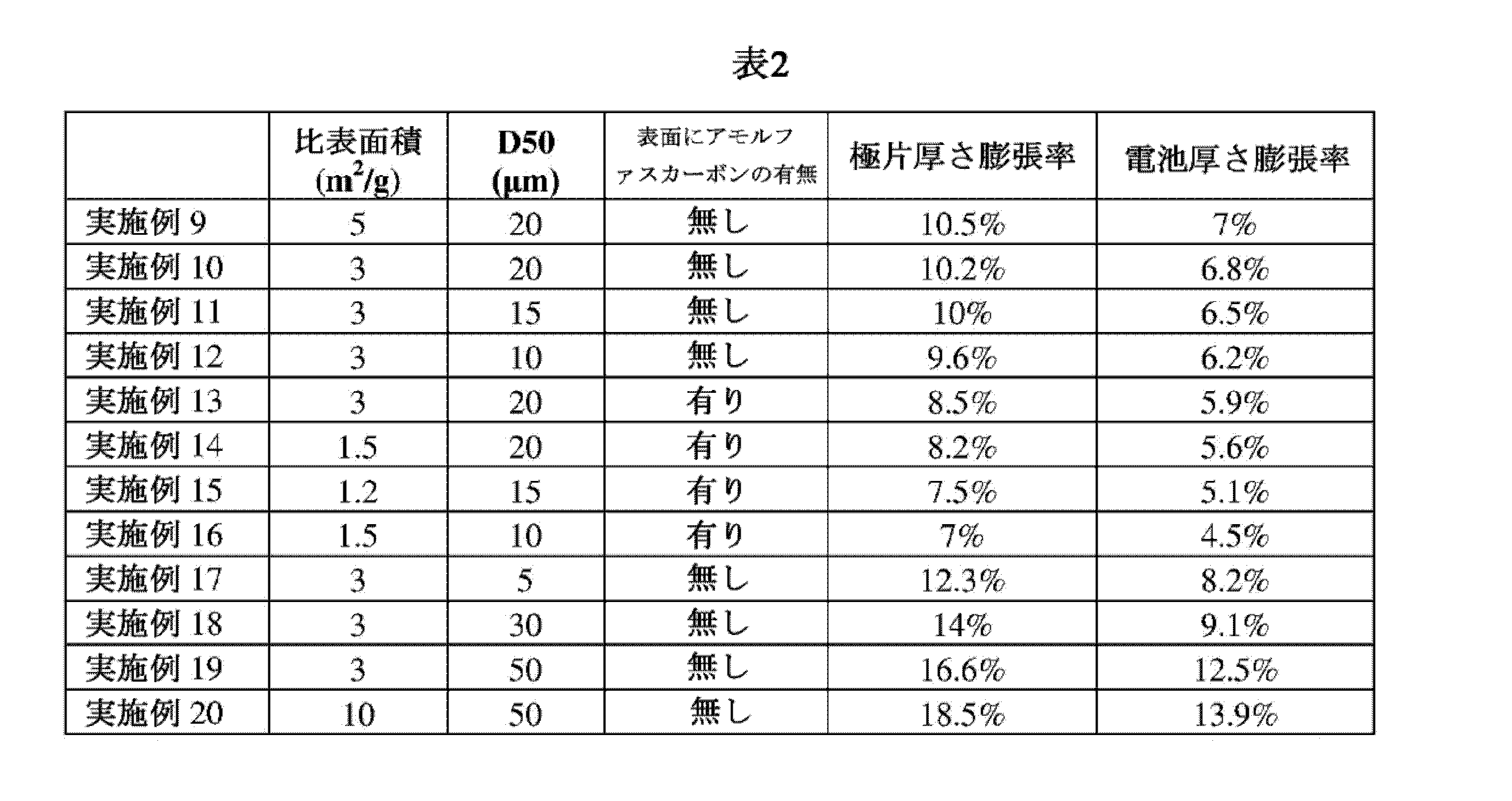
表2に示されたように、負極合剤層における炭素材料は、比表面積が5m2/g未満である特性、メディアン径が5μm~30μmである特性、及び/又は表面にアモルファスカーボンを有する特性を有する。負極合剤層における炭素材料が以上の特性を有する場合、リチウムイオン電池の極片厚さ膨張率及び電池厚さ膨張率がさらに著しく低下する。 As shown in Table 2, the carbon material in the negative electrode mixture layer has the characteristics of a specific surface area of less than 5 m2 /g, a median diameter of 5 μm to 30 μm, and/or has amorphous carbon on the surface. When the carbon material in the negative electrode mixture layer has the above characteristics, the electrode piece thickness expansion rate and the battery thickness expansion rate of the lithium ion battery are further significantly reduced.
表3には、負極合剤層の特性がリチウムイオン電池の極片厚さ膨張率及び電池厚さ膨張率に対する影響が示された。表3に記載されたパラメータ以外、実施例21-32のその他のセッティングは実施例8と同じ、いずれも助剤1を使用した。 Table 3 shows the effect of the properties of the negative electrode mixture layer on the electrode plate thickness expansion rate and battery thickness expansion rate of a lithium ion battery. Other than the parameters listed in Table 3, the other settings of Examples 21-32 were the same as those of Example 8, and all used Auxiliary Agent 1.

実施例8及び21-32に示めされたように、負極合剤層は、厚さは200μm以下である特性、10%~60%の孔隙率を有する特性、及び/又はボール落下の高さ(即ち、直径15mm、重量12グラムのボールが前記負極合剤層上に落下した場合、前記負極合剤層に亀裂を発生させるボールの最小高さ)は50cm以上である特性を有する。負極合剤層が以上の特性を有する場合、リチウムイオン電池の極片厚さ膨張率及び電池厚さ膨張率が著しく低下する。 As shown in Examples 8 and 21-32, the negative electrode mixture layer has the following characteristics: a thickness of 200 μm or less, a porosity of 10% to 60%, and/or a ball drop height (i.e., the minimum height of a ball that will cause a crack in the negative electrode mixture layer when a ball with a diameter of 15 mm and a weight of 12 grams is dropped on the negative electrode mixture layer) of 50 cm or more. When the negative electrode mixture layer has the above characteristics, the electrode piece thickness expansion rate and the battery thickness expansion rate of the lithium ion battery are significantly reduced.
表4には、負極合剤層における助剤がリチウムイオン電池の低温容量維持率及び高温保存厚さ膨張率に対する影響が示される。表4における実施例33-40と実施例9との区別は助剤の種類及び含有量が異なるのみにある。 Table 4 shows the effect of the auxiliary agent in the negative electrode mixture layer on the low-temperature capacity retention rate and high-temperature storage thickness expansion rate of a lithium-ion battery. The only difference between Examples 33-40 and Example 9 in Table 4 is the type and content of the auxiliary agent.

結果より、使用された助剤の種類は、負極合剤層の表面のリチウム析出面積を2%以下にすることができればよい。助剤の含有量が負極合剤層の総重量の3000ppm以下を占める場合、負極合剤層の界面安定性をさらに向上させることができ、それによって、リチウムイオン電池の低温容量維持率及び/又は高温保存厚さ膨張率が改善され、それによって、リチウムイオン電池の保存特性が改善される。 The results show that the type of auxiliary used should be such that the lithium deposition area on the surface of the negative electrode mixture layer can be reduced to 2% or less. When the content of the auxiliary is 3000 ppm or less of the total weight of the negative electrode mixture layer, the interface stability of the negative electrode mixture layer can be further improved, thereby improving the low-temperature capacity retention rate and/or high-temperature storage thickness expansion rate of the lithium ion battery, thereby improving the storage characteristics of the lithium ion battery.
明細書全体では、「実施例」、「いくつかの実施例」、「一つの実施例」、「もう一つの例」、「例」、「具体例」、又は「いくつかの例」の引用については、本発明の少なくとも一つの実施例又は例は、当該実施例又は例に記載の特定の特徴、構造、材料又は特性を含むことを意味する。従って、明細書全体の様々な場所に記載された、例えば「いくつかの実施例において」、「実施例において」、「一つの実施例において」、「もう一つの例において」、「例において」、「特定の例において」又は「例」は、必ずしも本発明の同じ実施例又は例を引用するわけではない。また、本発明の特定の特徴、構造、材料、又は特性は、一つ又は複数の実施例又は例において、あらゆる好適な形態で組み合わせることができる。 Throughout the specification, references to "an embodiment," "some embodiments," "one embodiment," "another embodiment," "an example," "a specific example," or "some examples" mean that at least one embodiment or example of the invention includes a particular feature, structure, material, or characteristic described in that embodiment or example. Thus, the appearances of, for example, "in some embodiments," "in an embodiment," "in one embodiment," "in another embodiment," "an example," "in a particular example," or "an example" in various places throughout the specification do not necessarily refer to the same embodiment or example of the invention. Furthermore, particular features, structures, materials, or characteristics of the invention may be combined in any suitable manner in one or more embodiments or examples.
例示的な実施例が開示及び説明されているが、当業者は、上述実施例が本発明を限定するものとして解釈されることができなく、且つ、本発明の技術思想、原理、及び範囲から逸脱しない場合に実施例を改変、置換及び変更することができること、を理解すべきである。
Although illustrative embodiments have been disclosed and described, those skilled in the art should understand that the above-described embodiments should not be construed as limiting the present invention, and that the embodiments can be modified, substituted, and altered without departing from the spirit, principle, and scope of the present invention.
Claims (7)
前記電解液は、リンと酸素を有する化合物を含み、
前記電解液は、ホスホン酸環状無水物を含み、前記ホスホン酸環状無水物は、式3で示される化合物の一種又は多種を含み、

前記負極は、負極集電体及び前記負極集電体上に形成した負極合剤層を含み、100回の充放電サイクル後、前記負極合剤層の総表面積に対して、前記負極合剤層の表面のリチウム析出面積は2%以下であり、
前記負極合剤層は、炭素材料を含み、前記炭素材料の表面にアモルファスカーボンを有する、
電気化学装置。 A positive electrode, an electrolyte, and a negative electrode,
The electrolyte contains a compound having phosphorus and oxygen,
The electrolyte comprises a phosphonic acid cyclic anhydride, the phosphonic acid cyclic anhydride comprising one or more compounds represented by formula 3:
the negative electrode includes a negative electrode current collector and a negative electrode mixture layer formed on the negative electrode current collector, and after 100 charge/discharge cycles, a lithium deposition area on a surface of the negative electrode mixture layer is 2% or less with respect to a total surface area of the negative electrode mixture layer;
the negative electrode mixture layer contains a carbon material and has amorphous carbon on a surface of the carbon material;
Electrochemical equipment.
(a)比表面積が5m2/g未満であることと、
(b)メディアン径が5μm~30μmであることと、
のうちの少なくとも一つの特徴を有する、請求項1に記載の電気化学装置。 The negative electrode mixture layer contains a carbon material, and the carbon material is
(a) a specific surface area of less than 5 m 2 /g;
(b) the median diameter is 5 μm to 30 μm;
2. The electrochemical device of claim 1 , having at least one of the following characteristics:
(a)厚さが200μm以下であることと、
(b)10%~60%の孔隙率を有することと、
(c)直径15mm、重量12グラムのボールが前記負極合剤層上に落下した場合、前記負極合剤層に亀裂を発生させるボールの最小高さは50cm以上であることと、
のうちの少なくとも一つの特徴を有する、請求項1に記載の電気化学装置。 The negative electrode mixture layer is
(a) having a thickness of 200 μm or less;
(b) having a porosity of 10% to 60%;
(c) when a ball having a diameter of 15 mm and a weight of 12 grams is dropped onto the negative electrode mixture layer, the minimum height of the ball that causes a crack in the negative electrode mixture layer is 50 cm or more;
2. The electrochemical device of claim 1, having at least one of the following characteristics:
(a)ポリエーテルシロキサンを含むことと、
(b)酸化電位が4.5V以上であり、且つ還元電位が0.5V以下であることと、
(c)前記助剤を0.1wt%含む水溶液の表面張力が30mN/m以下であることと、
のうちの少なくとも一つの特徴を有する、請求項1に記載の電気化学装置。 The negative electrode mixture layer contains an auxiliary agent, and the auxiliary agent is
(a) comprising a polyether siloxane;
(b) an oxidation potential of 4.5 V or more and a reduction potential of 0.5 V or less;
(c) the surface tension of an aqueous solution containing 0.1 wt % of the auxiliary is 30 mN/m or less;
2. The electrochemical device of claim 1, having at least one of the following characteristics:
Applications Claiming Priority (1)
| Application Number | Priority Date | Filing Date | Title |
|---|---|---|---|
| PCT/CN2019/128445 WO2021128093A1 (en) | 2019-12-25 | 2019-12-25 | Electrochemical device and electronic device comprising same |
Publications (2)
| Publication Number | Publication Date |
|---|---|
| JP2022550173A JP2022550173A (en) | 2022-11-30 |
| JP7463501B2 true JP7463501B2 (en) | 2024-04-08 |
Family
ID=76575096
Family Applications (1)
| Application Number | Title | Priority Date | Filing Date |
|---|---|---|---|
| JP2022519794A Active JP7463501B2 (en) | 2019-12-25 | 2019-12-25 | Electrochemical device and electronic device including same |
Country Status (5)
| Country | Link |
|---|---|
| US (1) | US20230163311A1 (en) |
| EP (1) | EP4020651A4 (en) |
| JP (1) | JP7463501B2 (en) |
| KR (1) | KR102899859B1 (en) |
| WO (1) | WO2021128093A1 (en) |
Families Citing this family (7)
| Publication number | Priority date | Publication date | Assignee | Title |
|---|---|---|---|---|
| US12592380B2 (en) | 2021-09-07 | 2026-03-31 | Sila Nanotechnologies, Inc. | Battery electrode composition comprising carbon and silicon with specific properties for superior performance |
| EP4415097A4 (en) * | 2021-10-06 | 2025-04-02 | Soulbrain Co., Ltd. | Electrolyte and secondary battery comprising same |
| CN118946996A (en) * | 2022-03-31 | 2024-11-12 | 宁德时代新能源科技股份有限公司 | Lithium-ion batteries, battery modules, battery packs, and power-consuming devices |
| KR20240043257A (en) * | 2022-09-27 | 2024-04-03 | 에스케이온 주식회사 | Anode for lithium secondary battery and lithium secondary battery including the same |
| EP4507056A4 (en) * | 2023-02-16 | 2026-04-08 | Contemporary Amperex Technology Hong Kong Ltd | LITHIUM SECONDARY BATTERY AND ELECTRICAL DEVICE |
| JP7825599B2 (en) * | 2023-07-12 | 2026-03-06 | プライムプラネットエナジー&ソリューションズ株式会社 | Nonaqueous electrolyte secondary battery |
| KR20250137916A (en) * | 2024-03-12 | 2025-09-19 | 동화일렉트로라이트 주식회사 | Electrolyte for secondary battery and lithium secondary battery including the same |
Citations (9)
| Publication number | Priority date | Publication date | Assignee | Title |
|---|---|---|---|---|
| JP2005005118A (en) | 2003-06-11 | 2005-01-06 | Sony Corp | battery |
| JP2012182132A (en) | 2011-02-10 | 2012-09-20 | Mitsubishi Chemicals Corp | Nonaqueous electrolyte secondary battery and nonaqueous electrolyte |
| CN105280954A (en) | 2015-08-29 | 2016-01-27 | 山东鸿正电池材料科技有限公司 | Preparation method of organic electrolyte capable of improving heat stability of lithium-ion battery |
| JP2016178125A (en) | 2015-03-18 | 2016-10-06 | 旭化成株式会社 | Nonaqueous lithium type power-storage device |
| JP2017069181A (en) | 2015-09-29 | 2017-04-06 | トヨタ自動車株式会社 | Lithium ion secondary battery |
| CN109037676A (en) | 2017-06-09 | 2018-12-18 | 宁德时代新能源科技股份有限公司 | Lithium ion battery cathode slurry and preparation method thereof |
| CN109860703A (en) | 2019-01-25 | 2019-06-07 | 宁德新能源科技有限公司 | An electrolyte and electrochemical device |
| US20190267671A1 (en) | 2016-11-29 | 2019-08-29 | Contemporary Amperex Technology Co., Limited | Electrolyte and secondary lithium battery |
| US20190379086A1 (en) | 2018-06-12 | 2019-12-12 | Sk Innovation Co., Ltd. | Lithium secondary battery |
Family Cites Families (20)
| Publication number | Priority date | Publication date | Assignee | Title |
|---|---|---|---|---|
| JPH11283669A (en) * | 1998-03-31 | 1999-10-15 | Denso Corp | Flame retardant electrolyte and non-aqueous electrolyte secondary battery |
| JP2001338679A (en) * | 2000-05-26 | 2001-12-07 | Asahi Glass Co Ltd | Secondary power supply |
| CN1317790C (en) * | 2001-01-04 | 2007-05-23 | 三菱化学株式会社 | Non-aqueous electrolyte and its secondary lithium battery |
| EP1597783A2 (en) * | 2003-02-19 | 2005-11-23 | Phoenix Innovations, Inc. | An improved lithium battery electrode |
| JP5076316B2 (en) * | 2005-12-27 | 2012-11-21 | ソニー株式会社 | Negative electrode for secondary battery and secondary battery |
| CN101170200B (en) * | 2007-11-23 | 2012-02-22 | 天津力神电池股份有限公司 | Mixed non water electrolyte additive for improving lithium battery high-temperature performance |
| KR102157157B1 (en) * | 2012-07-17 | 2020-09-17 | 제온 코포레이션 | Negative electrode for secondary cell, and secondary cell |
| CN104704658B (en) * | 2012-10-12 | 2017-06-30 | 日产自动车株式会社 | Positive electrode active material for nonaqueous electrolyte secondary battery, the manufacture method of positive electrode active material for nonaqueous electrolyte secondary battery and rechargeable nonaqueous electrolytic battery |
| CN105047994B (en) * | 2015-09-22 | 2018-02-23 | 宁德新能源科技有限公司 | Electrolyte and the lithium ion battery including the electrolyte |
| KR102163999B1 (en) * | 2016-09-30 | 2020-10-12 | 삼성에스디아이 주식회사 | Electrolyte for lithium rechargeable battery and lithium rechargeable battery including the same |
| CN108110317A (en) * | 2016-11-25 | 2018-06-01 | 深圳新宙邦科技股份有限公司 | A kind of non-aqueous electrolyte for lithium ion cell and lithium ion battery |
| US10840502B2 (en) * | 2017-02-24 | 2020-11-17 | Global Graphene Group, Inc. | Polymer binder for lithium battery and method of manufacturing |
| KR102276985B1 (en) * | 2017-05-17 | 2021-07-12 | 주식회사 엘지에너지솔루션 | Nonaqueous electrolyte for lithium secondary battery, and lithium secondary battery comprising the same |
| KR102383073B1 (en) * | 2017-07-21 | 2022-04-04 | 삼성에스디아이 주식회사 | Electrolyte of rechargeable lithium battery and rechargeable lithium battery including same |
| WO2019113532A1 (en) * | 2017-12-07 | 2019-06-13 | Enevate Corporation | Silicon-based energy storage devices with fluorinated cyclic compound containing electrolyte additives |
| KR102542965B1 (en) * | 2018-02-16 | 2023-06-14 | 다이킨 고교 가부시키가이샤 | Electrolysis solution, electrochemical device, lithium-ion secondary battery, and module |
| CN108847489B (en) * | 2018-05-04 | 2019-04-09 | 宁德时代新能源科技股份有限公司 | Negative pole piece and battery |
| CN108365265A (en) * | 2018-05-15 | 2018-08-03 | 中山弘毅新材料有限公司 | A kind of non-aqueous electrolyte for lithium ion cell and lithium ion battery |
| CN109301330A (en) * | 2018-11-16 | 2019-02-01 | 珠海光宇电池有限公司 | A kind of lithium secondary cell electrolyte and the lithium secondary battery containing the electrolyte |
| CN110323487B (en) * | 2019-07-10 | 2021-09-21 | 宁德时代新能源科技股份有限公司 | Lithium ion battery and electric equipment comprising same |
-
2019
- 2019-12-25 KR KR1020227008657A patent/KR102899859B1/en active Active
- 2019-12-25 US US17/054,207 patent/US20230163311A1/en active Pending
- 2019-12-25 JP JP2022519794A patent/JP7463501B2/en active Active
- 2019-12-25 WO PCT/CN2019/128445 patent/WO2021128093A1/en not_active Ceased
- 2019-12-25 EP EP19958017.6A patent/EP4020651A4/en active Pending
Patent Citations (9)
| Publication number | Priority date | Publication date | Assignee | Title |
|---|---|---|---|---|
| JP2005005118A (en) | 2003-06-11 | 2005-01-06 | Sony Corp | battery |
| JP2012182132A (en) | 2011-02-10 | 2012-09-20 | Mitsubishi Chemicals Corp | Nonaqueous electrolyte secondary battery and nonaqueous electrolyte |
| JP2016178125A (en) | 2015-03-18 | 2016-10-06 | 旭化成株式会社 | Nonaqueous lithium type power-storage device |
| CN105280954A (en) | 2015-08-29 | 2016-01-27 | 山东鸿正电池材料科技有限公司 | Preparation method of organic electrolyte capable of improving heat stability of lithium-ion battery |
| JP2017069181A (en) | 2015-09-29 | 2017-04-06 | トヨタ自動車株式会社 | Lithium ion secondary battery |
| US20190267671A1 (en) | 2016-11-29 | 2019-08-29 | Contemporary Amperex Technology Co., Limited | Electrolyte and secondary lithium battery |
| CN109037676A (en) | 2017-06-09 | 2018-12-18 | 宁德时代新能源科技股份有限公司 | Lithium ion battery cathode slurry and preparation method thereof |
| US20190379086A1 (en) | 2018-06-12 | 2019-12-12 | Sk Innovation Co., Ltd. | Lithium secondary battery |
| CN109860703A (en) | 2019-01-25 | 2019-06-07 | 宁德新能源科技有限公司 | An electrolyte and electrochemical device |
Also Published As
| Publication number | Publication date |
|---|---|
| KR102899859B1 (en) | 2025-12-15 |
| JP2022550173A (en) | 2022-11-30 |
| US20230163311A1 (en) | 2023-05-25 |
| WO2021128093A1 (en) | 2021-07-01 |
| EP4020651A4 (en) | 2023-05-10 |
| EP4020651A1 (en) | 2022-06-29 |
| KR20220041935A (en) | 2022-04-01 |
Similar Documents
| Publication | Publication Date | Title |
|---|---|---|
| JP7575448B2 (en) | Electrochemical device and electronic device including same | |
| JP6555400B2 (en) | Lithium fluorosulfonate, non-aqueous electrolyte, and non-aqueous electrolyte secondary battery | |
| JP7509869B2 (en) | Electrochemical device and electronic device including same | |
| CN111129498A (en) | Electrochemical device and electronic device including the same | |
| KR102899859B1 (en) | Electrochemical devices and electronic devices including the same | |
| CN111063883A (en) | Electrochemical device and electronic device comprising same | |
| CN111129594B (en) | Electrochemical device and electronic device including same | |
| CN105814731B (en) | Electrolyte, electrochemical device, lithium ion secondary battery and module | |
| JP5655653B2 (en) | Non-aqueous electrolyte and lithium secondary battery using the same | |
| CN112151855B (en) | Electrochemical device and electronic device | |
| JP7841004B2 (en) | Lithium-ion secondary batteries and electronic devices | |
| JP7679469B2 (en) | Electrochemical and Electronic Devices | |
| JP7609983B2 (en) | Electrochemical and Electronic Devices | |
| JP7599557B2 (en) | Positive electrode and electrochemical device including the same, and electronic device | |
| CN115552678B (en) | Electrochemical devices and electronic devices | |
| JP7680534B2 (en) | Electrochemical and Electronic Devices |
Legal Events
| Date | Code | Title | Description |
|---|---|---|---|
| A621 | Written request for application examination |
Free format text: JAPANESE INTERMEDIATE CODE: A621 Effective date: 20220329 |
|
| A977 | Report on retrieval |
Free format text: JAPANESE INTERMEDIATE CODE: A971007 Effective date: 20230315 |
|
| A131 | Notification of reasons for refusal |
Free format text: JAPANESE INTERMEDIATE CODE: A131 Effective date: 20230404 |
|
| A521 | Request for written amendment filed |
Free format text: JAPANESE INTERMEDIATE CODE: A523 Effective date: 20230703 |
|
| A131 | Notification of reasons for refusal |
Free format text: JAPANESE INTERMEDIATE CODE: A131 Effective date: 20231003 |
|
| A521 | Request for written amendment filed |
Free format text: JAPANESE INTERMEDIATE CODE: A523 Effective date: 20231222 |
|
| TRDD | Decision of grant or rejection written | ||
| A01 | Written decision to grant a patent or to grant a registration (utility model) |
Free format text: JAPANESE INTERMEDIATE CODE: A01 Effective date: 20240312 |
|
| A61 | First payment of annual fees (during grant procedure) |
Free format text: JAPANESE INTERMEDIATE CODE: A61 Effective date: 20240327 |
|
| R150 | Certificate of patent or registration of utility model |
Ref document number: 7463501 Country of ref document: JP Free format text: JAPANESE INTERMEDIATE CODE: R150 |