JP7452829B2 - Amyloid beta epitopes and antibodies against them - Google Patents
Amyloid beta epitopes and antibodies against them Download PDFInfo
- Publication number
- JP7452829B2 JP7452829B2 JP2018522803A JP2018522803A JP7452829B2 JP 7452829 B2 JP7452829 B2 JP 7452829B2 JP 2018522803 A JP2018522803 A JP 2018522803A JP 2018522803 A JP2018522803 A JP 2018522803A JP 7452829 B2 JP7452829 B2 JP 7452829B2
- Authority
- JP
- Japan
- Prior art keywords
- antibody
- seq
- abeta
- peptide
- amino acid
- Prior art date
- Legal status (The legal status is an assumption and is not a legal conclusion. Google has not performed a legal analysis and makes no representation as to the accuracy of the status listed.)
- Active
Links
Images


Classifications
-
- C—CHEMISTRY; METALLURGY
- C07—ORGANIC CHEMISTRY
- C07K—PEPTIDES
- C07K14/00—Peptides having more than 20 amino acids; Gastrins; Somatostatins; Melanotropins; Derivatives thereof
- C07K14/435—Peptides having more than 20 amino acids; Gastrins; Somatostatins; Melanotropins; Derivatives thereof from animals; from humans
- C07K14/46—Peptides having more than 20 amino acids; Gastrins; Somatostatins; Melanotropins; Derivatives thereof from animals; from humans from vertebrates
- C07K14/47—Peptides having more than 20 amino acids; Gastrins; Somatostatins; Melanotropins; Derivatives thereof from animals; from humans from vertebrates from mammals
- C07K14/4701—Peptides having more than 20 amino acids; Gastrins; Somatostatins; Melanotropins; Derivatives thereof from animals; from humans from vertebrates from mammals not used
- C07K14/4711—Alzheimer's disease; Amyloid plaque core protein
-
- A—HUMAN NECESSITIES
- A61—MEDICAL OR VETERINARY SCIENCE; HYGIENE
- A61K—PREPARATIONS FOR MEDICAL, DENTAL OR TOILETRY PURPOSES
- A61K39/00—Medicinal preparations containing antigens or antibodies
- A61K39/0005—Vertebrate antigens
- A61K39/0007—Nervous system antigens; Prions
-
- A—HUMAN NECESSITIES
- A61—MEDICAL OR VETERINARY SCIENCE; HYGIENE
- A61K—PREPARATIONS FOR MEDICAL, DENTAL OR TOILETRY PURPOSES
- A61K39/00—Medicinal preparations containing antigens or antibodies
- A61K39/0005—Vertebrate antigens
- A61K39/0008—Antigens related to auto-immune diseases; Preparations to induce self-tolerance
-
- A—HUMAN NECESSITIES
- A61—MEDICAL OR VETERINARY SCIENCE; HYGIENE
- A61K—PREPARATIONS FOR MEDICAL, DENTAL OR TOILETRY PURPOSES
- A61K47/00—Medicinal preparations characterised by the non-active ingredients used, e.g. carriers or inert additives; Targeting or modifying agents chemically bound to the active ingredient
- A61K47/50—Medicinal preparations characterised by the non-active ingredients used, e.g. carriers or inert additives; Targeting or modifying agents chemically bound to the active ingredient the non-active ingredient being chemically bound to the active ingredient, e.g. polymer-drug conjugates
- A61K47/51—Medicinal preparations characterised by the non-active ingredients used, e.g. carriers or inert additives; Targeting or modifying agents chemically bound to the active ingredient the non-active ingredient being chemically bound to the active ingredient, e.g. polymer-drug conjugates the non-active ingredient being a modifying agent
- A61K47/62—Medicinal preparations characterised by the non-active ingredients used, e.g. carriers or inert additives; Targeting or modifying agents chemically bound to the active ingredient the non-active ingredient being chemically bound to the active ingredient, e.g. polymer-drug conjugates the non-active ingredient being a modifying agent the modifying agent being a protein, peptide or polyamino acid
- A61K47/64—Drug-peptide, drug-protein or drug-polyamino acid conjugates, i.e. the modifying agent being a peptide, protein or polyamino acid which is covalently bonded or complexed to a therapeutically active agent
- A61K47/643—Albumins, e.g. HSA, BSA, ovalbumin or a Keyhole Limpet Hemocyanin [KHL]
-
- A—HUMAN NECESSITIES
- A61—MEDICAL OR VETERINARY SCIENCE; HYGIENE
- A61K—PREPARATIONS FOR MEDICAL, DENTAL OR TOILETRY PURPOSES
- A61K47/00—Medicinal preparations characterised by the non-active ingredients used, e.g. carriers or inert additives; Targeting or modifying agents chemically bound to the active ingredient
- A61K47/50—Medicinal preparations characterised by the non-active ingredients used, e.g. carriers or inert additives; Targeting or modifying agents chemically bound to the active ingredient the non-active ingredient being chemically bound to the active ingredient, e.g. polymer-drug conjugates
- A61K47/51—Medicinal preparations characterised by the non-active ingredients used, e.g. carriers or inert additives; Targeting or modifying agents chemically bound to the active ingredient the non-active ingredient being chemically bound to the active ingredient, e.g. polymer-drug conjugates the non-active ingredient being a modifying agent
- A61K47/62—Medicinal preparations characterised by the non-active ingredients used, e.g. carriers or inert additives; Targeting or modifying agents chemically bound to the active ingredient the non-active ingredient being chemically bound to the active ingredient, e.g. polymer-drug conjugates the non-active ingredient being a modifying agent the modifying agent being a protein, peptide or polyamino acid
- A61K47/64—Drug-peptide, drug-protein or drug-polyamino acid conjugates, i.e. the modifying agent being a peptide, protein or polyamino acid which is covalently bonded or complexed to a therapeutically active agent
- A61K47/646—Drug-peptide, drug-protein or drug-polyamino acid conjugates, i.e. the modifying agent being a peptide, protein or polyamino acid which is covalently bonded or complexed to a therapeutically active agent the entire peptide or protein drug conjugate elicits an immune response, e.g. conjugate vaccines
-
- A—HUMAN NECESSITIES
- A61—MEDICAL OR VETERINARY SCIENCE; HYGIENE
- A61K—PREPARATIONS FOR MEDICAL, DENTAL OR TOILETRY PURPOSES
- A61K51/00—Preparations containing radioactive substances for use in therapy or testing in vivo
- A61K51/02—Preparations containing radioactive substances for use in therapy or testing in vivo characterised by the carrier, i.e. characterised by the agent or material covalently linked or complexing the radioactive nucleus
- A61K51/04—Organic compounds
- A61K51/08—Peptides, e.g. proteins, carriers being peptides, polyamino acids, proteins
- A61K51/10—Antibodies or immunoglobulins; Fragments thereof, the carrier being an antibody, an immunoglobulin or a fragment thereof, e.g. a camelised human single domain antibody or the Fc fragment of an antibody
- A61K51/1018—Antibodies or immunoglobulins; Fragments thereof, the carrier being an antibody, an immunoglobulin or a fragment thereof, e.g. a camelised human single domain antibody or the Fc fragment of an antibody against material from animals or humans
-
- A—HUMAN NECESSITIES
- A61—MEDICAL OR VETERINARY SCIENCE; HYGIENE
- A61P—SPECIFIC THERAPEUTIC ACTIVITY OF CHEMICAL COMPOUNDS OR MEDICINAL PREPARATIONS
- A61P25/00—Drugs for disorders of the nervous system
- A61P25/28—Drugs for disorders of the nervous system for treating neurodegenerative disorders of the central nervous system, e.g. nootropic agents, cognition enhancers, drugs for treating Alzheimer's disease or other forms of dementia
-
- C—CHEMISTRY; METALLURGY
- C07—ORGANIC CHEMISTRY
- C07K—PEPTIDES
- C07K16/00—Immunoglobulins [IG], e.g. monoclonal or polyclonal antibodies
- C07K16/18—Immunoglobulins [IG], e.g. monoclonal or polyclonal antibodies against material from animals or humans
-
- C—CHEMISTRY; METALLURGY
- C07—ORGANIC CHEMISTRY
- C07K—PEPTIDES
- C07K5/00—Peptides containing up to four amino acids in a fully defined sequence; Derivatives thereof
- C07K5/04—Peptides containing up to four amino acids in a fully defined sequence; Derivatives thereof containing only normal peptide links
- C07K5/10—Tetrapeptides
- C07K5/1021—Tetrapeptides with the first amino acid being acidic
-
- C—CHEMISTRY; METALLURGY
- C07—ORGANIC CHEMISTRY
- C07K—PEPTIDES
- C07K5/00—Peptides containing up to four amino acids in a fully defined sequence; Derivatives thereof
- C07K5/04—Peptides containing up to four amino acids in a fully defined sequence; Derivatives thereof containing only normal peptide links
- C07K5/10—Tetrapeptides
- C07K5/1024—Tetrapeptides with the first amino acid being heterocyclic
-
- C—CHEMISTRY; METALLURGY
- C07—ORGANIC CHEMISTRY
- C07K—PEPTIDES
- C07K7/00—Peptides having 5 to 20 amino acids in a fully defined sequence; Derivatives thereof
- C07K7/64—Cyclic peptides containing only normal peptide links
-
- G—PHYSICS
- G01—MEASURING; TESTING
- G01N—INVESTIGATING OR ANALYSING MATERIALS BY DETERMINING THEIR CHEMICAL OR PHYSICAL PROPERTIES
- G01N33/00—Investigating or analysing materials by specific methods not covered by groups G01N1/00 - G01N31/00
- G01N33/48—Biological material, e.g. blood, urine; Haemocytometers
- G01N33/50—Chemical analysis of biological material, e.g. blood, urine; Testing involving biospecific ligand binding methods; Immunological testing
- G01N33/68—Chemical analysis of biological material, e.g. blood, urine; Testing involving biospecific ligand binding methods; Immunological testing involving proteins, peptides or amino acids
- G01N33/6893—Chemical analysis of biological material, e.g. blood, urine; Testing involving biospecific ligand binding methods; Immunological testing involving proteins, peptides or amino acids related to diseases not provided for elsewhere
- G01N33/6896—Neurological disorders, e.g. Alzheimer's disease
-
- A—HUMAN NECESSITIES
- A61—MEDICAL OR VETERINARY SCIENCE; HYGIENE
- A61K—PREPARATIONS FOR MEDICAL, DENTAL OR TOILETRY PURPOSES
- A61K39/00—Medicinal preparations containing antigens or antibodies
- A61K2039/505—Medicinal preparations containing antigens or antibodies comprising antibodies
-
- A—HUMAN NECESSITIES
- A61—MEDICAL OR VETERINARY SCIENCE; HYGIENE
- A61K—PREPARATIONS FOR MEDICAL, DENTAL OR TOILETRY PURPOSES
- A61K39/00—Medicinal preparations containing antigens or antibodies
- A61K2039/555—Medicinal preparations containing antigens or antibodies characterised by a specific combination antigen/adjuvant
- A61K2039/55505—Inorganic adjuvants
-
- A—HUMAN NECESSITIES
- A61—MEDICAL OR VETERINARY SCIENCE; HYGIENE
- A61K—PREPARATIONS FOR MEDICAL, DENTAL OR TOILETRY PURPOSES
- A61K39/00—Medicinal preparations containing antigens or antibodies
- A61K2039/60—Medicinal preparations containing antigens or antibodies characteristics by the carrier linked to the antigen
- A61K2039/6031—Proteins
- A61K2039/6081—Albumin; Keyhole limpet haemocyanin [KLH]
-
- A—HUMAN NECESSITIES
- A61—MEDICAL OR VETERINARY SCIENCE; HYGIENE
- A61K—PREPARATIONS FOR MEDICAL, DENTAL OR TOILETRY PURPOSES
- A61K2300/00—Mixtures or combinations of active ingredients, wherein at least one active ingredient is fully defined in groups A61K31/00 - A61K41/00
-
- A—HUMAN NECESSITIES
- A61—MEDICAL OR VETERINARY SCIENCE; HYGIENE
- A61K—PREPARATIONS FOR MEDICAL, DENTAL OR TOILETRY PURPOSES
- A61K38/00—Medicinal preparations containing peptides
-
- A—HUMAN NECESSITIES
- A61—MEDICAL OR VETERINARY SCIENCE; HYGIENE
- A61K—PREPARATIONS FOR MEDICAL, DENTAL OR TOILETRY PURPOSES
- A61K38/00—Medicinal preparations containing peptides
- A61K38/04—Peptides having up to 20 amino acids in a fully defined sequence; Derivatives thereof
- A61K38/05—Dipeptides
-
- A—HUMAN NECESSITIES
- A61—MEDICAL OR VETERINARY SCIENCE; HYGIENE
- A61K—PREPARATIONS FOR MEDICAL, DENTAL OR TOILETRY PURPOSES
- A61K38/00—Medicinal preparations containing peptides
- A61K38/04—Peptides having up to 20 amino acids in a fully defined sequence; Derivatives thereof
- A61K38/07—Tetrapeptides
-
- A—HUMAN NECESSITIES
- A61—MEDICAL OR VETERINARY SCIENCE; HYGIENE
- A61K—PREPARATIONS FOR MEDICAL, DENTAL OR TOILETRY PURPOSES
- A61K38/00—Medicinal preparations containing peptides
- A61K38/04—Peptides having up to 20 amino acids in a fully defined sequence; Derivatives thereof
- A61K38/08—Peptides having 5 to 11 amino acids
-
- A—HUMAN NECESSITIES
- A61—MEDICAL OR VETERINARY SCIENCE; HYGIENE
- A61K—PREPARATIONS FOR MEDICAL, DENTAL OR TOILETRY PURPOSES
- A61K38/00—Medicinal preparations containing peptides
- A61K38/04—Peptides having up to 20 amino acids in a fully defined sequence; Derivatives thereof
- A61K38/12—Cyclic peptides, e.g. bacitracins; Polymyxins; Gramicidins S, C; Tyrocidins A, B or C
-
- A—HUMAN NECESSITIES
- A61—MEDICAL OR VETERINARY SCIENCE; HYGIENE
- A61K—PREPARATIONS FOR MEDICAL, DENTAL OR TOILETRY PURPOSES
- A61K39/00—Medicinal preparations containing antigens or antibodies
-
- A—HUMAN NECESSITIES
- A61—MEDICAL OR VETERINARY SCIENCE; HYGIENE
- A61K—PREPARATIONS FOR MEDICAL, DENTAL OR TOILETRY PURPOSES
- A61K39/00—Medicinal preparations containing antigens or antibodies
- A61K39/385—Haptens or antigens, bound to carriers
-
- A—HUMAN NECESSITIES
- A61—MEDICAL OR VETERINARY SCIENCE; HYGIENE
- A61K—PREPARATIONS FOR MEDICAL, DENTAL OR TOILETRY PURPOSES
- A61K39/00—Medicinal preparations containing antigens or antibodies
- A61K39/39—Medicinal preparations containing antigens or antibodies characterised by the immunostimulating additives, e.g. chemical adjuvants
-
- A—HUMAN NECESSITIES
- A61—MEDICAL OR VETERINARY SCIENCE; HYGIENE
- A61K—PREPARATIONS FOR MEDICAL, DENTAL OR TOILETRY PURPOSES
- A61K39/00—Medicinal preparations containing antigens or antibodies
- A61K39/395—Antibodies; Immunoglobulins; Immune serum, e.g. antilymphocytic serum
-
- A—HUMAN NECESSITIES
- A61—MEDICAL OR VETERINARY SCIENCE; HYGIENE
- A61K—PREPARATIONS FOR MEDICAL, DENTAL OR TOILETRY PURPOSES
- A61K39/00—Medicinal preparations containing antigens or antibodies
- A61K39/395—Antibodies; Immunoglobulins; Immune serum, e.g. antilymphocytic serum
- A61K39/39533—Antibodies; Immunoglobulins; Immune serum, e.g. antilymphocytic serum against materials from animals
-
- A—HUMAN NECESSITIES
- A61—MEDICAL OR VETERINARY SCIENCE; HYGIENE
- A61K—PREPARATIONS FOR MEDICAL, DENTAL OR TOILETRY PURPOSES
- A61K39/00—Medicinal preparations containing antigens or antibodies
- A61K39/395—Antibodies; Immunoglobulins; Immune serum, e.g. antilymphocytic serum
- A61K39/39533—Antibodies; Immunoglobulins; Immune serum, e.g. antilymphocytic serum against materials from animals
- A61K39/3955—Antibodies; Immunoglobulins; Immune serum, e.g. antilymphocytic serum against materials from animals against proteinaceous materials, e.g. enzymes, hormones, lymphokines
-
- A—HUMAN NECESSITIES
- A61—MEDICAL OR VETERINARY SCIENCE; HYGIENE
- A61K—PREPARATIONS FOR MEDICAL, DENTAL OR TOILETRY PURPOSES
- A61K45/00—Medicinal preparations containing active ingredients not provided for in groups A61K31/00 - A61K41/00
- A61K45/05—Immunological preparations stimulating the reticulo-endothelial system, e.g. against cancer
-
- A—HUMAN NECESSITIES
- A61—MEDICAL OR VETERINARY SCIENCE; HYGIENE
- A61K—PREPARATIONS FOR MEDICAL, DENTAL OR TOILETRY PURPOSES
- A61K45/00—Medicinal preparations containing active ingredients not provided for in groups A61K31/00 - A61K41/00
- A61K45/06—Mixtures of active ingredients without chemical characterisation, e.g. antiphlogistics and cardiaca
-
- A—HUMAN NECESSITIES
- A61—MEDICAL OR VETERINARY SCIENCE; HYGIENE
- A61K—PREPARATIONS FOR MEDICAL, DENTAL OR TOILETRY PURPOSES
- A61K47/00—Medicinal preparations characterised by the non-active ingredients used, e.g. carriers or inert additives; Targeting or modifying agents chemically bound to the active ingredient
- A61K47/50—Medicinal preparations characterised by the non-active ingredients used, e.g. carriers or inert additives; Targeting or modifying agents chemically bound to the active ingredient the non-active ingredient being chemically bound to the active ingredient, e.g. polymer-drug conjugates
- A61K47/69—Medicinal preparations characterised by the non-active ingredients used, e.g. carriers or inert additives; Targeting or modifying agents chemically bound to the active ingredient the non-active ingredient being chemically bound to the active ingredient, e.g. polymer-drug conjugates the conjugate being characterised by physical or galenical forms, e.g. emulsion, particle, inclusion complex, stent or kit
- A61K47/6921—Medicinal preparations characterised by the non-active ingredients used, e.g. carriers or inert additives; Targeting or modifying agents chemically bound to the active ingredient the non-active ingredient being chemically bound to the active ingredient, e.g. polymer-drug conjugates the conjugate being characterised by physical or galenical forms, e.g. emulsion, particle, inclusion complex, stent or kit the form being a particulate, a powder, an adsorbate, a bead or a sphere
-
- A—HUMAN NECESSITIES
- A61—MEDICAL OR VETERINARY SCIENCE; HYGIENE
- A61K—PREPARATIONS FOR MEDICAL, DENTAL OR TOILETRY PURPOSES
- A61K49/00—Preparations for testing in vivo
- A61K49/06—Nuclear magnetic resonance [NMR] contrast preparations; Magnetic resonance imaging [MRI] contrast preparations
- A61K49/18—Nuclear magnetic resonance [NMR] contrast preparations; Magnetic resonance imaging [MRI] contrast preparations characterised by a special physical form, e.g. emulsions, microcapsules, liposomes
- A61K49/1818—Nuclear magnetic resonance [NMR] contrast preparations; Magnetic resonance imaging [MRI] contrast preparations characterised by a special physical form, e.g. emulsions, microcapsules, liposomes particles, e.g. uncoated or non-functionalised microparticles or nanoparticles
-
- A—HUMAN NECESSITIES
- A61—MEDICAL OR VETERINARY SCIENCE; HYGIENE
- A61K—PREPARATIONS FOR MEDICAL, DENTAL OR TOILETRY PURPOSES
- A61K51/00—Preparations containing radioactive substances for use in therapy or testing in vivo
- A61K51/02—Preparations containing radioactive substances for use in therapy or testing in vivo characterised by the carrier, i.e. characterised by the agent or material covalently linked or complexing the radioactive nucleus
- A61K51/04—Organic compounds
- A61K51/08—Peptides, e.g. proteins, carriers being peptides, polyamino acids, proteins
- A61K51/088—Peptides, e.g. proteins, carriers being peptides, polyamino acids, proteins conjugates with carriers being peptides, polyamino acids or proteins
-
- A—HUMAN NECESSITIES
- A61—MEDICAL OR VETERINARY SCIENCE; HYGIENE
- A61K—PREPARATIONS FOR MEDICAL, DENTAL OR TOILETRY PURPOSES
- A61K51/00—Preparations containing radioactive substances for use in therapy or testing in vivo
- A61K51/02—Preparations containing radioactive substances for use in therapy or testing in vivo characterised by the carrier, i.e. characterised by the agent or material covalently linked or complexing the radioactive nucleus
- A61K51/04—Organic compounds
- A61K51/08—Peptides, e.g. proteins, carriers being peptides, polyamino acids, proteins
- A61K51/10—Antibodies or immunoglobulins; Fragments thereof, the carrier being an antibody, an immunoglobulin or a fragment thereof, e.g. a camelised human single domain antibody or the Fc fragment of an antibody
-
- A—HUMAN NECESSITIES
- A61—MEDICAL OR VETERINARY SCIENCE; HYGIENE
- A61L—METHODS OR APPARATUS FOR STERILISING MATERIALS OR OBJECTS IN GENERAL; DISINFECTION, STERILISATION OR DEODORISATION OF AIR; CHEMICAL ASPECTS OF BANDAGES, DRESSINGS, ABSORBENT PADS OR SURGICAL ARTICLES; MATERIALS FOR BANDAGES, DRESSINGS, ABSORBENT PADS OR SURGICAL ARTICLES
- A61L27/00—Materials for grafts or prostheses or for coating grafts or prostheses
- A61L27/14—Macromolecular materials
- A61L27/22—Polypeptides or derivatives thereof, e.g. degradation products
- A61L27/227—Other specific proteins or polypeptides not covered by A61L27/222, A61L27/225 or A61L27/24
-
- A—HUMAN NECESSITIES
- A61—MEDICAL OR VETERINARY SCIENCE; HYGIENE
- A61L—METHODS OR APPARATUS FOR STERILISING MATERIALS OR OBJECTS IN GENERAL; DISINFECTION, STERILISATION OR DEODORISATION OF AIR; CHEMICAL ASPECTS OF BANDAGES, DRESSINGS, ABSORBENT PADS OR SURGICAL ARTICLES; MATERIALS FOR BANDAGES, DRESSINGS, ABSORBENT PADS OR SURGICAL ARTICLES
- A61L27/00—Materials for grafts or prostheses or for coating grafts or prostheses
- A61L27/28—Materials for coating prostheses
- A61L27/34—Macromolecular materials
-
- A—HUMAN NECESSITIES
- A61—MEDICAL OR VETERINARY SCIENCE; HYGIENE
- A61L—METHODS OR APPARATUS FOR STERILISING MATERIALS OR OBJECTS IN GENERAL; DISINFECTION, STERILISATION OR DEODORISATION OF AIR; CHEMICAL ASPECTS OF BANDAGES, DRESSINGS, ABSORBENT PADS OR SURGICAL ARTICLES; MATERIALS FOR BANDAGES, DRESSINGS, ABSORBENT PADS OR SURGICAL ARTICLES
- A61L29/00—Materials for catheters, medical tubing, cannulae, or endoscopes or for coating catheters
- A61L29/08—Materials for coatings
- A61L29/085—Macromolecular materials
-
- A—HUMAN NECESSITIES
- A61—MEDICAL OR VETERINARY SCIENCE; HYGIENE
- A61L—METHODS OR APPARATUS FOR STERILISING MATERIALS OR OBJECTS IN GENERAL; DISINFECTION, STERILISATION OR DEODORISATION OF AIR; CHEMICAL ASPECTS OF BANDAGES, DRESSINGS, ABSORBENT PADS OR SURGICAL ARTICLES; MATERIALS FOR BANDAGES, DRESSINGS, ABSORBENT PADS OR SURGICAL ARTICLES
- A61L29/00—Materials for catheters, medical tubing, cannulae, or endoscopes or for coating catheters
- A61L29/14—Materials characterised by their function or physical properties, e.g. lubricating compositions
- A61L29/16—Biologically active materials, e.g. therapeutic substances
-
- A—HUMAN NECESSITIES
- A61—MEDICAL OR VETERINARY SCIENCE; HYGIENE
- A61L—METHODS OR APPARATUS FOR STERILISING MATERIALS OR OBJECTS IN GENERAL; DISINFECTION, STERILISATION OR DEODORISATION OF AIR; CHEMICAL ASPECTS OF BANDAGES, DRESSINGS, ABSORBENT PADS OR SURGICAL ARTICLES; MATERIALS FOR BANDAGES, DRESSINGS, ABSORBENT PADS OR SURGICAL ARTICLES
- A61L31/00—Materials for other surgical articles, e.g. stents, stent-grafts, shunts, surgical drapes, guide wires, materials for adhesion prevention, occluding devices, surgical gloves, tissue fixation devices
- A61L31/08—Materials for coatings
- A61L31/10—Macromolecular materials
-
- A—HUMAN NECESSITIES
- A61—MEDICAL OR VETERINARY SCIENCE; HYGIENE
- A61L—METHODS OR APPARATUS FOR STERILISING MATERIALS OR OBJECTS IN GENERAL; DISINFECTION, STERILISATION OR DEODORISATION OF AIR; CHEMICAL ASPECTS OF BANDAGES, DRESSINGS, ABSORBENT PADS OR SURGICAL ARTICLES; MATERIALS FOR BANDAGES, DRESSINGS, ABSORBENT PADS OR SURGICAL ARTICLES
- A61L31/00—Materials for other surgical articles, e.g. stents, stent-grafts, shunts, surgical drapes, guide wires, materials for adhesion prevention, occluding devices, surgical gloves, tissue fixation devices
- A61L31/14—Materials characterised by their function or physical properties, e.g. injectable or lubricating compositions, shape-memory materials, surface modified materials
- A61L31/16—Biologically active materials, e.g. therapeutic substances
-
- C—CHEMISTRY; METALLURGY
- C07—ORGANIC CHEMISTRY
- C07K—PEPTIDES
- C07K14/00—Peptides having more than 20 amino acids; Gastrins; Somatostatins; Melanotropins; Derivatives thereof
- C07K14/435—Peptides having more than 20 amino acids; Gastrins; Somatostatins; Melanotropins; Derivatives thereof from animals; from humans
-
- C—CHEMISTRY; METALLURGY
- C07—ORGANIC CHEMISTRY
- C07K—PEPTIDES
- C07K16/00—Immunoglobulins [IG], e.g. monoclonal or polyclonal antibodies
-
- C—CHEMISTRY; METALLURGY
- C07—ORGANIC CHEMISTRY
- C07K—PEPTIDES
- C07K2317/00—Immunoglobulins specific features
- C07K2317/20—Immunoglobulins specific features characterized by taxonomic origin
-
- C—CHEMISTRY; METALLURGY
- C07—ORGANIC CHEMISTRY
- C07K—PEPTIDES
- C07K2317/00—Immunoglobulins specific features
- C07K2317/20—Immunoglobulins specific features characterized by taxonomic origin
- C07K2317/24—Immunoglobulins specific features characterized by taxonomic origin containing regions, domains or residues from different species, e.g. chimeric, humanized or veneered
-
- C—CHEMISTRY; METALLURGY
- C07—ORGANIC CHEMISTRY
- C07K—PEPTIDES
- C07K2317/00—Immunoglobulins specific features
- C07K2317/30—Immunoglobulins specific features characterized by aspects of specificity or valency
-
- C—CHEMISTRY; METALLURGY
- C07—ORGANIC CHEMISTRY
- C07K—PEPTIDES
- C07K2317/00—Immunoglobulins specific features
- C07K2317/30—Immunoglobulins specific features characterized by aspects of specificity or valency
- C07K2317/33—Crossreactivity, e.g. for species or epitope, or lack of said crossreactivity
-
- C—CHEMISTRY; METALLURGY
- C07—ORGANIC CHEMISTRY
- C07K—PEPTIDES
- C07K2317/00—Immunoglobulins specific features
- C07K2317/30—Immunoglobulins specific features characterized by aspects of specificity or valency
- C07K2317/34—Identification of a linear epitope shorter than 20 amino acid residues or of a conformational epitope defined by amino acid residues
-
- C—CHEMISTRY; METALLURGY
- C07—ORGANIC CHEMISTRY
- C07K—PEPTIDES
- C07K2317/00—Immunoglobulins specific features
- C07K2317/50—Immunoglobulins specific features characterized by immunoglobulin fragments
- C07K2317/52—Constant or Fc region; Isotype
- C07K2317/524—CH2 domain
-
- C—CHEMISTRY; METALLURGY
- C07—ORGANIC CHEMISTRY
- C07K—PEPTIDES
- C07K2317/00—Immunoglobulins specific features
- C07K2317/50—Immunoglobulins specific features characterized by immunoglobulin fragments
- C07K2317/52—Constant or Fc region; Isotype
- C07K2317/526—CH3 domain
-
- C—CHEMISTRY; METALLURGY
- C07—ORGANIC CHEMISTRY
- C07K—PEPTIDES
- C07K2317/00—Immunoglobulins specific features
- C07K2317/50—Immunoglobulins specific features characterized by immunoglobulin fragments
- C07K2317/54—F(ab')2
-
- C—CHEMISTRY; METALLURGY
- C07—ORGANIC CHEMISTRY
- C07K—PEPTIDES
- C07K2317/00—Immunoglobulins specific features
- C07K2317/50—Immunoglobulins specific features characterized by immunoglobulin fragments
- C07K2317/55—Fab or Fab'
-
- C—CHEMISTRY; METALLURGY
- C07—ORGANIC CHEMISTRY
- C07K—PEPTIDES
- C07K2317/00—Immunoglobulins specific features
- C07K2317/50—Immunoglobulins specific features characterized by immunoglobulin fragments
- C07K2317/56—Immunoglobulins specific features characterized by immunoglobulin fragments variable (Fv) region, i.e. VH and/or VL
-
- C—CHEMISTRY; METALLURGY
- C07—ORGANIC CHEMISTRY
- C07K—PEPTIDES
- C07K2317/00—Immunoglobulins specific features
- C07K2317/50—Immunoglobulins specific features characterized by immunoglobulin fragments
- C07K2317/56—Immunoglobulins specific features characterized by immunoglobulin fragments variable (Fv) region, i.e. VH and/or VL
- C07K2317/565—Complementarity determining region [CDR]
-
- C—CHEMISTRY; METALLURGY
- C07—ORGANIC CHEMISTRY
- C07K—PEPTIDES
- C07K2317/00—Immunoglobulins specific features
- C07K2317/50—Immunoglobulins specific features characterized by immunoglobulin fragments
- C07K2317/56—Immunoglobulins specific features characterized by immunoglobulin fragments variable (Fv) region, i.e. VH and/or VL
- C07K2317/569—Single domain, e.g. dAb, sdAb, VHH, VNAR or nanobody®
-
- C—CHEMISTRY; METALLURGY
- C07—ORGANIC CHEMISTRY
- C07K—PEPTIDES
- C07K2317/00—Immunoglobulins specific features
- C07K2317/60—Immunoglobulins specific features characterized by non-natural combinations of immunoglobulin fragments
- C07K2317/62—Immunoglobulins specific features characterized by non-natural combinations of immunoglobulin fragments comprising only variable region components
- C07K2317/624—Disulfide-stabilized antibody (dsFv)
-
- C—CHEMISTRY; METALLURGY
- C07—ORGANIC CHEMISTRY
- C07K—PEPTIDES
- C07K2317/00—Immunoglobulins specific features
- C07K2317/60—Immunoglobulins specific features characterized by non-natural combinations of immunoglobulin fragments
- C07K2317/62—Immunoglobulins specific features characterized by non-natural combinations of immunoglobulin fragments comprising only variable region components
- C07K2317/626—Diabody or triabody
-
- C—CHEMISTRY; METALLURGY
- C07—ORGANIC CHEMISTRY
- C07K—PEPTIDES
- C07K2317/00—Immunoglobulins specific features
- C07K2317/70—Immunoglobulins specific features characterized by effect upon binding to a cell or to an antigen
-
- C—CHEMISTRY; METALLURGY
- C07—ORGANIC CHEMISTRY
- C07K—PEPTIDES
- C07K2317/00—Immunoglobulins specific features
- C07K2317/70—Immunoglobulins specific features characterized by effect upon binding to a cell or to an antigen
- C07K2317/76—Antagonist effect on antigen, e.g. neutralization or inhibition of binding
-
- C—CHEMISTRY; METALLURGY
- C07—ORGANIC CHEMISTRY
- C07K—PEPTIDES
- C07K2317/00—Immunoglobulins specific features
- C07K2317/90—Immunoglobulins specific features characterized by (pharmaco)kinetic aspects or by stability of the immunoglobulin
- C07K2317/92—Affinity (KD), association rate (Ka), dissociation rate (Kd) or EC50 value
-
- C—CHEMISTRY; METALLURGY
- C07—ORGANIC CHEMISTRY
- C07K—PEPTIDES
- C07K2317/00—Immunoglobulins specific features
- C07K2317/90—Immunoglobulins specific features characterized by (pharmaco)kinetic aspects or by stability of the immunoglobulin
- C07K2317/94—Stability, e.g. half-life, pH, temperature or enzyme-resistance
-
- C—CHEMISTRY; METALLURGY
- C07—ORGANIC CHEMISTRY
- C07K—PEPTIDES
- C07K2319/00—Fusion polypeptide
-
- C—CHEMISTRY; METALLURGY
- C07—ORGANIC CHEMISTRY
- C07K—PEPTIDES
- C07K5/00—Peptides containing up to four amino acids in a fully defined sequence; Derivatives thereof
- C07K5/04—Peptides containing up to four amino acids in a fully defined sequence; Derivatives thereof containing only normal peptide links
- C07K5/10—Tetrapeptides
- C07K5/1002—Tetrapeptides with the first amino acid being neutral
- C07K5/1005—Tetrapeptides with the first amino acid being neutral and aliphatic
- C07K5/101—Tetrapeptides with the first amino acid being neutral and aliphatic the side chain containing 2 to 4 carbon atoms, e.g. Val, Ile, Leu
-
- C—CHEMISTRY; METALLURGY
- C07—ORGANIC CHEMISTRY
- C07K—PEPTIDES
- C07K7/00—Peptides having 5 to 20 amino acids in a fully defined sequence; Derivatives thereof
- C07K7/04—Linear peptides containing only normal peptide links
- C07K7/06—Linear peptides containing only normal peptide links having 5 to 11 amino acids
-
- C—CHEMISTRY; METALLURGY
- C07—ORGANIC CHEMISTRY
- C07K—PEPTIDES
- C07K7/00—Peptides having 5 to 20 amino acids in a fully defined sequence; Derivatives thereof
- C07K7/04—Linear peptides containing only normal peptide links
- C07K7/08—Linear peptides containing only normal peptide links having 12 to 20 amino acids
-
- G—PHYSICS
- G01—MEASURING; TESTING
- G01N—INVESTIGATING OR ANALYSING MATERIALS BY DETERMINING THEIR CHEMICAL OR PHYSICAL PROPERTIES
- G01N2333/00—Assays involving biological materials from specific organisms or of a specific nature
- G01N2333/435—Assays involving biological materials from specific organisms or of a specific nature from animals; from humans
- G01N2333/46—Assays involving biological materials from specific organisms or of a specific nature from animals; from humans from vertebrates
- G01N2333/47—Assays involving proteins of known structure or function as defined in the subgroups
- G01N2333/4701—Details
- G01N2333/4709—Amyloid plaque core protein
-
- G—PHYSICS
- G01—MEASURING; TESTING
- G01N—INVESTIGATING OR ANALYSING MATERIALS BY DETERMINING THEIR CHEMICAL OR PHYSICAL PROPERTIES
- G01N2800/00—Detection or diagnosis of diseases
- G01N2800/28—Neurological disorders
-
- G—PHYSICS
- G01—MEASURING; TESTING
- G01N—INVESTIGATING OR ANALYSING MATERIALS BY DETERMINING THEIR CHEMICAL OR PHYSICAL PROPERTIES
- G01N2800/00—Detection or diagnosis of diseases
- G01N2800/28—Neurological disorders
- G01N2800/2814—Dementia; Cognitive disorders
- G01N2800/2821—Alzheimer
-
- G—PHYSICS
- G01—MEASURING; TESTING
- G01N—INVESTIGATING OR ANALYSING MATERIALS BY DETERMINING THEIR CHEMICAL OR PHYSICAL PROPERTIES
- G01N2800/00—Detection or diagnosis of diseases
- G01N2800/38—Pediatrics
- G01N2800/385—Congenital anomalies
- G01N2800/387—Down syndrome; Trisomy 18; Trisomy 13
-
- G—PHYSICS
- G01—MEASURING; TESTING
- G01N—INVESTIGATING OR ANALYSING MATERIALS BY DETERMINING THEIR CHEMICAL OR PHYSICAL PROPERTIES
- G01N33/00—Investigating or analysing materials by specific methods not covered by groups G01N1/00 - G01N31/00
- G01N33/48—Biological material, e.g. blood, urine; Haemocytometers
- G01N33/50—Chemical analysis of biological material, e.g. blood, urine; Testing involving biospecific ligand binding methods; Immunological testing
- G01N33/5005—Chemical analysis of biological material, e.g. blood, urine; Testing involving biospecific ligand binding methods; Immunological testing involving human or animal cells
- G01N33/5008—Chemical analysis of biological material, e.g. blood, urine; Testing involving biospecific ligand binding methods; Immunological testing involving human or animal cells for testing or evaluating the effect of chemical or biological compounds, e.g. drugs, cosmetics
- G01N33/5044—Chemical analysis of biological material, e.g. blood, urine; Testing involving biospecific ligand binding methods; Immunological testing involving human or animal cells for testing or evaluating the effect of chemical or biological compounds, e.g. drugs, cosmetics involving specific cell types
- G01N33/5058—Neurological cells
Landscapes
- Health & Medical Sciences (AREA)
- Life Sciences & Earth Sciences (AREA)
- Chemical & Material Sciences (AREA)
- Engineering & Computer Science (AREA)
- Proteomics, Peptides & Aminoacids (AREA)
- Organic Chemistry (AREA)
- General Health & Medical Sciences (AREA)
- Medicinal Chemistry (AREA)
- Molecular Biology (AREA)
- Bioinformatics & Cheminformatics (AREA)
- Biochemistry (AREA)
- Biomedical Technology (AREA)
- Immunology (AREA)
- Biophysics (AREA)
- Genetics & Genomics (AREA)
- Pharmacology & Pharmacy (AREA)
- Animal Behavior & Ethology (AREA)
- Public Health (AREA)
- Veterinary Medicine (AREA)
- Neurology (AREA)
- Epidemiology (AREA)
- Neurosurgery (AREA)
- Microbiology (AREA)
- Hematology (AREA)
- Urology & Nephrology (AREA)
- Physics & Mathematics (AREA)
- Toxicology (AREA)
- Zoology (AREA)
- Gastroenterology & Hepatology (AREA)
- Mycology (AREA)
- Virology (AREA)
- Pathology (AREA)
- Cell Biology (AREA)
- Food Science & Technology (AREA)
- Biotechnology (AREA)
- Analytical Chemistry (AREA)
- General Physics & Mathematics (AREA)
- Chemical Kinetics & Catalysis (AREA)
- Hospice & Palliative Care (AREA)
- Psychiatry (AREA)
Description
(関連出願)
これは2015年11月9日に出願された米国特許出願第62/253044号、2016年2月1日に出願された米国特許出願第62/289,893号、2016年7月22日に出願された米国特許出願第62/365,634号および2016年9月12日に出願された米国特許出願第62/393,615号の優先権の利益を主張するPCT出願であり、上記の出願はそれぞれ参照により本明細書に組み込まれる。
(Related application)
U.S. Patent Application No. 62/253,044 filed on November 9, 2015; PCT application claiming priority benefit of U.S. Patent Application No. 62/365,634 filed September 12, 2016 and U.S. Patent Application No. 62/393,615 filed September 12, 2016; Each is incorporated herein by reference.
(分野)
本開示は、アミロイドベータ(AベータまたはAβ)エピトープおよびそれに対する抗体、より具体的には、Aベータオリゴマー内で選択的に接触可能であると予測されている立体配座Aベータエピトープ、関連する抗体組成物、およびそれらの用途に関する。
(Field)
The present disclosure relates to amyloid beta (Abeta or Aβ) epitopes and antibodies thereto, and more specifically to conformational Abeta epitopes that are predicted to be selectively accessible within Abeta oligomers. Antibody compositions and uses thereof.
(背景)
36~43アミノ酸のペプチドとして存在するアミロイドベータ(Aベータ)は、酵素であるβセクレターゼおよびγセクレターゼによってアミロイド前駆体タンパク質(APP)から放出される産物である。AD患者では、Aベータは可溶性モノマー、不溶性線維および可溶性オリゴマーの形で存在し得る。モノマー型のAベータは、主として不定形のポリペプチド鎖として存在する。線維型のAベータは、よく株と呼ばれる様々な形態に凝集することができる。これらの構造のうちのいくつかは固体NMRにより決定されている。
(background)
Amyloid beta (Abeta), which exists as a 36-43 amino acid peptide, is a product released from amyloid precursor protein (APP) by the enzymes β-secretase and γ-secretase. In AD patients Abeta can exist in the form of soluble monomers, insoluble fibrils and soluble oligomers. Monomeric Abeta exists primarily as an amorphous polypeptide chain. The fibrillar form of Abeta can aggregate into various forms, often called strains. Some of these structures have been determined by solid state NMR.
例えば、原子分解三次元構造データの結晶学的データベースであるタンパク質データバンク(PDB)では、3回対称性のAβ構造(PDBエントリー2M4J)、Aβ-40モノマーの2回対称性構造(PDBエントリー2LMN)およびAβ-42モノマーの一本鎖平行in-register構造(PDBエントリー2MXU)を含めたいくつかの線維の株の構造が入手可能である。 For example, the Protein Data Bank (PDB), a crystallographic database of atomically resolved three-dimensional structure data, lists a three-fold symmetric Aβ structure (PDB entry 2M4J), a two-fold symmetric structure of Aβ-40 monomer (PDB entry 2LMN ) and a single-stranded parallel in-register structure of Aβ-42 monomer (PDB entry 2MXU) are available.
2M4Jの構造は、J.X. LU, W.QIANG, W.M.YAU, C.D.SCHWIETERS, S.C. MEREDITH, R.TYCKO, MOLECULAR STRUCTURE OF BETA-AMYLOID FIBRILS IN ALZHEIMER’S DISEASE BRAIN TISSUE. CELL Vol. 154 p.1257 (2013)に報告されており、2MXUの構造は、Y.XIAO, B.MA, D.MCELHENY, S.PARTHASARATHY, F.LONG, M.HOSHI, R.NUSSINOV, Y.ISHII A BETA (1-42) FIBRIL STRUCTURE ILLUMINATES SELF-RECOGNITION AND REPLICATION OF AMYLOID IN ALZHEIMER’S DISEASE. NAT. STRUCT. MOL. BIOL. Vol. 22 p.499(2015)に報告されている。 The structure of 2M4J is described in J. X. L.U., W. QIANG, W. M. YAU, C. D. SCHWIETERS, S. C. MEREDITH, R. TYCKO, MOLECULAR STRUCTURE OF BETA-AMYLOID FIBRILS IN ALZHEIMER’S DISEASE BRAIN TISSUE. CELL Vol. 154 p. 1257 (2013), and the structure of 2MXU was reported in Y. XIAO, B. M.A., D. MCELHENY, S. PARTHASARATHY, F. LONG, M. HOSHI, R. NUSSINOV, Y. ISHII A BETA (1-42) FIBRIL STRUCTURE ILLUMINATES SELF-RECOGNITION AND REPLICATION OF AMYLOID IN ALZHEIMER’S DISEASE. NAT. STRUCT. MOL. BIOL. Vol. 22 p. 499 (2015).
Aベータオリゴマーは、培養した細胞系およびニューロンを死滅させ、脳スライス培養物および動物生体において記憶を促進し長期増強(LTP)と呼ばれる極めて重要なシナプス活性を遮断することが示されている。 Abeta oligomers have been shown to kill cultured cell lines and neurons, promote memory in brain slice cultures and living animals, and block a crucial synaptic activity called long-term potentiation (LTP).
これまでにオリゴマーの構造は決定されていない。さらに、NMRおよびその他の証拠から、オリゴマーが単一の明確に定められた構造ではなく、規則性に乏しく立体配座的に可塑性で順応性のある構造アンサンブルの形で存在することがわかっている。さらに、毒性オリゴマー種の濃度はモノマーまたは線維の濃度よりはるかに低い(推定値には幅があるが、約1000分の1またはそれ以下である)ため、この標的は捉えどころのないものとなっている。 The structure of the oligomer has not been determined so far. Furthermore, NMR and other evidence indicate that oligomers exist not in a single, well-defined structure, but in an ensemble of poorly ordered, conformationally plastic, and malleable structures. . Furthermore, the concentration of toxic oligomeric species is much lower than that of monomers or fibrils (estimates vary, but it is approximately 1000 times lower or less), making this target elusive. ing.
米国特許第5,766,846号;同5,837,672号;および同5,593,846号(参照として本明細書中援用されている)は、Aベータペプチドの中心的なドメインに対するマウスのモノクローナル抗体の生産を記載している。国際特許公開公報第01/62801号は、アミノ酸13~28の間でAベータを結合する抗体を記載している。国際特許公開公報第2004071408号は、ヒト化抗体を開示している。国際特許公開公報第2008088983号は、アミロイドベータ(Aベータ)ペプチドを結合し、ポリエチレングリコール(PEG)の1つまたは複数と共有結合する抗体結合フラグメントを記載している。ここで抗体フラグメントは、アミノ酸13~28位の間でヒトのA-ベータペプチドを特異的に結合する。ソラネズマブおよびクレネズマブは、Aベータのアミノ酸16~26を結合する。クレネズマブは、モノマー、オリゴマー、および線維と相互作用する。ソラネズマブ(ピコモル濃度の親和性)およびクレネズマブ(ナノモル濃度の親和性)を含む中間領域の抗体(Midregion antibody)は、優先的にモノマーのAベータと結合すると思われている[1]。 U.S. Pat. Nos. 5,766,846; 5,837,672; and 5,593,846 (incorporated herein by reference) describe mouse describes the production of monoclonal antibodies. WO 01/62801 describes antibodies that bind Abeta between amino acids 13-28. International Patent Publication No. 2004071408 discloses humanized antibodies. International Patent Publication No. 2008088983 describes antibody binding fragments that bind amyloid beta (Abeta) peptides and covalently bind one or more polyethylene glycols (PEG). Here, the antibody fragment specifically binds the human A-beta peptide between amino acid positions 13-28. Solanezumab and crenezumab bind amino acids 16-26 of Abeta. Crenezumab interacts with monomers, oligomers, and fibrils. Midregion antibodies, including solanezumab (picomolar affinity) and crenezumab (nanomolar affinity), are thought to preferentially bind monomeric Abeta [1].
Aベータオリゴマーと優先的または選択的と結合する抗体が望ましい。 Antibodies that preferentially or selectively bind Abeta oligomers are desirable.
本明細書には、残基QKLV(配列番号1)よりなるAベータのエピトープ、任意に立体配座エピトープまたはその一部、ならびにそれらに対する抗体が記載される。エピトープは、モノマーのものと区別がつく立体配座のAベータのオリゴマー種において選択的に露出されると同定されている。 Described herein are epitopes of Abeta consisting of residues QKLV (SEQ ID NO: 1), optionally conformational epitopes or portions thereof, and antibodies thereto. Epitopes have been identified that are selectively exposed in oligomeric species of Abeta in a conformation distinct from that of the monomer.
一態様は、QKLおよび最大8、7、または6個のAベータの残基を含むAベータペプチドと、リンカーとを含み、リンカーが、AベータペプチドのN末端残基およびAベータのC末端残基と共有結合している、化合物、好ましくは環状化合物を含む。 One embodiment includes an Abeta peptide comprising QKL and up to 8, 7, or 6 residues of Abeta, and a linker, wherein the linker comprises an N-terminal residue of the Abeta peptide and a C-terminal residue of Abeta. Includes compounds, preferably cyclic compounds, that are covalently bonded to groups.
一実施形態では、Aベータペプチドは、任意選択でQKLV(配列番号1)、HQKLV(配列番号2)、HQKLVF(配列番号9)、およびQKLVF(配列番号10)から選択される、配列番号1~10のいずれか1つの配列を有するペプチドから選択される。 In one embodiment, the Abeta peptides are SEQ ID NO: 1 to selected from peptides having any one of the following ten sequences.
別の実施形態では、環状化合物は環状ペプチドである。 In another embodiment, the cyclic compound is a cyclic peptide.
別の実施形態では、環状化合物は、i)少なくとも、対応する直鎖状化合物におけるQと比較して別の立体配座のQ;および/またはii)対応する直鎖状化合物と比較して少なくとも10%、少なくとも20%、少なくとも25%、少なくとも30%、少なくとも35%、少なくとも40%強く拘束された、エントロピーにより測定されたQ、および/またはK、および/またはLの立体配座を含む。 In another embodiment, the cyclic compound has: i) at least a different conformation of Q compared to Q in the corresponding linear compound; and/or ii) at least 10%, at least 20%, at least 25%, at least 30%, at least 35%, at least 40% strongly constrained Q, and/or K, and/or L conformations as measured by entropy.
別の実施形態では、Aベータペプチドは、QKLV(配列番号1)である。 In another embodiment, the Abeta peptide is QKLV (SEQ ID NO: 1).
別の実施形態では、化合物は、検出可能な標識をさらに含む。 In another embodiment, the compound further comprises a detectable label.
別の実施形態では、リンカーは、1~8個のアミノ酸および/またはこれと同等に機能する分子および/または1つもしくは複数の官能化可能な部分を含む、あるいはこれよりなる。 In another embodiment, the linker comprises or consists of 1 to 8 amino acids and/or equivalent molecules and/or one or more functionalizable moieties.
別の実施形態では、リンカーのアミノ酸がAおよびGから選択され、かつ/または官能化可能な部分がCである。 In another embodiment, the linker amino acids are selected from A and G and/or the functionalizable moiety is C.
別の実施形態では、リンカーは、アミノ酸GCGもしくはCGCを含む、またはこれよりなる。 In another embodiment, the linker comprises or consists of the amino acids GCG or CGC.
別の実施形態では、リンカーはPEG分子を含む。 In another embodiment, the linker comprises a PEG molecule.
別の実施形態では、環状化合物は、以下の構造


一態様は、本明細書に記載される環状化合物を含む、免疫原を含む。 One embodiment includes immunogens that include cyclic compounds described herein.
一実施形態では、環状化合物は、担体タンパク質または免疫原性増強物質と結合している。 In one embodiment, the cyclic compound is conjugated to a carrier protein or immunogenicity enhancer.
一実施形態では、担体タンパク質がウシ血清アルブミン(BSA)である、または免疫原性増強物質がキーホールリンペットヘモシアニン(KLH)である。 In one embodiment, the carrier protein is bovine serum albumin (BSA) or the immunogenicity enhancer is keyhole limpet hemocyanin (KLH).
一態様は、本明細書に記載される化合物または本明細書に記載される免疫原を含む、組成物を含む。 One aspect includes a composition comprising a compound described herein or an immunogen described herein.
一実施形態では、本明細書に記載される組成物は、アジュバントをさらに含む。 In one embodiment, the compositions described herein further include an adjuvant.
別の実施形態では、アジュバントはリン酸アルミニウムまたは水酸化アルミニウムである。 In another embodiment, the adjuvant is aluminum phosphate or aluminum hydroxide.
一態様は、任意選択で配列番号1~10のいずれか1つで示される配列QKLV(配列番号1)または関連エピトープ配列を有するAベータペプチドに特異的と結合する、単離された抗体を含む。 One embodiment comprises an isolated antibody that specifically binds to an Abeta peptide optionally having the sequence QKLV (SEQ ID NO: 1) set forth in any one of SEQ ID NOs: 1-10 or a related epitope sequence. .
一実施形態では、抗体は、Aベータ上のエピトープに特異的と結合し、エピトープは、抗体との結合に主として関与する少なくとも2個の連続するアミノ酸残基を含み、少なくとも2個の連続するアミノ酸は、QKLV(配列番号1)内に組み込まれたQKである。 In one embodiment, the antibody specifically binds to an epitope on Abeta, the epitope comprising at least two contiguous amino acid residues primarily responsible for binding to the antibody, and the epitope comprising at least two contiguous amino acid residues primarily responsible for binding to the antibody. is QK integrated within QKLV (SEQ ID NO: 1).
別の実施形態では、エピトープは、QKLV(配列番号1)、HQKLV(配列番号2)、HQKLVF(配列番号9)、またはQKLVF(配列番号10)を含む、またはこれよりなる。 In another embodiment, the epitope comprises or consists of QKLV (SEQ ID NO: 1), HQKLV (SEQ ID NO: 2), HQKLVF (SEQ ID NO: 9), or QKLVF (SEQ ID NO: 10).
別の実施形態では、抗体は環状化合物内、任意選択で、本明細書に記載される環状化合物内、好ましくは配列番号3で示される配列を有する環状ペプチド内で提示されるAEDVまたは関連エピトープペプチドと特異的または選択的に結合する、立体配座に特異的かつ/または選択的な抗体である。 In another embodiment, the antibody presents an AEDV or related epitope peptide within a cyclic compound, optionally within a cyclic compound as described herein, preferably within a cyclic peptide having the sequence set forth in SEQ ID NO: 3. A conformationally specific and/or selective antibody that specifically or selectively binds to.
別の実施形態では、抗体は、Aベータモノマーおよび/またはAベータ線維よりもAベータオリゴマーに選択的と結合する。 In another embodiment, the antibody selectively binds Abeta oligomers over Abeta monomers and/or Abeta fibrils.
別の実施形態では、Aベータオリゴマーに対する選択性は、Aベータモノマーおよび/またはAベータ線維の少なくとも3倍、少なくとも5倍、少なくとも10倍、少なくとも20倍、少なくとも30倍、少なくとも40倍、少なくとも50倍、少なくとも100倍、少なくとも500倍、少なくとも1000倍選択的である。 In another embodiment, the selectivity for Abeta oligomers is at least 3 times, at least 5 times, at least 10 times, at least 20 times, at least 30 times, at least 40 times, at least 50 times more selective for Abeta monomers and/or Abeta fibers. At least 100 times more selective, at least 500 times more selective, at least 1000 times more selective.
別の実施形態では、抗体は、配列QKLV(配列番号1)または関連エピトープを含む直鎖状ペプチドに特異的かつおよび/または選択的と結合することがなく、任意選択で、直鎖状ペプチドの配列は、抗体を生じさせるのに使用する環状化合物の直鎖型、任意選択で配列番号3で示される配列を有する直鎖状ペプチドである。 In another embodiment, the antibody specifically and/or selectively does not bind to a linear peptide comprising the sequence QKLV (SEQ ID NO: 1) or a related epitope, and optionally does not The sequence is a linear version of the cyclic compound used to raise the antibody, optionally a linear peptide having the sequence shown in SEQ ID NO:3.
別の実施形態では、抗体は、in situでAベータモノマー斑および/またはAベータ線維斑と結合しない、またはほとんど結合しない。 In another embodiment, the antibody does not bind, or has little binding, to Abeta monomer plaques and/or Abeta fibrous plaques in situ.
一実施形態では、抗体は、本明細書中記載される環状化合物、任意選択で本明細書中記載される環状ペプチドを使用して、産生されている。 In one embodiment, the antibody has been produced using a cyclic compound described herein, optionally a cyclic peptide described herein.
別の実施形態では、抗体はモノクローナル抗体またはポリクローナル抗体である。 In another embodiment, the antibody is a monoclonal or polyclonal antibody.
別の実施形態では、抗体はヒト化抗体である。 In another embodiment, the antibody is a humanized antibody.
別の実施形態では、抗体は、Fab、Fab’、F(ab’)2、scFv、dsFv、ds-scFv、二量体、ナノボディ、ミニボディ、ダイアボディおよびその多量体から選択される抗体結合フラグメントである。 In another embodiment, the antibody is an antibody conjugate selected from Fab, Fab', F(ab')2, scFv, dsFv, ds-scFv, dimer, nanobody, minibody, diabody and multimers thereof. It is a fragment.
別の実施形態では、本明細書中記載される抗体は、任意選択で融合している軽鎖可変領域と重鎖可変領域とを含み、重鎖可変領域は、相補性決定領域CDR-H1、CDR-H2およびCDR-H3を含み、軽鎖可変領域は、相補性決定領域CDR-L1、CDR-L2およびCDR-L3を含み、前記CDRのアミノ酸配列は以下の配列を含む。

別の実施形態では、抗体は、i)配列番号18もしくは28で示されるアミノ酸配列;ii)配列番号18もしくは28と少なくとも50%、少なくとも60%、少なくとも70%、少なくとも80%もしくは少なくとも90%の配列同一性を有し、CDRの配列が配列番号11、12、13、21、22および23で示される、アミノ酸配列;またはiii)保存的に置換されたアミノ酸配列i)を含む重鎖可変領域を含む。 In another embodiment, the antibody has i) an amino acid sequence as set forth in SEQ ID NO: 18 or 28; ii) at least 50%, at least 60%, at least 70%, at least 80% or at least 90% of SEQ ID NO: 18 or 28; a heavy chain variable region comprising an amino acid sequence having sequence identity and whose CDR sequences are shown in SEQ ID NO: 11, 12, 13, 21, 22 and 23; or iii) a conservatively substituted amino acid sequence i) including.
別の実施形態では、抗体は、i)配列番号20もしくは30で示されるアミノ酸配列;ii)配列番号20もしくは30と少なくとも50%、少なくとも60%、少なくとも70%、少なくとも80%もしくは少なくとも90%の配列同一性を有し、CDRの配列が配列番号14、15、16、24、25、および26で示される、アミノ酸配列;またはiii)保存的に置換されたi)のアミノ酸配列を含む、軽鎖可変領域を含む。 In another embodiment, the antibody has i) an amino acid sequence as set forth in SEQ ID NO: 20 or 30; ii) at least 50%, at least 60%, at least 70%, at least 80% or at least 90% of SEQ ID NO: 20 or 30; amino acid sequences having sequence identity and whose CDR sequences are shown in SEQ ID NOs: 14, 15, 16, 24, 25, and 26; or iii) a conservatively substituted amino acid sequence of i); Contains chain variable regions.
別の実施形態では、重鎖可変領域のアミノ酸配列が、配列番号17または27で示されるヌクレオチド配列またはそのコドン縮重型もしくはコドン最適化型によってコードされ;かつ/あるいは、抗体が、配列番号19または29で示されるヌクレオチド配列またはそのコドン縮重型もしくはコドン最適化型によってコードされる軽鎖可変領域のアミノ酸配列を含む。 In another embodiment, the heavy chain variable region amino acid sequence is encoded by the nucleotide sequence set forth in SEQ ID NO: 17 or 27, or a codon-degenerate or codon-optimized version thereof; and/or the antibody is encoded by the nucleotide sequence set forth in SEQ ID NO: 17 or 27; 29 or its codon-degenerate or codon-optimized version.
別の実施形態では、重鎖可変領域が、配列番号18もしくは28で示されるアミノ酸配列を含む、もしくはこれよりなり、かつ/または、軽鎖可変領域が、配列番号20もしくは30で示されるアミノ酸配列を含む、もしくはこれよりなる。 In another embodiment, the heavy chain variable region comprises or consists of the amino acid sequence set forth in SEQ ID NO: 18 or 28, and/or the light chain variable region comprises the amino acid sequence set forth in SEQ ID NO: 20 or 30. Contains or consists of.
別の実施形態では、抗体は、ヒトAベータとの結合に関して、表6および/または8に記載されるCDR配列を含む抗体と競合する。 In another embodiment, the antibody competes for binding to human Abeta with an antibody comprising the CDR sequences listed in Tables 6 and/or 8.
一態様は、本明細書に記載される抗体と、検出可能な標識または細胞毒性物質とを含む、イムノコンジュゲートを含む。 One embodiment includes an immunoconjugate comprising an antibody described herein and a detectable label or cytotoxic agent.
一実施形態では、検出可能な標識は、任意選択でPET撮像などの対象の撮像に使用する、陽電子放出放射性核種を含む。 In one embodiment, the detectable label comprises a positron-emitting radionuclide, optionally used for imaging the subject, such as PET imaging.
一態様は、任意選択で希釈剤とともに、本明細書に記載される抗体を含む組成物または本明細書に記載されるイムノコンジュゲートを含む。 One embodiment includes a composition comprising an antibody described herein or an immunoconjugate described herein, optionally with a diluent.
一態様は、本明細書に記載される化合物もしくは免疫原のタンパク質性部分、本明細書に記載される抗体または本明細書に記載されるタンパク質性イムノコンジュゲートをコードする、核酸分子を含む。 One embodiment includes a nucleic acid molecule encoding a proteinaceous portion of a compound or immunogen described herein, an antibody described herein, or a proteinaceous immunoconjugate described herein.
一態様は、本明細書に記載される核酸を含むベクターを含む。 One aspect includes vectors comprising the nucleic acids described herein.
一態様は、本明細書に記載される抗体を発現する細胞を含み、任意選択で、細胞は、本明細書中記載されるベクターを含むハイブリドーマである。 One embodiment comprises a cell expressing an antibody described herein, and optionally the cell is a hybridoma comprising a vector described herein.
一態様は、本明細書に記載される化合物、本明細書に記載される免疫原、本明細書に記載される抗体、本明細書に記載されるイムノコンジュゲート、本明細書に記載される組成物、本明細書に記載される核酸分子、本明細書に記載されるベクターまたは本明細書に記載される細胞を含むキットを含む。 One aspect is a compound described herein, an immunogen described herein, an antibody described herein, an immunoconjugate described herein, a compound described herein, an immunogen described herein, an antibody described herein, an immunoconjugate described herein, A kit comprising a composition, a nucleic acid molecule described herein, a vector described herein, or a cell described herein.
一態様は、本明細書に記載される抗体を作製する方法であって、本明細書に記載される化合物もしくは免疫原または前記化合物もしくは免疫原を含む組成物を対象に投与することと、投与する化合物もしくは免疫原および/またはAベータオリゴマーに特異的または選択的であり、任意選択で、Aベータペプチドを含む直鎖状ペプチドと結合しない、もしくはほとんど結合せず、かつ/または斑と結合しない、もしくはほとんど結合しない、抗体および/または抗体を発現する細胞を単離することとを含む、方法を含む。 One aspect is a method of producing an antibody described herein, comprising administering to a subject a compound or immunogen described herein or a composition comprising the compound or immunogen; specific or selective for compounds or immunogens and/or Abeta oligomers, and optionally does not bind, or does not bind to linear peptides, including Abeta peptides, and/or does not bind to plaques. or isolating an antibody and/or a cell expressing the antibody.
一態様は、生体試料がAベータを含むかどうかを判定する方法であって、
a.生体試料と、本明細書に記載される抗体または本明細書に記載されるイムノコンジュゲートとを接触させること;および
b.何らかの抗体複合体の存在を検出すること
を含む、方法を含む。
One aspect is a method of determining whether a biological sample contains Abeta, the method comprising:
a. contacting a biological sample with an antibody described herein or an immunoconjugate described herein; and b. Detecting the presence of any antibody complex.
一実施形態では、生体試料がAベータオリゴマーを含有し、上記方法が、
a.抗体:Aベータオリゴマー複合体の形成が可能な条件下で、試料と、Aベータオリゴマーに特異的かつ/または選択的な本明細書に記載される抗体または本明細書に記載されるイムノコンジュゲートとを接触させること;および
b.何らかの複合体の存在を検出すること
を含み、
検出可能な複合体の存在により、試料がAベータオリゴマーを含有し得ることが示される。
In one embodiment, the biological sample contains Abeta oligomers, and the method comprises:
a. Antibody: A sample and an antibody described herein or an immunoconjugate described herein that is specific and/or selective for Abeta oligomers, under conditions that allow the formation of Abeta oligomer complexes. contacting with; and b. including detecting the presence of any complex;
The presence of a detectable complex indicates that the sample may contain Abeta oligomers.
別の実施形態では、複合体の量を測定する。 In another embodiment, the amount of complex is measured.
別の実施形態では、試料は、脳組織もしくはその抽出物、全血、血漿、血清および/またはCSFを含む。 In another embodiment, the sample comprises brain tissue or extracts thereof, whole blood, plasma, serum and/or CSF.
別の実施形態では、試料はヒト試料である。 In another embodiment, the sample is a human sample.
別の実施形態では、試料を対照、任意選択で以前の試料と比較する。 In another embodiment, the sample is compared to a control, optionally a previous sample.
別の実施形態では、SPRによりAベータのレベルを検出する。 In another embodiment, the level of Abeta is detected by SPR.
一態様は、対象のAベータのレベルを測定する方法であって、ADを有するリスクもしくは疑いがある、またはADを有する対象に、本明細書に記載される抗体を含み、抗体が検出可能な標識とコンジュゲートされているイムノコンジュゲートを投与すること;および標識を検出すること、任意選択で標識を定量的に検出することを含む、方法を含む。 One aspect is a method of determining the level of Abeta in a subject, the method comprising: administering to a subject at risk or suspected of having AD, or having AD, an antibody as described herein, wherein the antibody is detectable. and detecting the label, optionally quantitatively detecting the label.
一実施形態では、標識は陽電子放出放射性核種である。 In one embodiment, the label is a positron-emitting radionuclide.
一態様は、対象に免疫応答を誘導する方法であって、本明細書に記載される化合物もしくは化合物の組合せ、任意選択で、QKLV(配列番号1)もしくは関連エピトープペプチド配列を含む環状化合物、免疫原および/または前記化合物もしくは前記免疫原を含む組成物を対象に投与すること;ならびに任意選択で、投与した化合物または免疫原中のAベータペプチドと特異的または選択的に結合する細胞および/または抗体を単離することを含む、方法を含む。 One aspect is a method of inducing an immune response in a subject, comprising: a compound or combination of compounds described herein, optionally a cyclic compound comprising QKLV (SEQ ID NO: 1) or a related epitope peptide sequence; administering to the subject an agent and/or a composition comprising said compound or said immunogen; and optionally cells and/or that specifically or selectively bind to the Abeta peptide in the administered compound or immunogen. A method comprising isolating an antibody.
一態様は、Aベータオリゴマー伝播を阻害する方法であって、有効量の本明細書に記載されるAベータオリゴマーに特異的または選択的な抗体またはイムノコンジュゲートを、Aベータを発現する細胞もしくは組織と接触させる、または必要とする対象に投与して、Aベータの凝集および/またはオリゴマー伝播を阻害することを含む、方法を含む。 One aspect is a method of inhibiting Abeta oligomer propagation, the method comprising: administering an effective amount of an Abeta oligomer-specific or selective antibody or immunoconjugate described herein to a cell expressing Abeta or Methods include contacting a tissue or administering to a subject in need thereof to inhibit Abeta aggregation and/or oligomer propagation.
一態様は、ADおよび/またはその他のAベータアミロイド関連疾患を治療する方法であって、必要とする対象にi)有効量の本明細書に記載される抗体またはイムノコンジュゲート、任意選択で、Aベータオリゴマーに特異的もしくは選択的な抗体または前記抗体を含む医薬組成物を投与すること;2)QKLV(配列番号1)もしくは関連エピトープ配列を含む単離環状化合物または免疫原または前記環状化合物を含む医薬組成物あるいは3)1の抗体または2の免疫原をコードする核酸または核酸を含むベクターを、必要とする対象に投与することを含む、方法を含む。 One aspect is a method of treating AD and/or other Abeta amyloid-related diseases, comprising administering to a subject in need thereof: i) an effective amount of an antibody or immunoconjugate described herein, optionally; 2) administering an antibody specific or selective for Abeta oligomers or a pharmaceutical composition comprising said antibody; 2) an isolated cyclic compound or immunogen comprising QKLV (SEQ ID NO: 1) or a related epitope sequence or said cyclic compound; or 3) a nucleic acid encoding an antibody in 1 or an immunogen in 2, or a vector containing a nucleic acid, to a subject in need thereof.
一実施形態では、本明細書に記載される抗体を用いて、治療する対象由来の生体試料をAベータの有無またはレベルに関して評価する。 In one embodiment, the antibodies described herein are used to assess a biological sample from a subject to be treated for the presence or level of Abeta.
別の実施形態では、2つ以上の抗体または免疫原を投与する。 In another embodiment, more than one antibody or immunogen is administered.
別の実施形態では、抗体、イムノコンジュゲート、免疫原、組成物または核酸もしくはベクターを脳またはCNSの他の部分に直接投与する。 In another embodiment, the antibody, immunoconjugate, immunogen, composition or nucleic acid or vector is administered directly to the brain or other parts of the CNS.
別の実施形態では、組成物は、薬学的に許容される希釈剤または担体と混合した化合物または免疫原を含む、医薬組成物である。 In another embodiment, the composition is a pharmaceutical composition comprising the compound or immunogen in admixture with a pharmaceutically acceptable diluent or carrier.
一態様は、配列番号1~10で示される配列のいずれか1つの配列よりなるAベータペプチドを含む、単離ペプチドを含む。 One embodiment includes an isolated peptide comprising an Abeta peptide consisting of any one of the sequences set forth in SEQ ID NOs: 1-10.
一実施形態では、ペプチドは、リンカーを含み、リンカーがAベータペプチドのN末端残基および/またはAベータのC末端残基と共有結合している、環状ペプチドである。 In one embodiment, the peptide is a cyclic peptide that includes a linker that is covalently attached to the N-terminal residue of the Abeta peptide and/or the C-terminal residue of Abeta.
別の実施形態では、本明細書に記載される単離ペプチドは検出可能な標識を含む。 In another embodiment, the isolated peptides described herein include a detectable label.
一態様は、本明細書に記載される単離ペプチドをコードする核酸配列を含む。 One embodiment includes a nucleic acid sequence encoding an isolated peptide described herein.
一態様は、本明細書に記載される抗体を発現するハイブリドーマを含む。 One embodiment includes hybridomas expressing antibodies described herein.
以下の詳細な説明から本開示のその他の特徴と利点が明らかになるであろう。ただし、この詳細な説明から本開示の趣旨および範囲内に含まれる様々な変更および改変が当業者に明らかになることから、詳細な説明および具体例は、本開示の好ましい実施形態を示すと同時に、単に説明を目的として記載されるものであることが理解されるべきである。 Other features and advantages of the disclosure will become apparent from the detailed description below. However, the detailed description and specific examples are intended while indicating preferred embodiments of the disclosure, since various changes and modifications that fall within the spirit and scope of the disclosure will be apparent to those skilled in the art from this detailed description. , it should be understood that these are provided for illustrative purposes only.
これより本開示の実施形態を図面と関連させて説明する。 Embodiments of the present disclosure will now be described in conjunction with the drawings.

表1に、選択した組織培養上清のクローンの結合特性を示す。 Table 1 shows the binding properties of selected tissue culture supernatant clones.
表2に、選択した精製済みの抗体の結合特性のまとめを示す。 Table 2 provides a summary of the binding properties of selected purified antibodies.
表3に、シクロ(CGQKLVG)(配列番号3)に対して生じさせた抗体のオリゴマー結合-モノマー結合を記載する。 Table 3 describes the oligomer-monomer binding of antibodies raised against cyclo(CGQKLVG) (SEQ ID NO: 3).
表4に、ホルマリン固定組織で試験した抗体の特性を記載する。 Table 4 describes the properties of the antibodies tested on formalin fixed tissues.
表5は例示的毒性試験である。 Table 5 is an exemplary toxicity test.
表6にクローン305-61(7E9)のCDR配列を記載する。 Table 6 lists the CDR sequence of clone 305-61 (7E9).
表7にクローン305-61(7E9)の重鎖および軽鎖の可変配列を記載する。 Table 7 lists the heavy and light chain variable sequences of clone 305-61 (7E9).
表8に、クローン305-62(8H10)のCDR配列を記載する。 Table 8 lists the CDR sequences of clone 305-62 (8H10).
表9にクローン305-62(8H10)の重鎖および軽鎖の可変配列を記載する。 Table 9 lists the heavy and light chain variable sequences of clone 305-62 (8H10).
表10は、Aベータエピトープ配列およびリンカーを有する選択Aベータ配列の表である。 Table 10 is a table of selected Abeta sequences with Abeta epitope sequences and linkers.
表11にAベータ1~42ヒトポリペプチド配列全体を記載する。 Table 11 lists the entire Abeta 1-42 human polypeptide sequence.
(本開示の詳細な説明)
オリゴマー特異的抗体の作製のための必要条件は、モノマーまたは線維上に存在しない、または非常に少ない度合で存在するAベータペプチド上の標的を特定することである。これらのオリゴマー特異的エピトープは、モノマーまたは線維の対応するセグメントと一次配列が異なっていなくてもよいが、オリゴマーにおいて立体配座的に際立ったものであり得る。つまり、これらは、オリゴマー内で、主鎖および/または側鎖立体配座の点でモノマーおよび/または線維にはみられないと考えられる際立った立体配座を示す。
(Detailed Description of the Disclosure)
A prerequisite for the generation of oligomer-specific antibodies is to identify targets on Abeta peptides that are absent or present to a very small extent on monomers or fibrils. These oligomer-specific epitopes may not differ in primary sequence from the corresponding segment of the monomer or fiber, but may be conformationally distinct in the oligomer. That is, they exhibit distinct conformations within the oligomer in terms of backbone and/or side chain conformation that are not thought to be found in monomers and/or fibrils.
直鎖状ペプチド領域に対して生じさせた抗体は、オリゴマーに選択的でなく、したがって、モノマーにも結合する傾向がある。 Antibodies raised against linear peptide regions are not selective for oligomers and therefore tend to bind monomers as well.
オリゴマー型のAベータに選択的になり得る抗体を開発するため、本発明者らは、線維において破壊されやすく、オリゴマーの表面にも露出するであろう、線維における配列の領域を特定することを目指した。 In order to develop antibodies that could be selective for oligomeric forms of Abeta, we sought to identify regions of sequences in the fibrils that are susceptible to disruption in the fibrils and that would also be exposed on the surface of the oligomers. I aimed.
実施例に記載されるように、本発明者らは、線維において破壊されやすいことが予測される領域を特定した。本発明者らは、その特定されたエピトープを含む環状化合物がより高い曲率、より大きい露出表面積、および/または別の二面角分布といった上記の基準を満たすようこれを設計した。 As described in the Examples, the inventors identified regions in the fibers that are predicted to be susceptible to destruction. We designed a cyclic compound containing the identified epitope to meet the above criteria of higher curvature, greater exposed surface area, and/or a different dihedral angle distribution.
標的領域を含む環状ペプチドを用いて、同じ配列の直鎖状ペプチド(例えば、対応する直鎖状配列)と比較して環状ペプチドと優先的と結合する抗体を生じさせた。実験結果が記載されており、合成モノマーと比較して合成オリゴマーと選択的と結合し、対照CSFよりもAD患者のCSFと優先的と結合し、かつ/または対照の可溶性脳抽出物よりもAD患者の可溶性脳抽出物と優先的と結合する、エピトープ特異的かつ立体配座選択的な抗体が特定される。さらに、AD脳組織の染色では、斑との結合を全くまたはほとんど示さない抗体が特定され、in vitro試験では、抗体がAβオリゴマーの伝播および凝集を阻害することがわかった。 A cyclic peptide containing a target region was used to generate an antibody that preferentially binds to the cyclic peptide compared to a linear peptide of the same sequence (eg, a corresponding linear sequence). Experimental results are described that selectively bind synthetic oligomers compared to synthetic monomers, preferentially bind AD patient CSF over control CSF, and/or bind AD patients over control soluble brain extracts. Epitope-specific and conformationally selective antibodies are identified that preferentially bind to soluble brain extracts of patients. Furthermore, staining of AD brain tissue identified antibodies that showed no or little binding to plaques, and in vitro studies showed that the antibodies inhibited the spread and aggregation of Aβ oligomers.
I.定義
本明細書で使用される「Aベータ(A-beta)」という用語は、代替的に「アミロイドベータ」、「アミロイドβ」、Aベータ(Abeta)、Aベータ(A-beta)または「Aβ」と呼ばれ得る。アミロイドベータは、36~43個のアミノ酸よりなるペプチドであり、本明細書中使用されるように、あらゆる種のあらゆる野生型および変異型、特にヒトAベータを包含する。Aベータ40は40アミノ酸型を指し、Aベータ42は42アミノ酸型を指すなど。ヒト野生型Aベータ42のアミノ酸配列は配列番号31で示されるものである。
I. DEFINITIONS As used herein, the term "A-beta" may alternatively refer to "amyloid beta", "amyloid beta", Abeta, A-beta or "Aβ ” can be called. Amyloid beta is a peptide of 36-43 amino acids and, as used herein, includes all wild type and mutant forms of any species, especially human Abeta. A
本明細書で使用される「Aベータモノマー」という用語は、本明細書中で、Aベータ(例えば、1~40、1~41、1~42、1~43)ペプチドの個々のサブユニット型を指す。 As used herein, the term "Abeta monomer" refers to the individual subunit types of Abeta (e.g., 1-40, 1-41, 1-42, 1-43) peptides. refers to
本明細書で使用される「Aベータオリゴマー」という用語は、複数(例えば、少なくとも2つ)のAベータモノマーが非共有結合によって、約100個未満またはより通常には約50個未満のモノマーからなり、立体配座に柔軟性があり、部分的に規則的である三次元の小球に凝集したAベータサブユニットのいずれか複数のものを指す。例えば、オリゴマーは、3個、4個、5個またはそれ以上のモノマーを含み得る。本明細書で使用される「Aベータオリゴマー」という用語は、合成Aベータオリゴマーおよび/または天然Aベータオリゴマーの両方を包含する。「天然Aベータオリゴマー」は、in vivoで、例えばADを有する対象の脳およびCSF内で形成されるAベータオリゴマーを指す。 As used herein, the term "Abeta oligomer" means that a plurality (e.g., at least two) of Abeta monomers are non-covalently bonded together from less than about 100 or more usually less than about 50 monomers. refers to any number of Abeta subunits that aggregate into three-dimensional globules that are conformationally flexible and partially regular. For example, an oligomer can include 3, 4, 5 or more monomers. The term "Abeta oligomer" as used herein encompasses both synthetic and/or natural Abeta oligomers. "Natural Abeta oligomers" refer to Abeta oligomers that are formed in vivo, eg, within the brain and CSF of subjects with AD.
本明細書で使用される「Aベータ線維」という用語は、電子顕微鏡下で線維構造を示す個々のAベータペプチドが非共有結合により会合した集合体を含む分子構造を指す。線維構造は通常、「クロスベータ」構造であり、理論上、多量体の大きさに上限はなく、線維は数千個または何千個ものモノマーを含み得る。線維は数千個単位で凝集し、ADに特徴的な主な病理学的形態の1つである老人斑を形成し得る。 As used herein, the term "A beta fibril" refers to a molecular structure that includes non-covalently associated aggregates of individual Abeta peptides that exhibit a fibrillar structure under an electron microscope. The fiber structure is typically a "crossbeta" structure, and there is theoretically no upper limit to the size of the multimer, and the fiber can contain thousands or thousands of monomers. The fibers can aggregate in the thousands to form senile plaques, one of the main pathological forms characteristic of AD.
本明細書中使用される「直鎖状Aベータペプチド、Aベータモノマーおよび/または線維内でQ、K、L、および/またはVによって占められるものとは別の立体配座」という用語は、溶媒露出度、エントロピー、曲率(例えば、ペプチドQKLV(配列番号1)の曲率)、および1つもしくは複数の二面角から選択される1つまたは複数の立体配座特性が、たとえばPDBの2MJ4に示されており、図14に示されている直鎖状の不定形のAベータペプチド、Aベータモノマー、および/またはAベータ線維におけるQの特性と比較して異なることを意味する。図4Aは、残基Qに関してモノマーまたは線維と比較して別の立体配座の分布を示す。図5および6は、それぞれ残基KおよびLの別の類似の立体配座分布を示し、KおよびLが線維およびモノマーの両方のものとは異なっていることを示す。別の立体配座はまた、比較立体配座より弱くまたは強く「拘束された」ものであり得る。たとえば図13は、記載されている環状化合物中のQ、K、およびLが、Aベータモノマーのものよりも強く拘束されていることを示す。 As used herein, the term "a conformation other than that occupied by Q, K, L, and/or V within a linear Abeta peptide, Abeta monomer and/or fiber" means One or more conformational properties selected from solvent accessibility, entropy, curvature (e.g., the curvature of peptide QKLV (SEQ ID NO: 1)), and one or more dihedral angles, e.g. 14 and is meant to be different compared to the properties of Q in linear amorphous Abeta peptides, Abeta monomers, and/or Abeta fibrils shown in FIG. Figure 4A shows an alternative conformational distribution for residue Q compared to monomer or fibril. Figures 5 and 6 show another similar conformational distribution of residues K and L, respectively, indicating that K and L are different from those of both the fibril and the monomer. Another conformation may also be less or more "constrained" than a comparison conformation. For example, Figure 13 shows that Q, K, and L in the described cyclic compounds are more constrained than those of the Abeta monomer.
「アミノ酸」という用語は、天然のアミノ酸および修飾されたL-アミノ酸をすべて包含する。アミノ酸の原子は、たとえば様々な同位体を含み得る。例えば、アミノ酸は、水素に代わるジュウテリウム、窒素14に代わる窒素15および炭素12に代わる炭素13ならびにその他の同様の変化を含み得る。 The term "amino acid" includes all natural amino acids and modified L-amino acids. Atoms of amino acids may, for example, contain different isotopes. For example, the amino acid may include deuterium for hydrogen, nitrogen-15 for nitrogen-14, carbon-13 for carbon-12, and other similar changes.
本明細書で使用される「抗体」という用語は、モノクローナル抗体、ポリクローナル抗体、一本鎖抗体、ベニヤ化(veneered)抗体、ヒト化抗体およびキメラ抗体ならびに例えば一本鎖Fabフラグメント、Fab’2フラグメントまたは一本鎖Fvフラグメントを含めた上記の抗体のフラグメントを包含するものとする。「組織培養上清のクローン(Tissue culture supernatant clone)」は、本明細書中で、収集および試験のためハイブリドーマにより上清に分泌されたモノクローナル抗体を表す。抗体は、組換え供給源由来のものおよび/またはウサギ、ラマ、サメなどの動物で産生されたものであり得る。また、トランスジェニック動物で産生され得る、もしくは生化学技術を用いて作製され得る、またはファージライブラリーなどのライブラリーから単離され得るヒト抗体も包含される。ヒト化抗体またはその他のキメラ抗体は、1種類または2種類以上のアイソタイプもしくはクラスまたは種由来の配列を含み得る。 As used herein, the term "antibody" refers to monoclonal, polyclonal, single chain, veneered, humanized and chimeric antibodies as well as e.g. single chain Fab fragments, Fab'2 fragments. or fragments of the antibodies described above, including single chain Fv fragments. "Tissue culture supernatant clone" herein refers to a monoclonal antibody secreted by a hybridoma into the supernatant for collection and testing. Antibodies may be derived from recombinant sources and/or produced in animals such as rabbits, llamas, sharks, etc. Also included are human antibodies that can be produced in transgenic animals or made using biochemical techniques or isolated from libraries such as phage libraries. A humanized or other chimeric antibody may contain sequences from one or more isotypes or classes or species.
「単離された抗体」という語句は、in vivoまたはin vitroで産生され、抗体を産生した供給源、例えば、動物、ハイブリドーマまたはその他の細胞系(抗体を産生する組換え昆虫、酵母または細菌細胞など)から取り出された抗体を指す。単離された抗体は任意選択で「精製」されており、これは少なくとも80%、85%、90%、95%、98%または99%の純度であることを意味する。 The phrase "isolated antibody" refers to the source of the antibody produced in vivo or in vitro, such as an animal, hybridoma or other cell line (recombinant insect, yeast or bacterial cell producing the antibody). refers to antibodies extracted from (e.g.) An isolated antibody is optionally "purified," meaning at least 80%, 85%, 90%, 95%, 98% or 99% pure.
本明細書で使用される「結合フラグメント」という用語は、抗体または抗体鎖の一部または一部分であって、インタクトの抗体もしくは抗体鎖または完全な抗体もしくは抗体鎖より少ないアミノ酸残基を含み、抗原と結合する、またはインタクトの抗体と競合するものを指す。例示的結合フラグメントとしては、特に限定されないが、Fab、Fab’、F(ab’)2、scFv、dsFv、ds-scFv、二量体、ナノボディ、ミニボディ、ダイアボディおよびその多量体が挙げられる。フラグメントは、インタクトの抗体もしくは抗体鎖または完全な抗体もしくは抗体鎖の化学処理または酵素処理によって得ることができる。フラグメントは、組換え手段によっても得ることができる。例えば、抗体をペプシンで処理することによりF(ab’)2フラグメントを作製することができる。得られたF(ab’)2フラグメントにジスルフィド架橋を還元する処理を実施して、Fab’フラグメントを作製することができる。パパイン消化によりFabフラグメントの形成を引き起こすことができる。また、組換え発現技術によりFab、Fab’およびF(ab’)2、scFv、dsFv、ds-scFv、二量体、ミニボディ、ダイアボディ、二重特異性抗体フラグメントならびにその他のフラグメントを構築することもできる。 As used herein, the term "binding fragment" is a part or portion of an antibody or antibody chain that contains fewer amino acid residues than an intact antibody or antibody chain or a complete antibody or antibody chain and that refers to something that binds to or competes with an intact antibody. Exemplary binding fragments include, but are not limited to, Fab, Fab', F(ab')2, scFv, dsFv, ds-scFv, dimers, nanobodies, minibodies, diabodies and multimers thereof. . Fragments can be obtained by chemical or enzymatic treatment of intact or complete antibodies or antibody chains. Fragments can also be obtained by recombinant means. For example, F(ab')2 fragments can be generated by treating antibodies with pepsin. The resulting F(ab')2 fragment can be subjected to a treatment to reduce disulfide bridges to produce Fab' fragments. Papain digestion can cause Fab fragment formation. We also construct Fab, Fab' and F(ab')2, scFv, dsFv, ds-scFv, dimers, minibodies, diabodies, bispecific antibody fragments and other fragments by recombinant expression techniques. You can also do that.
当該技術分野で認識されている「IMGT番号付け」または「ImMunoGeneTicsデータベース番号付け」という用語は、抗体またはその抗原結合部分の重鎖可変領域および軽鎖可変領域の他のアミノ酸残基より可変性のある(すなわち、超可変性の)アミノ酸残基を番号付けするシステムを指す。 The art-recognized term "IMGT numbering" or "ImMunoGeneTics database numbering" refers to the term "IMGT numbering" or "ImMunoGeneTics database numbering" which refers to a number of amino acid residues that are more variable than other amino acid residues in the heavy and light chain variable regions of an antibody or antigen-binding portion thereof. Refers to a system for numbering certain (ie, hypervariable) amino acid residues.
ある抗体がQKLV(配列番号1)などのエピトープに特異的と結合すると記載される場合、それは、その抗体が特定の残基またはその一部、例えばQKLVの少なくとも2つの残基を含むペプチドに最小限の親和性で特異的と結合し、例えばアイソタイプ対照抗体より大きい無関係な配列にも無関係な配列の空間定位にも結合しないことを意味する。このような抗体は必ずしもQKLV(配列番号1)の各残基と接触するわけではなく、前記エピトープ内のあらゆるアミノ酸置換またはアミノ酸欠失が、必ずしも結合親和性に大きな影響を及ぼし、かつ/または同程度の影響を及ぼすというわけではない。 When an antibody is described as specifically binding to an epitope such as QKLV (SEQ ID NO: 1), it means that the antibody specifically binds to a particular residue or portion thereof, e.g. a peptide containing at least two residues of QKLV. It means that it specifically binds with limited affinity, eg, does not bind to an extraneous sequence or in a spatial orientation of an extraneous sequence that is greater than that of an isotype control antibody. Such antibodies do not necessarily contact each residue of QKLV (SEQ ID NO: 1), and any amino acid substitutions or amino acid deletions within said epitope will not necessarily significantly affect binding affinity and/or It does not mean that it will have a certain degree of influence.
ある抗体がエピトープ、例えばQKLV(配列番号1)などの立体配座エピトープなどに選択的と結合すると記載される場合、それは、その抗体が特定の残基またはその一部を含む1つまたは複数の特定の立体配座に、別の立体配座の前記残基と結合する場合より大きい親和性で優先的と結合することを意味する。例えば、ある抗体が対応する直鎖状ペプチドよりもQKLVまたは関連エピトープを含むシクロペプチドに選択的と結合すると記載される場合、その抗体は、直鎖状ペプチドと結合する場合の少なくとも2倍の親和性でそのシクロペプチドと結合する。 When an antibody is described as selectively binding to an epitope, such as a conformational epitope such as QKLV (SEQ ID NO: 1), it means that the antibody binds selectively to an epitope, such as a conformational epitope such as QKLV (SEQ ID NO: 1), It means preferentially binding to a particular conformation with greater affinity than when binding to said residue in another conformation. For example, if an antibody is described as binding selectively to a cyclopeptide containing QKLV or a related epitope over a corresponding linear peptide, then the antibody binds with at least twice as much affinity as the linear peptide. binds to its cyclopeptide in a neutral manner.
本明細書で使用される「立体配座エピトープ」という用語は、アミノ酸配列が特定の三次元構造を有し、対応する不定形の直鎖状エピトープの配列中に存在しない三次元構造の一態様がコグネイト抗体によって認識される、エピトープを指す。立体配座特異的エピトープと特異的に結合する抗体は、その立体配座特異的エピトープの1つまたは複数のアミノ酸の空間的配置を認識する。例えば、QKLV(配列番号1)の立体配座エピトープは、直鎖状のQKLV(配列番号1)を使用して生じさせた抗体と比較して、選択的に抗体により認識されるエピトープを指す。立体配座エピトープを特異的かつ/または選択的に結合する抗体は、特異的かつ/または選択的にエピトープ配列のアミノ酸のうちの1つまたは複数の空間的配置を認識する。たとえば、QKLV(配列番号1)立体配座エピトープは、抗体によって特異的かつ/または選択的に、例えば対応する直鎖状QKLV(配列番号1)化合物と比較して少なくとも2倍、3倍、5倍、10倍、50倍、100倍、250倍、500倍もしくは1000倍またはそれ以上選択的に認識される、QKLV(配列番号1)のエピトープを指す。 As used herein, the term "conformational epitope" refers to an aspect of the three-dimensional structure in which the amino acid sequence has a specific three-dimensional structure and is not present in the sequence of the corresponding amorphous linear epitope. refers to the epitope that is recognized by the cognate antibody. An antibody that specifically binds a conformation-specific epitope recognizes the spatial arrangement of one or more amino acids of the conformation-specific epitope. For example, a conformational epitope of QKLV (SEQ ID NO: 1) refers to an epitope that is selectively recognized by an antibody compared to an antibody raised using linear QKLV (SEQ ID NO: 1). An antibody that specifically and/or selectively binds a conformational epitope specifically and/or selectively recognizes the spatial arrangement of one or more of the amino acids of the epitope sequence. For example, a QKLV (SEQ ID NO: 1) conformational epitope can be specifically and/or selectively detected by an antibody, e.g. Refers to an epitope of QKLV (SEQ ID NO: 1) that is selectively recognized 1-fold, 10-fold, 50-fold, 100-fold, 250-fold, 500-fold or 1000-fold or more.
アミノ酸配列内のアミノ酸もしくはその側鎖、またはより大きいポリペプチド内のアミノ酸配列に関して、本明細書中で使用される「拘束された立体配座」という用語は、アミノ酸二面角の回転運動性が対応する直鎖状ペプチド配列または配列もしくはより大きいポリペプチドよりも低下し、それにより、許容される立体配座の数が少なくなっていることを意味する。このことは、例えば、二面角自由度のアンサンブルのエントロピー減少を見出すことによって定量化することが可能であり、QKLV(配列番号1)については図13にプロットされている。例えば、配列内の側鎖の立体配座自由度が直鎖状ペプチドより低ければ、エントロピーが減少することになる。このような立体配座の制約があれば、この抗原に対して特異的に生じた抗体の立体配座選択性が増大するものと思われる。本明細書で使用される「より拘束された立体配座」という用語は、1つまたは複数の二面角の二面角分布(許容される二面角のアンサンブル)が、アミノ酸Q、K、L、および/またはVのエントロピーにより判定されるように、比較立体配座より少なくとも10%強く拘束されていることを意味する。具体的には、より拘束された立体配座のアンサンブルのQKLV(配列番号1)の線維におけるエントロピーに対する平均エントロピー変化、S(拘束されている)-S(線維)は、拘束されていない立体配座アンサンブルから、例えば直鎖状ペプチドに関して量S(直鎖状)-S(線維)が平均で10%超、20%超、30%超または40%超減少している。 As used herein, the term "constrained conformation" with respect to an amino acid or its side chain within an amino acid sequence, or an amino acid sequence within a larger polypeptide, means that the rotational mobility of the amino acid dihedral angle is means a lower number of conformations than the corresponding linear peptide sequence or sequences or larger polypeptides, thereby allowing fewer conformations. This can be quantified, for example, by finding the entropy reduction of the ensemble of dihedral angular degrees of freedom, which is plotted in FIG. 13 for QKLV (SEQ ID NO: 1). For example, if the side chains within a sequence have less conformational freedom than a linear peptide, entropy will be reduced. Such conformational constraints would likely increase the conformational selectivity of antibodies raised specifically against this antigen. As used herein, the term "more constrained conformation" means that the dihedral angle distribution (ensemble of allowed dihedral angles) of one or more dihedral angles is means at least 10% more constrained than the comparison conformation, as determined by the entropy of L and/or V. Specifically, the average entropy change, S(constrained) − S(fiber), relative to the entropy in the fibers of QKLV (SEQ ID NO: 1) for the ensemble of more constrained conformations is From the locus ensemble, for example, the amount S(linear)-S(fibrillar) is reduced on average by more than 10%, more than 20%, more than 30% or more than 40% for linear peptides.
本明細書中使用される用語「関連エピトープ」は、抗原性のあるQKLV(配列番号1)の少なくとも2つの残基、任意にKL、ならびに/または、QKLV(配列番号1)(たとえばQKLVF(配列番号10)の少なくとも2つの残基に対するAベータのN末端側および/もしくはC末端側の最大1つもしくは最大2つのアミノ酸残基を含む配列を、意味する。 As used herein, the term "related epitope" refers to at least two residues of antigenic QKLV (SEQ ID NO: 1), optionally KL, and/or QKLV (SEQ ID NO: 1) (e.g., QKLVF (SEQ ID NO: 1)) A sequence containing at most one or at most two amino acid residues on the N-terminal side and/or C-terminal side of Abeta relative to at least two residues of number 10) is meant.
本明細書で抗体に関して使用される「斑との結合が全くまたはほとんどみられない」または「斑と結合しない、またはほとんど結合しない」という用語は、抗体が(例えば、in situの)免疫組織化学法で典型的な斑の染色形態を示さず、染色のレベルが、IgG陰性の(例えば、無関係な)アイソタイプ対照でみられるレベルと同等である、またはその2倍以下であることを意味する。 As used herein with respect to an antibody, the terms "no or little binding to plaques" or "no or little binding to plaques" mean that the antibody has no or little binding to plaques (e.g., in situ). The method does not exhibit typical plaque staining morphology, meaning that the level of staining is equivalent to, or less than twice, the level seen with an IgG-negative (eg, unrelated) isotype control.
「単離ペプチド」という用語は、例えば組換え技術または合成技術によって作製され、ペプチドを作製した組換え細胞または残存ペプチド合成反応物などの供給源から取り出されたペプチドを指す。単離ペプチドは、任意選択で「精製」されており、これは少なくとも80%、85%、90%、95%、98%または99%の純度および任意選択で医薬品等級の純度であることを意味する。 The term "isolated peptide" refers to a peptide that has been produced, for example, by recombinant or synthetic techniques and that has been removed from a source, such as the recombinant cells that produced the peptide or residual peptide synthesis reactions. The isolated peptide is optionally "purified," meaning at least 80%, 85%, 90%, 95%, 98% or 99% pure and optionally of pharmaceutical grade purity. do.
本明細書で使用される「検出可能な標識」という用語は、本明細書に記載されるペプチドまたは化合物内に付加または導入することができるペプチド配列(mycタグ、HAタグ、V5タグまたはNEタグなど)、蛍光タンパク質などの部分であって、直接的または間接的に検出可能なシグナルを発生することが可能な部分を指す。例えば、標識は、(例えば、PET撮像に使用する)放射線不透性の陽電子放出放射性核種もしくは放射性同位元素、例えば3H、13N、14C、18F、32P、35S、123I、125I、131Iなど;蛍光化合物(フルオロフォア)もしくは化学発光化合物(発色団)、例えばフルオレセインイソチオシアナート、ローダミンもしくはルシフェリンなど;酵素、例えばアルカリホスファターゼ、β‐ガラクトシダーゼもしくは西洋ワサビペルオキシダーゼなど;造影剤;または金属イオンであり得る。検出可能な標識はまた、例えば二次抗体を用いて間接的に検出可能なものであり得る。 As used herein, the term "detectable label" refers to a peptide sequence (myc tag, HA tag, V5 tag or NE tag) that can be added or incorporated into a peptide or compound described herein. ), refers to a moiety, such as a fluorescent protein, that is capable of generating a detectable signal directly or indirectly. For example, the label can be a radiopaque positron-emitting radionuclide or radioisotope (e.g., used for PET imaging), such as 3 H, 13 N, 14 C, 18 F, 32 P, 35 S, 123 I, 125 I, 131 I, etc.; fluorescent compounds (fluorophores) or chemiluminescent compounds (chromophores), such as fluorescein isothiocyanate, rhodamine or luciferin; enzymes, such as alkaline phosphatase, β-galactosidase or horseradish peroxidase; contrast agents; ; or may be a metal ion. A detectable label can also be one that is detectable indirectly, for example using a second antibody.
通常使用される「エピトープ」という用語は、抗体によって特異的に認識される抗原の抗体結合部位、通常、ポリペプチドセグメントを意味する。本明細書で使用される「エピトープ」はまた、エピトープ配列を含むペプチドを使用して抗体を生じさせることができる、記載される集団座標法を用いてAベータ上で特定され得るアミノ酸配列またはその一部を指すこともある。例えば、特定された標的領域QKLV(配列番号1)を含む環状化合物に対応する単離ペプチドに対して作製した抗体は、前記エピトープ配列の一部または全部を認識する。エピトープが抗体による結合に接触可能な場合、それは本明細書において「接触可能な」ものである。 The term "epitope" as commonly used refers to an antibody combining site, usually a polypeptide segment, of an antigen that is specifically recognized by an antibody. As used herein, "epitope" also refers to an amino acid sequence or its Sometimes it refers to a part. For example, an antibody raised against an isolated peptide corresponding to a cyclic compound containing the identified target region QKLV (SEQ ID NO: 1) recognizes part or all of the epitope sequence. An epitope is "accessible" herein if it is accessible for binding by an antibody.
本明細書で使用される「より高い親和性」という用語は、抗体Xが標的Zより強く(Kon)かつ/または小さい解離定数(Koff)で標的Yと結合する場合の相対的抗体結合度を指し、この文脈では、抗体Xは標的Yに対して標的Zより高い親和性を有する。これと同様に、本明細書の「より低い親和性」は、抗体Xが標的Zより弱くかつ/または大きい解離定数で標的Yと結合する場合の相対的抗体結合度を指し、この文脈では、抗体Xは標的Yに対して標的Zより低い親和性を有する。抗体とその標的抗原との間の結合の親和性はKA=1/KDで表すことができ、式中、KD=kon/koffである。konおよびkoffの値は、表面プラズモン共鳴技術を用いて、例えばMolecular Affinity Screening System(MASS-1)(Sierra Sensors社、ハンブルク、ドイツ)を用いて測定することができる。環状化合物、例えば任意選択の環状ペプチド中に提示される立体配座に選択的な抗体は、環状化合物(例えば、環状ペプチド)に対する親和性が直鎖状形態の対応する配列(例えば、非環化配列)より大きい。 As used herein, the term "higher affinity" refers to relative antibody binding where antibody X binds target Y more strongly (K on ) and/or with a lower dissociation constant (K off ) than target Z. In this context, antibody X has a higher affinity for target Y than for target Z. Similarly, "lower affinity" herein refers to the relative degree of antibody binding where antibody X binds target Y with a weaker and/or greater dissociation constant than target Z; in this context: Antibody X has a lower affinity for target Y than target Z. The binding affinity between an antibody and its target antigen can be expressed as K A =1/K D , where K D =k on /k off . The values of k on and k off can be measured using surface plasmon resonance techniques, for example using the Molecular Affinity Screening System (MASS-1) (Sierra Sensors, Hamburg, Germany). An antibody that is selective for a conformation presented in a cyclic compound, e.g., an optional cyclic peptide, has an affinity for a cyclic compound (e.g., a cyclic peptide) than a corresponding sequence in a linear form (e.g., an uncyclized peptide). array).
同じく本明細書で使用される「免疫原性」という用語は、抗体の産生を誘発し、免疫原の免疫原性部分に対するT細胞およびその他の反応性免疫細胞を活性化する物質を指す。 The term "immunogenic", also used herein, refers to a substance that induces the production of antibodies and activates T cells and other reactive immune cells against the immunogenic portion of the immunogen.
環状化合物に関する「対応する直鎖状化合物」という用語は、環状化合物と同じ配列もしくは化学的部分を含む、またはこれよりなるが、直鎖状(すなわち、非環状)形態であり、例えば溶液中でみられ得る直鎖状ペプチドの特性を有する、化合物、任意選択で直鎖状ペプチドを指す。例えば、対応する直鎖状化合物は、環化されていない合成ペプチドであり得る。 The term "corresponding linear compound" with respect to a cyclic compound includes or consists of the same sequence or chemical moiety as the cyclic compound, but in linear (i.e., acyclic) form, e.g., in solution. Refers to a compound, optionally a linear peptide, that has the properties of a linear peptide that can be observed. For example, the corresponding linear compound may be a synthetic peptide that has not been cyclized.
ある抗体に関して本明細書で使用される「特異的に結合する」は、その抗体がエピトープ配列を認識し、最小限の親和性でその標的抗原と結合することを意味する。例えば、多価抗体は、その標的と少なくとも1e-6、少なくとも1e-7、少なくとも1e-8、少なくとも1e-9または少なくとも1e-10のKDで結合する。少なくとも1e-8より高い親和性が好ましいものであり得る。可変ドメインを1つ含むFabフラグメントなどの抗原結合フラグメントは、非フラグメント化抗体との多価相互作用の10倍または100倍低い親和性でその標的と結合する。 "Specifically binds" as used herein with reference to an antibody means that the antibody recognizes an epitope sequence and binds with minimal affinity to its target antigen. For example, a multivalent antibody binds its target with a K D of at least 1e-6, at least 1e-7, at least 1e-8, at least 1e-9, or at least 1e-10. Affinity higher than at least 1e-8 may be preferred. Antigen-binding fragments, such as Fab fragments containing one variable domain, bind their target with 10 or 100 times lower affinity than multivalent interactions with unfragmented antibodies.
ある形態のAベータ(例えば、線維、モノマーまたはオリゴマー)または環状化合物と選択的に結合する抗体に関して本明細書で使用される「選択的に結合する」という用語は、その抗体が上記の形態と少なくとも2倍、少なくとも3倍または少なくとも5倍、少なくとも10倍、少なくとも100倍、少なくとも250倍、少なくとも500倍もしくは少なくとも1000倍またはそれ以上の親和性で結合することを意味する。したがって、特定の立体配座(例えば、オリゴマー)に対してより選択的な抗体は、別の形態のペプチドおよび/または直鎖状ペプチドの少なくとも2倍などの親和性で特定の形態のAベータと優先的に結合する。 The term "selectively binds" as used herein with respect to an antibody that selectively binds to a form of Abeta (e.g., fibrils, monomers, or oligomers) or cyclic compounds means that the antibody binds selectively to said form. It means binding with an affinity of at least 2 times, at least 3 times or at least 5 times, at least 10 times, at least 100 times, at least 250 times, at least 500 times or at least 1000 times or more. Thus, an antibody that is more selective for a particular conformation (e.g., oligomer) will interact with a particular form of Abeta with an affinity that is at least twice that of another form of peptide and/or linear peptide. Combine preferentially.
本明細書で使用される「リンカー」という用語は、QKLV(配列番号1)エピトープペプチドを含むペプチドと共有結合して、任意選択でQKLV(配列番号1)ペプチドのN末端およびC末端と結合して、環状化合物を生じさせることができる化学的部分を指す。リンカーは、スペーサーおよび/または1つもしくは複数の官能化可能な部分を含み得る。リンカーは、官能化可能な部分を介して担体タンパク質またはキーホールリンペットヘモシアニン(KLH)などの免疫原強化物質と結合することができる。 As used herein, the term "linker" refers to a peptide that covalently binds to a peptide comprising a QKLV (SEQ ID NO: 1) epitope peptide and optionally connects to the N-terminus and C-terminus of the QKLV (SEQ ID NO: 1) peptide. refers to a chemical moiety that can give rise to a cyclic compound. A linker may include a spacer and/or one or more functionalizable moieties. The linker can be attached to a carrier protein or an immunogen-enhancing substance such as keyhole limpet hemocyanin (KLH) via a functionalizable moiety.
本明細書で使用される「スペーサー」という用語は、ペプチドのN末端およびC末端と直接的または間接的に共有結合して、長さがペプチド自体より長い環状化合物を生じさせることができる、非免疫原性または低免疫原性の任意の化学的部分を意味し、例えば、スペーサーは、QKLV(配列番号1)よりなるペプチドのN末端およびC末端と結合して、主鎖の長さがQKLV(配列番号1)配列自体より長い環状化合物を生じさせることができる。つまり、(例えば、3アミノ酸残基の)スペーサーを有する環状ペプチドは、スペーサーのない環状ペプチドより大きい閉環を作製する。スペーサーとしては、特に限定されないが、Gリピート、AリピートまたはPEGリピートなどの非免疫原性部分、例えばGQKLV(配列番号4)、GQKLVG(配列番号5)、GGQKLVG(配列番号6)、GQKLVGG(配列番号7)などが挙げられる(たとえば特定の実施形態については図12を参照)。スペーサーは、1つもしくは複数のシステイン(C)残基などの1つもしくは複数の官能化部分を含む、またはこれと結合しているものであり得、官能化部分はスペーサー内に散在している、またはスペーサーの一端または両端と共有結合しているものであり得る。C残基などの官能化可能な部分がスペーサーの1つまたは複数の末端と共有結合している場合、スペーサーはペプチドと間接的に共有結合している。スペーサーはまた、ビオチン分子がアミノ酸残基内に導入されている場合のように、スペーサー残基内に官能化可能な部分を含み得る。 As used herein, the term "spacer" refers to a non-containing compound that can be directly or indirectly covalently attached to the N-terminus and C-terminus of a peptide to create a cyclic compound that is longer in length than the peptide itself. It refers to any chemical moiety that is immunogenic or of low immunogenicity, for example, a spacer is attached to the N-terminus and C-terminus of a peptide consisting of QKLV (SEQ ID NO: 1) such that the backbone length is QKLV. (SEQ ID NO: 1) Can generate cyclic compounds that are longer than the sequence itself. That is, a cyclic peptide with a spacer (eg, 3 amino acid residues) creates a larger ring closure than a cyclic peptide without a spacer. Spacers include, but are not limited to, non-immunogenic parts such as G repeats, A repeats or PEG repeats, such as GQKLV (SEQ ID NO: 4), GQKLVG (SEQ ID NO: 5), GGQKLVG (SEQ ID NO: 6), GQKLVGG (SEQ ID NO: 6), 7), etc. (see, eg, FIG. 12 for specific embodiments). The spacer may include or be associated with one or more functionalized moieties, such as one or more cysteine (C) residues, with the functionalized moieties interspersed within the spacer. , or covalently bonded to one or both ends of the spacer. A spacer is indirectly covalently linked to a peptide if a functionalizable moiety, such as a C residue, is covalently linked to one or more termini of the spacer. Spacers may also include functionalizable moieties within the spacer residues, such as when a biotin molecule is introduced within the amino acid residues.
本明細書で使用される「官能化可能な部分」という用語は、「官能基」を有する化学物質を指し、本明細書で使用される「官能基」は、別の原子団または単一原子(いわゆる「相補性官能基」)と反応して、2つの原子団または原子の間で化学的相互作用を形成する、原子団または単一原子を指す。システインの場合、官能基は、反応してジスルフィド結合を形成することができる-SHであり得る。したがって、リンカーは、例えばCCCであり得る。別の原子団との反応は、共有結合または例えば、Kdが約1e-14になり得るビオチン-ストレプトアビジン結合の場合のような強い非共有結合であり得る。本明細書で使用される強い非共有結合は、Kdが少なくとも1e-9、少なくとも1e-10、少なくとも1e-11、少なくとも1e-12、少なくとも1e-13または少なくとも1e-14の相互作用を意味する。 As used herein, the term "functionalizable moiety" refers to a chemical entity that has a "functional group," and a "functional group," as used herein, refers to another atomic group or a single atom. Refers to an atomic group or a single atom that reacts with (a so-called "complementary functional group") to form a chemical interaction between two atomic groups or atoms. In the case of cysteine, the functional group can be -SH, which can react to form a disulfide bond. Thus, the linker may be, for example, CCC. The reaction with another atomic group can be a covalent bond or a strong non-covalent bond, such as in the case of the biotin-streptavidin bond, where the Kd can be about 1e-14. As used herein, strong non-covalent bond means an interaction where the K d is at least 1e-9, at least 1e-10, at least 1e-11, at least 1e-12, at least 1e-13 or at least 1e-14. do.
タンパク質および/またはその他の物質を免疫原性に役立つ、またはin vitro研究のプローブとして作用するよう環状ペプチドに機能化(例えば、結合)させ得る。この目的には、反応すること(例えば、共有結合または共有結合ではない強い結合を形成すること)が可能な任意の官能化可能な部分を使用し得る。ある特定の実施形態では、官能化可能な部分は、目的のタンパク質上にある対形成していないシステインと反応してジスルフィド結合を形成するシステイン残基であり、目的のタンパク質は、例えば、キーホールリンペットヘモシアニン(KLH)などの免疫原性増強物質またはin vitro免疫ブロットもしくは免疫組織化学アッセイに使用するウシ血清アルブミン(BSA)などの担体タンパク質であり得る。 Proteins and/or other substances can be functionalized (e.g., conjugated) to the cyclic peptide to aid in immunogenicity or to act as a probe for in vitro studies. Any functionalizable moiety capable of reacting (eg, forming a covalent or non-covalent bond) may be used for this purpose. In certain embodiments, the functionalizable moiety is a cysteine residue that reacts with an unpaired cysteine on the protein of interest to form a disulfide bond, and the protein of interest is, for example, a keyhole. It can be an immunogenicity enhancer such as limpet hemocyanin (KLH) or a carrier protein such as bovine serum albumin (BSA) for use in in vitro immunoblot or immunohistochemical assays.
本明細書で使用される「~と反応する」という用語は一般に、電子の流れまたは静電荷の移動が起こることにより化学的相互作用が形成されることを意味する。 As used herein, the term "react with" generally means that a chemical interaction is formed by a flow of electrons or a transfer of electrostatic charge.
本明細書で使用される「動物」または「対象」という用語は、任意選択でヒトを含む、または含まない哺乳動物を含めた動物界のあらゆるメンバーを包含する。 The term "animal" or "subject" as used herein encompasses any member of the animal kingdom, including mammals, optionally with or without humans.
本明細書で使用される「保存的アミノ酸置換」とは、タンパク質の所望の特性を打ち消すことなく、あるアミノ酸残基が別のアミノ酸残基に置き換わるアミノ酸置換のことである。適切な保存的アミノ酸置換は、疎水性、極性およびR鎖長が互いに類似したアミノ酸同士を置き換えることにより実施することができる。保存的アミノ酸置換の例としては以下のものが挙げられる。 As used herein, a "conservative amino acid substitution" is an amino acid substitution in which one amino acid residue is replaced with another without negating the desired properties of the protein. Suitable conservative amino acid substitutions can be made by substituting amino acids that are similar in hydrophobicity, polarity, and R-chain length. Examples of conservative amino acid substitutions include:

本明細書で使用される「配列同一性」という用語は、2つのポリペプチド配列または2つの核酸配列の間の配列同一性のパーセンテージを指す。2つのアミノ酸配列または2つの核酸配列のパーセント同一性を決定するには、配列を最適な比較目的で整列させる(例えば、第二のアミノ酸配列または核酸配列との最適アライメントのために第一のアミノ酸配列または核酸配列の配列内にギャップを導入することができる)。次いで、対応するアミノ酸位置またはヌクレオチド位置のアミノ酸残基またはヌクレオチドを比較する。第一の配列内のある位置が第二の配列内の対応する位置と同じアミノ酸残基またはヌクレオチドで占められている場合、その分子は上記の位置において同一である。2つの配列間のパーセント同一性は、その配列が共有する同一位置の数の関数である(すなわち、%同一性=同一の重複位置の数/一の総数×100%)。一実施形態では、2つの配列は同じ長さである。2つの配列間のパーセント同一性の決定はまた、数学的アルゴリズムを用いて実施することができる。2つの配列の比較に用いられる数学的アルゴリズムの好ましい非限定的な例には、KarlinおよびAltschul,1993,Proc.Natl.Acad.Sci.U.S.A.90:5873-5877で改変されたKarlinおよびAltschul,1990,Proc.Natl.Acad.Sci.U.S.A.87:2264-2268のアルゴリズムがある。Altschulら,1990,J.Mol.Biol.215:403のNBLASTプログラムおよびXBLASTプログラムにはそのようなアルゴリズムが組み込まれている。NBLASTヌクレオチドプログラムパラメータを例えばスコア=100、ワード長=12に設定してBLASTヌクレオチド検索を実施し、本願の核酸分子と相同なヌクレオチド配列を得ることができる。XBLASTプログラムパラメータを例えばスコア-50、ワード長=3に設定してBLASTタンパク質検索を実施し、本明細書に記載されるタンパク質分子と相同なアミノ酸配列を得ることができる。比較目的でギャップ付きアライメントを得るには、Altschulら,1997,Nucleic Acids Res.25:3389-3402に記載されているGapped BLASTを用いることができる。あるいは、PSI-BLASTを用いて、分子間の距離関係を検出する反復検索を実施することができる(同文献)。BLASTプログラム、Gapped BLASTプログラムおよびPSI-Blastプログラムを用いる場合、それぞれのプログラム(例えば、XBLASTおよびNBLAST)の初期パラメータを用いることができる(例えば、NCBIのウェブサイトを参照されたい)。配列の比較に用いられる数学的アルゴリズムの別の好ましい非限定的な例には、MyersおよびMiller,1988,CABIOS 4:11-17のアルゴリズムがある。GCG配列アライメントソフトウェアパッケージの一部であるALIGNプログラム(バージョン2.0)には、そのようなアルゴリズムが組み込まれている。アミノ酸配列の比較にALIGNプログラムを用いる場合、PAM120加重残基表、ギャップ長ペナルティ12およびギャップペナルティ4を用いることができる。ギャップを許容するかしないかを問わず、上記のものと類似した技術を用いて2つの配列間のパーセント同一性を決定することができる。パーセント同一性を算出する際には通常、完全一致のみをカウントする。 The term "sequence identity" as used herein refers to the percentage of sequence identity between two polypeptide sequences or two nucleic acid sequences. To determine the percent identity of two amino acid sequences or two nucleic acid sequences, the sequences are aligned for optimal comparison purposes (e.g., a first amino acid sequence for optimal alignment with a second amino acid sequence or a nucleic acid sequence). Gaps can be introduced within the sequence or sequences of nucleic acid sequences). The amino acid residues or nucleotides at corresponding amino acid or nucleotide positions are then compared. If a position in the first sequence is occupied by the same amino acid residue or nucleotide as the corresponding position in the second sequence, then the molecules are identical at that position. Percent identity between two sequences is a function of the number of identical positions that the sequences share (ie, % identity = number of identical overlapping positions/total number of 1 x 100%). In one embodiment, the two sequences are the same length. Determination of percent identity between two sequences can also be performed using mathematical algorithms. Preferred non-limiting examples of mathematical algorithms used to compare two sequences include Karlin and Altschul, 1993, Proc. Natl. Acad. Sci. U. S. A. 90:5873-5877 modified by Karlin and Altschul, 1990, Proc. Natl. Acad. Sci. U. S. A. 87:2264-2268 algorithm. Altschul et al., 1990, J. Mol. Biol. The NBLAST and XBLAST programs of 215:403 incorporate such algorithms. A BLAST nucleotide search can be performed with the NBLAST nucleotide program parameters set, for example, score=100, wordlength=12, to obtain nucleotide sequences homologous to the nucleic acid molecules of the present application. BLAST protein searches can be performed with the XBLAST program parameters set, eg, score -50, word length = 3, to obtain amino acid sequences homologous to protein molecules described herein. To obtain gapped alignments for comparison purposes, see Altschul et al., 1997, Nucleic Acids Res. 25:3389-3402 can be used. Alternatively, PSI-BLAST can be used to perform iterative searches to detect distance relationships between molecules (ibid.). When using the BLAST, Gapped BLAST, and PSI-Blast programs, the initial parameters of each program (eg, XBLAST and NBLAST) can be used (see, eg, the NCBI website). Another preferred, non-limiting example of a mathematical algorithm used to compare sequences is the algorithm of Myers and Miller, 1988, CABIOS 4:11-17. The ALIGN program (version 2.0), part of the GCG sequence alignment software package, incorporates such an algorithm. When using the ALIGN program to compare amino acid sequences, a PAM120 weighted residue table, a gap length penalty of 12, and a gap penalty of 4 can be used. Percent identity between two sequences can be determined using techniques similar to those described above, with or without allowing for gaps. When calculating percent identity, only exact matches are typically counted.
抗体に関しては、抗体配列をIMGTまたはその他のもの(例えば、Kabat番号付けの慣例)により最大限に整列させたとき、パーセンテージ配列同一性を決定することができる。アライメント後、対象抗体領域(例えば、重鎖または軽鎖の全成熟可変領域)を参照抗体の同じ領域と比較している場合、対象抗体領域と参照抗体領域の間のパーセンテージ配列同一性は、ギャップをカウントせず、対象抗体領域および参照抗体領域の両方で同じアミノ酸によって占められている位置の数を、整列させた2つの領域の位置の総数で除したものに100を乗じてパーセンテージに変換したものとする。 For antibodies, percentage sequence identity can be determined when antibody sequences are maximally aligned by IMGT or otherwise (eg, Kabat numbering convention). After alignment, if you are comparing a target antibody region (e.g., the entire mature variable region of a heavy or light chain) to the same region of a reference antibody, the percentage sequence identity between the target and reference antibody regions is determined by the gap was converted to a percentage by dividing the number of positions occupied by the same amino acid in both the target and reference antibody regions by the total number of positions in the two aligned regions and multiplying by 100. shall be taken as a thing.
本明細書で使用される「核酸配列」は、天然の塩基、糖および糖間(主鎖)結合よりなるヌクレオシドモノマーまたはヌクレオチドモノマーの配列を指す。この用語はまた、非天然のモノマーまたはその一部分を含む修飾または置換された配列を包含する。本願の核酸配列は、デオキシリボ核酸配列(DNA)またはリボ核酸配列(RNA)であり得、アデニン、グアニン、シトシン、チミジンおよびウラシルを含めた天然の塩基を包含し得る。配列はまた、修飾塩基を含み得る。このような修飾塩基の例としては、アザおよびデアザアデニン、グアニン、シトシン、ミジンおよびウラシル;ならびにキサンチンおよびヒポキサンチンが挙げられる。核酸は二本鎖または一本鎖であり得、センス鎖またはアンチセンス鎖を表す。さらに、「核酸」という用語は、相補的核酸配列およびコドン最適化等価物または同義コドン等価物を包含する。本明細書で使用される「単離核酸配列」という用語は、組換えDNA技術により作製された場合は実質的に細胞物質も培地も含まない核酸、あるいは化学的に合成された場合は化学的前駆体またはその他の化学物質を指す。単離核酸はまた、その核酸が由来する核酸に天然の状態で隣接する配列(すなわち、核酸の5’側および3’側に位置する配列)を実質的に含まない。 As used herein, "nucleic acid sequence" refers to a sequence of nucleoside or nucleotide monomers consisting of naturally occurring bases, sugars, and intersugar (backbone) linkages. The term also encompasses modified or substituted sequences that include non-natural monomers or portions thereof. The nucleic acid sequences of the present application can be deoxyribonucleic acid sequences (DNA) or ribonucleic acid sequences (RNA) and can include natural bases including adenine, guanine, cytosine, thymidine and uracil. The sequence may also contain modified bases. Examples of such modified bases include aza and deazaadenine, guanine, cytosine, midine and uracil; and xanthine and hypoxanthine. Nucleic acids can be double-stranded or single-stranded, representing the sense or antisense strand. Additionally, the term "nucleic acid" encompasses complementary nucleic acid sequences and codon-optimized or synonymous codon equivalents. As used herein, the term "isolated nucleic acid sequence" refers to a nucleic acid substantially free of cellular material or culture medium if produced by recombinant DNA technology, or chemically synthesized if chemically synthesized. Refers to precursors or other chemicals. An isolated nucleic acid is also substantially free of sequences naturally adjacent to the nucleic acid from which it is derived (ie, sequences located 5' and 3' to the nucleic acid).
「作動可能に連結されている」は、核酸の発現が可能なようにその核酸が制御配列を連結されていることを意味するものとする。適切な制御配列は、細菌、真菌、ウイルス、哺乳動物または昆虫の遺伝子を含めた様々な供給源に由来するものであり得る。適切な制御配列の選択は、選択する宿主細胞によって決まり、当業者により容易に達成され得る。このような制御配列の例としては、転写プロモーターおよび転写エンハンサーまたはRNAポリメラーゼ結合配列、翻訳開始シグナルを含めたリボソーム結合配列が挙げられる。さらに、選択する宿主細胞および用いるベクターに応じてその他の配列、例えば複製起点、追加のDNA制限部位、エンハンサーおよび転写の誘導性を付与する配列などを発現ベクター内に組み込み得る。 "Operably linked" shall mean that the nucleic acid is linked with control sequences such that expression of the nucleic acid is possible. Suitable control sequences may be derived from a variety of sources including bacterial, fungal, viral, mammalian or insect genes. Selection of appropriate control sequences depends on the host cell chosen and can be readily accomplished by one skilled in the art. Examples of such control sequences include transcriptional promoters and transcriptional enhancers or RNA polymerase binding sequences, ribosome binding sequences, including translation initiation signals. Additionally, depending on the host cell chosen and the vector used, other sequences may be incorporated into the expression vector, such as origins of replication, additional DNA restriction sites, enhancers, and sequences that confer inducibility of transcription.
本明細書で使用される「ベクター」という用語は、核酸分子を例えば、原核細胞および/または真核細胞内に導入し、かつ/あるいはゲノム内に組み込むことを可能にする前記核酸分子の任意の中間運搬体を含み、プラスミド、ファージミド、バクテリオファージまたはウイルスベクター、例えばレトロウイルス系ベクター、アデノ関連ウイルスベクターなどがこれに包含される。本明細書で使用される「プラスミド」という用語は一般に、通常は環状DNA二本鎖であり、染色体DNAとは独立して複製することができる、染色体外遺伝物質の構築物を指す。 As used herein, the term "vector" refers to any nucleic acid molecule that enables the introduction of said nucleic acid molecule into e.g. prokaryotic and/or eukaryotic cells and/or its integration into the genome. Intermediate carriers are included, including plasmids, phagemids, bacteriophages, or viral vectors, such as retroviral vectors, adeno-associated viral vectors, and the like. As used herein, the term "plasmid" generally refers to a construct of extrachromosomal genetic material, usually a circular DNA duplex, that is capable of replicating independently of chromosomal DNA.
「少なくとも中程度にストリンジェントなハイブリダイゼーション条件」は、溶液中の2つの相補的核酸分子の間の選択的ハイブリダイゼーションを促進する条件を選択することを意味する。ハイブリダイゼーションは核酸配列分子の全部または一部に起こり得る。ハイブリダイズする部分は通常、少なくとも15(例えば、20、25、30、40または50)ヌクレオチドの長さである。当業者には、核酸の二本鎖またはハイブリッドの安定性が、ナトリウム含有緩衝液中でのナトリウムイオン濃度と温度の関数であるTm(Tm=81.5℃-16.6(Log10[Na+])+0.41(%(G+C)-600/l)またはこれと類似した方程式)によって決まることが認識されよう。したがって、ハイブリッドの安定性を決定する洗浄条件のパラメータはナトリウムイオン濃度および温度である。既知の核酸分子に類似しているが同一ではない分子を特定するには、1%のミスマッチによりTmが約1℃低下するものと考えられ、例えば、同一性が95%を上回る核酸分子を探索するのであれば、最終洗浄温度は約5℃低下することになる。当業者は、これらの考慮事項に基づき、適切なハイブリダイゼーション条件を容易に選択することが可能であろう。好ましい実施形態では、ストリンジェントなハイブリダイゼーション条件を選択する。例として、以下の条件を用いてストリンジェントなハイブリダイゼーションを実施し得る:上の方程式に基づき、Tmを-5℃とし、5×塩化ナトリウム/クエン酸ナトリウム(SSC)/5×デンハルト溶液/1.0%SDSで、ハイブリダイゼーションを実施し、次いで、60℃にて0.2×SSC/0.1%SDSで洗浄する。中程度にストリンジェントなハイブリダイゼーション条件には、42℃、3×SSCでの洗浄段階が含まれる。ただし、上のものに代わる緩衝液、塩および温度を用いても同等のストリンジェンシーが達成され得ることが理解される。ハイブリダイゼーション条件に関するさらなる指針については、Current Protocols in Molecular Biology,John Wiley & Sons,N.Y.,2002およびSambrookら,Molecular Cloning:a Laboratory Manual,Cold Spring Harbor Laboratory Press,2001にみることができる。 "At least moderately stringent hybridization conditions" means selecting conditions that promote selective hybridization between two complementary nucleic acid molecules in solution. Hybridization can occur in all or part of the nucleic acid sequence molecule. The hybridizing portion is usually at least 15 (eg, 20, 25, 30, 40 or 50) nucleotides in length. Those skilled in the art will appreciate that the stability of a nucleic acid duplex or hybrid is a function of sodium ion concentration in a sodium-containing buffer and temperature: Tm = 81.5°C - 16.6 (Log10[Na+] )+0.41 (%(G+C)-600/l) or a similar equation). Therefore, the parameters of the wash conditions that determine the stability of the hybrid are sodium ion concentration and temperature. To identify molecules that are similar but not identical to a known nucleic acid molecule, a 1% mismatch is expected to lower the Tm by approximately 1°C, and for example, search for nucleic acid molecules with greater than 95% identity. If so, the final wash temperature would be reduced by about 5°C. Those skilled in the art will be able to readily select appropriate hybridization conditions based on these considerations. In preferred embodiments, stringent hybridization conditions are selected. As an example, stringent hybridization may be performed using the following conditions: based on the above equation, Tm at -5°C, 5x sodium chloride/sodium citrate (SSC)/5x Denhardt's solution/1 Hybridization is performed in 0.0% SDS, followed by washing in 0.2×SSC/0.1% SDS at 60°C. Moderately stringent hybridization conditions include a wash step in 3x SSC at 42°C. However, it is understood that equivalent stringency may be achieved using alternative buffers, salts and temperatures to those above. For further guidance regarding hybridization conditions, see Current Protocols in Molecular Biology, John Wiley & Sons, N.M. Y. , 2002 and Sambrook et al., Molecular Cloning: a Laboratory Manual, Cold Spring Harbor Laboratory Press, 2001.
本明細書で使用され、当該技術分野でも十分に理解されている「治療すること」または「治療」という用語は、臨床結果を含めた有益な結果または所望の結果を得る方法を意味する。有益な臨床結果または所望の臨床結果としては、特に限定されないが、検出可能なものであるか検出不可能なものであるかを問わず、1つまたは複数の症状または病態の軽減または改善、疾患の程度の減少、疾患の状態の安定化(すなわち、悪化しないこと)、疾患の拡散の予防、疾患進行の遅延または緩徐化、病状の改善または緩和、疾患再発の減少および寛解(部分寛解または完全寛解を問わない)が挙げられる。「治療すること」および「治療」はまた、治療を受けない場合に予想される生存期間と比較して生存期間が長くなることを意味し得る。本明細書で使用される「治療すること」および「治療」はまた、予防的治療を包含する。例えば、初期段階のADを有する対象を本明細書に記載される化合物、抗体、免疫原、核酸または組成物で治療して進行を予防することができる。 As used herein and as well understood in the art, the terms "treating" or "treatment" refer to a method of obtaining beneficial or desired results, including clinical results. Beneficial or desired clinical results include, but are not limited to, the reduction or amelioration of one or more symptoms or conditions, whether detectable or undetectable, of a disease. stabilization (i.e., not worsening) of the disease state; prevention of spread of the disease; delay or slowing of disease progression; regardless of remission). "Treating" and "treatment" can also mean prolonging survival as compared to expected survival if not receiving treatment. "Treating" and "treatment" as used herein also include prophylactic treatment. For example, a subject with early stage AD can be treated with a compound, antibody, immunogen, nucleic acid or composition described herein to prevent progression.
本明細書で使用される「投与される」という用語は、細胞または対象への治療有効量の開示の化合物または組成物の投与を意味する。 The term "administered" as used herein refers to the administration of a therapeutically effective amount of a disclosed compound or composition to a cell or subject.
本明細書で使用される「有効量」という語句は、所望の結果を得るのに必要な投与回数および期間で効果が得られる量を意味する。対象に投与する場合、有効量は対象の病状、年齢、性別、体重などの因子に応じて異なり得る。最適な治療反応を得るために投与レジメンを調整し得る。 As used herein, the phrase "effective amount" means an amount that is effective at the frequency and period of administration necessary to achieve the desired result. When administered to a subject, the effective amount may vary depending on factors such as the subject's medical condition, age, sex, and weight. Dosage regimens may be adjusted to obtain the optimal therapeutic response.
「薬学的に許容される」という用語は、担体、希釈剤または補形剤が、製剤の他の成分と適合性があり、その被投与者に対して実質的に有害でないことを意味する。 The term "pharmaceutically acceptable" means that the carrier, diluent or excipient is compatible with the other ingredients of the formulation and is not substantially deleterious to its recipient.
1つまたは複数の記載される要素を「含む(comprisingまたはincluding)」組成物または方法は、具体的に記載されていない他の要素を含み得る。例えば、抗体を「含む(compriseまたはinclude)」組成物は、抗体を単独で、または他の成分とともに含有し得る。 A composition or method ``comprising'' or including one or more described elements may include other elements not specifically described. For example, a composition that "comprises" or includes an antibody may contain the antibody alone or with other components.
本開示の範囲を理解するにあたっては、本明細書で使用される「~よりなる」という用語またはその派生語は、記載される特徴、要素、成分、グループ、整数および/または段階の存在を明記し、また他の記載されていない特徴、要素、成分、グループ、整数および/または段階の存在を排除する、オープンエンドな用語であるものとする。 In understanding the scope of this disclosure, the term "consisting of" or its derivatives as used herein specify the presence of the described feature, element, component, group, integer, and/or step. and shall be an open-ended term excluding the presence of any other unstated features, elements, components, groups, integers and/or steps.
本明細書で端点により数値範囲が記載されている場合、その範囲内に含まれる数および端数がいずれも含まれる(例えば、1~5には、1、1.5、2、2.75、3、3.90、4および5が含まれる)。また、数およびその端数はすべて「約」という用語によって修飾されるものと考えられることを理解するべきである。さらに、「a」、「an」および「the」は、内容からそうでないことが明らかでない限り、複数形の指示対象を包含することを理解するべきである。「約」という用語は、言及されている数のプラスまたはマイナス0.1~50%、5~50%または10~40%、好ましくは10~20%、より好ましくは10%または15%を意味する。 When a numerical range is described herein by endpoints, all numbers and fractions within that range are included (e.g., 1 to 5 includes 1, 1.5, 2, 2.75, 3, 3.90, 4 and 5). It is also to be understood that all numbers and fractions thereof are considered modified by the term "about." Additionally, "a," "an," and "the" are to be understood to include plural referents unless it is clear from the context otherwise. The term "about" means plus or minus 0.1 to 50%, 5 to 50% or 10 to 40%, preferably 10 to 20%, more preferably 10% or 15%. do.
さらに、当業者であれば理解するように、特定のセクションに記載される定義および実施形態は、本明細書に記載される他の実施形態のうちそれらが適しているものに適用可能であるものとする。例えば、以下の節では、本発明の様々な態様がさらに詳細に定義される。そのように定義された各態様は、そうでないことが明記されない限り、1つまたは複数の他の任意の態様と組み合わせ得る。特に、好ましいまたは有利であると示されている任意の特徴と、好ましいまたは有利であると示されている他の任意の特徴とを組み合わせ得る。 Additionally, as those skilled in the art will appreciate, the definitions and embodiments set forth in particular sections are applicable to other embodiments set forth herein to which they are appropriate. shall be. For example, in the following sections, various aspects of the invention are defined in further detail. Each aspect so defined may be combined with any one or more other aspects, unless expressly stated otherwise. In particular, any feature indicated as preferred or advantageous may be combined with any other feature indicated as preferred or advantageous.
冠詞の単数形である「a」、「an」および「the」は、文脈上そうでないことが明らかでない限り、複数の指示物を包含する。例えば、「化合物(a compound)」または「少なくとも1つの化合物」という用語は、複数の化合物をその混合物も含め包含し得る。 The singular articles "a," "an," and "the" include plural referents unless the context clearly indicates otherwise. For example, the term "a compound" or "at least one compound" can include multiple compounds, including mixtures thereof.
II.エピトープおよび結合タンパク質
本発明者らは、Aベータのアミノ酸15~18でAベータの「エピトープ」QKLV(配列番号1)を特定した。本発明者らはさらに、そのエピトープまたはその一部が立体配座エピトープであり得ることおよびQKLV(配列番号1)がAベータのオリゴマー種での抗体結合に選択的に接触可能であり得ることを明らかにした。
II. Epitopes and Binding Proteins We have identified an "epitope" of Abeta, QKLV (SEQ ID NO: 1), at amino acids 15-18 of Abeta. The inventors further show that the epitope, or a portion thereof, may be a conformational epitope and that QKLV (SEQ ID NO: 1) may be selectively accessible to antibody binding with oligomeric species of Abeta. revealed.
理論に束縛されることを望むものではないが、線維は、オリゴマー化を触媒する傾向のある相互作用部位を示し得る。このことは、株に特異的であり得、正常な患者には存在しない選択的な線維表面が露出され、よってモノマーとの異常な相互作用を起こすことが可能である(すなわちモノマーに提示される)場合にのみ起こり得る。低pH、炎症時に存在するオスモライトまたは酸化的損傷などの環境変化が線維の破壊を誘発し、より安定性の低い領域の露出を引き起こし得ると考えられる。その結果、これらの低安定性領域を予測し、そのような予測を用いて、上記の領域を標的とする抗体を合理的に設計することに関心が持たれている。線維内で破壊される可能性のある領域はまた、オリゴマー種内で露出する領域の有力な候補となり得る。 Without wishing to be bound by theory, fibers may exhibit interaction sites that tend to catalyze oligomerization. This may be strain-specific and may expose selective fiber surfaces that are not present in normal patients, thus allowing for aberrant interactions with the monomer (i.e., ) can only occur if It is believed that environmental changes such as low pH, osmolytes present during inflammation or oxidative damage may induce fiber breakdown, causing exposure of less stable regions. As a result, there is interest in predicting these regions of low stability and using such predictions to rationally design antibodies that target these regions. Regions that can be disrupted within the fiber may also be good candidates for regions exposed within the oligomeric species.
不規則になりやすい隣接するタンパク質領域を予測するためのコンピュータに基づくシステムおよび方法が、2015年11月9日に出願された米国特許出願第62/253044号「Systems and methods for predicting misfolded protein epitopes by collective coordinate biasing」、および2009年10月6日に出願されている米国特許出願第12/574,637号「Methods and Systems for Predicting M isfolded Protein Epitopes」に記載されている。各文献の全体は、参照により本明細書に組み込まれている。実施例に記載されるように、この方法をAベータに適用し、Aベータオリゴマーにおいてより接触可能なエピトープを特定した。 A computer-based system and method for predicting adjacent protein regions prone to misfolded proteins is described in U.S. Patent Application No. 62/253,044, filed Nov. 9, 2015, titled “Systems and methods for predicting misfolded protein epitopes by collective coordinate biasing,” and U.S. Patent Application No. 12/574,637, filed October 6, 2009, “Methods and Systems for Predicting Misfolded Protein Epitopes. ”. Each document is incorporated herein by reference in its entirety. As described in the Examples, this method was applied to Abeta to identify more accessible epitopes in Abeta oligomers.
実施例に記載されるように、環状ペプチドであるシクロ(CGQKLVG)(配列番号3)は、モノマー種および/または線維種と比較したオリゴマーのエピトープの立体配座の差を捕捉し得る。例えば、環状7量体シクロ(CGQKLVG)(配列番号3)の溶媒接触表面積、曲率、ならびにいくつかの二面角の二面角分布の差は、Aベータモノマーおよび線維と実質的に異なっていることが明らかになり、シクロペプチドが不定形の直線状エピトープとは異なる立体配座エピトープをもたらすことが示唆された。 As described in the Examples, the cyclic peptide cyclo(CGQKLVG) (SEQ ID NO: 3) can capture conformational differences in epitopes of oligomers compared to monomeric and/or fibrillar species. For example, the differences in solvent accessible surface area, curvature, and dihedral angle distribution of the cyclic heptamer cyclo(CGQKLVG) (SEQ ID NO: 3) are substantially different from Abeta monomers and fibrils. These results suggest that cyclopeptides provide conformational epitopes that are different from amorphous linear epitopes.
シクロ(CGQKLVG)(配列番号2)を含む免疫原を使用して生じさせた抗体は、直鎖状CGQKLVG(配列番号2)よりも選択的にシクロ(CGQKLVG)(配列番号2)と結合し、単量体のAベータ斑およびAベータ線維斑と比較して合成および/または天然のオリゴマーAベータ種と選択的に結合した。さらに、シクロ(GCGQKLVG)(配列番号2)に対して生じさせた抗体によりAベータ凝集のin vitroでの伝播を阻害でき、神経細胞モデルにおけるAベータオリゴマーが誘導する毒性を阻害することができた。 An antibody raised using an immunogen comprising cyclo(CGQKLVG) (SEQ ID NO: 2) binds to cyclo(CGQKLVG) (SEQ ID NO: 2) more selectively than linear CGQKLVG (SEQ ID NO: 2); It selectively bound synthetic and/or natural oligomeric Abeta species compared to monomeric Abeta plaques and Abeta fibrillar plaques. Furthermore, antibodies raised against cyclo(GCGQKLVG) (SEQ ID NO: 2) were able to inhibit the propagation of Abeta aggregation in vitro and inhibit Abeta oligomer-induced toxicity in a neuronal cell model. .
i)QKLV(配列番号1)「エピトープ」化合物
したがって、本開示は、アミノ酸QKLV(配列番号1)またはその一部よりなるAベータの立体配座エピトープを特定するものであり、これはAベータのアミノ酸残基15~18に対応する。
i) QKLV (SEQ ID NO: 1) “epitope” compound
Accordingly, the present disclosure identifies a conformational epitope of Abeta consisting of the amino acids QKLV (SEQ ID NO: 1) or a portion thereof, which corresponds to amino acid residues 15-18 of Abeta.
一態様は、QKLV(配列番号1)、関連エピトープの配列および/または上記のいずれかのものの一部を含む、あるいはこれよりなるAベータペプチドを含む、化合物を含む。 One embodiment includes compounds that include an Abeta peptide that comprises or consists of QKLV (SEQ ID NO: 1), the sequence of a related epitope, and/or a portion of any of the above.
いくつかの実施形態では、QKLV(配列番号1)を含むAベータペプチドは、QKLV(配列番号1)、たとえばHQKLV(配列番号2)の、AベータのN末端および/またはC末端に追加の残基を1個、2個または3個含んでよい。AベータのQKLV(配列番号1)のN末端側の3個のアミノ酸はVHHであり、QKLV(配列番号1)のC末端側の3個のアミノ酸はFFAである。一実施形態では、Aベータペプチドは、最大、7個のアミノ酸、6個のアミノ酸、または5個のアミノ酸である。 In some embodiments, an Abeta peptide comprising QKLV (SEQ ID NO: 1) comprises additional residues at the N-terminus and/or C-terminus of QKLV (SEQ ID NO: 1), such as HQKLV (SEQ ID NO: 2). It may contain 1, 2 or 3 groups. The three amino acids at the N-terminus of QKLV (SEQ ID NO: 1) of Abeta are VHH, and the three amino acids at the C-terminus of QKLV (SEQ ID NO: 1) are FFA. In one embodiment, the Abeta peptide is at most 7 amino acids, 6 amino acids, or 5 amino acids.
一実施形態では、Aベータペプチドは、QKLV(配列番号1)のC末端にある、Aベータ中の1つまたは2つの追加的な残基を含む。 In one embodiment, the Abeta peptide comprises one or two additional residues in Abeta at the C-terminus of QKLV (SEQ ID NO: 1).
一実施形態では、本化合物は、表10に記載されている配列を含む。 In one embodiment, the compound comprises the sequence set forth in Table 10.
一実施形態では、化合物はリンカーをさらに含む。リンカーは、スペーサーおよび/または1つもしくは複数の官能化可能な部分を含む。リンカーは、例えば、3個、4個、5個、6個、7個もしくは8個のアミノ酸および/またはポリエチレングリコール(PEG)部分などの同等に機能する分子ならびに/あるいはその組合せを含み得る。一実施形態では、スペーサーアミノ酸は、非免疫原性または低免疫原性のアミノ酸残基、例えばGおよびAなどから選択され、例えば、スペーサーは、GGG、GAG、G(PEG)G、PEG-PEG-GGなどであり得る。1つまたは複数の官能化可能な部分、例えば官能基を有するアミノ酸は、例えば、化合物と、作用物質もしくは検出可能なタグ、BSAなどの担体またはKLHなどの免疫原性増強物質とを結合させるために含まれ得る。 In one embodiment, the compound further comprises a linker. The linker includes a spacer and/or one or more functionalizable moieties. The linker may contain, for example, 3, 4, 5, 6, 7 or 8 amino acid and/or equivalently functional molecules such as polyethylene glycol (PEG) moieties and/or combinations thereof. In one embodiment, the spacer amino acid is selected from non-immunogenic or low immunogenic amino acid residues, such as G and A, for example, the spacer is GGG, GAG, G(PEG)G, PEG-PEG. - Can be GG, etc. An amino acid having one or more functionalizable moieties, e.g. a functional group, for example, for coupling the compound to an agent or a detectable tag, a carrier such as BSA or an immunogenicity enhancer such as KLH. may be included in
一実施形態では、リンカーは、GC-PEG、PEG-GC、GCGまたはPEG-C-PEGを含む。 In one embodiment, the linker comprises GC-PEG, PEG-GC, GCG or PEG-C-PEG.
一実施形態では、リンカーは、1、2、3、4、5、6、7個または8個のアミノ酸を含む。 In one embodiment, the linker comprises 1, 2, 3, 4, 5, 6, 7 or 8 amino acids.
QKLV(配列番号1)を含むAベータペプチドが、Aベータにみられ、QKLV(配列番号1)(たとえばHQKLV(配列番号2)のN末端側および/またはC末端側にある追加の残基を1個、2個または3個含む実施形態では、環状化合物中のリンカーは、Aベータ残基のN末端および/またはC末端と(例えば、残基HおよびVに)共有結合している)。環状化合物は、環化の前に、QKLV(配列番号1)を含むペプチドのN末端またはC末端に共有結合したリンカーをを含む直鎖状分子として合成することができる。あるいは、環化前に、リンカーの一部をN末端と共有結合させ、一部をC末端と共有結合させる。いずれの場合も、直鎖状化合物を例えば頭-尾環化(例えば、アミド結合環化)で環化する。 Abeta peptides containing QKLV (SEQ ID NO: 1) are found in Abeta and contain additional residues at the N-terminus and/or C-terminus of QKLV (SEQ ID NO: 1) (e.g. HQKLV (SEQ ID NO: 2)). In embodiments containing 1, 2 or 3, the linker in the cyclic compound is covalently attached to the N-terminus and/or C-terminus of the Abeta residue (eg, to residues H and V). Cyclic compounds can be synthesized as linear molecules comprising a linker covalently attached to the N-terminus or C-terminus of a peptide comprising QKLV (SEQ ID NO: 1) prior to cyclization. Alternatively, a portion of the linker is covalently attached to the N-terminus and a portion is covalently attached to the C-terminus prior to cyclization. In either case, the linear compound is cyclized, for example by head-to-tail cyclization (eg, amide bond cyclization).
化合物のタンパク質性部分は、タンパク質化学でよく知られている固相合成または均質溶液中での合成などの技術を用いる化学合成により調製し得る。 The proteinaceous portion of a compound may be prepared by chemical synthesis using techniques such as solid phase synthesis or homogeneous solution synthesis well known in protein chemistry.
一実施形態では、化合物は、環状化合物である。一実施形態では、環状化合物は環状ペプチド(シクロペプチド)である。 In one embodiment, the compound is a cyclic compound. In one embodiment, the cyclic compound is a cyclic peptide (cyclopeptide).
本明細書で「環状ペプチド」との記載は、(例えば、リンカーが1個、2個、3個、4個、5個、6個、7個または8個のアミノ酸である)完全にタンパク質性の化合物を指すことができる。実施例で決定された環状ペプチドについて記載される特性を、非アミノ酸リンカー分子を含む他の化合物(例えば環状化合物)に組み込み得ることが理解される。 As used herein, reference to a "cyclic peptide" refers to a completely proteinaceous peptide (e.g., the linker is 1, 2, 3, 4, 5, 6, 7 or 8 amino acids). can refer to compounds of It is understood that the properties described for the cyclic peptides determined in the Examples can be incorporated into other compounds (eg, cyclic compounds) that include non-amino acid linker molecules.
したがって、一態様では、ペプチドQKLV(配列番号1)(たとえばベータペプチド)とリンカーとを含み、リンカーが、QKLV(配列番号1)を含むペプチド(任意に、ペプチドがQKLV(配列番号1)からなる場合にはQ残基およびV残基)に共有結合し、任意に、少なくともQが、QKLV(配列番号1)を含む直鎖状ペプチドのQ、ならびに/またはモノマーおよび/もしくは線維のQの立体配座とは別の立体配座にあり、かつ任意に、少なくともQ、または少なくともK、または少なくともLが、環状化合物において、QKLV(配列番号1)または関連エピトープの配列を含む直鎖状ペプチド中に占められている立体配座よりも拘束されている。 Accordingly, in one aspect, the linker comprises a peptide QKLV (SEQ ID NO: 1) (e.g., a beta peptide) and a linker, wherein the linker comprises a peptide comprising QKLV (SEQ ID NO: 1) (optionally, the peptide consists of QKLV (SEQ ID NO: 1)). optionally at least Q is a steric component of Q of a linear peptide comprising QKLV (SEQ ID NO: 1) and/or of a monomer and/or fibril. in a linear peptide which is in a different conformation and optionally at least Q, or at least K, or at least L, in a cyclic compound, comprises the sequence of QKLV (SEQ ID NO: 1) or a related epitope. is more constrained than the conformation occupied by .
Aベータ配列を含む直鎖状ペプチドは直鎖状化合物に含まれ得る。QKLV(配列番号1)を含む直鎖状化合物または直鎖状ペプチドは、一実施形態では、対応する直鎖状ペプチドである。別の実施形態では、直鎖状ペプチドは、例えば、Aベータ残基1~35またはそれより小さいAベータ残基10~20、11~20、12~20、13~20、10~19、10~18などの部分を含む直鎖状ペプチドを含めた、QKLV(配列番号1)を含む任意の長さのAベータペプチドである。直鎖状ペプチドはまた、いくつかの実施形態では完全長のAベータペプチドであり得る。 Linear peptides containing Abeta sequences can be included in linear compounds. The linear compound or linear peptide comprising QKLV (SEQ ID NO: 1) is, in one embodiment, the corresponding linear peptide. In another embodiment, the linear peptide comprises, for example, Abeta residues 1-35 or smaller Abeta residues 10-20, 11-20, 12-20, 13-20, 10-19, 10 Abeta peptides of any length, including QKLV (SEQ ID NO: 1), including linear peptides containing portions such as ~18. A linear peptide can also be a full-length Abeta peptide in some embodiments.
一実施形態では、環状化合物は、QKLV(配列番号1)及びリンカーを含む、またはこれよりなりペプチドを含み、上記リンカーは、ペプチドのN末端およびC末端(たとえばペプチドがQKLV(配列番号1)からなる場合Q残基およびV残基)に結合している。一実施形態では、少なくともQは、環状化合物において、QKLV(配列番号1)を含む直鎖状ペプチドのQにより占められているものとは別の立体配座にある。一実施形態では、
少なくともQが、環状化合物内で、モノマーおよび/または線維内でQによって占められるものとは別の立体配座にある。
In one embodiment, the cyclic compound comprises a peptide comprising or consisting of QKLV (SEQ ID NO: 1) and a linker, the linker being a in which case it is bonded to the Q and V residues). In one embodiment, at least Q is in a different conformation in the cyclic compound than that occupied by Q of the linear peptide, including QKLV (SEQ ID NO: 1). In one embodiment,
At least Q is in a different conformation within the cyclic compound than that occupied by Q within the monomer and/or fiber.
一実施形態では、別の立体配座は拘束された立体配座である。 In one embodiment, the alternative conformation is a constrained conformation.
一実施形態では、少なくともQは任意選択で、単独で、または少なくともKまたはLと組み合わさって、QKLV(配列番号1)を含む直鎖状ペプチドにおいて占められる立体配座より拘束された立体配座にある。 In one embodiment, at least Q, alone or in combination with at least K or L, is optionally in a more constrained conformation than that occupied in a linear peptide comprising QKLV (SEQ ID NO: 1). It is in.
一実施形態では、Qならびに/あるいはK、L、および/またはVのうちの1つまたは複数のものと組み合わさったQの立体配座は、QKLVを含む直鎖状ペプチドで占有されているもとは別の立体配座、任意選択でより拘束された立体配座の化合物に含まれている。 In one embodiment, the conformation of Q and/or Q in combination with one or more of K, L, and/or V is also occupied by a linear peptide comprising QKLV. contained in the compound in a different, optionally more constrained, conformation.
例えば、別の立体配座は、残基Qに、ならびに任意選択で直鎖状ペプチドまたは線維におけるペプチドの二面角と異なるQおよび/もしくはK、ならびに/またはLおよび/もしくはVに、1つあるいは複数の異なる二面角を含み得る。 For example, an alternative conformation may be present at residue Q, and optionally at Q and/or K, and/or L and/or V, which differs from the dihedral angle of the peptide in a linear peptide or fiber. Or it may include multiple different dihedral angles.
別の立体配座は、エピトープの1つまたは複数のアミノ酸側鎖、特にはQ、同様にKまたはLに関して、直鎖状ペプチドおよび/またはAベータ線維と比較した、側鎖の1つまたは複数の部分の溶媒露出面積(SASA)の増加または減少を含むことができる。 Another conformation may be related to one or more amino acid side chains of the epitope, in particular Q, as well as K or L, compared to linear peptides and/or Abeta fibrils. may include an increase or decrease in solvent exposed area (SASA) by a fraction of .
たとえば、図10(上部のパネル)および図11は、QおよびLの側鎖が、側鎖を「広げる(splay out)」、主鎖の湾曲により、直鎖状ペプチドよりも環状化合物においてより溶媒に露出していることを示す。図11は、側鎖上の特異的な部分を見ており、QのSASAの増加が、CγH2基および/またはNεH2基に由来することを例証している。また、LのSASAの増加がCδ1H3および/またはΟδ2Η3に由来することが、観察できる。 For example, Figures 10 (top panel) and 11 show that the side chains of Q and L are more solvent-oriented in cyclic compounds than in linear peptides due to backbone curvature, which "sprays out" the side chains. Indicates that you are exposed to Figure 11 looks at specific moieties on the side chains and illustrates that the increase in SASA of Q is derived from the C γ H 2 and/or N ε H 2 groups. It can also be observed that the increase in SASA of L originates from C δ1 H 3 and/or O δ2 Η 3 .
一実施形態では、化合物中のQ、および任意選択でKまたはLのうちの1つまたは複数のSASAは、直鎖状ペプチドQKLV(配列番号1)と比較して増加している。 In one embodiment, the SASA of Q, and optionally one or more of K or L, in the compound is increased compared to linear peptide QKLV (SEQ ID NO: 1).
別の立体配座はまた、直鎖状ペプチドおよび/またはAベータ線維と比較して、アミノ酸を中心とする曲率または環状ペプチドQKLV(配列番号1)の曲率の増大を含み得る。 Alternative conformations may also include increased curvature around the amino acid or cyclic peptide QKLV (SEQ ID NO: 1) compared to linear peptides and/or Abeta fibrils.
一実施形態では、別の立体配座QKLV(配列番号1)は、直鎖状QKLV(配列番号1)と比較して増大した曲率を有する。実施例に示されるように環状エピトープの主鎖における曲率は、同様に、実施例4に記載されるように直鎖状ペプチドまたは線維におけるペプチド(図3)の曲率と比較して増大している。 In one embodiment, the alternate conformation QKLV (SEQ ID NO: 1) has increased curvature compared to linear QKLV (SEQ ID NO: 1). The curvature in the backbone of the cyclic epitope as shown in Example 4 is similarly increased compared to the curvature of the peptide in a linear peptide or fiber (Figure 3) as described in Example 4. .
シクロ(CGQKLVG)(配列番号3)、直鎖状GCGQKLVG(配列番号3)および線維におけるQKLV(配列番号1)のQ、K、L、Vの曲率の値が決定された。実施例4に記載されるように、これらは、
環状ペプチド:1.248 1.566 1.422 1.46
直鎖状ペプチド:0.870 1.355 0.931 1.303
線維:0.740 1.159 0.796 1.188
であった。これらの平均は、
環状ペプチド:1.42
直鎖状ペプチド:1.11
線維:0.97
である。
The Q, K, L, V curvature values of cyclo(CGQKLVG) (SEQ ID NO: 3), linear GCGQKLVG (SEQ ID NO: 3) and QKLV (SEQ ID NO: 1) in fibers were determined. As described in Example 4, these are:
Cyclic peptide: 1.248 1.566 1.422 1.46
Linear peptide: 0.870 1.355 0.931 1.303
Fiber: 0.740 1.159 0.796 1.188
Met. The average of these is
Cyclic peptide: 1.42
Linear peptide: 1.11
Fiber: 0.97
It is.
したがって、別の立体配座のQ、ならびに/または、K、L、および/もしくはVのうちの1つまたは複数の曲率が、直鎖状ペプチドと比較して少なくとも0.1ラジアン、0.2ラジアン、0.3ラジアンまたはそれ以上増大している。 Thus, the curvature of Q and/or one or more of K, L, and/or V of the alternative conformation is at least 0.1 radian, 0.2 radian, compared to the linear peptide. radian, 0.3 radian or more.
一実施形態では、QK、QKL、および/またはQKLV(配列番号1)は、例えば非オリゴマー立体配座でこれら残基によって占められるものと比較して、別の立体配座にある。 In one embodiment, QK, QKL, and/or QKLV (SEQ ID NO: 1) are in an alternative conformation, eg, compared to that occupied by these residues in a non-oligomeric conformation.
たとえばQおよびKでは、溶解度により重み付けされたSASAは、直鎖状ペプチドまたは線維におけるペプチドと比較して、環状ペプチドにおいて増大する。 For example, for Q and K, the solubility-weighted SASA is increased in cyclic peptides compared to linear peptides or peptides in fibers.
さらに、環状ペプチドでは、側鎖のエントロピーが直鎖状ペプチドと比較して減少しており、側鎖が直鎖状ペプチドよりも構造化された立体配座になっている。 Furthermore, in cyclic peptides, the entropy of the side chains is reduced compared to linear peptides, and the side chains have a more structured conformation than linear peptides.
環状化合物で好ましい立体配座は、直鎖状ペプチドまたは線維のいずれかで好ましい立体配座と異なっている。具体的には、Qの側鎖におけるCα-Cβ-Cγ-Cδ原子の間の二面角が、環状ペプチドと直鎖状ペプチドとの間で異なるものである。これは、図14、ならびに図4、5、および6に示されている。 The preferred conformation for cyclic compounds is different from the preferred conformation for either linear peptides or fibrils. Specifically, the dihedral angle between Cα-Cβ-Cγ-Cδ atoms in the side chain of Q is different between the cyclic peptide and the linear peptide. This is shown in FIG. 14 and FIGS. 4, 5, and 6.
図14では、実線の矢印は、概して環状ペプチドで占められている二面角を示し、破線の矢印は、概して直鎖状ペプチドで占められている二面角を示し、ここで側鎖の一部は半透明に示されている。 In Figure 14, solid arrows indicate dihedral angles that are generally occupied by cyclic peptides, and dashed arrows indicate dihedral angles that are generally occupied by linear peptides, where one side chain The parts are shown semi-transparent.
本明細書で示されるように、環状エピトープの曲率は、直鎖状ペプチドのものまたは線維におけるペプチドと比較して増大している(図3)。また、残基Qならびに/またはLおよび/もしくはVの二面角のうち1つまたは複数は、直鎖状ペプチドまたは線維におけるペプチドの二面角と大幅に異なることが示されている。さらに、エピトープの1つまたは複数のアミノ酸、特にはQおよびKでは、側鎖の溶媒露出面積(SASA)は、線維におけるペプチドと比較して環状ペプチドにおいて増大している。これらのアミノ酸では、溶解度により重み付けされたSASAは、線維におけるペプチドと比較して環状ペプチドにおいて増大している。さらに、側鎖のエントロピーは、直鎖状ペプチドと比較して環状ペプチドにおいて減少しており、側鎖を、直鎖状ペプチドよりも構造化された立体配座にしている(図13)。 As shown here, the curvature of cyclic epitopes is increased compared to that of linear peptides or peptides in fibers (Figure 3). It has also been shown that one or more of the dihedral angles of residues Q and/or L and/or V are significantly different from the dihedral angle of the peptide in linear peptides or fibrils. Furthermore, for one or more amino acids of the epitope, particularly Q and K, the side chain solvent exposed area (SASA) is increased in cyclic peptides compared to peptides in fibrils. For these amino acids, the solubility-weighted SASA is increased in cyclic peptides compared to peptides in fibers. Additionally, side chain entropy is reduced in cyclic peptides compared to linear peptides, placing the side chains in a more structured conformation than linear peptides (Figure 13).
同様の変化を示す環状化合物も包含される。 Cyclic compounds exhibiting similar changes are also included.
QKLV(配列番号1を含むペプチドを含む、いくつかの実施形態の環状化合物は、AベータのQKLV(配列番号1)の上流および/または下流に1個、2個、3個またはそれ以上の残基を含み得る。このような場合、Aベータの残基のN末端およびC末端にスペーサーが共有結合している。 The cyclic compounds of some embodiments, including peptides comprising QKLV (SEQ ID NO: 1), include one, two, three, or more residues upstream and/or downstream of QKLV (SEQ ID NO: 1) in Abeta. In such cases, spacers are covalently attached to the N- and C-termini of the Abeta residues.
一実施形態では、環状化合物は図12の化合物である。 In one embodiment, the cyclic compound is the compound of FIG.
環化ペプチドを作製する方法は当該技術分野で公知であり、SS環化またはアミド環化(頭-尾環化または主鎖環化)がこれに含まれる。実施例5に方法をさらに記載する。例えば、N末端およびC末端に「C」残基を有するペプチド、例えばCGQKLVGC(配列番号8)をSS環化により反応させて、環状ペプチドを得ることができる。 Methods for making cyclized peptides are known in the art and include SS cyclization or amide cyclization (head-to-tail or backbone cyclization). Example 5 further describes the method. For example, a peptide having "C" residues at the N-terminus and C-terminus, such as CGQKLVGC (SEQ ID NO: 8), can be reacted by SS cyclization to obtain a cyclic peptide.
環状化合物は、環化の前に、Aベータペプチドを含むペプチドのN末端またはC末端に共有結合しているリンカーを含む直鎖状分子として合成することができる。あるいは、環化前に、リンカーの一部をN末端と共有結合させ、一部をC末端と共有結合させる。いずれの場合も、直鎖状化合物を、例えば頭-尾環化(例えば、アミド結合環化)で環化する。 Cyclic compounds can be synthesized as linear molecules that include a linker covalently attached to the N-terminus or C-terminus of the peptide, including the Abeta peptide, prior to cyclization. Alternatively, a portion of the linker is covalently attached to the N-terminus and a portion is covalently attached to the C-terminus prior to cyclization. In either case, the linear compound is cyclized, for example by head-to-tail cyclization (eg, amide bond cyclization).
一部の実施形態では、リンカーまたはスペーサーは、AベータペプチドのN末端およびC末端に間接的に結合されている In some embodiments, the linker or spacer is indirectly attached to the N-terminus and C-terminus of the Abeta peptide.
実施例4に記載されるように、図12Aの環状化合物について、特定された立体配座エピトープとの関連性を評価した。QKLV(配列番号1)ペプチドを含む環状化合物は、例えば、1つまたは複数の立体配座的特徴に選択的な抗体を生じさせるのに使用することができる。 As described in Example 4, the cyclic compound of FIG. 12A was evaluated for association with identified conformational epitopes. Cyclic compounds comprising the QKLV (SEQ ID NO: 1) peptide can be used, for example, to generate antibodies that are selective for one or more conformational features.
本明細書に記載されるエピトープQKLV(配列番号1)および/またはその一部は、Aベータに含まれるAベータのミスフォールドされた伝播性の株における潜在的な標的となり得、その立体配座エピトープを認識する抗体は、例えば、そのような伝播性の株の検出に有用であり得る。 The epitope QKLV (SEQ ID NO: 1) and/or portions thereof described herein may be potential targets in misfolded and transmissible strains of Abeta, including its conformational Antibodies that recognize the epitope may be useful, for example, in detecting such transmissible strains.
別の態様では、直鎖状ペプチドおよび環状ペプチドを含めた本明細書に記載されるAベータペプチド配列を含む、単離ペプチドも提供される。直鎖状ペプチドは、例えば、それと結合しない抗体の選択に使用することができる。単離ペプチドは、本明細書に記載されるリンカー配列を含み得る。リンカーは、GCGQKLVG(配列番号3)直鎖状ペプチドでは、N末端またはC末端と共有結合していても、あるいは一部がN末端と結合し、一部がC末端と結合していてもよい。環状ペプチドでは、リンカーはC末端およびN末端と直接的または間接的に結合している。 In another aspect, isolated peptides comprising Abeta peptide sequences described herein, including linear and cyclic peptides, are also provided. A linear peptide can be used, for example, to select antibodies that do not bind to it. The isolated peptide may include a linker sequence as described herein. The linker may be covalently bonded to the N-terminus or C-terminus in the GCGQKLVG (SEQ ID NO: 3) linear peptide, or may be partially bonded to the N-terminus and partially bonded to the C-terminus. . In cyclic peptides, the linker is attached directly or indirectly to the C-terminus and the N-terminus.
別の態様は、本明細書に記載される化合物、任意選択で本明細書中に記載される環状化合物(たとえばQKL、KLV、またはQKLV(配列番号1)を含む)を含む、免疫原を含む。 Another embodiment includes an immunogen comprising a compound described herein, optionally a cyclic compound described herein (including, for example, QKL, KLV, or QKLV (SEQ ID NO: 1)). .
免疫原は、対象への投与のために適切に調製または製剤化され、例えば、免疫原は無菌のものまたは精製されたものであり得る。一実施形態では、免疫原は、QKLV(配列番号1)または関連エピトープ配列を含む環状ペプチドである。 The immunogen is suitably prepared or formulated for administration to a subject; for example, the immunogen may be sterile or purified. In one embodiment, the immunogen is a cyclic peptide comprising QKLV (SEQ ID NO: 1) or a related epitope sequence.
一実施形態では、免疫原は、キーホールリンペットヘモシアニン(KLH)などの免疫原性増強物質を含む。免疫原性増強物質は、アミド結合などを介して直接、またはリンカーの官能化可能な部分を介して間接的に、化合物と結合していてよい。(例えば、環状化合物内のAベータペプチドが6アミノ酸残基であり)リンカーが単一のアミノ酸残基である場合、リンカーは官能化可能な部分(例えば、システイン残基)であり得る。 In one embodiment, the immunogen comprises an immunogenicity enhancer such as keyhole limpet hemocyanin (KLH). The immunogenicity-enhancing agent may be attached to the compound directly, such as through an amide bond, or indirectly through a functionalizable portion of the linker. If the linker is a single amino acid residue (eg, the Abeta peptide within the cyclic compound is 6 amino acid residues), the linker can be a functionalizable moiety (eg, a cysteine residue).
免疫原は、例えば、参照により本明細書に組み込まれるLateefら(2007)に記載されている方法を用いて、拘束されたエピトープペプチドを含む環状化合物と、キーホールリンペットヘモシアニン(KLH)などの免疫原性増強物質またはウシ血清アルブミン(BSA)などの担体とをコンジュゲートすることにより作製することができる。一実施形態では、実施例3または4に記載される方法を用いる。 Immunogens can be prepared using cyclic compounds containing restricted epitope peptides, such as keyhole limpet hemocyanin (KLH), for example, using the methods described in Lateef et al. (2007), which is incorporated herein by reference. It can be produced by conjugating it with an immunogenicity-enhancing substance or a carrier such as bovine serum albumin (BSA). In one embodiment, the method described in Example 3 or 4 is used.
さらなる態様は、本明細書に記載される化合物または免疫原のタンパク質性部分をコードする単離核酸である。実施形態では、核酸分子は、配列番号1~10で示されるアミノ酸配列のいずれか1つをコードする。 A further embodiment is an isolated nucleic acid encoding a proteinaceous portion of a compound or immunogen described herein. In embodiments, the nucleic acid molecule encodes any one of the amino acid sequences set forth in SEQ ID NOs: 1-10.
一実施形態では、核酸分子は、QKLV(配列番号1)または関連エピトープおよび任意選択で、本明細書に記載されるリンカーをコードする。 In one embodiment, the nucleic acid molecule encodes QKLV (SEQ ID NO: 1) or a related epitope and optionally a linker as described herein.
さらなる態様は、前記核酸を含むベクターである。適切なベクターについては本明細書の他の箇所に記載する。 A further aspect is a vector comprising said nucleic acid. Suitable vectors are described elsewhere herein.
ii)抗体、細胞および核酸
上記の化合物および特に環状化合物を用いて、Aベータ内のQKLV(配列番号1)と特異的に結合する抗体および/またはAベータのQKLV(配列番号1)の特定の立体配座を認識する抗体を生じさせることができる。実施例で例証されているように、環状化合物(CGQKLVG)(配列番号3)は免疫原性であり、対応する直鎖状ペプチドと比較して環状化合物を特異的かつ/または選択的に結合する多くの抗体を産生した。さらに、(CGQKLVG)(配列番号3)に対して生じさせられた抗体は、Aベータオリゴマーと特異的かつ/または選択的に結合し、斑と結合しない、もしくはほとんど結合せず、Aベータ凝集伝播を阻害し、in vitroでのAベータオリゴマー誘導型の神経毒性を阻害した。
ii) Antibodies, cells and nucleic acids
Antibodies that specifically bind to QKLV (SEQ ID NO: 1) in Abeta and/or recognize a specific conformation of QKLV (SEQ ID NO: 1) in Abeta using the above compounds and in particular cyclic compounds. can be caused. As illustrated in the Examples, the cyclic compound (CGQKLVG) (SEQ ID NO: 3) is immunogenic and specifically and/or selectively binds the cyclic compound compared to the corresponding linear peptide. produced many antibodies. Furthermore, antibodies raised against (CGQKLVG) (SEQ ID NO: 3) specifically and/or selectively bind to Abeta oligomers, do not bind to plaques, or bind to very little, and cause Abeta aggregation propagation. and inhibited Abeta oligomer-induced neurotoxicity in vitro.
よって、上述の化合物、特に環状化合物を使用して、本明細書中記載される1つまたは複数の差次的な特徴を含む、AベータにおいてQKLV(配列番号1)を特異的に結合する抗体、および/またはAベータにおけるこれら残基の特定の立体配座を認識する抗体を生じさせることができる。同様に、たとえば配列番号1、2、9、または10などの本明細書中に記載される関連エピトープ配列を含む環状化合物を使用して、QKLV(配列番号1)の立体配座エピトープを特異的、選択的に結合する抗体を生じさせることができる。 Thus, using the above-mentioned compounds, particularly cyclic compounds, antibodies that specifically bind QKLV (SEQ ID NO: 1) in Abeta include one or more of the differential characteristics described herein. , and/or antibodies that recognize specific conformations of these residues in Abeta can be generated. Similarly, cyclic compounds containing the relevant epitope sequences described herein, such as, for example, SEQ ID NO: 1, 2, 9, or 10, can be used to specifically target the conformational epitope of QKLV (SEQ ID NO: 1). , can generate selectively binding antibodies.
したがって、一態様は、例えば配列番号1、2、9、または10のいずれか1つで示される配列QKLV(配列番号1)または関連エピトープ配列を有するAベータペプチドと特異的に結合する、抗体(その結合フラグメントを含む)を含む。 Accordingly, one aspect provides an antibody ( including its combined fragments).
一実施形態では、Aベータペプチドは環状化合物、任意に環状ペプチド内に含まれており、抗体は、環状化合物内で提示されるAベータの一部に対して特異的または選択的なものである。 In one embodiment, the Abeta peptide is contained within a cyclic compound, optionally a cyclic peptide, and the antibody is specific or selective for the portion of Abeta that is displayed within the cyclic compound. .
一実施形態では、抗体は、任意に直鎖状(CGQKLVG)(配列番号3)、たとえば対応する直鎖状配列においてQKLV(配列番号1)を含む直鎖状ペプチドと比較して、シクロ(CGQKLVG)(配列番号3)において環状化合物中のAベータペプチドを選択的に結合する。たとえば、一実施形態では、抗体は、環状立体配座でQKLV(配列番号1)を選択的に結合し、かつ、たとえばELISAもしくは表面プラズモン共鳴により、または任意に本明細書中記載される方法を使用して測定される、直鎖状の不定形の化合物におけるQKLV(配列番号1)と比較して環状の立体配座において、少なくとも2倍、少なくとも3倍、少なくとも5倍、少なくとも10倍、少なくとも20倍、少なくとも30倍、少なくとも40倍、少なくとも50倍、少なくとも100倍、少なくとも500倍、少なくとも1000倍選択性が大きいQKLV(配列番号1)を有する。 In one embodiment, the antibody is optionally linear (CGQKLVG) (SEQ ID NO: 3), as compared to a linear peptide comprising QKLV (SEQ ID NO: 1) in a corresponding linear sequence. ) (SEQ ID NO: 3) selectively binds Abeta peptide in a cyclic compound. For example, in one embodiment, the antibody selectively binds QKLV (SEQ ID NO: 1) in a cyclic conformation and, for example, by ELISA or surface plasmon resonance, or optionally by the methods described herein. at least 2 times, at least 3 times, at least 5 times, at least 10 times, at least QKLV (SEQ ID NO: 1) is 20-fold, at least 30-fold, at least 40-fold, at least 50-fold, at least 100-fold, at least 500-fold, at least 1000-fold more selective.
一実施形態では、抗体は環状化合物のAベータペプチドと特別かつ/または選択的に結合し、Aベータは、配列番号1、2、4~10のいずれか1つで示される配列を有する。 In one embodiment, the antibody specifically and/or selectively binds Abeta peptide of a cyclic compound, Abeta having the sequence set forth in any one of SEQ ID NOs: 1, 2, 4-10.
一実施形態では、抗体は、直鎖状化合物と比較して、環状化合物において提示される配列番号1~10のいずれかの配列であるAベータの一部選択的に結合する。 In one embodiment, the antibody selectively binds the portion of Abeta that is a sequence of any of SEQ ID NOs: 1-10 presented in a circular compound as compared to a linear compound.
一実施形態では、環状化合物は環状ペプチドである。一実施形態では、環状ペプチド内のAベータペプチドは配列番号1、2、9、または10のいずれか1つである。一実施形態では、環状ペプチドは配列番号1~10の配列のいずれか1つを含む In one embodiment, the cyclic compound is a cyclic peptide. In one embodiment, the Abeta peptide within the cyclic peptide is any one of SEQ ID NO: 1, 2, 9, or 10. In one embodiment, the cyclic peptide comprises any one of the sequences SEQ ID NO: 1-10.
実施例に記載されるように、実施例に記載されるアッセイを用いて、1つまたは複数の特性を有する抗体を選択することができる。 As described in the Examples, the assays described in the Examples can be used to select antibodies with one or more properties.
一実施形態では、抗体は、配列QKLV(配列番号1)を含む直鎖状ペプチドとは結合せず、任意選択で、直鎖状ペプチドの配列は、任意選択で配列番号3で示される本明細書中記載される抗体を生じさせるために使用される環状配列の直鎖状型である。 In one embodiment, the antibody does not bind to a linear peptide comprising the sequence QKLV (SEQ ID NO: 1), and optionally the sequence of the linear peptide is optionally as set forth in SEQ ID NO: 3. It is a linear version of the circular sequence used to generate the antibodies described herein.
一実施形態では、抗体は、立体配座に特異的かつ/または選択的なAベータの抗体である。例えば、特定のエピトープ立体配座と結合する抗体は、立体配座特異的抗体と呼ぶことができる。このような抗体は、本明細書に記載される方法を用いて選択することができる。立体配座選択的抗体は、特定のAベータ種または関連種(例えば、二量体、三量体およびその他のオリゴマー種)のグループを区別して認識することが可能であり、ある種または種のグループに対して別の種(例えば、Aベータモノマー種または線維種)より高い親和性を有し得る。 In one embodiment, the antibody is a conformationally specific and/or selective Abeta antibody. For example, an antibody that binds a particular epitope conformation can be referred to as a conformation-specific antibody. Such antibodies can be selected using the methods described herein. Conformationally selective antibodies are capable of differentially recognizing a particular Abeta species or a group of related species (e.g., dimeric, trimeric, and other oligomeric species); One species may have a higher affinity for a group than another species (eg, Abeta monomer species or fiber species).
一実施形態では、抗体は単離されている。 In one embodiment, the antibody is isolated.
一実施形態では、抗体は外来抗体である。 In one embodiment, the antibody is a foreign antibody.
一実施形態では、抗体はAベータ上のエピトープと特異的に結合し、エピトープは、QKLV(配列番号1)、その関連エピトープまたは一部を含む、またはこれよりなる。 In one embodiment, the antibody specifically binds an epitope on Abeta, the epitope comprising or consisting of QKLV (SEQ ID NO: 1), a related epitope or a portion thereof.
実施例に記載されるように、Qおよび/またはQKおよび/またはQL残基は、モノマー型および/または線維型とは異なるAベータの立体配座で主として接触可能である、または露出している。 As described in the Examples, the Q and/or QK and/or QL residues are primarily accessible or exposed in a conformation of Abeta that is different from the monomeric and/or fibrillar forms. .
したがって、さらなる態様は、Aベータ上のエピトープと特異的に結合する抗体であり、ここでは、エピトープは、抗体との結合に主として関与する少なくとも1個のアミノ酸残基を含む、またはこれよりなるものであり、その少なくとも1個のアミノ酸は、配列QKLV(配列番号1)内に組み込まれたQ、K、またはLである。 Accordingly, a further aspect is an antibody that specifically binds to an epitope on Abeta, wherein the epitope comprises or consists of at least one amino acid residue primarily responsible for binding to the antibody. and the at least one amino acid is Q, K, or L incorporated within the sequence QKLV (SEQ ID NO: 1).
一実施形態では、エピトープは、抗体との結合に主として関与する少なくとも2個の連続するアミノ酸残基を含む、またはこれよりなるものであり、その少なくとも2個の連続するアミノ酸は、QKLV(配列番号1)内に組み込まれたQKまたはKLである。 In one embodiment, the epitope comprises or consists of at least two contiguous amino acid residues primarily responsible for binding to the antibody, and the at least two contiguous amino acids are QKLV (SEQ ID NO: 1) QK or KL embedded within.
別の実施形態では、エピトープはQKLV(配列番号1)よりなる。 In another embodiment, the epitope consists of QKLV (SEQ ID NO: 1).
一実施形態では、抗体は単量体Aベータと特異的に結合しない。一実施形態では、抗体は、例えばADの脳組織においてin situで、Aベータ老人斑と特異的に結合しない。 In one embodiment, the antibody does not specifically bind monomeric Abeta. In one embodiment, the antibody does not specifically bind Abeta senile plaques in situ, eg, in AD brain tissue.
別の実施形態では、抗体は、天然または合成のオリゴマーAベータより単量体Aベータと選択的に結合することはない。 In another embodiment, the antibody does not selectively bind monomeric Abeta over natural or synthetic oligomeric Abeta.
一実施形態では、抗体は、選択的にAベータオリゴマーなどのAベータ種と特異的かつ/または選択的に結合する。一実施形態では、選択性は、QKLV(配列番号1)を含むAベータモノマーおよび/またはAベータ線維および/または直鎖状化合物から選択されるAベータ種よりも、Aベータオリゴマーに関して少なくとも3倍、少なくとも5倍、少なくとも10倍、少なくとも20倍、少なくとも30倍、少なくとも40倍、少なくとも50倍、少なくとも100倍、少なくとも500倍、少なくとも1000倍、高い選択性である。 In one embodiment, the antibody specifically and/or selectively binds Abeta species, such as Abeta oligomers. In one embodiment, the selectivity is at least 3 times for Abeta oligomers over Abeta species selected from Abeta monomers and/or Abeta fibers and/or linear compounds comprising QKLV (SEQ ID NO: 1). , at least 5 times, at least 10 times, at least 20 times, at least 30 times, at least 40 times, at least 50 times, at least 100 times, at least 500 times, at least 1000 times more selective.
一実施形態では、Aベータオリゴマーは、Aベータの1~42のサブユニットを含む。 In one embodiment, the Abeta oligomer comprises 1-42 subunits of Abeta.
一実施形態では、抗体はAベータ線維斑(老人斑とも呼ばれる)染色を示さない。斑染色がみられないことは、Aベータ特異的抗体である6E10および4G8(Biolegend社、サンディエゴ、カリフォルニア州)または2C8(Enzo Life Sciences社、ファーミングデール、ニューヨーク州)、またはAベータの線維形態に対して反応性のある他のいずれかの抗体などの陽性対照ならびにアイソタイプ対照と比較することにより評価することができる。本明細書に記載される抗体は、その抗体が典型的な斑形態染色を示さず、染色のレベルがIgG陰性アイソタイプ対照でみられるレベルの2倍と同等またはそれ以下である場合、Aベータ線維斑染色を示さない、またはほとんど示さないことになる。尺度は、例えば、アイソタイプ対照での染色レベルを1に設定し、6E10での染色レベルを10に設定することができる。抗体は、そのような尺度で染色レベルが2以下である場合、Aベータ線維斑染色を示さないことになる。実施形態では、抗体は、例えば上記の尺度で、最小限のAベータ線維斑染色を示し、そのレベルのスコアは少なくとも3程度または3未満である。 In one embodiment, the antibody does not exhibit Abeta fibrous plaque (also called senile plaque) staining. The lack of plaque staining may be due to Abeta-specific antibodies 6E10 and 4G8 (Biolegen, San Diego, CA) or 2C8 (Enzo Life Sciences, Farmingdale, NY), or to the fibrillar morphology of Abeta. This can be evaluated by comparison with a positive control such as any other antibody that is reactive with the antibody as well as with an isotype control. Antibodies described herein do not exhibit typical plaque morphology staining and the level of staining is equal to or less than twice the level seen with IgG negative isotype controls. It will show no or very little patchy staining. The scale can, for example, set the level of staining with the isotype control to 1 and the level of staining with 6E10 to 10. An antibody will not exhibit Abeta fibril plaque staining if it has a staining level of 2 or less on such a scale. In embodiments, the antibody exhibits minimal Abeta fibrillar plaque staining, eg, on the scale described above, with a level score of at least about 3 or less than 3.
一実施形態では、抗体はモノクローナル抗体である。 In one embodiment, the antibody is a monoclonal antibody.
モノクローナル抗体を作製するには、本明細書に記載される免疫原で免疫感作した対象から抗体産生細胞(リンパ球)を回収し、標準的な体細胞融合法によりミエローマ細胞と融合し、それにより上記の細胞を不死化してハイブリドーマ細胞を得ることができる。このような技術は当該技術分野で周知である(例えば、KohlerおよびMilsteinにより最初に開発されたハイブリドーマ技術(Nature 256:495-497(1975))ならびにその他の技術、例えばヒトB細胞ハイブリドーマ技術(Kozborら,Immunol.Today 4:72(1983))、ヒトモノクローナル抗体を作製するEBVハイブリドーマ技術(Coleら,Methods Enzymol,121:140-67(1986))およびコンビナトリアル抗体ライブラリーのスクリーニング(Huseら,Science 246:1275(1989)など)。筋萎縮性側索硬化症に特異的なエピトープと特異的に反応する抗体の産生に関してハイブリドーマ細胞を免疫学的にスクリーニングし、モノクローナル抗体を単離することができる。 To generate monoclonal antibodies, antibody-producing cells (lymphocytes) are collected from a subject immunized with the immunogens described herein, fused with myeloma cells using standard somatic cell fusion methods, and then The above cells can be immortalized to obtain hybridoma cells. Such techniques are well known in the art (e.g., hybridoma technology first developed by Kohler and Milstein (Nature 256:495-497 (1975)), as well as other techniques, such as human B cell hybridoma technology (Kozbor et al., Immunol. Today 4:72 (1983)), EBV hybridoma technology for producing human monoclonal antibodies (Cole et al., Methods Enzymol, 121:140-67 (1986)) and screening of combinatorial antibody libraries (Huse et al., Science 246:1275 (1989), etc.) Hybridoma cells can be immunologically screened for production of antibodies that specifically react with amyotrophic lateral sclerosis-specific epitopes, and monoclonal antibodies can be isolated. .
特定の抗原または分子に対して反応性の特異的抗体または抗体フラグメントはまた、細胞表面成分とともに細菌内で発現する免疫グロブリン遺伝子またはその一部をコードする発現ライブラリーをスクリーニングすることにより作製し得る。例えば、ファージ発現ライブラリーを用いて、完全Fabフラグメント、VH領域およびFV領域を細菌内で発現させることができる(例えば、Wardら,Nature 41:544-546(1989);Huseら,Science 246:1275-1281(1989);およびMcCaffertyら,Nature 348:552-554(1990)を参照されたい)。 Specific antibodies or antibody fragments reactive against particular antigens or molecules can also be generated by screening expression libraries encoding immunoglobulin genes or portions thereof expressed in bacteria along with cell surface components. . For example, phage expression libraries can be used to express complete Fab fragments, VH regions and FV regions in bacteria (eg, Ward et al., Nature 41:544-546 (1989); Huse et al., Science 246: 1275-1281 (1989); and McCafferty et al., Nature 348:552-554 (1990)).
一実施形態では、抗体はヒト化抗体である。 In one embodiment, the antibody is a humanized antibody.
非ヒト種からの抗体のヒト化については文献に十分に記載されている。例えば、欧州特許第号第0239400号(B1)ならびにCarterおよびMerchant 1997(全体が参照により本明細書に組み込まれるCurr Opin Biotechnol 8,449-454,1997)を参照されたい。ヒト化抗体はまた、商業的に容易に入手できる(例えば、イギリス、ミドルセックス、トゥイッケナム、ホーリーロード2番のScotgen Limited社)。
Humanization of antibodies from non-human species is well described in the literature. See, eg, European Patent No. 0239400 (B1) and Carter and Merchant 1997 (
ヒト化型のげっ歯類抗体は、CDR移植(Riechmannら,Nature,332:323-327,1988)によって容易に作製される。この方法では、げっ歯類モノクローナル抗体の抗原結合部位を含む6つのCDRループと、対応するヒトフレームワーク領域とを結合させる。CDR移植では、フレームワーク領域のアミノ酸が抗原認識に影響を及ぼし得ることから、親和性が低下した抗体が得られることが多い(FooteおよびWinter.J Mol Biol,224:487-499,1992)。抗体の親和性を維持するには多くの場合、部位特異的変異誘発またはその他の組換え技術により特定のフレームワーク残基を置き換える必要があり、コンピュータによる抗原結合部位のモデル化を援用することもある(Coら,J Immunol,152:2968-2976,1994)。 Humanized rodent antibodies are easily generated by CDR grafting (Riechmann et al., Nature, 332:323-327, 1988). In this method, six CDR loops containing the antigen-binding site of a rodent monoclonal antibody are combined with the corresponding human framework regions. CDR grafting often results in antibodies with reduced affinity because amino acids in the framework regions can affect antigen recognition (Foote and Winter. J Mol Biol, 224:487-499, 1992). Maintaining antibody affinity often requires replacing specific framework residues by site-directed mutagenesis or other recombinant techniques, which may also involve the aid of in silico antigen-binding site modeling. (Co et al., J Immunol, 152:2968-2976, 1994).
ヒト化型の抗体は任意選択で、リサーフィシング(resurfacing)(Pedersenら,J Mol Biol,235:959-973,1994)によって得られる。この方法ではげっ歯類抗体の表面残基のみをヒト化する。 Humanized versions of the antibodies are optionally obtained by resurfacing (Pedersen et al., J Mol Biol, 235:959-973, 1994). This method humanizes only the surface residues of the rodent antibody.
特定の抗原に特異的なヒト抗体は、ファージディスプレイ戦略(Jespersら,Bio/Technology,12:899-903,1994)によって特定され得る。1つの方法では、特異的抗原に対するげっ歯類抗体の重鎖をクローン化し、ヒト軽鎖のレパートリーと対にして、繊維状ファージ上にFabフラグメントとして提示させる。抗原との結合によりファージを選択する。次いで、選択されたヒト軽鎖をヒト重鎖のレパートリーと対にしてファージ上に提示させ、再び抗原との結合によりファージを選択する。その結果は、特定の抗原に特異的なヒト抗体Fabフラグメントとなる。別の方法では、メンバーがその外表面に様々なヒト抗体フラグメント(FabまたはFv)を提示するファージのライブラリーを作製する(Dowerら,国際公開第91/17271号およびMcCaffertyら,国際公開第92/01047号)。特異的抗原に対するアフィニティー濃縮により所望の特異性を有する抗体を提示するファージを選択する。いずれかの方法で特定されたヒトFabフラグメントまたはヒトFvフラグメントをクローン化して、哺乳動物細胞でヒト抗体として発現させ得る。 Human antibodies specific for particular antigens can be identified by phage display strategies (Jespers et al., Bio/Technology, 12:899-903, 1994). In one method, the heavy chains of rodent antibodies directed against specific antigens are cloned, paired with a repertoire of human light chains, and displayed as Fab fragments on filamentous phage. Phage are selected by binding to antigen. The selected human light chains are then paired with a repertoire of human heavy chains and displayed on phage, and the phages are again selected by binding to the antigen. The result is a human antibody Fab fragment specific for a particular antigen. Another method is to create a library of phage whose members display various human antibody fragments (Fab or Fv) on their outer surface (Dower et al., WO 91/17271 and McCafferty et al., WO 92 /01047). Phage displaying antibodies with the desired specificity are selected by affinity enrichment for the specific antigen. Human Fab or Fv fragments identified by either method can be cloned and expressed as human antibodies in mammalian cells.
ヒト抗体は任意選択で、トランスジェニック動物から得られる(米国特許第6,150,584号;同第6,114,598号;および同第5,770,429号)。この方法では、キメラマウスまたは生殖系列変異体マウスの重鎖連結領域(JH)遺伝子を欠失させる。次いで、そのような変異体マウスにヒト生殖系列免疫グロブリン遺伝子アレイを導入する。次いで、得られたトランスジェニックマウスは抗原曝露時にヒト抗体の全レパートリーを作製することが可能になる。 Human antibodies are optionally obtained from transgenic animals (US Pat. Nos. 6,150,584; 6,114,598; and 5,770,429). In this method, the heavy chain joining region (JH) gene is deleted in chimeric or germline mutant mice. Such mutant mice are then introduced with a human germline immunoglobulin gene array. The resulting transgenic mice are then capable of generating a full repertoire of human antibodies upon antigen challenge.
ヒト化抗体またはヒトの抗体を含む抗体は、IgM、IgG、IgD、IgA、またはIgEを含めた任意のクラスの免疫グロブリン;ならびにIgG1、IgG2、IgG3、およびIgG4を含む任意のアイソタイプから選択される。キメラ抗体、ヒト化抗体またはヒト抗体は、1つまたは2つ以上のアイソタイプまたはクラスに由来する配列を含み得る。 Antibodies, including humanized or human antibodies, are selected from any class of immunoglobulin, including IgM, IgG, IgD, IgA, or IgE; and any isotype, including IgG1, IgG2, IgG3, and IgG4. . A chimeric, humanized or human antibody may contain sequences from one or more isotypes or classes.
さらにこれらの抗体は通常、Fab、Fab’F(ab’)2、Fd、Fvおよび単一ドメイン抗体フラグメントなどの抗原結合フラグメントまたは重鎖と軽鎖がスペーサーにより連結された一本鎖抗体として作製される。また、ヒト抗体またはヒト化抗体はモノマー型またはポリマー型で存在し得る。ヒト化抗体は任意選択で、1本の非ヒト鎖と1本のヒト化鎖(すなわち、1本のヒト化重鎖または軽鎖)とを含む。 Additionally, these antibodies are typically produced as antigen-binding fragments such as Fab, Fab'F(ab')2, Fd, Fv and single domain antibody fragments or single chain antibodies in which the heavy and light chains are linked by a spacer. be done. Also, human or humanized antibodies may exist in monomeric or polymeric form. A humanized antibody optionally comprises one non-human chain and one humanized chain (ie, one humanized heavy or light chain).
さらに、本明細書に記載されるエピトープに特異的な抗体は、抗体ファージディスプレイライブラリーをスクリーニングすることにより容易に単離される。例えば、任意選択で本発明の疾患特異的エピトープを用いることにより抗体ファージライブラリーをスクリーニングして、疾患特異的なエピトープに特異的な抗体フラグメントを特定する。任意選択で、特定された抗体フラグメントを用いて、本発明の様々な実施形態に有用な様々な組換え抗体を作製する。抗体ファージディスプレイライブラリーは、例えばXoma社(バークレー、カリフォルニア州)から市販されている。ファージライブラリーをスクリーニングする方法は当該技術分野で周知である。 Additionally, antibodies specific for the epitopes described herein are readily isolated by screening antibody phage display libraries. For example, antibody phage libraries are screened to identify antibody fragments specific for the disease-specific epitope, optionally using the disease-specific epitopes of the invention. Optionally, the identified antibody fragments are used to generate various recombinant antibodies useful in various embodiments of the invention. Antibody phage display libraries are commercially available, eg, from Xoma (Berkeley, Calif.). Methods for screening phage libraries are well known in the art.
さらなる態様は、軽鎖可変領域と重鎖可変領域とを含み、重鎖可変領域が相補性決定領域CDR-H1、CDR-H2およびCDR-H3を含み、軽鎖可変領域が相補性決定領域CDR-L1、CDR-L2およびCDR-L3を含み、前記CDRのアミノ酸配列が、以下に記載する配列を含む、抗体および/またはその結合フラグメントである。 A further embodiment comprises a light chain variable region and a heavy chain variable region, wherein the heavy chain variable region comprises complementarity determining regions CDR-H1, CDR-H2 and CDR-H3, and the light chain variable region comprises complementarity determining regions CDR-H3. - an antibody and/or a binding fragment thereof comprising CDR-L1, CDR-L2 and CDR-L3, wherein the amino acid sequence of said CDR comprises the sequence described below.

一実施形態では、抗体はモノクローナル抗体である。一実施形態では、抗体はキメラ抗体、例えば表6および/または8に記載されるCDR配列を含むヒト化抗体などである。 In one embodiment, the antibody is a monoclonal antibody. In one embodiment, the antibody is a chimeric antibody, such as a humanized antibody comprising the CDR sequences listed in Tables 6 and/or 8.
別の実施形態では、任意選択で一本鎖抗体において、表6および/または8のCDRと軽鎖可変領域と重鎖可変領域とを含む、抗体も提供される。 In another embodiment, an antibody is also provided that comprises the CDRs of Tables 6 and/or 8 and a light chain variable region and a heavy chain variable region, optionally in a single chain antibody.
さらに別の態様では、抗体は、i)配列番号18もしくは28で示されるアミノ酸配列;ii)配列番号18もしくは28と少なくとも50%、少なくとも60%、少なくとも70%、少なくとも80%の配列同一性を有し、CDR配列が配列番号11、12、13、21、22、および/もしくは23で示される、アミノ酸配列、またはiii)保存的に置換されたアミノ酸配列i)を含む、重鎖可変領域を含む。別の態様では、抗体は、i)配列番号20もしくは30で示されるアミノ酸配列、ii)配列番号20もしくは30と少なくとも50%、少なくとも60%、少なくとも70%、少なくとも80% 少なくとも70%の配列同一性を有し、CDR配列が配列番号14、15、16、24、25、および/もしくは26で示される、アミノ酸配列、またはiii)保存的に置換されたi)のアミノ酸配列を含む、軽鎖可変領域を含む。別の実施形態では、重鎖可変領域アミノ酸配列が、配列番号17または27で示されるヌクレオチド配列またはそのコドン縮重最適化型によってコードされている。別の実施形態では、抗体は、配列番号19または29で示されるヌクレオチド配列またはそのコドン縮重型もしくコドン最適化型によってコードされる軽鎖可変領域のアミノ酸配列を含む。一実施形態では、重鎖可変領域は配列番号18または28で示されるアミノ酸配列を含む。一実施形態では、軽鎖可変領域は、配列番号20または30で示されるアミノ酸配列を含む。 In yet another aspect, the antibody has i) an amino acid sequence as set forth in SEQ ID NO: 18 or 28; ii) at least 50%, at least 60%, at least 70%, at least 80% sequence identity with SEQ ID NO: 18 or 28; iii) a conservatively substituted amino acid sequence i) having a CDR sequence as shown in SEQ ID NO: 11, 12, 13, 21, 22, and/or 23; include. In another aspect, the antibody has i) an amino acid sequence as set forth in SEQ ID NO: 20 or 30; ii) at least 50%, at least 60%, at least 70%, at least 80%, at least 70% sequence identity to SEQ ID NO: 20 or 30. a light chain having a CDR sequence of SEQ ID NO: 14, 15, 16, 24, 25, and/or 26, or iii) comprising the conservatively substituted amino acid sequence of i) Contains variable regions. In another embodiment, the heavy chain variable region amino acid sequence is encoded by the nucleotide sequence set forth in SEQ ID NO: 17 or 27, or a codon degeneracy optimized version thereof. In another embodiment, the antibody comprises a light chain variable region amino acid sequence encoded by the nucleotide sequence set forth in SEQ ID NO: 19 or 29, or a codon-degenerate or codon-optimized version thereof. In one embodiment, the heavy chain variable region comprises the amino acid sequence set forth in SEQ ID NO: 18 or 28. In one embodiment, the light chain variable region comprises the amino acid sequence set forth in SEQ ID NO: 20 or 30.
別の態様は、表6および/または8に記載されるCDR配列を有する抗体と同じエピトープと特異的に結合する抗体である。 Another embodiment is an antibody that specifically binds to the same epitope as an antibody having the CDR sequences listed in Tables 6 and/or 8.
別の態様は、ヒトAベータとの結合に関して、表6および/または8に記載されるCDR配列を含む抗体と競合する、抗体を含む。 Another embodiment includes antibodies that compete with antibodies comprising the CDR sequences set forth in Tables 6 and/or 8 for binding to human Abeta.
抗体間の競合は、例えば、被験抗体が参照抗体と共通の抗原との特異的結合を阻害する能力を評価するアッセイを用いて判定することができる。競合結合アッセイで測定したとき、過剰の被験抗体(例えば、少なくとも2倍、5倍、10倍または20倍)が参照抗体の結合を少なくとも50%、少なくとも75%、少なくとも80%、少なくとも90%または少なくとも95%阻害する場合、被験抗体は参照抗体と競合することになる。 Competition between antibodies can be determined using, for example, an assay that assesses the ability of a test antibody to inhibit specific binding of a reference antibody to a common antigen. An excess of test antibody (e.g., at least 2-fold, 5-fold, 10-fold, or 20-fold) increases the binding of the reference antibody by at least 50%, at least 75%, at least 80%, at least 90%, or A test antibody competes with a reference antibody if it inhibits by at least 95%.
さらなる態様は、治療剤、検出可能な標識または細胞毒性物質とコンジュゲートした抗体である。一実施形態では、検出可能な標識は陽電子放出放射性核種である。陽電子放出放射性核種は、例えばPET撮像で使用され得る。 A further embodiment is an antibody conjugated to a therapeutic agent, a detectable label, or a cytotoxic agent. In one embodiment, the detectable label is a positron-emitting radionuclide. Positron-emitting radionuclides can be used, for example, in PET imaging.
さらなる態様は、本明細書に記載される抗体および/またはその結合フラグメントとオリゴマーAベータとを含む、抗体複合体に関する。 A further aspect relates to an antibody conjugate comprising an antibody and/or binding fragment thereof as described herein and oligomeric Abeta.
さらなる態様は、本明細書に記載される抗体またはその一部をコードする、単離核酸である。 A further aspect is an isolated nucleic acid encoding an antibody described herein or a portion thereof.
また、重鎖または軽鎖をコードする、例えば、本明細書に記載されるCDR-H1領域、CDR-H2領域および/またはCDR-H3領域を含む重鎖をコードする、あるいは本明細書に記載されるCDR-L1領域、CDR-L2領域および/またはCDR-L3領域を含む軽鎖をコードする、核酸も提供される。 It also encodes a heavy chain or a light chain, e.g., encodes a heavy chain comprising a CDR-H1 region, a CDR-H2 region and/or a CDR-H3 region described herein, or as described herein. Also provided are nucleic acids encoding a light chain comprising a CDR-L1 region, a CDR-L2 region and/or a CDR-L3 region.
本開示はまた、本明細書に開示される抗体および/またはその結合フラグメントをコードする核酸配列のバリアントを提供する。例えば、バリアントとしては、本明細書に開示される抗体および/またはその結合フラグメントをコードする核酸配列と少なくとも中程度にストリンジェントなハイブリダイゼーション条件下でハイブリダイズするヌクレオチド配列またはコドン縮重配列もしくはコドン最適化配列が挙げられる。別の実施形態では、バリアント核酸配列は、配列番号18、20、28、および30のうちのいずれか1つを含む本明細書中に記載されるタンパク質性配列をコードする核酸配列と少なくとも50%、少なくとも60%、少なくとも70%、最も好ましくは少なくとも80%、さらにより好ましくは少なくとも90%、さらに最も好ましくは少なくとも95%の配列同一性を有する。 The disclosure also provides variants of the nucleic acid sequences encoding the antibodies and/or binding fragments thereof disclosed herein. For example, a variant may include a nucleotide sequence or codon degenerate sequence or codon that hybridizes under at least moderately stringent hybridization conditions to a nucleic acid sequence encoding an antibody and/or binding fragment thereof disclosed herein. An example is an optimized array. In another embodiment, the variant nucleic acid sequence is at least 50% identical to a nucleic acid sequence encoding a proteinaceous sequence described herein comprising any one of SEQ ID NOs: 18, 20, 28, and 30. , at least 60%, at least 70%, most preferably at least 80%, even more preferably at least 90%, even most preferably at least 95% sequence identity.
一実施形態では、核酸は単離核酸である。 In one embodiment, the nucleic acid is an isolated nucleic acid.
別の態様は、本明細書に開示される核酸を含む発現カセットまたはベクターである。一実施形態では、ベクターは単離ベクターである。 Another aspect is an expression cassette or vector comprising the nucleic acids disclosed herein. In one embodiment, the vector is an isolated vector.
ベクターは、抗体および/またはその結合フラグメントの作製あるいは本明細書に記載されるエピトープペプチド配列の発現に適したベクターを含めた任意のベクターであり得る。 The vector can be any vector, including vectors suitable for producing antibodies and/or binding fragments thereof or for expressing the epitopic peptide sequences described herein.
既知の方法で、タンパク質を確実に発現させる適切な発現ベクター内に核酸分子を組み込み得る。考え得る発現ベクターとしては、特に限定されないが、コスミド、プラスミドまたは改変ウイルス(例えば、複製欠損レトロウイルス、アデノウイルスおよびアデノ随伴ウイルス)が挙げられる。ベクターは使用する宿主細胞と適合性のあるものであるべきである。発現ベクターは「宿主細胞の形質転換に適した」ものであり、これは、その発現ベクターが、本明細書に記載されるエピトープまたは抗体に対応するペプチドをコードする核酸分子を含んでいることを意味する。 Nucleic acid molecules may be incorporated into appropriate expression vectors that ensure expression of the protein by known methods. Possible expression vectors include, but are not limited to, cosmids, plasmids or modified viruses such as replication-defective retroviruses, adenoviruses and adeno-associated viruses. The vector should be compatible with the host cell used. An expression vector is "suitable for transformation of a host cell", which means that the expression vector contains a nucleic acid molecule encoding a peptide corresponding to an epitope or antibody described herein. means.
一実施形態では、ベクターは、遺伝子治療により例えば一本鎖抗体を発現させるのに適したものである。ベクターは、例えば神経特異的プロモーターなどを用いて、神経組織での特異的発現に適合させることができる。一実施形態では、ベクターは、IRESを含み、軽鎖可変領域および重鎖可変領域の発現を可能にする。このようなベクターは、in vivoで抗体を送達するのに用いることができる。 In one embodiment, the vector is suitable for expressing, eg, single chain antibodies, by gene therapy. Vectors can be adapted for specific expression in neural tissues, eg, using neural-specific promoters. In one embodiment, the vector contains an IRES and allows expression of the light chain variable region and the heavy chain variable region. Such vectors can be used to deliver antibodies in vivo.
適切な制御配列は、細菌、真菌、ウイルス、哺乳動物または昆虫の遺伝子を含めた様々な供給源に由来するものであり得る。 Suitable control sequences may be derived from a variety of sources including bacterial, fungal, viral, mammalian or insect genes.
このような制御配列の例としては、転写プロモーターおよび転写エンハンサーまたはRNAポリメラーゼ結合配列、翻訳開始シグナルを含めたリボソーム結合配列が挙げられる。さらに、選択する宿主細胞および用いるベクターに応じてその他の配列、例えば複製起点、追加のDNA制限部位、エンハンサーおよび転写の誘導性を付与する配列などを発現ベクター内に組み込み得る。 Examples of such control sequences include transcriptional promoters and transcriptional enhancers or RNA polymerase binding sequences, ribosome binding sequences, including translation initiation signals. Additionally, depending on the host cell chosen and the vector used, other sequences may be incorporated into the expression vector, such as origins of replication, additional DNA restriction sites, enhancers, and sequences that confer inducibility of transcription.
一実施形態では、制御配列は、神経組織および/または細胞での発現を指令する、または増大させる。 In one embodiment, the control sequences direct or increase expression in neural tissue and/or cells.
一実施形態では、ベクターはウイルスベクターである。 In one embodiment, the vector is a viral vector.
組換え発現ベクターはまた、本明細書に記載される抗体またはエピトープペプチドを発現させるためにベクターにより形質転換、感染または形質移入した宿主細胞の選択を容易にするマーカー遺伝子を含み得る。 Recombinant expression vectors may also include marker genes to facilitate selection of host cells transformed, infected or transfected with the vector to express the antibodies or epitope peptides described herein.
組換え発現ベクターはまた、組換えペプチドを発現または安定性を増大させる;組換えペプチドの溶解度を増大させる;ならびに例えば本明細書に記載されるタグおよび標識を含めたアフィニティー精製のリガンドとして作用することにより標的組換えペプチドの精製を補助する融合部分(すなわち、「融合タンパク質」)をコードする、発現遺伝子を含み得る。さらに、標的組換えタンパク質にタンパク質分解切断部位を付加して、融合タンパク質精製後に融合部分から組換えタンパク質を分離させ得る。典型的な融合発現ベクターとしては、pGEX(Amrad社、メルボルン、オーストラリア)、pMAL(New England Biolabs社、ビバリー、マサチューセッツ州)およびpRIT5(Pharmacia社、ピスカタウェイ、ニュージャージー州)が挙げられ、これらは組換えタンパク質にそれぞれグルタチオンS-トランスフェラーゼ(GST)、マルトースE結合タンパク質またはプロテインAを融合させるものである。 Recombinant expression vectors also increase the expression or stability of recombinant peptides; increase the solubility of recombinant peptides; and serve as ligands for affinity purification, including, for example, the tags and labels described herein. Expressed genes may be included that encode fusion moieties (ie, "fusion proteins") that thereby assist in the purification of targeted recombinant peptides. Additionally, proteolytic cleavage sites can be added to the target recombinant protein to separate the recombinant protein from the fusion portion after fusion protein purification. Typical fusion expression vectors include pGEX (Amrad, Melbourne, Australia), pMAL (New England Biolabs, Beverly, MA) and pRIT5 (Pharmacia, Piscataway, NJ), which are Glutathione S-transferase (GST), maltose E-binding protein, or protein A is fused to the protein, respectively.
例えばニューロンおよび神経組織内にin vitroおよびin vivoの両方で遺伝子を導入するシステムとしては、ウイルス、中でもとりわけ単純ヘルペスウイルス、アデノウイルス、アデノ随伴ウイルス(AAV)およびレンチウイルスを含めたレトロウイルスに基づくベクターが挙げられる。これに代わる遺伝子送達の方法としては、裸のプラスミドDNAおよびリポソーム-DNA複合体の使用が挙げられる。別の方法には、DNAをポリカチオン濃縮して脂質に封入し、脳内遺伝子送達により脳内に導入する、AAVプラスミドの使用(Leoneら,米国特許出願公開第2002076394号)がある。 For example, systems for introducing genes both in vitro and in vivo into neurons and neural tissue include virus-based retroviruses, including herpes simplex virus, adenovirus, adeno-associated virus (AAV), and lentiviruses, among others. Examples include vectors. Alternative methods of gene delivery include the use of naked plasmid DNA and liposome-DNA complexes. Another method involves the use of AAV plasmids (Leone et al., US Patent Application Publication No. 2002076394), in which DNA is polycation-enriched, encapsulated in lipids, and introduced into the brain by intracerebral gene delivery.
したがって、別の態様では、本明細書に記載される化合物、免疫原、核酸、ベクターおよび抗体をリポソーム、ナノ粒子およびウイルスタンパク質粒子などの小胞で製剤化し、例えば、本明細書に記載される抗体、化合物、免疫原および核酸を送達し得る。特に、ポリマーソームを含めた合成ポリマー小胞を用いて抗体を投与することができる。 Thus, in another aspect, the compounds, immunogens, nucleic acids, vectors and antibodies described herein are formulated in vesicles such as liposomes, nanoparticles and viral protein particles, e.g. Antibodies, compounds, immunogens and nucleic acids can be delivered. In particular, antibodies can be administered using synthetic polymer vesicles, including polymersomes.
別の態様では、本明細書に記載される抗体を発現する、または本明細書に開示される発現カセットもしくはベクターを含む細胞、任意選択で単離細胞および/または組換え細胞も提供される。 In another aspect, cells, optionally isolated and/or recombinant cells, expressing antibodies described herein or comprising an expression cassette or vector disclosed herein are also provided.
組換え細胞は、ポリペプチドの産生に適した、例えば抗体および/またはその結合フラグメントの産生に適した任意の細胞を用いて作製することができる。例えば、核酸(例えば、ベクター)を細胞内に導入するには、用いるベクターに応じて、細胞に形質移入し得る、細胞を形質転換し得る、または細胞に感染させ得る。 Recombinant cells can be produced using any cell suitable for the production of polypeptides, eg, antibodies and/or binding fragments thereof. For example, to introduce a nucleic acid (eg, a vector) into a cell, the cell may be transfected, the cell may be transformed, or the cell may be infected, depending on the vector used.
適切な宿主細胞としては、多種多様な原核宿主細胞および真核宿主細胞が挙げられる。例えば、本明細書に記載されるペプチドおよび抗体を、大腸菌(E.coli)などの細菌細胞、昆虫細胞(バキュロウイルスを用いる)、酵母細胞または哺乳動物細胞で発現させ得る。 Suitable host cells include a wide variety of prokaryotic and eukaryotic host cells. For example, the peptides and antibodies described herein can be expressed in bacterial cells such as E. coli, insect cells (using baculovirus), yeast cells, or mammalian cells.
一実施形態では、細胞は、酵母細胞、植物細胞、蠕虫細胞、昆虫細胞、鳥類細胞、魚類細胞、爬虫類細胞および哺乳動物細胞から選択される真核細胞である。 In one embodiment, the cell is a eukaryotic cell selected from yeast cells, plant cells, helminth cells, insect cells, avian cells, fish cells, reptilian cells and mammalian cells.
一実施形態では、細胞は、ハイブリドーマ細胞などの融合した細胞である。 In one embodiment, the cells are fused cells, such as hybridoma cells.
別の実施形態では、哺乳動物細胞は、ミエローマ細胞、脾臓細胞またはハイブリドーマ細胞である。 In another embodiment, the mammalian cell is a myeloma cell, spleen cell or hybridoma cell.
一実施形態では、細胞は神経細胞である。 In one embodiment, the cell is a neuronal cell.
抗体またはペプチドを発現させるのに適した酵母宿主細胞および真菌宿主細胞としては、特に限定されないが、出芽酵母(Saccharomyces cerevisiae)、分裂酵母(Schizosaccharomyces pombe)、ピキア(Pichia)属またはクリベロミセス(Kluyveromyces)属およびアスペルギルス(Aspergillus)属の様々な種が挙げられる。酵母(S.cerivisiae)で発現させるためのベクターの例としては、pYepSec1、pMFa、pJRY88およびpYES2(Invitrogen社、サンディエゴ、カリフォルニア州)が挙げられる。酵母および真菌を形質転換させるプロトコルは当業者に周知である。 Suitable yeast and fungal host cells for expressing antibodies or peptides include, but are not limited to, Saccharomyces cerevisiae, Schizosaccharomyces pombe, Pichia or Kluyveromyces. and various species of the genus Aspergillus. Examples of vectors for expression in yeast (S. cerevisiae) include pYepSec1, pMFa, pJRY88 and pYES2 (Invitrogen, San Diego, Calif.). Protocols for transforming yeast and fungi are well known to those skilled in the art.
適切であり得る哺乳動物細胞としては、特にCOS(例えば、ATCC番号CRL1650または1651)、BHK(例えば、ATCC番号CRL6281)、CHO(ATCC番号CCL61)、HeLa(例えば、ATCC番号CCL2)、293(ATCC番号1573)およびNS-1細胞が挙げられる。哺乳動物細胞での発現を指令するのに適した発現ベクターは一般に、プロモーター(例えば、ポリオーマ、アデノウイルス2、サイトメガロウイルスおよびサルウイルス40などのウイルス材料由来のもの)ならびにその他の転写制御配列および翻訳制御配列を含む。哺乳動物発現ベクターの例としては、pCDM8およびpMT2PCが挙げられる。
Mammalian cells that may be suitable include, among others, COS (e.g. ATCC no. CRL 1650 or 1651), BHK (e.g. ATCC no. CRL 6281), CHO (ATCC no. CCL61), HeLa (e.g. ATCC no. CCL2), 293 (ATCC no. 1573) and NS-1 cells. Expression vectors suitable for directing expression in mammalian cells generally contain promoters (e.g., those derived from viral materials such as polyoma,
さらなる態様は、本明細書に記載されるエピトープに特異的な抗体を産生するハイブリドーマ細胞株である。 A further embodiment is a hybridoma cell line that produces antibodies specific for the epitopes described herein.
組成物
さらなる態様は、本明細書に記載される化合物、免疫原、核酸、ベクターまたは抗体を含む組成物である。
Compositions A further aspect is a composition comprising a compound, immunogen, nucleic acid, vector or antibody described herein.
一実施形態では、組成物は希釈剤を含む。 In one embodiment, the composition includes a diluent.
核酸に適した希釈剤としては、特に限定されないが、水、生理食塩水およびエタノールが挙げられる。 Suitable diluents for nucleic acids include, but are not limited to, water, saline, and ethanol.
抗体もしくはそのフラグメントを含めたポリペプチドおよび/または細胞に適した希釈剤としては、特に限定されないが、生理食塩水、pH緩衝溶液およびグリセロール溶液あるいはポリペプチドおよび/または細胞を凍結させるのに適した他の溶液が挙げられる。 Suitable diluents for polypeptides and/or cells, including antibodies or fragments thereof, include, but are not limited to, physiological saline, pH buffer solutions and glycerol solutions, or diluents suitable for freezing polypeptides and/or cells. Other solutions may be mentioned.
一実施形態では、組成物は、本明細書に開示されるペプチド、免疫原、抗体、核酸またはベクターのいずれかを含み、任意選択で薬学的に許容される担体を含む、医薬組成物である。 In one embodiment, the composition is a pharmaceutical composition comprising any of the peptides, immunogens, antibodies, nucleic acids or vectors disclosed herein, optionally comprising a pharmaceutically acceptable carrier. .
本明細書に記載される組成物は、対象に投与することができる薬学的に許容される組成物を調製する既知の方法それ自体により、任意選択でワクチンとして、有効量の活性物質が薬学的に許容される溶媒との混合物の形で組み合わさるように調製することができる。 The compositions described herein are prepared by methods per se known for preparing pharmaceutically acceptable compositions that can be administered to a subject, optionally as a vaccine, in which an effective amount of the active agent is administered to the patient. can be prepared for combination in the form of a mixture with a solvent acceptable to the
医薬組成物としては、特に限定されないが、凍結乾燥粉末剤または水性もしくは非水性の無菌注射用液剤もしくは無菌注射用懸濁剤が挙げられ、これらは、抗酸化剤、緩衝剤、静菌剤および組成物を目的とする被投与者の組織または血液に実質的に適合させる溶質をさらに含有し得る。このような組成物中に記載の存在し得るその他の成分としては、例えば水、界面活性剤(Tweenなど)、アルコール、ポリオール、グリセリンおよび植物油が挙げられる。無菌粉末剤、顆粒剤、錠剤または濃縮した液剤もしくは懸濁剤から即時注射液剤および即時注射懸濁剤を調製し得る。組成物は、例えば、特に限定されないが、患者に投与する前に滅菌水または生理食塩水で再構築する凍結乾燥粉末として供給され得る。 Pharmaceutical compositions include, but are not limited to, lyophilized powders or aqueous or non-aqueous sterile injectable solutions or suspensions containing antioxidants, buffering agents, bacteriostatic agents and The composition may further contain solutes that make it substantially compatible with the tissue or blood of the intended recipient. Other ingredients that may be mentioned in such compositions include, for example, water, surfactants (such as Tween), alcohols, polyols, glycerin, and vegetable oils. Extemporaneous injection solutions and suspensions may be prepared from sterile powders, granules, tablets, or concentrated solutions or suspensions. The composition may be supplied as a lyophilized powder, for example, but not limited to, for reconstitution with sterile water or saline before administration to a patient.
医薬組成物は薬学的に許容される担体を含み得る。適切な薬学的に許容される担体としては、実質的に化学的に不活性で無毒性であり医薬組成物の生物活性の効果に干渉しない組成物を含む。適切な医薬担体の例としては、特に限定されないが、水、生理食塩水、グリセロール溶液、エタノール、N-(1(2,3-ジオレイルオキシ)プロピル)N,N,N-トリメチルアンモニウムクロリド(DOTMA)、ジオレシルホスファチジル-エタノールアミン(diolesylphosphotidyl-ethanolamine)(DOPE)およびリポソームが挙げられる。このような組成物は、患者に直接投与する形態になるように、治療有効量の化合物を適量の担体とともに含有するべきである。 Pharmaceutical compositions may include a pharmaceutically acceptable carrier. Suitable pharmaceutically acceptable carriers include compositions that are substantially chemically inert and non-toxic and do not interfere with the biologically active effects of the pharmaceutical composition. Examples of suitable pharmaceutical carriers include, but are not limited to, water, saline, glycerol solution, ethanol, N-(1(2,3-dioleyloxy)propyl)N,N,N-trimethylammonium chloride ( DOTMA), diolesylphosphatidyl-ethanolamine (DOPE) and liposomes. Such compositions should contain a therapeutically effective amount of the compound together with a suitable amount of carrier so that it is in a form for direct administration to the patient.
組成物は薬学的に許容される塩の形態であり得、このような塩としては、特に限定されないが、遊離アミノ基を用いて形成される塩、例えば塩酸、リン酸、酢酸、シュウ酸、酒石酸などに由来するなどおよび遊離カルボキシル基を用いて形成される塩、例えば水酸化ナトリウム、水酸化カリウム、水酸化アンモニウム、水酸化カルシウム、水酸化第二鉄、イソプロピルアミン、トリエチルアミン、2-エチルアルニノエタノール(2-ethylarnino ethanol)、ヒスチジン、プロカインなどに由来するなどが挙げられる。 The compositions may be in the form of pharmaceutically acceptable salts, including, but not limited to, salts formed with free amino groups, such as hydrochloric acid, phosphoric acid, acetic acid, oxalic acid, and salts formed with free carboxyl groups such as those derived from tartaric acid, such as sodium hydroxide, potassium hydroxide, ammonium hydroxide, calcium hydroxide, ferric hydroxide, isopropylamine, triethylamine, 2-ethylalcohol. Examples include those derived from 2-ethylarnino ethanol, histidine, procaine, and the like.
本明細書に記載される化合物または免疫原を含む実施形態では、組成物はアジュバントを含む。 In embodiments that include a compound or immunogen described herein, the composition includes an adjuvant.
使用し得るアジュバントとしては例えば、通常、ワクチンとして使用される死菌または弱毒菌の成分である、内因性アジュバント(リポ多糖など)が挙げられる。外因性アジュバントには、通常、抗原と非共有結合し、宿主免疫応答を増強するよう製剤化される、免疫調節物質がある。水酸化アルミニウム、硫酸アルミニウムおよびリン酸アルミニウム(一般にミョウバンと総称される)はアジュバントとして日常的に使用される。様々なアジュバントが免疫原に対する強力な免疫応答を引き起こし得る。このようなものとしては、サポニン、例えばStimulon(QS21、Aquila社、ウスター、マサチューセッツ州)またはそれから生成されるISCOMおよび(免疫刺激複合体)および膜タンパク質抗原と複合体を形成したISCOMATRIX(免疫刺激複合体)などの粒子など、プルロニックポリマーと鉱油、死滅マイコバクテリアと鉱油、フロイント完全アジュバント、ムラミルジペプチド(MDP)およびリポ多糖などの細菌生成物ならびにリピドAおよびリポソームが挙げられる。 Adjuvants that can be used include, for example, endogenous adjuvants (such as lipopolysaccharide), which are components of killed or attenuated bacteria that are commonly used as vaccines. Exogenous adjuvants typically include immunomodulators that bind non-covalently to antigens and are formulated to enhance the host immune response. Aluminum hydroxide, aluminum sulfate and aluminum phosphate (commonly collectively referred to as alum) are routinely used as adjuvants. Various adjuvants can elicit a strong immune response against the immunogen. These include saponins such as Stimulon (QS21, Aquila, Worcester, MA) or ISCOM and (immunostimulatory complexes) produced therefrom and ISCOMATRIX (immunostimulatory complexes) complexed with membrane protein antigens. Pluronic polymers and mineral oil, killed mycobacteria and mineral oil, complete Freund's adjuvant, bacterial products such as muramyl dipeptide (MDP) and lipopolysaccharide, and lipid A and liposomes.
一実施形態では、アジュバントは水酸化アルミニウムである。別の実施形態では、アジュバントはリン酸アルミニウムである。水中油型乳剤としては、スクアレン;ラッカセイ油;MF59(国際公開第90/14387号);SAF(Syntex Laboratories社、パロアルト、カリフォルニア州);およびRibi(商標)(Ribi Immunochem社、ハミルトン、モンタナ州)が挙げられる。水中油型乳剤は、免疫刺激物質、例えばムラミルペプチド(例えば、N-アセチルムラミル-L-スレオニル-D-イソグルタミン(thr-MDP)、-アセチル-ノルムラミル-L-アラニル-D-イソグルタミン(nor-MDP)、N-アセチルムラミル-L-アラニル-D-イソグルタミル-L-アラニン-2-(1’-2’ジパルミトイル-sn-グリセロ-3-ヒドロキシホスホリルオキシ)-エチルアミン(MTP-PE)、N-アセチルグルクサミニル-N-アセチルムラミル-L-Al-D-イソグル-L-Ala-ジパルミトキシプロピルアミド(N-acetylglucsaminyl-N-acetylmuramyl-L-Al-D-isoglu-L-Ala-dipalmitoxy propylamide)(DTP-DPP)、theramide(商標))またはその他の細菌細胞壁成分とともに使用し得る。 In one embodiment, the adjuvant is aluminum hydroxide. In another embodiment, the adjuvant is aluminum phosphate. Oil-in-water emulsions include squalene; peanut oil; MF59 (WO 90/14387); SAF (Syntex Laboratories, Palo Alto, Calif.); and Ribi™ (Ribi Immunochem, Hamilton, Mont.). can be mentioned. Oil-in-water emulsions contain immunostimulants such as muramyl peptides (e.g. N-acetylmuramyl-L-threonyl-D-isoglutamine (thr-MDP), -acetyl-normuramyl-L-alanyl-D-isoglutamine). (nor-MDP), N-acetylmuramyl-L-alanyl-D-isoglutamyl-L-alanine-2-(1'-2'dipalmitoyl-sn-glycero-3-hydroxyphosphoryloxy)-ethylamine (MTP) -PE), N-acetylglucsaminyl-N-acetylmuramyl-L-Al-D-isoglu-L-Ala-dipalmitoxypropylamide (N-acetylglucsaminyl-N-acetylmuramyl-L-Al-D-isoglu -L-Ala-dipalmitoxy propylamide (DTP-DPP), theramide™) or other bacterial cell wall components.
アジュバントを単一組成物として免疫原とともに投与し得る。あるいは、アジュバントを免疫原投与の前に、免疫原投与と同時に、かつ/または免疫原投与の後に投与し得る。 An adjuvant may be administered with the immunogen as a single composition. Alternatively, an adjuvant may be administered before, concurrently with, and/or after immunogen administration.
アジュバントは一般に、リン酸緩衝生理食塩水に溶かした0.05~1.0パーセント溶液として使用される。アジュバントは免疫原の免疫原性を増強するが、アジュバント自体は必ずしも免疫原性であるわけではない。アジュバントは、投与部位付近に免疫原を局所的に保持することよって作用し、免疫系細胞への免疫原の緩徐で持続的な放出を促進するデポとしての効果をもたらし得る。アジュバントはまた、免疫原デポに免疫系細胞を誘引し、そのような細胞を刺激して免疫応答を誘発し得る。したがって、諸実施形態は、アジュバントをさらに含む組成物を包含する。 Adjuvants are generally used as 0.05 to 1.0 percent solutions in phosphate buffered saline. Although adjuvants enhance the immunogenicity of an immunogen, adjuvants themselves are not necessarily immunogenic. Adjuvants act by retaining the immunogen locally near the site of administration, and can act as a depot to promote slow and sustained release of the immunogen to cells of the immune system. Adjuvants can also attract immune system cells to the immunogen depot and stimulate such cells to elicit an immune response. Accordingly, embodiments encompass compositions that further include an adjuvant.
非経口免疫感作のためのアジュバントとしては、アルミニウム化合物(水酸化アルミニウム、リン酸アルミニウムおよびヒドロキシリン酸アルミニウム)が挙げられる。標準的プロトコルに従って、抗原をアルミニウム化合物とともに沈殿させる、またはアルミニウム化合物上に吸着させることができる。RIBI(ImmunoChem社、ハミルトン、モンタナ州)などのその他のアジュバントも非経口投与に使用することができる。 Adjuvants for parenteral immunization include aluminum compounds (aluminum hydroxide, aluminum phosphate and aluminum hydroxyphosphate). The antigen can be precipitated with or adsorbed onto an aluminum compound according to standard protocols. Other adjuvants such as RIBI (ImmunoChem, Hamilton, Mont.) can also be used for parenteral administration.
粘膜免疫感作のためのアジュバントとしては、細菌毒素(例えば、コレラ毒素(CT)、大腸菌(E.coli)易熱性毒素(LT)、ディフィシル菌(Clostridium difficile)毒素Aおよび百日咳毒素(PT)またはその組合せ、サブユニット、トキソイドもしくは変異体)が挙げられる。例えば、天然のコレラ毒素サブユニットB(CTB)の精製調製物が有用であり得る。上記のいずれかの毒素のフラグメント、ホモログ、誘導体および融合物も、アジュバント活性を保持している限り適切なものである。好ましくは、毒性が低下した変異体を使用する。適切な変異体については、(例えば、国際公開第95/17211号(Arg-7-Lys CT変異体)、国際公開第96/6627号(Arg-192-Gly LT変異体)および国際公開第95/34323号(Arg-9-LysおよびGlu-129-Gly PT変異体)に)既に記載されている。方法および組成物に使用し得る追加のLT変異体としては、例えば、Ser-63-Lys変異体、Ala-69-Gly変異体、Glu-110-Asp変異体およびGlu-112-Asp変異体が挙げられる。その他のアジュバント(様々な供給源(例えば、大腸菌(E.coli)、サルモネラ・ミネソタ(Salmonella minnesota)、サルモネラ・チフィムリウム(Salmonella typhimuriumもしくはシゲラ・フレックスネリ(Shigella flexneri))の細菌モノホスホリルリピドA(MPLA)、サポニンまたはポリラクチドグリコリド(PLGA)マイクロスフェアなど)も粘膜投与に使用することができる。 Adjuvants for mucosal immunization include bacterial toxins such as cholera toxin (CT), E. coli heat-labile toxin (LT), Clostridium difficile toxin A and pertussis toxin (PT) or combinations, subunits, toxoids or variants thereof). For example, purified preparations of natural cholera toxin subunit B (CTB) may be useful. Fragments, homologs, derivatives and fusions of any of the above toxins are also suitable, so long as they retain adjuvant activity. Preferably, mutants with reduced toxicity are used. For suitable mutants, see WO 95/17211 (Arg-7-Lys CT variant), WO 96/6627 (Arg-192-Gly LT variant) and WO 95 /34323 (Arg-9-Lys and Glu-129-Gly PT variants)). Additional LT variants that can be used in the methods and compositions include, for example, the Ser-63-Lys variant, the Ala-69-Gly variant, the Glu-110-Asp variant, and the Glu-112-Asp variant. Can be mentioned. Other adjuvants (bacterial monophosphoryl lipids of various sources (e.g., E. coli, Salmonella minnesota, Salmonella typhimurium or Shigella flexneri) Do A (MPLA ), saponin or polylactide glycolide (PLGA) microspheres) can also be used for mucosal administration.
その他のアジュバントとしては、インターロイキンなどのサイトカイン、例えばIL-1、IL-2およびIL-12、ケモカイン、例えばCXCL10およびCCL5、マクロファージ刺激因子ならびに/あるいは腫瘍壊死因子が挙げられる。使用し得るその他のアジュバントとしては、CpGオリゴヌクレオチド(Davis.Curr Top Microbiol Immunol.,247:171-183,2000)が挙げられる。 Other adjuvants include cytokines such as interleukins such as IL-1, IL-2 and IL-12, chemokines such as CXCL10 and CCL5, macrophage stimulating factor and/or tumor necrosis factor. Other adjuvants that may be used include CpG oligonucleotides (Davis. Curr Top Microbiol Immunol., 247:171-183, 2000).
水中油型乳剤としては、スクアレン;ラッカセイ油;MF59(国際公開第90/14387号);SAF(Syntex Laboratories社、パロアルト、カリフォルニア州);およびRibi(商標)(Ribi Immunochem社、ハミルトン、モンタナ州)が挙げられる。水中油型乳剤は、免疫刺激物質、例えばムラミルペプチド(例えば、N-アセチルムラミル-L-スレオニル-D-イソグルタミン(thr-MDP)、-アセチル-ノルムラミル-L-アラニル-D-イソグルタミン(nor-MDP)、N-アセチルムラミル-L-アラニル-D-イソグルタミル-L-アラニン-2-(1’-2’ジパルミトイル-sn-グリセロ-3-ヒドロキシホスホリルオキシ)-エチルアミン(MTP-PE)、N-アセチルグルクサミニル-N-アセチルムラミル-L-Al-D-イソグル-L-Ala-ジパルミトキシプロピルアミド(N-acetylglucsaminyl-N-acetylmuramyl-L-Al-D-isoglu-L-Ala-dipalmitoxy propylamide)(DTP-DPP)、theramide(商標))またはその他の細菌細胞壁成分とともに使用され得る。 Oil-in-water emulsions include squalene; peanut oil; MF59 (WO 90/14387); SAF (Syntex Laboratories, Palo Alto, Calif.); and Ribi™ (Ribi Immunochem, Hamilton, Mont.). can be mentioned. Oil-in-water emulsions contain immunostimulants such as muramyl peptides (e.g. N-acetylmuramyl-L-threonyl-D-isoglutamine (thr-MDP), -acetyl-normuramyl-L-alanyl-D-isoglutamine). (nor-MDP), N-acetylmuramyl-L-alanyl-D-isoglutamyl-L-alanine-2-(1'-2'dipalmitoyl-sn-glycero-3-hydroxyphosphoryloxy)-ethylamine (MTP) -PE), N-acetylglucsaminyl-N-acetylmuramyl-L-Al-D-isoglu-L-Ala-dipalmitoxypropylamide (N-acetylglucsaminyl-N-acetylmuramyl-L-Al-D-isoglu -L-Ala-dipalmitoxy propylamide (DTP-DPP), theramide™) or other bacterial cell wall components.
粘膜免疫感作および非経口免疫感作の両方に有用なアジュバントとしては、ポリホスファゼン(例えば、国際公開第95/2415号)、DC-chol(3b-(N-(N’,N’-ジメチルアミノメタン)-カルバモイル)コレステロール(例えば、米国特許第5,283,185号および国際公開第96/14831)号およびQS-21(例えば、国際公開第88/9336号)が挙げられる。 Useful adjuvants for both mucosal and parenteral immunizations include polyphosphazenes (e.g., WO 95/2415), DC-chol (3b-(N-(N',N'-dimethyl (aminomethane)-carbamoyl)cholesterol (eg, US Pat. No. 5,283,185 and WO 96/14831) and QS-21 (eg, WO 88/9336).
アジュバントを免疫原と結合させて投与し得る。例えば、免疫原を含むペプチドの立体配座の変化が免疫原に対する免疫応答の性質に影響を及ぼさないように、パルミチン酸などの脂質を1つまたは複数のペプチドと直接結合させ得る。 An adjuvant may be administered in conjunction with the immunogen. For example, a lipid such as palmitic acid can be directly conjugated to one or more peptides so that conformational changes in the peptide containing the immunogen do not affect the nature of the immune response to the immunogen.
アジュバントは、単一の組成物として免疫原と共に投与してもよい。さらにアジュバントは、免疫原の投与の前、投与中、または投与後に投与されてもよい。 An adjuvant may be administered with the immunogen as a single composition. Additionally, an adjuvant may be administered before, during, or after administration of the immunogen.
一実施形態では、組成物は本明細書に記載される抗体を含む。別の実施形態では、組成物は、本明細書に記載される抗体と希釈剤とを含む。一実施形態では、組成物は無菌組成物である。 In one embodiment, the composition comprises an antibody described herein. In another embodiment, the composition comprises an antibody described herein and a diluent. In one embodiment, the composition is a sterile composition.
キット
さらなる態様は、無菌バイアルなどのバイアルあるいはその他の筐体に入った本明細書に記載されるi)抗体および/またはその結合フラグメント、ii)核酸、iii)組成物あるいはiv)組換え細胞と、任意選択で参照物質および/またはキットの使用のための説明書とを含む、キットに関する。
Additional embodiments of the kit include i) antibodies and/or binding fragments thereof, ii) nucleic acids, iii) compositions, or iv) recombinant cells described herein in a vial or other enclosure, such as a sterile vial. , optionally comprising reference materials and/or instructions for the use of the kit.
一実施形態では、キットは、収集バイアル、標準緩衝液および検出試薬のうちの1つまたは複数のものをさらに含む。 In one embodiment, the kit further includes one or more of a collection vial, a standard buffer, and a detection reagent.
方法
本明細書に記載される化合物、免疫原および抗体を作製する方法が含まれる。
Methods Included are methods of making the compounds, immunogens and antibodies described herein.
特に、QKLV(配列番号1)または関連エピトープの立体配座エピトープに選択的な抗体を作製する方法であって、対象、任意選択で非ヒト対象に本明細書に記載されるエピトープ配列を含み立体配座的に制約のある化合物、任意選択でQKLV(配列番号1)または関連エピトープを含む環状化合物を投与することと、環状化合物と特異的または選択的に結合し、任意選択で、i)合成および/または天然のオリゴマーと特異的または選択的に結合し、かつ/あるいはin situ組織試料で老人斑との結合が全くもしくはほとんどみられない、または対応する直鎖状ペプチドとの結合が全くもしくはほとんどない、抗体産生細胞あるいは抗体を単離することとを含む、方法が提供される。環状化合物は、例えば、本明細書に記載される環状化合物を含む、本明細書に記載されるいずれかの「エピトープ」を含み得る。 In particular, a method of producing an antibody selective for a conformational epitope of QKLV (SEQ ID NO: 1) or a related epitope, comprising a conformational epitope comprising an epitope sequence as described herein in a subject, optionally a non-human subject. administering a conformationally constrained compound, optionally a cyclic compound comprising QKLV (SEQ ID NO: 1) or a related epitope, and binding specifically or selectively to the cyclic compound, optionally i) synthesizing and/or specifically or selectively binds to natural oligomers and/or shows no or little binding to senile plaques in in situ tissue samples, or no or no binding to the corresponding linear peptide. and isolating antibody-producing cells or antibodies. A cyclic compound can include, for example, any "epitope" described herein, including the cyclic compounds described herein.
一実施形態では、この方法は、例えば本明細書に記載される方法を用いて、モノクローナル抗体を作製するためのものである。 In one embodiment, the method is for making monoclonal antibodies, eg, using the methods described herein.
一実施形態では、この方法は、例えば本明細書に記載される方法を用いて、ヒト化抗体を作製するためのものである。 In one embodiment, the method is for producing humanized antibodies, eg, using the methods described herein.
環状化合物を用いて作製する抗体は、本明細書および実施例に記載される通りに選択される。一実施形態では、この方法は、任意選択で本明細書に記載される方法を用いて、直鎖状ペプチドよりも環状ペプチドと特異的または選択的に結合し、エピトープ配列に特異的であり、オリゴマーと特異的に結合し、かつ/あるいはin situの斑および/または対応する直鎖状ペプチドと結合しない、またはほとんど結合しない抗体を単離することを含む。 Antibodies produced using cyclic compounds are selected as described herein and in the Examples. In one embodiment, the method specifically or selectively binds a cyclic peptide over a linear peptide and is specific for an epitope sequence, optionally using a method described herein; It involves isolating an antibody that specifically binds to the oligomer and/or does not bind or does not bind to the corresponding linear peptide in situ.
さらなる態様では、生体試料がAベータを含むかどうかを検出する方法であって、生体試料と本明細書に記載される抗体とを接触させることと、何らかの抗体複合体の存在を検出することとを含む、方法が提供される。一実施形態では、この方法は、生体試料がAベータを含むかどうかを検出するための方法である。一実施形態では、この方法は、試料がAベータを含むかどうかを検出するための方法であって、ここでは、QKLV(配列番号1)または関連するエピトープが別の立体配座にあり、たとえば少なくともQ、L、またはVが、非オリゴマーの立体配座にあるQ、L、またはVにより占められている立体配座と別の立体配座にある。 In a further aspect, a method of detecting whether a biological sample comprises Abeta, the method comprising: contacting a biological sample with an antibody described herein; and detecting the presence of any antibody complex. A method is provided, including. In one embodiment, the method is a method for detecting whether a biological sample contains Abeta. In one embodiment, the method is a method for detecting whether a sample comprises Abeta, wherein QKLV (SEQ ID NO: 1) or a related epitope is in another conformation, e.g. At least Q, L, or V is in a different conformation from that occupied by Q, L, or V in the non-oligomeric conformation.
一実施形態では、この方法は、
a.抗体:Aベータオリゴマー複合体の形成が可能な条件下で、生体試料と、本明細書のAベータオリゴマーに特異的かつ/または選択的な本明細書に記載される抗体とを接触させること;および
b.何らかの複合体の存在を検出すること
を含み、
検出可能な複合体の存在により、試料がAベータオリゴマーを含有し得ることが示される。
In one embodiment, the method includes:
a. contacting a biological sample with an antibody described herein that is specific and/or selective for Abeta oligomers herein under conditions that allow the formation of an antibody: Abeta oligomer complex; and b. including detecting the presence of any complex;
The presence of a detectable complex indicates that the sample may contain Abeta oligomers.
一実施形態では、形成された複合体のレベルを、適切なIg対照または無関係な抗体などの被験抗体と比較する。 In one embodiment, the level of complex formed is compared to a test antibody, such as an appropriate Ig control or an irrelevant antibody.
一実施形態では、検出を定量化し、生成した複合体の量を測定する。測定は、例えば標準物質に対して相対的なものであり得る。 In one embodiment, detection is quantified and the amount of complex produced is determined. Measurements can be relative to a standard, for example.
一実施形態では、測定された量を対照と比較する。 In one embodiment, the measured amount is compared to a control.
別の実施形態では、この方法は、
(a)抗体-抗原複合体の生成が可能な条件下で、前記対象の生体試料と本明細書に記載される抗体とを接触させること;
(b)被験試料中の抗体-抗原複合体の量を測定すること;および
(c)被験試料中の抗体-抗原複合体の量と対照とを比較すること
を含み、
対照と比較して生体試料中に抗体-抗原複合体が検出されることにより、試料がAベータを含むことが示される。
In another embodiment, the method includes:
(a) contacting the biological sample of the subject with an antibody described herein under conditions that permit the generation of an antibody-antigen complex;
(b) measuring the amount of antibody-antigen complex in the test sample; and (c) comparing the amount of antibody-antigen complex in the test sample with a control;
Detection of antibody-antigen complexes in a biological sample compared to a control indicates that the sample contains Abeta.
対照は、試料対照(例えば、ADを有さない対象または軽度、中等度もしくは進行型といった特定の型のADを有する対象に由来するもの)または対象のAベータオリゴマーレベルの変化をモニターするための同じ対象由来の以前の試料であり得る。 The control may be a sample control (e.g., from a subject without AD or a subject with a specific type of AD, such as mild, moderate, or advanced) or for monitoring changes in Abeta oligomer levels in the subject. It can be a previous sample from the same subject.
一実施形態では、本明細書に記載される抗体を使用する。 In one embodiment, antibodies described herein are used.
一実施形態では、QKLV(配列番号1)の立体配座エピトープを含むAベータは、Aベータオリゴマーであって、抗原:抗体複合体の存在を検出することが、試料がAベータオリゴマーを含み得ることを示す。 In one embodiment, the Abeta comprising a conformational epitope of QKLV (SEQ ID NO: 1) is an Abeta oligomer, and detecting the presence of the antigen:antibody complex may include the Abeta oligomer. Show that.
一実施形態では、抗体は、QKLV(配列番号1)または関連立体配座エピトープを含むAベータの立体配座を特異的かつ/または選択的に認識し、生体試料中に抗体抗原複合体が検出されることにより、試料がAベータオリゴマーを含むことが示される。 In one embodiment, the antibody specifically and/or selectively recognizes a conformation of Abeta that includes QKLV (SEQ ID NO: 1) or a related conformational epitope, and the antibody-antigen complex is detected in the biological sample. indicates that the sample contains Abeta oligomers.
一実施形態では、試料は生体試料である。一実施形態では、試料は、脳組織もしくはその抽出物および/またはCSFを含む。一実施形態では、試料は、全血、血漿または血清を含む。一実施形態では、試料はヒト対象から採取されるものである。一実施形態では、対象は、ADが疑われる、ADのリスクがある、またはADを有する。 In one embodiment, the sample is a biological sample. In one embodiment, the sample comprises brain tissue or an extract thereof and/or CSF. In one embodiment, the sample comprises whole blood, plasma or serum. In one embodiment, the sample is obtained from a human subject. In one embodiment, the subject is suspected of having, at risk for, or has AD.
本明細書に記載される抗体を用いてAベータ:抗体複合体を検出し、それにより生体試料中にQKLV(配列番号1)もしくは関連立体配座エピトープを含むAベータおよび/またはAベータオリゴマーが存在するかどうかを判定するには、フローサイトメトリー、ウェスタンブロット、ELISAおよび免疫沈降とそれに続くSDS-PAGEなどのイムノアッセイならびに免疫細胞化学を含めたいくつかの方法を用いることができる。 The antibodies described herein are used to detect Abeta:antibody complexes, thereby detecting Abeta and/or Abeta oligomers containing QKLV (SEQ ID NO: 1) or related conformational epitopes in biological samples. Several methods can be used to determine the presence, including flow cytometry, Western blots, immunoassays such as ELISA and immunoprecipitation followed by SDS-PAGE, and immunocytochemistry.
実施例に記載されるように、表面プラズモン共鳴技術を用いて立体配座特異的結合を評価することができる。抗体を標識する、または複合体の抗体に特異的な検出可能に標識した二次抗体を用いる場合、その標識を検出することができる。一般に用いられる試薬としては、蛍光発光抗体およびHRP標識抗体が挙げられる。定量的方法では、発生したシグナルの量を標準物質または対照との比較により測定することができる。測定はまた、相対的なものであり得る。 Conformation-specific binding can be assessed using surface plasmon resonance technology, as described in the Examples. If the antibody is labeled or a detectably labeled secondary antibody specific for the antibody in the complex is used, the label can be detected. Commonly used reagents include fluorescent antibodies and HRP-labeled antibodies. In quantitative methods, the amount of signal generated can be determined by comparison to a standard or control. Measurements can also be relative.
さらなる態様は、対象または組織中のAベータのレベルを測定する、またはそのようなAベータを撮像する方法であって、任意選択で、測定または撮像するAベータがオリゴマーAベータである、方法を含む。一実施形態では、この方法は、ADを有するリスクがある、ADを有することが疑われる、またはADを有する対象に検出可能な標識とコンジュゲートした抗体を投与すること;および標識を検出すること、任意選択で標識を定量的に検出することを含む。標識は、一実施形態では、例えばPET撮像に使用することができる陽電子放出放射性核種である。 A further aspect is a method of measuring the level of Abeta or imaging such Abeta in a subject or tissue, optionally the Abeta being measured or imaged is oligomeric Abeta. include. In one embodiment, the method comprises administering to a subject at risk of having, suspected of having, or having AD an antibody conjugated with a detectable label; and detecting the label. , optionally including quantitatively detecting the label. The label, in one embodiment, is a positron-emitting radionuclide that can be used, for example, in PET imaging.
さらなる態様は、対象に免疫応答を誘導する方法であって、対象に本明細書に記載される化合物、任意選択で、QKLV(配列番号1)もしくは関連エピトープペプチド配列を含む環状化合物、免疫原および/または前記化合物もしくは前記免疫原を含む組成物を投与すること;ならびに任意選択で、投与した化合物または免疫原中のAベータペプチドと特異的および/または選択的に結合する細胞および/または抗体を単離することを含む、方法を含む。一実施形態では、組成物は、薬学的に許容される希釈剤または担体と混合した化合物または免疫原を含む、医薬組成物である。 A further aspect is a method of inducing an immune response in a subject, comprising administering to the subject a compound described herein, optionally a cyclic compound comprising QKLV (SEQ ID NO: 1) or a related epitope peptide sequence, an immunogen and and/or administering a composition comprising said compound or said immunogen; and optionally, cells and/or antibodies that specifically and/or selectively bind to the Abeta peptide in the administered compound or immunogen. The method includes isolating. In one embodiment, the composition is a pharmaceutical composition comprising the compound or immunogen in admixture with a pharmaceutically acceptable diluent or carrier.
一実施形態では、対象はげっ歯類などの非ヒト対象である。作製された抗体産生細胞は、一実施形態ではハイブリドーマ細胞系を作製するために使用する。 In one embodiment, the subject is a non-human subject, such as a rodent. The antibody-producing cells produced are used in one embodiment to produce hybridoma cell lines.
一実施形態では、投与する免疫原は、図12に示される化合物を含む。 In one embodiment, the immunogen administered comprises the compound shown in FIG. 12.
本明細書では、シクロ(CGQKLVG)(配列番号2)に対して生じさせた抗体が、Aベータオリゴマーと特異的かつ/または選択的に結合し、Aベータ斑染色を示さないことが示される。オリゴマーAベータ種は、ADにおいて毒性のある伝播性の種であると考えられる。さらに、図21に示されるように、シクロ(CGQKLVG)(配列番号3)を用いて生じさせ、オリゴマーに特異的な抗体は、Aベータの凝集およびAベータオリゴマーの伝播を阻害した。さらに、このような抗体は、in vitroでのアッセイにおいて、神経細胞でAベータオリゴマーの毒性を阻害した(図22)。したがって、Aベータオリゴマーの伝播を阻害する方法であって、有効量の本明細書に記載されるAベータオリゴマーに特異的または選択的な抗体を、Aベータを発現する細胞もしくは組織と接触させる、または必要とする対象に投与して、Aベータの凝集および/またはオリゴマーの伝播を阻害することを含む、方法も提供される。実施例10に記載されるように、in vitroでアッセイをモニターすることができる。 It is shown herein that antibodies raised against cyclo(CGQKLVG) (SEQ ID NO: 2) bind specifically and/or selectively to Abeta oligomers and do not exhibit Abeta plaque staining. Oligomeric Abeta species are thought to be the virulent and transmissible species in AD. Additionally, as shown in Figure 21, antibodies raised using cyclo(CGQKLVG) (SEQ ID NO: 3) and specific for the oligomer inhibited Abeta aggregation and Abeta oligomer propagation. Furthermore, such antibodies inhibited the toxicity of Abeta oligomers in neuronal cells in an in vitro assay (Figure 22). Accordingly, a method of inhibiting the spread of Abeta oligomers comprises contacting an effective amount of an Abeta oligomer-specific or selective antibody described herein with a cell or tissue expressing Abeta. or administering to a subject in need thereof to inhibit Abeta aggregation and/or oligomer propagation. Assays can be monitored in vitro as described in Example 10.
抗体はまた、ADおよび/またはその他のAベータアミロイド関連疾患の治療に有用であり得る。例えば、レビー小体型認知症のバリアントおよび封入体筋炎(筋肉疾患の1つ)では、ADと類似した斑がみられ、またAベータは脳アミロイド血管症に関与する凝集体をも形成し得る。上記のように、シクロ(CGQKLVG)(配列番号3)に対して生じさせた抗体は、ADの毒素原性のAベータ種であると考えられるオリゴマーAベータと結合し、毒素原性Aベータオリゴマーの形成および伝搬を阻害する。 The antibodies may also be useful in treating AD and/or other Abeta amyloid-related diseases. For example, variants of Lewy body dementia and inclusion body myositis (a muscle disease) show plaques similar to AD, and Abeta can also form aggregates involved in cerebral amyloid angiopathy. As described above, antibodies raised against cyclo(CGQKLVG) (SEQ ID NO: 3) bind oligomeric Abeta, which is thought to be the toxigenic Abeta species of AD, and inhibits the formation and propagation of
したがって、さらなる態様は、ADおよび/またはその他のAベータアミロイド関連疾患を治療する方法であって、必要とする対象にi)有効量の本明細書に記載される抗体、任意選択で、前記抗体を含むAベータオリゴマー特異的もしくはAベータオリゴマー選択的組成物または医薬組成物を投与すること;あるいは2)必要とする対象にQKLV(配列番号1)もしくは関連エピトープ配列を含む単離環状化合物、免疫原または前記環状化合物を含む医薬組成物を投与することを含む、方法である。 Accordingly, a further aspect is a method of treating AD and/or other Abeta amyloid-related diseases, comprising administering to a subject in need thereof: i) an effective amount of an antibody as described herein, optionally said antibody; or 2) administering to a subject in need thereof an isolated cyclic compound comprising QKLV (SEQ ID NO: 1) or a related epitope sequence; or a pharmaceutical composition comprising said cyclic compound.
一実施形態では、本明細書に記載される抗体を用いて、治療する対象由来の生体試料をAベータの有無またはレベルに関して評価する。一実施形態では、検出可能なAベータレベル(例えば、in vitroで測定される、または撮像により測定されるAベータ抗体複合体)を有する対象を抗体で治療する。 In one embodiment, the antibodies described herein are used to assess a biological sample from a subject to be treated for the presence or level of Abeta. In one embodiment, a subject with detectable Abeta levels (eg, Abeta antibody complexes measured in vitro or by imaging) is treated with the antibody.
抗体および免疫原を例えば、本明細書に記載される医薬組成物に含ませ、例えば小胞に製剤化して送達を改善することができる。 Antibodies and immunogens, for example, can be included in the pharmaceutical compositions described herein and formulated, for example, in vesicles to improve delivery.
シクロCGQKLVG(配列番号3)を標的とする1つまたは複数の抗体および/または関連抗体を組み合わせて投与することができる。さらに、本明細書に開示される抗体をベータセクレターゼ阻害剤またはコリンエステラーゼ阻害剤などの1つまたは複数の他の治療剤とともに投与することができる。 One or more antibodies targeting cycloCGQKLVG (SEQ ID NO: 3) and/or related antibodies can be administered in combination. Additionally, the antibodies disclosed herein can be administered with one or more other therapeutic agents, such as a beta-secretase inhibitor or a cholinesterase inhibitor.
一実施形態では、抗体は、任意選択でAベータオリゴマーと特異的または選択的に結合する、立体配座特異的/選択的抗体である。 In one embodiment, the antibody is a conformation-specific/selective antibody that optionally binds specifically or selectively to Abeta oligomers.
また、ADを標的とする組成物、抗体、単離ペプチド、免疫原および核酸の使用が提供される。 Also provided are uses of compositions, antibodies, isolated peptides, immunogens and nucleic acids that target AD.
本明細書に記載される組成物、化合物、抗体、単離ペプチド、免疫原および核酸、ベクターなどを、例えば、非経口投与、静脈内投与、皮下投与、筋肉内投与、頭蓋内投与、脳室内投与、髄腔内投与、眼窩内、点眼、脊髄内投与、槽内投与、腹腔内投与、鼻腔内投与、エアゾール投与または経口投与により投与することができる。 The compositions, compounds, antibodies, isolated peptides, immunogens and nucleic acids, vectors, etc. described herein can be administered, for example, parenterally, intravenously, subcutaneously, intramuscularly, intracranially, intracerebroventricularly. Administration can be by intrathecal administration, intraorbital administration, eye drops, intraspinal administration, intracisternal administration, intraperitoneal administration, intranasal administration, aerosol administration, or oral administration.
ある特定の実施形態では、医薬組成物を全身投与する。 In certain embodiments, the pharmaceutical composition is administered systemically.
他の実施形態では、医薬組成物を脳またはCNSの他の部分に直接投与する。例えば、このような方法は、埋込み型カテーテルおよびポンプの使用を含み、これらはカテーテルを通して注入部位に所定用量を放出するものである。当業者であればさらに、理解されよう。カテーテルは、それを可視化して脳内の所望の投与部位または注入部位に隣接する位置に配置することが可能な外科技術により埋め込まれ得る。このような技術は、参照により本明細書に組み込まれるElsberryらの米国特許第5,814,014号「Techniques of Treating Neurodegenerative Disorders by Brain Infusion」に記載されている。また、米国特許出願公開第20060129126号(KaplittおよびDuring,「Infusion device and method for infusing material into the brain of a patient」)に記載されているもの方法などの方法が企図される。脳およびCNSの他の部分に薬物を送達する装置が市販されている(例えば、SynchroMed(登録商標)EL Infusion System;Medtronic社、ミネアポリス、ミネソタ州)。 In other embodiments, the pharmaceutical composition is administered directly to the brain or other parts of the CNS. For example, such methods include the use of implantable catheters and pumps that deliver a predetermined dose through the catheter and into the injection site. Those skilled in the art will further understand. The catheter may be implanted by surgical techniques that allow it to be visualized and placed adjacent to the desired administration or injection site within the brain. Such techniques are described in Elsberry et al., US Pat. No. 5,814,014, "Techniques of Treating Neurodegenerative Disorders by Brain Infusion," which is incorporated herein by reference. Additionally, methods such as those described in U.S. Pat. planned. Devices that deliver drugs to the brain and other parts of the CNS are commercially available (eg, SynchroMed® EL Infusion System; Medtronic, Minneapolis, Minn.).
別の実施形態では、血液脳関門を通過する受容体介在型輸送が可能になるよう投与する化合物を修飾するなどの方法を用いて、医薬組成物を脳に投与する。 In another embodiment, the pharmaceutical composition is administered to the brain using methods such as modifying the administered compound to allow receptor-mediated transport across the blood-brain barrier.
他の実施形態では、本明細書に記載される組成物、化合物、抗体、単離ペプチド、免疫原および核酸と、血液脳関門を通過する輸送を促進することが知られている生物学的に活性な分子との共投与が企図される。 In other embodiments, the compositions, compounds, antibodies, isolated peptides, immunogens and nucleic acids described herein are combined with biological agents known to facilitate transport across the blood-brain barrier. Co-administration with active molecules is contemplated.
また、ある特定の実施形態では、本明細書に記載される組成物、化合物、抗体、単離ペプチド、免疫原および核酸を血液脳関門を通過させて投与する方法、例えば、参照により本明細書に組み込まれる米国特許第7012061号「Method for increasing the permeability of the blood brain barrier」に記載されている、血液脳関門の透過性を一時的に増大させることを目的とする方法などが企図される。 Also, in certain embodiments, methods of administering the compositions, compounds, antibodies, isolated peptides, immunogens, and nucleic acids described herein across the blood-brain barrier, such as those described herein by reference. Contemplated are methods such as those described in US Pat. No. 7,012,061, "Method for increasing the permeability of the blood brain barrier," which is incorporated herein by reference.
当業者には、本明細書に記載される組成物、化合物、抗体、単離ペプチド、免疫原および核酸を脳に直接投与する、または血液脳関門を通過させて投与するのに適切な様々な方法が理解され、本明細書に記載される製品を安全に投与するためにこれらの方法を修正することが可能であろう。 Those skilled in the art will be aware of various methods suitable for administering the compositions, compounds, antibodies, isolated peptides, immunogens, and nucleic acids described herein directly to the brain or across the blood-brain barrier. Once the methods are understood, it will be possible to modify these methods to safely administer the products described herein.
上の開示は本願を全体的に説明するものである。以下の具体例を参照することにより、さらに十全な理解することができる。これらの例は単に説明を目的として記載されるものであって、本願の範囲を限定することを意図するものではない。状況によって好都合であることが示唆される、または好都合である場合、形態の変更および均等物による置換が企図される。本明細書では特定の用語が使用されているが、このような用語は説明的な意味を意図するものであって、限定を目的とするものではない。 The above disclosure generally describes the present application. A more complete understanding may be obtained by reference to the following specific examples. These examples are provided for illustrative purposes only and are not intended to limit the scope of this application. Changes in form and substitution by equivalents are contemplated where circumstances suggest or are expedient. Although specific terminology is used herein, such terminology is intended in a descriptive sense and not for purposes of limitation.
以下の非限定的な例は本開示を例示するものである。 The following non-limiting examples illustrate the present disclosure.
(実施例)
実施例1
I.Aベータオリゴマー特異的エピトープを予測するためのG-oモデルの方法
1つのエピトープ予測モデルは、天然の状態からの部分的なタンパク質のアンフォールディングの自由エネルギー地形に基づくものである。この天然の状態は、実験に由来する線維構造に引き継がれている。タンパク質が、所定の量の一次配列だけ、天然の状態から部分的にアンフォールディングされている場合、エピトープ候補は、不規則に対する最小の自由エネルギーを消費する連続した配列のセグメントである。所定のタンパク質の立体配座の自由エネルギーは、立体配座のエントロピーおよび折りたたまれていない状態を好む極性官能基の溶媒和、ならびに天然の状態をエンタルピー的に安定させる、静電作用およびファンデルワールスのタンパク質内相互作用の損失を含む、いくつかの寄与から生じる。
(Example)
Example 1
I. G - O Model Methodology for Predicting Abeta Oligomer-Specific Epitopes One epitope prediction model is based on the free energy landscape of partial protein unfolding from its native state. This natural state is inherited by the experimentally derived fibrous structure. When a protein is partially unfolded from its native state by a predetermined amount of primary sequence, a candidate epitope is a segment of contiguous sequence that expends the least free energy to disorder. The free energy of a given protein conformation is determined by the conformational entropy and the solvation of polar functional groups that favor the unfolded state, as well as by electrostatic effects and van der Waals, which enthalpically stabilize the native state. arise from several contributions, including loss of intraprotein interactions.
A.部分的アンフォールドタンパク質の地形のG-o様モデル
アンフォールディング中に行われる自由エネルギーの変化を考慮する近似モデルは、固定したエネルギーを天然の状態におけるすべての接触に割り当て、ここでの接触は、固定したカットオフ距離rcutoffの中の1対の重(非水素)原子として定義されている。G-o様モデルは、以前のタンパク質のフォールディングの試験でうまく行われた。G-o様モデルは、天然のタンパク質の相互作用のトポロジーから生じる効果を分離しており、実際にアンフォールディングされている自由エネルギー地形は、単一の天然の状態の構造から容易に計算することができる。
A. A G - O-like model of the topography of partially unfolded proteins. An approximate model that takes into account the free energy changes that take place during unfolding assigns a fixed energy to all contacts in the native state, where the contacts are It is defined as a pair of heavy (non-hydrogen) atoms within a fixed cutoff distance r cutoff . The G - o-like model has performed well in previous protein folding studies. The G - o-like model separates effects arising from the topology of native protein interactions, and the actual unfolded free energy landscape can be easily calculated from a single native-state structure. Can be done.
あるセグメントをアンフォールディングする総自由エネルギー消費は、アンフォールディングされた領域の立体配座のエントロピーの観点と合わせて、妨害される相互作用の数に依拠している。 The total free energy expenditure to unfold a segment depends on the number of interactions disturbed, together with the conformational entropy aspect of the unfolded region.
以下の式では、小文字の変数は原子を表し、大文字の変数は残基を表す。Tは、タンパク質中のすべての残基のセットとし、Uは、タンパク質中のアンフォールディングされている残基のセットとし、Fを、タンパク質中でフォールディングされている残基のサブセットとする(よって(T=U∪F)。本来度合が高いアンフォールディングの機構は、複数の不規則な残基の連続した鎖からなる。ここで単一の連続したアンフォールディングされた鎖の近似値を採用し、この連続した鎖を不規則化するための自由エネルギー消費を計算した。 In the formulas below, lowercase variables represent atoms and uppercase variables represent residues. Let T be the set of all residues in the protein, U be the set of unfolded residues in the protein, and F be the subset of folded residues in the protein, so ( T = U∪F). The mechanism of unfolding, which is naturally high in nature, consists of consecutive chains of multiple irregular residues. Here we take the approximation of a single continuous unfolded chain, The free energy consumption to disorder this continuous chain was calculated.
残基Uのセットをアンフォールディングするための総自由エネルギーの変化


アンフォールディングのエンタルピーの関数


式2では、i,jの合計は、アンフォールディングされた領域中の1つまたは両方の原子のいずれかを有するすべての固有の重原子対に関するものであり、riおよびrjは、原子iおよびjの座標である。rcutoff(4.8Åとされる)は、相互作用の距離のカットオフである。


結果はこの値に依存するものではなく;単にこの問題の一般的なエネルギー尺度全体を設定している。このモデルでは、この自由エネルギーを、4.6kcal/molに相当する定数とした。この値は、エピトープ予測の方法で不規則であると考えられている同一のタンパク質の異なる領域に関する相対的な自由エネルギーの消費であるため、一番の関心ごとではない。 The result does not depend on this value; it simply sets the general energy scale for the problem. In this model, this free energy was set as a constant corresponding to 4.6 kcal/mol. This value is not of primary interest since it is the relative free energy expenditure for different regions of the same protein that are considered disordered in the epitope prediction method.
アンフォールディングのエントロピー用語

B.エントロピーの計算
アンフォールディングされた状態のタンパク質と接触可能なマイクロ状態の数は、天然の状態で接触可能な数よりもかなり多いため、アンフォールディングに関する立体配座のエントロピーの好都合な増分が存在する。アンフォールディングされた領域の残基Kすべてを合計することによりアンフォールディングセグメントUの総エントロピーが計算される。



単一の配列の近似では、部分的にアンフォールディングされた鎖のエンドポイントは、天然の構造ではこれら位置で固定されているため、補正をアンフォールディングされた状態の立体配座のエントロピーに適用する。これは、完全にアンフォールディングされた状態には存在しない、部分的にアンフォールディングされた構造における末端を拘束するために対となっているループエントロピーのペナルティが存在することを意味する。

ここで、


ジスルフィド結合は、アンフォールディングされたセグメントの動きをさらに制限するため、ループエントロピーの観点でさらに考慮することが必要である。存在する場合、ジスルフィドは、ループが通過しなければならない追加的なノードとして処理され、実際には、完全なループを2つの小さなループに分割し、両方に上述の境界条件を課す。 Disulfide bonds further restrict the movement of unfolded segments and require further consideration in terms of loop entropy. If present, the disulfide is treated as an additional node that the loop must pass through, effectively splitting the complete loop into two smaller loops, subjecting both to the boundary conditions described above.
C.自由エネルギー地形からのエピトープの予測
タンパク質を部分的にアンフォールディングする自由エネルギー地形を得た後、可変エネルギーの閾値Ethを適用し、閾値より小さな自由エネルギーの消費を伴い、3つ未満のアミノ酸を含むセグメントを、エピトープの候補として予測する。この予測は、閾値Ethの変動に関して安定している。
C. Prediction of Epitopes from the Free Energy Landscape After obtaining the free energy landscape that partially unfolds the protein, a variable energy threshold E th is applied to generate less than three amino acids with a free energy consumption less than the threshold. The containing segment is predicted as a candidate epitope. This prediction is stable with respect to variations in the threshold E th .
II.Aベータジスルフィド線維構造からのエピトープの予測
2M4Jの天然の構造から、IAに記載されるG-o様モデルを使用して、アンフォールディングの自由エネルギー地形を計算した。この結果を図1に示す。エピトープQKLV(配列番号1)は、この解析で候補エピトープとして浮上する。
II. Prediction of epitopes from the Abeta disulfide fibril structure. From the native structure of 2M4J, the free energy landscape of unfolding was calculated using the G - o-like model described in IA. The results are shown in FIG. Epitope QKLV (SEQ ID NO: 1) emerges as a candidate epitope in this analysis.
すべてのエピトープに関してcal/molでの自由エネルギーの消費が示されており、ここでの自由エネルギー消費は10kcal/mol未満である。x,y,zの値を提供するボックスで印をつけられたエピトープは、残基ID17で中心にあり(x軸)、長さ4を有し(y軸)、よって、残基15~18またはQKLV(配列番号1)からなる。さらに番号付けされたエピトープで、「中心」は、単純に図面をプロットする目的のため、数字の中心の右に対する残基としての表現により定義されている。 Free energy consumption in cal/mol is shown for all epitopes, where the free energy consumption is less than 10 kcal/mol. The epitope marked with a box providing x, y, z values is centered at residue ID 17 (x-axis) and has a length of 4 (y-axis), thus covering residues 15-18. or QKLV (SEQ ID NO: 1). Additionally, in numbered epitopes, the "center" is defined by expression as residues to the right of the center of the number, simply for purposes of plotting the figure.
図1は、閾値Eth=10kcal/mol未満の自由エネルギー地形の平面図である。ここではx軸はセグメントの中心であり、y軸はセグメントの長さであり、色の濃さは、対応するセグメントが溶けるために必要とされる自由エネルギーを表す。図1から、10kcal/molのエネルギー尺度で、残基15~18または配列QKLV(配列番号1)からなるエピトープは、構造PDB 2M4Jの鎖A、B、およびCにおいて予測されるエピトープとして浮上する。 FIG. 1 is a plan view of the free energy topography below the threshold E th =10 kcal/mol. Here the x-axis is the center of the segment, the y-axis is the length of the segment, and the intensity of the color represents the free energy required for the corresponding segment to melt. From FIG. 1, on an energy scale of 10 kcal/mol, the epitope consisting of residues 15-18 or the sequence QKLV (SEQ ID NO: 1) emerges as the predicted epitope in chains A, B, and C of structure PDB 2M4J.
この線維モデルは鎖「A」~「I」を含む。たとえば、決定された線維の構造は、9個の鎖の反復単位からなり、これは鎖A~Iと同定されている。同定されたエピトープは、鎖A、B、およびCに存在する。 This fiber model includes chains "A" through "I". For example, the structure of the determined fiber consists of nine chain repeating units, identified as chains AI. The identified epitopes are present in chains A, B, and C.
Aベータの線維の構造2MXUと同様に、配列14~18のエピトープは鎖A(配列HQKLV;図2)で現れる。HQKLV(配列番号2)は、モノマーまたは線維のAベータと比較して別の立体配座のQおよび/またはQKの溶媒への露出の増大と一致する。 Similar to the structure of Abeta fibrils 2MXU, the epitopes of sequences 14-18 appear in chain A (sequence HQKLV; Figure 2). HQKLV (SEQ ID NO: 2) is consistent with increased solvent exposure of Q and/or QK in an alternate conformation compared to monomeric or fibrillar Abeta.
実施例2
集団座標予測
ミスフォールドされたエピトープを予測する第2の方法は、2015年11月9日に出願され参照により本明細書に組み込まれる米国特許出願第62/253044号、「Systems and methods for predicting misfolded protein epitopes by collective coordinate biasing」に記載されている「集団座標バイアス」によって得られる。そこに記載されているように、この方法は、あるタンパク質(またはペプチド凝集体)にグローバル座標のバイアスをかけて、そのタンパク質(またはペプチド凝集体)をミスフォールドさせた後、部分的に構造化されていないタンパク質(またはペプチド凝集体)のフォールドされない可能性が最も高いアンフォールド領域を予測する、分子動力学に基づくシミュレーションを用いるものである。バイアスシミュレーションを実施し、各残基インデックスに対応する(検討するタンパク質の初期構造のものと比較した)溶媒接触表面積(SASA)。SASAはH2Oが接触可能な表面積を表す。SASAの(検討するタンパク質の初期構造のものと比較した)正の変化は、関連する残基インデックスの領域における案フォールドを示すと考え得る。この方法をそれぞれが独自の形態を有する3種類のAベータ株、すなわち、3回対称性構造(またはモノマー)(PDBエントリー2M4J)のAβ-40ペプチド、2回対称性構造(PDBエントリー2LMN)のAβ-40モノマーおよび一本鎖平行in-register(例えば、一本の鎖の残基が近接する鎖の同じ残基と相互作用するベータシートが反復したもの)構造(PDBエントリー2MXU)のAβ-42モノマーに適用した。
Example 2
Collective coordinate prediction
A second method for predicting misfolded epitopes is described in U.S. patent application Ser. It is obtained by the "collective coordinate bias" described in "Collective Coordinate Biasing". As described therein, this method applies a global coordinate bias to a given protein (or peptide aggregate) to cause it to misfold and then partially structure the protein (or peptide aggregate). It uses molecular dynamics-based simulations to predict the most likely unfolded regions of an unfolded protein (or peptide aggregate). Biased simulations were performed to determine the solvent accessible surface area (SASA) (compared to that of the initial structure of the protein being considered) corresponding to each residue index. SASA represents the surface area accessible to H 2 O. A positive change in SASA (compared to that of the initial structure of the protein under consideration) can be considered to indicate a proposed fold in the region of the relevant residue index. We applied this method to three Aβ-40 peptide strains, each with a unique morphology: a three-fold symmetric structure (or monomer) (PDB entry 2M4J) of the Aβ-40 peptide, and a two-fold symmetric structure (PDB entry 2LMN). Aβ-40 monomers and single-stranded parallel in-register (e.g., repeated beta sheets in which residues from one strand interact with the same residues from an adjacent strand) structure (PDB entry 2MXU) of Aβ-40. It was applied to 42 monomers.
米国特許出願第62/253044号「SYSTEMS AND METHODS FOR PREDICTING MISFOLDED PROTEIN EPITOPES BY COLLECTIVE COORDINATE BIASING」に記載されている集団座標法ならびにK.Vanommeslaeghe,E.Hatcher,C.Acharya,S.Kundu,S.Zhong,J.Shim,E.Darian,O.Guvench,P.Lopes,I.VorobyovおよびA.D.Mackerell.Charmm general force field:A force field for drug-like molecules compatible with the charmm all-atom additive biological force fields.Journal of Computational Chemistry,31(4):671-690,2010;ならびにP.Bjelkmar,P.Larsson,M.A.Cuendet,B.HessおよびE.Lindahl.Implementation of the CHARMM force field in GROMACS:analysis of protein stability efects from correlation maps,virtual interaction sites,and water models.J.Chem.Theo.Comp.,6:459-466,2010に記載されているCHARMM力場パラメータ(ともに参照により本明細書に組み込まれる)をTIP3P水とともに用いて、各初期構造に対するシミュレーションを実施した。 The collective coordinate method described in U.S. patent application Ser. Vanommeslaeghe, E. Hatcher, C. Acharya, S. Kundu, S. Zhong, J. Shim, E. Darian, O. Guvench, P. Lopes, I. Vorobyov and A. D. Mackerell. Charmm general force field: A force field for drug-like molecules compatible with the charm all-atoms additive biological fo rce fields. Journal of Computational Chemistry, 31(4):671-690, 2010; and P. Bjelkmar, P. Larsson, M. A. Cuendet, B. Hess and E. Lindahl. Implementation of the CHARMM force field in GROMACS: analysis of protein stability effects from correlation maps, virtual inte ration sites, and water models. J. Chem. Theo. Comp. Simulations for each initial structure were performed using the CHARMM force field parameters described in J.D., 2010, 6:459-466, 2010 (both incorporated herein by reference) with TIP3P water.
最初の構造の80%までバイアスをかけた後の、3回対称性のAベータの抗体2M4Jの1つのモノマーに関する、残基インデックスの関数としてのアミノ酸側鎖のSASAを解析した。確実に増加したSASAを伴う1つの領域は残基14~17であり、残基HQKLに対応し、図8に示されている。HQKLは、モノマーAベータまたは線維Aベータと比較して別の立体配座のQおよび/またはQKの溶媒への露出の増大と一致している。 The SASA of amino acid side chains as a function of residue index was analyzed for one monomer of the 3-fold symmetric Abeta antibody 2M4J after biasing to 80% of the initial structure. One region with robustly increased SASA is residues 14-17, which corresponds to residue HQKL and is shown in Figure 8. HQKL is consistent with increased exposure of Q and/or QK to solvent in an alternate conformation compared to monomeric Abeta or fibrillar Abeta.
残基14~17からなるエピトープは、3倍のAベータ40(2M4J)および2倍のAベータ(2LMN)構造で予測された。 An epitope consisting of residues 14-17 was predicted in the 3x Abeta40 (2M4J) and 2x Abeta (2LMN) structures.
残基15~19からなるエピトープは、Aベータ40(2MXU)から予測され、残基15~20からなるエピトープは、Aベータ42の拘束された末端に対して予測された。 An epitope consisting of residues 15-19 was predicted from Abeta40 (2MXU) and an epitope consisting of residues 15-20 was predicted for the constrained end of Abeta42.
異なるバイアスは、予測したエピトープの一般的な構造が、バイアスの度合いに有意に依存することを示す。 Different biases indicate that the general structure of the predicted epitope is significantly dependent on the degree of bias.
図13は、直鎖状ペプチド(CGQKLVG)(配列番号3)および環状ペプチドシクロ(CGQKLVG)(配列番号3)の両方の、線維に関するエントロピーのプロットである。その中に示されるように、環状化合物に関して、側鎖のエントロピーは、直鎖状ペプチドと比較して減少しており、側鎖が直鎖状ペプチドにある場合、すなわち遊離したAベータモノマーにある場合よりもより立体配座的に拘束されていることを示す。 FIG. 13 is a plot of the entropy for fibers of both the linear peptide (CGQKLVG) (SEQ ID NO: 3) and the cyclic peptide cyclo(CGQKLVG) (SEQ ID NO: 3). As shown therein, for cyclic compounds, the entropy of the side chains is reduced compared to linear peptides, and when the side chains are in linear peptides, i.e. in free Abeta monomers. It shows that it is more conformationally constrained than the case.
実施例3
QKLV(配列番号1)を含む拘束されたペプチド構造は、記載されている予測プログラムを使用して、同定された立体配座エピトープを模倣し得る。図12に示される環状構造を含む環状構造を設計し、評価した。図12に示される環状構造を、実施例4に記載されるように評価した。
Example 3
Constrained peptide structures containing QKLV (SEQ ID NO: 1) can mimic identified conformational epitopes using the described prediction programs. Cyclic structures including the cyclic structure shown in FIG. 12 were designed and evaluated. The annular structure shown in FIG. 12 was evaluated as described in Example 4.
実施例4
Aベータオリゴマーにおける予測された配向を近似する立体配座エピトープQKLV(配列番号1)を含む構造の決定
QKLV(配列番号1)エピトープを含む環状構造(図5Aに示される)を、Aベータの線維およびモノマーにおけるエピトープの配向に対する立体配座の関連性または相違点をエピトープに提供するため、評価した。
Example 4
Determination of a structure containing the conformational epitope QKLV (SEQ ID NO: 1) that approximates the predicted orientation in the Abeta oligomer. The epitopes were evaluated to provide conformational relatedness or differences to the orientation of the epitopes in the monomers and monomers.
I.環状ペプチドの曲率
図12(a)に示される環状化合物の主鎖の曲率は、線維またはモノマーの曲率と異なる大きなプロファイルを有し、環状ペプチドに対する抗体は、モノマーまたは線維のものと異なる立体配座のアンサンブルを提示する種に選択性を示し得ることが示唆される。曲率のプロファイルは図3に示されている。
I. Curvature of the cyclic peptide The curvature of the backbone of the cyclic compound shown in Figure 12(a) has a large profile that is different from the curvature of the fiber or monomer, and antibodies against the cyclic peptide have a conformation that is different from that of the monomer or fiber. This suggests that the species may exhibit selectivity in presenting an ensemble of The curvature profile is shown in FIG.
図3は、残基インデックスの関数としての曲率を示すプロットである。直鎖状ペプチド(短い矢印)に関する曲率、および線維における様々なモノマーの曲率(薄いペプチドの曲線長)、および線維に関する平均曲率(濃いペプチドの曲線長)と共に、環状ペプチド(CGQKLVG)(配列番号3)の平衡アンサンブルにおける平均曲率が示されている(長い矢印)。 FIG. 3 is a plot showing curvature as a function of residue index. Cyclic peptide (CGQKLVG) (SEQ ID NO. ) is shown (long arrow) in the equilibrium ensemble.
本明細書中使用される曲率は、主鎖の曲率を指し、主鎖に沿って動く際の接ベクトルの変化の比率として定義されている。これは、連続したC_アルファ原子間の単位接ベクトルを利用し、次いで1つの接線から次の接線まででどの程度変化するかに言及することにより、定量化することができる。本明細書中使用される精確な数学上の定義は、異なる微分幾何学における空間曲線の曲率の従来の定義の離散型である。

この曲率は、主鎖の構成に応じて、0(平行)からπ(逆平行)までの原則で変動し得る、単純なラジアン単位の角度である。
Curvature, as used herein, refers to the curvature of the backbone and is defined as the rate of change of the tangent vector as it moves along the backbone. This can be quantified by taking the unit tangent vector between successive C_alpha atoms and then noting how much it changes from one tangent to the next. The precise mathematical definition used herein is a discrete version of the conventional definition of the curvature of a space curve in different differential geometries.
This curvature is a simple angle in radians that can vary on a principle from 0 (parallel) to π (antiparallel) depending on the configuration of the main chain.
シクロ(CGQKLVG)(配列番号3)、直鎖状(CGQKLVG)(配列番号3)、および線維におけるQKLV(配列番号1)のQ、K、L、Vに関する曲率の値は、それぞれ
環状ペプチド:1.248 1.566 1.422 1.46
直鎖状ペプチド:0.870 1.355 0.931 1.303
線維:0.740 1.159 0.796 1.188
と、決定された。
The curvature values with respect to Q, K, L, and V of cyclo(CGQKLVG) (SEQ ID NO: 3), linear (CGQKLVG) (SEQ ID NO: 3), and QKLV (SEQ ID NO: 1) in fibers are respectively cyclic peptide: 1 .248 1.566 1.422 1.46
Linear peptide: 0.870 1.355 0.931 1.303
Fiber: 0.740 1.159 0.796 1.188
It was decided.
これらの平均値は、
環状ペプチド:1.42
直鎖状ペプチド:1.11
線維:0.97
である。
These average values are
Cyclic peptide: 1.42
Linear peptide: 1.11
Fiber: 0.97
It is.
以下の曲率のプロットおよび二面角分布に関しては、Charmm27を用いる陽溶媒(SPC)での平衡シミュレーションからデータを得る。環状ペプチドアンサンブル:シミュレーション時間1ナノ秒、500のフレームを含む;直鎖状ペプチドアンサンブル:シミュレーション時間10ナノ秒、1000のフレームを含む;2m4jアンサンブル:680ピコ秒、68のフレームを含む。
For the curvature plots and dihedral angle distributions below, data are obtained from equilibrium simulations in explicit solvent (SPC) using Charmm27. Cyclic peptide ensemble:
環状エピトープの曲率は大きくなるため、これらの残基を含むオリゴマーに関する仮説上の回転(hypothetical turn)は、線維またはモノマーのものとは異なる主鎖配向を有したであろう。しかし、曲率の大きさは非物理学的なものであると思われ、環状ペプチドを特徴付ける曲率の数値は線維のいくつかの位置で得られる。 Because the curvature of the cyclic epitope is greater, a hypothetical turn on an oligomer containing these residues would have a different backbone orientation than that of the fibril or monomer. However, the magnitude of curvature appears to be nonphysical, and curvature values characterizing cyclic peptides are obtained at several positions in the fiber.
II.二面角分布
さらなるコンピュータ支援が、同定したエピトープが、Aベータにおけるオリゴマー特異的エピトープを定義することができ、オリゴマーで露出したエピトープの代理であり得る図12a)の環状ペプチドにおける二面角分布が、線維またはモノマーにおける対応する分布と実質的に異なることを、裏付けている。
II. Dihedral angle distributionFurther computer assistance showed that the identified epitope could define an oligomer-specific epitope in Abeta and could be a surrogate for the oligomer-exposed epitope.The dihedral angle distribution in the cyclic peptide of Figure 12a) , confirms that the distribution is substantially different from the corresponding distribution in fibers or monomers.
Q15の二面角の分布は、環状ペプチドにおいて、多くの側鎖の二面角に関してモノマーまたは線維の分布と実質的に異なっている(図4A)。 The distribution of dihedral angles of Q15 is substantially different from that of monomers or fibrils with respect to the dihedral angles of many side chains in cyclic peptides (FIG. 4A).
図4Bは、環状ペプチド(CGQKLVG)(配列番号3)の画像;平衡分子動的シュミレーションから得られた画像を示す。この画像では、グルタミン(Q)残基は、黒いビーズで示されているCα、Cβ、Gχ、およびCδ原子と作用する側鎖を有する。対応する二面角結合(dihedral bond)は黒色で示されている。この二面角は、環状ペプチドにおいて、直鎖状ペプチド、または線維に関する残基により探索された対応する二面角分布と有意に異なる二面角分布を有する(図4参照、パネルRes-Q:CA-CB-CG-CD)。 FIG. 4B shows an image of the cyclic peptide (CGQKLVG) (SEQ ID NO: 3); an image obtained from equilibrium molecular dynamics simulation. In this image, the glutamine (Q) residue has side chains that interact with Cα, Cβ, Gχ, and Cδ atoms, shown as black beads. The corresponding dihedral bonds are shown in black. This dihedral angle has a dihedral angle distribution that is significantly different in cyclic peptides than the corresponding dihedral angle distribution explored by linear peptides, or by residues on fibrils (see Figure 4, panel Res-Q: CA-CB-CG-CD).
同様に、二面角分布は、K、L、Vで試験することができる。K16に関する二面角分布は、図5に示されている。Kの差異は、Qの差異よりも明確ではない。 Similarly, the dihedral angle distribution can be tested in K, L, and V. The dihedral angle distribution for K16 is shown in FIG. The difference in K is less clear than the difference in Q.
L17に関する二面角分布は図6に示されている。 The dihedral angle distribution for L17 is shown in FIG.
V18に関する二面角分布は図7に示されている。 The dihedral angle distribution for V18 is shown in FIG.
L17は、直鎖状ペプチドの分布、特に、環状の立体配座と直鎖状を区別する主鎖の原子を含む二面角に関した直鎖状ペプチドの分布とのいくつかの相違を示すにもかかわらず、直鎖状または線維の分布と最も有意差を示す残基はQ15である。 L17 shows some differences from the distribution of linear peptides, particularly with respect to the dihedral angle involving the backbone atoms that distinguishes the cyclic conformation from the linear. Nevertheless, the residue that shows the most significant difference with linear or fibrillar distribution is Q15.
たとえばQKLまたはQKLVにおけるQ15-K16は、エピトープにおいて鍵となる残基であり得る。これら残基の重要性に関するさらなる裏付けが、本明細書中に記載される表面積および溶解度の解析により提供されている。 For example, Q15-K16 in QKL or QKLV may be key residues in the epitope. Further support for the importance of these residues is provided by surface area and solubility analyzes described herein.
III.エピトープの溶解度および抗原性
CamSol prediction scheme[4]によるAベータ42の残基の溶解度が、図9に示されている。図9の残基QKLV(配列番号1)は、それぞれ-0.899、-0.936、-1.46、および-1.51の値を有する。溶解度は、C末端に向かい連続している場合減少する。
III. Epitope solubility and antigenicity The solubility of Abeta42 residues according to the CamSol prediction scheme [4] is shown in FIG. Residues QKLV (SEQ ID NO: 1) in Figure 9 have values of -0.899, -0.936, -1.46, and -1.51, respectively. Solubility decreases as it continues towards the C-terminus.
残基がより可溶であると、Aベータのいずれかの種の表面でより遭遇しやすくなり、特にオリゴマーの表面または表面近くでより遭遇しやすくなる。残基は、不定形のモノマーの表面で溶媒和されており、線維の表面では溶媒和されていなくてもよい(器質性構造のため)。オリゴマーは、任意に1つまたは複数の立体配座の特徴と組み合わせて、線維において溶媒に接触できない特定の残基の露出が線維とオリゴマーを区別し得るように、部分的かつ動的に構造化されている。 The more soluble the residue, the more likely it will be encountered on the surface of any species of Abeta, particularly at or near the surface of oligomers. The residues are solvated at the surface of the amorphous monomer and may be unsolvated at the surface of the fiber (due to the organic structure). Oligomers are partially and dynamically structured such that the exposure of specific solvent-inaccessible residues in the fibrils, optionally in combination with one or more conformational features, can distinguish fibrils from oligomers. has been done.
残基iに関する相対的な溶解度の係数δiは、

として定義することができる。ここでは、単純にプロットする値の尺度を設定するために、残基の範囲は、smax=0.0302およびsmin=-1.51となるように、HQKLVF(配列番号9)と任意に選択されている。
The relative solubility coefficient δi for residue i is
It can be defined as Here, simply to scale the values to be plotted, the range of residues is arbitrarily chosen as HQKLVF (SEQ ID NO: 9) such that smax=0.0302 and smin=-1.51. ing.
SASAが残基の溶解度により重み付けされる場合、グループQKLV(配列番号1)のN末端残基がより強調される。図10は、溶媒接触表面積(SASA)、各残基の溶解度係数δiにより重み付けしたSASA、σi・SASAiおよびσi・SASAiから線維での値を減じたもの、すなわち、モノマーペプチドおよび環状ペプチドでのこの量の線維に対する増分、σiΔSASAiをプロットする。 When SASA is weighted by residue solubility, the N-terminal residues of group QKLV (SEQ ID NO: 1) are more emphasized. Figure 10 shows the solvent accessible surface area (SASA), SASA weighted by the solubility coefficient δi of each residue, σ i・SASA i and σ i・SASA i minus the value in the fibril, i.e., monomeric peptide and cyclic Plot the increment, σ i ΔSASA i , for this amount of fiber in the peptide.
溶解度による重み付けは、オリゴマーの表面での差次的な露出および抗原性の可能性が最も高いQおよびKの残基をもたらす。 Weighting by solubility results in differential exposure on the surface of the oligomer and the Q and K residues with the highest antigenic potential.
残りの側鎖部分の基づく溶媒接触表面積の検出
図11に示されている様々な残基の側鎖の原子基への分離は、側鎖の末端に達すると、より大きな溶媒への露出に向かう一般的な傾向が存在することを示す。たとえばQ15は、

実施例5
立体配座拘束エピトープを含む環状化合物構築
シクロ(CGQKLVG)(配列番号3)などのQKLV(配列番号1)を含むペプチドは頭-尾環化することができる。
Example 5
Construction of cyclic compounds containing conformationally constrained epitopes
Peptides containing QKLV (SEQ ID NO: 1), such as cyclo(CGQKLVG) (SEQ ID NO: 3), can be cyclized head-to-tail.
Fmocベースの固相ペプチド合成などの既知の方法を単独で、または他の方法と組み合わせて用い、QKLV(配列番号1)と、好ましくは2個、3個もしくは4個のアミノ酸および/またはPEG単位を含むリンカーとを含む、直鎖状ペプチドを合成することができる。例えばHamley(2014)[6]およびRobertsら(2012)[7](それぞれ参照により本明細書に組み込まれる)に記載されているカップリング化学を用いて、PEG分子をN末端のアミン基に結合させることができる。直鎖状ペプチド化合物は、1)ペプチド+リンカーのアミノ末端とカルボキシ末端を共有結合させてペプチド結合を形成させること(例えば、主鎖の環化)、2)ペプチド+リンカー内のアミノ末端もしくはカルボキシ末端と側鎖を共有結合させること、または3)ペプチド+リンカー内の2つの側鎖を共有結合させることにより環化され得る。 QKLV (SEQ ID NO: 1) and preferably 2, 3 or 4 amino acid and/or PEG units are synthesized using known methods such as Fmoc-based solid phase peptide synthesis, alone or in combination with other methods. A linear peptide can be synthesized, comprising a linker comprising: Attach the PEG molecule to the N-terminal amine group using, for example, the coupling chemistry described in Hamley (2014) [6] and Roberts et al. (2012) [7] (each incorporated herein by reference). can be done. Linear peptide compounds can be produced by 1) covalently bonding the amino and carboxy termini of the peptide + linker to form a peptide bond (e.g., cyclization of the main chain), and 2) covalently bonding the amino or carboxy termini of the peptide + linker. It can be cyclized by covalently linking the terminus and the side chain, or 3) covalently linking the two side chains within the peptide+linker.
環状化合物内の結合は、すべて通常のペプチド結合であっても(ホモデティック環状ペプチド)、あるいはエステル結合、エーテル結合、アミド結合もしくはジスルフィド結合などの他のタイプの結合を含んでも(ヘテロデティック環状ペプチド)よい。 The bonds within the cyclic compound may all be conventional peptide bonds (homodetic cyclic peptides) or contain other types of bonds such as ester, ether, amide or disulfide bonds (heterodetic cyclic peptides). )good.
ペプチドをN末端もしくはC末端またはペプチドの内側にある、例えばシステインおよびホモシステインを含めたチオール含有残基またはメルカプタン含有残基の酸化により環化させ得る。例えば、ペプチドに隣接する2つのシステイン残基を酸化させてジスルフィド結合を形成させ得る。用い得る酸化試薬としては、例えば、酸素(空気)、ジメチルスルホキシド、酸化グルタチオン、シスチン、塩化銅(II)、フェリシアン化カリウム、トリフルオロ酢酸タリウム(III)またはその他の酸化試薬、例えば当業者に公知であり当業者に公知の方法とともに使用し得る酸化試薬などが挙げられる。 Peptides may be cyclized by oxidation of thiol- or mercaptan-containing residues, including cysteine and homocysteine, at the N-terminus or C-terminus or internal to the peptide. For example, two cysteine residues adjacent to a peptide can be oxidized to form a disulfide bond. Oxidizing reagents that can be used include, for example, oxygen (air), dimethyl sulfoxide, oxidized glutathione, cystine, copper(II) chloride, potassium ferricyanide, thallium(III) trifluoroacetate or other oxidizing reagents, such as those known to those skilled in the art. These include oxidizing reagents that can be used with methods known to those skilled in the art.
米国特許出願公開第2009/0215172号、米国特許出願公開第2010/0240865号、米国特許出願公開第2010/0137559号には環状ペプチド合成に関連する方法および組成物が記載されており、米国特許第7,569,541には環化の様々な方法が記載されている。国際公開第01/92466号およびAndreuら,1994.Methods in Molecular Biology 35:91-169にはその他の例が記載されている。 U.S. Patent Application Publication No. 2009/0215172, U.S. Patent Application Publication No. 2010/0240865, U.S. Patent Application Publication No. 2010/0137559 describe methods and compositions related to cyclic peptide synthesis; 7,569,541 describes various methods of cyclization. WO 01/92466 and Andreu et al., 1994. Other examples are described in Methods in Molecular Biology 35:91-169.
より具体的には、システイン残基が隣接し、かつ/または挿入されているスペーサーを含むリンカーを付加することにより、QKLV(配列番号1)エピトープを含む環状ペプチドを構築することができる。ペプチドのN末端およびC末端に付加した非天然システイン残基の間でジスルフィド結合を形成させることにより、ペプチドを環状立体配座に構築することができる。また、N末端とC末端のアミノ酸の間でペプチド結合を形成させること(例えば、頭-尾環化)により、それを環状化合物に合成することができる。 More specifically, a cyclic peptide containing the QKLV (SEQ ID NO: 1) epitope can be constructed by adding a linker containing a spacer flanked by and/or inserted cysteine residues. Peptides can be assembled into a cyclic conformation by forming disulfide bonds between non-natural cysteine residues added to the N-terminus and C-terminus of the peptide. It can also be synthesized into a cyclic compound by forming a peptide bond between the N- and C-terminal amino acids (eg, head-to-tail cyclization).
ペプチド合成を標準的な製造方法に従いCPC Scientific社(サニーベール、カリフォルニア州、米国)で実施する。 Peptide synthesis is performed at CPC Scientific (Sunnyvale, Calif., USA) according to standard manufacturing methods.
例えば、QKLV(配列番号1)を含むペプチドのN末端およびC末端に付加したシステイン残基間のジスルフィド結合を用いて、拘束された環状立体配座の立体配座エピトープQKLV(配列番号1)を含むシクロ(CGQKLVC)環状ペプチドを構築することができる。2つの非天然システイン残基にうち1つをQKLV(配列番号4)のC末端に、1つをN末端に付加した。この2つのシステインを制御された条件下で酸化してジスルフィド架橋を形成させる、または頭部と尾部を反応させてペプチド結合を生じさせる。 For example, a conformational epitope QKLV (SEQ ID NO: 1) in a constrained cyclic conformation can be generated using a disulfide bond between cysteine residues added to the N-terminus and C-terminus of a peptide containing QKLV (SEQ ID NO: 1). A cyclo(CGQKLVC) cyclic peptide can be constructed containing Two non-natural cysteine residues were added, one at the C-terminus and one at the N-terminus of QKLV (SEQ ID NO: 4). The two cysteines are oxidized under controlled conditions to form a disulfide bridge, or head and tail are reacted to form a peptide bond.
上記の通り、AベータオリゴマーのQKLV(配列番号1)のアミノ酸側変化の立体配座および配向を模倣するように環状ペプチドの構造を設計した。 As described above, the structure of the cyclic peptide was designed to mimic the conformation and orientation of the amino acid side changes of the Abeta oligomer QKLV (SEQ ID NO: 1).
シクロ(CGQKLVG)
スペーサーGCGおよびエピトープペプチドQKLV(配列番号1)を含む直鎖状ペプチドを、たとえばFmocベースの固相ペプチド合成を使用して合成する。この固相は、リンクアミド樹脂上または2-クロロトリチルクロリド樹脂上とすることができる。
Cyclo (CGQKLVG)
A linear peptide containing spacer GCG and epitope peptide QKLV (SEQ ID NO: 1) is synthesized using, for example, Fmoc-based solid phase peptide synthesis. This solid phase can be on a link amide resin or on a 2-chlorotrityl chloride resin.
直鎖状ペプチドCGQKLVG(配列番号3)のアミド縮合によりシクロ(CGQKLVG)(配列番号3)を調製することができる。 Cyclo(CGQKLVG) (SEQ ID NO: 3) can be prepared by amide condensation of the linear peptide CGQKLVG (SEQ ID NO: 3).
直鎖状化合物C-PEG2-QKLVGのアミド縮合によりシクロ(C-PEG2-QKLVG)を調製することができる。 Cyclo(C-PEG2-QKLVG) can be prepared by amide condensation of the linear compound C-PEG2-QKLVG.
免疫原構築
拘束したエピトープペプチドを含む環状化合物を、任意に、たとえば本明細書中参照として援用されているLateef et al 2007に記載される方法を使用して、キーホールリンペットヘモシアニン(KLH)などの免疫原性増強物質またはウシ血清アルブミン(BSA)などの担体とコンジュゲートさせる。
Immunogen Construction A cyclic compound containing a restricted epitope peptide is optionally prepared such as keyhole limpet hemocyanin (KLH) using the methods described in Lateef et al 2007, which is incorporated herein by reference. or a carrier such as bovine serum albumin (BSA).
実施例6
抗体の作製および選択
立体配座拘束化合物、任意選択で環状化合物、例えばシクロ(CGQKLVG)(配列番号3)ペプチドなどのQKLV(配列番号1)を含む環状ペプチドなどとキーホールリンペットヘモシアニン(KLH)とを結合させる。カナダ動物管理協会により承認されたプロトコルに従ったマウスモノクローナル抗体作製(ImmunoPrecise Antibodies社(ビクトリア、ブリティッシュコロンビア州、カナダ))のためにシクロペプチドを送る。BSAと結合した、抗体の作製に使用する立体配座ペプチドまたは関連ペプチド、例えばシクロ(CGQKLV-ペプチド)(配列番号3)を用いて、マウス血清をスクリーニングする。陽性のIgG分泌クローンで、大きな尺度の産生を行わせる。
Example 6
Antibody production and selection
Keyhole limpet hemocyanin (KLH) is coupled to a conformationally constrained compound, optionally a cyclic compound, such as a cyclic peptide comprising QKLV (SEQ ID NO: 1), such as the cyclo(CGQKLVG) (SEQ ID NO: 3) peptide. Cyclopeptides are sent for mouse monoclonal antibody production (ImmunoPrecise Antibodies, Inc. (Victoria, British Columbia, Canada)) according to protocols approved by the Canadian Animal Care Association. Mouse serum is screened using conformational peptides or related peptides used to generate antibodies, such as cyclo(CGQKLV-peptide) (SEQ ID NO: 3), conjugated to BSA. Positive IgG secreting clones are allowed to make large scale production.
実施例8にさらに記載するように、シクロ(CGQKLVG)(配列番号3)を含む免疫原を用いてハイブリドーマを作製した。ELISAおよびSPRにより、本明細書に記載される直鎖状(未構造化)ペプチドよりもシクロ(CGQKLVG)(配列番号3)ペプチドと優先的に結合するハイブリドーマ上清をスクリーニングした。陽性IgG分泌クローンを大規模生産およびプロテインGを用いるさらなる精製に供する。 As further described in Example 8, hybridomas were generated using an immunogen containing cyclo(CGQKLVG) (SEQ ID NO: 3). Hybridoma supernatants that bind preferentially to the cyclo(CGQKLVG) (SEQ ID NO: 3) peptide over the linear (unstructured) peptides described herein were screened by ELISA and SPR. Positive IgG secreting clones are subjected to large scale production and further purification using protein G.
実施例7
斑/線維との結合の有無の評価
Example 7
Evaluation of presence or absence of connection with plaques/fibers
免疫染色には、本明細書に記載される抗体、陽性対照の6E10(1μg/ml)およびアイソタイプ対照のIgG1、IgG2aIgG2b、またはIgG3(1μg/ml、Abcam社)を一次抗体として用いる。切片を4℃で一晩インキュベートし、TBS-Tで3×5分間洗浄する。西洋ワサビペルオキシダーゼとコンジュゲートした抗マウスIgG(1:1000、ECL社)を切片に添加し、45分間インキュベートし、次いでTBS-Tで3×5分間洗浄する。DAB発色試薬(Vector Laboratories社、バーリントン、オンタリオ州、カナダ)を加え、バックグランド染色に対して所望の標的レベルに達したとき、切片を蒸留水でリンスする。切片をマイヤーのヘマトキシリンで対比染色し、脱水し、カバーガラスをかけた。スライドを光学顕微鏡(Zeiss Axiovert 200M、Carl Zeiss Canada社、トロント、オンタリオ州、カナダ)下で検査し、Leica社のDC300デジタルカメラおよびソフトウェア(Leica Microsystems Canada社、リッチモンドヒル、オンタリオ州)を用いて代表的な画像を50倍、200倍および400倍の倍率で記録する。 For immunostaining, the antibodies described herein, positive control 6E10 (1 μg/ml) and isotype controls IgG1, IgG2aIgG2b, or IgG3 (1 μg/ml, Abcam) are used as primary antibodies. Incubate the sections overnight at 4°C and wash 3 x 5 minutes in TBS-T. Anti-mouse IgG conjugated with horseradish peroxidase (1:1000, ECL) is added to the sections, incubated for 45 minutes, and then washed 3 x 5 minutes with TBS-T. DAB color reagent (Vector Laboratories, Inc., Burlington, Ontario, Canada) is added and sections are rinsed with distilled water when the desired target level for background staining is reached. Sections were counterstained with Mayer's hematoxylin, dehydrated, and coverslipped. Slides were examined under a light microscope (Zeiss Axiovert 200M, Carl Zeiss Canada, Toronto, Ontario, Canada) and representatived using a Leica DC300 digital camera and software (Leica Microsystems Canada, Richmond Hill, Ontario). Images are recorded at 50x, 200x and 400x magnification.
実施例8
方法および材料
免疫原
米国カリフォルニア州サニーベールのCPC Scientific社で環状ペプチドおよび直鎖状ペプチドを作製した。トリフルオロ酢酸対イオンプロトコルを用いてペプチドをKLH(免疫感作用)およびBSA(スクリーニング用)とコンジュゲートした。ペプチドを脱塩し、MSおよびHPLCにより確認し、純度95%であると判断された。ペプチドをIPA社に発送し、マウスを用いたモノクローナル抗体の作製に使用した。
Example 8
Method and materials
immunogen
Cyclic and linear peptides were produced at CPC Scientific, Sunnyvale, California, USA. Peptides were conjugated with KLH (for immunization) and BSA (for screening) using a trifluoroacetic acid counterion protocol. The peptide was desalted, confirmed by MS and HPLC, and determined to be 95% pure. The peptide was shipped to IPA and used for producing monoclonal antibodies using mice.
抗体
キーホールリンペットヘモシアニン(KLH)と結合したシクロ(CGQKLVG)(配列番号3)に対するハイブリドーマおよびモノクローナル抗体をいくつか作製した。
Antibodies Several hybridomas and monoclonal antibodies against cyclo(CGQKLVG) (SEQ ID NO: 3) conjugated to keyhole limpet hemocyanin (KLH) were generated.
50日齢の雌BALB/cマウス(Charles River Laboratories社、ケベック州)を免疫感作した。抗原を含有するがアジュバントは含有しない一連の皮下水性注射剤を19日間にわたって投与した。環状ペプチド-KLHの0.5mg/mL無菌生理食塩水溶液の注射によりマウスを1匹当たり100μgのペプチドで免疫感作した。マウスをLab Products社の換気ラックシステムで飼育した。第19日、マウス全4匹を安楽死させ、ハイブリドーマ細胞系の作製用にリンパ球を回収した。
Fifty-day-old female BALB/c mice (Charles River Laboratories, Quebec) were immunized. A series of subcutaneous aqueous injections containing antigen but no adjuvant were administered over a 19 day period. Mice were immunized with 100 μg of peptide per mouse by injection of 0.5 mg/mL sterile saline solution of cyclic peptide-KLH. Mice were housed in a Lab Products ventilated rack system. On
融合/ハイブリドーマの発育
リンパ球を単離し、ポリエチレングリコール(PEG1500)の存在下でマウスSP2/0ミエローマ細胞と融合させた。融合した細胞をHAT選択を用いて培養した。この方法では、半固形メチルセルロース系HAT選択培地を用いてハイブリドーマ選択とクローン化とを1つの段階に組み合わせる。半固形培地上で単一細胞由来のハイブリドーマが増殖してモノクローナルコロニーを形成した。融合事象から10日後、得られたハイブリドーマクローンを96ウェル組織培養プレートに移し、中期対数増殖期に達するまで(5日)HT含有培地で増殖させた。
Fusion/Hybridoma Development Lymphocytes were isolated and fused with mouse SP2/0 myeloma cells in the presence of polyethylene glycol (PEG1500). The fused cells were cultured using HAT selection. This method combines hybridoma selection and cloning in one step using a semi-solid methylcellulose-based HAT selection medium. Hybridomas derived from single cells grew on semi-solid media to form monoclonal colonies. Ten days after the fusion event, the resulting hybridoma clones were transferred to 96-well tissue culture plates and grown in HT-containing medium until reaching mid-log phase (5 days).
ハイブリドーマの解析(スクリーニング)
ハイブリドーマの組織培養上清を間接ELISAによりスクリーニング抗原(環状ペプチド-BSA)(一次スクリーニング)で試験し、ヤギ抗IgG/IgM(H&L)-HRP二次抗体を用いてIgG抗体およびIgM抗体の両方について探索し、TMB基質で発色させた。このアッセイで0.2OD超であったクローンを次の試験ラウンドに進めた。陽性培養物をスクリーニング抗原で再試験して分泌を確認し、無関係の抗原(ヒトトランスフェリン)で再試験して非特異的mAbを除去し、偽陽性を除外した。抗体捕捉ELISAにより目的とする全クローンにアイソタイピングを実施して、それらがIgGアイソタイプであるのか、またはIgMアイソタイプであるのかを判定した。また、目的とする全クローンを間接ELISAにより他の環状ペプチド-BSAコンジュゲートおよび直鎖状ペプチド-BSAコンジュゲートで試験して、交差反応性を評価した。
Hybridoma analysis (screening)
Hybridoma tissue culture supernatants were tested with screening antigen (cyclic peptide-BSA) (primary screen) by indirect ELISA and for both IgG and IgM antibodies using goat anti-IgG/IgM (H&L)-HRP secondary antibody. Detected and developed with TMB substrate. Clones with an OD greater than 0.2 in this assay were advanced to the next round of testing. Positive cultures were retested with the screening antigen to confirm secretion and retested with an irrelevant antigen (human transferrin) to remove nonspecific mAbs and exclude false positives. Isotyping of all clones of interest was performed by antibody capture ELISA to determine whether they were of the IgG or IgM isotype. All clones of interest were also tested with other cyclic peptide-BSA conjugates and linear peptide-BSA conjugates by indirect ELISA to assess cross-reactivity.
BSAとコンジュゲートしたシクロ(CGQKLVG)(配列番号3)を用いた間接ELISAにより、マウスハイブリドーマ抗体をスクリーニングした。 Mouse hybridoma antibodies were screened by indirect ELISA using cyclo(CGQKLVG) (SEQ ID NO: 3) conjugated with BSA.
ELISA抗体スクリーニング
簡潔に述べれば、ELISAプレートを4℃の炭酸塩コーティング緩衝液(pH9.6)O/N中0.1ug/ウェルのシクロ(CGQKLVG)(配列番号3)コンジュゲートBSA 100uL/ウェルでコートし、脱脂粉乳の3%PBS溶液を用いて室温で1時間ブロックした。一次抗体:37℃で振盪しながら1時間インキュベートした100uL/ウェルのハイブリドーマ上清。二次抗体:37℃で1時間振盪したPBS-Tween中1:10,000の100uL/ウェルのヤギ抗マウスIgG/IgM(H+L)-HRP。全洗浄段階をPBS-Tweenで30分間実施した。基質3,3’,5,5’-テトラメチルベンジジン(TMB)を50uL/ウェルで加え、暗所で発色させ、等体積の1M HClで停止させた。
ELISA Antibody Screening Briefly, ELISA plates were prepared with 100 uL/well of 0.1 ug/well of cyclo(CGQKLVG) (SEQ ID NO: 3) conjugated BSA in carbonate coating buffer (pH 9.6) O/N at 4°C. coated and blocked with 3% skim milk powder in PBS for 1 hour at room temperature. Primary antibody: 100 uL/well hybridoma supernatant incubated for 1 hour with shaking at 37°C. Secondary antibody: 100 uL/well goat anti-mouse IgG/IgM (H+L)-HRP at 1:10,000 in PBS-Tween shaken for 1 hour at 37°C. All washing steps were performed in PBS-Tween for 30 minutes. The
さらなる試験のため陽性クローンを選択した。マウスハイブリドーマの陽性クローンを間接ELISAにより、シクロ(CGQKLVG)(配列番号3)コンジュゲートBSAおよびヒトトランスフェリン(HT)に対する反応性について試験した。プレートを1)4℃の炭酸塩コーティング緩衝液(pH9.6)O/N中0.1ug/ウェルのシクロ(CGQKLVG)コンジュゲートBSA(配列番号3)100uL/ウェル;または2)37℃のdH2O O/N中0.25ug/ウェルのHT抗原50uL/ウェルでコートした。一次抗体:37℃で振盪しながら1時間インキュベートした100uL/ウェルのハイブリドーマ上清。二次抗体:37℃で1時間振盪したPBS-Tween中100uL/ウェルの1:10,000ヤギ抗マウスIgG/IgM(H+L)-HRP。全洗浄段階をPBS-Tweenで30分間実施した。基質3,3’,5,5’-テトラメチルベンジジン(TMB)を50uL/ウェルで加え、暗所で発色させ、等体積の1M HClで停止させた。
Positive clones were selected for further testing. Positive clones of mouse hybridomas were tested for reactivity to cyclo(CGQKLVG) (SEQ ID NO: 3) conjugated BSA and human transferrin (HT) by indirect ELISA. Plates were incubated with 1) 100 uL/well of 0.1 ug/well of cyclo(CGQKLVG)-conjugated BSA (SEQ ID NO: 3) in carbonate coating buffer (pH 9.6) O/N at 4°C; or 2) dH2O at 37°C. Coated with 50 uL/well of HT antigen at 0.25 ug/well O/N. Primary antibody: 100 uL/well hybridoma supernatant incubated for 1 hour with shaking at 37°C. Secondary antibody: 100 uL/well of 1:10,000 goat anti-mouse IgG/IgM (H+L)-HRP in PBS-Tween shaken for 1 hour at 37°C. All washing steps were performed in PBS-Tween for 30 minutes. The
ELISAによるシクロと直鎖状CGQKLVG(配列番号3)化合物の選択性
ELISAプレートを1)4℃の炭酸塩コーティング緩衝液(pH9.6)O/N中0.1ug/ウェルのシクロ(CGQKLVG)コンジュゲートBSA(配列番号3)100uL/ウェル;2))4℃の炭酸塩コーティング緩衝液(pH9.6)O/N中0.1ug/ウェルの直鎖状CGQKLVGGコンジュゲートBSA(配列番号3)100uL/ウェル;または3)4℃の炭酸塩コーティング緩衝液(pH9.6)O/N中0.1ug/ウェルの陰性ペプチド100uL/ウェルでコートした。一次抗体:37℃で振盪しながら1時間インキュベートした100uL/ウェルのハイブリドーマ上清。二次抗体:37℃で1時間振盪したPBS-Tween中100uL/ウェルの1:10,000ヤギ抗マウスIgG/IgM(H+L)-HRP。全洗浄段階をPBS-Tweenで30分間実施した。基質TMBを50uL/ウェルで加え、暗所で発色させ、等体積の1M HClで停止させた。
Selectivity of Cyclo and Linear CGQKLVG (SEQ ID NO: 3) Compounds by ELISA ELISA plates were prepared using 1) 0.1 ug/well of cyclo(CGQKLVG) conjugates in carbonate coating buffer (pH 9.6) O/N at 4°C. 100 uL/well of gated BSA (SEQ ID NO: 3); 2)) 100 uL of linear CGQKLVGG conjugated BSA (SEQ ID NO: 3) at 0.1 ug/well in carbonate coating buffer (pH 9.6) O/N at 4°C or 3) coated with 100 uL/well of negative peptide at 0.1 ug/well in carbonate coating buffer (pH 9.6) O/N at 4°C. Primary antibody: 100 uL/well hybridoma supernatant incubated for 1 hour with shaking at 37°C. Secondary antibody: 100 uL/well of 1:10,000 goat anti-mouse IgG/IgM (H+L)-HRP in PBS-Tween shaken for 1 hour at 37°C. All washing steps were performed in PBS-Tween for 30 minutes. Substrate TMB was added at 50 uL/well, color developed in the dark, and stopped with an equal volume of 1M HCl.
アイソタイピング
抗体捕捉実験を用いてハイブリドーマ抗体にアイソタイピングを実施した。捕捉プレートをpH9.6の炭酸塩コーティング緩衝液中、4℃で一晩、100uL/ウェルの1:10,000ヤギ抗マウスIgG/IgM(H&L)抗体でコートした。ブロッキング段階は用いなかった。一次抗体(ハイブリドーマ上清)を加えた(100ug/mL)。二次抗体:37℃で1時間振盪したPBS-Tween中100uL/ウェルの1:5,000ヤギ抗マウスIgGγ-HRPまたは1:10,000ヤギ抗マウスIgMμ-HRP。全洗浄段階をPBS-Tweenで30分間実施した。基質TMBを50uL/ウェルで加え、暗所で発色させ、等体積の1M HClで停止させた。
Isotyping hybridoma antibodies were performed using an isotyping antibody capture experiment. Capture plates were coated with 100 uL/well of 1:10,000 goat anti-mouse IgG/IgM (H&L) antibody in carbonate coating buffer, pH 9.6, overnight at 4°C. No blocking step was used. Primary antibody (hybridoma supernatant) was added (100 ug/mL). Secondary antibodies: 1:5,000 goat anti-mouse IgGγ-HRP or 1:10,000 goat anti-mouse IgMμ-HRP at 100 uL/well in PBS-Tween shaken for 1 hour at 37°C. All washing steps were performed in PBS-Tween for 30 minutes. Substrate TMB was added at 50 uL/well, color developed in the dark, and stopped with an equal volume of 1M HCl.
SPR結合アッセイ-一次および二次スクリーニング
抗体とAベータモノマーおよびAベータオリゴマーとの結合に関するSPR解析
氷冷ヘキサフルオロイソプロパノール(HFIP)にAベータモノマーおよびAベータオリゴマーの調製組換えAベータ40およびAベータ42ペプチド(California Peptide社、ソルトレイクシティ、ユタ州、米国)を溶かした。一晩蒸発させることによりHFIPを除去し、SpeedVac遠心機で乾燥させた。モノマーの調製には、ペプチド薄膜をDMSOで戻して5mMとし、dH2Oでさらに100μMに希釈し、直ちに使用した。5mMのDMSOペプチド溶液を無フェノールレッドF12培地(Life Technologies社、バーリントン、オンタリオ州、カナダ)で希釈して最終濃度100μMとすることによりオリゴマーを調製し、4℃で24時間~7日間インキュベートした。
SPR binding assay - SPR analysis of binding of primary and secondary screening antibodies to Abeta monomers and Abeta oligomers
Preparation of Abeta Monomers and Abeta Oligomers
SPR解析高強度レーザー光および高速光学式走査を用いて結合相互作用をリアルタイムでモニターする分析用バイオセンサーであるMolecular Affinity Screening System(MASS-1)(Sierra Sensors社、ハンブルク、ドイツ)を用いて、全SPR測定を実施した。SPR直接結合アッセイを用いて組織培養上清の一次スクリーニングを実施し、このアッセイでは、High Amine Capacity(HAC)センサーチップ(Sierra Sensors社、ハンブルク、ドイツ)の個々のフローセル上にBSAコンジュゲートペプチド、Aベータ42モノマーおよびAベータ42オリゴマーを共有結合で固定化し、表面に抗体を流した。二次スクリーニングでは、プロテインGで精製したmAbをSPR間接(捕捉)結合アッセイを用いて解析し、このアッセイでは、プロテインA誘導体化センサーチップ(XanTec Bioanalytics社、デュッセルドルフ、ドイツデュッセルドルフ、ドイツ)上に抗体を捕捉し、表面にAベータ40モノマー、Aベータ42オリゴマー、可溶性脳抽出物および脳脊髄液を流した。SPR直接結合アッセイで、HACセンサーチップの個々のフローセル上にAベータ42モノマーおよびAベータ42オリゴマーを共有結合で固定化し、精製mAbを流すことにより抗体の特異性を検証した。 SPR analysis We used the Molecular Affinity Screening System (MASS-1) (Sierra Sensors, Hamburg, Germany), an analytical biosensor that monitors binding interactions in real time using high-intensity laser light and high-speed optical scanning. All SPR measurements were performed. Primary screening of tissue culture supernatants was performed using an SPR direct binding assay in which BSA-conjugated peptides, Abeta42 monomers and Abeta42 oligomers were covalently immobilized and antibodies were flowed onto the surface. In a secondary screen, Protein G-purified mAbs were analyzed using an SPR indirect (capture) binding assay, in which the antibodies were coated onto a Protein A-derivatized sensor chip (XanTec Bioanalytics, Düsseldorf, Germany). was captured and Abeta40 monomer, Abeta42 oligomer, soluble brain extract and cerebrospinal fluid were flowed onto the surface. Antibody specificity was verified by covalently immobilizing Abeta42 monomers and Abeta42 oligomers on individual flow cells of a HAC sensor chip and flowing purified mAb in an SPR direct binding assay.
可溶性脳抽出物およびCSF試料のSPR解析
可溶性脳抽出物およびCSFの調製UBC Alzheimer’s and Related Disorders Clinicで評価した患者からヒトの脳組織およびCSFを採取した。推定ADの臨床診断はNINCDS-ADRDA基準[5]に基づくものである。腰椎穿刺後1時間以内にCSFをポリプロピレンチューブに収集し、処理し、100μLポリプロピレンバイアルに等分し、-80℃で保管する。
SPR analysis of soluble brain extracts and CSF samples
Preparation of Soluble Brain Extracts and CSF Human brain tissue and CSF were collected from patients evaluated at the UBC Alzheimer's and Related Disorders Clinic. Clinical diagnosis of presumptive AD is based on the NINCDS-ADRDA criteria [5]. CSF is collected into polypropylene tubes within 1 hour after lumbar puncture, processed, aliquoted into 100 μL polypropylene vials, and stored at -80°C.
ホモジナイゼーション:ヒト脳組織試料の重量を測定し、次いで、脳組織の最終濃度が20%(w/v)になるよう一定量の新鮮な氷冷TBS(カナダケベック州ラヴァルのRoche Diagnostics社の無EDTAプロテアーゼインヒビターカクテルを添加したもの)に浸漬した。この緩衝液中で機械的プローブホモジナイザーを用いて組織をホノジナイズ(間に30秒の停止を挟んで3×30秒のパルス、いずれも氷上で実施)する。次いで、TBS中でホモジナイズした試料を超遠心分離にかける(70,000×gで90分)。上清を収集し、等分し、-80℃で保管する。BCAタンパク質アッセイ(Pierce Biotechnology社、ロックフォード、イリノイ州、米国)を用いてTBSホモジネートのタンパク質濃度を求める。 Homogenization: The human brain tissue sample was weighed and then added with an aliquot of fresh ice-cold TBS (Roche Diagnostics, Laval, Quebec, Canada) to give a final concentration of brain tissue of 20% (w/v). EDTA-free protease inhibitor cocktail). The tissue is homogenized in this buffer using a mechanical probe homogenizer (3 x 30 second pulses with 30 second stops in between, all performed on ice). The homogenized samples in TBS are then ultracentrifuged (90 min at 70,000 x g). The supernatant is collected, aliquoted and stored at -80°C. The protein concentration of the TBS homogenate is determined using the BCA protein assay (Pierce Biotechnology, Rockford, IL, USA).
SPR解析AD患者4例および同年齢の対照4例の脳抽出物ならびにAD患者9例および同年齢の対照9例のCSF試料をプールし解析した。プロテインA誘導体化センサーチップの別個のフローセル上に精製mAbを捕捉し、表面に希釈試料を180秒間注入し、次いで、緩衝液で120秒間解離を実施し、表面を再生した。マウス対照IgGモノクローナル抗体参照の表面結合およびアッセイ緩衝液の減算により結合応答を二重参照し、異なる試料のグループを比較した。 SPR analysis Brain extracts from 4 AD patients and 4 age-matched controls and CSF samples from 9 AD patients and 9 age-matched controls were pooled and analyzed. The purified mAb was captured on a separate flow cell of a protein A derivatized sensor chip, the diluted sample was injected onto the surface for 180 seconds, and dissociation was then performed in buffer for 120 seconds to regenerate the surface. Binding responses were double referenced by surface binding of mouse control IgG monoclonal antibody reference and assay buffer subtraction to compare different sample groups.
Aベータモノマーとの結合の有無の評価
組織培養上清の一次スクリーニングでは、Aベータ42モノマーおよびAベータ42オリゴマーを直接結合アッセイに用いた。二次スクリーニングでは、Aベータ40モノマーおよびAベータ42オリゴマー、可溶性脳抽出物およびCSF試料を間接(捕捉)結合アッセイに用いた。
Evaluation of the presence or absence of binding to Abeta monomers In the primary screening of tissue culture supernatants, Abeta42 monomers and Abeta42 oligomers were used in direct binding assays. In a secondary screen, Abeta40 monomers and Abeta42 oligomers, soluble brain extracts and CSF samples were used in indirect (capture) binding assays.
一次スクリーニング
コグネイト環状ペプチドに対する抗体の結合の有無について組織培養上清をスクリーニングした。各試料を希釈し、固定化したペプチドおよびBSA参照の表面に120秒間、二重反復で注入し、次いで、300秒間の解離相にのみランニング緩衝液を注入した。解析サイクル毎に、センサーチップ表面を再生した。BSA参照表面およびブランクランニング緩衝液注入から結合を減算することによりセンサグラムを二重参照し、解離相の結合応答報告点を収集した。
Primary Screening Tissue culture supernatants were screened for the presence of antibody binding to the cognate cyclic peptide. Each sample was diluted and injected in duplicate onto the immobilized peptide and BSA reference surfaces for 120 seconds, followed by running buffer only during the 300 second dissociation phase. The sensor chip surface was regenerated after every analysis cycle. Sensorgrams were double referenced by subtracting binding from the BSA reference surface and blank running buffer injection, and binding response reporting points for the dissociation phase were collected.
オリゴマー結合アッセイ
次の合成Aベータ42オリゴマーを上記の通りに作製および固定化し、抗体結合応答を解析した。Aベータ42オリゴマーに対する抗体結合応答を環状に対する結合応答と比較した。
Oligomer Binding Assay The following synthetic Abeta42 oligomers were prepared and immobilized as described above and the antibody binding response was analyzed. The antibody binding response to Abeta42 oligomer was compared to the binding response to circular.
Aベータオリゴマーとの結合の検証。
Aベータ42オリゴマー結合をさらに検証および確認するため、抗体を共有結合で固定化し、次いで、市販の調製済みの安定なAベータ42オリゴマー(SynAging社、ヴァンドゥーヴル=レ=ナンシー、フランス)を表面に注入した。
Verification of binding to Abeta oligomer.
To further verify and confirm Abeta42 oligomer binding, antibodies were covalently immobilized and then commercially prepared stable Abeta42 oligomers (SynAging, Vendeuvre-les-Nancy, France) were surface-coated. injected into.
結果
ELISA試験では、ハイブリドーマクローンの大部分がシクロペプチドと結合することがわかった。
Results The ELISA test showed that the majority of hybridoma clones bound the cyclopeptide.
次のクローンをシクロおよび直鎖状CGQKLVG(配列番号3)化合物に対する選択性についてELISAにより試験した。複数のクローンが、直鎖状CGQKLVGコンジュゲートBSA(配列番号3)よりも優先的にシクロ(CGQKLVG)コンジュゲートBSA(配列番号3)と結合した。 The following clones were tested by ELISA for selectivity towards cyclo and linear CGQKLVG (SEQ ID NO: 3) compounds. Multiple clones bound cyclo(CGQKLVG)-conjugated BSA (SEQ ID NO: 3) preferentially over linear CGQKLVG-conjugated BSA (SEQ ID NO: 3).
アイソタイピングでは、クローンの大部分がIgG1クローン、IgG2aクローンおよびIgG3クローンを含めたIgGであることがわかった。IgMクローンおよびIgAクローンも複数同定されたが、それ以上追究しなかった。 Isotyping showed that the majority of clones were IgG, including IgG1 clones, IgG2a clones, and IgG3 clones. Multiple IgM and IgA clones were also identified but were not pursued further.
表面プラズモン共鳴を用いた直接結合解析を実施して、配列番号3の環状ペプチドと結合する組織培養上清中の抗体についてスクリーニングした。 Direct binding analysis using surface plasmon resonance was performed to screen for antibodies in tissue culture supernatants that bind to the cyclic peptide of SEQ ID NO:3.
図16は、SPR直接結合アッセイのデータ対ELISAの結合性のデータをプロットしており、SPR直接結合アッセイの結果とELISAの結果との間に相関があることを示している。SPRでの強い結合は、ELSAで強い結合がある場合にのみ起こる。 Figure 16 plots SPR direct binding assay data versus ELISA binding data and shows that there is a correlation between SPR direct binding assay results and ELISA results. Strong binding in SPR only occurs if there is strong binding in ELSA.
上記の通りに調製した環状ペプチド、直鎖状ペプチド、Aベータ1~42モノマーおよびAベータ1~42オリゴマーとの結合能についてクローンを試験した。上記のMASS-1を用いて結合アッセイを実施した(直接結合アッセイ)。表1に示すように、実施した結合アッセイに基づきクローンをいくつか選択した。 Clones were tested for their ability to bind cyclic peptides, linear peptides, Abeta 1-42 monomers and Abeta 1-42 oligomers prepared as described above. Binding assays were performed using MASS-1 as described above (direct binding assay). Several clones were selected based on the binding assays performed, as shown in Table 1.
選択したクローンはIgG mAbであった。一次スクリーニングの負の数は結合がみられなかった(例えば、アイソタイプ対照未満であった)ことを示している。 The selected clone was an IgG mAb. A negative number in the primary screen indicates that no binding was seen (eg, less than the isotype control).

ELISAプレスクリーニング
ハイブリドーマ上清のELISAプレスクリーニングにより、直鎖状ペプチドと比較して環状ペプチドとの結合の増大を示すクローンを特定した。そのクローンの一部はKLH-エピトープリンカーペプチドに対して反応性であった。これらはさらなる検討から除外した。本明細書に記載されるアイソタイピング法を用いて、クローンの大部分がIgGアイソタイプであることが明らかになった。
ELISA Prescreening ELISA prescreening of hybridoma supernatants identified clones that showed increased binding to cyclic peptides compared to linear peptides. Some of the clones were reactive to the KLH-epitope linker peptide. These were excluded from further consideration. Using the isotyping method described herein, the majority of clones were found to be of the IgG isotype.
表面プラズモン共鳴により測定する直接結合-一次スクリーニング
表面プラズモン共鳴を用いて組織培養上清を含む抗体のクローンを環状ペプチド、直鎖状ペプチド、AベータオリゴマーおよびAベータモノマーとの直接結合について試験した。
Direct Binding Measured by Surface Plasmon Resonance - Primary Screening Antibody clones containing tissue culture supernatants were tested for direct binding to cyclic peptides, linear peptides, Abeta oligomers and Abeta monomers using surface plasmon resonance.
この結果を図15に示す。パネルAは、リンカー領域に反応性ではないIgGクローンに関して、環状ペプチドおよび直鎖状ペプチド(不定形)との抗体の結合を示している。パネルBはAベータオリゴマーおよびAベータモノマーとの抗体の結合を示している。環状ペプチドに対しては、いくつかのクローンが反応性の増大を示し、直鎖状ペプチドに対しては、1つを除きいずれのクローンも反応性が最小限であるか、または反応性を全く示さない。全体的にAベータオリゴマー結合に対する選択性がみられる。 The results are shown in FIG. Panel A shows antibody binding with cyclic and linear peptides (amorphous) for IgG clones that are not reactive with the linker region. Panel B shows antibody binding to Abeta oligomers and Abeta monomers. For cyclic peptides, several clones showed increased reactivity; for linear peptides, all but one clone showed minimal or no reactivity. Not shown. There is overall selectivity for Abeta oligomer binding.
図17に、選択したクローンの結合プロファイルを比較して示す。表面プラズモン共鳴を用いて、環状ペプチド(丸)、直鎖状ペプチド(四角)、Aベータ(Aβ)モノマー(直立三角形)およびAベータオリゴマー(逆三角形)における特定のエピトープに対する直接結合について各クローンを評価する。 Figure 17 shows a comparison of the binding profiles of selected clones. Surface plasmon resonance was used to characterize each clone for direct binding to specific epitopes in cyclic peptides (circles), linear peptides (squares), Abeta (Aβ) monomers (upright triangles), and Abeta oligomers (inverted triangles). evaluate.
実施例9
二次スクリーニング
免疫組織化学
固定も抗原回復も実施していない凍結ヒト脳切片に免疫組織化学を実施した。加湿チャンバ内で無血清タンパク質ブロッキング試薬(Dako Canada社、ミシサガ、オンタリオ州、カナダ)と1時間インキュベートすることにより非特異的結合をブロックした。免疫染色には以下の一次抗体を使用した:マウスモノクローナルアイソタイプ対照IgG1、IgG2aおよびIgG2bならびに抗アミロイドβ6E10(以上、Biolegend社から購入)ならびにシクロペプチドに対して反応性を示す選択した精製クローン。いずれの抗体も1μg/mLで使用した。切片を室温で1時間インキュベートし、TBS-Tで3×5分間洗浄した。西洋ワサビペルオキシダーゼとコンジュゲートした抗マウスIgG(1:1000、ECL社)を切片に添加し、45分間インキュベートし、次いでTBS-Tで3×5分間洗浄した。DAB発色試薬(Vector Laboratories社、バーリントン、オンタリオ州、カナダ)を加え、バックグランド染色に対して所望の標的レベルに達したとき、切片を蒸留水でリンスした。切片をマイヤーのヘマトキシリンで対比染色し、脱水し、カバーガラスをかけた。スライドを光学顕微鏡(Zeiss Axiovert 200M、Carl Zeiss Canada社、トロント、オンタリオ州、カナダ)下で検査し、Leica社のDC300デジタルカメラおよびソフトウェア(Leica Microsystems Canada社、リッチモンドヒル、オンタリオ州)を用いて代表的な画像を20倍および40倍の倍率で記録した。Adobe PhotoshopでLevels Auto Correctionを用いて画像を最適化した。
Example 9
Secondary Screening Immunohistochemistry Immunohistochemistry was performed on frozen human brain sections without fixation or antigen retrieval. Non-specific binding was blocked by incubation with serum-free protein blocking reagent (Dako Canada, Mississauga, Ontario, Canada) for 1 hour in a humidified chamber. The following primary antibodies were used for immunostaining: mouse monoclonal isotype controls IgG1, IgG2a and IgG2b and anti-amyloid β6E10 (purchased from Biolegend) and selected purified clones showing reactivity against cyclopeptides. Both antibodies were used at 1 μg/mL. Sections were incubated for 1 hour at room temperature and washed 3 x 5 minutes with TBS-T. Anti-mouse IgG conjugated with horseradish peroxidase (1:1000, ECL) was added to the sections, incubated for 45 minutes, and then washed 3 x 5 minutes with TBS-T. DAB color reagent (Vector Laboratories, Inc., Burlington, Ontario, Canada) was added and sections were rinsed with distilled water when the desired target level for background staining was reached. Sections were counterstained with Mayer's hematoxylin, dehydrated, and coverslipped. Slides were examined under a light microscope (Zeiss Axiovert 200M, Carl Zeiss Canada, Toronto, Ontario, Canada) and representatived using a Leica DC300 digital camera and software (Leica Microsystems Canada, Richmond Hill, Ontario). Visual images were recorded at 20x and 40x magnification. Images were optimized using Levels Auto Correction in Adobe Photoshop.
CSFおよび脳抽出物
UBCのClinical Research Ethics Board(C04-0595)から承認を受け、メリーランド大学のBrain and Tissue Bankからヒト脳組織を入手した。UBC Hospital Clinic for Alzheimer’s and Related Disordersで評価した患者からCSFを採取した。この試験はUBCのClinical Research Ethics Boardにより承認を受けたものであり、CSF試料を収集する前に参加者または法律上の近親者から書面による同意を得た。推定ADの臨床診断はNINCDS-ADRDA基準に基づくものとした。腰椎穿刺後1時間以内にCSFをポリプロピレンチューブに収集し、処理し、100μLポリプロピレンバイアルに等分し、-80で保管した。
CSF and Brain Extracts Human brain tissue was obtained from the University of Maryland's Brain and Tissue Bank with approval from the UBC Clinical Research Ethics Board (C04-0595). CSF was collected from patients evaluated at the UBC Hospital Clinic for Alzheimer's and Related Disorders. This study was approved by UBC's Clinical Research Ethics Board, and written consent was obtained from participants or legal next of kin before collecting CSF samples. Clinical diagnosis of presumed AD was based on NINCDS-ADRDA criteria. CSF was collected into polypropylene tubes within 1 hour after lumbar puncture, processed, aliquoted into 100 μL polypropylene vials, and stored at -80.
ホモジナイゼーション:ヒト脳組織試料の重量を測定し、次いで、脳組織の最終濃度が20%(w/v)になるよう一定量の新鮮な氷冷TBSおよびRoche Diagnostics社(ラヴェル、ケベック州、カナダ)の無EDTAプロテアーゼインヒビターカクテルに浸漬した。この緩衝液中で機械的プローブホモジナイザーを用いて組織をホモジナイズ(間に30秒の停止を挟んで3×30秒のパルス、いずれも氷上で実施)した。次いで、TBS中でホモジナイズした試料を超遠心分離にかけた(70,000×gで90分)。上清を収集し、等分し、-80℃で保管した。BCAタンパク質アッセイ(Pierce Biotechnology社、ロックフォード、イリノイ州、米国)を用いてTBSホモジネートのタンパク質濃度を求めた。 Homogenization: The human brain tissue sample was weighed and then added with an aliquot of fresh ice-cold TBS and Roche Diagnostics (Lavelle, Quebec) to give a final concentration of brain tissue of 20% (w/v). (Canada) EDTA-free protease inhibitor cocktail. Tissues were homogenized in this buffer using a mechanical probe homogenizer (3 x 30 second pulses with 30 second stops in between, all performed on ice). The homogenized samples in TBS were then subjected to ultracentrifugation (90 min at 70,000 x g). The supernatant was collected, aliquoted and stored at -80°C. Protein concentration of TBS homogenates was determined using the BCA protein assay (Pierce Biotechnology, Rockford, IL, USA).
CSF:ADを有するドナー9例およびADを有さないドナー9例からCSFをプールした。精製IgGを全抗体とも30マイクログラム/mlの濃度で用いて、試料をSPRにより解析した。マウスIgGを抗体対照として使用し、いずれの実験も少なくとも2回反復した。 CSF: CSF was pooled from 9 donors with AD and 9 donors without AD. Samples were analyzed by SPR using purified IgG and whole antibody at a concentration of 30 micrograms/ml. Mouse IgG was used as an antibody control and all experiments were repeated at least twice.
抗体6E10を用いてCSFおよび脳抽出物での陽性結合を確認した。 Positive binding in CSF and brain extracts was confirmed using antibody 6E10.
SPR解析:AD患者の脳抽出物4例および同年齢の対照の脳抽出物4例をプールし解析した。TBS中でホモジナイズした脳試料には前頭皮質のブロードマン第9野が含まれていた。いずれの実験も、高強度レーザー光および高速光学式走査を用いて結合相互作用をリアルタイムでモニターする分析用バイオセンサーである、実施例6に記載のMolecular Affinity Screening System(MASS-1)(Sierra Sensors社、ハンブルク、ドイツ)を用いて実施した。本明細書に記載されるシクロペプチドに対して作製した精製抗体をプロテインA誘導体化センサーチップの別個のフローセル上に捕捉し、表面に希釈試料を180秒間注入し、次いで、緩衝液で120秒間解離を実施し、表面を再生した。マウス対照IgG参照の表面結合およびアッセイ緩衝液の減算により結合応答を二重参照し、異なる試料のグループを比較した。
SPR analysis: Four brain extracts from AD patients and four brain extracts from age-matched controls were pooled and analyzed. Brain samples homogenized in TBS contained Brodmann's
結果
CSF脳抽出物および免疫組織化学
いくつかのクローンをCSF、可溶性脳抽出物中でのAベータとの結合能について試験し、死体AD脳の組織試料を表2に示す。表2では陽性度がプラス印の数により示されている。
Results CSF Brain Extracts and Immunohistochemistry Several clones were tested for their ability to bind Abeta in CSF, soluble brain extracts, and tissue samples from cadaveric AD brains are shown in Table 2. In Table 2, the degree of positivity is indicated by the number of plus signs.
表2および表3は、選択したクローンが本明細書に記載されるSPRによる測定でモノマーよりもオリゴマーに対して結合選択性を有することのデータとなる。 Tables 2 and 3 provide data that selected clones have binding selectivity for oligomers over monomers as measured by SPR as described herein.
表2にはIHCの結果もまとめてあり、ここでは、「+/-」は、アイソタイプ対照と類似した染色またはアイソタイプ対照と異なる染色であるが明確な斑形態はみられないことを表す。 Table 2 also summarizes the IHC results, where "+/-" represents staining similar to the isotype control or staining different from the isotype control, but without clear plaque morphology.
6E10抗体でみられる陽性斑染色と比較して、クローン8H10(62)では新鮮な凍結切片上に斑染色がみられない例を図18に示す。 An example of no plaque staining on fresh frozen sections with clone 8H10 (62) is shown in Figure 18, compared to the positive plaque staining seen with the 6E10 antibody.
QKLV(配列番号1)を含むシクロペプチドに対して生じさせた抗体が、モノマーよりもAベータオリゴマーと優先的に結合し、AD患者の脳抽出物および/またはCSF中のAベータとも優先的に結合することを図19に示す。 Antibodies raised against cyclopeptides containing QKLV (SEQ ID NO: 1) bind preferentially to Abeta oligomers rather than monomers, and also preferentially bind Abeta in brain extracts and/or CSF of AD patients. FIG. 19 shows the connection.
表2、3ならびに図18および19に示されるように、QKLV(配列番号1)を含むシクロペプチドに対して生じさせた抗体は、脳抽出物および/またはCSF中のAベータと結合したクローンを含んだが、SPRではモノマーとあまり結合せず、IHCによる斑線維とあまり結合しなかった。 As shown in Tables 2, 3 and Figures 18 and 19, antibodies raised against cyclopeptides containing QKLV (SEQ ID NO: 1) detected clones that bound Abeta in brain extracts and/or CSF. However, it did not bind much to monomers by SPR and did not bind much to plaque fibers by IHC.


実施例10
合成オリゴマー結合
共有結合で固定化した抗体との結合について市販の調製済み合成アミロイドベータオリゴマー(SynAging社、ヴァンドゥーヴル=レ=ナンシー)の連続2倍希釈物(7.8nM~2000nM)を試験した。対照抗体mAb6E10の結果を図20Aに示し、マウス対照IgGの対照の結果を図20Bに示す。シクロ(CGQKLVG)(配列番号3)に対して生じさせた抗体を用いた結果を図20Cに示す。
Example 10
Synthetic Oligomer Binding Serial 2-fold dilutions (7.8 nM to 2000 nM) of commercially prepared synthetic amyloid beta oligomers (SynAging, Vendeuvre-les-Nancy) were tested for binding to covalently immobilized antibodies. . The results for the control antibody mAb6E10 are shown in Figure 20A, and the control results for the mouse control IgG are shown in Figure 20B. Results using an antibody raised against cyclo(CGQKLVG) (SEQ ID NO: 3) are shown in Figure 20C.
実施例11
ホルマリン固定組織での免疫組織化学
シクロ(CGQKLVG)(配列番号3)に対して生じさせた抗体を用いてヒト脳組織を評価した。患者はそれまでに、(i)老人斑および神経原線維濃縮体を示すビルショウスキー銀法、(ii)アミロイドを示すコンゴーレッドならびに(iii)濃縮体を示し老人斑が「神経突起性」であることを確認するタウ免疫組織化学法の3部よりなる方法でアルツハイマー病であることが特徴付けられ診断されていた。この組織を用いて、選択したモノクローナル抗体クローンの斑反応性を試験した。脳組織を10%緩衝ホルマリンで数日間固定し、Sakura VIP組織処理装置でパラフィン処理した。組織切片にマイクロ波による抗原回復(AR)を実施するか、または実施せずに、1μg/mlの抗体で探索した。陽性対照として、汎アミロイドベータ反応性抗体6E10を選択した抗体クローンと同時にインキュベートした。抗体を抗体希釈剤(Ventana社)で希釈し、OptiView DAB(Ventana社)で発色させた。Ventana Benchmark XT IHC染色装置で染色を実施した。Olympus BX45顕微鏡で画像を取得した。画像は神経病理学の専門知識を有する専門の病理学者が盲検的に解析した。
Example 11
Immunohistochemistry on Formalin Fixed Tissues Human brain tissue was evaluated using an antibody raised against cyclo(CGQKLVG) (SEQ ID NO: 3). The patient had previously been diagnosed with (i) Bilschowski silver, which shows senile plaques and neurofibrillary tangles, (ii) Congo red, which shows amyloid, and (iii) senile plaques, which show tangles, are "neuritic."Alzheimer's disease had been characterized and diagnosed using a three-part method of tau immunohistochemistry. This tissue was used to test plaque reactivity of selected monoclonal antibody clones. Brain tissues were fixed in 10% buffered formalin for several days and processed with paraffin on a Sakura VIP tissue processor. Tissue sections were probed with 1 μg/ml antibody with or without microwave antigen retrieval (AR). As a positive control, pan-amyloid beta-reactive antibody 6E10 was co-incubated with selected antibody clones. The antibody was diluted with an antibody diluent (Ventana) and developed with OptiView DAB (Ventana). Staining was performed on a Ventana Benchmark XT IHC stainer. Images were acquired on an Olympus BX45 microscope. Images were analyzed blindly by a professional pathologist with expertise in neuropathology.
下の表4に示されるように、固定組織を用いると、被験抗体は抗原回復の有無を問わず、老人斑アミロイドの特異的染色が陰性であった。陽性対照には6E10を用いた。 As shown in Table 4 below, when fixed tissue was used, the test antibody was negative for specific staining of senile plaque amyloid, regardless of antigen retrieval. 6E10 was used as a positive control.
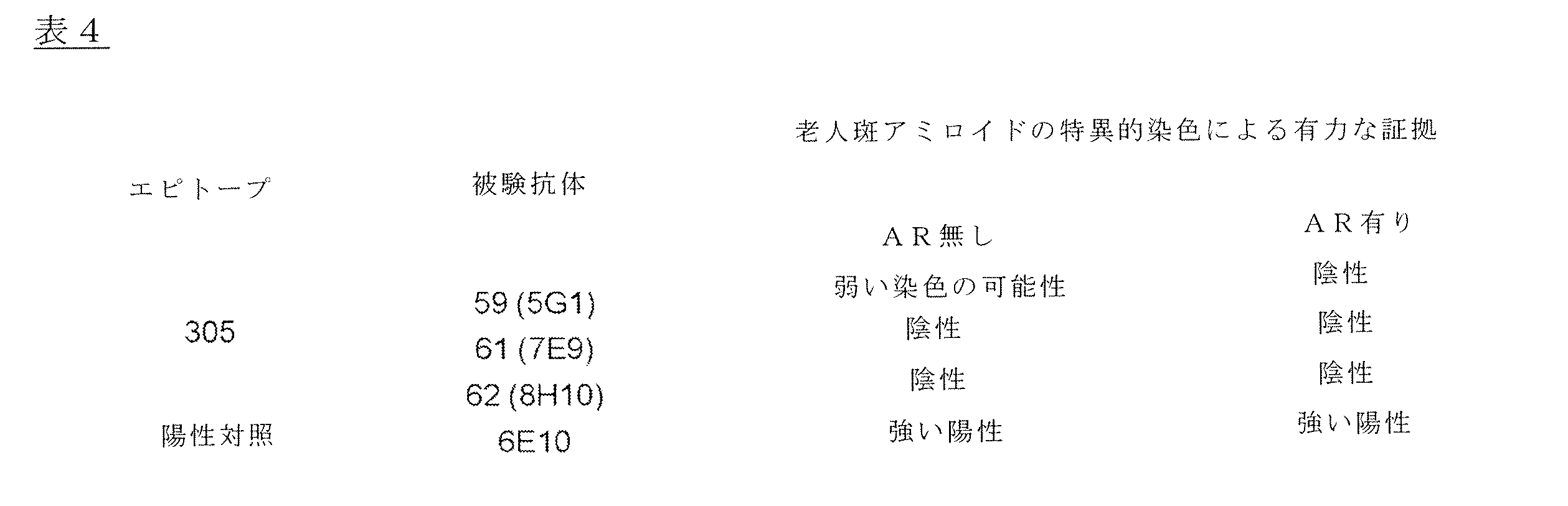
実施例12
オリゴマー伝播の阻害
チオフラビンT(ThT)結合アッセイを用いてアミロイドベータ(Aβ)凝集対する抗体の効果を検討することにより、その生物学的機能をin vitroで試験した。Aβ凝集は、予め形成された小さいAβオリゴマーの核によって誘導され、この核を介して伝播し、単量体Aβから可溶性オリゴマー、次いで不溶性線維への全過程には同時に、ベータシート形成の増大が伴う。このことはベンゾチアゾール塩のThTによってモニターすることができ、ThTがベータシートに富む構造に結合すると、その励起および発光の最大値がそれぞれ385nmから450nmおよび445nmから482nmに遷移し、それにより蛍光が増大する。簡潔に述べれば、Aβ1~42(Bachem Americas社、トーランス、カリフォルニア州)を可溶化し、超音波処理し、トリス-EDTA緩衝液(pH7.4)で希釈し、黒色の96ウェルマイクロタイタープレート(Greiner Bio-One社、モンロー、ノースカロライナ州)のウェルに加え、これに等体積のシクロペプチドに対する抗体または無関係のマウスIgG抗体アイソタイプ対照を加え、Aβ1~42ペプチドと抗体のモル比を1:5とした。ThTを加え、プレートを室温で24時間インキュベートし、1時間毎にWallac Victor3v 1420 Multilabel Counter(PerkinElmer社、ウォルサム、マサチューセッツ州)を用いてThT蛍光を測定し記録した。全ウェルからバックグラウンド緩衝液の蛍光読取り値を減算し、さらに、対応するウェルから抗体単独のウェルの読取り値を減算した。図21に示されるように、ThT蛍光によりモニターしたAβ42凝集は、蛍光が最小である最初の遅滞期、蛍光が急激に増大する対数期および最後にAβ分子種が平衡状態にあり蛍光の増大がみられないプラトー期を特徴とするS字形を示した。Aβ42と無関係のマウス抗体との共インキュベーションでは、凝集過程に対する有意な効果が全くみられなかった。これに対し、Aβ42と被験抗体との共インキュベーションでは、凝集過程のいずれの期も阻害された。図21には抗体クローン61、62、および64で得られた結果が示されている。ThT凝集アッセイは、ADの病理発生に極めて重要なAβ伝播およびモノマー、オリゴマー、前原線維および線維からのAβ凝集のin vivoの生物物理学的/生化学的段階を模倣するものであることから、シクロ(CGQKLVG)(配列番号3)に対して生じさせた抗体はこの過程を完全に打ち消す可能性を秘めている。マウスのIgG2の対照を用いて実施したアイソタイプ対照では阻害はみられなかった。
Example 12
Inhibition of Oligomer Spread The biological function of the antibody was tested in vitro by examining its effect on amyloid beta (Aβ) aggregation using a thioflavin T (ThT) binding assay. Aβ aggregation is induced by and propagates through the preformed nucleus of small Aβ oligomers, and the entire process from monomeric Aβ to soluble oligomers and then to insoluble fibrils is accompanied by an increase in beta-sheet formation. Accompany. This can be monitored by the ThT of benzothiazole salts; when ThT binds to beta-sheet-rich structures, its excitation and emission maxima shift from 385 nm to 450 nm and from 445 nm to 482 nm, respectively, thereby increasing fluorescence. increase Briefly, Aβ1-42 (Bachem Americas, Torrance, CA) was solubilized, sonicated, diluted in Tris-EDTA buffer (pH 7.4), and cultured in black 96-well microtiter plates ( Greiner Bio-One, Monroe, NC) and an equal volume of antibody to the cyclopeptide or an irrelevant mouse IgG antibody isotype control to give a 1:5 molar ratio of Aβ1-42 peptide to antibody. did. ThT was added and the plates were incubated for 24 hours at room temperature, and ThT fluorescence was measured and recorded every hour using a Wallac Victor3v 1420 Multilabel Counter (PerkinElmer, Waltham, MA). The background buffer fluorescence readings were subtracted from all wells, and the antibody-alone well readings were subtracted from the corresponding wells. As shown in Figure 21, Aβ42 aggregation monitored by ThT fluorescence begins with an initial lag phase when the fluorescence is minimum, an exponential phase when the fluorescence rapidly increases, and finally a phase where the Aβ molecular species are in equilibrium and the fluorescence increases. It showed an S-shape characterized by an absent plateau phase. Co-incubation with mouse antibodies unrelated to Aβ42 did not have any significant effect on the aggregation process. In contrast, co-incubation of Aβ42 with the test antibody inhibited both phases of the aggregation process. FIG. 21 shows the results obtained with antibody clones 61, 62, and 64. ThT aggregation assays mimic the in vivo biophysical/biochemical steps of Aβ propagation and Aβ aggregation from monomers, oligomers, profibrils, and fibrils that are critical to the pathogenesis of AD. Antibodies raised against cyclo(CGQKLVG) (SEQ ID NO: 3) have the potential to completely counteract this process. No inhibition was seen in isotype controls performed using mouse IgG2 controls.
実施例13
アルツハイマー病の免疫療法に最適なプロファイルの達成:毒性Aベータオリゴマーに特異的な抗体の合理的作製
目的:毒性アミロイドβオリゴマー(AβO)に特異的な抗体を作製すること
背景:現時点での証拠から、AβOの伝播性プリオン様株は、モノマーおよび線維とは対照的に、ニューロンに対して優先的に毒性を示し、アルツハイマー病(AD)のタウ病態を誘発することが示唆される。さらに、臨床試験では、用量制限有害作用がAβ線維認識と関係があることがわかっている。これらの観察結果から、安全性および有効性のためには毒性AβOの特異的中和が望ましいものであり得ることが示唆される。
Example 13
Achieving an optimal profile for Alzheimer's disease immunotherapy: rational generation of antibodies specific for toxic Abeta oligomers Objective: To generate antibodies specific for toxic amyloid beta oligomers (AβO) Background: Based on current evidence , transmissible prion-like strains of AβO are preferentially toxic to neurons, as opposed to monomers and fibrils, and are suggested to induce the tau pathology of Alzheimer's disease (AD). Furthermore, clinical trials have shown that dose-limiting adverse effects are associated with Aβ fiber recognition. These observations suggest that specific neutralization of toxic AβO may be desirable for safety and efficacy.
設計/方法:本明細書に記載されるように、標準力場による分子動力学を用いてProtein Data Baseに蓄積されているAβ線維の原子レベルの構造を攪乱するコンピュータシミュレーションを用いた。新生前原線維またはオリゴマーではわずかに安定な領域が露出する可能性が高いという仮説を立てた。オリゴマーにおいて提示される場合とモノマーまたは線維において提示される場合の抗原性プロファイルの差を定量化するクラスタリング解析、曲率、溶媒への露出、溶解度、二面角分布およびラマチャンドラン角分布をすべて用いて予測エピトープの立体配座特性を特徴付けた。局所的なAβO立体配座を模倣し得る環状フォーマットで候補ペプチドエピトープを合成し、担体タンパク質とコンジュゲートし、マウスでのモノクローナル抗体作製に用いた。精製した抗体をSPRおよび免疫組織化学によりスクリーニングした。 Design/Methods: As described herein, computer simulations were used to perturb the atomic-level structure of Aβ fibrils stored in the Protein Data Base using molecular dynamics with standard force fields. We hypothesized that slightly more stable regions are likely to be exposed in nascent protofibrils or oligomers. Clustering analysis, curvature, solvent exposure, solubility, dihedral angle distribution and Ramachandran angle distribution were all used to quantify the difference in antigenic profile when presented in oligomers versus monomers or fibrils. and characterized the conformational properties of the predicted epitope. Candidate peptide epitopes were synthesized in a circular format that can mimic the local AβO conformation, conjugated to carrier proteins, and used for monoclonal antibody generation in mice. Purified antibodies were screened by SPR and immunohistochemistry.
結果:
コグネイト構造化ペプチドおよび合成AβOを認識することが可能であり、非構造化ペプチド、リンカーペプチドまたはAβモノマーとはほとんどまたは全く結合しないことに基づき、5種類の予測エピトープに対するIgGクローンを66種類選択し精製した。さらなるスクリーニングにより、対照と比較してAD患者のCSFおよび脳抽出物中の天然の可溶性AβOと優先的に結合する抗体を特定した。AD脳の免疫組織化学的解析により、斑と反応しない抗体クローンを選択することができた。
result:
Sixty-six IgG clones against five predicted epitopes were selected based on their ability to recognize cognate structured peptides and synthetic AβO, with little or no binding to unstructured peptides, linker peptides, or Aβ monomers. Purified. Further screening identified antibodies that preferentially bound natural soluble AβO in CSF and brain extracts of AD patients compared to controls. Immunohistochemical analysis of AD brains allowed selection of antibody clones that did not react with plaques.
結論:コンピュータにより特定したAβOエピトープにより、天然のAD AβOと選択的に結合しモノマーにも線維にも有意な交差反応性を示さないという所望の標的プロファイルを有する抗体を作製することができた。 Conclusion: The computationally identified AβO epitope allowed us to generate antibodies with the desired targeting profile that selectively binds to native AD AβO and exhibits no significant cross-reactivity with monomers or fibrils.
実施例14
毒性阻害アッセイ
シクロペプチドに対して生じさせた抗体によるAベータ42オリゴマーの毒性の阻害をラット一次皮質ニューロンアッセイで試験することができる。
Example 14
Toxicity Inhibition Assay Inhibition of Abeta42 oligomer toxicity by antibodies raised against the cyclopeptide can be tested in a rat primary cortical neuron assay.
抗体および対照IgGをそれぞれ2mg/mLなどの濃度に調節する。様々なモル比のAベータオリゴマーと抗体を溶媒対照、Aベータオリゴマー単独および神経保護ペプチドのヒューマニン(HNG)などの陽性対照とともに試験する。 Antibody and control IgG are each adjusted to a concentration such as 2 mg/mL. Various molar ratios of Abeta oligomer and antibody are tested along with positive controls such as solvent controls, Abeta oligomer alone and the neuroprotective peptide humanin (HNG).
例示的設定を表5に示す。 Exemplary settings are shown in Table 5.
室温で10分間プレインキュベートした後、体積を培地で840マイクロリットルに調節する。この溶液を37℃で5分間インキュベートする。次いで、溶液を一次皮質ニューロンに直接添加し、細胞を24時間インキュベートする。MTT試験を用いて細胞生存率を求めることができる。 After a 10 minute pre-incubation at room temperature, the volume is adjusted to 840 microliters with medium. Incubate this solution for 5 minutes at 37°C. The solution is then added directly to primary cortical neurons and the cells are incubated for 24 hours. Cell viability can be determined using the MTT test.

この試験は、305抗体のクローン62を使用して行った。この抗体単独では、毒性がないことが示された(図22A)。Aベータオリゴマーの毒性の用量依存的な阻害が、抗体:オリゴマー:1:5、1:1および2:1のすべての濃度で観察された(図22B)。 This test was performed using clone 62 of the 305 antibody. This antibody alone was shown to be nontoxic (Figure 22A). A dose-dependent inhibition of Abeta oligomer toxicity was observed at all concentrations of antibody:oligomer: 1:5, 1:1 and 2:1 (Figure 22B).
実施例15
in vivo毒性阻害アッセイ
シクロペプチドに対して生じさせた抗体によるAベータ42オリゴマーの毒性の阻害をマウス行動試験でin vivoで試験することができる。
Example 15
In Vivo Toxicity Inhibition Assay Inhibition of Abeta42 oligomer toxicity by antibodies raised against cyclopeptides can be tested in vivo in mouse behavioral tests.
マウスの脳室内(ICV)に注射する前に、抗体およびアイソタイプ対照をそれぞれAベータ42オリゴマーと2以上の様々なモル比で予め混合する。対照群には、溶媒単独を注射するマウス、オリゴマー単独を注射するマウス、抗体単独を注射するマウスおよび神経保護ペプチドのヒューマニンなどの陽性対照を注射するマウスを含める。あるいは、抗体をオリゴマーのICV注射前、注射時および/または注射後に全身投与してもよい。オリゴマーのICV注射から約4~7日後に開始して、マウス空間認識試験(SRT)、Y迷路試験、モーリス水迷路モデルおよび新奇物体認識モデル(NOR)などの学習および記憶に関する行動試験で認知を評価する。 Prior to intracerebroventricular (ICV) injection into mice, the antibodies and isotype controls are each premixed with Abeta42 oligomers at various molar ratios of two or more. Control groups include mice injected with vehicle alone, oligomers alone, antibodies alone, and mice injected with a positive control such as the neuroprotective peptide humanin. Alternatively, the antibody may be administered systemically before, during and/or after ICV injection of the oligomer. Starting approximately 4-7 days after ICV injection of oligomers, cognition was tested with behavioral tests of learning and memory, such as the mouse spatial recognition test (SRT), the Y-maze test, the Morris water maze model, and the novel object recognition model (NOR). evaluate.
マウス空間認識試験(SRT)は、海馬機能の尺度である地理的記憶を評価するものである(SynAging社)。このモデルでは2チャンバの装置を使用し、この装置のチャンバは形状、模様および色が異なっている(すなわち、地理的差)。チャンバは透明なPlexiglass製の廊下で繋がっている。最初に個々のマウスを探索期の5分間、一方のチャンバにのみアクセスできる装置の中に入れておく。次いで、マウスをホームケージに30分間戻し、「選択」期の5分間、再び装置の中に入れ、その間、マウスは両方のチャンバにアクセスできる。正常な認知機能を有するマウスは前回探索したチャンバを記憶しており、新規なチャンバで費やす時間の方が長い。DI=(TN-TF)/(TN+TF)で識別指数(DI)を算出し、式中、TNは新規なチャンバで費やした時間の量であり、TFは馴染みのあるチャンバで費やす時間の量である。毒性AベータオリゴマーによりDIの低下が起こるが、ヒューマニン陽性対照により一部レスキューされ得る。ICV注射後の様々な時間におけるこの試験の成績を用いて、シクロペプチドに対して生じさせた抗体がAベータオリゴマー毒性をin vivoで阻害する可能性を評価することができる。 The Mouse Spatial Recognition Test (SRT) evaluates geographic memory, which is a measure of hippocampal function (SynAging). This model uses a two-chamber device in which the chambers differ in shape, pattern, and color (ie, geographic differences). The chambers are connected by clear Plexiglas corridors. Individual mice are initially placed in an apparatus with access to only one chamber for a 5 minute exploration phase. The mouse is then returned to its home cage for 30 minutes and placed back into the apparatus for a 5 minute "choice" period during which the mouse has access to both chambers. Mice with normal cognitive function remember the last chamber they explored and spend more time in new chambers. Calculate the discrimination index (DI) as DI=(TN-TF)/(TN+TF), where TN is the amount of time spent in the novel chamber and TF is the amount of time spent in the familiar chamber. be. Toxic Abeta oligomers cause a decrease in DI, which can be partially rescued by the humanin positive control. Performance of this test at various times after ICV injection can be used to assess the potential of antibodies raised against cyclopeptides to inhibit Abeta oligomer toxicity in vivo.
Y迷路試験(SynAging社)は、主として前頭前皮質(作業記憶)および海馬(空間構成要素)が仲介する空間作業記憶の試験である。マウスが2本の腕を探索することができるY字形の迷路の中にマウスを置く。短期記憶が無傷なマウスは連続試行で交互に2本の腕に行く。毒性AベータオリゴマーをICV注射したマウスは認知に障害がみられ、ランダム値50%(これに対し正常個体は約70%)付近の交互のランダム行動を示す。この障害は、コリンエステラーゼ阻害剤ドネペジル(Aricept)またはヒューマニンによりそれぞれ部分的または全面的に正常に戻る。この試験により、被験抗体のAベータオリゴマー毒性に対する防御活性に関してまた別のin vivo評価ができる。 The Y-maze test (SynAging) is a test of spatial working memory, which is primarily mediated by the prefrontal cortex (working memory) and the hippocampus (spatial component). Place the mouse in a Y-shaped maze where the mouse can explore the two arms. Mice with intact short-term memory go to the two arms alternately on successive trials. Mice injected ICV with toxic Abeta oligomers are cognitively impaired and exhibit alternating random behavior at a random value of around 50% (compared to approximately 70% in normal individuals). This disorder is partially or fully reversed by the cholinesterase inhibitors donepezil (Aricept) or Humanin, respectively. This test provides another in vivo evaluation of the test antibody's protective activity against Abeta oligomer toxicity.
モーリス水迷路はまた別の広く認められている認知モデルであり、主として海馬機能に依存する空間学習および長期地理的記憶を検討するものである(SynAging社)。マウスを複数回の試行で、不透明な水面の下に隠したプラットフォームを見つけるよう訓練する。プラットフォームの位置の想起に関するマウスの学習成績は、視覚的な手掛かりおよび記録したビデオに基づく。マウスを水に放ってからプラットフォームを見つけるまでの時間は着実に短縮され、これをマウスの学習速度とし、複数日にわたって測定する。認知が正常なマウスでは、プラットフォームを見つけるのに必要な時間が連日短縮される(学習)。長期記憶の解析には、訓練後に試験を複数日反復する。つまり、プラットフォームを取り去り、以前のプラットフォームの位置の上を横切る回数または最初に横切るまでの時間を長期記憶を評価する尺度として用いる。毒性AベータオリゴマーをICV注射したマウスは、学習および長期記憶の両方に欠陥がみられ、被験抗体の防御活性を評価するためのモデルとなる。 The Morris water maze is another widely accepted cognitive model that examines spatial learning and long-term geographic memory, which relies primarily on hippocampal function (SynAging). Train mice to find a platform hidden beneath an opaque water surface in multiple trials. Mice's learning performance on recall of platform location is based on visual cues and video recordings. The time it takes for mice to find the platform after being released into the water steadily decreases, which is measured over multiple days as the mouse's learning rate. In cognitively normal mice, the time required to find the platform decreases each day (learning). For long-term memory analysis, testing is repeated multiple days after training. That is, the number of times the platform is removed and the previous platform position is crossed or the time to first cross is used as a measure of long-term memory. Mice injected ICV with toxic Abeta oligomers exhibit deficits in both learning and long-term memory and serve as a model for evaluating the protective activity of test antibodies.
新奇物体認識(NOR)モデルは、新奇な物体を既知の物体より有意に長い時間をかけて調べるというげっ歯類の正常な行動を利用するものであり、この行動は主として嗅周皮質機能に依存する(SynAging社)。習得試行でマウスまたはラットに2つの同一の物体を探索させる。短時間の試行間間隔の後、一方の物体を新奇な物体に置き換える。動物を活動領域に戻し、各物体を能動的に探索して費やした時間を記録する。正常なげっ歯類は馴染みのある物体を思い出し、新奇な物体の方の探索に有意に長い時間を費やす。これに対し、Aベータオリゴマー処置したげっ歯類は明確な認知障害を示し、「馴染みのある」物体と「新奇な」物体の両方の探索に同程度の時間を費やす。これは、既知の臨床認知機能改善薬(例えば、ドネペジル)により一時的に正常に戻すことができる。NOR試験を縦断研究で複数回実施して、験抗体の認知に対する潜在的な有益性を評価することができる。 The novel object recognition (NOR) model takes advantage of the normal behavior of rodents, which spends significantly more time examining novel objects than known objects, and this behavior relies primarily on perirhinal cortex function. (SynAging). Have the mouse or rat explore two identical objects in a learning trial. After a short intertrial interval, one object is replaced by a novel object. Return the animal to the activity area and record the time spent actively exploring each object. Normal rodents remember familiar objects and spend significantly more time exploring novel objects. In contrast, Abeta oligomer-treated rodents exhibit clear cognitive impairment and spend comparable amounts of time exploring both "familiar" and "novel" objects. This can be temporarily brought back to normal by known clinical cognitive function improving drugs (eg donepezil). NOR testing can be performed multiple times in longitudinal studies to assess the potential cognitive benefit of the experimental antibody.
行動試験に加え、脳組織を収集し、シナプスマーカー(PSD95、SNAP25、シナプトフィジン)および炎症マーカー(IL-1ベータ)のレベルを解析することができる。オリゴマーのICV注射から約14日後にマウスを屠殺し、生理食塩水を灌流する。海馬を収集し、急速凍結し、解析まで-80℃で保管する。ホモジナイズした試料のタンパク質濃度をBCAにより求める。ELISAキット(Cloud-Clone社、米国)を用いてシナプスマーカーの濃度を求める。シナプスマーカーは通常、Aベータオリゴマーを注射したマウスで25~30%減少し、ヒューマニン陽性対照により90~100%に回復する。IL-1ベータ炎症性マーカーの濃度は、Aベータオリゴマーを注射したマウスで約3倍になり、この増大はヒューマニンによって大幅に抑えられる。これらのアッセイは、被験抗体の防御活性に関する分子レベルでのまた別の尺度となる。 In addition to behavioral testing, brain tissue can be collected and analyzed for levels of synaptic markers (PSD95, SNAP25, synaptophysin) and inflammatory markers (IL-1beta). Approximately 14 days after ICV injection of oligomers, mice are sacrificed and perfused with saline. Hippocampi are collected, snap frozen and stored at -80°C until analysis. The protein concentration of the homogenized sample is determined by BCA. The concentration of synaptic markers is determined using an ELISA kit (Cloud-Clone, USA). Synaptic markers are typically reduced by 25-30% in mice injected with Abeta oligomers and restored to 90-100% by humanin positive controls. The concentration of IL-1beta inflammatory markers approximately triples in mice injected with Abeta oligomers, and this increase is significantly suppressed by humanin. These assays provide another measure of the protective activity of a test antibody at the molecular level.
実施例16
in vivo伝播阻害アッセイ
Aベータ毒性オリゴマーのin vivoの伝播およびそれに関連する病態を様々なアルツハイマー病(AD)げっ歯類モデルで研究することができる。例えば、ヒトAPPのトランスジェニックマウス(例えば、APP23マウス)またはヒトAPPとPSEN1のトランスジェニックマウス(APPPS1マウス)は高レベルのAベータを発現し、加齢とともに炎症および神経損傷を伴うアミロイド沈着が徐々にみられるようになる。オリゴマー含有脳抽出物の脳内接種によりこの過程を大幅に加速させることができる(過程13、14)。これらのモデルは、脳内または全身に投与した抗体によるAベータオリゴマー伝播の阻害を研究するためのシステムとなる。
Example 16
In Vivo Propagation Inhibition Assay In vivo dissemination of Abeta-toxic oligomers and its associated pathology can be studied in various Alzheimer's disease (AD) rodent models. For example, mice transgenic for human APP (e.g., APP23 mice) or transgenic mice for human APP and PSEN1 (APPPS1 mice) express high levels of Abeta and progressively develop amyloid deposits associated with inflammation and neuronal damage with age. It can be seen in This process can be greatly accelerated by intracerebral inoculation of oligomer-containing brain extracts (
実施例17
CDRシーケンシング―3057E9.1
IgG3重鎖とカッパ軽鎖とを有することが明らかになった3057E9.1を重鎖および軽鎖のCDRおよび可変領域に選択した。
Example 17
CDR sequencing-3057E9.1
3057E9.1, which was found to have an IgG3 heavy chain and a kappa light chain, was selected for the heavy and light chain CDRs and variable regions.
5’RACEならびに適切なマウス免疫グロブリンの重鎖(IgG1/IgG3/IgG2A)および軽鎖(カッパ)の可変領域配列を増幅する遺伝子特異的逆方向プライマーを用いてRT-PCRを実施した。 RT-PCR was performed using 5'RACE and gene-specific reverse primers that amplify the heavy chain (IgG1/IgG3/IgG2A) and light chain (kappa) variable region sequences of the appropriate mouse immunoglobulins.
シーケンシング用に特異的バンドを切り取ってpCR-Blunt II-TOPOベクターにクローン化し、構築物を大腸菌(E.coli)に形質転換した。 Specific bands were excised and cloned into pCR-Blunt II-TOPO vector for sequencing, and the constructs were transformed into E. coli.
各鎖について少なくとも8種類のクローンを選定し、シーケンシングの前に増幅領域の有無についてPCRでスクリーニングした。選択したPCR陽性クローンにシーケンシングを実施した。 At least eight clones were selected for each strand and screened by PCR for the presence of amplified regions prior to sequencing. Sequencing was performed on selected PCR positive clones.
CDR配列を表6に記載する。重鎖および軽鎖の可変部分のコンセンサスDNA配列およびタンパク質配列を表7に記載する。


実施例9
CDRのシークエンシング-305-8H10
IgG1重鎖とカッパ軽鎖とを有することが明らかになった305-8H10を、CDRならびに重鎖および軽鎖の可変領域のシークエンシングに選択した。
Example 9
CDR sequencing-305-8H10
305-8H10, which was found to have an IgG1 heavy chain and a kappa light chain, was selected for CDR and heavy and light chain variable region sequencing.
5’RACEならびに適切なマウス免疫グロブリンの重鎖(IgG1/IgG3/IgG2A)および軽鎖(カッパ)の可変領域配列を増幅する遺伝子特異的逆方向プライマーを用いてRT-PCRを実施した。 RT-PCR was performed using 5'RACE and gene-specific reverse primers that amplify the heavy chain (IgG1/IgG3/IgG2A) and light chain (kappa) variable region sequences of the appropriate mouse immunoglobulins.
シーケンシング用に特異的バンドを切り取ってpCR-Blunt II-TOPOベクターにクローン化し、構築物を大腸菌(E.coli)に形質転換した。 Specific bands were excised and cloned into pCR-Blunt II-TOPO vector for sequencing, and the constructs were transformed into E. coli.
各鎖について少なくとも8種類のクローンを選定し、シーケンシングの前に増幅領域の有無についてPCRでスクリーニングした。選択したPCR陽性クローンにシーケンシングを実施した。 At least eight clones were selected for each strand and screened by PCR for the presence of amplified regions prior to sequencing. Sequencing was performed on selected PCR positive clones.
CDR配列を表8に記載する。重鎖および軽鎖の可変部分のコンセンサスDNA配列およびタンパク質配列を表9に記載する。


表10.Aベータ配列およびリンカーを有するAベータ配列
QKLV(配列番号1)
HQKLV(配列番号2)
CGQKLVG、シクロCGQKLVG(配列番号3)
GQKLV(配列番号4)
GQKLVG(配列番号5)
GGQKLVG(配列番号6)
GQKLVGG(配列番号7)
CGQKLVGC(配列番号8)
HQKLVF(配列番号9)
QKLVF(配列番号10)
Table 10. Abeta sequence QKLV with Abeta sequence and linker (SEQ ID NO: 1)
HQKLV (SEQ ID NO: 2)
CGQKLVG, cycloCGQKLVG (SEQ ID NO: 3)
GQKLV (SEQ ID NO: 4)
GQKLVG (SEQ ID NO: 5)
GGQKLVG (SEQ ID NO: 6)
GQKLVGG (SEQ ID NO: 7)
CGQKLVGC (SEQ ID NO: 8)
HQKLVF (SEQ ID NO: 9)
QKLVF (SEQ ID NO: 10)
表11-完全なAベータ1~42
DAEFRHDSGYEVHHQKLVFFAEDVGSNKGAIIGLMVGGVVIA(配列番号31)
Table 11 - Complete A Beta 1-42
DAEFRHDSGYEVHHQKLVFFAEDVGSNKGAIIGLMVGGVVIA (SEQ ID NO: 31)
ここまで、現時点で好ましい例であると考えるものに関して本願を記載してきたが、本願は本開示の例に限定されないことを理解するべきである。これとは逆に、本願は、添付の請求項の趣旨および範囲に含まれる様々な改変および同等の構成を包含するものとする。 Although this application has been described in terms of what are presently considered to be preferred examples, it is to be understood that this application is not limited to the examples disclosed herein. On the contrary, this application is intended to cover various modifications and equivalent constructions falling within the spirit and scope of the appended claims.
刊行物、特許および特許出願はいずれも、個々の刊行物、特許または特許出願が具体的かつ個別にその全体が参照により組み込まれることが明記された場合と同じように、その全体が参照により本明細書に組み込まれる。特に、例えば表またはその他の箇所に記載されるアクセッション番号および/またはバイオマーカー配列(例えば、タンパク質および/または核酸)を含めた本明細書に記載される各アクセッション番号に関連する配列は、その全体が参照により組み込まれる。 All publications, patents and patent applications are incorporated herein by reference in their entirety to the same extent as if each individual publication, patent or patent application was specifically and individually designated as being incorporated by reference in its entirety. Incorporated into the specification. In particular, the sequences associated with each accession number described herein, including, for example, accession numbers and/or biomarker sequences (e.g., proteins and/or nucleic acids) listed in the tables or elsewhere, Incorporated by reference in its entirety.
請求項の範囲は、好ましい実施形態および実施例によって限定されるべきではなく、記載全体と一致する最も広い解釈がなされるべきである。 The scope of the claims should not be limited by the preferred embodiments and examples, but should be given the broadest interpretation consistent with the entire description.
(本明細書で参照される参考文献の引用)
[1]SCIENTIFIC REPORTS|5:9649,2015|DOI:10.1038/srep09649
[2]Vincent J.Hilser and Ernesto Freire.Structure-based calculation of the equilibrium folding pathway of proteins.correlation with hydrogen exchange protection factors.J.Mol.Biol.,262:756-772,1996.The COREX approach.
[3]Samuel I.A.Cohen,Sara Linse,Leila M.Luheshi,Erik Hellstrand,Duncan A.White,Luke Rajah,Daniel E.Otzen,Michele Vendruscolo,Christopher M.Dobson,and Tuomas P.J.Knowles.Proliferation of amyloid-β42 aggregates occurs through a secondary nucleation mechanism.Proc.Natl.l Acad.Sci.USA,110(24):9758-9763,2013.
[4]Pietro Sormanni,Francesco A.Aprile,and Michele Vendruscolo.The camsol method of rational design of protein mutants with enhanced solubility.Journal of Molecular Biology,427(2):478-490,2015.
[5]Deborah Blacker,MD,ScD;Marilyn S.Albert,PhD;Susan S.Bassett,PhD;Rodney C.P.Go,PhD;Lindy E.Harrell,MD,PhD;Marshai F.Folstein,MD Reliability and Validity of NINCDS-ADRDA Criteria for Alzheimer’s Disease The National Institute of Mental Health Genetics Initiative.Arch Neurol.1994;51(12):1198-1204.doi:10.1001/archneur.1994.00540240042014.
[6]Hamley,I.W.PEG-Peptide Conjugates 2014;15,1543-1559;dx.doi.org/10.1021/bm500246w
[7]Roberts,MJ et al Chemistry for peptide and protein PEGylation 64:116-127.
(Citation of references referred to herein)
[1] SCIENTIFIC REPORTS | 5:9649, 2015 | DOI: 10.1038/srep09649
[2] Vincent J. Hilser and Ernesto Freire. Structure-based calculation of the equilibrium folding pathway of proteins. correlation with hydrogen exchange protection factors. J. Mol. Biol. , 262:756-772, 1996. The COREX approach.
[3] Samuel I. A. Cohen, Sara Linse, Leila M. Luheshi, Erik Hellstrand, Duncan A. White, Luke Rajah, Daniel E. Otzen, Michele Vendruscolo, Christopher M. Dobson, and Tuomas P. J. Knowles. Proliferation of amyloid-β42 aggregates occur through a secondary nucleation mechanism. Proc. Natl. l Acad. Sci. USA, 110(24):9758-9763, 2013.
[4] Pietro Sormanni, Francesco A. Aprile, and Michele Vendruscolo. The camsol method of rational design of protein mutants with enhanced solubility. Journal of Molecular Biology, 427(2):478-490, 2015.
[5] Deborah Blacker, MD, ScD; Marilyn S. Albert, PhD; Susan S. Bassett, PhD; Rodney C. P. Go, PhD; Lindy E. Harrell, MD, PhD; Marshai F. Folstein, MD Reliability and Validity of NINCDS-ADRDA Criteria for Alzheimer's Disease The National Institute of Mental He alth Genetics Initiative. Arch Neurol. 1994;51(12):1198-1204. doi:10.1001/archneur. 1994.00540240042014.
[6] Hamley, I. W. PEG-Peptide Conjugates 2014;15, 1543-1559;dx. doi. org/10.1021/bm500246w
[7] Roberts, MJ et al Chemistry for peptide and protein PEGylation 64:116-127.
Claims (18)
を含む、抗体。 QKLV (SEQ ID NO: 1) of Abeta oligomers rather than Abeta monomers and/or Abeta fibrilsan isolated antibody that specifically binds toand the antibody is
antibodies, including.
i)配列番号20で示されるアミノ酸配列;もしくはii)配列番号20と少なくとも90%の配列同一性を有するアミノ酸配列であって、CDRの配列が、配列番号14、15、および16で示される配列である、アミノ酸配列を含む軽鎖可変領域を含み、または、
II)i)配列番号28で示されるアミノ酸配列;もしくはii)配列番号28と少なくとも90%の配列同一性を有するアミノ酸配列であって、CDRの配列が、配列番号21、22、および23で示される配列である、アミノ酸配列を含む重鎖可変領域を含み、かつ
i)配列番号30で示されるアミノ酸配列;もしくはii)配列番号30と少なくとも90%の配列同一性を有するアミノ酸配列であって、CDRの配列が、配列番号24、25、および26で示される配列である、アミノ酸配列を含む軽鎖可変領域を含む、
請求項5~7のいずれか1項に記載の抗体。 The antibody has: I ) i ) an amino acid sequence shown in SEQ ID NO: 18; or ii) an amino acid sequence having at least 90% sequence identity with SEQ ID NO: 18, wherein the CDR sequence is SEQ ID NO: 11. , 12, and 13 , and
i) the amino acid sequence shown in SEQ ID NO: 20; or ii) an amino acid sequence having at least 90% sequence identity with SEQ ID NO: 20, in which the CDR sequences are shown in SEQ ID NO: 14, 15, and 16. comprises a light chain variable region comprising an amino acid sequence that is, or
II ) i ) an amino acid sequence having at least 90% sequence identity with SEQ ID NO: 28; or ii) an amino acid sequence having at least 90% sequence identity with SEQ ID NO: 28, in which the CDR sequence is contains a heavy chain variable region comprising the amino acid sequence, and
i ) the amino acid sequence shown in SEQ ID NO: 30; or ii) an amino acid sequence having at least 90% sequence identity with SEQ ID NO: 30, the CDR sequences of which are shown in SEQ ID NO: 24, 25, and 26. comprising a light chain variable region comprising an amino acid sequence, which is a sequence
The antibody according to any one of claims 5 to 7 .
前記重鎖可変領域が、配列番号28で示されるアミノ酸配列を含む、もしくはこれよりなり、かつ前記軽鎖可変領域が、配列番号30で示されるアミノ酸配列を含む、もしくはこれよりなる、 The heavy chain variable region comprises or consists of the amino acid sequence shown by SEQ ID NO: 28, and the light chain variable region comprises or consists of the amino acid sequence shown by SEQ ID NO: 30.
請求項5~8のいずれか1項に記載の抗体。The antibody according to any one of claims 5 to 8.
前記方法は、
a.前記生体試料と、請求項5~9のいずれか1項に記載の抗体または請求項10に記載のイムノコンジュゲートとを接触させることと、及び
b.何らかの抗体複合体の存在を検出すること、を含む、方法。 A method for determining whether a biological sample contains Abeta, the method comprising:
The method includes:
a. contacting the biological sample with the antibody according to any one of claims 5 to 9 or the immunoconjugate according to claim 10 , and b. Detecting the presence of any antibody complex.
1)請求項5~9のいずれか1項に記載の抗体もしくは請求項10に記載のイムノコンジュゲート、または前記抗体もしくはイムノコンジュゲートを含む医薬組成物、
2)請求項2~4のいずれか1項に記載の免疫原または前記免疫原を含む医薬組成物、または
3)1)の抗体をコードする核酸または前記核酸を含むベクター。 for use in inhibiting the spread of Abeta oligomers or for use in treating subjects with Alzheimer's disease and/or other Abeta amyloid-related diseases;
1) the antibody according to any one of claims 5 to 9 or the immunoconjugate according to claim 10 , or a pharmaceutical composition comprising the antibody or immunoconjugate,
2) the immunogen according to any one of claims 2 to 4 or a pharmaceutical composition comprising the immunogen; or 3) a nucleic acid encoding the antibody according to 1) or a vector comprising the nucleic acid.
Applications Claiming Priority (9)
| Application Number | Priority Date | Filing Date | Title |
|---|---|---|---|
| US201562253044P | 2015-11-09 | 2015-11-09 | |
| US62/253,044 | 2015-11-09 | ||
| US201662289893P | 2016-02-01 | 2016-02-01 | |
| US62/289,893 | 2016-02-01 | ||
| US201662365634P | 2016-07-22 | 2016-07-22 | |
| US62/365,634 | 2016-07-22 | ||
| US201662393615P | 2016-09-12 | 2016-09-12 | |
| US62/393,615 | 2016-09-12 | ||
| PCT/CA2016/051305 WO2017079835A1 (en) | 2015-11-09 | 2016-11-09 | Amyloid beta epitopes and antibodies thereto |
Publications (3)
| Publication Number | Publication Date |
|---|---|
| JP2019504615A JP2019504615A (en) | 2019-02-21 |
| JP2019504615A5 JP2019504615A5 (en) | 2019-12-19 |
| JP7452829B2 true JP7452829B2 (en) | 2024-03-19 |
Family
ID=58694531
Family Applications (1)
| Application Number | Title | Priority Date | Filing Date |
|---|---|---|---|
| JP2018522803A Active JP7452829B2 (en) | 2015-11-09 | 2016-11-09 | Amyloid beta epitopes and antibodies against them |
Country Status (9)
| Country | Link |
|---|---|
| US (2) | US10759837B2 (en) |
| EP (1) | EP3374383A4 (en) |
| JP (1) | JP7452829B2 (en) |
| KR (1) | KR20180094876A (en) |
| CN (1) | CN108350053A (en) |
| AU (2) | AU2016353553B2 (en) |
| CA (1) | CA3004498A1 (en) |
| HK (1) | HK1259324A1 (en) |
| WO (1) | WO2017079835A1 (en) |
Families Citing this family (10)
| Publication number | Priority date | Publication date | Assignee | Title |
|---|---|---|---|---|
| CN108350052A (en) * | 2015-11-09 | 2018-07-31 | 英属哥伦比亚大学 | Epitopes in the middle region of amyloid-beta and their conformation-selective antibodies |
| CN108475298A (en) | 2015-11-09 | 2018-08-31 | 英属哥伦比亚大学 | The system and method for biasing the protein epitope that prediction error folds by collective coordinate |
| HK1259325A1 (en) | 2015-11-09 | 2019-11-29 | 英属哥伦比亚大学 | N-terminal epitopes in amyloid beta and conformationally-selective antibodies thereto |
| KR20180094876A (en) * | 2015-11-09 | 2018-08-24 | 더 유니버시티 오브 브리티쉬 콜롬비아 | Amyloid beta epitopes and antibodies thereto |
| US12071472B2 (en) | 2016-07-18 | 2024-08-27 | The University Of British Columbia | Methods of reducing toxicity induced by Amyloid beta (A-beta) oligomers using antibodies specific to A-beta oligomers |
| US20180125920A1 (en) | 2016-11-09 | 2018-05-10 | The University Of British Columbia | Methods for preventing and treating A-beta oligomer-associated and/or -induced diseases and conditions |
| US12286469B2 (en) | 2017-07-18 | 2025-04-29 | The University Of British Columbia | Humanized antibodies binding to amyloid-beta (A-beta) |
| WO2020119793A1 (en) * | 2018-12-14 | 2020-06-18 | Wuxi Biologics (Shanghai) Co., Ltd. | Humanized antibodies against ox40, method for preparing the same, and use thereof |
| CN110163243B (en) * | 2019-04-04 | 2021-04-06 | 浙江工业大学 | Protein domain partitioning method based on contact map and fuzzy C-means clustering |
| US20220218805A1 (en) * | 2019-05-27 | 2022-07-14 | The University Of British Columbia | Conformation-specific epitopes in tau, antibodies thereto and methods related thereof |
Citations (5)
| Publication number | Priority date | Publication date | Assignee | Title |
|---|---|---|---|---|
| JP2007527865A (en) | 2003-09-12 | 2007-10-04 | ザ・レジェンツ・オブ・ザ・ユニバーシティ・オブ・カリフォルニア | Monoclonal antibodies specific for high molecular weight aggregation intermediates common to amyloid formed from proteins with various sequences |
| JP2011522840A (en) | 2008-06-12 | 2011-08-04 | アフィリス・アクチェンゲゼルシャフト | Compounds for the treatment of amyloidosis |
| JP2011522842A (en) | 2008-06-12 | 2011-08-04 | アフィリス・アクチェンゲゼルシャフト | Compounds for the treatment of symptoms associated with Parkinson's disease |
| JP2013538796A (en) | 2010-07-30 | 2013-10-17 | エーシー イミューン エス.エー. | Safe and functional humanized anti-β-amyloid antibody |
| WO2014089149A1 (en) | 2012-12-04 | 2014-06-12 | Acumen Pharmaceuticals, Inc. | Method for treating a disease associated with soluble, oligomeric species of amyloid beta 1-42 |
Family Cites Families (111)
| Publication number | Priority date | Publication date | Assignee | Title |
|---|---|---|---|---|
| CA1331443C (en) | 1987-05-29 | 1994-08-16 | Charlotte A. Kensil | Saponin adjuvant |
| GB8911525D0 (en) | 1989-05-19 | 1989-07-05 | Allied Colloids Ltd | Polymeric composition |
| ES2087997T3 (en) | 1990-01-12 | 1996-08-01 | Cell Genesys Inc | GENERATION OF XENOGENIC ANTIBODIES. |
| US6150584A (en) | 1990-01-12 | 2000-11-21 | Abgenix, Inc. | Human antibodies derived from immunized xenomice |
| US5427908A (en) | 1990-05-01 | 1995-06-27 | Affymax Technologies N.V. | Recombinant library screening methods |
| GB9015198D0 (en) | 1990-07-10 | 1990-08-29 | Brien Caroline J O | Binding substance |
| US5770429A (en) | 1990-08-29 | 1998-06-23 | Genpharm International, Inc. | Transgenic non-human animals capable of producing heterologous antibodies |
| US5283185A (en) | 1991-08-28 | 1994-02-01 | University Of Tennessee Research Corporation | Method for delivering nucleic acids into cells |
| US5766846A (en) | 1992-07-10 | 1998-06-16 | Athena Neurosciences | Methods of screening for compounds which inhibit soluble β-amyloid peptide production |
| US5562909A (en) | 1993-07-12 | 1996-10-08 | Massachusetts Institute Of Technology | Phosphazene polyelectrolytes as immunoadjuvants |
| WO1995006477A1 (en) | 1993-08-31 | 1995-03-09 | Gliatech, Inc. | Inhibition of beta amyloid binding to glycosaminoglycans for treatment of alzheimer's disease |
| GB9326174D0 (en) | 1993-12-22 | 1994-02-23 | Biocine Sclavo | Mucosal adjuvant |
| US20030072774A1 (en) | 1994-06-10 | 2003-04-17 | Diane M. Gajewczyk | Proteinaceous adjuvants |
| US6019982A (en) | 1994-08-26 | 2000-02-01 | The Administrators Of The Tulane Educational Fund | Mutant enterotoxin effective as a non-toxic oral adjuvant |
| FR2726764B1 (en) | 1994-11-14 | 1997-01-31 | Pasteur Merieux Serums Vacc | ADJUVANT FOR VACCINE COMPOSITION |
| JPH11514333A (en) | 1995-03-14 | 1999-12-07 | プレーシス ファーマスーティカルズ インコーポレイテッド | Modulators of amyloid aggregation |
| EP0866805A1 (en) | 1995-12-12 | 1998-09-30 | Karolinska Innovations AB | PEPTIDE BINDING THE KLVFF-SEQUENCE OF AMYLOID $g(b) |
| US5735814A (en) | 1996-04-30 | 1998-04-07 | Medtronic, Inc. | Techniques of treating neurodegenerative disorders by brain infusion |
| US6043283A (en) * | 1996-09-20 | 2000-03-28 | Baylor College Of Medicine | Tyramine compounds and their neuronal effects |
| US6071493A (en) * | 1996-09-20 | 2000-06-06 | Baylor College Of Medicine | Method of screening for an agent that inhibits mononuclear phagocyte-plaque component complex formation |
| US7588766B1 (en) * | 2000-05-26 | 2009-09-15 | Elan Pharma International Limited | Treatment of amyloidogenic disease |
| US6761888B1 (en) * | 2000-05-26 | 2004-07-13 | Neuralab Limited | Passive immunization treatment of Alzheimer's disease |
| TWI239847B (en) * | 1997-12-02 | 2005-09-21 | Elan Pharm Inc | N-terminal fragment of Abeta peptide and an adjuvant for preventing and treating amyloidogenic disease |
| US7790856B2 (en) * | 1998-04-07 | 2010-09-07 | Janssen Alzheimer Immunotherapy | Humanized antibodies that recognize beta amyloid peptide |
| US6923964B1 (en) * | 1997-12-02 | 2005-08-02 | Neuralab Limited | Active immunization of AScr for prion disorders |
| US6913745B1 (en) * | 1997-12-02 | 2005-07-05 | Neuralab Limited | Passive immunization of Alzheimer's disease |
| US20080050367A1 (en) * | 1998-04-07 | 2008-02-28 | Guriq Basi | Humanized antibodies that recognize beta amyloid peptide |
| US7964192B1 (en) * | 1997-12-02 | 2011-06-21 | Janssen Alzheimer Immunotherapy | Prevention and treatment of amyloidgenic disease |
| US7179892B2 (en) * | 2000-12-06 | 2007-02-20 | Neuralab Limited | Humanized antibodies that recognize beta amyloid peptide |
| US6936252B2 (en) * | 1998-07-27 | 2005-08-30 | Microbial Technics Limited | Streptococcus pneumoniae proteins and nucleic acid molecules |
| US7012061B1 (en) | 1998-10-19 | 2006-03-14 | New York University | Method for increasing the permeability of the blood brain barrier |
| AU4529800A (en) * | 1999-05-05 | 2000-11-21 | Neurochem, Inc. | Stereoselective antifibrillogenic peptides and peptidomimetics thereof |
| UA81216C2 (en) * | 1999-06-01 | 2007-12-25 | Prevention and treatment of amyloid disease | |
| US20020094335A1 (en) | 1999-11-29 | 2002-07-18 | Robert Chalifour | Vaccine for the prevention and treatment of alzheimer's and amyloid related diseases |
| KR20020073341A (en) | 1999-11-29 | 2002-09-23 | 뉴로켐, 인크. | Vaccine for the prevention and treatment of alzheimer's and amyloid related diseases |
| WO2001062801A2 (en) | 2000-02-24 | 2001-08-30 | Washington University | Humanized antibodies that sequester amyloid beta peptide |
| PE20020574A1 (en) * | 2000-12-06 | 2002-07-02 | Wyeth Corp | HUMANIZED ANTIBODIES THAT RECOGNIZE THE AMYLOID PEPTIDE BETA |
| US7700751B2 (en) * | 2000-12-06 | 2010-04-20 | Janssen Alzheimer Immunotherapy | Humanized antibodies that recognize β-amyloid peptide |
| WO2002064734A2 (en) | 2000-12-19 | 2002-08-22 | Palatin Technologies, Inc. | Identification of target-specific folding sites in peptides and proteins |
| DE10101430B4 (en) | 2001-01-13 | 2008-10-02 | Fraunhofer-Gesellschaft zur Förderung der angewandten Forschung e.V. | Soluble cyclic analogues for the modulation of amyloidogenesis |
| AR038568A1 (en) | 2002-02-20 | 2005-01-19 | Hoffmann La Roche | ANTI-A BETA ANTIBODIES AND ITS USE |
| US7314974B2 (en) * | 2002-02-21 | 2008-01-01 | Monsanto Technology, Llc | Expression of microbial proteins in plants for production of plants with improved properties |
| MY139983A (en) * | 2002-03-12 | 2009-11-30 | Janssen Alzheimer Immunotherap | Humanized antibodies that recognize beta amyloid peptide |
| CA2487528A1 (en) | 2002-07-24 | 2004-02-12 | Innogenetics N.V. | Prevention, treatment and diagnosis of diseases associated with beta-amyloid formation and/or aggregation |
| US9535076B2 (en) | 2002-09-12 | 2017-01-03 | The Regents Of The University Of California | Methods and compositions for eliciting an amyloid-selective immune response |
| WO2004029629A1 (en) | 2002-09-27 | 2004-04-08 | Janssen Pharmaceutica N.V. | N-11 truncated amyloid-beta nomoclonal antibodies, compositions, methods and uses |
| NZ541282A (en) | 2002-12-24 | 2009-02-28 | Bellus Health International Ltd | Therapeutic formulations for the treatment of beta-amyloid related diseases |
| ES2344645T3 (en) | 2003-02-10 | 2010-09-02 | Applied Molecular Evolution, Inc. | MOLECULES OF UNION TO ABETA. |
| TWI306458B (en) * | 2003-05-30 | 2009-02-21 | Elan Pharma Int Ltd | Humanized antibodies that recognize beta amyloid peptide |
| CN1562050A (en) | 2004-03-24 | 2005-01-12 | 中国海洋大学 | Use of oligose alginate in anti-dementia and anti-diabetes |
| WO2005095633A1 (en) * | 2004-04-02 | 2005-10-13 | Queen's University At Kingston | A cell culture system for modelling serum amyloid a amyloidogenesis and identifying amyloid modulating compounds |
| US7625560B2 (en) * | 2004-12-15 | 2009-12-01 | Janssen Alzheimer Immunotherapy | Humanized antibodies that recognize beta amyloid peptide |
| JP2008523815A (en) | 2004-12-15 | 2008-07-10 | エラン ファーマ インターナショナル リミテッド | Humanized amyloid beta antibody for use in improving cognition |
| EP1676859A1 (en) * | 2004-12-30 | 2006-07-05 | Pevion Biotech Ltd. | Immunogenic compositions of cyclic peptides derived from the beta-amyloid peptide |
| ES2259270B1 (en) | 2005-03-09 | 2007-11-01 | Consejo Superior De Investigaciones Cientificas | IN VITRO DIAGNOSTIC METHOD OF ALZHEIMER'S DISEASE BY A MONOCLONAL ANTIBODY. |
| AU2006251832A1 (en) | 2005-05-27 | 2006-11-30 | Queen's University At Kingston | Treatment of protein folding disorders |
| WO2007059000A2 (en) | 2005-11-10 | 2007-05-24 | Roskamp Research, Llc | Modulation of angiogenesis by a-beta peptide fragments |
| NZ568241A (en) | 2005-12-12 | 2011-08-26 | Hoffmann La Roche | Antibodies against amyloid beta 4 with glycosylation in the variable region |
| US8784810B2 (en) * | 2006-04-18 | 2014-07-22 | Janssen Alzheimer Immunotherapy | Treatment of amyloidogenic diseases |
| PL2468770T3 (en) * | 2006-07-14 | 2018-07-31 | Ac Immune S.A. | Humanized antibody against amyloid beta. |
| PL2074145T3 (en) | 2006-10-02 | 2017-11-30 | Ac Immune S.A. | Humanized antibody against amyloid beta |
| HRP20150237T1 (en) | 2007-01-18 | 2015-04-10 | Eli Lilly And Company | Pegylated amyloid beta fab |
| US8003097B2 (en) * | 2007-04-18 | 2011-08-23 | Janssen Alzheimer Immunotherapy | Treatment of cerebral amyloid angiopathy |
| NZ599497A (en) | 2007-06-12 | 2013-11-29 | Ac Immune Sa | Humanized antibodies to amyloid beta |
| CL2008001742A1 (en) | 2007-06-12 | 2008-11-21 | Ac Immune Sa | Monoclonal antibody that recognizes a conformational epitope and binds to polymeric soluble amyloid peptides and oligomeric amyloid peptides; polynucleotide that encodes it; composition that includes it; and its use to treat diseases associated with amyloid proteins. |
| ES2498040T3 (en) * | 2007-07-27 | 2014-09-24 | Janssen Alzheimer Immunotherapy | Treatment of amyloidogenic diseases with humanized anti-beta antibodies |
| BRPI0818621A8 (en) | 2007-10-05 | 2018-01-30 | Ac Immune Sa | pharmaceutical composition, and methods for reducing plaque burden and plaque quantity in an individual's retinal ganglion cell layer, to prevent, treat and / or alleviate the effects of an eye disease, to diagnose an eye disease and a predisposition to an eye disease, to monitor eye disease, to predict a patient's responsiveness, and to retain or decrease eye pressure in an individual's eyes |
| EP2650308A3 (en) | 2007-10-05 | 2014-11-12 | Genentech, Inc. | Use of anti-amyloid beta antibody in ocular diseases |
| WO2009048631A1 (en) | 2007-10-11 | 2009-04-16 | University Of Tennessee Research Foundation | PREPARATION OF PURIFIED COVALENTYLY CROSS-LINKED A β OLIGOMERS AND USES THEREOF |
| JO3076B1 (en) * | 2007-10-17 | 2017-03-15 | Janssen Alzheimer Immunotherap | Immunotherapy regimes dependent on apoe status |
| US8470321B2 (en) | 2007-11-16 | 2013-06-25 | The Rockefeller University | Antibodies specific for the protofibril form of beta-amyloid protein |
| ES2544679T3 (en) | 2007-12-28 | 2015-09-02 | Prothena Biosciences Limited | Treatment and prophylaxis of amyloidosis |
| AT506819B1 (en) | 2008-06-12 | 2011-06-15 | Affiris Forschungs Und Entwicklungs Gmbh | VACCINE FOR THE TREATMENT OF ALZHEIMER DISEASE |
| JP5722770B2 (en) * | 2008-07-01 | 2015-05-27 | デ スタート デル ネダーランデン、フェルト.ドール デ ミニスター ファン フォルクスヘーゾンドハイド、フェルジイン アン スポルト | Vaccine against amyloid folding intermediate |
| US9801865B2 (en) | 2008-09-24 | 2017-10-31 | The United States Of America As Represented By The Department Of Veteran Affairs | Materials and methods for diagnosis, prevention and/or treatment of stress disorders and conditions associated with abeta peptide aggregation |
| EP2172485A1 (en) * | 2008-10-01 | 2010-04-07 | Pierre Fabre Medicament | Novel anti CXCR4 antibodies and their use for the treatment of cancer |
| US20100233176A1 (en) | 2008-10-06 | 2010-09-16 | Cashman Neil R | Methods and systems for predicting misfolded protein epitopes |
| US9067981B1 (en) * | 2008-10-30 | 2015-06-30 | Janssen Sciences Ireland Uc | Hybrid amyloid-beta antibodies |
| WO2010096488A1 (en) * | 2009-02-17 | 2010-08-26 | The Regents Of The University Of California | Method of reducing acetylation in plants to improve biofuel production |
| WO2010119704A1 (en) | 2009-04-17 | 2010-10-21 | Immunas Pharma, Inc. | Antibodies that specifically bind to a beta oligomers and use thereof |
| WO2010128139A1 (en) | 2009-05-08 | 2010-11-11 | Georg-August-Universität Göttingen Stiftung Öffentlichen Rechts, Universitätsmedizin | Biomarkers and methods for diagnosing alzheimer's disease and/ or mild cognitive impairment |
| ES2624835T3 (en) | 2009-08-06 | 2017-07-17 | Immunas Pharma, Inc. | Antibodies that specifically bind to the A beta oligomers and use thereof |
| JP5554528B2 (en) * | 2009-09-08 | 2014-07-23 | 国立大学法人 岡山大学 | Novel amyloid β aggregate-binding peptide and method for testing amyloid disease using the novel amyloid β aggregate-binding peptide |
| US20110091910A1 (en) | 2009-09-18 | 2011-04-21 | Probiodrug Ag | Novel assay |
| NO2539366T3 (en) | 2010-02-26 | 2018-04-07 | ||
| KR101831459B1 (en) * | 2010-03-03 | 2018-04-04 | 더 유니버시티 오브 브리티시 콜롬비아 | Oligomer-specific amyloid beta epitope and antibodies |
| US20110256064A1 (en) | 2010-04-16 | 2011-10-20 | Ac Immune, S.A. | Novel Compounds for the Treatment of Diseases Associated with Amyloid or Amyloid-like Proteins |
| CA2794808C (en) | 2010-04-16 | 2019-08-20 | Ac Immune S.A. | Compounds for the treatment of diseases associated with amyloid or amyloid-like proteins |
| EP3533803B1 (en) | 2010-08-14 | 2021-10-27 | AbbVie Inc. | Anti-amyloid-beta antibodies |
| WO2012051498A2 (en) | 2010-10-15 | 2012-04-19 | The Board Of Regents Of The University Of Texas System | Antibodies that bind amyloid oligomers |
| FR2966827B1 (en) * | 2010-10-27 | 2014-08-22 | Kimonella Ventures Ltd | PEPTIDE COMPOUND USEFUL FOR INHIBITING AMYLOID PLATE FORMATION |
| WO2012104824A1 (en) | 2011-02-04 | 2012-08-09 | Ecole polytechnique fédérale de Lausanne (EPFL) | Therapeutic antibodies targeting app-c99 |
| EP2511296A1 (en) * | 2011-04-12 | 2012-10-17 | Araclón Biotech, S. L. | Antibody, kit and method for determination of amyloid peptides |
| GB201113570D0 (en) | 2011-08-05 | 2011-09-21 | Glaxosmithkline Biolog Sa | Vaccine |
| CN104093454A (en) | 2011-11-10 | 2014-10-08 | 坎格尼美国股份有限公司 | Compositions and methods for treating Alzheimer's disease |
| EP2659908A1 (en) | 2012-05-01 | 2013-11-06 | Affiris AG | Compositions |
| EP2887955B1 (en) | 2012-08-21 | 2020-08-19 | Institute for Molecular Medicine, Inc. | Compositions and methods related to diseases associated with deposits of amyloid, tau, and alpha-synuclein |
| EP2787347A1 (en) | 2013-04-03 | 2014-10-08 | Affiris AG | Method for detecting Aß-specific antibodies in a biological sample |
| EP3030580A4 (en) | 2013-08-05 | 2017-04-05 | St. Vincent's Institute Of Medical Research | An antibody therapy for amyloid beta disease |
| WO2015031698A1 (en) | 2013-08-28 | 2015-03-05 | Stem Centrx, Inc. | Site-specific antibody conjugation methods and compositions |
| US20170008955A1 (en) * | 2014-02-03 | 2017-01-12 | Cnj Holdings, Inc. | Humanized beta-amyloid binding molecules and uses thereof |
| WO2016138525A1 (en) * | 2015-02-27 | 2016-09-01 | University Of Washington | Polypeptide assemblies and methods for the production thereof |
| US20170021020A1 (en) | 2015-07-23 | 2017-01-26 | The Board Of Trustees Of The Leland Stanford Junior University | Monoclonal antibody and vaccine targeting filamentous bacteriophage |
| HK1259325A1 (en) | 2015-11-09 | 2019-11-29 | 英属哥伦比亚大学 | N-terminal epitopes in amyloid beta and conformationally-selective antibodies thereto |
| KR20180094876A (en) * | 2015-11-09 | 2018-08-24 | 더 유니버시티 오브 브리티쉬 콜롬비아 | Amyloid beta epitopes and antibodies thereto |
| US20180326027A1 (en) | 2015-11-09 | 2018-11-15 | The University Of British Columbia | Epitopes in amyloid beta and conformationally-selective antibodies thereto |
| CN108350052A (en) | 2015-11-09 | 2018-07-31 | 英属哥伦比亚大学 | Epitopes in the middle region of amyloid-beta and their conformation-selective antibodies |
| CN108475298A (en) * | 2015-11-09 | 2018-08-31 | 英属哥伦比亚大学 | The system and method for biasing the protein epitope that prediction error folds by collective coordinate |
| US20180346534A1 (en) * | 2015-11-09 | 2018-12-06 | The University Of British Columbia | C-terminal epitopes in amyloid beta and conformationally-selective antibodies thereto |
| US12071472B2 (en) | 2016-07-18 | 2024-08-27 | The University Of British Columbia | Methods of reducing toxicity induced by Amyloid beta (A-beta) oligomers using antibodies specific to A-beta oligomers |
| US20180125920A1 (en) * | 2016-11-09 | 2018-05-10 | The University Of British Columbia | Methods for preventing and treating A-beta oligomer-associated and/or -induced diseases and conditions |
-
2016
- 2016-11-09 KR KR1020187015910A patent/KR20180094876A/en active Pending
- 2016-11-09 CN CN201680065514.2A patent/CN108350053A/en active Pending
- 2016-11-09 AU AU2016353553A patent/AU2016353553B2/en active Active
- 2016-11-09 CA CA3004498A patent/CA3004498A1/en active Pending
- 2016-11-09 WO PCT/CA2016/051305 patent/WO2017079835A1/en not_active Ceased
- 2016-11-09 EP EP16863268.5A patent/EP3374383A4/en active Pending
- 2016-11-09 HK HK19101690.0A patent/HK1259324A1/en unknown
- 2016-11-09 JP JP2018522803A patent/JP7452829B2/en active Active
- 2016-11-09 US US15/774,778 patent/US10759837B2/en active Active
-
2020
- 2020-08-28 US US17/006,219 patent/US11970522B2/en active Active
-
2022
- 2022-04-19 AU AU2022202549A patent/AU2022202549A1/en not_active Abandoned
Patent Citations (5)
| Publication number | Priority date | Publication date | Assignee | Title |
|---|---|---|---|---|
| JP2007527865A (en) | 2003-09-12 | 2007-10-04 | ザ・レジェンツ・オブ・ザ・ユニバーシティ・オブ・カリフォルニア | Monoclonal antibodies specific for high molecular weight aggregation intermediates common to amyloid formed from proteins with various sequences |
| JP2011522840A (en) | 2008-06-12 | 2011-08-04 | アフィリス・アクチェンゲゼルシャフト | Compounds for the treatment of amyloidosis |
| JP2011522842A (en) | 2008-06-12 | 2011-08-04 | アフィリス・アクチェンゲゼルシャフト | Compounds for the treatment of symptoms associated with Parkinson's disease |
| JP2013538796A (en) | 2010-07-30 | 2013-10-17 | エーシー イミューン エス.エー. | Safe and functional humanized anti-β-amyloid antibody |
| WO2014089149A1 (en) | 2012-12-04 | 2014-06-12 | Acumen Pharmaceuticals, Inc. | Method for treating a disease associated with soluble, oligomeric species of amyloid beta 1-42 |
Non-Patent Citations (1)
| Title |
|---|
| The Journal of Neuroscience, July 11, 2012, Vol.32, No.28, p.9677-9689 |
Also Published As
| Publication number | Publication date |
|---|---|
| US11970522B2 (en) | 2024-04-30 |
| JP2019504615A (en) | 2019-02-21 |
| CA3004498A1 (en) | 2017-05-18 |
| KR20180094876A (en) | 2018-08-24 |
| HK1259324A1 (en) | 2019-11-29 |
| US10759837B2 (en) | 2020-09-01 |
| EP3374383A4 (en) | 2019-05-15 |
| US20210087243A1 (en) | 2021-03-25 |
| US20180346535A1 (en) | 2018-12-06 |
| AU2016353553B2 (en) | 2022-01-20 |
| AU2016353553A1 (en) | 2018-06-28 |
| CN108350053A (en) | 2018-07-31 |
| AU2022202549A1 (en) | 2022-05-12 |
| EP3374383A1 (en) | 2018-09-19 |
| WO2017079835A1 (en) | 2017-05-18 |
Similar Documents
| Publication | Publication Date | Title |
|---|---|---|
| AU2022201737B2 (en) | Epitopes in Amyloid beta mid-region and conformationally-selective antibodies thereto | |
| US12173055B2 (en) | N-terminal epitopes in amyloid beta and conformationally-selective antibodies thereto | |
| US11970522B2 (en) | Cyclic compound/peptide comprising an A-beta15-18 peptide and a linker that is covalently coupled to the n-terminus residue and the c-terminus residue of the A-BETA15-18 peptide | |
| US20180346534A1 (en) | C-terminal epitopes in amyloid beta and conformationally-selective antibodies thereto | |
| US20180326027A1 (en) | Epitopes in amyloid beta and conformationally-selective antibodies thereto |
Legal Events
| Date | Code | Title | Description |
|---|---|---|---|
| A521 | Request for written amendment filed |
Free format text: JAPANESE INTERMEDIATE CODE: A523 Effective date: 20181105 |
|
| A521 | Request for written amendment filed |
Free format text: JAPANESE INTERMEDIATE CODE: A523 Effective date: 20191108 |
|
| A621 | Written request for application examination |
Free format text: JAPANESE INTERMEDIATE CODE: A621 Effective date: 20191108 |
|
| A977 | Report on retrieval |
Free format text: JAPANESE INTERMEDIATE CODE: A971007 Effective date: 20201021 |
|
| A131 | Notification of reasons for refusal |
Free format text: JAPANESE INTERMEDIATE CODE: A131 Effective date: 20201102 |
|
| A601 | Written request for extension of time |
Free format text: JAPANESE INTERMEDIATE CODE: A601 Effective date: 20210128 |
|
| A521 | Request for written amendment filed |
Free format text: JAPANESE INTERMEDIATE CODE: A523 Effective date: 20210430 |
|
| A02 | Decision of refusal |
Free format text: JAPANESE INTERMEDIATE CODE: A02 Effective date: 20210907 |
|
| A521 | Request for written amendment filed |
Free format text: JAPANESE INTERMEDIATE CODE: A523 Effective date: 20220106 |
|
| C60 | Trial request (containing other claim documents, opposition documents) |
Free format text: JAPANESE INTERMEDIATE CODE: C60 Effective date: 20220106 |
|
| C11 | Written invitation by the commissioner to file amendments |
Free format text: JAPANESE INTERMEDIATE CODE: C11 Effective date: 20220118 |
|
| A911 | Transfer to examiner for re-examination before appeal (zenchi) |
Free format text: JAPANESE INTERMEDIATE CODE: A911 Effective date: 20220308 |
|
| C21 | Notice of transfer of a case for reconsideration by examiners before appeal proceedings |
Free format text: JAPANESE INTERMEDIATE CODE: C21 Effective date: 20220315 |
|
| A912 | Re-examination (zenchi) completed and case transferred to appeal board |
Free format text: JAPANESE INTERMEDIATE CODE: A912 Effective date: 20220401 |
|
| C211 | Notice of termination of reconsideration by examiners before appeal proceedings |
Free format text: JAPANESE INTERMEDIATE CODE: C211 Effective date: 20220405 |
|
| C22 | Notice of designation (change) of administrative judge |
Free format text: JAPANESE INTERMEDIATE CODE: C22 Effective date: 20230214 |
|
| C22 | Notice of designation (change) of administrative judge |
Free format text: JAPANESE INTERMEDIATE CODE: C22 Effective date: 20230221 |
|
| C13 | Notice of reasons for refusal |
Free format text: JAPANESE INTERMEDIATE CODE: C13 Effective date: 20230425 |
|
| A601 | Written request for extension of time |
Free format text: JAPANESE INTERMEDIATE CODE: A601 Effective date: 20230724 |
|
| A521 | Request for written amendment filed |
Free format text: JAPANESE INTERMEDIATE CODE: A523 Effective date: 20231023 |
|
| A61 | First payment of annual fees (during grant procedure) |
Free format text: JAPANESE INTERMEDIATE CODE: A61 Effective date: 20240229 |
|
| R150 | Certificate of patent or registration of utility model |
Ref document number: 7452829 Country of ref document: JP Free format text: JAPANESE INTERMEDIATE CODE: R150 |