JP7424552B1 - Recycled monomer, method for producing recycled monomer, and apparatus for producing recycled monomer - Google Patents
Recycled monomer, method for producing recycled monomer, and apparatus for producing recycled monomer Download PDFInfo
- Publication number
- JP7424552B1 JP7424552B1 JP2023547572A JP2023547572A JP7424552B1 JP 7424552 B1 JP7424552 B1 JP 7424552B1 JP 2023547572 A JP2023547572 A JP 2023547572A JP 2023547572 A JP2023547572 A JP 2023547572A JP 7424552 B1 JP7424552 B1 JP 7424552B1
- Authority
- JP
- Japan
- Prior art keywords
- polymer
- thermoplastic polyester
- temperature
- reaction
- producing
- Prior art date
- Legal status (The legal status is an assumption and is not a legal conclusion. Google has not performed a legal analysis and makes no representation as to the accuracy of the status listed.)
- Active
Links
Images

Classifications
-
- C—CHEMISTRY; METALLURGY
- C08—ORGANIC MACROMOLECULAR COMPOUNDS; THEIR PREPARATION OR CHEMICAL WORKING-UP; COMPOSITIONS BASED THEREON
- C08G—MACROMOLECULAR COMPOUNDS OBTAINED OTHERWISE THAN BY REACTIONS ONLY INVOLVING UNSATURATED CARBON-TO-CARBON BONDS
- C08G63/00—Macromolecular compounds obtained by reactions forming a carboxylic ester link in the main chain of the macromolecule
- C08G63/91—Polymers modified by chemical after-treatment
- C08G63/914—Polymers modified by chemical after-treatment derived from polycarboxylic acids and polyhydroxy compounds
- C08G63/916—Dicarboxylic acids and dihydroxy compounds
-
- C—CHEMISTRY; METALLURGY
- C07—ORGANIC CHEMISTRY
- C07B—GENERAL METHODS OF ORGANIC CHEMISTRY; APPARATUS THEREFOR
- C07B61/00—Other general methods
-
- C—CHEMISTRY; METALLURGY
- C07—ORGANIC CHEMISTRY
- C07C—ACYCLIC OR CARBOCYCLIC COMPOUNDS
- C07C29/00—Preparation of compounds having hydroxy or O-metal groups bound to a carbon atom not belonging to a six-membered aromatic ring
-
- C—CHEMISTRY; METALLURGY
- C07—ORGANIC CHEMISTRY
- C07C—ACYCLIC OR CARBOCYCLIC COMPOUNDS
- C07C29/00—Preparation of compounds having hydroxy or O-metal groups bound to a carbon atom not belonging to a six-membered aromatic ring
- C07C29/09—Preparation of compounds having hydroxy or O-metal groups bound to a carbon atom not belonging to a six-membered aromatic ring by hydrolysis
-
- C—CHEMISTRY; METALLURGY
- C07—ORGANIC CHEMISTRY
- C07C—ACYCLIC OR CARBOCYCLIC COMPOUNDS
- C07C29/00—Preparation of compounds having hydroxy or O-metal groups bound to a carbon atom not belonging to a six-membered aromatic ring
- C07C29/09—Preparation of compounds having hydroxy or O-metal groups bound to a carbon atom not belonging to a six-membered aromatic ring by hydrolysis
- C07C29/095—Preparation of compounds having hydroxy or O-metal groups bound to a carbon atom not belonging to a six-membered aromatic ring by hydrolysis of esters of organic acids
-
- C—CHEMISTRY; METALLURGY
- C07—ORGANIC CHEMISTRY
- C07C—ACYCLIC OR CARBOCYCLIC COMPOUNDS
- C07C31/00—Saturated compounds having hydroxy or O-metal groups bound to acyclic carbon atoms
- C07C31/18—Polyhydroxylic acyclic alcohols
- C07C31/20—Dihydroxylic alcohols
-
- C—CHEMISTRY; METALLURGY
- C07—ORGANIC CHEMISTRY
- C07C—ACYCLIC OR CARBOCYCLIC COMPOUNDS
- C07C51/00—Preparation of carboxylic acids or their salts, halides or anhydrides
- C07C51/09—Preparation of carboxylic acids or their salts, halides or anhydrides from carboxylic acid esters or lactones
-
- C—CHEMISTRY; METALLURGY
- C07—ORGANIC CHEMISTRY
- C07C—ACYCLIC OR CARBOCYCLIC COMPOUNDS
- C07C63/00—Compounds having carboxyl groups bound to a carbon atoms of six-membered aromatic rings
- C07C63/14—Monocyclic dicarboxylic acids
- C07C63/15—Monocyclic dicarboxylic acids all carboxyl groups bound to carbon atoms of the six-membered aromatic ring
- C07C63/26—1,4 - Benzenedicarboxylic acid
-
- C—CHEMISTRY; METALLURGY
- C08—ORGANIC MACROMOLECULAR COMPOUNDS; THEIR PREPARATION OR CHEMICAL WORKING-UP; COMPOSITIONS BASED THEREON
- C08G—MACROMOLECULAR COMPOUNDS OBTAINED OTHERWISE THAN BY REACTIONS ONLY INVOLVING UNSATURATED CARBON-TO-CARBON BONDS
- C08G63/00—Macromolecular compounds obtained by reactions forming a carboxylic ester link in the main chain of the macromolecule
- C08G63/02—Polyesters derived from hydroxycarboxylic acids or from polycarboxylic acids and polyhydroxy compounds
- C08G63/12—Polyesters derived from hydroxycarboxylic acids or from polycarboxylic acids and polyhydroxy compounds derived from polycarboxylic acids and polyhydroxy compounds
- C08G63/16—Dicarboxylic acids and dihydroxy compounds
-
- C—CHEMISTRY; METALLURGY
- C08—ORGANIC MACROMOLECULAR COMPOUNDS; THEIR PREPARATION OR CHEMICAL WORKING-UP; COMPOSITIONS BASED THEREON
- C08G—MACROMOLECULAR COMPOUNDS OBTAINED OTHERWISE THAN BY REACTIONS ONLY INVOLVING UNSATURATED CARBON-TO-CARBON BONDS
- C08G63/00—Macromolecular compounds obtained by reactions forming a carboxylic ester link in the main chain of the macromolecule
- C08G63/02—Polyesters derived from hydroxycarboxylic acids or from polycarboxylic acids and polyhydroxy compounds
- C08G63/12—Polyesters derived from hydroxycarboxylic acids or from polycarboxylic acids and polyhydroxy compounds derived from polycarboxylic acids and polyhydroxy compounds
- C08G63/16—Dicarboxylic acids and dihydroxy compounds
- C08G63/18—Dicarboxylic acids and dihydroxy compounds the acids or hydroxy compounds containing carbocyclic rings
- C08G63/181—Acids containing aromatic rings
- C08G63/183—Terephthalic acids
-
- C—CHEMISTRY; METALLURGY
- C08—ORGANIC MACROMOLECULAR COMPOUNDS; THEIR PREPARATION OR CHEMICAL WORKING-UP; COMPOSITIONS BASED THEREON
- C08G—MACROMOLECULAR COMPOUNDS OBTAINED OTHERWISE THAN BY REACTIONS ONLY INVOLVING UNSATURATED CARBON-TO-CARBON BONDS
- C08G63/00—Macromolecular compounds obtained by reactions forming a carboxylic ester link in the main chain of the macromolecule
- C08G63/78—Preparation processes
-
- C—CHEMISTRY; METALLURGY
- C08—ORGANIC MACROMOLECULAR COMPOUNDS; THEIR PREPARATION OR CHEMICAL WORKING-UP; COMPOSITIONS BASED THEREON
- C08G—MACROMOLECULAR COMPOUNDS OBTAINED OTHERWISE THAN BY REACTIONS ONLY INVOLVING UNSATURATED CARBON-TO-CARBON BONDS
- C08G63/00—Macromolecular compounds obtained by reactions forming a carboxylic ester link in the main chain of the macromolecule
- C08G63/78—Preparation processes
- C08G63/785—Preparation processes characterised by the apparatus used
-
- C—CHEMISTRY; METALLURGY
- C08—ORGANIC MACROMOLECULAR COMPOUNDS; THEIR PREPARATION OR CHEMICAL WORKING-UP; COMPOSITIONS BASED THEREON
- C08G—MACROMOLECULAR COMPOUNDS OBTAINED OTHERWISE THAN BY REACTIONS ONLY INVOLVING UNSATURATED CARBON-TO-CARBON BONDS
- C08G63/00—Macromolecular compounds obtained by reactions forming a carboxylic ester link in the main chain of the macromolecule
- C08G63/88—Post-polymerisation treatment
-
- C—CHEMISTRY; METALLURGY
- C08—ORGANIC MACROMOLECULAR COMPOUNDS; THEIR PREPARATION OR CHEMICAL WORKING-UP; COMPOSITIONS BASED THEREON
- C08J—WORKING-UP; GENERAL PROCESSES OF COMPOUNDING; AFTER-TREATMENT NOT COVERED BY SUBCLASSES C08B, C08C, C08F, C08G or C08H
- C08J11/00—Recovery or working-up of waste materials
- C08J11/04—Recovery or working-up of waste materials of polymers
- C08J11/10—Recovery or working-up of waste materials of polymers by chemically breaking down the molecular chains of polymers or breaking of crosslinks, e.g. devulcanisation
- C08J11/14—Recovery or working-up of waste materials of polymers by chemically breaking down the molecular chains of polymers or breaking of crosslinks, e.g. devulcanisation by treatment with steam or water
-
- C—CHEMISTRY; METALLURGY
- C08—ORGANIC MACROMOLECULAR COMPOUNDS; THEIR PREPARATION OR CHEMICAL WORKING-UP; COMPOSITIONS BASED THEREON
- C08J—WORKING-UP; GENERAL PROCESSES OF COMPOUNDING; AFTER-TREATMENT NOT COVERED BY SUBCLASSES C08B, C08C, C08F, C08G or C08H
- C08J11/00—Recovery or working-up of waste materials
- C08J11/04—Recovery or working-up of waste materials of polymers
- C08J11/10—Recovery or working-up of waste materials of polymers by chemically breaking down the molecular chains of polymers or breaking of crosslinks, e.g. devulcanisation
- C08J11/16—Recovery or working-up of waste materials of polymers by chemically breaking down the molecular chains of polymers or breaking of crosslinks, e.g. devulcanisation by treatment with inorganic material
-
- C—CHEMISTRY; METALLURGY
- C08—ORGANIC MACROMOLECULAR COMPOUNDS; THEIR PREPARATION OR CHEMICAL WORKING-UP; COMPOSITIONS BASED THEREON
- C08J—WORKING-UP; GENERAL PROCESSES OF COMPOUNDING; AFTER-TREATMENT NOT COVERED BY SUBCLASSES C08B, C08C, C08F, C08G or C08H
- C08J5/00—Manufacture of articles or shaped materials containing macromolecular substances
- C08J5/18—Manufacture of films or sheets
-
- C—CHEMISTRY; METALLURGY
- C08—ORGANIC MACROMOLECULAR COMPOUNDS; THEIR PREPARATION OR CHEMICAL WORKING-UP; COMPOSITIONS BASED THEREON
- C08K—Use of inorganic or non-macromolecular organic substances as compounding ingredients
- C08K3/00—Use of inorganic substances as compounding ingredients
- C08K3/18—Oxygen-containing compounds, e.g. metal carbonyls
- C08K3/20—Oxides; Hydroxides
-
- C—CHEMISTRY; METALLURGY
- C08—ORGANIC MACROMOLECULAR COMPOUNDS; THEIR PREPARATION OR CHEMICAL WORKING-UP; COMPOSITIONS BASED THEREON
- C08K—Use of inorganic or non-macromolecular organic substances as compounding ingredients
- C08K3/00—Use of inorganic substances as compounding ingredients
- C08K3/18—Oxygen-containing compounds, e.g. metal carbonyls
- C08K3/24—Acids; Salts thereof
- C08K3/26—Carbonates; Bicarbonates
-
- C—CHEMISTRY; METALLURGY
- C08—ORGANIC MACROMOLECULAR COMPOUNDS; THEIR PREPARATION OR CHEMICAL WORKING-UP; COMPOSITIONS BASED THEREON
- C08L—COMPOSITIONS OF MACROMOLECULAR COMPOUNDS
- C08L67/00—Compositions of polyesters obtained by reactions forming a carboxylic ester link in the main chain; Compositions of derivatives of such polymers
- C08L67/02—Polyesters derived from dicarboxylic acids and dihydroxy compounds
-
- C—CHEMISTRY; METALLURGY
- C08—ORGANIC MACROMOLECULAR COMPOUNDS; THEIR PREPARATION OR CHEMICAL WORKING-UP; COMPOSITIONS BASED THEREON
- C08J—WORKING-UP; GENERAL PROCESSES OF COMPOUNDING; AFTER-TREATMENT NOT COVERED BY SUBCLASSES C08B, C08C, C08F, C08G or C08H
- C08J2367/00—Characterised by the use of polyesters obtained by reactions forming a carboxylic ester link in the main chain; Derivatives of such polymers
- C08J2367/02—Polyesters derived from dicarboxylic acids and dihydroxy compounds
-
- C—CHEMISTRY; METALLURGY
- C08—ORGANIC MACROMOLECULAR COMPOUNDS; THEIR PREPARATION OR CHEMICAL WORKING-UP; COMPOSITIONS BASED THEREON
- C08J—WORKING-UP; GENERAL PROCESSES OF COMPOUNDING; AFTER-TREATMENT NOT COVERED BY SUBCLASSES C08B, C08C, C08F, C08G or C08H
- C08J2377/00—Characterised by the use of polyamides obtained by reactions forming a carboxylic amide link in the main chain; Derivatives of such polymers
-
- C—CHEMISTRY; METALLURGY
- C08—ORGANIC MACROMOLECULAR COMPOUNDS; THEIR PREPARATION OR CHEMICAL WORKING-UP; COMPOSITIONS BASED THEREON
- C08K—Use of inorganic or non-macromolecular organic substances as compounding ingredients
- C08K3/00—Use of inorganic substances as compounding ingredients
- C08K3/01—Use of inorganic substances as compounding ingredients characterized by their specific function
- C08K3/012—Additives activating the degradation of the macromolecular compounds
-
- Y—GENERAL TAGGING OF NEW TECHNOLOGICAL DEVELOPMENTS; GENERAL TAGGING OF CROSS-SECTIONAL TECHNOLOGIES SPANNING OVER SEVERAL SECTIONS OF THE IPC; TECHNICAL SUBJECTS COVERED BY FORMER USPC CROSS-REFERENCE ART COLLECTIONS [XRACs] AND DIGESTS
- Y02—TECHNOLOGIES OR APPLICATIONS FOR MITIGATION OR ADAPTATION AGAINST CLIMATE CHANGE
- Y02P—CLIMATE CHANGE MITIGATION TECHNOLOGIES IN THE PRODUCTION OR PROCESSING OF GOODS
- Y02P20/00—Technologies relating to chemical industry
- Y02P20/141—Feedstock
- Y02P20/143—Feedstock the feedstock being recycled material, e.g. plastics
-
- Y—GENERAL TAGGING OF NEW TECHNOLOGICAL DEVELOPMENTS; GENERAL TAGGING OF CROSS-SECTIONAL TECHNOLOGIES SPANNING OVER SEVERAL SECTIONS OF THE IPC; TECHNICAL SUBJECTS COVERED BY FORMER USPC CROSS-REFERENCE ART COLLECTIONS [XRACs] AND DIGESTS
- Y02—TECHNOLOGIES OR APPLICATIONS FOR MITIGATION OR ADAPTATION AGAINST CLIMATE CHANGE
- Y02W—CLIMATE CHANGE MITIGATION TECHNOLOGIES RELATED TO WASTEWATER TREATMENT OR WASTE MANAGEMENT
- Y02W30/00—Technologies for solid waste management
- Y02W30/50—Reuse, recycling or recovery technologies
- Y02W30/62—Plastics recycling; Rubber recycling
Landscapes
- Chemical & Material Sciences (AREA)
- Organic Chemistry (AREA)
- Health & Medical Sciences (AREA)
- Chemical Kinetics & Catalysis (AREA)
- Medicinal Chemistry (AREA)
- Polymers & Plastics (AREA)
- Engineering & Computer Science (AREA)
- Life Sciences & Earth Sciences (AREA)
- Sustainable Development (AREA)
- Manufacturing & Machinery (AREA)
- Oil, Petroleum & Natural Gas (AREA)
- Materials Engineering (AREA)
- General Chemical & Material Sciences (AREA)
- Separation, Recovery Or Treatment Of Waste Materials Containing Plastics (AREA)
- Polyesters Or Polycarbonates (AREA)
- Compositions Of Macromolecular Compounds (AREA)
- Manufacture Of Porous Articles, And Recovery And Treatment Of Waste Products (AREA)
- Organic Low-Molecular-Weight Compounds And Preparation Thereof (AREA)
Abstract
本発明のリサイクルモノマー、およびその製造方法は、高温高圧水の利点を生かしつつ、解重合により得られる生成物の過反応を抑制し、高収率でジカルボン酸やジオールなどのリサイクルモノマーを生成させることが可能な方法を提供することを目的とする。
上記目的を達するための本発明のリサイクルモノマーの製造方法の好適な一態様は、ポリマーが熱可塑性ポリエステル(A)であり、示差走査熱量計で測定した熱可塑性ポリエステル(A)の融点をMp℃、反応温度をX℃、反応時間をY分、水と熱可塑性ポリエステル(A)の質量比をZ:1とした場合、XおよびXとYとZの積X・Y・Zが、下記(I)および(II)を同時に満たす。
(I) Mp≦X<300
(II)2000≦X・Y・Z≦20000
The recycled monomer of the present invention and its production method suppress overreaction of products obtained by depolymerization while taking advantage of high-temperature, high-pressure water, and produce recycled monomers such as dicarboxylic acids and diols in high yield. The purpose is to provide a method that makes it possible.
In a preferred embodiment of the method for producing a recycled monomer of the present invention to achieve the above object, the polymer is a thermoplastic polyester (A), and the melting point of the thermoplastic polyester (A) measured with a differential scanning calorimeter is Mp°C. , when the reaction temperature is X°C, the reaction time is Y minutes, and the mass ratio of water and thermoplastic polyester (A) is Z:1, the product of X and X and Y and Z is the following ( I) and (II) are satisfied simultaneously.
(I) Mp≦X<300
(II) 2000≦X・Y・Z≦20000
Description
本発明は、資源循環利用と地球温暖化ガス排出量低減を両立する、ポリマーのケミカルリサイクル技術に関するものである。 The present invention relates to a polymer chemical recycling technology that achieves both resource recycling and reduction of global warming gas emissions.
近年、海洋プラスチック問題をトリガーに地球環境問題に対する関心が高まり、持続可能な社会の構築が必要であるとの認識が広まってきている。地球環境問題には、地球温暖化をはじめ、資源枯渇、水不足などがあるが、その多くは産業革命以降の化石燃料の使用と工業の急速な発展による、資源消費量と地球温暖化ガス排出量の増大が原因である。そのため、持続可能な社会構築のためには、プラスチックなどの化石資源循環利用、および地球温暖化ガス排出量低減に関する技術がますます重要となる。 In recent years, interest in global environmental issues has increased due to the ocean plastic problem, and there is a growing recognition that it is necessary to build a sustainable society. Global environmental problems include global warming, resource depletion, and water shortages, but many of these problems are due to resource consumption and global warming gas emissions due to the use of fossil fuels and the rapid development of industry since the Industrial Revolution. This is due to an increase in Therefore, in order to build a sustainable society, technologies related to the cyclical use of fossil resources such as plastics and the reduction of global warming gas emissions are becoming increasingly important.
繊維、フィルム、ボトル、成形品、エンジニアリングプラスチックなど各分野で多量に使用されている熱可塑性ポリエステルを解重合し、単量体まで戻して再資源化する技術としては、酢酸亜鉛などの触媒存在下にメタノールを反応させてメチルエステル体モノマーを回収するメタノリシス法、炭酸ナトリウムなどの触媒存在下にエチレングリコールを反応させてオリゴマーを回収するグルコリシス法などの技術が知られており、すでにこれらの技術によりポリエステルの解重合を行う商業設備が稼働している。 A technology that depolymerizes thermoplastic polyester, which is used in large quantities in various fields such as fibers, films, bottles, molded products, and engineering plastics, and returns it to monomers for recycling in the presence of a catalyst such as zinc acetate. Techniques such as the methanolysis method, which recovers methyl ester monomers by reacting them with methanol, and the glucolysis method, which recovers oligomers by reacting ethylene glycol in the presence of a catalyst such as sodium carbonate, are already known. Commercial facilities are in operation to depolymerize polyester.
また、メタノールやエチレングリコールといった有機溶媒を用いずに熱可塑性ポリエステルの解重合を行う方法としては、ポリエステルと高温高圧水とを接触させて原料モノマーであるジオールとジカルボン酸を回収する方法が開示されている(例えば特許文献1~3参照)。水のみによって解重合を行う方法は、触媒が不要であり、さらに石油由来の有機溶媒を利用しないことから、グリーンな再資源化方法であるという利点がある。
Furthermore, as a method for depolymerizing thermoplastic polyester without using organic solvents such as methanol or ethylene glycol, a method has been disclosed in which polyester is brought into contact with high-temperature, high-pressure water to recover diol and dicarboxylic acid as raw material monomers. (For example, see
この高温高圧水による解重合において、水にアルカリを添加し、原料モノマーであるジカルボン酸の回収率を向上させる方法が開示されている(例えば特許文献4~7)。ただし、解重合に長時間が必要である、または解重合温度を極めて高くすることが必要であった。
In this depolymerization using high-temperature, high-pressure water, a method is disclosed in which an alkali is added to the water to improve the recovery rate of dicarboxylic acid, which is a raw material monomer (for example,
さらに、プラスチックは、用途に応じて必要な特性を付与するために、複数ポリマーで構成された素材が多く、単一ポリマーで構成された素材は限られている。複数ポリマーで構成された素材をリサイクルするためには、解重合する前に、単一ポリマーに分別した後に、各々のポリマー毎に解重合してモノマーを再生する検討がなされている。ただし、分別が困難である素材に対しては、そのリサイクル技術の開発が望まれていた。 Furthermore, many plastic materials are made up of multiple polymers in order to provide the necessary properties depending on the application, and there are only a limited number of materials made up of a single polymer. In order to recycle a material composed of multiple polymers, consideration has been given to separating the material into single polymers before depolymerizing and then depolymerizing each polymer to regenerate the monomer. However, there was a desire to develop recycling technology for materials that are difficult to separate.
上記の背景から、複数ポリマーを同時に解重合する方法を確立することができれば、前処理工程が不要となる上、これまで単一ポリマーに分別することが不可能であった複数ポリマーから構成される素材のリサイクルプロセスを構築することが可能となる。 Based on the above background, if we can establish a method to depolymerize multiple polymers simultaneously, there will be no need for a pretreatment step, and the polymer will be composed of multiple polymers that were previously impossible to separate into a single polymer. It becomes possible to establish a material recycling process.
特許文献8には、ポリエステル、ポリアミドおよびポリカーボネートから選ばれる材料を加水分解する解重合方法が記載されている。しかしながら、複数ポリマーを同時に解重合することについては言及されていない。
非特許文献1には、PC(ポリカーボネート)/PBT(ポリブチレンテレフタレート)、PC/PET(ポリエチレンテレフタレート)、PBT/PETの加水分解について言及されているが、反応温度が高く、リサイクルモノマーを高収率で得ることは困難であった。
一方、プラスチック再資源化装置としては、例えば、不飽和ポリエステル樹脂成形品と亜臨界水をバッチ処理により、不飽和ポリエステル樹脂成形品と亜臨界水の重量比を1:6から1:9の範囲で、180℃から250℃の温度で接触させてモノマーを製造する装置が開示されている(特許文献9参照)。 On the other hand, as a plastic recycling device, for example, by batch processing unsaturated polyester resin molded products and subcritical water, the weight ratio of unsaturated polyester resin molded products and subcritical water is in the range of 1:6 to 1:9. has disclosed an apparatus for producing monomers by contacting them at a temperature of 180°C to 250°C (see Patent Document 9).
また、廃ポリエチレンテレフタレート(PET)を溶融状態で高温高圧水と接触させ連続的に加水分解し、原料モノマーを回収する装置および方法が開示されている(特許文献10参照)。 Furthermore, an apparatus and method have been disclosed in which waste polyethylene terephthalate (PET) is brought into contact with high-temperature, high-pressure water in a molten state, continuously hydrolyzed, and raw material monomers are recovered (see Patent Document 10).
特許文献1に開示された熱可塑性ポリエステルの解重合方法によれば、エチレングリコール収率92%、テレフタル酸収率96%と高収率で得られる。しかしながら、開示されているポリエステルの解重合方法は、300℃~350℃の高温で、比熱容量が4.2kJ/kg・K、気化熱が2,250kJ/kgと非常に高い水を熱可塑性ポリエステルに対して約6倍量用いて反応を行っており、解重合反応ならびに低濃度のエチレングリコール水溶液からのエチレングリコールの回収におけるエネルギーコストが高い。
According to the method for depolymerizing thermoplastic polyester disclosed in
また、特許文献2ではポリエチレンテレフタレートの加水分解時にテレフタル酸を添加し、300℃、10分でエチレングリコールおよびテレフタル酸を収率100%で得ている。しかしながら、反応温度を265℃に変更するとエチレングリコールおよびテレフタル酸の収率は56%まで低下し、テレフタル酸の添加なしではさらに収率は低下する。さらに、水を熱可塑性ポリエステルに対して約9倍量と多量に使用するため、エネルギーコストが高いという問題を有している。
Furthermore, in
一方、特許文献3に開示されたポリエチレンテレフタレートの解重合方法は水のみ、反応温度280℃と比較的低温でありながら、エチレングリコール収率90%、テレフタル酸収率96%と解重合物を高収率で得られるものの、解重合反応に6時間を要し、効率的とは言えない。さらに、特許文献3では、精製除去が困難な不飽和結合を有する着色性不純物による色調悪化を改善するため、廃PETに対して1重量%のパラジウム/カーボン触媒を用いて水素添加処理を施している。実際、本発明者らがポリエチレンテレフタレートを原料に、特許文献3記載の方法から水素添加処理を施さない以外は同条件、類似条件で解重合実験を行った場合、反応混合物は薄橙色に着色した。
On the other hand, the method for depolymerizing polyethylene terephthalate disclosed in
上記従来技術を踏まえ、本発明のリサイクルモノマー、リサイクルモノマーの製造方法、並びに後述の本発明の第1および第2の好ましい態様は、高温高圧水の利点を生かしつつ、解重合により得られる生成物の過反応を抑制し、高収率でジカルボン酸やジオールなどのリサイクルモノマーを生成させることが可能な方法を提供することを目的とする。 Based on the above-mentioned prior art, the recycled monomer of the present invention, the method for producing the recycled monomer, and the first and second preferred embodiments of the present invention described below, utilize the advantages of high-temperature, high-pressure water while producing products obtained by depolymerization. The purpose of the present invention is to provide a method capable of suppressing overreaction and producing recycled monomers such as dicarboxylic acids and diols in high yield.
また、後述の本発明の第3の好ましい態様は、これまでケミカルリサイクルが困難であった複数ポリマーから構成される素材から、高収率でリサイクルモノマー、特にジカルボン酸、ジオールを製造することが可能な方法を提供することを目的とする。 Furthermore, the third preferred embodiment of the present invention, which will be described later, makes it possible to produce recycled monomers, particularly dicarboxylic acids and diols, in high yield from materials composed of multiple polymers that have been difficult to chemically recycle. The purpose is to provide a method for
一方、プラスチック再資源化装置として、特許文献9に開示された解重合装置は、反応器がバッチ式であるため、大量に処理を行う場合、仕込み、排出のサイクル時間の影響で反応器の容積が増大してしまうことになり、リサイクルモノマーを製造する装置のコストの増大につながり十分な効率が得られなかった。一方、樹脂成形品に添加する亜臨界水量を低下させた場合には、樹脂成形品の処理量が増加するため効率が向上するが、十分なリサイクルモノマー収率を得ることができなかった。
On the other hand, in the depolymerization device disclosed in
また、特許文献10に開示された廃PETの加水分解を行う方法及び装置は、連続式のため、バッチ式のような反応器容積の増大を防ぐことができ、バッチ式の場合より高効率でリサイクルモノマーを製造することができる。一方で、上記同様、廃PETに添加する高温高圧水量を低下させた場合、十分なリサイクルモノマー収率を得ることはできなかった。
Furthermore, since the method and apparatus for hydrolyzing waste PET disclosed in
そこで、本発明のリサイクルモノマーの製造装置は、連続反応器を用いて、高効率、かつ高収率でリサイクルモノマーを製造することができるリサイクルモノマーの製造装置を提供することを目的とする。 Therefore, an object of the recycling monomer manufacturing apparatus of the present invention is to provide a recycling monomer manufacturing apparatus that can manufacture recycled monomers with high efficiency and high yield using a continuous reactor.
上記課題を解決するために、本発明は以下の構成を有する。
1.ポリマーを含む組成物を亜臨界水と接触させて製造されるリサイクルモノマーであって、ポリマーを含む組成物において、示差走査熱量計で測定したポリマーの融点をMp℃、反応温度をX℃、反応時間をY分、水とポリマーの質量比をZ:1とした場合、XおよびXとYとZの積X・Y・Zが、下記(I)および(II)を同時に満たす条件で製造されるリサイクルモノマー。
In order to solve the above problems, the present invention has the following configuration.
1. A recycled monomer produced by contacting a composition containing a polymer with subcritical water, wherein the melting point of the polymer measured with a differential scanning calorimeter is Mp°C, the reaction temperature is X°C, and the reaction temperature is When the time is Y minutes and the mass ratio of water and polymer is Z:1, the product is manufactured under conditions where X and the product of recycled monomer.
(I) Mp≦X<300
(II)2000≦X・Y・Z≦20000
2.ポリマーが熱可塑性ポリエステル、または熱可塑性ポリアミドである上記1に記載のリサイクルモノマー。
3.上記1に記載のリサイクルモノマーを再重合して得られるリサイクルポリマー。
4.上記3に記載のリサイクルポリマーを用いてなる衣料用繊維、産業用繊維、フィルム、シート、自動車部品、または電気・電子部品。
5.ポリマーを含む組成物を亜臨界水と接触させる工程を含むリサイクルモノマーの製造方法。
6.ポリマーが熱可塑性ポリエステル(A)であり、示差走査熱量計で測定した熱可塑性ポリエステル(A)の融点をMp℃、反応温度をX℃、反応時間をY分、水と熱可塑性ポリエステル(A)の質量比をZ:1とした場合、XおよびXとYとZの積X・Y・Zが、下記(I)および(II)を同時に満たす上記5に記載のリサイクルモノマーの製造方法。
(I) Mp≦X<300
(II) 2000≦X・Y・Z≦20000
2. The recycled monomer as described in 1 above, wherein the polymer is a thermoplastic polyester or a thermoplastic polyamide.
3. A recycled polymer obtained by repolymerizing the recycled monomer described in 1 above.
4. Clothing fibers, industrial fibers, films, sheets, automobile parts, or electrical/electronic parts made using the recycled polymer described in 3 above.
5. A method for producing a recycled monomer, comprising the step of contacting a composition containing a polymer with subcritical water.
6. The polymer is a thermoplastic polyester (A), the melting point of the thermoplastic polyester (A) measured by a differential scanning calorimeter is Mp°C, the reaction temperature is X°C, the reaction time is Y minutes, water and the thermoplastic polyester (A) The method for producing a recycled monomer according to 5 above, wherein when the mass ratio of is Z:1, X and the product of X, Y, and Z, X・Y・Z, simultaneously satisfy the following (I) and (II).
(I) Mp≦X<300
(II)2000≦X・Y・Z≦20000
7.熱可塑性ポリエステル(A)を含む組成物を亜臨界水と接触させ、熱可塑性ポリエステル(A)を加水分解して得られる反応混合物中の熱可塑性ポリエステル(A)由来のジオールの濃度が4.9質量%以上である上記6に記載のリサイクルモノマーの製造方法。
8.熱可塑性ポリエステル(A)を含む組成物を亜臨界水と接触させ、熱可塑性ポリエステル(A)を加水分解して得られる反応混合物中の熱可塑性ポリエステル(A)由来の環状エーテルの濃度が3.0質量%以上である上記6に記載のリサイクルモノマーの製造方法。
9.熱可塑性ポリエステル(A)に対する亜臨界水の質量比Zが6未満である上記6に記載のリサイクルモノマーの製造方法。
10.熱可塑性ポリエステル(A)がポリエチレンテレフタレート、ポリプロピレンテレフタレート、およびポリブチレンテレフタレート、およびそれらの共重合体から選ばれる少なくとも1種を主成分とする上記6に記載のリサイクルモノマーの製造方法。
11.熱可塑性ポリエステル(A)が、少なくともポリエステルを含有する廃棄物である上記6に記載のリサイクルモノマーの製造方法。
12.リサイクルモノマーがジカルボン酸および/またはジオールである上記6に記載のリサイクルモノマーの製造方法。
13.上記12の製造方法によって得られるジカルボン酸および/またはジオールを原料とした熱可塑性ポリエステルの製造方法。
14.上記12に記載の製造方法で得られる熱可塑性ポリエステルを原料に用いて繊維、フィルムまたは成形品の熱可塑性ポリエステルを含む製品を製造する、熱可塑性ポリエステル製品の製造方法。
15.上記12に記載の製造方法で得られる熱可塑性ポリエステルを含む組成物を原料に用いて繊維、フィルムまたは成形品の熱可塑性ポリエステルを含む組成物の製品を製造する、熱可塑性ポリエステルを含む組成物の製品の製造方法。
16.ポリマーが熱可塑性ポリエステル(A)であり、熱可塑性ポリエステル(A)100重量部に対し、0.01~4.0重量部のアルカリ金属塩および/またはアルカリ土類金属塩を配合する、上記5に記載のリサイクルモノマーの製造方法。
17.熱可塑性ポリエステル(A)100重量部に対し、亜臨界水を100~1000重量部配合する、上記16に記載のリサイクルモノマーの製造方法。
18.亜臨界水と接触させる工程の温度が250~350℃である、上記16に記載のリサイクルモノマーの製造方法。
19.亜臨界水と接触させる工程の圧力が3~30MPaである、上記16に記載のリサイクルモノマーの製造方法。
20.アルカリ金属塩および/またはアルカリ土類金属塩が金属水酸化物および/または金属炭酸塩である、上記16に記載のリサイクルモノマーの製造方法。
21.熱可塑性ポリエステル(A)が、ポリエチレンテレフタレート、ポリプロピレンテレフタレート、ポリブチレンテレフタレート、およびそれらの共重合体から選ばれる少なくとも1種である、上記16に記載のリサイクルモノマーの製造方法。
22.熱可塑性ポリエステル(A)を含む組成物が、酸化防止剤、耐熱剤、耐候剤、離型剤および結晶核剤から選ばれる少なくとも1種を含む、上記16に記載のリサイクルモノマーの製造方法。
23.熱可塑性ポリエステル(A)を含む組成物が廃棄物である、上記16に記載のリサイクルモノマーの製造方法。
24.リサイクルモノマーがジカルボン酸および/またはジオールである上記16に記載のリサイクルモノマーの製造方法。
25.上記24に記載の製造方法で得られるジカルボン酸および/またはジオールを原料とした熱可塑性ポリエステルの製造方法。
26.上記25に記載の製造方法で得られる熱可塑性ポリエステルに酸化防止剤、耐候剤、離型剤および結晶核剤から選ばれる少なくとも1種を配合する、熱可塑性ポリエステルを含む組成物の製造方法。
27.上記25に記載の製造方法で得られる熱可塑性ポリエステルを原料に用いて繊維、フィルムまたは成形品の熱可塑性ポリエステルを含む製品を製造する、熱可塑性ポリエステル製品の製造方法。
28.上記26に記載の製造方法で得られる熱可塑性ポリエステルを含む組成物を原料に用いて繊維、フィルムまたは成形品の熱可塑性ポリエステルを含む組成物の製品を製造する、熱可塑性ポリエステルを含む組成物の製品の製造方法。
29.ポリマーを含む組成物が、ポリマーIとポリマーIIを含み、
ポリマーIが熱可塑性ポリエステル(A)であり、
ポリマーIIが熱可塑性ポリエステル(A)とは異なる融点の熱可塑性ポリエステル(B)、ポリカーボネートおよびポリウレタンからなる群から選ばれる1種のポリマーまたはそれらポリマーの組合せであり、
組成物中におけるポリマーIIの含有量(熱可塑性ポリエステル(B)、ポリカーボネートおよびポリウレタンの含有量の合計)が、ポリマーI100重量部に対して、1~100重量部であり、
組成物中におけるポリマーIとポリマーIIを同時に、250~350℃の亜臨界水と接触させる工程を有する上記5に記載のリサイクルモノマーの製造方法。
30.ポリマーを含む組成物が、ポリマーIとポリマーIIを含み、
ポリマーIが熱可塑性ポリエステル(A)であり、
ポリマーIIが熱可塑性ポリエステル(A)とは異なる融点の熱可塑性ポリエステル(B)、ポリカーボネートおよびポリウレタンからなる群から選ばれる1種のポリマーまたはそれらポリマーの組合せであり、
組成物中におけるポリマーIIの含有量(熱可塑性ポリエステル(B)、ポリカーボネートおよびポリウレタンの含有量の合計)が、ポリマーI100重量部に対して、1~100重量部であり、
組成物中におけるポリマーIとポリマーIIを、アルカリ性成分を配合した条件下、200~350℃の亜臨界水と接触させて同時に加水分解する工程を有する上記5に記載のリサイクルモノマーの製造方法。
31.前記ポリマーを含む組成物が、ポリマーIとポリマーIIを含有する組成物、および/または、ポリマーIを含有する組成物とポリマーIIを含有する組成物との混合物を含む、上記29または30に記載のリサイクルモノマーの製造方法。
32.前記ポリマーを含む組成物中のポリマー成分100重量部に対して、水を100~900重量部配合する、上記29または30に記載のリサイクルモノマーの製造方法。
33.亜臨界水と接触させる工程における圧力が4.0MPa~30MPaである、上記29または30に記載のリサイクルモノマーの製造方法。
34.前記ポリマーを含む組成物に、さらにアルカリ性成分を配合する、上記29に記載のリサイクルモノマーの製造方法。
35.熱可塑性ポリエステル(A)がポリエチレンテレフタレート、ポリプロピレンテレフタレート、ポリブチレンテレフタレートおよびそれらの共重合体から選ばれる、上記29または30に記載のリサイクルモノマーの製造方法。
36.熱可塑性ポリエステル(B)がポリエチレンテレフタレート、ポリプロピレンテレフタレート、ポリブチレンテレフタレートおよびそれらの共重合体から選ばれる少なくとも1種であって、ポリエステル(A)とは異なる融点の熱可塑性ポリエステルである、上記29または30に記載のリサイクルモノマーの製造方法。
37.熱可塑性ポリエステル(A)と熱可塑性ポリエステル(B)の融点の差が10℃以上である、上記29または30に記載のリサイクルモノマーの製造方法。
38.前記ポリマーを含む組成物が廃棄物である、上記29または30に記載のリサイクルモノマーの製造方法。
39.リサイクルモノマーがテレフタル酸および/またはジオールである上記29または30に記載のリサイクルモノマーの製造方法。
40.上記29または30に記載の製造方法で得られるジカルボン酸および/またはジオールを重合原料に用いて熱可塑性ポリエステルを製造する、熱可塑性ポリエステルの製造方法。
41.上記40に記載の製造方法で得られる熱可塑性ポリエステルを原料に用いて繊維、フィルムまたは成形品の熱可塑性ポリエステル製品を製造する、熱可塑性ポリエステル製品の製造方法。
42.上記40に記載の製造方法で得られる熱可塑性ポリエステルを含む組成物を原料に用いて繊維、フィルムまたは成形品の熱可塑性ポリエステルを含む組成物の製品を製造する、熱可塑性ポリエステルを含む組成物の製品の製造方法。
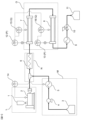
43.ポリマーを含む組成物を加熱および加圧し供給する手段(L)と、亜臨界水を生成し供給する手段(M)と、前記手段(L)から供給された前記熱可塑性ポリマーを含む組成物と前記手段(M)から供給された前記亜臨界水を混合する手段(N)と、ポリマーの加水分解を行う連続反応器(O)を有する、
リサイクルモノマーの製造装置。
44.前記連続反応器(O)の上流部および下流部の内部温度をモニタリングする装置(P)と、前記連続反応器(O)を加熱および/または冷却する温度調整機構(Q)を有し、
前記装置(P)に基づき前記温度調整機構(Q)を動作させ、前記連続反応器(O)の内部温度を制御する、
上記43に記載のリサイクルモノマーの製造装置。
45.前記温度調整機構(Q)が複数個設置されており、
前記装置(P)に基づき複数個の前記温度調整機構(Q)を動作させる、
上記43に記載のリサイクルモノマーの製造装置。
46.前記連続反応器(O)の上流部の内部温度に対して下流部の内部温度を10℃以上低い状態とするように前記温度調整機構(Q)を制御する、
上記44または45に記載のリサイクルモノマーの製造装置。
47.前記連続反応器(O)が管型連続反応器である、
上記44または45に記載のリサイクルモノマーの製造装置。
48.前記手段(L)が押出機である、
上記44または45に記載のリサイクルモノマーの製造装置。
49.前記手段(N)がスタティックミキサーである、
上記44または45に記載のリサイクルモノマーの製造装置。
50.前記ポリマーを含む組成物が樹脂成形体の廃棄物である、
上記44または45に記載のリサイクルモノマーの製造装置。
51.前記ポリマーが熱可塑性ポリアミドまたは熱可塑性ポリエステルである、
上記44または45に記載のリサイクルモノマーの製造装置。
(I) Mp≦X<300
(II) 2000≦X・Y・Z≦20000
7. The concentration of diol derived from the thermoplastic polyester (A) in the reaction mixture obtained by contacting the composition containing the thermoplastic polyester (A) with subcritical water and hydrolyzing the thermoplastic polyester (A) is 4.9. 6. The method for producing a recycled monomer as described in 6 above, wherein the amount is % by mass or more.
8. The concentration of the cyclic ether derived from the thermoplastic polyester (A) in the reaction mixture obtained by contacting the composition containing the thermoplastic polyester (A) with subcritical water and hydrolyzing the thermoplastic polyester (A) is 3. 6. The method for producing a recycled monomer as described in 6 above, wherein the content is 0% by mass or more.
9. 7. The method for producing a recycled monomer as described in 6 above, wherein the mass ratio Z of subcritical water to thermoplastic polyester (A) is less than 6.
10. 7. The method for producing a recycled monomer as described in 6 above, wherein the thermoplastic polyester (A) contains at least one selected from polyethylene terephthalate, polypropylene terephthalate, polybutylene terephthalate, and copolymers thereof as a main component.
11. 7. The method for producing a recycled monomer as described in 6 above, wherein the thermoplastic polyester (A) is a waste containing at least polyester.
12. 6. The method for producing a recycled monomer as described in 6 above, wherein the recycled monomer is a dicarboxylic acid and/or a diol.
13. A method for producing a thermoplastic polyester using the dicarboxylic acid and/or diol obtained by the production method described in 12 above as a raw material.
14. A method for producing a thermoplastic polyester product, which comprises producing a fiber, film, or molded product containing a thermoplastic polyester using the thermoplastic polyester obtained by the production method described in 12 above as a raw material.
15. The composition containing the thermoplastic polyester obtained by the production method described in 12 above is used as a raw material to produce a product of the composition containing the thermoplastic polyester such as a fiber, film or molded article. How the product is manufactured.
16. 5 above, wherein the polymer is a thermoplastic polyester (A), and 0.01 to 4.0 parts by weight of an alkali metal salt and/or alkaline earth metal salt are blended with 100 parts by weight of the thermoplastic polyester (A). The method for producing recycled monomers described in .
17. 16. The method for producing a recycled monomer as described in 16 above, wherein 100 to 1000 parts by weight of subcritical water is blended with 100 parts by weight of the thermoplastic polyester (A).
18. 17. The method for producing a recycled monomer as described in 16 above, wherein the temperature of the step of contacting with subcritical water is 250 to 350°C.
19. 17. The method for producing a recycled monomer as described in 16 above, wherein the pressure in the step of contacting with subcritical water is 3 to 30 MPa.
20. 17. The method for producing a recycled monomer as described in 16 above, wherein the alkali metal salt and/or alkaline earth metal salt is a metal hydroxide and/or metal carbonate.
21. 17. The method for producing a recycled monomer as described in 16 above, wherein the thermoplastic polyester (A) is at least one selected from polyethylene terephthalate, polypropylene terephthalate, polybutylene terephthalate, and copolymers thereof.
22. 17. The method for producing a recycled monomer as described in 16 above, wherein the composition containing the thermoplastic polyester (A) contains at least one selected from an antioxidant, a heat resistant agent, a weathering agent, a mold release agent, and a crystal nucleating agent.
23. 17. The method for producing a recycled monomer as described in 16 above, wherein the composition containing the thermoplastic polyester (A) is waste.
24. 17. The method for producing a recycled monomer as described in 16 above, wherein the recycled monomer is a dicarboxylic acid and/or a diol.
25. A method for producing a thermoplastic polyester using the dicarboxylic acid and/or diol obtained by the production method described in 24 above as a raw material.
26. A method for producing a composition containing a thermoplastic polyester, comprising blending at least one selected from an antioxidant, a weathering agent, a mold release agent, and a crystal nucleating agent into the thermoplastic polyester obtained by the production method described in 25 above.
27. 26. A method for producing a thermoplastic polyester product, comprising producing a fiber, film, or molded product containing a thermoplastic polyester using the thermoplastic polyester obtained by the production method described in 25 above as a raw material.
28. A composition containing a thermoplastic polyester that is used to produce a product of a composition containing a thermoplastic polyester, such as a fiber, a film, or a molded article, using the composition containing a thermoplastic polyester obtained by the production method described in 26 above as a raw material. How the product is manufactured.
29. a composition comprising a polymer, comprising a polymer I and a polymer II;
Polymer I is a thermoplastic polyester (A),
Polymer II is one type of polymer selected from the group consisting of a thermoplastic polyester (B) having a melting point different from that of the thermoplastic polyester (A), polycarbonate, and polyurethane, or a combination of these polymers,
The content of Polymer II in the composition (the total content of thermoplastic polyester (B), polycarbonate and polyurethane) is 1 to 100 parts by weight based on 100 parts by weight of Polymer I,
5. The method for producing a recycled monomer as described in 5 above, which comprises a step of simultaneously contacting Polymer I and Polymer II in the composition with subcritical water at 250 to 350°C.
30. a composition comprising a polymer, comprising a polymer I and a polymer II;
Polymer I is a thermoplastic polyester (A),
Polymer II is one type of polymer selected from the group consisting of a thermoplastic polyester (B) having a melting point different from that of the thermoplastic polyester (A), polycarbonate, and polyurethane, or a combination of these polymers,
The content of Polymer II in the composition (the total content of thermoplastic polyester (B), polycarbonate and polyurethane) is 1 to 100 parts by weight based on 100 parts by weight of Polymer I,
5. The method for producing a recycled monomer as described in 5 above, which comprises a step of simultaneously hydrolyzing Polymer I and Polymer II in the composition by contacting them with subcritical water at 200 to 350° C. under conditions in which an alkaline component is mixed.
31. 29 or 30 above, wherein the composition containing the polymer includes a composition containing Polymer I and Polymer II, and/or a mixture of a composition containing Polymer I and a composition containing Polymer II. A method for producing recycled monomers.
32. 31. The method for producing a recycled monomer as described in 29 or 30 above, wherein 100 to 900 parts by weight of water is blended with 100 parts by weight of the polymer component in the composition containing the polymer.
33. 31. The method for producing a recycled monomer as described in 29 or 30 above, wherein the pressure in the step of contacting with subcritical water is 4.0 MPa to 30 MPa.
34. 30. The method for producing a recycled monomer as described in 29 above, wherein an alkaline component is further blended into the composition containing the polymer.
35. 31. The method for producing a recycled monomer as described in 29 or 30 above, wherein the thermoplastic polyester (A) is selected from polyethylene terephthalate, polypropylene terephthalate, polybutylene terephthalate, and copolymers thereof.
36. 29 or 29 above, wherein the thermoplastic polyester (B) is at least one selected from polyethylene terephthalate, polypropylene terephthalate, polybutylene terephthalate, and copolymers thereof, and has a melting point different from that of the polyester (A); 30. The method for producing a recycled monomer according to 30.
37. 31. The method for producing a recycled monomer as described in 29 or 30 above, wherein the difference in melting point between the thermoplastic polyester (A) and the thermoplastic polyester (B) is 10°C or more.
38. 31. The method for producing a recycled monomer as described in 29 or 30 above, wherein the composition containing the polymer is waste.
39. 31. The method for producing a recycled monomer as described in 29 or 30 above, wherein the recycled monomer is terephthalic acid and/or a diol.
40. A method for producing a thermoplastic polyester, the method comprising producing a thermoplastic polyester using the dicarboxylic acid and/or diol obtained by the production method described in 29 or 30 above as a polymerization raw material.
41. A method for manufacturing a thermoplastic polyester product, which comprises manufacturing a thermoplastic polyester product such as a fiber, a film, or a molded article using the thermoplastic polyester obtained by the manufacturing method described in 40 above as a raw material.
42. A composition containing a thermoplastic polyester, which produces a product of a composition containing a thermoplastic polyester, such as a fiber, a film, or a molded article, using the composition containing a thermoplastic polyester obtained by the production method described in 40 above as a raw material. How the product is manufactured.
43. a means (L) for heating and pressurizing and supplying a composition containing a polymer; a means (M) for generating and supplying subcritical water; and a composition containing the thermoplastic polymer supplied from the means (L); comprising a means (N) for mixing the subcritical water supplied from the means (M) and a continuous reactor (O) for hydrolyzing the polymer;
Recycled monomer production equipment.
44. It has a device (P) that monitors the internal temperature of the upstream and downstream parts of the continuous reactor (O), and a temperature adjustment mechanism (Q) that heats and/or cools the continuous reactor (O),
operating the temperature adjustment mechanism (Q) based on the device (P) to control the internal temperature of the continuous reactor (O);
44. The recycling monomer manufacturing apparatus according to 43 above.
45. A plurality of the temperature adjustment mechanisms (Q) are installed,
operating a plurality of the temperature adjustment mechanisms (Q) based on the device (P);
44. The recycling monomer manufacturing apparatus according to 43 above.
46. controlling the temperature adjustment mechanism (Q) so that the internal temperature of the downstream part of the continuous reactor (O) is lower than the internal temperature of the upstream part by 10 ° C. or more;
46. The apparatus for producing recycled monomers according to 44 or 45 above.
47. The continuous reactor (O) is a tubular continuous reactor,
46. The apparatus for producing recycled monomers according to 44 or 45 above.
48. the means (L) is an extruder;
46. The apparatus for producing recycled monomers according to 44 or 45 above.
49. the means (N) is a static mixer;
46. The apparatus for producing recycled monomers according to 44 or 45 above.
50. The composition containing the polymer is waste of a resin molded body,
46. The apparatus for producing recycled monomers according to 44 or 45 above.
51. the polymer is a thermoplastic polyamide or a thermoplastic polyester;
46. The apparatus for producing recycled monomers according to 44 or 45 above.
本発明のリサイクルモノマー、リサイクルモノマーの製造方法、および後述の本発明の第1の好ましい態様は、特に熱可塑性ポリエステルを含む組成物の解重合において、少量の水で短時間処理するだけでも高効率で熱可塑性ポリエステルを解重合でき、ジオールおよびジカルボン酸を高濃度に含有する反応混合物が得られることから、解重合反応および蒸留精製に要するエネルギー消費量が少ない方法を提供できる。さらに、解重合反応条件が低温かつ短時間であることでジオールおよびジカルボン酸の二次反応が抑制され、高い収率で着色のないジオールおよびジカルボン酸が得られる。 The recycled monomer of the present invention, the method for producing the recycled monomer, and the first preferred embodiment of the present invention described below are particularly advantageous in the depolymerization of compositions containing thermoplastic polyester, which are highly efficient even when treated for a short time with a small amount of water. Since a thermoplastic polyester can be depolymerized with a reaction mixture containing a high concentration of diol and dicarboxylic acid, a method can be provided in which the energy consumption required for the depolymerization reaction and distillation purification is small. Furthermore, since the depolymerization reaction conditions are low and short, secondary reactions between diols and dicarboxylic acids are suppressed, and color-free diols and dicarboxylic acids can be obtained in high yields.
また、後述の本発明の第2の好ましい態様は、特定量のアルカリ金属塩および/またはアルカリ土類金属塩を添加して、熱可塑性ポリエステルを含む組成物を加水分解することで、生成物の過反応を抑制し、高収率でジカルボン酸および/またはジオールを生成させることができる。 Further, in a second preferred embodiment of the present invention described below, a specific amount of an alkali metal salt and/or an alkaline earth metal salt is added to hydrolyze a composition containing a thermoplastic polyester, thereby producing a product. Overreaction can be suppressed and dicarboxylic acids and/or diols can be produced in high yield.
さらに、後述の本発明の第3の好ましい態様は、これまでケミカルリサイクルが困難であった複数ポリマーから構成される素材を同時に加水分解し、高収率でリサイクルモノマーを製造する方法を提供できる。特に、熱可塑性ポリエステル(A)からなるポリマーIと、熱可塑性ポリエステル(A)とは異なる融点の熱可塑性ポリエステル(B)、ポリカーボネートおよびポリウレタンから選ばれる少なくとも1種からなるポリマーIIを、それぞれ特定の量含有する組成物を、特定の温度範囲の亜臨界水で同時に加水分解する工程を有することにより、高収率でジカルボン酸および/またはジオールを製造することができる。 Furthermore, the third preferred embodiment of the present invention, which will be described later, can provide a method for simultaneously hydrolyzing a material composed of multiple polymers, which has hitherto been difficult to chemically recycle, and producing recycled monomers at a high yield. In particular, a polymer I consisting of a thermoplastic polyester (A) and a polymer II consisting of at least one selected from thermoplastic polyester (B) having a melting point different from that of the thermoplastic polyester (A), polycarbonate, and polyurethane are each used in a specific manner. A dicarboxylic acid and/or diol can be produced in high yield by simultaneously hydrolyzing a composition containing a certain amount with subcritical water in a specific temperature range.
加えて、本発明のリサイクルモノマーの製造装置は、連続反応器を用いて、連続反応器上流部および連続反応器下流部の反応温度の精密制御を実施することにより、高効率、かつ高収率でリサイクルモノマーを製造することができる。 In addition, the recycling monomer production apparatus of the present invention uses a continuous reactor and precisely controls the reaction temperature in the upstream part of the continuous reactor and the downstream part of the continuous reactor, thereby achieving high efficiency and high yield. can produce recycled monomers.
以下、本発明をさらに詳細に説明する。 The present invention will be explained in more detail below.
[1]リサイクルモノマー、リサイクルポリマー、及びリサイクルモノマーを用いてなる各種製品
本発明のリサイクルモノマーは、ポリマーを含む組成物を亜臨界水と接触させて製造されるリサイクルモノマーであって、ポリマーを含む組成物において、示差走査熱量計で測定したポリマーの融点をMp℃、反応温度をX℃、反応時間をY分、水とポリマーの質量比をZ:1とした場合、XおよびXとYとZの積X・Y・Zが、下記(I)および(II)を同時に満たす条件で製造される。
[1] Recycled monomer, recycled polymer, and various products made using the recycled monomer The recycled monomer of the present invention is a recycled monomer that is produced by contacting a composition containing a polymer with subcritical water, and is a recycled monomer that is produced by contacting a composition containing a polymer with subcritical water. In the composition, if the melting point of the polymer measured with a differential scanning calorimeter is Mp°C, the reaction temperature is X°C, the reaction time is Y minutes, and the mass ratio of water and polymer is Z:1, then The product of Z, X.Y.Z, is manufactured under conditions that simultaneously satisfy (I) and (II) below.
(I) Mp≦X<300
(II)2000≦X・Y・Z≦20000。
(I) Mp≦X<300
(II) 2000≦X・Y・Z≦20000.
上記リサイクルモノマーとしては、製造量が多く、リサイクルの必要性が高いポリマーを解重合して得られるモノマーが好ましい。具体的には、熱可塑性ポリエステルのモノマー、熱可塑性ポリアミドのモノマーが好ましい。前者モノマーとしては、テレフタル酸、イソフタル酸、フタル酸、2,6-ナフタレンジカルボン酸、1,5-ナフタレンジカルボン酸、ビス(p-カルボキシフェニル)メタン、1,4-アントラセンジカルボン酸、1,5-アントラセンジカルボン酸、1,8-アントラセンジカルボン酸、2,6-アントラセンジカルボン酸、9,10-アントラセンジカルボン酸、4,4’-ジフェニルエーテルジカルボン酸、5-テトラブチルホスホニウムイソフタル酸、5-ナトリウムスルホイソフタル酸などの芳香族ジカルボン酸、シュウ酸、コハク酸、アジピン酸、セバシン酸、アゼライン酸、ドデカンジオン酸、マロン酸、グルタル酸、ダイマー酸などの脂肪族ジカルボン酸、1,3-シクロヘキサンジカルボン酸、1,4-シクロヘキサンジカルボン酸などの脂環式ジカルボン酸およびこれらのエステル形成性誘導体、エチレングリコール、プロピレングリコール、1,4-ブタンジオール、ネオペンチルグリコール、1,5-ペンタンジオール、1,6-ヘキサンジオール、デカメチレングリコール、シクロヘキサンジメタノール、シクロヘキサンジオール、ダイマージオールなどの炭素数2~20の脂肪族または脂環式グリコール、ポリエチレングリコール、ポリ-1,3-プロピレングリコール、ポリテトラメチレングリコールなどの分子量200~100,000の長鎖グリコール、4,4’-ジヒドロキシビフェニル、ハイドロキノン、t-ブチルハイドロキノン、ビスフェノールA、ビスフェノールS、ビスフェノールFなどの芳香族ジオキシ化合物およびこれらのエステル形成性誘導体などが挙げられる。 The recycled monomer is preferably a monomer obtained by depolymerizing a polymer that is manufactured in large quantities and that requires recycling. Specifically, thermoplastic polyester monomers and thermoplastic polyamide monomers are preferred. The former monomers include terephthalic acid, isophthalic acid, phthalic acid, 2,6-naphthalene dicarboxylic acid, 1,5-naphthalene dicarboxylic acid, bis(p-carboxyphenyl)methane, 1,4-anthracenedicarboxylic acid, 1,5-naphthalene dicarboxylic acid, -Anthracenedicarboxylic acid, 1,8-anthracenedicarboxylic acid, 2,6-anthracenedicarboxylic acid, 9,10-anthracenedicarboxylic acid, 4,4'-diphenyletherdicarboxylic acid, 5-tetrabutylphosphonium isophthalic acid, 5-sodium sulfonate Aromatic dicarboxylic acids such as isophthalic acid, aliphatic dicarboxylic acids such as oxalic acid, succinic acid, adipic acid, sebacic acid, azelaic acid, dodecanedioic acid, malonic acid, glutaric acid, dimer acid, 1,3-cyclohexanedicarboxylic acid , alicyclic dicarboxylic acids such as 1,4-cyclohexanedicarboxylic acid and their ester-forming derivatives, ethylene glycol, propylene glycol, 1,4-butanediol, neopentyl glycol, 1,5-pentanediol, 1,6 - Aliphatic or alicyclic glycols having 2 to 20 carbon atoms such as hexanediol, decamethylene glycol, cyclohexanedimethanol, cyclohexanediol, dimer diol, polyethylene glycol, poly-1,3-propylene glycol, polytetramethylene glycol, etc. long-chain glycols with a molecular weight of 200 to 100,000, aromatic dioxy compounds such as 4,4'-dihydroxybiphenyl, hydroquinone, t-butylhydroquinone, bisphenol A, bisphenol S, and bisphenol F, and their ester-forming derivatives. Can be mentioned.
後者のモノマーとしては、6-アミノカプロン酸、11-アミノウンデカン酸、12-アミノドデカン酸、パラアミノメチル安息香酸などのアミノ酸、ε-カプロラクタム、ω-ラウロラクタムなどのラクタム、エチレンジアミン、トリメチレンジアミン、テトラメチレンジアミン、ペンタメチレンジアミン、ヘキサメチレンジアミン、ヘプタメチレンジアミン、オクタメチレンジアミン、ノナメチレンジアミン、デカンジアミン、ウンデカンジアミン、ドデカンジアミン、トリデカンジアミン、テトラデカンジアミン、ペンタデカンジアミン、ヘキサデカンジアミン、ヘプタデカンジアミン、オクタデカンジアミン、ノナデカンジアミン、エイコサンジアミン、2-メチル-1,5-ジアミノペンタン、2-メチル-1,8-ジアミノオクタンなどの脂肪族ジアミン、シュウ酸、スクシン酸、アジピン酸、スベリン酸、アゼライン酸、セバシン酸、ドデカン二酸などの脂肪族ジカルボン酸、テレフタル酸、イソフタル酸などの芳香族ジカルボン酸、これらジカルボン酸のジアルキルエステル、ジクロリドなどが挙げられる。 Examples of the latter monomers include amino acids such as 6-aminocaproic acid, 11-aminoundecanoic acid, 12-aminododecanoic acid, and para-aminomethylbenzoic acid, lactams such as ε-caprolactam and ω-laurolactam, ethylenediamine, trimethylenediamine, and tetramethylbenzoic acid. Methylenediamine, pentamethylenediamine, hexamethylenediamine, heptamethylenediamine, octamethylenediamine, nonamethylenediamine, decanediamine, undecanediamine, dodecanediamine, tridecanediamine, tetradecanediamine, pentadecanediamine, hexadecanediamine, heptadecanediamine, octadecane Aliphatic diamines such as diamine, nonadecanediamine, eicosane diamine, 2-methyl-1,5-diaminopentane, 2-methyl-1,8-diaminooctane, oxalic acid, succinic acid, adipic acid, suberic acid, azelain Examples include aliphatic dicarboxylic acids such as sebacic acid and dodecanedioic acid, aromatic dicarboxylic acids such as terephthalic acid and isophthalic acid, dialkyl esters of these dicarboxylic acids, and dichloride.
本発明のリサイクルモノマーにおいて、前記ポリマーが熱可塑性ポリエステル、または熱可塑性ポリアミドであることが好ましい。熱可塑性ポリエステルとしては、ジカルボン酸またはそのエステル形成性誘導体とジオールまたはそのエステル形成性誘導体を重縮合して得られる単独重合体または共重合体が好ましく、具体的には、ポリエチレンテレフタレート、ポリプロピレンテレフタレート、ポリブチレンテレフタレート、ポリプロピレンイソフタレート、ポリブチレンイソフタレート、ポリブチレンナフタレート、ポリプロピレンイソフタレート/テレフタレート、ポリブチレンイソフタレート/テレフタレート、ポリプロピレンテレフタレート/ナフタレート、ポリブチレンテレフタレート/ナフタレート、ポリブチレンテレフタレート/デカンジカルボキシレート、ポリプロピレンテレフタレート/5-ナトリウムスルホイソフタレート、ポリブチレンテレフタレート/5-ナトリウムスルホイソフタレート、ポリプロピレンテレフタレート/ポリエチレングリコール、ポリブチレンテレフタレート/ポリエチレングリコール、ポリプロピレンテレフタレート/ポリテトラメチレングリコール、ポリブチレンテレフタレート/ポリテトラメチレングリコール、ポリプロピレンテレフタレート/イソフタレート/ポリテトラメチレングリコール、ポリブチレンテレフタレート/イソフタレート/ポリテトラメチレングリコール、ポリブチレンテレフタレート/サクシネート、ポリプロピレンテレフタレート/アジペート、ポリブチレンテレフタレート/アジペート、ポリプロピレンテレフタレート/セバケート、ポリブチレンテレフタレート/セバケート、ポリプロピレンテレフタレート/イソフタレート/アジペート、ポリブチレンテレフタレート/イソフタレート/サクシネート、ポリブチレンテレフタレート/イソフタレート/アジペート、ポリブチレンテレフタレート/イソフタレート/セバケートなどの芳香族ポリエステル樹脂などが挙げられ、2種以上の混合物であってもよい。 In the recycled monomer of the present invention, the polymer is preferably a thermoplastic polyester or a thermoplastic polyamide. As the thermoplastic polyester, a homopolymer or copolymer obtained by polycondensing a dicarboxylic acid or an ester-forming derivative thereof with a diol or an ester-forming derivative thereof is preferable, and specifically, polyethylene terephthalate, polypropylene terephthalate, Polybutylene terephthalate, polypropylene isophthalate, polybutylene isophthalate, polybutylene naphthalate, polypropylene isophthalate/terephthalate, polybutylene isophthalate/terephthalate, polypropylene terephthalate/naphthalate, polybutylene terephthalate/naphthalate, polybutylene terephthalate/decanedicarboxylate , polypropylene terephthalate/5-sodium sulfoisophthalate, polybutylene terephthalate/5-sodium sulfoisophthalate, polypropylene terephthalate/polyethylene glycol, polybutylene terephthalate/polyethylene glycol, polypropylene terephthalate/polytetramethylene glycol, polybutylene terephthalate/polytetramethylene Glycol, polypropylene terephthalate/isophthalate/polytetramethylene glycol, polybutylene terephthalate/isophthalate/polytetramethylene glycol, polybutylene terephthalate/succinate, polypropylene terephthalate/adipate, polybutylene terephthalate/adipate, polypropylene terephthalate/sebacate, polybutylene terephthalate /Sebacate, polypropylene terephthalate/isophthalate/adipate, polybutylene terephthalate/isophthalate/succinate, polybutylene terephthalate/isophthalate/adipate, polybutylene terephthalate/isophthalate/sebacate, and other aromatic polyester resins. A mixture of the above may be used.
一方、熱可塑性ポリアミドとしては、アミノ酸、ラクタムあるいはジカルボン酸とジアミンを重縮合して得られる単独重合体または共重合体が好ましく、具体的には、ポリカプロアミド(ポリアミド6)、ポリヘキサメチレンアジパミド(ポリアミド66)、ポリテトラメチレンアジパミド(ポリアミド46)、ポリペンタメチレンアジパミド(ポリアミド56)、ポリテトラメチレンセバカミド(ポリアミド410)、ポリペンタメチレンセバカミド(ポリアミド510)、ポリヘキサメチレンセバカミド(ポリアミド610)、ポリヘキサメチレンドデカミド(ポリアミド612)およびこれらの共重合体などが挙げられ、2種以上の混合物であってもよい。製造量が多く、より多くのリサイクル原資を確保できる観点から、前記ポリマーが、熱可塑性ポリエステルであることがより好ましい。 On the other hand, as the thermoplastic polyamide, a homopolymer or a copolymer obtained by polycondensing an amino acid, a lactam or a dicarboxylic acid with a diamine is preferable, and specifically, polycaproamide (polyamide 6), polyhexamethylene adiamide Pamide (Polyamide 66), Polytetramethylene Adipamide (Polyamide 46), Polypentamethylene Adipamide (Polyamide 56), Polytetramethylene Sebaamide (Polyamide 410), Polypentamethylene Sebaamide (Polyamide 510) , polyhexamethylene sebamide (polyamide 610), polyhexamethylene dodecamide (polyamide 612), and copolymers thereof, and a mixture of two or more thereof may be used. It is more preferable that the polymer is a thermoplastic polyester from the viewpoint of increasing production volume and securing more recycling resources.
本発明のリサイクルポリマーは、本発明のリサイクルモノマーを再重合して得られる。本発明のリサイクルモノマーを再重合してリサイクルポリマーとすることで、プラスチック材料として使用することができ、資源循環に貢献できる。 The recycled polymer of the present invention is obtained by repolymerizing the recycled monomer of the present invention. By repolymerizing the recycled monomer of the present invention to obtain a recycled polymer, it can be used as a plastic material and contribute to resource recycling.
本発明の衣料用繊維、産業用繊維、フィルム、シート、自動車部品、または電気・電子部品は、本発明のリサイクルポリマーを用いてなる。前記製品は、環境配慮型という付加価値を有する。 Clothing fibers, industrial fibers, films, sheets, automobile parts, or electrical/electronic parts of the present invention are made using the recycled polymer of the present invention. The product has the added value of being environmentally friendly.
[2]リサイクルモノマーの製造方法
本発明のリサイクルモノマーの製造方法は、ポリマーを含む組成物を亜臨界水と接触させる工程を含む。本発明のリサイクルモノマーの製造方法は、以下の4つの好ましい態様を含む。本明細書において、本発明のリサイクルモノマーの製造方法の3つの好ましい態様を、それぞれ単に「本発明の第1の好ましい態様」、「本発明の第2の好ましい態様」、「本発明の第3の好ましい態様」という場合がある。また、後述の「[3]リサイクルモノマーの製造装置」の項目に記載のリサイクルモノマーの製造方法を、単に「本発明の第4の好ましい態様」という場合がある。
[2] Method for producing recycled monomers The method for producing recycled monomers of the present invention includes a step of bringing a composition containing a polymer into contact with subcritical water. The method for producing recycled monomers of the present invention includes the following four preferred embodiments. In this specification, three preferred embodiments of the method for producing recycled monomers of the present invention will be referred to simply as "the first preferred embodiment of the present invention,""the second preferred embodiment of the present invention," and "the third preferred embodiment of the present invention." ``preferred embodiments''. Further, the method for producing a recycled monomer described in the section "[3] Apparatus for producing a recycled monomer" below may be simply referred to as "the fourth preferred embodiment of the present invention."
[2-1]本発明の第1の好ましい態様
第1の好ましい態様は、熱可塑性ポリエステル(A)を含む組成物を亜臨界水と接触させる工程を含み、示差走査熱量計で測定した熱可塑性ポリエステル(A)の融点をMp℃、反応温度をX℃、反応時間をY分、水と熱可塑性ポリエステル(A)の質量比をZ:1とした場合、XおよびXとYとZの積X・Y・Zが、下記(I)および(II)を同時に満たすリサイクルモノマーの製造方法である。
[2-1] First preferred embodiment of the present invention The first preferred embodiment includes a step of bringing a composition containing the thermoplastic polyester (A) into contact with subcritical water, and the thermoplasticity measured by a differential scanning calorimeter is When the melting point of polyester (A) is Mp°C, the reaction temperature is X°C, the reaction time is Y minutes, and the mass ratio of water and thermoplastic polyester (A) is Z:1, the product of X and X and Y and Z is X・Y・Z is a method for producing a recycled monomer that satisfies the following (I) and (II) at the same time.
(I) Mp≦X<300
(II)2000≦X・Y・Z≦20000。
(I) Mp≦X<300
(II) 2000≦X・Y・Z≦20000.
熱可塑性ポリエステル(A)と亜臨界水を接触させて加水分解することで、熱可塑性ポリエステル(A)を構成するジオールおよび/またはジカルボン酸に解重合できる。 By bringing the thermoplastic polyester (A) into contact with subcritical water and hydrolyzing it, it can be depolymerized into the diol and/or dicarboxylic acid that constitute the thermoplastic polyester (A).
本発明に用いられる熱可塑性ポリエステル(A)は、ジカルボン酸またはそのエステル形成性誘導体とジオールまたはそのエステル形成性誘導体を主原料として重縮合して得られる、単独重合体または共重合体である。ここで、主原料とは、ポリマー中のジカルボン酸またはそのエステル形成性誘導体とジオールまたはそのエステル形成性誘導体の構成単位が50モル%以上であることを示す。好ましくは80モル%以上、さらに好ましくは90モル%以上である。 The thermoplastic polyester (A) used in the present invention is a homopolymer or copolymer obtained by polycondensation of dicarboxylic acid or its ester-forming derivative and diol or its ester-forming derivative as main raw materials. Here, the main raw material indicates that the constituent units of dicarboxylic acid or its ester-forming derivative and diol or its ester-forming derivative in the polymer are 50 mol % or more. Preferably it is 80 mol% or more, more preferably 90 mol% or more.
上記のジカルボン酸またはそのエステル形成性誘導体としては、例えば、テレフタル酸、イソフタル酸、フタル酸、2,6-ナフタレンジカルボン酸、1,5-ナフタレンジカルボン酸、ビス(p-カルボキシフェニル)メタン、1,4-アントラセンジカルボン酸、1,5-アントラセンジカルボン酸、1,8-アントラセンジカルボン酸、2,6-アントラセンジカルボン酸、9,10-アントラセンジカルボン酸、4,4’-ジフェニルエーテルジカルボン酸、5-テトラブチルホスホニウムイソフタル酸、5-ナトリウムスルホイソフタル酸などの芳香族ジカルボン酸、シュウ酸、コハク酸、アジピン酸、セバシン酸、アゼライン酸、ドデカンジオン酸、マロン酸、グルタル酸、ダイマー酸などの脂肪族ジカルボン酸、1,3-シクロヘキサンジカルボン酸、1,4-シクロヘキサンジカルボン酸などの脂環式ジカルボン酸およびこれらのエステル形成性誘導体などが挙げられる。これらを2種以上用いてもよい。 Examples of the dicarboxylic acids or ester-forming derivatives thereof include terephthalic acid, isophthalic acid, phthalic acid, 2,6-naphthalenedicarboxylic acid, 1,5-naphthalenedicarboxylic acid, bis(p-carboxyphenyl)methane, , 4-anthracenedicarboxylic acid, 1,5-anthracenedicarboxylic acid, 1,8-anthracenedicarboxylic acid, 2,6-anthracenedicarboxylic acid, 9,10-anthracenedicarboxylic acid, 4,4'-diphenyletherdicarboxylic acid, 5- Aromatic dicarboxylic acids such as tetrabutylphosphonium isophthalic acid and 5-sodium sulfoisophthalic acid; aliphatic acids such as oxalic acid, succinic acid, adipic acid, sebacic acid, azelaic acid, dodecanedioic acid, malonic acid, glutaric acid, and dimer acid; Examples include alicyclic dicarboxylic acids such as dicarboxylic acid, 1,3-cyclohexanedicarboxylic acid, and 1,4-cyclohexanedicarboxylic acid, and ester-forming derivatives thereof. Two or more types of these may be used.
ここで言うエステル形成性誘導体とは、先に述べたジカルボン酸の低級アルキルエステル、酸無水物、酸ハロゲン化物等である。ジカルボン酸の低級アルキルエステルとして、メチルエステル、エチルエステル、ヒドロキシエチルエステル、ヒドロキシブチルエステル等が好ましく用いられる。ジカルボン酸の酸無水物として、ジカルボン酸同士の無水物、ジカルボン酸と酢酸との無水物等が好ましく用いられる。ジカルボン酸のハロゲン化物として、酸塩化物、酸臭化物、酸ヨウ化物等が好ましく用いられる。 The ester-forming derivatives mentioned here include the lower alkyl esters of dicarboxylic acids, acid anhydrides, acid halides, etc. mentioned above. As the lower alkyl ester of dicarboxylic acid, methyl ester, ethyl ester, hydroxyethyl ester, hydroxybutyl ester, etc. are preferably used. As acid anhydrides of dicarboxylic acids, anhydrides of dicarboxylic acids, anhydrides of dicarboxylic acids and acetic acid, and the like are preferably used. As the dicarboxylic acid halide, acid chloride, acid bromide, acid iodide, etc. are preferably used.
上記のジオールまたはそのエステル形成性誘導体としては、例えば、エチレングリコール、プロピレングリコール、1,4-ブタンジオール、ネオペンチルグリコール、1,5-ペンタンジオール、1,6-ヘキサンジオール、デカメチレングリコール、シクロヘキサンジメタノール、シクロヘキサンジオール、ダイマージオールなどの炭素数2~20の脂肪族または脂環式グリコール、ポリエチレングリコール、ポリ-1,3-プロピレングリコール、ポリテトラメチレングリコールなどの分子量200~100,000の長鎖グリコール、4,4’-ジヒドロキシビフェニル、ハイドロキノン、t-ブチルハイドロキノン、ビスフェノールA、ビスフェノールS、ビスフェノールFなどの芳香族ジオキシ化合物およびこれらのエステル形成性誘導体などが挙げられる。これらを2種以上用いてもよい。 Examples of the above diols or their ester-forming derivatives include ethylene glycol, propylene glycol, 1,4-butanediol, neopentyl glycol, 1,5-pentanediol, 1,6-hexanediol, decamethylene glycol, and cyclohexane. Aliphatic or alicyclic glycols having 2 to 20 carbon atoms, such as dimethanol, cyclohexanediol, and dimer diol; long polymers with a molecular weight of 200 to 100,000, such as polyethylene glycol, poly-1,3-propylene glycol, and polytetramethylene glycol; Examples include aromatic dioxy compounds such as chain glycol, 4,4'-dihydroxybiphenyl, hydroquinone, t-butylhydroquinone, bisphenol A, bisphenol S, and bisphenol F, and ester-forming derivatives thereof. Two or more types of these may be used.
ジカルボン酸またはそのエステル形成性誘導体とジオールまたはそのエステル形成性誘導体を構造単位とする単独重合体または共重合体としては、例えば、ポリエチレンテレフタレート、ポリプロピレンテレフタレート、ポリブチレンテレフタレート、ポリプロピレンイソフタレート、ポリブチレンイソフタレート、ポリブチレンナフタレート、ポリプロピレンイソフタレート/テレフタレート、ポリブチレンイソフタレート/テレフタレート、ポリプロピレンテレフタレート/ナフタレート、ポリブチレンテレフタレート/ナフタレート、ポリブチレンテレフタレート/デカンジカルボキシレート、ポリプロピレンテレフタレート/5-ナトリウムスルホイソフタレート、ポリブチレンテレフタレート/5-ナトリウムスルホイソフタレート、ポリプロピレンテレフタレート/ポリエチレングリコール、ポリブチレンテレフタレート/ポリエチレングリコール、ポリプロピレンテレフタレート/ポリテトラメチレングリコール、ポリブチレンテレフタレート/ポリテトラメチレングリコール、ポリプロピレンテレフタレート/イソフタレート/ポリテトラメチレングリコール、ポリブチレンテレフタレート/イソフタレート/ポリテトラメチレングリコール、ポリブチレンテレフタレート/サクシネート、ポリプロピレンテレフタレート/アジペート、ポリブチレンテレフタレート/アジペート、ポリプロピレンテレフタレート/セバケート、ポリブチレンテレフタレート/セバケート、ポリプロピレンテレフタレート/イソフタレート/アジペート、ポリブチレンテレフタレート/イソフタレート/サクシネート、ポリブチレンテレフタレート/イソフタレート/アジペート、ポリブチレンテレフタレート/イソフタレート/セバケートなどの芳香族ポリエステル樹脂などが挙げられる。 Examples of homopolymers or copolymers having structural units of dicarboxylic acid or its ester-forming derivative and diol or its ester-forming derivative include polyethylene terephthalate, polypropylene terephthalate, polybutylene terephthalate, polypropylene isophthalate, and polybutylene isophthalate. Phthalate, polybutylene naphthalate, polypropylene isophthalate/terephthalate, polybutylene isophthalate/terephthalate, polypropylene terephthalate/naphthalate, polybutylene terephthalate/naphthalate, polybutylene terephthalate/decane dicarboxylate, polypropylene terephthalate/5-sodium sulfoisophthalate, Polybutylene terephthalate/5-sodium sulfoisophthalate, polypropylene terephthalate/polyethylene glycol, polybutylene terephthalate/polyethylene glycol, polypropylene terephthalate/polytetramethylene glycol, polybutylene terephthalate/polytetramethylene glycol, polypropylene terephthalate/isophthalate/polytetramethylene Glycol, polybutylene terephthalate/isophthalate/polytetramethylene glycol, polybutylene terephthalate/succinate, polypropylene terephthalate/adipate, polybutylene terephthalate/adipate, polypropylene terephthalate/sebacate, polybutylene terephthalate/sebacate, polypropylene terephthalate/isophthalate/adipate, Examples include aromatic polyester resins such as polybutylene terephthalate/isophthalate/succinate, polybutylene terephthalate/isophthalate/adipate, and polybutylene terephthalate/isophthalate/sebacate.
ここで、「/」は共重合体を表す。これらの単独重合体および共重合体は、単独で用いても2種以上を任意の含有量で混合して用いてもよい。中でも、熱可塑性ポリエステル(A)を再資源化し、化石資源循環利用を推進する目的から、生産量および消費量が多い芳香族ジカルボン酸またはそのエステル形成性誘導体の残基と脂肪族ジオールまたはそのエステル形成性誘導体を主原料とする単独重合体または共重合体が好ましい。前記好ましい重合体の例としては、テレフタル酸、イソフタル酸、ナフタレンジカルボン酸およびそれらのエステル形成性誘導体から選ばれた少なくとも1種と、エチレングリコール、1,3-プロピレングリコール、および1,4-ブタンジオールまたはそれらのエステル形成性誘導体から選ばれた少なくとも1種を重縮合して得られる単独重合体または共重合体が挙げられ、中でもポリエチレンテレフタレート、ポリプロピレンテレフタレート、ポリブチレンテレフタレート、およびその共重合体からなる群から選ばれる少なくとも1種が特に好ましく用いられる。 Here, "/" represents a copolymer. These homopolymers and copolymers may be used alone or in a mixture of two or more in any content. Among these, for the purpose of recycling thermoplastic polyester (A) and promoting the recycling of fossil resources, residues of aromatic dicarboxylic acids or their ester-forming derivatives and aliphatic diols or their esters, which are produced and consumed in large quantities, are used. Homopolymers or copolymers containing a formable derivative as a main raw material are preferred. Examples of the preferred polymer include at least one selected from terephthalic acid, isophthalic acid, naphthalene dicarboxylic acid, and ester-forming derivatives thereof, and ethylene glycol, 1,3-propylene glycol, and 1,4-butane. Examples include homopolymers or copolymers obtained by polycondensation of at least one selected from diols or their ester-forming derivatives, among which polyethylene terephthalate, polypropylene terephthalate, polybutylene terephthalate, and copolymers thereof. At least one selected from the group consisting of:
本発明の熱可塑性ポリエステル(A)は、本発明の目的を損なわない範囲で、重合触媒、熱可塑性ポリエステル以外の熱可塑性樹脂、染料、各種添加剤、繊維状充填材、繊維状充填材以外の充填剤などを配合したものであってもよい。ここでの繊維状充填材は、繊維状の形状を有するいずれの充填材でもよい。繊維状充填材以外の充填剤としては、有機充填剤、無機充填剤のいずれでもよいし、例えば非繊維状充填材が挙げられる。これらを2種以上配合したものでもよい。 The thermoplastic polyester (A) of the present invention may contain a polymerization catalyst, a thermoplastic resin other than the thermoplastic polyester, a dye, various additives, a fibrous filler, and a non-fibrous filler, as long as the object of the present invention is not impaired. It may also contain a filler or the like. The fibrous filler here may be any filler having a fibrous shape. The filler other than the fibrous filler may be either an organic filler or an inorganic filler, and includes, for example, a non-fibrous filler. A mixture of two or more of these may also be used.
本発明の熱可塑性ポリエステル(A)は、少なくとも熱可塑性ポリエステルを含有する樹脂成形体の廃棄物であっても良い。熱可塑性ポリエステルを含有する樹脂成形体の廃棄物としては、熱可塑性ポリエステル製品、熱可塑性ポリエステル製品の製造過程で発生する産業廃棄物、あるいは熱可塑性ポリエステル製品の使用済み廃棄物などを含む。熱可塑性ポリエステル製品としては、例えば飲料用ボトル、調味料用ボトルなどの容器、食品用トレイ、ブリスターパック、食品用中仕切り、工業用トレイなどのシート製品、包装フィルム、光学用機能性フィルム、磁気テープおよび絶縁材料などのフィルム製品、古着、ユニホーム、スポーツウエアおよびインナーウエアなどの衣料用繊維構造物、カーテン、カーペット、網、ベルトおよびシートなどの産業用繊維構造物、自動車部品、電気・電子部品、建築部材、日用品、生活雑貨および衛生用品などの成形品、などが挙げられる。さらに、これらの生産工程で発生する製品屑、ペレット屑、塊状屑なども廃棄物の対象となる。熱可塑性ポリエステルを含有する樹脂成形体の廃棄物は、本発明の効果を損なわない範囲で、熱可塑性ポリエステル(A)以外からなる製品とともに本発明の解重合方法に供してもよい。 The thermoplastic polyester (A) of the present invention may be a waste product of a resin molding containing at least a thermoplastic polyester. Waste from resin moldings containing thermoplastic polyester includes thermoplastic polyester products, industrial waste generated during the manufacturing process of thermoplastic polyester products, and used waste from thermoplastic polyester products. Examples of thermoplastic polyester products include containers such as beverage bottles and seasoning bottles, sheet products such as food trays, blister packs, food partitions, and industrial trays, packaging films, optical functional films, and magnetic materials. Film products such as tapes and insulating materials, clothing textile structures such as used clothing, uniforms, sportswear and inner wear, industrial textile structures such as curtains, carpets, nets, belts and sheets, automobile parts, electrical and electronic parts. Examples include molded products such as building materials, daily necessities, household goods, and sanitary products. Furthermore, product waste, pellet waste, lump waste, etc. generated in these production processes are also subject to waste. Waste products of resin moldings containing thermoplastic polyester may be subjected to the depolymerization method of the present invention together with products made of products other than thermoplastic polyester (A) to the extent that the effects of the present invention are not impaired.
本発明の第1の好ましい態様における熱可塑性ポリエステル(A)の解重合方法は、熱可塑性ポリエステルを亜臨界水と接触させる工程を含み、少なくとも熱可塑性ポリエステル(A)および水を加熱混合する際、熱可塑性ポリエステルの融点がMp℃であるとき、反応温度をX℃、反応時間をY分、水と熱可塑性ポリエステルの質量比をZ:1とした場合、XおよびXとYとZの積X・Y・Zが、(i)Mp≦X<300および(ii)2000≦X・Y・Z≦20000を同時に満たすことを特徴とする。 The method for depolymerizing thermoplastic polyester (A) in the first preferred embodiment of the present invention includes a step of bringing the thermoplastic polyester into contact with subcritical water, and at least when heating and mixing the thermoplastic polyester (A) and water, When the melting point of the thermoplastic polyester is Mp°C, the reaction temperature is X°C, the reaction time is Y minutes, and the mass ratio of water and thermoplastic polyester is Z:1, the product of X and X, Y, and Z is - Y and Z simultaneously satisfy (i) Mp≦X<300 and (ii) 2000≦X・Y・Z≦20000.
ここでいう、本発明における熱可塑性ポリエステル(A)の融点は、TAインスツルメント社製示差走査熱量計を用いて、不活性ガス雰囲気下、熱可塑性ポリエステル(A)を、溶融状態から20℃/分の降温速度で30℃まで降温した後、20℃/分の昇温速度で融点+40℃まで昇温した場合に現れる吸熱ピークの温度である。ただし、吸熱ピークが2つ以上検出される場合には、ピーク強度の最も大きい吸熱ピークの温度を融点とする。熱可塑性ポリエステルの融点に特に制限はないが、好ましい融点の範囲として、50℃超300℃未満が例示できる。融点が50℃超であると、熱可塑性ポリエステルが常温で固体となるため、取り扱い性に優れる。また、融点が300℃未満であることで、解重合生成物の転化反応を抑制可能な温度領域において、融液状態で水と混合できるため、反応効率を向上でき、好ましい。 Here, the melting point of the thermoplastic polyester (A) in the present invention is determined by measuring the thermoplastic polyester (A) from a molten state to 20°C in an inert gas atmosphere using a differential scanning calorimeter manufactured by TA Instruments. This is the temperature of the endothermic peak that appears when the temperature is lowered to 30° C. at a temperature lowering rate of /min and then raised to the melting point +40° C. at a temperature increasing rate of 20° C./min. However, if two or more endothermic peaks are detected, the temperature of the endothermic peak with the highest peak intensity is determined as the melting point. Although there is no particular restriction on the melting point of the thermoplastic polyester, a preferable melting point range is more than 50°C and less than 300°C. When the melting point is higher than 50°C, the thermoplastic polyester becomes solid at room temperature, resulting in excellent handling properties. Further, it is preferable that the melting point is less than 300° C., since it can be mixed with water in a melt state in a temperature range where the conversion reaction of the depolymerized product can be suppressed, thereby improving reaction efficiency.
ここで用いられる水に特に制限はないが、水道水、イオン交換水、蒸留水、井戸水など、どのような水を用いても良いが、共存する塩の影響による副反応を抑制する観点からはイオン交換水や蒸留水が好ましく用いられる。 There are no particular restrictions on the water used here, but any water such as tap water, ion-exchanged water, distilled water, well water, etc. Ion-exchanged water or distilled water is preferably used.
水としては、熱可塑性ポリエステル(A)と反応させる際に、熱可塑性ポリエステル(A)の融点Mp℃以上300℃未満に加熱されていればよい。水は圧力22.1MPa、温度374.2℃まで上げると液体でも気体でもない状態を示す。この点を水の臨界点と言い、臨界点よりやや低い温度および圧力の臨界点の近傍領域の熱水を亜臨界水と言う。本発明に用いる水は300℃未満であり亜臨界水に該当する。この亜臨界水は水であるにも関わらず、(i)誘電率が低い、(ii)イオン積が高いといった特徴があり、亜臨界水の誘電率、イオン積は温度や水の分圧に依存し、制御することが可能である。誘電率が低くなることにより、水でありながらも有機化合物の優れた溶媒となり、イオン積が高くなることにより水素イオンおよび水酸化物イオン濃度が高くなることから優れた加水分解作用を有する。 As water, when reacting with the thermoplastic polyester (A), it is sufficient that the water is heated to a temperature higher than or equal to the melting point Mp°C of the thermoplastic polyester (A) and lower than 300°C. When water is raised to a pressure of 22.1 MPa and a temperature of 374.2°C, it becomes neither liquid nor gas. This point is called the critical point of water, and hot water in the vicinity of the critical point at a temperature and pressure slightly lower than the critical point is called subcritical water. The water used in the present invention has a temperature of less than 300°C and corresponds to subcritical water. Although this subcritical water is water, it has the characteristics of (i) low dielectric constant and (ii) high ionic product, and the dielectric constant and ionic product of subcritical water vary depending on temperature and water partial pressure. It is possible to depend on and control. Its low dielectric constant makes it an excellent solvent for organic compounds even though it is water, and its high ionic product increases the hydrogen ion and hydroxide ion concentrations, so it has an excellent hydrolysis effect.
また、水の圧力としては飽和蒸気圧よりも高いことが好ましく例示できる。水としては、液体状態でも水蒸気のような気体状態でも、その両者を用いても良いが、反応場としては、気体状態よりも液体状態の方が反応は進みやすいため水の圧力としては飽和蒸気圧よりも高いことが好ましい。また、水の圧力の上限としては特に制限はないが、30MPaであることが好ましい。水の圧力の上限は、25MPaがより好ましく、22MPaがさらに好ましい。このような圧力範囲にあることにより、上記した水のイオン積が高くなる傾向にあるため好ましい。水をこのような圧力範囲とする方法としては、圧力容器内部を加圧して密閉する方法が挙げられる。圧力容器内部を加圧するには、水に加え気体を封入する方法が挙げられる。このような気体としては、空気、アルゴン、窒素などが挙げることができる。酸化反応などの副反応を抑制するとの観点から、封入する気体は窒素、アルゴンを用いることが好ましい。また、高圧水を導入することによっても圧力容器内部を加圧することができる。高圧水を用いる場合は、圧力容器内に気体が無い状態とすることもできる。気体や高圧水による加圧の程度としては、目的の圧力となるように設定するため特に限定はされないが、0.3MPa以上が好ましい。 Further, it is preferable that the water pressure is higher than the saturated vapor pressure. Water may be in a liquid state or a gaseous state such as water vapor, or both may be used, but as a reaction field, the reaction progresses more easily in a liquid state than in a gaseous state, so the pressure of water is saturated vapor. Preferably, it is higher than the pressure. Further, there is no particular restriction on the upper limit of the water pressure, but it is preferably 30 MPa. The upper limit of the water pressure is more preferably 25 MPa, and even more preferably 22 MPa. This pressure range is preferable because the above-mentioned ionic product of water tends to increase. A method for bringing water into such a pressure range includes a method of pressurizing the inside of a pressure vessel and sealing it. In order to pressurize the inside of the pressure vessel, there is a method of enclosing gas in addition to water. Such gases include air, argon, nitrogen, and the like. From the viewpoint of suppressing side reactions such as oxidation reactions, it is preferable to use nitrogen or argon as the gas to be enclosed. The inside of the pressure vessel can also be pressurized by introducing high-pressure water. When using high-pressure water, the pressure vessel may be free of gas. The degree of pressurization by gas or high-pressure water is not particularly limited because it is set to a desired pressure, but 0.3 MPa or more is preferable.
本発明の第1の好ましい態様における熱可塑性ポリエステル樹脂(A)の解重合方法における反応温度は、熱可塑性ポリエステル(A)の融点がMp℃であるとき、М℃以上300℃未満である。ここでいう反応温度は、温度が制御された反応容器内において熱可塑性ポリエステル(A)と水を一定時間反応させる間の温度のことをいい、一定温度であっても、経時的に変動させた温度であってもよい。なお、反応温度に到達するまでの昇温過程や反応温度で反応させたのちの冷却過程における温度については、反応温度を超えない限り特に制限はない。反応温度が熱可塑性ポリエステルの融点以上であることにより、熱可塑性ポリエステル(A)は反応時に融液状となり、水と混合された際、液滴状に分散し界面積が増大するので反応効率を向上させることができる。一方、反応温度が300℃未満であることで、ジオールの転化反応(過反応)に触媒的に作用するジカルボン酸の熱水溶解性を調節でき、ジオールの転化反応を抑制できる。着色低減の目的から290℃以下が好ましく、ジオール高収率化の目的から280℃以下が特に好ましい。 The reaction temperature in the method for depolymerizing the thermoplastic polyester resin (A) in the first preferred embodiment of the present invention is М°C or more and less than 300°C when the melting point of the thermoplastic polyester (A) is Mp°C. The reaction temperature here refers to the temperature during which the thermoplastic polyester (A) and water are reacted for a certain period of time in a temperature-controlled reaction vessel, and even if the temperature is constant, it may be changed over time. It may also be temperature. Note that there are no particular restrictions on the temperature during the heating process until reaching the reaction temperature and the cooling process after the reaction at the reaction temperature, as long as it does not exceed the reaction temperature. By setting the reaction temperature above the melting point of the thermoplastic polyester, the thermoplastic polyester (A) becomes a melt during the reaction, and when mixed with water, it disperses into droplets and increases the interfacial area, improving reaction efficiency. can be done. On the other hand, when the reaction temperature is less than 300° C., the hot water solubility of the dicarboxylic acid that catalytically acts on the diol conversion reaction (overreaction) can be adjusted, and the diol conversion reaction can be suppressed. For the purpose of reducing coloration, the temperature is preferably 290°C or lower, and for the purpose of increasing the diol yield, the temperature is particularly preferably 280°C or lower.
反応温度Xが前記好ましい範囲にあるとき、水と熱可塑性ポリエステルの質量比をZ:1とした場合、Zは6未満とすることが好ましい。ジオールは水溶解性が大きく室温から反応温度Xを含めた温度域でよく水と混和する一方、ジカルボン酸の水溶解性は室温では小さく熱水で大きくなる傾向を有することが知られている。例えば、ポリエチレンテレフタレートおよびポリブチレンテレフタレートの加水分解により生成するジカルボン酸であるテレフタル酸は、常温(20℃)では15mg/Lとほとんど水に溶けないが、温度が高くなるほど水溶解性が向上し、250℃では10質量%、300℃では44質量%のテレフタル酸水溶液となる。反応温度Xが好ましくとりうる温度領域においてジカルボン酸の熱水溶解性を調節し、Zを6未満とすることでジカルボン酸のジオールに対する濃度を相対的に低くすることができ、ジオールおよびジカルボン酸を高収率で得ることができる。処理効率を向上させ、設備の大型化を避けられる利点から、Zは5以下がさらに好ましく、4以下が特に好ましい。 When the reaction temperature X is within the above-mentioned preferable range and the mass ratio of water to thermoplastic polyester is Z:1, Z is preferably less than 6. It is known that diols have high water solubility and are miscible with water in a temperature range from room temperature to reaction temperature X, while dicarboxylic acids have a tendency to have a low water solubility at room temperature and increase in hot water. For example, terephthalic acid, a dicarboxylic acid produced by hydrolysis of polyethylene terephthalate and polybutylene terephthalate, is barely soluble in water at 15 mg/L at room temperature (20°C), but as the temperature rises, its water solubility improves. The aqueous solution of terephthalic acid is 10% by mass at 250°C and 44% by mass at 300°C. By adjusting the hot water solubility of the dicarboxylic acid in a temperature range where the reaction temperature It can be obtained in high yield. Z is more preferably 5 or less, particularly preferably 4 or less, from the advantage of improving processing efficiency and avoiding upsizing of equipment.
本発明の第1の好ましい態様における熱可塑性ポリエステル(A)の解重合方法は、反応温度をX℃、反応時間をY分、水と熱可塑性ポリエステルの質量比をZ:1とした場合、XとYとZの積X・Y・Zが、2000≦X・Y・Z≦20000となる条件で接触させることを特徴とする。ここでいう反応時間Yは、反応温度Xに制御された反応容器内で熱可塑性ポリエステル(A)と水を混合する時間のことをいう。反応温度Xに到達するまでの加熱時間や反応温度Xで反応させたのちの冷却時間は、Yには含まない。Yの値は前記XとYとZの積の範囲を満たす限り特に制限されず、XとZに対応して設定することができる。XとYとZの積は17,500以下であることが好ましく、15,000以下がさらに好ましく、12,500以下が特に好ましい。また、XとYとZの積は好ましくは2,200以上、より好ましくは2,400以上、特に好ましくは2,600以上の条件とすることが例示できる。なお、反応は複数の温度で実施してもよいが、その場合の積X・Y・Zは、各反応温度での積X・Y・Zを合計したものとする。本発明は化石資源の循環利用と地球温暖化ガス排出量低減の両立を目的とした省エネルギーの解重合方法に関するものである。水の比熱容量は4.3kJ/kg・K、気化熱が2,250kJ/kgと、他の有機溶剤と比べると非常に高いため、水の使用量を減らすことが重要であり、XとYとZの積をこれら条件範囲とすることによりジカルボン酸およびジオールの生成効率と省エネルギーを両立することができる。 The method for depolymerizing thermoplastic polyester (A) in the first preferred embodiment of the present invention is as follows: the reaction temperature is X°C, the reaction time is Y minutes, and the mass ratio of water and thermoplastic polyester is Z:1. The product of Y and Z is brought into contact under the condition that 2000≦X・Y・Z≦20000. The reaction time Y here refers to the time during which the thermoplastic polyester (A) and water are mixed in a reaction vessel controlled at the reaction temperature X. Y does not include the heating time until the reaction temperature X is reached or the cooling time after the reaction at the reaction temperature X. The value of Y is not particularly limited as long as it satisfies the range of the product of X, Y, and Z, and can be set corresponding to X and Z. The product of X, Y, and Z is preferably 17,500 or less, more preferably 15,000 or less, and particularly preferably 12,500 or less. Furthermore, the product of X, Y, and Z is preferably 2,200 or more, more preferably 2,400 or more, particularly preferably 2,600 or more. Note that the reaction may be carried out at a plurality of temperatures, but in that case, the product X, Y, and Z is the sum of the products X, Y, and Z at each reaction temperature. The present invention relates to an energy-saving depolymerization method that achieves both the cyclical use of fossil resources and the reduction of global warming gas emissions. The specific heat capacity of water is 4.3 kJ/kg K, and the heat of vaporization is 2,250 kJ/kg, which are extremely high compared to other organic solvents, so it is important to reduce the amount of water used. By setting the product of and Z within these conditional ranges, it is possible to achieve both dicarboxylic acid and diol production efficiency and energy saving.
さらに、ジオール回収、精製時の省エネルギーを達成するため、反応混合物中に含まれる熱可塑性ポリエステル(A)由来のジオールの濃度は、4.9質量%以上であることが好ましい。前記ジオールの濃度は、6.0重量%以上がより好ましく、7.0重量%以上がさらに好ましい。反応混合物中に含まれるジオールの濃度が前記好ましい範囲であることによって、ジオール1kgを回収するために処理する反応混合物の量を低減できるので、設備を小型化でき、さらに回収時の水の加熱に要するエネルギーを削減できる。ここでいう、反応混合物中に含まれる熱可塑性ポリエステル(A)由来のジオールの濃度は、島津製作所製ガスクロマトグラフィーGC-2010を用いて、絶対検量線法によって求めることができる。なお、ここでいうジオールは、熱可塑性ポリエステル(A)の解重合によって製造されるジオールであって、反応の前および/または後に添加されたものではない。反応混合物中に含まれる熱可塑性ポリエステル(A)由来のジオールの濃度を前記好ましい範囲にする方法としては、水の熱可塑性ポリエステル(A)に対する質量比Zを前記好ましい範囲として、熱可塑性ポリエステル(A)を本発明によって解重合することが例示できる。 Furthermore, in order to achieve energy saving during diol recovery and purification, the concentration of the diol derived from the thermoplastic polyester (A) contained in the reaction mixture is preferably 4.9% by mass or more. The concentration of the diol is more preferably 6.0% by weight or more, and even more preferably 7.0% by weight or more. By setting the concentration of diol contained in the reaction mixture within the above-mentioned preferred range, the amount of reaction mixture processed to recover 1 kg of diol can be reduced, making it possible to downsize the equipment and further reducing the need for heating water during recovery. Energy required can be reduced. The concentration of the diol derived from the thermoplastic polyester (A) contained in the reaction mixture can be determined by the absolute calibration curve method using Shimadzu Gas Chromatography GC-2010. Note that the diol referred to here is a diol produced by depolymerizing the thermoplastic polyester (A), and is not added before and/or after the reaction. As a method for bringing the concentration of the diol derived from the thermoplastic polyester (A) contained in the reaction mixture into the preferred range, the mass ratio Z of water to the thermoplastic polyester (A) is set to the preferred range, and the concentration of the diol derived from the thermoplastic polyester (A) is set to the preferred range. ) can be exemplified by depolymerizing according to the present invention.
熱可塑性ポリエステル(A)として、ポリブチレンテレフタレートを用いた場合には、その解重合により、原料であるブタンジオールと、ブタンジオールが脱水反応した環状エーテル(テトラヒドロフラン)を生成し、後者の環状エーテルの生成量が多くなる。熱可塑性ポリエステル(A)として、ポリブチレンテレフタレートを用いた場合には、反応混合物中の熱可塑性ポリエステル(A)由来の環状エーテルの濃度が3.0質量%以上であることが好ましい。5.0重量%以上がより好ましく、6.0重量部以上がさらに好ましい。前記好まし範囲であることによって、環状エーテル回収、精製時のエネルギー消費を抑制できる。 When polybutylene terephthalate is used as the thermoplastic polyester (A), its depolymerization produces a cyclic ether (tetrahydrofuran) resulting from a dehydration reaction between the raw material butanediol and the latter cyclic ether. The amount of production increases. When polybutylene terephthalate is used as the thermoplastic polyester (A), it is preferable that the concentration of the cyclic ether derived from the thermoplastic polyester (A) in the reaction mixture is 3.0% by mass or more. It is more preferably 5.0 parts by weight or more, and even more preferably 6.0 parts by weight or more. By being within the above preferred range, energy consumption during recovery and purification of the cyclic ether can be suppressed.
熱可塑性ポリエステルと水との反応によるジオールおよびジカルボン酸の生成反応、ジカルボン酸の熱水溶解性、およびジオールの転化反応について検討した結果、上述したポリブチレンテレフタレート以外の熱可塑性ポリエステルに関しては、X、ならびにXとYとZの積、さらにZを上記範囲とすることでジオールの転化反応を抑制し、熱可塑性ポリエステルを構成するジカルボン酸およびジオール、特にジオールの収量を大幅に向上させることができる。 As a result of studying the production reaction of diols and dicarboxylic acids by the reaction of thermoplastic polyesters with water, the hot water solubility of dicarboxylic acids, and the conversion reactions of diols, we found that for thermoplastic polyesters other than the above-mentioned polybutylene terephthalate, By setting the product of X, Y, and Z, and further setting Z to the above range, the conversion reaction of diol can be suppressed, and the dicarboxylic acid and diol constituting the thermoplastic polyester, especially the yield of diol, can be significantly improved.
さらにアルカリ性成分を配合することで、生成モノマーの収率を向上させることができる。アルカリ性成分としては、リチウム、ナトリウム、カリウムなどのアルカリ金属、カルシウムなどのアルカリ土類金属、アンモニウムなどの水酸化物、炭酸塩、重炭酸塩、またはアミンなどが挙げられる。特に、水酸化ナトリウム、水酸化カリウム、水酸化カルシウムから選ばれる少なくとも1種が好ましい。アルカリ性成分の配合量は、熱可塑性ポリエステル(A)100重量部に対して、0.01重量部以上、50重量部以下が好ましい。20重量部以上がより好ましく、30重量部以上がさらに好ましい。一方、45重量部以下がより好ましく、42重量以下がさらに好ましい。アルカリ性成分を配合した場合には、熱可塑性ポリエステルの加水分解によってジカルボン酸塩が生成する。ジカルボン酸塩は酸性水溶液で処理することにより、熱可塑性ポリエステル原料であるジカルボン酸に変換できる。 Furthermore, by blending an alkaline component, the yield of produced monomers can be improved. Examples of the alkaline component include alkali metals such as lithium, sodium, and potassium, alkaline earth metals such as calcium, hydroxides such as ammonium, carbonates, bicarbonates, and amines. Particularly preferred is at least one selected from sodium hydroxide, potassium hydroxide, and calcium hydroxide. The amount of the alkaline component blended is preferably 0.01 parts by weight or more and 50 parts by weight or less based on 100 parts by weight of the thermoplastic polyester (A). The amount is more preferably 20 parts by weight or more, and even more preferably 30 parts by weight or more. On the other hand, it is more preferably 45 parts by weight or less, and even more preferably 42 parts by weight or less. When an alkaline component is blended, a dicarboxylic acid salt is generated by hydrolysis of the thermoplastic polyester. By treating the dicarboxylic acid salt with an acidic aqueous solution, it can be converted into dicarboxylic acid, which is a raw material for thermoplastic polyester.
本発明の第1の好ましい態様における熱可塑性ポリエステルの解重合には、バッチ式および連続方法など公知の各種反応方式を採用することができる。例えばバッチ式であれば、いずれも撹拌機と加熱機能を備えたオートクレーブ、縦型・横型反応器、撹拌機と加熱機能に加えてシリンダー等の圧縮機構を備えた縦型・横型反応器などが挙げられる。連続式であれば、いずれも加熱機能を備えた押出機、管型反応器、バッフルなどの混合機構を備えた管型反応器、ラインミキサー、縦型・横型反応器、撹拌機を備えた縦型・横型反応器、塔などが挙げられる。また、製造における雰囲気は非酸化性雰囲気下が望ましく、窒素、ヘリウム、およびアルゴンなどの不活性雰囲気下で行うことが好ましく、経済性および取り扱いの容易さの面からは窒素雰囲気下が好ましい。 For the depolymerization of the thermoplastic polyester in the first preferred embodiment of the present invention, various known reaction methods such as a batch method and a continuous method can be employed. For example, in the case of a batch type, there are autoclaves equipped with a stirrer and heating functions, vertical and horizontal reactors, and vertical and horizontal reactors equipped with a compression mechanism such as a cylinder in addition to a stirrer and heating functions. Can be mentioned. Continuous types include extruders with heating functions, tubular reactors, tubular reactors with mixing mechanisms such as baffles, line mixers, vertical/horizontal reactors, and vertical reactors with stirrers. Examples include type/horizontal reactors, towers, etc. Further, the atmosphere during production is preferably a non-oxidizing atmosphere, and is preferably carried out under an inert atmosphere such as nitrogen, helium, or argon, and a nitrogen atmosphere is preferable from the viewpoint of economy and ease of handling.
本発明の第1の好ましい態様における熱可塑性ポリエステルの解重合方法により生成したジオールとジカルボン酸の回収方法には特に制限はなく、何れの方法も採用できる。例えば、解重合反応をバッチ式で行う場合は、解重合反応が終了してから水とともに留出させ固体のジカルボン酸が分散および/または析出したジオール水溶液として反応混合物(C)を得ることができる。また、解重合反応を連続式で行う場合には、反応の進行とともに固体のジカルボン酸が分散したジオール水溶液として、反応混合物(C)を得ることができる。得られた反応混合物(C)は固液分離などの公知の方法により固体のジカルボン酸を分離し、蒸留分離によりジオールを水と分離することで純度の高いジオールおよびジカルボン酸を回収することができる。また、反応混合物中に水に不溶の成分があれば、ジカルボン酸が溶解する条件において固液分離などの公知の方法により分離し、ジオールとジカルボン酸の回収工程に供することもできる。 There is no particular restriction on the method for recovering the diol and dicarboxylic acid produced by the method of depolymerizing thermoplastic polyester in the first preferred embodiment of the present invention, and any method can be employed. For example, when the depolymerization reaction is carried out batchwise, the reaction mixture (C) can be obtained as a diol aqueous solution in which the solid dicarboxylic acid is dispersed and/or precipitated by distilling the depolymerization reaction together with water after the depolymerization reaction is completed. . Further, when the depolymerization reaction is carried out in a continuous manner, the reaction mixture (C) can be obtained as a diol aqueous solution in which solid dicarboxylic acid is dispersed as the reaction progresses. From the obtained reaction mixture (C), the solid dicarboxylic acid is separated by a known method such as solid-liquid separation, and the diol and the dicarboxylic acid are separated from water by distillation, whereby highly pure diol and dicarboxylic acid can be recovered. . Furthermore, if there is a water-insoluble component in the reaction mixture, it can be separated by a known method such as solid-liquid separation under conditions in which the dicarboxylic acid is dissolved, and then subjected to a diol and dicarboxylic acid recovery step.
さらに高純度のジオールを得る方法としては、回収したジオールを精密蒸留する方法、微量の水酸化ナトリウムを添加して減圧蒸留する方法、活性炭処理する方法、イオン交換処理する方法、再結晶する方法等の精製方法と組み合わせることができる。これら方法により、蒸留分離では分離困難な不純物も効率的に除去することができる。 Methods for obtaining even higher purity diols include precision distillation of the recovered diol, vacuum distillation with the addition of a small amount of sodium hydroxide, activated carbon treatment, ion exchange treatment, and recrystallization. can be combined with other purification methods. These methods can efficiently remove impurities that are difficult to separate by distillation.
本発明の第1の好ましい態様に記載の熱可塑性ポリエステルの解重合方法では純度の高いジオールおよびジカルボン酸を得ることができることから、石油由来の原料から製造したジオールおよびカルボン酸と同様に、熱可塑性ポリエステルの重合原料として用いることができる。熱可塑性ポリエステルは、ジオール、およびジカルボン酸またはそのエステル形成性誘導体を、通常公知の重縮合反応に供することで熱可塑性ポリエステル(リサイクルポリマー)を製造することができる。 The method for depolymerizing thermoplastic polyester according to the first preferred embodiment of the present invention can yield highly pure diols and dicarboxylic acids. It can be used as a raw material for polyester polymerization. A thermoplastic polyester (recycled polymer) can be produced by subjecting a diol and a dicarboxylic acid or an ester-forming derivative thereof to a commonly known polycondensation reaction.
また、このようにして得られた熱可塑性ポリエステルは、石油由来の原料から製造した熱可塑性ポリエステルと同様に、衣料用繊維、産業用繊維、フィルム、シート、ボトル、射出成形品等各種製品に加工して利用することができる。これらの製品は、農業用資材、園芸用資材、漁業用資材、土木・建築用資材、文具、医療用品、自動車用部品、電気・電子部品またはその他の用途として有用である。 In addition, the thermoplastic polyester obtained in this way can be processed into various products such as clothing fibers, industrial fibers, films, sheets, bottles, and injection molded products, just like thermoplastic polyesters manufactured from petroleum-derived raw materials. and can be used. These products are useful as agricultural materials, gardening materials, fishing materials, civil engineering/construction materials, stationery, medical supplies, automotive parts, electrical/electronic parts, or other uses.
[2-2]本発明の第2の好ましい態様
本発明の第2の好ましい態様は、熱可塑性ポリエステル(A)を含む組成物を亜臨界水と接触させる工程を含み、熱可塑性ポリエステル(A)を含む組成物中の熱可塑性ポリエステル(A)100重量部に対して、0.01~4.0重量部のアルカリ金属塩および/またはアルカリ土類金属塩を配合するリサイクルモノマーの製造方法である。熱可塑性ポリエステル(A)を含む組成物は、添加剤などの他成分が熱可塑性ポリエステル(A)の解重合に影響を及ぼす。本発明の第2の好ましい態様では、アルカリ金属塩および/またはアルカリ土類金属塩を配合することで解重合により得られるリサイクルモノマー収率を向上させることができるとともに、その配合量を微量とすることで、アルカリ金属塩および/またはアルカリ土類金属塩由来の地球温暖化ガス排出量の増加を抑制することができる。
[2-2] Second preferred embodiment of the present invention The second preferred embodiment of the present invention includes a step of contacting a composition containing the thermoplastic polyester (A) with subcritical water, A method for producing a recycled monomer, in which 0.01 to 4.0 parts by weight of an alkali metal salt and/or alkaline earth metal salt is blended with 100 parts by weight of thermoplastic polyester (A) in a composition containing . In the composition containing the thermoplastic polyester (A), other components such as additives affect the depolymerization of the thermoplastic polyester (A). In a second preferred embodiment of the present invention, by blending an alkali metal salt and/or an alkaline earth metal salt, the yield of recycled monomer obtained by depolymerization can be improved, and the amount of the blended amount can be minimized. This makes it possible to suppress an increase in the amount of global warming gas emissions derived from alkali metal salts and/or alkaline earth metal salts.
本発明の第2の好ましい態様に用いられる熱可塑性ポリエステル(A)は、ジカルボン酸またはそのエステル形成性誘導体とジオールまたはそのエステル形成性誘導体を主原料として重縮合して得られる、単独重合体または共重合体である。ここで、主原料とは、ポリマー中のジカルボン酸またはそのエステル形成性誘導体とジオールまたはそのエステル形成性誘導体の構成単位が50モル%以上であることを示す。より好ましくは80モル%以上、さらに好ましくは90モル%以上である。 The thermoplastic polyester (A) used in the second preferred embodiment of the present invention is a homopolymer or It is a copolymer. Here, the main raw material indicates that the constituent units of dicarboxylic acid or its ester-forming derivative and diol or its ester-forming derivative in the polymer are 50 mol % or more. More preferably, it is 80 mol% or more, and still more preferably 90 mol% or more.
上記ジカルボン酸またはそのエステル形成性誘導体としては、例えば、テレフタル酸、イソフタル酸、フタル酸、2,6-ナフタレンジカルボン酸、1,5-ナフタレンジカルボン酸、ビス(p-カルボキシフェニル)メタン、1,4-アントラセンジカルボン酸、1,5-アントラセンジカルボン酸、1,8-アントラセンジカルボン酸、2,6-アントラセンジカルボン酸、9,10-アントラセンジカルボン酸、ジフェニル-4,4’-ジカルボン酸、4,4’-ジフェニルエーテルジカルボン酸、5-テトラブチルホスホニウムイソフタル酸、5-ナトリウムスルホイソフタル酸などの芳香族ジカルボン酸、シュウ酸、コハク酸、アジピン酸、セバシン酸、アゼライン酸、ドデカン二酸、マロン酸、グルタル酸、ダイマー酸などの脂肪族ジカルボン酸、1,3-シクロヘキサンジカルボン酸、1,4-シクロヘキサンジカルボン酸などの脂環式ジカルボン酸およびこれらのエステル形成性誘導体等が挙げられる。 Examples of the dicarboxylic acid or its ester-forming derivative include terephthalic acid, isophthalic acid, phthalic acid, 2,6-naphthalenedicarboxylic acid, 1,5-naphthalenedicarboxylic acid, bis(p-carboxyphenyl)methane, 1, 4-anthracenedicarboxylic acid, 1,5-anthracenedicarboxylic acid, 1,8-anthracenedicarboxylic acid, 2,6-anthracenedicarboxylic acid, 9,10-anthracenedicarboxylic acid, diphenyl-4,4'-dicarboxylic acid, 4, Aromatic dicarboxylic acids such as 4'-diphenyl ether dicarboxylic acid, 5-tetrabutylphosphonium isophthalic acid, 5-sodium sulfoisophthalic acid, oxalic acid, succinic acid, adipic acid, sebacic acid, azelaic acid, dodecanedioic acid, malonic acid, Examples include aliphatic dicarboxylic acids such as glutaric acid and dimer acid, alicyclic dicarboxylic acids such as 1,3-cyclohexanedicarboxylic acid and 1,4-cyclohexanedicarboxylic acid, and ester-forming derivatives thereof.
ここで言うエステル形成性誘導体とは、先に述べたジカルボン酸の低級アルキルエステル、酸無水物、酸ハロゲン化物等である。ジカルボン酸の低級アルキルエステルとして、メチルエステル、エチルエステル、ヒドロキシエチルエステル、ヒドロキシブチルエステル等が好ましく用いられる。ジカルボン酸の酸無水物として、ジカルボン酸同士の無水物、ジカルボン酸と酢酸との無水物等が好ましく用いられる。ジカルボン酸のハロゲン化物として、酸塩化物、酸臭化物、酸ヨウ化物等が好ましく用いられる。 The ester-forming derivatives mentioned here include the lower alkyl esters of dicarboxylic acids, acid anhydrides, acid halides, etc. mentioned above. As the lower alkyl ester of dicarboxylic acid, methyl ester, ethyl ester, hydroxyethyl ester, hydroxybutyl ester, etc. are preferably used. As acid anhydrides of dicarboxylic acids, anhydrides of dicarboxylic acids, anhydrides of dicarboxylic acids and acetic acid, and the like are preferably used. As the dicarboxylic acid halide, acid chloride, acid bromide, acid iodide, etc. are preferably used.
上記ジオールまたはそのエステル形成性誘導体としては、例えば、エチレングリコール、プロピレングリコール、1,4-ブタンジオール、ネオペンチルグリコール、1,5-ペンタンジオール、1,6-ヘキサンジオール、デカメチレングリコール、シクロヘキサンジメタノール、シクロヘキサンジオール、ダイマージオールなどの炭素数2~20の脂肪族または脂環式グリコール、ポリエチレングリコール、ポリ-1,3-プロピレングリコール、ポリテトラメチレングリコールなどの分子量200~100,000の長鎖グリコール、4,4’-ジヒドロキシビフェニル、ハイドロキノン、t-ブチルハイドロキノン、ビスフェノールA、ビスフェノールS、ビスフェノールFなどの芳香族ジオキシ化合物およびこれらのエステル形成性誘導体等が挙げられる。 Examples of the diols or their ester-forming derivatives include ethylene glycol, propylene glycol, 1,4-butanediol, neopentyl glycol, 1,5-pentanediol, 1,6-hexanediol, decamethylene glycol, and cyclohexanediol. Aliphatic or alicyclic glycols having 2 to 20 carbon atoms such as methanol, cyclohexanediol, and dimer diol; long chains with a molecular weight of 200 to 100,000 such as polyethylene glycol, poly-1,3-propylene glycol, and polytetramethylene glycol; Examples include aromatic dioxy compounds such as glycol, 4,4'-dihydroxybiphenyl, hydroquinone, t-butylhydroquinone, bisphenol A, bisphenol S, and bisphenol F, and ester-forming derivatives thereof.
ジカルボン酸またはそのエステル形成性誘導体とジオールまたはそのエステル形成性誘導体を構造単位とする単独重合体または共重合体としては、例えば、ポリエチレンテレフタレート、ポリプロピレンテレフタレート、ポリブチレンテレフタレート、ポリエチレンイソフタレート、ポリプロピレンイソフタレート、ポリブチレンイソフタレート、ポリエチレンナフタレート、ポリプロピレンナフタレート、ポリブチレンナフタレート、ポリエチレンイソフタレート/テレフタレート、ポリプロピレンイソフタレート/テレフタレート、ポリブチレンイソフタレート/テレフタレート、ポリエチレンテレフタレート/ナフタレート、ポリプロピレンテレフタレート/ナフタレート、ポリブチレンテレフタレート/ナフタレート、ポリブチレンテレフタレート/デカンジカルボキシレート、ポリエチレンテレフタレート/5-ナトリウムスルホイソフタレート、ポリプロピレンテレフタレート/5-ナトリウムスルホイソフタレート、ポリブチレンテレフタレート/5-ナトリウムスルホイソフタレート、ポリエチレンテレフタレート/ポリエチレングリコール、ポリプロピレンテレフタレート/ポリエチレングリコール、ポリブチレンテレフタレート/ポリエチレングリコール、ポリエチレンテレフタレート/ポリテトラメチレングリコール、ポリプロピレンテレフタレート/ポリテトラメチレングリコール、ポリブチレンテレフタレート/ポリテトラメチレングリコール、ポリエチレンテレフタレート/イソフタレート/ポリテトラメチレングリコール、ポリプロピレンテレフタレート/イソフタレート/ポリテトラメチレングリコール、ポリブチレンテレフタレート/イソフタレート/ポリテトラメチレングリコール、ポリエチレンテレフタレート/サクシネート、ポリプロピレンテレフタレート//サクシネート、ポリブチレンテレフタレート/サクシネート、ポリエチレンテレフタレート/アジペート、ポリプロピレンテレフタレート/アジペート、ポリブチレンテレフタレート/アジペート、ポリエチレンテレフタレート/セバケート、ポリプロピレンテレフタレート/セバケート、ポリブチレンテレフタレート/セバケートなどの芳香族ポリエステル樹脂等が挙げられる。 Examples of homopolymers or copolymers having structural units of dicarboxylic acid or its ester-forming derivative and diol or its ester-forming derivative include polyethylene terephthalate, polypropylene terephthalate, polybutylene terephthalate, polyethylene isophthalate, and polypropylene isophthalate. , polybutylene isophthalate, polyethylene naphthalate, polypropylene naphthalate, polybutylene naphthalate, polyethylene isophthalate/terephthalate, polypropylene isophthalate/terephthalate, polybutylene isophthalate/terephthalate, polyethylene terephthalate/naphthalate, polypropylene terephthalate/naphthalate, polybutylene Terephthalate/naphthalate, polybutylene terephthalate/decane dicarboxylate, polyethylene terephthalate/5-sodium sulfoisophthalate, polypropylene terephthalate/5-sodium sulfoisophthalate, polybutylene terephthalate/5-sodium sulfoisophthalate, polyethylene terephthalate/polyethylene glycol, Polypropylene terephthalate/polyethylene glycol, polybutylene terephthalate/polyethylene glycol, polyethylene terephthalate/polytetramethylene glycol, polypropylene terephthalate/polytetramethylene glycol, polybutylene terephthalate/polytetramethylene glycol, polyethylene terephthalate/isophthalate/polytetramethylene glycol, polypropylene Terephthalate/isophthalate/polytetramethylene glycol, polybutylene terephthalate/isophthalate/polytetramethylene glycol, polyethylene terephthalate/succinate, polypropylene terephthalate//succinate, polybutylene terephthalate/succinate, polyethylene terephthalate/adipate, polypropylene terephthalate/adipate, poly Examples include aromatic polyester resins such as butylene terephthalate/adipate, polyethylene terephthalate/sebacate, polypropylene terephthalate/sebacate, and polybutylene terephthalate/sebacate.
ここで、「/」は共重合体を表す。これらの単独重合体および共重合体は、単独で用いても2種以上を任意の含有量で混合して用いてもよい。中でも、熱可塑性ポリエステルを再資源化し、化石資源循環利用を推進する目的から、生産量および消費量が多い芳香族ジカルボン酸またはそのエステル形成性誘導体と脂肪族ジオールまたはそのエステル形成性誘導体を主原料とする単独重合体または共重合体が好ましい。前記好ましい重合体の例としては、テレフタル酸、ナフタレンジカルボン酸およびそれらのエステル形成性誘導体から選ばれた少なくとも1種と、エチレングリコール、1,3-プロピレングリコール、および1,4-ブタンジオールまたはそれらのエステル形成性誘導体から選ばれた少なくとも1種を重縮合して得られる単独重合体または共重合体が挙げられ、中でも熱可塑性ポリエステル(A)を含む組成物中の熱可塑性ポリエステル(A)が、ポリエチレンテレフタレート、ポリプロピレンテレフタレート、ポリブチレンテレフタレート、およびその共重合体から選ばれる少なくとも1種が特に好ましく用いられる。 Here, "/" represents a copolymer. These homopolymers and copolymers may be used alone or in a mixture of two or more in any content. Among these, for the purpose of recycling thermoplastic polyester and promoting the recycling of fossil resources, we are using aromatic dicarboxylic acids or their ester-forming derivatives and aliphatic diols or their ester-forming derivatives, which are produced and consumed in large quantities, as the main raw materials. A homopolymer or copolymer having the following properties is preferred. Examples of the preferred polymer include at least one selected from terephthalic acid, naphthalene dicarboxylic acid, and ester-forming derivatives thereof, and ethylene glycol, 1,3-propylene glycol, and 1,4-butanediol, or Homopolymers or copolymers obtained by polycondensing at least one selected from ester-forming derivatives of At least one selected from the group consisting of , polyethylene terephthalate, polypropylene terephthalate, polybutylene terephthalate, and copolymers thereof is particularly preferably used.
アルカリ金属塩としては、水酸化リチウム、水酸化ナトリウム、水酸化カリウム、水酸化セシウム、炭酸リチウム、炭酸ナトリウム、炭酸カリウム、炭酸セシウム、炭酸水素リチウム、炭酸水素ナトリウム、炭酸水素カリウム、炭酸水素セシウム、リン酸リチウム、リン酸ナトリウム、リン酸カリウム、リン酸セシウム、リン酸水素ニリチウム、リン酸水素二カリウム、リン酸水素二セシウム、リン酸一水素リチウム、リン酸一水素ナトリウム、リン酸一水素カリウム、リン酸一水素セシウム、ホウ酸リチウム、ホウ酸ナトリウム、ホウ酸カリウム、ホウ酸セシウム、クエン酸リチウム、クエン酸ナトリウム、クエン酸カリウム、クエン酸セシウム、ギ酸リチウム、ギ酸ナトリウム、ギ酸カリウム、ギ酸セシウム、酢酸リチウム、酢酸ナトリウム、酢酸カリウム、酢酸セシウム、シュウ酸リチウム、シュウ酸ナトリウム、シュウ酸カリウム、シュウ酸セシウム、マレイン酸リチウム、マレイン酸カリウム、マレイン酸セシウム等が挙げられる。この中で、水酸化リチウム、水酸化ナトリウム、水酸化カリウム、水酸化セシウム、炭酸リチウム、炭酸ナトリウム、炭酸カリウム、炭酸セシウム、炭酸水素リチウム、炭酸水素ナトリウム、炭酸水素カリウム、炭酸水素セシウムがより好ましい。 Examples of alkali metal salts include lithium hydroxide, sodium hydroxide, potassium hydroxide, cesium hydroxide, lithium carbonate, sodium carbonate, potassium carbonate, cesium carbonate, lithium hydrogen carbonate, sodium hydrogen carbonate, potassium hydrogen carbonate, cesium hydrogen carbonate, Lithium phosphate, sodium phosphate, potassium phosphate, cesium phosphate, dilithium hydrogen phosphate, dipotassium hydrogen phosphate, dicesium hydrogen phosphate, lithium monohydrogen phosphate, sodium monohydrogen phosphate, potassium monohydrogen phosphate , cesium monohydrogen phosphate, lithium borate, sodium borate, potassium borate, cesium borate, lithium citrate, sodium citrate, potassium citrate, cesium citrate, lithium formate, sodium formate, potassium formate, cesium formate , lithium acetate, sodium acetate, potassium acetate, cesium acetate, lithium oxalate, sodium oxalate, potassium oxalate, cesium oxalate, lithium maleate, potassium maleate, cesium maleate, and the like. Among these, lithium hydroxide, sodium hydroxide, potassium hydroxide, cesium hydroxide, lithium carbonate, sodium carbonate, potassium carbonate, cesium carbonate, lithium hydrogen carbonate, sodium hydrogen carbonate, potassium hydrogen carbonate, and cesium hydrogen carbonate are more preferred. .
アルカリ土類金属塩としては水酸化マグネシウム、水酸化カルシウム、水酸化バリウム、炭酸マグネシウム、炭酸カルシウム、炭酸バリウム、リン酸マグネシウム、リン酸カルシウム、リン酸バリウム、リン酸水素マグネシウム、リン酸水素カルシウム、リン酸水素バリウム、リン酸水素二マグネシウム、リン酸水素二カルシウム、リン酸水素二バリウム、ホウ酸マグネシウム、ホウ酸カルシウム、ホウ酸バリウム、クエン酸マグネシウム、クエン酸カルシウム、クエン酸バリウム、ギ酸マグネシウム、ギ酸カルシウム、ギ酸バリウム、酢酸マグネシウム、酢酸カルシウム、酢酸バリウム、ホウ酸マグネシウム、ホウ酸カルシウム、ホウ酸バリウム、シュウ酸マグネシウム、シュウ酸カルシウム、シュウ酸バリウム、マレイン酸マグネシウム、マレイン酸カルシウム、マレイン酸バリウム等が挙げられる。この中で、水酸化マグネシウム、水酸化カルシウム、水酸化バリウム、炭酸マグネシウム、炭酸カルシウム、炭酸バリウムがより好ましい。 Examples of alkaline earth metal salts include magnesium hydroxide, calcium hydroxide, barium hydroxide, magnesium carbonate, calcium carbonate, barium carbonate, magnesium phosphate, calcium phosphate, barium phosphate, magnesium hydrogen phosphate, calcium hydrogen phosphate, and phosphoric acid. Barium hydrogen, dimagnesium hydrogen phosphate, dicalcium hydrogen phosphate, dibarium hydrogen phosphate, magnesium borate, calcium borate, barium borate, magnesium citrate, calcium citrate, barium citrate, magnesium formate, calcium formate , barium formate, magnesium acetate, calcium acetate, barium acetate, magnesium borate, calcium borate, barium borate, magnesium oxalate, calcium oxalate, barium oxalate, magnesium maleate, calcium maleate, barium maleate, etc. Can be mentioned. Among these, magnesium hydroxide, calcium hydroxide, barium hydroxide, magnesium carbonate, calcium carbonate, and barium carbonate are more preferred.
熱可塑性ポリエステル(A)100重量部に対して、0.01~4.0重量部のアルカリ金属塩および/またはアルカリ土類金属塩を配合して、解重合による生成物の過反応を抑制し、高収率でポリエステルモノマーを得ることができる。アルカリ金属塩および/またはアルカリ土類金属塩の配合量は、より好ましくは0.05重量部以上、さらに好ましくは0.25重量部以上である。一方、より好ましくは2.5重量部以下、さらに好ましくは1.0重量部以下である。 0.01 to 4.0 parts by weight of an alkali metal salt and/or alkaline earth metal salt is blended with 100 parts by weight of the thermoplastic polyester (A) to suppress overreaction of the product due to depolymerization. , polyester monomers can be obtained in high yield. The blending amount of the alkali metal salt and/or alkaline earth metal salt is more preferably 0.05 part by weight or more, and still more preferably 0.25 part by weight or more. On the other hand, the amount is more preferably 2.5 parts by weight or less, and even more preferably 1.0 parts by weight or less.
本発明の第2の好ましい態様では、熱可塑性ポリエステル(A)を含む組成物中の熱可塑性ポリエステル(A)100重量部に対し、水を100~1000重量部配合することが好ましい。水を100~1000重量部配合することで、水を加熱するエネルギーの消費を抑制することで環境負荷を抑制しつつ、高収率でポリエステルモノマーを得ることができる。水の配合量は、より好ましくは150重量部以上、さらに好ましくは200重量部以上である。一方、より好ましくは800重量部以下、さらに好ましくは600重量部以下である。 In a second preferred embodiment of the present invention, it is preferable to mix 100 to 1000 parts by weight of water with respect to 100 parts by weight of the thermoplastic polyester (A) in the composition containing the thermoplastic polyester (A). By blending 100 to 1000 parts by weight of water, polyester monomers can be obtained in high yield while suppressing the environmental load by suppressing the consumption of energy for heating water. The amount of water blended is more preferably 150 parts by weight or more, still more preferably 200 parts by weight or more. On the other hand, it is more preferably 800 parts by weight or less, still more preferably 600 parts by weight or less.
本発明の第2の好ましい態様では、熱可塑性ポリエステル(A)に対し、アルカリ金属塩および/またはアルカリ土類金属塩を配合して解重合する工程(工程1)の温度を250~350℃にすることが好ましい。この温度範囲とすることで、解重合が促進されるとともに、生成物の過反応を抑制し、ポリエステルモノマーを高収率で得ることができる。より好ましくは260℃以上、さらに好ましくは270℃以上である。一方、より好ましくは320℃以下、さらに好ましくは300℃以下である。 In a second preferred embodiment of the present invention, the temperature in the step (step 1) of blending an alkali metal salt and/or alkaline earth metal salt with the thermoplastic polyester (A) and depolymerizing the thermoplastic polyester (A) is set to 250 to 350°C. It is preferable to do so. By setting the temperature within this range, depolymerization is promoted, overreaction of the product is suppressed, and polyester monomers can be obtained in high yield. The temperature is more preferably 260°C or higher, even more preferably 270°C or higher. On the other hand, the temperature is more preferably 320°C or lower, and even more preferably 300°C or lower.
本発明の第2の好ましい態様では、熱可塑性ポリエステル(A)に対し、アルカリ金属塩および/またはアルカリ土類金属塩を配合して解重合する工程(工程1)の圧力を3~30MPaにすることが好ましい。この圧力範囲とすることで水のイオン濃度が上がるため、熱可塑性ポリエステル(A)を効率的に解重合できる可能性がある。より好ましくは4.5MPa以上、さらに好ましくは6.0MPa以上である。一方、より好ましくは25MPa以下、さらに好ましくは20MPa以下である。 In a second preferred embodiment of the present invention, the pressure in the step (step 1) of blending an alkali metal salt and/or alkaline earth metal salt with the thermoplastic polyester (A) and depolymerizing it is 3 to 30 MPa. It is preferable. By setting the pressure within this range, the ion concentration of water increases, so there is a possibility that the thermoplastic polyester (A) can be efficiently depolymerized. More preferably it is 4.5 MPa or more, and still more preferably 6.0 MPa or more. On the other hand, it is more preferably 25 MPa or less, still more preferably 20 MPa or less.
本発明の第2の好ましい態様では、熱可塑性ポリエステル(A)に、染料、各種添加剤、繊維状充填材、繊維状充填材以外の有機充填材や無機充填材などを配合した熱可塑性ポリエステル(A)を含む組成物を用いてもよい。添加剤としては、酸化防止剤、耐候剤、離型剤、結晶核剤等が挙げられる。 In a second preferred embodiment of the present invention, the thermoplastic polyester (A) is blended with a dye, various additives, a fibrous filler, an organic filler other than the fibrous filler, an inorganic filler, etc. A composition containing A) may also be used. Examples of additives include antioxidants, weathering agents, mold release agents, crystal nucleating agents, and the like.
上記酸化防止剤としては、ヒンダードフェノール系酸化防止剤、リン系酸化防止剤、硫黄系酸化防止剤等が挙げられる。 Examples of the antioxidant include hindered phenol antioxidants, phosphorus antioxidants, sulfur antioxidants, and the like.
フェノール系酸化防止剤としては、2,4-ジメチル-6-t-ブチルフェノール、2,6-ジ-t-ブチルフェノール、2,6-ジ-t-ブチル-p-クレゾール、2,6-ジ-t-ブチル-4-エチルフェノール、4,4’-ブチリデンビス(6-t-ブチル-3-メチルフェノール)、2,2’-メチレン-ビス(4-メチル-6-t-ブチルフェノール)、2,2’-メチレン-ビス(4-エチル-6-t-ブチルフェノール)、オクタデシル-3-(3’,5’-ジ-t-ブチル-4’-ヒドロキシフェニル)プロピオネート、ペンタエリスリトールテトラキス[3-(3,5-ジ-t-ブチル-4-ヒドロキシフェニル)プロピオネート]、1,1,3-トリス(2-メチル-4-ヒドロキシ-5-ジ-t-ブチルフェニル)ブタン、トリス(3,5-ジ-t-ブチル-4-ヒドロキシベンジル)イソシアヌレート、トリエチレングリコール-ビス[3-(3-t-ブチル-4-ヒドロキシ-5-メチルフェニル)プロピオネート]、1,6-ヘキサンジオールビス[3-(3,5-ジ-t-ブチル-4-ヒドロキシフェニル)プロピオネート] ]、2,4-ビス-(n-オクチルチオ)-6-(4-ヒドロキシ-3,5-ジ-t-ブチルアニリノ)-1,3,5-トリアジン、2,2-チオ-ジエチレンビス[3-(3,5-ジ-t-ブチル-4-ヒドロキシフェニル)プロピオネート]、N,N’-ヘキサメチレンビス(3,5-ジ-t-ブチル-4-ヒドロキシヒドロシンナミド)、3,5-ジ-t-ブチル-4-ヒドロキシベンジルフォスフォネート-ジエチルエステル、1,3,5-トリメチル-2,4,6-トリス(3,5-ジ-t-ブチル-4-ヒドロキシベンジル)ベンゼン、トリス(3,5-ジ-t-ブチル-4-ヒドロキシベンジル)-イソシアヌレート、2,4-ビス[(オクチルチオ)メチル]-o-クレゾール、またはイソオクチル-3-(3,5-ジ-t-ブチル-4-ヒドロキシフェニル)プロピオネート等が挙げられる。 Examples of phenolic antioxidants include 2,4-dimethyl-6-t-butylphenol, 2,6-di-t-butylphenol, 2,6-di-t-butyl-p-cresol, and 2,6-di-t-butylphenol. t-butyl-4-ethylphenol, 4,4'-butylidenebis(6-t-butyl-3-methylphenol), 2,2'-methylene-bis(4-methyl-6-t-butylphenol), 2, 2'-methylene-bis(4-ethyl-6-t-butylphenol), octadecyl-3-(3',5'-di-t-butyl-4'-hydroxyphenyl)propionate, pentaerythritol tetrakis [3-( 3,5-di-t-butyl-4-hydroxyphenyl)propionate], 1,1,3-tris(2-methyl-4-hydroxy-5-di-t-butylphenyl)butane, tris(3,5 -di-t-butyl-4-hydroxybenzyl)isocyanurate, triethylene glycol-bis[3-(3-t-butyl-4-hydroxy-5-methylphenyl)propionate], 1,6-hexanediol bis[ 3-(3,5-di-t-butyl-4-hydroxyphenyl)propionate] ], 2,4-bis-(n-octylthio)-6-(4-hydroxy-3,5-di-t-butylanilino )-1,3,5-triazine, 2,2-thio-diethylenebis[3-(3,5-di-t-butyl-4-hydroxyphenyl)propionate], N,N'-hexamethylenebis(3 , 5-di-t-butyl-4-hydroxyhydrocinnamide), 3,5-di-t-butyl-4-hydroxybenzylphosphonate-diethyl ester, 1,3,5-trimethyl-2,4, 6-Tris(3,5-di-t-butyl-4-hydroxybenzyl)benzene, Tris(3,5-di-t-butyl-4-hydroxybenzyl)-isocyanurate, 2,4-bis[(octylthio) ) methyl]-o-cresol, isooctyl-3-(3,5-di-t-butyl-4-hydroxyphenyl)propionate, and the like.
リン系酸化防止剤としては、トリフェニルホスファイト、トリイソデシルホスファイト、イソデシルジフェニルホスファイト、2-エチルへキシルジフェニルホスファイト、4,4’-イソプロピリデンジフェノールアルキル(C12~C15)ホスファイト、トリス(ノニルフェニル)ホスファイト(アデカスタブ1178)、トリス(2,4-ジ-t-ブチルフェニル)ホスファイト、2,2’-メチレンビス(4,6-ジーt-ブチルフェニル)2-エチルへキシルホスファイト、3,9-ビス(2,6-ジーt-ブチルー4-メチルフェノキシ)-2,4,8,10-テトラオキサ-3,9-ジホスファスピロ[5.5]ウンデカン、3,9-ビス(オクタデシルオキシ)-2,4,8,10-テトラオキサー3,9-ジホスファスピロ[5.5]ウンデカン等が挙げられる。
Examples of phosphorus antioxidants include triphenyl phosphite, triisodecyl phosphite, isodecyl diphenyl phosphite, 2-ethylhexyl diphenyl phosphite, and 4,4'-isopropylidene diphenol alkyl (C12 to C15) phosphite. phyto, tris(nonylphenyl) phosphite (ADEKA STAB 1178), tris(2,4-di-t-butylphenyl) phosphite, 2,2'-methylenebis(4,6-di-t-butylphenyl)2-ethyl Hexylphosphite, 3,9-bis(2,6-di-t-butyl-4-methylphenoxy)-2,4,8,10-tetraoxa-3,9-diphosphaspiro[5.5]undecane, 3,9 -bis(octadecyloxy)-2,4,8,10-
硫黄系酸化防止剤としては、ジラウリルチオジプロピオネート、ジミリスチルチオジプロピオネート、ジステアリルチオジプロピオネート、ジトリデシルチオジプロピオネート、ペンタエリスリトール(3-ラウリルチオプロピオネート)、または2-メルカプトベンゾイミダゾール等が挙げられる。 Examples of sulfur-based antioxidants include dilaurylthiodipropionate, dimyristylthiodipropionate, distearylthiodipropionate, ditridecylthiodipropionate, pentaerythritol (3-laurylthiopropionate), or 2 -Mercaptobenzimidazole and the like.
これら酸化防止剤は、単独で使用してもよいし、2種以上を組み合わせると相乗的な効果が得られることがあるので、多種を併用して使用してもよい。 These antioxidants may be used alone or in combination of two or more, since a synergistic effect may be obtained.
耐候剤としては、紫外線吸収剤や光安定剤等が挙げられる。紫外線吸収剤の具体例としては、2-ヒドロキシ-4-オクチルオキシベンゾフェノン、2,2’-ジヒドロキシ-4,4’-ジメトキシベンゾフェノン、2,2’,4,4’-テトラヒドロキシベンゾフェノンなどに代表されるベンゾフェノン系紫外線吸収剤、4,6-ビス(1-メチル-1-フェニルエチル)-2-(2H-ベンゾトリアゾール-2-イル)フェノール、2-(2’-ヒドロキシ-5’-メチルフェニル)ベンゾトリアゾール、2-(2’-ヒドロキシ-3’,5’-ジ-tert-アミルフェニル)ベンゾトリアゾール、2-[2’-ヒドロキシ-3’,5’-ビス(α,α’-ジメチルベンジル)フェニル]ベンゾトリアゾール、2,2’-メチレンビス[4-(1,1,3,3-テトラメチルブチル)-6-(2H-ベンゾトリアゾール-2-イル)フェノール]、2-(2H-ベンゾトリアゾール-2-イル)-4-(1,1,3,3-テトラメチルブチル)フェノール、2-(2H-ベンゾトリアゾール-2-イル)-p-クレゾール、2-(5-クロロ-2H-ベンゾトリアゾール-2-イル)-6-t-ブチル-4-メチルフェノール、2-(4,6-ジフェニル-1,3,5-トリアジン-2-イル)-5-[2-(2-エチルヘキサノイルオキシ)エトキシ]フェノール、メチル-3-[3-tert-ブチル-5-(2H-ベンゾトリアゾール-2-イル)-4-ヒドロキシフェニル]プロピオネート-ポリエチレングリコールとの縮合物に代表されるベンゾトリアゾール系紫外線吸収剤、2,4,6-トリス(2-ヒドロキシ-4-へキシルオキシ-3-メチルフェニル)-1,3,5-トリアジンに代表されるトリアジン系紫外線吸収剤等が挙げられる。 Examples of weathering agents include ultraviolet absorbers and light stabilizers. Specific examples of ultraviolet absorbers include 2-hydroxy-4-octyloxybenzophenone, 2,2'-dihydroxy-4,4'-dimethoxybenzophenone, and 2,2',4,4'-tetrahydroxybenzophenone. Benzophenone UV absorber, 4,6-bis(1-methyl-1-phenylethyl)-2-(2H-benzotriazol-2-yl)phenol, 2-(2'-hydroxy-5'-methyl) phenyl)benzotriazole, 2-(2'-hydroxy-3',5'-di-tert-amylphenyl)benzotriazole, 2-[2'-hydroxy-3',5'-bis(α,α'- dimethylbenzyl)phenyl]benzotriazole, 2,2'-methylenebis[4-(1,1,3,3-tetramethylbutyl)-6-(2H-benzotriazol-2-yl)phenol], 2-(2H -benzotriazol-2-yl)-4-(1,1,3,3-tetramethylbutyl)phenol, 2-(2H-benzotriazol-2-yl)-p-cresol, 2-(5-chloro- 2H-benzotriazol-2-yl)-6-t-butyl-4-methylphenol, 2-(4,6-diphenyl-1,3,5-triazin-2-yl)-5-[2-(2 -ethylhexanoyloxy)ethoxy]phenol, methyl-3-[3-tert-butyl-5-(2H-benzotriazol-2-yl)-4-hydroxyphenyl]propionate, represented by the condensate with polyethylene glycol. benzotriazole-based UV absorbers, triazine-based UV absorbers typified by 2,4,6-tris(2-hydroxy-4-hexyloxy-3-methylphenyl)-1,3,5-triazine, etc. It will be done.
また、光安定剤の具体例として、ビス(2,2,6,6-テトラメチル-4-ピペリジル)セバケート、ビス(1,2,2,6,6-ペンタメチル-4-ピペリジル)セバケート、テトラキス(2,2,6,6-テトラメチル-4-ピペリジル)-1,2,3,4-ブタンテトラカルボキシレート、テトラキス(1,2,2,6,6-ペンタメチル-4-ピペリジル)-1,2,3,4-ブタンテトラカルボキシレート、ポリ{[6-(1,1,3,3-テトラメチルブチル)アミノ-1,3,5-トリアジン-2,4-ジイル][(2,2,6,6-テトラメチルピペリジル)イミノ]ヘキサメチレン[(2,2,6,6-テトラメチルピペリジル)イミノ]}、ポリメチルプロピル3-オキシ-[4-(2,2,6,6-テトラメチル)ピペリジニル]シロキサン、1,2,3,4-ブタンテトラカルボン酸と 1,2,2,6,6-ペンタメチル-4-ピペリジノール及び3,9-ビス(2-ヒドロキシ-1,1-ジメチルエチル)-2,4,8,10-テトラオキサスピロ[5.5]ウンデカンとの混合エステル化物、1,2,3,4-ブタンテトラカルボン酸と 2,2,6,6-テトラメチル-4-ピペリジノール及び3,9-ビス(2-ヒドロキシ-1,1-ジメチルエチル)-2,4,8,10-テトラオキサスピロ[5.5]ウンデカンとの混合エステル化物、ビス(1-ウンデカンオキシー2,2,6,6-テトラメチルピペリジン-4-イル)カーボネート、1,2,2,6,6-ペンタメチルー4-ピペリジルメタクリレート)、2,2,6,6-テトラメチルー4-ピペリジルメタクリレートなどに代表されるヒンダードアミン系の光安定剤が挙げられる。 Further, as specific examples of light stabilizers, bis(2,2,6,6-tetramethyl-4-piperidyl) sebacate, bis(1,2,2,6,6-pentamethyl-4-piperidyl) sebacate, tetrakis (2,2,6,6-tetramethyl-4-piperidyl)-1,2,3,4-butanetetracarboxylate, tetrakis(1,2,2,6,6-pentamethyl-4-piperidyl)-1 , 2,3,4-butanetetracarboxylate, poly{[6-(1,1,3,3-tetramethylbutyl)amino-1,3,5-triazine-2,4-diyl][(2, 2,6,6-tetramethylpiperidyl)imino]hexamethylene [(2,2,6,6-tetramethylpiperidyl)imino]}, polymethylpropyl 3-oxy-[4-(2,2,6,6 -tetramethyl)piperidinyl]siloxane, 1,2,3,4-butanetetracarboxylic acid and 1,2,2,6,6-pentamethyl-4-piperidinol and 3,9-bis(2-hydroxy-1,1 -dimethylethyl)-2,4,8,10-tetraoxaspiro[5.5]mixed ester with undecane, 1,2,3,4-butanetetracarboxylic acid and 2,2,6,6-tetra Mixed esterification product of methyl-4-piperidinol and 3,9-bis(2-hydroxy-1,1-dimethylethyl)-2,4,8,10-tetraoxaspiro[5.5]undecane, bis(1 -undecaneoxy-2,2,6,6-tetramethylpiperidin-4-yl) carbonate, 1,2,2,6,6-pentamethyl-4-piperidyl methacrylate), 2,2,6,6-tetramethyl-4-piperidyl Examples include hindered amine light stabilizers such as methacrylate.
前記離型剤の具体例としては、脂肪酸、脂肪酸金属塩、オキシ脂肪酸、脂肪酸エステル、脂肪族部分鹸化エステル、パラフィン、低分子量ポリオレフィン、脂肪酸アミド、アルキレンビス脂肪酸アミド、脂肪族ケトン、変成シリコーン等が挙げられる。 Specific examples of the mold release agent include fatty acids, fatty acid metal salts, oxyfatty acids, fatty acid esters, aliphatic partially saponified esters, paraffins, low molecular weight polyolefins, fatty acid amides, alkylene bis fatty acid amides, aliphatic ketones, modified silicones, and the like. Can be mentioned.
その中で脂肪酸エステル系離型剤としては、3~6価の脂肪族アルコールと脂肪酸とから構成され、3~6価の脂肪族アルコールとしては、例えば、グリセロール、ジグリセロール、エリスリトール、ペンタエリスリトール、ソルビトール、トリグリセロール、ジペンタエリスリトール、テトラグリセロール等が挙げられる。 Among them, the fatty acid ester mold release agent is composed of a trivalent to hexavalent aliphatic alcohol and a fatty acid, and examples of the trivalent to hexavalent aliphatic alcohol include glycerol, diglycerol, erythritol, pentaerythritol, Examples include sorbitol, triglycerol, dipentaerythritol, tetraglycerol, and the like.
また、脂肪酸系離型剤としては、炭素数5以上30以下の直鎖又は分岐鎖の飽和脂肪酸が挙げられ、例えば、ペンタン酸、ヘキサン酸、オクタン酸、ノナン酸、デカン酸、ラウリン酸、ミリスチン酸、パルミチン酸、ステアリン酸、イソステアリン酸、アラキジン酸、ベヘン酸、リグノセリン酸、セロチン酸、モンタン酸、メリシン酸等が挙げられる。
上記結晶核剤の具体例としては、無機系結晶核剤として、合成マイカ、タルク(商品名ハイトロン等)、クレー、ゼオライト、酸化マグネシウム、硫化カルシウム、窒化ホウ素、酸化ネオジウム等が挙げられる。
In addition, examples of fatty acid-based mold release agents include linear or branched saturated fatty acids having 5 to 30 carbon atoms, such as pentanoic acid, hexanoic acid, octanoic acid, nonanoic acid, decanoic acid, lauric acid, and myristic acid. Examples include palmitic acid, stearic acid, isostearic acid, arachidic acid, behenic acid, lignoceric acid, cerotic acid, montanic acid, melisic acid, and the like.
Specific examples of the crystal nucleating agent include inorganic crystal nucleating agents such as synthetic mica, talc (trade name Hytron, etc.), clay, zeolite, magnesium oxide, calcium sulfide, boron nitride, neodymium oxide, and the like.
また、有機系結晶核剤として、安息香酸ナトリウム、安息香酸カリウム、安息香酸リチウム、安息香酸カルシウム、安息香酸マグネシウム、安息香酸バリウム、テレフタル酸リチウム、テレフタル酸ナトリウム、テレフタル酸カリウム、トルイル酸ナトリウム、サリチル酸ナトリウム、サリチル酸カリウム、サリチル酸亜鉛、アルミニウムジベンゾエート、カリウムジベンゾエート、リチウムジベンゾエート、ナトリウムβ-ナフタレート、ナトリウムシクロヘキサンカルボキシレートなどの有機カルボン酸金属塩、p-トルエンスルホン酸ナトリウム、スルホイソフタル酸ナトリウムなどの有機スルホン酸塩、ソルビトール系化合物、フェニルホスホネートの金属塩、ナトリウム-2,2’-メチレンビス(4,6-ジ-t-ブチルフェニル)フォスフェートなどのリン化合物金属塩等が挙げられる。 In addition, as organic crystal nucleating agents, sodium benzoate, potassium benzoate, lithium benzoate, calcium benzoate, magnesium benzoate, barium benzoate, lithium terephthalate, sodium terephthalate, potassium terephthalate, sodium toluate, salicylic acid Organic carboxylic acid metal salts such as sodium, potassium salicylate, zinc salicylate, aluminum dibenzoate, potassium dibenzoate, lithium dibenzoate, sodium β-naphthalate, sodium cyclohexane carboxylate, sodium p-toluenesulfonate, sodium sulfoisophthalate, etc. Examples include organic sulfonates, sorbitol compounds, metal salts of phenylphosphonate, and metal salts of phosphorus compounds such as sodium-2,2'-methylenebis(4,6-di-t-butylphenyl)phosphate.
上記添加剤は、熱可塑性ポリエステル(A)を含む組成物中の熱可塑性ポリエステル(A)100重量部に対して、0.01~3.0重量部であることが好ましい。この範囲にすることで、添加剤による効果を維持し、熱可塑性ポリエステル(A)と溶融混練する場合の添加剤の熱分解を抑制することができる。添加剤の配合量は、より好ましくは、0.05重量部以上、さらに好ましくは0.1重量部以上である。一方、2.0重量部以下がより好ましく、1.0重量部以下がさらに好ましい。 The above additive is preferably used in an amount of 0.01 to 3.0 parts by weight based on 100 parts by weight of the thermoplastic polyester (A) in the composition containing the thermoplastic polyester (A). By controlling the content within this range, the effect of the additive can be maintained and thermal decomposition of the additive can be suppressed when melt-kneading with the thermoplastic polyester (A). The blending amount of the additive is more preferably 0.05 part by weight or more, still more preferably 0.1 part by weight or more. On the other hand, it is more preferably 2.0 parts by weight or less, and even more preferably 1.0 parts by weight or less.
上記添加剤を配合した熱可塑性ポリエステル(A)を含む組成物を解重合する場合には、生成物の過反応が進行し易く、ポリエステルモノマーの生成収率が低下する課題がある。本発明の第2の好ましい態様では、アルカリ金属塩および/またはアルカリ土類金属塩を配合することで、過反応を抑制し、高収率でポリエステルモノマーを製造することができる。 When depolymerizing a composition containing a thermoplastic polyester (A) blended with the above additives, there is a problem that overreaction of the product tends to proceed, resulting in a decrease in the production yield of polyester monomers. In the second preferred embodiment of the present invention, by blending an alkali metal salt and/or an alkaline earth metal salt, overreaction can be suppressed and polyester monomers can be produced in high yield.
本発明の第2の好ましい態様における熱可塑性ポリエステル(A)を含む組成物の解重合には、バッチ式および連続方法など公知の各種反応方式を採用することができる。例えばバッチ式であれば、いずれも撹拌機と加熱機能を備えたオートクレーブ、縦型・横型反応器、撹拌機と加熱機能に加えてシリンダー等の圧縮機構を備えた縦型・横型反応器等が挙げられる。連続式であれば、いずれも加熱機能を備えた押出機、管型反応器、バッフルなどの混合機構を備えた管型反応器、ラインミキサー、縦型・横型反応器、撹拌機を備えた縦型・横型反応器、塔等が挙げられる。また、製造における雰囲気は非酸化性雰囲気下が望ましく、窒素、ヘリウム、およびアルゴンなどの不活性雰囲気下で行うことが好ましく、経済性および取り扱いの容易さの面からは窒素雰囲気下が好ましい。 Various known reaction methods such as a batch method and a continuous method can be employed for the depolymerization of the composition containing the thermoplastic polyester (A) in the second preferred embodiment of the present invention. For example, in the case of a batch type, there are autoclaves equipped with a stirrer and heating function, vertical and horizontal reactors, and vertical and horizontal reactors equipped with a compression mechanism such as a cylinder in addition to a stirrer and heating function. Can be mentioned. Continuous types include extruders with heating functions, tubular reactors, tubular reactors with mixing mechanisms such as baffles, line mixers, vertical/horizontal reactors, and vertical reactors with stirrers. Examples include type/horizontal reactors, towers, etc. Further, the atmosphere during production is preferably a non-oxidizing atmosphere, and is preferably carried out under an inert atmosphere such as nitrogen, helium, or argon, and a nitrogen atmosphere is preferable from the viewpoint of economy and ease of handling.
本発明の第2の好ましい態様における熱可塑性ポリエステル(A)を含む組成物の解重合法により生成したジオールとジカルボン酸の回収方法には特に制限はない。例えば、解重合反応をバッチ式で行う場合は、解重合反応が終了してから水とともに留出させ固体のジカルボン酸が分散および/または析出したジオール水溶液として反応混合物を得ることができる。また、解重合反応を連続式で行う場合には、反応の進行とともに固体のジカルボン酸が分散したジオール水溶液として、反応混合物を得ることができる。得られた反応混合物は固液分離などの公知の方法により固体のジカルボン酸を分離し、蒸留分離によりジオールを水と分離することで純度の高いジオールおよびジカルボン酸を回収することができる。また、反応混合物中に水に不溶の成分があれば、ジカルボン酸が溶解する条件において固液分離などの公知の方法により分離し、ジオールとジカルボン酸の回収工程に供することもできる。 There are no particular limitations on the method for recovering the diol and dicarboxylic acid produced by the depolymerization method of the composition containing the thermoplastic polyester (A) in the second preferred embodiment of the present invention. For example, when the depolymerization reaction is carried out in a batch manner, the reaction mixture can be obtained as a diol aqueous solution in which the solid dicarboxylic acid is dispersed and/or precipitated by distilling it off together with water after the depolymerization reaction is completed. Further, when the depolymerization reaction is carried out in a continuous manner, as the reaction progresses, a reaction mixture can be obtained as a diol aqueous solution in which solid dicarboxylic acid is dispersed. The solid dicarboxylic acid is separated from the obtained reaction mixture by a known method such as solid-liquid separation, and the diol and dicarboxylic acid are separated from water by distillation, thereby recovering a highly pure diol and dicarboxylic acid. Furthermore, if there is a water-insoluble component in the reaction mixture, it can be separated by a known method such as solid-liquid separation under conditions in which the dicarboxylic acid is dissolved, and then subjected to a diol and dicarboxylic acid recovery step.
さらに高純度のジオールを得る方法としては、回収したジオールを精密蒸留する方法、微量の水酸化ナトリウムを添加して減圧蒸留する方法、活性炭処理する方法、イオン交換処理する方法、再結晶する方法等の精製方法と組み合わせることができる。これら方法により、蒸留分離では分離困難な不純物も効率的に除去することができる。 Methods for obtaining even higher purity diols include precision distillation of the recovered diol, vacuum distillation with the addition of a small amount of sodium hydroxide, activated carbon treatment, ion exchange treatment, and recrystallization. can be combined with other purification methods. These methods can efficiently remove impurities that are difficult to separate by distillation.
さらに高純度のジカルボン酸を得る方法としては、ジカルボン酸が溶解する溶媒に溶解して再結晶する方法、ジカルボン酸をエステル化してジカルボン酸ジアルキルに変換して蒸留精製した後、再度ジカルボン酸に変換する方法などを挙げることができる。 Methods for obtaining even higher purity dicarboxylic acids include dissolving the dicarboxylic acid in a solvent and recrystallizing it, or esterifying the dicarboxylic acid and converting it to dialkyl dicarboxylate, purifying it by distillation, and then converting it to dicarboxylic acid again. For example, how to do this.
本発明の第2の好ましい態様における熱可塑性ポリエステル(A)を含む組成物の解重合方法では石油由来の原料から製造したジオールおよびカルボン酸と同様に、熱可塑性ポリエステル(A)の重合原料として用いることができる。熱可塑性ポリエステル(A)は、ジオールおよび/またはジカルボン酸をそのまま、またはそのエステル形成性誘導体を、通常公知のエステル化反応またはエステル交換反応を経由し、重縮合反応することにより製造することができる。本発明の第2の好ましい態様により、使用済み廃棄熱可塑性ポリエステル(A)を含む組成物をケミカルリサイクルすることができる。 In the method for depolymerizing a composition containing a thermoplastic polyester (A) in the second preferred embodiment of the present invention, the diol and carboxylic acid produced from petroleum-derived raw materials are used as polymerization raw materials for the thermoplastic polyester (A). be able to. The thermoplastic polyester (A) can be produced by polycondensing diols and/or dicarboxylic acids as they are, or their ester-forming derivatives, via a commonly known esterification reaction or transesterification reaction. . According to the second preferred embodiment of the present invention, the composition containing the used waste thermoplastic polyester (A) can be chemically recycled.
また、このようにして得られたポリエステルは、石油由来の原料から製造した熱可塑性ポリエステル(A)と同様に、繊維、フィルム、ボトル、射出成形品等各種製品に加工して利用することができる。これらの製品は、農業用資材、園芸用資材、漁業用資材、土木・建築用資材、文具、医療用品、自動車用部品、電気・電子部品またはその他の用途として有用である。 In addition, the polyester obtained in this way can be processed and used into various products such as fibers, films, bottles, and injection molded products, similar to the thermoplastic polyester (A) manufactured from petroleum-derived raw materials. . These products are useful as agricultural materials, gardening materials, fishing materials, civil engineering/construction materials, stationery, medical supplies, automotive parts, electrical/electronic parts, or other uses.
[2-3]本発明の第3の好ましい態様
本発明の第3の好ましい態様は、ポリマーIとポリマーIIを含み、ポリマーIが熱可塑性ポリエステル(A)であり、ポリマーIIが熱可塑性ポリエステル(A)とは異なる融点の熱可塑性ポリエステル(B)、ポリカーボネートおよびポリウレタンからなる群から選ばれる1種のポリマーまたはそれらポリマーの組合せであり、組成物中におけるポリマーIIの含有量(熱可塑性ポリエステル(B)、ポリカーボネートおよびポリウレタンの含有量の合計)が、ポリマーI100重量部に対して、1~100重量部であり、組成物中におけるポリマーIとポリマーIIを、250~350℃の亜臨界水と接触させて同時に加水分解する工程を有するリサイクルモノマーの製造方法である。
[2-3] Third preferred embodiment of the present invention The third preferred embodiment of the present invention includes a polymer I and a polymer II, wherein the polymer I is a thermoplastic polyester (A), and the polymer II is a thermoplastic polyester (A). It is one type of polymer selected from the group consisting of thermoplastic polyester (B), polycarbonate, and polyurethane, or a combination of these polymers, which has a melting point different from A), and the content of polymer II in the composition (thermoplastic polyester (B) ), the total content of polycarbonate and polyurethane) is 1 to 100 parts by weight based on 100 parts by weight of Polymer I, and Polymer I and Polymer II in the composition are brought into contact with subcritical water at 250 to 350°C. This is a method for producing recycled monomers, which includes the steps of hydrolyzing and simultaneously hydrolyzing the monomer.
本発明の第3の好ましい態様におけるリサイクルモノマーの製造方法において、リサイクルモノマーがテレフタル酸および/またはジオールであることが好ましい。リサイクルモノマーがテレフタル酸および/またはジオールであることにより、プラスチックとして製造量が多いポリエステルをリサイクルすることができるため、資源循環への貢献が大きいものとなる。 In the method for producing a recycled monomer in the third preferred embodiment of the present invention, the recycled monomer is preferably terephthalic acid and/or diol. By using terephthalic acid and/or diol as the recycled monomer, polyester, which is manufactured in large quantities as plastic, can be recycled, making a large contribution to resource recycling.
本発明の第3の好ましい態様で使用される熱可塑性ポリエステル(A)、熱可塑性ポリエステル(B)としては、ジカルボン酸またはそのエステル形成性誘導体、およびジオールを主原料として重縮合して得られる。ここで、主原料とは、ポリマー中のジカルボン酸、そのエステル形成性誘導体、およびジオールの構成単位が、合計で80モル%以上であることを指す。この構成単位の合計は、より好ましくは90モル%以上、さらに好ましくは95モル%以上、最も好ましくは100モル%である。 The thermoplastic polyester (A) and thermoplastic polyester (B) used in the third preferred embodiment of the present invention are obtained by polycondensation using dicarboxylic acid or its ester-forming derivative and diol as main raw materials. Here, the term "main raw material" refers to a total of 80 mol % or more of the constituent units of dicarboxylic acid, its ester-forming derivative, and diol in the polymer. The total amount of these structural units is more preferably 90 mol% or more, still more preferably 95 mol% or more, and most preferably 100 mol%.
ジカルボン酸またはそのエステル形成性誘導体としては、特に限定されないが、テレフタル酸、イソフタル酸、2,6-ナフタレンジカルボン酸、ジフェニル-4,4’-ジカルボン酸、ジフェニルエーテル-4,4’-ジカルボン酸、ジフェニルチオエーテル-4,4’-ジカルボン酸、5-テトラブチルホスホニウムイソフタル酸、5-ナトリウムスルホイソフタル酸等の芳香族ジカルボン酸、シュウ酸、マロン酸、コハク酸、グルタル酸、アジピン酸、ピメリン酸、スベリン酸、セバシン酸、アゼライン酸、ウンデカン二酸、ドデカン二酸等の脂肪族ジカルボン酸、またはそれらのエステル形成性誘導体等が挙げられる。 Examples of dicarboxylic acids or ester-forming derivatives thereof include, but are not limited to, terephthalic acid, isophthalic acid, 2,6-naphthalene dicarboxylic acid, diphenyl-4,4'-dicarboxylic acid, diphenyl ether-4,4'-dicarboxylic acid, Aromatic dicarboxylic acids such as diphenylthioether-4,4'-dicarboxylic acid, 5-tetrabutylphosphonium isophthalic acid, 5-sodium sulfoisophthalic acid, oxalic acid, malonic acid, succinic acid, glutaric acid, adipic acid, pimelic acid, Examples include aliphatic dicarboxylic acids such as suberic acid, sebacic acid, azelaic acid, undecanedioic acid, and dodecanedioic acid, and ester-forming derivatives thereof.
ここで言うエステル形成性誘導体とは、先に述べたジカルボン酸の低級アルキルエステル、酸無水物、酸ハロゲン化物等である。ジカルボン酸の低級アルキルエステルとしては、メチルエステル、エチルエステル、ヒドロキシエチルエステル、ヒドロキシブチルエステル等が好ましく用いられる。ジカルボン酸の酸無水物としては、ジカルボン酸同士の無水物、ジカルボン酸と酢酸との無水物等が好ましく用いられる。ジカルボン酸のハロゲン化物としては、酸塩化物、酸臭化物、酸ヨウ化物等が好ましく用いられる。 The ester-forming derivatives mentioned here include the lower alkyl esters of dicarboxylic acids, acid anhydrides, acid halides, etc. mentioned above. As the lower alkyl ester of dicarboxylic acid, methyl ester, ethyl ester, hydroxyethyl ester, hydroxybutyl ester, etc. are preferably used. As acid anhydrides of dicarboxylic acids, anhydrides of dicarboxylic acids, anhydrides of dicarboxylic acids and acetic acid, and the like are preferably used. As the dicarboxylic acid halide, acid chloride, acid bromide, acid iodide, etc. are preferably used.
ジカルボン酸またはそのエステル形成性誘導体としては、繊維、樹脂、フィルムに使用される熱可塑性ポリエステル原料として使用量が多い、芳香族ジカルボン酸またはそのエステル形成性誘導体が好ましい。芳香族ジカルボン酸またはそのエステル形成性誘導体としては、テレフタル酸、2,6-ナフタレンジカルボン酸、またはそれらのジメチルエステルがより好ましい。 The dicarboxylic acid or its ester-forming derivative is preferably an aromatic dicarboxylic acid or its ester-forming derivative, which is widely used as a raw material for thermoplastic polyester used in fibers, resins, and films. As the aromatic dicarboxylic acid or its ester-forming derivative, terephthalic acid, 2,6-naphthalene dicarboxylic acid, or dimethyl ester thereof is more preferable.
ジオールとしては、エチレングリコール、1,3-プロパンジオール、ネオペンチルグリコール、1,4-ブタンジオール、1,5-ペンタンジオール、1,6-ヘキサンジオール、デカメチレングリコール、2,2,4,4-テトラメチル-1,3-シクロブタンジオール、シクロヘキサンジメタノール、キシリレングリコール、ポリエチレングリコール、ポリプロピレングリコール、ポリテトラメチレングリコール、ビスフェノールA-エチレンオキシド付加物等が挙げられ、これらの中でも、得られる熱可塑性ポリエステルの汎用性が高い点で、エチレングリコール、1,3-プロパンジオール、1,4-ブタンジオールがより好ましい。 Examples of diols include ethylene glycol, 1,3-propanediol, neopentyl glycol, 1,4-butanediol, 1,5-pentanediol, 1,6-hexanediol, decamethylene glycol, 2,2,4,4 -tetramethyl-1,3-cyclobutanediol, cyclohexanedimethanol, xylylene glycol, polyethylene glycol, polypropylene glycol, polytetramethylene glycol, bisphenol A-ethylene oxide adduct, etc. Among these, the obtained thermoplastic polyester Ethylene glycol, 1,3-propanediol, and 1,4-butanediol are more preferred because of their high versatility.
また、ジカルボン酸、ジカルボン酸のエステル形成性誘導体、およびジオールをそれぞれ単独で用いてもよく、あるいは2種類以上を組み合わせて使用することも可能である。 Furthermore, dicarboxylic acids, ester-forming derivatives of dicarboxylic acids, and diols may be used alone, or two or more types may be used in combination.
本発明の第3の好ましい態様で使用される熱可塑性ポリエステルとしては、例えば、ポリエチレンテレフタレート、ポリプロピレンテレフタレート、ポリブチレンテレフタレート、ポリシクロヘキサンジメチレンテレフタレート、ポリエチレンイソフタレート、ポリプロピレンイソフタレート、ポリブチレンイソフタレート、ポリシクロヘキサンジメチレンイソフタレート、ポリエチレンナフタレート、ポリプロピレンナフタレート、ポリブチレンナフタレート、ポリシクロヘキサンジメチレンテレフタレート/ポリエチレンテレフタレート、ポリエチレンイソフタレート/テレフタレート、ポリプロピレンイソフタレート/テレフタレート、ポリブチレンイソフタレート/テレフタレート、ポリエチレンテレフタレート/ナフタレート、ポリプロピレンテレフタレート/ナフタレート、ポリブチレンテレフタレート/ナフタレート、ポリエチレンテレフタレート/5-ナトリウムスルホイソフタレート、ポリプロピレンテレフタレート/5-ナトリウムスルホイソフタレート、ポリブチレンテレフタレート/5-ナトリウムスルホイソフタレート等が挙げられる。ここで、「/」は共重合体を表す。これらの中でも、ポリエチレンテレフタレート、ポリプロピレンテレフタレート、ポリブチレンテレフタレート、ポリエチレンナフタレートが好ましく、ポリエチレンテレフタレート、ポリプロピレンテレフタレート、ポリブチレンテレフタレートが汎用性に優れ、リサイクル原資としての回収量が多いため、より好ましい。 Examples of the thermoplastic polyester used in the third preferred embodiment of the present invention include polyethylene terephthalate, polypropylene terephthalate, polybutylene terephthalate, polycyclohexane dimethylene terephthalate, polyethylene isophthalate, polypropylene isophthalate, polybutylene isophthalate, and Cyclohexane dimethylene isophthalate, polyethylene naphthalate, polypropylene naphthalate, polybutylene naphthalate, polycyclohexane dimethylene terephthalate/polyethylene terephthalate, polyethylene isophthalate/terephthalate, polypropylene isophthalate/terephthalate, polybutylene isophthalate/terephthalate, polyethylene terephthalate/ Naphthalate, polypropylene terephthalate/naphthalate, polybutylene terephthalate/naphthalate, polyethylene terephthalate/5-sodium sulfoisophthalate, polypropylene terephthalate/5-sodium sulfoisophthalate, polybutylene terephthalate/5-sodium sulfoisophthalate, and the like. Here, "/" represents a copolymer. Among these, polyethylene terephthalate, polypropylene terephthalate, polybutylene terephthalate, and polyethylene naphthalate are preferred, and polyethylene terephthalate, polypropylene terephthalate, and polybutylene terephthalate are more preferred because they have excellent versatility and can be recovered in a large amount as recycling resources.
本発明の第3の好ましい態様におけるリサイクルモノマーの製造方法において、熱可塑性ポリエステル(A)がポリエチレンテレフタレート、ポリプロピレンテレフタレート、ポリブチレンテレフタレートおよびそれらの共重合体から選ばれることが好ましい。これらの熱可塑性ポリエステルは、製造量が多く、リサイクルのニーズが高い。 In the method for producing recycled monomers in the third preferred embodiment of the present invention, the thermoplastic polyester (A) is preferably selected from polyethylene terephthalate, polypropylene terephthalate, polybutylene terephthalate, and copolymers thereof. These thermoplastic polyesters are produced in large quantities, and there is a high need for recycling.
本発明の第3の好ましい態様におけるリサイクルモノマーの製造方法において、熱可塑性ポリエステル(B)がポリエチレンテレフタレート、ポリプロピレンテレフタレート、ポリブチレンテレフタレートおよびそれらの共重合体から選ばれる少なくとも1種であって、熱可塑性ポリエステル(A)とは異なる融点の熱可塑性ポリエステルであることが好ましい。これらの熱可塑性ポリエステルは、製造量が多く、リサイクルのニーズが高い。 In the method for producing a recycled monomer according to the third preferred embodiment of the present invention, the thermoplastic polyester (B) is at least one selected from polyethylene terephthalate, polypropylene terephthalate, polybutylene terephthalate, and copolymers thereof, and the thermoplastic A thermoplastic polyester having a melting point different from that of polyester (A) is preferable. These thermoplastic polyesters are produced in large quantities, and there is a high need for recycling.
本発明の第3の好ましい態様におけるリサイクルモノマーの製造方法において、熱可塑性ポリエステル(A)、熱可塑性ポリエステル(B)の両方がポリエチレンテレフタレート、ポリプロピレンテレフタレート、ポリブチレンテレフタレートおよびそれらの共重合体から選ばれる少なくとも1種であることがより好ましい。熱可塑性ポリエステル(A)、熱可塑性ポリエステル(B)の両方が上記熱可塑性ポリエステルであることにより、同時解重合した後のリサイクルモノマーの分離精製が容易となりやすい。 In the method for producing recycled monomers in the third preferred embodiment of the present invention, both the thermoplastic polyester (A) and the thermoplastic polyester (B) are selected from polyethylene terephthalate, polypropylene terephthalate, polybutylene terephthalate, and copolymers thereof. More preferably, it is at least one type. When both the thermoplastic polyester (A) and the thermoplastic polyester (B) are the above-mentioned thermoplastic polyesters, separation and purification of the recycled monomer after simultaneous depolymerization tends to be easy.
本発明の第3の好ましい態様で使用される熱可塑性ポリエステル(A)、熱可塑性ポリエステル(B)の固有粘度は、いずれも0.4~2.0dl/gであることが好ましい。ここで、熱可塑性ポリエステル(A)、熱可塑性ポリエステル(B)の固有粘度は、o-クロロフェノールを溶媒として25℃で測定した値である。本発明の第3の好ましい態様で使用される熱可塑性ポリエステルがポリエチレンテレフタレートである場合は、固有粘度IVが0.4~1.5dl/gであることが好ましく、0.6~1.3dl/gであることがさらに好ましい。本発明の第3の好ましい態様で使用される熱可塑性ポリエステルがポリプロピレンテレフタレートである場合は、固有粘度が0.6~2.0dl/gであることがより好ましく、0.7~1.6dl/gであることがさらに好ましい。本発明の第3の好ましい態様で使用される熱可塑性ポリエステルがポリブチレンテレフタレートである場合は、固有粘度が0.6~2.0dl/gであることがより好ましく、0.8~1.8dl/gであることがさらに好ましい。 The thermoplastic polyester (A) and thermoplastic polyester (B) used in the third preferred embodiment of the present invention preferably each have an intrinsic viscosity of 0.4 to 2.0 dl/g. Here, the intrinsic viscosity of the thermoplastic polyester (A) and the thermoplastic polyester (B) is a value measured at 25° C. using o-chlorophenol as a solvent. When the thermoplastic polyester used in the third preferred embodiment of the present invention is polyethylene terephthalate, the intrinsic viscosity IV is preferably 0.4 to 1.5 dl/g, and preferably 0.6 to 1.3 dl/g. More preferably, it is g. When the thermoplastic polyester used in the third preferred embodiment of the present invention is polypropylene terephthalate, the intrinsic viscosity is more preferably 0.6 to 2.0 dl/g, more preferably 0.7 to 1.6 dl/g. More preferably, it is g. When the thermoplastic polyester used in the third preferred embodiment of the present invention is polybutylene terephthalate, the intrinsic viscosity is more preferably 0.6 to 2.0 dl/g, more preferably 0.8 to 1.8 dl/g. /g is more preferable.
本発明の第3の好ましい態様における組成物が、熱可塑性ポリエステル(A)と熱可塑性ポリエステル(B)を含む場合、配合量が多い熱可塑性ポリエステルを熱可塑性ポリエステル(A)と定義する。熱可塑性ポリエステル(A)と熱可塑性ポリステル(B)の配合量が同じ場合には、融点が高い熱可塑性ポリエステルを熱可塑性ポリエステル(A)とする。 When the composition in the third preferred embodiment of the present invention contains a thermoplastic polyester (A) and a thermoplastic polyester (B), the thermoplastic polyester containing a large amount is defined as the thermoplastic polyester (A). When the blending amounts of the thermoplastic polyester (A) and the thermoplastic polyester (B) are the same, the thermoplastic polyester with a higher melting point is defined as the thermoplastic polyester (A).
本発明の第3の好ましい態様で使用されるポリカーボネートとしては、ジヒドロキシ化合物とホスゲンを界面重合させて得られるもの、ジヒドロキシ化合物とジフェニルカーボネートを溶融エステル交換反応により重合させて得られるもの、カーボネートプレポリマーを固相エステル交換反応により重合させて得られるもの、または環状カーボネート化合物を開環重合させて得られるものなどが挙げられる。ここで使用されるジヒドロキシ化合物としては、2,2’-ビス(4-ヒドロキシフェニル)プロパン(ビスフェノールA)、4,4’-ジヒドロキシジフェニルアルカン、4,4’-ジヒドロキシジフェニルスルホン、4,4’-ジヒドロキシジフェニルエーテル、2,2’-ビス(3,5-ジメチル-4-ヒドロキシフェニル)プロパン、1,1’-ビス(4-ヒドロキシフェニル)シクロヘキサン、およびイソソルビド(1,4:3,6-ジアンヒドロ-D-ソルビトール)などから選択される1種以上が挙げられる。その中で、2,2’-ビス(4-ヒドロキシフェニル)プロパン(ビスフェノールA)が好ましい。 The polycarbonates used in the third preferred embodiment of the present invention include those obtained by interfacial polymerization of a dihydroxy compound and phosgene, those obtained by polymerization of a dihydroxy compound and diphenyl carbonate by melt transesterification, and carbonate prepolymers. Examples include those obtained by polymerizing by solid-phase transesterification reaction, and those obtained by ring-opening polymerization of a cyclic carbonate compound. The dihydroxy compounds used here include 2,2'-bis(4-hydroxyphenyl)propane (bisphenol A), 4,4'-dihydroxydiphenylalkane, 4,4'-dihydroxydiphenylsulfone, 4,4' -dihydroxydiphenyl ether, 2,2'-bis(3,5-dimethyl-4-hydroxyphenyl)propane, 1,1'-bis(4-hydroxyphenyl)cyclohexane, and isosorbide (1,4:3,6-dianhydro -D-sorbitol) and the like. Among them, 2,2'-bis(4-hydroxyphenyl)propane (bisphenol A) is preferred.
また、ビスフェノールA以外のその他のジヒドロキシ化合物、例えば4,4’-ジヒドロキシジフェニルアルカン、4,4’-ジヒドロキシジフェニルスルホン、4,4’-ジヒドロキシジフェニルエーテル、またはイソソルビド(1,4:3,6-ジアンヒドロ-D-ソルビトール)をビスフェノールAと同時に使用することができ、その他のジヒドロキシ化合物の使用量は、ジヒドロキシ化合物の総量に対し、10モル%以下であることが好ましい。 In addition, other dihydroxy compounds other than bisphenol A, such as 4,4'-dihydroxydiphenylalkane, 4,4'-dihydroxydiphenyl sulfone, 4,4'-dihydroxydiphenyl ether, or isosorbide (1,4:3,6-dianhydro -D-sorbitol) can be used simultaneously with bisphenol A, and the amount of other dihydroxy compounds used is preferably 10 mol% or less based on the total amount of dihydroxy compounds.
これらポリカーボネートの重合度は、特に限定されないが、実用強度に優れ、加水分解が容易となる観点から、ポリカーボネート樹脂の粘度平均分子量(Mv)は、10000~50000が好ましい。15000以上がより好ましく、18000以上がさらに好ましい。一方、40000以下がより好ましく、35000以下がさらに好ましい。 The degree of polymerization of these polycarbonates is not particularly limited, but from the viewpoint of excellent practical strength and easy hydrolysis, the viscosity average molecular weight (Mv) of the polycarbonate resin is preferably 10,000 to 50,000. It is more preferably 15,000 or more, and even more preferably 18,000 or more. On the other hand, it is more preferably 40,000 or less, and even more preferably 35,000 or less.
ここで、粘度平均分子量(Mv)とは、溶媒としてジクロロメタンを使用し、ウベローデ粘度計を用いて温度20℃での極限粘度[η](単位dl/g)を求め、更にSchnellの粘度式、すなわち、[η]=1.23×10-4×(Mv)0.83から算出される値を意味する。ここで、極限粘度[η]とは、各溶液濃度[c](g/dl)での比粘度[ηsp]を測定し、下記式により算出した値である。
[η]=limηsp/c(c→0)
本発明の第3の好ましい態様で使用されるポリウレタンとしては、ポリマージオールおよびジイソシアネートを出発物質とするものであれば任意のものが使用でき、特に限定されない。また、ポリマージオール、ジイソシアネート、および鎖延長剤として低分子量ジアミンからなるポリウレタンウレア、ポリマージオール、ジイソシアネート、および鎖延長剤として低分子量ジオールからなるポリウレタンウレタン、鎖伸長剤として水酸基とアミノ基を分子内に有する化合物を使用したポリウレタンウレアであってもよい。
Here, the viscosity average molecular weight (Mv) is calculated by calculating the intrinsic viscosity [η] (unit: dl/g) at a temperature of 20°C using dichloromethane as a solvent and using an Ubbelohde viscometer, and then using Schnell's viscosity formula, That is, it means the value calculated from [η]=1.23×10⁻⁴×(Mv)0.83. Here, the intrinsic viscosity [η] is a value calculated by measuring the specific viscosity [ηsp] at each solution concentration [c] (g/dl) and using the following formula.
[η]=limηsp/c (c→0)
The polyurethane used in the third preferred embodiment of the present invention is not particularly limited, and any polyurethane can be used as long as it uses polymer diols and diisocyanates as starting materials. Polyurethaneurea consisting of polymer diol, diisocyanate, and low molecular weight diamine as chain extender, polyurethane urethane consisting of polymer diol, diisocyanate, and low molecular weight diol as chain extender, hydroxyl group and amino group as chain extender. Polyurethane urea using a compound having the following properties may also be used.
本発明の第3の好ましい態様で使用されるポリマージオールはポリエーテル系ジオール、ポリエステル系ジオール、およびポリカーボネートジオールから選ばれる少なくとも1種が好ましい。特に加水分解後の分離が容易となる観点から、ポリエーテル系ジオールを使用することが好ましい。 The polymer diol used in the third preferred embodiment of the present invention is preferably at least one selected from polyether diols, polyester diols, and polycarbonate diols. In particular, from the viewpoint of easy separation after hydrolysis, it is preferable to use polyether diols.
ポリエーテル系ジオールとしては、例えば、ポリエチレンオキシド、ポリエチレングリコール、ポリエチレングリコールの誘導体、ポリプロピレングリコール、ポリテトラメチレンエーテルグリコール(以下、PTMGと略す)、テトラヒドロフラン(以下、THFと略す)および3-メチルテトラヒドロフランの共重合体である変性PTMG、THFおよび2,3-ジメチルTHFの共重合体である変性PTMG、特許第2615131号公報などに開示される側鎖を両側に有するポリオール、THFとエチレンオキサイドおよび/またはプロピレンオキサイドが不規則に配列したランダム共重合体等が好ましく使用される。これらポリエーテル系ジオールを1種または2種以上混合もしくは共重合して使用してもよい。 Examples of polyether diols include polyethylene oxide, polyethylene glycol, derivatives of polyethylene glycol, polypropylene glycol, polytetramethylene ether glycol (hereinafter abbreviated as PTMG), tetrahydrofuran (hereinafter abbreviated as THF), and 3-methyltetrahydrofuran. Modified PTMG which is a copolymer, modified PTMG which is a copolymer of THF and 2,3-dimethylTHF, a polyol having side chains on both sides disclosed in Japanese Patent No. 2615131, etc., THF and ethylene oxide and/or Random copolymers in which propylene oxide is irregularly arranged are preferably used. These polyether diols may be used alone or in a mixture or copolymerization of two or more.
また、ブチレンアジペート、ポリカプロラクトンジオール、特開昭61-26612号公報などに開示されている側鎖を有するポリエステルポリオールなどのポリエステル系ジオールや、特公平2-289516号公報などに開示されているポリカーボネートジオール等も使用することができる。 In addition, polyester diols such as butylene adipate, polycaprolactone diol, polyester polyols having side chains as disclosed in JP-A No. 61-26612, etc., and polycarbonates as disclosed in JP-A No. 2-289516, etc. Diols and the like can also be used.
上記ポリマージオールは単独で使用してもよいし、2種以上混合もしくは共重合して使用してもよい。 The above polymer diols may be used alone, or two or more types may be mixed or copolymerized.
本発明の第3の好ましい態様で使用されるポリマージオールの分子量は、実用強度を保持する観点から、数平均分子量が1000以上8000以下のものが好ましく、1800以上6000以下がより好ましい。 From the viewpoint of maintaining practical strength, the molecular weight of the polymer diol used in the third preferred embodiment of the present invention is preferably a number average molecular weight of 1000 or more and 8000 or less, more preferably 1800 or more and 6000 or less.
本発明の第3の好ましい態様で使用されるジイソシアネートとしては、ジフェニルメタンジイソシアネート、トリレンジイソシアネート、1,4-ジイソシアネートベンゼン、キシリレンジイソシアネート、2,6-ナフタレンジイソシアネートなどの芳香族ジイソシアネート、メチレンビス(シクロヘキシルイソシアネート)、イソホロンジイソシアネート、メチルシクロヘキサン2,4-ジイソシアネート、メチルシクロヘキサン2,6-ジイソシアネート、シクロヘキサン1,4-ジイソシアネート、ヘキサヒドロキシリレンジイソシアネート、ヘキサヒドロトリレンジイソシアネート、オクタヒドロ1,5-ナフタレンジイソシアネートなどの脂環族ジイソシアネートが挙げられる。脂環族ジイソシアネートは、特にポリウレタン糸の黄変を抑制する際に有効に使用できる。これらのジイソシアネートは単独で使用してもよいし、2種以上を併用してもよい。
The diisocyanates used in the third preferred embodiment of the present invention include aromatic diisocyanates such as diphenylmethane diisocyanate, tolylene diisocyanate, 1,4-diisocyanate benzene, xylylene diisocyanate, 2,6-naphthalene diisocyanate, methylene bis(cyclohexyl isocyanate), etc. ), isophorone diisocyanate,
本発明の第3の好ましい態様において、ポリウレタンの分子量は、実用強度を保持し、解重合を容易にする観点から、数平均分子量として30000以上150000以下の範囲であることが好ましい。なお、分子量はGPC(ゲルパーミエイションクロマトグラフィー)で測定し、ポリスチレンにより換算したものである。 In the third preferred embodiment of the present invention, the molecular weight of the polyurethane is preferably in the range of 30,000 or more and 150,000 or less as a number average molecular weight, from the viewpoint of maintaining practical strength and facilitating depolymerization. In addition, the molecular weight is measured by GPC (gel permeation chromatography) and converted into polystyrene.
本発明の第3の好ましい態様では、熱可塑性ポリエステル(A)からなるポリマーIと、熱可塑性ポリエステル(A)とは異なる融点の熱可塑性ポリエステル(B)、ポリカーボネートおよびポリウレタンから選ばれる少なくとも1種からなるポリマーIIを同時に解重合することで、熱可塑性ポリエステル(A)のみを解重合するよりも、生成するジカルボン酸の収率が高くなる効果がある。その効果を発現させるためには、熱可塑性ポリエステル(A)100重量部に対して、熱可塑性ポリエステル(B),ポリカーボネートおよびポリウレタンから選ばれる少なくとも1種以上のポリマーが1重量部以上含まれることが必要である。より好ましくは5重量部以上、さらに好ましくは10重量部以上、最も好ましくは20重量部以上である。 In a third preferred embodiment of the present invention, a polymer I consisting of a thermoplastic polyester (A) and at least one member selected from a thermoplastic polyester (B) having a melting point different from that of the thermoplastic polyester (A), polycarbonate, and polyurethane are used. By simultaneously depolymerizing Polymer II, the yield of the dicarboxylic acid produced is higher than when depolymerizing only the thermoplastic polyester (A). In order to exhibit this effect, at least one part by weight of at least one polymer selected from thermoplastic polyester (B), polycarbonate, and polyurethane should be contained per 100 parts by weight of thermoplastic polyester (A). is necessary. The amount is more preferably 5 parts by weight or more, still more preferably 10 parts by weight or more, and most preferably 20 parts by weight or more.
ポリマーの加水分解においては、ポリマーが溶融するか、またはポリマーが水に溶解することで、加水分解が促進すると推定される。熱可塑性ポリエステル(A)に対して、熱可塑性ポリエステル(A)とは異なる融点の熱可塑性ポリエステル(B)、ポリカーボネートおよびポリウレタンから選ばれる少なくとも1種を、水存在下で同時に加熱することによって、融点が低いポリマー(融点を示さないポリマーはガラス転移温度を融点と定義する)の溶融物または溶解液に、融点が高いポリマーが溶解し、融点が高いポリマーの加水分解も促進されるため、および/または一方のポリマーの解重合物が、もう一方のポリマーの解重合を促進するため、同時に加水分解することにより、生成するモノマーの収率が高くなると考えられる。 In the hydrolysis of a polymer, it is presumed that the hydrolysis is promoted by melting the polymer or dissolving the polymer in water. At least one member selected from thermoplastic polyester (B) having a melting point different from that of the thermoplastic polyester (A), polycarbonate, and polyurethane is simultaneously heated in the presence of water to lower the melting point of the thermoplastic polyester (A). Because a polymer with a high melting point dissolves in a melt or solution of a polymer with a low melting point (for polymers that do not exhibit a melting point, the glass transition temperature is defined as the melting point), and the hydrolysis of the polymer with a high melting point is also promoted, and/ Alternatively, since the depolymerized product of one polymer promotes the depolymerization of the other polymer, it is thought that simultaneous hydrolysis increases the yield of the produced monomer.
ここで、融点とは、示差走査型熱量計(DSC)を用いて、窒素ガス雰囲気下、ポリマーを溶融状態から20℃/分の降温速度で0℃まで降温した後、20℃/分の昇温速度で融点+40℃まで昇温した場合に現れる吸熱ピークの温度とする。ただし、吸熱ピークが2つ以上検出される場合には、ピーク強度の最も大きい吸熱ピークの温度を融点とする。また、融点を示さないポリマーについては、窒素ガス雰囲気下、ポリマーを溶融状態から20℃/分の降温速度で0℃まで降温した後、20℃/分の昇温速度で昇温した場合に現れる階段状の吸熱ピークの中点の温度をガラス転移温度(本発明の第3の好ましい態様では融点)とする。さらに、ポリウレタンウレアにおいては、その融点が、ポリマーの熱分解温度よりも高いため、DSCで正確な融点を測定することが難しい。その場合には、熱重量分析計(TGA)を用いて、窒素ガス雰囲気下、昇温速度20℃/分の昇温速度で昇温して得られるTGA曲線において、開始重量のベースラインと、熱分解によって重量減少した後のTGA曲線の最大勾配点の接線との交点を分解開始温度(本発明の第3の好ましい態様では融点)と定義する。 Here, the melting point refers to the temperature of a polymer that is lowered from a molten state to 0°C at a cooling rate of 20°C/min in a nitrogen gas atmosphere using a differential scanning calorimeter (DSC), and then increased at a rate of 20°C/min. This is the temperature of the endothermic peak that appears when the temperature is increased to the melting point +40°C. However, if two or more endothermic peaks are detected, the temperature of the endothermic peak with the highest peak intensity is determined as the melting point. In addition, for polymers that do not exhibit a melting point, this phenomenon occurs when the temperature of the polymer is lowered from a molten state to 0°C at a cooling rate of 20°C/min in a nitrogen gas atmosphere, and then the temperature is raised at a heating rate of 20°C/min. The temperature at the midpoint of the stepwise endothermic peak is defined as the glass transition temperature (in the third preferred embodiment of the present invention, the melting point). Furthermore, since the melting point of polyurethane urea is higher than the thermal decomposition temperature of the polymer, it is difficult to accurately measure the melting point using DSC. In that case, using a thermogravimetric analyzer (TGA), in a TGA curve obtained by raising the temperature at a temperature increase rate of 20 ° C / min in a nitrogen gas atmosphere, the baseline of the starting weight, The intersection of the maximum slope point of the TGA curve with the tangent after weight loss due to thermal decomposition is defined as the decomposition start temperature (melting point in the third preferred embodiment of the present invention).
本発明の第3の好ましい態様では、熱可塑性ポリエステル(A)の融点と、熱可塑性ポリエステル(B)、ポリカーボネートまたはポリウレタンの融点の差が10℃以上であることが好ましく、熱可塑性ポリエステル(A)と熱可塑性ポリエステル(B)の融点の差が10℃以上であることがより好ましい。融点差が大きいポリマーを組み合わせることで、融点が高い方のポリマーが溶解し易くなり、加水分解を促進させることができる。融点の差は、より好ましくは20℃以上、より好ましくは30℃以上である。 In the third preferred embodiment of the present invention, it is preferable that the difference between the melting point of the thermoplastic polyester (A) and the melting point of the thermoplastic polyester (B), polycarbonate or polyurethane is 10°C or more, and the thermoplastic polyester (A) It is more preferable that the difference in melting point between the thermoplastic polyester and the thermoplastic polyester (B) is 10°C or more. By combining polymers with a large difference in melting point, the polymer with a higher melting point becomes easier to dissolve, and hydrolysis can be promoted. The difference in melting point is more preferably 20°C or more, more preferably 30°C or more.
本発明の第3の好ましい態様で使用されるポリマーとしては、熱可塑性ポリエステル、ポリカーボネート、およびポリウレタン以外のポリマーを含んでもよい。例えば、ポリアミド、ポリオレフィン、変性ポリフェニレンエーテル、ポリサルフォン、ポリケトン、ポリエーテルイミド、ポリアリレート、ポリエーテルサルフォン、ポリエーテルケトン、ポリチオエーテルケトン、ポリエーテルエーテルケトン、ポリイミド、ポリアミドイミド、四フッ化ポリエチレン、ポリフェニレンスルフィドなどが挙げられる。これらが2種以上含まれてもよい。熱可塑性ポリエステル、ポリカーボネートおよびポリウレタン以外のポリマーは、本発明の第3の好ましい態様における組成物中のポリマー成分100重量部に対して、50重量部未満が好ましい。より好ましくは40重量部以下、さらに好ましくは30重量部以下である。 Polymers used in the third preferred embodiment of the invention may include polymers other than thermoplastic polyesters, polycarbonates, and polyurethanes. For example, polyamide, polyolefin, modified polyphenylene ether, polysulfone, polyketone, polyetherimide, polyarylate, polyethersulfone, polyetherketone, polythioetherketone, polyetheretherketone, polyimide, polyamideimide, polytetrafluoride polyethylene, polyphenylene Examples include sulfide. Two or more types of these may be included. The amount of polymers other than thermoplastic polyester, polycarbonate and polyurethane is preferably less than 50 parts by weight based on 100 parts by weight of the polymer component in the composition in the third preferred embodiment of the present invention. The amount is more preferably 40 parts by weight or less, and even more preferably 30 parts by weight or less.
また、本発明の第3の好ましい態様で使用される組成物には、ポリマー以外に、充填材、造核剤、可塑剤、耐紫外線剤、離型剤、難燃剤、着色剤(例えば、顔料または染料)、潤滑剤、帯電防止剤、酸化防止剤等の添加剤を含んでもよい。 In addition to the polymer, the composition used in the third preferred embodiment of the present invention also includes fillers, nucleating agents, plasticizers, ultraviolet resistant agents, mold release agents, flame retardants, and coloring agents (for example, pigments). or dyes), lubricants, antistatic agents, antioxidants, and other additives.
充填材としては、例えば、ガラス繊維、炭素繊維、チタン酸カリウムウイスカー、酸化亜鉛ウイスカー、ホウ酸アルミニウムウイスカー、アラミド繊維、アルミナ繊維、炭化ケイ素繊維、セラミック繊維、アスベスト繊維、石膏繊維、金属繊維、ガラスシート、ウォラストナイト、ゼオライト、セリサイト、カオリン、マイカ、タルク、クレー、パイロフィライト、ベントナイト、モンモリロナイト、ヘクトライト、合成雲母、アスベスト、グラファイト、アルミノシリケート、アルミナ、 シリカ、酸化マグネシウム、酸化ジルコニウム、酸化チタン、酸化鉄、炭酸カルシウム、炭酸マグネシウム、ドロマイト、硫酸カルシウム、硫酸バリウム、水酸化マグネシウム、水酸化カルシウム、水酸化アルミニウム、ガラスビーズ、中空ガラスビーズ、セラミックビーズ、窒化ホウ素、炭化ケイ素または珪灰石などが挙げられる。 Examples of fillers include glass fiber, carbon fiber, potassium titanate whiskers, zinc oxide whiskers, aluminum borate whiskers, aramid fibers, alumina fibers, silicon carbide fibers, ceramic fibers, asbestos fibers, gypsum fibers, metal fibers, and glass. Sheet, wollastonite, zeolite, sericite, kaolin, mica, talc, clay, pyrophyllite, bentonite, montmorillonite, hectorite, synthetic mica, asbestos, graphite, aluminosilicate, alumina, silica, magnesium oxide, zirconium oxide, Titanium oxide, iron oxide, calcium carbonate, magnesium carbonate, dolomite, calcium sulfate, barium sulfate, magnesium hydroxide, calcium hydroxide, aluminum hydroxide, glass beads, hollow glass beads, ceramic beads, boron nitride, silicon carbide or wollastonite Examples include.
亜臨界水と接触させることによる加水分解後の分離性の観点から、繊維状充填材としては、ガラス繊維または炭素繊維であることが好ましい。繊維状充填材の断面形状は、特に限定されず、円形状、または扁平状の繊維のいずれかであってもよい。本発明の第3の好ましい態様において、ポリマー組成物中の繊維状充填材の含有量は、組成物中の50重量%以下が好ましく、40重量%以下がより好ましく、30重量%以下がさらに好ましい。 From the viewpoint of separability after hydrolysis by contacting with subcritical water, the fibrous filler is preferably glass fiber or carbon fiber. The cross-sectional shape of the fibrous filler is not particularly limited, and may be either circular or flat fiber. In a third preferred embodiment of the present invention, the content of the fibrous filler in the polymer composition is preferably 50% by weight or less, more preferably 40% by weight or less, and even more preferably 30% by weight or less. .
本発明の第3の好ましい態様では、組成物中におけるポリマーIとポリマーIIを、250~350℃の亜臨界水と接触させて同時に加水分解する。水は圧力22.1MPa、温度374.2℃まで上げると液体でも気体でもない状態を示す。この状態にある水を超臨界水という。また、水の臨界点よりやや低い温度および圧力の臨界点の近傍領域の熱水を亜臨界水という。亜臨界水は水であるにも関わらず、(i)誘電率が低い、(ii)イオン積が高いといった特徴がある。亜臨界水の誘電率、イオン積は温度や水の分圧に依存し、制御することが可能である。誘電率が低くなることにより、水でありながらも有機化合物の優れた溶媒となる。また、イオン積が高くなることにより水素イオンおよび水酸化物イオン濃度が高くなる。そのため、亜臨界水は、優れた加水分解作用を有する。 In a third preferred embodiment of the present invention, Polymer I and Polymer II in the composition are simultaneously hydrolyzed by contacting with subcritical water at 250 to 350°C. When water is raised to a pressure of 22.1 MPa and a temperature of 374.2°C, it becomes neither liquid nor gas. Water in this state is called supercritical water. In addition, hot water in the vicinity of the critical point at a temperature and pressure slightly lower than the critical point of water is called subcritical water. Although subcritical water is water, it has characteristics such as (i) low dielectric constant, and (ii) high ionic product. The dielectric constant and ionic product of subcritical water depend on the temperature and partial pressure of water, and can be controlled. Due to its low dielectric constant, it becomes an excellent solvent for organic compounds even though it is water. Furthermore, as the ionic product increases, the hydrogen ion and hydroxide ion concentrations increase. Therefore, subcritical water has an excellent hydrolysis effect.
亜臨界水の原料となる水に特に制限はなく、水道水、脱イオン水、蒸留水、井戸水など、どのような水を用いてもよい。共存する塩の影響による副反応を抑制する観点からは脱イオン水や蒸留水が好ましく用いられる。 There is no particular restriction on the water used as a raw material for subcritical water, and any water such as tap water, deionized water, distilled water, well water, etc. may be used. Deionized water or distilled water is preferably used from the viewpoint of suppressing side reactions caused by coexisting salts.
本発明の第3の好ましい態様における加水分解は、250℃以上、350℃以下で実施される工程を有することが必要である。この温度範囲とすることで、加水分解が促進されるとともに、生成物の過反応を抑制し、ポリエステルモノマー収率を向上させることができる。本発明の第3の好ましい態様では、350℃より高い温度で加水分解する工程を含まない。260℃以上が好ましく、270℃以上がより好ましく、280℃以上がさらに好ましい。一方、320℃以下が好ましく、310℃以下がより好ましく、300℃以下がさらに好ましい。 The hydrolysis in the third preferred embodiment of the present invention must include a step carried out at a temperature of 250°C or higher and 350°C or lower. By setting the temperature within this range, hydrolysis is promoted, overreaction of the product is suppressed, and the polyester monomer yield can be improved. A third preferred embodiment of the invention does not include a step of hydrolysis at a temperature higher than 350°C. The temperature is preferably 260°C or higher, more preferably 270°C or higher, and even more preferably 280°C or higher. On the other hand, the temperature is preferably 320°C or lower, more preferably 310°C or lower, and even more preferably 300°C or lower.
本発明の第3の好ましい態様におけるリサイクルモノマーの製造方法の別の形態は、ポリマーを含む組成物が、ポリマーIとポリマーIIを含み、ポリマーIが熱可塑性ポリエステル(A)であり、ポリマーIIが熱可塑性ポリエステル(A)とは異なる融点の熱可塑性ポリエステル(B)、ポリカーボネートおよびポリウレタンからなる群から選ばれる1種のポリマーまたはそれらポリマーの組合せであり、組成物中におけるポリマーIIの含有量(熱可塑性ポリエステル(B)、ポリカーボネートおよびポリウレタンの含有量の合計)が、ポリマーI100重量部に対して、1~100重量部であり、組成物中におけるポリマーIとポリマーIIを、アルカリ性成分を配合した条件下、200~350℃の亜臨界水と接触させて同時に加水分解する工程を有する。本発明の第3の好ましい態様におけるリサイクルモノマーの製造方法の別の形態では、さらにアルカリ性成分を配合することで、加水分解反応の温度を200~350℃に拡大することができる。すなわち、アルカリ性成分を配合することで、より低温でも加水分解を促進させることができる。アルカリ性成分を配合する場合の加水分解反応の温度は、210℃以上が好ましく、220℃以上がさらに好ましい。一方、アルカリ性成分を配合する場合の加水分解反応の温度は、300℃以下が好ましく、290℃以下がさらに好ましい。 In another embodiment of the method for producing a recycled monomer in the third preferred embodiment of the present invention, the composition containing a polymer contains a polymer I and a polymer II, the polymer I is a thermoplastic polyester (A), and the polymer II is a thermoplastic polyester (A). It is one type of polymer selected from the group consisting of thermoplastic polyester (B), polycarbonate, and polyurethane having a melting point different from that of thermoplastic polyester (A), or a combination of these polymers, and the content of polymer II in the composition (thermal Conditions in which the total content of plastic polyester (B), polycarbonate, and polyurethane is 1 to 100 parts by weight based on 100 parts by weight of polymer I, and polymer I and polymer II in the composition are blended with an alkaline component. The second step includes contacting with subcritical water at 200 to 350°C to simultaneously hydrolyze. In another form of the method for producing recycled monomers in the third preferred embodiment of the present invention, by further blending an alkaline component, the temperature of the hydrolysis reaction can be expanded to 200 to 350°C. That is, by blending an alkaline component, hydrolysis can be promoted even at lower temperatures. The temperature of the hydrolysis reaction when an alkaline component is blended is preferably 210°C or higher, more preferably 220°C or higher. On the other hand, when an alkaline component is added, the temperature of the hydrolysis reaction is preferably 300°C or lower, more preferably 290°C or lower.
本発明の第3の好ましい態様におけるリサイクルモノマーの製造方法において、組成物が、ポリマーIとポリマーIIを含有する組成物、および/または、ポリマーIを含有する組成物とポリマーIIを含有する組成物との混合物を含んでもよい。すなわち、本発明の第3の好ましい態様において、加水分解される組成物は、ポリマーIとポリマーIIを含有する組成物、ポリマーIを含有する組成物とポリマーIIを含有する組成物との混合物のいずれを含む組成物であってもよく、それらの両方を含む組成物であってもよい。ここで、「ポリマーIとポリマーIIを含有する組成物」とは、例えば、ポリマーIとポリマーII(これらポリマーIまたは/およびポリマーIIが任意の他の成分を含有する場合を含む)を、いずれかのポリマーの融点以上(融点が無いポリマーはガラス転移温度以上)で混練して得られるものを指す。また、「ポリマーIを含有する組成物とポリマーIIを含有する組成物との混合物」とは、例えば、ポリマーI(任意の他の成分を含有する場合を含む)を含有する組成物(例えば、ペレット)と、ポリマーII(任意の他の成分を含有する場合を含む)を含有する組成物(例えば、ペレット)とを、両ポリマーの融点未満(融点が無いポリマーはガラス転移温度未満)の固体状態で混合して得られるものを指す。 In the method for producing a recycled monomer according to the third preferred embodiment of the present invention, the composition includes a composition containing Polymer I and Polymer II, and/or a composition containing Polymer I and a composition containing Polymer II. It may also include a mixture with. That is, in a third preferred embodiment of the present invention, the composition to be hydrolyzed is a composition containing Polymer I and Polymer II, a mixture of a composition containing Polymer I and a composition containing Polymer II. The composition may include either or both of them. Here, the "composition containing Polymer I and Polymer II" refers to, for example, any of Polymer I and Polymer II (including cases where Polymer I and/or Polymer II contain any other component). Refers to the product obtained by kneading at a temperature above the melting point of the polymer (for polymers without a melting point, above the glass transition temperature). In addition, "a mixture of a composition containing Polymer I and a composition containing Polymer II" refers to, for example, a composition containing Polymer I (including cases where it contains any other components) (for example, pellets) and a composition (e.g., pellets) containing Polymer II (including any other components) as a solid at a temperature below the melting point of both polymers (below the glass transition temperature for polymers with no melting point). Refers to the product obtained by mixing in a state.
また、本発明の第3の好ましい態様における加水分解においては、組成物中のポリマー成分100重量部に対して、水を100重量部以上、900重量部以下配合することが好ましい。この範囲とすることで、加水分解が促進されるとともに、水を加熱するためのエネルギー消費量を抑制することができる。水の配合量は150重量部以上がより好ましく、200重量部以上がさらに好ましい。一方、水の配合量は500重量部以下がより好ましく、350重量部以下がさらに好ましい。 Further, in the hydrolysis in the third preferred embodiment of the present invention, it is preferable to mix 100 parts by weight or more and 900 parts by weight or less of water with respect to 100 parts by weight of the polymer component in the composition. By setting it as this range, while hydrolysis is promoted, the energy consumption for heating water can be suppressed. The amount of water added is more preferably 150 parts by weight or more, and even more preferably 200 parts by weight or more. On the other hand, the amount of water added is more preferably 500 parts by weight or less, and even more preferably 350 parts by weight or less.
さらに、本発明の第3の好ましい態様では、250~350℃の亜臨界水と接触させて同時に加水分解する工程における圧力が水の飽和蒸気圧以上が好ましく、具体的には4.0MPa~30MPaであることが好ましい。この範囲にすることで、水のイオン濃度を増加させ、加水分解を促進することができる。5.0MPa以上がより好ましく、6.0MPa以上がさらに好ましい。一方、25MPa以下がより好ましく、22MPa以下がさらに好ましい。上記圧力範囲とするためには、圧力容器内部を加圧する方法が挙げられる。圧力容器内部を加圧するには、水に加え気体を封入する方法、高圧水を導入する方法が挙げられる。このような気体としては、空気、アルゴン、窒素などが挙げることができるが、酸化反応などの副反応を抑制する観点から、窒素、アルゴンなどの不活性ガスを用いることが好ましい。気体または高圧水による加圧の程度としては、目的の圧力となるように設定するため特に限定はされないが、0.3MPa以上が好ましい。高圧水で加圧する場合には、圧力容器内部に気体が無い状態とすることも可能である。 Furthermore, in the third preferred embodiment of the present invention, the pressure in the step of contacting with subcritical water at 250 to 350°C and simultaneously hydrolyzing is preferably equal to or higher than the saturated vapor pressure of water, specifically 4.0 MPa to 30 MPa. It is preferable that By setting it within this range, the ion concentration of water can be increased and hydrolysis can be promoted. 5.0 MPa or more is more preferable, and 6.0 MPa or more is even more preferable. On the other hand, it is more preferably 25 MPa or less, and even more preferably 22 MPa or less. In order to achieve the above pressure range, a method of pressurizing the inside of the pressure vessel may be mentioned. To pressurize the inside of the pressure vessel, examples include a method of enclosing gas in addition to water, and a method of introducing high-pressure water. Examples of such a gas include air, argon, and nitrogen, but from the viewpoint of suppressing side reactions such as oxidation reactions, it is preferable to use an inert gas such as nitrogen and argon. The degree of pressurization by gas or high-pressure water is not particularly limited because it is set to a desired pressure, but 0.3 MPa or more is preferable. When pressurizing with high-pressure water, it is also possible to create a state in which there is no gas inside the pressure vessel.
本発明の第3の好ましい態様においては、前記工程において、さらにアルカリ性成分を配合することが好ましい。アルカリ性成分を配合することで、加水分解による生成物の過反応を抑制し、モノマー収率を向上させることができる。アルカリ性成分としては、リチウム、ナトリウム、カリウムなどのアルカリ金属、カルシウムなどのアルカリ土類金属、アンモニウムなどの水酸化物、炭酸塩、重炭酸塩、またはアミンなどが挙げられる。特に、水酸化ナトリウム、水酸化カリウム、水酸化カルシウムから選ばれる少なくとも1種が好ましい。アルカリ性成分の配合量は、組成物中のポリマー成分100重量部に対して、0.01重量部以上、50重量部以下が好ましい。20重量部以上がより好ましく、30重量部以上がさらに好ましい。一方、45重量部以下がより好ましく、40重量以下がさらに好ましい。アルカリ性成分を配合した場合には、熱可塑性ポリエステルの加水分解によってジカルボン酸塩が生成する。ジカルボン酸塩は酸性水溶液で処理することにより、熱可塑性ポリエステル原料であるジカルボン酸に変換できる。 In the third preferred embodiment of the present invention, it is preferable to further include an alkaline component in the step. By blending an alkaline component, it is possible to suppress overreaction of the product due to hydrolysis and improve the monomer yield. Examples of the alkaline component include alkali metals such as lithium, sodium, and potassium, alkaline earth metals such as calcium, hydroxides such as ammonium, carbonates, bicarbonates, and amines. Particularly preferred is at least one selected from sodium hydroxide, potassium hydroxide, and calcium hydroxide. The amount of the alkaline component blended is preferably 0.01 parts by weight or more and 50 parts by weight or less with respect to 100 parts by weight of the polymer component in the composition. The amount is more preferably 20 parts by weight or more, and even more preferably 30 parts by weight or more. On the other hand, it is more preferably 45 parts by weight or less, and even more preferably 40 parts by weight or less. When an alkaline component is blended, a dicarboxylic acid salt is generated by hydrolysis of the thermoplastic polyester. By treating the dicarboxylic acid salt with an acidic aqueous solution, it can be converted into dicarboxylic acid, which is a raw material for thermoplastic polyester.
本発明の第3の好ましい態様におけるポリマーを含む組成物の加水分解には、バッチ式および連続方法など公知の各種反応方式を採用することができる。例えばバッチ式であれば、いずれも撹拌機と加熱機能を備えたオートクレーブ、縦型・横型反応器、撹拌機と加熱機能に加えてシリンダー等の圧縮機構を備えた縦型・横型反応器等が挙げられる。連続式であれば、いずれも加熱機能を備えた押出機、管型反応器、バッフルなどの混合機構を備えた管型反応器、ラインミキサー、縦型・横型反応器、撹拌機を備えた縦型・横型反応器、塔等が挙げられる。また、製造における雰囲気は非酸化性雰囲気下が望ましく、窒素、ヘリウム、およびアルゴンなどの不活性雰囲気下で行うことが好ましく、経済性および取り扱いの容易さの面からは窒素雰囲気下が好ましい。 For the hydrolysis of the composition containing the polymer in the third preferred embodiment of the present invention, various known reaction methods such as a batch method and a continuous method can be employed. For example, in the case of a batch type, there are autoclaves equipped with a stirrer and heating function, vertical and horizontal reactors, and vertical and horizontal reactors equipped with a compression mechanism such as a cylinder in addition to a stirrer and heating function. Can be mentioned. Continuous types include extruders with heating functions, tubular reactors, tubular reactors with mixing mechanisms such as baffles, line mixers, vertical/horizontal reactors, and vertical reactors with stirrers. Examples include type/horizontal reactors, towers, etc. Further, the atmosphere during production is preferably a non-oxidizing atmosphere, and is preferably carried out under an inert atmosphere such as nitrogen, helium, or argon, and a nitrogen atmosphere is preferable from the viewpoint of economy and ease of handling.
本発明の第3の好ましい態様における組成物の加水分解により生成したジオールとジカルボン酸の回収方法には特に制限はない。例えば、熱可塑性ポリエステルの原料としてテレフタル酸が使用されている場合、加水分解反応後、固体のテレフタル酸が水中に分散および/または析出した反応混合物として得ることができる。得られた反応混合物を固液分離することにより固体のテレフタル酸を分離することができる。さらに高純度のテレフタル酸を得る方法としては、テレフタル酸が溶解する溶媒に溶解して再結晶する方法、テレフタル酸をエステル化してテレフタル酸ジアルキルに変換して蒸留精製した後、再度テレフタル酸に変換する方法などを挙げることができる。また、熱可塑性ポリエステルの原料として水溶性のジオールが使用されている場合、加水分解反応後、水溶液を蒸留分離することにより、ジオールと水を分離することができる。さらに高純度のジオールを得る方法としては、回収したジオールを精密蒸留する方法、微量の水酸化ナトリウムを添加して減圧蒸留する方法、活性炭処理する方法、イオン交換処理する方法、再結晶する方法等の精製方法と組み合わせることができる。これら方法により、蒸留分離では分離困難な不純物も効率的に除去することができる。 There are no particular limitations on the method for recovering the diol and dicarboxylic acid produced by hydrolysis of the composition in the third preferred embodiment of the present invention. For example, when terephthalic acid is used as a raw material for thermoplastic polyester, a reaction mixture in which solid terephthalic acid is dispersed and/or precipitated in water can be obtained after a hydrolysis reaction. Solid terephthalic acid can be separated by solid-liquid separation of the resulting reaction mixture. Methods for obtaining even higher purity terephthalic acid include dissolving it in a solvent that dissolves terephthalic acid and recrystallizing it, or esterifying terephthalic acid, converting it to dialkyl terephthalate, distilling it for purification, and then converting it to terephthalic acid again. For example, how to do this. Furthermore, when a water-soluble diol is used as a raw material for thermoplastic polyester, the diol and water can be separated by distilling and separating the aqueous solution after the hydrolysis reaction. Methods for obtaining even higher purity diols include precision distillation of the recovered diol, vacuum distillation with the addition of a small amount of sodium hydroxide, activated carbon treatment, ion exchange treatment, and recrystallization. can be combined with other purification methods. These methods can efficiently remove impurities that are difficult to separate by distillation.
本発明の第3の好ましい態様においては、熱可塑性ポリエステルの加水分解物に加えて、ポリカーボネート、ポリウレタンの加水分解物も生成し得る。具体的には、熱可塑性ポリエステル、ポリカーボネートの加水分解により、それぞれ、ジオールとジカルボン酸、ジヒドロキシ化合物が生成するため、ポリマー原料として再利用できる。一方、ポリウレタンの加水分解においては、ジアミン、ポリマージオールなどが生成する。ジアミンについてはイソシアネートに変換することで、ポリウレタンの原料として再利用できる。また、ポリマージオールはポリウレタンの原料として再利用できる。 In a third preferred embodiment of the present invention, in addition to the hydrolyzate of thermoplastic polyester, hydrolyzates of polycarbonate and polyurethane can also be produced. Specifically, hydrolysis of thermoplastic polyester and polycarbonate produces diols, dicarboxylic acids, and dihydroxy compounds, respectively, which can be reused as polymer raw materials. On the other hand, in the hydrolysis of polyurethane, diamines, polymer diols, etc. are produced. By converting diamine into isocyanate, it can be reused as a raw material for polyurethane. Additionally, polymer diols can be reused as raw materials for polyurethane.
本発明の第3の好ましい態様における熱可塑性ポリエステルの製造方法において、本発明の第3の好ましい態様におけるリサイクルモノマーの製造方法で得られるジカルボン酸および/またはジオールを重合原料に用いて熱可塑性ポリエステルを製造する。本発明の第3の好ましい態様におけるリサイクルモノマーの製造方法で得られるジカルボン酸および/またはジオールは、熱可塑性ポリエステル(A)および/または熱可塑性ポリエステル(B)の加水分解より得られるジカルボン酸および/またはジオールであることが好ましい。例えば、ジカルボン酸とジオールとのエステル化反応からなる第1工程と、それに続く重縮合反応の第2工程を通して、熱可塑性ポリエステルを製造することができる。また、ジカルボン酸を化学変換して得られるジカルボン酸ジアルキルとジオールとのエステル交換反応からなる第1工程と、それに続く重縮合反応の第2工程を通して、熱可塑性ポリエステルを製造することもできる。 In the method for producing a thermoplastic polyester in the third preferred embodiment of the present invention, the dicarboxylic acid and/or diol obtained in the method for producing a recycled monomer in the third preferred embodiment of the present invention is used as a polymerization raw material to produce the thermoplastic polyester. Manufacture. The dicarboxylic acid and/or diol obtained by the method for producing a recycled monomer in the third preferred embodiment of the present invention is the dicarboxylic acid and/or diol obtained from the hydrolysis of the thermoplastic polyester (A) and/or the thermoplastic polyester (B). Or diol is preferable. For example, a thermoplastic polyester can be produced through a first step consisting of an esterification reaction between a dicarboxylic acid and a diol, followed by a second step of a polycondensation reaction. Alternatively, a thermoplastic polyester can also be produced through a first step consisting of a transesterification reaction between a dialkyl dicarboxylate obtained by chemically converting a dicarboxylic acid and a diol, followed by a second step of a polycondensation reaction.
本発明の第3の好ましい態様におけるリサイクルモノマーの製造方法において、組成物が廃棄物であることが好ましい。使用済みの廃棄物を特定の条件で加水分解することによりモノマーを再生し、再重合することで熱可塑性ポリエステルとして再利用することができる。 In the method for producing recycled monomers in the third preferred embodiment of the present invention, it is preferable that the composition is waste. By hydrolyzing used waste under specific conditions, the monomer can be regenerated and repolymerized to be reused as thermoplastic polyester.
さらに、再生した熱可塑性ポリエステルに、染料、各種添加剤、繊維状充填材、非繊維状充填材、その他のポリマーなどを配合した熱可塑性ポリエステルを含む組成物を製造することができる。添加剤としては、酸化防止剤、耐候剤、離型剤、結晶核剤等が挙げられる。 Furthermore, a composition containing a thermoplastic polyester can be produced by blending dyes, various additives, fibrous fillers, non-fibrous fillers, other polymers, etc. with the recycled thermoplastic polyester. Examples of additives include antioxidants, weathering agents, mold release agents, crystal nucleating agents, and the like.
本発明の第3の好ましい態様における熱可塑性ポリエステルの製造方法により得られる熱可塑性ポリエステル、熱可塑性ポリエステルを含む組成物は、溶融紡糸、溶融製膜、溶融押出成形などにより得られる繊維、フィルム、ボトルや、射出成形、ブロー成形、押出成形などにより得られる成形品等の各種熱可塑性ポリエステル製品、各種可塑性ポリエステルを含む組成物の製品の製造に利用することができる。これらの製品は、農業用資材、園芸用資材、漁業用資材、土木・建築用資材、工業用フィルム、シート、文具、医療用品、衣料品、自動車用部品、電気・電子部品またはその他の用途として有用である。 The thermoplastic polyester obtained by the method for producing thermoplastic polyester in the third preferred embodiment of the present invention and the composition containing the thermoplastic polyester are fibers, films, bottles obtained by melt spinning, melt film forming, melt extrusion, etc. It can be used to manufacture various thermoplastic polyester products such as molded products obtained by injection molding, blow molding, extrusion molding, etc., and products of compositions containing various plastic polyesters. These products can be used as agricultural materials, gardening materials, fishing materials, civil engineering/construction materials, industrial films, sheets, stationery, medical supplies, clothing, automotive parts, electrical/electronic parts, or other uses. Useful.
本発明の第3の好ましい態様における熱可塑性ポリエステル製品の製造方法において、本発明の第3の好ましい態様における熱可塑性ポリエステルの製造方法で得られる熱可塑性ポリエステルを原料に用いて繊維、フィルムまたは成形品の熱可塑性ポリエステル製品を製造する。また、本発明の第3の好ましい態様における熱可塑性ポリエステルを含む組成物の製品の製造方法においては、本発明の第3の好ましい態様における熱可塑性ポリエステルの製造方法で得られる熱可塑性ポリエステルを含む組成物の製品を製造する。熱可塑性ポリエステル製品、および熱可塑性ポリエステルを含む製品の例、及び熱可塑性ポリエステル製品、および熱可塑性ポリエステルを含む製品を製造する方法の例は、上述のとおりである。 In the method for producing a thermoplastic polyester product according to the third preferred embodiment of the present invention, the thermoplastic polyester obtained by the method for producing a thermoplastic polyester product according to the third preferred embodiment of the present invention is used as a raw material to produce fibers, films, or molded products. manufactures thermoplastic polyester products. Further, in the method for producing a product of a composition containing a thermoplastic polyester in the third preferred embodiment of the present invention, a composition containing a thermoplastic polyester obtained by the method for producing a thermoplastic polyester in the third preferred embodiment of the present invention Manufacture products. Examples of thermoplastic polyester products and products comprising thermoplastic polyesters and methods of making thermoplastic polyester products and products comprising thermoplastic polyesters are described above.
[3]リサイクルモノマーの製造装置
本発明のリサイクルモノマーの製造装置は、熱可塑性ポリマーを含む組成物を加熱および加圧し供給する手段(L)と、亜臨界水を生成し供給する手段(M)と、前記手段(L)から供給された前記熱可塑性ポリマーを含む組成物と前記手段(M)から供給された前記亜臨界水を混合する手段(N)と、熱可塑性ポリマーの加水分解を行う連続反応器(O)を有する。以下、各構成要素について説明する。
[3] Apparatus for producing recycled monomers The apparatus for producing recycled monomers of the present invention comprises means (L) for heating and pressurizing and supplying a composition containing a thermoplastic polymer, and means (M) for producing and supplying subcritical water. and means (N) for mixing the composition containing the thermoplastic polymer supplied from the means (L) and the subcritical water supplied from the means (M), and hydrolyzing the thermoplastic polymer. It has a continuous reactor (O). Each component will be explained below.
(1)熱可塑性ポリマーを含む組成物
本発明のリサイクルモノマー製造装置における熱可塑性ポリマーを含む組成物は、加水分解することが可能なポリマーが含まれていれば種類を問わない。加水分解することが可能なポリマーとして、例えば、熱可塑性ポリアミド、熱可塑性ポリエステルなどが挙げられる。熱可塑性ポリアミドの例として、ポリアミド6、ポリアミド66などが挙げられる。熱可塑性ポリエステルの例として、ポリエチレンテレフタレート、ポリブチレンテレフタレートなどが挙げられる。熱可塑性ポリアミドはエンジニアリングプラスチックや繊維製品として広範に使用されている。また、熱可塑性ポリエステルは汎用プラスチックやボトル、繊維製品として広範に使用されている。そのため、これらの加水分解することが可能なポリマーは、原資回収の容易性および加水分解の容易性の点で好ましい。
(1) Composition Containing Thermoplastic Polymer The composition containing a thermoplastic polymer in the recycled monomer production apparatus of the present invention may be of any type as long as it contains a polymer that can be hydrolyzed. Examples of polymers that can be hydrolyzed include thermoplastic polyamides and thermoplastic polyesters. Examples of thermoplastic polyamides include
本発明のリサイクルモノマー製造装置において、熱可塑性ポリマーを含む組成物は樹脂成形体の廃棄物であっても良い。 In the recycled monomer production apparatus of the present invention, the composition containing a thermoplastic polymer may be waste of a resin molding.
熱可塑性ポリマーが熱可塑性ポリアミドである場合の熱可塑性ポリアミドを含有する樹脂成形体の廃棄物としては、ポリアミド製品、ポリアミド製品製造過程で発生する産業廃棄物、あるいはポリアミド製品使用済み廃棄物などを含む。ポリアミド製品としては、例えば古着、ユニホーム、スポーツウエアおよびインナーウエアなどの衣料用繊維構造物、カーテン、カーペット、ロープ、網、ベルト、シート、エアバッグなどの産業用繊維構造物、自動車部品、住宅建材用成形部品、電気電子成形部品、航空機部品、産業用機械部品、フィルム製品、押出成形品、現場重合成形品、RIM成形品などが挙げられる。さらに、これらの生産工程で発生する製品屑、ペレット屑、塊状屑、切削加工時の切り屑なども廃棄物の対象となる。 When the thermoplastic polymer is thermoplastic polyamide, waste from resin moldings containing thermoplastic polyamide includes polyamide products, industrial waste generated during the manufacturing process of polyamide products, and waste after used polyamide products. . Polyamide products include, for example, textile structures for clothing such as used clothes, uniforms, sportswear and innerwear, industrial textile structures such as curtains, carpets, ropes, nets, belts, seats, and airbags, automobile parts, and housing construction materials. Examples include molded parts, electrical and electronic molded parts, aircraft parts, industrial machine parts, film products, extrusion molded products, in-situ polymerized molded products, and RIM molded products. Furthermore, product waste, pellet waste, lump waste, and cutting waste generated during these production processes are also subject to waste.
熱可塑性ポリマーが熱可塑性ポリエステルである場合の熱可塑性ポリエステルを含有する樹脂成形体の廃棄物としては、熱可塑性ポリエステル製品、熱可塑性ポリエステル製品製造過程で発生する産業廃棄物、あるいは熱可塑性ポリエステル製品使用済み廃棄物などが挙げられる。熱可塑性ポリエステル製品としては、例えば飲料用ボトル、調味料用ボトルなどの容器、食品用トレイ、ブリスターパック、食品用中仕切り、工業用トレイなどのシート製品、包装フィルム、光学用機能性フィルム、磁気テープおよび絶縁材料などのフィルム製品、古着、ユニホーム、スポーツウエアおよびインナーウエアなどの衣料用繊維構造物、カーテン、カーペット、網、ベルトおよびシートなどの産業用繊維構造物、自動車部品、電気・電子部品、建築部材、日用品、生活雑貨および衛生用品などの成形品、などが挙げられる。さらに、これらの生産工程で発生する製品屑、ペレット屑、塊状屑なども廃棄物の対象となる。 When the thermoplastic polymer is thermoplastic polyester, the waste of resin moldings containing thermoplastic polyester includes thermoplastic polyester products, industrial waste generated in the process of manufacturing thermoplastic polyester products, or thermoplastic polyester products used. Examples include finished waste. Examples of thermoplastic polyester products include containers such as beverage bottles and seasoning bottles, sheet products such as food trays, blister packs, food partitions, and industrial trays, packaging films, optical functional films, and magnetic materials. Film products such as tapes and insulating materials, clothing textile structures such as used clothing, uniforms, sportswear and inner wear, industrial textile structures such as curtains, carpets, nets, belts and sheets, automobile parts, electrical and electronic parts. Examples include molded products such as building materials, daily necessities, household goods, and sanitary products. Furthermore, product waste, pellet waste, lump waste, etc. generated in these production processes are also subject to waste.
本発明のリサイクルモノマー製造装置における熱可塑性ポリマーを含む組成物には繊維状充填材を含んでいても良い。ここでの繊維状充填材は、繊維状の形状を有するいずれの充填材でもよい。具体的には、ガラス繊維、ポリアクリロニトリル(PAN)系やピッチ系の炭素繊維、ステンレス繊維、アルミニウム繊維や黄銅繊維などの金属繊維、ポリエステル繊維、芳香族ポリアミド繊維などの有機繊維、石膏繊維、セラミック繊維、アスベスト繊維、ジルコニア繊維、アルミナ繊維、シリカ繊維、酸化チタン繊維、炭化ケイ素繊維、ロックウール、チタン酸カリウムウィスカー、窒化ケイ素ウィスカー、ワラステナイト、アルミナシリケートなどの繊維状、ウィスカー状充填材、ニッケル、銅、コバルト、銀、アルミニウム、鉄およびこれらの合金からなる群より選ばれる1種以上の金属で被覆されたガラス繊維、炭素繊維、芳香族ポリアミド繊維、ポリエステル繊維などが挙げられる。これらを2種以上含有してもよい。繊維状充填材の含有量は、主成分とされる熱可塑性ポリマー100質量部に対し、1~200質量部であることが好ましい。 The composition containing the thermoplastic polymer in the recycled monomer production apparatus of the present invention may contain a fibrous filler. The fibrous filler here may be any filler having a fibrous shape. Specifically, glass fibers, polyacrylonitrile (PAN)-based and pitch-based carbon fibers, stainless steel fibers, metal fibers such as aluminum fibers and brass fibers, organic fibers such as polyester fibers and aromatic polyamide fibers, gypsum fibers, and ceramics. Fibrous and whisker-like fillers such as fibers, asbestos fibers, zirconia fibers, alumina fibers, silica fibers, titanium oxide fibers, silicon carbide fibers, rock wool, potassium titanate whiskers, silicon nitride whiskers, wollastenite, alumina silicate, nickel Examples include glass fibers, carbon fibers, aromatic polyamide fibers, and polyester fibers coated with one or more metals selected from the group consisting of copper, cobalt, silver, aluminum, iron, and alloys thereof. Two or more types of these may be contained. The content of the fibrous filler is preferably 1 to 200 parts by mass based on 100 parts by mass of the thermoplastic polymer as the main component.
本発明のリサイクルモノマー製造装置における熱可塑性ポリマーを含む組成物には、本発明のリサイクルモノマー製造装置の発明の目的を損なわない範囲で、さらに繊維状充填材以外の充填材、各種添加剤などを含有することができる。繊維状充填材以外の充填材、すなわち非繊維状充填材としては、有機充填材、無機充填材のいずれでもよいし、これらを2種以上含有しても良い。非繊維状充填材としては、例えば、タルク、ワラステナイト、ゼオライト、セリサイト、マイカ、カオリン、クレー、パイロフィライト、ベントナイト、アスベスト、アルミナシリケート、珪酸カルシウムなどの非膨潤性珪酸塩、Li型フッ素テニオライト、Na型フッ素テニオライト、Na型四珪素フッ素雲母、Li型四珪素フッ素雲母の膨潤性雲母などの膨潤性層状珪酸塩、酸化珪素、酸化マグネシウム、アルミナ、シリカ、珪藻土、酸化ジルコニウム、酸化チタン、酸化鉄、酸化亜鉛、酸化カルシウム、酸化スズ、酸化アンチモンなどの金属酸化物、炭酸カルシウム、炭酸マグネシウム、炭酸亜鉛、炭酸バリウム、ドロマイト、ハイドロタルサイトなどの金属炭酸塩、硫酸カルシウム、硫酸バリウムなどの金属硫酸塩、水酸化マグネシウム、水酸化カルシウム、水酸化アルミニウム、アルカリ性炭酸マグネシウムなどの金属水酸化物、モンモリロナイト、バイデライト、ノントロナイト、サポナイト、ヘクトライト、ソーコナイトなどのスメクタイト系粘土鉱物やバーミキュライト、ハロイサイト、カネマイト、ケニヤイト、燐酸ジルコニウム、燐酸チタニウムなどの各種粘土鉱物、ガラスビーズ、ガラスフレーク、セラミックビーズ、窒化ホウ素、窒化アルミニウム、炭化珪素、燐酸カルシウム、カーボンブラック、黒鉛などが挙げられる。上記の膨潤性層状珪酸塩は、層間に存在する交換性陽イオンが有機オニウムイオンで交換されていてもよい。有機オニウムイオンとしては、例えば、アンモニウムイオンやホスホニウムイオン、スルホニウムイオンなどが挙げられる。 The thermoplastic polymer-containing composition in the recycled monomer production apparatus of the present invention may further contain fillers other than fibrous fillers, various additives, etc., to the extent that the object of the invention of the recycled monomer production apparatus of the present invention is not impaired. It can contain. The filler other than the fibrous filler, that is, the non-fibrous filler, may be either an organic filler or an inorganic filler, or may contain two or more types of these fillers. Examples of non-fibrous fillers include talc, wollastenite, zeolite, sericite, mica, kaolin, clay, pyrophyllite, bentonite, asbestos, alumina silicate, non-swelling silicates such as calcium silicate, and Li-type fluorine. Swellable layered silicates such as swellable mica such as taeniolite, Na type fluorine taeniolite, Na type tetrasilicon fluorine mica, Li type tetrasilicon fluorine mica, silicon oxide, magnesium oxide, alumina, silica, diatomaceous earth, zirconium oxide, titanium oxide, Metal oxides such as iron oxide, zinc oxide, calcium oxide, tin oxide, antimony oxide, metal carbonates such as calcium carbonate, magnesium carbonate, zinc carbonate, barium carbonate, dolomite, hydrotalcite, calcium sulfate, barium sulfate, etc. Metal hydroxides such as metal sulfates, magnesium hydroxide, calcium hydroxide, aluminum hydroxide, and alkaline magnesium carbonate, smectite clay minerals such as montmorillonite, beidellite, nontronite, saponite, hectorite, and sauconite, vermiculite, and halloysite. , various clay minerals such as kanemite, kenyite, zirconium phosphate, and titanium phosphate, glass beads, glass flakes, ceramic beads, boron nitride, aluminum nitride, silicon carbide, calcium phosphate, carbon black, and graphite. In the above-mentioned swellable layered silicate, the exchangeable cations present between the layers may be exchanged with organic onium ions. Examples of organic onium ions include ammonium ions, phosphonium ions, and sulfonium ions.
各種添加剤の具体例としては、酸化防止剤や耐熱安定剤(ヒンダードフェノール系、ヒドロキノン系、ホスファイト系およびこれらの置換体、ハロゲン化銅、ヨウ素化合物等)、耐候剤(レゾルシノール系、サリシレート系、ベンゾトリアゾール系、ベンゾフェノン系、ヒンダードアミン系等)、離型剤及び滑剤(脂肪族アルコール、脂肪族アミド、脂肪族ビスアミド、ビス尿素及びポリエチレンワックス等)、顔料(硫化カドミウム、フタロシアニン、カーボンブラック等)、染料(ニグロシン、アニリンブラック等)、可塑剤(p-オキシ安息香酸オクチル、N-ブチルベンゼンスルホンアミド等)、帯電防止剤(アルキルサルフェート型アニオン系帯電防止剤、4級アンモニウム塩型カチオン系帯電防止剤、ポリオキシエチレンソルビタンモノステアレートのような非イオン系帯電防止剤、ベタイン系両性帯電防止剤等)、難燃剤(メラミンシアヌレート、水酸化マグネシウム、水酸化アルミニウム等の水酸化物、ポリリン酸アンモニウム、ポリリン酸メラミン、ホスフィン酸金属塩などのリン系難燃剤、臭素化ポリスチレン、臭素化ポリフェニレンオキシド、臭素化ポリカーボネート、臭素化エポキシ樹脂あるいはこれらの臭素系難燃剤と三酸化アンチモンとの組み合わせ等)などを挙げることができる。これら添加剤を含有する場合、その含有量は、主成分とされる熱可塑性ポリマー成分を100質量部とした場合、10質量部以下が好ましく、1質量部以下がより好ましい。 Specific examples of various additives include antioxidants, heat stabilizers (hindered phenols, hydroquinones, phosphites and their substituted products, copper halides, iodine compounds, etc.), weathering agents (resorcinols, salicylates, etc.) mold release agents and lubricants (aliphatic alcohols, aliphatic amides, aliphatic bisamides, bisurea and polyethylene wax, etc.), pigments (cadmium sulfide, phthalocyanine, carbon black, etc.) ), dyes (nigrosine, aniline black, etc.), plasticizers (octyl p-oxybenzoate, N-butylbenzenesulfonamide, etc.), antistatic agents (alkyl sulfate type anionic antistatic agents, quaternary ammonium salt type cationic type) Antistatic agents, nonionic antistatic agents such as polyoxyethylene sorbitan monostearate, betaine amphoteric antistatic agents, etc.), flame retardants (hydroxides such as melamine cyanurate, magnesium hydroxide, aluminum hydroxide, Phosphorous flame retardants such as ammonium polyphosphate, melamine polyphosphate, metal phosphinate, brominated polystyrene, brominated polyphenylene oxide, brominated polycarbonate, brominated epoxy resin, or a combination of these brominated flame retardants and antimony trioxide etc.). When these additives are contained, their content is preferably 10 parts by mass or less, more preferably 1 part by mass or less, based on 100 parts by mass of the thermoplastic polymer component as the main component.
(2)熱可塑性ポリマーを含む組成物を加熱および加圧し供給する手段(L)
本発明のリサイクルモノマー製造装置におけるリサイクルモノマーの製造装置は、熱可塑性ポリマーを含む組成物を加熱および加圧し供給する手段(L)(本発明において、単に「手段(L)」という場合がある)を有する。手段(L)としては、例えば、電気ヒーターにより加熱溶融してギアポンプにより加圧する装置、押出機により加熱と加圧を同時に行う装置、押出機とギアポンプを組み合わせた装置、押出機から排出された熱可塑性ポリマーをさらに電気ヒーターによって加熱する装置などが挙げられる。中でも、手段(L)が押出機を用いる装置であることが好ましい。手段(L)が押出機を用いる装置であることにより、熱可塑性ポリマーを押し出す圧力が安定しやすくなる。
(2) Means for heating and pressurizing and supplying a composition containing a thermoplastic polymer (L)
The recycled monomer manufacturing apparatus in the recycled monomer manufacturing apparatus of the present invention is a means (L) for heating and pressurizing and supplying a composition containing a thermoplastic polymer (in the present invention, it may be simply referred to as "means (L)"). has. Means (L) includes, for example, a device that heats and melts with an electric heater and pressurizes with a gear pump, a device that simultaneously heats and pressurizes with an extruder, a device that combines an extruder and a gear pump, and a device that uses heat discharged from the extruder. Examples include a device that further heats the plastic polymer with an electric heater. Among these, it is preferable that the means (L) is an apparatus using an extruder. When the means (L) is a device using an extruder, the pressure for extruding the thermoplastic polymer becomes more stable.
熱可塑性ポリマーを含む組成物を加熱する温度としては、熱可塑性ポリマーを含む組成物が溶融する温度まで加熱することが好ましい。熱可塑性ポリマーを含む組成物が溶融する温度まで加熱することにより、亜臨界水との接触面積を増やすことができ、速やかに反応させることができる。 The temperature at which the composition containing the thermoplastic polymer is heated is preferably a temperature at which the composition containing the thermoplastic polymer melts. By heating the composition containing the thermoplastic polymer to a temperature at which it melts, the contact area with subcritical water can be increased and the reaction can be carried out quickly.
(3)亜臨界水を生成し供給する手段(M)
本発明のリサイクルモノマーの製造装置は、亜臨界水を生成し供給する手段(M)(本発明のリサイクルモノマー製造装置において、単に「手段(M)」という場合がある)を有する。水は圧力22.1MPa、温度374.2℃まで上げると液体でも気体でもない状態を示す。この状態にある水を超臨界水という。また、水の臨界点よりやや低い温度および圧力の臨界点の近傍領域の熱水を亜臨界水という。亜臨界水は水であるにも関わらず、(i)誘電率が低い、(ii)イオン積が高いといった特徴がある。亜臨界水の誘電率、イオン積は温度や水の分圧に依存し、制御することが可能である。誘電率が低くなることにより、水でありながらも有機化合物の優れた溶媒となる。また、イオン積が高くなることにより水素イオンおよび水酸化物イオン濃度が高くなる。そのため、亜臨界水は、優れた加水分解作用を有する。
(3) Means for generating and supplying subcritical water (M)
The recycling monomer production apparatus of the present invention has a means (M) for generating and supplying subcritical water (in the recycling monomer production apparatus of the present invention, it may be simply referred to as "means (M)"). When water is raised to a pressure of 22.1 MPa and a temperature of 374.2°C, it becomes neither liquid nor gas. Water in this state is called supercritical water. In addition, hot water in the vicinity of the critical point at a temperature and pressure slightly lower than the critical point of water is called subcritical water. Although subcritical water is water, it has characteristics such as (i) low dielectric constant, and (ii) high ionic product. The dielectric constant and ionic product of subcritical water depend on the temperature and partial pressure of water, and can be controlled. Due to its low dielectric constant, it becomes an excellent solvent for organic compounds even though it is water. Furthermore, as the ionic product increases, the hydrogen ion and hydroxide ion concentrations increase. Therefore, subcritical water has an excellent hydrolysis effect.
亜臨界水の原料となる水に特に制限はなく、水道水、脱イオン水、蒸留水、井戸水など、どのような水を用いてもよい。共存する塩の影響による副反応を抑制する観点からは脱イオン水や蒸留水が好ましく用いられる。 There is no particular restriction on the water used as a raw material for subcritical water, and any water such as tap water, deionized water, distilled water, well water, etc. may be used. Deionized water or distilled water is preferably used from the viewpoint of suppressing side reactions caused by coexisting salts.
手段(M)としては、例えば、水をダイヤフラムポンプやモーノポンプ、ギアポンプ、プランジャーポンプなどで高圧設備内に加圧導入後、熱交換器、電気ヒーター、加熱炉などを用いて所定の温度まで加熱する装置が挙げられるが、ここに例示されていない装置を用いても良い。 Means (M) includes, for example, introducing water under pressure into high-pressure equipment using a diaphragm pump, Mono pump, gear pump, plunger pump, etc., and then heating it to a predetermined temperature using a heat exchanger, electric heater, heating furnace, etc. However, devices not exemplified here may also be used.
本発明のリサイクルモノマー製造装置における亜臨界水は、熱可塑性ポリマーを含む組成物の融点以上に加熱されることが好ましい。亜臨界水が熱可塑性ポリマーを含む組成物の融点以上に加熱されることにより、熱可塑性ポリマーを含む組成物が液滴状に分散し、界面積が増大するので反応効率を向上させることができる。亜臨界水が熱可塑性ポリマーを含む組成物と接触した後、その加水分解反応の吸発熱により、反応系の温度が上下するため、使用する熱可塑性ポリマーを含む組成物に応じて、亜臨界水の温度を制御することが好ましい。反応系の温度が低くなると、加水分解反応が不十分となり、反応系の温度が高くなると、過反応が進行し易いため、いずれも、リサイクルモノマーの収率低下につながる。加水分解反応時の吸発熱の程度を考慮すると、亜臨界水の供給温度は、連続反応器(O)の入口部における温度に対して±20℃未満であることが好ましく、±10℃未満であることがより好ましく、±5℃未満であることがさらに好ましい。 The subcritical water in the recycling monomer production apparatus of the present invention is preferably heated to a temperature higher than the melting point of the composition containing the thermoplastic polymer. By heating the subcritical water to a temperature higher than the melting point of the composition containing the thermoplastic polymer, the composition containing the thermoplastic polymer is dispersed in the form of droplets, increasing the interfacial area and improving reaction efficiency. . After subcritical water comes into contact with a composition containing a thermoplastic polymer, the temperature of the reaction system rises and falls due to the endothermic heat of the hydrolysis reaction. It is preferable to control the temperature. When the temperature of the reaction system becomes low, the hydrolysis reaction becomes insufficient, and when the temperature of the reaction system becomes high, overreaction tends to proceed, both of which lead to a decrease in the yield of recycled monomers. Considering the degree of heat absorption during the hydrolysis reaction, the supply temperature of subcritical water is preferably less than ±20°C, and less than ±10°C with respect to the temperature at the inlet of the continuous reactor (O). It is more preferable that it is, and even more preferably that it is less than ±5°C.
亜臨界水の供給圧力について、連続反応器(O)内では、亜臨界水は液体として保持されるようにすることが好ましいため、亜臨界水の最高温度における水の飽和蒸気圧よりも高い圧力であることが好ましく例示できる。水の蒸気圧として、例えば280℃の場合は6.4MPa、300℃の場合は8.6MPa、320℃の場合は11.3MPa、350℃の場合は16.5MPaであるため、液体として保持されるようにするにはそれ以上の圧力を加える必要がある。 Regarding the supply pressure of subcritical water, in the continuous reactor (O), it is preferable to maintain subcritical water as a liquid, so the pressure is higher than the saturated vapor pressure of water at the maximum temperature of subcritical water. A preferable example is as follows. The vapor pressure of water is, for example, 6.4 MPa at 280°C, 8.6 MPa at 300°C, 11.3 MPa at 320°C, and 16.5 MPa at 350°C, so it is retained as a liquid. It is necessary to apply more pressure than that to make it work.
(4)熱可塑性ポリマーを含む組成物と亜臨界水を混合する手段(N)
本発明のリサイクルモノマーの製造装置は、前記手段(L)から供給された前記熱可塑性ポリマーを含む組成物と前記手段(M)から供給された前記亜臨界水を混合する手段(N)(本発明のリサイクルモノマー製造装置において、単に「手段(N)」という場合がある)を有する。手段(N)としては、例えば、混合槽、スクリュー付流路、噴流混合器、ホモジナイザー、スタティックミキサーなどが挙げられる。特に、可動部がなく、圧力損失も小さい点から、手段(N)がスタティックミキサーであることが好ましい。
(4) Means for mixing a composition containing a thermoplastic polymer and subcritical water (N)
The recycling monomer manufacturing apparatus of the present invention includes a means (N) for mixing the composition containing the thermoplastic polymer supplied from the means (L) and the subcritical water supplied from the means (M). In the recycling monomer production apparatus of the invention, the apparatus has a "means (N)"). Examples of the means (N) include a mixing tank, a flow path with a screw, a jet mixer, a homogenizer, and a static mixer. In particular, the means (N) is preferably a static mixer since there are no moving parts and pressure loss is small.
本発明のリサイクルモノマーの製造装置の特徴として、予め加圧および加熱された亜臨界水と熱可塑性ポリマーを含む組成物を速やかに混合させることが挙げられる。従来の水と熱可塑性ポリマーを含む組成物を予め仕込んだ反応槽を昇温しながら反応させるバッチ式反応器を備えたリサイクルモノマーを製造する装置や、水中に分散させた熱可塑性ポリマーを含む組成物のスラリーを加圧、昇温しながら反応させる連続式のリサイクルモノマーの製造装置に対して、本発明のリサイクルモノマーの製造装置では熱可塑性ポリマーを含む組成物と亜臨界水の接触時の温度を制御することが出来るため、反応開始温度を精密に制御することができる。その結果、モノマーの過分解を抑制しつつ、短時間のうちに熱可塑性ポリマーの解重合反応を進行させることができるため、モノマー収率を高めることができる。また、瞬時に反応を開始することができるため、連続反応器(O)内での滞留時間を減らすことができる。その結果、連続反応器(O)の容積を減少させることができるため装置コストの低減につながる。 A feature of the recycled monomer production apparatus of the present invention is that subcritical water that has been pressurized and heated in advance and a composition containing a thermoplastic polymer are rapidly mixed. Conventional equipment for producing recycled monomers equipped with a batch reactor in which a reaction tank containing a composition containing water and a thermoplastic polymer is reacted at elevated temperature, and a composition containing a thermoplastic polymer dispersed in water. In contrast to a continuous type recycling monomer production apparatus in which a slurry of a substance is reacted while pressurizing and increasing temperature, the recycling monomer production apparatus of the present invention reduces the temperature at which a composition containing a thermoplastic polymer contacts subcritical water. Since it is possible to control the reaction start temperature, it is possible to precisely control the reaction initiation temperature. As a result, the depolymerization reaction of the thermoplastic polymer can proceed in a short time while suppressing excessive decomposition of the monomer, so that the monomer yield can be increased. Furthermore, since the reaction can be started instantaneously, the residence time in the continuous reactor (O) can be reduced. As a result, the volume of the continuous reactor (O) can be reduced, leading to a reduction in equipment cost.
(5)連続反応器(O)、連続反応器(O)の上流部および下流部の内部温度をモニタリングする装置(P)、連続反応器(O)を加熱および/または冷却する温度調整機構(Q)
本発明のリサイクルモノマーの製造装置は、前記連続反応器(O)の上流部および下流部の内部温度をモニタリングする装置(P)(本発明のリサイクルモノマー製造装置において、単に「装置(P)」という場合がある)と、前記連続反応器(O)を加熱および/または冷却する温度調整機構(Q)(本発明のリサイクルモノマー製造装置において、単に「温度調整機構(Q)」という場合がある)を有し、前記装置(P)に基づき前記温度調整機構(Q)を動作させ、前記連続反応器(O)の内部温度を制御することが好ましい。
(5) A continuous reactor (O), a device (P) for monitoring the internal temperature of the upstream and downstream parts of the continuous reactor (O), and a temperature adjustment mechanism for heating and/or cooling the continuous reactor (O) ( Q)
The apparatus for producing recycled monomers of the present invention includes a device (P) for monitoring the internal temperature of the upstream and downstream parts of the continuous reactor (O) (in the apparatus for producing recycled monomers of the present invention, simply referred to as "device (P)"). ), and a temperature adjustment mechanism (Q) that heats and/or cools the continuous reactor (O) (in the recycled monomer production apparatus of the present invention, it may be simply referred to as "temperature adjustment mechanism (Q)"). ), and preferably operates the temperature adjustment mechanism (Q) based on the device (P) to control the internal temperature of the continuous reactor (O).
本発明のリサイクルモノマーの製造装置は、熱可塑性ポリマーの加水分解処理を行う連続反応器(O)を有する。連続反応器(O)は、熱可塑性ポリマーを含む組成物を連続的に処理することができるので、バッチ処理で必要な仕込みおよび払出の時間を削減することができ、連続反応器(O)の容積を低減することができる。 The recycling monomer production apparatus of the present invention has a continuous reactor (O) for performing hydrolysis treatment of a thermoplastic polymer. Since the continuous reactor (O) can process compositions containing thermoplastic polymers continuously, it is possible to reduce the charging and discharging time required in batch processing, and the continuous reactor (O) can process compositions containing thermoplastic polymers continuously. The volume can be reduced.
連続反応器(O)としては、例えば、管型、塔型、多段混合槽型等を挙げることができる。連続反応器(O)内に攪拌機を設けても良い。連続反応器(O)は複数の容器を多段に配置しても良く、多管型連続反応器のように複数の流路を並列で配置しても良い。中でも、連続反応器(O)が管型連続反応器であることが好ましい。管型連続反応器は可動部がなくシンプルであり、熱可塑性ポリマーを含む組成物の亜臨界水による解重合処理で重要である反応温度の制御が容易である。 Examples of the continuous reactor (O) include a tube type, a tower type, and a multistage mixing tank type. A stirrer may be provided within the continuous reactor (O). The continuous reactor (O) may have a plurality of containers arranged in multiple stages, or may have a plurality of channels arranged in parallel like a multi-tubular continuous reactor. Among these, it is preferable that the continuous reactor (O) is a tubular continuous reactor. A tubular continuous reactor is simple and has no moving parts, and it is easy to control the reaction temperature, which is important in the depolymerization treatment of compositions containing thermoplastic polymers using subcritical water.
本発明のリサイクルモノマー製造装置における一形態では、連続反応器(O)の上流部および下流部の内部温度をモニタリングする装置(P)を有することが好ましい。内部温度をモニタリングする装置の例としては、熱電対、白金測温抵抗体、バイメタル温度計、放射温度計、サーモグラフィ、サーミスタ等が挙げられる。連続反応器(O)の上流部とは、連続反応器(O)の総反応体積の上流側の1/2以下の位置を意味する。連続反応器(O)の上流部は、連続反応器(O)の総反応体積の上流側の1/3以下の位置が好ましく、上流側の1/4以下の位置がより好ましく、上流側の1/5以下の位置がさらに好ましい。また、連続反応器(O)の下流部とは、連続反応器の総反応体積の下流側の1/2以下の位置を意味する。連続反応器(O)の下流部は、連続反応器の総反応体積の下流側の1/3以下の位置が好ましく、下流側の1/4以下の位置がより好ましく、下流側の1/5以下の位置がさらに好ましい。内部温度をモニタリングする装置は反応器内に複数個設置しても良い。総反応体積とは、連続反応器(O)の入口から出口までの反応容積の合計を意味する。なお、連続反応器(O)として、複数の容器が多段に配置されている場合の総反応体積は複数の容器の合計の体積となる。 In one embodiment of the recycled monomer production apparatus of the present invention, it is preferable to have a device (P) for monitoring the internal temperature of the upstream and downstream portions of the continuous reactor (O). Examples of devices for monitoring internal temperature include thermocouples, platinum resistance thermometers, bimetallic thermometers, radiation thermometers, thermographs, thermistors, and the like. The upstream part of the continuous reactor (O) means a position of 1/2 or less on the upstream side of the total reaction volume of the continuous reactor (O). The upstream part of the continuous reactor (O) is preferably at a position of 1/3 or less on the upstream side of the total reaction volume of the continuous reactor (O), more preferably at a position of 1/4 or less on the upstream side. A position of 1/5 or less is more preferable. Moreover, the downstream part of the continuous reactor (O) means a position of 1/2 or less on the downstream side of the total reaction volume of the continuous reactor. The downstream part of the continuous reactor (O) is preferably located at 1/3 or less on the downstream side of the total reaction volume of the continuous reactor, more preferably at 1/4 or less on the downstream side, and 1/5 on the downstream side. The following positions are more preferred. A plurality of devices for monitoring internal temperature may be installed in the reactor. Total reaction volume means the total reaction volume from the inlet to the outlet of the continuous reactor (O). In addition, when a plurality of containers are arranged in multiple stages as a continuous reactor (O), the total reaction volume is the total volume of the plurality of containers.
連続反応器(O)の上流部の内部温度に基づき、前記手段(L)、前記手段(M)の温度を制御しても良い。連続反応器(O)の上流部の内部温度に基づいた供給装置の制御を行うことにより、連続反応器上流部の温度を精密に制御することができる。そのため、反応初期における過昇温によるモノマーの過分解や昇温不足による解重合反応速度の低下を防ぐことができる。 The temperatures of the means (L) and the means (M) may be controlled based on the internal temperature of the upstream portion of the continuous reactor (O). By controlling the supply device based on the internal temperature of the upstream portion of the continuous reactor (O), the temperature of the upstream portion of the continuous reactor (O) can be precisely controlled. Therefore, it is possible to prevent excessive decomposition of the monomer due to excessive temperature rise in the initial stage of the reaction and a decrease in the depolymerization reaction rate due to insufficient temperature rise.
本発明のリサイクルモノマーの製造装置は、前記連続反応器(O)を加熱および/または冷却する温度調整機構(Q)を有し、前記装置(P)に基づき前記温度調整機構(Q)を動作させ、連続反応器(O)の内部温度を制御することが好ましい。このように連続反応器(O)の上流部および下流部の内部温度に基づいた連続反応器の温度制御を行うことにより、連続反応器(O)の温度を精密に制御することができる。そのため、特に反応後期における過昇温によるモノマーの過分解や再重合によるオリゴマー生成、昇温不足による解重合反応速度の低下を防ぐことができる。 The recycling monomer production apparatus of the present invention has a temperature adjustment mechanism (Q) that heats and/or cools the continuous reactor (O), and operates the temperature adjustment mechanism (Q) based on the apparatus (P). It is preferable to control the internal temperature of the continuous reactor (O). By controlling the temperature of the continuous reactor (O) based on the internal temperatures of the upstream and downstream parts of the continuous reactor (O) in this manner, the temperature of the continuous reactor (O) can be precisely controlled. Therefore, it is possible to prevent excessive decomposition of monomers and oligomer formation due to repolymerization due to excessive temperature rise, especially in the latter stage of the reaction, and a decrease in the depolymerization reaction rate due to insufficient temperature rise.
本発明のリサイクルモノマーの製造装置において、前記温度調整機構(Q)が複数個設置されており、前記装置(P)に基づき複数個の前記温度調整機構(Q)を動作させることが好ましい。温度調整機構(Q)を複数設置することにより、連続反応器(O)の上流部および下流部の加水分解の反応進行度に応じて、より細やかな温度制御を実現することができる。 In the recycling monomer manufacturing apparatus of the present invention, it is preferable that a plurality of the temperature adjustment mechanisms (Q) are installed, and the plurality of temperature adjustment mechanisms (Q) are operated based on the apparatus (P). By installing a plurality of temperature adjustment mechanisms (Q), more detailed temperature control can be realized depending on the degree of progress of the hydrolysis reaction in the upstream and downstream parts of the continuous reactor (O).
本発明のリサイクルモノマーの製造装置において、前記連続反応器(O)の上流部の内部温度に対して下流部の内部温度を10℃以上低い状態とするように前記温度調整機構(Q)を制御することが好ましい。かかる構成を採用することにより、熱可塑性ポリマーを加水分解する反応において、反応後期よりも反応初期の温度を高い状態とすることにより、反応初期の反応溶液内に多く含まれる熱可塑性ポリマーの加水分解を促進しやすくなる。一方、反応後期の反応溶液内には加水分解されたリサイクルモノマーが多く含まれるため、反応初期よりも温度が低い状態とすることにより、リサイクルモノマーの再重合を抑制しやすくすることができる。すなわち、かかる構成を採用することにより、熱可塑性ポリマーの加水分解を高効率で行うことと、リサイクルモノマーを高収率で得ることを両立しやすくすることができる。前記連続反応器(O)の上流部の内部温度に対する下流部の内部温度は、20℃以上低い状態であることがより好ましく、30℃以上低い状態であることがさらに好ましい。また、前記連続反応器(O)の上流部の内部温度に対する下流部の内部温度は、特に限定されないが、熱可塑性ポリマーを加水分解する反応の反応速度を保つという観点から、通常、100℃以下低い状態であり、80℃以下低い状態であることが好ましく、60℃以下低い状態であることがより好ましい。 In the recycling monomer manufacturing apparatus of the present invention, the temperature adjustment mechanism (Q) is controlled so that the internal temperature of the downstream part of the continuous reactor (O) is 10°C or more lower than the internal temperature of the upstream part. It is preferable to do so. By adopting such a configuration, in the reaction of hydrolyzing a thermoplastic polymer, by setting the temperature at the initial stage of the reaction to be higher than that at the late stage of the reaction, the thermoplastic polymer contained in a large amount in the reaction solution at the early stage of the reaction can be hydrolyzed. It becomes easier to promote On the other hand, since the reaction solution in the late stage of the reaction contains a large amount of hydrolyzed recycled monomer, by keeping the temperature lower than in the early stage of the reaction, repolymerization of the recycled monomer can be easily suppressed. That is, by employing such a configuration, it is possible to easily hydrolyze a thermoplastic polymer with high efficiency and obtain recycled monomers with high yield. The internal temperature of the downstream part of the continuous reactor (O) relative to the internal temperature of the upstream part is more preferably 20° C. or more lower, and even more preferably 30° C. or more lower. Further, the internal temperature of the downstream part of the continuous reactor (O) with respect to the internal temperature of the upstream part is not particularly limited, but is usually 100°C or less from the viewpoint of maintaining the reaction rate of the reaction of hydrolyzing the thermoplastic polymer. The temperature is preferably 80°C or lower, more preferably 60°C or lower.
解重合させる熱可塑性ポリマーを含む組成物が廃棄物である場合、通常、廃棄物の品質を一定にすることは困難である。そして、廃棄物の組成が変わると外乱になり、反応器内の温度に影響を与える場合がある。そういった場合においても、本発明に記載のように、連続反応器(O)の内部温度に基づき、連続反応器(O)を加熱および/または冷却して反応温度を制御することにより、熱可塑性ポリマーを含む組成物の組成に変動が生じるなどの外乱が起きても瞬時に反応温度を制御することができる。 When the composition containing the thermoplastic polymer to be depolymerized is waste, it is usually difficult to maintain a constant quality of the waste. A change in the composition of the waste may cause a disturbance, which may affect the temperature inside the reactor. Even in such a case, as described in the present invention, by controlling the reaction temperature by heating and/or cooling the continuous reactor (O) based on the internal temperature of the continuous reactor (O), thermoplastic polymer Even if a disturbance occurs, such as a change in the composition of the composition containing the reaction temperature, the reaction temperature can be instantly controlled.
連続反応器(O)を加熱する手段としては、特に制限はないが、連続反応器(O)にジャケットやシェルを装着しスチームなどの熱媒により加熱する方法、電気ヒーターにより加熱する方法などが挙げられる。連続反応器(O)を冷却する方法としては、特に制限はないが、連続反応器(O)にジャケットやシェルを装着し連続反応器(O)の内部温度よりも低い温度の熱媒/冷媒により冷却する方法、連続反応器(O)表面に空気を通気することにより冷却する方法などが挙げられる。 There are no particular restrictions on the means for heating the continuous reactor (O), but methods include a method of attaching a jacket or shell to the continuous reactor (O) and heating it with a heating medium such as steam, a method of heating with an electric heater, etc. Can be mentioned. There are no particular restrictions on the method of cooling the continuous reactor (O), but the continuous reactor (O) may be equipped with a jacket or shell and a heat medium/coolant at a temperature lower than the internal temperature of the continuous reactor (O) may be used. Examples include a method of cooling by air, and a method of cooling by blowing air through the surface of the continuous reactor (O).
連続反応器(O)が管型連続反応器の場合、管型連続反応器の内径が大きいほど、管型連続反応器の表面積当たりに処理できる流量を増加させることができるが、伝熱面積が減少するため、軸方向や半径方向に温度分布を生じやすい。そのため、本発明に記載の連続反応器の内部温度をモニタリングする装置、連続反応器(O)を加熱および/または冷却する温度制御装置を設置する重要性が高くなる。管型連続反応器の内径は1cm以上が好ましく、2cm以上がより好ましい。 When the continuous reactor (O) is a tubular continuous reactor, the larger the inner diameter of the tubular continuous reactor, the greater the flow rate that can be processed per surface area of the tubular continuous reactor, but the heat transfer area This tends to cause temperature distribution in the axial and radial directions. Therefore, it becomes more important to install a device for monitoring the internal temperature of the continuous reactor according to the present invention and a temperature control device for heating and/or cooling the continuous reactor (O). The inner diameter of the tubular continuous reactor is preferably 1 cm or more, more preferably 2 cm or more.
亜臨界水と、熱可塑性ポリマーを含む組成物中の熱可塑性ポリマー成分の質量流量比をX:1とすると、Xは6未満であることが好ましい。水の比熱容量は4.3kJ/kg・K、気化熱が2250kJ/kgと、他の有機溶剤と比べると非常に高いため、Xを6未満とし、水の使用量を減らすことが省エネルギーの観点から好ましい。また、Xを6未満とすることにより、熱可塑性ポリマーを含む組成物の解重合反応の反応熱による連続反応器(O)内の温度変化が大きくなるため、本発明に記載のように、連続反応器(O)の内部温度に基づいた温度制御を行う重要性が高まり好ましい。さらに、Xを6未満とすることにより、連続反応器(O)の単位体積当たりの熱可塑性ポリマーを含む組成物の処理量を増加させることができるので、装置コストの低減にもつながる。加えて、Xを6未満とすることにより、連続反応器(O)の下流部においてリサイクルモノマーの濃度が上昇するため、リサイクルモノマーの再重合が促進されることになり、本発明に記載のように、連続反応器(O)の内部温度に基づいた温度制御を行う重要性が高まり好ましい。 If the mass flow ratio of subcritical water and the thermoplastic polymer component in the composition containing the thermoplastic polymer is X:1, then X is preferably less than 6. The specific heat capacity of water is 4.3 kJ/kg・K, and the heat of vaporization is 2250 kJ/kg, which are extremely high compared to other organic solvents. Therefore, from the perspective of energy conservation, it is important to set X to less than 6 and reduce the amount of water used. preferred. In addition, by setting This is preferable because it increases the importance of temperature control based on the internal temperature of the reactor (O). Furthermore, by setting X to less than 6, it is possible to increase the throughput of the composition containing the thermoplastic polymer per unit volume of the continuous reactor (O), which also leads to a reduction in equipment cost. In addition, by setting X to less than 6, the concentration of recycled monomer increases in the downstream part of the continuous reactor (O), so repolymerization of recycled monomer is promoted, and as described in the present invention. In this case, the importance of temperature control based on the internal temperature of the continuous reactor (O) increases, which is preferable.
加水分解を行う連続反応器(O)の上流部および下流部の内部温度をモニタリングする装置(P)の指示値の最高温度をY℃とした場合、XとYの積を2000以下になるように制御することが好ましい。なお、最高温度Y℃とは、上流部の内部温度の指示値の最高温度と下流部の内部温度の指示値の最高温度のうち、高い方の温度をいう。XとYの積は1600以下の条件とすることがより好ましく、1300以下の条件とすることがさらに好ましく、1200以下の条件とすることが特に好ましい。また、XとYの積の下限に特に制限はないが、好ましくは300、より好ましくは320、特に好ましくは340である。XとYの積をこれら条件範囲とすることにより熱可塑性ポリマーを含む組成物の解重合処理効率と省エネルギーを両立しやすくすることができる。 If the maximum temperature indicated by the device (P) that monitors the internal temperature of the upstream and downstream parts of the continuous reactor (O) that performs hydrolysis is Y°C, then the product of X and Y should be 2000 or less. It is preferable to control. Note that the maximum temperature Y° C. refers to the higher temperature of the maximum temperature of the indicated internal temperature of the upstream section and the maximum temperature of the indicated value of the internal temperature of the downstream section. The product of X and Y is more preferably 1,600 or less, even more preferably 1,300 or less, and particularly preferably 1,200 or less. Further, the lower limit of the product of X and Y is not particularly limited, but is preferably 300, more preferably 320, particularly preferably 340. By setting the product of X and Y within these conditional ranges, it is possible to easily achieve both depolymerization treatment efficiency and energy saving for a composition containing a thermoplastic polymer.
また、連続反応器(O)での熱可塑性ポリマーを含む組成物と亜臨界水との混合物の平均滞留時間をZ分とした場合、XとYとZの積を60000以下とするように制御することが好ましい。なお、平均滞留時間とは、「連続反応器(O)の容積」を、「熱可塑性ポリマーを含む組成物と亜臨界水との混合物の体積流量」で割った値である。XとYとZの積は、より好ましくは40000以下、さらに好ましくは30000以下とすることを挙げることができる。また、XとYとZの積の下限に特に制限はないが、5000が好ましく、8000がより好ましく、9000が特に好ましい。XとYとZの積をこのような好ましい条件範囲とすることで、熱可塑性ポリマーを含む組成物の解重合処理効率と省エネルギーを両立しやすくすることができる。 In addition, when Z minutes is the average residence time of the mixture of the composition containing the thermoplastic polymer and subcritical water in the continuous reactor (O), the product of X, Y, and Z is controlled to be 60,000 or less. It is preferable to do so. Note that the average residence time is the value obtained by dividing the "volume of the continuous reactor (O)" by the "volume flow rate of the mixture of the composition containing the thermoplastic polymer and subcritical water." The product of X, Y, and Z is more preferably 40,000 or less, and even more preferably 30,000 or less. Further, there is no particular restriction on the lower limit of the product of X, Y, and Z, but it is preferably 5,000, more preferably 8,000, and particularly preferably 9,000. By setting the product of X, Y, and Z within such a preferable condition range, it is possible to easily achieve both depolymerization processing efficiency and energy saving of a composition containing a thermoplastic polymer.
(6)冷却器、背圧弁
連続反応器(O)から排出された反応溶液は、加水分解反応を停止させる装置に導入されることが好ましい。加水分解反応を停止させる装置の例としては、冷却器やフラッシュ槽などが挙げられる。中でも、加水分解反応を停止させる装置が、冷却器であることが好ましい。冷却器の例としては、熱交換器などの公知の手段が挙げられる。冷却器を出た後の反応溶液は、通常、圧力が高い状態であることが多いため、背圧弁などの公知の手段により放圧されることが好ましい。
(6) Cooler, back pressure valve The reaction solution discharged from the continuous reactor (O) is preferably introduced into a device for stopping the hydrolysis reaction. Examples of devices for stopping the hydrolysis reaction include a cooler and a flash tank. Among these, it is preferable that the device for stopping the hydrolysis reaction is a cooler. Examples of coolers include known means such as heat exchangers. Since the reaction solution after leaving the cooler is usually in a high pressure state, it is preferable to release the pressure by a known means such as a back pressure valve.
(7)モノマー精製装置
反応停止後の反応溶液は、精製されることが好ましい。精製の方法の例としては、蒸留、晶析などの公知の方法が挙げられる。
(7) Monomer Purification Apparatus It is preferable that the reaction solution after termination of the reaction is purified. Examples of purification methods include known methods such as distillation and crystallization.
精製されたモノマーは、再重合されて、熱可塑性ポリマーを含む組成物として再利用されることが好ましい。再重合の方法としては、公知の重合方法を用いることができる。 Preferably, the purified monomer is repolymerized and recycled as a composition comprising a thermoplastic polymer. As a repolymerization method, a known polymerization method can be used.
(8)リサイクルモノマーの製造方法(本発明の第4の好ましい態様)
本発明の第4の好ましい態様は、熱可塑性ポリマーを含む組成物を亜臨界水と接触させ、前記熱可塑性ポリマーを加水分解する工程を有するリサイクルモノマーの製造方法である。熱可塑性ポリマーを含む組成物および亜臨界水の定義や例示、好適な態様については上記のとおりである。また、加水分解する工程の反応条件、すなわち、好適な混合比や温度、圧力等については上記のとおりである。
(8) Method for producing recycled monomer (fourth preferred embodiment of the present invention)
A fourth preferred embodiment of the present invention is a method for producing recycled monomers, which includes the step of contacting a composition containing a thermoplastic polymer with subcritical water and hydrolyzing the thermoplastic polymer. The definitions and examples of the composition containing the thermoplastic polymer and subcritical water, as well as preferred embodiments, are as described above. Further, the reaction conditions for the hydrolysis step, ie, suitable mixing ratio, temperature, pressure, etc., are as described above.
本発明の第4の好ましい態様において、前記熱可塑性ポリマーが熱可塑性ポリエステル、または熱可塑性ポリアミドであることが好ましい。熱可塑性ポリマーが熱可塑性ポリエステル、または熱可塑性ポリアミドであることにより、加水分解により重合前のモノマーを回収することが容易となりやすい。 In a fourth preferred embodiment of the present invention, the thermoplastic polymer is preferably a thermoplastic polyester or a thermoplastic polyamide. When the thermoplastic polymer is a thermoplastic polyester or a thermoplastic polyamide, the monomer before polymerization can be easily recovered by hydrolysis.
本発明の第4の好ましい態様における、熱可塑性ポリマーを加水分解する工程において、加水分解反応初期の反応温度に対して加水分解反応後期の反応温度が10℃以上低いことが好ましい。加水分解反応初期の温度を加水分解反応後期よりも高い状態とすることにより、反応初期の反応溶液内に多く含まれる熱可塑性ポリマーの加水分解を促進しやすくなる。一方、反応後期の反応溶液内には加水分解されたリサイクルモノマーが多く含まれるため、反応初期よりも温度が低い状態とすることにより、リサイクルモノマーの再重合を抑制しやすくすることができる。すなわち、熱可塑性ポリマーの加水分解を高効率で行うことと、リサイクルモノマーを高収率で得ることを両立しやすくすることができる。加水分解反応初期の反応温度に対して加水分解反応後期の反応温度は、20℃以上低い状態であることがより好ましく、30℃以上低い状態であることがさらに好ましい。また、加水分解反応初期の反応温度に対して加水分解反応後期の反応温度は、特に限定されないが、熱可塑性ポリマーを加水分解する反応の反応速度を保つという観点から、通常、100℃以下低い状態であり、80℃以下低い状態であることが好ましく、60℃以下低い状態であることがより好ましい。 In the step of hydrolyzing a thermoplastic polymer in the fourth preferred embodiment of the present invention, it is preferable that the reaction temperature in the latter half of the hydrolysis reaction is lower than the reaction temperature in the early stage of the hydrolysis reaction by 10° C. or more. By setting the temperature at the initial stage of the hydrolysis reaction to be higher than that at the latter stage of the hydrolysis reaction, it becomes easier to promote hydrolysis of the thermoplastic polymer contained in a large amount in the reaction solution at the early stage of the reaction. On the other hand, since the reaction solution in the late stage of the reaction contains a large amount of hydrolyzed recycled monomer, by keeping the temperature lower than in the early stage of the reaction, repolymerization of the recycled monomer can be easily suppressed. That is, it is possible to easily hydrolyze a thermoplastic polymer with high efficiency and obtain recycled monomers with high yield. The reaction temperature in the latter half of the hydrolysis reaction is more preferably 20°C or more lower than the reaction temperature in the early stage of the hydrolysis reaction, and even more preferably 30°C or more lower. In addition, the reaction temperature in the latter half of the hydrolysis reaction is not particularly limited compared to the reaction temperature in the early stage of the hydrolysis reaction, but from the viewpoint of maintaining the reaction rate of the reaction to hydrolyze the thermoplastic polymer, it is usually 100°C or less lower. The temperature is preferably 80°C or lower, more preferably 60°C or lower.
以下、実施例を挙げて本発明を説明するが、本発明はこれらの例によって限定されるものではない。 The present invention will be described below with reference to examples, but the present invention is not limited to these examples.
本発明の第1~第4の好ましい態様、およびリサイクルモノマーの製造装置の実施例には、それぞれ下記原料を用いた。 The following raw materials were used in the first to fourth preferred embodiments of the present invention and the examples of the recycling monomer production apparatus, respectively.
[第1の好ましい態様の説明で使用した原料]
熱可塑性ポリエステル(A-1):市販のポリエチレンテレフタレート樹脂ペレット、融点254℃
熱可塑性ポリエステル(A-2):洗浄、乾燥済みのペットボトルフレーク、融点255℃
熱可塑性ポリエステル(A-3):市販のポリブチレンテレフタレート樹脂ペレット、融点224℃
ここで、融点は、示差走査型熱量計を用いて、窒素ガス雰囲気下、各樹脂成形体を溶融状態から20℃/分の降温速度で30℃まで降温した後、20℃/分の昇温速度で融点+40℃まで昇温した場合に現れる吸熱ピークの温度とした。ただし、吸熱ピークが2つ以上検出される場合には、ピーク強度の最も大きい吸熱ピークの温度を融点とした。
[Raw materials used in the explanation of the first preferred embodiment]
Thermoplastic polyester (A-1): Commercially available polyethylene terephthalate resin pellets, melting point 254°C
Thermoplastic polyester (A-2): Washed and dried PET bottle flakes, melting point 255°C
Thermoplastic polyester (A-3): Commercially available polybutylene terephthalate resin pellets, melting point 224°C
Here, the melting point is determined by lowering the temperature of each resin molded body from a molten state to 30°C at a cooling rate of 20°C/min in a nitrogen gas atmosphere using a differential scanning calorimeter, and then increasing the temperature by 20°C/min. The temperature was defined as the temperature of the endothermic peak that appears when the temperature is raised to the melting point +40°C at a rapid rate. However, when two or more endothermic peaks were detected, the temperature of the endothermic peak with the highest peak intensity was taken as the melting point.
[第2の好ましい態様の説明で使用した原料]
PET:東レ(株)製のポリエチレンテレフタレート樹脂(固有粘度0.62dl/g)
PBT1:東レ(株)製のポリブチレンテレフタレート樹脂(固有粘度0.85dl/g)
PBT2:PBT1(100重量部)に対して、ペンタエリスリトールテトラキス[3-(3,5-ジ-t-ブチル-4-ヒドロキシフェニル)プロピオネート](BASF社製Irganox1010[商品名])(0.5重量部)を配合して、250℃で溶融混練して得られたポリエステル樹脂組成物
PBT3:PBT1(100重量部)に対して、2,2’-メチレンビス[4-(1,1,3,3-テトラメチルブチル)-6-(2H-ベンゾトリアゾール-2-イル)フェノール](アデカスタブ LA-31G)(0.5重量部)を配合して、250℃で溶融混練して得られたポリエステル樹脂組成物
PBT4:PBT1(100重量部)に対して、3,9-ビス(2,6-ジ-tert-ブチル-4-メチルフェノキシ)-2,4,8,10-テトラオキサ-3,9-ジホスファスピロ[5.5]ウンデカン(アデカスタブ PEP-36)(0.5重量部)を配合して、250℃で溶融混練して得られたポリエステル樹脂組成物
PBT5:PBT1(100重量部)に対して、BASF社製Irganox1010[商品名](0.5重量部)、アデカスタブ LA-31G(0.5重量部)、アデカスタブ PEP-36(0.5重量部)を配合して、250℃で溶融混練して得られたポリエステル樹脂組成物
[第3の好ましい態様の説明で使用した原料]
ポリエチレンテレフタレート[PET](東レ株式会社製、固有粘度0.62dl/g、融点254℃)
ポリブチレンテレフタレート[PBT](東レ株式会社製、固有粘度0.85dl/g、融点224℃)
ポリカーボネート[PC](出光興産株式会社製“タフロン”(登録商標)A2200、粘度平均分子量22000、融点なし、ガラス転移温度150℃)
ポリウレタン[PU](分子量1800のPTMG、ジフェニルメタンジイソシアネート、エチレンジアミンおよび末端封鎖剤としてジエチルアミンからなるポリウレタンウレア、熱分解開始温度277℃)。
[Raw materials used in the explanation of the second preferred embodiment]
PET: Polyethylene terephthalate resin manufactured by Toray Industries, Inc. (intrinsic viscosity 0.62 dl/g)
PBT1: Polybutylene terephthalate resin manufactured by Toray Industries, Inc. (intrinsic viscosity 0.85 dl/g)
PBT2: PBT1 (100 parts by weight), pentaerythritol tetrakis [3-(3,5-di-t-butyl-4-hydroxyphenyl)propionate] (Irganox1010 [trade name] manufactured by BASF) (0.5 PBT3: PBT1 (100 parts by weight), 2,2'-methylenebis[4-(1,1,3, Polyester obtained by blending 3-tetramethylbutyl)-6-(2H-benzotriazol-2-yl)phenol (ADK STAB LA-31G) (0.5 parts by weight) and melt-kneading at 250°C. Resin composition PBT4: 3,9-bis(2,6-di-tert-butyl-4-methylphenoxy)-2,4,8,10-tetraoxa-3,9 to PBT1 (100 parts by weight) - Polyester resin composition obtained by blending diphosphaspiro[5.5]undecane (ADK STAB PEP-36) (0.5 parts by weight) and melt-kneading at 250°C PBT5: based on PBT1 (100 parts by weight) Then, BASF's Irganox 1010 [trade name] (0.5 parts by weight), Adekastab LA-31G (0.5 parts by weight), and Adekastab PEP-36 (0.5 parts by weight) were blended and melted at 250°C. Polyester resin composition obtained by kneading [Raw materials used in the explanation of the third preferred embodiment]
Polyethylene terephthalate [PET] (manufactured by Toray Industries, Inc., intrinsic viscosity 0.62 dl/g, melting point 254°C)
Polybutylene terephthalate [PBT] (manufactured by Toray Industries, Inc., intrinsic viscosity 0.85 dl/g, melting point 224°C)
Polycarbonate [PC] (“Taflon” (registered trademark) A2200 manufactured by Idemitsu Kosan Co., Ltd., viscosity average molecular weight 22000, no melting point, glass transition temperature 150°C)
Polyurethane [PU] (polyurethaneurea consisting of PTMG with a molecular weight of 1800, diphenylmethane diisocyanate, ethylenediamine and diethylamine as an end-blocking agent, thermal decomposition onset temperature 277°C).
[リサイクルモノマーの製造装置、および第4の好ましい態様の説明で使用した原料]
ポリエチレンテレフタレート(PET-A)]
市販のポリエチレンテレフタレート樹脂ペレット(PET-A):融点254℃
ポリエチレンテレフタレート樹脂の廃棄物(PET-B):洗浄、乾燥済みのペットボトルフレーク、融点255℃。
[Recycled monomer manufacturing device and raw materials used in the description of the fourth preferred embodiment]
Polyethylene terephthalate (PET-A)]
Commercially available polyethylene terephthalate resin pellets (PET-A): melting point 254°C
Polyethylene terephthalate resin waste (PET-B): washed and dried PET bottle flakes, melting point 255°C.
ここで、融点は、示差走査型熱量計を用いて、窒素ガス雰囲気下、熱可塑性ポリエステルを溶融状態から20℃/分の降温速度で30℃まで降温した後、20℃/分の昇温速度で融点+40℃まで昇温した場合に現れる吸熱ピークの温度とした。ただし、吸熱ピークが2つ以上検出される場合には、ピーク強度の最も大きい吸熱ピークの温度を融点とした。 Here, the melting point is determined by cooling the thermoplastic polyester from a molten state to 30°C at a cooling rate of 20°C/min in a nitrogen gas atmosphere using a differential scanning calorimeter, and then cooling it at a heating rate of 20°C/min. The temperature of the endothermic peak that appears when the temperature is raised to the melting point +40°C was taken as the temperature. However, when two or more endothermic peaks were detected, the temperature of the endothermic peak with the highest peak intensity was taken as the melting point.
≪評価方法≫
[ジオールの収率(GC)]
本発明のジオール収率(GC)の算出はガスクロマトグラフィー測定により実施した。測定条件を下記する。
≪Evaluation method≫
[Diol yield (GC)]
The diol yield (GC) of the present invention was calculated by gas chromatography measurement. The measurement conditions are shown below.
装置:島津製作所製 GC-2010
カラム:アジレントテクノロジー社製 DB-5 0.32mm×30m(0.25μm)
キャリアーガス:ヘリウム 検出器 :水素炎イオン化検出器(FID)
サンプル:反応混合物を約1.2g量取り、約5gのメタノールで希釈、濾過によりメタノールに不溶な成分を分離除去することによりガスクロマトグラフィー測定サンプルを調製した。
Equipment: Shimadzu GC-2010
Column: Agilent Technologies DB-5 0.32mm x 30m (0.25μm)
Carrier gas: Helium Detector: Flame ionization detector (FID)
Sample: A sample for gas chromatography measurement was prepared by taking about 1.2 g of the reaction mixture, diluting it with about 5 g of methanol, and separating and removing components insoluble in methanol by filtration.
ジオールの定量:絶対検量線法によりジオール量を定量した。 Quantification of diol: The amount of diol was determined by the absolute calibration curve method.
[ジカルボン酸の収率(HPLC)]
本発明のジカルボン酸収率(HPLC)の算出は高速液体クロマトグラフィー測定により実施した。測定条件を下記する。
[Yield of dicarboxylic acid (HPLC)]
The dicarboxylic acid yield (HPLC) of the present invention was calculated by high performance liquid chromatography measurement. The measurement conditions are shown below.
装置:島津株式会社製 LC-10Avpシリーズ
カラム:Mightysil RP-18GP150-4.6
検出器:フォトダイオードアレイ検出器(UV=254nm)
流速:1mL/min
カラム温度:40℃
移動相:0.1%酢酸水溶液/アセトニトリル
サンプル:反応混合物を約0.1g量取り、約10gのジメチルホルムアミドで希釈、濾過によりジメチルホルムアミドに不溶な成分を分離除去することにより高速液体クロマトグラフィー測定サンプルを調製した。
Equipment: Shimadzu Corporation LC-10Avp series Column: Mightysil RP-18GP150-4.6
Detector: Photodiode array detector (UV=254nm)
Flow rate: 1mL/min
Column temperature: 40℃
Mobile phase: 0.1% acetic acid aqueous solution/acetonitrile Sample: Take approximately 0.1 g of the reaction mixture, dilute with approximately 10 g of dimethylformamide, and perform high performance liquid chromatography measurement by separating and removing components insoluble in dimethylformamide by filtration. Samples were prepared.
ジカルボン酸の定量:絶対検量線法によりジカルボン酸量を定量した(ただし、実施例9、12~25、35、36、比較例8~10については、テレフタル酸二ナトリウム塩またはテレフタル酸二アンモウム塩が生成するが、移動相に含まれる酸によりテレフタル酸に変換される)。 Quantification of dicarboxylic acid: The amount of dicarboxylic acid was quantified by the absolute calibration curve method (However, for Examples 9, 12 to 25, 35, 36, and Comparative Examples 8 to 10, disodium terephthalate or diammonium terephthalate was used) is produced, but is converted to terephthalic acid by the acid contained in the mobile phase).
[第1の好ましい態様の実施例、比較例]
[実施例1]
撹拌機を具備したSUS316L製オートクレーブに、熱可塑性ポリエステル(A-1)20.0g、脱イオン水60.0gを仕込んだ。水と熱可塑性ポリエステルの質量比(Z:1)は3:1である。
[Examples and comparative examples of the first preferred embodiment]
[Example 1]
A SUS316L autoclave equipped with a stirrer was charged with 20.0 g of thermoplastic polyester (A-1) and 60.0 g of deionized water. The mass ratio (Z:1) of water and thermoplastic polyester is 3:1.
反応容器の窒素置換を行い、窒素加圧0.5MPa下に密閉した後、200rpmで撹拌しながら260℃で15分間保持し反応を行った。反応時、系内の圧力は4.5MPaであった。反応終了後、室温にまで冷却して反応混合物を回収した。反応温度X℃は260℃、反応温度260℃での滞留時間が15分であることから、XとYとZの積は11,700である。 After purging the reaction vessel with nitrogen and sealing it under a nitrogen pressure of 0.5 MPa, the reaction vessel was maintained at 260° C. for 15 minutes while stirring at 200 rpm to carry out the reaction. During the reaction, the pressure in the system was 4.5 MPa. After the reaction was completed, the reaction mixture was cooled to room temperature and collected. Since the reaction temperature X° C. is 260° C. and the residence time at the reaction temperature 260° C. is 15 minutes, the product of X, Y, and Z is 11,700.
回収した反応混合物ガスクロマトグラフィー測定により算出したジオール収率は95%、高速液体クロマトグラフィー測定により算出したジカルボン酸収率は83%であり、反応混合物中のジオール濃度は7.63質量%であった。また、反応混合物は白色であった。 The diol yield calculated by gas chromatography measurement of the recovered reaction mixture was 95%, the dicarboxylic acid yield calculated by high performance liquid chromatography measurement was 83%, and the diol concentration in the reaction mixture was 7.63% by mass. Ta. Moreover, the reaction mixture was white.
[実施例2~7、比較例1~5]
原料に熱可塑性ポリエステル(A-1)を用い、熱可塑性ポリエステルに対する水の量、反応温度、反応時間を変更して実施例1と同様の方法にて解重合を行った。反応条件およびジオール収率、ジカルボン酸収率、反応混合物の色調を表1、2に示す。
[Examples 2 to 7, Comparative Examples 1 to 5]
Using thermoplastic polyester (A-1) as a raw material, depolymerization was carried out in the same manner as in Example 1 by changing the amount of water, reaction temperature, and reaction time relative to the thermoplastic polyester. The reaction conditions, diol yield, dicarboxylic acid yield, and color tone of the reaction mixture are shown in Tables 1 and 2.
[実施例8]
原料に熱可塑性ポリエステル(A-2)を用いた以外は実施例1と同様の方法にて解重合を行った。ジオール収率、ジカルボン酸収率、反応混合物の色調を表1に示す。
[Example 8]
Depolymerization was carried out in the same manner as in Example 1 except that thermoplastic polyester (A-2) was used as the raw material. Table 1 shows the diol yield, dicarboxylic acid yield, and color tone of the reaction mixture.
[実施例9]
さらに水酸化ナトリウムを添加する以外は実施例1と同様の方法にて解重合を行った。ジオール収率、ジカルボン酸収率、反応混合物の色調を表1に示す。
[Example 9]
Depolymerization was carried out in the same manner as in Example 1 except that sodium hydroxide was further added. Table 1 shows the diol yield, dicarboxylic acid yield, and color tone of the reaction mixture.
[実施例10]
原料に熱可塑性ポリエステル(A-3)を用いた以外は実施例2と同様の方法にて解重合を行った。ジオール収率、環状エーテル収率、ジカルボン酸収率、反応混合物の色調を表1に示す。
[Example 10]
Depolymerization was carried out in the same manner as in Example 2 except that thermoplastic polyester (A-3) was used as the raw material. Table 1 shows the diol yield, cyclic ether yield, dicarboxylic acid yield, and color tone of the reaction mixture.
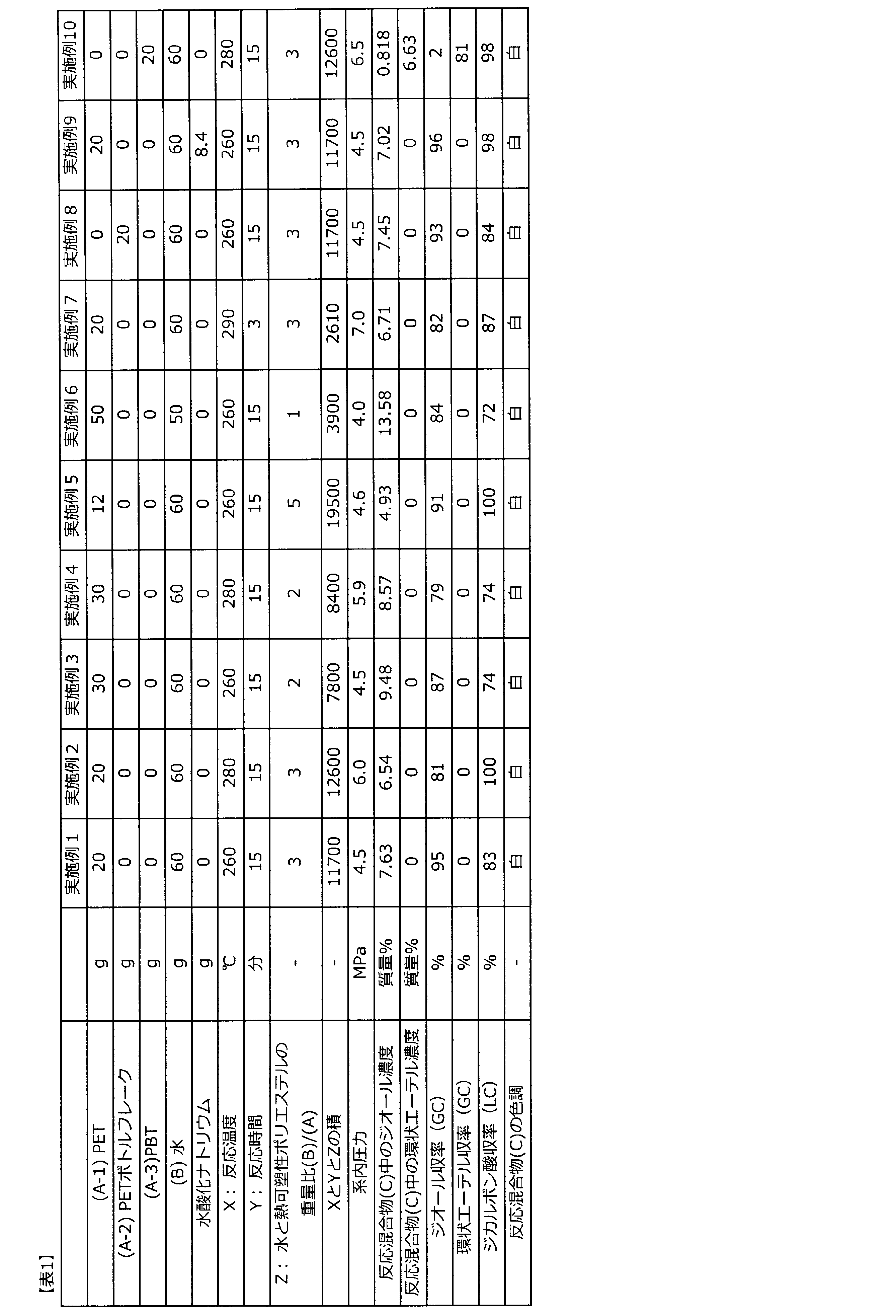

実施例1~8よりXを熱可塑性ポリエステル(A-1)および熱可塑性ポリエステル廃棄物(A-2)の融点以上300℃未満、かつXとYとZの積を2,000以上20,000以下とすることにより熱可塑性ポリエステルの解重合に要するエネルギー量を大幅に抑制しつつ、高収率でジオールおよびジカルボン酸を得られ、さらにジオールの濃度が高められた着色のない反応混合物として得られることが分かる。 From Examples 1 to 8, X is higher than the melting point of the thermoplastic polyester (A-1) and thermoplastic polyester waste (A-2) and lower than 300°C, and the product of X, Y, and Z is 2,000 or higher and 20,000. By doing the following, diols and dicarboxylic acids can be obtained in high yields while greatly suppressing the amount of energy required for depolymerization of thermoplastic polyesters, and a reaction mixture with increased diol concentration and no coloring can be obtained. I understand that.
熱可塑性ポリエステル(A-1)の融点254℃より低い240℃で反応を行った比較例1は、反応温度以外同一の条件で実施した実施例1と比較して、ジオールおよびジカルボン酸収率が半分未満と著しく低下した。これは解重合反応が固体状の熱可塑性ポリエステル(A-1)表面に限定され、反応不十分となったためと考えられる。X、Zが好ましい範囲にあるものの反応時間が短いためにXとYとZの積が2,000未満である比較例3もまた、反応の進行が不十分でありジオールおよびジカルボン酸収率は実施例1と比較して低下した。このように、XまたはXとYとZの積の少なくともいずれか一方が好ましい範囲に満たない場合、熱可塑性ポリエステルおよび/またはオリゴマーが残存し、残渣として廃棄される量が増加するため、好ましくない。 Comparative Example 1, in which the reaction was carried out at 240°C, which is lower than the melting point of thermoplastic polyester (A-1), 254°C, had lower diol and dicarboxylic acid yields than Example 1, which was carried out under the same conditions except for the reaction temperature. It decreased significantly by less than half. This is considered to be because the depolymerization reaction was limited to the surface of the solid thermoplastic polyester (A-1), resulting in an insufficient reaction. In Comparative Example 3, in which X and Z are within the preferred range, but the reaction time is short and the product of X, Y, and Z is less than 2,000, the reaction progresses insufficiently and the diol and dicarboxylic acid yields are low. It decreased compared to Example 1. In this way, if at least one of X or the product of .
300℃で反応を行った比較例2は、比熱容量の大きい水の加熱により大きなエネルギー量を要したにもかかわらず、実施例1と比較してジオール収率が低い上、着色性不純物などの過反応物量を多く含んだ反応混合物となった。XとYとZの積が20,000を超える比較例4は、X,Zが好ましい範囲であるが、長時間加熱したことで、比較例2と同様にジオール収率の低下と反応混合物の着色がみられた。このように、XまたはXとYとZの積の少なくともいずれか一方が好ましい範囲を超える場合、生成したジオールが(例えば、エチレングリコールの場合、アセトアルデヒドやジエチレングリコール、着色性不純物など)過反応物に変化するため、収率が低下する。特に、過反応物の一種であるアセトアルデヒドは、蒸留による重質分除去によってのみでは除去できず、水素添加などの追加の処理が必要になり、回収工程における設備が複雑化するとともに処理のためにさらにエネルギーを要することから、解重合反応において過反応を抑えられる条件で行うことが望ましい。 Comparative Example 2, in which the reaction was carried out at 300°C, had a lower diol yield than Example 1, even though it required a large amount of energy to heat water with a large specific heat capacity, and was free of coloring impurities. The result was a reaction mixture containing a large amount of overreactants. In Comparative Example 4, in which the product of Coloring was observed. In this way, if at least one of X or the product of As a result, the yield decreases. In particular, acetaldehyde, which is a type of overreactant, cannot be removed only by removing heavy components through distillation, and requires additional treatment such as hydrogenation, which complicates the equipment in the recovery process and increases the processing costs. Furthermore, since energy is required, it is desirable to carry out the depolymerization reaction under conditions that can suppress overreaction.
熱可塑性ポリエステル(A-1)に対する水の量が好ましい範囲を超える比較例5では、実施例1と比較して収率が低い。熱可塑性ポリエステルに対する水の量が好ましい範囲を超えることで、解重合反応の際に比熱容量が大きい水の加熱に要するエネルギー量が増える上、解重合反応に用いる設備が大型化するため、好ましくない。 In Comparative Example 5, in which the amount of water relative to the thermoplastic polyester (A-1) exceeds the preferred range, the yield is lower than in Example 1. If the amount of water relative to the thermoplastic polyester exceeds the preferred range, the amount of energy required to heat water with a large specific heat capacity during the depolymerization reaction will increase, and the equipment used for the depolymerization reaction will become larger, which is undesirable. .
実施例1と実施例9の比較により、反応温度が260℃の場合には、アルカリ性成分を配合することで、収率が向上することがわかる。 A comparison between Example 1 and Example 9 shows that when the reaction temperature is 260° C., the yield is improved by adding an alkaline component.
実施例10から、熱可塑性ポリエステルとして、ポリブチレンテレフタレートの場合においても、高収率でテレフタル酸を得ることができる。 From Example 10, terephthalic acid can be obtained in high yield even when polybutylene terephthalate is used as the thermoplastic polyester.
[参考例1]
テレフタル酸ジメチル(関東化学社製)とエチレングリコール(日本触媒社製)のエステル交換反応により予め製造しておいたビス(ヒドロキシエチル)テレフタレート123質量部を仕込んだ、温度250℃、圧力1.2×10⁵Paに保持されたエステル化反応器に、高純度テレフタル酸(三井化学社製)100質量部とエチレングリコール(日本触媒社製)45質量部のスラリーを、4時間かけて順次供給した。供給終了後もさらに1時間かけてエステル化反応を行い、エステル化反応生成物を得た。
[Reference example 1]
123 parts by mass of bis(hydroxyethyl) terephthalate, which had been produced in advance by the transesterification reaction of dimethyl terephthalate (manufactured by Kanto Kagaku Co., Ltd.) and ethylene glycol (manufactured by Nippon Shokubai Co., Ltd.), was charged at a temperature of 250°C and a pressure of 1.2 A slurry of 100 parts by mass of high-purity terephthalic acid (manufactured by Mitsui Chemicals) and 45 parts by mass of ethylene glycol (manufactured by Nippon Shokubai Co., Ltd.) was sequentially supplied over 4 hours to an esterification reactor maintained at × 10 5 Pa. . After the end of the supply, the esterification reaction was continued for another hour to obtain an esterification reaction product.
得られたエステル化反応生成物から100質量部を計量して重縮合反応器に仕込み、温度250℃で溶融、撹拌し、重縮合後に得られるポリエステル理論収量に対して、テトライソプロピルチタンをチタン原子換算で15ppmとなるように添加し、30rpmで攪拌しながら、反応系を250℃から285℃まで徐々に昇温するとともに、圧力を40Paまで下げた。最終温度、最終圧力到達までの時間はともに60分とした。所定の攪拌トルクとなった時点で反応系を窒素パージし常圧に戻し重縮合反応を停止し、冷水にストランド状に吐出、直ちにカッティングしてポリマーのペレットを得た。 100 parts by mass of the obtained esterification reaction product was weighed and charged into a polycondensation reactor, melted and stirred at a temperature of 250°C, and titanium atoms were added to tetraisopropyl titanium based on the theoretical yield of polyester obtained after polycondensation. The reaction system was gradually heated from 250° C. to 285° C. while stirring at 30 rpm, and the pressure was lowered to 40 Pa. The time to reach the final temperature and final pressure were both 60 minutes. When a predetermined stirring torque was reached, the reaction system was purged with nitrogen and returned to normal pressure to stop the polycondensation reaction, and the mixture was discharged into cold water in the form of a strand and immediately cut to obtain polymer pellets.
[実施例11]
実施例1と同様にして得た反応混合物を室温まで冷却し析出した再生テレフタル酸をろ別した。一方、上記再生テレフタル酸ろ別後のろ液から水を減圧下に除去した後、蒸留することにより再生エチレングリコールを得た。このようにして得られた再生エチレングリコールと再生テレフタル酸をエステル化反応原料として用いた以外は参考例1と同様にして、再生モノマーを55質量%含むポリエチレンテレフタレートを製造した。再生ポリエチレンテレフタレートの融点は256℃であり、色調も参考例1で得られたポリエチレンテレフタレートと同様であった。
[Example 11]
The reaction mixture obtained in the same manner as in Example 1 was cooled to room temperature, and the precipitated regenerated terephthalic acid was filtered off. On the other hand, water was removed under reduced pressure from the filtrate after filtering off the recycled terephthalic acid, and then distilled to obtain recycled ethylene glycol. Polyethylene terephthalate containing 55% by mass of recycled monomers was produced in the same manner as in Reference Example 1, except that the thus obtained recycled ethylene glycol and recycled terephthalic acid were used as raw materials for the esterification reaction. The melting point of the recycled polyethylene terephthalate was 256°C, and the color tone was also similar to that of the polyethylene terephthalate obtained in Reference Example 1.
[比較例6]
比較例2と同様にして得た再生テレフタル酸および再生エチレングリコールを用いた以外は、参考例1と同様にして再生ポリエチレンテレフタレートを製造した。得られた再生ポリエチレンテレフタレートの融点は256℃であり、淡橙色であった。
[Comparative example 6]
Regenerated polyethylene terephthalate was produced in the same manner as in Reference Example 1, except that regenerated terephthalic acid and regenerated ethylene glycol obtained in the same manner as in Comparative Example 2 were used. The melting point of the obtained recycled polyethylene terephthalate was 256°C, and the color was pale orange.
したがって、実施例9、比較例6より、本発明の解重合反応によれば着色のない高純度のジオールおよびジカルボン酸を得ることができるため、市販のジオールおよびジカルボン酸を原料に用いた場合と同等の熱可塑性ポリエステルを製造できる。 Therefore, from Example 9 and Comparative Example 6, it is possible to obtain highly pure diols and dicarboxylic acids without coloration by the depolymerization reaction of the present invention. Equivalent thermoplastic polyesters can be produced.
[第2の好ましい態様の実施例、比較例]
[実施例12]
撹拌機を具備したSUS316L製オートクレーブに、ポリエチレンテレフタレート樹脂(PET)を20.0g、脱イオン水を40.0g、水酸化ナトリウム(富士フイルム和光純薬社製)を0.01g加えた。反応容器内の窒素置換を行い、窒素加圧0.5MPaにて密閉下、300℃にて15分間200rpmで攪拌した。反応時、系内の圧力は8.0MPaであった。反応後、室温にまで冷却し、反応物を回収した。反応物を濾過後、固形物を真空ポンプ(80℃)にて乾固した。テレフタル酸を16.2g(収率94%)、安息香酸を0.1g(収率0.8%)得た。結果を表3に示した。
[Examples and comparative examples of the second preferred embodiment]
[Example 12]
20.0 g of polyethylene terephthalate resin (PET), 40.0 g of deionized water, and 0.01 g of sodium hydroxide (manufactured by Fujifilm Wako Pure Chemical Industries, Ltd.) were added to a SUS316L autoclave equipped with a stirrer. The inside of the reaction vessel was purged with nitrogen, and the mixture was stirred at 200 rpm for 15 minutes at 300° C. under a sealed nitrogen pressure of 0.5 MPa. During the reaction, the pressure in the system was 8.0 MPa. After the reaction, the reaction product was cooled to room temperature and collected. After filtering the reaction product, the solid was dried using a vacuum pump (80°C). 16.2 g (yield 94%) of terephthalic acid and 0.1 g (yield 0.8%) benzoic acid were obtained. The results are shown in Table 3.
[実施例13、14、比較例7、8]
水酸化ナトリウムの添加量を変更する以外は、実施例12と全く同様の方法でポリエチレンテレフタレート樹脂を解重合した。結果を表3に示した。
[Examples 13 and 14, Comparative Examples 7 and 8]
Polyethylene terephthalate resin was depolymerized in exactly the same manner as in Example 12, except that the amount of sodium hydroxide added was changed. The results are shown in Table 3.

実施例12~14と比較例7、8の比較により、特定量の水酸化ナトリウムを添加し、PETを解重合することで、安息香酸(テレフタル酸の過反応物)の生成を抑制し、高収率でテレフタル酸が得られることが分かる。 A comparison of Examples 12 to 14 and Comparative Examples 7 and 8 shows that by adding a specific amount of sodium hydroxide and depolymerizing PET, the formation of benzoic acid (an overreacted product of terephthalic acid) was suppressed, and a high It can be seen that terephthalic acid can be obtained in good yield.
[比較例9]
撹拌機を具備したSUS316L製オートクレーブに、ポリエチレンテレフタレート樹脂(PET)を20.0g、脱イオン水を40.0g、28%アンモニア水(富士フイルム和光純薬社製)を0.36mL加えた。反応容器内の窒素置換を行い、窒素加圧0.5MPaにて密閉下、300℃にて15分間200rpmで攪拌した。反応時、系内の圧力は8.0MPaであった。反応後、室温にまで冷却し、反応物を回収した。反応物を濾過後、固形物を真空ポンプ(80℃)にて乾固した。テレフタル酸を10.7g(収率62%)、安息香酸を2.3g(収率18%)得た。一方、濾液をGC分析したところ、エチレングルコールの収率は78%であった。結果を実施例2の結果とともに表4に示した。
[Comparative Example 9]
20.0 g of polyethylene terephthalate resin (PET), 40.0 g of deionized water, and 0.36 mL of 28% aqueous ammonia (manufactured by Fujifilm Wako Pure Chemical Industries, Ltd.) were added to a SUS316L autoclave equipped with a stirrer. The inside of the reaction vessel was purged with nitrogen, and the mixture was stirred at 200 rpm for 15 minutes at 300° C. under a sealed nitrogen pressure of 0.5 MPa. During the reaction, the pressure within the system was 8.0 MPa. After the reaction, the reaction product was cooled to room temperature and collected. After filtering the reaction product, the solid was dried using a vacuum pump (80°C). 10.7 g (yield: 62%) of terephthalic acid and 2.3 g (yield: 18%) of benzoic acid were obtained. On the other hand, when the filtrate was analyzed by GC, the yield of ethylene glycol was 78%. The results are shown in Table 4 together with the results of Example 2.
[比較例10]
撹拌機を具備したSUS316L製オートクレーブに、ポリエチレンテレフタレート樹脂(PET)を20.0g、脱イオン水を40.0g、水酸化ナトリウムを10.0g加えた。反応容器内の窒素置換を行い、窒素加圧0.5MPaにて密閉下、300℃にて15分間200rpmで攪拌した。反応時、系内の圧力は8.0MPaであった。反応後、室温にまで冷却し、反応物を回収した。反応物を濾過後、固形物を真空ポンプ(80℃)にて乾固した。テレフタル酸を15.6g(収率90%)、安息香酸を0.11g(収率0.9%)得た。一方、濾液をGC分析したところ、エチレングルコールの収率は52%であった。結果を表4に示した。
[Comparative Example 10]
20.0 g of polyethylene terephthalate resin (PET), 40.0 g of deionized water, and 10.0 g of sodium hydroxide were added to a SUS316L autoclave equipped with a stirrer. The inside of the reaction vessel was purged with nitrogen, and the mixture was stirred at 200 rpm for 15 minutes at 300° C. under a sealed nitrogen pressure of 0.5 MPa. During the reaction, the pressure within the system was 8.0 MPa. After the reaction, the reaction product was cooled to room temperature and collected. After filtering the reaction product, the solid was dried using a vacuum pump (80°C). 15.6 g (yield 90%) of terephthalic acid and 0.11 g (yield 0.9%) benzoic acid were obtained. On the other hand, when the filtrate was analyzed by GC, the yield of ethylene glycol was 52%. The results are shown in Table 4.
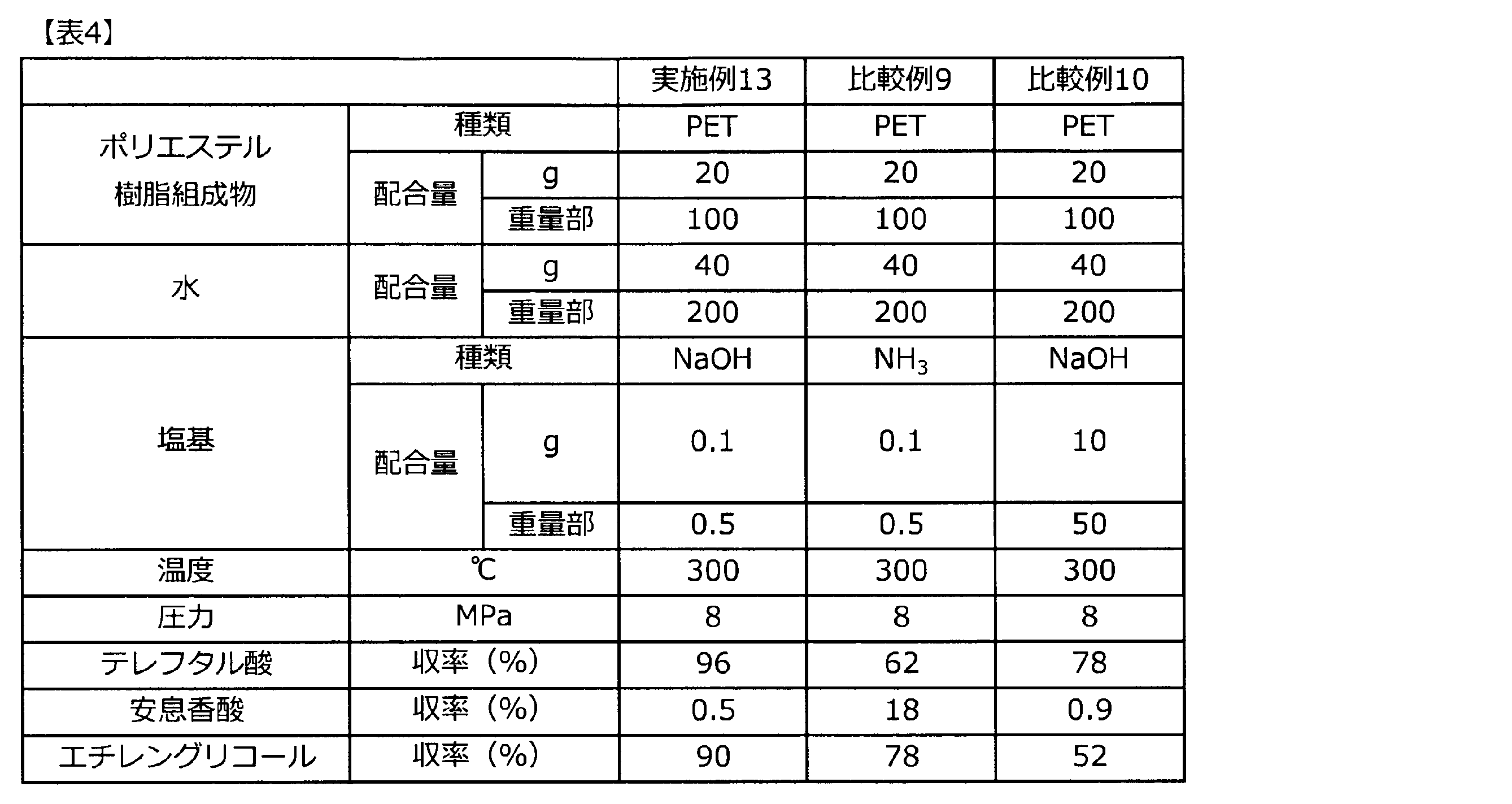
実施例13と比較例9から、アンモニア添加処方よりも水酸化ナトリウム添加処方の方が安息香酸の収率が低く、テレフタル酸およびエチレングリコールの収率が高いことが分かる。また、実施例13と比較例10から、水酸化ナトリウムの添加量が多い場合、テレフタル酸およびエチレングリコールの収率が低いことが分かる。 From Example 13 and Comparative Example 9, it can be seen that the yield of benzoic acid is lower and the yield of terephthalic acid and ethylene glycol is higher in the formulation with the addition of sodium hydroxide than with the formulation with the addition of ammonia. Further, from Example 13 and Comparative Example 10, it can be seen that when the amount of sodium hydroxide added is large, the yields of terephthalic acid and ethylene glycol are low.
[実施例15]
撹拌機を具備したSUS316L製オートクレーブに、ポリブチレンテレフタレート樹脂(PBT1)を20.0g、脱イオン水を60.0g、水酸化ナトリウムを0.1g加えた。反応容器内の窒素置換を行い、窒素加圧0.5MPaにて密閉下、280℃にて15分間200rpmで攪拌した。反応時、系内の圧力は6.3MPaであった。反応後、室温にまで冷却し、反応物を回収した。反応物を濾過後、固形物を真空ポンプ(80℃)にて乾固した。テレフタル酸を16.9g(収率98%)、安息香酸を0.03g(収率0.2%)得た。結果を表5に示した。
[Example 15]
20.0 g of polybutylene terephthalate resin (PBT1), 60.0 g of deionized water, and 0.1 g of sodium hydroxide were added to a SUS316L autoclave equipped with a stirrer. The inside of the reaction vessel was purged with nitrogen, and the mixture was stirred at 200 rpm for 15 minutes at 280° C. under a sealed nitrogen pressure of 0.5 MPa. During the reaction, the pressure in the system was 6.3 MPa. After the reaction, the reaction product was cooled to room temperature and collected. After filtering the reaction product, the solid was dried using a vacuum pump (80°C). 16.9 g (yield 98%) of terephthalic acid and 0.03 g (yield 0.2%) benzoic acid were obtained. The results are shown in Table 5.
[実施例16~21、比較例11~15]
ポリブチレンテレフタレート樹脂組成物の種類、水酸化ナトリウムの添加量を変更する以外は、実施例15と全く同様の方法でポリブチレンテレフタレート樹脂組成物を解重合した。結果を表5に示した。
[Examples 16 to 21, Comparative Examples 11 to 15]
A polybutylene terephthalate resin composition was depolymerized in exactly the same manner as in Example 15, except that the type of polybutylene terephthalate resin composition and the amount of sodium hydroxide added were changed. The results are shown in Table 5.

比較例11と比較例12~15から、PBTに酸化防止剤、耐候剤を配合することで安息香酸の収率が増加し、テレフタル酸の収率が低下することが分かる。また、比較例12~15と実施例16~21から、添加剤を配合したPBTにおいても、水酸化ナトリウムを添加することで、安息香酸の収率が低下し、テレフタル酸の収率が向上することが分かる。 Comparative Example 11 and Comparative Examples 12 to 15 show that by blending an antioxidant and a weathering agent with PBT, the yield of benzoic acid increases and the yield of terephthalic acid decreases. Furthermore, from Comparative Examples 12 to 15 and Examples 16 to 21, even in PBT containing additives, the addition of sodium hydroxide reduces the yield of benzoic acid and improves the yield of terephthalic acid. I understand that.
[実施例22]
撹拌機を具備したSUS316L製オートクレーブに、ポリブチレンテレフタレート樹脂組成物(PBT5)を20.0g、脱イオン水を60.0g、水酸化ナトリウムを0.1g加えた。反応容器内の窒素置換を行い、窒素加圧0.5MPaにて密閉下、260℃にて15分間200rpmで攪拌した。反応時、系内の圧力は5.0MPaであった。反応後、室温にまで冷却し、反応物を回収した。反応物を濾過後、固形物を真空ポンプ(80℃)にて乾固した。テレフタル酸を15.6g(収率90%)、安息香酸を0.03g(収率0.2%)得た。結果を実施例20の結果とともに表6に示した。
[Example 22]
20.0 g of polybutylene terephthalate resin composition (PBT5), 60.0 g of deionized water, and 0.1 g of sodium hydroxide were added to a SUS316L autoclave equipped with a stirrer. The inside of the reaction vessel was purged with nitrogen, and the mixture was stirred at 200 rpm for 15 minutes at 260° C. under a sealed nitrogen pressure of 0.5 MPa. During the reaction, the pressure in the system was 5.0 MPa. After the reaction, the reaction product was cooled to room temperature and collected. After filtering the reaction product, the solid was dried using a vacuum pump (80°C). 15.6 g (yield 90%) of terephthalic acid and 0.03 g (yield 0.2%) benzoic acid were obtained. The results are shown in Table 6 together with the results of Example 20.
[実施例23]
温度を変更する以外は、実施例22と全く同様の方法で、ポリブチレンテレフタレート樹脂組成物を解重合した。結果を表6に示した。
[Example 23]
A polybutylene terephthalate resin composition was depolymerized in exactly the same manner as in Example 22, except for changing the temperature. The results are shown in Table 6.

実施例22と実施例20の比較から、温度を260℃から280℃に上昇することでテレフタル酸の収率が向上することが分かる。実施例20と実施例23の比較から、温度を280から300℃に上昇することで、安息香酸の収率が増加し、テレフタル酸の収率が低下することが分かる。従って、温度が280℃の時、テレフタル酸収率が最も高くなることが分かる。 A comparison between Example 22 and Example 20 shows that increasing the temperature from 260°C to 280°C improves the yield of terephthalic acid. A comparison between Example 20 and Example 23 shows that by increasing the temperature from 280 to 300°C, the yield of benzoic acid increases and the yield of terephthalic acid decreases. Therefore, it can be seen that the yield of terephthalic acid is highest when the temperature is 280°C.
[実施例24]
撹拌機を具備したSUS316L製オートクレーブに、ポリブチレンテレフタレート樹脂(PBT5)を20.0g、脱イオン水を40.0g、水酸化ナトリウムを0.1g加えた。反応容器内の窒素置換を行い、窒素加圧0.5MPaにて密閉下、280℃にて15分間200rpmで攪拌した。反応時、系内の圧力は6.3MPaであった。反応後、室温にまで冷却し、反応物を回収した。反応物を濾過後、固形物を真空ポンプ(80℃)にて乾固した。テレフタル酸を14.3g(収率83%)、安息香酸を0.01g(収率0.1%)得た。結果を実施例20の結果とともに表7に示した。
[Example 24]
20.0 g of polybutylene terephthalate resin (PBT5), 40.0 g of deionized water, and 0.1 g of sodium hydroxide were added to a SUS316L autoclave equipped with a stirrer. The inside of the reaction vessel was purged with nitrogen, and the mixture was stirred at 200 rpm for 15 minutes at 280° C. under a sealed nitrogen pressure of 0.5 MPa. During the reaction, the pressure in the system was 6.3 MPa. After the reaction, the reaction product was cooled to room temperature and collected. After filtering the reaction product, the solid was dried using a vacuum pump (80°C). 14.3 g (yield: 83%) of terephthalic acid and 0.01 g (yield: 0.1%) of benzoic acid were obtained. The results are shown in Table 7 together with the results of Example 20.
[実施例25]
ポリブチレンテレフタレート樹脂組成物の配合量、水の配合量を変更する以外は、実施例24と全く同様の方法でポリブチレンテレフタレート樹脂組成物を得た。結果を表7に示した。
[Example 25]
A polybutylene terephthalate resin composition was obtained in exactly the same manner as in Example 24, except that the blending amount of the polybutylene terephthalate resin composition and the blending amount of water were changed. The results are shown in Table 7.

実施例24と実施例20の比較により、水の配合量を200重量部から300重量部に増加することで、テレフタル酸の収率が向上することが分かる。実施例20と実施例25の比較から、水の配合量を300重量部から800重量部に増加することで、テレフタル酸の収率が低下することが分かる。従って、水の配合量が300重量部の時、テレフタル酸収率が最も高くなることが分かる。 A comparison between Example 24 and Example 20 shows that the yield of terephthalic acid is improved by increasing the amount of water blended from 200 parts by weight to 300 parts by weight. A comparison between Example 20 and Example 25 shows that the yield of terephthalic acid decreases by increasing the amount of water blended from 300 parts by weight to 800 parts by weight. Therefore, it can be seen that the yield of terephthalic acid is highest when the amount of water is 300 parts by weight.
[第3の好ましい態様の実施例、比較例]
[実施例26]
撹拌機を具備したSUS316L製オートクレーブに、ポリエチレンテレフタレート10.0g、ポリブチレンテレフタレート10.0gを含むポリエステル混合物と、脱イオン水50.0gを仕込んだ。反応容器の窒素置換を行い、窒素加圧0.3MPa下に密閉した後、200rpmで撹拌しながら260℃で15分間保持し反応を行った。反応時、系内の圧力は4.8MPaであった。反応終了後、室温まで冷却し、白色の析出成分を濾過により回収した。回収した析出成分の高速液体クロマトグラフィー測定により算出したテレフタル酸収率を表8に示した。テレフタル酸収率は90%、エチレングリコール収率は83%であった。
[Example and comparative example of the third preferred embodiment]
[Example 26]
A polyester mixture containing 10.0 g of polyethylene terephthalate and 10.0 g of polybutylene terephthalate and 50.0 g of deionized water were charged into a SUS316L autoclave equipped with a stirrer. After purging the reaction vessel with nitrogen and sealing it under a nitrogen pressure of 0.3 MPa, the reaction vessel was maintained at 260° C. for 15 minutes while stirring at 200 rpm to carry out the reaction. During the reaction, the pressure in the system was 4.8 MPa. After the reaction was completed, the mixture was cooled to room temperature and a white precipitated component was collected by filtration. Table 8 shows the terephthalic acid yield calculated by high performance liquid chromatography measurement of the recovered precipitated components. The yield of terephthalic acid was 90%, and the yield of ethylene glycol was 83%.
[実施例27]
脱イオン水を30.0gに変更する以外は、実施例26と全く同様にポリエステル混合物の加水分解を行った。結果を表8に示した。テレフタル酸収率は88%、エチレングリコール収率は82%であった。
[Example 27]
The polyester mixture was hydrolyzed in exactly the same manner as in Example 26, except that the amount of deionized water was changed to 30.0 g. The results are shown in Table 8. The yield of terephthalic acid was 88%, and the yield of ethylene glycol was 82%.
[実施例28]
脱イオン水を100gに変更する以外は、実施例26と全く同様にポリエステル混合物の加水分解を行った。結果を表8に示した。テレフタル酸収率は95%、エチレングリコール収率は88%であった。
[Example 28]
The polyester mixture was hydrolyzed in exactly the same manner as in Example 26, except that the amount of deionized water was changed to 100 g. The results are shown in Table 8. The yield of terephthalic acid was 95% and the yield of ethylene glycol was 88%.
[実施例29]
ポリマーを含む組成物をポリエチレンテレフタレート19.0g、ポリブチレンテレフタレート1.0g含むポリエステル混合物に変更する以外は、実施例26と全く同様に加水分解を行った。結果を表8に示した。テレフタル酸収率は85%、エチレングリコール収率は78%であった。
[Example 29]
Hydrolysis was carried out in exactly the same manner as in Example 26, except that the composition containing the polymer was changed to a polyester mixture containing 19.0 g of polyethylene terephthalate and 1.0 g of polybutylene terephthalate. The results are shown in Table 8. The yield of terephthalic acid was 85% and the yield of ethylene glycol was 78%.
[実施例30]
ポリマーを含む組成物をポリエチレンテレフタレート19.8g、ポリブチレンテレフタレート0.2g含むポリエステル混合物に変更する以外は、実施例26と全く同様に加水分解を行った。結果を表8に示した。テレフタル酸収率は82%、エチレングリコール収率は76%であった。
[Example 30]
Hydrolysis was carried out in exactly the same manner as in Example 26, except that the composition containing the polymer was changed to a polyester mixture containing 19.8 g of polyethylene terephthalate and 0.2 g of polybutylene terephthalate. The results are shown in Table 8. The yield of terephthalic acid was 82% and the yield of ethylene glycol was 76%.
[実施例31]
反応温度を290℃に変更する以外は、実施例26と全く同様にポリエステル混合物の加水分解を行った。結果を表8に示した。テレフタル酸収率は98%、エチレングリコール収率は90%であった。
[Example 31]
The polyester mixture was hydrolyzed in exactly the same manner as in Example 26, except that the reaction temperature was changed to 290°C. The results are shown in Table 8. The yield of terephthalic acid was 98% and the yield of ethylene glycol was 90%.
[実施例32]
窒素加圧を8.5MPaに変更する以外は、実施例26と全く同様にポリエステル混合物の加水分解を行った。結果を表8に示した。テレフタル酸収率は97%、エチレングリコール収率は90%であった。
[Example 32]
The polyester mixture was hydrolyzed in exactly the same manner as in Example 26, except that the nitrogen pressure was changed to 8.5 MPa. The results are shown in Table 8. The yield of terephthalic acid was 97% and the yield of ethylene glycol was 90%.
[実施例33]
ポリマーを含む組成物をポリブチレンテレフタレート16.0g、ポリカーボネート4.0gを含む混合物、反応温度を250℃に変更する以外は、実施例26と全く同様に加水分解を行った。結果を表8に示した。テレフタル酸収率は85%であった。
[Example 33]
Hydrolysis was carried out in exactly the same manner as in Example 26, except that the composition containing the polymer was changed to a mixture containing 16.0 g of polybutylene terephthalate and 4.0 g of polycarbonate, and the reaction temperature was changed to 250°C. The results are shown in Table 8. The yield of terephthalic acid was 85%.
[実施例34]
ポリマーを含む組成物をポリエチレンテレフタレート18.0g、ポリウレタンウレア2.0gを含む混合物に変更する以外は、実施例26と全く同様に加水分解を行った。結果を表8に示した。テレフタル酸収率は84%、エチレングリコール収率は74%であった。
[Example 34]
Hydrolysis was carried out in exactly the same manner as in Example 26, except that the composition containing the polymer was changed to a mixture containing 18.0 g of polyethylene terephthalate and 2.0 g of polyurethaneurea. The results are shown in Table 8. The yield of terephthalic acid was 84% and the yield of ethylene glycol was 74%.
[実施例35]
さらに水酸化ナトリウム7.7gを添加する以外は、実施例34と全く同様に加水分解を行った。得られた加水分解物に脱イオン水を100g添加し、生成したテレフタル酸二ナトリウムを全量溶解させた。これをろ過した後、水溶液に塩酸を添加し、析出したテレフタル酸を回収した。結果を表8に示した。テレフタル酸収率は95%、エチレングリコール収率は93%であった。
[Example 35]
Hydrolysis was carried out in exactly the same manner as in Example 34, except that 7.7 g of sodium hydroxide was further added. 100 g of deionized water was added to the obtained hydrolyzate, and the entire amount of produced disodium terephthalate was dissolved. After filtering this, hydrochloric acid was added to the aqueous solution, and the precipitated terephthalic acid was recovered. The results are shown in Table 8. The yield of terephthalic acid was 95% and the yield of ethylene glycol was 93%.
[実施例36]
反応温度を230℃変更する以外は、実施例35と全く同様に加水分解を行った。結果を表8に示した。テレフタル酸収率は92%、エチレングリコール収率は90%であった。
[Example 36]
Hydrolysis was carried out in exactly the same manner as in Example 35, except that the reaction temperature was changed to 230°C. The results are shown in Table 8. The yield of terephthalic acid was 92% and the yield of ethylene glycol was 90%.
[比較例16]
反応温度を240℃に変更する以外は、実施例26と全く同様にポリエステル混合物の加水分解を行った。結果を表9に示した。テレフタル酸収率は10%、エチレングリコール収率は8%であった。
[Comparative example 16]
The polyester mixture was hydrolyzed in exactly the same manner as in Example 26, except that the reaction temperature was changed to 240°C. The results are shown in Table 9. The yield of terephthalic acid was 10%, and the yield of ethylene glycol was 8%.
[比較例17]
ポリマーを含む組成物をポリエチレンテレフタレート20.0gのみに変更する以外は、実施例26と全く同様に加水分解を行った。結果を表9に示した。テレフタル酸収率は78%、エチレングリコール収率は72%であった。
[Comparative Example 17]
Hydrolysis was carried out in exactly the same manner as in Example 26, except that the composition containing the polymer was changed to only 20.0 g of polyethylene terephthalate. The results are shown in Table 9. The yield of terephthalic acid was 78%, and the yield of ethylene glycol was 72%.
[比較例18]
ポリマーをポリエチレンテレフタレート20.0gのみ、脱イオン水を30gに変更する以外は、実施例26と全く同様に加水分解を行った。結果を表9に示した。テレフタル酸収率は73%、エチレングリコール収率は68%であった。
[Comparative example 18]
Hydrolysis was carried out in exactly the same manner as in Example 26, except that the polymer was changed to 20.0 g of polyethylene terephthalate and the deionized water was changed to 30 g. The results are shown in Table 9. The yield of terephthalic acid was 73% and the yield of ethylene glycol was 68%.
[比較例19]
ポリマーをポリブチレンテレフタレート20.0gのみ、反応温度を250℃に変更する以外は、実施例26と全く同様に加水分解を行った。結果を表9に示した。テレフタル酸収率は75%であった。
[Comparative example 19]
Hydrolysis was carried out in exactly the same manner as in Example 26, except that 20.0 g of polybutylene terephthalate was used as the polymer and the reaction temperature was changed to 250°C. The results are shown in Table 9. The yield of terephthalic acid was 75%.
[比較例20]
ポリマーを含む組成物をポリエチレンテレフタレート19.92g、ポリブチレンテレフタレート0.08g含むポリエステル混合物に変更する以外は、実施例26と全く同様に加水分解を行った。結果を表9に示した。テレフタル酸収率は79%、エチレングリコール収率は72%であった。
[Comparative example 20]
Hydrolysis was carried out in exactly the same manner as in Example 26, except that the composition containing the polymer was changed to a polyester mixture containing 19.92 g of polyethylene terephthalate and 0.08 g of polybutylene terephthalate. The results are shown in Table 9. The yield of terephthalic acid was 79%, and the yield of ethylene glycol was 72%.


実施例26、29、30と比較例17との比較、及び実施例27と比較例18との比較から、PETとPBTを同時に加水分解することにより、リサイクルモノマーの収率が向上することがわかる。 A comparison between Examples 26, 29, and 30 and Comparative Example 17, and a comparison between Example 27 and Comparative Example 18 shows that the yield of recycled monomers is improved by simultaneously hydrolyzing PET and PBT. .
実施例33と比較例19の比較から、PBTとPCを同時に加水分解することにより、テレフタル酸の収率が向上することがわかる。 A comparison between Example 33 and Comparative Example 19 shows that the yield of terephthalic acid is improved by simultaneously hydrolyzing PBT and PC.
実施例26、31と比較例16の比較から、反応温度上昇により、リサイクルモノマーの収率が向上することがわかる。 A comparison between Examples 26 and 31 and Comparative Example 16 shows that the yield of recycled monomers improves as the reaction temperature increases.
実施例26、28の比較から、加水分解における水の配合量を適切に増加することにより、リサイクルモノマーの収率が向上することがわかる。 A comparison of Examples 26 and 28 shows that the yield of recycled monomers can be improved by appropriately increasing the amount of water in hydrolysis.
実施例26、32の比較から、加水分解における圧力を適切に増加することにより、リサイクルモノマーの収率が向上することがわかる。 A comparison of Examples 26 and 32 shows that the yield of recycled monomers can be improved by appropriately increasing the pressure during hydrolysis.
比較例17と比較例20の比較から、PET100重量部、PBT0.4重量部のポリマー混合物を同時に加水分解した場合のリサイクルモノマーの収率は、PET単体を加水分解した場合と、ほぼ同等であることがわかる。 From a comparison of Comparative Example 17 and Comparative Example 20, the yield of recycled monomer when a polymer mixture of 100 parts by weight of PET and 0.4 parts by weight of PBT is simultaneously hydrolyzed is almost the same as when PET alone is hydrolyzed. I understand that.
実施例34と比較例17の比較から、PETとPUを同時に加水分解することにより、リサイクルモノマーの収率が向上することがわかる。 A comparison between Example 34 and Comparative Example 17 shows that the yield of recycled monomers is improved by simultaneously hydrolyzing PET and PU.
実施例34と実施例35の比較から、水酸化ナトリウムを添加して加水分解することにより、高収率でリサイクルモノマーが得られることがわかる。 A comparison between Example 34 and Example 35 shows that recycled monomers can be obtained in high yield by adding sodium hydroxide and performing hydrolysis.
実施例35と実施例36の比較から、アルカリ性成分を配合した場合には、反応温度を低下させても、高収率でリサイクルモノマーが得られることがわかる。 A comparison between Example 35 and Example 36 shows that when an alkaline component is blended, recycled monomers can be obtained in high yield even if the reaction temperature is lowered.
[参考例2]
テレフタル酸ジメチル(関東化学社製)とエチレングリコール(日本触媒社製)のエステル交換反応により予め製造しておいたビス(ヒドロキシエチル)テレフタレート123重量部を仕込んだ。温度250℃、圧力1.2×10⁵Paに保持されたエステル化反応器に、高純度テレフタル酸(三井化学社製)100重量部とエチレングリコール(日本触媒社製)45重量部のスラリーを、4時間かけて順次供給した。供給終了後もさらに1時間かけてエステル化反応を行い、エステル化反応生成物を得た。
[Reference example 2]
123 parts by weight of bis(hydroxyethyl) terephthalate, which had been previously produced by transesterification of dimethyl terephthalate (manufactured by Kanto Kagaku Co., Ltd.) and ethylene glycol (manufactured by Nippon Shokubai Co., Ltd.), was charged. A slurry of 100 parts by weight of high-purity terephthalic acid (manufactured by Mitsui Chemicals) and 45 parts by weight of ethylene glycol (manufactured by Nippon Shokubai) was placed in an esterification reactor maintained at a temperature of 250°C and a pressure of 1.2 x 10 Pa. It was supplied sequentially over time. After the end of the supply, the esterification reaction was continued for another hour to obtain an esterification reaction product.
得られたエステル化反応生成物から100重量部を計量して重縮合反応器に仕込み、温度250℃で溶融、撹拌し、重縮合後に得られるポリエステル理論収量に対して、テトライソプロピルチタンをチタン原子換算で15ppmとなるように添加し、30rpmで攪拌しながら、反応系を250℃から285℃まで徐々に昇温するとともに、圧力を40Paまで下げた。最終温度、最終圧力到達までの時間はともに60分とした。所定の攪拌トルクとなった時点で反応系を窒素パージし常圧に戻し重縮合反応を停止し、冷水にストランド状に吐出、直ちにカッティングしてポリマーのペレットを得た。このポリマーの融点は254℃であった。 100 parts by weight of the obtained esterification reaction product was weighed and charged into a polycondensation reactor, melted and stirred at a temperature of 250°C, and titanium atoms were added to tetraisopropyl titanium based on the theoretical yield of polyester obtained after polycondensation. The reaction system was gradually heated from 250° C. to 285° C. while stirring at 30 rpm, and the pressure was lowered to 40 Pa. The time to reach the final temperature and final pressure were both 60 minutes. When a predetermined stirring torque was reached, the reaction system was purged with nitrogen and returned to normal pressure to stop the polycondensation reaction, and the mixture was discharged into cold water in the form of a strand and immediately cut to obtain polymer pellets. The melting point of this polymer was 254°C.
[実施例37]
実施例1の加水分解後、室温で析出した成分として、テレフタル酸、モノヒドロキシエチルテレフタレート、安息香酸が検出された。モノヒドロキシエチルテレフタレートは、ポリエチレンテレフタレートの重合前駆体なため、重合原料として活用可能である。一方、安息香酸は、重合時に末端封鎖剤として重合阻害する可能性があるため、析出成分を熱エタノール中で3回洗浄し、安息香酸を除去した。この方法で、テレフタル酸とモノヒドロキシエチルテレフタレートの混合物(重量比89:11)を回収した。
[Example 37]
After the hydrolysis of Example 1, terephthalic acid, monohydroxyethyl terephthalate, and benzoic acid were detected as components precipitated at room temperature. Since monohydroxyethyl terephthalate is a polymerization precursor of polyethylene terephthalate, it can be used as a polymerization raw material. On the other hand, since benzoic acid may act as an end-blocking agent during polymerization and inhibit polymerization, the precipitated components were washed three times in hot ethanol to remove benzoic acid. In this way a mixture of terephthalic acid and monohydroxyethyl terephthalate (weight ratio 89:11) was recovered.
また、実施例26の加水分解により得られた水溶性成分を蒸留することでエチレングリコールを回収した。 Furthermore, ethylene glycol was recovered by distilling the water-soluble component obtained by the hydrolysis in Example 26.
テレフタル酸ジメチル(関東化学社製)とエチレングリコール(日本触媒社製)のエステル交換反応により予め製造しておいたビス(ヒドロキシエチル)テレフタレート123重量部を仕込んだ。温度250℃、圧力1.2×10⁵Paに保持されたエステル化反応器に、上記方法で回収したテレフタル酸とモノヒドロキシエチルテレフタレートの混合物(リサイクルモノマー)102重量部とエチレングリコール(リサイクルモノマー)42重量部のスラリーを、4時間かけて順次供給した。供給終了後もさらに1時間かけてエステル化反応を行い、エステル化反応生成物を得た。 123 parts by weight of bis(hydroxyethyl) terephthalate, which had been previously produced by transesterification of dimethyl terephthalate (manufactured by Kanto Kagaku Co., Ltd.) and ethylene glycol (manufactured by Nippon Shokubai Co., Ltd.), was charged. Into an esterification reactor maintained at a temperature of 250°C and a pressure of 1.2 x 10 Pa, 102 parts by weight of the mixture of terephthalic acid and monohydroxyethyl terephthalate (recycled monomer) recovered by the above method and 42 parts by weight of ethylene glycol (recycled monomer) were added. parts of the slurry were fed sequentially over a period of 4 hours. After the end of the supply, the esterification reaction was continued for another hour to obtain an esterification reaction product.
得られたエステル化反応生成物から100重量部を計量して重縮合反応器に仕込み、温度250℃で溶融、撹拌し、重縮合後に得られるポリエステル理論収量に対して、テトライソプロピルチタンをチタン原子換算で15ppmとなるように添加し、30rpmで攪拌しながら、反応系を250℃から285℃まで徐々に昇温するとともに、圧力を40Paまで下げた。最終温度、最終圧力到達までの時間はともに60分とした。所定の攪拌トルクとなった時点で反応系を窒素パージし常圧に戻し重縮合反応を停止し、冷水にストランド状に吐出、直ちにカッティングしてポリマーのペレットを得た。このポリマーの融点は254℃であり、参考例2と同じであった。 100 parts by weight of the obtained esterification reaction product was weighed and charged into a polycondensation reactor, melted and stirred at a temperature of 250°C, and titanium atoms were added to tetraisopropyl titanium based on the theoretical yield of polyester obtained after polycondensation. The reaction system was gradually heated from 250° C. to 285° C. while stirring at 30 rpm, and the pressure was lowered to 40 Pa. The time to reach the final temperature and final pressure were both 60 minutes. When a predetermined stirring torque was reached, the reaction system was purged with nitrogen and returned to normal pressure to stop the polycondensation reaction, and the mixture was discharged into cold water in the form of a strand and immediately cut to obtain polymer pellets. The melting point of this polymer was 254°C, which was the same as Reference Example 2.
[リサイクルモノマーの製造装置、および第4の好ましい態様の実施例、比較例]
[実施例38]
図1に示したリサイクルモノマーの製造装置を使用した。熱可塑性ポリマーを含む組成物を加熱および加圧して供給する手段(L)として、押出機2を使用した。亜臨界水を生成し供給する手段(M)として、高圧ポンプ4および電気加熱器5を使用した。押出機2および電気加熱器5の加熱温度は押出機・電気加熱器温度制御装置14を用いて設定温度になるように制御した。上記手段(L)から供給された上記熱可塑性ポリマーを含む組成物と上記手段(M)から供給された上記亜臨界水を混合する手段(N)として、スタティックミキサー6を使用した。上記手段(N)に接続された加水分解を行う連続反応器(O)として、外部ジャケットに向流で熱媒を流すことができる管型連続反応器7および管型連続反応器8を直列に配置して使用した。
[Recycled monomer manufacturing apparatus, and examples and comparative examples of the fourth preferred embodiment]
[Example 38]
The recycled monomer manufacturing apparatus shown in FIG. 1 was used. An
原料の熱可塑性ポリマーを含む組成物として、ポリエチレンテレフタレート(PET-A)を原料ホッパー1に投入し、押出機2を使用してPET-Aを溶融し加圧した。PET-Aの温度は281℃、圧力は20MPa、供給量は13.0g/minとした。水タンク3に脱イオン水を溜めておき、高圧ポンプ4を使用して加圧、電気加熱器5を使用して加熱し亜臨界水とした。亜臨界水の温度は281℃、圧力は20MPa、供給量は39.0g/minとした。亜臨界水と熱可塑性ポリマーを含む組成物中の熱可塑性ポリマー成分の質量流量比(X:1)は3:1であった。加熱溶融し加圧した熱可塑性ポリマーを含む組成物を、亜臨界水の流れと合流させ、エレメント数24のスタティックミキサー6に供給した。スタティックミキサー6から排出された溶液は、内径2.3cm、長さ250cmの管型連続反応器7に供給され、管型連続反応器7から排出された溶液は内径2.3cm、長さ250cmの管型連続反応器8に供給された。
As a composition containing a thermoplastic polymer as a raw material, polyethylene terephthalate (PET-A) was charged into a
管型連続反応器7の入口から5cmの位置に、連続反応器(O)の上流部の温度をモニタリングする連続反応器上流部温度モニタリング装置12が挿入され、管型連続反応器8の出口から5cmの位置に連続反応器(O)の下流部の温度をモニタリングする連続反応器下流部温度モニタリング装置13が挿入された。連続反応器上流部温度モニタリング装置12からの信号を基にして、管型連続反応器7の連続反応器温度調整機構15により管型連続反応器7のジャケットに供給される熱媒の流量および温度が調整された。連続反応器上流部温度モニタリング装置12および連続反応器下流部温度モニタリング装置13からの信号を基にして、管型連続反応器8の連続反応器温度調整機構16により管型連続反応器8のジャケットに供給される熱媒の流量および温度が調整された。連続反応器上流部温度モニタリング装置12の温度は280℃、連続反応器下流部温度モニタリング装置13の温度は240℃となった。
A continuous reactor upstream
また、連続反応器(O)の平均滞留時間Zは30分であった。XとYの積、およびXとYとZの積は、表10のとおりであった。 Moreover, the average residence time Z of the continuous reactor (O) was 30 minutes. The product of X and Y and the product of X, Y and Z were as shown in Table 10.
管型連続反応器8から排出された反応溶液は熱交換器9で冷却水と熱交換され40℃まで冷却された。その後、背圧弁10により20MPaから大気圧まで反応溶液が放圧され、反応溶液タンク11に溜められた。
The reaction solution discharged from the tubular
反応溶液タンク11に溜められた反応溶液を室温まで冷まし、吸引濾過を実施して固形分(テレフタル酸)を回収し、溶液(エチレングリコール水溶液)と分離した。固形分重量およびHPLC分析結果から、テレフタル酸のモル収率は98%であった。一方、溶液の重量およびGC分析結果から、エチレングリコールのモル収率は80%であった。
The reaction solution stored in the

[実施例39]
連続反応器下流部温度モニタリング装置13の温度の設定以外は実施例38と同様にしてリサイクルモノマーの製造装置を運転したところ、結果は表10に示すようになった。
[Example 39]
The recycled monomer manufacturing apparatus was operated in the same manner as in Example 38 except for setting the temperature of the continuous reactor downstream
[実施例40]
連続反応器下流部温度モニタリング装置13の温度の設定以外は実施例38と同様にしてリサイクルモノマーの製造装置を運転したところ、結果は表10に示すようになった。
[Example 40]
The recycled monomer manufacturing apparatus was operated in the same manner as in Example 38 except for setting the temperature of the continuous reactor downstream
[実施例41]
図2に示したリサイクルモノマーの製造装置を使用した。図2に示す装置は図1に示す装置に対して、管型連続反応器7および連続反応器温度調整機構15が1つであることが特徴である。管型連続反応器7の入口から5cmの位置に、連続反応器(O)の上流部の温度をモニタリングする連続反応器上流部温度モニタリング装置12が挿入され、管型連続反応器7の出口から5cmの位置に連続反応器(O)の下流部の温度をモニタリングする連続反応器下流部温度モニタリング装置13が挿入された。図2に示す装置で管型連続反応器7の上流部および下流部の内部温度をどちらも280℃に保つように連続反応器温度調整機構15を設定し、管型連続反応器8に流す熱媒の流量および温度を制御した。その他の条件は表10に示す通りとし、図2に示すリサイクルモノマーの製造装置を運転したところ、結果は表10に示すようになった。温度を280℃に保って運転することにより、加水分解反応が素早く進むため、実施例38に対して短い滞留時間で処理することが可能であるが、反応後期において、特にテレフタル酸の再重合反応を抑制することが難しいため、テレフタル酸のモル収率が減少したものと推測される。なお、エチレングリコールのモル収率は他の実施例と同程度であった。
[Example 41]
The recycled monomer manufacturing apparatus shown in FIG. 2 was used. The apparatus shown in FIG. 2 is different from the apparatus shown in FIG. 1 in that it has one tubular
[実施例42]
図2に示したリサイクルモノマーの製造装置を使用した。図2に示す装置で管型連続反応器7の上流部の温度を280℃近くに保ち、管型連続反応器下流部の温度を240℃となるように連続反応器温度調整機構15を設定した。このとき、管型連続反応器8内に温度勾配が発生するように熱媒流量を減少させるように制御した。その他の条件は表10に示す通りとし、図2に示すリサイクルモノマーの製造装置を運転したところ、結果は表10に示すようになった。温度調整機構がひとつであることにより、最高温度を保つ時間が短くなるため、実施例38に対してテレフタル酸のモル収率が減少したものと推測される。
[Example 42]
The recycled monomer manufacturing apparatus shown in FIG. 2 was used. In the apparatus shown in FIG. 2, the continuous reactor
[実施例43]
熱可塑性ポリマー含む組成物をPET-Bとした以外は実施例38と同様にしてリサイクルモノマーの製造装置を運転したところ、結果は表10に示すようになった。対象とする熱可塑性ポリマー含む組成物をポリエチレンテレフタレート樹脂の廃棄物としても、実施例38と同様にリサイクルモノマーを製造することが出来ることが示された。
[Example 43]
The recycled monomer manufacturing apparatus was operated in the same manner as in Example 38 except that PET-B was used as the composition containing the thermoplastic polymer, and the results were as shown in Table 10. It was shown that a recycled monomer could be produced in the same manner as in Example 38 even if the target thermoplastic polymer-containing composition was used as waste polyethylene terephthalate resin.
1 原料ホッパー
2 押出機
3 水タンク
4 高圧ポンプ
5 電気加熱器
6 スタティックミキサー
7 管型連続反応器
8 管型連続反応器
9 熱交換器
10 背圧弁
11 反応溶液タンク
12 連続反応器上流部温度モニタリング装置
13 連続反応器下流部温度モニタリング装置
14 押出機・電気加熱器温度制御装置
15 連続反応器温度調整機構
16 連続反応器温度調整機構
1
Claims (14)
ポリマーを含む組成物が、ポリマーIとポリマーIIを含み、
ポリマーIが熱可塑性ポリエステル(A)であり、
ポリマーIIが熱可塑性ポリエステル(A)とは異なる融点の熱可塑性ポリエステル(B)、ポリカーボネートおよびポリウレタンからなる群から選ばれる1種のポリマーまたはそれらポリマーの組合せであり、
組成物中におけるポリマーIIの含有量(熱可塑性ポリエステル(B)、ポリカーボネートおよびポリウレタンの含有量の合計)が、ポリマーI100重量部に対して、1~100重量部であり、
組成物中におけるポリマーIとポリマーIIを同時に、250~350℃の亜臨界水と接触させる工程を有するリサイクルモノマーの製造方法。 A method for producing a recycled monomer comprising the step of contacting a composition containing a polymer with subcritical water, the method comprising:
a composition comprising a polymer, comprising a polymer I and a polymer II;
Polymer I is a thermoplastic polyester (A),
Polymer II is one type of polymer selected from the group consisting of a thermoplastic polyester (B) having a melting point different from that of the thermoplastic polyester (A), polycarbonate, and polyurethane, or a combination of these polymers,
The content of Polymer II in the composition (the total content of thermoplastic polyester (B), polycarbonate and polyurethane) is 1 to 100 parts by weight based on 100 parts by weight of Polymer I,
A method for producing a recycled monomer, comprising the step of simultaneously contacting Polymer I and Polymer II in a composition with subcritical water at 250 to 350°C.
ポリマーを含む組成物が、ポリマーIとポリマーIIを含み、
ポリマーIが熱可塑性ポリエステル(A)であり、
ポリマーIIが熱可塑性ポリエステル(A)とは異なる融点の熱可塑性ポリエステル(B)、ポリカーボネートおよびポリウレタンからなる群から選ばれる1種のポリマーまたはそれらポリマーの組合せであり、
組成物中におけるポリマーIIの含有量(熱可塑性ポリエステル(B)、ポリカーボネートおよびポリウレタンの含有量の合計)が、ポリマーI100重量部に対して、1~100重量部であり、
組成物中におけるポリマーIとポリマーIIを、アルカリ性成分を配合した条件下、200~350℃の亜臨界水と接触させて同時に加水分解する工程を有するリサイクルモノマーの製造方法。 A method for producing a recycled monomer comprising the step of contacting a composition containing a polymer with subcritical water, the method comprising:
a composition comprising a polymer, comprising a polymer I and a polymer II;
Polymer I is a thermoplastic polyester (A),
Polymer II is one type of polymer selected from the group consisting of a thermoplastic polyester (B) having a melting point different from that of the thermoplastic polyester (A), polycarbonate, and polyurethane, or a combination of these polymers,
The content of Polymer II in the composition (the total content of thermoplastic polyester (B), polycarbonate and polyurethane) is 1 to 100 parts by weight based on 100 parts by weight of Polymer I,
A method for producing a recycled monomer comprising the step of simultaneously hydrolyzing Polymer I and Polymer II in a composition by contacting them with subcritical water at 200 to 350° C. under conditions in which an alkaline component is mixed.
Priority Applications (1)
| Application Number | Priority Date | Filing Date | Title |
|---|---|---|---|
| JP2023181532A JP2024003803A (en) | 2022-06-27 | 2023-10-23 | Recycled monomer, method for producing recycled monomer, and apparatus for producing recycled monomer |
Applications Claiming Priority (11)
| Application Number | Priority Date | Filing Date | Title |
|---|---|---|---|
| JP2022102942 | 2022-06-27 | ||
| JP2022102942 | 2022-06-27 | ||
| JP2022200393 | 2022-12-15 | ||
| JP2022200394 | 2022-12-15 | ||
| JP2022200394 | 2022-12-15 | ||
| JP2022200393 | 2022-12-15 | ||
| JP2023060578 | 2023-04-04 | ||
| JP2023060578 | 2023-04-04 | ||
| JP2023072973 | 2023-04-27 | ||
| JP2023072973 | 2023-04-27 | ||
| PCT/JP2023/022870 WO2024004774A1 (en) | 2022-06-27 | 2023-06-21 | Recycled monomer, recycled monomer production method, and recycled monomer production device |
Related Child Applications (1)
| Application Number | Title | Priority Date | Filing Date |
|---|---|---|---|
| JP2023181532A Division JP2024003803A (en) | 2022-06-27 | 2023-10-23 | Recycled monomer, method for producing recycled monomer, and apparatus for producing recycled monomer |
Publications (3)
| Publication Number | Publication Date |
|---|---|
| JPWO2024004774A1 JPWO2024004774A1 (en) | 2024-01-04 |
| JP7424552B1 true JP7424552B1 (en) | 2024-01-30 |
| JPWO2024004774A5 JPWO2024004774A5 (en) | 2024-06-04 |
Family
ID=89382239
Family Applications (1)
| Application Number | Title | Priority Date | Filing Date |
|---|---|---|---|
| JP2023547572A Active JP7424552B1 (en) | 2022-06-27 | 2023-06-21 | Recycled monomer, method for producing recycled monomer, and apparatus for producing recycled monomer |
Country Status (6)
| Country | Link |
|---|---|
| EP (1) | EP4545584A1 (en) |
| JP (1) | JP7424552B1 (en) |
| KR (1) | KR20250027630A (en) |
| CN (1) | CN119452017A (en) |
| TW (1) | TW202411322A (en) |
| WO (1) | WO2024004774A1 (en) |
Cited By (1)
| Publication number | Priority date | Publication date | Assignee | Title |
|---|---|---|---|---|
| WO2025205744A1 (en) * | 2024-03-28 | 2025-10-02 | 東レ株式会社 | Recovery method and recovery device for thermoplastic polymer-derived component, depolymerization intermediate composition, depolymerization reaction composition, and production method and production device for recycled monomer |
Citations (2)
| Publication number | Priority date | Publication date | Assignee | Title |
|---|---|---|---|---|
| JPH0977905A (en) * | 1995-09-12 | 1997-03-25 | Kobe Steel Ltd | Device and method for recovering raw material monomer from polyethylene terephthalate |
| JP2021130766A (en) * | 2020-02-19 | 2021-09-09 | 凸版印刷株式会社 | How to recover acrylic acid ester |
Family Cites Families (11)
| Publication number | Priority date | Publication date | Assignee | Title |
|---|---|---|---|---|
| US4605762A (en) | 1982-04-23 | 1986-08-12 | Celanese Mexicana S.A. | Depolymerization of condensation polymers |
| JPS6126612A (en) | 1984-07-17 | 1986-02-05 | Kuraray Co Ltd | Manufacturing method for polyurethane with good hydrolysis resistance |
| JP2615131B2 (en) | 1988-05-11 | 1997-05-28 | 旭化成工業株式会社 | Segmented polyurethane and method for producing the same |
| JPH0672922A (en) | 1992-08-26 | 1994-03-15 | Toyobo Co Ltd | Recovery of high-purity raw material monomer from waste polyethylene terephthalate @(3754/24)pet) |
| JPH08302061A (en) | 1995-04-27 | 1996-11-19 | Mitsui Petrochem Ind Ltd | Method for recovering aromatic dicarboxylic acid from aromatic polyester waste |
| US6031128A (en) | 1995-12-30 | 2000-02-29 | Sunkyong Industries Co., Ltd. | Process for manufacturing terephthalic acid |
| JP4118446B2 (en) | 1999-04-27 | 2008-07-16 | 旭化成ケミカルズ株式会社 | Decomposition processing apparatus and decomposition processing method for thermoplastic polyester |
| JP4297112B2 (en) | 2002-11-07 | 2009-07-15 | パナソニック電工株式会社 | Polymer degradation method |
| JP5099416B2 (en) | 2006-05-16 | 2012-12-19 | 独立行政法人産業技術総合研究所 | Decomposition of polyester with hot water |
| EP2038246A1 (en) | 2006-06-21 | 2009-03-25 | Cobarr S.P.A. | Recovery of aromatic dicarboxylic acids from waste polyester resin |
| JP5237473B2 (en) | 2012-01-30 | 2013-07-17 | パナソニック株式会社 | Disassembly equipment |
-
2023
- 2023-06-21 EP EP23831220.1A patent/EP4545584A1/en active Pending
- 2023-06-21 WO PCT/JP2023/022870 patent/WO2024004774A1/en not_active Ceased
- 2023-06-21 JP JP2023547572A patent/JP7424552B1/en active Active
- 2023-06-21 KR KR1020247038102A patent/KR20250027630A/en active Pending
- 2023-06-21 CN CN202380049675.2A patent/CN119452017A/en active Pending
- 2023-06-26 TW TW112123629A patent/TW202411322A/en unknown
Patent Citations (2)
| Publication number | Priority date | Publication date | Assignee | Title |
|---|---|---|---|---|
| JPH0977905A (en) * | 1995-09-12 | 1997-03-25 | Kobe Steel Ltd | Device and method for recovering raw material monomer from polyethylene terephthalate |
| JP2021130766A (en) * | 2020-02-19 | 2021-09-09 | 凸版印刷株式会社 | How to recover acrylic acid ester |
Cited By (1)
| Publication number | Priority date | Publication date | Assignee | Title |
|---|---|---|---|---|
| WO2025205744A1 (en) * | 2024-03-28 | 2025-10-02 | 東レ株式会社 | Recovery method and recovery device for thermoplastic polymer-derived component, depolymerization intermediate composition, depolymerization reaction composition, and production method and production device for recycled monomer |
Also Published As
| Publication number | Publication date |
|---|---|
| CN119452017A (en) | 2025-02-14 |
| EP4545584A1 (en) | 2025-04-30 |
| JPWO2024004774A1 (en) | 2024-01-04 |
| KR20250027630A (en) | 2025-02-27 |
| TW202411322A (en) | 2024-03-16 |
| WO2024004774A1 (en) | 2024-01-04 |
Similar Documents
| Publication | Publication Date | Title |
|---|---|---|
| JP5682309B2 (en) | Method for producing crystallized polyester | |
| JP2024003803A (en) | Recycled monomer, method for producing recycled monomer, and apparatus for producing recycled monomer | |
| JP5219113B2 (en) | Recycling method for recovered polyester resin | |
| JP4744450B2 (en) | POLYESTER RESIN, MOLDED ARTICLE THEREOF, AND METHOD FOR PRODUCING THEM | |
| JP5482634B2 (en) | Method for producing aliphatic polyester resin and aliphatic polyester resin composition | |
| KR20080082961A (en) | Stable Polyamides for Simultaneous Solid-Phase Polymerization of Polyesters and Polyamides | |
| US20110301304A1 (en) | Method and apparatus for producing polycondensation polymer and molded article thereof | |
| JP5874642B2 (en) | Polylactic acid resin and method for producing the same | |
| WO2024004774A1 (en) | Recycled monomer, recycled monomer production method, and recycled monomer production device | |
| JP5178189B2 (en) | Method for producing polyester resin solution | |
| CA3075401A1 (en) | Polymerization process | |
| CN101855268B (en) | Production method of poly(trimethylene terephthalate) | |
| US7674872B2 (en) | Method of producing high molecular weight polymer | |
| JP4726143B2 (en) | Manufacturing method and manufacturing apparatus of molded body | |
| JP5121141B2 (en) | Polytrimethylene terephthalate composition and method for producing the same | |
| JP2009242442A (en) | Preparation of polylactic acid or copolymer thereof | |
| JP2004269571A (en) | A new method for producing polytrimethylene terephthalate. |
Legal Events
| Date | Code | Title | Description |
|---|---|---|---|
| A521 | Request for written amendment filed |
Free format text: JAPANESE INTERMEDIATE CODE: A523 Effective date: 20231019 |
|
| A621 | Written request for application examination |
Free format text: JAPANESE INTERMEDIATE CODE: A621 Effective date: 20231019 |
|
| A871 | Explanation of circumstances concerning accelerated examination |
Free format text: JAPANESE INTERMEDIATE CODE: A871 Effective date: 20231019 |
|
| TRDD | Decision of grant or rejection written | ||
| A01 | Written decision to grant a patent or to grant a registration (utility model) |
Free format text: JAPANESE INTERMEDIATE CODE: A01 Effective date: 20231219 |
|
| A61 | First payment of annual fees (during grant procedure) |
Free format text: JAPANESE INTERMEDIATE CODE: A61 Effective date: 20240101 |
|
| R151 | Written notification of patent or utility model registration |
Ref document number: 7424552 Country of ref document: JP Free format text: JAPANESE INTERMEDIATE CODE: R151 |