JP7366552B2 - Antireflection film with adhesive layer, self-luminous display device, and manufacturing method thereof - Google Patents
Antireflection film with adhesive layer, self-luminous display device, and manufacturing method thereof Download PDFInfo
- Publication number
- JP7366552B2 JP7366552B2 JP2019019411A JP2019019411A JP7366552B2 JP 7366552 B2 JP7366552 B2 JP 7366552B2 JP 2019019411 A JP2019019411 A JP 2019019411A JP 2019019411 A JP2019019411 A JP 2019019411A JP 7366552 B2 JP7366552 B2 JP 7366552B2
- Authority
- JP
- Japan
- Prior art keywords
- adhesive layer
- weight
- meth
- adhesive
- monomer
- Prior art date
- Legal status (The legal status is an assumption and is not a legal conclusion. Google has not performed a legal analysis and makes no representation as to the accuracy of the status listed.)
- Active
Links
Classifications
-
- C—CHEMISTRY; METALLURGY
- C09—DYES; PAINTS; POLISHES; NATURAL RESINS; ADHESIVES; COMPOSITIONS NOT OTHERWISE PROVIDED FOR; APPLICATIONS OF MATERIALS NOT OTHERWISE PROVIDED FOR
- C09J—ADHESIVES; NON-MECHANICAL ASPECTS OF ADHESIVE PROCESSES IN GENERAL; ADHESIVE PROCESSES NOT PROVIDED FOR ELSEWHERE; USE OF MATERIALS AS ADHESIVES
- C09J133/00—Adhesives based on homopolymers or copolymers of compounds having one or more unsaturated aliphatic radicals, each having only one carbon-to-carbon double bond, and at least one being terminated by only one carboxyl radical, or of salts, anhydrides, esters, amides, imides, or nitriles thereof; Adhesives based on derivatives of such polymers
-
- H—ELECTRICITY
- H10—SEMICONDUCTOR DEVICES; ELECTRIC SOLID-STATE DEVICES NOT OTHERWISE PROVIDED FOR
- H10K—ORGANIC ELECTRIC SOLID-STATE DEVICES
- H10K59/00—Integrated devices, or assemblies of multiple devices, comprising at least one organic light-emitting element covered by group H10K50/00
- H10K59/80—Constructional details
- H10K59/8791—Arrangements for improving contrast, e.g. preventing reflection of ambient light
-
- C—CHEMISTRY; METALLURGY
- C09—DYES; PAINTS; POLISHES; NATURAL RESINS; ADHESIVES; COMPOSITIONS NOT OTHERWISE PROVIDED FOR; APPLICATIONS OF MATERIALS NOT OTHERWISE PROVIDED FOR
- C09J—ADHESIVES; NON-MECHANICAL ASPECTS OF ADHESIVE PROCESSES IN GENERAL; ADHESIVE PROCESSES NOT PROVIDED FOR ELSEWHERE; USE OF MATERIALS AS ADHESIVES
- C09J11/00—Features of adhesives not provided for in group C09J9/00, e.g. additives
- C09J11/02—Non-macromolecular additives
- C09J11/06—Non-macromolecular additives organic
-
- C—CHEMISTRY; METALLURGY
- C09—DYES; PAINTS; POLISHES; NATURAL RESINS; ADHESIVES; COMPOSITIONS NOT OTHERWISE PROVIDED FOR; APPLICATIONS OF MATERIALS NOT OTHERWISE PROVIDED FOR
- C09J—ADHESIVES; NON-MECHANICAL ASPECTS OF ADHESIVE PROCESSES IN GENERAL; ADHESIVE PROCESSES NOT PROVIDED FOR ELSEWHERE; USE OF MATERIALS AS ADHESIVES
- C09J183/00—Adhesives based on macromolecular compounds obtained by reactions forming in the main chain of the macromolecule a linkage containing silicon, with or without sulfur, nitrogen, oxygen, or carbon only; Adhesives based on derivatives of such polymers
- C09J183/04—Polysiloxanes
-
- C—CHEMISTRY; METALLURGY
- C09—DYES; PAINTS; POLISHES; NATURAL RESINS; ADHESIVES; COMPOSITIONS NOT OTHERWISE PROVIDED FOR; APPLICATIONS OF MATERIALS NOT OTHERWISE PROVIDED FOR
- C09J—ADHESIVES; NON-MECHANICAL ASPECTS OF ADHESIVE PROCESSES IN GENERAL; ADHESIVE PROCESSES NOT PROVIDED FOR ELSEWHERE; USE OF MATERIALS AS ADHESIVES
- C09J7/00—Adhesives in the form of films or foils
- C09J7/10—Adhesives in the form of films or foils without carriers
-
- C—CHEMISTRY; METALLURGY
- C09—DYES; PAINTS; POLISHES; NATURAL RESINS; ADHESIVES; COMPOSITIONS NOT OTHERWISE PROVIDED FOR; APPLICATIONS OF MATERIALS NOT OTHERWISE PROVIDED FOR
- C09J—ADHESIVES; NON-MECHANICAL ASPECTS OF ADHESIVE PROCESSES IN GENERAL; ADHESIVE PROCESSES NOT PROVIDED FOR ELSEWHERE; USE OF MATERIALS AS ADHESIVES
- C09J7/00—Adhesives in the form of films or foils
- C09J7/30—Adhesives in the form of films or foils characterised by the adhesive composition
- C09J7/38—Pressure-sensitive adhesives [PSA]
-
- C—CHEMISTRY; METALLURGY
- C09—DYES; PAINTS; POLISHES; NATURAL RESINS; ADHESIVES; COMPOSITIONS NOT OTHERWISE PROVIDED FOR; APPLICATIONS OF MATERIALS NOT OTHERWISE PROVIDED FOR
- C09J—ADHESIVES; NON-MECHANICAL ASPECTS OF ADHESIVE PROCESSES IN GENERAL; ADHESIVE PROCESSES NOT PROVIDED FOR ELSEWHERE; USE OF MATERIALS AS ADHESIVES
- C09J7/00—Adhesives in the form of films or foils
- C09J7/30—Adhesives in the form of films or foils characterised by the adhesive composition
- C09J7/38—Pressure-sensitive adhesives [PSA]
- C09J7/381—Pressure-sensitive adhesives [PSA] based on macromolecular compounds obtained by reactions involving only carbon-to-carbon unsaturated bonds
- C09J7/385—Acrylic polymers
-
- G—PHYSICS
- G02—OPTICS
- G02B—OPTICAL ELEMENTS, SYSTEMS OR APPARATUS
- G02B1/00—Optical elements characterised by the material of which they are made; Optical coatings for optical elements
- G02B1/10—Optical coatings produced by application to, or surface treatment of, optical elements
- G02B1/11—Anti-reflection coatings
- G02B1/113—Anti-reflection coatings using inorganic layer materials only
-
- G—PHYSICS
- G02—OPTICS
- G02B—OPTICAL ELEMENTS, SYSTEMS OR APPARATUS
- G02B5/00—Optical elements other than lenses
- G02B5/20—Filters
- G02B5/22—Absorbing filters
-
- G—PHYSICS
- G02—OPTICS
- G02B—OPTICAL ELEMENTS, SYSTEMS OR APPARATUS
- G02B5/00—Optical elements other than lenses
- G02B5/30—Polarising elements
-
- H—ELECTRICITY
- H05—ELECTRIC TECHNIQUES NOT OTHERWISE PROVIDED FOR
- H05B—ELECTRIC HEATING; ELECTRIC LIGHT SOURCES NOT OTHERWISE PROVIDED FOR; CIRCUIT ARRANGEMENTS FOR ELECTRIC LIGHT SOURCES, IN GENERAL
- H05B33/00—Electroluminescent light sources
- H05B33/02—Details
-
- H—ELECTRICITY
- H10—SEMICONDUCTOR DEVICES; ELECTRIC SOLID-STATE DEVICES NOT OTHERWISE PROVIDED FOR
- H10K—ORGANIC ELECTRIC SOLID-STATE DEVICES
- H10K50/00—Organic light-emitting devices
- H10K50/10—OLEDs or polymer light-emitting diodes [PLED]
-
- H—ELECTRICITY
- H10—SEMICONDUCTOR DEVICES; ELECTRIC SOLID-STATE DEVICES NOT OTHERWISE PROVIDED FOR
- H10K—ORGANIC ELECTRIC SOLID-STATE DEVICES
- H10K59/00—Integrated devices, or assemblies of multiple devices, comprising at least one organic light-emitting element covered by group H10K50/00
- H10K59/10—OLED displays
Landscapes
- Chemical & Material Sciences (AREA)
- Physics & Mathematics (AREA)
- Organic Chemistry (AREA)
- Optics & Photonics (AREA)
- General Physics & Mathematics (AREA)
- Chemical Kinetics & Catalysis (AREA)
- Inorganic Chemistry (AREA)
- Adhesives Or Adhesive Processes (AREA)
- Adhesive Tapes (AREA)
- Optical Filters (AREA)
- Polarising Elements (AREA)
- Surface Treatment Of Optical Elements (AREA)
- Electroluminescent Light Sources (AREA)
- Laminated Bodies (AREA)
Description
本発明は、粘着剤層付き反射防止フィルム、これを含む自発光型表示装置および自発光型表示装置の製造方法に関する。 The present invention relates to an antireflection film with an adhesive layer, a self-emissive display device including the same, and a method for manufacturing a self-emissive display device.
有機エレクトロルミネッセンス(有機EL)表示装置のような自発光型表示装置は、液晶表示装置と比較して視認性が高い、視野角依存性が少ない、応答速度が速いことなどの表示性能の利点を有する。
有機EL表示装置は、通常、陽極、発光層を含む有機EL層及び陰極が順に積層された有機EL素子を有する。有機EL素子の電極(陽極または陰極)には、ITOなどの高屈折率の透明導電性材料や反射率の高い金属材料などが用いられるため、外光が電極によって反射し、コントラスト低下や内部反射による映り込みの問題が生じ、有機EL表示装置の表示性能が悪化してしまう場合がある。
Self-luminous display devices such as organic electroluminescent (organic EL) display devices have advantages in display performance compared to liquid crystal display devices, such as higher visibility, less viewing angle dependence, and faster response speed. have
An organic EL display device usually has an organic EL element in which an anode, an organic EL layer including a light emitting layer, and a cathode are stacked in this order. Since the electrodes (anode or cathode) of organic EL elements are made of transparent conductive materials with a high refractive index such as ITO or metal materials with high reflectance, external light is reflected by the electrodes, resulting in decreased contrast and internal reflection. This may cause problems with reflections, and the display performance of the organic EL display device may deteriorate.
外光反射による悪影響を抑えるため、有機EL表示装置の視認側に、偏光板と、λ/4板のような円偏光板とを配置する提案がなされている(例えば、特許文献1)。しかし、円偏光板を用いると、偏光板による吸収のために光の利用効率が悪く、輝度が低くなってしまう。所望の輝度を得るために有機EL素子の発光強度を高めると、消費電力が増加すると共に、有機EL素子の短寿命化につながる。また、高価な円偏光板を用いるため、製造コストが高くなるという問題もある。
円偏光板の代替として、カラーフィルタに反射防止層を組み込む方法(特許文献2)、光散乱層を含む透明樹脂フィルムをパネル上に用いる方法(特許文献3)等が提案されている。
In order to suppress the adverse effects of external light reflection, a proposal has been made to arrange a polarizing plate and a circularly polarizing plate such as a λ/4 plate on the viewing side of an organic EL display device (for example, Patent Document 1). However, when a circularly polarizing plate is used, the efficiency of light utilization is poor due to absorption by the polarizing plate, resulting in low brightness. Increasing the emission intensity of an organic EL element to obtain desired brightness increases power consumption and shortens the life of the organic EL element. Furthermore, since an expensive circularly polarizing plate is used, there is also the problem that manufacturing costs are high.
As an alternative to a circularly polarizing plate, a method of incorporating an antireflection layer into a color filter (Patent Document 2), a method of using a transparent resin film including a light scattering layer on a panel (Patent Document 3), and the like have been proposed.
このような円偏光板、反射防止層付きカラーフィルタ、光散乱フィルム等の光学フィルムは通常粘着剤を用いてパネルに貼着される。粘着剤によるパネルへの貼り合わせ時には気泡の混入や貼り位置のずれ等の貼り合わせ不良が生じる場合がある。貼り合わせ不良が生じた場合には、光学フィルムがパネルより剥離除去され、パネルが再利用されることが望まれる。このため、粘着剤には、貼付から一定時間が経過した後にパネルから糊残りなく容易に剥がすことができる再剥離性(リワーク性)が求められるが、有機EL表示装置のパネル上には通常、バリア層等の脆弱層が存在するため、リワークが困難であるという問題がある。近年のパネルの薄型化や大型化のトレンドにより、パネルの再活要望が高くなっている。 Optical films such as circularly polarizing plates, color filters with antireflection layers, and light scattering films are usually attached to panels using adhesives. When bonding to a panel using an adhesive, bonding defects such as inclusion of air bubbles and misalignment of the bonding position may occur. If a bonding failure occurs, it is desirable that the optical film be peeled off and removed from the panel and that the panel be reused. For this reason, adhesives are required to have removability (reworkability) so that they can be easily peeled off from the panel without leaving any adhesive residue after a certain period of time has elapsed since application. There is a problem in that rework is difficult due to the presence of fragile layers such as barrier layers. Due to the recent trend of thinner and larger panels, there is a growing demand for the revitalization of panels.
自発光型表示装置への適用が可能で、新規な構成を有する粘着剤層付き反射防止フィルムを提供する。 Provided is an antireflection film with an adhesive layer that can be applied to self-luminous display devices and has a novel configuration.
本発明は、下記の実施形態を含む。 The present invention includes the following embodiments.
[1]
粘着剤層付き反射防止フィルムであって、
反射防止フィルムの少なくとも一方の面に粘着剤層を有し、
粘着剤層は、無アルカリガラスに対する速度300mm/分での90度剥離に基づく初期接着力が5N/25mm以下である、フィルム。
[2]
自発光型表示装置に用いられる、[1]に記載のフィルム。
[3]
前記粘着剤層の380nmから780nmの光線透過率が20~85%である、[1]または[2]に記載のフィルム。
[4]
前記粘着剤層は、ベースポリマーとして、アクリル系ポリマーを含有する、[1]~[3]のいずれかに記載のフィルム。
[5]
前記反射防止フィルムおよび粘着剤層の少なくとも一つは、紫外線吸収剤を含み、前記粘着剤層の380nmの光線透過率が70%以下である、[1]~[4]のいずれかに記載のフィルム。
[6]
前記粘着剤層は、ベースポリマー、光硬化剤、380nmの波長におけるモル吸光係数が15[Lmol-1cm-1]以上である光重合開始剤、および必要に応じて増感剤を含む粘着剤組成物から形成された層である、[1]~[5]のいずれかに記載のフィルム。
[7]
前記粘着剤層は、380nm以上450nm以下の波長範囲のエネルギー活性線の照射により硬化し得る、[6]に記載のフィルム。
[8]
前記粘着剤層は、無アルカリガラスに対する速度300mm/分での90度剥離に基づく光硬化後の接着力が、5N/25mm以上である、[6]または[7]に記載のフィルム。
[9]
前記ベースポリマーは、アクリル系ポリマーを含有し、
前記光硬化剤は、多官能(メタ)アクリレートを含有し、
前記光重合開始剤は、オキシム系化合物、メタロセン系化合物、アシルホスフィン系化合物、およびアミノアセトフェノン化合物からなる群から選択される少なくとも一種を含む、[6]~[8]のいずれかに記載のフィルム。
[10]
前記アクリル系ポリマーは、モノマー成分としてヒドロキシ基含有モノマーおよび窒素含有モノマーを含有する、[9]に記載のフィルム。
[11]
前記粘着剤組成物は、前記ベースポリマー100重量部に対して、前記光硬化剤を1~50重量部、前記光重合開始剤を0.01~3重量部、および前記増感剤を0~10重量部含む、[6]~[10]のいずれかに記載のフィルム。
[12]
前記粘着剤層は、ベースポリマー、および、シロキサン骨格を有するシリコーンオリゴマーを含む、[1]~[5]のいずれかに記載のフィルム。
[13]
前記粘着剤層は、無アルカリガラスに対する速度300mm/分での90度剥離に基づく60℃24時間後の接着力が5N/25mm以上である、[12]に記載のフィルム。
[14]
前記粘着剤層は、前記ベースポリマー100重量部に対して、前記シリコーンオリゴマーを1~20重量部含み、
前記シリコーンオリゴマーは、Tgが-70℃以上30℃以下であり、側鎖のシリコーン官能基当量が1000~20000g/molであり、重量平均分子量Mwが10000以上300000以下である、[12]または[13]に記載のフィルム。
[15]
前記シリコーンオリゴマーは、モノマー成分として、
ポリオルガノシロキサン骨格を有するモノマー、および
ホモポリマーのガラス転移温度が-70℃以上180℃以下のモノマーを含み、
前記ベースポリマーは、モノマー成分として、
ホモポリマーのガラス転移温度が-60℃以上0℃以下である(メタ)アクリル酸アルキルエステルを80重量%以上、および
カルボキシル基含有モノマーおよび窒素含有モノマーからなる群より選択される少なくとも1種の極性モノマーを0~20重量%、含む、[12]~[14]のいずれかに記載のフィルム。
[16]
前記ベースポリマーのモノマー成分として、
ホモポリマーのガラス転移温度が-60℃以上0℃以下である(メタ)アクリル酸アルキルエステルを80重量%以上、および
カルボキシル基含有モノマーおよび窒素含有モノマーからなる群より選択される少なくとも1種の極性モノマーを0~20重量%、
含む、[12]~[15]のいずれかに記載のフィルム。
[17]
前記反射防止フィルムは、透明樹脂フィルムの少なくとも一方の面に反射防止層を有する、[1]~[16]のいずれかに記載のフィルム。
[18]
視認側のパネル上に、[1]~[17]のいずれかに記載のフィルムを有する、自発光型表示装置。
[19]
視認側のパネル上に存在する層が、前記反射防止フィルムおよび必要に応じて配置される透明基板のみである、[18]に記載の自発光型表示装置。
[20]
前記自発光型表示装置は、有機EL表示装置およびマイクロLEDから選択される、[18]または[19]に記載の装置。
[21]
[18]~[20]のいずれかに記載の装置の製造方法であって、
パネル上に前記粘着剤層を介して粘着剤層付き反射防止フィルムを配置し、前記粘着剤層の接着力増加処理をすることを含む、方法。
[22]
前記粘着剤層付き反射防止フィルムは、[6]~[11]のいずれかに記載されるフィルムであり、
前記粘着剤層の接着力増加処理は、前記粘着剤層に380nm以上450nm以下の波長範囲のエネルギー活性線を照射して前記粘着剤層を光硬化させることを含む、[21]に記載の方法。
[22]
前記粘着剤層付き反射防止フィルムは、[12]~[16]のいずれかに記載されるフィルムであり、
前記粘着剤層の接着力増加処理は、前記粘着剤層を20~80℃で1~48時間熱処理することを含む、[21]に記載の方法。
[1]
An antireflection film with an adhesive layer,
having an adhesive layer on at least one side of the antireflection film,
The adhesive layer is a film having an initial adhesive strength of 5 N/25 mm or less based on 90 degree peeling at a speed of 300 mm/min to alkali-free glass.
[2]
The film according to [1], which is used for a self-luminous display device.
[3]
The film according to [1] or [2], wherein the adhesive layer has a light transmittance of 20 to 85% from 380 nm to 780 nm.
[4]
The film according to any one of [1] to [3], wherein the adhesive layer contains an acrylic polymer as a base polymer.
[5]
At least one of the antireflection film and the adhesive layer contains an ultraviolet absorber, and the adhesive layer has a light transmittance of 70% or less at 380 nm, according to any one of [1] to [4]. film.
[6]
The adhesive layer includes a base polymer, a photocuring agent, a photopolymerization initiator having a molar extinction coefficient of 15 [Lmol −1 cm −1 ] or more at a wavelength of 380 nm, and an adhesive containing a sensitizer if necessary. The film according to any one of [1] to [5], which is a layer formed from a composition.
[7]
The film according to [6], wherein the adhesive layer can be cured by irradiation with energy actinic rays in a wavelength range of 380 nm or more and 450 nm or less.
[8]
The film according to [6] or [7], wherein the adhesive layer has an adhesive force of 5 N/25 mm or more after photocuring based on 90 degree peeling at a speed of 300 mm/min to alkali-free glass.
[9]
The base polymer contains an acrylic polymer,
The photocuring agent contains a polyfunctional (meth)acrylate,
The film according to any one of [6] to [8], wherein the photopolymerization initiator contains at least one selected from the group consisting of oxime compounds, metallocene compounds, acylphosphine compounds, and aminoacetophenone compounds. .
[10]
The film according to [9], wherein the acrylic polymer contains a hydroxy group-containing monomer and a nitrogen-containing monomer as monomer components.
[11]
The pressure-sensitive adhesive composition contains 1 to 50 parts by weight of the photocuring agent, 0.01 to 3 parts by weight of the photopolymerization initiator, and 0 to 3 parts by weight of the sensitizer, based on 100 parts by weight of the base polymer. The film according to any one of [6] to [10], containing 10 parts by weight.
[12]
The film according to any one of [1] to [5], wherein the adhesive layer includes a base polymer and a silicone oligomer having a siloxane skeleton.
[13]
The film according to [12], wherein the adhesive layer has an adhesive force of 5 N/25 mm or more after 24 hours at 60° C. based on 90 degree peeling at a speed of 300 mm/min to alkali-free glass.
[14]
The adhesive layer contains 1 to 20 parts by weight of the silicone oligomer based on 100 parts by weight of the base polymer,
The silicone oligomer has a Tg of -70°C or more and 30°C or less, a side chain silicone functional group equivalent of 1000 to 20000 g/mol, and a weight average molecular weight Mw of 10000 to 300000, [12] or [ 13].
[15]
The silicone oligomer includes, as a monomer component,
A monomer having a polyorganosiloxane skeleton, and a monomer having a homopolymer glass transition temperature of -70°C or higher and 180°C or lower,
The base polymer includes, as a monomer component,
80% by weight or more of a (meth)acrylic acid alkyl ester whose homopolymer has a glass transition temperature of -60°C or higher and 0°C or lower, and at least one polar type selected from the group consisting of a carboxyl group-containing monomer and a nitrogen-containing monomer. The film according to any one of [12] to [14], containing 0 to 20% by weight of a monomer.
[16]
As a monomer component of the base polymer,
80% by weight or more of a (meth)acrylic acid alkyl ester whose homopolymer has a glass transition temperature of -60°C or more and 0°C or less, and at least one polar type selected from the group consisting of a carboxyl group-containing monomer and a nitrogen-containing monomer. 0 to 20% by weight of monomer,
The film according to any one of [12] to [15], comprising:
[17]
The film according to any one of [1] to [16], wherein the antireflection film has an antireflection layer on at least one surface of a transparent resin film.
[18]
A self-luminous display device comprising the film according to any one of [1] to [17] on a viewing side panel.
[19]
The self-luminous display device according to [18], wherein the only layers present on the viewing side panel are the antireflection film and a transparent substrate disposed as necessary.
[20]
The device according to [18] or [19], wherein the self-luminous display device is selected from an organic EL display device and a micro LED.
[21]
A method for manufacturing the device according to any one of [18] to [20],
A method comprising disposing an antireflection film with an adhesive layer on a panel via the adhesive layer, and performing a treatment to increase the adhesive strength of the adhesive layer.
[22]
The antireflection film with an adhesive layer is a film described in any one of [6] to [11],
The method according to [21], wherein the adhesive strength increasing treatment of the adhesive layer includes photocuring the adhesive layer by irradiating the adhesive layer with energy actinic rays in a wavelength range of 380 nm or more and 450 nm or less. .
[22]
The antireflection film with an adhesive layer is a film described in any one of [12] to [16],
The method according to [21], wherein the adhesive strength increasing treatment of the adhesive layer includes heat treating the adhesive layer at 20 to 80° C. for 1 to 48 hours.
本発明は、以下の一以上の効果を有する。
(1)自発光型表示装置への適用が可能な粘着剤層付き反射防止フィルムが提供される。本発明の粘着剤層付き反射防止フィルムは、例えば、有機EL表示装置、μOLEDなどの自発光型表示装置において、パネル上に配置され、外光反射を抑制するための反射防止フィルムとして好適に用いられる。
(2)本発明の粘着剤層付き反射防止フィルムはパネルなどの被着体との接着後に、粘着剤層の接着力増加処理をすることにより、接着力を増加させることができる。本発明の好ましい形態によれば、貼り合わせ直後のリワーク性を付与しながら、接着力増加処理後は接着力が増加して優れた長期間の密着性(耐久性)が付与される。
(3)本発明の好ましい形態によれば、粘着剤層付き反射防止フィルムは、反射防止機能を有し、しかも、380nmから780nmの光線透過率に優れる。このため、自発光型表示装置に適用する場合に、外光反射を抑制するとともに、発光層からの光を効率よく透過させることができ、自発光型表示装置の高輝度化および/または高寿命化に寄与し得る。
(4)本発明の好ましい形態によれば、粘着剤層付き反射防止フィルムは、自発光型表示装置に適用する場合に高価な円偏光板に代替することが可能であり、製造コストの低減が図られる。
The present invention has one or more of the following effects.
(1) An antireflection film with an adhesive layer that can be applied to self-luminous display devices is provided. The antireflection film with an adhesive layer of the present invention is disposed on a panel of a self-luminous display device such as an organic EL display device or μOLED, and is suitably used as an antireflection film for suppressing reflection of external light. It will be done.
(2) The adhesive strength of the antireflection film with an adhesive layer of the present invention can be increased by subjecting the adhesive layer to an adhesive strength increasing treatment after adhesion to an adherend such as a panel. According to a preferred embodiment of the present invention, while providing reworkability immediately after bonding, the adhesive force increases after the adhesive force increasing treatment and excellent long-term adhesion (durability) is provided.
(3) According to a preferred embodiment of the present invention, the antireflection film with an adhesive layer has an antireflection function and is excellent in light transmittance from 380 nm to 780 nm. Therefore, when applied to a self-emissive display device, reflection of external light can be suppressed and light from the light-emitting layer can be efficiently transmitted, resulting in higher brightness and/or longer life of the self-emissive display device. This can contribute to the
(4) According to a preferred embodiment of the present invention, the antireflection film with an adhesive layer can be used in place of an expensive circularly polarizing plate when applied to a self-luminous display device, and manufacturing costs can be reduced. It will be planned.
以下、本発明の実施形態について詳細に説明する。なお、本発明は、以下の実施の形態に限定されるものではなく、その要旨を逸脱しない範囲において任意に変更して実施することができる。なお、図面の説明において同一の要素には同一の符号を付し、重複する説明を省略する。図面の寸法比率は、説明の都合上誇張されており、実際の比率とは異なる場合がある。 Embodiments of the present invention will be described in detail below. Note that the present invention is not limited to the following embodiments, and can be implemented with arbitrary changes without departing from the gist thereof. In addition, in the description of the drawings, the same elements are given the same reference numerals, and redundant description will be omitted. Dimensional proportions in the drawings are exaggerated for illustrative purposes and may differ from actual proportions.
本発明の一形態は、粘着剤層付き反射防止フィルムに関する。該フィルムは、反射防止フィルムの少なくとも一方の面に粘着剤層を有し、粘着剤層は、無アルカリガラスに対する速度300mm/分での90度剥離に基づく初期接着力が5N/25mm以下である。 One embodiment of the present invention relates to an antireflection film with an adhesive layer. The film has an adhesive layer on at least one surface of the antireflection film, and the adhesive layer has an initial adhesive force of 5 N/25 mm or less based on 90 degree peeling at a speed of 300 mm/min to alkali-free glass. .
図1は、粘着剤層付き反射防止フィルムの一実施形態を表す概略断面図である。
粘着剤層付き反射防止フィルム10は、反射防止フィルム2の一主面上に粘着剤層1を備える。粘着剤層1は、反射防止フィルム2の一主面上に固着積層されている。
図1において、反射防止フィルム2は、透明樹脂フィルム3の片面に、ハードコート層6、密着層4、反射防止層4、防汚層7が順に積層された構造を有する。図1において、密着層5、ハードコート層6、防汚層7は任意に配置される層であり、省略することができる。図1に示す形態において粘着剤層1は、透明樹脂フィルム3の反射防止層4との反対面に設けられているが、粘着剤層1は反射防止層4(あるいは、防汚層7を有する場合にはその最表層)上に設けてもよい。また、反射防止層4は透明樹脂フィルム3の両面に設けられてもよい。反射防止フィルム10は、上記の他、防眩層などの層を有していてもよい。
FIG. 1 is a schematic cross-sectional view showing one embodiment of an antireflection film with an adhesive layer.
The antireflection film with adhesive layer 10 includes an adhesive layer 1 on one main surface of the antireflection film 2 . The adhesive layer 1 is fixedly laminated on one main surface of the antireflection film 2.
In FIG. 1, the antireflection film 2 has a structure in which a hard coat layer 6, an adhesive layer 4, an antireflection layer 4, and an antifouling layer 7 are laminated in this order on one side of a transparent resin film 3. In FIG. 1, the adhesion layer 5, hard coat layer 6, and antifouling layer 7 are layers that are arbitrarily arranged and can be omitted. In the form shown in FIG. 1, the adhesive layer 1 is provided on the opposite side of the transparent resin film 3 to the antireflection layer 4. In some cases, it may be provided on the outermost layer). Further, the antireflection layer 4 may be provided on both sides of the transparent resin film 3. The antireflection film 10 may have a layer such as an antiglare layer in addition to the above.
粘着剤層付き反射防止フィルム10は、粘着剤層1を被着体に貼り付けて用いられる。
図1に示す粘着剤層付き反射防止フィルム10の粘着剤層1の表面にはセパレータ8が仮着されている。セパレータ8としては、例えば、シート状の基材(ライナー基材)の片面に剥離処理剤による剥離層を設けることで当該片面が剥離面となるように構成されたものを好ましく使用し得る。被着体への貼り合わせ前には粘着剤層1の表面からセパレータ8を剥離除去し、粘着剤層1の露出面を被着体の表面に貼り合わせることにより、粘着剤層付き反射防止フィルム10が被着体へ仮着される。セパレータ8の厚みは、通常3~200μm、好ましくは10~100μm程度である。
あるいは、セパレータ8を省略し、反射防止フィルム2の粘着剤層1に対向しない面が剥離面となっている粘着剤層付き反射防止フィルム10を用いることができる。粘着剤層付き反射防止フィルム10を巻回することにより、粘着剤層1の反射防止フィルム2に対向しない粘着面が反射防止フィルム2の粘着剤層1に対向しない面に当接して保護された形態(ロール形態)であってもよい。被着体への貼り合わせ前に、粘着剤層1の表面を露出させて、粘着剤層1の露出面を被着体の表面に貼り合わせることにより、粘着剤層付き反射防止フィルム10が被着体へ仮着される。
The adhesive layer-attached antireflection film 10 is used by attaching the adhesive layer 1 to an adherend.
A separator 8 is temporarily attached to the surface of the adhesive layer 1 of the adhesive layer-attached antireflection film 10 shown in FIG. As the separator 8, it is preferable to use, for example, a sheet-like base material (liner base material) configured to have a release layer formed of a release treatment agent on one side so that one side becomes a release surface. Before bonding to an adherend, the separator 8 is peeled off from the surface of the adhesive layer 1, and the exposed surface of the adhesive layer 1 is bonded to the surface of the adherend, thereby forming an antireflection film with an adhesive layer. 10 is temporarily attached to the adherend. The thickness of the separator 8 is usually about 3 to 200 μm, preferably about 10 to 100 μm.
Alternatively, the separator 8 can be omitted and the antireflection film 10 with an adhesive layer can be used, in which the surface of the antireflection film 2 that does not face the adhesive layer 1 is the release surface. By winding the anti-reflection film 10 with an adhesive layer, the adhesive surface of the adhesive layer 1 that does not face the anti-reflection film 2 comes into contact with the surface of the anti-reflection film 2 that does not face the adhesive layer 1 and is protected. It may be in the form (roll form). Before bonding to the adherend, the surface of the adhesive layer 1 is exposed and the exposed surface of the adhesive layer 1 is bonded to the surface of the adherend, so that the antireflection film 10 with the adhesive layer is coated. It is temporarily attached to the body.
被着体に仮着された粘着剤層付き反射防止フィルム10に対し、粘着剤層1に接着力増加処理を施すことで、粘着剤層1の接着力が増加し、被着体と反射防止フィルム2とが粘着剤層1を介して固着される。
本明細書において、「固着」とは積層された2つの層が強固に接着しており、両者の界面での剥離が不可能または困難な状態である。「仮着」とは、積層された2つの層間の接着力が小さく、両者の界面で容易に剥離できる状態である。
By applying an adhesive force increasing treatment to the adhesive layer 1 of the anti-reflection film 10 with an adhesive layer temporarily attached to the adherend, the adhesive force of the adhesive layer 1 is increased and the anti-reflection film 10 is bonded to the adherend. The film 2 is fixed via the adhesive layer 1.
In this specification, "adhesion" refers to a state in which two laminated layers are firmly adhered to each other and it is impossible or difficult to separate them at the interface. "Temporary adhesion" is a state in which the adhesive strength between two laminated layers is small and they can be easily peeled off at the interface between them.
図2および図3は、本発明の一実施形態の粘着剤層付き反射防止フィルムを含む有機EL表示装置の概略断面図である。
有機EL表示装置100は、有機ELパネル20の視認側の表面上に、粘着剤層付き反射防止フィルム10が積層された構造を有する。
粘着剤層付き反射防止フィルム10は、有機ELパネル20の視認側の表面に、粘着剤層1を介して仮着される。仮着後に、粘着剤層1に接着力増加処理を施すことで、粘着剤層1の接着力が増加し、有機ELパネルと反射防止フィルム2とが粘着剤層1を介して固着される。
図2に示す有機EL表示装置100において、有機ELパネル20の視認側のパネル上に存在する層が、前記粘着剤層1および前記反射防止フィルム2のみである。ただし、図2に示す有機EL表示装置100は前記粘着剤層1および前記反射防止フィルム2以外に他の層を有していてもよい。
一実施形態の有機EL表示装置100において、有機ELパネル20の視認側のパネル上に存在する層が、前記粘着剤層1、前記反射防止フィルム2、および必要に応じて配置される透明基板30のみであってもよい。図3に示す有機EL表示装置100は、有機ELパネル20の視認側のパネル上に存在する層が、前記粘着剤層1、前記反射防止フィルム2、および透明基板30のみである。
透明基板30は例えば、ガラス基板、ポリカーボネート等といったプラスチック基板が挙げられる。
2 and 3 are schematic cross-sectional views of an organic EL display device including an antireflection film with an adhesive layer according to an embodiment of the present invention.
The organic EL display device 100 has a structure in which an antireflection film 10 with an adhesive layer is laminated on the viewing side surface of an organic EL panel 20.
The adhesive layer-attached antireflection film 10 is temporarily attached to the viewing side surface of the organic EL panel 20 with the adhesive layer 1 interposed therebetween. After temporary adhesion, the adhesive force of the adhesive layer 1 is increased by subjecting the adhesive layer 1 to an adhesive force increasing treatment, and the organic EL panel and the antireflection film 2 are fixed to each other via the adhesive layer 1.
In the organic EL display device 100 shown in FIG. 2, the only layers present on the visible side panel of the organic EL panel 20 are the adhesive layer 1 and the antireflection film 2. However, the organic EL display device 100 shown in FIG. 2 may have layers other than the adhesive layer 1 and the antireflection film 2.
In the organic EL display device 100 of one embodiment, layers present on the viewing side panel of the organic EL panel 20 include the adhesive layer 1, the antireflection film 2, and a transparent substrate 30 disposed as necessary. It may be only. In the organic EL display device 100 shown in FIG. 3, the only layers present on the visible side panel of the organic EL panel 20 are the adhesive layer 1, the antireflection film 2, and the transparent substrate 30.
Examples of the transparent substrate 30 include a glass substrate and a plastic substrate such as polycarbonate.
以下、上記実施形態に係る粘着剤層付き反射防止フィルム10を構成する部材について説明する。 Hereinafter, members constituting the adhesive layer-attached antireflection film 10 according to the above embodiment will be explained.
<反射防止フィルム>
反射防止フィルムは、特に限定されず、各種のものを使用できる。例えば、透明樹脂フィルムの少なくとも一方の面に反射防止層を有するフィルムを使用することができる。
<Anti-reflection film>
The antireflection film is not particularly limited, and various types can be used. For example, a transparent resin film having an antireflection layer on at least one surface can be used.
(透明樹脂フィルム)
透明樹脂フィルムは、特に限定されず、各種のものを使用できる。透明樹脂フィルムを構成する材料としては、透明性、機械的強度、熱安定性、水分遮断性、等方性などに優れるものが好ましい。例えば、ポリエチレンテレフタレートやポリエチレンナフタレートなどのポリエステル系ポリマー;ジアセチルセルロースやトリアセチルセルロースなどのセルロース系ポリマー;ポリメチルメタクリレートなどのアクリル系ポリマー;ポリスチレンやアクリロニトリル・スチレン共重合体(AS樹脂)などのスチレン系ポリマー;ポリカーボネート系ポリマー;ポリエチレン、ポリプロピレン、シクロオレフィン系ポリマー、ノルボルネン構造を有するポリオレフィン、エチレン・プロピレン共重合体などのポリオレフィン系ポリマー;塩化ビニル系ポリマー;ナイロンや芳香族ポリアミドなどのアミド系ポリマー;イミド系ポリマー;スルホン系ポリマー;ポリエーテルスルホン系ポリマー;ポリエーテルエーテルケトン系ポリマー;ポリフェニレンスルフィド系ポリマー;ビニルアルコール系ポリマー;塩化ビニリデン系ポリマー;ビニルブチラール系ポリマー;アリレート系ポリマー;ポリオキシメチレン系ポリマー;エポキシ系ポリマー、または上記ポリマーのブレンド物などが挙げられる。
透明樹脂フィルムの厚さは適宜決定しうるが、一般には強度や取扱性等の作業性、薄層性などの点より3~200μmであるのが好ましい。透明性やコストの点から、5~150μmがより好ましく、10~100μmがさらに好ましい。透明樹脂フィルムは、複数枚または複数層で用いることもできる。
(Transparent resin film)
The transparent resin film is not particularly limited, and various types can be used. The material constituting the transparent resin film is preferably one that has excellent transparency, mechanical strength, thermal stability, moisture barrier properties, isotropy, and the like. For example, polyester polymers such as polyethylene terephthalate and polyethylene naphthalate; cellulose polymers such as diacetyl cellulose and triacetyl cellulose; acrylic polymers such as polymethyl methacrylate; styrene such as polystyrene and acrylonitrile-styrene copolymer (AS resin) -based polymers; polycarbonate-based polymers; polyolefin-based polymers such as polyethylene, polypropylene, cycloolefin-based polymers, polyolefins with a norbornene structure, and ethylene-propylene copolymers; vinyl chloride-based polymers; amide-based polymers such as nylon and aromatic polyamides; Imide polymers; sulfone polymers; polyethersulfone polymers; polyetheretherketone polymers; polyphenylene sulfide polymers; vinyl alcohol polymers; vinylidene chloride polymers; vinyl butyral polymers; arylate polymers; polyoxymethylene polymers ; Examples include epoxy polymers and blends of the above polymers.
The thickness of the transparent resin film can be determined as appropriate, but it is generally preferably 3 to 200 μm in terms of strength, workability such as handling, and thin layer property. In terms of transparency and cost, the thickness is more preferably 5 to 150 μm, and even more preferably 10 to 100 μm. A plurality of transparent resin films or a plurality of layers can also be used.
(反射防止層)
反射防止層の構成としては、任意の適切な構成が採用され得る。反射防止層の代表的な構成としては、(i)光学膜厚が120nm~140nmである、屈折率が1.35~1.55の低屈折率層の単一層、(ii)透明樹脂フィルム側から順に中屈折率層と高屈折率層と低屈折率層とを有する積層体、(iii)高屈折率層と低屈折率層との交互多層積層体が挙げられる。
(Anti-reflection layer)
Any suitable structure may be adopted as the structure of the antireflection layer. Typical configurations of the antireflection layer include (i) a single layer of a low refractive index layer with an optical thickness of 120 nm to 140 nm and a refractive index of 1.35 to 1.55, (ii) a transparent resin film side. (iii) a laminate having a medium refractive index layer, a high refractive index layer, and a low refractive index layer, and (iii) an alternating multilayer laminate having a high refractive index layer and a low refractive index layer.
低屈折率層を形成し得る材料としては、例えば、酸化ケイ素(SiO2)、フッ化マグネシウム(MgF2)が挙げられる。低屈折率層の屈折率は、代表的には1.35~1.55程度である。
高屈折率層を形成し得る材料としては、例えば、酸化チタン(TiO2)、酸化ニオブ(Nb2O3またはNb2O5)、スズドープ酸化インジウム(ITO)、アンチモンドープ酸化スズ(ATO)、ZrO2-TiO2が挙げられる。高屈折率層の屈折率は、代表的には1.60~2.20程度である。
中屈折率層を形成し得る材料としては、例えば、酸化チタン(TiO2)、低屈折率層を形成し得る材料と高屈折率層を形成し得る材料との混合物(例えば、酸化チタンと酸化ケイ素との混合物)が挙げられる。中屈折率層の屈折率は、代表的には1.50~1.85程度である。低屈折率層、中屈折率層および高屈折率層の厚みは、反射防止層の層構造、所望の反射防止性能等に応じた適切な光学膜厚が実現されるように設定され得る。
Examples of materials that can form the low refractive index layer include silicon oxide (SiO 2 ) and magnesium fluoride (MgF 2 ). The refractive index of the low refractive index layer is typically about 1.35 to 1.55.
Examples of materials that can form the high refractive index layer include titanium oxide (TiO 2 ), niobium oxide (Nb 2 O 3 or Nb 2 O 5 ), tin-doped indium oxide (ITO), antimony-doped tin oxide (ATO), ZrO 2 --TiO 2 is mentioned. The refractive index of the high refractive index layer is typically about 1.60 to 2.20.
Examples of materials that can form a medium refractive index layer include titanium oxide (TiO 2 ), a mixture of a material that can form a low refractive index layer, and a material that can form a high refractive index layer (for example, titanium oxide and oxide mixtures with silicon). The refractive index of the medium refractive index layer is typically about 1.50 to 1.85. The thicknesses of the low refractive index layer, the medium refractive index layer, and the high refractive index layer can be set so as to realize an appropriate optical film thickness depending on the layer structure of the antireflection layer, desired antireflection performance, and the like.
反射防止層は、代表的にはドライプロセスにより形成される。ドライプロセスの具体例としては、PVD(Physical Vapor Deposition)法、CVD(Chemical Vapor Deposition)法が挙げられる。PVD法としては、真空蒸着法、反応性蒸着法、イオンビームアシスト法、スパッタリング法、イオンプレーティング法が挙げられる。CVD法としては、プラズマCVD法が挙げられる。
反射防止層の厚みは、例えば20nm~300nm程度である。
The antireflection layer is typically formed by a dry process. Specific examples of the dry process include a PVD (Physical Vapor Deposition) method and a CVD (Chemical Vapor Deposition) method. Examples of the PVD method include a vacuum evaporation method, a reactive evaporation method, an ion beam assist method, a sputtering method, and an ion plating method. The CVD method includes a plasma CVD method.
The thickness of the antireflection layer is, for example, about 20 nm to 300 nm.
反射防止層は、波長380nm~780nmの範囲における最大反射率と最小反射率の差が、好ましくは10%以下であり、より好ましくは7%以下であり、さらに好ましくは5%以下である。最大反射率と最小反射率の差がこのような範囲であれば、反射光の色づきが良好に防止され得る。 In the antireflection layer, the difference between the maximum reflectance and the minimum reflectance in the wavelength range of 380 nm to 780 nm is preferably 10% or less, more preferably 7% or less, and still more preferably 5% or less. If the difference between the maximum reflectance and the minimum reflectance is within this range, coloring of reflected light can be effectively prevented.
(ハードコート層)
透明樹脂フィルムの反射防止層側の表面には、ハードコート層が形成されていてもよい。すなわち、一実施形態の反射防止フィルムは、前記透明樹脂フィルムの表面に設けられたハードコート層上に反射防止層を有する。ハードコート層を有することにより、耐摩耗性や耐スクラッチ性という利点がある。さらに、ハードコート層と反射防止層との屈折率差を適切に調整することにより、反射率をさらに低下させることができる。
(Hard coat layer)
A hard coat layer may be formed on the surface of the transparent resin film on the antireflection layer side. That is, the antireflection film of one embodiment has an antireflection layer on the hard coat layer provided on the surface of the transparent resin film. Having a hard coat layer has the advantage of wear resistance and scratch resistance. Furthermore, the reflectance can be further reduced by appropriately adjusting the refractive index difference between the hard coat layer and the antireflection layer.
ハードコート層は、好ましくは、十分な表面硬度、優れた機械的強度、および優れた光透過性を有する。ハードコート層は、このような所望の特性を有する限り、任意の適切な樹脂から形成され得る。樹脂の具体例としては、熱硬化型樹脂、熱可塑型樹脂、紫外線硬化型樹脂、電子線硬化型樹脂、二液混合型樹脂が挙げられる。紫外線硬化型樹脂が好ましい。簡便な操作および高効率でハードコート層を形成することができるからである。 The hard coat layer preferably has sufficient surface hardness, good mechanical strength, and good optical transparency. The hard coat layer can be formed from any suitable resin as long as it has such desired properties. Specific examples of the resin include thermosetting resins, thermoplastic resins, ultraviolet curable resins, electron beam curable resins, and two-component mixed resins. Ultraviolet curable resins are preferred. This is because the hard coat layer can be formed with simple operation and high efficiency.
紫外線硬化型樹脂の具体例としては、ポリエステル系、アクリル系、ウレタン系、アミド系、シリコーン系、エポキシ系の紫外線硬化型樹脂が挙げられる。紫外線硬化型樹脂には、紫外線硬化型のモノマー、オリゴマー、ポリマーが含まれる。好ましい紫外線硬化型樹脂としては、紫外線重合性の官能基を好ましくは2個以上、より好ましくは3~6個有するアクリル系のモノマー成分またはオリゴマー成分を含む樹脂組成物が挙げられる。代表的には、紫外線硬化型樹脂には、光重合開始剤が配合されている。 Specific examples of the ultraviolet curable resin include polyester-based, acrylic-based, urethane-based, amide-based, silicone-based, and epoxy-based ultraviolet curable resins. The UV-curable resin includes UV-curable monomers, oligomers, and polymers. Preferred ultraviolet curable resins include resin compositions containing acrylic monomer components or oligomer components having preferably two or more, more preferably three to six, ultraviolet polymerizable functional groups. Typically, a photopolymerization initiator is blended into the ultraviolet curable resin.
ハードコート層は、任意の適切な方法により形成され得る。例えば、ハードコート層は、透明樹脂フィルム上にハードコート層形成用樹脂組成物を塗工し、乾燥させ、乾燥した塗工膜に紫外線を照射して硬化させることにより形成され得る。
ハードコート層の厚みは、例えば0.5μm~20μm、好ましくは1μm~15μmである。
The hard coat layer may be formed by any suitable method. For example, the hard coat layer can be formed by coating a resin composition for forming a hard coat layer on a transparent resin film, drying it, and curing the dried coating film by irradiating it with ultraviolet rays.
The thickness of the hard coat layer is, for example, 0.5 μm to 20 μm, preferably 1 μm to 15 μm.
(密着層)
ハードコート層と反射防止層との密着性を向上するため、ハードコート層と反射防止層との間に密着層を形成してもよい。一実施形態において、反射防止フィルムは、表面に金属酸化物粒子が露出されてなるハードコート層と、ハードコート層の金属酸化物粒子露出面に成膜され、金属酸化物粒子と同種の金属を有する酸素欠損状態の金属酸化物もしくは前記金属酸化物粒子と同種の金属からなる密着層と、密着層上に積層された反射防止層とを有する。金属酸化物粒子としては、例えば、Si、Al、Ti、Zr、Ce、Mg、Zn、Ta、Sb、Sn、Mnから選択される金属の酸化物の粒子が挙げられる。酸素欠損状態の金属酸化物は、化学量論組成よりも酸素数が不足した状態の金属酸化物を指し、具体的には、SiOx、AlOx、TiOx、ZrOx、CeOx、MgOx、ZnOx、TaOx、SbOx、SnOx、MnOx(xは0以上化学量論量未満である)などが挙げられる。例えば、金属酸化物粒子がSiO2の場合、密着層のSiOxにおけるxは、0以上2.0未満である。
ハードコート層、ならびに、ハードコート層と反射防止層との密着構造についての詳細は、例えば特開2016-224443号公報に記載されている。当該公報の記載は、本明細書に参考として援用される。
密着層の膜厚は10nm以下であることが好ましく、例えば1~10nmである。
(Adhesion layer)
In order to improve the adhesion between the hard coat layer and the antireflection layer, an adhesion layer may be formed between the hard coat layer and the antireflection layer. In one embodiment, the antireflection film includes a hard coat layer on which metal oxide particles are exposed, and a film formed on the surface of the hard coat layer where the metal oxide particles are exposed. It has an adhesion layer made of an oxygen-deficient metal oxide or the same kind of metal as the metal oxide particles, and an antireflection layer laminated on the adhesion layer. Examples of the metal oxide particles include particles of metal oxides selected from Si, Al, Ti, Zr, Ce, Mg, Zn, Ta, Sb, Sn, and Mn. Oxygen-deficient metal oxides refer to metal oxides in which the number of oxygen is insufficient compared to the stoichiometric composition, and specifically, SiOx, AlOx, TiOx, ZrOx, CeOx, MgOx, ZnOx, TaOx, SbOx , SnOx, MnOx (x is 0 or more and less than the stoichiometric amount). For example, when the metal oxide particles are SiO 2 , x in SiOx of the adhesive layer is 0 or more and less than 2.0.
Details about the hard coat layer and the adhesion structure between the hard coat layer and the antireflection layer are described in, for example, JP 2016-224443A. The description of the publication is incorporated herein by reference.
The thickness of the adhesive layer is preferably 10 nm or less, for example 1 to 10 nm.
(防汚層)
必要に応じて、反射防止層の表面には、防汚層が設けられ得る。防汚層は、例えば、フッ素基含有のシラン系化合物(例えば、パーフルオロポリエーテル基を有するアルコキシシラン化合物)またはフッ素基含有の有機化合物を含む。防汚層は、好ましくは、水接触角が110度以上の撥水性を示す。
(その他の層)
上記の他、反射防止フィルムは、必要に応じて、防眩層などの層を有していてもよい。
(antifouling layer)
If necessary, an antifouling layer may be provided on the surface of the antireflection layer. The antifouling layer contains, for example, a fluorine group-containing silane compound (for example, an alkoxysilane compound having a perfluoropolyether group) or a fluorine group-containing organic compound. The antifouling layer preferably exhibits water repellency with a water contact angle of 110 degrees or more.
(Other layers)
In addition to the above, the antireflection film may have a layer such as an antiglare layer, if necessary.
反射防止フィルムは、透明樹脂フィルムに反射防止層を形成することにより作製される。反射防止層を形成する際、必要に応じて、透明樹脂フィルムにあらかじめ表面処理を施しておいてもよい。表面処理としては、例えば、低圧プラズマ処理、紫外線照射処理、コロナ処理、火炎処理、酸またはアルカリ処理が挙げられる。あるいは、透明樹脂フィルムの表面に例えばSiOxからなる密着層を形成してもよい。反射防止層は、上記のとおり、代表的にはドライプロセス(例えば、スパッタリング)により形成される。
例えば、(ii)反射防止層が透明樹脂フィルム側から順に中屈折率層と高屈折率層と低屈折率層とを有する積層体である場合、透明樹脂フィルム表面にスパッタリングにより例えばスパッタリングにより例えば中屈折率層(例えばアンチモンドープ酸化スズ膜)、高屈折率層(例えばNb2O5膜)、低屈折率層(例えばSiO2膜)を順次製膜することにより、反射防止層が形成され得る。中屈折率層と高屈折率層と低屈折率層とを有する積層体についての詳細は、例えば特開2018-173447号公報に記載されている。当該公報の記載は、本明細書に参考として援用される。
例えば、(iii)反射防止層が高屈折率層と低屈折率層との交互多層積層体である場合、透明樹脂フィルム表面にスパッタリングにより例えば高屈折率層(例えばNb2O5膜)、低屈折率層(例えばSiO2膜)、高屈折率層(例えばNb2O5膜)、および低屈折率層(例えばSiO2膜)を順次製膜することにより、反射防止層が形成され得る。交互多層積層体の積層数(高屈折率層および低屈折率層の層数)は特に制限されないが、通常、高屈折率層と低屈折率層との合計の積層数が2~10である。高屈折率層と低屈折率層との交互多層積層体についての詳細は、例えば特開2017-227898号公報に記載されている。当該公報の記載は、本明細書に参考として援用される。
An antireflection film is produced by forming an antireflection layer on a transparent resin film. When forming the antireflection layer, the transparent resin film may be surface-treated in advance, if necessary. Examples of the surface treatment include low-pressure plasma treatment, ultraviolet irradiation treatment, corona treatment, flame treatment, and acid or alkali treatment. Alternatively, an adhesive layer made of, for example, SiOx may be formed on the surface of the transparent resin film. As mentioned above, the antireflection layer is typically formed by a dry process (eg, sputtering).
For example, (ii) when the antireflection layer is a laminate having a medium refractive index layer, a high refractive index layer, and a low refractive index layer in order from the transparent resin film side, the surface of the transparent resin film is sputtered, for example, by sputtering. The antireflection layer can be formed by sequentially forming a refractive index layer (e.g., antimony-doped tin oxide film), a high refractive index layer (e.g., Nb 2 O 5 film), and a low refractive index layer (e.g., SiO 2 film). . Details about the laminate having a medium refractive index layer, a high refractive index layer, and a low refractive index layer are described in, for example, JP 2018-173447A. The description of the publication is incorporated herein by reference.
For example, (iii) when the antireflection layer is a multilayer laminate of alternating high refractive index layers and low refractive index layers, for example, a high refractive index layer (for example, a Nb 2 O 5 film), a low The antireflection layer can be formed by sequentially depositing a refractive index layer (eg, SiO 2 film), a high refractive index layer (eg, Nb 2 O 5 film), and a low refractive index layer (eg, SiO 2 film). The number of laminated layers (the number of high refractive index layers and low refractive index layers) of the alternating multilayer laminate is not particularly limited, but usually the total number of laminated layers of high refractive index layers and low refractive index layers is 2 to 10. . Details of the alternating multilayer laminate of high refractive index layers and low refractive index layers are described in, for example, Japanese Patent Application Publication No. 2017-227898. The description of the publication is incorporated herein by reference.
<粘着剤層>
粘着剤層は、無アルカリガラスに対する速度300mm/分での90度剥離に基づく初期接着力が5N/25mm以下である。このような初期接着力を有することにより、反射防止フィルムをパネルなどの被着体に仮着後に被着体から糊残りなく容易に剥がすことができる再剥離性(リワーク性)に優れる。リワークを容易とし、剥離後の糊残りを防止する観点から、3N/25mm以下が好ましく、2.5N/25mm以下がより好ましく、2.0N/25mm未満がさらに好ましい。有機EL表示装置のような自発光型表示装置のパネル(例えば有機ELパネル)上には通常バリア層等の脆弱層が存在するが、上記のような低い初期接着力を有する場合には、このようなバリア層上に粘着剤層を介して反射防止フィルムを貼着した場合であっても、リワーク可能である。初期接着力の下限は特に制限されないが、例えば、好ましくは0.01N/25mm以上である。
<Adhesive layer>
The adhesive layer has an initial adhesive force of 5 N/25 mm or less based on 90 degree peeling at a speed of 300 mm/min to alkali-free glass. By having such an initial adhesive strength, the antireflection film has excellent removability (reworkability) that allows it to be easily peeled off from the adherend without leaving any adhesive residue after temporary attachment to the adherend such as a panel. From the viewpoint of facilitating rework and preventing adhesive residue after peeling, it is preferably 3 N/25 mm or less, more preferably 2.5 N/25 mm or less, and even more preferably less than 2.0 N/25 mm. A fragile layer such as a barrier layer is usually present on the panel of a self-luminous display device such as an organic EL display device (for example, an organic EL panel), but if the initial adhesion strength is low as described above, this Even when an antireflection film is attached onto such a barrier layer via an adhesive layer, rework is possible. The lower limit of the initial adhesive force is not particularly limited, but is preferably 0.01 N/25 mm or more, for example.
本発明の好ましい態様において、粘着剤層は、接着力増加処理の前後で接着強度(剥離強度)が変化する。すなわち、粘着剤層は、接着力増加処理前は被着体との接着力が小さいため、リワークが容易である。粘着剤層は、接着力増加処理により被着体との接着力が増加し、長期間の密着性(剥がれ耐久性)に優れる。
接着力増加処理は特に限定されないが、例えば、エネルギー活性線の照射による光硬化処理、または、熱処理が挙げられる。粘着剤層は、エネルギー活性線の照射による光硬化処理により接着強度が増加する光硬化性の粘着剤層でありうる。あるいは、粘着剤層は、熱処理により接着強度が増加する加熱タイプ粘着剤層でありうる。
In a preferred embodiment of the present invention, the adhesive strength (peel strength) of the adhesive layer changes before and after the adhesive strength increasing treatment. That is, since the adhesive layer has a low adhesive force with the adherend before the adhesive force increasing treatment, it is easy to rework the adhesive layer. The adhesive force of the adhesive layer with the adherend is increased by the adhesive force increasing treatment, and the adhesive layer has excellent long-term adhesion (peel durability).
The adhesive force increasing treatment is not particularly limited, and examples thereof include photocuring treatment by irradiation with energy actinic rays or heat treatment. The adhesive layer may be a photocurable adhesive layer whose adhesive strength is increased by photocuring treatment by irradiation with energy actinic rays. Alternatively, the adhesive layer may be a heating type adhesive layer whose adhesive strength is increased by heat treatment.
接着強度増加処理を行った後の、粘着剤層の無アルカリガラスに対する速度300mm/分での90度剥離に基づく接着力(接着強度増加処理後の接着力;例えば光硬化性の粘着剤層の場合光硬化後の接着力;例えば加熱タイプの粘着剤層の場合60℃24時間後の接着力)は、長期間の密着性(剥離強度、剥がれ耐久性)に優れ、被着体との接着信頼性に優れる観点から、5N/25mm以上が好ましく、6N/25mm以上がより好ましく、8N/25mm以上がさらに好ましい。接着強度増加処理後の接着力は高いほど好ましく、その上限に制限はないが、通常、20N/25mm以下である。 Adhesive strength of the adhesive layer to alkali-free glass after the adhesive strength increasing treatment based on 90 degree peeling at a speed of 300 mm/min (adhesive strength after the adhesive strength increasing treatment; for example, the adhesive strength of the photocurable adhesive layer) Adhesive strength after photocuring (for example, adhesive strength after 24 hours at 60°C in the case of a heating type adhesive layer) has excellent long-term adhesion (peel strength, peeling durability), and has excellent adhesion to the adherend. From the viewpoint of excellent reliability, it is preferably 5 N/25 mm or more, more preferably 6 N/25 mm or more, and even more preferably 8 N/25 mm or more. The higher the adhesive strength after the adhesive strength increasing treatment, the better, and there is no upper limit to the adhesive strength, but it is usually 20 N/25 mm or less.
リワーク性および密着性の観点から、粘着剤層の接着強度増加処理後の接着力は初期接着力より大きいことが好ましい。例えば、粘着剤層の無アルカリガラスに対する速度300mm/分での90度剥離に基づく接着強度増加処理後の接着力の、粘着剤層の無アルカリガラスに対する速度300mm/分での90度剥離に基づく初期接着力に対する比率((接着強度増加処理後の接着力/初期接着力)は、リワーク性および密着性の観点から、好ましくは1以上、より好ましくは1.5以上、さらに好ましくは3以上である。該比率の上限は特に制限されず、大きいほど好ましいが、通常、100以下である。 From the viewpoint of reworkability and adhesion, it is preferable that the adhesive strength of the pressure-sensitive adhesive layer after the adhesive strength increasing treatment is greater than the initial adhesive strength. For example, the adhesive strength after adhesive strength increasing treatment is based on 90 degree peeling of the adhesive layer against alkali-free glass at a speed of 300 mm/min, based on 90 degree peeling of the adhesive layer against alkali-free glass at a speed of 300 mm/minute. The ratio to the initial adhesive strength ((adhesive strength after adhesive strength increasing treatment/initial adhesive strength) is preferably 1 or more, more preferably 1.5 or more, and even more preferably 3 or more, from the viewpoint of reworkability and adhesion. The upper limit of the ratio is not particularly limited, and is preferably as large as possible, but is usually 100 or less.
上記粘着剤層の無アルカリガラスに対する速度300mm/分での90度剥離に基づく初期接着力および接着強度増加処理後の接着力の測定方法は特に制限されない。例えば、初期接着力および接着強度増加処理後の接着力は、粘着剤層の無アルカリガラスに対する速度300mm/分での90度剥離による接着強度増加処理前および接着強度増加処理後の接着力(対無アルカリガラスの初期接着力T1および対無アルカリガラスの接着強度増加処理後の接着力T2)として測定される。具体的には、T1およびT2は、JIS Z0237:2009の90°引きはがし試験に準じて、無アルカリガラス上に形成した接着強度増加処理前および接着強度増加処理後の粘着剤層を、剥離角度90度で(すなわち、垂直方向に)、引張速度300mm/分の条件で、該無アルカリガラスから剥離した際の接着力として測定される。一実施形態において、粘着剤層の接着強度増加処理後の接着力の接着強度増加処理前の接着力に対する比率(例えば、上記対無アルカリガラスの接着強度増加処理後の接着力/上記対無アルカリガラスの接着強度増加処理前の接着力(T2/T1))は、リワーク性および密着性の観点から、好ましくは1以上、より好ましくは1.5以上、さらに好ましくは2以上である。 There are no particular limitations on the method of measuring the initial adhesive strength of the adhesive layer against alkali-free glass based on 90 degree peeling at a speed of 300 mm/min and the adhesive strength after the adhesive strength increasing treatment. For example, the initial adhesive strength and the adhesive strength after the adhesive strength increasing treatment are the adhesive strength before the adhesive strength increasing treatment and after the adhesive strength increasing treatment (vs. It is measured as the initial adhesive strength T1 for alkali-free glass and the adhesive strength T2) for alkali-free glass after adhesive strength increasing treatment. Specifically, T1 and T2 are the peel angles of the adhesive layer formed on non-alkali glass before and after adhesive strength increasing treatment, according to the 90° peel test of JIS Z0237:2009. It is measured as the adhesive force when peeled from the alkali-free glass at an angle of 90 degrees (that is, in the vertical direction) and a tensile speed of 300 mm/min. In one embodiment, the ratio of the adhesive strength after the adhesive strength increasing treatment of the pressure-sensitive adhesive layer to the adhesive strength before the adhesive strength increasing treatment (for example, the adhesive strength after the adhesive strength increasing treatment of the above-mentioned glass to the alkali-free glass/the above-mentioned adhesive strength to the alkali-free glass after the adhesive strength increasing treatment) The adhesive strength (T2/T1) of the glass before the adhesive strength increasing treatment is preferably 1 or more, more preferably 1.5 or more, and still more preferably 2 or more from the viewpoint of reworkability and adhesion.
粘着剤層の厚みは、例えば、1~300μm程度である。粘着剤層の厚みが大きいほど被着体との接着性が向上するが、リワーク性は悪化する傾向がある。そのため、粘着剤層の厚みは2~100μmが好ましく、5~50μmがより好ましく、5~40μmがさらに好ましく、10~30μmが特に好ましい。 The thickness of the adhesive layer is, for example, about 1 to 300 μm. As the thickness of the adhesive layer increases, the adhesion to the adherend improves, but reworkability tends to deteriorate. Therefore, the thickness of the adhesive layer is preferably 2 to 100 μm, more preferably 5 to 50 μm, even more preferably 5 to 40 μm, and particularly preferably 10 to 30 μm.
粘着剤層を構成する粘着剤は、特に限定されず、ゴム系粘着剤、アクリル系粘着剤、シリコーン系粘着剤、ウレタン系粘着剤、ビニルアルキルエーテル系粘着剤、ポリビニルアルコール系粘着剤、ポリビニルピロリドン系粘着剤、ポリアクリルアミド系粘着剤、セルロース系粘着剤などを用いることができる。使用される粘着剤に応じて各種のベースポリマーを用いることができる。中でも、光学的透明性に優れ、適宜な濡れ性と凝集性と接着性の粘着特性を示して、耐候性や耐熱性などに優れるものが好ましく使用される。このような特徴を示すものとしてアクリル系粘着剤が好ましく使用される。アクリル系粘着剤のベースポリマーとしてはアクリル系ポリマーが用いられる。なお、(メタ)アクリレートはアクリレートおよび/またはメタクリレートを含む。
以下、好ましい態様における光硬化性の粘着剤層および加熱タイプの粘着剤層について説明する。
The adhesive constituting the adhesive layer is not particularly limited, and includes rubber adhesives, acrylic adhesives, silicone adhesives, urethane adhesives, vinyl alkyl ether adhesives, polyvinyl alcohol adhesives, and polyvinylpyrrolidone. A polyacrylamide adhesive, a cellulose adhesive, or the like can be used. Various base polymers can be used depending on the adhesive used. Among these, those that have excellent optical transparency, exhibit appropriate adhesive properties such as wettability, cohesiveness, and adhesiveness, and are excellent in weather resistance, heat resistance, etc. are preferably used. Acrylic adhesives are preferably used as they exhibit these characteristics. An acrylic polymer is used as the base polymer of the acrylic adhesive. Note that (meth)acrylate includes acrylate and/or methacrylate.
Hereinafter, a photocurable adhesive layer and a heating type adhesive layer in preferred embodiments will be described.
<光硬化性の粘着剤層>
光硬化性の粘着剤層は、エネルギー活性線の照射により光硬化反応が進行し、被着体に対する接着力が向上し得る。光硬化性の粘着剤は一般的な保管環境では硬化はほとんど進行せず、エネルギー活性線の照射により硬化する。本発明の積層体は、粘着剤層の硬化のタイミングを任意に設定可能であり、工程のリードタイム等に柔軟に対応できるとの利点を有する。
粘着剤層は、光硬化により被着体に対する接着力が向上するものであれば、その組成は特に限定されない。一実施形態の光硬化性の粘着剤層は、ベースポリマー、光硬化剤、光重合開始剤、および必要に応じて増感剤を含む粘着剤組成物から形成された層である。粘着剤層は、ベースポリマー、光硬化剤、光重合開始剤、および必要に応じて増感剤を含む粘着剤組成物の硬化層であり得る。例えば、粘着剤層は、ベースポリマーと光硬化剤との硬化反応物を含む。粘着剤層は、380nm以上450nm以下の波長範囲のエネルギー活性線の照射により硬化し得るものが好ましい。
<Photocurable adhesive layer>
In the photocurable adhesive layer, a photocuring reaction proceeds upon irradiation with energy actinic rays, and the adhesive force to the adherend can be improved. Photocurable adhesives hardly progress in curing in general storage environments, but are cured by irradiation with energy actinic rays. The laminate of the present invention has the advantage that the curing timing of the adhesive layer can be arbitrarily set, and that it can flexibly respond to process lead times and the like.
The composition of the pressure-sensitive adhesive layer is not particularly limited as long as the adhesive strength to the adherend can be improved by photocuring. The photocurable adhesive layer of one embodiment is a layer formed from an adhesive composition containing a base polymer, a photocuring agent, a photopolymerization initiator, and, if necessary, a sensitizer. The adhesive layer may be a cured layer of an adhesive composition containing a base polymer, a photocuring agent, a photopolymerization initiator, and, if necessary, a sensitizer. For example, the adhesive layer includes a curing reaction product of a base polymer and a photocuring agent. The adhesive layer is preferably one that can be cured by irradiation with energy actinic rays in a wavelength range of 380 nm or more and 450 nm or less.
(ベースポリマー)
ベースポリマーは粘着剤層(粘着剤組成物)の主構成成分であり、粘着剤の接着力を決定する主要素である。
光硬化前の粘着剤層を固くして、リワークの際の被着体からの剥離を容易とする観点から、ベースポリマーには架橋構造が導入されていることが好ましい。
ベースポリマーの種類は特に限定されず、アクリル系ポリマー、シリコーン系ポリマー、ウレタン系ポリマー、ゴム系ポリマー等を適宜に選択すればよい。ベースポリマーは1種を単独又は2種以上を選択して用いることができる。特に、光学的透明性および接着性に優れ、かつ摩擦力等の諸特性制御が容易であることから、粘着剤層(粘着剤組成物)は、ベースポリマーとしてアクリル系ポリマーを含有するものが好ましく、粘着剤層(粘着剤組成物)の50重量%以上(より好ましくは60重量%以上、さらに好ましくは70重量%以上)がアクリル系ポリマーであることが好ましい。
(base polymer)
The base polymer is the main component of the adhesive layer (adhesive composition) and is the main element that determines the adhesive strength of the adhesive.
From the viewpoint of hardening the adhesive layer before photocuring and facilitating peeling from the adherend during rework, it is preferable that a crosslinked structure is introduced into the base polymer.
The type of base polymer is not particularly limited, and may be appropriately selected from acrylic polymers, silicone polymers, urethane polymers, rubber polymers, and the like. One type of base polymer can be used alone or two or more types can be selected and used. In particular, the adhesive layer (adhesive composition) preferably contains an acrylic polymer as a base polymer because it has excellent optical transparency and adhesion, and it is easy to control various properties such as frictional force. It is preferable that 50% by weight or more (more preferably 60% by weight or more, still more preferably 70% by weight or more) of the adhesive layer (adhesive composition) is an acrylic polymer.
アクリル系ポリマーとしては、(メタ)アクリル酸アルキルエステルを主たるモノマー成分として含むものが好適に用いられる。なお、本明細書において、「(メタ)アクリル」とは、アクリルおよび/またはメタクリルを意味する。(メタ)アクリル酸アルキルエステルの含有量は、アクリル系ポリマーを構成するモノマー成分全量(100重量%)に対して40重量%以上が好ましく、50重量%以上がより好ましく、55重量%以上がさらに好ましい。 As the acrylic polymer, one containing a (meth)acrylic acid alkyl ester as a main monomer component is suitably used. In addition, in this specification, "(meth)acrylic" means acrylic and/or methacryl. The content of the (meth)acrylic acid alkyl ester is preferably 40% by weight or more, more preferably 50% by weight or more, and further preferably 55% by weight or more based on the total amount (100% by weight) of the monomer components constituting the acrylic polymer. preferable.
(1)(メタ)アクリル酸アルキルエステル
(メタ)アクリル酸アルキルエステルとしては、アルキル基の炭素数が1~20である(メタ)アクリル酸アルキルエステルが好適に用いられる。(メタ)アクリル酸アルキルエステルのアルキル基は直鎖でもよく分枝を有していてもよい。(メタ)アクリル酸アルキルエステルの例としては、(メタ)アクリル酸メチル、(メタ)アクリル酸エチル、(メタ)アクリル酸ブチル、(メタ)アクリル酸イソブチル、(メタ)アクリル酸s-ブチル、(メタ)アクリル酸t-ブチル、(メタ)アクリル酸ペンチル、(メタ)アクリル酸イソペンチル、(メタ)アクリル酸ネオペンチル、(メタ)アクリル酸ヘキシル、(メタ)アクリル酸ヘプチル、(メタ)アクリル酸2-エチルヘキシル、(メタ)アクリル酸オクチル、(メタ)アクリル酸イソオクチル、(メタ)アクリル酸ノニル、(メタ)アクリル酸イソノニル、(メタ)アクリル酸デシル、(メタ)アクリル酸イソデシル、(メタ)アクリル酸ウンデシル、(メタ)アクリル酸ドデシル、(メタ)アクリル酸イソトリドデシル、(メタ)アクリル酸テトラデシル、(メタ)アクリル酸イソテトラデシル、(メタ)アクリル酸ペンタデシル、(メタ)アクリル酸セチル、(メタ)アクリル酸ヘプタデシル、(メタ)アクリル酸オクタデシル、(メタ)アクリル酸イソオクタデシル、(メタ)アクリル酸ノナデシル、(メタ)アクリル酸アラルキル等が挙げられる。
(1) (Meth)acrylic acid alkyl ester As the (meth)acrylic acid alkyl ester, a (meth)acrylic acid alkyl ester in which the alkyl group has 1 to 20 carbon atoms is preferably used. The alkyl group of the (meth)acrylic acid alkyl ester may be linear or branched. Examples of (meth)acrylic acid alkyl esters include methyl (meth)acrylate, ethyl (meth)acrylate, butyl (meth)acrylate, isobutyl (meth)acrylate, s-butyl (meth)acrylate, ( t-butyl meth)acrylate, pentyl (meth)acrylate, isopentyl (meth)acrylate, neopentyl (meth)acrylate, hexyl (meth)acrylate, heptyl (meth)acrylate, 2-(meth)acrylate Ethylhexyl, octyl (meth)acrylate, isooctyl (meth)acrylate, nonyl (meth)acrylate, isononyl (meth)acrylate, decyl (meth)acrylate, isodecyl (meth)acrylate, undecyl (meth)acrylate , (meth)dodecyl acrylate, (meth)isotridedecyl acrylate, (meth)tetradecyl acrylate, (meth)isotetradecyl acrylate, (meth)pentadecyl acrylate, (meth)cetyl acrylate, (meth)acrylate Examples include heptadecyl acrylate, octadecyl (meth)acrylate, isooctadecyl (meth)acrylate, nonadecyl (meth)acrylate, and aralkyl (meth)acrylate.
(2)架橋可能な官能基を有するモノマー
アクリル系ポリマーは、共重合成分として、架橋可能な官能基を有するモノマー成分を含有することが好ましい。架橋可能な官能基を有するモノマーとしてはヒドロキシ基含有モノマー、カルボキシ基含有モノマーが挙げられる。中でも、ベースポリマーの共重合成分として、ヒドロキシ基含有モノマーを含有することが好ましい。ベースポリマーのヒロドキシ基およびカルボキシ基は、後述の架橋剤との反応点となる。ベースポリマーに架橋構造が導入されることにより、凝集力が向上し、粘着剤層の接着性が向上するとともに、粘着剤の流動性が低下するため、リワーク時の被着体への糊残りが低減する傾向がある。
(2) Monomer having a crosslinkable functional group The acrylic polymer preferably contains a monomer component having a crosslinkable functional group as a copolymerization component. Examples of the monomer having a crosslinkable functional group include a hydroxy group-containing monomer and a carboxyl group-containing monomer. Among these, it is preferable to contain a hydroxy group-containing monomer as a copolymerization component of the base polymer. The hydroxyl group and carboxyl group of the base polymer serve as reaction points with the crosslinking agent described below. By introducing a crosslinked structure into the base polymer, the cohesive force is improved and the adhesiveness of the adhesive layer is improved, while the fluidity of the adhesive is reduced, reducing the amount of adhesive left on the adherend during rework. There is a tendency to reduce
ヒドロキシ基含有モノマーとしては、(メタ)アクリル酸2-ヒドロキシエチル、(メタ)アクリル酸2-ヒドロキシプロピル、(メタ)アクリル酸4-ヒドロキシブチル、(メタ)アクリル酸6-ヒドロキシヘキシル、(メタ)アクリル酸8-ヒドロキシオクチル、(メタ)アクリル酸10-ヒドロキシデシル、(メタ)アクリル酸12-ヒドロキシラウリル、(メタ)アクリル酸4-(ヒドロキシメチル)シクロヘキシル)メチル等が挙げられる。
カルボキシ基含有モノマーとしては、(メタ)アクリル酸、(メタ)アクリル酸2-カルボキシエチル、カルボキシペンチル(メタ)アクリル酸カルボキシペンチル、イタコン酸、マレイン酸、フマル酸、クロトン酸等が挙げられる。
Hydroxy group-containing monomers include 2-hydroxyethyl (meth)acrylate, 2-hydroxypropyl (meth)acrylate, 4-hydroxybutyl (meth)acrylate, 6-hydroxyhexyl (meth)acrylate, and (meth)acrylate. Examples include 8-hydroxyoctyl acrylate, 10-hydroxydecyl (meth)acrylate, 12-hydroxylauryl (meth)acrylate, and 4-(hydroxymethyl)cyclohexyl)methyl (meth)acrylate.
Examples of the carboxy group-containing monomer include (meth)acrylic acid, 2-carboxyethyl (meth)acrylate, carboxypentyl (meth)acrylate, itaconic acid, maleic acid, fumaric acid, crotonic acid, and the like.
アクリル系ポリマーは、構成モノマー成分全量(100重量%)に対するヒドロキシ基含有モノマーとカルボキシ基含有モノマーとの合計量が、1~30重量%であることが好ましく、3~25重量%であることがより好ましく、5~20重量%であることがさらに好ましい。特に、ヒドロキシ基を含む(メタ)アクリル酸エステルの含有量が上記範囲であることが好ましい。 In the acrylic polymer, the total amount of the hydroxyl group-containing monomer and the carboxyl group-containing monomer relative to the total amount of the constituent monomer components (100% by weight) is preferably 1 to 30% by weight, and preferably 3 to 25% by weight. The amount is more preferably 5 to 20% by weight. In particular, it is preferable that the content of (meth)acrylic acid ester containing a hydroxy group is within the above range.
アクリル系ポリマーは、構成モノマー成分として、N-ビニルピロリドン、メチルビニルピロリドン、ビニルピリジン、ビニルピペリドン、ビニルピリミジン、ビニルピペラジン、ビニルピラジン、ビニルピロール、ビニルイミダゾール、ビニルオキサゾール、ビニルモルホリン、N-アクリロイルモルホリン、N-ビニルカルボン酸アミド類、N-ビニルカプロラクタム等の窒素含有モノマーを含有することが好ましい。窒素含有モノマー成分を含有するアクリル系ポリマーは、湿熱環境下で適度な吸水性を発現し粘着剤の局所的な吸水が抑制されるため、粘着剤層の局所的な白化、局所的膨潤、剥離等の防止に寄与する。 The acrylic polymer contains, as constituent monomer components, N-vinylpyrrolidone, methylvinylpyrrolidone, vinylpyridine, vinylpiperidone, vinylpyrimidine, vinylpiperazine, vinylpyrazine, vinylpyrrole, vinylimidazole, vinyloxazole, vinylmorpholine, N-acryloylmorpholine, It is preferable to contain nitrogen-containing monomers such as N-vinylcarboxylic acid amides and N-vinylcaprolactam. Acrylic polymers containing nitrogen-containing monomer components exhibit appropriate water absorption in a moist heat environment and suppress local water absorption of the adhesive, resulting in local whitening, local swelling, and peeling of the adhesive layer. This contributes to the prevention of such problems.
アクリル系ポリマーは、構成モノマー成分全量(100重量%)に対する窒素含有モノマーの含有量が、1~30重量%であることが好ましく、3~25重量%であることがより好ましく、5~20重量%であることがさらに好ましい。アクリル系ポリマーは、窒素含有モノマーとして、N-ビニルピロリドンを上記範囲で含有することが特に好ましい。 The content of the nitrogen-containing monomer in the acrylic polymer is preferably 1 to 30% by weight, more preferably 3 to 25% by weight, and more preferably 5 to 20% by weight based on the total amount (100% by weight) of the constituent monomer components. % is more preferable. It is particularly preferable that the acrylic polymer contains N-vinylpyrrolidone as the nitrogen-containing monomer in the above range.
アクリル系ポリマーは、モノマー成分としてヒドロキシ基含有モノマーおよび窒素含有モノマーを含有することが好ましい。アクリル系ポリマーがモノマー成分としてヒドロキシ基含有モノマーと窒素含有モノマーとの両方を含む場合に、粘着剤の凝集力および透明性が高められる傾向がある。アクリル系ポリマーは、構成モノマー成分全量(100重量%)に対するヒドロキシ基含有モノマーと窒素含有モノマーとの合計量が5~50重量%であることが好ましく、10~40重量%であることがより好ましく、15~35重量%であることがさらに好ましい。 The acrylic polymer preferably contains a hydroxy group-containing monomer and a nitrogen-containing monomer as monomer components. When the acrylic polymer contains both a hydroxy group-containing monomer and a nitrogen-containing monomer as monomer components, the cohesive force and transparency of the adhesive tend to be enhanced. In the acrylic polymer, the total amount of the hydroxy group-containing monomer and the nitrogen-containing monomer is preferably 5 to 50% by weight, more preferably 10 to 40% by weight, based on the total amount (100% by weight) of the constituent monomer components. , more preferably 15 to 35% by weight.
アクリル系ポリマーは、上記以外のモノマー成分(その他のモノマー成分)を含んでいてもよい。アクリル系ポリマーは、モノマー成分として、例えば、シアノ基含有モノマー、ビニルエステルモノマー、芳香族ビニルモノマー、エポキシ基含有モノマー、ビニルエーテルモノマー、スルホ基含有モノマー、リン酸基含有モノマー、酸無水物基含有モノマー等を含んでもよい。これらのその他のモノマー成分の含有量は、構成モノマー成分全量(100重量%)に対して、0~40重量%であることが好ましく、0~30重量%であることがより好ましく、0~20重量%であることがさらに好ましい。 The acrylic polymer may contain monomer components other than those mentioned above (other monomer components). Acrylic polymers include monomer components such as cyano group-containing monomers, vinyl ester monomers, aromatic vinyl monomers, epoxy group-containing monomers, vinyl ether monomers, sulfo group-containing monomers, phosphoric acid group-containing monomers, and acid anhydride group-containing monomers. etc. may also be included. The content of these other monomer components is preferably 0 to 40% by weight, more preferably 0 to 30% by weight, and 0 to 20% by weight based on the total amount (100% by weight) of the constituent monomer components. More preferably, it is expressed in % by weight.
本発明の一実施形態において、アクリル系ポリマーは、モノマー成分として、構成モノマー成分全量(100重量%)に対して、上記(メタ)アクリル酸アルキルエステルモノマーを40~99重量%(好ましくは50~97重量%、より好ましくは55~95重量%)、上記架橋可能な官能基を有するモノマー(好ましくは上記ヒドロキシ基含有モノマーおよび/または上記カルボキシ基含有モノマー、より好ましくは上記ヒドロキシ基含有モノマー)を1~30重量%(好ましくは3~25重量%、より好ましくは5~20重量%)、上記窒素含有モノマーを1~30重量%(好ましくは3~25重量%、より好ましくは5~20重量%)含む。 In one embodiment of the present invention, the acrylic polymer contains, as a monomer component, 40 to 99% by weight (preferably 50 to 99% by weight) of the above (meth)acrylic acid alkyl ester monomer based on the total amount (100% by weight) of the constituent monomer components. 97% by weight, more preferably 55 to 95% by weight), the monomer having the crosslinkable functional group (preferably the hydroxy group-containing monomer and/or the carboxy group-containing monomer, more preferably the hydroxy group-containing monomer) 1 to 30% by weight (preferably 3 to 25% by weight, more preferably 5 to 20% by weight), and 1 to 30% by weight (preferably 3 to 25% by weight, more preferably 5 to 20% by weight) of the above nitrogen-containing monomer. %)include.
硬化前の粘着剤層の接着力は、ベースポリマーの構成成分および分子量に左右されやすい。適度の接着性とリワーク性とを両立する観点から、アクリル系ポリマーの重量平均分子量は、10万~500万が好ましく、30万~300万がより好ましく、50万~200万がさらに好ましい。なお、ベースポリマーに架橋構造が導入される場合、ベースポリマーの分子量とは、架橋構造導入前の分子量を指す。アクリル系ポリマーの重量平均分子量は、ゲル浸透クロマトグラフィー(GPC)を用いて測定することができる。 The adhesive strength of the pressure-sensitive adhesive layer before curing is easily influenced by the constituent components and molecular weight of the base polymer. From the viewpoint of achieving both appropriate adhesion and reworkability, the weight average molecular weight of the acrylic polymer is preferably 100,000 to 5,000,000, more preferably 300,000 to 3,000,000, and even more preferably 500,000 to 2,000,000. In addition, when a crosslinked structure is introduced into the base polymer, the molecular weight of the base polymer refers to the molecular weight before the introduction of the crosslinked structure. The weight average molecular weight of the acrylic polymer can be measured using gel permeation chromatography (GPC).
ベースポリマーの構成成分における、高Tgモノマー成分の含有量が多いほど、粘着剤が硬くなる傾向がある。なお、高Tgモノマーとは、ホモポリマーのガラス転移温度(Tg)が高いモノマーを意味する。ホモポリマーのTgが40℃以上のモノマーとしては、ジシクロペンタニルメタクリレート(Tg:175℃)、ジシクロペンタニルアクリレート(Tg:120℃)、イソボルニルメタクリレート(Tg:173℃)、イソボルニルアクリレート(Tg:97℃)、メチルメタクリレート(Tg:105℃)、1-アダマンチルメタクリレート(Tg:250℃)、1-アダマンチルアクリレート(Tg:153℃)等の(メタ)アクリル系モノマー;アクリロイルモルホリン(Tg:145℃)、ジメチルアクリルアミド(Tg:119℃)、ジエチルアクリルアミド(Tg:81℃)、ジメチルアミノプロピルアクリルアミド(Tg:134℃)、イソプロピルアクリルアミド(Tg:134℃)、ヒドロキシエチルアクリルアミド(Tg:98℃)等のアミド基含有ビニルモノマー;N-ビニルピロリドン(Tg:54℃)等が挙げられる。 The higher the content of the high Tg monomer component in the constituent components of the base polymer, the harder the adhesive tends to be. Note that the high Tg monomer means a monomer having a high homopolymer glass transition temperature (Tg). Examples of monomers whose homopolymer Tg is 40°C or higher include dicyclopentanyl methacrylate (Tg: 175°C), dicyclopentanyl acrylate (Tg: 120°C), isobornyl methacrylate (Tg: 173°C), and isobornyl methacrylate (Tg: 173°C). (Meth)acrylic monomers such as nyl acrylate (Tg: 97°C), methyl methacrylate (Tg: 105°C), 1-adamantyl methacrylate (Tg: 250°C), 1-adamantyl acrylate (Tg: 153°C); acryloylmorpholine (Tg: 145°C), dimethylacrylamide (Tg: 119°C), diethylacrylamide (Tg: 81°C), dimethylaminopropylacrylamide (Tg: 134°C), isopropylacrylamide (Tg: 134°C), hydroxyethyl acrylamide (Tg: 134°C), N-vinylpyrrolidone (Tg: 54°C) and the like.
アクリル系ポリマーは、ホモポリマーのTgが40℃以上のモノマーの含有量が、構成モノマー成分全量に対して5~50重量%であることが好ましく、10~40重量%であることがより好ましい。適度な硬さを有しリワーク性に優れる粘着剤層を形成するためには、ベースポリマーのモノマー成分として、ホモポリマーのTgが80℃以上のモノマー成分を含むことが好ましく、ホモポリマーのTgが100℃以上のモノマー成分を含むことがより好ましい。アクリル系ポリマーは、構成モノマー成分全量に対するホモポリマーのTgが100℃以上のモノマーの含有量が、0.1重量%以上であることが好ましく、0.5重量%以上であることがより好ましく、1重量%以上であることがさらに好ましく、3重量%以上であることが特に好ましい。特に、メタクリル酸メチルの含有量が上記範囲であることが好ましい。 In the acrylic polymer, the content of monomers having a homopolymer Tg of 40° C. or higher is preferably 5 to 50% by weight, more preferably 10 to 40% by weight, based on the total amount of the constituent monomer components. In order to form an adhesive layer with appropriate hardness and excellent reworkability, it is preferable that the base polymer contains a monomer component with a homopolymer Tg of 80°C or higher; It is more preferable to include a monomer component having a temperature of 100°C or higher. In the acrylic polymer, the content of a monomer having a homopolymer Tg of 100° C. or higher based on the total amount of the constituent monomer components is preferably 0.1% by weight or more, more preferably 0.5% by weight or more, It is more preferably 1% by weight or more, and particularly preferably 3% by weight or more. In particular, it is preferable that the content of methyl methacrylate is within the above range.
アクリル系ポリマーを得る方法は特に限定されず、溶液重合法、エマルション重合法、バルク重合法、懸濁重合法、光重合法等の、アクリル系ポリマーの合成手法として知られている各種の重合方法を適宜採用することができる。いくつかの態様において、溶液重合法を好ましく採用し得る。溶液重合を行う際の重合温度は、使用するモノマーおよび溶媒の種類、重合開始剤の種類等に応じて適宜選択することができ、例えば20℃~170℃程度(典型的には40℃~140℃程度)とすることができる。 The method for obtaining the acrylic polymer is not particularly limited, and various polymerization methods known as methods for synthesizing acrylic polymers, such as solution polymerization, emulsion polymerization, bulk polymerization, suspension polymerization, and photopolymerization, can be used. may be adopted as appropriate. In some embodiments, solution polymerization methods may be preferably employed. The polymerization temperature when performing solution polymerization can be appropriately selected depending on the type of monomer and solvent used, the type of polymerization initiator, etc., and is, for example, about 20°C to 170°C (typically 40°C to 140°C). ℃).
重合に用いる開始剤は、重合方法に応じて、従来既知の熱重合開始剤や光重合開始剤等から適宜選択することができる。重合開始剤は、1種を単独でまたは2種以上を組み合わせて使用することができる。 The initiator used for polymerization can be appropriately selected from conventionally known thermal polymerization initiators, photopolymerization initiators, etc., depending on the polymerization method. One type of polymerization initiator can be used alone or two or more types can be used in combination.
熱重合開始剤としては、例えば、アゾ系重合開始剤(例えば、2,2’-アゾビスイソブチロニトリル、2,2’-アゾビス-2-メチルブチロニトリル、2,2’-アゾビス(2-メチルプロピオン酸)ジメチル、4,4’-アゾビス-4-シアノバレリアン酸、アゾビスイソバレロニトリル、2,2’-アゾビス(2-アミジノプロパン)ジヒドロクロライド、2,2’-アゾビス[2-(5-メチル-2-イミダゾリン-2-イル)プロパン]ジヒドロクロライド、2,2’-アゾビス(2-メチルプロピオンアミジン)二硫酸塩、2,2’-アゾビス(N,N’-ジメチレンイソブチルアミジン)ジヒドロクロライド等);過硫酸カリウム等の過硫酸塩;過酸化物系重合開始剤(例えば、ジベンゾイルペルオキシド、t-ブチルペルマレエート、過酸化ラウロイル等);レドックス系重合開始剤等が挙げられる。熱重合開始剤の使用量は、特に制限されないが、例えば、アクリル系ポリマーの調製に用いられるモノマー成分100重量部に対して0.01重量部~5重量部、好ましくは0.05重量部~3重量部の範囲内の量とすることができる。 Examples of thermal polymerization initiators include azo polymerization initiators (for example, 2,2'-azobisisobutyronitrile, 2,2'-azobis-2-methylbutyronitrile, 2,2'-azobis( Dimethyl 2-methylpropionate), 4,4'-azobis-4-cyanovalerianic acid, azobisisovaleronitrile, 2,2'-azobis(2-amidinopropane) dihydrochloride, 2,2'-azobis[2 -(5-methyl-2-imidazolin-2-yl)propane] dihydrochloride, 2,2'-azobis(2-methylpropionamidine) disulfate, 2,2'-azobis(N,N'-dimethylene) isobutyramidine) dihydrochloride, etc.); persulfates such as potassium persulfate; peroxide-based polymerization initiators (e.g., dibenzoyl peroxide, t-butyl permaleate, lauroyl peroxide, etc.); redox-based polymerization initiators, etc. can be mentioned. The amount of the thermal polymerization initiator used is not particularly limited, but for example, 0.01 parts by weight to 5 parts by weight, preferably 0.05 parts by weight to 100 parts by weight of monomer components used for preparing the acrylic polymer. Amounts can be in the range of 3 parts by weight.
光重合開始剤としては、特に制限されないが、例えば、ベンゾインエーテル系光重合開始剤、アセトフェノン系光重合開始剤、α-ケトール系光重合開始剤、芳香族スルホニルクロリド系光重合開始剤、光活性オキシム系光重合開始剤、ベンゾイン系光重合開始剤、ベンジル系光重合開始剤、ベンゾフェノン系光重合開始剤、ケタール系光重合開始剤、チオキサントン系光重合開始剤、アシルホスフィンオキサイド系光重合開始剤等を用いることができる。光重合開始剤の使用量は、特に制限されないが、例えば、アクリル系ポリマーの調製に用いられるモノマー成分100重量部に対して0.01重量部~5重量部、好ましくは0.05重量部~3重量部の範囲内の量とすることができる。 The photopolymerization initiator is not particularly limited, but includes, for example, a benzoin ether photopolymerization initiator, an acetophenone photopolymerization initiator, an α-ketol photopolymerization initiator, an aromatic sulfonyl chloride photopolymerization initiator, and a photoactive initiator. Oxime photoinitiator, benzoin photoinitiator, benzyl photoinitiator, benzophenone photoinitiator, ketal photoinitiator, thioxanthone photoinitiator, acylphosphine oxide photoinitiator etc. can be used. The amount of the photopolymerization initiator used is not particularly limited, but for example, 0.01 parts by weight to 5 parts by weight, preferably 0.05 parts by weight to 100 parts by weight of monomer components used for preparing the acrylic polymer. Amounts can be in the range of 3 parts by weight.
本発明の一実施形態において、アクリル系ポリマーは、上述のようなモノマー成分に重合開始剤を配合した混合物に、重合溶媒として、例えば、酢酸エチル、トルエン等が用い、溶液重合にてアクリル系ポリマーを得ることができる。溶液重合例としては、反応は窒素等の不活性ガス気流下で、重合開始剤を加え、通常、50~70℃程度で、5~30時間程度の反応条件で行われる。 In one embodiment of the present invention, the acrylic polymer is produced by solution polymerization using, for example, ethyl acetate, toluene, etc. as a polymerization solvent in a mixture of monomer components as described above and a polymerization initiator. can be obtained. As an example of solution polymerization, the reaction is carried out under a flow of an inert gas such as nitrogen, a polymerization initiator is added, and the reaction condition is usually about 50 to 70° C. for about 5 to 30 hours.
(架橋剤)
粘着剤層に適度の凝集力を持たせる観点から、ベースポリマーには架橋構造が導入されることが好ましい。例えば、ベースポリマーの重合後の溶液に架橋剤を添加し、必要に応じて加熱を行うことにより、ベースポリマーに架橋構造が導入される。
架橋剤としては、通常用いる架橋剤を使用することができ、例えば、イソシアネート系架橋剤、エポキシ系架橋剤、オキサゾリン系架橋剤、アジリジン系架橋剤、カルボジイミド系架橋剤、金属キレート系架橋剤、シリコーン系架橋剤、シラン系架橋剤、アルキルエーテル化メラミン系架橋剤等が挙げられる。これらの架橋剤は、ベースポリマー中に導入されたヒドロキシ基等の官能基と反応して架橋構造を形成する。特に、イソシアネート系架橋剤、エポキシ系架橋剤、金属キレート系架橋剤を好適に使用することができる。架橋剤は、1種を単独でまたは2種以上を組み合わせて用いることができる。
(Crosslinking agent)
From the viewpoint of imparting appropriate cohesive force to the adhesive layer, it is preferable that a crosslinked structure is introduced into the base polymer. For example, a crosslinked structure is introduced into the base polymer by adding a crosslinking agent to a solution of the base polymer after polymerization and heating if necessary.
As the crosslinking agent, commonly used crosslinking agents can be used, such as isocyanate crosslinking agents, epoxy crosslinking agents, oxazoline crosslinking agents, aziridine crosslinking agents, carbodiimide crosslinking agents, metal chelate crosslinking agents, and silicone crosslinking agents. Examples include crosslinking agents, silane crosslinking agents, alkyl etherified melamine crosslinking agents, and the like. These crosslinking agents react with functional groups such as hydroxy groups introduced into the base polymer to form a crosslinked structure. In particular, isocyanate crosslinking agents, epoxy crosslinking agents, and metal chelate crosslinking agents can be suitably used. One type of crosslinking agent can be used alone or two or more types can be used in combination.
イソシアネート系架橋剤の例としては、1分子中に2個以上のイソシアネート基を有するポリイソシアネートが好ましい。ポリイソシアネート系架橋剤としては、例えば、ブチレンジイソシアネート、ヘキサメチレンジイソシアネート等の低級脂肪族ポリイソシアネート類;シクロペンチレンジイソシアネート、シクロへキシレンジイソシアネート、イソホロンジイソシアネート等の脂環族イソシアネート類;2,4-トリレンジイソシアネート、4,4’-ジフェニルメタンジイソシアネート、キシリレンジイソシアネート、ナフタリンジイソシアネート、テトラメチルキシリレンジイソシアネート、トリフェニルメタントリイソシアネート、ポリメチレンポリフェニルイソシアネート等の芳香族イソシアネート類、水添ジフェニルメタンジイソシアネート、水添キシリレンジイソシアネート等の芳香族イソシアネート類の水添物;およびこれらとトリメチロールプロパン等のポリオールとのアダクト体[例えば、トリメチロールプロパン/トリレンジイソシアネート3量体付加物(例えば、東ソー製「コロネートL」)、トリメチロールプロパン/へキサメチレンジイソシアネート3量体付加物(例えば、東ソー製「コロネートHL」)、キシリレンジイソシアネートのトリメチロールプロパン付加物(例えば、三井化学製「タケネートD110N」)]、ヘキサメチレンジイソシアネートのイソシアヌレート体(例えば、東ソー製「コロネートHX」)等のイソシアネート付加物等が挙げられる。
あるいは、1分子中に少なくとも1つ以上のイソシアネート基と、1つ以上の不飽和結合を有する化合物、具体的には、2-イソシアナートエチル(メタ)アクリレートなどもイソシアネート系架橋剤として使用することができる。これらは1種を単独でまたは2種以上を組み合わせて用いることができる。
As an example of the isocyanate-based crosslinking agent, polyisocyanate having two or more isocyanate groups in one molecule is preferable. Examples of the polyisocyanate crosslinking agent include lower aliphatic polyisocyanates such as butylene diisocyanate and hexamethylene diisocyanate; alicyclic isocyanates such as cyclopentylene diisocyanate, cyclohexylene diisocyanate, and isophorone diisocyanate; Aromatic isocyanates such as diisocyanate, 4,4'-diphenylmethane diisocyanate, xylylene diisocyanate, naphthalene diisocyanate, tetramethylxylylene diisocyanate, triphenylmethane triisocyanate, polymethylene polyphenylisocyanate, hydrogenated diphenylmethane diisocyanate, hydrogenated xylylene diisocyanate, etc. Hydrogenated products of aromatic isocyanates such as diisocyanate; and adducts of these with polyols such as trimethylolpropane [e.g., trimethylolpropane/tolylene diisocyanate trimer adducts (e.g., "Coronate L" manufactured by Tosoh) ), trimethylolpropane/hexamethylene diisocyanate trimer adduct (e.g. "Coronate HL" manufactured by Tosoh), trimethylolpropane adduct of xylylene diisocyanate (e.g. "Takenate D110N" manufactured by Mitsui Chemicals)], hexamethylene Examples include isocyanate adducts such as isocyanurates of diisocyanates (for example, "Coronate HX" manufactured by Tosoh).
Alternatively, a compound having at least one isocyanate group and one or more unsaturated bond in one molecule, specifically, 2-isocyanatoethyl (meth)acrylate, etc. can also be used as an isocyanate-based crosslinking agent. I can do it. These can be used alone or in combination of two or more.
エポキシ系架橋剤の例としては、ビスフェノールA、エピクロルヒドリン型のエポキシ系樹脂、エチレングリシジルエーテル、ポリエチレングリコールジグリシジルエーテル、グリセリンジグリシジルエーテル、グリセリントリグリシジルエーテル、1,6-ヘキサンジオールグリシジルエーテル、トリメチロールプロパントリグリシジルエーテル、ジグリシジルアニリン、ジアミングリシジルアミン、N,N,N’,N’-テトラグリシジル-m-キシリレンジアミンおよび1,3-ビス(N,N-ジグリシジルアミノメチル)シクロヘキサン等を挙げることができる。これらは1種を単独でまたは2種以上を組み合わせて用いることができる。 Examples of epoxy crosslinking agents include bisphenol A, epichlorohydrin type epoxy resin, ethylene glycidyl ether, polyethylene glycol diglycidyl ether, glycerin diglycidyl ether, glycerin triglycidyl ether, 1,6-hexanediol glycidyl ether, and trimethylol. Propane triglycidyl ether, diglycidylaniline, diamine glycidylamine, N,N,N',N'-tetraglycidyl-m-xylylenediamine and 1,3-bis(N,N-diglycidylaminomethyl)cyclohexane, etc. can be mentioned. These can be used alone or in combination of two or more.
金属キレート化合物の例としては、金属成分としてアルミニウム、鉄、スズ、チタン、ニッケルなど、キレート成分としてアセチレン、アセト酢酸メチル、乳酸エチルなどが挙げられる。これらは1種を単独でまたは2種以上を組み合わせて用いることができる。 Examples of metal chelate compounds include metal components such as aluminum, iron, tin, titanium, and nickel, and chelate components such as acetylene, methyl acetoacetate, and ethyl lactate. These can be used alone or in combination of two or more.
架橋剤の使用量は、ベースポリマーの組成や分子量等に応じて適宜に調整すればよい。架橋剤の使用量は、ベースポリマー100重量部に対して、例えば0.01重量部以上とすることができ、0.05重量部以上とすることが好ましい。架橋剤の使用量の増大により、より高い凝集力が得られる傾向にある。いくつかの態様において、ベースポリマー100重量部に対する架橋剤の使用量は、0.1重量部以上であってもよく、0.5重量部以上であってもよく、1重量部以上であってもよい。一方、過度な凝集力向上によるタックの低下を避ける観点から、ベースポリマー100重量部に対する架橋剤の使用量は、通常、15重量部以下とすることが適当であり、10重量部以下としてもよく、5重量部以下としてもよい。
一実施形態において、光硬化性の粘着剤層(粘着剤組成物)における架橋剤の使用量は、架橋前のベースポリマー100重量部に対して、0.1~10重量部程度であり、好ましくは0.3~7重量部、より好ましくは0.5~5重量部、さらに好ましくは1~4重量部である。一般的なアクリル系の光学用透明粘着剤よりも架橋剤の使用量を大きくすることにより、リワーク性が向上する傾向がある。
The amount of the crosslinking agent used may be adjusted as appropriate depending on the composition, molecular weight, etc. of the base polymer. The amount of the crosslinking agent used can be, for example, 0.01 parts by weight or more, and preferably 0.05 parts by weight or more, based on 100 parts by weight of the base polymer. Higher cohesive strength tends to be obtained by increasing the amount of crosslinking agent used. In some embodiments, the amount of crosslinking agent used per 100 parts by weight of the base polymer may be 0.1 parts by weight or more, 0.5 parts by weight or more, and 1 part by weight or more. Good too. On the other hand, from the viewpoint of avoiding a decrease in tack due to excessive improvement in cohesive force, the amount of crosslinking agent to be used per 100 parts by weight of the base polymer is usually 15 parts by weight or less, and may be 10 parts by weight or less. , 5 parts by weight or less.
In one embodiment, the amount of crosslinking agent used in the photocurable adhesive layer (adhesive composition) is about 0.1 to 10 parts by weight, preferably about 0.1 to 10 parts by weight, based on 100 parts by weight of the base polymer before crosslinking. is 0.3 to 7 parts by weight, more preferably 0.5 to 5 parts by weight, even more preferably 1 to 4 parts by weight. Reworkability tends to improve by using a larger amount of crosslinking agent than in general acrylic transparent optical adhesives.
架橋構造の形成を促進するために架橋触媒を用いてもよい。架橋触媒としては、テトラ-n-ブチルチタネート、テトライソプロピルチタネート、ナーセム第二鉄、ブチルスズオキシド、ジオクチルスズジラウレート等の金属系架橋触媒(特にスズ系架橋触媒)等が挙げられる。架橋触媒の使用量は特に制限されないが、例えば、ベースポリマー100重量部に対して0.0001重量部~1重量部とすることができる。 A crosslinking catalyst may be used to promote the formation of crosslinked structures. Examples of the crosslinking catalyst include metal-based crosslinking catalysts (particularly tin-based crosslinking catalysts) such as tetra-n-butyl titanate, tetraisopropyl titanate, ferric nathem, butyltin oxide, and dioctyltin dilaurate. The amount of the crosslinking catalyst used is not particularly limited, but may be, for example, 0.0001 part by weight to 1 part by weight based on 100 parts by weight of the base polymer.
ベースポリマーに架橋構造が導入されることにより、ゲル分率が上昇する。ゲル分率が
高いほど粘着剤が硬く、リワーク等による被着体からの積層体の剥離時に、被着体への糊残りが抑制される傾向がある。光硬化前の粘着剤層のゲル分率は、30%以上が好ましく、50%以上がより好ましく、60%以上がさらに好ましく、65%以上が特に好ましい。粘着剤層の光硬化前のゲル分率は、70%以上または75%以上であってもよい。
粘着剤層は未反応の光硬化剤を含有するため、光硬化前の粘着剤層のゲル分率は一般に90%以下である。光硬化前の粘着剤層のゲル分率が過度に大きいと、被着体に対する投錨力が低下し、初期接着力が不十分となる場合がある。そのため、光硬化前の粘着剤層のゲル分率は、85%以下が好ましく、80%以下がより好ましい。
ゲル分率は、酢酸エチル等の溶媒に対する不溶分として求めることができ、具体的には、粘着剤層を酢酸エチル中に23℃で7日間浸漬した後の不溶成分の、浸漬前の試料に対する重量分率(単位:重量%)として求められる。一般に、ポリマーのゲル分率は架橋度に等しく、ポリマー中の架橋された部分が多いほど、ゲル分率が大きくなる。また、光硬化剤の量が多いほど、ゲル分率は小さくなる。
By introducing a crosslinked structure into the base polymer, the gel fraction increases. The higher the gel fraction is, the harder the adhesive is, and the adhesive tends to be less likely to remain on the adherend when the laminate is peeled from the adherend due to rework or the like. The gel fraction of the adhesive layer before photocuring is preferably 30% or more, more preferably 50% or more, even more preferably 60% or more, particularly preferably 65% or more. The gel fraction of the adhesive layer before photocuring may be 70% or more or 75% or more.
Since the adhesive layer contains an unreacted photocuring agent, the gel fraction of the adhesive layer before photocuring is generally 90% or less. If the gel fraction of the pressure-sensitive adhesive layer before photocuring is too high, the anchoring force to the adherend may be reduced and the initial adhesive strength may be insufficient. Therefore, the gel fraction of the adhesive layer before photocuring is preferably 85% or less, more preferably 80% or less.
The gel fraction can be determined as the insoluble content in a solvent such as ethyl acetate, and specifically, the insoluble content after the adhesive layer is immersed in ethyl acetate at 23°C for 7 days relative to the sample before immersion. It is determined as a weight fraction (unit: weight %). Generally, the gel fraction of a polymer is equal to the degree of crosslinking, and the more crosslinked parts in the polymer, the higher the gel fraction. Furthermore, the larger the amount of photocuring agent, the smaller the gel fraction.
(光硬化剤)
光硬化剤を含む粘着剤層は、被着体との貼り合わせ後に光硬化を行うことにより、摩擦力が増大し、被着体との接着力が向上する。
(light curing agent)
When the adhesive layer containing a photo-curing agent is photo-cured after being bonded to an adherend, the frictional force is increased and the adhesive force with the adherend is improved.
光硬化剤としては、光硬化性モノマーまたは光硬化性オリゴマーが用いられる。光硬化剤としては、1分子中に2個以上のエチレン性不飽和結合を有する化合物が好ましい。また、光硬化剤は、ベースポリマーとの相溶性を示す化合物が好ましい。ベースポリマーとの適度な相溶性を示すことから、光硬化剤は常温で液体であるものが好ましい。光硬化剤がベースポリマーと相溶し、組成物中で均一に分散することにより、被着体との接触面積を確保可能であり、かつ透明性の高い粘着剤層を形成できる。 As the photocuring agent, a photocurable monomer or a photocurable oligomer is used. As the photocuring agent, a compound having two or more ethylenically unsaturated bonds in one molecule is preferable. Further, the photocuring agent is preferably a compound that is compatible with the base polymer. The photocuring agent is preferably liquid at room temperature because it exhibits appropriate compatibility with the base polymer. When the photocuring agent is compatible with the base polymer and uniformly dispersed in the composition, a contact area with the adherend can be ensured and a highly transparent adhesive layer can be formed.
ベースポリマーと光硬化剤との相溶性を制御することにより、少量の光硬化剤が粘着剤層表面にブリードアウトして、被着体との接着界面に接着阻害層(Weak Boundary Layer;WBL;脆弱層)が形成される場合がある。WBLが形成されると、粘着剤層のバルクの特性を保持したまま、表面(接着界面)の特性が変化する。すなわち、WBLが形成されると、粘着剤層が硬さを保持したまま、摩擦力および摩擦力の周波数依存が小さくなるため、リワークの際の剥離が容易となり、被着体への糊残りを低減できる。光硬化後には、光硬化剤が反応し、WBLが消失するまたはWBLの厚みが薄くなるため、接着力が向上する。これにより、光硬化前の優れたリワーク性と光硬化後の優れた剥離強度が達成され得る。 By controlling the compatibility between the base polymer and the photocuring agent, a small amount of the photocuring agent bleeds out onto the surface of the adhesive layer, forming a weak boundary layer (WBL) at the adhesive interface with the adherend. A weak layer) may be formed. When the WBL is formed, the properties of the surface (adhesive interface) change while maintaining the bulk properties of the adhesive layer. In other words, when a WBL is formed, the frictional force and the frequency dependence of the frictional force become smaller while the adhesive layer maintains its hardness, making it easier to peel off during rework and reducing adhesive residue on the adherend. Can be reduced. After photocuring, the photocuring agent reacts and the WBL disappears or the thickness of the WBL becomes thinner, so that the adhesive strength is improved. Thereby, excellent reworkability before photocuring and excellent peel strength after photocuring can be achieved.
ベースポリマーと光硬化剤との相溶性は、主に、化合物の構造の影響を受ける。化合物の構造と相溶性は、例えばハンセン溶解度パラメータにより評価可能であり、ベースポリマーと光硬化剤の溶解度パラメータの差が小さいほど相溶性が高くなる傾向がある。 The compatibility of the base polymer and photocuring agent is primarily influenced by the structure of the compound. The structure and compatibility of a compound can be evaluated using, for example, the Hansen solubility parameter, and the smaller the difference between the solubility parameters of the base polymer and the photocuring agent, the higher the compatibility tends to be.
ベースポリマーとしてのアクリル系ポリマーとの相溶性が高いことから、光硬化剤として多官能(メタ)アクリレートを用いることが好ましい。多官能(メタ)アクリレートとしては、ポリエチレングリコールジ(メタ)アクリレート、ポリプロピレングリコールジ(メタ)アクリレート、ポリテトラメチレングリコールジ(メタ)アクリレート、ビスフェノールAエチレンオキサイド変性ジ(メタ)アクリレート、ビスフェノールAプロピレンオキサイド変性ジ(メタ)アクリレート、アルカンジオールジ(メタ)アクリレート、トリシクロデカンジメタノールジ(メタ)アクリレート、エトキシ化イソシアヌル酸トリ(メタ)アクリレート、ペンタエリストールトリ(メタ)アクリレート、ペンタエリストールジ(メタ)アクリレート、トリメチロールプロパントリ(メタ)アクリレート、ジトリメチロールプロパンテトラ(メタ)アクリレート、エトキシ化ペンタエリストールテトラ(メタ)アクリレート、ペンタエリストールテトラ(メタ)アクリレート、ジペンタエリストールポリ(メタ)アクリレート、ジペンタエリストールヘキサ(メタ)アクリレート、ネオペンチルグリコールジ(メタ)アクリレート、グリセリンジ(メタ)アクリレート、ウレタン(メタ)アクリレート、エポキシ(メタ)アクリレート、ブタジエン(メタ)アクリレート、イソプレン(メタ)アクリレート等が挙げられる。
光硬化剤は、1種を単独又は2種以上を選択して用いることができる。
It is preferable to use polyfunctional (meth)acrylate as the photocuring agent because it has high compatibility with the acrylic polymer as the base polymer. Examples of polyfunctional (meth)acrylates include polyethylene glycol di(meth)acrylate, polypropylene glycol di(meth)acrylate, polytetramethylene glycol di(meth)acrylate, bisphenol A ethylene oxide-modified di(meth)acrylate, and bisphenol A propylene oxide. Modified di(meth)acrylate, alkanediol di(meth)acrylate, tricyclodecanedimethanol di(meth)acrylate, ethoxylated isocyanuric acid tri(meth)acrylate, pentaerythritol tri(meth)acrylate, pentaerythritol di( meth)acrylate, trimethylolpropane tri(meth)acrylate, ditrimethylolpropane tetra(meth)acrylate, ethoxylated pentaerythrtetra(meth)acrylate, pentaerythol tetra(meth)acrylate, dipentaerythol poly(meth)acrylate Acrylate, dipentaerythrhexa(meth)acrylate, neopentyl glycol di(meth)acrylate, glycerin di(meth)acrylate, urethane(meth)acrylate, epoxy(meth)acrylate, butadiene(meth)acrylate, isoprene(meth)acrylate Examples include acrylate.
The photocuring agent can be used alone or in combination of two or more.
ベースポリマーと光硬化剤との相溶性は、化合物の分子量にも左右される。光硬化剤化合物の分子量が小さいほど、ベースポリマーとの相溶性が高くなる傾向がある。ベースポリマーとの相溶性の観点から、光硬化剤の分子量は1500以下が好ましく、1000以下がより好ましい。 The compatibility of the base polymer and photocuring agent also depends on the molecular weight of the compound. The lower the molecular weight of the photocuring agent compound, the higher the compatibility with the base polymer tends to be. From the viewpoint of compatibility with the base polymer, the molecular weight of the photocuring agent is preferably 1,500 or less, more preferably 1,000 or less.
光硬化剤の種類や含有量は、主に光硬化後の接着力に影響を与える。官能基当量が小さく(すなわち、単位分子量あたりの官能基数が大きく)、光硬化剤の含有量が大きいほど、光硬化後の接着力が大きくなる傾向がある。 The type and content of the photocuring agent mainly affect the adhesive strength after photocuring. The smaller the functional group equivalent (that is, the larger the number of functional groups per unit molecular weight) and the larger the content of the photocuring agent, the stronger the adhesive force after photocuring tends to be.
光硬化後の接着力を高める観点から、光硬化剤の官能基当量(g/eq)は500以下が好ましく、450以下がより好ましい。一方、光架橋密度が過度に上昇すると、粘着剤の粘性が低下し接着力が低下する場合がある。そのため、光硬化剤の官能基当量は100以上が好ましく、130以上がより好ましく、150以上がさらに好ましく、180以上が特に好ましい。 From the viewpoint of increasing adhesive strength after photocuring, the functional group equivalent (g/eq) of the photocuring agent is preferably 500 or less, more preferably 450 or less. On the other hand, if the photocrosslinking density increases excessively, the viscosity of the adhesive may decrease and the adhesive force may decrease. Therefore, the functional group equivalent of the photocuring agent is preferably 100 or more, more preferably 130 or more, even more preferably 150 or more, and particularly preferably 180 or more.
ベースポリマーとしてのアクリル系ポリマーと光硬化剤としての多官能アクリレートとの組み合わせにおいて、光硬化剤の官能基当量が小さい場合は、ベースポリマーと光硬化剤の相互作用が強く、初期接着力が上昇する傾向がある。本発明の用途においては、初期接着力の過度の上昇がリワーク性の低下につながる場合がある。光硬化前の粘着剤層と被着体との接着力を適切な範囲に保持する観点からも、光硬化剤の官能基当量は上記の範囲内であることが好ましい。 In a combination of an acrylic polymer as a base polymer and a multifunctional acrylate as a photocuring agent, if the functional group equivalent of the photocuring agent is small, the interaction between the base polymer and the photocuring agent is strong and the initial adhesive strength increases. There is a tendency to In the application of the present invention, an excessive increase in initial adhesive strength may lead to a decrease in reworkability. Also from the viewpoint of maintaining the adhesive force between the pressure-sensitive adhesive layer and the adherend before photocuring within an appropriate range, the functional group equivalent of the photocuring agent is preferably within the above range.
粘着剤層(粘着剤組成物)における光硬化剤の含有量は、ベースポリマー100重量部に対して、1~50重量部が好ましく、5~40重量部がより好ましく、10~35重量部がさらに好ましい。光硬化剤を未硬化の状態で粘着剤層に含有させるために、ベースポリマーの重合後のポリマー溶液に光硬化剤を添加することが好ましい。
光硬化剤の含有量が増加すると光硬化剤が表面にブリードアウトしやすくなる。表面にブリードアウトした光硬化剤は、WBLを形成し、粘着剤層の摩擦力の低下に寄与する。これに伴って被着体との接着力を適度に減少させることが可能であり、リワーク性が向上する傾向がある。一方、光硬化剤が大量にブリードアウトすると、透明性の低下や、接着力の低下を招く場合がある。かかる観点から、光硬化剤の量を上記範囲に制御することが好ましい。
The content of the photocuring agent in the adhesive layer (adhesive composition) is preferably 1 to 50 parts by weight, more preferably 5 to 40 parts by weight, and 10 to 35 parts by weight based on 100 parts by weight of the base polymer. More preferred. In order to contain the photocuring agent in the adhesive layer in an uncured state, it is preferable to add the photocuring agent to the polymer solution after polymerization of the base polymer.
As the content of the photocuring agent increases, the photocuring agent tends to bleed out onto the surface. The photocuring agent that bleeds out to the surface forms a WBL and contributes to reducing the frictional force of the adhesive layer. Along with this, it is possible to appropriately reduce the adhesive force with the adherend, and there is a tendency for reworkability to improve. On the other hand, if a large amount of the photocuring agent bleeds out, it may lead to a decrease in transparency and adhesive strength. From this point of view, it is preferable to control the amount of the photocuring agent within the above range.
(光重合開始剤)
光重合開始剤は、エネルギー活性線の照射により活性種を発生し、光硬化剤の硬化反応を促進する。光重合開始剤は、380nmの波長におけるモル吸光係数が15[Lmol-1cm-1]以上であるものが好ましい。光重合開始剤の380nmの波長におけるモル吸光係数は、吸光度計を用いて測定することができる。光重合開始剤の、380nmの波長におけるモル吸光係数は、好ましくは、20[Lmol-1cm-1]以上、より好ましくは25[Lmol-1cm-1]以上である。光重合開始剤の、380nmの波長におけるモル吸光係数の上限は特に制限されないが、例えば、1000[Lmol-1cm-1]以下である。
上記モル吸光係数を有する光重合開始剤を用いることにより、反射防止フィルムおよび/または粘着剤層に紫外線吸収剤を含有する場合であっても、光硬化剤の硬化反応を促進することができる。これにより、光硬化後の粘着剤層の被着体との間の接着力が増大し、長期間の密着性(剥がれ耐久性)が向上する。
(Photopolymerization initiator)
The photopolymerization initiator generates active species upon irradiation with energy actinic rays, and promotes the curing reaction of the photocuring agent. The photopolymerization initiator preferably has a molar extinction coefficient of 15 [Lmol −1 cm −1 ] or more at a wavelength of 380 nm. The molar extinction coefficient of the photopolymerization initiator at a wavelength of 380 nm can be measured using an absorbance meter. The molar extinction coefficient of the photopolymerization initiator at a wavelength of 380 nm is preferably 20 [Lmol -1 cm -1 ] or more, more preferably 25 [Lmol -1 cm -1 ] or more. The upper limit of the molar extinction coefficient of the photopolymerization initiator at a wavelength of 380 nm is not particularly limited, but is, for example, 1000 [Lmol −1 cm −1 ] or less.
By using a photopolymerization initiator having the above molar absorption coefficient, the curing reaction of the photocuring agent can be promoted even when the antireflection film and/or the adhesive layer contains an ultraviolet absorber. This increases the adhesive force between the photo-cured adhesive layer and the adherend, and improves long-term adhesion (peel durability).
光重合開始剤としては、長波長領域の吸収がある開始剤が好ましく、例えば、オキシム系化合物、メタロセン系化合物、アシルホスフィン系化合物、およびアミノアセトフェノン化合物が挙げられる。中でも、広域な吸収特性(特に380nm以上の吸光係数が大きい)の点で、アシルホスフィン系化合物およびオキシム系化合物が好ましい。 As the photopolymerization initiator, an initiator with absorption in a long wavelength region is preferable, and examples thereof include oxime compounds, metallocene compounds, acylphosphine compounds, and aminoacetophenone compounds. Among these, acylphosphine-based compounds and oxime-based compounds are preferred from the viewpoint of broad absorption characteristics (particularly high extinction coefficient at 380 nm or more).
オキシム系化合物としては、例えば、特開2001-233842号公報に記載の化合物、特開2000-80068号公報に記載の化合物、特開2006-342166号公報に記載の化合物、J.C.S.Perkin II(1979年)pp.1653-1660、J.C.S.Perkin II(1979年)pp.156-162、Journal of Photopolymer Science and Technology(1995年)pp.202-232の各文献に記載の化合物、特開2000-66385号公報、特開2000-80068号公報、特表2004-534797号公報、特開2006-342166号公報、WO2015/36910号公報、WO2017/146152号公報の段落番号0154~0156の各公報に記載の化合物等を用いることができる。
また、カルバゾール環のN位にオキシムが連結した特表2009-519904号公報に記載の化合物、ベンゾフェノン部位にヘテロ置換基が導入された米国特許第7626957号明細書に記載の化合物、色素部位にニトロ基が導入された特開2010-15025号公報および米国特許公開2009-292039号明細書に記載の化合物、国際公開WO2009-131189号公報に記載のケトオキシム系化合物、トリアジン骨格とオキシム骨格を同一分子内に含む米国特許第7556910号明細書に記載の化合物、405nmに吸収極大を有しg線光源に対して良好な感度を有する特開2009-221114号公報に記載の化合物などを用いてもよい。
また、特開2007-231000号公報、および、特開2007-322744号公報に記載される環状オキシム系化合物も好適に用いることができる。環状オキシム系化合物の中でも、特に特開2010-32985号公報、特開2010-185072号公報に記載されるカルバゾール色素に縮環した環状オキシム系化合物は、高い光吸収性を有し高感度化の観点から好ましい。
この他、オキシム系化合物の特定部位に不飽和結合を有する化合物(例えば特開2009-242469号公報に記載の化合物)、フッ素原子を有するオキシム系化合物(例えば、特開2010-262028号公報に記載されている化合物、特表2014-500852号公報の段落番号0345に記載されている化合物24、36~40、特開2013-164471号公報の段落番号0101に記載されている化合物(C-3)など)が挙げられる。
中でも、好ましいオキシム系化合物としては、オキシムエステル系が挙げられる。
オキシム系化合物は市販品を用いてもよい。市販品としては、例えば、IRGACURE OXE-01(BASF社製)、IRGACURE OXE-02(BASF社製)---、TR-PBG-304(常州強力電子新材料(株)製)--、DFI-091(ダイトーケミックス(株)製)などを用いることができる。
Examples of oxime compounds include compounds described in JP-A No. 2001-233842, compounds described in JP-A No. 2000-80068, compounds described in JP-A No. 2006-342166, and JCSPerkin II (1979). pp.1653-1660, JCSPerkin II (1979) pp.156-162, Journal of Photopolymer Science and Technology (1995) pp. Compounds described in each document of 202-232, JP 2000-66385, JP 2000-80068, JP 2004-534797, JP 2006-342166, WO 2015/36910, WO 2017 Compounds described in paragraph numbers 0154 to 0156 of Publication No./146152 can be used.
In addition, compounds described in Japanese Patent Publication No. 2009-519904 in which an oxime is linked to the N-position of the carbazole ring, compounds described in US Pat. No. 7,626,957 in which a hetero substituent is introduced to the benzophenone moiety, Compounds described in JP-A No. 2010-15025 and US Patent Publication No. 2009-292039 in which a group has been introduced, ketooxime compounds described in International Publication WO 2009-131189, triazine skeleton and oxime skeleton in the same molecule The compound described in US Pat. No. 7,556,910, which includes the compound described in US Pat.
Further, cyclic oxime compounds described in JP-A No. 2007-231000 and JP-A No. 2007-322744 can also be suitably used. Among cyclic oxime compounds, cyclic oxime compounds fused to carbazole dyes described in JP-A-2010-32985 and JP-A-2010-185072 have high light absorption properties and are useful for increasing sensitivity. Preferable from this point of view.
In addition, oxime compounds having an unsaturated bond at a specific site (for example, the compound described in JP-A No. 2009-242469), and oxime-based compounds having a fluorine atom (for example, the compound described in JP-A No. 2010-262028) Compounds 24, 36 to 40 described in paragraph number 0345 of Japanese Patent Publication No. 2014-500852, compound (C-3) described in paragraph number 0101 of JP2013-164471 etc.).
Among these, preferred oxime compounds include oxime ester compounds.
A commercially available oxime compound may be used. Commercially available products include, for example, IRGACURE OXE-01 (manufactured by BASF), IRGACURE OXE-02 (manufactured by BASF), TR-PBG-304 (manufactured by Changzhou Strong Electronics New Materials Co., Ltd.), and DFI. -091 (manufactured by Daito Chemix Co., Ltd.), etc. can be used.
メタロセン系化合物としては、例えば、特開昭59-152396号公報、特開昭61-151197号公報、特開昭63-41484号公報、特開平2-249号公報、特開平2-291号、特開平2-4705号公報、WO2017/146152号公報の段落番号0159~0153に記載のチタノセン化合物ならびに、特開平1-304453号公報、特開平1-152109号公報に記載の鉄-アレーン錯体を挙げることができる。
メタロセン系化合物としては、市販品を用いることができる。例えば、ビス(メチルシクロペンタジエニル)-Ti-ビス(2,6-ジフルオロフェニル)として、IRGACURE-727(BASF社製)等が挙げられ、ビス(シクロペンタジエニル)-ビス(2,6-ジフルオロ-3-(ピリ-1-イル)フェニル)チタニウムとして、IRGACURE-784(BASF社製)等が挙げられる。
Examples of metallocene compounds include JP-A-59-152396, JP-A-61-151197, JP-A-63-41484, JP-A-2-249, JP-A-2-291, Examples include titanocene compounds described in paragraph numbers 0159 to 0153 of JP-A-2-4705 and WO2017/146152, and iron-arene complexes described in JP-A-1-304453 and JP-A-1-152109. be able to.
As the metallocene compound, commercially available products can be used. For example, bis(methylcyclopentadienyl)-Ti-bis(2,6-difluorophenyl) includes IRGACURE-727 (manufactured by BASF), and bis(cyclopentadienyl)-bis(2,6-difluorophenyl). -Difluoro-3-(pyry-1-yl)phenyl)titanium includes IRGACURE-784 (manufactured by BASF) and the like.
アシルホスフィン系化合物としては、2,4,6-トリメチルベンゾイル-ジフェニル-ホスフィンオキサイドなどが挙げられる。また、特許第4225898号公報に記載のアシルホスフィンオキシド系開始剤も用いることができる。
アシルホスフィン系化合物としては、市販品を用いることができる。例えば、市販品であるOmnirad-819やOmnirad-TPO(商品名:いずれもIGMジャパン製)を用いることができる。
Examples of the acylphosphine compounds include 2,4,6-trimethylbenzoyl-diphenyl-phosphine oxide. Furthermore, an acylphosphine oxide initiator described in Japanese Patent No. 4225898 can also be used.
As the acylphosphine compound, commercially available products can be used. For example, commercial products Omnirad-819 and Omnirad-TPO (trade names: both manufactured by IGM Japan) can be used.
アミノアセトフェノン化合物としては、例えば、特開平10-291969号公報に記載の化合物を用いることができる。また、アミノアセトフェノン系化合物として、365nmまたは405nm等の長波領域に極大吸収波長がマッチングされた特開2009-191179号公報に記載の化合物も用いることができる。
中でも、好ましいアミノアセトフェノン化合物としては、2-メチル-1-(4-メチルチオフェニル)-2-モルホリノプロパン-1-オンが挙げられる。
アミノアセトフェノン化合物としては、市販品を用いることができる。例えば、市販品であるOmnirad-907、Omnirad-369、および、Omnirad-379(商品名:いずれもIGMジャパン製)を用いることができる。
As the aminoacetophenone compound, for example, the compounds described in JP-A-10-291969 can be used. Further, as the aminoacetophenone compound, a compound described in JP-A-2009-191179 whose maximum absorption wavelength is matched to a long wavelength region such as 365 nm or 405 nm can also be used.
Among them, a preferred aminoacetophenone compound is 2-methyl-1-(4-methylthiophenyl)-2-morpholinopropan-1-one.
As the aminoacetophenone compound, commercially available products can be used. For example, commercially available products Omnirad-907, Omnirad-369, and Omnirad-379 (trade names: all manufactured by IGM Japan) can be used.
光重合開始剤は、単独で使用してもよく、2種以上を混合して使用してもよい。
粘着剤層(粘着剤組成物)における光重合開始剤の含有量は、ベースポリマー100重量部に対して、0.01~3重量部が好ましく、0.02~1重量部がより好ましく、0.04~0.5重量部がさらに好ましい。積層体を長期保管する際や、被着体と貼り合わせた後光硬化前の状態で保管する際の粘着剤層の経時的な接着力の変化を抑制する観点から、粘着剤層(粘着剤組成物)における光重合開始剤の含有量は、3重量部以下が好ましく、1重量部以下がより好ましく、0.5重量部以下がさらに好ましい。紫外線照射等により、十分に光硬化を進行させて接着信頼性を高める観点から、粘着剤層(粘着剤組成物)における光重合開始剤の含有量は、0.01重量部以上が好ましく、0.02重量部以上がより好ましい。
The photopolymerization initiators may be used alone or in combination of two or more.
The content of the photopolymerization initiator in the adhesive layer (adhesive composition) is preferably 0.01 to 3 parts by weight, more preferably 0.02 to 1 part by weight, based on 100 parts by weight of the base polymer. More preferably .04 to 0.5 parts by weight. The adhesive layer (adhesive The content of the photopolymerization initiator in the composition (composition) is preferably 3 parts by weight or less, more preferably 1 part by weight or less, and even more preferably 0.5 parts by weight or less. From the viewpoint of sufficiently advancing photocuring by UV irradiation etc. and increasing adhesive reliability, the content of the photopolymerization initiator in the adhesive layer (adhesive composition) is preferably 0.01 parts by weight or more, and 0. More preferably, the amount is .02 parts by weight or more.
(増感剤)
粘着剤層(粘着剤組成物)は、増感剤を含んでもよい。光重合開始剤と増感剤とを併用することにより、光硬化反応の反応速度を遅らせることができる。したがって、貼り合せ後に、蛍光灯のような可視光線照射下で保存する場合でも初期接着力が低く維持され、リワーク性に優れる積層体が得られる。
(sensitizer)
The adhesive layer (adhesive composition) may contain a sensitizer. By using a photopolymerization initiator and a sensitizer together, the reaction rate of the photocuring reaction can be delayed. Therefore, even when stored under visible light irradiation such as a fluorescent lamp after bonding, the initial adhesive strength is maintained low, and a laminate with excellent reworkability can be obtained.
増感剤は、特に制限されないが、例えば、下記一般式(e1)で表される化合物が挙げられる。

中でも、R1およびR2が-CH2CH3であるジエチルチオキサントンが特に好ましい。
The sensitizer is not particularly limited, but examples include compounds represented by the following general formula (e1).
Among these, diethylthioxanthone in which R 1 and R 2 are -CH 2 CH 3 is particularly preferred.
増感剤は、単独で使用してもよく、2種以上を混合して使用してもよい。
粘着剤層(粘着剤組成物)における増感剤の含有量は、ベースポリマー100重量部に対して、0~10重量部が好ましく、0.001~10重量部がより好ましく、0.01~5重量部がさらに好ましい。
The sensitizers may be used alone or in combination of two or more.
The content of the sensitizer in the adhesive layer (adhesive composition) is preferably 0 to 10 parts by weight, more preferably 0.001 to 10 parts by weight, and more preferably 0.01 to 10 parts by weight, based on 100 parts by weight of the base polymer. More preferably 5 parts by weight.
(粘着剤層の形成方法)
粘着剤層を形成する方法としては、反射防止フィルムの表面に粘着剤層を積層することにより形成され得る。粘着剤層は、反射防止フィルムの表面上に形成する直接法を用いてもよく、剥離性を有する表面(剥離面)上にシート状に形成された粘着剤層を反射防止フィルムの表面上に転写する転写法を用いてもよく、これらの方法を組み合わせてもよい。
反射防止フィルムの表面に、アンカー層を形成したり、コロナ処理、プラズマ処理等の各種易接着処理を施した後に粘着剤層を形成したりすることができる。また、粘着剤層の表面には易接着処理をおこなってもよい。
上記剥離面としては、剥離ライナーの表面や、剥離処理された基材背面等を利用し得る。粘着剤層の形成に用いた剥離面を有する基剤を、そのままセパレータとしてもよい。剥離処理したセパレータとしては、シリコーン剥離ライナーが好ましく用いられる。
例えば、粘着剤層の構成成分および溶媒を含む粘着剤組成物を、反射防止フィルムまたは基材上に、ロールコート、キスロールコート、グラビアコート、リバースコート、ロールブラッシュ、スプレーコート、ディップロールコート、バーコート、ナイフコート、エアーナイフコート、カーテンコート、リップコート、ダイコート等により、塗布し、必要に応じて溶媒を乾燥除去することにより粘着剤層が形成される。乾燥方法としては、適宜、適切な方法が採用され得る。加熱乾燥温度は、好ましくは40℃~200℃、より好ましくは50℃~180℃、さらに好ましくは70℃~170℃である。乾燥時間は、好ましくは5秒~20分、より好ましくは5秒~15分、さらに好ましくは10秒~10分である。
(Method for forming adhesive layer)
The adhesive layer can be formed by laminating the adhesive layer on the surface of the antireflection film. The adhesive layer may be formed directly on the surface of the anti-reflection film using a direct method, in which the adhesive layer is formed in a sheet shape on a surface with peelability (release surface) and is then formed on the surface of the anti-reflection film. A transcription method may be used, or a combination of these methods may be used.
An anchor layer may be formed on the surface of the antireflection film, or an adhesive layer may be formed after various adhesion-facilitating treatments such as corona treatment and plasma treatment are performed. Further, the surface of the pressure-sensitive adhesive layer may be subjected to adhesion-facilitating treatment.
As the release surface, the surface of a release liner, the back surface of a release-treated base material, etc. can be used. The base material having a release surface used for forming the adhesive layer may be used as a separator as it is. As the release-treated separator, a silicone release liner is preferably used.
For example, a pressure-sensitive adhesive composition containing the constituent components of the pressure-sensitive adhesive layer and a solvent is coated on an antireflection film or a base material by roll coating, kiss roll coating, gravure coating, reverse coating, roll brushing, spray coating, dip roll coating, etc. The adhesive layer is formed by coating by bar coating, knife coating, air knife coating, curtain coating, lip coating, die coating, etc., and drying and removing the solvent as necessary. As the drying method, any suitable method may be adopted as appropriate. The heat drying temperature is preferably 40°C to 200°C, more preferably 50°C to 180°C, even more preferably 70°C to 170°C. The drying time is preferably 5 seconds to 20 minutes, more preferably 5 seconds to 15 minutes, even more preferably 10 seconds to 10 minutes.
粘着剤組成物が架橋剤を含有する場合は、溶媒の乾燥と同時、または溶媒の乾燥後に、加熱またはエージングにより架橋を進行させることが好ましい。加熱温度や加熱時間は、使用する架橋剤の種類によって適宜設定され、通常、20℃~160℃の範囲で、1分から7日程度の加熱により架橋が行われる。溶媒を乾燥除去するための加熱が、架橋のための加熱を兼ねていてもよい。
架橋剤によりポリマーに架橋構造を導入した後も、光硬化剤は未反応の状態を維持している。そのため、ベースポリマーと光硬化剤とを含む光硬化性の粘着剤層が形成される。
When the adhesive composition contains a crosslinking agent, it is preferable to proceed with crosslinking by heating or aging at the same time as or after drying the solvent. The heating temperature and heating time are appropriately set depending on the type of crosslinking agent used, and crosslinking is usually performed by heating in the range of 20° C. to 160° C. for about 1 minute to 7 days. The heating for drying and removing the solvent may also serve as the heating for crosslinking.
Even after the crosslinking structure is introduced into the polymer by the crosslinking agent, the photocuring agent remains unreacted. Therefore, a photocurable adhesive layer containing a base polymer and a photocuring agent is formed.
粘着剤層が露出する場合には、実用に供されるまで剥離処理したシート(セパレータ)で粘着剤層を保護してもよい。セパレータの構成材料としては、例えば、ポリエチレン、ポリプロピレン、ポリエチレンテレフタレート、ポリエステルフィルム等のプラスチックフィルム、紙、布、不織布等の多孔質材料、ネット、発泡シート、金属箔、およびこれらのラミネート体等の適宜な薄葉体等を挙げることができるが、表面平滑性に優れる点からプラスチックフィルムが好適に用いられる。
プラスチックフィルムとしては、前記粘着剤層を保護し得るフィルムであれば特に限定されず、例えば、ポリエチレンフィルム、ポリプロピレンフィルム、ポリブテンフィルム、ポリブタジエンフィルム、ポリメチルペンテンフイルム、ポリ塩化ビニルフィルム、塩化ビニル共重合体フィルム、ポリエチレンテレフタレートフィルム、ポリブチレンテレフタレートフィルム、ポリウレタンフィルム、エチレン-酢酸ビニル共重合体フィルム等が挙げられる。
セパレータの厚みは、通常5~200μm、好ましくは5~100μm程度である。前記セパレータには、必要に応じて、シリコーン系、フッ素系、長鎖アルキル系もしくは脂肪酸アミド系の離型剤、シリカ粉等による離型および防汚処理や、塗布型、練り込み型、蒸着型等の帯電防止処理もすることもできる。特に、前記セパレータの表面にシリコーン処理、長鎖アルキル処理、フッ素処理等の剥離処理を適宜行うことにより、前記粘着剤層からの剥離性をより高めることができる。
なお、上記粘着剤層の形成にあたって用いた、剥離処理したセパレータをそのまま粘着剤層付き反射防止フィルムのセパレータとして用いることができ、工程面における簡略化ができる。
When the adhesive layer is exposed, it may be protected with a peel-treated sheet (separator) until it is put into practical use. The constituent materials of the separator include, for example, plastic films such as polyethylene, polypropylene, polyethylene terephthalate, and polyester films, porous materials such as paper, cloth, and nonwoven fabrics, nets, foam sheets, metal foils, and laminates thereof, as appropriate. For example, a thin film may be used, but a plastic film is preferably used because of its excellent surface smoothness.
The plastic film is not particularly limited as long as it can protect the adhesive layer, and examples thereof include polyethylene film, polypropylene film, polybutene film, polybutadiene film, polymethylpentene film, polyvinyl chloride film, and vinyl chloride copolymer film. Examples include a composite film, a polyethylene terephthalate film, a polybutylene terephthalate film, a polyurethane film, and an ethylene-vinyl acetate copolymer film.
The thickness of the separator is usually about 5 to 200 μm, preferably about 5 to 100 μm. The separator may be treated with a silicone-based, fluorine-based, long-chain alkyl-based or fatty acid amide-based mold release agent, silica powder, etc., as well as a coating type, a kneading type, or a vapor deposition type. It is also possible to perform antistatic treatments such as the following. In particular, by appropriately subjecting the surface of the separator to a release treatment such as silicone treatment, long-chain alkyl treatment, or fluorine treatment, the releasability from the adhesive layer can be further improved.
Note that the peel-treated separator used in forming the adhesive layer can be used as it is as a separator of the antireflection film with an adhesive layer, thereby simplifying the process.
(粘着剤層の光硬化)
被着体に粘着剤層付き反射防止フィルムを貼り合わせ後、粘着剤層にエネルギー活性線を照射することにより、粘着剤層を光硬化させる。光硬化性の粘着剤層を用いた反射防止フィルムは、硬化のタイミングを任意に設定可能である。リワークや加工等の処理は、被着体に粘着剤層付き反射防止フィルムを貼設後、粘着剤を光硬化するまでの間の任意のタイミングで実施可能であるため、デバイスの製造工程のリードタイムに柔軟に対応可能である。
(Photo-curing of adhesive layer)
After bonding the antireflection film with an adhesive layer to the adherend, the adhesive layer is photocured by irradiating the adhesive layer with energy actinic rays. In an antireflection film using a photocurable adhesive layer, the curing timing can be set arbitrarily. Processing such as rework and processing can be carried out at any time after the anti-reflection film with adhesive layer is applied to the adherend and before the adhesive is photocured, making it possible to lead the device manufacturing process. Able to respond flexibly to time.
エネルギー活性線としては、紫外線、可視光、赤外線、X線、α線、β線、およびγ線等が挙げられる。保管状態における粘着剤層の硬化を抑制可能であり、かつ、粘着剤層の硬化を容易に行うことができることから、エネルギー活性線としては380nm以上450nm以下の波長範囲のエネルギー活性線が好ましい。紫外線(波長380nm未満)よりも長波長のエネルギー活性線を用いることで、紫外線吸収剤を含む反射防止フィルムを用いた場合であっても重合開始剤による光硬化反応が促進し、光硬化後の粘着力の増加による粘着剤の機能を十分に発揮することができる。
380nm以上450nm以下の波長範囲のエネルギー活性線の光源としては、ガリウム封入メタルハライドランプ、波長範囲380~440nmを発光するLED光源が好ましい。あるいは、低圧水銀灯、中圧水銀灯、高圧水銀灯、超高圧水銀灯、白熱電球、キセノンランプ、ハロゲンランプ、カーボンアーク灯、メタルハライドランプ、蛍光灯、タングステンランプ、ガリウムランプ、エキシマレーザーまたは太陽光を光源とし、バンドパスフィルターを用いて380nmより短波長の光を遮断して用いることもできる。
Examples of energy active rays include ultraviolet rays, visible light, infrared rays, X-rays, α rays, β rays, and γ rays. The energy active rays are preferably energy active rays in the wavelength range of 380 nm or more and 450 nm or less because they can suppress the curing of the adhesive layer during storage and easily cure the adhesive layer. By using energy actinic radiation with a wavelength longer than ultraviolet rays (wavelength less than 380 nm), even when using an antireflection film containing an ultraviolet absorber, the photocuring reaction by the polymerization initiator is accelerated, and after photocuring, The function of the adhesive can be fully demonstrated due to the increase in adhesive strength.
As the light source for energy actinic radiation in the wavelength range of 380 nm or more and 450 nm or less, a gallium-filled metal halide lamp or an LED light source that emits light in the wavelength range of 380 to 440 nm is preferable. Alternatively, the light source is a low-pressure mercury lamp, medium-pressure mercury lamp, high-pressure mercury lamp, ultra-high-pressure mercury lamp, incandescent lamp, xenon lamp, halogen lamp, carbon arc lamp, metal halide lamp, fluorescent lamp, tungsten lamp, gallium lamp, excimer laser, or sunlight, It is also possible to use a bandpass filter to block light with a wavelength shorter than 380 nm.
エネルギー活性線の照射強度や照射時間は、粘着剤層の組成や厚み等に応じて適宜設定すればよい。剥離強度(密着性)の観点から、380nm以上450nm以下の波長範囲のエネルギー活性線の照射量は、好ましくは、1,000mJ/cm2以上であり、より好ましくは2,000mJ/cm2以上であり、さらに好ましくは3,000mJ/cm2以上である。また、該エネルギー活性線の照射量は、好ましくは50,000J/cm2以下であり、より好ましくは30,000J/cm2以下であり、さらに好ましくは10,000J/cm2以下である。該エネルギー活性線の照射量は、例えば、1,000~50,000mJ/cm2の範囲、または、1,000~30,000mJ/cm2の範囲、または、2,000~30,000mJ/cm2の範囲である。 The irradiation intensity and irradiation time of the energy actinic rays may be appropriately set depending on the composition, thickness, etc. of the adhesive layer. From the viewpoint of peel strength (adhesion), the irradiation dose of energy actinic radiation in the wavelength range of 380 nm or more and 450 nm or less is preferably 1,000 mJ/cm 2 or more, more preferably 2,000 mJ/cm 2 or more. More preferably, it is 3,000 mJ/cm 2 or more. Further, the irradiation dose of the energetic actinic rays is preferably 50,000 J/cm 2 or less, more preferably 30,000 J/cm 2 or less, and even more preferably 10,000 J/cm 2 or less. The irradiation dose of the energetic actinic rays is, for example, in the range of 1,000 to 50,000 mJ/cm 2 , or in the range of 1,000 to 30,000 mJ/cm 2 , or in the range of 2,000 to 30,000 mJ/cm 2 The range is 2 .
<加熱タイプの粘着剤層>
加熱タイプの粘着剤層は、熱処理により被着体に対する接着力が向上し得る。粘着剤層は、熱処理により被着体に対する接着力が向上するものであれば、その組成は特に限定されない。一実施形態の加熱タイプの粘着剤層は、ベースポリマーおよびリワーク向上剤を含む。一実施形態の加熱タイプの粘着剤層は、ベースポリマーおよびシロキサン骨格を有するシリコーンオリゴマーを含む。このような粘着剤層は、貼り合わせ時に必須であるオートクレーブ処理等や室温での長期保管により接着力を向上させることができるため、貼り合わせ時に工程を増やさず既存の設備のまま使用することができる。
<Heating type adhesive layer>
The adhesive force of the heating type adhesive layer to the adherend can be improved by heat treatment. The composition of the adhesive layer is not particularly limited as long as the adhesive strength to the adherend can be improved by heat treatment. The heat-type adhesive layer of one embodiment includes a base polymer and a rework enhancer. The heating type adhesive layer of one embodiment includes a base polymer and a silicone oligomer having a siloxane skeleton. The adhesive strength of such adhesive layers can be improved through autoclave treatment, which is essential during bonding, and long-term storage at room temperature, so existing equipment can be used without adding additional steps during bonding. can.
(ベースポリマー)
ベースポリマーとしては、特に制限されず、多様なものを使用できるが、ベースポリマーとしてアクリル系ポリマーを用いることが好ましい。アクリル系ポリマーとしては、(メタ)アクリル酸アルキルエステルを主たるモノマー成分として含むものが好適に用いられる。
(base polymer)
The base polymer is not particularly limited and various types can be used, but it is preferable to use an acrylic polymer as the base polymer. As the acrylic polymer, one containing a (meth)acrylic acid alkyl ester as a main monomer component is preferably used.
(1)(メタ)アクリル酸アルキルエステル
(メタ)アクリル酸アルキルエステルとしては、<光硬化性の粘着剤層>の(ベースポリマー)において使用される(メタ)アクリル酸アルキルエステルを同様に好適に用いることができる。
一実施形態において、アクリル系ポリマーは、好ましくは、アクリル酸n-ブチル(BA)およびアクリル酸2-エチルヘキシル(2EHA)の一方または両方をモノマー成分として含み得る。アクリル系ポリマーのモノマー成分として好ましく用いられ得る他の(メタ)アクリル酸アルキルエステルの例としては、アクリル酸メチル、メタクリル酸メチル(MMA)、メタクリル酸n-ブチル(BMA)、メタクリル酸2-エチルヘキシル(2EHMA)等が挙げられる。
(1) (Meth)acrylic acid alkyl ester As the (meth)acrylic acid alkyl ester, the (meth)acrylic acid alkyl ester used in the (base polymer) of the <photocurable adhesive layer> is similarly suitably used. Can be used.
In one embodiment, the acrylic polymer may preferably include one or both of n-butyl acrylate (BA) and 2-ethylhexyl acrylate (2EHA) as monomer components. Examples of other (meth)acrylic acid alkyl esters that can be preferably used as monomer components of acrylic polymers include methyl acrylate, methyl methacrylate (MMA), n-butyl methacrylate (BMA), and 2-ethylhexyl methacrylate. (2EHMA), etc.
一実施形態において、ベースポリマーのモノマー成分として用いられる(メタ)アクリル酸アルキルエステルは、そのホモポリマーのガラス転移温度が-80℃以上0℃以下である。(メタ)アクリル酸アルキルエステルのホモポリマーのガラス転移温度は、好ましくは、-70℃~-5℃であり、より好ましくは、-60℃~-10℃である。 In one embodiment, the (meth)acrylic acid alkyl ester used as a monomer component of the base polymer has a homopolymer glass transition temperature of -80°C or more and 0°C or less. The glass transition temperature of the homopolymer of (meth)acrylic acid alkyl ester is preferably -70°C to -5°C, more preferably -60°C to -10°C.
一実施形態において、ベースポリマーのモノマー成分として用いられる(メタ)アクリル酸アルキルエステルは、ベースポリマーの重量を基準として80重量%以上で含有することができる。(メタ)アクリル酸アルキルエステルは、ベースポリマーの重量を基準として、好ましくは85重量%以上であり、より好ましくは90重量%以上である。
好ましい実施形態において、ベースポリマーのモノマー成分として、ホモポリマーのガラス転移温度が-60℃以上0℃以下である(メタ)アクリル酸アルキルエステルを80重量%以上で含有することができる。
In one embodiment, the (meth)acrylic acid alkyl ester used as a monomer component of the base polymer can be contained in an amount of 80% by weight or more based on the weight of the base polymer. The (meth)acrylic acid alkyl ester is preferably 85% by weight or more, more preferably 90% by weight or more, based on the weight of the base polymer.
In a preferred embodiment, the monomer component of the base polymer may contain 80% by weight or more of an alkyl (meth)acrylate whose homopolymer has a glass transition temperature of -60°C or more and 0°C or less.
(2)共重合性モノマー
一実施形態において、アクリル系ポリマーは、主成分としての(メタ)アクリル酸アルキルエステルに加えて、必要に応じて、(メタ)アクリル酸アルキルエステルと共重合可能な他のモノマー(共重合性モノマー)を更に含んでいてもよい。共重合性モノマーとしては、極性基(例えば、カルボキシ基、水酸基、窒素原子含有環等)を有するモノマーを好適に使用することができる。極性基を有するモノマーは、アクリル系ポリマーに架橋点を導入したり、アクリル系ポリマーの凝集力を高めたりするために役立ち得る。共重合性モノマーは、1種を単独でまたは2種以上を組み合わせて用いることができる。
(2) Copolymerizable monomer In one embodiment, in addition to the (meth)acrylic acid alkyl ester as the main component, the acrylic polymer may optionally contain other copolymerizable monomers with the (meth)acrylic acid alkyl ester. It may further contain a monomer (copolymerizable monomer). As the copolymerizable monomer, a monomer having a polar group (for example, a carboxy group, a hydroxyl group, a nitrogen atom-containing ring, etc.) can be suitably used. A monomer having a polar group can be useful for introducing crosslinking points into the acrylic polymer or increasing the cohesive strength of the acrylic polymer. The copolymerizable monomers can be used alone or in combination of two or more.
共重合性モノマーの非限定的な具体例としては、カルボキシ基含有モノマー、酸無水物基含有モノマー、ヒドロキシ基含有モノマー、スルホン酸基またはリン酸基を含有するモノマー、エポキシ基含有モノマー、シアノ基含有モノマー、イソシアネート基含有モノマー、アミド基含有モノマー、窒素原子含有環を有するモノマー、スクシンイミド系モノマー、マレイミド系モノマー、イタコンイミド系モノマー、(メタ)アクリル酸アミノアルキル系モノマー、(メタ)アクリル酸アルコキシアルキル系モノマー、ビニルエステル系モノマー、ビニルエーテル系モノマー、芳香族ビニル化合物、オレフィン系モノマー、脂環式炭化水素基を有する(メタ)アクリル酸エステル系モノマー、芳香族炭化水素基を有する(メタ)アクリル酸エステル系モノマー、その他、(メタ)アクリル酸テトラヒドロフルフリル等の複素環含有(メタ)アクリレート、塩化ビニルやフッ素原子含有(メタ)アクリレート等のハロゲン原子含有(メタ)アクリレート、シリコーン(メタ)アクリレート等のケイ素原子含有(メタ)アクリレート、テルペン化合物誘導体アルコールから得られる(メタ)アクリル酸エステル等が挙げられる。 Specific non-limiting examples of copolymerizable monomers include carboxy group-containing monomers, acid anhydride group-containing monomers, hydroxy group-containing monomers, monomers containing sulfonic acid groups or phosphoric acid groups, epoxy group-containing monomers, and cyano groups. Containing monomer, isocyanate group-containing monomer, amide group-containing monomer, monomer having a nitrogen atom-containing ring, succinimide monomer, maleimide monomer, itaconimide monomer, aminoalkyl (meth)acrylate monomer, alkoxyalkyl (meth)acrylate monomers, vinyl ester monomers, vinyl ether monomers, aromatic vinyl compounds, olefin monomers, (meth)acrylic acid ester monomers having alicyclic hydrocarbon groups, (meth)acrylic acid having aromatic hydrocarbon groups Ester monomers, other heterocycle-containing (meth)acrylates such as tetrahydrofurfuryl (meth)acrylate, halogen atom-containing (meth)acrylates such as vinyl chloride and fluorine atom-containing (meth)acrylates, silicone (meth)acrylates, etc. Examples include silicon atom-containing (meth)acrylates, (meth)acrylic acid esters obtained from terpene compound derivative alcohols, and the like.
カルボキシ基含有モノマーとしては、例えば、アクリル酸、メタクリル酸、カルボキシエチルアクリレート、カルボキシペンチルアクリレート、イタコン酸、マレイン酸、フマル酸、クロトン酸、イソクロトン酸等が挙げられる。
酸無水物基含有モノマーとしては、例えば、無水マレイン酸、無水イタコン酸が挙げられる。
ヒドロキシ基含有モノマーとしては、例えば、(メタ)アクリル酸2-ヒドロキシエチル、(メタ)アクリル酸2-ヒドロキシプロピル、(メタ)アクリル酸2-ヒドロキシブチル、(メタ)アクリル酸3-ヒドロキシプロピル、(メタ)アクリル酸4-ヒドロキシブチル、(メタ)アクリル酸6-ヒドロキシヘキシル、(メタ)アクリル酸8-ヒドロキシオクチル、(メタ)アクリル酸10-ヒドロキシデシル、(メタ)アクリル酸12-ヒドロキシラウリル、(4-ヒドロキシメチルシクロへキシル)メチル(メタ)アクリレート等の(メタ)アクリル酸ヒドロキシアルキル等が挙げられる。
スルホン酸基またはリン酸基を含有するモノマーとしては、例えば、スチレンスルホン酸、アリルスルホン酸、ビニルスルホン酸ナトリウム、2-(メタ)アクリルアミド-2-メチルプロパンスルホン酸、(メタ)アクリルアミドプロパンスルホン酸、スルホプロピル(メタ)アクリレート、(メタ)アクリロイルオキシナフタレンスルホン酸、2-ヒドロキシエチルアクリロイルホスフェート等が挙げられる。
エポキシ基含有モノマーとしては、例えば、(メタ)アクリル酸グリシジルや(メタ)アクリル酸-2-エチルグリシジルエーテル等のエポキシ基含有アクリレート、アリルグリシジルエーテル、(メタ)アクリル酸グリシジルエーテル等が挙げられる。
シアノ基含有モノマーとしては、例えば、アクリロニトリル、メタクリロニトリル等のシアノ(メタ)アクリレート系モノマーが挙げられる。
イソシアネート基含有モノマーとしては、例えば、2-イソシアナートエチル(メタ)アクリレート等が挙げられる。
アミド基含有モノマーとしては、例えば、(メタ)アクリルアミド;N,N-ジメチル(メタ)アクリルアミド、N,N-ジエチル(メタ)アクリルアミド、N,N-ジプロピル(メタ)アクリルアミド、N,N-ジイソプロピル(メタ)アクリルアミド、N,N-ジ(n-ブチル)(メタ)アクリルアミド、N,N-ジ(t-ブチル)(メタ)アクリルアミド等のN,N-ジアルキル(メタ)アクリルアミド;
N-メチル(メタ)アクリルアミド、N-エチル(メタ)アクリルアミド、N-イソプロピル(メタ)アクリルアミド、N-ブチル(メタ)アクリルアミド、N-n-ブチル(メタ)アクリルアミド、N-ヘキシル(メタ)アクリルアミド等のN-アルキル(メタ)アクリルアミド;
N-ビニルアセトアミド等のN-ビニルカルボン酸アミド類;
その他、N,N-ジメチルアミノプロピル(メタ)アクリルアミド、ヒドロキシエチルアクリルアミド、N-メチロール(メタ)アクリルアミド、N-エチロール(メタ)アクリルアミド、N-メチロールプロパン(メタ)アクリルアミド、N-メトキシメチル(メタ)アクリルアミド、N-メトキシエチル(メタ)アクリルアミド、N-ブトキシメチル(メタ)アクリルアミド、N-(メタ)アクリロイルモルホリン等が挙げられる。
窒素原子含有環を有するモノマーとしては、例えば、ラクタム環を有するビニル系モノマー(N-ビニル-2-ピロリドン、N-メチルビニルピロリドンなどのビニルピロリドン系モノマー;N-ビニル-2-カプロラクタムのような、β-ラクタム環、δ-ラクタム環、及びε-ラクタム環などのラクタム環を有するビニルラクタム系モノマーなどのラクタム環を有するビニル系モノマー)、N-ビニルピリジン、N-ビニルピペリドン、N-ビニルピリミジン、N-ビニルピペラジン、N-ビニルピラジン、N-ビニルピロール、N-ビニルイミダゾール、N-ビニルオキサゾール、N-(メタ)アクリロイル-2-ピロリドン、N-(メタ)アクリロイルピペリジン、N-(メタ)アクリロイルピロリジン、N-ビニルモルホリン、N-ビニル-3-モルホリノン、N-ビニル-1,3-オキサジン-2-オン、N-ビニル-3,5-モルホリンジオン、N-ビニルピラゾール、N-ビニルイソオキサゾール、N-ビニルチアゾール、N-ビニルイソチアゾール、N-ビニルピリダジン等が挙げられる。
スクシンイミド系モノマーとしては、例えば、N-(メタ)アクリロイルオキシメチレンスクシンイミド、N-(メタ)アクリロイル-6-オキシヘキサメチレンスクシンイミド、N-(メタ)アクリロイル-8-オキシヘキサメチレンスクシンイミド等が挙げられる。
マレイミド系モノマーとしては、例えば、マレイミド、N-シクロヘキシルマレイミド、N-イソプロピルマレイミド、N-ラウリルマレイミド、N-フェニルマレイミド等が挙げられる。
イタコンイミド系モノマーとしては、例えば、N-メチルイタコンイミド、N-エチルイタコンイミド、N-ブチルイタコンイミド、N-オクチルイタコンイミド、N-2-エチルへキシルイタコンイミド、N-シクロへキシルイタコンイミド、N-ラウリルイタコンイミド等が挙げられる。
(メタ)アクリル酸アミノアルキル系モノマーとしては、例えば、(メタ)アクリル酸アミノエチル、(メタ)アクリル酸アミノプロピル、(メタ)アクリル酸N,N-ジメチルアミノエチル、(メタ)アクリル酸N,N-ジエチルアミノエチル、(メタ)アクリル酸t-ブチルアミノエチル、3-(3-ピリニジル)プロピル(メタ)アクリレートが挙げられる。
(メタ)アクリル酸アルコキシアルキル系モノマーとしては、例えば、(メタ)アクリル酸メトキシエチル、(メタ)アクリル酸エトキシエチル、(メタ)アクリル酸プロポキシエチル、(メタ)アクリル酸ブトキシエチル、(メタ)アクリル酸エトキシプロピル等が挙げられる。
ビニルエステル系モノマーとしては、例えば、酢酸ビニル、プロピオン酸ビニル等が挙げられる。
ビニルエーテル系モノマーとしては、例えば、例えば、メチルビニルエーテルやエチルビニルエーテル等のビニルアルキルエーテルが挙げられる。
芳香族ビニル化合物としては、例えば、スチレン、α-メチルスチレン、ビニルトルエン等が挙げられる。
オレフィン系モノマーとしては、例えば、エチレン、ブタジエン、イソプレン、イソブチレン等が挙げられる。
脂環式炭化水素基を有する(メタ)アクリル酸エステルとしては、例えば、シクロペンチル(メタ)アクリレート、シクロヘキシル(メタ)アクリレート、イソボルニル(メタ)アクリレート、ジシクロペンタニル(メタ)アクリレート等が挙げられる。
芳香族炭化水素基を有する(メタ)アクリル酸エステルとしては、例えば、フェニル(メタ)アクリレート、フェノキシエチル(メタ)アクリレート、ベンジル(メタ)アクリレート等が挙げられる。
Examples of the carboxy group-containing monomer include acrylic acid, methacrylic acid, carboxyethyl acrylate, carboxypentyl acrylate, itaconic acid, maleic acid, fumaric acid, crotonic acid, isocrotonic acid, and the like.
Examples of the acid anhydride group-containing monomer include maleic anhydride and itaconic anhydride.
Examples of hydroxy group-containing monomers include 2-hydroxyethyl (meth)acrylate, 2-hydroxypropyl (meth)acrylate, 2-hydroxybutyl (meth)acrylate, 3-hydroxypropyl (meth)acrylate, ( 4-hydroxybutyl meth)acrylate, 6-hydroxyhexyl (meth)acrylate, 8-hydroxyoctyl (meth)acrylate, 10-hydroxydecyl (meth)acrylate, 12-hydroxylauryl (meth)acrylate, ( Examples include hydroxyalkyl (meth)acrylates such as 4-hydroxymethylcyclohexyl)methyl (meth)acrylate.
Examples of monomers containing a sulfonic acid group or a phosphoric acid group include styrene sulfonic acid, allylsulfonic acid, sodium vinylsulfonate, 2-(meth)acrylamido-2-methylpropanesulfonic acid, and (meth)acrylamidopropanesulfonic acid. , sulfopropyl (meth)acrylate, (meth)acryloyloxynaphthalene sulfonic acid, 2-hydroxyethyl acryloyl phosphate, and the like.
Examples of the epoxy group-containing monomer include epoxy group-containing acrylates such as glycidyl (meth)acrylate and 2-ethyl (meth)acrylate glycidyl ether, allyl glycidyl ether, and glycidyl (meth)acrylate ether.
Examples of the cyano group-containing monomer include cyano(meth)acrylate monomers such as acrylonitrile and methacrylonitrile.
Examples of the isocyanate group-containing monomer include 2-isocyanatoethyl (meth)acrylate.
Examples of amide group-containing monomers include (meth)acrylamide; N,N-dimethyl(meth)acrylamide, N,N-diethyl(meth)acrylamide, N,N-dipropyl(meth)acrylamide, N,N-diisopropyl( N,N-dialkyl (meth)acrylamide such as meth)acrylamide, N,N-di(n-butyl)(meth)acrylamide, N,N-di(t-butyl)(meth)acrylamide;
N-methyl (meth)acrylamide, N-ethyl (meth)acrylamide, N-isopropyl (meth)acrylamide, N-butyl (meth)acrylamide, Nn-butyl (meth)acrylamide, N-hexyl (meth)acrylamide, etc. N-alkyl (meth)acrylamide;
N-vinylcarboxylic acid amides such as N-vinylacetamide;
Others: N,N-dimethylaminopropyl (meth)acrylamide, hydroxyethylacrylamide, N-methylol (meth)acrylamide, N-ethylol (meth)acrylamide, N-methylolpropane (meth)acrylamide, N-methoxymethyl (meth) Examples include acrylamide, N-methoxyethyl (meth)acrylamide, N-butoxymethyl (meth)acrylamide, and N-(meth)acryloylmorpholine.
Examples of monomers having a nitrogen atom-containing ring include vinyl monomers having a lactam ring (vinylpyrrolidone monomers such as N-vinyl-2-pyrrolidone and N-methylvinylpyrrolidone; such as N-vinyl-2-caprolactam). , vinyl monomers having a lactam ring such as vinyl lactam monomers having a lactam ring such as β-lactam ring, δ-lactam ring, and ε-lactam ring), N-vinylpyridine, N-vinylpiperidone, N-vinylpyrimidine , N-vinylpiperazine, N-vinylpyrazine, N-vinylpyrrole, N-vinylimidazole, N-vinyloxazole, N-(meth)acryloyl-2-pyrrolidone, N-(meth)acryloylpiperidine, N-(meth) Acryloylpyrrolidine, N-vinylmorpholine, N-vinyl-3-morpholinone, N-vinyl-1,3-oxazin-2-one, N-vinyl-3,5-morpholinedione, N-vinylpyrazole, N-vinyliso Examples include oxazole, N-vinylthiazole, N-vinylisothiazole, and N-vinylpyridazine.
Examples of the succinimide monomer include N-(meth)acryloyloxymethylene succinimide, N-(meth)acryloyl-6-oxyhexamethylene succinimide, N-(meth)acryloyl-8-oxyhexamethylene succinimide, and the like.
Examples of maleimide monomers include maleimide, N-cyclohexylmaleimide, N-isopropylmaleimide, N-laurylmaleimide, and N-phenylmaleimide.
Examples of itaconimide monomers include N-methylitaconimide, N-ethylitaconimide, N-butylitaconimide, N-octylitaconimide, N-2-ethylhexylitaconimide, N-cyclohexylitaconimide, Examples include N-lauryl itaconimide.
Examples of aminoalkyl (meth)acrylate monomers include aminoethyl (meth)acrylate, aminopropyl (meth)acrylate, N,N-dimethylaminoethyl (meth)acrylate, N, (meth)acrylate, Examples include N-diethylaminoethyl, t-butylaminoethyl (meth)acrylate, and 3-(3-pyrinidyl)propyl (meth)acrylate.
Examples of alkoxyalkyl (meth)acrylate monomers include methoxyethyl (meth)acrylate, ethoxyethyl (meth)acrylate, propoxyethyl (meth)acrylate, butoxyethyl (meth)acrylate, and (meth)acrylate. Examples include ethoxypropyl acid.
Examples of vinyl ester monomers include vinyl acetate and vinyl propionate.
Examples of vinyl ether monomers include vinyl alkyl ethers such as methyl vinyl ether and ethyl vinyl ether.
Examples of the aromatic vinyl compound include styrene, α-methylstyrene, and vinyltoluene.
Examples of the olefinic monomer include ethylene, butadiene, isoprene, and isobutylene.
Examples of the (meth)acrylic acid ester having an alicyclic hydrocarbon group include cyclopentyl (meth)acrylate, cyclohexyl (meth)acrylate, isobornyl (meth)acrylate, dicyclopentanyl (meth)acrylate, and the like.
Examples of the (meth)acrylic ester having an aromatic hydrocarbon group include phenyl (meth)acrylate, phenoxyethyl (meth)acrylate, and benzyl (meth)acrylate.
このような共重合性モノマーを使用する場合、その使用量は特に限定されないが、通常はモノマー成分全量の0.01重量%以上とすることが適当である。共重合性モノマーの使用による効果をよりよく発揮する観点から、共重合性モノマーの使用量をモノマー成分全量の0.1重量%以上としてもよく、1重量%以上としてもよい。また、共重合性モノマーの使用量は、モノマー成分全量の50重量%以下とすることができ、40重量%以下とすることが好ましい。これにより、粘着剤の凝集力が高くなり過ぎることを防ぎ、常温(25℃)でのタック感を向上させ得る。 When such a copolymerizable monomer is used, the amount used is not particularly limited, but it is usually appropriate to use it in an amount of 0.01% by weight or more based on the total amount of monomer components. In order to better exhibit the effects of using the copolymerizable monomer, the amount of the copolymerizable monomer used may be 0.1% by weight or more, or 1% by weight or more based on the total amount of monomer components. Further, the amount of the copolymerizable monomer used can be 50% by weight or less, and preferably 40% by weight or less, based on the total amount of monomer components. This prevents the cohesive force of the adhesive from becoming too high and improves the tackiness at room temperature (25° C.).
本発明の一実施形態において、アクリル系ポリマーは、主成分としての(メタ)アクリル酸アルキルエステルに加えて、必要に応じて、モノマー成分として、上述のようなヒドロキシ基含有モノマー(典型的には、ヒドロキシ基を含有する(メタ)アクリル系モノマー)を含み得る。なかでも好ましい例として、アクリル酸2-ヒドロキシエチル(HEA)、アクリル酸4-ヒドロキシブチル(4HBA)が挙げられる。ヒドロキシ基含有モノマーの使用により、粘着剤の凝集力や極性を調整し、加熱後粘着力を向上させることができる。また、ヒドロキシ基含有モノマーは、粘着剤層の親水性を高めることで、湿気による透明性低下を抑制するためにも役立ち得る。ヒドロキシ基含有モノマーを含める場合、ヒドロキシ基含有モノマーの使用量は、特に制限されないが、通常、アクリル系ポリマーを調製するためのモノマー成分全量を基準として、例えば0.01重量%以上、0.1重量%以上、0.5重量%以上などとすることができる。 In one embodiment of the present invention, in addition to the (meth)acrylic acid alkyl ester as the main component, the acrylic polymer optionally contains the above-mentioned hydroxy group-containing monomer (typically , a (meth)acrylic monomer containing a hydroxy group). Among these, preferred examples include 2-hydroxyethyl acrylate (HEA) and 4-hydroxybutyl acrylate (4HBA). By using a hydroxy group-containing monomer, the cohesive force and polarity of the adhesive can be adjusted and the adhesive strength after heating can be improved. Further, the hydroxy group-containing monomer can also be useful for suppressing a decrease in transparency due to moisture by increasing the hydrophilicity of the adhesive layer. When a hydroxy group-containing monomer is included, the amount of the hydroxy group-containing monomer used is not particularly limited, but usually, for example, 0.01% by weight or more, 0.1% by weight based on the total amount of monomer components for preparing the acrylic polymer. It can be at least 0.5% by weight, for example, at least 0.5% by weight.
また、本発明の一実施形態において、アクリル系ポリマーは、主成分としての(メタ)アクリル酸アルキルエステルに加えて、必要に応じて、粘着剤層の凝集力調整等の目的で、多官能性モノマーを含有してもよい。多官能性モノマーとしては、例えば、エチレングリコールジ(メタ)アクリレート、プロピレングリコールジ(メタ)アクリレート、ポリエチレングリコールジ(メタ)アクリレート、ポリプロピレングリコールジ(メタ)アクリレート、ネオペンチルグリコールジ(メタ)アクリレート、ペンタエリスリトールジ(メタ)アクリレート、ペンタエリスリトールトリ(メタ)アクリレート、ジペンタエリスリトールヘキサ(メタ)アクリレート、エチレングリコールジ(メタ)アクリレート、1,6-ヘキサンジオールジ(メタ)アクリレート、1,12-ドデカンジオールジ(メタ)アクリレート、トリメチロールプロパントリ(メタ)アクリレート、テトラメチロールメタントリ(メタ)アクリレート、アリル(メタ)アクリレート、ビニル(メタ)アクリレート、ジビニルベンゼン、エポキシアクリレート、ポリエステルアクリレート、ウレタンアクリレート、ブチルジオール(メタ)アクリレート、ヘキシルジオールジ(メタ)アクリレート等が挙げられる。なかでも、トリメチロールプロパントリ(メタ)アクリレート、1,6-ヘキサンジオールジ(メタ)アクリレート、ジペンタエリスリトールヘキサ(メタ)アクリレートを好適に使用することができる。多官能性モノマーは、1種を単独でまたは2種以上を組み合わせて使用することができる。多官能性モノマーの使用量は、その分子量や官能基数等により異なるが、通常は、(メタ)アクリル酸アルキルエステルを調製するためのモノマー成分全量に対して0.01重量%~3.0重量%の範囲とすることが適当であり、0.02重量%~2.0重量%としてもよく、0.03重量%~1.0重量%としてもよい。 In one embodiment of the present invention, in addition to the (meth)acrylic acid alkyl ester as the main component, the acrylic polymer may optionally contain a polyfunctional polymer for the purpose of adjusting the cohesive force of the adhesive layer. It may also contain monomers. Examples of polyfunctional monomers include ethylene glycol di(meth)acrylate, propylene glycol di(meth)acrylate, polyethylene glycol di(meth)acrylate, polypropylene glycol di(meth)acrylate, neopentyl glycol di(meth)acrylate, Pentaerythritol di(meth)acrylate, pentaerythritol tri(meth)acrylate, dipentaerythritol hexa(meth)acrylate, ethylene glycol di(meth)acrylate, 1,6-hexanediol di(meth)acrylate, 1,12-dodecane Diol di(meth)acrylate, trimethylolpropane tri(meth)acrylate, tetramethylolmethane tri(meth)acrylate, allyl(meth)acrylate, vinyl(meth)acrylate, divinylbenzene, epoxy acrylate, polyester acrylate, urethane acrylate, butyl Examples include diol (meth)acrylate, hexyldiol di(meth)acrylate, and the like. Among them, trimethylolpropane tri(meth)acrylate, 1,6-hexanediol di(meth)acrylate, and dipentaerythritol hexa(meth)acrylate can be preferably used. The polyfunctional monomers can be used alone or in combination of two or more. The amount of the polyfunctional monomer used varies depending on its molecular weight, number of functional groups, etc., but is usually 0.01% to 3.0% by weight based on the total amount of monomer components for preparing the (meth)acrylic acid alkyl ester. %, and may range from 0.02% to 2.0% by weight, or from 0.03% to 1.0% by weight.
本発明の一実施形態において、ベースポリマーは、共重合性モノマー成分として、カルボキシル基含有モノマーおよび窒素含有モノマーからなる群より選択される少なくとも1種の極性モノマーを含むことができる。
好ましい実施形態において、カルボキシル基含有モノマーは、アクリル酸、メタクリル酸であってよい。より好ましい実施形態において、カルボキシル基含有モノマーは、アクリル酸(AA)であってよい。
窒素含有モノマーとしては、上記で例示した、シアノ基含有モノマー、アミド基含有モノマー、窒素原子含有環を有するモノマー、スクシンイミド系モノマー、マレイミド系モノマー、アミド基含有モノマー、(メタ)アクリル酸アミノアルキル系モノマーなどが挙げられる。
本発明の好ましい実施形態において、窒素含有モノマーは、N-ビニルピロリドン、メチルビニルピロリドン、N,N-ジメチル(メタ)アクリルアミドから選択される少なくとも一種である。より好ましい実施形態において、窒素含有モノマーは、N-ビニルピロリドンである。
一実施形態において、上記極性モノマーは、ベースポリマーの重量を基準として、0~20重量%で含まれ得る。
極性モノマーは、ベースポリマーの重量を基準として、好ましくは0.1~17.5重量%であり、より好ましくは1~15重量%である。
アクリル系ポリマーを得る方法は特に限定されず、<光硬化性の粘着剤層>のベースポリマーとしてのアクリル系ポリマーと同様に製造することができる。
In one embodiment of the present invention, the base polymer may contain at least one polar monomer selected from the group consisting of carboxyl group-containing monomers and nitrogen-containing monomers as a copolymerizable monomer component.
In a preferred embodiment, the carboxyl group-containing monomer may be acrylic acid or methacrylic acid. In a more preferred embodiment, the carboxyl group-containing monomer may be acrylic acid (AA).
Examples of nitrogen-containing monomers include the above-mentioned cyano group-containing monomers, amide group-containing monomers, monomers having a nitrogen atom-containing ring, succinimide monomers, maleimide monomers, amide group-containing monomers, and aminoalkyl (meth)acrylates. Examples include monomers.
In a preferred embodiment of the present invention, the nitrogen-containing monomer is at least one selected from N-vinylpyrrolidone, methylvinylpyrrolidone, and N,N-dimethyl(meth)acrylamide. In a more preferred embodiment, the nitrogen-containing monomer is N-vinylpyrrolidone.
In one embodiment, the polar monomer may be included in an amount of 0 to 20% by weight based on the weight of the base polymer.
The polar monomer is preferably 0.1 to 17.5% by weight, more preferably 1 to 15% by weight, based on the weight of the base polymer.
The method for obtaining the acrylic polymer is not particularly limited, and it can be produced in the same manner as the acrylic polymer as the base polymer of the <photocurable adhesive layer>.
(架橋剤)
粘着剤層に適度の凝集力を持たせる観点から、加熱タイプの粘着剤層を構成するベースポリマーにおいても架橋構造が導入されることが好ましい。
架橋剤としては、<光硬化性の粘着剤層>において用いられる(架橋剤)を同様に好適に使用することができる。
加熱タイプの粘着剤層においては、中でも特に、架橋剤として少なくともイソシアネート系架橋剤を用いる態様が好ましい。加熱後凝集力が高く、かつ粘着力上昇比が大きい粘着シートを実現しやすくする観点から、いくつかの態様において、ベースポリマー100重量部に対するイソシアネート系架橋剤の使用量は、例えば5重量部以下とすることができ、3重量部以下としてもよく、1重量部以下としてもよく、0.7重量部以下としてもよく、0.5重量部以下としてもよい。
シリコーンオリゴマーまたは他の粘着力上昇遅延剤を含む組成の粘着剤では、架橋剤の使用量が多過ぎないことは、粘着剤の流動性を利用して粘着力上昇遅延剤の使用効果をよりよく発現させる観点からも有利となり得る。
(Crosslinking agent)
From the viewpoint of imparting appropriate cohesive force to the adhesive layer, it is preferable that a crosslinked structure is also introduced into the base polymer constituting the heating type adhesive layer.
As the crosslinking agent, the crosslinking agent used in the <photocurable adhesive layer> can be suitably used.
In the heating type adhesive layer, it is particularly preferable to use at least an isocyanate-based crosslinking agent as the crosslinking agent. In some embodiments, the amount of the isocyanate crosslinking agent used per 100 parts by weight of the base polymer is, for example, 5 parts by weight or less, from the viewpoint of easily realizing a pressure-sensitive adhesive sheet that has a high cohesive force after heating and a high adhesive strength increase ratio. The amount may be 3 parts by weight or less, 1 part by weight or less, 0.7 parts by weight or less, or 0.5 parts by weight or less.
For adhesives with compositions containing silicone oligomers or other adhesive strength retardants, not using too much crosslinking agent makes use of the fluidity of the adhesive to better utilize the adhesive strength retarder. It can also be advantageous from the viewpoint of expression.
ベースポリマーの重量平均分子量(Mw)は50万~250万であってよい。一実施形態において、ベースポリマーの重量平均分子量(Mw)は、好ましくは、70万~270万であり、より好ましくは、80万~250万であり得る。 The weight average molecular weight (Mw) of the base polymer may be from 500,000 to 2,500,000. In one embodiment, the weight average molecular weight (Mw) of the base polymer is preferably 700,000 to 2.7 million, more preferably 800,000 to 2.5 million.
(リワーク向上剤)
加熱タイプの粘着剤層は、ベースポリマーとともにリワーク向上剤を含むことが好ましい。
リワーク向上剤は、極性基を有し、ガラス界面に相互作用しやすく、ガラス界面に偏析しやすい化学物質である。前記リワーク向上剤としては、例えば、EO(エチレンオキシ)やPO(プロピレンオキシ)などのアルキレンオキシ基を有するジオール、パーフルオロアルキル基を有するオリゴマー、反応性シリル基を有するポリエーテル化合物、およびエーテル基含有ポリシロキサンなどが挙げられる。前記ポリエーテル化合物は、例えば、特開2010-275522号公報に開示されているものを用いることができる。
前記反応性シリル基を有するポリエーテル化合物としては、例えば、カネカ社製のMSポリマーS203、S303、S810;SILYL EST250、EST280;SAT10、SAT200、SAT220、SAT350、SAT400、旭硝子社製のEXCESTAR S2410、S2420又はS3430等が挙げられる。
前記エーテル基含有ポリシロキサンとしては、例えば、信越化学工業株式会社製の、ポリエーテル変性シリコーンオイルKF-353、KF-351A、KF-352A等が挙げられる。
本発明の一実施形態において、リワーク向上剤は、上述のアクリル系ポリマー100重量部に対し、0.1~20重量部で含まれ得る。本発明の実施形態において、リワーク向上剤は、上述のアクリル系ポリマー100重量部に対し、好ましくは、0.25~10重量部で含まれ、より好ましくは、0.5~5重量部で含まれ得る。粘着剤層に含まれるシリコーンオリゴマーの含量が上記の範囲内であると、初期粘着力を抑制することができ、より高い加熱後粘着力を得ることができる。
(Rework improver)
The heating type adhesive layer preferably contains a rework improver together with the base polymer.
The rework improver is a chemical substance that has a polar group, easily interacts with the glass interface, and easily segregates at the glass interface. Examples of the rework improver include diols having alkyleneoxy groups such as EO (ethyleneoxy) and PO (propyleneoxy), oligomers having perfluoroalkyl groups, polyether compounds having reactive silyl groups, and ether groups. Examples include containing polysiloxane. As the polyether compound, for example, those disclosed in JP-A No. 2010-275522 can be used.
Examples of the polyether compound having a reactive silyl group include MS Polymer S203, S303, S810 manufactured by Kaneka; SILYL EST250, EST280; SAT10, SAT200, SAT220, SAT350, SAT400; EXCESTAR S2410, S2 manufactured by Asahi Glass Co., Ltd. 420 Or S3430 etc. are mentioned.
Examples of the ether group-containing polysiloxane include polyether-modified silicone oils KF-353, KF-351A, and KF-352A manufactured by Shin-Etsu Chemical Co., Ltd.
In one embodiment of the present invention, the rework improver may be included in an amount of 0.1 to 20 parts by weight based on 100 parts by weight of the above-mentioned acrylic polymer. In an embodiment of the present invention, the rework improver is preferably contained in an amount of 0.25 to 10 parts by weight, more preferably 0.5 to 5 parts by weight, based on 100 parts by weight of the above-mentioned acrylic polymer. It can be done. When the content of silicone oligomer contained in the adhesive layer is within the above range, initial adhesive strength can be suppressed and higher adhesive strength after heating can be obtained.
(シリコーンオリゴマー)
加熱タイプの粘着剤層は、ベースポリマーとともにシロキサン骨格を有するシリコーンオリゴマーを含むことが好ましい。
シリコーンオリゴマーは、シロキサン構造の低極性および運動性によって、初期粘着力の抑制および粘着力上昇比の向上に寄与する粘着力上昇遅延剤として機能し得る。シリコーンオリゴマーとしては、側鎖にシロキサン構造を有するポリマーが好ましく用いられ得る。
(Silicone oligomer)
The heating type adhesive layer preferably contains a silicone oligomer having a siloxane skeleton together with a base polymer.
Due to the low polarity and mobility of the siloxane structure, the silicone oligomer can function as an adhesive force increase retardant that contributes to suppressing the initial adhesive force and improving the adhesive force increase ratio. As the silicone oligomer, a polymer having a siloxane structure in its side chain can be preferably used.
本発明において用いられるシリコーンオリゴマーは、そのガラス転移温度(Tg)が-50℃以上100℃以下の範囲のものである。本発明の一実施形態において、シリコーンオリゴマーのTgは、好ましくは-30℃以上70℃以下であり、より好ましくは、-20℃以上60℃以下であってよい。シリコーンオリゴマーのTgが上記範囲内であると、初期の低粘着性と使用時の粘着力の上昇(強粘着性)とを高レベルで両立することができる。 The silicone oligomer used in the present invention has a glass transition temperature (Tg) of -50°C or more and 100°C or less. In one embodiment of the present invention, the Tg of the silicone oligomer is preferably -30°C or more and 70°C or less, more preferably -20°C or more and 60°C or less. When the Tg of the silicone oligomer is within the above range, it is possible to achieve both low initial tackiness and increased tackiness during use (strong tackiness) at a high level.
本発明において用いられるシリコーンオリゴマーは、その重量平均分子量Mwが10000以上300000以下の範囲のものである。本発明の一実施形態において、シリコーンオリゴマーの重量平均分子量Mwは、好ましくは12500以上2500000以下であり、より好ましくは15000以上2000000以下であってよい。シリコーンオリゴマーの重量平均分子量Mwが上記範囲内であると、粘着剤層内における相溶性や移動性を適度な範囲に調節しやすく、初期の低粘着性と使用時の強粘着性とを高レベルで両立する粘着シートを実現しやすくなる。 The silicone oligomer used in the present invention has a weight average molecular weight Mw of 10,000 to 300,000. In one embodiment of the present invention, the weight average molecular weight Mw of the silicone oligomer is preferably 12,500 or more and 2,500,000 or less, more preferably 15,000 or more and 2,000,000 or less. When the weight average molecular weight Mw of the silicone oligomer is within the above range, the compatibility and mobility within the adhesive layer can be easily adjusted to an appropriate range, and the initial low tackiness and strong tackiness during use can be maintained at a high level. It will be easier to create an adhesive sheet that is compatible with both.
本発明の好ましい実施形態において、シリコーンオリゴマーは、Tgが-70℃以上30℃以下であり、側鎖のシリコーン官能基当量が1000~20000g/molであり、重量平均分子量Mwが10000以上300000以下であってよい。 In a preferred embodiment of the present invention, the silicone oligomer has a Tg of -70°C or more and 30°C or less, a side chain silicone functional group equivalent of 1000 to 20000 g/mol, and a weight average molecular weight Mw of 10000 to 300000. It's good.
本発明の一実施形態において、シリコーンオリゴマーは、(i)ポリオルガノシロキサン骨格を有するモノマーと、(ii)ホモポリマーのガラス転移温度が-70℃以上180℃以下のモノマーとをモノマー成分として含み得る。 In one embodiment of the present invention, the silicone oligomer may include (i) a monomer having a polyorganosiloxane skeleton, and (ii) a monomer whose homopolymer has a glass transition temperature of −70° C. or higher and 180° C. or lower as monomer components. .
(i)ポリオルガノシロキサン骨格を有するモノマー
シリコーンオリゴマーに用いることができるポリオルガノシロキサン骨格を有するモノマーは、特に限定されず、ポリオルガノシロキサン骨格を有する任意のモノマーを用いることができる。ポリオルガノシロキサン骨格としては、例えば、トリメチルシロキサン(TM)、ジメチルシロキサン(DM)、ポリオキシエチルメチルシロキサン(EOM)などが挙げられるが、これらに限定されない。
(i) Monomer having a polyorganosiloxane skeleton The monomer having a polyorganosiloxane skeleton that can be used for the silicone oligomer is not particularly limited, and any monomer having a polyorganosiloxane skeleton can be used. Examples of the polyorganosiloxane skeleton include, but are not limited to, trimethylsiloxane (TM), dimethylsiloxane (DM), and polyoxyethylmethylsiloxane (EOM).
ポリオルガノシロキサン骨格を有するモノマーとしては、例えば、下記一般式(1)または(2)で表される化合物を用いることができる。より具体的には、信越化学工業株式会社製の片末端反応性シリコーンオイルとして、X-22-174ASX、X-22-2426、X-22-2475、KF-2012、X-22-174BX、X-22-2404などが挙げられる。ポリオルガノシロキサン骨格を有するモノマーは、1種を単独でまたは2種以上を組み合わせて使用することができる。


シリコーンオリゴマーは、その側鎖のシリコーン官能基当量が1000~20000g/molであることが好ましい。シリコーンオリゴマーの側鎖のシリコーン官能基当量は、好ましくは1200~18000g/molであり、より好ましくは1500~15000g/molであってよい。シリコーンオリゴマーの側鎖のシリコーン官能基当量が上記範囲内であると、粘着剤層内における相溶性(例えば、ベースポリマーとの相溶性)や移動性を適度な範囲に調節しやすく、初期の低粘着性と使用時の強粘着性とを高レベルで両立する粘着シートを実現しやすくなる。 The silicone oligomer preferably has a side chain silicone functional group equivalent of 1,000 to 20,000 g/mol. The silicone functional group equivalent weight of the side chain of the silicone oligomer may preferably be from 1200 to 18000 g/mol, more preferably from 1500 to 15000 g/mol. When the silicone functional group equivalent of the side chain of the silicone oligomer is within the above range, it is easy to adjust the compatibility (for example, compatibility with the base polymer) and mobility within the adhesive layer to an appropriate range, and the initial low It becomes easier to realize a pressure-sensitive adhesive sheet that has a high level of both tackiness and strong tackiness during use.
ここで、「官能基当量」とは、官能基1個当たりに結合している主骨格(例えばポリジメチルシロキサン)の重量を意味する。標記単位g/molに関しては、官能基1molと換算している。ポリオルガノシロキサン骨格を有するモノマーの官能基当量は、例えば、核磁気共鳴(NMR)に基づく1H-NMR(プロトンNMR)のスペクトル強度から算出することができる。1H-NMRのスペクトル強度に基づく、ポリオルガノシロキサン骨格を有するモノマーの官能基当量(g/mol)の算出は、1H-NMRスペクトル解析に係る一般的な構造解析手法に基づいて、必要であれば日本国特許第5951153号公報の記載を参照して行うことができる。 Here, "functional group equivalent" means the weight of the main skeleton (for example, polydimethylsiloxane) bonded to one functional group. Regarding the title unit g/mol, it is converted to 1 mol of functional group. The functional group equivalent of a monomer having a polyorganosiloxane skeleton can be calculated, for example, from the spectral intensity of 1 H-NMR (proton NMR) based on nuclear magnetic resonance (NMR). Calculation of the functional group equivalent (g/mol) of a monomer having a polyorganosiloxane skeleton based on the spectral intensity of 1 H-NMR is necessary based on a general structural analysis method related to 1 H-NMR spectrum analysis. This can be done with reference to the description in Japanese Patent No. 5951153, if any.
なお、ポリオルガノシロキサン骨格を有するモノマーとして官能基当量が異なる2種類以上のモノマーを用いる場合、モノマーの官能基当量としては、算術平均値を用いることができる。すなわち、官能基当量が異なるn種類のモノマー(モノマーS11,モノマーS12・・・モノマーS1n)からなるモノマーS1の官能基当量は、下記式により計算することができる。
モノマーS1の官能基当量(g/mol)=(モノマーS11の官能基当量×モノマーS11の配合量+モノマーS12の官能基当量×モノマーS12の配合量+・・・+モノマーS1nの官能基当量×モノマーS1nの配合量)/(モノマーS11の配合量+モノマーS12の配合量+・・・+モノマーS1nの配合量)
In addition, when two or more types of monomers having different functional group equivalents are used as the monomer having a polyorganosiloxane skeleton, an arithmetic mean value can be used as the functional group equivalent of the monomers. That is, the functional group equivalent of the monomer S1, which is composed of n types of monomers (monomer S11, monomer S12, . . . monomer S1n) having different functional group equivalents, can be calculated using the following formula.
Functional group equivalent of monomer S1 (g/mol) = (functional group equivalent of monomer S11 x blending amount of monomer S11 + functional group equivalent of monomer S12 x blending amount of monomer S12 + ... + functional group equivalent of monomer S1n x Blending amount of monomer S1n)/(Blending amount of monomer S11+Blending amount of monomer S12+...+Blending amount of monomer S1n)
ポリオルガノシロキサン骨格を有するモノマーの含有量は、シリコーンオリゴマーを調製するための全モノマー成分に対して、例えば5重量%以上であってよく、粘着力上昇遅延剤としての効果をよりよく発揮する観点から10重量%以上とすることが好ましく、15重量%以上としてもよい。いくつかの態様において、上記モノマーの含有量は、例えば20重量%以上であってもよい。また、ポリオルガノシロキサン骨格を有するモノマーの含有量は、重合反応性や相溶性の観点から、シリコーンオリゴマーを調製するための全モノマー成分に対して、60重量%以下とすることが適当であり、50重量%以下としてもよく、40重量%以下としてもよく、30重量%以下としてもよい。ポリオルガノシロキサン骨格を有するモノマーの含有量が上記範囲内にあると、初期の低粘着性と使用時の粘着力の上昇(強粘着性)とを高レベルで両立する粘着シートを実現しやすくなる。 The content of the monomer having a polyorganosiloxane skeleton may be, for example, 5% by weight or more based on the total monomer components for preparing the silicone oligomer, from the viewpoint of better exhibiting the effect as an adhesive strength increase retarder. The content is preferably 10% by weight or more, and may be 15% by weight or more. In some embodiments, the content of the monomer may be, for example, 20% by weight or more. In addition, from the viewpoint of polymerization reactivity and compatibility, it is appropriate that the content of the monomer having a polyorganosiloxane skeleton is 60% by weight or less based on the total monomer components for preparing the silicone oligomer. It may be 50% by weight or less, 40% by weight or less, or 30% by weight or less. When the content of the monomer having a polyorganosiloxane skeleton is within the above range, it becomes easier to realize a pressure-sensitive adhesive sheet that has both low initial tackiness and increased tackiness during use (strong tackiness) at a high level. .
(2)ホモポリマーのガラス転移温度が-70℃以上180℃以下のモノマー
シリコーンオリゴマーは、上記ポリオルガノシロキサン骨格を有するモノマーと共重合可能な(メタ)アクリル系モノマーまたは他の共重合性モノマーを含むことが好ましい。シリコーンオリゴマーに用いることができる共重合可能な(メタ)アクリル系モノマーまたは他の共重合性モノマーとしては、ホモポリマーのガラス転移温度が-70℃以上180℃以下のモノマーを用いることができ、例えば、(メタ)アクリル酸アルキルエステル、脂環式炭化水素基を有する(メタ)アクリル酸エステルが挙げられるが、これらに限定されない。(メタ)アクリル酸アルキルエステルとしては、メチルメタクリレート(MMA)、ブチルメタクリレート(BMA)、2-エチルヘキシルメタクリレート(2-EHMA)、ブチルアクリレート(BA)、2-エチルヘキシルアクリレート(2-EHA)が挙げられ、脂環式炭化水素基を有する(メタ)アクリル酸エステルとしては、2-((3-ヒドロキシメチル)-アダマンタン-1-イル)メトキシ-2-オキソエチル メタクリレート(2EHAMA)、シクロペンチル(メタ)アクリレート、シクロヘキシル(メタ)アクリレート、イソボルニル(メタ)アクリレート、ジシクロペンタニル(メタ)アクリレート、1-アダマンチル(メタ)アクリレートなどが挙げられるが、これらに限定されない。本発明の一実施形態において、2-((3-ヒドロキシメチル)-アダマンタン-1-イル)メトキシ-2-オキソエチル メタクリレート(2EHAMA)、およびイソボルニル メタクリレート(IBXMA)から選択される少なくとも1種をモノマー成分として含有し得る。本発明の別の実施形態において、ジシクロペンタニルメタクリレート、イソボルニルメタクリレートおよびシクロヘキシルメタクリレートから選択される少なくとも1種をモノマー成分として含有し得る。これらのモノマーは、1種を単独でまたは2種以上を組み合わせて使用することができる。
(2) Monomer whose homopolymer has a glass transition temperature of -70°C or more and 180°C or less The silicone oligomer contains a (meth)acrylic monomer or other copolymerizable monomer that can be copolymerized with the monomer having the above-mentioned polyorganosiloxane skeleton. It is preferable to include. As the copolymerizable (meth)acrylic monomer or other copolymerizable monomer that can be used in the silicone oligomer, monomers whose homopolymer glass transition temperature is -70°C or more and 180°C or less can be used, such as , (meth)acrylic acid alkyl ester, and (meth)acrylic acid ester having an alicyclic hydrocarbon group, but are not limited thereto. Examples of (meth)acrylic acid alkyl esters include methyl methacrylate (MMA), butyl methacrylate (BMA), 2-ethylhexyl methacrylate (2-EHMA), butyl acrylate (BA), and 2-ethylhexyl acrylate (2-EHA). , (meth)acrylic acid esters having an alicyclic hydrocarbon group include 2-((3-hydroxymethyl)-adamantan-1-yl)methoxy-2-oxoethyl methacrylate (2EHAMA), cyclopentyl (meth)acrylate, Examples include, but are not limited to, cyclohexyl (meth)acrylate, isobornyl (meth)acrylate, dicyclopentanyl (meth)acrylate, 1-adamantyl (meth)acrylate, and the like. In one embodiment of the present invention, at least one selected from 2-((3-hydroxymethyl)-adamantan-1-yl)methoxy-2-oxoethyl methacrylate (2EHAMA) and isobornyl methacrylate (IBXMA) is used as a monomer component. It can be contained as. In another embodiment of the present invention, at least one selected from dicyclopentanyl methacrylate, isobornyl methacrylate and cyclohexyl methacrylate may be contained as a monomer component. These monomers can be used alone or in combination of two or more.
上記(メタ)アクリル酸アルキルエステルおよび上記脂環式炭化水素基を有する(メタ)アクリル酸エステルの使用量は、シリコーンオリゴマーを調製するための全モノマー成分に対して、例えば10重量%以上95重量%以下であってよく、20重量%以上95重量%以下であってもよく、30重量%以上90重量%以下であってもよく、40重量%以上90重量%以下であってもよく、50重量%以上85重量%以下であってもよい。 The amount of the above-mentioned (meth)acrylic acid alkyl ester and the above-mentioned (meth)acrylic acid ester having an alicyclic hydrocarbon group is, for example, 10% by weight or more and 95% by weight based on the total monomer components for preparing the silicone oligomer. % or less, 20% by weight or more and 95% by weight or less, 30% by weight or more and 90% by weight or less, 40% by weight or more and 90% by weight or less, 50% by weight or more and 90% by weight or less, It may be at least 85% by weight.
シリコーンオリゴマーを構成するモノマー成分としてポリオルガノシロキサン骨格を有するモノマーとともに含まれ得るモノマーの他の例として、(メタ)アクリル酸アルキルエステルに用いられ得るモノマーとして上記で例示したカルボキシル基含有モノマー、酸無水物基含有モノマー、ヒドロキシ基含有モノマー、エポキシ基含有モノマー、シアノ基含有モノマー、イソシアネート基含有モノマー、アミド基含有モノマー、窒素原子含有環を有するモノマー、スクシンイミド骨格を有するモノマー、マレイミド類、イタコンイミド類、(メタ)アクリル酸アミノアルキル類、ビニルエステル類、ビニルエーテル類、オレフィン類、芳香族炭化水素基を有する(メタ)アクリル酸エステル、複素環含有(メタ)アクリレート、ハロゲン原子含有(メタ)アクリレート、テルペン化合物誘導体アルコールから得られる(メタ)アクリル酸エステル等が挙げられる。 Other examples of monomers that can be included as monomer components constituting silicone oligomers together with monomers having a polyorganosiloxane skeleton include the carboxyl group-containing monomers and acid anhydrides exemplified above as monomers that can be used for (meth)acrylic acid alkyl esters. Monomers containing chemical groups, monomers containing hydroxy groups, monomers containing epoxy groups, monomers containing cyano groups, monomers containing isocyanate groups, monomers containing amide groups, monomers having a nitrogen atom-containing ring, monomers having a succinimide skeleton, maleimides, itaconimides, (Meth)aminoalkyl acrylates, vinyl esters, vinyl ethers, olefins, (meth)acrylic esters having aromatic hydrocarbon groups, heterocycle-containing (meth)acrylates, halogen atom-containing (meth)acrylates, terpenes Examples include (meth)acrylic esters obtained from compound derivative alcohols.
シリコーンオリゴマーを構成するモノマー成分としてモノマーとともに含まれ得るモノマーのさらに他の例として、エチレングリコールジ(メタ)アクリレート、ジエチレングリコールジ(メタ)アクリレート、トリエチレングリコールジ(メタ)アクリレート、ポリエチレングリコールジ(メタ)アクリレート、プロピレングリコールジ(メタ)アクリレート、ジプロピレングリコールジ(メタ)アクリレート、トリプロピレングリコールジ(メタ)アクリレート等のオキシアルキレンジ(メタ)アクリレート;ポリオキシアルキレン骨格を有するモノマー、例えばポリエチレングリコールやポリプロピレングリコール等のポリオキシアルキレン鎖の一方の末端に(メタ)アクリロイル基、ビニル基、アリル基等の重合性官能基を有し、他方の末端にエーテル構造(アルキルエーテル、アリールエーテル、アリールアルキルエーテル等)を有する重合性ポリオキシアルキレンエーテル;(メタ)アクリル酸メトキシエチル、(メタ)アクリル酸エトキシエチル、(メタ)アクリル酸プロポキシエチル、(メタ)アクリル酸ブトキシエチル、(メタ)アクリル酸エトキシプロピル等の(メタ)アクリル酸アルコキシアルキル;(メタ)アクリル酸アルカリ金属塩等の塩;トリメチロールプロパントリ(メタ)アクリル酸エステル等の多価(メタ)アクリレート:塩化ビニリデン、(メタ)アクリル酸-2-クロロエチル等のハロゲン化ビニル化合物;2-ビニル-2-オキサゾリン、2-ビニル-5-メチル-2-オキサゾリン、2-イソプロペニル-2-オキサゾリン等のオキサゾリン基含有モノマー;(メタ)アクリロイルアジリジン、(メタ)アクリル酸-2-アジリジニルエチル等のアジリジン基含有モノマー;(メタ)アクリル酸-2-ヒドロキシエチル、(メタ)アクリル酸-2-ヒドロキシプロピル、ラクトン類と(メタ)アクリル酸-2-ヒドロキシエチルとの付加物等の水酸基含有ビニルモノマー;フッ素置換(メタ)アクリル酸アルキルエステル等の含フッ素ビニルモノマー;2-クロルエチルビニルエーテル、モノクロロ酢酸ビニル等の反応性ハロゲン含有ビニルモノマー;ビニルトリメトキシシラン、γ-(メタ)アクリロキシプロピルトリメトキシシラン、アリルトリメトキシシラン、トリメトキシシリルプロピルアリルアミン、2-メトキシエトキシトリメトキシシランのような有機ケイ素含有ビニルモノマー;その他、ビニル基を重合したモノマー末端にラジカル重合性ビニル基を有するマクロモノマー類;等を挙げることができる。これらは、1種を単独であるいは組み合わせることができる。 Further examples of monomers that can be included together with monomers as monomer components constituting silicone oligomers include ethylene glycol di(meth)acrylate, diethylene glycol di(meth)acrylate, triethylene glycol di(meth)acrylate, polyethylene glycol di(meth)acrylate, and polyethylene glycol di(meth)acrylate. ) acrylate, oxyalkylene di(meth)acrylates such as propylene glycol di(meth)acrylate, dipropylene glycol di(meth)acrylate, and tripropylene glycol di(meth)acrylate; monomers having a polyoxyalkylene skeleton, such as polyethylene glycol and A polyoxyalkylene chain such as polypropylene glycol has a polymerizable functional group such as a (meth)acryloyl group, vinyl group, or allyl group at one end, and an ether structure (alkyl ether, aryl ether, arylalkyl ether) at the other end. etc.); methoxyethyl (meth)acrylate, ethoxyethyl (meth)acrylate, propoxyethyl (meth)acrylate, butoxyethyl (meth)acrylate, ethoxypropyl (meth)acrylate Alkoxyalkyl (meth)acrylates such as; salts such as alkali metal salts of (meth)acrylate; polyhydric (meth)acrylates such as trimethylolpropane tri(meth)acrylate; vinylidene chloride, (meth)acrylic acid; Halogenated vinyl compounds such as 2-chloroethyl; Oxazoline group-containing monomers such as 2-vinyl-2-oxazoline, 2-vinyl-5-methyl-2-oxazoline, and 2-isopropenyl-2-oxazoline; (meth)acryloylaziridine , aziridine group-containing monomers such as 2-aziridinylethyl (meth)acrylate; 2-hydroxyethyl (meth)acrylate, 2-hydroxypropyl (meth)acrylate, lactones and (meth)acrylic acid Hydroxyl group-containing vinyl monomers such as adducts with -2-hydroxyethyl; fluorine-containing vinyl monomers such as fluorine-substituted (meth)acrylic acid alkyl esters; reactive halogen-containing vinyl monomers such as 2-chloroethyl vinyl ether and monochlorovinyl acetate; Organosilicon-containing vinyl monomers such as vinyltrimethoxysilane, γ-(meth)acryloxypropyltrimethoxysilane, allyltrimethoxysilane, trimethoxysilylpropylallylamine, and 2-methoxyethoxytrimethoxysilane; other polymerized vinyl groups Examples include macromonomers having a radically polymerizable vinyl group at the end of the monomer. These can be used alone or in combination.
シリコーンオリゴマーの調製に用いられるモノマー成分がポリオルガノシロキサン骨格を有するモノマーおよび(メタ)アクリル系モノマーを含む態様において、上記モノマー成分全体に占めるポリオルガノシロキサン骨格を有するモノマーと(メタ)アクリル系モノマーとの合計量は、例えば50重量%以上であってよく、70重量%以上でもよく、85重量%以上でもよく、90重量%以上でもよく、95重量%以上でもよく、実質的に100重量%でもよい。 In an embodiment in which the monomer components used for preparing the silicone oligomer include a monomer having a polyorganosiloxane skeleton and a (meth)acrylic monomer, the monomer having a polyorganosiloxane skeleton and the (meth)acrylic monomer account for the entire monomer component. For example, the total amount of good.
上記モノマー成分に含まれる(メタ)アクリル系モノマーの組成は、例えば、当該(メタ)アクリル系モノマーの組成に基づくガラス転移温度Tm1が0℃より高くなるように設定することができる。ここで、(メタ)アクリル系モノマーの組成に基づくガラス転移温度Tm1とは、シリコーンオリゴマーの調製に用いられるモノマー成分のうち(メタ)アクリル系モノマーのみの組成に基づいて、Foxの式により求められるTgをいう。Tm1は、シリコーンオリゴマーの調製に用いられるモノマー成分のうち(メタ)アクリル系モノマーのみを対象として、上述したFoxの式を適用し、各(メタ)アクリル系モノマーのホモポリマーのガラス転移温度と、当該(メタ)アクリル系モノマーの合計量に占める各(メタ)アクリル系モノマー重量分率とから算出することができる。ガラス転移温度Tm1が0℃より高いシリコーンオリゴマーによると、初期粘着力が抑制されやすい。また、ガラス転移温度Tm1が0℃より高いシリコーンオリゴマーPsを用いることにより、粘着力上昇比の大きい粘着シートが得られやすい。 The composition of the (meth)acrylic monomer included in the monomer component can be set, for example, so that the glass transition temperature T m1 based on the composition of the (meth)acrylic monomer is higher than 0°C. Here, the glass transition temperature T m1 based on the composition of the (meth)acrylic monomer is calculated using the Fox equation based on the composition of only the (meth)acrylic monomer among the monomer components used for preparing the silicone oligomer. Tg. T m1 is determined by applying the above-mentioned Fox equation to only the (meth)acrylic monomer among the monomer components used in the preparation of silicone oligomers, and calculating the glass transition temperature of the homopolymer of each (meth)acrylic monomer and , and the weight fraction of each (meth)acrylic monomer in the total amount of the (meth)acrylic monomer. If the silicone oligomer has a glass transition temperature T m1 higher than 0° C., the initial adhesive strength is likely to be suppressed. Moreover, by using silicone oligomer Ps whose glass transition temperature T m1 is higher than 0° C., it is easy to obtain a pressure-sensitive adhesive sheet with a large adhesive force increase ratio.
いくつかの態様において、Tm1は、-20℃以上でもよく、-10℃以上でもよく、0℃以上でもよく、10℃以上でもよい。Tm1が高くなると、貼付け初期の粘着力は、概して、よりよく抑制される傾向にある。また、Tm1は、例えば90℃以下でもよく、80℃以下でもよく、70℃以下または70℃未満でもよい。Tm1が低くなると、加熱による粘着力上昇が容易化する傾向にある。ここに開示される技術は、Tm1が、例えば-20℃~90℃、または-10℃~80℃、また0℃~70℃の範囲にあるシリコーンオリゴマーPsを用いて好ましく実施され得る。 In some embodiments, T m1 may be -20°C or higher, -10°C or higher, 0°C or higher, or 10°C or higher. As T m1 increases, the initial adhesion strength generally tends to be better suppressed. Further, T m1 may be, for example, 90°C or less, 80°C or less, 70°C or less, or less than 70°C. When T m1 decreases, the adhesive strength tends to increase easily due to heating. The techniques disclosed herein can be preferably practiced using silicone oligomers Ps whose T m1 is, for example, in the range of -20°C to 90°C, or -10°C to 80°C, or even 0°C to 70°C.
シリコーンオリゴマーは、例えば、上述したモノマーを、溶液重合法、エマルション重合法、バルク重合法、懸濁重合法、光重合法等の既知の手法により重合させることで作製することができる。 Silicone oligomers can be produced, for example, by polymerizing the above-mentioned monomers using known techniques such as solution polymerization, emulsion polymerization, bulk polymerization, suspension polymerization, and photopolymerization.
シリコーンオリゴマーの分子量を調整するために連鎖移動剤を用いることができる。使用する連鎖移動剤の例としては、オクチルメルカプタン、ラウリルメルカプタン、t-ノニルメルカプタン、t-ドデシルメルカプタン、メルカプトエタノール、α-チオグリセロール等のメルカプト基を有する化合物;チオグリコール酸、チオグリコール酸メチル、チオグリコール酸エチル、チオグリコール酸プロピル、チオグリコール酸ブチル、チオグリコール酸t-ブチル、チオグリコール酸2-エチルヘキシル、チオグリコール酸オクチル、チオグリコール酸イソオクチル、チオグリコール酸デシル、チオグリコール酸ドデシル、エチレングリコールのチオグリコール酸エステル、ネオペンチルグリコールのチオグリコール酸エステル、ペンタエリスリトールのチオグリコール酸エステル等のチオグリコール酸エステル類;α-メチルスチレンダイマー;等が挙げられる。 Chain transfer agents can be used to adjust the molecular weight of the silicone oligomer. Examples of chain transfer agents to be used include compounds having a mercapto group such as octylmercaptan, laurylmercaptan, t-nonylmercaptan, t-dodecylmercaptan, mercaptoethanol, and α-thioglycerol; thioglycolic acid, methyl thioglycolate, Ethyl thioglycolate, propyl thioglycolate, butyl thioglycolate, t-butyl thioglycolate, 2-ethylhexyl thioglycolate, octyl thioglycolate, isooctyl thioglycolate, decyl thioglycolate, dodecyl thioglycolate, ethylene Examples include thioglycolic acid esters such as thioglycolic acid ester of glycol, thioglycolic acid ester of neopentyl glycol, and thioglycolic acid ester of pentaerythritol; α-methylstyrene dimer; and the like.
連鎖移動剤の使用量としては、特に制限されないが、通常、モノマー100重量部に対して、連鎖移動剤を0.05重量部~20重量部、好ましくは、0.1重量部~15重量部、さらに好ましくは0.2重量部~10重量部含有する。このように連鎖移動剤の添加量を調整することで、好適な分子量のシリコーンオリゴマーPsを得ることができる。なお、連鎖移動剤は、1種を単独でまたは2種以上を組み合わせて使用することができる。 The amount of the chain transfer agent to be used is not particularly limited, but is usually 0.05 to 20 parts by weight, preferably 0.1 to 15 parts by weight, per 100 parts by weight of the monomer. , more preferably 0.2 parts by weight to 10 parts by weight. By adjusting the amount of the chain transfer agent added in this manner, a silicone oligomer Ps having a suitable molecular weight can be obtained. In addition, a chain transfer agent can be used individually or in combination of two or more types.
本発明の一実施形態において、シリコーンオリゴマーは、上述のアクリル系ポリマー100重量部に対し、0.1~20重量部で含まれ得る。本発明の実施形態において、シリコーンオリゴマーは、上述のアクリル系ポリマー100重量部に対し、好ましくは、0.25~10重量部で含まれ、より好ましくは、0.5~5重量部で含まれ得る。粘着剤層に含まれるシリコーンオリゴマーの含量が上記の範囲内であると、初期粘着力を抑制することができ、より高い加熱後粘着力を得ることができる。 In one embodiment of the present invention, the silicone oligomer may be included in an amount of 0.1 to 20 parts by weight based on 100 parts by weight of the above-mentioned acrylic polymer. In an embodiment of the present invention, the silicone oligomer is preferably contained in an amount of 0.25 to 10 parts by weight, more preferably 0.5 to 5 parts by weight, based on 100 parts by weight of the above-mentioned acrylic polymer. obtain. When the content of silicone oligomer contained in the adhesive layer is within the above range, initial adhesive strength can be suppressed and higher adhesive strength after heating can be obtained.
なお、上述のようなシリコーンオリゴマーは、粘着剤層に配合されることで、粘着力上昇遅延剤として好ましく機能し得る。ここで、シリコーンオリゴマーが粘着力上昇遅延剤として機能するのは、被着体への貼付け前から貼付け初期の粘着シートにおいては粘着剤層の表面に存在するシリコーンオリゴマーによって初期粘着力が抑制され、貼付け後の経時や加熱等により粘着剤が流動することで粘着剤層表面におけるシリコーンオリゴマーの存在量が減少してシリコーンオリゴマーが粘着剤と相溶し、粘着力が上昇するためと考えられる。ただし、本発明は当該メカニズムに限定されるものではない。したがって、ここに開示される技術における上記粘着力上昇遅延剤としては、シリコーンオリゴマーに代えて、あるいはシリコーンオリゴマーと組み合わせて、同種の機能を発揮し得る他の材料が用いられ得る。
そのような材料の非限定的な例として、分子内にポリオキシアルキレン構造を有するポリマー(以下「ポリマーPo」ともいう。)が挙げられる。ポリマーPoは、例えば、ポリオキシアルキレン骨格を有するモノマーに由来するモノマー成分を含む重合体であり得る。具体例としては、上述のようなポリオキシアルキレン骨格を有するモノマーのいずれか1種の単独重合体や2種以上の共重合体、ポリオキシアルキレン骨格を有するモノマーの1種または2種以上と他のモノマー(例えば、(メタ)アクリル系モノマー)との共重合体等をポリマーPoとして使用し得る。
ポリオキシアルキレン骨格を有するモノマーの使用量は、特に限定されないが、例えば、上述したシリコーンオリゴマーにおけるポリオルガノシロキサン骨格を有するモノマーの使用量を、ポリマーPoにおけるポリオキシアルキレン骨格を有するモノマーの使用量にも適用することができる。また、粘着剤層におけるポリマーPoの使用量は、特に限定されないが、例えば、上述したベースポリマーに対するシリコーンオリゴマーPsの使用量を、ベースポリマーに対するポリマーPoの使用量にも適用することができる。あるいは、上述したベースポリマーに対するシリコーンオリゴマーの使用量のうち一部(例えば、シリコーンオリゴマーの全使用量のうち5重量%~95重量%程度、または15重量%~85重量%程度、または30重量%~70重量%程度)をポリマーPoに置き換えてもよい。
In addition, the above-mentioned silicone oligomer can function preferably as an adhesive strength increase retardant by being blended into the adhesive layer. Here, the silicone oligomer functions as an adhesive force increase retardant because the initial adhesive force is suppressed by the silicone oligomer present on the surface of the adhesive layer in the adhesive sheet before it is attached to the adherend and at the initial stage of attachment. This is thought to be because the amount of silicone oligomer present on the surface of the adhesive layer decreases as the adhesive flows due to aging or heating after pasting, and the silicone oligomer becomes compatible with the adhesive, increasing the adhesive strength. However, the present invention is not limited to this mechanism. Therefore, as the adhesive force increase retardant in the technology disclosed herein, other materials capable of exhibiting the same type of function may be used in place of the silicone oligomer or in combination with the silicone oligomer.
A non-limiting example of such a material is a polymer having a polyoxyalkylene structure in its molecule (hereinafter also referred to as "polymer Po"). The polymer Po may be, for example, a polymer containing a monomer component derived from a monomer having a polyoxyalkylene skeleton. Specific examples include a homopolymer or a copolymer of two or more of the above-mentioned monomers having a polyoxyalkylene skeleton, and one or more monomers having a polyoxyalkylene skeleton and others. A copolymer with a monomer (for example, a (meth)acrylic monomer) can be used as the polymer Po.
The amount of the monomer having a polyoxyalkylene skeleton used is not particularly limited, but for example, the amount of the monomer having a polyorganosiloxane skeleton used in the silicone oligomer described above is the same as the amount of the monomer having a polyoxyalkylene skeleton used in the polymer Po. can also be applied. Further, the amount of polymer Po used in the adhesive layer is not particularly limited, but for example, the amount of silicone oligomer Ps used with respect to the base polymer described above can also be applied to the amount of polymer Po used with respect to the base polymer. Alternatively, a portion of the amount of silicone oligomer used relative to the above-mentioned base polymer (for example, about 5% to 95% by weight, or about 15% to 85% by weight, or 30% by weight of the total amount of silicone oligomer used) ~70% by weight) may be replaced with polymer Po.
本発明の一実施形態において、シリコーンオリゴマーの溶融温度は、-20~120℃であってよい。本発明の別の実施形態において、シリコーンオリゴマーの溶融温度は、-10~90℃、0~80℃であってよい。 In one embodiment of the invention, the melting temperature of the silicone oligomer may be between -20 and 120°C. In another embodiment of the invention, the melting temperature of the silicone oligomer may be -10 to 90°C, 0 to 80°C.
(粘着剤層の形成)
上記加熱タイプの粘着剤層を形成する方法としては、特に制限されず、<光硬化性の粘着剤層>における(粘着剤層の形成方法)と同様の方法が使用できる。
粘着剤層の加熱乾燥後も、粘着剤層は被着体との接着力が小さいため、リワークが容易である。粘着剤層を形成するための加熱乾燥条件によっては粘着剤層の接着力が大きく増加する場合がある。かかる観点で、加熱乾燥温度は、好ましくは50~200℃(より好ましくは70~170℃)、乾燥時間は、好ましくは20秒~5分(より好ましくは40秒~3分)とすることが好ましい。
(粘着剤層の熱処理)
被着体に粘着剤層付き反射防止フィルムを貼り合わせ後、粘着剤層を熱処理することにより、粘着剤層の接着力を増加させる。
熱処理の条件は、例えば、20~80℃で1~100時間(好ましくは20~80℃で1~48時間、さらに好ましくは25~80℃で1~48時間)である。
(Formation of adhesive layer)
The method for forming the heating type adhesive layer is not particularly limited, and the same method as (method for forming adhesive layer) in <Photocurable adhesive layer> can be used.
Even after heating and drying the adhesive layer, the adhesive layer has a small adhesive force with the adherend, so rework is easy. Depending on the heating and drying conditions for forming the adhesive layer, the adhesive strength of the adhesive layer may increase significantly. From this viewpoint, the heat drying temperature is preferably 50 to 200°C (more preferably 70 to 170°C), and the drying time is preferably 20 seconds to 5 minutes (more preferably 40 seconds to 3 minutes). preferable.
(Heat treatment of adhesive layer)
After bonding the antireflection film with an adhesive layer to an adherend, the adhesive layer is heat-treated to increase the adhesive strength of the adhesive layer.
The heat treatment conditions are, for example, 20 to 80°C for 1 to 100 hours (preferably 20 to 80°C for 1 to 48 hours, more preferably 25 to 80°C for 1 to 48 hours).
<その他の成分>
(1)シランカップリング剤
上記光硬化性の粘着剤層および加熱タイプの粘着剤層には、さらに、シランカップリング剤を含有することできる。シランカップリング剤を用いることにより、耐久性を向上させることができる。シランカップリング剤としては、任意の適切な官能基を有するものを用いることができる。具体的には、官能基としては、例えば、ビニル基、エポキシ基、アミノ基、メルカプト基、(メタ)アクリロキシ基、アセトアセチル基、イソシアネート基、スチリル基、ポリスルフィド基等が挙げられる。具体的には、例えば、ビニルトリエトキシシラン、ビニルトリプロポキシシラン、ビニルトリイソプロポキシシラン、ビニルトリブトキシシラン等のビニル基含有シランカップリング剤;γ-グリシドキシプロピルトリメトキシシラン、γ-グリシドキシプロピルトリエトキシシラン、3-グリシドキシプロピルメチルジエトキシシラン、2-(3,4-エポキシシクロヘキシル)エチルトリメトキシシランなどのエポキシ基含有シランカップリング剤;γ-アミノプロピルトリメトキシシラン、N-β-(アミノエチル)-γ-アミノプロピルメチルジメトキシシラン、N-(2-アミノエチル)3-アミノプロピルメチルジメトキシシラン、γ-トリエトキシシリル-N-(1,3-ジメチルブチリデン)プロピルアミン、N-フェニル-γ-アミノプロピルトリメトキシシラン等のアミノ基含有シランカップリング剤;γ-メルカプトプロピルメチルジメトキシシランなどのメルカプト基含有シランカップリング剤;p-スチリルトリメトキシシラン等のスチリル基含有シランカップリング剤;γ-アクリロキシプロピルトリメトキシシラン、γ-メタクリロキシプロピルトリエトキシランなどの(メタ)アクリル基含有シランカップリング剤;3-イソシアネートプロピルトリエトキシシランなどのイソシアネート基含有シランカップリング剤;ビス(トリエトキシシリルプロピル)テトラスルフィド等のポリスルフィド基含有シランカップリング剤などが挙げられる。シランカップリング剤は、例えば、γ-グリシドキシプロピルトリメトキシシラン、γ-グリシドキシプロピルトリメトキシシラン、γ-グリシドキシプロピルトリエトキシシラン、γ-メルカプトプロピルメチルジメトキシシランを好適に用いることができる。
<Other ingredients>
(1) Silane coupling agent The photocurable adhesive layer and heating type adhesive layer may further contain a silane coupling agent. Durability can be improved by using a silane coupling agent. As the silane coupling agent, one having any appropriate functional group can be used. Specifically, examples of the functional group include a vinyl group, an epoxy group, an amino group, a mercapto group, a (meth)acryloxy group, an acetoacetyl group, an isocyanate group, a styryl group, and a polysulfide group. Specifically, for example, vinyl group-containing silane coupling agents such as vinyltriethoxysilane, vinyltripropoxysilane, vinyltriisopropoxysilane, vinyltributoxysilane; γ-glycidoxypropyltrimethoxysilane, γ-glycidoxypropyltrimethoxysilane, etc. Epoxy group-containing silane coupling agents such as cidoxypropyltriethoxysilane, 3-glycidoxypropylmethyldiethoxysilane, 2-(3,4-epoxycyclohexyl)ethyltrimethoxysilane; γ-aminopropyltrimethoxysilane, N-β-(aminoethyl)-γ-aminopropylmethyldimethoxysilane, N-(2-aminoethyl)3-aminopropylmethyldimethoxysilane, γ-triethoxysilyl-N-(1,3-dimethylbutylidene) Amino group-containing silane coupling agents such as propylamine and N-phenyl-γ-aminopropyltrimethoxysilane; mercapto group-containing silane coupling agents such as γ-mercaptopropylmethyldimethoxysilane; styryl such as p-styryltrimethoxysilane Group-containing silane coupling agents; (meth)acrylic group-containing silane coupling agents such as γ-acryloxypropyltrimethoxysilane and γ-methacryloxypropyltriethoxylane; isocyanate group-containing silanes such as 3-isocyanatepropyltriethoxysilane Coupling agents; examples include polysulfide group-containing silane coupling agents such as bis(triethoxysilylpropyl)tetrasulfide. As the silane coupling agent, for example, γ-glycidoxypropyltrimethoxysilane, γ-glycidoxypropyltrimethoxysilane, γ-glycidoxypropyltriethoxysilane, and γ-mercaptopropylmethyldimethoxysilane are preferably used. Can be done.
前記シランカップリング剤は、単独で使用してもよく、また2種以上を混合して使用してもよいが、全体としての含有量は、ベースポリマー100重量部に対し、前記シランカップリング剤0.001~5重量部が好ましく、さらには0.01~1重量部が好ましく、さらには0.02~1重量部がより好ましく、さらには0.05~0.6重量部が好ましい。 The silane coupling agent may be used alone or in combination of two or more, but the total content of the silane coupling agent is based on 100 parts by weight of the base polymer. It is preferably 0.001 to 5 parts by weight, more preferably 0.01 to 1 part by weight, even more preferably 0.02 to 1 part by weight, and even more preferably 0.05 to 0.6 parts by weight.
(2)その他の添加剤
上記光硬化性の粘着剤層および加熱タイプの粘着剤層には、上記で例示した各成分の他に、粘着性付与剤、レベリング剤、可塑剤、軟化剤、劣化防止剤、充填剤、着色剤、紫外線吸収剤、酸化防止剤、界面活性剤、帯電防止剤、光安定剤、防腐剤等の粘着剤に使用され得る公知の添加剤を、本発明の特性を損なわない範囲で含有していてもよい。
(2) Other additives In addition to the components listed above, the photocurable adhesive layer and heating type adhesive layer include tackifiers, leveling agents, plasticizers, softeners, Known additives that can be used in adhesives, such as inhibitors, fillers, colorants, ultraviolet absorbers, antioxidants, surfactants, antistatic agents, light stabilizers, and preservatives, can be added to the adhesives with the characteristics of the present invention. It may be contained within a range that does not cause any damage.
<紫外線吸収剤>
紫外線吸収剤は、パネル内の発光素子の劣化を防ぐことを主目的として反射防止フィルムおよび粘着剤層の少なくとも一つに含まれる。一定の紫外線吸収をするために、薄い層であるほど添加量を増やす必要がある。一方、添加量が増えると、紫外線吸収剤がブリードする場合がある。したがって、十分な紫外線吸収効果を発揮させつつ、ブリードを抑制する観点から、紫外線吸収剤は、反射防止フィルムに含まれることが好ましく、より好ましくは反射防止フィルムを構成する透明樹脂フィルムに含まれる。
<Ultraviolet absorber>
The ultraviolet absorber is included in at least one of the antireflection film and the adhesive layer, with the main purpose of preventing deterioration of the light emitting elements within the panel. In order to achieve a certain level of UV absorption, the thinner the layer, the more it is necessary to increase the amount added. On the other hand, if the amount added increases, the ultraviolet absorber may bleed. Therefore, from the viewpoint of suppressing bleeding while exerting a sufficient ultraviolet absorption effect, the ultraviolet absorber is preferably contained in the antireflection film, and more preferably contained in the transparent resin film constituting the antireflection film.
紫外線吸収剤は、特に限定されず、各種のものを使用できる。具体的には、ベンゾフェノン系化合物、シュウ酸アニリド系化合物、シアノアクリレート系化合物、ベンゾトリアゾール系化合物、およびトリアジン系化合物が挙げられる。紫外線吸収剤は、1種を単独又は2種以上を選択して用いることができる。中でも、ベンゾトリアゾール系化合物、トリアジン系化合物が好ましく、特に、トリアジン系化合物がより好ましい。トリアジン系化合物は少ない添加量で十分な紫外線吸収効果が得られ、製膜時のブリードアウト等を防止できる。 The ultraviolet absorber is not particularly limited, and various types can be used. Specific examples include benzophenone compounds, oxalic acid anilide compounds, cyanoacrylate compounds, benzotriazole compounds, and triazine compounds. The ultraviolet absorbers can be used alone or in combination of two or more. Among these, benzotriazole compounds and triazine compounds are preferred, and triazine compounds are particularly preferred. The triazine compound can provide a sufficient ultraviolet absorption effect with a small amount of addition, and can prevent bleed-out during film formation.
ベンゾフェノン系化合物としては、例えば、2,4-ジヒドロキシベンゾフェノン、2-ヒドロキシ-4-n-オクチルオキシベンゾフェノン、2,2’-ジヒドロキシ-4,4’-ジメトキシベンゾフェノン、2-ヒドロキシ-4-n-オクチルオキシベンゾフェノン、ビス(5-ベンゾイル-4-ヒドロキシ-2-メトキシフェニル)メタン、1,4-ビス(4-ベンゾイル-3-ヒドロキシフェノン)-ブタン等が挙げられる。 Examples of benzophenone compounds include 2,4-dihydroxybenzophenone, 2-hydroxy-4-n-octyloxybenzophenone, 2,2'-dihydroxy-4,4'-dimethoxybenzophenone, and 2-hydroxy-4-n- Examples include octyloxybenzophenone, bis(5-benzoyl-4-hydroxy-2-methoxyphenyl)methane, and 1,4-bis(4-benzoyl-3-hydroxyphenone)-butane.
シュウ酸アニリド系化合物としては、例えば、N-(2-エチルフェニル)-N′-(2-エトキシ-フェニル)シュウ酸アミド、N-(2-ドデシルフェニル)-N′-(2-エトキシ-フェニル)シュウ酸アミド等が挙げられる。 Examples of oxalic acid anilide compounds include N-(2-ethylphenyl)-N'-(2-ethoxy-phenyl)oxalamide, N-(2-dodecylphenyl)-N'-(2-ethoxy- phenyl)oxalamide, etc.
シアノアクリレート系化合物としては、例えば、オクチル-2-シアノ-3,3-ジフェニルアクリレートなどが挙げられる。 Examples of cyanoacrylate compounds include octyl-2-cyano-3,3-diphenylacrylate.
ベンゾトリアゾール系化合物としては、例えば、2-(3,5-ジ-tert-アミル-2-ヒドロキシフェニル)ベンゾトリアゾール、2-(3-ドデシル-5-メチル-2-ヒドロキシフェニル)ベンゾトリアゾール、2-(3,5-ジ-(2-メチルオクタンー2-イル)-2-ヒドロキシフェニル)ベンゾトリアゾール、2-(3-tert-メチル-5-(オクトキシカルボニルエチル)-2-ヒドロキシフェニル)ベンゾトリアゾール、2,2’-メチレンビス[4-(1,1,3,3-テトラメチルブチル)-6-(2H-ベンゾトリアゾール-2-イル)フェノール]、2-(3,5-ジ-tert-ブチル-2-ヒドロキシフェニル)-5-クロロベンゾトリアゾール、2-(2H-ベンゾトリアゾール-2-イル)-p-クレゾール、2-(2H-ベンゾトリアゾール-2-イル)-4,6-ビス(1-メチル-1-フェニルエチル)フェノール、2-ベンゾトリアゾール-2-イル-4,6-ジ-tert-ブチルフェノール、2-[5-クロロ(2H)-ベンゾトリアゾール-2-イル]-4-メチル-6-(tert-ブチル)フェノール、2-(2H-ベンゾトリアゾール-2-イル)-4,6-ジ-tert-ブチルフェノール、2-(2H-ベンゾトリアゾール-2-イル)-4-(1,1,3,3-テトラメチルブチル)フェノール、2-(2H-ベンゾトリアゾール-2-イル)-4-メチル-6-(3,4,5,6-テトラヒドロフタルイミジルメチル)フェノール、メチル3-(3-(2H-ベンゾトリアゾール-2-イル)-5-tert-ブチル-4-ヒドロキシフェニル)プロピオネート/ポリエチレングリコール300の反応生成物、2-(2H-ベンゾトリアゾール-2-イル)-6-(直鎖及び側鎖ドデシル)-4-メチルフェノール、2-(5-メチル-2-ヒドロキシフェニル)ベンゾトリアゾール、2-[2-ヒドロキシ-3,5-ビス(α,α-ジメチルベンジル)フェニル]-2H-ベンゾトリアゾール、3-(2H-ベンゾトリアゾール-2-イル)-5-(1,1-ジメチルエチル)-4-ヒドロキシ-C7-9側鎖及び直鎖アルキルエステル、2,2-メチレンビス[6-(2H-ベンゾトリアゾール-2-イル)-4-(1,1,3,3-テトラメチルブチル)フェノール]等が挙げられる。 Examples of benzotriazole compounds include 2-(3,5-di-tert-amyl-2-hydroxyphenyl)benzotriazole, 2-(3-dodecyl-5-methyl-2-hydroxyphenyl)benzotriazole, 2 -(3,5-di-(2-methyloctan-2-yl)-2-hydroxyphenyl)benzotriazole, 2-(3-tert-methyl-5-(octoxycarbonylethyl)-2-hydroxyphenyl) Benzotriazole, 2,2'-methylenebis[4-(1,1,3,3-tetramethylbutyl)-6-(2H-benzotriazol-2-yl)phenol], 2-(3,5-di- tert-butyl-2-hydroxyphenyl)-5-chlorobenzotriazole, 2-(2H-benzotriazol-2-yl)-p-cresol, 2-(2H-benzotriazol-2-yl)-4,6- Bis(1-methyl-1-phenylethyl)phenol, 2-benzotriazol-2-yl-4,6-di-tert-butylphenol, 2-[5-chloro(2H)-benzotriazol-2-yl]- 4-Methyl-6-(tert-butyl)phenol, 2-(2H-benzotriazol-2-yl)-4,6-di-tert-butylphenol, 2-(2H-benzotriazol-2-yl)-4 -(1,1,3,3-tetramethylbutyl)phenol, 2-(2H-benzotriazol-2-yl)-4-methyl-6-(3,4,5,6-tetrahydrophthalimidylmethyl) Phenol, reaction product of methyl 3-(3-(2H-benzotriazol-2-yl)-5-tert-butyl-4-hydroxyphenyl)propionate/polyethylene glycol 300, 2-(2H-benzotriazol-2-yl) yl)-6-(linear and side-chain dodecyl)-4-methylphenol, 2-(5-methyl-2-hydroxyphenyl)benzotriazole, 2-[2-hydroxy-3,5-bis(α,α -dimethylbenzyl)phenyl]-2H-benzotriazole, 3-(2H-benzotriazol-2-yl)-5-(1,1-dimethylethyl)-4-hydroxy-C7-9 side chain and straight chain alkyl ester , 2,2-methylenebis[6-(2H-benzotriazol-2-yl)-4-(1,1,3,3-tetramethylbutyl)phenol], and the like.
トリアジン系化合物としては特に限定されず、各種のものを使用できる。例えば、WO2005/109052号公報、特開2009-52021号に記載のトリアジン系化合物を好適に使用できる。例えば、2,4-ジフェニル-6-(2-ヒドロキシ-4-メトキシフェニル)-1,3,5-トリアジン、2,4-ジフェニル-6-(2-ヒドロキシ-4-エトキシフェニル)-1,3,5-トリアジン、2,4-ジフェニル-(2-ヒドロキシ-4-プロポキシフェニル)-1,3,5-トリアジン、2,4-ジフェニル-(2-ヒドロキシ-4-ブトキシフェニル)-1,3,5-トリアジン、2,4-ジフェニル-6-(2-ヒドロキシ-4-ブトキシフェニル)-1,3,5-トリアジン、2,4-ジフェニル-6-(2-ヒドロキシ-4-ヘキシルオキシフェニル)-1,3,5-トリアジン、2,4-ジフェニル-6-(2-ヒドロキシ-4-オクチルオキシフェニル)-1,3,5-トリアジン、2,4-ジフェニル-6-(2-ヒドロキシ-4-ドデシルオキシフェニル)-1,3,5-トリアジン、2,4-ジフェニル-6-(2-ヒドロキシ-4-ベンジルオキシフェニル)-1,3,5-トリアジン、2,4-ジフェニル-6-(2-ヒドロキシ-4-ブトキシエトキシ)-1,3,5-トリアジン、2,4-ビス[2-ヒドロキシ-4-ブトキシフェニル]-6-(2,4-ジブトキシフェニル)-1,3,5-トリアジン、2,4-ビス(2,4-ジメチルフェニル)-6-[2-ヒドロキシ-4-(3-アルキルオキシ-2-ヒドロキシプロピルオキシ)-5-α-クミルフェニル]-s-トリアジン骨格(アルキルオキシ;オクチルオキシ、ノニルオキシ、デシルオキシなどの長鎖アルキルオキシ基)を有する紫外線吸収剤、2,4,6-トリス(2-ヒドロキシ-4-ヘキシルオキシフェニル)-1,3,5-トリアジン、2,4,6-トリス(2-ヒドロキシ-4-オクチルオキシフェニル)-1,3,5-トリアジン、2,4,6-トリス(2-ヒドロキシ-4-ドデシルオキシフェニル)-1,3,5-トリアジン、2,4,6-トリス(2-ヒドロキシ-4-ベンジルオキシフェニル)-1,3,5-トリアジン、2,4,6-トリス(2-ヒドロキシ-4-(1-(2-エトキシヘキシルオキシ)-1-オキソプロパン-2-イルオキシ)フェニル)-1,3,5-トリアジン、2,4,6-トリス(2-ヒドロキシ-3-メチル-4-ヘキシルオキシフェニル)-1,3,5-トリアジン、2,4,6-トリス(2-ヒドロキシ-3-メチル-4-オクチルオキシフェニル)-1,3,5-トリアジン、2,4,6-トリス(2-ヒドロキシ-3-メチル-4-ドデシルオキシフェニル)-1,3,5-トリアジン、2,4,6-トリス(2-ヒドロキシ-3-メチル-4-ベンジルオキシフェニル)-1,3,5-トリアジン、2,4,6-トリス(2-ヒドロキシ-3-メチル-4-ブトキシエトキシフェニル)-1,3,5-トリアジン、2,4,6-トリス(2-ヒドロキシ-3-メチル-4-プロポキシエトキシフェニル)-1,3,5-トリアジン、2,4,6-トリス(2-ヒドロキシ-3-メチル-4-メトキシカルボニルプロピルオキシフェニル)-1,3,5-トリアジン、2,4,6-トリス(2-ヒドロキシ-3-メチル-4-エトキシカルボニルエチルオキシフェニル)-1,3,5-トリアジン、2,4,6-トリス(2-ヒドロキシ-3-メチル-4-(1-(2-エトキシヘキシルオキシ)-1-オキソプロパン-2-イルオキシ)フェニル)-1,3,5-トリアジン、2,4-ビス(2,4-ジメチルフェニル)-6-[2-ヒドロキシ-4-(3-アルキルオキシ-2-ヒドロキシプロピルオキシ)-5-α-クミルフェニル]-s-トリアジン骨格(アルキルオキシ;オクチルオキシ、ノニルオキシ、デシルオキシなどの長鎖アルキルオキシ基)を有する紫外線吸収剤が挙げられる。 The triazine compound is not particularly limited, and various compounds can be used. For example, triazine compounds described in WO2005/109052 and JP-A-2009-52021 can be suitably used. For example, 2,4-diphenyl-6-(2-hydroxy-4-methoxyphenyl)-1,3,5-triazine, 2,4-diphenyl-6-(2-hydroxy-4-ethoxyphenyl)-1, 3,5-triazine, 2,4-diphenyl-(2-hydroxy-4-propoxyphenyl)-1,3,5-triazine, 2,4-diphenyl-(2-hydroxy-4-butoxyphenyl)-1, 3,5-triazine, 2,4-diphenyl-6-(2-hydroxy-4-butoxyphenyl)-1,3,5-triazine, 2,4-diphenyl-6-(2-hydroxy-4-hexyloxy phenyl)-1,3,5-triazine, 2,4-diphenyl-6-(2-hydroxy-4-octyloxyphenyl)-1,3,5-triazine, 2,4-diphenyl-6-(2- Hydroxy-4-dodecyloxyphenyl)-1,3,5-triazine, 2,4-diphenyl-6-(2-hydroxy-4-benzyloxyphenyl)-1,3,5-triazine, 2,4-diphenyl -6-(2-hydroxy-4-butoxyethoxy)-1,3,5-triazine, 2,4-bis[2-hydroxy-4-butoxyphenyl]-6-(2,4-dibutoxyphenyl)- 1,3,5-triazine, 2,4-bis(2,4-dimethylphenyl)-6-[2-hydroxy-4-(3-alkyloxy-2-hydroxypropyloxy)-5-α-cumylphenyl] - UV absorber having a s-triazine skeleton (alkyloxy; long chain alkyloxy groups such as octyloxy, nonyloxy, decyloxy), 2,4,6-tris(2-hydroxy-4-hexyloxyphenyl)-1, 3,5-triazine, 2,4,6-tris(2-hydroxy-4-octyloxyphenyl)-1,3,5-triazine, 2,4,6-tris(2-hydroxy-4-dodecyloxyphenyl) )-1,3,5-triazine, 2,4,6-tris(2-hydroxy-4-benzyloxyphenyl)-1,3,5-triazine, 2,4,6-tris(2-hydroxy-4 -(1-(2-ethoxyhexyloxy)-1-oxopropan-2-yloxy)phenyl)-1,3,5-triazine, 2,4,6-tris(2-hydroxy-3-methyl-4- hexyloxyphenyl)-1,3,5-triazine, 2,4,6-tris(2-hydroxy-3-methyl-4-octyloxyphenyl)-1,3,5-triazine, 2,4,6- Tris(2-hydroxy-3-methyl-4-dodecyloxyphenyl)-1,3,5-triazine, 2,4,6-tris(2-hydroxy-3-methyl-4-benzyloxyphenyl)-1, 3,5-triazine, 2,4,6-tris(2-hydroxy-3-methyl-4-butoxyethoxyphenyl)-1,3,5-triazine, 2,4,6-tris(2-hydroxy-3 -Methyl-4-propoxyethoxyphenyl)-1,3,5-triazine, 2,4,6-tris(2-hydroxy-3-methyl-4-methoxycarbonylpropyloxyphenyl)-1,3,5-triazine , 2,4,6-tris(2-hydroxy-3-methyl-4-ethoxycarbonylethyloxyphenyl)-1,3,5-triazine, 2,4,6-tris(2-hydroxy-3-methyl- 4-(1-(2-ethoxyhexyloxy)-1-oxopropan-2-yloxy)phenyl)-1,3,5-triazine, 2,4-bis(2,4-dimethylphenyl)-6-[ Has a 2-hydroxy-4-(3-alkyloxy-2-hydroxypropyloxy)-5-α-cumylphenyl]-s-triazine skeleton (alkyloxy; long-chain alkyloxy groups such as octyloxy, nonyloxy, and decyloxy) Examples include ultraviolet absorbers.
トリアジン系化合物の市販品として、チヌビン1577、チヌビン460、チヌビン477(BASFジャパン製)が挙げられる。ベンゾトリアゾール系化合物の市販品として、アデカスタブLA-31(ADEKA製)等が挙げられる。 Commercially available triazine compounds include Tinuvin 1577, Tinuvin 460, and Tinuvin 477 (manufactured by BASF Japan). Commercially available benzotriazole compounds include ADEKA STAB LA-31 (manufactured by ADEKA).
紫外線吸収剤の含有量は特に制限されない。
例えば、透明樹脂フィルムに紫外線吸収剤が含まれる場合の紫外線吸収剤の含有量は、透明樹脂フィルムの重量(100重量%)に対して、0.01~5重量%が好ましく、0.01~4重量%がより好ましく、0.05~3重量%が更に好ましい。
例えば、粘着剤層に紫外線吸収剤が含まれる場合の紫外線吸収剤の含有量は、アクリル系ポリマー100重量部に対して、1~10重量%が好ましく、3~10重量%がより好ましく、3~8重量%がさらに好ましい。
The content of the ultraviolet absorber is not particularly limited.
For example, when the transparent resin film contains an ultraviolet absorber, the content of the ultraviolet absorber is preferably 0.01 to 5% by weight, and 0.01 to 5% by weight based on the weight (100% by weight) of the transparent resin film. It is more preferably 4% by weight, and even more preferably 0.05 to 3% by weight.
For example, when the adhesive layer contains an ultraviolet absorber, the content of the ultraviolet absorber is preferably 1 to 10% by weight, more preferably 3 to 10% by weight, and more preferably 3 to 10% by weight, based on 100 parts by weight of the acrylic polymer. More preferably 8% by weight.
<光線透過率>
反射防止フィルムは、粘着剤層の380nmから780nmの光線透過率が20~85%であることが好ましい。粘着剤層がこのような透過性を有することにより、反射光を吸収する利点がある。なお、「380nmから780nmの光線透過率が20~85%である」とは、380nmから780nmの波長領域全体にわたって、各波長における光線透過率が20~85%であることを指す。粘着剤層の光線透過率は、例えば、基板上に粘着剤層を形成した積層体の透過率と基板の透過率とをそれぞれ測定し、基板の透過率の値を100%とした場合の相対値として算出することができる。光線透過率は分光光度計を用いて測定することができる。
粘着剤層の380nmの光線透過率が70%以下であることが好ましい。
<Light transmittance>
In the antireflection film, it is preferable that the adhesive layer has a light transmittance of 20 to 85% from 380 nm to 780 nm. When the adhesive layer has such transparency, it has the advantage of absorbing reflected light. Note that "the light transmittance from 380 nm to 780 nm is 20 to 85%" means that the light transmittance at each wavelength is 20 to 85% over the entire wavelength region from 380 nm to 780 nm. The light transmittance of the adhesive layer is, for example, the relative value when the transmittance of the laminate in which the adhesive layer is formed on the substrate and the transmittance of the substrate are measured, and the value of the transmittance of the substrate is taken as 100%. It can be calculated as a value. Light transmittance can be measured using a spectrophotometer.
It is preferable that the light transmittance of the adhesive layer at 380 nm is 70% or less.
<粘着剤層付き反射防止フィルムの用途>
粘着剤層付き反射防止フィルムが貼り合わせられる被着体は、例えば、自発光型表示装置のパネルである。積層体は被着体の全面に貼り合わせられてもよく、一部分にのみ選択的に貼り合わせられてもよい。また、被着体の全面に積層体を貼り合わせ後、必要としない箇所の積層体を切断し、剥離除去してもよい。接着力増加処理前であれば、積層体は被着体表面に仮着された状態であるため、被着体の表面から積層体を容易に剥離除去できる。
上記実施形態の粘着剤層付き反射防止フィルムは、実用に際して他の光学層と積層した光学フィルムとして用いることができる。光学層については特に限定はないが、例えばウィンドウガラスなどが挙げられる。
上記実施形態の粘着剤層付き反射防止フィルムまたは光学フィルムは、有機EL表示装置、マイクロLEDなどの自発光型表示装置に好ましく用いることができる。すなわち、本発明の一実施形態によれば、上記実施形態の粘着剤層付き反射防止フィルムを含む自発光型表示装置が提供される。一実施形態の自発光型表示装置は、視認側のパネル上に、上記実施形態の粘着剤層付き反射防止フィルムを有する。一実施形態の自発光型表示装置は、視認側のパネル表面のバリア層直上に、上記実施形態の粘着剤層付き反射防止フィルムを有する。一実施形態の自発光型表示装置は視認側のパネル表面に、粘着剤層を介して反射防止フィルムが積層された構造を有する。
本実施形態の粘着剤層付き反射防止フィルムは、従来より外光反射防止のためにパネル上に配置されていた円偏光板および偏光板を代替し得る。したがって、一実施形態の自発光型表示装置は円偏光板および偏光板を含まない。
<Applications of anti-reflection film with adhesive layer>
The adherend to which the antireflection film with an adhesive layer is bonded is, for example, a panel of a self-luminous display device. The laminate may be bonded to the entire surface of the adherend, or may be bonded selectively to only a portion of the adherend. Alternatively, after bonding the laminate to the entire surface of the adherend, the laminate may be cut at unnecessary portions and peeled off. Before the adhesive force increasing treatment, the laminate is temporarily attached to the surface of the adherend, so the laminate can be easily peeled off and removed from the surface of the adherend.
The antireflection film with an adhesive layer of the above embodiment can be used as an optical film laminated with other optical layers in practical use. There are no particular limitations on the optical layer, but examples include window glass.
The antireflection film with an adhesive layer or the optical film of the above embodiments can be preferably used for self-luminous display devices such as organic EL display devices and micro LEDs. That is, according to one embodiment of the present invention, a self-luminous display device including the adhesive layer-attached antireflection film of the above embodiment is provided. A self-luminous display device according to one embodiment has the adhesive layer-attached antireflection film according to the above embodiment on a viewing side panel. A self-luminous display device according to one embodiment has the antireflection film with an adhesive layer according to the above embodiment directly above the barrier layer on the panel surface on the viewing side. A self-luminous display device according to one embodiment has a structure in which an antireflection film is laminated on the viewing side panel surface with an adhesive layer interposed therebetween.
The antireflection film with an adhesive layer of the present embodiment can replace circularly polarizing plates and polarizing plates that have been conventionally disposed on panels to prevent reflection of external light. Therefore, the self-emissive display device of one embodiment does not include a circularly polarizing plate and a polarizing plate.
本発明の一実施形態は、自発光型表示装置の製造方法に関する。該製造方法は、パネル上に前記粘着剤層を介して粘着剤層付き反射防止フィルムを配置し、前記粘着剤層の接着力増加処理をすることを含む。
光硬化性の粘着剤層の場合、エネルギー活性線の照射方向は特に制限されないが、パネルは配線等により光を透過しないの点で反射防止層側から照射することが好ましい。
One embodiment of the present invention relates to a method of manufacturing a self-luminous display device. The manufacturing method includes disposing an antireflection film with an adhesive layer on the panel via the adhesive layer, and performing a treatment to increase the adhesive strength of the adhesive layer.
In the case of a photo-curable adhesive layer, the direction of irradiation with energy actinic rays is not particularly limited, but it is preferable to irradiate from the antireflection layer side since the panel does not allow light to pass through due to wiring or the like.
以下、本発明について実施例を参照して詳述するが、本発明の技術的範囲はこれに限定されるものではない。なお、特記しない限り、各例中の部および%はいずれも重量基準である。以下に特に規定のない室温放置条件は全て23℃65%RHである。 Hereinafter, the present invention will be described in detail with reference to Examples, but the technical scope of the present invention is not limited thereto. In addition, unless otherwise specified, all parts and percentages in each example are based on weight. All room temperature storage conditions below, unless otherwise specified, are 23° C. and 65% RH.
また、各物性の測定は、以下の方法により行った。
<重量平均分子量>
ベースポリマーの重量平均分子量(ポリスチレン換算)は、GPC(東ソー製「HLC-8220GPC」)を用い下記の条件により測定した。
サンプル濃度:0.2重量%(テトラヒドロフラン溶液)
サンプル注入量:10μl
溶離液:THF
流速:0.6ml/min
測定温度:40℃
サンプルカラム:TSKguardcolumn SuperHZ-H(1本)+TSKgel SuperHZM-H(2本)
参照カラム:TSKgel SuperH-RC(1本)
検出器:RI
In addition, measurements of each physical property were performed by the following methods.
<Weight average molecular weight>
The weight average molecular weight (in terms of polystyrene) of the base polymer was measured using GPC ("HLC-8220GPC" manufactured by Tosoh) under the following conditions.
Sample concentration: 0.2% by weight (tetrahydrofuran solution)
Sample injection volume: 10μl
Eluent: THF
Flow rate: 0.6ml/min
Measurement temperature: 40℃
Sample column: TSKguardcolumn SuperHZ-H (1 column) + TSKgel SuperHZM-H (2 columns)
Reference column: TSKgel SuperH-RC (1 column)
Detector: RI
[反射防止フィルムの作製]
<反射防止フィルム1>
コニカミノルタ株式会社製のTACフィルム(製品名:KC2UA、厚み:25μm、紫外線吸収剤を含有)の片面にハードコート処理によりアクリル樹脂からなるハードコート(HC)層(厚み:7μm)を形成することにより、HC-TACフィルム(厚み:32μm)を得た。
このHC-TACフィルムのHC層表面に、SiOxからなる密着層(厚み:10nm)をスパッタリングにより形成し、さらに、当該密着層上にNb2O5膜(高屈折率層)、SiO2膜(低屈折率層)、Nb2O5膜(高屈折率層)、およびSiO2膜(低屈折率層)を順次製膜することにより、反射防止層(厚みまたは光学膜厚:200nm)を形成した。さらに、反射防止層上にパーフルオロポリエーテル基を有するアルコキシシラン化合物からなる防汚層(厚み:10nm)を形成し、反射防止フィルム1を作製した。
[Preparation of anti-reflection film]
<Anti-reflection film 1>
Forming a hard coat (HC) layer (thickness: 7 μm) made of acrylic resin on one side of Konica Minolta Co., Ltd.'s TAC film (product name: KC2UA, thickness: 25 μm, containing ultraviolet absorber) by hard coat treatment. Thus, an HC-TAC film (thickness: 32 μm) was obtained.
On the surface of the HC layer of this HC-TAC film, an adhesion layer (thickness : 10 nm ) made of SiO (low refractive index layer), Nb 2 O 5 film (high refractive index layer), and SiO 2 film (low refractive index layer) to form an antireflection layer (thickness or optical film thickness: 200 nm). Formed. Further, an antifouling layer (thickness: 10 nm) made of an alkoxysilane compound having a perfluoropolyether group was formed on the antireflection layer, thereby producing an antireflection film 1.
[実施例1~2、比較例1:光硬化性粘着剤層付き反射防止フィルムの作製]
1.アクリル系ポリマーの重合
<アクリル系ポリマー(A1)>
温度計、攪拌機、還流冷却管および窒素ガス導入管を備えた反応容器に、モノマーとして、2-エチルヘキシルアクリレート(2EHA)63重量部、N-ビニルピロリドン(NVP)15重量部、メチルメタクリレート(MMA)9重量部、およびヒドロキシエチルアクリレート(HEA)13重量部、重合開始剤としてアゾビスイソブチロニトリル0.2重量部、ならびに溶媒として酢酸エチル233重量部を投入し、窒素ガスを流し、攪拌しながら約1時間窒素置換を行った。その後、60℃に加熱し、7時間反応させて、重量平均分子量(Mw)が120万のアクリル系ポリマー(A1)の溶液を得た。
[Examples 1 to 2, Comparative Example 1: Production of antireflection film with photocurable adhesive layer]
1. Polymerization of acrylic polymer <Acrylic polymer (A1)>
In a reaction vessel equipped with a thermometer, a stirrer, a reflux condenser, and a nitrogen gas introduction tube, 63 parts by weight of 2-ethylhexyl acrylate (2EHA), 15 parts by weight of N-vinylpyrrolidone (NVP), and methyl methacrylate (MMA) were added as monomers. 9 parts by weight, 13 parts by weight of hydroxyethyl acrylate (HEA), 0.2 parts by weight of azobisisobutyronitrile as a polymerization initiator, and 233 parts by weight of ethyl acetate as a solvent, nitrogen gas was passed through the mixture, and the mixture was stirred. At the same time, nitrogen substitution was performed for about 1 hour. Thereafter, it was heated to 60° C. and reacted for 7 hours to obtain a solution of an acrylic polymer (A1) having a weight average molecular weight (Mw) of 1.2 million.
2.光硬化性粘着剤組成物の調製
<粘着剤組成物1~3>
アクリル系ポリマーの溶液に、カーボンブラック顔料分散剤、架橋剤、光硬化剤、光重合開始剤、および必要に応じて増感剤を添加し、均一に混合して、下記表1に示す組成の粘着剤組成物を調製した。なお、表1における添加量は、アクリル系ポリマーの溶液の固形分(100重量部)に対する添加量(重量部)である。
用いた架橋剤、光硬化剤、光重合開始剤、およびカーボンブラック顔料分散剤の詳細は以下の通りである。
(架橋剤)
B1:タケネートD110N (キシリレンジイソシアネートのトリメチロールプロパン付加物の75%酢酸エチル溶液;三井化学製)
(光重合開始剤)
C1:Omnirad819 (アシルホスフィン系化合物:ビス(2,4,6-トリメチルベンゾイル)-フェニルホスフィンオキサイド;IGMジャパン製;380nmの波長におけるモル吸光係数828[L/(mol・cm)])
C2:Omnirad907 (アミノアセトフェノン系化合物;2-メチル-1-(4-メチルチオフェニル)-2-モルホリノプロパン-1-オン;IGMジャパン製;380nmの波長におけるモル吸光係数:28.8[L/(mol・cm)])
(光硬化剤)
D1: APG700 (ポリプロピレングリコール#700(n=12)ジアクリレート;官能基当量404g/eq)
(増感剤)
E1:KAYACURE DETX-S (ジエチルチオキサントン;日本化薬社製)
(分散剤)
F1:MHI ブラック#273 (カーボンブラック顔料分散剤;御国色素株式会社製;固形分17.6%)
2. Preparation of photocurable adhesive composition <Adhesive compositions 1 to 3>
A carbon black pigment dispersant, a crosslinking agent, a photocuring agent, a photopolymerization initiator, and, if necessary, a sensitizer are added to the acrylic polymer solution, mixed uniformly, and the composition shown in Table 1 below is obtained. An adhesive composition was prepared. The amounts added in Table 1 are the amounts added (parts by weight) relative to the solid content (100 parts by weight) of the acrylic polymer solution.
Details of the crosslinking agent, photocuring agent, photopolymerization initiator, and carbon black pigment dispersant used are as follows.
(Crosslinking agent)
B1: Takenate D110N (75% ethyl acetate solution of trimethylolpropane adduct of xylylene diisocyanate; manufactured by Mitsui Chemicals)
(Photopolymerization initiator)
C1: Omnirad819 (acyl phosphine compound: bis(2,4,6-trimethylbenzoyl)-phenylphosphine oxide; manufactured by IGM Japan; molar extinction coefficient 828 [L/(mol cm)] at a wavelength of 380 nm)
C2: Omnirad907 (aminoacetophenone compound; 2-methyl-1-(4-methylthiophenyl)-2-morpholinopropan-1-one; manufactured by IGM Japan; molar extinction coefficient at 380 nm wavelength: 28.8 [L/( mol・cm)])
(light curing agent)
D1: APG700 (Polypropylene glycol #700 (n=12) diacrylate; functional group equivalent 404 g/eq)
(sensitizer)
E1: KAYACURE DETX-S (diethylthioxanthone; manufactured by Nippon Kayaku Co., Ltd.)
(dispersant)
F1: MHI Black #273 (Carbon black pigment dispersant; manufactured by Mikuni Shiki Co., Ltd.; solid content 17.6%)
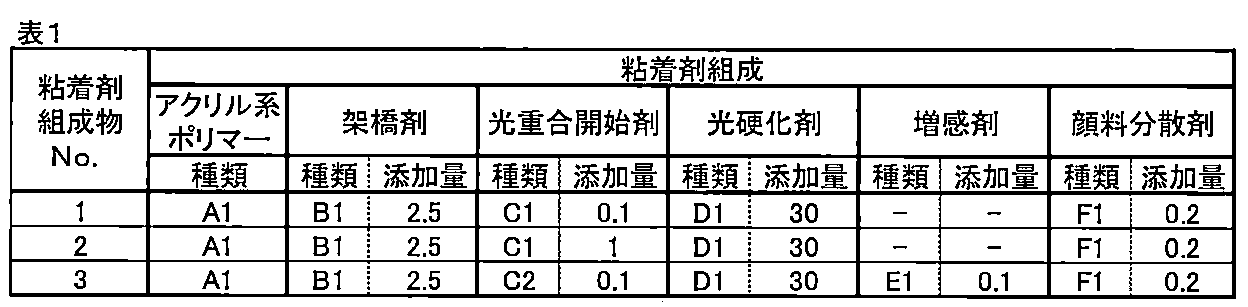
3.粘着剤組成物の塗布および架橋
上記で得た粘着剤組成物を、シリコーン系剥離剤で処理された厚さ38μmの基材(ポリエチレンテレフタレートフィルム)の表面に、ファウンテンコータで均一に塗工し、130℃の空気循環式恒温オーブンで1分間乾燥し、基材の表面に厚さ20μmの粘着剤層を形成した。
次いで、反射防止フィルムの反射防止層と反対面(コロナ処理済み)に、粘着剤層を形成したセパレータを移着させ、反射防止フィルムを構成する反射防止層用基材(HC-TACフィルム)の表面(HC層と反対面)に粘着剤層が形成された光硬化性粘着剤層付き反射防止フィルムを作製した。その後、25℃の雰囲気で4日間のエージング処理を行い、架橋を進行させ、ベースポリマーとしてのアクリル系ポリマーに架橋構造を導入した。これにより、反射防止フィルム上に粘着剤層が固着積層され、その上にセパレータが仮着された光硬化性粘着剤層付き反射防止フィルムを得た。
3. Coating and crosslinking of adhesive composition The adhesive composition obtained above was uniformly coated with a fountain coater on the surface of a 38 μm thick base material (polyethylene terephthalate film) treated with a silicone release agent, It was dried for 1 minute in an air circulating constant temperature oven at 130°C to form a 20 μm thick adhesive layer on the surface of the base material.
Next, a separator with an adhesive layer formed thereon is transferred to the opposite side of the anti-reflective film from the anti-reflective layer (corona treated), and the base material for the anti-reflective layer (HC-TAC film) constituting the anti-reflective film is transferred. An antireflection film with a photocurable adhesive layer was produced, in which an adhesive layer was formed on the surface (the opposite side to the HC layer). Thereafter, aging treatment was performed for 4 days in an atmosphere at 25° C. to advance crosslinking and introduce a crosslinked structure into the acrylic polymer serving as the base polymer. As a result, an antireflection film with a photocurable adhesive layer was obtained, in which the adhesive layer was firmly laminated on the antireflection film, and the separator was temporarily attached thereon.
[実施例3~5、比較例2:加熱タイプ粘着剤層付き反射防止フィルムの作製]
1.アクリル系ポリマーの重合
<アクリル系ポリマー(A2)>
攪拌羽根、温度計、窒素ガス導入管、冷却器を備えた4つ口フラスコに、ブチルアクリレート(BA)94.5重量部、アクリル酸(AA)5重量部、2-ヒドロキシエチルアクリレート(HEA)0.1重量部を含有するモノマー混合物を仕込んだ。
さらに、前記モノマー混合物(固形分)100重量部に対して、重合開始剤として2,2’-アゾビスイソブチロニトリル0.1重量部を酢酸エチルと共に仕込み、緩やかに攪拌しながら窒素ガスを導入して窒素置換した後、フラスコ内の液温を55℃付近に保って7時間重合反応を行った。その後、得られた反応液に、酢酸エチルを加えて、固形分濃度30%に調整した、重量平均分子量200万のアクリル系ポリマー(A2)の溶液を調製した。
[Examples 3 to 5, Comparative Example 2: Production of antireflection film with heating type adhesive layer]
1. Polymerization of acrylic polymer <Acrylic polymer (A2)>
In a four-necked flask equipped with a stirring blade, a thermometer, a nitrogen gas inlet tube, and a condenser, 94.5 parts by weight of butyl acrylate (BA), 5 parts by weight of acrylic acid (AA), and 2-hydroxyethyl acrylate (HEA) were added. A monomer mixture containing 0.1 parts by weight was charged.
Furthermore, to 100 parts by weight of the monomer mixture (solid content), 0.1 part by weight of 2,2'-azobisisobutyronitrile as a polymerization initiator was charged together with ethyl acetate, and nitrogen gas was introduced while stirring gently. After introducing the flask and purging it with nitrogen, the temperature of the liquid in the flask was maintained at around 55° C. and a polymerization reaction was carried out for 7 hours. Thereafter, ethyl acetate was added to the obtained reaction solution to prepare a solution of an acrylic polymer (A2) having a weight average molecular weight of 2 million, which was adjusted to a solid content concentration of 30%.
<アクリル系ポリマー(A3)>
攪拌羽根、温度計、窒素ガス導入管、冷却器を備えた4つ口フラスコに、ブチルアクリレート(BA)99重量部、4-ヒドロキシブチルアクリレート(HBA)1重量部を含有するモノマー混合物を仕込んだ。
さらに、前記モノマー混合物(固形分)100重量部に対して、重合開始剤として2,2’-アゾビスイソブチロニトリル0.1重量部を酢酸エチルと共に仕込み、緩やかに攪拌しながら窒素ガスを導入して窒素置換した後、フラスコ内の液温を55℃付近に保って7時間重合反応を行った。その後、得られた反応液に、酢酸エチルを加えて、固形分濃度16%に調整した、重量平均分子量160万のアクリル系ポリマー(A3)の溶液を調製した。
<Acrylic polymer (A3)>
A monomer mixture containing 99 parts by weight of butyl acrylate (BA) and 1 part by weight of 4-hydroxybutyl acrylate (HBA) was charged into a four-necked flask equipped with a stirring blade, a thermometer, a nitrogen gas inlet tube, and a condenser. .
Furthermore, to 100 parts by weight of the monomer mixture (solid content), 0.1 part by weight of 2,2'-azobisisobutyronitrile as a polymerization initiator was charged together with ethyl acetate, and nitrogen gas was introduced while stirring gently. After introducing the flask and purging it with nitrogen, the temperature of the liquid in the flask was maintained at around 55° C. and a polymerization reaction was carried out for 7 hours. Thereafter, ethyl acetate was added to the obtained reaction solution to prepare a solution of an acrylic polymer (A3) having a weight average molecular weight of 1.6 million, which was adjusted to a solid content concentration of 16%.
2.メタアクリル系重合体の調製
<シリコーンオリゴマー:メタアクリル系重合体(S1)>
撹拌羽根、温度計、窒素ガス導入管、冷却器、滴下ロートを備えた4つ口フラスコに、酢酸エチル100部、MMA60部、n-ブチルメタクリレート(BMA)10部、2-エチルヘキシルメタクリレート(2EHMA)10部、官能基当量が900g/molのポリオルガノシロキサン骨格含有メタクリレートモノマー(商品名:X-22-174ASX、信越化学工業株式会社製)8.7部、官能基当量が4600g/molのポリオルガノシロキサン骨格含有メタクリレートモノマー(商品名:KF-2012、信越化学工業株式会社製)11.3部および連鎖移動剤としてチオグリコール酸メチル0.2部を投入した。そして、70℃にて窒素雰囲気下で1時間撹拌した後、熱重合開始剤として2,2’-アゾビスイソブチロニトリル0.2部を投入し、70℃で2時間反応させた後に、熱重合開始剤として2,2’-アゾビスイソブチロニトリル0.1部を投入し、続いて80℃で3時間反応させた。このようにしてメタアクリル系重合(S1)の溶液を得た。このメタアクリル系重合体は、重量平均分子量(Mw)が18,000であり、ガラス転移温度(Tg)が0℃であった。
2. Preparation of methacrylic polymer <Silicone oligomer: methacrylic polymer (S1)>
In a four-neck flask equipped with a stirring blade, thermometer, nitrogen gas inlet tube, condenser, and dropping funnel, add 100 parts of ethyl acetate, 60 parts of MMA, 10 parts of n-butyl methacrylate (BMA), and 2-ethylhexyl methacrylate (2EHMA). 10 parts, a polyorganosiloxane skeleton-containing methacrylate monomer with a functional group equivalent of 900 g/mol (product name: 11.3 parts of a siloxane skeleton-containing methacrylate monomer (trade name: KF-2012, manufactured by Shin-Etsu Chemical Co., Ltd.) and 0.2 parts of methyl thioglycolate as a chain transfer agent were added. After stirring at 70°C for 1 hour under a nitrogen atmosphere, 0.2 part of 2,2'-azobisisobutyronitrile was added as a thermal polymerization initiator, and after reacting at 70°C for 2 hours, 0.1 part of 2,2'-azobisisobutyronitrile was added as a thermal polymerization initiator, followed by reaction at 80° C. for 3 hours. In this way, a solution of methacrylic polymerization (S1) was obtained. This methacrylic polymer had a weight average molecular weight (Mw) of 18,000 and a glass transition temperature (Tg) of 0°C.
3.加熱タイプ粘着剤組成物の調製
<粘着剤組成物4~7>
(1)アクリル系ポリマー組成物の調製
アクリル系ポリマーの溶液の固形分100重量部に対して、架橋剤、シランカップリング剤を配合して、下記表2に示すアクリル系ポリマー組成物を調製した。なお、表2における添加量は、アクリル系ポリマーの溶液の固形分(100重量部)に対する添加量(重量部)である。
(2)粘着剤組成物の調製
上記で得たアクリル系ポリマー組成物の固形分100重量部に対して、必要に応じて、メタアクリル系重合体またはリワーク向上剤を配合して、下記表2に示す組成の粘着剤組成物を調製した。
3. Preparation of heating type adhesive composition <Adhesive compositions 4 to 7>
(1) Preparation of acrylic polymer composition A crosslinking agent and a silane coupling agent were added to 100 parts by weight of the solid content of the acrylic polymer solution to prepare the acrylic polymer composition shown in Table 2 below. . The amounts added in Table 2 are the amounts added (parts by weight) relative to the solid content (100 parts by weight) of the acrylic polymer solution.
(2) Preparation of adhesive composition 100 parts by weight of the solid content of the acrylic polymer composition obtained above was mixed with a methacrylic polymer or a rework improver as required, as shown in Table 2 below. A pressure-sensitive adhesive composition having the composition shown below was prepared.
用いた架橋剤およびリワーク向上剤の詳細は以下の通りである。
(架橋剤)
B1:タケネートD110N (キシリレンジイソシアネートのトリメチロールプロパン付加物の75%酢酸エチル溶液;三井化学製)
B2:コロネートL (イソシアネート系架橋剤:トリメチロールプロパン/トリレンジイソシアネート;日本ポリウレタン工業社製)
B3:ナイパーBMT (過酸化物系架橋剤:ベンゾイルパーオキサイド;日本油脂株式会社製)
(リワーク向上剤)
G1:変性シリコーンオイル KF-353(エーテル基含有ポリシロキサン;信越化学工業株式会社製)
G2:サイリルSAT10(ポリエーテル変性シリコーン化合物;株式会社カネカ製)

(Crosslinking agent)
B1: Takenate D110N (75% ethyl acetate solution of trimethylolpropane adduct of xylylene diisocyanate; manufactured by Mitsui Chemicals)
B2: Coronate L (Isocyanate crosslinking agent: trimethylolpropane/tolylene diisocyanate; manufactured by Nippon Polyurethane Kogyo Co., Ltd.)
B3: Niper BMT (peroxide crosslinking agent: benzoyl peroxide; manufactured by NOF Corporation)
(Rework improver)
G1: Modified silicone oil KF-353 (ether group-containing polysiloxane; manufactured by Shin-Etsu Chemical Co., Ltd.)
G2: Cylyl SAT10 (polyether modified silicone compound; manufactured by Kaneka Corporation)
4.粘着剤組成物の塗布
上記で得た粘着剤組成物を、シリコーン系剥離剤で処理された厚さ38μmの基材(ポリエチレンテレフタレートフィルム)の表面に、ファウンテンコータで均一に塗工し、155℃の空気循環式恒温オーブンで2分間乾燥し、基材の表面に厚さ20μmの粘着剤層を形成した。
次いで、得られた反射防止フィルムの反射防止層と反対面(コロナ処理済み)に、粘着剤層を形成したセパレータを移着させ、反射防止フィルムを構成する反射防止層用基材(HC-TACフィルム)の表面(HC層と反対面)に粘着剤層が形成された加熱タイプ粘着剤層付き反射防止フィルムを作製した。これにより、反射防止フィルム上に粘着剤層が固着積層され、その上にセパレータが仮着された加熱タイプ粘着剤層付き反射防止フィルムを得た。
4. Application of adhesive composition The adhesive composition obtained above was uniformly applied to the surface of a 38 μm thick base material (polyethylene terephthalate film) treated with a silicone release agent using a fountain coater, and heated to 155°C. The adhesive layer was dried for 2 minutes in an air circulating constant temperature oven to form a 20 μm thick adhesive layer on the surface of the base material.
Next, a separator with an adhesive layer formed thereon is transferred to the opposite surface of the obtained antireflection film to the antireflection layer (corona treated), and a base material for the antireflection layer (HC-TAC) constituting the antireflection film is transferred. A heating type antireflection film with an adhesive layer was prepared in which an adhesive layer was formed on the surface (opposite side to the HC layer) of the film. As a result, an antireflection film with a heating type adhesive layer was obtained, in which an adhesive layer was firmly laminated on the antireflection film, and a separator was temporarily attached thereon.
上記実施例および比較例で得られた粘着剤層付き反射防止フィルムについて、下記評価を行った。結果を表3に示す。
<接着力(剥離強度)の評価>
1.試験サンプルの作製
幅25mm×長さ100mmに切り出した粘着剤層付き反射防止フィルムの粘着剤層表面からセパレータを剥離除去し、露出した粘着剤層面を無アルカリガラス(コーニング社製、EagleXG;厚み0.7mm)にハンドローラを用いて貼り合わせ、試験サンプルとした。
2.接着力増加処理
以下の手順により、粘着剤層の接着力増加処理を行った。
具体的には、粘着剤層が光硬化性粘着剤層である場合(実施例1~2、比較例1)には以下の光硬化処理を行った。また、粘着剤層が加熱タイプ粘着剤層である場合(実施例3~5、比較例2)には以下の熱処理を行った。
(光硬化処理)
硬化前の試験サンプルの反射防止フィルム側から紫外線(光源:LED 波長:405nm)を積算光量4000mJ/cm2照射して粘着剤層を光硬化したものを光硬化後の試験サンプルとした。
(熱処理)
熱処理前の試験サンプルを60℃で24時間保管し、熱処理後の試験サンプルとした。
3.接着力(90°引きはがし粘着力)の測定
上記で得た接着力増加処理前後の試験サンプルを用い、引張試験機(装置名:精密万能試験機、オートグラフAG-IS、島津製作所製)を使用して、JIS Z0237:2009に準じて、剥離角度90度、引張速度300mm/分の条件で、90°引きはがし粘着力(接着力)を測定した。測定は3回行い、それらの平均値を求めた。
The following evaluations were performed on the antireflection films with adhesive layers obtained in the above Examples and Comparative Examples. The results are shown in Table 3.
<Evaluation of adhesive strength (peel strength)>
1. Preparation of test sample Peel and remove the separator from the surface of the adhesive layer of the anti-reflection film with adhesive layer cut out to 25 mm width x 100 mm length, and cover the exposed adhesive layer surface with alkali-free glass (EagleXG, manufactured by Corning; thickness 0). .7 mm) using a hand roller to prepare a test sample.
2. Adhesive Strength Increasing Treatment Adhesive strength increasing treatment of the pressure-sensitive adhesive layer was performed according to the following procedure.
Specifically, when the adhesive layer was a photocurable adhesive layer (Examples 1 to 2, Comparative Example 1), the following photocuring treatment was performed. Further, when the adhesive layer was a heating type adhesive layer (Examples 3 to 5, Comparative Example 2), the following heat treatment was performed.
(light curing treatment)
The adhesive layer was photocured by irradiating ultraviolet light (light source: LED, wavelength: 405 nm) with an integrated light amount of 4000 mJ/cm 2 from the antireflection film side of the test sample before curing, and the test sample after photocuring was used.
(Heat treatment)
The test sample before heat treatment was stored at 60° C. for 24 hours, and was used as the test sample after heat treatment.
3. Measurement of adhesive strength (90° peeling adhesive strength) Using the test sample obtained above before and after the adhesive strength increasing treatment, a tensile tester (equipment name: Precision Universal Testing Machine, Autograph AG-IS, manufactured by Shimadzu Corporation) was used. The adhesive strength (adhesion strength) at 90° peeling was measured according to JIS Z0237:2009 under conditions of a peeling angle of 90° and a pulling speed of 300 mm/min. The measurement was performed three times and the average value was calculated.
(リワーク性)
接着力増加処理前の試験サンプルの接着力(初期接着力)の値から、リワーク性を下記基準で判断した。
A:3N/25mm以下
B:3N/25mm超、5N/25mm以下
C:5N/25mm超
(Reworkability)
Reworkability was judged based on the following criteria based on the adhesive strength (initial adhesive strength) value of the test sample before adhesive strength increasing treatment.
A: 3N/25mm or less B: More than 3N/25mm, 5N/25mm or less C: More than 5N/25mm
(耐久性)
接着力増加処理後の試験サンプルの接着力の値から、耐久性(密着性)を下記基準で判断した。
A:8N/25mm以上
B:5N/25mm以上8N/25mm未満
C:5N/25mm未満
結果を表3に示す。
(durability)
Durability (adhesion) was judged based on the adhesive strength value of the test sample after the adhesive strength increasing treatment according to the following criteria.
A: 8N/25mm or more B: 5N/25mm or more but less than 8N/25mm C: Less than 5N/25mm
The results are shown in Table 3.
<380~780nmの光線透過率>
各粘着剤組成物を、シリコーン系剥離剤で処理された厚さ38μmの基材(ポリエチレンテレフタレートフィルム)の表面に、ファウンテンコータで均一に塗工し、130℃の空気循環式恒温オーブンで1分間乾燥し、基材の表面に厚さ20μmの粘着剤層を形成した。次いで、1.3mmのガラス板(スライドグラスS012140、松浪硝子工業株式会社製)にサンプルを貼り合わせたものについて380~780nmの光線透過率を、分光光度計(U-4100、株式会社日立製作所)にて測定した。
各粘着剤層の380~780nmの波長領域における最小透過率および最大透過率ならびにその波長を表3に示す。なお、表3に示す透過率の値はガラス板の透過率を100%とした場合の相対的値である。
<Light transmittance from 380 to 780 nm>
Each adhesive composition was applied uniformly onto the surface of a 38 μm thick base material (polyethylene terephthalate film) treated with a silicone release agent using a fountain coater, and then placed in a constant temperature oven with air circulation at 130°C for 1 minute. It was dried to form an adhesive layer with a thickness of 20 μm on the surface of the base material. Next, the light transmittance from 380 to 780 nm was measured using a spectrophotometer (U-4100, Hitachi, Ltd.) for the sample pasted onto a 1.3 mm glass plate (slide glass S012140, manufactured by Matsunami Glass Industries, Ltd.). Measured at
Table 3 shows the minimum transmittance and maximum transmittance of each adhesive layer in the wavelength range of 380 to 780 nm, as well as the wavelength thereof. Note that the transmittance values shown in Table 3 are relative values when the transmittance of the glass plate is taken as 100%.

[自発光型表示装置の作製]
上記実施例1で得た光硬化性粘着剤層付き反射防止フィルムを寸法30mm×30mmに切り出した。
有機ELディスプレイ(OLED)(Samsung社製、製品名「Galaxy S5」)からOLEDパネル部材を取り出し、このOLEDパネル部材に貼り付けられているウィンドウガラス、偏光フィルムを剥がし取り、OLEDパネルとして用いた。
切り出した上記実施例1で得た光硬化性粘着剤層付き反射防止フィルムからセパレータを剥離除去し、露出した粘着面をOLEDパネル上にハンドローラを用いて貼り合わせてOLEDサンプルを得た。
OLEDパネルおよびOLEDサンプル(実施例1+ARフィルム)について、白表示の透過率および黒表示(電源OFF)の反射率を以下の方法により測定した。
(白表示の透過率)
分光放射計(SR-UL1R 株式会社トプコンテクノハウス製)を用いて輝度Y値を測定した。OLEDパネルのみの輝度Y値の測定値を100%としたときのOLEDサンプル(実施例1+ARフィルム)の輝度Y値の比率を算出し、透過率とした。
(黒表示の反射率)
分光測色計(CM-2600d コニカミノルタ株式会社製)を用いて視感反射率Y値を測定した。OLEDパネルのみの視感反射率Y値の測定値を100%としたときの、OLEDサンプル(実施例1+ARフィルム)の視感反射率Y値の比率を算出し、反射率とした。
結果を表4に示す。
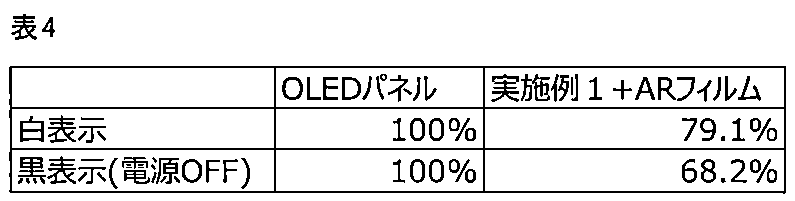
The antireflection film with a photocurable adhesive layer obtained in Example 1 was cut into a size of 30 mm x 30 mm.
An OLED panel member was taken out from an organic EL display (OLED) (manufactured by Samsung, product name "Galaxy S5"), and the window glass and polarizing film attached to this OLED panel member were peeled off and used as an OLED panel.
The separator was peeled off from the cut out antireflection film with a photocurable adhesive layer obtained in Example 1, and the exposed adhesive surface was bonded onto an OLED panel using a hand roller to obtain an OLED sample.
Regarding the OLED panel and the OLED sample (Example 1+AR film), the transmittance in white display and the reflectance in black display (power OFF) were measured by the following method.
(Transmittance of white display)
The brightness Y value was measured using a spectroradiometer (SR-UL1R manufactured by Topcon Technohouse Co., Ltd.). The ratio of the brightness Y value of the OLED sample (Example 1 + AR film) was calculated, when the measured value of the brightness Y value of only the OLED panel was taken as 100%, and was defined as the transmittance.
(Reflectance of black display)
The luminous reflectance Y value was measured using a spectrophotometer (CM-2600d manufactured by Konica Minolta, Inc.). When the measured value of the luminous reflectance Y value of only the OLED panel was taken as 100%, the ratio of the luminous reflectance Y value of the OLED sample (Example 1 + AR film) was calculated and used as the reflectance.
The results are shown in Table 4.
以上の通り、本発明によれば、リワーク性と高耐久性とを兼ね備えた粘着剤層付き反射防止フィルムを提供することができる。 As described above, according to the present invention, it is possible to provide an antireflection film with an adhesive layer that has both reworkability and high durability.
本発明の粘着剤層付き反射防止フィルムは、自発光型表示装置に好適に用いられる。 The antireflection film with an adhesive layer of the present invention is suitably used for self-luminous display devices.
1 粘着剤層
2 反射防止フィルム
3 透明樹脂フィルム
4 反射防止層
5 密着層
6 ハードコート層
7 防汚層
8 セパレータ
10 粘着剤層付き反射防止フィルム
20 有機ELパネル
30 透明基板
100 有機EL表示装置
1 Adhesive layer 2 Anti-reflection film 3 Transparent resin film 4 Anti-reflection layer 5 Adhesion layer 6 Hard coat layer 7 Antifouling layer 8 Separator 10 Anti-reflection film with adhesive layer 20 Organic EL panel 30 Transparent substrate 100 Organic EL display device
Claims (18)
前記粘着剤層付き反射防止フィルムは、反射防止フィルムの少なくとも一方の面に粘着剤層を有し、
前記反射防止フィルムは、視認側のパネル上に、粘着剤層を介して積層されており、視認側のパネル上に存在する層が、前記粘着剤層、前記反射防止フィルムおよび必要に応じて配置される透明基板のみであり、
前記粘着剤層は、ベースポリマーとしてのアクリル系ポリマーと、イソシアネート系架橋剤と、光硬化剤としての多官能(メタ)アクリレートと、を含有し、
粘着剤層は、無アルカリガラスに対する速度300mm/分での90度剥離に基づく初期接着力が5N/25mm以下であり、無アルカリガラスに対する速度300mm/分での90度剥離に基づく光硬化後の接着力が、5N/25mm以上である、装置。 A self-luminous display device having an antireflection film with an adhesive layer,
The anti-reflective film with an adhesive layer has an adhesive layer on at least one surface of the anti-reflective film,
The anti-reflection film is laminated on the viewing side panel via an adhesive layer, and the layer present on the viewing side panel includes the adhesive layer, the anti-reflection film, and the adhesive layer disposed as necessary. It is only a transparent substrate that is
The adhesive layer contains an acrylic polymer as a base polymer, an isocyanate crosslinking agent, and a polyfunctional (meth)acrylate as a photocuring agent,
The adhesive layer has an initial adhesive strength of 5 N/25 mm or less based on 90 degree peeling at a speed of 300 mm/min to alkali-free glass, and after photocuring based on 90 degree peeling at a speed of 300 mm/min to alkali-free glass. The device has an adhesive force of 5N/25mm or more .
前記粘着剤層付き反射防止フィルムは、反射防止フィルムの少なくとも一方の面に粘着剤層を有し、
前記反射防止フィルムは、視認側のパネル上に、粘着剤層を介して積層されており、視認側のパネル上に存在する層が、前記粘着剤層、前記反射防止フィルムおよび必要に応じて配置される透明基板のみであり、
前記粘着剤層は、ベースポリマーとしてのアクリル系ポリマーと、イソシアネート系架橋剤と、を含有し、
粘着剤層は、無アルカリガラスに対する速度300mm/分での90度剥離に基づく初期接着力が5N/25mm以下であり、無アルカリガラスに対する速度300mm/分での90度剥離に基づく60℃24時間後の接着力が5N/25mm以上である、装置。 A self-luminous display device having an antireflection film with an adhesive layer,
The anti-reflective film with an adhesive layer has an adhesive layer on at least one surface of the anti-reflective film,
The anti-reflection film is laminated on the viewing side panel via an adhesive layer, and the layer present on the viewing side panel includes the adhesive layer, the anti-reflection film, and the adhesive layer disposed as necessary. It is only a transparent substrate that is
The adhesive layer contains an acrylic polymer as a base polymer and an isocyanate crosslinking agent,
The adhesive layer has an initial adhesive strength of 5 N/25 mm or less based on 90 degree peeling at a speed of 300 mm/min to alkali-free glass, and an adhesive strength of 60°C 24 mm based on 90 degree peeling at a speed of 300 mm/min to alkali-free glass. A device having an adhesive force of 5 N/25 mm or more after a period of time .
前記シリコーンオリゴマーは、Tgが-70℃以上30℃以下であり、側鎖のシリコーン官能基当量が1000~20000g/molであり、重量平均分子量Mwが10000以上300000以下である、請求項10に記載の装置。 The adhesive layer contains 1 to 20 parts by weight of the silicone oligomer based on 100 parts by weight of the base polymer,
The silicone oligomer has a Tg of -70°C or more and 30°C or less, a side chain silicone functional group equivalent of 1000 to 20000 g/mol, and a weight average molecular weight Mw of 10000 to 300000 . The device described.
ポリオルガノシロキサン骨格を有するモノマー、および
ホモポリマーのガラス転移温度が-70℃以上180℃以下のモノマーを含み、
前記ベースポリマーは、モノマー成分として、
(メタ)アクリル酸アルキルエステルを80重量%以上、および
カルボキシル基含有モノマーおよび窒素含有モノマーからなる群より選択される少なくとも1種の極性モノマーを0~20重量%、
含む、請求項10または11に記載の装置。 The silicone oligomer includes, as a monomer component,
A monomer having a polyorganosiloxane skeleton, and a monomer having a homopolymer glass transition temperature of -70°C or more and 180°C or less,
The base polymer includes, as a monomer component ,
80% by weight or more of ( meth)acrylic acid alkyl ester, and 0 to 20% by weight of at least one polar monomer selected from the group consisting of carboxyl group-containing monomers and nitrogen-containing monomers,
12. The apparatus of claim 10 or 11 , comprising:
ホモポリマーのガラス転移温度が-60℃以上0℃以下である(メタ)アクリル酸アルキルエステルを80重量%以上、および
カルボキシル基含有モノマーおよび窒素含有モノマーからなる群より選択される少なくとも1種の極性モノマーを0~20重量%、
含む、請求項10~12のいずれか一項に記載の装置。 As a monomer component of the base polymer,
80% by weight or more of a (meth)acrylic acid alkyl ester whose homopolymer has a glass transition temperature of -60°C or more and 0°C or less, and at least one polar type selected from the group consisting of a carboxyl group-containing monomer and a nitrogen-containing monomer. 0 to 20% by weight of monomer,
Apparatus according to any one of claims 10 to 12 , comprising:
パネル上に前記粘着剤層を介して粘着剤層付き反射防止フィルムを配置し、前記粘着剤層の接着力増加処理をすることを含む、方法。 A method for manufacturing the device according to any one of claims 1 to 15 , comprising:
A method comprising disposing an antireflection film with an adhesive layer on a panel via the adhesive layer, and performing a treatment to increase the adhesive strength of the adhesive layer.
前記粘着剤層の接着力増加処理は、前記粘着剤層に380nm以上450nm以下の波長範囲のエネルギー活性線を照射して前記粘着剤層を光硬化させることを含む、請求項16に記載の方法。 The device is the device according to any one of claims 1 and 5 to 9 ,
The method according to claim 16 , wherein the adhesive force increasing treatment of the adhesive layer includes photocuring the adhesive layer by irradiating the adhesive layer with energy actinic rays in a wavelength range of 380 nm or more and 450 nm or less. .
前記粘着剤層の接着力増加処理は、前記粘着剤層を20~80℃で1~48時間熱処理することを含む、請求項16に記載の方法。 The device is the device according to any one of claims 2 and 10 to 13, and the adhesive force increasing treatment of the adhesive layer includes heat treating the adhesive layer at 20 to 80° C. for 1 to 48 hours. 17. The method of claim 16 , comprising:
Priority Applications (5)
| Application Number | Priority Date | Filing Date | Title |
|---|---|---|---|
| JP2019019411A JP7366552B2 (en) | 2019-02-06 | 2019-02-06 | Antireflection film with adhesive layer, self-luminous display device, and manufacturing method thereof |
| TW109102474A TWI828846B (en) | 2019-02-06 | 2020-01-22 | Self-luminous display device and manufacturing method thereof |
| PCT/JP2020/002222 WO2020162195A1 (en) | 2019-02-06 | 2020-01-23 | Antireflection film equipped with pressure-sensitive adhesive layer, spontaneous light emission-type display device, and method for manufacturing same |
| KR1020217019309A KR102783849B1 (en) | 2019-02-06 | 2020-01-23 | Antireflection film having adhesive layer, self-luminous display device and method for manufacturing the same |
| CN202080012326.XA CN113383048B (en) | 2019-02-06 | 2020-01-23 | Anti-reflection film with adhesive layer, self-luminous display device and method for manufacturing the same |
Applications Claiming Priority (1)
| Application Number | Priority Date | Filing Date | Title |
|---|---|---|---|
| JP2019019411A JP7366552B2 (en) | 2019-02-06 | 2019-02-06 | Antireflection film with adhesive layer, self-luminous display device, and manufacturing method thereof |
Publications (2)
| Publication Number | Publication Date |
|---|---|
| JP2020126182A JP2020126182A (en) | 2020-08-20 |
| JP7366552B2 true JP7366552B2 (en) | 2023-10-23 |
Family
ID=71947557
Family Applications (1)
| Application Number | Title | Priority Date | Filing Date |
|---|---|---|---|
| JP2019019411A Active JP7366552B2 (en) | 2019-02-06 | 2019-02-06 | Antireflection film with adhesive layer, self-luminous display device, and manufacturing method thereof |
Country Status (5)
| Country | Link |
|---|---|
| JP (1) | JP7366552B2 (en) |
| KR (1) | KR102783849B1 (en) |
| CN (1) | CN113383048B (en) |
| TW (1) | TWI828846B (en) |
| WO (1) | WO2020162195A1 (en) |
Families Citing this family (15)
| Publication number | Priority date | Publication date | Assignee | Title |
|---|---|---|---|---|
| CN116323849B (en) * | 2020-10-01 | 2025-05-16 | Dic株式会社 | Adhesive composition and laminated film using same |
| KR102585553B1 (en) * | 2020-11-02 | 2023-10-05 | 삼성에스디아이 주식회사 | Adhesive film, optical member comprising the same and optical display apparatus comprising the same |
| JP7042895B1 (en) * | 2020-11-27 | 2022-03-28 | デクセリアルズ株式会社 | Optical laminates and articles |
| JP7860688B2 (en) * | 2020-12-25 | 2026-05-18 | 日東電工株式会社 | Optical film |
| US12224374B2 (en) | 2020-12-28 | 2025-02-11 | Jade Bird Display (shanghai) Limited | Micro-LED structure and micro-LED chip including same |
| KR102606520B1 (en) * | 2021-01-13 | 2023-11-24 | 삼성에스디아이 주식회사 | Optical film, optical member comprising the same and optical display apparatus comprising the same |
| KR20220125908A (en) | 2021-03-05 | 2022-09-15 | 삼성디스플레이 주식회사 | Display device |
| CN113345943B (en) * | 2021-05-27 | 2023-07-07 | 武汉华星光电半导体显示技术有限公司 | Display module |
| JP2023035263A (en) * | 2021-08-31 | 2023-03-13 | 日東電工株式会社 | Antireflection film with adhesive sheet and image display device |
| KR102848582B1 (en) * | 2022-02-23 | 2025-08-20 | 삼성에스디아이 주식회사 | Adhesive film for polarizing plate, polarizing plate comprising the same and optical display comprising the same |
| JP2023126055A (en) * | 2022-02-28 | 2023-09-07 | 日東電工株式会社 | Optical laminate for OLED display device and OLED display device |
| TW202349763A (en) * | 2022-02-28 | 2023-12-16 | 日商日東電工股份有限公司 | Optical laminate for OLED display device |
| JP7889240B2 (en) * | 2022-11-04 | 2026-07-14 | 王子ホールディングス株式会社 | Adhesive sheets, laminates, and optical devices |
| TWI827407B (en) * | 2022-12-20 | 2023-12-21 | 友達光電股份有限公司 | Light-emitting element and light-emitting device including the same |
| JP2025102027A (en) * | 2023-12-26 | 2025-07-08 | 日東電工株式会社 | Laminated Optical Film |
Citations (9)
| Publication number | Priority date | Publication date | Assignee | Title |
|---|---|---|---|---|
| JP2002341776A (en) | 2001-05-16 | 2002-11-29 | Nitto Denko Corp | Film filter for preventing glass breakage and plasma display |
| JP2006036810A (en) | 2004-07-22 | 2006-02-09 | Nitto Denko Corp | Optical member pressure-sensitive adhesive composition, optical member pressure-sensitive adhesive layer, optical member pressure-sensitive adhesive sheet, pressure-sensitive adhesive optical member, and image display device |
| JP2006171261A (en) | 2004-12-15 | 2006-06-29 | Hitachi Kasei Polymer Co Ltd | Display filter |
| JP2007156066A (en) | 2005-12-05 | 2007-06-21 | Hitachi Kasei Polymer Co Ltd | Optical functional film for liquid crystal display with adhesive composition layer and liquid crystal display including the same |
| JP2012526894A (en) | 2009-05-15 | 2012-11-01 | スリーエム イノベイティブ プロパティズ カンパニー | Urethane pressure sensitive adhesive |
| JP2014500348A (en) | 2010-11-05 | 2014-01-09 | スリーエム イノベイティブ プロパティズ カンパニー | Silicone-modified adhesive with anti-slip properties |
| JP2016108403A (en) | 2014-12-04 | 2016-06-20 | 東亞合成株式会社 | Active energy ray-curable pressure-sensitive adhesive composition having antistatic property |
| JP2016191019A (en) | 2015-03-31 | 2016-11-10 | 日東電工株式会社 | Adhesive composition for optical film, adhesive layer for optical film, optical film with adhesive layer, and image display device |
| WO2018092904A1 (en) | 2016-11-21 | 2018-05-24 | 日東電工株式会社 | Adhesive sheet |
Family Cites Families (14)
| Publication number | Priority date | Publication date | Assignee | Title |
|---|---|---|---|---|
| JP2003332068A (en) | 2002-05-15 | 2003-11-21 | Nitto Denko Corp | Electroluminescence element |
| JP2007011323A (en) * | 2005-06-03 | 2007-01-18 | Bridgestone Corp | Antireflection film, antireflective light-transmitting window material having the antireflection film, and display filter having the antireflective light-transmitting window material |
| WO2007097303A1 (en) * | 2006-02-27 | 2007-08-30 | Konica Minolta Opto, Inc. | Antireflection film, method for producing antireflection film, polarizing plate and display |
| JP2009070815A (en) | 2007-08-21 | 2009-04-02 | Fujifilm Corp | Organic electroluminescence display device |
| JP5605223B2 (en) * | 2009-06-23 | 2014-10-15 | 三菱レイヨン株式会社 | Antireflection article and display device |
| JP2012143936A (en) * | 2011-01-11 | 2012-08-02 | Mitsubishi Rayon Co Ltd | Protective film, and molded article having the same |
| JP2014043546A (en) * | 2012-07-31 | 2014-03-13 | Nitto Denko Corp | Radiation-curable pressure-sensitive adhesive layer and radiation-curable pressure-sensitive adhesive sheet |
| US20160054478A1 (en) * | 2013-03-29 | 2016-02-25 | Mitsubishi Rayon Co., Ltd. | Article |
| WO2016072202A1 (en) * | 2014-11-07 | 2016-05-12 | Dic株式会社 | Curable composition, resist material and resist film |
| JP6635727B2 (en) * | 2015-01-22 | 2020-01-29 | 日東電工株式会社 | Optical adhesive sheet |
| JP2017165941A (en) * | 2015-12-25 | 2017-09-21 | 日東電工株式会社 | Adhesive composition for organic EL display device, adhesive layer for organic EL display device, polarizing film with adhesive layer for organic EL display device, and organic EL display device |
| CN109348720A (en) * | 2016-06-15 | 2019-02-15 | 日东电工株式会社 | Ultraviolet-curable acrylic pressure-sensitive adhesive composition, ultraviolet-curable acrylic pressure-sensitive adhesive layer, polarizing film with pressure-sensitive adhesive layer, method for producing ultraviolet-curable acrylic pressure-sensitive adhesive layer, and image display device |
| JP2018112715A (en) | 2017-01-13 | 2018-07-19 | 大日本印刷株式会社 | Color filter and display |
| JP6416327B1 (en) * | 2017-06-06 | 2018-10-31 | 太陽インキ製造株式会社 | Inkjet curable composition set, cured product, manufacturing method thereof, printed wiring board, and fan-out wafer level package |
-
2019
- 2019-02-06 JP JP2019019411A patent/JP7366552B2/en active Active
-
2020
- 2020-01-22 TW TW109102474A patent/TWI828846B/en active
- 2020-01-23 CN CN202080012326.XA patent/CN113383048B/en active Active
- 2020-01-23 KR KR1020217019309A patent/KR102783849B1/en active Active
- 2020-01-23 WO PCT/JP2020/002222 patent/WO2020162195A1/en not_active Ceased
Patent Citations (9)
| Publication number | Priority date | Publication date | Assignee | Title |
|---|---|---|---|---|
| JP2002341776A (en) | 2001-05-16 | 2002-11-29 | Nitto Denko Corp | Film filter for preventing glass breakage and plasma display |
| JP2006036810A (en) | 2004-07-22 | 2006-02-09 | Nitto Denko Corp | Optical member pressure-sensitive adhesive composition, optical member pressure-sensitive adhesive layer, optical member pressure-sensitive adhesive sheet, pressure-sensitive adhesive optical member, and image display device |
| JP2006171261A (en) | 2004-12-15 | 2006-06-29 | Hitachi Kasei Polymer Co Ltd | Display filter |
| JP2007156066A (en) | 2005-12-05 | 2007-06-21 | Hitachi Kasei Polymer Co Ltd | Optical functional film for liquid crystal display with adhesive composition layer and liquid crystal display including the same |
| JP2012526894A (en) | 2009-05-15 | 2012-11-01 | スリーエム イノベイティブ プロパティズ カンパニー | Urethane pressure sensitive adhesive |
| JP2014500348A (en) | 2010-11-05 | 2014-01-09 | スリーエム イノベイティブ プロパティズ カンパニー | Silicone-modified adhesive with anti-slip properties |
| JP2016108403A (en) | 2014-12-04 | 2016-06-20 | 東亞合成株式会社 | Active energy ray-curable pressure-sensitive adhesive composition having antistatic property |
| JP2016191019A (en) | 2015-03-31 | 2016-11-10 | 日東電工株式会社 | Adhesive composition for optical film, adhesive layer for optical film, optical film with adhesive layer, and image display device |
| WO2018092904A1 (en) | 2016-11-21 | 2018-05-24 | 日東電工株式会社 | Adhesive sheet |
Also Published As
| Publication number | Publication date |
|---|---|
| JP2020126182A (en) | 2020-08-20 |
| TWI828846B (en) | 2024-01-11 |
| KR20210116446A (en) | 2021-09-27 |
| KR102783849B1 (en) | 2025-03-21 |
| TW202039754A (en) | 2020-11-01 |
| CN113383048A (en) | 2021-09-10 |
| WO2020162195A1 (en) | 2020-08-13 |
| CN113383048B (en) | 2024-10-22 |
Similar Documents
| Publication | Publication Date | Title |
|---|---|---|
| KR102783849B1 (en) | Antireflection film having adhesive layer, self-luminous display device and method for manufacturing the same | |
| JP4840888B2 (en) | Optical film adhesive composition, optical film adhesive layer, adhesive optical film, and image display device | |
| US9657197B2 (en) | Adhesive, adhesive layer, and adhesive sheet | |
| US9650547B2 (en) | Radiation-curable pressure-sensitive adhesive, radiation-curable pressure-sensitive adhesive layer, radiation-curable pressure-sensitive adhesive sheet, and laminate | |
| US20140044961A1 (en) | Pressure-sensitive adhesive, pressure-sensitive adhesive layer, and pressure-sensitive adhesive sheet | |
| CN115287002A (en) | Adhesive composition for organic EL display device, adhesive layer, polarizing film with adhesive layer, and organic EL display device | |
| US20140039128A1 (en) | Radiation-curable pressure-sensitive adhesive layer, and radiation-curable pressure-sensitive adhesive sheet | |
| TWI850314B (en) | Laminated body, optical film, image display device and manufacturing method thereof | |
| JP2017003906A (en) | Polarizing film with double-sided adhesive layer and image display device | |
| US20150004407A1 (en) | Pressure-sensitive adhesive, pressure-sensitive adhesive layer, and pressure-sensitive adhesive sheet | |
| JP2016224307A (en) | Polarization film with adhesive layers on both sides, and image display unit | |
| WO2021193719A1 (en) | Pressure-sensitive adhesive composition, pressure-sensitive adhesive, and pressure-sensitive adhesive sheet | |
| CN113383052A (en) | Optical film adhesive, adhesive layer, optical element and image display device | |
| JP7690305B2 (en) | Adhesive composition, adhesive, and adhesive sheet | |
| JP2022008015A (en) | Light-emitting device | |
| WO2021193723A1 (en) | Interlayer sheet, interlayer sheet with release liner, and optical laminate | |
| WO2021193724A1 (en) | Pressure-sensitive adhesive composition, pressure-sensitive adhesive, and pressure-sensitive adhesive sheet | |
| WO2021193722A1 (en) | Adhesive and use thereof | |
| WO2021193718A1 (en) | Adhesive sheet and adhesive sheet with release liner | |
| JP2020101814A (en) | Polarizing film with double-sided adhesive layer and image display device | |
| WO2021193720A1 (en) | Adhesive optical film | |
| WO2021193721A1 (en) | Light-emitting device | |
| WO2024070789A1 (en) | Adhesive and adhesive sheet | |
| JP2021120437A (en) | Adhesive sheet and image display device | |
| JP2022008012A (en) | Adhesive sheet and adhesive sheet with release liner |
Legal Events
| Date | Code | Title | Description |
|---|---|---|---|
| A621 | Written request for application examination |
Free format text: JAPANESE INTERMEDIATE CODE: A621 Effective date: 20220125 |
|
| A131 | Notification of reasons for refusal |
Free format text: JAPANESE INTERMEDIATE CODE: A131 Effective date: 20230207 |
|
| A601 | Written request for extension of time |
Free format text: JAPANESE INTERMEDIATE CODE: A601 Effective date: 20230322 |
|
| A521 | Request for written amendment filed |
Free format text: JAPANESE INTERMEDIATE CODE: A523 Effective date: 20230602 |
|
| TRDD | Decision of grant or rejection written | ||
| A01 | Written decision to grant a patent or to grant a registration (utility model) |
Free format text: JAPANESE INTERMEDIATE CODE: A01 Effective date: 20230926 |
|
| A61 | First payment of annual fees (during grant procedure) |
Free format text: JAPANESE INTERMEDIATE CODE: A61 Effective date: 20231011 |
|
| R150 | Certificate of patent or registration of utility model |
Ref document number: 7366552 Country of ref document: JP Free format text: JAPANESE INTERMEDIATE CODE: R150 |