JP7340848B2 - Leather-like material and its manufacturing method - Google Patents
Leather-like material and its manufacturing method Download PDFInfo
- Publication number
- JP7340848B2 JP7340848B2 JP2019181078A JP2019181078A JP7340848B2 JP 7340848 B2 JP7340848 B2 JP 7340848B2 JP 2019181078 A JP2019181078 A JP 2019181078A JP 2019181078 A JP2019181078 A JP 2019181078A JP 7340848 B2 JP7340848 B2 JP 7340848B2
- Authority
- JP
- Japan
- Prior art keywords
- cell
- product
- leather
- paper
- bacterial cell
- Prior art date
- Legal status (The legal status is an assumption and is not a legal conclusion. Google has not performed a legal analysis and makes no representation as to the accuracy of the status listed.)
- Active
Links
- 239000000463 material Substances 0.000 title claims description 193
- 238000004519 manufacturing process Methods 0.000 title claims description 49
- 210000004027 cell Anatomy 0.000 claims description 192
- 230000001580 bacterial effect Effects 0.000 claims description 123
- 230000006196 deacetylation Effects 0.000 claims description 43
- 238000003381 deacetylation reaction Methods 0.000 claims description 43
- 241000233866 Fungi Species 0.000 claims description 40
- 238000000034 method Methods 0.000 claims description 40
- 230000002538 fungal effect Effects 0.000 claims description 36
- 229920002101 Chitin Polymers 0.000 claims description 28
- 229920001661 Chitosan Polymers 0.000 claims description 25
- 239000012634 fragment Substances 0.000 claims description 21
- 210000002421 cell wall Anatomy 0.000 claims description 20
- 238000005273 aeration Methods 0.000 claims description 17
- 239000007788 liquid Substances 0.000 claims description 17
- 238000004132 cross linking Methods 0.000 claims description 15
- 238000012258 culturing Methods 0.000 claims description 15
- 238000009630 liquid culture Methods 0.000 claims description 15
- 230000000850 deacetylating effect Effects 0.000 claims description 11
- 239000002994 raw material Substances 0.000 claims description 2
- 239000000047 product Substances 0.000 description 78
- 230000000813 microbial effect Effects 0.000 description 30
- 239000010985 leather Substances 0.000 description 16
- 239000012528 membrane Substances 0.000 description 11
- 239000007864 aqueous solution Substances 0.000 description 10
- -1 jojoba oil Substances 0.000 description 10
- 240000006439 Aspergillus oryzae Species 0.000 description 9
- 235000002247 Aspergillus oryzae Nutrition 0.000 description 9
- DNIAPMSPPWPWGF-UHFFFAOYSA-N Propylene glycol Chemical compound CC(O)CO DNIAPMSPPWPWGF-UHFFFAOYSA-N 0.000 description 9
- HEMHJVSKTPXQMS-UHFFFAOYSA-M Sodium hydroxide Chemical compound [OH-].[Na+] HEMHJVSKTPXQMS-UHFFFAOYSA-M 0.000 description 9
- 238000010586 diagram Methods 0.000 description 9
- 239000003921 oil Substances 0.000 description 9
- 235000019198 oils Nutrition 0.000 description 9
- LYCAIKOWRPUZTN-UHFFFAOYSA-N Ethylene glycol Chemical compound OCCO LYCAIKOWRPUZTN-UHFFFAOYSA-N 0.000 description 7
- 239000004166 Lanolin Substances 0.000 description 7
- 238000001035 drying Methods 0.000 description 7
- 235000019388 lanolin Nutrition 0.000 description 7
- 229940039717 lanolin Drugs 0.000 description 7
- QTBSBXVTEAMEQO-UHFFFAOYSA-N Acetic acid Chemical compound CC(O)=O QTBSBXVTEAMEQO-UHFFFAOYSA-N 0.000 description 6
- 230000018044 dehydration Effects 0.000 description 6
- 238000006297 dehydration reaction Methods 0.000 description 6
- 239000007787 solid Substances 0.000 description 6
- 230000003068 static effect Effects 0.000 description 6
- 241000894006 Bacteria Species 0.000 description 5
- 239000002253 acid Substances 0.000 description 5
- 238000007796 conventional method Methods 0.000 description 5
- 239000002649 leather substitute Substances 0.000 description 5
- PEDCQBHIVMGVHV-UHFFFAOYSA-N Glycerine Chemical compound OCC(O)CO PEDCQBHIVMGVHV-UHFFFAOYSA-N 0.000 description 4
- 241001465754 Metazoa Species 0.000 description 4
- 150000001298 alcohols Chemical class 0.000 description 4
- 235000014113 dietary fatty acids Nutrition 0.000 description 4
- 229930195729 fatty acid Natural products 0.000 description 4
- 239000000194 fatty acid Substances 0.000 description 4
- GLDOVTGHNKAZLK-UHFFFAOYSA-N octadecan-1-ol Chemical compound CCCCCCCCCCCCCCCCCCO GLDOVTGHNKAZLK-UHFFFAOYSA-N 0.000 description 4
- 239000000243 solution Substances 0.000 description 4
- 229920003002 synthetic resin Polymers 0.000 description 4
- 239000000057 synthetic resin Substances 0.000 description 4
- XLYOFNOQVPJJNP-UHFFFAOYSA-N water Substances O XLYOFNOQVPJJNP-UHFFFAOYSA-N 0.000 description 4
- 241000221198 Basidiomycota Species 0.000 description 3
- LRBQNJMCXXYXIU-PPKXGCFTSA-N Chinese gallotannin Chemical compound OC1=C(O)C(O)=CC(C(=O)OC=2C(=C(O)C=C(C=2)C(=O)OC[C@@H]2[C@H]([C@H](OC(=O)C=3C=C(OC(=O)C=4C=C(O)C(O)=C(O)C=4)C(O)=C(O)C=3)[C@@H](OC(=O)C=3C=C(OC(=O)C=4C=C(O)C(O)=C(O)C=4)C(O)=C(O)C=3)[C@H](OC(=O)C=3C=C(OC(=O)C=4C=C(O)C(O)=C(O)C=4)C(O)=C(O)C=3)O2)OC(=O)C=2C=C(OC(=O)C=3C=C(O)C(O)=C(O)C=3)C(O)=C(O)C=2)O)=C1 LRBQNJMCXXYXIU-PPKXGCFTSA-N 0.000 description 3
- RTZKZFJDLAIYFH-UHFFFAOYSA-N Diethyl ether Chemical compound CCOCC RTZKZFJDLAIYFH-UHFFFAOYSA-N 0.000 description 3
- AZKVWQKMDGGDSV-BCMRRPTOSA-N Genipin Chemical compound COC(=O)C1=CO[C@@H](O)[C@@H]2C(CO)=CC[C@H]12 AZKVWQKMDGGDSV-BCMRRPTOSA-N 0.000 description 3
- 238000013019 agitation Methods 0.000 description 3
- 239000004359 castor oil Substances 0.000 description 3
- 235000019438 castor oil Nutrition 0.000 description 3
- 239000003431 cross linking reagent Substances 0.000 description 3
- MTHSVFCYNBDYFN-UHFFFAOYSA-N diethylene glycol Chemical compound OCCOCCO MTHSVFCYNBDYFN-UHFFFAOYSA-N 0.000 description 3
- PRAKJMSDJKAYCZ-UHFFFAOYSA-N dodecahydrosqualene Natural products CC(C)CCCC(C)CCCC(C)CCCCC(C)CCCC(C)CCCC(C)C PRAKJMSDJKAYCZ-UHFFFAOYSA-N 0.000 description 3
- 239000004744 fabric Substances 0.000 description 3
- 150000004665 fatty acids Chemical class 0.000 description 3
- AZKVWQKMDGGDSV-UHFFFAOYSA-N genipin Natural products COC(=O)C1=COC(O)C2C(CO)=CCC12 AZKVWQKMDGGDSV-UHFFFAOYSA-N 0.000 description 3
- ZEMPKEQAKRGZGQ-XOQCFJPHSA-N glycerol triricinoleate Natural products CCCCCC[C@@H](O)CC=CCCCCCCCC(=O)OC[C@@H](COC(=O)CCCCCCCC=CC[C@@H](O)CCCCCC)OC(=O)CCCCCCCC=CC[C@H](O)CCCCCC ZEMPKEQAKRGZGQ-XOQCFJPHSA-N 0.000 description 3
- MWDZOUNAPSSOEL-UHFFFAOYSA-N kaempferol Natural products OC1=C(C(=O)c2cc(O)cc(O)c2O1)c3ccc(O)cc3 MWDZOUNAPSSOEL-UHFFFAOYSA-N 0.000 description 3
- 229920001864 tannin Polymers 0.000 description 3
- 239000001648 tannin Substances 0.000 description 3
- 235000018553 tannin Nutrition 0.000 description 3
- 238000005406 washing Methods 0.000 description 3
- 239000001993 wax Substances 0.000 description 3
- OYHQOLUKZRVURQ-NTGFUMLPSA-N (9Z,12Z)-9,10,12,13-tetratritiooctadeca-9,12-dienoic acid Chemical compound C(CCCCCCC\C(=C(/C\C(=C(/CCCCC)\[3H])\[3H])\[3H])\[3H])(=O)O OYHQOLUKZRVURQ-NTGFUMLPSA-N 0.000 description 2
- WRIDQFICGBMAFQ-UHFFFAOYSA-N (E)-8-Octadecenoic acid Natural products CCCCCCCCCC=CCCCCCCC(O)=O WRIDQFICGBMAFQ-UHFFFAOYSA-N 0.000 description 2
- ULQISTXYYBZJSJ-UHFFFAOYSA-N 12-hydroxyoctadecanoic acid Chemical compound CCCCCCC(O)CCCCCCCCCCC(O)=O ULQISTXYYBZJSJ-UHFFFAOYSA-N 0.000 description 2
- WNWHHMBRJJOGFJ-UHFFFAOYSA-N 16-methylheptadecan-1-ol Chemical compound CC(C)CCCCCCCCCCCCCCCO WNWHHMBRJJOGFJ-UHFFFAOYSA-N 0.000 description 2
- XDOFQFKRPWOURC-UHFFFAOYSA-N 16-methylheptadecanoic acid Chemical compound CC(C)CCCCCCCCCCCCCCC(O)=O XDOFQFKRPWOURC-UHFFFAOYSA-N 0.000 description 2
- RKJGFHYCZPZJPE-UHFFFAOYSA-N 2,2-bis(16-methylheptadecanoyloxymethyl)butyl 16-methylheptadecanoate Chemical compound CC(C)CCCCCCCCCCCCCCC(=O)OCC(CC)(COC(=O)CCCCCCCCCCCCCCC(C)C)COC(=O)CCCCCCCCCCCCCCC(C)C RKJGFHYCZPZJPE-UHFFFAOYSA-N 0.000 description 2
- BANXPJUEBPWEOT-UHFFFAOYSA-N 2-methyl-Pentadecane Chemical compound CCCCCCCCCCCCCC(C)C BANXPJUEBPWEOT-UHFFFAOYSA-N 0.000 description 2
- LQJBNNIYVWPHFW-UHFFFAOYSA-N 20:1omega9c fatty acid Natural products CCCCCCCCCCC=CCCCCCCCC(O)=O LQJBNNIYVWPHFW-UHFFFAOYSA-N 0.000 description 2
- QSBYPNXLFMSGKH-UHFFFAOYSA-N 9-Heptadecensaeure Natural products CCCCCCCC=CCCCCCCCC(O)=O QSBYPNXLFMSGKH-UHFFFAOYSA-N 0.000 description 2
- 241001480043 Arthrodermataceae Species 0.000 description 2
- 239000002028 Biomass Substances 0.000 description 2
- 241000238557 Decapoda Species 0.000 description 2
- LFQSCWFLJHTTHZ-UHFFFAOYSA-N Ethanol Chemical compound CCO LFQSCWFLJHTTHZ-UHFFFAOYSA-N 0.000 description 2
- WQZGKKKJIJFFOK-GASJEMHNSA-N Glucose Natural products OC[C@H]1OC(O)[C@H](O)[C@@H](O)[C@@H]1O WQZGKKKJIJFFOK-GASJEMHNSA-N 0.000 description 2
- CMBYOWLFQAFZCP-UHFFFAOYSA-N Hexyl dodecanoate Chemical compound CCCCCCCCCCCC(=O)OCCCCCC CMBYOWLFQAFZCP-UHFFFAOYSA-N 0.000 description 2
- 241000222344 Irpex lacteus Species 0.000 description 2
- 229920001410 Microfiber Polymers 0.000 description 2
- 239000005642 Oleic acid Substances 0.000 description 2
- ZQPPMHVWECSIRJ-UHFFFAOYSA-N Oleic acid Natural products CCCCCCCCC=CCCCCCCCC(O)=O ZQPPMHVWECSIRJ-UHFFFAOYSA-N 0.000 description 2
- 241000233654 Oomycetes Species 0.000 description 2
- 235000017343 Quebracho blanco Nutrition 0.000 description 2
- REFJWTPEDVJJIY-UHFFFAOYSA-N Quercetin Chemical compound C=1C(O)=CC(O)=C(C(C=2O)=O)C=1OC=2C1=CC=C(O)C(O)=C1 REFJWTPEDVJJIY-UHFFFAOYSA-N 0.000 description 2
- AUNGANRZJHBGPY-SCRDCRAPSA-N Riboflavin Chemical compound OC[C@@H](O)[C@@H](O)[C@@H](O)CN1C=2C=C(C)C(C)=CC=2N=C2C1=NC(=O)NC2=O AUNGANRZJHBGPY-SCRDCRAPSA-N 0.000 description 2
- 241000065615 Schinopsis balansae Species 0.000 description 2
- 235000002595 Solanum tuberosum Nutrition 0.000 description 2
- 244000061456 Solanum tuberosum Species 0.000 description 2
- 241000499912 Trichoderma reesei Species 0.000 description 2
- YZXBAPSDXZZRGB-DOFZRALJSA-N arachidonic acid Chemical compound CCCCC\C=C/C\C=C/C\C=C/C\C=C/CCCC(O)=O YZXBAPSDXZZRGB-DOFZRALJSA-N 0.000 description 2
- OGBUMNBNEWYMNJ-UHFFFAOYSA-N batilol Chemical compound CCCCCCCCCCCCCCCCCCOCC(O)CO OGBUMNBNEWYMNJ-UHFFFAOYSA-N 0.000 description 2
- 239000010495 camellia oil Substances 0.000 description 2
- 229940082500 cetostearyl alcohol Drugs 0.000 description 2
- HVYWMOMLDIMFJA-DPAQBDIFSA-N cholesterol Chemical compound C1C=C2C[C@@H](O)CC[C@]2(C)[C@@H]2[C@@H]1[C@@H]1CC[C@H]([C@H](C)CCCC(C)C)[C@@]1(C)CC2 HVYWMOMLDIMFJA-DPAQBDIFSA-N 0.000 description 2
- 235000019864 coconut oil Nutrition 0.000 description 2
- 239000003240 coconut oil Substances 0.000 description 2
- ZQSIJRDFPHDXIC-UHFFFAOYSA-N daidzein Chemical compound C1=CC(O)=CC=C1C1=COC2=CC(O)=CC=C2C1=O ZQSIJRDFPHDXIC-UHFFFAOYSA-N 0.000 description 2
- DIOQZVSQGTUSAI-UHFFFAOYSA-N decane Chemical compound CCCCCCCCCC DIOQZVSQGTUSAI-UHFFFAOYSA-N 0.000 description 2
- 230000037304 dermatophytes Effects 0.000 description 2
- 239000008121 dextrose Substances 0.000 description 2
- NOPFSRXAKWQILS-UHFFFAOYSA-N docosan-1-ol Chemical compound CCCCCCCCCCCCCCCCCCCCCCO NOPFSRXAKWQILS-UHFFFAOYSA-N 0.000 description 2
- UKMSUNONTOPOIO-UHFFFAOYSA-N docosanoic acid Chemical compound CCCCCCCCCCCCCCCCCCCCCC(O)=O UKMSUNONTOPOIO-UHFFFAOYSA-N 0.000 description 2
- SNRUBQQJIBEYMU-UHFFFAOYSA-N dodecane Chemical compound CCCCCCCCCCCC SNRUBQQJIBEYMU-UHFFFAOYSA-N 0.000 description 2
- POULHZVOKOAJMA-UHFFFAOYSA-N dodecanoic acid Chemical compound CCCCCCCCCCCC(O)=O POULHZVOKOAJMA-UHFFFAOYSA-N 0.000 description 2
- 235000020673 eicosapentaenoic acid Nutrition 0.000 description 2
- XMOCLSLCDHWDHP-IUODEOHRSA-N epi-Gallocatechin Chemical compound C1([C@H]2OC3=CC(O)=CC(O)=C3C[C@H]2O)=CC(O)=C(O)C(O)=C1 XMOCLSLCDHWDHP-IUODEOHRSA-N 0.000 description 2
- 239000010696 ester oil Substances 0.000 description 2
- 150000002148 esters Chemical class 0.000 description 2
- MMXKVMNBHPAILY-UHFFFAOYSA-N ethyl laurate Chemical compound CCCCCCCCCCCC(=O)OCC MMXKVMNBHPAILY-UHFFFAOYSA-N 0.000 description 2
- 150000004676 glycans Chemical class 0.000 description 2
- 235000011187 glycerol Nutrition 0.000 description 2
- 150000002334 glycols Chemical class 0.000 description 2
- BXWNKGSJHAJOGX-UHFFFAOYSA-N hexadecan-1-ol Chemical compound CCCCCCCCCCCCCCCCO BXWNKGSJHAJOGX-UHFFFAOYSA-N 0.000 description 2
- DCAYPVUWAIABOU-UHFFFAOYSA-N hexadecane Chemical compound CCCCCCCCCCCCCCCC DCAYPVUWAIABOU-UHFFFAOYSA-N 0.000 description 2
- IPCSVZSSVZVIGE-UHFFFAOYSA-N hexadecanoic acid Chemical compound CCCCCCCCCCCCCCCC(O)=O IPCSVZSSVZVIGE-UHFFFAOYSA-N 0.000 description 2
- 229940100463 hexyl laurate Drugs 0.000 description 2
- 229930195733 hydrocarbon Natural products 0.000 description 2
- 150000002430 hydrocarbons Chemical class 0.000 description 2
- QXJSBBXBKPUZAA-UHFFFAOYSA-N isooleic acid Natural products CCCCCCCC=CCCCCCCCCC(O)=O QXJSBBXBKPUZAA-UHFFFAOYSA-N 0.000 description 2
- IYRMWMYZSQPJKC-UHFFFAOYSA-N kaempferol Chemical compound C1=CC(O)=CC=C1C1=C(O)C(=O)C2=C(O)C=C(O)C=C2O1 IYRMWMYZSQPJKC-UHFFFAOYSA-N 0.000 description 2
- 239000003658 microfiber Substances 0.000 description 2
- 239000004745 nonwoven fabric Substances 0.000 description 2
- 235000014593 oils and fats Nutrition 0.000 description 2
- ZQPPMHVWECSIRJ-KTKRTIGZSA-N oleic acid Chemical compound CCCCCCCC\C=C/CCCCCCCC(O)=O ZQPPMHVWECSIRJ-KTKRTIGZSA-N 0.000 description 2
- 239000004014 plasticizer Substances 0.000 description 2
- 229920001282 polysaccharide Polymers 0.000 description 2
- 239000005017 polysaccharide Substances 0.000 description 2
- ULSUXBXHSYSGDT-UHFFFAOYSA-N tangeretin Chemical compound C1=CC(OC)=CC=C1C1=CC(=O)C2=C(OC)C(OC)=C(OC)C(OC)=C2O1 ULSUXBXHSYSGDT-UHFFFAOYSA-N 0.000 description 2
- HLZKNKRTKFSKGZ-UHFFFAOYSA-N tetradecan-1-ol Chemical compound CCCCCCCCCCCCCCO HLZKNKRTKFSKGZ-UHFFFAOYSA-N 0.000 description 2
- OULAJFUGPPVRBK-UHFFFAOYSA-N tetratriacontyl alcohol Natural products CCCCCCCCCCCCCCCCCCCCCCCCCCCCCCCCCCO OULAJFUGPPVRBK-UHFFFAOYSA-N 0.000 description 2
- 229940118594 trimethylolpropane triisostearate Drugs 0.000 description 2
- DUXYWXYOBMKGIN-UHFFFAOYSA-N trimyristin Chemical compound CCCCCCCCCCCCCC(=O)OCC(OC(=O)CCCCCCCCCCCCC)COC(=O)CCCCCCCCCCCCC DUXYWXYOBMKGIN-UHFFFAOYSA-N 0.000 description 2
- 238000003828 vacuum filtration Methods 0.000 description 2
- 235000013311 vegetables Nutrition 0.000 description 2
- PFTAWBLQPZVEMU-DZGCQCFKSA-N (+)-catechin Chemical compound C1([C@H]2OC3=CC(O)=CC(O)=C3C[C@@H]2O)=CC=C(O)C(O)=C1 PFTAWBLQPZVEMU-DZGCQCFKSA-N 0.000 description 1
- PFTAWBLQPZVEMU-ZFWWWQNUSA-N (+)-epicatechin Natural products C1([C@@H]2OC3=CC(O)=CC(O)=C3C[C@@H]2O)=CC=C(O)C(O)=C1 PFTAWBLQPZVEMU-ZFWWWQNUSA-N 0.000 description 1
- WMBWREPUVVBILR-WIYYLYMNSA-N (-)-Epigallocatechin-3-o-gallate Chemical compound O([C@@H]1CC2=C(O)C=C(C=C2O[C@@H]1C=1C=C(O)C(O)=C(O)C=1)O)C(=O)C1=CC(O)=C(O)C(O)=C1 WMBWREPUVVBILR-WIYYLYMNSA-N 0.000 description 1
- PFTAWBLQPZVEMU-UKRRQHHQSA-N (-)-epicatechin Chemical compound C1([C@H]2OC3=CC(O)=CC(O)=C3C[C@H]2O)=CC=C(O)C(O)=C1 PFTAWBLQPZVEMU-UKRRQHHQSA-N 0.000 description 1
- LSHVYAFMTMFKBA-TZIWHRDSSA-N (-)-epicatechin-3-O-gallate Chemical compound O([C@@H]1CC2=C(O)C=C(C=C2O[C@@H]1C=1C=C(O)C(O)=CC=1)O)C(=O)C1=CC(O)=C(O)C(O)=C1 LSHVYAFMTMFKBA-TZIWHRDSSA-N 0.000 description 1
- XFWNDCVASSKQJP-UHFFFAOYSA-N (2,5-dioxopyrrolidin-1-yl) 2,3-dibromopropanoate Chemical compound BrCC(Br)C(=O)ON1C(=O)CCC1=O XFWNDCVASSKQJP-UHFFFAOYSA-N 0.000 description 1
- DVSZKTAMJJTWFG-SKCDLICFSA-N (2e,4e,6e,8e,10e,12e)-docosa-2,4,6,8,10,12-hexaenoic acid Chemical compound CCCCCCCCC\C=C\C=C\C=C\C=C\C=C\C=C\C(O)=O DVSZKTAMJJTWFG-SKCDLICFSA-N 0.000 description 1
- DSEKYWAQQVUQTP-XEWMWGOFSA-N (2r,4r,4as,6as,6as,6br,8ar,12ar,14as,14bs)-2-hydroxy-4,4a,6a,6b,8a,11,11,14a-octamethyl-2,4,5,6,6a,7,8,9,10,12,12a,13,14,14b-tetradecahydro-1h-picen-3-one Chemical compound C([C@H]1[C@]2(C)CC[C@@]34C)C(C)(C)CC[C@]1(C)CC[C@]2(C)[C@H]4CC[C@@]1(C)[C@H]3C[C@@H](O)C(=O)[C@@H]1C DSEKYWAQQVUQTP-XEWMWGOFSA-N 0.000 description 1
- BJDAUCLANVMIOB-UHFFFAOYSA-N (3-decanoyloxy-2,2-dimethylpropyl) decanoate Chemical compound CCCCCCCCCC(=O)OCC(C)(C)COC(=O)CCCCCCCCC BJDAUCLANVMIOB-UHFFFAOYSA-N 0.000 description 1
- YYGNTYWPHWGJRM-UHFFFAOYSA-N (6E,10E,14E,18E)-2,6,10,15,19,23-hexamethyltetracosa-2,6,10,14,18,22-hexaene Chemical compound CC(C)=CCCC(C)=CCCC(C)=CCCC=C(C)CCC=C(C)CCC=C(C)C YYGNTYWPHWGJRM-UHFFFAOYSA-N 0.000 description 1
- ALSTYHKOOCGGFT-KTKRTIGZSA-N (9Z)-octadecen-1-ol Chemical compound CCCCCCCC\C=C/CCCCCCCCO ALSTYHKOOCGGFT-KTKRTIGZSA-N 0.000 description 1
- QMMJWQMCMRUYTG-UHFFFAOYSA-N 1,2,4,5-tetrachloro-3-(trifluoromethyl)benzene Chemical compound FC(F)(F)C1=C(Cl)C(Cl)=CC(Cl)=C1Cl QMMJWQMCMRUYTG-UHFFFAOYSA-N 0.000 description 1
- UWFRVQVNYNPBEF-UHFFFAOYSA-N 1-(2,4-dimethylphenyl)propan-1-one Chemical compound CCC(=O)C1=CC=C(C)C=C1C UWFRVQVNYNPBEF-UHFFFAOYSA-N 0.000 description 1
- LMDZBCPBFSXMTL-UHFFFAOYSA-N 1-Ethyl-3-(3-dimethylaminopropyl)carbodiimide Substances CCN=C=NCCCN(C)C LMDZBCPBFSXMTL-UHFFFAOYSA-N 0.000 description 1
- TUSDEZXZIZRFGC-UHFFFAOYSA-N 1-O-galloyl-3,6-(R)-HHDP-beta-D-glucose Natural products OC1C(O2)COC(=O)C3=CC(O)=C(O)C(O)=C3C3=C(O)C(O)=C(O)C=C3C(=O)OC1C(O)C2OC(=O)C1=CC(O)=C(O)C(O)=C1 TUSDEZXZIZRFGC-UHFFFAOYSA-N 0.000 description 1
- FPKVOQKZMBDBKP-UHFFFAOYSA-N 1-[4-[(2,5-dioxopyrrol-1-yl)methyl]cyclohexanecarbonyl]oxy-2,5-dioxopyrrolidine-3-sulfonic acid Chemical compound O=C1C(S(=O)(=O)O)CC(=O)N1OC(=O)C1CCC(CN2C(C=CC2=O)=O)CC1 FPKVOQKZMBDBKP-UHFFFAOYSA-N 0.000 description 1
- FRPZMMHWLSIFAZ-UHFFFAOYSA-N 10-undecenoic acid Chemical compound OC(=O)CCCCCCCCC=C FRPZMMHWLSIFAZ-UHFFFAOYSA-N 0.000 description 1
- 229940114072 12-hydroxystearic acid Drugs 0.000 description 1
- DHGBAFGZLVRESL-UHFFFAOYSA-N 14-methylpentadecyl 16-methylheptadecanoate Chemical compound CC(C)CCCCCCCCCCCCCCC(=O)OCCCCCCCCCCCCCC(C)C DHGBAFGZLVRESL-UHFFFAOYSA-N 0.000 description 1
- LGEZTMRIZWCDLW-UHFFFAOYSA-N 14-methylpentadecyl octadecanoate Chemical compound CCCCCCCCCCCCCCCCCC(=O)OCCCCCCCCCCCCCC(C)C LGEZTMRIZWCDLW-UHFFFAOYSA-N 0.000 description 1
- 229940043268 2,2,4,4,6,8,8-heptamethylnonane Drugs 0.000 description 1
- FUTGDWNFCMWSJT-UHFFFAOYSA-N 2,3-bis(14-methylpentadecanoyloxy)propyl 14-methylpentadecanoate Chemical compound CC(C)CCCCCCCCCCCCC(=O)OCC(OC(=O)CCCCCCCCCCCCC(C)C)COC(=O)CCCCCCCCCCCCC(C)C FUTGDWNFCMWSJT-UHFFFAOYSA-N 0.000 description 1
- XFOQWQKDSMIPHT-UHFFFAOYSA-N 2,3-dichloro-6-(trifluoromethyl)pyridine Chemical compound FC(F)(F)C1=CC=C(Cl)C(Cl)=N1 XFOQWQKDSMIPHT-UHFFFAOYSA-N 0.000 description 1
- KMZHZAAOEWVPSE-UHFFFAOYSA-N 2,3-dihydroxypropyl acetate Chemical compound CC(=O)OCC(O)CO KMZHZAAOEWVPSE-UHFFFAOYSA-N 0.000 description 1
- ZFFMLCVRJBZUDZ-UHFFFAOYSA-N 2,3-dimethylbutane Chemical group CC(C)C(C)C ZFFMLCVRJBZUDZ-UHFFFAOYSA-N 0.000 description 1
- GVJXGCIPWAVXJP-UHFFFAOYSA-N 2,5-dioxo-1-oxoniopyrrolidine-3-sulfonate Chemical compound ON1C(=O)CC(S(O)(=O)=O)C1=O GVJXGCIPWAVXJP-UHFFFAOYSA-N 0.000 description 1
- SFAAOBGYWOUHLU-UHFFFAOYSA-N 2-ethylhexyl hexadecanoate Chemical compound CCCCCCCCCCCCCCCC(=O)OCC(CC)CCCC SFAAOBGYWOUHLU-UHFFFAOYSA-N 0.000 description 1
- OGJDIJKJFYOENF-UHFFFAOYSA-N 2-hexyldecyl tetradecanoate Chemical compound CCCCCCCCCCCCCC(=O)OCC(CCCCCC)CCCCCCCC OGJDIJKJFYOENF-UHFFFAOYSA-N 0.000 description 1
- GTJOHISYCKPIMT-UHFFFAOYSA-N 2-methylundecane Chemical compound CCCCCCCCCC(C)C GTJOHISYCKPIMT-UHFFFAOYSA-N 0.000 description 1
- XATHTZNVYDUDGS-UHFFFAOYSA-N 2-octadecylpropane-1,2,3-triol Chemical compound CCCCCCCCCCCCCCCCCCC(O)(CO)CO XATHTZNVYDUDGS-UHFFFAOYSA-N 0.000 description 1
- LEACJMVNYZDSKR-UHFFFAOYSA-N 2-octyldodecan-1-ol Chemical compound CCCCCCCCCCC(CO)CCCCCCCC LEACJMVNYZDSKR-UHFFFAOYSA-N 0.000 description 1
- BGRXBNZMPMGLQI-UHFFFAOYSA-N 2-octyldodecyl tetradecanoate Chemical compound CCCCCCCCCCCCCC(=O)OCC(CCCCCCCC)CCCCCCCCCC BGRXBNZMPMGLQI-UHFFFAOYSA-N 0.000 description 1
- FPQQSJJWHUJYPU-UHFFFAOYSA-N 3-(dimethylamino)propyliminomethylidene-ethylazanium;chloride Chemical compound Cl.CCN=C=NCCCN(C)C FPQQSJJWHUJYPU-UHFFFAOYSA-N 0.000 description 1
- ZQXRINMCMHCYBD-UHFFFAOYSA-N 4-(2-ethylhexoxy)-4-oxobutanoic acid Chemical compound CCCCC(CC)COC(=O)CCC(O)=O ZQXRINMCMHCYBD-UHFFFAOYSA-N 0.000 description 1
- HIQIXEFWDLTDED-UHFFFAOYSA-N 4-hydroxy-1-piperidin-4-ylpyrrolidin-2-one Chemical compound O=C1CC(O)CN1C1CCNCC1 HIQIXEFWDLTDED-UHFFFAOYSA-N 0.000 description 1
- UHPMCKVQTMMPCG-UHFFFAOYSA-N 5,8-dihydroxy-2-methoxy-6-methyl-7-(2-oxopropyl)naphthalene-1,4-dione Chemical compound CC1=C(CC(C)=O)C(O)=C2C(=O)C(OC)=CC(=O)C2=C1O UHPMCKVQTMMPCG-UHFFFAOYSA-N 0.000 description 1
- MVJSIAIXMFGVSA-UHFFFAOYSA-N 6-(2-hexyldecoxy)-6-oxohexanoic acid Chemical compound CCCCCCCCC(CCCCCC)COC(=O)CCCCC(O)=O MVJSIAIXMFGVSA-UHFFFAOYSA-N 0.000 description 1
- GZJLLYHBALOKEX-UHFFFAOYSA-N 6-Ketone, O18-Me-Ussuriedine Natural products CC=CCC=CCC=CCC=CCC=CCC=CCCCC(O)=O GZJLLYHBALOKEX-UHFFFAOYSA-N 0.000 description 1
- WOJKKJKETHYEAC-UHFFFAOYSA-N 6-Maleimidocaproic acid Chemical compound OC(=O)CCCCCN1C(=O)C=CC1=O WOJKKJKETHYEAC-UHFFFAOYSA-N 0.000 description 1
- QTBSBXVTEAMEQO-UHFFFAOYSA-M Acetate Chemical compound CC([O-])=O QTBSBXVTEAMEQO-UHFFFAOYSA-M 0.000 description 1
- 241001019659 Acremonium <Plectosphaerellaceae> Species 0.000 description 1
- 241000251468 Actinopterygii Species 0.000 description 1
- 235000019489 Almond oil Nutrition 0.000 description 1
- 241000235349 Ascomycota Species 0.000 description 1
- 241000228212 Aspergillus Species 0.000 description 1
- 241000223651 Aureobasidium Species 0.000 description 1
- 241000271566 Aves Species 0.000 description 1
- 235000021357 Behenic acid Nutrition 0.000 description 1
- 241000222490 Bjerkandera Species 0.000 description 1
- 241000186321 Cellulomonas Species 0.000 description 1
- 241000146399 Ceriporiopsis Species 0.000 description 1
- DQFBYFPFKXHELB-UHFFFAOYSA-N Chalcone Natural products C=1C=CC=CC=1C(=O)C=CC1=CC=CC=C1 DQFBYFPFKXHELB-UHFFFAOYSA-N 0.000 description 1
- 241000907567 Choanephora Species 0.000 description 1
- 241000123346 Chrysosporium Species 0.000 description 1
- 241000222511 Coprinus Species 0.000 description 1
- 241000222356 Coriolus Species 0.000 description 1
- 241000938605 Crocodylia Species 0.000 description 1
- 241000238424 Crustacea Species 0.000 description 1
- 241001337994 Cryptococcus <scale insect> Species 0.000 description 1
- AUNGANRZJHBGPY-UHFFFAOYSA-N D-Lyxoflavin Natural products OCC(O)C(O)C(O)CN1C=2C=C(C)C(C)=CC=2N=C2C1=NC(=O)NC2=O AUNGANRZJHBGPY-UHFFFAOYSA-N 0.000 description 1
- UBSCDKPKWHYZNX-UHFFFAOYSA-N Demethoxycapillarisin Natural products C1=CC(O)=CC=C1OC1=CC(=O)C2=C(O)C=C(O)C=C2O1 UBSCDKPKWHYZNX-UHFFFAOYSA-N 0.000 description 1
- YXHKONLOYHBTNS-UHFFFAOYSA-N Diazomethane Chemical compound C=[N+]=[N-] YXHKONLOYHBTNS-UHFFFAOYSA-N 0.000 description 1
- RDOFJDLLWVCMRU-UHFFFAOYSA-N Diisobutyl adipate Chemical compound CC(C)COC(=O)CCCCC(=O)OCC(C)C RDOFJDLLWVCMRU-UHFFFAOYSA-N 0.000 description 1
- LSHVYAFMTMFKBA-UHFFFAOYSA-N ECG Natural products C=1C=C(O)C(O)=CC=1C1OC2=CC(O)=CC(O)=C2CC1OC(=O)C1=CC(O)=C(O)C(O)=C1 LSHVYAFMTMFKBA-UHFFFAOYSA-N 0.000 description 1
- 102000002322 Egg Proteins Human genes 0.000 description 1
- 108010000912 Egg Proteins Proteins 0.000 description 1
- 239000001263 FEMA 3042 Substances 0.000 description 1
- 241000223218 Fusarium Species 0.000 description 1
- WMBWREPUVVBILR-UHFFFAOYSA-N GCG Natural products C=1C(O)=C(O)C(O)=CC=1C1OC2=CC(O)=CC(O)=C2CC1OC(=O)C1=CC(O)=C(O)C(O)=C1 WMBWREPUVVBILR-UHFFFAOYSA-N 0.000 description 1
- 235000001637 Ganoderma lucidum Nutrition 0.000 description 1
- 240000008397 Ganoderma lucidum Species 0.000 description 1
- 229920001503 Glucan Polymers 0.000 description 1
- SXRSQZLOMIGNAQ-UHFFFAOYSA-N Glutaraldehyde Chemical compound O=CCCCC=O SXRSQZLOMIGNAQ-UHFFFAOYSA-N 0.000 description 1
- PVNIQBQSYATKKL-UHFFFAOYSA-N Glycerol trihexadecanoate Natural products CCCCCCCCCCCCCCCC(=O)OCC(OC(=O)CCCCCCCCCCCCCCC)COC(=O)CCCCCCCCCCCCCCC PVNIQBQSYATKKL-UHFFFAOYSA-N 0.000 description 1
- 241000223198 Humicola Species 0.000 description 1
- 241000222342 Irpex Species 0.000 description 1
- SGVYKUFIHHTIFL-UHFFFAOYSA-N Isobutylhexyl Natural products CCCCCCCC(C)C SGVYKUFIHHTIFL-UHFFFAOYSA-N 0.000 description 1
- XMOCLSLCDHWDHP-UHFFFAOYSA-N L-Epigallocatechin Natural products OC1CC2=C(O)C=C(O)C=C2OC1C1=CC(O)=C(O)C(O)=C1 XMOCLSLCDHWDHP-UHFFFAOYSA-N 0.000 description 1
- 239000005639 Lauric acid Substances 0.000 description 1
- 241000039951 Lithocarpus glaber Species 0.000 description 1
- 235000018330 Macadamia integrifolia Nutrition 0.000 description 1
- 235000003800 Macadamia tetraphylla Nutrition 0.000 description 1
- 240000000912 Macadamia tetraphylla Species 0.000 description 1
- 241001344133 Magnaporthe Species 0.000 description 1
- PEEHTFAAVSWFBL-UHFFFAOYSA-N Maleimide Chemical compound O=C1NC(=O)C=C1 PEEHTFAAVSWFBL-UHFFFAOYSA-N 0.000 description 1
- 241000124008 Mammalia Species 0.000 description 1
- 229920000057 Mannan Polymers 0.000 description 1
- 241000235395 Mucor Species 0.000 description 1
- 241000226677 Myceliophthora Species 0.000 description 1
- IKMDFBPHZNJCSN-UHFFFAOYSA-N Myricetin Chemical compound C=1C(O)=CC(O)=C(C(C=2O)=O)C=1OC=2C1=CC(O)=C(O)C(O)=C1 IKMDFBPHZNJCSN-UHFFFAOYSA-N 0.000 description 1
- NQTADLQHYWFPDB-UHFFFAOYSA-N N-Hydroxysuccinimide Chemical class ON1C(=O)CCC1=O NQTADLQHYWFPDB-UHFFFAOYSA-N 0.000 description 1
- 241000233892 Neocallimastix Species 0.000 description 1
- 241000221960 Neurospora Species 0.000 description 1
- OBIOZWXPDBWYHB-UHFFFAOYSA-N Nobiletin Natural products C1=CC(OC)=CC=C1C1=C(OC)C(=O)C2=C(OC)C(OC)=C(OC)C(OC)=C2O1 OBIOZWXPDBWYHB-UHFFFAOYSA-N 0.000 description 1
- 240000007594 Oryza sativa Species 0.000 description 1
- 235000007164 Oryza sativa Nutrition 0.000 description 1
- 241001236817 Paecilomyces <Clavicipitaceae> Species 0.000 description 1
- 235000019482 Palm oil Nutrition 0.000 description 1
- 235000021314 Palmitic acid Nutrition 0.000 description 1
- 241001495423 Parasitella Species 0.000 description 1
- 235000019483 Peanut oil Nutrition 0.000 description 1
- 241000228143 Penicillium Species 0.000 description 1
- 241000222385 Phanerochaete Species 0.000 description 1
- 241000222395 Phlebia Species 0.000 description 1
- 241000235400 Phycomyces Species 0.000 description 1
- 241000235379 Piromyces Species 0.000 description 1
- 241000222350 Pleurotus Species 0.000 description 1
- 239000002202 Polyethylene glycol Substances 0.000 description 1
- ZVOLCUVKHLEPEV-UHFFFAOYSA-N Quercetagetin Natural products C1=C(O)C(O)=CC=C1C1=C(O)C(=O)C2=C(O)C(O)=C(O)C=C2O1 ZVOLCUVKHLEPEV-UHFFFAOYSA-N 0.000 description 1
- 235000019484 Rapeseed oil Nutrition 0.000 description 1
- 241000235527 Rhizopus Species 0.000 description 1
- HWTZYBCRDDUBJY-UHFFFAOYSA-N Rhynchosin Natural products C1=C(O)C(O)=CC=C1C1=C(O)C(=O)C2=CC(O)=C(O)C=C2O1 HWTZYBCRDDUBJY-UHFFFAOYSA-N 0.000 description 1
- 235000019774 Rice Bran oil Nutrition 0.000 description 1
- 240000000111 Saccharum officinarum Species 0.000 description 1
- 235000007201 Saccharum officinarum Nutrition 0.000 description 1
- 235000019485 Safflower oil Nutrition 0.000 description 1
- 241000222480 Schizophyllum Species 0.000 description 1
- 235000021355 Stearic acid Nutrition 0.000 description 1
- 241000187747 Streptomyces Species 0.000 description 1
- 235000019486 Sunflower oil Nutrition 0.000 description 1
- 241000228341 Talaromyces Species 0.000 description 1
- IECRXMSGDFIOEY-UHFFFAOYSA-N Tangeretin Natural products COC=1C(OC)=C(OC)C(OC)=C(C(C=2)=O)C=1OC=2C1=CC=C(O)C=C1 IECRXMSGDFIOEY-UHFFFAOYSA-N 0.000 description 1
- BHEOSNUKNHRBNM-UHFFFAOYSA-N Tetramethylsqualene Natural products CC(=C)C(C)CCC(=C)C(C)CCC(C)=CCCC=C(C)CCC(C)C(=C)CCC(C)C(C)=C BHEOSNUKNHRBNM-UHFFFAOYSA-N 0.000 description 1
- 244000299461 Theobroma cacao Species 0.000 description 1
- 235000005764 Theobroma cacao ssp. cacao Nutrition 0.000 description 1
- 235000005767 Theobroma cacao ssp. sphaerocarpum Nutrition 0.000 description 1
- 241000228178 Thermoascus Species 0.000 description 1
- 241001494489 Thielavia Species 0.000 description 1
- 241001149964 Tolypocladium Species 0.000 description 1
- 235000006732 Torreya nucifera Nutrition 0.000 description 1
- 244000111306 Torreya nucifera Species 0.000 description 1
- 241000222354 Trametes Species 0.000 description 1
- 241000223259 Trichoderma Species 0.000 description 1
- ZJCCRDAZUWHFQH-UHFFFAOYSA-N Trimethylolpropane Chemical compound CCC(CO)(CO)CO ZJCCRDAZUWHFQH-UHFFFAOYSA-N 0.000 description 1
- 235000018936 Vitellaria paradoxa Nutrition 0.000 description 1
- 241001135917 Vitellaria paradoxa Species 0.000 description 1
- 240000008042 Zea mays Species 0.000 description 1
- 235000005824 Zea mays ssp. parviglumis Nutrition 0.000 description 1
- 235000002017 Zea mays subsp mays Nutrition 0.000 description 1
- 241000307264 Zygorhynchus Species 0.000 description 1
- 238000007605 air drying Methods 0.000 description 1
- HAXFWIACAGNFHA-UHFFFAOYSA-N aldrithiol Chemical compound C=1C=CC=NC=1SSC1=CC=CC=N1 HAXFWIACAGNFHA-UHFFFAOYSA-N 0.000 description 1
- JAZBEHYOTPTENJ-JLNKQSITSA-N all-cis-5,8,11,14,17-icosapentaenoic acid Chemical compound CC\C=C/C\C=C/C\C=C/C\C=C/C\C=C/CCCC(O)=O JAZBEHYOTPTENJ-JLNKQSITSA-N 0.000 description 1
- 239000008168 almond oil Substances 0.000 description 1
- 238000004458 analytical method Methods 0.000 description 1
- 235000010208 anthocyanin Nutrition 0.000 description 1
- 239000004410 anthocyanin Substances 0.000 description 1
- 229930002877 anthocyanin Natural products 0.000 description 1
- 150000004636 anthocyanins Chemical class 0.000 description 1
- XADJWCRESPGUTB-UHFFFAOYSA-N apigenin Natural products C1=CC(O)=CC=C1C1=CC(=O)C2=CC(O)=C(O)C=C2O1 XADJWCRESPGUTB-UHFFFAOYSA-N 0.000 description 1
- 235000008714 apigenin Nutrition 0.000 description 1
- KZNIFHPLKGYRTM-UHFFFAOYSA-N apigenin Chemical compound C1=CC(O)=CC=C1C1=CC(=O)C2=C(O)C=C(O)C=C2O1 KZNIFHPLKGYRTM-UHFFFAOYSA-N 0.000 description 1
- 229940117893 apigenin Drugs 0.000 description 1
- 235000021342 arachidonic acid Nutrition 0.000 description 1
- 229940114079 arachidonic acid Drugs 0.000 description 1
- BTFJIXJJCSYFAL-UHFFFAOYSA-N arachidyl alcohol Natural products CCCCCCCCCCCCCCCCCCCCO BTFJIXJJCSYFAL-UHFFFAOYSA-N 0.000 description 1
- 235000021302 avocado oil Nutrition 0.000 description 1
- 239000008163 avocado oil Substances 0.000 description 1
- 150000001540 azides Chemical class 0.000 description 1
- IWWCATWBROCMCW-UHFFFAOYSA-N batyl alcohol Natural products CCCCCCCCCCCCCCCCCCOC(O)CO IWWCATWBROCMCW-UHFFFAOYSA-N 0.000 description 1
- 229940116226 behenic acid Drugs 0.000 description 1
- 229940093797 bioflavonoids Drugs 0.000 description 1
- HGKOWIQVWAQWDS-UHFFFAOYSA-N bis(16-methylheptadecyl) 2-hydroxybutanedioate Chemical compound CC(C)CCCCCCCCCCCCCCCOC(=O)CC(O)C(=O)OCCCCCCCCCCCCCCCC(C)C HGKOWIQVWAQWDS-UHFFFAOYSA-N 0.000 description 1
- VYLDEYYOISNGST-UHFFFAOYSA-N bissulfosuccinimidyl suberate Chemical compound O=C1C(S(=O)(=O)O)CC(=O)N1OC(=O)CCCCCCC(=O)ON1C(=O)C(S(O)(=O)=O)CC1=O VYLDEYYOISNGST-UHFFFAOYSA-N 0.000 description 1
- 235000014121 butter Nutrition 0.000 description 1
- 239000006227 byproduct Substances 0.000 description 1
- 235000001046 cacaotero Nutrition 0.000 description 1
- KHAVLLBUVKBTBG-UHFFFAOYSA-N caproleic acid Natural products OC(=O)CCCCCCCC=C KHAVLLBUVKBTBG-UHFFFAOYSA-N 0.000 description 1
- 150000001718 carbodiimides Chemical class 0.000 description 1
- 230000006860 carbon metabolism Effects 0.000 description 1
- ADRVNXBAWSRFAJ-UHFFFAOYSA-N catechin Natural products OC1Cc2cc(O)cc(O)c2OC1c3ccc(O)c(O)c3 ADRVNXBAWSRFAJ-UHFFFAOYSA-N 0.000 description 1
- 235000005487 catechin Nutrition 0.000 description 1
- 229920002678 cellulose Polymers 0.000 description 1
- 239000001913 cellulose Substances 0.000 description 1
- 229960000541 cetyl alcohol Drugs 0.000 description 1
- 235000005513 chalcones Nutrition 0.000 description 1
- 235000012000 cholesterol Nutrition 0.000 description 1
- 229950001002 cianidanol Drugs 0.000 description 1
- 239000010630 cinnamon oil Substances 0.000 description 1
- 230000000052 comparative effect Effects 0.000 description 1
- 229920002770 condensed tannin Polymers 0.000 description 1
- 235000005822 corn Nutrition 0.000 description 1
- 235000005687 corn oil Nutrition 0.000 description 1
- 239000002285 corn oil Substances 0.000 description 1
- 235000012343 cottonseed oil Nutrition 0.000 description 1
- 239000002385 cottonseed oil Substances 0.000 description 1
- 235000007240 daidzein Nutrition 0.000 description 1
- 238000005034 decoration Methods 0.000 description 1
- SASYSVUEVMOWPL-NXVVXOECSA-N decyl oleate Chemical compound CCCCCCCCCCOC(=O)CCCCCCC\C=C/CCCCCCCC SASYSVUEVMOWPL-NXVVXOECSA-N 0.000 description 1
- 229940031769 diisobutyl adipate Drugs 0.000 description 1
- 238000009826 distribution Methods 0.000 description 1
- ZWIBGKZDAWNIFC-UHFFFAOYSA-N disuccinimidyl suberate Chemical compound O=C1CCC(=O)N1OC(=O)CCCCCCC(=O)ON1C(=O)CCC1=O ZWIBGKZDAWNIFC-UHFFFAOYSA-N 0.000 description 1
- 235000020669 docosahexaenoic acid Nutrition 0.000 description 1
- KAUVQQXNCKESLC-UHFFFAOYSA-N docosahexaenoic acid (DHA) Natural products COC(=O)C(C)NOCC1=CC=CC=C1 KAUVQQXNCKESLC-UHFFFAOYSA-N 0.000 description 1
- 229960000735 docosanol Drugs 0.000 description 1
- LQZZUXJYWNFBMV-UHFFFAOYSA-N dodecan-1-ol Chemical compound CCCCCCCCCCCCO LQZZUXJYWNFBMV-UHFFFAOYSA-N 0.000 description 1
- 235000013345 egg yolk Nutrition 0.000 description 1
- 210000002969 egg yolk Anatomy 0.000 description 1
- 229960005135 eicosapentaenoic acid Drugs 0.000 description 1
- 238000005516 engineering process Methods 0.000 description 1
- 230000007613 environmental effect Effects 0.000 description 1
- LPTRNLNOHUVQMS-UHFFFAOYSA-N epicatechin Natural products Cc1cc(O)cc2OC(C(O)Cc12)c1ccc(O)c(O)c1 LPTRNLNOHUVQMS-UHFFFAOYSA-N 0.000 description 1
- 235000012734 epicatechin Nutrition 0.000 description 1
- DZYNKLUGCOSVKS-UHFFFAOYSA-N epigallocatechin Natural products OC1Cc2cc(O)cc(O)c2OC1c3cc(O)c(O)c(O)c3 DZYNKLUGCOSVKS-UHFFFAOYSA-N 0.000 description 1
- 229940030275 epigallocatechin gallate Drugs 0.000 description 1
- 150000002118 epoxides Chemical class 0.000 description 1
- TVQGDYNRXLTQAP-UHFFFAOYSA-N ethyl heptanoate Chemical compound CCCCCCC(=O)OCC TVQGDYNRXLTQAP-UHFFFAOYSA-N 0.000 description 1
- 235000008524 evening primrose extract Nutrition 0.000 description 1
- 239000010475 evening primrose oil Substances 0.000 description 1
- 229940089020 evening primrose oil Drugs 0.000 description 1
- 235000019387 fatty acid methyl ester Nutrition 0.000 description 1
- 229930003944 flavone Natural products 0.000 description 1
- 150000002213 flavones Chemical class 0.000 description 1
- 235000011949 flavones Nutrition 0.000 description 1
- 229930003935 flavonoid Natural products 0.000 description 1
- 150000002215 flavonoids Chemical class 0.000 description 1
- 235000017173 flavonoids Nutrition 0.000 description 1
- 229940045109 genistein Drugs 0.000 description 1
- 235000006539 genistein Nutrition 0.000 description 1
- TZBJGXHYKVUXJN-UHFFFAOYSA-N genistein Natural products C1=CC(O)=CC=C1C1=COC2=CC(O)=CC(O)=C2C1=O TZBJGXHYKVUXJN-UHFFFAOYSA-N 0.000 description 1
- ZCOLJUOHXJRHDI-CMWLGVBASA-N genistein 7-O-beta-D-glucoside Chemical compound O[C@@H]1[C@@H](O)[C@H](O)[C@@H](CO)O[C@H]1OC1=CC(O)=C2C(=O)C(C=3C=CC(O)=CC=3)=COC2=C1 ZCOLJUOHXJRHDI-CMWLGVBASA-N 0.000 description 1
- 239000008169 grapeseed oil Substances 0.000 description 1
- 125000005179 haloacetyl group Chemical group 0.000 description 1
- 238000010438 heat treatment Methods 0.000 description 1
- GQXQIRNPJBUEGY-UHFFFAOYSA-N hexadecan-7-yl 2,2-dimethyloctanoate Chemical compound CCCCCCCCCC(CCCCCC)OC(=O)C(C)(C)CCCCCC GQXQIRNPJBUEGY-UHFFFAOYSA-N 0.000 description 1
- XJNUECKWDBNFJV-UHFFFAOYSA-N hexadecyl 2-ethylhexanoate Chemical compound CCCCCCCCCCCCCCCCOC(=O)C(CC)CCCC XJNUECKWDBNFJV-UHFFFAOYSA-N 0.000 description 1
- 238000007602 hot air drying Methods 0.000 description 1
- WGCNASOHLSPBMP-UHFFFAOYSA-N hydroxyacetaldehyde Natural products OCC=O WGCNASOHLSPBMP-UHFFFAOYSA-N 0.000 description 1
- 150000002463 imidates Chemical class 0.000 description 1
- 238000007654 immersion Methods 0.000 description 1
- 239000013067 intermediate product Substances 0.000 description 1
- 229940078545 isocetyl stearate Drugs 0.000 description 1
- VKPSKYDESGTTFR-UHFFFAOYSA-N isododecane Natural products CC(C)(C)CC(C)CC(C)(C)C VKPSKYDESGTTFR-UHFFFAOYSA-N 0.000 description 1
- 229930013032 isoflavonoid Natural products 0.000 description 1
- 150000003817 isoflavonoid derivatives Chemical class 0.000 description 1
- 235000012891 isoflavonoids Nutrition 0.000 description 1
- KUVMKLCGXIYSNH-UHFFFAOYSA-N isopentadecane Natural products CCCCCCCCCCCCC(C)C KUVMKLCGXIYSNH-UHFFFAOYSA-N 0.000 description 1
- 125000001449 isopropyl group Chemical group [H]C([H])([H])C([H])(*)C([H])([H])[H] 0.000 description 1
- XUGNVMKQXJXZCD-UHFFFAOYSA-N isopropyl palmitate Chemical compound CCCCCCCCCCCCCCCC(=O)OC(C)C XUGNVMKQXJXZCD-UHFFFAOYSA-N 0.000 description 1
- 229940119170 jojoba wax Drugs 0.000 description 1
- 235000008777 kaempferol Nutrition 0.000 description 1
- 235000021388 linseed oil Nutrition 0.000 description 1
- 239000000944 linseed oil Substances 0.000 description 1
- 229940057995 liquid paraffin Drugs 0.000 description 1
- LRDGATPGVJTWLJ-UHFFFAOYSA-N luteolin Natural products OC1=CC(O)=CC(C=2OC3=CC(O)=CC(O)=C3C(=O)C=2)=C1 LRDGATPGVJTWLJ-UHFFFAOYSA-N 0.000 description 1
- 235000009498 luteolin Nutrition 0.000 description 1
- IQPNAANSBPBGFQ-UHFFFAOYSA-N luteolin Chemical compound C=1C(O)=CC(O)=C(C(C=2)=O)C=1OC=2C1=CC=C(O)C(O)=C1 IQPNAANSBPBGFQ-UHFFFAOYSA-N 0.000 description 1
- 235000013379 molasses Nutrition 0.000 description 1
- UXOUKMQIEVGVLY-UHFFFAOYSA-N morin Natural products OC1=CC(O)=CC(C2=C(C(=O)C3=C(O)C=C(O)C=C3O2)O)=C1 UXOUKMQIEVGVLY-UHFFFAOYSA-N 0.000 description 1
- PCOBUQBNVYZTBU-UHFFFAOYSA-N myricetin Natural products OC1=C(O)C(O)=CC(C=2OC3=CC(O)=C(O)C(O)=C3C(=O)C=2)=C1 PCOBUQBNVYZTBU-UHFFFAOYSA-N 0.000 description 1
- 235000007743 myricetin Nutrition 0.000 description 1
- 229940116852 myricetin Drugs 0.000 description 1
- 229940043348 myristyl alcohol Drugs 0.000 description 1
- 229940078812 myristyl myristate Drugs 0.000 description 1
- WQEPLUUGTLDZJY-UHFFFAOYSA-N n-Pentadecanoic acid Natural products CCCCCCCCCCCCCCC(O)=O WQEPLUUGTLDZJY-UHFFFAOYSA-N 0.000 description 1
- JXTPJDDICSTXJX-UHFFFAOYSA-N n-Triacontane Natural products CCCCCCCCCCCCCCCCCCCCCCCCCCCCCC JXTPJDDICSTXJX-UHFFFAOYSA-N 0.000 description 1
- GOQYKNQRPGWPLP-UHFFFAOYSA-N n-heptadecyl alcohol Natural products CCCCCCCCCCCCCCCCCO GOQYKNQRPGWPLP-UHFFFAOYSA-N 0.000 description 1
- MRIAQLRQZPPODS-UHFFFAOYSA-N nobiletin Chemical compound C1=C(OC)C(OC)=CC=C1C1=CC(=O)C2=C(OC)C(OC)=C(OC)C(OC)=C2O1 MRIAQLRQZPPODS-UHFFFAOYSA-N 0.000 description 1
- 239000010466 nut oil Substances 0.000 description 1
- UVPGECJLXBGLDW-UHFFFAOYSA-N octadecan-7-ol Chemical compound CCCCCCCCCCCC(O)CCCCCC UVPGECJLXBGLDW-UHFFFAOYSA-N 0.000 description 1
- QIQXTHQIDYTFRH-UHFFFAOYSA-N octadecanoic acid Chemical compound CCCCCCCCCCCCCCCCCC(O)=O QIQXTHQIDYTFRH-UHFFFAOYSA-N 0.000 description 1
- OQCDKBAXFALNLD-UHFFFAOYSA-N octadecanoic acid Natural products CCCCCCCC(C)CCCCCCCCC(O)=O OQCDKBAXFALNLD-UHFFFAOYSA-N 0.000 description 1
- TVMXDCGIABBOFY-UHFFFAOYSA-N octane Chemical compound CCCCCCCC TVMXDCGIABBOFY-UHFFFAOYSA-N 0.000 description 1
- 229940073665 octyldodecyl myristate Drugs 0.000 description 1
- 235000021313 oleic acid Nutrition 0.000 description 1
- 229940055577 oleyl alcohol Drugs 0.000 description 1
- XMLQWXUVTXCDDL-UHFFFAOYSA-N oleyl alcohol Natural products CCCCCCC=CCCCCCCCCCCO XMLQWXUVTXCDDL-UHFFFAOYSA-N 0.000 description 1
- 235000008390 olive oil Nutrition 0.000 description 1
- 239000004006 olive oil Substances 0.000 description 1
- 239000003346 palm kernel oil Substances 0.000 description 1
- 235000019865 palm kernel oil Nutrition 0.000 description 1
- 239000002540 palm oil Substances 0.000 description 1
- 229940056211 paraffin Drugs 0.000 description 1
- 239000012188 paraffin wax Substances 0.000 description 1
- 239000000312 peanut oil Substances 0.000 description 1
- 229920001223 polyethylene glycol Polymers 0.000 description 1
- 229920001451 polypropylene glycol Polymers 0.000 description 1
- 230000002265 prevention Effects 0.000 description 1
- 102000004169 proteins and genes Human genes 0.000 description 1
- 108090000623 proteins and genes Proteins 0.000 description 1
- 235000005875 quercetin Nutrition 0.000 description 1
- 229960001285 quercetin Drugs 0.000 description 1
- 235000019192 riboflavin Nutrition 0.000 description 1
- 239000002151 riboflavin Substances 0.000 description 1
- 229960002477 riboflavin Drugs 0.000 description 1
- 235000009566 rice Nutrition 0.000 description 1
- 239000008165 rice bran oil Substances 0.000 description 1
- 235000005713 safflower oil Nutrition 0.000 description 1
- 239000003813 safflower oil Substances 0.000 description 1
- 235000011803 sesame oil Nutrition 0.000 description 1
- 239000008159 sesame oil Substances 0.000 description 1
- 229940057910 shea butter Drugs 0.000 description 1
- 239000002002 slurry Substances 0.000 description 1
- 235000012424 soybean oil Nutrition 0.000 description 1
- 239000003549 soybean oil Substances 0.000 description 1
- 229940032094 squalane Drugs 0.000 description 1
- 229940031439 squalene Drugs 0.000 description 1
- TUHBEKDERLKLEC-UHFFFAOYSA-N squalene Natural products CC(=CCCC(=CCCC(=CCCC=C(/C)CCC=C(/C)CC=C(C)C)C)C)C TUHBEKDERLKLEC-UHFFFAOYSA-N 0.000 description 1
- 239000008117 stearic acid Substances 0.000 description 1
- 229940012831 stearyl alcohol Drugs 0.000 description 1
- 238000000967 suction filtration Methods 0.000 description 1
- 239000002600 sunflower oil Substances 0.000 description 1
- 229920002258 tannic acid Polymers 0.000 description 1
- 229940033123 tannic acid Drugs 0.000 description 1
- 235000015523 tannic acid Nutrition 0.000 description 1
- 239000008399 tap water Substances 0.000 description 1
- 235000020679 tap water Nutrition 0.000 description 1
- TUNFSRHWOTWDNC-HKGQFRNVSA-N tetradecanoic acid Chemical compound CCCCCCCCCCCCC[14C](O)=O TUNFSRHWOTWDNC-HKGQFRNVSA-N 0.000 description 1
- BORJONZPSTVSFP-UHFFFAOYSA-N tetradecyl 2-hydroxypropanoate Chemical compound CCCCCCCCCCCCCCOC(=O)C(C)O BORJONZPSTVSFP-UHFFFAOYSA-N 0.000 description 1
- DZKXJUASMGQEMA-UHFFFAOYSA-N tetradecyl tetradecanoate Chemical compound CCCCCCCCCCCCCCOC(=O)CCCCCCCCCCCCC DZKXJUASMGQEMA-UHFFFAOYSA-N 0.000 description 1
- DQFBYFPFKXHELB-VAWYXSNFSA-N trans-chalcone Chemical compound C=1C=CC=CC=1C(=O)\C=C\C1=CC=CC=C1 DQFBYFPFKXHELB-VAWYXSNFSA-N 0.000 description 1
- VLPFTAMPNXLGLX-UHFFFAOYSA-N trioctanoin Chemical compound CCCCCCCC(=O)OCC(OC(=O)CCCCCCC)COC(=O)CCCCCCC VLPFTAMPNXLGLX-UHFFFAOYSA-N 0.000 description 1
- 229960002703 undecylenic acid Drugs 0.000 description 1
- 230000009105 vegetative growth Effects 0.000 description 1
- 238000009423 ventilation Methods 0.000 description 1
- 238000010792 warming Methods 0.000 description 1
- 239000010497 wheat germ oil Substances 0.000 description 1
Images



Landscapes
- Micro-Organisms Or Cultivation Processes Thereof (AREA)
- Synthetic Leather, Interior Materials Or Flexible Sheet Materials (AREA)
Description
本発明は、皮革様材料およびその製造方法に関し、詳細には、通気かつ液体培養された、細胞壁にキチンおよび/またはキトサンを含む糸状菌類の菌体破砕物または菌体抄造物(菌体紙状物)からなる皮革様材料であって、前記菌体破砕物または菌体抄造物(菌体紙状物)が、脱アセチル化処理され、かつ、可塑化処理された、前記皮革様材料およびその製造方法に関する。 The present invention relates to a leather-like material and a method for producing the same, and more particularly, the present invention relates to a leather-like material and a method for producing the same, and more particularly, the present invention relates to a fungal cell fragment or cell paper product (fungal paper-like material) of a filamentous fungus containing chitin and/or chitosan in the cell wall, which has been aerated and liquid cultured. A leather-like material consisting of a material) in which the crushed microbial cells or paper-like material (paper-like material of microbial cells) has been deacetylated and plasticized, and Regarding the manufacturing method.
皮革とは、天然皮革と人造皮革とに分類されている。天然皮革とは、一般には、動物の皮膚をそのまま剥ぎ、製品として使用したもの(皮)と、動物の皮膚の毛を除去してなめしたもの(革)をいい、人造皮革とは、一般には、天然の布地を基材として合成樹脂を塗布したもの(合成皮革)と、不織布などのマイクロファイバーの布地に合成樹脂を含浸させた、あるいはそれを基材として合成樹脂を塗布したもの(人工皮革)をいう。従来、皮革は、衣服やかばん、靴、室内装飾品、家具、アクセサリー、自動車といった、膨大な用途において使用されており、世界の皮革需要の規模は、2025年には6,296億米ドルまで達すると推定されている(Leather Goods Market Size, Share & Trends Analysis Report,By Distribution Channel(E-commerce,Retail Stores),By Product(Footwear,Luggage,Accessories,Others),By Material And Segment Forecasts,2019 - 2025,Grand View Research,Inc.)。 Leather is classified into natural leather and artificial leather. Natural leather generally refers to those made by peeling the skin of an animal and using it as a product (skin), and that made by removing the hair from the animal skin and tanning it (leather).In general, artificial leather refers to , those made from natural fabric coated with synthetic resin (synthetic leather), and those made from microfiber fabric such as non-woven fabric impregnated with synthetic resin, or those made from microfiber fabric such as non-woven fabric coated with synthetic resin (artificial leather). ). Traditionally, leather has been used for a wide variety of applications, including clothing, bags, shoes, interior decoration, furniture, accessories, and automobiles, and the global demand for leather is expected to reach US$629.6 billion by 2025. It is estimated that (Leather Goods Market Size, Share & Trends Analysis Report, By Distribution Channel (E-commerce, Retail Stores), By Pro duct (Footwear, Luggage, Accessories, Others), By Material And Segment Forecasts, 2019 - 2025 , Grand View Research, Inc.).
天然皮革の対象となる動物は、哺乳類、は虫類、鳥類、魚類と生物資源の多岐に及ぶが、生物資源には絶対的な限りがあるうえ、動物愛護の観点から鑑みても、天然皮革をもってして、前述した世界の需要をまかなうというのは無理があり、望まれるものではない。一方、合成樹脂を使用する人造皮革をもってして、前述した世界の需要をまかなうというのも、化石資源の枯渇や地球温暖化防止の観点から、将来的に困難となり得る。そこで、昨今、環境的、社会的および経済的コストを考慮しつつ当該需要を満たすべく、再生可能なバイオマス資源を用いて、皮革の代替材料が開発されている。 The animals that can be made from natural leather include a wide variety of biological resources, including mammals, reptiles, birds, and fish.However, biological resources are absolutely limited, and from an animal welfare perspective, it is difficult to use natural leather. Therefore, it is impossible and undesirable to meet the global demand mentioned above. On the other hand, it may become difficult in the future to meet the above-mentioned global demand with artificial leather made from synthetic resins, due to the depletion of fossil resources and the prevention of global warming. Therefore, in order to meet this demand while taking into account environmental, social and economic costs, alternative materials to leather have recently been developed using renewable biomass resources.
キチンは、エビ、カニなどの甲殻類の外骨格、あるいは菌類の細胞壁など天然に広く存在する多糖類の一種であり、キトサンは、キチンを脱アセチル化して得られるが、いずれも再生可能なバイオマス資源であり、皮革の代替材料として注目されている。例えば、特許文献1には、皮膚糸状菌からキチンおよび/またはキトサンを量産する方法が開示されており、特許文献2および特許文献3には、糸状菌の一種である担子菌を、固体培地を用いて静置培養または固体培養して菌糸を生育させ、担子菌や霊芝などの真菌類の菌糸に含まれるキチンを利用して菌糸体材料を製造する方法が開示されている。 Chitin is a type of polysaccharide that is widely found in nature, such as in the exoskeleton of crustaceans such as shrimp and crabs, and in the cell walls of fungi.Chitosan is obtained by deacetylating chitin, but both are renewable biomass. It is a resource and is attracting attention as an alternative material to leather. For example, Patent Document 1 discloses a method for mass-producing chitin and/or chitosan from dermatophytes, and Patent Documents 2 and 3 disclose a method for mass-producing chitin and/or chitosan from dermatophytes, and Patent Documents 2 and 3 disclose a method for producing basidiomycetes, a type of filamentous fungi, in a solid medium. A method for producing a mycelial material using chitin contained in the mycelium of fungi such as Basidiomycetes and Ganoderma lucidum is disclosed.
しかしながら、特許文献2に開示されている方法により、菌糸体材料を製造するためには、静置培養を採用しているため、21~45日もの培養期間を要し、特許文献3に開示されている方法もまた、固体培養を採用しているため、菌糸を成長させるだけでも10日以上の期間を要しており、すべての製造工程を含めると2週間以上の期間を要していることから、量産するためには少なくとも培養期間を大幅に短縮する必要がある。また、そのような菌糸体材料は、実用に耐え得るほどの引張強度や伸び率を有していないのが実情である。 However, in order to produce mycelium material by the method disclosed in Patent Document 2, static culture is adopted, so a culture period of 21 to 45 days is required. The method used also uses solid culture, so it takes more than 10 days just to grow the mycelia, and more than 2 weeks if all manufacturing steps are included. Therefore, for mass production, it is necessary to significantly shorten at least the culture period. Furthermore, the reality is that such mycelium materials do not have enough tensile strength or elongation to withstand practical use.
そこで本発明は、上述した問題点を解決するためになされたものであり、従来の静置培養または固体培養を採用した菌糸体材料の製造方法と比較して、効率的に菌糸体材料を製造し、その菌糸体材料から実用に耐え得る引張強度および伸び率を有する皮革様材料を提供することを目的とする。 Therefore, the present invention was made to solve the above-mentioned problems, and it is possible to efficiently produce mycelium material compared to conventional methods for producing mycelium material that employ static culture or solid culture. The purpose of the present invention is to provide a leather-like material from the mycelium material having a tensile strength and elongation rate that can withstand practical use.
本発明者は、鋭意研究の結果、細胞壁にキチンおよび/またはキトサンを含む糸状菌類を通気かつ液体培養して大量に培養し、得られた菌体を回収して破砕(特に湿式破砕)および/または抄造して菌体破砕物または菌体抄造物(菌体紙状物)を得た後、得られた菌体破砕物または菌体抄造物(菌体紙状物)を脱アセチル化処理し、得られた菌体破砕物または菌体抄造物(菌体紙状物)の脱アセチル化処理物を可塑化処理するという菌糸体材料の製造方法が、従来の静置培養または固体培養を採用した菌糸体材料の製造方法と比較して、短期間で菌糸体材料を製造することができること、また、当該製造方法により製造した菌糸体材料が皮革様材料であり、従来の菌糸体材料と比較して引張強度および伸び率が向上していることを見出し、下記の各発明を完成した。 As a result of intensive research, the present inventors cultivated filamentous fungi containing chitin and/or chitosan in their cell walls in large quantities through aeration and liquid culture, collected the resulting fungi, and crushed them (particularly by wet crushing) and/or Or, after paper-making to obtain a bacterial cell crush product or a bacterial cell paper product (a bacterial cell paper-like material), the obtained bacterial cell fragment or bacterial cell paper product (a bacterial cell paper-like material) is deacetylated. The method for producing mycelial material, which involves plasticizing the obtained deacetylated microbial cell material or microbial cell paper (paper-like material), employs conventional static culture or solid culture. The mycelium material can be produced in a short period of time compared to the conventional mycelium material production method, and the mycelium material produced by this production method is a leather-like material, and compared to conventional mycelium materials. They found that the tensile strength and elongation rate were improved, and completed the following inventions.
(1)通気かつ液体培養された、細胞壁にキチンおよび/またはキトサンを含む糸状菌類の菌体破砕物または菌体抄造物(菌体紙状物)からなる皮革様材料であって、前記菌体破砕物または菌体抄造物(菌体紙状物)が、脱アセチル化処理され、かつ、可塑化処理された、前記皮革様材料。 (1) A leather-like material consisting of a fungal cell fragment or a fungal paper product (fungal paper-like material) of a filamentous fungus containing chitin and/or chitosan in its cell wall, which has been aerated and liquid cultured, The above-mentioned leather-like material, which is obtained by deacetylating and plasticizing a crushed product or a paper-like product of bacterial cells.
(2)通気かつ液体培養された、細胞壁にキチンおよび/またはキトサンを含む糸状菌類の菌体破砕物または菌体抄造物(菌体紙状物)からなる皮革様材料であって、前記菌体破砕物または菌体抄造物(菌体紙状物)が、脱アセチル化処理され、架橋処理され、かつ、可塑化処理された、前記皮革様材料。 (2) A leather-like material consisting of a fungal cell fragment or a fungal cell material (fungal paper-like material) of a filamentous fungus containing chitin and/or chitosan in its cell wall, which has been aerated and liquid-cultured, wherein the fungal cell The leather-like material is obtained by deacetylating, crosslinking, and plasticizing a crushed product or a paper-like product of bacterial cells.
(3)(i)細胞壁にキチンおよび/またはキトサンを含む糸状菌類を通気かつ液体培養する通気・液体培養工程、(ii)前記通気かつ液体培養した糸状菌類の菌体を破砕および/または抄造して、菌体破砕物または菌体抄造物(菌体紙状物)を得る菌体破砕/抄造工程、(iii)前記得られた菌体破砕物または菌体抄造物(菌体紙状物)を脱アセチル化処理して、前記菌体破砕物または菌体抄造物(菌体紙状物)の脱アセチル化処理物を得る脱アセチル化処理工程、(iv)前記得られた菌体破砕物または菌体抄造物(菌体紙状物)の脱アセチル化処理物を可塑化処理して、前記脱アセチル化処理物の可塑化処理物を得る可塑化処理工程、以上、(i)、(ii)、(iii)および(iv)の工程を含む方法により製造されてなる、皮革様材料。 (3) (i) An aeration/liquid culture step of aerating and liquid culturing filamentous fungi containing chitin and/or chitosan in their cell walls; (ii) crushing and/or forming the aerated and liquid-cultured filamentous fungal cells; (iii) a microbial cell crushing/paper-making step to obtain a microbial cell crush product or a microbial cell paper product (a microbial cell paper-like material); (iv) a deacetylation treatment step for obtaining a deacetylated product of the crushed bacterial cells or paper-like bacterial cells (bacteria paper-like material), (iv) the resulting crushed bacterial cells; or a plasticizing treatment step for obtaining a plasticized product of the deacetylated product by plasticizing the deacetylated product of the bacterial cell paper (i), ( A leather-like material produced by a method comprising steps ii), (iii) and (iv).
(4)(i)細胞壁にキチンおよび/またはキトサンを含む糸状菌類を通気かつ液体培養する通気・液体培養工程、(ii)前記通気かつ液体培養した糸状菌類の菌体を破砕および/または抄造して、菌体破砕物または菌体抄造物(菌体紙状物)を得る菌体破砕/抄造工程、(iii)前記得られた菌体破砕物または菌体抄造物(菌体紙状物)を脱アセチル化処理して、前記菌体破砕物または菌体抄造物(菌体紙状物)の脱アセチル化処理物を得る脱アセチル化処理工程、(iv)前記得られた菌体破砕物または菌体抄造物(菌体紙状物)の脱アセチル化処理物を架橋処理して、前記脱アセチル化処理物の架橋物を得る架橋処理工程、(v)前記得られた脱アセチル化処理物の架橋物を可塑化処理して、前記架橋物の可塑化処理物を得る可塑化処理工程、以上、(i)、(ii)、(iii)、(iv)および(v)の工程を含む方法により製造されてなる、皮革様材料。 (4) (i) An aeration/liquid culture step of aerating and liquid culturing filamentous fungi containing chitin and/or chitosan in their cell walls; (ii) crushing and/or paper-making the aerated and liquid-cultured filamentous fungi; (iii) a microbial cell crushing/paper-making step to obtain a microbial cell crush product or a microbial cell paper product (a microbial cell paper-like material); (iv) a deacetylation treatment step for obtaining a deacetylated product of the crushed bacterial cells or paper-like bacterial cells (bacteria paper-like material), (iv) the resulting crushed bacterial cells; or a crosslinking treatment step for obtaining a crosslinked product of the deacetylated product by crosslinking the deacetylated product of the bacterial cell paper product (the bacterial paper-like material); (v) the deacetylation treatment obtained above; A plasticization treatment step of plasticizing a crosslinked product to obtain a plasticized product of the crosslinked product, the above steps (i), (ii), (iii), (iv) and (v) A leather-like material produced by a method including
(5)(1)から(4)の少なくともいずれかに記載の皮革様材料を原材料としてなる製品。 (5) A product made from the leather-like material according to at least one of (1) to (4) as a raw material.
(6)細胞壁にキチンおよび/またはキトサンを含む糸状菌類を通気かつ液体培養する通気・液体培養工程と、前記通気かつ液体培養した糸状菌類の菌体を破砕および/または抄造して、菌体破砕物または菌体抄造物(菌体紙状物)を得る菌体破砕/抄造工程と、前記得られた菌体破砕物または菌体抄造物(菌体紙状物)を脱アセチル化処理して、前記菌体破砕物または菌体抄造物(菌体紙状物)の脱アセチル化処理物を得る脱アセチル化処理工程と、前記得られた菌体破砕物または菌体抄造物(菌体紙状物)の脱アセチル化処理物を可塑化処理して、前記脱アセチル化処理物の可塑化処理物を得る可塑化処理工程とを有する、皮革様材料の製造方法。 (6) An aeration/liquid culture step of aerating and liquid culturing filamentous fungi containing chitin and/or chitosan in their cell walls, and crushing and/or paper-making the aerated and liquid-cultured filamentous fungi to crush the cells. A bacterial cell crushing/paper-making step to obtain a bacterial cell material or a bacterial cell paper product (a bacterial cell paper-like material), and a deacetylation treatment of the obtained bacterial cell fragment or bacterial cell paper product (a bacterial cell paper-like material). , a deacetylation treatment step for obtaining a deacetylated product of the crushed bacterial cells or paper-like bacterial cells; A method for producing a leather-like material, comprising a plasticizing step of plasticizing a deacetylated product of the deacetylated product (like material) to obtain a plasticized product of the deacetylated product.
(7)細胞壁にキチンおよび/またはキトサンを含む糸状菌類を通気かつ液体培養する通気・液体培養工程と、前記通気かつ液体培養した糸状菌類の菌体を破砕および/または抄造して、菌体破砕物または菌体抄造物(菌体紙状物)を得る菌体破砕/抄造工程と、前記得られた菌体破砕物または菌体抄造物(菌体紙状物)を脱アセチル化処理して、前記菌体破砕物または菌体抄造物(菌体紙状物)の脱アセチル化処理物を得る脱アセチル化処理工程と、前記得られた菌体破砕物または菌体抄造物(菌体紙状物)の脱アセチル化処理物を架橋処理して、前記脱アセチル化処理物の架橋物を得る架橋処理工程と、前記得られた脱アセチル化処理物の架橋物を可塑化処理して、前記架橋物の可塑化処理物を得る可塑化処理工程とを有する、皮革様材料の製造方法。 (7) An aeration/liquid culture step of aerating and liquid culturing filamentous fungi containing chitin and/or chitosan in their cell walls, and crushing and/or paper-making the aerated and liquid-cultured filamentous fungi to crush the cells. A bacterial cell crushing/paper-making step to obtain a bacterial cell material or a bacterial cell paper product (a bacterial cell paper-like material), and a deacetylation treatment of the obtained bacterial cell fragment or bacterial cell paper product (a bacterial cell paper-like material). , a deacetylation treatment step for obtaining a deacetylated product of the crushed bacterial cells or paper-like bacterial cells; a crosslinking treatment step of obtaining a crosslinked product of the deacetylated product by crosslinking the deacetylated product of A method for producing a leather-like material, comprising a plasticizing step of obtaining a plasticized product of the crosslinked product.
本発明に係る皮革様材料およびその製造方法によれば、従来の静置培養または固体培養を採用した菌糸体材料の製造方法と比較して、短期間で菌糸体材料を製造することができ、また、従来の菌糸体材料と比較して引張強度および伸び率が向上した、皮革様材料たる菌糸体材料を提供することができる。 According to the leather-like material and the method for producing the same according to the present invention, mycelium material can be produced in a short period of time compared to conventional methods for producing mycelium material that employ static culture or solid culture. Furthermore, it is possible to provide a mycelium material that is a leather-like material and has improved tensile strength and elongation compared to conventional mycelium materials.
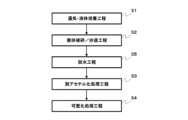
以下、本発明に係る皮革様材料およびその製造方法について、実施形態に基づき詳細に説明する。本発明に係る皮革様材料の第一実施形態は、通気かつ液体培養された、細胞壁にキチンおよび/またはキトサンを含む糸状菌類の菌体破砕物または菌体抄造物(菌体紙状物)からなる皮革様材料であって、前記菌体破砕物または菌体抄造物(菌体紙状物)が、脱アセチル化処理され、かつ、可塑化処理された、前記皮革様材料であり、本発明に係る皮革様材料の製造方法の第一実施形態は、図1に示すように、「(i)通気・液体培養工程S1」、「(ii)菌体破砕/抄造工程S2」、(iii)「脱アセチル化処理工程S3」および「(iv)可塑化処理工程S4」を有している。第一実施形態の皮革様材料は、製品に用いるなどの実用に耐え得るほどの引張強度および伸び率を有し、第一実施形態の皮革様材料の製造方法は、製品に用いるなどの実用に耐え得るほどの引張強度および伸び率を有した皮革様材料を製造することができるのである。 Hereinafter, the leather-like material and the method for producing the same according to the present invention will be described in detail based on embodiments. A first embodiment of the leather-like material according to the present invention is made from crushed fungal cells or cell paper products (fungal paper-like material) of filamentous fungi containing chitin and/or chitosan in the cell wall, which have been aerated and liquid cultured. The leather-like material is obtained by deacetylating and plasticizing the crushed bacterial cells or paper-like bacterial cells, and the leather-like material according to the present invention. The first embodiment of the method for manufacturing a leather-like material according to the above, as shown in FIG. It has "deacetylation treatment step S3" and "(iv) plasticization treatment step S4". The leather-like material of the first embodiment has a tensile strength and elongation rate high enough to withstand practical use such as use in products, and the method for producing the leather-like material of the first embodiment is suitable for practical use such as use in products. Leather-like materials can be produced with acceptable tensile strength and elongation.
本第一実施形態において、「皮革様材料」とは、上述した皮革、主に天然皮革(革)に似た触感やグリップ性を有している菌糸体材料をいい、主に天然皮革(革)に似た触感やグリップ性を有している菌糸体材料であれば特に限定されない。 In the first embodiment, the "leather-like material" refers to a mycelium material that has a feel and grip similar to the leather described above, mainly natural leather (leather), and mainly refers to a mycelium material that has a texture and grip similar to natural leather (leather). ) The mycelium material is not particularly limited as long as it has a texture and grip similar to that of the material.
本第一実施形態の「皮革様材料」においては、図8に表すように、本第一実施形態の「皮革様材料」すなわち菌体破砕物または菌体抄造物の脱アセチル化処理物の可塑化処理物を構成する菌体が、略配向的に整列して積層していることが分かる。一方、従来採用されている方法である、糸状菌を静置培養する工程を含む方法により得られた菌糸体膜を用いて作製した菌糸体材料においては、図11に表すように、菌糸体材料を構成する菌体が、略配向的に整列して積層していないことが明らかである。 In the "leather-like material" of the first embodiment, as shown in FIG. It can be seen that the bacterial cells constituting the chemically treated product are aligned and stacked in a substantially oriented manner. On the other hand, as shown in FIG. It is clear that the bacterial cells constituting the cell are not stacked in substantially oriented alignment.
なお、本第一実施形態の「皮革様材料」について、その構造および/または特性により直接特定するためには、本第一実施形態における「皮革様材料」を複数作製して、様々な手法を用いて構造または特性による特定を試みる必要があるが、そのような試験は、一人の有能な当業者であっても、多くの回数の試験を行うことを要するものであって、多大な時間を必要とするとともに、大きな経済的支出を伴うものである(特許・実用新案審査ハンドブック 第II部 第2章 特許請求の範囲の記載要件「2205 物の発明についての請求項にその物の製造方法が記載されている場合の審査における『不可能・非実際的事情』についての判断」の第16ページ最下行~第17ページ第1~4行目をご参照)。すなわち、本第一実施形態における「皮革様材料」を、その構造または特性により直接特定するためには、出願時において、当業者は採算的に見合わない時間と費用を要することとなり、そのような特定作業を要求することは、先願主義の下、一日も早い出願日を追い求める出願人にとって、技術の急速な進展と国際規模での競争の激しい特許取得の場面においては酷なことであるといえる(最高裁平成24年(受)1204号の第10ページ、または最高裁平成24年(受)2658号の第10~11ページ等)。 Note that in order to directly identify the "leather-like material" of the first embodiment by its structure and/or characteristics, a plurality of "leather-like materials" of the first embodiment are prepared and various methods are used. However, such tests require a large number of tests and require a large amount of time even for a single competent person skilled in the art. (Patent/Utility Model Examination Handbook Part II Chapter 2 Requirements for Claims 2205 A claim for an invention of a product must include a method for manufacturing the product. (See the bottom line of page 16 to lines 1 to 4 of page 17 of ``Judgment regarding ``impossible/impractical circumstances'' in examinations where In other words, in order to directly specify the "leather-like material" according to the first embodiment by its structure or characteristics, it would require unprofitable time and expense for a person skilled in the art at the time of filing, and such Requiring specific work to be done is extremely difficult for applicants who are pursuing the earliest possible filing date under the first-to-file system, given the rapid advancement of technology and the fierce competition on an international scale to obtain patents. (Supreme Court No. 1204 of 2012, page 10, or pages 10-11 of Supreme Court No. 2658 of 2012).
次に、本第一実施形態における「糸状菌」には、Hawksworthなど,In,Ainsworth and Bisby’s Dictionary of The Fungi,8th edition,1995,CAB International,bUniversity,Press,Cambridge,UKにより定義されるように、細区分真菌類(Eumycota)および卵菌(Oomycota)に属する全ての糸状形の菌が包含される。また、糸状菌は、一般的に、キチン、セルロース、グルカン、キトサン、マンナンおよび他の複合多糖類から構成される菌糸体壁により特徴づけられ、その栄養成長は、菌糸拡張によってであり、そして炭素代謝は絶対好気性である。 Next, the "filamentous fungi" in the first embodiment include Hawksworth et al., In, Ainsworth and Bisby's Dictionary of The Fungi, 8th edition, 1995, CAB International, bUniversity, Defined by Press, Cambridge, UK As such, all filamentous forms of fungi belonging to the subdivisions Eumycota and Oomycota are included. Also, filamentous fungi are generally characterized by a mycelial wall composed of chitin, cellulose, glucan, chitosan, mannan and other complex polysaccharides, their vegetative growth is by hyphal expansion, and carbon Metabolism is strictly aerobic.
本第一実施形態において、「細胞壁にキチンおよび/またはキトサンを含む糸状菌類」とは、上述した糸状菌のうち、例えば、藻菌類(Oomycetes)、子嚢菌類(Ascomycetes)、不完全菌類(Deuteromycetes)、担子菌類(Basidiomycetes)、接合菌類(Zygomycetes)に属する菌であって、かつ、細胞壁にキチンおよび/またはキトサンを含んでいる菌の他、白色腐朽菌、褐色腐朽菌などを挙げることができる。また、例えば、Acremonium属、Aspergillus属、Aureobasidium属、Bjerkandera属、Cellulomonas属、Ceriporiopsis属、Choanephora属、Chrysosporium属、Clostridium属、Coprinus属、Coriolus属、Cryptococcus属、Filibasidium属、Fusarium属、Humicola属、Irpex属、Magnaporthe属、Mucor属、Myceliophthora属、Neocallimastix属、Neurospora属、Paecilomyces属、Parasitella属、Penicillium属、Phanerochaete属、Phlebia属、Phycomyces属、Piromyces属、Pleurotus属、Rhizopus属、Schizophyllum属、Streptomyces属、Talaromyces属、Thermoascus属、Thielavia属、Tolypocladium属、Trametes属、Trichoderma属、Zygorhynchus属に属する菌を挙げることができる。 In the first embodiment, "filamentous fungi containing chitin and/or chitosan in the cell wall" refers to, among the above-mentioned filamentous fungi, for example, Oomycetes, Ascomycetes, and Deuteromycetes. ), Basidiomycetes, and Zygomycetes, which contain chitin and/or chitosan in their cell walls, as well as white-rot fungi, brown-rot fungi, and the like. . Also, for example, Acremonium genus, Aspergillus genus, Aureobasidium genus, Bjerkandera genus, Cellulomonas genus, Ceriporiopsis genus, Choanephora genus, Chrysosporium genus, Clostr. idium, Coprinus, Coriolus, Cryptococcus, Filibasidium, Fusarium, Humicola, Irpex Genus, Magnaporthe, Mucor, Myceliophthora, Neocallimastix, Neurospora, Paecilomyces, Parasitella, Penicillium, Phanerochaete, Genus Phlebia, genus Phycomyces, genus Piromyces, genus Pleurotus, genus Rhizopus, genus Schizophyllum, genus Streptomyces, Examples include bacteria belonging to the genera Talaromyces, Thermoascus, Thielavia, Tolypocladium, Trametes, Trichoderma, and Zygorhynchus.
次に、本第一実施形態において、「通気・液体培養工程S1」とは、本第一実施形態の糸状菌類を通気かつ液体培養する工程であり、「通気・液体培養工程S1」の目的は、効率的に糸状菌の菌体を生産することである。当該目的を達成するためには、単位体積当たりの菌体生産速度を担保する必要があることから、「通気・液体培養工程S1」における「通気・液体培養」としては、液体培地における通気攪拌培養を採用することが好ましい。 Next, in the first embodiment, the "aeration/liquid culture step S1" is a step of aerating and liquid culturing the filamentous fungi of the first embodiment, and the purpose of the "aeration/liquid culture step S1" is , to efficiently produce filamentous fungal cells. In order to achieve this purpose, it is necessary to ensure the production rate of bacterial cells per unit volume, so "aeration/liquid culture" in "aeration/liquid culture step S1" is aerated agitation culture in a liquid medium. It is preferable to adopt
また、本第一実施形態において、「菌体破砕/抄造工程S2」とは、図1に示すように、「通気・液体培養工程S1」において通気かつ液体培養した糸状菌類の菌体を破砕および/または抄造して、菌体破砕物を得る工程であり、「菌体破砕/抄造工程S2」の目的は、糸状菌類の菌体が繊維状となった菌体破砕物を得ることおよび/または紙状の菌体抄造物(菌体紙状物)を得ることである。なお、「通気・液体培養工程S1」における培養後の糸状菌類の菌体が十分に離解して繊維状と化している場合、「菌体破砕/抄造工程S2」は、破砕を行わない「菌体抄造工程」となり、「通気・液体培養工程S1」における培養後の糸状菌類の菌体が十分に離解しておらず、繊維状と化していない場合、「菌体破砕/抄造工程S2」は、破砕を行う「菌体破砕工程」、または、破砕および抄造を行う「菌体破砕・抄造工程」となる。 In addition, in the first embodiment, the "fungal cell crushing/paper-making process S2" refers to crushing and The purpose of the "fungal cell crushing/paper-making step S2" is to obtain a fungal cell fragment in which filamentous fungal cells have become fibrous and/or The objective is to obtain a paper-like bacterial cell material (a bacterial cell paper-like material). In addition, if the fungal cells of the filamentous fungi after culturing in the "aeration/liquid culture step S1" are sufficiently disaggregated and become fibrous, the "fungal cell crushing/paper-making step S2" is a "bacterial cell crushing/paper-making step S2" in which no crushing is performed. If the cells of the filamentous fungi after culturing in the "aeration/liquid culture step S1" are not sufficiently disaggregated and have not become fibrous, the "bacterial cell crushing/paper making step S2" is , a "bacterial cell crushing process" in which crushing is performed, or a "bacteria cell crushing/paper-making process" in which crushing and paper-making are performed.
また、本第一実施形態において、「菌体破砕」は、リファイナーやホモジナイザーなどの破砕装置を用いて行うことができ、これにより通気かつ液体培養した糸状菌類の菌体を破砕した菌体破砕物を得ることができる。なお、得られた菌体破砕物はパルプ様である。一方、本第一実施形態において、「菌体抄造」は、ワイヤーパートや吸引ろ過、真空ろ過などの装置を用いて行うことができ、これにより紙状の菌体抄造物(菌体紙状物)を得ることができる。 In addition, in the first embodiment, the "fungal cell crushing" can be performed using a crushing device such as a refiner or a homogenizer. can be obtained. Note that the obtained crushed bacterial cells are pulp-like. On the other hand, in the first embodiment, "bacterial cell paper production" can be performed using a device such as a wire part, suction filtration, vacuum filtration, etc. ) can be obtained.
また、本第一実施形態において、「脱アセチル化処理工程S3」とは、図1に示すように、本第一実施形態の「菌体破砕/抄造工程S2」を経て得られた菌体破砕物または菌体抄造物(菌体紙状物)を脱アセチル化処理する工程であり、より詳細には、アルカリ処理やイオン液体処理などによって、「菌体破砕/抄造工程S2」を経て得られた菌体破砕物または菌体抄造物(菌体紙状物)が有するキチンを脱アセチル化し、キチンの一部をキトサンに変換する工程である。「脱アセチル化処理工程S3」によって、「菌体破砕/抄造工程S2」において得られた菌体破砕物または菌体抄造物(菌体紙状物)の引張強度や伸び率を向上させることができる。前記菌体破砕物または菌体抄造物(菌体紙状物)の脱アセチル化処理物の脱アセチル化度としては、60%以上が好ましく、70%以上がより好ましく、75%以上がさらに好ましく、80%がよりさらに好ましく、85%以上が特に好ましい。 In addition, in the first embodiment, the "deacetylation treatment step S3" refers to the crushed bacterial cells obtained through the "bacterial cell crushing/paper-making step S2" of the first embodiment, as shown in FIG. This is a process of deacetylating a bacterial cell material or a bacterial cell paper-like material (a bacterial cell paper-like material), and more specifically, it is a process of deacetylating a bacterial cell material or a bacterial cell paper product (a bacterial cell paper-like material). This is a step of deacetylating chitin contained in crushed bacterial cells or paper-like bacterial cells (paper-like bacterial cells) and converting a part of the chitin into chitosan. The "deacetylation treatment process S3" can improve the tensile strength and elongation of the bacterial cell crushing product or the bacterial cell paper product (the bacterial cell paper-like material) obtained in the "microbial cell crushing/paper-making process S2". can. The degree of deacetylation of the deacetylated product of the crushed bacterial cells or the paper-like bacterial cell material is preferably 60% or more, more preferably 70% or more, and even more preferably 75% or more. , 80% is even more preferable, and 85% or more is particularly preferable.
また、本第一実施形態において、「可塑化処理工程S4」とは、図1に示すように、本第一実施形態の「脱アセチル化処理工程S3」を経て得られた菌体破砕物または菌体抄造物(菌体紙状物)の脱アセチル化処理物を可塑化処理して、前記脱アセチル化処理物の可塑化処理物を得る工程であり、「可塑化処理工程S4」の目的は、「脱アセチル化処理工程S3」で得られた糸状菌の紙状物に引張強度や伸び率を付与した皮革様シートを得ることである。「可塑化処理工程S4」により、「脱アセチル化処理工程S3」を経て得られた菌体破砕物または菌体抄造物(菌体紙状物)の脱アセチル化処理物の柔軟性を向上させることができ、その結果、割れなどを抑制することができる。 In addition, in the first embodiment, the "plasticization treatment step S4" refers to the crushed bacterial cells obtained through the "deacetylation treatment step S3" of the first embodiment, as shown in FIG. This is a step of plasticizing a deacetylated product of a bacterial cell paper product (a bacterial paper-like material) to obtain a plasticized product of the deacetylated product, and the purpose of "plasticizing process S4" The objective is to obtain a leather-like sheet in which tensile strength and elongation are imparted to the filamentous fungal paper obtained in the "deacetylation treatment step S3". "Plasticization treatment step S4" improves the flexibility of the deacetylated product of crushed bacterial cells or cell paper products (paper-like bacterial cells) obtained through "deacetylation treatment step S3" As a result, cracks and the like can be suppressed.
本第一実施形態の「可塑化処理工程S4」において使用することができる可塑剤は、特に限定されず、当業者により適宜選択可能な可塑剤を使用することができるが、そのような可塑剤としては、例えば、油脂類、ロウ類、炭化水素、高級脂肪酸、高級アルコール、合成エステル油、グリコール類などを挙げることができ、さらに、これらの1種または2種以上を配合することができる。 The plasticizer that can be used in the "plasticization step S4" of the first embodiment is not particularly limited, and any plasticizer that can be appropriately selected by a person skilled in the art can be used. Examples thereof include oils and fats, waxes, hydrocarbons, higher fatty acids, higher alcohols, synthetic ester oils, and glycols, and one or more of these may be blended.
油脂類としては、例えば、アボガド油、アマニ油、ツバキ油、アルモンド油、サザンカ油、マカデミアナッツ油、トウモロコシ油、キョウニン油、ブドウ油、グレープシード油、メドフォーム油、ホホバ油、オリーブ油、ヒマワリ油、ナタネ油、シナモン油、卵黄油、ゴマ油、小麦胚芽油、サザンカ油、ヒマシ油、サフラワー油、綿実油、大豆油、落花生油、茶実油、カヤ油、米胚芽油、コメヌカ油、カカオ脂、ヤシ油、月見草油、シア脂、硬化ヤシ油、パーム油、パーム核油、モクロウ核油、硬化ヒマシ油などを挙げることができ、さらに、これらの1種または2種以上を配合することができる。 Examples of oils and fats include avocado oil, linseed oil, camellia oil, almond oil, sasanqua oil, macadamia nut oil, corn oil, kyonin oil, grape oil, grapeseed oil, medfoam oil, jojoba oil, olive oil, sunflower oil, Rapeseed oil, cinnamon oil, egg yolk oil, sesame oil, wheat germ oil, sasanqua oil, castor oil, safflower oil, cottonseed oil, soybean oil, peanut oil, tea seed oil, kaya oil, rice germ oil, rice bran oil, cacao butter, Coconut oil, evening primrose oil, shea butter, hydrogenated coconut oil, palm oil, palm kernel oil, Japanese oak kernel oil, hydrogenated castor oil, etc. can be mentioned, and one or more of these can be blended. .
ロウ類としては、例えば、酢酸ラノリン、液状ラノリン、サトウキビロウ、還元ラノリン、POEラノリンアルコールエーテルなどを挙げることができ、さらに、これらの1種または2種以上を配合することができる。 Examples of waxes include acetic acid lanolin, liquid lanolin, sugar cane wax, reduced lanolin, and POE lanolin alcohol ether, and one or more of these can be blended.
炭化水素としては、例えば、流動パラフィン、オゾケライト、スクワレン、パラフィン、スクワラン、イソパラフィン、オクタン、デカン、ドデカン、イソドデカン、ヘキサデカン、イソヘキサデカンなどを挙げることができ、さらに、これらの1種または2種以上を配合することができる。 Examples of hydrocarbons include liquid paraffin, ozokerite, squalene, paraffin, squalane, isoparaffin, octane, decane, dodecane, isododecane, hexadecane, isohexadecane, and the like. Can be blended.
高級脂肪酸としては、例えば、ラウリン酸、ミリスチン酸、パルミチン酸、ステアリン酸、ベヘン(ベヘニン)酸、オレイン酸、12-ヒドロキシステアリン酸、ウンデシレン酸、トール酸、イソステアリン酸、リノール酸、リノレイン酸、エイコサペンタエン酸(EPA)、ドコサヘキサエン酸(DHA)、アラキドン酸などを挙げることができ、さらに、これらの1種または2種以上を配合することができる。 Examples of higher fatty acids include lauric acid, myristic acid, palmitic acid, stearic acid, behenic acid, oleic acid, 12-hydroxystearic acid, undecylenic acid, tolic acid, isostearic acid, linoleic acid, linoleic acid, Icosapentaenoic acid (EPA), docosahexaenoic acid (DHA), arachidonic acid, etc. can be mentioned, and one or more of these can be blended.
高級アルコールとしては、例えば、ラウリルアルコール、セチルアルコール、ステアリルアルコール、ベヘニルアルコール、ミリスチルアルコール、オレイルアルコール、セトステアリルアルコールなどの直鎖アルコール;モノステアリルグリセリンエーテル(バチルアルコール)、2-デシルテトラデシノール、ラノリンアルコール、コレステロール、フィトステロール、ヘキシルドデカノール、イソステアリルアルコール、オクチルドデカノールなどの分枝鎖アルコール;などを挙げることができ、さらに、これらの1種または2種以上を配合することができる。 Examples of higher alcohols include linear alcohols such as lauryl alcohol, cetyl alcohol, stearyl alcohol, behenyl alcohol, myristyl alcohol, oleyl alcohol, and cetostearyl alcohol; monostearyl glycerin ether (batyl alcohol), 2-decyltetradecinol, and lanolin. Examples include branched chain alcohols such as alcohol, cholesterol, phytosterol, hexyldodecanol, isostearyl alcohol, and octyldodecanol; furthermore, one or more of these may be blended.
合成エステル油としては、例えば、ミリスチン酸イソプロピル、オクタン酸セチル、ミリスチン酸オクチルドデシル、パルミチン酸イソプロピル、ステアリン酸ブチル、ラウリン酸ヘキシル、ミリスチン酸ミリスチル、オレイン酸デシル、ジメチルオクタン酸ヘキシルデシル、乳酸セチル、乳酸ミリスチル、酢酸ラノリン、ステアリン酸イソセチル、イソステアリン酸イソセチル、ジ-2-エチルヘキシル酸エチレングリコール、ジペンタエリスリトール脂肪酸エステル、モノイソステアリン酸N-アルキルグリコール、ジカプリン酸ネオペンチルグリコール、リンゴ酸ジイソステアリル、ジ-2-ヘプチルウンデカン酸グリセリン、トリ-2-エチルヘキシル酸トリメチロールプロパン、トリイソステアリン酸トリメチロールプロパン、テトラ-2-エチルヘキシル酸ペンタンエリスリトール、トリ-2-エチルヘキシル酸グリセリン、トリイソステアリン酸トリメチロールプロパン、セチル2-エチルヘキサノエート、2-エチルヘキシルパルミテート、トリミリスチン酸グリセリン、トリ-2-ヘプチルウンデカン酸グリセライド、ヒマシ油脂肪酸メチルエステル、オレイン酸オイル、セトステアリルアルコール、アセトグリセライド、パルミチン酸2-ヘプチルウンデシル、アジピン酸ジイソブチル、N-ラウロイル-L-グルタミン酸-2-オクチルドデシルエステル、アジピン酸ジ-2-ヘプチルウンデシル、エチルラウレート、セバチン酸ジ-2-エチルヘキシル、ミリスチン酸2-ヘキシルデシル、パルミチン酸2-ヘキシルデシル、アジピン酸2-ヘキシルデシル、セバチン酸ジイソプロピル、コハク酸2-エチルヘキシル、トリオクタン酸グリセリン、トリイソパルミチン酸グリセリン、ラノリン脂肪酸イソプロピル、ラウリン酸ヘキシルなどを挙げることができ、さらに、これらの1種または2種以上を配合することができる。 Examples of synthetic ester oils include isopropyl myristate, cetyl octoate, octyldodecyl myristate, isopropyl palmitate, butyl stearate, hexyl laurate, myristyl myristate, decyl oleate, hexyldecyl dimethyloctanoate, cetyl lactate, Myristyl lactate, lanolin acetate, isocetyl stearate, isocetyl isostearate, ethylene glycol di-2-ethylhexylate, dipentaerythritol fatty acid ester, N-alkyl glycol monoisostearate, neopentyl glycol dicaprate, diisostearyl malate, -2-heptylundecanoic acid glycerin, tri-2-ethylhexylic acid trimethylolpropane, trimethylolpropane triisostearate, tetra-2-ethylhexylic acid pentaneerythritol, tri-2-ethylhexylic acid glycerin, trimethylolpropane triisostearate, cetyl 2-Ethylhexanoate, 2-ethylhexyl palmitate, glyceryl trimyristate, tri-2-heptylundecanoic acid glyceride, castor oil fatty acid methyl ester, oleic acid oil, cetostearyl alcohol, acetoglyceride, 2-heptylundecanoate palmitate Decyl, diisobutyl adipate, N-lauroyl-L-glutamic acid-2-octyldodecyl ester, di-2-heptyl undecyl adipate, ethyl laurate, di-2-ethylhexyl sebatate, 2-hexyldecyl myristate, palmitin Examples include 2-hexyldecyl acid, 2-hexyldecyl adipate, diisopropyl sebatate, 2-ethylhexyl succinate, glyceryl trioctanoate, glyceryl triisopalmitate, isopropyl lanolin fatty acid, and hexyl laurate. One or more of these can be blended.
グリコール類としては、エチレングリコール、ジエチレングリコール、ポリエチレングリコール、プロピレングリコール、ポリプロピレングリコールなどを挙げることができ、さらに、これらの1種または2種類以上を配合することができる。 Examples of glycols include ethylene glycol, diethylene glycol, polyethylene glycol, propylene glycol, and polypropylene glycol, and one or more of these can be blended.
次に、本第一実施形態の「菌体破砕/抄造工程S2」において得られた菌体破砕物または菌体抄造物(菌体紙状物)が脱水できていない場合、図2に示すように、本第一実施形態の「菌体破砕/抄造工程S2」と「脱アセチル化処理工程S3」との間に「脱水工程S5」を備えて、本発明に係る皮革様材料の製造方法の第二実施形態としてもよく、さらに、図3および図4に示すように、本第一実施形態の「菌体破砕/抄造工程S2」と「脱アセチル化処理工程S3」との間、または本第二実施形態の「脱水工程S5」と「脱アセチル化処理工程S3」との間に「乾燥工程S6」を備えて、それぞれ本発明に係る皮革様材料の製造方法の第三実施形態および第四実施形態としてもよい。 Next, if the microbial cell crushing product or the microbial cell paper product (microbial cell paper-like material) obtained in the "microbial cell crushing/paper-making step S2" of the first embodiment has not been dehydrated, as shown in FIG. In the method for producing a leather-like material according to the present invention, a "dehydration step S5" is provided between the "cell crushing/paper-making step S2" and the "deacetylation step S3" of the first embodiment. The second embodiment may also be used, and as shown in FIGS. A "drying step S6" is provided between the "dehydration step S5" and "deacetylation step S3" of the second embodiment, and the third embodiment and the third embodiment of the method for producing a leather-like material according to the present invention, respectively. There may be four embodiments.
本第一実施形態において、「脱水」は、フィルタープレス、ベルトプレス、真空ろ過などの装置を用いてすることができ、「乾燥」は、熱風乾燥、ヒートプレスなどの装置を用いてすることができる。また、菌糸を伸長させながら通風乾燥することができる。 In the first embodiment, "dehydration" can be performed using a device such as a filter press, belt press, or vacuum filtration, and "drying" can be performed using a device such as hot air drying or a heat press. can. In addition, ventilation drying can be performed while elongating the hyphae.
また、本第一実施形態の皮革様材料の製造方法は、図5に示すように、本第一実施形態の「脱アセチル化処理工程S3」と「可塑化処理工程S4」との間に「架橋処理工程S7」を備えて、本発明に係る皮革様材料の製造方法の第五実施形態としてもよい。「架橋処理工程S7」により、「脱アセチル化処理工程S3」を経て得られた菌体破砕物または菌体抄造物(菌体紙状物)が有するタンパクやキチン、キトサンを、タンニン(タンニン酸)やゲニピンなどの架橋剤を用いて架橋することができ、引張強度や伸び率をより向上させることができる。 In addition, as shown in FIG. 5, the method for producing a leather-like material according to the first embodiment is such that "deacetylation treatment step S3" and "plasticization treatment step S4" of the first embodiment are A fifth embodiment of the method for producing a leather-like material according to the present invention may include a crosslinking treatment step S7. In the "crosslinking treatment step S7", proteins, chitin, and chitosan contained in the crushed bacterial cells or the bacterial cell paper products (the bacterial paper-like material) obtained through the "deacetylation treatment step S3" are removed from tannin (tannic acid). ) or genipin can be used to further improve tensile strength and elongation.
本第五実施形態の「架橋処理工程S7」において使用することができる架橋剤は、特に限定されず、当業者により適宜選択可能な架橋剤を使用することができるが、そのような架橋剤としては、例えば、ゲニピン、タンニン(タンニン酸)、その他のフラボノイド(例えば、プロアントシアニジン、カテキン、エピカテキン、エピガロカテキン、没食子酸エピカテキン、没食子酸エピガロカテキン、ケルセチン、カルコン、アピゲニン、ルテオリン(luteoiin)、ポリメトキシ化フラボン、クエルシトール(quercitoi)、ケンペロール、ミリセチン、アントシアニン、レスベラトロール(resveritrol)、イソフラボノイド、ダイゼイン、ゲニステイン、ノビレチン、およびタンゲレチン)、バイオフラボノイド、リボフラビン、イミドエステル、エポキシド(例えば、エチレングリコールジグリシジルエーテル)、ジアルデヒド(例えば、グルタルアルデヒド)、N-ヒドロキシスクシンイミドエステル(例えば、2,3-ジブロモプロピオニル-N-ヒドロキシスクシンイミドエステル、スルホ-N-ヒドロキシスクシンイミドエステル、およびクロラムブシル-N-ヒドロキシスクシンイミドエステル)、カルボジイミド(例えば、1-エチル-3-(3-ジメチルアミノプロピル)カルボジイミド塩酸塩)、マレイミド、ハロアセチル、ピリジルジスルフィド、ヒドラジド、6-マレイミドヘキサン酸活性エステル、ジスクシンイミジルスベレート、ビス(スルホスクシンイミジル)スベレート、アジド、ジアジリン、スルホスクシンイミジル-4-(N-マレイミドメチル)シクロヘキサン-1-カルボキシレートなどを挙げることができ、さらに、これらの1種または2種以上を配合することができる。 The crosslinking agent that can be used in the "crosslinking treatment step S7" of the fifth embodiment is not particularly limited, and any crosslinking agent that can be appropriately selected by a person skilled in the art can be used. are, for example, genipin, tannins (tannic acid), other flavonoids (e.g. proanthocyanidins, catechin, epicatechin, epigallocatechin, epicatechin gallate, epigallocatechin gallate, quercetin, chalcone, apigenin, luteolin). ), polymethoxylated flavones, quercitoi, kaempferol, myricetin, anthocyanins, resveritrol, isoflavonoids, daidzein, genistein, nobiletin, and tangeretin), bioflavonoids, riboflavin, imidoesters, epoxides (e.g., ethylene glycol diglycidyl ether), dialdehydes (e.g. glutaraldehyde), N-hydroxysuccinimide esters (e.g. 2,3-dibromopropionyl-N-hydroxysuccinimide ester, sulfo-N-hydroxysuccinimide ester, and chlorambucil-N-hydroxy succinimide ester), carbodiimide (e.g. 1-ethyl-3-(3-dimethylaminopropyl)carbodiimide hydrochloride), maleimide, haloacetyl, pyridyl disulfide, hydrazide, 6-maleimidohexanoic acid active ester, disuccinimidyl suberate, Examples include bis(sulfosuccinimidyl) suberate, azide, diazirine, sulfosuccinimidyl-4-(N-maleimidomethyl)cyclohexane-1-carboxylate, and one or two of these. The above can be blended.
なお、本第五実施形態の皮革様材料の製造方法においても、本第二実施形態の皮革様材料の製造方法と同様に、本第五実施形態の「菌体破砕/抄造工程S2」において得られた菌体破砕物または菌体抄造物(菌体紙状物)が脱水できていない場合は、本第五実施形態の「菌体破砕/抄造工程S2」と「脱アセチル化処理工程S3」との間に「脱水工程S5」を備えて、本発明に係る皮革様材料の製造方法の第六実施形態としてもよく、さらに、本第三実施形態の皮革様材料の製造方法および本第四実施形態の皮革様材料の製造方法と同様に、本第五実施形態の「菌体破砕/抄造工程S2」と「脱アセチル化処理工程S3」との間、または本第六実施形態の「脱水工程S5」と「脱アセチル化処理工程S3」との間に「乾燥工程S6」を備えて、それぞれ本発明に係る皮革様材料の製造方法の第七実施形態および第八実施形態としてもよいことはいうまでもない。第六実施形態の皮革様材料の製造方法、第七実施形態の皮革様材料の製造方法および第八実施形態の皮革様材料の製造方法の工程については図示しない。 Note that in the method for producing a leather-like material according to the fifth embodiment, as well as the method for producing a leather-like material according to the second embodiment, the method for producing a leather-like material in the "cell crushing/paper-making step S2" of the fifth embodiment If the resulting microbial cell crushing product or microbial cell paper product (microbial cell paper-like material) has not been dehydrated, the "bacterial cell crushing/paper-making process S2" and the "deacetylation treatment process S3" of the fifth embodiment are performed. A sixth embodiment of the method for manufacturing a leather-like material according to the present invention may be provided by including a "dehydration step S5" between the steps. Similar to the method for producing a leather-like material according to the embodiment, between the "cell crushing/paper-making process S2" and the "deacetylation process S3" of the fifth embodiment, or the "dehydration process S3" of the sixth embodiment, A seventh embodiment and an eighth embodiment of the method for producing a leather-like material according to the present invention may be provided, respectively, by providing a "drying step S6" between "step S5" and "deacetylation treatment step S3". Needless to say. The steps of the method for manufacturing a leather-like material according to the sixth embodiment, the method for manufacturing a leather-like material according to the seventh embodiment, and the method for manufacturing a leather-like material according to the eighth embodiment are not illustrated.
なお、本発明に係る皮革様材料の製造方法は、上述した各実施形態に限定されるものではなく、本発明の特徴を損なわない範囲において、適宜変更することができる。 Note that the method for producing a leather-like material according to the present invention is not limited to the above-described embodiments, and can be modified as appropriate without impairing the characteristics of the present invention.
例えば、上述した各実施形態や構成以外の構成を、本発明の特徴を損なわない範囲において、適宜採用することができる。そのような構成としては、例えば、前培養工程や加熱工程、洗浄(水洗)工程、さらなる脱水工程、さらなる乾燥工程などを挙げることができる。 For example, configurations other than the embodiments and configurations described above may be employed as appropriate within a range that does not impair the characteristics of the present invention. Such configurations include, for example, a preculture step, a heating step, a washing (washing with water) step, a further dehydration step, a further drying step, and the like.
以下、本発明に係る皮革様材料およびその製造方法について、実施例に基づいて説明する。なお、本発明の技術的範囲は、これらの実施例によって示される実施態様に限定されない。 Hereinafter, the leather-like material and the manufacturing method thereof according to the present invention will be explained based on Examples. Note that the technical scope of the present invention is not limited to the embodiments shown by these Examples.
《実施例1》皮革様材料の製造
本発明に係る皮革様材料を製造した。細胞壁にキチンおよび/またはキトサンを含む糸状菌類としては、アスペルギルス・オリゼー(Aspergillus oryzae NBRC 4075)を使用した。バッフルフラスコにアスペルギルス・オリゼーの胞子を1.0×10⁵個/mLとなるように植菌し、振盪培養器を用いて、30℃の温度条件下で24時間、前培養した。前培養では、24g/Lのポテトデキストロースを溶解した水溶液を培地として用いた。得られた培養液を、本培養液に対して3%(v/v)となるように植菌し、30L容積のジャーファーメンターを用いて、30℃、通気量1vvm、pH5.0の条件下で24時間、通気攪拌培養した。通気攪拌培養すなわち本培養では、10g/Lのコーンスティープリカーおよび25g/Lの廃糖蜜を調整した水溶液を培地として用いた。
<<Example 1>> Production of leather-like material A leather-like material according to the present invention was produced. Aspergillus oryzae NBRC 4075 was used as a filamentous fungus containing chitin and/or chitosan in its cell wall. A baffled flask was inoculated with Aspergillus oryzae spores at a concentration of 1.0 x 10 5 spores/mL, and precultured for 24 hours at a temperature of 30°C using a shaking incubator. In the preculture, an aqueous solution in which 24 g/L of potato dextrose was dissolved was used as a medium. The obtained culture solution was inoculated at a concentration of 3% (v/v) to the main culture solution, and inoculated using a 30L jar fermenter at 30°C, aeration rate of 1vvm, and pH 5.0. Culture was carried out under aeration and agitation for 24 hours. In the aerated agitation culture, that is, the main culture, an aqueous solution containing 10 g/L of corn steep liquor and 25 g/L of blackstrap molasses was used as a medium.
得られた培養液からステンレス金網で粒状の菌体を回収した。回収した菌体に除去された等量の水道水を加え、ホモジナイザーで菌体を破砕した。破砕した菌体スラリー(乾燥菌体含有量10g)を、直径90mmのろ紙を用いて吸引ろ過し、菌体抄造物(菌体紙状物)を得た。得られた菌体抄造物(菌体紙状物)を室温で24時間自然乾燥させた。その菌体抄造物(菌体紙状物)の断面を図6に表す。図6に表されるように、菌体抄造物(菌体紙状物)に含まれる菌糸が密集しており、空隙の中に菌糸が伸長している様子が確認された。 Granular microbial cells were collected from the obtained culture solution using a stainless wire mesh. An equal amount of the removed tap water was added to the collected cells, and the cells were disrupted using a homogenizer. The crushed bacterial cell slurry (dry bacterial cell content: 10 g) was suction-filtered using a filter paper with a diameter of 90 mm to obtain a bacterial cell paper product (a bacterial cell paper-like material). The obtained microbial cell paper product (microbial cell paper-like material) was air-dried at room temperature for 24 hours. FIG. 6 shows a cross section of the microbial cell paper product (microbial paper-like material). As shown in FIG. 6, it was confirmed that the hyphae contained in the mycelium paper product (mycelia paper-like material) were densely packed, and the hyphae were elongated into the voids.
前記得られた菌体抄造物(菌体紙状物)の乾燥物を、30%(w/v)のNaOH水溶液を用いて100℃の温度条件下で4時間浸漬することにより脱アセチル化処理をした。脱アセチル化処理された菌体抄造物(菌体紙状物)を水洗後、酢酸を用いて中和した。得られた菌体抄造物(菌体紙状物)の脱アセチル化処理物を、室温で24時間、プロピレングリコール水溶液(20%(w/w))に浸漬することにより可塑化処理した後、自然乾燥することにより、シート状の皮革様材料を得た。当該得られた皮革様材料は、製品に用いるなどの実用に耐え得るほどの引張強度および伸び率を有していた。 Deacetylation treatment is carried out by immersing the dried bacterial cell paper product obtained above in a 30% (w/v) NaOH aqueous solution at a temperature of 100° C. for 4 hours. Did. The deacetylated microbial cell material (microbial paper-like material) was washed with water and then neutralized using acetic acid. After plasticizing the obtained deacetylated bacterial cell material (microbial paper-like material) by immersing it in a propylene glycol aqueous solution (20% (w/w)) at room temperature for 24 hours, By air drying, a sheet-like leather-like material was obtained. The obtained leather-like material had a tensile strength and elongation rate sufficient for practical use such as use in products.
また、当該得られた皮革様材料の断面を図7に、拡大した当該断面を図8に、それぞれ表す。図7および図8に表されるように、当該得られた皮革様材料すなわち脱アセチル化処理および可塑化処理後の菌体抄造物(菌体紙状物)は、脱アセチル化処理および可塑化処理前の菌体抄造物(菌体紙状物)と同様の構造が保持されていることが明らかとなり、また、当該得られた皮革様材料すなわち脱アセチル化処理および可塑化処理後の菌体抄造物(菌体紙状物)を構成しているアスペルギルス・オリゼー(Aspergillus oryzae NBRC 4075)の菌体が、略配向的に整列して積層していることが明らかとなった。 Further, a cross section of the obtained leather-like material is shown in FIG. 7, and an enlarged cross section is shown in FIG. 8, respectively. As shown in FIGS. 7 and 8, the obtained leather-like material, that is, the bacterial cell paper product after deacetylation treatment and plasticization treatment, It became clear that the structure similar to that of the bacterial cell paper material before treatment was maintained, and that the resulting leather-like material, that is, the bacterial cell material after deacetylation treatment and plasticization treatment, It was revealed that the bacterial cells of Aspergillus oryzae (NBRC 4075) constituting the paper product (paper-like bacterial cell material) were arranged and stacked in a substantially oriented manner.
[比較例]従来採用されている方法による菌糸体材料の製造
本発明に係る皮革様材料と比較するために、従来採用されている方法である、糸状菌類を静置培養する工程を含む方法により菌糸体材料を作製した。まず、48g/Lのポテトデキストロースを溶解した水溶液に、アスペルギルス・オリゼー(Aspergillus oryzae NBRC 4075)の胞子を1.0×10⁸個/mLとなるように植菌し、30℃の温度条件下で3日間、静置培養した。液体培地表面に生育したアスペルギルス・オリゼー(Aspergillus oryzae NBRC 4075)の菌糸体膜を回収し、新たに調整した液体培地に移植して、30℃の温度条件下で2日間、さらに静置培養した。得られた菌糸体膜を再度、新たに調整した液体培地に移植して、30℃の温度条件下で2日間、さらに静置培養した。得られた菌糸体膜を室温で24時間自然乾燥させた。得られた菌糸体膜の断面を図9に表す。図9に表されるように、当該得られた菌糸体膜を構成するアスペルギルス・オリゼー(Aspergillus oryzae NBRC 4075)の菌体が互いに絡み合っているのが明らかとなった。また、本発明に係る脱アセチル化処理後の菌体抄造物(菌体紙状物)を構成しているアスペルギルス・オリゼー(Aspergillus oryzae NBRC 4075)の菌体の密度と比較して、当該得られた菌糸体膜を構成するアスペルギルス・オリゼー(Aspergillus oryzae NBRC 4075)の菌体密度は小さいことが明らかとなった。
[Comparative Example] Production of mycelium material by a conventional method In order to compare with the leather-like material according to the present invention, a method including a step of statically culturing filamentous fungi, which is a conventional method, was used. Mycelial material was prepared. First, spores of Aspergillus oryzae (Aspergillus oryzae NBRC 4075) were inoculated at a concentration of 1.0 x 10 8 spores/mL into an aqueous solution containing 48 g/L of potato dextrose, and the spores were incubated at a temperature of 30°C. Static culture was performed for 3 days. The mycelial membrane of Aspergillus oryzae (NBRC 4075) grown on the surface of the liquid medium was collected, transplanted to a freshly prepared liquid medium, and further cultured stationary at a temperature of 30° C. for 2 days. The obtained mycelial membrane was again transplanted into a freshly prepared liquid medium, and further statically cultured for 2 days at a temperature of 30°C. The obtained mycelial membrane was naturally dried at room temperature for 24 hours. A cross section of the obtained mycelial membrane is shown in FIG. As shown in FIG. 9, it became clear that the cells of Aspergillus oryzae (NBRC 4075) constituting the obtained mycelial membrane were intertwined with each other. In addition, compared with the density of Aspergillus oryzae NBRC 4075 constituting the bacterial cell paper product (microbial paper-like material) after the deacetylation treatment according to the present invention, the obtained bacterial cell density is It was revealed that the bacterial cell density of Aspergillus oryzae (NBRC 4075) constituting the mycelium membrane was small.
前記得られた菌糸体膜に対し、実施例1と同様、脱アセチル化処理および可塑化処理を行い、自然乾燥することにより、シート状の菌糸体材料を得た。当該得られた菌糸体膜は、実施例1において製造した皮革様材料と比較して、引張強度と伸び率のいずれもが劣っており、製品に用いるなどの実用に耐え得るほどの引張強度および伸び率を有していないことが明らかとなった。 The obtained mycelium membrane was subjected to deacetylation treatment and plasticization treatment in the same manner as in Example 1, and then air-dried to obtain a sheet-like mycelium material. The obtained mycelial membrane was inferior in both tensile strength and elongation rate compared to the leather-like material produced in Example 1, and did not have enough tensile strength and elongation to withstand practical use such as use in products. It became clear that it had no elongation rate.
また、当該得られた脱アセチル化処理および可塑化処理後の菌糸体材料の断面を図10に、拡大した当該断面を図11に、それぞれ表す。図10および図11に表されるように、当該得られた脱アセチル化処理および可塑化処理後の菌糸体材料では、脱アセチル化処理および可塑化処理により形態が消滅して菌体の姿がなくなっており、当該得られた脱アセチル化処理および可塑化処理後の菌糸体材料の断面構造は、脱アセチル化処理および可塑化処理前の菌糸体材料の断面構造と比較して、変化していることが明らかとなり、また、配向性のない菌体が密集し、整列しておらず、積層となっていないことが明らかとなった。 Further, a cross section of the obtained mycelium material after the deacetylation treatment and plasticization treatment is shown in FIG. 10, and an enlarged cross section is shown in FIG. 11, respectively. As shown in FIGS. 10 and 11, the mycelium material obtained after the deacetylation treatment and plasticization treatment loses its morphology due to the deacetylation treatment and plasticization treatment, and the appearance of the fungal cells disappears. The cross-sectional structure of the mycelial material obtained after the deacetylation treatment and plasticization treatment is changed compared to the cross-sectional structure of the mycelium material before the deacetylation treatment and plasticization treatment. It was also revealed that the microbial cells without orientation were densely packed, not aligned, and not stacked.
《実施例2》複数の糸状菌類の検討
細胞壁にキチンおよび/またはキトサンを含む糸状菌類として、トリコデルマ・リーセイ(Trichoderma reesei NBRC 31326)と、イルペックス・ラクテウス(Irpex lacteus NBRC 5367)を使用した以外は実施例1と同様の方法により、実施例1と同様の、実用に耐え得るほどの引張強度および伸び率を有する皮革様材料を得ることができた。
[Example 2] Study of multiple filamentous fungi Except for using Trichoderma reesei (Trichoderma reesei NBRC 31326) and Irpex lacteus (Irpex lacteus NBRC 5367) as filamentous fungi containing chitin and/or chitosan in their cell walls. By the same method as in Example 1, it was possible to obtain a leather-like material having a tensile strength and elongation rate sufficient for practical use, as in Example 1.
《実施例3》脱アセチル化処理工程の要否の検討
脱アセチル化処理を実施しない以外は実施例1と同様の方法により、皮革様材料を得た。得られた皮革様材料は、実施例1で得られた皮革様材料と比較して、引張強度と伸び率のいずれもが劣っていた。
<<Example 3>> Examination of necessity of deacetylation treatment step A leather-like material was obtained in the same manner as in Example 1 except that deacetylation treatment was not performed. The obtained leather-like material was inferior to the leather-like material obtained in Example 1 in both tensile strength and elongation.
《実施例4》脱アセチル化処理工程における温度条件および処理時間の検討
30%(w/v)のNaOH水溶液を用いて100℃の温度条件下で4時間浸漬することにより脱アセチル化処理をすることに代えて、30%(w/v)のNaOH水溶液を用いて室温で24時間浸漬することにより脱アセチル化処理をしたこと以外は実施例1と同様の方法により、皮革様材料を得た。得られた皮革様材料は、実施例1で得られた皮革様材料と比較して、引張強度および伸び率が同程度であった。
<<Example 4>> Study of temperature conditions and treatment time in the deacetylation treatment process Deacetylation treatment is performed by immersing in a 30% (w/v) NaOH aqueous solution at a temperature of 100°C for 4 hours. Instead, a leather-like material was obtained in the same manner as in Example 1, except that the deacetylation treatment was performed by immersion in a 30% (w/v) NaOH aqueous solution for 24 hours at room temperature. . The obtained leather-like material had comparable tensile strength and elongation as compared to the leather-like material obtained in Example 1.
《実施例5》可塑化処理工程の要否の検討
可塑化処理を実施しない以外は実施例1と同様の方法により、皮革様材料を得た。得られた皮革様材料は、実施例1で得られた皮革様材料と比較して、引張強度は同程度であったが、伸び率は劣っていた。
<<Example 5>> Examination of necessity of plasticizing process A leather-like material was obtained in the same manner as in Example 1 except that the plasticizing process was not performed. The obtained leather-like material had comparable tensile strength but inferior elongation as compared to the leather-like material obtained in Example 1.
《実施例6》架橋処理工程の検討
実施例1の脱アセチル化処理工程の後に、架橋処理工程を加えた。脱アセチル化処理工程において得られた菌体破砕物または菌体抄造物(菌体紙状物)の脱アセチル化処理物を、縮合型植物タンニン(ケブラチョ)水溶液(5%(w/v))に室温で24時間浸漬することにより架橋処理をした。当該得られた架橋処理物を水洗した後、室温で24時間、プロピレングリコール水溶液(20%(w/w))に浸漬することにより可塑化処理した後、自然乾燥することにより、皮革様材料を得た。得られた皮革様材料は、実施例1で得られた皮革様材料と比較して、引張強度は向上したものの、伸び率が低下したが、実施例1と同様の、実用に耐え得るほどの引張強度および伸び率を有する皮革様材料であった。
<<Example 6>> Examination of the crosslinking treatment step After the deacetylation treatment step of Example 1, a crosslinking treatment step was added. The deacetylated product of crushed bacterial cells or paper-like bacterial cells (paper-like bacterial cells) obtained in the deacetylation treatment step was added to an aqueous solution of condensed vegetable tannin (quebracho) (5% (w/v)). Crosslinking treatment was carried out by immersing the sample in water at room temperature for 24 hours. After washing the obtained crosslinked product with water, it was plasticized by immersing it in a propylene glycol aqueous solution (20% (w/w)) at room temperature for 24 hours, and then air-dried to obtain a leather-like material. Obtained. The obtained leather-like material had an improved tensile strength but a lower elongation rate compared to the leather-like material obtained in Example 1, but it had the same level of practicality as Example 1. It was a leather-like material with tensile strength and elongation.
《実施例7》架橋剤の検討
脱アセチル化処理工程において得られた菌体破砕物または菌体抄造物(菌体紙状物)の脱アセチル化処理物を、縮合型植物タンニン(ケブラチョ)水溶液(5%(w/v))に室温で24時間浸漬することに代えて、脱アセチル化処理工程において得られた菌体破砕物または菌体抄造物(菌体紙状物)の脱アセチル化処理物を、ゲニピン水溶液(2%(w/v))に室温で24時間浸漬浸漬した以外は実施例6と同様の方法により、皮革様材料を得た。得られた皮革様材料は、実施例1で得られた皮革様材料と比較して、引張強度は向上し、伸び率は同程度であった。
《Example 7》 Study on crosslinking agent The deacetylated product of crushed bacterial cells or paper-like bacterial cells (paper-like bacterial cells) obtained in the deacetylation process was treated with an aqueous solution of condensed vegetable tannin (Quebracho). (5% (w/v)) for 24 hours at room temperature. A leather-like material was obtained in the same manner as in Example 6, except that the treated product was immersed in an aqueous genipin solution (2% (w/v)) at room temperature for 24 hours. The obtained leather-like material had improved tensile strength and comparable elongation as compared to the leather-like material obtained in Example 1.
《実施例8》乾燥工程の検討
実施例1において、得られた菌体抄造物(菌体紙状物)を室温で24時間自然乾燥させることに代えて、得られた菌体抄造物(菌体紙状物)を105℃の温度条件下で1時間加熱乾燥させること以外は実施例1と同様の方法により、皮革様材料を得た。得られた皮革様材料は、実施例1で得られた皮革様材料と比較して、引張強度および伸び率が同程度であった。
《Example 8》Study of drying process In Example 1, instead of naturally drying the obtained bacterial cell material (bacteria paper-like material) at room temperature for 24 hours, A leather-like material was obtained in the same manner as in Example 1, except that the paper-like material was heat-dried for 1 hour at a temperature of 105°C. The obtained leather-like material had comparable tensile strength and elongation as compared to the leather-like material obtained in Example 1.
本発明に係る皮革様材料およびその製造方法によれば、従来の菌糸体材料および静置培養または固体培養を採用したその製造方法と比較して、引張強度および伸び率が向上し、かつ、製品に用いるなどの実用に耐え得るほどの引張強度および伸び率を有した皮革様の菌糸体材料を提供することが可能となるとともに、短期間で製造することが可能となる。 According to the leather-like material and the method for producing the same according to the present invention, the tensile strength and elongation rate are improved compared to the conventional mycelium material and the production method employing static culture or solid culture. This makes it possible to provide a leather-like mycelium material that has enough tensile strength and elongation to withstand practical use, such as for use in practical applications, and it also becomes possible to produce it in a short period of time.
Claims (7)
(ii)前記通気かつ液体培養した糸状菌類の菌体を破砕および/または抄造して、菌体破砕物または菌体抄造物を得る菌体破砕/抄造工程、
(iii)前記得られた菌体破砕物または菌体抄造物を脱アセチル化処理して、前記菌体破砕物または菌体抄造物の脱アセチル化処理物を得る脱アセチル化処理工程、
(iv)前記得られた菌体破砕物または菌体抄造物の脱アセチル化処理物を可塑化処理して、前記脱アセチル化処理物の可塑化処理物を得る可塑化処理工程、
以上、(i)、(ii)、(iii)および(iv)の工程を含む方法により製造されてなる、皮革様材料。 (i) an aeration/liquid culture step of aerating and liquid culturing filamentous fungi containing chitin and/or chitosan in their cell walls;
(ii) a fungal cell crushing/paper-making step in which the aerated and liquid-cultured filamentous fungal cells are crushed and/or paper-made to obtain a crushed bacterial cell product or a cell-formed product;
(iii) a deacetylation treatment step of deacetylating the obtained bacterial cell fragment or bacterial cell material to obtain a deacetylated product of the bacterial cell fragment or bacterial cell material;
(iv) a plasticizing treatment step of plasticizing the obtained deacetylated product of the crushed bacterial cells or the bacterial cell extract to obtain a plasticized product of the deacetylated product;
A leather-like material produced by a method including the steps (i), (ii), (iii) and (iv) above.
(ii)前記通気かつ液体培養した糸状菌類の菌体を破砕および/または抄造して、菌体破砕物または菌体抄造物を得る菌体破砕/抄造工程、
(iii)前記得られた菌体破砕物または菌体抄造物を脱アセチル化処理して、前記菌体破砕物または菌体抄造物の脱アセチル化処理物を得る脱アセチル化処理工程、
(iv)前記得られた菌体破砕物または菌体抄造物の脱アセチル化処理物を架橋処理して、前記脱アセチル化処理物の架橋物を得る架橋処理工程、
(v)前記得られた脱アセチル化処理物の架橋物を可塑化処理して、前記架橋物の可塑化処理物を得る可塑化処理工程、
以上、(i)、(ii)、(iii)、(iv)および(v)の工程を含む方法により製造されてなる、皮革様材料。 (i) an aeration/liquid culture step of aerating and liquid culturing filamentous fungi containing chitin and/or chitosan in their cell walls;
(ii) a fungal cell crushing/paper-making step in which the aerated and liquid-cultured filamentous fungal cells are crushed and/or paper-made to obtain a crushed bacterial cell product or a cell-formed product;
(iii) a deacetylation treatment step of deacetylating the obtained bacterial cell fragment or bacterial cell material to obtain a deacetylated product of the bacterial cell fragment or bacterial cell material;
(iv) a crosslinking treatment step of crosslinking the deacetylated product of the obtained bacterial cell crush product or bacterial cell extract to obtain a crosslinked product of the deacetylated product;
(v) a plasticizing step of plasticizing the obtained crosslinked deacetylated product to obtain a plasticized product of the crosslinked product;
A leather-like material produced by a method including the steps (i), (ii), (iii), (iv) and (v) above.
前記通気かつ液体培養した糸状菌類の菌体を破砕および/または抄造して、菌体破砕物または菌体抄造物を得る菌体破砕/抄造工程と、
前記得られた菌体破砕物または菌体抄造物を脱アセチル化処理して、前記菌体破砕物または菌体抄造物の脱アセチル化処理物を得る脱アセチル化処理工程と、
前記得られた菌体破砕物または菌体抄造物の脱アセチル化処理物を可塑化処理して、前記脱アセチル化処理物の可塑化処理物を得る可塑化処理工程と
を有する、皮革様材料の製造方法。 an aeration/liquid culture step of aerating and liquid culturing filamentous fungi containing chitin and/or chitosan in their cell walls;
A fungal cell crushing/paper-making step in which the aerated and liquid-cultured filamentous fungal cells are crushed and/or made into paper to obtain a fungal cell fragment or a fungal cell material;
a deacetylation treatment step of deacetylating the obtained bacterial cell fragments or bacterial cell material to obtain a deacetylated product of the bacterial cell fragments or bacterial cell material;
a plasticizing treatment step of plasticizing the deacetylated product of the obtained crushed bacterial cells or paper-derived bacterial cells to obtain a plasticized product of the deacetylated product. manufacturing method.
前記通気かつ液体培養した糸状菌類の菌体を破砕および/または抄造して、菌体破砕物または菌体抄造物を得る菌体破砕/抄造工程と、
前記得られた菌体破砕物または菌体抄造物を脱アセチル化処理して、前記菌体破砕物または菌体抄造物の脱アセチル化処理物を得る脱アセチル化処理工程と、
前記得られた菌体破砕物または菌体抄造物の脱アセチル化処理物を架橋処理して、前記脱アセチル化処理物の架橋物を得る架橋処理工程と、
前記得られた脱アセチル化処理物の架橋物を可塑化処理して、前記架橋物の可塑化処理物を得る可塑化処理工程と
を有する、皮革様材料の製造方法。 an aeration/liquid culture step of aerating and liquid culturing filamentous fungi containing chitin and/or chitosan in their cell walls;
A fungal cell crushing/paper-making step in which the aerated and liquid-cultured filamentous fungal cells are crushed and/or made into paper to obtain a fungal cell fragment or a fungal cell material;
a deacetylation treatment step of deacetylating the obtained bacterial cell fragments or bacterial cell material to obtain a deacetylated product of the bacterial cell fragments or bacterial cell material;
A crosslinking treatment step of crosslinking the obtained deacetylated product of the crushed bacterial cells or the bacterial cell extract to obtain a crosslinked product of the deacetylated product;
A method for producing a leather-like material, comprising a plasticizing step of plasticizing the obtained crosslinked deacetylated product to obtain a plasticized product of the crosslinked product.
Priority Applications (1)
| Application Number | Priority Date | Filing Date | Title |
|---|---|---|---|
| JP2019181078A JP7340848B2 (en) | 2019-09-30 | 2019-09-30 | Leather-like material and its manufacturing method |
Applications Claiming Priority (1)
| Application Number | Priority Date | Filing Date | Title |
|---|---|---|---|
| JP2019181078A JP7340848B2 (en) | 2019-09-30 | 2019-09-30 | Leather-like material and its manufacturing method |
Publications (2)
| Publication Number | Publication Date |
|---|---|
| JP2021052698A JP2021052698A (en) | 2021-04-08 |
| JP7340848B2 true JP7340848B2 (en) | 2023-09-08 |
Family
ID=75269229
Family Applications (1)
| Application Number | Title | Priority Date | Filing Date |
|---|---|---|---|
| JP2019181078A Active JP7340848B2 (en) | 2019-09-30 | 2019-09-30 | Leather-like material and its manufacturing method |
Country Status (1)
| Country | Link |
|---|---|
| JP (1) | JP7340848B2 (en) |
Families Citing this family (9)
| Publication number | Priority date | Publication date | Assignee | Title |
|---|---|---|---|---|
| WO2023090387A1 (en) * | 2021-11-18 | 2023-05-25 | 株式会社伯耆のきのこ | Mushroom sheet and method for producing same |
| KR102595855B1 (en) * | 2022-05-06 | 2023-10-30 | 주식회사 마이셀 | Method for manufacturing a mycelium mat into leather using pH-controlled tannic acid |
| DK181930B1 (en) * | 2022-06-15 | 2025-03-31 | Ecco Sko As | Method of processing a fungal mycelium precursor material into a mycelium product by utilising supercritical fluid |
| CN116240117B (en) * | 2023-05-12 | 2023-07-14 | 南京师范大学 | Method for enhancing mechanical properties of cordyceps militaris material by regulating and controlling morphology of cordyceps militaris fungus balls and application of method |
| CN117698215A (en) * | 2023-08-31 | 2024-03-15 | 江南大学 | Method for preparing environment-friendly plant-based pure leather based on waste edible fungus residues |
| CN117512997B (en) * | 2023-12-29 | 2024-03-22 | 上海禾向健康科技发展有限公司 | Reactive plasticizing method for ganoderma lucidum mycelium leather |
| KR102923935B1 (en) * | 2024-02-26 | 2026-02-04 | 국립강릉원주대학교산학협력단 | Fabrication method of alternative leather using mushroom mycelium |
| DE102024106872A1 (en) * | 2024-03-11 | 2025-09-11 | Matthias Keppeler | Sustainable leather alternative |
| KR102891135B1 (en) * | 2024-04-03 | 2025-11-25 | 류충현 | Mass production method of alternative leather material containing mushroom mycelium using a compression roller |
Citations (1)
| Publication number | Priority date | Publication date | Assignee | Title |
|---|---|---|---|---|
| US20180282529A1 (en) | 2017-03-31 | 2018-10-04 | Jessie Hannah Kaplan-Bie | Solution based Post-Processing Methods for Mycological Biopolymer Material and Mycological Product Made Thereby |
Family Cites Families (2)
| Publication number | Priority date | Publication date | Assignee | Title |
|---|---|---|---|---|
| JPH04202890A (en) * | 1990-11-30 | 1992-07-23 | Ajinomoto Co Inc | Defibrated mycelium, formed sheet containing the defibration product and their production |
| JPH10316702A (en) * | 1997-05-22 | 1998-12-02 | Rengo Co Ltd | Microbial chitosan and its production |
-
2019
- 2019-09-30 JP JP2019181078A patent/JP7340848B2/en active Active
Patent Citations (1)
| Publication number | Priority date | Publication date | Assignee | Title |
|---|---|---|---|---|
| US20180282529A1 (en) | 2017-03-31 | 2018-10-04 | Jessie Hannah Kaplan-Bie | Solution based Post-Processing Methods for Mycological Biopolymer Material and Mycological Product Made Thereby |
Also Published As
| Publication number | Publication date |
|---|---|
| JP2021052698A (en) | 2021-04-08 |
Similar Documents
| Publication | Publication Date | Title |
|---|---|---|
| JP7340848B2 (en) | Leather-like material and its manufacturing method | |
| US20250109374A1 (en) | Method of producing fungal mats and materials made therefrom | |
| Elsacker et al. | Recent technological innovations in mycelium materials as leather substitutes: a patent review | |
| CN109153964A (en) | Filamentous fungal biomat, and methods of producing and using the same | |
| WO2010005476A1 (en) | Method for producing rapidly renewable chitinous material using fungal fruiting bodies and products made thereby | |
| CN106613350B (en) | Schizophyllum commune and domestication and cultivation method and application thereof | |
| Petre et al. | Biotechnology of mushroom growth through submerged cultivation | |
| Manan et al. | Applications of fungal mycelium-based functional biomaterials | |
| WA et al. | Muskin the amazing potential of mushroom in human life | |
| Kurtzman Jr | Mushrooms: single cell protein from cellulose | |
| CN106085888A (en) | Saccharomycopsis fibuligera new strains and cultural method thereof and purposes | |
| Elhalis | Exploring fungal mycelium for sustainable food solutions: From biomass utilization to byproduct innovation | |
| Nussbaum et al. | Mycelial growth of wood fungus Ganoderma sessile in porous scaffolds | |
| CN108822206A (en) | A kind of biologically active cod collagen peptide | |
| Gutarowska et al. | Biocomposites Based on Mould Biomass and Waste Fibres for the Production of Agrotextiles: Technology Development, Material Characterization, and Agricultural Application | |
| Sanchez-Díaz et al. | Naturally multicomponent materials obtained from filamentous fungi: impact of different cell rupture treatment on film properties | |
| KR20140036243A (en) | Method for producing alcohol using tree as starting material and alcohol solution obtained by same | |
| Naraian et al. | Influence of dairy spent wash (DSW) on different cultivation phases and yield response of two Pleurotus mushrooms | |
| Elkhateeb et al. | Fungi-derived leather (mushroom leather) | |
| Singara Charya | Fungi: an overview | |
| KR100204984B1 (en) | Cultivation method of the situation mushroom composition | |
| Gromozova et al. | Cell wall characteristics of Thielavia terrestris dispersed and pelleted mycelia | |
| CN120209598B (en) | A composite mycelium imitation leather material and its preparation method | |
| KR100225050B1 (en) | Situation mushroom composition | |
| Charumathi | Chapter-8 Mycelial Mastery: Unlocking the Secrets if Mushroom Cultivation |
Legal Events
| Date | Code | Title | Description |
|---|---|---|---|
| A621 | Written request for application examination |
Free format text: JAPANESE INTERMEDIATE CODE: A621 Effective date: 20220909 |
|
| A977 | Report on retrieval |
Free format text: JAPANESE INTERMEDIATE CODE: A971007 Effective date: 20230719 |
|
| TRDD | Decision of grant or rejection written | ||
| A01 | Written decision to grant a patent or to grant a registration (utility model) |
Free format text: JAPANESE INTERMEDIATE CODE: A01 Effective date: 20230727 |
|
| A61 | First payment of annual fees (during grant procedure) |
Free format text: JAPANESE INTERMEDIATE CODE: A61 Effective date: 20230822 |
|
| R150 | Certificate of patent or registration of utility model |
Ref document number: 7340848 Country of ref document: JP Free format text: JAPANESE INTERMEDIATE CODE: R150 |