JP7312552B2 - Compositions for tRNA delivery as nanoparticles and methods of use thereof - Google Patents
Compositions for tRNA delivery as nanoparticles and methods of use thereof Download PDFInfo
- Publication number
- JP7312552B2 JP7312552B2 JP2018560153A JP2018560153A JP7312552B2 JP 7312552 B2 JP7312552 B2 JP 7312552B2 JP 2018560153 A JP2018560153 A JP 2018560153A JP 2018560153 A JP2018560153 A JP 2018560153A JP 7312552 B2 JP7312552 B2 JP 7312552B2
- Authority
- JP
- Japan
- Prior art keywords
- substituted
- alkyl
- alkanediyl
- group
- hydrogen
- Prior art date
- Legal status (The legal status is an assumption and is not a legal conclusion. Google has not performed a legal analysis and makes no representation as to the accuracy of the status listed.)
- Active
Links
Images








Classifications
-
- A—HUMAN NECESSITIES
- A61—MEDICAL OR VETERINARY SCIENCE; HYGIENE
- A61K—PREPARATIONS FOR MEDICAL, DENTAL OR TOILETRY PURPOSES
- A61K31/00—Medicinal preparations containing organic active ingredients
- A61K31/70—Carbohydrates; Sugars; Derivatives thereof
- A61K31/7088—Compounds having three or more nucleosides or nucleotides
- A61K31/7105—Natural ribonucleic acids, i.e. containing only riboses attached to adenine, guanine, cytosine or uracil and having 3'-5' phosphodiester links
-
- A—HUMAN NECESSITIES
- A61—MEDICAL OR VETERINARY SCIENCE; HYGIENE
- A61K—PREPARATIONS FOR MEDICAL, DENTAL OR TOILETRY PURPOSES
- A61K31/00—Medicinal preparations containing organic active ingredients
- A61K31/70—Carbohydrates; Sugars; Derivatives thereof
- A61K31/7088—Compounds having three or more nucleosides or nucleotides
-
- A—HUMAN NECESSITIES
- A61—MEDICAL OR VETERINARY SCIENCE; HYGIENE
- A61K—PREPARATIONS FOR MEDICAL, DENTAL OR TOILETRY PURPOSES
- A61K47/00—Medicinal preparations characterised by the non-active ingredients used, e.g. carriers or inert additives; Targeting or modifying agents chemically bound to the active ingredient
- A61K47/06—Organic compounds, e.g. natural or synthetic hydrocarbons, polyolefins, mineral oil, petrolatum or ozokerite
- A61K47/16—Organic compounds, e.g. natural or synthetic hydrocarbons, polyolefins, mineral oil, petrolatum or ozokerite containing nitrogen, e.g. nitro-, nitroso-, azo-compounds, nitriles, cyanates
- A61K47/18—Amines; Amides; Ureas; Quaternary ammonium compounds; Amino acids; Oligopeptides having up to five amino acids
-
- A—HUMAN NECESSITIES
- A61—MEDICAL OR VETERINARY SCIENCE; HYGIENE
- A61K—PREPARATIONS FOR MEDICAL, DENTAL OR TOILETRY PURPOSES
- A61K47/00—Medicinal preparations characterised by the non-active ingredients used, e.g. carriers or inert additives; Targeting or modifying agents chemically bound to the active ingredient
- A61K47/06—Organic compounds, e.g. natural or synthetic hydrocarbons, polyolefins, mineral oil, petrolatum or ozokerite
- A61K47/20—Organic compounds, e.g. natural or synthetic hydrocarbons, polyolefins, mineral oil, petrolatum or ozokerite containing sulfur, e.g. dimethyl sulfoxide [DMSO], docusate, sodium lauryl sulfate or aminosulfonic acids
-
- A—HUMAN NECESSITIES
- A61—MEDICAL OR VETERINARY SCIENCE; HYGIENE
- A61K—PREPARATIONS FOR MEDICAL, DENTAL OR TOILETRY PURPOSES
- A61K47/00—Medicinal preparations characterised by the non-active ingredients used, e.g. carriers or inert additives; Targeting or modifying agents chemically bound to the active ingredient
- A61K47/30—Macromolecular organic or inorganic compounds, e.g. inorganic polyphosphates
- A61K47/34—Macromolecular compounds obtained otherwise than by reactions only involving carbon-to-carbon unsaturated bonds, e.g. polyesters, polyamino acids, polysiloxanes, polyphosphazines, copolymers of polyalkylene glycol or poloxamers
-
- A—HUMAN NECESSITIES
- A61—MEDICAL OR VETERINARY SCIENCE; HYGIENE
- A61K—PREPARATIONS FOR MEDICAL, DENTAL OR TOILETRY PURPOSES
- A61K9/00—Medicinal preparations characterised by special physical form
- A61K9/0012—Galenical forms characterised by the site of application
- A61K9/0019—Injectable compositions; Intramuscular, intravenous, arterial, subcutaneous administration; Compositions to be administered through the skin in an invasive manner
-
- A—HUMAN NECESSITIES
- A61—MEDICAL OR VETERINARY SCIENCE; HYGIENE
- A61K—PREPARATIONS FOR MEDICAL, DENTAL OR TOILETRY PURPOSES
- A61K9/00—Medicinal preparations characterised by special physical form
- A61K9/10—Dispersions; Emulsions
- A61K9/127—Synthetic bilayered vehicles, e.g. liposomes or liposomes with cholesterol as the only non-phosphatidyl surfactant
-
- A—HUMAN NECESSITIES
- A61—MEDICAL OR VETERINARY SCIENCE; HYGIENE
- A61K—PREPARATIONS FOR MEDICAL, DENTAL OR TOILETRY PURPOSES
- A61K9/00—Medicinal preparations characterised by special physical form
- A61K9/48—Preparations in capsules, e.g. of gelatin, of chocolate
- A61K9/50—Microcapsules having a gas, liquid or semi-solid filling; Solid microparticles or pellets surrounded by a distinct coating layer, e.g. coated microspheres, coated drug crystals
- A61K9/51—Nanocapsules; Nanoparticles
- A61K9/5107—Excipients; Inactive ingredients
- A61K9/5123—Organic compounds, e.g. fats, sugars
-
- A—HUMAN NECESSITIES
- A61—MEDICAL OR VETERINARY SCIENCE; HYGIENE
- A61P—SPECIFIC THERAPEUTIC ACTIVITY OF CHEMICAL COMPOUNDS OR MEDICINAL PREPARATIONS
- A61P21/00—Drugs for disorders of the muscular or neuromuscular system
- A61P21/04—Drugs for disorders of the muscular or neuromuscular system for myasthenia gravis
-
- A—HUMAN NECESSITIES
- A61—MEDICAL OR VETERINARY SCIENCE; HYGIENE
- A61P—SPECIFIC THERAPEUTIC ACTIVITY OF CHEMICAL COMPOUNDS OR MEDICINAL PREPARATIONS
- A61P25/00—Drugs for disorders of the nervous system
- A61P25/08—Antiepileptics; Anticonvulsants
-
- A—HUMAN NECESSITIES
- A61—MEDICAL OR VETERINARY SCIENCE; HYGIENE
- A61P—SPECIFIC THERAPEUTIC ACTIVITY OF CHEMICAL COMPOUNDS OR MEDICINAL PREPARATIONS
- A61P35/00—Antineoplastic agents
-
- A—HUMAN NECESSITIES
- A61—MEDICAL OR VETERINARY SCIENCE; HYGIENE
- A61P—SPECIFIC THERAPEUTIC ACTIVITY OF CHEMICAL COMPOUNDS OR MEDICINAL PREPARATIONS
- A61P39/00—General protective or antinoxious agents
- A61P39/02—Antidotes
-
- A—HUMAN NECESSITIES
- A61—MEDICAL OR VETERINARY SCIENCE; HYGIENE
- A61P—SPECIFIC THERAPEUTIC ACTIVITY OF CHEMICAL COMPOUNDS OR MEDICINAL PREPARATIONS
- A61P43/00—Drugs for specific purposes, not provided for in groups A61P1/00-A61P41/00
Landscapes
- Health & Medical Sciences (AREA)
- Chemical & Material Sciences (AREA)
- Life Sciences & Earth Sciences (AREA)
- Pharmacology & Pharmacy (AREA)
- Medicinal Chemistry (AREA)
- Animal Behavior & Ethology (AREA)
- General Health & Medical Sciences (AREA)
- Public Health (AREA)
- Veterinary Medicine (AREA)
- Epidemiology (AREA)
- Engineering & Computer Science (AREA)
- General Chemical & Material Sciences (AREA)
- Chemical Kinetics & Catalysis (AREA)
- Bioinformatics & Cheminformatics (AREA)
- Nuclear Medicine, Radiotherapy & Molecular Imaging (AREA)
- Organic Chemistry (AREA)
- Molecular Biology (AREA)
- Biomedical Technology (AREA)
- Proteomics, Peptides & Aminoacids (AREA)
- Oil, Petroleum & Natural Gas (AREA)
- Biochemistry (AREA)
- Optics & Photonics (AREA)
- Dispersion Chemistry (AREA)
- Physics & Mathematics (AREA)
- Nanotechnology (AREA)
- Neurology (AREA)
- Inorganic Chemistry (AREA)
- Dermatology (AREA)
- Toxicology (AREA)
- Neurosurgery (AREA)
- Orthopedic Medicine & Surgery (AREA)
- Pain & Pain Management (AREA)
- Physical Education & Sports Medicine (AREA)
- Organic Low-Molecular-Weight Compounds And Preparation Thereof (AREA)
- Medicinal Preparation (AREA)
- Pharmaceuticals Containing Other Organic And Inorganic Compounds (AREA)
- Medicines That Contain Protein Lipid Enzymes And Other Medicines (AREA)
- Measuring Or Testing Involving Enzymes Or Micro-Organisms (AREA)
- Acyclic And Carbocyclic Compounds In Medicinal Compositions (AREA)
- Medicines Containing Antibodies Or Antigens For Use As Internal Diagnostic Agents (AREA)
Description
本出願は2016年5月16日出願の米国仮出願第62/337,096号の優先権の恩典を主張するものであり、その全体が参照により本明細書に組み入れられる。 This application claims the benefit of priority from US Provisional Application No. 62/337,096, filed May 16, 2016, which is hereby incorporated by reference in its entirety.
1. 分野
本開示は一般に、遺伝性疾患および遺伝性障害ならびに薬学的製剤の分野に関する。より具体的には、tRNAをナノ粒子組成物として送達する方法に関する。
1. Field The present disclosure relates generally to the fields of genetic diseases and disorders and pharmaceutical formulations. More specifically, it relates to methods of delivering tRNA as nanoparticle compositions.
2. 関連技術の説明
インビボでのタンパク質合成は、異なるアミノ酸をコードする61個の3塩基対コドンと、タンパク質の合成を終止させる3個の3塩基対コドンとを含む、遺伝暗号により指示される。タンパク質をコードする核酸配列が、隣接アミノ酸のコドンの代わりに終止コドンを含むように変異している場合、得られるタンパク質は中途で終止しており、通常は非機能性である。そのような変異は、ナンセンス変異と呼ばれており、嚢胞性線維症の多くの症例を含む数多くの異なる遺伝性疾患を生じさせる。
2. Description of the Related Art Protein synthesis in vivo is directed by a genetic code that includes 61 3-base pair codons that code for different amino acids and 3 3-base pair codons that terminate protein synthesis. When a nucleic acid sequence encoding a protein is mutated to contain a stop codon in place of a codon for an adjacent amino acid, the resulting protein is prematurely terminated and generally non-functional. Such mutations, called nonsense mutations, give rise to many different genetic diseases, including many cases of cystic fibrosis.
1つの潜在的な処置オプションは、これらのナンセンス変異を、完全タンパク質の産生を可能にするtRNAで処置することにあろう。残念ながら、患者に投与可能なtRNAおよびtRNA組成物を開発する試みは限定的にしか成功していない。したがって、患者にtRNAを送達するための新規の組成物および方法が臨床的に重要である。 One potential treatment option would be to treat these nonsense mutations with tRNAs that allow production of the complete protein. Unfortunately, attempts to develop tRNAs and tRNA compositions that can be administered to patients have met with limited success. Therefore, novel compositions and methods for delivering tRNA to patients are of clinical importance.
概要
いくつかの局面では、本開示は、細胞にtRNAまたはtRNA誘導体を送達するために使用可能な組成物を提供する。いくつかの態様では、本組成物は
(A) tRNAと;
(B) ナノ粒子を形成するアミノ脂質送達化合物と
を含む。いくつかの態様では、アミノ脂質送達化合物は、生理的pHで正に帯電している基と、親油性基とを含む、デンドリマー、例えば下記式のデンドリマー、またはその薬学的に許容される塩である:
コア-(繰り返し単位)n-末端基 (I)
式中、コアは、1個または複数の水素原子がコアから除去されて繰り返し単位に置き換えられることによって、繰り返し単位に連結され、
コアは下記式を有し:

X1はアミノ、またはアルキルアミノ(C≦12)、ジアルキルアミノ(C≦12)、ヘテロシクロアルキル(C≦12)、ヘテロアリール(C≦12)、もしくはその置換型であり;
R1はアミノ、ヒドロキシ、もしくはメルカプト、またはアルキルアミノ(C≦12)、ジアルキルアミノ(C≦12)、もしくはこれらの基のどちらかの置換型であり;
aは1、2、3、4、5、または6であり; あるいは、
コアは下記式を有し:

X2はN(R5)yであり;
R5は水素、アルキル(C≦18)、または置換アルキル(C≦18)であり;
yは0、1、または2であるが、但し、yおよびzの合計は3であり;
R2はアミノ、ヒドロキシ、もしくはメルカプト、またはアルキルアミノ(C≦12)、ジアルキルアミノ(C≦12)、もしくはこれらの基のどちらかの置換型であり;
bは1、2、3、4、5、または6であり;
zは1、2、3であるが、但し、zおよびyの合計は3であり; あるいは、
コアは下記式を有し:

X3は-NR6-であり、ここでR6は水素、アルキル(C≦8)、もしくは置換アルキル(C≦8)、-O-、またはアルキルアミノジイル(C≦8)、アルコキシジイル(C≦8)、アレーンジイル(C≦8)、ヘテロアレーンジイル(C≦8)、ヘテロシクロアルカンジイル(C≦8)、もしくはこれらの基のいずれかの置換型であり;
R3およびR4はそれぞれ独立してアミノ、ヒドロキシ、もしくはメルカプト、またはアルキルアミノ(C≦12)、ジアルキルアミノ(C≦12)、もしくはこれらの基のどちらかの置換型、あるいは式-(CH2CH2N)e(Rc)Rdの基であり;
ここで、
eは1、2、または3であり;
RcおよびRdはそれぞれ独立して水素、アルキル(C≦6)、または置換アルキル(C≦6)であり;
cおよびdはそれぞれ独立して1、2、3、4、5、または6であり; あるいは、
コアはアルキルアミン(C≦18)、ジアルキルアミン(C≦36)、ヘテロシクロアルカン(C≦12)、またはこれらの基のいずれかの置換型であり;
繰り返し単位は分解性ジアシルおよびリンカーを含み;
分解性ジアシル基は下記式を有し:

A1およびA2はそれぞれ独立して-O-、-S-、または-NRa-であり、ここで、
Raは水素、アルキル(C≦6)、または置換アルキル(C≦6)であり;
Y3はアルカンジイル(C≦12)、アルケンジイル(C≦12)、アレーンジイル(C≦12)、もしくはこれらの基のいずれかの置換型、または下記式の基であり:

X3およびX4はアルカンジイル(C≦12)、アルケンジイル(C≦12)、アレーンジイル(C≦12)、またはこれらの基のいずれかの置換型であり;
Y5は共有結合、アルカンジイル(C≦12)、アルケンジイル(C≦12)、アレーンジイル(C≦12)、またはこれらの基のいずれかの置換型であり;
R9はアルキル(C≦8)または置換アルキル(C≦8)であり;
リンカー基は下記式を有し:

Y1はアルカンジイル(C≦12)、アルケンジイル(C≦12)、アレーンジイル(C≦12)、またはこれらの基のいずれかの置換型であり;
繰り返し単位がリンカー基を含む場合、リンカー基は、リンカー基の窒素原子および硫黄原子の両方で分解性ジアシル基に結合しており、繰り返し単位中の第1の基は分解性ジアシル基であり、各リンカー基について、隣接基は、リンカー基の窒素原子に結合した2個の分解性ジアシル基を含み; nは、繰り返し単位中に存在するリンカー基の数であり;
末端基は下記式を有し:

Y4はアルカンジイル(C≦18)、アルケンジイル(C≦18)、またはどちらかの基の置換型であり;
R10は水素、カルボキシ、ヒドロキシ、またはアリール(C≦12)、アルキルアミノ(C≦12)、ジアルキルアミノ(C≦12)、N-ヘテロシクロアルキル(C≦12)、-C(O)N(R11)-アルカンジイル(C≦6)-ヘテロシクロアルキル(C≦12)、-C(O)-アルキルアミノ(C≦12)、-C(O)-ジアルキルアミノ(C≦12)、-C(O)-N-ヘテロシクロアルキル(C≦12)であり、ここで、
R11は水素、アルキル(C≦6)、または置換アルキル(C≦6)であり;
鎖中の最後の分解性ジアシルは末端基に結合しており;
nは0、1、2、3、4、5、または6である。
Overview In some aspects, the present disclosure provides compositions that can be used to deliver tRNA or tRNA derivatives to cells. In some aspects, the composition comprises
(A) with tRNA;
(B) an amino lipid delivery compound forming nanoparticles. In some embodiments, the amino lipid delivery compound is a dendrimer comprising a group that is positively charged at physiological pH and a lipophilic group, such as a dendrimer of the formula or a pharmaceutically acceptable salt thereof:
core - (repeat unit) n -end group (I)
wherein the core is linked to the repeating unit by removing one or more hydrogen atoms from the core and replacing it with the repeating unit;
The core has the formula:
X 1 is amino, or alkylamino (C≦12) , dialkylamino (C≦12) , heterocycloalkyl (C≦12) , heteroaryl (C≦12) , or substituted versions thereof;
R 1 is amino, hydroxy, or mercapto, or alkylamino (C≤12) , dialkylamino (C≤12) , or a substituted form of either of these groups;
a is 1, 2, 3, 4, 5, or 6; or
The core has the formula:
X2 is N( R5 ) y ;
R5 is hydrogen, alkyl (C≤18) , or substituted alkyl (C≤18) ;
y is 0, 1, or 2, provided that the sum of y and z is 3;
R2 is amino, hydroxy, or mercapto, or alkylamino (C≤12) , dialkylamino (C≤12) , or a substituted form of either of these groups;
b is 1, 2, 3, 4, 5, or 6;
z is 1, 2, 3, provided that the sum of z and y is 3; or
The core has the formula:
X3 is -NR6- , wherein R6 is hydrogen, alkyl (C≤8) , or substituted alkyl (C≤8) , -O-, or alkylaminodiyl (C≤8), alkoxydiyl (C≤8 ), arenediyl (C≤8) , heteroarenediyl (C≤8 ), heterocycloalkanediyl (C≤8 ) , or substituted versions of any of these groups;
R3 and R4 are each independently amino, hydroxy, or mercapto, or alkylamino (C≤12) , dialkylamino (C≤12) , or substituted versions of either of these groups, or a group of formula -( CH2CH2N ) e ( Rc ) Rd ;
here,
e is 1, 2, or 3;
R c and R d are each independently hydrogen, alkyl (C≦6) , or substituted alkyl (C≦6) ;
c and d are each independently 1, 2, 3, 4, 5, or 6; or
the core is an alkylamine (C≤18) , a dialkylamine (C≤36) , a heterocycloalkane (C≤12) , or a substituted version of any of these groups;
the repeating unit contains a degradable diacyl and a linker;
A degradable diacyl group has the formula:
A 1 and A 2 are each independently -O-, -S-, or -NR a -, wherein
R a is hydrogen, alkyl (C≦6) , or substituted alkyl (C≦6) ;
Y 3 is alkanediyl (C≦12) , alkenediyl (C≦12) , arenediyl (C≦12) , or a substituted form of any of these groups, or a group of the formula:
X 3 and X 4 are alkanediyl (C≦12) , alkenediyl (C≦12) , arenediyl (C≦12) , or substituted forms of any of these groups;
Y 5 is a covalent bond, alkanediyl (C≤12) , alkenediyl (C≤12) , arenediyl (C≤12) , or a substituted form of any of these groups;
R9 is alkyl (C≤8) or substituted alkyl (C≤8) ;
The linker group has the formula:
Y 1 is alkanediyl (C≦12) , alkenediyl (C≦12) , arenediyl (C≦12) , or a substituted form of any of these groups;
When a repeating unit comprises a linker group, the linker group is attached to the degradable diacyl group at both the nitrogen and sulfur atoms of the linker group, the first group in the repeating unit is the degradable diacyl group, and for each linker group, the adjacent groups comprise two degradable diacyl groups attached to the nitrogen atom of the linker group; n is the number of linker groups present in the repeating unit;
The end group has the formula:
Y 4 is alkanediyl (C≤18) , alkenediyl (C≤18) , or a substituted form of either group;
R10 is hydrogen, carboxy, hydroxy, or aryl (C≤12) , alkylamino (C≤12) , dialkylamino( C≤12 ), N-heterocycloalkyl (C≤12 ) , -C(O)N( R11 )-alkanediyl (C≤6) -heterocycloalkyl(C≤12), -C(O)-alkylamino (C≤12) , -C(O)-dialkylamino (C≤12) , -C(O)-N-heterocycloalkyl (C≤12) , wherein
R 11 is hydrogen, alkyl (C≦6) , or substituted alkyl (C≦6) ;
the last degradable diacyl in the chain is attached to the terminal group;
n is 0, 1, 2, 3, 4, 5, or 6;
アミノ脂質送達化合物は、下記式のデンドリマーまたはその薬学的に許容される塩でありうる:
コアは下記式を有し:

X1はアミノ、またはアルキルアミノ(C≦12)、ジアルキルアミノ(C≦12)、ヘテロシクロアルキル(C≦12)、ヘテロアリール(C≦12)、もしくはその置換型であり;
R1はアミノ、ヒドロキシ、もしくはメルカプト、またはアルキルアミノ(C≦12)、ジアルキルアミノ(C≦12)、もしくはこれらの基のどちらかの置換型であり;
aは1、2、3、4、5、または6であり;
繰り返し単位は分解性ジアシルおよびリンカーを含み;
分解性ジアシル基は下記式を有し:

A1およびA2はそれぞれ独立して-O-または-NRa-であり、ここで、
Raは水素、アルキル(C≦6)、または置換アルキル(C≦6)であり;
Y3はアルカンジイル(C≦12)、アルケンジイル(C≦12)、アレーンジイル(C≦12)、もしくはこれらの基のいずれかの置換型、または下記式の基であり:

X3およびX4はアルカンジイル(C≦12)、アルケンジイル(C≦12)、アレーンジイル(C≦12)、またはこれらの基のいずれかの置換型であり;
Y5は共有結合、アルカンジイル(C≦12)、アルケンジイル(C≦12)、アレーンジイル(C≦12)、またはこれらの基のいずれかの置換型であり;
R9はアルキル(C≦8)または置換アルキル(C≦8)であり;
リンカー基は下記式を有し:

Y1はアルカンジイル(C≦12)、アルケンジイル(C≦12)、アレーンジイル(C≦12)、またはこれらの基のいずれかの置換型であり;
繰り返し単位がリンカー基を含む場合、リンカー基は、リンカー基の窒素原子および硫黄原子の両方で分解性ジアシル基に結合しており、繰り返し単位中の第1の基は分解性ジアシル基であり、各リンカー基について、隣接基は、リンカー基の窒素原子に結合した2個の分解性ジアシル基を含み; nは、繰り返し単位中に存在するリンカー基の数であり;
末端基は下記式を有し:

Y4はアルカンジイル(C≦18)、アルケンジイル(C≦18)、またはどちらかの基の置換型であり;
R10は水素、カルボキシ、ヒドロキシ、またはアリール(C≦12)、アルキルアミノ(C≦12)、ジアルキルアミノ(C≦12)、N-ヘテロシクロアルキル(C≦12)、-C(O)N(R11)-アルカンジイル(C≦6)-ヘテロシクロアルキル(C≦12)、-C(O)-アルキルアミノ(C≦12)、-C(O)-ジアルキルアミノ(C≦12)、-C(O)-N-ヘテロシクロアルキル(C≦12)であり、ここで、
R11は水素、アルキル(C≦6)、または置換アルキル(C≦6)であり;
鎖中の最後の分解性ジアシルは末端基に結合しており;
nは0、1、2、3、4、5、または6である。
The amino lipid delivery compound can be a dendrimer of the formula or a pharmaceutically acceptable salt thereof:
The core has the formula:
X 1 is amino, or alkylamino (C≦12) , dialkylamino (C≦12) , heterocycloalkyl (C≦12) , heteroaryl (C≦12) , or substituted versions thereof;
R 1 is amino, hydroxy, or mercapto, or alkylamino (C≤12) , dialkylamino (C≤12) , or a substituted form of either of these groups;
a is 1, 2, 3, 4, 5, or 6;
the repeating unit contains a degradable diacyl and a linker;
A degradable diacyl group has the formula:
A 1 and A 2 are each independently -O- or -NR a -, where
R a is hydrogen, alkyl (C≦6) , or substituted alkyl (C≦6) ;
Y 3 is alkanediyl (C≦12) , alkenediyl (C≦12) , arenediyl (C≦12) , or a substituted form of any of these groups, or a group of the formula:
X 3 and X 4 are alkanediyl (C≦12) , alkenediyl (C≦12) , arenediyl (C≦12) , or substituted forms of any of these groups;
Y 5 is a covalent bond, alkanediyl (C≤12) , alkenediyl (C≤12) , arenediyl (C≤12) , or a substituted form of any of these groups;
R9 is alkyl (C≤8) or substituted alkyl (C≤8) ;
The linker group has the formula:
Y 1 is alkanediyl (C≦12) , alkenediyl (C≦12) , arenediyl (C≦12) , or a substituted form of any of these groups;
When a repeating unit comprises a linker group, the linker group is attached to the degradable diacyl group at both the nitrogen and sulfur atoms of the linker group, the first group in the repeating unit is the degradable diacyl group, and for each linker group, the adjacent groups comprise two degradable diacyl groups attached to the nitrogen atom of the linker group; n is the number of linker groups present in the repeating unit;
The end group has the formula:
Y 4 is alkanediyl (C≤18) , alkenediyl (C≤18) , or a substituted form of either group;
R10 is hydrogen, carboxy, hydroxy, or aryl (C≤12) , alkylamino (C≤12) , dialkylamino( C≤12 ), N-heterocycloalkyl (C≤12 ) , -C(O)N( R11 )-alkanediyl (C≤6) -heterocycloalkyl(C≤12), -C(O)-alkylamino (C≤12) , -C(O)-dialkylamino (C≤12) , -C(O)-N-heterocycloalkyl (C≤12) , wherein
R 11 is hydrogen, alkyl (C≦6) , or substituted alkyl (C≦6) ;
the last degradable diacyl in the chain is attached to the terminal group;
n is 0, 1, 2, 3, 4, 5, or 6;
いくつかの態様では、アミノ脂質送達化合物は下記式の化合物またはその薬学的に許容される塩である:
コア-(繰り返し単位)n-末端基 (I)
式中、コアは、1個または複数の水素原子がコアから除去されて繰り返し単位に置き換えられることによって、繰り返し単位に連結され、
コアは下記式を有し:

X2はN(R5)yであり;
R5は水素もしくはアルキル(C≦8)、または置換アルキル(C≦18)であり;
yは0、1、または2であるが、但し、yおよびzの合計は3であり;
R2はアミノ、ヒドロキシ、もしくはメルカプト、またはアルキルアミノ(C≦12)、ジアルキルアミノ(C≦12)、もしくはこれらの基のどちらかの置換型であり;
bは1、2、3、4、5、または6であり;
zは1、2、3であるが、但し、zおよびyの合計は3であり;
繰り返し単位は分解性ジアシルおよびリンカーを含み;
分解性ジアシル基は下記式を有し:

A1およびA2はそれぞれ独立して-O-または-NRa-であり、ここで、
Raは水素、アルキル(C≦6)、または置換アルキル(C≦6)であり;
Y3はアルカンジイル(C≦12)、アルケンジイル(C≦12)、アレーンジイル(C≦12)、もしくはこれらの基のいずれかの置換型、または下記式の基であり:

X3およびX4はアルカンジイル(C≦12)、アルケンジイル(C≦12)、アレーンジイル(C≦12)、またはこれらの基のいずれかの置換型であり;
Y5は共有結合、アルカンジイル(C≦12)、アルケンジイル(C≦12)、アレーンジイル(C≦12)、またはこれらの基のいずれかの置換型であり;
R9はアルキル(C≦8)または置換アルキル(C≦8)であり;
リンカー基は下記式を有し:

Y1はアルカンジイル(C≦12)、アルケンジイル(C≦12)、アレーンジイル(C≦12)、またはこれらの基のいずれかの置換型であり;
繰り返し単位がリンカー基を含む場合、リンカー基は、リンカー基の窒素原子および硫黄原子の両方で分解性ジアシル基に結合しており、繰り返し単位中の第1の基は分解性ジアシル基であり、各リンカー基について、隣接基は、リンカー基の窒素原子に結合した2個の分解性ジアシル基を含み; nは、繰り返し単位中に存在するリンカー基の数であり;
末端基は下記式を有し:

Y4はアルカンジイル(C≦18)、アルケンジイル(C≦18)、またはどちらかの基の置換型であり;
R10は水素、カルボキシ、ヒドロキシ、またはアリール(C≦12)、アルキルアミノ(C≦12)、ジアルキルアミノ(C≦12)、N-ヘテロシクロアルキル(C≦12)、-C(O)N(R11)-アルカンジイル(C≦6)-ヘテロシクロアルキル(C≦12)、-C(O)-アルキルアミノ(C≦12)、-C(O)-ジアルキルアミノ(C≦12)、-C(O)-N-ヘテロシクロアルキル(C≦12)であり、
鎖中の最後の分解性ジアシルは末端基に結合しており;
nは0、1、2、3、4、5、または6である。
In some embodiments, the amino lipid delivery compound is of the formula or a pharmaceutically acceptable salt thereof:
core - (repeat unit) n -end group (I)
wherein the core is linked to the repeating unit by removing one or more hydrogen atoms from the core and replacing it with the repeating unit;
The core has the formula:
X2 is N( R5 ) y ;
R5 is hydrogen or alkyl (C≤8) , or substituted alkyl (C≤18) ;
y is 0, 1, or 2, provided that the sum of y and z is 3;
R2 is amino, hydroxy, or mercapto, or alkylamino (C≤12) , dialkylamino (C≤12) , or a substituted form of either of these groups;
b is 1, 2, 3, 4, 5, or 6;
z is 1, 2, 3, provided that the sum of z and y is 3;
the repeating unit contains a degradable diacyl and a linker;
A degradable diacyl group has the formula:
A 1 and A 2 are each independently -O- or -NR a -, where
R a is hydrogen, alkyl (C≦6) , or substituted alkyl (C≦6) ;
Y 3 is alkanediyl (C≦12) , alkenediyl (C≦12) , arenediyl (C≦12) , or a substituted form of any of these groups, or a group of the formula:
X 3 and X 4 are alkanediyl (C≦12) , alkenediyl (C≦12) , arenediyl (C≦12) , or substituted forms of any of these groups;
Y 5 is a covalent bond, alkanediyl (C≤12) , alkenediyl (C≤12) , arenediyl (C≤12) , or a substituted form of any of these groups;
R9 is alkyl (C≤8) or substituted alkyl (C≤8) ;
The linker group has the formula:
Y 1 is alkanediyl (C≦12) , alkenediyl (C≦12) , arenediyl (C≦12) , or a substituted form of any of these groups;
When a repeating unit comprises a linker group, the linker group is attached to the degradable diacyl group at both the nitrogen and sulfur atoms of the linker group, the first group in the repeating unit is the degradable diacyl group, and for each linker group, the adjacent groups comprise two degradable diacyl groups attached to the nitrogen atom of the linker group; n is the number of linker groups present in the repeating unit;
The end group has the formula:
Y 4 is alkanediyl (C≤18) , alkenediyl (C≤18) , or a substituted form of either group;
R10 is hydrogen, carboxy, hydroxy, or aryl (C≤12) , alkylamino (C≤12), dialkylamino(C≤12) , N-heterocycloalkyl (C≤12) , -C(O)N( R11 )-alkanediyl (C≤6) -heterocycloalkyl (C≤12), -C(O)-alkylamino (C≤12) , -C(O)-dialkylamino (C≤12) , -C(O)-N-heterocycloalkyl (C≤12) ,
the last degradable diacyl in the chain is attached to the terminal group;
n is 0, 1, 2, 3, 4, 5, or 6;
いくつかの態様では、アミノ脂質送達化合物は下記式の化合物またはその薬学的に許容される塩である:
コア-(繰り返し単位)n-末端基 (I)
式中、コアは、1個または複数の水素原子がコアから除去されて繰り返し単位に置き換えられることによって、繰り返し単位に連結され、
コアは下記式を有し:

X3は-NR6-であり、ここでR6は水素、アルキル(C≦8)、もしくは置換アルキル(C≦8)、-O-、またはアルキルアミノジイル(C≦8)、アルコキシジイル(C≦8)、アレーンジイル(C≦8)、ヘテロアレーンジイル(C≦8)、ヘテロシクロアルカンジイル(C≦8)、もしくはこれらの基のいずれかの置換型であり;
R3およびR4はそれぞれ独立してアミノ、ヒドロキシ、もしくはメルカプト、またはアルキルアミノ(C≦12)、ジアルキルアミノ(C≦12)、もしくはこれらの基のどちらかの置換型、あるいは式-(CH2CH2N)e(Rc)Rdの基であり;
ここで、
eは1、2、または3であり;
RcおよびRdはそれぞれ独立して水素、アルキル(C≦6)、または置換アルキル(C≦6)であり;
cおよびdはそれぞれ独立して1、2、3、4、5、または6であり;
繰り返し単位は分解性ジアシルおよびリンカーを含み;
分解性ジアシル基は下記式を有し:

A1およびA2はそれぞれ独立して-O-または-NRa-であり、ここで、
Raは水素、アルキル(C≦6)、または置換アルキル(C≦6)であり;
Y3はアルカンジイル(C≦12)、アルケンジイル(C≦12)、アレーンジイル(C≦12)、もしくはこれらの基のいずれかの置換型、または下記式の基であり:

X3およびX4はアルカンジイル(C≦12)、アルケンジイル(C≦12)、アレーンジイル(C≦12)、またはこれらの基のいずれかの置換型であり;
Y5は共有結合、アルカンジイル(C≦12)、アルケンジイル(C≦12)、アレーンジイル(C≦12)、またはこれらの基のいずれかの置換型であり;
R9はアルキル(C≦8)または置換アルキル(C≦8)であり;
リンカー基は下記式を有し:

Y1はアルカンジイル(C≦12)、アルケンジイル(C≦12)、アレーンジイル(C≦12)、またはこれらの基のいずれかの置換型であり;
繰り返し単位がリンカー基を含む場合、リンカー基は、リンカー基の窒素原子および硫黄原子の両方で分解性ジアシル基に結合しており、繰り返し単位中の第1の基は分解性ジアシル基であり、各リンカー基について、隣接基は、リンカー基の窒素原子に結合した2個の分解性ジアシル基を含み; nは、繰り返し単位中に存在するリンカー基の数であり;
末端基は下記式を有し:

Y4はアルカンジイル(C≦18)、アルケンジイル(C≦18)、またはどちらかの基の置換型であり;
R10は水素、カルボキシ、ヒドロキシ、またはアリール(C≦12)、アルキルアミノ(C≦12)、ジアルキルアミノ(C≦12)、N-ヘテロシクロアルキル(C≦12)、-C(O)N(R11)-アルカンジイル(C≦6)-ヘテロシクロアルキル(C≦12)、-C(O)-アルキルアミノ(C≦12)、-C(O)-ジアルキルアミノ(C≦12)、-C(O)-N-ヘテロシクロアルキル(C≦12)であり、ここで、
R11は水素、アルキル(C≦6)、または置換アルキル(C≦6)であり;
鎖中の最後の分解性ジアシルは末端基に結合しており;
nは0、1、2、3、4、5、または6である。
In some embodiments, the amino lipid delivery compound is of the formula or a pharmaceutically acceptable salt thereof:
core - (repeat unit) n -end group (I)
wherein the core is linked to the repeating unit by removing one or more hydrogen atoms from the core and replacing it with the repeating unit;
The core has the formula:
X3 is -NR6- , wherein R6 is hydrogen, alkyl (C≤8) , or substituted alkyl (C≤8) , -O-, or alkylaminodiyl (C≤8), alkoxydiyl (C≤8 ), arenediyl (C≤8) , heteroarenediyl (C≤8 ), heterocycloalkanediyl (C≤8 ) , or substituted versions of any of these groups;
R3 and R4 are each independently amino, hydroxy, or mercapto, or alkylamino (C≤12) , dialkylamino (C≤12) , or substituted versions of either of these groups, or a group of formula -( CH2CH2N ) e ( Rc ) Rd ;
here,
e is 1, 2, or 3;
R c and R d are each independently hydrogen, alkyl (C≦6) , or substituted alkyl (C≦6) ;
c and d are each independently 1, 2, 3, 4, 5, or 6;
the repeating unit contains a degradable diacyl and a linker;
A degradable diacyl group has the formula:
A 1 and A 2 are each independently -O- or -NR a -, where
R a is hydrogen, alkyl (C≦6) , or substituted alkyl (C≦6) ;
Y 3 is alkanediyl (C≦12) , alkenediyl (C≦12) , arenediyl (C≦12) , or a substituted form of any of these groups, or a group of the formula:
X 3 and X 4 are alkanediyl (C≦12) , alkenediyl (C≦12) , arenediyl (C≦12) , or substituted forms of any of these groups;
Y 5 is a covalent bond, alkanediyl (C≤12) , alkenediyl (C≤12) , arenediyl (C≤12) , or a substituted form of any of these groups;
R9 is alkyl (C≤8) or substituted alkyl (C≤8) ;
The linker group has the formula:
Y 1 is alkanediyl (C≦12) , alkenediyl (C≦12) , arenediyl (C≦12) , or a substituted form of any of these groups;
When a repeating unit comprises a linker group, the linker group is attached to the degradable diacyl group at both the nitrogen and sulfur atoms of the linker group, the first group in the repeating unit is the degradable diacyl group, and for each linker group, the adjacent groups comprise two degradable diacyl groups attached to the nitrogen atom of the linker group; n is the number of linker groups present in the repeating unit;
The end group has the formula:
Y 4 is alkanediyl (C≤18) , alkenediyl (C≤18) , or a substituted form of either group;
R10 is hydrogen, carboxy, hydroxy, or aryl (C≤12) , alkylamino (C≤12) , dialkylamino ( C≤12 ), N-heterocycloalkyl (C≤12 ) , -C(O)N( R11 )-alkanediyl (C≤6) -heterocycloalkyl(C≤12), -C(O)-alkylamino (C≤12) , -C(O)-dialkylamino (C≤12) , -C(O)-N-heterocycloalkyl (C≤12) , wherein
R 11 is hydrogen, alkyl (C≦6) , or substituted alkyl (C≦6) ;
the last degradable diacyl in the chain is attached to the terminal group;
n is 0, 1, 2, 3, 4, 5, or 6;
Y4は、アルカンジイル(C≦18)であってもよく、またはアルカンジイル(C≦18)上の1個もしくは複数の水素原子が-OH、-F、-Cl、-Br、-I、-SH、-OCH3、-OCH2CH3、-SCH3、もしくは-OC(O)CH3で置き換えられたアルカンジイル(C≦18)であってもよい。 Y4 may be alkanediyl (C≤18) , or alkanediyl (C≤18) in which one or more hydrogen atoms on alkanediyl (C≤18) are replaced with -OH, -F, -Cl, -Br, -I, -SH, -OCH3 , -OCH2CH3 , -SCH3 , or -OC(O) CH3 .
他の態様では、アミノ脂質送達化合物は、アニオン性カルボン酸基またはスルホン酸基またはリン酸基、第四級アミノ基、生理的pHで正に帯電しているアミノ基、および親油性基を含む、アミノ脂質である。いくつかの態様では、アミノ脂質送達化合物は下記式またはその薬学的に許容される塩としてさらに定義される:

X1は-S(O)2O-、-OP(O)OReO-、-(CHRf)zC(O)O-、または-NRgRhRi
+であり、ここで、
Re、Rg、Rh、およびRiはそれぞれ独立して水素、アルキル(C≦6)、または置換アルキル(C≦6)であり;
Rfは水素、アミノ、ヒドロキシ、またはアルキル(C≦12)、アリール(C≦12)、アラルキル(C≦12)、ヘテロアリール(C≦12)、アシル(C≦12)、アルコキシ(C≦12)、アシルオキシ(C≦12)、アミド(C≦12)、アルコキシ(C≦12)、アルコキシ(C≦12)、もしくは最後10種の基のいずれかの置換型であり;
zは1、2、3、または4であり;
Y1はアルカンジイル(C≦12)、アルケンジイル(C≦12)、アレーンジイル(C≦12)、ヘテロアレーンジイル(C≦12)、ヘテロシクロアルカンジイル(C≦12)、-アルカンジイル(C≦8)-ヘテロシクロアルカンジイル(C≦12)、-アルカンジイル(C≦8)-ヘテロシクロアルカンジイル(C≦12)-アルカンジイル(C≦8)、-アルカンジイル(C≦8)-ヘテロアレーンジイル(C≦12)、-アルカンジイル(C≦8)-ヘテロアレーンジイル(C≦12)-アルカンジイル(C≦8)、またはこれらの基のいずれかの置換型であり;
Z1は-N+R3R4-または-OP(O)O-O-であり;
Aは-NRa-、-S-、または-O-であり; ここで、
Raは水素、アルキル(C≦6)、または置換アルキル(C≦6)であり、あるいは、RaはR3またはR4と一緒になって、アルカンジイル(C≦8)、アルケンジイル(C≦8)、アルコキシジイル(C≦8)、アルキルアミノジイル(C≦8)、またはこれらの基のいずれかの置換型であり;
R1は下記式の基であり:

R5、R6、およびR2はそれぞれ独立して水素、またはアルキル(C≦8)、-アルカンジイル(C≦6)-NH2、-アルカンジイル(C≦6)-アルキルアミノ(C≦8)、-アルカンジイル(C≦6)-ジアルキルアミノ(C≦12)、-アルカンジイル(C≦6)-NR'R''、もしくはこれらの基のいずれかの置換型であり、ここで、
R'およびR''はそれぞれ独立して水素、アルキル(C≦8)、置換アルキル(C≦8)、または-Z2A'R7であり; ここで、
Z2はアルカンジイル(C≦6)、置換アルカンジイル(C≦6)、または下記式の基であり:

Z5およびZ6はそれぞれ独立してアルカンジイル(C≦6)または置換アルカンジイル(C≦6)であり;
X2およびX3はそれぞれ独立して-O-、-S-、または-NRm-であり; ここで、
Rmは水素、アルキル(C≦6)、または置換アルキル(C≦6)であり;
aは0、1、2、3、4、5、または6であり;
A'は-CHRj-、-C(O)O-、または-C(O)NRb-であり;
Rbは水素、アルキル(C≦6)、または置換アルキル(C≦6)であり;
Rjは水素、ハロ、ヒドロキシ、アシルオキシ(C≦24)、または置換アシルオキシ(C≦24)であり;
R7はアルキル(C6~24)、置換アルキル(C6~24)、アルケニル(C6~24)、置換アルケニル(C6~24)であり; あるいは、
R5、R6、およびR2はそれぞれ独立して-Z3A''R8であり; ここで、
Z3はアルカンジイル(C≦6)、置換アルカンジイル(C≦6)、または下記式の基であり:

Z7およびZ8はそれぞれ独立してアルカンジイル(C≦6)または置換アルカンジイル(C≦6)であり;
X4およびX5はそれぞれ独立して-O-、-S-、または-NRn-であり; ここで、
Rnは水素、アルキル(C≦6)、または置換アルキル(C≦6)であり;
bは0、1、2、3、4、5、または6であり;
A''は-CHRk-、-S-、-C(O)O-、または-C(O)NRl-であり;
Rlは水素、アルキル(C≦6)、または置換アルキル(C≦6)であり;
Rkは水素、ハロ、ヒドロキシ、アシルオキシ(C≦24)、または置換アシルオキシ(C≦24)であり;
R8はアルキル(C6~24)、置換アルキル(C6~24)、アルケニル(C6~24)、置換アルケニル(C6~24)であり;
qは1、2、または3であり;
rは1、2、3、または4であり;
R1は下記式の基であり:

Y2はアレーンジイル(C≦12)、ヘテロシクロアルカンジイル(C≦12)、ヘテロアレーンジイル(C≦12)、アルコキシジイル(C≦12)、またはこれらの基のいずれかの置換型であり;
R9、R10、およびR11はそれぞれ独立して水素、アルキル(C≦8)、置換アルキル(C≦8)、または-Z4A'''R12であり; ここで、
Z4はアルカンジイル(C≦6)、置換アルカンジイル(C≦6)、または下記式の基であり:

Z9およびZ10はそれぞれ独立してアルカンジイル(C≦6)または置換アルカンジイル(C≦6)であり;
X6およびX7はそれぞれ独立して-O-、-S-、または-NRo-であり; ここで、
Roは水素、アルキル(C≦6)、または置換アルキル(C≦6)であり;
cは0、1、2、3、4、5、または6であり;
A'''は-CHRk-、-S-、-C(O)O-、または-C(O)NRl-であり;
Rlは水素、アルキル(C≦6)、または置換アルキル(C≦6)であり;
Rkは水素、ハロ、ヒドロキシ、アシルオキシ(C≦24)、または置換アシルオキシ(C≦24)であり;
R12はアルキル(C6~24)、置換アルキル(C6~24)、アルケニル(C6~24)、置換アルケニル(C6~24)であり;
xおよびyは0、1、2、3、または4であり;
R3およびR4はそれぞれ独立して水素、アルキル(C≦6)、または置換アルキル(C≦6)であり、あるいは、R3またはR4はRaと一緒になって、アルカンジイル(C≦8)、アルケンジイル(C≦8)、アルコキシジイル(C≦8)、アルキルアミノジイル(C≦8)、またはこれらの基のいずれかの置換型であり;
m、n、およびpはそれぞれ独立して、0、1、2、3、4、5、または6より選択される整数であるが;
但し、X1が正に帯電している場合Z1は負に帯電しており、X1が負に帯電している場合Z1は正に帯電している。
In other embodiments, the aminolipid delivery compound is an aminolipid that contains an anionic carboxylic or sulfonic or phosphate group, a quaternary amino group, an amino group that is positively charged at physiological pH, and a lipophilic group. In some embodiments, the amino lipid delivery compound is further defined as the formula or a pharmaceutically acceptable salt thereof:
X1 is -S(O) 2O- , -OP ( O)OR eO- , - ( CHRf ) zC (O) O- , or -NRgRhRi + , where:
R e , R g , R h , and R i are each independently hydrogen, alkyl (C≦6) , or substituted alkyl (C≦6) ;
R F is hydrogen, amino, hydroxy, alkyl (C ≦ 12) , aralkill (C ≦ 12), heterocyl (C ≦ 12), Asyl (C ≦ 12) , Alcooxy (C ≦ 12) , Asil Hoxy (C ≦ 12 ), Amido (C ≦ 12 ) , Alcooxy (C ≦ 12), Alcooxy (C ≦ 12 ) C ≦ 12) or the last 10 of the last 10 types;
z is 1, 2, 3, or 4;
Y1 is alkanediyl (C≤12) , alkenediyl (C≤12) , arenediyl (C≤12), heteroarenediyl (C≤12) , heterocycloalkanediyl (C≤12), -alkanediyl ( C≤8 ) -heterocycloalkanediyl (C≤12) , -alkanediyl (C≤8) -heterocycloalkanediyl (C≤12) -alkanediyl (C ≤8), -alkanediyl(C≤8) -heteroarenediyl(C≤12) , -alkanediyl (C≤8) -heteroarenediyl( C≤12 ) -alkanediyl (C≤8) , or substituted forms of any of these groups;
Z 1 is -N + R 3 R 4 - or -OP(O)O - O-;
A is -NR a -, -S-, or -O-;
R a is hydrogen, alkyl (C≦6) , or substituted alkyl (C≦6) , or R together with R 3 or R 4 is alkanediyl (C≦8) , alkenediyl (C≦8) , alkoxydiyl (C≦8) , alkylaminodiyl (C≦8) , or a substituted version of any of these groups;
R 1 is a group of the formula:
R5 , R6 , and R2 are each independently hydrogen, or alkyl (C≤8), -alkanediyl(C≤6 ) -NH2 , -alkanediyl (C≤6) -alkylamino (C≤8) , -alkanediyl (C≤6) -dialkylamino (C≤12) , -alkanediyl (C≤6) -NR'R'', or substituted versions of any of these groups, wherein
R' and R'' are each independently hydrogen, alkyl (C≤8) , substituted alkyl ( C≤8) , or -Z2A'R7 ;
Z 2 is alkanediyl (C≤6) , substituted alkanediyl (C≤6) , or a group of the formula:
Z 5 and Z 6 are each independently alkanediyl (C≦6) or substituted alkanediyl (C≦6) ;
X2 and X3 are each independently -O-, -S-, or -NRm- ;
R m is hydrogen, alkyl (C≦6) , or substituted alkyl (C≦6) ;
a is 0, 1, 2, 3, 4, 5, or 6;
A' is -CHR j -, -C(O)O-, or -C(O)NR b -;
R b is hydrogen, alkyl (C≦6) , or substituted alkyl (C≦6) ;
R j is hydrogen, halo, hydroxy, acyloxy (C≦24) , or substituted acyloxy (C≦24) ;
R 7 is alkyl (C6-24) , substituted alkyl (C6-24) , alkenyl (C6-24) , substituted alkenyl (C6-24) ; or
R5 , R6 , and R2 are each independently -Z3A''R8 ;
Z 3 is alkanediyl (C≤6) , substituted alkanediyl (C≤6) , or a group of the formula:
Z 7 and Z 8 are each independently alkanediyl (C≦6) or substituted alkanediyl (C≦6) ;
X4 and X5 are each independently -O-, -S-, or -NRn- ;
R n is hydrogen, alkyl (C≦6) , or substituted alkyl (C≦6) ;
b is 0, 1, 2, 3, 4, 5, or 6;
A'' is -CHR k -, -S-, -C(O)O-, or -C(O)NR l -;
R 1 is hydrogen, alkyl (C≦6) , or substituted alkyl (C≦6) ;
R k is hydrogen, halo, hydroxy, acyloxy (C≦24) , or substituted acyloxy (C≦24) ;
R 8 is alkyl (C6-24) , substituted alkyl (C6-24) , alkenyl (C6-24) , substituted alkenyl (C6-24) ;
q is 1, 2, or 3;
r is 1, 2, 3, or 4;
R 1 is a group of the formula:
Y 2 is arenediyl (C≤12) , heterocycloalkanediyl (C≤12) , heteroarenediyl (C≤12) , alkoxydiyl (C≤12) , or a substituted form of any of these groups;
R9 , R10 , and R11 are each independently hydrogen, alkyl (C≤8) , substituted alkyl (C≤8) , or -Z4A '''R12;
Z 4 is alkanediyl (C≦6) , substituted alkanediyl (C≦6) , or a group of the formula:
Z 9 and Z 10 are each independently alkanediyl (C≦6) or substituted alkanediyl (C≦6) ;
X6 and X7 are each independently -O-, -S-, or -NRo- ;
R o is hydrogen, alkyl (C≦6) , or substituted alkyl (C≦6) ;
c is 0, 1, 2, 3, 4, 5, or 6;
A''' is -CHR k -, -S-, -C(O)O-, or -C(O)NR l -;
R 1 is hydrogen, alkyl (C≦6) , or substituted alkyl (C≦6) ;
R k is hydrogen, halo, hydroxy, acyloxy (C≦24) , or substituted acyloxy (C≦24) ;
R 12 is alkyl (C6-24) , substituted alkyl (C6-24) , alkenyl (C6-24) , substituted alkenyl (C6-24) ;
x and y are 0, 1, 2, 3, or 4;
R 3 and R 4 are each independently hydrogen, alkyl (C≦6) , or substituted alkyl (C≦6) , or R 3 or R 4 together with Ra is alkanediyl (C≦8) , alkenediyl (C≦8) , alkoxydiyl (C≦8) , alkylaminodiyl (C≦8) , or a substituted version of any of these groups;
m, n, and p are each independently an integer selected from 0, 1, 2, 3, 4, 5, or 6;
However, when X1 is positively charged, Z1 is negatively charged, and when X1 is negatively charged, Z1 is positively charged.
他の態様では、アミノ脂質送達化合物は、アニオン性スルホン酸基および第四級アミノ基、親油性基、ならびに生理的pHでプロトン化されるアミノ基を含む、アミノ脂質である。いくつかの態様では、アミノ脂質送達化合物は下記式の化合物またはその薬学的に許容される塩である:

Y1はアルカンジイル(C≦12)、アルケンジイル(C≦12)、アレーンジイル(C≦12)、ヘテロアレーンジイル(C≦12)、ヘテロシクロアルカンジイル(C≦12)、-アルカンジイル(C≦8)-ヘテロシクロアルカンジイル(C≦12)、-アルカンジイル(C≦8)-ヘテロシクロアルカンジイル(C≦12)-アルカンジイル(C≦8)、-アルカンジイル(C≦8)-ヘテロアレーンジイル(C≦12)、-アルカンジイル(C≦8)-ヘテロアレーンジイル(C≦12)-アルカンジイル(C≦8)、またはこれらの基のいずれかの置換型であり;
Aは-NRa-、-S-、または-O-であり; ここで、
Raは水素、アルキル(C≦6)、または置換アルキル(C≦6)であり、あるいは、RaはR3またはR4と一緒になって、アルカンジイル(C≦8)、アルケンジイル(C≦8)、アルコキシジイル(C≦8)、アルキルアミノジイル(C≦8)、またはこれらの基のいずれかの置換型であり;
R1は下記式の基であり:

R5、R6、およびR2はそれぞれ独立して水素、またはアルキル(C≦8)、-アルカンジイル(C≦6)-NH2、-アルカンジイル(C≦6)-アルキルアミノ(C≦8)、-アルカンジイル(C≦6)-ジアルキルアミノ(C≦12)、-アルカンジイル(C≦6)-NR'R''、もしくはこれらの基のいずれかの置換型であり、ここで、
R'およびR''はそれぞれ独立して水素、アルキル(C≦8)、置換アルキル(C≦8)、または-Z2A'R7であり; ここで、
Z2はアルカンジイル(C≦4)または置換アルカンジイル(C≦4)であり;
A'は-CHRj-、-C(O)O-、または-C(O)NRb-であり;
Rbは水素、アルキル(C≦6)、または置換アルキル(C≦6)であり;
Rjは水素、ハロ、ヒドロキシ、アシルオキシ(C≦24)、または置換アシルオキシ(C≦24)であり;
R7はアルキル(C6~24)、置換アルキル(C6~24)、アルケニル(C6~24)、置換アルケニル(C6~24)であり; あるいは、
R5、R6、およびR2はそれぞれ独立して-Z3A''R8であり; ここで、
Z3はアルカンジイル(C≦4)または置換アルカンジイル(C≦4)であり;
A''は-CHRk-、-C(O)O-、または-C(O)NRl-であり;
Rlは水素、アルキル(C≦6)、または置換アルキル(C≦6)であり;
Rkは水素、ハロ、ヒドロキシ、アシルオキシ(C≦24)、または置換アシルオキシ(C≦24)であり;
R8はアルキル(C6~24)、置換アルキル(C6~24)、アルケニル(C6~24)、置換アルケニル(C6~24)であり;
qは1、2、または3であり;
rは1、2、3、または4であり;
R1は下記式の基であり:

Y2はアレーンジイル(C≦12)、ヘテロシクロアルカンジイル(C≦12)、ヘテロアレーンジイル(C≦12)、アルコキシジイル(C≦12)、またはこれらの基のいずれかの置換型であり;
R9、R10、およびR11はそれぞれ独立して水素、アルキル(C≦8)、置換アルキル(C≦8)、または-Z4A'''R12より選択され; ここで、
Z4はアルカンジイル(C≦4)または置換アルカンジイル(C≦4)であり;
A'''は-CHRk-、-C(O)O-、または-C(O)NRl-であり;
Rlは水素、アルキル(C≦6)、または置換アルキル(C≦6)であり;
Rkは水素、ハロ、ヒドロキシ、アシルオキシ(C≦24)、または置換アシルオキシ(C≦24)であり;
R12はアルキル(C6~24)、置換アルキル(C6~24)、アルケニル(C6~24)、置換アルケニル(C6~24)であり;
xおよびyは1、2、3、または4であり;
R3およびR4はそれぞれ独立して水素、アルキル(C≦6)、または置換アルキル(C≦6)であり、あるいは、R3またはR4はRaと一緒になって、アルカンジイル(C≦8)、アルケンジイル(C≦8)、アルコキシジイル(C≦8)、アルキルアミノジイル(C≦8)、またはこれらの基のいずれかの置換型であり;
m、n、およびpはそれぞれ独立して、0、1、2、3、4、5、または6より選択される整数である;
あるいは、下記式の化合物またはその薬学的に許容される塩である:

Aは-O-または-NR2-であり、ここで、
R2は水素、アルキル(C≦6)、または置換アルキル(C≦6)であり;
R1は下記式の基であり:

R5、R6、およびX1はそれぞれ独立して水素、またはアルキル(C≦8)、-アルカンジイル(C≦6)-NH2、-アルカンジイル(C≦6)-アルキルアミノ(C≦8)、-アルカンジイル(C≦6)-ジアルキルアミノ(C≦12)、-アルカンジイル(C≦6)-NR'R''、もしくはこれらの基のいずれかの置換型であり、ここで、
R'およびR''はそれぞれ独立して-(CH2)sCH(OH)R7、-(CH2)sC(O)OR7、-(CH2)sC(O)(NRa)R7であり; ここで、
sは1、2、3、または4であり;
Raは水素、アルキル(C≦6)、または置換アルキル(C≦6)であり;
R7はアルキル(C6~24)、置換アルキル(C6~24)、アルケニル(C6~24)、置換アルケニル(C6~24)であり; あるいは、
R5、R6、およびX1はそれぞれ独立して-(CH2)tCH(OH)R8、-(CH2)tC(O)OR8、-(CH2)tC(O)(NRb)R8であり; ここで、
tは1、2、3、または4であり;
Rbは水素、アルキル(C≦6)、または置換アルキル(C≦6)であり;
R8はアルキル(C6~24)、置換アルキル(C6~24)、アルケニル(C6~24)、置換アルケニル(C6~24)であり; あるいは、
qは1、2、または3であり;
rは1、2、3、または4であり;
R1は下記式の基であり:

Yはアレーンジイル(C≦12)、ヘテロシクロアルカンジイル(C≦12)、ヘテロアレーンジイル(C≦12)、またはこれらの基のいずれかの置換型であり;
R9、R10、およびR11はそれぞれ独立して水素、アルキル(C≦8)、置換アルキル(C≦8)、-(CH2)uCH(OH)R12、-(CH2)uC(O)OR12、-(CH2)uC(O)(NRc)R12より選択され; ここで、
uは1、2、3、または4であり;
Rcは水素、アルキル(C≦6)、または置換アルキル(C≦6)であり;
R12はアルキル(C6~24)、置換アルキル(C6~24)、アルケニル(C6~24)、置換アルケニル(C6~24)であり;
R3およびR4はそれぞれ独立して水素、アルキル(C≦6)、または置換アルキル(C≦6)であり;
m、n、およびpはそれぞれ独立して、0、1、2、3、4、5、または6より選択される整数である。
In other embodiments, the aminolipid delivery compound is an aminolipid that contains an anionic sulfonic acid group and a quaternary amino group, a lipophilic group, and an amino group that is protonated at physiological pH. In some embodiments, the amino lipid delivery compound is of the formula or a pharmaceutically acceptable salt thereof:
Y1 is alkanediyl (C≤12) , alkenediyl (C≤12) , arenediyl (C≤12), heteroarenediyl (C≤12) , heterocycloalkanediyl (C≤12), -alkanediyl ( C≤8 ) -heterocycloalkanediyl (C≤12) , -alkanediyl (C≤8) -heterocycloalkanediyl (C≤12) -alkanediyl (C ≤8), -alkanediyl(C≤8) -heteroarenediyl(C≤12) , -alkanediyl (C≤8) -heteroarenediyl( C≤12 ) -alkanediyl (C≤8) , or substituted forms of any of these groups;
A is -NR a -, -S-, or -O-;
R a is hydrogen, alkyl (C≦6) , or substituted alkyl (C≦6) , or R together with R 3 or R 4 is alkanediyl (C≦8) , alkenediyl (C≦8) , alkoxydiyl (C≦8) , alkylaminodiyl (C≦8) , or a substituted version of any of these groups;
R 1 is a group of the formula:
R5 , R6 , and R2 are each independently hydrogen, or alkyl (C≤8), -alkanediyl(C≤6 ) -NH2 , -alkanediyl (C≤6) -alkylamino (C≤8) , -alkanediyl (C≤6) -dialkylamino (C≤12) , -alkanediyl (C≤6) -NR'R'', or substituted versions of any of these groups, wherein
R' and R'' are each independently hydrogen, alkyl (C≤8) , substituted alkyl ( C≤8) , or -Z2A'R7 ;
Z 2 is alkanediyl (C≤4) or substituted alkanediyl (C≤4) ;
A' is -CHR j -, -C(O)O-, or -C(O)NR b -;
R b is hydrogen, alkyl (C≦6) , or substituted alkyl (C≦6) ;
R j is hydrogen, halo, hydroxy, acyloxy (C≦24) , or substituted acyloxy (C≦24) ;
R 7 is alkyl (C6-24) , substituted alkyl (C6-24) , alkenyl (C6-24) , substituted alkenyl (C6-24) ; or
R5 , R6 , and R2 are each independently -Z3A''R8 ;
Z 3 is alkanediyl (C≤4) or substituted alkanediyl (C≤4) ;
A'' is -CHR k -, -C(O)O-, or -C(O)NR l -;
R 1 is hydrogen, alkyl (C≦6) , or substituted alkyl (C≦6) ;
R k is hydrogen, halo, hydroxy, acyloxy (C≦24) , or substituted acyloxy (C≦24) ;
R 8 is alkyl (C6-24) , substituted alkyl (C6-24) , alkenyl (C6-24) , substituted alkenyl (C6-24) ;
q is 1, 2, or 3;
r is 1, 2, 3, or 4;
R 1 is a group of the formula:
Y 2 is arenediyl (C≤12) , heterocycloalkanediyl (C≤12) , heteroarenediyl (C≤12) , alkoxydiyl (C≤12) , or a substituted form of any of these groups;
R9 , R10 , and R11 are each independently selected from hydrogen, alkyl (C≤8) , substituted alkyl (C≤8) , or -Z4A '''R12;
Z 4 is alkanediyl (C≤4) or substituted alkanediyl (C≤4) ;
A''' is -CHR k -, -C(O)O-, or -C(O)NR l -;
R 1 is hydrogen, alkyl (C≦6) , or substituted alkyl (C≦6) ;
R k is hydrogen, halo, hydroxy, acyloxy (C≦24) , or substituted acyloxy (C≦24) ;
R 12 is alkyl (C6-24) , substituted alkyl (C6-24) , alkenyl (C6-24) , substituted alkenyl (C6-24) ;
x and y are 1, 2, 3, or 4;
R 3 and R 4 are each independently hydrogen, alkyl (C ≤ 6) , or substituted alkyl (C ≤ 6) , or R 3 or R 4 together with Ra is alkanediyl (C ≤ 8) , alkenediyl (C ≤ 8) , alkoxydiyl (C ≤ 8), alkylaminodiyl ( C ≤ 8) , or a substituted version of any of these groups;
m, n, and p are each independently an integer selected from 0, 1, 2, 3, 4, 5, or 6;
Alternatively, a compound of the formula or a pharmaceutically acceptable salt thereof:
A is -O- or -NR2- , where
R2 is hydrogen, alkyl (C≤6) , or substituted alkyl (C≤6) ;
R 1 is a group of the formula:
R5 , R6 , and X1 are each independently hydrogen, or alkyl (C≤8), -alkanediyl(C≤6 ) -NH2 , -alkanediyl (C≤6) -alkylamino (C≤8) , -alkanediyl (C≤6) -dialkylamino (C≤12) , -alkanediyl (C≤6) -NR'R'', or substituted versions of any of these groups, wherein
R' and R'' are each independently -( CH2 ) sCH (OH) R7 , -( CH2 ) sC (O) OR7 , -( CH2 ) sC (O)( NRa ) R7 ;
s is 1, 2, 3, or 4;
R a is hydrogen, alkyl (C≦6) , or substituted alkyl (C≦6) ;
R 7 is alkyl (C6-24) , substituted alkyl (C6-24) , alkenyl (C6-24) , substituted alkenyl (C6-24) ; or
R5 , R6 , and X1 are each independently -( CH2 ) tCH (OH) R8 , -( CH2 ) tC (O) OR8 , -( CH2 ) tC (O)( NRb ) R8 ;
t is 1, 2, 3, or 4;
R b is hydrogen, alkyl (C≦6) , or substituted alkyl (C≦6) ;
R 8 is alkyl (C6-24) , substituted alkyl (C6-24) , alkenyl (C6-24) , substituted alkenyl (C6-24) ; or
q is 1, 2, or 3;
r is 1, 2, 3, or 4;
R 1 is a group of the formula:
Y is arenediyl (C≤12) , heterocycloalkanediyl (C≤12) , heteroarenediyl (C≤12) , or a substituted version of any of these groups;
R9 , R10 , and R11 are each independently selected from hydrogen, alkyl (C≤8) , substituted alkyl (C≤8) , -( CH2 ) uCH (OH) R12 , -( CH2 ) uC (O) OR12 , -( CH2 ) uC (O)( NRc ) R12 ;
u is 1, 2, 3, or 4;
R c is hydrogen, alkyl (C≦6) , or substituted alkyl (C≦6) ;
R 12 is alkyl (C6-24) , substituted alkyl (C6-24) , alkenyl (C6-24) , substituted alkenyl (C6-24) ;
R 3 and R 4 are each independently hydrogen, alkyl (C≦6) , or substituted alkyl (C≦6) ;
m, n, and p are each independently an integer selected from 0, 1, 2, 3, 4, 5, or 6;
アミノ脂質送達化合物は、下記式の化合物またはその薬学的に許容される塩であり得る:

R1は下記式の基であり:

R5、R6、およびR2はそれぞれ独立して水素、またはアルキル(C≦8)、-アルカンジイル(C≦6)-NH2、-アルカンジイル(C≦6)-アルキルアミノ(C≦8)、-アルカンジイル(C≦6)-ジアルキルアミノ(C≦12)、-アルカンジイル(C≦6)-NR'R''、もしくはこれらの基のいずれかの置換型であり、ここで、
R'およびR''はそれぞれ独立して水素、アルキル(C≦8)、置換アルキル(C≦8)、または-Z2A'R7であり; ここで、
Z2はアルカンジイル(C≦4)または置換アルカンジイル(C≦4)であり;
A'は-CHRj-、-C(O)O-、または-C(O)NRb-であり;
Rbは水素、アルキル(C≦6)、または置換アルキル(C≦6)であり;
Rjは水素、ハロ、ヒドロキシ、アシルオキシ(C≦24)、または置換アシルオキシ(C≦24)であり;
R7はアルキル(C6~24)、置換アルキル(C6~24)、アルケニル(C6~24)、置換アルケニル(C6~24)であり; あるいは、
R5、R6、およびR2はそれぞれ独立して-Z3A''R8であり; ここで、
Z3はアルカンジイル(C≦4)または置換アルカンジイル(C≦4)であり;
A''は-CHRk-、-C(O)O-、または-C(O)NRl-であり;
Rlは水素、アルキル(C≦6)、または置換アルキル(C≦6)であり;
Rkは水素、ハロ、ヒドロキシ、アシルオキシ(C≦24)、または置換アシルオキシ(C≦24)であり;
R8はアルキル(C6~24)、置換アルキル(C6~24)、アルケニル(C6~24)、置換アルケニル(C6~24)であり;
qは1、2、または3であり;
rは1、2、3、または4であり;
Ra、R3、およびR4はそれぞれ独立して水素、アルキル(C≦6)、または置換アルキル(C≦6)であり;
m、n、およびpはそれぞれ独立して、0、1、2、3、4、5、または6より選択される整数である;
あるいは、下記式の化合物またはその薬学的に許容される塩であり得る:

R1は下記式の基であり:

R5、R6、およびX1はそれぞれ独立して水素、またはアルキル(C≦8)、-アルカンジイル(C≦6)-NH2、-アルカンジイル(C≦6)-アルキルアミノ(C≦8)、-アルカンジイル(C≦6)-ジアルキルアミノ(C≦12)、-アルカンジイル(C≦6)-NR'R''、もしくはこれらの基のいずれかの置換型であり、ここで、
R'およびR''はそれぞれ独立して-(CH2)sCH(OH)R7、-(CH2)sC(O)OR7、-(CH2)sC(O)(NRa)R7であり; ここで、
sは1、2、3、または4であり;
Raは水素、アルキル(C≦6)、または置換アルキル(C≦6)であり;
R7はアルキル(C6~24)、置換アルキル(C6~24)、アルケニル(C6~24)、置換アルケニル(C6~24)であり; あるいは、
R5、R6、およびX1はそれぞれ独立して-(CH2)tCH(OH)R8、-(CH2)tC(O)OR8、-(CH2)tC(O)(NRb)R8であり; ここで、
tは1、2、3、または4であり;
Rbは水素、アルキル(C≦6)、または置換アルキル(C≦6)であり;
R8はアルキル(C6~24)、置換アルキル(C6~24)、アルケニル(C6~24)、置換アルケニル(C6~24)であり; あるいは、
qは1、2、または3であり;
rは1、2、3、または4であり;
R2、R3、およびR4はそれぞれ独立して水素、アルキル(C≦6)、または置換アルキル(C≦6)であり;
m、n、およびpはそれぞれ独立して、0、1、2、3、4、5、または6より選択される整数である。
The amino lipid delivery compound can be a compound of the formula or a pharmaceutically acceptable salt thereof:
R 1 is a group of the formula:
R5 , R6 , and R2 are each independently hydrogen, or alkyl (C≤8), -alkanediyl(C≤6 ) -NH2 , -alkanediyl (C≤6) -alkylamino (C≤8) , -alkanediyl (C≤6) -dialkylamino (C≤12) , -alkanediyl (C≤6) -NR'R'', or substituted versions of any of these groups, wherein
R' and R'' are each independently hydrogen, alkyl (C≤8) , substituted alkyl ( C≤8) , or -Z2A'R7 ;
Z 2 is alkanediyl (C≤4) or substituted alkanediyl (C≤4) ;
A' is -CHR j -, -C(O)O-, or -C(O)NR b -;
R b is hydrogen, alkyl (C≦6) , or substituted alkyl (C≦6) ;
R j is hydrogen, halo, hydroxy, acyloxy (C≦24) , or substituted acyloxy (C≦24) ;
R 7 is alkyl (C6-24) , substituted alkyl (C6-24) , alkenyl (C6-24) , substituted alkenyl (C6-24) ; or
R5 , R6 , and R2 are each independently -Z3A''R8 ;
Z 3 is alkanediyl (C≤4) or substituted alkanediyl (C≤4) ;
A'' is -CHR k -, -C(O)O-, or -C(O)NR l -;
R 1 is hydrogen, alkyl (C≦6) , or substituted alkyl (C≦6) ;
R k is hydrogen, halo, hydroxy, acyloxy (C≦24) , or substituted acyloxy (C≦24) ;
R 8 is alkyl (C6-24) , substituted alkyl (C6-24) , alkenyl (C6-24) , substituted alkenyl (C6-24) ;
q is 1, 2, or 3;
r is 1, 2, 3, or 4;
R a , R 3 , and R 4 are each independently hydrogen, alkyl (C≦6) , or substituted alkyl (C≦6) ;
m, n, and p are each independently an integer selected from 0, 1, 2, 3, 4, 5, or 6;
Alternatively, it may be a compound of the formula or a pharmaceutically acceptable salt thereof:
R 1 is a group of the formula:
R5 , R6 , and X1 are each independently hydrogen, or alkyl (C≤8), -alkanediyl(C≤6 ) -NH2 , -alkanediyl (C≤6) -alkylamino (C≤8) , -alkanediyl (C≤6) -dialkylamino (C≤12) , -alkanediyl (C≤6) -NR'R'', or substituted versions of any of these groups, wherein
R' and R'' are each independently -( CH2 ) sCH (OH) R7 , -( CH2 ) sC (O) OR7 , -( CH2 ) sC (O)( NRa ) R7 ;
s is 1, 2, 3, or 4;
R a is hydrogen, alkyl (C≦6) , or substituted alkyl (C≦6) ;
R 7 is alkyl (C6-24) , substituted alkyl (C6-24) , alkenyl (C6-24) , substituted alkenyl (C6-24) ; or
R5 , R6 , and X1 are each independently -( CH2 ) tCH (OH) R8 , -( CH2 ) tC (O) OR8 , -( CH2 ) tC (O)( NRb ) R8 ;
t is 1, 2, 3, or 4;
R b is hydrogen, alkyl (C≦6) , or substituted alkyl (C≦6) ;
R 8 is alkyl (C6-24) , substituted alkyl (C6-24) , alkenyl (C6-24) , substituted alkenyl (C6-24) ; or
q is 1, 2, or 3;
r is 1, 2, 3, or 4;
R2 , R3 , and R4 are each independently hydrogen, alkyl (C≤6) , or substituted alkyl (C≤6) ;
m, n, and p are each independently an integer selected from 0, 1, 2, 3, 4, 5, or 6;
一態様では、アミノ脂質送達化合物は下記式の化合物またはその薬学的に許容される塩である:

R1は下記式の基であり:

Yはアレーンジイル(C≦12)、ヘテロシクロアルカンジイル(C≦12)、ヘテロアレーンジイル(C≦12)、またはこれらの基のいずれかの置換型であり;
R9、R10、およびR11はそれぞれ独立して水素、アルキル(C≦8)、置換アルキル(C≦8)、-(CH2)uCH(OH)R12、-(CH2)uC(O)OR12、-(CH2)uC(O)(NRc)R12より選択され; ここで、
uは1、2、3、または4であり;
Rcは水素、アルキル(C≦6)、または置換アルキル(C≦6)であり;
R12はアルキル(C6~24)、置換アルキル(C6~24)、アルケニル(C6~24)、置換アルケニル(C6~24)であり;
R2、R3、およびR4はそれぞれ独立して水素、アルキル(C≦6)、または置換アルキル(C≦6)であり;
m、n、およびpはそれぞれ独立して、0、1、2、3、4、5、または6より選択される整数である。
In one aspect, the amino lipid delivery compound is of the formula or a pharmaceutically acceptable salt thereof:
R 1 is a group of the formula:
Y is arenediyl (C≤12) , heterocycloalkanediyl (C≤12) , heteroarenediyl (C≤12) , or a substituted version of any of these groups;
R9 , R10 , and R11 are each independently selected from hydrogen, alkyl (C≤8) , substituted alkyl (C≤8) , -( CH2 ) uCH (OH) R12 , -( CH2 ) uC (O) OR12 , -( CH2 ) uC (O)( NRc ) R12 ;
u is 1, 2, 3, or 4;
R c is hydrogen, alkyl (C≦6) , or substituted alkyl (C≦6) ;
R 12 is alkyl (C6-24) , substituted alkyl (C6-24) , alkenyl (C6-24) , substituted alkenyl (C6-24) ;
R2 , R3 , and R4 are each independently hydrogen, alkyl (C≤6) , or substituted alkyl (C≤6) ;
m, n, and p are each independently an integer selected from 0, 1, 2, 3, 4, 5, or 6;
他の態様では、アミノ脂質送達化合物はスルホンアミド基と、第四級アンモニウム基と、生理的pHでプロトン化されるアミノ基と、親油性基とを含む。いくつかの態様では、アミノ脂質送達化合物は下記式の化合物またはその薬学的に許容される塩である:

R1は下記式の基であり:

R7およびR8はそれぞれ独立して水素、アルキル(C≦6)、置換アルキル(C≦6)、または下記式の基であり:

R9は水素、ハロ、もしくはヒドロキシ、またはアルコキシ(C≦24)、アシルオキシ(C≦24)、もしくはこれらの基のどちらかの置換型であり;
R10はアルキル(C≦24)、アルケニル(C≦24)、またはどちらかの基の置換型であり;
qは1、2、または3であり;
rは0、1、2、3、または4であり;
R2、R3、R4、R5、およびR6はそれぞれ独立して水素、アルキル(C≦6)、または置換アルキル(C≦6)であり;
mおよびnはそれぞれ独立して1、2、3、4、または5である。
In other embodiments, the amino lipid delivery compound comprises a sulfonamide group, a quaternary ammonium group, an amino group that is protonated at physiological pH, and a lipophilic group. In some embodiments, the amino lipid delivery compound is of the formula or a pharmaceutically acceptable salt thereof:
R 1 is a group of the formula:
R7 and R8 are each independently hydrogen, alkyl (C≤6) , substituted alkyl (C≤6) , or a group of the formula:
R9 is hydrogen, halo, or hydroxy, or alkoxy (C≤24) , acyloxy (C≤24) , or a substituted version of either of these groups;
R 10 is alkyl (C≦24) , alkenyl (C≦24) , or a substituted form of either group;
q is 1, 2, or 3;
r is 0, 1, 2, 3, or 4;
R2 , R3 , R4 , R5 , and R6 are each independently hydrogen, alkyl (C≤6) , or substituted alkyl (C≤6) ;
m and n are each independently 1, 2, 3, 4, or 5;
アミノ脂質送達化合物は、下記式の化合物またはその薬学的に許容される塩でありうる:

R1、R2、およびR3はそれぞれ独立して水素、アルキル(C≦6)、置換アルキル(C≦6)、または下記式の基であり:

R7およびR8はそれぞれ独立して水素、アルキル(C≦6)、置換アルキル(C≦6)、または下記式の基であり:

R9は水素、ハロ、もしくはヒドロキシ、またはアルコキシ(C≦24)、アシルオキシ(C≦24)、もしくはこれらの基のどちらかの置換型であり;
R10はアルキル(C≦24)、アルケニル(C≦24)、またはどちらかの基の置換型であり;
qは1、2、または3であり;
rは0、1、2、3、または4であり;
R4、R5、およびR6はそれぞれ独立して水素、アルキル(C≦6)、または置換アルキル(C≦6)であり;
mおよびnはそれぞれ独立して1、2、3、4、または5である。
The amino lipid delivery compound can be a compound of the formula or a pharmaceutically acceptable salt thereof:
R 1 , R 2 , and R 3 are each independently hydrogen, alkyl (C≤6) , substituted alkyl (C≤6) , or a group of the formula:
R7 and R8 are each independently hydrogen, alkyl (C≤6) , substituted alkyl (C≤6) , or a group of the formula:
R9 is hydrogen, halo, or hydroxy, or alkoxy (C≤24) , acyloxy (C≤24) , or a substituted version of either of these groups;
R 10 is alkyl (C≦24) , alkenyl (C≦24) , or a substituted form of either group;
q is 1, 2, or 3;
r is 0, 1, 2, 3, or 4;
R4 , R5 , and R6 are each independently hydrogen, alkyl (C≤6) , or substituted alkyl (C≤6) ;
m and n are each independently 1, 2, 3, 4, or 5;
他の態様では、アミノ脂質はポリエステル基と、チオエーテル基と、生理的pHでプロトン化されるアミン基とを含む。いくつかの態様では、アミノ脂質は下記式のポリエステル基またはその薬学的に許容される塩を含む:

X1はアルキル(C≦18)または置換アルキル(C≦18)であり;
X2は水素、アルキル(C≦18)、または置換アルキル(C≦18)であり;
R1は-A-Zであり;
ここで、
Aはアルカンジイル(C≦18)または置換アルカンジイル(C≦18)であり;
Zは-NR3R4であり;
ここで、
R3およびR4はそれぞれ独立して水素、アルキル(C≦18)、置換アルキル(C≦18)より選択され; あるいは、R3およびR4は一緒になって、アルカンジイル(C≦18)または置換アルカンジイル(C≦18)であり;
R2はアルキル(C≦24)、アルケニル(C≦24)、置換アルキル(C≦24)、または置換アルケニル(C≦24)であり;
xおよびyはそれぞれ独立して0、1、2、3、4、または5であり;
mおよびnはそれぞれ独立して0~250の整数であるが、但し、mおよびnの少なくとも一方は1を超え;
mおよびnにより規定される繰り返し単位はポリマー全体を通じてランダムに分布している。
In other embodiments, the amino lipid comprises a polyester group, a thioether group, and an amine group that is protonated at physiological pH. In some embodiments, the amino lipid comprises a polyester group of the formula or a pharmaceutically acceptable salt thereof:
X 1 is alkyl (C≦18) or substituted alkyl (C≦18) ;
X2 is hydrogen, alkyl (C≤18) , or substituted alkyl (C≤18) ;
R 1 is -AZ;
here,
A is alkanediyl (C≤18) or substituted alkanediyl (C≤18) ;
Z is -NR3R4 ;
here,
R 3 and R 4 are each independently selected from hydrogen, alkyl (C≦18) , substituted alkyl (C≦18) ; or R 3 and R 4 taken together are alkanediyl (C≦18) or substituted alkanediyl (C≦18) ;
R2 is alkyl (C≤24) , alkenyl (C≤24) , substituted alkyl (C≤24) , or substituted alkenyl (C≤24) ;
x and y are each independently 0, 1, 2, 3, 4, or 5;
m and n are each independently an integer from 0 to 250, provided that at least one of m and n is greater than 1;
The repeating units defined by m and n are randomly distributed throughout the polymer.
いくつかの態様では、Aは-CH2CH2-である。Zは-NR3R4であることができ; ここでR3およびR4はそれぞれ独立してアルキル(C≦18)または置換アルキル(C≦18)である。いくつかの態様では、R3はアルキル(C≦18)、例えばメチル、エチル、プロピル、またはブチルである。同様に、R4はアルキル(C≦18)、例えばメチル、エチル、プロピル、またはブチルでありうる。他の態様では、Zは-NR3R4であり; ここでR3およびR4は一緒になってアルカンジイル(C≦18)または置換アルカンジイル(C≦18)、例えば

一態様では、xは1である。一態様では、yは1である。いくつかの態様では、mは1~100の整数である。さらに、mは1~50の整数でありうる。一態様では、mは1、2、3、4、5、6、7、8、9、10、11、12、13、14、15、16、17、18、19、または20である。いくつかの態様では、nは1~100の整数である。さらに、nは1~50の整数でありうる。一態様では、nは1、2、3、4、5、6、7、8、9、10、11、12、13、14、15、16、17、18、19、または20である。いくつかの態様では、ポリマーは、繰り返し単位mと繰り返し単位nとのモル比約10:1~約1:10を含む。繰り返し単位mと繰り返し単位nとのモル比は約5:1~約1:5、例えば3:1、1:1、または1:3でありうる。 In one aspect, x is one. In one aspect, y is 1. In some embodiments, m is an integer from 1-100. Additionally, m can be an integer from 1-50. In one aspect, m is 1, 2, 3, 4, 5, 6, 7, 8, 9, 10, 11, 12, 13, 14, 15, 16, 17, 18, 19, or 20. In some embodiments, n is an integer from 1-100. Additionally, n can be an integer from 1-50. In one aspect, n is 1, 2, 3, 4, 5, 6, 7, 8, 9, 10, 11, 12, 13, 14, 15, 16, 17, 18, 19, or 20. In some embodiments, the polymer comprises a molar ratio of repeat unit m to repeat unit n of from about 10:1 to about 1:10. The molar ratio of repeat unit m to repeat unit n can be from about 5:1 to about 1:5, such as 3:1, 1:1, or 1:3.
いくつかの態様では、ポリマーは、ゲル浸透クロマトグラフィーにより測定される平均分子量約1,000~約100,000、例えば約2,000~約10,000を有する。 In some embodiments, the polymer has an average molecular weight of about 1,000 to about 100,000, such as about 2,000 to about 10,000, as determined by gel permeation chromatography.
いくつかの態様では、本化合物は下記式またはその薬学的に許容される塩としてさらに定義される:

R1、R2、およびR3はそれぞれ独立して水素、アルキル(C≦8)、または置換アルキル(C≦8)であり;
R4は水素、ハロ、ヒドロキシ、アルキル(C≦8)、または置換アルキル(C≦8)であり;
R5はアルキル(C≦24)、アルケニル(C≦24)、またはこれらの基のどちらかの置換型であり;
R6はY1-R7であり;
ここで、
Y1はアルカンジイル(C≦8)、置換アルカンジイル(C≦8)、-(CH2)rC(O)-、または-(CH2)rC(O)NRa(CH2)s-であり;
ここで、
rおよびsはそれぞれ独立して1、2、または3であり;
Raは水素、アルキル(C≦6)、または置換アルキル(C≦6)であり;
R7はアミノ、またはヘテロアリール(C≦12)、ヘテロシクロアルキル(C≦12)、アルキルアミノ(C≦12)、ジアルキルアミノ(C≦12)、アリールアルキルアミノ(C≦12)、もしくはこれらの基のいずれかの置換型であり;
a、b、m、d、e、およびnはそれぞれ独立して1、2、3、または4であり;
cおよびfはそれぞれ独立して1~10であり;
xおよびyはそれぞれ独立して0~250の整数であるが、但し、xおよびyの少なくとも一方は1を超える。
In some embodiments, the compound is further defined as the formula or a pharmaceutically acceptable salt thereof:
R 1 , R 2 , and R 3 are each independently hydrogen, alkyl (C≦8) , or substituted alkyl (C≦8) ;
R4 is hydrogen, halo, hydroxy, alkyl (C≦8) , or substituted alkyl (C≦8) ;
R 5 is alkyl (C≤24) , alkenyl (C≤24) , or a substituted version of either of these groups;
R6 is Y1 - R7 ;
here,
Y1 is alkanediyl (C≤8) , substituted alkanediyl (C≤8) , -( CH2 ) rC (O)-, or -( CH2 ) rC (O) NRa ( CH2 ) s- ;
here,
r and s are each independently 1, 2, or 3;
R a is hydrogen, alkyl (C≦6) , or substituted alkyl (C≦6) ;
R7 is amino, or heteroaryl (C≤12) , heterocycloalkyl(C≤12), alkylamino (C≤12) , dialkylamino (C≤12) , arylalkylamino (C≤12) , or a substituted version of any of these groups;
a, b, m, d, e, and n are each independently 1, 2, 3, or 4;
c and f are each independently 1-10;
x and y are each independently an integer from 0 to 250, provided that at least one of x and y is greater than one.
いくつかの態様では、aは1または2である。一例では、aは1でありうる。いくつかの態様では、bは1または2である。一例では、bは1でありうる。いくつかの態様では、mは1または2である。一例では、mは1でありうる。いくつかの態様では、dは1または2である。一例では、dは1でありうる。いくつかの態様では、eは1または2である。一例では、eは1でありうる。いくつかの態様では、nは1または2である。一例では、nは1でありうる。いくつかの態様では、cは5~9、例えば6または8である。いくつかの態様では、fは5~9、例えば6または8である。 In some embodiments, a is 1 or 2. In one example, a can be one. In some embodiments, b is 1 or 2. In one example, b can be one. In some embodiments, m is 1 or 2. In one example, m can be one. In some embodiments, d is 1 or 2. In one example, d can be one. In some embodiments, e is 1 or 2. In one example, e can be one. In some embodiments, n is 1 or 2. In one example, n can be one. In some embodiments, c is 5-9, such as 6 or 8. In some embodiments, f is 5-9, such as 6 or 8.
いくつかの態様では、R1は水素である。R2はアルキル(C≦8)、例えばエチルでありうる。いくつかの態様では、R3はアルキル(C≦8)、例えばエチルである。いくつかの態様では、R4はヒドロキシである。他の態様では、R4はハロである。いくつかの態様では、R5はアルキル(C≦24)または置換アルキル(C≦24)である。R5はアルキル(C≦24)、例えばヘキシル、デシル、またはドデシルでありうる。 In some embodiments, R 1 is hydrogen. R 2 can be alkyl (C≦8) , eg ethyl. In some embodiments, R 3 is alkyl (C≦8) , eg ethyl. In some embodiments, R4 is hydroxy. In another aspect, R4 is halo. In some embodiments, R 5 is alkyl (C≦24) or substituted alkyl (C≦24) . R5 can be alkyl (C≤24) , such as hexyl, decyl, or dodecyl.
いくつかの態様では、R6はY1-R7であり;
ここで、
Y1はアルカンジイル(C≦8)または置換アルカンジイル(C≦8)であり;
R7はアミノ、またはヘテロアリール(C≦12)、ヘテロシクロアルキル(C≦12)、アルキルアミノ(C≦12)、ジアルキルアミノ(C≦12)、アリールアルキルアミノ(C≦12)、もしくはこれらの基のいずれかの置換型である。
In some embodiments, R6 is Y1 - R7 ;
here,
Y 1 is alkanediyl (C≦8) or substituted alkanediyl (C≦8) ;
R7 is amino, or heteroaryl (C≤12) , heterocycloalkyl (C≤12), alkylamino (C≤12) , dialkylamino (C≤12) , arylalkylamino (C≤12) , or a substituted version of any of these groups.
Y1は-CH2CH2-でありうる。いくつかの態様では、R7はアミノである。他の態様では、R7はアルキルアミノ(C≦12)、ジアルキルアミノ(C≦12)、アリールアルキルアミノ(C≦12)、またはこれらの基のいずれかの置換型である。R7は-NH2、-NHCH2CH2CH2CH3、-N(CH3)2、または-N(CH2CH3)2でありうる。 Y1 can be -CH2CH2- . In some embodiments, R7 is amino. In other embodiments, R7 is alkylamino (C≤12) , dialkylamino (C≤12) , arylalkylamino (C≤12) , or a substituted version of any of these groups. R7 can be -NH2 , -NHCH2CH2CH2CH3 , -N( CH3 ) 2 , or -N ( CH2CH3 ) 2 .
他の態様では、R6はY1-R7であり;
ここで、
Y1は-(CH2)rC(O)-または-(CH2)rC(O)NRa(CH2)s-であり;
ここで、
rおよびsはそれぞれ独立して1、2、3、または4であり;
Raは水素、アルキル(C≦6)、または置換アルキル(C≦6)であり;
R7はアミノ、またはヘテロアリール(C≦12)、ヘテロシクロアルキル(C≦12)、アルキルアミノ(C≦12)、ジアルキルアミノ(C≦12)、アリールアルキルアミノ(C≦12)、もしくはこれらの基のいずれかの置換型である。
In other embodiments, R6 is Y1 - R7 ;
here,
Y1 is -( CH2 ) rC (O)- or -( CH2 ) rC (O) NRa ( CH2 ) s- ;
here,
r and s are each independently 1, 2, 3, or 4;
R a is hydrogen, alkyl (C≦6) , or substituted alkyl (C≦6) ;
R7 is amino, or heteroaryl (C≤12) , heterocycloalkyl (C≤12), alkylamino (C≤12) , dialkylamino (C≤12) , arylalkylamino (C≤12) , or a substituted version of any of these groups.
いくつかの態様では、rは2または3である。一例では、rは3でありうる。いくつかの態様では、sは2または3である。一例では、sは3でありうる。いくつかの態様では、Raは水素である。いくつかの態様では、R7はヘテロアリール(C≦12)または置換ヘテロアリール(C≦12)、例えばピリジニルまたはイミダゾリルである。他の態様では、R7はヘテロシクロアルキル(C≦12)または置換ヘテロシクロアルキル(C≦12)、例えばモルホリニル、ピロリジニル、ピペリジル、ピペラジニル、4-N-メチルピペラジニル、4-N-(2-ヒドロキシエチル)ピペラジニル、または4-N-(2-ジメチルアミノエチル)ピペラジニルである。他の態様では、R7はジアルキルアミノ(C≦12)または置換ジアルキルアミノ(C≦12)、例えばジメチルアミノ、ジエチルアミノ、ジブチルアミノ、ジ(2-ヒドロキシエチル)アミノである。他の態様では、R7はアリールアルキルアミノ(C≦12)または置換アリールアルキルアミノ(C≦12)、例えば(N-メチル,N-フェニル)アミノである。 In some embodiments, r is 2 or 3. In one example, r can be three. In some embodiments, s is 2 or 3. In one example, s can be three. In some embodiments, R a is hydrogen. In some embodiments, R7 is heteroaryl (C≤12) or substituted heteroaryl (C≤12) , such as pyridinyl or imidazolyl. In other embodiments, R7 is heterocycloalkyl (C≦12) or substituted heterocycloalkyl (C≦12) , such as morpholinyl, pyrrolidinyl, piperidyl, piperazinyl, 4-N-methylpiperazinyl, 4-N-(2-hydroxyethyl)piperazinyl, or 4-N-(2-dimethylaminoethyl)piperazinyl. In another embodiment, R7 is dialkylamino (C≤12) or substituted dialkylamino (C≤12) such as dimethylamino, diethylamino, dibutylamino, di(2-hydroxyethyl)amino. In another embodiment, R7 is arylalkylamino (C≤12) or substituted arylalkylamino (C≤12) , eg (N-methyl,N-phenyl)amino.
他の態様では、デンドリマーは下記式またはその薬学的に許容される塩を有する:
コア-(繰り返し単位)n-末端基 (I)
式中、コアは、1個または複数の水素原子をがコアから除去されて繰り返し単位に置き換えられることによって、繰り返し単位に連結され、
コアはアルキルアミン(C≦18)、ジアルキルアミン(C≦36)、ヘテロシクロアルカン(C≦12)、またはこれらの基のいずれかの置換型であり;
繰り返し単位は分解性ジアシルおよびリンカーを含み;
分解性ジアシル基は下記式を有し:

A1およびA2はそれぞれ独立して-O-または-NRa-であり、ここで、
Raは水素、アルキル(C≦6)、または置換アルキル(C≦6)であり;
Y3はアルカンジイル(C≦12)、アルケンジイル(C≦12)、アレーンジイル(C≦12)、もしくはこれらの基のいずれかの置換型、または下記式の基であり:

X3およびX4はアルカンジイル(C≦12)、アルケンジイル(C≦12)、アレーンジイル(C≦12)、またはこれらの基のいずれかの置換型であり;
Y5は共有結合、アルカンジイル(C≦12)、アルケンジイル(C≦12)、アレーンジイル(C≦12)、またはこれらの基のいずれかの置換型であり;
R9はアルキル(C≦8)または置換アルキル(C≦8)であり;
リンカー基は下記式を有し:

Y1はアルカンジイル(C≦12)、アルケンジイル(C≦12)、アレーンジイル(C≦12)、またはこれらの基のいずれかの置換型であり;
繰り返し単位がリンカー基を含む場合、リンカー基は、リンカー基の窒素原子および硫黄原子の両方で分解性ジアシル基に結合しており、繰り返し単位中の第1の基は分解性ジアシル基であり、各リンカー基について、隣接基は、リンカー基の窒素原子に結合した2個の分解性ジアシル基を含み; nは、繰り返し単位中に存在するリンカー基の数であり;
末端基は下記式を有し:

Y4はアルカンジイル(C≦18)、アルケンジイル(C≦18)、またはこれらの基のどちらかの置換型であり;
R10は水素、カルボキシ、ヒドロキシ、またはアリール(C≦12)、アルキルアミノ(C≦12)、ジアルキルアミノ(C≦12)、N-ヘテロシクロアルキル(C≦12)、-C(O)N(R11)-アルカンジイル(C≦6)-ヘテロシクロアルキル(C≦12)、-C(O)-アルキルアミノ(C≦12)、-C(O)-ジアルキルアミノ(C≦12)、-C(O)-N-ヘテロシクロアルキル(C≦12)であり、ここで、
R11は水素、アルキル(C≦6)、または置換アルキル(C≦6)であり;
鎖中の最後の分解性ジアシルは末端基に結合しており;
nは0、1、2、3、4、5、または6である。
In other embodiments, the dendrimer has the formula or a pharmaceutically acceptable salt thereof:
core - (repeat unit) n -end group (I)
wherein the core is linked to the repeating unit by removing one or more hydrogen atoms from the core and replacing it with the repeating unit;
the core is an alkylamine (C≤18) , a dialkylamine (C≤36) , a heterocycloalkane (C≤12) , or a substituted version of any of these groups;
the repeating unit contains a degradable diacyl and a linker;
A degradable diacyl group has the formula:
A 1 and A 2 are each independently -O- or -NR a -, where
R a is hydrogen, alkyl (C≦6) , or substituted alkyl (C≦6) ;
Y 3 is alkanediyl (C≦12) , alkenediyl (C≦12) , arenediyl (C≦12) , or a substituted form of any of these groups, or a group of the formula:
X 3 and X 4 are alkanediyl (C≦12) , alkenediyl (C≦12) , arenediyl (C≦12) , or substituted forms of any of these groups;
Y 5 is a covalent bond, alkanediyl (C≤12) , alkenediyl (C≤12) , arenediyl (C≤12) , or a substituted form of any of these groups;
R9 is alkyl (C≤8) or substituted alkyl (C≤8) ;
The linker group has the formula:
Y 1 is alkanediyl (C≦12) , alkenediyl (C≦12) , arenediyl (C≦12) , or a substituted form of any of these groups;
When a repeating unit comprises a linker group, the linker group is attached to the degradable diacyl group at both the nitrogen and sulfur atoms of the linker group, the first group in the repeating unit is the degradable diacyl group, and for each linker group, the adjacent groups comprise two degradable diacyl groups attached to the nitrogen atom of the linker group; n is the number of linker groups present in the repeating unit;
The end group has the formula:
Y 4 is alkanediyl (C≤18) , alkenediyl (C≤18) , or a substituted form of either of these groups;
R10 is hydrogen, carboxy, hydroxy, or aryl (C≤12) , alkylamino (C≤12) , dialkylamino( C≤12 ), N-heterocycloalkyl (C≤12 ) , -C(O)N( R11 )-alkanediyl (C≤6) -heterocycloalkyl(C≤12), -C(O)-alkylamino (C≤12) , -C(O)-dialkylamino (C≤12) , -C(O)-N-heterocycloalkyl (C≤12) , wherein
R 11 is hydrogen, alkyl (C≦6) , or substituted alkyl (C≦6) ;
the last degradable diacyl in the chain is attached to the terminal group;
n is 0, 1, 2, 3, 4, 5, or 6;
いくつかの態様では、末端基は下記式によりさらに定義される:

Y4はアルカンジイル(C≦18)、アルケンジイル(C≦18)、またはこれらの基のどちらかの置換型であり;
R10は水素である。
In some aspects, the end group is further defined by the formula:
Y 4 is alkanediyl (C≤18) , alkenediyl (C≤18) , or a substituted form of either of these groups;
R10 is hydrogen.
他の態様では、末端基は下記式によりさらに定義される:

Y4はアルカンジイル(C≦18)であり;
R10は水素である。
In another aspect, the terminal group is further defined by the formula:
Y 4 is alkanediyl (C≦18) ;
R10 is hydrogen.
いくつかの態様では、Y4はアルカンジイル(C4~18)である。他の態様では、末端基は下記式によりさらに定義される:

Y4はアルカンジイル(C≦18)、アルケンジイル(C≦18)、またはこれらの基のどちらかの置換型であり;
R10はアルキルアミノ(C≦12)、ジアルキルアミノ(C≦12)、N-ヘテロシクロアルキル(C≦12)である。
In some embodiments, Y 4 is alkanediyl (C4-18) . In another aspect, the terminal group is further defined by the formula:
Y 4 is alkanediyl (C≤18) , alkenediyl (C≤18) , or a substituted form of either of these groups;
R 10 is alkylamino (C≤12) , dialkylamino (C≤12) , N-heterocycloalkyl (C≤12) .
他の態様では、末端基は下記式によりさらに定義される:

Y4はアルカンジイル(C≦18)、アルケンジイル(C≦18)、またはこれらの基のどちらかの置換型であり;
R10はヒドロキシである。
In another aspect, the terminal group is further defined by the formula:
Y 4 is alkanediyl (C≤18) , alkenediyl (C≤18) , or a substituted form of either of these groups;
R10 is hydroxy.
いくつかの態様では、コアは下記式によりさらに定義される:

X1はアルキルアミノ(C≦12)、ジアルキルアミノ(C≦12)、ヘテロシクロアルキル(C≦12)、ヘテロアリール(C≦12)、またはその置換型であり;
R1はアミノ、ヒドロキシ、もしくはメルカプト、またはアルキルアミノ(C≦12)、ジアルキルアミノ(C≦12)、もしくはこれらの基のどちらかの置換型であり;
aは1、2、3、4、5、または6である。
In some aspects, the core is further defined by the formula:
X 1 is alkylamino (C≤12) , dialkylamino (C≤12) , heterocycloalkyl (C≤12) , heteroaryl (C≤12) , or substituted versions thereof;
R 1 is amino, hydroxy, or mercapto, or alkylamino (C≤12) , dialkylamino (C≤12) , or a substituted form of either of these groups;
a is 1, 2, 3, 4, 5, or 6;
いくつかの態様では、X1はアルキルアミノ(C≦12)または置換アルキルアミノ(C≦12)、例えばエチルアミノである。他の態様では、X1はジアルキルアミノ(C≦12)または置換ジアルキルアミノ(C≦12)、例えばジメチルアミノである。他の態様では、X1はヘテロシクロアルキル(C≦12)または置換ヘテロシクロアルキル(C≦12)、例えば4-ピペリジニル、N-ピペリジニル、N-モルホリニル、N-ピロリジニル、2-ピロリジニル、N-ピペラジニル、またはN-4-メチルピペラジニルである。他の態様では、X1はヘテロアリール(C≦12)または置換ヘテロアリール(C≦12)、例えば2-ピリジニルまたはN-イミダゾリルである。 In some embodiments, X 1 is alkylamino (C≤12) or substituted alkylamino (C≤12) , such as ethylamino. In another embodiment, X 1 is dialkylamino (C≦12) or substituted dialkylamino (C≦12) , such as dimethylamino. In other embodiments, X 1 is heterocycloalkyl (C≦12) or substituted heterocycloalkyl (C≦12) , such as 4-piperidinyl, N-piperidinyl, N-morpholinyl, N-pyrrolidinyl, 2-pyrrolidinyl, N-piperazinyl, or N-4-methylpiperazinyl. In another embodiment, X 1 is heteroaryl (C≦12) or substituted heteroaryl (C≦12) , such as 2-pyridinyl or N-imidazolyl.
R1はヒドロキシルまたはアミノでありうる。他の態様では、R1はアルキルアミノ(C≦12)または置換アルキルアミノ(C≦12)である。いくつかの態様では、R1はアルキルアミノ(C≦12)、例えばメチルアミノまたはエチルアミノである。いくつかの態様では、aは1、2、3、または4である。具体的には、aは2または3でありうる。いくつかの態様では、aは2である。他の態様では、aは3である。いくつかの態様では、コアは下記式の化合物としてさらに定義される:

他の態様では、コアは下記式によりさらに定義される:

X2はN(R5)yであり;
R5は水素もしくはアルキル(C≦8)、または置換アルキル(C≦18)であり;
yは0、1、または2であるが、但し、yおよびzの合計は3であり;
R2はアミノ、ヒドロキシ、もしくはメルカプト、またはアルキルアミノ(C≦12)、ジアルキルアミノ(C≦12)、もしくはこれらの基のどちらかの置換型であり;
bは1、2、3、4、5、または6であり;
zは1、2、3であるが、但し、zおよびyの合計は3である。
In another aspect, the core is further defined by the formula:
X2 is N( R5 ) y ;
R5 is hydrogen or alkyl (C≤8) , or substituted alkyl (C≤18) ;
y is 0, 1, or 2, provided that the sum of y and z is 3;
R2 is amino, hydroxy, or mercapto, or alkylamino (C≤12) , dialkylamino (C≤12) , or a substituted form of either of these groups;
b is 1, 2, 3, 4, 5, or 6;
z is 1, 2, 3, provided that the sum of z and y is 3.
いくつかの態様では、X2はNである。他の態様では、X2はNR5であり、ここでR5は水素またはアルキル(C≦8)である。いくつかの態様では、R5は水素である。他の態様では、R5はメチルである。いくつかの態様では、zは3である。他の態様では、zは2である。 In some embodiments, X2 is N. In other embodiments, X2 is NR5 , where R5 is hydrogen or alkyl (C≤8) . In some embodiments, R5 is hydrogen. In another embodiment, R5 is methyl. In some embodiments, z is 3. In another aspect, z is two.
R2はヒドロキシルまたはアミノでありうる。他の態様では、R2はアルキルアミノ(C≦12)または置換アルキルアミノ(C≦12)である。R2はアルキルアミノ(C≦12)、例えばメチルアミノでありうる。他の態様では、R2はジアルキルアミノ(C≦12)または置換ジアルキルアミノ(C≦12)である。R2はジアルキルアミノ(C≦12)、例えばジメチルアミノでありうる。いくつかの態様では、bは1、2、3、または4である。例えば、bは2または3でありうる。いくつかの態様では、bは2である。他の態様では、bは3である。他の態様では、コアは下記式としてさらに定義される:

他の態様では、コアは下記式としてさらに定義される:

X3は-NR6-であり、ここでR6は水素、アルキル(C≦8)、もしくは置換アルキル(C≦8)、-O-、またはアルキルアミノジイル(C≦8)、アルコキシジイル(C≦8)、アレーンジイル(C≦8)、ヘテロアレーンジイル(C≦8)、ヘテロシクロアルカンジイル(C≦8)、もしくはこれらの基のいずれかの置換型であり;
R3およびR4はそれぞれ独立してアミノ、ヒドロキシ、もしくはメルカプト、またはアルキルアミノ(C≦12)、ジアルキルアミノ(C≦12)、もしくはこれらの基のどちらかの置換型、あるいは式-(CH2CH2N)e(Rc)Rdの基であり;
ここで、
eは1、2、または3であり;
RcおよびRdはそれぞれ独立して水素、アルキル(C≦6)、または置換アルキル(C≦6)であり;
cおよびdはそれぞれ独立して1、2、3、4、5、または6である。
In another aspect, the core is further defined as:
X3 is -NR6- , where R6 is hydrogen, alkyl (C≤8) , or substituted alkyl (C≤8) , -O-, or alkylaminodiyl (C≤8), alkoxydiyl (C≤8 ), arenediyl (C≤8) , heteroarenediyl (C≤8 ), heterocycloalkanediyl (C≤8 ) , or substituted versions of any of these groups;
R3 and R4 are each independently amino, hydroxy, or mercapto, or alkylamino (C≤12) , dialkylamino (C≤12) , or substituted versions of either of these groups, or a group of the formula -( CH2CH2N ) e ( Rc ) Rd ;
here,
e is 1, 2, or 3;
R c and R d are each independently hydrogen, alkyl (C≦6) , or substituted alkyl (C≦6) ;
c and d are each independently 1, 2, 3, 4, 5, or 6;
いくつかの態様では、X3は-O-である。他の態様では、X3は-NR6-であり、ここでR6は水素、アルキル(C≦8)、または置換アルキル(C≦8)、例えば-NH-または-NCH3-である。他の態様では、X3はアルキルアミノジイル(C≦8)または置換アルキルアミノジイル(C≦8)、例えば-NHCH2CH2NH-または-NHCH2CH2NHCH2CH2NH-である。他の態様では、X3はアルコキシジイル(C≦8)または置換アルコキシジイル(C≦8)、例えば-OCH2CH2O-である。他の態様では、X3はアレーンジイル(C≦8)または置換アレーンジイル(C≦8)、例えばベンゼンジイルである。他の態様では、X3はヘテロシクロアルカンジイル(C≦8)または置換ヘテロシクロアルカンジイル(C≦8)、例えばN,N'-ピペラジンジイルである。 In some embodiments, X3 is -O-. In other embodiments, X3 is -NR6- , where R6 is hydrogen, alkyl (C≤8) , or substituted alkyl (C≤8) , such as -NH- or -NCH3- . In other embodiments, X3 is alkylaminodiyl (C≤8) or substituted alkylaminodiyl (C≤8) , such as -NHCH2CH2NH- or -NHCH2CH2NHCH2CH2NH- . In another embodiment, X3 is alkoxydiyl ( C≤8) or substituted alkoxydiyl (C≤8) , eg -OCH2CH2O- . In another embodiment, X 3 is arenediyl (C≦8) or substituted arenediyl (C≦8) , such as benzenediyl. In another embodiment, X 3 is heterocycloalkanediyl (C≦8) or substituted heterocycloalkanediyl (C≦8) , eg N,N'-piperazinediyl.
いくつかの態様では、R3はアミノである。R3はヒドロキシでありうる。R3はアルキルアミノ(C≦12)または置換アルキルアミノ(C≦12)でありうる。いくつかの態様では、R3はアルキルアミノ(C≦12)、例えばメチルアミノである。R3はジアルキルアミノ(C≦12)または置換ジアルキルアミノ(C≦12)でありうる。いくつかの態様では、R3はジアルキルアミノ(C≦12)、例えばジメチルアミノである。R4はアミノでありうる。R4はヒドロキシでありうる。R4はアルキルアミノ(C≦12)または置換アルキルアミノ(C≦12)でありうる。いくつかの態様では、R4はアルキルアミノ(C≦12)、例えばメチルアミノである。R4はジアルキルアミノ(C≦12)または置換ジアルキルアミノ(C≦12)でありうる。いくつかの態様では、R4はジアルキルアミノ(C≦12)、例えばジメチルアミノである。いくつかの態様では、R4は-(CH2CH2N)e(Rc)Rdであり;
ここで、
eは1、2、または3であり;
RcおよびRdはそれぞれ独立して水素、アルキル(C≦6)、または置換アルキル(C≦6)である。
In some embodiments, R3 is amino. R3 can be hydroxy. R 3 can be alkylamino (C≦12) or substituted alkylamino (C≦12) . In some embodiments, R 3 is alkylamino (C≦12) , such as methylamino. R 3 can be dialkylamino (C≦12) or substituted dialkylamino (C≦12) . In some embodiments, R 3 is dialkylamino (C≤12) , such as dimethylamino. R4 can be amino. R4 can be hydroxy. R 4 can be alkylamino (C≦12) or substituted alkylamino (C≦12) . In some embodiments, R4 is alkylamino (C≤12) , such as methylamino. R 4 can be dialkylamino (C≦12) or substituted dialkylamino (C≦12) . In some embodiments, R4 is dialkylamino (C≤12) , such as dimethylamino. In some embodiments , R4 is -( CH2CH2N ) e ( Rc ) Rd ;
here,
e is 1, 2, or 3;
R c and R d are each independently hydrogen, alkyl (C≦6) , or substituted alkyl (C≦6) .
いくつかの態様では、eは1または2である。一例では、eは1でありうる。いくつかの態様では、Rcは水素である。いくつかの態様では、Rdは水素である。いくつかの態様では、cは1、2、3、または4である。一例では、cは2または3でありうる。いくつかの態様では、cは2である。他の態様では、cは3である。いくつかの態様では、dは1、2、3、または4である。一例では、dは2または3でありうる。いくつかの態様では、dは2である。他の態様では、dは3である。他の態様では、コアは下記式としてさらに定義される:

他の態様では、コアはアルキルアミン(C≦18)、ジアルキルアミン(C≦36)、ヘテロシクロアルカン(C≦12)、またはこれらの基のいずれかの置換型である。いくつかの態様では、コアはアルキルアミン(C≦18)または置換アルキルアミン(C≦18)、例えばオクチルアミン、デシルアミン、ドデシルアミン、テトラデシルアミン、ヘキサデシルアミン、およびオクタデシルアミンである。他の態様では、コアはジアルキルアミン(C≦36)または置換ジアルキルアミン(C≦36)、例えばN-メチル、N-ドデシルアミン、ジオクチルアミン、またはジデシルアミンである。他の態様では、コアはヘテロシクロアルカン(C≦12)または置換ヘテロシクロアルカン(C≦12)、例えば4-N-メチルピペラジニルである。 In other embodiments, the core is an alkylamine (C≤18) , a dialkylamine (C≤36) , a heterocycloalkane (C≤12) , or a substituted version of any of these groups. In some embodiments, the core is an alkylamine (C≤18) or substituted alkylamine (C≤18) such as octylamine, decylamine, dodecylamine, tetradecylamine, hexadecylamine, and octadecylamine. In other embodiments, the core is a dialkylamine (C≤36) or a substituted dialkylamine (C≤36) such as N-methyl, N-dodecylamine, dioctylamine, or didecylamine. In other embodiments, the core is a heterocycloalkane (C≤12) or a substituted heterocycloalkane (C≤12) , eg 4-N-methylpiperazinyl.
いくつかの態様では、Y1はアルカンジイル(C≦8)または置換アルカンジイル(C≦8)である。Y1はアルカンジイル(C≦8)、例えば-CH2CH2-でありうる。いくつかの態様では、Y3はアルカンジイル(C≦8)または置換アルカンジイル(C≦8)である。Y3はアルカンジイル(C≦8)、例えば-CH2CH2-でありうる。他の態様では、Y3は下記式である:

X3およびX4はアルカンジイル(C≦12)、アルケンジイル(C≦12)、アレーンジイル(C≦12)、またはこれらの基のいずれかの置換型であり;
Y5は共有結合、アルカンジイル(C≦12)、アルケンジイル(C≦12)、アレーンジイル(C≦12)、またはこれらの基のいずれかの置換型である。
In some embodiments, Y 1 is alkanediyl (C≦8) or substituted alkanediyl (C≦8) . Y 1 can be alkanediyl (C≦8) , eg -CH 2 CH 2 -. In some embodiments, Y 3 is alkanediyl (C≦8) or substituted alkanediyl (C≦8) . Y 3 can be alkanediyl (C≦8) , eg -CH 2 CH 2 -. In other embodiments, Y3 is of the formula:
X 3 and X 4 are alkanediyl (C≦12) , alkenediyl (C≦12) , arenediyl (C≦12) , or substituted forms of any of these groups;
Y 5 is a covalent bond, alkanediyl (C≦12) , alkenediyl (C≦12) , arenediyl (C≦12) , or a substituted form of any of these groups.
いくつかの態様では、X3はアルカンジイル(C≦12)または置換アルカンジイル(C≦12)、例えば-CH2CH2-である。いくつかの態様では、X4はアルカンジイル(C≦12)または置換アルカンジイル(C≦12)、例えば-CH2CH2-である。Y5は共有結合でありうる。 In some embodiments, X3 is alkanediyl (C≤12) or substituted alkanediyl (C≤12) , eg, -CH2CH2- . In some embodiments, X4 is alkanediyl (C≤12) or substituted alkanediyl (C≤12) , eg, -CH2CH2- . Y 5 can be a covalent bond.
他の態様では、Y3は下記式である:

X3およびX4はアルカンジイル(C≦12)、アルケンジイル(C≦12)、アレーンジイル(C≦12)、またはこれらの基のいずれかの置換型であり;
Y5は共有結合、アルカンジイル(C≦12)、アルケンジイル(C≦12)、アレーンジイル(C≦12)、またはこれらの基のいずれかの置換型である。
In other embodiments, Y3 is of the formula:
X 3 and X 4 are alkanediyl (C≦12) , alkenediyl (C≦12) , arenediyl (C≦12) , or substituted forms of any of these groups;
Y 5 is a covalent bond, alkanediyl (C≦12) , alkenediyl (C≦12) , arenediyl (C≦12) , or a substituted form of any of these groups.
いくつかの態様では、X3はアルカンジイル(C≦12)または置換アルカンジイル(C≦12)であり、例えば、X3は-CH2CH2-である。いくつかの態様では、X4はアルカンジイル(C≦12)または置換アルカンジイル(C≦12)、例えば-CH2CH2-である。Y5は共有結合でありうる。他の態様では、Y5は-CH2-または-C(CH3)2-である。 In some embodiments , X3 is alkanediyl (C≤12) or substituted alkanediyl (C≤12) , eg, X3 is -CH2CH2- . In some embodiments, X4 is alkanediyl (C≤12) or substituted alkanediyl (C≤12) , eg, -CH2CH2- . Y 5 can be a covalent bond. In other embodiments, Y5 is -CH2- or -C( CH3 ) 2- .
いくつかの態様では、A1は-O-である。他の態様では、A1は-NRa-である。Raは水素でありうる。いくつかの態様では、A2は-O-である。他の態様では、A2は-NRa-である。Raは水素でありうる。いくつかの態様では、R9はアルキル(C≦8)、例えばメチルである。いくつかの態様では、nは0、1、2、3、または4である。nは0、1、2、または3でありうる。いくつかの態様では、nは0である。他の態様では、nは1である。他の態様では、nは2である。他の態様では、nは3である。 In some embodiments, A 1 is -O-. In another embodiment, A 1 is -NR a -. R a can be hydrogen. In some embodiments, A2 is -O-. In another embodiment, A 2 is -NR a -. R a can be hydrogen. In some embodiments, R 9 is alkyl (C≦8) , eg methyl. In some embodiments, n is 0, 1, 2, 3, or 4. n can be 0, 1, 2, or 3. In some embodiments, n is 0. In other embodiments, n is 1. In another aspect, n is two. In another aspect, n is three.
他の態様では、本化合物は下記式またはその薬学的に許容される塩としてさらに定義される:

R1は下記式の基であり:

R5、R6、およびR2はそれぞれ独立して水素、またはアルキル(C≦8)、-アルカンジイル(C≦6)-NH2、-アルカンジイル(C≦6)-アルキルアミノ(C≦8)、-アルカンジイル(C≦6)-ジアルキルアミノ(C≦12)、-アルカンジイル(C≦6)-NR'R''、もしくはこれらの基のいずれかの置換型であり、ここで、
R'およびR''はそれぞれ独立して水素、アルキル(C≦8)、置換アルキル(C≦8)、または-Z2A'R7であり; ここで、
Z2はアルカンジイル(C≦4)または置換アルカンジイル(C≦4)であり;
A'は-CHRj-、-C(O)O-、または-C(O)NRb-であり;
Rbは水素、アルキル(C≦6)、または置換アルキル(C≦6)であり;
Rjは水素、ハロ、ヒドロキシ、アシルオキシ(C≦24)、または置換アシルオキシ(C≦24)であり;
R7はアルキル(C6~24)、置換アルキル(C6~24)、アルケニル(C6~24)、置換アルケニル(C6~24)であり; あるいは、
R5、R6、およびR2はそれぞれ独立して-Z3A''R8であり; ここで、
Z3はアルカンジイル(C≦4)または置換アルカンジイル(C≦4)であり;
A''は-CHRk-、-C(O)O-、または-C(O)NRl-であり;
Rlは水素、アルキル(C≦6)、または置換アルキル(C≦6)であり;
Rkは水素、ハロ、ヒドロキシ、アシルオキシ(C≦24)、または置換アシルオキシ(C≦24)であり;
R8はアルキル(C6~24)、置換アルキル(C6~24)、アルケニル(C6~24)、置換アルケニル(C6~24)であり;
qは1、2、または3であり;
rは1、2、3、または4であり;
m、n、およびpはそれぞれ独立して、0、1、2、3、4、5、または6より選択される整数である;
あるいは、下記式の化合物またはその薬学的に許容される塩としてさらに定義される:

R1は下記式の基であり:

R5、R6、およびX1はそれぞれ独立して水素、またはアルキル(C≦8)、-アルカンジイル(C≦6)-NH2、-アルカンジイル(C≦6)-アルキルアミノ(C≦8)、-アルカンジイル(C≦6)-ジアルキルアミノ(C≦12)、-アルカンジイル(C≦6)-NR'R''、もしくはこれらの基のいずれかの置換型であり、ここで、
R'およびR''はそれぞれ独立して水素、アルキル(C≦8)、置換アルキル(C≦8)、-(CH2)sCH(OH)R7、-(CH2)sC(O)OR7、または-(CH2)sC(O)(NRa)R7であり; ここで、
sは1、2、3、または4であり;
Raは水素、アルキル(C≦6)、または置換アルキル(C≦6)であり;
R7はアルキル(C6~24)、置換アルキル(C6~24)、アルケニル(C6~24)、置換アルケニル(C6~24)であり; あるいは、
R5、R6、およびX1はそれぞれ独立して-(CH2)tCH(OH)R8、-(CH2)tC(O)OR8、-(CH2)tC(O)(NRb)R8であり; ここで、
tは1、2、3、または4であり;
Rbは水素、アルキル(C≦6)、または置換アルキル(C≦6)であり;
R8はアルキル(C6~24)、置換アルキル(C6~24)、アルケニル(C6~24)、置換アルケニル(C6~24)であり; あるいは、
qは1、2、または3であり;
rは1、2、3、または4であり;
m、n、およびpはそれぞれ独立して、0、1、2、3、4、5、または6より選択される整数である。
In another aspect, the compound is further defined as: or a pharmaceutically acceptable salt thereof:
R 1 is a group of the formula:
R5 , R6 , and R2 are each independently hydrogen, or alkyl (C≤8), -alkanediyl(C≤6 )-NH2, -alkanediyl(C≤6) -alkylamino (C≤8) , -alkanediyl (C≤6) -dialkylamino (C≤12) , -alkanediyl (C≤6) -NR'R'', or substituted versions of any of these groups, wherein
R' and R'' are each independently hydrogen, alkyl (C≤8) , substituted alkyl ( C≤8) , or -Z2A'R7 ;
Z 2 is alkanediyl (C≤4) or substituted alkanediyl (C≤4) ;
A' is -CHR j -, -C(O)O-, or -C(O)NR b -;
R b is hydrogen, alkyl (C≦6) , or substituted alkyl (C≦6) ;
R j is hydrogen, halo, hydroxy, acyloxy (C≦24) , or substituted acyloxy (C≦24) ;
R 7 is alkyl (C6-24) , substituted alkyl (C6-24) , alkenyl (C6-24) , substituted alkenyl (C6-24) ; or
R5 , R6 , and R2 are each independently -Z3A''R8 ;
Z 3 is alkanediyl (C≤4) or substituted alkanediyl (C≤4) ;
A'' is -CHR k -, -C(O)O-, or -C(O)NR l -;
R 1 is hydrogen, alkyl (C≦6) , or substituted alkyl (C≦6) ;
R k is hydrogen, halo, hydroxy, acyloxy (C≦24) , or substituted acyloxy (C≦24) ;
R 8 is alkyl (C6-24) , substituted alkyl (C6-24) , alkenyl (C6-24) , substituted alkenyl (C6-24) ;
q is 1, 2, or 3;
r is 1, 2, 3, or 4;
m, n, and p are each independently an integer selected from 0, 1, 2, 3, 4, 5, or 6;
Alternatively, further defined as a compound of the formula: or a pharmaceutically acceptable salt thereof:
R 1 is a group of the formula:
R5 , R6 , and X1 are each independently hydrogen, or alkyl (C≤8), -alkanediyl(C≤6 ) -NH2 , -alkanediyl (C≤6) -alkylamino (C≤8) , -alkanediyl (C≤6) -dialkylamino (C≤12) , -alkanediyl (C≤6) -NR'R'', or substituted versions of any of these groups, wherein
R' and R'' are each independently hydrogen, alkyl (C≤8) , substituted alkyl (C≤8) , -( CH2 ) sCH (OH) R7 , -( CH2 ) sC(O) OR7 , or -( CH2 ) sC (O)( NRa ) R7 ;
s is 1, 2, 3, or 4;
R a is hydrogen, alkyl (C≦6) , or substituted alkyl (C≦6) ;
R 7 is alkyl (C6-24) , substituted alkyl (C6-24) , alkenyl (C6-24) , substituted alkenyl (C6-24) ; or
R5 , R6 , and X1 are each independently -( CH2 ) tCH (OH) R8 , -( CH2 ) tC (O) OR8 , -( CH2 ) tC (O)( NRb ) R8 ;
t is 1, 2, 3, or 4;
R b is hydrogen, alkyl (C≦6) , or substituted alkyl (C≦6) ;
R 8 is alkyl (C6-24) , substituted alkyl (C6-24) , alkenyl (C6-24) , substituted alkenyl (C6-24) ; or
q is 1, 2, or 3;
r is 1, 2, 3, or 4;
m, n, and p are each independently an integer selected from 0, 1, 2, 3, 4, 5, or 6;
いくつかの態様では、本化合物は下記式またはその薬学的に許容される塩としてさらに定義される:

R1は下記式の基であり:

R5、R6、およびR2はそれぞれ独立して水素、またはアルキル(C≦8)、-アルカンジイル(C≦6)-NH2、-アルカンジイル(C≦6)-アルキルアミノ(C≦8)、-アルカンジイル(C≦6)-ジアルキルアミノ(C≦12)、-アルカンジイル(C≦6)-NR'R''、もしくはこれらの基のいずれかの置換型であり、ここで、
R'およびR''はそれぞれ独立して水素、アルキル(C≦8)、置換アルキル(C≦8)、または-Z2A'R7であり; ここで、
Z2はアルカンジイル(C≦4)または置換アルカンジイル(C≦4)であり;
A'は-CHRj-、-C(O)O-、または-C(O)NRb-であり;
Rbは水素、アルキル(C≦6)、または置換アルキル(C≦6)であり;
Rjは水素、ハロ、ヒドロキシ、アシルオキシ(C≦24)、または置換アシルオキシ(C≦24)であり;
R7はアルキル(C6~24)、置換アルキル(C6~24)、アルケニル(C6~24)、置換アルケニル(C6~24)であり; あるいは、
R5、R6、およびR2はそれぞれ独立して-Z3A''R8であり; ここで、
Z3はアルカンジイル(C≦4)または置換アルカンジイル(C≦4)であり;
A''は-CHRk-、-C(O)O-、または-C(O)NRl-であり;
Rlは水素、アルキル(C≦6)、または置換アルキル(C≦6)であり;
Rkは水素、ハロ、ヒドロキシ、アシルオキシ(C≦24)、または置換アシルオキシ(C≦24)であり;
R8はアルキル(C6~24)、置換アルキル(C6~24)、アルケニル(C6~24)、置換アルケニル(C6~24)であり;
qは1、2、または3であり;
rは1、2、3、または4である;
あるいは、下記式の化合物またはその薬学的に許容される塩としてさらに定義される:

R1は下記式の基であり:

R5、R6、およびX1はそれぞれ独立して水素、またはアルキル(C≦8)、-アルカンジイル(C≦6)-NH2、-アルカンジイル(C≦6)-アルキルアミノ(C≦8)、-アルカンジイル(C≦6)-ジアルキルアミノ(C≦12)、-アルカンジイル(C≦6)-NR'R''、もしくはこれらの基のいずれかの置換型であり、ここで、
R'およびR''はそれぞれ独立して水素、アルキル(C≦8)、置換アルキル(C≦8)、-(CH2)sCH(OH)R7、-(CH2)sC(O)OR7、または-(CH2)sC(O)(NRa)R7であり; ここで、
sは1、2、3、または4であり;
Raは水素、アルキル(C≦6)、または置換アルキル(C≦6)であり;
R7はアルキル(C6~24)、置換アルキル(C6~24)、アルケニル(C6~24)、置換アルケニル(C6~24)であり; あるいは、
R5、R6、およびX1はそれぞれ独立して-(CH2)tCH(OH)R8、-(CH2)tC(O)OR8、-(CH2)tC(O)(NRb)R8であり; ここで、
tは1、2、3、または4であり;
Rbは水素、アルキル(C≦6)、または置換アルキル(C≦6)であり;
R8はアルキル(C6~24)、置換アルキル(C6~24)、アルケニル(C6~24)、置換アルケニル(C6~24)であり; あるいは、
qは1、2、または3であり;
rは1、2、3、または4である。
In some embodiments, the compound is further defined as the formula or a pharmaceutically acceptable salt thereof:
R 1 is a group of the formula:
R5 , R6 , and R2 are each independently hydrogen, or alkyl (C≤8), -alkanediyl(C≤6 )-NH2, -alkanediyl(C≤6) -alkylamino (C≤8) , -alkanediyl (C≤6) -dialkylamino (C≤12) , -alkanediyl (C≤6) -NR'R'', or substituted versions of any of these groups, wherein
R' and R'' are each independently hydrogen, alkyl (C≤8) , substituted alkyl ( C≤8) , or -Z2A'R7 ;
Z 2 is alkanediyl (C≤4) or substituted alkanediyl (C≤4) ;
A' is -CHR j -, -C(O)O-, or -C(O)NR b -;
R b is hydrogen, alkyl (C≦6) , or substituted alkyl (C≦6) ;
R j is hydrogen, halo, hydroxy, acyloxy (C≦24) , or substituted acyloxy (C≦24) ;
R 7 is alkyl (C6-24) , substituted alkyl (C6-24) , alkenyl (C6-24) , substituted alkenyl (C6-24) ; or
R5 , R6 , and R2 are each independently -Z3A''R8 ;
Z 3 is alkanediyl (C≤4) or substituted alkanediyl (C≤4) ;
A'' is -CHR k -, -C(O)O-, or -C(O)NR l -;
R 1 is hydrogen, alkyl (C≦6) , or substituted alkyl (C≦6) ;
R k is hydrogen, halo, hydroxy, acyloxy (C≦24) , or substituted acyloxy (C≦24) ;
R 8 is alkyl (C6-24) , substituted alkyl (C6-24) , alkenyl (C6-24) , substituted alkenyl (C6-24) ;
q is 1, 2, or 3;
r is 1, 2, 3, or 4;
Alternatively, further defined as a compound of the formula: or a pharmaceutically acceptable salt thereof:
R 1 is a group of the formula:
R5 , R6 , and X1 are each independently hydrogen, or alkyl (C≤8), -alkanediyl(C≤6 ) -NH2 , -alkanediyl (C≤6) -alkylamino (C≤8) , -alkanediyl (C≤6) -dialkylamino (C≤12) , -alkanediyl (C≤6) -NR'R'', or substituted versions of any of these groups, wherein
R' and R'' are each independently hydrogen, alkyl (C≤8) , substituted alkyl (C≤8) , -( CH2 ) sCH (OH) R7 , -( CH2 ) sC(O) OR7 , or -( CH2 ) sC (O)( NRa ) R7 ;
s is 1, 2, 3, or 4;
R a is hydrogen, alkyl (C≦6) , or substituted alkyl (C≦6) ;
R 7 is alkyl (C6-24) , substituted alkyl (C6-24) , alkenyl (C6-24) , substituted alkenyl (C6-24) ; or
R5 , R6 , and X1 are each independently -( CH2 ) tCH (OH) R8 , -( CH2 ) tC (O) OR8 , -( CH2 ) tC (O)( NRb ) R8 ;
t is 1, 2, 3, or 4;
R b is hydrogen, alkyl (C≦6) , or substituted alkyl (C≦6) ;
R 8 is alkyl (C6-24) , substituted alkyl (C6-24) , alkenyl (C6-24) , substituted alkenyl (C6-24) ; or
q is 1, 2, or 3;
r is 1, 2, 3, or 4;
いくつかの態様では、本化合物は下記式またはその薬学的に許容される塩としてさらに定義される:

R1は下記式の基であり:

R5、R6、およびR2はそれぞれ独立して水素、またはアルキル(C≦8)、-アルカンジイル(C≦6)-NH2、-アルカンジイル(C≦6)-アルキルアミノ(C≦8)、-アルカンジイル(C≦6)-ジアルキルアミノ(C≦12)、-アルカンジイル(C≦6)-NR'R''、もしくはこれらの基のいずれかの置換型であり、ここで、
R'およびR''はそれぞれ独立して水素、アルキル(C≦8)、置換アルキル(C≦8)、または-Z2A'R7であり; ここで、
Z2はアルカンジイル(C≦4)または置換アルカンジイル(C≦4)であり;
A'は-CHRj-、-C(O)O-、または-C(O)NRb-であり;
Rbは水素、アルキル(C≦6)、または置換アルキル(C≦6)であり;
Rjは水素、ハロ、ヒドロキシ、アシルオキシ(C≦24)、または置換アシルオキシ(C≦24)であり;
R7はアルキル(C6~24)、置換アルキル(C6~24)、アルケニル(C6~24)、置換アルケニル(C6~24)であり; あるいは、
R5、R6、およびR2はそれぞれ独立して-Z3A''R8であり; ここで、
Z3はアルカンジイル(C≦4)または置換アルカンジイル(C≦4)であり;
A''は-CHRk-、-C(O)O-、または-C(O)NRl-であり;
Rlは水素、アルキル(C≦6)、または置換アルキル(C≦6)であり;
Rkは水素、ハロ、ヒドロキシ、アシルオキシ(C≦24)、または置換アシルオキシ(C≦24)であり;
R8はアルキル(C6~24)、置換アルキル(C6~24)、アルケニル(C6~24)、置換アルケニル(C6~24)であり;
qは1、2、または3であり;
rは1、2、3、または4である;
あるいは、下記式の化合物またはその薬学的に許容される塩としてさらに定義される:

R1は下記式の基であり:

R5は-(CH2)tCH(OH)R8、-(CH2)tC(O)OR8、-(CH2)tC(O)(NH)R8であり; ここで、
tは1または2であり;
R8はアルキル(C6~24)、置換アルキル(C6~24)、アルケニル(C6~24)、置換アルケニル(C6~24)であり;
R6はアルキル(C≦8)または置換アルキル(C≦8)であり;
X1は-アルカンジイル(C≦6)-NR'R''またはこの基の置換型であり、ここで、
R'およびR''はそれぞれ独立して-(CH2)sCH(OH)R7、-(CH2)sC(O)OR7、または-(CH2)sC(O)(NH)R7であり; ここで、
sは1または2であり;
R7はアルキル(C6~24)、置換アルキル(C6~24)、アルケニル(C6~24)、置換アルケニル(C6~24)であり; あるいは、
qは1または2であり;
rは1または2である。
In some embodiments, the compound is further defined as the formula or a pharmaceutically acceptable salt thereof:
R 1 is a group of the formula:
R5 , R6 , and R2 are each independently hydrogen, or alkyl (C≤8), -alkanediyl(C≤6 ) -NH2 , -alkanediyl (C≤6) -alkylamino (C≤8) , -alkanediyl (C≤6) -dialkylamino (C≤12) , -alkanediyl (C≤6) -NR'R'', or substituted versions of any of these groups, wherein
R' and R'' are each independently hydrogen, alkyl (C≤8) , substituted alkyl ( C≤8) , or -Z2A'R7 ;
Z 2 is alkanediyl (C≤4) or substituted alkanediyl (C≤4) ;
A' is -CHR j -, -C(O)O-, or -C(O)NR b -;
R b is hydrogen, alkyl (C≦6) , or substituted alkyl (C≦6) ;
R j is hydrogen, halo, hydroxy, acyloxy (C≦24) , or substituted acyloxy (C≦24) ;
R 7 is alkyl (C6-24) , substituted alkyl (C6-24) , alkenyl (C6-24) , substituted alkenyl (C6-24) ; or
R5 , R6 , and R2 are each independently -Z3A''R8 ;
Z 3 is alkanediyl (C≤4) or substituted alkanediyl (C≤4) ;
A'' is -CHR k -, -C(O)O-, or -C(O)NR l -;
R 1 is hydrogen, alkyl (C≦6) , or substituted alkyl (C≦6) ;
R k is hydrogen, halo, hydroxy, acyloxy (C≦24) , or substituted acyloxy (C≦24) ;
R 8 is alkyl (C6-24) , substituted alkyl (C6-24) , alkenyl (C6-24) , substituted alkenyl (C6-24) ;
q is 1, 2, or 3;
r is 1, 2, 3, or 4;
Alternatively, further defined as a compound of the formula: or a pharmaceutically acceptable salt thereof:
R 1 is a group of the formula:
R5 is -( CH2 ) tCH (OH) R8 , -( CH2 ) tC (O) OR8 , -( CH2 ) tC (O)(NH) R8 ;
t is 1 or 2;
R 8 is alkyl (C6-24) , substituted alkyl (C6-24) , alkenyl (C6-24) , substituted alkenyl (C6-24) ;
R6 is alkyl (C≤8) or substituted alkyl (C≤8) ;
X 1 is -alkanediyl (C≤6) -NR'R'' or a substituted version of this group, wherein
R' and R'' are each independently -( CH2 ) sCH (OH) R7 , -( CH2 ) sC (O) OR7 , or -( CH2 ) sC (O)(NH) R7 ;
s is 1 or 2;
R 7 is alkyl (C6-24) , substituted alkyl (C6-24) , alkenyl (C6-24) , substituted alkenyl (C6-24) ; or
q is 1 or 2;
r is 1 or 2;
他の態様では、本化合物は下記式またはその薬学的に許容される塩としてさらに定義される:

R1は下記式の基であり:

R5は-Z3A''R8であり; ここで、
Z3はアルカンジイル(C≦2)または置換アルカンジイル(C≦2)であり;
A''は-CHRk-、-C(O)O-、または-C(O)NRl-であり;
Rlは水素、アルキル(C≦6)、または置換アルキル(C≦6)であり;
Rkは水素、ハロ、ヒドロキシ、アシルオキシ(C≦24)、または置換アシルオキシ(C≦24)であり;
R8はアルキル(C6~24)、置換アルキル(C6~24)、アルケニル(C6~24)、置換アルケニル(C6~24)であり;
R6はアルキル(C≦8)または置換アルキル(C≦8)であり;
R2は-アルカンジイル(C≦6)-NR'R''またはこの基の置換型であり、ここで、
R'およびR''はそれぞれ独立して-Z2A'R7であり; ここで、
Z2はアルカンジイル(C≦2)または置換アルカンジイル(C≦2)であり;
A'は-CHRj-、-C(O)O-、または-C(O)NRb-であり;
Rbは水素、アルキル(C≦6)、または置換アルキル(C≦6)であり;
Rjは水素、ハロ、ヒドロキシ、アシルオキシ(C≦24)、または置換アシルオキシ(C≦24)であり;
R7はアルキル(C6~24)、置換アルキル(C6~24)、アルケニル(C6~24)、置換アルケニル(C6~24)であり; あるいは、
qは1または2であり;
rは1または2である;
あるいは、下記式の化合物またはその薬学的に許容される塩としてさらに定義される:

R1は下記式の基であり:

R5はアルキル(C≦8)または置換アルキル(C≦8)であり;
R6は-アルカンジイル(C≦6)-NR'R''またはこの基の置換型であり、ここで、
R'およびR''はそれぞれ独立してアルキル(C≦8)、置換アルキル(C≦8)、-(CH2)sCH(OH)R7、-(CH2)sC(O)OR7、または-(CH2)sC(O)(NH)R7であり; ここで、
sは1または2であり;
R7はアルキル(C6~24)、置換アルキル(C6~24)、アルケニル(C6~24)、置換アルケニル(C6~24)であり;
X1は-アルカンジイル(C≦6)-NR'R''またはこの基の置換型であり、ここで、
R'およびR''はそれぞれ独立してアルキル(C≦8)、置換アルキル(C≦8)、-(CH2)sCH(OH)R7、-(CH2)sC(O)OR7、または-(CH2)sC(O)(NH)R7であり; ここで、
sは1または2であり;
R7はアルキル(C6~24)、置換アルキル(C6~24)、アルケニル(C6~24)、置換アルケニル(C6~24)であり;
qは1または2であり;
rは1または2である。
In another aspect, the compound is further defined as: or a pharmaceutically acceptable salt thereof:
R 1 is a group of the formula:
R 5 is -Z 3 A''R 8 ;
Z 3 is alkanediyl (C≤2) or substituted alkanediyl (C≤2) ;
A'' is -CHR k -, -C(O)O-, or -C(O)NR l -;
R 1 is hydrogen, alkyl (C≦6) , or substituted alkyl (C≦6) ;
R k is hydrogen, halo, hydroxy, acyloxy (C≦24) , or substituted acyloxy (C≦24) ;
R 8 is alkyl (C6-24) , substituted alkyl (C6-24) , alkenyl (C6-24) , substituted alkenyl (C6-24) ;
R6 is alkyl (C≤8) or substituted alkyl (C≤8) ;
R 2 is -alkanediyl (C≤6) -NR'R'' or a substituted version of this group, wherein
R' and R'' are each independently -Z2A'R7 ;
Z 2 is alkanediyl (C≤2) or substituted alkanediyl (C≤2) ;
A' is -CHR j -, -C(O)O-, or -C(O)NR b -;
R b is hydrogen, alkyl (C≦6) , or substituted alkyl (C≦6) ;
R j is hydrogen, halo, hydroxy, acyloxy (C≦24) , or substituted acyloxy (C≦24) ;
R 7 is alkyl (C6-24) , substituted alkyl (C6-24) , alkenyl (C6-24) , substituted alkenyl (C6-24) ; or
q is 1 or 2;
r is 1 or 2;
Alternatively, further defined as a compound of the formula: or a pharmaceutically acceptable salt thereof:
R 1 is a group of the formula:
R5 is alkyl (C≤8) or substituted alkyl (C≤8) ;
R6 is -alkanediyl (C≤6) -NR'R'' or a substituted version of this group, wherein
R' and R'' are each independently alkyl (C≤8) , substituted alkyl (C≤8) , -( CH2 ) sCH (OH) R7 , -( CH2 ) sC (O) OR7 , or -( CH2 ) sC (O)(NH) R7 ;
s is 1 or 2;
R 7 is alkyl (C6-24) , substituted alkyl (C6-24) , alkenyl (C6-24) , substituted alkenyl (C6-24) ;
X 1 is -alkanediyl (C≤6) -NR'R'' or a substituted version of this group, wherein
R' and R'' are each independently alkyl (C≤8) , substituted alkyl (C≤8) , -( CH2 ) sCH (OH) R7 , -( CH2 ) sC (O) OR7 , or -( CH2 ) sC (O)(NH) R7 ;
s is 1 or 2;
R 7 is alkyl (C6-24) , substituted alkyl (C6-24) , alkenyl (C6-24) , substituted alkenyl (C6-24) ;
q is 1 or 2;
r is 1 or 2;
他の態様では、本化合物は下記式またはその薬学的に許容される塩としてさらに定義される:

R1は下記式の基であり:

R5はアルキル(C≦8)または置換アルキル(C≦8)であり;
R6は-アルカンジイル(C≦6)-NR'R''またはこの基の置換型であり、ここで、
R'およびR''はそれぞれ独立してアルキル(C≦8)、置換アルキル(C≦8)、または-Z2A'R7であり; ここで、
Z2はアルカンジイル(C≦2)または置換アルカンジイル(C≦2)であり;
A'は-CHRj-、-C(O)O-、または-C(O)NRb-であり;
Rbは水素、アルキル(C≦6)、または置換アルキル(C≦6)であり;
Rjは水素、ヒドロキシ、アシルオキシ(C≦6)、または置換アシルオキシ(C≦6)であり;
R7はアルキル(C6~24)、置換アルキル(C6~24)、アルケニル(C6~24)、置換アルケニル(C6~24)であり; あるいは、
R2は-アルカンジイル(C≦6)-NR'R''またはこの基の置換型であり、ここで、
R'およびR''はそれぞれ独立してアルキル(C≦8)、置換アルキル(C≦8)、または-Z2A'R7であり; ここで、
Z2はアルカンジイル(C≦2)または置換アルカンジイル(C≦2)であり;
A'は-CHRj-、-C(O)O-、または-C(O)NRb-であり;
Rbは水素、アルキル(C≦6)、または置換アルキル(C≦6)であり;
Rjは水素、ヒドロキシ、アシルオキシ(C≦6)、または置換アシルオキシ(C≦6)であり;
qは1または2であり;
rは1または2である;
あるいは、下記式の化合物またはその薬学的に許容される塩としてさらに定義される:

R1は下記式の基であり:

R5は-(CH2)tCH(OH)R8、-(CH2)tC(O)OR8、-(CH2)tC(O)(NH)R8であり; ここで、
tは1または2であり;
R8はアルキル(C6~24)、置換アルキル(C6~24)、アルケニル(C6~24)、置換アルケニル(C6~24)であり;
R6は-アルカンジイル(C≦6)-NR'R''またはこの基の置換型であり; ここで、
R'およびR''はそれぞれ独立して-(CH2)sCH(OH)R7、-(CH2)sC(O)OR7、または-(CH2)sC(O)(NH)R7であり; ここで、
sは1または2であり;
R7はアルキル(C6~24)、置換アルキル(C6~24)、アルケニル(C6~24)、置換アルケニル(C6~24)であり;
X1は-アルカンジイル(C≦6)-NR'R''またはこの基の置換型であり; ここで、
R'およびR''はそれぞれ独立して-(CH2)sCH(OH)R7、-(CH2)sC(O)OR7、または-(CH2)sC(O)(NH)R7であり; ここで、
sは1または2であり;
R7はアルキル(C6~24)、置換アルキル(C6~24)、アルケニル(C6~24)、置換アルケニル(C6~24)であり;
qは1または2であり;
rは1または2である。
In another aspect, the compound is further defined as: or a pharmaceutically acceptable salt thereof:
R 1 is a group of the formula:
R5 is alkyl (C≤8) or substituted alkyl (C≤8) ;
R6 is -alkanediyl (C≤6) -NR'R'' or a substituted version of this group, wherein
R' and R'' are each independently alkyl (C≤8) , substituted alkyl (C≤8) , or -Z2A'R7 ;
Z 2 is alkanediyl (C≤2) or substituted alkanediyl (C≤2) ;
A' is -CHR j -, -C(O)O-, or -C(O)NR b -;
R b is hydrogen, alkyl (C≦6) , or substituted alkyl (C≦6) ;
R j is hydrogen, hydroxy, acyloxy (C≦6) , or substituted acyloxy (C≦6) ;
R 7 is alkyl (C6-24) , substituted alkyl (C6-24) , alkenyl (C6-24) , substituted alkenyl (C6-24) ; or
R 2 is -alkanediyl (C≤6) -NR'R'' or a substituted version of this group, wherein
R' and R'' are each independently alkyl (C≤8) , substituted alkyl (C≤8) , or -Z2A'R7 ;
Z 2 is alkanediyl (C≤2) or substituted alkanediyl (C≤2) ;
A' is -CHR j -, -C(O)O-, or -C(O)NR b -;
R b is hydrogen, alkyl (C≦6) , or substituted alkyl (C≦6) ;
R j is hydrogen, hydroxy, acyloxy (C≦6) , or substituted acyloxy (C≦6) ;
q is 1 or 2;
r is 1 or 2;
Alternatively, further defined as a compound of the formula: or a pharmaceutically acceptable salt thereof:
R 1 is a group of the formula:
R5 is -( CH2 ) tCH (OH) R8 , -( CH2 ) tC (O) OR8 , -( CH2 ) tC (O)(NH) R8 ;
t is 1 or 2;
R 8 is alkyl (C6-24) , substituted alkyl (C6-24) , alkenyl (C6-24) , substituted alkenyl (C6-24) ;
R 6 is -alkanediyl (C≤6) -NR'R'' or a substituted version of this group;
R' and R'' are each independently -( CH2 ) sCH (OH) R7 , -( CH2 ) sC (O) OR7 , or -( CH2 ) sC (O)(NH) R7 ;
s is 1 or 2;
R 7 is alkyl (C6-24) , substituted alkyl (C6-24) , alkenyl (C6-24) , substituted alkenyl (C6-24) ;
X 1 is -alkanediyl (C≤6) -NR'R'' or a substituted form of this group;
R' and R'' are each independently -( CH2 ) sCH (OH) R7 , -( CH2 ) sC (O) OR7 , or -( CH2 ) sC (O)(NH) R7 ;
s is 1 or 2;
R 7 is alkyl (C6-24) , substituted alkyl (C6-24) , alkenyl (C6-24) , substituted alkenyl (C6-24) ;
q is 1 or 2;
r is 1 or 2;
いくつかの態様では、本化合物は下記式またはその薬学的に許容される塩としてさらに定義される:

R1は下記式の基であり:

R5は-Z3A''R8であり; ここで、
Z3はアルカンジイル(C≦2)または置換アルカンジイル(C≦2)であり;
A''は-CHRk-、-C(O)O-、または-C(O)NRl-であり;
Rlは水素、アルキル(C≦6)、または置換アルキル(C≦6)であり;
Rkは水素、ヒドロキシ、アシルオキシ(C≦6)、または置換アシルオキシ(C≦6)であり;
R8はアルキル(C6~24)、置換アルキル(C6~24)、アルケニル(C6~24)、置換アルケニル(C6~24)であり;
R6は-アルカンジイル(C≦6)-NR'R''またはこの基の置換型であり; ここで、
R'およびR''はそれぞれ独立して-Z2A'R7であり; ここで、
Z2はアルカンジイル(C≦2)または置換アルカンジイル(C≦2)であり;
A'は-CHRj-、-C(O)O-、または-C(O)NRb-であり;
Rbは水素、アルキル(C≦6)、または置換アルキル(C≦6)であり;
Rjは水素、ヒドロキシ、アシルオキシ(C≦6)、または置換アシルオキシ(C≦6)であり;
R7はアルキル(C6~24)、置換アルキル(C6~24)、アルケニル(C6~24)、置換アルケニル(C6~24)であり;
R2は-アルカンジイル(C≦6)-NR'R''またはこの基の置換型であり; ここで、
R'およびR''はそれぞれ独立して-Z2A'R7であり; ここで、
Z2はアルカンジイル(C≦2)または置換アルカンジイル(C≦2)であり;
A'は-CHRj-、-C(O)O-、または-C(O)NRb-であり;
Rbは水素、アルキル(C≦6)、または置換アルキル(C≦6)であり;
Rjは水素、ヒドロキシ、アシルオキシ(C≦6)、または置換アシルオキシ(C≦6)であり;
R7はアルキル(C6~24)、置換アルキル(C6~24)、アルケニル(C6~24)、置換アルケニル(C6~24)であり;
qは1または2であり;
rは1または2である;
あるいは、下記式の化合物またはその薬学的に許容される塩としてさらに定義される:

R1は下記式の基であり:

Yはアレーンジイル(C≦12)、ヘテロシクロアルカンジイル(C≦12)、ヘテロアレーンジイル(C≦12)、またはこれらの基のいずれかの置換型であり;
R9、R10、およびR11はそれぞれ独立して水素、アルキル(C≦8)、置換アルキル(C≦8)、-(CH2)uCH(OH)R12、-(CH2)uC(O)OR12、-(CH2)uC(O)(NRc)R12より選択され; ここで、
uは1、2、3、または4であり;
Rcは水素、アルキル(C≦6)、または置換アルキル(C≦6)であり;
R12はアルキル(C6~24)、置換アルキル(C6~24)、アルケニル(C6~24)、置換アルケニル(C6~24)であり;
xおよびyは1、2、3、または4であり;
m、n、およびpはそれぞれ独立して、0、1、2、3、4、5、または6より選択される整数である。
In some embodiments, the compound is further defined as the formula or a pharmaceutically acceptable salt thereof:
R 1 is a group of the formula:
R 5 is -Z 3 A''R 8 ;
Z 3 is alkanediyl (C≤2) or substituted alkanediyl (C≤2) ;
A'' is -CHR k -, -C(O)O-, or -C(O)NR l -;
R 1 is hydrogen, alkyl (C≦6) , or substituted alkyl (C≦6) ;
R k is hydrogen, hydroxy, acyloxy (C≦6) , or substituted acyloxy (C≦6) ;
R 8 is alkyl (C6-24) , substituted alkyl (C6-24) , alkenyl (C6-24) , substituted alkenyl (C6-24) ;
R 6 is -alkanediyl (C≤6) -NR'R'' or a substituted version of this group;
R' and R'' are each independently -Z2A'R7 ;
Z 2 is alkanediyl (C≤2) or substituted alkanediyl (C≤2) ;
A' is -CHR j -, -C(O)O-, or -C(O)NR b -;
R b is hydrogen, alkyl (C≦6) , or substituted alkyl (C≦6) ;
R j is hydrogen, hydroxy, acyloxy (C≦6) , or substituted acyloxy (C≦6) ;
R 7 is alkyl (C6-24) , substituted alkyl (C6-24) , alkenyl (C6-24) , substituted alkenyl (C6-24) ;
R2 is -alkanediyl (C≤6) -NR'R'' or a substituted version of this group;
R' and R'' are each independently -Z2A'R7 ;
Z 2 is alkanediyl (C≤2) or substituted alkanediyl (C≤2) ;
A' is -CHR j -, -C(O)O-, or -C(O)NR b -;
R b is hydrogen, alkyl (C≦6) , or substituted alkyl (C≦6) ;
R j is hydrogen, hydroxy, acyloxy (C≦6) , or substituted acyloxy (C≦6) ;
R 7 is alkyl (C6-24) , substituted alkyl (C6-24) , alkenyl (C6-24) , substituted alkenyl (C6-24) ;
q is 1 or 2;
r is 1 or 2;
Alternatively, further defined as a compound of the formula: or a pharmaceutically acceptable salt thereof:
R 1 is a group of the formula:
Y is arenediyl (C≤12) , heterocycloalkanediyl (C≤12) , heteroarenediyl (C≤12) , or a substituted version of any of these groups;
R9 , R10 , and R11 are each independently selected from hydrogen, alkyl (C≤8) , substituted alkyl (C≤8) , -( CH2 ) uCH (OH) R12 , -( CH2 ) uC (O) OR12 , -( CH2 ) uC (O)( NRc ) R12 ;
u is 1, 2, 3, or 4;
R c is hydrogen, alkyl (C≦6) , or substituted alkyl (C≦6) ;
R 12 is alkyl (C6-24) , substituted alkyl (C6-24) , alkenyl (C6-24) , substituted alkenyl (C6-24) ;
x and y are 1, 2, 3, or 4;
m, n, and p are each independently an integer selected from 0, 1, 2, 3, 4, 5, or 6;
他の態様では、本化合物は下記式またはその薬学的に許容される塩としてさらに定義される:

R1は下記式の基であり:

Y2はアレーンジイル(C≦12)、ヘテロシクロアルカンジイル(C≦12)、ヘテロアレーンジイル(C≦12)、アルコキシジイル(C≦12)、またはこれらの基のいずれかの置換型であり;
R9、R10、およびR11はそれぞれ独立して水素、アルキル(C≦8)、置換アルキル(C≦8)、または-Z4A'''R12より選択され; ここで、
Z4はアルカンジイル(C≦4)または置換アルカンジイル(C≦4)であり;
A'''は-CHRk-、-C(O)O-、または-C(O)NRl-であり;
Rlは水素、アルキル(C≦6)、または置換アルキル(C≦6)であり;
Rkは水素、ハロ、ヒドロキシ、アシルオキシ(C≦24)、または置換アシルオキシ(C≦24)であり;
R12はアルキル(C6~24)、置換アルキル(C6~24)、アルケニル(C6~24)、置換アルケニル(C6~24)であり;
xおよびyは1、2、3、または4であり;
Ra、R3、およびR4はそれぞれ独立して水素、アルキル(C≦6)、または置換アルキル(C≦6)であり;
m、n、およびpはそれぞれ独立して、0、1、2、3、4、5、または6より選択される整数である;
あるいは、下記式の化合物またはその薬学的に許容される塩としてさらに定義される:

R1は下記式の基であり:

Yはアレーンジイル(C≦12)、ヘテロシクロアルカンジイル(C≦12)、ヘテロアレーンジイル(C≦12)、またはこれらの基のいずれかの置換型であり;
R9、R10、およびR11はそれぞれ独立して水素、アルキル(C≦8)、置換アルキル(C≦8)、-Z4A'''R12より選択され; ここで、
Z4はアルカンジイル(C≦4)または置換アルカンジイル(C≦4)であり;
A'''は-CHRk-、-C(O)O-、または-C(O)NRl-であり;
Rlは水素、アルキル(C≦6)、または置換アルキル(C≦6)であり;
Rkは水素、ハロ、ヒドロキシ、アシルオキシ(C≦24)、または置換アシルオキシ(C≦24)であり;
R12はアルキル(C6~24)、置換アルキル(C6~24)、アルケニル(C6~24)、置換アルケニル(C6~24)であり;
xおよびyは1、2、3、または4である。
In another aspect, the compound is further defined as: or a pharmaceutically acceptable salt thereof:
R 1 is a group of the formula:
Y 2 is arenediyl (C≤12) , heterocycloalkanediyl (C≤12) , heteroarenediyl (C≤12) , alkoxydiyl (C≤12) , or a substituted form of any of these groups;
R9 , R10 , and R11 are each independently selected from hydrogen, alkyl (C≤8) , substituted alkyl (C≤8) , or -Z4A '''R12;
Z 4 is alkanediyl (C≤4) or substituted alkanediyl (C≤4) ;
A''' is -CHR k -, -C(O)O-, or -C(O)NR l -;
R 1 is hydrogen, alkyl (C≦6) , or substituted alkyl (C≦6) ;
R k is hydrogen, halo, hydroxy, acyloxy (C≦24) , or substituted acyloxy (C≦24) ;
R 12 is alkyl (C6-24) , substituted alkyl (C6-24) , alkenyl (C6-24) , substituted alkenyl (C6-24) ;
x and y are 1, 2, 3, or 4;
R a , R 3 , and R 4 are each independently hydrogen, alkyl (C≦6) , or substituted alkyl (C≦6) ;
m, n, and p are each independently an integer selected from 0, 1, 2, 3, 4, 5, or 6;
Alternatively, further defined as a compound of the formula: or a pharmaceutically acceptable salt thereof:
R 1 is a group of the formula:
Y is arenediyl (C≤12) , heterocycloalkanediyl (C≤12) , heteroarenediyl (C≤12) , or a substituted version of any of these groups;
R9 , R10 , and R11 are each independently selected from hydrogen, alkyl (C≤8) , substituted alkyl (C≤8) , -Z4A '''R12;
Z 4 is alkanediyl (C≤4) or substituted alkanediyl (C≤4) ;
A''' is -CHR k -, -C(O)O-, or -C(O)NR l -;
R 1 is hydrogen, alkyl (C≦6) , or substituted alkyl (C≦6) ;
R k is hydrogen, halo, hydroxy, acyloxy (C≦24) , or substituted acyloxy (C≦24) ;
R 12 is alkyl (C6-24) , substituted alkyl (C6-24) , alkenyl (C6-24) , substituted alkenyl (C6-24) ;
x and y are 1, 2, 3, or 4;
他の態様では、本化合物は下記式またはその薬学的に許容される塩としてさらに定義される:

R1は下記式の基であり:

Yはヘテロシクロアルカンジイル(C≦12)または置換ヘテロシクロアルカンジイル(C≦12)であり;
R9、R10、およびR11はそれぞれ独立して水素、アルキル(C≦8)、置換アルキル(C≦8)、-Z4A'''R12より選択され; ここで、
Z4はアルカンジイル(C≦4)または置換アルカンジイル(C≦4)であり;
A'''は-CHRk-、-C(O)O-、または-C(O)NRl-であり;
Rlは水素、アルキル(C≦6)、または置換アルキル(C≦6)であり;
Rkは水素、ハロ、ヒドロキシ、アシルオキシ(C≦24)、または置換アシルオキシ(C≦24)であり;
R12はアルキル(C6~24)、置換アルキル(C6~24)、アルケニル(C6~24)、置換アルケニル(C6~24)であり;
xおよびyは1、2、3、または4である。
In another aspect, the compound is further defined as: or a pharmaceutically acceptable salt thereof:
R 1 is a group of the formula:
Y is heterocycloalkanediyl (C≦12) or substituted heterocycloalkanediyl (C≦12) ;
R9 , R10 , and R11 are each independently selected from hydrogen, alkyl (C≤8) , substituted alkyl (C≤8) , -Z4A '''R12;
Z 4 is alkanediyl (C≤4) or substituted alkanediyl (C≤4) ;
A''' is -CHR k -, -C(O)O-, or -C(O)NR l -;
R 1 is hydrogen, alkyl (C≦6) , or substituted alkyl (C≦6) ;
R k is hydrogen, halo, hydroxy, acyloxy (C≦24) , or substituted acyloxy (C≦24) ;
R 12 is alkyl (C6-24) , substituted alkyl (C6-24) , alkenyl (C6-24) , substituted alkenyl (C6-24) ;
x and y are 1, 2, 3, or 4;
他の態様では、本化合物は下記式またはその薬学的に許容される塩としてさらに定義される:

R1は下記式の基であり:

Yはヘテロシクロアルカンジイル(C≦12)または置換ヘテロシクロアルカンジイル(C≦12)であり;
R9、R10、およびR11はそれぞれ独立して水素、-Z4A'''R12より選択され; ここで、
Z4はアルカンジイル(C≦4)または置換アルカンジイル(C≦4)であり;
A'''は-CHRk-、-C(O)O-、または-C(O)NRl-であり;
Rlは水素、アルキル(C≦6)、または置換アルキル(C≦6)であり;
Rkは水素、ハロ、ヒドロキシ、アシルオキシ(C≦24)、または置換アシルオキシ(C≦24)であり;
R12はアルキル(C6~24)、置換アルキル(C6~24)、アルケニル(C6~24)、置換アルケニル(C6~24)であり;
xおよびyは1、2、3、または4である。
In another aspect, the compound is further defined as: or a pharmaceutically acceptable salt thereof:
R 1 is a group of the formula:
Y is heterocycloalkanediyl (C≦12) or substituted heterocycloalkanediyl (C≦12) ;
R9 , R10 , and R11 are each independently selected from hydrogen, -Z4A '''R12;
Z 4 is alkanediyl (C≤4) or substituted alkanediyl (C≤4) ;
A''' is -CHR k -, -C(O)O-, or -C(O)NR l -;
R 1 is hydrogen, alkyl (C≦6) , or substituted alkyl (C≦6) ;
R k is hydrogen, halo, hydroxy, acyloxy (C≦24) , or substituted acyloxy (C≦24) ;
R 12 is alkyl (C6-24) , substituted alkyl (C6-24) , alkenyl (C6-24) , substituted alkenyl (C6-24) ;
x and y are 1, 2, 3, or 4;
R2は水素でありうる。他の態様では、R2はアルキル(C≦8)または置換アルキル(C≦8)である。R3は水素でありうる。他の態様では、R3はアルキル(C≦8)または置換アルキル(C≦8)である。いくつかの態様では、R3はアルキル(C≦8)、例えばメチルである。いくつかの態様では、R3は水素である。他の態様では、R4はアルキル(C≦8)または置換アルキル(C≦8)である。R4はアルキル(C≦8)、例えばメチルでありうる。 R2 can be hydrogen. In other embodiments, R 2 is alkyl (C≦8) or substituted alkyl (C≦8) . R3 can be hydrogen. In other embodiments, R 3 is alkyl (C≦8) or substituted alkyl (C≦8) . In some embodiments, R 3 is alkyl (C≦8) , eg methyl. In some embodiments, R3 is hydrogen. In other embodiments, R 4 is alkyl (C≦8) or substituted alkyl (C≦8) . R 4 can be alkyl (C≦8) , eg methyl.
いくつかの態様では、mは1または2である。いくつかの態様では、mは1である。他の態様では、mは2である。いくつかの態様では、nは2または3である。いくつかの態様では、nは2である。他の態様では、nは3である。いくつかの態様では、pは1、2、または3である。いくつかの態様では、pは1である。他の態様では、pは2である。他の態様では、pは3である。 In some embodiments, m is 1 or 2. In some embodiments, m is 1. In another aspect, m is two. In some embodiments, n is 2 or 3. In some embodiments, n is two. In another aspect, n is three. In some embodiments, p is 1, 2, or 3. In some embodiments, p is 1. In another aspect, p is two. In another aspect, p is three.
いくつかの態様では、R1は下記式の基である:
R1は下記式の基である:

R5、R6、およびR2はそれぞれ独立して水素、またはアルキル(C≦8)、-アルカンジイル(C≦6)-NH2、-アルカンジイル(C≦6)-アルキルアミノ(C≦8)、-アルカンジイル(C≦6)-ジアルキルアミノ(C≦12)、-アルカンジイル(C≦6)-NR'R''、もしくはこれらの基のいずれかの置換型であり、ここで、
R'およびR''はそれぞれ独立して水素、アルキル(C≦8)、置換アルキル(C≦8)、-Z2A'R7であり; ここで、
Z2はアルカンジイル(C≦4)または置換アルカンジイル(C≦4)であり;
A'は-CHRj-、-C(O)O-、または-C(O)NRb-であり;
Rbは水素、アルキル(C≦6)、または置換アルキル(C≦6)であり;
Rjは水素、ハロ、ヒドロキシ、アシルオキシ(C≦24)、または置換アシルオキシ(C≦24)であり;
R7はアルキル(C6~24)、置換アルキル(C6~24)、アルケニル(C6~24)、置換アルケニル(C6~24)であり; あるいは、
R5、R6、およびX1はそれぞれ独立して-Z3A''R8であり; ここで、
Z3はアルカンジイル(C≦4)または置換アルカンジイル(C≦4)であり;
A''は-CHRk-、-C(O)O-、または-C(O)NRl-であり;
Rlは水素、アルキル(C≦6)、または置換アルキル(C≦6)であり;
Rkは水素、ハロ、ヒドロキシ、アシルオキシ(C≦24)、または置換アシルオキシ(C≦24)であり;
R8はアルキル(C6~24)、置換アルキル(C6~24)、アルケニル(C6~24)、置換アルケニル(C6~24)であり;
qは1、2、または3であり;
rは1、2、3、または4である。
In some embodiments, R1 is a group of the formula:
R 1 is a group of the formula:
R5 , R6 , and R2 are each independently hydrogen, or alkyl (C≤8), -alkanediyl(C≤6 ) -NH2 , -alkanediyl (C≤6) -alkylamino (C≤8) , -alkanediyl (C≤6) -dialkylamino (C≤12) , -alkanediyl (C≤6) -NR'R'', or substituted versions of any of these groups, wherein
R' and R'' are each independently hydrogen, alkyl (C≤8) , substituted alkyl (C≤8) , -Z2A'R7 ;
Z 2 is alkanediyl (C≤4) or substituted alkanediyl (C≤4) ;
A' is -CHR j -, -C(O)O-, or -C(O)NR b -;
R b is hydrogen, alkyl (C≦6) , or substituted alkyl (C≦6) ;
R j is hydrogen, halo, hydroxy, acyloxy (C≦24) , or substituted acyloxy (C≦24) ;
R 7 is alkyl (C6-24) , substituted alkyl (C6-24) , alkenyl (C6-24) , substituted alkenyl (C6-24) ; or
R5 , R6 , and X1 are each independently -Z3A''R8 ;
Z 3 is alkanediyl (C≤4) or substituted alkanediyl (C≤4) ;
A'' is -CHR k -, -C(O)O-, or -C(O)NR l -;
R 1 is hydrogen, alkyl (C≦6) , or substituted alkyl (C≦6) ;
R k is hydrogen, halo, hydroxy, acyloxy (C≦24) , or substituted acyloxy (C≦24) ;
R 8 is alkyl (C6-24) , substituted alkyl (C6-24) , alkenyl (C6-24) , substituted alkenyl (C6-24) ;
q is 1, 2, or 3;
r is 1, 2, 3, or 4;
いくつかの態様では、R1は下記式の基である:

R5、R6、およびX1はそれぞれ独立して水素、またはアルキル(C≦8)、-アルカンジイル(C≦6)-NH2、-アルカンジイル(C≦6)-アルキルアミノ(C≦8)、-アルカンジイル(C≦6)-ジアルキルアミノ(C≦12)、-アルカンジイル(C≦6)-NR'R''、もしくはこれらの基のいずれかの置換型であり、ここで、
R'およびR''はそれぞれ独立して水素、アルキル(C≦8)、置換アルキル(C≦8)、-(CH2)sCH(OH)R7、-(CH2)sC(O)OR7、または-(CH2)sC(O)(NRa)R7であり; ここで、
sは1、2、3、または4であり;
Raは水素、アルキル(C≦6)、または置換アルキル(C≦6)であり;
R7はアルキル(C6~24)、置換アルキル(C6~24)、アルケニル(C6~24)、置換アルケニル(C6~24)であり; あるいは、
R5、R6、およびX1はそれぞれ独立して-(CH2)tCH(OH)R8、-(CH2)tC(O)OR8、-(CH2)tC(O)(NRb)R8であり; ここで、
tは1、2、3、または4であり;
Rbは水素、アルキル(C≦6)、または置換アルキル(C≦6)であり;
R8はアルキル(C6~24)、置換アルキル(C6~24)、アルケニル(C6~24)、置換アルケニル(C6~24)であり; あるいは、
qは1、2、または3であり;
rは1、2、3、または4である。
In some embodiments, R 1 is a group of the formula:
R5 , R6 , and X1 are each independently hydrogen, or alkyl (C≤8), -alkanediyl(C≤6 ) -NH2 , -alkanediyl (C≤6) -alkylamino (C≤8) , -alkanediyl (C≤6) -dialkylamino (C≤12) , -alkanediyl (C≤6) -NR'R'', or substituted versions of any of these groups, wherein
R' and R'' are each independently hydrogen, alkyl (C≤8) , substituted alkyl (C≤8) , -( CH2 ) sCH (OH) R7 , -( CH2 ) sC(O) OR7 , or -( CH2 ) sC (O)( NRa ) R7 ;
s is 1, 2, 3, or 4;
R a is hydrogen, alkyl (C≦6) , or substituted alkyl (C≦6) ;
R 7 is alkyl (C6-24) , substituted alkyl (C6-24) , alkenyl (C6-24) , substituted alkenyl (C6-24) ; or
R5 , R6 , and X1 are each independently -( CH2 ) tCH (OH) R8 , -( CH2 ) tC (O) OR8 , -( CH2 ) tC (O)( NRb ) R8 ;
t is 1, 2, 3, or 4;
R b is hydrogen, alkyl (C≦6) , or substituted alkyl (C≦6) ;
R 8 is alkyl (C6-24) , substituted alkyl (C6-24) , alkenyl (C6-24) , substituted alkenyl (C6-24) ; or
q is 1, 2, or 3;
r is 1, 2, 3, or 4;
いくつかの態様では、qは1または2である。いくつかの態様では、qは1である。他の態様では、qは2である。いくつかの態様では、rは1または2である。いくつかの態様では、rは1である。他の態様では、rは2である。いくつかの態様では、R5は水素である。他の態様では、R5はアルキル(C≦8)または置換アルキル(C≦8)である。いくつかの態様では、R5はアルキル(C≦8)、例えばメチルまたはイソプロピルである。 In some embodiments, q is 1 or 2. In some embodiments, q is 1. In another aspect, q is two. In some embodiments, r is 1 or 2. In some embodiments, r is 1. In another aspect, r is two. In some embodiments, R5 is hydrogen. In other embodiments, R 5 is alkyl (C≦8) or substituted alkyl (C≦8) . In some embodiments, R 5 is alkyl (C≦8) , such as methyl or isopropyl.
いくつかの態様では、R5は-Z3A''R8としてさらに定義され、ここで、
Z3はアルカンジイル(C≦4)または置換アルカンジイル(C≦4)であり;
A''は-CHRk-、-C(O)O-、または-C(O)NRl-であり;
Rlは水素、アルキル(C≦6)、または置換アルキル(C≦6)であり;
Rkは水素、ハロ、ヒドロキシ、アシルオキシ(C≦24)、または置換アシルオキシ(C≦24)であり;
R8はアルキル(C6~24)、置換アルキル(C6~24)、アルケニル(C6~24)、置換アルケニル(C6~24)である。
In some embodiments , R5 is further defined as -Z3A''R8 , wherein
Z 3 is alkanediyl (C≤4) or substituted alkanediyl (C≤4) ;
A'' is -CHR k -, -C(O)O-, or -C(O)NR l -;
R 1 is hydrogen, alkyl (C≦6) , or substituted alkyl (C≦6) ;
R k is hydrogen, halo, hydroxy, acyloxy (C≦24) , or substituted acyloxy (C≦24) ;
R 8 is alkyl (C6-24) , substituted alkyl (C6-24) , alkenyl (C6-24) , substituted alkenyl (C6-24) .
いくつかの態様では、Z3はアルカンジイル(C1~2)である。一例では、Z3は-CH2-である。いくつかの態様では、Z3は置換アルカンジイル(C1~2)である。一例では、Z3は-CH2CH(OH)である。いくつかの態様では、A''は-CHRk-である。一例では、Rkはヒドロキシである。いくつかの態様では、Rkはアシルオキシ(C≦24)または置換アシルオキシ(C≦24)である。いくつかの態様では、Rkはアシルオキシ(C1~8)または置換アシルオキシ(C1~8)である。いくつかの態様では、Rkはアシルオキシ(C≦12~24)または置換アシルオキシ(C≦12~24)である。一例では、A''は-C(O)O-である。別の例では、A''は-C(O)NH-である。 In some embodiments, Z 3 is alkanediyl (C1-2) . In one example, Z3 is -CH2- . In some embodiments, Z 3 is substituted alkanediyl (C1-2) . In one example, Z3 is -CH2CH (OH). In some embodiments, A″ is -CHR k -. In one example, R k is hydroxy. In some embodiments, R k is acyloxy (C≦24) or substituted acyloxy (C≦24) . In some embodiments, R k is acyloxy (C1-8) or substituted acyloxy (C1-8) . In some embodiments, R k is acyloxy (C≦12-24) or substituted acyloxy (C≦12-24) . In one example, A'' is -C(O)O-. In another example, A'' is -C(O)NH-.
他の態様では、R5は-(CH2)tCH(OH)R8、-(CH2)tC(O)OR8、または-(CH2)tC(O)(NRb)R8であり; ここで、
tは1、2、3、または4であり;
Rbは水素、アルキル(C≦6)、または置換アルキル(C≦6)であり;
R8はアルキル(C6~24)、置換アルキル(C6~24)、アルケニル(C6~24)、置換アルケニル(C6~24)である。
In other embodiments, R5 is -( CH2 ) tCH (OH) R8 , -( CH2 ) tC (O) OR8 , or -( CH2 ) tC (O)( NRb ) R8 ;
t is 1, 2, 3, or 4;
R b is hydrogen, alkyl (C≦6) , or substituted alkyl (C≦6) ;
R 8 is alkyl (C6-24) , substituted alkyl (C6-24) , alkenyl (C6-24) , substituted alkenyl (C6-24) .
いくつかの態様では、R5は-(CH2)tCH(OH)R8である。他の態様では、R5は-(CH2)tC(O)OR8である。他の態様では、R5は-(CH2)tC(O)(NRb)R8である。tは1または2でありうる。いくつかの態様では、tは1である。他の態様では、tは2である。いくつかの態様では、Rbは水素である。他の態様では、Rbはアルキル(C≦6)または置換アルキル(C≦6)、例えばアルキル(C6~24)または置換アルキル(C6~24)である。
In some embodiments, R5 is -( CH2 ) tCH (OH) R8 . In another embodiment, R5 is -( CH2 ) tC (O) OR8 . In another embodiment, R5 is -( CH2 ) tC (O)( NRb ) R8 . t can be 1 or 2. In some embodiments, t is 1. In another aspect, t is two. In some embodiments, R b is hydrogen. In other embodiments, R b is alkyl (C≦6) or substituted
いくつかの態様では、R8はアルキル(C6~24)、例えばオクチル、デシル、ドデシル、テトラデシル、ヘキサデシル、またはオクタデシルである。他の態様では、R8はアルケニル(C6~24)または置換アルケニル(C6~24)である。いくつかの態様では、R6は水素である。他の態様では、R6はアルキル(C≦8)または置換アルキル(C≦8)である。R6はアルキル(C≦8)、例えばメチルまたはイソプロピルでありうる。
In some embodiments, R 8 is
いくつかの態様では、R6は-Z3A''R8であり; ここで、
Z3はアルカンジイル(C≦4)または置換アルカンジイル(C≦4)であり;
A''は-CHRk-、-C(O)O-、または-C(O)NRl-であり;
Rlは水素、アルキル(C≦6)、または置換アルキル(C≦6)であり;
Rkは水素、ハロ、ヒドロキシ、アシルオキシ(C≦24)、または置換アシルオキシ(C≦24)であり;
R8はアルキル(C6~24)、置換アルキル(C6~24)、アルケニル(C6~24)、置換アルケニル(C6~24)である。
In some embodiments , R6 is -Z3A''R8 ;
Z 3 is alkanediyl (C≤4) or substituted alkanediyl (C≤4) ;
A'' is -CHR k -, -C(O)O-, or -C(O)NR l -;
R 1 is hydrogen, alkyl (C≦6) , or substituted alkyl (C≦6) ;
R k is hydrogen, halo, hydroxy, acyloxy (C≦24) , or substituted acyloxy (C≦24) ;
R 8 is alkyl (C6-24) , substituted alkyl (C6-24) , alkenyl (C6-24) , substituted alkenyl (C6-24) .
いくつかの態様では、Z3はアルカンジイル(C1~2)である。一例では、Z3は-CH2-である。いくつかの態様では、Z3は置換アルカンジイル(C1~2)である。一例では、Z3は-CH2CH(OH)である。いくつかの態様では、A''は-CHRk-である。一例では、Rkはヒドロキシである。いくつかの態様では、Rkはアシルオキシ(C≦24)または置換アシルオキシ(C≦24)である。いくつかの態様では、Rkはアシルオキシ(C1~8)または置換アシルオキシ(C1~8)である。いくつかの態様では、Rkはアシルオキシ(C≦12~24)または置換アシルオキシ(C≦12~24)である。一例では、A''は-C(O)O-である。別の例では、A''は-C(O)NH-である。いくつかの態様では、R8はアルキル(C6~24)または置換アルキル(C6~24)である。R8はアルキル(C6~24)、例えばオクチル、デシル、ドデシル、テトラデシル、ヘキサデシル、またはオクタデシルでありうる。いくつかの態様では、R8はアルケニル(C6~24)または置換アルケニル(C6~24)である。 In some embodiments, Z 3 is alkanediyl (C1-2) . In one example, Z3 is -CH2- . In some embodiments, Z 3 is substituted alkanediyl (C1-2) . In one example, Z3 is -CH2CH (OH). In some embodiments, A″ is -CHR k -. In one example, R k is hydroxy. In some embodiments, R k is acyloxy (C≦24) or substituted acyloxy (C≦24) . In some embodiments, R k is acyloxy (C1-8) or substituted acyloxy (C1-8) . In some embodiments, R k is acyloxy (C≦12-24) or substituted acyloxy (C≦12-24) . In one example, A'' is -C(O)O-. In another example, A'' is -C(O)NH-. In some embodiments, R 8 is alkyl (C6-24) or substituted alkyl (C6-24) . R 8 can be alkyl (C6-24) 2 such as octyl, decyl, dodecyl, tetradecyl, hexadecyl, or octadecyl. In some embodiments, R 8 is alkenyl (C6-24) or substituted alkenyl (C6-24) .
他の態様では、R6は-(CH2)tCH(OH)R8、-(CH2)tC(O)OR8、または-(CH2)tC(O)(NRb)R8であり; ここで、
tは1、2、3、または4であり;
Rbは水素、アルキル(C≦6)、または置換アルキル(C≦6)であり;
R8はアルキル(C6~24)、置換アルキル(C6~24)、アルケニル(C6~24)、置換アルケニル(C6~24)である。
In other embodiments, R6 is -( CH2 ) tCH (OH) R8 , -( CH2 ) tC (O) OR8 , or -( CH2 ) tC (O)( NRb ) R8 ;
t is 1, 2, 3, or 4;
R b is hydrogen, alkyl (C≦6) , or substituted alkyl (C≦6) ;
R 8 is alkyl (C6-24) , substituted alkyl (C6-24) , alkenyl (C6-24) , substituted alkenyl (C6-24) .
いくつかの態様では、R6は-(CH2)tCH(OH)R8である。他の態様では、R6は-(CH2)tC(O)OR8である。他の態様では、R6は-(CH2)tC(O)(NRb)R8である。いくつかの態様では、tは1または2である。いくつかの態様では、tは1である。他の態様では、tは2である。いくつかの態様では、Rbは水素である。他の態様では、Rbはアルキル(C≦6)または置換アルキル(C≦6)である。R8はアルキル(C6~24)または置換アルキル(C6~24)でありうる。いくつかの態様では、R8はアルキル(C6~24)、例えばオクチル、デシル、ドデシル、テトラデシル、ヘキサデシル、またはオクタデシルである。他の態様では、R8はアルケニル(C6~24)または置換アルケニル(C6~24)である。
In some embodiments, R6 is -( CH2 ) tCH (OH) R8 . In another embodiment, R6 is -( CH2 ) tC (O) OR8 . In another embodiment, R6 is -( CH2 ) tC (O)( NRb ) R8 . In some embodiments, t is 1 or 2. In some embodiments, t is 1. In another aspect, t is two. In some embodiments, R b is hydrogen. In other embodiments, R b is alkyl (C≦6) or substituted alkyl (C≦6) . R 8 can be alkyl (C6-24) or substituted alkyl (C6-24) . In some embodiments, R 8 is
いくつかの態様では、R6は-アルカンジイル(C≦6)-NH2、-アルカンジイル(C≦6)-アルキルアミノ(C≦8)、-アルカンジイル(C≦6)-ジアルキルアミノ(C≦12)、またはこれらの基のいずれかの置換型である。いくつかの態様では、R6は-アルカンジイル(C≦6)-NH2またはこの基の置換型、例えば-CH2CH2NH2である。他の態様では、R6は-アルカンジイル(C≦6)-アルキルアミノ(C≦8)またはこの基の置換型、例えば-CH2CH2NHMeまたは-CH2CH2NHiPrである。他の態様では、R6は-アルカンジイル(C≦6)-ジアルキルアミノ(C≦8)またはこの基の置換型である。 In some embodiments, R6 is -alkanediyl (C≤6) -NH2 , -alkanediyl (C≤6) -alkylamino (C≤8) , -alkanediyl (C≤6) -dialkylamino (C≤12) , or substituted versions of any of these groups. In some embodiments, R6 is -alkanediyl (C≤6) -NH2 or a substituted version of this group, such as -CH2CH2NH2 . In another embodiment, R6 is -alkanediyl (C≤6) -alkylamino (C≤8) or a substituted version of this group such as -CH2CH2NHMe or -CH2CH2NHiPr . In another embodiment, R 6 is -alkanediyl (C≦6) -dialkylamino (C≦8) or a substituted version of this group.
いくつかの態様では、R2は水素である。他の態様では、R2はアルキル(C≦8)または置換アルキル(C≦8)である。いくつかの態様では、R2はアルキル(C≦8)、例えばメチルまたはイソプロピルである。いくつかの態様では、R2は-Z3A''R8であり; ここで、
Z3はアルカンジイル(C≦4)または置換アルカンジイル(C≦4)であり;
A''は-CHRk-、-C(O)O-、または-C(O)NRl-であり;
Rlは水素、アルキル(C≦6)、または置換アルキル(C≦6)であり;
Rkは水素、ハロ、ヒドロキシ、アシルオキシ(C≦24)、または置換アシルオキシ(C≦24)であり;
R8はアルキル(C6~24)、置換アルキル(C6~24)、アルケニル(C6~24)、置換アルケニル(C6~24)である。
In some embodiments, R2 is hydrogen. In other embodiments, R 2 is alkyl (C≦8) or substituted alkyl (C≦8) . In some embodiments, R 2 is
Z 3 is alkanediyl (C≤4) or substituted alkanediyl (C≤4) ;
A'' is -CHR k -, -C(O)O-, or -C(O)NR l -;
R 1 is hydrogen, alkyl (C≦6) , or substituted alkyl (C≦6) ;
R k is hydrogen, halo, hydroxy, acyloxy (C≦24) , or substituted acyloxy (C≦24) ;
R 8 is alkyl (C6-24) , substituted alkyl (C6-24) , alkenyl (C6-24) , substituted alkenyl (C6-24) .
いくつかの態様では、Z3はアルカンジイル(C1~2)である。一例では、Z3は-CH2-である。いくつかの態様では、Z3は置換アルカンジイル(C1~2)である。一例では、Z3は-CH2CH(OH)である。いくつかの態様では、A''は-CHRk-である。一例では、Rkはヒドロキシである。いくつかの態様では、Rkはアシルオキシ(C≦24)または置換アシルオキシ(C≦24)である。いくつかの態様では、Rkはアシルオキシ(C1~8)または置換アシルオキシ(C1~8)である。いくつかの態様では、Rkはアシルオキシ(C≦12~24)または置換アシルオキシ(C≦12~24)である。一例では、A''は-C(O)O-である。別の例では、A''は-C(O)NH-である。いくつかの態様では、R8はアルキル(C6~24)または置換アルキル(C6~24)である。R8はアルキル(C6~24)、例えばオクチル、デシル、ドデシル、テトラデシル、ヘキサデシル、またはオクタデシルでありうる。いくつかの態様では、R8はアルケニル(C6~24)または置換アルケニル(C6~24)である。 In some embodiments, Z 3 is alkanediyl (C1-2) . In one example, Z3 is -CH2- . In some embodiments, Z 3 is substituted alkanediyl (C1-2) . In one example, Z3 is -CH2CH (OH). In some embodiments, A″ is -CHR k -. In one example, R k is hydroxy. In some embodiments, R k is acyloxy (C≦24) or substituted acyloxy (C≦24) . In some embodiments, R k is acyloxy (C1-8) or substituted acyloxy (C1-8) . In some embodiments, R k is acyloxy (C≦12-24) or substituted acyloxy (C≦12-24) . In one example, A'' is -C(O)O-. In another example, A'' is -C(O)NH-. In some embodiments, R 8 is alkyl (C6-24) or substituted alkyl (C6-24) . R 8 can be alkyl (C6-24) 2 such as octyl, decyl, dodecyl, tetradecyl, hexadecyl, or octadecyl. In some embodiments, R 8 is alkenyl (C6-24) or substituted alkenyl (C6-24) .
他の態様では、R2は-(CH2)tCH(OH)R8、-(CH2)tC(O)OR8、または-(CH2)tC(O)(NRb)R8であり; ここで、
tは1、2、3、または4であり;
Rbは水素、アルキル(C≦6)、または置換アルキル(C≦6)であり;
R8はアルキル(C6~24)、置換アルキル(C6~24)、アルケニル(C6~24)、置換アルケニル(C6~24)である。
In other embodiments, R2 is -( CH2 ) tCH (OH) R8 , -( CH2 ) tC (O) OR8 , or -( CH2 ) tC (O)( NRb ) R8 ;
t is 1, 2, 3, or 4;
R b is hydrogen, alkyl (C≦6) , or substituted alkyl (C≦6) ;
R 8 is alkyl (C6-24) , substituted alkyl (C6-24) , alkenyl (C6-24) , substituted alkenyl (C6-24) .
いくつかの態様では、R2は-(CH2)tCH(OH)R8である。他の態様では、R2は-(CH2)tC(O)OR8である。他の態様では、R2は-(CH2)tC(O)(NRb)R8である。tは1または2でありうる。いくつかの態様では、tは1である。他の態様では、tは2である。いくつかの態様では、Rbは水素である。他の態様では、Rbはアルキル(C≦6)または置換アルキル(C≦6)である。R8はアルキル(C6~24)または置換アルキル(C6~24)でありうる。いくつかの態様では、R8はアルキル(C6~24)、例えばオクチル、デシル、ドデシル、テトラデシル、ヘキサデシル、またはオクタデシルである。いくつかの態様では、R8はアルケニル(C6~24)または置換アルケニル(C6~24)である。
In some embodiments, R2 is -( CH2 ) tCH (OH) R8 . In another embodiment, R2 is -( CH2 ) tC (O) OR8 . In another embodiment, R2 is -( CH2 ) tC (O)( NRb ) R8 . t can be 1 or 2. In some embodiments, t is 1. In another aspect, t is two. In some embodiments, R b is hydrogen. In other embodiments, R b is alkyl (C≦6) or substituted alkyl (C≦6) . R 8 can be alkyl (C6-24) or substituted alkyl (C6-24) . In some embodiments, R 8 is
他の態様では、R2は-アルカンジイル(C≦6)-NH2、-アルカンジイル(C≦6)-アルキルアミノ(C≦8)、-アルカンジイル(C≦6)-ジアルキルアミノ(C≦12)、またはこれらの基のいずれかの置換型である。いくつかの態様では、R2は-アルカンジイル(C≦6)-NH2またはこの基の置換型、例えば-CH2CH2NH2である。他の態様では、R2は-アルカンジイル(C≦6)-アルキルアミノ(C≦8)またはこの基の置換型、例えば-CH2CH2NHMeまたは-CH2CH2NHiPrである。他の態様では、R2は-アルカンジイル(C≦6)-ジアルキルアミノ(C≦8)またはこの基の置換型である。 In other embodiments, R2 is -alkanediyl (C≤6) -NH2 , -alkanediyl (C≤6) -alkylamino (C≤8) , -alkanediyl (C≤6) -dialkylamino (C≤12) , or substituted versions of any of these groups. In some embodiments, R2 is -alkanediyl (C≤6) -NH2 or a substituted version of this group, such as -CH2CH2NH2 . In other embodiments, R2 is -alkanediyl (C≤6) -alkylamino (C≤8) or a substituted version of this group, such as -CH2CH2NHMe or -CH2CH2NHiPr . In another embodiment, R 2 is -alkanediyl (C≦6) -dialkylamino (C≦8) or a substituted version of this group.
他の局面では、R1は下記式の基である:

Yはアレーンジイル(C≦12)、ヘテロシクロアルカンジイル(C≦12)、ヘテロアレーンジイル(C≦12)、またはこれらの基のいずれかの置換型であり;
R9、R10、およびR11はそれぞれ独立して水素、アルキル(C≦8)、置換アルキル(C≦8)、-(CH2)uCH(OH)R12、-(CH2)uC(O)OR12、-(CH2)uC(O)(NRc)R12より選択され; ここで、
uは1、2、3、または4であり;
Rcは水素、アルキル(C≦6)、または置換アルキル(C≦6)であり;
R12はアルキル(C6~24)、置換アルキル(C6~24)、アルケニル(C6~24)、置換アルケニル(C6~24)であり;
xおよびyは1、2、3、または4である。
In other aspects, R 1 is a group of the formula:
Y is arenediyl (C≤12) , heterocycloalkanediyl (C≤12) , heteroarenediyl (C≤12) , or a substituted version of any of these groups;
R9 , R10 , and R11 are each independently selected from hydrogen, alkyl (C≤8) , substituted alkyl (C≤8) , -( CH2 ) uCH (OH) R12 , -( CH2 ) uC (O) OR12 , -( CH2 ) uC (O)( NRc ) R12 ;
u is 1, 2, 3, or 4;
R c is hydrogen, alkyl (C≦6) , or substituted alkyl (C≦6) ;
R 12 is alkyl (C6-24) , substituted alkyl (C6-24) , alkenyl (C6-24) , substituted alkenyl (C6-24) ;
x and y are 1, 2, 3, or 4;
他の局面では、R1は下記式の基である:

Y2はアレーンジイル(C≦12)、ヘテロシクロアルカンジイル(C≦12)、ヘテロアレーンジイル(C≦12)、アルコキシジイル(C≦12)、またはこれらの基のいずれかの置換型であり;
R9、R10、およびR11はそれぞれ独立して水素、アルキル(C≦8)、置換アルキル(C≦8)、または-Z4A'''R12より選択され; ここで、
Z4はアルカンジイル(C≦4)または置換アルカンジイル(C≦4)であり;
A'''は-CHRk-、-C(O)O-、または-C(O)NRl-であり;
Rlは水素、アルキル(C≦6)、または置換アルキル(C≦6)であり;
Rkは水素、ハロ、ヒドロキシ、アシルオキシ(C≦24)、または置換アシルオキシ(C≦24)であり;
R12はアルキル(C6~24)、置換アルキル(C6~24)、アルケニル(C6~24)、置換アルケニル(C6~24)であり;
xおよびyは1、2、3、または4である。
In other aspects, R 1 is a group of the formula:
Y 2 is arenediyl (C≤12) , heterocycloalkanediyl (C≤12) , heteroarenediyl (C≤12) , alkoxydiyl (C≤12) , or a substituted form of any of these groups;
R9 , R10 , and R11 are each independently selected from hydrogen, alkyl (C≤8) , substituted alkyl (C≤8) , or -Z4A '''R12;
Z 4 is alkanediyl (C≤4) or substituted alkanediyl (C≤4) ;
A''' is -CHR k -, -C(O)O-, or -C(O)NR l -;
R 1 is hydrogen, alkyl (C≦6) , or substituted alkyl (C≦6) ;
R k is hydrogen, halo, hydroxy, acyloxy (C≦24) , or substituted acyloxy (C≦24) ;
R 12 is alkyl (C6-24) , substituted alkyl (C6-24) , alkenyl (C6-24) , substituted alkenyl (C6-24) ;
x and y are 1, 2, 3, or 4;
いくつかの態様では、Yはヘテロシクロアルカンジイル(C≦12)または置換ヘテロシクロアルカンジイル(C≦12)である。いくつかの態様では、Yはヘテロシクロアルカンジイル(C≦12)、例えばピペラジンジイルである。他の態様では、Yはヘテロアレーンジイル(C≦12)または置換ヘテロアレーンジイル(C≦12)である。他の態様では、Yはアレーンジイル(C≦12)または置換アレーンジイル(C≦12)である。いくつかの態様では、xは2または3である。一態様では、xは2である。別の態様では、xは3である。いくつかの態様では、yは2または3である。一態様では、yは2である。別の態様では、yは3である。 In some embodiments, Y is heterocycloalkanediyl (C≦12) or substituted heterocycloalkanediyl (C≦12) . In some embodiments, Y is heterocycloalkanediyl (C≦12) , eg piperazinediyl. In other embodiments, Y is heteroarenediyl (C≦12) or substituted heteroarenediyl (C≦12) . In other embodiments, Y is arenediyl (C≦12) or substituted arenediyl (C≦12) . In some embodiments, x is 2 or 3. In one aspect, x is two. In another aspect, x is three. In some embodiments, y is 2 or 3. In one aspect, y is two. In another aspect, y is three.
一態様では、R9は-(CH2)uCH(OH)R12、-(CH2)uC(O)OR12、-(CH2)uC(O)(NRc)R12であり; ここで、
uは1、2、3、または4であり;
Rcは水素、アルキル(C≦6)、または置換アルキル(C≦6)であり;
R12はアルキル(C6~24)、置換アルキル(C6~24)、アルケニル(C6~24)、置換アルケニル(C6~24)である。
In one aspect, R9 is -( CH2 ) uCH (OH) R12 , -( CH2 ) uC (O) OR12 , -( CH2 ) uC (O)( NRc ) R12 ;
u is 1, 2, 3, or 4;
R c is hydrogen, alkyl (C≦6) , or substituted alkyl (C≦6) ;
R 12 is alkyl (C6-24) , substituted alkyl (C6-24) , alkenyl (C6-24) , substituted alkenyl (C6-24) .
いくつかの態様では、R9は-(CH2)uCH(OH)R12である。他の態様では、R9は-(CH2)uC(O)OR12である。いくつかの態様では、R9は-(CH2)uC(O)(NRc)R12である。uは1、2、または3でありうる。いくつかの態様では、uは1または2である。一態様では、uは1である。別の態様では、uは2である。いくつかの態様では、Rcは水素である。他の態様では、Rcはアルキル(C≦6)または置換アルキル(C≦6)である。R12はアルキル(C6~24)または置換アルキル(C6~24)でありうる。いくつかの態様では、R12はアルキル(C6~24)、例えばオクチル、デシル、ドデシル、テトラデシル、ヘキサデシル、またはオクタデシルである。他の態様では、R12はアルケニル(C6~24)または置換アルケニル(C6~24)である。
In some embodiments, R9 is -( CH2 ) uCH (OH) R12 . In another embodiment, R9 is -( CH2 ) uC (O) OR12 . In some embodiments, R9 is -( CH2 ) uC (O)( NRc ) R12 . u can be 1, 2, or 3. In some embodiments, u is 1 or 2. In one aspect, u is one. In another aspect, u is two. In some embodiments, R c is hydrogen. In other embodiments, R c is alkyl (C≦6) or substituted alkyl (C≦6) . R 12 can be alkyl (C6-24) or substituted alkyl (C6-24) . In some embodiments, R 12 is
いくつかの態様では、R10は-(CH2)uCH(OH)R12、-(CH2)uC(O)OR12、-(CH2)uC(O)(NRc)R12であり; ここで、
uは1、2、3、または4であり;
Rcは水素、アルキル(C≦6)、または置換アルキル(C≦6)であり;
R12はアルキル(C6~24)、置換アルキル(C6~24)、アルケニル(C6~24)、置換アルケニル(C6~24)である。
In some embodiments, R10 is -( CH2 ) uCH (OH) R12 , -( CH2 ) uC (O) OR12 , -( CH2 ) uC (O)( NRc ) R12 ;
u is 1, 2, 3, or 4;
R c is hydrogen, alkyl (C≦6) , or substituted alkyl (C≦6) ;
R 12 is alkyl (C6-24) , substituted alkyl (C6-24) , alkenyl (C6-24) , substituted alkenyl (C6-24) .
いくつかの態様では、R10は-(CH2)uCH(OH)R12である。他の態様では、R10は-(CH2)uC(O)OR12である。他の態様では、R10は-(CH2)uC(O)(NRc)R12である。uは1、2、または3でありうる。いくつかの態様では、uは1または2である。一態様では、uは1である。別の態様では、uは2である。いくつかの態様では、Rcは水素である。他の態様では、Rcはアルキル(C≦6)または置換アルキル(C≦6)である。R12はアルキル(C6~24)または置換アルキル(C6~24)でありうる。いくつかの態様では、R12はアルキル(C6~24)、例えばオクチル、デシル、ドデシル、テトラデシル、ヘキサデシル、またはオクタデシルである。他の態様では、R12はアルケニル(C6~24)または置換アルケニル(C6~24)である。
In some embodiments, R10 is -( CH2 ) uCH (OH) R12 . In another embodiment, R10 is -( CH2 ) uC (O) OR12 . In another embodiment, R10 is -( CH2 ) uC (O)( NRc ) R12 . u can be 1, 2, or 3. In some embodiments, u is 1 or 2. In one aspect, u is one. In another aspect, u is two. In some embodiments, R c is hydrogen. In other embodiments, R c is alkyl (C≦6) or substituted alkyl (C≦6) . R 12 can be alkyl (C6-24) or substituted alkyl (C6-24) . In some embodiments, R 12 is
いくつかの態様では、R11は-(CH2)uCH(OH)R12、-(CH2)uC(O)OR12、-(CH2)uC(O)(NRc)R12であり; ここで、
uは1、2、3、または4であり;
Rcは水素、アルキル(C≦6)、または置換アルキル(C≦6)であり;
R12はアルキル(C6~24)、置換アルキル(C6~24)、アルケニル(C6~24)、置換アルケニル(C6~24)である。
In some embodiments, R11 is -( CH2 ) uCH (OH) R12 , -( CH2 ) uC (O) OR12 , -( CH2 ) uC (O)( NRc ) R12 ;
u is 1, 2, 3, or 4;
R c is hydrogen, alkyl (C≦6) , or substituted alkyl (C≦6) ;
R 12 is alkyl (C6-24) , substituted alkyl (C6-24) , alkenyl (C6-24) , substituted alkenyl (C6-24) .
いくつかの態様では、R11は-(CH2)uCH(OH)R12である。他の態様では、-(CH2)uC(O)OR12である。他の態様では、R11は-(CH2)uC(O)(NRc)R12である。uは1、2、または3でありうる。いくつかの態様では、uは1または2である。一態様では、uは1である。別の態様では、uは2である。いくつかの態様では、Rcは水素である。他の態様では、Rcはアルキル(C≦6)または置換アルキル(C≦6)である。R12はアルキル(C6~24)または置換アルキル(C6~24)でありうる。いくつかの態様では、R12はアルキル(C6~24)、例えばオクチル、デシル、ドデシル、テトラデシル、ヘキサデシル、またはオクタデシルである。他の態様では、R12はアルケニル(C6~24)または置換アルケニル(C6~24)である。
In some embodiments, R11 is -( CH2 ) uCH (OH) R12 . In another embodiment, it is -( CH2 ) uC (O) OR12 . In another embodiment, R11 is -( CH2 ) uC (O)( NRc ) R12 . u can be 1, 2, or 3. In some embodiments, u is 1 or 2. In one aspect, u is one. In another aspect, u is two. In some embodiments, R c is hydrogen. In other embodiments, R c is alkyl (C≦6) or substituted alkyl (C≦6) . R 12 can be alkyl (C6-24) or substituted alkyl (C6-24) . In some embodiments, R 12 is
他の態様では、本化合物は下記式またはその薬学的に許容される塩としてさらに定義される:

R1、R2、およびR3はそれぞれ独立して水素、アルキル(C≦6)、置換アルキル(C≦6)、または下記式の基であり:

R7およびR8はそれぞれ独立して水素、アルキル(C≦6)、置換アルキル(C≦6)、または下記式の基であり:

R9は水素、ハロ、もしくはヒドロキシ、またはアルコキシ(C≦8)、アシルオキシ(C≦8)、もしくはこれらの基のどちらかの置換型であり;
R10はアルキル(C≦24)、アルケニル(C≦24)、またはどちらかの基の置換型であり;
qは1、2、または3であり;
rは0、1、2、3、または4であり;
R5およびR6はそれぞれ独立して水素、アルキル(C≦6)、または置換アルキル(C≦6)であり;
mおよびnはそれぞれ独立して1、2、3、4、または5である。
In another aspect, the compound is further defined as: or a pharmaceutically acceptable salt thereof:
R 1 , R 2 , and R 3 are each independently hydrogen, alkyl (C≤6) , substituted alkyl (C≤6) , or a group of the formula:
R7 and R8 are each independently hydrogen, alkyl (C≤6) , substituted alkyl (C≤6) , or a group of the formula:
R9 is hydrogen, halo, or hydroxy, or alkoxy (C≤8) , acyloxy (C≤8) , or a substituted version of either of these groups;
R 10 is alkyl (C≦24) , alkenyl (C≦24) , or a substituted form of either group;
q is 1, 2, or 3;
r is 0, 1, 2, 3, or 4;
R5 and R6 are each independently hydrogen, alkyl (C≤6) , or substituted alkyl (C≤6) ;
m and n are each independently 1, 2, 3, 4, or 5;
いくつかの態様では、本化合物は、下記式またはその薬学的に許容される塩としてさらに定義される:

R1、R2、およびR3はそれぞれ独立して水素、アルキル(C≦6)、置換アルキル(C≦6)、または下記式の基であり:

R7およびR8はそれぞれ独立して水素、アルキル(C≦6)、置換アルキル(C≦6)、または下記式の基であり:

R9は水素、ハロ、もしくはヒドロキシ、またはアルコキシ(C≦8)、アシルオキシ(C≦8)、もしくはこれらの基のどちらかの置換型であり;
R10はアルキル(C≦24)、アルケニル(C≦24)、またはどちらかの基の置換型であり;
qは1、2、または3であり;
rは0、1、2、3、または4であり;
R5およびR6はそれぞれ独立して水素、アルキル(C≦6)、または置換アルキル(C≦6)であり;
mは1、2、3、4、または5である。
In some embodiments, the compound is further defined as: or a pharmaceutically acceptable salt thereof:
R 1 , R 2 , and R 3 are each independently hydrogen, alkyl (C≤6) , substituted alkyl (C≤6) , or a group of the formula:
R7 and R8 are each independently hydrogen, alkyl (C≤6) , substituted alkyl (C≤6) , or a group of the formula:
R9 is hydrogen, halo, or hydroxy, or alkoxy (C≤8) , acyloxy (C≤8) , or a substituted version of either of these groups;
R 10 is alkyl (C≦24) , alkenyl (C≦24) , or a substituted form of either group;
q is 1, 2, or 3;
r is 0, 1, 2, 3, or 4;
R5 and R6 are each independently hydrogen, alkyl (C≤6) , or substituted alkyl (C≤6) ;
m is 1, 2, 3, 4, or 5;
いくつかの態様では、R2は水素である。R2はアルキル(C≦6)または置換アルキル(C≦6)でありうる。いくつかの態様では、R2はアルキル(C≦6)、例えばメチルまたはエチルである。他の態様では、R2は下記式の基である:

R7およびR8はそれぞれ独立して水素、アルキル(C≦6)、置換アルキル(C≦6)、または下記式の基であり:

R9は水素、ハロ、もしくはヒドロキシ、またはアルコキシ(C≦8)、アシルオキシ(C≦8)、もしくはこれらの基のどちらかの置換型であり;
R10はアルキル(C≦24)、アルケニル(C≦24)、またはどちらかの基の置換型であり;
qは1、2、または3であり;
rは0、1、2、3、または4である。
In some embodiments, R2 is hydrogen. R 2 can be alkyl (C≦6) or substituted alkyl (C≦6) . In some embodiments, R 2 is
R7 and R8 are each independently hydrogen, alkyl (C≤6) , substituted alkyl (C≤6) , or a group of the formula:
R9 is hydrogen, halo, or hydroxy, or alkoxy (C≤8) , acyloxy (C≤8) , or a substituted version of either of these groups;
R 10 is alkyl (C≦24) , alkenyl (C≦24) , or a substituted form of either group;
q is 1, 2, or 3;
r is 0, 1, 2, 3, or 4;
いくつかの態様では、R7は水素である。他の態様では、R7はアルキル(C≦6)または置換アルキル(C≦6)である。R7はアルキル(C≦6)、例えばメチルまたはエチルでありうる。他の態様では、R7は下記式である:

R9は水素、ハロ、もしくはヒドロキシ、またはアルコキシ(C≦8)、アシルオキシ(C≦8)、もしくはこれらの基のどちらかの置換型であり;
R10はアルキル(C≦24)、アルケニル(C≦24)、またはどちらかの基の置換型である。
In some embodiments, R7 is hydrogen. In another embodiment, R7 is alkyl (C≦6) or substituted alkyl (C≦6) . R7 can be alkyl (C≦6) , eg methyl or ethyl. In another embodiment, R7 is of the formula:
R9 is hydrogen, halo, or hydroxy, or alkoxy (C≤8) , acyloxy (C≤8) , or a substituted version of either of these groups;
R 10 is alkyl (C≦24) , alkenyl (C≦24) , or a substituted version of either group.
いくつかの態様では、R9はハロ、例えばクロロまたはブロモである。他の態様では、R9はヒドロキシである。他の態様では、R9はアルコキシ(C≦8)または置換アルコキシ(C≦8)である。R9はアルコキシ(C≦8)、例えばメトキシでありうる。他の態様では、R9はアシルオキシ(C≦8)または置換アシルオキシ(C≦8)である。R9はアシルオキシ(C≦8)、例えばアセトキシまたはピバロイルオキシでありうる。他の態様では、R10はアルキル(C≦24)または置換アルキル(C≦24)、例えばオクチル、デシル、ドデシル、テトラデシル、ヘキサデシル、またはオクタデシルである。他の態様では、R10はアルケニル(C≦24)または置換アルケニル(C≦24)である。 In some embodiments, R9 is halo, such as chloro or bromo. In another embodiment, R9 is hydroxy. In other embodiments, R 9 is alkoxy (C≦8) or substituted alkoxy (C≦8) . R 9 can be alkoxy (C≦8) , eg methoxy. In another embodiment, R9 is acyloxy (C≦8) or substituted acyloxy (C≦8) . R9 can be acyloxy (C≤8) , eg acetoxy or pivaloyloxy. In other embodiments, R 10 is alkyl (C≦24) or substituted alkyl (C≦24) , such as octyl, decyl, dodecyl, tetradecyl, hexadecyl, or octadecyl. In other embodiments, R 10 is alkenyl (C≦24) or substituted alkenyl (C≦24) .
いくつかの態様では、R8は水素である。他の態様では、R8はアルキル(C≦6)または置換アルキル(C≦6)である。R8はアルキル(C≦6)、例えばメチルまたはエチルでありうる。他の態様では、R8は下記式である:

R9は水素、ハロ、もしくはヒドロキシ、またはアルコキシ(C≦8)、アシルオキシ(C≦8)、もしくはこれらの基のどちらかの置換型であり;
R10はアルキル(C≦24)、アルケニル(C≦24)、またはどちらかの基の置換型である。
In some embodiments, R8 is hydrogen. In other embodiments, R 8 is alkyl (C≦6) or substituted alkyl (C≦6) . R 8 can be alkyl (C≦6) , eg methyl or ethyl. In another embodiment, R8 is of the formula:
R9 is hydrogen, halo, or hydroxy, or alkoxy (C≤8) , acyloxy (C≤8) , or a substituted version of either of these groups;
R 10 is alkyl (C≦24) , alkenyl (C≦24) , or a substituted version of either group.
いくつかの態様では、R9はハロ、例えばクロロまたはブロモである。他の態様では、R9はヒドロキシである。他の態様では、R9はアルコキシ(C≦8)または置換アルコキシ(C≦8)である。R9はアルコキシ(C≦8)、例えばメトキシでありうる。他の態様では、R9はアシルオキシ(C≦8)または置換アシルオキシ(C≦8)である。R9はアシルオキシ(C≦8)、例えばアセトキシまたはピバロイルオキシでありうる。他の態様では、R10はアルキル(C≦24)または置換アルキル(C≦24)、例えばオクチル、デシル、ドデシル、テトラデシル、ヘキサデシル、またはオクタデシルである。他の態様では、R10はアルケニル(C≦24)または置換アルケニル(C≦24)である。 In some embodiments, R9 is halo, such as chloro or bromo. In another aspect, R9 is hydroxy. In other embodiments, R 9 is alkoxy (C≦8) or substituted alkoxy (C≦8) . R 9 can be alkoxy (C≦8) , eg methoxy. In another embodiment, R9 is acyloxy (C≦8) or substituted acyloxy (C≦8) . R9 can be acyloxy (C≤8) , eg acetoxy or pivaloyloxy. In other embodiments, R 10 is alkyl (C≦24) or substituted alkyl (C≦24) , such as octyl, decyl, dodecyl, tetradecyl, hexadecyl, or octadecyl. In other embodiments, R 10 is alkenyl (C≦24) or substituted alkenyl (C≦24) .
あるいは、qは1または2でありうる。いくつかの態様では、qは1である。他の態様では、qは2である。同様に、rは1、2、または3でありうる。いくつかの態様では、rは1である。他の態様では、rは2である。他の態様では、rは3である。いくつかの態様では、R3は水素である。いくつかの態様では、R3はアルキル(C≦6)または置換アルキル(C≦6)である。R3はアルキル(C≦6)、例えばメチルまたはエチルでありうる。 Alternatively, q can be 1 or 2. In some embodiments, q is 1. In another aspect, q is two. Similarly, r can be 1, 2, or 3. In some embodiments, r is 1. In another aspect, r is two. In another aspect, r is three. In some embodiments, R3 is hydrogen. In some embodiments, R 3 is alkyl (C≦6) or substituted alkyl (C≦6) . R 3 can be alkyl (C≦6) , eg methyl or ethyl.
いくつかの態様では、R4は水素である。他の態様では、R4はアルキル(C≦6)または置換アルキル(C≦6)である。いくつかの態様では、R5は水素である。他の態様では、R5はアルキル(C≦6)または置換アルキル(C≦6)である。R5はアルキル(C≦6)、例えばメチルまたはエチルでありうる。いくつかの態様では、R6は水素である。他の態様では、R6はアルキル(C≦6)または置換アルキル(C≦6)である。R6はアルキル(C≦6)、例えばメチルまたはエチルでありうる。いくつかの態様では、mは2、3、または4である。いくつかの態様では、mは2である。いくつかの態様では、nは3である。 In some embodiments, R4 is hydrogen. In other embodiments, R 4 is alkyl (C≦6) or substituted alkyl (C≦6) . In some embodiments, R5 is hydrogen. In other embodiments, R 5 is alkyl (C≦6) or substituted alkyl (C≦6) . R 5 can be alkyl (C≦6) , eg methyl or ethyl. In some embodiments, R6 is hydrogen. In other embodiments, R 6 is alkyl (C≦6) or substituted alkyl (C≦6) . R 6 can be alkyl (C≦6) , eg methyl or ethyl. In some embodiments, m is 2, 3, or 4. In some embodiments, m is two. In some embodiments, n is three.
いくつかの態様では、R1は水素である。他の態様では、R1はアルキル(C≦6)または置換アルキル(C≦6)である。R1はアルキル(C≦6)、例えばメチルまたはエチルでありうる。他の態様では、R1は下記式の基である:

R7およびR8はそれぞれ独立して水素、アルキル(C≦6)、置換アルキル(C≦6)、または下記式の基であり:

R9は水素、ハロ、もしくはヒドロキシ、またはアルコキシ(C≦8)、アシルオキシ(C≦8)、もしくはこれらの基のどちらかの置換型であり;
R10はアルキル(C≦24)、アルケニル(C≦24)、またはどちらかの基の置換型であり;
qは1、2、または3であり;
rは0、1、2、3、または4である。
In some embodiments, R 1 is hydrogen. In other embodiments, R 1 is alkyl (C≦6) or substituted alkyl (C≦6) . R 1 can be alkyl (C≦6) , eg methyl or ethyl. In other embodiments, R 1 is a group of the formula:
R7 and R8 are each independently hydrogen, alkyl (C≤6) , substituted alkyl (C≤6) , or a group of the formula:
R9 is hydrogen, halo, or hydroxy, or alkoxy (C≤8) , acyloxy (C≤8) , or a substituted version of either of these groups;
R 10 is alkyl (C≦24) , alkenyl (C≦24) , or a substituted form of either group;
q is 1, 2, or 3;
r is 0, 1, 2, 3, or 4;
いくつかの態様では、R7は水素である。他の態様では、R7はアルキル(C≦6)または置換アルキル(C≦6)である。R7はアルキル(C≦6)、例えばメチルまたはエチルでありうる。他の態様では、R7は下記式である:

R9は水素、ハロ、もしくはヒドロキシ、またはアルコキシ(C≦8)、アシルオキシ(C≦8)、もしくはこれらの基のどちらかの置換型であり;
R10はアルキル(C≦24)、アルケニル(C≦24)、またはどちらかの基の置換型である。
In some embodiments, R7 is hydrogen. In another embodiment, R7 is alkyl (C≦6) or substituted alkyl (C≦6) . R7 can be alkyl (C≦6) , eg methyl or ethyl. In another embodiment, R7 is of the formula:
R9 is hydrogen, halo, or hydroxy, or alkoxy (C≤8) , acyloxy (C≤8) , or a substituted version of either of these groups;
R 10 is alkyl (C≦24) , alkenyl (C≦24) , or a substituted version of either group.
いくつかの態様では、R9はハロ、例えばクロロまたはブロモである。他の態様では、R9はヒドロキシである。他の態様では、R9はアルコキシ(C≦8)または置換アルコキシ(C≦8)である。R9はアルコキシ(C≦8)、例えばメトキシでありうる。他の態様では、R9はアシルオキシ(C≦8)または置換アシルオキシ(C≦8)である。R9はアシルオキシ(C≦8)、例えばアセトキシまたはピバロイルオキシでありうる。他の態様では、R10はアルキル(C≦24)または置換アルキル(C≦24)、例えばオクチル、デシル、ドデシル、テトラデシル、ヘキサデシル、またはオクタデシルである。他の態様では、R10はアルケニル(C≦24)または置換アルケニル(C≦24)である。 In some embodiments, R9 is halo, such as chloro or bromo. In another aspect, R9 is hydroxy. In other embodiments, R 9 is alkoxy (C≦8) or substituted alkoxy (C≦8) . R 9 can be alkoxy (C≦8) , eg methoxy. In another embodiment, R9 is acyloxy (C≦8) or substituted acyloxy (C≦8) . R9 can be acyloxy (C≤8) , eg acetoxy or pivaloyloxy. In other embodiments, R 10 is alkyl (C≦24) or substituted alkyl (C≦24) , such as octyl, decyl, dodecyl, tetradecyl, hexadecyl, or octadecyl. In other embodiments, R 10 is alkenyl (C≦24) or substituted alkenyl (C≦24) .
いくつかの態様では、R8は水素である。他の態様では、R8はアルキル(C≦6)または置換アルキル(C≦6)である。R8はアルキル(C≦6)、例えばメチルまたはエチルでありうる。他の態様では、R8は下記式である:

R9は水素、ハロ、もしくはヒドロキシ、またはアルコキシ(C≦8)、アシルオキシ(C≦8)、もしくはこれらの基のどちらかの置換型であり;
R10はアルキル(C≦24)、アルケニル(C≦24)、またはどちらかの基の置換型である。
In some embodiments, R8 is hydrogen. In other embodiments, R 8 is alkyl (C≦6) or substituted alkyl (C≦6) . R 8 can be alkyl (C≦6) , eg methyl or ethyl. In another embodiment, R8 is of the formula:
R9 is hydrogen, halo, or hydroxy, or alkoxy (C≤8) , acyloxy (C≤8) , or a substituted version of either of these groups;
R 10 is alkyl (C≦24) , alkenyl (C≦24) , or a substituted version of either group.
いくつかの態様では、R9はハロ、例えばクロロまたはブロモである。他の態様では、R9はヒドロキシである。他の態様では、R9はアルコキシ(C≦8)または置換アルコキシ(C≦8)である。R9はアルコキシ(C≦8)、例えばメトキシでありうる。他の態様では、R9はアシルオキシ(C≦8)または置換アシルオキシ(C≦8)である。R9はアシルオキシ(C≦8)、例えばアセトキシまたはピバロイルオキシでありうる。他の態様では、R10はアルキル(C≦24)または置換アルキル(C≦24)、例えばオクチル、デシル、ドデシル、テトラデシル、ヘキサデシル、またはオクタデシルである。他の態様では、R10はアルケニル(C≦24)または置換アルケニル(C≦24)である。 In some embodiments, R9 is halo, such as chloro or bromo. In another embodiment, R9 is hydroxy. In other embodiments, R 9 is alkoxy (C≦8) or substituted alkoxy (C≦8) . R 9 can be alkoxy (C≦8) , eg methoxy. In another embodiment, R9 is acyloxy (C≦8) or substituted acyloxy (C≦8) . R9 can be acyloxy (C≤8) , eg acetoxy or pivaloyloxy. In other embodiments, R 10 is alkyl (C≦24) or substituted alkyl (C≦24) , such as octyl, decyl, dodecyl, tetradecyl, hexadecyl, or octadecyl. In other embodiments, R 10 is alkenyl (C≦24) or substituted alkenyl (C≦24) .
いくつかの態様では、qは1または2である。いくつかの態様では、qは1である。他の態様では、qは2である。いくつかの態様では、rは1、2、または3である。いくつかの態様では、rは1である。他の態様では、rは2である。他の態様では、rは3である。 In some embodiments, q is 1 or 2. In some embodiments, q is 1. In another aspect, q is two. In some embodiments, r is 1, 2, or 3. In some embodiments, r is 1. In another aspect, r is two. In another aspect, r is three.
いくつかの態様では、tRNAは非修飾tRNAである。他の態様では、tRNAは修飾tRNAである。いくつかの態様では、tRNAはサプレッサーtRNAである。いくつかの態様では、tRNAは、翻訳を終止させる代わりにアミノ酸をタンパク質中に送達するtRNAである。いくつかの態様では、tRNAはtRNAアンバーサプレッサーである。他の態様では、tRNAはtRNAオパールサプレッサーである。他の態様では、tRNAはtRNAオーカーサプレッサーである。いくつかの態様では、tRNAはtRNAフレームシフトサプレッサーである。tRNAarg/opなどのtRNAを使用することで、アルギニン残基を成長ポリペプチドに付加することができる。 In some embodiments, the tRNA is unmodified tRNA. In other embodiments, the tRNA is a modified tRNA. In some embodiments, the tRNA is a suppressor tRNA. In some embodiments, the tRNA is a tRNA that delivers an amino acid into a protein instead of terminating translation. In some embodiments, the tRNA is a tRNA amber suppressor. In other embodiments, the tRNA is a tRNA opal suppressor. In other embodiments, the tRNA is a tRNA ocher suppressor. In some embodiments, the tRNA is a tRNA frameshift suppressor. Arginine residues can be added to growing polypeptides by using tRNAs such as tRNA arg/op .
いくつかの態様では、本組成物はステロイドまたはステロイド誘導体をさらに含む。いくつかの態様では、ステロイドまたはステロイド誘導体はコレステロールなどのステロールである。いくつかの態様では、本組成物はリン脂質をさらに含む。いくつかの態様では、リン脂質はホスファチジルコリンである。他の態様では、リン脂質はジステアロイルホスファチジルコリンである。いくつかの態様では、本組成物はPEG脂質をさらに含む。いくつかの態様では、PEG脂質はPEG化ジミリストイル-sn-グリセロールなどのPEG化ジアシルグリセロールである。他の態様では、PEG脂質は下記式である:

n1は1~250の整数であり;
n2およびn3はそれぞれ独立して5、6、7、8、9、10、11、12、13、14、15、16、17、18、19、20、21、22、または23より選択される。
In some embodiments, the composition further comprises a steroid or steroid derivative. In some aspects, the steroid or steroid derivative is a sterol, such as cholesterol. In some aspects, the composition further comprises a phospholipid. In some aspects, the phospholipid is phosphatidylcholine. In another aspect, the phospholipid is distearoylphosphatidylcholine. In some embodiments, the composition further comprises PEG lipids. In some embodiments, the PEG lipid is a PEGylated diacylglycerol, such as PEGylated dimyristoyl-sn-glycerol. In other embodiments, the PEG lipid is of the formula:
n 1 is an integer from 1 to 250;
n2 and n3 are each independently selected from 5, 6, 7, 8, 9, 10, 11, 12, 13, 14, 15, 16, 17, 18, 19, 20, 21, 22, or 23.
いくつかの態様では、n1は5~100である。いくつかの態様では、n1は45である。いくつかの態様では、n2は11、12、13、14、15、16、または17である。いくつかの態様では、n2は15である。いくつかの態様では、n3は11、12、13、14、15、16、または17である。いくつかの態様では、n3は15である。 In some embodiments, n 1 is 5-100. In some embodiments, n 1 is 45. In some embodiments, n2 is 11, 12, 13, 14, 15, 16, or 17. In some embodiments, n2 is 15. In some embodiments, n3 is 11, 12, 13, 14, 15, 16, or 17. In some embodiments, n3 is 15.
いくつかの態様では、本組成物は、化合物 対 核酸のモル比約5:1~約1000:1を含む。いくつかの態様では、化合物 対 核酸のモル比は約100:1~約1000:1である。いくつかの態様では、モル比は約166:1である。他の態様では、モル比は約250:1~約750:1である。いくつかの態様では、本組成物は、化合物 対 ステロイドまたはステロイド誘導体の比約1:1~約20:1、例えば約1:1~約6:1を含む。いくつかの態様では、本組成物は、化合物 対 リン脂質の比約1:1~約9:1、例えば約2.5:1~約7.5:1を含む。いくつかの態様では、本組成物は、化合物 対 PEG脂質の比約2.5:1~約100:1、例えば約7.5:1~約50:1を含む。 In some embodiments, the composition comprises a compound to nucleic acid molar ratio of from about 5:1 to about 1000:1. In some embodiments, the molar ratio of compound to nucleic acid is from about 100:1 to about 1000:1. In some embodiments, the molar ratio is about 166:1. In other embodiments, the molar ratio is from about 250:1 to about 750:1. In some embodiments, the composition comprises a compound to steroid or steroid derivative ratio of about 1:1 to about 20:1, such as about 1:1 to about 6:1. In some embodiments, the composition comprises a compound to phospholipid ratio of about 1:1 to about 9:1, such as about 2.5:1 to about 7.5:1. In some embodiments, the composition comprises a compound to PEG lipid ratio of about 2.5:1 to about 100:1, such as about 7.5:1 to about 50:1.
いくつかの態様では、tRNAは



いくつかの態様では、tRNAは嚢胞性線維症膜コンダクタンス制御因子タンパク質中のナンセンス変異を補正する。 In some embodiments, the tRNA corrects a nonsense mutation in the cystic fibrosis transmembrane conductance regulator protein.
別の局面では、本開示は、
(A) 本明細書に記載の組成物と;
(B) 賦形剤と
を含む、薬学的組成物を提供する。
In another aspect, the disclosure provides:
(A) a composition described herein;
(B) providing a pharmaceutical composition comprising an excipient;
いくつかの態様では、薬学的組成物は経口、脂肪内、動脈内、関節内、頭蓋内、皮内、病変内、筋肉内、鼻腔内、眼内、心膜内、腹腔内、胸膜内、前立腺内、直腸内、くも膜下腔内、気管内、腫瘍内、臍内、膣内、静脈内、小胞内、硝子体内、リポソーム、局部、粘膜、非経口、直腸、結膜下、皮下、舌下、局所、経頬、経皮、経膣、クリーム、脂質組成物、カテーテル、洗浄、持続点滴、点滴、吸入、注射、局部送達、または限局性灌流での投与用に製剤化されている。いくつかの態様では、薬学的組成物は注射による投与用に製剤化されている。いくつかの態様では、薬学的組成物は単位用量として製剤化されている。 In some embodiments, the pharmaceutical composition is oral, intrafatty, intraarterial, intraarticular, intracranial, intradermal, intralesional, intramuscular, intranasal, intraocular, intrapericardial, intraperitoneal, intrapleural, intraprostatic, intrarectal, intrathecal, intratracheal, intratumoral, intraumbilical, intravaginal, intravenous, intravesicular, intravitreal, liposomal, topical, mucosal, parenteral, rectal, subconjunctival, subcutaneous, sublingual, topical, buccal, transdermal. , vaginal, cream, lipid composition, catheter, lavage, continuous infusion, infusion, inhalation, injection, topical delivery, or administration by focal perfusion. In some embodiments, the pharmaceutical composition is formulated for administration by injection. In some aspects, the pharmaceutical composition is formulated as a unit dose.
さらに別の局面では、本開示は、患者において疾患または障害を処置する方法であって、それを必要とする患者に治療有効量の本明細書に記載の組成物を投与する段階を含む方法を提供する。いくつかの態様では、疾患または障害は遺伝性疾患または遺伝性障害である。いくつかの態様では、遺伝性疾患または遺伝性障害は嚢胞性線維症である。いくつかの態様では、嚢胞性線維症膜コンダクタンス制御因子タンパク質(CFTR)の遺伝子はナンセンス変異を有する。いくつかの態様では、本方法はCFTR活性の25%増加を生じさせる。いくつかの態様では、本方法は、第2の嚢胞性線維症治療法を実行する段階をさらに含む。 In yet another aspect, the disclosure provides a method of treating a disease or disorder in a patient comprising administering to the patient in need thereof a therapeutically effective amount of a composition described herein. In some embodiments, the disease or disorder is a genetic disease or disorder. In some embodiments, the genetic disease or disorder is cystic fibrosis. In some embodiments, the gene for cystic fibrosis transmembrane conductance regulator protein (CFTR) has a nonsense mutation. In some embodiments, the method results in a 25% increase in CFTR activity. In some embodiments, the method further comprises administering a second cystic fibrosis therapy.
他の態様では、遺伝性疾患または遺伝性障害はデュシェンヌ型筋ジストロフィー(DMD)、先天性グリコシル化異常症、ドラベ症候群、ムコ多糖症I型(MPS I)障害、NGLY1欠損症(N-グリカナーゼ欠損症)障害、レット症候群、またはがんである。 In other embodiments, the genetic disease or disorder is Duchenne muscular dystrophy (DMD), congenital dysglycosylation, Dravet syndrome, mucopolysaccharidosis type I (MPS I) disorder, NGLY1 deficiency (N-glycanase deficiency) disorder, Rett syndrome, or cancer.
いくつかの態様では、疾患または障害はがんである。いくつかの態様では、がんは細胞腫、肉腫、リンパ腫、白血病、黒色腫、中皮腫、多発性骨髄腫、または精上皮腫である。いくつかの態様では、がんは膀胱がん、血液がん、骨がん、脳がん、乳がん、中枢神経系がん、子宮頸がん、結腸がん、子宮内膜がん、食道がん、胆嚢がん、胃腸管がん、生殖器がん、尿生殖器がん、頭部がん、腎がん、喉頭がん、肝がん、肺がん、筋組織がん、頸部がん、口腔粘膜もしくは鼻粘膜がん、卵巣がん、膵がん、前立腺がん、皮膚がん、脾臓がん、小腸がん、大腸がん、胃がん、精巣がん、または甲状腺がんである。いくつかの態様では、がんは肺がんまたは結腸直腸がんである。いくつかの態様では、肺がんはp53遺伝子のナンセンス遺伝子変異を有する。他の態様では、結腸直腸がんはAPC遺伝子のナンセンス遺伝子変異を有する。いくつかの態様では、がんは、p53、APC、LKB1、ERCC3、WRN、BRCA2、IDH1、またはARID1Aなどの1つまたは複数の腫瘍抑制タンパク質の遺伝子変異を含む。いくつかの態様では、がんは、B型肝炎由来肝細胞がん(HCC)などの肝がんである。 In some embodiments, the disease or disorder is cancer. In some embodiments, the cancer is cell tumor, sarcoma, lymphoma, leukemia, melanoma, mesothelioma, multiple myeloma, or seminioma. In some aspects, the cancer is bladder cancer, blood cancer, bone cancer, brain cancer, breast cancer, central nervous system cancer, cervical cancer, colon cancer, endometrial cancer, esophageal cancer, gallbladder cancer, gastrointestinal cancer, genital cancer, urogenital cancer, head cancer, kidney cancer, laryngeal cancer, liver cancer, lung cancer, muscle tissue cancer, cervical cancer, oral or nasal mucosal cancer, ovarian cancer, pancreatic cancer, prostate cancer, skin cancer, spleen cancer, small bowel cancer, colon cancer, gastric cancer, testicular cancer have cancer or thyroid cancer. In some embodiments, the cancer is lung cancer or colorectal cancer. In some embodiments, the lung cancer has a nonsense gene mutation of the p53 gene. In other embodiments, the colorectal cancer has a nonsense gene mutation of the APC gene. In some embodiments, the cancer comprises genetic mutations in one or more tumor suppressor proteins such as p53, APC, LKB1, ERCC3, WRN, BRCA2, IDH1, or ARID1A. In some embodiments, the cancer is liver cancer, such as hepatitis B-derived hepatocellular carcinoma (HCC).
他の態様では、本方法は、化学療法、手術、免疫療法、または放射線療法などの第2のがん治療法を実行する段階をさらに含む。いくつかの態様では、患者はヒトなどの哺乳動物である。いくつかの態様では、本組成物が1回投与される。他の態様では、本組成物が2回以上投与される。 In other embodiments, the method further comprises administering a second cancer therapy such as chemotherapy, surgery, immunotherapy, or radiation therapy. In some aspects, the patient is a mammal, such as a human. In some embodiments, the composition is administered once. In other embodiments, the composition is administered more than once.
本明細書において使用される「ある(a)」または「1つの(an)」は1つまたは複数を意味しうる。本明細書の特許請求の範囲において使用される、「含む(comprising)」という用語との組み合わせで使用される場合、「ある」または「1つの」という用語は、1つ、または2つ以上を意味しうる。 As used herein, "a" or "an" can mean one or more. When used in combination with the term "comprising" as used in the claims herein, the term "a" or "a" can mean one, two or more.
特許請求の範囲における「または」という用語の使用は、ある選択肢のみを指すように明確に指示されない限り、または選択肢が相互に排他的でない限り、「および/または」を意味するように使用されるが、本開示は代替物ならびに「および/または」のみを指す定義を裏づけるものである。本明細書において使用される「別の」は少なくとも2番目またはそれ以上を意味する。 The use of the term "or" in the claims is used to mean "and/or" unless explicitly indicated to refer to only one alternative or alternatives are not mutually exclusive, but this disclosure supports alternatives and definitions that refer only to "and/or." As used herein, "another" means at least a second or more.
本明細書を通じて、「約」という用語は、ある値が、当該の値を確定するために使用される装置や方法に固有の誤差変動、または試験対象間に存在する変動を含むことを示すために使用される。 Throughout this specification, the term "about" is used to indicate that a value includes error variations inherent in the equipment and methods used to determine that value, or variations that exist between test subjects.
[本発明1001]
(a) tRNAと;
(b) ナノ粒子を形成するアミノ脂質送達化合物と
を含む、組成物。
[本発明1002]
アミノ脂質送達化合物が、生理的pHで正に帯電している基と、親油性基とを含む、デンドリマーである、本発明1001の組成物。
[本発明1003]
アミノ脂質送達化合物が下記式のデンドリマーまたはその薬学的に許容される塩である、本発明1001の組成物:
コア-(繰り返し単位) n -末端基 (I)
式中、コアは、1個または複数の水素原子がコアから除去されて繰り返し単位に置き換えられることによって、繰り返し単位に連結され、
コアは下記式を有し:

X 1 はアミノ、またはアルキルアミノ (C≦12) 、ジアルキルアミノ (C≦12) 、ヘテロシクロアルキル (C≦12) 、ヘテロアリール (C≦12) 、もしくはその置換型であり;
R 1 はアミノ、ヒドロキシ、もしくはメルカプト、またはアルキルアミノ (C≦12) 、ジアルキルアミノ (C≦12) 、もしくはこれらの基のどちらかの置換型であり;
aは1、2、3、4、5、または6であり; あるいは、
コアは下記式を有し:

X 2 はN(R 5 ) y であり;
R 5 は水素、アルキル (C≦18) 、または置換アルキル (C≦18) であり;
yは0、1、または2であるが、但し、yおよびzの合計は3であり;
R 2 はアミノ、ヒドロキシ、もしくはメルカプト、またはアルキルアミノ (C≦12) 、ジアルキルアミノ (C≦12) 、もしくはこれらの基のどちらかの置換型であり;
bは1、2、3、4、5、または6であり;
zは1、2、3であるが、但し、zおよびyの合計は3であり; あるいは、
コアは下記式を有し:

X 3 は-NR 6 -であり、ここでR 6 は水素、アルキル (C≦8) 、もしくは置換アルキル (C≦8) 、-O-、またはアルキルアミノジイル (C≦8) 、アルコキシジイル (C≦8) 、アレーンジイル (C≦8) 、ヘテロアレーンジイル (C≦8) 、ヘテロシクロアルカンジイル (C≦8) 、もしくはこれらの基のいずれかの置換型であり;
R 3 およびR 4 はそれぞれ独立してアミノ、ヒドロキシ、もしくはメルカプト、またはアルキルアミノ (C≦12) 、ジアルキルアミノ (C≦12) 、もしくはこれらの基のどちらかの置換型、あるいは式-(CH 2 CH 2 N) e (R c )R d の基であり;
ここで、
eは1、2、または3であり;
R c およびR d はそれぞれ独立して水素、アルキル (C≦6) 、または置換アルキル (C≦6) であり;
cおよびdはそれぞれ独立して1、2、3、4、5、または6であり; あるいは、
コアはアルキルアミン (C≦18) 、ジアルキルアミン (C≦36) 、ヘテロシクロアルカン (C≦12) 、またはこれらの基のいずれかの置換型であり;
繰り返し単位は分解性ジアシルおよびリンカーを含み;
分解性ジアシル基は下記式を有し:

A 1 およびA 2 はそれぞれ独立して-O-、-S-、または-NR a -であり、ここで、
R a は水素、アルキル (C≦6) 、または置換アルキル (C≦6) であり;
Y 3 はアルカンジイル (C≦12) 、アルケンジイル (C≦12) 、アレーンジイル (C≦12) 、もしくはこれらの基のいずれかの置換型、または下記式の基であり:

X 3 およびX 4 はアルカンジイル (C≦12) 、アルケンジイル (C≦12) 、アレーンジイル (C≦12) 、またはこれらの基のいずれかの置換型であり;
Y 5 は共有結合、アルカンジイル (C≦12) 、アルケンジイル (C≦12) 、アレーンジイル (C≦12) 、またはこれらの基のいずれかの置換型であり;
R 9 はアルキル (C≦8) または置換アルキル (C≦8) であり;
リンカー基は下記式を有し:

Y 1 はアルカンジイル (C≦12) 、アルケンジイル (C≦12) 、アレーンジイル (C≦12) 、またはこれらの基のいずれかの置換型であり;
繰り返し単位がリンカー基を含む場合、リンカー基は、リンカー基の窒素原子および硫黄原子の両方で分解性ジアシル基に結合しており、繰り返し単位中の第1の基は分解性ジアシル基であり、各リンカー基について、隣接基は、リンカー基の窒素原子に結合した2個の分解性ジアシル基を含み; nは、繰り返し単位中に存在するリンカー基の数であり;
末端基は下記式を有し:

Y 4 はアルカンジイル (C≦18) 、アルケンジイル (C≦18) 、またはどちらかの基の置換型であり;
R 10 は水素、カルボキシ、ヒドロキシ、またはアリール (C≦12) 、アルキルアミノ (C≦12) 、ジアルキルアミノ (C≦12) 、N-ヘテロシクロアルキル (C≦12) 、-C(O)N(R 11 )-アルカンジイル (C≦6) -ヘテロシクロアルキル (C≦12) 、-C(O)-アルキルアミノ (C≦12) 、-C(O)-ジアルキルアミノ (C≦12) 、-C(O)-N-ヘテロシクロアルキル (C≦12) であり、ここで、
R 11 は水素、アルキル (C≦6) 、または置換アルキル (C≦6) であり;
鎖中の最後の分解性ジアシルは末端基に結合しており;
nは0、1、2、3、4、5、または6である。
[本発明1004]
アミノ脂質送達化合物が下記式のデンドリマーまたはその薬学的に許容される塩である、本発明1003の組成物:
コアは下記式を有し:

X 1 はアミノ、またはアルキルアミノ (C≦12) 、ジアルキルアミノ (C≦12) 、ヘテロシクロアルキル (C≦12) 、ヘテロアリール (C≦12) 、もしくはその置換型であり;
R 1 はアミノ、ヒドロキシ、もしくはメルカプト、またはアルキルアミノ (C≦12) 、ジアルキルアミノ (C≦12) 、もしくはこれらの基のどちらかの置換型であり;
aは1、2、3、4、5、または6であり;
繰り返し単位は分解性ジアシルおよびリンカーを含み;
分解性ジアシル基は下記式を有し:

A 1 およびA 2 はそれぞれ独立して-O-または-NR a -であり、ここで、
R a は水素、アルキル (C≦6) 、または置換アルキル (C≦6) であり;
Y 3 はアルカンジイル (C≦12) 、アルケンジイル (C≦12) 、アレーンジイル (C≦12) 、もしくはこれらの基のいずれかの置換型、または下記式の基であり:

X 3 およびX 4 はアルカンジイル (C≦12) 、アルケンジイル (C≦12) 、アレーンジイル (C≦12) 、またはこれらの基のいずれかの置換型であり;
Y 5 は共有結合、アルカンジイル (C≦12) 、アルケンジイル (C≦12) 、アレーンジイル (C≦12) 、またはこれらの基のいずれかの置換型であり;
R 9 はアルキル (C≦8) または置換アルキル (C≦8) であり;
リンカー基は下記式を有し:

Y 1 はアルカンジイル (C≦12) 、アルケンジイル (C≦12) 、アレーンジイル (C≦12) 、またはこれらの基のいずれかの置換型であり;
繰り返し単位がリンカー基を含む場合、リンカー基は、リンカー基の窒素原子および硫黄原子の両方で分解性ジアシル基に結合しており、繰り返し単位中の第1の基は分解性ジアシル基であり、各リンカー基について、隣接基は、リンカー基の窒素原子に結合した2個の分解性ジアシル基を含み; nは、繰り返し単位中に存在するリンカー基の数であり;
末端基は下記式を有し:

Y 4 はアルカンジイル (C≦18) 、アルケンジイル (C≦18) 、またはどちらかの基の置換型であり;
R 10 は水素、カルボキシ、ヒドロキシ、またはアリール (C≦12) 、アルキルアミノ (C≦12) 、ジアルキルアミノ (C≦12) 、N-ヘテロシクロアルキル (C≦12) 、-C(O)N(R 11 )-アルカンジイル (C≦6) -ヘテロシクロアルキル (C≦12) 、-C(O)-アルキルアミノ (C≦12) 、-C(O)-ジアルキルアミノ (C≦12) 、-C(O)-N-ヘテロシクロアルキル (C≦12) であり、ここで、
R 11 は水素、アルキル (C≦6) 、または置換アルキル (C≦6) であり;
鎖中の最後の分解性ジアシルは末端基に結合しており;
nは0、1、2、3、4、5、または6である。
[本発明1005]
アミノ脂質送達化合物が下記式の化合物またはその薬学的に許容される塩である、本発明1003の組成物:
コア-(繰り返し単位) n -末端基 (I)
式中、コアは、1個または複数の水素原子がコアから除去されて繰り返し単位に置き換えられることによって、繰り返し単位に連結され、
コアは下記式を有し:

X 2 はN(R 5 ) y であり;
R 5 は水素もしくはアルキル (C≦8) 、または置換アルキル (C≦18) であり;
yは0、1、または2であるが、但し、yおよびzの合計は3であり;
R 2 はアミノ、ヒドロキシ、もしくはメルカプト、またはアルキルアミノ (C≦12) 、ジアルキルアミノ (C≦12) 、もしくはこれらの基のどちらかの置換型であり;
bは1、2、3、4、5、または6であり;
zは1、2、3であるが、但し、zおよびyの合計は3であり;
繰り返し単位は分解性ジアシルおよびリンカーを含み;
分解性ジアシル基は下記式を有し:

A 1 およびA 2 はそれぞれ独立して-O-または-NR a -であり、ここで、
R a は水素、アルキル (C≦6) 、または置換アルキル (C≦6) であり;
Y 3 はアルカンジイル (C≦12) 、アルケンジイル (C≦12) 、アレーンジイル (C≦12) 、もしくはこれらの基のいずれかの置換型、または下記式の基であり:

X 3 およびX 4 はアルカンジイル (C≦12) 、アルケンジイル (C≦12) 、アレーンジイル (C≦12) 、またはこれらの基のいずれかの置換型であり;
Y 5 は共有結合、アルカンジイル (C≦12) 、アルケンジイル (C≦12) 、アレーンジイル (C≦12) 、またはこれらの基のいずれかの置換型であり;
R 9 はアルキル (C≦8) または置換アルキル (C≦8) であり;
リンカー基は下記式を有し:

Y 1 はアルカンジイル (C≦12) 、アルケンジイル (C≦12) 、アレーンジイル (C≦12) 、またはこれらの基のいずれかの置換型であり;
繰り返し単位がリンカー基を含む場合、リンカー基は、リンカー基の窒素原子および硫黄原子の両方で分解性ジアシル基に結合しており、繰り返し単位中の第1の基は分解性ジアシル基であり、各リンカー基について、隣接基は、リンカー基の窒素原子に結合した2個の分解性ジアシル基を含み; nは、繰り返し単位中に存在するリンカー基の数であり;
末端基は下記式を有し:

Y 4 はアルカンジイル (C≦18) 、アルケンジイル (C≦18) 、またはどちらかの基の置換型であり;
R 10 は水素、カルボキシ、ヒドロキシ、またはアリール (C≦12) 、アルキルアミノ (C≦12) 、ジアルキルアミノ (C≦12) 、N-ヘテロシクロアルキル (C≦12) 、-C(O)N(R 11 )-アルカンジイル (C≦6) -ヘテロシクロアルキル (C≦12) 、-C(O)-アルキルアミノ (C≦12) 、-C(O)-ジアルキルアミノ (C≦12) 、-C(O)-N-ヘテロシクロアルキル (C≦12) であり、
鎖中の最後の分解性ジアシルは末端基に結合しており;
nは0、1、2、3、4、5、または6である。
[本発明1006]
アミノ脂質送達化合物が下記式の化合物またはその薬学的に許容される塩である、本発明1003の組成物:
コア-(繰り返し単位) n -末端基 (I)
式中、コアは、1個または複数の水素原子がコアから除去されて繰り返し単位に置き換えられることによって、繰り返し単位に連結され、
コアは下記式を有し:

X 3 は-NR 6 -であり、ここでR 6 は水素、アルキル (C≦8) 、もしくは置換アルキル (C≦8) 、-O-、またはアルキルアミノジイル (C≦8) 、アルコキシジイル (C≦8) 、アレーンジイル (C≦8) 、ヘテロアレーンジイル (C≦8) 、ヘテロシクロアルカンジイル (C≦8) 、もしくはこれらの基のいずれかの置換型であり;
R 3 およびR 4 はそれぞれ独立してアミノ、ヒドロキシ、もしくはメルカプト、またはアルキルアミノ (C≦12) 、ジアルキルアミノ (C≦12) 、もしくはこれらの基のどちらかの置換型、あるいは式-(CH 2 CH 2 N) e (R c )R d の基であり;
ここで、
eは1、2、または3であり;
R c およびR d はそれぞれ独立して水素、アルキル (C≦6) 、または置換アルキル (C≦6) であり;
cおよびdはそれぞれ独立して1、2、3、4、5、または6であり;
繰り返し単位は分解性ジアシルおよびリンカーを含み;
分解性ジアシル基は下記式を有し:

A 1 およびA 2 はそれぞれ独立して-O-または-NR a -であり、ここで、
R a は水素、アルキル (C≦6) 、または置換アルキル (C≦6) であり;
Y 3 はアルカンジイル (C≦12) 、アルケンジイル (C≦12) 、アレーンジイル (C≦12) 、もしくはこれらの基のいずれかの置換型、または下記式の基であり:

X 3 およびX 4 はアルカンジイル (C≦12) 、アルケンジイル (C≦12) 、アレーンジイル (C≦12) 、またはこれらの基のいずれかの置換型であり;
Y 5 は共有結合、アルカンジイル (C≦12) 、アルケンジイル (C≦12) 、アレーンジイル (C≦12) 、またはこれらの基のいずれかの置換型であり;
R 9 はアルキル (C≦8) または置換アルキル (C≦8) であり;
リンカー基は下記式を有し:

Y 1 はアルカンジイル (C≦12) 、アルケンジイル (C≦12) 、アレーンジイル (C≦12) 、またはこれらの基のいずれかの置換型であり;
繰り返し単位がリンカー基を含む場合、リンカー基は、リンカー基の窒素原子および硫黄原子の両方で分解性ジアシル基に結合しており、繰り返し単位中の第1の基は分解性ジアシル基であり、各リンカー基について、隣接基は、リンカー基の窒素原子に結合した2個の分解性ジアシル基を含み; nは、繰り返し単位中に存在するリンカー基の数であり;
末端基は下記式を有し:

Y 4 はアルカンジイル (C≦18) 、アルケンジイル (C≦18) 、またはどちらかの基の置換型であり;
R 10 は水素、カルボキシ、ヒドロキシ、またはアリール (C≦12) 、アルキルアミノ (C≦12) 、ジアルキルアミノ (C≦12) 、N-ヘテロシクロアルキル (C≦12) 、-C(O)N(R 11 )-アルカンジイル (C≦6) -ヘテロシクロアルキル (C≦12) 、-C(O)-アルキルアミノ (C≦12) 、-C(O)-ジアルキルアミノ (C≦12) 、-C(O)-N-ヘテロシクロアルキル (C≦12) であり、ここで、
R 11 は水素、アルキル (C≦6) 、または置換アルキル (C≦6) であり;
鎖中の最後の分解性ジアシルは末端基に結合しており;
nは0、1、2、3、4、5、または6である。
[本発明1007]
Y 4 が、アルカンジイル (C≦18) であるか、またはアルカンジイル (C≦18) 上の1個もしくは複数の水素原子が-OH、-F、-Cl、-Br、-I、-SH、-OCH 3 、-OCH 2 CH 3 、-SCH 3 、もしくは-OC(O)CH 3 で置き換えられたアルカンジイル (C≦18) である、本発明1003~1006のいずれかの組成物。
[本発明1008]
アミノ脂質送達化合物が、アニオン性カルボン酸基またはスルホン酸基またはリン酸基、第四級アミノ基、生理的pHで正に帯電しているアミノ基、および親油性基を含む、アミノ脂質である、本発明1001の組成物。
[本発明1009]
アミノ脂質送達化合物が下記式またはその薬学的に許容される塩としてさらに定義される、本発明1008の組成物:

X 1 は-S(O) 2 O - 、-OP(O)OR e O - 、-(CHR f ) z C(O)O - 、または-NR g R h R i + であり、ここで、
R e 、R g 、R h 、およびR i はそれぞれ独立して水素、アルキル (C≦6) 、または置換アルキル (C≦6) であり;
R f は水素、アミノ、ヒドロキシ、またはアルキル (C≦12) 、アリール (C≦12) 、アラルキル (C≦12) 、ヘテロアリール (C≦12) 、アシル (C≦12) 、アルコキシ (C≦12) 、アシルオキシ (C≦12) 、アミド (C≦12) 、アルコキシ (C≦12) 、アルコキシ (C≦12) 、もしくは最後10種の基のいずれかの置換型であり;
zは1、2、3、または4であり;
Y 1 はアルカンジイル (C≦12) 、アルケンジイル (C≦12) 、アレーンジイル (C≦12) 、ヘテロアレーンジイル (C≦12) 、ヘテロシクロアルカンジイル (C≦12) 、-アルカンジイル (C≦8) -ヘテロシクロアルカンジイル (C≦12) 、-アルカンジイル (C≦8) -ヘテロシクロアルカンジイル (C≦12) -アルカンジイル (C≦8) 、-アルカンジイル (C≦8) -ヘテロアレーンジイル (C≦12) 、-アルカンジイル (C≦8) -ヘテロアレーンジイル (C≦12) -アルカンジイル (C≦8) 、またはこれらの基のいずれかの置換型であり;
Z 1 は-N + R 3 R 4 -または-OP(O)O - O-であり;
Aは-NR a -、-S-、または-O-であり; ここで、
R a は水素、アルキル (C≦6) 、または置換アルキル (C≦6) であり、あるいは、R a はR 3 またはR 4 と一緒になって、アルカンジイル (C≦8) 、アルケンジイル (C≦8) 、アルコキシジイル (C≦8) 、アルキルアミノジイル (C≦8) 、またはこれらの基のいずれかの置換型であり;
R 1 は下記式の基であり:

R 5 、R 6 、およびR 2 はそれぞれ独立して水素、またはアルキル (C≦8) 、-アルカンジイル (C≦6) -NH 2 、-アルカンジイル (C≦6) -アルキルアミノ (C≦8) 、-アルカンジイル (C≦6) -ジアルキルアミノ (C≦12) 、-アルカンジイル (C≦6) -NR'R''、もしくはこれらの基のいずれかの置換型であり、ここで、
R'およびR''はそれぞれ独立して水素、アルキル (C≦8) 、置換アルキル (C≦8) 、または-Z 2 A'R 7 であり; ここで、
Z 2 はアルカンジイル (C≦6) 、置換アルカンジイル (C≦6) 、または下記式の基であり:

Z 5 およびZ 6 はそれぞれ独立してアルカンジイル (C≦6) または置換アルカンジイル (C≦6) であり;
X 2 およびX 3 はそれぞれ独立して-O-、-S-、または-NR m -であり; ここで、
R m は水素、アルキル (C≦6) 、または置換アルキル (C≦6) であり;
aは0、1、2、3、4、5、または6であり;
A'は-CHR j -、-C(O)O-、または-C(O)NR b -であり;
R b は水素、アルキル (C≦6) 、または置換アルキル (C≦6) であり;
R j は水素、ハロ、ヒドロキシ、アシルオキシ (C≦24) 、または置換アシルオキシ (C≦24) であり;
R 7 はアルキル (C6~24) 、置換アルキル (C6~24) 、アルケニル (C6~24) 、置換アルケニル (C6~24) であり; あるいは、
R 5 、R 6 、およびR 2 はそれぞれ独立して-Z 3 A''R 8 であり; ここで、
Z 3 はアルカンジイル (C≦6) 、置換アルカンジイル (C≦6) 、または下記式の基であり:

Z 7 およびZ 8 はそれぞれ独立してアルカンジイル (C≦6) または置換アルカンジイル (C≦6) であり;
X 4 およびX 5 はそれぞれ独立して-O-、-S-、または-NR n -であり; ここで、
R n は水素、アルキル (C≦6) 、または置換アルキル (C≦6) であり;
bは0、1、2、3、4、5、または6であり;
A''は-CHR k -、-S-、-C(O)O-、または-C(O)NR l -であり;
R l は水素、アルキル (C≦6) 、または置換アルキル (C≦6) であり;
R k は水素、ハロ、ヒドロキシ、アシルオキシ (C≦24) 、または置換アシルオキシ (C≦24) であり;
R 8 はアルキル (C6~24) 、置換アルキル (C6~24) 、アルケニル (C6~24) 、置換アルケニル (C6~24) であり;
qは1、2、または3であり;
rは1、2、3、または4であり;
R 1 は下記式の基であり:

Y 2 はアレーンジイル (C≦12) 、ヘテロシクロアルカンジイル (C≦12) 、ヘテロアレーンジイル (C≦12) 、アルコキシジイル (C≦12) 、またはこれらの基のいずれかの置換型であり;
R 9 、R 10 、およびR 11 はそれぞれ独立して水素、アルキル (C≦8) 、置換アルキル (C≦8) 、または-Z 4 A'''R 12 であり; ここで、
Z 4 はアルカンジイル (C≦6) 、置換アルカンジイル (C≦6) 、または下記式の基であり:

Z 9 およびZ 10 はそれぞれ独立してアルカンジイル (C≦6) または置換アルカンジイル (C≦6) であり;
X 6 およびX 7 はそれぞれ独立して-O-、-S-、または-NR o -であり; ここで、
R o は水素、アルキル (C≦6) 、または置換アルキル (C≦6) であり;
cは0、1、2、3、4、5、または6であり;
A'''は-CHR k -、-S-、-C(O)O-、または-C(O)NR l -であり;
R l は水素、アルキル (C≦6) 、または置換アルキル (C≦6) であり;
R k は水素、ハロ、ヒドロキシ、アシルオキシ (C≦24) 、または置換アシルオキシ (C≦24) であり;
R 12 はアルキル (C6~24) 、置換アルキル (C6~24) 、アルケニル (C6~24) 、置換アルケニル (C6~24) であり;
xおよびyは0、1、2、3、または4であり;
R 3 およびR 4 はそれぞれ独立して水素、アルキル (C≦6) 、または置換アルキル (C≦6) であり、あるいは、R 3 またはR 4 はR a と一緒になって、アルカンジイル (C≦8) 、アルケンジイル (C≦8) 、アルコキシジイル (C≦8) 、アルキルアミノジイル (C≦8) 、またはこれらの基のいずれかの置換型であり;
m、n、およびpはそれぞれ独立して、0、1、2、3、4、5、または6より選択される整数であるが;
但し、X 1 が正に帯電している場合Z 1 は負に帯電しており、X 1 が負に帯電している場合Z 1 は正に帯電している。
[本発明1010]
アミノ脂質送達化合物が、アニオン性スルホン酸基および第四級アミノ基、親油性基、ならびに生理的pHでプロトン化されるアミノ基を含む、アミノ脂質である、本発明1001の組成物。
[本発明1011]
アミノ脂質送達化合物が下記式の化合物またはその薬学的に許容される塩である、本発明1001の組成物:

Y 1 はアルカンジイル (C≦12) 、アルケンジイル (C≦12) 、アレーンジイル (C≦12) 、ヘテロアレーンジイル (C≦12) 、ヘテロシクロアルカンジイル (C≦12) 、-アルカンジイル (C≦8) -ヘテロシクロアルカンジイル (C≦12) 、-アルカンジイル (C≦8) -ヘテロシクロアルカンジイル (C≦12) -アルカンジイル (C≦8) 、-アルカンジイル (C≦8) -ヘテロアレーンジイル (C≦12) 、-アルカンジイル (C≦8) -ヘテロアレーンジイル (C≦12) -アルカンジイル (C≦8) 、またはこれらの基のいずれかの置換型であり;
Aは-NR a -、-S-、または-O-であり; ここで、
R a は水素、アルキル (C≦6) 、または置換アルキル (C≦6) であり、あるいは、R a はR 3 またはR 4 と一緒になってアルカンジイル (C≦8) 、アルケンジイル (C≦8) 、アルコキシジイル (C≦8) 、アルキルアミノジイル (C≦8) 、またはこれらの基のいずれかの置換型であり;
R 1 は下記式の基であり:

R 5 、R 6 、およびR 2 はそれぞれ独立して水素、またはアルキル (C≦8) 、-アルカンジイル (C≦6) -NH 2 、-アルカンジイル (C≦6) -アルキルアミノ (C≦8) 、-アルカンジイル (C≦6) -ジアルキルアミノ (C≦12) 、-アルカンジイル (C≦6) -NR'R''、もしくはこれらの基のいずれかの置換型であり、ここで、
R'およびR''はそれぞれ独立して水素、アルキル (C≦8) 、置換アルキル (C≦8) 、または-Z 2 A'R 7 であり; ここで、
Z 2 はアルカンジイル (C≦4) または置換アルカンジイル (C≦4) であり;
A'は-CHR j -、-C(O)O-、または-C(O)NR b -であり;
R b は水素、アルキル (C≦6) 、または置換アルキル (C≦6) であり;
R j は水素、ハロ、ヒドロキシ、アシルオキシ (C≦24) 、または置換アシルオキシ (C≦24) であり;
R 7 はアルキル (C6~24) 、置換アルキル (C6~24) 、アルケニル (C6~24) 、置換アルケニル (C6~24) であり; あるいは、
R 5 、R 6 、およびR 2 はそれぞれ独立して-Z 3 A''R 8 であり; ここで、
Z 3 はアルカンジイル (C≦4) または置換アルカンジイル (C≦4) であり;
A''は-CHR k -、-C(O)O-、または-C(O)NR l -であり;
R l は水素、アルキル (C≦6) 、または置換アルキル (C≦6) であり;
R k は水素、ハロ、ヒドロキシ、アシルオキシ (C≦24) 、または置換アシルオキシ (C≦24) であり;
R 8 はアルキル (C6~24) 、置換アルキル (C6~24) 、アルケニル (C6~24) 、置換アルケニル (C6~24) であり;
qは1、2、または3であり;
rは1、2、3、または4であり;
R 1 は下記式の基であり:

Y 2 はアレーンジイル (C≦12) 、ヘテロシクロアルカンジイル (C≦12) 、ヘテロアレーンジイル (C≦12) 、アルコキシジイル (C≦12) 、またはこれらの基のいずれかの置換型であり;
R 9 、R 10 、およびR 11 はそれぞれ独立して水素、アルキル (C≦8) 、置換アルキル (C≦8) 、または-Z 4 A'''R 12 より選択され; ここで、
Z 4 はアルカンジイル (C≦4) または置換アルカンジイル (C≦4) であり;
A'''は-CHR k -、-C(O)O-、または-C(O)NR l -であり;
R l は水素、アルキル (C≦6) 、または置換アルキル (C≦6) であり;
R k は水素、ハロ、ヒドロキシ、アシルオキシ (C≦24) 、または置換アシルオキシ (C≦24) であり;
R 12 はアルキル (C6~24) 、置換アルキル (C6~24) 、アルケニル (C6~24) 、置換アルケニル (C6~24) であり;
xおよびyは1、2、3、または4であり;
R 3 およびR 4 はそれぞれ独立して水素、アルキル (C≦6) 、または置換アルキル (C≦6) であり、あるいは、R 3 またはR 4 はR a と一緒になってアルカンジイル (C≦8) 、アルケンジイル (C≦8) 、アルコキシジイル (C≦8) 、アルキルアミノジイル (C≦8) 、またはこれらの基のいずれかの置換型であり;
m、n、およびpはそれぞれ独立して、0、1、2、3、4、5、または6より選択される整数である。
[本発明1012]
アミノ脂質送達化合物が下記式の化合物またはその薬学的に許容される塩である、本発明1011の組成物:

Y 1 はアルカンジイル (C≦12) 、ヘテロシクロアルカンジイル (C≦12) 、-アルカンジイル (C≦8) -ヘテロシクロアルカンジイル (C≦12) 、-アルカンジイル (C≦8) -ヘテロシクロアルカンジイル (C≦12) -アルカンジイル (C≦8) 、またはこれらの基のいずれかの置換型であり;
Aは-NR a -、-S-、または-O-であり; ここで、
R a は水素、アルキル (C≦6) 、または置換アルキル (C≦6) であり、あるいは、R a はR 3 またはR 4 と一緒になってアルカンジイル (C≦8) 、アルケンジイル (C≦8) 、アルコキシジイル (C≦8) 、アルキルアミノジイル (C≦8) 、またはこれらの基のいずれかの置換型であり;
R 1 は下記式の基であり:

R 5 、R 6 、およびR 2 はそれぞれ独立して水素、またはアルキル (C≦8) 、-アルカンジイル (C≦6) -NH 2 、-アルカンジイル (C≦6) -アルキルアミノ (C≦8) 、-アルカンジイル (C≦6) -ジアルキルアミノ (C≦12) 、-アルカンジイル (C≦6) -NR'R''、もしくはこれらの基のいずれかの置換型であり、ここで、
R'およびR''はそれぞれ独立して水素、アルキル (C≦8) 、置換アルキル (C≦8) 、または-Z 2 A'R 7 であり; ここで、
Z 2 はアルカンジイル (C≦4) または置換アルカンジイル (C≦4) であり;
A'は-CHR j -、-C(O)O-、または-C(O)NR b -であり;
R b は水素、アルキル (C≦6) 、または置換アルキル (C≦6) であり;
R j は水素、ハロ、ヒドロキシ、アシルオキシ (C≦24) 、または置換アシルオキシ (C≦24) であり;
R 7 はアルキル (C6~24) 、置換アルキル (C6~24) 、アルケニル (C6~24) 、置換アルケニル (C6~24) であり; あるいは、
R 5 、R 6 、およびR 2 はそれぞれ独立して-Z 3 A''R 8 であり; ここで、
Z 3 はアルカンジイル (C≦4) または置換アルカンジイル (C≦4) であり;
A''は-CHR k -、-C(O)O-、または-C(O)NR l -であり;
R l は水素、アルキル (C≦6) 、または置換アルキル (C≦6) であり;
R k は水素、ハロ、ヒドロキシ、アシルオキシ (C≦24) 、または置換アシルオキシ (C≦24) であり;
R 8 はアルキル (C6~24) 、置換アルキル (C6~24) 、アルケニル (C6~24) 、置換アルケニル (C6~24) であり;
qは1、2、または3であり;
rは1、2、3、または4であり;
R 1 は下記式の基であり:

Y 2 はアレーンジイル (C≦12) 、ヘテロシクロアルカンジイル (C≦12) 、ヘテロアレーンジイル (C≦12) 、アルコキシジイル (C≦12) 、またはこれらの基のいずれかの置換型であり;
R 9 、R 10 、およびR 11 はそれぞれ独立して水素、アルキル (C≦8) 、置換アルキル (C≦8) 、または-Z 4 A'''R 12 より選択され; ここで、
Z 4 はアルカンジイル (C≦4) または置換アルカンジイル (C≦4) であり;
A'''は-CHR k -、-C(O)O-、または-C(O)NR l -であり;
R l は水素、アルキル (C≦6) 、または置換アルキル (C≦6) であり;
R k は水素、ハロ、ヒドロキシ、アシルオキシ (C≦24) 、または置換アシルオキシ (C≦24) であり;
R 12 はアルキル (C6~24) 、置換アルキル (C6~24) 、アルケニル (C6~24) 、置換アルケニル (C6~24) であり;
xおよびyは1、2、3、または4であり;
R 3 およびR 4 はそれぞれ独立して水素、アルキル (C≦6) 、または置換アルキル (C≦6) であり、あるいは、R 3 またはR 4 はR a と一緒になってアルカンジイル (C≦8) 、アルケンジイル (C≦8) 、アルコキシジイル (C≦8) 、アルキルアミノジイル (C≦8) 、またはこれらの基のいずれかの置換型であり;
m、n、およびpはそれぞれ独立して、0、1、2、3、4、5、または6より選択される整数である。
[本発明1013]
アミノ脂質送達化合物が下記式の化合物またはその薬学的に許容される塩である、本発明1011の組成物:

R 1 は下記式の基であり:

R 5 、R 6 、およびR 2 はそれぞれ独立して水素、またはアルキル (C≦8) 、-アルカンジイル (C≦6) -NH 2 、-アルカンジイル (C≦6) -アルキルアミノ (C≦8) 、-アルカンジイル (C≦6) -ジアルキルアミノ (C≦12) 、-アルカンジイル (C≦6) -NR'R''、もしくはこれらの基のいずれかの置換型であり、ここで、
R'およびR''はそれぞれ独立して水素、アルキル (C≦8) 、置換アルキル (C≦8) 、または-Z 2 A'R 7 であり; ここで、
Z 2 はアルカンジイル (C≦4) または置換アルカンジイル (C≦4) であり;
A'は-CHR j -、-C(O)O-、または-C(O)NR b -であり;
R b は水素、アルキル (C≦6) 、または置換アルキル (C≦6) であり;
R j は水素、ハロ、ヒドロキシ、アシルオキシ (C≦24) 、または置換アシルオキシ (C≦24) であり;
R 7 はアルキル (C6~24) 、置換アルキル (C6~24) 、アルケニル (C6~24) 、置換アルケニル (C6~24) であり; あるいは、
R 5 、R 6 、およびR 2 はそれぞれ独立して-Z 3 A''R 8 であり; ここで、
Z 3 はアルカンジイル (C≦4) または置換アルカンジイル (C≦4) であり;
A''は-CHR k -、-C(O)O-、または-C(O)NR l -であり;
R l は水素、アルキル (C≦6) 、または置換アルキル (C≦6) であり;
R k は水素、ハロ、ヒドロキシ、アシルオキシ (C≦24) 、または置換アシルオキシ (C≦24) であり;
R 8 はアルキル (C6~24) 、置換アルキル (C6~24) 、アルケニル (C6~24) 、置換アルケニル (C6~24) であり;
qは1、2、または3であり;
rは1、2、3、または4であり;
R a 、R 3 、およびR 4 はそれぞれ独立して水素、アルキル (C≦6) 、または置換アルキル (C≦6) であり;
m、n、およびpはそれぞれ独立して、0、1、2、3、4、5、または6より選択される整数である。
[本発明1014]
アミノ脂質送達化合物が、スルホンアミド基と、第四級アンモニウム基と、生理的pHでプロトン化されるアミノ基と、親油性基とを含む、本発明1001の組成物。
[本発明1015]
アミノ脂質送達化合物が下記式の化合物またはその薬学的に許容される塩である、本発明1001の組成物:

R 1 、R 2 、およびR 3 はそれぞれ独立して水素、アルキル (C≦6) 、置換アルキル (C≦6) 、または下記式の基であり:

R 7 およびR 8 はそれぞれ独立して水素、アルキル (C≦6) 、置換アルキル (C≦6) 、または下記式の基であり:

R 9 は水素、ハロ、もしくはヒドロキシ、またはアルコキシ (C≦24) 、アシルオキシ (C≦24) 、もしくはこれらの基のどちらかの置換型であり;
R 10 はアルキル (C≦24) 、アルケニル (C≦24) 、またはどちらかの基の置換型であり;
qは1、2、または3であり;
rは0、1、2、3、または4であり;
R 4 、R 5 、およびR 6 はそれぞれ独立して水素、アルキル (C≦6) 、または置換アルキル (C≦6) であり;
mおよびnはそれぞれ独立して1、2、3、4、または5である。
[本発明1016]
アミノ脂質送達化合物が下記式の化合物またはその薬学的に許容される塩である、本発明1015の組成物:

R 1 、R 2 、およびR 3 はそれぞれ独立して水素、アルキル (C≦6) 、置換アルキル (C≦6) 、または下記式の基であり:

R 7 およびR 8 はそれぞれ独立して水素、アルキル (C≦6) 、置換アルキル (C≦6) 、または下記式の基であり:

R 9 は水素、ハロ、もしくはヒドロキシ、またはアルコキシ (C≦24) 、アシルオキシ (C≦24) 、もしくはこれらの基のどちらかの置換型であり;
R 10 はアルキル (C≦24) 、アルケニル (C≦24) 、またはどちらかの基の置換型であり;
qは1、2、または3であり;
rは0、1、2、3、または4であり;
R 4 、R 5 、およびR 6 はそれぞれ独立して水素、アルキル (C≦6) 、または置換アルキル (C≦6) であり;
mおよびnはそれぞれ独立して1、2、3、4、または5である。
[本発明1017]
アミノ脂質が、ポリエステル基と、チオエーテル基と、生理的pHでプロトン化されるアミン基とを含む、本発明1001の組成物。
[本発明1018]
アミノ脂質が下記式のポリエステル基またはその薬学的に許容される塩を含む、本発明1001の組成物:

X 1 はアルキル (C≦18) または置換アルキル (C≦18) であり;
X 2 は水素、アルキル (C≦18) 、または置換アルキル (C≦18) であり;
R 1 は-A-Zであり;
ここで、
Aはアルカンジイル (C≦18) または置換アルカンジイル (C≦18) であり;
Zは-NR 3 R 4 であり;
ここで、
R 3 およびR 4 はそれぞれ独立して水素、アルキル (C≦18) 、置換アルキル (C≦18) より選択され; あるいは、R 3 およびR 4 は一緒になってアルカンジイル (C≦18) または置換アルカンジイル (C≦18) であり;
R 2 はアルキル (C≦24) 、アルケニル (C≦24) 、置換アルキル (C≦24) 、または置換アルケニル (C≦24) であり;
xおよびyはそれぞれ独立して0、1、2、3、4、または5であり;
mおよびnはそれぞれ独立して0~250の整数であるが、但し、mおよびnの少なくとも一方は1を超え;
mおよびnにより規定される繰り返し単位はポリマー全体を通じてランダムに分布している。
[本発明1019]
化合物が下記式またはその薬学的に許容される塩としてさらに定義される、本発明1001または1017の組成物:

R 1 、R 2 、およびR 3 はそれぞれ独立して水素、アルキル (C≦8) 、または置換アルキル (C≦8) であり;
R 4 は水素、ハロ、ヒドロキシ、アルキル (C≦8) 、または置換アルキル (C≦8) であり;
R 5 はアルキル (C≦24) 、アルケニル (C≦24) 、またはこれらの基のどちらかの置換型であり;
R 6 はY 1 -R 7 であり;
ここで、
Y 1 はアルカンジイル (C≦8) 、置換アルカンジイル (C≦8) 、-(CH 2 ) r C(O)-、または-(CH 2 ) r C(O)NR a (CH 2 ) s -であり;
ここで、
rおよびsはそれぞれ独立して1、2、または3であり;
R a は水素、アルキル (C≦6) 、または置換アルキル (C≦6) であり;
R 7 はアミノ、またはヘテロアリール (C≦12) 、ヘテロシクロアルキル (C≦12) 、アルキルアミノ (C≦12) 、ジアルキルアミノ (C≦12) 、アリールアルキルアミノ (C≦12) 、もしくはこれらの基のいずれかの置換型であり;
a、b、m、d、e、およびnはそれぞれ独立して1、2、3、または4であり;
cおよびfはそれぞれ独立して1~10であり;
xおよびyはそれぞれ独立して0~250の整数であるが、但し、xおよびyの少なくとも一方は1を超える。
[本発明1020]
デンドリマーが下記式またはその薬学的に許容される塩を有する、本発明1003の組成物:
コア-(繰り返し単位) n -末端基 (I)
式中、コアは、1個または複数の水素原子がコアから除去されて繰り返し単位に置き換えられることによって、繰り返し単位に連結され、
コアはアルキルアミン (C≦18) 、ジアルキルアミン (C≦36) 、ヘテロシクロアルカン (C≦12) 、またはこれらの基のいずれかの置換型であり;
繰り返し単位は分解性ジアシルおよびリンカーを含み;
分解性ジアシル基は下記式を有し:

A 1 およびA 2 はそれぞれ独立して-O-または-NR a -であり、ここで、
R a は水素、アルキル (C≦6) 、または置換アルキル (C≦6) であり;
Y 3 はアルカンジイル (C≦12) 、アルケンジイル (C≦12) 、アレーンジイル (C≦12) 、もしくはこれらの基のいずれかの置換型、または下記式の基であり:

X 3 およびX 4 はアルカンジイル (C≦12) 、アルケンジイル (C≦12) 、アレーンジイル (C≦12) 、またはこれらの基のいずれかの置換型であり;
Y 5 は共有結合、アルカンジイル (C≦12) 、アルケンジイル (C≦12) 、アレーンジイル (C≦12) 、またはこれらの基のいずれかの置換型であり;
R 9 はアルキル (C≦8) または置換アルキル (C≦8) であり;
リンカー基は下記式を有し:

Y 1 はアルカンジイル (C≦12) 、アルケンジイル (C≦12) 、アレーンジイル (C≦12) 、またはこれらの基のいずれかの置換型であり;
繰り返し単位がリンカー基を含む場合、リンカー基は、リンカー基の窒素原子および硫黄原子の両方で分解性ジアシル基に結合しており、繰り返し単位中の第1の基は分解性ジアシル基であり、各リンカー基について、隣接基は、リンカー基の窒素原子に結合した2個の分解性ジアシル基を含み; nは、繰り返し単位中に存在するリンカー基の数であり;
末端基は下記式を有し:

Y 4 はアルカンジイル (C≦18) 、アルケンジイル (C≦18) 、またはこれらの基のどちらかの置換型であり;
R 10 は水素、カルボキシ、ヒドロキシ、またはアリール (C≦12) 、アルキルアミノ (C≦12) 、ジアルキルアミノ (C≦12) 、N-ヘテロシクロアルキル (C≦12) 、-C(O)N(R 11 )-アルカンジイル (C≦6) -ヘテロシクロアルキル (C≦12) 、-C(O)-アルキルアミノ (C≦12) 、-C(O)-ジアルキルアミノ (C≦12) 、-C(O)-N-ヘテロシクロアルキル (C≦12) であり、ここで、
R 11 は水素、アルキル (C≦6) 、または置換アルキル (C≦6) であり;
鎖中の最後の分解性ジアシルは末端基に結合しており;
nは0、1、2、3、4、5、または6である。
[本発明1021]
末端基が下記式によりさらに定義される、本発明1003~1006のいずれかの組成物:

Y 4 はアルカンジイル (C≦18) 、アルケンジイル (C≦18) 、またはこれらの基のどちらかの置換型であり;
R 10 は水素である。
[本発明1022]
末端基が下記式によりさらに定義される、本発明1021の組成物:

Y 4 はアルカンジイル (C≦18) であり;
R 10 は水素である。
[本発明1023]
Y 4 がアルカンジイル (C4~18) である、本発明1021または1022の組成物。
[本発明1024]
コアが下記式によりさらに定義される、本発明1003、1005、および1021~1023のいずれかの組成物:

X 2 はN(R 5 ) y であり;
R 5 は水素もしくはアルキル (C≦8) 、または置換アルキル (C≦18) であり;
yは0、1、または2であるが、但し、yおよびzの合計は3であり;
R 2 はアミノ、ヒドロキシ、もしくはメルカプト、またはアルキルアミノ (C≦12) 、ジアルキルアミノ (C≦12) 、もしくはこれらの基のどちらかの置換型であり;
bは1、2、3、4、5、または6であり;
zは1、2、3であるが、但し、zおよびyの合計は3である。
[本発明1025]
X 2 がNR 5 であり、ここでR 5 が水素またはアルキル (C≦8) である、本発明1024の組成物。
[本発明1026]
R 5 がメチルである、本発明1025の組成物。
[本発明1027]
zが3である、本発明1024~1026のいずれかの組成物。
[本発明1028]
R 2 がアミノである、本発明1024~1027のいずれかの組成物。
[本発明1029]
R 2 がアルキルアミノ (C≦12) または置換アルキルアミノ (C≦12) である、本発明1024~1027のいずれかの組成物。
[本発明1030]
R 2 がジアルキルアミノ (C≦12) または置換ジアルキルアミノ (C≦12) である、本発明1024~1027のいずれかの組成物。
[本発明1031]
bが2または3である、本発明1024の組成物。
[本発明1032]
コアが下記式としてさらに定義される、本発明1024~1031のいずれかの組成物:

[本発明1033]
コアが下記式としてさらに定義される、本発明1003、1006、および1021~1023のいずれかの組成物:

X 3 は-NR 6 -であり、ここでR 6 は水素、アルキル (C≦8) 、もしくは置換アルキル (C≦8) 、-O-、またはアルキルアミノジイル (C≦8) 、アルコキシジイル (C≦8) 、アレーンジイル (C≦8) 、ヘテロアレーンジイル (C≦8) 、ヘテロシクロアルカンジイル (C≦8) 、もしくはこれらの基のいずれかの置換型であり;
R 3 およびR 4 はそれぞれ独立してアミノ、ヒドロキシ、もしくはメルカプト、またはアルキルアミノ (C≦12) 、ジアルキルアミノ (C≦12) 、もしくはこれらの基のどちらかの置換型、あるいは式-(CH 2 CH 2 N) e (R c )R d の基であり;
ここで、
eは1、2、または3であり;
R c およびR d はそれぞれ独立して水素、アルキル (C≦6) 、または置換アルキル (C≦6) であり;
cおよびdはそれぞれ独立して1、2、3、4、5、または6である。
[本発明1034]
X 3 がアルキルアミノジイル (C≦8) または置換アルキルアミノジイル (C≦8) である、本発明1033の組成物。
[本発明1035]
X 3 がヘテロシクロアルカンジイル (C≦8) または置換ヘテロシクロアルカンジイル (C≦8) である、本発明1033の組成物。
[本発明1036]
R 3 がアミノである、本発明1033~1035のいずれかの組成物。
[本発明1037]
R 3 がアルキルアミノ (C≦12) または置換アルキルアミノ (C≦12) である、本発明1033~1035のいずれかの組成物。
[本発明1038]
R 4 がアミノである、本発明1033~1037のいずれかの組成物。
[本発明1039]
R 4 がアルキルアミノ (C≦12) または置換アルキルアミノ (C≦12) である、本発明1033~1037のいずれかの組成物。
[本発明1040]
R 4 が-(CH 2 CH 2 N) e (R c )R d であり;
ここで、
eが1、2、または3であり;
R c およびR d がそれぞれ独立して水素、アルキル (C≦6) 、または置換アルキル (C≦6) である、
本発明1033~1037のいずれかの組成物。
[本発明1041]
コアが下記式としてさらに定義される、本発明1033~1040のいずれかの組成物:

[本発明1042]
Y 3 がアルカンジイル (C≦8) または置換アルカンジイル (C≦8) である、本発明1001~1021のいずれかの組成物。
[本発明1043]
Y 3 がアルカンジイル (C≦8) である、本発明1042の組成物。
[本発明1044]
A 1 が-NR a -である、本発明1003~1006または1020~1043のいずれかの組成物。
[本発明1045]
A 2 が-NR a -である、本発明1003~1006または1020~1044のいずれかの組成物。
[本発明1046]
R 9 がアルキル (C≦8) である、本発明1003~1006または1020~1045のいずれかの組成物。
[本発明1047]
nが0または1である、本発明1003~1006または1020~1046のいずれかの組成物。
[本発明1048]
下記式またはその薬学的に許容される塩としてさらに定義される、本発明1011または1012の組成物:

R 1 は下記式の基であり:

R 5 、R 6 、およびR 2 はそれぞれ独立して水素、またはアルキル (C≦8) 、-アルカンジイル (C≦6) -NH 2 、-アルカンジイル (C≦6) -アルキルアミノ (C≦8) 、-アルカンジイル (C≦6) -ジアルキルアミノ (C≦12) 、-アルカンジイル (C≦6) -NR'R''、もしくはこれらの基のいずれかの置換型であり、ここで、
R'およびR''はそれぞれ独立して水素、アルキル (C≦8) 、置換アルキル (C≦8) 、または-Z 2 A'R 7 であり; ここで、
Z 2 はアルカンジイル (C≦4) または置換アルカンジイル (C≦4) であり;
A'は-CHR j -、-C(O)O-、または-C(O)NR b -であり;
R b は水素、アルキル (C≦6) 、または置換アルキル (C≦6) であり;
R j は水素、ハロ、ヒドロキシ、アシルオキシ (C≦24) 、または置換アシルオキシ (C≦24) であり;
R 7 はアルキル (C6~24) 、置換アルキル (C6~24) 、アルケニル (C6~24) 、置換アルケニル (C6~24) であり; あるいは、
R 5 、R 6 、およびR 2 はそれぞれ独立して-Z 3 A''R 8 であり; ここで、
Z 3 はアルカンジイル (C≦4) または置換アルカンジイル (C≦4) であり;
A''は-CHR k -、-C(O)O-、または-C(O)NR l -であり;
R l は水素、アルキル (C≦6) 、または置換アルキル (C≦6) であり;
R k は水素、ハロ、ヒドロキシ、アシルオキシ (C≦24) 、または置換アシルオキシ (C≦24) であり;
R 8 はアルキル (C6~24) 、置換アルキル (C6~24) 、アルケニル (C6~24) 、置換アルケニル (C6~24) であり;
qは1、2、または3であり;
rは1、2、3、または4であり;
m、n、およびpはそれぞれ独立して、0、1、2、3、4、5、または6より選択される整数である。
[本発明1049]
下記式またはその薬学的に許容される塩としてさらに定義される、本発明1011、1012、または1048のいずれかの組成物:

R 1 は下記式の基であり:

R 5 、R 6 、およびR 2 はそれぞれ独立して水素、またはアルキル (C≦8) 、-アルカンジイル (C≦6) -NH 2 、-アルカンジイル (C≦6) -アルキルアミノ (C≦8) 、-アルカンジイル (C≦6) -ジアルキルアミノ (C≦12) 、-アルカンジイル (C≦6) -NR'R''、もしくはこれらの基のいずれかの置換型であり、ここで、
R'およびR''はそれぞれ独立して水素、アルキル (C≦8) 、置換アルキル (C≦8) 、または-Z 2 A'R 7 であり; ここで、
Z 2 はアルカンジイル (C≦4) または置換アルカンジイル (C≦4) であり;
A'は-CHR j -、-C(O)O-、または-C(O)NR b -であり;
R b は水素、アルキル (C≦6) 、または置換アルキル (C≦6) であり;
R j は水素、ハロ、ヒドロキシ、アシルオキシ (C≦24) 、または置換アシルオキシ (C≦24) であり;
R 7 はアルキル (C6~24) 、置換アルキル (C6~24) 、アルケニル (C6~24) 、置換アルケニル (C6~24) であり; あるいは、
R 5 、R 6 、およびR 2 はそれぞれ独立して-Z 3 A''R 8 であり; ここで、
Z 3 はアルカンジイル (C≦4) または置換アルカンジイル (C≦4) であり;
A''は-CHR k -、-C(O)O-、または-C(O)NR l -であり;
R l は水素、アルキル (C≦6) 、または置換アルキル (C≦6) であり;
R k は水素、ハロ、ヒドロキシ、アシルオキシ (C≦24) 、または置換アシルオキシ (C≦24) であり;
R 8 はアルキル (C6~24) 、置換アルキル (C6~24) 、アルケニル (C6~24) 、置換アルケニル (C6~24) であり;
qは1、2、または3であり;
rは1、2、3、または4である。
[本発明1050]
下記式またはその薬学的に許容される塩としてさらに定義される、本発明1011、1012、1048、または1049のいずれかの組成物:

R 1 は下記式の基であり:

R 5 は-Z 3 A''R 8 であり; ここで、
Z 3 はアルカンジイル (C≦2) または置換アルカンジイル (C≦2) であり;
A''は-CHR k -、-C(O)O-、または-C(O)NR l -であり;
R l は水素、アルキル (C≦6) 、または置換アルキル (C≦6) であり;
R k は水素、ハロ、ヒドロキシ、アシルオキシ (C≦24) 、または置換アシルオキシ (C≦24) であり;
R 8 はアルキル (C6~24) 、置換アルキル (C6~24) 、アルケニル (C6~24) 、置換アルケニル (C6~24) であり;
R 6 はアルキル (C≦8) または置換アルキル (C≦8) であり;
R 2 は-アルカンジイル (C≦6) -NR'R''またはこの基の置換型であり、ここで、
R'およびR''はそれぞれ独立して-Z 2 A'R 7 であり; ここで、
Z 2 はアルカンジイル (C≦2) または置換アルカンジイル (C≦2) であり;
A'は-CHR j -、-C(O)O-、または-C(O)NR b -であり;
R b は水素、アルキル (C≦6) 、または置換アルキル (C≦6) であり;
R j は水素、ハロ、ヒドロキシ、アシルオキシ (C≦24) 、または置換アシルオキシ (C≦24) であり;
R 7 はアルキル (C6~24) 、置換アルキル (C6~24) 、アルケニル (C6~24) 、置換アルケニル (C6~24) であり; あるいは、
qは1または2であり;
rは1または2である。
[本発明1051]
下記式またはその薬学的に許容される塩としてさらに定義される、本発明1011、1012、または1048~1050のいずれかの組成物:

R 1 は下記式の基であり:

R 5 はアルキル (C≦8) または置換アルキル (C≦8) であり;
R 6 は-アルカンジイル (C≦6) -NR'R''またはこの基の置換型であり、ここで、
R'およびR''はそれぞれ独立してアルキル (C≦8) 、置換アルキル (C≦8) 、または-Z 2 A'R 7 であり; ここで、
Z 2 はアルカンジイル (C≦2) または置換アルカンジイル (C≦2) であり;
A'は-CHR j -、-C(O)O-、または-C(O)NR b -であり;
R b は水素、アルキル (C≦6) 、または置換アルキル (C≦6) であり;
R j は水素、ヒドロキシ、アシルオキシ (C≦6) 、または置換アシルオキシ (C≦6) であり;
R 7 はアルキル (C6~24) 、置換アルキル (C6~24) 、アルケニル (C6~24) 、置換アルケニル (C6~24) であり; あるいは、
R 2 は-アルカンジイル (C≦6) -NR'R''またはこの基の置換型であり、ここで、
R'およびR''はそれぞれ独立してアルキル (C≦8) 、置換アルキル (C≦8) 、または-Z 2 A'R 7 であり; ここで、
Z 2 はアルカンジイル (C≦2) または置換アルカンジイル (C≦2) であり;
A'は-CHR j -、-C(O)O-、または-C(O)NR b -であり;
R b は水素、アルキル (C≦6) 、または置換アルキル (C≦6) であり;
R j は水素、ヒドロキシ、アシルオキシ (C≦6) 、または置換アシルオキシ (C≦6) であり;
qは1または2であり;
rは1または2である。
[本発明1052]
下記式またはその薬学的に許容される塩としてさらに定義される、本発明1011、1012、または1048~1050のいずれかの組成物:

R 1 は下記式の基であり:

R 5 は-Z 3 A''R 8 であり; ここで、
Z 3 はアルカンジイル (C≦2) または置換アルカンジイル (C≦2) であり;
A''は-CHR k -、-C(O)O-、または-C(O)NR l -であり;
R l は水素、アルキル (C≦6) 、または置換アルキル (C≦6) であり;
R k は水素、ヒドロキシ、アシルオキシ (C≦6) 、または置換アシルオキシ (C≦6) であり;
R 8 はアルキル (C6~24) 、置換アルキル (C6~24) 、アルケニル (C6~24) 、置換アルケニル (C6~24) であり;
R 6 は-アルカンジイル (C≦6) -NR'R''またはこの基の置換型であり; ここで、
R'およびR''はそれぞれ独立して-Z 2 A'R 7 であり; ここで、
Z 2 はアルカンジイル (C≦2) または置換アルカンジイル (C≦2) であり;
A'は-CHR j -、-C(O)O-、または-C(O)NR b -であり;
R b は水素、アルキル (C≦6) 、または置換アルキル (C≦6) であり;
R j は水素、ヒドロキシ、アシルオキシ (C≦6) 、または置換アシルオキシ (C≦6) であり;
R 7 はアルキル (C6~24) 、置換アルキル (C6~24) 、アルケニル (C6~24) 、置換アルケニル (C6~24) であり;
R 2 は-アルカンジイル (C≦6) -NR'R''またはこの基の置換型であり; ここで、
R'およびR''はそれぞれ独立して-Z 2 A'R 7 であり; ここで、
Z 2 はアルカンジイル (C≦2) または置換アルカンジイル (C≦2) であり;
A'は-CHR j -、-C(O)O-、または-C(O)NR b -であり;
R b は水素、アルキル (C≦6) 、または置換アルキル (C≦6) であり;
R j は水素、ヒドロキシ、アシルオキシ (C≦6) 、または置換アシルオキシ (C≦6) であり;
R 7 はアルキル (C6~24) 、置換アルキル (C6~24) 、アルケニル (C6~24) 、置換アルケニル (C6~24) であり;
qは1または2であり;
rは1または2である。
[本発明1053]
下記式またはその薬学的に許容される塩としてさらに定義される、本発明1011または1013の組成物:

R 1 は下記式の基であり:

Y 2 はアレーンジイル (C≦12) 、ヘテロシクロアルカンジイル (C≦12) 、ヘテロアレーンジイル (C≦12) 、アルコキシジイル (C≦12) 、またはこれらの基のいずれかの置換型であり;
R 9 、R 10 、およびR 11 はそれぞれ独立して水素、アルキル (C≦8) 、置換アルキル (C≦8) 、または-Z 4 A'''R 12 より選択され; ここで、
Z 4 はアルカンジイル (C≦4) または置換アルカンジイル (C≦4) であり;
A'''は-CHR k -、-C(O)O-、または-C(O)NR l -であり;
R l は水素、アルキル (C≦6) 、または置換アルキル (C≦6) であり;
R k は水素、ハロ、ヒドロキシ、アシルオキシ (C≦24) 、または置換アシルオキシ (C≦24) であり;
R 12 はアルキル (C6~24) 、置換アルキル (C6~24) 、アルケニル (C6~24) 、置換アルケニル (C6~24) であり;
xおよびyは1、2、3、または4であり;
R a 、R 3 、およびR 4 はそれぞれ独立して水素、アルキル (C≦6) 、または置換アルキル (C≦6) であり;
m、n、およびpはそれぞれ独立して、0、1、2、3、4、5、または6より選択される整数である。
[本発明1054]
R 3 がアルキル (C≦8) または置換アルキル (C≦8) である、本発明1011~1013、または1053のいずれかの組成物。
[本発明1055]
R 4 がアルキル (C≦8) または置換アルキル (C≦8) である、本発明1011~1013または1048~1054のいずれかの組成物。
[本発明1056]
mが1または2である、本発明1011、1012、1013、または1048~1055のいずれかの組成物。
[本発明1057]
nが2または3である、本発明1011、1012、1013、または1048~1056のいずれかの組成物。
[本発明1058]
pが1、2、または3である、本発明1011、1012、1013、または1048~1057のいずれかの組成物。
[本発明1059]
R 1 が下記式の基である、本発明1011、1012、または1048~1058のいずれかの組成物:

R 5 、R 6 、およびR 2 はそれぞれ独立して水素、またはアルキル (C≦8) 、-アルカンジイル (C≦6) -NH 2 、-アルカンジイル (C≦6) -アルキルアミノ (C≦8) 、-アルカンジイル (C≦6) -ジアルキルアミノ (C≦12) 、-アルカンジイル (C≦6) -NR'R''、もしくはこれらの基のいずれかの置換型であり、ここで、
R'およびR''はそれぞれ独立して水素、アルキル (C≦8) 、置換アルキル (C≦8) 、-Z 2 A'R 7 であり; ここで、
Z 2 はアルカンジイル (C≦4) または置換アルカンジイル (C≦4) であり;
A'は-CHR j -、-C(O)O-、または-C(O)NR b -であり;
R b は水素、アルキル (C≦6) 、または置換アルキル (C≦6) であり;
R j は水素、ハロ、ヒドロキシ、アシルオキシ (C≦24) 、または置換アシルオキシ (C≦24) であり;
R 7 はアルキル (C6~24) 、置換アルキル (C6~24) 、アルケニル (C6~24) 、置換アルケニル (C6~24) であり; あるいは、
R 5 、R 6 、およびX 1 はそれぞれ独立して-Z 3 A''R 8 であり; ここで、
Z 3 はアルカンジイル (C≦4) または置換アルカンジイル (C≦4) であり;
A''は-CHR k -、-C(O)O-、または-C(O)NR l -であり;
R l は水素、アルキル (C≦6) 、または置換アルキル (C≦6) であり;
R k は水素、ハロ、ヒドロキシ、アシルオキシ (C≦24) 、または置換アシルオキシ (C≦24) であり;
R 8 はアルキル (C6~24) 、置換アルキル (C6~24) 、アルケニル (C6~24) 、置換アルケニル (C6~24) であり;
qは1、2、または3であり;
rは1、2、3、または4である。
[本発明1060]
qが1または2である、本発明1059の組成物。
[本発明1061]
R 5 が-Z 3 A''R 8 であり; ここで、
Z 3 がアルカンジイル (C≦4) または置換アルカンジイル (C≦4) であり;
A''が-CHR k -、-C(O)O-、または-C(O)NR l -であり;
R l が水素、アルキル (C≦6) 、または置換アルキル (C≦6) であり;
R k が水素、ハロ、ヒドロキシ、アシルオキシ (C≦24) 、または置換アシルオキシ (C≦24) であり;
R 8 がアルキル (C6~24) 、置換アルキル (C6~24) 、アルケニル (C6~24) 、置換アルケニル (C6~24) である、
本発明1059~1060のいずれかの組成物。
[本発明1062]
R 6 が-Z 3 A''R 8 であり; ここで、
Z 3 がアルカンジイル (C≦4) または置換アルカンジイル (C≦4) であり;
A''が-CHR k -、-C(O)O-、または-C(O)NR l -であり;
R l が水素、アルキル (C≦6) 、または置換アルキル (C≦6) であり;
R k が水素、ハロ、ヒドロキシ、アシルオキシ (C≦24) 、または置換アシルオキシ (C≦24) であり;
R 8 がアルキル (C6~24) 、置換アルキル (C6~24) 、アルケニル (C6~24) 、置換アルケニル (C6~24) である、
本発明1059~1061のいずれかの組成物。
[本発明1063]
R 2 が-Z 3 A''R 8 であり; ここで、
Z 3 がアルカンジイル (C≦4) または置換アルカンジイル (C≦4) であり;
A''が-CHR k -、-C(O)O-、または-C(O)NR l -であり;
R l が水素、アルキル (C≦6) 、または置換アルキル (C≦6) であり;
R k が水素、ハロ、ヒドロキシ、アシルオキシ (C≦24) 、または置換アシルオキシ (C≦24) であり;
R 8 がアルキル (C6~24) 、置換アルキル (C6~24) 、アルケニル (C6~24) 、置換アルケニル (C6~24) である、
本発明1059~1062のいずれかの組成物。
[本発明1064]
X 1 がアルカンジイル (C1~2) である、本発明1061~1063のいずれかの組成物。
[本発明1065]
R 8 がアルキル (C6~24) または置換アルキル (C6~24) である、本発明1061~1064のいずれかの組成物。
[本発明1066]
下記式またはその薬学的に許容される塩としてさらに定義される、本発明1015または1016の組成物:

R 1 は水素、アルキル (C≦6) 、置換アルキル (C≦6) 、または下記式の基であり:

R 7 およびR 8 はそれぞれ独立して水素、アルキル (C≦6) 、置換アルキル (C≦6) 、または下記式の基であり:

R 9 は水素、ハロ、もしくはヒドロキシ、またはアルコキシ (C≦8) 、アシルオキシ (C≦8) 、もしくはこれらの基のどちらかの置換型であり;
R 10 はアルキル (C≦24) 、アルケニル (C≦24) 、またはどちらかの基の置換型であり;
qは1、2、または3であり;
rは0、1、2、3、または4であり;
R 5 およびR 6 はそれぞれ独立して水素、アルキル (C≦6) 、または置換アルキル (C≦6) であり;
mおよびnはそれぞれ独立して1、2、3、4、または5である。
[本発明1067]
下記式またはその薬学的に許容される塩としてさらに定義される、本発明1015、1016、または1066のいずれかの組成物:

R 1 、R 2 、およびR 3 はそれぞれ独立して水素、アルキル (C≦6) 、置換アルキル (C≦6) 、または下記式の基であり:

R 7 およびR 8 はそれぞれ独立して水素、アルキル (C≦6) 、置換アルキル (C≦6) 、または下記式の基であり:

R 9 は水素、ハロ、もしくはヒドロキシ、またはアルコキシ (C≦8) 、アシルオキシ (C≦8) 、もしくはこれらの基のどちらかの置換型であり;
R 10 はアルキル (C≦24) 、アルケニル (C≦24) 、またはどちらかの基の置換型であり;
qは1、2、または3であり;
rは0、1、2、3、または4であり;
R 5 およびR 6 はそれぞれ独立して水素、アルキル (C≦6) 、または置換アルキル (C≦6) であり;
mは1、2、3、4、または5である。
[本発明1068]
R 2 がアルキル (C≦6) または置換アルキル (C≦6) である、本発明1015、1016、1066~1067のいずれかの組成物。
[本発明1069]
R 2 が下記式の基である、本発明1015、1016、1066~1067のいずれかの組成物:

R 7 およびR 8 はそれぞれ独立して水素、アルキル (C≦6) 、置換アルキル (C≦6) 、または下記式の基であり:

R 9 は水素、ハロ、もしくはヒドロキシ、またはアルコキシ (C≦8) 、アシルオキシ (C≦8) 、もしくはこれらの基のどちらかの置換型であり;
R 10 はアルキル (C≦24) 、アルケニル (C≦24) 、またはどちらかの基の置換型であり;
qは1、2、または3であり;
rは0、1、2、3、または4である。
[本発明1070]
R 7 が

式中、
R 9 が水素、ハロ、もしくはヒドロキシ、またはアルコキシ (C≦8) 、アシルオキシ (C≦8) 、もしくはこれらの基のどちらかの置換型であり;
R 10 がアルキル (C≦24) 、アルケニル (C≦24) 、またはどちらかの基の置換型である、
本発明1069の組成物。
[本発明1071]
R 8 が

式中、
R 9 が水素、ハロ、もしくはヒドロキシ、またはアルコキシ (C≦8) 、アシルオキシ (C≦8) 、もしくはこれらの基のどちらかの置換型であり;
R 10 がアルキル (C≦24) 、アルケニル (C≦24) 、またはどちらかの基の置換型である、
本発明1069~1070のいずれかの組成物。
[本発明1072]
R 3 がアルキル (C≦6) または置換アルキル (C≦6) である、本発明1015および1066~1071のいずれかの組成物。
[本発明1073]
R 4 が水素である、本発明1015、1016、および1066~1072のいずれかの組成物。
[本発明1074]
R 5 がアルキル (C≦6) または置換アルキル (C≦6) である、本発明1015、1016、および1066~1073のいずれかの組成物。
[本発明1075]
R 6 がアルキル (C≦6) または置換アルキル (C≦6) である、本発明1015、1016、および1066~1074のいずれかの組成物。
[本発明1076]
mが2、3、または4である、本発明1015、1016、および1066~1075のいずれかの組成物。
[本発明1077]
nが2、3、または4である、本発明1015、1016、および1066~1076のいずれかの化合物。
[本発明1078]
R 1 が下記式の基である、本発明1015、1016、1066~1077のいずれかの組成物:

R 7 およびR 8 はそれぞれ独立して水素、アルキル (C≦6) 、置換アルキル (C≦6) 、または下記式の基であり:

R 9 は水素、ハロ、もしくはヒドロキシ、またはアルコキシ (C≦8) 、アシルオキシ (C≦8) 、もしくはこれらの基のどちらかの置換型であり;
R 10 はアルキル (C≦24) 、アルケニル (C≦24) 、またはどちらかの基の置換型であり;
qは1、2、または3であり;
rは0、1、2、3、または4である。
[本発明1079]
R 7 が

式中、
R 9 が水素、ハロ、もしくはヒドロキシ、またはアルコキシ (C≦8) 、アシルオキシ (C≦8) 、もしくはこれらの基のどちらかの置換型であり;
R 10 がアルキル (C≦24) 、アルケニル (C≦24) 、またはどちらかの基の置換型である、
本発明1078の組成物。
[本発明1080]
R 9 がヒドロキシである、本発明1079の組成物。
[本発明1081]
R 9 がアシルオキシ (C≦8) または置換アシルオキシ (C≦8) である、本発明1079の組成物。
[本発明1082]
R 10 がアルキル (C≦24) または置換アルキル (C≦24) である、本発明1079~1081のいずれかの組成物。
[本発明1083]
R 8 が

式中、
R 9 が水素、ハロ、もしくはヒドロキシ、またはアルコキシ (C≦8) 、アシルオキシ (C≦8) 、もしくはこれらの基のどちらかの置換型であり;
R 10 がアルキル (C≦24) 、アルケニル (C≦24) 、またはどちらかの基の置換型である、
本発明1078~1082のいずれかの組成物。
[本発明1084]
R 9 がヒドロキシである、本発明1083の組成物。
[本発明1085]
R 9 がアシルオキシ (C≦8) または置換アシルオキシ (C≦8) である、本発明1083の組成物。
[本発明1086]
R 10 がアルキル (C≦24) または置換アルキル (C≦24) である、本発明1083~1085のいずれかの組成物。
[本発明1087]
qが1または2である、本発明1078~1085のいずれかの組成物。
[本発明1088]
rが1、2、または3である、本発明1078~1087のいずれかの組成物。
[本発明1089]
tRNAが非修飾tRNAである、本発明1001~1088のいずれかの組成物。
[本発明1090]
tRNAが修飾tRNAである、本発明1001~1088のいずれかの組成物。
[本発明1091]
tRNAがサプレッサーtRNAである、本発明1001~1090のいずれかの組成物。
[本発明1092]
tRNAが、翻訳を終止させる代わりにアミノ酸をタンパク質中に送達するtRNAである、本発明1091の組成物。
[本発明1093]
tRNAがtRNAアンバーサプレッサー、tRNAオパールサプレッサー、tRNAオーカーサプレッサー、またはtRNAフレームシフトサプレッサーである、本発明1091の組成物。
[本発明1094]
tRNAがアルギニン残基を成長ポリペプチドに付加する、本発明1092の組成物。
[本発明1095]
tRNAがtRNA arg/op である、本発明1094の組成物。
[本発明1096]
tRNAがグリシン残基を成長ポリペプチドに付加する、本発明1092の組成物。
[本発明1097]
tRNAがtRNA gly/op である、本発明1096の組成物。
[本発明1098]
tRNAがトリプトファン残基を成長ポリペプチドに付加する、本発明1092の組成物。
[本発明1099]
tRNAがtRNA trp/op である、本発明1098の組成物。
[本発明1100]
tRNAが嚢胞性線維症膜コンダクタンス制御因子タンパク質中のナンセンス変異を補正する、本発明1091の組成物。
[本発明1101]
ステロイドまたはステロイド誘導体をさらに含む、本発明1001~1100のいずれかの組成物。
[本発明1102]
リン脂質をさらに含む、本発明1001~1101のいずれかの組成物。
[本発明1103]
PEG脂質をさらに含む、本発明1001~1102のいずれかの組成物。
[本発明1104]
PEG脂質が下記式としてさらに定義される、本発明1103の組成物:
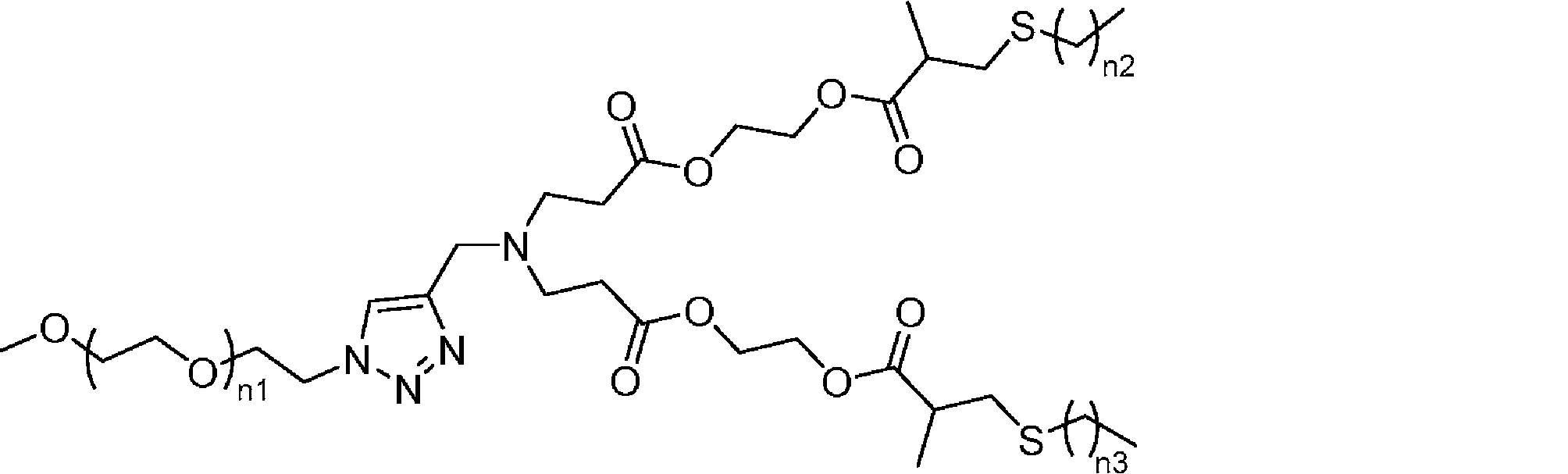
n 1 は1~250の整数であり;
n 2 およびn 3 はそれぞれ独立して5、6、7、8、9、10、11、12、13、14、15、16、17、18、19、20、21、22、または23より選択される。
[本発明1105]
化合物 対 ステロイドまたはステロイド誘導体の比約1:1~約20:1を含む、本発明1001~1104のいずれかの組成物。
[本発明1106]
化合物 対 リン脂質の比約1:1~約9:1を含む、本発明1001~1105のいずれかの組成物。
[本発明1107]
化合物 対 PEG脂質の比約2.5:1~約100:1を含む、本発明1001~1106のいずれかの組成物。
[本発明1108]
化合物 対 核酸のモル比約5:1~約1000:1を含む、本発明1001~1107のいずれかの組成物。
[本発明1109]
(A) 本発明1001~1108のいずれかの組成物と;
(B) 賦形剤と
を含む、薬学的組成物。
[本発明1110]
注射による投与用に製剤化されている、本発明1109の薬学的組成物。
[本発明1111]
単位用量として製剤化されている、本発明1109~1110のいずれかの薬学的組成物。
[本発明1112]
患者において疾患または障害を処置する方法であって、それを必要とする患者に治療有効量の本発明1001~1111のいずれかの組成物を投与する段階を含む、前記方法。
[本発明1113]
疾患または障害が遺伝性疾患または遺伝性障害である、本発明1112の方法。
[本発明1114]
遺伝性疾患または遺伝性障害が嚢胞性線維症である、本発明1113の方法。
[本発明1115]
嚢胞性線維症膜コンダクタンス制御因子タンパク質(CFTR)の遺伝子がナンセンス変異を有する、本発明1114の方法。
[本発明1116]
遺伝性疾患または遺伝性障害がデュシェンヌ型筋ジストロフィー(DMD)、先天性グリコシル化異常症、ドラベ症候群、ムコ多糖症I型(MPS I)障害、NGLY1欠損症(N-グリカナーゼ欠損症)障害、レット症候群、またはがんである、本発明1113の方法。
[本発明1117]
疾患または障害ががんである、本発明1112の方法。
[本発明1118]
患者が哺乳動物である、本発明1112~1117のいずれかの方法。
[本発明1119]
患者がヒトである、本発明1118の方法。
[本発明1120]
組成物が1回投与される、本発明1112~1119のいずれかの方法。
[本発明1121]
組成物が2回以上投与される、本発明1112~1119のいずれかの方法。
本開示の他の目的、特徴、および利点は以下の詳細な説明から明らかになるであろう。しかし、本開示の真意および範囲内の様々な変更および修正がこの詳細な説明から当業者に明らかになることから、本開示の好ましい態様を示す詳細な説明および具体例は、例示のみを目的として示されるものと理解されるべきである。
[Invention 1001]
(a) tRNA;
(b) an amino lipid delivery compound that forms nanoparticles;
A composition comprising:
[Invention 1002]
1001. The composition of invention 1001, wherein the amino lipid delivery compound is a dendrimer comprising a group that is positively charged at physiological pH and a lipophilic group.
[Invention 1003]
The composition of Invention 1001, wherein the amino lipid delivery compound is a dendrimer of the formula or a pharmaceutically acceptable salt thereof:
core - (repeating unit) n -end group (I)
wherein the core is linked to the repeating unit by one or more hydrogen atoms being removed from the core and replaced by the repeating unit;
The core has the formula:
X 1 is amino or alkylamino (C≤12) , dialkylamino (C≤12) , heterocycloalkyl (C≤12) , heteroaryl (C≤12) , or a permutation thereof;
R. 1 is amino, hydroxy, or mercapto, or alkylamino (C≤12) , dialkylamino (C≤12) , or a substituted form of either of these groups;
a is 1, 2, 3, 4, 5, or 6; or
The core has the formula:
X 2 is N(R Five ) y is;
R. Five is hydrogen, alkyl (C≤18) , or substituted alkyl (C≤18) is;
y is 0, 1, or 2, provided that the sum of y and z is 3;
R. 2 is amino, hydroxy, or mercapto, or alkylamino (C≤12) , dialkylamino (C≤12) , or a substituted form of either of these groups;
b is 1, 2, 3, 4, 5, or 6;
z is 1, 2, 3, provided that the sum of z and y is 3; or
The core has the formula:
X 3 Ha-NR 6 - and where R 6 is hydrogen, alkyl (C≤8) , or substituted alkyl (C≤8) , -O-, or alkylaminodiyl (C≤8) , alkoxydiyl (C≤8) , arenjiil (C≤8) , heteroarene diyl (C≤8) , heterocycloalkanediyl (C≤8) , or a substituted form of any of these groups;
R. 3 and R Four are each independently amino, hydroxy, or mercapto, or alkylamino (C≤12) , dialkylamino (C≤12) , or substituted forms of either of these groups, or the formula -(CH 2 CH 2 N) e (R c )R d is the basis of;
here,
e is 1, 2, or 3;
R. c and R d are each independently hydrogen, alkyl (C≤6) , or substituted alkyl (C≤6) is;
c and d are each independently 1, 2, 3, 4, 5, or 6; or
Alkylamine core (C≤18) , dialkylamine (C≤36) , heterocycloalkane (C≤12) , or a substituted form of any of these groups;
the repeating unit contains a degradable diacyl and a linker;
A degradable diacyl group has the formula:
A. 1 and A 2 is independently -O-, -S-, or -NR a - and where
R. a is hydrogen, alkyl (C≤6) , or substituted alkyl (C≤6) is;
Y 3 is an alkanediyl (C≤12) , alkenediyl (C≤12) , arenjiil (C≤12) , or a substituted version of any of these groups, or a group of the formula:
X 3 and X Four is an alkanediyl (C≤12) , alkenediyl (C≤12) , arenjiil (C≤12) , or a substituted form of any of these groups;
Y Five is a covalent bond, alkanediyl (C≤12) , alkenediyl (C≤12) , arenjiil (C≤12) , or a substituted form of any of these groups;
R. 9 is an alkyl (C≤8) or substituted alkyl (C≤8) is;
The linker group has the formula:
Y 1 is an alkanediyl (C≤12) , alkenediyl (C≤12) , arenjiil (C≤12) , or a substituted form of any of these groups;
When a repeating unit comprises a linker group, the linker group is attached to the degradable diacyl group at both the nitrogen and sulfur atoms of the linker group, the first group in the repeating unit is the degradable diacyl group, and for each linker group, the adjacent groups comprise two degradable diacyl groups attached to the nitrogen atom of the linker group; n is the number of linker groups present in the repeating unit;
The end group has the formula:
Y Four is an alkanediyl (C≤18) , alkenediyl (C≤18) , or a substituted form of either group;
R. Ten is hydrogen, carboxy, hydroxy, or aryl (C≤12) , alkylamino (C≤12) , dialkylamino (C≤12) , N-heterocycloalkyl (C≤12) , -C(O)N(R 11 )-alkanediyl (C≤6) -heterocycloalkyl (C≤12) , -C(O)-alkylamino (C≤12) , -C(O)-dialkylamino (C≤12) , -C(O)-N-heterocycloalkyl (C≤12) and where
R. 11 is hydrogen, alkyl (C≤6) , or substituted alkyl (C≤6) is;
the last degradable diacyl in the chain is attached to the terminal group;
n is 0, 1, 2, 3, 4, 5, or 6;
[Invention 1004]
The composition of Invention 1003, wherein the amino lipid delivery compound is a dendrimer of the formula or a pharmaceutically acceptable salt thereof:
The core has the formula:
X 1 is amino or alkylamino (C≤12) , dialkylamino (C≤12) , heterocycloalkyl (C≤12) , heteroaryl (C≤12) , or a permutation thereof;
R. 1 is amino, hydroxy, or mercapto, or alkylamino (C≤12) , dialkylamino (C≤12) , or a substituted form of either of these groups;
a is 1, 2, 3, 4, 5, or 6;
the repeating unit contains a degradable diacyl and a linker;
A degradable diacyl group has the formula:
A. 1 and A 2 is independently -O- or -NR a - and where
R. a is hydrogen, alkyl (C≤6) , or substituted alkyl (C≤6) is;
Y 3 is an alkanediyl (C≤12) , alkenediyl (C≤12) , arenjiil (C≤12) , or a substituted version of any of these groups, or a group of the formula:
X 3 and X Four is an alkanediyl (C≤12) , alkenediyl (C≤12) , arenjiil (C≤12) , or a substituted form of any of these groups;
Y Five is a covalent bond, alkanediyl (C≤12) , alkenediyl (C≤12) , arenjiil (C≤12) , or a substituted form of any of these groups;
R. 9 is an alkyl (C≤8) or substituted alkyl (C≤8) is;
The linker group has the formula:
Y 1 is an alkanediyl (C≤12) , alkenediyl (C≤12) , arenjiil (C≤12) , or a substituted form of any of these groups;
When a repeating unit comprises a linker group, the linker group is attached to the degradable diacyl group at both the nitrogen and sulfur atoms of the linker group, the first group in the repeating unit is the degradable diacyl group, and for each linker group, the adjacent groups comprise two degradable diacyl groups attached to the nitrogen atom of the linker group; n is the number of linker groups present in the repeating unit;
The end group has the formula:
Y Four is an alkanediyl (C≤18) , alkenediyl (C≤18) , or a substituted form of either group;
R. Ten is hydrogen, carboxy, hydroxy, or aryl (C≤12) , alkylamino (C≤12) , dialkylamino (C≤12) , N-heterocycloalkyl (C≤12) , -C(O)N(R 11 )-alkanediyl (C≤6) -heterocycloalkyl (C≤12) , -C(O)-alkylamino (C≤12) , -C(O)-dialkylamino (C≤12) , -C(O)-N-heterocycloalkyl (C≤12) and where
R. 11 is hydrogen, alkyl (C≤6) , or substituted alkyl (C≤6) is;
the last degradable diacyl in the chain is attached to the terminal group;
n is 0, 1, 2, 3, 4, 5, or 6;
[Invention 1005]
The composition of Invention 1003, wherein the amino lipid delivery compound is a compound of the formula or a pharmaceutically acceptable salt thereof:
core - (repeating unit) n -end group (I)
wherein the core is linked to the repeating unit by one or more hydrogen atoms being removed from the core and replaced by the repeating unit;
The core has the formula:
X 2 is N(R Five ) y is;
R. Five is hydrogen or alkyl (C≤8) , or substituted alkyl (C≤18) is;
y is 0, 1, or 2, provided that the sum of y and z is 3;
R. 2 is amino, hydroxy, or mercapto, or alkylamino (C≤12) , dialkylamino (C≤12) , or a substituted form of either of these groups;
b is 1, 2, 3, 4, 5, or 6;
z is 1, 2, 3, provided that the sum of z and y is 3;
the repeating unit contains a degradable diacyl and a linker;
A degradable diacyl group has the formula:
A. 1 and A 2 is independently -O- or -NR a - and where
R. a is hydrogen, alkyl (C≤6) , or substituted alkyl (C≤6) is;
Y 3 is an alkanediyl (C≤12) , alkenediyl (C≤12) , arenjiil (C≤12) , or a substituted version of any of these groups, or a group of the formula:
X 3 and X Four is an alkanediyl (C≤12) , alkenediyl (C≤12) , arenjiil (C≤12) , or a substituted form of any of these groups;
Y Five is a covalent bond, alkanediyl (C≤12) , alkenediyl (C≤12) , arenjiil (C≤12) , or a substituted form of any of these groups;
R. 9 is an alkyl (C≤8) or substituted alkyl (C≤8) is;
The linker group has the formula:
Y 1 is an alkanediyl (C≤12) , alkenediyl (C≤12) , arenjiil (C≤12) , or a substituted form of any of these groups;
When a repeating unit comprises a linker group, the linker group is attached to the degradable diacyl group at both the nitrogen and sulfur atoms of the linker group, the first group in the repeating unit is the degradable diacyl group, and for each linker group, the adjacent groups comprise two degradable diacyl groups attached to the nitrogen atom of the linker group; n is the number of linker groups present in the repeating unit;
The end group has the formula:
Y Four is an alkanediyl (C≤18) , alkenediyl (C≤18) , or a substituted form of either group;
R. Ten is hydrogen, carboxy, hydroxy, or aryl (C≤12) , alkylamino (C≤12) , dialkylamino (C≤12) , N-heterocycloalkyl (C≤12) , -C(O)N(R 11 )-alkanediyl (C≤6) -heterocycloalkyl (C≤12) , -C(O)-alkylamino (C≤12) , -C(O)-dialkylamino (C≤12) , -C(O)-N-heterocycloalkyl (C≤12) and
the last degradable diacyl in the chain is attached to the terminal group;
n is 0, 1, 2, 3, 4, 5, or 6;
[Invention 1006]
The composition of Invention 1003, wherein the amino lipid delivery compound is a compound of the formula or a pharmaceutically acceptable salt thereof:
core - (repeating unit) n -end group (I)
wherein the core is linked to the repeating unit by one or more hydrogen atoms being removed from the core and replaced by the repeating unit;
The core has the formula:
X 3 Ha-NR 6 - and where R 6 is hydrogen, alkyl (C≤8) , or substituted alkyl (C≤8) , -O-, or alkylaminodiyl (C≤8) , alkoxydiyl (C≤8) , arenjiil (C≤8) , heteroarene diyl (C≤8) , heterocycloalkanediyl (C≤8) , or a substituted form of any of these groups;
R. 3 and R Four are each independently amino, hydroxy, or mercapto, or alkylamino (C≤12) , dialkylamino (C≤12) , or substituted forms of either of these groups, or the formula -(CH 2 CH 2 N) e (R c )R d is the basis of;
here,
e is 1, 2, or 3;
R. c and R d are each independently hydrogen, alkyl (C≤6) , or substituted alkyl (C≤6) is;
c and d are each independently 1, 2, 3, 4, 5, or 6;
the repeating unit contains a degradable diacyl and a linker;
A degradable diacyl group has the formula:
A. 1 and A 2 is independently -O- or -NR a - and where
R. a is hydrogen, alkyl (C≤6) , or substituted alkyl (C≤6) is;
Y 3 is an alkanediyl (C≤12) , alkenediyl (C≤12) , arenjiil (C≤12) , or a substituted version of any of these groups, or a group of the formula:
X 3 and X Four is an alkanediyl (C≤12) , alkenediyl (C≤12) , arenjiil (C≤12) , or a substituted form of any of these groups;
Y Five is a covalent bond, alkanediyl (C≤12) , alkenediyl (C≤12) , arenjiil (C≤12) , or a substituted form of any of these groups;
R. 9 is an alkyl (C≤8) or substituted alkyl (C≤8) is;
The linker group has the formula:
Y 1 is an alkanediyl (C≤12) , alkenediyl (C≤12) , arenjiil (C≤12) , or a substituted form of any of these groups;
When a repeating unit comprises a linker group, the linker group is attached to the degradable diacyl group at both the nitrogen and sulfur atoms of the linker group, the first group in the repeating unit is the degradable diacyl group, and for each linker group, the adjacent groups comprise two degradable diacyl groups attached to the nitrogen atom of the linker group; n is the number of linker groups present in the repeating unit;
The end group has the formula:
Y Four is an alkanediyl (C≤18) , alkenediyl (C≤18) , or a substituted form of either group;
R. Ten is hydrogen, carboxy, hydroxy, or aryl (C≤12) , alkylamino (C≤12) , dialkylamino (C≤12) , N-heterocycloalkyl (C≤12) , -C(O)N(R 11 )-alkanediyl (C≤6) -heterocycloalkyl (C≤12) , -C(O)-alkylamino (C≤12) , -C(O)-dialkylamino (C≤12) , -C(O)-N-heterocycloalkyl (C≤12) and where
R. 11 is hydrogen, alkyl (C≤6) , or substituted alkyl (C≤6) is;
the last degradable diacyl in the chain is attached to the terminal group;
n is 0, 1, 2, 3, 4, 5, or 6;
[Invention 1007]
Y Four but the alkanediyl (C≤18) or alkanediyl (C≤18) one or more hydrogen atoms above are -OH, -F, -Cl, -Br, -I, -SH, -OCH 3 , -OCH 2 CH 3 , -SCH 3 , or -OC(O)CH 3 alkanediyl replaced by (C≤18) The composition of any one of Inventions 1003-1006, wherein
[Invention 1008]
The composition of Invention 1001, wherein the amino lipid delivery compound is an amino lipid comprising an anionic carboxylic or sulfonic or phosphate group, a quaternary amino group, an amino group that is positively charged at physiological pH, and a lipophilic group.
[Invention 1009]
The composition of Invention 1008, wherein the amino lipid delivery compound is further defined as the formula or a pharmaceutically acceptable salt thereof:
X 1 is -S(O) 2 O - , -OP(O)OR e O - , -(CHR f ) z C(O)O - , or -NR g R. h R. i + and where
R. e , R g , R h , and R i are each independently hydrogen, alkyl (C≤6) , or substituted alkyl (C≤6) is;
R. f is hydrogen, amino, hydroxy, or alkyl (C≤12) , Aryl (C≤12) , aralkyl (C≤12) , heteroaryl (C≤12) , acyl (C≤12) , alkoxy (C≤12) , acyloxy (C≤12) , amide (C≤12) , alkoxy (C≤12) , alkoxy (C≤12) , or substituted with any of the last ten groups;
z is 1, 2, 3, or 4;
Y 1 is an alkanediyl (C≤12) , alkenediyl (C≤12) , arenjiil (C≤12) , heteroarene diyl (C≤12) , heterocycloalkanediyl (C≤12) ,-alkanediyl (C≤8) -heterocycloalkanediyl (C≤12) ,-alkanediyl (C≤8) -heterocycloalkanediyl (C≤12) -alkanediyl (C≤8) ,-alkanediyl (C≤8) -heteroarene diyl (C≤12) ,-alkanediyl (C≤8) -heteroarene diyl (C≤12) -alkanediyl (C≤8) , or a substituted form of any of these groups;
Z. 1 Ha-N + R. 3 R. Four -or-OP(O)O - O-is;
A is -NR a -, -S-, or -O-; where
R. a is hydrogen, alkyl (C≤6) , or substituted alkyl (C≤6) or R a is R 3 or R Four together with the alkanediyl (C≤8) , alkenediyl (C≤8) , alkoxydiyl (C≤8) , alkylaminodiyl (C≤8) , or a substituted form of any of these groups;
R. 1 is a basis of the formula:
R. Five , R 6 , and R 2 are each independently hydrogen or alkyl (C≤8) ,-alkanediyl (C≤6) -NH 2 ,-alkanediyl (C≤6) -alkylamino (C≤8) ,-alkanediyl (C≤6) -dialkylamino (C≤12) ,-alkanediyl (C≤6) —NR′R″ or a substituted version of any of these groups, wherein:
R' and R'' are each independently hydrogen, alkyl (C≤8) , substituted alkyl (C≤8) , or -Z 2 A'R 7 is; where
Z. 2 is an alkanediyl (C≤6) , substituted alkanediyl (C≤6) , or a group of the formula:
Z. Five and Z 6 are each independently alkanediyl (C≤6) or substituted alkanediyl (C≤6) is;
X 2 and X 3 is independently -O-, -S-, or -NR m -is; where
R. m is hydrogen, alkyl (C≤6) , or substituted alkyl (C≤6) is;
a is 0, 1, 2, 3, 4, 5, or 6;
A'-CHR j -, -C(O)O-, or -C(O)NR b -is;
R. b is hydrogen, alkyl (C≤6) , or substituted alkyl (C≤6) is;
R. j is hydrogen, halo, hydroxy, acyloxy (C≤24) , or substituted acyloxy (C≤24) is;
R. 7 is an alkyl (C6-24) , substituted alkyl (C6-24) , alkenyl (C6-24) , substituted alkenyl (C6-24) is; or
R. Five , R 6 , and R 2 are independently -Z 3 A''R 8 is; where
Z. 3 is an alkanediyl (C≤6) , substituted alkanediyl (C≤6) , or a group of the formula:
Z. 7 and Z 8 are each independently alkanediyl (C≤6) or substituted alkanediyl (C≤6) is;
X Four and X Five is independently -O-, -S-, or -NR n -is; where
R. n is hydrogen, alkyl (C≤6) , or substituted alkyl (C≤6) is;
b is 0, 1, 2, 3, 4, 5, or 6;
A''-CHR k -, -S-, -C(O)O-, or -C(O)NR l -is;
R. l is hydrogen, alkyl (C≤6) , or substituted alkyl (C≤6) is;
R. k is hydrogen, halo, hydroxy, acyloxy (C≤24) , or substituted acyloxy (C≤24) is;
R. 8 is an alkyl (C6-24) , substituted alkyl (C6-24) , alkenyl (C6-24) , substituted alkenyl (C6-24) is;
q is 1, 2, or 3;
r is 1, 2, 3, or 4;
R. 1 is a basis of the formula:
Y 2 is arenjiil (C≤12) , heterocycloalkanediyl (C≤12) , heteroarene diyl (C≤12) , alkoxydiyl (C≤12) , or a substituted form of any of these groups;
R. 9 , R Ten , and R 11 are each independently hydrogen, alkyl (C≤8) , substituted alkyl (C≤8) , or -Z Four A'''R 12 is; where
Z. Four is an alkanediyl (C≤6) , substituted alkanediyl (C≤6) , or a group of the formula:
Z. 9 and Z Ten are each independently alkanediyl (C≤6) or substituted alkanediyl (C≤6) is;
X 6 and X 7 is independently -O-, -S-, or -NR o -is; where
R. o is hydrogen, alkyl (C≤6) , or substituted alkyl (C≤6) is;
c is 0, 1, 2, 3, 4, 5, or 6;
A'''-CHR k -, -S-, -C(O)O-, or -C(O)NR l -is;
R. l is hydrogen, alkyl (C≤6) , or substituted alkyl (C≤6) is;
R. k is hydrogen, halo, hydroxy, acyloxy (C≤24) , or substituted acyloxy (C≤24) is;
R. 12 is an alkyl (C6-24) , substituted alkyl (C6-24) , alkenyl (C6-24) , substituted alkenyl (C6-24) is;
x and y are 0, 1, 2, 3, or 4;
R. 3 and R Four are each independently hydrogen, alkyl (C≤6) , or substituted alkyl (C≤6) or R 3 or R Four is R a together with the alkanediyl (C≤8) , alkenediyl (C≤8) , alkoxydiyl (C≤8) , alkylaminodiyl (C≤8) , or a substituted form of any of these groups;
m, n, and p are each independently an integer selected from 0, 1, 2, 3, 4, 5, or 6;
However, X 1 Z if positively charged 1 is negatively charged and X 1 If Z is negatively charged 1 is positively charged.
[Invention 1010]
The composition of Invention 1001, wherein the amino lipid delivery compound is an amino lipid comprising an anionic sulfonic acid group and a quaternary amino group, a lipophilic group, and an amino group that is protonated at physiological pH.
[Invention 1011]
The composition of Invention 1001, wherein the amino lipid delivery compound is a compound of the formula or a pharmaceutically acceptable salt thereof:
Y 1 is an alkanediyl (C≤12) , alkenediyl (C≤12) , arenjiil (C≤12) , heteroarene diyl (C≤12) , heterocycloalkanediyl (C≤12) ,-alkanediyl (C≤8) -heterocycloalkanediyl (C≤12) ,-alkanediyl (C≤8) -heterocycloalkanediyl (C≤12) -alkanediyl (C≤8) ,-alkanediyl (C≤8) -heteroarene diyl (C≤12) ,-alkanediyl (C≤8) -heteroarene diyl (C≤12) -alkanediyl (C≤8) , or a substituted form of any of these groups;
A is -NR a -, -S-, or -O-; where
R. a is hydrogen, alkyl (C≤6) , or substituted alkyl (C≤6) or R a is R 3 or R Four together with the alkanediyl (C≤8) , alkenediyl (C≤8) , alkoxydiyl (C≤8) , alkylaminodiyl (C≤8) , or a substituted form of any of these groups;
R. 1 is a basis of the formula:
R. Five , R 6 , and R 2 are each independently hydrogen or alkyl (C≤8) ,-alkanediyl (C≤6) -NH 2 ,-alkanediyl (C≤6) -alkylamino (C≤8) ,-alkanediyl (C≤6) -dialkylamino (C≤12) ,-alkanediyl (C≤6) —NR′R″ or a substituted version of any of these groups, wherein
R' and R'' are each independently hydrogen, alkyl (C≤8) , substituted alkyl (C≤8) , or -Z 2 A'R 7 is; where
Z. 2 is an alkanediyl (C≤4) or substituted alkanediyl (C≤4) is;
A'-CHR j -, -C(O)O-, or -C(O)NR b -is;
R. b is hydrogen, alkyl (C≤6) , or substituted alkyl (C≤6) is;
R. j is hydrogen, halo, hydroxy, acyloxy (C≤24) , or substituted acyloxy (C≤24) is;
R. 7 is an alkyl (C6-24) , substituted alkyl (C6-24) , alkenyl (C6-24) , substituted alkenyl (C6-24) is; or
R. Five , R 6 , and R 2 are independently -Z 3 A''R 8 is; where
Z. 3 is an alkanediyl (C≤4) or substituted alkanediyl (C≤4) is;
A''-CHR k -, -C(O)O-, or -C(O)NR l -is;
R. l is hydrogen, alkyl (C≤6) , or substituted alkyl (C≤6) is;
R. k is hydrogen, halo, hydroxy, acyloxy (C≤24) , or substituted acyloxy (C≤24) is;
R. 8 is an alkyl (C6-24) , substituted alkyl (C6-24) , alkenyl (C6-24) , substituted alkenyl (C6-24) is;
q is 1, 2, or 3;
r is 1, 2, 3, or 4;
R. 1 is a basis of the formula:
Y 2 is arenjiil (C≤12) , heterocycloalkanediyl (C≤12) , heteroarene diyl (C≤12) , alkoxydiyl (C≤12) , or a substituted form of any of these groups;
R. 9 , R Ten , and R 11 are each independently hydrogen, alkyl (C≤8) , substituted alkyl (C≤8) , or -Z Four A'''R 12 are selected from;
Z. Four is an alkanediyl (C≤4) or substituted alkanediyl (C≤4) is;
A'''-CHR k -, -C(O)O-, or -C(O)NR l -is;
R. l is hydrogen, alkyl (C≤6) , or substituted alkyl (C≤6) is;
R. k is hydrogen, halo, hydroxy, acyloxy (C≤24) , or substituted acyloxy (C≤24) is;
R. 12 is an alkyl (C6-24) , substituted alkyl (C6-24) , alkenyl (C6-24) , substituted alkenyl (C6-24) is;
x and y are 1, 2, 3, or 4;
R. 3 and R Four are each independently hydrogen, alkyl (C≤6) , or substituted alkyl (C≤6) or R 3 or R Four is R a together with the alkanediyl (C≤8) , alkenediyl (C≤8) , alkoxydiyl (C≤8) , alkylaminodiyl (C≤8) , or a substituted form of any of these groups;
m, n, and p are each independently an integer selected from 0, 1, 2, 3, 4, 5, or 6;
[Invention 1012]
The composition of Invention 1011, wherein the amino lipid delivery compound is a compound of the formula or a pharmaceutically acceptable salt thereof:
Y 1 is an alkanediyl (C≤12) , heterocycloalkanediyl (C≤12) ,-alkanediyl (C≤8) -heterocycloalkanediyl (C≤12) ,-alkanediyl (C≤8) -heterocycloalkanediyl (C≤12) -alkanediyl (C≤8) , or a substituted form of any of these groups;
A is -NR a -, -S-, or -O-; where
R. a is hydrogen, alkyl (C≤6) , or substituted alkyl (C≤6) or R a is R 3 or R Four together with the alkanediyl (C≤8) , alkenediyl (C≤8) , alkoxydiyl (C≤8) , alkylaminodiyl (C≤8) , or a substituted form of any of these groups;
R. 1 is a basis of the formula:
R. Five , R 6 , and R 2 are each independently hydrogen or alkyl (C≤8) ,-alkanediyl (C≤6) -NH 2 ,-alkanediyl (C≤6) -alkylamino (C≤8) ,-alkanediyl (C≤6) -dialkylamino (C≤12) ,-alkanediyl (C≤6) —NR′R″ or a substituted version of any of these groups, wherein:
R' and R'' are each independently hydrogen, alkyl (C≤8) , substituted alkyl (C≤8) , or -Z 2 A'R 7 is; where
Z. 2 is an alkanediyl (C≤4) or substituted alkanediyl (C≤4) is;
A'-CHR j -, -C(O)O-, or -C(O)NR b -is;
R. b is hydrogen, alkyl (C≤6) , or substituted alkyl (C≤6) is;
R. j is hydrogen, halo, hydroxy, acyloxy (C≤24) , or substituted acyloxy (C≤24) is;
R. 7 is an alkyl (C6-24) , substituted alkyl (C6-24) , alkenyl (C6-24) , substituted alkenyl (C6-24) is; or
R. Five , R 6 , and R 2 are independently -Z 3 A''R 8 is; where
Z. 3 is an alkanediyl (C≤4) or substituted alkanediyl (C≤4) is;
A''-CHR k -, -C(O)O-, or -C(O)NR l -is;
R. l is hydrogen, alkyl (C≤6) , or substituted alkyl (C≤6) is;
R. k is hydrogen, halo, hydroxy, acyloxy (C≤24) , or substituted acyloxy (C≤24) is;
R. 8 is an alkyl (C6-24) , substituted alkyl (C6-24) , alkenyl (C6-24) , substituted alkenyl (C6-24) is;
q is 1, 2, or 3;
r is 1, 2, 3, or 4;
R. 1 is a basis of the formula:
Y 2 is arenjiil (C≤12) , heterocycloalkanediyl (C≤12) , heteroarene diyl (C≤12) , alkoxydiyl (C≤12) , or a substituted form of any of these groups;
R. 9 , R Ten , and R 11 are each independently hydrogen, alkyl (C≤8) , substituted alkyl (C≤8) , or -Z Four A'''R 12 are selected from; where
Z. Four is an alkanediyl (C≤4) or substituted alkanediyl (C≤4) is;
A'''-CHR k -, -C(O)O-, or -C(O)NR l -is;
R. l is hydrogen, alkyl (C≤6) , or substituted alkyl (C≤6) is;
R. k is hydrogen, halo, hydroxy, acyloxy (C≤24) , or substituted acyloxy (C≤24) is;
R. 12 is an alkyl (C6-24) , substituted alkyl (C6-24) , alkenyl (C6-24) , substituted alkenyl (C6-24) is;
x and y are 1, 2, 3, or 4;
R. 3 and R Four are each independently hydrogen, alkyl (C≤6) , or substituted alkyl (C≤6) or R 3 or R Four is R a together with the alkanediyl (C≤8) , alkenediyl (C≤8) , alkoxydiyl (C≤8) , alkylaminodiyl (C≤8) , or a substituted form of any of these groups;
m, n, and p are each independently an integer selected from 0, 1, 2, 3, 4, 5, or 6;
[Invention 1013]
The composition of Invention 1011, wherein the amino lipid delivery compound is a compound of the formula or a pharmaceutically acceptable salt thereof:
R. 1 is a basis of the formula:
R. Five , R 6 , and R 2 are each independently hydrogen or alkyl (C≤8) ,-alkanediyl (C≤6) -NH 2 ,-alkanediyl (C≤6) -alkylamino (C≤8) ,-alkanediyl (C≤6) -dialkylamino (C≤12) ,-alkanediyl (C≤6) —NR′R″ or a substituted version of any of these groups, wherein:
R' and R'' are each independently hydrogen, alkyl (C≤8) , substituted alkyl (C≤8) , or -Z 2 A'R 7 is; where
Z. 2 is an alkanediyl (C≤4) or substituted alkanediyl (C≤4) is;
A'-CHR j -, -C(O)O-, or -C(O)NR b -is;
R. b is hydrogen, alkyl (C≤6) , or substituted alkyl (C≤6) is;
R. j is hydrogen, halo, hydroxy, acyloxy (C≤24) , or substituted acyloxy (C≤24) is;
R. 7 is an alkyl (C6-24) , substituted alkyl (C6-24) , alkenyl (C6-24) , substituted alkenyl (C6-24) is; or
R. Five , R 6 , and R 2 are independently -Z 3 A''R 8 is; where
Z. 3 is an alkanediyl (C≤4) or substituted alkanediyl (C≤4) is;
A''-CHR k -, -C(O)O-, or -C(O)NR l -is;
R. l is hydrogen, alkyl (C≤6) , or substituted alkyl (C≤6) is;
R. k is hydrogen, halo, hydroxy, acyloxy (C≤24) , or substituted acyloxy (C≤24) is;
R. 8 is an alkyl (C6-24) , substituted alkyl (C6-24) , alkenyl (C6-24) , substituted alkenyl (C6-24) is;
q is 1, 2, or 3;
r is 1, 2, 3, or 4;
R. a , R 3 , and R Four are each independently hydrogen, alkyl (C≤6) , or substituted alkyl (C≤6) is;
m, n, and p are each independently an integer selected from 0, 1, 2, 3, 4, 5, or 6;
[Invention 1014]
1001. The composition of invention 1001, wherein the amino lipid delivery compound comprises a sulfonamide group, a quaternary ammonium group, an amino group that is protonated at physiological pH, and a lipophilic group.
[Invention 1015]
The composition of Invention 1001, wherein the amino lipid delivery compound is a compound of the formula or a pharmaceutically acceptable salt thereof:
R. 1 , R 2 , and R 3 are each independently hydrogen, alkyl (C≤6) , substituted alkyl (C≤6) , or a group of the formula:
R. 7 and R 8 are each independently hydrogen, alkyl (C≤6) , substituted alkyl (C≤6) , or a group of the formula:
R. 9 is hydrogen, halo, or hydroxy, or alkoxy (C≤24) , acyloxy (C≤24) , or a substituted form of either of these groups;
R. Ten is an alkyl (C≤24) , alkenyl (C≤24) , or a substituted form of either group;
q is 1, 2, or 3;
r is 0, 1, 2, 3, or 4;
R. Four , R Five , and R 6 are each independently hydrogen, alkyl (C≤6) , or substituted alkyl (C≤6) is;
m and n are each independently 1, 2, 3, 4, or 5;
[Invention 1016]
A composition of the invention 1015, wherein the amino lipid delivery compound is a compound of the formula or a pharmaceutically acceptable salt thereof:
R. 1 , R 2 , and R 3 are each independently hydrogen, alkyl (C≤6) , substituted alkyl (C≤6) , or a group of the formula:
R. 7 and R 8 are each independently hydrogen, alkyl (C≤6) , substituted alkyl (C≤6) , or a group of the formula:
R. 9 is hydrogen, halo, or hydroxy, or alkoxy (C≤24) , acyloxy (C≤24) , or a substituted form of either of these groups;
R. Ten is an alkyl (C≤24) , alkenyl (C≤24) , or a substituted form of either group;
q is 1, 2, or 3;
r is 0, 1, 2, 3, or 4;
R. Four , R Five , and R 6 are each independently hydrogen, alkyl (C≤6) , or substituted alkyl (C≤6) is;
m and n are each independently 1, 2, 3, 4, or 5;
[Invention 1017]
1001. The composition of invention 1001, wherein the amino lipid comprises a polyester group, a thioether group and an amine group that is protonated at physiological pH.
[Invention 1018]
The composition of Invention 1001, wherein the amino lipid comprises a polyester group of the formula or a pharmaceutically acceptable salt thereof:
X 1 is an alkyl (C≤18) or substituted alkyl (C≤18) is;
X 2 is hydrogen, alkyl (C≤18) , or substituted alkyl (C≤18) is;
R. 1 is -AZ;
here,
A is alkanediyl (C≤18) or substituted alkanediyl (C≤18) is;
Z is -NR 3 R. Four is;
here,
R. 3 and R Four are each independently hydrogen, alkyl (C≤18) , substituted alkyl (C≤18) is selected from; alternatively, R 3 and R Four together the alkanediyl (C≤18) or substituted alkanediyl (C≤18) is;
R. 2 is an alkyl (C≤24) , alkenyl (C≤24) , substituted alkyl (C≤24) , or substituted alkenyl (C≤24) is;
x and y are each independently 0, 1, 2, 3, 4, or 5;
m and n are each independently an integer from 0 to 250, provided that at least one of m and n is greater than 1;
The repeating units defined by m and n are randomly distributed throughout the polymer.
[Invention 1019]
The composition of Invention 1001 or 1017, wherein the compound is further defined as the formula or a pharmaceutically acceptable salt thereof:
R. 1 , R 2 , and R 3 are each independently hydrogen, alkyl (C≤8) , or substituted alkyl (C≤8) is;
R. Four is hydrogen, halo, hydroxy, alkyl (C≤8) , or substituted alkyl (C≤8) is;
R. Five is an alkyl (C≤24) , alkenyl (C≤24) , or a substituted form of either of these groups;
R. 6 is Y 1 -R 7 is;
here,
Y 1 is an alkanediyl (C≤8) , substituted alkanediyl (C≤8) , -(CH 2 ) r C(O)- or -(CH 2 ) r C(O)NR a (CH 2 ) s -is;
here,
r and s are each independently 1, 2, or 3;
R. a is hydrogen, alkyl (C≤6) , or substituted alkyl (C≤6) is;
R. 7 is amino or heteroaryl (C≤12) , heterocycloalkyl (C≤12) , alkylamino (C≤12) , dialkylamino (C≤12) , arylalkylamino (C≤12) , or a substituted form of any of these groups;
a, b, m, d, e, and n are each independently 1, 2, 3, or 4;
c and f are each independently 1-10;
x and y are each independently an integer from 0 to 250, provided that at least one of x and y is greater than one.
[Invention 1020]
The composition of Invention 1003, wherein the dendrimer has the formula or a pharmaceutically acceptable salt thereof:
core - (repeating unit) n -end group (I)
wherein the core is linked to the repeating unit by one or more hydrogen atoms being removed from the core and replaced by the repeating unit;
Alkylamine core (C≤18) , dialkylamine (C≤36) , heterocycloalkane (C≤12) , or a substituted form of any of these groups;
the repeating unit contains a degradable diacyl and a linker;
A degradable diacyl group has the formula:
A. 1 and A 2 is independently -O- or -NR a - and where
R. a is hydrogen, alkyl (C≤6) , or substituted alkyl (C≤6) is;
Y 3 is an alkanediyl (C≤12) , alkenediyl (C≤12) , arenjiil (C≤12) , or a substituted version of any of these groups, or a group of the formula:
X 3 and X Four is an alkanediyl (C≤12) , alkenediyl (C≤12) , arenjiil (C≤12) , or a substituted form of any of these groups;
Y Five is a covalent bond, alkanediyl (C≤12) , alkenediyl (C≤12) , arenjiil (C≤12) , or a substituted form of any of these groups;
R. 9 is an alkyl (C≤8) or substituted alkyl (C≤8) is;
The linker group has the formula:
Y 1 is an alkanediyl (C≤12) , alkenediyl (C≤12) , arenjiil (C≤12) , or a substituted form of any of these groups;
When a repeating unit comprises a linker group, the linker group is attached to the degradable diacyl group at both the nitrogen and sulfur atoms of the linker group, the first group in the repeating unit is the degradable diacyl group, and for each linker group, the adjacent groups comprise two degradable diacyl groups attached to the nitrogen atom of the linker group; n is the number of linker groups present in the repeating unit;
The end group has the formula:
Y Four is an alkanediyl (C≤18) , alkenediyl (C≤18) , or a substituted form of either of these groups;
R. Ten is hydrogen, carboxy, hydroxy, or aryl (C≤12) , alkylamino (C≤12) , dialkylamino (C≤12) , N-heterocycloalkyl (C≤12) , -C(O)N(R 11 )-alkanediyl (C≤6) -heterocycloalkyl (C≤12) , -C(O)-alkylamino (C≤12) , -C(O)-dialkylamino (C≤12) , -C(O)-N-heterocycloalkyl (C≤12) and where
R. 11 is hydrogen, alkyl (C≤6) , or substituted alkyl (C≤6) is;
the last degradable diacyl in the chain is attached to the terminal group;
n is 0, 1, 2, 3, 4, 5, or 6;
[Invention 1021]
The composition of any of Inventions 1003-1006, wherein the end group is further defined by the formula:
Y Four is an alkanediyl (C≤18) , alkenediyl (C≤18) , or a substituted form of either of these groups;
R. Ten is hydrogen.
[Invention 1022]
The composition of Invention 1021, wherein the end group is further defined by the formula:
Y Four is an alkanediyl (C≤18) is;
R. Ten is hydrogen.
[Invention 1023]
Y Four is an alkanediyl (C4-18) The composition of the present invention 1021 or 1022 which is
[Invention 1024]
The composition of any of Inventions 1003, 1005, and 1021-1023, wherein the core is further defined by the formula:
X 2 is N(R Five ) y is;
R. Five is hydrogen or alkyl (C≤8) , or substituted alkyl (C≤18) is;
y is 0, 1, or 2, provided that the sum of y and z is 3;
R. 2 is amino, hydroxy, or mercapto, or alkylamino (C≤12) , dialkylamino (C≤12) , or a substituted form of either of these groups;
b is 1, 2, 3, 4, 5, or 6;
z is 1, 2, 3, provided that the sum of z and y is 3.
[Invention 1025]
X 2 is NR Five , where R Five is hydrogen or alkyl (C≤8) The composition of the present invention 1024 which is
[Invention 1026]
R. Five The composition of Invention 1025, wherein is methyl.
[Invention 1027]
The composition of any of inventions 1024-1026, wherein z is 3.
[Invention 1028]
R. 2 The composition of any of Inventions 1024-1027, wherein is amino.
[Invention 1029]
R. 2 is an alkylamino (C≤12) or substituted alkylamino (C≤12) The composition of any one of Inventions 1024-1027 which is
[Invention 1030]
R. 2 is a dialkylamino (C≤12) or substituted dialkylamino (C≤12) The composition of any one of Inventions 1024-1027 which is
[Invention 1031]
The composition of invention 1024, wherein b is 2 or 3.
[Invention 1032]
The composition of any of Inventions 1024-1031, wherein the core is further defined as:
[Invention 1033]
The composition of any of Inventions 1003, 1006, and 1021-1023, wherein the core is further defined as:
X 3 Ha-NR 6 - and where R 6 is hydrogen, alkyl (C≤8) , or substituted alkyl (C≤8) , -O-, or alkylaminodiyl (C≤8) , alkoxydiyl (C≤8) , arenjiil (C≤8) , heteroarene diyl (C≤8) , heterocycloalkanediyl (C≤8) , or a substituted form of any of these groups;
R. 3 and R Four are each independently amino, hydroxy, or mercapto, or alkylamino (C≤12) , dialkylamino (C≤12) , or substituted forms of either of these groups, or the formula -(CH 2 CH 2 N) e (R c )R d is the basis of;
here,
e is 1, 2, or 3;
R. c and R d are each independently hydrogen, alkyl (C≤6) , or substituted alkyl (C≤6) is;
c and d are each independently 1, 2, 3, 4, 5, or 6.
[Invention 1034]
X 3 is alkylaminodiyl (C≤8) or substituted alkylaminodiyl (C≤8) The composition of the present invention 1033 which is
[Invention 1035]
X 3 is heterocycloalkanediyl (C≤8) or substituted heterocycloalkanediyl (C≤8) The composition of the present invention 1033 which is
[Invention 1036]
R. 3 The composition of any of Inventions 1033-1035, wherein is amino.
[Invention 1037]
R. 3 is an alkylamino (C≤12) or substituted alkylamino (C≤12) The composition of any one of Inventions 1033-1035 which is
[Invention 1038]
R. Four The composition of any of Inventions 1033-1037, wherein is amino.
[Invention 1039]
R. Four is an alkylamino (C≤12) or substituted alkylamino (C≤12) The composition of any one of Inventions 1033-1037 which is
[Invention 1040]
R. Four is-(CH 2 CH 2 N) e (R c )R d is;
here,
e is 1, 2, or 3;
R. c and R d are each independently hydrogen, alkyl (C≤6) , or substituted alkyl (C≤6) is
The composition of any of Inventions 1033-1037.
[Invention 1041]
The composition of any of Inventions 1033-1040, wherein the core is further defined as:
[Invention 1042]
Y 3 is an alkanediyl (C≤8) or substituted alkanediyl (C≤8) The composition of any one of Inventions 1001-1021, wherein
[Invention 1043]
Y 3 is an alkanediyl (C≤8) The composition of the present invention 1042 which is
[Invention 1044]
A. 1 is-NR a The composition of any of Inventions 1003-1006 or 1020-1043 which is -.
[Invention 1045]
A. 2 is-NR a The composition of any of Inventions 1003-1006 or 1020-1044 which is -.
[Invention 1046]
R. 9 is an alkyl (C≤8) The composition of any of Inventions 1003-1006 or 1020-1045 which is
[Invention 1047]
The composition of any of Inventions 1003-1006 or 1020-1046, wherein n is 0 or 1.
[Invention 1048]
A composition of the invention 1011 or 1012 further defined as the formula or a pharmaceutically acceptable salt thereof:
R. 1 is a basis of the formula:
R. Five , R 6 , and R 2 are each independently hydrogen or alkyl (C≤8) ,-alkanediyl (C≤6) -NH 2 ,-alkanediyl (C≤6) -alkylamino (C≤8) ,-alkanediyl (C≤6) -dialkylamino (C≤12) ,-alkanediyl (C≤6) —NR′R″ or a substituted version of any of these groups, wherein:
R' and R'' are each independently hydrogen, alkyl (C≤8) , substituted alkyl (C≤8) , or -Z 2 A'R 7 is; where
Z. 2 is an alkanediyl (C≤4) or substituted alkanediyl (C≤4) is;
A'-CHR j -, -C(O)O-, or -C(O)NR b -is;
R. b is hydrogen, alkyl (C≤6) , or substituted alkyl (C≤6) is;
R. j is hydrogen, halo, hydroxy, acyloxy (C≤24) , or substituted acyloxy (C≤24) is;
R. 7 is an alkyl (C6-24) , substituted alkyl (C6-24) , alkenyl (C6-24) , substituted alkenyl (C6-24) is; or
R. Five , R 6 , and R 2 are independently -Z 3 A''R 8 is; where
Z. 3 is an alkanediyl (C≤4) or substituted alkanediyl (C≤4) is;
A''-CHR k -, -C(O)O-, or -C(O)NR l -is;
R. l is hydrogen, alkyl (C≤6) , or substituted alkyl (C≤6) is;
R. k is hydrogen, halo, hydroxy, acyloxy (C≤24) , or substituted acyloxy (C≤24) is;
R. 8 is an alkyl (C6-24) , substituted alkyl (C6-24) , alkenyl (C6-24) , substituted alkenyl (C6-24) is;
q is 1, 2, or 3;
r is 1, 2, 3, or 4;
m, n, and p are each independently an integer selected from 0, 1, 2, 3, 4, 5, or 6;
[Invention 1049]
The composition of any of Inventions 1011, 1012, or 1048, further defined as the formula or a pharmaceutically acceptable salt thereof:
R. 1 is a basis of the formula:
R. Five , R 6 , and R 2 are each independently hydrogen or alkyl (C≤8) ,-alkanediyl (C≤6) -NH 2 ,-alkanediyl (C≤6) -alkylamino (C≤8) ,-alkanediyl (C≤6) -dialkylamino (C≤12) ,-alkanediyl (C≤6) —NR′R″ or a substituted version of any of these groups, wherein:
R' and R'' are each independently hydrogen, alkyl (C≤8) , substituted alkyl (C≤8) , or -Z 2 A'R 7 is; where
Z. 2 is an alkanediyl (C≤4) or substituted alkanediyl (C≤4) is;
A'-CHR j -, -C(O)O-, or -C(O)NR b -is;
R. b is hydrogen, alkyl (C≤6) , or substituted alkyl (C≤6) is;
R. j is hydrogen, halo, hydroxy, acyloxy (C≤24) , or substituted acyloxy (C≤24) is;
R. 7 is an alkyl (C6-24) , substituted alkyl (C6-24) , alkenyl (C6-24) , substituted alkenyl (C6-24) is; or
R. Five , R 6 , and R 2 are independently -Z 3 A''R 8 is; where
Z. 3 is an alkanediyl (C≤4) or substituted alkanediyl (C≤4) is;
A''-CHR k -, -C(O)O-, or -C(O)NR l -is;
R. l is hydrogen, alkyl (C≤6) , or substituted alkyl (C≤6) is;
R. k is hydrogen, halo, hydroxy, acyloxy (C≤24) , or substituted acyloxy (C≤24) is;
R. 8 is an alkyl (C6-24) , substituted alkyl (C6-24) , alkenyl (C6-24) , substituted alkenyl (C6-24) is;
q is 1, 2, or 3;
r is 1, 2, 3, or 4;
[Invention 1050]
The composition of any of Inventions 1011, 1012, 1048, or 1049, further defined as the formula or a pharmaceutically acceptable salt thereof:
R. 1 is a basis of the formula:
R. Five Ha-Z 3 A''R 8 is; where
Z. 3 is an alkanediyl (C≤2) or substituted alkanediyl (C≤2) is;
A''-CHR k -, -C(O)O-, or -C(O)NR l -is;
R. l is hydrogen, alkyl (C≤6) , or substituted alkyl (C≤6) is;
R. k is hydrogen, halo, hydroxy, acyloxy (C≤24) , or substituted acyloxy (C≤24) is;
R. 8 is an alkyl (C6-24) , substituted alkyl (C6-24) , alkenyl (C6-24) , substituted alkenyl (C6-24) is;
R. 6 is an alkyl (C≤8) or substituted alkyl (C≤8) is;
R. 2 ha-alkanediyl (C≤6) -NR'R'' or a substituted version of this group, wherein
R' and R'' are independently -Z 2 A'R 7 is; where
Z. 2 is an alkanediyl (C≤2) or substituted alkanediyl (C≤2) is;
A'-CHR j -, -C(O)O-, or -C(O)NR b -is;
R. b is hydrogen, alkyl (C≤6) , or substituted alkyl (C≤6) is;
R. j is hydrogen, halo, hydroxy, acyloxy (C≤24) , or substituted acyloxy (C≤24) is;
R. 7 is an alkyl (C6-24) , substituted alkyl (C6-24) , alkenyl (C6-24) , substituted alkenyl (C6-24) is; or
q is 1 or 2;
r is 1 or 2;
[Invention 1051]
The composition of any of Inventions 1011, 1012, or 1048-1050, further defined as the formula or a pharmaceutically acceptable salt thereof:
R. 1 is a basis of the formula:
R. Five is an alkyl (C≤8) or substituted alkyl (C≤8) is;
R. 6 ha-alkanediyl (C≤6) -NR'R'' or a substituted version of this group, wherein
R' and R'' are each independently alkyl (C≤8) , substituted alkyl (C≤8) , or -Z 2 A'R 7 is; where
Z. 2 is an alkanediyl (C≤2) or substituted alkanediyl (C≤2) is;
A'-CHR j -, -C(O)O-, or -C(O)NR b -is;
R. b is hydrogen, alkyl (C≤6) , or substituted alkyl (C≤6) is;
R. j is hydrogen, hydroxy, acyloxy (C≤6) , or substituted acyloxy (C≤6) is;
R. 7 is an alkyl (C6-24) , substituted alkyl (C6-24) , alkenyl (C6-24) , substituted alkenyl (C6-24) is; or
R. 2 ha-alkanediyl (C≤6) -NR'R'' or a substituted version of this group, wherein
R' and R'' are each independently alkyl (C≤8) , substituted alkyl (C≤8) , or -Z 2 A'R 7 is; where
Z. 2 is an alkanediyl (C≤2) or substituted alkanediyl (C≤2) is;
A'-CHR j -, -C(O)O-, or -C(O)NR b -is;
R. b is hydrogen, alkyl (C≤6) , or substituted alkyl (C≤6) is;
R. j is hydrogen, hydroxy, acyloxy (C≤6) , or substituted acyloxy (C≤6) is;
q is 1 or 2;
r is 1 or 2;
[Invention 1052]
The composition of any of Inventions 1011, 1012, or 1048-1050, further defined as the formula or a pharmaceutically acceptable salt thereof:
R. 1 is a basis of the formula:
R. Five Ha-Z 3 A''R 8 is; where
Z. 3 is an alkanediyl (C≤2) or substituted alkanediyl (C≤2) is;
A''-CHR k -, -C(O)O-, or -C(O)NR l -is;
R. l is hydrogen, alkyl (C≤6) , or substituted alkyl (C≤6) is;
R. k is hydrogen, hydroxy, acyloxy (C≤6) , or substituted acyloxy (C≤6) is;
R. 8 is an alkyl (C6-24) , substituted alkyl (C6-24) , alkenyl (C6-24) , substituted alkenyl (C6-24) is;
R. 6 ha-alkanediyl (C≤6) -NR'R'' or a substituted form of this group;
R' and R'' are independently -Z 2 A'R 7 is; where
Z. 2 is an alkanediyl (C≤2) or substituted alkanediyl (C≤2) is;
A'-CHR j -, -C(O)O-, or -C(O)NR b -is;
R. b is hydrogen, alkyl (C≤6) , or substituted alkyl (C≤6) is;
R. j is hydrogen, hydroxy, acyloxy (C≤6) , or substituted acyloxy (C≤6) is;
R. 7 is an alkyl (C6-24) , substituted alkyl (C6-24) , alkenyl (C6-24) , substituted alkenyl (C6-24) is;
R. 2 ha-alkanediyl (C≤6) -NR'R'' or a substituted form of this group;
R' and R'' are independently -Z 2 A'R 7 is; where
Z. 2 is an alkanediyl (C≤2) or substituted alkanediyl (C≤2) is;
A'-CHR j -, -C(O)O-, or -C(O)NR b -is;
R. b is hydrogen, alkyl (C≤6) , or substituted alkyl (C≤6) is;
R. j is hydrogen, hydroxy, acyloxy (C≤6) , or substituted acyloxy (C≤6) is;
R. 7 is an alkyl (C6-24) , substituted alkyl (C6-24) , alkenyl (C6-24) , substituted alkenyl (C6-24) is;
q is 1 or 2;
r is 1 or 2;
[Invention 1053]
A composition of the invention 1011 or 1013 further defined as the formula or a pharmaceutically acceptable salt thereof:
R. 1 is a basis of the formula:
Y 2 is arenjiil (C≤12) , heterocycloalkanediyl (C≤12) , heteroarene diyl (C≤12) , alkoxydiyl (C≤12) , or a substituted form of any of these groups;
R. 9 , R Ten , and R 11 are each independently hydrogen, alkyl (C≤8) , substituted alkyl (C≤8) , or -Z Four A'''R 12 are selected from; where
Z. Four is an alkanediyl (C≤4) or substituted alkanediyl (C≤4) is;
A'''-CHR k -, -C(O)O-, or -C(O)NR l -is;
R. l is hydrogen, alkyl (C≤6) , or substituted alkyl (C≤6) is;
R. k is hydrogen, halo, hydroxy, acyloxy (C≤24) , or substituted acyloxy (C≤24) is;
R. 12 is an alkyl (C6-24) , substituted alkyl (C6-24) , alkenyl (C6-24) , substituted alkenyl (C6-24) is;
x and y are 1, 2, 3, or 4;
R. a , R 3 , and R Four are each independently hydrogen, alkyl (C≤6) , or substituted alkyl (C≤6) is;
m, n, and p are each independently an integer selected from 0, 1, 2, 3, 4, 5, or 6;
[Invention 1054]
R. 3 is an alkyl (C≤8) or substituted alkyl (C≤8) The composition of any of Inventions 1011-1013, or 1053, which is
[Invention 1055]
R. Four is an alkyl (C≤8) or substituted alkyl (C≤8) The composition of any of Inventions 1011-1013 or 1048-1054 which is
[Invention 1056]
The composition of any of the present invention 1011, 1012, 1013, or 1048-1055, wherein m is 1 or 2.
[Invention 1057]
The composition of any of invention 1011, 1012, 1013, or 1048-1056, wherein n is 2 or 3.
[Invention 1058]
The composition of any of invention 1011, 1012, 1013, or 1048-1057, wherein p is 1, 2, or 3.
[Invention 1059]
R. 1 The composition of any of Inventions 1011, 1012, or 1048-1058, wherein is a group of the formula:
R. Five , R 6 , and R 2 are each independently hydrogen or alkyl (C≤8) ,-alkanediyl (C≤6) -NH 2 ,-alkanediyl (C≤6) -alkylamino (C≤8) ,-alkanediyl (C≤6) -dialkylamino (C≤12) ,-alkanediyl (C≤6) —NR′R″ or a substituted version of any of these groups, wherein
R' and R'' are each independently hydrogen, alkyl (C≤8) , substituted alkyl (C≤8) , -Z 2 A'R 7 is; where
Z. 2 is an alkanediyl (C≤4) or substituted alkanediyl (C≤4) is;
A'-CHR j -, -C(O)O-, or -C(O)NR b -is;
R. b is hydrogen, alkyl (C≤6) , or substituted alkyl (C≤6) is;
R. j is hydrogen, halo, hydroxy, acyloxy (C≤24) , or substituted acyloxy (C≤24) is;
R. 7 is an alkyl (C6-24) , substituted alkyl (C6-24) , alkenyl (C6-24) , substituted alkenyl (C6-24) is; or
R. Five , R 6 , and X 1 are independently -Z 3 A''R 8 is; where
Z. 3 is an alkanediyl (C≤4) or substituted alkanediyl (C≤4) is;
A''-CHR k -, -C(O)O-, or -C(O)NR l -is;
R. l is hydrogen, alkyl (C≤6) , or substituted alkyl (C≤6) is;
R. k is hydrogen, halo, hydroxy, acyloxy (C≤24) , or substituted acyloxy (C≤24) is;
R. 8 is an alkyl (C6-24) , substituted alkyl (C6-24) , alkenyl (C6-24) , substituted alkenyl (C6-24) is;
q is 1, 2, or 3;
r is 1, 2, 3, or 4;
[Invention 1060]
A composition of the invention 1059 wherein q is 1 or 2.
[Invention 1061]
R. Five is-Z 3 A''R 8 is; where
Z. 3 is an alkanediyl (C≤4) or substituted alkanediyl (C≤4) is;
A''-CHR k -, -C(O)O-, or -C(O)NR l -is;
R. l is hydrogen, alkyl (C≤6) , or substituted alkyl (C≤6) is;
R. k is hydrogen, halo, hydroxy, acyloxy (C≤24) , or substituted acyloxy (C≤24) is;
R. 8 is an alkyl (C6-24) , substituted alkyl (C6-24) , alkenyl (C6-24) , substituted alkenyl (C6-24) is
The composition of any of Inventions 1059-1060.
[Invention 1062]
R. 6 is-Z 3 A''R 8 is; where
Z. 3 is an alkanediyl (C≤4) or substituted alkanediyl (C≤4) is;
A''-CHR k -, -C(O)O-, or -C(O)NR l -is;
R. l is hydrogen, alkyl (C≤6) , or substituted alkyl (C≤6) is;
R. k is hydrogen, halo, hydroxy, acyloxy (C≤24) , or substituted acyloxy (C≤24) is;
R. 8 is an alkyl (C6-24) , substituted alkyl (C6-24) , alkenyl (C6-24) , substituted alkenyl (C6-24) is
The composition of any of Inventions 1059-1061.
[Invention 1063]
R. 2 is-Z 3 A''R 8 is; where
Z. 3 is an alkanediyl (C≤4) or substituted alkanediyl (C≤4) is;
A''-CHR k -, -C(O)O-, or -C(O)NR l -is;
R. l is hydrogen, alkyl (C≤6) , or substituted alkyl (C≤6) is;
R. k is hydrogen, halo, hydroxy, acyloxy (C≤24) , or substituted acyloxy (C≤24) is;
R. 8 is an alkyl (C6-24) , substituted alkyl (C6-24) , alkenyl (C6-24) , substituted alkenyl (C6-24) is
The composition of any of Inventions 1059-1062.
[Invention 1064]
X 1 is an alkanediyl (C1-2) The composition of any one of Inventions 1061-1063 which is
[Invention 1065]
R. 8 is an alkyl (C6-24) or substituted alkyl (C6-24) The composition of any one of Inventions 1061-1064 which is
[Invention 1066]
A composition of the invention 1015 or 1016 further defined as the formula or a pharmaceutically acceptable salt thereof:
R. 1 is hydrogen, alkyl (C≤6) , substituted alkyl (C≤6) , or a group of the formula:
R. 7 and R 8 are each independently hydrogen, alkyl (C≤6) , substituted alkyl (C≤6) , or a group of the formula:
R. 9 is hydrogen, halo, or hydroxy, or alkoxy (C≤8) , acyloxy (C≤8) , or a substituted form of either of these groups;
R. Ten is an alkyl (C≤24) , alkenyl (C≤24) , or a substituted form of either group;
q is 1, 2, or 3;
r is 0, 1, 2, 3, or 4;
R. Five and R 6 are each independently hydrogen, alkyl (C≤6) , or substituted alkyl (C≤6) is;
m and n are each independently 1, 2, 3, 4, or 5;
[Invention 1067]
The composition of any of Inventions 1015, 1016, or 1066, further defined as the formula or a pharmaceutically acceptable salt thereof:
R. 1 , R 2 , and R 3 are each independently hydrogen, alkyl (C≤6) , substituted alkyl (C≤6) , or a group of the formula:
R. 7 and R 8 are each independently hydrogen, alkyl (C≤6) , substituted alkyl (C≤6) , or a group of the formula:
R. 9 is hydrogen, halo, or hydroxy, or alkoxy (C≤8) , acyloxy (C≤8) , or a substituted form of either of these groups;
R. Ten is an alkyl (C≤24) , alkenyl (C≤24) , or a substituted form of either group;
q is 1, 2, or 3;
r is 0, 1, 2, 3, or 4;
R. Five and R 6 are each independently hydrogen, alkyl (C≤6) , or substituted alkyl (C≤6) is;
m is 1, 2, 3, 4, or 5;
[Invention 1068]
R. 2 is an alkyl (C≤6) or substituted alkyl (C≤6) The composition of any one of the present invention 1015, 1016, 1066-1067 which is
[Invention 1069]
R. 2 The composition of any of Inventions 1015, 1016, 1066-1067, wherein is a group of the formula:
R. 7 and R 8 are each independently hydrogen, alkyl (C≤6) , substituted alkyl (C≤6) , or a group of the formula:
R. 9 is hydrogen, halo, or hydroxy, or alkoxy (C≤8) , acyloxy (C≤8) , or a substituted form of either of these groups;
R. Ten is an alkyl (C≤24) , alkenyl (C≤24) , or a substituted form of either group;
q is 1, 2, or 3;
r is 0, 1, 2, 3, or 4;
[Invention 1070]
R. 7 but
During the ceremony,
R. 9 is hydrogen, halo, or hydroxy, or alkoxy (C≤8) , acyloxy (C≤8) , or a substituted form of either of these groups;
R. Ten is an alkyl (C≤24) , alkenyl (C≤24) , or a substituted form of either group,
Compositions of the invention 1069.
[Invention 1071]
R. 8 but
During the ceremony,
R. 9 is hydrogen, halo, or hydroxy, or alkoxy (C≤8) , acyloxy (C≤8) , or a substituted form of either of these groups;
R. Ten is an alkyl (C≤24) , alkenyl (C≤24) , or a substituted form of either group,
The composition of any of Inventions 1069-1070.
[Invention 1072]
R. 3 is an alkyl (C≤6) or substituted alkyl (C≤6) The composition of any of Inventions 1015 and 1066-1071 which is
[Invention 1073]
R. Four The composition of any of inventions 1015, 1016, and 1066-1072, wherein is hydrogen.
[Invention 1074]
R. Five is an alkyl (C≤6) or substituted alkyl (C≤6) The composition of any of Inventions 1015, 1016, and 1066-1073 which is
[Invention 1075]
R. 6 is an alkyl (C≤6) or substituted alkyl (C≤6) The composition of any of Inventions 1015, 1016, and 1066-1074 which is
[Invention 1076]
The composition of any of Inventions 1015, 1016, and 1066-1075, wherein m is 2, 3, or 4.
[Invention 1077]
Compounds of any of inventions 1015, 1016, and 1066-1076, wherein n is 2, 3, or 4.
[Invention 1078]
R. 1 The composition of any of Inventions 1015, 1016, 1066-1077, wherein is a group of the formula:
R. 7 and R 8 are each independently hydrogen, alkyl (C≤6) , substituted alkyl (C≤6) , or a group of the formula:
R. 9 is hydrogen, halo, or hydroxy, or alkoxy (C≤8) , acyloxy (C≤8) , or a substituted form of either of these groups;
R. Ten is an alkyl (C≤24) , alkenyl (C≤24) , or a substituted form of either group;
q is 1, 2, or 3;
r is 0, 1, 2, 3, or 4;
[Invention 1079]
R. 7 but
During the ceremony,
R. 9 is hydrogen, halo, or hydroxy, or alkoxy (C≤8) , acyloxy (C≤8) , or a substituted form of either of these groups;
R. Ten is an alkyl (C≤24) , alkenyl (C≤24) , or a substituted form of either group,
Compositions of the invention 1078.
[Invention 1080]
R. 9 The composition of Invention 1079, wherein is hydroxy.
[Invention 1081]
R. 9 is acyloxy (C≤8) or substituted acyloxy (C≤8) The composition of the present invention 1079 which is
[Invention 1082]
R. Ten is an alkyl (C≤24) or substituted alkyl (C≤24) The composition of any one of Inventions 1079-1081 which is
[Invention 1083]
R. 8 but
During the ceremony,
R. 9 is hydrogen, halo, or hydroxy, or alkoxy (C≤8) , acyloxy (C≤8) , or a substituted form of either of these groups;
R. Ten is an alkyl (C≤24) , alkenyl (C≤24) , or a substituted form of either group,
The composition of any of Inventions 1078-1082.
[Invention 1084]
R. 9 The composition of Invention 1083, wherein is hydroxy.
[Invention 1085]
R. 9 is acyloxy (C≤8) or substituted acyloxy (C≤8) The composition of the present invention 1083 which is
[Invention 1086]
R. Ten is an alkyl (C≤24) or substituted alkyl (C≤24) The composition of any one of Inventions 1083-1085 which is
[Invention 1087]
The composition of any of inventions 1078-1085, wherein q is 1 or 2.
[Invention 1088]
The composition of any of Inventions 1078-1087, wherein r is 1, 2, or 3.
[Invention 1089]
The composition of any of Inventions 1001-1088, wherein the tRNA is unmodified tRNA.
[Invention 1090]
The composition of any of inventions 1001-1088, wherein the tRNA is a modified tRNA.
[Invention 1091]
The composition of any of inventions 1001-1090, wherein the tRNA is a suppressor tRNA.
[Invention 1092]
The composition of Invention 1091, wherein the tRNA is a tRNA that delivers an amino acid into a protein instead of terminating translation.
[Invention 1093]
The composition of invention 1091, wherein the tRNA is a tRNA amber suppressor, a tRNA opal suppressor, a tRNA ocher suppressor, or a tRNA frameshift suppressor.
[Invention 1094]
The composition of invention 1092, wherein the tRNA adds an arginine residue to the growing polypeptide.
[Invention 1095]
tRNA is tRNA arg/op A composition of the present invention 1094 which is
[Invention 1096]
The composition of invention 1092, wherein the tRNA adds a glycine residue to the growing polypeptide.
[Invention 1097]
tRNA is tRNA gly/op The composition of the present invention 1096 which is
[Invention 1098]
The composition of invention 1092, wherein the tRNA adds tryptophan residues to the growing polypeptide.
[Invention 1099]
tRNA is tRNA trp/op A composition of the present invention 1098 which is
[Invention 1100]
The composition of invention 1091, wherein the tRNA corrects a nonsense mutation in the cystic fibrosis transmembrane conductance regulator protein.
[Invention 1101]
The composition of any of inventions 1001-1100, further comprising a steroid or steroid derivative.
[Invention 1102]
The composition of any of inventions 1001-1101, further comprising a phospholipid.
[Invention 1103]
The composition of any of inventions 1001-1102, further comprising PEG lipids.
[Invention 1104]
The composition of Invention 1103, wherein the PEG lipid is further defined as:
n 1 is an integer between 1 and 250;
n 2 and n 3 are each independently selected from 5, 6, 7, 8, 9, 10, 11, 12, 13, 14, 15, 16, 17, 18, 19, 20, 21, 22, or 23;
[Invention 1105]
The composition of any of Inventions 1001-1104 comprising a ratio of compound to steroid or steroid derivative of about 1:1 to about 20:1.
[Invention 1106]
The composition of any of Inventions 1001-1105 comprising a compound to phospholipid ratio of about 1:1 to about 9:1.
[Invention 1107]
The composition of any of inventions 1001-1106, comprising a compound to PEG lipid ratio of about 2.5:1 to about 100:1.
[Invention 1108]
The composition of any of Inventions 1001-1107 comprising a compound to nucleic acid molar ratio of from about 5:1 to about 1000:1.
[Invention 1109]
(A) the composition of any of the inventions 1001-1108;
(B) an excipient and
A pharmaceutical composition comprising:
[Invention 1110]
A pharmaceutical composition of the invention 1109 formulated for administration by injection.
[Invention 1111]
The pharmaceutical composition of any of Inventions 1109-1110 formulated as a unit dose.
[Invention 1112]
A method of treating a disease or disorder in a patient comprising administering to the patient in need thereof a therapeutically effective amount of any of the compositions of the inventions 1001-1111.
[Invention 1113]
The method of invention 1112, wherein the disease or disorder is a genetic disease or disorder.
[Invention 1114]
1113. The method of the invention 1113, wherein the genetic disease or disorder is cystic fibrosis.
[Invention 1115]
1115. The method of invention 1114, wherein the gene for cystic fibrosis transmembrane conductance regulator protein (CFTR) has a nonsense mutation.
[Invention 1116]
1113. The method of invention 1113, wherein the genetic disease or disorder is Duchenne muscular dystrophy (DMD), congenital dysglycosylation, Dravet syndrome, mucopolysaccharidosis type I (MPS I) disorder, NGLY1 deficiency (N-glycanase deficiency) disorder, Rett syndrome, or cancer.
[Invention 1117]
The method of the invention 1112, wherein the disease or disorder is cancer.
[Invention 1118]
The method of any of inventions 1112-1117, wherein the patient is a mammal.
[Invention 1119]
The method of the invention 1118, wherein the patient is human.
[Invention 1120]
The method of any of inventions 1112-1119, wherein the composition is administered once.
[Invention 1121]
The method of any of inventions 1112-1119, wherein the composition is administered more than once.
Other objects, features, and advantages of the present disclosure will become apparent from the detailed description below. It is to be understood, however, that the detailed description and specific examples showing preferred embodiments of the disclosure are given for purposes of illustration only, as various changes and modifications within the spirit and scope of the disclosure will become apparent to those skilled in the art from this detailed description.
以下の図面は、本明細書の一部を形成するものであり、本開示の特定の局面をさらに示すために含まれる。本明細書において提示される具体的な態様の詳細な説明との組み合わせでこれらの図面のうち1つまたは複数を参照することで、本開示をより良く理解することができる。 The following drawings form part of the specification and are included to further illustrate certain aspects of the disclosure. The present disclosure may be better understood by reference to one or more of these drawings in combination with the detailed description of specific embodiments presented herein.
例示的態様の説明
いくつかの局面では、本開示は、tRNAまたは修飾tRNAまたはtRNA誘導体と、細胞への該tRNAの送達を支援するアミノ脂質送達化合物とを含む、組成物を提供する。ゲノム中のナンセンス変異を補正するためにこれらの組成物が患者に投与され得る。したがって、いくつかの態様では、嚢胞性線維症、がん、またはデュシェンヌ型筋ジストロフィーなどであるがそれに限定されない遺伝性障害を処置するために、本組成物が投与され得る。
DESCRIPTION OF ILLUSTRATIVE EMBODIMENTS In some aspects, the present disclosure provides compositions comprising a tRNA or modified tRNA or tRNA derivative and an aminolipid delivery compound that assists in delivery of the tRNA to a cell. These compositions can be administered to patients to correct nonsense mutations in the genome. Thus, in some embodiments, the compositions may be administered to treat genetic disorders such as, but not limited to, cystic fibrosis, cancer, or Duchenne muscular dystrophy.
I. アミノ脂質送達化合物
いくつかの局面では、本開示は、アミノ脂質送達化合物を含む組成物を提供する。アミノ脂質送達化合物は、1つまたは複数の疎水性成分と、生理的pHでプロトン化されうる1個または複数のアミン基とを含む、化合物である。いくつかの態様では、アミノ脂質送達化合物はデンドリマー(デンドロンまたはデンドリティック脂質としても知られる)でありうる。他の態様では、アミノ脂質送達化合物は、正に帯電したアミン基と、1つまたは複数の疎水性成分とを有する、ポリマーである。いくつかの態様では、ポリマーはインビボで分解可能でありうる。本組成物中で使用可能なポリマーのいくつかの非限定的な例としてはポリアミドおよびポリエステルが挙げられる。他の態様では、アミノ脂質送達化合物は、負に帯電した基と、正に帯電したアミン基と、1つまたは複数の疎水性成分とを有する、双性イオン性化合物である。本組成物が含むことができる、ありうる負に帯電した基のいくつかの非限定的な例としては、スルホン酸、亜リン酸、またはカルボン酸が挙げられる。いくつかの態様では、負に帯電した基はスルホン酸である。さらに別の態様では、アミノ脂質送達は、正に帯電したアミン基、スルホンアミド官能基、テトラアルキルアミン官能基、および1つまたは複数の疎水性成分である。これらの化合物は正味の正電荷、ジメチル第四級アミン官能基、および1つまたは複数の脂質成分を有する。
I. Amino Lipid Delivery Compounds In some aspects, the present disclosure provides compositions comprising amino lipid delivery compounds. Amino lipid delivery compounds are compounds that contain one or more hydrophobic moieties and one or more amine groups that can be protonated at physiological pH. In some embodiments, amino lipid delivery compounds can be dendrimers (also known as dendrons or dendritic lipids). In other embodiments, the amino lipid delivery compound is a polymer having positively charged amine groups and one or more hydrophobic moieties. In some aspects, the polymer can be degradable in vivo. Some non-limiting examples of polymers that can be used in the composition include polyamides and polyesters. In other embodiments, the amino lipid delivery compound is a zwitterionic compound having negatively charged groups, positively charged amine groups, and one or more hydrophobic moieties. Some non-limiting examples of possible negatively charged groups that the composition can contain include sulfonic acid, phosphorous acid, or carboxylic acid. In some aspects, the negatively charged group is sulfonic acid. In yet another aspect, the amino lipid delivery is a positively charged amine group, a sulfonamide functional group, a tetraalkylamine functional group, and one or more hydrophobic moieties. These compounds have a net positive charge, a dimethyl quaternary amine functionality, and one or more lipid moieties.
いくつかの態様では、本開示は、表1のポリエステルおよび表2のデンドリマーなどの化合物に関する。ポリエステル内で、繰り返し単位の数は化合物の平均分子量に基づいて測定される。これらの化合物に関するさらなる情報はYan et al., 2016に見ることができる。アミノ脂質成分に関するさらなる詳細は、その内容全体が参照により本明細書に組み入れられる国際公開公報第2016/094342号、国際公開公報第2017/048789号、および国際出願PCT/US2017/032950号に見ることができる。さらなる構造としては、それぞれ図14および図15に記載の成分を使用して調製される双性イオン性組成物およびカチオン性組成物が挙げられる。 In some embodiments, the disclosure relates to compounds such as the polyesters of Table 1 and the dendrimers of Table 2. Within polyesters, the number of repeat units is measured based on the average molecular weight of the compound. Further information on these compounds can be found in Yan et al., 2016. Further details regarding amino lipid components can be found in WO 2016/094342, WO 2017/048789, and International Application PCT/US2017/032950, the entire contents of which are incorporated herein by reference. Additional structures include zwitterionic and cationic compositions prepared using the components set forth in Figures 14 and 15, respectively.
(表1)本明細書に記載の組成物中で使用されるポリエステルポリマー

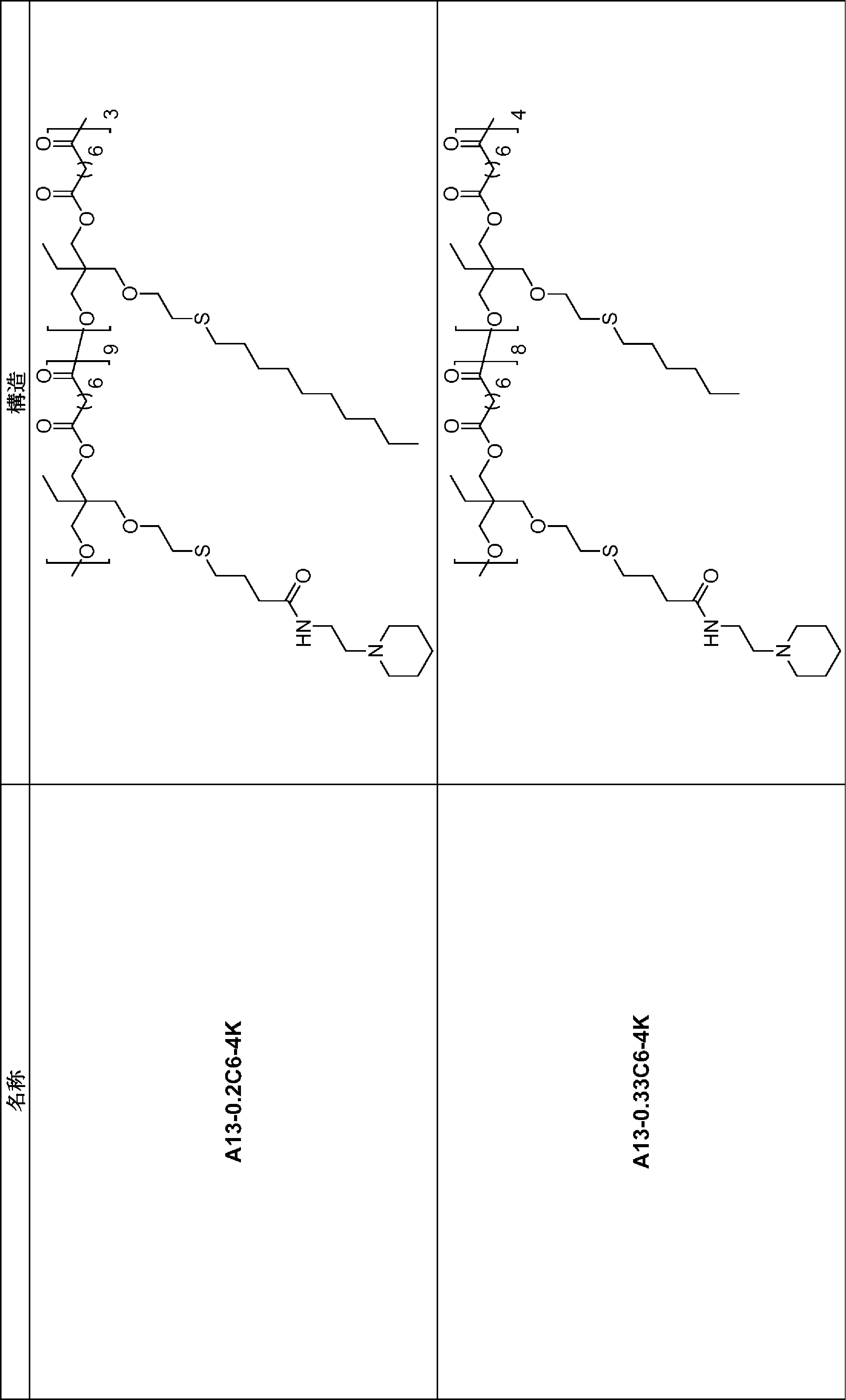

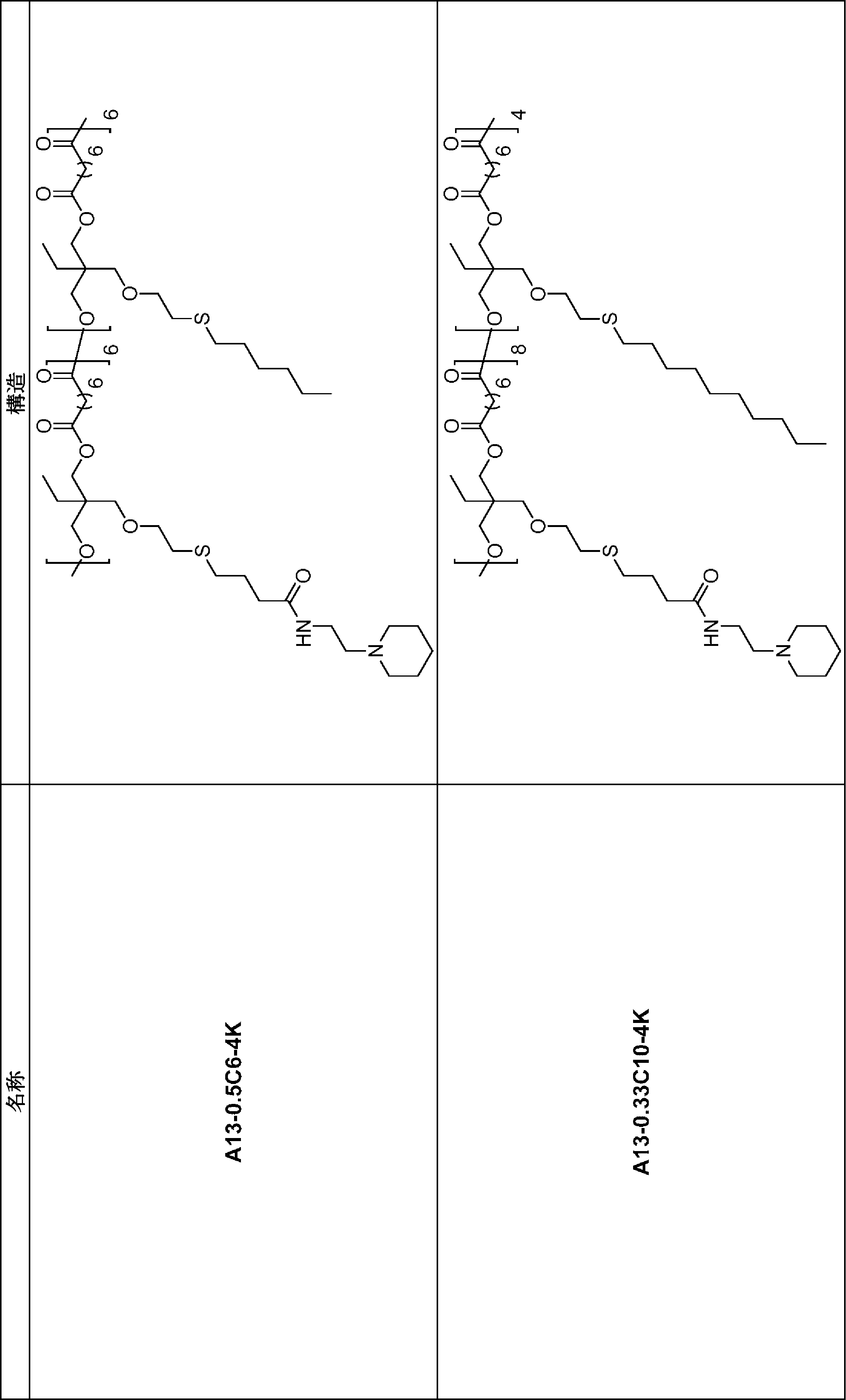
(表2)本明細書に記載の組成物中で使用されるデンドリマー


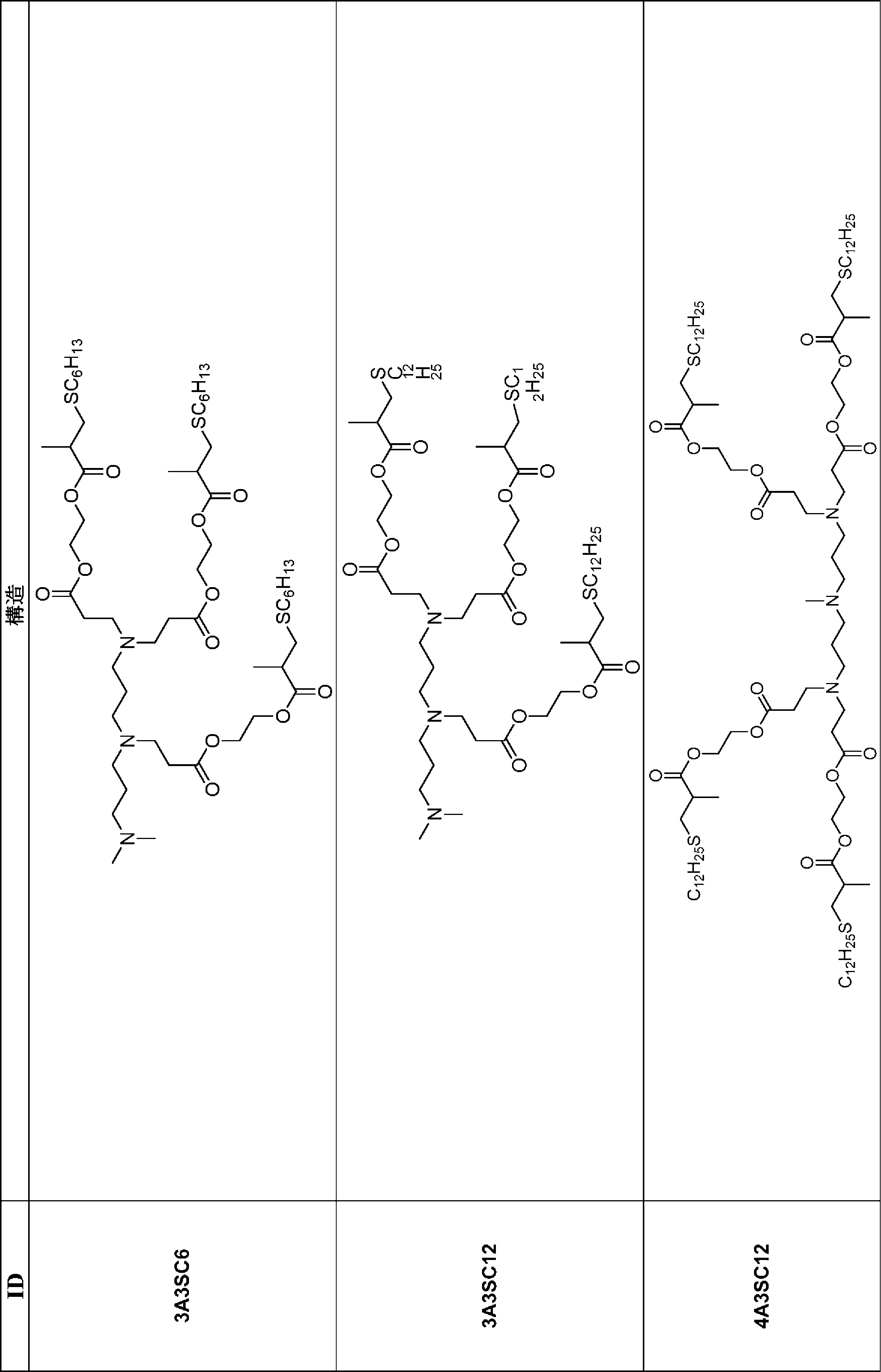


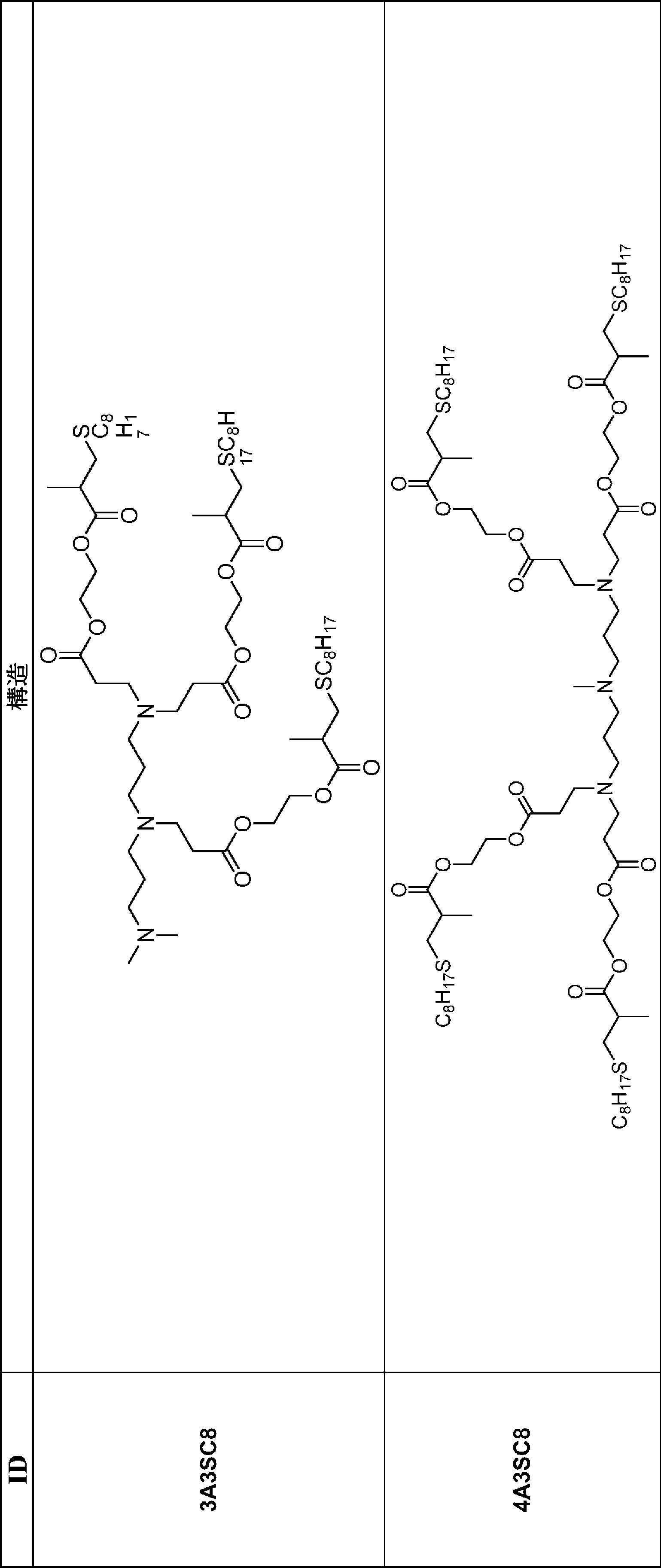
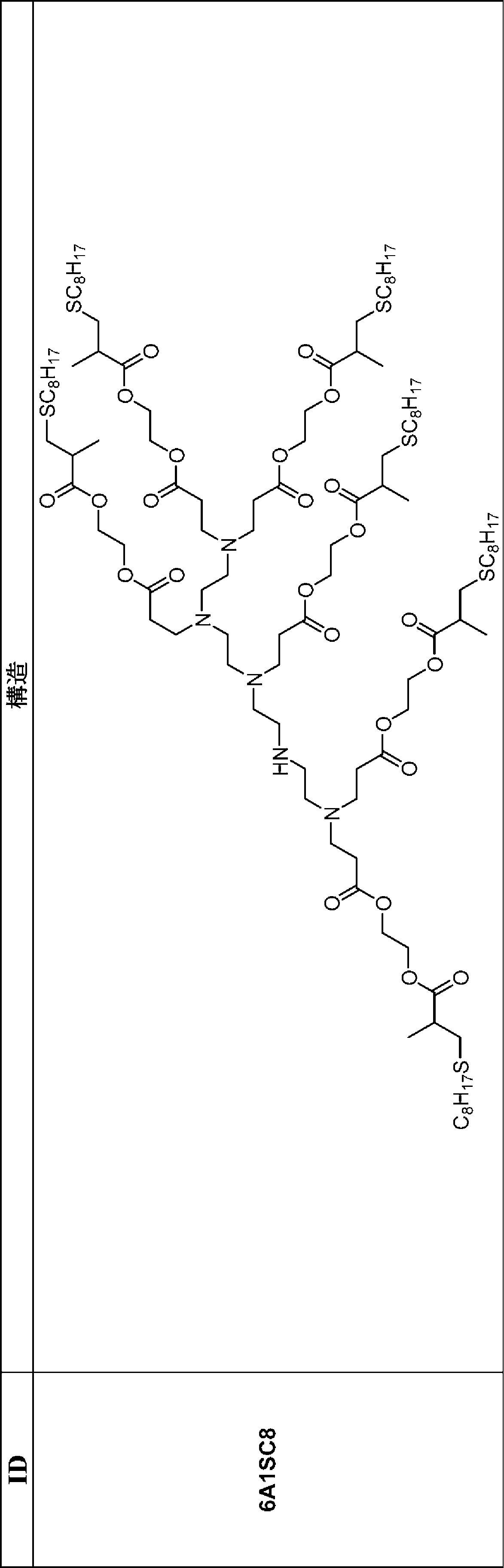


本開示により提供されるアミノ脂質送達化合物は、例えば上記の概要のセクションおよび以下の特許請求の範囲に示される。それらは、実施例の節において概説される方法を使用して作製することができる。これらの方法は、当業者が適用する有機化学の原理および技術を使用してさらに修正および最適化することができる。例えば、そのような原理および技術は、参照により本明細書に組み入れられるMarch's Advanced Organic Chemistry: Reactions, Mechanisms, and Structure (2007)において教示される。 Amino lipid delivery compounds provided by the present disclosure are shown, for example, in the Summary section above and the claims below. They can be made using the methods outlined in the Examples section. These methods can be further modified and optimized using organic chemistry principles and techniques applied by those skilled in the art. For example, such principles and techniques are taught in March's Advanced Organic Chemistry: Reactions, Mechanisms, and Structure (2007), incorporated herein by reference.
本明細書に記載の化合物は、1個または複数の不斉置換炭素または窒素原子を含みうるものであり、光学活性体またはラセミ体として単離されうる。したがって、特定の立体化学配置または異性体が特に示されない限り、ある化学式のすべてのキラル体、ジアステレオ異性体、ラセミ体、エピマー体、およびすべての幾何異性体が意図される。化合物はラセミ体およびラセミ混合物、単一の鏡像異性体、ジアステレオマー混合物および個々のジアステレオマーとして生じうる。いくつかの態様では、単一のジアステレオマーが得られる。本開示の化合物のキラル中心はS配置またはR配置を有しうる。 The compounds described herein can contain one or more asymmetrically substituted carbon or nitrogen atoms, and can be isolated in optically active or racemic forms. Therefore, all chiral, diastereoisomeric, racemic, epimeric and all geometric isomeric forms of a chemical formula are intended, unless the specific stereochemical configuration or isomeric form is specifically indicated. Compounds can occur as racemates and racemic mixtures, single enantiomers, diastereomeric mixtures and individual diastereomers. In some embodiments, single diastereomers are obtained. Chiral centers in the compounds of this disclosure may have the S or R configuration.
本開示のアミノ脂質送達化合物を表すために使用される化学式は通常、おそらくは数種類である異なる互変異性体のうち1つしか示さない。例えば、多くの種類のケトン基が対応するエノール基との平衡状態で存在することが知られている。同様に、多くの種類のイミン基がエナミン基との平衡状態で存在する。どの互変異性体が所与の化合物について示されるかにかかわらず、また、どの互変異性体が最も優勢であるかにかかわらず、所与の化学式のすべての互変異性体が意図される。 The chemical formulas used to represent the amino lipid delivery compounds of the present disclosure typically exhibit only one of possibly several different tautomers. For example, many types of ketone groups are known to exist in equilibrium with the corresponding enol groups. Similarly, many types of imine groups exist in equilibrium with enamine groups. All tautomers of a given chemical formula are intended, regardless of which tautomer is shown for a given compound and regardless of which tautomer predominates.
また、本開示の化合物は、本明細書に記載の適応症において使用される場合であれ、他の場合であれ、先行技術において公知の化合物に比べて有効であり、毒性が低く、長時間作用し、強力であり、生じる副作用が少なく、容易に吸収され、かつ/または良好な薬物動態プロファイル(例えば高い経口バイオアベイラビリティおよび/もしくは低いクリアランス)を示し、かつ/または他の有用な薬理学的、物理的、もしくは化学的性質を示すことができるという利点を有しうる。 In addition, the compounds of the present disclosure, whether used in the indications described herein or otherwise, may have advantages over compounds known in the prior art, such as being less toxic, longer acting, more potent, producing fewer side effects, being readily absorbed, and/or exhibiting good pharmacokinetic profiles (e.g., high oral bioavailability and/or low clearance), and/or being able to exhibit other useful pharmacological, physical, or chemical properties.
さらに、本開示の化合物を構成する原子は、そのような原子のすべての同位体形態を含むように意図されている。本明細書において使用される同位体は、同一の原子番号を有するが異なる質量数を有する原子を含む。一般例としてかつ非限定的に、水素の同位体としてはトリチウムおよび重水素が挙げられ、炭素の同位体としては13Cおよび14Cが挙げられる。 Additionally, atoms making up the compounds of the present disclosure are intended to include all isotopic forms of such atoms. Isotopes as used herein include those atoms having the same atomic number but different mass numbers. By way of general example and without limitation, isotopes of hydrogen include tritium and deuterium, and isotopes of carbon include 13C and 14C .
本明細書において提供される化合物の任意の塩形態の一部を形成する特定のアニオンまたはカチオンは、その塩が全体として薬理学的に許容される限り重要ではないと認識されるべきである。薬学的に許容される塩ならびにその調製方法および使用方法のさらなる例は、参照により本明細書に組み入れられるHandbook of Pharmaceutical Salts: Properties, and Use (2002)に提示されている。 It should be appreciated that the specific anion or cation forming part of any salt form of a compound provided herein is not critical so long as the salt as a whole is pharmacologically acceptable. Further examples of pharmaceutically acceptable salts and methods of preparing and using them are presented in Handbook of Pharmaceutical Salts: Properties, and Use (2002), incorporated herein by reference.
II. tRNA
いくつかの局面では、本組成物は転移RNA(tRNAとして知られる)を含む。本明細書において使用される、転移RNAまたはtRNAという用語は、別途具体的な記載がない限り、伝統的なtRNA分子および1つまたは複数の修飾を伴うtRNA分子の両方を意味する。転移RNAは、長さが約70~100ヌクレオチドのRNAポリマーである。タンパク質合成中、tRNAは、成長ペプチド鎖への付加のためにアミノ酸をリボソームに送達する。活性tRNAは3' CCAテールを有しており、3' CCAテールは、その合成中にtRNAに転写されてもよく、後になって翻訳後プロセシング中に付加されてもよい。アミノ酸は3'末端リボースの2'または3'ヒドロキシル基に共有結合することでアミノアシルtRNA(aa-tRNA)を形成する。アミノ酸は、2'-OHから3'-OHへと、またはその逆に自発的に移動しうるが、3'-OH位からリボソームにおける成長タンパク質鎖に組み込まれる。フォールディングaa-tRNA分子の他端におけるループは、アンチコドンとして知られる3塩基の配列を含む。このアンチコドン配列がリボソーム結合メッセンジャーRNA(mRNA)中の3塩基コドン配列と塩基対を形成する場合、aa-tRNAはリボソームに結合し、そのアミノ酸は新生タンパク質鎖に組み込まれる。特定のコドンと塩基対を形成するすべてのtRNAが単一の特定のアミノ酸によりアミノアシル化されることから、遺伝暗号の翻訳はtRNAにより実行される。mRNA中の61個の各非終止コドンが、その同族aa-tRNAの結合、および単一の特定のアミノ酸の成長タンパク質ポリマーへの付加を方向づける。いくつかの態様では、tRNAは、aa-tRNAがmRNA上の異なるコドンと塩基対を形成するようにtRNAのアンチコドン領域中の変異を含むことができる。特定の態様では、変異tRNAは、mRNAによりコードされるアミノ酸とは異なるアミノ酸を成長タンパク質鎖に導入する。他の態様では、変異tRNAは、終止コドンと塩基対を形成し、タンパク質合成を終止させる代わりにアミノ酸を導入し、これにより新生ペプチドが成長し続けることを可能にする。いくつかの態様では、野生型または変異tRNAは、終止コドンを読み飛ばし、タンパク質合成を終止させる代わりにアミノ酸を導入することができる。いくつかの態様では、tRNAは、3'末端CCAヌクレオチドが含まれる全長tRNAを含みうる。他の態様では、3'末端A、CA、またはCCAを欠くtRNAがインビボでCCA付加酵素により全長tRNAとなる。
II.tRNAs
In some aspects, the composition includes transfer RNA (also known as tRNA). As used herein, the term transfer RNA or tRNA refers to both traditional tRNA molecules and tRNA molecules with one or more modifications, unless specifically stated otherwise. Transfer RNA is an RNA polymer approximately 70-100 nucleotides in length. During protein synthesis, tRNA delivers amino acids to the ribosome for addition to the growing peptide chain. An active tRNA has a 3' CCA tail, which may be transcribed into the tRNA during its synthesis or added later during post-translational processing. Amino acids are covalently attached to the 2' or 3' hydroxyl group of the 3' terminal ribose to form an aminoacyl-tRNA (aa-tRNA). Amino acids, which can spontaneously move from the 2'-OH to the 3'-OH or vice versa, are incorporated into the growing protein chain in the ribosome from the 3'-OH position. The loop at the other end of the folded aa-tRNA molecule contains a three-base sequence known as the anticodon. When this anticodon sequence forms a base pair with a three-base codon sequence in the ribosome-binding messenger RNA (mRNA), the aa-tRNA binds to the ribosome and its amino acids are incorporated into the nascent protein chain. Translation of the genetic code is carried out by tRNAs, since all tRNAs that form base pairs with specific codons are aminoacylated with a single specific amino acid. Each of the 61 non-stop codons in the mRNA directs the binding of its cognate aa-tRNA and the addition of a single specific amino acid to the growing protein polymer. In some embodiments, the tRNA can contain mutations in the anticodon region of the tRNA such that the aa-tRNA base pairs with different codons on the mRNA. In certain embodiments, the mutant tRNA introduces an amino acid into the growing protein chain that differs from that encoded by the mRNA. In other embodiments, the mutated tRNA introduces an amino acid instead of base-pairing with the stop codon and terminating protein synthesis, thereby allowing the nascent peptide to continue growing. In some embodiments, wild-type or mutant tRNAs can skip stop codons and introduce amino acids instead of terminating protein synthesis. In some embodiments, the tRNA can comprise a full-length tRNA with a 3' terminal CCA nucleotide. In other embodiments, a tRNA lacking a 3' terminal A, CA, or CCA becomes a full-length tRNA in vivo by a CCA-adding enzyme.
他の局面では、本組成物は、以下を含む1つまたは複数の修飾tRNA分子をさらに含みうる: アシル化tRNA; アルキル化tRNA; アデニン、シトシン、グアニン、またはウラシル以外の1つまたは複数の塩基を含むtRNA; 特異的リガンドまたは抗原プローブ部分、蛍光プローブ部分、親和性プローブ部分、反応性プローブ部分、スペクトルプローブ部分、もしくは他のプローブ部分の結合により共有結合的に修飾されるtRNA; メチル化されたかまたは他のやり方で修飾された1つまたは複数のリボース部分を含むtRNA; 試薬や特異的リガンドの担体として、または抗原プローブ、蛍光プローブ、反応性プローブ、親和性プローブ、スペクトルプローブ、もしくは他のプローブとして機能する、非天然アミノ酸を含む20種の天然アミノ酸以外のアミノ酸でアミノアシル化されたaa-tRNA; あるいはこれらの組成物の任意の組み合わせ。修飾tRNA分子のいくつかの例は、いずれも参照により本明細書に組み入れられるSoll, et al., 1995; El Yacoubi, et al., 2012; Grosjean and Benne, et al., 1998; Hendrickson, et al., 2004; Ibba and Soll, 2000; Johnson, et al., 1995; Johnson, et al., 1982; Crowley, et al., 1994; Beier and Grimm, 2001; Torres, et al., 2014; およびBjork, et al., 1987により教示されている。 In other aspects, the composition may further comprise one or more modified tRNA molecules, including: an acylated tRNA; an alkylated tRNA; a tRNA containing one or more bases other than adenine, cytosine, guanine, or uracil; or tRNAs containing multiple ribose moieties; aa-tRNAs aminoacylated with amino acids other than the 20 natural amino acids, including unnatural amino acids, that serve as carriers for reagents or specific ligands, or as antigen probes, fluorescent probes, reactive probes, affinity probes, spectral probes, or other probes; or any combination of these compositions. Some examples of modified tRNA molecules are described in Soll, et al., 1995; El Yacoubi, et al., 2012; Grosjean and Benne, et al., 1998; Hendrickson, et al., 2004; Beier and Grimm, 2001; Torres, et al., 2014; and Bjork, et al., 1987.
III.遺伝性障害
いくつかの局面では、本開示は、1つまたは複数の遺伝性障害を処置するために使用可能な組成物を提供する。遺伝性障害の一例は嚢胞性線維症である。嚢胞性線維症の症例のいくつかは、508位においてフェニルアラニンの欠失を生じさせる変異の結果であるが、症例の約10%は、タンパク質配列中の隣接アミノ酸のコドンを置き換える終止コドンを発生させる変異により生じる。この変異は、ナンセンス変異と呼ばれ、切断型非機能性嚢胞性線維症膜コンダクタンス制御因子(CFTR)タンパク質を生じさせる。
III. Genetic Disorders In some aspects, this disclosure provides compositions that can be used to treat one or more genetic disorders. One example of an inherited disorder is cystic fibrosis. Some cases of cystic fibrosis are the result of mutations that cause a deletion of phenylalanine at position 508, but about 10% of cases are caused by mutations that generate stop codons that replace codons of adjacent amino acids in the protein sequence. This mutation, called a nonsense mutation, results in a truncated non-functional cystic fibrosis transmembrane conductance regulator (CFTR) protein.
CFTRタンパク質中の変異は塩化物イオン輸送を損なうものであり、したがって、嚢胞性線維症の患者は皮膚の塩気、成長不良、体重増加不良、特に肺中での粘液蓄積、高頻度の胸部感染症、および咳の持続を呈する。嚢胞性線維症が遺伝性障害であることから、処置オプションは多くの場合、基礎病態よりもむしろ症状を処置することに関連している。そのような処置としては感染症の処置、粘液蓄積を除去する治療、および肺移植などの臓器移植が挙げられる。したがって、基礎病態に対処することができる試みが決定的に重要である。 Mutations in the CFTR protein impair chloride ion transport, and thus patients with cystic fibrosis present with salty skin, poor growth, poor weight gain, mucus accumulation, especially in the lungs, frequent chest infections, and persistent cough. Because cystic fibrosis is a genetic disorder, treatment options are often concerned with treating symptoms rather than the underlying condition. Such treatments include treatment of infections, therapies to remove mucus buildup, and organ transplantation such as lung transplantation. Attempts that can address the underlying pathology are therefore of critical importance.
別の局面では、本開示は、がん、特に1つまたは複数の腫瘍抑制遺伝子中のナンセンス変異を伴うがんの処置を想定する。いくつかの非限定的な種類のがんは、膀胱がん、血液がん、骨がん、脳がん、乳がん、中枢神経系がん、子宮頸がん、結腸がん、子宮内膜がん、食道がん、胆嚢がん、胃腸管がん、生殖器がん、尿生殖器がん、頭部がん、腎がん、喉頭がん、肝がん、肺がん、筋組織がん、頸部がん、口腔粘膜もしくは鼻粘膜がん、卵巣がん、膵がん、前立腺がん、皮膚がん、脾臓がん、小腸がん、大腸がん、胃がん、精巣がん、または甲状腺がんを含み、あるいは、細胞腫、肉腫、リンパ腫、白血病、黒色腫、中皮腫、多発性骨髄腫、または精上皮腫である。ありうる腫瘍抑制タンパク質の非限定的リストはp53、pRb、PTEN、SWI、SNF、pVHL、APC、CD95、ST5、YPEL3、ST7、およびST14を含む。本明細書に記載の組成物に加えて、化学療法、手術、免疫療法、または放射線療法を含む1つまたは複数のさらなる抗がん治療法によって、患者を処置することができる。 In another aspect, the present disclosure contemplates treatment of cancers, particularly cancers with nonsense mutations in one or more tumor suppressor genes. Some non-limiting types of cancer include bladder cancer, blood cancer, bone cancer, brain cancer, breast cancer, central nervous system cancer, cervical cancer, colon cancer, endometrial cancer, esophageal cancer, gallbladder cancer, gastrointestinal cancer, genital cancer, urogenital cancer, head cancer, kidney cancer, laryngeal cancer, liver cancer, lung cancer, muscle tissue cancer, neck cancer, oral or nasal mucosal cancer, ovarian cancer, pancreatic cancer, prostate cancer, skin cancer, spleen cancer, small bowel cancer, colorectal cancer, gastric cancer , testicular cancer, or thyroid cancer, or is a cell tumor, sarcoma, lymphoma, leukemia, melanoma, mesothelioma, multiple myeloma, or seminioma. A non-limiting list of possible tumor suppressor proteins includes p53, pRb, PTEN, SWI, SNF, pVHL, APC, CD95, ST5, YPEL3, ST7, and ST14. In addition to the compositions described herein, patients can be treated with one or more additional anti-cancer therapies, including chemotherapy, surgery, immunotherapy, or radiation therapy.
IV.治療法
A. 薬学的製剤および投与経路
臨床用途が想定される場合、所期の用途に適した形態で薬学的組成物を調製することが必要になる。いくつかの態様では、本開示の化合物を有するそのような製剤が想定される。一般に、これは、発熱物質、およびヒトまたは動物に有害なことがある他の不純物を本質的に含まない組成物を調製することを伴う。
IV. Treatment
A. Pharmaceutical Formulations and Routes of Administration When clinical use is envisioned, it becomes necessary to prepare the pharmaceutical composition in a form suitable for the intended use. In some aspects, such formulations with compounds of the present disclosure are envisioned. Generally, this involves preparing compositions that are essentially free of pyrogens and other impurities that could be harmful to humans or animals.
一般に、送達ベクターを安定にするために、かつ標的細胞による取り込みを可能にするために、適切な塩および緩衝液を使用することが望まれる。緩衝液は、組換え細胞を患者に導入する際にも使用される。本開示の水性組成物は、薬学的に許容される担体または水性媒体に溶解または分散した、細胞への有効量のベクターを含む。そのような組成物は接種材料とも呼ばれる。「薬学的または薬理学的に許容される」という語句は、動物またはヒトに投与する際に有害な、アレルギー性の、または他の不都合な反応を生じさせない分子実体および組成物を意味する。本明細書において使用される「薬学的に許容される担体」は、あらゆる溶媒、分散媒、コーティング、抗菌剤および抗真菌剤、等張剤、および吸収遅延剤などを含む。薬学的に有効な物質用にそのような媒体および剤を使用することは当技術分野において周知である。任意の従来の媒体または剤は、本開示のベクターまたは細胞と適合しない場合を除いて、治療用組成物中でのその使用が想定される。補足的な有効成分も組成物に組み込むことができる。 In general, it is desirable to use appropriate salts and buffers to stabilize the delivery vector and allow uptake by the target cells. Buffers are also used when introducing recombinant cells into a patient. Aqueous compositions of the present disclosure comprise an effective amount of vector for cells, dissolved or dispersed in a pharmaceutically acceptable carrier or aqueous medium. Such compositions are also called inoculants. The phrase "pharmaceutically or pharmacologically acceptable" refers to molecular entities and compositions that do not produce adverse, allergic, or other untoward reactions when administered to animals or humans. As used herein, "pharmaceutically acceptable carrier" includes any solvents, dispersion media, coatings, antibacterial and antifungal agents, isotonic and absorption delaying agents and the like. The use of such media and agents for pharmaceutically active substances is well known in the art. Except insofar as any conventional media or agent is incompatible with the vectors or cells of this disclosure, its use in therapeutic compositions is envisioned. Supplementary active ingredients can also be incorporated into the compositions.
本開示の有効組成物は、古典的な薬学的製剤を含みうる。本開示のこれらの組成物の投与は、標的組織に任意の一般的経路によって接近可能である限り、その経路を介して行われる。そのような経路としては経口経路、経鼻経路、頬側経路、経膣経路、または局所経路が挙げられる。あるいは、投与は同所注射、皮内注射、皮下注射、筋肉内注射、腫瘍内注射、腹腔内注射、または静脈内注射によるものでもよい。通常、そのような組成物は上述の薬学的に許容される組成物として投与される。 Active compositions of the present disclosure can include classical pharmaceutical formulations. Administration of these compositions of this disclosure will be via any common route so long as the target tissue is accessible by that route. Such routes include oral, nasal, buccal, vaginal, or topical routes. Alternatively, administration may be by orthotopic, intradermal, subcutaneous, intramuscular, intratumoral, intraperitoneal, or intravenous injection. Such compositions are typically administered as pharmaceutically acceptable compositions described above.
有効化合物を非経口投与または腹腔内投与してもよい。遊離塩基または薬理学的に許容される塩としての有効化合物の溶液剤を、ヒドロキシプロピルセルロースなどの界面活性剤と好適に混合された水中で調製することができる。分散液剤をグリセリン、液体ポリエチレングリコールおよびその混合物中、ならびに油中で調製することもできる。これらの製剤は、通常の貯蔵条件および使用条件下で、微生物の成長を防ぐ保存料を含む。 Active compounds may be administered parenterally or intraperitoneally. Solutions of the active compounds as free base or pharmacologically acceptable salts can be prepared in water suitably mixed with a surfactant such as hydroxypropylcellulose. Dispersions can also be prepared in glycerin, liquid polyethylene glycols, and mixtures thereof and in oils. These formulations contain preservatives to prevent microbial growth under normal conditions of storage and use.
注射用に好適な薬学的形態としては、滅菌水溶液剤または水性分散液剤、および滅菌注射用溶液剤または分散液剤の即時調製用の滅菌散剤が挙げられる。いずれの場合でも、形態は滅菌されていなければならず、容易なシリンジ注入可能性が存在する程度に流動的でなければならない。形態は製造条件および貯蔵条件下で安定でなければならず、細菌および真菌などの微生物の汚染作用に対して保存されなければならない。担体は、水、エタノール、ポリオール(例えばグリセリン、プロピレングリコール、および液体ポリエチレングリコールなど)、その好適な混合物、ならびに植物油を例えば含む、溶媒または分散媒でありうる。例えば、レシチンなどのコーティングの使用、分散液の場合の必要な粒径の維持、および界面活性剤の使用により、適当な流動性を維持することができる。微生物の作用の阻止を様々な抗菌剤および抗真菌剤、例えば、パラベン、クロロブタノール、フェノール、ソルビン酸、チメロサールなどによってもたらすことができる。多くの場合、等張剤、例えば糖または塩化ナトリウムを含むことが好ましい。注射用組成物の長期吸収を組成物中での吸収遅延剤、例えばモノステアリン酸アルミニウムおよびゼラチンの使用によってもたらすことができる。 Pharmaceutical forms suitable for injection include sterile aqueous solutions or dispersions and sterile powders for the extemporaneous preparation of sterile injectable solutions or dispersion. In all cases the form must be sterile and must be fluid to the extent that easy syringability exists. The form must be stable under the conditions of manufacture and storage and must be preserved against the contaminating action of microorganisms such as bacteria and fungi. The carrier can be a solvent or dispersion medium including, for example, water, ethanol, polyols (such as glycerin, propylene glycol and liquid polyethylene glycol), suitable mixtures thereof, and vegetable oils. Proper fluidity can be maintained, for example, through the use of coatings such as lecithin, maintenance of the required particle size in the case of dispersions, and use of surfactants. Blocking the action of microorganisms can be provided by various antibacterial and antifungal agents such as parabens, chlorobutanol, phenol, sorbic acid, thimerosal, and the like. In many cases, it will be preferable to include isotonic agents such as sugars or sodium chloride. Prolonged absorption of injectable compositions can be brought about by the use of absorption delaying agents in the compositions, such as aluminum monostearate and gelatin.
滅菌注射用溶液剤は、所要量の有効化合物を適切な溶媒中に必要に応じて上記で列挙した様々な他の成分と共に組み込んだ後、濾過滅菌を行うことで調製される。一般に、分散液剤は、塩基性分散媒および上記で列挙した成分のうち必要な他の成分を含む滅菌媒体に様々な滅菌有効成分を組み入れることで調製される。滅菌注射用溶液剤の調製用の滅菌散剤の場合、好ましい調製方法は、有効成分と任意のさらなる所望の成分との粉末を、既に滅菌濾過したその溶液から得る、真空乾燥および凍結乾燥技術である。 Sterile injectable solutions are prepared by incorporating the active compound in the required amount in the appropriate solvent with various of the other ingredients enumerated above, as required, followed by filtered sterilization. Generally, dispersions are prepared by incorporating the various sterilized active ingredients into a sterile vehicle which contains the basic dispersion medium and the required other ingredients from those enumerated above. In the case of sterile powders for the preparation of sterile injectable solutions, the preferred methods of preparation are vacuum drying and freeze-drying techniques whereby a powder of the active ingredient plus any additional desired ingredient is obtained from a solution thereof which has already been sterile filtered.
本明細書において使用される「薬学的に許容される担体」は、あらゆる溶媒、分散媒、コーティング、抗菌剤および抗真菌剤、等張剤、および吸収遅延剤などを含む。薬学的有効物質用のそのような媒体および剤の使用は当技術分野において周知である。任意の従来の媒体または剤は、有効成分と適合しない場合を除いて、治療用組成物中でのその使用が想定される。補助的有効成分も組成物に組み込むことができる。 As used herein, "pharmaceutically acceptable carrier" includes any solvents, dispersion media, coatings, antibacterial and antifungal agents, isotonic and absorption delaying agents and the like. The use of such media and agents for pharmaceutical active substances is well known in the art. Except insofar as any conventional media or agent is incompatible with the active ingredient, its use in the therapeutic compositions is contemplated. Supplementary active ingredients can also be incorporated into the compositions.
経口投与では、本明細書に記載の組成物を賦形剤に組み込み、経口摂取不可能なうがい薬および歯磨剤の形態で使用することができる。うがい薬は、所要量の有効成分をホウ酸ナトリウム溶液(Dobell溶液)などの適切な溶媒中に組み込むことで調製することができる。あるいは、有効成分を、ホウ酸ナトリウム、グリセリン、および炭酸水素カリウムを含む防腐洗浄液に組み込むこともできる。また、有効成分を、ゲル、ペースト、粉末、およびスラリーを含む歯磨剤に分散させることができる。有効成分を治療有効量で、水、結合剤、研磨剤、香味料、発泡剤、および湿潤剤を含みうるペースト歯磨剤に加えることができる。 For oral administration, the compositions described herein can be incorporated with excipients and used in the form of non-ingestible mouthwashes and dentifrices. A mouthwash can be prepared by incorporating the required amount of active ingredient in an appropriate solvent such as sodium borate solution (Dobell's solution). Alternatively, the active ingredient can be incorporated into an antiseptic wash containing sodium borate, glycerin and potassium bicarbonate. The active ingredient can also be dispersed in dentifrices including gels, pastes, powders and slurries. Active ingredients in therapeutically effective amounts can be added to the paste dentifrice, which can include water, binders, abrasives, flavoring agents, foaming agents, and humectants.
本開示の組成物は中性形態または塩形態で製剤化することができる。薬学的に許容される塩としては、(タンパク質の遊離アミノ基と共に形成され、かつ)例えば塩酸もしくはリン酸などの無機酸、または酢酸、シュウ酸、酒石酸、マンデル酸などの有機酸と共に形成される、酸付加塩が挙げられる。また、遊離カルボキシル基と共に形成される塩が、例えば水酸化ナトリウム、水酸化カリウム、水酸化アンモニウム、水酸化カルシウム、または水酸化第二鉄などの無機塩基、およびイソプロピルアミン、トリメチルアミン、ヒスチジン、プロカインなどの有機塩基から誘導されうる。 The compositions of the disclosure can be formulated in neutral or salt forms. Pharmaceutically acceptable salts include acid addition salts (formed with free amino groups of proteins and formed with inorganic acids such as, for example, hydrochloric acid or phosphoric acid, or organic acids such as acetic, oxalic, tartaric, mandelic, and the like). Salts formed with free carboxyl groups can also be derived from inorganic bases such as sodium hydroxide, potassium hydroxide, ammonium hydroxide, calcium hydroxide, or ferric hydroxide, and organic bases such as isopropylamine, trimethylamine, histidine, procaine.
製剤化されると、溶液剤は、投与製剤と適合する様式で、かつ治療上有効な量で投与される。製剤は注射用溶液剤、薬物放出カプセル剤などの種々の剤形で容易に投与される。例えば、水溶液剤での非経口投与では、溶液剤は必要であれば好適に緩衝すべきであり、液体希釈剤は十分な生理食塩水またはグルコースで最初に等張性にすべきである。これらの特定の水溶液剤は静脈内投与、筋肉内投与、皮下投与、および腹腔内投与に特に好適である。これに関して、使用可能な滅菌水性媒体は、本開示に照らせば当業者には明らかであろう。例えば、1用量を等張NaCl溶液1mlに溶解させ、かつ皮下注入液1000mLに加えるかまたは目的の注入部位に注射することができる(例えば"Remington's Pharmaceutical Sciences," 15th Edition, pages 1035-1038 and 1570-1580を参照)。処置される対象の状態に応じて投与量の何らかの変動が必然的に生じる。いずれにせよ、投与を担う人物は、個々の対象に適した用量を決定する。さらに、ヒト投与では、製剤はFDA Office of Biologics standardsが要求する滅菌性、発熱性、一般的安全性、および純度の基準に適合すべきである。 Upon formulation, solutions will be administered in a manner compatible with the dosage formulation and in such amount as is therapeutically effective. The formulations are easily administered in a variety of dosage forms such as injectable solutions, drug release capsules and the like. For parenteral administration in an aqueous solution, for example, the solution should be suitably buffered if necessary and the liquid diluent first rendered isotonic with sufficient saline or glucose. These particular aqueous formulations are especially suitable for intravenous, intramuscular, subcutaneous and intraperitoneal administration. In this regard, the sterile aqueous media that can be used will be apparent to those skilled in the art in light of this disclosure. For example, one dose can be dissolved in 1 ml of isotonic NaCl solution and added to 1000 mL of subcutaneous injection or injected at the intended site of injection (see, eg, "Remington's Pharmaceutical Sciences," 15th Edition, pages 1035-1038 and 1570-1580). Some variation in dosage will necessarily occur depending on the condition of the subject being treated. In any event, the person responsible for administration will determine the appropriate dosage for each individual subject. Moreover, for human administration, preparations should meet sterility, pyrogenicity, general safety and purity standards as required by FDA Office of Biologics standards.
I. ステロイドおよびステロイド誘導体
本開示のいくつかの局面では、アミノ脂質と1つまたは複数のステロイドまたはステロイド誘導体とが混合されてナノ粒子組成物が作り出される。いくつかの態様では、ステロイドまたはステロイド誘導体は任意のステロイドまたはステロイド誘導体を含む。いくつかの態様では、本明細書において使用される「ステロイド」という用語は、4環17炭素の環状構造を有する化合物のクラスのことであり、この環状構造は、アルキル基、アルコキシ基、ヒドロキシ基、オキソ基、アシル基を含む1個または複数の置換基、または2個以上の炭素原子間の二重結合をさらに含みうる。一局面では、ステロイドの環構造は、下記式に示すように、3個の縮合シクロヘキシル環および1個の縮合シクロペンチル環を含む:

いくつかの態様では、ステロイド誘導体は、1個または複数の非アルキル置換基を有する上記環構造を含む。いくつかの態様では、ステロイドまたはステロイド誘導体は、式が下記式としてさらに定義されるステロールである:

本開示のいくつかの態様では、ステロイドまたはステロイド誘導体はコレスタンまたはコレスタン誘導体である。コレスタンにおいて、環構造は下記式によりさらに定義される:

上記のように、コレスタン誘導体は、上記環系の1個または複数の非アルキル置換基を含む。いくつかの態様では、コレスタンまたはコレスタン誘導体は、コレステンもしくはコレステン誘導体、またはステロールもしくはステロール誘導体である。他の態様では、コレスタンまたはコレスタン誘導体は、コレステンおよびステロールの両方、またはその誘導体である。 As noted above, cholestane derivatives contain one or more non-alkyl substituents on the ring system. In some aspects, the cholestane or cholestane derivative is cholestene or a cholestene derivative, or a sterol or a sterol derivative. In another aspect, the cholestane or cholestane derivative is both cholestene and a sterol, or derivatives thereof.
いくつかの態様では、本組成物は、化合物またはアミノ脂質 対 ステロイドまたはステロイド誘導体の比約1:3~約30:1または約1:1~約20:1を含む。比は約1:1~6:1、例えば約1.3:1の比でありうる。いくつかの態様では、比は約1:3、1:2、1:1、1.25:1、1.5:1、2:1、3:1、5:1、8:1、10:1、12.5:1、15:1、17.5:1、20:1、25:1から約30:1まで、またはこれらの中から導き出せる任意の範囲である。 In some embodiments, the composition comprises a compound or aminolipid to steroid or steroid derivative ratio of about 1:3 to about 30:1 or about 1:1 to about 20:1. The ratio can be from about 1:1 to 6:1, such as a ratio of about 1.3:1. In some embodiments, the ratio is from about 1:3, 1:2, 1:1, 1.25:1, 1.5:1, 2:1, 3:1, 5:1, 8:1, 10:1, 12.5:1, 15:1, 17.5:1, 20:1, 25:1 to about 30:1, or any range derivable therein.
II. PEGまたはPEG化脂質
本開示のいくつかの局面では、アミノ脂質(または化合物)と1つまたは複数のPEG化脂質(またはPEG脂質)とが混合されてナノ粒子組成物が作り出される。いくつかの態様では、本開示は、PEG基が結合した任意の脂質を使用することを含む。いくつかの態様では、PEG脂質は、グリセロール基に結合したPEG鎖も含むジグリセリドである。他の態様では、PEG脂質は、PEG鎖とのリンカー基に結合した、1個もしくは複数のC6~C24長鎖アルキルもしくはアルケニル基、またはC6~C24脂肪酸基を含む、化合物である。PEG脂質のいくつかの非限定的な例としては、PEG修飾ホスファチジルエタノールアミンおよびホスファチジン酸、PEGセラミド結合体、PEG修飾ジアルキルアミンおよびPEG修飾1,2-ジアシルオキシプロパン-3-アミン、PEG修飾ジアシルグリセロールおよびジアルキルグリセロールが挙げられる。いくつかの態様では、PEG修飾ジステアロイルホスファチジルエタノールアミンまたはPEG修飾ジミリストイル-sn-グリセロールである。いくつかの態様では、PEG修飾体は脂質のPEG成分の分子量により測定される。いくつかの態様では、PEG修飾体は分子量約100~約5,000を有する。いくつかの態様では、分子量は約200~約500または約1,200~約3,000である。本開示において使用可能な脂質のいくつかの非限定的な例は、参照により本明細書に組み入れられる米国特許第5,820,873号、国際公開公報第2010/141069号、または米国特許第8,450,298号により教示されている。
II. PEG or PEGylated Lipids In some aspects of the disclosure, an amino lipid (or compound) and one or more PEGylated lipids (or PEGylated lipids) are mixed to create a nanoparticle composition. In some aspects, the disclosure includes using any lipid with an attached PEG group. In some embodiments, the PEG lipid is a diglyceride that also includes PEG chains attached to glycerol groups. In other embodiments, PEG lipids are compounds that contain one or more C6-C24 long chain alkyl or alkenyl groups, or C6-C24 fatty acid groups, attached to a linker group with a PEG chain. Some non-limiting examples of PEG lipids include PEG-modified phosphatidylethanolamines and phosphatidic acids, PEG-ceramide conjugates, PEG-modified dialkylamines and PEG-modified 1,2-diacyloxypropan-3-amines, PEG-modified diacylglycerols and dialkylglycerols. In some embodiments, PEG-modified distearoylphosphatidylethanolamine or PEG-modified dimyristoyl-sn-glycerol. In some embodiments, PEG modifications are measured by the molecular weight of the PEG component of the lipid. In some embodiments, PEG modifications have a molecular weight of about 100 to about 5,000. In some embodiments, the molecular weight is from about 200 to about 500 or from about 1,200 to about 3,000. Some non-limiting examples of lipids that can be used in the present disclosure are taught by US Pat. No. 5,820,873, WO 2010/141069, or US Pat. No. 8,450,298, which are incorporated herein by reference.
別の局面では、PEG脂質は下記式を有する:

いくつかの態様では、本組成物は、化合物またはアミノ脂質 対 PEG脂質の比約1:1~約150:1または約2.5:1~約100:1を含む。比は約7.5:1~50:1、例えば約33.3:1の比でありうる。いくつかの態様では、比は約5:1、10:1、20:1、25:1、30:1、35:1、40:1、50:1、60:1、70:1、80:1、90:1、100:1、120:1、140:1から約150:1まで、またはこれらの中から導き出せる任意の範囲である。 In some embodiments, the composition comprises a compound or amino lipid to PEG lipid ratio of about 1:1 to about 150:1 or about 2.5:1 to about 100:1. The ratio can be from about 7.5:1 to 50:1, such as a ratio of about 33.3:1. In some embodiments, the ratio is from about 5:1, 10:1, 20:1, 25:1, 30:1, 35:1, 40:1, 50:1, 60:1, 70:1, 80:1, 90:1, 100:1, 120:1, 140:1 to about 150:1, or any range derivable therein.
III. リン脂質
本開示のいくつかの局面では、アミノ脂質と1つまたは複数のリン脂質とが混合されてナノ粒子組成物が作り出される。いくつかの態様では、リン酸基も含む任意の脂質である。いくつかの態様では、リン脂質は、1個または2個の長鎖C6~C24アルキルまたはアルケニル基、グリセロールまたはスフィンゴシン、1個または2個のリン酸基、および場合によっては小有機分子を含む、構造である。いくつかの態様では、小有機分子はアミノ酸、糖、またはアミノ置換アルコキシ基、例えばコリンまたはエタノールアミンである。いくつかの態様では、リン脂質はホスファチジルコリンである。いくつかの態様では、リン脂質はジステアロイルホスファチジルコリンである。
III. Phospholipids In some aspects of the present disclosure, an amino lipid and one or more phospholipids are mixed to create a nanoparticle composition. In some embodiments, any lipid that also contains a phosphate group. In some embodiments, a phospholipid is a structure comprising 1 or 2 long chain C6-C24 alkyl or alkenyl groups, glycerol or sphingosine, 1 or 2 phosphate groups, and optionally a small organic molecule. In some embodiments, small organic molecules are amino acids, sugars, or amino-substituted alkoxy groups, such as choline or ethanolamine. In some aspects, the phospholipid is phosphatidylcholine. In some aspects, the phospholipid is distearoylphosphatidylcholine.
いくつかの態様では、本組成物は、化合物またはアミノ脂質 対 リン脂質の比約1:1~約15:1または約1:1~約9:1を含む。比は約2.5:1~7.5:1、例えば約5:1の比でありうる。いくつかの態様では、比は約1:1、2:1、3:1、4:1、4.5:1、5:1、5.5:1、6:1、7:1、8:1、9:1、10:1、12:1、14:1から約15:1まで、またはこれらの中から導き出せる任意の範囲である。 In some embodiments, the composition comprises a compound or aminolipid to phospholipid ratio of about 1:1 to about 15:1 or about 1:1 to about 9:1. The ratio can be from about 2.5:1 to 7.5:1, such as a ratio of about 5:1. In some embodiments, the ratio is about 1:1, 2:1, 3:1, 4:1, 4.5:1, 5:1, 5.5:1, 6:1, 7:1, 8:1, 9:1, 10:1, 12:1, 14:1 to about 15:1, or any range derivable therein.
B. 処置方法
特に、対象(例えばヒト対象)において遺伝性疾患およびがんを処置する上で使用可能な組成物が本明細書に開示される。先に記載の組成物を哺乳動物(例えば、げっ歯類、ヒト、非ヒト霊長類、イヌ、ウシ、ヒツジ、ウマ、ネコなど)に有効量、すなわち処置対象において望ましい結果を生じさせることが可能な量で投与することが好ましい。本開示の方法において利用される組成物の毒性および治療有効性は、標準的な薬学的手順によって確定することができる。医学分野および獣医学分野において周知のように、任意の1匹の動物に対する投与量は、対象のサイズ、体表面積、体重、年齢、投与すべき特定の組成物、投与時間および投与経路、全身的健康、遺伝性疾患またはがんの臨床症状、ならびに同時投与される他の薬物を含む多くの要因に依存する。いくつかの態様では、これらの投与量を、特定の患者に関する生物学的要因、例えば、薬物の代謝分解の増加もしくは減少、または経口投与される場合の消化管による取り込みの減少に基づいて減少または増加させることができる。さらに、本有効組成物はいっそう有効でありうるものであり、したがって、同様の効果を実現するために必要な用量がより少なくなる。通常、そのような用量は1日1回、数週間またはがん細胞の十分な減少が実現されるまで投与される。
B. Methods of Treatment Disclosed herein are compositions that can be used, among other things, to treat genetic diseases and cancer in subjects (eg, human subjects). Preferably, the compositions described above are administered to mammals (e.g., rodents, humans, non-human primates, dogs, cows, sheep, horses, cats, etc.) in an effective amount, i.e., an amount capable of producing the desired result in the subject being treated. Toxicity and therapeutic efficacy of compositions utilized in the disclosed methods can be determined by standard pharmaceutical procedures. As is well known in the medical and veterinary arts, the dosage for any one animal will depend on many factors, including the subject's size, body surface area, weight, age, the particular composition to be administered, the time and route of administration, general health, clinical manifestations of genetic disease or cancer, and other co-administered drugs. In some embodiments, these dosages can be decreased or increased based on biological factors associated with the particular patient, such as increased or decreased metabolic breakdown of the drug, or decreased uptake by the gastrointestinal tract when administered orally. Moreover, the active compositions may be more effective, thus requiring less dosage to achieve similar effects. Typically, such doses are administered once daily for several weeks or until sufficient reduction of cancer cells is achieved.
一般に、本開示の治療方法(予防的処置を含む)は、治療有効量の本明細書に記載の組成物を、哺乳動物、特にヒトを含むそれを必要とする対象に投与することを含む。そのような処置は、疾患、障害、もしくはその症状に罹患しているか、それを有しているか、それに罹患しやすいか、またはそれに関する危険性がある対象、特にヒトに対して好適に実行することができる。「危険性がある」対象の決定は、診断検査または対象もしくは医療提供者の意見(例えば遺伝子検査、酵素またはタンパク質マーカー、(本明細書において定義される)マーカー、家族歴など)による任意の客観的または主観的決定によって行うことができる。 In general, therapeutic methods (including prophylactic treatment) of the present disclosure comprise administering a therapeutically effective amount of a composition described herein to a subject in need thereof, including mammals, particularly humans. Such treatment may suitably be performed on a subject, particularly a human, suffering from, having, susceptible to, or at risk for a disease, disorder, or symptom thereof. Determination of a subject "at risk" can be made by any objective or subjective determination by diagnostic testing or subject or health care provider opinion (e.g., genetic testing, enzyme or protein markers, markers (as defined herein), family history, etc.).
C. 併用療法
本明細書に記載の有効組成物は、1つまたは複数の治療法との併用療法において使用可能であると想定される。いくつかの態様では、がん治療の分野において、治療様式を組み合わせることは一般的である。以下は、本開示の治療法との組み合わせで使用可能な治療法の一般的説明である。
C. Combination Therapy It is envisioned that the active compositions described herein can be used in combination therapy with one or more therapeutic modalities. In some aspects, it is common in the field of cancer therapy to combine therapeutic modalities. The following is a general description of treatments that can be used in combination with the treatments of the present disclosure.
例えば、本開示の方法および組成物を使用してがんを処置するために、一般的には、腫瘍細胞または対象と化合物および少なくとも1つの他の治療薬とを接触させる。これらの治療薬は、1つまたは複数の疾患パラメータの減少を実現するために有効な併用量で与えられる。このプロセスは、細胞/対象と両方の剤/治療薬とを同時に接触させることを、例えば、両方の剤を含む単一の組成物または薬理学的製剤を使用することで行うか、あるいは、細胞/対象と、一方の組成物が化合物を含み、他方の組成物が他方の剤を含む、2つの別個の組成物または製剤とを同時に接触させることで行うことを包含しうる。 For example, to treat cancer using the methods and compositions of the present disclosure, generally the tumor cells or subject are contacted with the compound and at least one other therapeutic agent. These therapeutic agents are given in combined amounts effective to achieve reduction in one or more disease parameters. This process can involve contacting the cells/subjects with both agents/therapeutic agents simultaneously, e.g., using a single composition or pharmacological formulation comprising both agents, or by simultaneously contacting the cells/subjects with two separate compositions or formulations, one composition comprising the compound and the other composition comprising the other agent.
あるいは、本明細書に記載の有効組成物は、数分~数週間の範囲の間隔で他方の処置薬に先行または後続しうる。一般的には、治療薬が細胞/対象に対して有利な併用効果を依然として発揮することができるように、各送達の間に相当な期間が経過しないことを確実にする。そのような場合、細胞と両様式との接触を、互いに約12~24時間空けて、互いに約6~12時間空けて、または遅延時間わずか約1~2時間で行うことが想定される。しかし、いくつかの状況では、処置期間を著しく延長し、各投与間で数日(2、3、4、5、6、または7日)~数週間(1、2、3、4、5、6、7、または8週)が経過するようにすることが望ましいことがある。 Alternatively, the active composition described herein may precede or follow the other treatment by intervals ranging from minutes to weeks. In general, ensure that no significant period of time elapses between each delivery so that the therapeutic agent can still exert its beneficial combined effect on the cell/subject. In such cases, it is envisioned that the contacting of the cells with both modalities will be about 12-24 hours apart from each other, about 6-12 hours apart from each other, or with a lag time of only about 1-2 hours. However, in some circumstances it may be desirable to significantly extend the duration of treatment so that several days (2, 3, 4, 5, 6, or 7 days) to several weeks (1, 2, 3, 4, 5, 6, 7, or 8 weeks) elapse between each administration.
また、化合物または他方の治療薬の2回以上の投与が望ましいと考えられる。以下に例示するように、様々な組み合わせを使用することができ、ここでは本開示の化合物を「A」とし、他方の治療薬を「B」とする:

他の組み合わせも想定される。以下は、本開示の化合物との組み合わせで使用可能ながん治療法の一般的説明である。 Other combinations are also envisioned. The following is a general description of cancer treatments that can be used in combination with the compounds of the present disclosure.
1. 化学療法
「化学療法」という用語は、がんを処置するための薬物の使用を意味する。「化学療法剤」は、がんの処置において投与される化合物または組成物を含意するように使用される。これらの剤または薬物は、細胞内での活性様式によって分類され、例えば細胞周期に影響するか否か、およびどの段階で細胞周期に影響するかによって分類される。あるいは、DNAを直接架橋する能力、DNAの間に介入する能力、または核酸合成に影響することで染色体異常および有糸分裂異常を誘導する能力に基づいて、剤を特徴づけることもできる。大部分の化学療法剤は以下の分類に分類される: アルキル化剤、代謝拮抗剤、抗腫瘍性抗生物質、有糸分裂阻害剤、およびニトロソウレア。
1. Chemotherapy The term "chemotherapy" refers to the use of drugs to treat cancer. A "chemotherapeutic agent" is used to include a compound or composition administered in the treatment of cancer. These agents or drugs are classified according to their mode of activity within cells, for example, whether they affect the cell cycle and at what stage they affect the cell cycle. Alternatively, agents can be characterized based on their ability to directly cross-link DNA, to intervene between DNAs, or to induce chromosomal and mitotic abnormalities by affecting nucleic acid synthesis. Most chemotherapeutic agents fall into the following categories: alkylating agents, antimetabolites, antineoplastic antibiotics, antimitotic agents, and nitrosoureas.
化学療法剤の例としては以下が挙げられる: アルキル化剤、例えば、チオテパおよびシクロホスファミド; ブスルファン、インプロスルファン、およびピポスルファンなどのアルキルスルホネート; ベンゾドパ(benzodopa)、カルボコン、メツレドパ(meturedopa)、およびウレドパ(uredopa)などのアジリジン; アルトレタミン、トリエチレンメラミン、トリエチレンホスホラミド、トリエチレンチオホスホラミド、およびトリメチロールメラミン(trimethylolomelamine)を含むエチレンイミンおよびメチロールメラミン(methylamelamines); アセトゲニン(特にブラタシンおよびブラタシノン); カンプトテシン(合成類似体トポテカンを含む); ブリオスタチン; カリスタチン; CC-1065(そのアドゼレシン、カルゼレシン、およびビセレシン合成類似体を含む); クリプトフィシン(特にクリプトフィシン1およびクリプトフィシン8); ドラスタチン; デュオカルマイシン(合成類似体KW-2189およびCB1-TM1を含む); エロイテロビン; パンクラチスタチン; サルコジクチイン; スポンギスタチン; クロラムブシル、クロルナファジン、クロロホスファミド(cholophosphamide)、エストラムスチン、イホスファミド、メクロレタミン、メクロレタミンオキシド塩酸塩、メルファラン、ノブエンビキン、フェネステリン、プレドニムスチン、トロホスファミド、ウラシルマスタードなどのナイトロジェンマスタード; カルムスチン、クロロゾトシン、ホテムスチン、ロムスチン、ニムスチン、およびラニムスチン(ranimnustine)などのニトロソウレア; 抗生物質、例えば、エンジイン抗生物質(例えばカリチアマイシン、特にカリチアマイシンγ1およびカリチアマイシンω1; ジネミシンAを含むジネミシン; ウンシアラマイシンおよびその誘導体; クロドロネートなどのビスホスホネート; エスペラミシン; ならびにネオカルチノスタチン発色団および関連色素タンパク質エンジイン抗生物質発色団、アクラシノマイシン(aclacinomysins)、アクチノマイシン、アントラマイシン(authrarnycin)、アザセリン、ブレオマイシン、カクチノマイシン、カラビシン(carabicin)、カルミノマイシン、カルジノフィリン、クロモマイシン(chromomycinis)、ダクチノマイシン、ダウノルビシン、デトルビシン、6-ジアゾ-5-オキソ-L-ノルロイシン、ドキソルビシン(モルホリノ-ドキソルビシン、シアノモルホリノ-ドキソルビシン、2-ピロリノ-ドキソルビシン、およびデオキシドキソルビシンを含む)、エピルビシン、エソルビシン、イダルビシン、マルセロマイシン、マイトマイシンCなどのマイトマイシン、ミコフェノール酸、ノガラマイシン(nogalarnycin)、オリボマイシン、ペプロマイシン、ポトフィロマイシン(potfiromycin)、ピューロマイシン、クエラマイシン(quelamycin)、ロドルビシン(rodorubicin)、ストレプトニグリン、ストレプトゾトシン、ツベルシジン、ウベニメクス、ジノスタチン、またはゾルビシン; 代謝拮抗剤、例えば、メトトレキサートおよび5-フルオロウラシル(5-FU); デノプテリン、メトトレキサート、プテロプテリン、トリメトレキサートなどの葉酸類似体; フルダラビン、6-メルカプトプリン、チアミプリン、チオグアニンなどのプリン類似体; アンシタビン、アザシチジン、6-アザウリジン、カルモフール、シタラビン、ジデオキシウリジン、ドキシフルリジン、エノシタビン、フロクスウリジンなどのピリミジン類似体; カルステロン、ドロモスタノロンプロピオネート、エピチオスタノール、メピチオスタン、テストラクトンなどのアンドロゲン; アミノグルテチミド、ミトタン、トリロスタンなどの抗副腎剤; フォリン酸などの葉酸補充剤; アセグラトン; アルドホスファミドグリコシド; アミノレブリン酸; エニルウラシル; アムサクリン; ベストラブシル; ビサントレン; エダトレキサート(edatraxate); デフォファミン(defofamine); デメコルチン; ジアジクオン; エフロルニチン(elformithine); エリプチニウム酢酸塩; エポチロン; エトグルシド; 硝酸ガリウム; ヒドロキシウレア; レンチナン; ロニダミン(lonidainine); マイタンシンおよびアンサマイトシンなどのマイタンシノイド; ミトグアゾン; ミトキサントロン; モピダンモール(mopidanmol); ニトラエリン(nitraerine); ペントスタチン; フェナメット; ピラルビシン; ロソキサントロン; ポドフィリン酸(podophyllinic acid); 2-エチルヒドラジド; プロカルバジン; PSK多糖複合体; ラゾキサン; リゾキシン; シゾフィラン; スピロゲルマニウム; テヌアゾン酸; トリアジコン; 2,2',2''-トリクロロトリエチルアミン; トリコテシン(特にT-2毒素、ベルカリンA(verracurin A)、ロリジンA、およびアングイジン); ウレタン(urethan); ビンデシン; ダカルバジン; マンノムスチン; ミトブロニトール; ミトラクトール; ピポブロマン; ガシトシン(gacytosine); アラビノシド(「Ara-C」); シクロホスファミド; チオテパ; タキソイド、例えばパクリタキセルおよびドセタキセル; クロラムブシル; ゲムシタビン; 6-チオグアニン; メルカプトプリン; メトトレキサート; シスプラチン、オキサリプラチン、およびカルボプラチンなどの白金配位錯体; ビンブラスチン; 白金; エトポシド(VP-16); イホスファミド; ミトキサントロン; ビンクリスチン; ビノレルビン; ノバントロン; テニポシド; エダトレキサート; ダウノマイシン; アミノプテリン; ゼローダ; イバンドロネート; イリノテカン(例えばCPT-11); トポイソメラーゼ阻害剤RFS 2000; ジフルオロメチルオルニチン(DMFO); レチノイン酸などのレチノイド; カペシタビン; シスプラチン(CDDP)、カルボプラチン、プロカルバジン、メクロレタミン、シクロホスファミド、カンプトテシン、イホスファミド、メルファラン、クロラムブシル、ブスルファン、ニトロソウレア、ダクチノマイシン、ダウノルビシン、ドキソルビシン、ブレオマイシン、プリカマイシン(plicomycin)、マイトマイシン、エトポシド(VP16)、タモキシフェン、ラロキシフェン、エストロゲン受容体結合剤、タキソール、パクリタキセル、ドセタキセル、ゲムシタビン(gemcitabien)、ナベルビン、ファルネシル-タンパク質トランスフェラーゼ阻害剤、トランスプラチン(transplatinum)、5-フルオロウラシル、ビンクリスチン(vincristin)、ビンブラスチン(vinblastin)、およびメトトレキサート、ならびに上記のうちいずれかの薬学的に許容される塩、酸、または誘導体。 Examples of chemotherapeutic agents include: alkylating agents such as thiotepa and cyclophosphamide; alkyl sulfonates such as busulfan, improsulfan, and piposulfan; aziridines such as benzodopa, carbocone, meturedopa, and uredopa; acetogenins (especially bratacin and bratacinone); camptothecins (including synthetic analogues topotecan); bryostatin; callistatin; carmycins (including synthetic analogues KW-2189 and CB1-TM1); eloterobin; pancratistatin; sarcodictine; spongistatin; nitrosoureas such as carmustine, chlorozotocin, fotemustine, lomustine, nimstine, and ranimnustine; antibiotics such as endiyne antibiotics (such as calicheamicin, especially calicheamicin γ1 and calicheamicin ω1; dynemicins, including dynemicin A; unciaramycin and its derivatives; bisphosphonates, such as clodronate; mycin; and the neocarzinostatin chromophore and the related chromoprotein enediyne antibiotic chromophore, alacinomysins, actinomycin, authrarnycin, azaserine, bleomycin, cactinomycin, carabicin, carminomycin, cardinophylline, chromomycinis, dactinomycin, daunorubicin, detorubicin, 6-diazo-5 - mitomycins such as oxo-L-norleucine, doxorubicin (including morpholino-doxorubicin, cyanomorpholino-doxorubicin, 2-pyrrolino-doxorubicin, and deoxydoxorubicin), epirubicin, ethorubicin, idarubicin, marcelomycin, mitomycin C, mycophenolic acid, nogalarnycin, olibomycin, peplomycin, potofilomycin ( potfiromycin, puromycin, quelamycin, rhodorubicin, streptonigrin, streptozotocin, tubercidin, ubenimex, dinostatin, or zorubicin; antimetabolites such as methotrexate and 5-fluorouracil (5-FU); folic acid analogues such as denopterin, methotrexate, pteropterin, trimetrexate purine analogues, such as fludarabine, 6-mercaptopurine, thiamipurine, thioguanine; pyrimidine analogues, such as ancitabine, azacitidine, 6-azauridine, carmofur, cytarabine, dideoxyuridine, doxfluridine, enocitabine, and floxuridine; androgens, such as carsterone, dromostanolone propionate, epithiostanol, mepithiostane, testolactone; anti-adrenal agents such as techimide, mitotane, trilostane; folic acid supplements such as folinic acid; acegratone; aldophosphamide glycosides; aminolevulinic acid; eniluracil; epothilones; etogluside; gallium nitrate; hydroxyurea; lentinan; lonidainine; maytansinoids such as maytansines and ansamitocins; 2-ethylhydrazide; procarbazine; PSK polysaccharide complex; lazoxane; cyclophosphamide; thiotepa; taxoids such as paclitaxel and docetaxel; chlorambucil; gemcitabine; platinum coordination complexes such as carboplatin; vinblastine; platinum; etoposide (VP-16); ifosfamide; Methylornithine (DMFO); retinoids such as retinoic acid; capecitabine; Cid (VP16), tamoxifen, raloxifene, estrogen receptor binders, taxol, paclitaxel, docetaxel, gemcitabine, navelbine, farnesyl-protein transferase inhibitors, transplatinum, 5-fluorouracil, vincristin, vinblastin, and methotrexate, and the pharmaceutical use of any of the above Acceptable salts, acids, or derivatives.
2. 放射線療法
放射線療法(Radiotherapy)は、放射線療法(radiation therapy)とも呼ばれ、電離放射線によるがんおよび他の疾患の処置のことである。電離放射線は、ある区域内の細胞に傷害を与えるかまたは細胞を破壊するエネルギーを加えるものであり、その区域が遺伝物質に損傷を与えることで処置されることで、これらの細胞は増殖し続けることが不可能になる。放射線はがん細胞および正常細胞の両方に損傷を与えるが、後者は自己修復して適切に機能することが可能である。
2. Radiotherapy Radiotherapy, also called radiation therapy, is the treatment of cancer and other diseases with ionizing radiation. Ionizing radiation imparts energy that damages or destroys cells in an area that is treated by damaging the genetic material so that these cells cannot continue to grow. Radiation damages both cancer cells and normal cells, but the latter are able to self-repair and function properly.
本開示に従って使用される放射線療法としては、腫瘍細胞へのγ線、X線の使用、および/または放射性同位体の直接送達を挙げることができるがそれに限定されない。マイクロ波および紫外線照射などの他の形態のDNA損傷因子も想定される。まず間違いなく、すべてのこれらの因子は、DNAに対する、DNA前駆体に対する、DNAの複製および修復に対する、ならびに染色体の集合および維持に対する広範な損傷を誘導する。X線の線量範囲は、長期間(3~4週間)での一日量50~200レントゲンから、一回量2000~6000レントゲンまでに及ぶ。放射性同位体の線量範囲は広く変動し、同位体の半減期、放出される放射線の強度および種類、ならびに新生細胞による取り込みに依存する。 Radiation therapy used in accordance with the present disclosure can include, but is not limited to, the use of gamma rays, X-rays, and/or direct delivery of radioisotopes to tumor cells. Other forms of DNA damaging agents are also envisioned, such as microwaves and ultraviolet radiation. Arguably, all these factors induce widespread damage to DNA, to DNA precursors, to DNA replication and repair, and to chromosome assembly and maintenance. Dosage ranges for X-rays range from daily doses of 50 to 200 roentgens for prolonged periods of time (3 to 4 weeks), to single doses of 2000 to 6000 roentgens. The dose range of radioisotopes varies widely and depends on the half-life of the isotope, the intensity and type of radiation emitted, and uptake by neoplastic cells.
放射線療法は、がん部位に放射線量を直接送達するための放射標識抗体の使用(放射免疫療法)を含みうる。抗体とは、抗原(免疫系が異物として認識する物質)の存在に応答して身体が作製する非常に特異的なタンパク質のことである。いくつかの腫瘍細胞は、腫瘍特異的抗体の産生の誘因となる特異的抗原を含有する。大量のこれらの抗体を実験室中で作製して放射性物質に結合させる(放射標識として知られるプロセス)ことができる。抗体は、体内に注射されると、がん細胞を活発に探しだし、がん細胞は放射線の細胞死滅(細胞傷害性)作用によって破壊される。このアプローチによって、健康細胞への放射線損傷の危険性を最小化することができる。 Radiation therapy can involve the use of radiolabeled antibodies to deliver radiation doses directly to the cancer site (radioimmunotherapy). Antibodies are highly specific proteins that the body makes in response to the presence of an antigen (a substance that the immune system recognizes as foreign). Some tumor cells contain specific antigens that trigger the production of tumor-specific antibodies. Large quantities of these antibodies can be made in the laboratory and conjugated to radioactive substances (a process known as radiolabeling). When injected into the body, antibodies actively seek out cancer cells, which are destroyed by the cell-killing (cytotoxic) effects of radiation. This approach can minimize the risk of radiation damage to healthy cells.
原体照射療法では通常の放射線療法処置と同じ放射線療法機器である直線加速器を使用するが、X線ビームの形状をがんの形状に一致するように改変するためにX線ビームの経路内に金属ブロックが配置される。これによって、より高い放射線量が確実に腫瘍に与えられる。健康な周囲細胞および近傍構造が受け取る放射線量はより低くなり、したがって副作用の可能性が減少する。マルチリーフコリメータと呼ばれる装置が開発されており、金属ブロックの代わりとして使用することができる。マルチリーフコリメータは、直線加速器に固定されるいくつかの金属シートからなる。放射線療法用ビームが金属ブロックを必要とせずに処置区域に合わせて形状化されうるように、各層を調整することができる。放射線療法機器の正確な位置決めが原体照射療法での処置には非常に重要であり、各処置の開始時に内臓の位置を点検するために特別な走査機器を使用することができる。 Conformal radiation therapy uses the same radiation therapy machine, a linear accelerator, as a normal radiation therapy procedure, but a metal block is placed in the path of the x-ray beam to modify the shape of the x-ray beam to match the shape of the cancer. This ensures that a higher radiation dose is delivered to the tumor. Healthy surrounding cells and nearby structures receive a lower radiation dose, thus reducing the potential for side effects. A device called a multi-leaf collimator has been developed and can be used as an alternative to the metal block. A multi-leaf collimator consists of several metal sheets that are fixed to a linear accelerator. Each layer can be tailored so that the radiation therapy beam can be shaped to the treatment area without the need for metal blocks. Accurate positioning of radiotherapy equipment is very important for conformal radiation therapy treatments, and special scanning equipment can be used to check the position of internal organs at the beginning of each treatment.
高分解能強度変調放射線療法もマルチリーフコリメータを使用する。この処置中、処置が与えられている間にマルチリーフコリメータの層が移動する。この方法は、処置光線のいっそう正確な形状化を実現する可能性が高く、処置区域全体にわたって放射線療法の線量を一定にする。 High resolution intensity modulated radiation therapy also uses a multileaf collimator. During this procedure, the layers of the multi-leaf collimator move while the treatment is being applied. This method is likely to provide more precise shaping of the treatment beam, resulting in a uniform radiotherapy dose throughout the treatment area.
調査研究によって、原体照射療法および強度変調放射線療法が放射線療法処置の副作用を減少させることができることが示されたが、処置区域を非常に正確に形状化することで、破壊される処置区域のちょうど外側で微小がん細胞が停止する可能性があるということがありうる。このことは、がんが将来再発する危険性がこれらの特殊な放射線療法技術によって上昇しうることを意味する。 Although research studies have shown that conformal radiation therapy and intensity-modulated radiation therapy can reduce the side effects of radiation therapy treatment, it is possible that the very precise shaping of the treatment area can cause microscopic cancer cells to stop just outside the treatment area being destroyed. This means that the risk of cancer recurrence in the future can be increased by these specific radiotherapeutic techniques.
また、科学者は、放射線療法の有効性を増加させるための方策を模索している。2種類の治験薬が、放射線を受けた細胞に対する効果について試験中である。放射線増感剤は、腫瘍細胞が損傷をより受けやすくするものであり、放射線防護剤は、放射線の効果から正常組織を防護するものである。温熱療法、すなわち熱の使用も、組織を放射線に対して感作させる上での有効性について試験中である。 Scientists are also looking for ways to increase the effectiveness of radiation therapy. Two investigational drugs are being tested for their effect on irradiated cells. Radiosensitizers make tumor cells more susceptible to damage, and radioprotectants protect normal tissues from the effects of radiation. Hyperthermia, the use of heat, is also being tested for effectiveness in sensitizing tissue to radiation.
3. 免疫療法
一般に、がん処置において、免疫治療薬は、がん細胞を標的化および破壊する上で免疫エフェクター細胞および免疫エフェクター分子の使用に依存する。トラスツズマブ(ハーセプチン(商標))がそうした一例である。例えば、免疫エフェクターは、腫瘍細胞の表面上の何らかのマーカーに特異的な抗体でありうる。抗体は単独で、治療のエフェクターの役割を果たすことができ、または、他の細胞が細胞死滅に実際に影響を与えるのを支援することができる。抗体は、薬物または毒素(化学療法剤、放射性核種、リシンA鎖、コレラ毒素、百日咳毒素など)に結合して単に標的化剤の役割を果たすこともできる。あるいは、エフェクターは、腫瘍細胞標的と直接的または間接的に相互作用する表面分子を保有する、リンパ球でありうる。様々なエフェクター細胞としては細胞傷害性T細胞およびNK細胞が挙げられる。治療様式の組み合わせ、すなわち直接的な細胞障害活性とErbB2の阻害または減少との組み合わせによって、ErbB2過剰発現がんの処置における治療上の利点が得られる。
3. Immunotherapy Generally, in cancer treatment, immunotherapeutics rely on the use of immune effector cells and immune effector molecules to target and destroy cancer cells. Trastuzumab (Herceptin™) is one such example. For example, an immune effector can be an antibody specific for some marker on the surface of tumor cells. The antibody alone can act as an effector of therapy, or it can help other cells actually effect cell death. Antibodies can also be conjugated to drugs or toxins (chemotherapeutic agents, radionuclides, ricin A chain, cholera toxin, pertussis toxin, etc.) and serve merely as targeting agents. Alternatively, effectors can be lymphocytes bearing surface molecules that directly or indirectly interact with tumor cell targets. Various effector cells include cytotoxic T cells and NK cells. Combining therapeutic modalities, ie, direct cytotoxic activity with inhibition or reduction of ErbB2, provides therapeutic benefit in the treatment of ErbB2-overexpressing cancers.
免疫療法の一局面では、腫瘍細胞は、標的化されやすい何らかのマーカー、すなわち他の細胞の大多数上には存在しない何らかのマーカーを必ず有している。多くの腫瘍マーカーが存在しており、これらのうちいずれかは本開示における標的化に好適でありうる。一般的な腫瘍マーカーとしてはがん胎児抗原、前立腺特異抗原、尿路腫瘍関連抗原、胎児性抗原、チロシナーゼ(p97)、gp68、TAG-72、HMFG、シアリルルイス抗原、MucA、MucB、PLAP、エストロゲン受容体、ラミニン受容体、erb B、およびp155が挙げられる。免疫療法の代替局面は、抗がん効果と免疫賦活効果とを組み合わせることである。また、IL-2、IL-4、IL-12、GM-CSF、γ-IFNなどのサイトカイン、MIP-1、MCP-1、IL-8などのケモカイン、およびFLT3リガンドなどの増殖因子を含む、免疫賦活分子が存在する。タンパク質としてまたは遺伝子送達を使用して免疫賦活分子と腫瘍抑制因子とを組み合わせることが、抗腫瘍効果を強化することが示された(Ju et al., 2000)。さらに、これらの化合物のいずれかに対する抗体を、本明細書において説明される抗がん剤の標的として使用することができる。 In one aspect of immunotherapy, tumor cells necessarily have some marker that is amenable to targeting, ie, some marker that is not present on the majority of other cells. There are many tumor markers, any of which may be suitable for targeting in the present disclosure. Common tumor markers include carcinoembryonic antigen, prostate-specific antigen, urinary tract tumor-associated antigen, fetal antigen, tyrosinase (p97), gp68, TAG-72, HMFG, sialyl-Lewis antigen, MucA, MucB, PLAP, estrogen receptor, laminin receptor, erb B, and p155. An alternative aspect of immunotherapy is to combine anticancer and immunostimulatory effects. There are also immunostimulatory molecules, including cytokines such as IL-2, IL-4, IL-12, GM-CSF, γ-IFN, chemokines such as MIP-1, MCP-1, IL-8, and growth factors such as FLT3 ligand. Combining immunostimulatory molecules and tumor suppressors, either as proteins or using gene delivery, has been shown to enhance anti-tumor effects (Ju et al., 2000). Additionally, antibodies to any of these compounds can be used as targets for the anticancer agents described herein.
現在治験中のまたは使用されている免疫治療薬の例としては、免疫増強剤、例えばマイコバクテリウム・ボビス(Mycobacterium bovis)、熱帯熱マラリア原虫(Plasmodium falciparum)、ジニトロクロロベンゼン、および芳香族化合物(米国特許第5,801,005号および第5,739,169号; Hui and Hashimoto, 1998; Christodoulides et al., 1998)、サイトカイン治療薬、例えばインターフェロンα、β、およびγ; IL-1、GM-CSF、ならびにTNF(Bukowski et al., 1998; Davidson et al., 1998; Hellstrand et al., 1998)、遺伝子治療薬、例えばTNF、IL-1、IL-2、p53(Qin et al., 1998; Austin-Ward and Villaseca, 1998; 米国特許第5,830,880号および第5,846,945号)、ならびにモノクローナル抗体、例えば抗ガングリオシドGM2、抗HER-2、抗p185(Pietras et al., 1998; Hanibuchi et al., 1998; 米国特許第5,824,311号)がある。1つまたは複数の抗がん治療薬が本明細書に記載の遺伝子サイレンシング治療で使用可能であると想定される。 Examples of immunotherapeutic agents currently under investigation or in use include immuno-enhancing agents such as Mycobacterium bovis, Plasmodium falciparum, dinitrochlorobenzene, and aromatic compounds (U.S. Pat. Nos. 5,801,005 and 5,739,169; Hui and Hashimoto, 1998; Christodoulides et al., 1998); Cytokine therapeutics such as interferon alpha, beta, and gamma; IL-1, GM-CSF, and TNF (Bukowski et al., 1998; Davidson et al., 1998; Hellstrand et al., 1998); Gene therapeutics such as TNF, IL-1, IL-2, p53 (Qin et al., 1998; Austin-Ward and Villaseca, 1998; US Pat. No. 5,83 0,880 and 5,846,945), as well as monoclonal antibodies such as anti-ganglioside GM2, anti-HER-2, anti-p185 (Pietras et al., 1998; Hanibuchi et al., 1998; US Pat. No. 5,824,311). It is envisioned that one or more anti-cancer therapeutic agents can be used in the gene silencing therapies described herein.
能動免疫療法では、一般に、抗原ペプチド、ポリペプチド、もしくはタンパク質、または自家もしくは同種腫瘍細胞組成物、すなわち「ワクチン」が別個の細菌アジュバントと共に投与される(Ravindranath and Morton, 1991; Morton et al., 1992; Mitchell et al., 1990; Mitchell et al., 1993)。 Active immunotherapy generally administers an antigenic peptide, polypeptide, or protein, or an autologous or allogeneic tumor cell composition, i.e., a "vaccine," together with a separate bacterial adjuvant (Ravindranath and Morton, 1991; Morton et al., 1992; Mitchell et al., 1990; Mitchell et al., 1993).
養子免疫療法では、患者の循環リンパ球または腫瘍浸潤リンパ球が、インビトロで単離され、IL-2などのリンホカインによって活性化されるかまたは腫瘍壊死遺伝子の形質導入に供され、そして再投与される(Rosenberg et al., 1988; 1989)。 In adoptive immunotherapy, a patient's circulating or tumor-infiltrating lymphocytes are isolated in vitro, activated by lymphokines such as IL-2 or subjected to tumor necrosis gene transduction, and readministered (Rosenberg et al., 1988; 1989).
4. 手術
がんを有する個人の約60%が、予防的手術、診断的手術または進行度診断、根治手術、および緩和手術を含む何らかの種類の手術を経験する。根治手術は他の治療法、例えば本開示の処置、化学療法、放射線療法、ホルモン療法、遺伝子療法、免疫療法、および/または代替療法との組み合わせで使用可能ながん処置である。
4. Surgery Approximately 60% of individuals with cancer undergo surgery of some type, including preventative, diagnostic or staging, definitive, and palliative surgery. Definitive surgery is a cancer treatment that can be used in combination with other therapies, such as the treatments of the present disclosure, chemotherapy, radiotherapy, hormonal therapy, gene therapy, immunotherapy, and/or alternative therapies.
根治手術は切除を含み、切除では、がん性組織の全部または一部が物理的に除去、摘出、および/または破壊される。腫瘍切除とは、腫瘍の少なくとも一部の物理的除去を意味する。腫瘍切除以外にも、手術による処置としてはレーザー手術、凍結手術、電気手術、および顕微鏡制御手術(モース術)が挙げられる。さらに、本開示を表在がん、前がん、または偶発量の正常組織の除去との組み合わせで使用することができると想定される。 Definitive surgery includes resection, in which all or part of cancerous tissue is physically removed, excised, and/or destroyed. Tumor resection means physical removal of at least part of a tumor. In addition to tumor resection, treatment by surgery includes laser surgery, cryosurgery, electrosurgery, and microscopically controlled surgery (Mohs' surgery). Further, it is envisioned that the present disclosure can be used in combination with removal of superficial cancer, precancerous, or incidental amounts of normal tissue.
がん性の細胞、組織、または腫瘍の全部または一部を切除したとき、体内に空洞が形成されうる。その区域に対するさらなる抗がん治療薬の灌流、直接注射、または局所適用によって処置を達成することができる。そのような処置は、例えば1、2、3、4、5、6、もしくは7日毎に、または1、2、3、4、および5週間毎に、または1、2、3、4、5、6、7、8、9、10、11、もしくは12ヶ月毎に繰り返すことができる。なお、これらの処置は変動投与量での処置でありうる。 When all or part of cancerous cells, tissue, or tumors are removed, cavities may form in the body. Treatment can be accomplished by perfusion, direct injection, or topical application of additional anticancer therapeutics to the area. Such treatment can be repeated, for example, every 1, 2, 3, 4, 5, 6, or 7 days, or every 1, 2, 3, 4, and 5 weeks, or every 1, 2, 3, 4, 5, 6, 7, 8, 9, 10, 11, or 12 months. It should be noted that these treatments can be fluctuating dose treatments.
いくつかの特定の態様では、腫瘍除去後に、本開示の化合物によるアジュバント処置が、腫瘍再発を減少させる上で特に有効であると考えられる。さらに、本開示の化合物をネオアジュバント設定において使用することもできる。 In certain embodiments, following tumor removal, adjuvant treatment with compounds of the disclosure may be particularly effective in reducing tumor recurrence. Additionally, the compounds of the present disclosure can be used in a neoadjuvant setting.
5. 嚢胞性線維症処置
嚢胞性線維症には治癒が存在せず、したがって、大部分の処置オプションは当疾患の基礎病態よりもむしろ症状を処置するものである。いくつかの治療法は、気道内での粘液沈着を減少させる方法を含む。治療法は理学療法、運動、用手喀痰、または投薬でありうる。これらの医薬としては生理食塩水、ドルナーゼアルファなどのDNアーゼ、アセチルシステインなどの粘液溶解剤、アルブテロールもしくはサルメテロールなどの気管支拡張剤、または抗コリン剤の使用が挙げられる。他の局面では、嚢胞性線維症処置薬は、ゲンタマイシン、ピペラシリン、タゾバクタム(tazobactum)、アズトレオナム(azteonam)、シプロフロキサシン、トブラマイシン、セフタジジム、アミカシン、メロペネム、またはアジスロマイシンなどであるがそれに限定されない抗生物質である。さらに別の局面では、嚢胞性線維症処置薬は、NSAIDなどの抗炎症剤、クロモリンなどの膜安定化剤、またはフルチカゾンもしくはプレドニゾンなどの副腎皮質ステロイドでありうる。他の局面では、嚢胞性線維症処置薬は、アイバカフトールなどの別の治療薬である。
5. Cystic Fibrosis Treatment There is no cure for cystic fibrosis and therefore most treatment options treat the symptoms rather than the underlying condition of the disease. Some treatments include methods of reducing mucus deposits within the airways. Treatment may be physical therapy, exercise, expectoration, or medication. These medications include the use of saline, DNases such as dornase alfa, mucolytics such as acetylcysteine, bronchodilators such as albuterol or salmeterol, or anticholinergics. In other aspects, the cystic fibrosis treating agent is an antibiotic such as, but not limited to, gentamicin, piperacillin, tazobactam, azteonam, ciprofloxacin, tobramycin, ceftazidime, amikacin, meropenem, or azithromycin. In yet another aspect, the cystic fibrosis treating agent can be an anti-inflammatory agent such as an NSAID, a membrane stabilizer such as cromolyn, or a corticosteroid such as fluticasone or prednisone. In other aspects, the agent treating cystic fibrosis is another therapeutic agent, such as ivacaftol.
V. 定義
化学基の文脈において用いられる場合:「水素」は-Hを意味し; 「ヒドロキシ」は-OHを意味し; 「オキソ」は=Oを意味し; 「カルボニル」は-C(=O)-を意味し; 「カルボキシ」は-C(=O)OH (-COOHもしくは-CO2Hとも書かれる)を意味し; 「ハロ」は独立して-F、-Cl、-Brもしくは-Iを意味し; 「アミノ」は-NH2を意味し; 「ヒドロキシアミノ」は-NHOHを意味し; 「ニトロ」は-NO2を意味し; イミノは=NHを意味し; 「シアノ」は-CNを意味し; 「イソシアネート」は-N=C=Oを意味し; 「アジド」は-N3を意味し; 一価の文脈において「リン酸塩」は-OP(O)(OH)2もしくはその脱プロトン化形態を意味し; 二価の文脈において「リン酸塩」は-OP(O)(OH)O-もしくはその脱プロトン化形態を意味し; 「メルカプト」は-SHを意味し; および「チオ」は=Sを意味し; 「スルホニル」は-S(O)2-を意味し; 「ヒドロキシスルホニル」は-S(O)2OHを意味し; 「スルホンアミド」は-S(O)2NH2を意味し; ならびに「スルフィニル」は-S(O)-を意味する。
V. Definitions
When used in the context of a chemical group: "hydrogen" means -H; "hydroxy" means -OH; "oxo" means =O; "carbonyl" means -C(=O)-;2H); "Halo" independently means -F, -Cl, -Br or -I; "Amino" means -NH2"Hydroxyamino" means -NHOH; "Nitro" means -NO2imino means =NH; "cyano" means -CN; "isocyanate" means -N=C=O; "azido" means -N3in the monovalent context "phosphate" means -OP(O)(OH)2or its deprotonated form; in a divalent context "phosphate" means -OP(O)(OH)O- or its deprotonated form; "mercapto" means -SH; and "thio" means =S; "sulfonyl" means -S(O)2means -; "hydroxysulfonyl" means -S(O)2means OH; "sulfonamide" is -S(O)2NH2and "sulfinyl" means -S(O)-.
化学式の文脈において、記号「-」は単結合を意味し、「=」は二重結合を意味し、および「≡」は三重結合を意味する。記号






基「R」が、例えば、式:


化学基および化合物クラスの場合、基もしくはクラスにおける炭素原子の数は以下のように示される: 「Cn」は基/クラスにおける炭素原子の正確な数(n)を定義する。「C≦n」は、基/クラスに入ることができる炭素原子の最大数(n)を定義し、最小数は対象となっている基/クラスに対して可能な限り小さいものとなり、例えば、基「アルケニル(C≦8)」もしくはクラス「アルケン(C≦8)」における炭素原子の最小数は2であるものと理解される。1~10個の炭素原子を有するアルコキシ基を示す「アルコキシ(C≦10)」と比較されたい。「Cn-n'」は、基中の炭素原子の最小数(n)と最大数(n')の両方を定義する。したがって、「アルキル(C2~10)」は、2~10個の炭素原子を有するアルキル基を示す。これらの炭素数インジケータは、それが修飾する化学基もしくはクラスの前もしくは後にあってもよく、意味のいずれの変化も示すことなく、括弧で囲まれていてもいなくてもよい。したがって、「C5オレフィン」、「C5-オレフィン」、「オレフィン(C5)」および「オレフィンC5」という用語は、全て同意語である。本明細書において定義される任意の化学基または化合物クラスが「置換された」という用語で修飾される場合、水素原子を置き換える部分中の任意の炭素原子はカウントされない。したがって、メトキシヘキシルは置換アルキル(C1~6)の一例である。 For chemical groups and classes of compounds, the number of carbon atoms in the group or class is indicated as follows: "Cn" defines the exact number (n) of carbon atoms in the group/class. "C≤n" defines the maximum number of carbon atoms (n) that can be in the group/class, the minimum number being as small as possible for the group/class in question, e.g. it is understood that the minimum number of carbon atoms in the group "alkenyl (C≤8) " or class "alkene (C≤8) " is two. Compare to "alkoxy (C≦10) " which denotes alkoxy groups having 1 to 10 carbon atoms. "Cn-n'" defines both the minimum number (n) and maximum number (n') of carbon atoms in the group. Thus, "alkyl (C2-10) " denotes an alkyl group having 2-10 carbon atoms. These carbon number indicators may precede or follow the chemical group or class that they modify and may or may not be enclosed in parentheses without indicating any change in meaning. Accordingly, the terms "C5 olefin", "C5-olefin", "olefin (C5) " and "olefin C5 " are all synonymous. When any chemical group or class of compounds defined herein is modified with the term "substituted," any carbon atoms in the moiety replacing a hydrogen atom are not counted. Thus methoxyhexyl is an example of a substituted alkyl (C1-6) .
「飽和した」という用語は、化合物もしくは化学基を修飾するために用いられる場合、化合物または化学基が、以下に記載の場合を除いて、炭素-炭素二重結合なしおよび炭素-炭素三重結合なしを意味する。この用語が原子を修飾するために用いられる場合、その原子が任意の二重結合もしくは三重結合の一部ではないことを意味する。飽和基の置換型の場合、1つもしくは複数の炭素酸素二重結合もしくは炭素窒素二重結合が存在しうる。そのような結合が存在するなら、ケト-エノール互変異性もしくはイミン/エナミン互変異性の一部として生じうる炭素-炭素二重結合は排除されない。「飽和した」という用語が物質の溶液を修飾するために用いられる場合、その物質がそれ以上その溶液に溶解しえないことを意味する。 The term "saturated," when used to modify a compound or chemical group, means that the compound or chemical group is free of carbon-carbon double bonds and free of carbon-carbon triple bonds, except as noted below. When the term is used to modify an atom, it means that atom is not part of any double or triple bond. In the substituted form of saturated groups, one or more carbon-oxygen or carbon-nitrogen double bonds may be present. Carbon-carbon double bonds that can occur as part of keto-enol or imine/enamine tautomerism, if such bonds are present, are not excluded. When the term "saturated" is used to modify a solution of a substance, it means that the substance can no longer dissolve in that solution.
「脂肪族」という用語は、「置換された」という修飾語なしで用いられる場合、そのように修飾された化合物もしくは化学基は、非環式もしくは環式であるが、非芳香族の炭化水素化合物もしくは基であることを示す。脂肪族化合物/基において、炭素原子は、直鎖、分枝鎖、もしくは非芳香族環(脂環式)において一緒に連結されることができる。脂肪族化合物/基は、一重炭素-炭素結合によって連結された飽和(アルカン/アルキル)、あるいは1つもしくは複数の炭素-炭素二重結合(アルケン/アルケニル)または1つもしくは複数の炭素-炭素三重結合(アルキン/アルキニル)による不飽和であることができる。 The term “aliphatic,” when used without the “substituted” modifier, indicates that the compound or chemical group so modified is an acyclic or cyclic but non-aromatic hydrocarbon compound or group. In aliphatic compounds/groups, the carbon atoms can be linked together in straight chains, branched chains, or non-aromatic rings (alicyclic). Aliphatic compounds/groups can be saturated (alkane/alkyl) linked by a single carbon-carbon bond, or unsaturated by one or more carbon-carbon double bonds (alkene/alkenyl) or one or more carbon-carbon triple bonds (alkyne/alkynyl).
「芳香族」という用語は、化合物もしくは化学基を修飾するために用いられる場合、完全にコンジュゲートされた環式πシステムにおいて4n+2個の電子を有する原子の平面不飽和環を指す。 The term "aromatic" when used to modify a compound or chemical group refers to a planar unsaturated ring of atoms with 4n+2 electrons in a fully conjugated cyclic pi-system.
「アルキル」という用語は、「置換された」という修飾語なしで用いられる場合、結合点としての炭素原子、直鎖もしくは分枝鎖非環式構造を有し、炭素および水素以外の原子を有していない、一価の飽和脂肪族基をいう。基-CH3 (Me)、-CH2CH3 (Et)、-CH2CH2CH3 (n-Prもしくはプロピル)、-CH(CH3)2 (i-Pr、iPrもしくはイソプロピル)、-CH2CH2CH2CH3 (n-Bu)、-CH(CH3)CH2CH3 (sec-ブチル)、-CH2CH(CH3)2 (イソブチル)、-C(CH3)3 (tert-ブチル、t-ブチル、t-BuもしくはtBu)、および-CH2C(CH3)3 (neo-ペンチル)は、アルキル基の非限定的な例である。「アルカンジイル」という用語は、「置換された」という修飾語なしで用いられる場合、結合点としての1つもしくは2つの飽和炭素原子、直鎖もしくは分枝鎖非環式構造を有し、炭素-炭素二重もしくは三重結合を有しておらず、かつ炭素および水素以外の原子を有していない、二価の飽和脂肪族基をいう。基-CH2- (メチレン)、-CH2CH2-、-CH2C(CH3)2CH2-、および-CH2CH2CH2-はアルカンジイル基の非限定的な例である。「置換された」という修飾語なしで使用される場合の「アルキリデン」という用語は、二価の基=CRR'を意味し、ここでRおよびR'は独立して水素またはアルキルである。アルキリデン基の非限定的な例としては=CH2、=CH(CH2CH3)、および=C(CH3)2が挙げられる。「アルカン」は、Rが、この用語が上記で定義される通りのアルキルである、式H-Rを有する化合物のクラスをいう。これらの用語のいずれかが「置換された」という修飾語とともに用いられる場合、1つもしくは複数の水素原子は独立して-OH、-F、-Cl、-Br、-I、-NH2、-NO2、-CO2H、-CO2CH3、-CN、-SH、-OCH3、-OCH2CH3、-C(O)CH3、-NHCH3、-NHCH2CH3、-N(CH3)2、-C(O)NH2、-C(O)NHCH3、-C(O)N(CH3)2、-OC(O)CH3、-NHC(O)CH3、-S(O)2OH、もしくは-S(O)2NH2により置き換えられている。以下の基は置換アルキル基の非限定的な例である: -CH2OH、-CH2Cl、-CF3、-CH2CN、-CH2C(O)OH、-CH2C(O)OCH3、-CH2C(O)NH2、-CH2C(O)CH3、-CH2OCH3、-CH2OC(O)CH3、-CH2NH2、-CH2N(CH3)2、および-CH2CH2Cl。「ハロアルキル」という用語は、置換アルキルの一部であり、炭素、水素およびハロゲン以外の他の原子が存在しないように、水素原子の置き換えがハロ(すなわち、-F、-Cl、-Br、もしくは-I)に限定されている。基-CH2Clは、ハロアルキルの非限定的な例である。「フルオロアルキル」という用語は、置換アルキルの一部であり、炭素、水素およびフッ素以外の他の原子が存在しないように、水素原子の置き換えがフルオロに限定されている。基-CH2F、-CF3、および-CH2CF3はフルオロアルキル基の非限定的な例である。 The term “alkyl,” when used without the “substituted” modifier, refers to a monovalent saturated aliphatic group having a carbon atom as a point of attachment, a straight or branched chain acyclic structure, and no atoms other than carbon and hydrogen. The groups -CH3 (Me), -CH2CH3 ( Et), -CH2CH2CH3 (n-Pr or propyl), -CH ( CH3 ) 2 (i-Pr, iPr or isopropyl), -CH2CH2CH2CH3 (n-Bu), -CH( CH3 )CH2CH3 ( sec-butyl), -CH2CH ( CH3 ) 2 ( isobutyl ), -C ( CH3 ) 3 (tert-butyl, t-butyl, t-Bu or tBu ), and -CH2C ( CH3 ) 3 (neo-pentyl) are non-limiting examples of alkyl groups. The term "alkanediyl", when used without the "substituted" modifier, refers to a divalent saturated aliphatic group having 1 or 2 saturated carbon atoms as points of attachment, a straight or branched chain acyclic structure, no carbon-carbon double or triple bonds, and no atoms other than carbon and hydrogen. The groups -CH2- (methylene), -CH2CH2- , -CH2C ( CH3 ) 2CH2- , and -CH2CH2CH2- are non-limiting examples of alkanediyl groups. The term "alkylidene" when used without the "substituted" modifier refers to the divalent group =CRR', where R and R' are independently hydrogen or alkyl. Non-limiting examples of alkylidene groups include = CH2 , =CH( CH2CH3 ), and =C( CH3 ) 2 . "Alkane" refers to a class of compounds having the formula HR, where R is alkyl as that term is defined above. When any of these terms are used with the "substituted" modifier, one or more of the hydrogen atoms is independently -OH, -F, -Cl, -Br , -I, -NH2, -NO2 , -CO2H, -CO2CH3 , -CN , -SH , -OCH3 , -OCH2CH3 , -C(O) CH3 , -NHCH3, -NHCH2CH3 , -N( CH3 ) 2 , -C(O)NH2, -C(O)NHCH3, -C(O)N( CH3 ) 2 , -OC( O ) CH3 , -NHC(O) CH3 , -S(O) 2OH , or -S( O ) 2NH2 . The following groups are non-limiting examples of substituted alkyl groups: -CH2OH , -CH2Cl , -CF3, -CH2CN , -CH2C(O ) OH, -CH2C (O) OCH3 , -CH2C (O) NH2 , -CH2C (O)CH3, -CH2OCH3 , -CH2OC (O)CH3, -CH2NH . 2 , -CH2N ( CH3 ) 2 , and -CH2CH2Cl . The term "haloalkyl" is a moiety of substituted alkyl, where hydrogen atom replacement is limited to halo (i.e., -F, -Cl, -Br, or -I) such that no other atoms other than carbon, hydrogen and halogen are present. The group -CH2Cl is a non-limiting example of haloalkyl. The term "fluoroalkyl" is a subset of substituted alkyl where hydrogen atom replacement is limited to fluoro so that there are no other atoms other than carbon, hydrogen and fluorine. The groups -CH2F , -CF3 , and -CH2CF3 are non - limiting examples of fluoroalkyl groups.
「シクロアルキル」という用語は、「置換された」という修飾語なしで用いられる場合、結合点としての炭素原子を有し、該炭素原子は1つもしくは複数の非芳香環構造の一部を形成し、炭素-炭素二重もしくは三重結合を有しておらず、かつ炭素および水素以外の原子を有していない、一価の飽和脂肪族基をいう。非限定的な例としては、-CH(CH2)2 (シクロプロピル)、シクロブチル、シクロペンチル、もしくはシクロヘキシル(Cy)が挙げられる。「シクロアルカンジイル」という用語は、「置換された」という修飾語なしで用いられる場合、結合点としての2つの炭素原子を有し、炭素-炭素二重もしくは三重結合を有しておらず、かつ炭素および水素以外の原子を有していない、二価の飽和脂肪族基をいう。基

「アルケニル」という用語は、「置換された」という修飾語なしで用いられる場合、結合点としての炭素原子、直鎖もしくは分枝鎖非環式構造、少なくとも1つの非芳香族炭素-炭素二重結合を有し、炭素-炭素三重結合を有しておらず、かつ炭素および水素以外の原子を有していない、一価の不飽和脂肪族基をいう。非限定的な例としては、-CH=CH2 (ビニル)、-CH=CHCH3、-CH=CHCH2CH3、-CH2CH=CH2 (アリル)、-CH2CH=CHCH3、および-CH=CHCH=CH2が挙げられる。「アルケンジイル」という用語は、「置換された」という修飾語なしで用いられる場合、結合点としての2つの炭素原子、直鎖もしくは分枝鎖、直鎖もしくは分枝鎖非環式構造、少なくとも1つの非芳香族炭素-炭素二重結合を有し、炭素-炭素三重結合を有しておらず、かつ炭素および水素以外の原子を有していない、二価の不飽和脂肪族基をいう。基-CH=CH-、-CH=C(CH3)CH2-、-CH=CHCH2-、および-CH2CH=CHCH2-はアルケンジイル基の非限定的な例である。アルケンジイル基は脂肪族であるが、両端で連結されると、この基は芳香族構造の一部を形成することから除外されないということが知られている。「アルケン」および「オレフィン」という用語は同意語であり、Rはこの用語が、上記で定義される通りのアルケニルである、式H-Rを有する化合物のクラスをいう。同様に、「末端アルケン」および「α-オレフィン」という用語は同意語であり、1つだけの炭素-炭素二重結合を有し、その結合は分子の末端のビニル基の一部であるアルケンをいう。これらの用語のいずれかが「置換された」という修飾語とともに用いられる場合、1つもしくは複数の水素原子は独立して-OH、-F、-Cl、-Br、-I、-NH2、-NO2、-CO2H、-CO2CH3、-CN、-SH、-OCH3、-OCH2CH3、-C(O)CH3、-NHCH3、-NHCH2CH3、-N(CH3)2、-C(O)NH2、-C(O)NHCH3、-C(O)N(CH3)2、-OC(O)CH3、-NHC(O)CH3、-S(O)2OH、もしくは-S(O)2NH2により置き換えられている。基-CH=CHF、-CH=CHClおよび-CH=CHBrは置換アルケニル基の非限定的な例である。 The term "alkenyl", when used without the "substituted" modifier, refers to a monovalent unsaturated aliphatic group having a carbon atom as a point of attachment, a straight or branched chain acyclic structure, at least one non-aromatic carbon-carbon double bond, no carbon-carbon triple bonds, and no atoms other than carbon and hydrogen. Non-limiting examples include -CH= CH2 (vinyl), -CH= CHCH3 , -CH= CHCH2CH3 , -CH2CH = CH2 (allyl), -CH2CH = CHCH3 , and -CH=CHCH= CH2 . The term "alkenediyl", when used without the "substituted" modifier, refers to a divalent unsaturated aliphatic group having two carbon atoms as points of attachment, a straight or branched chain, straight or branched acyclic structure, at least one non-aromatic carbon-carbon double bond, no carbon-carbon triple bonds, and no atoms other than carbon and hydrogen. The groups -CH=CH-, -CH=C( CH3 ) CH2- , -CH= CHCH2- , and -CH2CH = CHCH2- are non-limiting examples of alkenediyl groups. Although alkenediyl groups are aliphatic, it is known that this group is not excluded from forming part of an aromatic structure when linked at both ends. The terms "alkene" and "olefin" are synonymous and R refers to a class of compounds having the formula HR, where the term is alkenyl as defined above. Similarly, the terms "terminal alkene" and "α-olefin" are synonymous and refer to alkenes that have only one carbon-carbon double bond and that bond is part of the terminal vinyl group of the molecule. When any of these terms are used with the "substituted" modifier, one or more hydrogen atoms are independently -OH, -F , -Cl, -Br , -I , -NH2 , -NO2, -CO2H, -CO2CH3 , -CN, -SH , -OCH3 , -OCH2CH3 , -C(O)CH3, -NHCH3 , -NHCH2CH3, -N(CH3) 2 , -C(O)NH2, -C(O ) NHCH3 , -C(O)N( CH3 ) 2 , -OC(O ) CH3 , -NHC(O) CH3 , -S(O) 2OH , or -S( O ) 2NH2 . The groups -CH=CHF, -CH=CHCl and -CH=CHBr are non-limiting examples of substituted alkenyl groups.
「アルキニル」という用語は、「置換された」という修飾語なしで用いられる場合、結合点としての炭素原子、直鎖もしくは分枝鎖非環式構造、少なくとも1つの炭素-炭素三重結合を有し、かつ炭素および水素以外の原子を有していない、一価の不飽和脂肪族基をいう。本明細書において用いられる場合、アルキニルという用語は、1つもしくは複数の非芳香族炭素-炭素二重結合の存在を除外しない。基-C≡CH、-C≡CCH3、および-CH2C≡CCH3はアルキニル基の非限定的な例である。「アルキン」は、Rがアルキニルである、式H-Rを有する化合物のクラスをいう。これらの用語のいずれかが「置換された」という修飾語とともに用いられる場合、1つもしくは複数の水素原子は独立して-OH、-F、-Cl、-Br、-I、-NH2、-NO2、-CO2H、-CO2CH3、-CN、-SH、-OCH3、-OCH2CH3、-C(O)CH3、-NHCH3、-NHCH2CH3、-N(CH3)2、-C(O)NH2、-C(O)NHCH3、-C(O)N(CH3)2、-OC(O)CH3、-NHC(O)CH3、-S(O)2OH、もしくは-S(O)2NH2により置き換えられている。 The term "alkynyl", when used without the "substituted" modifier, refers to a monovalent unsaturated aliphatic group having a carbon atom as a point of attachment, a straight or branched acyclic structure, at least one carbon-carbon triple bond, and no atoms other than carbon and hydrogen. As used herein, the term alkynyl does not exclude the presence of one or more non-aromatic carbon-carbon double bonds. The groups -C[identical to]CH, -C[identical to] CCH3 , and -CH2C [identical to] CCH3 are non-limiting examples of alkynyl groups. "Alkyne" refers to a class of compounds having the formula HR where R is alkynyl. When any of these terms are used with the "substituted" modifier, one or more hydrogen atoms are independently -OH, -F , -Cl, -Br , -I , -NH2 , -NO2, -CO2H, -CO2CH3 , -CN, -SH , -OCH3 , -OCH2CH3 , -C(O)CH3, -NHCH3 , -NHCH2CH3, -N(CH3) 2 , -C(O)NH2, -C(O ) NHCH3 , -C(O)N( CH3 ) 2 , -OC(O ) CH3 , -NHC(O) CH3 , -S(O) 2OH , or -S( O ) 2NH2 .
「アリール」という用語は、「置換された」という修飾語なしで用いられる場合、結合点としての芳香族炭素原子を有し、該炭素原子は1つもしくは複数の6員芳香環構造の一部を形成し、環原子は全て炭素であり、かつ基は炭素および水素以外の原子からならない、一価の不飽和芳香族基をいう。2つ以上の環が存在する場合、環は縮合されても、縮合されなくてもよい。本明細書において用いられる場合、この用語は、第1の芳香環もしくは存在する任意のさらなる芳香環に結合された、1つもしくは複数のアルキルもしくはアラルキル基(炭素数の制限が許容する)の存在を除外しない。アリール基の非限定的な例としては、フェニル(Ph)、メチルフェニル、(ジメチル)フェニル、-C6H4CH2CH3 (エチルフェニル)、ナフチル、およびビフェニルから誘導される一価の基が挙げられる。「アレーンジイル」という用語は、「置換された」という修飾語なしで用いられる場合、結合点としての2つの芳香族炭素原子を有し、該炭素原子は1つもしくは複数の6員芳香環構造の一部を形成し、環原子は全て炭素であり、かつ一価の基は炭素および水素以外の原子からならない、二価の芳香族基をいう。本明細書において用いられる場合、この用語は、第1の芳香環もしくは存在する任意のさらなる芳香環に結合された、1つもしくは複数のアルキル、アリールもしくはアラルキル基(炭素数の制限が許容する)の存在を除外しない。2つ以上の環が存在する場合、環は縮合されても、縮合されなくてもよい。非縮合環は下記の1つもしくは複数を介して連結されうる: 共有結合、アルカンジイル、もしくはアルケンジイル基(炭素数の制限が許容する)。アレーンジイル基の非限定的な例としては、

「アレーン」は、Rが、その用語が上記で定義される通りのアリールである、式H-Rを有する化合物のクラスをいう。ベンゼンおよびトルエンはアレーンの非限定的な例である。これらの用語のいずれかが「置換された」という修飾語とともに用いられる場合、1つもしくは複数の水素原子は独立して-OH、-F、-Cl、-Br、-I、-NH2、-NO2、-CO2H、-CO2CH3、-CN、-SH、-OCH3、-OCH2CH3、-C(O)CH3、-NHCH3、-NHCH2CH3、-N(CH3)2、-C(O)NH2、-C(O)NHCH3、-C(O)N(CH3)2、-OC(O)CH3、-NHC(O)CH3、-S(O)2OH、もしくは-S(O)2NH2により置き換えられている。 "Arene" refers to a class of compounds having the formula HR, where R is aryl as that term is defined above. Benzene and toluene are non-limiting examples of arenes. When any of these terms are used with the "substituted" modifier, one or more of the hydrogen atoms is independently -OH, -F, -Cl, -Br , -I, -NH2, -NO2 , -CO2H, -CO2CH3 , -CN , -SH , -OCH3 , -OCH2CH3 , -C(O) CH3 , -NHCH3, -NHCH2CH3 , -N( CH3 ) 2 , -C(O)NH2, -C(O)NHCH3, -C(O)N( CH3 ) 2 , -OC( O ) CH3 , -NHC(O) CH3 , -S(O) 2OH , or -S( O ) 2NH2 .
「アラルキル」という用語は、「置換された」という修飾語なしで用いられる場合、アルカンジイルおよびアリールという用語がそれぞれ前述の定義に一致した様式で用いられる、一価の基-アルカンジイル-アリールをいう。非限定的な例は、フェニルメチル(ベンジル, Bn)および2-フェニル-エチルである。アラルキルという用語が「置換された」という修飾語とともに用いられる場合、アルカンジイルおよび/もしくはアリール基からの1つもしくは複数の水素原子は独立して-OH、-F、-Cl、-Br、-I、-NH2、-NO2、-CO2H、-CO2CH3、-CN、-SH、-OCH3、-OCH2CH3、-C(O)CH3、-NHCH3、-NHCH2CH3、-N(CH3)2、-C(O)NH2、-C(O)NHCH3、-C(O)N(CH3)2、-OC(O)CH3、-NHC(O)CH3、-S(O)2OH、もしくは-S(O)2NH2により置き換えられている。置換アラルキルの非限定的な例は、(3-クロロフェニル)-メチル、および2-クロロ-2-フェニル-エタ-1-イルである。 The term "aralkyl", when used without the "substituted" modifier, refers to the monovalent group -alkanediyl-aryl, where the terms alkanediyl and aryl are each used in a manner consistent with the foregoing definitions. Non-limiting examples are phenylmethyl (benzyl, Bn) and 2-phenyl-ethyl. When the term aralkyl is used with the "substituted" modifier, one or more hydrogen atoms from the alkanediyl and/or aryl group are independently -OH, -F, -Cl, -Br, -I , -NH2 , -NO2 , -CO2H , -CO2CH3 , -CN, -SH , -OCH3 , -OCH2CH3 , -C(O)CH3, -NHCH3, -NHCH2CH3 , -N(CH3) 2 , -C(O)NH2, -C(O)NHCH3, -C(O)N( CH3 ) 2 , -OC(O) CH3 , -NHC(O) CH3 , -S(O) 2OH , or -S( O ) 2NH2 . Non-limiting examples of substituted aralkyls are (3-chlorophenyl)-methyl, and 2-chloro-2-phenyl-eth-1-yl.
「ヘテロアリール」という用語は、「置換された」という修飾語なしで用いられる場合、結合点としての芳香族炭素原子もしくは窒素原子を有し、該炭素原子もしくは窒素原子は1つもしくは複数の芳香環構造の一部を形成し、環原子の少なくとも1つは窒素、酸素もしくは硫黄であり、かつヘテロアリール基は炭素、水素、芳香族窒素、芳香族酸素および芳香族硫黄以外の原子からならない、一価の芳香族基をいう。2つ以上の環が存在する場合、環は縮合されても、縮合されなくてもよい。本明細書において用いられる場合、この用語は、芳香環もしくは芳香環系に結合された1つもしくは複数のアルキル、アリール、および/もしくはアラルキル基(炭素数の制限が許容する)の存在を除外しない。ヘテロアリール基の非限定的な例としては、フラニル、イミダゾリル、インドリル、インダゾリル(Im)、イソキサゾリル、メチルピリジニル、オキサゾリル、フェニルピリジニル、ピリジニル(ピリジル)、ピロリル、ピリミジニル、ピラジニル、キノリル、キナゾリル、キノキサリニル、トリアジニル、テトラゾリル、チアゾリル、チエニル、およびトリアゾリルが挙げられる。「ヘテロアレーンジイル」という用語は、「置換された」という修飾語なしで用いられる場合、2つの結合点としての2つの芳香族炭素原子、2つの芳香族窒素原子、もしくは1つの芳香族炭素原子および1つの芳香族窒素原子を有し、該原子は1つもしくは複数の芳香環構造の一部を形成し、環原子の少なくとも1つは窒素、酸素もしくは硫黄であり、かつ二価基は炭素、水素、芳香族窒素、芳香族酸素および芳香族硫黄以外の原子からならない、二価の芳香族基をいう。2つ以上の環が存在する場合、環は縮合されても、縮合されなくてもよい。非縮合環は下記の1つもしくは複数を介して連結されうる: 共有結合、アルカンジイル、もしくはアルケンジイル基(炭素数の制限が許容する)。本明細書において用いられる場合、この用語は、芳香環もしくは芳香環系に結合された1つもしくは複数のアルキル、アリール、および/もしくはアラルキル基(炭素数の制限が許容する)の存在を除外しない。ヘテロアレーンジイル基の非限定的な例としては、

「ヘテロシクロアルキル」という用語は、「置換された」という修飾語なしで用いられる場合、結合点としての炭素原子もしくは窒素原子を有し、該炭素原子もしくは窒素原子は1つもしくは複数の非芳香環構造の一部を形成し、環原子の少なくとも1つは窒素、酸素もしくは硫黄であり、かつヘテロシクロアルキル基は炭素、水素、窒素、酸素および硫黄以外の原子からならない、一価の非芳香族基をいう。2つ以上の環が存在する場合、環は縮合されても、縮合されなくてもよい。本明細書において用いられる場合、この用語は、環もしくは環系に結合された1つもしくは複数のアルキル基(炭素数の制限が許容する)の存在を除外しない。同様に、この用語は、得られる基が非芳香族のままであることを条件として、環もしくは環系における1つもしくは複数の二重結合の存在を除外しない。ヘテロシクロアルキル基の非限定的な例としては、アジリジニル、アゼチジニル、ピロリジニル、ピペリジニル、ピペラジニル、モルホリニル、チオモルホリニル、テトラヒドロフラニル、テトラヒドロチオフラニル、テトラヒドロピラニル、ピラニル、オキシラニル、およびオキセタニルが挙げられる。「ヘテロシクロアルカンジイル」という用語は、「置換された」という修飾語なしで用いられる場合、2つの結合点としての2つの炭素原子、2つの窒素原子、もしくは1つの炭素原子および1つの窒素原子を有し、該原子は1つもしくは複数の環構造の一部を形成し、環原子の少なくとも1つは窒素、酸素もしくは硫黄であり、かつ二価基は炭素、水素、窒素、酸素および硫黄以外の原子からならない、二価の環基をいう。2つ以上の環が存在する場合、環は縮合されても、縮合されなくてもよい。非縮合環は下記の1つもしくは複数を介して連結されうる: 共有結合、アルカンジイル、もしくはアルケンジイル基(炭素数の制限が許容する)。本明細書において用いられる場合、この用語は、環もしくは環系に結合された1つもしくは複数のアルキル基(炭素数の制限が許容する)の存在を除外しない。同様に、この用語は、得られる基が非芳香族のままであることを条件として、環もしくは環系における1つもしくは複数の二重結合の存在を除外しない。ヘテロシクロアルカンジイル基の非限定的な例としては、

「アシル」という用語は、「置換された」という修飾語なしで用いられる場合、Rが、それらの用語が上記で定義される通りの、水素、アルキル、シクロアルキル、アルケニル、アリール、アラルキルもしくはヘテロアリールである、基-C(O)Rをいう。基-CHO、-C(O)CH3 (アセチル, Ac)、-C(O)CH2CH3、-C(O)CH2CH2CH3、-C(O)CH(CH3)2、-C(O)CH(CH2)2、-C(O)C6H5、-C(O)C6H4CH3、-C(O)CH2C6H5、-C(O)(イミダゾリル)はアシル基の非限定的な例である。「チオアシル」は、基-C(O)Rの酸素原子が硫黄原子で置き換えられていること以外は、同様の様式で定義され、-C(S)Rである。「アルデヒド」という用語は、水素原子の少なくとも1つが-CHO基で置き換えられている、上記で定義の、アルカンに対応する。これらの用語のいずれかが「置換された」という修飾語とともに用いられる場合、1つもしくは複数の水素原子(もしあれば、カルボニルもしくはチオカルボニル基の炭素原子に直接結合された水素原子を含む)は独立して-OH、-F、-Cl、-Br、-I、-NH2、-NO2、-CO2H、-CO2CH3、-CN、-SH、-OCH3、-OCH2CH3、-C(O)CH3、-NHCH3、-NHCH2CH3、-N(CH3)2、-C(O)NH2、-C(O)NHCH3、-C(O)N(CH3)2、-OC(O)CH3、-NHC(O)CH3、-S(O)2OH、もしくは-S(O)2NH2により置き換えられている。基-C(O)CH2CF3、-CO2H (カルボキシル)、-CO2CH3 (メチルカルボキシル)、-CO2CH2CH3、-C(O)NH2 (カルバモイル)、および-CON(CH3)2は置換アシル基の非限定的な例である。 The term "acyl" when used without the "substituted" modifier refers to the group -C(O)R where R is hydrogen, alkyl, cycloalkyl, alkenyl, aryl, aralkyl or heteroaryl as those terms are defined above. The groups -CHO, -C(O) CH3 (acetyl, Ac), -C(O ) CH2CH3 , -C(O)CH2CH2CH3, -C(O)CH ( CH3 ) 2 , -C(O)CH(CH2)2, -C(O)C6H5, -C(O)C6H4CH3, -C(O)CH2C6H 5 , -C ( O ) ( imidazolyl ) is a non-limiting example of an acyl group. "Thioacyl" is defined in a similar fashion and is -C(S)R, except that the oxygen atom of the group -C(O)R is replaced with a sulfur atom. The term "aldehyde" corresponds to an alkane, as defined above, in which at least one of the hydrogen atoms has been replaced with a -CHO group.これらの用語のいずれかが「置換された」という修飾語とともに用いられる場合、1つもしくは複数の水素原子(もしあれば、カルボニルもしくはチオカルボニル基の炭素原子に直接結合された水素原子を含む)は独立して-OH、-F、-Cl、-Br、-I、-NH 2 、-NO 2 、-CO 2 H、-CO 2 CH 3 、-CN、-SH、-OCH 3 、-OCH 2 CH 3 、-C(O)CH 3 、-NHCH 3 、-NHCH 2 CH 3 、-N(CH 3 ) 2 、-C(O)NH 2 、-C(O)NHCH 3 、-C(O)N(CH 3 ) 2 、-OC(O)CH 3 、-NHC(O)CH 3 、-S(O) 2 OH、もしくは-S(O) 2 NH 2により置き換えられている。 The groups -C(O ) CH2CF3 , -CO2H ( carboxyl ) , -CO2CH3 (methylcarboxyl), -CO2CH2CH3 , -C(O) NH2 (carbamoyl), and -CON( CH3 ) 2 are non-limiting examples of substituted acyl groups.
「アルコキシ」という用語は、「置換された」という修飾語なしで用いられる場合、Rが、その用語が上記で定義される通りのアルキルである、基-ORをいう。非限定的な例としては、-OCH3 (メトキシ)、-OCH2CH3 (エトキシ)、-OCH2CH2CH3、-OCH(CH3)2 (イソプロポキシ)、-OC(CH3)3 (tert-ブトキシ)、-OCH(CH2)2、-O-シクロペンチル、および-O-シクロヘキシルが挙げられる。「シクロアルコキシ」、「アルケニルオキシ」、「アルキニルオキシ」、「アリールオキシ」、「アラルコキシ」、「ヘテロアリールオキシ」、「ヘテロシクロアルコキシ」、および「アシルオキシ」という用語は、「置換された」という修飾語なしで用いられる場合、Rがそれぞれシクロアルキル、アルケニル、アルキニル、アリール、アラルキル、ヘテロアリール、ヘテロシクロアルキル、およびアシルである、-ORと定義される基をいう。「アルコキシジイル」という用語は、二価基-O-アルカンジイル-、-O-アルカンジイル-O-、もしくは-アルカンジイル-O-アルカンジイル-をいう。「アルキルチオ」および「アシルチオ」という用語は、「置換された」という修飾語なしで用いられる場合、Rがそれぞれアルキルおよびアシルである、基-SRをいう。「アルコール」という用語は、水素原子の少なくとも1つがヒドロキシ基で置き換えられている、上記で定義の、アルカンに対応する。「エーテル」という用語は、水素原子の少なくとも1つがアルコキシ基で置き換えられている、上記で定義の、アルカンに対応する。これらの用語のいずれかが「置換された」という修飾語とともに用いられる場合、1つもしくは複数の水素原子は独立して-OH、-F、-Cl、-Br、-I、-NH2、-NO2、-CO2H、-CO2CH3、-CN、-SH、-OCH3、-OCH2CH3、-C(O)CH3、-NHCH3、-NHCH2CH3、-N(CH3)2、-C(O)NH2、-C(O)NHCH3、-C(O)N(CH3)2、-OC(O)CH3、-NHC(O)CH3、-S(O)2OH、もしくは-S(O)2NH2により置き換えられている。 The term "alkoxy", when used without the "substituted" modifier, refers to the group -OR, where R is alkyl, as that term is defined above. Non-limiting examples include -OCH3 (methoxy), -OCH2CH3 (ethoxy), -OCH2CH2CH3, -OCH(CH3)2 (isopropoxy), -OC(CH3)3 ( tert - butoxy ) , -OCH ( CH2 ) 2 , -O-cyclopentyl, and -O-cyclohexyl. The terms "cycloalkoxy,""alkenyloxy,""alkynyloxy,""aryloxy,""aralkoxy,""heteroaryloxy,""heterocycloalkoxy," and "acyloxy," when used without the "substituted" modifier, refer to groups defined as -OR, where R is cycloalkyl, alkenyl, alkynyl, aryl, aralkyl, heteroaryl, heterocycloalkyl, and acyl, respectively. The term "alkoxydiyl" refers to the divalent radical -O-alkanediyl-, -O-alkanediyl-O-, or -alkanediyl-O-alkanediyl-. The terms "alkylthio" and "acylthio" when used without the "substituted" modifier refer to the group -SR, where R is alkyl and acyl, respectively. The term "alcohol" corresponds to an alkane, as defined above, in which at least one of the hydrogen atoms has been replaced with a hydroxy group. The term "ether" corresponds to an alkane, as defined above, in which at least one of the hydrogen atoms has been replaced with an alkoxy group. When any of these terms are used with the "substituted" modifier, one or more of the hydrogen atoms is independently -OH, -F, -Cl, -Br , -I, -NH2, -NO2 , -CO2H, -CO2CH3 , -CN , -SH , -OCH3 , -OCH2CH3 , -C(O) CH3 , -NHCH3, -NHCH2CH3 , -N( CH3 ) 2 , -C(O)NH2, -C(O)NHCH3, -C(O)N( CH3 ) 2 , -OC( O ) CH3 , -NHC(O) CH3 , -S(O) 2OH , or -S( O ) 2NH2 .
「アルキルアミノ」という用語は、「置換された」という修飾語なしで用いられる場合、Rが、その用語が上記で定義される通りのアルキルである、基-NHRをいう。非限定的な例としては、-NHCH3および-NHCH2CH3が挙げられる。「ジアルキルアミノ」という用語は、「置換された」という修飾語なしで用いられる場合、RおよびR'が同じもしくは異なるアルキル基でありうるか、またはRおよびR'が一緒になって、アルカンジイルを表しうる、基-NRR'をいう。ジアルキルアミノ基の非限定的な例としては、-N(CH3)2および-N(CH3)(CH2CH3)が挙げられる。「シクロアルキルアミノ」、「アルケニルアミノ」、「アルキニルアミノ」、「アリールアミノ」、「アラルキルアミノ」、「ヘテロアリールアミノ」、「ヘテロシクロアルキルアミノ」、「アルコキシアミノ」、および「アルキルスルホニルアミノ」という用語は、「置換された」という修飾語なしで用いられる場合、Rがそれぞれシクロアルキル、アルケニル、アルキニル、アリール、アラルキル、ヘテロアリール、ヘテロシクロアルキル、アルコキシ、およびアルキルスルホニルである、-NHRと定義される基をいう。アリールアミノ基の非限定的な例は-NHC6H5である。「アミド」(アシルアミノ)という用語は、「置換された」という修飾語なしで用いられる場合、Rが、その用語が上記で定義される通りのアシルである、基-NHRをいう。アミド基の非限定的な例は-NHC(O)CH3である。「アルキルイミノ」という用語は、「置換された」という修飾語なしで用いられる場合、Rが、その用語が上記で定義される通りのアルキルである、二価基=NRをいう。「アルキルアミノジイル」という用語は、二価基-NH-アルカンジイル-、-NH-アルカンジイル-NH-、もしくは-アルカンジイル-NH-アルカンジイル-をいう。これらの用語のいずれかが「置換された」という修飾語とともに用いられる場合、炭素原子に結合された1つもしくは複数の水素原子は独立して-OH、-F、-Cl、-Br、-I、-NH2、-NO2、-CO2H、-CO2CH3、-CN、-SH、-OCH3、-OCH2CH3、-C(O)CH3、-NHCH3、-NHCH2CH3、-N(CH3)2、-C(O)NH2、-C(O)NHCH3、-C(O)N(CH3)2、-OC(O)CH3、-NHC(O)CH3、-S(O)2OH、もしくは-S(O)2NH2により置き換えられている。基NHC(O)OCH3および-NHC(O)NHCH3は置換アミド基の非限定的な例である。
The term "alkylamino" when used without the "substituted" modifier refers to the group -NHR, where R is alkyl as that term is defined above. Non-limiting examples include -NHCH3 and -NHCH2CH3 . The term "dialkylamino", when used without the "substituted" modifier, refers to the group -NRR', wherein R and R' can be the same or different alkyl groups, or R and R' together can represent alkanediyl. Non-limiting examples of dialkylamino groups include -N ( CH3 ) 2 and -N( CH3 )( CH2CH3 ). The terms "cycloalkylamino", "alkenylamino", "alkynylamino", "arylamino", "aralkylamino", "heteroarylamino", "heterocycloalkylamino", "alkoxyamino", and "alkylsulfonylamino" when used without the "substituted" modifier refer to groups defined as -NHR, wherein R is cycloalkyl, alkenyl, alkynyl, aryl, aralkyl, heteroaryl, heterocycloalkyl, alkoxy, and alkylsulfonyl, respectively. A non-limiting example of an arylamino group is -NHC6H5 . The term "amido" (acylamino) when used without the "substituted" modifier refers to the group -NHR, where R is acyl as that term is defined above. A non-limiting example of an amide group is -NHC(O) CH3 . The term "alkylimino", when used without the "substituted" modifier, refers to the divalent radical =NR where R is alkyl as that term is defined above. The term "alkylaminodiyl" refers to the divalent radical -NH-alkanediyl-, -NH-alkanediyl-NH-, or -alkanediyl-NH-alkanediyl-. When any of these terms are used with the "substituted" modifier, one or more hydrogen atoms attached to a carbon atom are independently -OH, -F, -Cl, -Br , -I, -NH2 , -NO2 , -CO2H , -CO2CH3 , -CN, -SH , -OCH3 , -OCH2CH3 , -C(O)CH3, -NHCH3, -
「ある(a)」もしくは「1つの(an)」という単語の使用は、特許請求の範囲および/もしくは本明細書において「含む(comprising)」という用語とともに用いられる場合、「1つ(one)」を意味しうるが、「1つもしくは複数」、「少なくとも1つ」、および「1つもしくは2つ以上」の意味とも一致する。 The use of the word "a" or "an" when used in the claims and/or herein with the term "comprising" can mean "one," but is also consistent with the meanings of "one or more," "at least one," and "one or more."
本出願の全体を通して、「約」という用語は、値がその値をもとめるために用いている装置、方法の誤差の固有の変動、もしくは試験対象の間に存在する変動を含むことを示すために用いられる。 Throughout this application, the term "about" is used to indicate that a value includes variations inherent in the error of the apparatus, method used to determine that value, or variations that exist between test subjects.
「含む(comprise)」、「有する(have)」および「含む(include)」という用語は、制限のない連結動詞である。「含む(comprises)」、「含む(comprising)」、「有する(has)」、「有する(having)」、「含む(includes)」および「含む(including)」のような、これらの動詞の1つもしくは複数の任意の形式もしくは時制も制限がない。例えば、1つもしくは複数の段階を「含む(comprises)」、「有する(has)」もしくは「含む(includes)」任意の方法は、それらの1つもしくは複数の段階だけを有することに限定されることはなく、同様に他の列挙していない段階も網羅する。 The terms "comprise", "have" and "include" are open-ended linking verbs. Any form or tense of one or more of these verbs, such as "comprises," "comprising," "has," "having," "includes," and "including," is open-ended. For example, any method that “comprises,” “has,” or “includes” one or more steps is not limited to having only those one or more steps, but also covers other unlisted steps.
「有効」という用語は、その用語が本明細書および/もしくは特許請求の範囲において用いられる場合、所望の、予想の、もしくは所期の結果を達成するのに十分であることを意味する。「有効量」、「治療的有効量」もしくは「薬学的有効量」は、患者もしくは対象を化合物で処置するという文脈において用いられる場合、疾患を処置するために対象もしくは患者に投与されたときに、疾患に対するそのような処置を行うのに十分な化合物の量を意味する。 The term "effective," as that term is used in the specification and/or claims, means sufficient to achieve a desired, anticipated, or intended result. An "effective amount," "therapeutically effective amount," or "pharmaceutically effective amount," when used in the context of treating a patient or subject with a compound, means an amount of the compound, when administered to the subject or patient to treat the disease, sufficient to effect such treatment of the disease.
本明細書において用いられる場合、「IC50」という用語は、得られる最大の応答の50%である阻害用量をいう。この定量的尺度は、所与の生物学的、生化学的もしくは化学的プロセス(またはプロセスの成分、すなわち酵素、細胞、細胞受容体もしくは微生物)を半分だけ阻害するために、どれだけの特定の薬物もしくは他の物質(阻害剤)が必要とされるかを示す。 As used herein, the term " IC50 " refers to the inhibitory dose that is 50% of the maximal response obtained. This quantitative measure indicates how much of a particular drug or other substance (inhibitor) is required to inhibit a given biological, biochemical or chemical process (or process component, i.e. enzyme, cell, cell receptor or microorganism) by half.
第一の化合物の「異性体」は、各分子が第一の化合物と同じ構成原子を含むが、それらの原子の三次元の配置が異なる、別の化合物である。 An "isomer" of a first compound is another compound in which each molecule contains the same constituent atoms as the first compound, but differs in the three-dimensional arrangement of those atoms.
本明細書において用いられる場合、「患者」もしくは「対象」という用語は、ヒト、サル、ウシ、ヒツジ、ヤギ、イヌ、ネコ、マウス、ラット、モルモット、もしくはそのトランスジェニック種のような、生きている哺乳類生物をいう。ある種の態様において、患者もしくは対象は霊長類である。ヒト対象の非限定的な例は、成人、少年、乳児および胎児である。 As used herein, the term "patient" or "subject" refers to a living mammalian organism, such as a human, monkey, cow, sheep, goat, dog, cat, mouse, rat, guinea pig, or transgenic species thereof. In certain embodiments, the patient or subject is a primate. Non-limiting examples of human subjects are adults, juveniles, infants and fetuses.
本明細書において一般に用いられる場合、「薬学的に許容される」とは、健全な医学的判断の範囲内で、妥当な損益比に相応の、過度の毒性、刺激、アレルギー応答、または他の問題もしくは合併症なしに、ヒトおよび動物の組織、器官、および/または体液と接触して用いるのに適した、化合物、材料、組成物、および/または投与量形態をいう。 As generally used herein, “pharmaceutically acceptable” refers to compounds, materials, compositions, and/or dosage forms that are suitable for use in contact with human and animal tissues, organs, and/or fluids, within the scope of sound medical judgment, and without undue toxicity, irritation, allergic response, or other problems or complications, commensurate with a reasonable profit/loss ratio.
「薬学的に許容される塩」は、上記で定義される通り、薬学的に許容され、かつ所望の薬理活性を保有する、本開示の化合物の塩を意味する。そのような塩には、塩酸、臭化水素酸、硫酸、硝酸、リン酸などのような無機酸と; または1,2-エタンジスルホン酸、2-ヒドロキシエタンスルホン酸、2-ナフタレンスルホン酸、3-フェニルプロピオン酸、4,4'-メチレンビス(3-ヒドロキシ-2-エン-1-カルボン酸)、4-メチルビシクロ[2.2.2]オクタ-2-エン-1-カルボン酸、酢酸、脂肪族モノ-およびジカルボン酸、脂肪族硫酸、芳香族硫酸、ベンゼンスルホン酸、安息香酸、カンファースルホン酸、炭酸、ケイ皮酸、クエン酸、シクロペンタンプロピオン酸、エタンスルホン酸、フマル酸、グルコヘプトン酸、グルコン酸、グルタミン酸、グリコール酸、ヘプタン酸、ヘキサン酸、ヒドロキシナフトエ酸、乳酸、ラウリル硫酸、マレイン酸、リンゴ酸、マロン酸、マンデル酸、メタンスルホン酸、ムコン酸、o-(4-ヒドロキシベンゾイル)安息香酸、シュウ酸、p-クロロベンゼンスルホン酸、フェニル-置換アルカン酸、プロピオン酸、p-トルエンスルホン酸、ピルビン酸、サリチル酸、ステアリン酸、コハク酸、酒石酸、第三級ブチル酢酸、トリメチル酢酸などのような有機酸と形成される酸付加塩が含まれる。薬学的に許容される塩には、存在する酸性プロトンが無機または有機塩基と反応可能な場合に形成されうる、塩基付加塩も含まれる。許容される無機塩基には、水酸化ナトリウム、炭酸ナトリウム、水酸化カリウム、水酸化アルミニウムおよび水酸化カルシウムが含まれる。許容される有機塩基には、エタノールアミン、ジエタノールアミン、トリエタノールアミン、トロメタミン、N-メチルグルカミンなどが含まれる。本開示の任意の塩の一部を形成している特定のアニオンもしくはカチオンは、塩が全体として薬理学的に許容される限り、重要ではないことが理解されるべきである。薬学的に許容される塩ならびにそれらの調製法および使用法のさらなる例は、Handbook of Pharmaceutical Salts: Properties, and Use (P. H. Stahl & C. G. Wermuth eds., Verlag Helvetica Chimica Acta, 2002)に提示されている。 "Pharmaceutically acceptable salt" means a salt of a compound of the disclosure that is pharmaceutically acceptable and that possesses the desired pharmacological activity, as defined above. Such salts include inorganic acids such as hydrochloric acid, hydrobromic acid, sulfuric acid, nitric acid, phosphoric acid, etc.; sulfuric acid, benzenesulfonic acid, benzoic acid, camphorsulfonic acid, carbonic acid, cinnamic acid, citric acid, cyclopentanepropionic acid, ethanesulfonic acid, fumaric acid, glucoheptonic acid, gluconic acid, glutamic acid, glycolic acid, heptanoic acid, hexanoic acid, hydroxynaphthoic acid, lactic acid, lauryl sulfate, maleic acid, malic acid, malonic acid, mandelic acid, methanesulfonic acid, muconic acid, o-(4-hydroxybenzoyl)benzoic acid, oxalic acid, Included are acid addition salts formed with organic acids such as p-chlorobenzenesulfonic acid, phenyl-substituted alkanoic acids, propionic acid, p-toluenesulfonic acid, pyruvic acid, salicylic acid, stearic acid, succinic acid, tartaric acid, tert-butylacetic acid, trimethylacetic acid, and the like. Pharmaceutically acceptable salts also include base addition salts which may be formed when acidic protons present are capable of reacting with inorganic or organic bases. Acceptable inorganic bases include sodium hydroxide, sodium carbonate, potassium hydroxide, aluminum hydroxide and calcium hydroxide. Acceptable organic bases include ethanolamine, diethanolamine, triethanolamine, tromethamine, N-methylglucamine, and the like. It should be understood that the particular anion or cation forming part of any salt of this disclosure is not critical so long as the salt as a whole is pharmacologically acceptable. Further examples of pharmaceutically acceptable salts and methods for their preparation and use are presented in Handbook of Pharmaceutical Salts: Properties, and Use (P. H. Stahl & C. G. Wermuth eds., Verlag Helvetica Chimica Acta, 2002).
本明細書において用いられる「薬学的に許容される担体」という用語は、化学物質を担持もしくは輸送することに関与する、液体もしくは固体充填剤、希釈剤、賦形剤、溶媒またはカプセル封入材料のような、薬学的に許容される材料、組成物もしくは媒体を意味する。 As used herein, the term "pharmaceutically acceptable carrier" means a pharmaceutically acceptable material, composition or medium, such as a liquid or solid filler, diluent, excipient, solvent or encapsulating material, involved in carrying or transporting a chemical entity.
「予防」または「予防すること」には、(1) 疾患のリスクが高い、および/もしくは素因を有しうるが、疾患の任意の、もしくは全ての病態もしくは総体症状をまだ経験もしくは提示していない、対象もしくは患者における疾患の発症を阻害すること、ならびに/または(2) 疾患のリスクが高い、および/もしくは素因を有しうるが、疾患の任意の、もしくは全ての病態もしくは総体症状をまだ経験もしくは提示していない、対象もしくは患者における疾患の病態もしくは総体症状の発症を遅延させることが含まれる。 "Prevention" or "preventing" includes (1) inhibiting the development of a disease in a subject or patient who may be at high risk and/or predisposed to the disease but has not yet experienced or exhibited any or all of the pathologies or symptoms of the disease, and/or (2) in a subject or patient who may be at high risk and/or predisposed to the disease but who has not yet experienced or exhibited any or all of the pathologies or symptoms of the disease. include delaying the onset of
「立体異性体」もしくは「光学異性体」は、同じ原子が同じ他の原子に結合しているが、それらの原子の三次元の配置が異なる、所与の化合物の異性体である。「鏡像異性体」は、左右の手のような、互いに鏡像である、所与の化合物の立体異性体である。「ジアステレオマー」は、鏡像異性体ではない、所与の化合物の立体異性体である。キラル分子は、立体中心もしくはステレオジェン中心ともいわれる、キラル中心を含み、これは任意の2つの基の交換が立体異性体につながるような基を担持する分子における任意の点であるが、必ずしも原子ではない。有機化合物において、キラル中心は典型的には炭素、リンもしくは硫黄原子であるが、有機および無機化合物において他の原子が立体中心であることも可能である。分子は複数の立体中心を有し、多くの立体異性体を生じることもできる。その立体異性が四面体ステレオジェン中心(例えば、四面体炭素)による化合物において、仮説上可能な立体異性体の総数は2nを越えず、nは四面体立体中心の数である。対称性を有する分子は多くの場合、可能な最大数よりも少ない立体異性体を有する。鏡像異性体の50:50混合物はラセミ混合物といわれる。あるいは、鏡像異性体の混合物は、1つの鏡像異性体が50%よりも多い量で存在するように、鏡像異性的に濃縮されうる。典型的には、鏡像異性体および/もしくはジアステレオマーは、当技術分野において公知の技術を用いて分割もしくは分離することができる。立体化学が定義されていないキラリティーの任意の立体中心もしくは軸について、キラリティーのその立体中心もしくは軸はそのR型、S型、もしくはラセミおよび非ラセミ混合物を含む、RおよびS型の混合物として存在しうることが企図される。本明細書において用いられる場合、「他の立体異性体を実質的に含まない」という語句は、組成物が≦15%、より好ましくは≦10%、さらにより好ましくは≦5%、もしくは最も好ましくは≦1%の別の立体異性体を含むことを意味する。 "Stereoisomers" or "optical isomers" are isomers of a given compound in which the same atoms are bonded to the same other atoms, but differ in the three-dimensional arrangement of their atoms. "Enantiomers" are stereoisomers of a given compound that are mirror images of each other, such as the left and right hands. A "diastereomer" is a stereoisomer of a given compound that is not an enantiomer. Chiral molecules contain a chiral center, also called a stereocenter or stereogenic center, which is any point, but not necessarily an atom, in a molecule bearing groups such that exchange of any two groups will lead to stereoisomers. In organic compounds, chiral centers are typically carbon, phosphorus, or sulfur atoms, but in organic and inorganic compounds other atoms can be stereogenic centers. Molecules can also have multiple stereocenters and give rise to many stereoisomers. In compounds whose stereoisomerism is due to tetrahedral stereogenic centers (eg, tetrahedral carbons), the total number of hypothetical possible stereoisomers does not exceed 2 n , where n is the number of tetrahedral stereogenic centers. Molecules with symmetry often have less than the maximum possible number of stereoisomers. A 50:50 mixture of enantiomers is called a racemic mixture. Alternatively, a mixture of enantiomers can be enantiomerically enriched such that one enantiomer is present in an amount greater than 50%. Typically, enantiomers and/or diastereomers can be resolved or separated using techniques known in the art. For any stereocenter or axis of chirality for which stereochemistry is undefined, it is contemplated that that stereocenter or axis of chirality can exist in its R, S, or mixtures of R and S forms, including racemic and non-racemic mixtures. As used herein, the phrase “substantially free of other stereoisomers” means that the composition contains ≦15%, more preferably ≦10%, even more preferably ≦5%, or most preferably ≦1% of another stereoisomer.
「処置」もしくは「処置すること」には、(1) 疾患の病態もしくは総体症状を経験もしくは提示している対象もしくは患者における疾患を阻害する(例えば、病態および/もしくは総体症状のさらなる発生を停止する)こと、(2) 疾患の病態もしくは総体症状を経験もしくは提示している対象もしくは患者における疾患を改善する(例えば、病態および/もしくは総体症状を逆転する)こと、および/または(3) 疾患の病態もしくは総体症状を経験もしくは提示している対象もしくは患者における疾患の任意の測定可能な低減を行うことが含まれる。 "Treatment" or "treating" includes (1) inhibiting a disease (e.g., halting further development of the condition and/or symptomatology) in a subject or patient experiencing or exhibiting a disease condition or symptomatology, (2) ameliorating the disease (e.g., reversing the condition and/or symptomatology) in a subject or patient experiencing or exhibiting a disease condition or symptomatology, and/or (3) subject experiencing or exhibiting a disease condition or symptomatology. or effecting any measurable reduction in disease in the patient.
前述の定義は、参照により本明細書に組み入れられる任意の参照文献における任意の相反する定義に取って代わる。しかし、ある種の用語が定義されているという事実は、定義されていない任意の用語が明確ではないことを示すと考えられるべきではない。むしろ、用いられる全ての用語は、当業者であれば本開示の範囲を理解し、本発明を実践しうるような用語で本開示を記述すると考えられる。 The foregoing definitions supersede any conflicting definitions in any reference incorporated herein by reference. However, the fact that certain terms have been defined should not be taken to imply that any undefined term is unclear. Rather, all terms used are believed to describe the present disclosure in terms such that one of ordinary skill in the art can understand the scope and practice the present disclosure.
V. 実施例
以下の実施例は、本開示の好ましい態様を実証するために含まれる。以下の実施例において開示される技法は、本開示の実践において良好に機能するように発明者によって発見された技法を表し、したがって、その実践のための好ましい様式を構成すると考えることができることが、当業者には理解されるべきである。しかしながら、当業者であれば、本開示に照らして、本開示の趣旨および範囲から逸脱することなく、開示された特定の態様において多くの変更をなすことができ、それでもなお、同様のもしくは類似の結果を得ることができることを認識すべきである。
V. Examples The following examples are included to demonstrate preferred embodiments of the disclosure. It should be appreciated by those of ordinary skill in the art that the techniques disclosed in the examples that follow represent techniques discovered by the inventor to function well in the practice of the disclosure, and thus can be considered to constitute preferred modes for its practice. However, those skilled in the art should recognize, in light of the present disclosure, that many changes can be made in the particular embodiments disclosed and still achieve similar or similar results without departing from the spirit and scope of the present disclosure.
実施例1 - 方法および材料
A. 細胞培養
Calu-6細胞およびCalu-3細胞をAmerican Type Culture Collectionから取得し、5% FBS(Gemini Bio-Products)を補充したL-グルタミンおよび25mM HEPES入りのRMP1 1640(Corning)培地中で培養した。IB3-1細胞がHarvey Pollard氏のご厚意により提供され、これを無血清LHC-8(Invitrogen)培地中で培養した。HEK 293細胞をAmerican Type Culture Collectionから取得し、10% FBS(Gemini Bio-Products)を補充したDMEM(Invitrogen)中で培養した。
Example 1 - Methods and Materials
A. Cell culture
Calu-6 and Calu-3 cells were obtained from the American Type Culture Collection and cultured in RMP1 1640 (Corning) medium with L-glutamine and 25 mM HEPES supplemented with 5% FBS (Gemini Bio-Products). IB3-1 cells were kindly provided by Mr. Harvey Pollard and were cultured in serum-free LHC-8 (Invitrogen) medium. HEK 293 cells were obtained from the American Type Culture Collection and cultured in DMEM (Invitrogen) supplemented with 10% FBS (Gemini Bio-Products).
B. 抗体および試薬
p53 DO-1(#sc-126)およびGFP C2(#sc-390394)抗体をSanta Cruz Biotechnology, Inc.から購入した。アクチン抗体(MAB1501)をEMD Milliporeから購入した。CFTR 596抗体をUNC Antibody Distribution Programから購入した。非アシル化大腸菌tRNAPhe-F8(P-05)を、Johnson et al., 1982に記載のようにクロマトグラフィー精製tRNAPheをフルオレセイン色素試薬で化学修飾することで調製した。他のtRNAについては、T7 RNAポリメラーゼプロモーター配列に続く特定のtRNA配列をコードするDNA断片を化学合成した。Green and Sambrook, 2012; Rio et al., 2011; Flanagan et al., 2003; およびJaniak et al., 1992に記載の技術などの標準的技術を使用して、T7プロモーター-tRNA DNA配列をPCRにより増幅し、次にT7 RNAポリメラーゼによってインビトロで転写した。得られたtRNA転写物をフェノールで抽出し、高濃度塩およびエタノール中に沈殿させ、MonoQイオン交換カラムを使用するHPLCで精製した。精製tRNAを沈殿させ、再懸濁させ、水中に透析した。RNAiMaxおよびリポフェクタミン2000をInvitrogenから購入し、供給者の推奨プロトコルに従って使用した。G418(sc-29065)をSanta Cruzから購入した。PTC124(S6003)およびVX-770(S1144)をSelleck Chemicalsから購入した。3-イソブチル-1-メチルキサンチン(IBMX)(I5879)およびフォルスコリン(F3917)をSigma-Aldrichから購入した。CFTR-Inh172をCFFT(Cystic Fibrosis Foundation Therapeutics, Inc)から取得した。組成物を以下に示す表3~表6に従って製剤化した。
B. Antibodies and Reagents
p53 DO-1 (#sc-126) and GFP C2 (#sc-390394) antibodies were purchased from Santa Cruz Biotechnology, Inc. Actin antibody (MAB1501) was purchased from EMD Millipore. CFTR 596 antibody was purchased from the UNC Antibody Distribution Program. Non-acylated E. coli tRNA Phe - F8 (P-05) was prepared by chemically modifying chromatographically purified tRNA Phe with a fluorescein dye reagent as described by Johnson et al., 1982. For other tRNAs, we chemically synthesized a DNA fragment encoding a specific tRNA sequence followed by a T7 RNA polymerase promoter sequence. Rio et al., 2011; Flanagan et al., 2003; and Janiak et al., 1992. T7 promoter-tRNA DNA sequences were amplified by PCR and then transcribed in vitro by T7 RNA polymerase using standard techniques such as those described in Green and Sambrook, 2012; Rio et al., 2011; The resulting tRNA transcripts were phenol extracted, precipitated in high salt and ethanol, and purified by HPLC using a MonoQ ion exchange column. Purified tRNA was precipitated, resuspended and dialyzed in water. RNAiMax and Lipofectamine 2000 were purchased from Invitrogen and used according to the supplier's recommended protocol. G418 (sc-29065) was purchased from Santa Cruz. PTC124 (S6003) and VX-770 (S1144) were purchased from Selleck Chemicals. 3-isobutyl-1-methylxanthine (IBMX) (I5879) and forskolin (F3917) were purchased from Sigma-Aldrich. CFTR-Inh172 was obtained from CFFT (Cystic Fibrosis Foundation Therapeutics, Inc). Compositions were formulated according to Tables 3-6 shown below.
(表3)ポリエステルポリマーを使用する製剤

(表4)デンドリマーを使用する製剤
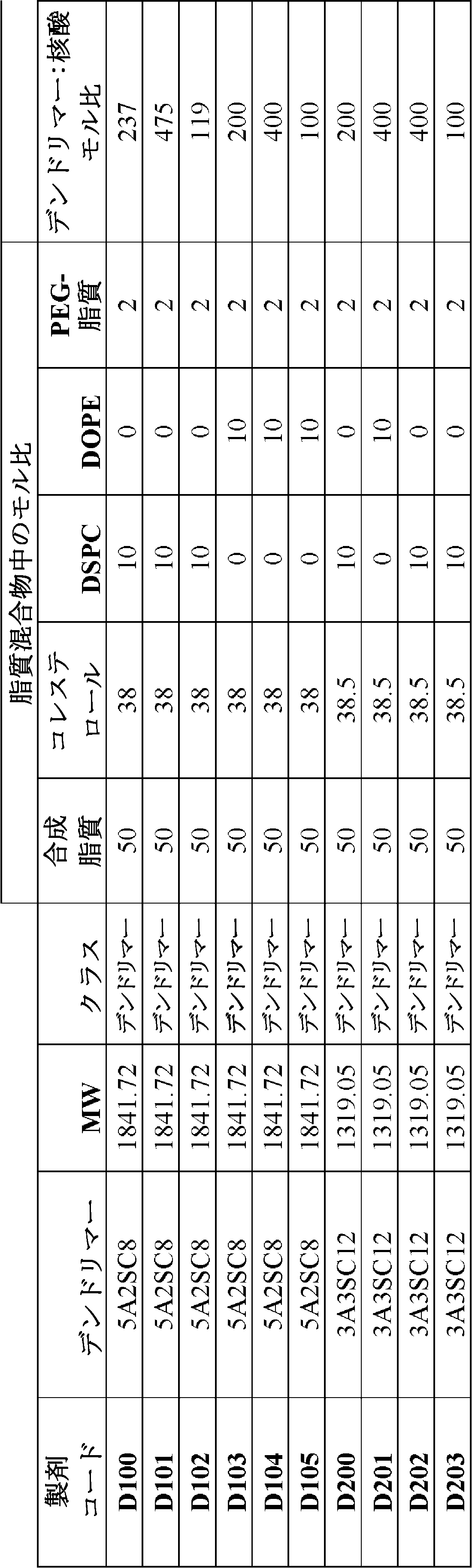


(表5)双性イオン性アミノ脂質(ZAL)を使用する製剤


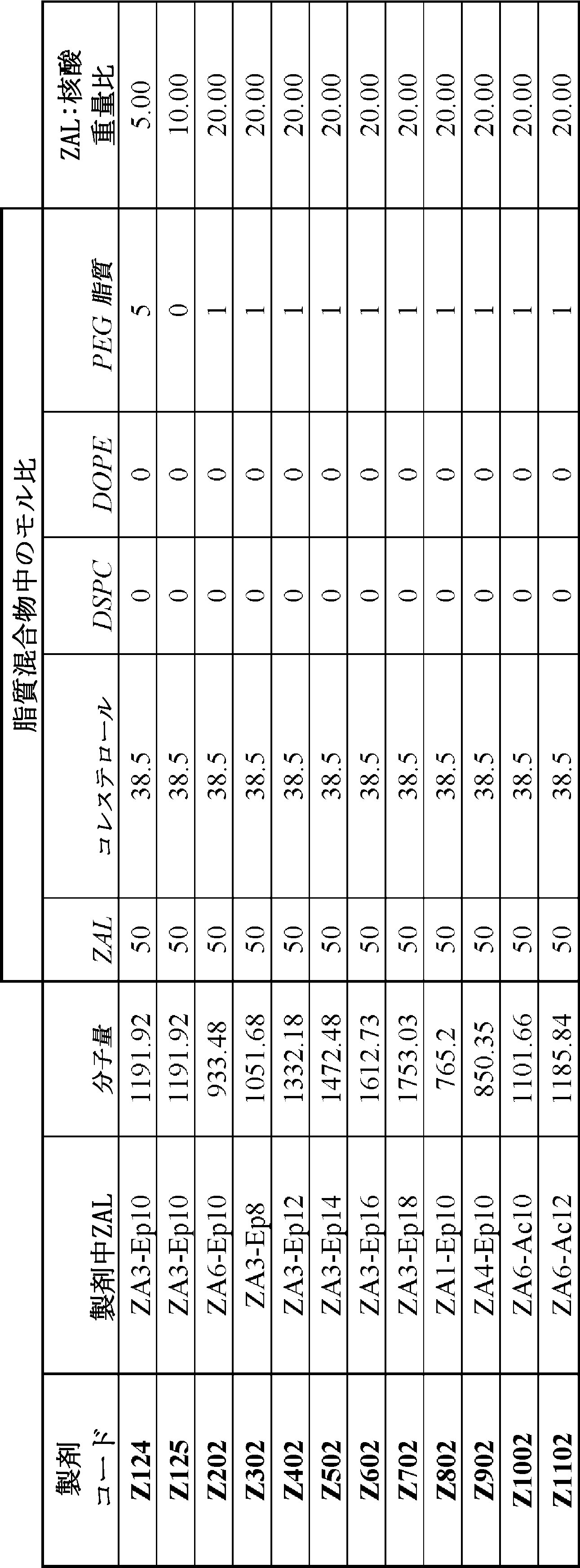
(表6)カチオン性スルホンアミドアミノ脂質(CSAL)を使用する製剤

C. プラスミドおよび部位特異的CFTR変異誘発
全長野生型CFTR(pBI-CFTR)の発現プラスミドをClontechから購入し、部位特異的変異誘発の標準的プロトコル(Sambrook et al., 1989)を使用して変異誘発した。部位特異的変異誘発は、PfuUltra高忠実度DNAポリメラーゼ(カリフォルニア州サンタクララ、Stratagene)を使用するPCR技術によって行った。すべての変異をDNA配列決定によって確認した。Sup-tRNAArgはCarla Oliveira氏(Institute of Molecular Pathology and Immunology of the University of Porto (IPATIMUP), Porto, Portugal)からの寄贈物であった。
C. Plasmids and Site-Directed CFTR Mutagenesis An expression plasmid for full-length wild-type CFTR (pBI-CFTR) was purchased from Clontech and mutagenized using standard protocols for site-directed mutagenesis (Sambrook et al., 1989). Site-directed mutagenesis was performed by PCR technology using PfuUltra high-fidelity DNA polymerase (Stratagene, Santa Clara, Calif.). All mutations were confirmed by DNA sequencing. Sup-tRNA Arg was a gift from Carla Oliveira (Institute of Molecular Pathology and Immunology of the University of Porto (IPATIMUP), Porto, Portugal).
D. 成熟CFTRの定量化方法
HEK293細胞を播種し(細胞9x10⁵個)、CFTRプラスミドをトランスフェクションした。CFTRプラスミド2μgおよびSup-tRNAArg 500ngを、6ウェル形式で、リポフェクタミン2000 4μlを使用して同時トランスフェクションした。トランスフェクションの24時間後にG418(200μg)またはPTC124(40μM)を培地に加え、48時間そのままにした。IB3-1細胞を播種し、24時間後にG418(0~400μG)またはPTC124(0~20μM)を加えた。48時間後、細胞を2xサンプルバッファー(Tris-HCl 250mM、pH 6.8、20%グリセロール、2.5% SDS、0.1%ブロモフェノールブルー)中で直接溶解させた。細胞溶解液タンパク質を、Tris-グリシン緩衝系を使用する7%/10%ステップ(wt/vol)ポリアクリルアミドゲル上での電気泳動により分離し、ポリフッ化ビニリデンImmobilon膜(EMD Millipore)に移した。ウエスタンブロット解析を一次CFTR抗体(596)(ノースカロライナ州チャペルヒル、ノースカロライナ大学医学部)、アクチン抗体(EMD Millipore)、および二次抗体IRdye-680RD(Li-Cor)を使用して行い、Li-Cor Odyssey CLx(Li-Cor)を使用して画像化/定量化した。データをPrism 6(Graphpad)を使用してプロットした。
D. Methods for quantification of mature CFTR
HEK293 cells were seeded (9×10 5 cells) and transfected with the CFTR plasmid. 2 μg of CFTR plasmid and 500 ng of Sup-tRNA Arg were co-transfected in 6-well format using 4 μl Lipofectamine 2000. G418 (200 μg) or PTC124 (40 μM) was added to the medium 24 hours after transfection and left for 48 hours. IB3-1 cells were seeded and 24 hours later G418 (0-400 μG) or PTC124 (0-20 μM) was added. After 48 hours, cells were lysed directly in 2x sample buffer (Tris-HCl 250 mM, pH 6.8, 20% glycerol, 2.5% SDS, 0.1% bromophenol blue). Cell lysate proteins were separated by electrophoresis on 7%/10% step (wt/vol) polyacrylamide gels using a Tris-glycine buffer system and transferred to polyvinylidene fluoride Immobilon membranes (EMD Millipore). Western blot analysis was performed using primary CFTR antibody (596) (University of North Carolina Medical School, Chapel Hill, NC), actin antibody (EMD Millipore), and secondary antibody IRdye-680RD (Li-Cor) and imaged/quantified using Li-Cor Odyssey CLx (Li-Cor). Data were plotted using Prism 6 (Graphpad).
E. HEK293細胞におけるCFTR依存性ホールセル電流
HEK293細胞に、CFTR成熟実験に使用したプラスミドをトランスフェクションした。CFTRプラスミド2μgおよびSup-tRNAArg 500ngを、6ウェル形式で、リポフェクタミン2000 4μlを使用して同時トランスフェクションした。トランスフェクションの24時間後、パッチクランプ技術のホールセル構成を使用してCl-電流を測定した。ピペット溶液は145mM NMDG+-Cl-、1mM MgCl2、2mM EGTA、5mM ATP、および10mM HEPES(pH 7.3、Tris入り)を含むものとした。浴溶液は145mM NMDG+-Cl-、1mM MgCl2、1mM CaCl2、10mM HEPES、および10mMグルコース(pH 7.4、Tris入り)とした。電流をAxopatch 200Bパッチクランプ増幅器によって記録し、2kHzでデジタル化した。膜コンダクタンスを、膜電位を保持電位0mVから膜電位-40mVおよび+40mVステップまで200ミリ秒間ステップ変化させることで調査した。10μMフォルスコリンならびに100μM IBMXおよび10μM CFTRInh-172(Inh-172)に応答するホールセル電流応答を測定した。ピペットはピペット溶液で満たされた際に抵抗値3~5MΩを示し、シール抵抗値は8GUを超えた。電流の記録および解析をpClamp 9.2ソフトウェアにより行い、Origin 8ソフトウェアにより解析した。
E. CFTR-dependent whole-cell current in HEK293 cells
HEK293 cells were transfected with the plasmids used for CFTR maturation experiments. 2 μg of CFTR plasmid and 500 ng of Sup-tRNA Arg were co-transfected in 6-well format using 4 μl Lipofectamine 2000. Twenty-four hours after transfection, Cl − currents were measured using the whole-cell configuration of the patch-clamp technique. Pipette solutions contained 145 mM NMDG+-Cl-, 1 mM MgCl2, 2 mM EGTA, 5 mM ATP, and 10 mM HEPES (pH 7.3 with Tris). The bath solution was 145 mM NMDG+-Cl-, 1 mM MgCl2, 1 mM CaCl2, 10 mM HEPES, and 10 mM glucose (pH 7.4 with Tris). Currents were recorded by an Axopatch 200B patch clamp amplifier and digitized at 2 kHz. Membrane conductance was investigated by stepping the membrane potential from a holding potential of 0 mV to membrane potentials of −40 mV and +40 mV steps for 200 ms. Whole-cell current responses in response to 10 μM forskolin and 100 μM IBMX and 10 μM CFTRInh-172 (Inh-172) were measured. Pipettes exhibited resistance values of 3-5 MΩ when filled with pipette solution, and seal resistance values exceeded 8 GU. Recording and analysis of currents were performed by pClamp 9.2 software and analyzed by Origin 8 software.
F. 取り込み試験
細胞取り込み試験をスクリーニングによる成績上位の材料を使用して行った。Calu6細胞を8チェンバーカバーグラススライド(Nunc)にウェル当たり細胞40,000個の密度で播種し、24時間付着させた。NP製剤を、上記インビトロトランスフェクションアッセイと同様のプロトコルを使用し、フルオレセイン標識tRNAを使用して、手動混合によって調製した。製剤化を10mMクエン酸緩衝液pH 4.3中にて担体:siRNAの最終モル比25:1で行った。製剤の担体混合物は担体:コレステロール:DSPC:PEG脂質のモル比50:38:10:2からなるものとした。ナノ粒子を細胞に最終tRNA量0.9μg/ウェルで加えた。6時間のインキュベーション後、培地を吸引し、PBSで洗浄し、細胞膜染色を製造者のプロトコルを使用して行った(Molecular Probes、Cell Mask Red)。細胞核をDAPI(Sigma-Aldrich)で染色した。共焦点顕微鏡画像化をNikon Eclipse TE2000-Eを使用して行い、画像をImageJ(NIH)を使用して解析した。
F. Uptake Studies Cellular uptake studies were performed using the top performing materials from the screening. Calu6 cells were seeded onto 8-chamber coverglass slides (Nunc) at a density of 40,000 cells per well and allowed to adhere for 24 hours. NP formulations were prepared by manual mixing using a protocol similar to the in vitro transfection assay described above, using fluorescein-labeled tRNA. Formulations were performed in 10 mM citrate buffer pH 4.3 with a final molar ratio of carrier:siRNA of 25:1. The carrier mixture of the formulation consisted of a carrier:cholesterol:DSPC:PEG lipid molar ratio of 50:38:10:2. Nanoparticles were added to the cells at a final tRNA amount of 0.9 μg/well. After 6 hours of incubation, the medium was aspirated, washed with PBS and cell membrane staining was performed using the manufacturer's protocol (Molecular Probes, Cell Mask Red). Cell nuclei were stained with DAPI (Sigma-Aldrich). Confocal microscopy imaging was performed using a Nikon Eclipse TE2000-E and images were analyzed using ImageJ (NIH).
G. Calu6細胞におけるナノ粒子担体スクリーニング
Calu6細胞を、6ウェル形式で、ウェル当たり細胞500,000個の密度で播種し、終夜付着させた。プラスミドDNAについては、1μgを、製造者推奨のプロトコルを用いてリポフェクタミン2000 3μlを使用してトランスフェクションした。tRNAArg/Op-RNAiMaxについては、4μgを、製造者推奨のプロトコルを用いてRNAiMax 3μlを使用してトランスフェクションした。粒子をOpti-MEM(Invitrogen)中で希釈した。G418(50μg)およびPTC124(10μl M)を培地に直接加えた。ナノ粒子を、すべての送達成分をエタノール中で混合した後、担体:siRNAの最終モル比が25:1になるように10mMクエン酸緩衝液pH 4.3中で速やかにtRNAと混合することで調製した。製剤の担体混合物は担体:コレステロール:DSPC:PEG脂質のモル比50:38:10:2からなるものとした。次にナノ粒子を滅菌PBS中で希釈してpHを上昇させ、細胞に加えた。48時間後、細胞を2xサンプルバッファー(Tris-HCl 250mM、pH 6.8、20%グリセロール、2.5% SDS、0.1%ブロモフェノールブルー)中で直接溶解させた。細胞溶解液タンパク質を、Tris-グリシン緩衝系を使用する10%(wt/vol)ポリアクリルアミドゲル上での電気泳動により分離し、ポリフッ化ビニリデンImmobilon膜(EMD Millipore)に移した。ウエスタンブロット解析を一次p53抗体(Santa Cruz Biotechnology, Inc)、アクチン抗体(EMD Millipore)、および二次抗体IRdye-680RD(Li-Cor)を使用して行い、Li-Cor Odyssey CLx(Li-Cor)を使用して画像化/定量化した。
Nanoparticle carrier screening in G. Calu6 cells
Calu6 cells were seeded at a density of 500,000 cells per well in 6-well format and allowed to adhere overnight. For plasmid DNA, 1 μg was transfected using 3 μl Lipofectamine 2000 using the manufacturer's recommended protocol. For tRNA Arg/Op -RNAiMax, 4 μg was transfected using 3 μl of RNAiMax using the manufacturer's recommended protocol. Particles were diluted in Opti-MEM (Invitrogen). G418 (50 μg) and PTC124 (10 μl M) were added directly to the medium. Nanoparticles were prepared by mixing all delivery components in ethanol followed by rapid mixing with tRNA in 10 mM citrate buffer pH 4.3 to give a final carrier:siRNA molar ratio of 25:1. The carrier mixture of the formulation consisted of a carrier:cholesterol:DSPC:PEG lipid molar ratio of 50:38:10:2. The nanoparticles were then diluted in sterile PBS to raise the pH and added to the cells. After 48 hours, cells were lysed directly in 2x sample buffer (Tris-HCl 250 mM, pH 6.8, 20% glycerol, 2.5% SDS, 0.1% bromophenol blue). Cell lysate proteins were separated by electrophoresis on 10% (wt/vol) polyacrylamide gels using a Tris-glycine buffer system and transferred to polyvinylidene fluoride Immobilon membranes (EMD Millipore). Western blot analysis was performed using primary p53 antibody (Santa Cruz Biotechnology, Inc), actin antibody (EMD Millipore), and secondary antibody IRdye-680RD (Li-Cor) and imaged/quantified using Li-Cor Odyssey CLx (Li-Cor).
H. NP粒径解析
粒径を、Malvern Zetasizer Nano ZS(He-Neレーザー、λ = 632nm)を使用する動的光散乱法(DLS)により測定した。
H. NP Particle Size Analysis Particle sizes were measured by dynamic light scattering (DLS) using a Malvern Zetasizer Nano ZS (He-Ne laser, λ=632 nm).
実施例2 - tRNA送達
図1に示すように、ナンセンス変異は、mRNA中で中途終止コドンを生じさせる変異において合成を終止させることで、非機能性タンパク質を生じさせる。図2A~図2Cに示すことができるように、タンパク質中のこれらの変異をリードスルー剤により補正する試みは、嚢胞性線維症膜コンダクタンス制御因子タンパク質中の活性を回復させなかった。図3Aおよび図3Bに示すように、任意のアミノ酸による変異の補正は機能性タンパク質を生じさせない。同様に、変異がフォールディングをもたらすとしても、得られるタンパク質は機能的に欠陥があることがある(図4Aおよび図4B)。したがって、遺伝子変異の補正に対するリードスルーアプローチは、タンパク質の活性を回復させるには十分ではないことがある。他方、図5A~図5Cに見ることができるように、修飾tRNAの導入はCFTRのフォールディングおよび機能の回復を生じさせる。同様に、ナノ粒子製剤への修飾tRNAの導入は、細胞中へのtRNAの送達(図6A)、ならびに成長ペプチド鎖への特定のアミノ酸の導入による機能性p53の産生(図6Bおよび図6C)を生じさせる。
Example 2 - tRNA Delivery As shown in Figure 1, nonsense mutations result in non-functional proteins by terminating synthesis at mutations that create premature stop codons in the mRNA. As can be seen in Figures 2A-2C, attempts to correct these mutations in the protein with readthrough agents did not restore activity in the cystic fibrosis transmembrane conductance regulator protein. As shown in Figures 3A and 3B, correction of the mutation by any amino acid does not result in a functional protein. Similarly, even if the mutation results in folding, the resulting protein may be functionally defective (Figures 4A and 4B). Therefore, read-through approaches to correction of genetic mutations may not be sufficient to restore protein activity. On the other hand, as can be seen in Figures 5A-5C, introduction of modified tRNA results in the folding and restoration of function of CFTR. Similarly, introduction of modified tRNA into nanoparticle formulations results in delivery of tRNA into cells (Figure 6A) and production of functional p53 by introduction of specific amino acids into the growing peptide chain (Figures 6B and 6C).
ナノ粒子に結合したtRNAの量を確定するために、種々の異なるアミノ脂質送達組成物を試験した。図7は、大部分の試験材料がtRNA結合分率0.8超で結合したことを示す。同様に、図8は、粒径および多分散指数を含む、これらのtRNA組成物の特性を示す。これらの組成物を、Calu6細胞においてp53発現を回復させる能力について、外来tRNAArg/Opを使用して試験した。これらの組成物のウエスタンブロット解析を図9に示す。p53発現の回復を示した1つの組成物を種々の異なる濃度で試験し、また、p53発現のわずかな回復しか示さなかった2つの他の剤を該組成物との比較で試験した(図10)。tRNA組成物が細胞に取り込まれたことを確認するために、標識tRNAを用いて蛍光顕微鏡観察を行った。図11に見ることができるように、tRNAは6時間のインキュベーション後にCalu6細胞に取り込まれた。さらに、図12は、双性イオン性およびカチオン性スルホンアミドアミノ脂質を使用するtRNAの取り込みを示す。最後に、図13のデータは、ナノ粒子の異なる調製方法を、ルシフェラーゼアッセイにおける応答と生存率との両方に関して示す。 A variety of different aminolipid delivery compositions were tested to determine the amount of tRNA bound to the nanoparticles. Figure 7 shows that most of the test materials bound with a tRNA binding fraction greater than 0.8. Similarly, Figure 8 shows properties of these tRNA compositions, including particle size and polydispersity index. These compositions were tested for their ability to restore p53 expression in Calu6 cells using exogenous tRNA Arg/Op . Western blot analysis of these compositions is shown in FIG. One composition that showed restoration of p53 expression was tested at various different concentrations, and two other agents that showed only modest restoration of p53 expression were tested in comparison to the composition (Figure 10). To confirm that the tRNA composition was taken up by cells, fluorescence microscopy was performed using labeled tRNA. As can be seen in Figure 11, tRNA was taken up by Calu6 cells after 6 hours of incubation. In addition, Figure 12 shows tRNA uptake using zwitterionic and cationic sulfonamido amino lipids. Finally, the data in Figure 13 demonstrate different preparation methods of nanoparticles in terms of both response and viability in the luciferase assay.
本明細書において開示および特許請求したすべての方法を、本開示に照らして、過度の実験なしに実施および実行することができる。本開示の組成物および方法を好ましい態様に関して説明してきたが、当業者には、本開示の概念、真意、および範囲を逸脱することなく変形を該方法にかつ本明細書に記載の方法の段階または段階の順序に適用することができることは明らかであろう。より具体的には、化学的にかつ生理学的に関連する特定の剤によって、同一のまたは同様の結果を実現しながら、本明細書に記載の剤を代用することができることは明らかであろう。当業者に明らかなすべてのそのような同様の代用物および修正は、添付の特許請求の範囲により定義される本開示の真意、範囲、および概念内にあると見なされる。 All of the methods disclosed and claimed herein can be made and executed without undue experimentation in light of the present disclosure. Although the compositions and methods of the present disclosure have been described in terms of preferred embodiments, it will be apparent to those skilled in the art that variations may be applied to the methods and to the method steps or order of steps described herein without departing from the concept, spirit, and scope of the present disclosure. More specifically, it will be apparent that certain agents that are chemically and physiologically related may be substituted for the agents described herein while achieving the same or similar results. All such similar substitutes and modifications apparent to those skilled in the art are deemed to be within the spirit, scope and concept of the disclosure as defined by the appended claims.
参考文献
以下の参考文献は、本明細書に開示される詳細を補足する例示的な手順上の詳細または他の詳細を示す限りにおいて、参照により本明細書に具体的に組み入れられる。
WO 2016/094342
WO 2017/048789
国際出願番号PCT/US2017/032950
WO 2016/094342
WO 2017/048789
International Application No. PCT/US2017/032950
Claims (11)
(b) ナノ粒子を形成するように構成されたアミノ脂質送達化合物と
を含む、組成物であって、該アミノ脂質送達化合物が、構造式(I)を有するデンドリマーもしくはデンドロン、またはその薬学的に許容される塩である、組成物:
コア-(繰り返し単位)n-末端基 (I)
式中、
コアは下記構造式(IV)を有し:

X3は-NR6-、-O-、置換されていてもよいアルキルアミノジイル(C≦8)、置換されていてもよいアルコキシジイル(C≦8)、または置換されていてもよいヘテロシクロアルカンジイル(C≦8)であり、ここで
R6は水素、または置換されていてもよいアルキル(C≦8)であり;
R3およびR4はそれぞれ独立してアミノ、置換されていてもよいアルキルアミノ(C≦12)、または置換されていてもよいジアルキルアミノ(C≦12)であり;
cおよびdはそれぞれ独立して1、2、3、4、5、または6であり;
繰り返し単位は分解性ジアシルおよび任意でリンカーを含み;
分解性ジアシル基は下記構造式を有し:

A1およびA2はそれぞれ独立して-O-または-NRa-であり、ここで、
Raは水素、または置換されていてもよいアルキル(C≦6)であり;
Y3は置換されていてもよいアルカンジイル(C≦12)、置換されていてもよいアルケンジイル(C≦12)、または置換されていてもよいアレーンジイル(C≦12)であり:
R9は置換されていてもよいアルキル(C≦8)であり;
リンカー基は下記構造式を有し:

Y1は置換されていてもよいアルカンジイル(C≦12)、または置換されていてもよいアルケンジイル(C≦12)、または置換されていてもよいアレーンジイル(C≦12)であり;
繰り返し単位がリンカー基を含む場合、リンカー基は、リンカー基の窒素原子および硫黄原子の両方で分解性ジアシル基に結合しており、繰り返し単位中の第1の基は分解性ジアシル基であり、各リンカー基について、隣接基は、リンカー基の窒素原子に結合した2個の分解性ジアシル基を含み; nは、繰り返し単位中に存在するリンカー基の数であり;ここで、nは1または2であり;
末端基は下記構造式を有し:

Y4は置換されていてもよいアルカンジイル(C≦18)、または置換されていてもよいアルケンジイル(C≦18)であり;
R10は水素、カルボキシ、ヒドロキシ、アリール(C≦12)、アルキルアミノ(C≦12)、ジアルキルアミノ(C≦12)、N-ヘテロシクロアルキル(C≦12)、-C(O)N(R11)-アルカンジイル(C≦6)-ヘテロシクロアルキル(C≦12)、-C(O)-アルキルアミノ(C≦12)、-C(O)-ジアルキルアミノ(C≦12)、および-C(O)-N-ヘテロシクロアルキル(C≦12)から選択され、ここで、
R11は水素、または置換されていてもよいアルキル(C≦6)であり;
ここで、ある基が置換されている場合、その基は、-OH、-F、-Cl、-Br、-I、-NH2、-NO2、-CO2H、-CO2CH3、-CN、-SH、-OCH3、-OCH2CH3、-C(O)CH3、-NHCH3、-NHCH2CH3、-N(CH3)2、-C(O)NH2、-C(O)NHCH3、-C(O)N(CH3)2、-OC(O)CH3、-NHC(O)CH3、-S(O)2OH、および-S(O)2NH2からそれぞれ独立して選択される1つまたは複数の置換基によって置換されている。 (a) transfer RNA (tRNA);
(b) an amino lipid delivery compound configured to form nanoparticles, wherein the amino lipid delivery compound is a dendrimer or dendron having structural formula (I), or a pharmaceutically acceptable salt thereof:
core - (repeat unit) n -end group (I)
During the ceremony,
The core has the following structural formula (IV):
X 3 is -NR 6 -, -O-, optionally substituted alkylaminodiyl (C≦8) , optionally substituted alkoxydiyl (C≦8) , or optionally substituted heterocycloalkanediyl (C≦8) , wherein
R 6 is hydrogen or optionally substituted alkyl (C≦8) ;
R 3 and R 4 are each independently amino, optionally substituted alkylamino (C≦12) , or optionally substituted dialkylamino (C≦12) ;
c and d are each independently 1, 2, 3, 4, 5, or 6;
the repeating unit comprises a degradable diacyl and optionally a linker;
A degradable diacyl group has the following structural formula:
A 1 and A 2 are each independently -O- or -NR a -, where
R a is hydrogen or optionally substituted alkyl (C≦6) ;
Y 3 is optionally substituted alkanediyl (C≤12) , optionally substituted alkenediyl (C≤12) , or optionally substituted arenediyl (C≤12) :
R 9 is optionally substituted alkyl (C≦8) ;
The linker group has the following structural formula:
Y 1 is optionally substituted alkanediyl (C≤12) , optionally substituted alkenediyl (C≤12) , or optionally substituted arenediyl (C≤12) ;
When a repeating unit comprises a linker group, the linker group is attached to the degradable diacyl group at both the nitrogen and sulfur atoms of the linker group, the first group in the repeating unit is a degradable diacyl group, and for each linker group, the adjacent group comprises two degradable diacyl groups attached to the nitrogen atom of the linker group; n is the number of linker groups present in the repeating unit; where n is 1 or 2;
The end group has the following structural formula:
Y 4 is optionally substituted alkanediyl (C≦18) or optionally substituted alkenediyl (C≦18) ;
R 10 is hydrogen, carboxy, hydroxy, aryl (C≤12) , alkylamino (C≤12) , dialkylamino (C≤12) , N-heterocycloalkyl (C≤12 ), -C(O)N( R11 )-alkanediyl (C≤6) -heterocycloalkyl(C≤12), -C(O)-alkylamino (C≤12 ) , -C(O)-dialkylamino (C≤12) , and -C(O)-N-heterocycloalkyl (C≤12) , wherein
R 11 is hydrogen or optionally substituted alkyl (C≦6) ;
wherein when a group is substituted, the group can be -OH, -F, -Cl, -Br, -I, -NH2 , -NO2 , -CO2H , -CO2CH3 , -CN, -SH , -OCH3 , -OCH2CH3 , -C(O)CH3, -NHCH3, -NHCH2CH3 , -N( CH3 ) 2 , -C( substituted with one or more substituents each independently selected from O)NH2, -C(O)NHCH3, -C(O)N(CH3 ) 2 , -OC(O ) CH3 , -NHC ( O ) CH3 , -S(O ) 2OH, and -S(O) 2NH2 .
Y4が置換されていてもよいアルカンジイルであり;
R10が水素である、
請求項1記載の組成物。 At the terminal group of Formula (VIII) of the dendrimer or dendron having Structural Formula (I) or a pharmaceutically acceptable salt thereof:
Y 4 is optionally substituted alkanediyl;
R 10 is hydrogen,
10. The composition of claim 1.
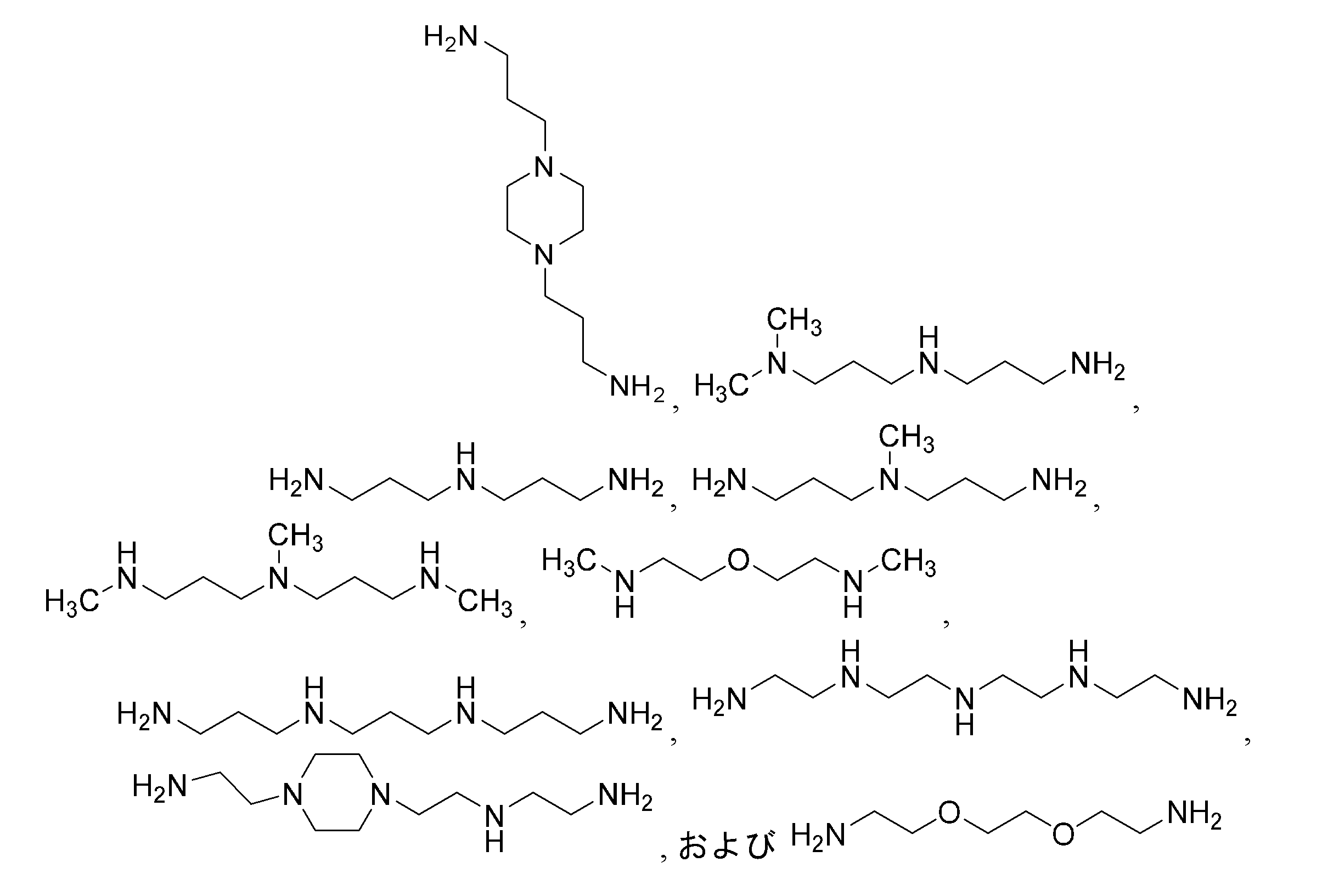
(B) 賦形剤と
を含む、薬学的組成物。 (A) a composition according to any one of claims 1-9 ;
(B) a pharmaceutical composition, comprising an excipient;
Priority Applications (2)
| Application Number | Priority Date | Filing Date | Title |
|---|---|---|---|
| JP2023112723A JP7789725B2 (en) | 2016-05-16 | 2023-07-10 | Compositions for tRNA delivery as nanoparticles and methods of use thereof |
| JP2025244172A JP2026034537A (en) | 2016-05-16 | 2025-12-10 | Compositions for tRNA delivery as nanoparticles and methods of use thereof |
Applications Claiming Priority (3)
| Application Number | Priority Date | Filing Date | Title |
|---|---|---|---|
| US201662337096P | 2016-05-16 | 2016-05-16 | |
| US62/337,096 | 2016-05-16 | ||
| PCT/US2017/032967 WO2017201091A1 (en) | 2016-05-16 | 2017-05-16 | COMPOSITIONS FOR THE DELIVERY OF tRNA AS NANOPARTICLES AND METHODS OF USE THEREWITH |
Related Child Applications (1)
| Application Number | Title | Priority Date | Filing Date |
|---|---|---|---|
| JP2023112723A Division JP7789725B2 (en) | 2016-05-16 | 2023-07-10 | Compositions for tRNA delivery as nanoparticles and methods of use thereof |
Publications (3)
| Publication Number | Publication Date |
|---|---|
| JP2019515016A JP2019515016A (en) | 2019-06-06 |
| JP2019515016A5 JP2019515016A5 (en) | 2020-06-25 |
| JP7312552B2 true JP7312552B2 (en) | 2023-07-21 |
Family
ID=60326616
Family Applications (3)
| Application Number | Title | Priority Date | Filing Date |
|---|---|---|---|
| JP2018560153A Active JP7312552B2 (en) | 2016-05-16 | 2017-05-16 | Compositions for tRNA delivery as nanoparticles and methods of use thereof |
| JP2023112723A Active JP7789725B2 (en) | 2016-05-16 | 2023-07-10 | Compositions for tRNA delivery as nanoparticles and methods of use thereof |
| JP2025244172A Pending JP2026034537A (en) | 2016-05-16 | 2025-12-10 | Compositions for tRNA delivery as nanoparticles and methods of use thereof |
Family Applications After (2)
| Application Number | Title | Priority Date | Filing Date |
|---|---|---|---|
| JP2023112723A Active JP7789725B2 (en) | 2016-05-16 | 2023-07-10 | Compositions for tRNA delivery as nanoparticles and methods of use thereof |
| JP2025244172A Pending JP2026034537A (en) | 2016-05-16 | 2025-12-10 | Compositions for tRNA delivery as nanoparticles and methods of use thereof |
Country Status (11)
| Country | Link |
|---|---|
| US (2) | US20170354672A1 (en) |
| EP (2) | EP3458074B1 (en) |
| JP (3) | JP7312552B2 (en) |
| CN (2) | CN115919769B (en) |
| AU (3) | AU2017268272C1 (en) |
| CA (1) | CA3024135C (en) |
| DK (1) | DK3458074T3 (en) |
| ES (1) | ES2985317T3 (en) |
| PL (1) | PL3458074T3 (en) |
| PT (1) | PT3458074T (en) |
| WO (1) | WO2017201091A1 (en) |
Families Citing this family (26)
| Publication number | Priority date | Publication date | Assignee | Title |
|---|---|---|---|---|
| CN108271360B (en) | 2015-09-14 | 2023-01-24 | 得克萨斯州大学系统董事会 | Lipophilic cationic dendrimers and uses thereof |
| CN118416088A (en) | 2017-03-03 | 2024-08-02 | 加利福尼亚大学董事会 | RNA targeting of mutations via inhibitory tRNAs and deaminases |
| WO2019090169A1 (en) | 2017-11-02 | 2019-05-09 | The Wistar Institute Of Anatomy And Biology | Methods of rescuing stop codons via genetic reassignment with ace-trna |
| US12357580B2 (en) | 2018-06-19 | 2025-07-15 | The Board Of Regents Of The University Of Texas System | Lipid nanoparticle compositions for delivery of mRNA and long nucleic acids |
| GB2592504B (en) | 2018-09-04 | 2023-02-15 | Univ Texas | Compositions and methods for organ specific delivery of nucleic acids |
| EP3846822A4 (en) | 2018-09-04 | 2022-07-06 | The Board Of Regents Of The University Of Texas System | COMPOSITIONS AND METHODS FOR ORGAN SPECIFIC DELIVERY OF NUCLEIC ACIDS |
| CN109266734A (en) * | 2018-09-25 | 2019-01-25 | 深圳市人民医院 | Autoimmune disease diagnostic kit and application |
| US10905778B2 (en) * | 2018-09-26 | 2021-02-02 | Case Western Reserve University | Methods and compositions for treating a premature stop codon-mediated disorder |
| KR102814622B1 (en) * | 2018-09-26 | 2025-05-29 | 케이스 웨스턴 리저브 유니버시티 | Methods and compositions for increasing protein expression and/or treating hepatotoxicity disorders |
| JP2022501055A (en) * | 2018-09-26 | 2022-01-06 | ケース ウエスタン リザーブ ユニバーシティ | Methods and Compositions for Treating Immature Stop Codon-mediated Disorders |
| US20220228147A1 (en) * | 2019-05-31 | 2022-07-21 | Flagship Pioneering, Inc. | Uses of trem compositions to modulate trna pools |
| AU2020395113A1 (en) | 2019-12-02 | 2022-06-09 | Shape Therapeutics Inc. | Therapeutic editing |
| CA3181680A1 (en) * | 2020-06-12 | 2021-12-16 | University Of Rochester | Encoding and expression of ace-trnas |
| WO2022204219A1 (en) | 2021-03-22 | 2022-09-29 | Recode Therapeutics, Inc. | Compositions and methods for targeted delivery to cells |
| KR20230175196A (en) | 2021-03-23 | 2023-12-29 | 리코드 테라퓨틱스, 인크. | Polynucleotide compositions, related agents, and methods of use thereof |
| EP4352240A4 (en) * | 2021-06-09 | 2025-07-09 | Recode Therapeutics Inc | Polynucleotide compositions, associated formulations and methods of using the same |
| CN113416784A (en) * | 2021-07-18 | 2021-09-21 | 南京中医药大学 | Serum exosome tsRNA marker related to breast cancer diagnosis and application thereof |
| US20250295687A1 (en) * | 2022-05-09 | 2025-09-25 | Flagship Pioneering Innovations Vi, Llc | Trem compositions and methods of use for treating proliferative disorders |
| WO2023218420A1 (en) | 2022-05-13 | 2023-11-16 | Janssen Pharmaceuticals, Inc. | Mrna compositions for inducing latent hiv-1 reversal |
| CN115851911B (en) * | 2022-11-25 | 2025-10-24 | 南京鼓楼医院 | A urine exosome tsRNA marker and probe for identifying lupus nephritis and its application |
| EP4630057A1 (en) | 2022-12-08 | 2025-10-15 | Recode Therapeutics, Inc. | Lipid nanoparticle compositions and uses thereof |
| CN116515827B (en) * | 2023-03-20 | 2024-12-10 | 复旦大学附属眼耳鼻喉科医院 | Active ingredients, pharmaceutical compositions and uses for treating age-related macular degeneration |
| US12364773B2 (en) | 2023-12-01 | 2025-07-22 | Recode Therapeutics, Inc. | Lipid nanoparticle compositions and uses thereof |
| WO2025137646A1 (en) | 2023-12-22 | 2025-06-26 | Recode Therapeutics, Inc. | Gene editing methods and compositions for treating cystic fibrosis |
| CN117965718B (en) * | 2024-02-02 | 2024-09-06 | 江苏省中医院 | Biomarker related to sepsis and application thereof |
| CN118178452A (en) * | 2024-02-23 | 2024-06-14 | 山东大学 | Application of small molecular RNA tRF-1:29-Gly-CCC-1-M4 in preparation of mesenchymal stem cell aging resistant drugs |
Citations (6)
| Publication number | Priority date | Publication date | Assignee | Title |
|---|---|---|---|---|
| US20080242626A1 (en) | 2006-07-21 | 2008-10-02 | Massachusetts Institute Of Technology | End-Modified Poly(beta-amino esters) and Uses Thereof |
| CN101591428A (en) | 2009-06-29 | 2009-12-02 | 浙江大学 | A kind of preparation method of polyester dendrimer |
| WO2014026283A1 (en) | 2012-08-14 | 2014-02-20 | Angiochem Inc. | Peptide-dendrimer conjugates and uses thereof |
| CN103999853A (en) | 2014-06-11 | 2014-08-27 | 中国农业大学 | Application of fluorescence arborization nanometer macromolecule in preparing drug carrier |
| JP2014529328A (en) | 2011-06-08 | 2014-11-06 | 日東電工株式会社 | Compounds that target drug delivery and enhance siRNA activity |
| WO2016005318A1 (en) | 2014-07-08 | 2016-01-14 | Incella Gmbh | Synthesis and use of amino lipids |
Family Cites Families (31)
| Publication number | Priority date | Publication date | Assignee | Title |
|---|---|---|---|---|
| US5824311A (en) | 1987-11-30 | 1998-10-20 | Trustees Of The University Of Pennsylvania | Treatment of tumors with monoclonal antibodies against oncogene antigens |
| US5801029A (en) | 1993-02-16 | 1998-09-01 | Onyx Pharmaceuticals, Inc. | Cytopathic viruses for therapy and prophylaxis of neoplasia |
| US5801005A (en) | 1993-03-17 | 1998-09-01 | University Of Washington | Immune reactivity to HER-2/neu protein for diagnosis of malignancies in which the HER-2/neu oncogene is associated |
| GB9506466D0 (en) | 1994-08-26 | 1995-05-17 | Prolifix Ltd | Cell cycle regulated repressor and dna element |
| US5820873A (en) | 1994-09-30 | 1998-10-13 | The University Of British Columbia | Polyethylene glycol modified ceramide lipids and liposome uses thereof |
| US5739169A (en) | 1996-05-31 | 1998-04-14 | Procept, Incorporated | Aromatic compounds for inhibiting immune response |
| ES2346645T3 (en) * | 2002-03-14 | 2010-10-19 | Commonwealth Scientific And Industrial Research Organisation | PROCEDURES AND MEANS OF SUPERVISION AND MODULATION OF GENICAL SILENCING. |
| US7404969B2 (en) * | 2005-02-14 | 2008-07-29 | Sirna Therapeutics, Inc. | Lipid nanoparticle based compositions and methods for the delivery of biologically active molecules |
| EP2295570A1 (en) * | 2005-07-27 | 2011-03-16 | Oncotherapy Science, Inc. | Method of diagnosing small cell lung cancer |
| BRPI0709603A2 (en) * | 2006-03-16 | 2011-07-19 | Scripps Research Inst | expression of genetically programmed proteins containing the unnatural amino acid phenylselenocysteine |
| WO2008045486A2 (en) * | 2006-10-09 | 2008-04-17 | The University Of North Carolina At Chapel Hill | Nanoparticle compositions for controlled delivery of nucleic acids |
| CN101595215A (en) * | 2006-10-30 | 2009-12-02 | 普罗梅加公司 | Mutant hydrolase proteins with enhanced kinetics and functional expression |
| WO2009061413A2 (en) * | 2007-11-05 | 2009-05-14 | Promega Corporation | Hybrid fusion reporter and uses thereof |
| BRPI0820707A2 (en) * | 2007-11-07 | 2015-06-16 | Genentech Inc | Methods and composition for assessing B cell lymphoma responsiveness for anti-cd40 antibody treatment |
| JP5777519B2 (en) * | 2008-10-09 | 2015-09-09 | テクミラ ファーマシューティカルズ コーポレイション | Improved aminolipid and nucleic acid delivery methods |
| MX2011004859A (en) | 2008-11-07 | 2011-08-03 | Massachusetts Inst Technology | Aminoalcohol lipidoids and uses thereof. |
| KR100909786B1 (en) * | 2008-11-10 | 2009-07-29 | 고려대학교 산학협력단 | Novel cationic lipids modified with oligopeptides, preparation methods thereof, and carriers comprising the same |
| AU2010257181A1 (en) | 2009-06-02 | 2012-01-12 | Brian Charles Keller | Pure PEG-lipid conjugates |
| KR101954912B1 (en) * | 2009-07-09 | 2019-03-08 | 노보솜 베르발퉁스 게엠베하 | Amphoteric liposomes comprising imino lipids |
| CN107028886A (en) * | 2009-11-04 | 2017-08-11 | 不列颠哥伦比亚大学 | Lipid particle and related methods containing nucleic acid |
| KR101183989B1 (en) * | 2010-02-04 | 2012-09-19 | 전남대학교산학협력단 | Composite for delivering a gene into a cell, preparation method thereof, and method of delivering a gene into a cell using same |
| WO2012011110A2 (en) * | 2010-07-22 | 2012-01-26 | Ramot At Tel Aviv University Ltd. | Systems and methods for detection of cellular stress |
| AU2012239888B9 (en) * | 2011-04-06 | 2017-10-12 | Alzeca Biosciences, LLC | Lipid-based nanoparticles |
| EP2532649B1 (en) * | 2011-06-07 | 2015-04-08 | Incella GmbH | Amino lipids, their synthesis and uses thereof |
| CN104302659A (en) * | 2012-02-29 | 2015-01-21 | Ambrx公司 | Modified adiponectin polypeptides and their uses |
| KR20140048404A (en) | 2012-10-11 | 2014-04-24 | 포항공과대학교 산학협력단 | Low density lipoprotein like nanoparticle and composition for liver targeting diagnosis or treatment |
| WO2015011633A1 (en) * | 2013-07-23 | 2015-01-29 | Protiva Biotherapeutics, Inc. | Compositions and methods for delivering messenger rna |
| CN104383596A (en) * | 2014-10-24 | 2015-03-04 | 东华大学 | Preparation method for TPGS medicine carrying lipidosome-natural material composite nano-fiber bracket |
| EP3229842B1 (en) | 2014-12-08 | 2022-07-06 | The Board of Regents of The University of Texas System | Lipocationic polymers and uses thereof |
| CN108271360B (en) | 2015-09-14 | 2023-01-24 | 得克萨斯州大学系统董事会 | Lipophilic cationic dendrimers and uses thereof |
| AU2017267634C1 (en) * | 2016-05-16 | 2022-05-26 | The Board Of Regents Of The University Of Texas System | Cationic sulfonamide amino lipids and amphiphilic zwitterionic amino lipids |
-
2017
- 2017-05-16 US US15/597,063 patent/US20170354672A1/en not_active Abandoned
- 2017-05-16 PT PT178000428T patent/PT3458074T/en unknown
- 2017-05-16 DK DK17800042.8T patent/DK3458074T3/en active
- 2017-05-16 EP EP17800042.8A patent/EP3458074B1/en active Active
- 2017-05-16 CA CA3024135A patent/CA3024135C/en active Active
- 2017-05-16 JP JP2018560153A patent/JP7312552B2/en active Active
- 2017-05-16 ES ES17800042T patent/ES2985317T3/en active Active
- 2017-05-16 WO PCT/US2017/032967 patent/WO2017201091A1/en not_active Ceased
- 2017-05-16 CN CN202210856722.1A patent/CN115919769B/en active Active
- 2017-05-16 CN CN201780038893.0A patent/CN109414451B/en active Active
- 2017-05-16 EP EP24161024.5A patent/EP4393549A3/en active Pending
- 2017-05-16 AU AU2017268272A patent/AU2017268272C1/en active Active
- 2017-05-16 PL PL17800042.8T patent/PL3458074T3/en unknown
-
2020
- 2020-10-06 US US17/064,505 patent/US20210023120A1/en not_active Abandoned
-
2021
- 2021-09-03 AU AU2021225244A patent/AU2021225244B2/en active Active
-
2023
- 2023-07-10 JP JP2023112723A patent/JP7789725B2/en active Active
- 2023-09-05 AU AU2023226641A patent/AU2023226641B2/en active Active
-
2025
- 2025-12-10 JP JP2025244172A patent/JP2026034537A/en active Pending
Patent Citations (6)
| Publication number | Priority date | Publication date | Assignee | Title |
|---|---|---|---|---|
| US20080242626A1 (en) | 2006-07-21 | 2008-10-02 | Massachusetts Institute Of Technology | End-Modified Poly(beta-amino esters) and Uses Thereof |
| CN101591428A (en) | 2009-06-29 | 2009-12-02 | 浙江大学 | A kind of preparation method of polyester dendrimer |
| JP2014529328A (en) | 2011-06-08 | 2014-11-06 | 日東電工株式会社 | Compounds that target drug delivery and enhance siRNA activity |
| WO2014026283A1 (en) | 2012-08-14 | 2014-02-20 | Angiochem Inc. | Peptide-dendrimer conjugates and uses thereof |
| CN103999853A (en) | 2014-06-11 | 2014-08-27 | 中国农业大学 | Application of fluorescence arborization nanometer macromolecule in preparing drug carrier |
| WO2016005318A1 (en) | 2014-07-08 | 2016-01-14 | Incella Gmbh | Synthesis and use of amino lipids |
Non-Patent Citations (5)
| Title |
|---|
| Angewandte Chemie International Edition,2014年,53(52),14397-14401 |
| Chemical Communications (Cambridge, United Kingdom),2013年,49(35),3646-3648 |
| JNMR,2015年,2(3),82-86 |
| Journal of the American Chemical Society,2015年,137(29),9206-9209 |
| Proceedings of the National Academy of Sciences of the United States of America,2016年,113(3),520-525 |
Also Published As
| Publication number | Publication date |
|---|---|
| AU2021225244B2 (en) | 2023-09-28 |
| US20170354672A1 (en) | 2017-12-14 |
| EP4393549A2 (en) | 2024-07-03 |
| ES2985317T3 (en) | 2024-11-05 |
| DK3458074T3 (en) | 2024-07-29 |
| AU2023226641B2 (en) | 2025-06-26 |
| JP2026034537A (en) | 2026-02-27 |
| US20210023120A1 (en) | 2021-01-28 |
| AU2021225244A1 (en) | 2021-09-30 |
| JP2023123863A (en) | 2023-09-05 |
| PL3458074T3 (en) | 2024-11-12 |
| EP3458074A4 (en) | 2020-01-22 |
| AU2017268272C1 (en) | 2022-05-05 |
| AU2017268272A1 (en) | 2018-11-29 |
| WO2017201091A1 (en) | 2017-11-23 |
| PT3458074T (en) | 2024-08-21 |
| AU2017268272B2 (en) | 2021-09-23 |
| CN109414451A (en) | 2019-03-01 |
| AU2023226641A1 (en) | 2023-09-21 |
| BR112018073671A2 (en) | 2019-02-26 |
| EP4393549A3 (en) | 2024-10-09 |
| CA3024135C (en) | 2024-09-24 |
| EP3458074A1 (en) | 2019-03-27 |
| EP3458074B1 (en) | 2024-04-17 |
| JP2019515016A (en) | 2019-06-06 |
| JP7789725B2 (en) | 2025-12-22 |
| CA3024135A1 (en) | 2017-11-23 |
| CN115919769A (en) | 2023-04-07 |
| CN115919769B (en) | 2026-04-28 |
| CN109414451B (en) | 2022-08-12 |
Similar Documents
| Publication | Publication Date | Title |
|---|---|---|
| JP7789725B2 (en) | Compositions for tRNA delivery as nanoparticles and methods of use thereof | |
| JP6474404B2 (en) | Unsialamycin derivatives, synthetic methods and their use as antitumor agents | |
| JP2022501360A (en) | Compounds and compositions for intracellular delivery of therapeutic agents | |
| EA032088B1 (en) | AMINO ACID DERIVATIVES, FUNCTIONALIZED AT N-END, CAPABLE OF EDUCATING MICROSPHERES, INCAPSULATING MEDICINE | |
| JP2022552416A (en) | Brush prodrugs and their uses | |
| JP2024520834A (en) | Polynucleotide compositions, related formulations and methods of use thereof | |
| CN117658848A (en) | Lipid compounds for delivering therapeutic agents and their uses | |
| US20250064752A1 (en) | COMPOSITIONS FOR THE DELIVERY OF tRNA AS NANOPARTICLES AND METHODS OF USE THEREWITH | |
| HK40091158A (en) | COMPOSITIONS FOR THE DELIVERY OF tRNA AS NANOPARTICLES AND METHODS OF USE THEREWITH | |
| BR112018073671B1 (en) | COMPOSITION COMPRISING AN AMINOLIPID DELIVERY COMPOUND, PHARMACEUTICAL COMPOSITION COMPRISING SAID COMPOSITION AND USE THEREOF FOR THE TREATMENT OF A GENETIC DISEASE | |
| BR122024025919A2 (en) | COMPOSITION COMPRISING AN AMINOLIPID DELIVERY COMPOUND, PHARMACEUTICAL COMPOSITION COMPRISING THE SAME AND USE OF THE COMPOSITION FOR TREATMENT OF A GENETIC DISEASE | |
| BR122024025919B1 (en) | COMPOSITION COMPRISING AN AMINOLIPID DELIVERY COMPOUND, PHARMACEUTICAL COMPOSITION COMPRISING THE SAME AND USE OF THE COMPOSITION FOR THE TREATMENT OF A GENETIC DISEASE | |
| HK40005315B (en) | Compositions for the delivery of trna as nanoparticles and methods of use therewith | |
| HK40005315A (en) | Compositions for the delivery of trna as nanoparticles and methods of use therewith | |
| US10358439B2 (en) | DNA binding agents with a minor groove binding tail | |
| HK40082129B (en) | Nanomaterial | |
| HK40109743A (en) | Polynucleotide compositions, related formulations, and methods of use thereof | |
| WO2023091993A1 (en) | Water-soluble salts of dna binding agents | |
| HK40128848A (en) | Compounds for the treatment of cancer | |
| CN116264824A (en) | Dexaporphyrin Derivatives for Manganese Chemotherapy, Photoacoustic Imaging, and Photothermal Therapy |
Legal Events
| Date | Code | Title | Description |
|---|---|---|---|
| A521 | Request for written amendment filed |
Free format text: JAPANESE INTERMEDIATE CODE: A523 Effective date: 20181205 |
|
| A521 | Request for written amendment filed |
Free format text: JAPANESE INTERMEDIATE CODE: A523 Effective date: 20200514 |
|
| A621 | Written request for application examination |
Free format text: JAPANESE INTERMEDIATE CODE: A621 Effective date: 20200514 |
|
| RD04 | Notification of resignation of power of attorney |
Free format text: JAPANESE INTERMEDIATE CODE: A7424 Effective date: 20210126 |
|
| A131 | Notification of reasons for refusal |
Free format text: JAPANESE INTERMEDIATE CODE: A131 Effective date: 20210705 |
|
| A601 | Written request for extension of time |
Free format text: JAPANESE INTERMEDIATE CODE: A601 Effective date: 20211001 |
|
| A521 | Request for written amendment filed |
Free format text: JAPANESE INTERMEDIATE CODE: A523 Effective date: 20220104 |
|
| A131 | Notification of reasons for refusal |
Free format text: JAPANESE INTERMEDIATE CODE: A131 Effective date: 20220601 |
|
| A601 | Written request for extension of time |
Free format text: JAPANESE INTERMEDIATE CODE: A601 Effective date: 20220829 |
|
| A521 | Request for written amendment filed |
Free format text: JAPANESE INTERMEDIATE CODE: A523 Effective date: 20221201 |
|
| A131 | Notification of reasons for refusal |
Free format text: JAPANESE INTERMEDIATE CODE: A131 Effective date: 20230313 |
|
| A521 | Request for written amendment filed |
Free format text: JAPANESE INTERMEDIATE CODE: A523 Effective date: 20230601 |
|
| TRDD | Decision of grant or rejection written | ||
| A01 | Written decision to grant a patent or to grant a registration (utility model) |
Free format text: JAPANESE INTERMEDIATE CODE: A01 Effective date: 20230608 |
|
| A61 | First payment of annual fees (during grant procedure) |
Free format text: JAPANESE INTERMEDIATE CODE: A61 Effective date: 20230710 |
|
| R150 | Certificate of patent or registration of utility model |
Ref document number: 7312552 Country of ref document: JP Free format text: JAPANESE INTERMEDIATE CODE: R150 |