JP7261237B2 - laminated glazing - Google Patents
laminated glazing Download PDFInfo
- Publication number
- JP7261237B2 JP7261237B2 JP2020537498A JP2020537498A JP7261237B2 JP 7261237 B2 JP7261237 B2 JP 7261237B2 JP 2020537498 A JP2020537498 A JP 2020537498A JP 2020537498 A JP2020537498 A JP 2020537498A JP 7261237 B2 JP7261237 B2 JP 7261237B2
- Authority
- JP
- Japan
- Prior art keywords
- glass
- sheet
- laminated glazing
- glazing according
- laminated
- Prior art date
- Legal status (The legal status is an assumption and is not a legal conclusion. Google has not performed a legal analysis and makes no representation as to the accuracy of the status listed.)
- Active
Links
Classifications
-
- B—PERFORMING OPERATIONS; TRANSPORTING
- B32—LAYERED PRODUCTS
- B32B—LAYERED PRODUCTS, i.e. PRODUCTS BUILT-UP OF STRATA OF FLAT OR NON-FLAT, e.g. CELLULAR OR HONEYCOMB, FORM
- B32B17/00—Layered products essentially comprising sheet glass, or glass, slag, or like fibres
- B32B17/06—Layered products essentially comprising sheet glass, or glass, slag, or like fibres comprising glass as the main or only constituent of a layer, next to another layer of a specific material
- B32B17/10—Layered products essentially comprising sheet glass, or glass, slag, or like fibres comprising glass as the main or only constituent of a layer, next to another layer of a specific material of synthetic resin
- B32B17/10005—Layered products essentially comprising sheet glass, or glass, slag, or like fibres comprising glass as the main or only constituent of a layer, next to another layer of a specific material of synthetic resin laminated safety glass or glazing
- B32B17/10009—Layered products essentially comprising sheet glass, or glass, slag, or like fibres comprising glass as the main or only constituent of a layer, next to another layer of a specific material of synthetic resin laminated safety glass or glazing characterized by the number, the constitution or treatment of glass sheets
- B32B17/10036—Layered products essentially comprising sheet glass, or glass, slag, or like fibres comprising glass as the main or only constituent of a layer, next to another layer of a specific material of synthetic resin laminated safety glass or glazing characterized by the number, the constitution or treatment of glass sheets comprising two outer glass sheets
- B32B17/10045—Layered products essentially comprising sheet glass, or glass, slag, or like fibres comprising glass as the main or only constituent of a layer, next to another layer of a specific material of synthetic resin laminated safety glass or glazing characterized by the number, the constitution or treatment of glass sheets comprising two outer glass sheets with at least one intermediate layer consisting of a glass sheet
-
- B—PERFORMING OPERATIONS; TRANSPORTING
- B32—LAYERED PRODUCTS
- B32B—LAYERED PRODUCTS, i.e. PRODUCTS BUILT-UP OF STRATA OF FLAT OR NON-FLAT, e.g. CELLULAR OR HONEYCOMB, FORM
- B32B17/00—Layered products essentially comprising sheet glass, or glass, slag, or like fibres
-
- B—PERFORMING OPERATIONS; TRANSPORTING
- B32—LAYERED PRODUCTS
- B32B—LAYERED PRODUCTS, i.e. PRODUCTS BUILT-UP OF STRATA OF FLAT OR NON-FLAT, e.g. CELLULAR OR HONEYCOMB, FORM
- B32B17/00—Layered products essentially comprising sheet glass, or glass, slag, or like fibres
- B32B17/06—Layered products essentially comprising sheet glass, or glass, slag, or like fibres comprising glass as the main or only constituent of a layer, next to another layer of a specific material
- B32B17/10—Layered products essentially comprising sheet glass, or glass, slag, or like fibres comprising glass as the main or only constituent of a layer, next to another layer of a specific material of synthetic resin
- B32B17/10005—Layered products essentially comprising sheet glass, or glass, slag, or like fibres comprising glass as the main or only constituent of a layer, next to another layer of a specific material of synthetic resin laminated safety glass or glazing
- B32B17/10009—Layered products essentially comprising sheet glass, or glass, slag, or like fibres comprising glass as the main or only constituent of a layer, next to another layer of a specific material of synthetic resin laminated safety glass or glazing characterized by the number, the constitution or treatment of glass sheets
- B32B17/10036—Layered products essentially comprising sheet glass, or glass, slag, or like fibres comprising glass as the main or only constituent of a layer, next to another layer of a specific material of synthetic resin laminated safety glass or glazing characterized by the number, the constitution or treatment of glass sheets comprising two outer glass sheets
-
- B—PERFORMING OPERATIONS; TRANSPORTING
- B32—LAYERED PRODUCTS
- B32B—LAYERED PRODUCTS, i.e. PRODUCTS BUILT-UP OF STRATA OF FLAT OR NON-FLAT, e.g. CELLULAR OR HONEYCOMB, FORM
- B32B17/00—Layered products essentially comprising sheet glass, or glass, slag, or like fibres
- B32B17/06—Layered products essentially comprising sheet glass, or glass, slag, or like fibres comprising glass as the main or only constituent of a layer, next to another layer of a specific material
- B32B17/10—Layered products essentially comprising sheet glass, or glass, slag, or like fibres comprising glass as the main or only constituent of a layer, next to another layer of a specific material of synthetic resin
- B32B17/10005—Layered products essentially comprising sheet glass, or glass, slag, or like fibres comprising glass as the main or only constituent of a layer, next to another layer of a specific material of synthetic resin laminated safety glass or glazing
- B32B17/10009—Layered products essentially comprising sheet glass, or glass, slag, or like fibres comprising glass as the main or only constituent of a layer, next to another layer of a specific material of synthetic resin laminated safety glass or glazing characterized by the number, the constitution or treatment of glass sheets
- B32B17/10082—Properties of the bulk of a glass sheet
- B32B17/1011—Properties of the bulk of a glass sheet having predetermined tint or excitation purity
-
- B—PERFORMING OPERATIONS; TRANSPORTING
- B32—LAYERED PRODUCTS
- B32B—LAYERED PRODUCTS, i.e. PRODUCTS BUILT-UP OF STRATA OF FLAT OR NON-FLAT, e.g. CELLULAR OR HONEYCOMB, FORM
- B32B17/00—Layered products essentially comprising sheet glass, or glass, slag, or like fibres
- B32B17/06—Layered products essentially comprising sheet glass, or glass, slag, or like fibres comprising glass as the main or only constituent of a layer, next to another layer of a specific material
- B32B17/10—Layered products essentially comprising sheet glass, or glass, slag, or like fibres comprising glass as the main or only constituent of a layer, next to another layer of a specific material of synthetic resin
- B32B17/10005—Layered products essentially comprising sheet glass, or glass, slag, or like fibres comprising glass as the main or only constituent of a layer, next to another layer of a specific material of synthetic resin laminated safety glass or glazing
- B32B17/10009—Layered products essentially comprising sheet glass, or glass, slag, or like fibres comprising glass as the main or only constituent of a layer, next to another layer of a specific material of synthetic resin laminated safety glass or glazing characterized by the number, the constitution or treatment of glass sheets
- B32B17/10082—Properties of the bulk of a glass sheet
- B32B17/10119—Properties of the bulk of a glass sheet having a composition deviating from the basic composition of soda-lime glass, e.g. borosilicate
-
- B—PERFORMING OPERATIONS; TRANSPORTING
- B32—LAYERED PRODUCTS
- B32B—LAYERED PRODUCTS, i.e. PRODUCTS BUILT-UP OF STRATA OF FLAT OR NON-FLAT, e.g. CELLULAR OR HONEYCOMB, FORM
- B32B17/00—Layered products essentially comprising sheet glass, or glass, slag, or like fibres
- B32B17/06—Layered products essentially comprising sheet glass, or glass, slag, or like fibres comprising glass as the main or only constituent of a layer, next to another layer of a specific material
- B32B17/10—Layered products essentially comprising sheet glass, or glass, slag, or like fibres comprising glass as the main or only constituent of a layer, next to another layer of a specific material of synthetic resin
- B32B17/10005—Layered products essentially comprising sheet glass, or glass, slag, or like fibres comprising glass as the main or only constituent of a layer, next to another layer of a specific material of synthetic resin laminated safety glass or glazing
- B32B17/10009—Layered products essentially comprising sheet glass, or glass, slag, or like fibres comprising glass as the main or only constituent of a layer, next to another layer of a specific material of synthetic resin laminated safety glass or glazing characterized by the number, the constitution or treatment of glass sheets
- B32B17/10128—Treatment of at least one glass sheet
- B32B17/10137—Chemical strengthening
-
- B—PERFORMING OPERATIONS; TRANSPORTING
- B32—LAYERED PRODUCTS
- B32B—LAYERED PRODUCTS, i.e. PRODUCTS BUILT-UP OF STRATA OF FLAT OR NON-FLAT, e.g. CELLULAR OR HONEYCOMB, FORM
- B32B17/00—Layered products essentially comprising sheet glass, or glass, slag, or like fibres
- B32B17/06—Layered products essentially comprising sheet glass, or glass, slag, or like fibres comprising glass as the main or only constituent of a layer, next to another layer of a specific material
- B32B17/10—Layered products essentially comprising sheet glass, or glass, slag, or like fibres comprising glass as the main or only constituent of a layer, next to another layer of a specific material of synthetic resin
- B32B17/10005—Layered products essentially comprising sheet glass, or glass, slag, or like fibres comprising glass as the main or only constituent of a layer, next to another layer of a specific material of synthetic resin laminated safety glass or glazing
- B32B17/10165—Functional features of the laminated safety glass or glazing
- B32B17/10339—Specific parts of the laminated safety glass or glazing being colored or tinted
-
- B—PERFORMING OPERATIONS; TRANSPORTING
- B32—LAYERED PRODUCTS
- B32B—LAYERED PRODUCTS, i.e. PRODUCTS BUILT-UP OF STRATA OF FLAT OR NON-FLAT, e.g. CELLULAR OR HONEYCOMB, FORM
- B32B17/00—Layered products essentially comprising sheet glass, or glass, slag, or like fibres
- B32B17/06—Layered products essentially comprising sheet glass, or glass, slag, or like fibres comprising glass as the main or only constituent of a layer, next to another layer of a specific material
- B32B17/10—Layered products essentially comprising sheet glass, or glass, slag, or like fibres comprising glass as the main or only constituent of a layer, next to another layer of a specific material of synthetic resin
- B32B17/10005—Layered products essentially comprising sheet glass, or glass, slag, or like fibres comprising glass as the main or only constituent of a layer, next to another layer of a specific material of synthetic resin laminated safety glass or glazing
- B32B17/1055—Layered products essentially comprising sheet glass, or glass, slag, or like fibres comprising glass as the main or only constituent of a layer, next to another layer of a specific material of synthetic resin laminated safety glass or glazing characterized by the resin layer, i.e. interlayer
- B32B17/10761—Layered products essentially comprising sheet glass, or glass, slag, or like fibres comprising glass as the main or only constituent of a layer, next to another layer of a specific material of synthetic resin laminated safety glass or glazing characterized by the resin layer, i.e. interlayer containing vinyl acetal
-
- C—CHEMISTRY; METALLURGY
- C03—GLASS; MINERAL OR SLAG WOOL
- C03C—CHEMICAL COMPOSITION OF GLASSES, GLAZES OR VITREOUS ENAMELS; SURFACE TREATMENT OF GLASS; SURFACE TREATMENT OF FIBRES OR FILAMENTS MADE FROM GLASS, MINERALS OR SLAGS; JOINING GLASS TO GLASS OR OTHER MATERIALS
- C03C27/00—Joining pieces of glass to pieces of other inorganic material; Joining glass to glass other than by fusing
- C03C27/06—Joining glass to glass by processes other than fusing
- C03C27/10—Joining glass to glass by processes other than fusing with the aid of adhesive specially adapted for that purpose
-
- C—CHEMISTRY; METALLURGY
- C03—GLASS; MINERAL OR SLAG WOOL
- C03C—CHEMICAL COMPOSITION OF GLASSES, GLAZES OR VITREOUS ENAMELS; SURFACE TREATMENT OF GLASS; SURFACE TREATMENT OF FIBRES OR FILAMENTS MADE FROM GLASS, MINERALS OR SLAGS; JOINING GLASS TO GLASS OR OTHER MATERIALS
- C03C3/00—Glass compositions
- C03C3/04—Glass compositions containing silica
- C03C3/076—Glass compositions containing silica with 40% to 90% silica, by weight
- C03C3/078—Glass compositions containing silica with 40% to 90% silica, by weight containing an oxide of a divalent metal, e.g. an oxide of zinc
-
- C—CHEMISTRY; METALLURGY
- C03—GLASS; MINERAL OR SLAG WOOL
- C03C—CHEMICAL COMPOSITION OF GLASSES, GLAZES OR VITREOUS ENAMELS; SURFACE TREATMENT OF GLASS; SURFACE TREATMENT OF FIBRES OR FILAMENTS MADE FROM GLASS, MINERALS OR SLAGS; JOINING GLASS TO GLASS OR OTHER MATERIALS
- C03C3/00—Glass compositions
- C03C3/04—Glass compositions containing silica
- C03C3/076—Glass compositions containing silica with 40% to 90% silica, by weight
- C03C3/083—Glass compositions containing silica with 40% to 90% silica, by weight containing aluminium oxide or an iron compound
-
- C—CHEMISTRY; METALLURGY
- C03—GLASS; MINERAL OR SLAG WOOL
- C03C—CHEMICAL COMPOSITION OF GLASSES, GLAZES OR VITREOUS ENAMELS; SURFACE TREATMENT OF GLASS; SURFACE TREATMENT OF FIBRES OR FILAMENTS MADE FROM GLASS, MINERALS OR SLAGS; JOINING GLASS TO GLASS OR OTHER MATERIALS
- C03C3/00—Glass compositions
- C03C3/04—Glass compositions containing silica
- C03C3/076—Glass compositions containing silica with 40% to 90% silica, by weight
- C03C3/083—Glass compositions containing silica with 40% to 90% silica, by weight containing aluminium oxide or an iron compound
- C03C3/085—Glass compositions containing silica with 40% to 90% silica, by weight containing aluminium oxide or an iron compound containing an oxide of a divalent metal
-
- C—CHEMISTRY; METALLURGY
- C03—GLASS; MINERAL OR SLAG WOOL
- C03C—CHEMICAL COMPOSITION OF GLASSES, GLAZES OR VITREOUS ENAMELS; SURFACE TREATMENT OF GLASS; SURFACE TREATMENT OF FIBRES OR FILAMENTS MADE FROM GLASS, MINERALS OR SLAGS; JOINING GLASS TO GLASS OR OTHER MATERIALS
- C03C4/00—Compositions for glass with special properties
- C03C4/02—Compositions for glass with special properties for coloured glass
-
- C—CHEMISTRY; METALLURGY
- C03—GLASS; MINERAL OR SLAG WOOL
- C03C—CHEMICAL COMPOSITION OF GLASSES, GLAZES OR VITREOUS ENAMELS; SURFACE TREATMENT OF GLASS; SURFACE TREATMENT OF FIBRES OR FILAMENTS MADE FROM GLASS, MINERALS OR SLAGS; JOINING GLASS TO GLASS OR OTHER MATERIALS
- C03C4/00—Compositions for glass with special properties
- C03C4/18—Compositions for glass with special properties for ion-sensitive glass
-
- C—CHEMISTRY; METALLURGY
- C03—GLASS; MINERAL OR SLAG WOOL
- C03C—CHEMICAL COMPOSITION OF GLASSES, GLAZES OR VITREOUS ENAMELS; SURFACE TREATMENT OF GLASS; SURFACE TREATMENT OF FIBRES OR FILAMENTS MADE FROM GLASS, MINERALS OR SLAGS; JOINING GLASS TO GLASS OR OTHER MATERIALS
- C03C2204/00—Glasses, glazes or enamels with special properties
Landscapes
- Chemical & Material Sciences (AREA)
- Chemical Kinetics & Catalysis (AREA)
- General Chemical & Material Sciences (AREA)
- Engineering & Computer Science (AREA)
- Geochemistry & Mineralogy (AREA)
- Life Sciences & Earth Sciences (AREA)
- Materials Engineering (AREA)
- Organic Chemistry (AREA)
- Ceramic Engineering (AREA)
- Joining Of Glass To Other Materials (AREA)
- Glass Compositions (AREA)
- Laminated Bodies (AREA)
- Surface Treatment Of Glass (AREA)
Description
本発明は、積層グレージングの分野に関し、より具体的には、特にフロントガラス又はサイドウィンドウとして使用される自動車積層グレージングに関する。 The present invention relates to the field of laminated glazing, and more particularly to automotive laminated glazing, especially used as windshields or side windows.
積層グレージングは、破損時にガラスの破片を保持する能力を有する積層中間層によって2枚のガラスシートが互いに接着結合されているグレージングである。積層中間層は、他の機能、例えば侵入抵抗(break-in resistance)、音響、熱等の機能も果たすことができる。積層中間層は、一般的に、少なくとも一つの、積層処理中に軟化し、ガラスシートに接着することができる、典型的にはポリビニルブチラール製のポリマーシートを含む。 Laminated glazing is glazing in which two sheets of glass are adhesively bonded together by a laminated interlayer that has the ability to hold glass shards in the event of breakage. Laminate interlayers can also serve other functions, such as break-in resistance, acoustic, thermal, and the like. Laminate interlayers generally include at least one polymer sheet, typically made of polyvinyl butyral, that can soften and adhere to the glass sheet during the lamination process.
積層グレージングは、フロントガラスとして、また時にはサイドウィンドウとして自動車に使用される。この点において、それらは、コストの要件はともかく、機械的要件(それらは砂利の衝撃に耐えなければならない)、物理的要件(乗り物のエネルギー消費を可能な限り少なくするために、それらはできるだけ軽量でなければならない)、光学的要件(それらの可視領域における透過率はドライバーが十分に視認できるようにするために十分である必要がある)、及び熱的要件(それらの日射透過率は低く、それによって夏に太陽熱の取得、及びそれによるエアコンの必要性を減らさなければならない)を含むますます多くの要件を満たさなければならない。その他の要件自体は、これらのグレージングの製造プロセスに関連している。特に、完全な組み立てを保証し光学的歪みを防ぐために、積層グレージングの2枚のガラスシートは一緒に曲げることが可能でなければならない。これらの要件のいくつかは矛盾していて、軽いグレージングは薄いグレージングであるので、砂利の衝撃にあまり耐えられず、赤外線をより透過する傾向がある。 Laminated glazing is used in automobiles as windshields and sometimes as side windows. In this respect, apart from cost requirements, they have mechanical requirements (they must withstand gravel impact), physical requirements (they must be as light as possible in order to consume as little energy as possible in the vehicle). ), optical requirements (their transmittance in the visible region must be sufficient to provide sufficient visibility to the driver), and thermal requirements (their solar transmittance is low, It has to meet an increasing number of requirements, including solar heat gain in the summer, and thus the need for air conditioning, must be reduced. Other requirements themselves relate to the manufacturing process of these glazings. In particular, the two glass sheets of laminated glazing must be able to bend together to ensure perfect assembly and prevent optical distortion. Some of these requirements are inconsistent: light glazing is thin glazing, so it is less resistant to gravel impact and tends to be more transparent to infrared radiation.
本発明の目的は、これらの要件のすべてを満たし、製造するのにそれほど高価ではない積層グレージングを提供することである。 It is an object of the present invention to provide a laminated glazing that meets all these requirements and is not too expensive to manufacture.
この点において、本発明の一つの対象は、積層中間層によって互いに結合されている、着色ガラスの第1シート及び透明ガラスの第2シートを含む積層グレージングであって、前記第1シートが、1.5~2.5mmの範囲の厚さe1を有し、前記第2シートが、0.4~1.9mmの範囲の厚さe2を有し、比率R=e2/e12が最大で0.40mm-1であり、前記グレージングが、少なくとも70%の光透過率及び最大で55%の直接日射透過率を有し、前記着色ガラスが、1.1~2.0%範囲のFe2O3の形態で表された全鉄の重量含有量を含み、かつ0.23~0.32範囲の、FeOの形態で表された第一鉄の重量含有量とFe2O3の形態で表された全鉄の重量含有量との比として定義されたレドックス比を持つ化学組成を有する。 In this respect, one subject of the present invention is a laminated glazing comprising a first sheet of tinted glass and a second sheet of clear glass, bonded together by a laminated interlayer, said first sheet comprising: .5 to 2.5 mm, said second sheet has a thickness e2 in the range of 0.4 to 1.9 mm, and the ratio R=e2/e1 2 is at most 0 .40 mm −1 , the glazing having a light transmission of at least 70% and a direct solar transmission of at most 55%, and the tinted glass comprising Fe 2 O in the range of 1.1-2.0% 3 and the weight content of ferrous iron expressed in the form of FeO and the weight content of ferrous iron expressed in the form of Fe 2 O 3 in the range of 0.23 to 0.32. It has a chemical composition with a redox ratio defined as the ratio to the total iron weight content.
本発明の他の対象は、本発明の積層グレージングを含み、輸送用乗り物、特に自動車の、特にフロントガラス又はサイドウィンドウのための、グレージングである。 Another subject of the invention is the glazing of transport vehicles, especially motor vehicles, especially for windshields or side windows, comprising the laminated glazing of the invention.
このグレージングにおいて、第2のガラスシートは、好ましくは乗り物の客室の内側に配置することを意図されている内側シートである。 In this glazing, the second glass sheet is preferably an inner sheet intended to be placed inside the passenger compartment of a vehicle.
光透過率は、標準ISO 11664-2で定義されている光源Aと、標準ISO 11664で定義されているCIE 1931参照オブザーバー(2°)とを考慮に入れて、検討対象のガラスシート又はグレージング上に生成された実験スペクトルから計算される。直接日射透過率は、標準ISO 9050:2003に従って決定される。 The light transmission is determined on the glass sheet or glazing under consideration, taking into account illuminant A, defined in standard ISO 11664-2, and the CIE 1931 reference observer (2°), defined in standard ISO 11664. is calculated from the experimental spectra generated in . Direct solar transmittance is determined according to standard ISO 9050:2003.
「透明ガラス」という表現は、2mmの厚さで光透過率が少なくとも90%であるガラスを意味すると理解される。透明なガラスは、一般的に最大で0.15%、特に0.1%、更には0.08%の全鉄の重量含有量を含む。しかしながら、透明ガラスの全鉄の重量含有量は、ガラスの溶融に使用される天然原料が鉄不純物を含むため、一般的に少なくとも0.01%であり、より少ない含有量は特に高価な原料の使用が必要とされる。透明ガラスは、通常、鉄以外の着色剤を含まない;特に、不可避的不純物を除き、酸化コバルト、酸化クロム、セレン、酸化銅、酸化ニッケル及び希土類元素の酸化物を含まないことが好ましい。 The expression "transparent glass" is understood to mean a glass with a thickness of 2 mm and a light transmission of at least 90%. Clear glass generally contains a total iron weight content of at most 0.15%, in particular 0.1% and even 0.08%. However, the total iron content by weight in clear glass is generally at least 0.01%, because the natural raw materials used to melt the glass contain iron impurities, and lower contents are particularly desirable for expensive raw materials. use is required. Transparent glass usually does not contain coloring agents other than iron; in particular, except for unavoidable impurities, it preferably does not contain cobalt oxide, chromium oxide, selenium, copper oxide, nickel oxide and oxides of rare earth elements.
厚さe1及びe2の選択、並びに比率Rの選択は、砂利の衝撃に対する望ましい耐性、並びに良好な光学特性及びエネルギー特性を得るために特に重要であることが証明されている。 The choice of thicknesses e1 and e2, as well as the choice of ratio R, has proven to be particularly important for obtaining the desired resistance to gravel impact and good optical and energy properties.
厚さe2は、好ましくは最大で1.8mm、特に1.7mm、又は1.6mm、更には1.5mmである。厚さe2は、好ましくは少なくとも0.5mm、特に0.6mm、又は0.7mm、更には0.8mm又は0.9mmである。それは、0.5~1.7mmの範囲が好ましい。 The thickness e2 is preferably at most 1.8 mm, especially 1.7 mm, or 1.6 mm, or even 1.5 mm. The thickness e2 is preferably at least 0.5 mm, especially 0.6 mm or 0.7 mm, even 0.8 mm or 0.9 mm. It preferably ranges from 0.5 to 1.7 mm.
厚さe1は、好ましくは最大で2.4mm、特に2.3mm、又は2.2mm若しくは2.1mmである。それは、好ましくは、少なくとも1.6又は1.7mmである。 The thickness e1 is preferably at most 2.4 mm, in particular 2.3 mm, or 2.2 mm or 2.1 mm. It is preferably at least 1.6 or 1.7 mm.
比率Rは、有利には最大で0.35又は0.30、特に0.25又は0.20である。それは、好ましくは少なくとも0.10である。 The ratio R is preferably at most 0.35 or 0.30, especially 0.25 or 0.20. It is preferably at least 0.10.
特に有利なe1/e2厚さのペアは、特に次のとおりである:
e1=1.6mm及びe2=0.5mm
e1=1.6mm及びe2=0.7mm
e1=1.8mm及びe2=0.5mm
e1=1.8mm及びe2=0.7mm
e1=1.8mm及びe2=1.1mm
e1=2.1mm及びe2=0.5mm
e1=2.1mm及びe2=0.7mm
e1=2.1mm及びe2=1.1mm
e1=2.1mm及びe2=1.6mm
Particularly advantageous e1/e2 thickness pairs are in particular:
e1=1.6 mm and e2=0.5 mm
e1=1.6 mm and e2=0.7 mm
e1=1.8 mm and e2=0.5 mm
e1=1.8 mm and e2=0.7 mm
e1=1.8 mm and e2=1.1 mm
e1=2.1 mm and e2=0.5 mm
e1=2.1 mm and e2=0.7 mm
e1=2.1 mm and e2=1.1 mm
e1=2.1 mm and e2=1.6 mm
グレージングは、好ましくは、第1シート、第2シート及び積層中間層からなるが、これらは、下記のように、これらの構成要素の一つが層又は層のスタックでコーティングされることを除外しない。 The glazing preferably consists of a first sheet, a second sheet and a laminated interlayer, which does not exclude one of these components being coated with a layer or stack of layers, as described below.
グレージングは好ましくは湾曲している。これを達成するために、2枚のガラスシートは、一般的に、積層中間層によって組み立てられる前に、一緒に曲げられる。曲げは、既知の方法で、例えば、重力(ガラスがそれ自体の重量の下で変形する)によって、又は典型的には550~650℃の範囲の温度でプレスすることによって行うことができる。 The glazing is preferably curved. To accomplish this, two glass sheets are generally bent together before being assembled with a lamination interlayer. Bending can be done in known ways, for example by gravity (the glass deforms under its own weight) or by pressing at temperatures typically in the range 550-650°C.
グレージングが曲げられている場合、第2ガラスシートは、グレージングの内側シート、すなわちグレージングの凹面に位置するものであることが有利である;このシートは、乗り物の客室の内側に配置するためのものである。そして第1ガラスシートは、グレージングの凸面に位置する外側シートである;このシートは、乗り物の客室の外側に配置するためのものである。 If the glazing is bent, the second glass sheet is advantageously the inner sheet of the glazing, i.e. the one located on the concave side of the glazing; this sheet is intended to be placed inside the passenger compartment of the vehicle. is. And the first glass sheet is the outer sheet located on the convex side of the glazing; this sheet is intended for placement on the outside of the passenger compartment of the vehicle.
積層は、オートクレーブ処理による既知の方法で、例えば、110~160℃の温度で、10~15バールの範囲の圧力下で実施することもできる。オートクレーブ処理の前に、ガラスシートと積層中間層との間に閉じ込められた空気は、カレンダー加工又は真空によって除去することができる。 Lamination can also be carried out in a known manner by autoclaving, for example at a temperature of 110-160° C. under a pressure in the range of 10-15 bar. Prior to autoclaving, air trapped between the glass sheets and lamination interlayers can be removed by calendering or vacuuming.
砂利の衝撃に対する耐性を改善するために、第1ガラスシートは、好ましくは、機械的に強化されていないガラス製である。したがって、この場合、強化も硬化もされていない。「機械的に強化されていない」という表現は、ガラスシートが、ガラスシートの表面に高い圧縮応力を生成する目的で化学強化して又は強制冷却手段を使用して強化されていないことを意味すると理解される。しかしながら、この定義は、従来使用され、かつサイクル時間を尊重するため、又は成形応力を得るために必要な、冷却手段を使用する可能性を排除するものではない。自動車のグレージングを形成するプロセスの間に、実際には、サイクル時間を尊重するために、形成後にガラスを冷却する必要、及びエッジの破壊に対する抵抗力を高めるために、グレージングの周辺を圧縮下に置くことによって成形応力を発生させる必要がある。したがって、「機械的に補強されていない」という表現は、エッジ応力の存在を排除するものではない。 To improve resistance to gravel impact, the first glass sheet is preferably made of glass that has not been mechanically strengthened. Therefore, in this case it is neither reinforced nor hardened. The phrase "mechanically unstrengthened" means that the glass sheet has not been strengthened chemically or using forced cooling means for the purpose of producing high compressive stresses on the surface of the glass sheet. understood. However, this definition does not exclude the possibility of using cooling means conventionally used and necessary to respect cycle times or to obtain forming stresses. During the process of forming automotive glazing, it is practically necessary to cool the glass after forming, in order to respect cycle times, and to place the perimeter of the glazing under compression in order to increase its resistance to edge breakage. Forming stress must be generated by placing. Therefore, the phrase "not mechanically reinforced" does not exclude the presence of edge stresses.
機械的に強化されていないガラスは、好ましくは、残留コアの引張応力が最大で12MPa、特に5MPa、又は2MPaであるようなものである。このような応力値は、特に、曲げ後に、冷却速度が1秒当たり最大1℃で、より具体的には、曲げ炉の出口とガラスの温度がそのアニーリング温度に対応するゾーンとの間で得られる。残留応力の測定は、特に、グレージングから10mm×50mmの平行六面体の試験片を切り取って得られた試験片に対して、第1ガラスシートを積層中間層から分離することによって、例えば試験片を150~200℃の温度で熱処理することによって、そしてガラスシートの厚さの応力を測定することによって、行われる。応力の測定は、例えば、H. Aben, C. Guillemet(1993)Springer Verlagによる本「ガラスの光弾性」の第8章に記載されているバイアスグラフを使用して行うことができる。 Glasses that are not mechanically strengthened are preferably such that the residual core tensile stress is at most 12 MPa, in particular 5 MPa or 2 MPa. Such stress values are obtained in particular after bending with a cooling rate of up to 1° C. per second, more particularly between the exit of the bending furnace and the zone where the temperature of the glass corresponds to its annealing temperature. be done. Measurement of residual stress is performed in particular on specimens obtained by cutting 10 mm x 50 mm parallelepiped specimens from the glazing, by separating the first glass sheet from the lamination interlayer, for example by separating the specimens by 150 mm. This is done by heat treating at a temperature of ˜200° C. and measuring the stress through the thickness of the glass sheet. Measurement of stress is described, for example, in H. Aben, C.; This can be done using the bias graph described in Chapter 8 of the book Photoelasticity of Glasses by Guillemet (1993) Springer Verlag.
第2ガラスシートは、機械的に強化されていなくてもよく、又は逆に強化ガラスで作られていてもよい。 The second glass sheet may not be mechanically strengthened or, conversely, may be made of tempered glass.
砂利の衝撃に対する耐性を改善するために、使用される薄い厚さによって熱強化が困難になるため、第2ガラスシートは有利には化学的に強化される。化学強化(「イオン交換」とも呼ばれる)は、ガラスの表面を溶融塩(例えば硝酸カリウム)の浴と接触させ、ガラスからのイオン(例えばナトリウムイオン)をより大きなイオン半径のイオン(例えばカリウムイオン)と交換することによって、ガラスの表面を強化することで構成される。このイオン交換により、実際には、ガラスの表面に及び特定の厚さに亘って圧縮応力を形成することができる。好ましくは、表面応力は、少なくとも300MPa、特に400及び500MPa、更には最大700MPaであり、圧縮ゾーンの厚さは、少なくとも20μm、典型的には20~50μmである。応力プロファイルは、バビネ補償器を備えた偏光顕微鏡を使用して既知の方法で決定することができる。 To improve resistance to gravel impact, the second glass sheet is advantageously chemically strengthened, as the thin thickness used makes heat strengthening difficult. Chemical strengthening (also called "ion exchange") involves contacting the surface of the glass with a bath of molten salt (e.g. potassium nitrate), and ions from the glass (e.g. sodium ions) with ions of larger ionic radius (e.g. potassium ions). It consists of strengthening the surface of the glass by replacing it. This ion exchange can actually create a compressive stress at the surface of the glass and over a certain thickness. Preferably, the surface stress is at least 300 MPa, especially 400 and 500 MPa and even up to 700 MPa, and the thickness of the compression zone is at least 20 μm, typically 20-50 μm. The stress profile can be determined in a known manner using a polarizing microscope equipped with a Babinet compensator.
第1シートはソーダライムシリカガラス(soda-lime-silica glass)からなることが好ましい。 Preferably, the first sheet is made of soda-lime-silica glass.
ソーダライムシリカガラスは、前の酸化物としてシリカを含み、修飾酸化物としてナトリウム及びカルシウムの酸化物を含むガラスを意味すると理解される。ソーダライムシリカガラスは、好ましくは、60~78%のシリカ(SiO2)、10~16%のソーダ(Na2O)及び5~15%の石灰(CaO)を含む化学組成を有する。上記のように、このソーダライムシリカガラスは、好ましくは機械的に強化されていない。 Soda-lime-silica glass is understood to mean a glass which contains silica as the previous oxide and the oxides of sodium and calcium as modified oxides. Soda lime silica glass preferably has a chemical composition comprising 60-78% silica (SiO 2 ), 10-16% soda (Na 2 O) and 5-15% lime (CaO). As noted above, this soda lime silica glass is preferably not mechanically reinforced.
一実施形態によれば、第2シートもソーダライムシリカガラスからなる。この場合、厚さe2は、好ましくは少なくとも0.6mmである。第2シートは、好ましくは、機械的に強化されていないガラス製である。 According to one embodiment, the second sheet also consists of soda lime silica glass. In this case the thickness e2 is preferably at least 0.6 mm. The second sheet is preferably made of glass that is not mechanically strengthened.
しかしながら、他のタイプのガラス、特にホウケイ酸塩、アルミノケイ酸塩又はアルミノホウケイ酸塩ガラスを使用することができる。 However, other types of glass can be used, in particular borosilicate, aluminosilicate or aluminoborosilicate glasses.
別の実施形態によれば、第2ガラスシートは、特にアルミノケイ酸塩ガラス、特にナトリウムアルミノケイ酸塩ガラスからなる。そしてガラスは、好ましくは化学的に強化されている。この場合、厚さe2は、有利には最大で0.7mm又は0.6mm、特に0.4~0.55mmの範囲内である。 According to another embodiment, the second glass sheet consists in particular of an aluminosilicate glass, in particular a sodium aluminosilicate glass. And the glass is preferably chemically strengthened. In this case, the thickness e2 is preferably at most 0.7 mm or 0.6 mm, in particular in the range from 0.4 to 0.55 mm.
アルミノケイ酸ナトリウムガラスは、好ましくは55~73重量%のSiO2、2~20重量%のAl2O3及び9~17重量%のNa2Oを含む。それは、有利には、2~11重量%のMgO、0~10重量%のK2O、3重量%未満のCaO及び10重量%未満、特に5重量%未満のB2O3を更に含む。 The sodium aluminosilicate glass preferably contains 55-73 wt.% SiO.sub.2 , 2-20 wt . % Al.sub.2O.sub.3 and 9-17 wt.% Na.sub.2O . It advantageously further comprises 2-11% by weight MgO, 0-10% by weight K 2 O, less than 3% by weight CaO and less than 10% by weight, especially less than 5% by weight B 2 O 3 .
より具体的には、アルミノケイ酸ナトリウムガラスは、酸化物の重量パーセントとして表される、以下の組成の一つを有することが好ましい。 More specifically, the sodium aluminosilicate glass preferably has one of the following compositions, expressed as weight percent of oxide.
SiO2:55~71%、特に59~68%;Al2O3:3~11%、特に4~10%;MgO:4~11%、特に5~10%;Na2O:9~17%、特に10~14%;K2O:3~12%、特に5~11%;B2O3:<2%、特に<0.5%;CaO:<1%、特に<0.5%。 SiO 2 : 55-71%, especially 59-68%; Al 2 O 3 : 3-11%, especially 4-10%; MgO: 4-11%, especially 5-10%; Na 2 O: 9-17 %, especially 10-14%; K 2 O: 3-12%, especially 5-11%; B 2 O 3 : <2%, especially <0.5%; CaO: <1%, especially <0.5 %.
SiO2:55~70%、特に58~68%;Al2O3:8~20%、特に9~18%;MgO:2~8%、特に2~7%;Na2O:10~17%、特に11~16%;K2O:1~8%、特に1~6%;B2O3:<3%、特に<2%;CaO:<1%、特に<0.6%。 SiO 2 : 55-70%, especially 58-68%; Al 2 O 3 : 8-20%, especially 9-18%; MgO: 2-8%, especially 2-7%; Na 2 O: 10-17 %, especially 11-16%; K 2 O: 1-8%, especially 1-6%; B 2 O 3 : <3%, especially <2%; CaO: <1%, especially <0.6%.
SiO2:60~73%、特に63~71%;Al2O3:2~8%、特に3~6%;MgO:6~11%、特に7~10%;Na2O:10~17%、特に11~16%;K2O:<2%、特に<1%;CaO:0~3%、特に1~2%;B2O3:<2%、特に<1%。 SiO 2 : 60-73%, especially 63-71%; Al 2 O 3 : 2-8%, especially 3-6%; MgO: 6-11%, especially 7-10%; Na 2 O: 10-17 %, especially 11-16%; K 2 O: <2%, especially <1%; CaO: 0-3%, especially 1-2%; B 2 O 3 : <2%, especially <1%.
着色ガラスの全鉄の重量含有量は、Fe2O3の形態で表され、好ましくは、少なくとも1.2%、特に1.3%である。それは好ましくは最大で1.9%、特に1.8%である。それは、好ましくは1.3~1.8%、特に1.3~1.5%又は1.5~1.7%の範囲内である。 The total iron weight content of the colored glass, expressed in the form of Fe2O3 , is preferably at least 1.2%, especially 1.3%. It is preferably at most 1.9%, especially 1.8%. It is preferably in the range 1.3-1.8%, in particular 1.3-1.5% or 1.5-1.7%.
着色ガラスのレドックス比は、好ましくは少なくとも0.24、特に0.25である。それは、好ましくは最大で0.31、特に0.30、又は0.29若しくは0.28である。レドックス比は、好ましくは0.24~0.29、特に0.25~0.28、0.25~0.27の範囲内である。 The redox ratio of the colored glass is preferably at least 0.24, especially 0.25. It is preferably at most 0.31, especially 0.30, or 0.29 or 0.28. The redox ratio is preferably in the range 0.24-0.29, especially 0.25-0.28, 0.25-0.27.
上記の全鉄の好ましい含有量及び好ましいレドックス比は、任意の可能な組合せで組み合わせることができる。好ましい組合せは、特に、1.3~1.8%の範囲の鉄含有量と0.24~0.29、若しくは0.25~0.28、若しくは0.25~0.27の範囲のレドックス比との組合せ、又は1.3~1.5%の範囲の鉄含有量と同じ好ましいレドックス比範囲との組合せ、又は1.5~1.7%の範囲の鉄含有量と同じ好ましいレドックス比範囲との組合せである。 The above preferred total iron content and preferred redox ratio can be combined in any possible combination. Preferred combinations are in particular iron content in the range 1.3-1.8% and redox in the range 0.24-0.29, or 0.25-0.28, or 0.25-0.27 ratio, or iron content in the range 1.3-1.5% with the same preferred redox ratio range, or iron content in the range 1.5-1.7% and the same preferred redox ratio range It is a combination with range.
着色ガラスは、酸化鉄又は酸化チタン以外の着色剤を含まないことが好ましい。後者は特定の原料にしばしば含まれる不純物であり、ガラスを軽く着色する原因となる可能性がある。酸化チタンの含有量は、通常、最大で0.1%、又は0.06%である。着色ガラスは、酸化コバルト、酸化ニッケル、酸化クロム、セレン、酸化銅、酸化バナジウム、酸化マンガンを含まないことが好ましい。それは、好ましくは、希土類元素酸化物、特に酸化セリウムを含まない。一つの変形によれば、着色されたガラスは、光学特性を調整するために、非常に少量の少なくとも一つの前述の着色剤を含み得る。この場合、酸化鉄及び酸化チタン以外の着色剤の総含有量は、好ましくは最大で40ppm(1ppm=0.0001%)、特に30又は20ppmである。 The colored glass preferably does not contain a coloring agent other than iron oxide or titanium oxide. The latter are impurities that are often present in certain raw materials and can cause the glass to become lightly colored. The content of titanium oxide is usually at most 0.1%, or 0.06%. The colored glass preferably does not contain cobalt oxide, nickel oxide, chromium oxide, selenium, copper oxide, vanadium oxide, manganese oxide. It preferably does not contain rare earth element oxides, in particular cerium oxide. According to one variant, the colored glass may contain very small amounts of at least one of the aforementioned colorants in order to adjust the optical properties. In this case, the total content of colorants other than iron oxide and titanium oxide is preferably at most 40 ppm (1 ppm=0.0001%), especially 30 or 20 ppm.
グレージングの直接日射透過率は、好ましくは最大で52%、特に50%、更には48%若しくは46%、又は45%である。それは、通常、少なくとも35%である。 The direct solar transmission of the glazing is preferably at most 52%, especially 50%, even 48% or 46% or 45%. It is usually at least 35%.
グレージングの光透過率は、好ましくは最大で80%、特に最大で78%又は77%である。 The light transmission of the glazing is preferably at most 80%, in particular at most 78% or 77%.
グレージングの厚さは、好ましくは最大で5mm、特に4.5mm、又は4mmである。それは、通常、少なくとも2.8mm、特に3mmである。 The thickness of the glazing is preferably at most 5 mm, especially 4.5 mm, or 4 mm. It is usually at least 2.8 mm, especially 3 mm.
グレージングを車体開口部に固定するために使用されるシールを紫外線照射から保護するために、少なくとも一つのガラスシートは、その表面の一部、特にその周辺をエナメル層でコーティングされていることが有利である。 Advantageously, at least one glass sheet is coated on part of its surface, in particular on its periphery, with an enamel layer in order to protect the seal used for fixing the glazing to the bodywork opening from UV radiation. is.
加熱グレージングを得るために、又はグレージングの断熱を更に改善するために、少なくとも一つガラスシートは、導電性及び/又は低放射率の薄層のスタックで、積層中間層に向けられた面をコーティングされてもよい。そのようなスタックは、好ましくは、少なくとも二つの薄い誘電体層に挟まれている少なくとも一つの薄い銀層を含む。 In order to obtain a heated glazing or to further improve the thermal insulation of the glazing, at least one glass sheet is coated with a stack of electrically conductive and/or low emissivity thin layers on the side facing the laminate interlayer. may be Such a stack preferably comprises at least one thin silver layer sandwiched between at least two thin dielectric layers.
積層中間層は、好ましくは、ポリビニルアセタール、特にポリビニルブチラール(PVB)の少なくとも一つのシートを含む。 The lamination interlayer preferably comprises at least one sheet of polyvinyl acetal, especially polyvinyl butyral (PVB).
積層中間層は、必要に応じて、グレージングの光学的又は熱的特性を調整するために、着色又は無色であってよい。 Laminate interlayers may be colored or colorless to tailor the optical or thermal properties of the glazing as desired.
積層中間層は、空中音又は固体音を吸収するために、吸音特性を有利に有し得る。この目的のために、これは、特に、三つのポリマーシートからなり、二つのPVBの所謂外側シートに挟まれている任意にPVBで作られた、外側シートの硬度よりも低い内側ポリマーシートを含む。 Laminate interlayers may advantageously have sound absorbing properties to absorb airborne or solid sound. For this purpose, it comprises in particular an inner polymer sheet consisting of three polymer sheets, optionally made of PVB, sandwiched between two so-called outer sheets of PVB, the hardness of which is lower than that of the outer sheets. .
積層中間層は、断熱特性、特に赤外線放射の反射の特性も有し得る。この目的のために、これは、2つの外側PVBシートに挟まれた内側PETシート上に堆積された放射率の低い薄層のコーティング、例えば、薄い銀層を含むコーティング、又は異なる屈折率の誘電体層の交互のコーティングを含んでもよい。 Laminated interlayers may also have thermal insulation properties, in particular of reflection of infrared radiation. For this purpose, it consists of a thin layer of low-emissivity coating, for example a coating containing a thin silver layer, or a dielectric of different refractive index, deposited on an inner PET sheet sandwiched between two outer PVB sheets. Alternating coatings of body layers may be included.
積層中間層の厚さは、一般的に、0.3~1.5mm、特に0.5~1mmの範囲内である。積層中間層は、ヘッドアップディスプレイ(HUD)システムを使用する場合にゴースト画像の形成を防止するために、グレージングのエッジ部がグレージングの中心よりもより薄い厚さを有することができる。 The thickness of the laminated interlayer is generally in the range 0.3-1.5 mm, in particular 0.5-1 mm. The laminate interlayer may have a thinner thickness at the edges of the glazing than at the center of the glazing to prevent ghost image formation when using a head-up display (HUD) system.
以下の実施例は、本発明を非限定的に説明する。 The following examples illustrate the invention in a non-limiting manner.
積層グレージングは、既知の方法で、0.76mmの厚さのPVB中間層を使用して2枚のガラスシートを積層することによって得られた。 The laminated glazing was obtained by laminating two glass sheets using a 0.76 mm thick PVB interlayer in a known manner.
使用したガラスシートは以下のとおりである。 The glass sheets used are as follows.
ガラスA1:
1.60%の全鉄(Fe2O3として表される)を含み、レドックス比が0.26のソーダライムシリカガラス。
Glass A1:
A soda lime silica glass containing 1.60% total iron (expressed as Fe 2 O 3 ) and a redox ratio of 0.26.
ガラスA2:
1.36%の全鉄(Fe2O3として表される)を含み、レドックス比が0.26のソーダライムシリカガラス。
Glass A2:
A soda lime silica glass containing 1.36% total iron (expressed as Fe2O3 ) and a redox ratio of 0.26.
ガラスB1
出願人によってPlaniclearの名称で販売され、0.05%の全鉄(Fe2O3として表される)を含み、レドックス比が0.25の透明ソーダライムシリカガラス。
Glass B1
A transparent soda-lime-silica glass sold by the applicant under the name Planiclear and containing 0.05% total iron (expressed as Fe2O3 ) and having a redox ratio of 0.25.
ガラスB2
出願人によってPlaniluxの名称で販売され、0.1%の全鉄(Fe2O3として表される)を含み、レドックス比が0.25の透明ソーダライムシリカガラス。
Glass B2
A transparent soda-lime-silica glass sold by the applicant under the name Planilux, containing 0.1% total iron (expressed as Fe2O3 ) and having a redox ratio of 0.25 .
ガラスC
0.8%の全鉄(Fe2O3として表される)を含み、レドックス比が0.26の着色ソーダライムシリカガラス。
Glass C
A colored soda lime silica glass containing 0.8% total iron (expressed as Fe 2 O 3 ) and having a redox ratio of 0.26.
ガラスD
1.0%の全鉄(Fe2O3として表される)を含み、レドックス比が0.26の着色ソーダライムシリカガラス。
Glass D
A colored soda lime silica glass containing 1.0% total iron (expressed as Fe2O3 ) and having a redox ratio of 0.26.
ガラスE:
表面応力が400MPaを超え、圧縮時の厚さが20μmを超えるように化学的に強化されたアルミノケイ酸ナトリウムガラス。
Glass E:
Chemically strengthened sodium aluminosilicate glass with a surface stress greater than 400 MPa and a compressed thickness greater than 20 μm.
その他のガラスA~Dは、機械的に強化されていないガラスである。 Other glasses AD are glasses that are not mechanically strengthened.
光透過率(TLで表示)及び直接日射透過率(TEで表示)は、分光光度法で得られた実験スペクトルから計算された。 Light transmittance (denoted as TL) and direct solar transmittance (denoted as TE) were calculated from experimental spectra obtained spectrophotometrically.
グレージングの砂利衝撃に対する耐性は、衝撃試験中に、ガラスの上でリリースされた圧子を落とすと、グレージングが破損する高さを測定することによって評価される。そしてグレードは、測定された高さの関数として割り当てられる。
-: 1000mm未満の高さ
+: 1000~1200mmの高さ
++: 1200mmを超える高さ
The resistance of the glazing to gravel impact is evaluated by measuring the height at which the glazing breaks when a released indenter is dropped on the glass during impact testing. Grades are then assigned as a function of measured height.
-: Height less than 1000mm +: Height between 1000 and 1200mm ++: Height over 1200mm
以下の表1~4は、第1シート及び第2シートのために選択されたガラスの類型、厚さe1及びe2、比率Rの値、グレージングの総厚さ、光透過率、直接日射透過率、並びに最後に砂利衝撃に対する耐性試験で得られたグレードを示すことによって得られた結果をまとめたものである。 Tables 1-4 below list the glass types selected for the first and second sheets, the thicknesses e1 and e2, the value of the ratio R, the total thickness of the glazing, the light transmittance, the direct solar transmittance. , and finally summarize the results obtained by indicating the grades obtained in the gravel impact resistance test.

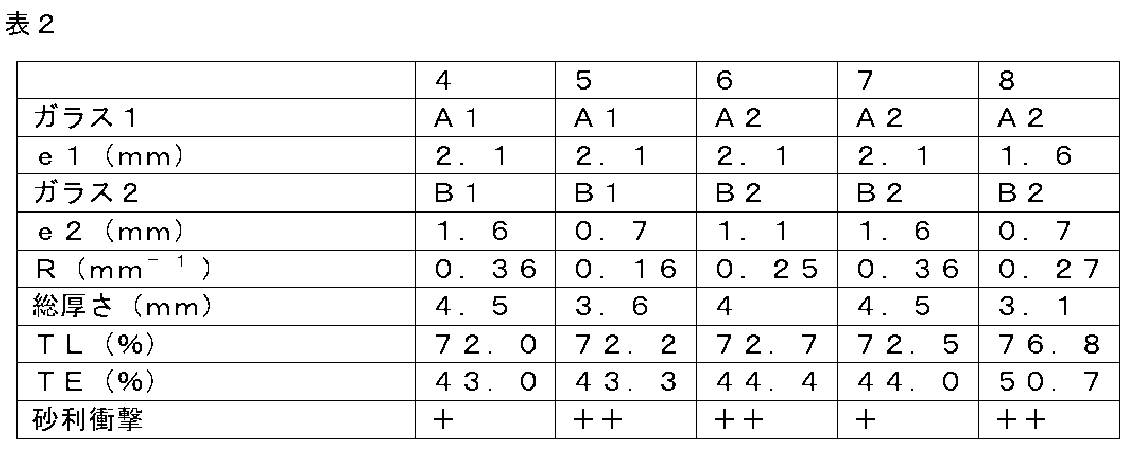
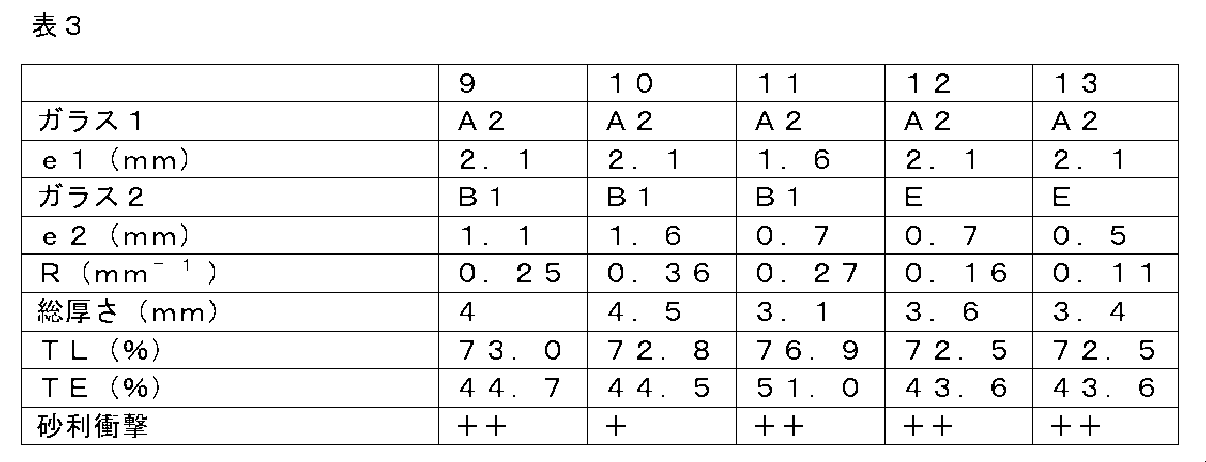
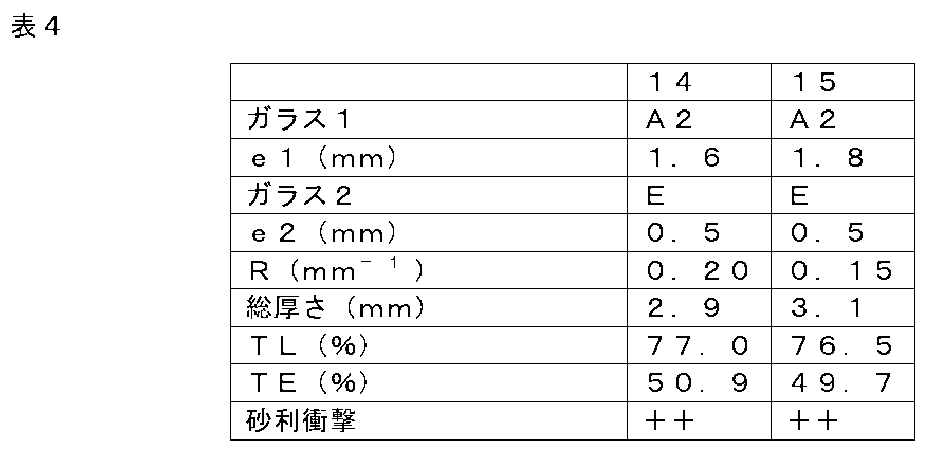
比較グレージングC1は、適切な直接日射透過率及び適切な光透過率を有する。しかしながら、これは、砂利衝撃に対する耐性はそれほど高くない。比較グレージングC2は、砂利衝撃に対する耐性の点において優れているが、その熱的特性を犠牲にしている。一方、本発明のグレージング1~15は、軽量のために、機械的要件と熱的要件との間の良好な妥協を示す。 Comparative glazing C1 has adequate direct solar transmission and adequate light transmission. However, it is not very resistant to gravel impact. Comparative glazing C2 is superior in terms of resistance to gravel impact, but at the expense of its thermal properties. On the other hand, the glazings 1-15 of the invention show a good compromise between mechanical and thermal requirements due to their low weight.
Claims (15)
積層グレージング。 Laminated glazing comprising a first sheet of colored glass and a second sheet of clear glass bonded together by a laminated interlayer, said first sheet having a thickness e1 in the range of 1.5 to 2.5 mm wherein said second sheet has a thickness e2 in the range from 0.4 to 1.9 mm, the ratio R=e2/ e12 is at most 0.40 mm −1 , and said glazing comprises at least Having a light transmission of 70% and a direct solar transmission of up to 55%, said colored glass has a total iron weight content expressed in the form of Fe 2 O 3 ranging from 1.1 to 2.0%. The ratio of the weight content of ferrous iron, expressed in the form of FeO, to the weight content of total iron, expressed in the form of Fe 2 O 3 , in the range of 0.23 to 0.32 having a chemical composition with a redox ratio defined as
laminated glazing.
Applications Claiming Priority (3)
| Application Number | Priority Date | Filing Date | Title |
|---|---|---|---|
| FR1850634 | 2018-01-26 | ||
| FR1850634A FR3077293B1 (en) | 2018-01-26 | 2018-01-26 | LAMINATED WINDOWS. |
| PCT/FR2019/050145 WO2019145638A1 (en) | 2018-01-26 | 2019-01-23 | Laminated glazing |
Publications (2)
| Publication Number | Publication Date |
|---|---|
| JP2021510665A JP2021510665A (en) | 2021-04-30 |
| JP7261237B2 true JP7261237B2 (en) | 2023-04-19 |
Family
ID=62683279
Family Applications (1)
| Application Number | Title | Priority Date | Filing Date |
|---|---|---|---|
| JP2020537498A Active JP7261237B2 (en) | 2018-01-26 | 2019-01-23 | laminated glazing |
Country Status (12)
| Country | Link |
|---|---|
| US (1) | US11472162B2 (en) |
| EP (1) | EP3743396B1 (en) |
| JP (1) | JP7261237B2 (en) |
| KR (1) | KR20200115512A (en) |
| CN (1) | CN110366545A (en) |
| BR (1) | BR112020012987A2 (en) |
| FR (1) | FR3077293B1 (en) |
| MA (1) | MA51680A (en) |
| MX (1) | MX2020007887A (en) |
| PE (1) | PE20201193A1 (en) |
| RU (1) | RU2766145C1 (en) |
| WO (1) | WO2019145638A1 (en) |
Families Citing this family (4)
| Publication number | Priority date | Publication date | Assignee | Title |
|---|---|---|---|---|
| GB201711553D0 (en) * | 2017-07-18 | 2017-08-30 | Pilkington Group Ltd | Laminated glazing |
| CN118973977A (en) * | 2022-03-30 | 2024-11-15 | Agc株式会社 | Laminated glass |
| CN115594421B (en) * | 2022-10-17 | 2024-07-30 | 福耀玻璃工业集团股份有限公司 | Laminated glass and vehicles |
| TW202502679A (en) * | 2023-04-05 | 2025-01-16 | 美商維托平面玻璃有限責任公司 | Privacy glass |
Citations (6)
| Publication number | Priority date | Publication date | Assignee | Title |
|---|---|---|---|---|
| JP2004137147A (en) | 2002-09-25 | 2004-05-13 | Nippon Sheet Glass Co Ltd | Glass composition and laminated glass |
| JP2011251882A (en) | 2010-06-03 | 2011-12-15 | Central Glass Co Ltd | Low solar transmittance glass |
| JP2017508693A (en) | 2013-12-16 | 2017-03-30 | ピルキントン グループ リミテッド | Laminated glass |
| JP2017518246A (en) | 2014-04-15 | 2017-07-06 | サン−ゴバン グラス フランスSaint−Gobain Glass France | Laminated glass including thin inner flat glass |
| JP2017520496A (en) | 2014-05-02 | 2017-07-27 | コーニング インコーポレイテッド | Tempered glass and composition thereof |
| WO2017209148A1 (en) | 2016-05-30 | 2017-12-07 | 日本板硝子株式会社 | Uv-blocking glass plate, and glass window for vehicles using said glass plate |
Family Cites Families (13)
| Publication number | Priority date | Publication date | Assignee | Title |
|---|---|---|---|---|
| US5077133A (en) * | 1990-06-21 | 1991-12-31 | Libbey-Owens-Ford Co. | Infrared and ultraviolet radiation absorbing green glass composition |
| FR2710050B1 (en) | 1993-09-17 | 1995-11-10 | Saint Gobain Vitrage Int | Glass composition intended for the manufacture of glazing. |
| FR2721252B1 (en) * | 1994-06-17 | 1996-08-09 | Saint Gobain Vitrage | Laminated glazing with low energy transmission for transport vehicle. |
| JP3264841B2 (en) * | 1996-03-29 | 2002-03-11 | 旭硝子株式会社 | Dark gray color glass |
| FR2753700B1 (en) * | 1996-09-20 | 1998-10-30 | GLASS SHEET FOR THE MANUFACTURE OF GLAZING | |
| US6733872B2 (en) * | 2001-03-01 | 2004-05-11 | Asahi Glass Company, Limited | Laminated glass |
| GB2403731A (en) * | 2003-07-11 | 2005-01-12 | Pilkington Plc | Solar control glazing |
| FR2881739B1 (en) * | 2005-02-08 | 2007-03-30 | Saint Gobain | GLASS COMPOSITION FOR THE MANUFACTURE OF GLAZES ABSORBING ULTRAVIOLET AND INFRARED RADIATION. |
| US8304358B2 (en) * | 2008-11-21 | 2012-11-06 | Ppg Industries Ohio, Inc. | Method of reducing redox ratio of molten glass and the glass made thereby |
| US20140309099A1 (en) * | 2013-04-15 | 2014-10-16 | Ppg Industries Ohio, Inc. | Low iron, high redox ratio, and high iron, high redox ratio, soda-lime-silica glasses and methods of making same |
| KR20180015747A (en) * | 2015-06-11 | 2018-02-13 | 쌩-고벵 글래스 프랑스 | Projection device for augmented reality head-up display (HUD) |
| US9573841B1 (en) * | 2015-10-06 | 2017-02-21 | Vidrio Plano De Mexico, S.A. De C. V. | UV absorbent green solar control glass composition |
| FR3045596B1 (en) * | 2015-12-17 | 2018-01-19 | Saint-Gobain Glass France | CHEMICALLY REINFORCED COLORED THIN GLASS |
-
2018
- 2018-01-26 FR FR1850634A patent/FR3077293B1/en not_active Expired - Fee Related
-
2019
- 2019-01-23 RU RU2020124587A patent/RU2766145C1/en active
- 2019-01-23 MA MA051680A patent/MA51680A/en unknown
- 2019-01-23 BR BR112020012987-9A patent/BR112020012987A2/en not_active Application Discontinuation
- 2019-01-23 EP EP19710002.7A patent/EP3743396B1/en active Active
- 2019-01-23 WO PCT/FR2019/050145 patent/WO2019145638A1/en not_active Ceased
- 2019-01-23 CN CN201980000927.6A patent/CN110366545A/en active Pending
- 2019-01-23 MX MX2020007887A patent/MX2020007887A/en unknown
- 2019-01-23 KR KR1020207021834A patent/KR20200115512A/en not_active Ceased
- 2019-01-23 JP JP2020537498A patent/JP7261237B2/en active Active
- 2019-01-23 PE PE2020000948A patent/PE20201193A1/en unknown
- 2019-01-23 US US16/964,817 patent/US11472162B2/en active Active
Patent Citations (6)
| Publication number | Priority date | Publication date | Assignee | Title |
|---|---|---|---|---|
| JP2004137147A (en) | 2002-09-25 | 2004-05-13 | Nippon Sheet Glass Co Ltd | Glass composition and laminated glass |
| JP2011251882A (en) | 2010-06-03 | 2011-12-15 | Central Glass Co Ltd | Low solar transmittance glass |
| JP2017508693A (en) | 2013-12-16 | 2017-03-30 | ピルキントン グループ リミテッド | Laminated glass |
| JP2017518246A (en) | 2014-04-15 | 2017-07-06 | サン−ゴバン グラス フランスSaint−Gobain Glass France | Laminated glass including thin inner flat glass |
| JP2017520496A (en) | 2014-05-02 | 2017-07-27 | コーニング インコーポレイテッド | Tempered glass and composition thereof |
| WO2017209148A1 (en) | 2016-05-30 | 2017-12-07 | 日本板硝子株式会社 | Uv-blocking glass plate, and glass window for vehicles using said glass plate |
Also Published As
| Publication number | Publication date |
|---|---|
| US20210060905A1 (en) | 2021-03-04 |
| PE20201193A1 (en) | 2020-11-06 |
| FR3077293B1 (en) | 2021-06-04 |
| EP3743396A1 (en) | 2020-12-02 |
| JP2021510665A (en) | 2021-04-30 |
| RU2766145C1 (en) | 2022-02-08 |
| BR112020012987A2 (en) | 2020-12-01 |
| KR20200115512A (en) | 2020-10-07 |
| WO2019145638A1 (en) | 2019-08-01 |
| MA51680A (en) | 2021-05-05 |
| FR3077293A1 (en) | 2019-08-02 |
| EP3743396B1 (en) | 2023-08-16 |
| MX2020007887A (en) | 2020-09-07 |
| CN110366545A (en) | 2019-10-22 |
| US11472162B2 (en) | 2022-10-18 |
Similar Documents
| Publication | Publication Date | Title |
|---|---|---|
| JP6195652B2 (en) | Chemically tempered glass laminate | |
| JP6466917B2 (en) | Laminated glass structure with strong glass / polymer interlayer adhesion | |
| US10144198B2 (en) | Strengthened glass and compositions therefor | |
| CN106495507A (en) | Laminated glass | |
| JP2017508693A (en) | Laminated glass | |
| US11472162B2 (en) | Laminated glazing | |
| CA2944082A1 (en) | Composite glass with thin inner pane | |
| CN115304250A (en) | Analysis of cold formability of glass laminate articles using stress prediction and related methods | |
| WO2017183382A1 (en) | Laminated glass for vehicles | |
| WO2017183381A1 (en) | Laminated glass for vehicles | |
| WO2018030093A1 (en) | Laminated glass for vehicles | |
| JP2024001033A (en) | window assembly | |
| JP7439054B2 (en) | Soft and chemically strengthenable glass for laminates | |
| JP7299901B2 (en) | laminated glazing | |
| EP2517877A2 (en) | Spandrel panel | |
| US20250376412A1 (en) | Igus and windows having borosilicate glass and methods of the same | |
| TW202237546A (en) | Glass with unique fracture behavior for vehicle windshield | |
| WO2019054032A1 (en) | Infrared absorbing glass sheet | |
| WO2025225554A1 (en) | Laminated glass for vehicles | |
| WO2026053984A1 (en) | Laminated glass | |
| KR20240164907A (en) | Boroaluminosilicate glass composition having high fusion flow rate and favorable twinning temperature | |
| WO2026053988A1 (en) | Laminated glass and method for producing laminated glass |
Legal Events
| Date | Code | Title | Description |
|---|---|---|---|
| A621 | Written request for application examination |
Free format text: JAPANESE INTERMEDIATE CODE: A621 Effective date: 20211216 |
|
| A977 | Report on retrieval |
Free format text: JAPANESE INTERMEDIATE CODE: A971007 Effective date: 20221121 |
|
| A131 | Notification of reasons for refusal |
Free format text: JAPANESE INTERMEDIATE CODE: A131 Effective date: 20221206 |
|
| A521 | Request for written amendment filed |
Free format text: JAPANESE INTERMEDIATE CODE: A523 Effective date: 20230216 |
|
| TRDD | Decision of grant or rejection written | ||
| A01 | Written decision to grant a patent or to grant a registration (utility model) |
Free format text: JAPANESE INTERMEDIATE CODE: A01 Effective date: 20230328 |
|
| A61 | First payment of annual fees (during grant procedure) |
Free format text: JAPANESE INTERMEDIATE CODE: A61 Effective date: 20230407 |
|
| R150 | Certificate of patent or registration of utility model |
Ref document number: 7261237 Country of ref document: JP Free format text: JAPANESE INTERMEDIATE CODE: R150 |