JP7257397B2 - SMAC mimetics useful as IAP inhibitors and uses thereof - Google Patents
SMAC mimetics useful as IAP inhibitors and uses thereof Download PDFInfo
- Publication number
- JP7257397B2 JP7257397B2 JP2020526193A JP2020526193A JP7257397B2 JP 7257397 B2 JP7257397 B2 JP 7257397B2 JP 2020526193 A JP2020526193 A JP 2020526193A JP 2020526193 A JP2020526193 A JP 2020526193A JP 7257397 B2 JP7257397 B2 JP 7257397B2
- Authority
- JP
- Japan
- Prior art keywords
- compound
- alkyl
- pharmaceutically acceptable
- reaction
- acceptable salt
- Prior art date
- Legal status (The legal status is an assumption and is not a legal conclusion. Google has not performed a legal analysis and makes no representation as to the accuracy of the status listed.)
- Active
Links
Classifications
-
- C—CHEMISTRY; METALLURGY
- C07—ORGANIC CHEMISTRY
- C07K—PEPTIDES
- C07K5/00—Peptides containing up to four amino acids in a fully defined sequence; Derivatives thereof
- C07K5/04—Peptides containing up to four amino acids in a fully defined sequence; Derivatives thereof containing only normal peptide links
- C07K5/06—Dipeptides
-
- C—CHEMISTRY; METALLURGY
- C07—ORGANIC CHEMISTRY
- C07K—PEPTIDES
- C07K5/00—Peptides containing up to four amino acids in a fully defined sequence; Derivatives thereof
- C07K5/04—Peptides containing up to four amino acids in a fully defined sequence; Derivatives thereof containing only normal peptide links
- C07K5/06—Dipeptides
- C07K5/06008—Dipeptides with the first amino acid being neutral
- C07K5/06017—Dipeptides with the first amino acid being neutral and aliphatic
- C07K5/06026—Dipeptides with the first amino acid being neutral and aliphatic the side chain containing 0 or 1 carbon atom, i.e. Gly or Ala
-
- A—HUMAN NECESSITIES
- A61—MEDICAL OR VETERINARY SCIENCE; HYGIENE
- A61K—PREPARATIONS FOR MEDICAL, DENTAL OR TOILETRY PURPOSES
- A61K31/00—Medicinal preparations containing organic active ingredients
- A61K31/33—Heterocyclic compounds
- A61K31/395—Heterocyclic compounds having nitrogen as a ring hetero atom, e.g. guanethidine or rifamycins
- A61K31/40—Heterocyclic compounds having nitrogen as a ring hetero atom, e.g. guanethidine or rifamycins having five-membered rings with one nitrogen as the only ring hetero atom, e.g. sulpiride, succinimide, tolmetin, buflomedil
- A61K31/403—Heterocyclic compounds having nitrogen as a ring hetero atom, e.g. guanethidine or rifamycins having five-membered rings with one nitrogen as the only ring hetero atom, e.g. sulpiride, succinimide, tolmetin, buflomedil condensed with carbocyclic rings, e.g. carbazole
- A61K31/404—Indoles, e.g. pindolol
- A61K31/4045—Indole-alkylamines; Amides thereof, e.g. serotonin, melatonin
-
- A—HUMAN NECESSITIES
- A61—MEDICAL OR VETERINARY SCIENCE; HYGIENE
- A61K—PREPARATIONS FOR MEDICAL, DENTAL OR TOILETRY PURPOSES
- A61K38/00—Medicinal preparations containing peptides
-
- A—HUMAN NECESSITIES
- A61—MEDICAL OR VETERINARY SCIENCE; HYGIENE
- A61K—PREPARATIONS FOR MEDICAL, DENTAL OR TOILETRY PURPOSES
- A61K38/00—Medicinal preparations containing peptides
- A61K38/04—Peptides having up to 20 amino acids in a fully defined sequence; Derivatives thereof
- A61K38/05—Dipeptides
-
- A—HUMAN NECESSITIES
- A61—MEDICAL OR VETERINARY SCIENCE; HYGIENE
- A61P—SPECIFIC THERAPEUTIC ACTIVITY OF CHEMICAL COMPOUNDS OR MEDICINAL PREPARATIONS
- A61P35/00—Antineoplastic agents
-
- C—CHEMISTRY; METALLURGY
- C07—ORGANIC CHEMISTRY
- C07D—HETEROCYCLIC COMPOUNDS
- C07D403/00—Heterocyclic compounds containing two or more hetero rings, having nitrogen atoms as the only ring hetero atoms, not provided for by group C07D401/00
- C07D403/02—Heterocyclic compounds containing two or more hetero rings, having nitrogen atoms as the only ring hetero atoms, not provided for by group C07D401/00 containing two hetero rings
- C07D403/06—Heterocyclic compounds containing two or more hetero rings, having nitrogen atoms as the only ring hetero atoms, not provided for by group C07D401/00 containing two hetero rings linked by a carbon chain containing only aliphatic carbon atoms
-
- C—CHEMISTRY; METALLURGY
- C07—ORGANIC CHEMISTRY
- C07D—HETEROCYCLIC COMPOUNDS
- C07D403/00—Heterocyclic compounds containing two or more hetero rings, having nitrogen atoms as the only ring hetero atoms, not provided for by group C07D401/00
- C07D403/14—Heterocyclic compounds containing two or more hetero rings, having nitrogen atoms as the only ring hetero atoms, not provided for by group C07D401/00 containing three or more hetero rings
-
- C—CHEMISTRY; METALLURGY
- C07—ORGANIC CHEMISTRY
- C07D—HETEROCYCLIC COMPOUNDS
- C07D413/00—Heterocyclic compounds containing two or more hetero rings, at least one ring having nitrogen and oxygen atoms as the only ring hetero atoms
- C07D413/14—Heterocyclic compounds containing two or more hetero rings, at least one ring having nitrogen and oxygen atoms as the only ring hetero atoms containing three or more hetero rings
-
- C—CHEMISTRY; METALLURGY
- C07—ORGANIC CHEMISTRY
- C07D—HETEROCYCLIC COMPOUNDS
- C07D471/00—Heterocyclic compounds containing nitrogen atoms as the only ring hetero atoms in the condensed system, at least one ring being a six-membered ring with one nitrogen atom, not provided for by groups C07D451/00 - C07D463/00
- C07D471/02—Heterocyclic compounds containing nitrogen atoms as the only ring hetero atoms in the condensed system, at least one ring being a six-membered ring with one nitrogen atom, not provided for by groups C07D451/00 - C07D463/00 in which the condensed system contains two hetero rings
- C07D471/04—Ortho-condensed systems
Landscapes
- Chemical & Material Sciences (AREA)
- Organic Chemistry (AREA)
- Health & Medical Sciences (AREA)
- Life Sciences & Earth Sciences (AREA)
- General Health & Medical Sciences (AREA)
- Medicinal Chemistry (AREA)
- Veterinary Medicine (AREA)
- Public Health (AREA)
- Pharmacology & Pharmacy (AREA)
- Animal Behavior & Ethology (AREA)
- Proteomics, Peptides & Aminoacids (AREA)
- General Chemical & Material Sciences (AREA)
- Nuclear Medicine, Radiotherapy & Molecular Imaging (AREA)
- Chemical Kinetics & Catalysis (AREA)
- Biochemistry (AREA)
- Molecular Biology (AREA)
- Genetics & Genomics (AREA)
- Biophysics (AREA)
- Epidemiology (AREA)
- Immunology (AREA)
- Bioinformatics & Cheminformatics (AREA)
- Engineering & Computer Science (AREA)
- Gastroenterology & Hepatology (AREA)
- Pharmaceuticals Containing Other Organic And Inorganic Compounds (AREA)
- Plural Heterocyclic Compounds (AREA)
- Nitrogen Condensed Heterocyclic Rings (AREA)
Description
(関連出願の相互参照)
本出願は、2017年11月13日に中国国家知識産権局に出願された第201711117079.6号中国特許出願の優先権及び利益を主張し、前記出願の開示内容全体が参照により本明細書に組み込まれる。
(Cross reference to related applications)
This application claims the priority and benefit of Chinese Patent Application No. 201711117079.6 filed with the State Intellectual Property Office of China on November 13, 2017, the entire disclosure of which is incorporated herein by reference. incorporated into.
本発明は、IAP(アポトーシス阻害タンパク質、inhibitor of apoptosis proteins)を阻害する化合物、その調製プロセス、及び様々な疾患の治療におけるその使用について説明する。本発明の化合物は、癌、自己免疫疾患、及び、アポトーシスの欠陥が関与する他の疾患を治療するために使用される。 The present invention describes compounds that inhibit IAPs (inhibitors of apoptosis proteins), processes for their preparation, and their use in the treatment of various diseases. The compounds of the invention are used to treat cancer, autoimmune diseases, and other diseases involving defects in apoptosis.
プログラム細胞死は、細胞数を調節し、ストレスまたは損傷細胞を正常組織から除去する重要な役割を果たす。実際に、多数の細胞型の本来のアポトーシスシグナル伝達ネットワークのメカニズムは、ヒト癌の発症及び進行に対する大きな障壁をもたらす。しかし、すべての癌細胞の共通性は、アポトーシスプログラムを実行することができないことであり、正常なアポトーシス機序の欠損により適当なアポトーシスが欠如する。化学療法剤、放射線療法及び免疫療法を含む現在の癌治療のほとんどは、癌細胞のアポトーシスを間接的に誘導することによって効を奏する。そのため、正常なアポトーシス機序の欠損により癌細胞がアポトーシスプログラムを実行することができないことは、化学療法、放射線療法または免疫療法により誘導されるアポトーシスに対する耐性の増加に関連することが多い。したがって、癌細胞のアポトーシスを直接阻害する重要な役割を果たしている決定的な負のレギュレーターを標的とすることが新規抗癌薬物設計の非常に有望な治療方法となる。 Programmed cell death plays an important role in regulating cell numbers and removing stressed or damaged cells from normal tissues. Indeed, the mechanisms of the native apoptotic signaling network of many cell types pose a major barrier to human cancer development and progression. However, the commonality of all cancer cells is their inability to carry out an apoptotic program, and lack of proper apoptosis due to defects in normal apoptotic machinery. Most current cancer therapies, including chemotherapeutic agents, radiotherapy and immunotherapy, work by indirectly inducing apoptosis of cancer cells. As such, the inability of cancer cells to execute their apoptotic program due to defects in normal apoptotic mechanisms is often associated with increased resistance to chemotherapy-, radio- or immunotherapy-induced apoptosis. Therefore, targeting critical negative regulators that play a key role in directly inhibiting cancer cell apoptosis represents a highly promising therapeutic strategy for designing novel anti-cancer drugs.
現在、アポトーシスの2つのクラスの重要な負のレギュレーターが同定されている。第1のクラスのレギュレーターは、2つの強力な抗アポトーシス分子、Bcl-2及びBcl-XLタンパク質によって例示されるBcl-2ファミリーのタンパク質である。 Two classes of important negative regulators of apoptosis have now been identified. The first class of regulators is the Bcl-2 family of proteins, exemplified by two potent anti-apoptotic molecules, the Bcl-2 and Bcl-XL proteins.
アポトーシスの第2のクラスの重要な負のレギュレーターはアポトーシスタンパク質の阻害剤(IAPs)である。IAPは、バキュロウイルス中でP35 タンパク質の機能を置換する能力により最初に発見された。このようなタンパク質としては、XIAP、cIAP1、cIAP2、ML-IAP、ILP-2、NAIP、Apollon及びSurvivinが挙げられる。X染色体結合のアポトーシス阻害剤(XIAP)は、カスパーゼ-3,カスパーゼ-7及びカスパーゼ-9を直接阻害することによって、アポトーシス阻害物質として機能する。cIAPsは主に死受容体経路を遮断することによりアポトーシスを阻害する。cIAPsの分解に伴い、その基質であるNIK(NF-κB-inducing kinase)が分解せずに蓄積する。蓄積したNIKは、非典型的経路を通じてNF-κBを活性化し、NF-κBの活性化によりTNFαの分泌が促進される。TNFαとTNF-R1(TNF receptor1)の結合により、死受容体経路が始動する。cIAPsの分解により、RIPK1(receptor interacting protein kinase 1,受容体相互作用タンパク質キナーゼ1)の分泌も増加し、FADD(Fas-associated death domin,Fas関連死ドメイン)及びcaspase-8(カスパーゼ-8)とともにアポトーシス促進性RIPK1-FADD-caspase-8複合体を形成し、次にカスパーゼ-3が活性化されてアポトーシスを引き起こす。 A second class of key negative regulators of apoptosis are inhibitors of apoptotic proteins (IAPs). IAPs were originally discovered due to their ability to replace the function of the P35 protein in baculovirus. Such proteins include XIAP, cIAP1, cIAP2, ML-IAP, ILP-2, NAIP, Apollon and Survivin. X-linked inhibitor of apoptosis (XIAP) functions as an inhibitor of apoptosis by directly inhibiting caspase-3, caspase-7 and caspase-9. cIAPs inhibit apoptosis primarily by blocking death receptor pathways. Accompanying the degradation of cIAPs, NIK (NF-κB-inducing kinase), a substrate thereof, accumulates without degradation. Accumulated NIK activates NF-κB through an atypical pathway, and activation of NF-κB promotes TNFα secretion. Binding of TNFα and TNF-R1 (TNF receptor 1) initiates the death receptor pathway. Degradation of cIAPs also increases secretion of RIPK1 (receptor interacting protein kinase 1), along with FADD (Fas-associated death domain) and caspase-8. Forms the proapoptotic RIPK1-FADD-caspase-8 complex, which in turn activates caspase-3, causing apoptosis.
11q21-q23領域(2つの遺伝子をカバーするもの)の頻繁な染色体増幅によるcIAP1及びcIAP2の過剰発現は、神経芽細胞腫、腎細胞癌、結腸直腸癌及び胃癌などを含むさまざまな悪性疾患で観察されている。 Overexpression of cIAP1 and cIAP2 due to frequent chromosomal amplification of the 11q21-q23 region (covering two genes) has been observed in various malignancies including neuroblastoma, renal cell carcinoma, colorectal cancer and gastric cancer. It is
現在、例えばLCL-161、Debio 1143、BI-891065及びASTX-660等のいくつかの薬物分子が臨床段階に入り、順調に進んでいる。 Currently, several drug molecules, such as LCL-161, Debio 1143, BI-891065 and ASTX-660, have entered the clinical stage and are progressing well.
本発明は、式(I) The present invention provides a compound of formula (I)

(式中、
X1はC(R5)及びNから選択され、
X2はC(R6)、N、O及びSから選択され、
(In the formula,
X 1 is selected from C(R 5 ) and N;
X 2 is selected from C(R 6 ), N, O and S;

はそれぞれ独立して単結合及び二重結合から選択され、
Lは単結合及び-O-から選択され、
R1は、-C(=O)NH2、CN、C1-5アルキル、C1-5ヘテロアルキル、フェニル、5~6員のヘテロアリール及び5~6員のヘテロシクロアルキルから選択され、前記C1-5アルキル、C1-5ヘテロアルキル、フェニル、5~6員のヘテロアリール又は5~6員のヘテロシクロアルキルは所望により1、2又は3個のRにより置換され、
R2はH、ハロゲン、CN、COOH、-C(=O)NH2、C1-4アルキル及びC1-4ヘテロアルキルから選択され、前記C1-4アルキル又はC1-4ヘテロアルキルは所望により1、2又は3個のRにより置換され、
R3及びR7はそれぞれ独立してH、ハロゲン及びC1-4アルキルから選択され、前記C1-4アルキルは所望により1、2又は3個のRにより置換され、
R4はH、フェニル及び5~6員のヘテロアリールから選択され、
R5はH及びハロゲンから選択され、
R6はH、ハロゲン、C1-4アルキル、C1-4ヘテロアルキル、CN及びCOOHから選択され、前記C1-4アルキル又はC1-4ヘテロアルキルは所望により1、2又は3個のRにより置換され、
Rはハロゲン、OH、CN、CH3、CH3CH2、CH3CH2CH2、CH(CH3)2、OCH3、OCF3、CHF2、CH2F及びNH2から選択され、前記C1-4ヘテロアルキル、C1-5ヘテロアルキル、5~6員のヘテロシクロアルキル、及び、5~6員のヘテロアリールはそれぞれ、-NH-、-O-、-S-、N、-C(=O)O-、-C(=O)-、-C(=O)NH-、-C(=S)-、-S(=O)-、-S(=O)2-、-C(=NH)-、-S(=O)2NH-、-S(=O)NH-及び-NHC(=O)NH-から独立して選ばれた1、2又は3個のヘテロ原子及びヘテロ原子団を含む。)で表される化合物又はその薬学的に許容される塩を提供する。
are each independently selected from single and double bonds;
L is selected from a single bond and -O-;
R 1 is selected from —C(=O)NH 2 , CN, C 1-5 alkyl, C 1-5 heteroalkyl, phenyl, 5-6 membered heteroaryl and 5-6 membered heterocycloalkyl; said C 1-5 alkyl, C 1-5 heteroalkyl, phenyl, 5-6 membered heteroaryl or 5-6 membered heterocycloalkyl optionally substituted by 1, 2 or 3 R,
R 2 is selected from H, halogen, CN, COOH, —C(=O)NH 2 , C 1-4 alkyl and C 1-4 heteroalkyl, wherein said C 1-4 alkyl or C 1-4 heteroalkyl is optionally substituted with 1, 2 or 3 R,
R 3 and R 7 are each independently selected from H, halogen and C1-4 alkyl, said C 1-4 alkyl optionally substituted by 1, 2 or 3 R;
R 4 is selected from H, phenyl and 5-6 membered heteroaryl;
R5 is selected from H and halogen;
R 6 is selected from H, halogen, C 1-4 alkyl, C 1-4 heteroalkyl, CN and COOH, said C 1-4 alkyl or C 1-4 heteroalkyl optionally having 1, 2 or 3 substituted by R,
R is selected from halogen, OH , CN, CH3 , CH3CH2 , CH3CH2CH2 , CH( CH3 ) 2 , OCH3 , OCF3 , CHF2 , CH2F and NH2 ; C 1-4 heteroalkyl, C 1-5 heteroalkyl, 5- to 6-membered heterocycloalkyl, and 5- to 6-membered heteroaryl are respectively -NH-, -O-, -S-, N, - C(=O)O-, -C(=O)-, -C(=O)NH-, -C(=S)-, -S(=O)-, -S(=O) 2 -, 1, 2 or 3 hetero independently selected from -C(=NH)-, -S(=O) 2 NH-, -S(=O)NH- and -NHC(=O)NH- Including atoms and heteroatom groups. ) or a pharmaceutically acceptable salt thereof.
本発明のいくつかの形態において、上述化合物又はその薬学的に許容される塩は、 In some aspects of the invention, the above-described compound, or a pharmaceutically acceptable salt thereof,


X1、X2、L、R1、R2、R3、R4及びR7は上記定義と同じである。)から選択される。 X 1 , X 2 , L, R 1 , R 2 , R 3 , R 4 and R 7 are the same as defined above. ).
本発明のいくつかの形態において、上記X2はC(R6)及びNから選択される。
本発明のいくつかの形態において、上記X2はC(H)、C(Cl)、C(CH3)及びNから選択される。
In some forms of the invention, X 2 above is selected from C(R 6 ) and N.
In some forms of the invention, X 2 is selected from C(H), C(Cl), C(CH 3 ) and N.
本発明のいくつかの形態において、上記R1は、-C(=O)NH2、CN、C1-5アルキル、C1-5アルコキシ、C1-5アルキルアミノ、C1-5アルキルチオ、C1-5アシル、C1-5スルホニル、フェニル、N又はOから独立して選ばれた1~2個の原子を含み、所望により1個のオキソで置換された5~6員のヘテロシクロアルキル、及び、Nから独立して選ばれた1~2個の原子を含む5~6員のヘテロアリールから選択され、前記C1-5アルキル、C1-5アルコキシ、C1-5アルキルアミノ、C1-5アルキルチオ、C1-5アシル、C1-5スルホニル、フェニル、5~6員のヘテロシクロアルキル又は5~6員のヘテロアリールは所望により1、2又は3個のRにより置換されていてもよい。 In some forms of the invention, said R 1 is -C(=O)NH 2 , CN, C 1-5 alkyl, C 1-5 alkoxy, C 1-5 alkylamino, C 1-5 alkylthio, 5-6 membered heterocyclo containing 1-2 atoms independently selected from C 1-5 acyl, C 1-5 sulfonyl, phenyl, N or O and optionally substituted with 1 oxo alkyl and 5-6 membered heteroaryl containing 1-2 atoms independently selected from N, said C 1-5 alkyl, C 1-5 alkoxy, C 1-5 alkylamino , C 1-5 alkylthio, C 1-5 acyl, C 1-5 sulfonyl, phenyl, 5-6 membered heterocycloalkyl or 5-6 membered heteroaryl optionally substituted by 1, 2 or 3 R may have been
本発明のいくつかの形態において、上記R1は-C(=O)NH2、CN、CH3、CH3CH2、C1-5アルキル-C(=O)-、C1-4アルキル-C(=O)-、C1-5アルキル-S(=O)2-、C1-5アルキル-N(H)C(=O)-、C1-4アルキル-N(H)C(=O)-、(C1-2アルキル)2-N-C(=O)-、フェニル、 In some aspects of the invention, R 1 is -C(=O)NH 2 , CN, CH 3 , CH 3 CH 2 , C 1-5 alkyl-C(=O)-, C 1-4 alkyl —C(=O)—, C 1-5 alkyl-S(=O) 2 —, C 1-5 alkyl-N(H)C(=O)—, C 1-4 alkyl-N(H)C (=O)-, (C 1-2 alkyl) 2 -NC(=O)-, phenyl,

から選択され、前記CH3、CH3CH2、C1-5アルキル-C(=O)-、C1-4アルキル-C(=O)-、C1-5アルキル-S(=O)2-、C1-5アルキル-N(H)C(=O)-、C1-4アルキル-N(H)C(=O)-、(C1-2アルキル)2-N-C(=O)-、フェニル、 said CH 3 , CH 3 CH 2 , C 1-5 alkyl-C(=O)-, C 1-4 alkyl-C(=O)-, C 1-5 alkyl-S(=O) 2 -, C 1-5 alkyl-N(H)C(=O)-, C 1-4 alkyl-N(H)C(=O)-, (C 1-2 alkyl) 2 -NC( =O)-, phenyl,

は所望により1、2又は3個のRにより置換されていてもよい。
本発明のいくつかの形態において、上記R1は、
is optionally substituted with 1, 2 or 3 R's.
In some aspects of the invention, R 1 is


から選択される。
本発明のいくつかの形態において、上記R2は、H、ハロゲン、C1-4アルキル及びC1-4アルキル-O-から選択され、前記C1-4アルキル又はC1-4アルキル-O-は所望により1、2又は3個のハロゲンにより置換されていてもよい。
is selected from
In some aspects of the invention, said R 2 is selected from H, halogen, C 1-4 alkyl and C 1-4 alkyl-O-, said C 1-4 alkyl or C 1-4 alkyl-O - may optionally be substituted by 1, 2 or 3 halogens.
本発明のいくつかの形態において、上記R2は、H、F、Cl、Br、CF3、OCF3から選択される。 In some forms of the invention, R2 is selected from H, F, Cl, Br, CF3 , OCF3 .
本発明のいくつかの形態において、上記R3及びR7はそれぞれ独立してH、F及びClから選択される。 In some forms of the invention, R3 and R7 above are each independently selected from H, F and Cl.
本発明のいくつかの形態において、上記R4はH及び In some aspects of the invention, R 4 above is H and

から選択される。
本発明のいくつかの形態において、上記R5はH及びClから選択される。
is selected from
In some forms of the invention, R5 above is selected from H and Cl.
本発明のいくつかの形態において、上記R6はH、Cl及びCH3から選択される。
本発明のいくつかの形態において、上記構成単位
In some forms of the invention, R6 is selected from H, Cl and CH3 .
In some aspects of the present invention, the structural unit


から選択される。
本発明のいくつかの形態において、上記構成単位
is selected from
In some aspects of the present invention, the structural unit


から選択される。
本発明のいくつかの形態において、上記X2は、C(R6)及びNから選択され、これ以外のものは上記定義と同じである。
is selected from
In some aspects of the invention, X 2 is selected from C(R 6 ) and N, otherwise as defined above.
本発明のいくつかの形態において、上記X2は、C(H)、C(Cl)、C(CH3)及びNから選択され、これ以外のものは上記定義と同じである。 In some forms of the invention, X 2 above is selected from C(H), C(Cl), C(CH 3 ) and N, otherwise as defined above.
本発明のいくつかの形態において、上記R1は、-C(=O)NH2、CN、C1-5アルキル、C1-5アルコキシ、C1-5アルキルアミノ、C1-5アルキルチオ、C1-5アシル、C1-5スルホニル、フェニル、N又はOから独立して選ばれた1~2個の原子を含み、所望により1個のオキソで置換された5~6員のヘテロシクロアルキル及びNから独立して選ばれた1~2個の原子を含む5~6員のヘテロアリールから選択され、前記C1-5アルキル、C1-5アルコキシ、C1-5アルキルアミノ、C1-5アルキルチオ、C1-5アシル、C1-5スルホニル、フェニル、5~6員のヘテロシクロアルキル又は5~6員のヘテロアリールは所望により1、2又は3個のRにより置換されていてもよく、これら以外のものは上記定義と同じである。 In some forms of the invention, said R 1 is -C(=O)NH 2 , CN, C 1-5 alkyl, C 1-5 alkoxy, C 1-5 alkylamino, C 1-5 alkylthio, 5-6 membered heterocyclo containing 1-2 atoms independently selected from C 1-5 acyl, C 1-5 sulfonyl, phenyl, N or O and optionally substituted with 1 oxo is selected from alkyl and 5-6 membered heteroaryl containing 1-2 atoms independently selected from N, said C 1-5 alkyl, C 1-5 alkoxy, C 1-5 alkylamino, C 1-5 alkylthio, C 1-5 acyl, C 1-5 sulfonyl, phenyl, 5-6 membered heterocycloalkyl or 5-6 membered heteroaryl optionally substituted by 1, 2 or 3 R Other than these, the definitions are the same as above.
本発明のいくつかの形態において、上記R1は、-C(=O)NH2、CN、CH3、CH3CH2、C1-5アルキル-C(=O)-、C1-4アルキル-C(=O)-、C1-5アルキル-S(=O)2-、C1-5アルキル-N(H)C(=O)-、C1-4アルキル-N(H)C(=O)-、(C1-2アルキル)2-N-C(=O)-、フェニル、 In some aspects of the invention, R 1 is -C(=O)NH 2 , CN, CH 3 , CH 3 CH 2 , C 1-5 alkyl-C(=O)-, C 1-4 alkyl-C(=O)-, C 1-5 alkyl-S(=O) 2 -, C 1-5 alkyl-N(H)C(=O)-, C 1-4 alkyl-N(H) C(=O)-, (C 1-2 alkyl) 2 -NC(=O)-, phenyl,

から選択され、前記CH3、CH3CH2、C1-5アルキル-C(=O)-、C1-4アルキル-C(=O)-、C1-5アルキル-S(=O)2-、C1-5アルキル-N(H)C(=O)-、C1-4アルキル-N(H)C(=O)-、(C1-2アルキル)2-N-C(=O)-、フェニル、 said CH 3 , CH 3 CH 2 , C 1-5 alkyl-C(=O)-, C 1-4 alkyl-C(=O)-, C 1-5 alkyl-S(=O) 2 -, C 1-5 alkyl-N(H)C(=O)-, C 1-4 alkyl-N(H)C(=O)-, (C 1-2 alkyl) 2 -NC( =O)-, phenyl,

は所望により1、2又は3個のRにより置換されていてもよく、これら以外のものは上記定義と同じである。 may optionally be substituted with 1, 2 or 3 R, and everything else is the same as defined above.
本発明のいくつかの形態において、上記R2は、H、ハロゲン、C1-4アルキル及びC1-4アルキル-O-から選択され、前記C1-4アルキル又はC1-4アルキル-O-は所望により1、2又は3個のハロゲンにより置換されていてもよく、これら以外のものは上記定義と同じである。 In some aspects of the invention, said R 2 is selected from H, halogen, C 1-4 alkyl and C 1-4 alkyl-O-, said C 1-4 alkyl or C 1-4 alkyl-O - may optionally be substituted with 1, 2 or 3 halogens, otherwise as defined above.
本発明のいくつかの形態において、上記R2は、H、F、Cl、Br、CF3、OCF3から選択され、これ以外のものは上記定義と同じである。 In some aspects of the invention, R 2 is selected from H, F, Cl, Br, CF 3 , OCF 3 , otherwise as defined above.
本発明のいくつかの形態において、上記R3及びR7はそれぞれ独立してH、F及びClから選択され、これら以外のものは上記定義と同じである。 In some aspects of the invention, R 3 and R 7 above are each independently selected from H, F and Cl, otherwise as defined above.
本発明のいくつかの形態において、上記R4は、H及び In some aspects of the invention, R 4 is H and

から選択され、これ以外のものは上記定義と同じである。
本発明のいくつかの形態において、上記R5は、H及びClから選択され、これ以外のものは上記定義と同じである。
and otherwise the same as defined above.
In some aspects of the invention, R5 above is selected from H and Cl, otherwise as defined above.
本発明のいくつかの形態において、上記R6は、H、Cl及びCH3から選択され、これ以外のものは上記定義と同じである。 In some forms of the invention, R6 is selected from H, Cl and CH3 , otherwise as defined above.
本発明のいくつかの形態において、上記構成単位 In some aspects of the present invention, the structural unit



から選択され、これ以外のものは上記定義と同じである。
本発明のいくつかの形態において、上記構成単位
and otherwise the same as defined above.
In some aspects of the present invention, the structural unit


から選択され、これ以外のものは上記定義と同じである。
本発明の別の形態は、上記各要素を任意に組み合わせたものである。
and otherwise the same as defined above.
Another aspect of the invention is any combination of the above elements.
本発明のいくつかの形態において、上記化合物又はその薬学的に許容される塩は、 In some forms of the invention, the compound, or a pharmaceutically acceptable salt thereof, is

(式中、R2、R3及びR7は上記定義と同じである。)から選択される。
本発明のいくつかの形態において、上記化合物又はその薬学的に許容される塩は、
(wherein R 2 , R 3 and R 7 are the same as defined above).
In some forms of the invention, the compound, or a pharmaceutically acceptable salt thereof, is

(式中、R2、R3及びR7は上記定義と同じである。)から選択される。
本発明はさらに、
(wherein R 2 , R 3 and R 7 are the same as defined above).
The present invention further provides


から選ばれた化合物又はその薬学的に許容される塩を提供する。
本発明のいくつかの形態において、上記化合物又はその薬学的に許容される塩は、
or a pharmaceutically acceptable salt thereof.
In some forms of the invention, the compound, or a pharmaceutically acceptable salt thereof, is


から選択される。
本発明はさらに、有効成分として治療上有効な量の上記化合物又はその薬学的に許容される塩と、薬学的に許容される担体とを含む医薬組成物を提供する。
is selected from
The present invention further provides a pharmaceutical composition comprising a therapeutically effective amount of the compound or a pharmaceutically acceptable salt thereof as an active ingredient and a pharmaceutically acceptable carrier.
本発明はさらに、IAP阻害剤を製造するための上記化合物又はその薬学的に許容される塩又は上記医薬組成物の使用を提供する。 The present invention further provides use of the above compound or a pharmaceutically acceptable salt thereof, or the above pharmaceutical composition for manufacturing an IAP inhibitor.
別の側面では、本発明はさらに、治療を必要とする哺乳動物、好ましくはヒトに、治療上有効な量の的上記化合物又はその薬学的に許容される塩又は上記医薬組成物を投与する、IAP阻害が効く疾患の治療方法を提供する。 In another aspect, the invention further comprises administering to a mammal, preferably a human, in need of treatment a therapeutically effective amount of said compound or pharmaceutically acceptable salt thereof or said pharmaceutical composition, To provide a method for treating a disease for which IAP inhibition is effective.
別の側面では、本発明はさらに、IAP阻害が効く疾患の治療における上記化合物又はその薬学的に許容される塩又は上記医薬組成物の使用を提供する。 In another aspect, the present invention further provides the use of the compound or pharmaceutically acceptable salt thereof or pharmaceutical composition as described above in the treatment of diseases responsive to IAP inhibition.
別の側面では、本発明はさらに、医薬として使用される上記化合物又はその薬学的に許容される塩を提供する。本発明のいくつかの実施形態において、前記「医薬として使用される」とは、IAP阻害が効く疾患の治療薬として使用されることを意味する。 In another aspect, the present invention further provides a compound as described above, or a pharmaceutically acceptable salt thereof, for use as a medicament. In some embodiments of the present invention, the aforementioned "used as a pharmaceutical" means used as a therapeutic agent for diseases for which IAP inhibition is effective.
本発明のいくつかの形態において、上記IAP阻害剤とはcIAP1阻害剤を意味する。 In some forms of the invention, the IAP inhibitor refers to a cIAP1 inhibitor.
本発明のいくつかの形態において、上記IAP阻害剤又はcIAP1阻害剤は癌治療薬である。 In some forms of the invention, the IAP inhibitor or cIAP1 inhibitor is a cancer therapeutic.
本発明のいくつかの形態において、上記癌は乳癌である。 In some forms of the invention, the cancer is breast cancer.
本発明の化合物はSMAC模倣物であり、cIAP1に対する拮抗作用を有し、cIAP1及びXIAPに対する選択性を有する。 The compounds of the invention are SMAC mimetics, have antagonistic activity against cIAP1, and have selectivity for cIAP1 and XIAP.
(定義及び説明)
特に断りのない限り、本明細書で使用される下記の用語やフレーズは、次の意味を有する。特定の用語やフレーズは、特に定義されていなくても、意味不明又は不明確なものとして解されるべきではなく、通常の意味で理解されるべきである。本明細書に記載の商品名は、それに対応する商品またはその有効成分を指すものである。本明細書において、「薬学的に許容される」という用語は、化合物、材料、組成物及び/又は剤形が、健全な医学的判断の範囲内で、過度な毒性、刺激、アレルギー反応、またはその他の問題もしくは合併症がなく、ヒト及び動物の組織と接触して使用するのに適しており、妥当な効果/リスク比に見合う化合物、材料、組成物、及び/又は剤形を指すために用いられる。
(definition and explanation)
Unless otherwise specified, the following terms and phrases used herein have the following meanings. Certain terms and phrases, even if not specifically defined, should not be construed as vague or ambiguous, but should be understood in their ordinary meaning. Trade names used herein refer to the corresponding commercial product or its active ingredient. As used herein, the term "pharmaceutically acceptable" means that a compound, material, composition and/or dosage form does not, within sound medical judgment, cause undue toxicity, irritation, allergic reaction, or to refer to compounds, materials, compositions and/or dosage forms that are free of other problems or complications, suitable for use in contact with human and animal tissue, and commensurate with a reasonable benefit/risk ratio Used.
「薬学的に許容される塩」という用語は、本発明の化合物の塩を意味し、本発明で認められた特定の置換基を有する化合物と、比較的無毒な酸又は塩基とを用いて調製されたものを意味する。本発明の化合物が比較的酸性の官能基を含むときには、純粋な溶液又は適切な不活性溶媒において、かかる化合物の中性型を十分な量の塩基と接触させることによって、塩基付加塩を得ることができる。本発明の化合物が比較的塩基性の官能基を含むときには、純粋な溶液又は適切な不活性溶媒において、かかる化合物の中性型を十分な量の酸と接触させることによって、酸付加塩を得ることができる。薬学的に許容される酸付加塩の例として、無機酸塩が挙げられる。本発明のいくつかの特定の化合物は、塩基性及び酸性の官能基を含むことで、塩基付加塩又は酸付加塩のいずれかに転化することができる。 The term "pharmaceutically acceptable salts" refers to salts of the compounds of this invention, prepared using compounds having certain substituents permitted by this invention and relatively non-toxic acids or bases. means what was done. When a compound of the invention contains a relatively acidic functional group, the base addition salt can be obtained by contacting the neutral form of such compound with a sufficient amount of base in neat solution or in a suitable inert solvent. can be done. When the compounds of this invention contain relatively basic functional groups, the acid addition salts are obtained by contacting the neutral form of such compounds with a sufficient amount of acid in neat solution or in a suitable inert solvent. be able to. Examples of pharmaceutically acceptable acid addition salts include inorganic acid salts. Certain specific compounds of the present invention contain basic and acidic functionalities that allow them to be converted into either base or acid addition salts.
本発明的薬学的に許容される塩は、酸基または塩基を含む親化合物から通常の化学的方法によって合成することができる。一般に、このような塩の調製方法は、水または有機溶媒またはこれらの混合物中で、化学量論量の適切な塩基または酸と、遊離酸または塩基形態にあるこれらの化合物とを反応させることによって調製するという方法である。 The pharmaceutically acceptable salts of the invention can be synthesized by conventional chemical methods from parent compounds which contain an acid or base group. Generally, the method of preparing such salts is by reacting these compounds in free acid or base form with a stoichiometric amount of the appropriate base or acid in water or an organic solvent or mixtures thereof. It is a method of preparation.
本発明の化合物は、特定の幾何異性体形態または立体異性体形態で存在し得る。シス及びトランス異性体、(-)-及び(+)-エナンチオマー、(R)-及び(S)-エナンチオマー、ジアステレオマー、(D)-異性体、(L)-異性体、およびそのラセミ混合物、ならびに例えばエナンチオマーまたはジアステレオマーに富む混合物のような他の混合物を含む本発明で想定されるすべての化合物は、本発明の範囲内である。他の不斉炭素原子がアルキル基などのような置換基に存在してもよい。これらの全ての異性体、及びそれらの混合物は、本発明の範囲内に含まれる。 The compounds of the present invention may exist in particular geometric or stereoisomeric forms. cis and trans isomers, (−)- and (+)-enantiomers, (R)- and (S)-enantiomers, diastereomers, (D)-isomers, (L)-isomers and racemic mixtures thereof , as well as other mixtures, such as enantiomerically or diastereomerically enriched mixtures, are within the scope of the invention. Other asymmetric carbon atoms may be present in substituents such as alkyl groups. All these isomers and mixtures thereof are included within the scope of this invention.
特に断りがない限り、「エナンチオマー」又は「光学異性体」という用語は、互いに鏡像関係にある立体異性体を指す。 Unless otherwise specified, the terms "enantiomers" or "optical isomers" refer to stereoisomers that are mirror images of each other.
特に断りがない限り、「シス-トランス異性体」又は「幾何異性体」という用語は、自由に回転できない二重結合又は環形成炭素原子の単結合によって生じるものを指す。 Unless otherwise specified, the terms "cis-trans isomer" or "geometric isomer" refer to those resulting from a double bond or a single ring-forming carbon atom bond that cannot rotate freely.
特に断りがない限り、「ジアステレオマー」という用語は、分子が2つ以上のキラル中心と分子間の非鏡像関係を有する立体異性体を指す。 Unless otherwise stated, the term "diastereomer" refers to a stereoisomer whose molecules possess two or more chiral centers and non-mirror relationships between the molecules.
特に断りがない限り、「(+)」は右旋性を意味し、「(-)」は左旋性を意味し、「(±)」はラセミを意味する。 Unless otherwise specified, "(+)" means dextrorotatory, "(-)" means levorotatory, and "(±)" means racemic.
特に断りがない限り、くさび形の実線の結合






本発明の化合物は、特異的に存在し得る。特に断りがない限り、「互変異性体」又は「互変異性体形態」という用語は、室温で、異なる官能基の異性体が動的平衡にあり、迅速に互いに変換できることを意味する。互変異性体が可能な場合(例えば溶液中)、互変異性体の化学平衡を達成できる。例えば、プロトン互変異性体(proton tautomer)(プロトン移動互変異性体(prototropic tautomer)とも呼ばれる)は、ケト-エノール異性化及びイミン-エナミン異性化などのプロトン移動による相互変換を含む。原子価結合異性体(valence tautomer)は、結合形成電子の一部の再配列による相互変換を含む。ケト-エノール互変異性化の具体例は、ペンタン-2,4-ジオンと4-ヒドロキシペンタ-3-エン-2-オンの2つの互変異性体間の相互変換である。 The compounds of the invention may exist specifically. Unless otherwise indicated, the terms "tautomer" or "tautomeric form" mean that isomers of different functional groups are in dynamic equilibrium at room temperature and can be rapidly converted into one another. Where tautomers are possible (eg in solution) chemical equilibria of tautomers can be achieved. For example, proton tautomers (also called prototropic tautomers) include proton-transfer interconversions such as keto-enol isomerization and imine-enamine isomerization. Valence tautomers involve interconversions due to rearrangements of some of the bond-forming electrons. A specific example of keto-enol tautomerization is the interconversion between the two tautomers of pentane-2,4-dione and 4-hydroxypent-3-en-2-one.
特に断りがない限り、本発明の化合物が異性体である場合、「1つの異性体に富む」、「異性体がリッチである」、「1つのエナンチオマーに富む」又は「エナンチオマーがリッチである」ことがある。前記「1つの異性体に富む」、「異性体がリッチである」、「1つのエナンチオマーに富む」又は「エナンチオマーがリッチである」という用語は、1つの異性体又はエナンチオマーの含有量が100%未満であり、かつ、当該異性体又はエナンチオマーの含有量が60%以上であり、又は70%以上であり、又は80%以上であり、又は90%以上であり、又は95%以上であり、又は96%以上であり、又は97%以上であり、又は98%以上であり、又は99%以上であり、又は99.5%以上であり、又は99.6%以上であり、又は99.7%以上であり、又は99.8%以上であり、又は99.9%以上であることを意味する。 Unless otherwise specified, when a compound of the invention is an isomer, it is "enriched in one isomer," "enriched in isomers," "enriched in one enantiomer," or "enriched in enantiomers." Sometimes. The terms "enriched in one isomer", "enriched in an isomer", "enriched in one enantiomer" or "enantiomer-rich" refer to the content of one isomer or enantiomer being 100%. and the content of the isomer or enantiomer is 60% or more, or 70% or more, or 80% or more, or 90% or more, or 95% or more, or 96% or more, or 97% or more, or 98% or more, or 99% or more, or 99.5% or more, or 99.6% or more, or 99.7% or more, or 99.8% or more, or 99.9% or more.
特に断りがない限り、本発明の化合物が異性体である場合、「異性体の過剰」又は「エナンチオマーの過剰」がある。「異性体の過剰」又は「エナンチオマーの過剰」という用語は、2つの異性体又は2つのエナンチオマーの相対百分率の差を意味する。例えば、そのうちの一方の異性体又はエナンチオマーの含有量が90%であり、他方の異性体又はエナンチオマーの含有量が10%である場合、異性体又はエナンチオマーの過剰(ee値)は80%である。 Unless otherwise specified, when a compound of the invention is an isomer, there is an "isomeric excess" or an "enantiomeric excess." The terms "isomeric excess" or "enantiomeric excess" mean the difference in relative percentages of two isomers or two enantiomers. For example, if the content of one isomer or enantiomer is 90% and the content of the other isomer or enantiomer is 10%, the isomer or enantiomer excess (ee value) is 80%. .
光学的活性な(R)-及び(S)-異性体並びにD及びL異性体は、キラル合成またはキラル試薬または他の一般的な技術によって調製することができる。本発明のある化合物の特定のエナンチオマーを所望する場合、不斉合成により、または、キラル補助剤の誘導により調製することができ、ここで得られたジアステレオマーの混合物を分離し、補助基を開裂して純粋な所望のエナンチオマーを得る。あるいは、分子が塩基性官能基(例えば、アミノ基)または酸性官能基(例えばカルボキシル基)を含む場合、適切な光学的活性な酸または塩基とジアステレオマー塩を形成し、続いてこの分野で周知された通常の方法によりジアステレオマーの分割を行って、純粋なエナンチオマーを回収する。さらに、エナンチオマー及びジアステレオマーの分離は通常、キラル固定相を用いるクロマトグラフィーを使用することによって行うが、所望により化学的誘導体化(例えば、アミンからのカルバメート形成)を併用してもよい。本発明の化合物は、このような化合物を構成する原子の1つ以上に非天然の割合の原子同位体を含有してもよい。例えば、化合物を放射性同位体、例えばトリチウム(3H)、ヨウ素-125(125I)又はC-14(14C)で標識することができる。また、例えば、水素を重水素に置き換えて重水素化薬物を形成することができる。重水素と炭素によって形成される結合は、通常の水素と炭素によって形成される結合よりも強固である。非重水素化薬物と比較して、重水素化薬物は毒性と副作用が軽減され、薬物の安定性が向上し、有効性が改善され、薬物の生物学的半減期が長くなるといった利点を有する。本発明の化合物のすべての同位体による変換は、放射性を問わず、本発明の範囲内に含まれる。「薬学的に許容される担体」という用語は、活性物質の生物活性を妨害することなく、かつ宿主または患者に対する毒性や副作用なしに、有効な量の本発明の活性物質を送達できる任意の製剤または担体媒体を指す。代表的な担体としては、水、油、野菜及びミネラル、クリーム基剤、ローション基剤、軟膏基剤などが挙げられる。これらの基剤には、懸濁剤、粘着付与剤、浸透促進剤などが含まれる。これらの製剤は、化粧品分野または局所医薬分野の当業者によく知られている。 Optically active (R)- and (S)- and D- and L-isomers may be prepared by chiral synthesis or chiral reagents or other common techniques. If a particular enantiomer of a compound of the invention is desired, it can be prepared by asymmetric synthesis or by derivatization of a chiral auxiliary, wherein the resulting mixture of diastereomers is separated and the auxiliary group is Cleavage to give the pure desired enantiomer. Alternatively, if the molecule contains a basic (e.g., amino group) or acidic (e.g., carboxyl) functional group, diastereomeric salts may be formed with a suitable optically active acid or base, followed by Separation of the diastereomers is carried out by well known and routine methods to recover the pure enantiomers. Furthermore, separation of enantiomers and diastereomers is usually accomplished using chromatography with chiral stationary phases, optionally in combination with chemical derivatization (eg carbamate formation from amines). The compounds of the present invention may also contain unnatural proportions of atomic isotopes at one or more of the atoms that constitute such compounds. For example, compounds can be labeled with radioactive isotopes such as tritium ( 3 H), iodine-125 ( 125 I) or C-14 ( 14 C). Also, for example, hydrogen can be replaced with deuterium to form a deuterated drug. The bond formed by deuterium and carbon is stronger than the bond formed by normal hydrogen and carbon. Compared with non-deuterated drugs, deuterated drugs have the advantages of reduced toxicity and side effects, increased drug stability, improved efficacy, and longer drug biological half-life. . All isotopic variations, whether radioactive or not, of the compounds of the invention are included within the scope of the invention. The term "pharmaceutically acceptable carrier" means any formulation capable of delivering an effective amount of an active agent of the invention without interfering with the biological activity of the active agent and without toxicity or side effects to the host or patient. or refers to a carrier medium. Typical carriers include water, oils, vegetable and mineral bases, cream bases, lotion bases, ointment bases and the like. These bases include suspending agents, tackifiers, penetration enhancers and the like. These formulations are well known to those skilled in the cosmetic or topical pharmaceutical arts.
「賦形剤」という用語は通常、有効な医薬組成物を調製するのに必要な担体、希釈剤及び/又は媒体を指す。 The term "excipient" generally refers to carriers, diluents and/or vehicles necessary to prepare an effective pharmaceutical composition.
「含む(comprise)」又は「備える(comprise)」という単語、およびその英語の変化形(例えばcomprisesやcomprising)は、「含むが、これに限定されない」というオープンで非排他的な意味として理解されるべきである。 The words "comprise" or "comprise" and their English variants (e.g., comprises and comprising) are to be understood as an open and non-exclusive meaning of "including but not limited to." should.
「治療」という用語は、本発明に記載の化合物または製剤を投与して疾患又は前記疾患に関連する1つ以上の症状を予防したり、緩和したり、解消したりすることを意味し、かつ、
(i)哺乳類における疾患または疾患状態の発生を予防すること(特に、そのような哺乳動物がこの疾患状態を患いやすくなっているが、未だそれに罹患していると診断されていない場合)、
(ii)疾患または疾患状態を阻害し、すなわちその発生・進行を停止させること、
(iii)疾患または疾患状態を緩和し、すなわち疾患または疾患状態を減退させること、を含む。
The term "treatment" means administration of a compound or formulation according to the present invention to prevent, alleviate or eliminate a disease or one or more symptoms associated with said disease, and ,
(i) preventing the occurrence of a disease or disease state in a mammal, particularly if such mammal is predisposed to, but has not yet been diagnosed with, the disease state;
(ii) inhibiting, i.e. halting the development or progression of, a disease or disease state;
(iii) alleviating the disease or disease state, i.e. reducing the disease or disease state.
薬学的または薬理学的に活性な薬剤に関する「有効量」又は「治療上有効な量」という用語は、無毒でありながら、薬物または薬剤の所望の効果を達成するには十分な量を指す。本発明の経口剤形について、組成物における特定の活性物質の「有効量」は、組成物における別の活性物質と併用する場合に所望の効果を達成するのに必要な量を指す。有効量は、投与対象の年齢や一般状態、具体的な活性物質に応じて決定され、人によって異なるが、具体的な場合における適切な有効量は、当業者が通常の試験により決定することができる。 The terms "effective amount" or "therapeutically effective amount" with respect to a pharmaceutically or pharmacologically active agent refer to a non-toxic but sufficient amount of the drug or agent to achieve the desired effect. For oral dosage forms of the invention, an "effective amount" of a particular active agent in the composition refers to that amount necessary to achieve the desired effect when combined with another active agent in the composition. The effective amount is determined according to the age and general condition of the subject to be administered, the specific active substance, and varies from person to person. can.
「有効成分」、「治療剤」、「活性物質」又は「活性剤」という用語は、標的である障害、疾患または疾患状態の治療に有効な化学実体を指す。 The terms "active ingredient", "therapeutic agent", "active substance" or "active agent" refer to chemical entities effective in treating a target disorder, disease or disease state.
「所望の」又は「所望により」とは、後述する事情や状況が発生する可能性も、発生しない可能性もあることを意味し、かかる事情や状況が発生した場合も、発生していない場合も含む。 "desired" or "at will" means that the circumstances or circumstances set forth below may or may not occur, and whether or not such circumstances or circumstances have occurred; Also includes
「置換された」という用語は、特定の原子の原子価が正常でありかつ置換された化合物が安定である限り、特定の原子上のいずれか1つ以上の水素原子が重水素及び水素の変種を含む置換基によって置換されていることを意味する。置換基が酸素(つまり=O)である場合は、2つの水素原子が置換されていることを意味する。酸素置換は芳香族基では起こらない。「所望により置換された」という用語は、置換されていてもよく、置換されていなくてもよいことを意味する。別に指定のない限り、化学上達成可能であれば、置換基の種類及び数は限定されず、任意のものであってもよい。 The term "substituted" means that any one or more hydrogen atoms on a particular atom may be deuterium and hydrogen variants, so long as the valences of the particular atom are normal and the substituted compound is stable. It means that it is substituted by a substituent containing When a substituent is oxygen (ie =O), it means that 2 hydrogen atoms are replaced. Oxygen substitution does not occur in aromatic groups. The term "optionally substituted" means optionally substituted or unsubstituted. Unless otherwise specified, the type and number of substituents are not limited as long as they are chemically achievable, and may be arbitrary.
いずれかの要素(例えばR、 any element (e.g. R,

)が化合物の組成または構造中に2回以上現れた場合、それぞれの場合におけるその定義は独立している。したがって、例えば、0~2個のRで置換されている基の場合、その基は、所望により多くとも2個のRで置換されていてもよく、かつ、それぞれの場合において、Rは、独立する選択肢を有する。さらに、いずれかの要素及び/又はその変種の組み合わせは、そのような組み合わせが安定な化合物をもたらす場合にのみ許容される。 ) occurs more than once in the composition or structure of a compound, its definition in each occurrence is independent. Thus, for example, for a group substituted with 0-2 R, the group may optionally be substituted with at most 2 R, and in each case R is independently have the option to Moreover, combinations of any element and/or variants thereof are permissible only if such combinations result in stable compounds.
結合基の数が0である場合、例えば、-(CRR)0-の場合、当該結合基が単結合であることを意味する。 When the number of bonding groups is 0, for example, -(CRR) 0 -, it means that the bonding group is a single bond.
要素が単結合から選択される場合、それがつないだ2つの基が直接結合していることを意味する。例えば、A-L-Zにおいて、Lが単結合を表す場合、その構造は実際にはA-Zである。 When an element is selected from a single bond, it means that the two groups it connects are directly bonded. For example, in ALZ, if L represents a single bond, the structure is actually AZ.
置換基が空の場合、当該置換基が存在しないことを意味する。例えば、A-XにおけるXが空の場合、その構造は実際にはAである。環上の1つ以上の原子に結合できる置換基の場合、このような置換基は当該環上の任意の原子に結合することができる。例えば、構成単位 If a substituent is empty, it means that the substituent is absent. For example, if X in AX is empty, the structure is actually A. For substituents that can be attached to more than one atom on a ring, such substituents can be attached to any atom on the ring. For example, the building block

は、置換基Rがシクロヘキシル基またはシクロヘキサジエンの任意の位置で置換され得ることを意味する。リストされた置換基がどの原子を介して、置換される基に結合するかが明示されていない場合、そのような置換基は任意の原子を介して結合してもよい。例えば、置換基としてのピリジル基は、ピリジン環上の任意の炭素原子を介して、置換される基に結合することができる。リストされた結合基の結合方向が明示されていない場合、その結合方向は任意であり、例えば、 means that the substituent R can be substituted at any position of the cyclohexyl group or cyclohexadiene. Where it is not specified through which atom a listed substituent is attached to the group being substituted, such substituent may be attached via any atom. For example, a pyridyl group as a substituent can be attached to the group being substituted via any carbon atom on the pyridine ring. If the orientation of a listed linking group is not specified, the orientation is arbitrary, e.g.

における結合基Lが-M-W-である場合、このときの-M-W-は、左から読む順番と同じ方向で環Aと環Bをつないで When the bonding group L in is -MW-, -MW- at this time connects ring A and ring B in the same direction as the order of reading from the left

を形成してもよく、左から読む順番と逆の方向で環Aと環Bをつないで may be formed by connecting ring A and ring B in the opposite direction to the order of reading from left to right.

を形成してもよい。前記結合基、置換基及び/又はその変種の組み合わせは、そのような組み合わせが安定な化合物をもたらす場合にのみ許容される。 may be formed. Combinations of the above linking groups, substituents and/or variants thereof are permissible only if such combinations result in stable compounds.
特に指定のない限り、「ヘテロ」という用語は、ヘテロ原子またはヘテロ原子団(すなわち、ヘテロ原子を含む原子団)を指し、炭素(C)及び水素(H)以外の原子及びこれらのヘテロ原子を含有する原子団を含み、例えば、酸素(O)、窒素(N)、硫黄(S)、ケイ素(Si)、ゲルマニウム(Ge)、アルミニウム(Al)、ホウ素(B)、-O-、-S-、=O、=S、-C(=O)O-、-C(=O)-、-C(=S)-、-S(=O)、-S(=O)2-、及び、所望により置換された-C(=O)N(H)-、-N(H)-、-C(=NH)-、-S(=O)2N(H)-又は-S(=O)N(H)-が挙げられる。 Unless otherwise specified, the term "hetero" refers to a heteroatom or heteroatom group (i.e., a group containing heteroatoms) and includes atoms other than carbon (C) and hydrogen (H) and these heteroatoms. Including atomic groups containing, for example, oxygen (O), nitrogen (N), sulfur (S), silicon (Si), germanium (Ge), aluminum (Al), boron (B), -O-, -S -, =O, =S, -C(=O)O-, -C(=O)-, -C(=S)-, -S(=O), -S(=O) 2 -, and , optionally substituted -C(=O)N(H)-, -N(H)-, -C(=NH)-, -S(=O) 2 N(H)- or -S(= and O)N(H)-.
特に指定のない限り、「環」は、置換又は非置換のシクロアルキル、ヘテロシクロアルキル、シクロアルケニル、ヘテロシクロアルケニル、シクロアルキニル、ヘテロシクロアルキニル、アリール又はヘテロアリールを意味する。いわゆる環には、単環、連結環、スピロ環、縮合環や架橋環などがある。環の原子数は通常、環員数として定義され、例えば、「5~7員の環」とは、5~7個の原子が環状に配置されていることを意味する。特に指定のない限り、このような環は所望により1~3個のヘテロ原子を含む。したがって、「5~7員の環」には、例えば、フェニル、ピリジル及びピペリジニルが含まれる。一方、「5~7員のヘテロシクロアルキル環」には、ピリジル及びピペリジニルは含まれるが、フェニルは含まれない。「環」という用語は、少なくとも1つの環を有する環系をさらに含み、その各環は独立して上記定義に適合する。 Unless otherwise specified, "ring" means substituted or unsubstituted cycloalkyl, heterocycloalkyl, cycloalkenyl, heterocycloalkenyl, cycloalkynyl, heterocycloalkynyl, aryl or heteroaryl. So-called rings include monocyclic rings, connected rings, spiro rings, condensed rings and bridged rings. The number of ring atoms is usually defined as the number of ring members, eg, a “5- to 7-membered ring” means 5-7 atoms arranged in a ring. Unless otherwise specified, such rings optionally contain from 1 to 3 heteroatoms. A “5- to 7-membered ring” thus includes, for example, phenyl, pyridyl and piperidinyl. On the other hand, "5- to 7-membered heterocycloalkyl ring" includes pyridyl and piperidinyl, but does not include phenyl. The term "ring" further includes ring systems having at least one ring, each ring independently meeting the above definitions.
特に指定のない限り、「複素環」又は「複素環基」という用語は、飽和、部分不飽和又は不飽和(芳香族)であってもよい、ヘテロ原子又はヘテロ原子団を含む安定な単環、二環又は三環を意味し、それらは炭素原子と、N、O及びSから独立して選択される1、2、3又は4個の環ヘテロ原子とを含み、ここで、上記いずれかの複素環はフェニル環に縮合して二環を形成してもよい。窒素や硫黄であるヘテロ原子は所望により酸化されていてもよい(つまりNO及びS(O)pで、pは1又は2である)。窒素原子は、置換されても置換されなくてもよい(つまりN又はNRであり、Rは、H又は本明細書に定義された他の置換基である)。このような複素環は、任意のヘテロ原子又は炭素原子である側基に結合して安定な構造を形成することができる。得られる化合物が安定である場合、本明細書に記載の複素環は、炭素又は窒素部位で置換されてもよい。複素環における窒素原子は、所望により四級化されてもよい。好ましい一形態として、複素環におけるS及びO原子の合計が1を超えた場合、これらのヘテロ原子は互いに隣接しない。別の好ましい形態として、複素環におけるS及びO原子の合計は1以下である。本明細書で使用される「芳香族複素環基」又は「ヘテロアリール」という用語は、安定な5、6、7員の単環又は二環、又は7、8、9もしくは10員の二環式複素環基である芳香環を意味し、炭素原子と、N、O及びSから独立して選択される1、2、3又は4個の環ヘテロ原子とを含む。窒素原子は、置換されても置換されなくてもよい(つまりN又はNRであり、Rは、H又は本明細書に定義された他の置換基である)。窒素や硫黄であるヘテロ原子は所望により酸化されていてもよい(つまりNO及びS(O)pで、pは1又は2である)。なお、芳香族複素環におけるS及びO原子の合計は1以下である。架橋環も複素環の定義に含まれる。1つ以上の原子(すなわち、C、O、N又はS)が、隣接しない2つの炭素原子又は窒素原子をつないだ場合、架橋環が形成される。好ましい架橋環には、1個の炭素原子、2個の炭素原子、1個の窒素原子、2個の窒素原子、及び1個の炭素-窒素基が含まれるが、これらに限定されない。なお、ブリッジにより、単環が三環に変わるのが一般的である。架橋環において、環上の置換基はブリッジに存在してもよい。 Unless otherwise specified, the term "heterocycle" or "heterocyclic group" refers to a stable monocyclic ring containing a heteroatom or heteroatom group, which may be saturated, partially unsaturated or unsaturated (aromatic). , bicyclic or tricyclic, which contain carbon atoms and 1, 2, 3 or 4 ring heteroatoms independently selected from N, O and S, wherein any of the above may be fused to a phenyl ring to form a bicyclic ring. Heteroatoms such as nitrogen and sulfur may optionally be oxidized (ie NO and S(O)p where p is 1 or 2). The nitrogen atom may be substituted or unsubstituted (ie, N or NR, where R is H or another substituent as defined herein). Such heterocycles can be attached to any pendant heteroatom or carbon atom to form a stable structure. The heterocycles described herein may be substituted at carbon or nitrogen sites provided the resulting compound is stable. A nitrogen atom in the heterocycle may optionally be quaternized. In one preferred form, when the total number of S and O atoms in the heterocycle exceeds 1, these heteroatoms are not adjacent to each other. In another preferred form, the total number of S and O atoms in the heterocycle is 1 or less. The term "heteroaromatic group" or "heteroaryl" as used herein refers to a stable 5-, 6-, 7-membered monocyclic or bicyclic ring or a 7-, 8-, 9- or 10-membered bicyclic Heterocyclic group means an aromatic ring containing carbon atoms and 1, 2, 3 or 4 ring heteroatoms independently selected from N, O and S. The nitrogen atom may be substituted or unsubstituted (ie, N or NR, where R is H or another substituent as defined herein). Heteroatoms such as nitrogen and sulfur may optionally be oxidized (ie NO and S(O)p where p is 1 or 2). The total number of S and O atoms in the aromatic heterocycle is 1 or less. Bridged rings are also included in the definition of heterocycle. A bridged ring is formed when one or more atoms (ie, C, O, N, or S) link two non-adjacent carbon or nitrogen atoms. Preferred bridged rings include, but are not limited to, one carbon atom, two carbon atoms, one nitrogen atom, two nitrogen atoms, and one carbon-nitrogen group. It should be noted that a bridge generally converts a monocyclic ring into a tricyclic ring. In bridged rings, substituents on the ring may be present on the bridge.
複素環式化合物の例としては、アクリジニル、アゾシニル、ベンゾイミダゾリル、ベンゾフラニル、ベンゾメルカプトフラニル、ベンゾメルカプトフェニル、ベンゾオキサゾリル、ベンゾオキサゾリニル、ベンゾチアゾリル、ベンゾトリアゾリル、ベンゾテトラゾリル、ベンゾイソオキサゾリル、 ベンゾイソチアゾリル、ベンゾイミダゾリニル、カルバゾリル、4aH-カルバゾリル、カルボリニル(carbolinyl)、ベンゾジヒドロピラニル、クロメン、シンノリンデカヒドロキノリニル、2H,6H-1,5,2-ジチアジニル、ジヒドロフロ[2,3-b]テトラヒドロフラニル、フラニル、フラザニル、イミダゾリジニル、イミダゾリニル、イミダゾリル、1H-インダゾリル、インドレニル、ジヒドロインドリル、インドリジニル、インドリル、3H-インドリル、イソベンゾフラニル、イソインドリル、イソジヒドロインドリル、イソキノリニル、イソチアゾリル、イソオキサゾリル、メチレンジオキシフェニル、モルホリニル、ナフチリジニル、オクタヒドロイソキノリニル、オキサジアゾリル、1,2,3-オキサジアゾリル、1,2,4-オキサジアゾリル、1,2,5-オキサジアゾリル、1,3,4-オキサジアゾリル、オキサゾリジニル、オキサゾリル、オキシインドリル、ピリミジニル、フェナントリジニル、フェナントロリニル、フェナジン、フェノチアジン、ベンゾキサンチニル、フェノキサジニル、フタラジニル、ピペラジニル、ピペリジニル、ピペリドン、4-ピペリドン、ピペロニル、プテリジル、プリニル、ピラニル、ピラジニル、ピラゾリジニル、ピラゾリニル、ピラゾリル、ピリダジニル、ピリドキサゾール、ピリドイミダゾール、ピリドチアゾール、ピリジル、ピロリジニル、ピロリニル、2H-ピロリル、ピロリル、キナゾリニル、キノリニル、4H-キナジニル、キノキサリニル、キヌクリジニル、テトラヒドロフラニル、テトラヒドロイソキノリニル、テトラヒドロキノリニル、テトラゾリル、6H-1,2,5-チアジアジニル、1,2,3-チアジアゾリル、1,2,4-チアジアゾリル、1,2,5-チアジアゾリル、1,3,4-チアジアゾリル、チアントレニル、チアゾリル、イソチアゾリルチエニル、チエノキサゾリル、チエノチアゾリル、チエノイミダゾリル、チエニル、トリアジニル、1H-1,2,3-トリアゾリル、2H-1,2,3-トリアゾリル、1H-1,2,4-トリアゾリル、4H-1,2,4-トリアゾリル及びキサンテニルが挙げられるが、これらに限定されない。さらに、縮合環及びスピロ化合物も含まれる。 Examples of heterocyclic compounds include acridinyl, azocinyl, benzimidazolyl, benzofuranyl, benzomercaptofuranyl, benzomercaptophenyl, benzoxazolyl, benzoxazolinyl, benzothiazolyl, benzotriazolyl, benzotetrazolyl, benzoiso oxazolyl, benzisothiazolyl, benzimidazolinyl, carbazolyl, 4aH-carbazolyl, carbolinyl, benzodihydropyranyl, chromene, cinnolinedecahydroquinolinyl, 2H,6H-1,5,2-dithiazinyl , dihydrofuro[2,3-b]tetrahydrofuranyl, furanyl, furazanyl, imidazolidinyl, imidazolinyl, imidazolyl, 1H-indazolyl, indolenyl, dihydroindolyl, indolizinyl, indolyl, 3H-indolyl, isobenzofuranyl, isoindolyl, isodihydroin drill, isoquinolinyl, isothiazolyl, isoxazolyl, methylenedioxyphenyl, morpholinyl, naphthyridinyl, octahydroisoquinolinyl, oxadiazolyl, 1,2,3-oxadiazolyl, 1,2,4-oxadiazolyl, 1,2,5-oxadiazolyl, 1,3,4-oxadiazolyl, oxazolidinyl, oxazolyl, oxindolyl, pyrimidinyl, phenanthridinyl, phenanthrolinyl, phenazine, phenothiazine, benzoxanthinyl, phenoxazinyl, phthalazinyl, piperazinyl, piperidinyl, piperidone, 4-piperidone , piperonyl, pteridyl, purinyl, pyranyl, pyrazinyl, pyrazolidinyl, pyrazolinyl, pyrazolyl, pyridazinyl, pyridoxazole, pyridoimidazole, pyridothiazole, pyridyl, pyrrolidinyl, pyrrolinyl, 2H-pyrrolyl, pyrrolyl, quinazolinyl, quinolinyl, 4H-quinazinyl, quinoxalinyl , quinuclidinyl, tetrahydrofuranyl, tetrahydroisoquinolinyl, tetrahydroquinolinyl, tetrazolyl, 6H-1,2,5-thiadiazinyl, 1,2,3-thiadiazolyl, 1,2,4-thiadiazolyl, 1,2,5 - thiadiazolyl, 1,3,4-thiadiazolyl, thianthrenyl, thiazolyl, isothiazolylthienyl, thienoxazolyl, thienothiazolyl, thienoimidazolyl, thienyl, triazinyl, 1H-1,2,3-triazolyl, 2H-1,2,3-triazolyl , 1H-1,2,4-triazolyl, 4H-1,2,4-triazolyl and xanthenyl. Also included are fused ring and spiro compounds.
特に指定のない限り、「炭化水素基」という用語又はその下位概念(例えば、アルキル、アルケニル、アルキニル、アリールなど)は、これ自体又は別の置換基の一部分として、直鎖状、分枝状又は環状の炭化水素原子団又はこれらの組み合わせを意味し、完全飽和(例えば、アルキル)であってもよく、一価又は多価不飽和(例えば、アルケニル、アルキニル、アリールなど)であってもよく、一置換又は多置換されていてもよく、一価(例えば、メチル)、二価(例えば、メチレン)又は多価(例えば、メチン)であってもよく、二価又は多価の原子団を含んでもよく、所定の数の炭素原子を有する(例えばC1-C12は1~12個の炭素原子を表し、C1-12は、C1、C2、C3、C4、C5、C6、C7、C8、C9、C10、C11及びC12から選択され、C3-12は、C3、C4、C5、C6、C7、C8、C9、C10、C11及びC12から選択される)。「炭化水素基」としては、脂肪族炭化水素基や芳香族炭化水素基が挙げられるが、これらに限定されない。前記脂肪族炭化水素基としては、鎖状や環状のものが挙げられ、具体的にはアルキル、アルケニル、アルキニルが挙げられるが、これらに限定されない。前記芳香族炭化水素基としては、例えば、ベンゼン、ナフタレン等の6~12員の芳香族炭化水素基が挙げられるが、これらに限定されない。いくつかの実施例において、「炭化水素基」という用語は、完全飽和、一価又は多価不飽和であってもよく、二価及び多価の原子団を含んでもよい直鎖状又は分枝状の原子団又はこれらの組み合わせを意味する。飽和炭化水素原子団の例としては、メチル、エチル、n-プロピル、イソプロピル、n-ブチル、t-ブチル、イソブチル、sec-ブチル、イソブチル、シクロヘキシル、(シクロヘキシル)メチル、シクロプロピルメチル、及びn-ペンチル、n-ヘキシル、n-ヘプチル、n-オクチルなどの原子団の同族体又は異性体が挙げられるが、これらに限定されない。不飽和炭化水素基は、1つ以上の二重結合又は三重結合を有するものであり、その例としては、例えば、ビニル、2-プロペニル、ブテニル、クロチル、2-イソペンテニル、2-(ブタジエニル)、2,4-ペンタジエニル、3-(1,4-ペンタジエニル)、エチニル、1-及び3-プロピニル、3-ブチニル、及びより高次の同族体及び異性体が挙げられるが、これらに限定されない。 Unless otherwise specified, the term "hydrocarbon group" or its subordinate concepts (e.g., alkyl, alkenyl, alkynyl, aryl, etc.) by itself or as part of another substituent may be linear, branched or means a cyclic hydrocarbon group or combination thereof, which may be fully saturated (e.g., alkyl), monovalently or polyunsaturated (e.g., alkenyl, alkynyl, aryl, etc.); It may be monosubstituted or polysubstituted and may be monovalent (e.g. methyl), divalent (e.g. methylene) or polyvalent (e.g. methine) and contains divalent or polyvalent groups. may have a given number of carbon atoms (eg C 1 -C 12 represents 1 to 12 carbon atoms, C 1-12 being C 1 , C 2 , C 3 , C 4 , C 5 , C6 , C7 , C8 , C9 , C10 , C11 and C12 , wherein C3-12 are C3 , C4 , C5, C6 , C7 , C8 , C9 , C 10 , C 11 and C 12 ). "Hydrocarbon groups" include, but are not limited to, aliphatic hydrocarbon groups and aromatic hydrocarbon groups. Examples of the aliphatic hydrocarbon group include linear and cyclic ones, and specific examples include alkyl, alkenyl, and alkynyl, but are not limited thereto. Examples of the aromatic hydrocarbon group include, but are not limited to, 6- to 12-membered aromatic hydrocarbon groups such as benzene and naphthalene. In some embodiments, the term "hydrocarbon group" may be fully saturated, monovalent or polyunsaturated, and may include divalent and polyvalent atomic groups, linear or branched or a combination thereof. Examples of saturated hydrocarbon radicals include methyl, ethyl, n-propyl, isopropyl, n-butyl, t-butyl, isobutyl, sec-butyl, isobutyl, cyclohexyl, (cyclohexyl)methyl, cyclopropylmethyl, and n- Examples include, but are not limited to, homologues or isomers of atomic groups such as pentyl, n-hexyl, n-heptyl, n-octyl, and the like. Unsaturated hydrocarbon groups are those having one or more double or triple bonds, examples of which include, for example, vinyl, 2-propenyl, butenyl, crotyl, 2-isopentenyl, 2-(butadienyl) , 2,4-pentadienyl, 3-(1,4-pentadienyl), ethynyl, 1- and 3-propynyl, 3-butynyl, and higher homologs and isomers.
特に指定のない限り、「ヘテロ炭化水素基」という用語又はその下位概念(例えば、ヘテロアルキル、ヘテロアルケニル、ヘテロアルキニル、ヘテロアリールなど)は、これ自体又は別の用語との組み合わせで、一定の数の炭素原子と、少なくとも1個のヘテロ原子とにより構成される安定な直鎖状、分枝状又は環状の炭化水素原子団又はこれらの組み合わせを意味する。いくつかの実施例において、「ヘテロアルキル」という用語は、これ自体又は別の用語との組み合わせで、一定の数の炭素原子と、少なくとも1個のヘテロ原子とにより構成される安定な直鎖状又は分枝状のアルキル原子団又はこれらの組み合わせを意味する。典型的な一実施例において、ヘテロ原子はB、O、N及びSから選択され、そのうち、窒素及び硫黄原子は所望により酸化されており、窒素であるヘテロ原子は所望により四級化されている。ヘテロ原子又はヘテロ原子団は、炭化水素基と分子の残りの部分との結合部位を含むヘテロ炭化水素基の任意の内部位置に位置してもよいが、「アルコキシ」、「アルキルアミノ」及び「アルキルチオ」(又はチオアルコキシ)は慣用表現として、それぞれ、1個の酸素原子、アミノ基又は硫黄原子を介して分子の残りの部分に結合しているアルキルを意味する。例としては、-CH2-CH2-O-CH3、-CH2-CH2-NH-CH3、-CH2-CH2-N(CH3)-CH3、-CH2-S-CH2-CH3、-CH2-CH2、-S(O)-CH3、-CH2-CH2-S(O)2-CH3、-CH=CH-O-CH3、-CH2-CH=N-OCH3及び-CH=CH-N(CH3)-CH3が挙げられるが、これらに限定されない。例えば、-CH2-NH-OCH3のように、多くとも2個のヘテロ原子だけ連続できる。 Unless otherwise specified, the term “heterohydrocarbon group” or any subgenus thereof (e.g., heteroalkyl, heteroalkenyl, heteroalkynyl, heteroaryl, etc.), by itself or in combination with another term, refers to a defined number and at least one heteroatom, a stable linear, branched or cyclic hydrocarbon atom group, or a combination thereof. In some embodiments, the term "heteroalkyl," by itself or in combination with another term, refers to a stable linear chain composed of the specified number of carbon atoms and at least one heteroatom. or a branched alkyl atom group or a combination thereof. In one exemplary embodiment, the heteroatoms are selected from B, O, N and S, wherein the nitrogen and sulfur atoms are optionally oxidized and the nitrogen heteroatom is optionally quaternized. . A heteroatom or heteroatom group may be placed at any interior position of the heterohydrocarbon group, including the point of attachment of the hydrocarbon group to the rest of the molecule, except for "alkoxy,""alkylamino," and ""Alkylthio" (or thioalkoxy) conventionally means an alkyl attached to the rest of the molecule through an oxygen atom, an amino group or a sulfur atom respectively. Examples include -CH 2 -CH 2 -O-CH 3 , -CH 2 -CH 2 -NH-CH 3 , -CH 2 -CH 2 -N(CH 3 )-CH 3 , -CH 2 -S- CH 2 —CH 3 , —CH 2 —CH 2 , —S(O)—CH 3 , —CH 2 —CH 2 —S(O) 2 —CH 3 , —CH═CH—O—CH 3 , —CH 2 -CH=N-OCH 3 and -CH=CH-N(CH 3 )-CH 3 include, but are not limited to. At most two heteroatoms can be consecutive, for example -CH 2 -NH-OCH 3 .
特に指定のない限り、「環式炭化水素基」、「複素環式炭化水素基」という用語又はその下位概念(例えば、アリール、ヘテロアリール、シクロアルキル、ヘテロシクロアルキル、シクロアルケニル、ヘテロシクロアルケニル、シクロアルキニル、ヘテロシクロアルキニルなど)は、これ自体又は別の用語との組み合わせで、環化された「炭化水素基」又は「ヘテロ炭化水素基」をそれぞれ意味する。さらに、ヘテロ炭化水素基又は複素環式炭化水素基(例えば、ヘテロアルキル又はヘテロシクロアルキル)の場合、ヘテロ原子は、複素環が分子の残りの部分に結合する位置を占めてもよい。環式炭化水素基の例としては、シクロペンチル、シクロヘキシル、1-シクロヘキセニル、3-シクロヘキセニル、シクロヘプチルなどが挙げられるが、これらに限定されない。複素環基の非限定的な例としては、1-(1,2,5,6-テトラヒドロピリジニル)、1-ピペリジニル、2-ピペリジニル、3-ピペリジニル、4-モルホリニル、3-モルホリニル、テトラヒドロフラン-2-イル、テトラヒドロフランインドール-3-イル、テトラヒドロチオフェン-2-イル、テトラヒドロチオフェン-3-イル、1-ピペラジニル及び2-ピペラジニルが挙げられる。 Unless otherwise specified, the terms "cyclic hydrocarbon group", "heterocyclic hydrocarbon group" or subordinate concepts thereof (e.g., aryl, heteroaryl, cycloalkyl, heterocycloalkyl, cycloalkenyl, heterocycloalkenyl, cycloalkynyl, heterocycloalkynyl, etc.) by themselves or in combination with another term means a cyclized "hydrocarbon group" or "heterohydrocarbon group" respectively. Additionally, for a heterohydrocarbon or heterocyclic hydrocarbon group (eg, heteroalkyl or heterocycloalkyl), a heteroatom can occupy the position at which the heterocycle is attached to the remainder of the molecule. Examples of cyclic hydrocarbon groups include, but are not limited to, cyclopentyl, cyclohexyl, 1-cyclohexenyl, 3-cyclohexenyl, cycloheptyl, and the like. Non-limiting examples of heterocyclic groups include 1-(1,2,5,6-tetrahydropyridinyl), 1-piperidinyl, 2-piperidinyl, 3-piperidinyl, 4-morpholinyl, 3-morpholinyl, tetrahydrofuran -2-yl, tetrahydrofuranindol-3-yl, tetrahydrothiophen-2-yl, tetrahydrothiophen-3-yl, 1-piperazinyl and 2-piperazinyl.
特に指定のない限り、「ヘテロシクロアルキル」という用語は、これ自体又は別の用語との組み合わせで、環化された「ヘテロアルキル」をそれぞれ意味する。また、このような「ヘテロシクロアルキル」の場合、ヘテロ原子は、ヘテロシクロアルキルが分子の残りの部分に結合する位置を占めてもよい。いくつかの実施形態において、前記ヘテロシクロアルキルは4~6員のヘテロシクロアルキルであり、別の実施形態において、前記ヘテロシクロアルキルは5~6員のヘテロシクロアルキルである。ヘテロシクロアルキルの例としては、アゼチジニル、オキセタニル、チエタニル、ピロリジニル、ピラゾリジニル、イミダゾリジニル、テトラヒドロチエニル、テトラヒドロフラニル、テトラヒドロピラニル、ピペリジニル、ピペラジニル、モルホリニル、ジオキサニル、ジチアニル、イソキサゾリジニル、イソチアゾリジニル、1,2-オキサジニル、1,2-チアジニル、ヘキサヒドロピリダジニル、ホモピペラジニル、ホモピペリジニル又はオキサシクロヘプチル、 Unless otherwise specified, the term "heterocycloalkyl" by itself or in combination with another term means a cyclized "heteroalkyl", respectively. Additionally, for such "heterocycloalkyl," a heteroatom can occupy the position at which the heterocycloalkyl is attached to the remainder of the molecule. In some embodiments, said heterocycloalkyl is a 4-6 membered heterocycloalkyl, and in other embodiments, said heterocycloalkyl is a 5-6 membered heterocycloalkyl. Examples of heterocycloalkyl include azetidinyl, oxetanyl, thietanyl, pyrrolidinyl, pyrazolidinyl, imidazolidinyl, tetrahydrothienyl, tetrahydrofuranyl, tetrahydropyranyl, piperidinyl, piperazinyl, morpholinyl, dioxanyl, dithianyl, isoxazolidinyl, isothiazolidinyl , 1,2-oxazinyl, 1,2-thiazinyl, hexahydropyridazinyl, homopiperazinyl, homopiperidinyl or oxacycloheptyl,

が挙げられる。
特に指定のない限り、「アルキル」という用語は、一置換(例えば、-CH2F)又は多置換(例えば-CF3)されていてもよく、一価(例えば、メチル)、二価(例えばメチレン)又は多価(例えばメチン)であってもよい直鎖状又は分枝状の飽和炭化水素基を表す。アルキルの例としては、メチル(Me)、エチル(Et)、プロピル(例えば、n-プロピル及びイソプロピル)、ブチル(例えば、n-ブチル、イソブチル、sec-ブチル、tert-ブチル)、ペンチル(例えば、n-ペンチル、イソペンチル、ネオペンチル)などが挙げられる。
is mentioned.
Unless otherwise specified, the term “alkyl” may be monosubstituted (eg —CH 2 F) or polysubstituted (eg —CF 3 ), monovalent (eg methyl), divalent (eg methylene) or a saturated straight-chain or branched hydrocarbon radical which may be polyvalent (eg methine). Examples of alkyl include methyl (Me), ethyl (Et), propyl (eg n-propyl and isopropyl), butyl (eg n-butyl, isobutyl, sec-butyl, tert-butyl), pentyl (eg n-pentyl, isopentyl, neopentyl) and the like.
特に指定のない限り、シクロアルキルは、いずれの安定な環式又は多環式の炭化水素基を含み、炭素原子がいずれも飽和であり、一置換又は多置換されていてもよく、一価、二価又は多価であってもよい。このようなシクロアルキルの例としては、シクロプロピル、ノルボルニル、[2.2.2]ビシクロオクタン、[4.4.0]ビシクロデカンなどが挙げられるが、これらに限定されない。 Unless otherwise specified, cycloalkyl includes any stable cyclic or polycyclic hydrocarbon radical in which all carbon atoms are saturated, optionally monosubstituted or polysubstituted, monovalent, It may be bivalent or polyvalent. Examples of such cycloalkyls include, but are not limited to, cyclopropyl, norbornyl, [2.2.2]bicyclooctane, [4.4.0]bicyclodecane, and the like.
特に指定のない限り、「ハロ」又は「ハロゲン」という用語は、これ自体又は別の置換基の一部分として、フッ素、塩素、臭素又はヨウ素原子を表す。さらに、「ハロアルキル」という用語は、モノハロアルキル及びポリハロアルキルの両方を含むことが意図される。例えば、「ハロ(C1~C4)アルキル」という用語は、トリフルオロメチル、2,2,2-トリフルオロエチル、4-クロロブチル、3-ブロモプロピルなどを含むことが意図される。特に指定のない限り、ハロアルキルの例としては、トリフルオロメチル、トリクロロメチル、ペンタフルオロエチル及びペンタクロロエチルが挙げられるが、これらに限定されない。 Unless otherwise specified, the term "halo" or "halogen" by itself or as part of another substituent represents a fluorine, chlorine, bromine or iodine atom. Additionally, the term "haloalkyl," is meant to include both monohaloalkyl and polyhaloalkyl. For example, the term “halo(C 1 -C 4 )alkyl” is meant to include trifluoromethyl, 2,2,2-trifluoroethyl, 4-chlorobutyl, 3-bromopropyl, and the like. Examples of haloalkyl include, but are not limited to, trifluoromethyl, trichloromethyl, pentafluoroethyl and pentachloroethyl, unless otherwise specified.
特に指定のない限り、「アルコキシ」という用語は、酸素架橋を介して結合した特定の数の炭素原子数を有する上記アルキルを表す。特に指定のない限り,C1-6アルコキシにはC1、C2、C3、C4、C5及びC6のアルコキシが含まれる。アルコキシの例としては、メトキシ、エトキシ、n-プロポキシ、イソプロポキシ、n-ブトキシ、sec-ブトキシ、tert-ブトキシ、n-ペンチルオキシ及びS-ペンチルオキシが挙げられるが、これらに限定されない。 Unless otherwise specified, the term "alkoxy" represents an alkyl as defined above with the specified number of carbon atoms attached through an oxygen bridge. Unless otherwise specified, C 1-6 alkoxy includes C 1 , C 2 , C 3 , C 4 , C 5 and C 6 alkoxy. Examples of alkoxy include, but are not limited to, methoxy, ethoxy, n-propoxy, isopropoxy, n-butoxy, sec-butoxy, tert-butoxy, n-pentyloxy and S-pentyloxy.
特に指定のない限り、「アルキルアミノ」という用語は-NH-アルキルを指す。
特に指定のない限り、「アルキルチオ」という用語は-S-アルキルを指す。
Unless otherwise specified, the term "alkylamino" refers to -NH-alkyl.
Unless otherwise specified, the term "alkylthio" refers to -S-alkyl.
特に指定のない限り、「アシル」という用語はアルキル-C(=O)-を指す。
特に指定のない限り、「アルキルスルホニル」という用語はアルキル-S(=O)2-を指す。
Unless otherwise specified, the term "acyl" refers to alkyl-C(=O)-.
Unless otherwise specified, the term "alkylsulfonyl" refers to alkyl-S(=O) 2 -.
特に指定のない限り、「アリール」という用語は、一置換又は多置換されていてもよく、一価、二価又は多価であってもよい多価不飽和芳香族炭化水素置換基を表し、単環式又は多環式(例えば、1~3個の環、そのうちの少なく一つが芳香族環である)であってもよく、これらが一緒に縮合しているか又は共有結合している。 Unless otherwise specified, the term "aryl" represents a polyunsaturated aromatic hydrocarbon substituent which may be mono-, di- or polyvalent, which may be mono- or polysubstituted, It may be monocyclic or polycyclic (eg, 1 to 3 rings, at least one of which is an aromatic ring), which are fused together or covalently linked.
特に指定のない限り、「ヘテロアリール」という用語は1~4個のヘテロ原子を含むアリール(又は環)を指す。例示的な一例では、ヘテロ原子はB、N、O及びSから選択され、そのうち、窒素及び硫黄原子は所望により酸化されており、窒素原子は所望により四級化されている。ヘテロアリールは、ヘテロ原子を介して分子の残りの部分に結合することができる。アリール又はヘテロアリールの非限定的な実施例としては、フェニル、ナフチル、ビフェニル、ピロリル、ピラゾリル、イミダゾリル、ピラジニル、オキサゾリル、フェニル-オキサゾリル、イソオキサゾリル、チアゾリル、フラニル、チエニル、ピリジル、ピリミジニル、ベンゾチアゾリル、プリニル、ベンゾイミダゾリル、インドリル、イソキノリニル、キノキサリニル、キノリニル、1-ナフチル、2-ナフチル、4-ビフェニル、1-ピロリル、2-ピロリル、3-ピロリル、3-ピラゾリル、2-イミダゾリル、4-イミダゾリル、ピラジニル、2-オキサゾリル、4-オキサゾリル、2-フェニル-4-オキサゾリル、5-オキサゾリル、3-イソオキサゾリル、4-イソオキサゾリル、5-イソオキサゾリル、2-チアゾリル、4-チアゾリル、5-チアゾリル、2-フラニル、3-フラニル、2-チエニル、3-チエニル、2-ピリジル、3-ピリジル、4-ピリジル、2-ピリミジニル、4-ピリミジニル、5-ベンゾチアゾリル、プリニル、2-ベンゾイミダゾリル、5-インドリル、1-イソキノリニル、5-イソキノリニル、2-キノキサリニル、5-キノキサリニル、3-キノリニル及び6-キノリニルが挙げられる。上記いずれかのアリール及びヘテロアリール環系の置換基は、下記の許容可能な置換基から選択される。 Unless otherwise specified, the term "heteroaryl" refers to an aryl (or ring) containing from 1 to 4 heteroatoms. In one illustrative example, the heteroatoms are selected from B, N, O and S, wherein the nitrogen and sulfur atoms are optionally oxidized and the nitrogen atoms are optionally quaternerized. A heteroaryl can be attached to the remainder of the molecule through a heteroatom. Non-limiting examples of aryl or heteroaryl include phenyl, naphthyl, biphenyl, pyrrolyl, pyrazolyl, imidazolyl, pyrazinyl, oxazolyl, phenyl-oxazolyl, isoxazolyl, thiazolyl, furanyl, thienyl, pyridyl, pyrimidinyl, benzothiazolyl, purinyl, benzimidazolyl, indolyl, isoquinolinyl, quinoxalinyl, quinolinyl, 1-naphthyl, 2-naphthyl, 4-biphenyl, 1-pyrrolyl, 2-pyrrolyl, 3-pyrrolyl, 3-pyrazolyl, 2-imidazolyl, 4-imidazolyl, pyrazinyl, 2- oxazolyl, 4-oxazolyl, 2-phenyl-4-oxazolyl, 5-oxazolyl, 3-isoxazolyl, 4-isoxazolyl, 5-isoxazolyl, 2-thiazolyl, 4-thiazolyl, 5-thiazolyl, 2-furanyl, 3-furanyl, 2-thienyl, 3-thienyl, 2-pyridyl, 3-pyridyl, 4-pyridyl, 2-pyrimidinyl, 4-pyrimidinyl, 5-benzothiazolyl, purinyl, 2-benzimidazolyl, 5-indolyl, 1-isoquinolinyl, 5-isoquinolinyl, 2-quinoxalinyl, 5-quinoxalinyl, 3-quinolinyl and 6-quinolinyl. Substituents for any of the above aryl and heteroaryl ring systems are selected from the acceptable substituents described below.
特に指定のない限り、アリールは、他の用語と組み合わせて使用される場合(例えば、アリールオキシ、アリールチオ、アラルキルの場合)、上記のように定義されたアリール及びヘテロアリール環を含む。したがって、「アラルキル」という用語は、アリールがアルキル基に結合している原子団(例えば、ベンジル、フェネチル、ピリジルメチルなど)を含むことを意味し、炭素原子(例えば、メチレン)が例えば酸素原子で置換されたアルキル、例えば、フェノキシメチル、2-ピリジルオキシメチル3-(1-ナフチルオキシ)プロピルなどを含む。 Unless otherwise specified, aryl, when used in combination with other terms (eg, in aryloxy, arylthio, aralkyl), includes aryl and heteroaryl rings as defined above. Thus, the term "aralkyl" is meant to include groups of atoms in which aryl is attached to an alkyl group (e.g., benzyl, phenethyl, pyridylmethyl, etc.) where a carbon atom (e.g., methylene) is, for example, an oxygen atom. Includes substituted alkyls such as phenoxymethyl, 2-pyridyloxymethyl 3-(1-naphthyloxy)propyl, and the like.
特に指定のない限り、Cn-n+m又はCn-Cn+mは、例えば、C1-12がC1、C2、C3、C4、C5、C6、C7、C8、C9、C10、C11、及びC12を含むように、nからn+m個の炭素のうちのいずれかを含むとともに、例えば、C1-12がC1-3、C1-6、C1-9、C3-6、C3-9、C3-12、C6-9、C6-12及びC9-12などを含むように、nからn+mのうちのいずれかの範囲も含む。同様に、n員からn+m員は、例えば、3~12員の環が、3元環、4員環、5員環、6員環、7員環、8員環、9員環、10員環、11員環及び12員環を含むように、環の原子数がnからn+m個であることを意味するとともに、例えば3~12員の環が、3~6員の環、3~9員の環、5~6員の環、5~7員の環、6~7員の環、6~8員の環、及び6~10員の環などを含むように、nからn+mのうちのいずれかの範囲も含む。 Unless otherwise specified, C n-n+m or C n -C n+m is, for example, C 1-12 is C 1 , C 2 , C 3 , C 4 , C 5 , C 6 , C 7 , C 8 , C any of n to n+m carbons , such as C 1-12 being C 1-3 , C 1-6 , C 1 We also include any range from n to n+m to include −9 , C 3-6 , C 3-9 , C 3-12 , C 6-9 , C 6-12 and C 9-12 , etc. . Similarly, n-membered to n+m-membered, for example, 3- to 12-membered rings are tri-, 4-, 5-, 6-, 7-, 8-, 9-, and 10-membered rings. means that the number of atoms in the ring is from n to n+m, including ring, 11-membered ring and 12-membered ring; of n to n+m to include a 5- to 6-membered ring, a 5- to 7-membered ring, a 6- to 7-membered ring, a 6- to 8-membered ring, a 6- to 10-membered ring, and the like. Also includes the range of any of
「脱離基」という用語は、置換反応(例えば、求核置換反応)によって別の官能基又は原子で置換され得る官能基又は原子を意味する。例えば、代表的な脱離基としては、トリフルオロメタンスルホネート;塩素、臭素、ヨウ素;メシレート、トシレート、p-ブロモベンゼンスルホネート、p-トルエンスルホネートなどのようなスルホネート;アセトキシ、トリフルオロアセトキシ等のようなアシルオキシなどが挙げられる。 The term "leaving group" means a functional group or atom that can be displaced by another functional group or atom by a substitution reaction (eg, a nucleophilic substitution reaction). For example, representative leaving groups include trifluoromethanesulfonate; chlorine, bromine, iodine; sulfonates such as mesylate, tosylate, p-bromobenzenesulfonate, p-toluenesulfonate; acyloxy and the like.
「保護基」という用語は、「アミノ保護基」、「ヒドロキシル保護基」や「スルフヒドリル保護基」を含むが、これらに限定されない。「アミノ保護基」という用語は、アミノの窒素での副反応を阻止するのに好適に用いられる保護基を意味する。代表的なアミノ保護基としては、ホルミル;アルカノイル(例えばアセチル、トリクロロアセチル又はトリフルオロアセチル)のようなアシル;tert-ブトキシカルボニル(Boc)のようなアルコキシカルボニル;ベンジルオキシカルボニル(Cbz)や9-フルオレンメトキシカルボニル(Fmoc)のようなアリールメトキシカルボニル;ベンジル(Bn)、トリチル(Tr)、1,1-ビス-(4’-メトキシフェニル)メチルのようなアリールメチル;トリメチルシリル(TMS)やtert-ブチルジメチルシリル(TBS)のようなシリルなどが挙げられるが、これらに限定されない。「ヒドロキシル保護基」という用語は、ヒドロキシルの副反応を阻止するのに好適に用いられる保護基を意味する。代表的なヒドロキシル保護基としては、メチル、エチル及びtert-ブチルのようなアルキル;アルカノイル(例えばアセチル)のようなアシル;ベンジル(Bn)、p-メトキシベンジル(PMB)、9-フルオレニルメチル(Fm)及びジフェニルメチル(ジフェニルメチル基、DPM)のようなアリールメチル;トリメチルシリル(TMS)やtert-ブチルジメチルシリル(TBS)のようなシリルなどが挙げられるが、これらに限定されない。 The term "protecting group" includes, but is not limited to, "amino protecting group", "hydroxyl protecting group" and "sulfhydryl protecting group". The term "amino protecting group" means a protecting group suitably used to prevent side reactions at the amino nitrogen. Representative amino-protecting groups include formyl; acyl such as alkanoyl (eg acetyl, trichloroacetyl or trifluoroacetyl); alkoxycarbonyl such as tert-butoxycarbonyl (Boc); benzyloxycarbonyl (Cbz) and 9- arylmethoxycarbonyl such as fluorenemethoxycarbonyl (Fmoc); arylmethyl such as benzyl (Bn), trityl (Tr), 1,1-bis-(4′-methoxyphenyl)methyl; trimethylsilyl (TMS) and tert- Silyls such as butyldimethylsilyl (TBS) and the like include, but are not limited to. The term "hydroxyl protecting group" means a protecting group that is suitably used to prevent hydroxyl side reactions. Representative hydroxyl protecting groups include alkyl such as methyl, ethyl and tert-butyl; acyl such as alkanoyl (eg acetyl); benzyl (Bn), p-methoxybenzyl (PMB), 9-fluorenylmethyl (Fm) and arylmethyl such as diphenylmethyl (diphenylmethyl group, DPM); silyl such as trimethylsilyl (TMS) and tert-butyldimethylsilyl (TBS), and the like, but are not limited thereto.
本発明の化合物は、下記に記載の具体的な実施形態、これとその他の化学合成方法とを組み合わせた実施形態、ならびに当業者によく知られている均等な代替形態を含む、当業者によく知られている種々の合成方法により調製することができる。好ましい実施形態には、本発明の実施例は含まれるが、これらに限定されない。 The compounds of this invention are well known to those skilled in the art, including the specific embodiments described below, combinations thereof with other methods of chemical synthesis, as well as equivalent alternatives well known to those of ordinary skill in the art. It can be prepared by various known synthetic methods. Preferred embodiments include, but are not limited to, examples of the present invention.
本発明に使用される溶媒は、市販により入手することができる。
本発明では、下記の略語を使用する。DMFはN,N-ジメチルホルムアミドを表し、DMAはN,N-ジメチルアセトアミドを表し、TEAはトリエチルアミンを表し、DIPEAはN,N-ジイソプロピルエチルアミンを表し、Pd(dppf)Cl2は[1,1’-ビス(ジフェニルホスフィノ)フェロセン]パラジウム(II)ジクロライドを表し、Pd2(dba)3はトリス(ジベンジリデンアセトン)ジパラジウムを表し、DPPFは1,1’-ビス(ジフェニルホスフィノ)フェロセンを表し、NBSはN-ブロモスクシンイミドを表し、POCl3はオキシ塩化リンを表し、HOBtは1-ヒドロキシベンゾトリアゾールを表し、HATUは2-(7-オキシベンゾトリアゾール)-N,N,N’,N’-テトラメチル尿素ヘキサフルオロホスフェートを表し、EDCIは1-(3-ジメチルアミノプロピル)-3-エチルカルボジイミド塩酸塩を表し、DIADはアゾジギ酸ジイソプロピルを表し、Boc2Oはジ-tert-ブチルジカーボネートを表し、ODPHはO-ジフェニルホスフィンヒドロキシルアミンを表す。
Solvents used in the present invention are commercially available.
In the present invention, the following abbreviations are used. DMF stands for N,N-dimethylformamide, DMA for N,N-dimethylacetamide, TEA for triethylamine, DIPEA for N,N-diisopropylethylamine, Pd(dppf)Cl2 for [ 1,1 '-Bis(diphenylphosphino)ferrocene]palladium(II) dichloride, Pd 2 (dba) 3 represents tris(dibenzylideneacetone)dipalladium, DPPF is 1,1'-bis(diphenylphosphino)ferrocene , NBS represents N-bromosuccinimide, POCl 3 represents phosphorus oxychloride, HOBt represents 1-hydroxybenzotriazole, HATU represents 2-(7-oxybenzotriazole)-N,N,N′, stands for N′-tetramethylurea hexafluorophosphate, EDCI for 1-(3-dimethylaminopropyl)-3-ethylcarbodiimide hydrochloride, DIAD for diisopropyl azodiformate, Boc 2 O for di-tert-butyl represents a dicarbonate and ODPH represents O-diphenylphosphine hydroxylamine.
化合物は、手動で、又はソフトウェアChemDraw(登録商標)で命名し、市販の化合物は販売元のカタログ名を採用する。 Compounds are named manually or with the software ChemDraw®, commercial compounds adopting the vendor's catalog name.
<実施例>
以下、実施例により本発明を詳細に説明するが、本発明に対する何らかの限定を意味するものではない。本明細書において本発明を詳細に説明し、具体的な実施形態も開示しているので、本発明の趣旨及び範囲から逸脱しない限り、本発明の具体的な実施形態に対する様々な変更や修正を行えることは当業者には明白である。
反応経路1において、式Iで表される化合物を調製する。
<Example>
The following examples illustrate the present invention in detail, but do not imply any limitation to the present invention. Since the present invention has been described in detail and specific embodiments thereof have been disclosed herein, various changes and modifications to the specific embodiments of the invention may be made without departing from the spirit and scope of the invention. It will be clear to those skilled in the art what can be done.
In Scheme 1, compounds of Formula I are prepared.

反応経路1に示す反応において、化合物(A)を酸性条件下(例えば塩化水素/酢酸エチル溶液)で脱保護して、化合物(B)を得る。化合物(B)と化合物(C)との酸-アミン縮合反応により、化合物(D)を得る。反応経路1によれば、反応には適切な縮合剤(例えばHOBt)、適切な脱水剤(例えばEDCI)及び適切な塩基(例えばDIPEA)が必要である。次に、化合物(D)を酸性条件下(例えば塩化水素/酢酸エチル溶液)で脱保護して、式(I)で表される化合物を得る。 In the reaction shown in Reaction Scheme 1, compound (A) is deprotected under acidic conditions (eg, hydrogen chloride/ethyl acetate solution) to give compound (B). A compound (D) is obtained by an acid-amine condensation reaction between the compound (B) and the compound (C). According to Reaction Scheme 1, the reaction requires a suitable condensing agent (eg HOBt), a suitable dehydrating agent (eg EDCI) and a suitable base (eg DIPEA). Compound (D) is then deprotected under acidic conditions (eg, hydrogen chloride/ethyl acetate solution) to give compound of formula (I).
反応経路2において、X2がCClではない化合物(A)を調製する。 In Scheme 2, compounds (A) are prepared where X2 is not CCl.

反応経路2に示す反応において、化合物(G)は化合物(E)と化合物(F)との置換反応により調製でき、この反応には適切な塩基(例えば炭酸カリウム)が必要である。反応経路2によれば、この反応を高温下で行わせることが好ましい。化合物(G)を酸性条件下(例えば塩化水素/酢酸エチル溶液)で脱保護して、化合物(H)を得る。化合物(A)は化合物(H)と化合物(I)との酸-アミン縮合反応により調製でき、この反応には適切な縮合剤(例えばHOBt)、適切な脱水剤(例えばEDCI)、適切な塩基(例えばDIPEA)が必要である。 In the reaction shown in Reaction Scheme 2, compound (G) can be prepared by a substitution reaction between compound (E) and compound (F), and this reaction requires a suitable base (eg, potassium carbonate). According to Reaction Route 2, it is preferred to have this reaction carried out at elevated temperatures. Compound (G) is deprotected under acidic conditions (eg hydrogen chloride/ethyl acetate solution) to give compound (H). Compound (A) can be prepared by an acid-amine condensation reaction between compound (H) and compound (I). (eg DIPEA).
反応経路3において、X1がNで、X2がCClである化合物(A)を調製する。 In Scheme 3, compounds (A) are prepared where X 1 is N and X 2 is CCl.

反応経路3に示す反応において、化合物(K)は化合物(J)と化合物(I)との酸-アミン縮合により調製でき、この反応には適切な縮合剤(例えばHATU)及び適切な塩基(例えばDIPEA)が必要である。化合物(K)を塩基性条件下(例えばTEA)でp-トルエンスルホニルクロリドと反応させて、化合物(L)を得る。化合物(A)は化合物(L)と化合物(E)を塩基性条件下(例えば炭酸カリウム)で置換反応させることにより調製でき、反応経路2によれば、この反応を高温下で行わせることが好ましい。 In the reaction shown in Reaction Scheme 3, compound (K) can be prepared by acid-amine condensation of compound (J) and compound (I), for this reaction a suitable condensing agent (eg HATU) and a suitable base (eg DIPEA) is required. Compound (K) is reacted with p-toluenesulfonyl chloride under basic conditions (eg TEA) to give compound (L). Compound (A) can be prepared by subjecting compound (L) and compound (E) to a substitution reaction under basic conditions (e.g., potassium carbonate), and according to reaction pathway 2, this reaction can be carried out at elevated temperatures. preferable.
反応経路4において、X1がNで、X2がCである化合物(E)を調製する。 In Scheme 4, compounds (E) are prepared where X 1 is N and X 2 is C.

反応経路4に示す反応において、R1がCH3CO-又はCH3CH(CH3)CO-である場合、化合物(E)は、化合物(V)と、それ相応の酸ハロゲン化物又は酸無水物とのF-Cアシル化反応により調製でき、この反応には適切な触媒(例えば三塩化アルミニウム)が必要である。 In the reaction shown in Scheme 4, when R 1 is CH 3 CO-- or CH 3 CH(CH 3 )CO--, compound (E) is combined with compound (V) and the corresponding acid halide or acid anhydride. The reaction requires a suitable catalyst (eg aluminum trichloride).
R1が-CNである場合、化合物(E)は化合物(V)とシアン化試薬との反応により調製でき、この反応には適切なシアン化試薬(例えばクロロスルホニルイソシアネート)が必要である。反応経路4によれば、この反応を低温下で行わせることが好ましい。 When R 1 is -CN, compound (E) can be prepared by reaction of compound (V) with a cyanating reagent, which requires a suitable cyanating reagent (eg chlorosulfonyl isocyanate). According to Reaction Route 4, it is preferred to run the reaction at low temperature.
R1が-CONH2である場合、化合物(V)とシアン化試薬との反応により、化合物(W)を得、この反応には適切なシアン化試薬(例えばクロロスルホニルイソシアネート)が必要である。反応経路4によれば、この反応を低温下で行わせることが好ましい。化合物(E)は化合物(W)を塩基性条件下で加水分解反応させることにより調製でき、この反応には適切な塩基(例えば炭酸カリウム)、適切な溶媒(例えばエタノール/過酸化水素混合溶媒)が必要である。 When R 1 is —CONH 2 , reaction of compound (V) with a cyanylating reagent gives compound (W), and requires a suitable cyanylating reagent (eg, chlorosulfonyl isocyanate). According to Reaction Route 4, it is preferred to run the reaction at low temperature. Compound (E) can be prepared by hydrolyzing compound (W) under basic conditions. For this reaction, a suitable base (e.g. potassium carbonate) and a suitable solvent (e.g. ethanol/hydrogen peroxide mixed solvent) are used. is necessary.
R1がCH3SO2-である場合、化合物(E)は化合物(V)とメタンスルホニルクロリドを塩基性条件下でスルホニル化反応させることにより調製でき、この反応には適切な塩基(例えばカリウムtert-ブトキシド)、適切な触媒(例えばトリエチルボランのテトラヒドロフラン溶液)が必要である。反応経路4によれば、この反応を低温下で行わせることが好ましい。 When R 1 is CH 3 SO 2 —, compound (E) can be prepared by subjecting compound (V) to methanesulfonyl chloride under basic conditions for a sulfonylation reaction, for this reaction a suitable base (eg potassium tert-butoxide), a suitable catalyst (eg triethylborane in tetrahydrofuran) is required. According to Reaction Route 4, it is preferred to run the reaction at low temperature.
R1がCH3N(CH3)CO-である場合、化合物(V)とPOCl3とDMFとのビルスマイヤー・ハック反応により、化合物(X)を得る。化合物(E)は化合物(X)とジメチルアミンとの反応により調製でき、この反応には適切な触媒(例えばシアン化ナトリウム)、適切な酸化剤(例えば二酸化マンガン)が必要である。 When R 1 is CH 3 N(CH 3 )CO—, Vilsmeier-Haack reaction of compound (V) with POCl 3 and DMF gives compound (X). Compound (E) can be prepared by reacting compound (X) with dimethylamine, and this reaction requires a suitable catalyst (eg sodium cyanide) and a suitable oxidizing agent (eg manganese dioxide).
R1が

である場合、化合物(V)と臭素化試薬とのハロゲン化反応により化合物(Y)を得、この反応には適切な臭素化試薬(例えばNBS)が必要である。化合物(E)は、化合物(Y)と、それ相応のホウ酸又はボロネートとの鈴木カップリング反応により調製でき、この反応には適切な触媒(例えばPd(dppf)Cl2)、適切な塩基(例えばリン酸カリウム)が必要である。反応経路4によれば、この反応を高温下で行わせることが好ましい。 , the halogenation reaction of compound (V) with a brominating reagent gives compound (Y), and this reaction requires a suitable brominating reagent (eg NBS). Compound (E) can be prepared by a Suzuki coupling reaction of compound (Y) with the corresponding boric acid or boronate using a suitable catalyst (e.g. Pd(dppf)Cl 2 ), a suitable base ( potassium phosphate) is required. According to Reaction Route 4, it is preferred that the reaction be carried out at elevated temperatures.
R1が


である場合、化合物(V)とヨウ素化試薬とのハロゲン化反応により中間体化合物を得、この反応には適切なヨウ素化試薬(例えばヨウ素の単体)が必要である。次に、当該中間体化合物とBoc2Oとの反応により化合物(Z)を得、この反応には適切な触媒(例えばDMAP)、適切な塩基(例えばTEA)が必要である。化合物(E)は、化合物(Z)と、それ相応の飽和アザ五員環化合物とのウルマンカップリング反応により調製でき、この反応には適切な触媒(例えばヨウ化第一銅)、適切な配位子(例えばN,N-ジメチルエチレンジアミン)、適切な塩基(例えば炭酸セシウム)が必要である。反応経路4によれば、この反応を高温下で行わせることが好ましい。 , the halogenation reaction of compound (V) with an iodinating reagent provides an intermediate compound, which reaction requires a suitable iodinating reagent (eg elemental iodine). The intermediate compound is then reacted with Boc 2 O to give compound (Z), this reaction requires a suitable catalyst (eg DMAP) and a suitable base (eg TEA). Compound (E) can be prepared by the Ullmann coupling reaction of compound (Z) with a corresponding saturated aza five-membered ring compound, for this reaction a suitable catalyst (eg cuprous iodide), a suitable A ligator (eg N,N-dimethylethylenediamine) and a suitable base (eg cesium carbonate) are required. According to Reaction Route 4, it is preferred that the reaction be carried out at elevated temperatures.

(ステップ1)
15℃において、塩化アンモニウム(7.92g、148mmol、5.17mL、4.0当量)の1,2-ジクロロエタン(100mL)懸濁液に、無水酢酸(7.55g、74mmol、6.93mL、2.0当量)を滴下し、混合物を15℃で30分間撹拌し,混合物に化合物1-1(5.0g、37mmol、1.0当量)の1,2-ジクロロエタン(50mL)溶液を加え、混合物を15℃で2時間撹拌した。反応液に三塩化アルミニウム(9.87g、74mmol、2.0当量)を加え、反応液が非均質相から均質相へと変わり、反応液にさらに無水酢酸(3.78g、37mmol、3.47mL、1.0当量)を加え、反応液を15℃で30分間撹拌した。LCMSは、原料の反応が完全に進行したことを示した。反応液を氷水(200mL)に徐々に注ぎ、得られた混合物を酢酸エチル(100mL×2)で抽出し、合体した有機相を食塩水(100mL)で洗ってから分液し、減圧濃縮して、得られた残留物をシリカゲルカラムクロマトグラフィー(石油エーテル:酢酸エチル=10:1~1:1)で精製することで、化合物1-2を得た。LCMS(ESI)m/z:178.1(M+1).
(ステップ2)
化合物1-2(1.36g、6.67mmol、1.0当量)のDMF(20mL)溶液に化合物1-3(7.11g、20.01mmol、3.0当量)及び炭酸カリウム(4.61g、33.35mmol、5.0当量)を加え、窒素雰囲気下で、得られた混合物を100℃まで加熱し、15時間反応させた。LCMSは原料の反応が完全でないことを示し、反応液を120℃まで加熱し、2時間反応させ、LCMSは反応が完全に進行したことを示した。反応液に水(30mL)を加え、得られた混合物を酢酸エチル(30mL×3)で抽出した。合体した有機相を食塩水(30mL)で洗ってから濃縮し、得られた残留物をシリカゲルカラムクロマトグラフィー(石油エーテル:酢酸エチル=10:1~3:1)で精製することで、化合物1-4を得た。LCMS(ESI)m/z:361.1(M+1).
(ステップ3)
0℃において、化合物1-4(2.0g、3.71mmol、1.0当量)の酢酸エチル(20mL)溶液に塩化水素/酢酸エチル溶液(4.0モル/L、20mL、21.57当量)を加え、得られた反応液を15℃で1時間撹拌した結果、固体が多く析出し、LCMSは反応が完全に進行したことを示した。反応液をろ過し、ケーキを酢酸エチル(10mL)で洗ってから乾燥させることで、化合物1-5を得、粗生成物を次のステップにおいて直接使用した。1H NMR(400MHz,DMSO-d6)δ8.75(s,1H),7.90-7.79(m,2H),7.17(dt,J=9.2,2.6Hz,1H),4.84-4.58(m,2H),3.36-3.20(m,1H),3.19-3.04(m,1H),2.44(d,J=2.8Hz,4H),2.18-2.06(m,1H),2.02(brdd,J=7.9,5.5Hz,1H),1.88(td,J=12.6,7.9Hz,1H),1.80-1.67(m,1H);LCMS(ESI)m/z:261.1(M+1).
(ステップ4)
化合物1-5(1.0g、3.37mmol、1.0当量)のジクロロメタン(30mL)溶液に化合物1-6(1.30g、5.05mmol、1.5当量)、HOBt(500.85mg、3.71mmol、1.1当量)、EDCI(710.56mg、3.71mmol、1.1当量)及びDIPEA(1.31g、10.11mmol、1.76mL、3当量)を加え、得られた混合物を15℃で16時間反応させた。LCMSは反応が完全に進行したことを示した。反応液を水(50mL)に加え、得られた混合物をジクロロメタン(50mL×3)で抽出した。合体した有機相を濃縮し、得られた残留物をシリカゲルカラムクロマトグラフィー(石油エーテル:酢酸エチル=10:1~1:1)で精製することで、化合物1-7を得た。LCMS(ESI)m/z:500.2(M+1).
(ステップ5)
0℃において、化合物1-7(1.75g、3.39mmol、1.0当量)の酢酸エチル(20mL)溶液に塩化水素/酢酸エチル(4.0モル/L、20mL、23.61当量)を加え、混合物を15℃で1時間反応させ、LCMSは反応が完全に進行したことを示した。反応液を濃縮し、化合物1-8を得、粗生成物を次のステップにおいて直接使用した。LCMS(ESI)m/z:400.1(M+1).
(ステップ6)
化合物1-8(1.5g、3.44mmol、1.0当量)のジクロロメタン(30mL)溶液に化合物1-9(1.05g、5.16mmol、1.5当量)、HOBt(511.41mg、3.78mmol、1.1当量)、EDCI(725.54mg、3.78mmol、1.1当量)及びDIPEA(1.33g、10.32mmol、1.8mL、3当量)を加え、得られた反応液を15℃で14時間反応させた。LCMSは反応が完全に進行したことを示した。反応液を水(50mL)に加え、得られた混合物をジクロロメタン(50mL×3)で抽出し、合体した有機相を濃縮した。得られた残留物をシリカゲルカラムクロマトグラフィー(石油エーテル:酢酸エチル=2:1~1:4)で精製することで、化合物1-10を得た。LCMS(ESI)m/z:585.3(M+1).
(ステップ7)
0℃において、化合物1-10(1.30g、2.22mmol、1.0当量)の酢酸エチル(20mL)溶液に塩化水素/酢酸エチル(4.0モル/L、18.57mL、33.41当量)を加え、得られた混合物を15℃で1時間反応させた。LCMSは反応が完全に進行したことを示した。反応液を濃縮し、得られた残留物を、準備されたHPLC(塩酸系:移動相:水(0.05%塩酸)-アセトニトリル、グラジエント勾配:アセトニトリル15%-25%)で精製することで、実施例1の塩酸塩を得た。1H NMR(400MHz,CD3OD)δ8.28(s,1H),7.87(dd,J=9.7,2.4Hz,1H),7.78(dd,J=8.9,4.2Hz,1H),7.04(dt,J=9.0,2.4Hz,1H),4.56-4.42(m,3H),4.14-4.02(m,1H),3.95(q,J=6.8Hz,1H),3.83(q,J=8.4Hz,1H),3.77-3.66(m,1H),2.67(s,3H),2.50(s,3H),2.25-2.09(m,1H),2.03-1.93(m,1H),1.85-1.64(m,9H),1.51(d,J=7.0Hz,3H),1.33-1.01(m,6H);LCMS(ESI)m/z:485.2(M+1).
(Step 1)
Acetic anhydride (7.55 g, 74 mmol, 6.93 mL, 2 .0 eq.) was added dropwise, the mixture was stirred at 15° C. for 30 minutes, a solution of compound 1-1 (5.0 g, 37 mmol, 1.0 eq.) in 1,2-dichloroethane (50 mL) was added to the mixture, and the mixture was was stirred at 15° C. for 2 hours. Aluminum trichloride (9.87 g, 74 mmol, 2.0 eq) was added to the reaction, the reaction changed from a heterogeneous phase to a homogeneous phase, and acetic anhydride (3.78 g, 37 mmol, 3.47 mL) was added to the reaction. , 1.0 equivalent) was added and the reaction was stirred at 15° C. for 30 minutes. LCMS indicated complete reaction of starting material. The reaction mixture was slowly poured into ice water (200 mL), the resulting mixture was extracted with ethyl acetate (100 mL x 2), and the combined organic phases were washed with brine (100 mL), separated, and concentrated under reduced pressure. The resulting residue was purified by silica gel column chromatography (petroleum ether:ethyl acetate=10:1-1:1) to obtain compound 1-2. LCMS (ESI) m/z: 178.1 (M+1).
(Step 2)
Compound 1-3 (7.11 g, 20.01 mmol, 3.0 equivalents) and potassium carbonate (4.61 g) were added to a solution of compound 1-2 (1.36 g, 6.67 mmol, 1.0 equivalents) in DMF (20 mL). , 33.35 mmol, 5.0 equiv) was added and the resulting mixture was heated to 100° C. under a nitrogen atmosphere and allowed to react for 15 hours. LCMS showed incomplete reaction of the starting materials, the reaction was heated to 120° C. and allowed to react for 2 hours, LCMS showed complete reaction. Water (30 mL) was added to the reaction solution, and the resulting mixture was extracted with ethyl acetate (30 mL×3). The combined organic phases were washed with brine (30 mL) and then concentrated, and the resulting residue was purified by silica gel column chromatography (petroleum ether:ethyl acetate=10:1-3:1) to give compound 1. -4 was obtained. LCMS (ESI) m/z: 361.1 (M+1).
(Step 3)
At 0° C., a hydrogen chloride/ethyl acetate solution (4.0 mol/L, 20 mL, 21.57 equivalents) of compound 1-4 (2.0 g, 3.71 mmol, 1.0 equivalents) in ethyl acetate (20 mL) was added. ) was added and the resulting reaction was stirred at 15° C. for 1 h, resulting in the precipitation of a lot of solids and LCMS indicated that the reaction had gone to completion. The reaction was filtered and the cake was washed with ethyl acetate (10 mL) and dried to give compound 1-5 and the crude product was used directly in the next step. 1 H NMR (400 MHz, DMSO-d 6 ) δ 8.75 (s, 1H), 7.90-7.79 (m, 2H), 7.17 (dt, J = 9.2, 2.6 Hz, 1H ), 4.84-4.58 (m, 2H), 3.36-3.20 (m, 1H), 3.19-3.04 (m, 1H), 2.44 (d, J = 2 .8Hz, 4H), 2.18-2.06 (m, 1H), 2.02 (brdd, J = 7.9, 5.5Hz, 1H), 1.88 (td, J = 12.6, 7.9 Hz, 1 H), 1.80-1.67 (m, 1 H); LCMS (ESI) m/z: 261.1 (M+1).
(Step 4)
Compound 1-6 (1.30 g, 5.05 mmol, 1.5 eq), HOBt (500.85 mg, 3.71 mmol, 1.1 eq), EDCI (710.56 mg, 3.71 mmol, 1.1 eq) and DIPEA (1.31 g, 10.11 mmol, 1.76 mL, 3 eq) were added and the resulting mixture was reacted at 15° C. for 16 hours. LCMS indicated the reaction had gone to completion. The reaction solution was added to water (50 mL) and the resulting mixture was extracted with dichloromethane (50 mL x 3). The combined organic phases were concentrated and the resulting residue was purified by silica gel column chromatography (petroleum ether:ethyl acetate=10:1-1:1) to give compound 1-7. LCMS (ESI) m/z: 500.2 (M+1).
(Step 5)
At 0° C., a solution of compound 1-7 (1.75 g, 3.39 mmol, 1.0 eq) in ethyl acetate (20 mL) was added with hydrogen chloride/ethyl acetate (4.0 mol/L, 20 mL, 23.61 eq). was added and the mixture was allowed to react at 15° C. for 1 hour, LCMS indicated the reaction had gone to completion. The reaction was concentrated to give compound 1-8 and the crude product was used directly in the next step. LCMS (ESI) m/z: 400.1 (M+1).
(Step 6)
Compound 1-9 (1.05 g, 5.16 mmol, 1.5 eq), HOBt (511.41 mg, 3.78 mmol, 1.1 eq), EDCI (725.54 mg, 3.78 mmol, 1.1 eq) and DIPEA (1.33 g, 10.32 mmol, 1.8 mL, 3 eq) were added and the resulting reaction The liquid was reacted at 15° C. for 14 hours. LCMS indicated the reaction had gone to completion. The reaction was added to water (50 mL), the resulting mixture was extracted with dichloromethane (50 mL x 3), and the combined organic phases were concentrated. The resulting residue was purified by silica gel column chromatography (petroleum ether:ethyl acetate=2:1-1:4) to obtain compound 1-10. LCMS (ESI) m/z: 585.3 (M+1).
(Step 7)
At 0° C., a solution of compound 1-10 (1.30 g, 2.22 mmol, 1.0 equiv) in ethyl acetate (20 mL) was added with hydrogen chloride/ethyl acetate (4.0 mol/L, 18.57 mL, 33.41 equivalent) was added and the resulting mixture was allowed to react at 15° C. for 1 hour. LCMS indicated the reaction had gone to completion. The reaction mixture was concentrated and the resulting residue was purified by preparative HPLC (hydrochloric acid system: mobile phase: water (0.05% hydrochloric acid)-acetonitrile, gradient gradient: acetonitrile 15%-25%). , to obtain the hydrochloride of Example 1. 1 H NMR (400 MHz, CD 3 OD) δ 8.28 (s, 1H), 7.87 (dd, J = 9.7, 2.4 Hz, 1H), 7.78 (dd, J = 8.9, 4.2Hz, 1H), 7.04 (dt, J = 9.0, 2.4Hz, 1H), 4.56-4.42 (m, 3H), 4.14-4.02 (m, 1H) ), 3.95 (q, J = 6.8 Hz, 1H), 3.83 (q, J = 8.4 Hz, 1H), 3.77-3.66 (m, 1H), 2.67 (s , 3H), 2.50 (s, 3H), 2.25-2.09 (m, 1H), 2.03-1.93 (m, 1H), 1.85-1.64 (m, 9H) ), 1.51 (d, J=7.0 Hz, 3H), 1.33-1.01 (m, 6H); LCMS (ESI) m/z: 485.2 (M+1).

(ステップ1)
15℃において、塩化アンモニウム(3.53g、65.97mmol、2.31mL、2.0当量)の1,2-ジクロロエタン(10mL)懸濁液に無水酢酸(6.73g、65.97mmol、6.18mL、2.0当量)を滴下し、混合物を15℃で15分間撹拌し、混合物に化合物2-1(5.0g、32.98mmol、1.0当量)を加え、混合物を15℃で2時間撹拌した。反応液に三塩化アルミニウム(8.80g、65.97mmol、2.0当量)を加え、反応液を15℃で30分間撹拌して、反応液にさらに無水酢酸(3.37g、32.98mmol、3.09mL、1.0当量)を加え、反応液を15℃で15分間撹拌した。LCMSは、原料の反応が完全に進行したことを示した。反応液を氷水に徐々に注ぎ、得られた混合物を酢酸エチル(100mL*3)で抽出し、抽出液をNa2SO4で乾燥させ、減圧濃縮して、得られた残留物をシリカゲルカラムクロマトグラフィー(石油エーテル:酢酸エチル=1:1)で精製することで、化合物2-2を得た。LCMS(ESI)m/z:194.1(M+1).
(ステップ2)
化合物1-3(7.54g、20.66mmol、2.0当量)のDMF(70mL)溶液に化合物2-2(2.00g、10.33mmol、1.0当量)及び炭酸カリウム(7.14g、51.65mmol、5.0当量)を加え、混合物を加熱し、100℃で12時間撹拌した。反応液に水(300mL)及び酢酸エチル(300mL)を加え、有機相を食塩水(100mL)で洗い、Na2SO4で乾燥させ、ろ過して減圧濃縮させることで、化合物2-3を得た。LCMS(ESI)m/z:377.0(M+1).
(ステップ3)
化合物2-3(2.4g、3.07mmol、1.0当量)のジオキサン(20mL)溶液に塩化水素/ジオキサン溶液(4.0モル/L、20mL、26.04当量)を加え、得られた反応液を15℃で撹拌10時間,LCMSは反応が完全に進行したことを示した。反応液をろ過し、ケーキを酢酸エチル(10mL*3)で洗ってから乾燥させることで、化合物2-4を得、粗生成物を次のステップにおいて直接使用した。LCMS(ESI)m/z:277.1(M+1).
(ステップ4)
化合物1-6(625.81mg、2.43mmol、1.1当量)のDMF(5mL)の溶液にDIPEA(857.20mg、6.63mmol、1.16mL、3当量)及びHATU(1.01g、2.65mmol、1.2当量)を加え、混合物を15℃で30分間撹拌して、化合物2-4(700mg、2.21mmol、1.0当量、塩酸塩)を反応液に加え、反応混合物を15℃で1.5時間撹拌した。反応液に水(30mL)及び酢酸エチル(40mL)を加え、有機相をクエン酸(20mL、10%水溶液)及び食塩水(20mL)で洗い、Na2SO4で乾燥させて、ろ過し、減圧濃縮することで、化合物2-5を得た。LCMS(ESI)m/z:516.2(M+1).
(ステップ5)
化合物2-5(1.10g、2.13mmol、1.0当量)のジオキサン(10mL)溶液に塩化水素/ジオキサン(4.0モル/L、18.33mL、34.40当量)を加え、混合物を15℃で1.5時間反応させた。反応液をろ過し、ケーキを酢酸エチル(20mL)で洗ってから乾燥させることで、化合物2-6を得た。LCMS(ESI)m/z:416.2(M+1).
(ステップ6)
化合物1-9(188.50mg、927.48μmol、1.1当量)のDMF(5mL)の溶液にDIPEA(326.91mg、2.53mmol、440.58μL、3当量)、HATU(384.71mg、1.01mmol、1.2当量)及び化合物2-6(500mg、843.16μmol、1.0当量、塩酸塩)を加え、反応混合物を15℃で1時間撹拌した。反応液に水(30mL)及び酢酸エチル(20mL)を加え、有機相をクエン酸(20mL、10%水溶液)及び食塩水(20mL)で洗い、Na2SO4で乾燥させて、ろ過し、減圧濃縮することで、化合物2-7を得、粗生成物を次のステップにおいて直接使用した。LCMS(ESI)m/z:601.1(M+1).
(ステップ7)
0℃において、化合物2-7(500mg、787.28μmol、1.0当量)のジクロロメタン(10mL)溶液にトリフルオロ酢酸(3mL),得られた混合物を0℃で1時間反応させた。LCMSは反応が完全に進行したことを示した。反応液を濃縮し、得られた残留物を、準備されたHPLC(塩酸)で精製することで、実施例2の塩酸塩を得た。LCMS(ESI)m/z:501.4(M+1).1H NMR(400MHz,DMSO-d6)δ9.50(brs,1H),8.88(brd,J=5.3Hz,1H),8.78(d,J=8.2Hz,1H),8.47(s,1H),8.15(d,J=2.1Hz,1H),7.89(d,J=8.8Hz,1H),7.32(dd,J=2.1,8.7Hz,1H),4.48-4.33(m,3H),4.10(brdd,J=14.8,9.9Hz,1H),3.90-3.90(m,1H),3.73-3.54(m,2H),2.46-2.45(m,1H),2.44(s,3H),2.16-2.01(m,1H),1.97-1.81(m,1H),1.79-1.52(m,9H),1.34(d,J=6.8Hz,3H),1.27-0.87(m,6H).
(Step 1)
Acetic anhydride (6.73 g, 65.97 mmol, 6.73 g, 65.97 mmol, 6.73 g, 65.97 mmol) was added to a suspension of ammonium chloride (3.53 g, 65.97 mmol, 2.31 mL, 2.0 eq) in 1,2-dichloroethane (10 mL) at 15°C. 18 mL, 2.0 eq) was added dropwise, the mixture was stirred at 15°C for 15 min, compound 2-1 (5.0 g, 32.98 mmol, 1.0 eq) was added to the mixture, and the mixture was stirred at 15°C for 2 hours. Stirred for an hour. Aluminum trichloride (8.80 g, 65.97 mmol, 2.0 eq.) was added to the reaction, the reaction was stirred at 15° C. for 30 minutes, and acetic anhydride (3.37 g, 32.98 mmol, 3.37 g, 32.98 mmol, 3.09 mL, 1.0 eq.) was added and the reaction was stirred at 15° C. for 15 minutes. LCMS indicated complete reaction of starting material. The reaction mixture was gradually poured into ice water, the resulting mixture was extracted with ethyl acetate (100 mL*3), the extract was dried over Na 2 SO 4 and concentrated under reduced pressure, and the resulting residue was subjected to silica gel column chromatography. Purification by graphics (petroleum ether:ethyl acetate=1:1) gave compound 2-2. LCMS (ESI) m/z: 194.1 (M+1).
(Step 2)
Compound 2-2 (2.00 g, 10.33 mmol, 1.0 eq) and potassium carbonate (7.14 g) were added to a solution of compound 1-3 (7.54 g, 20.66 mmol, 2.0 eq) in DMF (70 mL). , 51.65 mmol, 5.0 equiv) was added and the mixture was heated and stirred at 100° C. for 12 hours. Water (300 mL) and ethyl acetate (300 mL) were added to the reaction and the organic phase was washed with brine (100 mL), dried over Na 2 SO 4 , filtered and concentrated under reduced pressure to give compound 2-3. rice field. LCMS (ESI) m/z: 377.0 (M+1).
(Step 3)
Hydrogen chloride/dioxane solution (4.0 mol/L, 20 mL, 26.04 equivalents) was added to a solution of compound 2-3 (2.4 g, 3.07 mmol, 1.0 equivalents) in dioxane (20 mL) to obtain The reaction was stirred at 15° C. for 10 hours, LCMS indicated complete reaction. The reaction was filtered, the cake was washed with ethyl acetate (10 mL*3) and dried to give compound 2-4, the crude product was used directly in the next step. LCMS (ESI) m/z: 277.1 (M+1).
(Step 4)
DIPEA (857.20 mg, 6.63 mmol, 1.16 mL, 3 eq) and HATU (1.01 g, 2.65 mmol, 1.2 eq.) was added, the mixture was stirred at 15° C. for 30 min, compound 2-4 (700 mg, 2.21 mmol, 1.0 eq., hydrochloride) was added to the reaction and the reaction mixture was was stirred at 15° C. for 1.5 hours. Water (30 mL) and ethyl acetate (40 mL) were added to the reaction and the organic phase was washed with citric acid (20 mL, 10% aqueous solution) and brine (20 mL), dried over Na 2 SO 4 , filtered and reduced pressure. Concentration gave compound 2-5. LCMS (ESI) m/z: 516.2 (M+1).
(Step 5)
Hydrogen chloride/dioxane (4.0 mol/L, 18.33 mL, 34.40 eq.) was added to a solution of compound 2-5 (1.10 g, 2.13 mmol, 1.0 eq.) in dioxane (10 mL), and the mixture was was reacted at 15° C. for 1.5 hours. The reaction was filtered and the cake was washed with ethyl acetate (20 mL) and dried to give compound 2-6. LCMS (ESI) m/z: 416.2 (M+1).
(Step 6)
DIPEA (326.91 mg, 2.53 mmol, 440.58 μL, 3 eq), HATU (384.71 mg, 1.01 mmol, 1.2 eq.) and compound 2-6 (500 mg, 843.16 μmol, 1.0 eq., hydrochloride salt) were added and the reaction mixture was stirred at 15° C. for 1 hour. Water (30 mL) and ethyl acetate (20 mL) were added to the reaction and the organic phase was washed with citric acid (20 mL, 10% aqueous solution) and brine (20 mL), dried over Na 2 SO 4 , filtered and reduced pressure. Concentration gave compound 2-7 and the crude product was used directly in the next step. LCMS (ESI) m/z: 601.1 (M+1).
(Step 7)
A solution of compound 2-7 (500 mg, 787.28 μmol, 1.0 eq) in dichloromethane (10 mL) was reacted with trifluoroacetic acid (3 mL) at 0° C. for 1 hour. LCMS indicated the reaction had gone to completion. The reaction was concentrated and the resulting residue was purified by preparative HPLC (hydrochloric acid) to give the hydrochloride salt of Example 2. LCMS (ESI) m/z: 501.4 (M+1). 1 H NMR (400 MHz, DMSO-d 6 ) δ 9.50 (brs, 1 H), 8.88 (brd, J = 5.3 Hz, 1 H), 8.78 (d, J = 8.2 Hz, 1 H), 8.47 (s, 1H), 8.15 (d, J = 2.1Hz, 1H), 7.89 (d, J = 8.8Hz, 1H), 7.32 (dd, J = 2.1 , 8.7 Hz, 1 H), 4.48-4.33 (m, 3 H), 4.10 (brdd, J = 14.8, 9.9 Hz, 1 H), 3.90-3.90 (m, 1H), 3.73-3.54 (m, 2H), 2.46-2.45 (m, 1H), 2.44 (s, 3H), 2.16-2.01 (m, 1H) , 1.97-1.81 (m, 1H), 1.79-1.52 (m, 9H), 1.34 (d, J = 6.8Hz, 3H), 1.27-0.87 ( m, 6H).

実施例3の製造方法は実施例1を参照する。1H NMR(400MHz,CD3OD)δ8.57(s,1H),8.41(s,1H),7.97(d,J=8.7Hz,1H),7.55(dd,J=8.7,1.6Hz,1H),4.64-4.54(m,2H),4.48(d,J=7.7Hz,1H),4.25-4.12(m,1H),3.95-3.81(m,2H),3.79-3.69(m,1H),2.67(s,3H),2.55(s,3H),2.26-2.12(m,1H),2.09-1.97(m,1H),1.91-1.59(m,9H),1.50(d,J=7.0Hz,3H),1.36-0.97(m,6H);LCMS(ESI)m/z:535.2(M+1). See Example 1 for the manufacturing method of Example 3. 1 H NMR (400 MHz, CD 3 OD) δ 8.57 (s, 1H), 8.41 (s, 1H), 7.97 (d, J=8.7Hz, 1H), 7.55 (dd, J = 8.7, 1.6Hz, 1H), 4.64-4.54 (m, 2H), 4.48 (d, J = 7.7Hz, 1H), 4.25-4.12 (m, 1H), 3.95-3.81 (m, 2H), 3.79-3.69 (m, 1H), 2.67 (s, 3H), 2.55 (s, 3H), 2.26 -2.12 (m, 1H), 2.09-1.97 (m, 1H), 1.91-1.59 (m, 9H), 1.50 (d, J = 7.0Hz, 3H) , 1.36-0.97 (m, 6H); LCMS (ESI) m/z: 535.2 (M+1).

実施例4の製造方法は実施例1を参照する。1H NMR(400MHz,DMSO-d6)δ9.32(brs,1H),8.85(brd,J=5.9Hz,1H),8.78(brd,J=8.2Hz,1H),8.45(s,1H),7.88(d,J=7.1Hz,1H),7.31-7.20(m,2H),4.48-4.36(m,3H),4.14-4.04(m,1H),3.92-3.81(m,1H),3.73-3.64(m,1H),3.63-3.56(m,1H),2.49-2.45(m,4H),2.17-2.02(m,1H),1.96-1.84(m,1H),1.81-1.56(m,9H),1.34(d,J=6.8Hz,3H),1.27-0.95(m,6H);LCMS(ESI)m/z:501.4(M+1). Refer to Example 1 for the manufacturing method of Example 4. 1 H NMR (400 MHz, DMSO-d 6 ) δ 9.32 (brs, 1 H), 8.85 (brd, J = 5.9 Hz, 1 H), 8.78 (brd, J = 8.2 Hz, 1 H), 8.45 (s, 1H), 7.88 (d, J=7.1Hz, 1H), 7.31-7.20 (m, 2H), 4.48-4.36 (m, 3H), 4.14-4.04 (m, 1H), 3.92-3.81 (m, 1H), 3.73-3.64 (m, 1H), 3.63-3.56 (m, 1H) ), 2.49-2.45 (m, 4H), 2.17-2.02 (m, 1H), 1.96-1.84 (m, 1H), 1.81-1.56 (m , 9H), 1.34 (d, J=6.8 Hz, 3H), 1.27-0.95 (m, 6H); LCMS (ESI) m/z: 501.4 (M+1).

実施例5の製造方法は実施例1を参照する。1H NMR(400MHz,DMSO-d6)δ9.50(brs,1H),8.96-8.85(m,1H),8.82(d,J=8.3Hz,1H),8.45(s,1H),8.15(d,J=8.5Hz,1H),8.00(d,J=1.6Hz,1H),7.24(dd,J=8.5,1.8Hz,1H),4.47-4.35(m,3H),4.08(dd,J=14.5,9.9Hz,1H),3.89-3.80(m,1H),3.74-3.66(m,1H),3.64-3.56(m,1H),2.46(brs,1H),2.44(s,3H),2.18-2.05(m,1H),1.96-1.84(m,1H),1.79-1.57(m,9H),1.35(d,J=6.8Hz,3H),1.27-0.95(m,6H);LCMS(ESI)m/z:501.4(M+1). Refer to Example 1 for the manufacturing method of Example 5. 1 H NMR (400 MHz, DMSO-d 6 ) δ 9.50 (brs, 1H), 8.96-8.85 (m, 1H), 8.82 (d, J=8.3Hz, 1H),8. 45 (s, 1H), 8.15 (d, J = 8.5Hz, 1H), 8.00 (d, J = 1.6Hz, 1H), 7.24 (dd, J = 8.5, 1H) .8Hz, 1H), 4.47-4.35 (m, 3H), 4.08 (dd, J = 14.5, 9.9Hz, 1H), 3.89-3.80 (m, 1H) , 3.74-3.66 (m, 1H), 3.64-3.56 (m, 1H), 2.46 (brs, 1H), 2.44 (s, 3H), 2.18-2 .05 (m, 1H), 1.96-1.84 (m, 1H), 1.79-1.57 (m, 9H), 1.35 (d, J=6.8Hz, 3H), 1 .27-0.95 (m, 6H); LCMS (ESI) m/z: 501.4 (M+1).

実施例6の製造方法は実施例1を参照する。1H NMR(400MHz,DMSO-d6)δ9.30(brs,1H),8.80(brs,1H),8.59(brd,J=7.8Hz,1H),8.39(brs,1H),8.19(brd,J=7.8Hz,1H),7.37-7.07(m,2H),4.87-4.59(m,2H),4.57-4.29(m,2H),3.79(brs,1H),3.65(brs,2H),2.43(brs,7H),2.16-1.23(m,13H),1.21-0.73(m,5H);LCMS(ESI)m/z:501.3(M+1). See Example 1 for the manufacturing method of Example 6. 1 H NMR (400 MHz, DMSO-d 6 ) δ 9.30 (brs, 1H), 8.80 (brs, 1H), 8.59 (brd, J = 7.8 Hz, 1H), 8.39 (brs, 1H), 8.19 (brd, J=7.8Hz, 1H), 7.37-7.07 (m, 2H), 4.87-4.59 (m, 2H), 4.57-4. 29 (m, 2H), 3.79 (brs, 1H), 3.65 (brs, 2H), 2.43 (brs, 7H), 2.16-1.23 (m, 13H), 1.21 −0.73 (m, 5H); LCMS (ESI) m/z: 501.3 (M+1).

実施例7の製造方法は実施例1を参照する。1H NMR(400MHz,DMSO-d6)δ9.60-9.44(m,1H),8.97-8.84(m,1H),8.79(brd,J=8.2Hz,1H),8.46(s,1H),8.31(d,J=1.8Hz,1H),7.84(d,J=8.8Hz,1H),7.43(dd,J=8.8,2.0Hz,1H),4.47-4.35(m,3H),4.18-3.98(m,1H),3.85(brd,J=4.8Hz,1H),3.73-3.64(m,1H),2.47-2.42(m,6H),2.17-2.02(m,1H),1.98-1.85(m,1H),1.81-1.52(m,9H),1.34(d,J=6.8Hz,3H),1.21-0.98(m,5H);LCMS(ESI)m/z:547.2(M+1). Refer to Example 1 for the manufacturing method of Example 7. 1 H NMR (400 MHz, DMSO-d 6 ) δ 9.60-9.44 (m, 1H), 8.97-8.84 (m, 1H), 8.79 (brd, J=8.2Hz, 1H ), 8.46 (s, 1H), 8.31 (d, J = 1.8Hz, 1H), 7.84 (d, J = 8.8Hz, 1H), 7.43 (dd, J = 8 .8, 2.0Hz, 1H), 4.47-4.35 (m, 3H), 4.18-3.98 (m, 1H), 3.85 (brd, J = 4.8Hz, 1H) , 3.73-3.64 (m, 1H), 2.47-2.42 (m, 6H), 2.17-2.02 (m, 1H), 1.98-1.85 (m, 1H), 1.81-1.52 (m, 9H), 1.34 (d, J = 6.8 Hz, 3H), 1.21-0.98 (m, 5H); LCMS (ESI) m/ z: 547.2 (M+1).

実施例8の製造方法は実施例1を参照する。1H NMR(400MHz,DMSO-d6)δ9.60-9.48(m,1H),8.96-8.83(m,1H),8.79(d,J=8.3Hz,1H),8.53(s,1H),8.28(s,1H),8.20(s,1H),4.48-4.32(m,3H),4.11(brdd,J=13.3,8.2Hz,1H),3.83-3.77(m,1H),3.73-3.65(m,1H),3.64-3.52(m,1H),2.47-2.43(m,6H),2.21-2.03(m,1H),1.96-1.84(m,1H),1.77-1.72(m,2H),1.67-1.55(m,5H),1.34(d,J=6.8Hz,3H),1.26-0.86(m,6H);LCMS(ESI)m/z:535.3(M+1). See Example 1 for the manufacturing method of Example 8. 1 H NMR (400 MHz, DMSO-d 6 ) δ 9.60-9.48 (m, 1H), 8.96-8.83 (m, 1H), 8.79 (d, J = 8.3Hz, 1H ), 8.53 (s, 1H), 8.28 (s, 1H), 8.20 (s, 1H), 4.48-4.32 (m, 3H), 4.11 (brdd, J = 13.3, 8.2 Hz, 1H), 3.83-3.77 (m, 1H), 3.73-3.65 (m, 1H), 3.64-3.52 (m, 1H), 2.47-2.43 (m, 6H), 2.21-2.03 (m, 1H), 1.96-1.84 (m, 1H), 1.77-1.72 (m, 2H) ), 1.67-1.55 (m, 5H), 1.34 (d, J = 6.8 Hz, 3H), 1.26-0.86 (m, 6H); LCMS (ESI) m/z : 535.3(M+1).

実施例9の製造方法は実施例1を参照する。1H NMR(400MHz,DMSO-d6)δ0.89-1.27(m,6H)1.34(d,J=6.85Hz,3H),1.58-1.70(m,5H),1.73-1.80(m,2H),1.86-1.97(m,1H),2.05-2.19(m,1H),2.42-2.47(m,6H),3.50-3.74(m,2H),3.79-3.91(m,1H),4.11(dd,J=13.75,8.50Hz,1H),4.26-4.46(m,3H),7.98(d,J=10.15Hz,1H),8.19-8.24(m,1H),8.49(s,1H),8.75(d,J=8.19Hz,1H),8.86(brd,J=5.62Hz,1H),9.43(brs,1H);LCMS(ESI)m/z:519.3(M+1). Refer to Example 1 for the manufacturing method of Example 9. 1 H NMR (400 MHz, DMSO-d 6 ) δ 0.89-1.27 (m, 6H) 1.34 (d, J = 6.85 Hz, 3H), 1.58-1.70 (m, 5H) , 1.73-1.80 (m, 2H), 1.86-1.97 (m, 1H), 2.05-2.19 (m, 1H), 2.42-2.47 (m, 6H), 3.50-3.74 (m, 2H), 3.79-3.91 (m, 1H), 4.11 (dd, J = 13.75, 8.50Hz, 1H), 4. 26-4.46 (m, 3H), 7.98 (d, J=10.15Hz, 1H), 8.19-8.24 (m, 1H), 8.49 (s, 1H), 8. 75 (d, J=8.19 Hz, 1 H), 8.86 (brd, J=5.62 Hz, 1 H), 9.43 (brs, 1 H); LCMS (ESI) m/z: 519.3 (M+1 ).

実施例10の製造方法は実施例1を参照する。1H NMR(400MHz,DMSO-d6)δ9.63-9.35(m,1H),8.88(brd,J=5.3Hz,1H),8.76(brd,J=8.1Hz,1H),8.55-8.43(m,1H),7.73(d,J=8.8Hz,1H),7.41(dd,J=8.4,6.7Hz,1H),4.47-4.29(m,3H),4.19-4.05(m,1H),3.95-3.78(m,1H),3.16(s,3H),2.47-2.43(m,5H),2.21-2.02(m,1H),1.90(brd,J=3.3Hz,1H),1.84-1.46(m,9H),1.33(brd,J=6.7Hz,3H),1.22-0.91(m,5H);LCMS(ESI)m/z:519.3(M+1). See Example 1 for the manufacturing method of Example 10. 1 H NMR (400 MHz, DMSO-d 6 ) δ 9.63-9.35 (m, 1H), 8.88 (brd, J = 5.3 Hz, 1H), 8.76 (brd, J = 8.1 Hz , 1H), 8.55-8.43 (m, 1H), 7.73 (d, J = 8.8Hz, 1H), 7.41 (dd, J = 8.4, 6.7Hz, 1H) , 4.47-4.29 (m, 3H), 4.19-4.05 (m, 1H), 3.95-3.78 (m, 1H), 3.16 (s, 3H), 2 .47-2.43 (m, 5H), 2.21-2.02 (m, 1H), 1.90 (brd, J=3.3Hz, 1H), 1.84-1.46 (m, 9H), 1.33 (brd, J=6.7Hz, 3H), 1.22-0.91 (m, 5H); LCMS (ESI) m/z: 519.3 (M+1).

実施例11の製造方法は実施例1を参照する。1H NMR(400MHz,DMSO-d6)δ0.96-1.19(m,5H),1.30-1.42(m,3H),1.53-1.80(m,1H),1.53-1.82(m,7H),1.90(brs,1H),2.02-2.17(m,1H),2.41-2.48(m,6H),3.57-3.63(m,1H),3.83-3.91(m,1H),4.07-4.19(m,1H),4.37-4.46(m,2H),7.28(brd,J=8.19Hz,1H),7.97(d,J=8.93Hz,1H),8.03-8.13(m,1H),8.55(s,1H),8.79(brd,J=7.95Hz,1H),8.90(brs,1H),9.60(brd,J=5.01Hz,1H);LCMS(ESI)m/z:551.3(M+1). Refer to Example 1 for the manufacturing method of Example 11. 1 H NMR (400 MHz, DMSO-d 6 ) δ 0.96-1.19 (m, 5H), 1.30-1.42 (m, 3H), 1.53-1.80 (m, 1H), 1.53-1.82 (m, 7H), 1.90 (brs, 1H), 2.02-2.17 (m, 1H), 2.41-2.48 (m, 6H), 3. 57-3.63 (m, 1H), 3.83-3.91 (m, 1H), 4.07-4.19 (m, 1H), 4.37-4.46 (m, 2H), 7.28 (brd, J = 8.19 Hz, 1H), 7.97 (d, J = 8.93 Hz, 1H), 8.03-8.13 (m, 1H), 8.55 (s, 1H) ), 8.79 (brd, J=7.95 Hz, 1H), 8.90 (brs, 1H), 9.60 (brd, J=5.01 Hz, 1H); LCMS (ESI) m/z: 551 .3(M+1).

(ステップ1)
化合物12-1(1.0g、9.89mmol、0.96mL、1.0当量)のジクロロメタン(20mL)溶液に化合物1-6(2.54g、9.89mmol、1.0当量)、HATU(3.76g、9.89mmol、1.0当量)及びDIPEA(3.83g、29.66mmol、5.17mL、3.0当量)を加えた。混合物を30℃で2.0時間反応させた。TLC(石油エーテル:酢酸エチル=1:1)で原料の反応が完全に進行したと確認された。反応液を水(100mL)に注ぎ、酢酸エチル(50mL×2)で抽出し、合体した有機相を濃縮した。得られた残留物をシリカゲルカラムクロマトグラフィー(石油エーテル:酢酸エチル=5:1~1:1)で精製することで、化合物12-2を得た。1H NMR(400MHz,CDCl3)δ5.21(brd,J=9.0Hz,1H),4.75(brd,J=6.4Hz,1H),4.31-4.18(m,2H),3.95-3.78(m,1H),3.69-3.61(m,1H),3.60-3.52(m,1H),3.47(td,J=10.2,7.3Hz,1H),2.12-2.03(m,2H),1.96-1.80(m,3H),1.69-1.51(m,5H),1.41(s,9H),1.22-0.97(m,6H);LCMS(ESI)m/z:341.2(M+1).
(ステップ2)
化合物12-2(1.80g、5.29mmol、1.0当量)のジクロロメタン(40mL)溶液にTEA(1.60g、15.86mmol、2.21mL、3.0当量)及びp-トルエンスルホニルクロリド(1.21g、6.34mmol、1.20当量)を加えた。得られた混合物を30℃で2.0時間反応させた。LCMSで原料の反応が完全でないと示され、反応液に水(100mL)を加え、分液し、得られた有機相を飽和食塩水(100mL)で洗い、有機相を濃縮することで、化合物12-3を得た。粗生成物を次のステップにおいて直接使用した。LCMS(ESI)m/z:495.3(M+1).
(ステップ3)
化合物12-5の製造方法は化合物1-4を参照する。LCMS(ESI)m/z:550.2(M+1).
(ステップ4)
化合物12-6の製造方法は化合物1-8を参照する。LCMS(ESI)m/z:450.2(M+1).
(ステップ5)
化合物12-7の製造方法は化合物1-10を参照する。LCMS(ESI)m/z:635.3(M+1).
(ステップ6)
実施例12の塩酸塩の製造方法は実施例1を参照する。1H NMR(400MHz,DMSO-d6)δ9.31(brs,1H),8.87(brd,J=8.2Hz,2H),8.21(d,J=1.6Hz,1H),7.93(d,J=8.8Hz,1H),7.40(dd,J=8.8,1.7Hz,1H),4.57-4.29(m,3H),4.28-4.11(m,1H),3.82(brs,2H),2.60(s,3H),2.11-1.93(m,2H),1.81-1.51(m,8H),1.44-0.90(m,12H);LCMS(ESI)m/z:535.2(M+1).
(Step 1)
Compound 1-6 (2.54 g, 9.89 mmol, 1.0 eq), HATU ( 3.76 g, 9.89 mmol, 1.0 eq) and DIPEA (3.83 g, 29.66 mmol, 5.17 mL, 3.0 eq) were added. The mixture was reacted at 30° C. for 2.0 hours. It was confirmed by TLC (petroleum ether:ethyl acetate=1:1) that the reaction of the starting material was completed. The reaction was poured into water (100 mL), extracted with ethyl acetate (50 mL x 2), and the combined organic phases were concentrated. The obtained residue was purified by silica gel column chromatography (petroleum ether:ethyl acetate=5:1-1:1) to obtain compound 12-2. 1 H NMR (400 MHz, CDCl 3 ) δ 5.21 (brd, J=9.0 Hz, 1 H), 4.75 (brd, J=6.4 Hz, 1 H), 4.31-4.18 (m, 2 H ), 3.95-3.78 (m, 1H), 3.69-3.61 (m, 1H), 3.60-3.52 (m, 1H), 3.47 (td, J = 10 .2, 7.3Hz, 1H), 2.12-2.03 (m, 2H), 1.96-1.80 (m, 3H), 1.69-1.51 (m, 5H), 1 .41 (s, 9H), 1.22-0.97 (m, 6H); LCMS (ESI) m/z: 341.2 (M+1).
(Step 2)
TEA (1.60 g, 15.86 mmol, 2.21 mL, 3.0 eq) and p-toluenesulfonyl chloride were added to a solution of compound 12-2 (1.80 g, 5.29 mmol, 1.0 eq) in dichloromethane (40 mL). (1.21 g, 6.34 mmol, 1.20 eq) was added. The resulting mixture was reacted at 30° C. for 2.0 hours. LCMS indicated that the reaction of the starting materials was not complete, water (100 mL) was added to the reaction solution, the layers were separated, the resulting organic phase was washed with saturated brine (100 mL), and the organic phase was concentrated to give the compound 12-3 was obtained. The crude product was used directly in the next step. LCMS (ESI) m/z: 495.3 (M+1).
(Step 3)
Refer to compound 1-4 for the method for preparing compound 12-5. LCMS (ESI) m/z: 550.2 (M+1).
(Step 4)
Refer to compound 1-8 for the preparation method of compound 12-6. LCMS (ESI) m/z: 450.2 (M+1).
(Step 5)
Refer to compound 1-10 for the preparation method of compound 12-7. LCMS (ESI) m/z: 635.3 (M+1).
(Step 6)
Refer to Example 1 for the preparation method of the hydrochloride of Example 12. 1 H NMR (400 MHz, DMSO-d 6 ) δ 9.31 (brs, 1H), 8.87 (brd, J = 8.2 Hz, 2H), 8.21 (d, J = 1.6 Hz, 1H), 7.93 (d, J = 8.8Hz, 1H), 7.40 (dd, J = 8.8, 1.7Hz, 1H), 4.57-4.29 (m, 3H), 4.28 -4.11 (m, 1H), 3.82 (brs, 2H), 2.60 (s, 3H), 2.11-1.93 (m, 2H), 1.81-1.51 (m , 8H), 1.44-0.90 (m, 12H); LCMS (ESI) m/z: 535.2 (M+1).

実施例13の塩酸塩の製造方法は実施例1を参照する。1H NMR(400MHz,DMSO-d6)δ0.92-1.16(m,5H),1.33(brd,J=6.72Hz,3H),1.47-1.68(m,8H),1.91(brd,J=6.48Hz,1H),2.16-2.32(m,1H),2.44(brt,J=5.01Hz,3H),2.53(s,3H),2.80(s,3H),3.59-3.63(m,1H),3.65-3.72(m,1H),3.85(brdd,J=11.55,6.79Hz,1H),4.17-4.45(m,4H),7.23(dd,J=8.68,1.59Hz,1H),7.80(d,J=8.80Hz,1H),8.02(d,J=1.71Hz,1H),8.73(brd,J=8.19Hz,1H),8.86(brs,1H),9.45(brs,1H);LCMS(ESI)m/z:515.2(M+1). Refer to Example 1 for the preparation method of the hydrochloride of Example 13. 1 H NMR (400 MHz, DMSO-d 6 ) δ 0.92-1.16 (m, 5H), 1.33 (brd, J = 6.72 Hz, 3H), 1.47-1.68 (m, 8H ), 1.91 (brd, J = 6.48 Hz, 1 H), 2.16-2.32 (m, 1 H), 2.44 (brt, J = 5.01 Hz, 3 H), 2.53 (s , 3H), 2.80 (s, 3H), 3.59-3.63 (m, 1H), 3.65-3.72 (m, 1H), 3.85 (brdd, J = 11.55 , 6.79 Hz, 1H), 4.17-4.45 (m, 4H), 7.23 (dd, J=8.68, 1.59 Hz, 1H), 7.80 (d, J=8. 80Hz, 1H), 8.02 (d, J = 1.71Hz, 1H), 8.73 (brd, J = 8.19Hz, 1H), 8.86 (brs, 1H), 9.45 (brs, 1H); LCMS (ESI) m/z: 515.2 (M+1).

(ステップ1)
0℃において、化合物14-1(4g、26.22mmol、1.0当量)のDMA(100mL)溶液にヨウ素(13.31g、52.43mmol、10.56mL、2.0当量)、水酸化カリウム(5.88g、104.86mmol、4当量) を加えた。得られた混合物を20℃で12時間反応させた。LCMSは反応が完全に進行したことを示した。反応液に飽和亜硫酸ナトリウム水溶液(200mL)を加え、得られた混合物を酢酸エチル(200mL×2)で抽出し、合体した有機相を飽和食塩水(200mL)で洗ってから濃縮した。得られた残留物を石油エーテル(5mL)で懸濁させることで、化合物14-2を得た。1H NMR(400MHz,DMSO-d6)δ13.71(brs,1H),7.60(d,J=8.8Hz,1H),7.47-7.38(m,2H).
(ステップ2)
化合物14-3の製造方法は化合物1-4を参照する。1H NMR(400MHz,DMSO-d6)δ7.66(d,J=8.9Hz,1H), 7.54-7.41(m,2H),4.56-4.41(m,2H),4.23-4.05(m,1H),3.29-3.01(m,2H),1.93-1.57(m,4H),1.37(brs,5H),1.11(brs,4H);LCMS(ESI)m/z:484.1(M+23).
(ステップ3)
窒素雰囲気下で、化合物14-3(4.80g、10.21mmol、1.0当量)のDMF(100mL)溶液にシアン化亜鉛(0.72g、6.12mmol、0.388mL、0.6当量)、Pd2(dba)3(0.93g、1.02mmol、0.1当量)、亜鉛粉(1.33g、20.42mmol、2.0当量)及びDPPF(1.13g、2.04mmol、0.2当量)を加え、得られた混合物を100℃まで加熱し、2時間反応させた。LCMSは反応が完全に進行したことを示した。反応液を冷却してからろ過し、ケーキを酢酸エチル(50mL)で洗い、ろ液を濃縮した。得られた残留物をシリカゲルカラムクロマトグラフィー(石油エーテル:酢酸エチル=10:1~3:1)で精製することで、化合物14-4を得た。LCMS(ESI)m/z:383.2(M+23).
(ステップ4)
0℃において、化合物14-4(0.8g、2.22mmol、1当量)のテトラヒドロフラン(20mL)溶液に臭化メチルマグネシウム(3モル/L、1.48mL、2当量)を加え、得られた混合物を20℃で2時間反応させた。LCMSは反応が完全に進行したことを示した。反応液を水(100mL)に徐々に注ぎ、酢酸エチル(50mL×2)で抽出し、合体した有機相を飽和食塩水(100mL)で洗ってから分液し、有機相を濃縮することで、化合物14-5を得た。粗生成物を次のステップにおいて直接使用した。LCMS(ESI)m/z:378.1(M+1).
(ステップ5)
化合物14-6の製造方法は化合物1-5を参照する。LCMS(ESI)m/z:278.1(M+1).
(ステップ6)
化合物14-7の製造方法は化合物1-7を参照する。LCMS(ESI)m/z:539.4(M+23).
(ステップ7)
化合物14-8の製造方法は化合物1-8を参照する。LCMS(ESI)m/z:417.1(M+1).
(ステップ8)
化合物14-9の製造方法は化合物1-10を参照する。LCMS(ESI)m/z:624.3(M+23).
(ステップ9)
実施例14の製造方法は実施例1を参照する.1H NMR(400MHz,DMSO-d6)δ9.06-8.79(m,2H),8.70(brd,J=8.2Hz,1H),8.17-8.10(m,1H),7.97(brd,J=8.9Hz,1H),7.56(brd,J=8.7Hz,1H),4.71(brdd,J=13.2,3.8Hz,1H),4.58-4.44(m,2H),4.38(brt,J=7.6Hz,1H),3.85(brd,J=5.1Hz,2H),2.62(s,3H),1.92-1.74(m,5H),1.72-1.49(m,8H),1.31(brd,J=6.7Hz,3H),1.13(brd,J=13.7Hz,4H),1.04-0.91(m,2H);LCMS(ESI)m/z:502.1(M+1).
(Step 1)
To a solution of compound 14-1 (4 g, 26.22 mmol, 1.0 eq.) in DMA (100 mL) at 0° C. was added iodine (13.31 g, 52.43 mmol, 10.56 mL, 2.0 eq.), potassium hydroxide. (5.88 g, 104.86 mmol, 4 eq) was added. The resulting mixture was reacted at 20° C. for 12 hours. LCMS indicated the reaction had gone to completion. Saturated aqueous sodium sulfite solution (200 mL) was added to the reaction mixture, the resulting mixture was extracted with ethyl acetate (200 mL×2), and the combined organic phases were washed with saturated brine (200 mL) and concentrated. The resulting residue was suspended in petroleum ether (5 mL) to give compound 14-2. 1 H NMR (400 MHz, DMSO-d 6 ) δ 13.71 (brs, 1H), 7.60 (d, J=8.8 Hz, 1H), 7.47-7.38 (m, 2H).
(Step 2)
Refer to compound 1-4 for the method for preparing compound 14-3. 1 H NMR (400 MHz, DMSO-d 6 ) δ 7.66 (d, J = 8.9 Hz, 1H), 7.54-7.41 (m, 2H), 4.56-4.41 (m, 2H ), 4.23-4.05 (m, 1H), 3.29-3.01 (m, 2H), 1.93-1.57 (m, 4H), 1.37 (brs, 5H), 1.11 (brs, 4H); LCMS (ESI) m/z: 484.1 (M+23).
(Step 3)
Under a nitrogen atmosphere, zinc cyanide (0.72 g, 6.12 mmol, 0.388 mL, 0.6 eq.) was added to a solution of compound 14-3 (4.80 g, 10.21 mmol, 1.0 eq.) in DMF (100 mL). ), Pd2 (dba) 3 (0.93 g, 1.02 mmol, 0.1 eq), zinc dust (1.33 g, 20.42 mmol, 2.0 eq) and DPPF (1.13 g, 2.04 mmol, 0.2 equivalents) was added and the resulting mixture was heated to 100° C. and allowed to react for 2 hours. LCMS indicated the reaction had gone to completion. After cooling the reaction, it was filtered, the cake was washed with ethyl acetate (50 mL) and the filtrate was concentrated. The obtained residue was purified by silica gel column chromatography (petroleum ether:ethyl acetate=10:1-3:1) to obtain compound 14-4. LCMS (ESI) m/z: 383.2 (M+23).
(Step 4)
To a solution of compound 14-4 (0.8 g, 2.22 mmol, 1 eq.) in tetrahydrofuran (20 mL) at 0° C. was added methylmagnesium bromide (3 mol/L, 1.48 mL, 2 eq.) to give The mixture was reacted at 20° C. for 2 hours. LCMS indicated the reaction had gone to completion. The reaction mixture was gradually poured into water (100 mL), extracted with ethyl acetate (50 mL×2), the combined organic phase was washed with saturated brine (100 mL), separated, and the organic phase was concentrated. Compound 14-5 was obtained. The crude product was used directly in the next step. LCMS (ESI) m/z: 378.1 (M+1).
(Step 5)
Refer to compound 1-5 for the preparation method of compound 14-6. LCMS (ESI) m/z: 278.1 (M+1).
(Step 6)
Refer to compound 1-7 for the method of preparing compound 14-7. LCMS (ESI) m/z: 539.4 (M+23).
(Step 7)
Refer to compound 1-8 for the method of preparing compound 14-8. LCMS (ESI) m/z: 417.1 (M+1).
(Step 8)
Refer to compound 1-10 for the method of preparing compound 14-9. LCMS (ESI) m/z: 624.3 (M+23).
(Step 9)
Refer to Example 1 for the manufacturing method of Example 14. 1 H NMR (400 MHz, DMSO-d 6 ) δ 9.06-8.79 (m, 2H), 8.70 (brd, J = 8.2 Hz, 1H), 8.17-8.10 (m, 1H ), 7.97 (brd, J = 8.9 Hz, 1 H), 7.56 (brd, J = 8.7 Hz, 1 H), 4.71 (brd, J = 13.2, 3.8 Hz, 1 H) , 4.58-4.44 (m, 2H), 4.38 (brt, J=7.6Hz, 1H), 3.85 (brd, J=5.1Hz, 2H), 2.62 (s, 3H), 1.92-1.74 (m, 5H), 1.72-1.49 (m, 8H), 1.31 (brd, J=6.7Hz, 3H), 1.13 (brd, J=13.7 Hz, 4H), 1.04-0.91 (m, 2H); LCMS (ESI) m/z: 502.1 (M+1).

実施例15の製造方法は実施例14を参照する。1H NMR(400MHz,DMSO-d6)δ9.56(brs,1H),8.87(brs,1H),8.80-8.60(m,1H),8.14-7.94(m,1H),7.85-7.68(m,1H),7.58-7.40(m,1H),4.78-4.30(m,4H),3.96-3.74(m,1H),3.64-3.58(m,2H),2.61(s,1H),2.47-2.38(m,3H),1.94-1.52(m,11H),1.39-1.26(m,3H),1.24-0.87(m,6H);LCMS(ESI)m/z:486.3(M+1). See Example 14 for the manufacturing method of Example 15. 1 H NMR (400 MHz, DMSO-d 6 ) δ 9.56 (brs, 1H), 8.87 (brs, 1H), 8.80-8.60 (m, 1H), 8.14-7.94 ( m, 1H), 7.85-7.68 (m, 1H), 7.58-7.40 (m, 1H), 4.78-4.30 (m, 4H), 3.96-3. 74 (m, 1H), 3.64-3.58 (m, 2H), 2.61 (s, 1H), 2.47-2.38 (m, 3H), 1.94-1.52 ( m, 11H), 1.39-1.26 (m, 3H), 1.24-0.87 (m, 6H); LCMS (ESI) m/z: 486.3 (M+1).

(ステップ1)
化合物16-2の製造方法は化合物1-4を参照する。LCMS(ESI)m/z:336.2(M+1).
(ステップ2)
-20℃において、化合物16-2のDMF(20mL)溶液に化合物16-3(997.86mg、7.05mmol、612.18μL、1.5当量)を加え、得られた混合物を0℃で2時間撹拌した。TLCは原料の反応が完全に進行したことを示した。-20℃において、上記反応液に1.5mLの化合物16-3(2.44g、17.28mmol、1.5mL、3.68当量)を追加し、得られた混合物を0℃で0.5時間撹拌した。LC-MSは、原料の反応が完全に進行したことを示した。反応混合物に水(50mL)を加え、得られた混合物をろ過し、ケーキを水(20mL×2)で洗ってから真空乾燥させた。得られた残留物をシリカゲルカラムクロマトグラフィー(石油エーテル:酢酸エチル=50:1至10:1)で精製することで、化合物16-3を得た。1H NMR(400MHz,DMSO-d6)δ0.98(brs,5H),1.14-1.31(m,4H),1.80(brd,J=17.85Hz,4H),3.17-3.31(m,2H),4.12-4.30(m,2H),4.35-4.44(m,1H),8.24-8.39(m,1H),8.42-8.57(m,2H);LCMS(ESI)m/z:361.1(M+1).
(ステップ3)
化合物16-5の製造方法は化合物14-5を参照する。LCMS(ESI)m/z:378.2(M+1).
(ステップ4)
化合物16-6の製造方法は化合物1-5を参照する。LCMS(ESI)m/z:278.0(M+1).
(ステップ5)
化合物16-7の製造方法は化合物1-7を参照する。LCMS(ESI)m/z:539.4(M+23).
(ステップ6)
化合物16-8の製造方法は化合物1-8を参照する。LCMS(ESI)m/z:417.3(M+1).
(ステップ7)
化合物16-9の製造方法は化合物1-10を参照する。LCMS(ESI)m/z:624.1(M+23).
(ステップ8)
実施例16の製造方法は実施例1を参照する。1H NMR(400MHz,DMSO-d6)δ1.02-1.14(m,6H),1.35-1.49(m,2H),1.58(brs,4H),1.66-1.80(m,4H),1.87(brd,J=6.72Hz,2H),2.09-2.20(m,3H),2.46(s,3H),2.93(dt,J=13.57,6.79Hz,1H),3.54(brd,J=9.90Hz,2H),3.62-3.70(m,1H),4.21-4.41(m,2H),4.48(brdd,J=13.51,7.03Hz,1H),4.68(brd,J=3.18Hz,1H),7.80(brd,J=8.80Hz,1H),8.32-8.40(m,1H),8.40-8.47(m,1H),8.55-8.66(m,1H);LCMS(ESI)m/z:502.1(M+1).
(Step 1)
Refer to compound 1-4 for the method for preparing compound 16-2. LCMS (ESI) m/z: 336.2 (M+1).
(Step 2)
At −20° C., compound 16-3 (997.86 mg, 7.05 mmol, 612.18 μL, 1.5 eq) was added to a DMF (20 mL) solution of compound 16-2, and the resulting mixture was stirred at 0° C. for 2 hours. Stirred for an hour. TLC indicated complete reaction of starting material. At −20° C., 1.5 mL of compound 16-3 (2.44 g, 17.28 mmol, 1.5 mL, 3.68 eq) was added to the above reaction and the resulting mixture was stirred at 0° C. for 0.5 Stirred for an hour. LC-MS indicated complete reaction of starting material. Water (50 mL) was added to the reaction mixture and the resulting mixture was filtered, the cake was washed with water (20 mL x 2) and dried in vacuum. The resulting residue was purified by silica gel column chromatography (petroleum ether:ethyl acetate=50:1 to 10:1) to give compound 16-3. 1 H NMR (400 MHz, DMSO-d 6 ) δ 0.98 (brs, 5H), 1.14-1.31 (m, 4H), 1.80 (brd, J=17.85 Hz, 4H),3. 17-3.31 (m, 2H), 4.12-4.30 (m, 2H), 4.35-4.44 (m, 1H), 8.24-8.39 (m, 1H), 8.42-8.57 (m, 2H); LCMS (ESI) m/z: 361.1 (M+1).
(Step 3)
Refer to compound 14-5 for the preparation method of compound 16-5. LCMS (ESI) m/z: 378.2 (M+1).
(Step 4)
Refer to compound 1-5 for the preparation method of compound 16-6. LCMS (ESI) m/z: 278.0 (M+1).
(Step 5)
Refer to compound 1-7 for the preparation method of compound 16-7. LCMS (ESI) m/z: 539.4 (M+23).
(Step 6)
Refer to compound 1-8 for the method of preparing compound 16-8. LCMS (ESI) m/z: 417.3 (M+1).
(Step 7)
Refer to compound 1-10 for the preparation method of compound 16-9. LCMS (ESI) m/z: 624.1 (M+23).
(Step 8)
See Example 1 for the manufacturing method of Example 16. 1 H NMR (400 MHz, DMSO-d 6 ) δ 1.02-1.14 (m, 6H), 1.35-1.49 (m, 2H), 1.58 (brs, 4H), 1.66- 1.80 (m, 4H), 1.87 (brd, J=6.72Hz, 2H), 2.09-2.20 (m, 3H), 2.46 (s, 3H), 2.93 ( dt, J = 13.57, 6.79 Hz, 1H), 3.54 (brd, J = 9.90 Hz, 2H), 3.62-3.70 (m, 1H), 4.21-4.41 (m, 2H), 4.48 (brd, J=13.51, 7.03Hz, 1H), 4.68 (brd, J=3.18Hz, 1H), 7.80 (brd, J=8. 80 Hz, 1H), 8.32-8.40 (m, 1H), 8.40-8.47 (m, 1H), 8.55-8.66 (m, 1H); LCMS (ESI) m/ z: 502.1 (M+1).

実施例17の製造方法は実施例16及び実施例1を参照する。1H NMR(400MHz,CD3OD)δ8.53(brd,J=7.6Hz,1H),8.06(s,1H),7.88(dd,J=8.9,4.2Hz,1H),7.32(dd,J=8.8,2.3Hz,1H),7.14(dt,J=9.1,2.3Hz,1H),4.57-4.45(m,3H),4.21-4.08(m,1H),3.92(q,J=6.8Hz,1H),3.86-3.78(m,1H),3.76-3.65(m,1H),2.67(s,3H),2.22-2.07(m,1H),2.04-1.96(m,1H),1.83-1.63(m,8H),1.50(d,J=6.8Hz,3H),1.3-1.02(m,6H);LCMS(ESI)m/z:468.2(M+1). Refer to Example 16 and Example 1 for the manufacturing method of Example 17. 1 H NMR (400 MHz, CD 3 OD) δ 8.53 (brd, J=7.6 Hz, 1 H), 8.06 (s, 1 H), 7.88 (dd, J=8.9, 4.2 Hz, 1H), 7.32 (dd, J = 8.8, 2.3Hz, 1H), 7.14 (dt, J = 9.1, 2.3Hz, 1H), 4.57-4.45 (m , 3H), 4.21-4.08 (m, 1H), 3.92 (q, J = 6.8Hz, 1H), 3.86-3.78 (m, 1H), 3.76-3 .65 (m, 1H), 2.67 (s, 3H), 2.22-2.07 (m, 1H), 2.04-1.96 (m, 1H), 1.83-1.63 (m, 8H), 1.50 (d, J=6.8 Hz, 3H), 1.3-1.02 (m, 6H); LCMS (ESI) m/z: 468.2 (M+1).

実施例18の製造方法は実施例16及び実施例1を参照する。1H NMR(400MHz,DMSO-d6)δ9.60-9.41(m,1H),8.86(brd,J=4.6Hz,1H),8.69(d,J=8.3Hz,1H),8.37(s,1H),7.94(d,J=8.8Hz,1H),7.66(d,J=1.8Hz,1H),7.39(dd,J=8.8,2.0Hz,1H),4.41(brd,J=2.8Hz,1H),4.38(brd,J=6.5Hz,1H),4.23-4.12(m,1H),3.88-3.79(m,1H),3.70-3.53(m,2H),2.44(brt,J=5.1Hz,3H),2.15-2.01(m,1H),1.90(brd,J=4.3Hz,1H),1.75-1.52(m,8H),1.32(d,J=6.8Hz,3H),1.25-0.89(m,6H);LCMS(ESI)m/z:484..4(M+1). Refer to Example 16 and Example 1 for the manufacturing method of Example 18. 1 H NMR (400 MHz, DMSO-d 6 ) δ 9.60-9.41 (m, 1H), 8.86 (brd, J=4.6Hz, 1H), 8.69 (d, J=8.3Hz , 1H), 8.37 (s, 1H), 7.94 (d, J = 8.8Hz, 1H), 7.66 (d, J = 1.8Hz, 1H), 7.39 (dd, J = 8.8, 2.0Hz, 1H), 4.41 (brd, J = 2.8Hz, 1H), 4.38 (brd, J = 6.5Hz, 1H), 4.23-4.12 ( m, 1H), 3.88-3.79 (m, 1H), 3.70-3.53 (m, 2H), 2.44 (brt, J=5.1Hz, 3H), 2.15- 2.01 (m, 1H), 1.90 (brd, J=4.3Hz, 1H), 1.75-1.52 (m, 8H), 1.32 (d, J=6.8Hz, 3H ), 1.25-0.89 (m, 6H); LCMS (ESI) m/z: 484. . 4(M+1).

実施例19の製造方法は実施例14を参照する。1H NMR(400MHz,CD3OD)δ7.93(d,J=9.0Hz,1H),7.83(d,J=1.1Hz,1H),7.54(dd,J=8.9,1.5Hz,1H),4.77-4.70(m,1H),4.68-4.61(m,1H),4.57(brs,1H),4.48(brd,J=7.0Hz,1H),3.88(q,J=7.0Hz,1H),3.84-3.74(m,1H),3.65-3.54(m,1H),2.68-2.62(m,3H),1.97-1.85(m,3H),1.83-1.66(m,7H),1.47(d,J=7.0Hz,3H),1.37-1.00(m,5H);LCMS(ESI)m/z:485.1(M+1). See Example 14 for the manufacturing method of Example 19. 1 H NMR (400 MHz, CD 3 OD) δ 7.93 (d, J=9.0 Hz, 1 H), 7.83 (d, J=1.1 Hz, 1 H), 7.54 (dd, J=8. 9, 1.5Hz, 1H), 4.77-4.70 (m, 1H), 4.68-4.61 (m, 1H), 4.57 (brs, 1H), 4.48 (brd, J = 7.0Hz, 1H), 3.88 (q, J = 7.0Hz, 1H), 3.84-3.74 (m, 1H), 3.65-3.54 (m, 1H), 2.68-2.62 (m, 3H), 1.97-1.85 (m, 3H), 1.83-1.66 (m, 7H), 1.47 (d, J=7.0Hz , 3H), 1.37-1.00 (m, 5H); LCMS (ESI) m/z: 485.1 (M+1).

(ステップ1)
窒素雰囲気下で、化合物1-1(1.0g、7.40mmol、1.0当量)のテトラヒドロフラン(20mL)にカリウムtert-ブトキシド(0.91g、8.14mmol、1.1当量)を加え、混合物を15℃で0.5時間反応させた後、反応液にトリエチルボランのテトラヒドロフラン溶液(1モル/L、8.14mL、1.1当量)を徐々に加えた。反応液を引き続き15℃で0.5時間反応させてから、さらに反応液にメタンスルホニルクロリド(0.93g、8.14mmol、0.63mL、1.1当量)を加えた。反応液をを-15℃で10時間反応させた。LCMSは反応が完全に進行したことを示した。反応系に飽和塩化アンモニウム水溶液(100mL)を加え、得られた混合物を酢酸エチル(100mL×2)で抽出し、合体した有機相を濃縮することで、化合物20-1を得た。LCMS(ESI)m/z:214.0(M+1).
(ステップ2)
化合物20-2の製造方法は化合物1-4を参照する。LCMS(ESI)m/z:397.1(M+1).
(ステップ3)
化合物20-3の製造方法は化合物1-5を参照する。LCMS(ESI)m/z:297.1(M+1).
(ステップ4)
化合物20-4の製造方法は化合物1-7を参照する。LCMS(ESI)m/z:558.1(M+23).
(ステップ5)
化合物20-5の製造方法は化合物1-8を参照する。
(Step 1)
Potassium tert-butoxide (0.91 g, 8.14 mmol, 1.1 equivalents) was added to compound 1-1 (1.0 g, 7.40 mmol, 1.0 equivalents) in tetrahydrofuran (20 mL) under a nitrogen atmosphere, After reacting the mixture at 15° C. for 0.5 hour, a solution of triethylborane in tetrahydrofuran (1 mol/L, 8.14 mL, 1.1 equivalents) was gradually added to the reaction solution. The reaction was allowed to continue to react at 15° C. for 0.5 hours before adding more methanesulfonyl chloride (0.93 g, 8.14 mmol, 0.63 mL, 1.1 eq) to the reaction. The reaction mixture was allowed to react at -15°C for 10 hours. LCMS indicated the reaction had gone to completion. Saturated aqueous ammonium chloride solution (100 mL) was added to the reaction system, the resulting mixture was extracted with ethyl acetate (100 mL×2), and the combined organic phases were concentrated to give compound 20-1. LCMS (ESI) m/z: 214.0 (M+1).
(Step 2)
Refer to compound 1-4 for the method for preparing compound 20-2. LCMS (ESI) m/z: 397.1 (M+1).
(Step 3)
Refer to compound 1-5 for the method of preparing compound 20-3. LCMS (ESI) m/z: 297.1 (M+1).
(Step 4)
Refer to compound 1-7 for the preparation method of compound 20-4. LCMS (ESI) m/z: 558.1 (M+23).
(Step 5)
Refer to compound 1-8 for the method of preparing compound 20-5.
(ステップ6)
化合物20-6の製造方法は化合物1-10を参照する。LCMS(ESI)m/z:643.4(M+23).
(ステップ7)
実施例20の製造方法は実施例1を参照する。1H NMR(400MHz,DMSO-d6)δ9.61-9.37(m,1H),8.96-8.83(m,1H),8.79(d,J=8.2Hz,1H),8.23-8.19(m,1H),7.98(dd,J=9.2,4.4Hz,1H),7.52(dd,J=9.4,2.5Hz,1H),7.26(dt,J=9.2,2.5Hz,1H),4.51-4.32(m,3H),4.15(dd,J=13.2,8.6Hz,1H),3.98-3.79(m,1H),3.20(s,3H),2.46(t,J=5.3Hz,3H),2.08(td,J=12.2,8.7Hz,1H),1.95-1.82(m,1H),1.77-1.49(m,9H),1.37-1.30(m,3H),1.26-0.91(m,6H);LCMS(ESI)m/z:521.3(M+1).
(Step 6)
Refer to compound 1-10 for the preparation method of compound 20-6. LCMS (ESI) m/z: 643.4 (M+23).
(Step 7)
Refer to Example 1 for the manufacturing method of Example 20. 1 H NMR (400 MHz, DMSO-d 6 ) δ 9.61-9.37 (m, 1H), 8.96-8.83 (m, 1H), 8.79 (d, J=8.2Hz, 1H ), 8.23-8.19 (m, 1H), 7.98 (dd, J = 9.2, 4.4Hz, 1H), 7.52 (dd, J = 9.4, 2.5Hz, 1H), 7.26 (dt, J = 9.2, 2.5Hz, 1H), 4.51-4.32 (m, 3H), 4.15 (dd, J = 13.2, 8.6Hz , 1H), 3.98-3.79 (m, 1H), 3.20 (s, 3H), 2.46 (t, J = 5.3 Hz, 3H), 2.08 (td, J = 12 .2, 8.7Hz, 1H), 1.95-1.82 (m, 1H), 1.77-1.49 (m, 9H), 1.37-1.30 (m, 3H), 1 .26-0.91 (m, 6H); LCMS (ESI) m/z: 521.3 (M+1).

実施例21の製造方法は実施例20を参照する。1H NMR(400MHz,CD3OD)δ8.03(s,1H),7.91-7.80(m,2H),7.32(dd,J=8.7,1.9Hz,1H),4.59-4.43(m,2H),4.21-4.10(m,1H),3.94(q,J=6.8Hz,1H),3.82(q,J=8.5Hz,1H),3.74-3.63(m,1H),3.18(s,3H),2.67(s,3H),2.16-2.02(m,1H),2.01-1.94(m,1H),1.85-1.72(m,6H),1.71-1.59(m,2H),1.50(d,J=7.0Hz,3H),1.34-1.01(m,6H);LCMS(ESI)m/z:537.1(M+1). See Example 20 for the manufacturing method of Example 21. 1 H NMR (400 MHz, CD 3 OD) δ 8.03 (s, 1H), 7.91-7.80 (m, 2H), 7.32 (dd, J = 8.7, 1.9Hz, 1H) , 4.59-4.43 (m, 2H), 4.21-4.10 (m, 1H), 3.94 (q, J = 6.8Hz, 1H), 3.82 (q, J = 8.5 Hz, 1H), 3.74-3.63 (m, 1H), 3.18 (s, 3H), 2.67 (s, 3H), 2.16-2.02 (m, 1H) , 2.01-1.94 (m, 1H), 1.85-1.72 (m, 6H), 1.71-1.59 (m, 2H), 1.50 (d, J=7. 0 Hz, 3H), 1.34-1.01 (m, 6H); LCMS (ESI) m/z: 537.1 (M+1).

(ステップ1)
化合物17-8(175mg、308.27μmol、1.0当量)のエタノール(8mL)溶液に炭酸カリウム(85.21mg、616.53μmol、2.0当量)、過酸化水素(9.44g、83.26mmol、8mL、濃度為30%,270.09当量)を加え、得られた反応液を50℃で1時間反応させた。LCMSは反応が完全に進行したことを示した。反応液に水(40mL)を加え、得られた混合物を酢酸エチル(30mL)で抽出し、合体した有機相を飽和食塩水(20mL)で洗い、無水硫酸ナトリウムで乾燥させてからろ過し、ろ液を減圧濃縮して、化合物22-2を得た。LCMS(ESI)m/z:586.6(M+1).
(ステップ2)
実施例22の製造方法は実施例1を参照する。1H NMR(400MHz,DMSO-d6)δ9.48(brs,1H),8.88(brs,1H),8.81(brd,J=7.9Hz,1H),8.16(s,1H),7.87-7.78(m,2H),7.13-7.06(m,1H),4.44-4.36(m,2H),4.32(brd,J=4.1Hz,1H),4.03(brdd,J=13.5,9.6Hz,1H),3.86(brd,J=4.9Hz,2H),3.63-3.53(m,1H),2.44(brs,1H),2.15-2.02(m,1H),1.91(brs,1H),1.77-1.58(m,9H),1.35(brd,J=6.8Hz,3H),1.21-0.99(m,6H);LCMS(ESI)m/z:486.5(M+1).
(Step 1)
Potassium carbonate (85.21 mg, 616.53 μmol, 2.0 eq.), hydrogen peroxide (9.44 g, 83.0 eq.) was added to a solution of compound 17-8 (175 mg, 308.27 μmol, 1.0 eq.) in ethanol (8 mL). 26 mmol, 8 mL, 30% concentration, 270.09 equivalents) was added, and the resulting reaction solution was allowed to react at 50° C. for 1 hour. LCMS indicated the reaction had gone to completion. Water (40 mL) was added to the reaction mixture, the resulting mixture was extracted with ethyl acetate (30 mL), the combined organic phases were washed with saturated brine (20 mL), dried over anhydrous sodium sulfate, filtered and filtered. The liquid was concentrated under reduced pressure to obtain compound 22-2. LCMS (ESI) m/z: 586.6 (M+1).
(Step 2)
Refer to Example 1 for the manufacturing method of Example 22. 1 H NMR (400 MHz, DMSO-d 6 ) δ 9.48 (brs, 1H), 8.88 (brs, 1H), 8.81 (brd, J=7.9Hz, 1H), 8.16 (s, 1H), 7.87-7.78 (m, 2H), 7.13-7.06 (m, 1H), 4.44-4.36 (m, 2H), 4.32 (brd, J = 4.1 Hz, 1 H), 4.03 (brd, J = 13.5, 9.6 Hz, 1 H), 3.86 (brd, J = 4.9 Hz, 2 H), 3.63-3.53 (m , 1H), 2.44 (brs, 1H), 2.15-2.02 (m, 1H), 1.91 (brs, 1H), 1.77-1.58 (m, 9H), 1. 35 (brd, J=6.8 Hz, 3H), 1.21-0.99 (m, 6H); LCMS (ESI) m/z: 486.5 (M+1).
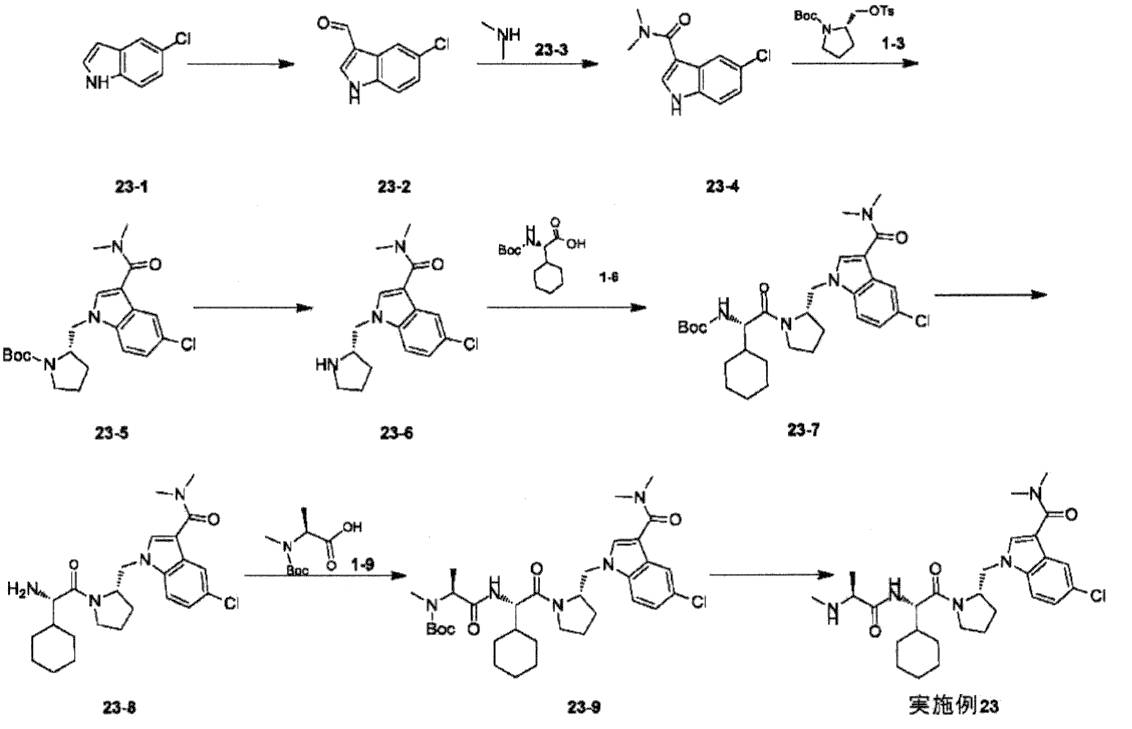
(ステップ1)
0℃において、30分間内でDMF(8.55g、116.97mmol、9mL、5.91当量)溶液にPOCl3(3.96g、25.83mmol、2.40mL、1.31当量)を徐々に滴下した。混合液に化合物23-1(3.0g、19.79mmol、1.0当量)のDMF(3mL)溶液を滴下し、得られた混合物を25℃で1時間撹拌した。TLC(石油エーテル:酢酸エチル=3:1)及びLC-MSは、原料の反応が完全に進行したことを示した。反応液を水(150mL)に徐々に注ぎ、10%NaOH溶液で混合液のpHが9となるように調整してから、酢酸エチルで抽出した(200mL×2)。合体した有機相を飽和食塩水(100mL×2)で洗い、無水硫酸ナトリウムで乾燥してから濃縮することで、化合物23-2を得た。1H NMR(400MHz,DMSO-d6)δ7.28(dd,J=8.66,2.13Hz,1H),7.54(d,J=8.66Hz,1H),8.06(d,J=2.01Hz,1H),8.36(s,1H),9.93(s,1H),12.29(brs,1H);LCMS(ESI)m/z:180.1(M+1).
(ステップ2)
化合物23-2(3g、16.70mmol、1.0当量)及びシアン化ナトリウム(163.72mg、3.34mmol、0.2当量)のDMF(30mL)溶液に化合物23-3(2モル/L、33.41mL、4.0当量)を加え、得られた混合物を30℃で10分間撹拌した。混合物に二酸化マンガン(36.30g、417.59mmol、25.0当量)を数回に分けて加え、得られた混合物を30℃下継続撹拌14時間。LCMSは、原料の反応が完全に進行したことを示した。反応混合物をろ過し、ケーキを酢酸エチル(100mL×2)で洗った。合体した有機相を飽和硫酸第一鉄溶液(50mL×2)、食塩水(100mL)を用いてこの順で洗い、無水硫酸ナトリウムで乾燥してから濃縮することで、化合物23-4を得、粗生成物を次のステップにおいて直接使用した。LCMS(ESI)m/z:223.2(M+1).
(ステップ3)
化合物23-5の製造方法は化合物1-4を参照する。LCMS(ESI)m/z:406.0(M+1).
(ステップ4)
化合物23-6の製造方法は化合物1-5を参照する。1H NMR(400MHz,DMSO-d6)δ1.62-1.77(m,1H),1.80-1.92(m,1H),1.94-2.04(m,1H),2.06-2.17(m,1H),3.04-3.15(m,6H)3.20-3.31(m,1H),3.86(brs,1H),4.52-4.56(m,1H),4.61(brdd,J=14.87,5.08Hz,2H),4.69-4.77(m,1H),4.69-4.77(m,1H),7.26(dd,J=8.72,2.07Hz,1H),7.79(d,J=8.78Hz,1H),7.90(d,J=2.01Hz,1H),8.26(s,1H),9.35(brs,1H),10.04(brs,1H);LCMS(ESI)m/z:306.1(M+1).
(ステップ5)
化合物23-7の製造方法は化合物1-7を参照する。LCMS(ESI)m/z:545.4(M+1)
(ステップ6)
化合物23-8の製造方法は化合物1-8を参照する。LCMS(ESI)m/z:445.0(M+1).
(ステップ7)
化合物23-9の製造方法は化合物1-10を参照する。LCMS(ESI)m/z:630.3(M+1).
(ステップ8)
実施例23の製造方法は実施例1を参照する。1H NMR(400MHz,CD3OD)δ1.00-1.30(m,5H),1.47-1.54(m,3H),1.61(brd,J=12.23Hz,1H),1.65-1.87(m,7H),1.99(brs,1H),2.06-2.23(m,1H),2.64-2.71(m,3H),3.1-3.30(m,6H),3.72(brd,J=6.48Hz,1H),3.83(q,J=8.48Hz,1H),3.90-4.02(m,1H),4.09-4.20(m,1H),4.46(brd,J=7.46Hz,1H),4.51-4.62(m,2H),7.24-7.30(m,1H),7.74(s,1H),7.80(d,J=9.05Hz,1H),7.92(brs,1H);LCMS(ESI)m/z:530.3(M+1).
(Step 1)
Slowly add POCl3 (3.96 g, 25.83 mmol, 2.40 mL, 1.31 eq.) to a solution of DMF (8.55 g, 116.97 mmol, 9 mL, 5.91 eq.) at 0° C. within 30 min. Dripped. A solution of compound 23-1 (3.0 g, 19.79 mmol, 1.0 eq) in DMF (3 mL) was added dropwise to the mixture, and the resulting mixture was stirred at 25° C. for 1 hour. TLC (petroleum ether:ethyl acetate=3:1) and LC-MS indicated complete reaction of starting material. The reaction mixture was gradually poured into water (150 mL), adjusted with 10% NaOH solution to adjust the pH of the mixture to 9, and then extracted with ethyl acetate (200 mL×2). The combined organic phases were washed with saturated brine (100 mL×2), dried over anhydrous sodium sulfate, and concentrated to give compound 23-2. 1 H NMR (400 MHz, DMSO-d 6 ) δ 7.28 (dd, J = 8.66, 2.13 Hz, 1H), 7.54 (d, J = 8.66 Hz, 1H), 8.06 (d , J=2.01 Hz, 1H), 8.36 (s, 1H), 9.93 (s, 1H), 12.29 (brs, 1H); LCMS (ESI) m/z: 180.1 (M+1 ).
(Step 2)
A solution of compound 23-2 (3 g, 16.70 mmol, 1.0 eq.) and sodium cyanide (163.72 mg, 3.34 mmol, 0.2 eq.) in DMF (30 mL) was added with compound 23-3 (2 mol/L , 33.41 mL, 4.0 eq.) was added and the resulting mixture was stirred at 30° C. for 10 minutes. Manganese dioxide (36.30 g, 417.59 mmol, 25.0 eq) was added portionwise to the mixture and the resulting mixture was stirred continuously at 30° C. for 14 hours. LCMS indicated complete reaction of starting material. The reaction mixture was filtered and the cake was washed with ethyl acetate (100 mL x 2). The combined organic phases were washed sequentially with saturated ferrous sulfate solution (50 mL×2), brine (100 mL), dried over anhydrous sodium sulfate and concentrated to give compound 23-4, The crude product was used directly in the next step. LCMS (ESI) m/z: 223.2 (M+1).
(Step 3)
Refer to compound 1-4 for the preparation method of compound 23-5. LCMS (ESI) m/z: 406.0 (M+1).
(Step 4)
Refer to compound 1-5 for the preparation method of compound 23-6. 1 H NMR (400 MHz, DMSO-d 6 ) δ 1.62-1.77 (m, 1H), 1.80-1.92 (m, 1H), 1.94-2.04 (m, 1H), 2.06-2.17 (m, 1H), 3.04-3.15 (m, 6H) 3.20-3.31 (m, 1H), 3.86 (brs, 1H), 4.52 -4.56 (m, 1H), 4.61 (brdd, J = 14.87, 5.08Hz, 2H), 4.69-4.77 (m, 1H), 4.69-4.77 ( m, 1H), 7.26 (dd, J = 8.72, 2.07Hz, 1H), 7.79 (d, J = 8.78Hz, 1H), 7.90 (d, J = 2.01Hz , 1H), 8.26 (s, 1H), 9.35 (brs, 1H), 10.04 (brs, 1H); LCMS (ESI) m/z: 306.1 (M+1).
(Step 5)
Refer to compound 1-7 for the preparation method of compound 23-7. LCMS (ESI) m/z: 545.4 (M+1)
(Step 6)
Refer to compound 1-8 for the preparation method of compound 23-8. LCMS (ESI) m/z: 445.0 (M+1).
(Step 7)
See compound 1-10 for the method of preparing compound 23-9. LCMS (ESI) m/z: 630.3 (M+1).
(Step 8)
Refer to Example 1 for the manufacturing method of Example 23. 1 H NMR (400 MHz, CD 3 OD) δ 1.00-1.30 (m, 5H), 1.47-1.54 (m, 3H), 1.61 (brd, J = 12.23Hz, 1H) , 1.65-1.87 (m, 7H), 1.99 (brs, 1H), 2.06-2.23 (m, 1H), 2.64-2.71 (m, 3H), 3 .1-3.30 (m, 6H), 3.72 (brd, J = 6.48Hz, 1H), 3.83 (q, J = 8.48Hz, 1H), 3.90-4.02 ( m, 1H), 4.09-4.20 (m, 1H), 4.46 (brd, J=7.46Hz, 1H), 4.51-4.62 (m, 2H), 7.24- 7.30 (m, 1 H), 7.74 (s, 1 H), 7.80 (d, J=9.05 Hz, 1 H), 7.92 (brs, 1 H); LCMS (ESI) m/z: 530.3(M+1).

実施例24の製造方法は実施例1を参照する。1H NMR(400MHz,CD3OD)δ8.36-8.23(m,2H),7.79(d,J=8.8Hz,1H),7.27(dd,J=8.8,2.0Hz,1H),4.60-4.44(m,3H),4.21-4.05(m,1H),3.97-3.77(m,2H),3.71(qd,J=10.0,4.0Hz,1H),3.44(spt,J=6.8Hz,1H),2.67(s,3H),2.23-2.07(m,1H),2.06-1.96(m,1H),1.85-1.64(m,8H),1.50(d,J=7.1Hz,3H),1.27-1.05(m,10H);LCMS(ESI)m/z:551.3(M+23). Refer to Example 1 for the manufacturing method of Example 24. 1 H NMR (400 MHz, CD 3 OD) δ 8.36-8.23 (m, 2H), 7.79 (d, J = 8.8 Hz, 1H), 7.27 (dd, J = 8.8, 2.0 Hz, 1H), 4.60-4.44 (m, 3H), 4.21-4.05 (m, 1H), 3.97-3.77 (m, 2H), 3.71 ( qd, J = 10.0, 4.0 Hz, 1 H), 3.44 (spt, J = 6.8 Hz, 1 H), 2.67 (s, 3 H), 2.23-2.07 (m, 1 H ), 2.06-1.96 (m, 1H), 1.85-1.64 (m, 8H), 1.50 (d, J = 7.1Hz, 3H), 1.27-1.05 (m, 10H); LCMS (ESI) m/z: 551.3 (M+23).

(ステップ1)
化合物1-1(0.2g、1.48mmol、1.0当量)のDMF(2mL)溶液に、NBS(276.58mg、1.55mmol、1.05当量)を数回に分けて加え、得られた混合物を15℃で1時間撹拌した。TLC(石油エーテル:酢酸エチル=3:1)は、原料の反応が完全に進行したことを示し、LCMSは生成物があったことを示した。反応液に飽和亜硫酸ナトリウム溶液(2mL)を加え、混合物を酢酸エチル(2mL×3)で抽出した。合体した有機相を濃縮することで、化合物25-1を得、粗生成物を次のステップにおいて直接使用した。LCMS(ESI)m/z:211.9(M-1).
(ステップ2)
窒素雰囲気下で、化合物25-1(1.5g、7.01mmol、1.0当量)のテトラヒドロフラン(18mL)及び水(3.0mL)の混合溶液に、化合物25-2(1.91g、14.02mmol、2.0当量)、リン酸カリウム(2.98g、14.02mmol、2.0当量)及びPd(dppf)Cl2(512.80mg、700.82μmol、0.1当量)を加え、得られた混合物を80℃で16時間撹拌した。LCMSは、原料の反応が完全に進行したことを示した。反応液を無水硫酸ナトリウムで乾燥してからろ過し、ろ液を減圧濃縮して、得られた残留物をシリカゲルカラムクロマトグラフィー(石油エーテル:酢酸エチル=1:0到5:1)で精製することで、化合物25-3を得た。1H NMR(400MHz,DMSO-d6)δ8.07-7.86(m,1H),7.52(d,J=2.4Hz,1H),7.46-7.40(m,1H),7.37-7.30(m,1H),7.26-7.21(m,2H),7.13-7.05(m,2H),6.99(dt,J=9.1,2.3,1H),2.29(s,3H);LCMS(ESI)m/z:224.0(M-1).
(ステップ3)
化合物25-4の製造方法は化合物1-4を参照する。1H NMR(400MHz,CDCl3)δ7.43-7.24(m,5H),7.22-7.13(m,1H),7.13-7.07(m,1H),7.05-6.97(m,1H),4.49-4.36(m,1H),4.31-4.24(m,1H),3.50-3.33(m,1H),3.26-3.11(m,1H),2.35(s,3H),1.95-1.85(m,1H),1.83-1.71(m,2H),1.59-1.46(m,11H);LCMS(ESI)m/z:431.3(M+23).
(ステップ4)
化合物25-5の製造方法は化合物1-5を参照する。LCMS(ESI)m/z:309.2(M+1).
(ステップ5)
化合物25-6の製造方法は化合物1-7を参照する。LCMS(ESI)m/z:548.1(M+1).
(ステップ6)
化合物25-7の製造方法は化合物1-8を参照する。LCMS(ESI)m/z:448.2(M+1).
(ステップ7)
化合物25-8の製造方法は化合物1-10を参照する。LCMS(ESI)m/z:633(M+1).
(ステップ8)
実施例25の製造方法は化合物の実施例1を参照する。1H NMR(400MHz,CD3OD)δ7.70(dd,J=8.9,4.1Hz,1H),7.31(dd,J=4.7,3.2Hz,2H),7.27(s,1H),7.25-7.19(m,2H),7.03-6.94(m,2H),4.62-4.47(m,3H),4.21-4.07(m,1H),3.97-3.88(m,1H),3.86-3.74(m,1H),3.70-3.59(m,1H),2.68(s,3H),2.28(s,3H),2.09-1.57(m,11H),1.52(d,J=6.9Hz,3H),1.39-1.02(m,6H);LCMS(ESI)m/z:533.2(M+1).
(Step 1)
To a DMF (2 mL) solution of compound 1-1 (0.2 g, 1.48 mmol, 1.0 equivalents), NBS (276.58 mg, 1.55 mmol, 1.05 equivalents) was added in portions to obtain The resulting mixture was stirred at 15° C. for 1 hour. TLC (petroleum ether:ethyl acetate=3:1) indicated complete reaction of starting material and LCMS indicated product was present. Saturated sodium sulfite solution (2 mL) was added to the reaction solution and the mixture was extracted with ethyl acetate (2 mL×3). Concentration of the combined organic phases gave compound 25-1 and the crude product was used directly in the next step. LCMS (ESI) m/z: 211.9 (M-1).
(Step 2)
Compound 25-2 (1.91 g, 14 .02 mmol, 2.0 eq), potassium phosphate (2.98 g, 14.02 mmol, 2.0 eq) and Pd(dppf) Cl2 (512.80 mg, 700.82 μmol, 0.1 eq) were added, The resulting mixture was stirred at 80° C. for 16 hours. LCMS indicated complete reaction of starting material. The reaction solution is dried over anhydrous sodium sulfate and filtered, the filtrate is concentrated under reduced pressure, and the obtained residue is purified by silica gel column chromatography (petroleum ether:ethyl acetate=1:0 to 5:1). This gave compound 25-3. 1 H NMR (400 MHz, DMSO-d 6 ) δ 8.07-7.86 (m, 1H), 7.52 (d, J = 2.4 Hz, 1H), 7.46-7.40 (m, 1H ), 7.37-7.30 (m, 1H), 7.26-7.21 (m, 2H), 7.13-7.05 (m, 2H), 6.99 (dt, J = 9 .1, 2.3, 1H), 2.29 (s, 3H); LCMS (ESI) m/z: 224.0 (M-1).
(Step 3)
Refer to compound 1-4 for the preparation method of compound 25-4. 1 H NMR (400 MHz, CDCl 3 ) δ 7.43-7.24 (m, 5H), 7.22-7.13 (m, 1H), 7.13-7.07 (m, 1H), 7. 05-6.97 (m, 1H), 4.49-4.36 (m, 1H), 4.31-4.24 (m, 1H), 3.50-3.33 (m, 1H), 3.26-3.11 (m, 1H), 2.35 (s, 3H), 1.95-1.85 (m, 1H), 1.83-1.71 (m, 2H), 1. 59-1.46 (m, 11H); LCMS (ESI) m/z: 431.3 (M+23).
(Step 4)
Refer to compound 1-5 for the method for preparing compound 25-5. LCMS (ESI) m/z: 309.2 (M+1).
(Step 5)
Refer to compound 1-7 for the preparation method of compound 25-6. LCMS (ESI) m/z: 548.1 (M+1).
(Step 6)
Refer to compound 1-8 for the preparation method of compound 25-7. LCMS (ESI) m/z: 448.2 (M+1).
(Step 7)
Refer to compound 1-10 for the preparation method of compound 25-8. LCMS (ESI) m/z: 633 (M+1).
(Step 8)
The method of preparation of Example 25 refers to Example 1 of the compound. 1 H NMR (400 MHz, CD 3 OD) δ 7.70 (dd, J=8.9, 4.1 Hz, 1 H), 7.31 (dd, J=4.7, 3.2 Hz, 2 H), 7. 27 (s, 1H), 7.25-7.19 (m, 2H), 7.03-6.94 (m, 2H), 4.62-4.47 (m, 3H), 4.21- 4.07 (m, 1H), 3.97-3.88 (m, 1H), 3.86-3.74 (m, 1H), 3.70-3.59 (m, 1H), 2. 68 (s, 3H), 2.28 (s, 3H), 2.09-1.57 (m, 11H), 1.52 (d, J=6.9Hz, 3H), 1.39-1. 02 (m, 6H); LCMS (ESI) m/z: 533.2 (M+1).

実施例26の製造方法は実施例25を参照する。1H NMR(400MHz,CD3OD)δ8.23-8.14(m,1H),8.03-7.93(m,1H),7.88(dd,J=8.9,4.3Hz,1H),7.39(brd,J=9.4Hz,1H),7.12(dt,J=9.1,2.4Hz,1H),6.94-6.85(m,1H),4.65-4.56(m,2H),4.48(d,J=7.5Hz,1H),4.25-4.08(m,4H),4.00-3.91(m,1H),3.90-3.80(m,1H),3.79-3.68(m,1H),2.67(s,3H),2.30-2.13(m,1H),2.05-1.95(m,1H),1.90-1.60(m,8H),1.51(d,J=7.0Hz,3H),1.38-1.01(m,6H);LCMS(ESI)m/z:523.3(M+1). See Example 25 for the manufacturing method of Example 26. 1 H NMR (400 MHz, CD 3 OD) δ 8.23-8.14 (m, 1H), 8.03-7.93 (m, 1H), 7.88 (dd, J = 8.9, 4. 3Hz, 1H), 7.39 (brd, J = 9.4Hz, 1H), 7.12 (dt, J = 9.1, 2.4Hz, 1H), 6.94-6.85 (m, 1H) ), 4.65-4.56 (m, 2H), 4.48 (d, J = 7.5Hz, 1H), 4.25-4.08 (m, 4H), 4.00-3.91 (m, 1H), 3.90-3.80 (m, 1H), 3.79-3.68 (m, 1H), 2.67 (s, 3H), 2.30-2.13 (m , 1H), 2.05-1.95 (m, 1H), 1.90-1.60 (m, 8H), 1.51 (d, J = 7.0Hz, 3H), 1.38-1 LCMS (ESI) m/z: 523.3 (M+1).

実施例27の製造方法は実施例25を参照する。1H NMR(400MHz,DMSO-d6)δ7.83-7.95(m,2H),7.82(s,1H),7.53-7.59(m,1H),7.47-7.53(m,1H),7.29(dd,J=8.78,2.01Hz,1H),6.48(d,J=1.76Hz,1H),4.34-4.53(m,3H),4.10(dd,J=13.05,8.03Hz,1H),3.86-3.89(m,3H),3.61(brd,J=8.03Hz,2H),2.97(q,J=6.69Hz,1H),2.17(s,3H),1.98-2.07(m,1H),1.78-1.92(m,2H),1.51-1.77(m,9H),1.14(brs,1H),1.09(d,J=6.78Hz,4H),0.89-1.04(m,2H);LCMS(ESI)m/z:539.3(M+1). See Example 25 for the manufacturing method of Example 27. 1 H NMR (400 MHz, DMSO-d 6 ) δ 7.83-7.95 (m, 2H), 7.82 (s, 1H), 7.53-7.59 (m, 1H), 7.47- 7.53 (m, 1H), 7.29 (dd, J=8.78, 2.01Hz, 1H), 6.48 (d, J=1.76Hz, 1H), 4.34-4.53 (m, 3H), 4.10 (dd, J = 13.05, 8.03Hz, 1H), 3.86-3.89 (m, 3H), 3.61 (brd, J = 8.03Hz, 2H), 2.97 (q, J = 6.69Hz, 1H), 2.17 (s, 3H), 1.98-2.07 (m, 1H), 1.78-1.92 (m, 2H), 1.51-1.77 (m, 9H), 1.14 (brs, 1H), 1.09 (d, J = 6.78Hz, 4H), 0.89-1.04 (m, 2H); LCMS (ESI) m/z: 539.3 (M+1).

(ステップ1)
20℃において、化合物23-1(1.0g、6.60mmol、1.0当量)のDMF(20mL)溶液にヨウ素(1.67g、6.60mmol、1.0当量)のDMF(20mL)溶液及び水酸化カリウム(0.92g、16.49mmol、2.5当量)を加え、得られた混合物を20℃で1時間撹拌して反応させた。TLC(石油エーテル:酢酸エチル=3:1)で原料の反応が完全に進行したと確認された。反応液を飽和亜硫酸ナトリウム水溶液(100mL)に徐々に注いだ後、酢酸エチル(100mL)で抽出した。合体した有機相を飽和食塩水(100mL)で洗ってから濃縮することで、化合物28-1を得た。粗生成物を次のステップにおいて直接使用した。LCMS(ESI)m/z:277.9(M+1).
(ステップ2)
化合物28-1(1.5g、5.41mmol、1.0当量)のジクロロメタン(50mL)溶液にBoc2O(1.42g、6.49mmol、1.49mL、1.2当量)、TEA(1.64g、16.22mmol、1当量)及びDMAP(66mg、0.54mmol、0.1当量)を加えた。得られた混合物を20℃で10時間撹拌して反応させた。TLC(石油エーテル:酢酸エチル=10:1)で原料の反応が完全に進行したと確認された。反応を濃縮し、得られた残留物をシリカゲルカラムクロマトグラフィー(石油エーテル:酢酸エチル=20:1~10:1)で精製することで、化合物28-2を得た。1H NMR(400MHz,DMSO-d6)δ8.01(d,J=8.8Hz,1H),7.91(s,1H),7.39(dd,J=8.8,2.0Hz,1H),7.30(d,J=1.8Hz,1H),1.61(s,9H);LCMS(ESI)m/z:378.0(M+1).
(ステップ3)
窒素雰囲気下で、化合物28-2(1.5g、3.97mmol、1.0当量)のジオキサン(40mL)溶液に化合物28-3(1.01g、11.92mmol、0.91mL、3.0当量)、ヨウ化第一銅(0.37mg、1.99mmol、0.5当量)、炭酸セシウム(3.88g、11.92mmol、3.0当量)、N,N-ジメチルエチレンジアミン(0.35g、3.97mmol、1.0当量)を加えた。反応液を80℃まで加熱し、2.0時間反応させた。LCMSは、原料の反応が完全に進行したことを示した。反応液を20℃に冷却してろ過し、ケーキを酢酸エチル(50mL)で洗い、ろ液を濃縮した。得られた残留物をシリカゲルカラムクロマトグラフィー(石油エーテル:酢酸エチル=5:1~1:1)で精製することで、化合物28-4を得た。1H NMR(400MHz,CDCl3)δ8.97(brs,1H),7.53(d,J=1.8Hz,1H),7.19-7.01(m,3H),3.92(t,J=7.0Hz,2H),2.64(t,J=8.2Hz,2H),2.32-2.24(m,2H);LCMS(ESI)m/z:234.1(M+1).
(ステップ4)
化合物28-5の製造方法は化合物1-4を参照する。1H NMR(400MHz,CDCl3)δ7.61(brd,J=6.1Hz,1H),7.48(brd,J=8.7Hz,1H),7.44-7.38(m,1H),7.32(brd,J=8.7Hz,1H),7.15(dd,J=8.8,1.9Hz,1H),4.22-4.13(m,1H),3.98(brt,J=7.0Hz,2H),3.45-3.15(m,2H),2.95(s,1H),2.87(s,1H),2.59(t,J=8.1Hz,2H),2.30-2.16(m,2H),1.93-1.65(m,4H),1.50(s,10H);LCMS(ESI)m/z:418.2(M+1).
(ステップ5)
化合物28-6の製造方法は化合物1-5を参照する。LCMS(ESI)m/z:318.1(M+1).
(ステップ6)
化合物28-7の製造方法は化合物1-7を参照する。LCMS(ESI)m/z:557.3(M+1).
(ステップ7)
化合物28-8の製造方法は化合物1-8を参照する。LCMS(ESI)m/z:457.2(M+1).
(ステップ8)
化合物28-9の製造方法は化合物1-10を参照する。LCMS(ESI)m/z:642.3(M+1).
(ステップ9)
実施例28の製造方法は実施例1を参照する。1H NMR(400MHz,DMSO-d6)δ9.41(brs,1H),9.08-8.72(m,2H),7.84-7.49(m,3H),7.26-7.09(m,1H),4.51-4.23(m,3H),4.10-3.79(m,4H),3.72-3.51(m,1H),2.46(brs,6H),2.14(brd,J=6.0Hz,2H),1.95(brs,1H),1.90-1.54(m,9H),1.35(brd,J=6.2Hz,3H),1.29-0.94(m,6H);LCMS(ESI)m/z:542.3(M+1).
(Step 1)
A DMF (20 mL) solution of iodine (1.67 g, 6.60 mmol, 1.0 eq) in a DMF (20 mL) solution of compound 23-1 (1.0 g, 6.60 mmol, 1.0 eq) at 20°C. and potassium hydroxide (0.92 g, 16.49 mmol, 2.5 eq) were added and the resulting mixture was stirred at 20° C. for 1 hour to react. It was confirmed by TLC (petroleum ether:ethyl acetate=3:1) that the reaction of the starting materials had proceeded to completion. The reaction solution was gradually poured into saturated aqueous sodium sulfite solution (100 mL) and then extracted with ethyl acetate (100 mL). The combined organic phases were washed with saturated brine (100 mL) and concentrated to give compound 28-1. The crude product was used directly in the next step. LCMS (ESI) m/z: 277.9 (M+1).
(Step 2)
Boc 2 O (1.42 g, 6.49 mmol, 1.49 mL, 1.2 eq), TEA (1 .64 g, 16.22 mmol, 1 eq) and DMAP (66 mg, 0.54 mmol, 0.1 eq) were added. The resulting mixture was stirred at 20° C. for 10 hours to react. It was confirmed by TLC (petroleum ether:ethyl acetate=10:1) that the reaction of the raw materials proceeded to completion. The reaction was concentrated and the resulting residue was purified by silica gel column chromatography (petroleum ether:ethyl acetate=20:1-10:1) to give compound 28-2. 1 H NMR (400 MHz, DMSO-d 6 ) δ 8.01 (d, J = 8.8 Hz, 1 H), 7.91 (s, 1 H), 7.39 (dd, J = 8.8, 2.0 Hz , 1H), 7.30 (d, J=1.8 Hz, 1H), 1.61 (s, 9H); LCMS (ESI) m/z: 378.0 (M+1).
(Step 3)
Compound 28-3 (1.01 g, 11.92 mmol, 0.91 mL, 3.0 mL) was added to a solution of compound 28-2 (1.5 g, 3.97 mmol, 1.0 eq.) in dioxane (40 mL) under a nitrogen atmosphere. equivalents), cuprous iodide (0.37 mg, 1.99 mmol, 0.5 equivalents), cesium carbonate (3.88 g, 11.92 mmol, 3.0 equivalents), N,N-dimethylethylenediamine (0.35 g , 3.97 mmol, 1.0 eq.) was added. The reaction solution was heated to 80° C. and reacted for 2.0 hours. LCMS indicated complete reaction of starting material. The reaction mixture was cooled to 20° C. and filtered, the cake was washed with ethyl acetate (50 mL), and the filtrate was concentrated. The resulting residue was purified by silica gel column chromatography (petroleum ether:ethyl acetate=5:1-1:1) to give compound 28-4. 1 H NMR (400 MHz, CDCl 3 ) δ 8.97 (brs, 1H), 7.53 (d, J = 1.8 Hz, 1H), 7.19-7.01 (m, 3H), 3.92 ( t, J = 7.0 Hz, 2H), 2.64 (t, J = 8.2 Hz, 2H), 2.32-2.24 (m, 2H); LCMS (ESI) m/z: 234.1 (M+1).
(Step 4)
Refer to compound 1-4 for the preparation method of compound 28-5. 1 H NMR (400 MHz, CDCl 3 ) δ 7.61 (brd, J=6.1 Hz, 1 H), 7.48 (brd, J=8.7 Hz, 1 H), 7.44-7.38 (m, 1 H ), 7.32 (brd, J = 8.7Hz, 1H), 7.15 (dd, J = 8.8, 1.9Hz, 1H), 4.22-4.13 (m, 1H), 3 .98 (brt, J = 7.0 Hz, 2H), 3.45-3.15 (m, 2H), 2.95 (s, 1H), 2.87 (s, 1H), 2.59 (t , J = 8.1 Hz, 2H), 2.30-2.16 (m, 2H), 1.93-1.65 (m, 4H), 1.50 (s, 10H); LCMS (ESI) m /z: 418.2(M+1).
(Step 5)
Refer to compound 1-5 for the preparation method of compound 28-6. LCMS (ESI) m/z: 318.1 (M+1).
(Step 6)
Refer to compound 1-7 for the preparation method of compound 28-7. LCMS (ESI) m/z: 557.3 (M+1).
(Step 7)
Refer to compound 1-8 for the preparation method of compound 28-8. LCMS (ESI) m/z: 457.2 (M+1).
(Step 8)
See compound 1-10 for the method of preparing compound 28-9. LCMS (ESI) m/z: 642.3 (M+1).
(Step 9)
Refer to Example 1 for the manufacturing method of Example 28. 1 H NMR (400 MHz, DMSO-d 6 ) δ 9.41 (brs, 1H), 9.08-8.72 (m, 2H), 7.84-7.49 (m, 3H), 7.26- 7.09 (m, 1H), 4.51-4.23 (m, 3H), 4.10-3.79 (m, 4H), 3.72-3.51 (m, 1H), 2. 46 (brs, 6H), 2.14 (brd, J=6.0Hz, 2H), 1.95 (brs, 1H), 1.90-1.54 (m, 9H), 1.35 (brd, J=6.2 Hz, 3H), 1.29-0.94 (m, 6H); LCMS (ESI) m/z: 542.3 (M+1).

実施例29の製造方法は実施例28を参照する。1H NMR(400MHz,CD3OD)δ7.67(d,J=8.8Hz,1H),7.57(d,J=1.8Hz,1H),7.31(s,1H),7.15(dd,J=8.7,1.9Hz,1H),4.59-4.38(m,4H),4.08-3.98(m,1H),3.96-3.90(m,1H),3.88-3.81(m,2H),3.81-3.74(m,1H),3.72-3.64(m,1H),3.61-3.53(m,2H),2.89(s,4H),2.67(s,3H),1.93(brd,J=9.7Hz,2H),1.88-1.66(m,9H),1.52-1.49(m,3H),1.36-1.08(m,6H);LCMS(ESI)m/z:557.3(M+1). See Example 28 for the manufacturing method of Example 29. 1 H NMR (400 MHz, CD 3 OD) δ 7.67 (d, J=8.8 Hz, 1 H), 7.57 (d, J=1.8 Hz, 1 H), 7.31 (s, 1 H), 7 .15 (dd, J=8.7, 1.9 Hz, 1H), 4.59-4.38 (m, 4H), 4.08-3.98 (m, 1H), 3.96-3. 90 (m, 1H), 3.88-3.81 (m, 2H), 3.81-3.74 (m, 1H), 3.72-3.64 (m, 1H), 3.61- 3.53 (m, 2H), 2.89 (s, 4H), 2.67 (s, 3H), 1.93 (brd, J = 9.7Hz, 2H), 1.88-1.66 ( m, 9H), 1.52-1.49 (m, 3H), 1.36-1.08 (m, 6H); LCMS (ESI) m/z: 557.3 (M+1).

実施例30の製造方法は実施例28を参照する。1H NMR(400MHz,CD3OD)δ7.70(d,J=8.8Hz,1H),7.63(d,J=2.0Hz,1H),7.45(s,1H),7.21-7.14(m,1H),4.60-4.55(m,2H),4.54-4.43(m,3H),4.12(dt,J=8.1,3.5Hz,2H),4.07-3.98(m,1H),3.97-3.89(m,1H),3.84-3.75(m,1H),3.73-3.64(m,1H),2.67(s,3H),2.00-1.89(m,2H),1.87-1.76(m,6H),1.71(brd,J=10.8Hz,2H),1.51(d,J=7.0Hz,3H),1.36-1.06(m,6H);LCMS(ESI)m/z:544.3(M+1). See Example 28 for the manufacturing method of Example 30. 1 H NMR (400 MHz, CD 3 OD) δ 7.70 (d, J=8.8 Hz, 1 H), 7.63 (d, J=2.0 Hz, 1 H), 7.45 (s, 1 H), 7 .21-7.14 (m, 1H), 4.60-4.55 (m, 2H), 4.54-4.43 (m, 3H), 4.12 (dt, J = 8.1, 3.5Hz, 2H), 4.07-3.98 (m, 1H), 3.97-3.89 (m, 1H), 3.84-3.75 (m, 1H), 3.73- 3.64 (m, 1H), 2.67 (s, 3H), 2.00-1.89 (m, 2H), 1.87-1.76 (m, 6H), 1.71 (brd, J=10.8 Hz, 2H), 1.51 (d, J=7.0 Hz, 3H), 1.36-1.06 (m, 6H); LCMS (ESI) m/z: 544.3 (M+1 ).

(ステップ1)
化合物31-1(10g、43.24mmol、1.0当量)のDMF(100mL)溶液に炭酸カリウム(17.93g、129.73mmol、3.0当量)及びヨウ化メチル(9.21g、64.87mmol、4.04mL、1.5当量)を加え、得られた混合物を15℃で5時間反応させた。TLC(石油エーテル:酢酸エチル=1:1)は反応が完全に進行したことを示した。反応液に水(100mL)を加え、得られた混合物を酢酸エチル(100mL×2)で抽出した。合体した有機相を飽和食塩水(100mL×3)で洗ってから濃縮することで、化合物31-2を得た。粗生成物を次のステップにおいて直接使用した。
(Step 1)
To a solution of compound 31-1 (10 g, 43.24 mmol, 1.0 eq) in DMF (100 mL) was added potassium carbonate (17.93 g, 129.73 mmol, 3.0 eq) and methyl iodide (9.21 g, 64.0 eq). 87 mmol, 4.04 mL, 1.5 eq.) was added and the resulting mixture was allowed to react at 15° C. for 5 hours. TLC (petroleum ether:ethyl acetate=1:1) indicated that the reaction had gone to completion. Water (100 mL) was added to the reaction solution, and the resulting mixture was extracted with ethyl acetate (100 mL×2). The combined organic phases were washed with saturated brine (100 mL×3) and concentrated to give compound 31-2. The crude product was used directly in the next step.
(ステップ2)
窒素雰囲気下で、化合物31-2(9.0g、36.69mmol、1.0当量)のテトラヒドロフラン(150mL)溶液にフェノール(3.8g、40.36mmol、3.55mL、1.1当量)、トリフェニルホスフィン(10.59g、40.36mmol、1.1当量)及びDIAD(8.16g、40.36mmol、7.85mL、1.1当量)を加えた。得られた混合物を15℃で12時間撹拌した。LCMSは反応が完全に進行したことを示した。反応液を濃縮し、得られた残留物に水(100mL)、酢酸エチル(200mL)を加えて、分液した。有機相を飽和食塩水(100mL×2)で洗ってから濃縮することで、化合物31-3を得た。粗生成物を次のステップにおいて直接使用した。LCMS(ESI)m/z:322.2(M+1).
(ステップ3)
0℃において、化合物31-3(9g、28.01mmol、1.0当量)のテトラヒドロフラン(100mL)溶液に水素化アルミニウムリチウム(1.59g、42.01mmol、1.5当量)を加え、得られた混合物を15℃で2時間反応させた。LCMSは反応が完全に進行したことを示した。反応液に水(3mL)、30%水酸化ナトリウム溶液(6mL)、水(3mL)をこの順で滴下して反応を止めた。得られた混合物をろ過し、ケーキを酢酸エチル(100mL)で洗い、ろ液を濃縮した。得られた残留物をシリカゲルカラムクロマトグラフィー(石油エーテル:酢酸エチル=10:~2:1)で精製することで、化合物31-4を得た。LCMS(ESI)m/z:316.2(M+23).
(ステップ4)
0℃において、化合物31-4(5g、17.04mmol、1.0当量)のジクロロメタン(150mL)溶液にピリジン(4.04g、51.13mmol、4.13mL、3.0当量)及びp-トルエンスルホニルクロリド(6.50g、34.09mmol、2.0当量)を加え、得られた混合物を15℃で10時間撹拌した。LCMSは反応が完全に進行したことを示した。反応液を濃縮し、得られた残留物をシリカゲルカラムクロマトグラフィー(石油エーテル:酢酸エチル=20:1~3:1)で精製することで、化合物31-5を得た。LCMS(ESI)m/z:470.2(M+23).
(ステップ5)
化合物31-7の製造方法は化合物1-4を参照する。LCMS(ESI)m/z:453.1(M+1).
(ステップ6)
化合物31-8の製造方法は化合物1-5を参照する。
(Step 2)
Under a nitrogen atmosphere, phenol (3.8 g, 40.36 mmol, 3.55 mL, 1.1 eq) was added to a solution of compound 31-2 (9.0 g, 36.69 mmol, 1.0 eq) in tetrahydrofuran (150 mL). Triphenylphosphine (10.59 g, 40.36 mmol, 1.1 eq) and DIAD (8.16 g, 40.36 mmol, 7.85 mL, 1.1 eq) were added. The resulting mixture was stirred at 15° C. for 12 hours. LCMS indicated the reaction had gone to completion. The reaction mixture was concentrated, and water (100 mL) and ethyl acetate (200 mL) were added to the resulting residue to separate the layers. The organic phase was washed with saturated brine (100 mL×2) and concentrated to give compound 31-3. The crude product was used directly in the next step. LCMS (ESI) m/z: 322.2 (M+1).
(Step 3)
Lithium aluminum hydride (1.59 g, 42.01 mmol, 1.5 eq.) was added to a solution of compound 31-3 (9 g, 28.01 mmol, 1.0 eq.) in tetrahydrofuran (100 mL) at 0° C. to give The mixture was reacted at 15°C for 2 hours. LCMS indicated the reaction had gone to completion. Water (3 mL), 30% sodium hydroxide solution (6 mL) and water (3 mL) were added dropwise to the reaction solution in this order to terminate the reaction. The resulting mixture was filtered, the cake was washed with ethyl acetate (100 mL) and the filtrate was concentrated. The obtained residue was purified by silica gel column chromatography (petroleum ether:ethyl acetate=10:-2:1) to obtain compound 31-4. LCMS (ESI) m/z: 316.2 (M+23).
(Step 4)
To a solution of compound 31-4 (5 g, 17.04 mmol, 1.0 eq.) in dichloromethane (150 mL) at 0° C. was added pyridine (4.04 g, 51.13 mmol, 4.13 mL, 3.0 eq.) and p-toluene. Sulfonyl chloride (6.50 g, 34.09 mmol, 2.0 eq) was added and the resulting mixture was stirred at 15° C. for 10 hours. LCMS indicated the reaction had gone to completion. The reaction solution was concentrated, and the obtained residue was purified by silica gel column chromatography (petroleum ether:ethyl acetate=20:1-3:1) to obtain compound 31-5. LCMS (ESI) m/z: 470.2 (M+23).
(Step 5)
Refer to compound 1-4 for the preparation method of compound 31-7. LCMS (ESI) m/z: 453.1 (M+1).
(Step 6)
Refer to compound 1-5 for the preparation method of compound 31-8.
(ステップ7)
化合物31-9の製造方法は化合物1-7を参照する。LCMS(ESI)m/z:592.1(M+1).
(ステップ8)
化合物31-10の製造方法は化合物1-8を参照する。
(Step 7)
Refer to compound 1-7 for the preparation method of compound 31-9. LCMS (ESI) m/z: 592.1 (M+1).
(Step 8)
Refer to compound 1-8 for the preparation method of compound 31-10.
(ステップ9)
化合物31-11の製造方法は化合物1-10を参照する。LCMS(ESI)m/z:677.2(M+1).
(ステップ10)
実施例31の製造方法は実施例1を参照する。1H NMR(400MHz,DMSO-d6)δ9.60-9.34(m,1H),8.98-8.83(m, 1H),8.80(d,J=7.8Hz,1H),7.98(s,1H),7.83(dd,J=9.8,2.6Hz,1H),7.73(dd,J=9.0,4.5Hz,1H),7.44-7.34(m,2H),7.15-7.08(m,3H),7.07-7.01(m,1H),5.22(brs,1H),4.73-4.56(m,2H),4.37(t,J=7.6Hz,1H),4.33-4.22(m,1H),4.10(dd,J=11.8,4.6Hz,1H),3.93-3.83(m,2H),2.45(brt,J=5.2Hz,4H),2.31(s,3H),2.21-2.09(m,1H),2.00(brd,J=14.2Hz,1H),1.71-1.55(m,6H),1.35(d,J=6.8Hz,3H),1.22-0.92(m,6H);LCMS(ESI)m/z:577.2(M+1).
本発明に係る化合物はIAP阻害剤である。以下の実験結果は、本特許出願に記載の化合物がIAP阻害剤であり、潜在的な抗癌剤として使用できることを示す。本明細書で使用されるIC50とは、最大阻害の50%をを引き起こす試薬の濃度を意味する。
[実験例一:cIAP1 BIR3及びXIAP BIR3との結合実験]
(実験材料)
試験のバッファ系(cIAP1 BIR3又はXIAP BIR3のバッファ):100mMのリン酸カリウム、pH 7.5、0.1%BSA、0.005%トリトンX-100及び1%ジメチルスルホキシド。
プローブ:ARPFAQ-K(5-FAM)-NH2。
(Step 9)
See compound 1-10 for the method of preparing compound 31-11. LCMS (ESI) m/z: 677.2 (M+1).
(Step 10)
Refer to Example 1 for the manufacturing method of Example 31. 1 H NMR (400 MHz, DMSO-d 6 ) δ 9.60-9.34 (m, 1H), 8.98-8.83 (m, 1H), 8.80 (d, J = 7.8Hz, 1H ), 7.98 (s, 1H), 7.83 (dd, J = 9.8, 2.6Hz, 1H), 7.73 (dd, J = 9.0, 4.5Hz, 1H), 7 .44-7.34 (m, 2H), 7.15-7.08 (m, 3H), 7.07-7.01 (m, 1H), 5.22 (brs, 1H), 4.73 −4.56 (m, 2H), 4.37 (t, J=7.6Hz, 1H), 4.33-4.22 (m, 1H), 4.10 (dd, J=11.8, 4.6Hz, 1H), 3.93-3.83 (m, 2H), 2.45 (brt, J=5.2Hz, 4H), 2.31 (s, 3H), 2.21-2. 09 (m, 1H), 2.00 (brd, J=14.2Hz, 1H), 1.71-1.55 (m, 6H), 1.35 (d, J=6.8Hz, 3H), 1.22-0.92 (m, 6H); LCMS (ESI) m/z: 577.2 (M+1).
The compounds according to the invention are IAP inhibitors. The following experimental results demonstrate that the compounds described in this patent application are IAP inhibitors and can be used as potential anti-cancer agents. As used herein, IC50 means the concentration of reagent that causes 50% of maximal inhibition.
[Experimental Example 1: Binding experiment with cIAP1 BIR3 and XIAP BIR3]
(experiment material)
Test buffer system (cIAP1 BIR3 or XIAP BIR3 buffer): 100 mM potassium phosphate, pH 7.5, 0.1% BSA, 0.005% Triton X-100 and 1% dimethylsulfoxide.
Probe: ARPFAQ-K(5-FAM)-NH 2 .
標的:
cIAP1-BIR3-his:RBC Cat#APT-11-370、ヒトcIAP1のBIR3ドメイン(アミノ酸258~363を含む;cIAP1 BIR3)をGST融合タンパク質として大腸菌(E.coli)で発現させて精製したもの。
target:
cIAP1-BIR3-his: RBC Cat#APT-11-370, the BIR3 domain of human cIAP1 (comprising amino acids 258-363; cIAP1 BIR3) as a GST fusion protein expressed in E. coli and purified.
XIAP-BIR3-his:RBC Cat#APT-11-374、XIAPのBIR3ドメイン(アミノ酸255~356を含む;XIAP BIR3)をGST融合タンパク質として大腸菌(E.coli)で発現させて精製したもの。 XIAP-BIR3-his: RBC Cat#APT-11-374, the BIR3 domain of XIAP (comprising amino acids 255-356; XIAP BIR3) as a GST fusion protein expressed in E. coli and purified.
反応条件:
5nM ARPFAQ-K(5-FAM)-NH2,20nM cIAP1 BIR3及び30nM XIAP BIR3。
Reaction conditions:
5 nM ARPFAQ-K(5-FAM) -NH2, 20 nM cIAP1 BIR3 and 30 nM XIAP BIR3.
(実験手順)
まず、cIAP1 BIR3又はXIAP BIR3の新鮮なバッファを調製し、そして2倍量のcIAP1 BIR3又はXIAP BIR3の溶液を加え、さらに、100%DMSOに溶解した試験化合物を音響技術によりcIAP1 BIR3又はXIAP BIR3のバッファ溶液に加えた後、2倍量のプローブを添加し、室温下で暗所において混合して60分間インキュベートし、蛍光偏光を測定してmP値を算出し、最後にIC50値を求める。
(Experimental procedure)
First, a fresh buffer of cIAP1 BIR3 or XIAP BIR3 was prepared, and a solution of 2 volumes of cIAP1 BIR3 or XIAP BIR3 was added. After adding to the buffer solution, double the amount of probe is added, mixed and incubated at room temperature in the dark for 60 minutes, fluorescence polarization is measured to calculate the mP value, and finally the IC50 value is determined.
(実験結果)
表1に示す。
(Experimental result)
Table 1 shows.
(実験の結論)
本発明の化合物はcIAP1 BIR3結合活性を示し、cIAP1 及びXIAPに対する選択性を有する。
[実験例二:インビトロ細胞生存率試験]
(実験材料)
RPMI 1640培地(Invitrogen-22400089)、ウシ胎児血清(Invitrogen-10099141)、Trypsin、0.05%(1X)with EDTA 4Na(Invitrogen-25300062)、発光法細胞生存率検出キット(Promega-G7573)、ダルベッコのリン酸緩衝生理食塩水(HyClone-SH30028.01B)、384ウェルプレート(Corning-6007680)。Envisionマルチマークアナライザー。
(Conclusion of the experiment)
The compounds of the invention exhibit cIAP1 BIR3 binding activity and have selectivity for cIAP1 and XIAP.
[Experimental Example 2: In vitro cell viability test]
(experiment material)
RPMI 1640 Medium (Invitrogen-22400089), Fetal Bovine Serum (Invitrogen-10099141), Trypsin, 0.05% (1X) with EDTA 4Na (Invitrogen-25300062), Luminescence Cell Viability Detection Kit (Promega-G7573), Dulbecco phosphate-buffered saline (HyClone-SH30028.01B), 384-well plate (Corning-6007680). Envision multimark analyzer.
(実験方法)
(1)384ウェルプレートのウェルに、250個のMDA-MB-231細胞を含む30μLのMDA-MB-231細胞懸濁液を加えた。
(experimental method)
(1) 30 μL of MDA-MB-231 cell suspension containing 250 MDA-MB-231 cells was added to wells of a 384-well plate.
(2)20μLの試験化合物(10μMの高濃度とした試験化合物の5倍希釈の連続した10段階の濃度勾配を形成したもの)を加えた後、細胞プレートを二酸化炭素インキュベーターに入れて7日間インキュベートした。 (2) After adding 20 μL of test compound (concentration of 5-fold serial dilutions of test compound to a high concentration of 10 μM to form a 10-step concentration gradient), place the cell plate in a carbon dioxide incubator and incubate for 7 days. bottom.
(3)細胞プレートを室温下で30分間水平に静置した。
(4)細胞プレートにPromega CellTiter-Glo試薬を1ウェルにつき20μLで加えた。
(3) The cell plate was placed horizontally at room temperature for 30 minutes.
(4) Promega CellTiter-Glo reagent was added to the cell plate at 20 μL per well.
(5)10分後、Envisionマルチマークアナライザーにより分析した。
(実験結果)
表1に示す。
(5) After 10 minutes, analyzed by Envision multimark analyzer.
(Experimental result)
Table 1 shows.
(実験の結論)
本発明の化合物はMDA-MB-231細胞増殖抑制作用を有する。
(Conclusion of the experiment)
The compounds of the present invention have MDA-MB-231 cytostatic activity.

[実験例三:インビボ有効性試験1]
MDA-MB-231トリプルネガティブ乳癌患者由来のヒト腫瘍細胞系の異種移植を皮下で行った(CDX)BALB/cヌードマウスによるインビボ有効性試験
(実験の操作)
メス、6~8週齢、体重約18~22gのBALB/cヌードマウスを、病原菌を含まない特別な環境において維持し、単一換気ケージ(ケージ当たり3匹のマウス)で飼育した。すべてのケージ、寝具、水は使用前に消毒された。すべての動物に市販の規格認証実験食を自由に摂食させた。上海シプルビック実験動物有限公司(Shanghai BK Laboratory Animal Co.,LTD)から購入した合計48匹のマウスを試験に用いた。腫瘍成長のために、各マウスの右脇腹の皮下に腫瘍細胞(リン酸バッファ中の10×106個)を移植した。平均腫瘍体積が約147mm3に達したとき、薬物を投与し始めた。試験化合物を30mg/kgの用量で毎日経口投与した。腫瘍体積を3日毎に二次元キャリパーで測定し、体積をmm3単位で下記の式により求めた。
[Experimental Example 3: In vivo efficacy test 1]
In Vivo Efficacy Study with (CDX) BALB/c Nude Mice Xenografted Subcutaneously with MDA-MB-231 Triple-Negative Breast Cancer Patient-Derived Human Tumor Cell Line (Experimental Manipulation)
BALB/c nude mice, female, 6-8 weeks old, weighing approximately 18-22 g, were maintained in a special pathogen-free environment and housed in single-ventilated cages (3 mice per cage). All cages, bedding, and water were disinfected prior to use. All animals were fed a commercial standard-approved laboratory chow ad libitum. A total of 48 mice purchased from Shanghai BK Laboratory Animal Co., LTD were used in the test. For tumor growth, each mouse was implanted with tumor cells (10×10 6 in phosphate buffer) subcutaneously on the right flank. Drug administration began when the mean tumor volume reached approximately 147 mm 3 . Test compounds were administered orally daily at a dose of 30 mg/kg. Tumor volume was measured with a two-dimensional caliper every 3 days and the volume was calculated in mm 3 by the following formula.

式中、aとbはそれぞれ腫瘍の長径と短径である。
抗腫瘍効果は、化合物で処理された動物の平均腫瘍増加量を未処理動物の平均腫瘍増加量で割ることにより確認した。
where a and b are the major and minor diameters of the tumor, respectively.
Anti-tumor efficacy was determined by dividing the mean tumor volume of compound-treated animals by the mean tumor volume of untreated animals.
(実験結果)
表2に示す。
(Experimental result)
Table 2 shows.
(実験の結論)
MDA-MB-231トリプルネガティブ乳癌CDXインビボ有効性モデルにおいて、本発明の化合物は有効性を示した。
(Conclusion of the experiment)
Compounds of the invention demonstrated efficacy in the MDA-MB-231 triple-negative breast cancer CDX in vivo efficacy model.

[実験例四:インビボ有効性試験2]
MDA-MB-231トリプルネガティブ乳癌患者由来のヒト腫瘍細胞系の異種移植を皮下で行った(CDX)BALB/cヌードマウスによるインビボ有効性試験。
[Experimental Example 4: In vivo efficacy test 2]
In vivo efficacy study in (CDX) BALB/c nude mice xenografted subcutaneously with a human tumor cell line derived from an MDA-MB-231 triple-negative breast cancer patient.
(実験の操作)
メス、6~8週齢、体重約18~22gのBALB/cヌードマウスを、病原菌を含まない特別な環境において維持し、単一換気ケージ(ケージ当たり3匹のマウス)で飼育した。すべてのケージ、寝具、水は使用前に消毒された。すべての動物に市販の規格認証実験食を自由に摂食させた。上海シプルビック実験動物有限公司(Shanghai BK Laboratory Animal Co.,LTD)から購入した合計48匹のマウスを試験に用いた。腫瘍成長のために、各マウスの右脇腹の皮下に腫瘍細胞(リン酸バッファ中の10×106個)を移植した。平均腫瘍体積が約110立方ミリメートルに達したとき、薬物を投与し始めた。試験化合物を30mg/kgの用量で毎日経口投与した。腫瘍体積を3日毎に二次元キャリパーで測定し、体積をmm3単位で下記の式により求めた。
(Experimental operation)
BALB/c nude mice, female, 6-8 weeks old, weighing approximately 18-22 g, were maintained in a special pathogen-free environment and housed in single-ventilated cages (3 mice per cage). All cages, bedding, and water were disinfected prior to use. All animals were fed a commercial standard-approved laboratory chow ad libitum. A total of 48 mice purchased from Shanghai BK Laboratory Animal Co., LTD were used in the test. For tumor growth, each mouse was implanted with tumor cells (10×10 6 in phosphate buffer) subcutaneously on the right flank. Drug administration began when the mean tumor volume reached approximately 110 cubic millimeters. Test compounds were administered orally daily at a dose of 30 mg/kg. Tumor volume was measured with a two-dimensional caliper every 3 days and the volume was calculated in mm 3 by the following formula.

式中、aとbはそれぞれ腫瘍の長径と短径である。
抗腫瘍効果は、化合物で処理された動物の平均腫瘍増加量を未処理動物の平均腫瘍増加量で割ることにより確認した。
where a and b are the major and minor diameters of the tumor, respectively.
Anti-tumor efficacy was determined by dividing the mean tumor volume of compound-treated animals by the mean tumor volume of untreated animals.
(実験の結論)
MDA-MB-231トリプルネガティブ乳癌CDXインビボ有効性モデルにおいて、本発明の化合物は良好な有効性を示した。
(Conclusion of the experiment)
In the MDA-MB-231 triple-negative breast cancer CDX in vivo efficacy model, the compounds of the invention showed good efficacy.

Claims (21)

(式中、X1はC(R5)及びNから選択され、X2はC(R6)、N、O及びSから選択され、

はそれぞれ独立して単結合及び二重結合から選択され、Lは単結合及び-O-から選択され、R1は、-C(=O)NH2、CN、C1-5アルキル、C1-5ヘテロアルキル、フェニル、5~6員のヘテロアリール及び5~6員のヘテロシクロアルキルから選択され、前記C1-5アルキル、C1-5ヘテロアルキル、フェニル、5~6員のヘテロアリール又は5~6員のヘテロシクロアルキルは、所望により1、2又は3個のRにより置換され、R2は、H、ハロゲン、CN、COOH、-C(=O)NH2、C1-4アルキル及びC1-4ヘテロアルキルから選択され、前記C1-4アルキル又はC1-4ヘテロアルキルは所望により1、2又は3個のRにより置換され、R3及びR7はそれぞれ独立してH、ハロゲン及びC1-4アルキルから選択され、前記C1-4アルキルは所望により1、2又は3個のRにより置換され、R4は、H、フェニル及び5~6員のヘテロアリールから選択され、R5はH及びハロゲンから選択され、R6は、H、ハロゲン、C1-4アルキル、C1-4ヘテロアルキル、CN及びCOOHから選択され、前記C1-4アルキル又はC1-4ヘテロアルキルは所望により1、2又は3個のRにより置換され、Rは、ハロゲン、OH、CN、CH3、CH3CH2、CH3CH2CH2、CH(CH3)2、OCH3、OCF3、CHF2、CH2F及びNH2から選択され、前記C1-4ヘテロアルキル、C1-5ヘテロアルキル、5~6員のヘテロシクロアルキル、及び、5~6員のヘテロアリールはそれぞれ、-NH-、-O-、-S-、N、-C(=O)O-、-C(=O)-、-C(=O)NH-、-C(=S)-、-S(=O)-、-S(=O)2-、-C(=NH)-、-S(=O)2NH-、-S(=O)NH-及び-NHC(=O)NH-から独立して選ばれた1、2又は3個のヘテロ原子又はヘテロ原子団を含む。)で表される化合物又はその薬学的に許容される塩であって、ここにおいて、
構成単位

は

から選択される、化合物又はその薬学的に許容される塩。 Formula (I)
wherein X 1 is selected from C(R 5 ) and N, X 2 is selected from C(R 6 ), N, O and S;
are each independently selected from single and double bonds, L is selected from single and -O-, R 1 is -C(=O)NH 2 , CN, C 1-5 alkyl, C 1 -5 heteroalkyl, phenyl, 5-6 membered heteroaryl and 5-6 membered heterocycloalkyl, said C 1-5 alkyl, C 1-5 heteroalkyl, phenyl, 5-6 membered heteroaryl or 5-6 membered heterocycloalkyl optionally substituted with 1, 2 or 3 R, where R 2 is H, halogen, CN, COOH, —C(=O)NH 2 , C 1-4 is selected from alkyl and C 1-4 heteroalkyl, said C 1-4 alkyl or C 1-4 heteroalkyl optionally substituted by 1, 2 or 3 R, and R 3 and R 7 are each independently selected from H, halogen and C 1-4 alkyl, said C 1-4 alkyl optionally substituted by 1, 2 or 3 R and R 4 from H, phenyl and 5-6 membered heteroaryl is selected from H and halogen, R 6 is selected from H, halogen, C 1-4 alkyl, C 1-4 heteroalkyl, CN and COOH , said C 1-4 alkyl or C 1 -4 heteroalkyl is optionally substituted with 1, 2 or 3 R, where R is halogen, OH, CN, CH3 , CH3CH2 , CH3CH2CH2 , CH( CH3 ) 2 , said C 1-4 heteroalkyl , C 1-5 heteroalkyl , 5-6 membered heterocycloalkyl and 5-6 membered Heteroaryl is respectively -NH-, -O-, -S-, N, -C(=O)O-, -C(=O)-, -C(=O)NH-, -C(=S )-, -S(=O)-, -S(=O) 2 -, -C(=NH)-, -S(=O) 2 NH-, -S(=O)NH- and -NHC( =O) contains 1, 2 or 3 heteroatoms or heteroatom groups independently selected from NH-. ) or a pharmaceutically acceptable salt thereof , wherein
building block
teeth
A compound or a pharmaceutically acceptable salt thereof selected from

(式中、

X1、X2、L、R1、R2、R3、R4及びR7は請求項1の定義と同じである。)から選択される請求項1に記載の化合物又はその薬学的に許容される塩。
(In the formula,
X 1 , X 2 , L, R 1 , R 2 , R 3 , R 4 and R 7 are the same as defined in claim 1. ) or a pharmaceutically acceptable salt thereof according to claim 1.

から選択され、前記CH3、CH3CH2、C1-5アルキル-C(=O)-、C1-4アルキル-C(=O)-、C1-5アルキル-S(=O)2-、C1-5アルキル-N(H)C(=O)-、C1-4アルキル-N(H)C(=O)-、(C1-2アルキル)2-N-C(=O)-、フェニル、

は所望により1、2又は3個のRにより置換されていてもよい請求項1又は2に記載の化合物又はその薬学的に許容される塩。 R 1 is -C(=O)NH 2 , CN, CH 3 , CH 3 CH 2 , C 1-5 alkyl-C(=O)-, C 1-4 alkyl-C(=O)-, C 1-5 alkyl-S(=O) 2 -, C 1-5 alkyl-N(H)C(=O)-, C 1-4 alkyl-N(H)C(=O)-, (C 1 -2 alkyl) 2 -NC(=O)-, phenyl,
said CH 3 , CH 3 CH 2 , C 1-5 alkyl-C(=O)-, C 1-4 alkyl-C(=O)-, C 1-5 alkyl-S(=O) 2 -, C 1-5 alkyl-N(H)C(=O)-, C 1-4 alkyl-N(H)C(=O)-, (C 1-2 alkyl) 2 -NC( =O)-, phenyl,
is optionally substituted with 1, 2 or 3 R, or a pharmaceutically acceptable salt thereof according to claim 1 or 2.


及び

から選択される請求項5に記載の化合物又はその薬学的に許容される塩。 R1 is
as well as
6. The compound of claim 5, or a pharmaceutically acceptable salt thereof, selected from

から選択される請求項1又は2に記載の化合物又はその薬学的に許容される塩。 R 4 is H and
3. The compound of claim 1 or 2 selected from or a pharmaceutically acceptable salt thereof.

は、

から選択される請求項1又は2に記載の化合物又はその薬学的に許容される塩。 building block
teeth,
3. The compound of claim 1 or 2 selected from or a pharmaceutically acceptable salt thereof.

(式中、R2、R3及びR7は請求項1~2、7~9の定義と同じである。)から選択される請求項1、7~9のいずれか1項に記載の化合物又はその薬学的に許容される塩。
A compound according to any one of claims 1, 7-9, selected from the formulas wherein R 2 , R 3 and R 7 are as defined in claims 1-2, 7-9. or a pharmaceutically acceptable salt thereof.

(式中、R2、R3及びR7は請求項2又は15の定義と同じである。)から選択される請求項2又は14に記載の化合物又はその薬学的に許容される塩。
15. A compound according to claim 2 or 14 , or a pharmaceutically acceptable salt thereof, selected from: wherein R2 , R3 and R7 are as defined in claim 2 or 15.


から選択される化合物又はその薬学的に許容される塩。
or a pharmaceutically acceptable salt thereof.


から選択される請求項16に記載の化合物又はその薬学的に許容される塩。
17. The compound of claim 16 , or a pharmaceutically acceptable salt thereof, selected from
Applications Claiming Priority (3)
| Application Number | Priority Date | Filing Date | Title |
|---|---|---|---|
| CN201711117079.6 | 2017-11-13 | ||
| CN201711117079 | 2017-11-13 | ||
| PCT/CN2018/115256 WO2019091492A1 (en) | 2017-11-13 | 2018-11-13 | Smac mimetics used as iap inhibitors and use thereof |
Publications (2)
| Publication Number | Publication Date |
|---|---|
| JP2021502397A JP2021502397A (en) | 2021-01-28 |
| JP7257397B2 true JP7257397B2 (en) | 2023-04-13 |
Family
ID=66438734
Family Applications (1)
| Application Number | Title | Priority Date | Filing Date |
|---|---|---|---|
| JP2020526193A Active JP7257397B2 (en) | 2017-11-13 | 2018-11-13 | SMAC mimetics useful as IAP inhibitors and uses thereof |
Country Status (16)
| Country | Link |
|---|---|
| US (1) | US11358950B2 (en) |
| EP (1) | EP3712162B1 (en) |
| JP (1) | JP7257397B2 (en) |
| KR (1) | KR102707188B1 (en) |
| CN (2) | CN111247161B (en) |
| AU (1) | AU2018364218B2 (en) |
| BR (1) | BR112020009369A2 (en) |
| CA (1) | CA3082437A1 (en) |
| DK (1) | DK3712162T3 (en) |
| EA (1) | EA202091169A1 (en) |
| ES (1) | ES2927195T3 (en) |
| IL (1) | IL274598B2 (en) |
| PL (1) | PL3712162T3 (en) |
| SG (1) | SG11202004377XA (en) |
| WO (1) | WO2019091492A1 (en) |
| ZA (1) | ZA202003178B (en) |
Families Citing this family (4)
| Publication number | Priority date | Publication date | Assignee | Title |
|---|---|---|---|---|
| EP3936126A4 (en) * | 2019-03-07 | 2022-12-21 | Chia Tai Tianqing Pharmaceutical Group Co., Ltd. | COMBINATION OF IAP INHIBITOR AND IMMUNE CHECKPOINT INHIBITOR |
| US20220177453A1 (en) * | 2019-05-10 | 2022-06-09 | Chia Tai Tianqing Pharmaceutical Group Co., Ltd. | Crystallization of smac mimic used as iap inhibitor and preparation method thereof |
| WO2024175554A1 (en) | 2023-02-21 | 2024-08-29 | Institut Curie | Trail agonists for use in the treatment of cancer in patients having an activating alteration of fgfr3 |
| WO2025082431A1 (en) * | 2023-10-18 | 2025-04-24 | 正大天晴药业集团股份有限公司 | Use of indole derivative in treating head and neck tumor |
Citations (6)
| Publication number | Priority date | Publication date | Assignee | Title |
|---|---|---|---|---|
| JP2007532504A (en) | 2004-04-07 | 2007-11-15 | ノバルティス アクチエンゲゼルシャフト | Inhibitors of IAP |
| JP2008505904A (en) | 2004-07-02 | 2008-02-28 | ジェネンテック・インコーポレーテッド | Inhibitors of IAP |
| JP2009544727A (en) | 2006-07-24 | 2009-12-17 | テトラロジック ファーマシューティカルズ コーポレーション | IAP inhibitor |
| JP2010506847A (en) | 2006-10-12 | 2010-03-04 | ノバルティス アーゲー | Pyrrolidine derivatives as IAP inhibitors |
| JP2010513561A (en) | 2006-12-19 | 2010-04-30 | ジェネンテック, インコーポレイテッド | IAP imidazopyridine inhibitors |
| JP2011520770A (en) | 2008-01-24 | 2011-07-21 | テトラロジック ファーマシューティカルズ コーポレーション | IAP inhibitor |
Family Cites Families (3)
| Publication number | Priority date | Publication date | Assignee | Title |
|---|---|---|---|---|
| DK1836201T4 (en) | 2004-12-20 | 2013-11-11 | Genentech Inc | Pyrrolidine Inhibitors of IAP. |
| NO2755614T3 (en) * | 2012-01-03 | 2018-03-31 | ||
| CN104284988A (en) | 2012-05-04 | 2015-01-14 | 诺华股份有限公司 | Biomarkers for iap inhibitor therapy |
-
2018
- 2018-11-13 SG SG11202004377XA patent/SG11202004377XA/en unknown
- 2018-11-13 PL PL18875727.2T patent/PL3712162T3/en unknown
- 2018-11-13 KR KR1020207015888A patent/KR102707188B1/en active Active
- 2018-11-13 ES ES18875727T patent/ES2927195T3/en active Active
- 2018-11-13 IL IL274598A patent/IL274598B2/en unknown
- 2018-11-13 EP EP18875727.2A patent/EP3712162B1/en active Active
- 2018-11-13 CA CA3082437A patent/CA3082437A1/en active Pending
- 2018-11-13 DK DK18875727.2T patent/DK3712162T3/en active
- 2018-11-13 WO PCT/CN2018/115256 patent/WO2019091492A1/en not_active Ceased
- 2018-11-13 JP JP2020526193A patent/JP7257397B2/en active Active
- 2018-11-13 AU AU2018364218A patent/AU2018364218B2/en active Active
- 2018-11-13 BR BR112020009369-6A patent/BR112020009369A2/en not_active Application Discontinuation
- 2018-11-13 CN CN201880070118.8A patent/CN111247161B/en active Active
- 2018-11-13 EA EA202091169A patent/EA202091169A1/en unknown
- 2018-11-13 US US16/763,746 patent/US11358950B2/en active Active
- 2018-11-13 CN CN202210145394.4A patent/CN114685602A/en active Pending
-
2020
- 2020-05-28 ZA ZA2020/03178A patent/ZA202003178B/en unknown
Patent Citations (6)
| Publication number | Priority date | Publication date | Assignee | Title |
|---|---|---|---|---|
| JP2007532504A (en) | 2004-04-07 | 2007-11-15 | ノバルティス アクチエンゲゼルシャフト | Inhibitors of IAP |
| JP2008505904A (en) | 2004-07-02 | 2008-02-28 | ジェネンテック・インコーポレーテッド | Inhibitors of IAP |
| JP2009544727A (en) | 2006-07-24 | 2009-12-17 | テトラロジック ファーマシューティカルズ コーポレーション | IAP inhibitor |
| JP2010506847A (en) | 2006-10-12 | 2010-03-04 | ノバルティス アーゲー | Pyrrolidine derivatives as IAP inhibitors |
| JP2010513561A (en) | 2006-12-19 | 2010-04-30 | ジェネンテック, インコーポレイテッド | IAP imidazopyridine inhibitors |
| JP2011520770A (en) | 2008-01-24 | 2011-07-21 | テトラロジック ファーマシューティカルズ コーポレーション | IAP inhibitor |
Also Published As
| Publication number | Publication date |
|---|---|
| IL274598A (en) | 2020-06-30 |
| CA3082437A1 (en) | 2019-05-16 |
| AU2018364218B2 (en) | 2023-03-02 |
| BR112020009369A2 (en) | 2020-10-13 |
| JP2021502397A (en) | 2021-01-28 |
| CN111247161B (en) | 2021-12-31 |
| IL274598B2 (en) | 2025-01-01 |
| CN111247161A (en) | 2020-06-05 |
| WO2019091492A1 (en) | 2019-05-16 |
| EP3712162B1 (en) | 2022-08-24 |
| ES2927195T3 (en) | 2022-11-03 |
| IL274598B1 (en) | 2024-09-01 |
| US20210371400A1 (en) | 2021-12-02 |
| PL3712162T3 (en) | 2022-11-14 |
| KR20200081456A (en) | 2020-07-07 |
| CN114685602A (en) | 2022-07-01 |
| EP3712162A4 (en) | 2021-08-04 |
| AU2018364218A1 (en) | 2020-06-04 |
| ZA202003178B (en) | 2022-10-26 |
| EA202091169A1 (en) | 2020-08-06 |
| KR102707188B1 (en) | 2024-09-13 |
| US11358950B2 (en) | 2022-06-14 |
| DK3712162T3 (en) | 2022-09-19 |
| SG11202004377XA (en) | 2020-06-29 |
| EP3712162A1 (en) | 2020-09-23 |
Similar Documents
| Publication | Publication Date | Title |
|---|---|---|
| JP7377798B2 (en) | Uracil compounds as c-MET/AXL inhibitors | |
| JP7065113B2 (en) | [1,2,4] Triazolo [1,5-c] pyrimidine derivative as an A2A receptor inhibitor | |
| EP3333157B1 (en) | Vinyl compounds as fgfr and vegfr inhibitors | |
| JP7257397B2 (en) | SMAC mimetics useful as IAP inhibitors and uses thereof | |
| JP7797486B2 (en) | Process for preparing novel rhos-associated protein kinase inhibitors and intermediates therein | |
| JP6836693B2 (en) | Condensed ring derivative as an A2A receptor antagonist | |
| EP3738961B1 (en) | Heterocyclic compound as csf-1r inhibitor and use thereof | |
| JP2022549030A (en) | Heterocyclic amide compound, its pharmaceutically acceptable salt and its preparation method and use | |
| CN109071508B (en) | Benzimidazole bisindole compounds as novel bivalent IAP antagonists | |
| KR102750159B1 (en) | Bicyclic compounds as RIP-1 kinase inhibitors and their applications | |
| CN113677339B (en) | Combinations of IAP inhibitors and immune checkpoint inhibitors | |
| HK40025047B (en) | Smac mimetics used as iap inhibitors and use thereof | |
| HK40025047A (en) | Smac mimetics used as iap inhibitors and use thereof | |
| NZ764490A9 (en) | Smac mimetics used as iap inhibitors and use thereof | |
| EA040409B1 (en) | SMAC MIMETICS USED AS IAP INHIBITORS AND THEIR USES | |
| HK40034314A (en) | Heterocyclic compound as csf-1r inhibitor and use thereof | |
| WO2017202376A1 (en) | Sulfamide derivative |
Legal Events
| Date | Code | Title | Description |
|---|---|---|---|
| A621 | Written request for application examination |
Free format text: JAPANESE INTERMEDIATE CODE: A621 Effective date: 20211015 |
|
| A977 | Report on retrieval |
Free format text: JAPANESE INTERMEDIATE CODE: A971007 Effective date: 20220915 |
|
| A131 | Notification of reasons for refusal |
Free format text: JAPANESE INTERMEDIATE CODE: A131 Effective date: 20221004 |
|
| A521 | Request for written amendment filed |
Free format text: JAPANESE INTERMEDIATE CODE: A523 Effective date: 20221214 |
|
| TRDD | Decision of grant or rejection written | ||
| A01 | Written decision to grant a patent or to grant a registration (utility model) |
Free format text: JAPANESE INTERMEDIATE CODE: A01 Effective date: 20230307 |
|
| A61 | First payment of annual fees (during grant procedure) |
Free format text: JAPANESE INTERMEDIATE CODE: A61 Effective date: 20230403 |
|
| R150 | Certificate of patent or registration of utility model |
Ref document number: 7257397 Country of ref document: JP Free format text: JAPANESE INTERMEDIATE CODE: R150 |