JP7250737B2 - HSPC-sparing treatment for RB-positive aberrant cell proliferation - Google Patents
HSPC-sparing treatment for RB-positive aberrant cell proliferation Download PDFInfo
- Publication number
- JP7250737B2 JP7250737B2 JP2020123189A JP2020123189A JP7250737B2 JP 7250737 B2 JP7250737 B2 JP 7250737B2 JP 2020123189 A JP2020123189 A JP 2020123189A JP 2020123189 A JP2020123189 A JP 2020123189A JP 7250737 B2 JP7250737 B2 JP 7250737B2
- Authority
- JP
- Japan
- Prior art keywords
- compound
- positive
- cancer
- pharmaceutical composition
- cdk4
- Prior art date
- Legal status (The legal status is an assumption and is not a legal conclusion. Google has not performed a legal analysis and makes no representation as to the accuracy of the status listed.)
- Active
Links
Images




Classifications
-
- A—HUMAN NECESSITIES
- A61—MEDICAL OR VETERINARY SCIENCE; HYGIENE
- A61K—PREPARATIONS FOR MEDICAL, DENTAL OR TOILETRY PURPOSES
- A61K31/00—Medicinal preparations containing organic active ingredients
- A61K31/33—Heterocyclic compounds
- A61K31/395—Heterocyclic compounds having nitrogen as a ring hetero atom, e.g. guanethidine or rifamycins
- A61K31/495—Heterocyclic compounds having nitrogen as a ring hetero atom, e.g. guanethidine or rifamycins having six-membered rings with two or more nitrogen atoms as the only ring heteroatoms, e.g. piperazine or tetrazines
- A61K31/505—Pyrimidines; Hydrogenated pyrimidines, e.g. trimethoprim
- A61K31/527—Pyrimidines; Hydrogenated pyrimidines, e.g. trimethoprim spiro-condensed
-
- C—CHEMISTRY; METALLURGY
- C07—ORGANIC CHEMISTRY
- C07D—HETEROCYCLIC COMPOUNDS
- C07D487/00—Heterocyclic compounds containing nitrogen atoms as the only ring hetero atoms in the condensed system, not provided for by groups C07D451/00 - C07D477/00
- C07D487/12—Heterocyclic compounds containing nitrogen atoms as the only ring hetero atoms in the condensed system, not provided for by groups C07D451/00 - C07D477/00 in which the condensed system contains three hetero rings
- C07D487/14—Ortho-condensed systems
-
- A—HUMAN NECESSITIES
- A61—MEDICAL OR VETERINARY SCIENCE; HYGIENE
- A61K—PREPARATIONS FOR MEDICAL, DENTAL OR TOILETRY PURPOSES
- A61K31/00—Medicinal preparations containing organic active ingredients
- A61K31/33—Heterocyclic compounds
- A61K31/395—Heterocyclic compounds having nitrogen as a ring hetero atom, e.g. guanethidine or rifamycins
- A61K31/495—Heterocyclic compounds having nitrogen as a ring hetero atom, e.g. guanethidine or rifamycins having six-membered rings with two or more nitrogen atoms as the only ring heteroatoms, e.g. piperazine or tetrazines
- A61K31/505—Pyrimidines; Hydrogenated pyrimidines, e.g. trimethoprim
- A61K31/519—Pyrimidines; Hydrogenated pyrimidines, e.g. trimethoprim ortho- or peri-condensed with heterocyclic rings
-
- A—HUMAN NECESSITIES
- A61—MEDICAL OR VETERINARY SCIENCE; HYGIENE
- A61K—PREPARATIONS FOR MEDICAL, DENTAL OR TOILETRY PURPOSES
- A61K31/00—Medicinal preparations containing organic active ingredients
- A61K31/33—Heterocyclic compounds
- A61K31/395—Heterocyclic compounds having nitrogen as a ring hetero atom, e.g. guanethidine or rifamycins
- A61K31/535—Heterocyclic compounds having nitrogen as a ring hetero atom, e.g. guanethidine or rifamycins having six-membered rings with at least one nitrogen and one oxygen as the ring hetero atoms, e.g. 1,2-oxazines
- A61K31/5375—1,4-Oxazines, e.g. morpholine
- A61K31/5377—1,4-Oxazines, e.g. morpholine not condensed and containing further heterocyclic rings, e.g. timolol
-
- A—HUMAN NECESSITIES
- A61—MEDICAL OR VETERINARY SCIENCE; HYGIENE
- A61K—PREPARATIONS FOR MEDICAL, DENTAL OR TOILETRY PURPOSES
- A61K31/00—Medicinal preparations containing organic active ingredients
- A61K31/33—Heterocyclic compounds
- A61K31/555—Heterocyclic compounds containing heavy metals, e.g. hemin, hematin, melarsoprol
-
- A—HUMAN NECESSITIES
- A61—MEDICAL OR VETERINARY SCIENCE; HYGIENE
- A61K—PREPARATIONS FOR MEDICAL, DENTAL OR TOILETRY PURPOSES
- A61K31/00—Medicinal preparations containing organic active ingredients
- A61K31/70—Carbohydrates; Sugars; Derivatives thereof
- A61K31/7042—Compounds having saccharide radicals and heterocyclic rings
- A61K31/7048—Compounds having saccharide radicals and heterocyclic rings having oxygen as a ring hetero atom, e.g. leucoglucosan, hesperidin, erythromycin, nystatin, digitoxin or digoxin
-
- A—HUMAN NECESSITIES
- A61—MEDICAL OR VETERINARY SCIENCE; HYGIENE
- A61K—PREPARATIONS FOR MEDICAL, DENTAL OR TOILETRY PURPOSES
- A61K45/00—Medicinal preparations containing active ingredients not provided for in groups A61K31/00 - A61K41/00
- A61K45/06—Mixtures of active ingredients without chemical characterisation, e.g. antiphlogistics and cardiaca
-
- A—HUMAN NECESSITIES
- A61—MEDICAL OR VETERINARY SCIENCE; HYGIENE
- A61K—PREPARATIONS FOR MEDICAL, DENTAL OR TOILETRY PURPOSES
- A61K9/00—Medicinal preparations characterised by special physical form
- A61K9/0012—Galenical forms characterised by the site of application
- A61K9/0019—Injectable compositions; Intramuscular, intravenous, arterial, subcutaneous administration; Compositions to be administered through the skin in an invasive manner
-
- A—HUMAN NECESSITIES
- A61—MEDICAL OR VETERINARY SCIENCE; HYGIENE
- A61K—PREPARATIONS FOR MEDICAL, DENTAL OR TOILETRY PURPOSES
- A61K9/00—Medicinal preparations characterised by special physical form
- A61K9/0012—Galenical forms characterised by the site of application
- A61K9/0053—Mouth and digestive tract, i.e. intraoral and peroral administration
-
- A—HUMAN NECESSITIES
- A61—MEDICAL OR VETERINARY SCIENCE; HYGIENE
- A61P—SPECIFIC THERAPEUTIC ACTIVITY OF CHEMICAL COMPOUNDS OR MEDICINAL PREPARATIONS
- A61P35/00—Antineoplastic agents
-
- A—HUMAN NECESSITIES
- A61—MEDICAL OR VETERINARY SCIENCE; HYGIENE
- A61P—SPECIFIC THERAPEUTIC ACTIVITY OF CHEMICAL COMPOUNDS OR MEDICINAL PREPARATIONS
- A61P35/00—Antineoplastic agents
- A61P35/04—Antineoplastic agents specific for metastasis
-
- A—HUMAN NECESSITIES
- A61—MEDICAL OR VETERINARY SCIENCE; HYGIENE
- A61K—PREPARATIONS FOR MEDICAL, DENTAL OR TOILETRY PURPOSES
- A61K2300/00—Mixtures or combinations of active ingredients, wherein at least one active ingredient is fully defined in groups A61K31/00 - A61K41/00
Landscapes
- Health & Medical Sciences (AREA)
- Chemical & Material Sciences (AREA)
- Life Sciences & Earth Sciences (AREA)
- Medicinal Chemistry (AREA)
- Pharmacology & Pharmacy (AREA)
- Animal Behavior & Ethology (AREA)
- General Health & Medical Sciences (AREA)
- Public Health (AREA)
- Veterinary Medicine (AREA)
- Epidemiology (AREA)
- Organic Chemistry (AREA)
- Nuclear Medicine, Radiotherapy & Molecular Imaging (AREA)
- General Chemical & Material Sciences (AREA)
- Chemical Kinetics & Catalysis (AREA)
- Molecular Biology (AREA)
- Oncology (AREA)
- Nutrition Science (AREA)
- Physiology (AREA)
- Dermatology (AREA)
- Pharmaceuticals Containing Other Organic And Inorganic Compounds (AREA)
- Medicines That Contain Protein Lipid Enzymes And Other Medicines (AREA)
- Medicinal Preparation (AREA)
- Medicines Containing Antibodies Or Antigens For Use As Internal Diagnostic Agents (AREA)
- Acyclic And Carbocyclic Compounds In Medicinal Compositions (AREA)
- Nitrogen Condensed Heterocyclic Rings (AREA)
- Medicines Containing Material From Animals Or Micro-Organisms (AREA)
- Optics & Photonics (AREA)
- Physics & Mathematics (AREA)
- Proteomics, Peptides & Aminoacids (AREA)
Description
関連出願
本出願は、2013年3月15日に出願の米国仮特許出願番号第61/798,772号、2013年8月1日に出願の米国仮特許出願番号第61/861,374号、2013年12月3日に出願の仮米国特許出願番号第61/911,354号、及び、仮2014年3月7日に出願の米国特許出願番号第61/949,786号に関連し、かつ、これらの利益を主張するものである。これらの出願の全部が、全ての目的のために参照事項としてここに包含される。
RELATED APPLICATIONS This application is based on U.S. Provisional Patent Application Serial No. 61/798,772, filed March 15, 2013; With respect to Provisional U.S. Patent Application No. 61/911,354, filed December 3, 2013, and U.S. Patent Application No. 61/949,786, filed March 7, 2014; , claim these interests. All of these applications are incorporated herein by reference for all purposes.
政府の利益
米国政府は、本発明に対して、アレルギー及び感染症学会により与えられる承認番号5R44AI084284号の支持に基づく権利を有する。
GOVERNMENT INTERESTS The United States Government has rights to this invention under grant number 5R44AI084284 awarded by the Society of Allergy and Infectious Diseases.
本発明は、たとえば健康な造血幹細胞及び前駆細胞(HSPC)等の正常細胞への、現行の治療方法に関係した有害作用を最小にしつつ、選択されたRb-ポジティブ癌及び他のRb-ポジティブ異常細胞増殖症を治療するための、改良された化合物及び治療方法の領域にある。一態様において、ここに開示される特定の化合物を用いた、選択されたRb-ポジティブ癌の改良された治療が開示される。特定の実施形態では、ここに記載される化合物は、選択性が高くなるように作用し、かつ、特定の実施形態では、被験体に投与される際、短期かつ一時的作用のサイクリン依存的キナーゼ4/6(CDK4/6)阻害剤として作用する。 The present invention provides the ability to target selected Rb-positive cancers and other Rb-positive abnormalities while minimizing the adverse effects associated with current treatment methods to normal cells, such as healthy hematopoietic stem and progenitor cells (HSPCs). There is an area of improved compounds and therapeutic methods for treating cell proliferation disorders. In one aspect, improved treatment of selected Rb-positive cancers using certain compounds disclosed herein is disclosed. In certain embodiments, the compounds described herein act to be highly selective and, in certain embodiments, short-acting, transient-acting cyclin-dependent kinases when administered to a subject. 4/6 (CDK4/6) inhibitor.
細胞サイクルの制御は、正確に経時的方法で、主にリン酸化/脱リン酸化プロセスによって活性化され非活性化される特定のタンパク質によって決定され、制御される。細胞サイクルプログラムの開始、進行及び完成を調整する重要なタンパク質は、サイクリン依存的キナーゼ(CDK)である。サイクリン依存的キナーゼは、セリン-スレオニンプロテインキナーゼファミリーに属している。それらは、触媒キナーゼサブユニット及び調節性のサイクリンサブユニットから成るヘテロ二量錯体である。CDK活性は、それらのリン酸化状態によって、及び、ユビキチン媒介タンパク分解性分解によってそれらの対応する制御サブユニット(サイクリン)及びCDK阻害タンパク質(Cipと眠りタンパク質(INK4))との関連により、制御される(D.G. Johnson, C.L. Walker, Annu. Rev. Pharmacol. Toxicol 39 (1999) 295-312、 D.O. Morgan, Annu. Rev. Cell Dev. Biol. 13 (1997) 261-291、 C.J. Sherr, Science 274 [1996] 1672-1677、 T. Shimamura et al, Bioorg. Med. Chem. Lett. 16 (2006) 3751-3754を参照)。 Control of the cell cycle is determined and controlled by specific proteins that are activated and deactivated primarily by phosphorylation/dephosphorylation processes in a precise chronological manner. Key proteins that regulate the initiation, progression and completion of cell cycle programs are the cyclin dependent kinases (CDKs). Cyclin-dependent kinases belong to the serine-threonine protein kinase family. They are heterodimeric complexes consisting of a catalytic kinase subunit and a regulatory cyclin subunit. CDK activity is regulated by their phosphorylation state and by association with their corresponding regulatory subunits (cyclins) and CDK inhibitory proteins (Cip and sleep protein (INK4)) by ubiquitin-mediated proteolytic degradation. (D. G. Johnson, C. L. Walker, Annu. Rev. Pharmacol. Toxicol 39 (1999) 295-312, DO Morgan, Annu. Rev. Cell Dev. Biol. 13 (1997) 261- 291, CJ Sherr, Science 274 [1996] 1672-1677, T. Shimamura et al, Bioorg.
細胞増殖に顕著に関与するCDKが4つ存在する:G2からM期までの遷移を管理するCDK1と、GlからS期までの遷移を管理するCDK2、CDK4及びCDK6である(Malumbres M, Barbacid M. Cell cycle, CDKs and cancer: a changing paradigm. Nat. Rev. Cancer 2009、9(3): 153-166)。
初期から中Gl段階まで、細胞がマイトジェン刺激に感応すれば、CDK4-サイクリンD及びCDK6-サイクリンDの活性化が、網膜芽細胞腫タンパク質(pRb)のリン酸化を誘発する。
There are four CDKs that are prominently involved in cell proliferation: CDK1, which controls the transition from G2 to M phase, and CDK2, CDK4, and CDK6, which control the transition from G1 to S phase (Malumbres M, Barbacid M Cell cycle, CDKs and cancer: a changing paradigm.Nat.Rev.Cancer 2009, 9(3): 153-166).
From early to mid-Gl stages, activation of CDK4-cyclin D and CDK6-cyclin D induces phosphorylation of retinoblastoma protein (pRb) if cells are responsive to mitogenic stimulation.
pRbのリン酸化は、転写因子E2Fをリリースし、これは核に進入して、細胞サイクルの更なる進行を促進する他のサイクリンの転写を活性化する(J.A. Diehl, Cancer Biol. Ther. 1 (2002) 226-231、 C.J. Sherr, Cell 73 (1993) 1059-1065参照)。CDK4及びCDK6は、基本的に判別不能な生化学的性質を有する、密接に関連したタンパク質である(M. Malumbres, M. Barbacid, Trends Biochem. Sci. 30 (2005) 630-641参照)。特定のピリド[2、3-d]ピリミジン、2-アニリノピリミジン、ジアリール尿素、ベンゾイル-2、4-ジアミノチアゾール、インドロ[6,7-a]ピロロ[3,4-c]カルバゾール、及びオキシインドールを含む多数のCDK4/6阻害物質が特定された(P.S. Sharma, R. Sharma, R. Tyagi, Curr. Cancer Drug Targets 8 (2008) 53-75参照) Phosphorylation of pRb releases the transcription factor E2F, which enters the nucleus and activates the transcription of other cyclins that promote further progression through the cell cycle (JA Diehl, Cancer Biol. Ther. 1 (2002) 226-231, CJ Sherr, Cell 73 (1993) 1059-1065). CDK4 and CDK6 are closely related proteins with essentially indistinguishable biochemical properties (see M. Malumbres, M. Barbacid, Trends Biochem. Sci. 30 (2005) 630-641). Certain pyrido[2,3-d]pyrimidines, 2-anilinopyrimidines, diaryl ureas, benzoyl-2,4-diaminothiazoles, indolo[6,7-a]pyrrolo[3,4-c]carbazoles, and oxy A number of CDK4/6 inhibitors have been identified, including indoles (see P.S. Sharma, R. Sharma, R. Tyagi, Curr. Cancer Drug Targets 8 (2008) 53-75).
例えば、国際出願公報WO03/062236号は、CDK4/6に対する選択性を示す、Rb陽性癌の治療用の一連の2-(ピリジン-2-イルアミノ-ピリド[2、3]ピリミジン-7-オンを特定し、これには、6-アセチル-8-シクロペンチル-5-メチル-2-(5-ピペラジン-1-イル-ピリジン-2-イルアミノ)-8H-ピリド-[2、3-d]-ピリミジン-7- 1(PD0332991)が含まれ、この化合物は現在、ファイザー社により、エストロゲン陽性、HER2マイナスの乳癌に対する抗腫瘍薬としての臨床試験が行われている。
Vander Welらは、強力かつ選択的CDK4阻害物質としてヨウ化含有ピリド[2、3-d]ピリミジン-7-オン(CKIA)を開示する(VanderWel et al., J. Med. Chem. 48 (2005) 2371-2387参照)。グラクソグループ社により出願された国際出願公報WO99/15500号は、プロテインキナーゼ及びセリン/トレオニンキナーゼ阻害物質を記載する。ノバルティスAGによって出願された国際出願公報WO2010/020675号は、CDK阻害物質としてピロロピリミジン化合物を記載する。ノバルティス社によって出願された国際出願公報WO2011/101409号においても、CDK4/6阻害力を有するピロロピリミジンを記載する。ノバルティス社によって出願された国際出願公報WO2005/052147号及びジャンセンファルマ社によって出願された国際出願公報WO2006/074985号は、添加CDK4阻害物質を開示する。Tavaresによって出願されG1 Therapeutics社に譲渡された国際出願公報WO2012/061156号は、CDK阻害物質を記載する。Francis Tavaresにより出願されGl Therapeuticsに譲渡された国際出願公報WO2013/148748号は、ラクタムキナーゼ阻害剤を記載する。
For example, International Application Publication WO 03/062236 describes a series of 2-(pyridin-2-ylamino-pyrido[2,3]pyrimidin-7-ones for the treatment of Rb-positive cancers that exhibit selectivity for CDK4/6. Specifically, this includes 6-acetyl-8-cyclopentyl-5-methyl-2-(5-piperazin-1-yl-pyridin-2-ylamino)-8H-pyrido-[2,3-d]-pyrimidine -7-1 (PD0332991), which is currently in clinical trials by Pfizer as an antineoplastic agent for estrogen-positive, HER2-negative breast cancer.
Vander Wel et al. disclose iodide-containing pyrido[2,3-d]pyrimidin-7-ones (CKIA) as potent and selective CDK4 inhibitors (VanderWel et al., J. Med. Chem. 48 (2005) ) 2371-2387). International Application Publication No. WO 99/15500 filed by Glaxo Group, Inc. describes protein kinase and serine/threonine kinase inhibitors. International Application Publication No. WO2010/020675 filed by Novartis AG describes pyrrolopyrimidine compounds as CDK inhibitors. International Application Publication No. WO2011/101409 filed by Novartis also describes pyrrolopyrimidines with CDK4/6 inhibitory power. International Application Publication No. WO2005/052147 filed by Novartis and International Application Publication No. WO2006/074985 filed by Jansen Pharma Company disclose additional CDK4 inhibitors. International Application Publication No. WO2012/061156 filed by Tavares and assigned to G1 Therapeutics, Inc. describes CDK inhibitors. International Application Publication WO2013/148748 filed by Francis Tavares and assigned to Gl Therapeutics describes lactam kinase inhibitors.
選択的CDK4/6阻害物質がCDK4/6-複製依存的癌をターゲットにするように一般に設計されている一方、それらがCDK4/6活性を抑制するというまさしくその事実は、CDK4/6依存的正常細胞に対する、たとえばそれらの成長阻害のような有害作用を生じうる。 While selective CDK4/6 inhibitors are commonly designed to target CDK4/6-replication-dependent cancers, the very fact that they suppress CDK4/6 activity is an important consideration for CDK4/6-dependent normal cancers. Adverse effects on cells may occur, such as inhibition of their growth.
CDK4/6活性は、骨髄によって健康な血球の生産のために必要であり、それは、健康な造血幹細胞及び前駆細胞(HSPC)が、増殖のためのCDK4/6の活性を必要としているからである(Roberts et al. Multiple Roles of Cyclin-Dependent Kinase 4/6 Inhibitors in Cancer Therapy. JNCI 2012、104(6):476-487参照)。 CDK4/6 activity is required for the production of healthy blood cells by the bone marrow because healthy hematopoietic stem and progenitor cells (HSPC) require CDK4/6 activity for proliferation. (See Roberts et al. Multiple Roles of Cyclin-Dependent Kinase 4/6 Inhibitors in Cancer Therapy. JNCI 2012, 104(6):476-487).
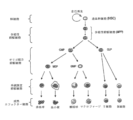
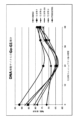
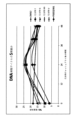
健康な造血幹細胞は、前駆細胞を生み出し、これは次いで、図1で示すように血液の全ての分化した成分(例えば、リンパ球、赤血球、血小板、顆粒球、単核細胞)を生み出す。 Healthy hematopoietic stem cells give rise to progenitor cells, which in turn give rise to all the differentiated components of blood (eg, lymphocytes, erythrocytes, platelets, granulocytes, mononuclear cells) as shown in FIG.
健康な造血細胞は、脊髄/赤血球分化の間に、増殖のための勾配依存をCDK4/6活性に示す(Johnson et al., Mitigation of hematological radiation toxicity in mice through pharmacological quiescence induced by CDK4/6 inhibition. J.Clin.Invest.(2010)120(7),2528-2536)。 Healthy hematopoietic cells exhibit a gradient dependence for proliferation on CDK4/6 activity during spinal cord/erythroid differentiation (Johnson et al., Mitigation of hematological radiation toxicity in mice through pharmacological quiescence induced by CDK4/6 in mice. J. Clin. Invest.(2010) 120(7), 2528-2536).
従って、最も少なく分化した細胞(例えば、健康な造血幹細胞(HSC)、多能性前駆細胞(MPP)及び共通脊髄前駆細胞(CMP))は、増殖のためのCDK4/6活性に最も依存的であると考えられ、したがって、CDK4/6複製依存癌又は他の増殖異常症を治療するためのCDK4/6阻害物質の使用によって最も有害な影響を受けると考えられる。 Therefore, the least differentiated cells, such as healthy hematopoietic stem cells (HSC), multipotent progenitor cells (MPP) and common myeloid progenitor cells (CMP), are the most dependent on CDK4/6 activity for proliferation. It is believed that there are, and therefore most detrimentally affected by, the use of CDK4/6 inhibitors to treat CDK4/6 replication dependent cancers or other proliferative disorders.
従って、HSPC等の正常細胞に対する治療の影響を最小にしつつ、選択されたRb-ポジティブ癌及び異常細胞増殖異常症で患者を治療する改良された化合物、方法及び計画の必要性が、継続している。 Accordingly, there continues to be a need for improved compounds, methods and regimens for treating patients with selected Rb-positive cancers and aberrant cell proliferation disorders while minimizing the impact of treatment on normal cells such as HSPCs. there is
ここに記載される化合物の有効量の投与により、たとえば健康なHSPC及び他のCDK4/6-複製依存的正常細胞等の正常細胞上への治療の有害作用を最小にしつつ、Rb-ポジティブ癌を含む選択されたRb陽性異常細胞増殖を治療するための、改良された化合物、方法及び組成物が、提供される。 Administration of effective amounts of the compounds described herein can induce Rb-positive cancers while minimizing adverse effects of treatment on normal cells, such as healthy HSPCs and other CDK4/6-replication dependent normal cells. Improved compounds, methods and compositions are provided for treating selected Rb-positive abnormal cell proliferations, including:
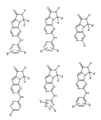
本発明の一実施形態では、化合物は、ここに記載される式I、II、III、IV又はVの化合物、または、これらの薬理学的に許容される組成物、塩、同位体的類似体又はプロドラッグから選択される。
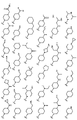
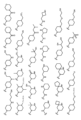
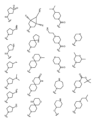
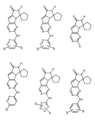
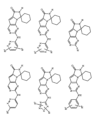
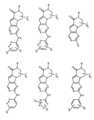
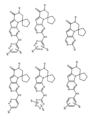
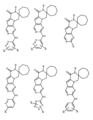
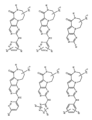
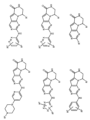
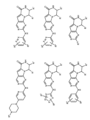
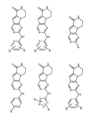
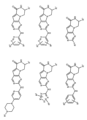
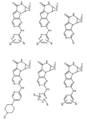
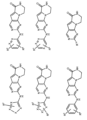
一つの非限定的な例において、化合物は、下記の表1の化合物、又はそれらの薬理学的に許容される組成物、塩、アイソトープ類似体又はプロドラッグから選択することができる。
In one embodiment of the invention, the compound is a compound of formula I, II, III, IV or V described herein, or a pharmaceutically acceptable composition, salt, isotopic analogue thereof or prodrugs.
In one non-limiting example, compounds can be selected from the compounds in Table 1 below, or pharmaceutically acceptable compositions, salts, isotopic analogs or prodrugs thereof.
一実施形態では、Rbポジティブ癌は、Rbポジティブ腺癌であってもよい。
Rbポジティブ癌は、コロンのRbポジティブ腺癌であってもよい。
Rbポジティブ癌は、直腸のRbポジティブ腺癌であってもよい。
代替的には、Rbポジティブ癌は、Rbポジティブ退形成星細胞腫であってもよい。
Rbポジティブ癌は、Rbポジティブ乳癌であってもよい。
In one embodiment, the Rb-positive cancer may be Rb-positive adenocarcinoma.
The Rb-positive cancer may be Rb-positive adenocarcinoma of the colon.
The Rb-positive cancer may be Rb-positive adenocarcinoma of the rectum.
Alternatively, the Rb-positive cancer may be an Rb-positive anaplastic astrocytoma.
The Rb-positive cancer may be Rb-positive breast cancer.
一実施形態では、Rbポジティブ癌は、Rbポジティブエストロゲンレセプターポジティブ、HER2ネガティブ進行型乳癌である。
代替的には、Rbポジティブ癌は、Rbポジティブエストロゲン受容体ネガティブ乳癌であってもよい。
Rbポジティブ癌は、Rbポジティブエストロゲン受容体に対して陽性の乳癌であってもよい。
Rbポジティブ癌は、Rbポジティブ遅発性系統転移性乳癌であってもよい。
Rbポジティブ癌は、Rbポジティブ管腔A乳癌であってもよい。
Rbポジティブ癌は、Rbポジティブ管腔B乳癌であってもよい。
Rbポジティブ癌は、RbポジティブHer2-ネガティブ乳癌又はRbポジティブHER2-ポジティブ乳癌であってもよい。
Rbポジティブ癌は、Rbポジティブ雄性乳癌である。
In one embodiment, the Rb positive cancer is Rb positive estrogen receptor positive, HER2 negative advanced breast cancer.
Alternatively, the Rb positive cancer may be an Rb positive estrogen receptor negative breast cancer.
An Rb-positive cancer may be a breast cancer that is positive for Rb-positive estrogen receptors.
The Rb-positive cancer may be Rb-positive late-onset metastatic breast cancer.
The Rb-positive cancer may be an Rb-positive luminal A breast cancer.
The Rb-positive cancer may be an Rb-positive luminal B breast cancer.
An Rb-positive cancer may be an Rb-positive Her2-negative breast cancer or an Rb-positive HER2-positive breast cancer.
Rb-positive cancers are Rb-positive male breast cancers.
一実施形態では、Rbポジティブ癌は、Rbポジティブプロゲステロンレセプターネガティブ乳癌である。
Rbポジティブ癌は、Rbポジティブプロゲステロンレセプター-ポジティブ乳癌であってもよい。
Rbポジティブ癌は、Rbポジティブ再発性乳癌であってもよい。
In one embodiment, the Rb positive cancer is Rb positive progesterone receptor negative breast cancer.
The Rb-positive cancer may be an Rb-positive progesterone receptor-positive breast cancer.
The Rb-positive cancer may be Rb-positive recurrent breast cancer.
一実施形態では、Rbポジティブ癌は、RbポジティブステージIV乳癌である。 In one embodiment, the Rb positive cancer is Rb positive stage IV breast cancer.
一実施形態では、Rbポジティブ癌は、Rbポジティブ進行型HER2-ポジティブ乳癌である。
Rbポジティブ癌は、Rbポジティブ気管支癌であってもよい。
Rbポジティブ癌は、Rbポジティブ大腸癌であってもよい。
Rbポジティブ癌は、Rbポジティブ再発性大腸癌であってもよい。
Rbポジティブ癌は、RbポジティブステージIV大腸癌であってもよい。
In one embodiment, the Rb-positive cancer is Rb-positive advanced HER2-positive breast cancer.
The Rb-positive cancer may be Rb-positive bronchial carcinoma.
The Rb-positive cancer may be Rb-positive colon cancer.
The Rb-positive cancer may be Rb-positive recurrent colon cancer.
The Rb-positive cancer may be Rb-positive stage IV colon cancer.
一実施形態では、Rbポジティブ癌は、Rbポジティブ結腸直腸癌である。 In one embodiment, the Rb-positive cancer is Rb-positive colorectal cancer.
一実施形態では、Rbポジティブ癌は、Rbポジティブ子宮内膜癌である。
Rbポジティブ癌は、Rbポジティブ性腺外精上皮腫であってもよい。
Rbポジティブ癌は、RbポジティブステージIII性腺外精上皮腫であってもよい。 Rbポジティブ癌は、RbポジティブステージIV性腺外精上皮腫であってもよい。
Rbポジティブ癌は、Rbポジティブ生殖細胞癌であってもよい。
Rbポジティブ癌は、Rbポジティブ中枢神経系胚細胞腫瘍であってもよい。
Rbポジティブ癌は、Rbポジティブ家族性精巣胚細胞腫瘍であってもよい。
Rbポジティブ癌は、Rbポジティブ再発性生殖腺の胚細胞腫瘍であってもよい。
Rbポジティブ癌は、Rbポジティブ再発性性腺外非精上皮腫性胚細胞腫瘍であってもよい。
Rbポジティブ癌は、Rbポジティブ性腺外精上皮腫性胚細胞腫瘍であってもよい。
Rbポジティブ癌は、Rbポジティブ再発性悪性精巣胚細胞腫瘍であってもよい。
Rbポジティブ癌は、Rbポジティブ再発性卵巣の胚細胞腫瘍であってもよい。
Rbポジティブ癌は、RbポジティブステージIII悪性精巣胚細胞腫瘍であってもよい。
Rbポジティブ癌は、RbポジティブステージIII卵巣の胚細胞腫瘍であってもよい。
Rbポジティブ癌は、RbポジティブステージIV卵巣の胚細胞腫瘍であってもよい。 Rbポジティブ癌は、RbポジティブステージIII性腺外非精上皮腫性胚細胞腫瘍であってもよい。
Rbポジティブ癌は、RbポジティブステージIV性腺外非精上皮腫性胚細胞腫瘍であってもよい。
In one embodiment, the Rb-positive cancer is Rb-positive endometrial cancer.
The Rb-positive cancer may be Rb-positive extragonadal seminioma.
The Rb-positive cancer may be Rb-positive stage III extragonadal seminioma. The Rb-positive cancer may be Rb-positive stage IV extragonadal seminioma.
The Rb-positive cancer may be an Rb-positive germ cell cancer.
The Rb-positive cancer may be an Rb-positive central nervous system germ cell tumor.
The Rb-positive cancer may be Rb-positive familial testicular germ cell tumor.
The Rb-positive cancer may be an Rb-positive recurrent gonadal germ cell tumor.
The Rb-positive cancer may be an Rb-positive recurrent extragonadal non-seminoma germ cell tumor.
The Rb-positive cancer may be an Rb-positive extragonadal seminioma germ cell tumor.
The Rb-positive cancer may be Rb-positive recurrent malignant testicular germ cell tumor.
The Rb-positive cancer may be an Rb-positive recurrent ovarian germ cell tumor.
The Rb-positive cancer may be Rb-positive Stage III malignant testicular germ cell tumor.
The Rb-positive cancer may be an Rb-positive stage III ovarian germ cell tumor.
The Rb-positive cancer may be an Rb-positive stage IV ovarian germ cell tumor. The Rb-positive cancer may be an Rb-positive stage III extragonadal non-seminoma germ cell tumor.
The Rb-positive cancer may be an Rb-positive stage IV extragonadal non-seminoma germ cell tumor.
一実施形態では、Rbポジティブ癌は、Rbポジティブ生殖細胞癌である。 In one embodiment, the Rb-positive cancer is Rb-positive germ cell cancer.
一実施形態では、Rbポジティブ癌は、Rbポジティブシスプラチン難治性、切除不能の生殖細胞癌である。 In one embodiment, the Rb-positive cancer is Rb-positive, cisplatin-refractory, unresectable germ cell cancer.
一実施形態では、Rbポジティブ癌は、Rbポジティブグリア芽細胞腫である。 In one embodiment, the Rb-positive cancer is Rb-positive glioblastoma.
一実施形態では、Rbポジティブ癌は、Rbポジティブ肝癌である。
Rbポジティブ癌は、Rbポジティブ肝細胞性癌であってもよい。
Rbポジティブ癌は、Rbポジティブ肺癌であってもよい。
In one embodiment, the Rb-positive cancer is Rb-positive liver cancer.
The Rb-positive cancer may be Rb-positive hepatocellular carcinoma.
The Rb-positive cancer may be Rb-positive lung cancer.
一実施形態では、Rbポジティブ癌は、Rbポジティブ非小細胞性肺癌である。 In one embodiment, the Rb-positive cancer is Rb-positive non-small cell lung cancer.
一実施形態では、Rbポジティブ癌は、Rbポジティブクラス変異体非小細胞性肺癌である。
Rbポジティブ癌は、Rbポジティブメラノーマであってもよい。
In one embodiment, the Rb-positive cancer is Rb-positive class mutant non-small cell lung cancer.
The Rb-positive cancer may be Rb-positive melanoma.
一実施形態では、Rbポジティブ癌は、Rbポジティブ再発性メラノーマである。 In one embodiment, the Rb-positive cancer is Rb-positive recurrent melanoma.
一実施形態では、Rbポジティブ癌は、RbポジティブステージIVメラノーマである。
Rbポジティブ癌は、Rbポジティブ卵巣癌であってもよい。
In one embodiment, the Rb-positive cancer is Rb-positive Stage IV melanoma.
The Rb-positive cancer may be Rb-positive ovarian cancer.
一実施形態では、Rbポジティブ癌は、Rbポジティブ卵巣上皮癌腫である。
Rbポジティブ癌は、Rbポジティブ膵癌であってもよい。
Rbポジティブ癌は、Rbポジティブ前立腺癌であってもよい。
In one embodiment, the Rb-positive cancer is Rb-positive ovarian epithelial carcinoma.
The Rb-positive cancer may be Rb-positive pancreatic cancer.
The Rb-positive cancer may be Rb-positive prostate cancer.
一実施形態では、Rbポジティブ癌は、Rbポジティブ直腸癌である。
Rbポジティブ癌は、Rbポジティブ再発性直腸癌であってもよい。
Rbポジティブ癌は、RbポジティブステージIV直腸癌であってもよい。
Rbポジティブ癌は、Rbポジティブ肉腫であってもよい。
Rbポジティブ癌は、Rbポジティブ神経膠肉腫であってもよい。
Rbポジティブ癌は、Rbポジティブ脂肪肉腫であってもよい。
Rbポジティブ癌は、Rbポジティブ繊維肉腫であってもよい。
Rbポジティブ癌は、Rbポジティブ粘液肉腫であってもよい。
In one embodiment, the Rb-positive cancer is Rb-positive rectal cancer.
The Rb-positive cancer may be Rb-positive recurrent rectal cancer.
The Rb-positive cancer may be Rb-positive Stage IV rectal cancer.
The Rb-positive cancer may be Rb-positive sarcoma.
The Rb-positive cancer may be Rb-positive gliosarcoma.
The Rb-positive cancer may be Rb-positive liposarcoma.
The Rb-positive cancer may be Rb-positive fibrosarcoma.
The Rb-positive cancer may be Rb-positive myxosarcoma.
一実施形態では、Rbポジティブ癌は、Rbポジティブ軟骨肉腫であってもよい。
Rbポジティブ癌は、Rbポジティブ骨肉腫であってもよい。
Rbポジティブ癌は、Rbポジティブ悪性線維性組織球腫であってもよい。
Rbポジティブ癌は、Rbポジティブ血管肉腫であってもよい。
Rbポジティブ癌は、Rbポジティブ血管肉腫であってもよい。
Rbポジティブ癌は、Rbポジティブリンパ管肉腫であってもよい。
Rbポジティブ癌は、Rbポジティブ中皮腫であってもよい。
Rbポジティブ癌は、Rbポジティブ平滑筋肉腫であってもよい。
Rbポジティブ癌は、Rbポジティブ横紋筋肉腫であってもよい。
Rbポジティブ癌は、Rbポジティブ髄膜腫であってもよい。
Rbポジティブ癌は、Rbポジティブシュワン細胞腫であってもよい。
In one embodiment, the Rb-positive cancer may be Rb-positive chondrosarcoma.
The Rb-positive cancer may be Rb-positive osteosarcoma.
The Rb-positive cancer may be Rb-positive malignant fibrous histiocytoma.
The Rb-positive cancer may be Rb-positive angiosarcoma.
The Rb-positive cancer may be Rb-positive angiosarcoma.
The Rb-positive cancer may be Rb-positive lymphangiosarcoma.
The Rb-positive cancer may be Rb-positive mesothelioma.
The Rb-positive cancer may be an Rb-positive leiomyosarcoma.
The Rb-positive cancer may be Rb-positive rhabdomyosarcoma.
The Rb-positive cancer may be an Rb-positive meningioma.
The Rb-positive cancer may be Rb-positive schwannoma.
一実施形態では、Rbポジティブ癌は、Rbポジティブ褐色細胞腫である。
Rbポジティブ癌は、Rbポジティブ島細胞癌であってもよい。
Rbポジティブ癌は、Rbポジティブカルチノイドであってもよい。
Rbポジティブ癌は、Rbポジティブパラガングリオーマであってもよい。
In one embodiment, the Rb-positive cancer is Rb-positive pheochromocytoma.
The Rb-positive cancer may be Rb-positive islet cell cancer.
The Rb-positive cancer may be Rb-positive carcinoid.
The Rb-positive cancer may be an Rb-positive paraganglioma.
一実施形態では、Rbポジティブ癌は、Rbポジティブ鱗状細胞癌腫である。
Rbポジティブ癌は、Rbポジティブ腺癌であってもよい。
Rbポジティブ癌は、Rbポジティブ肝細胞癌であってもよい。
Rbポジティブ癌は、Rbポジティブ腎細胞癌であってもよい。
Rbポジティブ癌は、Rbポジティブ胆管癌であってもよい。
Rbポジティブ癌は、Rbポジティブ難治性固形腫瘍であってもよい。
Rbポジティブ癌は、Rbポジティブ神経芽細胞腫であってもよい。
Rbポジティブ癌は、Rbポジティブ髄芽細胞腫であってもよい。
In one embodiment, the Rb-positive cancer is Rb-positive squamous cell carcinoma.
The Rb-positive cancer may be an Rb-positive adenocarcinoma.
The Rb-positive cancer may be Rb-positive hepatocellular carcinoma.
The Rb-positive cancer may be Rb-positive renal cell carcinoma.
The Rb-positive cancer may be Rb-positive cholangiocarcinoma.
The Rb-positive cancer may be an Rb-positive refractory solid tumor.
The Rb-positive cancer may be Rb-positive neuroblastoma.
The Rb-positive cancer may be Rb-positive medulloblastoma.
一実施形態では、Rbポジティブ癌は、テラトーマである。
Rbポジティブ癌は、Rbポジティブ卵巣未熟奇形腫であってもよい。
Rbポジティブ癌は、Rbポジティブ卵巣成熟奇形腫であってもよい。
Rbポジティブ癌は、Rbポジティブ卵巣専門テラトーマであってもよい。
Rbポジティブ癌は、Rbポジティブ精巣未熟奇形腫であってもよい。
Rbポジティブ癌は、Rbポジティブ精巣成熟奇形腫であってもよい。
Rbポジティブ癌は、Rbポジティブテラトーマであってもよい。
Rbポジティブ癌は、Rbポジティブ卵巣単胚葉性テラトーマであってもよい。
Rbポジティブ癌は、Rbポジティブ精巣癌であってもよい。
In one embodiment, the Rb positive cancer is teratoma.
The Rb-positive cancer may be Rb-positive ovarian immature teratoma.
The Rb-positive cancer may be Rb-positive mature ovarian teratoma.
The Rb-positive cancer may be an Rb-positive ovarian specialty teratoma.
The Rb-positive cancer may be Rb-positive immature testicular teratoma.
The Rb-positive cancer may be Rb-positive mature testicular teratoma.
The Rb-positive cancer may be an Rb-positive teratoma.
The Rb-positive cancer may be an Rb-positive ovarian monodermal teratoma.
The Rb-positive cancer may be Rb-positive testicular cancer.
一実施形態では、Rbポジティブ癌は、Rbポジティブ膣癌である。 In one embodiment, the Rb-positive cancer is Rb-positive vaginal cancer.
一実施形態では、Rbポジティブ癌は、肺癌、骨製癌、膵癌、皮膚癌、頭部又は頸部の癌、皮膚又は眼内メラノーマ、子宮癌、卵巣癌、直腸癌、肛門部の癌、胃癌、大腸癌、乳癌、子宮癌、卵管の癌腫、子宮内膜の癌腫、頸部の癌腫、膣の癌腫、陰門の癌腫、食道の癌、小腸の癌、内分泌系の癌、甲状腺の癌、上皮小体の癌、副腎の癌、軟組織の肉腫、尿道の癌、ペニスの癌、前立腺癌、膀胱の癌、腎臓又は尿管の癌、腎細胞癌、腎盂の癌腫、中枢神経系(CNS)の腫瘍、原発性中枢神経系リンパ腫、脊髄軸腫瘍、脳幹神経膠腫、下垂体腺腫、又は前述の癌の1つ以上の組合せを非限定的に含む、Rbポジティブ癌腫、肉腫から選択される。 In one embodiment, the Rb positive cancer is lung cancer, bone cancer, pancreatic cancer, skin cancer, head or neck cancer, cutaneous or intraocular melanoma, uterine cancer, ovarian cancer, rectal cancer, anal cancer, gastric cancer , colon cancer, breast cancer, uterine cancer, fallopian tube carcinoma, endometrial carcinoma, cervical carcinoma, vaginal carcinoma, vulva carcinoma, esophageal cancer, small bowel cancer, endocrine cancer, thyroid cancer, Parathyroid cancer, adrenal gland cancer, soft tissue sarcoma, urethral cancer, penile cancer, prostate cancer, bladder cancer, kidney or ureter cancer, renal cell carcinoma, carcinoma of the renal pelvis, central nervous system (CNS) primary central nervous system lymphoma, spinal axis tumor, brain stem glioma, pituitary adenoma, or a combination of one or more of the foregoing cancers, sarcoma.
一実施形態では、被験体はRbポジティブ異常細胞増殖異常症に罹患している。 In one embodiment, the subject has Rb-positive aberrant cell proliferation disorder.
一実施形態では、Rbポジティブ異常細胞増殖異常症は、非ガンである。
特定の実施形態では、ここに記載される化合物は、選択されたRbポジティブ細胞増殖異常症(例えば癌)を治療するために用いられる場合に、正常細胞が常の細胞サイクルへ迅速にリエントリーすることを可能にし、かつ、血液細胞等の損害を受けた組織及び後代細胞の急速な再結合を可能にする。
この態様では、ここに記載される化合物を、Rbポジティブ癌を治療するために用いれば、CDK4/6阻害物質の現行の抗悪性腫瘍使用に関係したドラッグホリデイ及びドーズ遅れを、排除、低減、及び/又は最小にすることにより、前駆細胞及び親細胞の複製及び分化を通してダメージを受けた血球の迅速な回復が可能となる。
具体的に、本発明は、Rbポジティブ癌等の癌を有している患者に、ここに記載される化合物の有効量を投与することを含み、ここで、合物は、CDK4/6-複製依存的細胞の過渡的、可逆的Gl停止を提供する、薬物動態及び酵素の半減期を有する。
化合物は、本出願の中に記載されるもののいずれかであってもよい。
活性化合物の非限定的な例は、下記に提示される表1に記載されるもの、又は、それらの薬理学的に許容される組成物、塩、同位体的類似体、又はプロドラッグである。
In one embodiment, the Rb-positive aberrant cell proliferation disorder is non-cancer.
In certain embodiments, the compounds described herein rapidly re-enter normal cells into the normal cell cycle when used to treat selected Rb-positive cell proliferative disorders (e.g., cancer). and rapid recombination of damaged tissue and progeny cells such as blood cells.
In this aspect, use of the compounds described herein to treat Rb-positive cancers eliminates, reduces, and reduces the drug holiday and dose delay associated with current antineoplastic use of CDK4/6 inhibitors. /or minimization allows rapid recovery of damaged blood cells through replication and differentiation of progenitor and parental cells.
Specifically, the invention includes administering to a patient having cancer, such as an Rb-positive cancer, an effective amount of a compound described herein, wherein the compound is a CDK4/6-replicating It has pharmacokinetic and enzymatic half-lives that provide transient, reversible Gl arrest of dependent cells.
The compound may be any of those described within this application.
Non-limiting examples of active compounds are those listed in Table 1 presented below, or pharmaceutically acceptable compositions, salts, isotopic analogs, or prodrugs thereof .
一実施形態では、ここに記載される化合物は、Rbポジティブ癌等の癌を治療する改良された方法に有用となり得るものであり、ここで、
この方法は、CDK4/6-複製依存的正常細胞に対する影響を低減又は最小にするものであり、何故なら、それらは、
(i)CDK4/6-複製依存的正常細胞の上への比較的短期的、過渡的かつ可逆的なGl停止効果を提供する薬物動態及び酵素の半減期を示す化合物を利用するからであり、また、
(ii)投与の中断の後、又は被験体中の治療的に有効なレベルの消失の後、正常細胞に対して迅速な細胞サイクルへのリエントリーを可能にするからである。
In one embodiment, compounds described herein may be useful in improved methods of treating cancers, such as Rb-positive cancers, wherein
This method reduces or minimizes the effects on CDK4/6-replication dependent normal cells, because they
(i) CDK4/6-utilizes compounds that exhibit pharmacokinetics and enzymatic half-lives that provide relatively short-term, transient and reversible GI-arresting effects on replication-dependent normal cells; again,
(ii) it allows normal cells to re-enter the cell cycle rapidly after discontinuation of administration or loss of therapeutically effective levels in the subject;
ここに記載される化合物を用いて、例えば、CDK4/6阻害のためのHSPCの複製遅れを低減し、及び/又は、CDK4/6阻害力の中断後の造血細胞系統の回復を促進し、及び/又は減少血液欠乏血液欠乏を低減することが可能になり、その理由は、利用された化合物の作用性が短時間であり、現行のCDK4/6阻害物質治療方法に関係したオフサイクル期間又はドラッグホリデイの長さを低減し、そしてそれは腫瘍薬剤耐性の促進を低減する又は最小にするからである。
特定の実施形態では、ここに記載される化合物の使用は、オフサイクル又はドラッグホリデイの必要なしに、より長い期間、被験体の持続性治療を可能にする。
CDK4/6-複製依存的正常細胞増殖のタイムリーな再開は、組織修復のために必要であり、そして、正常細胞細胞サイクル進行、たとえばHSPC細胞サイクル進行の停止があまりに長い期間停止することは、好ましくない。
選択的CDK4/6阻害物質PD0332991がRbポジティブ乳癌の有効な阻害剤であることを示している報告があるにもかかわらず、この化合物は過剰な骨髄抑制作用があるため、この阻害剤は、化学療法剤として最も理想的な化合物ではないということが見出されている。
Compounds described herein can be used, for example, to reduce HSPC replication lag due to CDK4/6 inhibition and/or to promote hematopoietic cell lineage recovery after cessation of CDK4/6 inhibitory potency, and /or reduced blood deficiency can be reduced because of the short duration of action of the compounds utilized and the off-cycle periods associated with current CDK4/6 inhibitor treatment regimens or drug because it reduces Holliday length, which reduces or minimizes the promotion of tumor drug resistance.
In certain embodiments, use of the compounds described herein allows for sustained treatment of subjects for longer periods of time without the need for off-cycles or drug holidays.
Timely resumption of CDK4/6-replication-dependent normal cell proliferation is necessary for tissue repair, and cessation of normal cell cycle progression, such as HSPC cell cycle progression, for too long a period of time can I don't like it.
Despite reports showing that the selective CDK4/6 inhibitor PD0332991 is an effective inhibitor of Rb-positive breast cancer, the compound has excessive myelosuppressive effects, and this inhibitor has been shown to be a chemical inhibitor. It has been found not to be the most ideal compound as a therapeutic agent.
たとえば、PD0332991は比較的長時間作用型の細胞内影響を有し(Roberts et al. Multiple Roles of Cyclin-Dependent Kinase 4/6 Inhibitors in Cancer Therapy. JCNI 2012,104(6) 476-487(FIG.2A)参照)、HSPC等の正常細胞のGl停止の過渡を延長して、ドーズ制限骨髄抑制に至る。
たとえば、そのような長時間作用型効果は、CDK4/6活性を抑制し得る治療のために、成長抑制された血液細胞系統を再構成するのに必要なHSPC細胞系統の増殖を遅らせ、すなわち、すなわちRb受容細胞内のRbリン酸化を遅れさせる。
For example, PD0332991 has relatively long-acting intracellular effects (Roberts et al. Multiple Roles of Cyclin-
For example, such long-acting effects slow the proliferation of HSPC cell lines necessary to reconstitute growth-repressed blood cell lineages for treatments that can suppress CDK4/6 activity, i.e. it delays Rb phosphorylation in Rb-receiving cells.
PD0332991により提供される長時間作用型Gl停止は、その抗悪性腫瘍の効果に望ましいものの、骨髄抑制を制限して血液学的複製期間を与えるための緊急のHSPC Gl停止によって悪影響を受ける赤血球、血小板及び骨髄細胞(単核細胞及び顆粒球)を、再構成するためには長期のオフサイクル期間を必要とする。
選択されたRbポジティブ癌の治療のための抗腫瘍薬としてここに記載される化合物の使用は、必要なオフサイクル期間又はドラッグホリデイの長さを排除、低減又は、最小にすることができるので、抗悪性腫瘍計画において、より長く有効な癌に対するCDK4/6抑制性期間を与えることができる。
Long-acting GI arrest provided by PD0332991 is desirable for its antineoplastic effects, but is adversely affected by acute HSPC GI arrest to limit myelosuppression and provide a hematologic replication period. and myeloid cells (monocytes and granulocytes) require long off-cycle periods to reconstitute.
Since the use of the compounds described herein as anti-tumor agents for the treatment of selected Rb-positive cancers can eliminate, reduce or minimize the length of the required off-cycle period or drug holiday, In antineoplastic regimens, a longer effective CDK4/6 inhibitory window against cancer can be provided.
したがって、一実施形態では本発明は、治療計画においてRbポジティブ癌に罹患したホストに対して、表1から選択されるものを含むここに記載される化合物を、有効量投与することを含み、(これらは単独で又はそのあらゆる組合せでもよく、これらそれぞれが、具体的に考慮され独立して記載される):
i)たとえばHSPC等のCDK4/6-複製依存的正常細胞(例えば少なくとも80%以上)の相当な部分が、ここに記載される化合物のヒトへの最後の投与から24時間未満、30時間未満又は36時間未満で、プレ治療ベースライン細胞サイクル活性に戻る又は接近する(すなわち、細胞サイクルにリエントリーする)。
ii)たとえばHSPC等のCDK4/6-複製依存的正常細胞の相当な部分が、ここに記載される化合物のヒトへの最後の投与から24時間未満、30時間未満又は36時間未満で、同時に細胞サイクルにリエントリーする。
(iii)たとえばHSPC等のCDK4/6-複製依存的正常細胞上の化合物の抑制性効果の消失が、化合物の投与から24時間未満、30時間未満又は36時間未満で発生する。
(iv)化合物のCDK4/6禁止効果の消失から24時間未満、30時間未満又は36時間未満で、たとえばHSPC等のCDK4/6-複製依存的正常細胞の相当な部分が、プレ治療ベースライン細胞サイクル活性に戻る又は接近する(すなわち、細胞サイクルにリエントリーする)。
又は(vi)たとえばHSPC等のCDK4/6-複製依存的正常細胞の相当な部分が、投与された化合物の被験体の血液中の濃度レベルが治療有効濃度を下回った時点から約24時間未満、約30時間未満又は約36時間未満以内で、プレ治療ベースライン細胞サイクル活性に戻る又は接近する(すなわち、細胞サイクルにリエントリーする)。
Accordingly, in one embodiment, the invention comprises administering an effective amount of a compound described herein, including those selected from Table 1, to a host with Rb-positive cancer in a therapeutic regimen, These may be used singly or in any combination, each of which is specifically considered and described independently):
i) a substantial portion of CDK4/6-replication dependent normal cells (e.g. at least 80% or more), e.g. Return to or approach pre-treatment baseline cell cycle activity (ie, re-enter the cell cycle) in less than 36 hours.
ii) a substantial portion of CDK4/6-replication dependent normal cells, e.g. Re-enter the cycle.
(iii) loss of inhibitory effect of the compound on CDK4/6-replication dependent normal cells, eg HSPC, occurs less than 24 hours, less than 30 hours or less than 36 hours after administration of the compound.
(iv) less than 24 hours, less than 30 hours, or less than 36 hours after disappearance of the CDK4/6 inhibitory effect of the compound, wherein a substantial portion of CDK4/6-replication dependent normal cells, e.g., HSPCs, are pretreatment baseline cells; Return to or approach cycle activity (ie, re-enter the cell cycle).
or (vi) less than about 24 hours after a substantial portion of CDK4/6-replication dependent normal cells, e.g., HSPCs, are below therapeutically effective levels of the administered compound in the subject's blood, Returns or approaches pre-treatment baseline cell cycle activity (ie, re-enters the cell cycle) within less than about 30 hours or less than about 36 hours.
本発明の中心的実施形態では、ここに記載される化合物は、異常細胞増殖に対する有益な、付加的な又は共働効果のために、非DNA損傷、ターゲットの抗悪性腫瘍剤又は造血成長因子剤等の他の薬剤との協調療法で、投与されてもよい。造血成長因子の早すぎる投与が深刻な副作用を有し得ることが、最近報告されている。たとえば、成長因子のEPOファミリーの使用が、動脈高血圧、脳痙攣、高血圧性脳症、血栓塞栓症、鉄過負荷、インフルエンザ等の症候群及び静脈血栓に関連していた。成長因子のG-CSFファミリーは、脾臓肥大及び断裂、呼吸窮迫症候群、アレルギー性反応及び鎌型赤血球合併症に関連している。ここに記載される化合物の投与に、例えば影響を受けた細胞が成長停止状態にはない時点で、造血成長因子のタイムリーな投与による本発明の方法を組み合わせることにより、健康管理開業医においては、成長因子の量を低減して、不必要な副作用を最小にしつつも、望ましい治療の利益を達成している。 In a central embodiment of the present invention, the compounds described herein are non-DNA damaging, targeted anti-neoplastic or hematopoietic growth factor agents for beneficial, additive or synergistic effects on abnormal cell proliferation. It may also be administered in combination therapy with other agents such as It has recently been reported that premature administration of hematopoietic growth factors can have serious side effects. For example, use of the EPO family of growth factors has been associated with arterial hypertension, cerebral spasm, hypertensive encephalopathy, thromboembolism, iron overload, syndromes such as influenza, and venous thrombosis. The G-CSF family of growth factors has been associated with splenic hypertrophy and rupture, respiratory distress syndrome, allergic reactions and sickle cell complications. By combining the administration of the compounds described herein with the methods of the invention, e.g., by the timely administration of hematopoietic growth factors when the affected cells are not in a state of growth arrest, the health care practitioner: The amount of growth factors has been reduced to achieve the desired therapeutic benefit while minimizing unwanted side effects.
一実施形態では、成長因子は、たとえばHSPC等のCDK4/6複製依存的正常細胞に対する化合物の抑制性効果の効果が中断したときに投与される。かくして、この実施形態では、抗悪性腫瘍治療計画におけるここに記載される選択的CDK4/6阻害物質の使用により、被験体が受ける成長因子の量が減りうるものであり、何故なら、他のCDK4/6阻害物質(たとえばPD0332991)の場合よりもより迅速に、ターゲットの造血細胞が細胞サイクルにリエントリーするからである。さらに、Gl停止の後、ここに記載される化合物を用いて迅速の細胞サイクルリエントリーを可能にすることにより、造血成長因子の投与の時間を計る能力が提供され、造血細胞系の再結合を援助して、成長因子効果を最大にする。 In one embodiment, the growth factor is administered when the effect of the compound's inhibitory effect on CDK4/6 replication-dependent normal cells, eg, HSPC, ceases. Thus, in this embodiment, use of the selective CDK4/6 inhibitors described herein in an anti-neoplastic treatment regimen may reduce the amount of growth factors that a subject receives because other CDK4 This is because the target hematopoietic cells re-enter the cell cycle more rapidly than with /6 inhibitors (eg PD0332991). In addition, the ability to time the administration of hematopoietic growth factors by permitting rapid cell cycle reentry after Gl arrest with the compounds described herein provides the ability to time the administration of hematopoietic growth factors, allowing reconnection of hematopoietic cell lineages. Helps maximize growth factor effects.
このように、一実施形態では、ここに記載される化合物又は方法の使用は、造血成長因子の使用組み合わせられ、ここで、造血成長因子の使用には、顆粒球コロニー刺激因子(G-CSF)、顆粒球-マクロファージコロニー刺激因子(GM-CSF)、トロンボポイエチン、インターロイキン(IL)-12、スティール因子、及びエリスロポイエチン(EPO)、又はこれらの誘導体を含むが、これらに限定されるものではない。 Thus, in one embodiment, use of the compounds or methods described herein is combined with use of hematopoietic growth factors, wherein the use of hematopoietic growth factors includes granulocyte colony stimulating factor (G-CSF). , granulocyte-macrophage colony-stimulating factor (GM-CSF), thrombopoietin, interleukin (IL)-12, Steele factor, and erythropoietin (EPO), or derivatives thereof not a thing
一実施形態では、CDK4/6阻害物質は、造血成長因子の投与前に、投与される。 In one embodiment, the CDK4/6 inhibitor is administered prior to administration of the hematopoietic growth factor.
一実施形態では、HSPCに対するCDK4/6阻害物質の効果が消失するように、造血成長因子投与の時間が定められる。 In one embodiment, hematopoietic growth factor administration is timed such that the effect of the CDK4/6 inhibitor on HSPCs is abolished.
一実施形態では、ここに記載される化合物の使用を、少なくとも1つの他の化学療法剤を用いた治療体制と組み合わせて、増殖抑制作用のための細胞-サイクルを通した増殖又は発達に依存しないものとすることができる。この薬剤は、タモキシフェン、ミダゾラム、レトロゾール、ボルテゾミブ、アナストロゾール、ゴセレリン、mTOR阻害剤、PI3キナーゼ阻害剤、デュアルmTOR-PI3K阻害剤、MEK阻害剤、Ras阻害剤、ALK阻害剤、HSP阻害剤(たとえば、HSP70及びHSP90阻害剤又はその組合せ)を含んでもよいが、これに限定されるものではない。mTOR阻害剤の非限定的な例としては、ラパマイシン及びその類似体、エベロリムス(アフィニトール)、テムシロリムス、リダフォロリムス、シロリムス及びデフォロリムスが挙げられる。P13キナーゼ阻害剤の非限定的な例としては、ワートマニン、デメトキシビリジン、ペリホシン、イデラリシブ、PX-866、IPI-145、BAY 80-6946、BEZ235、RP6503、TGR1202(RP5264)、MLN1117(INK1117)、ピクチリシブ、ブパルリシブ、SAR245408(XL147)、SAR245409(XL765)、パロミド529、ZSTK474、PWT33597、RP6530、CUDC-907及びAEZS-136.が挙げられる。MEK阻害剤の非限定的な例としては、トラメチニブ、セルメチニブ、MEK162、GDC-0973(XL518)及びPD0325901が挙げられる。RAS阻害剤の非限定的な例としては、レオリシン及びsiG12Dローダーが挙げられる。ALK阻害剤の非限定的な例としては、クリゾチニブ、AP26113及びLDK378が挙げられる。HSP阻害剤の非限定的な例としては、ゲルダナマイシン又は17-N-アリルアミノ-17-デメトキシゲルダナマイシン(17AAG)及びラジシコールが挙げられる。 In one embodiment, the use of compounds described herein in combination with a treatment regimen with at least one other chemotherapeutic agent that does not rely on proliferation or development through the cell-cycle for antiproliferative effects can be This drug includes tamoxifen, midazolam, letrozole, bortezomib, anastrozole, goserelin, mTOR inhibitor, PI3 kinase inhibitor, dual mTOR-PI3K inhibitor, MEK inhibitor, Ras inhibitor, ALK inhibitor, HSP inhibitor (eg, HSP70 and HSP90 inhibitors or combinations thereof), but are not limited to this. Non-limiting examples of mTOR inhibitors include rapamycin and its analogues, everolimus (Afinitor), temsirolimus, ridaforolimus, sirolimus and deforolimus. Non-limiting examples of P13 kinase inhibitors include wortmannin, demethoxyviridine, perifosine, idelalisib, PX-866, IPI-145, BAY 80-6946, BEZ235, RP6503, TGR1202 (RP5264), MLN1117 (INK1117), pictilisib, buparlisib, SAR245408 (XL147), SAR245409 (XL765), Palomid 529, ZSTK474, PWT33597, RP6530, CUDC-907 and AEZS-136. is mentioned. Non-limiting examples of MEK inhibitors include trametinib, selumetinib, MEK162, GDC-0973 (XL518) and PD0325901. Non-limiting examples of RAS inhibitors include leolysin and siG12D loader. Non-limiting examples of ALK inhibitors include crizotinib, AP26113 and LDK378. Non-limiting examples of HSP inhibitors include geldanamycin or 17-N-allylamino-17-demethoxygeldanamycin (17AAG) and radicicol.
特定の実施形態では、ここに記載される化合物は、他の化学療法剤による治療の前の被検者、他の化学療法剤による治療の間の被検者、他の化学療法剤の投与の後の被検者、又はその組合せのの被検者に投与される。 In certain embodiments, the compounds described herein can be used in a subject prior to treatment with another chemotherapeutic agent, in a subject during treatment with another chemotherapeutic agent, after administration of another chemotherapeutic agent. A subsequent subject, or a combination thereof.
一実施形態では、ここに記載される化合物は、化学療法剤へのRbポジティブ癌の感度を高めるために、他の化学療法剤で治療に約24時間、20時間、16時間、12時間、8時間又は4時間未満又はこれより少ない時間だけ前にの被験体に投与される。 In one embodiment, the compounds described herein are used for about 24 hours, 20 hours, 16 hours, 12 hours, 8 hours of treatment with other chemotherapeutic agents to sensitize Rb-positive cancers to chemotherapeutic agents. hours or less than or less than 4 hours prior to administration.
一実施形態では、化合物は、他の化学療法剤での治療の多くとも4時間前に投与される。 In one embodiment, the compound is administered at most 4 hours prior to treatment with other chemotherapeutic agents.
一実施形態では、ここに記載される化合物は、たとえば静脈内注射又は舌下腺、門脈内、又は他の効率的な血流アクセス方法を介して、血流への薬剤的に容易なアクセスを可能にする方法で、投与される。 In one embodiment, the compounds described herein have pharmaceutically easy access to the bloodstream, for example, via intravenous injection or sublingual, intraportal, or other efficient bloodstream access methods. administered in a manner that allows for
一実施形態では、ここに記載される化合物は、経口投与可能な製剤で投与される。
別の実施形態では、ここに記載される化合物は、局所、経皮又は他の所望された投与方法を介して投与される。
In one embodiment, the compounds described herein are administered in an orally administrable formulation.
In another embodiment, the compounds described herein are administered topically, transdermally or via any other desired method of administration.
一実施形態では、ここに記載される化合物は、造血成長因子による治療の約24時間、20時間、16時間、12時間、8時間又は4時間未満又はこれより少ない時間だけ前に、被験体に投与される。 In one embodiment, a compound described herein is administered to a subject less than or less than about 24 hours, 20 hours, 16 hours, 12 hours, 8 hours or 4 hours prior to treatment with a hematopoietic growth factor. administered.
一実施形態では、化合物は、造血成長因子又は他の化学療法剤による治療の多くとも4時間前に投与される。
本発明に有用な化合物は、CDK4やCDK6の阻害に対して、他のCDK、たとえばCDK2と比べて、際立った選択性を示す。
たとえば、本発明に有用な化合物は、被験体のRbポジティブ癌細胞へのドーズ依存性Gl-停止効果を提供し、そして、ここに提供される方法は、CDK4/6-複製非依存的細胞に影響を及ぼさずに、Rbポジティブ癌細胞の化学療法剤治療及び成長阻害を提供するのに十分である。
In one embodiment, the compound is administered at most 4 hours prior to treatment with a hematopoietic growth factor or other chemotherapeutic agent.
Compounds useful in the present invention exhibit outstanding selectivity for inhibition of CDK4 and CDK6 compared to other CDKs such as CDK2.
For example, compounds useful in the present invention provide dose-dependent Gl-arresting effects on Rb-positive cancer cells in a subject, and the methods provided herein provide CDK4/6-replication independent cells with sufficient to provide chemotherapeutic treatment and growth inhibition of Rb-positive cancer cells without affecting them.
一実施形態では、ここに記載される化合物の使用により、Gl停止効果が消失することとなり、被験体のCDK4/6-複製依存的正常細胞は、約12時間、14時間、16時間、18時間、20時間、24時間、30時間、36時間又は40時間未満内にそれらのプレ投与ベースライン細胞サイクル活性に戻るようになる。 In one embodiment, use of the compounds described herein results in abolition of the Gl-stopping effect, and the subject's CDK4/6-replication dependent normal cells are at about 12 hours, 14 hours, 16 hours, 18 hours. , to return to their pre-dose baseline cell cycle activity within less than 20, 24, 30, 36 or 40 hours.
一実施形態では、G1期停止効果は消失するため、投与の中断の約24時間、30時間、36時間又は40時間未満以内に、又は約48時間以内に、被検体のCDK4/6-複製依存的細胞は、それらのプレ投与ベースライン細胞-サイクル活性に戻るようになる。 In one embodiment, within less than about 24 hours, 30 hours, 36 hours, or 40 hours, or within about 48 hours of the discontinuation of administration, the CDK4/6-replication dependent CDK4/6-replication effect of the subject is Target cells will return to their pre-dose baseline cell-cycle activity.
一実施形態では、CDK4/6-複製依存的正常細胞は、HSPCである。 In one embodiment, the CDK4/6-replication dependent normal cells are HSPCs.
一実施形態では、ここに記載されるCDK4/6阻害物質の使用により、G1期停止効果が消失するため、被検体の血液中のCDK4/6阻害物質の濃度レベルが治療有効な濃度未満に下がった時点から約24時間、30時間、36時間、40時間未満以内に、又は約48時間未満以内に、被検体のCDK4/6-複製依存的正常細胞は、それらのプレ投与ベースライン細胞-サイクル活性に戻る又は接近するようになる。 In one embodiment, use of the CDK4/6 inhibitors described herein abolishes the G1 arresting effect, thereby reducing the concentration level of the CDK4/6 inhibitor in the blood of the subject below therapeutically effective concentrations. Within less than about 24 hours, 30 hours, 36 hours, 40 hours, or less than about 48 hours from the time point of Return to or come close to being active.
一実施形態では、Gl-停止効果は消失するため、被験体の血液中のCDK4/6阻害物質の濃度レベルが治療有効濃度下まで下がっった時点の約24時間未満、30時間、36時間、40時間又は48時間以内に、被験体のCDK4/6-複製依存的正常細胞は、それらのプレ投与ベースライン細胞サイクル活性に戻る。 In one embodiment, less than about 24 hours, 30 hours, 36 hours, when the CDK4/6 inhibitor concentration level in the subject's blood has fallen below therapeutically effective levels, because the Gl-terminating effect is abolished; Within 40 or 48 hours, the subject's CDK4/6-replication dependent normal cells return to their pre-dose baseline cell cycle activity.
一実施形態では、ここに記載され、かつ、ここに記載された方法に有用な化合物は、そのオフ効果が同時発生してもよく、すなわち、Gl停止効果の消失に際して、ここに記載された化合物に曝露されるCDK4/6-複製依存的正常細胞は、同様に経時的形態の中に細胞サイクルにリエントリーする。
被検者の血液の中にCDK4/6阻害物質の濃度レベルが治療有効濃度未満に下がった時点から、約24時間、30時間、36時間、40時間未満以内に、又は、約48時間以内に、G1期及びS期の通常細胞の一部が、迅速かつ効率的に復旧されるように、細胞-サイクルにリエントリーしたCDK4/6-複製依存的正常細胞は振る舞う。
化合物の迅速のオフ効果に関連した迅速の細胞サイクルリエントリーにより、有利なことに、PD0332991等の他のCDK4/6阻害物質と比較して、さらに多くのCDK4/6-複製依存的正常細胞がGl停止の消失に際して複製を開始することが可能となる。
従って、オフサイクル期間の間又は投与期間の間に、HSPC等のCDK4/6-複製依存的正常細胞が、複製を迅速に開始することが可能となる。
CDK4/6-複製依存的癌をターゲットにする治療計画における、ここに記載される化合物の使用により、現在利用できる抗悪性腫瘍化学療法剤による治療後、治療の通常後、又はこの治療と関連して、典型的に予想される状態と比較して、貧血の軽減、リンパ球減少の軽減、血小板減少の軽減、又は好中球減少症の軽減をもたらす。
ここに記載されるCDK4/6阻害物質の使用により、CDK4/6阻害物質の長期の使用に関係した骨髄抑制、例えばCDK4/6阻害物質の使用の中断に続いた骨髄抑制、貧血、リンパ球減少、血小板減少、又は好中球減少症等、からのより急速な回復がもたらされ得る。
In one embodiment, the compounds described herein and useful in the methods described herein may coincide with their off-effects, i.e., upon disappearance of the Gl-stopping effect, CDK4/6-replication-dependent normal cells exposed to β re-enter the cell cycle in a similar temporal morphology.
within less than about 24 hours, 30 hours, 36 hours, 40 hours, or within about 48 hours from the time the concentration level of the CDK4/6 inhibitor in the blood of the subject falls below a therapeutically effective concentration , CDK4/6-replication-dependent normal cells that reenter the cell-cycle behave in such a way that a proportion of normal cells in G1 and S phases are rapidly and efficiently re-entered.
Advantageously, more CDK4/6-replication dependent normal cells were activated than other CDK4/6 inhibitors such as PD0332991 due to the rapid cell cycle reentry associated with the compound's rapid off-effect. Replication can be initiated upon loss of the Gl stop.
Thus, CDK4/6-replication dependent normal cells, such as HSPCs, are allowed to rapidly initiate replication during the off-cycle period or during the dosing period.
The use of the compounds described herein in therapeutic regimens targeting CDK4/6-replication dependent cancers can result in the treatment with currently available antineoplastic chemotherapeutic agents, routinely following treatment, or in association with this treatment. resulting in less anemia, less lymphopenia, less thrombocytopenia, or less neutropenia compared to typically expected conditions.
Use of a CDK4/6 inhibitor as described herein may result in myelosuppression associated with long-term use of a CDK4/6 inhibitor, e.g., myelosuppression, anemia, lymphopenia following discontinuation of CDK4/6 inhibitor use. , thrombocytopenia, or neutropenia may result in more rapid recovery.
ある実施形態では、ここに記載される化合物の使用により、たとえば骨髄抑制、貧血、リンパ球減少、白血球減少症、血小板減少、又は好中球減少症等の顆粒球減少等、CDK4/6阻害物質の長期の使用に関連した骨髄抑制の低下がもたらされる。
ある実施形態では、被検者又はホストは、ヒトを含む哺乳類である。
化合物は、静脈、舌下、頬側、経口、門脈内、局所、鼻腔内、経静脈、経皮、浸透性、筋肉内、又は吸入を含むあらゆる所望されたルートで、被験体に投与することが可能である。
In certain embodiments, the use of the compounds described herein may result in a CDK4/6 inhibitor, e.g., granulocytopenia, e.g. There is a decrease in myelosuppression associated with long-term use of
In certain embodiments, the subject or host is a mammal, including humans.
The compound is administered to the subject by any desired route, including intravenous, sublingual, buccal, oral, intraportal, topical, intranasal, intravenous, transdermal, systemic, intramuscular, or inhalation. Is possible.
要約すると、本発明は、以下の特徴を含む:
A)ここに記載される表1から選択される化合物を含む、式I、II、III、IV又はVの化合物の有効量を投与することを含むことを有する、選択されたRbポジティブ癌の治療を受けている被験体において、造血幹細胞及び前駆細胞(HSPC)等CDK4/6複製依存的正常細胞への有害作用を最小にする、化学療法剤として最適な化合物、方法及び組成物;
B)ここに記載される化合物を効果的量で投与することを含む、Rbポジティブ癌の治療を受けている被験体において、造血幹細胞及び前駆細胞(HSPC)等CDK4/6複製依存的正常細胞への有害作用を最小にする、化学療法剤として最適な化合物、方法及び組成物であって、
CDK4/6阻害物質の最後の投与から約24時間未満、30時間、36時間又は約40時間以内に、正常細胞の相当な部分は、プレ治療ベースライン細胞サイクル活性に戻る又は接近(すなわち、細胞サイクルにリエントリー)し、また、CDK4/6阻害物質は、CDK2阻害に対するIC50濃度の約1500倍以上小さな、CDK4阻害に対するIC50濃度を有している。
In summary, the invention includes the following features:
A) treatment of a selected Rb-positive cancer comprising administering an effective amount of a compound of Formula I, II, III, IV or V, including a compound selected from Table 1 herein. Optimal compounds, methods and compositions as chemotherapeutic agents that minimize adverse effects on CDK4/6 replication-dependent normal cells, such as hematopoietic stem and progenitor cells (HSPCs), in a subject undergoing treatment;
B) to CDK4/6 replication-dependent normal cells, such as hematopoietic stem and progenitor cells (HSPC), in a subject undergoing treatment for Rb-positive cancer, comprising administering a compound described herein in an effective amount; Optimal compounds, methods and compositions as chemotherapeutic agents that minimize the adverse effects of
Within about 24 hours, 30 hours, 36 hours, or about 40 hours after the last administration of a CDK4/6 inhibitor, a substantial portion of normal cells return or approach pre-treatment baseline cell cycle activity (i.e., cells Cycle re-entry) and CDK4/6 inhibitors have IC 50 concentrations for CDK4 inhibition that are about 1500-fold less than IC 50 concentrations for CDK2 inhibition.
一実施形態では、CDK4/6-複製依存的正常細胞は、HSPCである。 In one embodiment, the CDK4/6-replication dependent normal cells are HSPCs.
一実施形態では、CDK4/6依存的正常細胞は、腎臓上皮細胞である。
C)ここに記載される化合物を効果的量で投与することを含む、Rbポジティブ癌の治療を受けている被験体における、CDK4/6複製依存的正常細胞への有害作用を最小にする、化学療法剤として最適な化合物、方法及び組成物であって、
化合物のCDK4/6禁止効果の消失後、約24時間未満、30時間、36時間又は約40時間以内に、CDK-複製依存的正常細胞の相当な部分が、細胞サイクルに同時にリエントリーし、また、化合物は、CDK2阻害に対するIC50濃度の約1500倍以上小さな、CDK4阻害に対するIC50濃度を有している。
In one embodiment, the CDK4/6 dependent normal cell is a kidney epithelial cell.
C) a chemical method that minimizes adverse effects on CDK4/6 replication-dependent normal cells in a subject undergoing treatment for Rb-positive cancer, comprising administering a compound described herein in an effective amount; Optimal compounds, methods and compositions as therapeutic agents, comprising:
Within about 24 hours, 30 hours, 36 hours, or about 40 hours after disappearance of the CDK4/6 inhibiting effect of the compound, a substantial portion of the CDK-replication dependent normal cells simultaneously re-enter the cell cycle, and , the compound has an IC 50 concentration for CDK4 inhibition that is about 1500-fold or more less than the IC 50 concentration for CDK2 inhibition.
一実施形態では、CDK4/6-複製依存的正常細胞は、HSPCである。 In one embodiment, the CDK4/6-replication dependent normal cells are HSPCs.
一実施形態では、CDK4/6依存的正常細胞は、腎臓上皮細胞である。
D)ここに記載される化合物から成る群より選択される選択的CDK4/6阻害物質の有効量を、Rbポジティブ異常細胞増殖異常症を有する被験体に投与することを含む、被験体におけるCDK4/6複製依存的正常細胞への有害作用を最小にする化学療法剤として最適な化合物、方法及び組成物。
In one embodiment, the CDK4/6 dependent normal cell is a kidney epithelial cell.
D) reducing CDK4/6 in a subject, comprising administering to the subject having an Rb-positive aberrant cell proliferation disorder an effective amount of a selective CDK4/6 inhibitor selected from the group consisting of the compounds described herein; 6 Optimal compounds, methods and compositions as chemotherapeutic agents that minimize adverse effects on replication-dependent normal cells.
特定の実施形態では、被験体の血液の中に化合物の濃度レベルが治療有効濃度の下に下がる点から約24時間未満、約30時間未満、約36時間未満又は約40時間未満で、被験体の正常細胞は、プレ治療ベースライン細胞サイクル活性に戻る又は接近する(すなわち、細胞サイクルにリエントリーする)。 In certain embodiments, less than about 24 hours, less than about 30 hours, less than about 36 hours, or less than about 40 hours from the point where the concentration level of the compound in the subject's blood falls below therapeutically effective concentrations, the subject normal cells return or approach pre-treatment baseline cell cycle activity (ie, re-enter the cell cycle).
一実施形態では、CDK4/6-複製依存的正常細胞は、HSPCである。 In one embodiment, the CDK4/6-replication dependent normal cells are HSPCs.
一実施形態では、CDK4/6依存的正常細胞は、腎臓上皮細胞である。
E)Rbポジティブ癌を含むRbポジティブ異常細胞増殖異常症の治療における化学療法剤としての、ここに記載される化合物、又はそれらの薬理学的に許容される組成物、塩、アイソトープ類似体又はプロドラッグ。
F)たとえばHSPC又は腎細胞等のCDK4/6-複製依存的正常細胞への有害作用を最小にする、Rbポジティブ癌を含むRbポジティブ異常細胞増殖異常症の治療のための化学療法剤療法としての、ここに記載される化合物、又はそれらの薬理学的に許容される組成物、塩、アイソトープ類似体又はプロドラッグ。
G)Rbポジティブ癌を含むRbポジティブ異常細胞増殖異常症を治療するための治療計画を受けている被験体に造血成長因子と組み合わせて使用するための、ここに記載される化合物、又はそれらの薬理学的に許容される組成物、塩、アイソトープ類似体又はプロドラッグ。
H)Rbポジティブ癌を含むRbポジティブ異常細胞増殖異常症を治療するための治療計画を受けている被験体に対して、第2の化学療法剤と組み合わせて使用するための、ここに記載される化合物、又はそれらの薬理学的に許容される組成物、塩、アイソトープ類似体又はプロドラッグ。
I)Rbポジティブ癌を含Rbポジティブ異常細胞増殖異常症の被験体を治療する化学療法剤としての薬剤の生産における、ここに記載される化合物又は薬理学的に許容される組成物、塩、同位体的類似体又はプロドラッグの使用。
J)CDK4/6阻害物質に曝露されるときに成長停止又は成長抑制されるRbポジティブ癌を含むRbポジティブ細胞増殖異常症を有する被験体を治療する化学療法剤として薬剤の製造における、ここに記載される化合物又は薬理学的に許容される組成物、塩、同位体的類似体又はプロドラッグの使用。
K)癌等のRbポジティブ異常細胞増殖異常症を有する被験体の治療に使用するための、ここに記載される化合物の有効量を含む治療製品の製造のための方法。及び
L)CDK4/6阻害物質に感応する癌等のRbポジティブ異常細胞増殖異常症の治療における、化学療法剤としての治療使用が意図される、ここに記載される化合物から選択される薬剤を製造する方法。
In one embodiment, the CDK4/6 dependent normal cell is a kidney epithelial cell.
E) A compound described herein, or a pharmaceutically acceptable composition, salt, isotope analogue or protein thereof, as a chemotherapeutic agent in the treatment of Rb-positive aberrant cell proliferation disorders, including Rb-positive cancers. drag.
F) As a chemotherapeutic agent therapy for the treatment of Rb-positive aberrant cell proliferation disorders, including Rb-positive cancers, with minimal adverse effects on CDK4/6-replication dependent normal cells such as HSPCs or renal cells. , compounds described herein, or pharmaceutically acceptable compositions, salts, isotopic analogs or prodrugs thereof.
G) Compounds described herein, or agents thereof, for use in combination with hematopoietic growth factors in subjects undergoing therapeutic regimens for treating Rb-positive aberrant cell proliferation disorders, including Rb-positive cancers Physiologically acceptable compositions, salts, isotopic analogues or prodrugs.
H) for use in combination with a second chemotherapeutic agent for a subject undergoing a therapeutic regimen for treating an Rb-positive aberrant cell proliferation disorder, including an Rb-positive cancer, as described herein A compound, or a pharmaceutically acceptable composition, salt, isotopic analogue or prodrug thereof.
I) A compound or pharmacologically acceptable composition, salt, isotope described herein in the production of a medicament as a chemotherapeutic agent to treat a subject with an Rb-positive aberrant cell proliferation disorder, including an Rb-positive cancer Use of physical analogues or prodrugs.
J) in the manufacture of a medicament as a chemotherapeutic agent to treat subjects with Rb-positive cell proliferative disorders, including Rb-positive cancers that are growth-arrested or growth-suppressed when exposed to CDK4/6 inhibitors or a pharmaceutically acceptable composition, salt, isotopic analogue or prodrug.
K) A method for the manufacture of a therapeutic product containing an effective amount of a compound described herein for use in treating a subject with an Rb-positive aberrant cell proliferative disorder such as cancer. and L) manufacturing a medicament selected from the compounds described herein intended for therapeutic use as a chemotherapeutic agent in the treatment of Rb-positive aberrant cell proliferation disorders, such as cancers sensitive to CDK4/6 inhibitors. how to.
改良された化合物、方法及び組成物は、被験体(典型的にはヒト)におけるCDK4/6成長停止による造血幹細胞及び/又は前駆細胞(HSPC)等のCDK4/6複製依存的正常細胞への有害作用を最小化又は低減する、選択されたRbポジティブ癌の治療のための化学療法剤として提供される。 The improved compounds, methods and compositions demonstrate that CDK4/6 growth arrest detrimental to CDK4/6 replication dependent normal cells such as hematopoietic stem and/or progenitor cells (HSPC) in a subject (typically a human). It is provided as a chemotherapeutic agent for the treatment of selected Rb-positive cancers with minimal or reduced effects.
定義
特に明記しない限り、明細書及び特許請求の範囲を含む本出願に用いられる以下の用語は、以下の定義を有する。
明細書及び添付の特許請求の範囲にて用いられているように、文脈が明らかに指図しない限り、単数形「an」及び「the」は複数指示物を含む。
Definitions Unless otherwise stated, the following terms used in this Application, including the specification and claims, have the definitions given below.
As used in the specification and the appended claims, the singular forms "an" and "the" include plural referents unless the context clearly dictates otherwise.
標準化学物質用語の定義は、Carey and Sundberg (2007) Advanced Organic chemistry 5th Ed. Vols. A and B, Springer Science+Business Media LLC, New Yorkを含む参考図書の中に見出されてもよい。 Definitions of standard chemical terms can be found in Carey and Sundberg (2007) Advanced Organic chemistry 5th Ed. Vols. A and B, Springer Science+Business Media LLC, New York.
本発明の実施には、特に明記しない限り、有機合成化学、質量分析、クロマトグラフィーの準備及び分析法、タンパク質化学、生化学、組換えDNA技術及び薬理学といった従来法を用いることにする。 In the practice of this invention, unless otherwise indicated, conventional methods of synthetic organic chemistry, mass spectroscopy, chromatographic preparation and analysis, protein chemistry, biochemistry, recombinant DNA techniques and pharmacology will be used.
有機化学の従来法は、March's Advanced Organic Chemistry: Reactions, Mechanisms, and Structure, 6th edition M.B. Smith and J. March, John Wiley & Sons, Inc., Hoboken, NJ, 2007に含まれるそれらを含む。 Conventional methods of organic chemistry are reviewed in March's Advanced Organic Chemistry: Reactions, Mechanisms, and Structure, 6th edition M.J. B. Smith andJ. March, John Wiley & Sons, Inc.; , Hoboken, NJ, 2007.
「アルキル」という用語は、単独で又は「ハロアルキル」及び「アルキルアミノ」等の他の用語と共に用いられる場合、1~約12個の炭素原子を有する直鎖又は分枝のラジカルを含む。
「低級アルキル」ラジカルは、1~約6個の炭素原子を有する。
このラジカルの例としては、メチル、エチル、n-プロピル、イソプロピル、n-ブチル、イソブチル、第二級ブチル、第三級ブチル、ペンチル、イソアミル、ヘキシル等が挙げられる。
The term "alkyl" when used alone or with other terms such as "haloalkyl" and "alkylamino" includes straight or branched chain radicals having 1 to about 12 carbon atoms.
A "lower alkyl" radical has 1 to about 6 carbon atoms.
Examples of this radical include methyl, ethyl, n-propyl, isopropyl, n-butyl, isobutyl, sec-butyl, tertiary-butyl, pentyl, isoamyl, hexyl and the like.
用語「アルキレン」は、架橋二価直鎖及び分枝のアルキルラジカルを含む。
その例としては、プロピレンで、メチレン、エチレン、プロピレン、イソプロピレン等を含む。
The term "alkylene" includes bridging divalent straight-chain and branched alkyl radicals.
An example is propylene, including methylene, ethylene, propylene, isopropylene, and the like.
用語「アルケニル」は、少なくとも1個の炭素-炭素二重結合を有する炭素数2~約12の直鎖又は分枝のラジカルを含む。
「低級アルケニル」ラジカルは、2~約6個の炭素原子を有している。
アルケニルラジカルの例としては、エテニル、プロペニル、アリル、プロペニル、ブテニル及び4-メチルブテニルが挙げられる。
The term "alkenyl" includes straight or branched radicals of 2 to about 12 carbon atoms having at least one carbon-carbon double bond.
A "lower alkenyl" radical has 2 to about 6 carbon atoms.
Examples of alkenyl radicals include ethenyl, propenyl, allyl, propenyl, butenyl and 4-methylbutenyl.
用語「アルケニル」及び「低級アルケニル」は、「シス」及び「トランス」配向又は代替的には「E」及び「Z」配向を有するラジカルを含む。 The terms "alkenyl" and "lower alkenyl" include radicals with "cis" and "trans" or alternatively "E" and "Z" orientations.
用語「アルキニル」は、少なくとも1つの炭素-炭素三重結合を有し、かつ、2~約12個の炭素原子を有する直鎖又は分枝のラジカルを意味する。 The term "alkynyl" means a straight or branched radical having at least one carbon-carbon triple bond and having from 2 to about 12 carbon atoms.
「低級アルキニル」ラジカルは、2~約6個の炭素原子を有する。
このラジカルの例としては、プロパルギル、ブチニル等が挙げられる。
アルキル、アルケニル及びアルキニルラジカルは、ハロ、ヒドロキシ、ニトロ、アミノ、シアノ、ハロアルキル、アリール、ヘテロアリール、ヘテロシクロ等。の1つ以上の官能基で任意に置換されてもよい。
A "lower alkynyl" radical has 2 to about 6 carbon atoms.
Examples of this radical include propargyl, butynyl, and the like.
Alkyl, alkenyl and alkynyl radicals include halo, hydroxy, nitro, amino, cyano, haloalkyl, aryl, heteroaryl, heterocyclo and the like. optionally substituted with one or more functional groups of
用語「アルキルアミノ」は、「N-アルキルアミノ」及び「N,N-ジアルキルアミノ」を含み、ここでは、アミノ基は、1つのアルキルラジカル、及び2つのアルキルラジカルで、それぞれ独立して置換される。 The term "alkylamino" includes "N-alkylamino" and "N,N-dialkylamino", wherein amino groups are independently substituted with one alkyl radical and two alkyl radicals, respectively. be.
「低級アルキルアミノ」ラジカルは、窒素原子に結合される炭素数1~6の1、2アルキルラジカルを有する。
適切なアルキルアミノラジカルとしては、N-メチルアミノ等のモノ又はジアルキルアミノ、N-エチルアミノ、N.N-ジメチルアミノ、N,N-ジエチルアミノ等が挙げられる。
「ハロ」という用語は、フッ素、塩素、臭素またはヨウ素原子のようなハロゲンを意味する。
A "lower alkylamino" radical has a 1-6
Suitable alkylamino radicals include mono- or dialkylamino such as N-methylamino, N-ethylamino, N.N-dimethylamino, N,N-diethylamino, and the like.
The term "halo" means halogens such as fluorine, chlorine, bromine or iodine atoms.
用語「ハロアルキル」は、アルキル炭素原子の任意の1つ以上が、上述のように1つ以上のハロで置換されるラジカルを含む。
その例としては、モノハロアルキル、ジハロアルキル)及びパーハロアルキルを含むポリハロアルキルラジカルを含む。
The term "haloalkyl" includes radicals where any one or more of the alkyl carbon atoms are replaced with one or more halo as described above.
Examples include polyhaloalkyl radicals, including monohaloalkyl, dihaloalkyl) and perhaloalkyl.
モノハロアルキルラジカルは、一例として、ラジカル内にヨウ化、ブロモ、クロル又はフルオロ原子を有していてもよい。
ジハロ及びポリハロアルキルラジカルは、同じハロ原子の二つ以上又は異なるハロラジカルの組合せを有していてもよい。
A monohaloalkyl radical, for one example, may have an iodo, bromo, chloro or fluoro atom within the radical.
Dihalo and polyhaloalkyl radicals may have two or more of the same halo atoms or a combination of different halo radicals.
「低級ハロアルキル」は、1-6個の炭素原子を有するラジカルを含む。ハロアルキルラジカルの例としては、フルオロメチル、ジフルオロメチル、トリフロロメチル、クロロメチル、ジクロロメチル、トリクロロメチル、ペンタフルオロエチル、ヘプタフルオロプロピル、ジフルオロクロロメチル、ジクロロフルオロメチル、ジフルオロエチル、ジフルオロプロピル、ジクロロエチル及びジクロロプロピルが挙げられる。 "Lower haloalkyl" includes radicals having 1-6 carbon atoms. Examples of haloalkyl radicals include fluoromethyl, difluoromethyl, trifluoromethyl, chloromethyl, dichloromethyl, trichloromethyl, pentafluoroethyl, heptafluoropropyl, difluorochloromethyl, dichlorofluoromethyl, difluoroethyl, difluoropropyl, dichloroethyl and dichloropropyl.
「パーフルオロアルキル」は、フルオロ原子で置換される全ての水素原子を有するアルキルラジカルを意味する。
その例としては、トリフロロメチル及びペンタフルオロエチルが挙げられる。
"Perfluoroalkyl" means alkyl radicals having all hydrogen atoms replaced with fluoro atoms.
Examples include trifluoromethyl and pentafluoroethyl.
「アリール」という用語は、単独あるいは併用で、1個又は2個の環を含む炭素環式の芳香族系を意味し、これら環は、融合により互いに結合されてもよい。 The term "aryl", alone or in combination, means a carbocyclic aromatic system containing one or two rings, which rings may be fused together.
用語「アリール」は、フェニル、ナフチル、インデニル、テトラヒドロナフチル及びインダニル等の芳香族ラジカルを含む。
さらなる好ましいアリールは、フェニルである。
The term "aryl" includes aromatic radicals such as phenyl, naphthyl, indenyl, tetrahydronaphthyl and indanyl.
A further preferred aryl is phenyl.
前記「アリール」基は、低級アルキル、ヒドロキシル、ハロ、ハロアルキル、ニトロ、シアノ、アルコキシ、低級アルキルアミノ等の置換基を1つ以上有してもよい。
アリール基は、ハロ、ヒドロキシ、ニトロ、アミノ、シアノ、ハロアルキル、アリール、ヘテロアリール、ヘテロシクロ等の官能基1つ以上で任意に置換されてもよい。
Said "aryl" group may have one or more substituents such as lower alkyl, hydroxyl, halo, haloalkyl, nitro, cyano, alkoxy, lower alkylamino and the like.
Aryl groups may be optionally substituted with one or more functional groups such as halo, hydroxy, nitro, amino, cyano, haloalkyl, aryl, heteroaryl, heterocyclo, and the like.
「ヘテロシクリル」又は「ヘテロシクロ」という用語は、飽和及び部分飽和異種原子含有環ラジカルを含み、この異種原子は、窒素、硫黄及び酸素から選択されてもよい。
ヘテロシクロ環は、単環6~8員環ならびに5~16員二環式環構造を含む(架橋融合及びスピロ融合二環式環構造を含んでもよい)。
それは、-O-O-、-O-S-又は-S-S-部分を有する環を含まない。
The term "heterocyclyl" or "heterocyclo" includes saturated and partially saturated heteroatom-containing ring radicals, which heteroatoms may be selected from nitrogen, sulfur and oxygen.
Heterocyclic rings include monocyclic 6- to 8-membered rings as well as 5- to 16-membered bicyclic ring systems (which may include bridged-fused and spiro-fused bicyclic ring systems).
It does not include rings with -O-O-, -O-S- or -S-S- moieties.
前記「ヘテロシクリル」基は、ヒドロキシル、Boc、ハロ、ハロアルキル、シアノ、低級アルキル、低級アラルキル、オキソ、低級アルコキシ、アミノ、低級アルキルアミノ等の、1~3個の置換基を有してもよい。 Said "heterocyclyl" group may have 1-3 substituents such as hydroxyl, Boc, halo, haloalkyl, cyano, lower alkyl, lower aralkyl, oxo, lower alkoxy, amino, lower alkylamino and the like.
飽和ヘテロシクロ基の例としては、1~4個の窒素原子を含む飽和3-、6-員ヘテロ単環基[例えばピロリジニル、イミダゾリジニル、ピペリジニル、ピロリニル、ピペラジニル]、1~2個の酸素原子及び1~3個の窒素原子を含む飽和3~6員ヘテロ単環基[例えばモルホリニル]、1~2つの硫黄原子及び1~3つの窒素原子を含んでいる飽和3~6会員を有するヘテロ単環基[例えばチアゾリジニル]を挙げることができる。 Examples of saturated heterocyclo groups include saturated 3-, 6-membered heteromonocyclic groups containing 1 to 4 nitrogen atoms [eg pyrrolidinyl, imidazolidinyl, piperidinyl, pyrrolinyl, piperazinyl], 1 to 2 oxygen atoms and 1 Saturated 3- to 6-membered heteromonocyclic groups containing up to 3 nitrogen atoms [eg morpholinyl], saturated 3- to 6-membered heteromonocyclic groups containing 1-2 sulfur atoms and 1-3 nitrogen atoms [eg thiazolidinyl] can be mentioned.
部分飽和ヘテロシクリルラジカルの例としては、ジヒドロチエニル、ジヒドロピラニル、ジヒドロフリル、ジヒドロチアゾリル等が挙げられる。
部分的に飽和及び飽和ヘテロシクロ基の特定の例としては、ピロリジニル、イミダゾリジニル、ピペリジニル、ピロリニル、ピラゾリジニル、ピペラジニル、モルホリニル、テトラヒドロピラニル、チアゾリジニル、ジヒドロチエニル、2、3-ジヒドロベンゾ[1、4]ジオキサニル、インドリニル、イソインドリニル、ジヒドロベンゾチエニル、ジヒドロベンゾフリル、イソクロマニル、クロマニル、1、2-ジヒドロキノリル、1,2,3,4-テトラヒドロ-イソキノリル、1,2,3,4-テトラヒドロ-キノリル、2,3,4,4a,9,9a-ヘキサヒドロ-1H-3-アザ-フルオレニル、5,6,7-トリヒドロ-、2、4--トリアゾロ[3,4-a]イソキノリル、3,4-ジヒドロ-2H-ベンゾ[1、4]オキサゾリル、ベンゾ[1,4]ジオキサニル、2,3-ジヒドロ-1H-1λ-ベンゾ[d]イソチアゾール-6-イル、ジヒドロピラニル、ジヒドロフリル及びジヒドロチアゾリル等が挙げられる。
Examples of partially saturated heterocyclyl radicals include dihydrothienyl, dihydropyranyl, dihydrofuryl, dihydrothiazolyl, and the like.
Particular examples of partially saturated and saturated heterocyclo groups include pyrrolidinyl, imidazolidinyl, piperidinyl, pyrrolinyl, pyrazolidinyl, piperazinyl, morpholinyl, tetrahydropyranyl, thiazolidinyl, dihydrothienyl, 2,3-dihydrobenzo[1,4]dioxanyl , indolinyl, isoindolinyl, dihydrobenzothienyl, dihydrobenzofuryl, isochromanyl, chromanyl, 1,2-dihydroquinolyl, 1,2,3,4-tetrahydro-isoquinolyl, 1,2,3,4-tetrahydro-quinolyl, 2 ,3,4,4a,9,9a-hexahydro-1H-3-aza-fluorenyl, 5,6,7-trihydro-, 2,4-triazolo[3,4-a]isoquinolyl, 3,4-dihydro -2H-benzo[1,4]oxazolyl, benzo[1,4]dioxanyl, 2,3-dihydro-1H-1λ-benzo[d]isothiazol-6-yl, dihydropyranyl, dihydrofuryl and dihydrothiazolyl and the like.
また、ヘテロシクロ基は、ラジカルを含んでおり、その場合、ヘテロシクロラジカルは、芳香属炭化水素基と融合/縮合され、1~5個の窒素原子を含む不飽和縮合ヘテロシクロ基、たとえば、インドリル、イソインドリル、インドリジニル、ベンズイミダゾリル、キノリル、イソキノリル、インダゾリル、ベンゾトリアゾリル、テトラゾロピリダジニル[例えば、テトラゾロ[1、5-b]ピリダジニル];1~2個の酸素原子及び1~3個の窒素原子を含む不飽和縮合ヘテロシクロ基[例えばベンゾオキサゾリル(ベンゾキサジアゾリル)];1~2個の硫黄原子及び1~3個の窒素原子を含む不飽和縮合ヘテロシクロ基[例えば、ベンゾチアゾリル、ベンゾチアジアゾリル];及び1~2個の酸素又は硫黄原子を含む飽和、部分的不飽和及び不飽和縮合ヘテロシクロ基[例えばベンゾフリル、ベンゾチエニル、ジオキシニル2、3-ジヒドロベンゾ[1,4]及びジヒドロベンゾフリル]が挙げられる。
Heterocyclo groups also include radicals where the heterocyclo radical is fused/fused with an aromatic hydrocarbon group and contains 1 to 5 nitrogen atoms, unsaturated fused heterocyclo groups such as indolyl, isoindolyl, indolizinyl, benzimidazolyl, quinolyl, isoquinolyl, indazolyl, benzotriazolyl, tetrazolopyridazinyl [e.g. tetrazolo[1,5-b]pyridazinyl]; 1-2 oxygen atoms and 1-3 [e.g. benzoxazolyl (benzoxadiazolyl)]; unsaturated fused heterocyclo groups containing 1-2 sulfur atoms and 1-3 nitrogen atoms [e.g. benzothiazolyl , benzothiadiazolyl]; and saturated, partially unsaturated and unsaturated condensed heterocyclo groups containing 1-2 oxygen or sulfur atoms [e.g. benzofuryl, benzothienyl,
用語「ヘテロアリール」は、基O、N及びSから選択される1つ以上のヘテロ原子を含むアリール環系を意味し、環の窒素及び硫黄原子は任意に酸化され窒素原子は任意に四級化される。その例としては、1~4個の窒素原子を含む不飽和5~6員ヘテロモノシクリル基、たとえば、ピロリル、イミダゾリル、ピラゾリル、2-ピリジル、3-ピリジル、4-ピリジル、ピリミジル、ピラジニル、ピリダジニル、トリアゾリル[例えば、4H-1,2,4-トリアゾリル、1H-1,2,3-トリアゾリル、2H-1,2,3-トリアゾリル]、酸素原子を含む不飽和5~6員ヘテロ単環基、たとえば、ピラニル、2-フリル、3-フリル等、硫黄原子を含む不飽和5~6員ヘテロ単環基、たとえば、2-チエニル、3-チエニル等;1~2個の酸素原子及び1~3個の窒素原子を含む不飽和5~6員ヘテロ単環基、たとえば、オキサゾリル、イソオキサゾリル、オキサジアゾリル[例えば、1,2,4-オキサジアゾリル、1,3,4-オキサジアゾリル、1,2,5-オキサジアゾリル]、1~2個の硫黄原子及び1~3個の窒素原子を含む不飽和5~6員ヘテロ単環基、たとえば、チアゾリル、チアジアゾリル[例えば、1,2,4-チアジアゾリル、1,3,4-チアジアゾリル、1,2,5-チアジアゾリル]を挙げることができる。
用語「ヘテロアリールアルキル」は、ヘテロアリール基で置換されるアルキルラジカルのことを意味する。その例としては、ピリジルメチル及びチエニルエチルが挙げられる。
The term "heteroaryl" means an aryl ring system containing one or more heteroatoms selected from the groups O, N and S, wherein the ring nitrogen and sulfur atoms are optionally oxidized and the nitrogen atoms are optionally quaternary. become. Examples thereof include unsaturated 5-6 membered heteromonocyclyl groups containing 1-4 nitrogen atoms, such as pyrrolyl, imidazolyl, pyrazolyl, 2-pyridyl, 3-pyridyl, 4-pyridyl, pyrimidyl, pyrazinyl, pyridazinyl, triazolyl [e.g. 4H-1,2,4-triazolyl, 1H-1,2,3-triazolyl, 2H-1,2,3-triazolyl], unsaturated 5- to 6-membered heteromonocyclic rings containing an oxygen atom groups such as pyranyl, 2-furyl, 3-furyl, etc., unsaturated 5- to 6-membered heteromonocyclic groups containing a sulfur atom, such as 2-thienyl, 3-thienyl, etc.; unsaturated 5- to 6-membered heteromonocyclic groups containing up to 3 nitrogen atoms such as oxazolyl, isoxazolyl, oxadiazolyl [e.g. 1,2,4-oxadiazolyl, 1,3,4-oxadiazolyl, 1,2,5 -oxadiazolyl], unsaturated 5- to 6-membered heteromonocyclic groups containing 1-2 sulfur atoms and 1-3 nitrogen atoms, such as thiazolyl, thiadiazolyl [e.g., 1,2,4-thiadiazolyl, 1, 3,4-thiadiazolyl, 1,2,5-thiadiazolyl].
The term "heteroarylalkyl" means an alkyl radical substituted with a heteroaryl group. Examples include pyridylmethyl and thienylethyl.
「スルホニル」という用語は、単独で用いられるか、又は、たとえばアルキルスルホニルなど、他の用語に関連づけられるかどうかにかかわらず、それぞれ二価のラジカル-SO2-を意味する。 The term "sulfonyl", whether used alone or associated with other terms such as alkylsulfonyl, respectively, means the divalent radical -SO2- .
用語「カルボキシ」又は「カルボキシル」は、単独で用いられるか、又は、たとえば「カルボキシアルキル」など、他の用語に関連づけられるかどうかにかかわらず、-C(O)-OHを意味する。
「カルボニル」という用語は、単独で用いられるか、又は、たとえば「アミノカルボニル」など、他の用語に関連づけられるかどうかにかかわらず、-C(O)-を意味する。
用語「アミノカルボニル」は、式-C(O)-NH2のアミド基を意味する。
The terms "carboxy" or "carboxyl", whether used alone or associated with other terms such as "carboxyalkyl", mean -C(O)-OH.
The term "carbonyl", whether used alone or whether associated with other terms, such as "aminocarbonyl", means -C(O)-.
The term "aminocarbonyl" means an amide group of formula -C(O) -NH2 .
用語「ヘテロシクロアルキル」は、ヘテロシクロ置換アルキルラジカルを含む。
その例としては、ピペリジルメチル及びモルホリニルエチルが挙げられる。
The term "heterocycloalkyl" includes heterocyclo-substituted alkyl radicals.
Examples include piperidylmethyl and morpholinylethyl.
用語「アリールアルキル」には、アリール置換アルキルラジカルが含まれる。
その例としては、ベンジル、ジフェニルメチル及びフェニルエチルが挙げられる。
前記アラルキルにおけるアリールは、ハロ、アルキル、アルコキシ、ハロアルキル及びハロアルコキシでさらに置換されてもよい。
The term "arylalkyl" includes aryl-substituted alkyl radicals.
Examples include benzyl, diphenylmethyl and phenylethyl.
The aryl in said aralkyl may be further substituted with halo, alkyl, alkoxy, haloalkyl and haloalkoxy.
用語「シクロアルキル」は、炭素数3~10の飽和炭素環基を含む。
低級シクロアルキル基は、C3-C6環を含む。
その例としては、シクロペンチル、シクロプロピル及びシクロヘキシルが挙げられる。 シクロアルキル基は、たとえばハロ、ヒドロキシ、ニトロ、アミノ、シアノ、ハロアルキル、アリール、ヘテロアリール、ヘテロシクロ等の1つ以上の官能基で任意に置換されてもよい。
The term "cycloalkyl" includes saturated carbocyclic groups containing 3 to 10 carbon atoms.
Lower cycloalkyl groups include C3 - C6 rings.
Examples include cyclopentyl, cyclopropyl and cyclohexyl. Cycloalkyl groups may be optionally substituted with one or more functional groups such as halo, hydroxy, nitro, amino, cyano, haloalkyl, aryl, heteroaryl, heterocyclo and the like.
用語「シクロアルキルアルキル」は、シクロアルキル置換アルキルラジカルを含む。
「低級シクロアルキルアルキル」ラジカルは、1~6つの炭素原子を有するアルキルラジカルに結合されるシクロアルキルラジカルである。
その例としては、シクロヘキシルメチルが挙げられる。
前記ラジカルにおけるシクロアルキルは、ハロ、アルキル、アルコキシ及びヒドロキシでさらに置換されてもよい。
The term "cycloalkylalkyl" includes cycloalkyl-substituted alkyl radicals.
A "lower cycloalkylalkyl" radical is a cycloalkyl radical attached to an alkyl radical having one to six carbon atoms.
Examples include cyclohexylmethyl.
Cycloalkyl in said radicals may be further substituted with halo, alkyl, alkoxy and hydroxy.
用語「シクロアルケニル」は、「シクロアルキルジエニル」化合物を含む1つ以上の炭素-炭素二重結合を有する炭素環基を含む。
その例としては、シクロペンテニル、シクロペンタジエニル、シクロヘキセニル及びシクロヘプタジエニルが挙げられる。
The term "cycloalkenyl" includes carbocyclic groups having one or more carbon-carbon double bonds, including "cycloalkyldienyl" compounds.
Examples include cyclopentenyl, cyclopentadienyl, cyclohexenyl and cycloheptadienyl.
用語「含む」とは、両端がオープンであることを意味し、指示要素を含むが他の要素を除外しないことが含まれる
ここで用いられる用語「オキソ」は、二重結合で結合される酸素原子を想定している。 ここで用いられる用語「ニトロ」は、-NO2を想定する。
ここで用いられる用語「シアノ」は、-CNを想定する。
ここで用いられる例では、「プロドラッグ」という用語は、生体内でホストに投与された際に、ペアレントドラッグに変換される化合物を意味する。
The term "comprising" means open at both ends, including the indicated element but not excluding other elements. Assuming an atom. The term "nitro" as used herein assumes -NO2 .
The term "cyano" as used herein assumes -CN.
As used herein, the term "prodrug" means a compound that is converted to the parent drug when administered to the host in vivo.
ここで用いられる例では、用語「ペアレントドラッグ」は、ここに記載されるいずれかの異常症を治療するために有用な、又は、ホスト、典型的にはヒトにおいて、ここに記載されるあらゆる生理学的又は病理学的異常症に関連して根底にある原因又は症状をコントロールする又は向上させるために有用な、本明細書に記載した化合物のいずれかのことを意味する。 In the examples used herein, the term "parent drug" refers to any physiological drug useful for treating any disorder described herein or any physiological drug described herein in a host, typically a human. Any compound described herein that is useful for controlling or ameliorating the underlying cause or symptom associated with a physical or pathological disorder.
プロドラッグは、ペアレントドラッグの特性を改良する又はペアレントの製薬学上又は薬物動態上の特性を向上させることを含んだ、望ましい効果を達成するために、用いることができる。
全てここに含まれるとみなされるペアレントドラッグの、インヴィヴォ生成の条件を調節することに関しての選択を提供するような、プロドラッグストラテジーが存在する。
プロドラッグストラテジーの非限定的な例は、除去可能な基又は基の除去可能な部分の共有結合性結合を含み、たとえば、アシル化、リン酸化、ホスホニル化、アミド亜リン酸エステル誘導体、アミド化、低下、酸化処理、エステル化、アルキル化、他のカルボキシ誘導体、スルホキシ又はスルホン誘導体、カルボニル化又は無水物等である。
特に明記しない限り、明細書及び特許請求の範囲を通して、所与の化学式又は名前は、全ての光学異性体及び立体異性体、ならびにラセミ混合体を、これらの異性体及び混合物が存在する場合に、包摂するものとする。
Prodrugs can be used to achieve desired effects, including modifying the properties of the parent drug or enhancing the parent's pharmaceutical or pharmacokinetic properties.
Prodrug strategies exist that offer options for modulating the conditions of in vivo production of the parent drug, all of which are considered included herein.
Non-limiting examples of prodrug strategies include covalent attachment of removable groups or removable moieties of groups, e.g., acylation, phosphorylation, phosphonylation, phosphite derivatives, amidation , reduction, oxidation, esterification, alkylation, other carboxy derivatives, sulfoxy or sulfone derivatives, carbonylation or anhydrides, and the like.
Unless otherwise stated, throughout the specification and claims, a given chemical formula or name refers to all optical isomers and stereoisomers, as well as racemic mixtures, of these isomers and mixtures, if they exist. shall be subsumed.
本発明は、Rbポジティブ増殖異常症の治療中におけるHSPC温存ストラテジーに関する。
従って、ここで用いられる例では、用語「HSPC」は、健康な造血幹細胞及び/又は造血前駆細胞を記載することを意味し、これは、関連した血液由来の病気に罹患したHSPC又は細胞と対照的である。
HSPCは、たとえば長期造血幹細胞(LT-HSC)及び短期造血幹細胞(ST-HSC)等の造血幹細胞と、多能性前駆細胞(MPP)一般の骨髄性前駆細胞(CMP)、一般のリンパ様前駆細胞(CLP)、顆粒球-単核細胞前駆細胞(GMP)及び巨核球赤血球前駆細胞(MEP)等を含む造血前駆細胞と、を含んでいる。
The present invention relates to HSPC sparing strategies during treatment of Rb-positive proliferative disorders.
Thus, in the examples used herein, the term "HSPC" is meant to describe healthy hematopoietic stem cells and/or hematopoietic progenitor cells, as opposed to HSPCs or cells afflicted with related blood-borne diseases. target.
HSPCs include hematopoietic stem cells, such as long-term hematopoietic stem cells (LT-HSC) and short-term hematopoietic stem cells (ST-HSC), and multipotent progenitor cells (MPP), myeloid progenitor cells (CMP) in general, lymphoid progenitor cells in general. hematopoietic progenitor cells, including cells (CLP), granulocyte-mononuclear cell progenitor cells (GMP) and megakaryocytic erythroid progenitor cells (MEP).
ある実施形態では、CDK4/6-複製依存的正常細胞は、造血幹前駆細胞である。
ある実施形態では、CDK4/6-複製依存的正常細胞は、非造血組織、例えば非限定的な例としては、肝臓、腎臓、すい臓、脳、肺、副腎、腸、腸、胃、皮膚、聴覚系、骨、膀胱、卵巣、子宮、睾丸、胆嚢、甲状腺、心臓、膵島、血液血管、等の中の細胞であってもよい。
In certain embodiments, the CDK4/6-replication dependent normal cells are hematopoietic stem progenitor cells.
In certain embodiments, CDK4/6-replication dependent normal cells are used in non-hematopoietic tissues, including, but not limited to, liver, kidney, pancreas, brain, lung, adrenal gland, intestine, gut, stomach, skin, hearing. cells in the system, bone, bladder, ovary, uterus, testis, gallbladder, thyroid, heart, pancreatic islets, blood vessels, and the like.
ここに記載される化合物との関連で用いられる用語「選択的CDK4/6阻害物質」とは、標準リン酸化アッセイにおいて、CDK2と同じ程度に活性を抑制するために必要なIC50モル濃度の少なくとも約500倍、又は1000倍、又は1500倍、又は1800倍、又は2000倍未満のIC50モル濃度で、CDK4活性、CDK6活性、又はCDK4及びCDK6活性の両方を抑制する化合物を含む。
ここで用いられる例では、用語「化学療法剤」又は「化学療法用剤」とは、細胞増殖抑制性又は細胞毒性剤(すなわち化合物)により処理をして、好ましくない細胞、たとえば癌細胞等の成長又は増殖を低減する又は排除することをいう。
したがって、ここで用いられる例では、「化学療法剤」又は「化学療法用剤」は、増殖異常症、たとえば癌を治療するために用いられる細胞毒又は細胞増殖抑制性剤のことをいう。
The term "selective CDK4/6 inhibitor" as used in connection with the compounds described herein means at least the IC50 molar concentration required to inhibit activity to the same extent as CDK2 in a standard phosphorylation assay. Compounds that inhibit CDK4 activity, CDK6 activity, or both CDK4 and CDK6 activity with an IC 50 molar concentration of less than about 500-fold, or 1000-fold, or 1500-fold, or 1800-fold, or 2000-fold.
As used herein, the term "chemotherapeutic agent" or "chemotherapeutic agent" refers to treatment with a cytostatic or cytotoxic agent (i.e., compound) to kill unwanted cells, such as cancer cells. To reduce or eliminate growth or proliferation.
Thus, as used herein, "chemotherapeutic agent" or "chemotherapeutic agent" refers to a cytotoxic or cytostatic agent used to treat proliferative disorders, such as cancer.
「G1期停止を誘発する」とは、細胞サイクルのG1期にある細胞集団の相当な部分に対して、阻害剤化合物が休止状態を誘導することをいう。
「血液欠乏」とは、血液細胞系統計数の低下、又は、血球(すなわち、脊髄形成異常)及び/又はリンパ球(すなわち、リンパ球減少、循環リンパ球数、たとえばB細胞及びT細胞、の減少)の不十分な生成のことを意味する。
たとえば、貧血の形態での骨髄抑制、血小板数の低下(すなわち、血小板減少)、白血球数の低下(すなわち、白血球減少症)、又は顆粒球の低下(例えば、好中球減少症)として、血液欠乏が観察され得る。
"Inducing G1 arrest" refers to the induction of quiescence by an inhibitor compound in a substantial portion of the cell population that is in the G1 phase of the cell cycle.
"Blood depletion" refers to a decrease in blood cell lineage statistics, or a decrease in blood cells (i.e., myelodysplasia) and/or lymphocytes (i.e., lymphopenia, circulating lymphocyte counts, e.g., B cells and T cells) ) means insufficient production of
blood, e.g., as myelosuppression in the form of anemia, low platelet count (i.e., thrombocytopenia), low white blood cell count (i.e., leukopenia), or low granulocytes (e.g., neutropenia) Deficiency can be observed.
「細胞サイクルへの同時発生的リエントリー」とは、CDK4/6阻害物質化合物の影響によりG1期停止にあるCDK4/6-複製依存的正常細胞、たとえばHSPCが、化合物の影響の消失に対して、相対的に同じ総体的時間枠内に又は相対的に同じ速度で細胞サイクルにリエントリーすることを意味する。
これに対して、「細胞サイクルへの非同時性のリエントリー」とは、CDK4/6阻害物質化合物の影響のためにG1期停止にある正常細胞、たとえばHSPCが、PD0332991等の化合物の影響の消失に対して、比較的異なる総体的な時間枠内に又は比較的異なる速度でリエントリーすることを意味する。
"Concurrent reentry into the cell cycle" means that a CDK4/6-replication dependent normal cell, e.g. , means re-entering the cell cycle within the same relative time frame or at the same relative rate.
In contrast, "asynchronous re-entry into the cell cycle" means that normal cells, e.g., HSPCs, in G1 phase arrest due to the effects of CDK4/6 inhibitor compounds are less susceptible to the effects of compounds such as PD0332991. To erasure, it means re-entering within a relatively different overall time frame or at a relatively different rate.
「オフサイクル」又は「ドラッグホリデイ」とは、被検者が化学療法剤に投与されない又は露出されない期間のことを意味する。
たとえば、被検者が21日間連続で化学療法剤を投与されそして7日間化学療法剤を投与されないという治療計画において、この計画が何度も繰り返される場合、非投与の期間である7日は、「オフサイクル」又は「ドラッグホリデイ」と考えられる。
オフターゲット及びドラッグホリデイとは、たとえば骨髄抑制等の有害な副作用のために、被検者にしばらく化学療法剤を投与しない治療計画中の中断のことを指してもよい。 治療される被検者は、典型的にはヒト被検者であるが、ここに記載される方法は、他の動物、例えば哺乳類及び脊椎動物種、に関して有効であることが理解されよう。
By "off-cycle" or "drug holiday" is meant a period of time during which a subject is not administered or exposed to a chemotherapeutic agent.
For example, in a treatment regimen in which a subject is administered chemotherapeutic agents for 21 consecutive days and no chemotherapeutic agents for 7 days, if the regimen is repeated many times, the 7 days of non-administration are: Considered an "off-cycle" or "drug holiday".
Off-target and drug holidays may refer to interruptions in a treatment regimen in which a subject is not administered a chemotherapeutic agent for a period of time due to adverse side effects such as myelosuppression. Although the subject to be treated will typically be a human subject, it will be appreciated that the methods described herein are effective with other animals, such as mammalian and vertebrate species.
より詳しくは、被検者という用語は、臨床前試験に用いられるそれら等のアッセイに用いられる動物を含むことができ、これには、非限定的に、マウス、ネズミ、猿、犬、ブタ及びウサギを含み、さらに、ならびに家畜化された豚(ピッグ及びホッグ)、反芻類、ウマ、家禽、ネコ、ウシ、ネズミ、イヌ等を含む。 More specifically, the term subject can include animals used in assays such as those used in preclinical studies, including but not limited to mice, rats, monkeys, dogs, pigs and Including rabbits, as well as domesticated pigs (pigs and hogs), ruminants, horses, poultry, cats, cows, rats, dogs and the like.
活性化合物
一実施形態では、本発明は、式I、II、III、IV又はVの化合物、又は、その薬理学的に許容される塩、又は、これらの化合物の使用に関し:
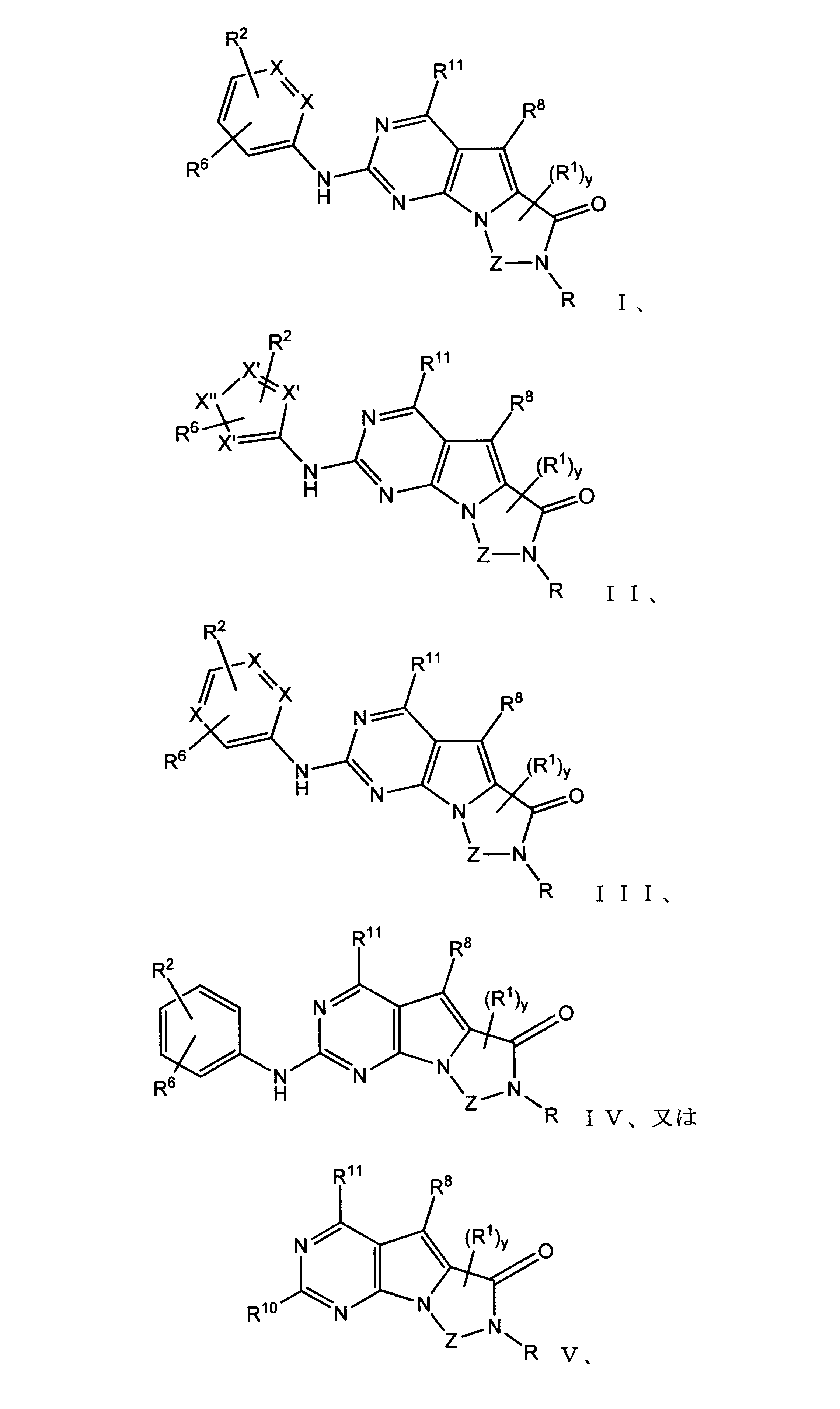
各Xは、独立してCH又はNであり;
各X’は、独立してCH又はNであり;
X’’は、独立してCH2、S又はNHであり、構成部分が安定5員環となるよう配置され;
R、R8及びR11は、独立してH、C1-C3のアルキル又はハロアルキル、シクロアルキル、又は、N、O又はSから選択される1つ以上のヘテロ原子を含んだシクロアルキル;-(アルキレン)m-C3-C8シクロアルキル、-(アルキレン)m-アリール、-(アルキレン)m、-ヘテロシクロ、-(アルキレン)m-ヘテロアリール、-(アルキレン)m-NR3R4、-(アルキレン)m-C(O)-NR3R4;-(アルキレン)m-O-R5、-(アルキレン)m-S(O)n-R5、又は-(アルキレン)m-S(O)n-NR3R4であり、これらのいずれも、電子価的に許される1つ以上のR基で任意に独立に置換されてもよく、同じ又は隣接した原子に結合した2つのRx基は任意に組み合わされて環を形成してもよく;
各R1は独立して、アリール、アルキル、シクロアルキル又はハロアルキルであり、前記アルキル、シクロアルキル及びハロアルキル基の各々は、鎖中の炭素の代わりに任意にO又はNヘテロ原子を含んでもよく、隣接した環原子又は同じ環原子の2つのR1は、それらが結合する環原子と共に、任意に3-8員環を形成してもよく;
yは、0、1、2,3又は4であり;
R2は、-(アルキレン)m-ヘテロシクロ、-(アルキレン)m-ヘテロアリール、-(アルキレン)m-NR3R4、-(アルキレン)m-C(O)-NR3R4;-(アルキレン)m-C(O)-O-アルキル;-(アルキレン)m-O-R5、-(アルキレン)m-S(O)n-R5、又は-(アルキレン)m-S(O)n-NR3R4であり、これらのいずれも、電子価的に許される1つ以上のRx基で任意に独立して置換されてもよく、同じ又は隣接した原子に結合した2つのRx基は、任意に組み合わされて環を形成してもよく、
mは0又は1、nは0、1又は2であり;
R3及びR4はその発生毎に、独立して、
(i)水素、又は
(ii)アルキル、シクロアルキル、ヘテロシクロ、アリール、ヘテロアリール、シクロアルキルアルキル、ヘテロシクロアルキル、アリールアルキル又はヘテロアリールアルキルであり、これらのいずれも、電子価的に許される1つ以上のRx基で任意に独立して置換されてもよく、同じ又は隣接した原子に結合した2つのRx基は、任意に組み合わされて環を形成してもよく、又は、
R3及びR4は、それらが結合する窒素原子と共に組み合わされて、電子価的に許される1つ以上のRx基で任意に独立して置換されてもよいヘテロシクロ環を形成してもよく、同じ又は隣接した原子に結合した2つのRx基は、任意に組み合わされて環を形成してもよく、
R5及びR5*はその発生毎に、独立して、
(i)水素、又は
(ii)アルキル、アルケニル、アルキニル、シクロアルキル、ヘテロシクロ、アリール、ヘテロアリール、シクロアルキルアルキル、ヘテロシクロアルキル、アリールアルキル又はヘテロアリールアルキルであり、これらのいずれも、電子価的に許される1つ以上のRx基で任意に独立して置換されてもよく;
Rxは、その発生毎に独立して、ハロ、シアノ、ニトロ、オキソ、アルキル、ハロアルキル、アルケニル、アルキニル、シクロアルキル、シクロアルケニル、ヘテロシクロ、アリール、ヘテロアリール、アリールアルキル、ヘテロアリールアルキル、シクロアルキルアルキル、ヘテロシクロアルキル、-(アルキレン)m-OR5、-(アルキレン)m-O-アルキレン-OR5、-(アルキレン)m-S(O)n-R5、-(アルキレン)m-NR3R4、-(アルキレン)m-CN、-(アルキレン)m-C(O)-R5、-(アルキレン)m-C(S)-R5、-(アルキレン)m-C(O)-OR5、-(アルキレン)m-O-C(O)-R5、-(アルキレン)m-C(S)-OR5、-(アルキレン)m-C(O)-(アルキレン)m-NR3R4、-(アルキレン)m-C(S)-NR3R4、-(アルキレン)m-N(R3)-C(O)-NR3R4、-(アルキレン)m-N(R3)-C(S)-NR3R4、-(アルキレン)m-N(R3)-C(O)-R5、-(アルキレン)m-N(R3)-C(S)-R5、-(アルキレン)m-O-C(O)-NR3R4、-(アルキレン)m-O-C(S)-NR3R4、-(アルキレン)m-SO2-NR3R4、-(アルキレン)m-N(R3)-SO2-R5、-(アルキレン)m-N(R3)-SO2-NR3R4、-(アルキレン)m-N(R3)-C(O)-OR5、-(アルキレン)m-N(R3)-C(S)-OR5、又は-(アルキレン)m-N(R3)-SO2-R5であり; ここで、前記アルキル、ハロアルキル、アルケニル、アルキニル、シクロアルキル、シクロアルケニル、ヘテロシクロ、アリール、ヘテロアリール、アリールアルキル、ヘテロアリールアルキル、シクロアルキルアルキル及びヘテロシクロアルキル基は、-(アルキレン)m-CN、-(アルキレン)m-OR5*、-(アルキレン)m-S(O)n-R5*、-(アルキレン)m-NR3*R4*、-(アルキレン)m-C(O)-R5*、-(アルキレン)m-C(=S)R5*、-(アルキレン)m-C(=O)OR5*、-(アルキレン)m-OC(=O)R5*、-(アルキレン)m-C(S)-OR5*、-(アルキレン)m-C(O)-NR3*R4*、-(アルキレン)m-C(S)-NR3*R4*、-(アルキレン)m-N(R3*)-C(O)-NR3*R4*、-(アルキレン)m-N(R3*)-C(S)-NR3*R4*、-(アルキレン)m-N(R3*)-C(O)-R5*、-(アルキレン)m-N(R3*)-C(S)-R5*、-(アルキレン)m-O-C(O)-NR3*R4*、-(アルキレン)m-O-C(S)-NR3*R4*、-(アルキレン)m-SO2-NR3*R4*、-(アルキレン)m-N(R3*)-SO2R5*、-(アルキレン)m-N(R3*)-SO2NR3*R4*、-(アルキレン)m-N(R3*)-C(O)-OR5*、-(アルキレン)m-N(R3*)-C(S)-OR5*、又は-(アルキレン)m-N(R3*)-SO2R5*、の1つ以上でさらに独立して置換されてもよく;
nは、0、1又は2であり、mは0又は1であり;
R3*及びR4*は、その発生毎に、独立して、
(i)水素、又は
(ii)アルキル、アルケニル、アルキニル、シクロアルキル、ヘテロシクロ、アリール、ヘテロアリール、シクロアルキルアルキル、ヘテロシクロアルキル、アリールアルキル又はヘテロアリールアルキルであって、これらのいずれも、電子価的に許される1つ以上のRx基で任意に独立して置換されてもよく、又は
R3*及びR4*は、それらが結合する窒素原子と共に組み合わされて、電子価的に許される1つ以上のRx基で任意に独立して置換されてもよいヘテロシクロ環を形成してもよく;
R6はH又は低級アルキル、-(アルキレン)m-ヘテロシクロ、-(アルキレン)m-ヘテロアリール、-(アルキレン)m-NR3R4、-(アルキレン)m-C(O)-NR3R4、-(アルキレン)m-O-R5、-(アルキレン)m-S(O)n-R5、又は-(アルキレン)m-S(O)n-NR3R4であり、これらのいずれも、電子価的に許される1つ以上のRx基で任意に独立して置換されてもよく、同じ又は隣接した原子に結合した2つのRx基は任意に組み合わされて環を形成してもよく、
R10は
(i)NHRAであり、
ここで、RAは非置換又は置換C1-C8アルキル、シクロアルキルアルキル、又は、-TT-RR、C1-C8シクロアルキル、又は、N、O及びSから選択されるヘテロ原子を1つ以上含むシクロアルキルであり;
TTは、非置換又は置換C1-C8アルキル又はC3-C8シクロアルキルリンカーであり;そして、
RRはヒドロキシル、非置換又は置換C1-C6アルコキシ、アミノ、非置換又は置換C1-C6アルキルアミノ、非置換又は置換ジC1-C6アルキルアミノ、非置換又は置換C6-C10アリール、1又は2個の5員又は6員環及びN、O及びSから選択される1-4個のヘテロ原子を含む非置換又は置換ヘテロアリール、非置換又は置換C3-C10炭素環、又は、1又は2個の5員又は6員環及びN、O及びSから選択される1-4個のヘテロ原子を含む非置換又は置換ヘテロ環であり;又は
(ii)-C(O)-R12又は-C(O)O-R13、ここで、R12はNHRA又はRAであり、R13はRAであり;又はその薬理学的に許容される塩、プロドラッグ又はアイソトープ変種、たとえば、一部又は全部に重水素を導入した形態である。
Active Compounds In one embodiment, the invention relates to compounds of formula I, II, III, IV or V, or pharmacologically acceptable salts thereof, or uses of these compounds:
each X is independently CH or N;
each X' is independently CH or N;
X″ is independently CH 2 , S or NH, arranged such that the moieties are a stable 5-membered ring;
R, R 8 and R 11 are independently H, C 1 -C 3 alkyl or haloalkyl, cycloalkyl, or cycloalkyl containing one or more heteroatoms selected from N, O or S; -(alkylene)mC 3 -C 8 cycloalkyl, -(alkylene) m -aryl, -(alkylene) m , -heterocyclo, -(alkylene) m -heteroaryl, -(alkylene) m -NR 3 R 4 , -(alkylene) m -C(O)-NR 3 R 4 ; -(alkylene) m -OR 5 , -(alkylene) m -S(O) n -R 5 , or -(alkylene) m - S(O) n —NR 3 R 4 , any of which may be optionally and independently substituted with one or more valence-allowed R groups and 2 attached to the same or adjacent atoms; the two Rx groups may be combined in any combination to form a ring;
each R 1 is independently aryl, alkyl, cycloalkyl or haloalkyl, each of said alkyl, cycloalkyl and haloalkyl groups optionally containing O or N heteroatoms in place of carbons in the chain; two R 1s on adjacent ring atoms or on the same ring atom, together with the ring atom to which they are attached, may optionally form a 3-8 membered ring;
y is 0, 1, 2, 3 or 4;
R 2 is -(alkylene) m -heterocyclo, -(alkylene) m -heteroaryl, -(alkylene) m -NR 3 R 4 , -(alkylene) m -C(O)-NR 3 R 4 ; -( alkylene) m —C(O)—O-alkyl; —(alkylene) m —OR 5 , —(alkylene) m —S(O) n —R 5 , or —(alkylene) m —S(O) n -NR 3 R 4 , any of which may be optionally and independently substituted with one or more valence-allowed R x groups, and two R the x groups may be combined in any combination to form a ring,
m is 0 or 1, n is 0, 1 or 2;
R 3 and R 4 are, at each occurrence, independently
(i) hydrogen, or (ii) alkyl, cycloalkyl, heterocyclo, aryl, heteroaryl, cycloalkylalkyl, heterocycloalkyl, arylalkyl, or heteroarylalkyl, any of which are electronically permissible 1 optionally independently substituted with one or more R x groups, and two R x groups attached to the same or adjacent atoms may optionally combine to form a ring, or
R 3 and R 4 , together with the nitrogen atom to which they are attached, may be combined to form a heterocyclo ring optionally independently substituted with one or more valence-permissible R x groups , two R x groups attached to the same or adjacent atoms may optionally combine to form a ring,
R 5 and R 5* are, at each occurrence, independently
(i) hydrogen, or (ii) alkyl, alkenyl, alkynyl, cycloalkyl, heterocyclo, aryl, heteroaryl, cycloalkylalkyl, heterocycloalkyl, arylalkyl, or heteroarylalkyl, any of which are electronically optionally and independently substituted with one or more R x groups allowed for
Rx is independently at each occurrence halo, cyano, nitro, oxo, alkyl, haloalkyl, alkenyl, alkynyl, cycloalkyl, cycloalkenyl, heterocyclo, aryl, heteroaryl, arylalkyl, heteroarylalkyl, cycloalkyl alkyl, heterocycloalkyl, -(alkylene) m -OR 5 , -(alkylene) m -O-alkylene-OR 5 , -(alkylene) m -S(O) n -R 5 , -(alkylene) m -NR 3 R 4 , -(alkylene) m -CN, -(alkylene) m -C(O)-R 5 , -(alkylene) m -C(S)-R 5 , -(alkylene) m -C(O) —OR 5 , —(alkylene) m —OC(O)—R 5 , —(alkylene) m —C(S)—OR 5 , —(alkylene) m —C(O)—(alkylene) m — NR 3 R 4 , -(alkylene) m -C(S)-NR 3 R 4 , -(alkylene) m -N(R 3 )-C(O)-NR 3 R 4 , -(alkylene) m -N (R 3 )—C(S)—NR 3 R 4 , —(alkylene) m —N(R 3 )—C(O)—R 5 , —(alkylene) m —N(R 3 )—C(S )—R 5 , —(alkylene) m —OC(O)—NR 3 R 4 , —(alkylene) m —OC(S)—NR 3 R 4 , —(alkylene) m —SO 2 — NR 3 R 4 , -(alkylene) m -N(R 3 )-SO 2 -R 5 , -(alkylene) m -N(R 3 )-SO 2 -NR 3 R 4 , -(alkylene) m -N (R 3 )—C(O)—OR 5 , —(alkylene) m —N(R 3 )—C(S)—OR 5 , or —(alkylene) m —N(R 3 )—SO 2 —R 5 ; wherein said alkyl, haloalkyl, alkenyl, alkynyl, cycloalkyl, cycloalkenyl, heterocyclo, aryl, heteroaryl, arylalkyl, heteroarylalkyl, cycloalkylalkyl and heterocycloalkyl groups are —(alkylene) m —CN, —(alkylene) m —OR 5* , —(alkylene) m —S(O)n—R 5* , —(alkylene) m —NR 3* R 4* , —(alkylene) m —C (O)—R 5* , —(alkylene) m —C(=S)R 5* , —(alkylene) m —C(=O)OR 5* , —(alkylene) m —OC(=O)R 5* , -(alkylene) m -C(S)-OR 5* , -(alkylene) m -C(O)-NR 3* R 4* , -(alkylene) m -C(S)-NR 3* R 4* , -(alkylene) m -N(R 3* )-C(O)-NR 3* R 4* , -(alkylene) m -N(R 3* )-C(S)-NR 3* R 4* , -(alkylene) m -N(R 3* )-C(O)-R 5* , -(alkylene) m -N(R 3* )-C(S)-R 5* , -( alkylene) m —O—C(O)—NR 3* R 4* , —(alkylene) m —O—C(S)—NR 3* R 4* , —(alkylene) m —SO 2 —NR 3* R 4* , -(alkylene) m -N(R 3* )-SO 2 R 5* , -(alkylene) m -N(R 3* )-SO 2 NR 3* R 4* , -(alkylene) m —N(R 3* )—C(O)—OR 5* , —(alkylene) m —N(R 3* )—C(S)—OR 5* , or —(alkylene) m —N(R 3 * )—SO 2 R 5* , optionally further independently substituted with one or more of;
n is 0, 1 or 2 and m is 0 or 1;
R 3* and R 4* are, at each occurrence, independently
(i) hydrogen, or (ii) alkyl, alkenyl, alkynyl, cycloalkyl, heterocyclo, aryl, heteroaryl, cycloalkylalkyl, heterocycloalkyl, arylalkyl, or heteroarylalkyl, any of which have an electronic valence optionally independently substituted with one or more R x groups that are legally acceptable, or R 3* and R 4* , in combination with the nitrogen atom to which they are attached, are may form a heterocyclo ring optionally independently substituted with one or more R x groups;
R 6 is H or lower alkyl, -(alkylene) m -heterocyclo, -(alkylene) m -heteroaryl, -(alkylene) m -NR 3 R 4 , -(alkylene) m -C(O)-NR 3 R 4 , -(alkylene) m -OR 5 , -(alkylene) m -S(O)n-R 5 , or -(alkylene) m -S(O) n -NR 3 R 4 and these any of which may be optionally independently substituted with one or more R x groups that are electronically permissible, and two R x groups attached to the same or adjacent atoms optionally combine to form a ring You may
R 10 is (i) NHR A ;
wherein R A is unsubstituted or substituted C 1 -C 8 alkyl, cycloalkylalkyl, or —TT-RR, C 1 -C 8 cycloalkyl, or a heteroatom selected from N, O and S; is a cycloalkyl comprising one or more;
TT is an unsubstituted or substituted C 1 -C 8 alkyl or C 3 -C 8 cycloalkyl linker; and
RR is hydroxyl, unsubstituted or substituted C 1 -C 6 alkoxy, amino, unsubstituted or substituted C 1 -C 6 alkylamino, unsubstituted or substituted diC 1 -C 6 alkylamino, unsubstituted or substituted C 6 -C 10 aryl, unsubstituted or substituted heteroaryl containing 1 or 2 5- or 6-membered rings and 1-4 heteroatoms selected from N, O and S, unsubstituted or substituted C 3 -C 10 carbon a ring or an unsubstituted or substituted heterocyclic ring containing 1 or 2 5- or 6-membered rings and 1-4 heteroatoms selected from N, O and S; or (ii) -C( O)—R 12 or —C(O)OR 13 , wherein R 12 is NHR A or RA and R 13 is RA ; Drugs or isotopic variants, eg, partially or fully deuterated forms.
ある態様では、化合物は式I又は式IIであり、R6は不在である。
ある態様では、化合物は、式IIIであり:
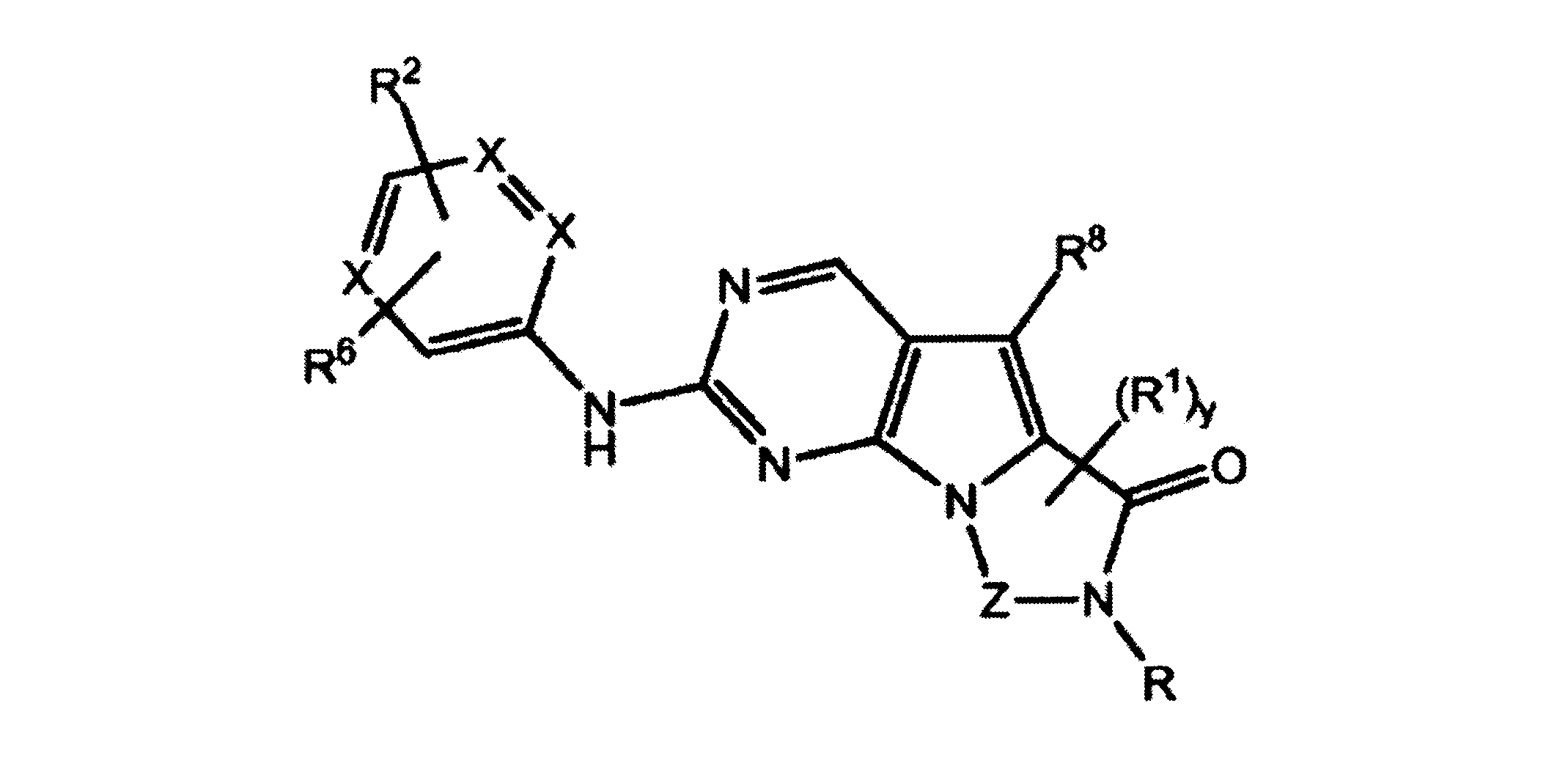
ある態様では、Rxは、さらに置換されない。
ある態様では、R2は、-(アルキレン)m-ヘテロシクロ、-(アルキレン)m-ヘテロアリール、-(アルキレン)m-NR3R4、-(アルキレン)m-C(O)-NR3R4であり、;-(アルキレン)m-O-R5-(アルキレン)m-S(O)n-R5又は-(アルキレン)m-S(O)n-NR3R4のいずれも、電子価的に許される1つ以上のRx基で任意に独立して置換されてもよく、同じ又は隣接した原子に結合した2つのRx基は任意に組み合わされて環を形成してもよく、
mは0又は1、nは0、1又は2である。
ある態様では、R8は、水素又はC1-C3アルキルである。 ある態様では、Rは、水素又はC1-C3アルキルである。
ある態様では、R2は、-(アルキレン)m-ヘテロシクロ、-(アルキレン)m-NR3R4、-(アルキレン)m-C(O)-NR3R4、-(アルキレン)m-C(O)-O-アルキル又は-(アルキレン)m-OR5であり、これらのいずれも、電子価的に許される1つ以上のRx基で任意に独立して置換されてもよく、同じ又は隣接した原子に結合した2つのRx基は任意に組み合わされて環を形成してもよい。
ある態様では、R2は、-(アルキレン)m-ヘテロシクロ、-(アルキレン)m-NR3R4、-(アルキレン)m-C(O)-NR3R4、-(アルキレン)m-C(O)-O-アルキル又は-(アルキレン)m-OR5であり、さらなる置換はない。 ある態様では、R2におけるmは、1である。
更なる態様では、R2のアルキレンは、メチレン基である。
In some embodiments, the compound is of Formula I or Formula II and R6 is absent.
In some embodiments, the compound is of Formula III:
In some embodiments, R x is not further substituted.
In some embodiments, R 2 is -(alkylene) m -heterocyclo, -(alkylene) m -heteroaryl, -(alkylene) m -NR 3 R 4 , -(alkylene) m -C(O)-NR 3 R 4 ; either -(alkylene) m -O-R 5 -(alkylene) m -S(O) n -R 5 or -(alkylene) m -S(O) n -NR 3 R 4 ; may be optionally independently substituted with one or more R x groups that are electronically permissible, and two R x groups attached to the same or adjacent atoms may optionally combine to form a ring; often,
m is 0 or 1, n is 0, 1 or 2;
In some embodiments, R 8 is hydrogen or C 1 -C 3 alkyl. In some embodiments, R is hydrogen or C1 - C3 alkyl.
In some embodiments, R 2 is -(alkylene) m -heterocyclo, -(alkylene) m -NR 3 R 4 , -(alkylene) m -C(O)-NR 3 R 4 , -(alkylene) m -C (O)—O-alkyl or —(alkylene) m —OR 5 , any of which may be optionally and independently substituted with one or more electronically acceptable R x groups, and the same Or two R x groups attached to adjacent atoms may be combined in any combination to form a ring.
In some embodiments, R 2 is -(alkylene) m -heterocyclo, -(alkylene) m -NR 3 R 4 , -(alkylene) m -C(O)-NR 3 R 4 , -(alkylene) m -C (O)-O-alkyl or -(alkylene) m -OR 5 with no further substitution. In some embodiments, m in R 2 is 1.
In a further aspect, the alkylene of R 2 is a methylene group.
ある態様では、R2は、以下の通りである:

Pは、4員~8員の単環又は二環式飽和ヘテロシクリル基であり;
各Rx1は、独立して、-(アルキレン)m-(C(O))m-(アルキレン)m-(N(Rn))m-(アルキル)m、ここで各mは、独立して0又は1であるが、少なくとも一つのmは1、-(C(O))-O-アルキル、-(アルキレン)m-シクロアルキル、ここでmは0又は1、-N(Rn)-シクロアルキル、-C(O)-シクロアルキル、-(アルキレン)m-ヘテロシクリル、ここでmは0又は1、又は、-N(Rn)-ヘテロシクリル、-C(O)-ヘテロシクリル、-S(O)2-(アルキレン)m、ここでmは、1又は2であり、 ここで、Rnは、H、C1~C4アルキル又はC1~C6ヘテロアルキルであり、そして、
2個のRx1は、Pに結合する原子(これは同じ原子でもよい)と共に、環を形成することができ;tは、0、1又は2である。
ある態様では、各Rx1は、非置換のアルキル、ハロゲン又はヒドロキシによって任意に置換されるのみである。
ある態様では、Rx1は、水素又は非置換のC1~C4アルキルである。 ある態様では、少なくとも1つのRx1は、-(アルキレン)m-ヘテロシクリルであり、ここで、mは0又は1である。
In one aspect, R 2 is as follows:
P is a 4- to 8-membered monocyclic or bicyclic saturated heterocyclyl group;
Each R x1 is independently -(alkylene) m -(C(O)) m -(alkylene) m -(N(R n )) m -(alkyl) m , where each m is independently is 0 or 1, but at least one m is 1, —(C(O))—O-alkyl, —(alkylene)m-cycloalkyl, where m is 0 or 1, —N(R n ) -cycloalkyl, -C(O)-cycloalkyl, -(alkylene) m -heterocyclyl, where m is 0 or 1, or -N(R n )-heterocyclyl, -C(O)-heterocyclyl, -S (O) 2 -(alkylene)m, where m is 1 or 2, wherein R n is H, C 1 -C 4 alkyl or C 1 -C 6 heteroalkyl, and
Two R x1 can form a ring together with the atom bonded to P (which may be the same atom); t is 0, 1 or 2;
In some embodiments, each R x1 is only optionally substituted with unsubstituted alkyl, halogen or hydroxy.
In some embodiments, R x1 is hydrogen or unsubstituted C 1 -C 4 alkyl. In some embodiments, at least one R x1 is -(alkylene) m -heterocyclyl, wherein m is 0 or 1.
ある態様では、R2は:



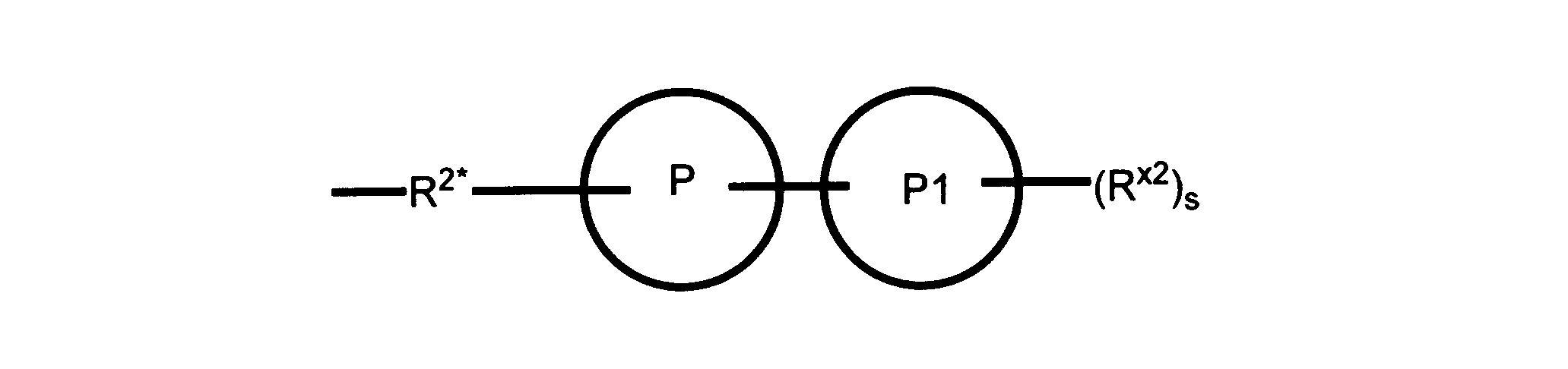
R2*は、結合、アルキレン、-(アルキレン)m-O-(アルキレン)m-、-(アルキレン)m-C(O)-(アルキレン)m-、-(アルキレン)m-S(O)2-(アルキレン)m-及び-(アルキレン)m-NH-(アルキレン)m-であり、 ここで、各mは、独立して0又は1であり;
Pは、4員~8員の単環又は二環式飽和ヘテロシクリル基であり;
P1は、4員又は6員の単環式飽和ヘテロシクリル基であり;
各Rx2は、独立して水素又はアルキルであり;
sは0、1又は2である。
In one aspect, R 2 is:
R 2* is a bond, alkylene, -(alkylene) m -O-(alkylene) m -, -(alkylene) m -C(O)-(alkylene) m -, -(alkylene) m -S(O) 2 -(alkylene) m - and -(alkylene) m -NH-(alkylene) m -, wherein each m is independently 0 or 1;
P is a 4- to 8-membered monocyclic or bicyclic saturated heterocyclyl group;
P1 is a 4- or 6-membered monocyclic saturated heterocyclyl group;
each R x2 is independently hydrogen or alkyl;
s is 0, 1 or 2;
ある態様では、R2は:
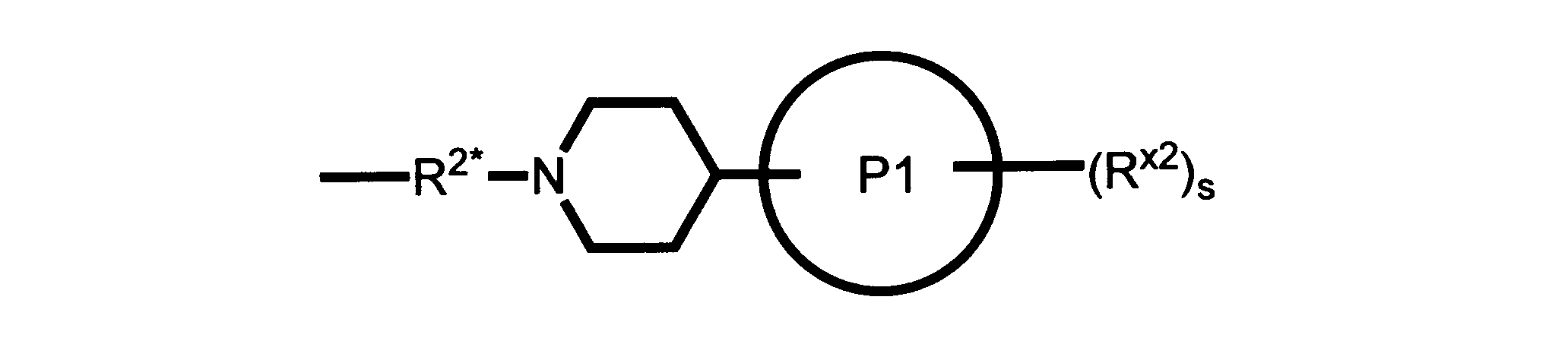
ある態様では、前述の全ての態様におけるR2*のあらゆるアルキレンは、さらに置換されない。
ある態様では、R2は、図13-15に示される構造から選択される。
In one aspect, R 2 is:
In one aspect, every alkylene of R 2* in any of the above aspects is not further substituted.
In some embodiments, R 2 is selected from the structures shown in Figures 13-15.
ある態様では、R2は:
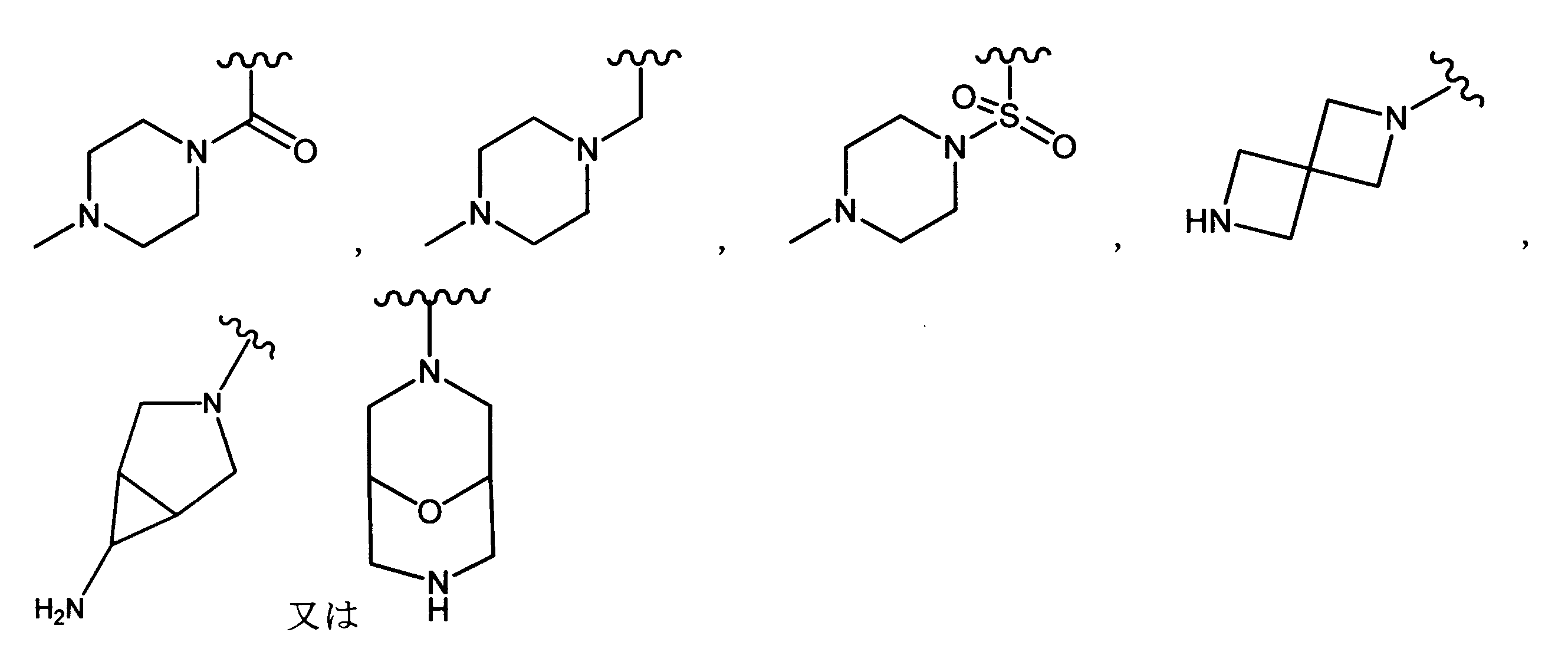
ある態様では、化合物は、一般式Iを有し、より具体的には図16~20の一般構造の一つを有し、そこでは変数はあらかじめ定義されている通りである。
ある態様では、化合物は、一般式Iaを有する:
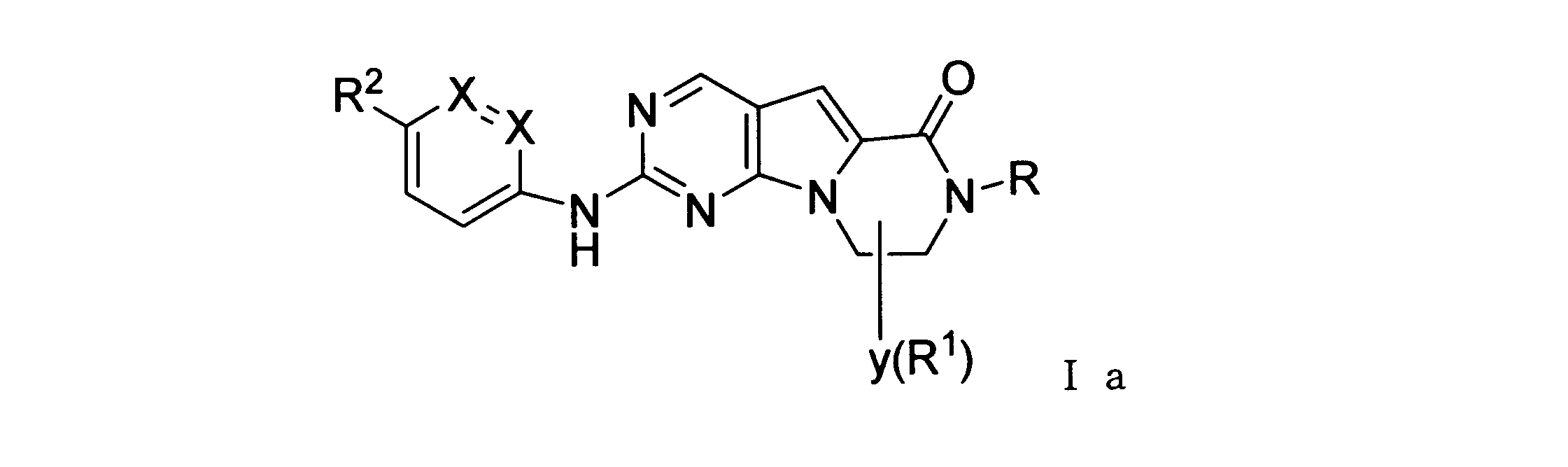
ある実施形態では、化合物は式Iaを有し、RはHである。
ある実施形態では、化合物は、式Iaを有し、R2は:

ある実施形態では、化合物は式Iaを有し、R2は:

Rx1は、水素又は非置換のC1~C4アルキルであり、及び R2*は、あらかじめ定義されている通りである。
In some embodiments, the compound has the general formula I, more specifically one of the general structures of Figures 16-20, where the variables are as previously defined.
In one aspect, the compound has the general formula Ia:
In some embodiments, the compound has Formula Ia and R is H.
In certain embodiments, the compound has Formula Ia, and R 2 is:
In certain embodiments, the compound has Formula Ia, and R 2 is:
R x1 is hydrogen or unsubstituted C 1 -C 4 alkyl, and R 2* is as previously defined.
ある実施形態では、化合物は、式Ibを有する:
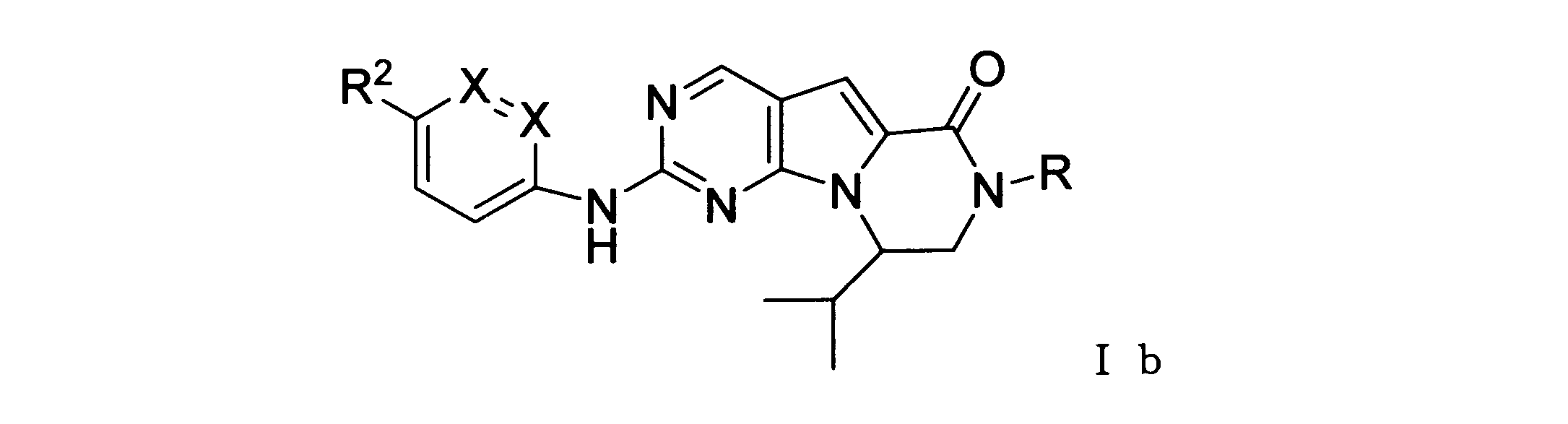
ある実施形態では、化合物は式Ibを有し、Rはアルキルである。
ある実施形態では、化合物は式Ibを有し、RはHである。
ある実施形態では、化合物は、式Ibを有し、R2は:

ある実施形態では、化合物は、式Ibを有し、R2は:

In some embodiments, the compound has Formula Ib and R is alkyl.
In some embodiments, the compound has Formula Ib and R is H.
In certain embodiments, the compound has Formula Ib, and R 2 is:
In certain embodiments, the compound has Formula Ib, and R 2 is:
ある実施形態では、化合物は、式Icを有する:
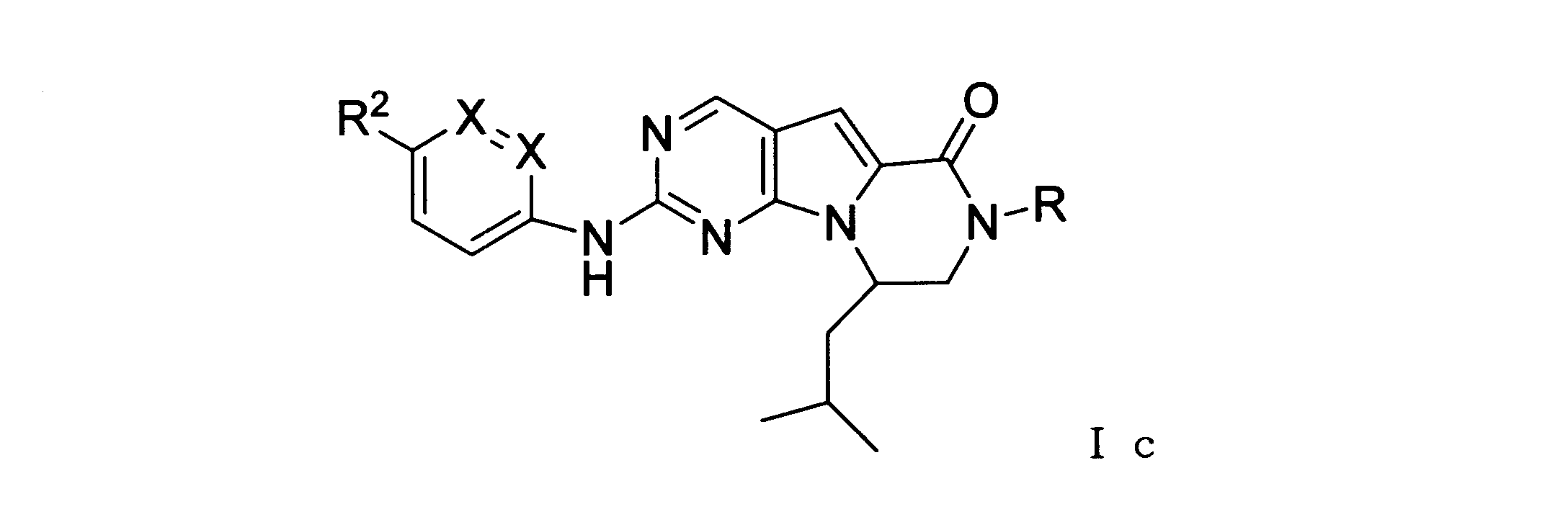
ある実施形態では、化合物は式Icを有し、Rはアルキルである。
ある実施形態では、化合物は式Icを有し、RはHである。
ある実施形態では、化合物は式Icを有し、R2は:

ある実施形態では、化合物は式Icを有し、R2は:

In some embodiments, the compound has Formula Ic and R is alkyl.
In some embodiments, the compound has Formula Ic and R is H.
In certain embodiments, the compound has Formula Ic, and R 2 is:
In certain embodiments, the compound has Formula Ic, and R 2 is:
ある実施形態では、化合物は、式Idを有する:
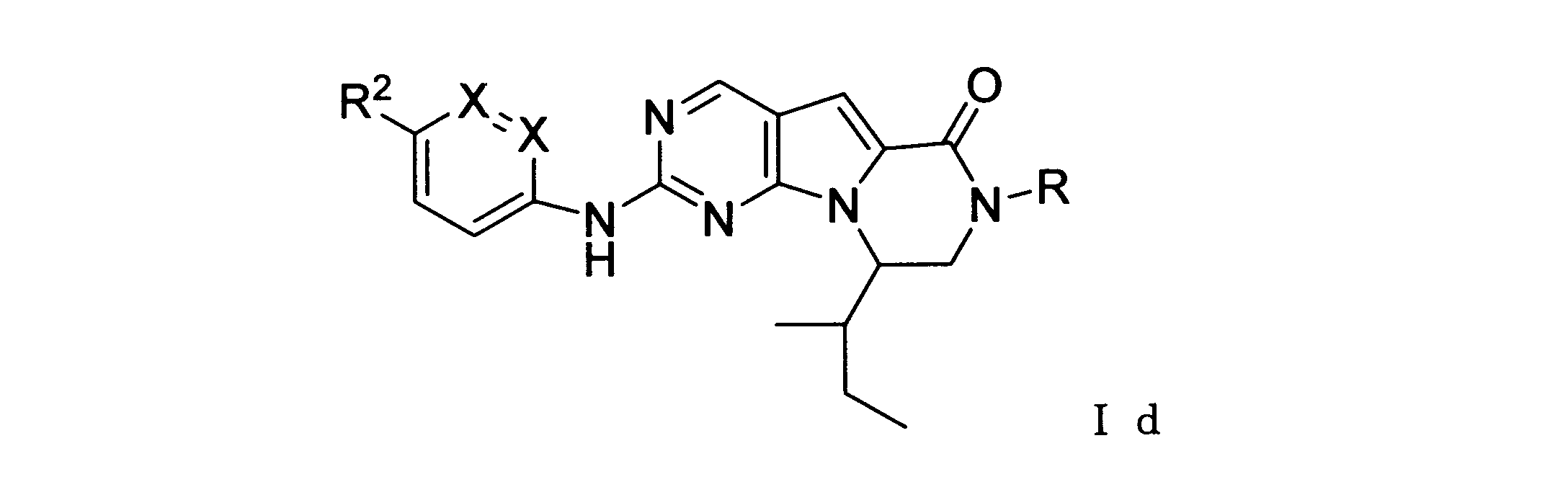
ある実施形態では、化合物は式Idを有し、Rはアルキルである。
ある実施形態では、化合物は式Idを有し、RはHである。
ある実施形態では、化合物は、式Idを有し、R2は:

ある実施形態では、化合物は、式Idを有し、R2は:

In some embodiments, the compound has Formula Id and R is alkyl.
In some embodiments, the compound has the formula Id and R is H.
In certain embodiments, the compound has the Formula Id, and R 2 is:
In certain embodiments, the compound has the Formula Id, and R 2 is:
ある実施形態では、化合物は、式Ieを有する:
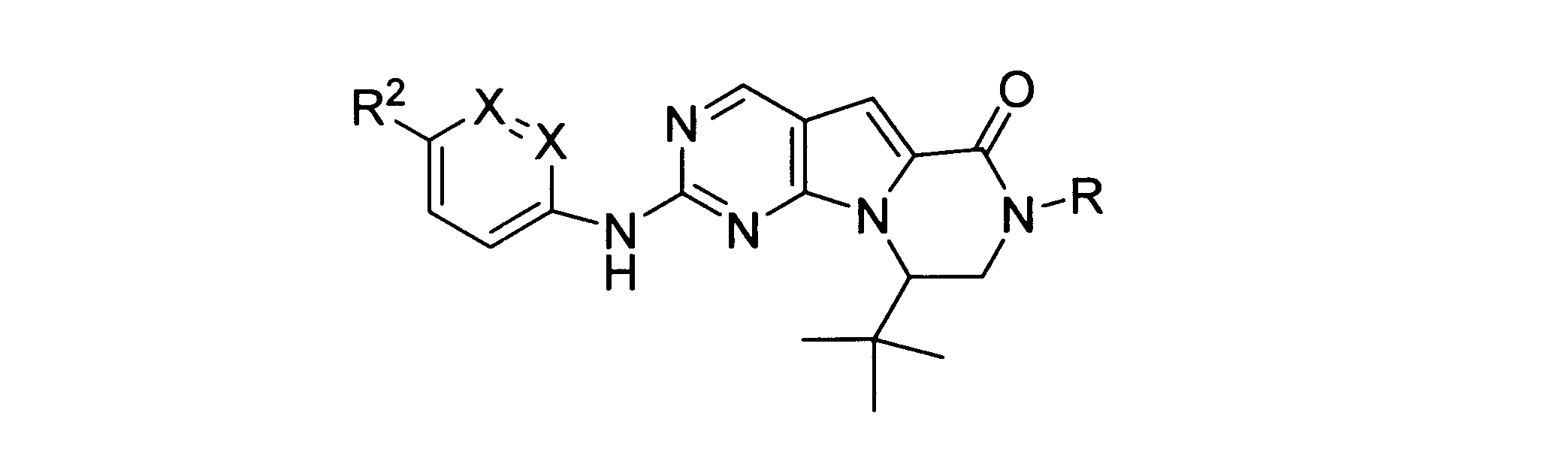
ある実施形態では、化合物は式Ieを有し、RはHである。
ある実施形態では、化合物は式Ieを有し、R2は:

ある実施形態では、化合物は式Ieを有し、R2は:

In some embodiments, the compound has Formula Ie and R is H.
In certain embodiments, the compound has Formula Ie, and R 2 is:
In certain embodiments, the compound has Formula Ie, and R 2 is:
ある実施形態では、化合物は、式Ifを有する:
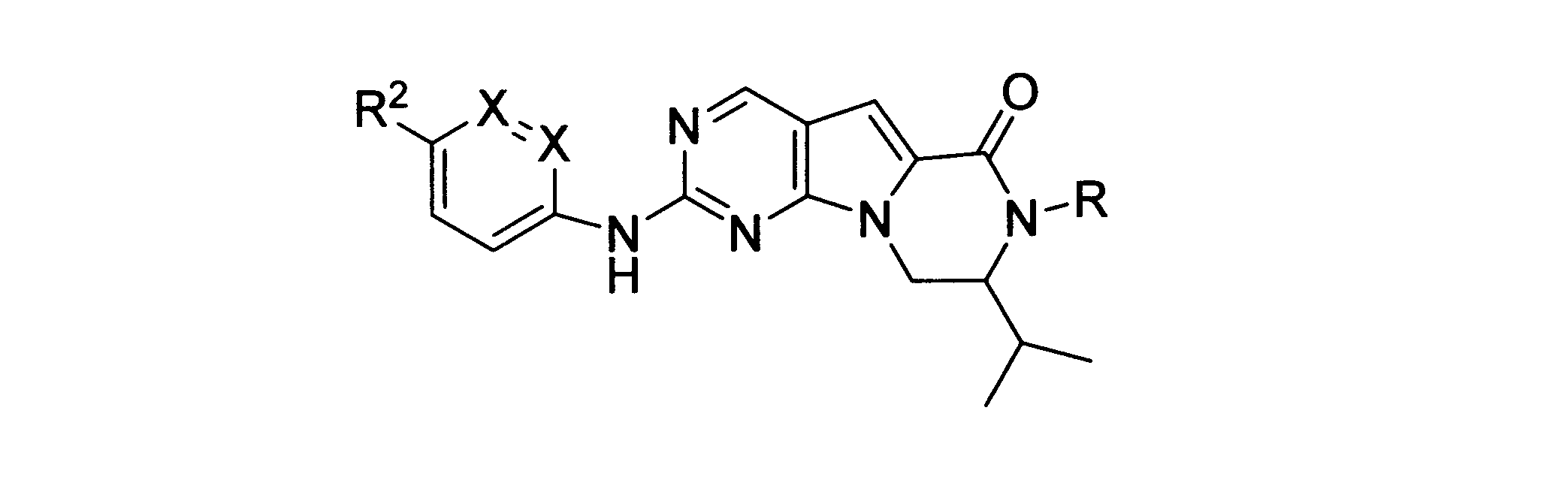
ある実施形態では、化合物は式Ifを有し、RはHである。
ある実施形態では、化合物は式Ifを有し、R2は:

ある実施形態では、化合物は式Ifを有し、R2は:

In certain embodiments, the compound has the formula If and R is H.
In certain embodiments, the compound has the formula If, and R 2 is:
In certain embodiments, the compound has the formula If, and R 2 is:
ある実施形態では、化合物は、式Igを有する:
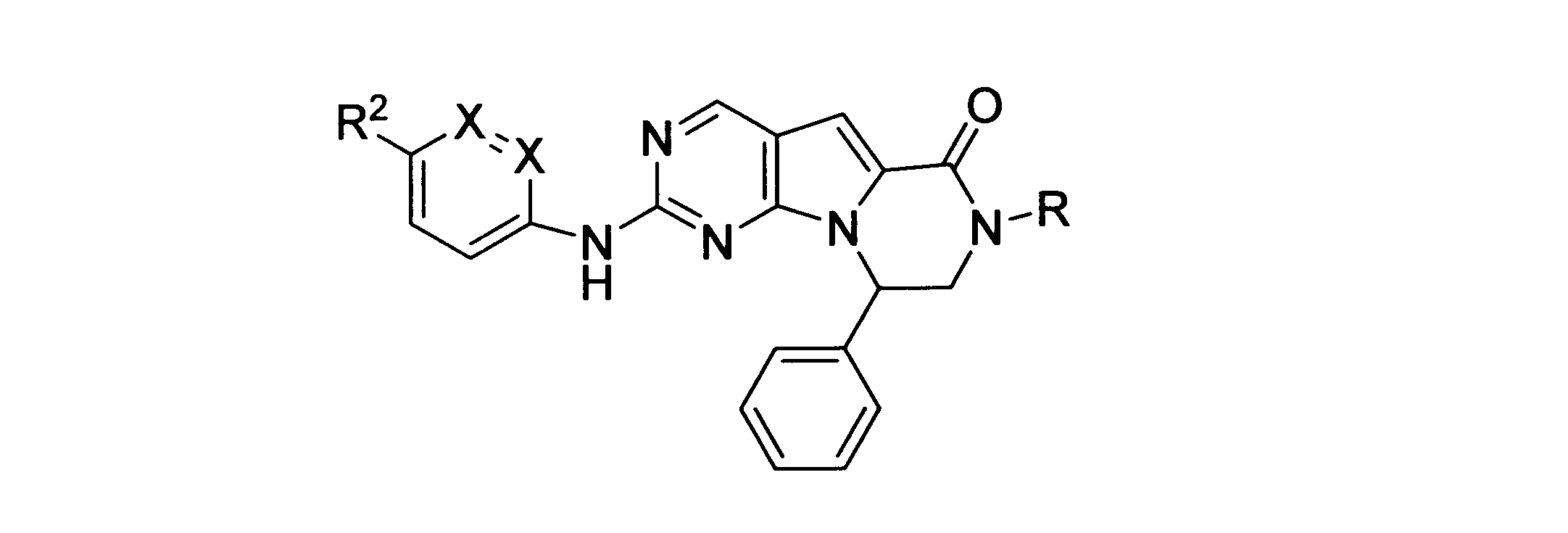
ある実施形態では、化合物は式Igを有し、RはHである。
ある実施形態では、化合物は式Igを有し、R2は:

ある実施形態では、化合物は式Igを有し、R2は:

In some embodiments, the compound has Formula Ig and R is H.
In certain embodiments, the compound has Formula Ig, and R 2 is:
In certain embodiments, the compound has Formula Ig, and R 2 is:
ある実施形態では、化合物は、式Ihを有する:

ある実施形態では、化合物は式Ihを有し、RはHである。
ある実施形態では、化合物は、式Ihを有し、R2は:

ある実施形態では、化合物は、式Ihを有し、R2は:

In some embodiments, the compound has the formula Ih and R is H.
In certain embodiments, the compound has the formula Ih, and R 2 is:
In certain embodiments, the compound has the formula Ih, and R 2 is:
ある実施形態では、化合物は、式Iiを有する:
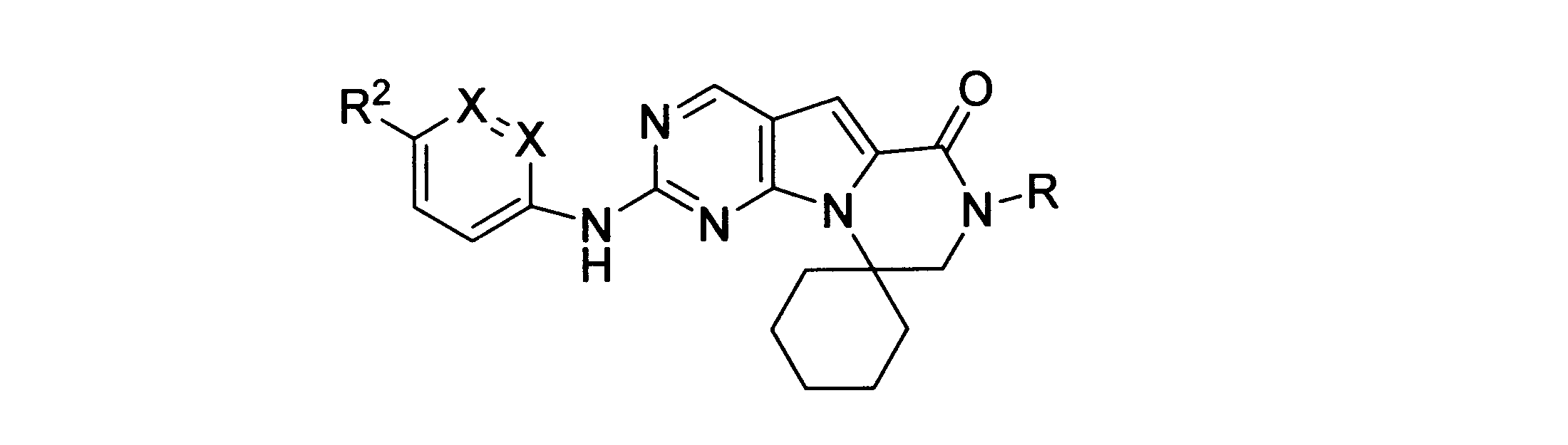
ある実施形態では、化合物は式Iiを有し、RはHである。
ある実施形態では、化合物は式Iiを有し、R2は:

ある実施形態では、化合物は式Iiを有し、R2は:

In some embodiments, the compound has Formula Ii and R is H.
In certain embodiments, the compound has Formula Ii, and R 2 is:
In certain embodiments, the compound has Formula Ii, and R 2 is:
ある実施形態では、化合物は、式Ijを有する:
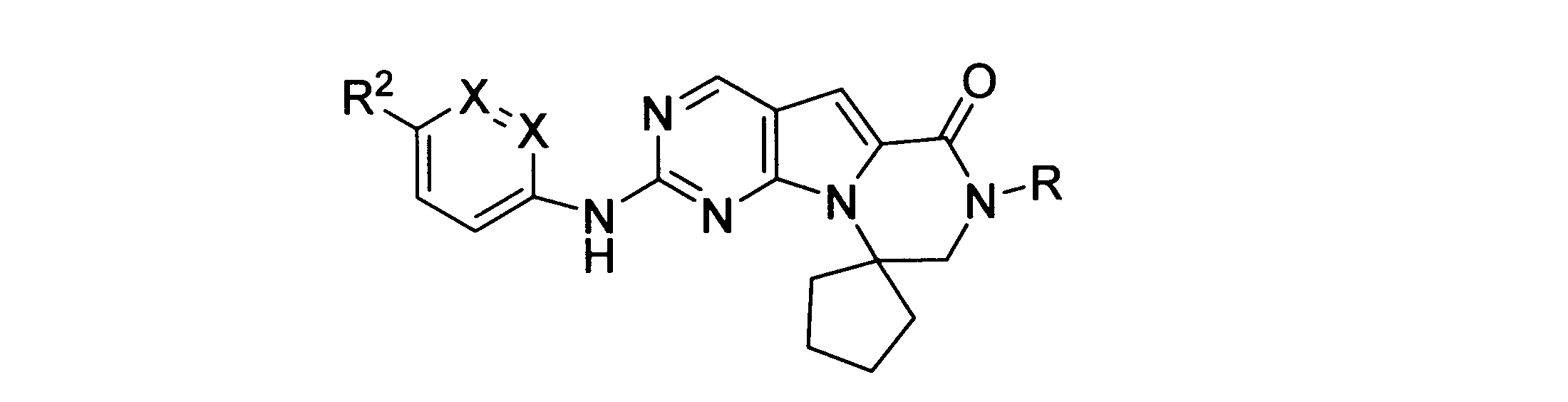
ある実施形態では、化合物は式Ijを有し、RはHである。
ある実施形態では、化合物は式Ijを有し、R2は:

ある実施形態では、化合物は式Ijを有し、R2は:

ある実施形態では、化合物は式Ijを有し、RはHであり、両方のXはNである。
In some embodiments, the compound has the formula Ij:
In some embodiments, the compound has the formula Ij and R is H.
In certain embodiments, the compound has the formula Ij, and R 2 is:
In certain embodiments, the compound has the formula Ij, and R 2 is:
In some embodiments, the compound has the formula Ij, R is H and both X are N.
ある実施形態では、化合物は、次の構造を有する:
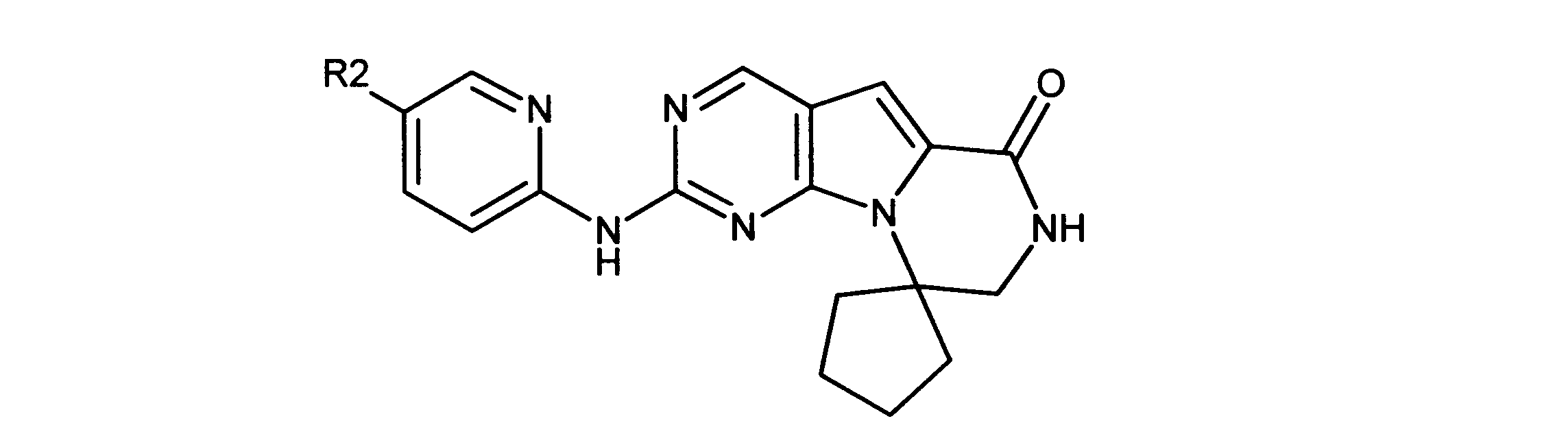

ある実施形態では、化合物は式Ikを有し、R2は:

In certain embodiments, the compound has Formula Ik, and R 2 is:
ある実施形態では、化合物は、式Ilを有する:
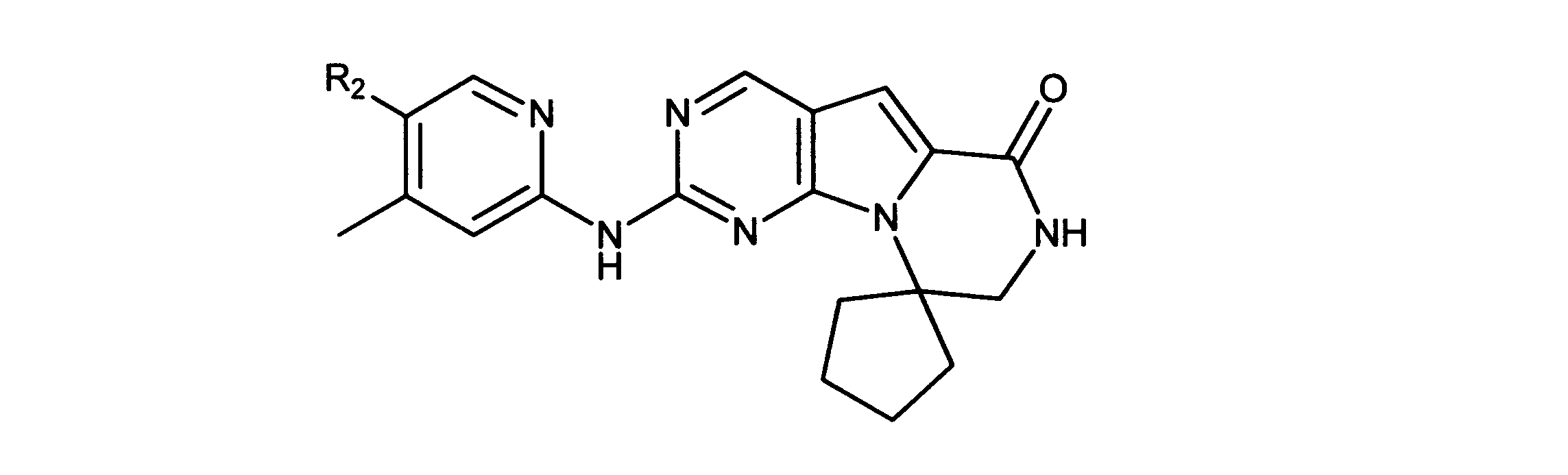

ある実施形態では、化合物は式Ilを有し、R2は:

In certain embodiments, the compound has the formula Il, and R 2 is:
ある実施形態では、化合物は、式Imを有する:
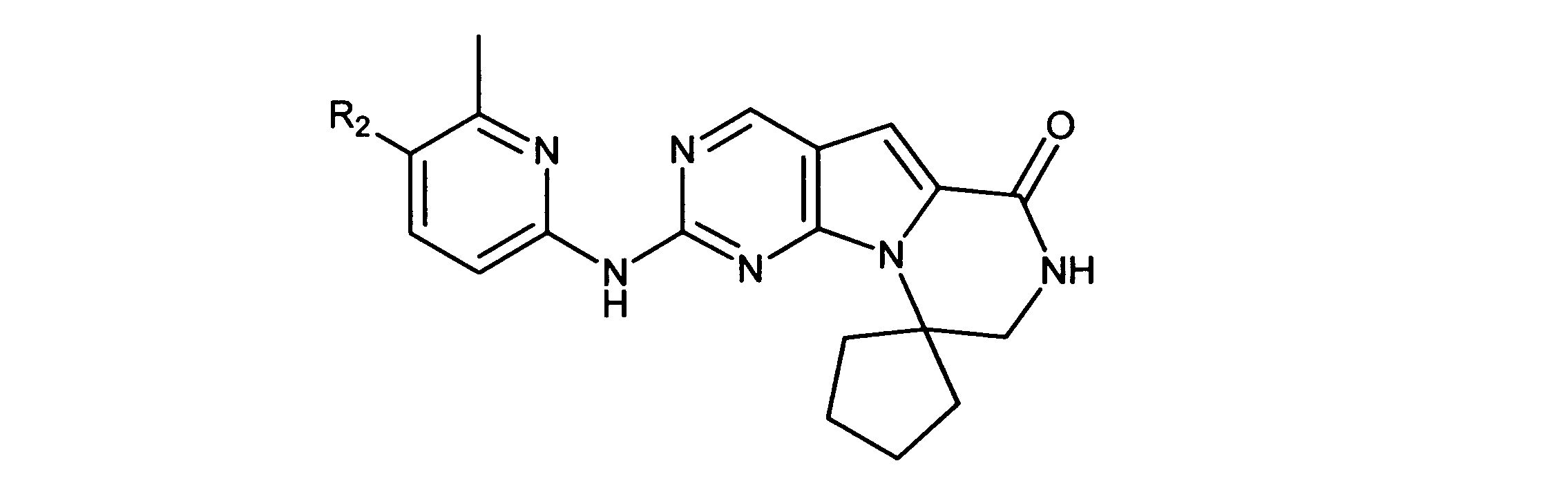

ある実施形態では、化合物は式Imを有し、R2は:

In certain embodiments, the compound has the formula Im and R 2 is:
ある実施形態では、化合物は、式IIaを有する:
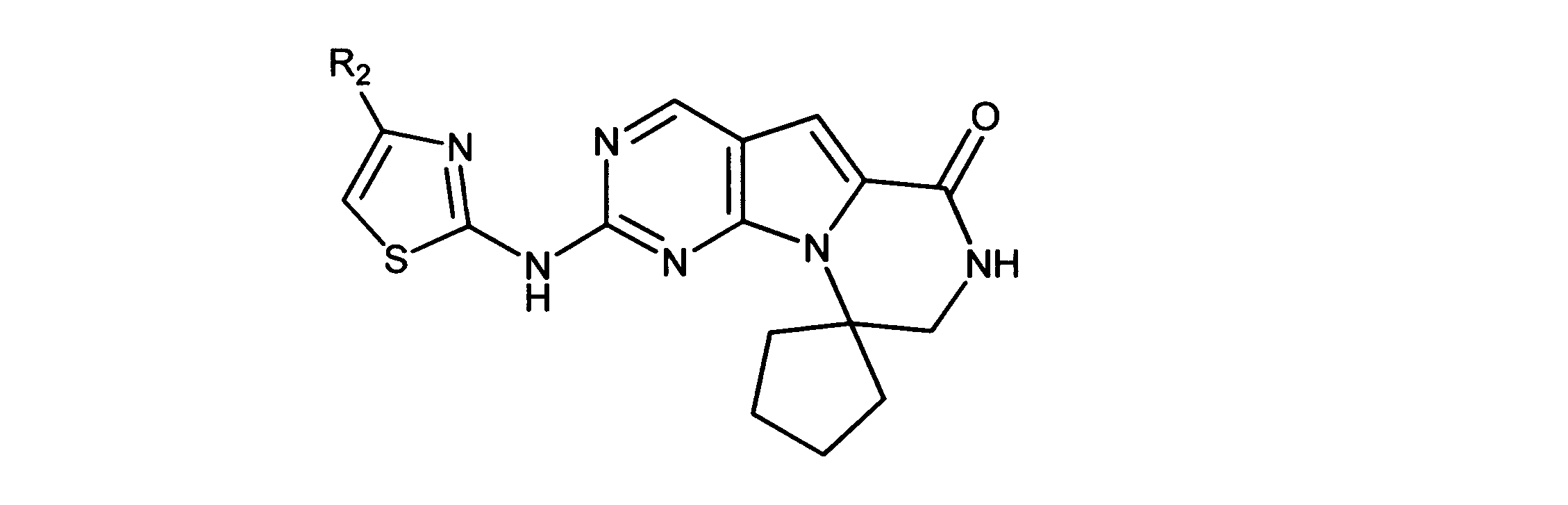

ある実施形態では、化合物は、式IIaを有し、R2は:

In certain embodiments, the compound has the Formula IIa, and R 2 is:
ある実施形態では、化合物は、式IIbを有する:
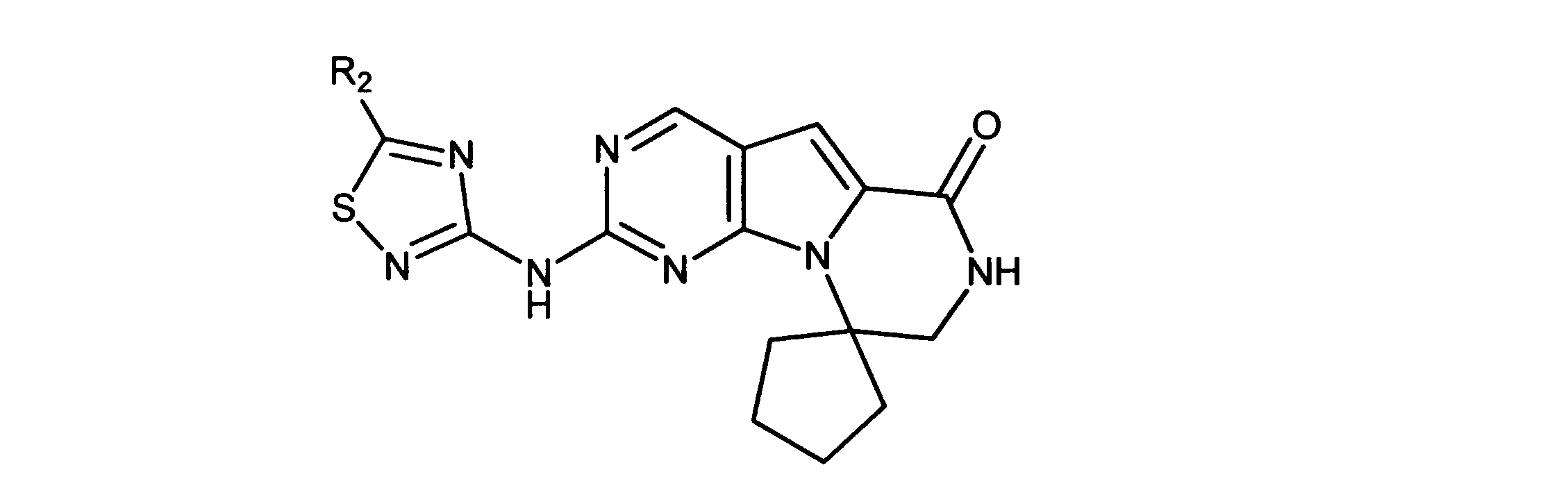

ある実施形態では、化合物は式Imを有し、R2は:

In certain embodiments, the compound has the formula Im and R 2 is:
ある態様では、活性化合物は以下の通りである:
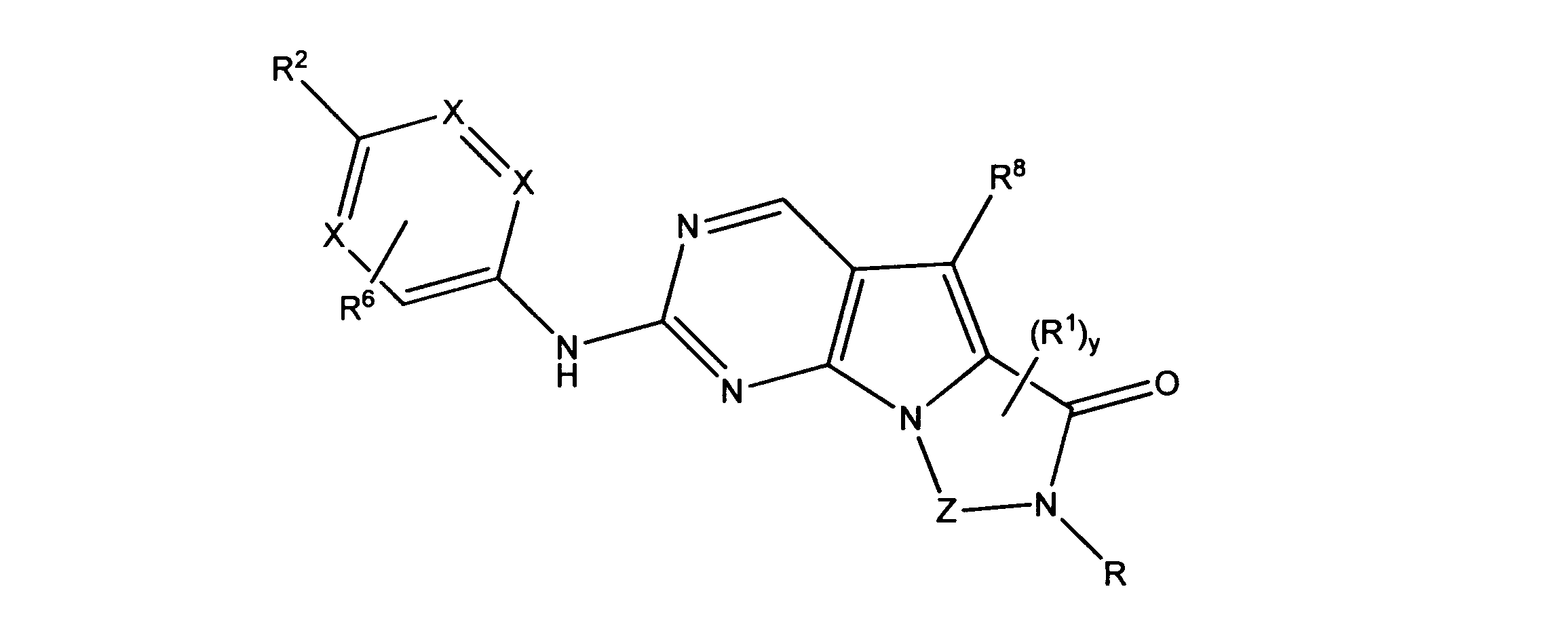
本発明の範囲内に含まれ、ここに開示された治療及び組成物の方法に使用可能な、更に具体的な化合物は、下記の表1に列挙される構造を含み得る。 More specific compounds included within the scope of the invention and usable in the methods of treatment and compositions disclosed herein may include the structures listed in Table 1 below.
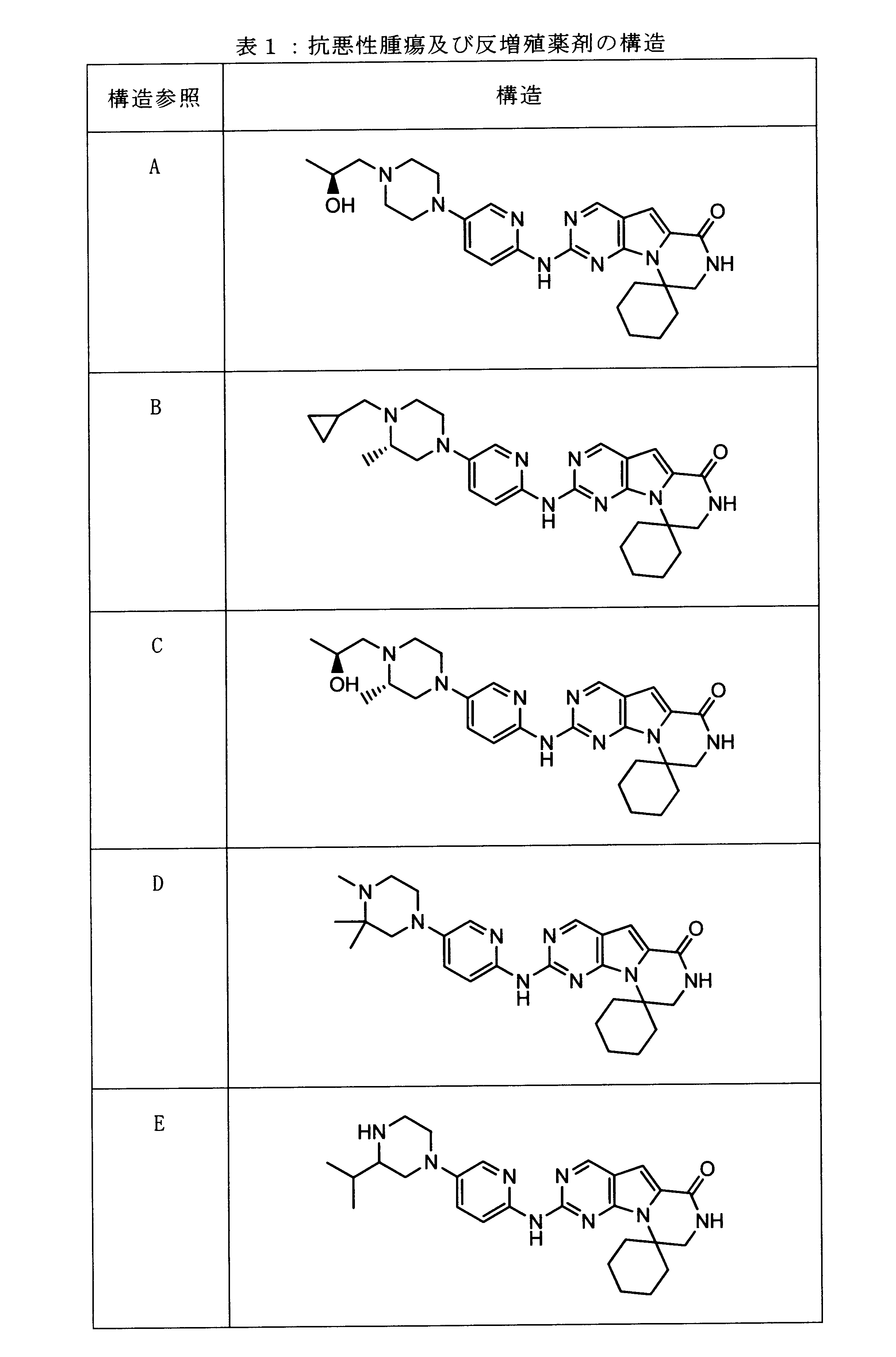
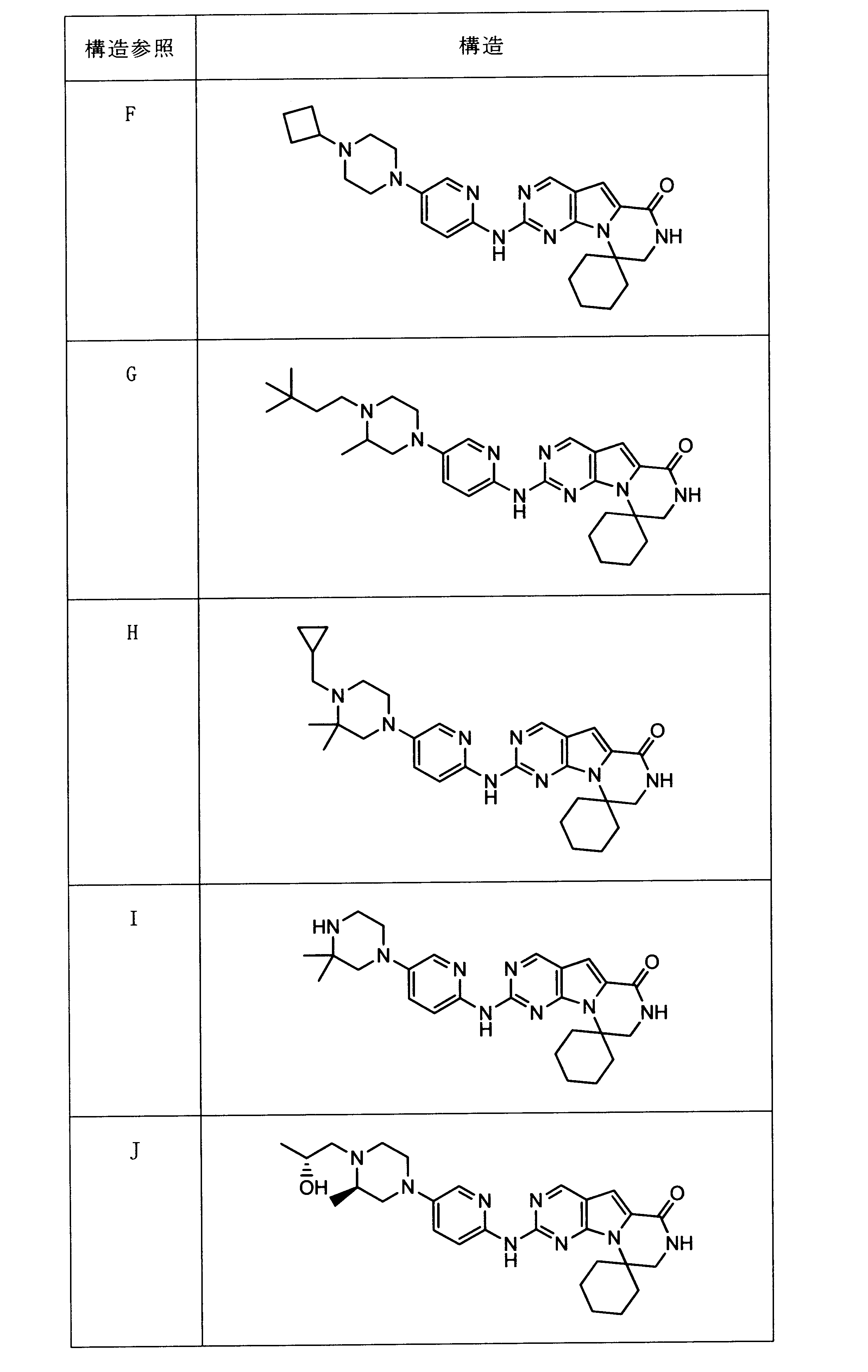
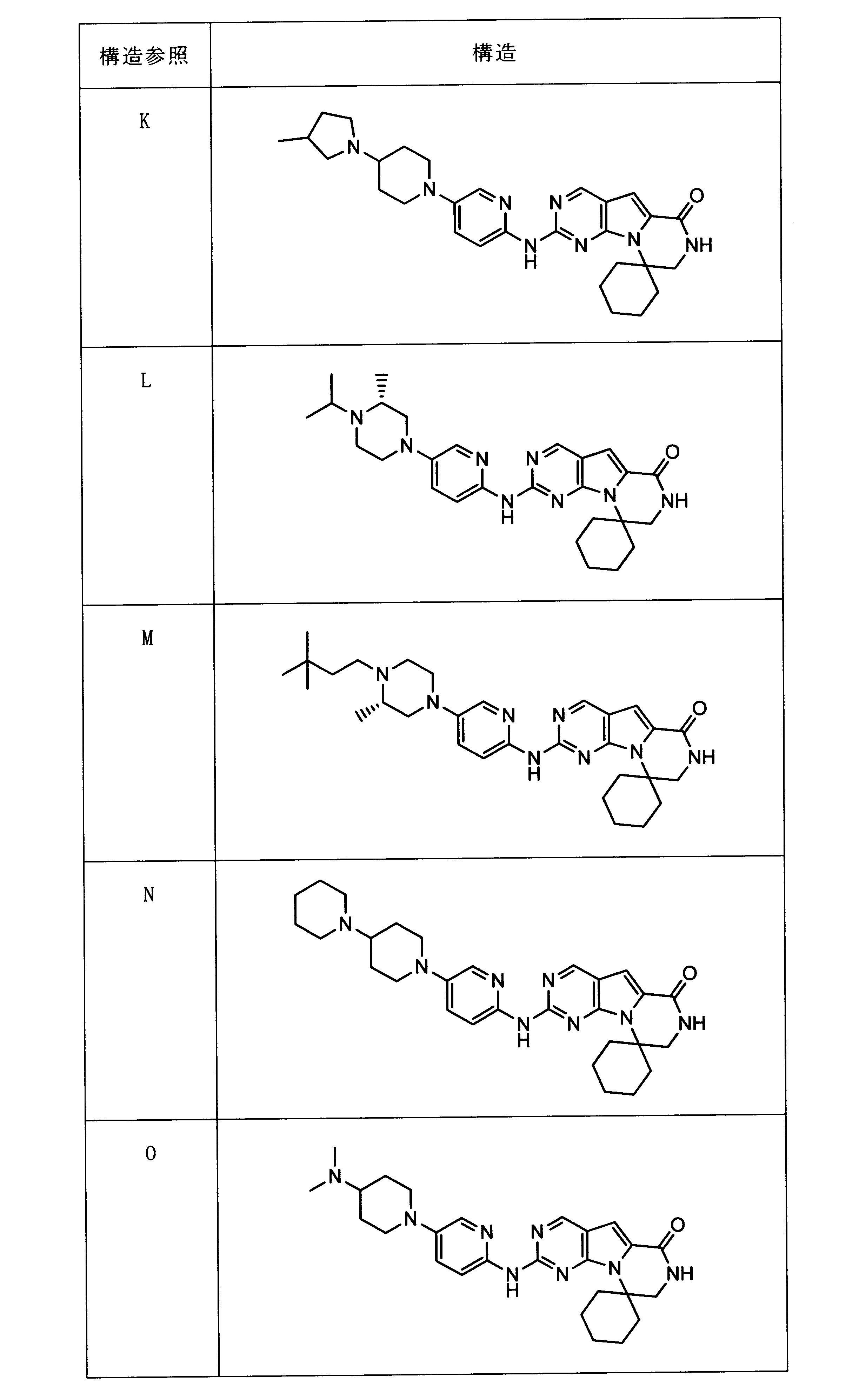
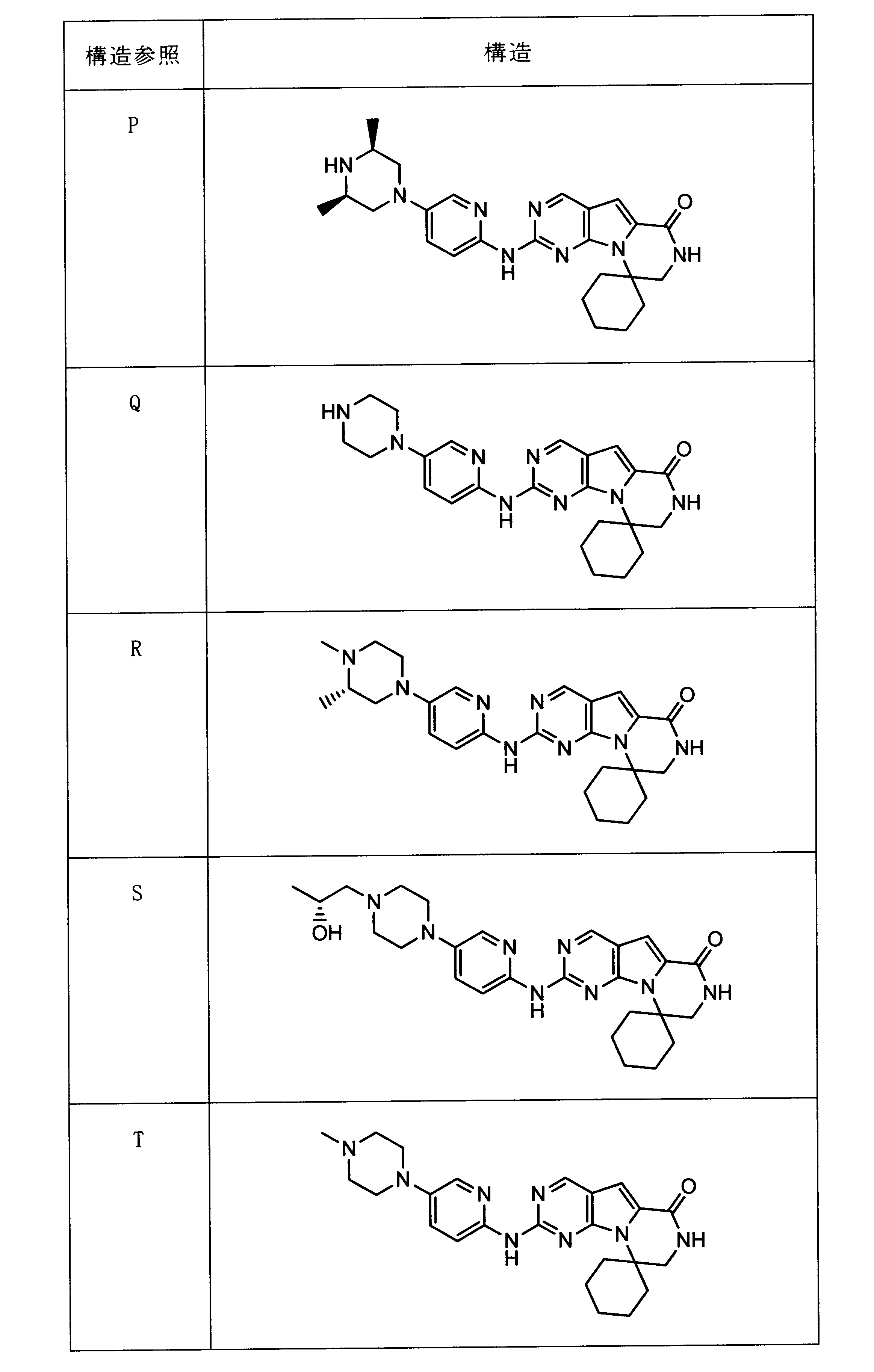
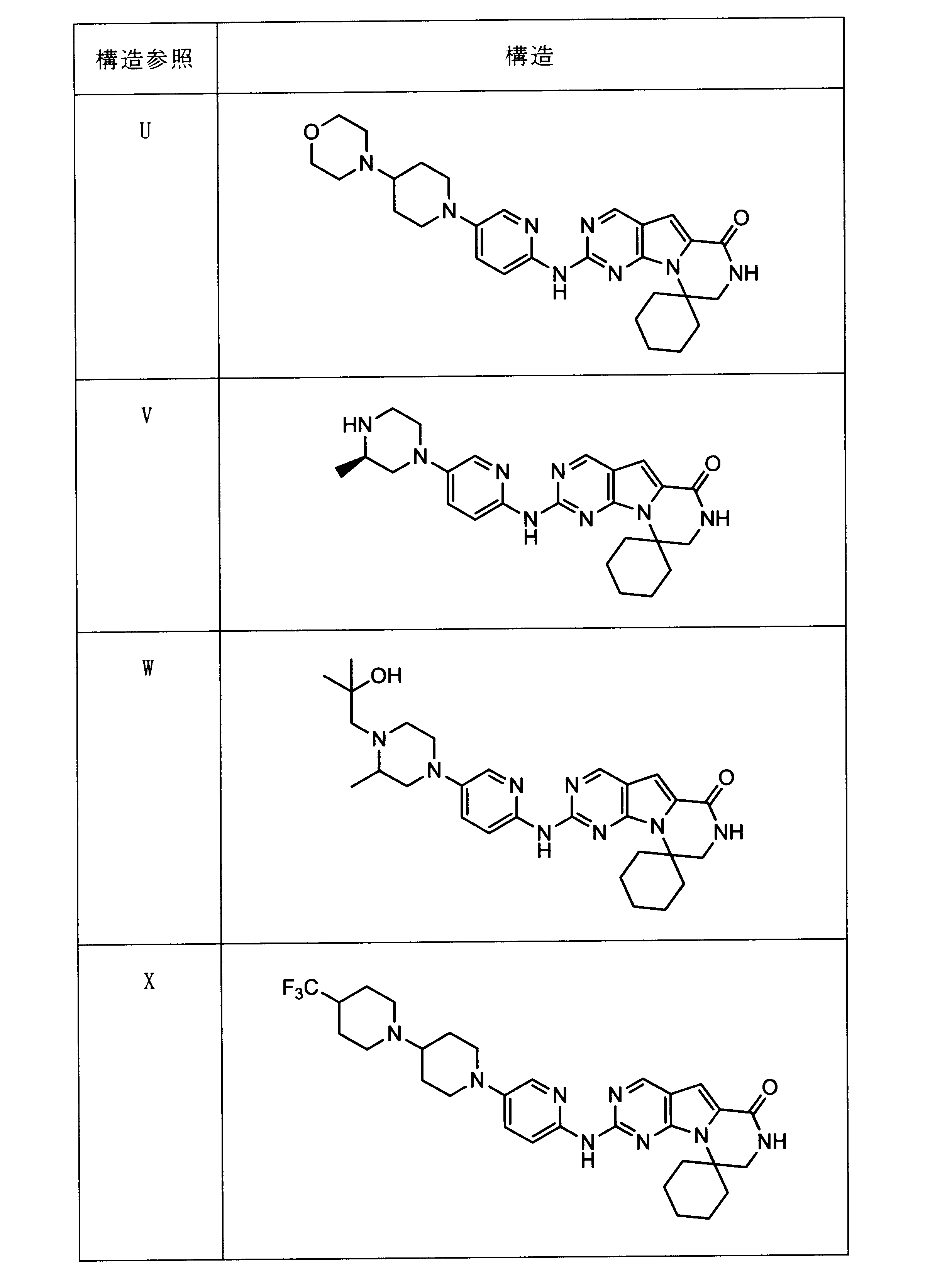
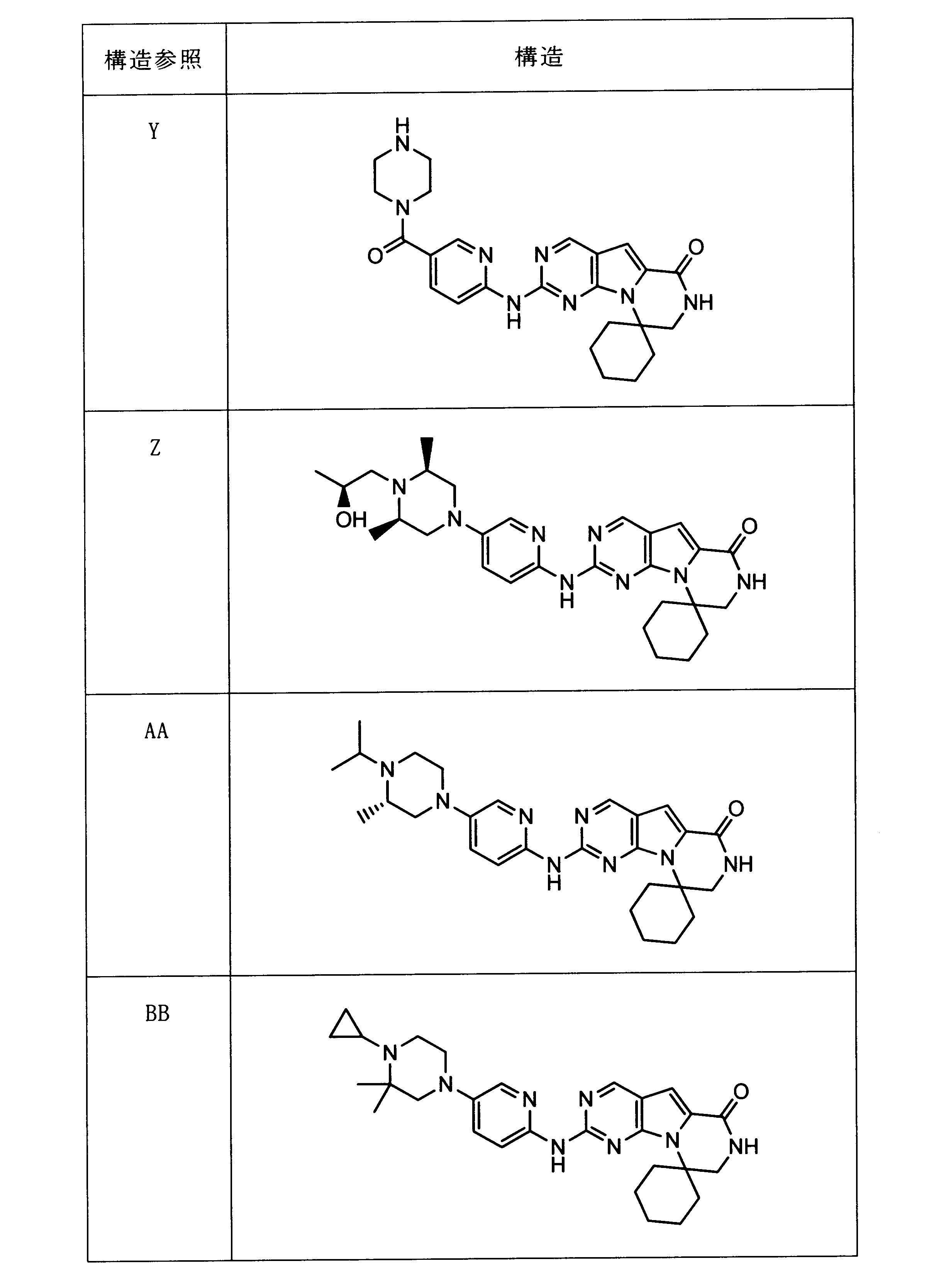
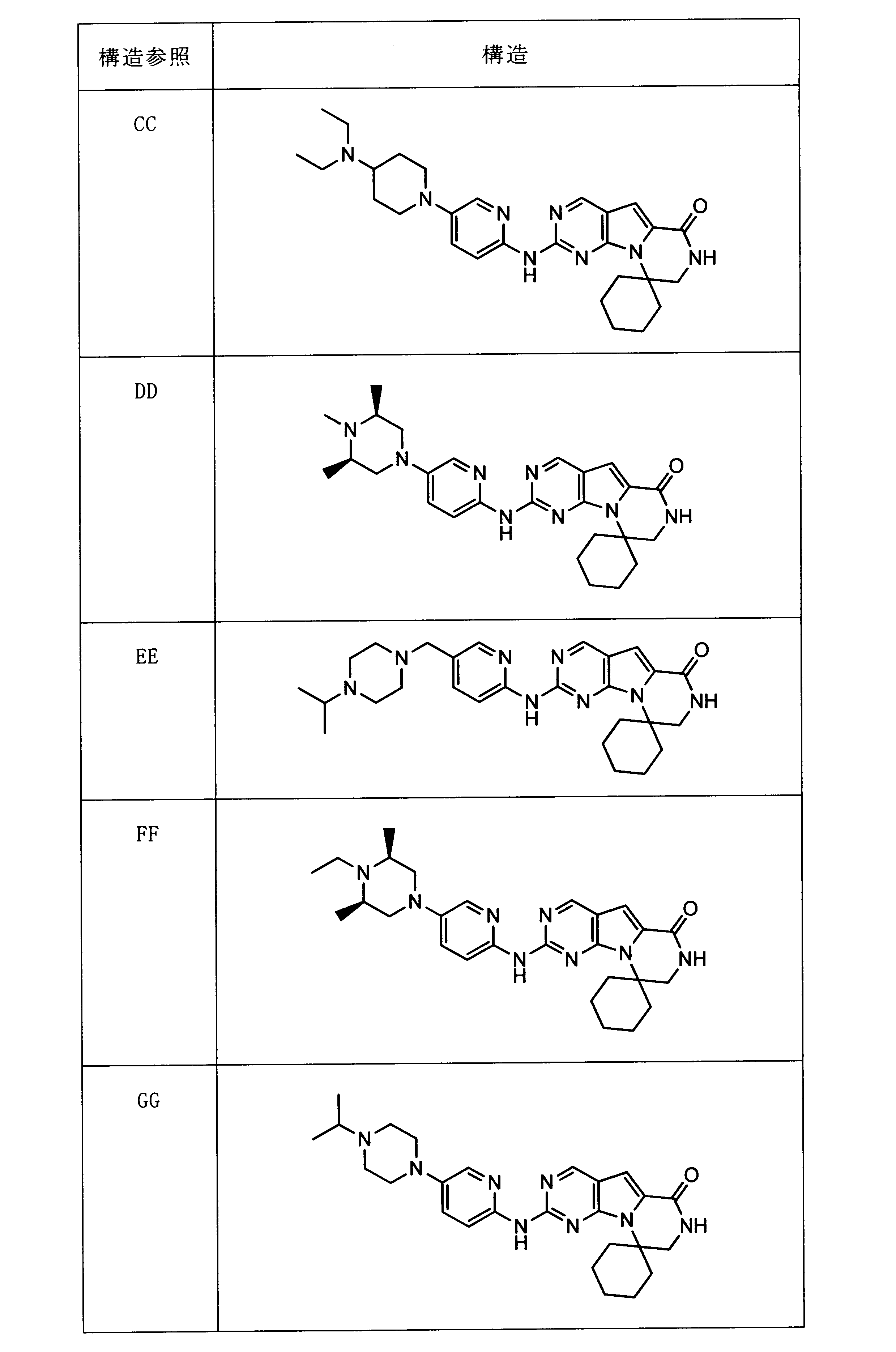
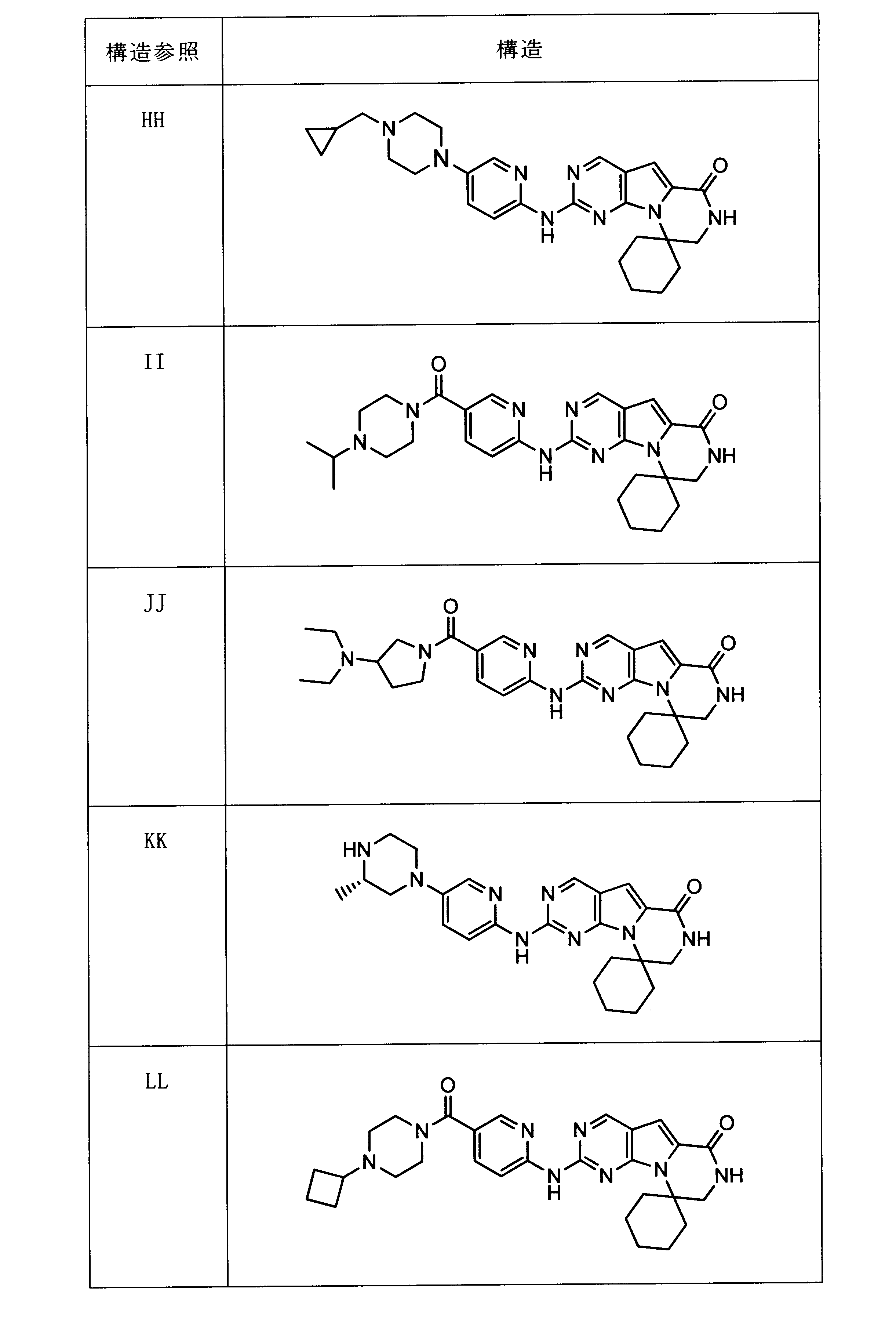
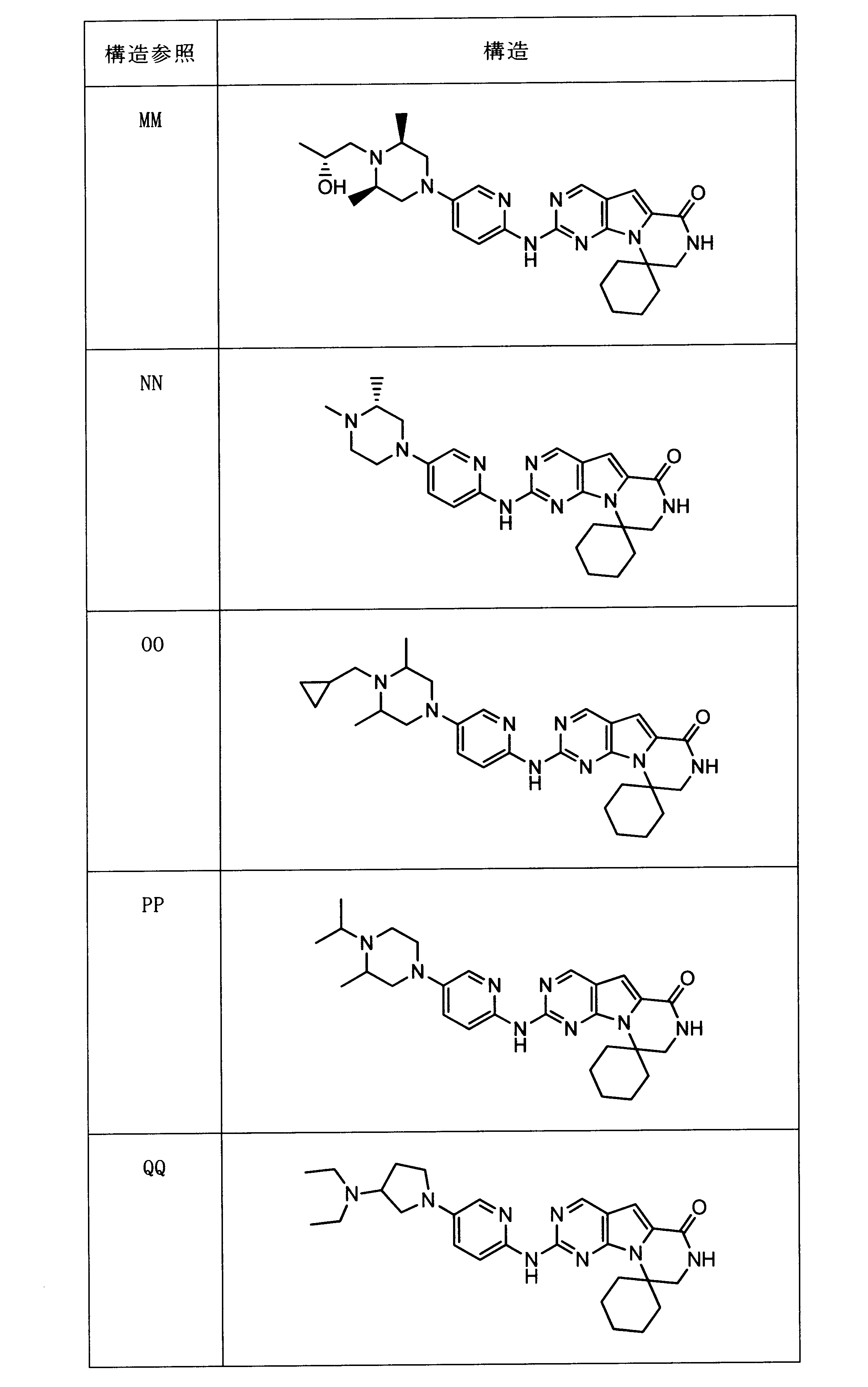
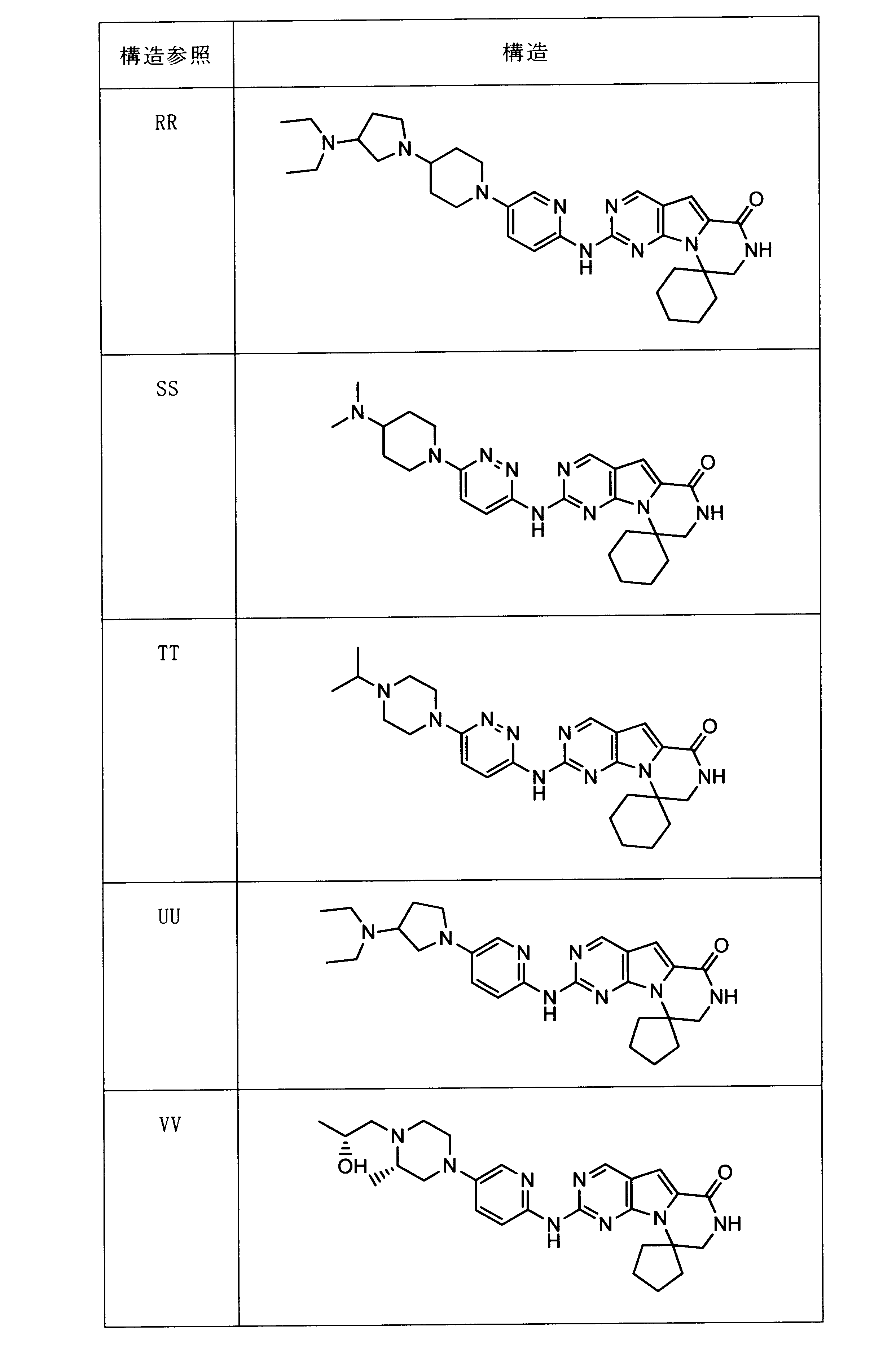
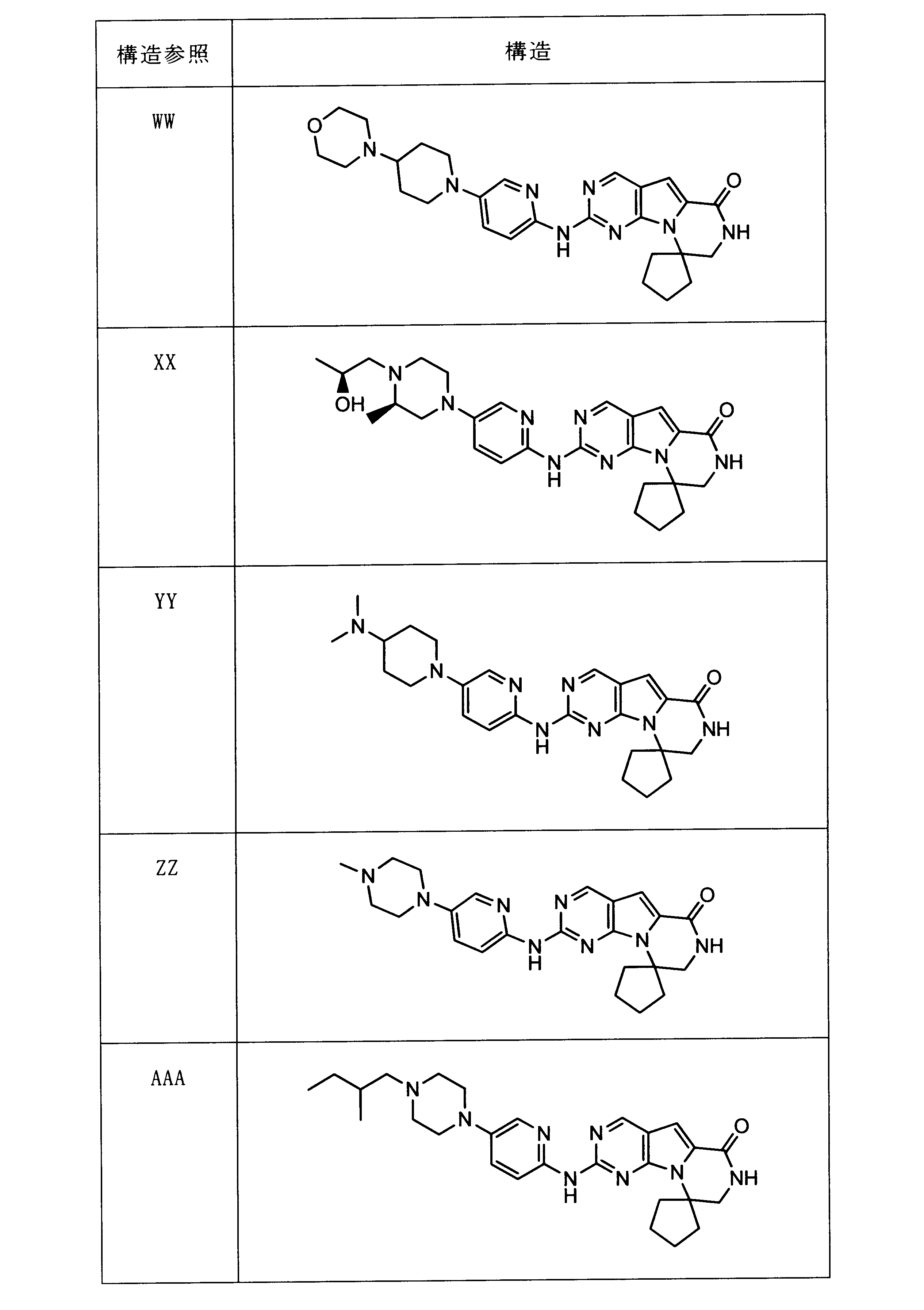
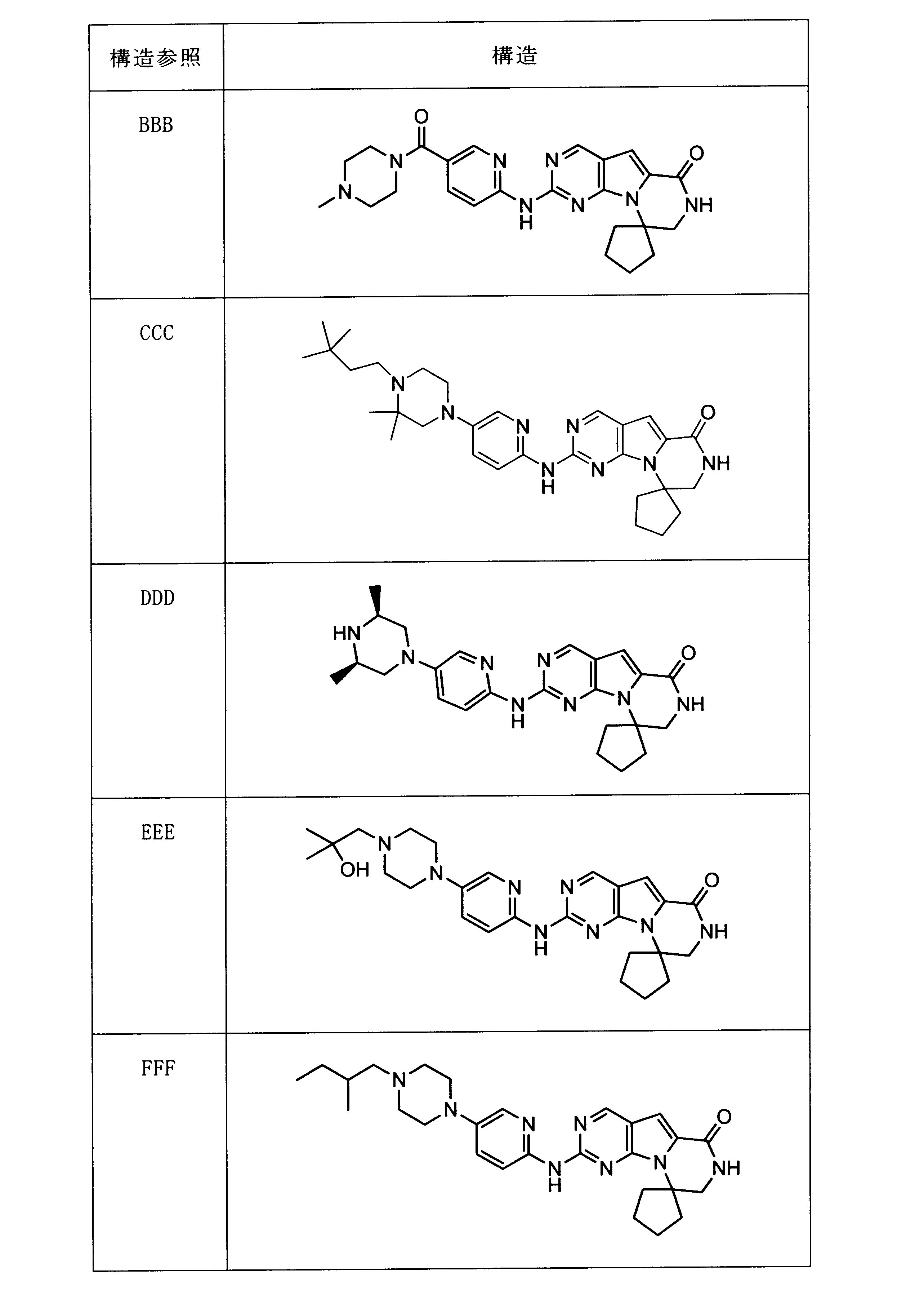
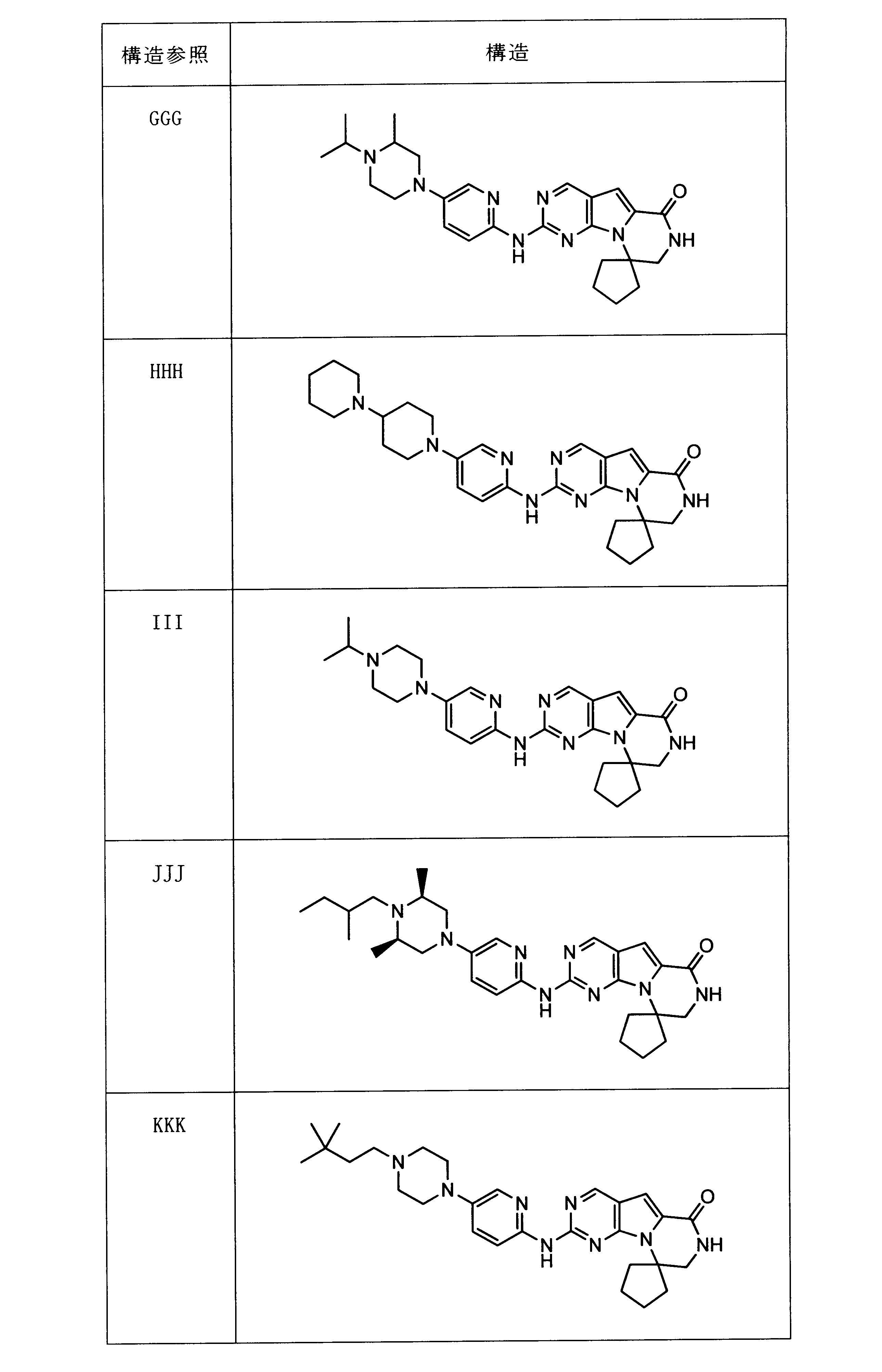
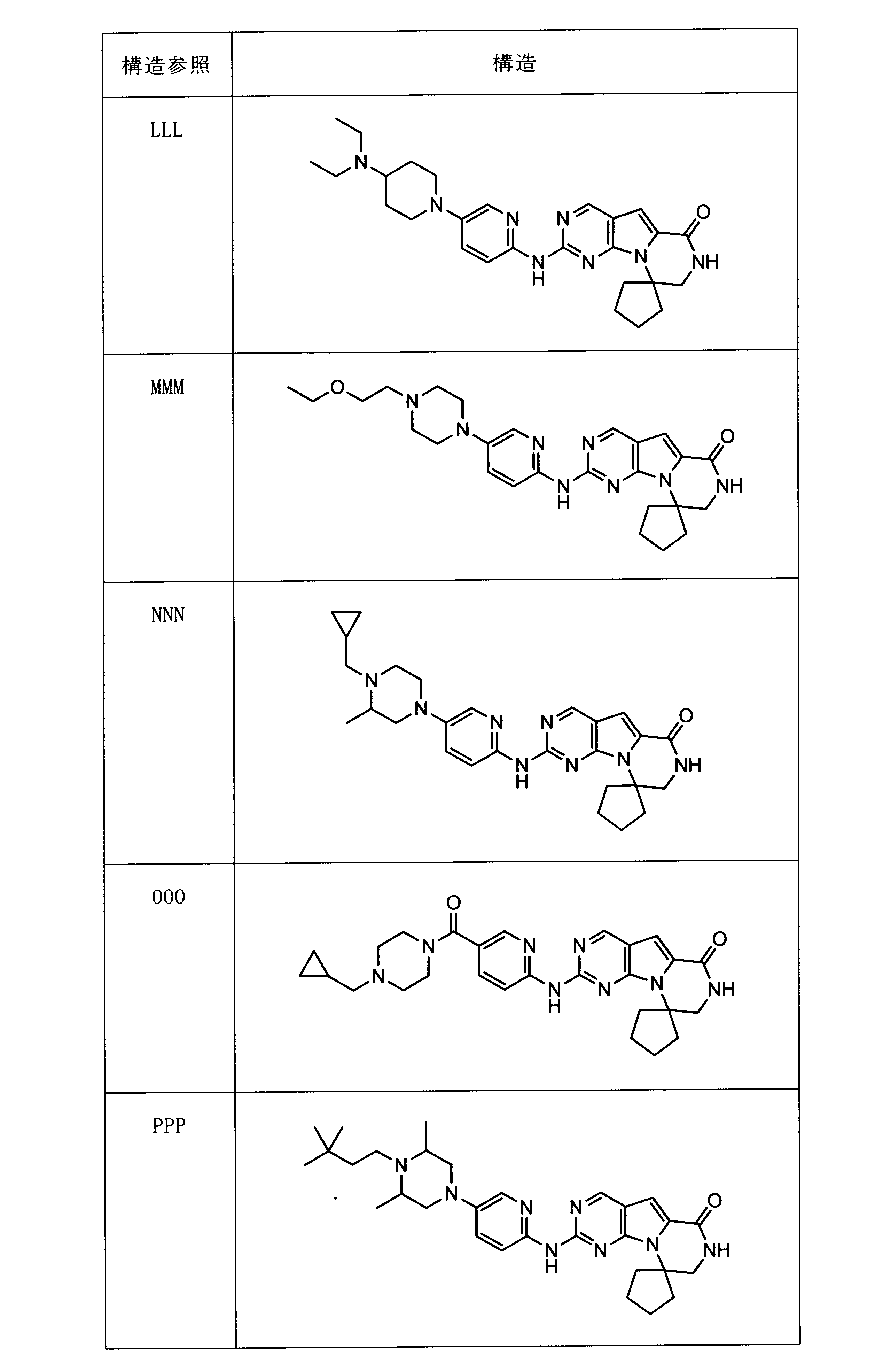
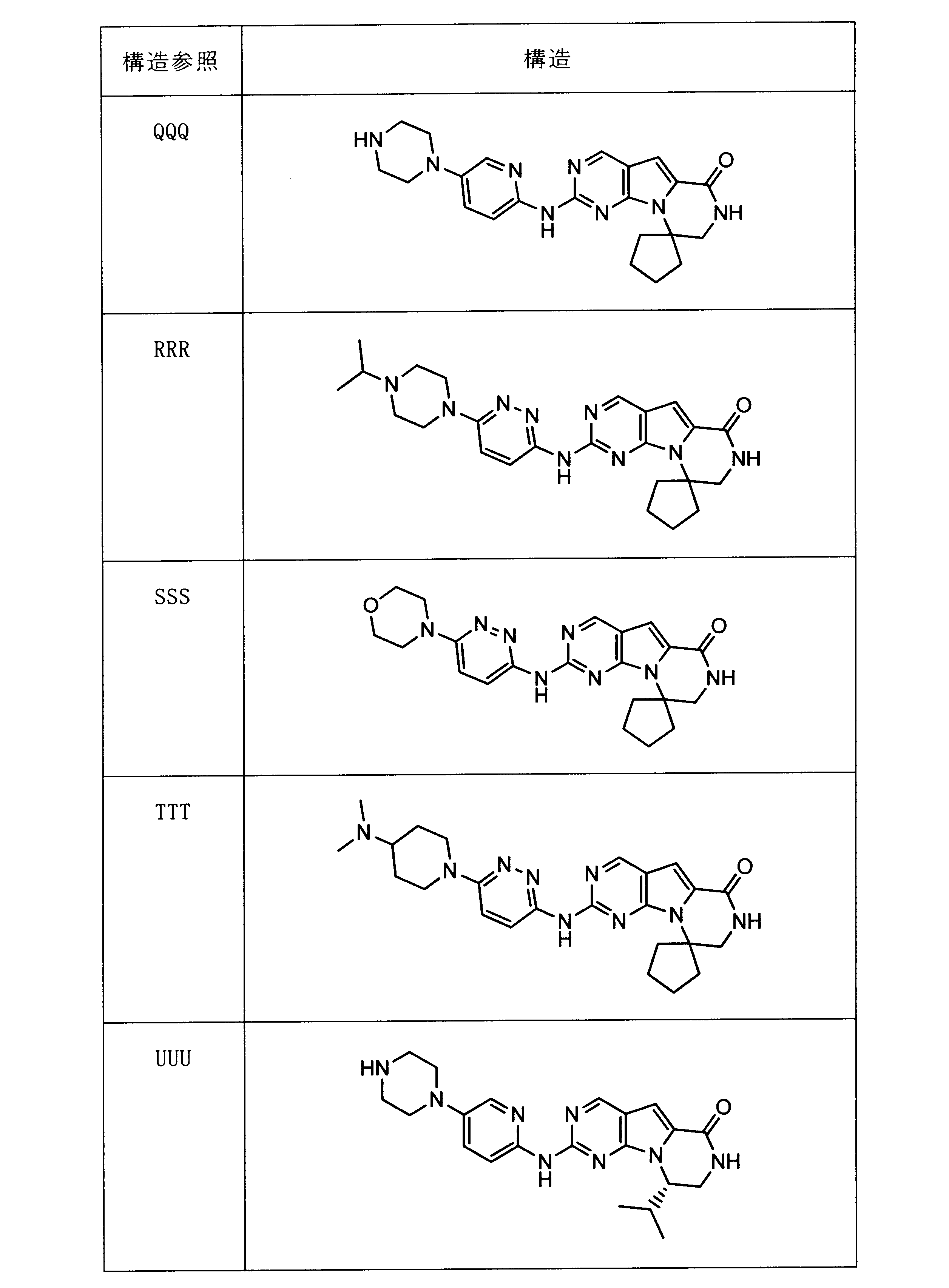
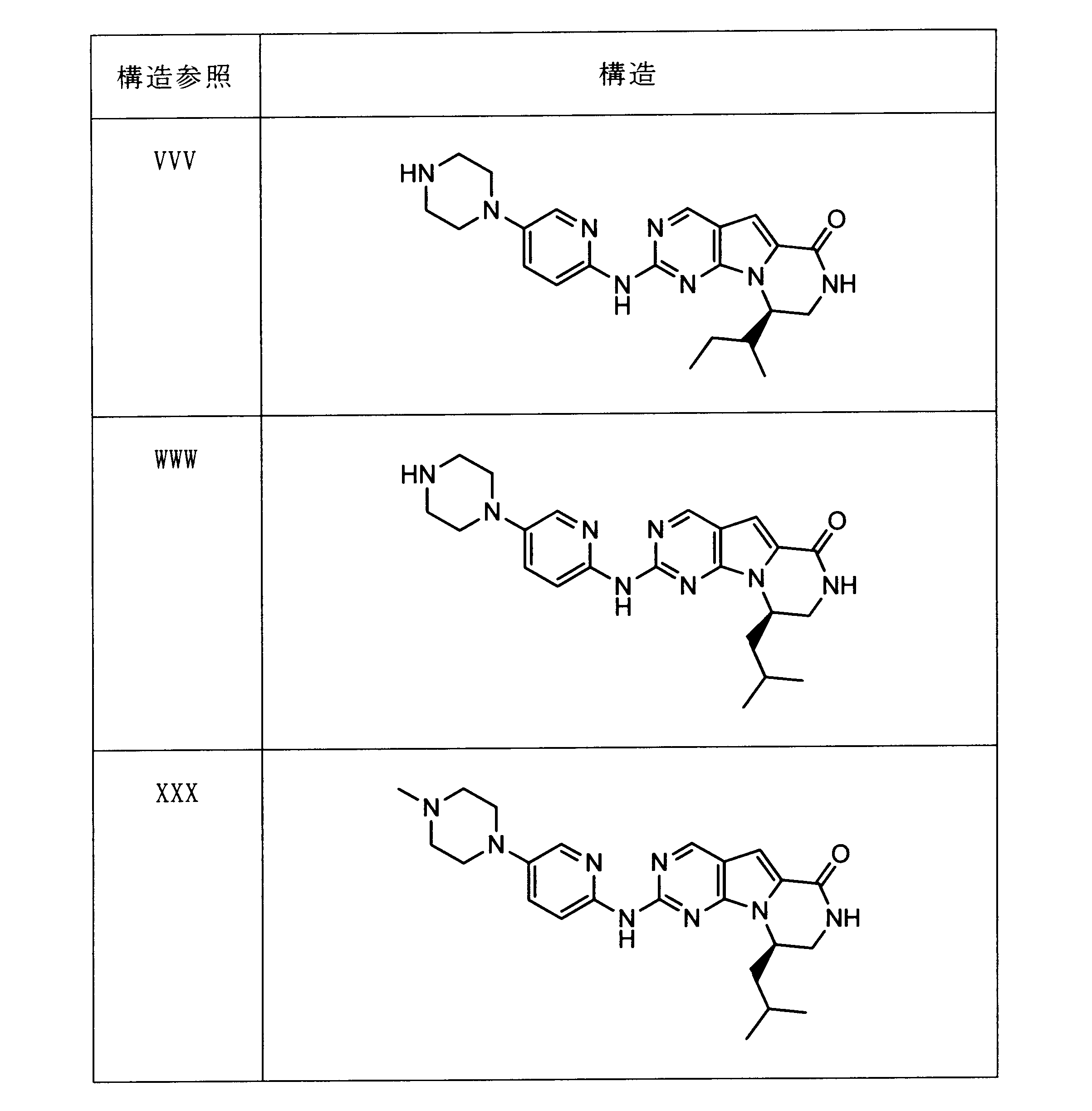
同位体置換物
本発明は、同位体の量が自然の存在率より多くなるよう、すなわち濃縮により、望ましい原子の同位体で置換する、化合物及び化合物の使用を含む。同位元素は、同じ原子番号であるが異なる質量数を有している、すなわち、中性子の数が異なるが陽子の数は同じである原子である。一般例として、及び、限定なしで、水素の同位体、たとえば、重水素(2H)及び三重水素(3H)が、ここに記載されたいずれの構造においても、用いられてよい。代替的に又は付加的に、炭素の同位体、例えば、13C及び14Cを用いてもよい。好ましい同位体的置換は、水素に対して重水素を分子の1つ以上の位置で用いて、薬剤の性能を向上させることである。
Isotopic Substitutions The present invention includes compounds and the use of compounds that are substituted with a desired isotope of an atom such that the amount of isotope is greater than its natural abundance, ie, by enrichment. Isotopes are atoms with the same atomic number but different mass numbers, ie, different numbers of neutrons but the same number of protons. As a general example, and without limitation, isotopes of hydrogen such as deuterium ( 2 H) and tritium ( 3 H) may be used in any structure described herein. Alternatively or additionally, isotopes of carbon such as 13 C and 14 C may be used. A preferred isotopic substitution is the use of deuterium for hydrogen in one or more positions of the molecule to improve drug performance.
重水素は、代謝の間に、結合切断の位置(α-重水素反応速度同位体効果)、又は、結合切断の部位の隣接又はその近傍(β-重水素反応速度同位体効果)に結合することができる。重水素等の同位体による置換は、より大きな代謝安定性から得られた一定の治療利点の余裕を与え、たとえば、インヴィヴォ半減期が伸び、又は必要用量が削減される等である。代謝分解の部位において水素を重水素で置換すれば、その結合での代謝の速度を低減することができ、又は代謝を排除することができる。水素原子が存在できる化合物のあらゆる位置では、水素原子は、軽水素(1H)、重水素(2H)及び三重水素(3H)を含む水素のあらゆる同位体となり得る。したがって、ここにおける化合物への言及は、文脈がそうでないと明らかに指図しない限り、全ての潜在的な同位体的形態をカバーする。 Deuterium binds during metabolism at the site of bond breakage (α-deuterium kinetic isotope effect) or adjacent to or near the site of bond breakage (β-deuterium kinetic isotope effect) be able to. Isotope substitution, such as deuterium, affords certain therapeutic advantages derived from greater metabolic stability, such as increased in vivo half-life or reduced dosage requirements. Substitution of deuterium for hydrogen at the site of metabolic degradation can reduce the rate of metabolism at that bond or eliminate metabolism. At every position in the compound where a hydrogen atom can be present, the hydrogen atom can be any isotope of hydrogen, including protium ( 1 H), deuterium ( 2 H) and tritium ( 3 H). Accordingly, references herein to compounds cover all potential isotopic forms, unless the context clearly dictates otherwise.
用語「同位元素標識化」類似体は、「重水素化類似体」、「13C標識化類似体」又は「重水素化/13C標識化類似体」の類似体のことをいう。用語「重水素化類似体」は、ここに記載した化合物であって、それによってH-同位体、すなわち水素/軽水素(1H)は、H-同位体、すなわち重水素(2H)に置換されるものを意味する。重水素置換は、一部または全体でなされてもよい。一部の重水素置換とは、少なくとも1つの水素が少なくとも1つの重水素によって置換されることを意味する。 The term "isotopically labeled" analogues refers to analogues of "deuterated analogues", " 13C -labeled analogues" or "deuterated/ 13C -labeled analogues". The term "deuterated analog" is a compound described herein whereby the H-isotope, ie hydrogen/hydrogen ( 1 H), is converted to the H-isotope, ie deuterium ( 2 H). Means to be replaced. Deuterium substitution may be partial or complete. Partial deuterium replacement means that at least one hydrogen is replaced by at least one deuterium.
特定の実施形態では、同位体は、着目するあらゆる位置で、90、95又は99 %又はそれ以上に同位体中に濃縮される。ある実施形態では、望ましい位置で90、95又は99 %に濃縮される重水素である。本発明の範囲内に含まれ、ここに開示された治療及び組成物の方法に使用可能な、更に具体的な化合物は、式I、II、III、IV又はV下記の表1に列挙される構造を含み得る。 In certain embodiments, the isotope is enriched in the isotope by 90, 95, or 99% or more at any position of interest. In some embodiments, deuterium is 90, 95, or 99% enriched at desired locations. More specific compounds included within the scope of the present invention and usable in the methods of treatment and compositions disclosed herein are those of Formula I, II, III, IV or V listed in Table 1 below. may contain structure.
Rbポジティブ癌及び増殖異常症
特に、ここに記載される活性化合物は、Rbポジティブ癌又は他のRbポジティブ異常細胞増殖異常症に罹患した被験体を治療するために用いられてもよい。ある実施形態では、癌又は細胞増殖異常症は、CDK4/6-複製依存的癌又は細胞増殖異常症であり、れは癌又は細胞増殖異常症と呼ばれ、複製又は増殖のためにCDK4/6の活性を必要とする、又は選択的CDK4/6阻害物質の活性を通して成長抑制され得る。このタイプの癌及び異常症は、官能性網膜芽細胞腫タンパク質の存在(例えば、その存在を示す細胞を有する)によって特徴付けられてもよい。この癌及び異常症は、Rb-ポジティブであると分類される。
Rb-Positive Cancers and Proliferative Disorders In particular, the active compounds described herein may be used to treat subjects suffering from Rb-positive cancers or other Rb-positive aberrant cell proliferative disorders. In certain embodiments, the cancer or cell proliferative disorder is a CDK4/6-replication dependent cancer or cell proliferative disorder, referred to as a cancer or cell proliferative disorder, in which CDK4/6 is used for replication or proliferation. or can be growth suppressed through the activity of selective CDK4/6 inhibitors. Cancers and disorders of this type may be characterized by the presence of a functional retinoblastoma protein (eg, having cells exhibiting its presence). This cancer and disorder is classified as Rb-positive.
Rbポジティブ異常細胞増殖異常症及びここで用いられるこの用語の変形は、自由な又は異常細胞分裂に起因する異常症又は疾病のことをいい、癌を含み得る官能性網膜芽細胞腫タンパク質の存在によって特徴づけられる。本発明の一つの態様では、ここに記載される化合物及び方法は、非癌性Rbポジティブ異常細胞増殖異常症を治療するために用いられてもよい。この異常症の例は、非悪性リンパ増殖、非悪性胸腫瘍、乾癬、関節炎、皮膚炎、前癌コロン障害又はパルプ、脈管形成異常症、免疫性媒介及び非免疫媒介炎症性疾患、関節炎、年齢に関連する黄斑部変性、糖尿病及び他の非癌性又は良性細胞増殖異常症を含み得る。 Rb-positive aberrant cell proliferative disorders, and variations of this term as used herein, refer to disorders or diseases resulting from uncontrolled or abnormal cell division, due to the presence of functional retinoblastoma proteins, which may include cancer. Characterized. In one aspect of the invention, the compounds and methods described herein may be used to treat non-cancerous Rb-positive aberrant cell proliferation disorders. Examples of this disorder include non-malignant lymphoproliferation, non-malignant breast tumors, psoriasis, arthritis, dermatitis, premalignant colon lesions or pulp, angiogenesis disorders, immune-mediated and non-immune-mediated inflammatory diseases, arthritis, May include age-related macular degeneration, diabetes and other non-cancerous or benign cell proliferative disorders.
ここに記載される化合物の投与のために適切なターゲットの癌は、Rb-ポジティブの下記疾患が含まれる:エストロゲンレセプターポジティブHER2-ネガティブ進行性乳癌、遅発性系統転移性乳癌、脂肪肉腫、非小細胞性肺癌、肝癌、卵巣癌、グリア芽細胞腫、難治性固形腫瘍、網膜芽細胞腫ポジティブ乳癌ならびに網膜芽細胞腫ポジティブ子宮内膜、膣及び卵巣癌及び肺及び気管支癌、結腸の腺癌、直腸の腺癌、中枢神経系胚細胞腫瘍、テラトーマ、エストロゲン受容体ネガティブ乳癌、エストロゲン受容体-ポジティブ乳癌、家族性精巣胚細胞腫瘍、HER2-ネガティブ乳癌、HER2-ポジティブ乳癌、雄性乳癌、卵巣未熟奇形腫、卵巣成熟奇形腫、卵巣単胚葉性及び高専門テラトーマ、プロゲステロンレセプター負の乳癌、プロゲステロンレセプター-ポジティブ乳癌、再発性乳癌、再発性結腸癌、再発性性腺外胚細胞腫瘍、再発性性腺外非精上皮腫性胚細胞腫瘍、再発性性腺外精上皮腫、再発性悪性精巣胚細胞腫瘍、再発性メラノーマ、再発性卵巣胚細胞腫瘍、再発性直腸癌、ステージIII性腺外非精上皮腫性胚細胞腫瘍、ステージIII性腺外精上皮腫、ステージIII悪性精巣胚細胞腫瘍、ステージIII卵巣胚細胞腫瘍、ステージIV乳癌、ステージIV大腸癌、ステージIV性腺外非精上皮腫性胚細胞腫瘍、ステージIV性腺外精上皮腫、ステージIVメラノーマ、ステージIV卵巣胚細胞腫瘍、ステージIV直腸癌、精巣未熟奇形腫、精巣成熟奇形腫。 Suitable target cancers for administration of the compounds described herein include the following Rb-positive diseases: estrogen receptor positive HER2-negative advanced breast cancer, late-onset metastatic breast cancer, liposarcoma, non- Small cell lung cancer, liver cancer, ovarian cancer, glioblastoma, refractory solid tumors, retinoblastoma-positive breast cancer and retinoblastoma-positive endometrial cancer, vaginal and ovarian cancer and lung and bronchial cancer, adenocarcinoma of the colon , rectal adenocarcinoma, central nervous system germ cell tumor, teratoma, estrogen receptor-negative breast cancer, estrogen receptor-positive breast cancer, familial testicular germ cell tumor, HER2-negative breast cancer, HER2-positive breast cancer, male breast cancer, immature ovary Teratoma, ovarian mature teratoma, ovarian monodermal and high-specialty teratoma, progesterone receptor-negative breast cancer, progesterone receptor-positive breast cancer, recurrent breast cancer, recurrent colon cancer, recurrent extragonadal germ cell tumor, recurrent extragonadal Nonseminoma germ cell tumor, recurrent extragonadal seminiferoma, recurrent malignant testicular germ cell tumor, recurrent melanoma, recurrent ovarian germ cell tumor, recurrent rectal cancer, stage III extragonadal nonseminoma Germ Cell Tumor, Stage III Extragonadal Spermoma, Stage III Malignant Testicular Germ Cell Tumor, Stage III Ovarian Germ Cell Tumor, Stage IV Breast Cancer, Stage IV Colorectal Cancer, Stage IV Extragonadal Nonseminoma Germ Cell Tumor, Stage IV extragonadal seminiferoma, stage IV melanoma, stage IV ovarian germ cell tumor, stage IV rectal cancer, immature testicular teratoma, mature testicular teratoma.
特定の実施形態では、ターゲットの癌としては、エストロゲンレセプターポジティブHER2ネガティブ進行性乳癌、遅発性系統転移性乳癌、脂肪肉腫、非小細胞性肺癌、肝癌、卵巣癌、グリア芽細胞腫、難治性固形腫瘍、網膜芽細胞腫ポジティブ乳癌ならびに網膜芽細胞腫ポジティブ子宮内膜、膣及び卵巣癌並びに肺及び気管支癌、転移性結腸直腸癌、CDK4突然変異又は増幅を伴う転移性メラノーマ、又はシスプラチン難治性切除不能の胚細胞腫瘍が挙げられる。
一実施形態では、Rbポジティブ癌は、肺癌、骨製癌、膵癌、皮膚癌、頭部又は頸部の癌、皮膚又は眼内メラノーマ、子宮癌、卵巣癌、直腸癌、肛門部の癌、胃癌、結腸癌、乳癌、子宮癌、卵管の癌腫、子宮内膜の癌腫、頸部の癌腫、膣の癌腫、陰門の癌腫、食道の癌、小腸の癌、内分泌系の癌、甲状腺の癌、上皮小体の癌、副腎の癌、軟組織の肉腫、尿道の癌、ペニスの癌、前立腺癌、膀胱の癌、腎臓又は尿管の癌、腎細胞癌、腎盂の癌腫、中枢神経系(CNS)の腫瘍、原発性中枢神経系リンパ腫、脊髄軸腫瘍、脳幹神経膠腫、下垂体腺腫、又は前記の癌の1つ以上の組合せを非限定的に含む、Rbポジティブ癌腫・肉腫から選択される。
In certain embodiments, target cancers include estrogen receptor-positive, HER2-negative, advanced breast cancer, late-onset metastatic breast cancer, liposarcoma, non-small cell lung cancer, liver cancer, ovarian cancer, glioblastoma, refractory cancer. Solid tumor, retinoblastoma-positive breast cancer and retinoblastoma-positive endometrial, vaginal and ovarian cancer and lung and bronchial cancer, metastatic colorectal cancer, metastatic melanoma with CDK4 mutation or amplification, or cisplatin refractory Includes unresectable germ cell tumors.
In one embodiment, the Rb positive cancer is lung cancer, bone cancer, pancreatic cancer, skin cancer, head or neck cancer, cutaneous or intraocular melanoma, uterine cancer, ovarian cancer, rectal cancer, anal cancer, gastric cancer , colon cancer, breast cancer, uterine cancer, fallopian tube carcinoma, endometrial carcinoma, cervical carcinoma, vaginal carcinoma, vulva carcinoma, esophageal cancer, small bowel cancer, endocrine cancer, thyroid cancer, Parathyroid cancer, adrenal gland cancer, soft tissue sarcoma, urethral cancer, penile cancer, prostate cancer, bladder cancer, kidney or ureter cancer, renal cell carcinoma, carcinoma of the renal pelvis, central nervous system (CNS) primary central nervous system lymphoma, spinal axis tumor, brain stem glioma, pituitary adenoma, or a combination of one or more of the foregoing cancers.
一実施形態では、Rbポジティブ癌は、Rbポジティブの下記疾患が含まれる:
繊維肉腫、粘液肉腫、軟骨肉腫、骨肉腫、脊索腫、悪性線維性組織球腫、血管肉腫、血管肉腫、リンパ管肉腫。中皮腫、平滑筋肉腫、横紋筋肉腫、鱗状細胞癌腫;類表皮癌、悪性皮膚付属器腫瘍、腺癌、肝癌、肝細胞癌、腎細胞癌、副腎腫、胆管癌、移行上皮癌、絨毛膜癌、精上皮腫、胚的細胞癌腫、未分化神経膠腫;多形神経膠芽腫、神経芽細胞腫、髄芽細胞腫、悪性髄膜腫、悪性シュワン細胞腫、神経線維肉腫、副甲状腺癌腫、甲状腺髄様癌、気管支カルチノイド、褐色細胞腫、島細胞癌、悪性カルチノイド、悪性傍神経節腫、メラノーマ、メルケル細胞腫瘍、嚢肉腫仮葉、唾液癌、胸腺癌、膀胱癌及びウィルムス腫瘍。
In one embodiment, Rb-positive cancers include Rb-positive diseases:
Fibrosarcoma, myxosarcoma, chondrosarcoma, osteosarcoma, chordoma, malignant fibrous histiocytoma, angiosarcoma, angiosarcoma, lymphangiosarcoma. mesothelioma, leiomyosarcoma, rhabdomyosarcoma, squamous cell carcinoma; epidermoid carcinoma, malignant cutaneous adnexa tumor, adenocarcinoma, liver cancer, hepatocellular carcinoma, renal cell carcinoma, adrenoma, cholangiocarcinoma, transitional cell carcinoma, Choriocarcinoma, seminiferoma, embryonic cell carcinoma, anaplastic glioma; glioblastoma multiforme, neuroblastoma, medulloblastoma, malignant meningioma, malignant schwannoma, neurofibrosarcoma, Parathyroid carcinoma, medullary thyroid carcinoma, bronchial carcinoma, pheochromocytoma, islet cell carcinoma, malignant carcinoid, malignant paraganglioma, melanoma, Merkel cell tumor, cystosarcoma, salivary carcinoma, thymic carcinoma, bladder carcinoma and Wilms tumor.
網膜芽細胞腫(Rb)腫瘍サプレッサタンパク質(Rb-ポジティブ)の存在又は通常の機能は、ウェスタンブロット、ELISA(酵素結合免疫測定法)、IHC(免疫組織化学)、及びFACS(蛍光性活性細胞選別)を非限定的に含む、当業者に知られるいずれかの標準アッセイにより、決定することができる。アッセイの選択は、利用される組織、細胞系統又は代わりの組織サンプルに依存し、例えば、ウェスタンブロット及びELISAは、組織、細胞系統又は代理組織のタイプのいずれかまたは全部に用いることができ、IHC法は、本発明の方法で利用される組織を腫瘍生検する際に、より適切である。 The presence or normal function of the retinoblastoma (Rb) tumor suppressor protein (Rb-positive) was determined by Western blot, ELISA (enzyme-linked immunoassay), IHC (immunohistochemistry), and FACS (fluorescence-activated cell sorting). ) can be determined by any standard assay known to those skilled in the art, including but not limited to. The choice of assay will depend on the tissue, cell line or surrogate tissue sample utilized, for example Western blots and ELISA can be used for any or all types of tissue, cell line or surrogate tissue, The method is more suitable for tumor biopsies of the tissue utilized in the methods of the invention.
FAC分析は、たとえば細胞系統等の単個細胞浮遊液及び孤立した末梢血単核細胞であったサンプルに、最も適用できる。
たとえば、米国特許公開公報US20070212736号、標題"Functional Immunohistochemical Cell Cycle Analysis as a Prognostic Indicator for Cancer”を参照。
代替的には、分子遺伝子の試験は、網膜芽細胞腫遺伝子の状態の決定に用いられてもよい。
網膜芽細胞腫のための分子遺伝子の試験は、Lohmann and Gallie,"Retinoblastoma Gene Reviews"(2010), http://www.ncbi.nlm.nih.gov/bookshelf/br.fcgi?book=gene&part=retinoblastoma, 又は、Parsamら、"A comprehensive, sensitive and economical approach for the detection of mutations in the RB1 gene in retinoblastoma" Journal of Genetics, 88(4), 517-527 (2009) に記載される以下を含む。
FAC analysis is most applicable to samples that have been single cell suspensions and isolated peripheral blood mononuclear cells, such as cell lines.
See, for example, US Patent Publication No. US20070212736, entitled "Functional Immunohistochemical Cell Cycle Analysis as a Prognostic Indicator for Cancer".
Alternatively, molecular genetic testing may be used to determine retinoblastoma gene status.
A molecular genetic test for retinoblastoma is described in Lohmann and Gallie, "Retinoblastoma Gene Reviews" (2010), http://www.ncbi.nlm.nih.gov/bookshelf/br.fcgi?book=gene&part= retinoblastoma, 又は、Parsamら、"A comprehensive, sensitive and economical approach for the detection of mutations in the RB1 gene in retinoblastoma" Journal of Genetics, 88(4), 517-527 (2009) に記載される以下を含む。
ある実施形態では、治療される癌は、エストロゲンレセプターポジティブHER2-ネガティブ進行性乳癌、遅発性系統転移性乳癌、脂肪肉腫、非小細胞性肺癌、肝癌、卵巣癌、グリア芽細胞腫、難治性固形腫瘍、網膜芽細胞腫ポジティブ乳癌ならびに網膜芽細胞腫ポジティブ子宮内膜、膣及び卵巣癌並びに肺及び気管支癌から選択される。
CDK-複製依存的細胞及びサイクリン依存的キナーゼ阻害剤
組織特異幹細胞及びその他のレジデント増殖細胞のサブセットは自己複製ができ、そのことは、成熟した哺乳類の寿命全体を通じて、管理された複製を通してそれ自身を置換することができることをを意味する。
In certain embodiments, the cancer to be treated is estrogen receptor-positive HER2-negative advanced breast cancer, late-onset metastatic breast cancer, liposarcoma, non-small cell lung cancer, liver cancer, ovarian cancer, glioblastoma, refractory selected from solid tumors, retinoblastoma-positive breast cancer and retinoblastoma-positive endometrial, vaginal and ovarian cancer and lung and bronchial cancer.
CDK-Replication-Dependent Cells and Cyclin-Dependent Kinase Inhibitors Tissue-specific stem cells and other subsets of resident proliferating cells are capable of self-renewal, which allows them to self-renew themselves through controlled replication throughout the adult mammalian lifespan. It means that it can be replaced.
さらに、幹細胞は、非対称に分裂して、後に所与の器官の様々な要素を生成する「後代」又は「前駆」細胞を生成することになる。
たとえば、細網内皮系では、造血幹細胞は前駆細胞を生み出し、そしてそれは次いで、血液の全ての分化した要素(例えば、白血球、赤血球及び血小板)を生み出す(図1を参照のこと)。
ある特定の増殖細胞(例えばHSPC)は、増殖キナーゼサイクリン-依存的キナーゼ4(CDK4)及び/又は細胞複製のためのサイクリン依存的キナーゼ6(CDK6)の酵素活性を必要とすることが見出された。
In addition, stem cells will divide asymmetrically to produce "progeny" or "progenitor" cells that later produce the various components of a given organ.
For example, in the reticuloendothelial system, hematopoietic stem cells give rise to progenitor cells, which in turn give rise to all the differentiated components of blood (eg, leukocytes, erythrocytes and platelets) (see Figure 1).
It has been found that certain proliferating cells (e.g., HSPCs) require the enzymatic activity of the proliferative kinases cyclin-dependent kinase 4 (CDK4) and/or cyclin-dependent kinase 6 (CDK6) for cell replication. rice field.
対照的に、成熟した哺乳類中の大部分の増殖細胞(例えば、骨髄中のさらに分化した造血細胞)は、CDK4及び/又はCDK6(すなわちCDK4/6)の活性を必要としない。これらの分化した細胞は、CDK4/6活性がない場合でも、他の増殖キナーゼ、たとえばサイクリン依存的キナーゼ2(CDK2)又はサイクリン依存的キナーゼ1(CDK1)を用いて、増殖することができる。 In contrast, most proliferating cells in mature mammals (eg, more differentiated hematopoietic cells in bone marrow) do not require CDK4 and/or CDK6 (ie, CDK4/6) activity. These differentiated cells can proliferate using other growth kinases such as cyclin dependent kinase 2 (CDK2) or cyclin dependent kinase 1 (CDK1) even in the absence of CDK4/6 activity.
本発明は、特定のRbポジティブ癌を治療するためにここに記載される化合物を投与することにより、被験体中のCDK4/6-複製依存的正常細胞、特に造血細胞及び/又は前駆細胞(HSPC)への有害作用を最小にする、特定の癌、特にRbポジティブ癌、を治療する方法を含む。
一実施形態では、化学療法剤としてここに記載される化合物を使用することにより、PD0332991等の他のCDK4/6阻害物質の使用と比較してHSPC複製が遅いことによる血液回復の促進及び血液欠乏リスクの低減が、可能になる。
一実施形態では、化学療法剤としてここに記載される化合物を使用することにより、PD0332991等他のCDK4/6阻害物質を用いた現行の治療方法と比較して、治療中におけるオフサイクル又はドラッグホリデイの減少又は最小化が可能となる。
一実施形態では、化学療法剤としてここに記載される化合物を使用することにより、オフサイクル又はドラッグホリデイの除去が可能となる。
一実施形態では、化学療法剤としてここに記載される化合物を使用することにより、PD0332991等他のCDK4/6阻害物質を用いた現行の治療方法の使用と比較して、より少ないオフサイクル日又はドラッグホリデイで、長期間の投与が可能になる。
一実施形態では、化学療法剤としてここに記載される化合物を使用することにより、オフサイクル又はドラッグホリデイの間、PD0332991等他のCDK4/6阻害物質を用いた現行の方法の使用よりもより急速な、血球値の回復が可能になる。
The present invention provides the benefits of CDK4/6-replication dependent normal cells, particularly hematopoietic cells and/or progenitor cells (HSPC) in a subject by administering compounds described herein to treat certain Rb-positive cancers. ), including methods of treating certain cancers, particularly Rb-positive cancers.
In one embodiment, the use of the compounds described herein as chemotherapeutic agents promotes blood recovery and blood depletion due to slow HSPC replication compared to the use of other CDK4/6 inhibitors such as PD0332991. Risk reduction becomes possible.
In one embodiment, using a compound described herein as a chemotherapeutic agent reduces off-cycle or drug holiday during treatment compared to current treatment methods with other CDK4/6 inhibitors, such as PD0332991. can be reduced or minimized.
In one embodiment, use of the compounds described herein as chemotherapeutic agents allows off-cycle or elimination of drug holidays.
In one embodiment, the use of the compounds described herein as chemotherapeutic agents results in fewer off-cycle days or Drug holidays allow long-term dosing.
In one embodiment, the use of the compounds described herein as chemotherapeutic agents provides more rapid response during off-cycle or drug holidays than the use of current methods with other CDK4/6 inhibitors such as PD0332991. It is possible to restore the blood cell value.
特定の実施形態では、投与されるCDK4/6阻害物質は、式I、式II、式III、式IV又は式V又はそれらの組合せを含む化合物又は組成物から成る群より選択される。 特定の実施形態では、投与される化合物は、表1から選択される化合物から成る群より選択される。
特定の態様では、Rbポジティブ癌のCDK4/6抑制性治療を受けている被験体におけるCDK4/6-複製依存的正常細胞に対するCDK4/6阻害の有害作用を低減又は限定する化合物、方法及び組成物が、化学療法剤として提供され、この方法は、ここに記載される化合物を効果的量で投与することを含み、ここで、CDK4/6-複製依存的正常細胞の相当な部分が、化合物の投与から約24、30、36又は40時間未満以内に、プレ治療ベースライン細胞サイクル活性へリエントリーする(すなわち、細胞サイクルにリエントリーする)。
In certain embodiments, the administered CDK4/6 inhibitor is selected from the group consisting of compounds or compositions comprising Formula I, Formula II, Formula III, Formula IV, or Formula V, or combinations thereof. In certain embodiments, the compound administered is selected from the group consisting of compounds selected from Table 1.
In certain aspects, compounds, methods and compositions that reduce or limit the adverse effects of CDK4/6 inhibition on CDK4/6-replication dependent normal cells in subjects undergoing CDK4/6 suppressive therapy for Rb-positive cancers. is provided as a chemotherapeutic agent, the method comprising administering an effective amount of a compound described herein, wherein a substantial portion of the CDK4/6-replication dependent normal cells are treated with the compound Re-enter pre-treatment baseline cell cycle activity (ie, re-enter the cell cycle) within less than about 24, 30, 36, or 40 hours of administration.
特定の実施形態では、化合物のIC50 CDK4抑制濃度が、CDK2のIC50抑制濃度の少なくとも1500倍小さい。
特定の実施形態では、投与される化合物は、式I、式II、式III、式IV若しくは式V、又はそれらの薬理学的に許容される組成物、塩、アイソトープ類似体又はプロドラッグを含む化合物又は組成物から成る群より選択される。
特定の実施形態では、投与される化合物は、表1中に含まれる化合物、又はそれらの薬理学的に許容される組成物、塩、アイソトープ類似体又はプロドラッグから選択される。 一実施形態では、CDK4/6-複製依存的細胞は、造血幹細胞や前駆細胞(HSPC)である。
特定の態様では、化合物、方法及び組成物は、Rbポジティブ癌の治療を受けている被験体におけるCDK4/6-複製依存的正常細胞へのCDK4/6阻害の有害作用を制限する化学療法剤として提供され、この方法は、ここに記載される化合物を効果的量で投与することを含み、CDK4/6-複製依存的正常細胞の相当な部分は、化合物の抑制性効果の消失後、約24、30、36又は40時間未満内に、細胞サイクルに同時にリエントリーする。
特定の実施形態では、化合物のIC50 CDK4抑制濃度が、CDK2のIC50抑制濃度の少なくとも1500倍小さい。
特定の実施形態では、投与される化合物は、式I、式II、式III、式IV若しくは式V、又はそれらの薬理学的に許容される組成物、塩、アイソトープ類似体又はプロドラッグを含む化合物又は組成物から成る群より選択される。
特定の実施形態では、投与される化合物は、表1又は薬理学的に許容される組成物、又はそれらの塩、同位体的類似体又はそのプロドラッグを含む化合物から選択される。
一実施形態では、CDK4/6-複製依存的細胞は、造血幹細胞及び/又は前駆細胞(HSPC)である。
In certain embodiments, the IC 50 CDK4 inhibitory concentration of the compound is at least 1500-fold less than the IC 50 inhibitory concentration of CDK2.
In certain embodiments, the compound administered comprises Formula I, Formula II, Formula III, Formula IV or Formula V, or a pharmaceutically acceptable composition, salt, isotopic analogue or prodrug thereof selected from the group consisting of compounds or compositions;
In certain embodiments, the compound administered is selected from the compounds contained in Table 1, or pharmaceutically acceptable compositions, salts, isotopic analogs or prodrugs thereof. In one embodiment, the CDK4/6-replication dependent cells are hematopoietic stem and progenitor cells (HSPC).
In certain aspects, the compounds, methods and compositions are used as chemotherapeutic agents to limit the adverse effects of CDK4/6 inhibition to CDK4/6-replication dependent normal cells in subjects undergoing treatment for Rb-positive cancer. Provided, the method comprises administering an effective amount of a compound described herein, wherein a substantial portion of the CDK4/6-replication dependent normal cells is about 24 days after loss of the inhibitory effect of the compound. , re-enter the cell cycle simultaneously within less than 30, 36 or 40 hours.
In certain embodiments, the IC 50 CDK4 inhibitory concentration of the compound is at least 1500-fold less than the IC 50 inhibitory concentration of CDK2.
In certain embodiments, the compound administered comprises Formula I, Formula II, Formula III, Formula IV or Formula V, or a pharmaceutically acceptable composition, salt, isotopic analogue or prodrug thereof selected from the group consisting of compounds or compositions;
In certain embodiments, the compound to be administered is selected from Table 1 or a compound comprising a pharmaceutically acceptable composition, or a salt, isotopic analogue or prodrug thereof.
In one embodiment, the CDK4/6-replication dependent cells are hematopoietic stem and/or progenitor cells (HSPC).
特定の態様では、被験体におけるCDK4/6-複製依存的正常細胞へのCDK4/6阻害の有害作用を制限する化合物、方法及び組成物は、化学療法剤として提供され、この方法は、ここに記載される化合物を効果的量でRbポジティブ癌を有するる被験体に投与することを含み、CDK4/6-複製依存的正常細胞の相当な部分が、化合物のCDK4/6禁止効果の消失の後約24、30、36又は40時間未満内に同時に細胞サイクルにリエントリーする。
一実施形態では、投与された化合物は、IC50 CDK4抑制濃度が、CDK2のIC50抑制濃度の500倍以上小さい。
特定の実施形態では、CDK4/6-複製依存的正常細胞の相当な部分は、被験体の血液中の化合物の濃度レベルが治療有効濃度以下に下がった時点から約24、30、36又は40時間未満内に、同時に、細胞サイクルにリエントリーする。
特定の実施形態では、投与される化合物は、式I、式II、式III、式IV若しくは式V、又はそれらの薬理学的に許容される組成物、塩、アイソトープ類似体又はプロドラッグを含む化合物又は組成物から成る群より選択される。
特定の実施形態では、投与される化合物は、表1中に含まれる化合物、又はそれらの薬理学的に許容される組成物、塩、アイソトープ類似体又はプロドラッグから選択される。 一実施形態では、CDK4/6-複製依存的細胞は、造血幹細胞及び/又は前駆細胞(HSPC)である。
一実施形態では、CDK4/6複製依存的正常細胞は、腎臓上皮細胞である。
In certain aspects, compounds, methods and compositions that limit the adverse effects of CDK4/6 inhibition to CDK4/6-replication dependent normal cells in a subject are provided as chemotherapeutic agents, the methods herein described. comprising administering an effective amount of a compound as described to a subject with an Rb-positive cancer, wherein a substantial portion of CDK4/6-replication dependent normal cells are Simultaneously re-enter the cell cycle within less than about 24, 30, 36 or 40 hours.
In one embodiment, the administered compound has an IC 50 CDK4 inhibitory concentration that is 500-fold or more less than the IC 50 inhibitory concentration of CDK2.
In certain embodiments, the substantial portion of CDK4/6-replication dependent normal cells is about 24, 30, 36, or 40 hours after the concentration level of the compound in the blood of the subject falls below a therapeutically effective concentration. Within less than, at the same time, they re-enter the cell cycle.
In certain embodiments, the compound administered comprises Formula I, Formula II, Formula III, Formula IV, or Formula V, or a pharmaceutically acceptable composition, salt, isotopic analogue, or prodrug thereof selected from the group consisting of compounds or compositions;
In certain embodiments, the compound administered is selected from the compounds contained in Table 1, or pharmaceutically acceptable compositions, salts, isotopic analogs or prodrugs thereof. In one embodiment, the CDK4/6-replication dependent cells are hematopoietic stem and/or progenitor cells (HSPC).
In one embodiment, the CDK4/6 replication dependent normal cell is a kidney epithelial cell.
特定の実施形態では、投与される化合物は、式I、式II、式III、式IV若しくは式V、又はそれらの薬理学的に許容される組成物、塩、アイソトープ類似体又はプロドラッグを含む化合物又は組成物、又は表1中に含まれる化合物、又はそれらの薬理学的に許容される組成物、塩、アイソトープ類似体又はプロドラッグから成る群より選択され、ここで、化合物の効果は、自然界では短期及び過渡的であるため、CDK4/6-複製依存的正常細胞のかなりの部分が、たとえば化合物の最後の投与から約24、30、36又は40時間未満内に、迅速に同時に細胞サイクルにリエントリーすることが可能になる。 In certain embodiments, the compound administered comprises Formula I, Formula II, Formula III, Formula IV or Formula V, or a pharmaceutically acceptable composition, salt, isotopic analogue or prodrug thereof A compound or composition, or a compound included in Table 1, or a pharmaceutically acceptable composition, salt, isotopic analogue or prodrug thereof, wherein the effect of the compound is Due to the short-term and transient nature, a substantial portion of CDK4/6-replication dependent normal cells undergo a rapid simultaneous cell cycle, e.g. can be re-entered.
ここに記載された方法に用いられる化合物は、CDK2阻害力が最小の、選択性の高い強力なCDK4/6阻害物質である。一実施形態では、ここに記載される方法に用いられる化合物は、CDK4/CycD1 IC50抑制性濃度値を有し、すなわち、CDK2/CycE阻害に対するそれぞれのIC50濃度値より、>1500倍、>1800倍、>2000倍、>2200倍、>2500倍、>2700倍、>3000倍、>3200倍以上、低い。一実施形態では、ここに記載される方法に用いられる化合物は、CDK4/CycD1阻害に対するIC50濃度値を有し、それはすなわち、約<1.50nM、<1.25nM、<1.0nM、<0.90nM、<0.85nM、<0.80nM、<0.75nM、<0.70nM、<0.65nM、<0.60nM、<0.55nM以下である。一実施形態では、ここに記載される方法に用いられる化合物は、CDK2/CycE阻害に対するIC50濃度値を有し、それはすなわち、約>1.0μM、>1.25μM、>1.50μM、>1.75μM、>2.0μM、>2.25μM、>2.50μM、>2.75μM、>3.0μM、>3.25μM、>3.5μM以上である。一実施形態では、ここに記載される方法に用いられるCDK4/6阻害物質は、CDK2/CycA IC50に対するIC50濃度値を有し、それはすなわち、つまり>0.80μM、>0.85μM、>0.90μM、>0.95μM、>1.0μM、>1.25μM、>1.50μM、>1.75μM、>2.0μM、>2.25μM、>2.50μM、>2.75μM、>3.0μM以上である。 The compounds used in the methods described herein are highly selective and potent CDK4/6 inhibitors with minimal CDK2 inhibitory potency. In one embodiment, compounds used in the methods described herein have CDK4/CycD1 IC 50 inhibitory concentration values, i.e., >1500-fold greater than their respective IC 50 concentration values for CDK2/CycE inhibition. 1800x, >2000x, >2200x, >2500x, >2700x, >3000x, >3200x and lower. In one embodiment, compounds used in the methods described herein have IC 50 concentration values for CDK4/CycD1 inhibition, i.e., about <1.50 nM, <1.25 nM, <1.0 nM, < 0.90 nM, <0.85 nM, <0.80 nM, <0.75 nM, <0.70 nM, <0.65 nM, <0.60 nM, <0.55 nM or less. In one embodiment, the compounds used in the methods described herein have IC 50 concentration values for CDK2/CycE inhibition, i.e., about >1.0 μM, >1.25 μM, >1.50 μM, > 1.75 μM, >2.0 μM, >2.25 μM, >2.50 μM, >2.75 μM, >3.0 μM, >3.25 μM, >3.5 μM or greater. In one embodiment, the CDK4/6 inhibitor used in the methods described herein has an IC 50 concentration value relative to the CDK2/CycA IC 50 , i.e. >0.80 μM, >0.85 μM, > 0.90 μM, >0.95 μM, >1.0 μM, >1.25 μM, >1.50 μM, >1.75 μM, >2.0 μM, >2.25 μM, >2.50 μM, >2.75 μM, > 3.0 μM or more.
特定の実施形態では、記載された方法に有用な化合物は、CDK4/6-複製依存的癌の成長阻害を提供しつつ、CDK4/6-複製依存的正常細胞の過渡的及び迅速に可逆的G1-停止を提供することができる。限定期間過渡的効果を有することにより、この化合物を化学療法剤として使用すれば、CDK4/6-複製依存的正常細胞は、治療の中断後、たとえばPD0332991等のより長時間作用するCDK4/6阻害物質と比較してより迅速に、細胞サイクルへリエントリーすることができる。CDK4/6-複製依存的正常細胞に対するG1期停止効果のより迅速な消失により、以下の状況において、この化合物が、長時間作用型CDK4/6阻害物質に対して好ましいものとなる。
1)被験体が隙間の無い間隔の治療に曝露される状況において、より長時間作用するCDK4/6阻害物質の使用が、曝露中にCDK4/6-複製依存的正常細胞のサイクリングを禁止する状況。
2)連続的又は長期の治療計画において、CDK4/6-複製依存的正常細胞の長期のG1期停止は、ターゲットの癌の成長阻害の副作用であり、被験体が、複製遅れを制限するため、連続的計画における阻害剤ドーズと阻害剤ドーズの間、又は治療中のブレークとブレークの間で、CDK4/6-複製依存的正常細胞が治療計画の中断の後迅速に細胞サイクルにリエントリーするという利益を得て、治療の中断に際して、たとえば骨髄抑制等のさらなる正常細胞障害を、低下、限定又は改善する状況。
In certain embodiments, compounds useful in the methods described provide transient and rapidly reversible G1 inhibition of CDK4/6-replication dependent normal cells while providing growth inhibition of CDK4/6-replication dependent cancers. - Suspension can be provided. By having a transient effect for a limited period of time, if this compound were used as a chemotherapeutic agent, CDK4/6-replication-dependent normal cells would be treated with a longer-acting CDK4/6 inhibitor, such as PD0332991, after cessation of therapy. It can re-enter the cell cycle more rapidly compared to substances. The more rapid disappearance of the G1-arresting effect on CDK4/6-replication-dependent normal cells makes this compound preferred over long-acting CDK4/6 inhibitors in the following situations.
1) In situations where subjects are exposed to tightly spaced intervals of therapy, the use of longer acting CDK4/6 inhibitors inhibits cycling of CDK4/6-replication dependent normal cells during exposure. .
2) in continuous or long-term treatment regimens, prolonged G1 arrest of CDK4/6-replication dependent normal cells is a side effect of growth inhibition of the target cancer and subjects limit replication lag; CDK4/6-replication dependent normal cells rapidly re-enter the cell cycle after discontinuation of the therapeutic regimen between inhibitor doses in a continuous regimen or between breaks during treatment. Circumstances that benefit and reduce, limit or ameliorate further normal cell damage, eg myelosuppression, upon discontinuation of therapy.
本発明に従い、ここに記載される選択的化合物による化学療法剤療法は、サイクルの/オフサイクル計画及び連続的治療計画を含む多数の異なるドーズスケジュールによって、達成可能である。
一実施形態では、ここに記載される化合物は、被験体は、Rbポジティブ癌の定期的な反復化学療法剤治療に曝露されるCDK4/6-複製依存的正常細胞サイクリングストラテジーに用いられる。
このサイクリングは、定期的な反復治療と定期的な反復治療との間で損害を受けた血液細胞系統を再生させるためのCDK4/6-複製依存的細胞を与え、長期CDK4/6阻害に関連するリスクを低減する。
G1-停止の状態と複製の状態との間のこのサイクリングは、PD0332991等のより長時間作用するCDK4/6阻害物質を用いた、限定的な、時間を空けた反復的な薬剤曝露においては実行可能ではなく、何故なら、CDK4/6阻害物質への次の曝露の前のCDK4/6-複製依存的細胞により、又は正常細胞が細胞サイクルへ進入すること及び治療中断の後損傷した組織又は細胞を再構成することへの遅れにより、長引いた化合物のG1期停止効果が、細胞サイクルへの顕著かつ有意義なリエントリーを禁止するからである。
In accordance with the present invention, chemotherapeutic drug therapy with the selective compounds described herein can be achieved by a number of different dose schedules, including cycle/off-cycle regimens and continuous treatment regimens.
In one embodiment, the compounds described herein are used in a CDK4/6-replication dependent normal cell cycling strategy in which subjects are exposed to regular repeated chemotherapeutic drug treatments for Rb-positive cancers.
This cycling gives CDK4/6-replication dependent cells to regenerate damaged blood cell lineages between regular repeat treatments and is associated with long-term CDK4/6 inhibition. Reduce risk.
This cycling between states of G1-arrest and replication occurs in limited, spaced and repeated drug exposures with longer-acting CDK4/6 inhibitors such as PD0332991. It is not possible, because of CDK4/6-replication dependent cells prior to subsequent exposure to CDK4/6 inhibitors, or normal cells entering the cell cycle and damaged tissues or cells after treatment discontinuation. This is because the prolonged G1-arresting effect of the compound prohibits significant and meaningful reentry into the cell cycle due to the delay in reconstituting .
一実施形態では、ここに記載される化合物の使用は、たとえばHSPC等のCDK4/6-複製依存的正常細胞による細胞サイクルへの迅速のリエントリーを提供するため、細胞は、約40時間未満、36時間、30時間、28時間、24時間又はそれより短い時間以内に、プレ治療ベースライン細胞サイクル活性に戻る。
一実施形態では、ここに記載される化合物の使用は、たとえばHSPC等のCDK4/6-複製依存的正常細胞によって細胞サイクルへの迅速のリエントリーを提供するため、細胞は、約40時間未満、36時間、30時間、28時間、24時間、18時間、16時間、14時間、12時間又はより少ない時間以内に、プレ治療ベースライン細胞サイクル活性に接近する。
一実施形態では、ここに記載される化合物の使用は、CDK4/6-複製依存的細胞によって細胞サイクルへの迅速のリエントリーを提供するため、細胞は、ここに記載される化合物の最後の投与から約40時間未満、36時間、30時間、28時間、24時間、18時間、16時間、14時間、12時間又はより少ない時間以内に、プレ治療ベースライン細胞サイクル活性に戻る。
一実施形態では、ここに記載される化合物の使用は、CDK4/6-複製依存的正常細胞によって細胞サイクルへの迅速のリエントリーを提供するため、細胞は、化合物の最後の投与から約40時間未満、36時間、30時間、28時間、24時間、18時間、16時間、14時間、12時間又はより少ない時間以内にプレ治療ベースライン細胞サイクル活性に接近する。
一実施形態では、ここに記載される化合物の使用は、CDK4/6-複製依存的正常細胞によって細胞サイクルへの迅速のリエントリーを提供するため、細胞は、被験体の血液の中に化合物の濃度レベルが治療有効濃度以下に下がった時点から約40時間未満、36時間、30時間、28時間、24時間、18時間、16時間、14時間、12時間又はより少ない時間以内にプレ治療ベースライン細胞サイクル活性に接近する。
In one embodiment, use of the compounds described herein provides rapid reentry into the cell cycle by CDK4/6-replication dependent normal cells, such as HSPCs, such that the cells are less than about 40 hours, Return to pre-treatment baseline cell cycle activity within 36 hours, 30 hours, 28 hours, 24 hours or less.
In one embodiment, use of the compounds described herein provides rapid reentry into the cell cycle by CDK4/6-replication dependent normal cells, such as HSPCs, such that the cells are less than about 40 hours, Pre-treatment baseline cell cycle activity is approached within 36 hours, 30 hours, 28 hours, 24 hours, 18 hours, 16 hours, 14 hours, 12 hours or less.
In one embodiment, use of the compounds described herein provides rapid reentry into the cell cycle by CDK4/6-replication dependent cells, such that the cells are treated with the last administration of the compounds described herein. return to pre-treatment baseline cell cycle activity within less than about 40 hours, 36 hours, 30 hours, 28 hours, 24 hours, 18 hours, 16 hours, 14 hours, 12 hours or less from
In one embodiment, use of the compounds described herein provides rapid reentry into the cell cycle by CDK4/6-replication dependent normal cells, such that the cells are approximately 40 hours after the last administration of the compound. Approach pre-treatment baseline cell cycle activity within less than, 36 hours, 30 hours, 28 hours, 24 hours, 18 hours, 16 hours, 14 hours, 12 hours or less.
In one embodiment, use of the compounds described herein provides for rapid reentry into the cell cycle by CDK4/6-replication dependent normal cells, such that the cells contain the compound in the blood of the subject. Pre-treatment baseline within less than about 40 hours, 36 hours, 30 hours, 28 hours, 24 hours, 18 hours, 16 hours, 14 hours, 12 hours or less after the concentration level falls below the therapeutically effective concentration Access cell cycle activity.
一実施形態では、CDK4/6-複製依存的正常細胞は、HSPCである。
一実施形態では、CDK4/6複製依存的正常細胞は、腎臓上皮細胞である。
一実施形態では、細胞サイクルへの迅速リエントリーは、同時発生的である。
一実施形態では、ここに記載される化合物の使用は、たとえばHSPC等のCDK4/6-複製依存的正常細胞によって細胞サイクルへの迅速のリエントリーを提供するため、一部の細胞は、細胞サイクル活性のレベルを示し、又は細胞サイクルに進入することができ、たとえば、化合物が、長期間、例えば、連続5日、連続7日、連続10日、連続14日、連続18日、連続21日、連続24日、連続28日、連続35日又はそれ以上の間、投与される治療計画等の、連続治療計画の間に増殖する。
一実施形態では、記載された方法に有用な化合物は、オフサイクル期間又はドラッグホリデイの必要無しに、たとえば、21、28、35日又はそれ以上等の連続期間、投与される。
一実施形態では、ここに記載される化合物の使用により、オフサイクル期間、ドラッグホリデイの必要が排除され、又は治療中の共同投与抗新生物薬化合物濃度が低減される。 本発明に従い、ここに記載される化合物は、Rbポジティブ増殖異常症を有する被験体への化学療法剤として、あらゆる治療スケジュール及び所定の治療過程と調和するあらゆるドーズで、投与することができる。
たとえば化合物は、1日に1回、1日に2回又は1日に3回投与されてもよい。
化合物は、1日おきに、又は3日目ごと、又は4日目ごと、又は5日目ごと、又は6日目ごと又は週に一度、投与されてもよい。
化合物は、一週おき又は毎月投与されてもよい。
In one embodiment, the CDK4/6-replication dependent normal cells are HSPCs.
In one embodiment, the CDK4/6 replication dependent normal cell is a kidney epithelial cell.
In one embodiment, rapid reentry into the cell cycle is concurrent.
In one embodiment, use of the compounds described herein provides rapid reentry into the cell cycle by CDK4/6-replication dependent normal cells, such as HSPCs, such that some cells can exhibit levels of activity or enter the cell cycle, e.g. Proliferate during a continuous treatment regimen, such as a regimen administered for 24 consecutive days, 28 consecutive days, 35 consecutive days or more.
In one embodiment, compounds useful in the described methods are administered for a continuous period of time, such as 21, 28, 35 days or more, without the need for off-cycle periods or drug holidays.
In one embodiment, use of the compounds described herein eliminates the need for drug holidays during off-cycle periods or reduces co-administered anti-neoplastic drug compound concentrations during treatment. In accordance with the present invention, the compounds described herein can be administered as chemotherapeutic agents to subjects with Rb-positive proliferative disorders, at any treatment schedule and at any dose consistent with the prescribed course of treatment.
For example, the compound may be administered once a day, twice a day or three times a day.
The compound may be administered every other day, or every 3rd day, or every 4th day, or every 5th day, or every 6th day, or once a week.
The compound may be administered every other week or every month.
併用療法
本発明の一つの態様では、ここに開示される化合物は、有益的、追加的又は協力的効果のため、他の治療療法と組み合わせて有益に投与することができる。
一実施形態では、本発明の化合物/方法は、Rbポジティブ癌を治療するために、他の治療と組み合わせて用いられる。
第2の治療は、免疫療法であってもよい。
下記の更に詳細に論じられるように、化合物は、抗体、放射性薬剤、又は罹病又は異常増殖細胞に化合物を向けるその他のターゲッティング薬剤に接合されてもよい。
別の実施形態では、化合物は、他の製薬又は生物学的薬剤(たとえば抗体)と組み合わせて用いられることにより、複合又は共働アプローチで治療の有効性を増加させる。
一実施形態では、化合物を、典型的に不活化自動反応性T細胞で免疫化に関与するT細胞ワクチン投与で用いることにより、ここに記載されるRbポジティブ癌細胞集団を排除することができる。
別の実施形態では、化合物は、ここに記載される内因性T細胞上及びRbポジティブ癌細胞上の特定の抗原に同時に結合するようにデザインされる抗体である二重特異性T 細胞誘導(BiTE)と組み合わせて用いられ、2つのタイプの細胞を結合する。
Combination Therapy In one aspect of the invention, the compounds disclosed herein may be beneficially administered in combination with other therapeutic therapies for beneficial, additive or synergistic effects.
In one embodiment, the compounds/methods of the invention are used in combination with other therapies to treat Rb-positive cancer.
A second treatment may be immunotherapy.
As discussed in more detail below, the compounds may be conjugated to antibodies, radiopharmaceuticals, or other targeting agents that direct the compounds to diseased or abnormally proliferating cells.
In another embodiment, the compounds are used in combination with other pharmaceutical or biological agents (eg, antibodies) to increase therapeutic efficacy in a combined or synergistic approach.
In one embodiment, the compounds can be used in T-cell vaccination, which typically involves immunization with inactivated autoreactive T-cells, to eliminate the Rb-positive cancer cell populations described herein.
In another embodiment, the compounds are bispecific T cell inducers (BiTEs), which are antibodies designed to simultaneously bind specific antigens on endogenous T cells and on Rb-positive cancer cells described herein. ) to bind two types of cells.
一実施形態では、付加的な治療は、単クローン抗体(MAb)である。
MAbの一部は、癌細胞を破壊する免疫応答を刺激する。
B細胞によって自然に生成される抗体と同様に、これらのMAbは、癌細胞表面を「コーティング」し、免疫系によるその破壊を誘発する。
例えば、ベバシズマブは、腫瘍血管の発現を促進する腫瘍の微小環境において、腫瘍細胞及び他の細胞によって分泌されるタンパク質である血管内皮増殖因子(VEGF)をターゲットにする。
ベバシズマブに結合されれば、VEGFは、その細胞レセプタと相互作用することができず、新しい血液血管の成長に至るシグナリングを防止する。
同様に、セツキシマブ及びパニツムマブは上皮生長因子レセプター(EGFR)をターゲットにし、トラスツズマブはヒト上皮生長因子レセプタ2(HER-2)をターゲットにする。
細胞表面に生長因子レセプタを結合するMAbは、ターゲットのレセプタが通常の生育促進信号を送ることを防止する。それらは、アポトーシスを誘発し、免疫系を活性化して、腫瘍細胞を破壊する。
In one embodiment, the additional therapy is a monoclonal antibody (MAb).
Some MAbs stimulate an immune response that destroys cancer cells.
Similar to antibodies naturally produced by B cells, these MAbs "coat" the surface of cancer cells and induce their destruction by the immune system.
For example, bevacizumab targets vascular endothelial growth factor (VEGF), a protein secreted by tumor cells and other cells in the tumor microenvironment that promotes the development of tumor blood vessels.
When bound to bevacizumab, VEGF is unable to interact with its cellular receptors, preventing signaling leading to the growth of new blood vessels.
Similarly, cetuximab and panitumumab target epidermal growth factor receptor (EGFR) and trastuzumab targets human epidermal growth factor receptor 2 (HER-2).
MAbs that bind growth factor receptors to the cell surface prevent the target receptor from sending normal growth-promoting signals. They induce apoptosis and activate the immune system to destroy tumor cells.
癌治療MAbの他のグループは、免疫複合体である。イムノトキシン又は抗体-薬剤接合体と呼ばれることもあるこれらのMAbは、植物等の細胞死滅物質、又は細菌毒素、化学療法剤薬剤又は放射性分子に結合される抗体から成る。
抗体は、癌細胞の表面上のその特定の抗原に接着し、細胞死滅物質は細胞に吸収される。
このように作用するFDA認可の複合MAbは、転移乳癌細胞を発現するHER-2に、細胞増殖を抑制する薬剤DM1を供給する、HER-2分子をターゲットにするアドトラスツズマブエムタンシンを含む。
二重特異性抗体(bsAb)又はキメラ抗原リセプター(CAR)を介して癌細胞を認識するために設計されるT細胞による免疫療法は、癌細胞の割出し及び非/遅い割出し亜細胞を除去すること可能性のあるアプローチである。
二重特異性抗体は、免疫エフェクター細胞の表面上のターゲット抗原及び活性化レセプタを同時に認識することにより、癌細胞を死滅させるために免疫エフェクター細胞を向け直す機会を提供する。
Another group of cancer therapeutic MAbs are immunoconjugates. Sometimes referred to as immunotoxins or antibody-drug conjugates, these MAbs consist of antibodies conjugated to cell-killing agents such as plants, or bacterial toxins, chemotherapeutic drugs or radioactive molecules.
Antibodies adhere to their specific antigens on the surface of cancer cells and the cell-killing agents are absorbed by the cells.
FDA-approved conjugated MAbs that act in this manner include adtrastuzumab emtansine, which targets the HER-2 molecule, supplying HER-2 expressing metastatic breast cancer cells with the drug DM1, which inhibits cell proliferation.
Immunotherapy with T cells designed to recognize cancer cells via bispecific antibodies (bsAbs) or chimeric antigen receptors (CAR) eliminates cancer cell indexing and non/slow indexing subcells It is a possible approach to
Bispecific antibodies offer the opportunity to redirect immune effector cells to kill cancer cells by simultaneously recognizing target antigens and activating receptors on the surface of immune effector cells.
他のアプローチとしては、細胞内シグナリングドメインに対する細胞外抗体を融合することによるキメラ抗原リセプターの生成が挙げられる。
キメラ抗原リセプター設計T細胞は、MHC-非依存的方法で、特異的に腫瘍細胞を死滅させることができる。
ある実施形態では、化合物は、他の化学療法剤と組み合わせて被験体に投与されてもよい。
容易な場合は、ここに記載される化合物は、治療計画を単純化するため、他の化学療法剤として同時に投与されてもよい。
ある実施形態では、化合物及び他の化学療法剤は、単一の製剤で提供されてもよい。
一実施形態では、ここに記載される化合物の使用は、他の薬剤で治療計画に併用される。
この薬剤は、タモキシフェン、ミダゾラム、レトロゾール、ボルテゾミブ、アナストロゾール、ゴセレリン、mTOR阻害剤、PI3キナーゼ阻害剤、デュアルmTOR-PI3K阻害剤、MEK阻害剤、RAS阻害剤、ALK阻害剤、HSP阻害剤、(たとえば、HSP70及びHSP90阻害剤又はその組合せ)、BCL-2阻害剤から非限定的に選択される化学療法剤、アポトーシス誘発化合物、GSK690693(ペリホシン)(KRX-0401)GDC-0068、トリシリビン、AZD5363、ホオノキオール、PF-04691502及びミルテフォシン、MK-2206、を非限定的に含むAKT阻害剤、ニボルマブ、CT-011、MK-3475、BMS936558を非限定的に含むPD-1阻害剤、及びP406、ドビチニブ、クイザルチニブ(AC220)、アムバチニブ(MP-470)、タンデュチニブ(MLN518)(ENMD-2076)及びKW-2449、またはこれらの組合せを非限定的に含むAMP-514又はFLT-3阻害剤、と混合することができる。
Other approaches include the generation of chimeric antigen receptors by fusing extracellular antibodies to intracellular signaling domains.
Chimeric antigen receptor-engineered T cells can specifically kill tumor cells in an MHC-independent manner.
In certain embodiments, compounds may be administered to a subject in combination with other chemotherapeutic agents.
Where feasible, the compounds described herein may be co-administered with other chemotherapeutic agents to simplify treatment regimens.
In some embodiments, the compound and other chemotherapeutic agent may be provided in a single formulation.
In one embodiment, use of the compounds described herein is combined with other agents in a therapeutic regimen.
This drug includes tamoxifen, midazolam, letrozole, bortezomib, anastrozole, goserelin, mTOR inhibitor, PI3 kinase inhibitor, dual mTOR-PI3K inhibitor, MEK inhibitor, RAS inhibitor, ALK inhibitor, HSP inhibitor (e.g., HSP70 and HSP90 inhibitors or combinations thereof), chemotherapeutic agents selected but not limited to BCL-2 inhibitors, apoptosis-inducing compounds, GSK690693 (perifosine) (KRX-0401) GDC-0068, triciribine, AKT inhibitors including but not limited to AZD5363, honokiol, PF-04691502 and miltefosine, MK-2206, PD-1 inhibitors including but not limited to nivolumab, CT-011, MK-3475, BMS936558, and P406 AMP-514 or FLT-3 inhibitors including, but not limited to, dovitinib, quizartinib (AC220), ambatinib (MP-470), tandutinib (MLN518) (ENMD-2076) and KW-2449, or combinations thereof; Can be mixed.
mTOR阻害剤の非限定的な例としては、ラパマイシン及びその類似体、エベロリムス(アフィニトール)、テムシロリムス、リダフォロリムス、シロリムス及びデフォロリムスが挙げられる。
P13キナーゼ阻害剤の非限定的な例としては、ワートマニン、デメトキシビリジン、ペリホシン、イデラリシブ、PX-866、IPI-145、BAY 80-6946、BEZ235、RP6503、TGR1202(RP5264)、MLN1117(INK1117)、ピクチリシブ、ブパルリシブ、SAR245408(XL147)、SAR245409(XL765)、パロミド529、ZSTK474、PWT33597、RP6530、CUDC-907及びAEZS-136.が挙げられる。
Non-limiting examples of mTOR inhibitors include rapamycin and its analogues, everolimus (Afinitor), temsirolimus, ridaforolimus, sirolimus and deforolimus.
Non-limiting examples of P13 kinase inhibitors include wortmannin, demethoxyviridine, perifosine, idelalisib, PX-866, IPI-145, BAY 80-6946, BEZ235, RP6503, TGR1202 (RP5264), MLN1117 (INK1117), pictilisib, buparlisib, SAR245408 (XL147), SAR245409 (XL765), Palomid 529, ZSTK474, PWT33597, RP6530, CUDC-907 and AEZS-136. are mentioned.
MEK阻害剤の非限定的な例としては、トラメチニブ、セルメチニブ、MEK162、GDC-0973(XL518)及びPD0325901が挙げられる。
RAS阻害剤の非限定的な例としては、レオリシン及びsiG12Dローダーが挙げられる。
ALK阻害剤の非限定的な例としては、クリゾチニブ、AP26113及びLDK378が挙げられる。
HSP阻害剤の非限定的な例としては、ゲルダナマイシン又は17-N-アリルアミノ-17-デメトキシゲルダナマイシン(17AAG)及びラジシコールが挙げられる。
特定の実施形態では、ここに記載される化合物は、レトロゾールやタモキシフェンと組み合わせて投与される。
Non-limiting examples of MEK inhibitors include trametinib, selumetinib, MEK162, GDC-0973 (XL518) and PD0325901.
Non-limiting examples of RAS inhibitors include leolysin and siG12D loader.
Non-limiting examples of ALK inhibitors include crizotinib, AP26113 and LDK378.
Non-limiting examples of HSP inhibitors include geldanamycin or 17-N-allylamino-17-demethoxygeldanamycin (17AAG) and radicicol.
In certain embodiments, compounds described herein are administered in combination with letrozole and tamoxifen.
ここに記載される化合物と組み合わせて使用可能な他の化学療法剤は、それらの抗新生物性効果のために細胞サイクル活性を必要としない化学療法剤を含むが、これに限定されるものではない。
一実施形態では、ここに記載されるCDK4/6阻害物質は、(イマチニブメシル酸塩(Gleevac(登録商標)))イマチニブメシル酸塩(Gleevac(登録商標))、イマチニブメシル酸塩(Gleevac(登録商標);)ダサチニブ(Sprycel(登録商標))、ニロチニブ(Tasigna(登録商標))、ボスチニブ(Bosulif(登録商標))、トラスツズマブ(ハーセプチン(登録商標))、ペルツズマブ(PerjetaTM)、ラパチニブ(Tykerb(登録商標))、ゲフィチニブ(イレッサ(登録商標))、エルロチニブ(タルセバ(登録商標))、セツキシマブ(アービタックス(登録商標))、パニツムマブ(ベクティビックス(登録商標))、バンデタニブ(Caprelsa(登録商標))、ベムラフェニブ(Zelboraf(登録商標))、ボリノスタット(ゾリンザ(登録商標))、ロミデプシン(Istodax(登録商標))、ベキサロテン(Tagretin(登録商標))、アリトレチノイン(Panretin(登録商標))、トレチノイン(Vesanoid(登録商標))、カーフィルゾミブ(KyprolisTM)、プララトレキサート(Folotyn(登録商標))、ベバシズマブ(Avastin(登録商標))、ジフ-アフリバーセプト(Zaltrap(登録商標))、ソラフェニブ(Nexavar(登録商標))、スニチニブ(Sutent(登録商標))、パゾパニブ(Votrient(登録商標))、レゴラフェニブ(Stivarga(登録商標))及びカボザンチニブ(Cometriq(登録商標))から、非限定的な例として選択される化学療法剤と併用してもよい。
Other chemotherapeutic agents that can be used in combination with the compounds described herein include, but are not limited to, chemotherapeutic agents that do not require cell cycle activity for their antineoplastic effects. do not have.
In one embodiment, the CDK4/6 inhibitors described herein are (Imatinib Mesylate (Gleevac®)), Imatinib Mesylate (Gleevac®), Imatinib Mesylate (Gleevac®) trademarks);) dasatinib (Sprycel®), nilotinib (Tasigna®), bosutinib (Bosulif®), trastuzumab (Herceptin®), pertuzumab (PerjetaTM), lapatinib (Tykerb® trademark)), gefitinib (Iressa®), erlotinib (Tarceva®), cetuximab (Erbitux®), panitumumab (Vectibix®), vandetanib (Caprelsa®) , vemurafenib (Zelboraf®), vorinostat (Zolinza®), romidepsin (Istodax®), bexarotene (Tagretin®), alitretinoin (Panretin®), tretinoin (Vesanoid ®), carfilzomib (KyprolisTM), pralatrexate (Folotyn®), bevacizumab (Avastin®), dif-aflibercept (Zaltrap®), sorafenib (Nexavar®) )), sunitinib (Sutent®), pazopanib (Votrient®), regorafenib (Stivarga®) and cabozantinib (Cometriq®) as non-limiting examples. May be used in combination with therapeutic agents.
特定の態様では、付加的な治療薬剤は、抗炎症薬、化学療法剤、放射治療薬、付加的な治療薬剤又は免疫抑制因子である。
適切な化学療法剤の非限定的な例としては、放射性分子、細胞障害抗体又は細胞毒性薬剤と呼ばれる毒物が挙げられ、これには細胞、薬剤及びリポソームの生存度に有害なあらゆる薬剤又は化学療法剤化合物を含む他のベシクルを含む。
In certain aspects, the additional therapeutic agent is an anti-inflammatory agent, a chemotherapeutic agent, a radiotherapeutic agent, an additional therapeutic agent or an immunosuppressive agent.
Non-limiting examples of suitable chemotherapeutic agents include radioactive molecules, cytotoxic antibodies or toxic agents termed cytotoxic agents, including any agent or chemotherapy that is detrimental to cell, drug and liposome viability. Other vesicles containing drug compounds are included.
汎用の抗癌医薬品は、以下を含む:
ビンクリスチン(Oncovin(登録商標))又はリポソーム型ビンクリスチン(Marqibo(登録商標))、ダウノルビシン(ダウノマイシン又はCerubidine(登録商標))又はドキソルビシン(アドリアマイシン(登録商標))、シタラビン(cytosine arabinoside、ara-C又はCytosar(登録商標))、エルアスパラギナーゼ(Elspar(登録商標))又はPEG-L-アスパラギナーゼ(pegaspargase又はOncaspar(登録商標))、エトポシド(VP-16)、テニポシド(Vumon(登録商標))、6‐メルカプトプリン(6-MP又はPurinethol(登録商標))、メトトレキセート、シクロホスファミド(Cytoxan(登録商標))、プレドニソン、デキサメタゾン(Decadron)、イマチニブ(G1eevec(登録商標))、ダサチニブ(Sprycel(登録商標))、ニロチニブ(Tasigna(登録商標))、ボスチニブ(Bosulif(登録商標))及びポナチニブ(Iclusig(登録商標))。
Commonly used anti-cancer drugs include:
Vincristine (Oncovin®) or liposomal vincristine (Marqibo®), daunorubicin (daunomycin or Cerubidine®) or doxorubicin (adriamycin®), cytosine arabinoside, ara-C or Cytosar ®), elasparaginase (Elspar®) or PEG-L-asparaginase (pegaspargase or Oncaspar®), etoposide (VP-16), teniposide (Vumon®), 6-mercapto Purines (6-MP or Purinethol®), Methotrexate, Cyclophosphamide (Cytoxan®), Prednisone, Dexamethasone (Decadron), Imatinib (G1eevec®), Dasatinib (Sprycel®) ), nilotinib (Tasigna®), bosutinib (Bosulif®) and ponatinib (Iclusig®).
付加的な適切な化学療法剤の非限定的な例としては、1-デヒドロテストステロン、5‐フルオロウラシルダカルバジン、6‐メルカプトプリン、6‐チオグアニン、アクチノマイシンD、アドリアマイシン、アルデスロイキン、アルキル化剤、アロプリノールナトリウム、アルトレタミン、アミホスチン、アナストロゾール、アントラマイシン(AMC))、抗分裂剤、シスジクロロジアミンプラチナ(II)(DDP)シスプラチン)、ジアミノジクロロプラチナ、アンスラサイクリン、抗生物質、アンチメタボライ、アスパラギナーゼ、BCGライブ(膀胱内)、リン酸ベタメタゾンナトリウム及び酢酸ベタメタゾン、ビカルタミド、硫酸ブレオマイシン、ブスルファン、カルシウムロイコボリン、カリケアマイシン、カペシタビン、カルボプラチン、ロムスチン(CCNU)、カルマスティン(BSNU)、クロラムブシル、シスプラチン、クラドリビン、コルヒチン、複合エストロゲン、シクロホスファミド、シクロホスファミド、シタラビン、シタラビン、サイトカラシンB、シトキサン、ダカルバジン、ダクチノマイシン、ダクチノマイシン(以前はアクチノマイシン)、ダウノルビシンHCL、ダウノルビシンクエン酸塩、デニロイキンディフィトックス、デクスラゾキサン、ジブロモマンニトール、ジヒドロキシアントラシンジオン、ドセタキセル、ドラセトロンメシル酸塩、ドキソルビシンHCL、ドロナビノール、大腸菌エルアスパラギナーゼ、エメチン、エポエチンα、エルウィニア属L-アスパラギナーゼ、エストロゲンエステル、エストラジオール、リン酸エストラムスチンナトリウム、エチジウムブロマイド、エチニルエストラジオール、エチドロン酸、エトポシドシトロボラム因子、リン酸エトポシド、フィルグラスチム、フロキシウリジン、フルコナゾール、リン酸フルダラビン、フルオロウラシル、フルタミド、フォリン酸、ゲムシタビンHCL、グルココルチコイド、ゴセレリン酢酸塩、グラミシジンD、グラニセトロンHCL、ヒドロキシウレア、イダルビシンHCL、イホスファミド、インターフェロンα-2b、イリノテカンHCL、レトロゾール、ロイコボリンカルシウム、酢酸ロイプロリド、レバミゾールHCL、リドカイン、ロムスチン、メイタンシノイド、メクロレタミンHCL、メドロキシプロゲステロンアセテート、メゲストロールアセテート、メルファランHCL、メルカプトプリン、メスナ、メトトレキセート、メチルテストステロン、ミトラマイシン、マイトマイシンC、ミトタン、ミトキサントロン、ニルタミド、オクトレオチド酢酸塩、オンダンセトロンHCL、パクリタキセル、パミドロン酸二ナトリウム、ペントスタチン、ピロカルピンHCL、プリカマイシン、カルマスティン注入によるポリフェプロサン20、ポルフィマーナトリウム、プロカイン、プロカルバジンHCl、プロプラノロール、リツキシマブ、サルグラモスチム、ストレプトゾトシン、タモキシフェン、タキソール、テニポシド、テニポシド、テストラクトン、テトラカイン、チオテパクロラムブシル、チオグアニン、チオテパ、トポテカンHCL、トレミフェンクエン酸塩、トラスツズマブ、トレチノイン、バルビシン、硫酸ビンブラスチン、硫酸ビンクリスチン及び酒石酸ビノレルビンが挙げられる。 Additional non-limiting examples of suitable chemotherapeutic agents include 1-dehydrotestosterone, 5-fluorouracildacarbazine, 6-mercaptopurine, 6-thioguanine, actinomycin D, adriamycin, aldesleukin, alkylating agents, allopurinol. sodium, altretamine, amifostine, anastrozole, anthramycin (AMC)), antimitotics, cisdichlorodiamineplatinum(II) (DDP) cisplatin), diaminodichloroplatinum, anthracyclines, antibiotics, antimetabolites, asparaginase, BCG live (intravesical), betamethasone sodium phosphate and betamethasone acetate, bicalutamide, bleomycin sulfate, busulfan, calcium leucovorin, calicheamicin, capecitabine, carboplatin, lomustine (CCNU), carmustine (BSNU), chlorambucil, cisplatin, cladribine, Colchicine, conjugated estrogens, cyclophosphamide, cyclophosphamide, cytarabine, cytarabine, cytochalasin B, cytoxan, dacarbazine, dactinomycin, dactinomycin (formerly actinomycin), daunorubicin HCL, daunorubicin citrate, deni Leukin diphytox, dexrazoxane, dibromomannitol, dihydroxyanthracinedione, docetaxel, dolasetron mesylate, doxorubicin HCL, dronabinol, E. coli erasparaginase, emetine, epoetin alfa, erwinia L-asparaginase, estrogen ester, estradiol, phosphate est Ramustine sodium, ethidium bromide, ethinyl estradiol, etidronic acid, etoposide citrovorum factor, etoposide phosphate, filgrastim, floxyuridine, fluconazole, fludarabine phosphate, fluorouracil, flutamide, folinic acid, gemcitabine HCL, glucocorticoids, goserelin acetate , gramicidin D, granisetron HCL, hydroxyurea, idarubicin HCL, ifosfamide, interferon alpha-2b, irinotecan HCL, letrozole, leucovorin calcium, leuprolide acetate, levamisole HCL, lidocaine, lomustine, maytansinoids, mechlorethamine HCL, medroxyprogesterone acetate , megestrol acetate, melphalan HCL, mercaptopurine, mesna, methotrexate, methyltestosterone, mitramycin, mitomycin C, mitotane, mitoxantrone, nilutamide, octreotide acetate, ondansetron HCL, paclitaxel, disodium pamidronate, Pentostatin, pilocarpine HCL, plicamycin, carmustine infusion polyfeprosan 20, porfimer sodium, procaine, procarbazine HCl, propranolol, rituximab, sargramostim, streptozotocin, tamoxifen, taxol, teniposide, teniposide, testolactone, tetracaine, thio Tepachlorambucil, thioguanine, thiotepa, topotecan HCL, toremifene citrate, trastuzumab, tretinoin, barbicin, vinblastine sulfate, vincristine sulfate and vinorelbine tartrate.
ここに開示される化合物と組み合わせて投与されてもよい付加的な治療薬剤は、ベバシズマブ、スニチニブ、ソラフェニブ、2-メトキシエストラジオール又は2ME2、フィナスネート、バタラニブ、バンデタニブ、アフリバーセプト、ボロシキシマブ、エタラシズマブ(MEDI-522)、シレンギチド、エルロチニブ、セツキシマブ、パニツムマブ、ゲフィチニブ、トラスツズマブ、ドビチニブ、フィギツムマブ、アタシセプト、リツキシマブ、アレムツズマブ、アルデスロイキン、アトリズマブ、トシリズマブ、テムシロリムス、エベロリムス、ルカツムマブ、ダセツズマブ、HLL1、huN901-DM1、アチプリモド、ナタリズマブ、ボルテゾミブ、カーフィルゾミブ、マリゾミブ、タネスピマイシン、サキナビルメシル酸塩、リトナビル、ネルフィナビルメシル酸塩、インジナビル硫酸塩、ベリノスタット、パノビノスタット、マパツムマブ、レクサツムマブ、ドゥラネルミン、ABT-737、オブリメルセン、プリチデプシン、タルマピモド、P276-00、エンザスタウリン、チピファルニブ、ペリホシン、イマチニブ、ダサチニブ、レナリドマイド、サリドマイド、シンバスタチン及びセレコキシブを含んであってもよい。 Additional therapeutic agents that may be administered in combination with the compounds disclosed herein include bevacizumab, sunitinib, sorafenib, 2-methoxyestradiol or 2ME2, finasnate, vatalanib, vandetanib, aflibercept, volociximab, etracizumab (MEDI -522), cilengitide, erlotinib, cetuximab, panitumumab, gefitinib, trastuzumab, dovitinib, figitumumab, atacicept, rituximab, alemtuzumab, aldesleukin, atolizumab, tocilizumab, temsirolimus, everolimus, rucatumumab, dacetuzumab, HLL1, natilizumab natalizumab huN90 , bortezomib, carfilzomib, marizomib, tanespimycin, saquinavir mesylate, ritonavir, nelfinavir mesylate, indinavir sulfate, belinostat, panobinostat, mapatumumab, lexatumumab, duranermin, ABT-737, oblimersen, plitidepsin, talmapimod, P276-00 , enzastaurin, tipifarnib, perifosine, imatinib, dasatinib, lenalidomide, thalidomide, simvastatin and celecoxib.
本発明の一つの態様では、ここに記載される化合物は、少なくとも1つの免疫抑制因子と併用してもよい。 In one aspect of the invention, the compounds described herein may be used in combination with at least one immunosuppressive agent.
免疫抑制因子は、好ましくは、カルシニューリン阻害剤、例えばシクロスポリン又はアスコマイシン、例えばシクロスポリンA(NEORAL(登録商標))、FK506(タクロリムス)、ピメクロリムス、mTOR阻害剤、例えばラパマイシン又はその誘導体、例えばシロリムス(RAPAMUNE(登録商標))、エベロリムス(Certican(登録商標))、テムシロリムス、ゾタロリムス、バイオリムス-7、バイオリムス-9、ラパログ、例えばリダフォロリムス、アザチオプリン、キャンパス1H、S1Pレセプタモジュレーター、例えばフィンゴリモド又はその類似物、抗IL-8抗体、ミコフェノール酸又はその塩、例えばナトリウム塩又はそのプロドラッグ、例えばミコフェノール酸モフェチル(CELLCEPT(登録商標))、OKT3(ORTHOCLONE OKT3(登録商標))、プレドニソン、ATGAM(登録商標)、THYMOGLOBULIN(登録商標)、ブレキナルナトリウム、OKT4、T10B9.A-3A、33B3.1、15-デオキシスペルグアリン、トレスペリムス、レフルノミドARAVA(登録商標)、CTLAI-Ig、抗CD25、抗IL2R、バシリキシマブ(SIMULECT(登録商標))、ダクリズマブ(ZENAPAX(登録商標))、ミゾリビン、メトトレキセート、デキサメタゾン、ISAtx-247、SDZ ASM 981(ピメクロリムス、Elidel(登録商標))、CTLA41g(アバタセプト)、ベラタセプト、LFA31gnエタネルセプト(ImmunexによりEnbrel(登録商標)として販売)、アダリムマブ(Humira(登録商標))、インフリキシマブ(Remicade(登録商標))、抗LFA-1抗体、ナタリズマブ(Antegren(登録商標))、エンリモマブ、ガビリモマブ、抗胸せん細胞免疫グロブリン、シプリズマブ、アレファセプトエファリズマブ、ペンタサ、メサラジン、アサコール、リン酸コデイン、ベノリラート、フェンブフェン、ナプロシン、ジクロフェナク、エトドラク及びインドメタシン、アスピリン及びイブプロフェンから成る群より選択される。 The immunosuppressive factor is preferably a calcineurin inhibitor such as cyclosporine or ascomycin, such as cyclosporin A (NEORAL®), FK506 (tacrolimus), pimecrolimus, an mTOR inhibitor such as rapamycin or a derivative thereof such as sirolimus (RAPAMUNE ®), everolimus (Certican®), temsirolimus, zotarolimus, biolimus-7, biolimus-9, rapalogs such as lidaforolimus, azathioprine, campus 1H, S1P receptor modulators such as fingolimod or analogues thereof, anti-IL-8 antibody, mycophenolic acid or salts thereof, e.g. sodium salts or prodrugs thereof, e.g. mycophenolate mofetil (CELLCEPT®), OKT3 (ORTHOCLONE OKT3®), prednisone, ATGAM® ), THYMOGLOBULIN®, brequinar sodium, OKT4, T10B9.A-3A, 33B3.1, 15-deoxyspergualine, tresperimus, leflunomide ARAVA®, CTLAI-Ig, anti-CD25, anti-IL2R, basiliximab (SIMULECT®), daclizumab (ZENAPAX®), mizoribine, methotrexate, dexamethasone, ISAtx-247, SDZ ASM 981 (pimecrolimus, Elidel®), CTLA41g (abatacept), belatacept, LFA31gn etanercept (marketed as Enbrel® by Immunex), adalimumab (Humira®), infliximab (Remicade®), anti-LFA-1 antibody, natalizumab (Antegren®), enrimomab, gavilimomab, anti thoracic cell immunoglobulin, siplizumab, alefaceptefalizumab, pentasa, mesalazine, asacol, codeine phosphate, benorillate, fenbufen, naprosyn, diclofenac, etodolac and indomethacin, aspirin and ibuprofen.
特定の実施形態では、ここに記載される化合物は、他の化学療法剤による治療の前の被検者、他の化学療法剤による治療の間の被検者、他の化学療法剤の投与の後の被検者、又はその組合せのの被検者に投与される。
ある実施形態では、より高用量(化学療法剤ドーズ強度を上昇)又はより高頻度で(化学療法剤ドーズ密度を上昇)他の化学療法剤を投与できるよう、化合物を選択して被験体に投与してもよい。
高ドーズ密度の化学療法剤は、標準的な化学療法剤治療計画において、薬剤を、治療間の時間を短くして与える化学療法剤治療計画である。
化学療法剤用量強度ないしドーズ強度とは、単位時間当たり投与される化学療法剤の単位ドーズを示す。
投与されるドーズ、投与の時間的間隔、又はその両方を変えることにより、ドーズ強度を増加又は減少させることができる。
In certain embodiments, the compounds described herein can be used in a subject prior to treatment with another chemotherapeutic agent, in a subject during treatment with another chemotherapeutic agent, after administration of another chemotherapeutic agent. A subsequent subject, or a combination thereof.
In some embodiments, the compounds are selected and administered to the subject so that other chemotherapeutic agents can be administered at higher doses (increase chemotherapeutic agent dose intensity) or more frequently (increase chemotherapeutic agent dose density). You may
A high-dose-density chemotherapy is a chemotherapy regimen in which the drugs are given in a standard chemotherapy regimen with a short interval between treatments.
Chemotherapeutic agent dose intensity or dose intensity refers to the unit dose of chemotherapeutic agent administered per unit time.
Dose intensity can be increased or decreased by varying the dose administered, the time interval between administrations, or both.
本発明の一実施形態では、ここに記載される化合物は、非DNA損傷ターゲット抗腫瘍薬又は造血成長因子剤等の他の薬剤との協調療法で投与されてもよい。タイムリーではない造血成長因子の投与が深刻な副作用を有し得ることが、最近報告されている。たとえば、成長因子のEPOファミリーの使用が、動脈高血圧、脳痙攣、高血圧性脳症、血栓塞栓症、鉄過負荷、インフルエンザ等の症候群及び静脈血栓に関連していた。成長因子のG-CSFファミリーは、脾臓肥大及び断裂、呼吸窮迫症候群、アレルギー性反応及び鎌型赤血球合併症に関連している。
ここに記載した半減期の短い選択的化合物の投与と、例えば影響を受けた細胞が成長停止状態にはない時点で造血成長因子のタイムリーな投与を行う本発明の方法とを組み合わせることにより、成長因子の量を低減して望ましい治療利益を達成しつつ不必要な副作用を最小にすることが可能となる。
In one embodiment of the invention, the compounds described herein may be administered in combination therapy with other agents, such as non-DNA damaging anti-tumor agents or hematopoietic growth factor agents. It has recently been reported that untimely administration of hematopoietic growth factors can have serious side effects. For example, use of the EPO family of growth factors has been associated with arterial hypertension, cerebral spasm, hypertensive encephalopathy, thromboembolism, iron overload, syndromes such as influenza, and venous thrombosis. The G-CSF family of growth factors has been associated with splenic hypertrophy and rupture, respiratory distress syndrome, allergic reactions and sickle cell complications.
By combining the administration of selective compounds with short half-lives as described herein with the methods of the invention, e.g., the timely administration of hematopoietic growth factors when the affected cells are not growth arrested, It is possible to reduce the amount of growth factors to achieve the desired therapeutic benefit while minimizing unwanted side effects.
一実施形態では、成長因子は、CDK4/6複製依存的正常細胞(たとえばHSPC)への化合物の効果が休止した時に投与される。
したがって、この実施形態では、抗新生物性治療計画において、ここに記載される選択的化合物を使用することにより、被験体が受ける成長因子の量を減らすことが可能になり、何故なら、ターゲットの造血細胞は、他のCDK4/6阻害物質(たとえばPD0332991)の場合よりも迅速に細胞サイクルにリエントリーするだろうからである。
さらに、ここに記載される化合物を用いてG1期停止後に迅速な細胞サイクルにリエントリーすることにより、造血細胞系の再結合を援助し成長因子効果を最大にする、すなわち、成長因子が最も有効である時に、造血成長因子を投与する時間を定める能力を与える。
In one embodiment, the growth factor is administered when the effect of the compound on CDK4/6 replication-dependent normal cells (eg, HSPC) ceases.
Thus, in this embodiment, the use of selective compounds described herein in anti-neoplastic therapeutic regimens can reduce the amount of growth factors that a subject receives, because the target This is because hematopoietic cells will re-enter the cell cycle more rapidly than with other CDK4/6 inhibitors (eg PD0332991).
Furthermore, by re-entering the cell cycle rapidly after G1 phase arrest using the compounds described herein, aiding hematopoietic cell lineage reconnection and maximizing growth factor effects, i.e., growth factors are most effective. It gives the ability to time the administration of hematopoietic growth factors when .
このように、一実施形態では、ここに記載される化合物又は方法の使用は、造血成長因子と併用され、ここで造血成長因子の非限定的な例としては、顆粒球コロニー刺激因子(G-CSF、たとえば、ニューポジェン(フィルグラスチン)、ニューラスタ(釘-フィルグラスチン)又はレノグラスチムとして販売)、顆粒球-マクロファージコロニー刺激因子(GM-CSF(たとえばモルグラモスチム及びサルグラモスチム(ロイキン)として販売))、M-CSF(マクロファージコロニー刺激因子)、トロンボポイエチン(巨核球成長発現因子(MGDF)(たとえばロミプロスチム及びエルトロンボパグとして販売))、インターロイキン(IL)-12、インターロイキン-3、インターロイキン-11(脂肪生成抑制因子又はオプレルベキン)、SCF(幹細胞因子、スティール因子、キット-リガンド又はKL)及びエリスロポイエチン(EPO)及びそれらの誘導体(たとえばDarbopoetin、Epocept、Nanokine、Epofit、Epogin、Eprex及びProcritとしてのエポエチンa、たとえばNeoRecormon、Recormon及びMicerとしてのエポエチンβとして販売)、エポエチン-デルタ(たとえばDynepoとして販売)、エポエチン-オメガ(たとえばEpomaxとして販売)、エポエチンゼータ(たとえばSilapo、及び、Reacritとして販売)ならびにたとえばEpocept、EPOTrust、Erypro Safe、Repoeitin、Vintor、Epofit、Erykine、Wepox、Espogen、Relipoeitin、Shanpoietin、Zyrop及びEPIAO)が挙げられる。 Thus, in one embodiment, use of the compounds or methods described herein is in combination with hematopoietic growth factors, where non-limiting examples of hematopoietic growth factors include granulocyte colony stimulating factor (G- CSF, e.g. Neupogen (filgrastin), Neulasta (nail-filgrastin) or lenograstim), granulocyte-macrophage colony-stimulating factor (GM-CSF (e.g. marketed as molgramostim and sargramostim (leukin))), M-CSF (macrophage colony-stimulating factor), thrombopoietin (megakaryocyte growth factor (MGDF) (sold as e.g. romiplostim and elthrombopag)), interleukin (IL)-12, interleukin-3, interleukin- 11 (Adipogenesis Inhibitor or Oprelvekin), SCF (Stem Cell Factor, Steele Factor, Kit-ligand or KL) and Erythropoietin (EPO) and their derivatives (e.g. Darbopoetin, Epocept, Nanokine, Epofit, Epogin, Eprex and Procrit epoetin a (sold as e.g. NeoRecormon, epoetin beta as Recormon and Micer), epoetin-delta (sold e.g. as Dynepo), epoetin-omega (sold e.g. as Epomax), epoetin zeta (sold as e.g. Silapo, and Reacrit ) and for example Epocept, EPOTrust, Erypro Safe, Repoeitin, Vintor, Epofit, Erykine, Wepox, Espogen, Relipoeitin, Shanpoietin, Zyrop and EPIAO).
一実施形態では、CDK4/6阻害物質は、造血成長因子の投与前に、投与される。
一実施形態では、HSPCに対する化合物の効果が消失するように、造血成長因子投与時間が定められる。
一実施形態では、成長因子は、ここに記載される化合物の投与の少なくとも20時間後に投与される。
所望の場合、ここに記載される化合物の複数のドーズが被験体に投与されてもよい。
代替的には、被験体は、ここに記載される化合物の単一ドーズを与えられてもよい。
例えば、CDK4/6-複製依存的正常細胞がG1期停止となるように、化合物は投与されてもよく、ここでは化合物のG1-停止効果が迅速に消失するため、大多数の正常細胞は、細胞サイクルにリエントリーし、曝露の直後に、例えば約24-48時間以下以内に、複製が可能になり、化合物の次の投与まで複製が継続する。
一実施形態では、化合物の投与により、G1期停止間のCDK4/6-複製依存的正常細胞のサイクリング及び細胞サイクルへのリエントリーが可能となり、反復的なドーズ治療計画、たとえば長期反復ドーズ治療計画に適合するようになる。
ある実施形態では、CDK4/6-複製依存的正常細胞は、ここに記載される化合物の複数回の限定的に時間を空けた投与により、より長い期間、たとえば数時間、数日、数週および/または数月にわたって、停止することができる。
化合物抑制性菌体内効果の消失に際して、CDK4/6-複製依存的正常細胞、たとえばHSPC等が細胞サイクルへ迅速にリエントリーするため、細胞は、たとえばPD0332991等のG1期停止プロファイルが長いCDK4/6阻害物質の場合よりも迅速に、細胞系統を再構成することができる。
In one embodiment, the CDK4/6 inhibitor is administered prior to administration of the hematopoietic growth factor.
In one embodiment, hematopoietic growth factor administration is timed such that the effect of the compound on HSPCs disappears.
In one embodiment, the growth factor is administered at least 20 hours after administration of the compound described herein.
If desired, multiple doses of the compounds described herein may be administered to the subject.
Alternatively, the subject may be given a single dose of the compounds described herein.
For example, a compound may be administered such that CDK4/6-replication dependent normal cells are in G1 phase arrest, where the G1-arresting effect of the compound is rapidly dissipated such that the majority of normal cells Upon re-entry into the cell cycle, replication is allowed shortly after exposure, eg, within about 24-48 hours or less, and replication continues until the next dose of compound.
In one embodiment, administration of the compound allows CDK4/6-replication dependent normal cells to cycle and re-enter the cell cycle during G1 phase arrest and repeat dose regimens, e.g., long-term repeat dose regimens. become compatible with
In certain embodiments, CDK4/6-replication dependent normal cells are treated for longer periods of time, e.g., hours, days, weeks and / Or can be stopped for several months.
Due to the rapid re-entry of CDK4/6-replication dependent normal cells, such as HSPCs, into the cell cycle upon loss of compound inhibitory intramicrobial effects, cells with long G1-arrest profiles, such as PD0332991, CDK4/6 Cell lineages can be reconstituted more rapidly than inhibitors.
ここに記載される化合物によってもたらされる副作用、特に骨髄抑制が低減することにより、ドーズ増大(例えば固定期間にさらなる治療を行ってもよい)が可能となり、そしてそれはより良好な有効性をもたらす。したがって、ここに開示する方法は、毒性が低く有効性の高い療法をもたらすことができる。
適切な場合、経口、局所、鼻腔内、吸入、静脈、又はあらゆる他の望ましい投与形態のために、小分子を調製することができる。
ここに記載される方法の中に有用な化合物は、CDK4及びCDK6の少なくとも一つを選択的に抑制し又はRbポジティブ癌の細胞複製の阻害を通して抑制する選択的CDK4/6阻害物質化合物である。
The reduction in side effects, particularly myelosuppression, produced by the compounds described herein allows for increased doses (e.g., additional treatment may be given during a fixed period), which leads to better efficacy. Thus, the methods disclosed herein can result in less toxic and highly efficacious therapies.
Where appropriate, small molecules can be prepared for oral, topical, intranasal, inhalation, intravenous, or any other desired mode of administration.
Compounds useful in the methods described herein are selective CDK4/6 inhibitor compounds that selectively inhibit at least one of CDK4 and CDK6 or through inhibition of cell replication in Rb-positive cancers.
一実施形態では、ここに記載される化合物は、CDK4/CycD1 IC50リン酸化アッセイで計測されるCDK4に対するIC50を有し、これは、CDK2/CycE IC50リン酸化アッセイで計測された場合に、CDK2に対する化合物のIC50に比べて、少なくとも1500倍以上低い。
一実施形態では、CDK4/6阻害物質は、PD0332991よりも、少なくとも約10倍以上有効である(すなわち、少なくとも10倍以上低いCDK4/CycD1リン酸化アッセイにおける、IC50を有する)。
ここに記載される化合物の使用は、CDK4/6依存的細胞に選択的G1期停止を誘発することができる(例えば、細胞ベースのインビトロアッセイで測定した場合に)。
一実施形態では、CDK4/6阻害物質は、G2/M期及びS期でCDK4/6依存的細胞のパーセンテージを低減させつつ、G1期にCDK4/6依存的細胞のパーセンテージを上昇させることができる。
In one embodiment, compounds described herein have an IC50 against CDK4 as measured in the CDK4/CycD1 IC50 phosphorylation assay that is equal to , at least 1500-fold lower than the IC50 of the compound against CDK2.
In one embodiment, the CDK4/6 inhibitor is at least about 10-fold more effective than PD0332991 (ie, has an IC50 in the CDK4/CycD1 phosphorylation assay that is at least 10-fold or more lower).
Use of the compounds described herein can induce selective G1 phase arrest in CDK4/6-dependent cells (eg, as measured in cell-based in vitro assays).
In one embodiment, a CDK4/6 inhibitor can increase the percentage of CDK4/6 dependent cells in the G1 phase while decreasing the percentage of CDK4/6 dependent cells in the G2/M and S phases. .
一実施形態では、化合物は、CDK4/6依存的細胞において実質的に純粋な(すなわち、「完全な」)G1細胞サイクル進行の停止を誘発し、例えば、ここで、化合物による治療は、細胞サイクル進行の停止を誘発するため、標準分析法(例えばプロピジウムヨウ化物(PI)染色又はその他)によって画定するように、大部分の細胞はG1に停止され、結合されたG2/M及びS期の中に細胞の集団が、全細胞集団の約30 %未満、約25 %未満、約20 %未満、約15 %未満、約10 %未満、約5 %未満、約3 %未満またはそれ以下になる。
細胞の集団の細胞段階を評価する方法は、当該技術分野で知られており(たとえば、米国特許出願公開番号第2002/0224522号を参照)、これは、血球計算分析顕微鏡分析、勾配遠心、湿式粉砕、免疫蛍光法を含む蛍光技術及びこれらの組合せを含む。
血球計算技術は、DNA結合染料等の、標識剤又は染色法に細胞を露出することを含み、例えば、PI、及びフローサイトメトリーによって細胞DNA含有率を分析することが含まれる。
免疫蛍光法は、たとえばチミジン類似体(例えば、5-ブロモ-2-デオキシウリジン(BrdU)又はヨウ化デオキシウリジン)等の特定の細胞サイクル指標を、蛍光抗体で検出することを含む。
ある実施形態では、ここに記載される化合物の使用により、特に、CDK2等、CDK4及び又はCDK6以外のキナーゼの阻害に関連したオフターゲット効果が低減され又は実質的に無くなるが、それは、ここに記載される化合物は、CDK2に対して弱い阻害剤(例えば>1μM IC50)であるからである。
さらに、CDK4/6に対する高い選択性のため、ここに記載される化合物の使用は、CDK4/6-非依存的細胞の細胞サイクル進行の停止を誘発してはならない。
さらに、G1期停止効果の短期の過渡的性質のため、CDK4/6-複製依存的正常細胞は、PD0332991の使用が提供する場合に比べて比較的より迅速に細胞サイクルにリエントリーし、その結果、化学療法剤の治療と治療の間でのHSPCの複製能力のため、一実施形態では、長期治療計画の間の血液欠乏のリスクが減少する。
In one embodiment, the compound induces a substantially pure (i.e., "complete") arrest of G1 cell cycle progression in CDK4/6-dependent cells, e.g., wherein treatment with the compound causes cell cycle To induce progression arrest, the majority of cells are arrested in G1 and enter combined G2/M and S phases, as defined by standard assays (e.g., propidium iodide (PI) staining or otherwise). The population of cells is less than about 30%, less than about 25%, less than about 20%, less than about 15%, less than about 10%, less than about 5%, less than about 3% or less of the total cell population.
Methods for assessing the cellular stage of a population of cells are known in the art (see, e.g., US Patent Application Publication No. 2002/0224522) and include hemocytometric analysis microscopy, gradient centrifugation, wet Fluorescent techniques including trituration, immunofluorescence, and combinations thereof.
Hemocytometry techniques involve exposing cells to labeling agents or staining methods, such as DNA-binding dyes, and include, for example, PI and analysis of cellular DNA content by flow cytometry.
Immunofluorescence involves detection of specific cell cycle indicators, such as thymidine analogues (eg, 5-bromo-2-deoxyuridine (BrdU) or deoxyuridine iodide) with fluorescent antibodies.
In certain embodiments, use of the compounds described herein reduces or substantially eliminates off-target effects, particularly those associated with inhibition of kinases other than CDK2, CDK4 and/or CDK6, which are described herein. This is because the compounds tested are weak inhibitors (eg >1 μM IC 50 ) for CDK2.
Furthermore, due to their high selectivity for CDK4/6, use of the compounds described herein should not induce cell cycle progression arrest in CDK4/6-independent cells.
Furthermore, due to the short-term, transient nature of the G1-arrest effect, CDK4/6-replication dependent normal cells re-enter the cell cycle relatively more rapidly than the use of PD0332991 provides, resulting in Due to the replication capacity of HSPCs between chemotherapeutic agent treatments, in one embodiment, the risk of blood deprivation during long-term treatment regimens is reduced.
本発明の一つの態様では、ここに開示される化合物は、放射線療法、化学療法剤又は他の治療薬剤を伴うあらゆる治療療法と組み合わせて、有益に投与されてもよい。
付加的な実施形態では、ここに開示される化合物は、自己免疫異常症をターゲットにする治療薬剤と組み合わせて、有益に投与されてもよい。
In one aspect of the invention, the compounds disclosed herein may be beneficially administered in combination with any therapeutic regimen involving radiotherapy, chemotherapeutic agents or other therapeutic agents.
In additional embodiments, the compounds disclosed herein may be beneficially administered in combination with therapeutic agents targeting autoimmune disorders.
薬剤接合体
一実施形態では、ここに記載される目的のための活性化合物の活性は、罹病又は異常増殖している細胞をターゲットにする又は活性、デリバリー、薬物動態学又は他の有益な特性を改良する薬剤への接合を通して、増大させてもよい。
たとえば、化合物は抗体-薬剤接合体(ADC)として投与されてもよい。
特定の実施形態では、ここに記載される選択化合物は、抗体又は抗体フラグメントとの接合又は組合せで投与されてもよい。
抗体のフラグメントが、化学又は遺伝子のメカニズムによって生成されてもよい。
抗体フラグメントは、フラグメントに結合した抗原であってもよい。
例えば、フラグメントを結合している抗原は、Fab、Fab’、(Fab’)2又はFvから選択されてもよい。
抗体フラグメントは、Fabであってもよい。
一価のF(ab)フラグメントは、1つの抗原結合部位を有する。
抗体は二価の(Fab’)2フラグメントでもよく、これはS‐S結合によって結合される領域を結合する2つの抗原を有する。
Drug Conjugates In one embodiment, the activity of the active compound for the purposes described herein targets diseased or abnormally proliferating cells or enhances activity, delivery, pharmacokinetics or other beneficial properties. It may be augmented through conjugation to an improving agent.
For example, compounds may be administered as an antibody-drug conjugate (ADC).
In certain embodiments, selected compounds described herein may be administered in conjugate or combination with an antibody or antibody fragment.
Antibody fragments may be produced by chemical or genetic mechanisms.
An antibody fragment may be antigen bound to the fragment.
For example, the antigen binding fragment may be selected from Fab, Fab', (Fab')2 or Fv.
An antibody fragment may be a Fab.
A monovalent F(ab) fragment has one antigen-binding site.
Antibodies may also be bivalent (Fab')2 fragments, which have two antigen binding regions joined by an SS bond.
一実施形態では、抗原フラグメントは、(Fab’)である。
F(ab’)2フラグメントへの還元により、他の分子への接合のために有用なフリーなスルフヒドリル基を有する2つの一価のFab’フラグメントを生成する。
ここに記載される選択化合物は、Fvフラグメントとの接合又は組合せで投与されてもよい。
Fvフラグメントは、IgG及びIgMクラス抗体の酵素の分割から製造される最も小さなフラグメントである。
Fvフラグメントは、VH及びVC領域から製造される抗原結合部位を有するが、それらはCH1及びCL領域を有しない。
VH及びVL鎖は、非共有結合的相互作用によって、Fvフラグメント内に一緒に保持される。
一実施形態では、ここに記載される選択化合物は、ScFv、ドメイン抗体、二重特異性抗体、三重特異性抗体、四重特異性抗体、ビス-scFv、低分子化抗体、Fab2又はFab3抗体フラグメントから成る群より選択される抗体フラグメントと組み合わせて投与されてもよい。
一実施形態では、抗体フラグメントはScFvである。
遺伝子工学方法は、柔軟なペプチドに結合されるVH及びVLドメインを含むFvタイプフラグメントである単一鎖状可変フラグメント(ScFv)の生産を可能にする。
リンカーが少なくとも12残留基の長さの場合、ScFvフラグメントは一次単一遺伝子性である。
V-ドメイン及びリンカー長の配向を操作することにより、生成するFv分子リンカー形態を変えることができ、これは3~11残留基の長さに生成したscFv分子であり、官能性Fvドメインに折り畳むことができない。
二価二重特異性抗体を生成するために、これらの分子は、第2のscFv分子と結合されてもよい。
In one embodiment, the antigenic fragment is (Fab').
Reduction to the F(ab')2 fragment produces two monovalent Fab' fragments with free sulfhydryl groups available for conjugation to another molecule.
Selected compounds described herein may also be administered conjugated or combined with an Fv fragment.
The Fv fragment is the smallest fragment produced from the enzymatic cleavage of IgG and IgM class antibodies.
Fv fragments have antigen-binding sites made up of VH and VC regions, but they do not have CH1 and CL regions.
The VH and VL chains are held together within the Fv fragment by non-covalent interactions.
In one embodiment, the selected compounds described herein are ScFv, domain antibodies, bispecific antibodies, trispecific antibodies, tetraspecific antibodies, bis-scFv, minibodies, Fab2 or Fab3 antibody fragments may be administered in combination with an antibody fragment selected from the group consisting of
In one embodiment the antibody fragment is a ScFv.
Genetic engineering methods allow the production of single-chain variable fragments (ScFv), which are Fv-type fragments containing VH and VL domains attached to flexible peptides.
ScFv fragments are primary monogenic if the linker is at least 12 residues long.
By manipulating the orientation of the V-domain and the linker length, the linker morphology of the resulting Fv molecule can be varied, with the resulting scFv molecule being 3-11 residues long and folding into a functional Fv domain. I can't.
These molecules may be conjugated with a second scFv molecule to generate a bivalent bispecific antibody.
一実施形態では、ここに記載される選択化合物と組み合わせて投与される抗体フラグメントは、二価二重特異性抗体である。
リンカー長が3残留基より短い場合、scFv分子は三重特異性抗体又は四重特異性抗体に関連づけられる。
一実施形態では、抗体フラグメントは三重特異性抗体である。
一実施形態では、抗体フラグメントは四重特異性抗体である。
多価scFvsは、抗体フラグメントのオフ率を低減する2つのさらなるターゲット抗原と結合することにより、それらの標的抗原に対して、その一価の対応物よりも大きな官能性結合親和力を有する。
一実施形態では、抗体フラグメントは低分子化抗体である。
低分子化抗体は、集合して二価ダイマーになるscFv-CH3融合タンパクである。 一実施形態では、抗体フラグメントはビス-scFvフラグメントである。
ビス-scFvフラグメントは二重特異性である。
2つの異なる可変ドメインを有する小型化されたScFvフラグメントを生成することにより、これらのビス-scFv分子が、2つの異なるエピトープに同時に結合することが可能になる。
一実施形態では、ここに記載される選択化合物は、二重特異性ダイマー(Fab2)又は三重特異性ダイマー(Fab3)との接合又は組合せで投与される。
また、遺伝学的方法を用いて、二重特異性Fabダイマー(Fab2)及び三重特異性Fabトリマー(Fab3)を生成する。
これらの抗体フラグメントは、一度に2つ(Fab2)又は3つ(Fab3)の異なる抗原を結合することができる。
In one embodiment, an antibody fragment administered in combination with a selected compound described herein is a bivalent bispecific antibody.
If the linker length is shorter than 3 residues, the scFv molecules are related to tri- or tetra-specific antibodies.
In one embodiment the antibody fragment is a trispecific antibody.
In one embodiment, the antibody fragment is a tetraspecific antibody.
Multivalent scFvs have greater functional binding affinity for their target antigens than their monovalent counterparts by binding two additional target antigens which reduces the off-rate of the antibody fragment.
In one embodiment, the antibody fragment is a minibody.
Minibodies are scFv-CH3 fusion proteins that assemble into bivalent dimers. In one embodiment the antibody fragment is a bis-scFv fragment.
Bis-scFv fragments are bispecific.
Generating miniaturized ScFv fragments with two different variable domains allows these bis-scFv molecules to bind two different epitopes simultaneously.
In one embodiment, selected compounds described herein are administered in conjugates or combinations with bispecific dimers (Fab2) or trispecific dimers (Fab3).
Genetic methods are also used to generate bispecific Fab dimers (Fab2) and trispecific Fab trimers (Fab3).
These antibody fragments can bind two (Fab2) or three (Fab3) different antigens at once.
一実施形態では、ここに記載される選択化合物は、rIgG抗体フラグメントとの接合又は組合で投与される。
rIgG抗体フラグメントとは、還元IgG(75,000ダルトン)又は半IgGのことをいう。
それは、ヒンジ領域S‐S結合だけを選択的に還元した生成物である。
いくつかのS‐S結合がIgGの中に発生するが、ヒンジ領域中S‐S結合は、最もアクセス容易で、特に2-メルカプトエチルアミン(2-MEA)等のマイルドな還元剤で最も容易に還元可能である。
半IgGは、抗体固定化又は酵素標識の接合のためのターゲット可能な曝露ヒンジ領域スルフヒドリル基をターゲットにする目的で、頻繁に調製される。
In one embodiment, selected compounds described herein are administered in conjugate or combination with an rIgG antibody fragment.
An rIgG antibody fragment refers to reduced IgG (75,000 daltons) or half IgG.
It is the product of selective reduction of only the hinge region SS bond.
Several S—S bonds occur in IgG, but the S—S bond in the hinge region is the most accessible, especially with mild reducing agents such as 2-mercaptoethylamine (2-MEA). Reducible.
Half-IgGs are frequently prepared with the aim of targeting the targetable exposed hinge region sulfhydryl groups for antibody immobilization or conjugation of enzymatic labels.
別の実施形態では、ここに記載される選択された活性化合物は、放射性同位体に結合されて、周知当該技術分野で方法を用いて有効性を増加させることができる。
Rbポジティブ癌細胞に対して有用であるあらゆる放射性同位体は、接合体に取り込まれてもよく、たとえば、非限定的に、131I、123I、192Ir、32P、90Sr、198Au、226Ra、90Y、241Am、252Cf、60Co又は137Csが挙げられる。
In another embodiment, selected active compounds described herein can be conjugated with radioisotopes to increase efficacy using methods well known in the art.
Any radioisotope that is useful against Rb-positive cancer cells may be incorporated into the conjugate, including, but not limited to, 131 I, 123 I, 192 Ir, 32 P, 90 Sr, 198 Au, 226 Ra, 90 Y, 241 Am, 252 Cf, 60 Co or 137 Cs.
リンカー化学が、薬剤接合体の有効性及び許容度に重要となり得ることが、指摘される。
チオエーテルにリンクされたT-DM1は、二硫化物リンカーバージョンに対する血清安定性を上昇させ、エンドソームの分解を経ると考えられ、細胞毒薬剤の細胞内発散をもたらし、それにより、有効性及び許容度を改良する。Barginear,M.F. and Budman,D.R.,TrastuzumabDM1、A review of the novel immune-conjugate for HER2-overexpressing breast cancer, The Open Breast Cancer Journal,1 :25-30,2009を参照。
It is pointed out that linker chemistry can be important to drug conjugate efficacy and tolerability.
Thioether-linked T-DM1 increases serum stability to the disulfide-linked version and is thought to undergo endosomal degradation, resulting in intracellular shedding of the cytotoxic drug, thereby increasing efficacy and tolerability. to improve See Barginear, M.F. and Budman, D.R., Trastuzumab DM1, A review of the novel immune-conjugate for HER2-overexpressing breast cancer, The Open Breast Cancer Journal, 50, 92-31.
初期の及び最近の抗体-薬剤接合体、論述中の薬剤、リンカー化学の例、並びに、本発明に使用可能な製品の発現のターゲットの種類は、以下のレビューに見出すことができる。
Casi, G. and Neri, D., Antibody-drug conjugates: basic concepts, examples and future perspectives, J. Control Release 161(2):422-428, 2012, Chari, R.V., Targeted cancer therapy: conferring specificity to cytotoxic drugs, Acc. Chem. Rev., 41(1):98-107, 2008, Sapra, P. and Shor, B., Monoclonal antibody-based therapies in cancer: advances and challenges, Pharmacol. Ther., 138(3):452-69, 2013, Schliemann, C. and Neri, D., Antibody-based targeting of the tumor vasculature, Biochim. Biophys. Acta., 1776(2): 175-92, 2007, Sun, Y., Yu, F., and Sun, B.W., Antibody-drug conjugates as targeted cancer therapeutics, Yao Xue Xue Bao, 44(9):943-52, 2009, Teicher, B.A., and Chari, R.V., Antibody conjugate therapeutics: challenges and potential, Clin. Cancer Res., 17(20):6389-97, 2011, Firer, M.A., and Gellerman, G.J., Targeted drug delivery for cancer therapy: the other side of antibodies, J. Hematol. Oncol, 5:70, 2012, Vlachakis, D. and Kossida, S., Antibody Drug Conjugate bioinformatics: drug delivery through the letterbox, Comput. Math. Methods Med., 2013; 2013:282398, Epub 2013 Jun 19, Lambert, J.M., Drug-conjugated antibodies for the treatment of cancer, Br. J. Clin. Pharmacol, 76(2):248-62, 2013, Concalves, A., Tredan, O., Villanueva, C. and Dumontet, C, Antibody-drug conjugates in oncology: from the concept to trastuzumab emtansine (T-DM1), Bull. Cancer, 99(12): 1183- 1191 , 2012, Newland, AM, Brentuximab vedotin: a CD-30-directed antibody-cytotoxic drug conjugate, Pharmacotherapy, 33(1):93-104, 2013, Lopus, M., Antibody-DMl conjugates as cancer therapeutics, Cancer Lett., 307(2): 113-118, 2011, Chu, Y.W. and Poison, A., Antibody-drug conjugates for the treatment of B-cell non-Hodgkin's lymphoma and leukemia, Future Oncol, 9(3):355-368, 2013, Bertholjotti, I., Antibody-drug conjugate--a new age for personalized cancer treatment, Chimia, 65(9): 746-748, 2011, Vincent, K.J., and Zurini, M., Current strategies in antibody engineering: Fc engineering and pH-dependent antigen binding, bispecific antibodies and antibody drug conjugates, Biotechnol. J., 7(12): 1444-1450, 2012, Haeuw, J.F., Caussanel, V., and Beck, A., Immunoconjugates, drug-armed antibodies to fight against cancer, Med. Sci., 25(12): 1046-1052, 2009 及び Govindan, S.V., and Goldenberg, D.M., Designing immunoconjugates for cancer therapy, Expert Opin. Biol. Ther., 12(7):873-890, 2012。
Examples of early and recent antibody-drug conjugates, drugs under discussion, linker chemistries, and types of product expression targets that can be used in the present invention can be found in the review below.
Casi, G.; and Neri, D.; , Antibody-drug conjugates: basic concepts, examples and future perspectives, J. Am. Control Release 161(2):422-428, 2012, Chari, R.; V. , Targeted cancer therapy: conferring specificity to cytotoxic drugs, Acc. Chem. Rev. , 41(1):98-107, 2008, Sapra, P.M. and Shor, B. , Monoclonal antibody-based therapies in cancer: advances and challenges, Pharmacol. Ther. , 138(3):452-69, 2013, Schliemann, C.; and Neri, D.; , Antibody-based targeting of the tumor vasculature, Biochim. Biophys. Acta. , 1776(2): 175-92, 2007, Sun, Y.; , Yu, F.; , and Sun, B. W. , Antibody-drug conjugates as targeted cancer therapeutics, Yao Xue Xue Bao, 44(9):943-52, 2009, Teicher, B.; A. , and Chari, R. V. , Antibody conjugate therapeutics: challenges and potential, Clin. Cancer Res. , 17(20):6389-97, 2011, Firer, M.; A. , and Gellerman, G.; J. , Targeted drug delivery for cancer therapy: the other side of antibodies, J. Am. Hematol. Oncol, 5:70, 2012, Vlachakis, D. and Kossida, S.; , Antibody Drug Conjugate bioinformatics: drug delivery through the letterbox, Comput. Math. Methods Med. 2013; 2013:282398, Epub 2013 Jun 19, Lambert, J.; M. , Drug-conjugated antibodies for the treatment of cancer, Br. J. Clin. Pharmacol, 76(2):248-62, 2013, Concalves, A.; , Tredan, O.; , Villanueva, C.; and Dumontet, C, Antibody-drug conjugates in oncology: from the concept to trastuzumab emtansine (T-DM1), Bull. Cancer, 99(12): 1183-1191, 2012, Newland, AM, Brentuximab vedotin: a CD-30-directed antibody-cytotoxic drug conjugate, Pharmacotherapy, 33-10: 93-14. , Antibody-DMl conjugates as cancer therapeutics, Cancer Lett. , 307(2): 113-118, 2011, Chu, Y.; W. and Poison, A.; , Antibody-drug conjugates for the treatment of B-cell non-Hodgkin's lymphoma and leukemia, Future Oncol, 9(3):355-368, 2013, Bertholjotti, I.J. , Antibody-drug conjugate--a new age for personalized cancer treatment, Chimia, 65(9): 746-748, 2011, Vincent, K.; J. , and Zurini, M.; , Current strategies in antibody engineering: FC engineering and pH-dependent antibody binding, bispecific antibodies and antibody drug conjugates, Biotechnol. J. , 7(12): 1444-1450, 2012, Haeuw, J. Am. F. , Caussanel, V.; , and Beck, A.; , Immunoconjugates, drug-armed antibodies to fight against cancer, Med. Sci. , 25(12): 1046-1052, 2009 and Govindan, S.; V. , and Goldenberg, D. M. , Designing immunoconjugates for cancer therapy, Expert Opin. Biol. Ther. , 12(7):873-890, 2012.
医薬品組成物及び用量形態
ここに記載される活性化合物、または、その塩、同位体的類似体、又は、プロドラッグは、所望された治療結果を達成するあらゆる適切なアプローチを用いているホストに、有効量で投与することができる。
投与される活性化合物の量及びタイミングは、無論、治療されているホスト、監督する医学専門家の指導、曝露の時間経過、投与の方法、特定の活性化合物の薬物動態特性、及び処方している医師の判断によって定められる。
したがって、ホストの多様性のため、以下の用量はガイドラインであり、そして、医師は、ホストに適切であると考える治療を達成するため、化合物のドーズを漸増することができる。
要求される治療の程度の考慮において、医師は、ホストの年齢及び体重、既存の疾病の存在、ならびに他の疾病の存在等、様々な因子のバランスをとることができる。
Pharmaceutical Compositions and Dosage Forms The active compounds described herein, or salts, isotopic analogs or prodrugs thereof, may be administered to the host using any suitable approach to achieve the desired therapeutic result. It can be administered in an effective amount.
The amount and timing of the active compound administered will, of course, depend on the host being treated, the guidance of the supervising medical professional, the time course of exposure, the mode of administration, the pharmacokinetic properties of the particular active compound, and the prescribing. Determined by a physician's judgment.
Therefore, due to host variability, the dosages below are guidelines, and a physician may titrate the dose of compound to achieve the treatment he deems appropriate for his host.
In considering the degree of treatment required, the physician can balance various factors such as the age and weight of the host, the presence of pre-existing illnesses, and the presence of other illnesses.
医薬組成物は、経口、静脈又は、後で更に詳しく議論されるエアゾール投与を非限定的に含む、投与のあらゆる望ましいルートに対して調製可能である。
ここに記載されるあらゆる活性化合物の治療的に有効な用量は、患者のコンディション、大きさ及び年齢ならびにデリバリーのルートに応じて、健康管理開業医によって決定される。
1つの非限定された実施形態では、約0.1~約200mg/kgの用量が、治療有効性を有しており、この全ての重量が、活性化合物の重量に基づいて計算され、それは塩が用いられる場合を含んでいる。
Pharmaceutical compositions can be prepared for any desired route of administration, including, but not limited to, oral, intravenous, or aerosol administration as discussed in more detail below.
The therapeutically effective dose of any active compound described herein will be determined by the health care practitioner, depending on the patient's condition, size and age and route of delivery.
In one non-limiting embodiment, doses from about 0.1 to about 200 mg/kg have therapeutic efficacy, all weights calculated based on the weight of the active compound, which is the salt. is used.
ある実施形態では、用量は、約1μMと、5、10、20、30又は40μMとの間までの活性化合物の血清中濃度を提供するために必要な化合物の量とすることができる。
ある実施形態では、約10mg/kg~約50mg/kgの用量を、経口薬投与のために用いることができる。
典型的には、約0.5mg/kg~5mg/kgの用量を、筋肉内投与のために用いることができる。
In certain embodiments, a dose can be that amount of compound necessary to provide a serum concentration of active compound of between about 1 μM and 5, 10, 20, 30, or 40 μM.
In certain embodiments, doses of about 10 mg/kg to about 50 mg/kg can be used for oral drug administration.
Typically, doses of about 0.5 mg/kg to 5 mg/kg can be used for intramuscular administration.
ある実施形態では、用量は、約1μmol/kg~約50μmol/kgとしてもよく、又は任意に、静脈又は経口投与のための化合物につき、約22μmol/kg~約33μmol/kgとしてもよい。
経口薬用量の形態は、活性材料のあらゆる適切な量を含むことができ、たとえば錠剤当たり5mgから50、100、200又は500mgまでを含み、又はその他の固体投与形態であってもよい。
In certain embodiments, doses may be from about 1 μmol/kg to about 50 μmol/kg, or optionally from about 22 μmol/kg to about 33 μmol/kg of compound for intravenous or oral administration.
Oral dosage forms may contain any suitable amount of active ingredient, for example from 5 mg to 50, 100, 200 or 500 mg per tablet, or may be other solid dosage forms.
ここに開示する方法に従い、ここに記載される薬学的に活性化合物は、固体として、又は、液体として経口で投与されてもよく、又は筋内に、静注で、又は、溶液、懸濁液又はエマルジョンとして吸入によって投与することができる。
また、ある実施形態では、化合物又は塩は、リポソーム型懸濁液として、吸入、静注、又は筋内に投与することができる。
In accordance with the methods disclosed herein, the pharmaceutically active compounds described herein may be administered orally as a solid or as a liquid, or intramuscularly, intravenously, or as a solution, suspension, orally. Or it can be administered by inhalation as an emulsion.
Also, in certain embodiments, the compound or salt can be administered as a liposomal suspension by inhalation, intravenously, or intramuscularly.
吸入で投与する場合は、活性化合物又は塩は、あらゆる望ましい粒子サイズを有する複数の固体粒子又は液滴の形態とすることができ、このサイズはたとえば、約0.01、0.1または0.5~約5、10、20ミクロン以上としてもよく、任意に約1~約2ミクロンとしてもよい。
本発明の中に開示される化合物は、たとえば経口薬又は静脈ルートで投与されるときに、良好な薬物動態及び薬力学特性を実証した。
When administered by inhalation, the active compound or salt can be in the form of a plurality of solid particles or liquid droplets of any desired particle size, for example about 0.01, 0.1 or 0.01. It may be from 5 to about 5, 10, 20 microns or more, optionally from about 1 to about 2 microns.
The compounds disclosed in this invention have demonstrated good pharmacokinetic and pharmacodynamic properties when administered, for example, by oral or intravenous routes.
医薬組成物は、ここに記載される活性化合物又はその薬理学的に許容される塩を、あらゆる薬理学的に許容されるキャリア中に、含むことができる。
溶液が要求される場合、水溶性化合物又は塩のために選択すべきキャリアは、水であってもよい。水溶性化合物又は塩に関して、有機ビヒクル、例えばグリセリン、プロピレングリコール、ポリエチレングリコール又はそれらの混合物が、適切となり得る。後者の例では、有機ビヒクルは、相当量の水を含むことができる。溶液のいずれの場合でも、当該技術分野で人々に知られている適切な方法で、その後に殺菌ができ、例示としては、0.22ミクロンフィルタによる濾過が挙げられる。殺菌に引き続き、溶液を、適切な容器、例えば発熱物質を除去されたガラスバイアルに分配することができる。その分配は、任意に無菌方法によりなされる。殺菌されたクロージャを、その後バイアル上に置くことができ、望ましい場合は、バイアルの内容物を凍結乾燥することができる。
Pharmaceutical compositions can include an active compound described herein, or a pharmaceutically acceptable salt thereof, in any pharmaceutically acceptable carrier.
Water may be the carrier of choice for water-soluble compounds or salts when a solution is required. For water-soluble compounds or salts, organic vehicles such as glycerin, propylene glycol, polyethylene glycol, or mixtures thereof may be suitable. In the latter example, the organic vehicle can contain substantial amounts of water. Any of the solutions can then be sterilized by any suitable method known to those in the art, an example being filtration through a 0.22 micron filter. Following sterilization, the solution can be dispensed into suitable containers, such as depyrogenated glass vials. The distribution is optionally made by an aseptic method. A sterilized closure can then be placed over the vial, and the contents of the vial can be lyophilized, if desired.
活性化合物又はそれらの塩に加えて、医薬組成物を、他の添加剤、例えばpH調整剤等を含むことができる。特に、有用なpH調整剤は、例えば塩酸等の酸、塩基、又は、たとえば乳酸ナトリウム、酢酸ナトリウム、リン酸ナトリウム、クエン酸ナトリウム、ホウ酸ナトリウム又はグルコン酸ナトリウム等のバッファを含む。さらに、この配合は、抗菌防腐剤を含むことができる。有用な抗菌防腐剤としては、メチルパラベン、プロピルパラベン及びベンジルアルコールが挙げられる。製剤が、マルチドーズ使用のために設計されるバイアル内に置かれた際に、抗菌防腐剤が典型的に用いられる。 In addition to the active compounds or their salts, the pharmaceutical composition can contain other additives such as pH adjusting agents and the like. In particular, useful pH adjusting agents include acids such as hydrochloric acid, bases, or buffers such as sodium lactate, sodium acetate, sodium phosphate, sodium citrate, sodium borate or sodium gluconate. Additionally, the formulation may include an antimicrobial preservative. Useful antimicrobial preservatives include methylparaben, propylparaben and benzyl alcohol. Antimicrobial preservatives are typically used when the formulation is placed in vials designed for multidose use.
ここに記載される医薬組成物を、当該技術分野で周知の技術を用いて凍結乾燥することができる。経口薬投与に対しては、医薬品組成物は、溶液、懸濁液、錠剤、錠剤、カプセル、粉体等の形態をとることができる。たとえばポリビニルピロリドン、蔗糖、ゼラチン及びアラビアゴム等の結着剤と共に、デンプン(例えば、ジャガイモ又はタピオカ澱粉)等の様々な崩壊剤及び特定の錯ケイ酸塩に加えて、クエン酸ナトリウム、炭酸カルシウム及びリン酸カルシウム等の様々な賦形剤を含んでいる錠剤を用いてもよい。
さらに、ステアリン酸マグネシウム、ラウリル硫酸ナトリウム及びタルカムパウダー等の平滑剤は、目的物を錠剤にするために、しばしば非常に有用である。類似したタイプの固体の組成物は、柔らかい及び堅い充填ゼラチンカプセル内で、フィラーとして用いられてもよい。これに関連して、この材料は、ラクトース又はラクトースならびに高分子量ポリエチレングリコールも含んでいる。
The pharmaceutical compositions described herein can be lyophilized using techniques well known in the art. For oral pharmaceutical administration, a pharmaceutical composition can take the form of solutions, suspensions, tablets, tablets, capsules, powders, and the like. Various disintegrants such as starch (e.g. potato or tapioca starch) and certain complex silicates, along with binders such as polyvinylpyrrolidone, sucrose, gelatin and gum arabic, as well as sodium citrate, calcium carbonate and Tablets containing various excipients such as calcium phosphate may be used.
Additionally, lubricating agents such as magnesium stearate, sodium lauryl sulfate and talcum powder are often very useful for tabletting purposes. Solid compositions of similar type may be used as fillers in soft and hard-filled gelatin capsules. In this connection, this material also contains lactose or lactose as well as high molecular weight polyethylene glycols.
水性懸濁液や万能薬が経口薬投与のために望ましい場合は、ここにホスト要件を開示する化合物は、様々な甘味料、香料、色素、乳化剤及び/又は沈澱防止剤、ならびに、水、エチルアルコール、プロピレングリコール、グリセリン及びその様々な類似の組合せとしてこの希釈液と混合することができる。 If an aqueous suspension or elixir is desired for oral drug administration, the compounds disclosed herein host requirements include various sweeteners, flavors, dyes, emulsifiers and/or suspending agents, as well as water, ethyl Alcohol, propylene glycol, glycerin and various similar combinations thereof can be mixed with this diluent.
ここに記載される構成要件のさらに別の実施形態では、ここに記載される活性化合物又はその塩を含んだ注射可能な、安定した、無菌の製剤が、密封容器内の単位用量形態で提供される。この化合物又は塩は、凍結乾燥物の形態で提供され、どちらが、適切な薬理学的に許容されるキャリアで戻し、ホストへの注入のために適切な液状製剤を形成する。化合物又は塩が実質的に水不溶性である場合、生理的に容認可能な十分な量の乳化剤を、水性キャリア中に化合物又は塩を乳化させるに十分な量で用いることができる。
特に有用な乳化剤には、ホスファチジルコリン類及びレシチンが含まれる。ここに提供されている付加的な実施形態は、ここに開示される活性化合物のリポソーム型製剤を含む。
In yet another embodiment of the components described herein, an injectable, stable, sterile formulation comprising an active compound or salt thereof described herein is provided in unit dose form in a sealed container. be. The compound or salt is provided in the form of a lyophilisate, which is reconstituted with a suitable pharmacologically acceptable carrier to form a liquid formulation suitable for injection into the host. Where the compound or salt is substantially water-insoluble, a sufficient physiologically acceptable amount of emulsifying agent can be employed in an amount sufficient to emulsify the compound or salt in the aqueous carrier.
Particularly useful emulsifiers include phosphatidylcholines and lecithin. Additional embodiments provided herein include liposomal formulations of the active compounds disclosed herein.
リポソーム型懸濁液を形成するための技術は、当該技術分野に周知である。化合物が従来のリポソーム技術を用いた水可溶性塩である場合、同じものが、脂肪小胞に取り込まれることができる。そのような場合、活性化合物が水溶性であるため、活性化合物は、リポソームの親水性中心部又はコア内に実質的に同伴され得る。用いられる脂質層はあらゆる従来の組成物とすることができ、コレステロールを含んでもよいし、コレステロールを含まなくてもよい。 Techniques for forming liposomal suspensions are well known in the art. If the compound is a water-soluble salt using conventional liposome technology, the same can be incorporated into lipid vesicles. In such cases, due to the water solubility of the active compound, it can be substantially entrained within the hydrophilic center or core of the liposome. The lipid layer used can be of any conventional composition and can contain cholesterol or be cholesterol-free.
着目の活性化合物が水不溶性で、従来のリポソーム形成技術を再び用いている場合は、リポソームの構造を形成する疎水性脂質二重層内に、塩が実質的に同伴され得る。いずれの場合においても、生成されるリポソームは、標準音波処理及びホモジナイゼーション技術を使用して、サイズを小さくすることができる。ここに開示される活性化合物を含むリポソーム型製剤を凍結乾燥して、凍結乾燥物を生成することができ、これは、水等の薬理学的に許容されるキャリアで戻して、リポソーム型懸濁液を再生させることができる。 If the active compound of interest is water insoluble and again using conventional liposome formation techniques, the salt can be substantially entrained within the hydrophobic lipid bilayer that forms the structure of the liposome. In either case, the liposomes produced can be reduced in size using standard sonication and homogenization techniques. A liposomal formulation containing an active compound disclosed herein can be lyophilized to produce a lyophilisate, which is reconstituted with a pharmaceutically acceptable carrier such as water to form a liposomal suspension. The liquid can be regenerated.
また、投与のために適切な医薬組成物が、吸入によるエアゾールとして提供される。これらの製剤は、ここに記載される望ましい化合物又はその塩の溶液又は懸濁液、又は、化合物又は塩の複数の固体粒子を含む。望ましい製剤を小型のチャンバ内に配置して、霧化することができる。噴霧療法は、圧搾空気により又は超音波エネルギーにより、化合物又は塩を含んだ複数の液滴又は固体粒子を形成することにより、実現できる。液滴又は固体粒子は、たとえば約0.5~約10ミクロン、任意に約0.5~約5ミクロンまでの範囲の粒子サイズを有していてもよい。一実施形態では、固体粒子は分解性高分子の使用を通して徐放を提供する。固体粒子は、微粒子化等、当該技術分野で知られるあらゆる適切な方法で、固体物質又はその塩を処理することによって得ることができるる。任意に、固体粒子又は液滴のサイズは、約1~約2ミクロンとしてもよい。この点で、商業的噴霧器は、この目的を達成するために利用できる。化合物は、米国特許第5,628,984号に記載の方法で、吸入可能な粒子のエアゾール懸濁液を介して投与でき、その開示の全体は、参照事項として本願に包含される。また、当該技術分野で知られている分解性高分子の使用を含んだ、ここに記載される化合物の制御放出を提供する医薬組成物が、提供される。エアゾールとして投与のために適切な薬学的製剤が液体の形態である場合、製剤は、水を含むキャリア中に、水溶性活性化合物を含むことができる。噴霧療法を受ける際に、望まれた粒径範囲の液滴を形成するために十分に製剤の表面張力を下げる、界面活性剤が含まれていてもよい。 Pharmaceutical compositions suitable for administration are also provided as aerosols by inhalation. These formulations comprise a solution or suspension of the desired compound described herein or its salt, or a plurality of solid particles of the compound or salt. The desired formulation can be placed in a small chamber and atomized. Nebulization therapy can be accomplished by forming a plurality of liquid droplets or solid particles containing the compound or salt by compressed air or by ultrasonic energy. The droplets or solid particles may have particle sizes ranging, for example, from about 0.5 to about 10 microns, optionally from about 0.5 to about 5 microns. In one embodiment, solid particles provide controlled release through the use of degradable polymers. Solid particles can be obtained by treating the solid material or its salt by any suitable method known in the art, such as micronization. Optionally, the solid particle or droplet size may be from about 1 to about 2 microns. In this regard, commercial nebulizers are available to accomplish this goal. The compounds can be administered via an aerosol suspension of inhalable particles in the manner described in US Pat. No. 5,628,984, the entire disclosure of which is incorporated herein by reference. Also provided are pharmaceutical compositions that provide controlled release of the compounds described herein, including the use of degradable polymers known in the art. When a pharmaceutical formulation suitable for administration as an aerosol is in liquid form, the formulation may contain a water-soluble active compound in a carrier containing water. A surfactant may be included that lowers the surface tension of the formulation sufficiently to form droplets in the desired size range when subjected to nebulization.
用語「薬理学的に許容される塩」は、ここで用いられる例では、健全な医学判断の範囲内で、ホスト(例えば、ヒトホスト)との接触で使用するために適切であり、不当な毒性、刺激、アレルギー応答等がなく、合理的な有益性/危険性の比に相応し、かつそれらの意図された使用に有効であり、、並びに、可能ならここに開示されたホスト要件の化合物の両性イオンを形成する、塩のことをいう。したがって、用語「塩」とは、ここに開示された化合物の、比較的非中毒性の、無機及び有機酸付加塩のことをいう。これらの塩は、化合物の最終的な分離及び精製の間、調製することができ、又は精製化合物をその遊離塩基形態で適切な有機又は無機酸と別々に反応させ、そして、塩を分離することによりこのように形成することができる。塩基性化合物は、様々な無機及び有機酸との間に多種多様な異なる塩を形成することができる。塩基性化合物の酸付加塩は、十分な量の所望の酸に遊離塩基型を接触させて、従来からの方法で塩を生成することにより、調製される。遊離塩基型は、塩基に塩型を接触させ、従来からの方法で遊離塩基を分離することにより、再生してもよい。遊離塩基型は、極性溶媒中の溶解性等、特定の物性が、それらのそれぞれの塩型と異なってもよい。 The term "pharmacologically acceptable salt," as used herein, means, within the scope of sound medical judgment, suitable for use in contact with a host (e.g., a human host) and without undue toxicity. , free of irritation, allergic response, etc., commensurate with a reasonable benefit/risk ratio, and efficacious for their intended use, and, if possible, the compounds of the host requirements disclosed herein. A salt that forms a zwitterion. Accordingly, the term "salts" refers to the relatively non-toxic, inorganic and organic acid addition salts of compounds disclosed herein. These salts can be prepared during the final isolation and purification of a compound, or by separately reacting the purified compound in its free base form with a suitable organic or inorganic acid and isolating the salt. can be formed in this way by Basic compounds are capable of forming a wide variety of different salts with various inorganic and organic acids. Acid addition salts of basic compounds are prepared by contacting the free base form with a sufficient amount of the desired acid to produce the salt in the conventional manner. The free base form may be regenerated by contacting the salt form with a base and isolating the free base in the conventional manner. The free base forms may differ from their respective salt forms in certain physical properties, such as solubility in polar solvents.
薬理学的に許容される塩基付加塩は、たとえばアルカリ及びアルカリ土類金属水酸化物又は有機アミン等、金属又はアミンで形成されてもよい。カチオンとして用いられる金属の非限定的な例としては、ナトリウム、カリウム、マグネシウム、カルシウム等が挙げられる。適切なアミンの非限定的な例としては、N,N’-ジベンジルエチレンジアミン、クロロプロカイン、コリン、ジエタノールアミン、エチレンジアミン、Nメチルグルカミン及びプロカインが挙げられる。酸性化合物の塩基付加塩は、十分な量の所望の塩基に遊離酸性型を接触させて、従来からの方法で塩を生成することにより、調製される。遊離酸性型は、酸に塩型を接触させ、従来の方法で遊離酸を分離することにより、再生してもよい。遊離酸性型は、極性溶媒中の溶解性等、特定の物性が、それらのそれぞれの塩型と異なってもよい。 Pharmaceutically acceptable base addition salts may be formed with metals or amines, such as alkali and alkaline earth metal hydroxides or organic amines. Non-limiting examples of metals used as cations include sodium, potassium, magnesium, calcium, and the like. Non-limiting examples of suitable amines include N,N'-dibenzylethylenediamine, chloroprocaine, choline, diethanolamine, ethylenediamine, N-methylglucamine and procaine. Base addition salts of acidic compounds are prepared by contacting the free acidic form with a sufficient amount of the desired base to produce the salt in the conventional manner. The free acid form may be regenerated by contacting the salt form with an acid and isolating the free acid in the conventional manner. The free acid forms may differ from their respective salt forms in certain physical properties, such as solubility in polar solvents.
塩は、無機酸の硫酸塩、ピロ硫酸塩、重硫酸塩、亜硫酸エステル、亜硫酸水素塩、硝酸塩、リン酸塩、モノリン酸水素、リン酸二水素、メタ燐酸塩、ピロ燐酸、クロライド、臭化物、ヨウ化物等、例えば塩化水素、窒素、リン、硫酸の、臭化水素、ヨウ化水素、リン等から調製可能である。代表的な塩としては、臭化水素酸塩(塩酸塩、硫酸塩、重硫酸塩、硝酸塩、酢酸塩、シュウ酸塩、吉草酸塩、オレイン酸塩、パルミチン酸塩、ステアリン酸塩、ラウリン酸塩、ホウ酸塩、安息香酸塩、乳酸塩、リン酸塩、トシル酸塩、クエン酸塩、マレイン酸塩、フマル酸塩、コハク酸塩、酒石酸塩、ナフチル酸塩、メシル酸塩、グルコヘプトン酸塩、ラクトビオン酸塩、ラウリルスルホン酸塩及びイセチオン酸塩等が挙げられる。塩は、脂肪族モノ及びジカルボキシル酸、フェニル置換アルカノン酸、ヒドロキシアルカノン酸、アルカン二酸、芳香族酸、脂肪族及び芳香族スルホン酸等の有機酸から調製することもできる。代表的な塩としては、酢酸塩、プロピオン酸塩、カプリル酸塩、イソ酪酸塩、シュウ酸塩、マロン酸塩、コハク酸塩、スベリン酸塩、セバシン酸塩、フマル酸塩、マレイン酸塩、マンデル酸塩、安息香酸塩、クロロ安息香酸塩、安息香酸メチル、ジニトロベンゾアート、フタル酸塩、ベンゼンスルホン酸塩、トルエンスルホン酸塩、フェニルアセタート、クエン酸塩、乳酸塩、マレイン酸塩、酒石酸塩、メタンスルホン酸塩等が挙げられる。薬理学的に許容される塩は、ナトリウム、リチウム、カリウム、カルシウム、マグネシウム等の、アルカリ及びアルカリ土類金属ベースのカチオンを含むことができるとともに、アンモニウム、テトラメチルアンモニウム、テトラエチルアンモニウム、メチルアミン、ジメチルアミン、トリメチルアミン、トリエチルアミン、エチルアミン、等が非限定的に含まれる無毒のアンモニウム、四級アンモニウム及びアミンカチオンを含むことができる。アルギネート、グルコナート、ガラクツロネート等のアミノ酸の塩も想定される。例えばBerge et al.,J.Pharm.Sci.,1977,66,1-19を参照のこと。これは参照事項として本願に包含される。 Salts of inorganic acids include sulfates, pyrosulfates, bisulfates, sulfites, hydrogen sulfites, nitrates, phosphates, hydrogen monophosphates, dihydrogen phosphates, metaphosphates, pyrophosphates, chlorides, bromides, Iodides and the like can be prepared from, for example, hydrogen chloride, nitrogen, phosphorus, sulfuric acid, hydrogen bromide, hydrogen iodide, phosphorus, and the like. Representative salts include hydrobromides (hydrochlorides, sulfates, bisulfates, nitrates, acetates, oxalates, valerates, oleates, palmitates, stearates, lauric Salts, borates, benzoates, lactates, phosphates, tosylates, citrates, maleates, fumarate, succinates, tartrates, naphthylates, mesylate, glucoheptonic acid Salts, lactobionates, laurylsulfonates and isethionates, etc. Salts include aliphatic mono- and dicarboxylic acids, phenyl-substituted alkanonic acids, hydroxyalkanoic acids, alkanedioic acids, aromatic acids, aliphatic and aromatic sulfonic acids Representative salts include acetate, propionate, caprylate, isobutyrate, oxalate, malonate, succinate, Suberate, Sebacate, Fumarate, Maleate, Mandelate, Benzoate, Chlorobenzoate, Methyl Benzoate, Dinitrobenzoate, Phthalate, Benzenesulfonate, Toluenesulfonate , phenylacetate, citrate, lactate, maleate, tartrate, methanesulfonate, etc. Pharmacologically acceptable salts include sodium, lithium, potassium, calcium, magnesium, etc. Non-toxic ammonium, tetramethylamine, which can contain alkali and alkaline earth metal-based cations and includes, but is not limited to, ammonium, tetramethylammonium, tetraethylammonium, methylamine, dimethylamine, trimethylamine, triethylamine, ethylamine, etc. Ammonium and amine cations can also be included Salts of amino acids such as alginate, gluconate, galacturonate are also envisioned, see for example Berge et al., J. Pharm.Sci., 1977, 66, 1-19. , which is incorporated herein by reference.
活性化合物の製造
合成
開示された化合物は、以下の汎用のスキームによって製造されてもよい。
Preparation of Active Compounds Synthesis The disclosed compounds may be prepared by the following general scheme.
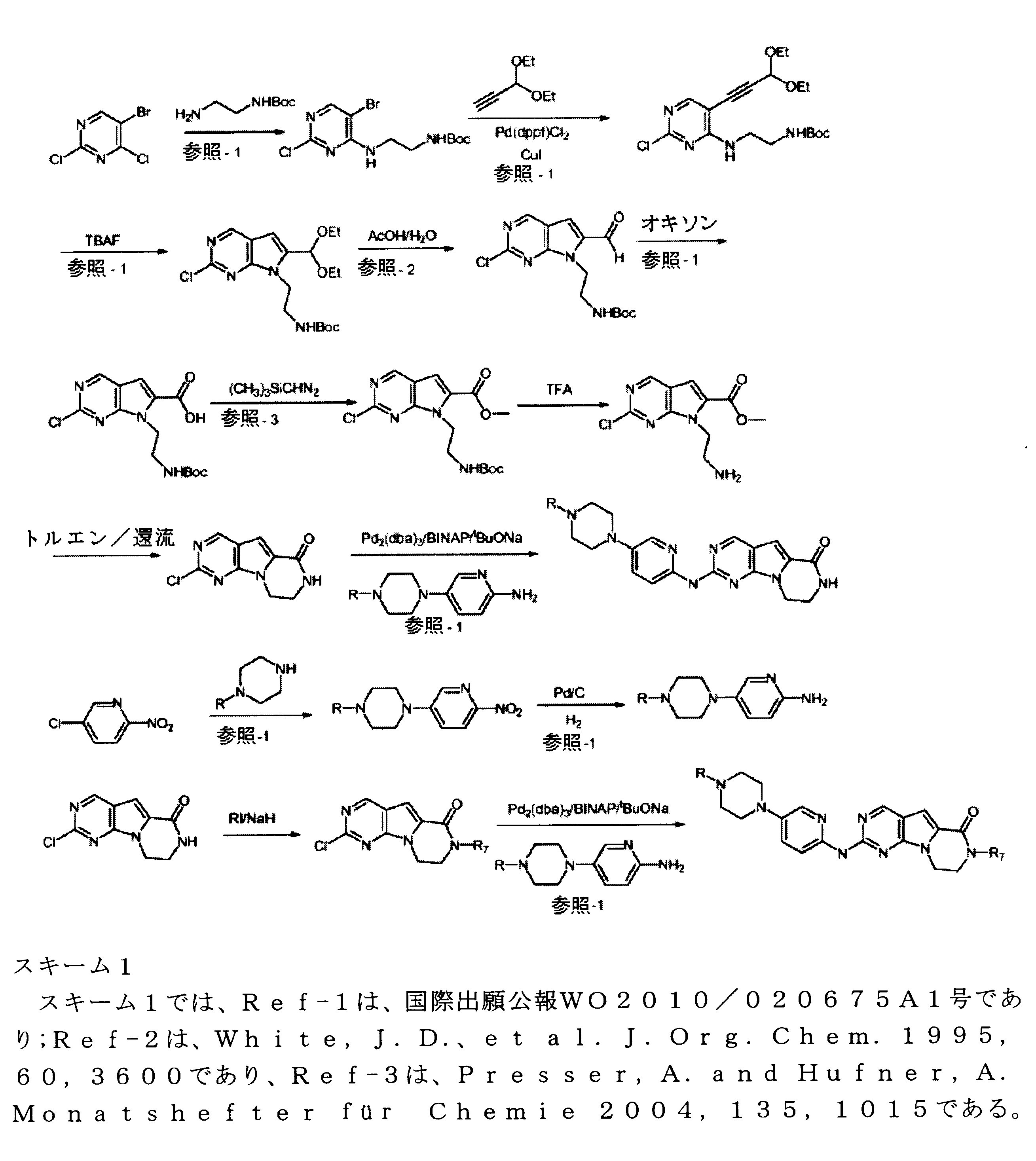
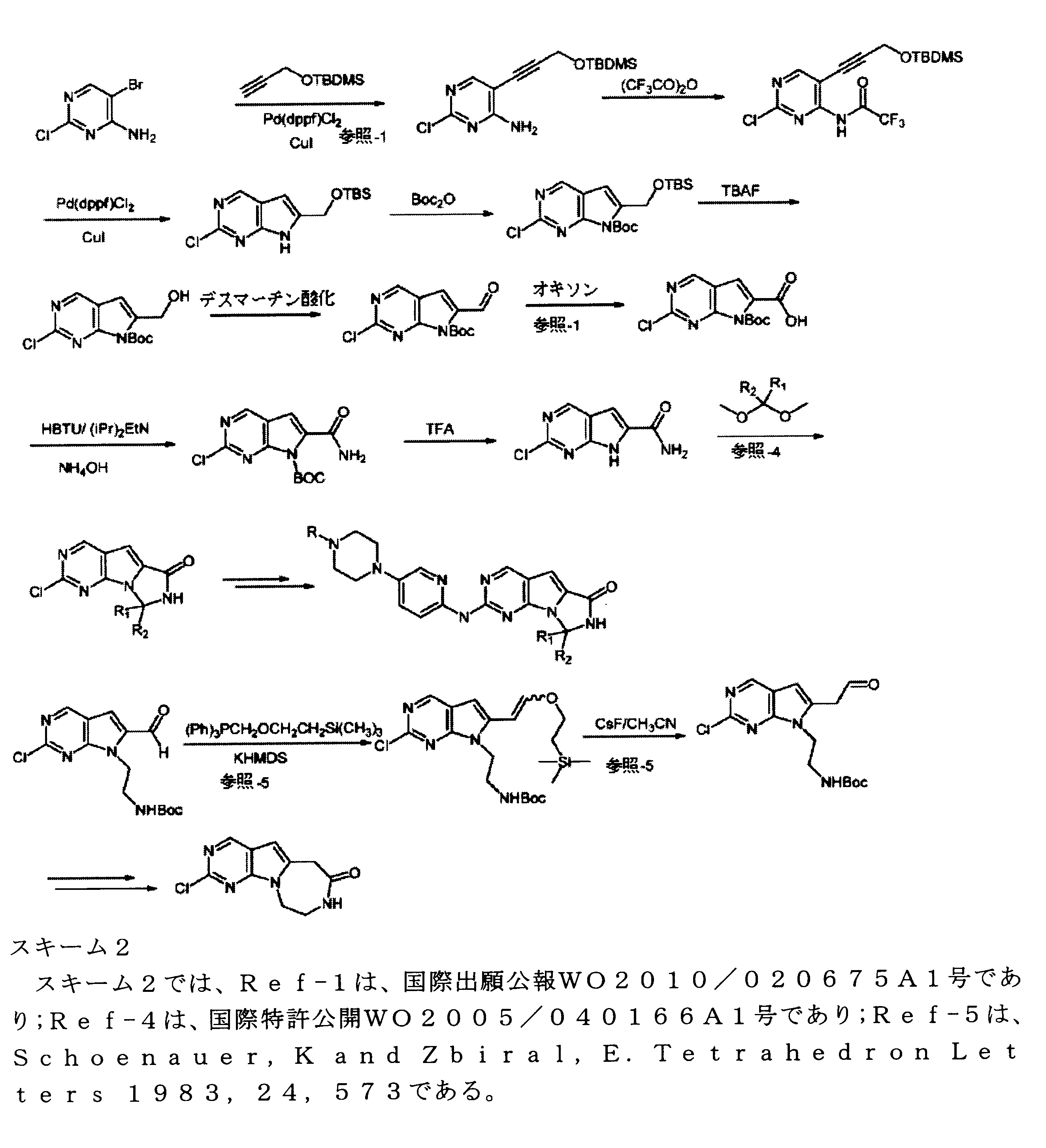
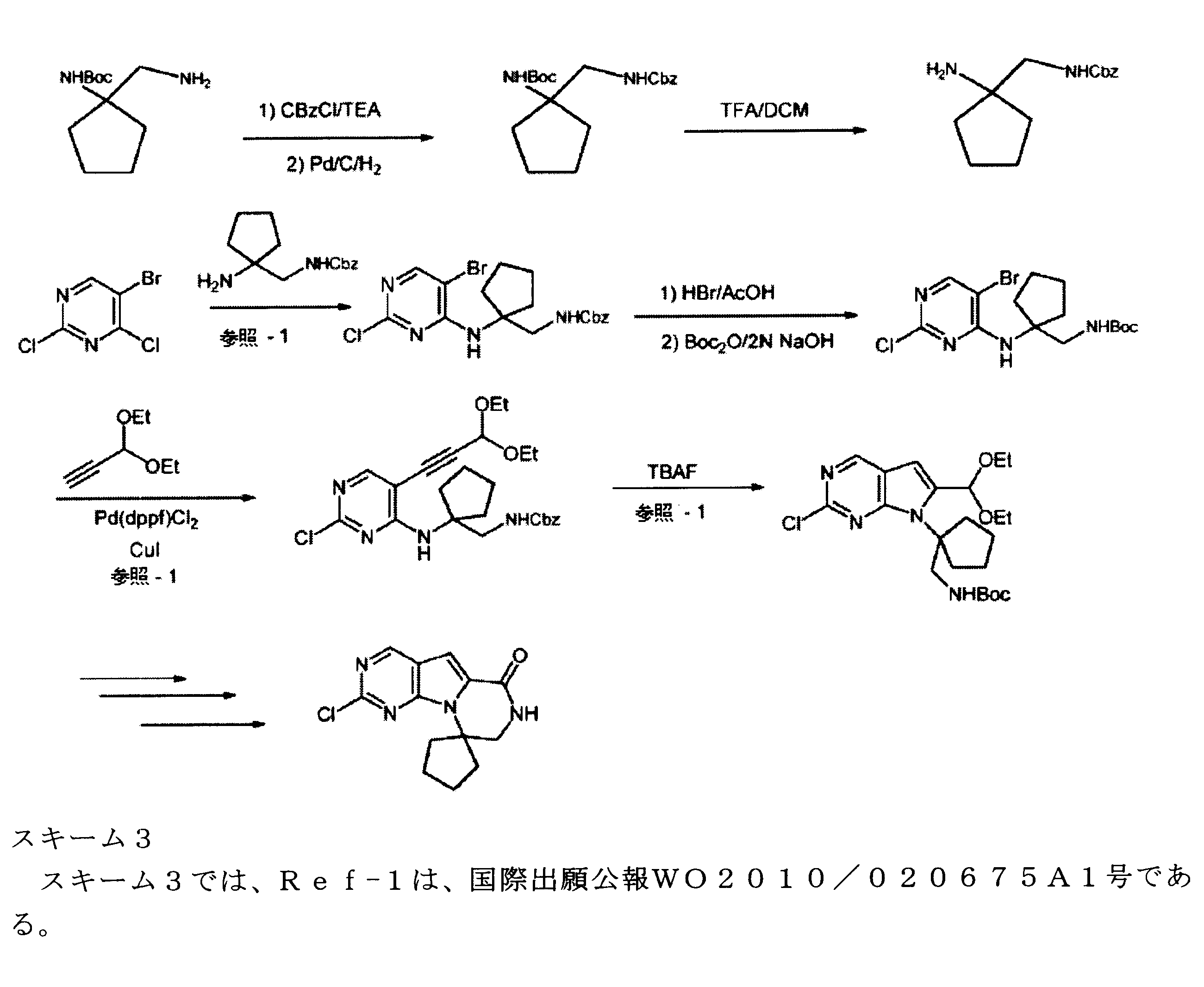
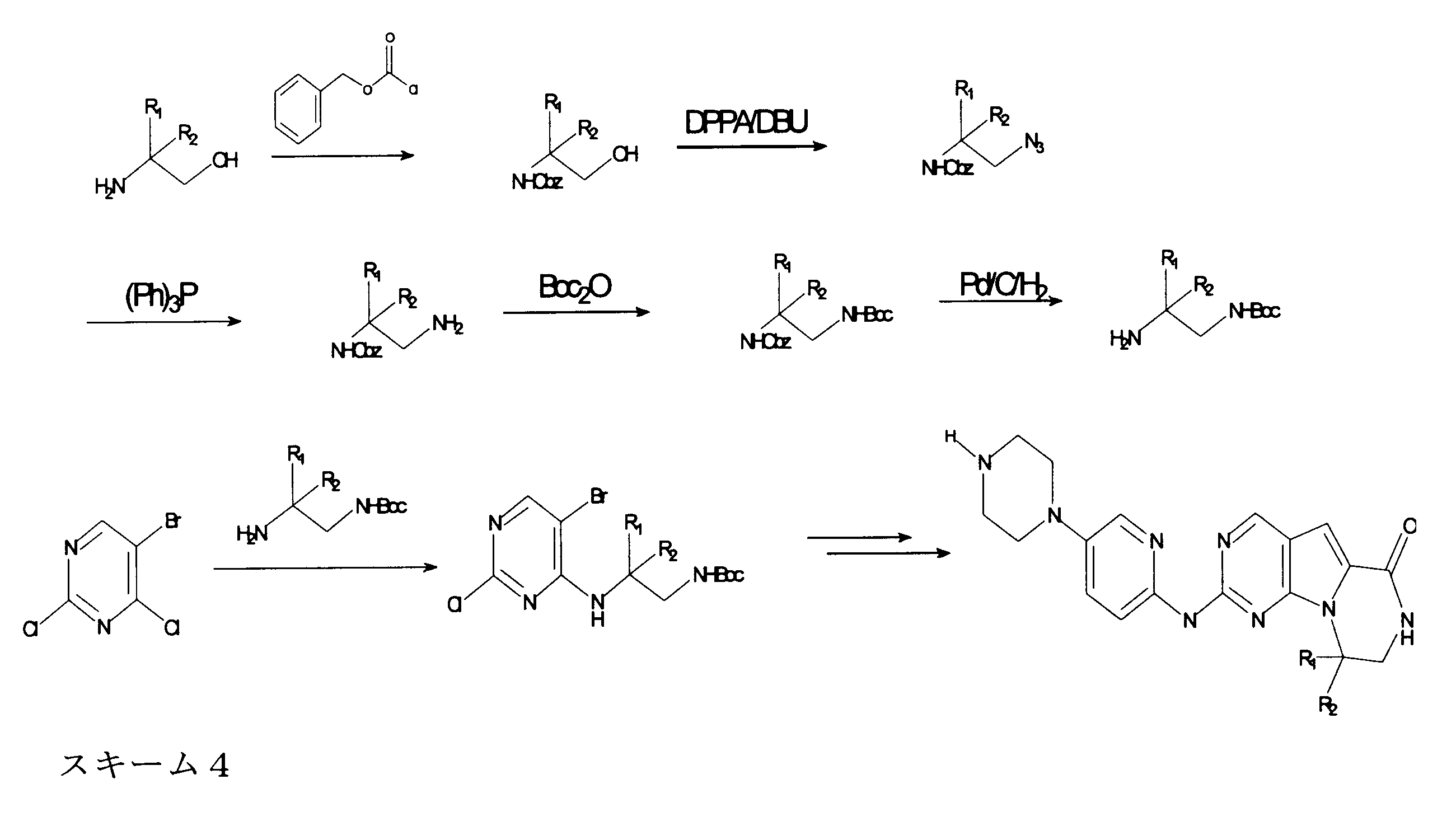
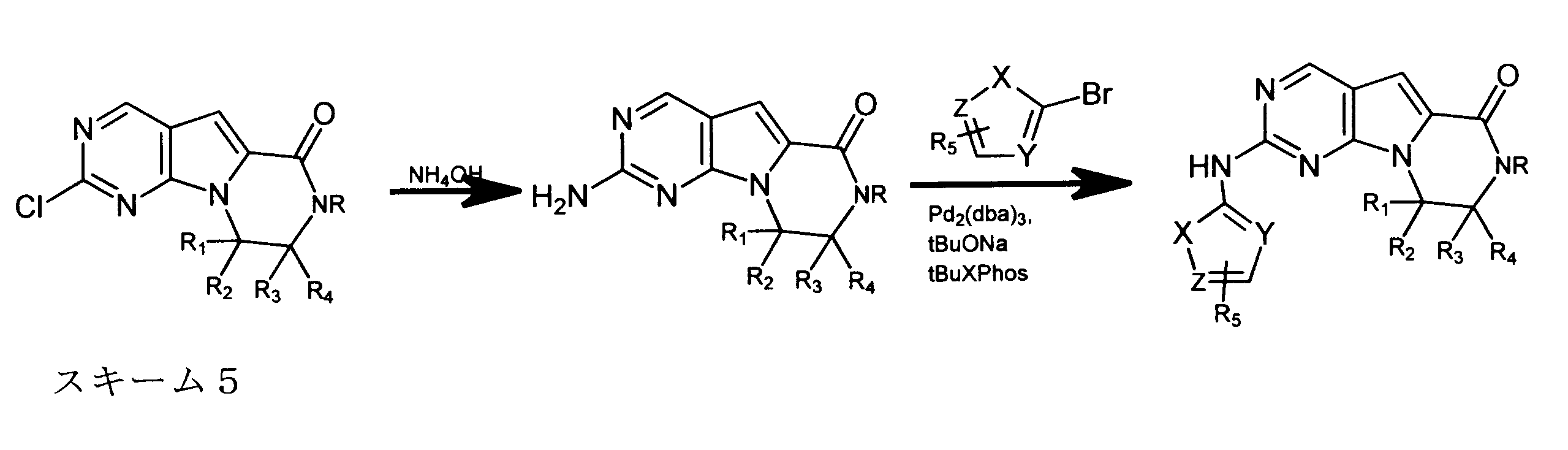
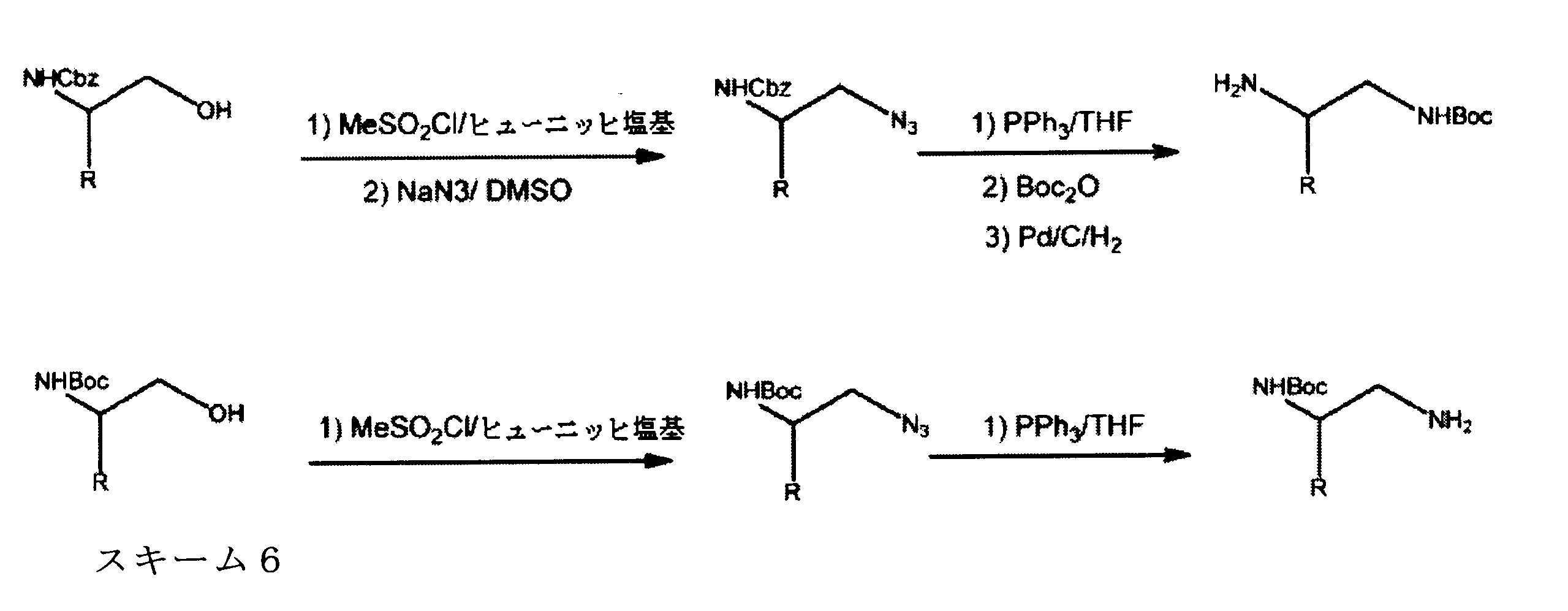
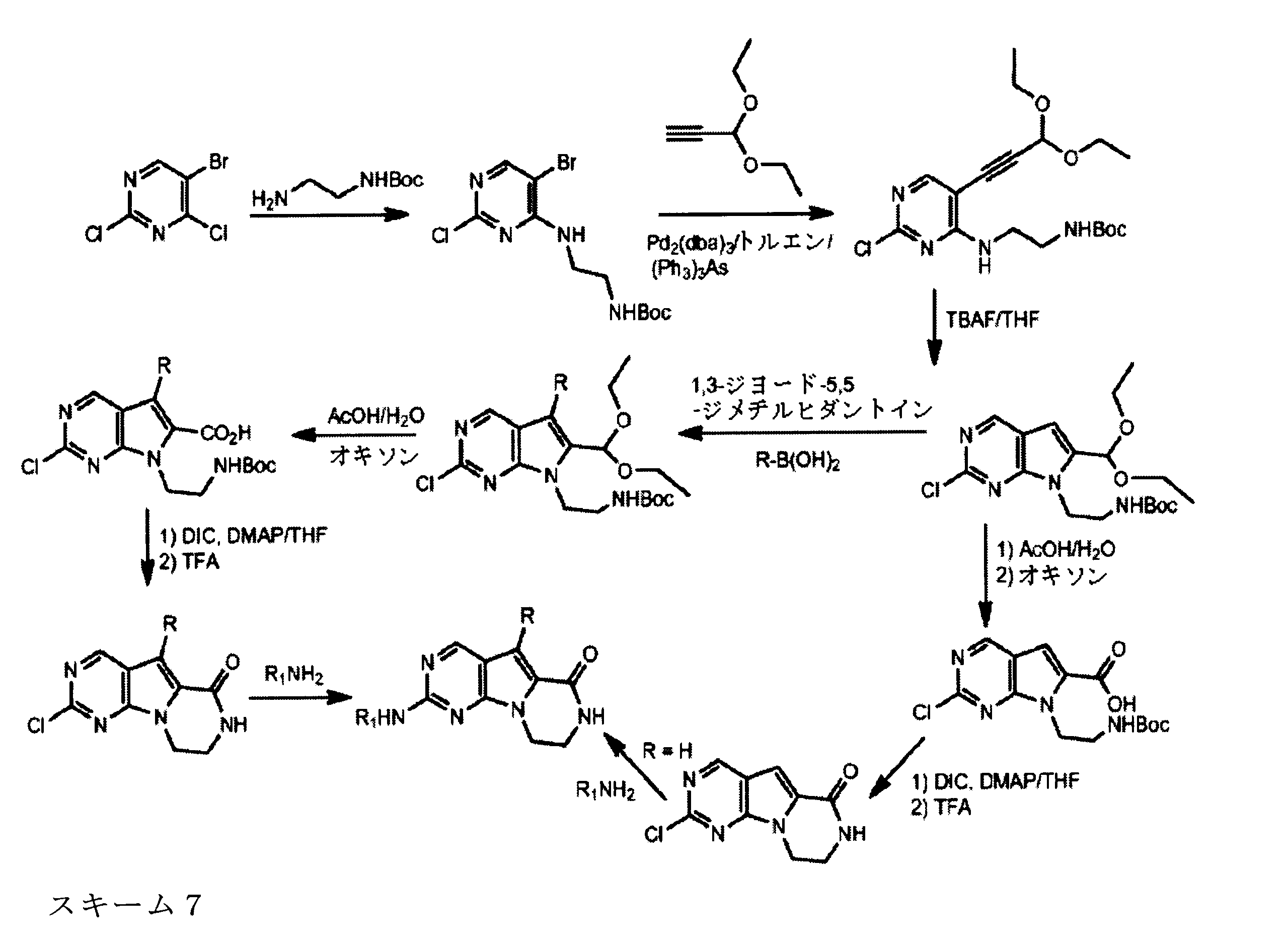
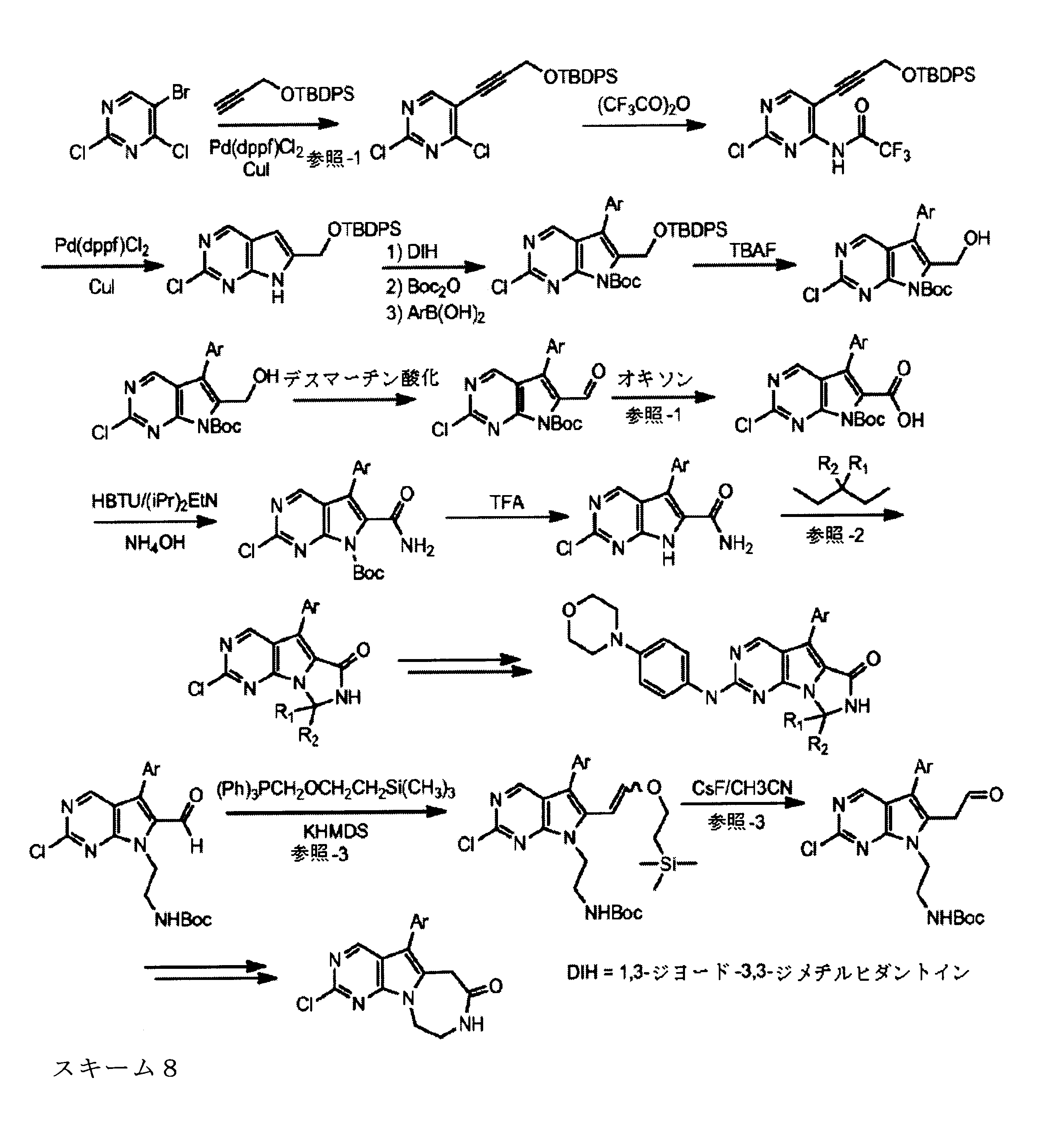
スキーム8では、Ref-1は、国際出願公報WO2010/020675A1号であり;Ref-2は、国際出願公報WO2005/040166A1号であり;Ref-3は、Schoenauer,K and Zbiral,E.Tetrahedron Letters 1983,24,573である。
In
代替的には、ラクタムは、強酸及び脱水剤の存在下で、カルボン酸を保護されたアミンと反応させることにより発生することができ、この強酸及び脱水剤は、強酸無水物として1つの部分で共存する。
強力な酸無水物の非限定的な例としては、トリフルオロ酢酸無水物、トリブロモ酢酸無水物、トリクロロ酢酸酸無水物又は混合無水物が挙げられる。
脱水剤は、カルボジイミドベースの化合物であってもよく、この非限定的な例としては、DCC(N,N-ジシクロヘキシルカルボジイミド)、EDC(1-エチル-3-(3-ジメチルアミノプロピル)カルボジイミド又はDIC(N,N-ジイソプロピルカルボジイミド)が挙げられる。
N-保護基を除去するために、付加的なステップが必要となる場合があり、その方法は当業者に知られている。
代替的には、ピリミジン環に結合されるハロゲン部分は、あらゆる脱離基で置換することができ、この脱離基は、一次アミンによって置換可能であり、これにより、最終生産物のための中間体、たとえばBr、I、F、SMe、SO2Me、SOアルキル、SO2アルキル等をを生成する。
たとえば、Tavaresの国際特許出願PCT/US2013/037878号を参照のこと。
他のアミン中間体及び最終的なアミン化合物は、当業者により合成することができる。 この化学反応は、保護及び脱保護が可能な反応性官能性を含む試薬を用いることができ、本発明の時に当業者に知られていることが、理解されよう。
Greene, T.W. and Wuts, P.G.M., Greene's Protective Groups in Organic Synthesis, 4th edition, John Wiley and Sonsを参照のこと。
Alternatively, the lactam can be generated by reacting a carboxylic acid with a protected amine in the presence of a strong acid and a dehydrating agent, the strong acid and dehydrating agent being combined in one part as a strong acid anhydride. coexist.
Non-limiting examples of strong acid anhydrides include trifluoroacetic anhydride, tribromoacetic anhydride, trichloroacetic anhydride or mixed anhydrides.
The dehydrating agent may be a carbodiimide-based compound, non-limiting examples of which include DCC (N,N-dicyclohexylcarbodiimide), EDC (1-ethyl-3-(3-dimethylaminopropyl)carbodiimide or DIC (N,N-diisopropylcarbodiimide) can be mentioned.
Additional steps may be required to remove N-protecting groups and are known to those skilled in the art.
Alternatively, the halogen moiety attached to the pyrimidine ring can be displaced with any leaving group, which can be displaced by a primary amine, thereby providing an intermediate such as Br, I, F, SMe, SO2Me , SOalkyl, SO2alkyl , and the like.
See, for example, International Patent Application PCT/US2013/037878 to Tavares.
Other amine intermediates and final amine compounds can be synthesized by those skilled in the art. It will be appreciated that this chemistry can employ reagents that contain reactive functionalities that can be protected and deprotected and are known to those skilled in the art at the time of the present invention.
Greene, T. W. and Wuts, P.S. G. M. , Greene's Protective Groups in Organic Synthesis, 4th edition, John Wiley and Sons.

本発明のCDK4/6阻害物質は、全般的なスキーム9に従って合成することができる。
例えば、置換2-アミノピリミジンの特定の合成及びキャラクタリゼーションは、国際特許公報WO2012/061156に見出すことができる。
上記で調製された化合物T、Q、GG及びUは、以下に示すようにマススペクトル分析及びNMRによって特徴づけられた:
The CDK4/6 inhibitors of the invention can be synthesized according to
For example, specific synthesis and characterization of substituted 2-aminopyrimidines can be found in International Patent Publication WO2012/061156.
Compounds T, Q, GG and U prepared above were characterized by mass spectroscopy and NMR as shown below:
化合物T
1HNMR (600 MHz, DMSO-d6) δ ppm 1.47 (br. s., 6 H) 1.72 (br. s., 2 H) 1.92 (br. s., 2 H) 2.77 (br. s., 3 H) 3.18 (br. s., 2 H) 3.46 (br. s., 2 H) 3.63 (br. s., 2 H) 3.66 (d, J=6.15 Hz, 2 H) 3.80 (br. s., 2 H) 7.25 (s, 1 H) 7.63 (br. s., 2 H) 7.94 (br. s., 1 H) 8.10 (br. s., 1 H) 8.39 (br. s., 1 H) 9.08 (br. s., 1 H) 11.59 (br. s., 1 H). LCMS (ESI) 447 (M + H).
Compound T
1 HNMR (600 MHz, DMSO-d6) δ ppm 1.47 (br. s., 6 H) 1.72 (br. s., 2 H) 1.92 (br. s., 2 H) 2.77 (br. s., 3 H) 3.18 (br. s., 2 H) 3.46 (br. s., 2 H) 3.63 (br. s., 2 H) 3.66 (d, J=6.15 Hz, 2 H) 3.80 (br. s. s., 2H) 7.25 (s, 1H) 7.63 (br.s., 2H) 7.94 (br.s., 1H) 8.10 (br.s., 1H) 8.39 (br.s., 1H) ) 9.08 (br. s., 1 H) 11.59 (br. s., 1 H). LCMS (ESI) 447 (M + H).
化合物Q
1H NMR (600 MHz, DMSO-d6) dδ ppm 0.82 (d, J=7.32 Hz, 2 H) 1.08 - 1.37 (m, 3 H) 1.38 - 1.64 (m, 2 H) 1.71 (br. s., 1 H) 1.91 (br. s., 1 H) 2.80 (br. s., 1 H) 3.12 (s, 1 H) 3.41 (br. s., 4 H) 3.65 (br. s., 4 H) 4.09 (br. s., 1 H) 7.26 (s, 1 H) 7.52 - 7.74 (m, 2 H) 7.94 (br. s., 1 H) 8.13 (br. s., 1 H) 8.40 (br. s., 1 H) 9.09 (br. s., 1 H) 9.62 (br. s., 1 H) 11.71 (br. s., 1 H). LCMS ESI (M + H) 433.
Compound Q
1 H NMR (600 MHz, DMSO-d 6 ) dδ ppm 0.82 (d, J=7.32 Hz, 2 H) 1.08 - 1.37 (m, 3 H) 1.38 - 1.64 (m, 2 H) 1.71 (br. s. s., 1H) 1.91 (br.s., 1H) 2.80 (br.s., 1H) 3.12 (s., 1H) 3.41 (br.s., 4H) 3.65 (br.s., 4H) ) 4.09 (br.s., 1H) 7.26 (s, 1H) 7.52 - 7.74 (m, 2H) 7.94 (br.s., 1H) 8.13 (br.s., 1H) 8.40 (br s., 1 H) 9.09 (br. s., 1 H) 9.62 (br. s., 1 H) 11.71 (br. s., 1 H). LCMS ESI (M + H) 433.
化合物GG
1H NMR (600 MHz, DMSO-d6) dδ ppm 0.85 (br. s., 1 H) 1.17 - 1.39 (m, 7 H) 1.42 - 1.58 (m, 2 H) 1.67 - 1.84 (m,3 H) 1.88 - 2.02 (m, 1 H) 2.76 - 2.93 (m, 1 H) 3.07 - 3.22 (m, 1 H) 3.29 - 3.39 (m, 1 H) 3.41 - 3.61 (m, 4 H) 3.62 - 3.76 (m, 4 H) 3.78 - 3.88 (m, 1 H) 4.12 (br. s., 1H) 7.28 (s, 1 H) 7.60 - 7.76 (m, 2 H) 7.98 (s, 1 H) 8.13 (br. s., 1 H) 8.41 (s, 1 H) 9.10 (br. s., 1 H) 11.21 (br. s., 1 H) 11.54 (s, 1 H). LCMS ESI (M + H) 475.
Compound GG
1 H NMR (600 MHz, DMSO-d 6 ) dδ ppm 0.85 (br. s., 1 H) 1.17 - 1.39 (m, 7 H) 1.42 - 1.58 (m, 2 H) 1.67 - 1.84 (m, 3 H ) 1.88 - 2.02 (m, 1H) 2.76 - 2.93 (m, 1H) 3.07 - 3.22 (m, 1H) 3.29 - 3.39 (m, 1H) 3.41 - 3.61 (m, 4H) 3.62 - 3.76 ( m, 4H) 3.78 - 3.88 (m, 1H) 4.12 (br. s., 1H) 7.28 (s, 1H) 7.60 - 7.76 (m, 2H) 7.98 (s, 1H) 8.13 (br. s., 1 H) 8.41 (s, 1 H) 9.10 (br. s., 1 H) 11.21 (br. s., 1 H) 11.54 (s, 1 H). LCMS ESI (M + H) 475.
化合物U
1H NMR (600 MHz, DMSO-d6) dδ ppm 0.84 (t, J=7.61 Hz, 2 H) 1.13 - 1.39 (m, 4 H) 1.46 (d, J=14.05 Hz, 2 H) 1.64 - 1.99 (m, 6 H) 2.21 (br. s., 1 H) 2.66 - 2.89 (m, 2 H) 3.06 (br. s., 1 H) 3.24 - 3.36 (m, 1 H) 3.37 - 3.50 (m, 2 H) 3.56 - 3.72 (m, 2 H) 3.77 - 4.00 (m, 4 H) 4.02 - 4.19 (m, 2 H) 7.25 (s, 1 H) 7.50 - 7.75 (m, 2 H) 7.89 (d, J=2.93 Hz, 1 H) 8.14 (d, J=7.32 Hz, 1 H) 8.38 (br. s., 1 H) 9.06 (s, 1 H) 11.53 (br. s., 1 H). LCMS ESI (M +H) 517.
Compound U
1 H NMR (600 MHz, DMSO-d 6 ) dδ ppm 0.84 (t, J=7.61 Hz, 2 H) 1.13 - 1.39 (m, 4 H) 1.46 (d, J=14.05 Hz, 2 H) 1.64 - 1.99 (m, 6 H) 2.21 (br. s., 1 H) 2.66 - 2.89 (m, 2 H) 3.06 (br. s., 1 H) 3.24 - 3.36 (m, 1 H) 3.37 - 3.50 (m, 2H) 3.56 - 3.72 (m, 2H) 3.77 - 4.00 (m, 4H) 4.02 - 4.19 (m, 2H) 7.25 (s, 1H) 7.50 - 7.75 (m, 2H) 7.89 (d, J=2.93 Hz, 1 H) 8.14 (d, J=7.32 Hz, 1 H) 8.38 (br. s., 1 H) 9.06 (s, 1 H) 11.53 (br. s., 1 H). (M+H) 517.
中間体B、E、K、L、1A、1F及び1CAが、Tavares,F.X.及びStrum,J.C.に付与された米国特許第8,598,186号、発明の名称「CDK阻害剤(CDK Inhibitors)」に従って、合成された。Tavares,F.X.の国際特許公開WO2013/148748号、発明の名称「ラクタムキナーゼ阻害剤(Lactam Kinase Inhibitors)」、Tavares,F.X.の国際特許公開WO2013/163239号、発明の名称「ラクタムの合成(Synthesis of Lactams)」及びTavares,F.X.及びStrum,J.C.に付与された米国特許第8,598,186号、発明の名称「CDK阻害剤(CDK Inhibitors)」は、参照事項として本願に包含される。 Intermediates B, E, K, L, 1A, 1F and 1CA were prepared according to Tavares, F.; X. and Strum, J.; C. No. 8,598,186, entitled "CDK Inhibitors," to U.S. Pat. Tavares, F.; X. International Patent Publication No. WO2013/148748, entitled "Lactam Kinase Inhibitors", Tavares, F.; X. International Patent Publication No. WO2013/163239, entitled "Synthesis of Lactams", and Tavares, F.; X. and Strum, J.; C. US Pat. No. 8,598,186, entitled "CDK Inhibitors," issued to Co., Ltd., is incorporated herein by reference.
実施例1
tert-ブチルN-[2-[(5-ブロモ2クロロピリミジン-4イル)アミノ]エチル]カルバメートの合成、化合物1
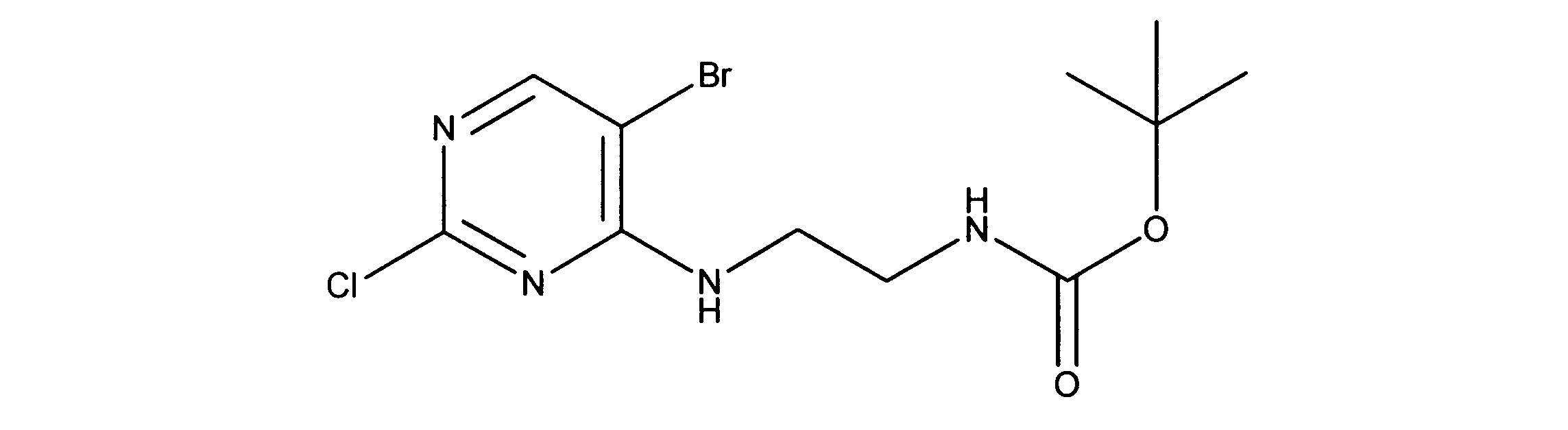
1HNMR (d6-DMSO) δ ppm 8.21 (s, 1H), 7.62 (brs, 1H), 7.27 (brs, 1H), 3.39 (m, 2H), 3.12 (m, 2H), 1.34 (s, 9H). LCMS (ESI) 351 (M + H).
Example 1
Synthesis of tert-butyl N-[2-[(5-bromo-2-chloropyrimidin-4yl)amino]ethyl]carbamate,
1 HNMR (d6-DMSO) δ ppm 8.21 (s, 1H), 7.62 (brs, 1H), 7.27 (brs, 1H), 3.39 (m, 2H), 3.12 (m, 2H), 1.34 (s, 9H) LCMS (ESI) 351 (M+H).
実施例2
tert-ブチルN-[2-[[2-クロロ-5-(3、3-ジエトキシプロプ-1-イニル)ピリミジン-4-イル]アミノ]エチル]カルバメートの合成、化合物2
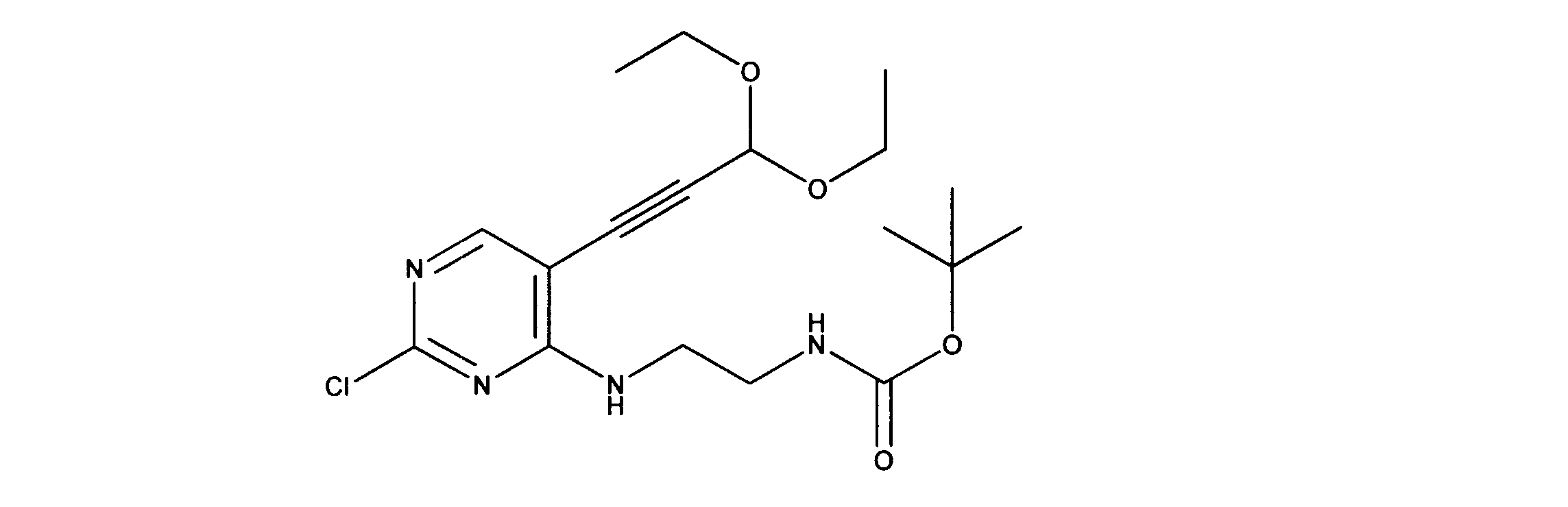
1HNMR (d6-DMSO) δ ppm 8.18 (s, 1H), 7.63 (brs, 1H), 7.40 (brs, 1H), 5.55 (s, 1H), 3.70 (m, 2H), 3.60 (m, 2H), 3.42 (m, 2H), 3.15 (m, 2H), 1.19 - 1.16 (m, 15H). LCMS (ESI) 399 (M + H).
Example 2
Synthesis of tert-butyl N-[2-[[2-chloro-5-(3,3-diethoxyprop-1-ynyl)pyrimidin-4-yl]amino]ethyl]carbamate,
1 HNMR (d6-DMSO) δ ppm 8.18 (s, 1H), 7.63 (brs, 1H), 7.40 (brs, 1H), 5.55 (s, 1H), 3.70 (m, 2H), 3.60 (m, 2H) , 3.42 (m, 2H), 3.15 (m, 2H), 1.19 - 1.16 (m, 15H). LCMS (ESI) 399 (M + H).
実施例3
tert-ブチルN-[2-[2-クロロ-6-(ジエトキシメチル)ピロロ[2,3-d]ピリミジン-7-イル]エチル]カルバメートの合成、化合物3
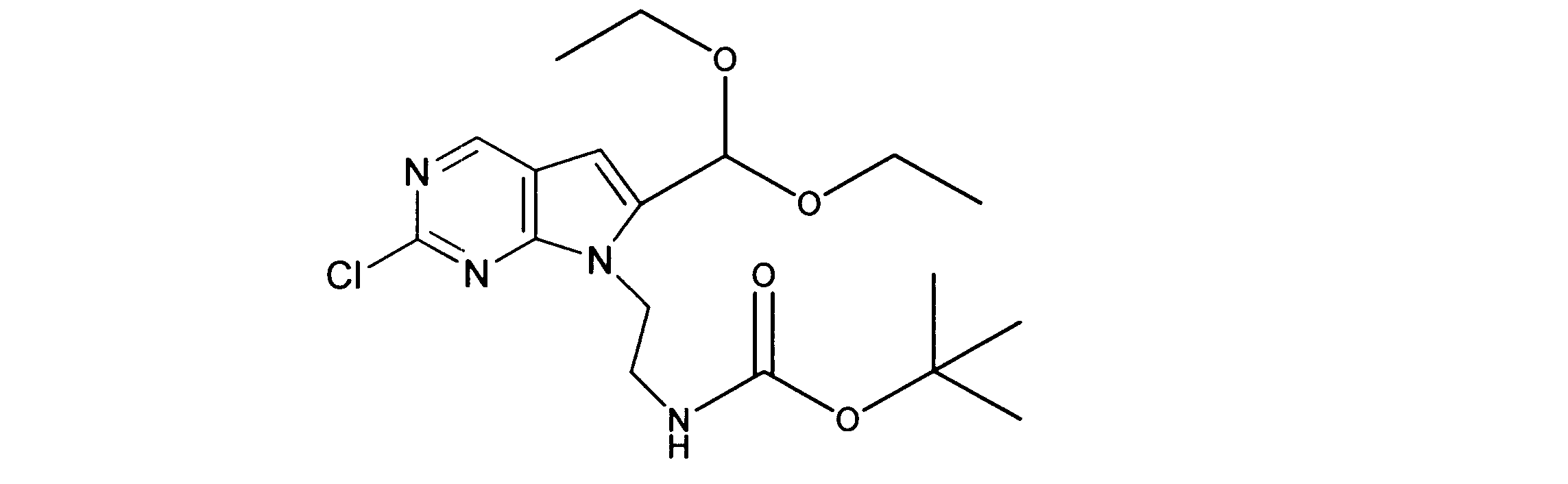
1HNMR (d6-DMSO) δ ppm 8.88 (s, 1H), 6.95 (brs, 1H), 6.69 (s, 1H), 5.79 (s, 1H), 4.29 (m, 2H), 3.59 (m, 4H), 3.34 (m, 1H), 3.18 (m, 1H), 1.19 (m, 9H), 1.17 (m, 6H). LCMS (ESI) 399 (M + H).
Example 3
Synthesis of tert-butyl N-[2-[2-chloro-6-(diethoxymethyl)pyrrolo[2,3-d]pyrimidin-7-yl]ethyl]carbamate, compound 3
1 HNMR (d6-DMSO) δ ppm 8.88 (s, 1H), 6.95 (brs, 1H), 6.69 (s, 1H), 5.79 (s, 1H), 4.29 (m, 2H), 3.59 (m, 4H) , 3.34 (m, 1H), 3.18 (m, 1H), 1.19 (m, 9H), 1.17 (m, 6H). LCMS (ESI) 399 (M + H).
実施例4
tert-ブチルN-[2-(2-クロロ-6-ホルミル-ピロロ[2,3-d]ピリミジン-7-イル)エチル]カルバメートの合成、化合物4
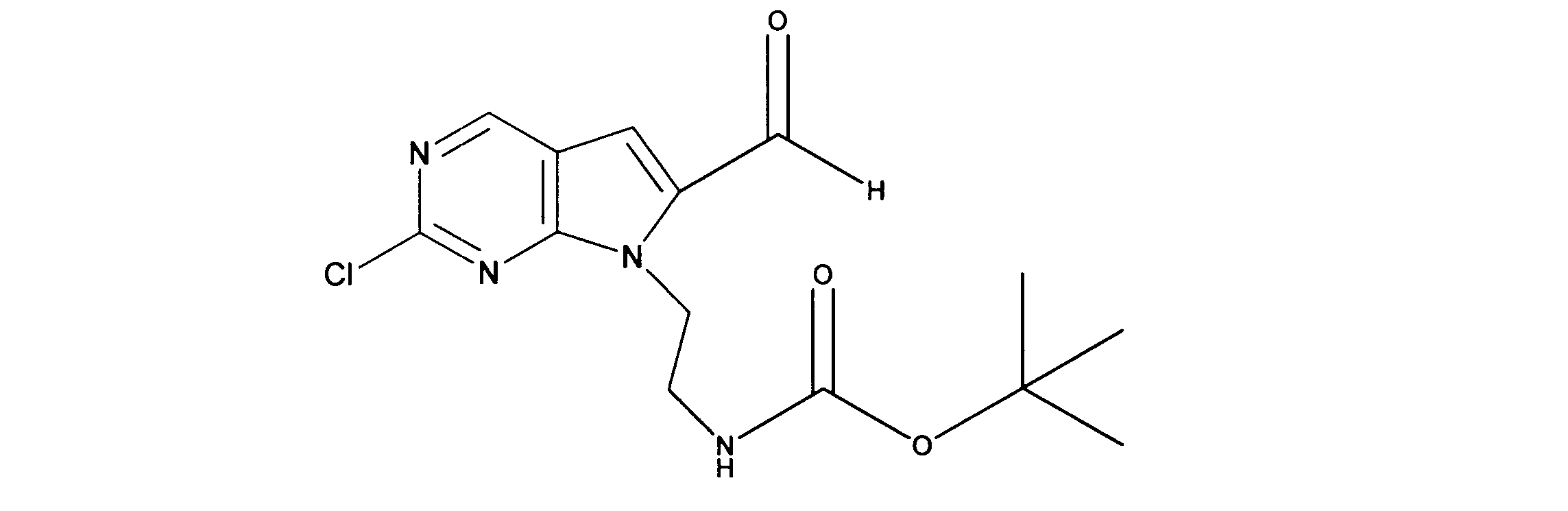
1HNMR (d6-DMSO) δ ppm 9.98 (s, 1H), 9.18 (s, 1H), 7.66 (s, 1H), 6.80 (brs, 1H), 4.52 (m, 2H), 4.36 (m, 2H), 1.14 (s, 9H). LCMS (ESI) 325 (M + H).
Example 4
Synthesis of tert-butyl N-[2-(2-chloro-6-formyl-pyrrolo[2,3-d]pyrimidin-7-yl)ethyl]carbamate,
1 HNMR (d6-DMSO) δ ppm 9.98 (s, 1H), 9.18 (s, 1H), 7.66 (s, 1H), 6.80 (brs, 1H), 4.52 (m, 2H), 4.36 (m, 2H) , 1.14 (s, 9H). LCMS (ESI) 325 (M + H).
実施例5
7-[2-(第三級ブトキシカルボニルアミノ)エチル]-2-クロロ-ピロロ[2,3-d]ピリミジン-6-カルボン酸の合成、化合物5
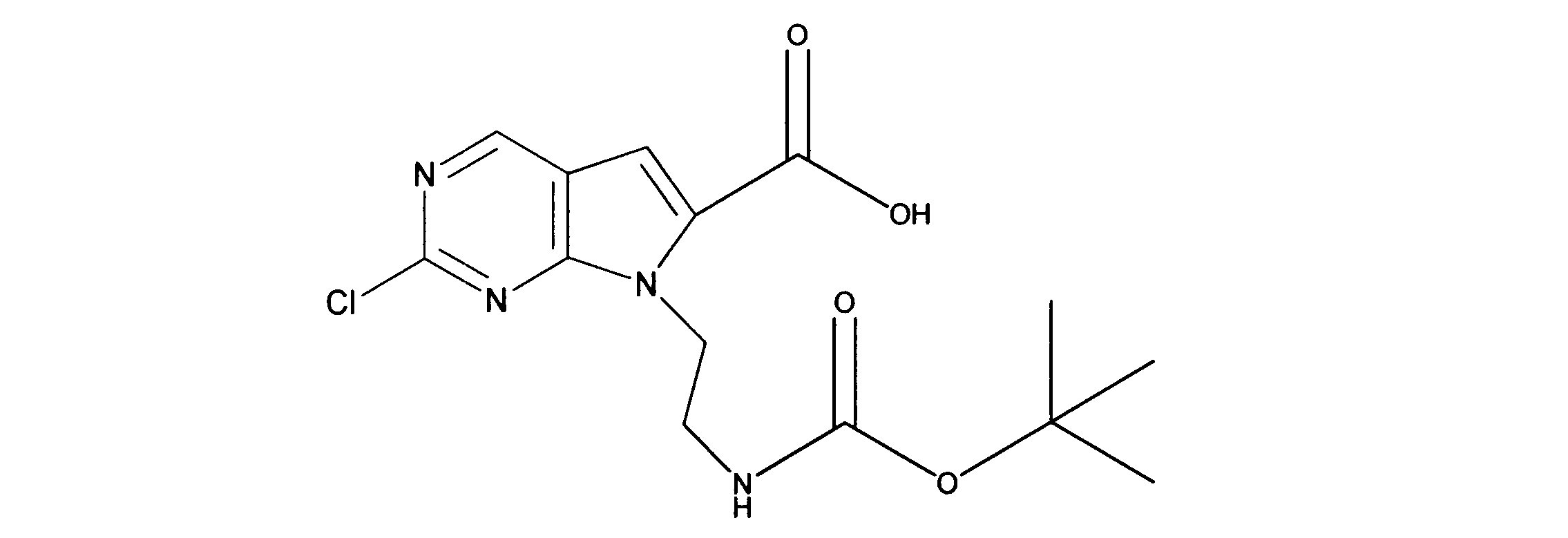
1HNMR (d6-DMSO) δ ppm 9.11 (s, 1H), 7.39 (s, 1H), 4.38 (m, 2H), 4.15 (m, 2H), 1.48 (m, 9H). LCMS (ESI) 341(M + H).
Example 5
Synthesis of 7-[2-(tert-butoxycarbonylamino)ethyl]-2-chloro-pyrrolo[2,3-d]pyrimidine-6-carboxylic acid,
1 HNMR (d6-DMSO) δ ppm 9.11 (s, 1H), 7.39 (s, 1H), 4.38 (m, 2H), 4.15 (m, 2H), 1.48 (m, 9H). LCMS (ESI) 341( M + H).
実施例6
メチル7-[2-(第三級ブトキシカルボニルアミノ)エチル]-2-クロロ-ピロロ[2,3-d]ピリミジン-6-カルボン酸塩の合成、化合物6
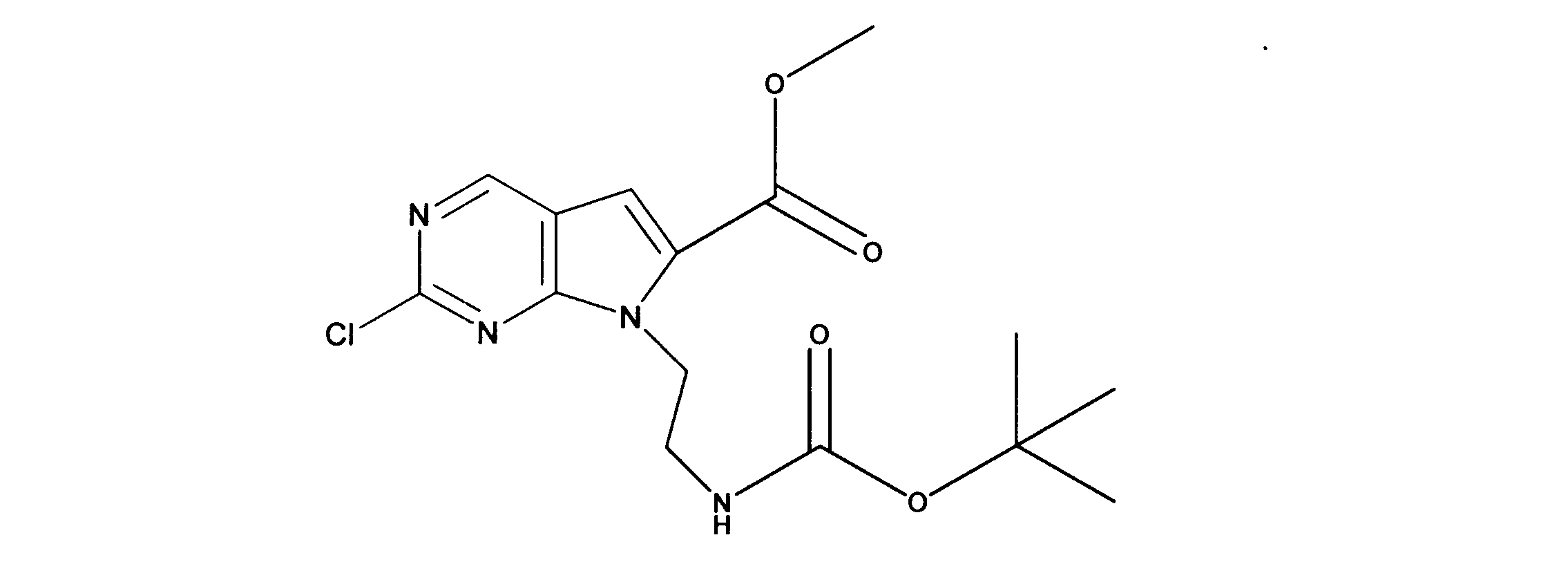
1HNMR (d6-DMSO) δ ppm 9.10 (s, 1H), 7.45 (s, 1H), 6.81 (brs, 1H) 4.60 (m, 2H), 3.91 (s, 3H), 3.29 (m, 2H), 1.18 (m, 9H) LCMS (ESI) 355 (M + H).
Example 6
Synthesis of methyl 7-[2-(tert-butoxycarbonylamino)ethyl]-2-chloro-pyrrolo[2,3-d]pyrimidine-6-carboxylate,
1 HNMR (d6-DMSO) δ ppm 9.10 (s, 1H), 7.45 (s, 1H), 6.81 (brs, 1H) 4.60 (m, 2H), 3.91 (s, 3H), 3.29 (m, 2H), 1.18 (m, 9H) LCMS (ESI) 355 (M+H).
実施例7
クロロ三環系アミドの合成、化合物7

1HNMR (d6-DMSO) δ ppm 9.08 (s, 1H), 8.48 (brs, 1H), 7.21 (s, 1H) 4.33 (m, 2H), 3.64 (m, 2H). LCMS (ESI) 223 (M + H).
Example 7
Synthesis of chlorotricyclic amides,
1 HNMR (d6-DMSO) δ ppm 9.08 (s, 1H), 8.48 (brs, 1H), 7.21 (s, 1H) 4.33 (m, 2H), 3.64 (m, 2H). LCMS (ESI) 223 (M + H).
実施例8
クロロ-N-メチル三環アミドの合成、化合物8

1HNMR (d6-DMSO) δ ppm 9.05 (s, 1H), 7.17 (s, 1H) 4.38 (m, 2H), 3.80 (m, 2H), 3.05 (s, 3H). LCMS (ESI) 237 (M + H).
Example 8
Synthesis of chloro-N-methyl tricyclic amides,
1 HNMR (d6-DMSO) δ ppm 9.05 (s, 1H), 7.17 (s, 1H) 4.38 (m, 2H), 3.80 (m, 2H), 3.05 (s, 3H). LCMS (ESI) 237 (M + H).
実施例9
1-メチル-4-(6-ニトロ-3-ピリジル)ピペラジンの合成、化合物9

1HNMR (d6-DMSO) δ ppm 8.26 (s, 1H), 8.15 (1H, d, J = 9.3 Hz), 7.49 (1H, d, J = 9.4 Hz), 3.50 (m, 4H), 2.49 (m, 4H), 2.22 (s, 3H).
Example 9
Synthesis of 1-methyl-4-(6-nitro-3-pyridyl)piperazine,
1 HNMR (d6-DMSO) δ ppm 8.26 (s, 1H), 8.15 (1H, d, J = 9.3 Hz), 7.49 (1H, d, J = 9.4 Hz), 3.50 (m, 4H), 2.49 (m , 4H), 2.22 (s, 3H).
実施例10
5-(4-メチルピペラジン-1-イル)ピリジン-2-アミンの合成、化合物10

1HNMR (d6-DMSO) δ ppm 7.56 (1H, d, J = 3 Hz), 7.13 (1H, m), 6.36 (1H, d, J = 8.8 Hz), 5.33 (brs, 2H), 2.88 (m, 4H), 2.47 (m, 4H), 2.16 (s, 3H).
Example 10
Synthesis of 5-(4-methylpiperazin-1-yl)pyridin-2-amine,
1 HNMR (d6-DMSO) δ ppm 7.56 (1H, d, J = 3 Hz), 7.13 (1H, m), 6.36 (1H, d, J = 8.8 Hz), 5.33 (brs, 2H), 2.88 (m , 4H), 2.47 (m, 4H), 2.16 (s, 3H).
実施例11
tert-ブチル4-(6アミノ3-ピリジル)ピペラジン-1-カルボン酸塩の合成、化合物11
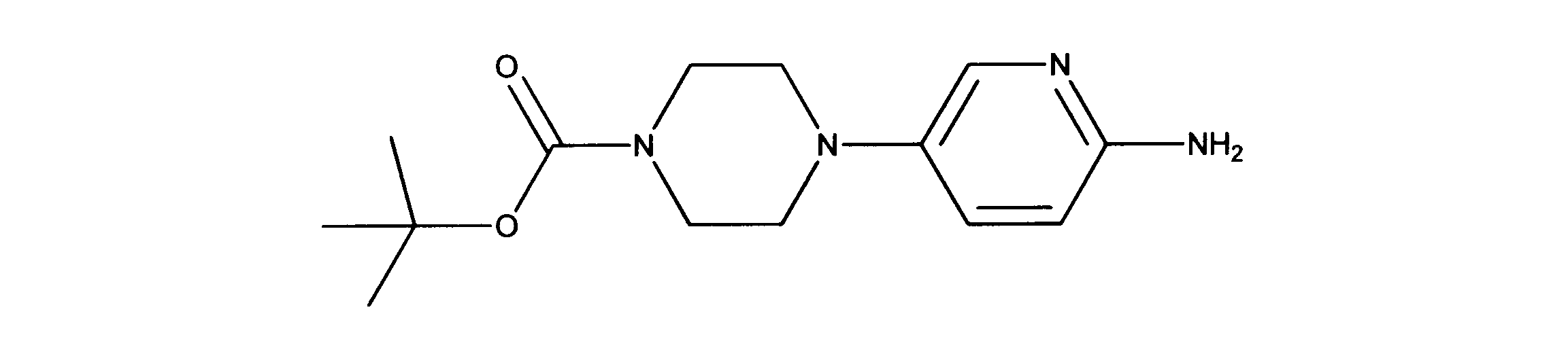
Synthesis of tert-butyl 4-(6-amino-3-pyridyl)piperazine-1-carboxylate, compound 11
実施例12
tert-ブチルN-[2-(ベンジルオキシカルボニルアミノ)-3-メチルブチル]カルバメートの合成、化合物12
1HNMR (600 MHz, CHLOROFORM-d) δ ppm 0.89 (d, J=6.73 Hz, 3 H) 0.92 (d, J=6.73 Hz, 3 H) 1.38 (s, 9 H) 1.70 - 1.81 (m, 1 H) 3.18 (d, J=5.56 Hz, 2 H) 3.47 - 3.60 (m, 1 H) 4.76 (s, 1 H) 4.89 (d, J=7.90 Hz, 1 H) 5.07 (s, 2 H) 7.25 - 7.36 (m, 5 H). LCMS (ESI) 337 (M + H).
Example 12
Synthesis of tert-butyl N-[2-(benzyloxycarbonylamino)-3-methylbutyl]carbamate,
1 HNMR (600 MHz, CHLOROFORM-d) δ ppm 0.89 (d, J=6.73 Hz, 3 H) 0.92 (d, J=6.73 Hz, 3 H) 1.38 (s, 9 H) 1.70 - 1.81 (m, 1 H) 3.18 (d, J=5.56Hz, 2H) 3.47 - 3.60 (m, 1H) 4.76 (s, 1H) 4.89 (d, J=7.90Hz, 1H) 5.07 (s, 2H) 7.25 - 7.36 (m, 5 H). LCMS (ESI) 337 (M + H).
実施例13
tert-ブチルN-[2-(ベンジルオキシカルボニルアミノ)-4-メチル-ペンチル]カルバメートの合成、化合物13
1HNMR (600 MHz, CHLOROFORM-d) δ ppm 0.89 (d, J=6.73 Hz, 6 H) 1.25 - 1.34 (m, 1 H) 1.39 (s, 9 H) 1.57 - 1.71 (m, 2 H) 3.04 - 3.26 (m, 2 H) 3.68 - 3.80 (m, 1 H) 4.72 - 4.89 (m, 2 H) 5.06 (s, 2 H) 7.25 - 7.38 (m, 5 H). LCMS (ESI) 351 (M + H).
Example 13
Synthesis of tert-butyl N-[2-(benzyloxycarbonylamino)-4-methyl-pentyl]carbamate, compound 13
1 HNMR (600 MHz, CHLOROFORM-d) δ ppm 0.89 (d, J=6.73 Hz, 6 H) 1.25 - 1.34 (m, 1 H) 1.39 (s, 9 H) 1.57 - 1.71 (m, 2 H) 3.04 - 3.26 (m, 2H) 3.68 - 3.80 (m, 1H) 4.72 - 4.89 (m, 2H) 5.06 (s, 2H) 7.25 - 7.38 (m, 5H). + H).
実施例14
tert-ブチルN-[(2R)-2-(ベンジルオキシカルボニルアミノ)-3-メチルブチル]カルバメートの合成、化合物14
Synthesis of tert-butyl N-[(2R)-2-(benzyloxycarbonylamino)-3-methylbutyl]carbamate,
実施例15
tert-ブチルN-[(2S)-2-(ベンジルオキシカルボニルアミノ)-3-メチルブチル]カルバメートの合成、化合物15
Synthesis of tert-butyl N-[(2S)-2-(benzyloxycarbonylamino)-3-methylbutyl]carbamate,
実施例16
tert-ブチルN-[(1S)-1-(アミノメチル)-2メチル-プロピル]カルバメートの合成、化合物16
LCMS (ESI) 203 (M + H).
Example 16
Synthesis of tert-butyl N-[(1S)-1-(aminomethyl)-2methyl-propyl]carbamate,
LCMS (ESI) 203 (M+H).
実施例17
tert-ブチルN-[(1R)-1-(アミノメチル)-2メチル-プロピル]カルバメートの合成、化合物17
Synthesis of tert-butyl N-[(1R)-1-(aminomethyl)-2methyl-propyl]carbamate, compound 17
実施例18
tert-ブチルN-[(2S)-2-(ベンジルオキシカルボニルアミノ)-4-メチル-ペンチル]カルバメートの合成、化合物18
Synthesis of tert-butyl N-[(2S)-2-(benzyloxycarbonylamino)-4-methyl-pentyl]carbamate, compound 18
実施例19:
tert-ブチルN-[(2S)-2-(ベンジルオキシカルボニルアミノ)-2-フェニルエチル]カルバメートの合成、化合物19
1HNMR (600 MHz, DMSO-d6) δ ppm 1.20 - 1.33 (m, 9 H) 3.11 (t, J=6.29 Hz, 2 H) 4.59 - 4.68 (m, 1 H) 4.88 - 5.01 (m, 2 H) 6.81 (t, J=5.42 Hz, 1 H) 7.14 - 7.35 (m, 10 H) 7.69 (d, J=8.49 Hz, 1 H). LCMS (ESI) 371 (M + H).
Example 19:
Synthesis of tert-butyl N-[(2S)-2-(benzyloxycarbonylamino)-2-phenylethyl]carbamate, compound 19
1 HNMR (600 MHz, DMSO-d 6 ) δ ppm 1.20 - 1.33 (m, 9 H) 3.11 (t, J=6.29 Hz, 2 H) 4.59 - 4.68 (m, 1 H) 4.88 - 5.01 (m, 2 H) 6.81 (t, J=5.42 Hz, 1 H) 7.14 - 7.35 (m, 10 H) 7.69 (d, J=8.49 Hz, 1 H). LCMS (ESI) 371 (M + H).
実施例20
tert-ブチルN-[(2S)-2-(ベンジルオキシカルボニルアミノ)-3-メチル-ペンチル]カルバメートの合成、化合物20
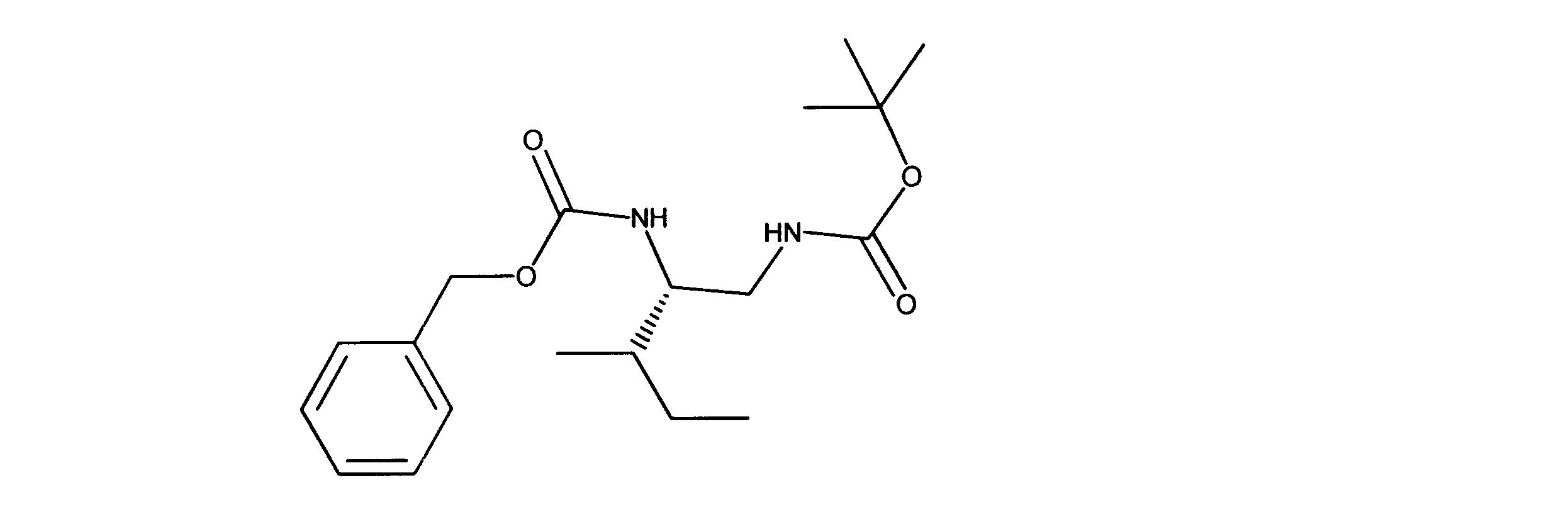
1HNMR (600 MHz, CHLOROFORM-d) δ ppm 0.85 - 0.92 (m, 6 H) 1.05 - 1.15 (m, 1 H) 1.35 - 1.41 (m, 9 H) 1.45 - 1.56 (m, 2 H) 3.14 - 3.24 (m, 2 H) 3.54 - 3.64 (m, 1 H) 4.78 (s, 1 H) 4.96 (d, J=7.91 Hz, 1 H) 5.06 (s, 2 H) 7.27 - 7.37 (m, 5 H). LCMS (ESI) 351 (M + H).
Example 20
Synthesis of tert-butyl N-[(2S)-2-(benzyloxycarbonylamino)-3-methyl-pentyl]carbamate,
1 HNMR (600 MHz, CHLOROFORM-d) δ ppm 0.85 - 0.92 (m, 6 H) 1.05 - 1.15 (m, 1 H) 1.35 - 1.41 (m, 9 H) 1.45 - 1.56 (m, 2 H) 3.14 - 3.24 (m, 2H) 3.54 - 3.64 (m, 1H) 4.78 (s, 1H) 4.96 (d, J=7.91Hz, 1H) 5.06 (s, 2H) 7.27 - 7.37 (m, 5H ). LCMS (ESI) 351 (M+H).
実施例21
tert-ブチルN-[(2S)-2-(ベンジルオキシカルボニルアミノ)-3、3-ジメチルブチル]カルバメートの合成、化合物21
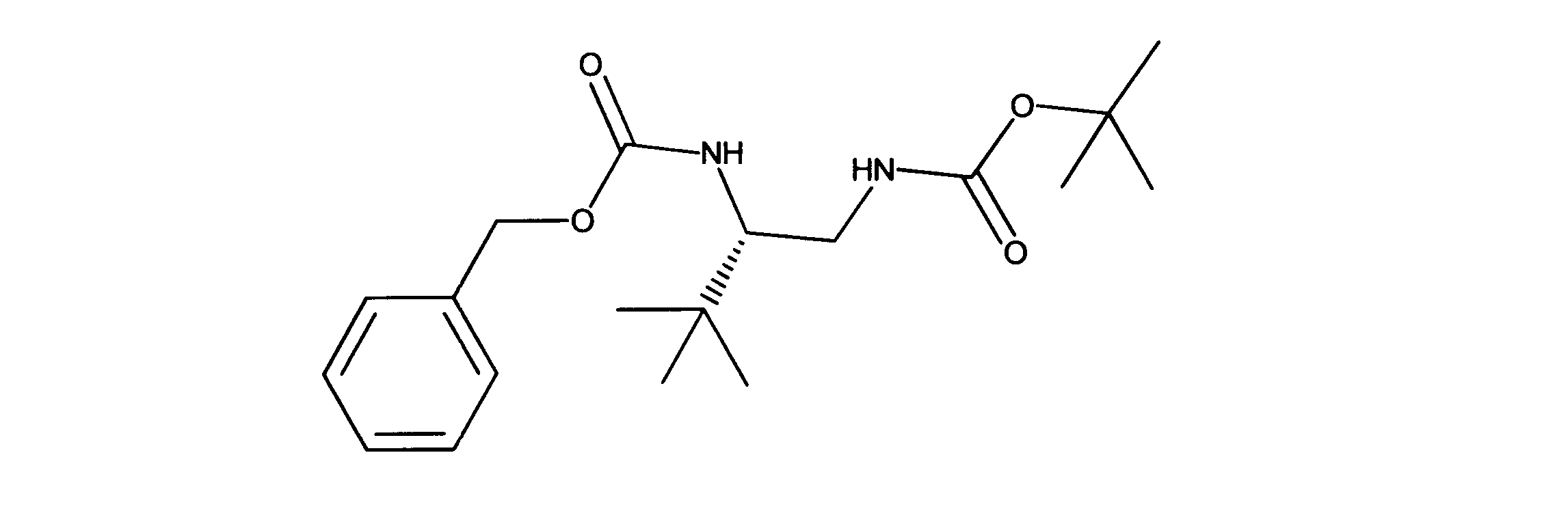
LCMS (ESI) 351.
Example 21
Synthesis of tert-butyl N-[(2S)-2-(benzyloxycarbonylamino)-3,3-dimethylbutyl]carbamate,
LCMS (ESI) 351.
実施例22
tert-ブチルN-[[1-(ベンジルオキシカルボニルアミノ)シクロヘキシル]メチル]カルバメートの合成、化合物22
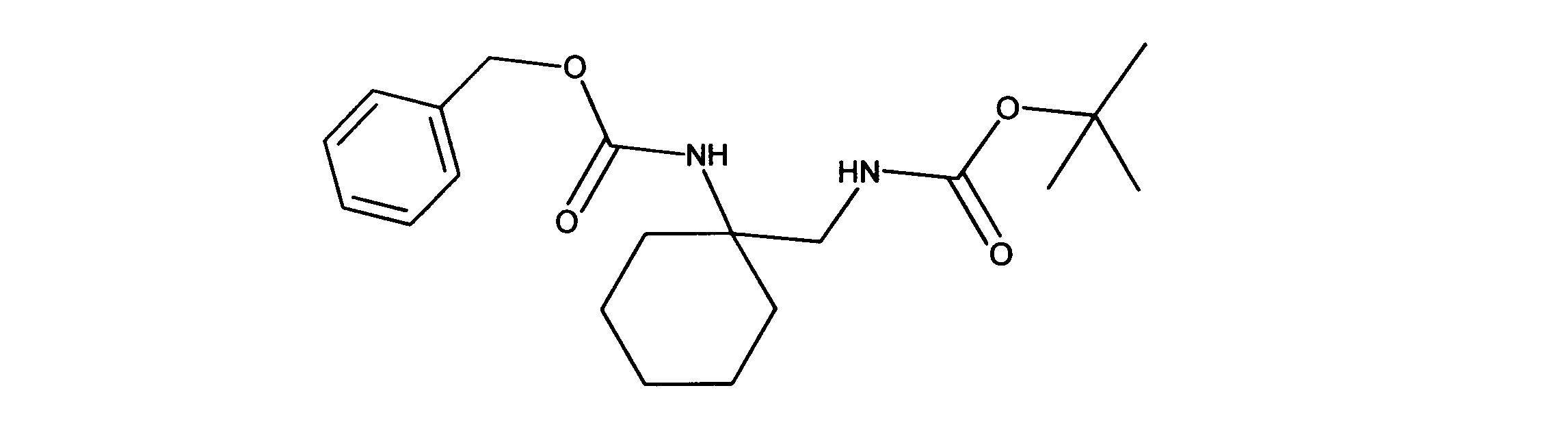
1HNMR (600 MHz, DMSO-d6) δ ppm 0.92 - 1.54 (m, 17 H) 1.76 - 2.06 (m, 2 H) 3.09 (d, J=6.15 Hz, 2 H) 4.92 (s, 2 H) 6.63 (d, J=17.27 Hz, 1 H) 7.16 - 7.49 (m, 6 H). LCMS (ESI) 363 (M + H).
Example 22
Synthesis of tert-butyl N-[[1-(benzyloxycarbonylamino)cyclohexyl]methyl]carbamate, compound 22
1 HNMR (600 MHz, DMSO-d 6 ) δ ppm 0.92 - 1.54 (m, 17 H) 1.76 - 2.06 (m, 2 H) 3.09 (d, J=6.15 Hz, 2 H) 4.92 (s, 2 H) 6.63 (d, J=17.27 Hz, 1 H) 7.16 - 7.49 (m, 6 H). LCMS (ESI) 363 (M + H).
実施例23
tert-ブチルN-[[1-(ベンジルオキシカルボニルアミノ)シクロペンチル]メチル]カルバメートの合成、化合物23
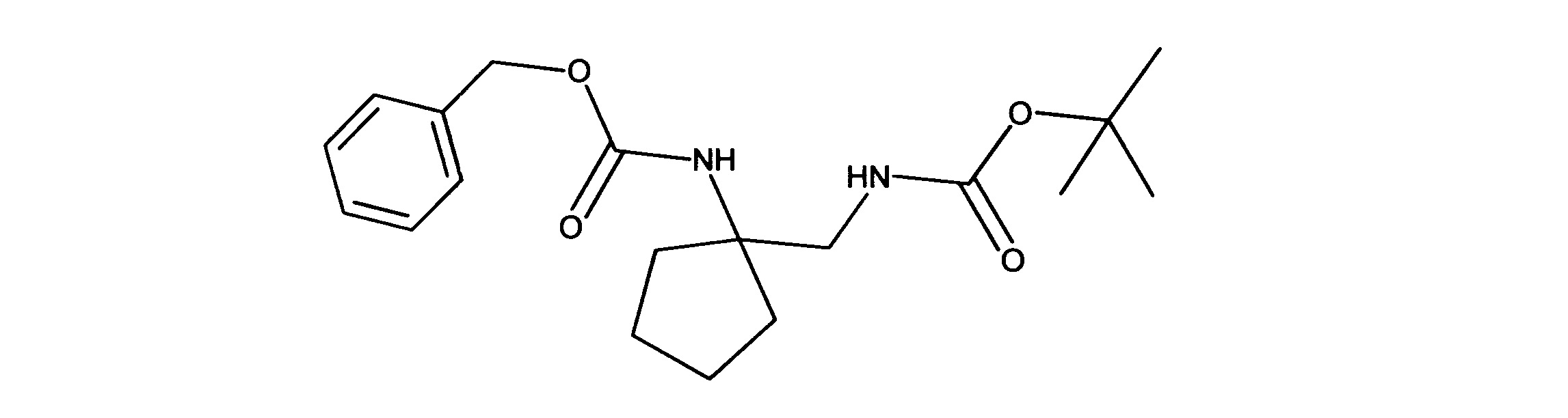
LCMS (ESI) 349 (M + H).
Example 23
Synthesis of tert-butyl N-[[1-(benzyloxycarbonylamino)cyclopentyl]methyl]carbamate, compound 23
LCMS (ESI) 349 (M+H).
実施例24
2-ニトロ-5-[4-(1-ピペリジル)-1-ピペリジル]ピリジンの合成、化合物24

1HNMR (600 MHz, DMSO-d6) δ ppm 1.26 - 1.36 (m, 2 H) 1.43 (m, 6 H) 1.76 (m, 2 H) 2.37 (m, 5 H) 2.94 (t, J=12.74 Hz, 2 H) 4.06 (d, J=13.47 Hz, 2 H) 7.41 (dd, J=9.37, 2.64 Hz, 1 H) 8.08 (d, J=9.37 Hz, 1 H) 8.20 (d, J=2.64 Hz, 1 H)
Example 24
Synthesis of 2-nitro-5-[4-(1-piperidyl)-1-piperidyl]pyridine,
1 HNMR (600 MHz, DMSO-d 6 ) δ ppm 1.26 - 1.36 (m, 2 H) 1.43 (m, 6 H) 1.76 (m, 2 H) 2.37 (m, 5 H) 2.94 (t, J=12.74 Hz, 2H) 4.06 (d, J=13.47Hz, 2H) 7.41 (dd, J=9.37, 2.64Hz, 1H) 8.08 (d, J=9.37Hz, 1H) 8.20 (d, J=2.64 Hz, 1H)
実施例25
5-[4-(1-ピペリジル)-1-ピペリジル]ピリジン-2-アミンの合成、化合物25

Synthesis of 5-[4-(1-piperidyl)-1-piperidyl]pyridin-2-amine,
実施例26
4-[1-(6-ニトロ-3-ピリジル)-4-ピペリジル]モルホリンの合成、化合物26

1HNMR (600 MHz, DMSO-d6) δ ppm 1.41 (m, 2 H) 1.82 (m, 2 H) 2.42 (m, 5 H) 2.98 (t, J=12.44 Hz, 2 H) 3.52 (s, 4 H) 4.04 (d, J=12.88 Hz, 2 H) 7.42 (d, J=9.37 Hz, 1 H) 8.08 (d, J=9.08 Hz, 1 H) 8.21 (s, 1 H).
Example 26
Synthesis of 4-[1-(6-nitro-3-pyridyl)-4-piperidyl]morpholine,
1 HNMR (600 MHz, DMSO-d 6 ) δ ppm 1.41 (m, 2 H) 1.82 (m, 2 H) 2.42 (m, 5 H) 2.98 (t, J=12.44 Hz, 2 H) 3.52 (s, 4 H) 4.04 (d, J=12.88 Hz, 2 H) 7.42 (d, J=9.37 Hz, 1 H) 8.08 (d, J=9.08 Hz, 1 H) 8.21 (s, 1 H).
実施例27
5-(4-モルホリノ-1-ピペリジル)ピリジン-2-アミンの合成、化合物27

1HNMR (600 MHz, DMSO-d6) δ ppm 1.34 - 1.52 (m, 2 H) 1.78 (m, 2 H) 2.14 (m, 1 H) 2.43 (m, 4 H) 3.32 (d, J=12.30 Hz, 4 H) 3.47 - 3.59 (m, 4 H) 5.32 (s, 2 H) 6.34 (d, J=8.78 Hz, 1 H) 7.11 (dd, J=8.93, 2.78 Hz, 1 H) 7.47 - 7.62 (m, 1 H). LCMS (ESI) 263 (M + H).
Example 27
Synthesis of 5-(4-morpholino-1-piperidyl)pyridin-2-amine, compound 27
1 HNMR (600 MHz, DMSO-d 6 ) δ ppm 1.34 - 1.52 (m, 2 H) 1.78 (m, 2 H) 2.14 (m, 1 H) 2.43 (m, 4 H) 3.32 (d, J=12.30 Hz, 4H) 3.47 - 3.59 (m, 4H) 5.32 (s, 2H) 6.34 (d, J=8.78Hz, 1H) 7.11 (dd, J=8.93, 2.78Hz, 1H) 7.47 - 7.62 (m, 1 H). LCMS (ESI) 263 (M + H).
実施例28
4-[1-(6-ニトロ-3-ピリジル)-4-ピペリジル]チオモルホリンの合成、化合物28

1HNMR (600 MHz, DMSO-d6) δ ppm 1.40 - 1.52 (m, 2 H) 1.71 (m, 2 H) 2.49 - 2.55 (m, 4 H) 2.56 - 2.63 (m, 1 H) 2.68 - 2.75 (m, 4 H) 2.88 - 2.98 (m, 2 H) 4.09 (d, J=13.18 Hz, 2 H) 7.42 (dd, J=9.22, 3.07 Hz, 1 H) 8.08 (d, J=9.37 Hz, 1 H) 8.20 (d, J=3.22 Hz, 1 H) .
Example 28
Synthesis of 4-[1-(6-nitro-3-pyridyl)-4-piperidyl]thiomorpholine,
1 HNMR (600 MHz, DMSO-d 6 ) δ ppm 1.40 - 1.52 (m, 2 H) 1.71 (m, 2 H) 2.49 - 2.55 (m, 4 H) 2.56 - 2.63 (m, 1 H) 2.68 - 2.75 (m, 4H) 2.88 - 2.98 (m, 2H) 4.09 (d, J=13.18Hz, 2H) 7.42 (dd, J=9.22, 3.07Hz, 1H) 8.08 (d, J=9.37Hz, 1 H) 8.20 (d, J=3.22 Hz, 1 H) .
実施例29
5-(4-チオモルホリノ-1-ピペリジル)ピリジン-2-アミンの合成、化合物29

1HNMR (600 MHz, DMSO-d6) δ ppm 1.47 - 1.59 (m, 2 H) 1.65 (m, 2 H) 2.22 - 2.38 (m, 1 H) 2.50 - 2.59 (m, 6 H) 2.68 - 2.82 (m, 4 H) 3.33 (d, J=12.00 Hz, 2 H) 5.31 (s, 2 H) 6.33 (d, J=9.08 Hz, 1 H) 7.10 (dd, J=8.78, 2.93 Hz, 1 H) 7.55 (d, J=2.64 Hz, 1 H). LCMS (ESI) 279 (M + H) .
Example 29
Synthesis of 5-(4-thiomorpholino-1-piperidyl)pyridin-2-amine, compound 29
1 HNMR (600 MHz, DMSO-d 6 ) δ ppm 1.47 - 1.59 (m, 2 H) 1.65 (m, 2 H) 2.22 - 2.38 (m, 1 H) 2.50 - 2.59 (m, 6 H) 2.68 - 2.82 (m, 4H) 3.33 (d, J=12.00Hz, 2H) 5.31 (s, 2H) 6.33 (d, J=9.08Hz, 1H) 7.10 (dd, J=8.78, 2.93Hz, 1H) ) 7.55 (d, J=2.64 Hz, 1 H). LCMS (ESI) 279 (M + H) .
実施例30
2-ニトロ-5-(1-ピペリジル)ピリジンの合成、化合物30

1HNMR (600 MHz, DMSO-d6) δ ppm 1.56 (m, 6 H) 3.49 (d, J=4.39 Hz, 4 H) 7.30 - 7.47 (m, 1 H) 8.02 - 8.12 (m, 1 H) 8.15 - 8.26 (m, 1 H).
Example 30
Synthesis of 2-nitro-5-(1-piperidyl)pyridine,
1 HNMR (600 MHz, DMSO-d 6 ) δ ppm 1.56 (m, 6 H) 3.49 (d, J=4.39 Hz, 4 H) 7.30 - 7.47 (m, 1 H) 8.02 - 8.12 (m, 1 H) 8.15 - 8.26 (m, 1H).
実施例31
5-(1-ピペリジル)ピリジン-2-アミンの合成、化合物31

1HNMR (600 MHz, DMSO-d6) δ ppm 1.39 - 1.46 (m, 2 H) 1.51 - 1.62 (m, 4 H) 2.75 - 2.92 (m, 4 H) 5.30 (s, 2 H) 6.34 (d, J=8.78 Hz, 1 H) 7.09 (dd, J=8.78, 2.93 Hz, 1 H) 7.54 (d, J=2.93 Hz, 1 H). LCMS (ESI) 178 (M + H).
Example 31
Synthesis of 5-(1-piperidyl)pyridin-2-amine, compound 31
1 HNMR (600 MHz, DMSO-d 6 ) δ ppm 1.39 - 1.46 (m, 2 H) 1.51 - 1.62 (m, 4 H) 2.75 - 2.92 (m, 4 H) 5.30 (s, 2 H) 6.34 (d , J=8.78 Hz, 1 H) 7.09 (dd, J=8.78, 2.93 Hz, 1 H) 7.54 (d, J=2.93 Hz, 1 H). LCMS (ESI) 178 (M + H).
実施例32
4-(6-ニトロ-3-ピリジル)チオモルホリンの合成、化合物32

1HNMR (600 MHz, DMSO-d6) δ ppm 2.56 - 2.69 (m, 4 H) 3.79 - 3.92 (m, 4 H) 7.43 (dd, J=9.22, 3.07 Hz, 1 H) 8.10 (d, J=9.37 Hz, 1 H) 8.20 (d, J=2.93 Hz, 1 H).
Example 32
Synthesis of 4-(6-nitro-3-pyridyl)thiomorpholine, compound 32
1 HNMR (600 MHz, DMSO-d 6 ) δ ppm 2.56 - 2.69 (m, 4 H) 3.79 - 3.92 (m, 4 H) 7.43 (dd, J=9.22, 3.07 Hz, 1 H) 8.10 (d, J =9.37 Hz, 1 H) 8.20 (d, J=2.93 Hz, 1 H).
実施例33
5-チオモルホリノピリジン-2-アミンの合成、化合物33

1HNMR (600 MHz, DMSO-d6) δ ppm 2.59 - 2.73 (m, 4 H) 3.04 - 3.20 (m, 4 H) 5.41 (s, 2 H) 6.35 (d, J=8.78 Hz, 1 H) 7.10 (dd, J=8.78, 2.93 Hz, 1 H) 7.57 (d, J=2.64 Hz, 1 H). LCMS (ESI) 196 (M + H).
Example 33
Synthesis of 5-thiomorpholinopyridin-2-amine, compound 33
1 HNMR (600 MHz, DMSO-d 6 ) δ ppm 2.59 - 2.73 (m, 4 H) 3.04 - 3.20 (m, 4 H) 5.41 (s, 2 H) 6.35 (d, J=8.78 Hz, 1 H) 7.10 (dd, J=8.78, 2.93 Hz, 1 H) 7.57 (d, J=2.64 Hz, 1 H). LCMS (ESI) 196 (M + H).
実施例34
tert-ブチル(4R)-5-(6-ニトロ-3-ピリジル)-2、5-ジアザビシクロ[2.2.1]ヘプタン-2-カルボン酸塩の合成、化合物34
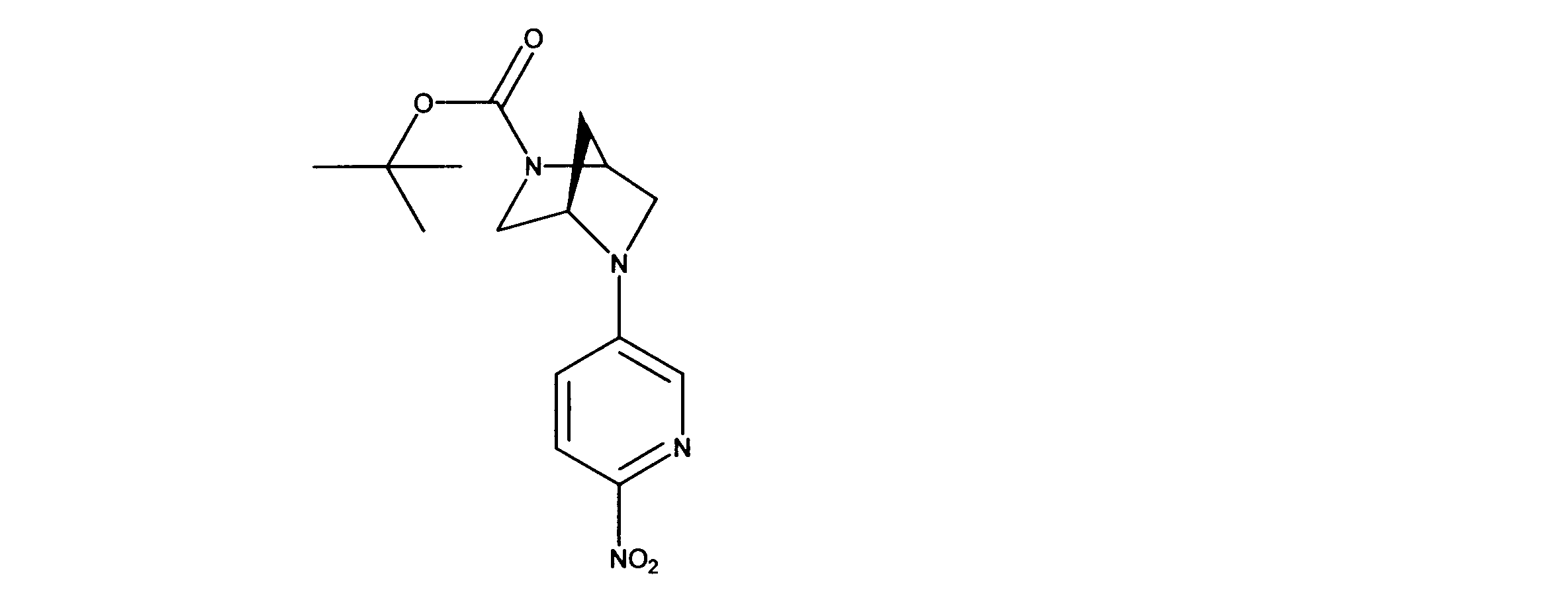
1HNMR (600 MHz, DMSO-d6) δ ppm 1.33 (d, J=32.21 Hz, 11 H) 1.91 (m, 2 H) 3.15 (d, J=10.25 Hz, 1 H) 3.58 (m, 1 H) 4.46 (m, 1 H) 4.83 (s, 1 H) 7.16 (s, 1 H) 7.94 (s, 1 H) 8.05 - 8.16 (m, 1 H).
Example 34
Synthesis of tert-butyl (4R)-5-(6-nitro-3-pyridyl)-2,5-diazabicyclo[2.2.1]heptane-2-carboxylate, compound 34
1 HNMR (600 MHz, DMSO-d 6 ) δ ppm 1.33 (d, J=32.21 Hz, 11 H) 1.91 (m, 2 H) 3.15 (d, J=10.25 Hz, 1 H) 3.58 (m, 1 H ) 4.46 (m, 1 H) 4.83 (s, 1 H) 7.16 (s, 1 H) 7.94 (s, 1 H) 8.05 - 8.16 (m, 1 H).
実施例35
tert-ブチル(4R)-5-(6アミノ3-ピリジル)-2、5-ジアザビシクロ[2.2.1]ヘプタン-2-カルボン酸塩の合成、化合物35
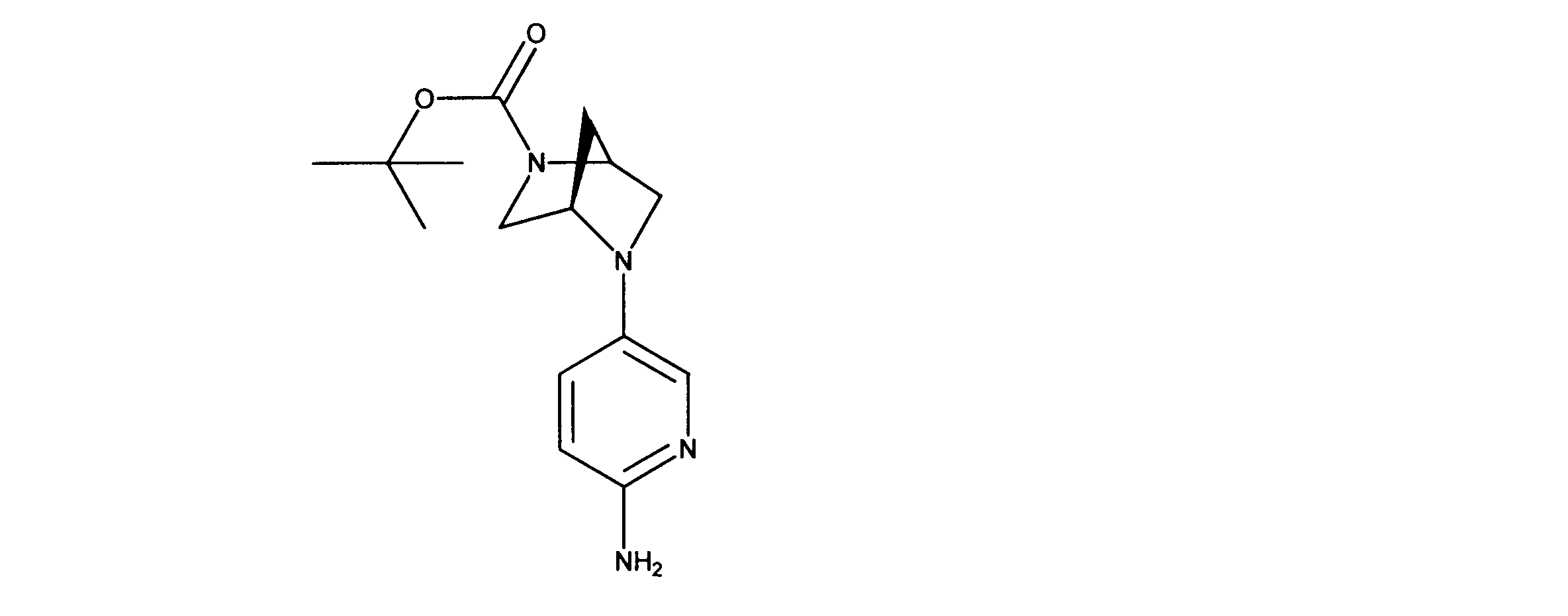
1HNMR (600 MHz, DMSO-d6) δ ppm 1.31 (d, J=31.91 Hz, 11 H) 1.83 (m, 2 H) 2.71 - 2.82 (m, 1 H) 3.44 (m,1 H) 4.30 (d, 2H) 5.08 (s, 2 H) 6.35 (d, J=8.78 Hz, 1 H) 6.77 - 6.91 (m, 1 H) 7.33 (s, 1 H). LCMS (ESI) 291 (M + H).
Example 35
Synthesis of tert-butyl (4R)-5-(6-amino-3-pyridyl)-2,5-diazabicyclo[2.2.1]heptane-2-carboxylate,
1 HNMR (600 MHz, DMSO-d 6 ) δ ppm 1.31 (d, J=31.91 Hz, 11 H) 1.83 (m, 2 H) 2.71 - 2.82 (m, 1 H) 3.44 (m, 1 H) 4.30 ( d, 2H) 5.08 (s, 2H) 6.35 (d, J=8.78 Hz, 1H) 6.77 - 6.91 (m, 1H) 7.33 (s, 1H). LCMS (ESI) 291 (M + H) .
実施例36
N,N-ジメチル-1-(6-ニトロ-3-ピリジル)ピペリジン-4-アミンの合成、化合物36

1HNMR (600 MHz, DMSO-d6) δ ppm 1.30 - 1.45 (m, 2 H) 1.79 (m, 2 H) 2.14 (s, 6 H) 2.33 (m, 1 H) 2.92 - 3.04 (m, 2 H) 4.03 (d, J=13.76 Hz, 2 H) 7.42 (dd, J=9.22, 3.07 Hz, 1 H) 8.04 - 8.11 (m, 1 H) 8.21 (d, J=2.93 Hz, 1 H).
Example 36
Synthesis of N,N-dimethyl-1-(6-nitro-3-pyridyl)piperidin-4-amine,
1 HNMR (600 MHz, DMSO-d 6 ) δ ppm 1.30 - 1.45 (m, 2 H) 1.79 (m, 2 H) 2.14 (s, 6 H) 2.33 (m, 1 H) 2.92 - 3.04 (m, 2 H) 4.03 (d, J=13.76 Hz, 2 H) 7.42 (dd, J=9.22, 3.07 Hz, 1 H) 8.04 - 8.11 (m, 1 H) 8.21 (d, J=2.93 Hz, 1 H).
実施例37
5-[4-(ジメチルアミノ)-1-ピペリジル]ピリジン-2-アミンの合成、化合物37

1HNMR (600 MHz, DMSO-d6) δ ppm 1.35 - 1.50 (m, 2 H) 1.69 - 1.81 (m, 2 H) 2.00 - 2.10 (m, 1 H) 2.11 - 2.22 (s, 6 H) 3.17 - 3.36 (m, 4 H) 5.19 - 5.38 (s, 2 H) 6.34 (d, J=8.78 Hz, 1 H) 7.10 (dd, J=8.78, 2.93 Hz, 1 H) 7.55 (d, J=2.63 Hz, 1 H). LCMS (ESI) 221 (M + H).
Example 37
Synthesis of 5-[4-(dimethylamino)-1-piperidyl]pyridin-2-amine, compound 37
1 HNMR (600 MHz, DMSO-d 6 ) δ ppm 1.35 - 1.50 (m, 2 H) 1.69 - 1.81 (m, 2 H) 2.00 - 2.10 (m, 1 H) 2.11 - 2.22 (s, 6 H) 3.17 - 3.36 (m, 4 H) 5.19 - 5.38 (s, 2 H) 6.34 (d, J=8.78 Hz, 1 H) 7.10 (dd, J=8.78, 2.93 Hz, 1 H) 7.55 (d, J=2.63 Hz, 1 H). LCMS (ESI) 221 (M + H).
実施例38
4-(6-ニトロ-3-ピリジル)モルホリンの合成、化合物38

Synthesis of 4-(6-nitro-3-pyridyl)morpholine, compound 38
実施例39
5-モルホリノピリジン-2-アミンの合成、化合物39

1HNMR (600 MHz, CHLOROFORM-d) δ ppm 2.91 - 3.00 (m, 4 H) 3.76 - 3.84 (m, 4 H) 4.19 (br. s., 2 H) 6.45 (d, J=8.78 Hz, 1 H) 7.12 (dd, J=8.78, 2.93 Hz, 1 H) 7.72 (d, J=2.93 Hz, 1 H).
Example 39
Synthesis of 5-morpholinopyridin-2-amine, compound 39
1 HNMR (600 MHz, CHLOROFORM-d) δ ppm 2.91 - 3.00 (m, 4 H) 3.76 - 3.84 (m, 4 H) 4.19 (br. s., 2 H) 6.45 (d, J=8.78 Hz, 1 H) 7.12 (dd, J=8.78, 2.93 Hz, 1 H) 7.72 (d, J=2.93 Hz, 1 H).
実施例40
5-(4-イソブチルピペラジン-1-イル)ピリジン-2-アミンの合成、化合物40
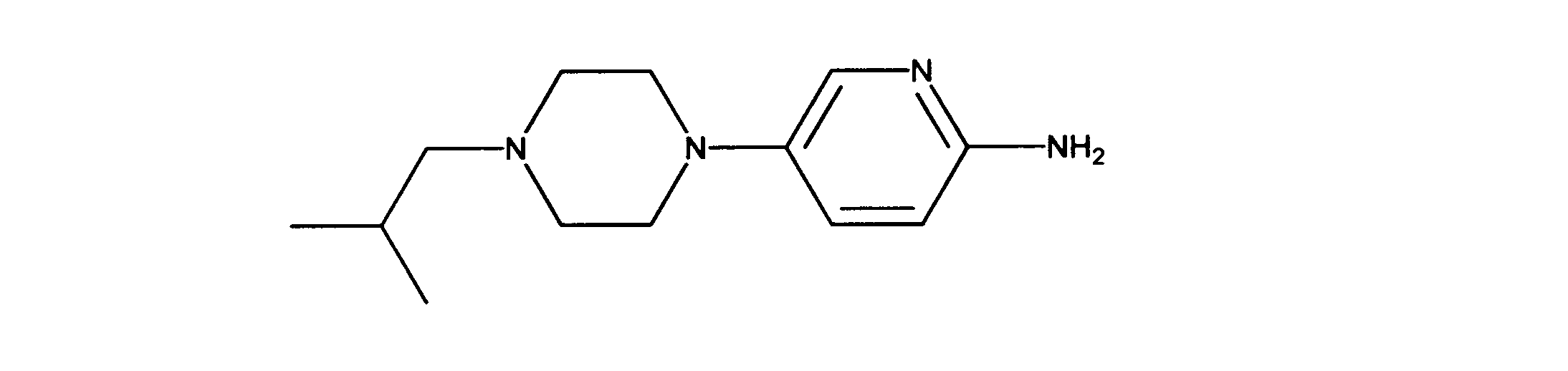
1HNMR (600 MHz, CHLOROFORM-d) δ ppm 0.88 (d, J=6.73 Hz, 6 H) 1.71 - 1.84 (m, 1 H) 2.10 (d, J=7.32 Hz, 2 H) 2.46 - 2.58 (m, 4 H) 2.97 - 3.07 (m, 4 H) 4.12 (s, 2 H) 6.45 (d, J=8.78 Hz, 1 H) 7.14 (dd, J=8.78, 2.93 Hz, 1 H) 7.75 (d, J=2.93 Hz, 1 H). LCMS (ESI) 235 (M + H).
Example 40
Synthesis of 5-(4-isobutylpiperazin-1-yl)pyridin-2-amine,
1 HNMR (600 MHz, CHLOROFORM-d) δ ppm 0.88 (d, J=6.73 Hz, 6 H) 1.71 - 1.84 (m, 1 H) 2.10 (d, J=7.32 Hz, 2 H) 2.46 - 2.58 (m , 4 H) 2.97 - 3.07 (m, 4 H) 4.12 (s, 2 H) 6.45 (d, J=8.78 Hz, 1 H) 7.14 (dd, J=8.78, 2.93 Hz, 1 H) 7.75 (d, J=2.93 Hz, 1 H). LCMS (ESI) 235 (M + H).
実施例41
5-(4-イソプロピルピペラジン-1-イル)ピリジン-2-アミンの合成、化合物41

1HNMR (600 MHz, CHLOROFORM-d) δ ppm 1.06 (d, J=6.44 Hz, 6 H) 2.59 - 2.75 (m, 5 H) 2.97 - 3.10 (m, 4 H) 4.13 (s, 2 H) 6.45 (d, J=8.78 Hz, 1 H) 7.15 (dd, J=9.08, 2.93 Hz, 1 H) 7.76 (d, J=2.93 Hz, 1 H). LCMS (ESI) 221 (M + H).
Example 41
Synthesis of 5-(4-isopropylpiperazin-1-yl)pyridin-2-amine, compound 41
1 HNMR (600 MHz, CHLOROFORM-d) δ ppm 1.06 (d, J=6.44 Hz, 6 H) 2.59 - 2.75 (m, 5 H) 2.97 - 3.10 (m, 4 H) 4.13 (s, 2 H) 6.45 (d, J=8.78 Hz, 1 H) 7.15 (dd, J=9.08, 2.93 Hz, 1 H) 7.76 (d, J=2.93 Hz, 1 H). LCMS (ESI) 221 (M + H).
実施例42
5-[(2R,6S)-2,6-ジメチルモルホリン-4-イル]ピリジン-2-アミンの合成、化合物42
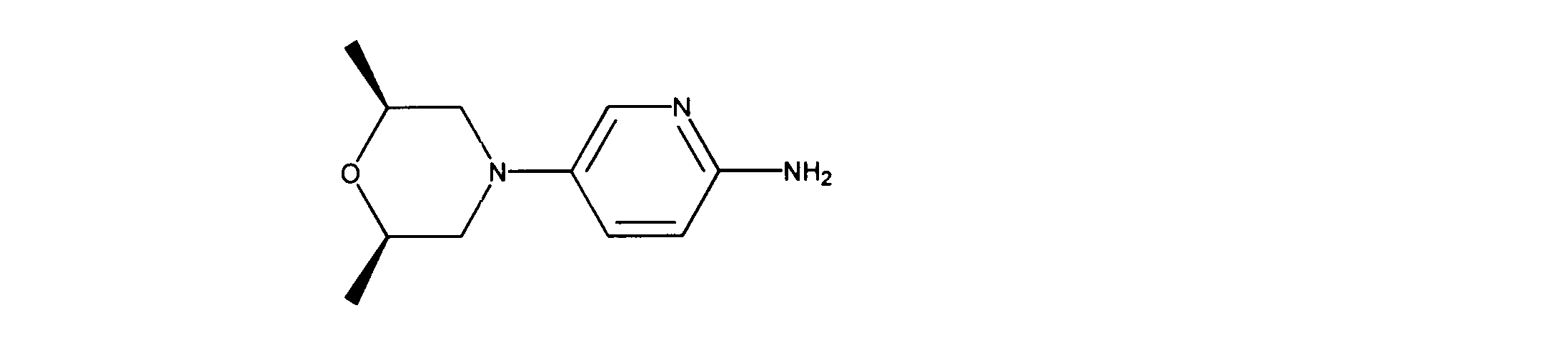
1HNMR (600 MHz, CHLOROFORM-d) δ ppm 1.20 (d, J=6.44 Hz, 6 H) 2.27 - 2.39 (m, 2 H) 3.11 - 3.21 (m, 2 H) 3.70 - 3.84 (m, 2 H) 4.15 (s, 2 H) 6.45 (d, J=8.78 Hz, 1 H) 7.12 (dd, J=8.78, 2.93 Hz, 1 H) 7.72 (d, J=2.63 Hz, 1 H). LCMS (ESI) 208 (M + H).
Example 42
Synthesis of 5-[(2R,6S)-2,6-dimethylmorpholin-4-yl]pyridin-2-amine,
1 HNMR (600 MHz, CHLOROFORM-d) δ ppm 1.20 (d, J=6.44 Hz, 6 H) 2.27 - 2.39 (m, 2 H) 3.11 - 3.21 (m, 2 H) 3.70 - 3.84 (m, 2 H ) 4.15 (s, 2 H) 6.45 (d, J=8.78 Hz, 1 H) 7.12 (dd, J=8.78, 2.93 Hz, 1 H) 7.72 (d, J=2.63 Hz, 1 H). LCMS (ESI ) 208 (M+H).
実施例43
5-[(3R,5S)-3,5-ジメチルピペラジン-1-イル]ピリジン-2-アミンの合成、化合物43
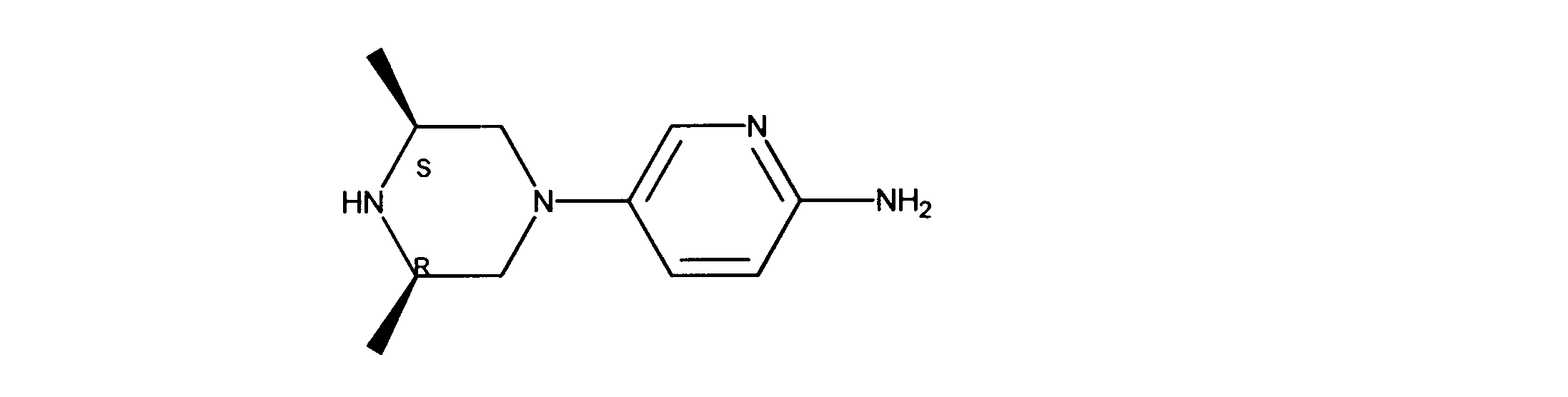
1HNMR (600 MHz, CHLOROFORM-d) δ ppm 1.09 (d, J=6.44 Hz, 6 H) 2.20 (t, J=10.83 Hz, 2 H) 2.95 - 3.08 (m, 2 H) 3.23 (dd, J=11.71, 2.05 Hz, 2 H) 4.13 (s, 2 H) 6.45 (d, J=8.78 Hz, 1 H) 7.14 (dd, J=8.78, 2.93 Hz, 1 H) 7.73 (d, J=2.63 Hz, 1 H). LCMS (ESI) 207 (M + H).
Example 43
Synthesis of 5-[(3R,5S)-3,5-dimethylpiperazin-1-yl]pyridin-2-amine, compound 43
1 HNMR (600 MHz, CHLOROFORM-d) δ ppm 1.09 (d, J=6.44 Hz, 6 H) 2.20 (t, J=10.83 Hz, 2 H) 2.95 - 3.08 (m, 2 H) 3.23 (dd, J =11.71, 2.05Hz, 2H) 4.13 (s, 2H) 6.45 (d, J=8.78Hz, 1H) 7.14 (dd, J=8.78, 2.93Hz, 1H) 7.73 (d, J=2.63Hz , 1 H). LCMS (ESI) 207 (M + H).
実施例44
化合物44の合成
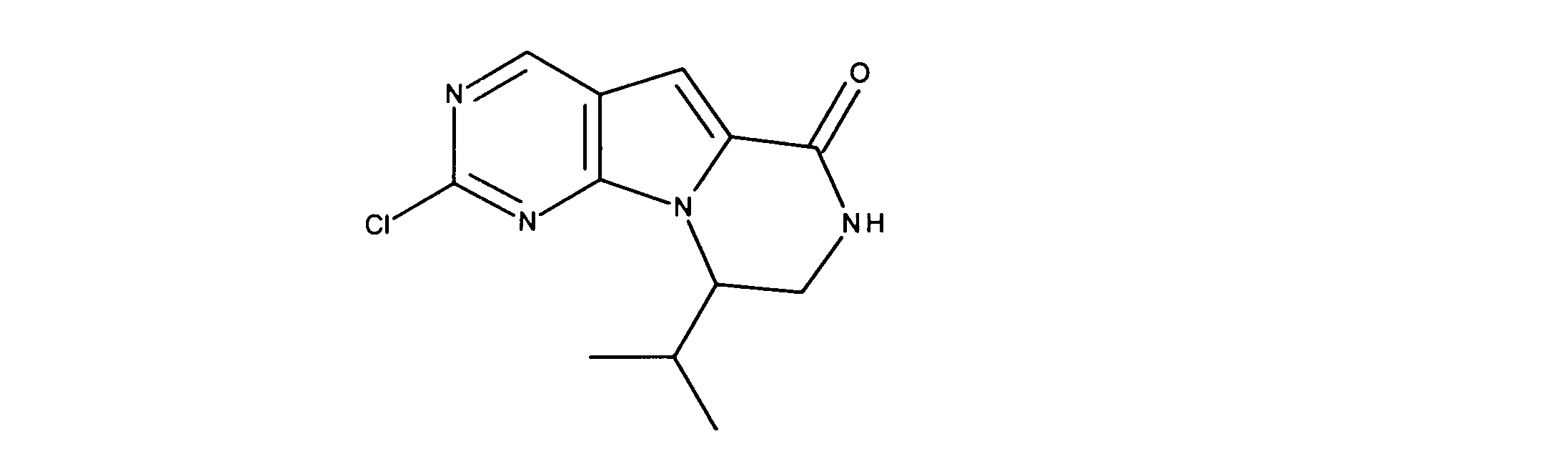
Synthesis of compound 44
tert-ブチルN-[2-[(5-ブロモ-2-クロロ-ピリミジン-4-イル)アミノ]-3-メチルブチル]カルバメート
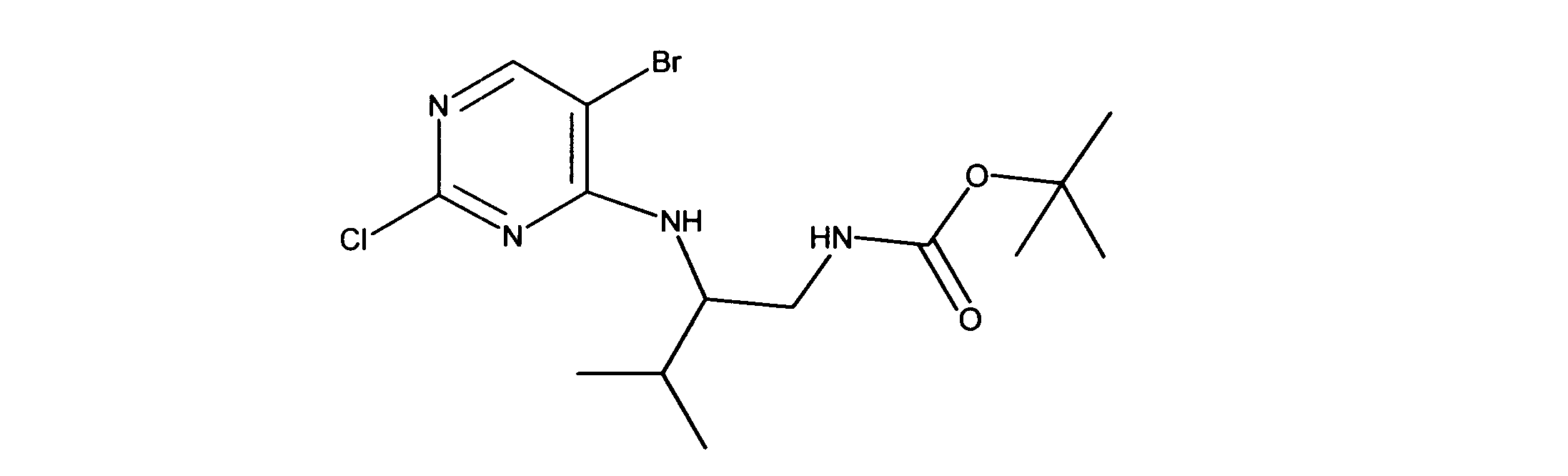
1HNMR (600 MHz, DMSO-d6) δ ppm 0.77 - 0.85 (d, J=6.5 Hz, 3 H) 0.87 (d, J=6.73 Hz, 3 H) 1.31 - 1.39 (m, 9 H) 1.82 - 1.93 (m, 1 H) 2.94 (d, J=5.56 Hz, 1 H) 3.08 - 3.22 (m, 2 H) 3.98 (d, J=8.20 Hz, 1 H) 6.96 (d, J=8.78 Hz, 1 H) 8.21 (s, 1 H). LCMS (ESI) 393 (M + H).
tert-butyl N-[2-[(5-bromo-2-chloro-pyrimidin-4-yl)amino]-3-methylbutyl]carbamate
1 HNMR (600 MHz, DMSO-d 6 ) δ ppm 0.77 - 0.85 (d, J=6.5 Hz, 3 H) 0.87 (d, J=6.73 Hz, 3 H) 1.31 - 1.39 (m, 9 H) 1.82 - 1.93 (m, 1H) 2.94 (d, J=5.56Hz, 1H) 3.08 - 3.22 (m, 2H) 3.98 (d, J=8.20Hz, 1H) 6.96 (d, J=8.78Hz, 1H) H) 8.21 (s, 1 H). LCMS (ESI) 393 (M + H).
tert-ブチルN-[2-[2-クロロ-6-(ジエトキシメチル)ピロロ[2,3-d]ピリミジン-7-イル]-3-メチルブチル]カルバメート
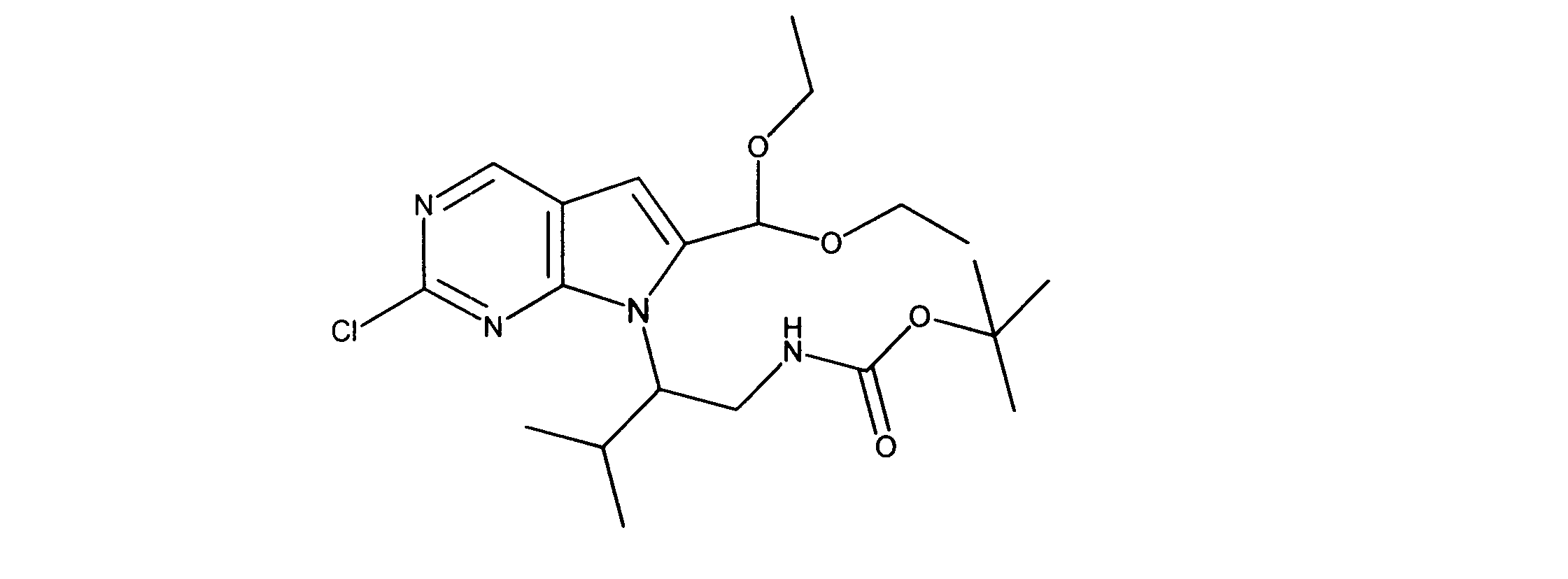
1HNMR (600 MHz, DMSO-d6) δ ppm 1.11 (d, J=6.44 Hz, 3 H) 1.18 (t, J=7.03 Hz, 6 H) 1.21 - 1.26 (m, 12 H) 2.88 (br. s., 1 H) 3.43 - 3.78 (m, 6 H) 3.97 - 4.08 (m, 1 H) 5.61 (s, 1 H) 6.65 (s, 1 H) 6.71 - 6.78 (m, 1 H) 8.87 (s, 1 H). LCMS (ESI) 441 (M + H).
tert-butyl N-[2-[2-chloro-6-(diethoxymethyl)pyrrolo[2,3-d]pyrimidin-7-yl]-3-methylbutyl]carbamate
1 HNMR (600 MHz, DMSO-d 6 ) δ ppm 1.11 (d, J=6.44 Hz, 3 H) 1.18 (t, J=7.03 Hz, 6 H) 1.21 - 1.26 (m, 12 H) 2.88 (br. s., 1H) 3.43 - 3.78 (m, 6H) 3.97 - 4.08 (m, 1H) 5.61 (s, 1H) 6.65 (s, 1H) 6.71 - 6.78 (m, 1H) 8.87 (s , 1 H). LCMS (ESI) 441 (M + H).
7-[1-[(第三級ブトキシカルボニルアミノ)メチル]-2メチル-プロピル]-2-クロロ-ピロロ[2,3-d]ピリミジン-6-カルボン酸
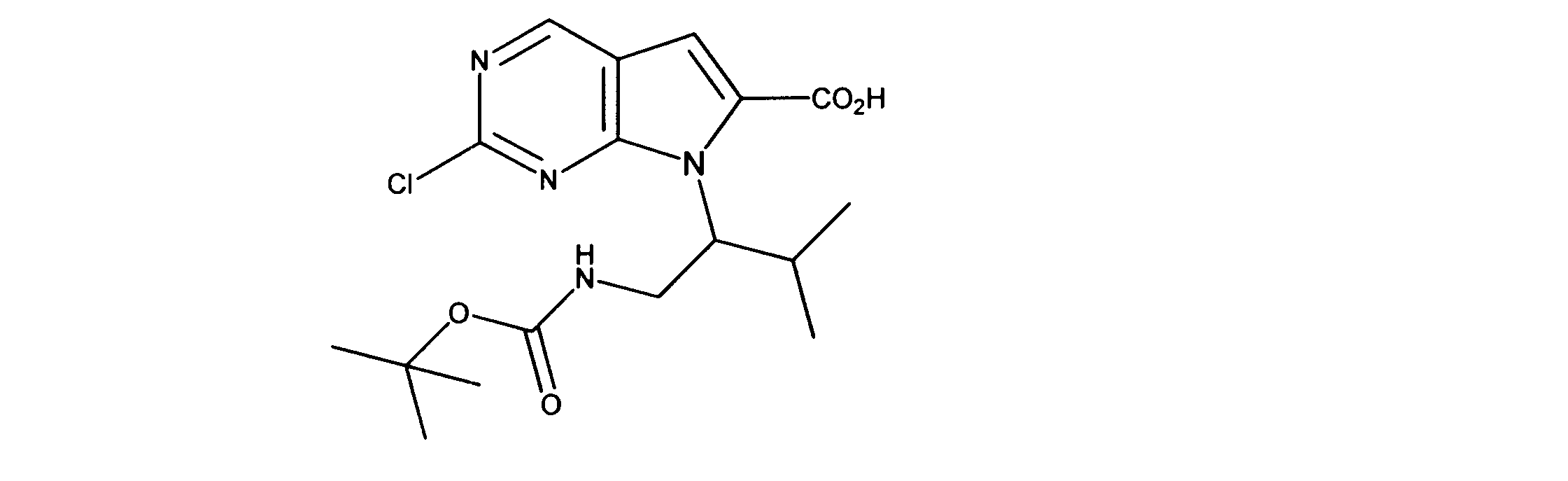
有機層を分離し、乾燥し、その後真空下で濃縮した。このように得られた粗反応生成物を、DMF中に溶解し、その後オキソンを添加し、内容物を3時間撹拌した。酢酸エチルの添加の後、CELITETMを通して反応物混合物をろ過し、真空下で濃縮した。粗製品を、ヘキサン/酢酸エチル(0~100%)を用いたシリカゲル上のカラムクロマトグラフィーにかけて、7-[1-[(第三級ブトキシカルボニルアミノ)メチル]-2メチル-プロピル]-2-クロロ-ピロロ[2,3-d]ピリミジン-6-カルボン酸を提供した。
1HNMR (600 MHz, DMSO-d6) δ ppm 0.85 (d, J=7.03 Hz, 3 H) 0.97 (d, J=6.73 Hz, 3 H) 1.52 (s, 9 H) 1.99 - 2.23 (m, 1 H) 3.98 (dd, J=14.05, 3.51 Hz, 1 H) 4.47 - 4.71 (m, 2 H) 7.47 (s, 1 H) 9.17 (s, 1 H). LCMS (ESI) 383 (M + H).
7-[1-[(tert-butoxycarbonylamino)methyl]-2methyl-propyl]-2-chloro-pyrrolo[2,3-d]pyrimidine-6-carboxylic acid
The organic layer was separated, dried and then concentrated under vacuum. The crude reaction product thus obtained was dissolved in DMF, then oxone was added and the contents were stirred for 3 hours. After addition of ethyl acetate, the reaction mixture was filtered through CELITE™ and concentrated under vacuum. The crude product was subjected to column chromatography on silica gel with hexanes/ethyl acetate (0-100%) to give 7-[1-[(tert-butoxycarbonylamino)methyl]-2methyl-propyl]-2- Chloro-pyrrolo[2,3-d]pyrimidine-6-carboxylic acid was provided.
1 HNMR (600 MHz, DMSO-d 6 ) δ ppm 0.85 (d, J=7.03 Hz, 3 H) 0.97 (d, J=6.73 Hz, 3 H) 1.52 (s, 9 H) 1.99 - 2.23 (m, 1 H) 3.98 (dd, J=14.05, 3.51 Hz, 1 H) 4.47 - 4.71 (m, 2 H) 7.47 (s, 1 H) 9.17 (s, 1 H). LCMS (ESI) 383 (M + H ).
化合物44
DCM(1.5mL)中の7-[1-[(第三級ブトキシカルボニルアミノ)メチル]-2メチル-プロピル]-2-クロロ-ピロロ[2,3-d]ピリミジン-6カルボン酸(0.050g、0.00013モル)に、DIC(32.7mg)及びDMAP(10mg)を添加した。内容物を、2時間撹拌した。その後、トリフルオロ酢酸(0.4mL)を添加し、さらに撹拌を30分間続けた。過剰な酸を中和する飽和NaHCO3の添加の後、酢酸エチルを添加し、有機層を分離して、硫酸マグネシウムを用いて乾燥し、その後真空下で濃縮した。ヘキサン/酢酸エチル(0- 100 %)を用いたシリカゲルカラムクロマトグラフィーにより、粗製品を精製し、製品を提供した。
1HNMR (600 MHz, DMSO-d6) δ ppm 0.72 (d, J=6.73 Hz, 3 H) 0.97 (d, J=6.73 Hz, 3 H) 2.09 - 2.22 (m, 1 H) 3.57 (dd, J=13.18, 4.98 Hz, 1 H) 3.72 (dd, J=13.61, 4.25 Hz, 1 H) 4.53 (dd, J=8.05, 3.95 Hz, 1 H) 7.20 (s, 1 H) 8.34 (d, J=4.98 Hz, 1 H) 9.08 (s, 1 H). LCMS (ESI) 265 (M + H).
Compound 44
7-[1-[(tert-butoxycarbonylamino)methyl]-2methyl-propyl]-2-chloro-pyrrolo[2,3-d]pyrimidine-6carboxylic acid (0 DIC (32.7 mg) and DMAP (10 mg) were added. The contents were stirred for 2 hours. Trifluoroacetic acid (0.4 mL) was then added and stirring continued for an additional 30 minutes. After addition of saturated NaHCO 3 to neutralize excess acid, ethyl acetate was added and the organic layer was separated, dried over magnesium sulfate and then concentrated under vacuum. The crude product was purified by silica gel column chromatography using hexane/ethyl acetate (0-100%) to give the product.
1 HNMR (600 MHz, DMSO-d 6 ) δ ppm 0.72 (d, J=6.73 Hz, 3 H) 0.97 (d, J=6.73 Hz, 3 H) 2.09 - 2.22 (m, 1 H) 3.57 (dd, J=13.18, 4.98 Hz, 1 H) 3.72 (dd, J=13.61, 4.25 Hz, 1 H) 4.53 (dd, J=8.05, 3.95 Hz, 1 H) 7.20 (s, 1 H) 8.34 (d, J =4.98 Hz, 1 H) 9.08 (s, 1 H). LCMS (ESI) 265 (M + H).
実施例45
化合物45の合成
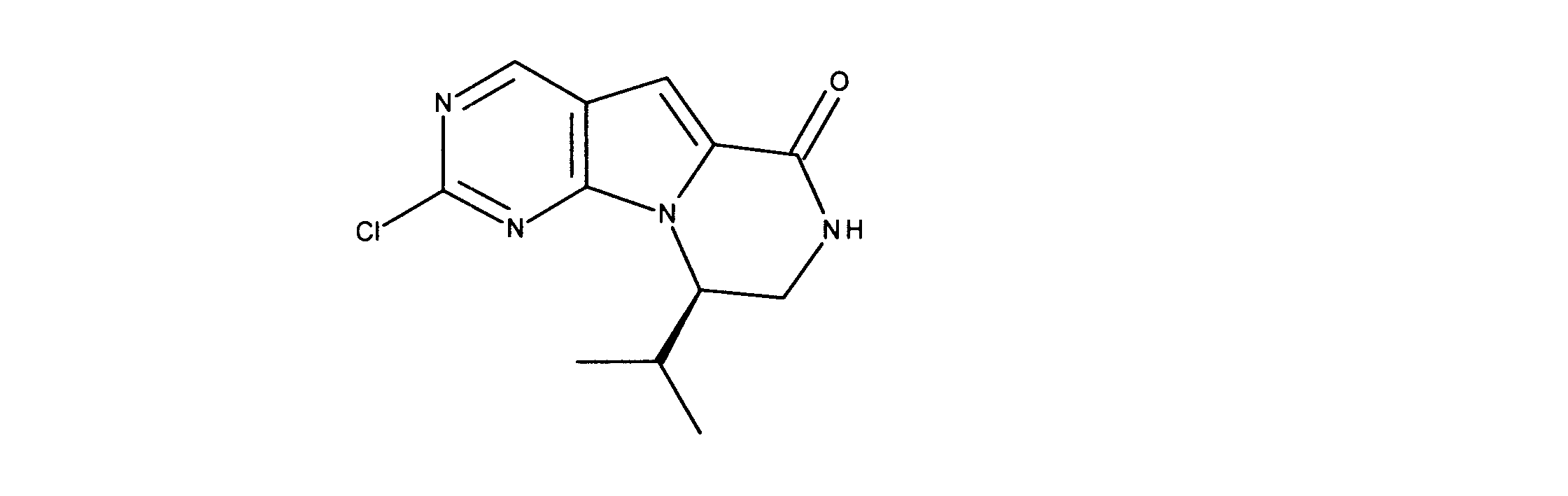
Synthesis of compound 45
実施例46
化合物46の合成
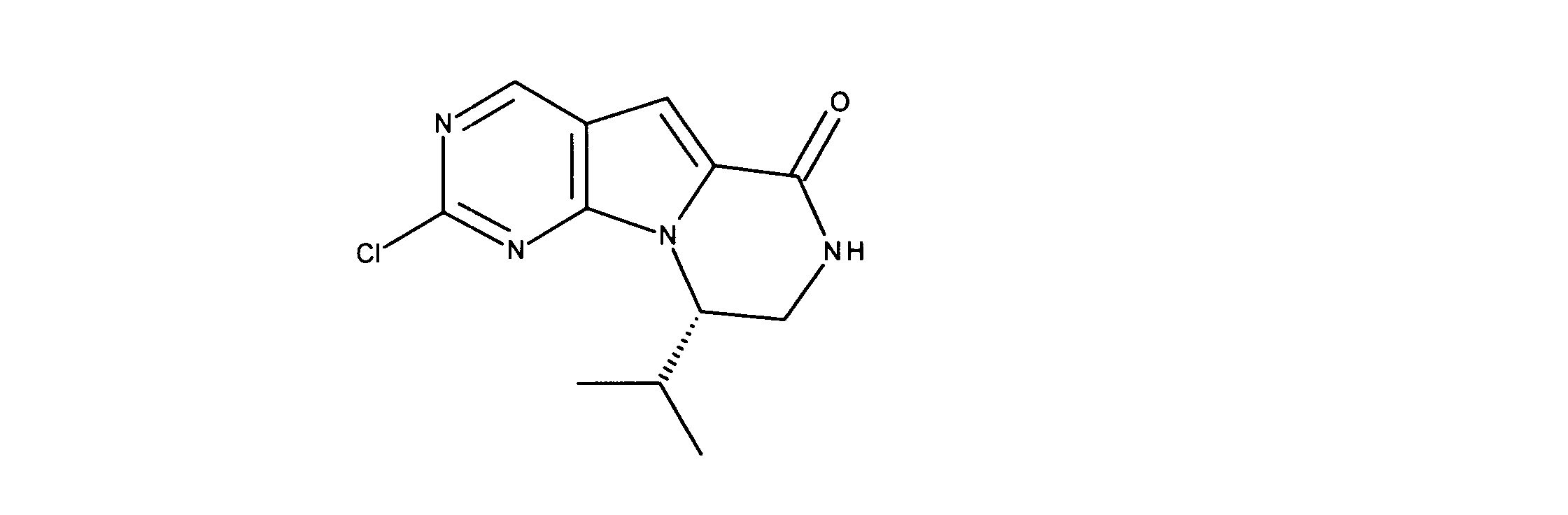
Synthesis of compound 46
実施例47
化合物47の合成
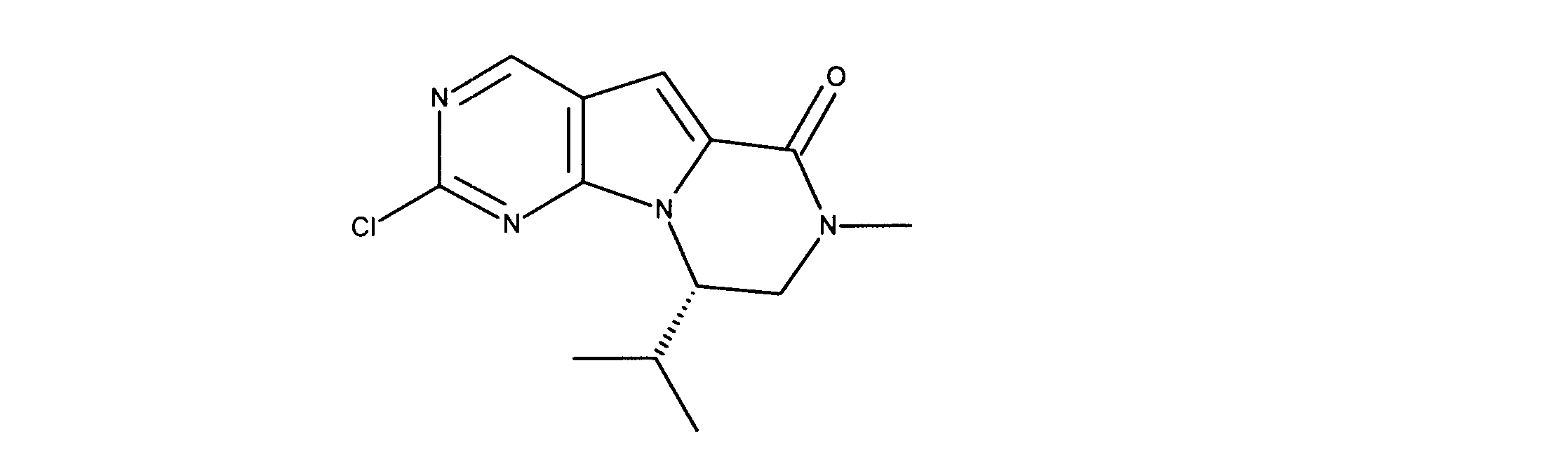
1HNMR (600 MHz, DMSO-d6) δ ppm 0.74 (d, J=6.73 Hz, 3 H) 0.91 (d, J=6.73 Hz, 3 H) 2.04 - 2.20 (m, 1 H) 3.04 (s, 3 H) 3.69 (dd, J=13.76, 1.17 Hz, 1 H) 3.96 (dd, J=13.76, 4.68 Hz, 1 H) 4.58 (dd, J=7.32, 3.51 Hz, 1 H) 7.16 (s, 1 H) 9.05 (s, 1 H). LCMS (ESI) 279 (M + H).
Example 47
Synthesis of compound 47
1 HNMR (600 MHz, DMSO-d 6 ) δ ppm 0.74 (d, J=6.73 Hz, 3 H) 0.91 (d, J=6.73 Hz, 3 H) 2.04 - 2.20 (m, 1 H) 3.04 (s, 3 H) 3.69 (dd, J=13.76, 1.17 Hz, 1 H) 3.96 (dd, J=13.76, 4.68 Hz, 1 H) 4.58 (dd, J=7.32, 3.51 Hz, 1 H) 7.16 (s, 1 H) 9.05 (s, 1 H). LCMS (ESI) 279 (M + H).
実施例48
化合物48の合成
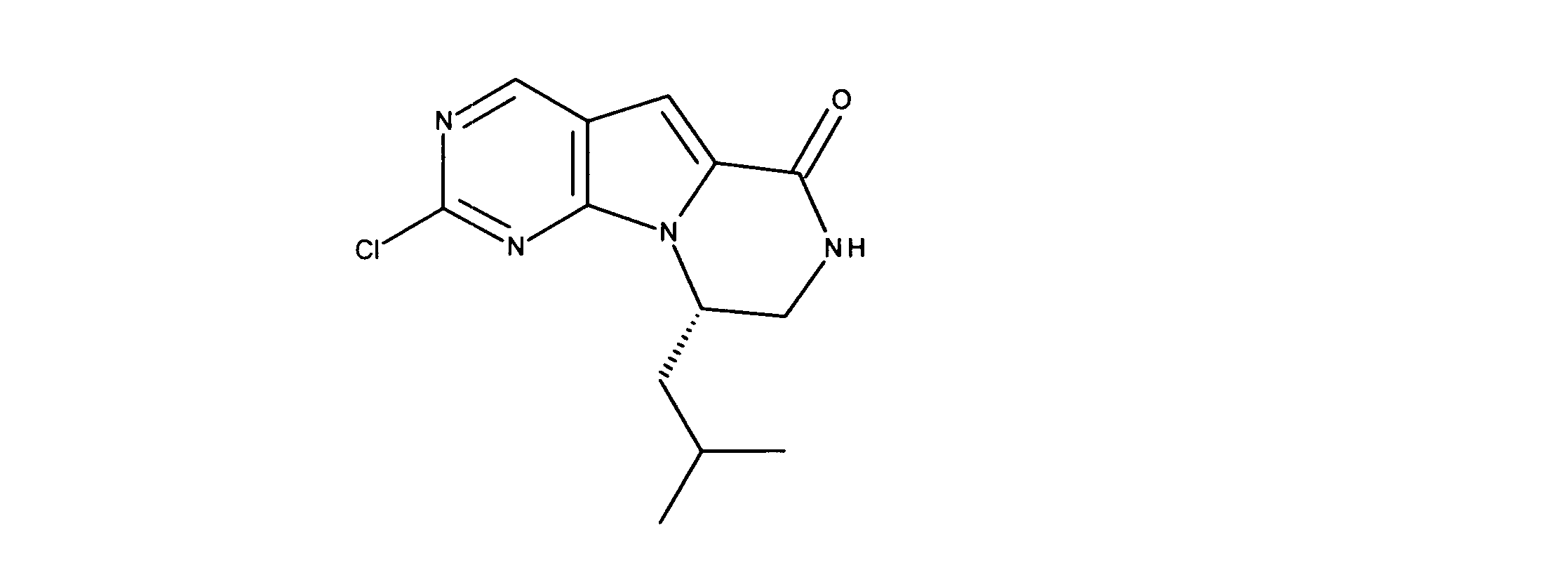
Synthesis of
tert-ブチルN-[(2S)-2-[(5-ブロモ-2-クロロ-ピリミジン-4-イル)アミノ]-4-メチル-ペンチル]カルバメート
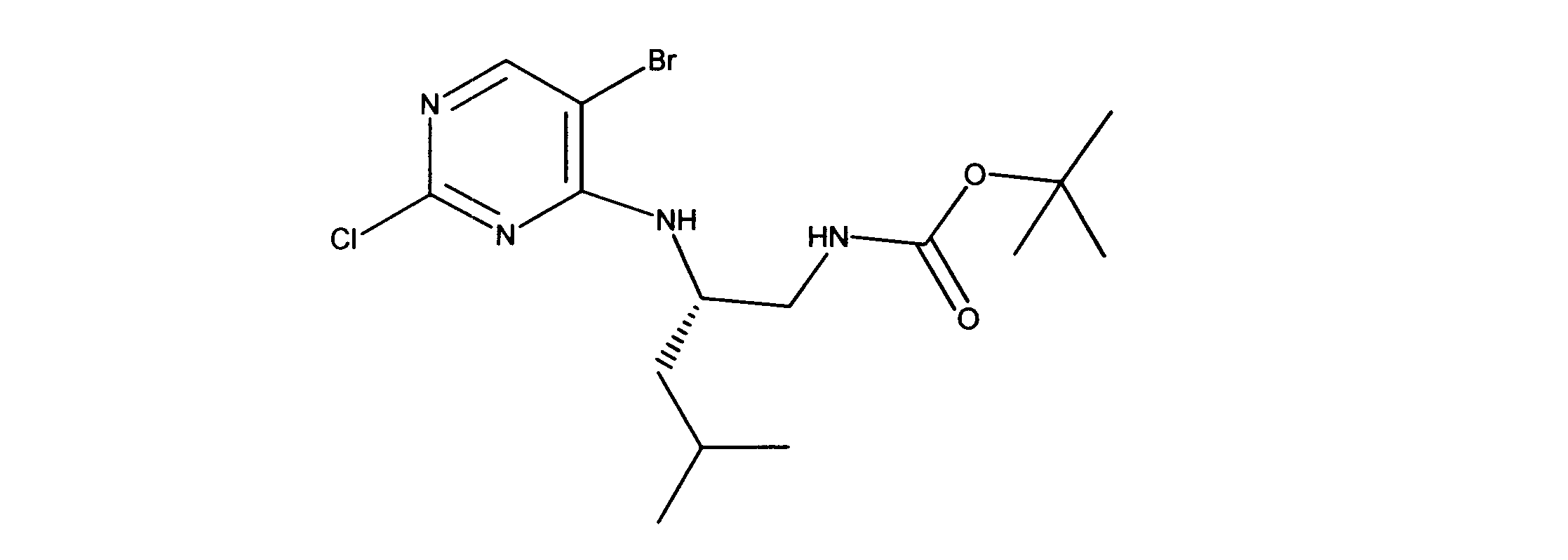
1HNMR (600 MHz, CHLOROFORM-d) δ ppm 0.91 (d, J=6.44 Hz, 3 H) 0.94 (d, J=6.44 Hz, 3 H) 1.32 - 1.51 (m, 11 H) 1.55 - 1.67 (m, 1 H) 3.28 (t, J=5.86 Hz, 2 H) 4.21 - 4.42 (m, 1 H) 4.84 (s, 1 H) 5.84 (d, J=7.32 Hz, 1 H) 8.07 (s, 1 H). LCMS (ESI) 407 (M + H).
tert-butyl N-[(2S)-2-[(5-bromo-2-chloro-pyrimidin-4-yl)amino]-4-methyl-pentyl]carbamate
1 HNMR (600 MHz, CHLOROFORM-d) δ ppm 0.91 (d, J=6.44 Hz, 3 H) 0.94 (d, J=6.44 Hz, 3 H) 1.32 - 1.51 (m, 11 H) 1.55 - 1.67 (m , 1 H) 3.28 (t, J=5.86 Hz, 2 H) 4.21 - 4.42 (m, 1 H) 4.84 (s, 1 H) 5.84 (d, J=7.32 Hz, 1 H) 8.07 (s, 1 H ). LCMS (ESI) 407 (M+H).
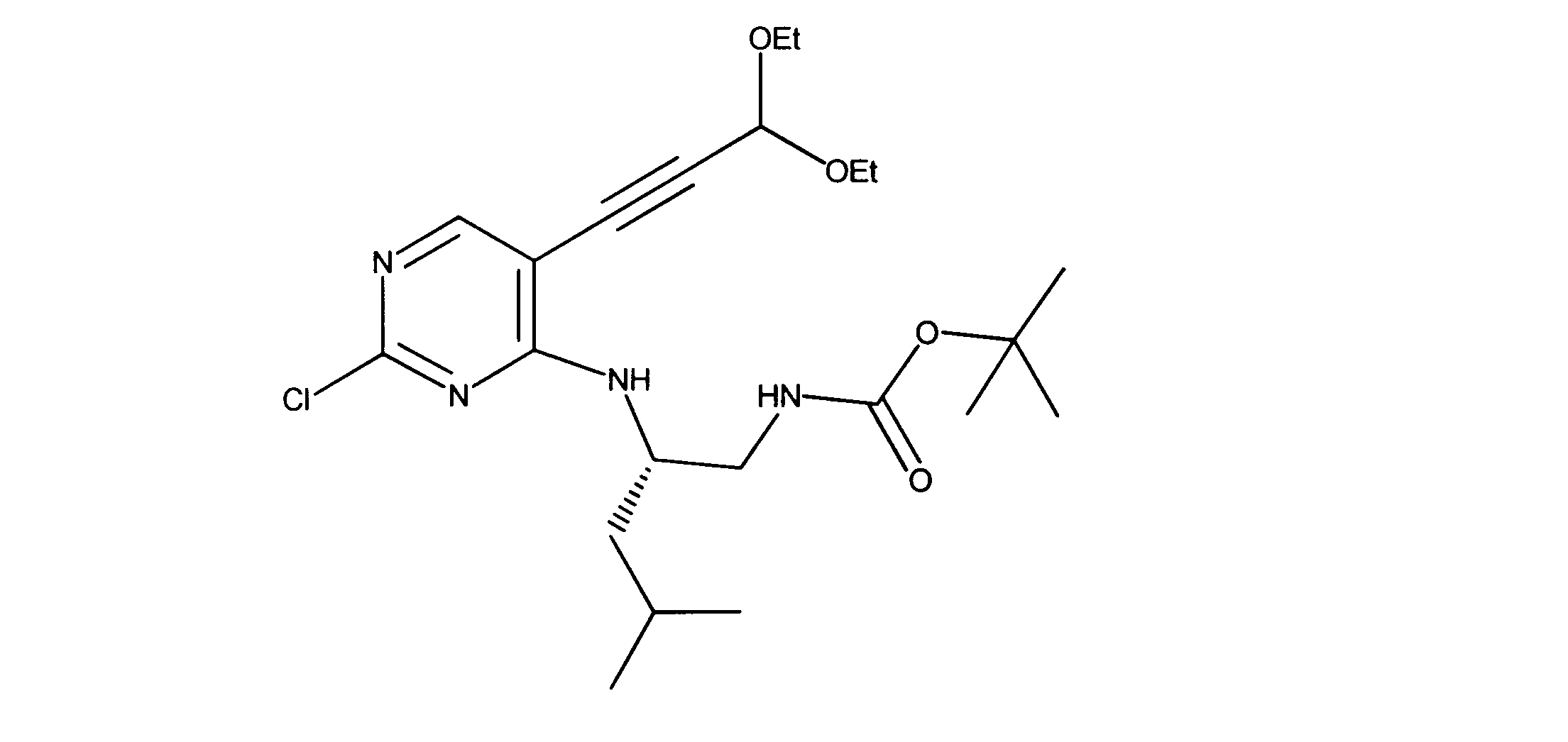
LCMS (ESI) 455 (M + H).
LCMS (ESI) 455 (M+H).
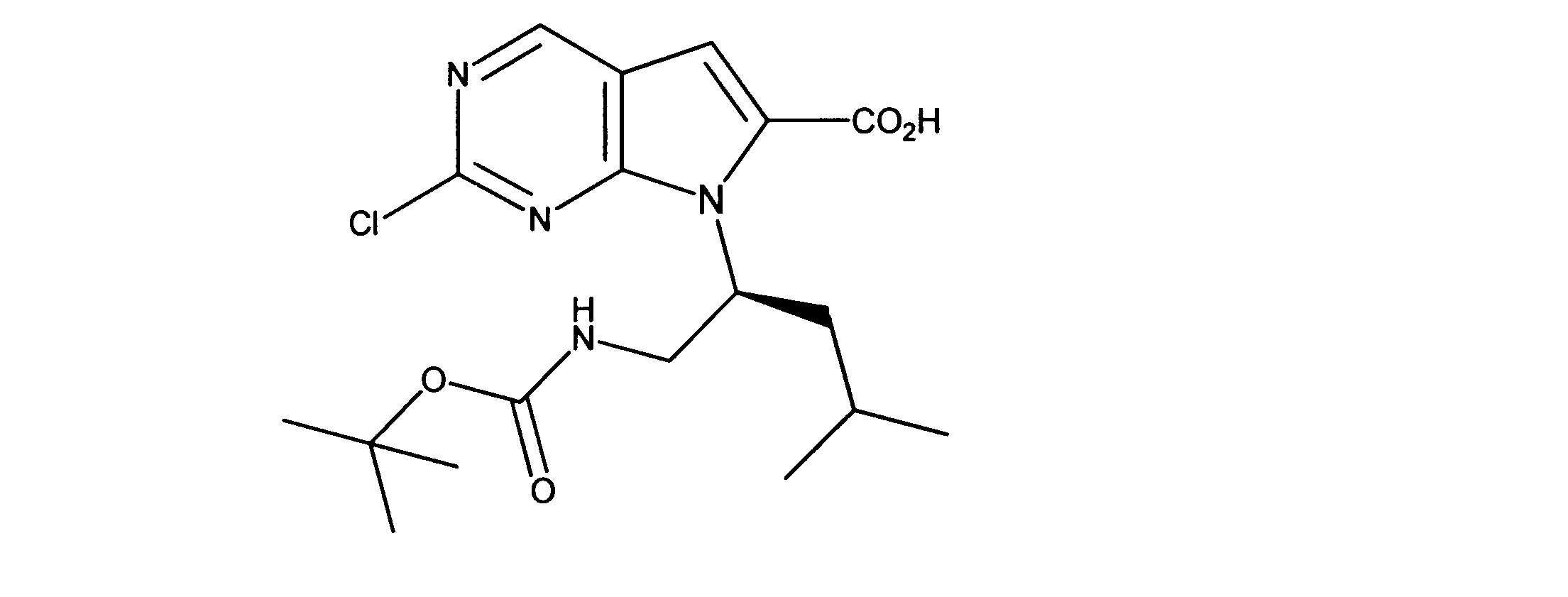
1HNMR (600 MHz, DMSO-d6) δ ppm 0.88 (d, J=6.44 Hz, 3 H) 0.97 (d, J=6.44 Hz, 3 H) 1.47 (s, 9 H) 1.49 - 1.54 (m, 1 H) 1.56 (t, J=7.17 Hz, 2 H) 3.98 (dd, J=13.91, 3.07 Hz, 1 H) 3.76 (dd, J=13.31, 4.13 Hz, 1 H) 4.38 (d, J=14.05 Hz, 1 H) 4.90 (t, J=7.17 Hz, 1 H) 7.41 (s, 1 H) 9.11 (s, 1 H). LCMS (M + H) 397.
1 HNMR (600 MHz, DMSO-d 6 ) δ ppm 0.88 (d, J=6.44 Hz, 3 H) 0.97 (d, J=6.44 Hz, 3 H) 1.47 (s, 9 H) 1.49 - 1.54 (m, 1H) 1.56 (t, J=7.17Hz, 2H) 3.98 (dd, J=13.91, 3.07Hz, 1H) 3.76 (dd, J=13.31, 4.13Hz, 1H) 4.38 (d, J=14.05 Hz, 1 H) 4.90 (t, J=7.17 Hz, 1 H) 7.41 (s, 1 H) 9.11 (s, 1 H). LCMS (M + H) 397.
化合物44に対して記載されたと類似の合成シーケンスを用いて、化合物48が合成された。
1HNMR (600 MHz, DMSO-d6) δ ppm 0.82 (d, J=6.73 Hz, 3 H) 0.97 (d, J=6.44 Hz, 3 H) 1.34 - 1.46 (m, 1 H) 1.48 - 1.65 (m, 2 H) 3.40 (dd, J=13.32, 5.42 Hz, 1 H) 3.76 (dd, J=13.47, 4.10 Hz, 1 H) 4.76 - 4.92 (m, 1 H) 7.17 (s, 1 H) 8.34 (d, J=5.27 Hz, 1 H) 9.04 (s, 1 H). LCMS (ESI) 279 (M + H) .
Using a synthetic sequence analogous to that described for compound 44,
1 HNMR (600 MHz, DMSO-d 6 ) δ ppm 0.82 (d, J=6.73 Hz, 3 H) 0.97 (d, J=6.44 Hz, 3 H) 1.34 - 1.46 (m, 1 H) 1.48 - 1.65 ( m, 2H) 3.40 (dd, J=13.32, 5.42Hz, 1H) 3.76 (dd, J=13.47, 4.10Hz, 1H) 4.76 - 4.92 (m, 1H) 7.17 (s, 1H) 8.34 (d, J=5.27 Hz, 1 H) 9.04 (s, 1 H). LCMS (ESI) 279 (M + H) .
実施例49
化合物49の合成
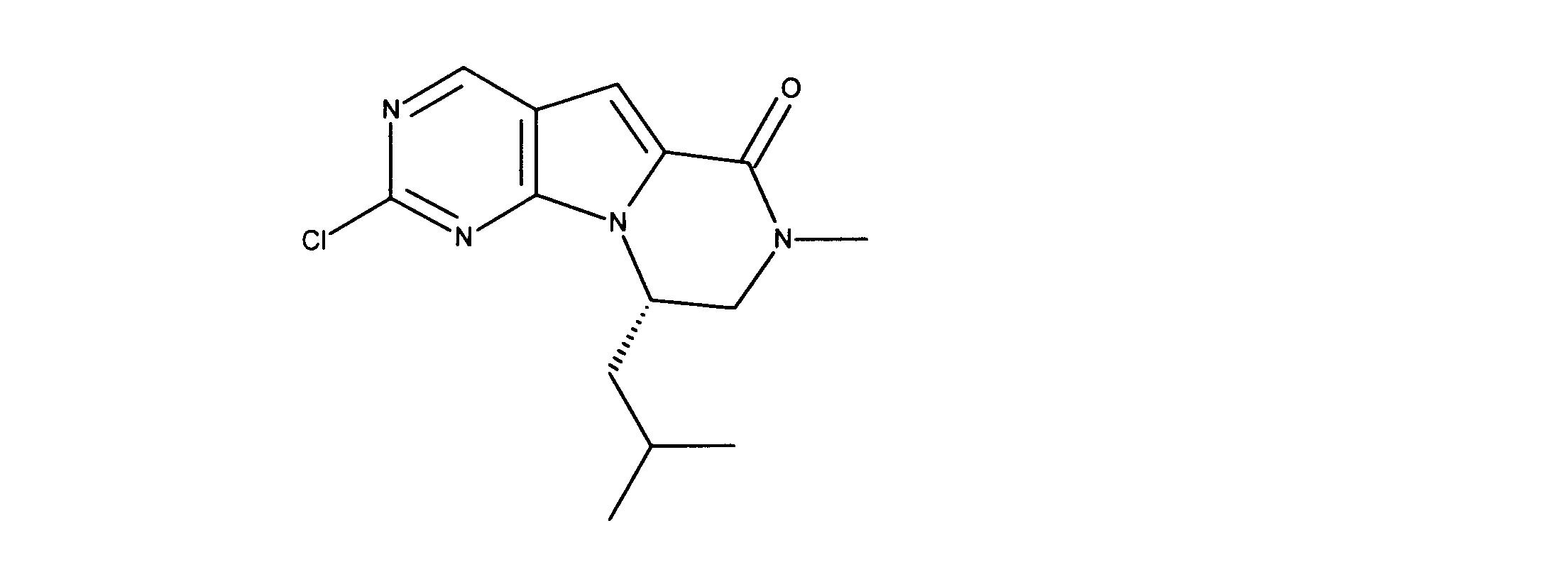
1HNMR (600 MHz, DMSO-d6) δ ppm 0.82 (d, J=6.44 Hz, 3 H) 0.97 (d, J=6.44 Hz, 3 H) 1.37 - 1.68 (m, 3 H) 3.04 (s, 3 H) 3.56 (d, J=13.47 Hz, 1 H) 4.00 (dd, J=13.32, 4.25 Hz, 1 H) 4.82 - 4.94 (m, 1 H) 7.16 (s, 1 H) 9.03 (s, 1 H). LCMS (ESI) 293 (M + H).
Example 49
Synthesis of
1 HNMR (600 MHz, DMSO-d 6 ) δ ppm 0.82 (d, J=6.44 Hz, 3 H) 0.97 (d, J=6.44 Hz, 3 H) 1.37 - 1.68 (m, 3 H) 3.04 (s, 3 H) 3.56 (d, J=13.47 Hz, 1 H) 4.00 (dd, J=13.32, 4.25 Hz, 1 H) 4.82 - 4.94 (m, 1 H) 7.16 (s, 1 H) 9.03 (s, 1 H). LCMS (ESI) 293 (M+H).
実施例50
化合物50の合成
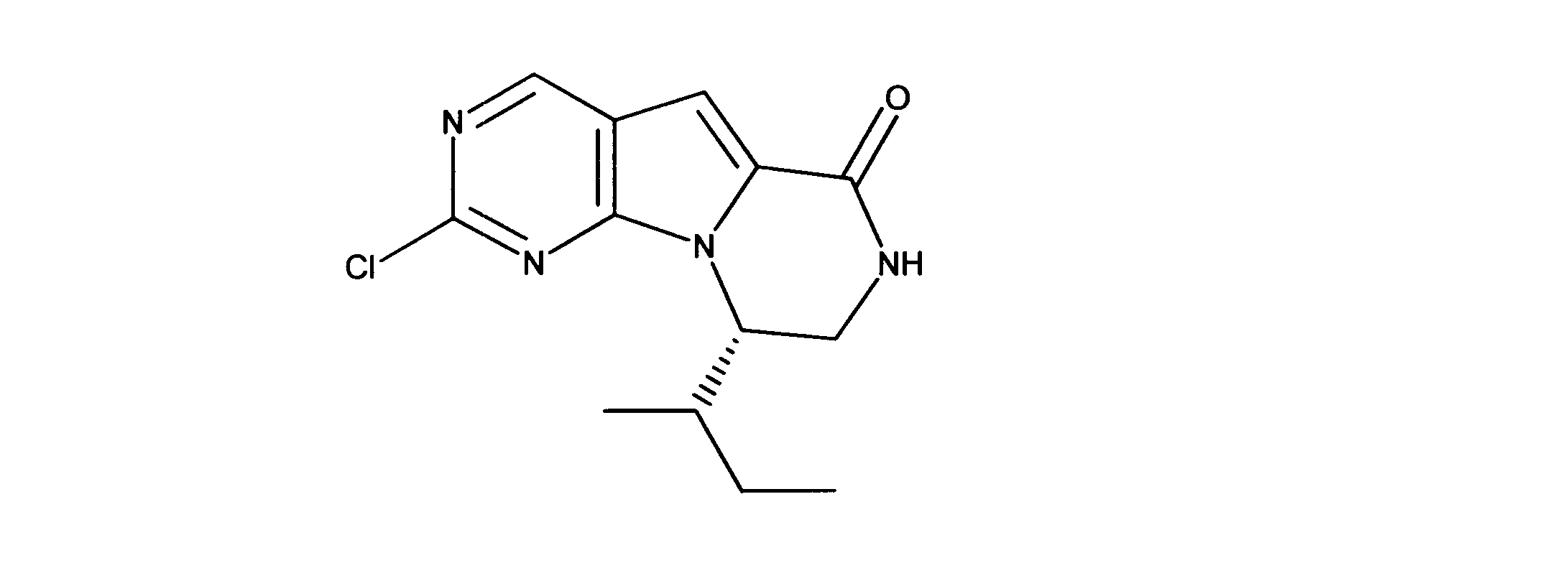
Synthesis of
tert-ブチルN-[(2S)-2-[(5-ブロモ-2-クロロ-ピリミジン-4-イル)アミノ]-3-メチル-ペンチル]カルバメート
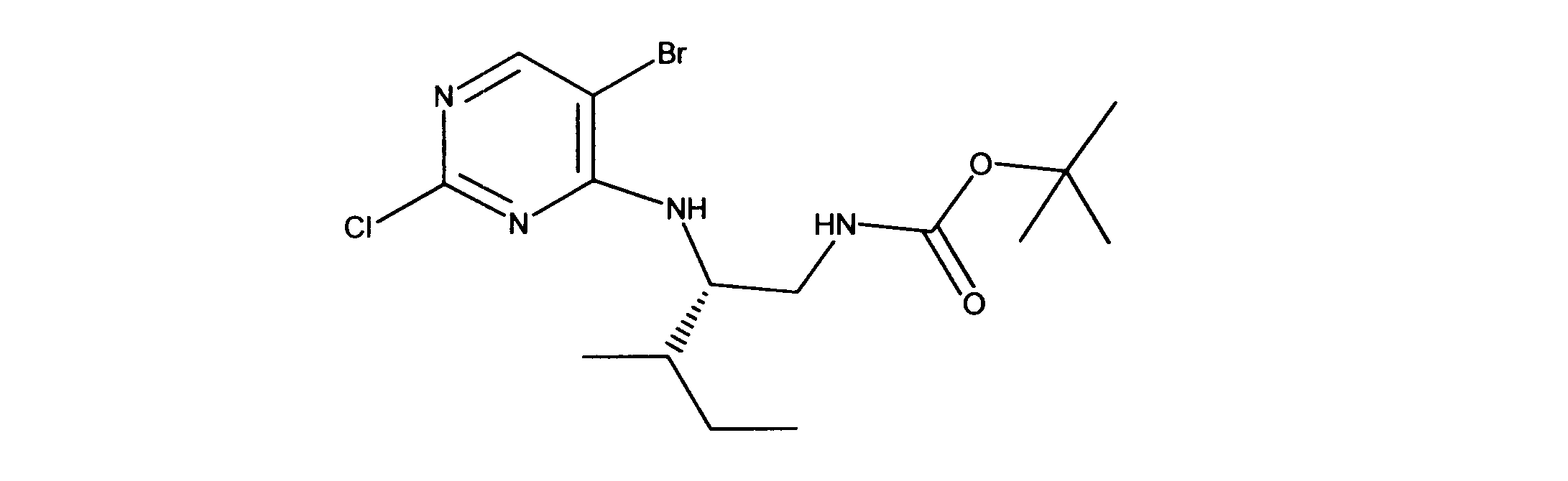
1HNMR (600 MHz, CHLOROFORM-d) δ ppm 0.88 - 0.95 (m, 6 H) 1.11 - 1.20 (m, 1 H) 1.34 (s, 9 H) 1.44 - 1.54 (m, 1 H) 1.64 - 1.72 (m, 1 H) 3.17 - 3.27 (m, 1 H) 3.33 - 3.43 (m, 1 H) 4.11 - 4.21 (m, 1 H) 4.81 (s, 1 H) 5.92 (d, J=8.20 Hz, 1 H) 8.05 (s, 1 H). LCMS (ESI) 407.
tert-butyl N-[(2S)-2-[(5-bromo-2-chloro-pyrimidin-4-yl)amino]-3-methyl-pentyl]carbamate
1 HNMR (600 MHz, CHLOROFORM-d) δ ppm 0.88 - 0.95 (m, 6 H) 1.11 - 1.20 (m, 1 H) 1.34 (s, 9 H) 1.44 - 1.54 (m, 1 H) 1.64 - 1.72 ( m, 1 H) 3.17 - 3.27 (m, 1 H) 3.33 - 3.43 (m, 1 H) 4.11 - 4.21 (m, 1 H) 4.81 (s, 1 H) 5.92 (d, J=8.20 Hz, 1 H ) 8.05 (s, 1H). LCMS (ESI) 407.
tert-ブチルN-[(2S)-2-[[2-クロロ-5-(3、3-ジエトキシプロプ-1-イニル)ピリミジン-4-イル]アミノ]-3-メチル-ペンチル]カルバメート
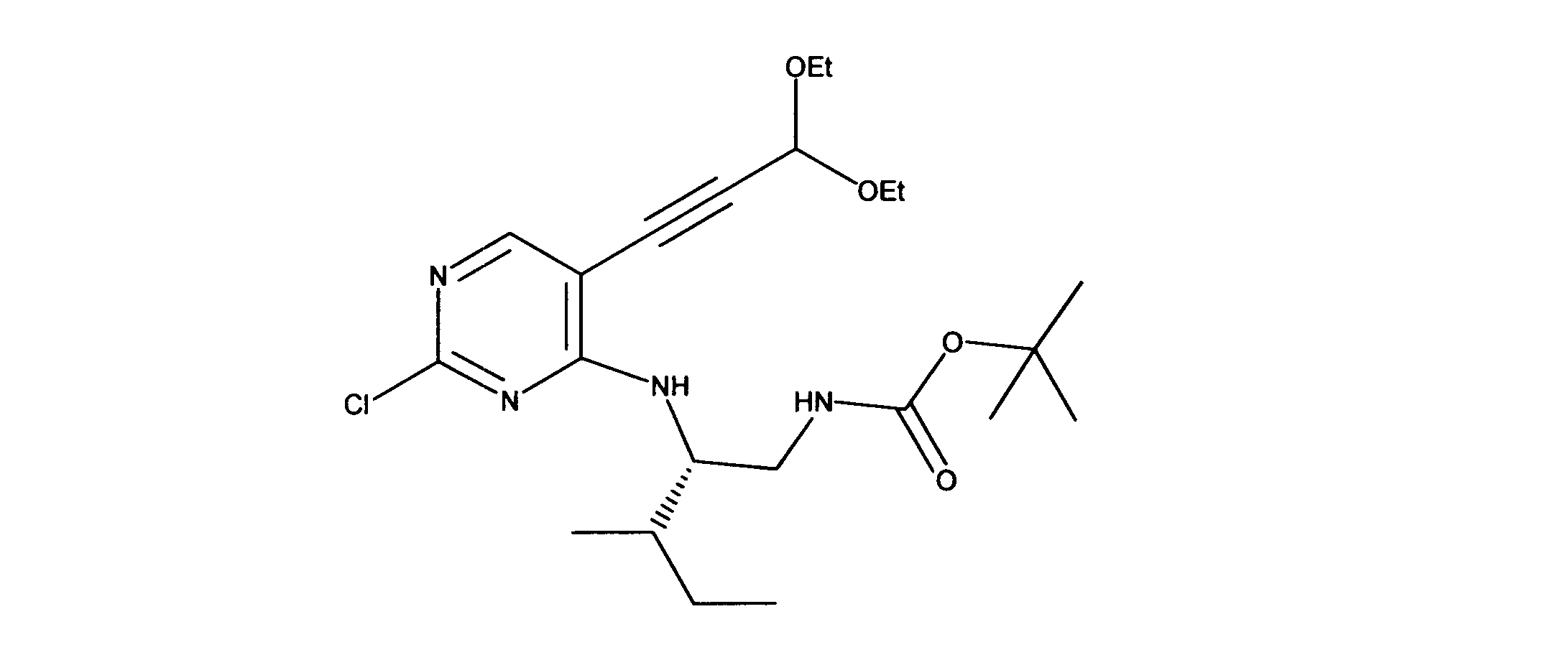
1HNMR (600 MHz, DMSO-d6) δ ppm 0.76 - 0.89 (m, 6 H) 1.03 (q, J=7.22 Hz, 3 H) 1.10 - 1.17 (m, 3 H) 1.25 - 1.42 (m, 11 H) 1.59 - 1.73 (m, 1 H) 3.35 - 3.47 (m, 4 H) 3.51 - 3.73 (m, 2 H) 3.99 - 4.11 (m, 1 H) 5.52 - 5.56 (m, 1 H) 6.76 - 7.03 (m, 2 H) 8.12 - 8.23 (m, 1 H). LCMS (ESI) 455 (M + H).
tert-butyl N-[(2S)-2-[[2-chloro-5-(3,3-diethoxyprop-1-ynyl)pyrimidin-4-yl]amino]-3-methyl-pentyl]carbamate
1 HNMR (600 MHz, DMSO-d 6 ) δ ppm 0.76 - 0.89 (m, 6 H) 1.03 (q, J=7.22 Hz, 3 H) 1.10 - 1.17 (m, 3 H) 1.25 - 1.42 (m, 11 H) 1.59 - 1.73 (m, 1H) 3.35 - 3.47 (m, 4H) 3.51 - 3.73 (m, 2H) 3.99 - 4.11 (m, 1H) 5.52 - 5.56 (m, 1H) 6.76 - 7.03 (m, 2 H) 8.12 - 8.23 (m, 1 H). LCMS (ESI) 455 (M + H).
7-[(1S)-1-[(第三級ブトキシカルボニルアミノ)メチル]-2メチル-ブチル]-2-クロロ-ピロロ[2,3-d]ピリミジン-6カルボン酸
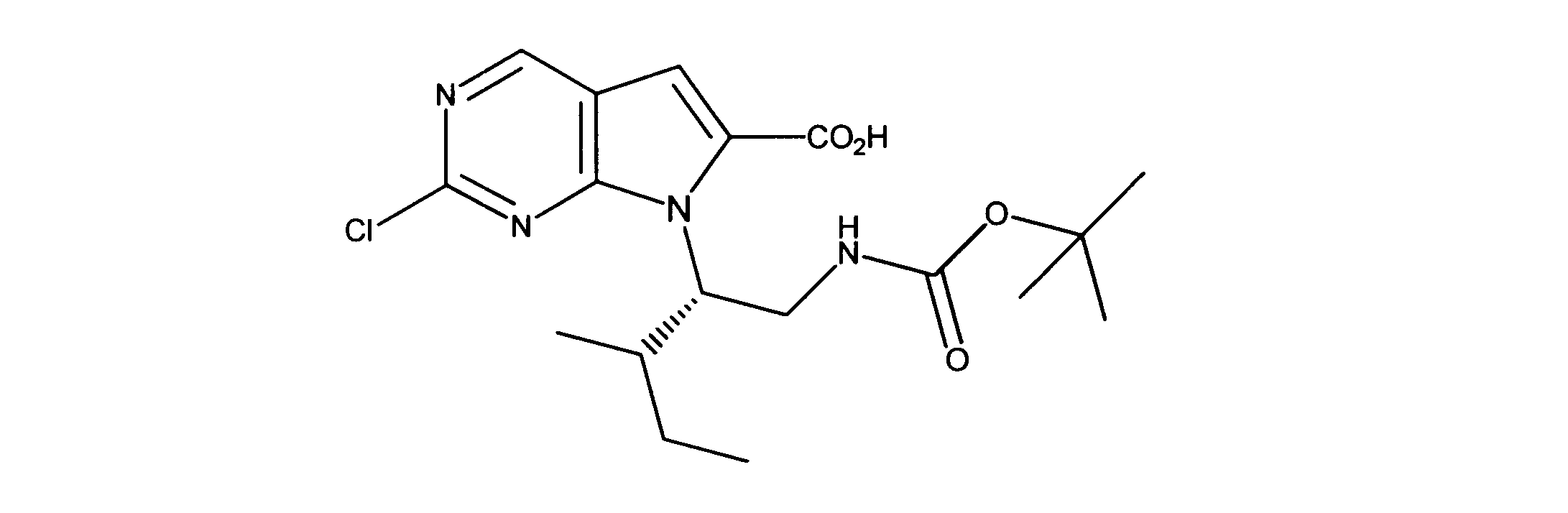
1HNMR (600 MHz, DMSO-d6) δ ppm 0.80 (t, J=7.47 Hz, 3 H) 0.86 (d, J=7.03 Hz, 3 H) 1.06 - 1.30 (m, 2 H) 1.48 (s, 9 H) 1.79 - 1.96 (m, 1 H) 3.95 (dd, J=14.05, 3.22 Hz, 1 H) 4.52 (d, J=14.35 Hz, 1 H) 4.61 - 4.73 (m, 1 H) 7.43 (s, 1 H) 9.13 (s, 1 H). LCMS (ESI) 397 (M + H).
7-[(1S)-1-[(tert-butoxycarbonylamino)methyl]-2methyl-butyl]-2-chloro-pyrrolo[2,3-d]pyrimidine-6carboxylic acid
1 HNMR (600 MHz, DMSO-d 6 ) δ ppm 0.80 (t, J=7.47 Hz, 3 H) 0.86 (d, J=7.03 Hz, 3 H) 1.06 - 1.30 (m, 2 H) 1.48 (s, 9 H) 1.79 - 1.96 (m, 1 H) 3.95 (dd, J=14.05, 3.22 Hz, 1 H) 4.52 (d, J=14.35 Hz, 1 H) 4.61 - 4.73 (m, 1 H) 7.43 (s 9.13 (s, 1 H). LCMS (ESI) 397 (M + H).
化合物44に対して記載されたと類似の合成シーケンスを用いて、化合物50を合成した。
1HNMR (600 MHz, DMSO-d6) δ ppm 0.74 (t, J=7.32 Hz, 3 H) 0.89 (d, J=6.73 Hz, 3 H) 1.00 - 1.12 (m, 2 H) 1.82 - 1.94 (m, 1 H) 3.55 (dd, J=13.91, 4.83 Hz, 1 H) 3.70 (dd, J=13.61, 4.25 Hz, 1 H) 4.57 (dd, J=7.91, 4.10 Hz, 1 H) 7.17 (s, 1 H) 8.31 (d, J=5.27 Hz, 1 H) 9.05 (s, 1 H). LCMS (ESI) 279 (M + H).
Using a synthetic sequence analogous to that described for compound 44,
1 HNMR (600 MHz, DMSO-d 6 ) δ ppm 0.74 (t, J=7.32 Hz, 3 H) 0.89 (d, J=6.73 Hz, 3 H) 1.00 - 1.12 (m, 2 H) 1.82 - 1.94 ( m, 1 H) 3.55 (dd, J=13.91, 4.83 Hz, 1 H) 3.70 (dd, J=13.61, 4.25 Hz, 1 H) 4.57 (dd, J=7.91, 4.10 Hz, 1 H) 7.17 (s , 1 H) 8.31 (d, J=5.27 Hz, 1 H) 9.05 (s, 1 H). LCMS (ESI) 279 (M + H).
実施例51
化合物51の合成
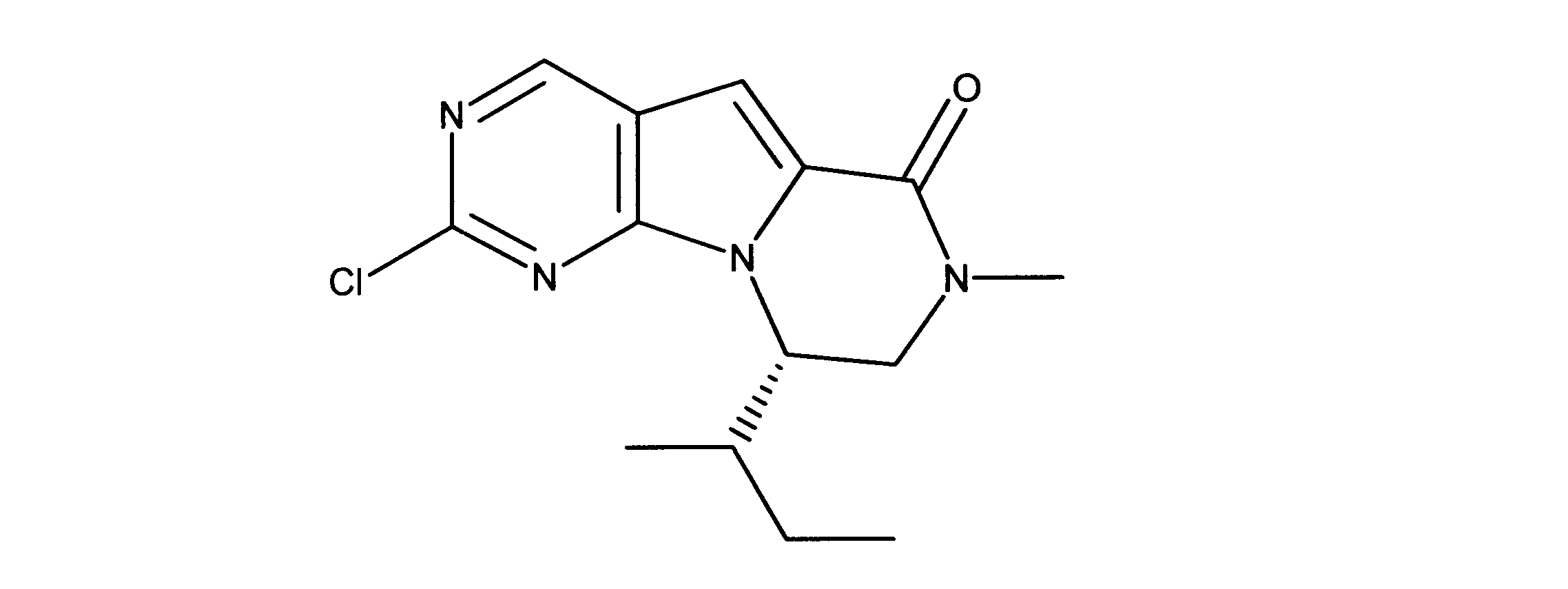
1HNMR (600 MHz, DMSO-d6) δ ppm 0.77 (t, J=7.47 Hz, 3 H) 0.84 (d, J=6.73 Hz, 3 H) 1.07 - 1.16 (m, 2 H) 1.82 - 1.95 (m, 1 H) 3.03 (s, 3 H) 3.68 (d, J=13.76 Hz, 1 H) 3.96 (dd, J=13.76, 4.39 Hz, 1 H) 4.59 - 4.70 (m, 1 H) 7.16 (s, 1 H) 9.04 (s, 1 H). LCMS (ESI) 293 (M + H).
Example 51
Synthesis of compound 51
1 HNMR (600 MHz, DMSO-d 6 ) δ ppm 0.77 (t, J=7.47 Hz, 3 H) 0.84 (d, J=6.73 Hz, 3 H) 1.07 - 1.16 (m, 2 H) 1.82 - 1.95 ( m, 1 H) 3.03 (s, 3 H) 3.68 (d, J=13.76 Hz, 1 H) 3.96 (dd, J=13.76, 4.39 Hz, 1 H) 4.59 - 4.70 (m, 1 H) 7.16 (s LCMS (ESI) 293 (M + H).
実施例52
化合物52の合成
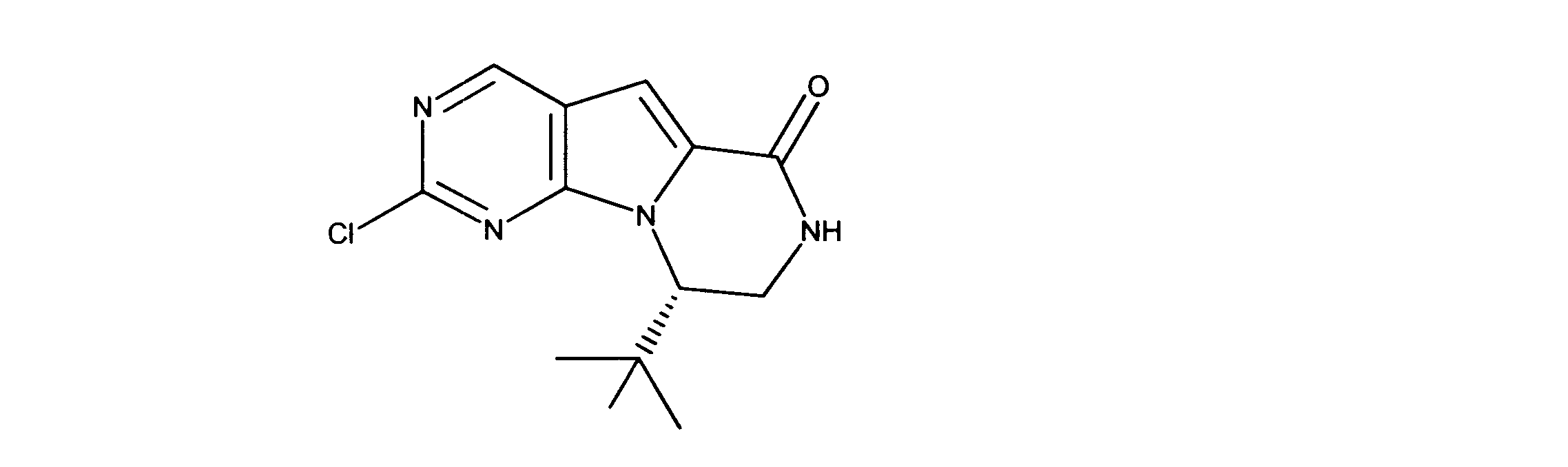
Synthesis of compound 52
tert-ブチルN-[(2S)-2-[(5-ブロモ-2-クロロ-ピリミジン-4-イル)アミノ]-3、3-ジメチルブチル]カルバメート
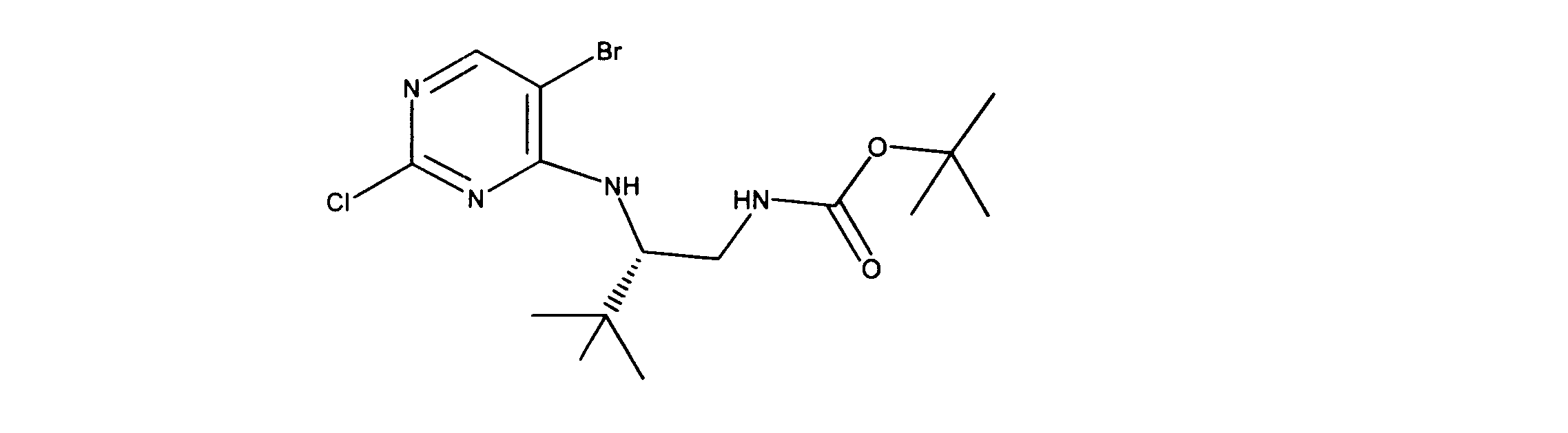
LCMS (ESI) 407 (M + H).
tert-butyl N-[(2S)-2-[(5-bromo-2-chloro-pyrimidin-4-yl)amino]-3,3-dimethylbutyl]carbamate
LCMS (ESI) 407 (M+H).
tert-ブチルN-[(2S)-2-[[2-クロロ-5-(3、3-ジエトキシプロプ-1-イニル)ピリミジン-4-イル]アミノ]-3、3-ジメチルブチル]カルバメート
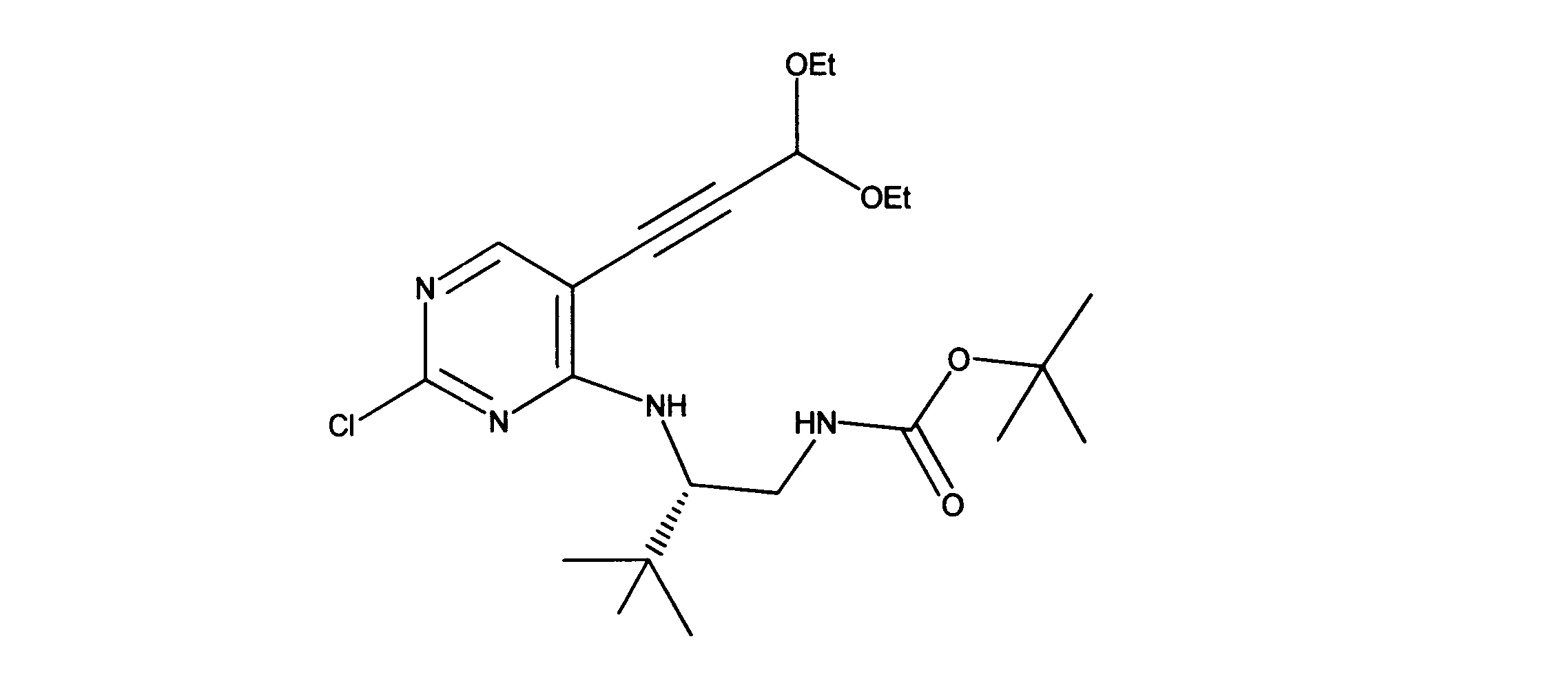
LCMS (ESI) 455 (M + H).
tert-butyl N-[(2S)-2-[[2-chloro-5-(3,3-diethoxyprop-1-ynyl)pyrimidin-4-yl]amino]-3,3-dimethylbutyl]carbamate
LCMS (ESI) 455 (M+H).
7-[(1S)-1-[(第三級ブトキシカルボニルアミノ)メチル]-2、2-ジメチルプロピル]-2-クロロ-ピロロ[2,3-d]ピリミジン-6カルボン酸
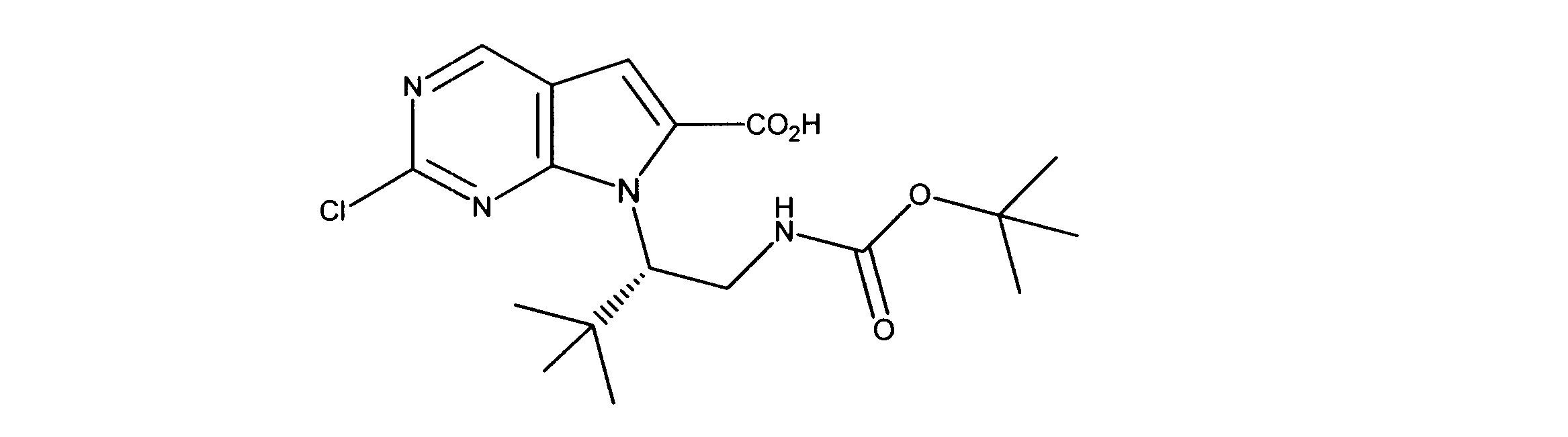
LCMS (ESI) 397 (M + H).
7-[(1S)-1-[(tert-butoxycarbonylamino)methyl]-2,2-dimethylpropyl]-2-chloro-pyrrolo[2,3-d]pyrimidine-6 carboxylic acid
LCMS (ESI) 397 (M+H).
中間体1Aについて記載されたと類似の合成シーケンスを用いて、中間体1Fを合成した。
LCMS (ESI) 279 (M + H).
Using a synthetic sequence analogous to that described for Intermediate 1A, Intermediate 1F was synthesized.
LCMS (ESI) 279 (M+H).
実施例53
化合物53の合成

LCMS (ESI) 293 (M + H).
Example 53
Synthesis of compound 53
LCMS (ESI) 293 (M+H).
実施例54
化合物54の合成
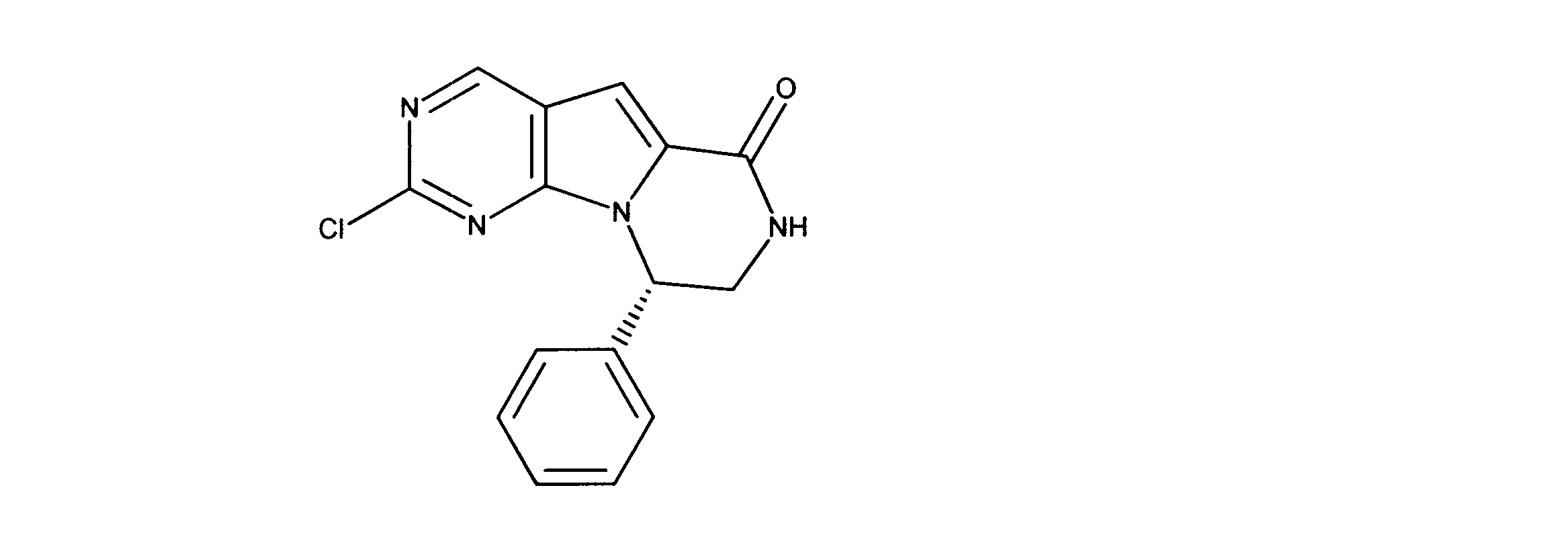
Synthesis of compound 54
tert-ブチルN-[(2S)-2-[(5-ブロモ-2-クロロ-ピリミジン-4-イル)アミノ]-2-フェニルエチル]カルバメート
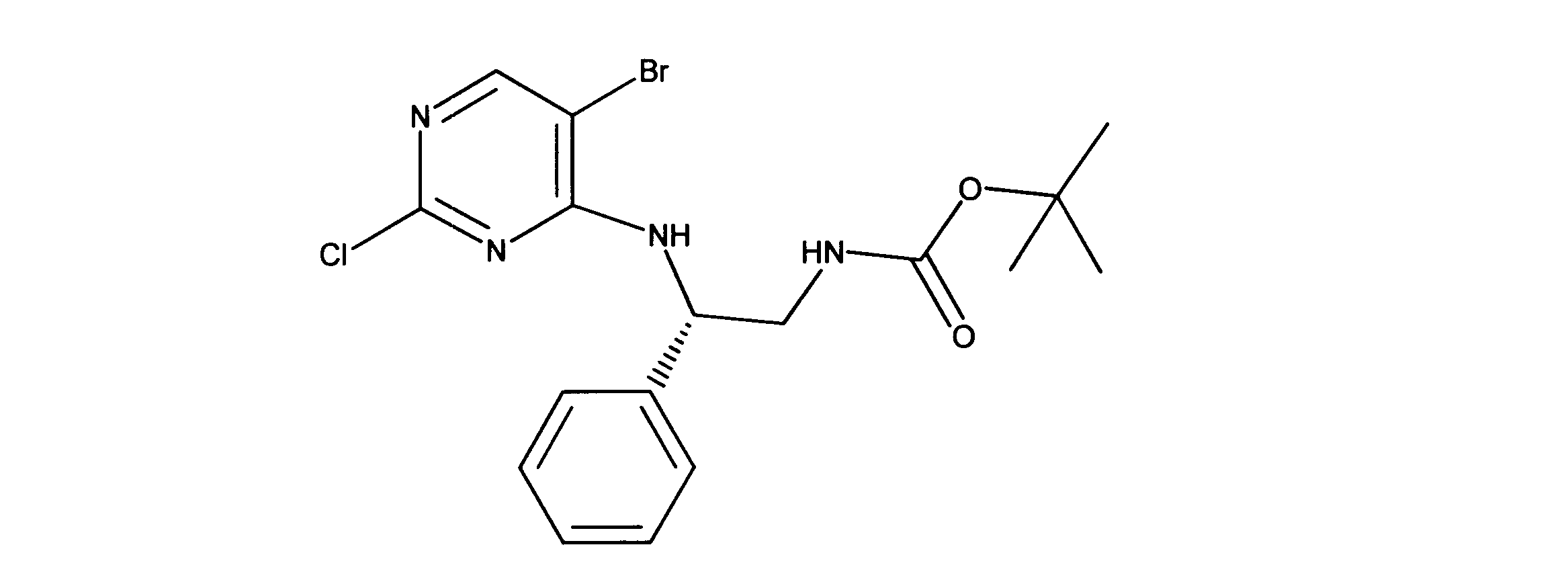
1HNMR (600 MHz, DMSO-d6) δ ppm 1.32 (s, 9 H) 3.29 - 3.50 (m, 2 H) 5.12 - 5.24 (m, 1 H) 7.10 (t, J=5.27 Hz, 1 H) 7.21 (t, J=6.88 Hz, 1 H) 7.26 - 7.34 (m, 4 H) 7.89 (d, J=7.32 Hz, 1 H) 8.24 (s, 1 H). LCMS (ESI) 427 (M + H).
tert-butyl N-[(2S)-2-[(5-bromo-2-chloro-pyrimidin-4-yl)amino]-2-phenylethyl]carbamate
1 HNMR (600 MHz, DMSO-d 6 ) δ ppm 1.32 (s, 9 H) 3.29 - 3.50 (m, 2 H) 5.12 - 5.24 (m, 1 H) 7.10 (t, J=5.27 Hz, 1 H) 7.21 (t, J=6.88 Hz, 1 H) 7.26 - 7.34 (m, 4 H) 7.89 (d, J=7.32 Hz, 1 H) 8.24 (s, 1 H). LCMS (ESI) 427 (M + H ).
tert-ブチルN-[(2S)-2-[[2-クロロ-5-(3、3-ジエトキシプロプ-1-イニル)ピリミジン-4-イル]アミノ]-2-フェニルエチル]カルバメート
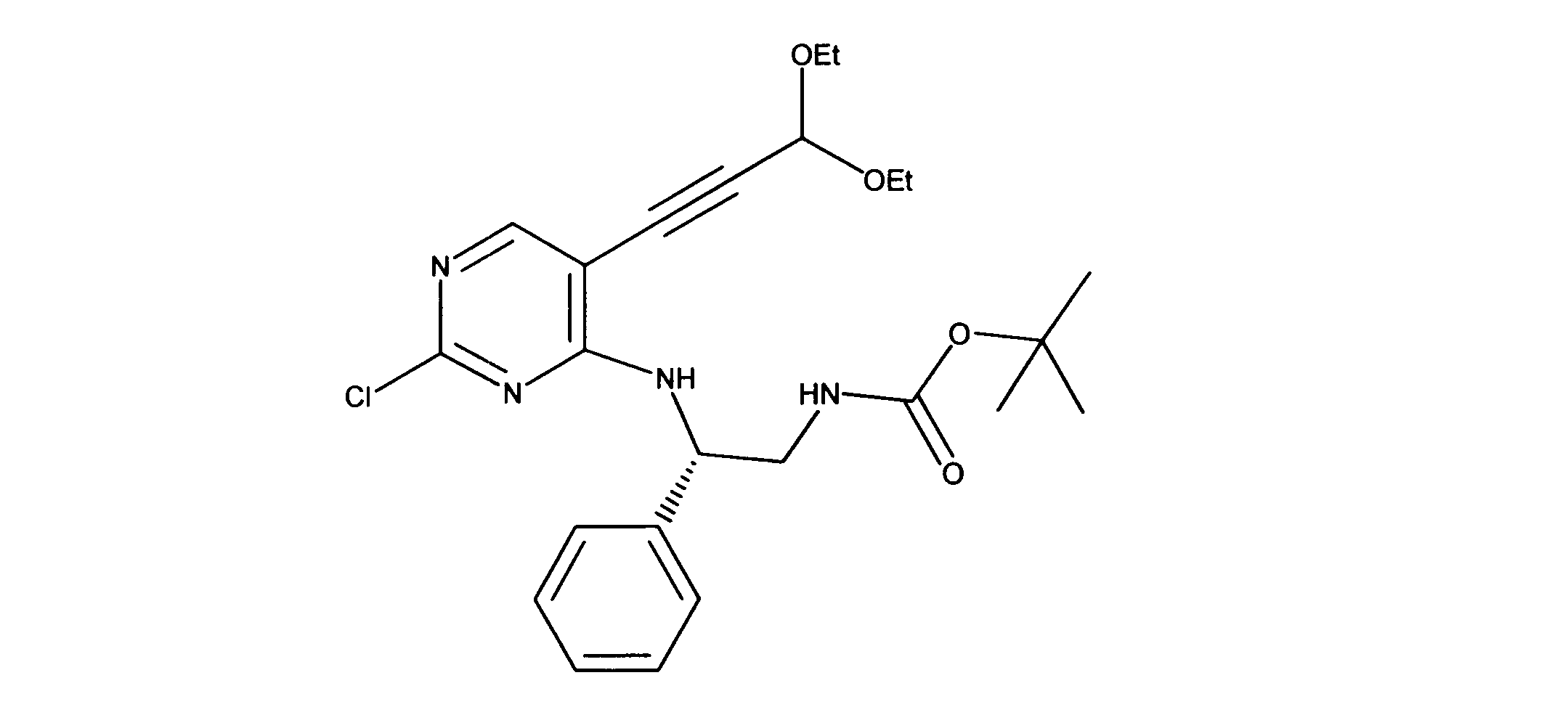
1HNMR (600 MHz, DMSO-d6) δ ppm 1.14 (t, J=7.03 Hz, 6 H) 1.32 (s, 9 H) 3.39 (s, 2 H) 3.52 - 3.61 (m, 2 H) 3.64 - 3.73 (m, 2 H) 5.17 - 5.26 (m, 1 H) 5.57 (s, 1 H) 7.07 - 7.14 (m, 1 H) 7.20 - 7.25 (m, 1 H) 7.26 - 7.33 (m, 4 H) 7.90 (d, J=7.61 Hz, 1 H) 8.19 (s, 1 H). LCMS (ESI) 475 (M + H).
tert-butyl N-[(2S)-2-[[2-chloro-5-(3,3-diethoxyprop-1-ynyl)pyrimidin-4-yl]amino]-2-phenylethyl]carbamate
1 HNMR (600 MHz, DMSO-d 6 ) δ ppm 1.14 (t, J=7.03 Hz, 6 H) 1.32 (s, 9 H) 3.39 (s, 2 H) 3.52 - 3.61 (m, 2 H) 3.64 - 3.73 (m, 2H) 5.17 - 5.26 (m, 1H) 5.57 (s, 1H) 7.07 - 7.14 (m, 1H) 7.20 - 7.25 (m, 1H) 7.26 - 7.33 (m, 4H) 7.90 (d, J=7.61 Hz, 1 H) 8.19 (s, 1 H). LCMS (ESI) 475 (M + H).
7-[(1S)-2-(第三級ブトキシカルボニルアミノ)-1-フェニルエチル]-2-クロロ-ピロロ[2,3-d]ピリミジン-6カルボン酸
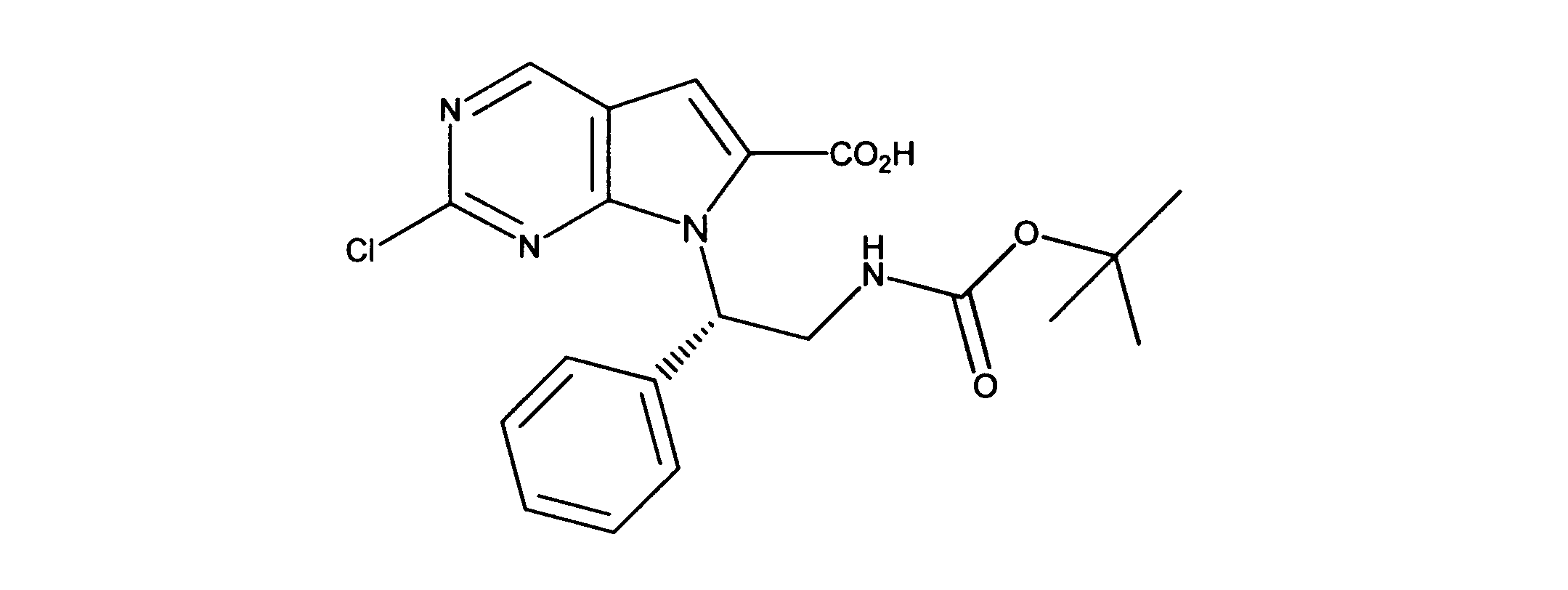
LCMS (ESI) 417 (M + H).
7-[(1S)-2-(tert-butoxycarbonylamino)-1-phenylethyl]-2-chloro-pyrrolo[2,3-d]pyrimidine-6carboxylic acid
LCMS (ESI) 417 (M+H).
化合物54
化合物44について記載されたと類似の合成シーケンスを用いて、化合物54を合成した。
1HNMR (600 MHz, DMSO-d6) δ ppm 3.58 - 3.69 (m, 1 H) 4.13 (dd, J=13.47, 4.39 Hz, 1 H) 6.07 (d, J=3.81 Hz, 1 H) 6.85 (d, J=7.32 Hz, 2 H) 7.19 - 7.31 (m, 3 H) 7.34 (s, 1 H) 8.27 (d, J=5.27 Hz, 1 H) 9.13 (s, 1 H). LCMS (ESI) 299 (M + H).
Compound 54
Using a synthetic sequence analogous to that described for compound 44, compound 54 was synthesized.
1 HNMR (600 MHz, DMSO-d 6 ) δ ppm 3.58 - 3.69 (m, 1 H) 4.13 (dd, J=13.47, 4.39 Hz, 1 H) 6.07 (d, J=3.81 Hz, 1 H) 6.85 ( d, J=7.32 Hz, 2 H) 7.19 - 7.31 (m, 3 H) 7.34 (s, 1 H) 8.27 (d, J=5.27 Hz, 1 H) 9.13 (s, 1 H). 299 (M+H).
実施例55
化合物55の合成
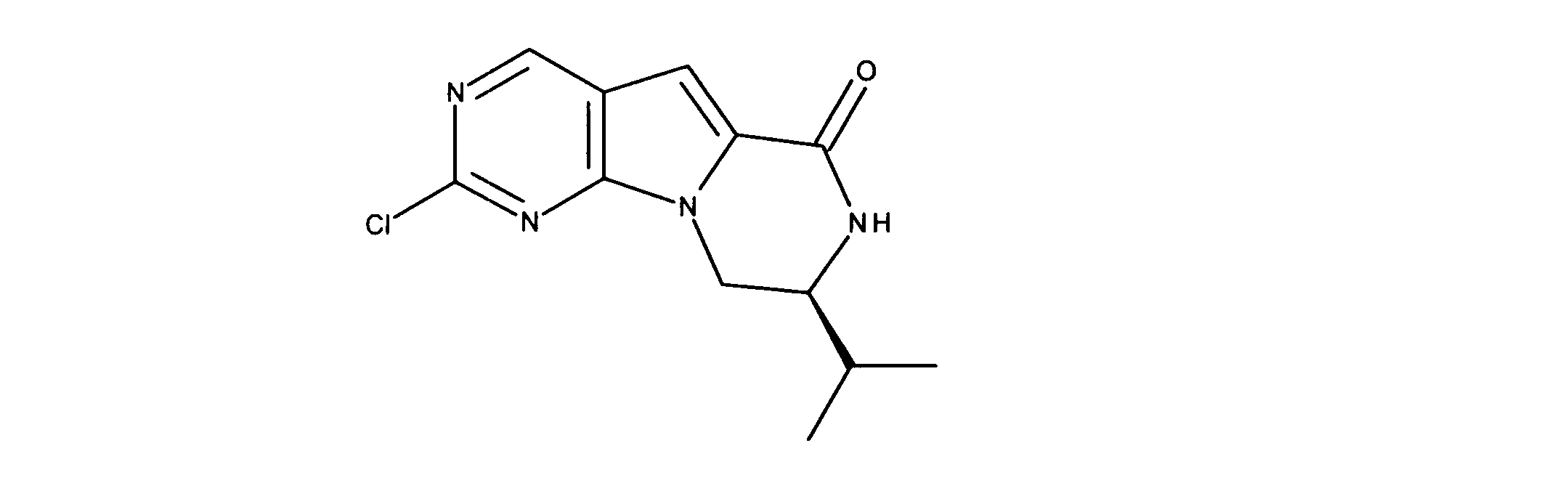
Synthesis of compound 55
tert-ブチルN-[(1S)-1-[[(5-ブロモ-2-クロロ-ピリミジン-4-イル)アミノ]メチル]-2メチル-プロピル]カルバメート
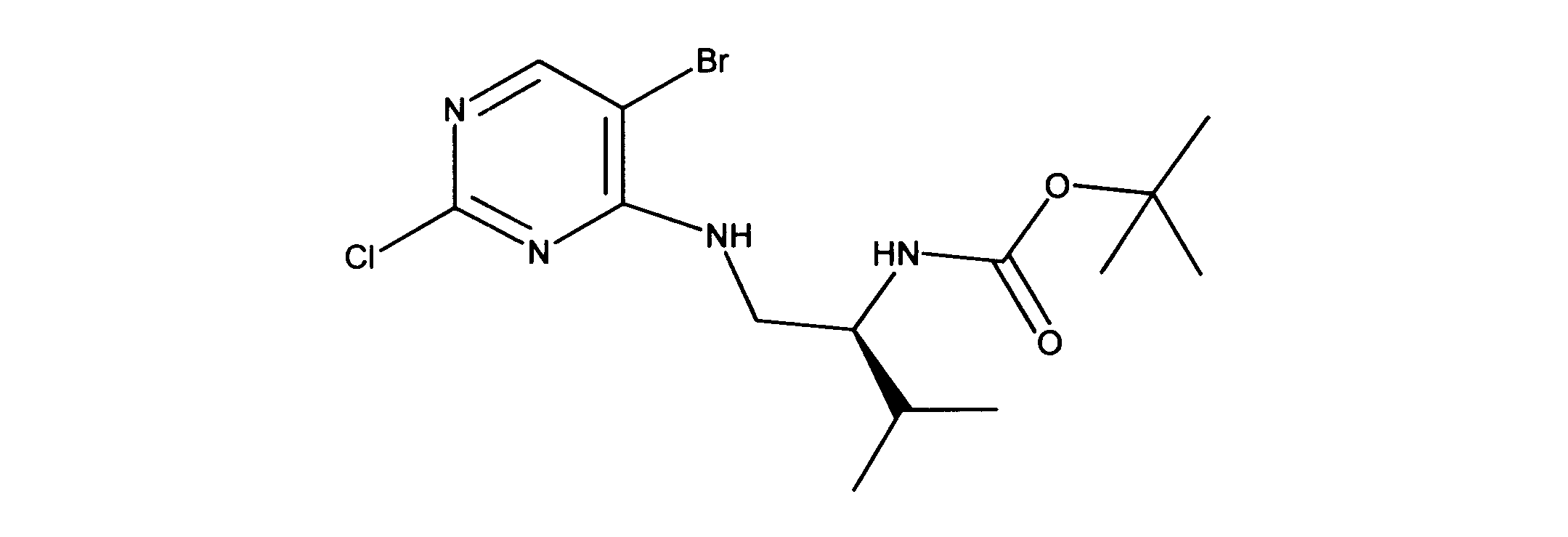
1HNMR (600 MHz, CHLOROFORM-d) δ ppm 0.95 - 1.02 (m, 6 H) 1.35 - 1.45 (m, 9 H) 1.75 - 1.90 (m, 1 H) 3.35 - 3.48 (m, 1 H) 3.52 - 3.61 (m, 1 H) 3.64 - 3.76 (m, 1 H) 4.56 (d, J=8.49 Hz, 1 H) 6.47 (s, 1 H) 8.07 (s, 1 H). LCMS (ESI) 393 (M + H).
tert-butyl N-[(1S)-1-[[(5-bromo-2-chloro-pyrimidin-4-yl)amino]methyl]-2methyl-propyl]carbamate
1 HNMR (600 MHz, CHLOROFORM-d) δ ppm 0.95 - 1.02 (m, 6 H) 1.35 - 1.45 (m, 9 H) 1.75 - 1.90 (m, 1 H) 3.35 - 3.48 (m, 1 H) 3.52 - 3.61 (m, 1 H) 3.64 - 3.76 (m, 1 H) 4.56 (d, J=8.49 Hz, 1 H) 6.47 (s, 1 H) 8.07 (s, 1 H). LCMS (ESI) 393 (M + H).
tert-ブチルN-[(1S)-1-[[[2-クロロ-5-(3、3-ジエトキシプロプ-1-イニル)ピリミジン-4-イル]アミノ]メチル]-2メチル-プロピル]カルバメート

1HNMR (600 MHz, CHLOROFORM-d) δ ppm 0.90 - 1.00 (m, 6 H) 1.18 - 1.25 (m, 6 H) 1.34 - 1.36 (m, 9 H) 1.69 - 1.90 (m, 1 H) 3.34 - 3.82 (m, 6 H) 4.53 - 4.77 (m, 1 H) 5.45 - 5.55 (m, 1 H) 6.37 (dd, J=15.37, 6.59 Hz, 1 H) 6.56 (s, 1 H) 8.05 (s, 1 H). LCMS (ESI) 441 (M + H).
tert-butyl N-[(1S)-1-[[[2-chloro-5-(3,3-diethoxyprop-1-ynyl)pyrimidin-4-yl]amino]methyl]-2methyl-propyl]carbamate
1 HNMR (600 MHz, CHLOROFORM-d) δ ppm 0.90 - 1.00 (m, 6 H) 1.18 - 1.25 (m, 6 H) 1.34 - 1.36 (m, 9 H) 1.69 - 1.90 (m, 1 H) 3.34 - 3.82 (m, 6H) 4.53 - 4.77 (m, 1H) 5.45 - 5.55 (m, 1H) 6.37 (dd, J=15.37, 6.59Hz, 1H) 6.56 (s, 1H) 8.05 (s, 1H). LCMS (ESI) 441 (M+H).
7-[(2S)-2-(第三級ブトキシカルボニルアミノ)-3-メチルブチル]-2-クロロ-ピロロ[2,3-d]ピリミジン-6カルボン酸
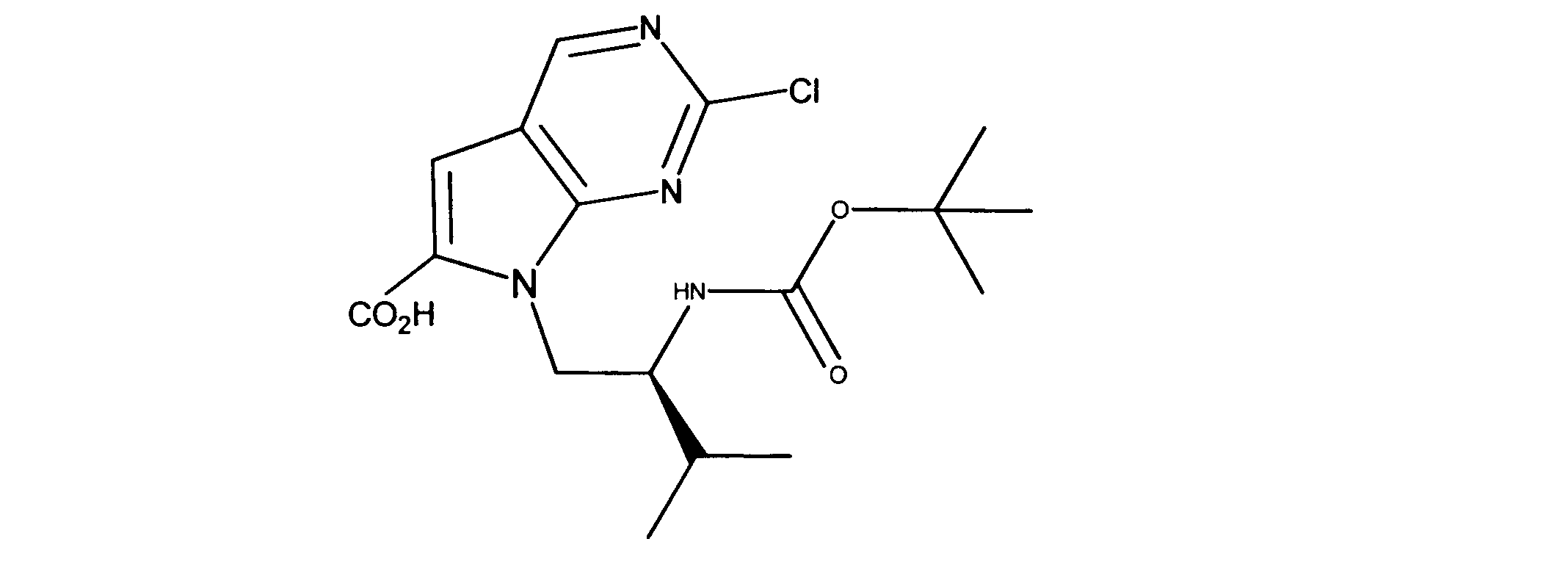
化合物55
化合物44について記載されたものと類似の合成シーケンスを用いて、化合物55を合成した。
LCMS (ESI) 265 (M + H).
Compound 55
Using a synthetic sequence analogous to that described for compound 44, compound 55 was synthesized.
LCMS (ESI) 265 (M+H).
実施例56
化合物56の合成
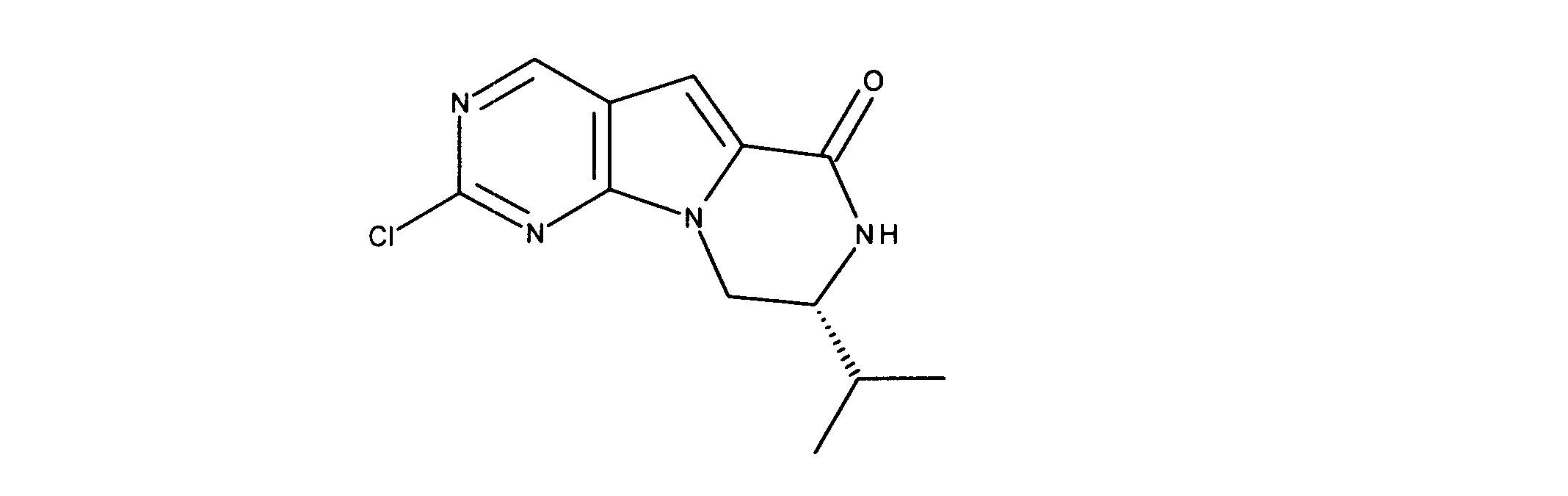
1HNMR (600 MHz, DMSO-d6) δ ppm 0.88 (d, J=6.44 Hz, 6 H) 1.73 - 1.86 (m, 1 H) 3.67 - 3.76 (m, 2 H) 4.11 - 4.21 (m, 1 H) 7.13 - 7.19 (m, 1 H) 8.56 (s, 1 H) 9.05 (s, 1 H). LCMS (ESI) 265 (M + H).
Example 56
Synthesis of
1 HNMR (600 MHz, DMSO-d 6 ) δ ppm 0.88 (d, J=6.44 Hz, 6 H) 1.73 - 1.86 (m, 1 H) 3.67 - 3.76 (m, 2 H) 4.11 - 4.21 (m, 1 H) 7.13 - 7.19 (m, 1 H) 8.56 (s, 1 H) 9.05 (s, 1 H). LCMS (ESI) 265 (M + H).
実施例57
化合物57の合成

Synthesis of compound 57
tert-ブチルN-[2-[(5-ブロモ-2-クロロ-ピリミジン-4-イル)アミノ]-2メチル-プロピル]カルバメート
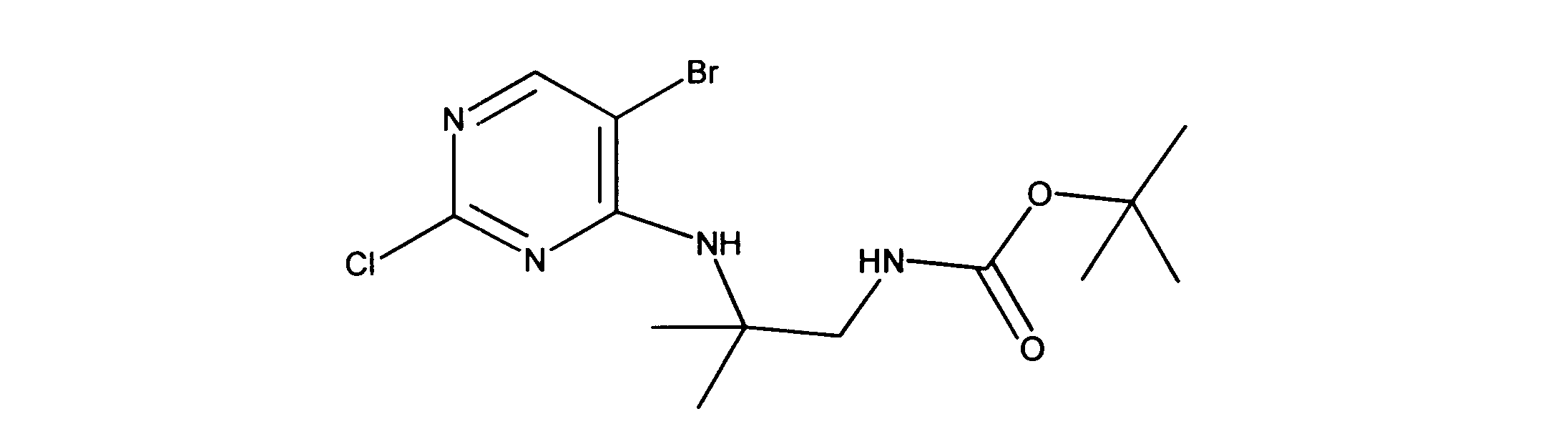
LCMS (ESI) 379 (M + H).
tert-butyl N-[2-[(5-bromo-2-chloro-pyrimidin-4-yl)amino]-2methyl-propyl]carbamate
LCMS (ESI) 379 (M+H).
tert-ブチルN-[2-[[2-クロロ-5-(3、3-ジエトキシプロプ-1-イニル)ピリミジン-4-イル]アミノ]-2メチル-プロピル]カルバメート
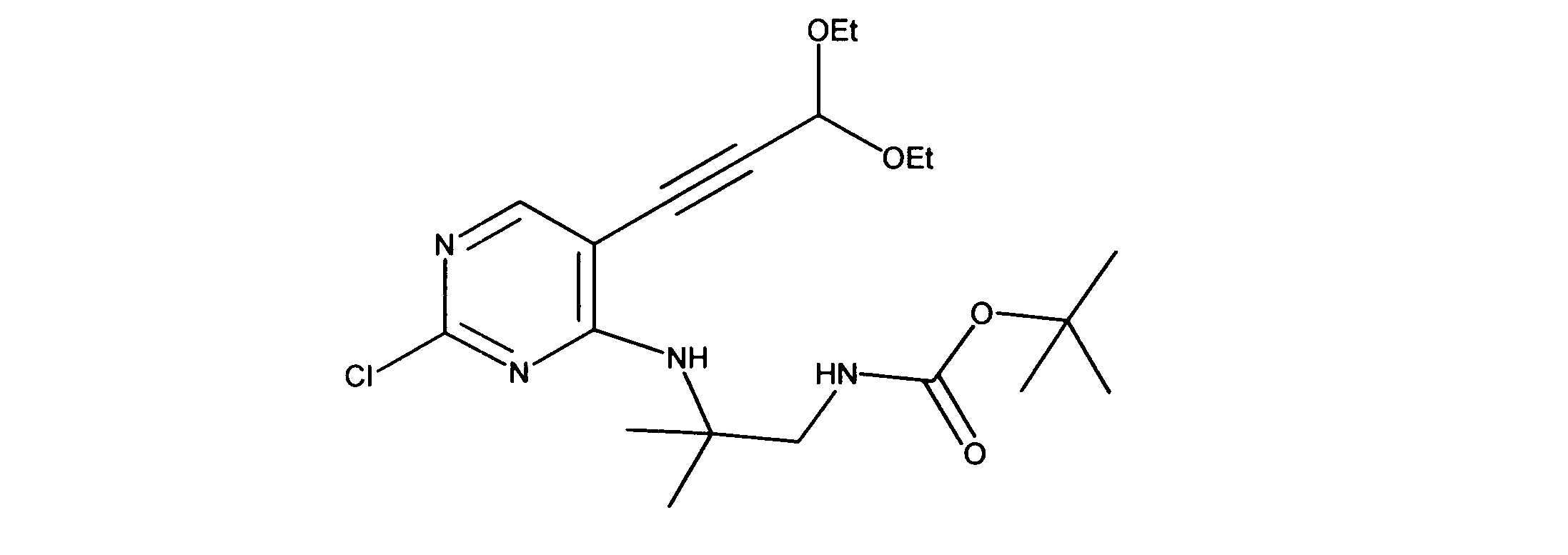
1HNMR (600 MHz, DMSO-d6) δ ppm 1.11 - 1.22 (m, 6 H) 1.31 - 1.45 (m, 15 H) 3.10 - 3.24 (m, 2 H) 3.51 - 3.76 (m, 4 H) 5.60 (s, 1 H) 6.94 (s, 1 H) 7.33 (t, J=6.44 Hz, 1 H) 8.18 (s, 1 H). LCMS (ESI) 427 (M + H).
tert-butyl N-[2-[[2-chloro-5-(3,3-diethoxyprop-1-ynyl)pyrimidin-4-yl]amino]-2methyl-propyl]carbamate
1 HNMR (600 MHz, DMSO-d 6 ) δ ppm 1.11 - 1.22 (m, 6 H) 1.31 - 1.45 (m, 15 H) 3.10 - 3.24 (m, 2 H) 3.51 - 3.76 (m, 4 H) 5.60 (s, 1 H) 6.94 (s, 1 H) 7.33 (t, J=6.44 Hz, 1 H) 8.18 (s, 1 H). LCMS (ESI) 427 (M + H).
7-[2-(第三級ブトキシカルボニルアミノ)-1,1-ジメチルエチル]-2-クロロ-ピロロ[2,3-d]ピリミジン-6カルボン酸
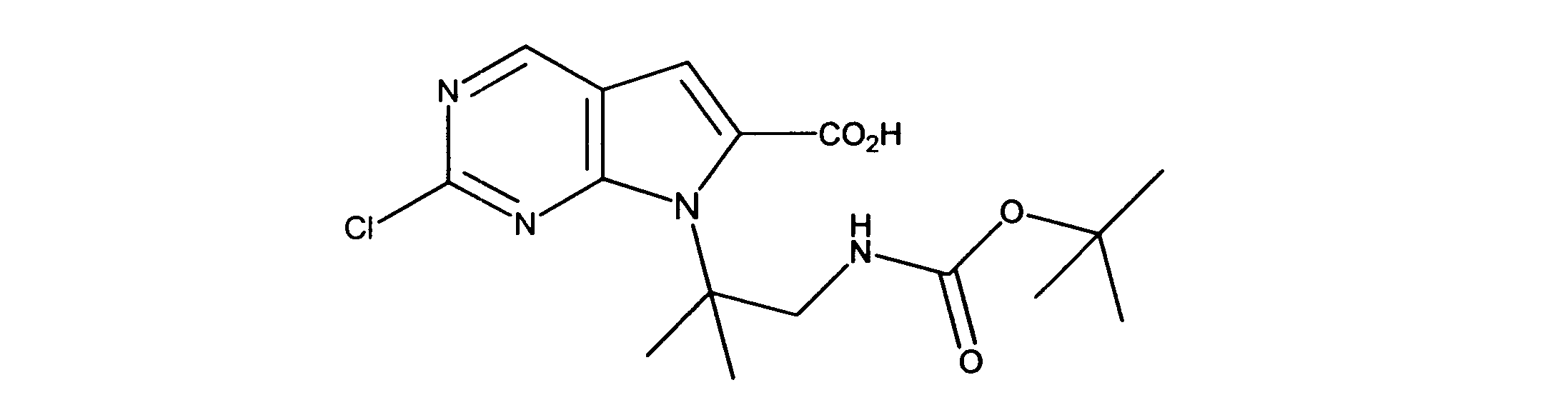
1HNMR (600 MHz, DMSO-d6) δ ppm 1.43 (s, 9H) 1.73 (s, 6 H) 4.06 (s, 2 H) 7.46 (s, 1 H) 9.23 (s, 1H). LCMS (ESI) 369 (M + H).
7-[2-(tert-butoxycarbonylamino)-1,1-dimethylethyl]-2-chloro-pyrrolo[2,3-d]pyrimidine-6carboxylic acid
1 HNMR (600 MHz, DMSO-d 6 ) δ ppm 1.43 (s, 9H) 1.73 (s, 6 H) 4.06 (s, 2 H) 7.46 (s, 1 H) 9.23 (s, 1H). LCMS (ESI ) 369 (M + H).
化合物57
化合物44について記載されたものと類似の合成シーケンスを用いて、化合物57を合成した。
1HNMR (600 MHz, DMSO-d6) δ ppm 1.73 (s, 6 H) 3.50 (d, J=2.93 Hz, 2 H) 7.25 (s, 1 H) 8.46 - 8.55 (m, 1 H) 9.07 (s, 1 H). LCMS (ESI) 251 (M + H).
Compound 57
Using a synthetic sequence analogous to that described for compound 44, compound 57 was synthesized.
1 HNMR (600 MHz, DMSO-d 6 ) δ ppm 1.73 (s, 6 H) 3.50 (d, J=2.93 Hz, 2 H) 7.25 (s, 1 H) 8.46 - 8.55 (m, 1 H) 9.07 ( s, 1 H). LCMS (ESI) 251 (M + H).
実施例58
化合物58の合成
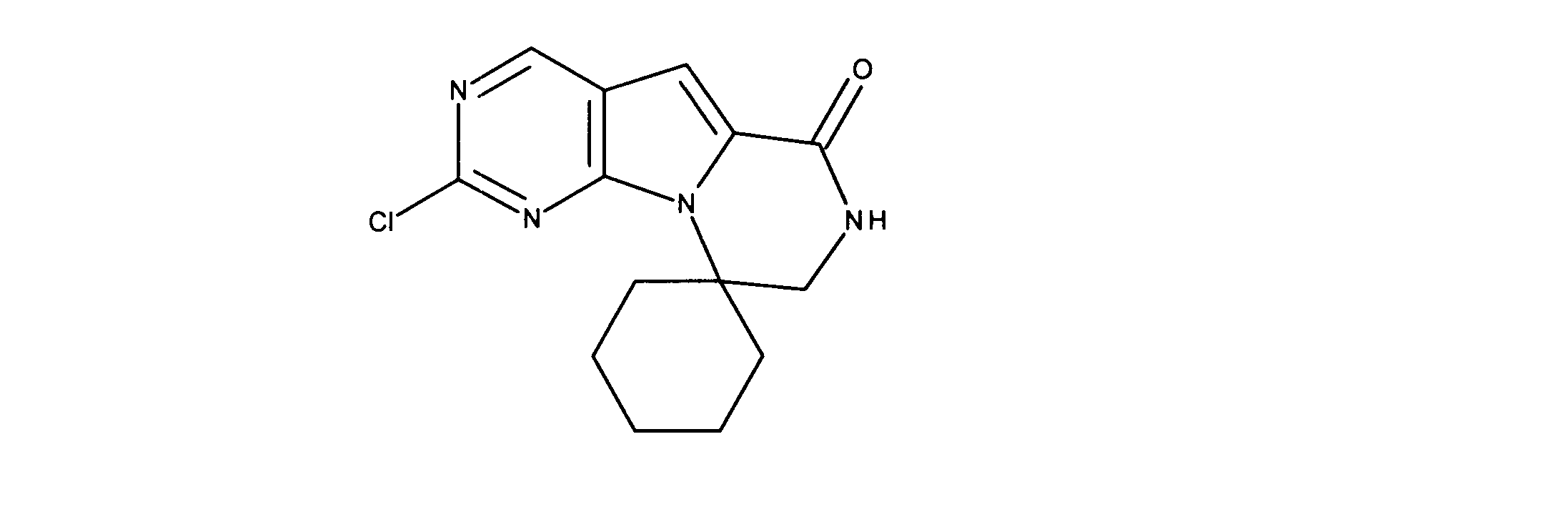
Synthesis of compound 58
tert-ブチルN-[[1-[(5-ブロモ-2-クロロ-ピリミジン-4-イル)アミノ]シクロヘキシル]メチル]カルバメート
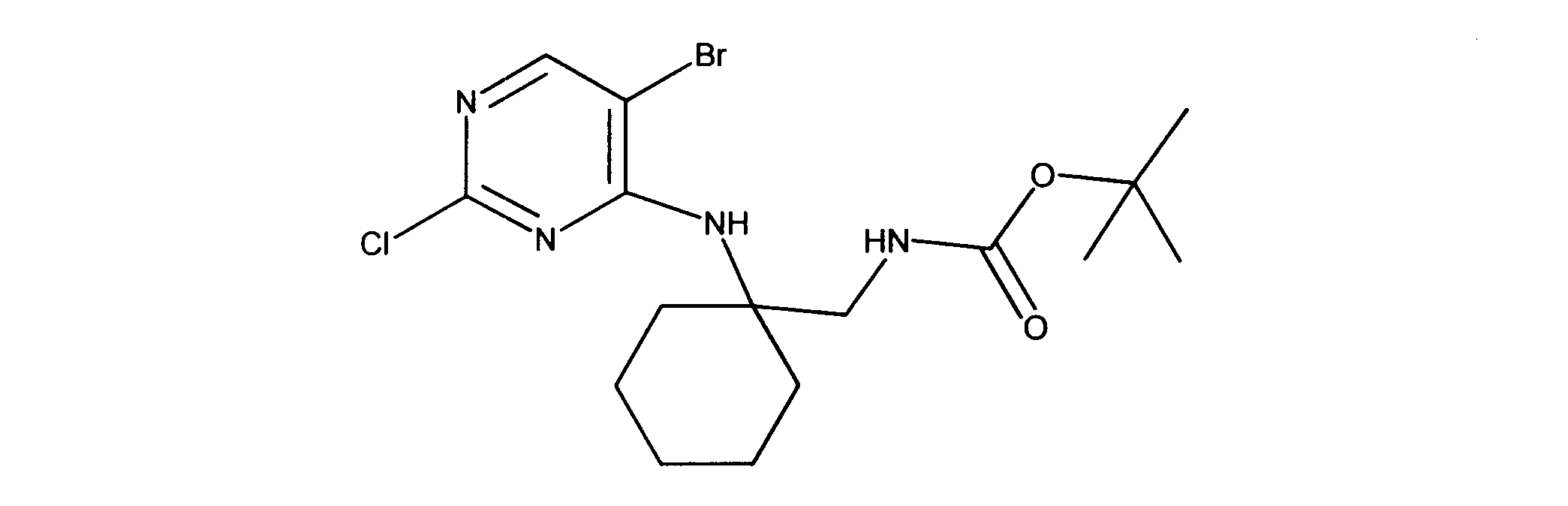
1HNMR (600 MHz, DMSO-d6) δ ppm 1.18 - 1.54 (m, 17 H) 2.23 (d, J=14.35 Hz, 2 H) 3.36 (d, J=6.44 Hz, 2 H) 5.82 (s, 1 H) 6.93 (s, 1 H) 8.22 (s, 1 H). LCMS (ESI) 419 (M + H).
tert-butyl N-[[1-[(5-bromo-2-chloro-pyrimidin-4-yl)amino]cyclohexyl]methyl]carbamate
1 HNMR (600 MHz, DMSO-d 6 ) δ ppm 1.18 - 1.54 (m, 17 H) 2.23 (d, J=14.35 Hz, 2 H) 3.36 (d, J=6.44 Hz, 2 H) 5.82 (s, 1H) 6.93 (s, 1H) 8.22 (s, 1H). LCMS (ESI) 419 (M + H).
tert-ブチルN-[[1-[[2-クロロ-5-(3、3-ジエトキシプロプ-1-イニル)ピリミジン-4-イル]アミノ]シクロヘキシル]メチル]カルバメート
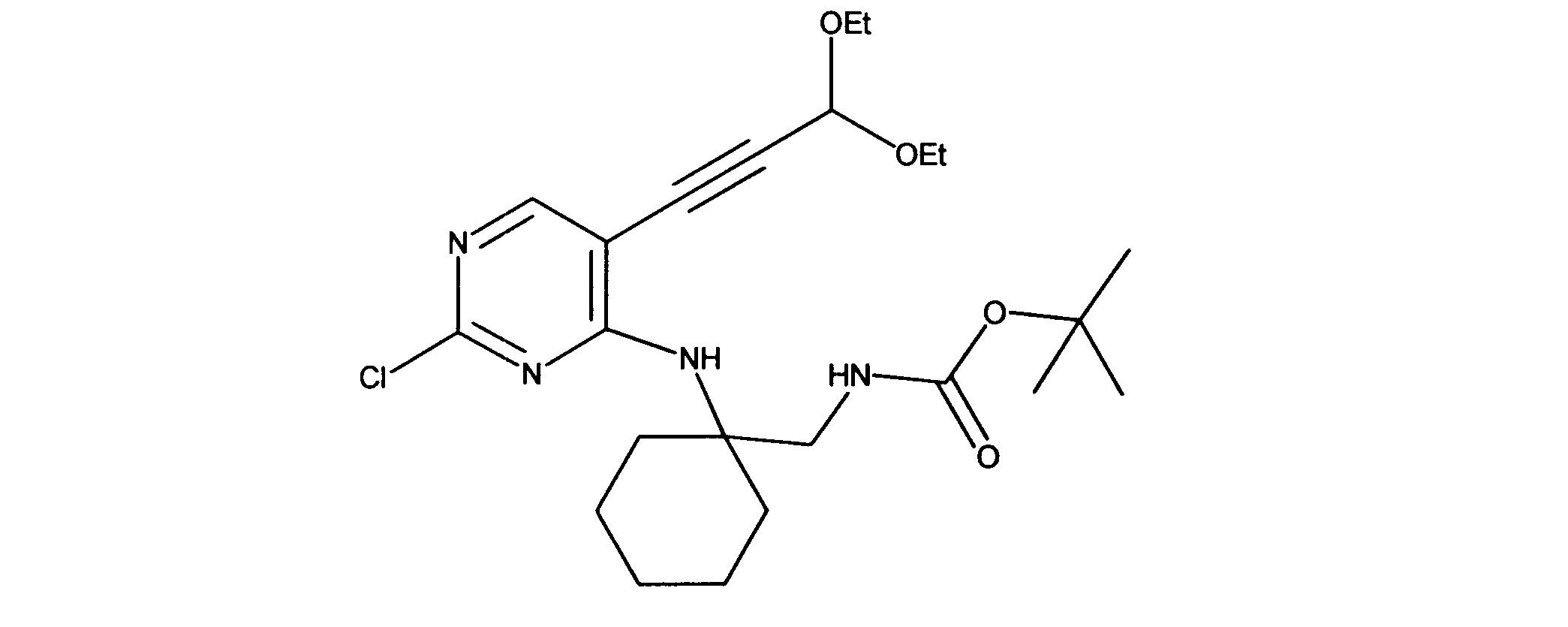
1HNMR (600 MHz, DMSO-d6) δ ppm 1.08 - 1.16 (m, 6 H) 1.17 - 1.54 (m, 17 H) 2.13 (br. s., 2 H) 3.36 (d, J=6.73 Hz, 2 H) 3.50 - 3.69 (m, 4 H) 5.72 (s, 1 H) 6.94 (s, 1 H) 5.72 (br. s., 1H) 8.17 (s, 1 H). LCMS (ESI) 467 (M + H).
tert-butyl N-[[1-[[2-chloro-5-(3,3-diethoxyprop-1-ynyl)pyrimidin-4-yl]amino]cyclohexyl]methyl]carbamate
1 HNMR (600 MHz, DMSO-d 6 ) δ ppm 1.08 - 1.16 (m, 6 H) 1.17 - 1.54 (m, 17 H) 2.13 (br. s., 2 H) 3.36 (d, J=6.73 Hz, 2H) 3.50 - 3.69 (m, 4H) 5.72 (s, 1H) 6.94 (s, 1H) 5.72 (br. s., 1H) 8.17 (s, 1H). LCMS (ESI) 467 (M + H).
7-[1-[(第三級ブトキシカルボニルアミノ)メチル]シクロヘキシル]-2-クロロ-ピロロ[2,3-d]ピリミジン-6カルボン酸

1HNMR (600 MHz, DMSO-d6) δ ppm 1.37 - 1.54 (m, 13 H) 1.75 (br. s., 4 H) 2.74 (br. s., 2 H) 3.78 - 3.84 (m, 2 H) 7.44 - 7.51 (m, 1 H) 8.23 (s, 1 H) 9.11 (s, 1 H). LCMS (ESI) 409 (M + H).
7-[1-[(tert-butoxycarbonylamino)methyl]cyclohexyl]-2-chloro-pyrrolo[2,3-d]pyrimidine-6carboxylic acid
1 HNMR (600 MHz, DMSO-d 6 ) δ ppm 1.37 - 1.54 (m, 13 H) 1.75 (br. s., 4 H) 2.74 (br. s., 2 H) 3.78 - 3.84 (m, 2 H ) 7.44 - 7.51 (m, 1 H) 8.23 (s, 1 H) 9.11 (s, 1 H). LCMS (ESI) 409 (M + H).
化合物58
化合物44について記載されたものと類似の合成シーケンスを用いて、化合物58を合成した。
1HNMR (600 MHz, DMSO-d6) δ ppm 1.28 (br. s., 2 H) 1.42 (br. s., 2 H) 1.70 (br. s., 4 H) 1.85 - 1.95 (m, 2 H) 2.69 (m, 2 H) 7.16 - 7.25 (m, 1 H) 8.41 (br. s., 1 H) 9.04 (s, 1 H). LCMS 291 (M + H).
Compound 58
Using a synthetic sequence similar to that described for compound 44, compound 58 was synthesized.
1 HNMR (600 MHz, DMSO-d 6 ) δ ppm 1.28 (br. s., 2 H) 1.42 (br. s., 2 H) 1.70 (br. s., 4 H) 1.85 - 1.95 (m, 2 H) 2.69 (m, 2 H) 7.16 - 7.25 (m, 1 H) 8.41 (br. s., 1 H) 9.04 (s, 1 H). LCMS 291 (M + H).
実施例59
化合物59の合成
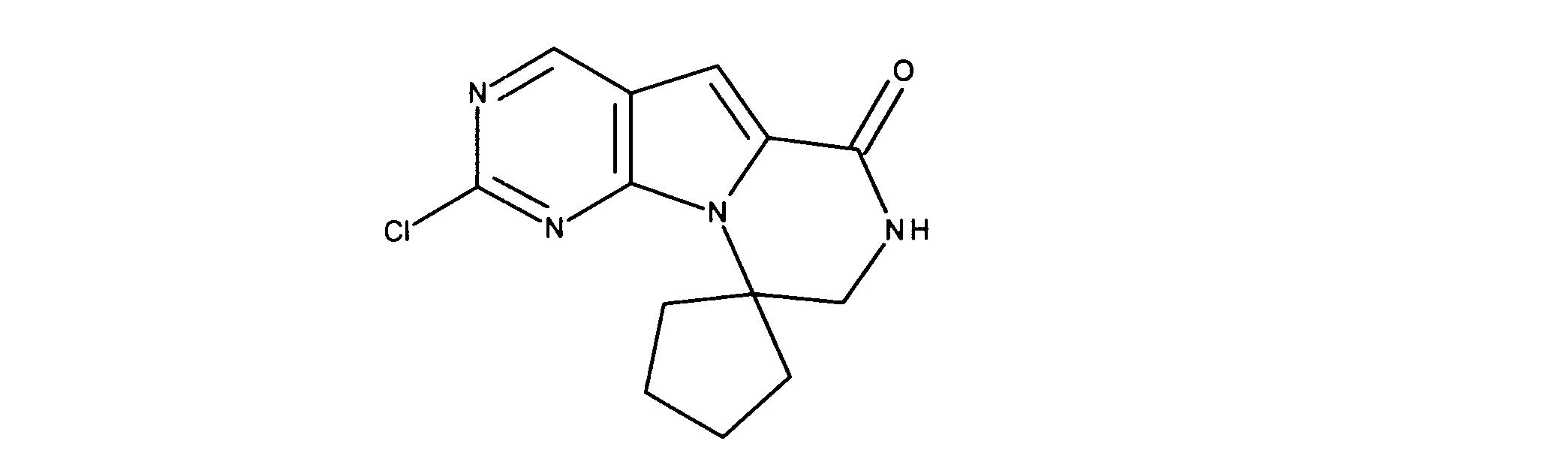
Synthesis of compound 59
tert-ブチルN-[[1-[(5-ブロモ-2-クロロ-ピリミジン-4-イル)アミノ]シクロペンチル]メチル]カルバメート
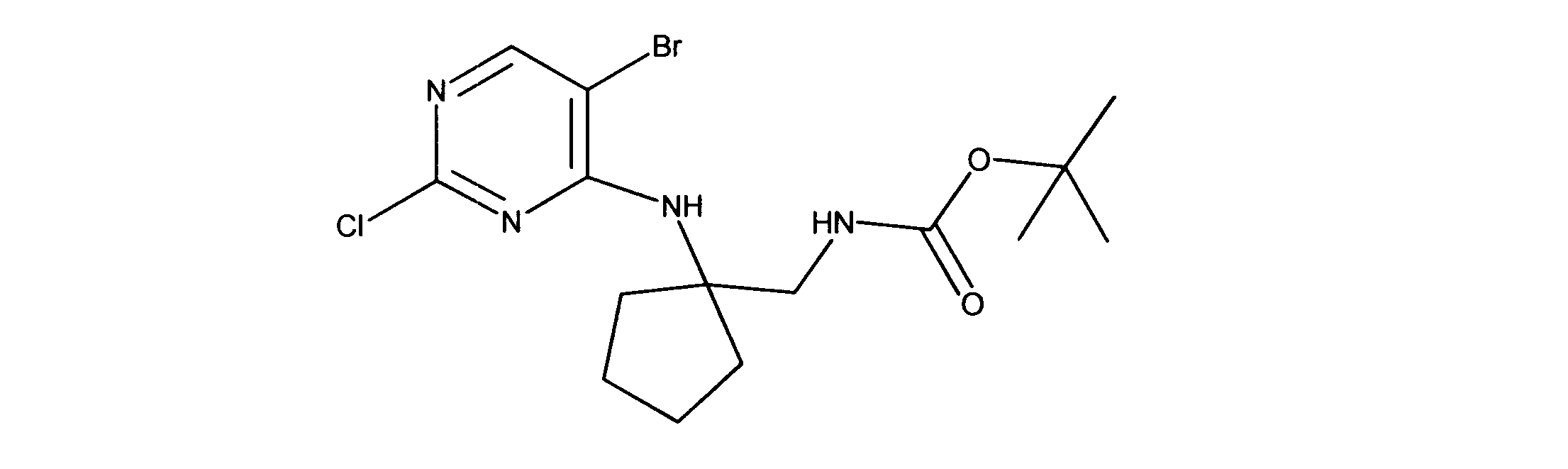
1HNMR (600 MHz, DMSO-d6) δ ppm 1.34 (s, 9 H) 1.50 - 1.58 (m, 2 H) 1.63 - 1.78 (m, 4 H) 1.96 - 2.06 (m, 2 H) 3.25 (d, J=6.15 Hz, 2 H) 6.71 (s, 1 H) 7.18 (t, J=6.29 Hz, 1 H) 8.20 (s, 1 H). LCMS (ESI) 405 (M + H).
tert-butyl N-[[1-[(5-bromo-2-chloro-pyrimidin-4-yl)amino]cyclopentyl]methyl]carbamate
1 HNMR (600 MHz, DMSO-d 6 ) δ ppm 1.34 (s, 9 H) 1.50 - 1.58 (m, 2 H) 1.63 - 1.78 (m, 4 H) 1.96 - 2.06 (m, 2 H) 3.25 (d , J=6.15 Hz, 2 H) 6.71 (s, 1 H) 7.18 (t, J=6.29 Hz, 1 H) 8.20 (s, 1 H). LCMS (ESI) 405 (M + H).
tert-ブチルN-[[1-[[2-クロロ-5-(3、3-ジエトキシプロプ-1-イニル)ピリミジン-4-イル]アミノ]シクロペンチル]メチル]カルバメート
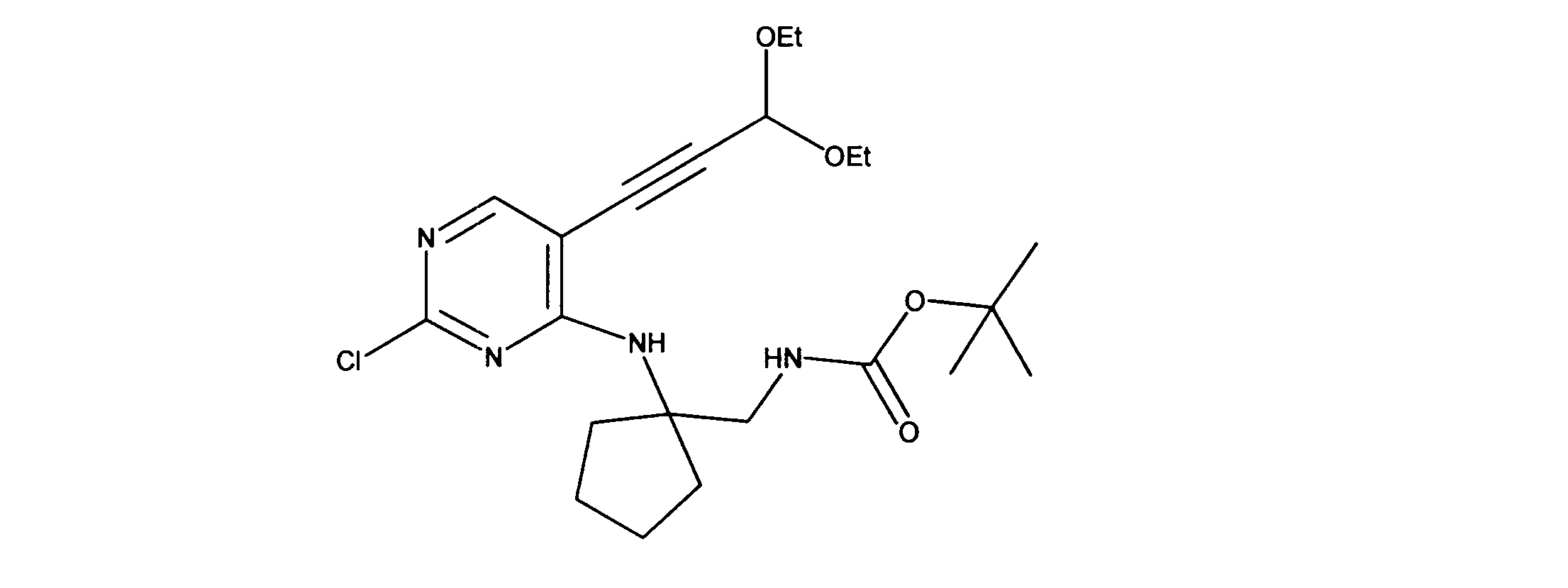
LCMS (ESI) 453 (M + H).
tert-butyl N-[[1-[[2-chloro-5-(3,3-diethoxyprop-1-ynyl)pyrimidin-4-yl]amino]cyclopentyl]methyl]carbamate
LCMS (ESI) 453 (M+H).
7-[1-[(第三級ブトキシカルボニルアミノ)メチル]シクロペンチル]-2-クロロ-ピロロ[2,3-d]ピリミジン-6カルボン酸
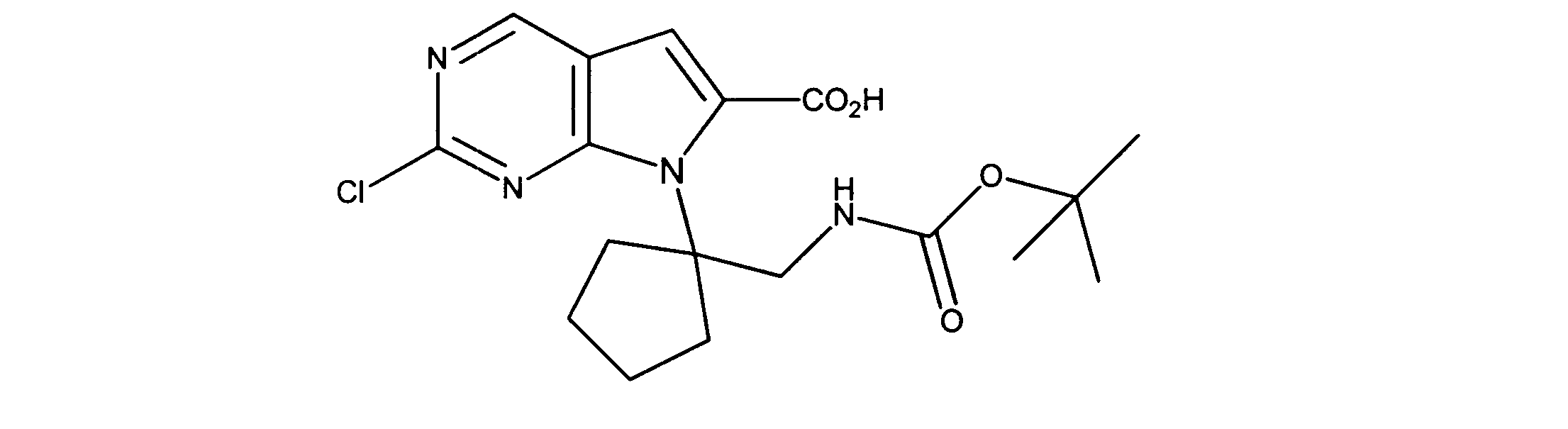
化合物59
化合物44について記載されたものと類似の合成シーケンスを用いて、化合物59を合成した。
1HNMR (600 MHz, DMSO-d6) δ ppm 1.72 (br. s., 2 H) 1.86 - 1.93 (m, 2 H) 1.99 (d, J=3.81 Hz, 2 H) 2.40 (br. s., 2 H) 3.48 (d, J=2.34 Hz, 2 H) 7.22 (s, 1 H) 8.53 (br. s., 1 H) 9.05 (s, 1 H). LCMS (ESI) 277 (M + H).
Compound 59
Using a synthetic sequence analogous to that described for compound 44, compound 59 was synthesized.
1 HNMR (600 MHz, DMSO-d 6 ) δ ppm 1.72 (br. s., 2 H) 1.86 - 1.93 (m, 2 H) 1.99 (d, J=3.81 Hz, 2 H) 2.40 (br. s. s., 2 H) 3.48 (d, J=2.34 Hz, 2 H) 7.22 (s, 1 H) 8.53 (br. s., 1 H) 9.05 (s, 1 H). LCMS (ESI) 277 (M + H ).
実施例60
化合物60の合成
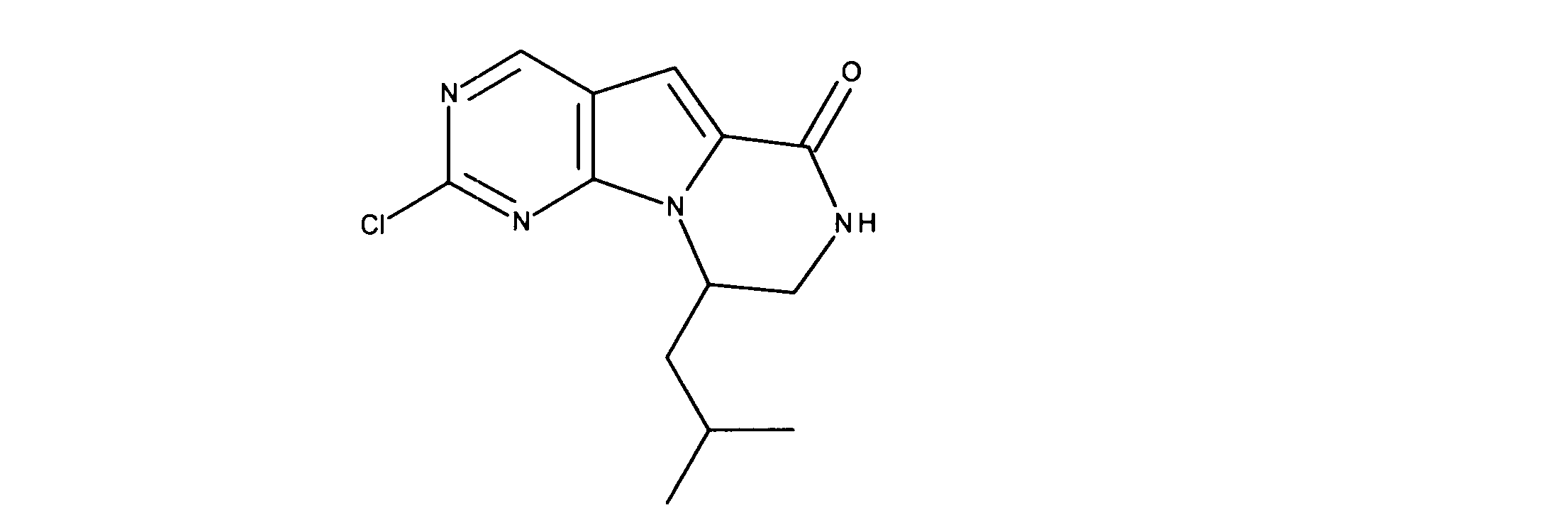
Synthesis of
tert-ブチルN-[2-[(5-ブロモ-2-クロロ-ピリミジン-4-イル)アミノ]-4-メチル-ペンチル]カルバメート
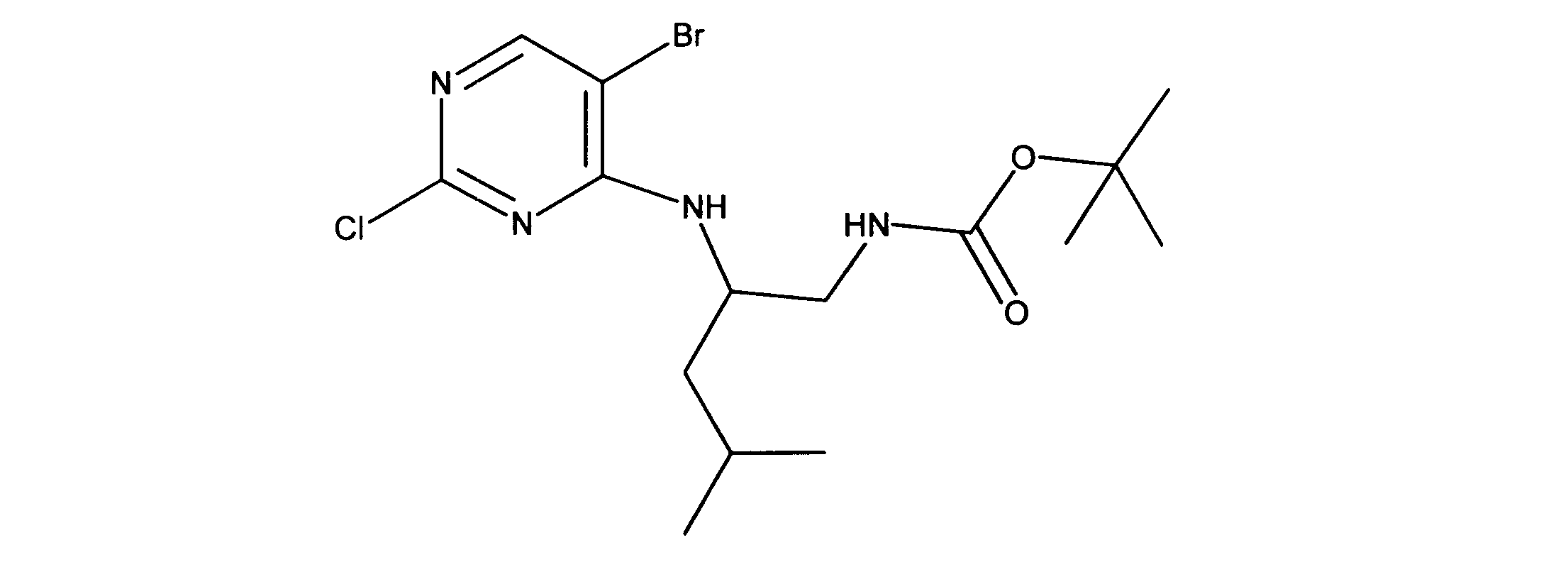
tert-ブチルN-[2-[[2-クロロ-5-(3、3-ジエトキシプロプ-1-イニル)ピリミジン-4-イル]アミノ]-4-メチル-ペンチル]カルバメート
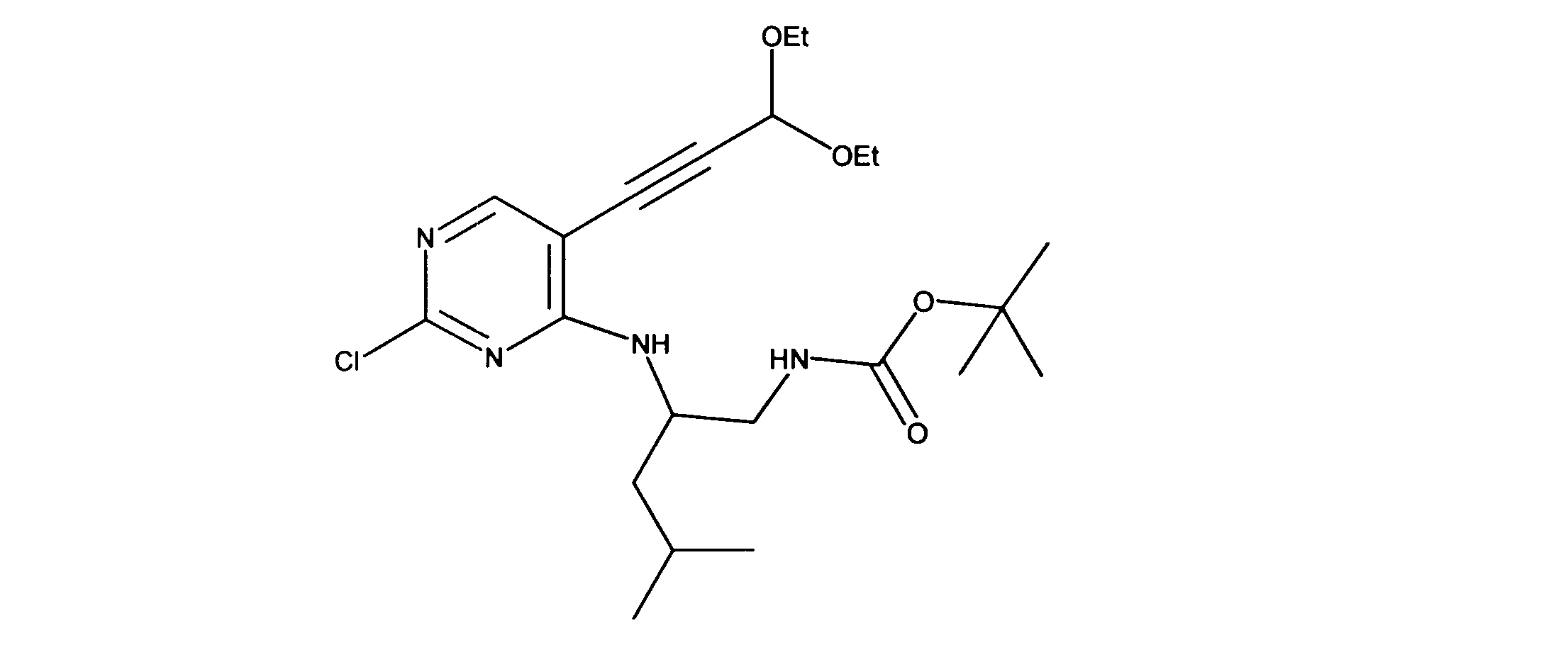
1HNMR (600 MHz, CHLOROFORM-d) δ ppm 1.21 - 1.31 (m, 12 H) 1.38 - 1.46 (m, 11 H) 1.70 (m, 1H) 3.24 (m, 2 H) 3.65 - 3.82 (m, 4 H) 4.86 (br s., 1H), 5.65 (s, 1 H) 5.85 (br s., 1H) 6.94 (s, 1 H) 8.21 (s, 1 H). LCMS (ESI) 455 (M + H).
tert-butyl N-[2-[[2-chloro-5-(3,3-diethoxyprop-1-ynyl)pyrimidin-4-yl]amino]-4-methyl-pentyl]carbamate
1 HNMR (600 MHz, CHLOROFORM-d) δ ppm 1.21 - 1.31 (m, 12 H) 1.38 - 1.46 (m, 11 H) 1.70 (m, 1 H) 3.24 (m, 2 H) 3.65 - 3.82 (m, 4 H) 4.86 (br s., 1H), 5.65 (s, 1 H) 5.85 (br s., 1H) 6.94 (s, 1 H) 8.21 (s, 1 H). LCMS (ESI) 455 (M + H ).
7-[1-[(第三級ブトキシカルボニルアミノ)メチル]-3-メチルブチル]-2-クロロ-ピロロ[2,3-d]ピリミジン-6カルボン酸
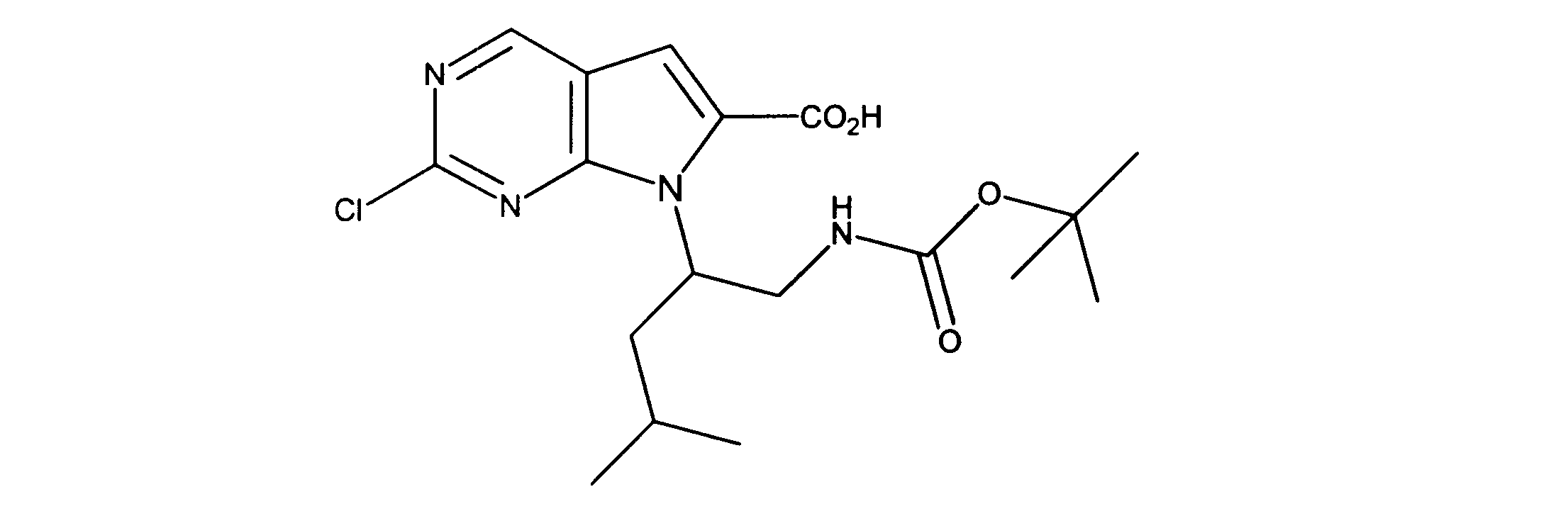
化合物60
化合物44のために記載されたものと類似の合成シーケンスを用いて、化合物60を合成した。分析データは、L-異性体について記載されたものと一致していた。
Using a synthetic sequence analogous to that described for compound 44,
実施例61
化合物61の合成
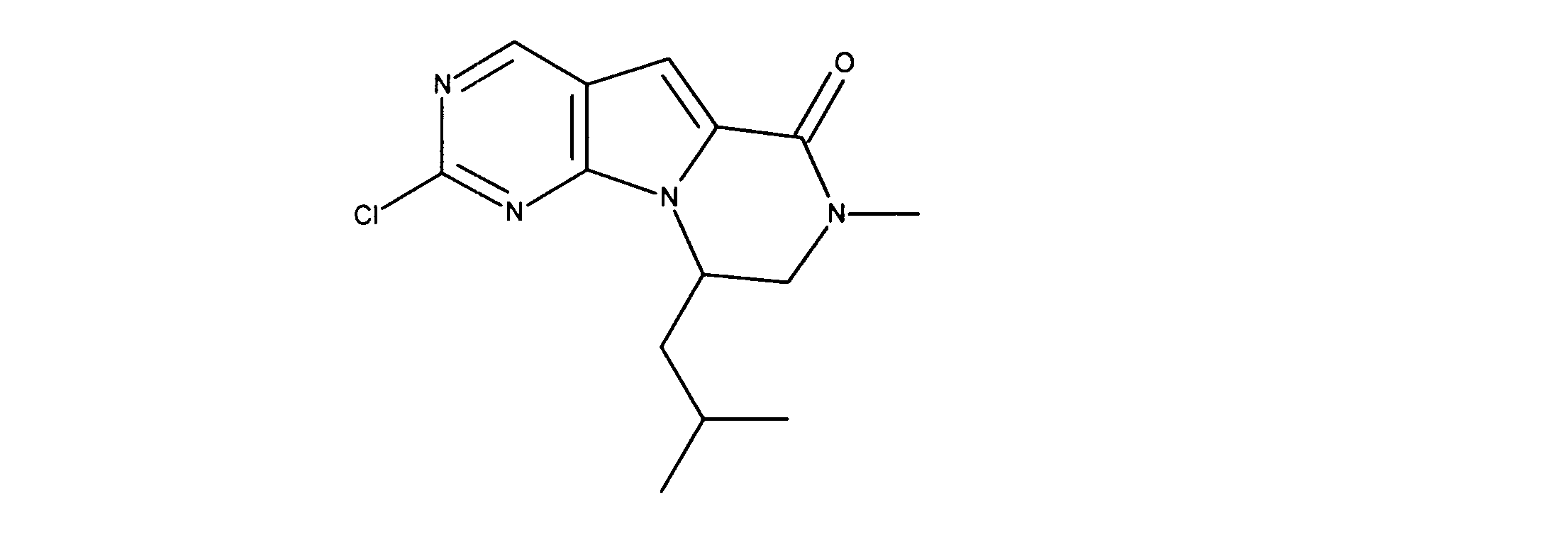
飽和NaHCO3の添加の後、酢酸エチルを添加した。有機層の分離の後、硫酸マグネシウムによる乾燥及び真空下での濃縮により、製品を提供した。分析データは、化合物49と同様だった。
Example 61
Synthesis of compound 61
After addition of saturated NaHCO 3 , ethyl acetate was added. Separation of the organic layer followed by drying over magnesium sulfate and concentration under vacuum provided the product. Analytical data were similar to
実施例62
化合物62の合成
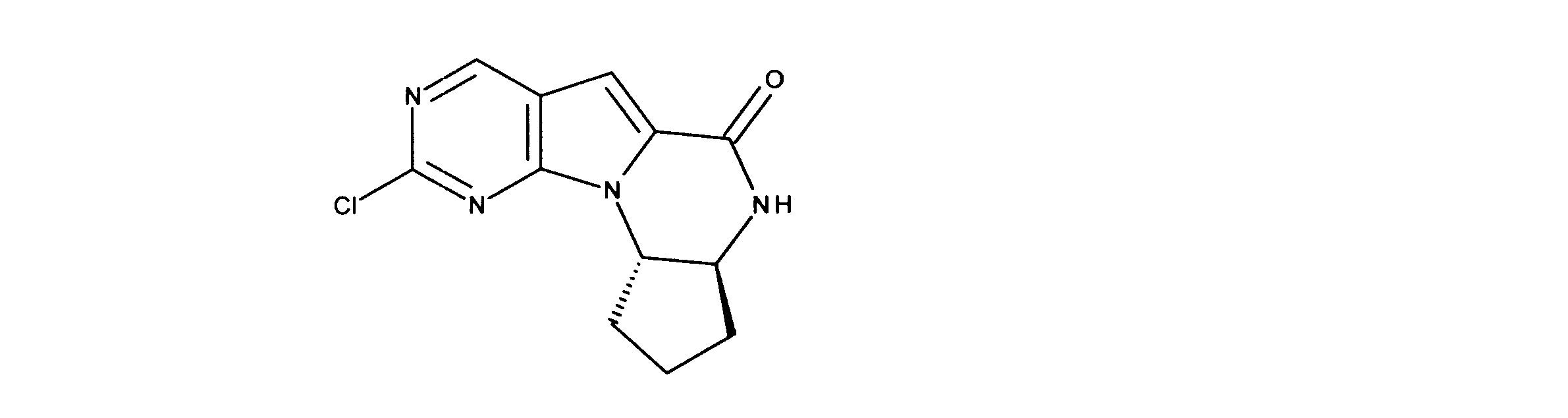
Synthesis of compound 62
tert-ブチルN-[(1S,2S)-2-[(5-ブロモ-2-クロロ-ピリミジン-4-イル)アミノ]シクロペンチル]カルバメート
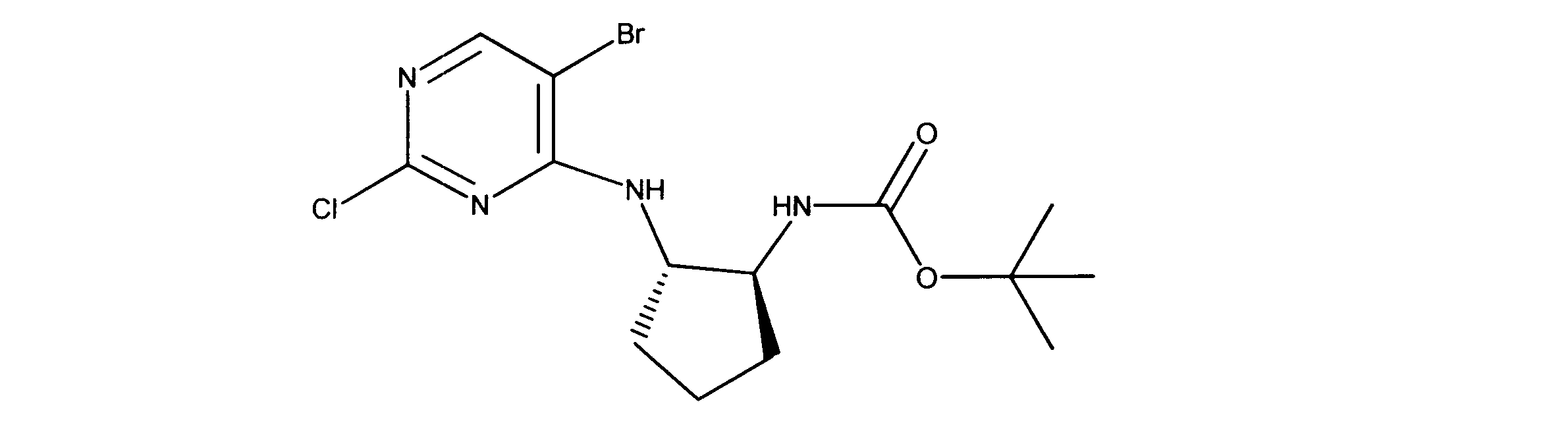
1HNMR (600 MHz, DMSO-d6) δ ppm 1.27 (s, 9 H) 1.42 - 1.54 (m, 2 H) 1.56 - 1.65 (m, 2 H) 1.80 - 1.88 (m, 1 H) 1.96 - 2.01 (m, 1 H) 3.88 - 3.96 (m, 1 H) 4.03 - 4.09 (m, 1 H) 6.91 (d, J=8.20 Hz, 1 H) 7.41 (d, J=7.32 Hz, 1 H) 8.18 (s, 1 H). LCMS (ESI) 391 (M + H).
tert-butyl N-[(1S,2S)-2-[(5-bromo-2-chloro-pyrimidin-4-yl)amino]cyclopentyl]carbamate
1 HNMR (600 MHz, DMSO-d 6 ) δ ppm 1.27 (s, 9 H) 1.42 - 1.54 (m, 2 H) 1.56 - 1.65 (m, 2 H) 1.80 - 1.88 (m, 1 H) 1.96 - 2.01 (m, 1 H) 3.88 - 3.96 (m, 1 H) 4.03 - 4.09 (m, 1 H) 6.91 (d, J=8.20 Hz, 1 H) 7.41 (d, J=7.32 Hz, 1 H) 8.18 ( s, 1 H). LCMS (ESI) 391 (M + H).
tert-ブチルN-[(1S,2S)-2-[[2-クロロ-5-(3、3-ジエトキシプロプ-1-イニル)ピリミジン-4-イル]アミノ]シクロペンチル]カルバメート
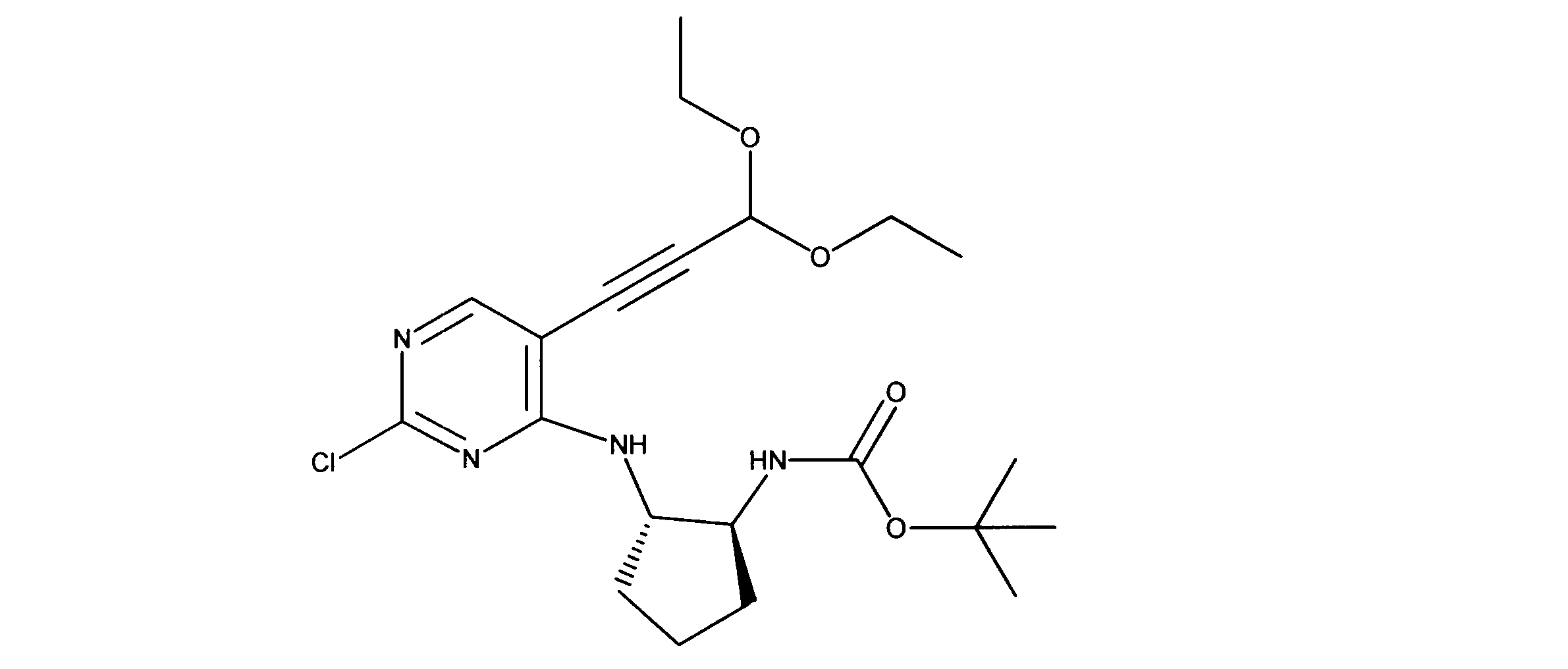
1HNMR (600 MHz, DMSO-d6) δ ppm 1.13 (t, 6 H) 1.28 (s, 9 H) 1.42 - 1.52 (m, 2 H) 1.58 - 1.65 (m, 2 H) 1.81 - 1.90 (m, 1 H) 1.99 - 2.08 (m, 1 H) 3.49 - 3.60 (m, 2 H) 3.63 - 3.71 (m, 2 H) 3.84 - 3.93 (m, 1 H) 3.96 - 4.04 (m, 1 H) 5.53 (s, 1 H) 6.96 (d, J=7.90 Hz, 1 H) 7.34 (d, J=7.03 Hz, 1 H) 8.14 (s, 1 H). LCMS (ESI) 439 (M + H).
tert-butyl N-[(1S,2S)-2-[[2-chloro-5-(3,3-diethoxyprop-1-ynyl)pyrimidin-4-yl]amino]cyclopentyl]carbamate
1 HNMR (600 MHz, DMSO-d 6 ) δ ppm 1.13 (t, 6 H) 1.28 (s, 9 H) 1.42 - 1.52 (m, 2 H) 1.58 - 1.65 (m, 2 H) 1.81 - 1.90 (m , 1H) 1.99 - 2.08 (m, 1H) 3.49 - 3.60 (m, 2H) 3.63 - 3.71 (m, 2H) 3.84 - 3.93 (m, 1H) 3.96 - 4.04 (m, 1H) 5.53 (s, 1 H) 6.96 (d, J=7.90 Hz, 1 H) 7.34 (d, J=7.03 Hz, 1 H) 8.14 (s, 1 H). LCMS (ESI) 439 (M + H).
7-[(1S,2S)-2-(第三級ブトキシカルボニルアミノ)シクロペンチル]-2-クロロ-ピロロ[2,3-d]ピリミジン-6カルボン酸
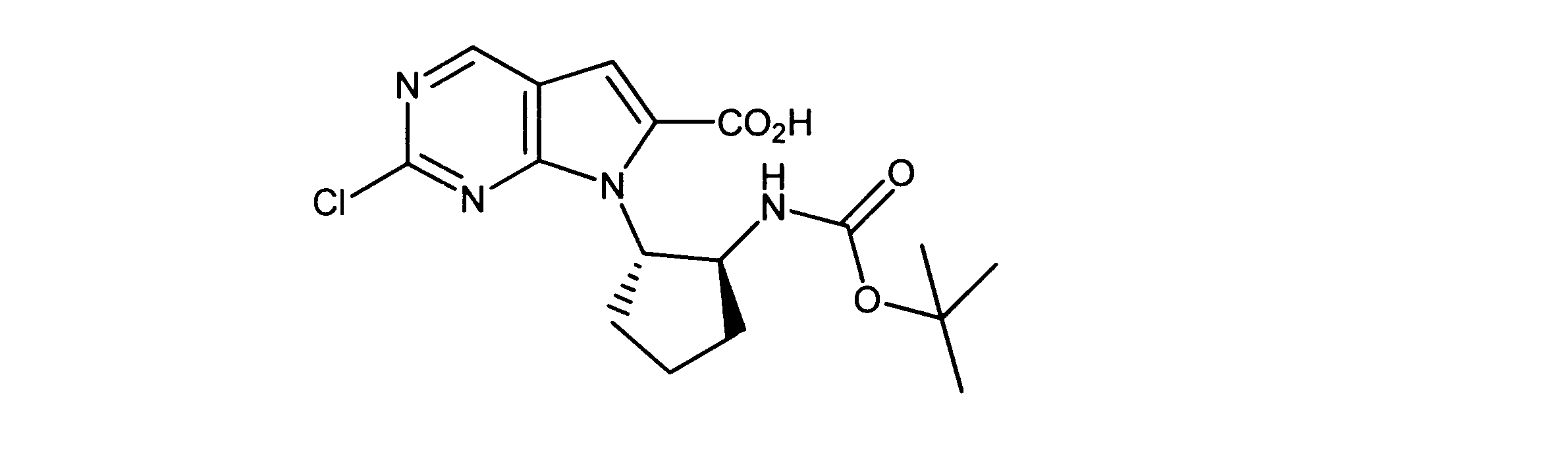
1HNMR (600 MHz, DMSO-d6) δ ppm 1.41 - 1.52 (m, 9 H) 1.55 - 1.68 (m, 1 H) 1.88 - 2.00 (m, 2 H) 2.05 - 2.15 (m, 1 H) 2.26 - 2.35 (m, 1 H) 2.71 - 2.89 (m, 1 H) 4.01 - 4.16 (m, 1 H) 4.28 - 4.45 (m, 1 H) 7.41 (s, 1 H) 9.11 (s, 1 H). LCMS (ESI) 381 (M + H).
7-[(1S,2S)-2-(tert-butoxycarbonylamino)cyclopentyl]-2-chloro-pyrrolo[2,3-d]pyrimidine-6carboxylic acid
1 HNMR (600 MHz, DMSO-d 6 ) δ ppm 1.41 - 1.52 (m, 9 H) 1.55 - 1.68 (m, 1 H) 1.88 - 2.00 (m, 2 H) 2.05 - 2.15 (m, 1 H) 2.26 - 2.35 (m, 1H) 2.71 - 2.89 (m, 1H) 4.01 - 4.16 (m, 1H) 4.28 - 4.45 (m, 1H) 7.41 (s, 1H) 9.11 (s, 1H). LCMS (ESI) 381 (M+H).
化合物62
化合物44に対して記載されたものと類似の合成シーケンスを用いて、化合物62を合成した。
1HNMR (600 MHz, DMSO-d6) δ ppm 1.48 - 1.60 (m, 1 H) 1.88 - 1.98 (m, 3 H) 1.99 - 2.08 (m, 1 H) 2.66 - 2.75 (m, 1 H) 3.63 - 3.74 (m, 1 H) 3.99 - 4.12 (m, 1 H) 7.21 (s, 1 H) 8.89 (s, 1 H) 9.04 (s, 1 H). LCMS (ESI) 263 (M + H).
Compound 62
Using a synthetic sequence analogous to that described for compound 44, compound 62 was synthesized.
1 HNMR (600 MHz, DMSO-d 6 ) δ ppm 1.48 - 1.60 (m, 1 H) 1.88 - 1.98 (m, 3 H) 1.99 - 2.08 (m, 1 H) 2.66 - 2.75 (m, 1 H) 3.63 - 3.74 (m, 1 H) 3.99 - 4.12 (m, 1 H) 7.21 (s, 1 H) 8.89 (s, 1 H) 9.04 (s, 1 H). LCMS (ESI) 263 (M + H).
実施例63
化合物63の合成
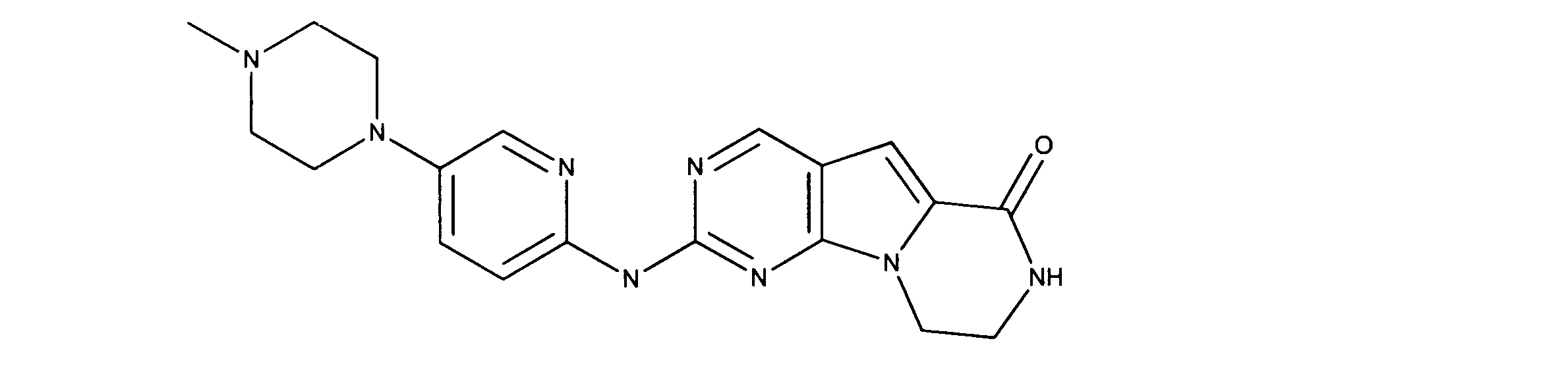
1HNMR (d6-DMSO) δ ppm 11.13 (brs, 1H), 9.07 (s, 1H), 8.42 (s, 1H), 8.03 (br m 1H), 7.99 (s, 1H), 7.67 (brm, 1H), 7.18 (s, 1H), 4.33 (m, 2H), 3.79 (m, 2H), 3.64 (m, 2H), 3.50 (m, 2H), 3.16 (m, 4H), 2.79 (s, 3H). LCMS (ESI) 379 (M + H).
Example 63
Synthesis of
1 HNMR (d6-DMSO) δ ppm 11.13 (brs, 1H), 9.07 (s, 1H), 8.42 (s, 1H), 8.03 (br m 1H), 7.99 (s, 1H), 7.67 (brm, 1H) , 7.18 (s, 1H), 4.33 (m, 2H), 3.79 (m, 2H), 3.64 (m, 2H), 3.50 (m, 2H), 3.16 (m, 4H), 2.79 (s, 3H). LCMS (ESI) 379 (M+H).
実施例64
化合物64の合成
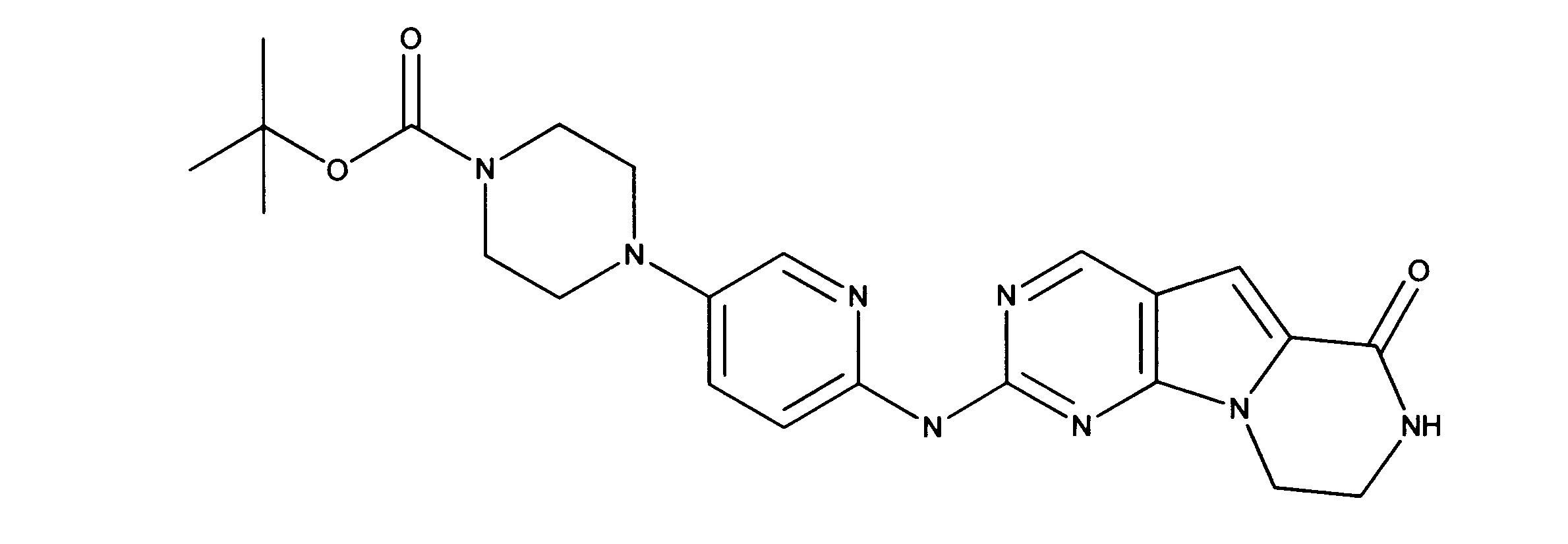
1HNMR (d6-DMSO) δ ppm 9.48 (s, 1H), 8.84 (s, 1H), 8.29 (s, 1H), 8.18 (s, 1H), 7.99 (s, 1H), 7.42 (m, 1H), 6.98 (s, 1H), 4.23 (m, 2H), 3.59 (m, 2H), 3.45 (m, 4H), 3.50 (m, 2H), 3.05 (m, 4H). LCMS (ESI) 465 (M + H).
Example 64
Synthesis of compound 64
1 HNMR (d6-DMSO) δ ppm 9.48 (s, 1H), 8.84 (s, 1H), 8.29 (s, 1H), 8.18 (s, 1H), 7.99 (s, 1H), 7.42 (m, 1H) , 6.98 (s, 1H), 4.23 (m, 2H), 3.59 (m, 2H), 3.45 (m, 4H), 3.50 (m, 2H), 3.05 (m, 4H). LCMS (ESI) 465 (M + H).
実施例65
化合物65の合成
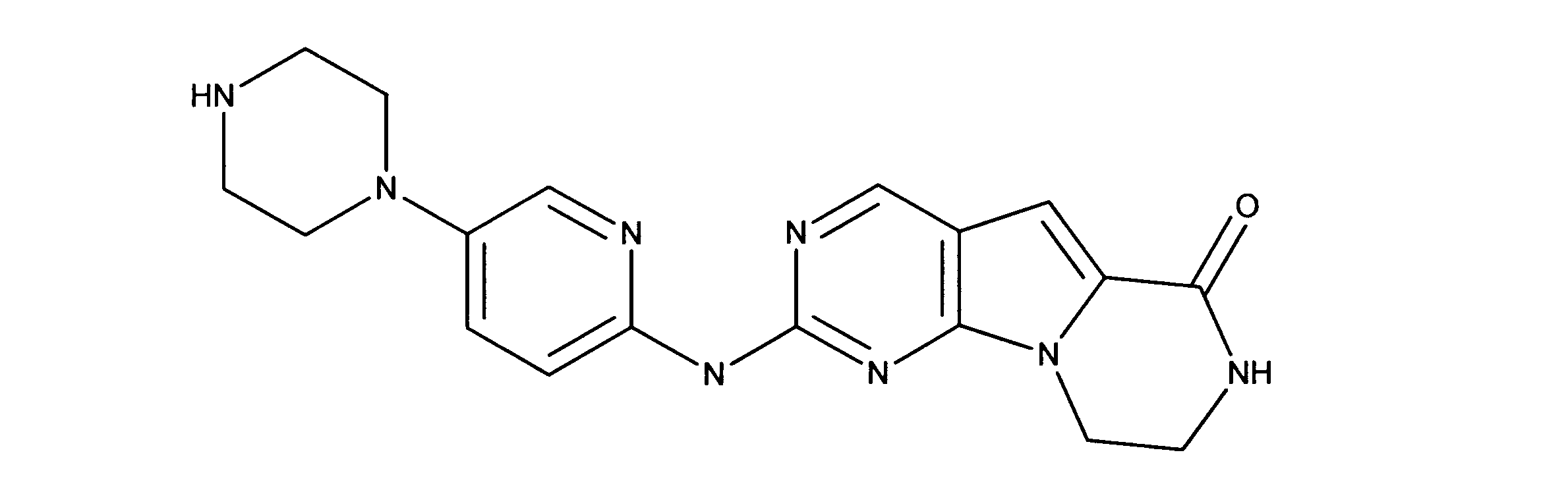
内容物を、16時間撹拌した。
反応物混合物を濃縮し、塩酸塩を提供した。
1HNMR (d6-DMSO) δ ppm 9.01 (s, 1H), 7.94 (m, 1H), 7.86 (m, 1H), 7.23 (s, 1H), 4.30 (m, 2H), 3.64 (m, 2H), 3.36 (m, 4H), 3.25 (m, 4H). LCMS (ESI) 465 (M + H).
Example 65
Synthesis of
The contents were stirred for 16 hours.
The reaction mixture was concentrated to provide the hydrochloride salt.
1 HNMR (d6-DMSO) δ ppm 9.01 (s, 1H), 7.94 (m, 1H), 7.86 (m, 1H), 7.23 (s, 1H), 4.30 (m, 2H), 3.64 (m, 2H) , 3.36 (m, 4H), 3.25 (m, 4H). LCMS (ESI) 465 (M + H).
実施例66
化合物66の合成
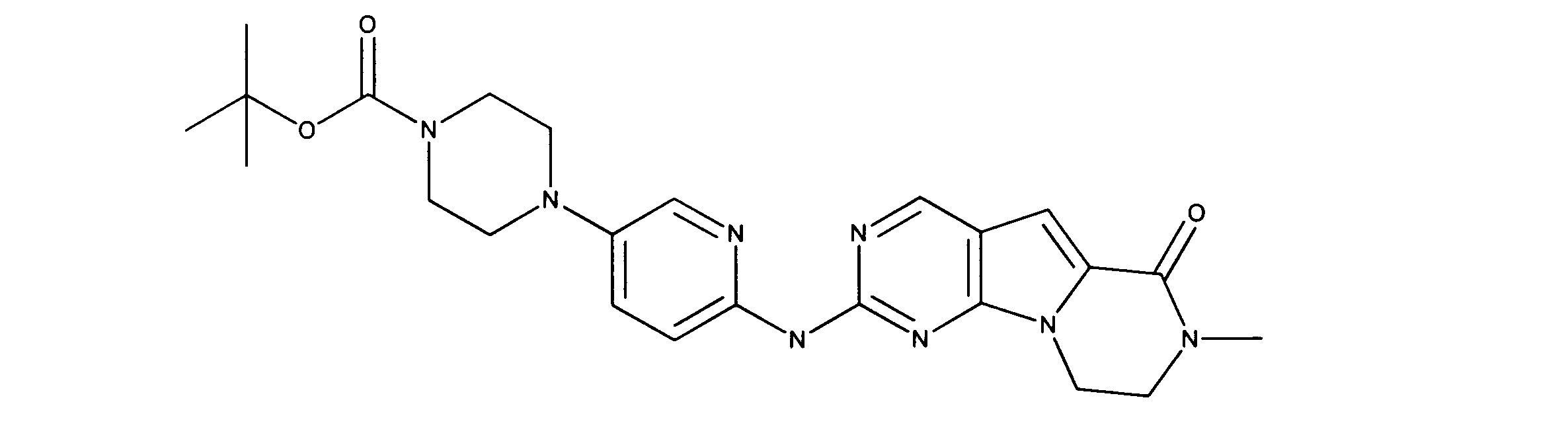
シリカゲルカラムクロマトグラフィーを用いて、ジクロロメタン/メタノール(0~5%)の溶出剤で、粗製品を精製し、所望の製品(44mg)を提供した。
1HNMR (d6-DMSO) δ ppm 9.49 (s, 1H), 8.85 (s, 1H), 8.32 (m, 1H), 8.02 (s, 1H), 7.44 (m, 1H), 7.00 (s, 1H), 4.33 (m, 2H), 3.80 (m, 2H), 3.48 (m, 4H), 3.07 (m, 4H), 3.05 (s, 3H), 1.42 (s, 9H). LCMS (ESI) 479 (M + H)
Example 66
Synthesis of compound 66
The crude product was purified using silica gel column chromatography with an eluent of dichloromethane/methanol (0-5%) to provide the desired product (44 mg).
1 HNMR (d6-DMSO) δ ppm 9.49 (s, 1H), 8.85 (s, 1H), 8.32 (m, 1H), 8.02 (s, 1H), 7.44 (m, 1H), 7.00 (s, 1H) , 4.33 (m, 2H), 3.80 (m, 2H), 3.48 (m, 4H), 3.07 (m, 4H), 3.05 (s, 3H), 1.42 (s, 9H). LCMS (ESI) 479 (M + H)
実施例67
化合物67の合成
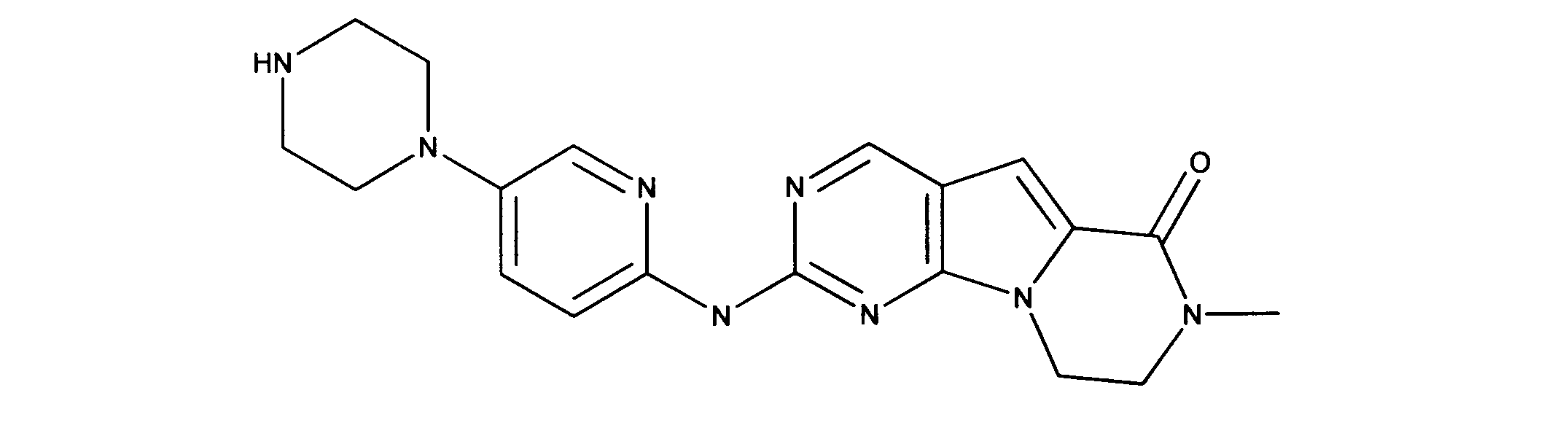
濃縮により、塩酸塩が提供された。
1HNMR (d6-DMSO) δ ppm 9.13 (m, 2H), 8.11 (m, 1H), 8.10 (s, 1H), 7.62 (m, 1H), 7.21 (s, 1H), 4.43 (m, 2H), 3.85 (m, 2H), 3.41 (m, 4H), 3.28 (m, 4H), 3.08 (s, 3H). LCMS (ESI) 379 (M + H).
Example 67
Synthesis of
Concentration provided the hydrochloride salt.
1 HNMR (d6-DMSO) δ ppm 9.13 (m, 2H), 8.11 (m, 1H), 8.10 (s, 1H), 7.62 (m, 1H), 7.21 (s, 1H), 4.43 (m, 2H) , 3.85 (m, 2H), 3.41 (m, 4H), 3.28 (m, 4H), 3.08 (s, 3H). LCMS (ESI) 379 (M + H).
実施例68
化合物68の合成
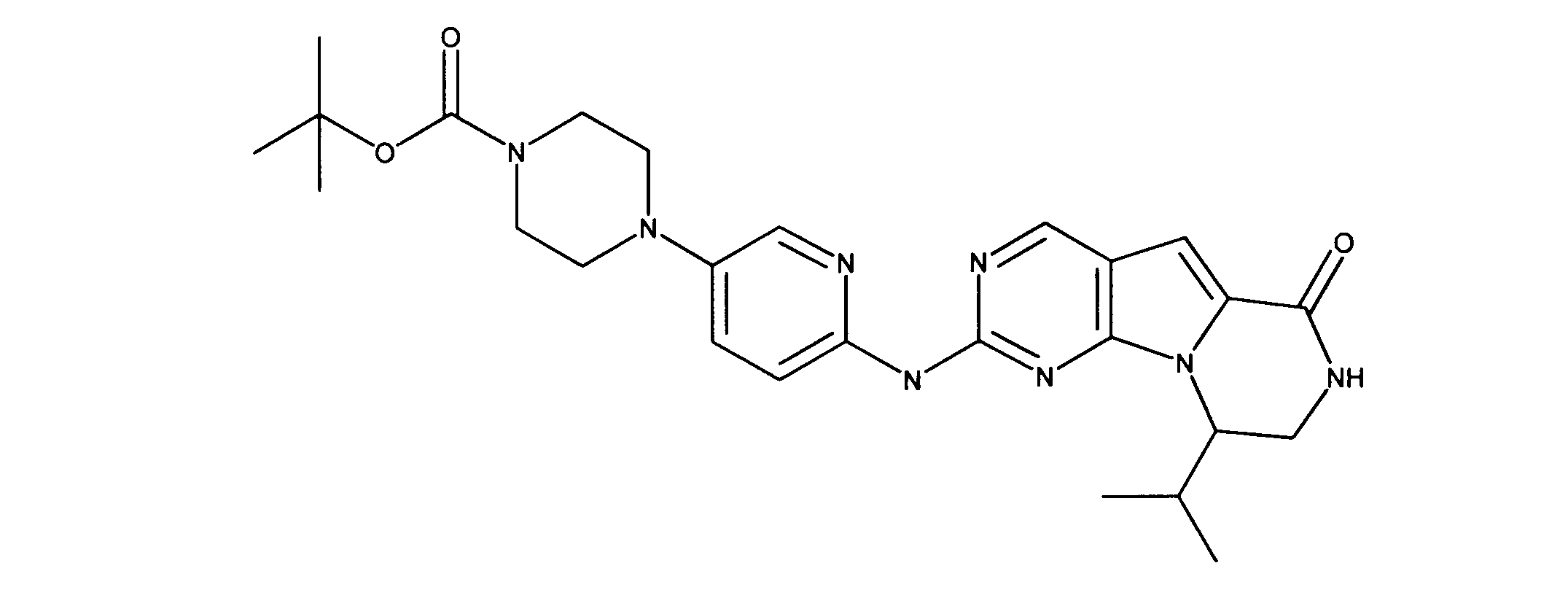
1HNMR (600 MHz, DMSO-d6) δ ppm 0.79 (d, J=7.03 Hz, 3 H) 1.01 (d, J=6.73 Hz, 3 H) 1.35 - 1.48 (m, 9 H) 2.16 (dd, J=14.64, 6.73 Hz, 1 H) 3.00 - 3.14 (m, 4 H) 3.40 - 3.51 (m, 4 H) 3.51 - 3.60 (m, 1 H) 3.63 - 3.74 (m, 1 H) 4.44 (dd, J=7.90, 3.81 Hz, 1 H) 6.99 (s, 1 H) 7.46 (dd, J=8.93, 2.78 Hz, 1 H) 7.94 - 8.09 (m, 2 H) 8.31 (dd, J=9.08, 1.46 Hz, 1 H) 8.85 (s, 1 H) 9.46 (s, 1 H). LCMS (ESI) 507 (M + H)
Example 68
Synthesis of compound 68
1 HNMR (600 MHz, DMSO-d 6 ) δ ppm 0.79 (d, J=7.03 Hz, 3 H) 1.01 (d, J=6.73 Hz, 3 H) 1.35 - 1.48 (m, 9 H) 2.16 (dd, J=14.64, 6.73Hz, 1H) 3.00 - 3.14 (m, 4H) 3.40 - 3.51 (m, 4H) 3.51 - 3.60 (m, 1H) 3.63 - 3.74 (m, 1H) 4.44 (dd, J=7.90, 3.81Hz, 1H) 6.99 (s, 1H) 7.46 (dd, J=8.93, 2.78Hz, 1H) 7.94 - 8.09 (m, 2H) 8.31 (dd, J=9.08, 1.46Hz , 1 H) 8.85 (s, 1 H) 9.46 (s, 1 H). LCMS (ESI) 507 (M + H)
実施例69
化合物69の合成
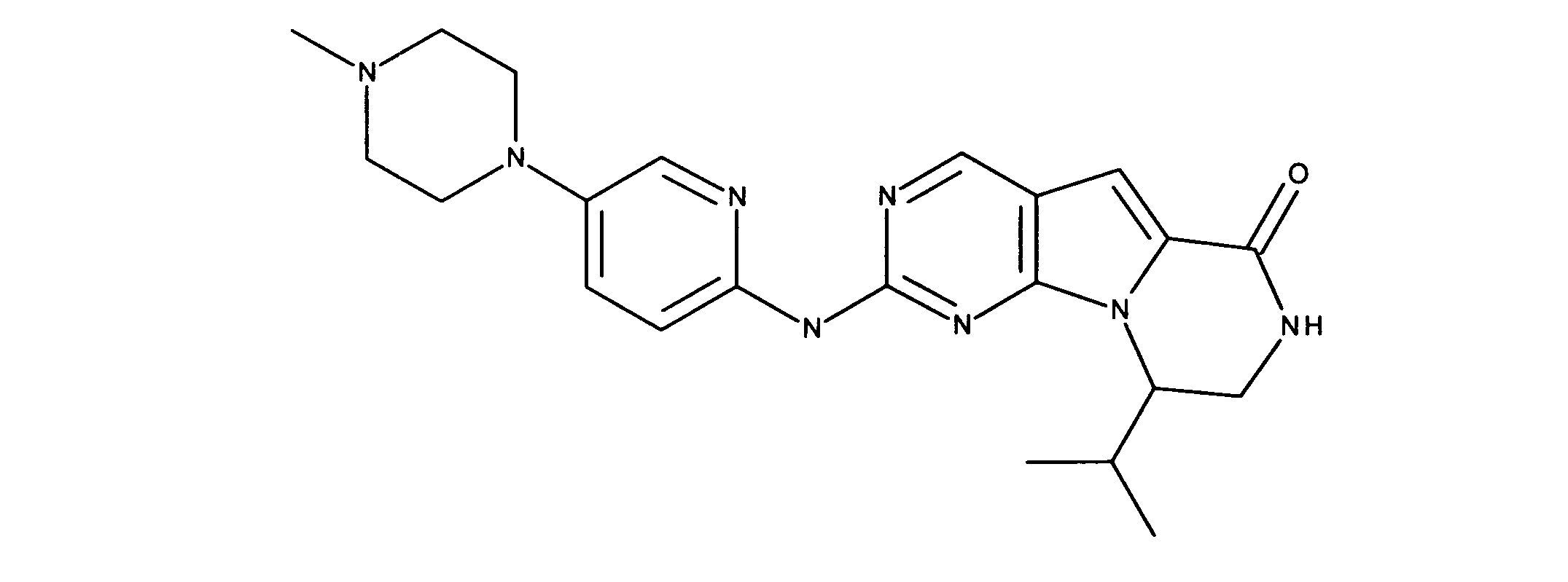
1HNMR (600 MHz, DMSO-d6) δ ppm 0.77 - 0.86 (m, 3 H) 0.96 (d, J=7.03 Hz, 3 H) 2.10 - 2.24 (m, 1 H) 3.07 (s, 3 H) 3.37 - 3.79 (m, 8 H) 4.00 (dd, J=13.61, 4.54 Hz, 2 H) 4.63 - 4.73 (m, 1 H) 7.20 (s, 1 H) 7.58 - 7.71 (m, 1 H) 7.99 (d, J=2.34 Hz, 1 H) 8.12 (d, J=9.37 Hz, 1 H) 9.11 (s, 1 H) 9.41 (br. s., 2 H) 11.76 (br. s., 1 H). LCMS (ESI) 421 (M + H).
Example 69
Synthesis of compound 69
1 HNMR (600 MHz, DMSO-d 6 ) δ ppm 0.77 - 0.86 (m, 3 H) 0.96 (d, J=7.03 Hz, 3 H) 2.10 - 2.24 (m, 1 H) 3.07 (s, 3 H) 3.37 - 3.79 (m, 8 H) 4.00 (dd, J=13.61, 4.54 Hz, 2 H) 4.63 - 4.73 (m, 1 H) 7.20 (s, 1 H) 7.58 - 7.71 (m, 1 H) 7.99 ( d, J=2.34 Hz, 1 H) 8.12 (d, J=9.37 Hz, 1 H) 9.11 (s, 1 H) 9.41 (br. s., 2 H) 11.76 (br. s., 1 H). LCMS (ESI) 421 (M+H).
実施例70
化合物70の合成
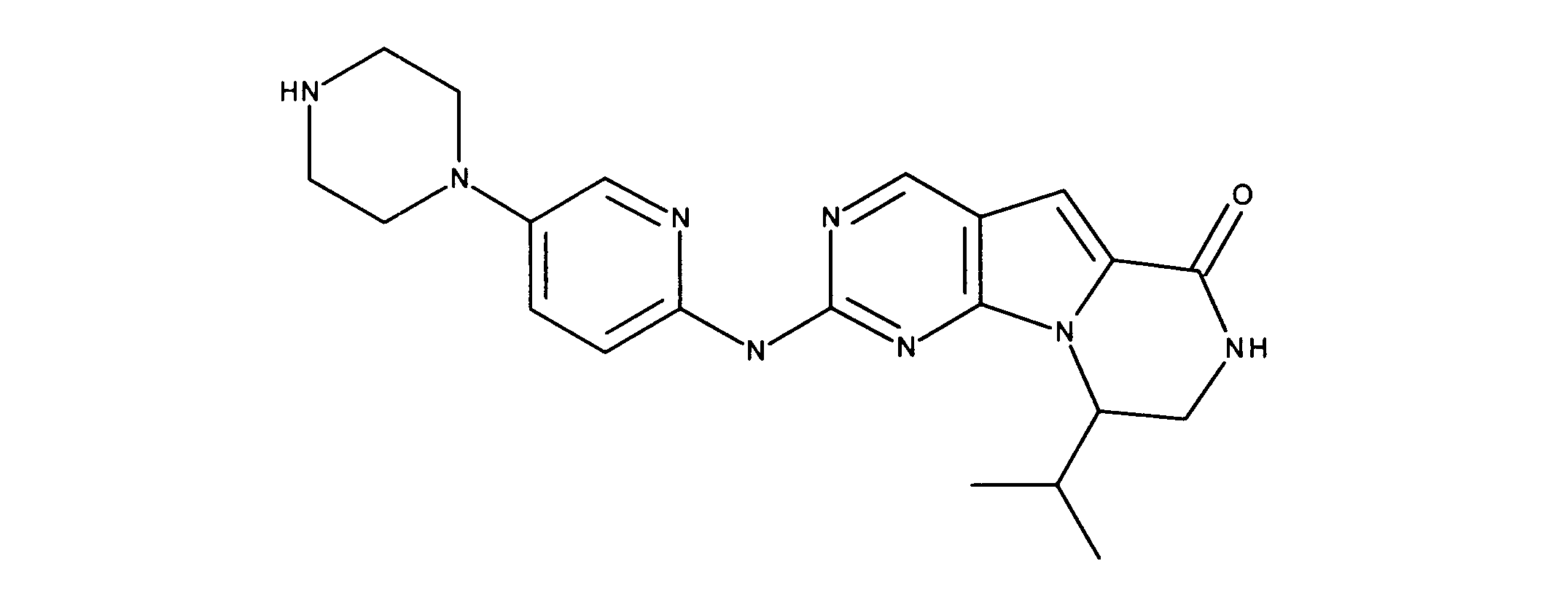
Synthesis of
実施例71
化合物71の合成
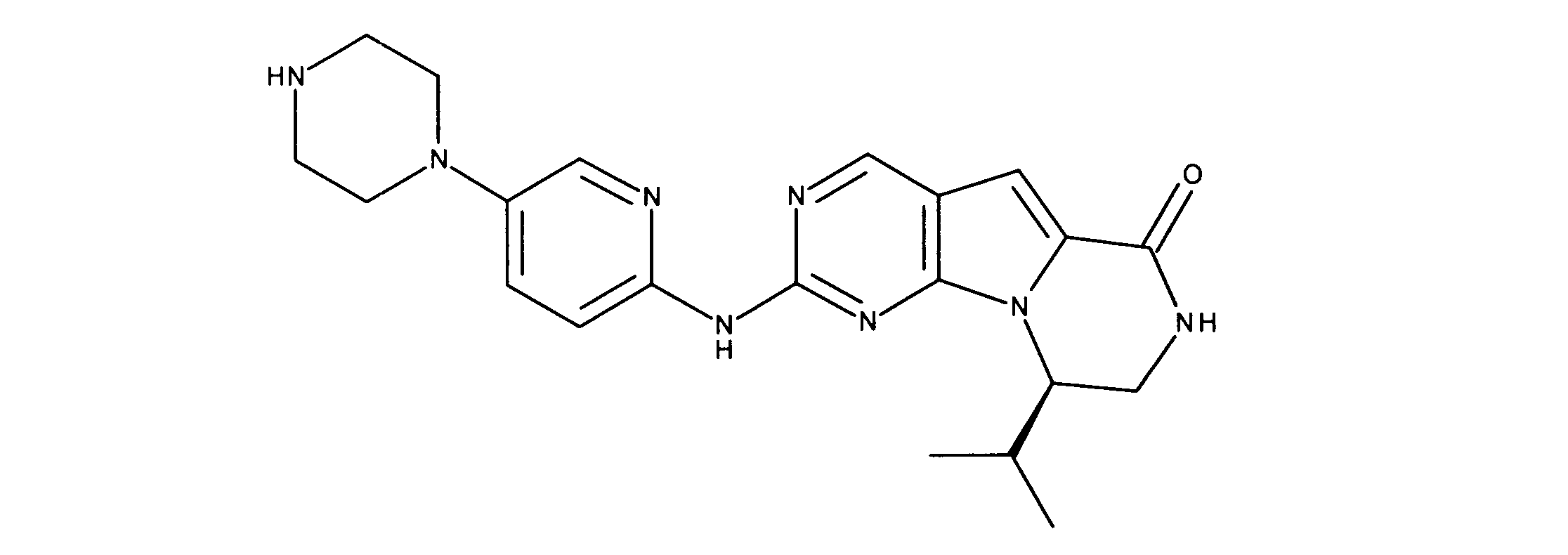
1HNMR (600 MHz, DMSO-d6) δ ppm 0.79 (d, J=6.73 Hz, 3 H) 1.01 (d, J=6.73 Hz, 3 H) 2.18 (dd, J=14.49, 7.17 Hz, 1 H) 3.18 - 3.84 (m, 10 H) 4.53 - 4.71 (m, 1 H) 7.24 (s, 1 H) 7.65 (d, J=9.37 Hz, 1 H) 8.01 (d, J=2.64 Hz, 1 H) 8.14 (d, J=1.46 Hz, 1 H) 8.35 (d, J=5.27 Hz, 1 H) 9.14 (s, 1 H) 9.46 (s, 2 H) 11.80 (s, 1 H) LCMS (ESI) 407 (M+H).
Example 71
Synthesis of compound 71
1 HNMR (600 MHz, DMSO-d 6 ) δ ppm 0.79 (d, J=6.73 Hz, 3 H) 1.01 (d, J=6.73 Hz, 3 H) 2.18 (dd, J=14.49, 7.17 Hz, 1 H ) 3.18 - 3.84 (m, 10 H) 4.53 - 4.71 (m, 1 H) 7.24 (s, 1 H) 7.65 (d, J=9.37 Hz, 1 H) 8.01 (d, J=2.64 Hz, 1 H) 8.14 (d, J=1.46 Hz, 1 H) 8.35 (d, J=5.27 Hz, 1 H) 9.14 (s, 1 H) 9.46 (s, 2 H) 11.80 (s, 1 H) LCMS (ESI) 407 (M+H).
実施例72
化合物72(化合物UUU)の合成
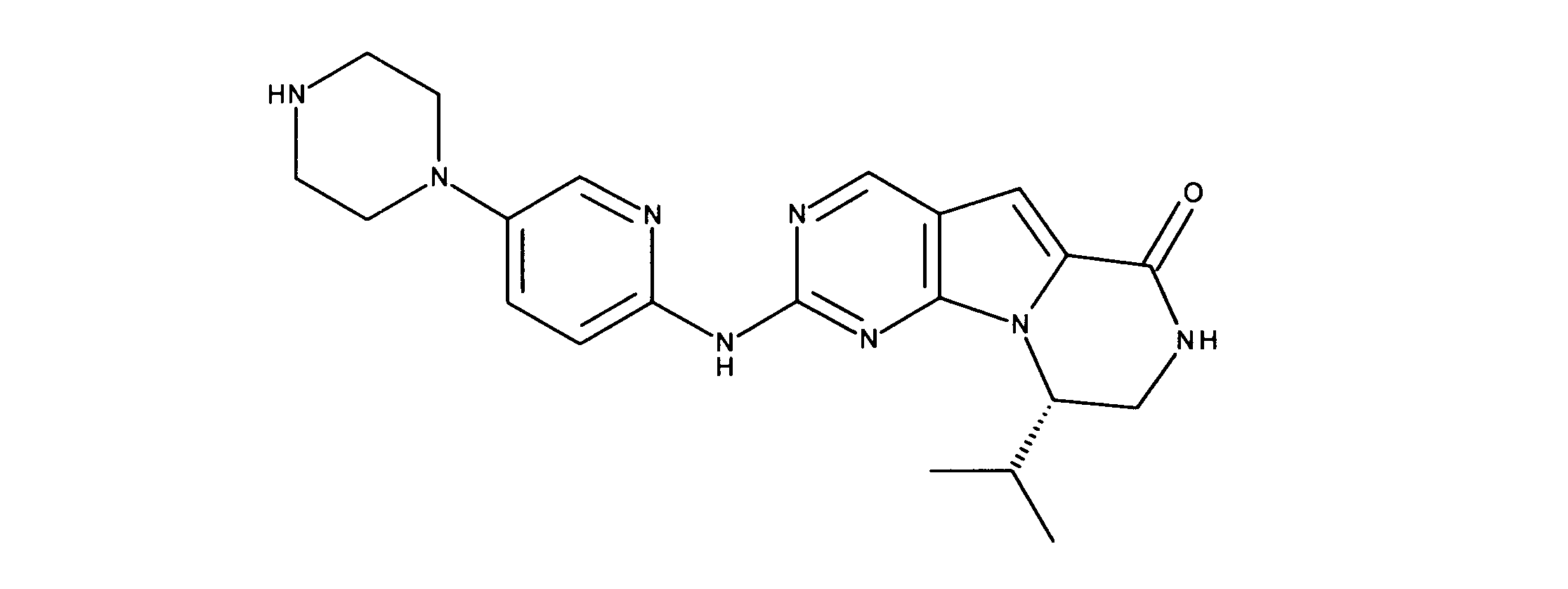
1HNMR (600 MHz, DMSO-d6) δ ppm 0.77 (d, J=7.03 Hz, 3 H) 0.99 (d, J=6.73 Hz, 3 H) 2.10 - 2.24 (m, 1 H) 3.18 - 3.81 (m, 10 H) 4.54 - 4.69 (m, 1 H) 7.22 (s, 1 H) 7.63 (d, J=9.08 Hz, 1 H) 7.99 (d, J=2.63 Hz, 1 H) 8.11 (s, 1 H) 8.33 (d, J=5.27 Hz, 1 H) 9.12 (s, 1 H) 9.43 (s, 2 H) 11.77 (s, 1 H). LCMS (ESI) 407 (M+H).
Example 72
Synthesis of Compound 72 (Compound UUU)
1 HNMR (600 MHz, DMSO-d 6 ) δ ppm 0.77 (d, J=7.03 Hz, 3 H) 0.99 (d, J=6.73 Hz, 3 H) 2.10 - 2.24 (m, 1 H) 3.18 - 3.81 ( m, 10H) 4.54 - 4.69 (m, 1H) 7.22 (s, 1H) 7.63 (d, J=9.08Hz, 1H) 7.99 (d, J=2.63Hz, 1H) 8.11 (s, 1H) H) 8.33 (d, J=5.27 Hz, 1 H) 9.12 (s, 1 H) 9.43 (s, 2 H) 11.77 (s, 1 H). LCMS (ESI) 407 (M+H).
実施例73
化合物73の合成
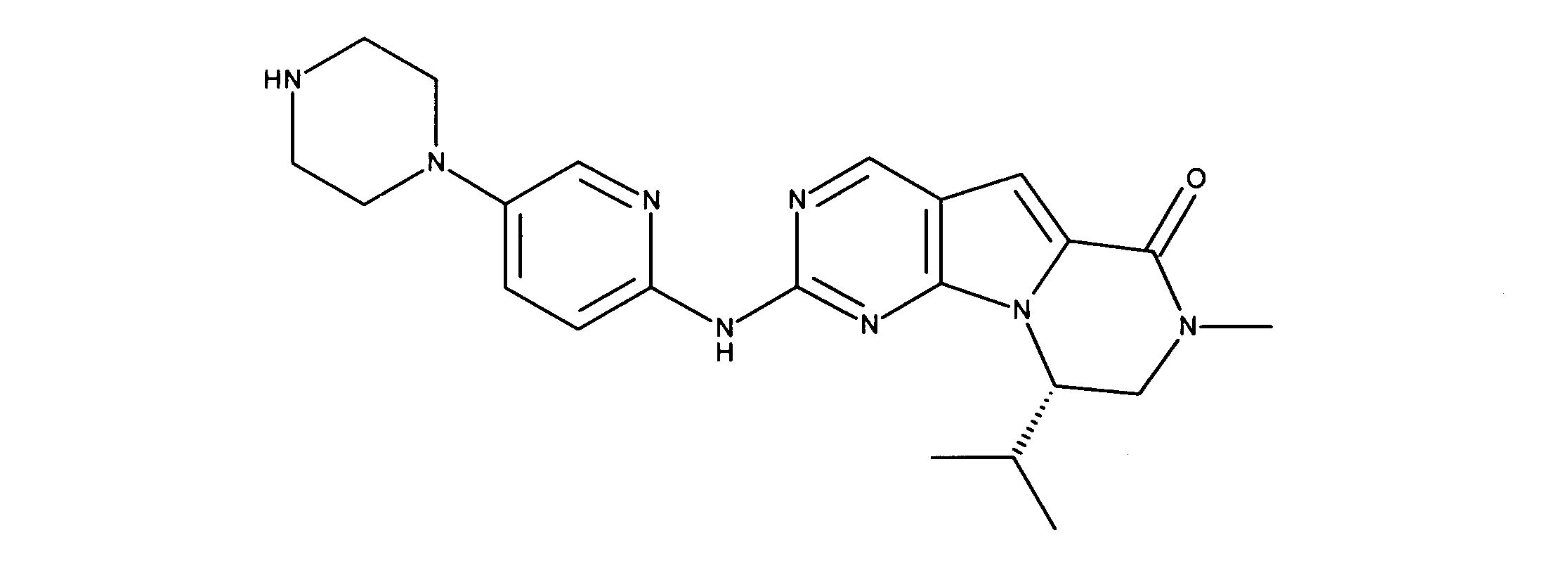
1HNMR (600 MHz, DMSO-d6) δ ppm 0.84 (d, J=6.73 Hz, 3 H) 0.98 (d, J=6.73 Hz, 3 H) 2.12 - 2.26 (m, 1 H) 3.09 (s, 3 H) 3.22 - 3.81 (m, 8 H) 4.01 (dd, J=13.61, 4.25 Hz, 2 H) 4.59 - 4.72 (m, 1 H) 7.19 (s, 1 H) 7.74 (s, 1 H) 7.96 - 8.10 (m, 2 H) 9.08 (s, 1 H) 9.22 (s, 2 H). LCMS (ESI) 421 (M+H).
Example 73
Synthesis of
1 HNMR (600 MHz, DMSO-d 6 ) δ ppm 0.84 (d, J=6.73 Hz, 3 H) 0.98 (d, J=6.73 Hz, 3 H) 2.12 - 2.26 (m, 1 H) 3.09 (s, 3 H) 3.22 - 3.81 (m, 8 H) 4.01 (dd, J=13.61, 4.25 Hz, 2 H) 4.59 - 4.72 (m, 1 H) 7.19 (s, 1 H) 7.74 (s, 1 H) 7.96 - 8.10 (m, 2 H) 9.08 (s, 1 H) 9.22 (s, 2 H). LCMS (ESI) 421 (M+H).
実施例74
化合物74の合成
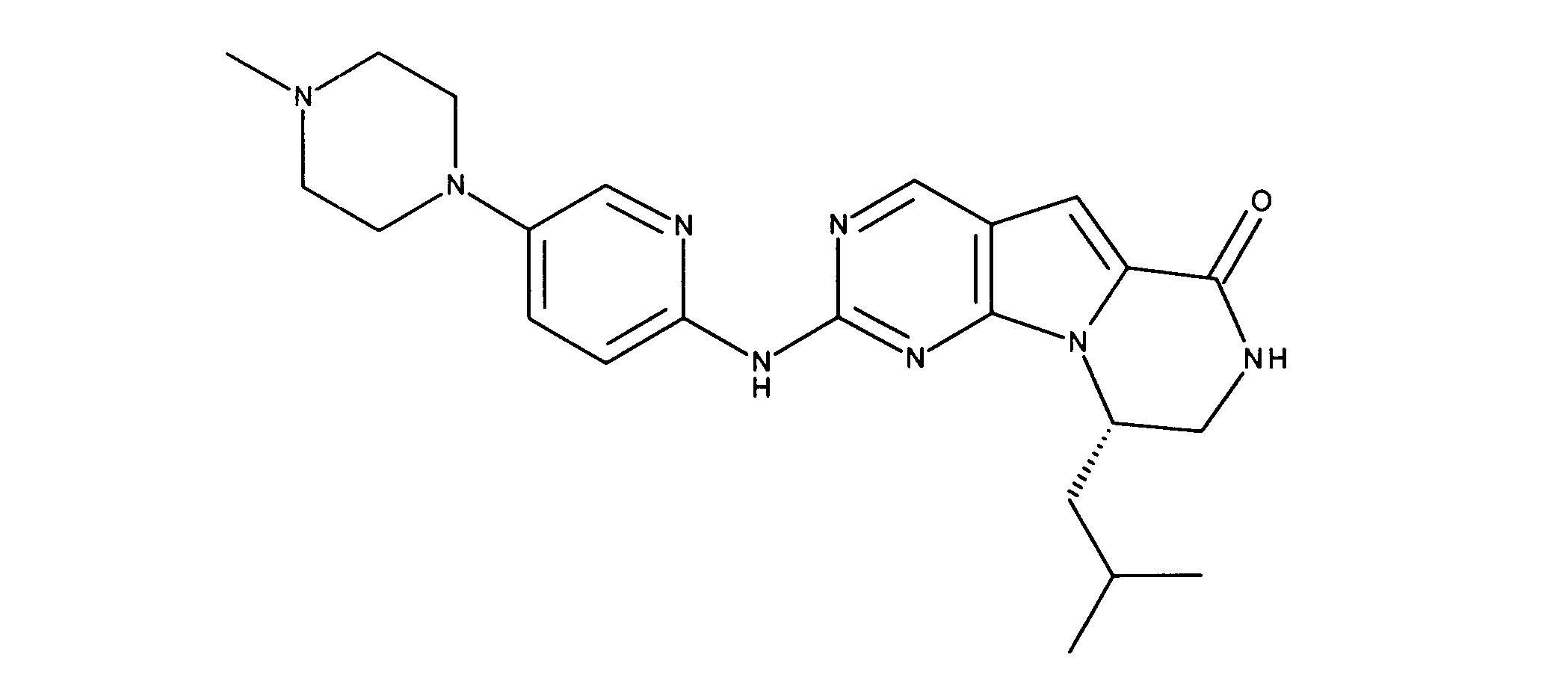
1HNMR (600 MHz, DMSO-d6) δ ppm 0.85 (d, J=4.98 Hz, 3 H) 0.95 (d, J=4.98 Hz, 3 H) 1.42 - 1.70 (m, 3 H) 2.77 (d, J=2.93 Hz, 3 H) 3.07 - 4.14 (m, 10 H) 4.95 (s, 1 H) 7.20 (s, 1 H) 7.66 (d, J=9.66 Hz, 1 H) 7.94 (s, 1 H) 8.08 - 8.16 (m, 1 H) 8.33 (d, J=4.68 Hz, 1 H) 9.09 (s, 1 H) 11.38 (s, 1 H) 11.71 (s, 1 H). LCMS (ESI) 435 (M+H).
Example 74
Synthesis of compound 74
1 HNMR (600 MHz, DMSO-d 6 ) δ ppm 0.85 (d, J=4.98 Hz, 3 H) 0.95 (d, J=4.98 Hz, 3 H) 1.42 - 1.70 (m, 3 H) 2.77 (d, J=2.93Hz, 3H) 3.07 - 4.14 (m, 10H) 4.95 (s, 1H) 7.20 (s, 1H) 7.66 (d, J=9.66Hz, 1H) 7.94 (s, 1H) 8.08 - 8.16 (m, 1 H) 8.33 (d, J=4.68 Hz, 1 H) 9.09 (s, 1 H) 11.38 (s, 1 H) 11.71 (s, 1 H). LCMS (ESI) 435 (M +H).
実施例75
化合物75の合成
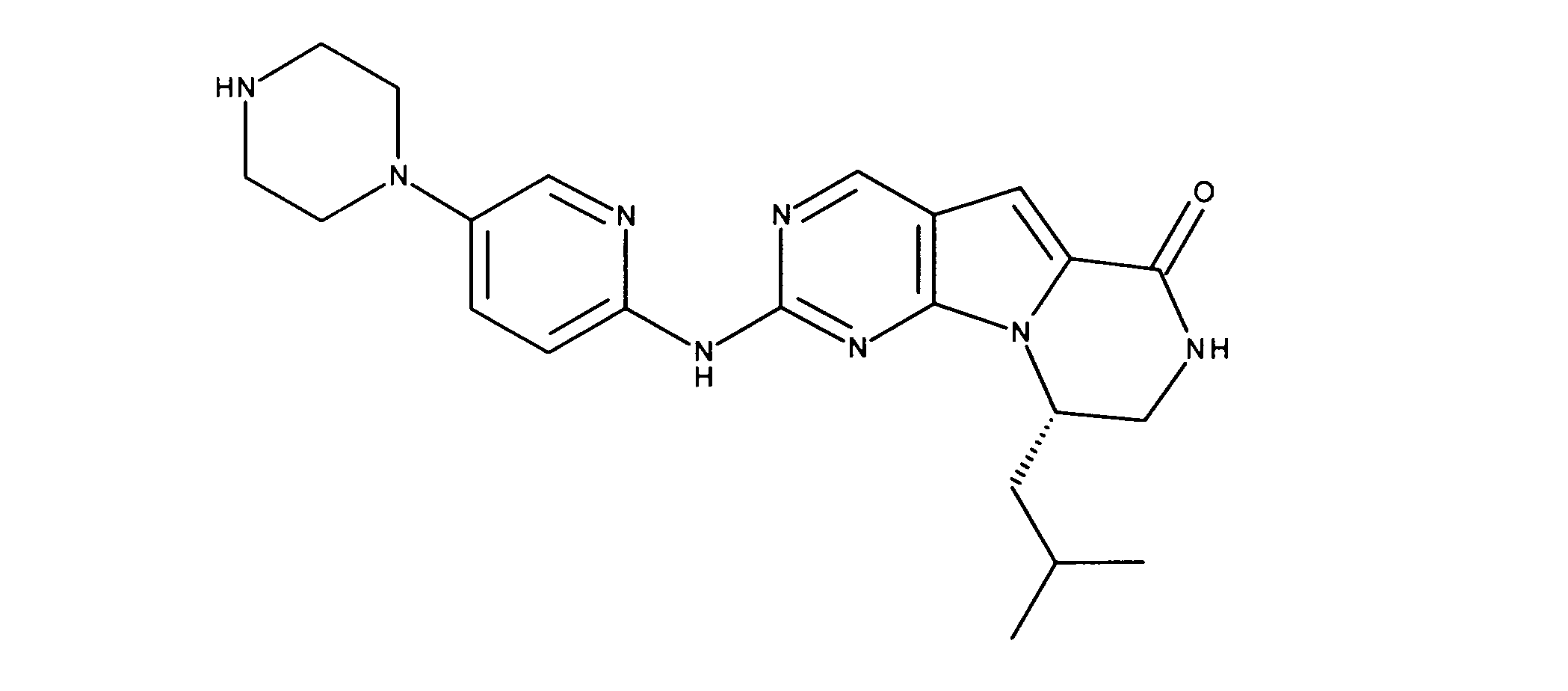
1HNMR (600 MHz, DMSO-d6) δ ppm 0.87 (d, J=6.15 Hz, 3 H) 0.94 (d, J=6.15 Hz, 3 H) 1.57 (d, J=84.61 Hz, 3 H) 3.05 (s, 3 H) 3.13 - 3.55 (m, 8 H) 3.69 (d, J=78.17 Hz, 2 H) 4.90 (s, 1 H) 7.15 (s, 1 H) 7.63 - 7.85 (m, 1 H) 7.93 (s, 1 H) 8.26 (s, 1 H) 9.03 (s, 1 H) 9.20 (s, 2 H). LCMS (ESI) 421 (M+H).
Example 75
Synthesis of
1 HNMR (600 MHz, DMSO-d 6 ) δ ppm 0.87 (d, J=6.15 Hz, 3 H) 0.94 (d, J=6.15 Hz, 3 H) 1.57 (d, J=84.61 Hz, 3 H) 3.05 (s, 3 H) 3.13 - 3.55 (m, 8 H) 3.69 (d, J=78.17 Hz, 2 H) 4.90 (s, 1 H) 7.15 (s, 1 H) 7.63 - 7.85 (m, 1 H) 7.93 (s, 1 H) 8.26 (s, 1 H) 9.03 (s, 1 H) 9.20 (s, 2 H). LCMS (ESI) 421 (M+H).
実施例76
化合物76の合成
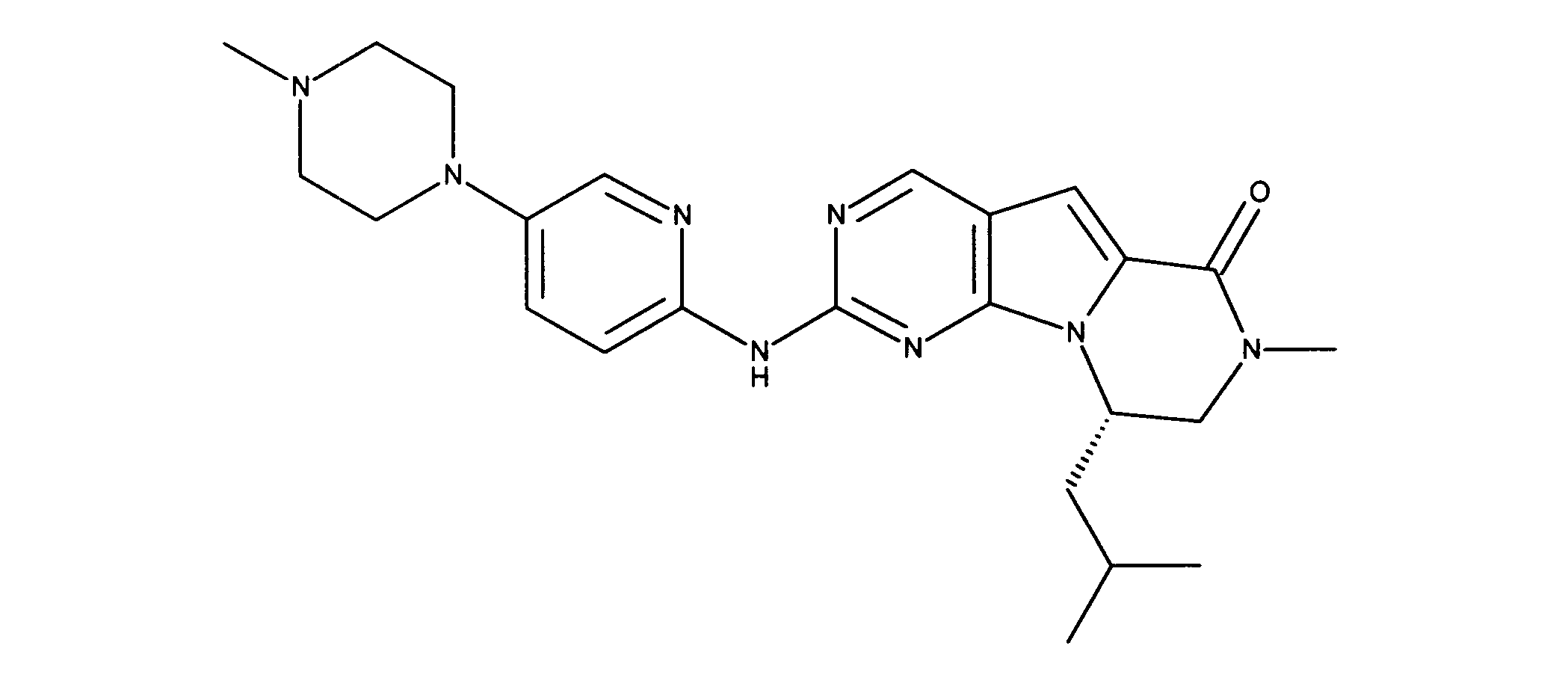
1HNMR (600 MHz, DMSO-d6) δ ppm 0.85 (d, J=6.44 Hz, 3 H) 0.95 (d, J=6.44 Hz, 3 H) 1.43 - 1.70 (m, 3 H) 2.78 (d, J=2.93 Hz, 3 H) 3.05 (s, 3 H) 3.24 - 3.84 (m, 8 H) 4.01 (d, J=9.66 Hz, 2 H) 4.89 - 5.01 (m, 1 H) 7.15 (s, 1 H) 7.77 (s, 1 H) 7.91 - 8.05 (m, 2 H) 9.03 (s, 1 H) 10.96 - 11.55 (m, 2 H). LCMS (ESI) 449 (M+H).
Example 76
Synthesis of compound 76
1 HNMR (600 MHz, DMSO-d 6 ) δ ppm 0.85 (d, J=6.44 Hz, 3 H) 0.95 (d, J=6.44 Hz, 3 H) 1.43 - 1.70 (m, 3 H) 2.78 (d, J=2.93Hz, 3H) 3.05 (s, 3H) 3.24 - 3.84 (m, 8H) 4.01 (d, J=9.66Hz, 2H) 4.89 - 5.01 (m, 1H) 7.15 (s, 1 H) 7.77 (s, 1 H) 7.91 - 8.05 (m, 2 H) 9.03 (s, 1 H) 10.96 - 11.55 (m, 2 H). LCMS (ESI) 449 (M+H).
実施例77
化合物77の合成
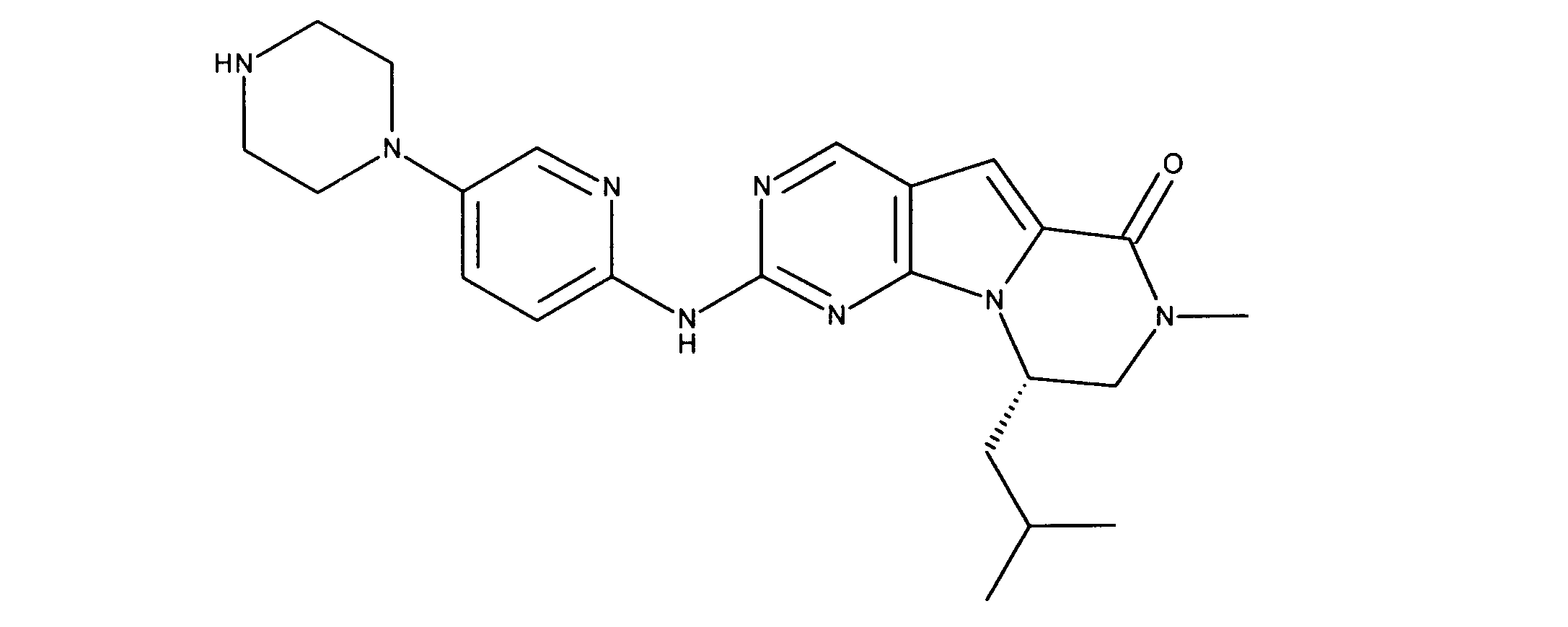
1HNMR (600 MHz, DMSO-d6) δ ppm 0.83 - 0.88 (d, J=6.15 Hz, 3 H) 0.95 (d, J=6.15 Hz, 3 H) 1.40 - 1.71 (m, 3 H) 3.28 - 3.83 (m, 8 H) 4.00 (d, J=3.22 Hz, 2 H) 4.91 - 5.08 (m, 1 H) 7.17 (s, 1 H) 7.68 (d, J=9.66 Hz, 1 H) 7.93 (s, 1 H) 8.07 (s, 1 H) 9.06 (s, 1 H) 9.40 (s, 2 H) 11.59 (s, 1 H). LCMS (ESI) 435 (M+H).
Example 77
Synthesis of compound 77
1 HNMR (600 MHz, DMSO-d 6 ) δ ppm 0.83 - 0.88 (d, J=6.15 Hz, 3 H) 0.95 (d, J=6.15 Hz, 3 H) 1.40 - 1.71 (m, 3 H) 3.28 - 3.83 (m, 8H) 4.00 (d, J=3.22Hz, 2H) 4.91 - 5.08 (m, 1H) 7.17 (s, 1H) 7.68 (d, J=9.66Hz, 1H) 7.93 (s , 1 H) 8.07 (s, 1 H) 9.06 (s, 1 H) 9.40 (s, 2 H) 11.59 (s, 1 H). LCMS (ESI) 435 (M+H).
実施例78
化合物78の合成
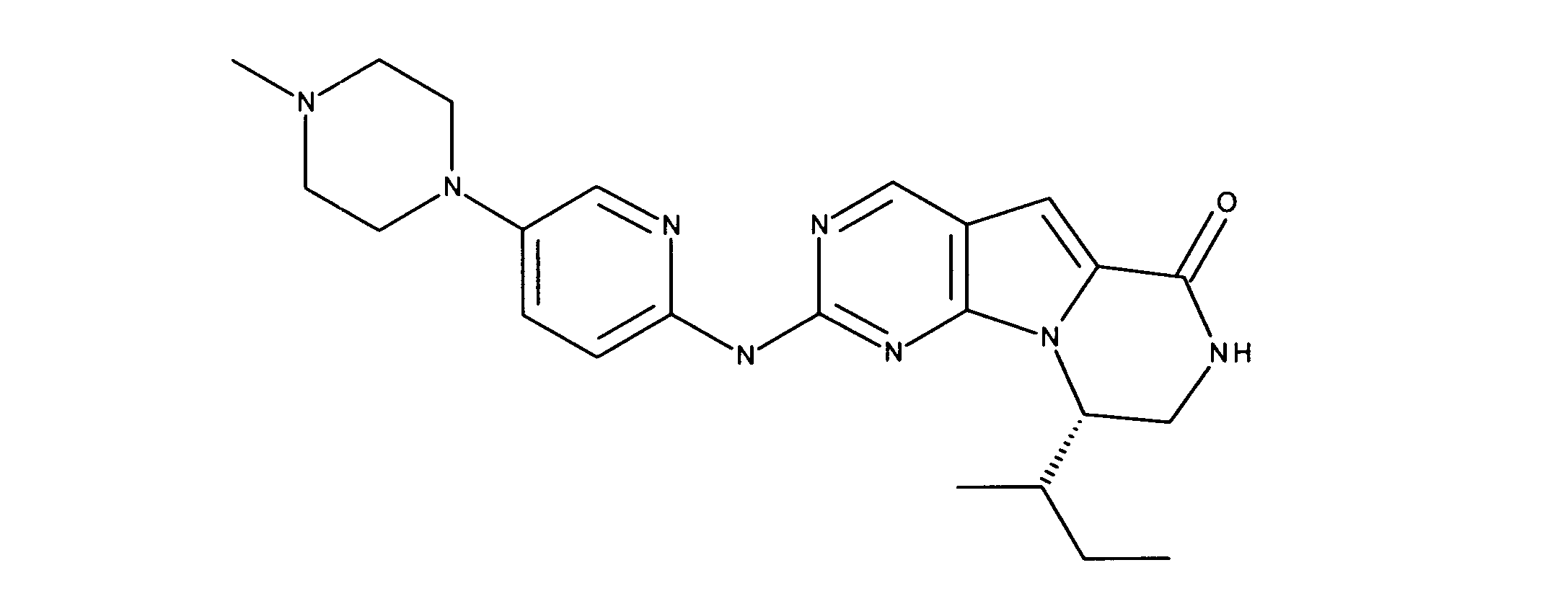
1HNMR (600 MHz, DMSO-d6) δ ppm 0.75 (t, J=7.47 Hz, 3 H) 0.91 (d, J=6.73 Hz, 3 H) 1.04 - 1.20 (m, 2 H) 1.80 - 1.98 (m, 1 H) 2.77 (d, J=3.81 Hz, 3 H) 2.94 - 3.90 (m, 10 H) 4.54 - 4.68 (m, 1 H) 7.06 - 7.23 (m, 2 H) 7.56 - 7.75 (m, 1 H) 7.90 - 8.12 (m, 2 H) 8.29 (s, 1 H) 9.07 (s, 1 H) 10.98 - 11.74 (m, 2 H). LCMS (ESI) 435 (M + H).
Example 78
Synthesis of compound 78
1 HNMR (600 MHz, DMSO-d 6 ) δ ppm 0.75 (t, J=7.47 Hz, 3 H) 0.91 (d, J=6.73 Hz, 3 H) 1.04 - 1.20 (m, 2 H) 1.80 - 1.98 ( m, 1 H) 2.77 (d, J=3.81 Hz, 3 H) 2.94 - 3.90 (m, 10 H) 4.54 - 4.68 (m, 1 H) 7.06 - 7.23 (m, 2 H) 7.56 - 7.75 (m, 1 H) 7.90 - 8.12 (m, 2 H) 8.29 (s, 1 H) 9.07 (s, 1 H) 10.98 - 11.74 (m, 2 H). LCMS (ESI) 435 (M + H).
実施例79
化合物79の合成
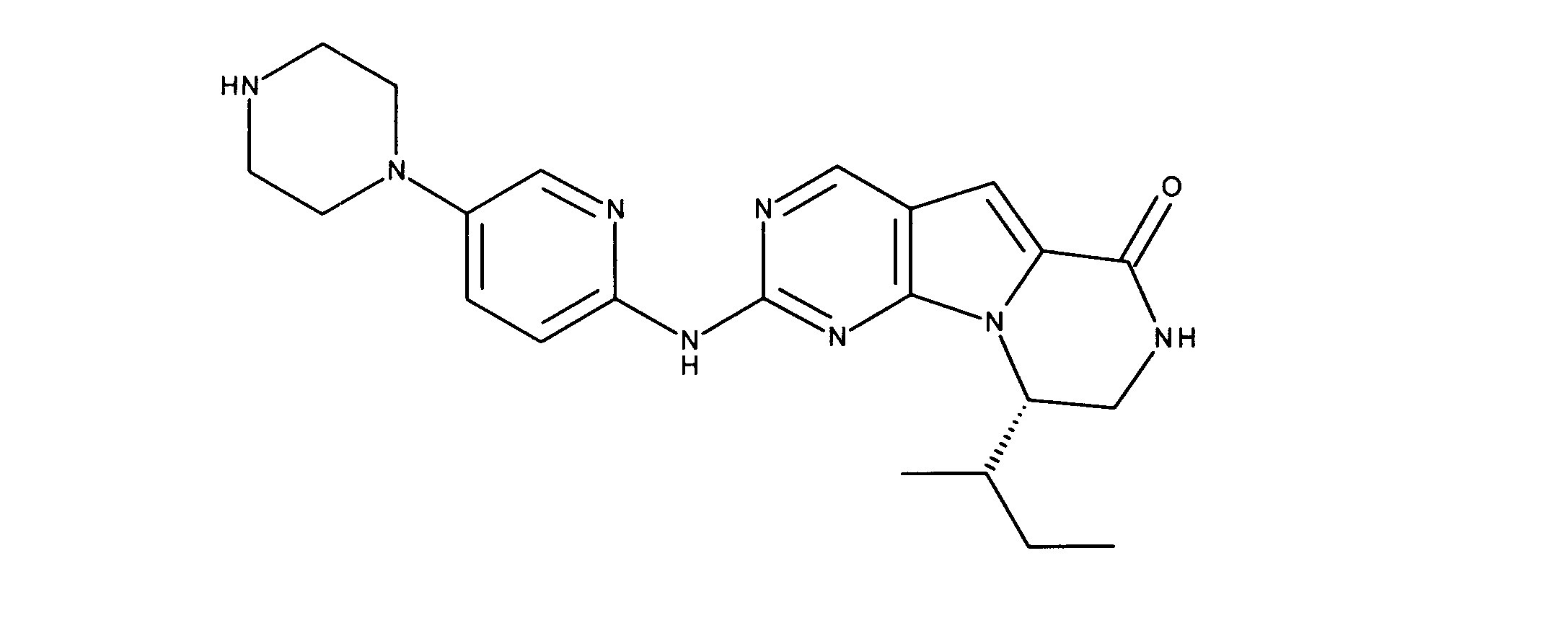
1HNMR (600 MHz, DMSO-d6) δ ppm 0.75 (t, J=7.32 Hz, 3 H) 0.90 (d, J=6.73 Hz, 3 H) 1.07 - 1.15 (m, 2 H) 1.85 - 1.94 (m, 1 H) 3.17 - 3.75 (m, 10 H) 4.58 - 4.67 (m, 1 H) 7.17 (s, 1 H) 7.71 (s, 1 H) 7.96 (s, 1 H) 7.98 - 8.05 (m, 1 H) 8.28 (d, J=4.10 Hz, 1 H) 9.06 (s, 1 H) 9.39 (s, 2 H). LCMS (ESI) 421 (M+H).
Example 79
Synthesis of compound 79
1 HNMR (600 MHz, DMSO-d 6 ) δ ppm 0.75 (t, J=7.32 Hz, 3 H) 0.90 (d, J=6.73 Hz, 3 H) 1.07 - 1.15 (m, 2 H) 1.85 - 1.94 ( m, 1H) 3.17 - 3.75 (m, 10H) 4.58 - 4.67 (m, 1H) 7.17 (s, 1H) 7.71 (s, 1H) 7.96 (s, 1H) 7.98 - 8.05 (m, 1 H) 8.28 (d, J=4.10 Hz, 1 H) 9.06 (s, 1 H) 9.39 (s, 2 H). LCMS (ESI) 421 (M+H).
実施例80
化合物80の合成
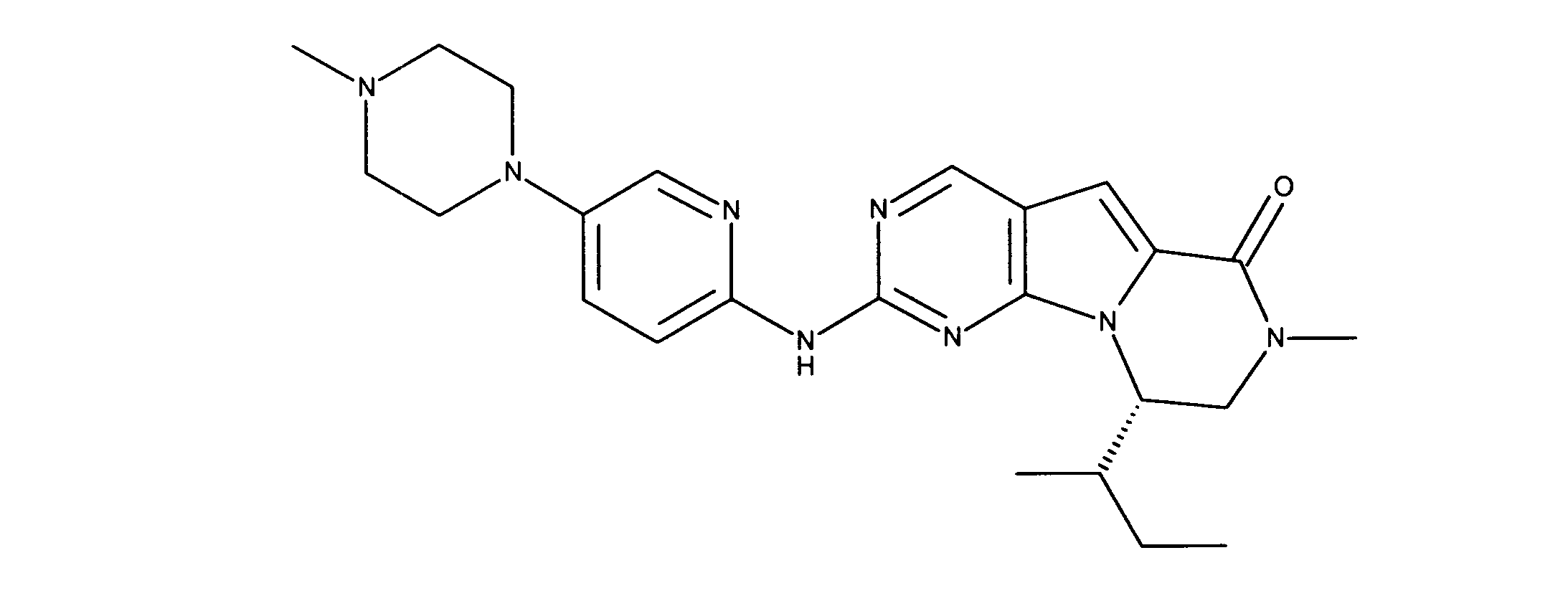
1HNMR (600 MHz, DMSO-d6) δ ppm 0.78 (t, J=7.32 Hz, 3 H) 0.86 (d, J=6.73 Hz, 3 H) 1.13 - 1.21 (m, 2 H) 1.84 - 1.96 (m, 1 H) 2.77 (d, J=4.39 Hz, 3 H) 3.04 (s, 3 H) 3.11 - 3.84 (m, 8 H) 3.98 (dd, J=13.61, 4.25 Hz, 2 H) 4.66 - 4.74 (m, 1 H) 7.17 (s, 1 H) 7.64 (s, 1 H) 7.96 (d, J=2.34 Hz, 1 H) 8.03 - 8.13 (m, 1 H) 9.08 (s, 1 H) 11.26 (s, 1 H) 11.66 (s, 1 H). LCMS (ESI) 449 (M+H).
Example 80
Synthesis of
1 HNMR (600 MHz, DMSO-d 6 ) δ ppm 0.78 (t, J=7.32 Hz, 3 H) 0.86 (d, J=6.73 Hz, 3 H) 1.13 - 1.21 (m, 2 H) 1.84 - 1.96 ( m, 1H) 2.77 (d, J=4.39Hz, 3H) 3.04 (s, 3H) 3.11 - 3.84 (m, 8H) 3.98 (dd, J=13.61, 4.25Hz, 2H) 4.66 - 4.74 (m, 1 H) 7.17 (s, 1 H) 7.64 (s, 1 H) 7.96 (d, J=2.34 Hz, 1 H) 8.03 - 8.13 (m, 1 H) 9.08 (s, 1 H) 11.26 ( s, 1 H) 11.66 (s, 1 H). LCMS (ESI) 449 (M+H).
実施例81
化合物81の合成
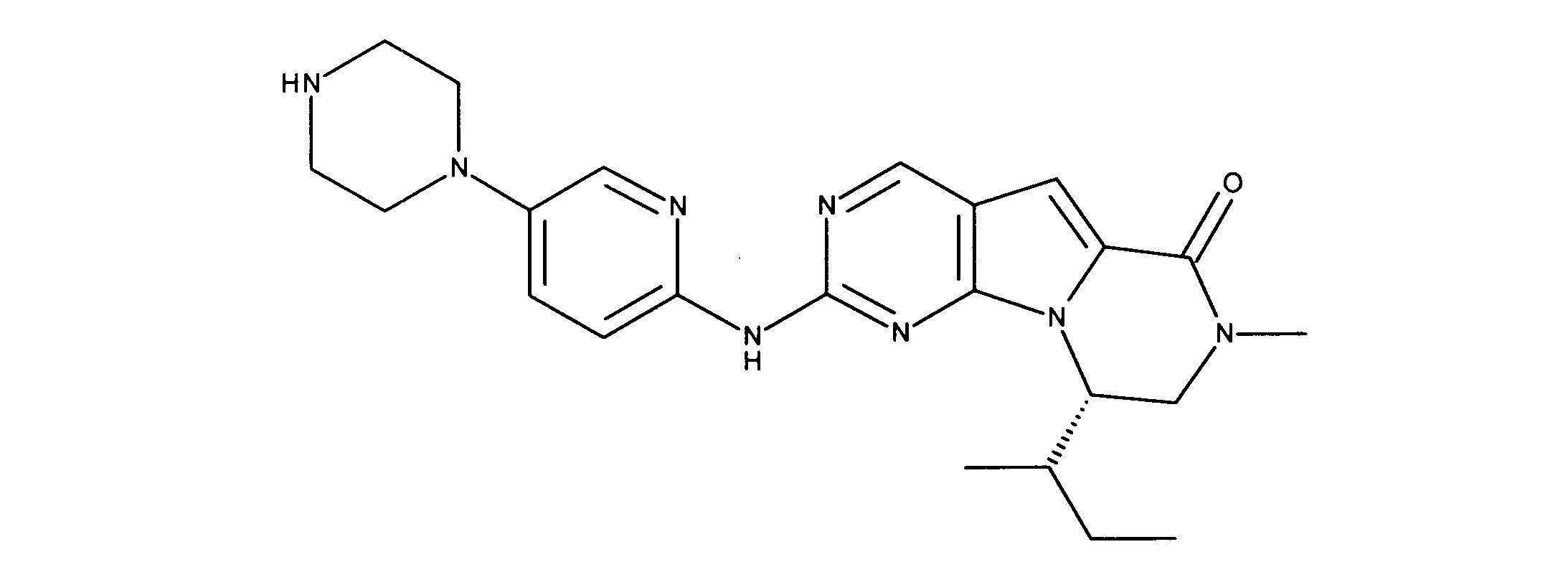
1HNMR (600 MHz, DMSO-d6) δ ppm 0.78 (t, J=7.32 Hz, 3 H) 0.85 (d, J=6.73 Hz, 3 H) 1.10 - 1.27 (m, 2 H) 1.82 - 1.99 (m, 1 H) 3.04 (s, 3 H) 3.28 - 3.77 (m, 8 H) 3.97 (dd, J=13.91, 4.54 Hz, 2 H) 4.62 - 4.75 (m, 1 H) 7.07 - 7.24 (m, 1 H) 7.62 - 7.75 (m, 1 H) 7.94 (d, J=2.34 Hz, 1 H) 7.97 - 8.08 (m, 1 H) 9.05 (s, 1 H) 9.29 (s, 2 H). LCMS (ESI) 435 (M+H).
Example 81
Synthesis of
1 HNMR (600 MHz, DMSO-d 6 ) δ ppm 0.78 (t, J=7.32 Hz, 3 H) 0.85 (d, J=6.73 Hz, 3 H) 1.10 - 1.27 (m, 2 H) 1.82 - 1.99 ( m, 1H) 3.04 (s, 3H) 3.28 - 3.77 (m, 8H) 3.97 (dd, J=13.91, 4.54Hz, 2H) 4.62 - 4.75 (m, 1H) 7.07 - 7.24 (m, 1 H) 7.62 - 7.75 (m, 1 H) 7.94 (d, J=2.34 Hz, 1 H) 7.97 - 8.08 (m, 1 H) 9.05 (s, 1 H) 9.29 (s, 2 H). ESI) 435 (M+H).
実施例82
化合物82の合成
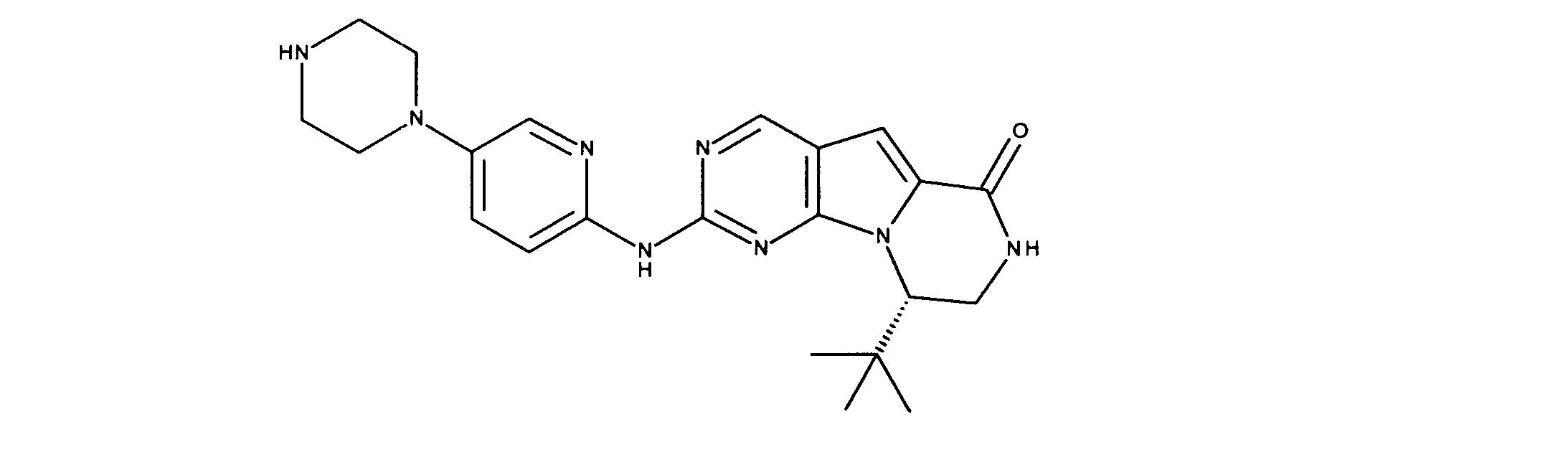
1HNMR (600 MHz, DMSO-d6) δ ppm 0.96 (s, 9 H) 3.15 - 3.87 (m, 10 H) 4.42 - 4.53 (m, 1 H) 6.99 (s, 1 H) 7.24 (s, 1 H) 8.06 (s, 1 H) 8.11 - 8.21 (m, 1 H) 8.79 - 8.98 (m, 2 H) 9.25 (s, 2 H) 9.88 (s, 1 H). LCMS (ESI) 421 (M+H).
Example 82
Synthesis of compound 82
1 HNMR (600 MHz, DMSO-d 6 ) δ ppm 0.96 (s, 9 H) 3.15 - 3.87 (m, 10 H) 4.42 - 4.53 (m, 1 H) 6.99 (s, 1 H) 7.24 (s, 1 H) 8.06 (s, 1 H) 8.11 - 8.21 (m, 1 H) 8.79 - 8.98 (m, 2 H) 9.25 (s, 2 H) 9.88 (s, 1 H). LCMS (ESI) 421 (M+ H).
実施例83
化合物83の合成
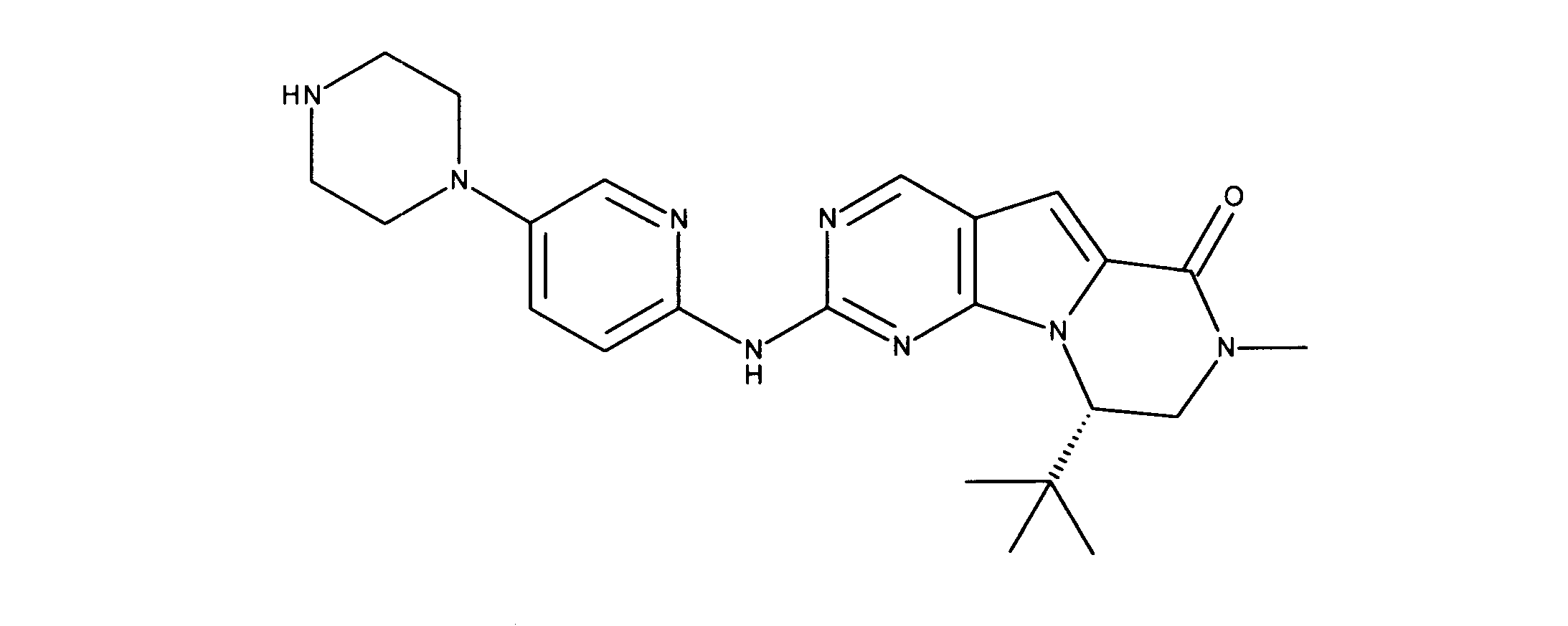
Synthesis of compound 83
実施例84
化合物84の合成
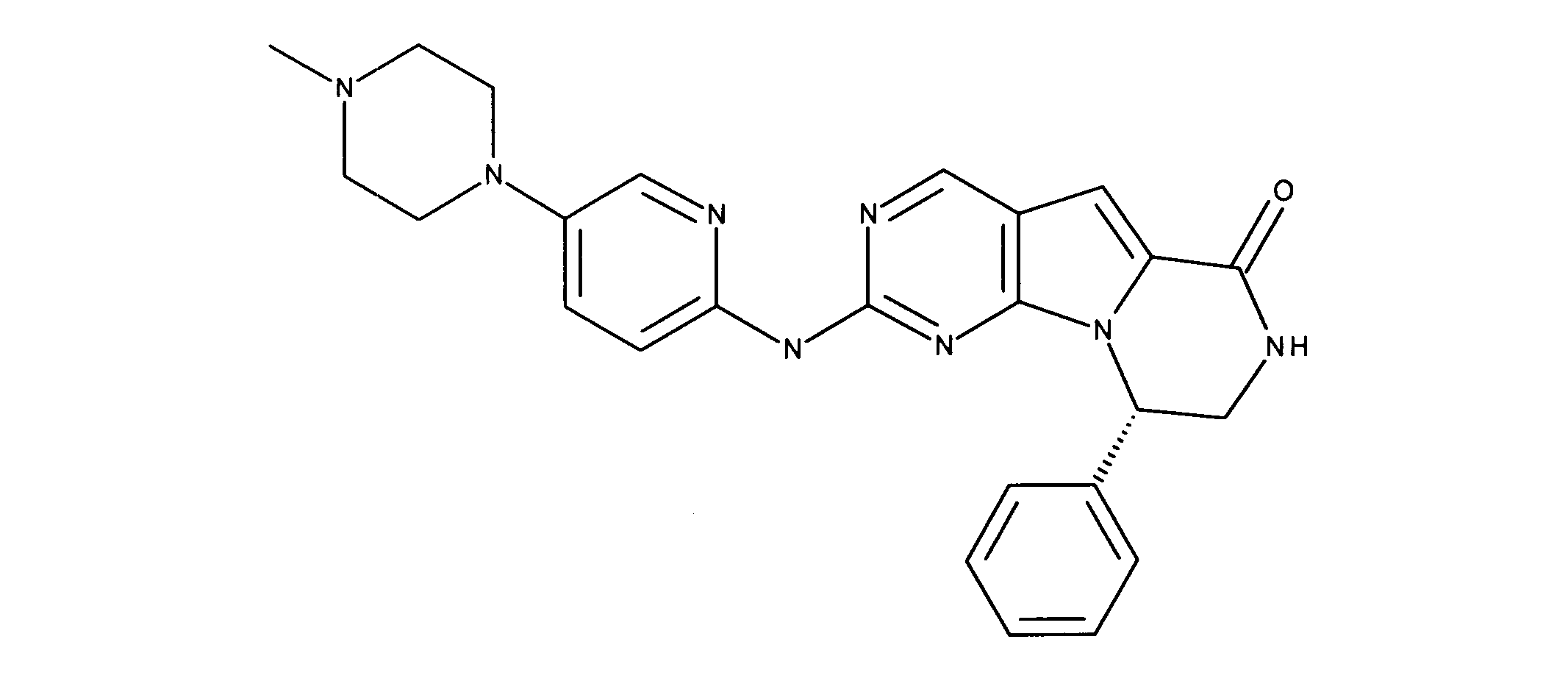
1HNMR (600 MHz, DMSO-d6) δ ppm 2.75 - 2.81 (m, 3 H) 3.12 - 3.16 (m, 2 H) 3.46 - 3.54 (m, 4 H) 3.60 - 3.69 (m, 2 H) 3.72 - 3.79 (m, 1 H) 4.07 - 4.18 (m, 2 H) 6.06 - 6.09 (m, 1 H) 6.90 (d, J=7.61 Hz, 2 H) 7.20 - 7.31 (m, 3 H) 7.33 (s, 1 H) 7.49 - 7.55 (m, 1 H) 7.62 - 7.70 (m, 1 H) 7.92 (d, J=2.93 Hz, 1 H) 8.22 (s, 1 H) 9.14 (s, 1 H). LCMS (ESI) 455 (M + H).
Example 84
Synthesis of compound 84
1 HNMR (600 MHz, DMSO-d 6 ) δ ppm 2.75 - 2.81 (m, 3 H) 3.12 - 3.16 (m, 2 H) 3.46 - 3.54 (m, 4 H) 3.60 - 3.69 (m, 2 H) 3.72 - 3.79 (m, 1H) 4.07 - 4.18 (m, 2H) 6.06 - 6.09 (m, 1H) 6.90 (d, J=7.61Hz, 2H) 7.20 - 7.31 (m, 3H) 7.33 (s , 1 H) 7.49 - 7.55 (m, 1 H) 7.62 - 7.70 (m, 1 H) 7.92 (d, J=2.93 Hz, 1 H) 8.22 (s, 1 H) 9.14 (s, 1 H). (ESI) 455 (M+H).
実施例85
化合物85の合成
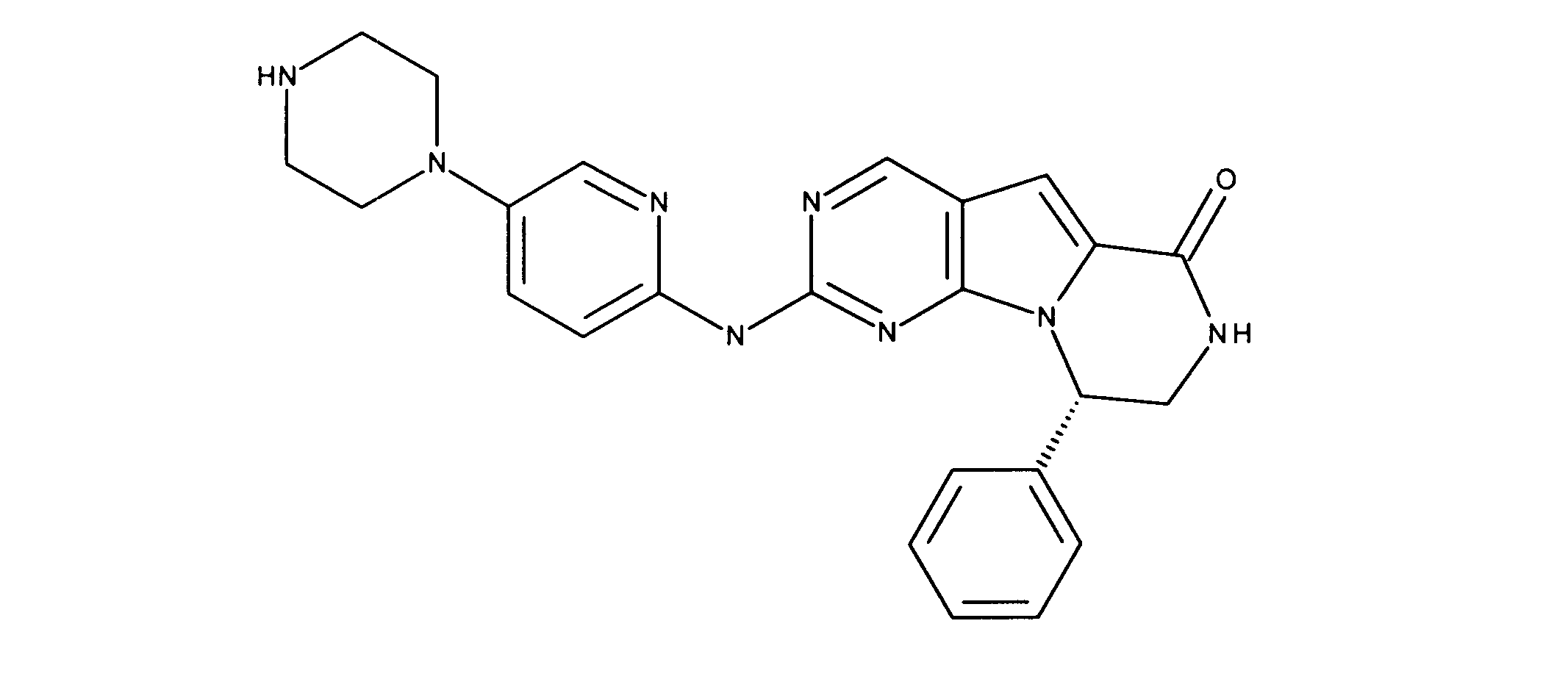
1HNMR (600 MHz, DMSO-d6) δ ppm 3.21 (s, 4 H) 3.35 - 3.67 (m, 5 H) 4.07 - 4.20 (m, 2 H) 6.13 (s, 1 H) 6.90 (d, J=7.32 Hz, 2 H) 7.22 - 7.31 (m, 3 H) 7.36 (s, 1 H) 7.48 (d, J=9.37 Hz, 1 H) 7.93 (d, J=2.34 Hz, 1 H) 8.04 - 8.11 (m, 1 H) 8.25 (d, J=4.98 Hz, 1 H) 9.17 (s, 1 H) 11.77 (br, s., 1H). LCMS (ESI) 441 (M + H).
Example 85
Synthesis of
1 HNMR (600 MHz, DMSO-d 6 ) δ ppm 3.21 (s, 4 H) 3.35 - 3.67 (m, 5 H) 4.07 - 4.20 (m, 2 H) 6.13 (s, 1 H) 6.90 (d, J =7.32 Hz, 2 H) 7.22 - 7.31 (m, 3 H) 7.36 (s, 1 H) 7.48 (d, J=9.37 Hz, 1 H) 7.93 (d, J=2.34 Hz, 1 H) 8.04 - 8.11 (m, 1 H) 8.25 (d, J=4.98 Hz, 1 H) 9.17 (s, 1 H) 11.77 (br, s., 1H). LCMS (ESI) 441 (M + H).
実施例86
化合物86の合成
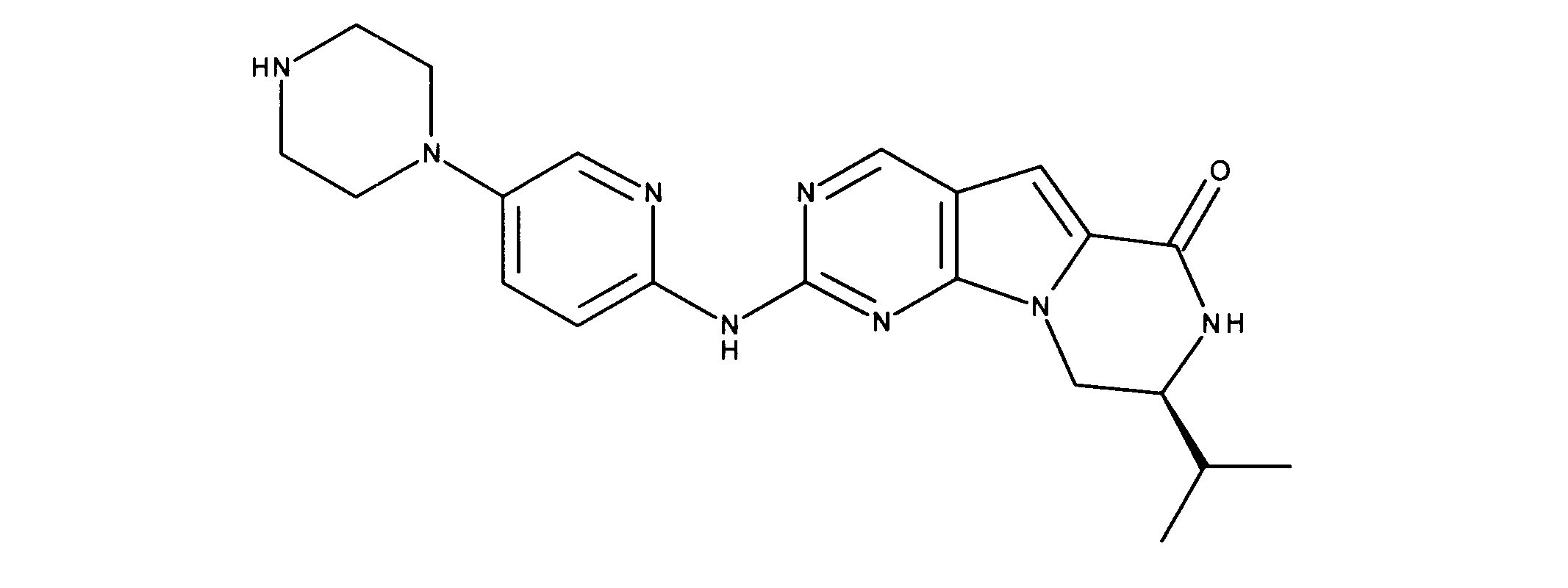
1HNMR (600 MHz, DMSO-d6) δ ppm 0.90 (d, J=6.15 Hz, 6 H) 1.72 - 1.89 (m, 1 H) 3.15 - 3.92 (m, 9 H) 4.10 - 4.46 (m, 2 H) 7.18 (s, 1 H) 7.59 (d, J=8.78 Hz, 1 H) 8.00 (s, 1 H) 8.13 (d, J=9.37 Hz, 1 H) 8.55 (s, 1 H) 9.09 (s, 1 H) 9.67 (s, 2 H) 11.91 (s, 1 H). LCMS (ESI) 407 (ESI).
Example 86
Synthesis of compound 86
1 HNMR (600 MHz, DMSO-d 6 ) δ ppm 0.90 (d, J=6.15 Hz, 6 H) 1.72 - 1.89 (m, 1 H) 3.15 - 3.92 (m, 9 H) 4.10 - 4.46 (m, 2 H) 7.18 (s, 1H) 7.59 (d, J=8.78Hz, 1H) 8.00 (s, 1H) 8.13 (d, J=9.37Hz, 1H) 8.55 (s, 1H) 9.09 (s , 1 H) 9.67 (s, 2 H) 11.91 (s, 1 H). LCMS (ESI) 407 (ESI).
実施例87
化合物87の合成
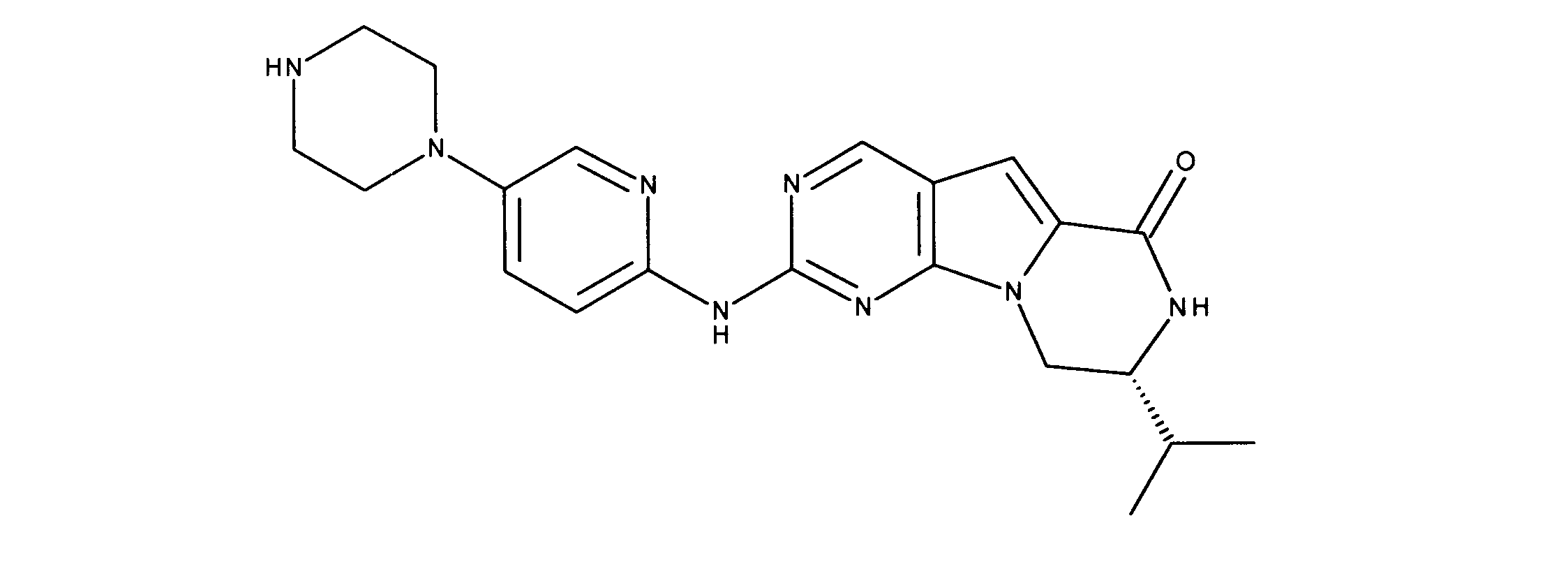
Synthesis of compound 87
実施例88
化合物88の合成
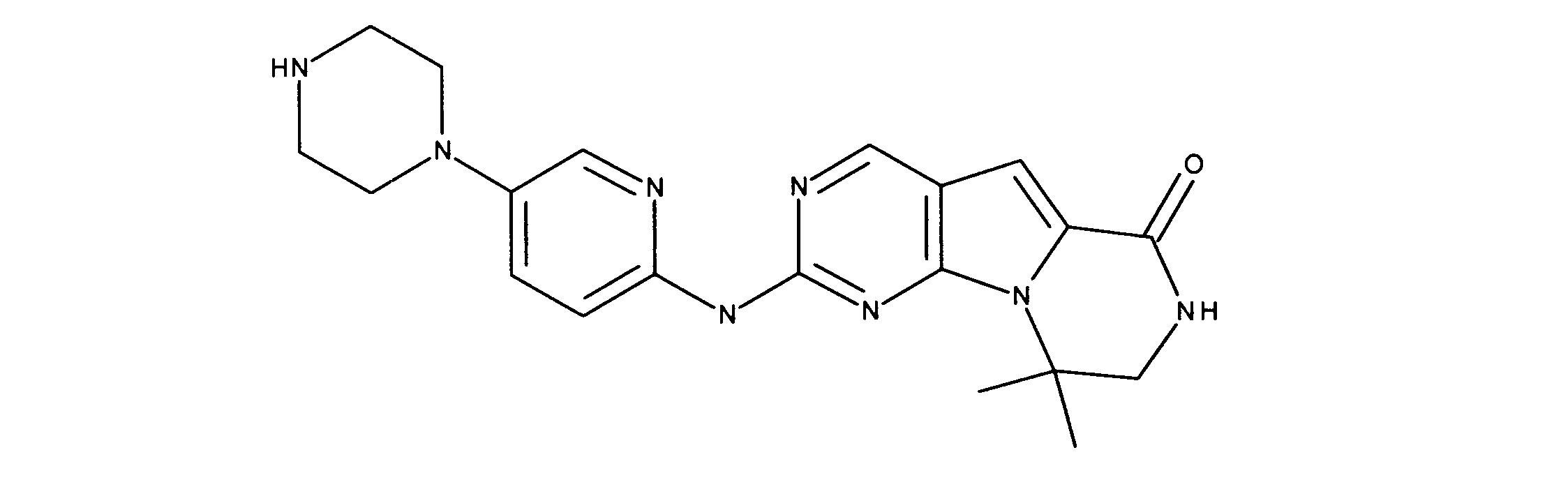
1HNMR (600 MHz, DMSO-d6) δ ppm 1.78 (s, 6 H) 3.40 - 3.53 (m, 6 H) 3.64 - 3.73 (m, 4 H) 7.27 (s, 1 H) 7.66 (d, J=9.37 Hz, 1 H) 7.98 (d, J=2.34 Hz, 1 H) 8.12 (br. s., 1 H) 8.47 (br. s., 1 H) 9.11 (s, 1 H) 9.45 (br. s., 2 H) 11.62 (br. s., 1 H). LCMS (ESI) 393 (M + H).
Example 88
Synthesis of compound 88
1 HNMR (600 MHz, DMSO-d 6 ) δ ppm 1.78 (s, 6 H) 3.40 - 3.53 (m, 6 H) 3.64 - 3.73 (m, 4 H) 7.27 (s, 1 H) 7.66 (d, J =9.37 Hz, 1 H) 7.98 (d, J=2.34 Hz, 1 H) 8.12 (br. s., 1 H) 8.47 (br. s., 1 H) 9.11 (s, 1 H) 9.45 (br. s., 2 H) 11.62 (br. s., 1 H). LCMS (ESI) 393 (M + H).
実施例89
化合物89(化合物Tとも呼ばれる)の合成
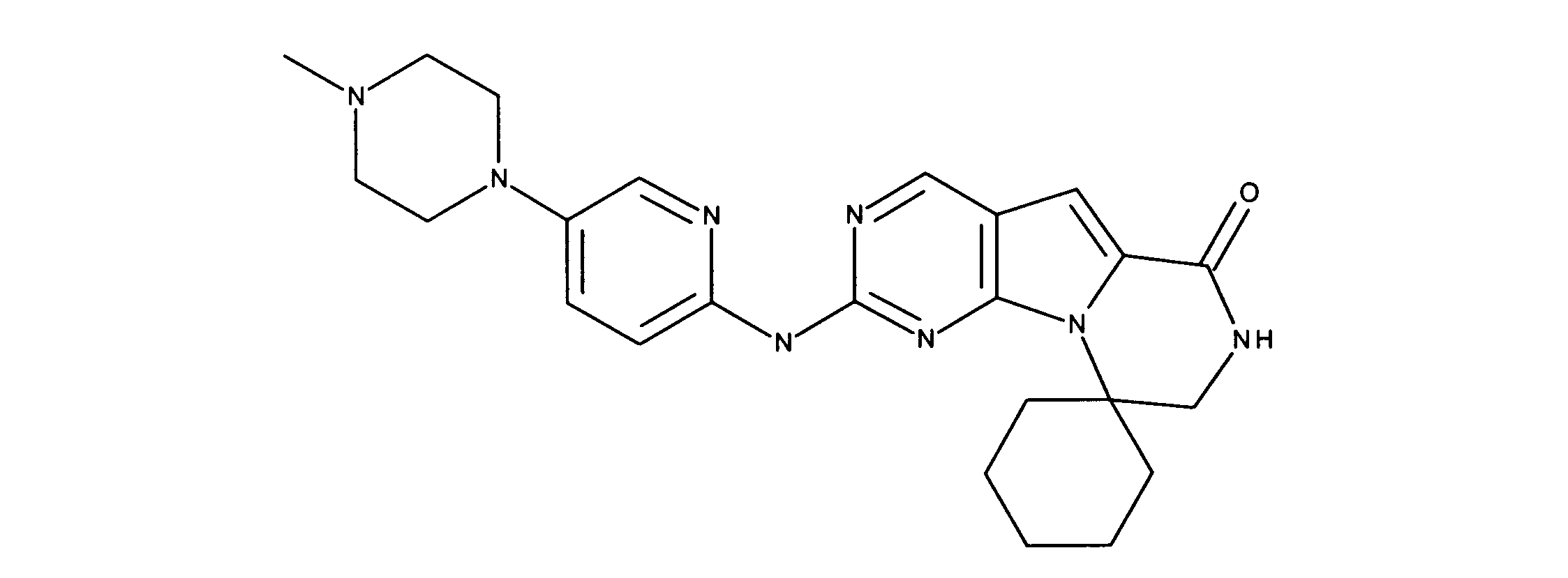
1HNMR (600 MHz, DMSO-d6) δ ppm 1.47 (br. s., 6 H) 1.72 (br. s., 2 H) 1.92 (br. s., 2 H) 2.77 (br. s., 3 H) 3.18 (br. s., 2 H) 3.46 (br. s., 2 H) 3.63 (br. s., 2 H) 3.66 (d, J=6.15 Hz, 2 H) 3.80 (br. s., 2 H) 7.25 (s, 1 H) 7.63 (br. s., 2 H) 7.94 (br. s., 1 H) 8.10 (br. s., 1 H) 8.39 (br. s., 1 H) 9.08 (br. s., 1 H) 11.59 (br. s., 1 H). LCMS (ESI) 447 (M + H).
Example 89
Synthesis of compound 89 (also called compound T)
1 HNMR (600 MHz, DMSO-d 6 ) δ ppm 1.47 (br. s., 6 H) 1.72 (br. s., 2 H) 1.92 (br. s., 2 H) 2.77 (br. s., 3 H) 3.18 (br. s., 2 H) 3.46 (br. s., 2 H) 3.63 (br. s., 2 H) 3.66 (d, J=6.15 Hz, 2 H) 3.80 (br. s ., 2 H) 7.25 (s, 1 H) 7.63 (br. s., 2 H) 7.94 (br. s., 1 H) 8.10 (br. s., 1 H) 8.39 (br. s., 1 H) 9.08 (br. s., 1 H) 11.59 (br. s., 1 H). LCMS (ESI) 447 (M + H).
実施例90
化合物90(化合物Qとも呼ばれる)の合成
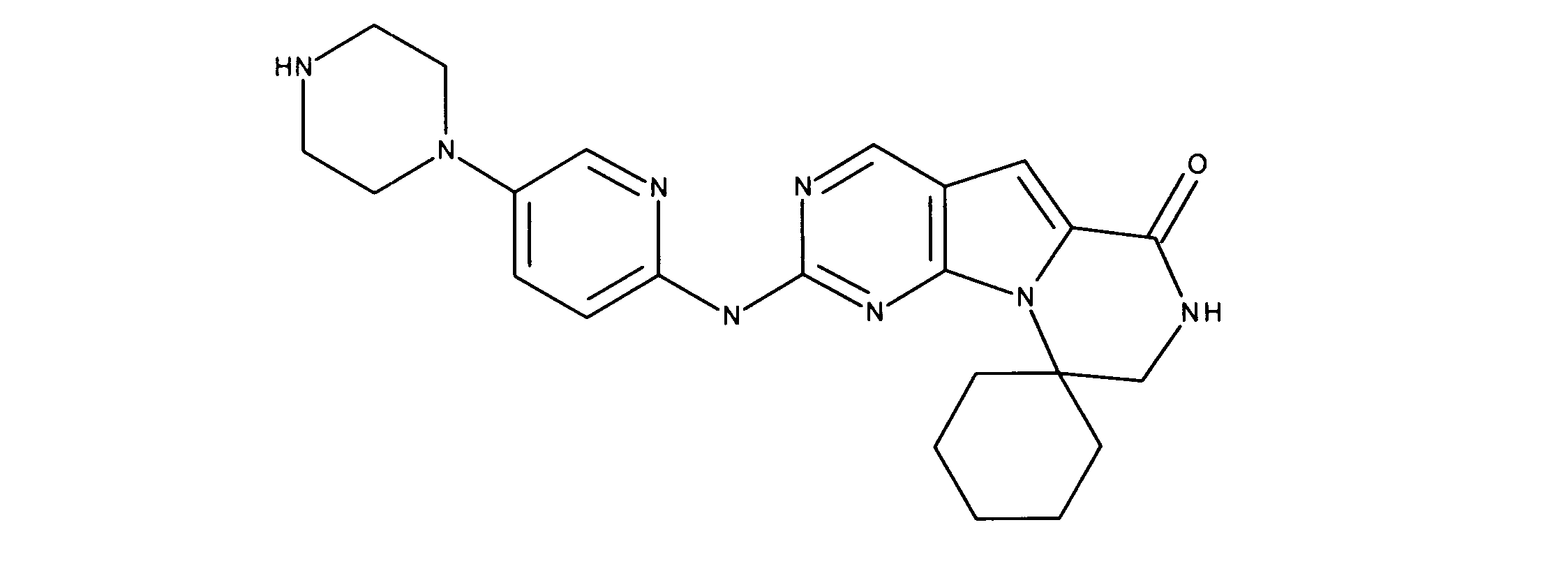
1HNMR (600 MHz, DMSO-d6) δ ppm 1.27 - 1.64 (m, 6 H) 1.71 (br. s., 2 H) 1.91 (br. s., 2 H) 2.80 (br. s., 1 H) 3.17 - 3.24 (m, 2 H) 3.41 (br. s., 4 H) 3.65 (br. s., 4 H) 7.26 (br. s., 1 H) 7.63 (br. s., 1 H) 7.94 (br. s., 1 H) 8.13 (br. s., 1 H) 8.40 (br. s., 1 H) 9.09 (br. s., 1 H) 9.62 (br. s., 1 H) 11.71 (br. s., 1 H). LCMS (ESI) 433 (M + H).
Example 90
Synthesis of compound 90 (also called compound Q)
1 HNMR (600 MHz, DMSO-d 6 ) δ ppm 1.27 - 1.64 (m, 6 H) 1.71 (br. s., 2 H) 1.91 (br. s., 2 H) 2.80 (br. s., 1 H) 3.17 - 3.24 (m, 2H) 3.41 (br.s., 4H) 3.65 (br.s., 4H) 7.26 (br.s., 1H) 7.63 (br.s., 1H) ) 7.94 (br.s., 1H) 8.13 (br.s., 1H) 8.40 (br.s., 1H) 9.09 (br.s., 1H) 9.62 (br.s., 1H) ) 11.71 (br. s., 1 H). LCMS (ESI) 433 (M + H).
実施例91
化合物91(化合物ZZとも呼ばれる)の合成
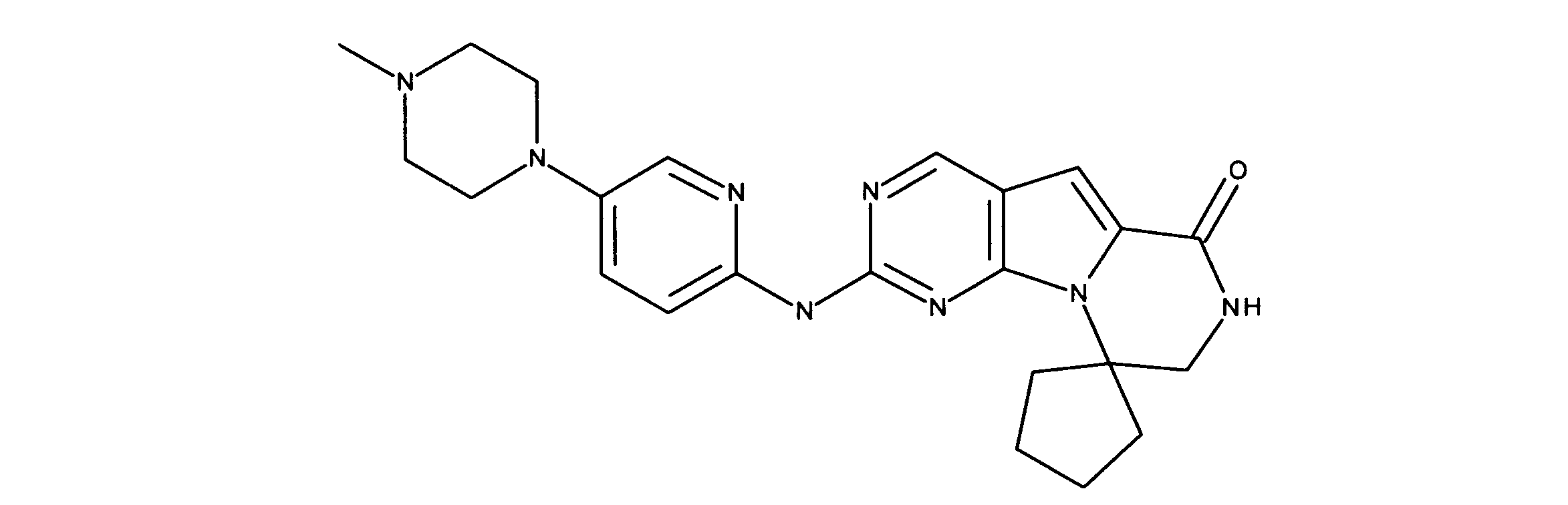
1HNMR (600 MHz, DMSO-d6) δ ppm 1.64 - 1.75 (m, 2 H) 1.83 - 1.92 (m, 2 H) 1.96 - 2.06 (m, 2 H) 2.49 - 2.58 (m, 2 H) 2.79 (d, J=3.81 Hz, 3 H) 3.06 - 3.18 (m, 4 H) 3.59 - 3.69 (m, 2 H) 3.73 - 3.83 (m, 2 H) 4.04 - 4.12 (m, 2 H) 7.17 (br. s., 1 H) 7.60 - 7.70 (m, 2 H) 7.70 - 7.92 (m, 2 H) 7.96 (br. s., 1 H) 8.41 (br. s., 1 H) 8.98 (br. s., 1 H) 10.77 (br. s., 1 H). LCMS (ESI) 433 (M + H).
Example 91
Synthesis of compound 91 (also called compound ZZ)
1 HNMR (600 MHz, DMSO-d 6 ) δ ppm 1.64 - 1.75 (m, 2 H) 1.83 - 1.92 (m, 2 H) 1.96 - 2.06 (m, 2 H) 2.49 - 2.58 (m, 2 H) 2.79 (d, J=3.81 Hz, 3H) 3.06 - 3.18 (m, 4H) 3.59 - 3.69 (m, 2H) 3.73 - 3.83 (m, 2H) 4.04 - 4.12 (m, 2H) 7.17 (br s., 1 H) 7.60 - 7.70 (m, 2 H) 7.70 - 7.92 (m, 2 H) 7.96 (br. s., 1 H) 8.41 (br. s., 1 H) 8.98 (br. s ., 1 H) 10.77 (br. s., 1 H). LCMS (ESI) 433 (M + H).
実施例92
化合物92の合成
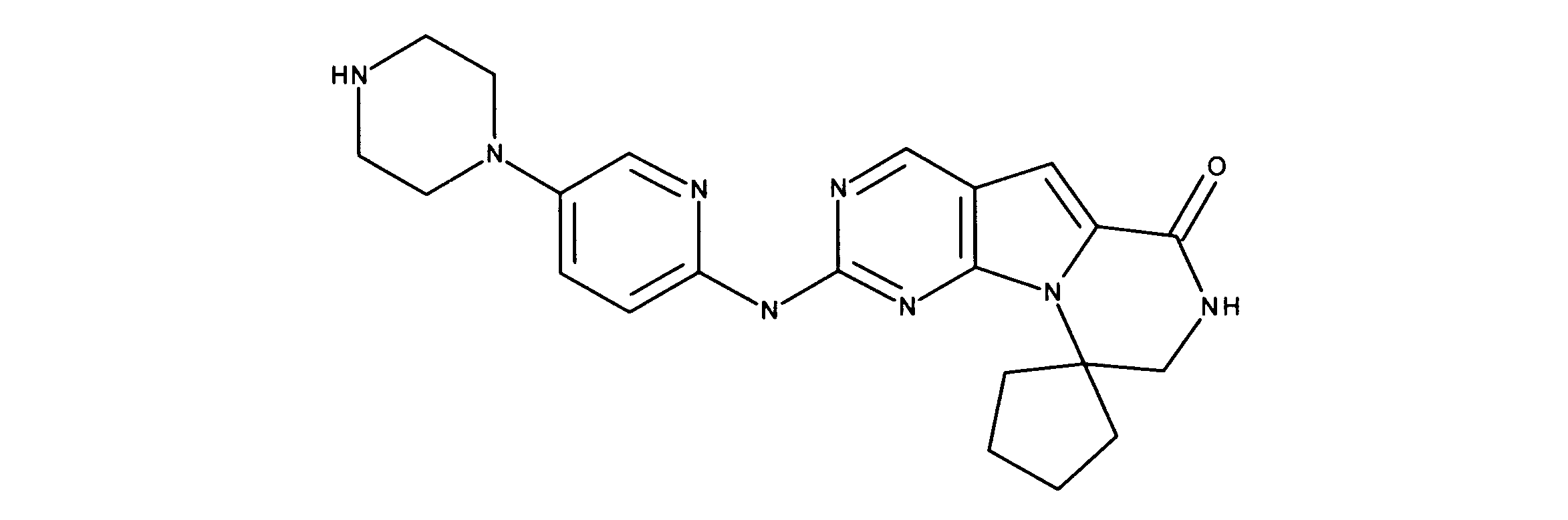
1HNMR (600 MHz, DMSO-d6) δ ppm 1.64 - 1.75 (m, 2 H) 1.84 - 1.92 (m, 2 H) 1.96 - 2.05 (m, 2 H) 2.48 - 2.56 (m, 2 H) 3.22 (br. s., 4 H) 3.42 - 3.48 (m, 4 H) 3.60 - 3.69 (m, 2 H) 4.05 - 4.13 (m, 1 H) 7.18 (s, 1 H) 7.65 (d, J=13.47 Hz, 1 H) 7.70 - 7.77 (m, 1 H) 7.94 (d, J=1.76 Hz, 1 H) 8.42 (br. s., 1 H) 9.00 (s, 1 H) 9.15 (br. s., 2 H). LCMS (ESI) 419 (M + H).
Example 92
Synthesis of compound 92
1 HNMR (600 MHz, DMSO-d 6 ) δ ppm 1.64 - 1.75 (m, 2 H) 1.84 - 1.92 (m, 2 H) 1.96 - 2.05 (m, 2 H) 2.48 - 2.56 (m, 2 H) 3.22 (br. s., 4H) 3.42 - 3.48 (m, 4H) 3.60 - 3.69 (m, 2H) 4.05 - 4.13 (m, 1H) 7.18 (s, 1H) 7.65 (d, J=13.47 Hz, 1 H) 7.70 - 7.77 (m, 1 H) 7.94 (d, J=1.76 Hz, 1 H) 8.42 (br. s., 1 H) 9.00 (s, 1 H) 9.15 (br. s., 2H). LCMS (ESI) 419 (M+H).
実施例93
化合物93の合成
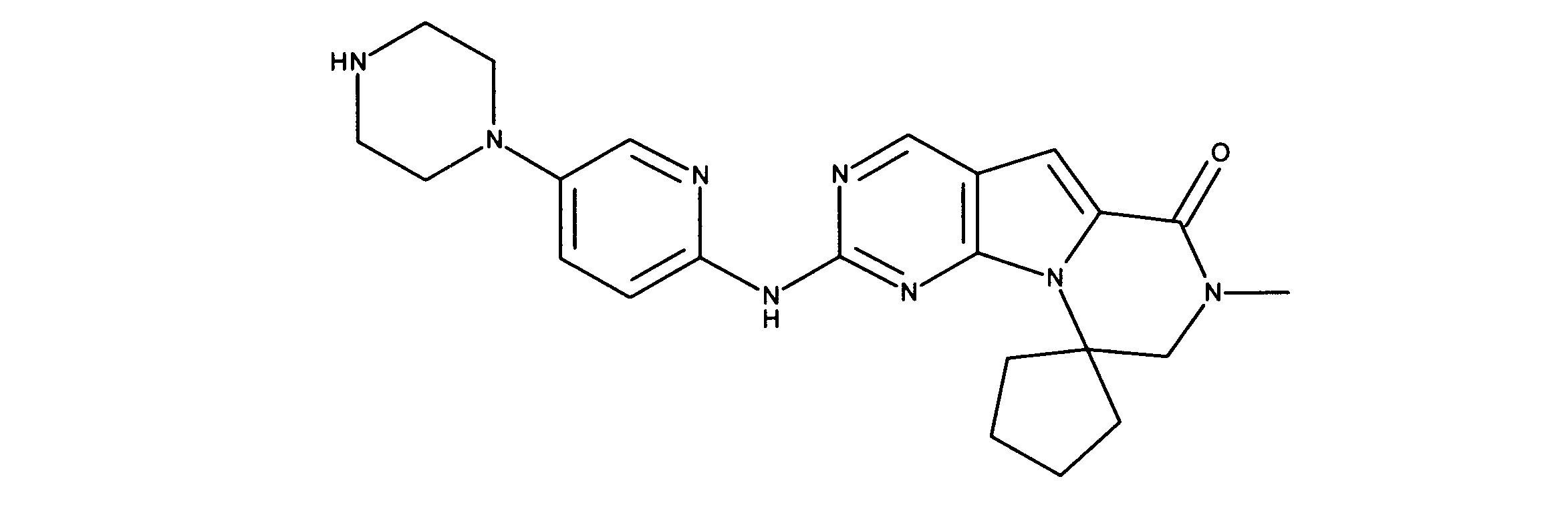
1HNMR (600 MHz, DMSO-d6) δ ppm 1.76 (br. s., 2 H) 1.89 (br. s., 2 H) 2.03 (br. s., 2 H) 2.47 - 2.58 (m, 2 H) 3.04 (s, 3 H) 3.22 (br. s., 4 H) 3.39 (br. s., 4 H) 3.66 (s, 2 H) 7.21 (s, 1 H) 7.67 (d, J=9.37 Hz, 1 H) 7.93 (br. s., 1 H) 7.98 - 8.09 (m, 1 H) 9.04 (s, 1 H) 9.34 (br. s., 2 H) 11.31 (br. s., 1 H). LCMS (ESI) 433 (M + H).
Example 93
Synthesis of compound 93
1 HNMR (600 MHz, DMSO-d 6 ) δ ppm 1.76 (br. s., 2 H) 1.89 (br. s., 2 H) 2.03 (br. s., 2 H) 2.47 - 2.58 (m, 2 H) 3.04 (s, 3H) 3.22 (br.s., 4H) 3.39 (br.s., 4H) 3.66 (s, 2H) 7.21 (s, 1H) 7.67 (d, J=9.37 Hz, 1H) 7.93 (br.s., 1H) 7.98 - 8.09 (m, 1H) 9.04 (s, 1H) 9.34 (br.s., 2H) 11.31 (br.s., 1H) ). LCMS (ESI) 433 (M+H).
実施例94
化合物94の合成
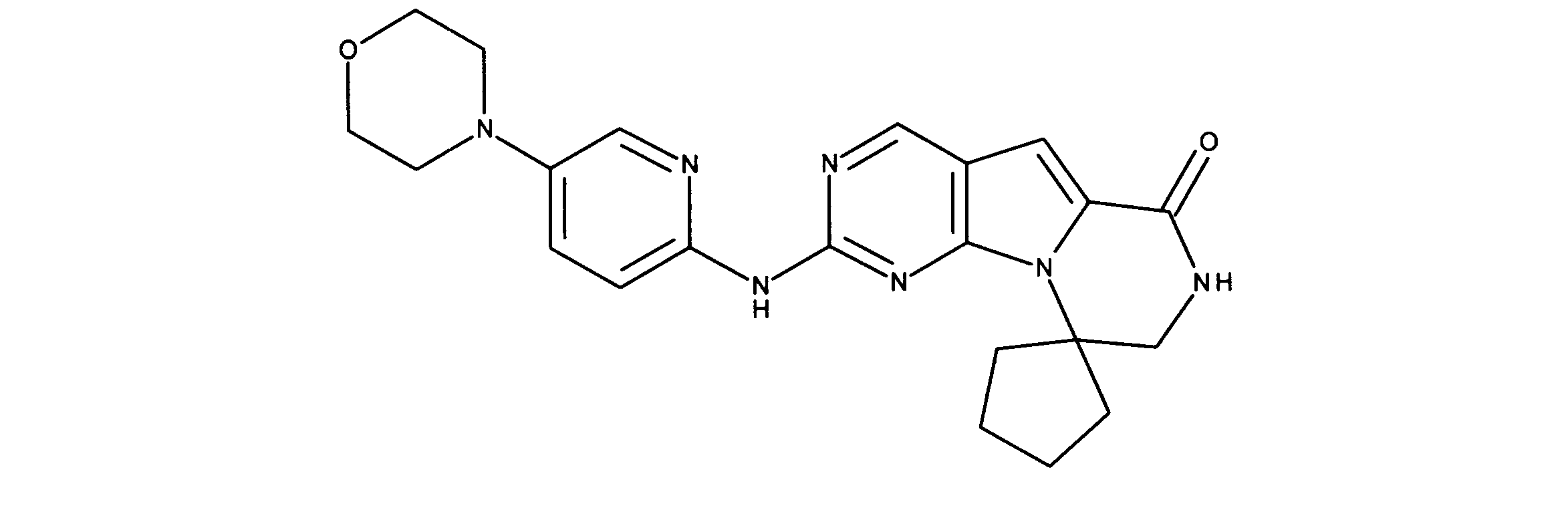
1HNMR (600 MHz, DMSO-d6) δ ppm 1.66 - 1.77 (m, 2 H) 1.84 - 1.94 (m, 2 H) 1.96 - 2.08 (m, 2 H) 2.48 - 2.57 (m, 2 H) 3.36 - 3.52 (m, 4 H) 3.60 - 3.80 (m, 6 H) 7.21 (s, 1 H) 7.53 - 7.74 (m, 2 H) 7.86 (s, 1 H) 8.02 (s, 1 H) 8.45 (s, 1 H) 9.03 (s, 1 H) 11.19 (br. s., 1 H). LCMS (ESI) 420 (M+H).
Example 94
Synthesis of compound 94
1 HNMR (600 MHz, DMSO-d 6 ) δ ppm 1.66 - 1.77 (m, 2 H) 1.84 - 1.94 (m, 2 H) 1.96 - 2.08 (m, 2 H) 2.48 - 2.57 (m, 2 H) 3.36 - 3.52 (m, 4H) 3.60 - 3.80 (m, 6H) 7.21 (s, 1H) 7.53 - 7.74 (m, 2H) 7.86 (s, 1H) 8.02 (s, 1H) 8.45 (s s., 1 H) 9.03 (s, 1 H) 11.19 (br. s., 1 H). LCMS (ESI) 420 (M+H).
実施例95
化合物95の合成
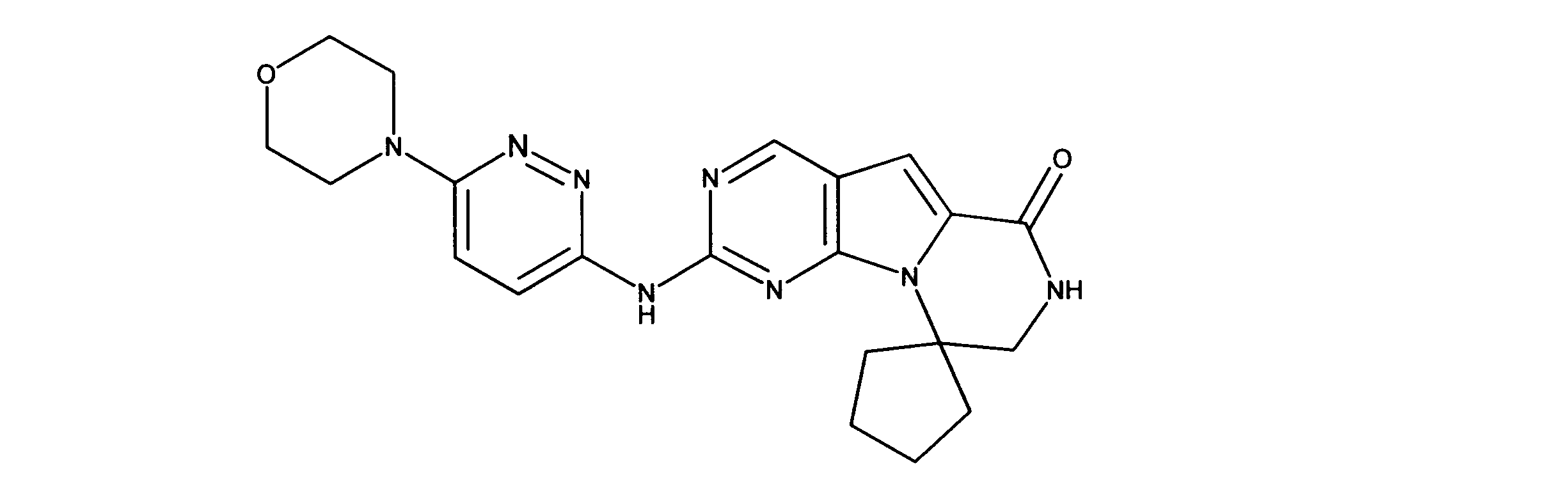
1HNMR (600 MHz, DMSO-d6) δ ppm 1.65 - 1.79 (m, 2 H) 1.85 - 1.95 (m, 2 H) 1.97 - 2.08 (m, 2 H) 2.47 - 2.54 (m, 2 H) 3.40 - 3.58 (m, 5 H) 3.65 (dd, J=21.67, 5.56 Hz, 1 H) 3.69 - 3.78 (m, 4 H) 7.24 (s, 1 H) 7.97 - 8.17 (m, 2 H) 8.48 (s, 1 H) 9.08 (s, 1 H) 11.81 (s, 1 H). LCMS (ESI) 421 (M+H).
Example 95
Synthesis of
1 HNMR (600 MHz, DMSO-d 6 ) δ ppm 1.65 - 1.79 (m, 2 H) 1.85 - 1.95 (m, 2 H) 1.97 - 2.08 (m, 2 H) 2.47 - 2.54 (m, 2 H) 3.40 - 3.58 (m, 5 H) 3.65 (dd, J=21.67, 5.56 Hz, 1 H) 3.69 - 3.78 (m, 4 H) 7.24 (s, 1 H) 7.97 - 8.17 (m, 2 H) 8.48 (s , 1 H) 9.08 (s, 1 H) 11.81 (s, 1 H). LCMS (ESI) 421 (M+H).
実施例96
化合物96の合成
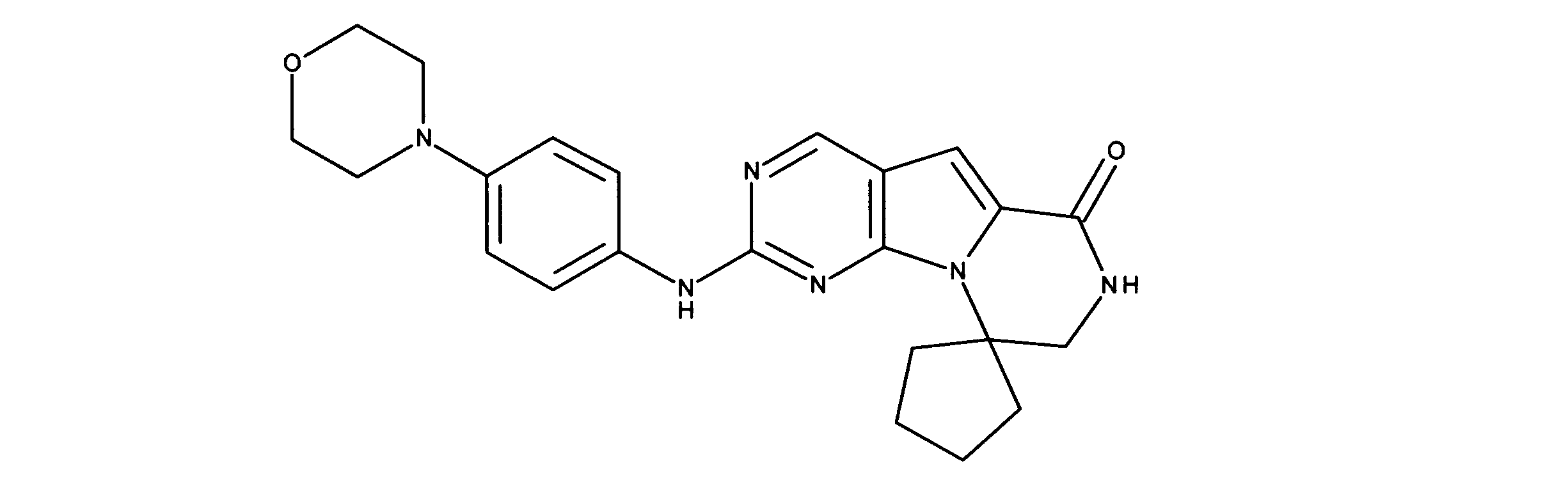
1HNMR (600 MHz, DMSO-d6) δ ppm 1.55 - 1.74 (m, 2 H) 1.80 - 1.98 (m, 4 H) 2.48 - 2.60 (m, 2 H) 3.40 - 3.50 (m, 4 H) 3.57 - 3.72 (m, 2 H) 3.90 - 4.20 (m, 4 H) 7.08 (s, 1 H) 7.37 - 7.57 (m, 2 H) 7.70 (m, 2 H) 8.32 (s, 1 H) 8.88 (s, 1 H) 9.98 (s, 1 H). LCMS (ESI) 419 (M+H).
Example 96
Synthesis of compound 96
1 HNMR (600 MHz, DMSO-d 6 ) δ ppm 1.55 - 1.74 (m, 2 H) 1.80 - 1.98 (m, 4 H) 2.48 - 2.60 (m, 2 H) 3.40 - 3.50 (m, 4 H) 3.57 - 3.72 (m, 2H) 3.90 - 4.20 (m, 4H) 7.08 (s, 1H) 7.37 - 7.57 (m, 2H) 7.70 (m, 2H) 8.32 (s, 1H) 8.88 (s , 1 H) 9.98 (s, 1 H). LCMS (ESI) 419 (M+H).
実施例97
化合物97(化合物IIIとも呼ばれる)の合成
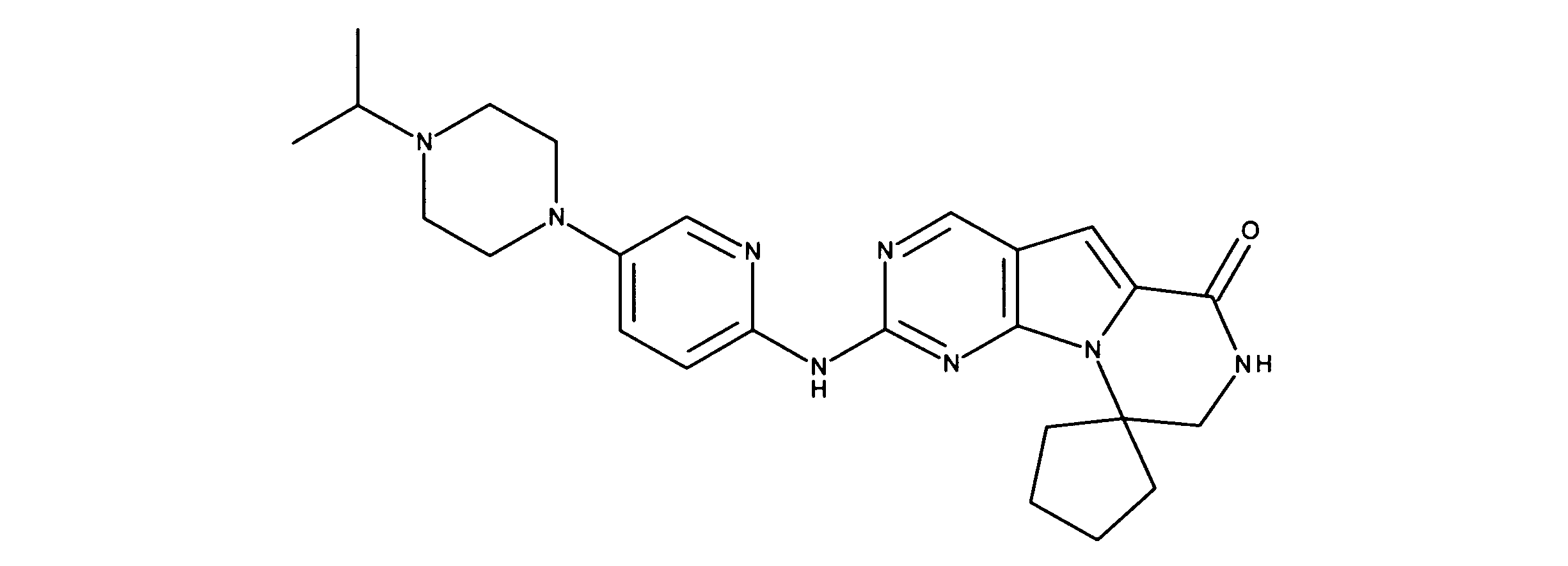
1HNMR (600 MHz, DMSO-d6) δ ppm 1.30 (d, J=5.27 Hz, 6 H) 1.65 - 1.78 (m, 2 H) 1.83 - 1.95 (m, 2 H) 1.97 - 2.10 (m, 2 H) 2.45 - 2.55 (m, 2H) 3.25 - 3.36 (m, 1 H) 3.39 - 3.48 (m, 4 H) 3.60 - 3.70 (m, 4 H) 3.75 - 4.15 (m, 2 H) 7.24 (s, 1 H) 7.54 - 7.75 (m, 2 H) 7.95 (s, 1 H) 8.10 (s, 1 H) 8.49 (s, 1 H) 9.07 (s, 1 H) 11.25 (s, 1 H) 11.48 (s, 1 H). LCMS (ESI) 461 (M+H).
Example 97
Synthesis of compound 97 (also called compound III)
1 HNMR (600 MHz, DMSO-d 6 ) δ ppm 1.30 (d, J=5.27 Hz, 6 H) 1.65 - 1.78 (m, 2 H) 1.83 - 1.95 (m, 2 H) 1.97 - 2.10 (m, 2 H) 2.45 - 2.55 (m, 2H) 3.25 - 3.36 (m, 1H) 3.39 - 3.48 (m, 4H) 3.60 - 3.70 (m, 4H) 3.75 - 4.15 (m, 2H) 7.24 (s, 1H) 7.54 - 7.75 (m, 2H) 7.95 (s, 1H) 8.10 (s, 1H) 8.49 (s, 1H) 9.07 (s, 1H) 11.25 (s, 1H) 11.48 (s , 1H). LCMS (ESI) 461 (M+H).
実施例98
化合物98の合成

1HNMR (600 MHz, DMSO-d6) δ ppm 0.99 (d, J=6.15 Hz, 6 H) 1.65 - 1.78 (m, 2 H) 1.90 (m, 2 H) 1.97 - 2.08 (m, 2 H) 2.08 - 2.17 (m, 1 H) 2.45 - 2.55 (m, 2H) 2.88 - 3.02 (m, 2 H) 3.33 - 3.48 (m, 4 H) 3.50 - 3.90 (m, 6 H) 7.24 (s, 1 H) 7.67 (s, 2 H) 7.94 (s, 1 H) 8.12 (s, 1 H) 8.49 (s, 1 H) 9.07 (s, 1 H) 10.77 (s, 1 H) 11.51 (s, 1 H). LCMS (ESI) 475 (M+H).
Example 98
Synthesis of compound 98
1 HNMR (600 MHz, DMSO-d 6 ) δ ppm 0.99 (d, J=6.15 Hz, 6 H) 1.65 - 1.78 (m, 2 H) 1.90 (m, 2 H) 1.97 - 2.08 (m, 2 H) 2.08 - 2.17 (m, 1H) 2.45 - 2.55 (m, 2H) 2.88 - 3.02 (m, 2H) 3.33 - 3.48 (m, 4H) 3.50 - 3.90 (m, 6H) 7.24 (s, 1H) ) 7.67 (s, 2H) 7.94 (s, 1H) 8.12 (s, 1H) 8.49 (s, 1H) 9.07 (s, 1H) 10.77 (s, 1H) 11.51 (s, 1H) LCMS (ESI) 475 (M+H).
実施例99
化合物99の合成
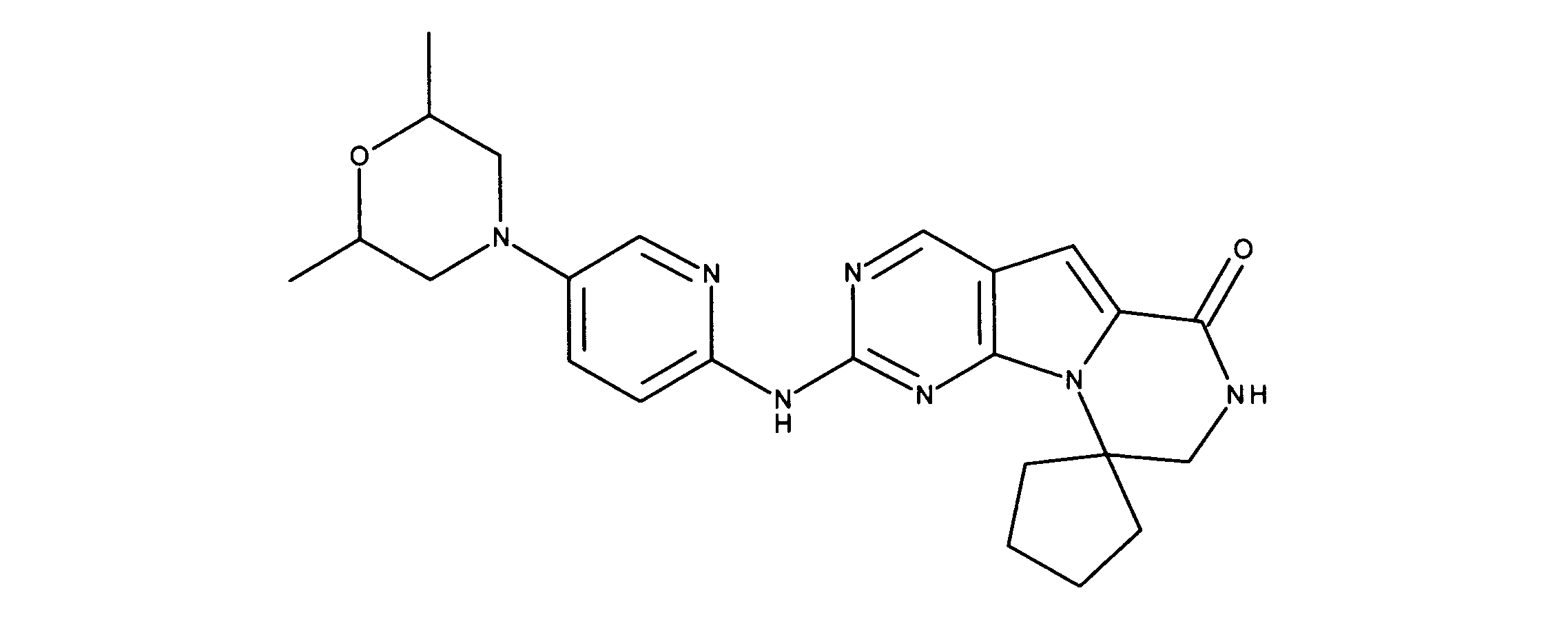
1HNMR (600 MHz, DMSO-d6) δ ppm 1.13 (d, J=5.86 Hz, 6 H) 1.66 - 1.77 (m, 2 H) 1.84 - 1.94 (m, 2 H) 1.97 - 2.09 (m, 2 H) 2.40 - 2.53 (m, 2 H) 3.37 - 3.49 (m, 2 H) 3.50 - 3.59 (m, 2 H) 3.59 - 3.73 (m, 4 H) 7.23 (s, 1 H) 7.64 (m, 3 H) 7.85 (s, 1 H) 8.11 (s, 1 H) 8.47 (s, 1 H) 9.05 (s, 1 H). 11.35 (br s., 1H). LCMS (ESI) 448 (M+H).
Example 99
Synthesis of Compound 99
1 HNMR (600 MHz, DMSO-d 6 ) δ ppm 1.13 (d, J=5.86 Hz, 6 H) 1.66 - 1.77 (m, 2 H) 1.84 - 1.94 (m, 2 H) 1.97 - 2.09 (m, 2 H) 2.40 - 2.53 (m, 2H) 3.37 - 3.49 (m, 2H) 3.50 - 3.59 (m, 2H) 3.59 - 3.73 (m, 4H) 7.23 (s, 1H) 7.64 (m, 3 H) 7.85 (s, 1 H) 8.11 (s, 1 H) 8.47 (s, 1 H) 9.05 (s, 1 H). 11.35 (br s., 1 H). LCMS (ESI) 448 (M+H) .
実施例100
化合物100の合成
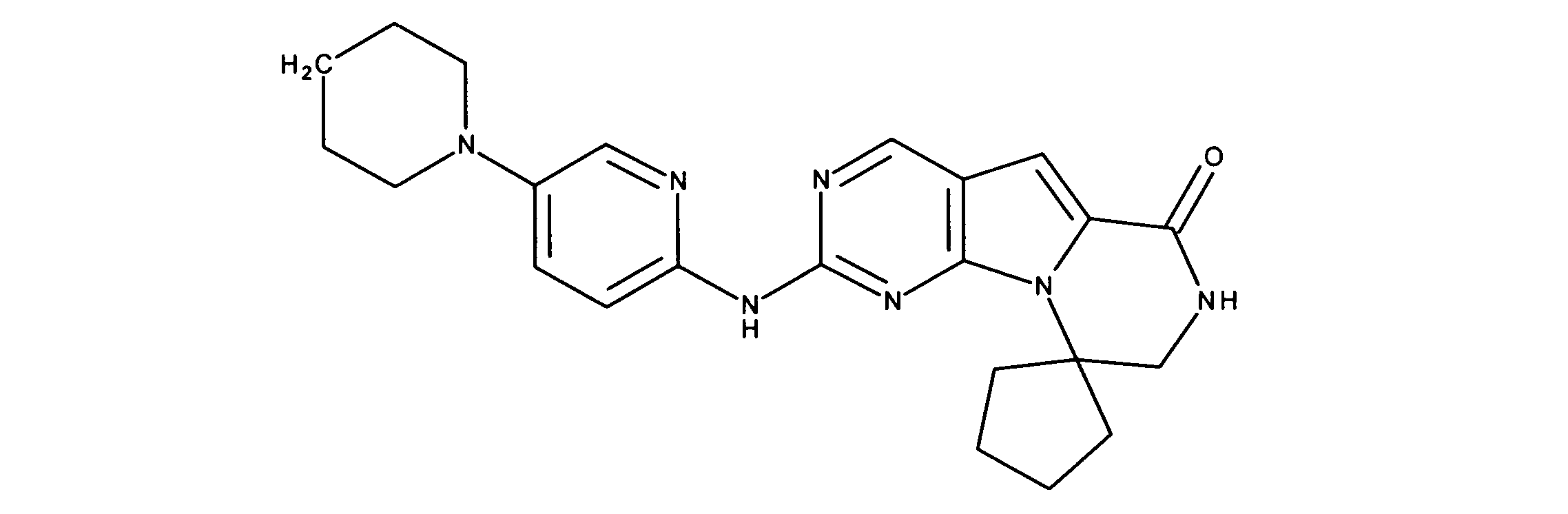
1HNMR (600 MHz, DMSO-d6) δ ppm 1.50 - 1.57 (m, 2 H) 1.62 - 1.68 (m, 3 H) 1.68 - 1.75 (m, 2 H) 1.84 - 1.92 (m, 2 H) 1.97 - 2.08 (m, 2 H) 2.48 - 2.53 (m, 2 H) 3.14 - 3.23 (m, 4 H) 3.43 - 3.47 (m, 2 H) 3.58 - 3.70 (m, 2 H) 7.22 (s, 1 H) 7.58 - 7.70 (m, 2 H) 7.85 - 8.00 (m, 1 H) 8.16 (d, 1 H) 8.46 (s, 1 H) 9.04 (s, 1 H) 11.37 (br s., 1H). LCMS (ESI) 418 (M + H).
Example 100
Synthesis of
1 HNMR (600 MHz, DMSO-d 6 ) δ ppm 1.50 - 1.57 (m, 2 H) 1.62 - 1.68 (m, 3 H) 1.68 - 1.75 (m, 2 H) 1.84 - 1.92 (m, 2 H) 1.97 - 2.08 (m, 2H) 2.48 - 2.53 (m, 2H) 3.14 - 3.23 (m, 4H) 3.43 - 3.47 (m, 2H) 3.58 - 3.70 (m, 2H) 7.22 (s, 1H) ) 7.58 - 7.70 (m, 2H) 7.85 - 8.00 (m, 1H) 8.16 (d, 1H) 8.46 (s, 1H) 9.04 (s, 1H) 11.37 (br s., 1H). (ESI) 418 (M + H).
実施例101
化合物101(化合物WWとも呼ばれる)の合成

1HNMR (600 MHz, DMSO-d6) δ ppm 1.72 (s, 2 H) 1.90 (s, 4 H) 2.03 (s, 2 H) 2.21 (s, 2 H) 2.48 - 2.54 (m, 2 H) 2.73 (s, 2 H) 3.03 (s, 2 H) 3.25 - 3.35 (m, 1 H) 3.38 - 3.48 (m, 4 H) 3.65 - 3.99 (m, 5 H) 7.23 (s, 1 H) 7.63 (d, J=9.66 Hz, 1 H) 7.90 (s, 1 H) 8.13 (s, 1 H) 8.47 (s, 1 H) 9.06 (s, 1 H) 10.50 (br s., 1H). LCMS (ESI) 503 (M + H).
Example 101
Synthesis of compound 101 (also called compound WW)
1 HNMR (600 MHz, DMSO-d 6 ) δ ppm 1.72 (s, 2 H) 1.90 (s, 4 H) 2.03 (s, 2 H) 2.21 (s, 2 H) 2.48 - 2.54 (m, 2 H) 2.73 (s, 2H) 3.03 (s, 2H) 3.25 - 3.35 (m, 1H) 3.38 - 3.48 (m, 4H) 3.65 - 3.99 (m, 5H) 7.23 (s, 1H) 7.63 ( d, J=9.66 Hz, 1 H) 7.90 (s, 1 H) 8.13 (s, 1 H) 8.47 (s, 1 H) 9.06 (s, 1 H) 10.50 (br s., 1 H). LCMS (ESI ) 503 (M+H).
実施例102
化合物102(化合物HHHとも呼ばれる)の合成
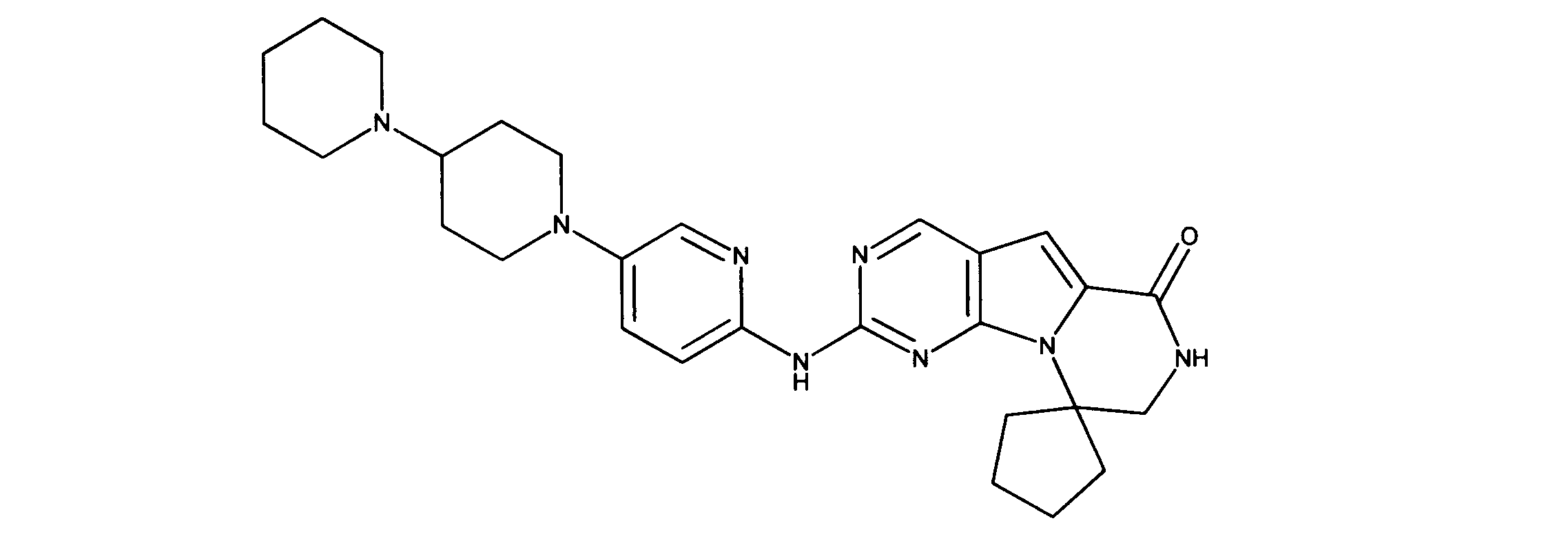
1HNMR (600 MHz, DMSO-d6) δ ppm 1.63 - 1.85 (m, 6 H) 1.87 - 1.92 (m, 2 H) 1.99 - 2.06 (m, 2 H) 2.15 - 2.23 (m, 2 H) 2.47 - 2.53 (m, 1 H) 2.69 - 2.79 (m, 2 H) 2.81 - 2.91 (m, 2 H) 2.98 - 3.08 (m, 2 H) 3.32 - 3.48 (m, 4 H) 3.57 - 3.72 (m, 4 H) 3.77 - 3.85 (m, 2 H) 7.22 (s, 1 H) 7.60 - 7.68 (m, 2 H) 7.90 (s, 1 H) 8.07 (s, 1 H) 8.46 (s, 1 H) 9.04 (s, 1 H). 11.41 (br s., 1H). LCMS (ESI) 501 (M + H).
Example 102
Synthesis of compound 102 (also called compound HHH)
1 HNMR (600 MHz, DMSO-d 6 ) δ ppm 1.63 - 1.85 (m, 6 H) 1.87 - 1.92 (m, 2 H) 1.99 - 2.06 (m, 2 H) 2.15 - 2.23 (m, 2 H) 2.47 - 2.53 (m, 1H) 2.69 - 2.79 (m, 2H) 2.81 - 2.91 (m, 2H) 2.98 - 3.08 (m, 2H) 3.32 - 3.48 (m, 4H) 3.57 - 3.72 (m, 4H) 3.77 - 3.85 (m, 2H) 7.22 (s, 1H) 7.60 - 7.68 (m, 2H) 7.90 (s, 1H) 8.07 (s, 1H) 8.46 (s, 1H) 9.04 (s, 1 H). 11.41 (br s., 1H). LCMS (ESI) 501 (M + H).
実施例103
化合物103の合成
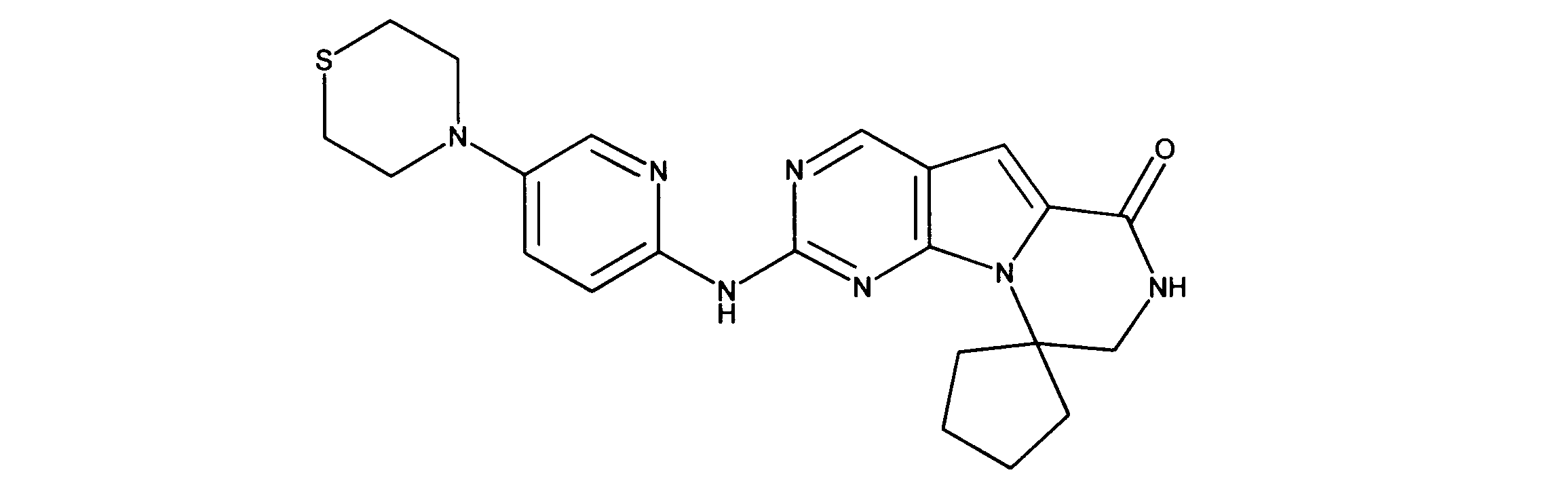
1HNMR (600 MHz, DMSO-d6) δ ppm 1.64 - 1.76 (m, 2 H) 1.87 - 1.93 (m, 2 H) 2.00 - 2.07 (m, 2 H) 2.48 - 2.53 (m, 2 H) 2.67 - 2.72 (m, 4 H) 3.44 - 3.47 (m, 2 H) 3.50 - 3.55 (m, 4 H) 7.24 (s, 1 H) 7.61 (d, J=9.37 Hz, 2 H) 7.86 (d, J=2.63 Hz, 1 H) 8.09 (d, J=12.88 Hz, 1 H) 8.48 (s, 1 H) 9.06 (s, 1 H) 11.41 (br s., 1H). LCMS (ESI) 436 (M + H).
Example 103
Synthesis of compound 103
1 HNMR (600 MHz, DMSO-d 6 ) δ ppm 1.64 - 1.76 (m, 2 H) 1.87 - 1.93 (m, 2 H) 2.00 - 2.07 (m, 2 H) 2.48 - 2.53 (m, 2 H) 2.67 - 2.72 (m, 4H) 3.44 - 3.47 (m, 2H) 3.50 - 3.55 (m, 4H) 7.24 (s, 1H) 7.61 (d, J=9.37 Hz, 2H) 7.86 (d, J =2.63 Hz, 1 H) 8.09 (d, J=12.88 Hz, 1 H) 8.48 (s, 1 H) 9.06 (s, 1 H) 11.41 (br s., 1 H). LCMS (ESI) 436 (M + H).
実施例104
化合物104の合成
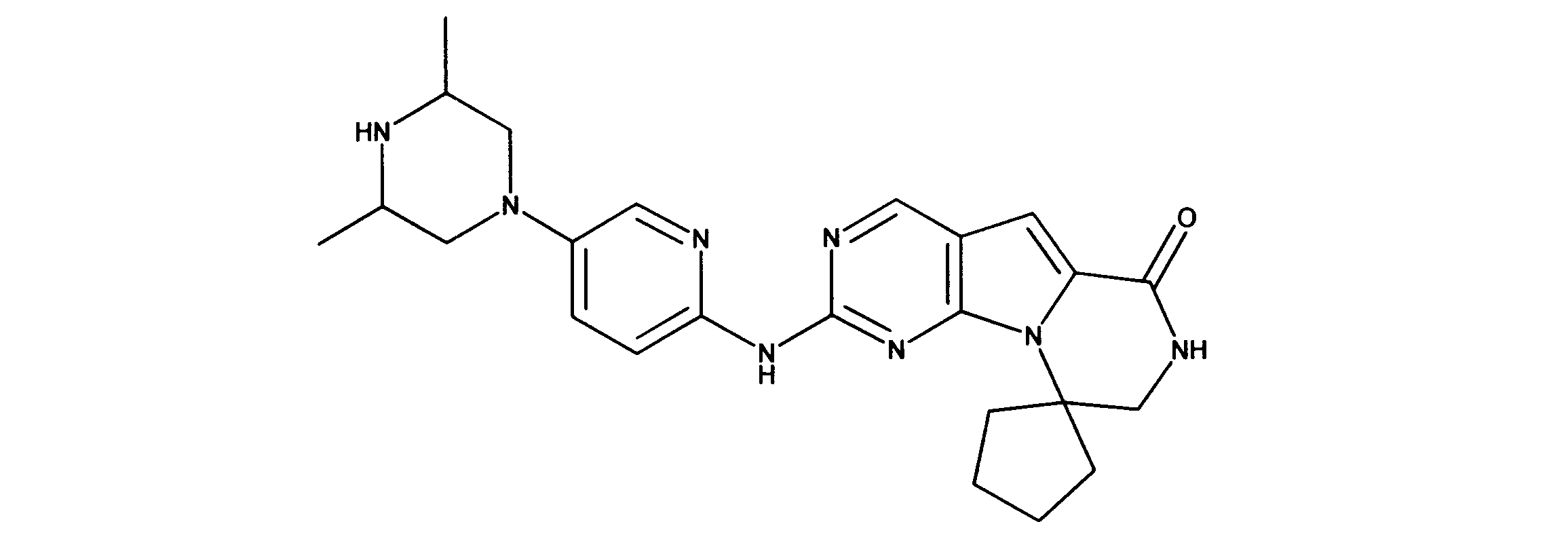
1HNMR (600 MHz, DMSO-d6) δ ppm 1.29 (d, J=6.73 Hz, 6 H) 1.66 - 1.79 (m, 2 H) 1.84 - 1.95 (m, 2 H) 1.98 - 2.09 (m, 2 H) 2.46 - 2.55 (m, 2 H) 3.29 - 3.39 (m, 2H) 3.58 - 3.70 (m, 4H) 3.77 - 3.86 (m, 4H) 7.24 (s, 1 H) 7.66 (d, J=9.37 Hz, 1 H) 7.96 (d, J=2.93 Hz, 1 H) 8.08 (s, 1 H) 8.48 (s, 1 H) 9.06 (s, 1 H) 9.28 (s, 1 H) 9.67 (s, 1 H) 11.36 (s, 1H). LCMS (ESI) 447 (M + H).
Example 104
Synthesis of compound 104
1 HNMR (600 MHz, DMSO-d 6 ) δ ppm 1.29 (d, J=6.73 Hz, 6 H) 1.66 - 1.79 (m, 2 H) 1.84 - 1.95 (m, 2 H) 1.98 - 2.09 (m, 2 H) 2.46 - 2.55 (m, 2H) 3.29 - 3.39 (m, 2H) 3.58 - 3.70 (m, 4H) 3.77 - 3.86 (m, 4H) 7.24 (s, 1H) 7.66 (d, J=9.37Hz , 1 H) 7.96 (d, J=2.93 Hz, 1 H) 8.08 (s, 1 H) 8.48 (s, 1 H) 9.06 (s, 1 H) 9.28 (s, 1 H) 9.67 (s, 1 H ) 11.36 (s, 1H). LCMS (ESI) 447 (M + H).
実施例105
化合物105の合成
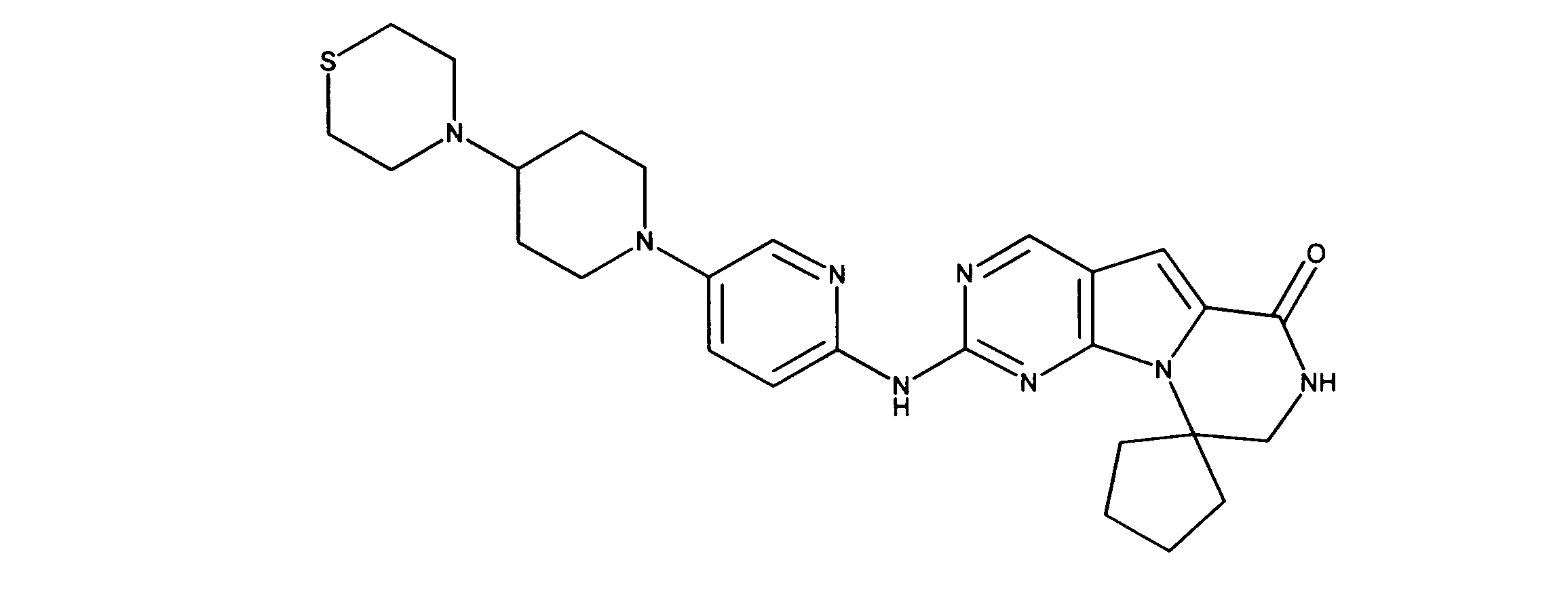
1HNMR (600 MHz, DMSO-d6) δ ppm 1.73 (s, 2 H) 1.76 - 1.85 (m, 2 H) 1.85 - 1.94 (m, 2 H) 1.98 - 2.07 (m, 2 H) 2.19 - 2.26 (m, 2 H) 2.48 - 2.52 (m, 1 H) 2.70 - 2.81 (m, 4 H) 3.13 - 3.20 (m, 1 H) 3.30 - 3.48 (m, 3 H) 3.58 - 3.71 (m, 4 H) 3.78 - 3.84 (m, 4 H) 7.24 (s, 1 H) 7.62 (d, J=9.37 Hz, 2 H) 7.89 (d, J=1.17 Hz, 1 H) 8.09 - 8.18 (m, 1 H) 8.48 (s, 1 H) 9.06 (s, 1 H) 11.46 (br s., 1H). LCMS (ESI) 519 (M + H).
Example 105
Synthesis of compound 105
1 HNMR (600 MHz, DMSO-d 6 ) δ ppm 1.73 (s, 2 H) 1.76 - 1.85 (m, 2 H) 1.85 - 1.94 (m, 2 H) 1.98 - 2.07 (m, 2 H) 2.19 - 2.26 (m, 2H) 2.48 - 2.52 (m, 1H) 2.70 - 2.81 (m, 4H) 3.13 - 3.20 (m, 1H) 3.30 - 3.48 (m, 3H) 3.58 - 3.71 (m, 4H ) 3.78 - 3.84 (m, 4 H) 7.24 (s, 1 H) 7.62 (d, J=9.37 Hz, 2 H) 7.89 (d, J=1.17 Hz, 1 H) 8.09 - 8.18 (m, 1 H) 8.48 (s, 1H) 9.06 (s, 1H) 11.46 (br s., 1H). LCMS (ESI) 519 (M + H).
実施例106
化合物106の合成
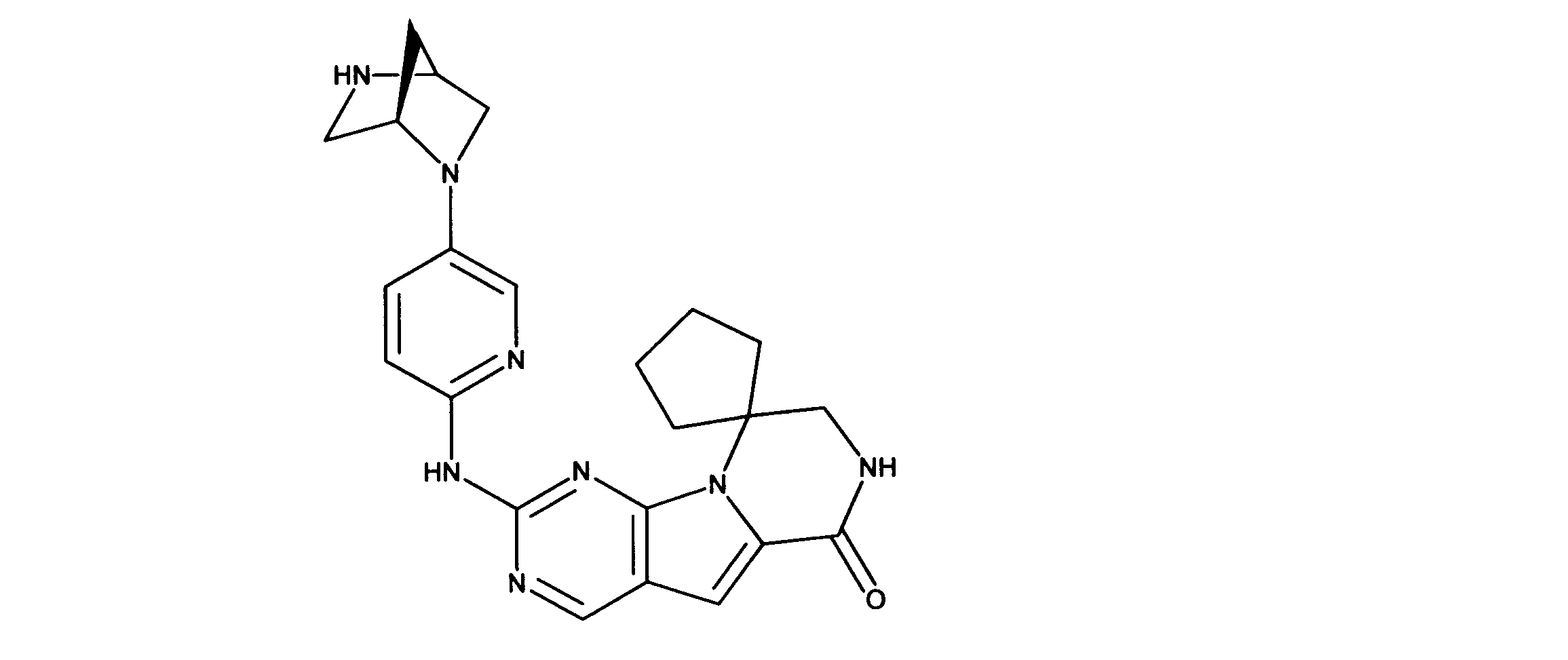
1HNMR (600 MHz, DMSO-d6) δ ppm 1.65 - 1.75 (m, 2 H) 1.85 - 1.93 (m, 2 H) 1.93 - 1.99 (m, 1 H) 2.00 - 2.06 (m, 2 H) 2.08 - 2.14 (m, 1 H) 2.47 - 2.55 (m, 2 H) 3.07 - 3.25 (m, 2 H) 3.25 - 3.69 (m, 5 H) 4.46 (s, 1 H) 4.67 (s, 1 H) 7.22 (s, 1 H) 7.58 - 7.69 (m, 2 H) 8.46 (s, 1 H) 9.02 (s, 1 H) 9.34 (s, 1 H) 9.65 (s, 1 H). LCMS (ESI) 431 (M + H).
Example 106
Synthesis of compound 106
1 HNMR (600 MHz, DMSO-d 6 ) δ ppm 1.65 - 1.75 (m, 2 H) 1.85 - 1.93 (m, 2 H) 1.93 - 1.99 (m, 1 H) 2.00 - 2.06 (m, 2 H) 2.08 - 2.14 (m, 1H) 2.47 - 2.55 (m, 2H) 3.07 - 3.25 (m, 2H) 3.25 - 3.69 (m, 5H) 4.46 (s, 1H) 4.67 (s, 1H) 7.22 (s, 1 H) 7.58 - 7.69 (m, 2 H) 8.46 (s, 1 H) 9.02 (s, 1 H) 9.34 (s, 1 H) 9.65 (s, 1 H). LCMS (ESI) 431 ( M + H).
実施例107
化合物107(化合物YYとも呼ばれる)の合成
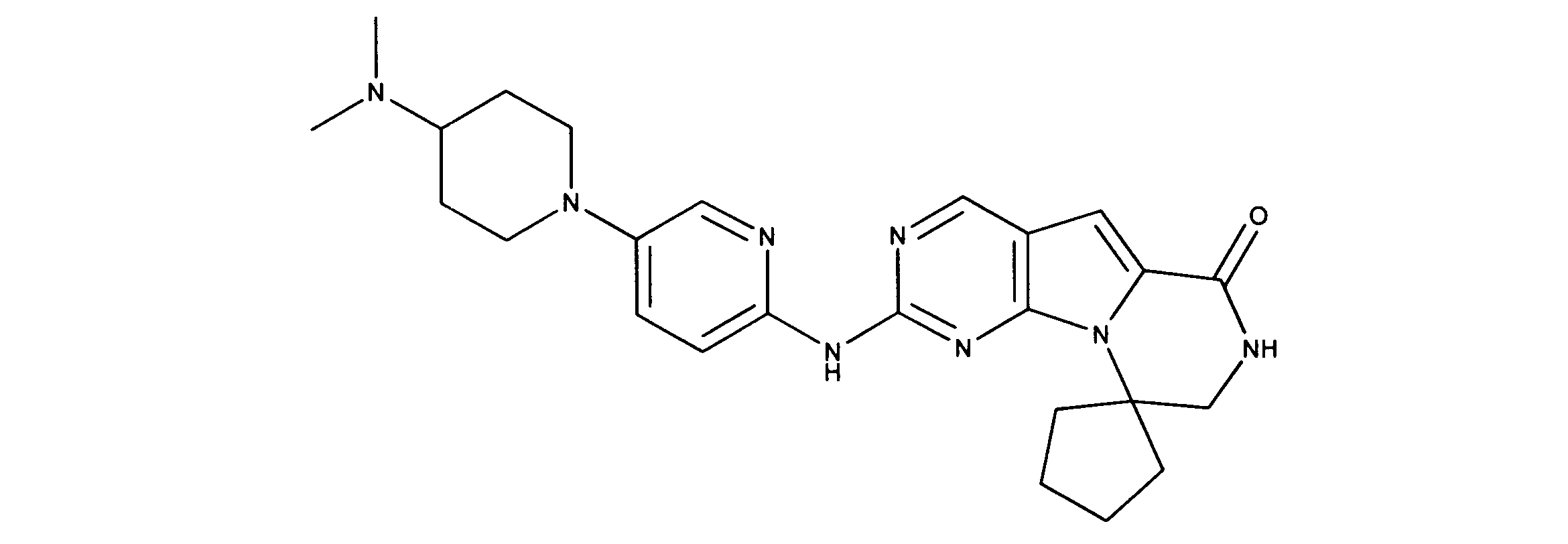
1HNMR (600 MHz, DMSO-d6) δ ppm 1.65 - 1.82 (m, 3 H) 1.89 (br. s., 2 H) 1.98 - 2.08 (m, 2 H) 2.13 (br. s., 2 H) 2.47 - 2.55 (m, 2 H) 2.68 (d, J=4.98 Hz, 6 H) 2.71 - 2.80 (m, 2 H) 3.29 - 3.71 (m, 10 H) 7.16 - 7.26 (m, 1 H) 7.67 (d, J=9.66 Hz, 2 H) 7.91 (d, J=2.05 Hz, 1 H) 8.14 (br. s., 1 H) 8.48 (br. s., 1 H) 9.05 (s, 1 H) 11.14 (br. s., 1 H) 11.43 (br. s., 1 H). LCMS (ESI) 461 (M + H).
Example 107
Synthesis of compound 107 (also called compound YY)
1 HNMR (600 MHz, DMSO-d 6 ) δ ppm 1.65 - 1.82 (m, 3 H) 1.89 (br. s., 2 H) 1.98 - 2.08 (m, 2 H) 2.13 (br. s., 2 H ) 2.47 - 2.55 (m, 2 H) 2.68 (d, J=4.98 Hz, 6 H) 2.71 - 2.80 (m, 2 H) 3.29 - 3.71 (m, 10 H) 7.16 - 7.26 (m, 1 H) 7.67 (d, J=9.66 Hz, 2 H) 7.91 (d, J=2.05 Hz, 1 H) 8.14 (br. s., 1 H) 8.48 (br. s., 1 H) 9.05 (s, 1 H) 11.14 (br. s., 1 H) 11.43 (br. s., 1 H). LCMS (ESI) 461 (M + H).
実施例108
化合物108の合成
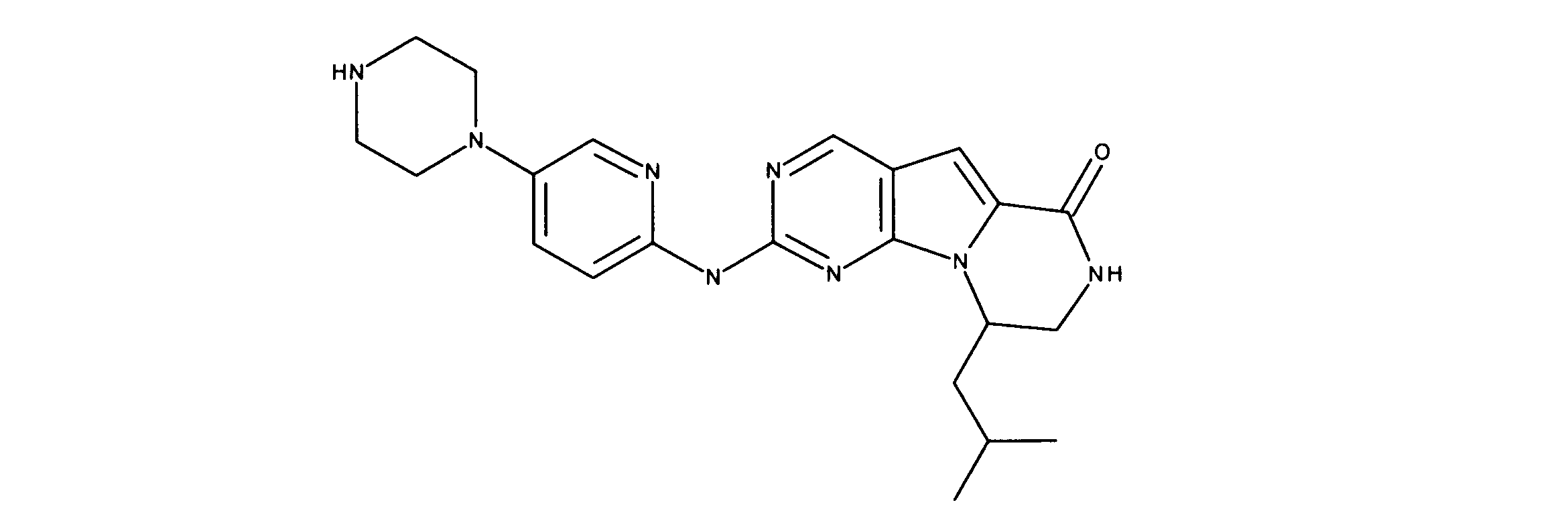
Synthesis of compound 108
実施例109
化合物109の合成
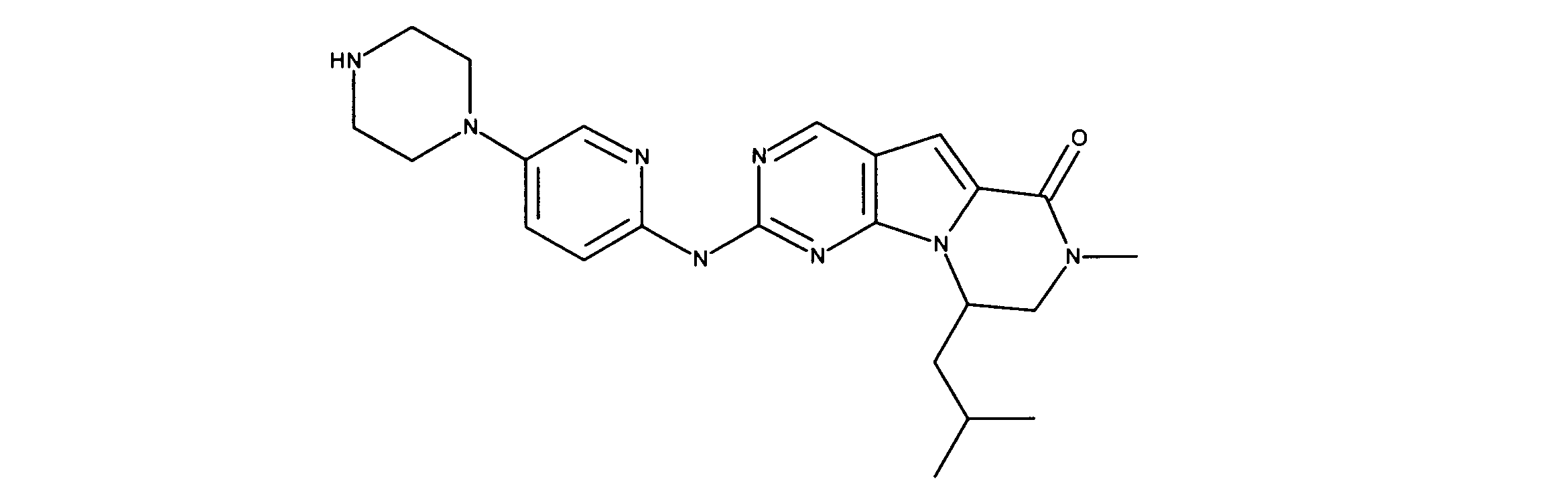
Synthesis of compound 109
実施例110
化合物110の合成
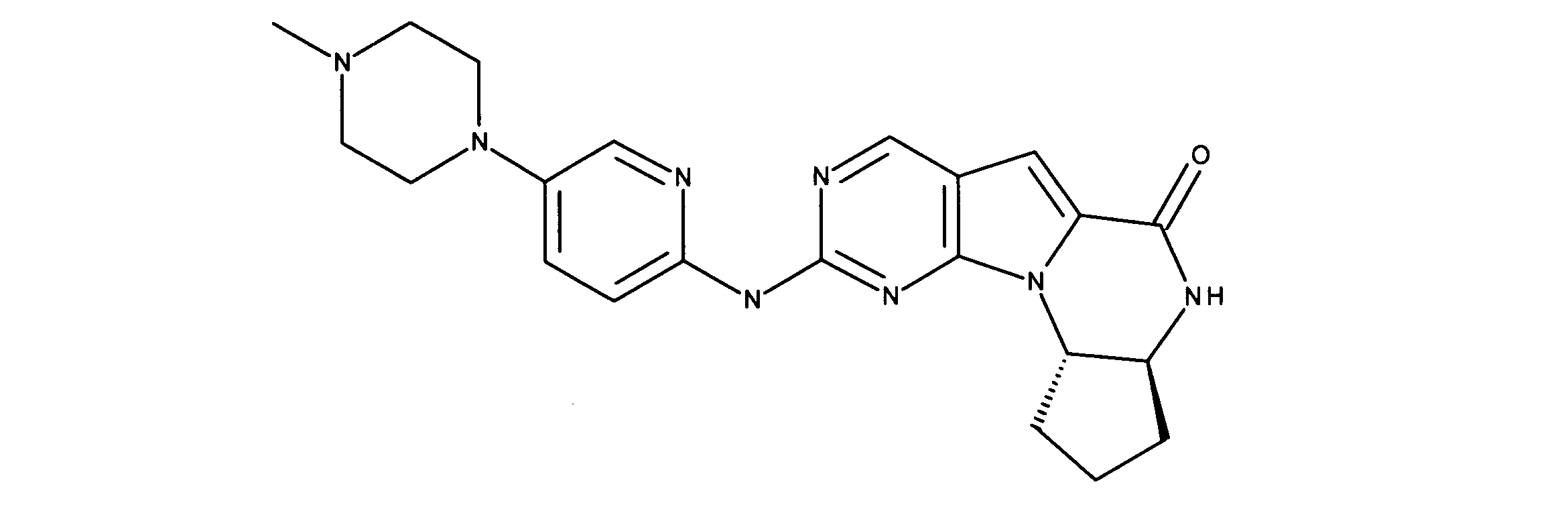
1HNMR (600 MHz, DMSO-d6) δ ppm 1.50 - 1.65 (m, 1 H) 1.92 - 2.02 (m, 3 H) 2.06 - 2.15 (m, 1 H) 2.78 (d, J=3.81 Hz, 4 H) 3.10 - 3.20 (m, 4 H) 3.47 - 3.51 (m, 2 H) 3.64 - 3.71 (m, 1 H) 3.76 - 3.83 (m, 2 H) 3.98 - 4.14 (m, 1 H) 7.20 (s, 2 H) 7.77 (s, 1 H) 7.97 (s, 2 H) 8.81 (s, 1 H) 9.03 (s, 1 H) 10.97 (br s., 1H). LCMS (ESI) 419 (M + H).
Example 110
Synthesis of compound 110
1 HNMR (600 MHz, DMSO-d 6 ) δ ppm 1.50 - 1.65 (m, 1 H) 1.92 - 2.02 (m, 3 H) 2.06 - 2.15 (m, 1 H) 2.78 (d, J=3.81 Hz, 4 H) 3.10 - 3.20 (m, 4H) 3.47 - 3.51 (m, 2H) 3.64 - 3.71 (m, 1H) 3.76 - 3.83 (m, 2H) 3.98 - 4.14 (m, 1H) 7.20 (s , 2 H) 7.77 (s, 1 H) 7.97 (s, 2 H) 8.81 (s, 1 H) 9.03 (s, 1 H) 10.97 (br s., 1 H). LCMS (ESI) 419 (M + H ).
実施例111
化合物111の合成
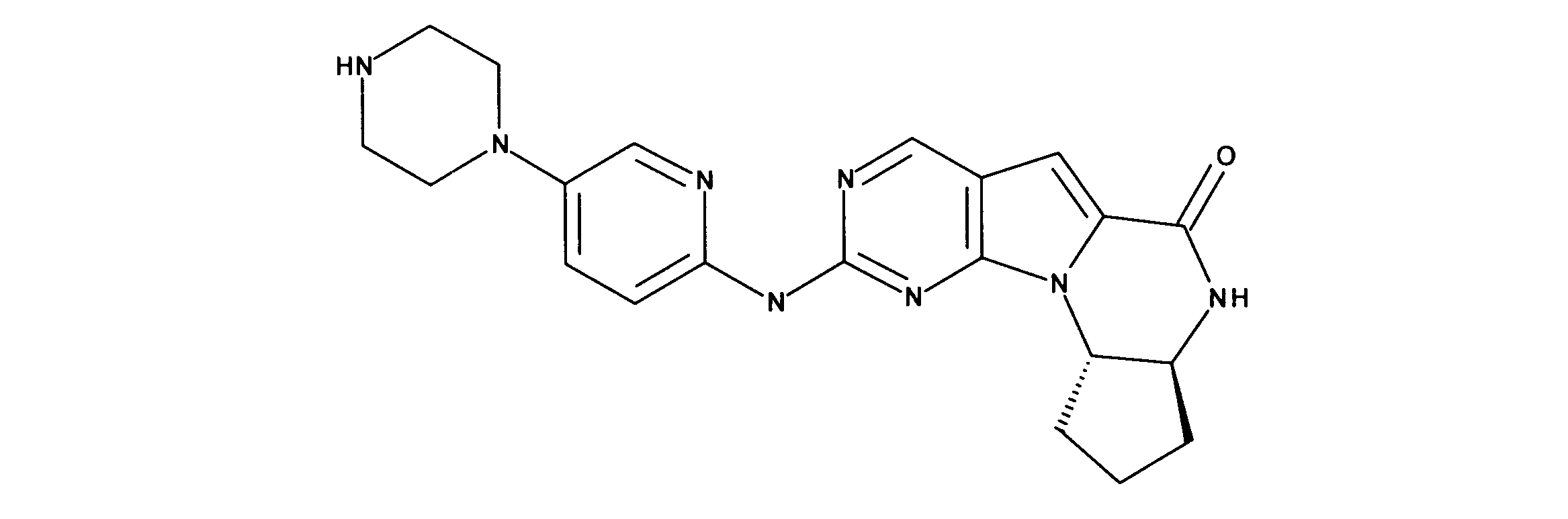
1HNMR (600 MHz, DMSO-d6) δ ppm 1.54 - 1.59 (m, 1 H) 1.92 - 2.01 (m, 3 H) 2.06 - 2.15 (m, 1 H) 2.76 - 2.84 (m, 1 H) 3.17 - 3.24 (m, 6 H) 3.64 - 3.71 (m, 2 H) 4.02 - 4.11 (m, 2 H) 7.22 (s, 2 H) 7.64 (s, 1 H) 7.97 (s, 2 H) 8.75 (s, 1 H) 8.97 (s, 1 H) 9.21 (s, 1 H). LCMS (ESI) 405 (M + H).
Example 111
Synthesis of compound 111
1 HNMR (600 MHz, DMSO-d 6 ) δ ppm 1.54 - 1.59 (m, 1 H) 1.92 - 2.01 (m, 3 H) 2.06 - 2.15 (m, 1 H) 2.76 - 2.84 (m, 1 H) 3.17 - 3.24 (m, 6H) 3.64 - 3.71 (m, 2H) 4.02 - 4.11 (m, 2H) 7.22 (s, 2H) 7.64 (s, 1H) 7.97 (s, 2H) 8.75 (s , 1 H) 8.97 (s, 1 H) 9.21 (s, 1 H). LCMS (ESI) 405 (M + H).
実施例112
化合物112の合成

Synthesis of compound 112
実施例113
tert-ブチルN-[2-[(5-ブロモ2クロロピリミジン-4イル)アミノ]エチル]カルバメートの合成、化合物113

LCMS (ESI) 351 (M + H).
Example 113
Synthesis of tert-butyl N-[2-[(5-bromo-2-chloropyrimidin-4yl)amino]ethyl]carbamate, compound 113
LCMS (ESI) 351 (M+H).
実施例114
tert-ブチルN-[2-[[2-クロロ-5-(3、3-ジエトキシプロプ-1-イニル)ピリミジン-4イル]アミノ]エチル]カルバメートの合成、化合物114
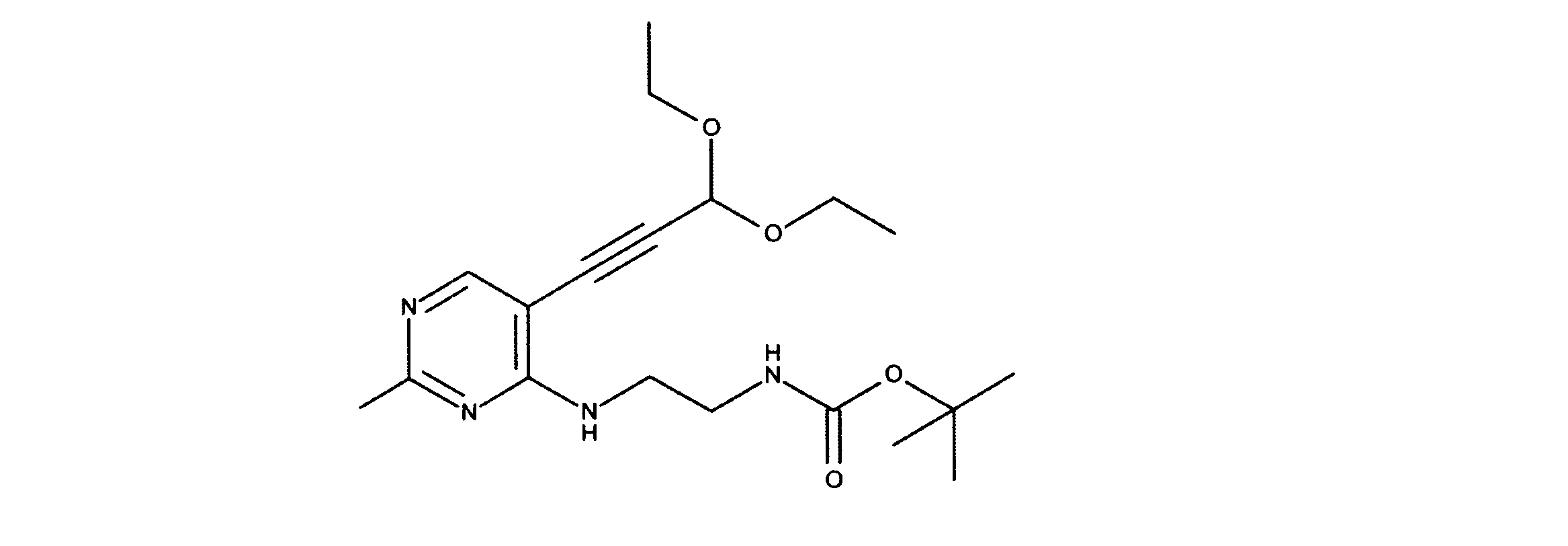
内容物を、70度で24時間加熱した。CELITE(登録商標)を通して濾過した後、ヘキサン/酢酸エチル(0~20%)を用いて、粗反応物をカラムに充填し、所望の製品(3.9g)を提供した。ヘキサン/酢酸エチル(0~30%)を用いて、得られた残留物のカラムクロマトグラフィーを行い、tert-ブチルN-[2-[[2-クロロ-5-(3、3-ジエトキシプロプ-1-イニル)ピリミジン-4-イル]アミノ]エチル]カルバメートを提供した。
LCMS (ESI) 399 (M + H).
Example 114
Synthesis of tert-butyl N-[2-[[2-chloro-5-(3,3-diethoxyprop-1-ynyl)pyrimidin-4yl]amino]ethyl]carbamate, compound 114
The contents were heated at 70 degrees for 24 hours. After filtering through CELITE®, the crude reaction was loaded onto a column using hexanes/ethyl acetate (0-20%) to provide the desired product (3.9 g). Column chromatography of the resulting residue was performed using hexane/ethyl acetate (0-30%) to give tert-butyl N-[2-[[2-chloro-5-(3,3-diethoxyprop-1 -ynyl)pyrimidin-4-yl]amino]ethyl]carbamate.
LCMS (ESI) 399 (M+H).
実施例115
tert-ブチルN-[2-[2-クロロ-6-(ジエトキシメチル)ピロロ[2,3-d]ピリミジン-7-イル]エチル]カルバメートの合成、化合物115
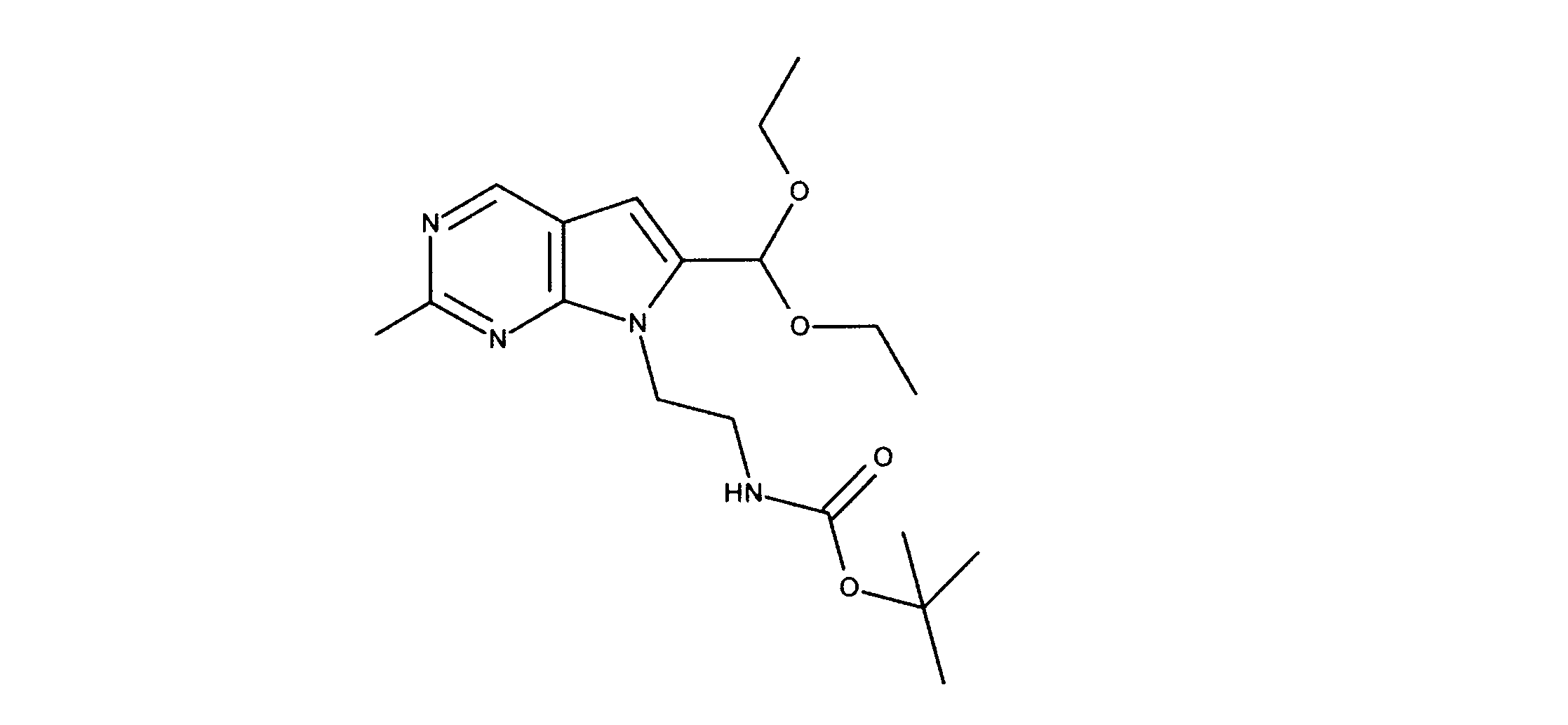
1HNMR (d6-DMSO) δ ppm 8.88 (s, 1H), 6.95 (brs, 1H), 6.69 (s, 1H), 5.79 (s, 1H), 4.29 (m, 2H), 3.59 (m, 4H), 3.34 (m, 1H), 3.18 (m, 1H), 1.19 (m, 9H), 1.17 (m, 6H). LCMS (ESI) 399 (M+H).
Example 115
Synthesis of tert-butyl N-[2-[2-chloro-6-(diethoxymethyl)pyrrolo[2,3-d]pyrimidin-7-yl]ethyl]carbamate, compound 115
1 HNMR (d6-DMSO) δ ppm 8.88 (s, 1H), 6.95 (brs, 1H), 6.69 (s, 1H), 5.79 (s, 1H), 4.29 (m, 2H), 3.59 (m, 4H) , 3.34 (m, 1H), 3.18 (m, 1H), 1.19 (m, 9H), 1.17 (m, 6H). LCMS (ESI) 399 (M+H).
実施例116
tert-ブチルN-[2-[2-クロロ6-(ジエトキシメチル)-5ヨードピロロ[2,3-d]ピリミジン-7-イル]エチル]カルバメートの合成、化合物116
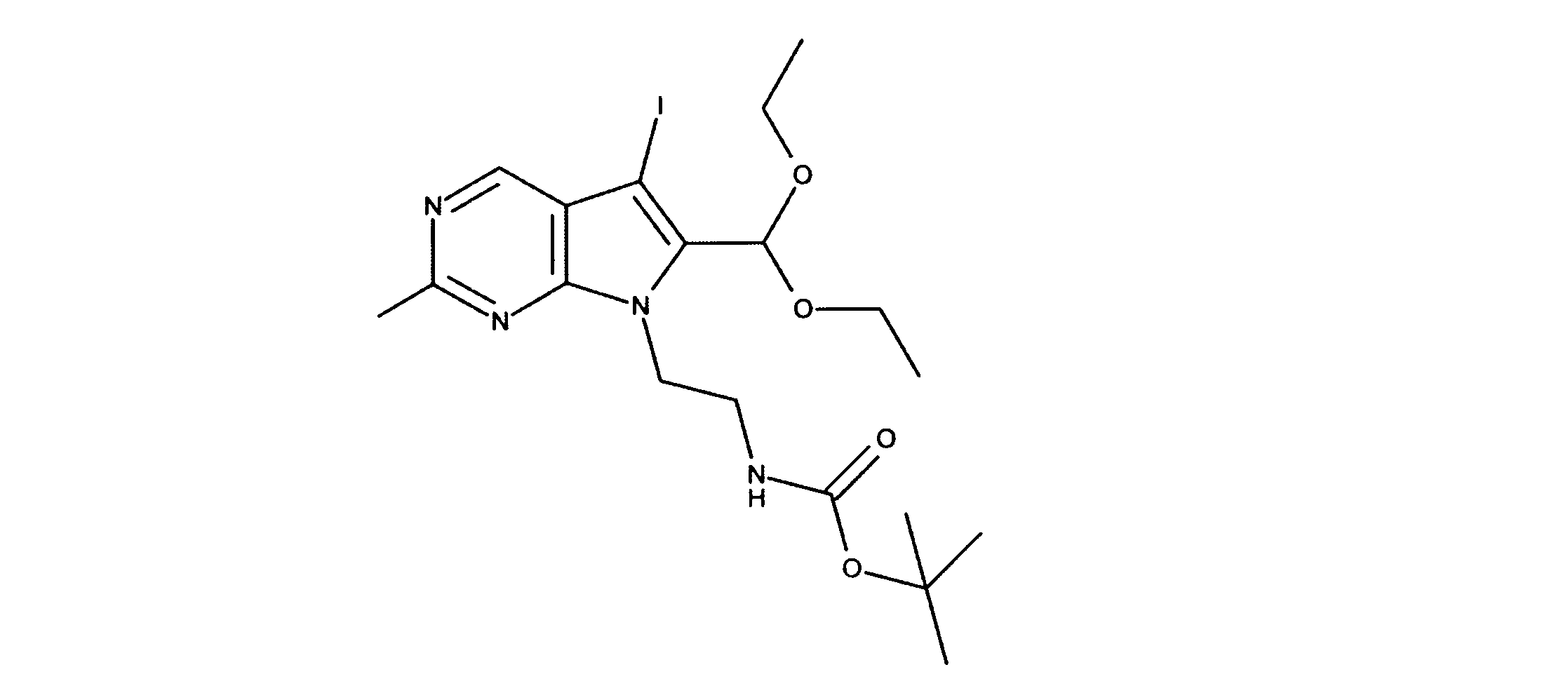
LCMS (ESI) 525 (M + H).
Example 116
Synthesis of tert-butyl N-[2-[2-chloro 6-(diethoxymethyl)-5 iodopyrrolo[2,3-d]pyrimidin-7-yl]ethyl]carbamate, compound 116
LCMS (ESI) 525 (M+H).
実施例117
tert-ブチルN-[2-[2-クロロ-6-(ジエトキシメチル)-5-(o-トリル)ピロロ[2,3-d]ピリミジン-7-イル]エチル]カルバメートの合成、化合物117
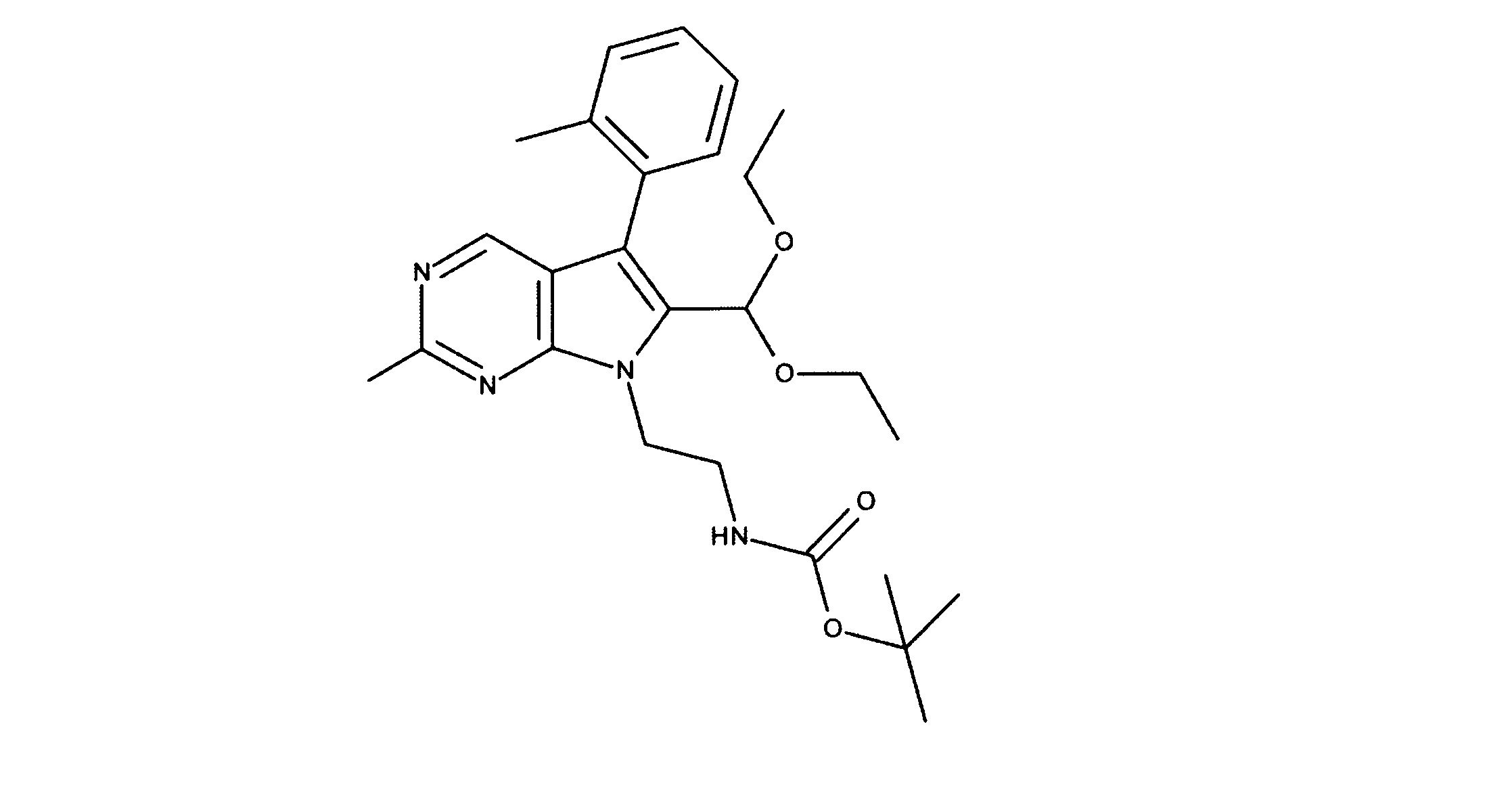
LCMS (ESI) 489 (M + H).
Example 117
Synthesis of tert-butyl N-[2-[2-chloro-6-(diethoxymethyl)-5-(o-tolyl)pyrrolo[2,3-d]pyrimidin-7-yl]ethyl]carbamate, compound 117
LCMS (ESI) 489 (M+H).
実施例118
7-[2-(tert-ブトキシカルボニルアミノ)エチル]-2-クロロ-5-(o-トリル)ピロロ[2,3-d]ピリミジン-6カルボン酸の合成、化合物118
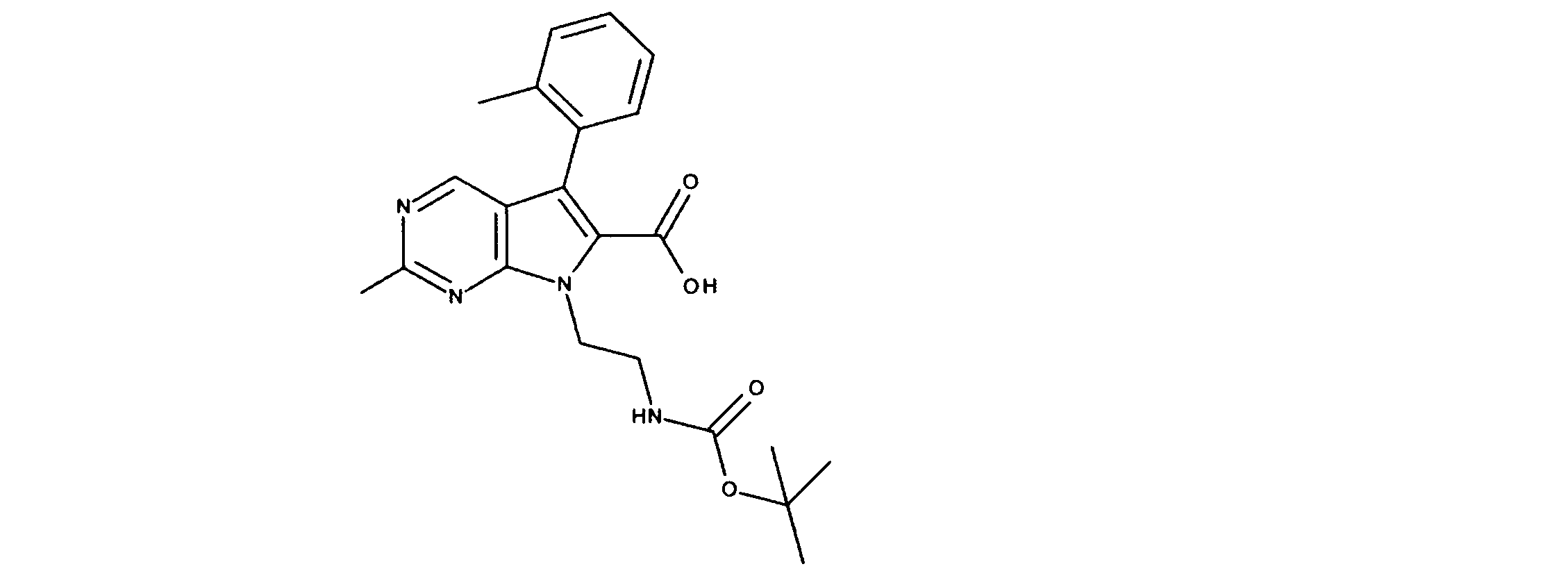
LCMS (ESI) 431 (M + H).
Example 118
Synthesis of 7-[2-(tert-butoxycarbonylamino)ethyl]-2-chloro-5-(o-tolyl)pyrrolo[2,3-d]pyrimidine-6carboxylic acid, compound 118
LCMS (ESI) 431 (M+H).
実施例119
化合物119の合成
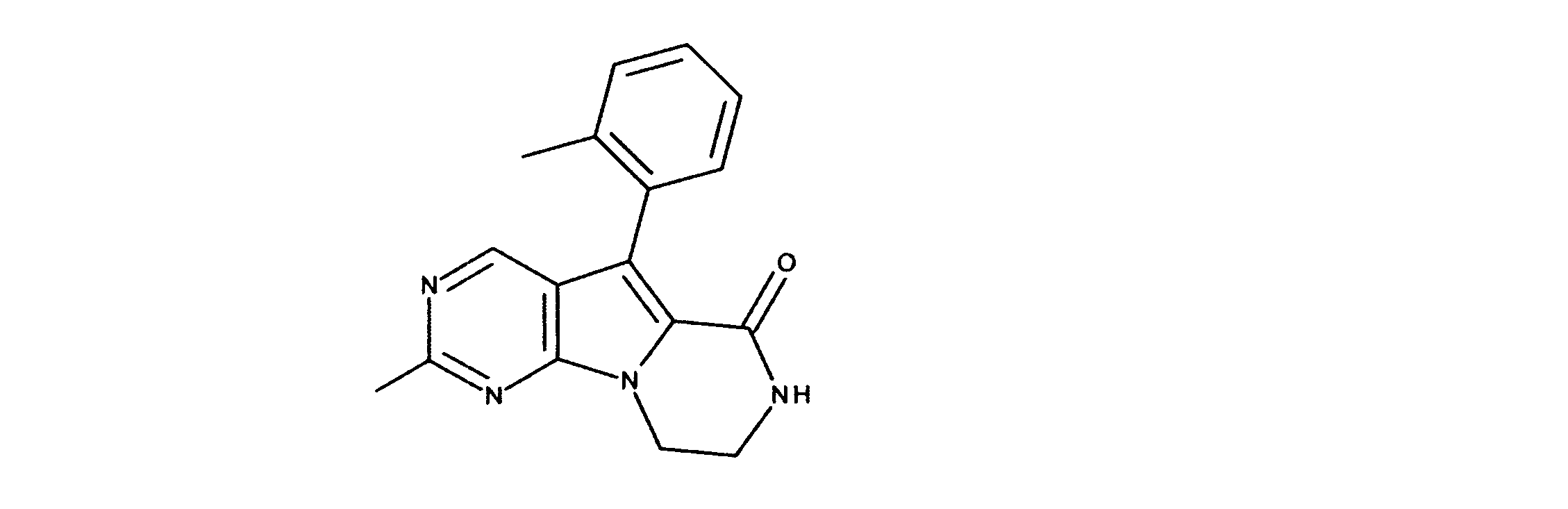
LCMS (ESI) 313 (M + H).
Example 119
Synthesis of compound 119
LCMS (ESI) 313 (M+H).
実施例120
化合物120の合成
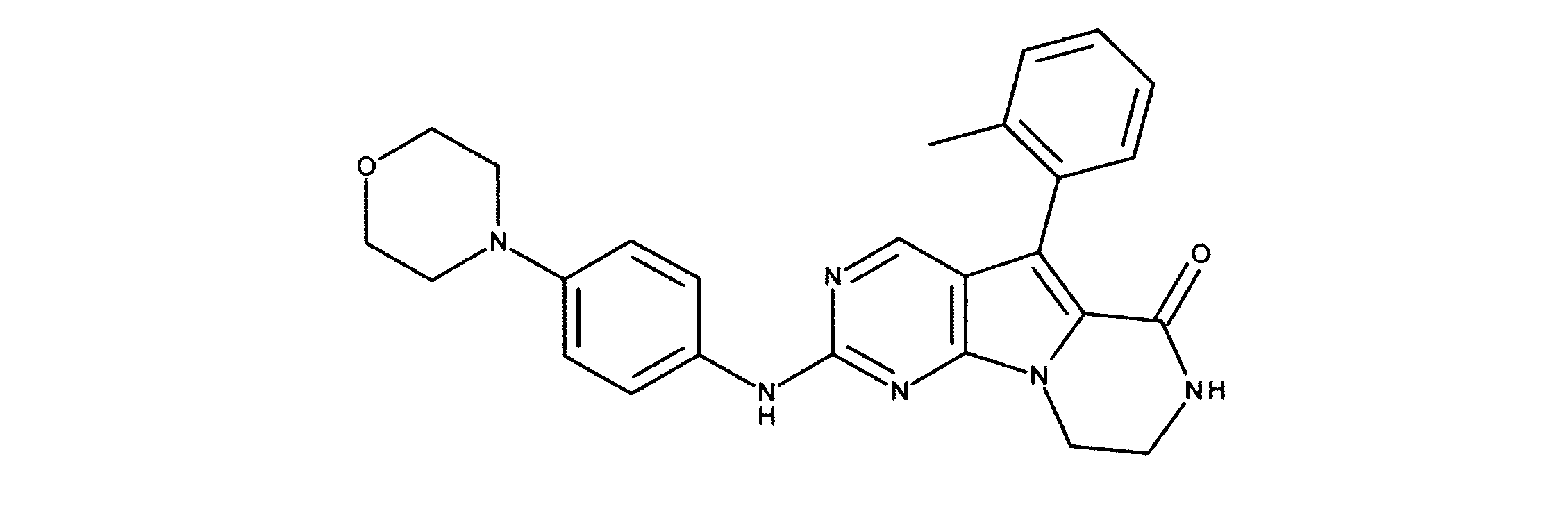
LCMS (ESI) 455 (M + H). 1HNMR (600 MHz, DMSO-d6) δ ppm 2.14 (s, 3 H) 3.23 - 3.50 (m, 2 H) 3.57 - 3.73 (m, 2 H), 3.81 - 3.92 (m, 8H), 7.11 - 7.31 (m, 4 H) 7.31 - 7.48 (m, 1 H) 7.58 - 7.73 (m, 1 H) 7.77 - 7.95 (m, 2 H) 8.05 - 8.21 (m, 1 H) 8.44 (s, 1 H) 9.85 - 10.01 (m, 1 H).
Example 120
Synthesis of compound 120
LCMS (ESI) 455 (M + H). 1 HNMR (600 MHz, DMSO-d 6 ) δ ppm 2.14 (s, 3 H) 3.23 - 3.50 (m, 2 H) 3.57 - 3.73 (m, 2 H), 3.81 - 3.92 (m, 8H), 7.11 - 7.31 (m, 4H) 7.31 - 7.48 (m, 1H) 7.58 - 7.73 (m, 1H) 7.77 - 7.95 (m, 2H) 8.05 - 8.21 (m , 1 H) 8.44 (s, 1 H) 9.85 - 10.01 (m, 1 H).
実施例121
化合物121の合成
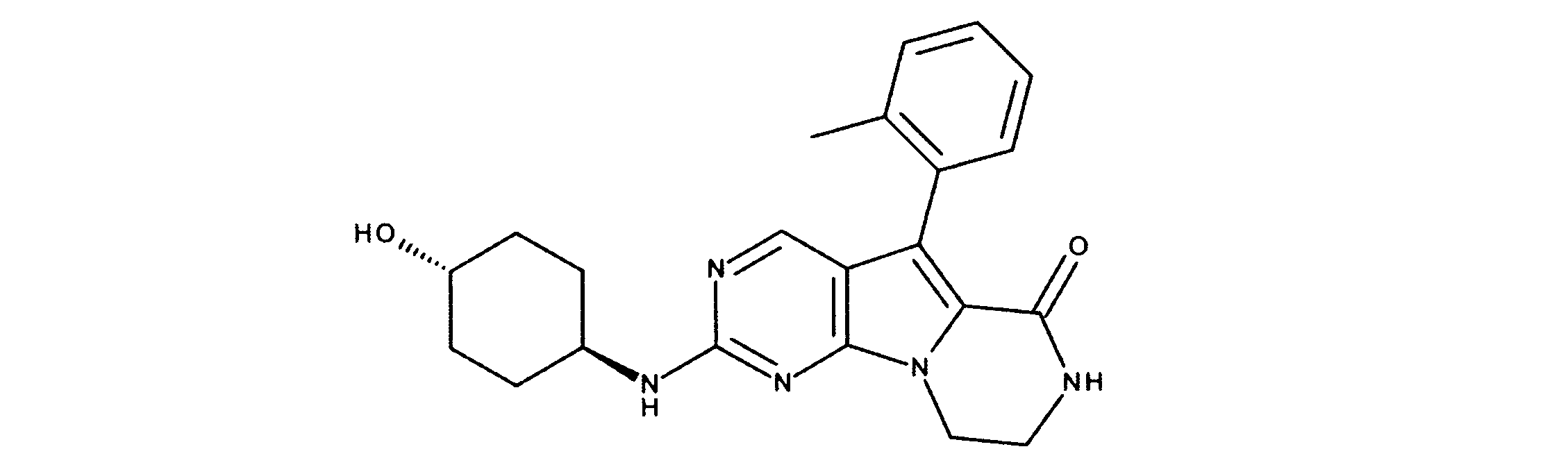
LCMS (ESI) 392 (M + H). 1HNMR (600 MHz, DMSO-d6) δ ppm 1.23 (d, J=8.78 Hz, 4 H) 1.84 (br. s., 4 H) 2.11 (s, 3 H) 3.34 - 3.43 (m, 1 H) 3.55 (br. s., 2 H) 3.72 (br. s., 1 H) 4.13 (br. s., 2 H) 4.50 (br. s., 1 H) 7.03 (br. s., 1 H) 7.12 - 7.28 (m, 4 H) 7.96 (br. s., 1 H) 8.18 (br. s., 1 H).
Example 121
Synthesis of compound 121
LCMS (ESI) 392 (M + H). 1 HNMR (600 MHz, DMSO-d 6 ) δ ppm 1.23 (d, J=8.78 Hz, 4 H) 1.84 (br. s., 4 H) 2.11 (s, 3H) 3.34 - 3.43 (m, 1H) 3.55 (br.s., 2H) 3.72 (br.s., 1H) 4.13 (br.s., 2H) 4.50 (br.s., 1H) H) 7.03 (br. s., 1 H) 7.12 - 7.28 (m, 4 H) 7.96 (br. s., 1 H) 8.18 (br. s., 1 H).
実施例122
7-[2-(tert-ブトキシカルボニルアミノ)エチル]-2-クロロ-ピロロ[2,3-d]ピリミジン-6カルボン酸の合成、化合物122
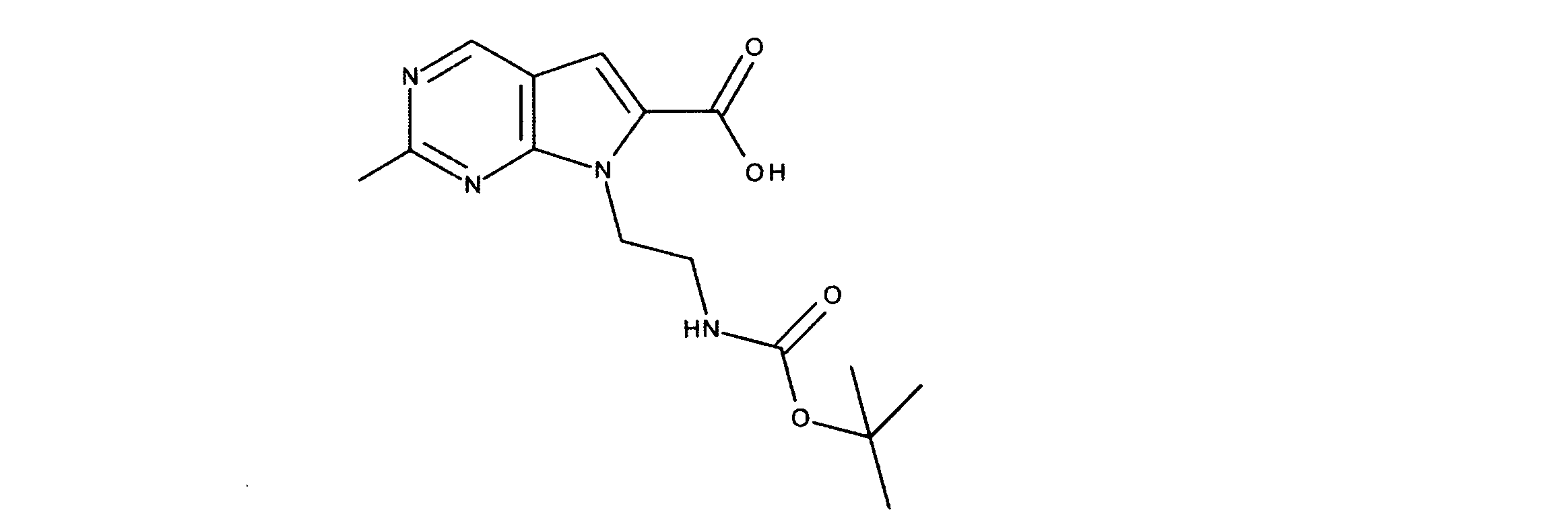
LCMS (ESI) 341 (M + H).
Example 122
Synthesis of 7-[2-(tert-butoxycarbonylamino)ethyl]-2-chloro-pyrrolo[2,3-d]pyrimidine-6carboxylic acid, compound 122
LCMS (ESI) 341 (M+H).
実施例123
化合物123の合成

LCMS (ESI) 223 (M + H).
Example 123
Synthesis of compound 123
LCMS (ESI) 223 (M+H).
実施例124
化合物124の合成

LCMS (ESI) 302 (M + H).
Example 124
Synthesis of compound 124
LCMS (ESI) 302 (M+H).
実施例125
tert-ブチルN-[2-[(5-ブロモ-2-クロロ-ピリミジン-4-イル)アミノ]-2メチル-プロピル]カルバメートの合成、化合物125

LCMS (ESI) (M+H) 379.
Example 125
Synthesis of tert-butyl N-[2-[(5-bromo-2-chloro-pyrimidin-4-yl)amino]-2methyl-propyl]carbamate, compound 125
LCMS (ESI) (M+H) 379.
実施例126
tert-ブチルN-[2-[[2-クロロ-5-(3、3-ジエトキシプロプ-1-イニル)ピリミジン-4-イル]アミノ]-2メチル-プロピル]カルバメートの合成、化合物126
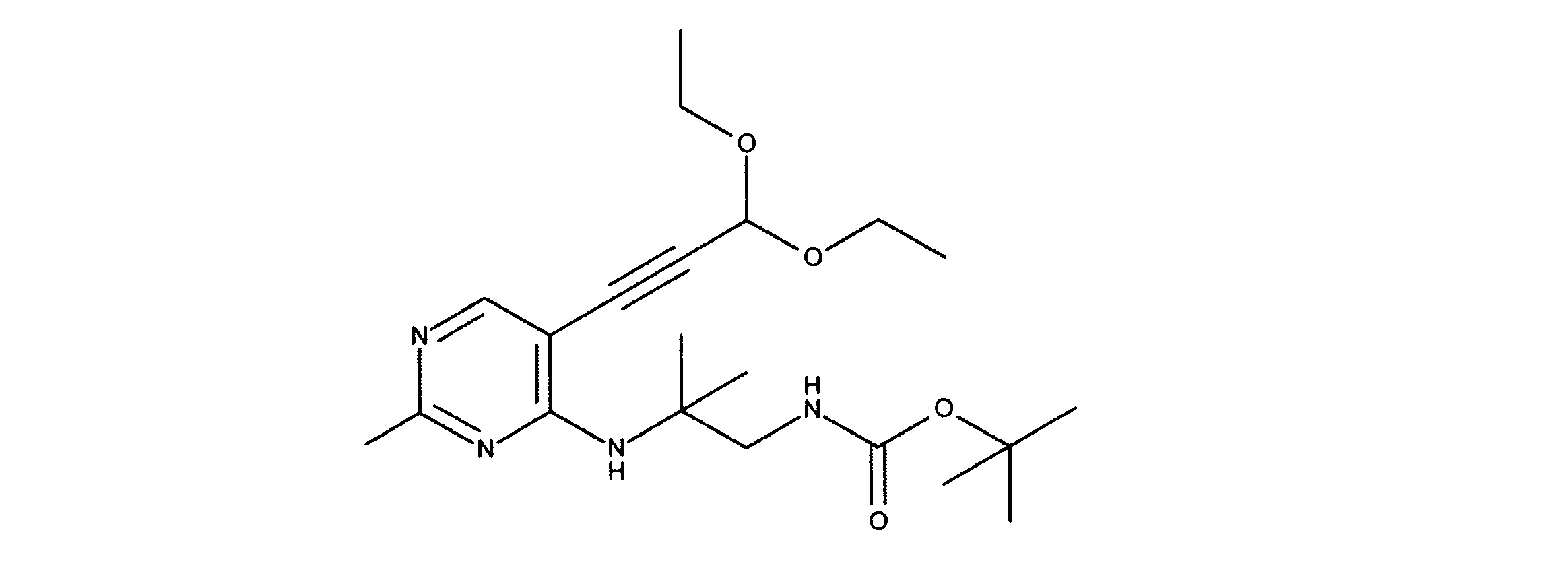
LCMS (ESI) (M+H) 427.
Example 126
Synthesis of tert-butyl N-[2-[[2-chloro-5-(3,3-diethoxyprop-1-ynyl)pyrimidin-4-yl]amino]-2methyl-propyl]carbamate, compound 126
LCMS (ESI) (M+H) 427.
実施例127
tert-ブチルN-[2-[2-クロロ-6-(ジエトキシメチル)ピロロ[2,3-d]ピリミジン-7-イル]-2メチル-プロピル]カルバメートの合成、化合物127
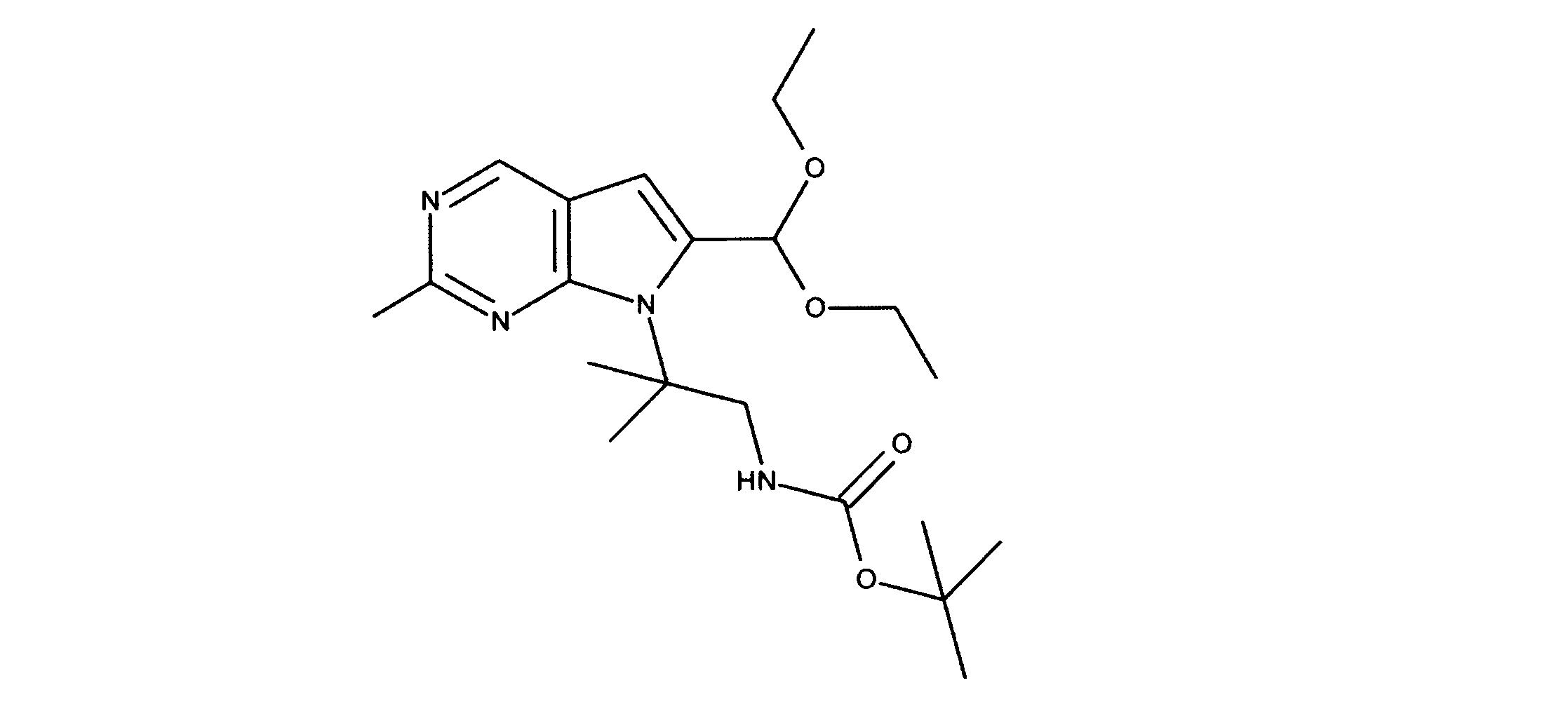
LCMS (ESI) (M+H) 427.
Example 127
Synthesis of tert-butyl N-[2-[2-chloro-6-(diethoxymethyl)pyrrolo[2,3-d]pyrimidin-7-yl]-2methyl-propyl]carbamate, compound 127
LCMS (ESI) (M+H) 427.
実施例128
7-[2-(tert-ブトキシカルボニルアミノ)-1,1-ジメチルエチル]-2-クロロ-ピロロ[2,3-d]ピリミジン-6カルボン酸の合成、化合物128

LCMS (ESI) 369 (M + H).
Example 128
Synthesis of 7-[2-(tert-butoxycarbonylamino)-1,1-dimethylethyl]-2-chloro-pyrrolo[2,3-d]pyrimidine-6carboxylic acid, compound 128
LCMS (ESI) 369 (M+H).
実施例129
化合物129の合成

LCMS (ESI) 251 (M + H).
Example 129
Synthesis of compound 129
LCMS (ESI) 251 (M+H).
実施例130
化合物130の合成

LCMS (ESI) 330 (M + H). 1HNMR (600 MHz, DMSO-d6) δ ppm 1.07 - 1.34 (m, 4 H) 1.47 - 2.05 (m, 10 H) 3.09 (m, 1H) 3.51 (d, J = 2.91 Hz, 2 H) 3.57 (m, 1H) 4.50 (br. s., 1 H) 6.89 (s, 1 H) 6.94 - 7.05 (m, 1 H) 8.04 (br. s., 1 H) 8.60 (s, 1 H) 9.00 (br. s., 1 H).
Example 130
Synthesis of compound 130
LCMS (ESI) 330 (M + H). 1 HNMR (600 MHz, DMSO-d 6 ) δ ppm 1.07 - 1.34 (m, 4 H) 1.47 - 2.05 (m, 10 H) 3.09 (m, 1H) 3.51 ( d, J = 2.91 Hz, 2 H) 3.57 (m, 1 H) 4.50 (br. s., 1 H) 6.89 (s, 1 H) 6.94 - 7.05 (m, 1 H) 8.04 (br. s., 1 H) 8.60 (s, 1 H) 9.00 (br. s., 1 H).
実施例131
ベンジルN-[1-[[(5-ブロモ-2-クロロ-ピリミジン-4-イル)アミノ]メチル]プロピル]カルバメートの合成、化合物131
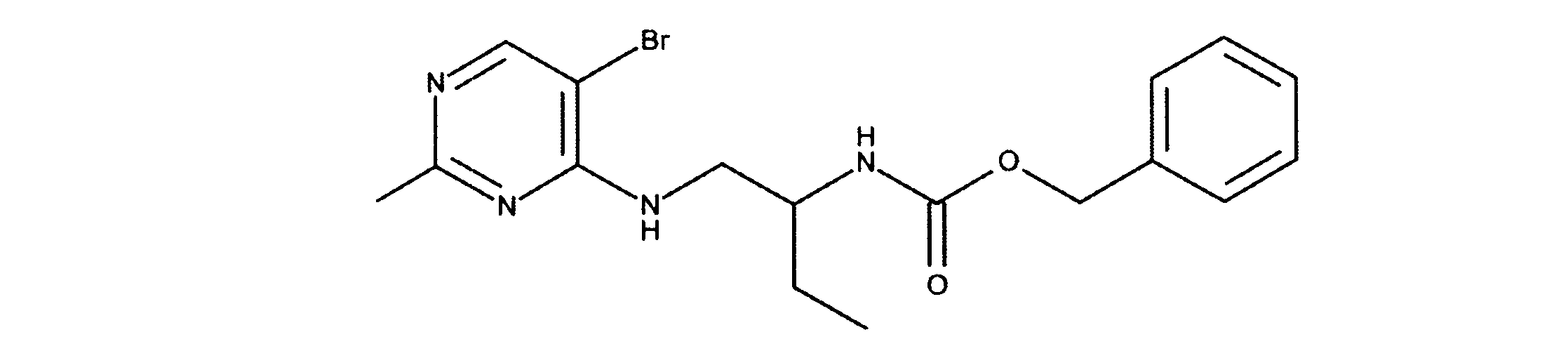
LCMS (ESI) (M+H) 413.
Example 131
Synthesis of benzyl N-[1-[[(5-bromo-2-chloro-pyrimidin-4-yl)amino]methyl]propyl]carbamate, compound 131
LCMS (ESI) (M+H) 413.
実施例132
ベンジルN-[1-[[[2-クロロ-5-(3、3-ジエトキシプロプ-1-イニル)ピリミジン-4-イル]アミノ]メチル]プロピル]カルバメートの合成、化合物132

LCMS (ESI) (M+H) 461.
Example 132
Synthesis of benzyl N-[1-[[[2-chloro-5-(3,3-diethoxyprop-1-ynyl)pyrimidin-4-yl]amino]methyl]propyl]carbamate, compound 132
LCMS (ESI) (M+H) 461.
実施例133
カルバミン酸ベンジルN-[1-[[2-クロロ-6-(ジエトキシメチル)ピロロ[2,3-d]ピリミジン-7-イル]メチル]プロピル]の合成、化合物133
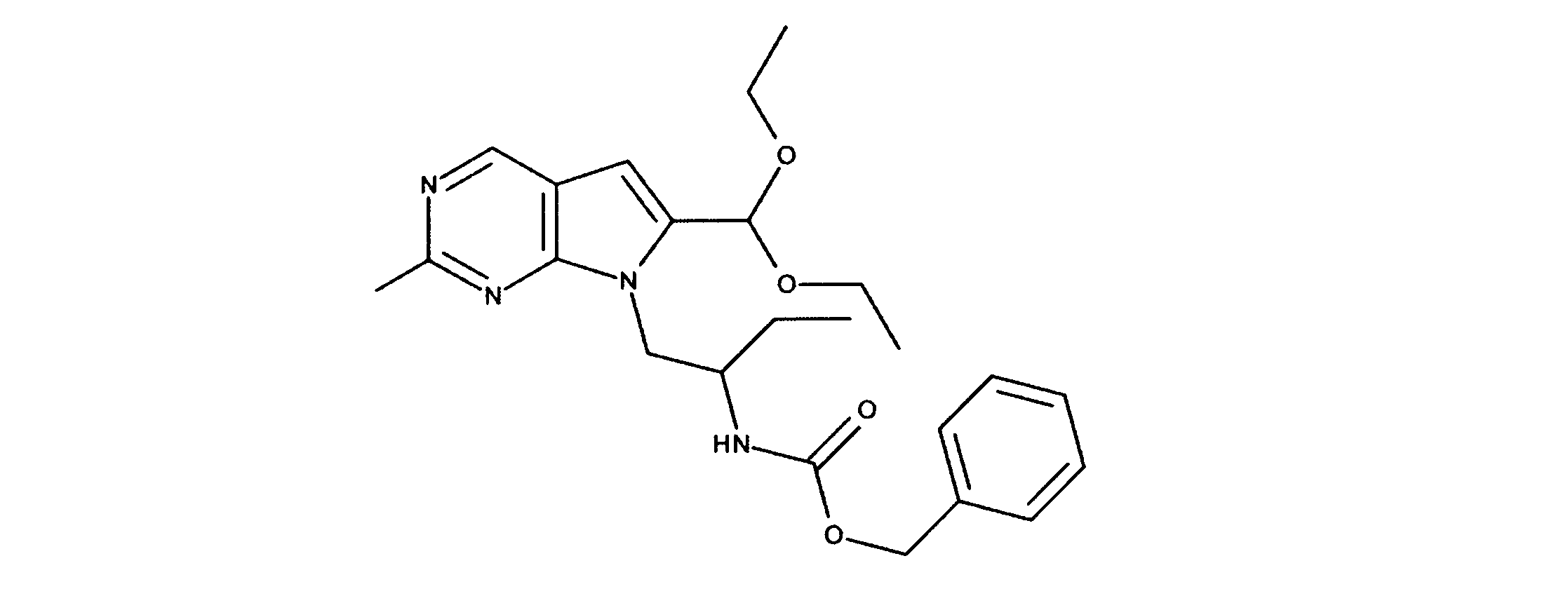
LCMS (ESI) (M+H) 461.
Example 133
Synthesis of benzyl carbamate N-[1-[[2-chloro-6-(diethoxymethyl)pyrrolo[2,3-d]pyrimidin-7-yl]methyl]propyl], compound 133
LCMS (ESI) (M+H) 461.
実施例134
7-[2-(ベンジルオキシカルボニルアミノ)ブチル]-2-クロロ-ピロロ[2,3-d]ピリミジン-6カルボン酸の合成、化合物134
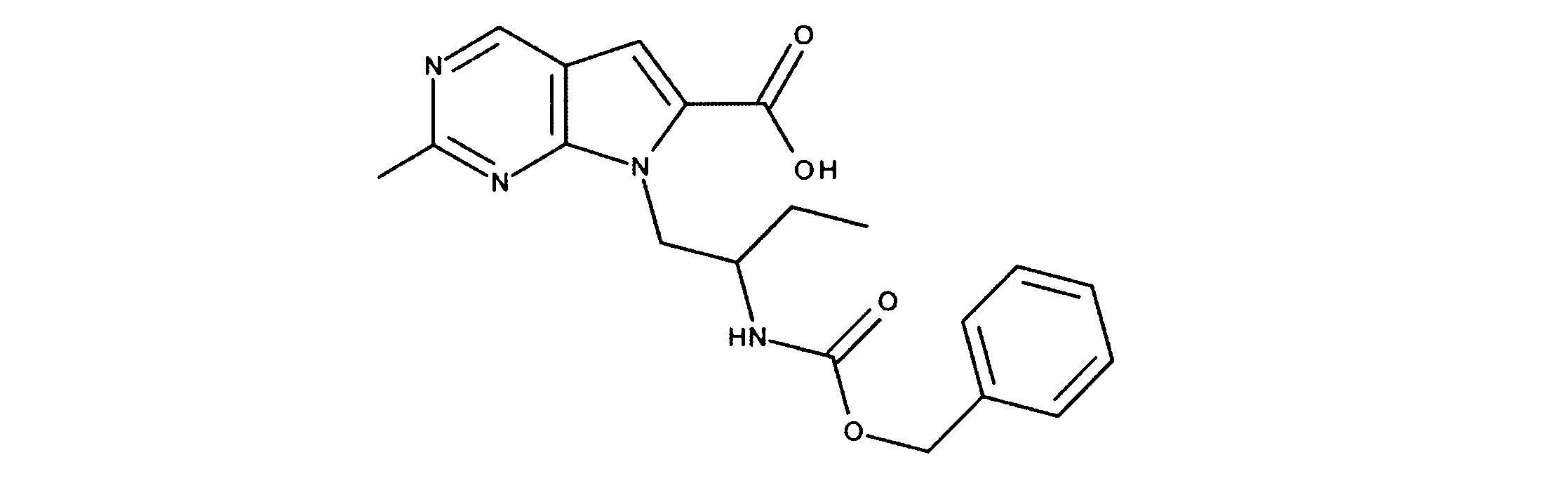
LCMS (ESI) 403 (M + H).
Example 134
Synthesis of 7-[2-(benzyloxycarbonylamino)butyl]-2-chloro-pyrrolo[2,3-d]pyrimidine-6carboxylic acid, compound 134
LCMS (ESI) 403 (M+H).
実施例135
化合物135の合成

LCMS (ESI) 251 (M + H).
Example 135
Synthesis of compound 135
LCMS (ESI) 251 (M+H).
実施例136
化合物136の合成

LCMS (ESI) 330 (M + H). 1HNMR (600 MHz, DMSO-d6) δ ppm 0.80 - 0.95 (m, 3 H) 1.35 - 1.92 (m, 10 H) 3.66 (br. m., 3 H) 4.17 (br. s., 2 H) 4.47 (br. s., 1 H) 6.85 (s, 1 H) 6.96 (br. s., 1 H) 8.15 (br. s., 1 H) 8.62 (br. s., 1 H).
Example 136
Synthesis of compound 136
LCMS (ESI) 330 (M + H). 1 HNMR (600 MHz, DMSO-d 6 ) δ ppm 0.80 - 0.95 (m, 3 H) 1.35 - 1.92 (m, 10 H) 3.66 (br. m., 3 H) 4.17 (br.s., 2H) 4.47 (br.s., 1H) 6.85 (s, 1H) 6.96 (br.s., 1H) 8.15 (br.s., 1H) 8.62 (br.s., 1H).
実施例137
tert-ブチルN-[1-[[(5-ブロモ-2-クロロ-ピリミジン-4-イル)アミノ]メチル]シクロペンチル]カルバメートの合成、化合物137

LCMS (ESI) 405 (M+H).
Example 137
Synthesis of tert-butyl N-[1-[[(5-bromo-2-chloro-pyrimidin-4-yl)amino]methyl]cyclopentyl]carbamate, compound 137
LCMS (ESI) 405 (M+H).
実施例138
tert-ブチルN-[1-[[[2-クロロ-5-(3、3-ジエトキシプロプ-1-イニル)ピリミジン-4-イル]アミノ]メチル]シクロペンチル]カルバメートの合成、化合物138

LCMS (ESI) 453 (M+H).
Example 138
Synthesis of tert-butyl N-[1-[[[2-chloro-5-(3,3-diethoxyprop-1-ynyl)pyrimidin-4-yl]amino]methyl]cyclopentyl]carbamate, compound 138
LCMS (ESI) 453 (M+H).
実施例139
tert-ブチルN-[1-[[2-クロロ-6-(ジエトキシメチル)ピロロ[2,3-d]ピリミジン-7-イル]メチル]シクロペンチル]カルバメートの合成、化合物139
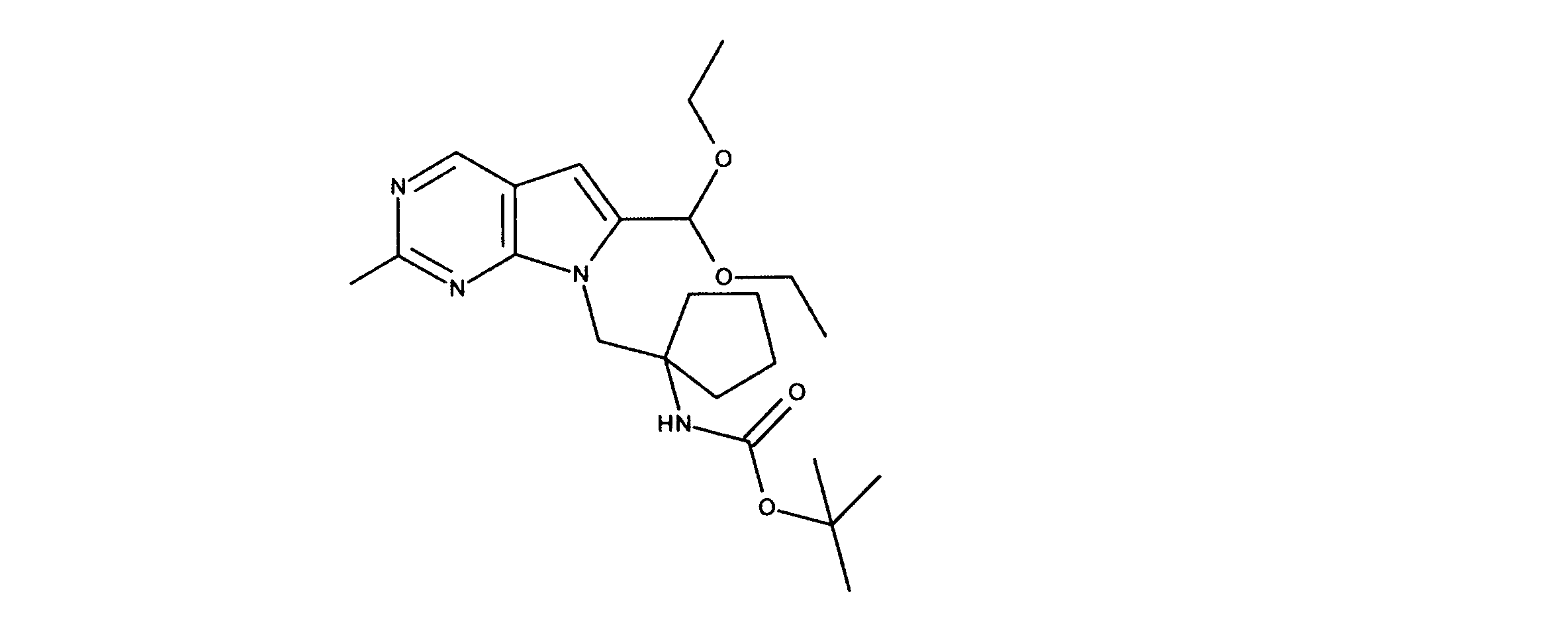
LCMS (ESI) 453 (M+H).
Example 139
Synthesis of tert-butyl N-[1-[[2-chloro-6-(diethoxymethyl)pyrrolo[2,3-d]pyrimidin-7-yl]methyl]cyclopentyl]carbamate, compound 139
LCMS (ESI) 453 (M+H).
実施例140
7-[[1-(tert-ブトキシカルボニルアミノ)シクロペンチル]メチル]-2-クロロ-ピロロ[2,3-d]ピリミジン-6カルボン酸の合成、化合物140
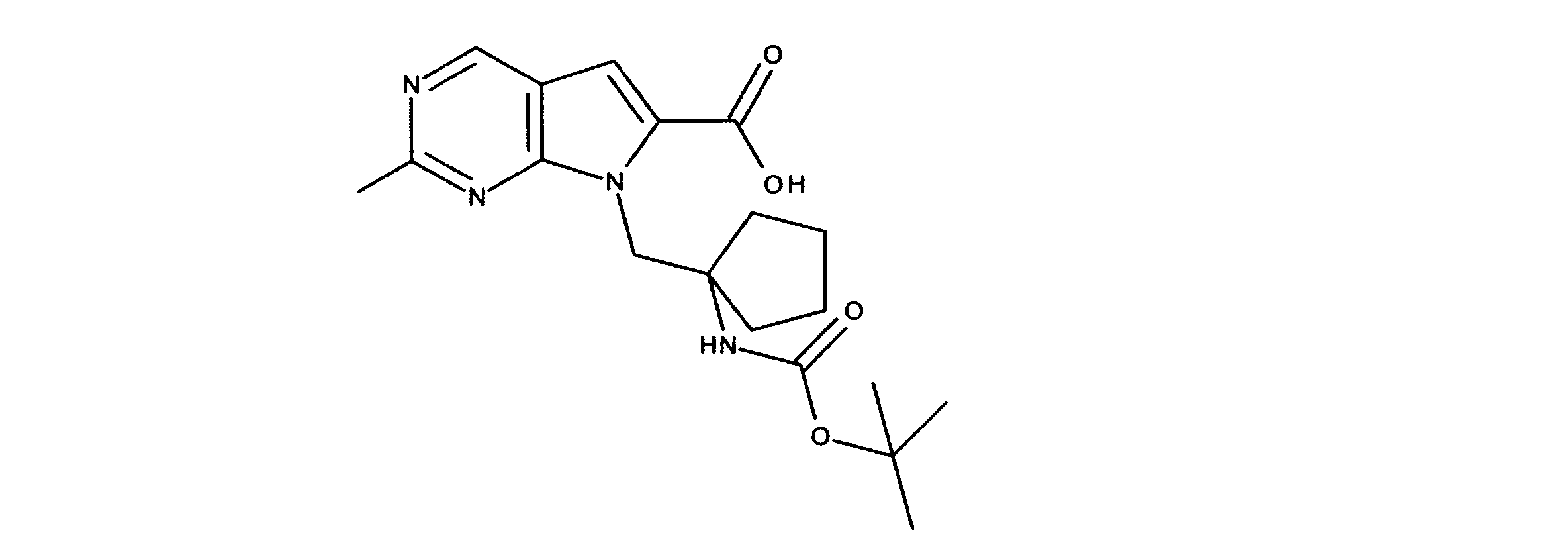
LCMS (ESI) 395 (M + H).
Example 140
Synthesis of 7-[[1-(tert-butoxycarbonylamino)cyclopentyl]methyl]-2-chloro-pyrrolo[2,3-d]pyrimidine-6carboxylic acid, compound 140
LCMS (ESI) 395 (M+H).
実施例141
化合物141の合成
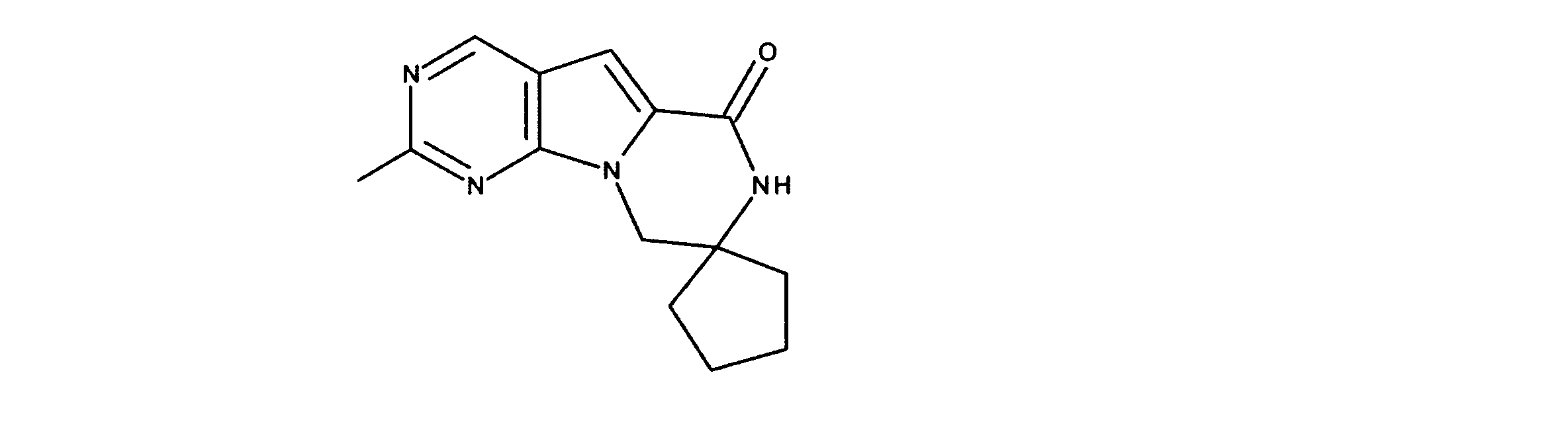
LCMS (ESI) 277 (M + H).
Example 141
Synthesis of compound 141
LCMS (ESI) 277 (M+H).
実施例142
化合物142の合成
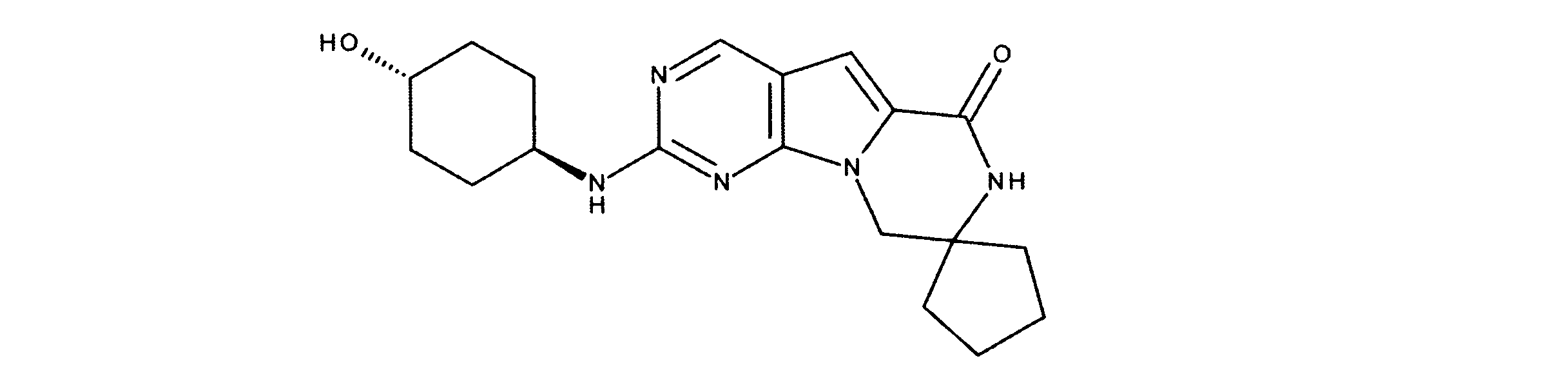
LCMS (ESI) 356 (M + H). 1HNMR (600 MHz, DMSO-d6) δ ppm 1.08 - 1.32 (m, 8 H) 1.60 - 2.09 (m, 8 H) 3.03 - 3.17 (m, 1 H) 3.35 (s, 2 H) 3.54 - 3.62 (m, 1 H) 4.51 (d, J=4.39 Hz, 1 H) 6.88 (s, 1 H) 6.96 (br. s., 1 H) 8.07 (br. s., 1 H) 8.58 (s, 1 H).
Example 142
Synthesis of compound 142
LCMS (ESI) 356 (M + H). 1 HNMR (600 MHz, DMSO-d 6 ) δ ppm 1.08 - 1.32 (m, 8 H) 1.60 - 2.09 (m, 8 H) 3.03 - 3.17 (m, 1 H ) 3.35 (s, 2 H) 3.54 - 3.62 (m, 1 H) 4.51 (d, J=4.39 Hz, 1 H) 6.88 (s, 1 H) 6.96 (br. s., 1 H) 8.07 (br. s., 1H) 8.58 (s., 1H).
実施例143
tert-ブチルN-[[1-[(5-ブロモ-2-クロロ-ピリミジン-4-イル)アミノ]シクロペンチル]メチル]カルバメートの合成、化合物143

LCMS (ESI) 405 (M+H).
Example 143
Synthesis of tert-butyl N-[[1-[(5-bromo-2-chloro-pyrimidin-4-yl)amino]cyclopentyl]methyl]carbamate, compound 143
LCMS (ESI) 405 (M+H).
実施例144
tert-ブチルN-[2-[[2-クロロ-5-(3、3-ジエトキシプロプ-1-イニル)ピリミジン-4-イル]アミノ]-2メチル-プロピル]カルバメートの合成、化合物144
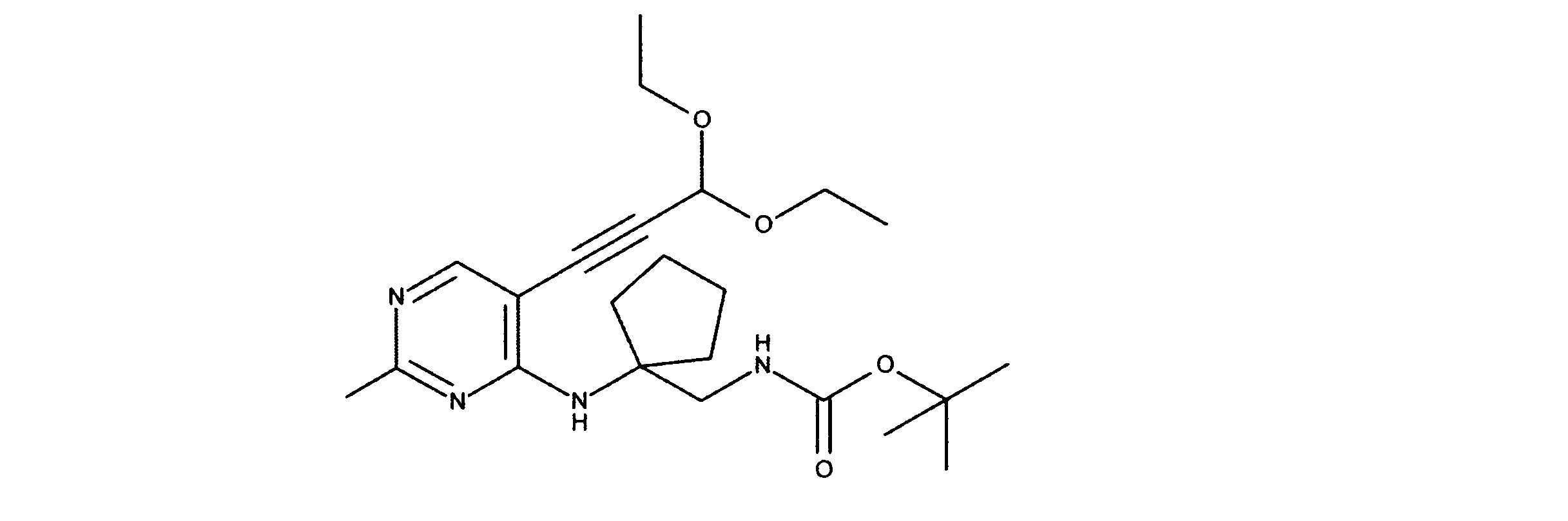
LCMS (ESI) 453 (M+H).
Example 144
Synthesis of tert-butyl N-[2-[[2-chloro-5-(3,3-diethoxyprop-1-ynyl)pyrimidin-4-yl]amino]-2methyl-propyl]carbamate, compound 144
LCMS (ESI) 453 (M+H).
実施例145
tert-ブチルN-[[1-[2-クロロ-6-(ジエトキシメチル)ピロロ[2,3-d]ピリミジン-7-イル]シクロペンチル]メチル]カルバメートの合成、化合物145
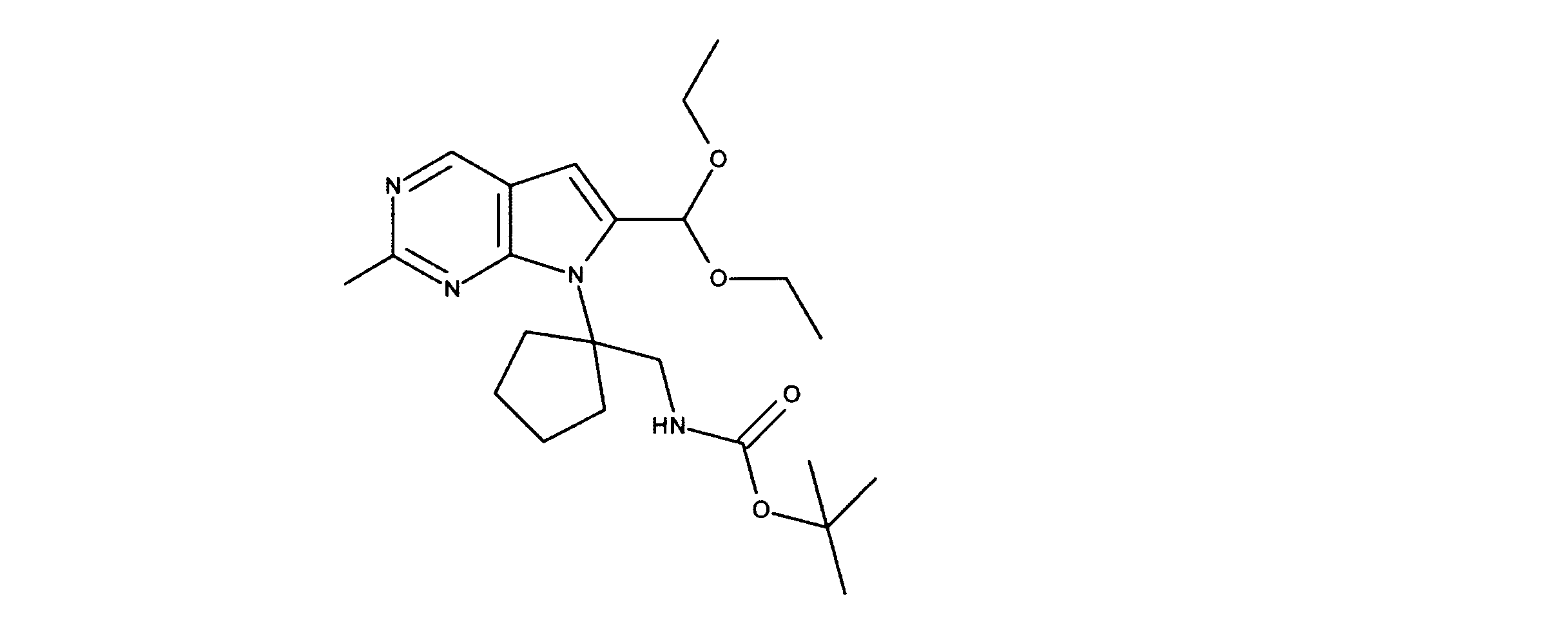
LCMS (ESI) 4534 (M+H).
Example 145
Synthesis of tert-butyl N-[[1-[2-chloro-6-(diethoxymethyl)pyrrolo[2,3-d]pyrimidin-7-yl]cyclopentyl]methyl]carbamate, compound 145
LCMS (ESI) 4534 (M+H).
実施例146
7-[2-(tert-ブトキシカルボニルアミノ)-1,1-ジメチルエチル]-2-クロロ-ピロロ[2,3-d]ピリミジン-6カルボン酸の合成、化合物146
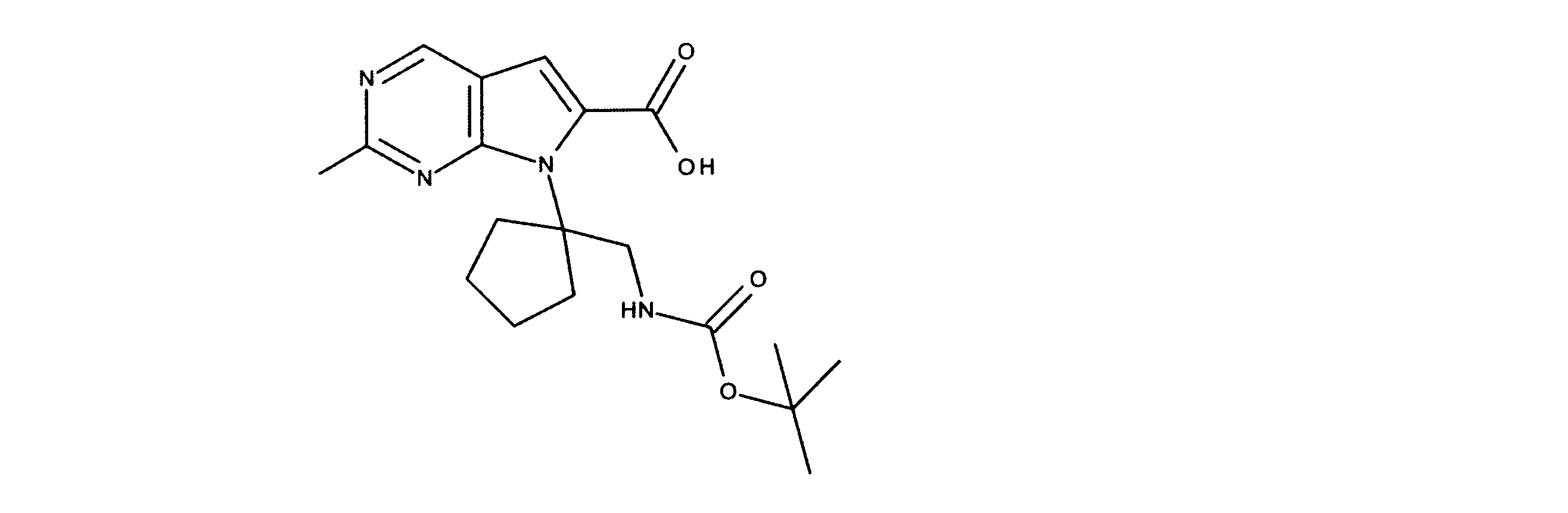
LCMS (ESI) 395 (M + H).
Example 146
Synthesis of 7-[2-(tert-butoxycarbonylamino)-1,1-dimethylethyl]-2-chloro-pyrrolo[2,3-d]pyrimidine-6carboxylic acid, compound 146
LCMS (ESI) 395 (M+H).
実施例147
化合物147の合成

LCMS (ESI) 277 (M + H).
Example 147
Synthesis of compound 147
LCMS (ESI) 277 (M+H).
実施例148
化合物148の合成

LCMS (ESI) 356 (M + H). 1HNMR (600 MHz, DMSO-d6) δ ppm 1.06 - 1.35 (m, 8 H) 1.45 - 1.95 (m, 8 H) 3.10 (m, 1 H) 3.58 (br. s., 2 H) 3.95 (br. s., 1 H) 4.49 (br. s., 1 H) 6.84 (s, 1 H) 6.85 - 6.93 (m, 1 H) 8.29 (s, 1 H) 8.61 (br. s., 1 H).
Example 148
Synthesis of compound 148
LCMS (ESI) 356 (M + H). 1 HNMR (600 MHz, DMSO-d 6 ) δ ppm 1.06 - 1.35 (m, 8 H) 1.45 - 1.95 (m, 8 H) 3.10 (m, 1 H) 3.58 (br.s., 2H) 3.95 (br.s., 1H) 4.49 (br.s., 1H) 6.84 (s, 1H) 6.85 - 6.93 (m, 1H) 8.29 (s, 1H) H) 8.61 (br.s., 1 H).
実施例149
化合物149の合成

ステップ2:Boc保護された化合物59を、CO2(1気圧)の下、DMI中の5mol% NiCl2(Ph3)2、0.1eqトリフェニルホスフィン、3eq Mn、0.1eqヨウ化テトラエチルアンモニウムで、25℃で20時間処理して、ハロゲン化アリール誘導体をカルボン酸に変換する。
ステップ3:ステップ2からのカルボン酸を、標準的な条件を用いて、対応する酸塩化物に変換する。
ステップ4:ステップ3からの酸塩化物を、Nメチルピペラジンと反応させて、対応するアミドを生成する。
ステップ5:ステップ4からのアミドを、ジクロロメタン中のトリフルオロ酢酸を用いて脱保護して、ターゲット化合物を生成する。
化合物149を、シリカゲルカラムクロマトグラフィーにより、ジクロロメタン-メタノール勾配で溶出させて、精製して、化合物149を提供する。
化合物119~147のそれぞれ及び様々なR8、R1及びZの定義を含む対応する各化合物は、水素化ナトリウム及びハロゲン化アルキル又は他のハロゲン化物と反応してもよく、これにより、化合物120の合成に対して上記したように、アミンによる反応物への前に所望のR置換を挿入して、式I、II、III、IV又はVの所望の製品を生成させてもよい。
Example 149
Synthesis of compound 149
Step 2: Boc-protected compound 59 was treated with 5 mol% NiCl2 ( Ph3 ) 2 , 0.1 eq triphenylphosphine, 3 eq Mn, 0.1 eq tetraethylammonium iodide in DMI under CO2 (1 atm). at 25° C. for 20 hours to convert the aryl halide derivative to a carboxylic acid.
Step 3: Convert the carboxylic acid from
Step 4: The acid chloride from Step 3 is reacted with N-methylpiperazine to generate the corresponding amide.
Step 5: The amide from
Compound 149 is purified by silica gel column chromatography eluting with a dichloromethane-methanol gradient to provide compound 149.
Each of compounds 119-147 and each of the corresponding compounds containing various definitions of R 8 , R 1 and Z may be reacted with sodium hydride and alkyl or other halides to give compound 120 The desired R substitution may be inserted in front of the reactant with an amine to produce the desired product of formula I, II, III, IV or V, as described above for the synthesis of .
実施例150
CDK4/6阻害インビトロアッセイ
ここに開示される化合物を選択して、Nanosyn(米国カリフォルニア州サンタクララ)によって、CDK4/cyclinD1、CDK2/CycA及びCDK2/cyclinEキナーゼアッセイの試験を行い、これらのCDKに対するそれらの抑制性効果を決定した。マイクロ流体キナーゼ検出技術(Caliper Assay Platform)を用いて、アッセイを実行した。singlicateの12点ドーズ反応フォーマットで、ATPに対してKmで化合物の試験を行った。全てのアッセイで用いたホスホアクセプタ基体ペプチド濃度は、1μMであり、全てのアッセイに対する参照化合物として、スタウロスポリンを用いた。
Example 150
CDK4/6 Inhibition In Vitro Assay Compounds disclosed herein were selected and tested in CDK4/cyclinD1, CDK2/CycA and CDK2/cyclinE kinase assays by Nanosyn (Santa Clara, Calif., USA) and tested against these CDKs. determined the inhibitory effect of Assays were performed using microfluidic kinase detection technology (Caliper Assay Platform). Compounds were tested for Km against ATP in a singlicate 12-point dose response format. The phosphoacceptor substrate peptide concentration used in all assays was 1 μM and staurosporine was used as the reference compound for all assays.
各アッセイのの詳細は、下記の通りである:
CDK2/CyclinA:酵素濃度:0.2nM;ATP濃度:50μM;インキュベーション時間:3時間
CDK2/CyclinE:酵素濃度:0.28nM;ATP濃度:100μM;インキュベーション時間:1時間
CDK4/CyclinD1:酵素濃度:1nM;ATP濃度:200μM;インキュベーション時間:10時間
CDK4/CycD1、CDK2/CycE、CDK2/CycAに関して表1の化合物に対する抑制性IC50値、ならびに、倍選択性が、表2に示される。
Details of each assay are as follows:
CDK2/CyclinA: enzyme concentration: 0.2 nM; ATP concentration: 50 μM; incubation time: 3 hours CDK2/CyclinE: enzyme concentration: 0.28 nM; ATP concentration: 100 μM; incubation time: 1 hour CDK4/CyclinD1: enzyme concentration: 1 nM ATP concentration: 200 μM; Incubation time: 10 hours The inhibitory IC 50 values for the compounds in Table 1 with respect to CDK4/CycD1, CDK2/CycE, CDK2/CycA, as well as the fold selectivity are shown in Table 2.
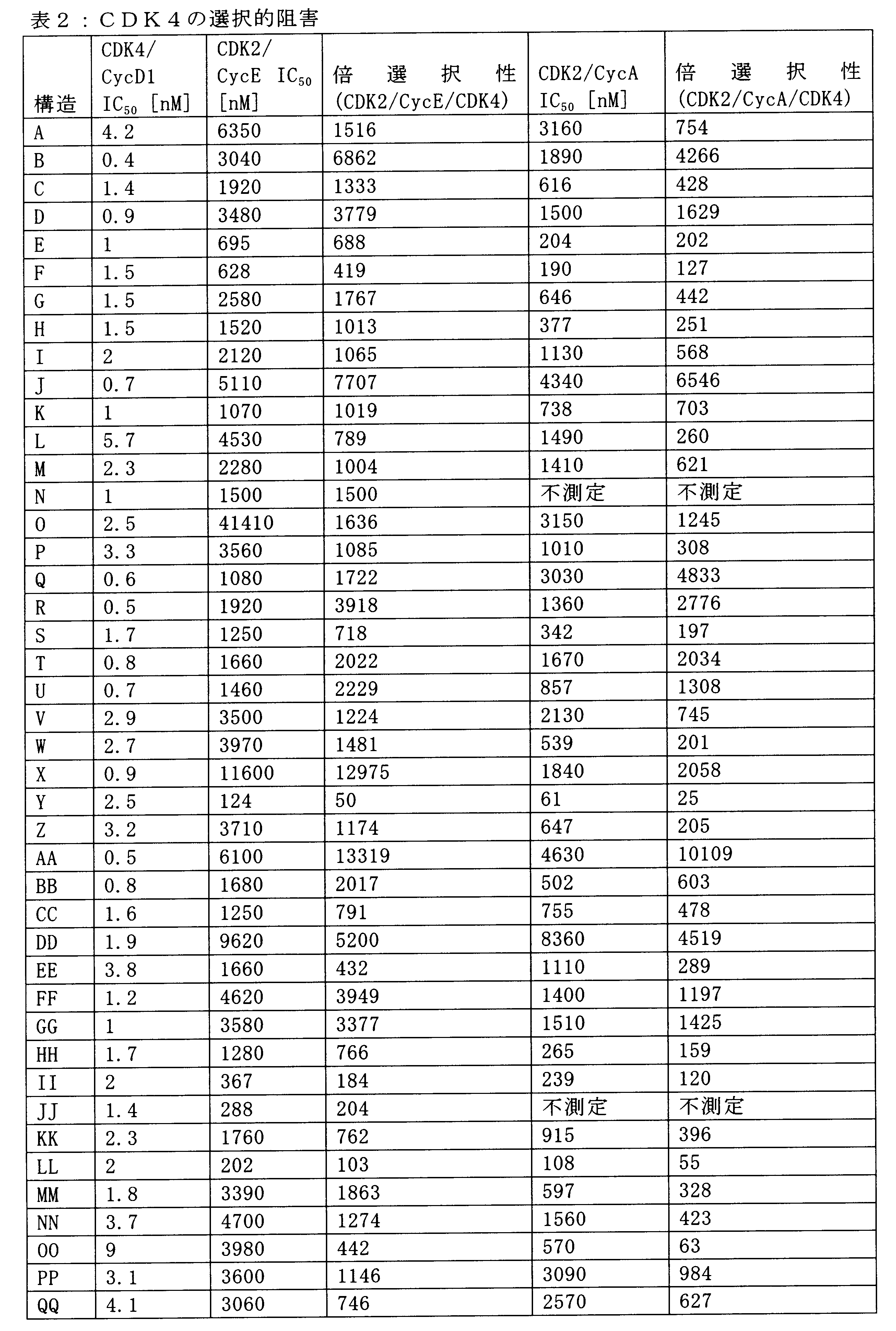
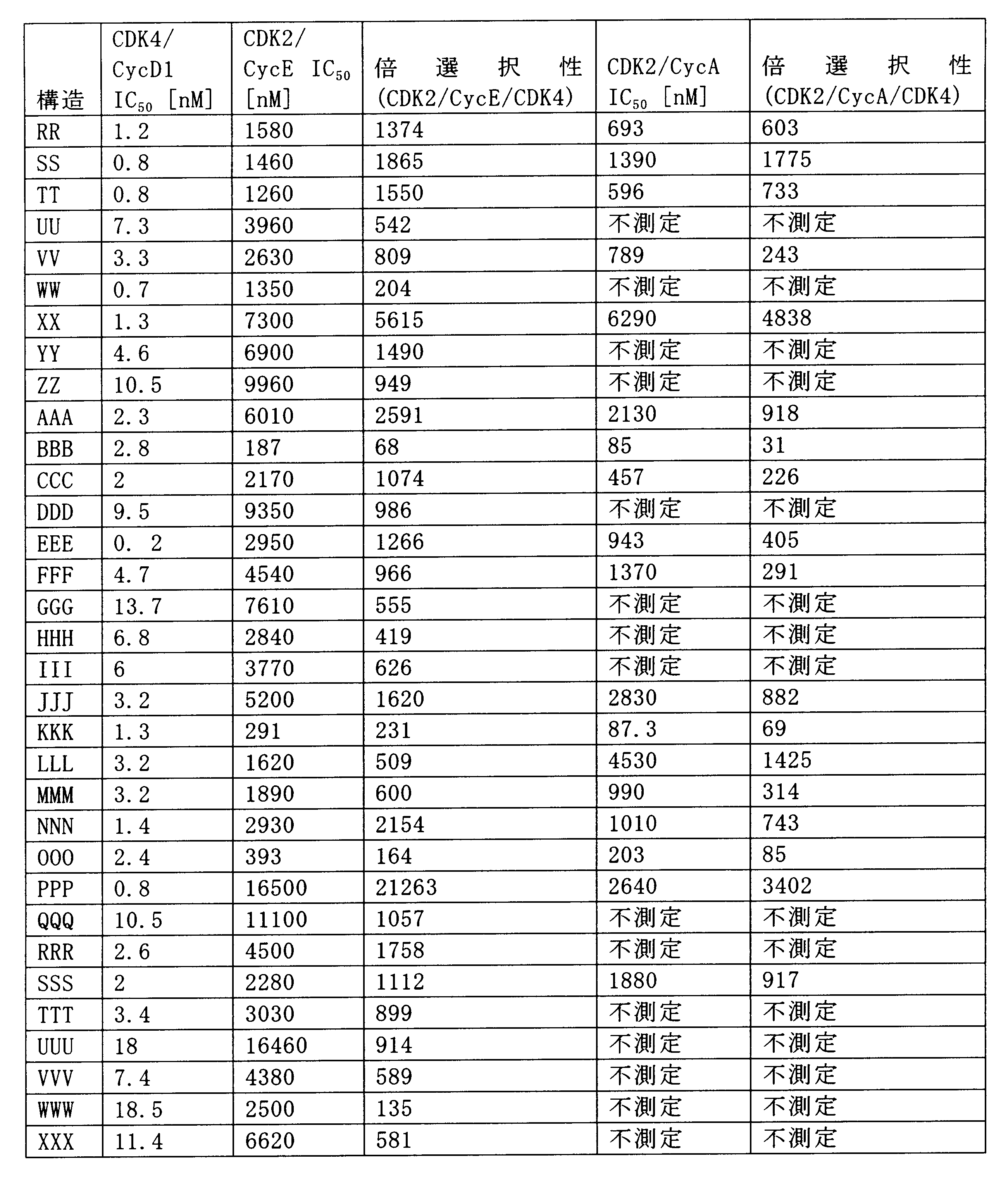
さらにそのキナーゼ活性のキャラクテリゼーションを行うため、DiscoveRxのKINOMEscan(登録商標)プロフィリングサービスを用いて、456(395の非変異体)のキナーゼに対して、化合物Tをスクリーニングした。1000nM(CDK4のIC50に対して>1000倍)の単一濃度を用いて、化合物をスクリーニングした。このスクリーニングの結果から、CDK4に対する高い能力及び対CDK2の高い選択性が確認された。さらに、kinomeプロフィリングにより、試験された他のキナーゼと比較して、化合物Tは、CDK4及びCDK6に対する選択性が比較的高かったことが、示された。 To further characterize its kinase activity, Compound T was screened against 456 (395 non-mutant) kinases using DiscoveRx's KINOMEscan® profiling service. Compounds were screened using a single concentration of 1000 nM (>1000-fold over the IC50 of CDK4). The results of this screen confirmed high potency for CDK4 and high selectivity for CDK2. Furthermore, kinome profiling indicated that Compound T was relatively selective for CDK4 and CDK6 compared to other kinases tested.
具体的に、抑制性の閾値として65 %、90 %又は99 %を用いた場合、化合物Tは、395の非変異体キナーゼのうち、92(23.3 %)、31(7.8 %)又は6(1.5 %)を、それぞれ抑制した。
CDK4キナーゼ活性に加えて、いくつかの化合物は、CDK6キナーゼ活性に対しても試験された。CDK6/CycD3キナーゼアッセイの結果を、CDK4/cyclinD1、CDK2/CycA及びCDK2/cyclinEキナーゼアッセイとともに、PD0332991(参照)及び化合物T、Q、GG及びUに対して、表3に示した。CDK4/cyclinD1に対する10nM及びCDK12/cyclinEに対する10uMののIC50は、PD0332991に対してあらかじめ発表されたレポートと、良く合致する(Fry et al. Molecular Cancer Therapeutics (2004) 3(11)1427-1437、 Toogood et al. Journal of Medicinal Chemistry (2005) 48, 2388-2406)。化合物T、Q、GG及びUは、参照化合物(PD0332991)に関して、より有能(IC50が低い)であり、そして、参照化合物に対して、より高い倍選択性(CDK2/CycEのIC50を、CDK4/CycD1のIC50で除す)を示す。
Specifically, using 65%, 90% or 99% as inhibitory thresholds, compound T was found to inhibit 92 (23.3%), 31 (7.8%), 395 non-mutant kinases or 6 (1.5%), respectively.
In addition to CDK4 kinase activity, some compounds were also tested for CDK6 kinase activity. The results of the CDK6/CycD3 kinase assays are shown in Table 3 for PD0332991 (reference) and compounds T, Q, GG and U, along with the CDK4/cyclinD1, CDK2/CycA and CDK2/cyclinE kinase assays. IC50s of 10 nM for CDK4/cyclinD1 and 10 uM for CDK12/cyclinE are in good agreement with previously published reports for PD0332991 (Fry et al. Molecular Cancer Therapeutics (2004) 3(11) 1427-1437; Toogood et al., Journal of Medicinal Chemistry (2005) 48, 2388-2406). Compounds T, Q, GG and U were more potent (lower IC50 ) and more fold selective ( IC50 for CDK2/CycE) over the reference compound (PD0332991). , divided by the IC50 of CDK4/CycD1).
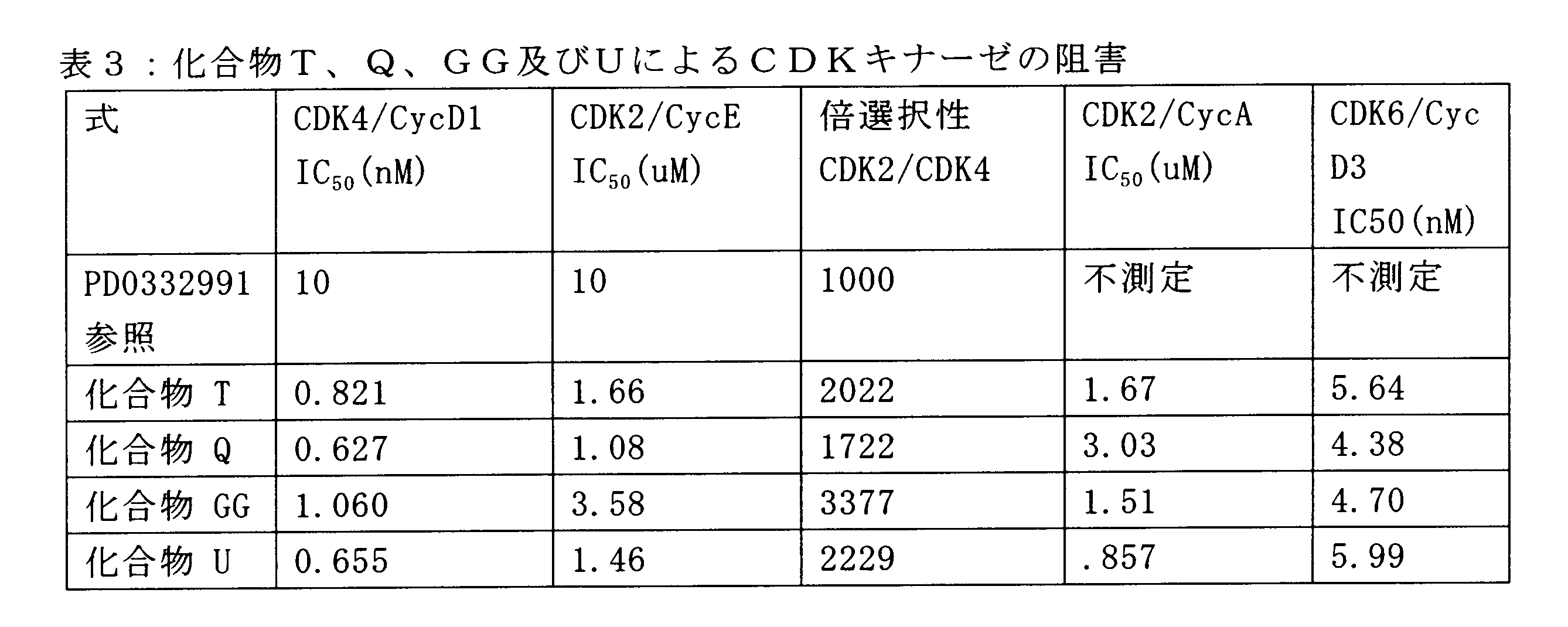
実施例151
G1期停止(細胞G1及びS期)アッセイ
様々な処理の後の細胞サイクルの様々な段階における細胞画分の決定のために、HS68細胞(ヒト皮膚繊維芽細胞系統(Rbポジティブな))を、プロピジウムヨウ化物染色液で染色し、Dako Cyan Flow Cytometerで実行した。G0-G1DNA細胞サイクルの細胞の画分対S期DNA細胞サイクルの画分を、FlowJo7.2.2分析により測定した。
表1にリストされる化合物を、細胞サイクルのG1期でHS68細胞を停止する能力に関して、試験した。細胞G1期停止アッセイの結果から、HS68細胞のG1期停止のために必要な抑制性EC50値の範囲は、22nM~1500nMであった(表4の「細胞G1期停止EC50」というタイトルの欄を参照)。
Example 151
G1 Arrest (Cellular G1 and S Phase) Assays For determination of cell fractions at different stages of the cell cycle after various treatments, HS68 cells (human skin fibroblast lineage (Rb positive)) were Stained with propidium iodide stain and run on a Dako Cyan Flow Cytometer. The fraction of cells in the G0-G1 DNA cell cycle versus the fraction in the S phase DNA cell cycle was determined by FlowJo7.2.2 analysis.
Compounds listed in Table 1 were tested for their ability to arrest HS68 cells in the G1 phase of the cell cycle. From the results of the cell G1 arrest assay, the range of inhibitory EC50 values required for G1 arrest of HS68 cells was 22 nM to 1500 nM (Table 4, titled "Cell G1 arrest EC50 "). column).
実施例152
細胞増殖の阻害
細胞増殖アッセイは、以下の癌細胞系統を用いて実行された:
MCF7(胸腺癌 ― Rbポジティブ)、ZR-75-1(胸腺管癌 ― Rbポジティブ)、H69(ヒト小細胞肺癌 ― Rb-ネガティブ)細胞、又はA2058(ヒト転移メラノーマ細胞 ― Rb-ネガティブ)。
これらの細胞を、Coster社(米国マサチューセッツ州テュークスバリー)3093号、96ウェル組織培養処理白壁/透明底板、に播種した。
細胞を、10uM~1nMの9点ドーズ応答希釈物系列として、表1の化合物で処理した。
細胞を化合物に曝露し、その後、製造者の推奨に従い、示される通り、4日後(H69)又は6日後(MCF7、ZR75-1、A2058)に、CellTiter-Glo(登録商標)発光細胞生存率測定を用いて細胞生存能力を決定した。
細胞を化合物に曝露し、その後、示される通り、4日後(H69)又は6日後(A2058)に、CellTiter-Glo(登録商標)発光細胞生存率測定を用いて、製造者(CTG; Promega、マディソン、ウィスコンシン、アメリカ合衆国)の推奨に従い、細胞生存能力を決定した。
プレートを、BioTek社(バーモント州Winooski)のSyngergy2マルチモードプレートリーダで読み込んだ。
可変モル濃度から相対発光量(RLU)をプロットし、Graphpad社の(カリフォルニア州LaJolla)プリズム5統計ソフトウェアを用いてデータを分析し、各化合物についてEC50を決定した。
2つのRbポジティブ乳癌細胞系統(MCF7及びZR75-1)に対する細胞阻害アッセイの結果が、表4に示される。
MCF7乳癌細胞増殖の阻害のために必要な抑制性EC50値の範囲は、28nM~257nMであった。
ZR75-1乳癌細胞増殖の阻害のために必要な抑制性EC50値の範囲は、24nM~581nMであった。
MCF7胸腺癌細胞の増殖に対して高活性な代表的な化合物の例が、図21~24に示される。
図21~24でテストされた化合物(化合物T、Q、GG、U、H、MM、OO、及びPD-332991)の全てが、MCF-7細胞の細胞増殖の大きな阻害を示した。
図21から分かるように、化合物Tは、MCF-7細胞に対して、PD0332991より有力な活性を示す。
ZR75-1(胸腺管癌(Rbポジティブ))細胞の増殖に対して高活性な代表的な化合物の例が、図25~28に示される。
図25-28でテストされた化合物(化合物T、Q、GG、U、H、MM、OO及びPD-332991)全てが、ZR75-1細胞の細胞増殖の大きな阻害を示した。
図25から分かるように、化合物Tは、ZR75-1細胞に対して、PD0332991より有力な活性を示す。
乳癌細胞系統に加えて、ここに開示される多数の化合物についても、小細胞肺癌細胞系統(H69)及びヒト転移性メラノーマ細胞系統(A2058)、2つのRb欠損(Rb-ネガティブ)細胞系統に対して評価した。
これらの細胞阻害アッセイの結果を、表4に示す。
H69小細胞肺癌細胞の阻害のために必要な抑制性EC50値の範囲は、2040nM~>3000nMであった。
A2058悪性黒色腫細胞増殖の阻害のために必要な抑制性EC50値の範囲は、1313nM~>3000nMであった。
2つのRbポジティブ乳癌細胞系統に認められる大きな阻害とは対照的に、試験された化合物は、小細胞肺癌又はメラノーマ細胞の増殖を抑制することに対してさほど有効ではなかったことが、見出された。
Example 152
Inhibition of Cell Proliferation Cell proliferation assays were performed using the following cancer cell lines:
MCF7 (thymic carcinoma - Rb positive), ZR-75-1 (thymic ductal carcinoma - Rb positive), H69 (human small cell lung carcinoma - Rb negative) cells, or A2058 (human metastatic melanoma cells - Rb negative).
These cells were seeded in Costar (Tewkesbury, MA, USA) No. 3093, 96-well tissue culture treated white wall/clear bottom plate.
Cells were treated with the compounds of Table 1 as a 9-point dose-response dilution series from 10 uM to 1 nM.
Cells are exposed to compounds followed by CellTiter-Glo® luminescence cell viability measurements after 4 days (H69) or 6 days (MCF7, ZR75-1, A2058) as indicated, according to manufacturer's recommendations. was used to determine cell viability.
Cells were exposed to compounds and then assayed after 4 days (H69) or 6 days (A2058) as indicated by the manufacturer (CTG; Promega, Madison) using the CellTiter-Glo® Luminescent Cell Viability Assay. , Wisconsin, USA).
Plates were read on a BioTek (Winooski, Vt.) Syngergy2 multimode plate reader.
Relative light units (RLU) were plotted from variable molar concentrations and data were analyzed using
Results of cell inhibition assays against two Rb-positive breast cancer cell lines (MCF7 and ZR75-1) are shown in Table 4.
The range of inhibitory EC 50 values required for inhibition of MCF7 breast cancer cell growth was 28 nM to 257 nM.
The range of inhibitory EC 50 values required for inhibition of ZR75-1 breast cancer cell growth was 24 nM to 581 nM.
Examples of representative compounds highly active against proliferation of MCF7 thymic carcinoma cells are shown in Figures 21-24.
All of the compounds tested in Figures 21-24 (Compounds T, Q, GG, U, H, MM, OO, and PD-332991) showed significant inhibition of cell proliferation of MCF-7 cells.
As can be seen from Figure 21, compound T exhibits more potent activity than PD0332991 against MCF-7 cells.
Examples of representative compounds highly active against ZR75-1 (thymic ductal carcinoma (Rb positive)) cell proliferation are shown in Figures 25-28.
All of the compounds tested in Figures 25-28 (compounds T, Q, GG, U, H, MM, OO and PD-332991) showed significant inhibition of cell proliferation of ZR75-1 cells.
As can be seen from Figure 25, compound T exhibits more potent activity than PD0332991 against ZR75-1 cells.
In addition to breast cancer cell lines, many of the compounds disclosed herein were also tested against a small cell lung cancer cell line (H69) and a human metastatic melanoma cell line (A2058), two Rb-deficient (Rb-negative) cell lines. evaluated.
Results of these cell inhibition assays are shown in Table 4.
The range of inhibitory EC 50 values required for inhibition of H69 small cell lung cancer cells was 2040 nM to >3000 nM.
The range of inhibitory EC 50 values required for inhibition of A2058 malignant melanoma cell growth was 1313 nM to >3000 nM.
It was found that, in contrast to the large inhibition seen in the two Rb-positive breast cancer cell lines, the compounds tested were not very effective in suppressing the growth of small cell lung cancer or melanoma cells. rice field.
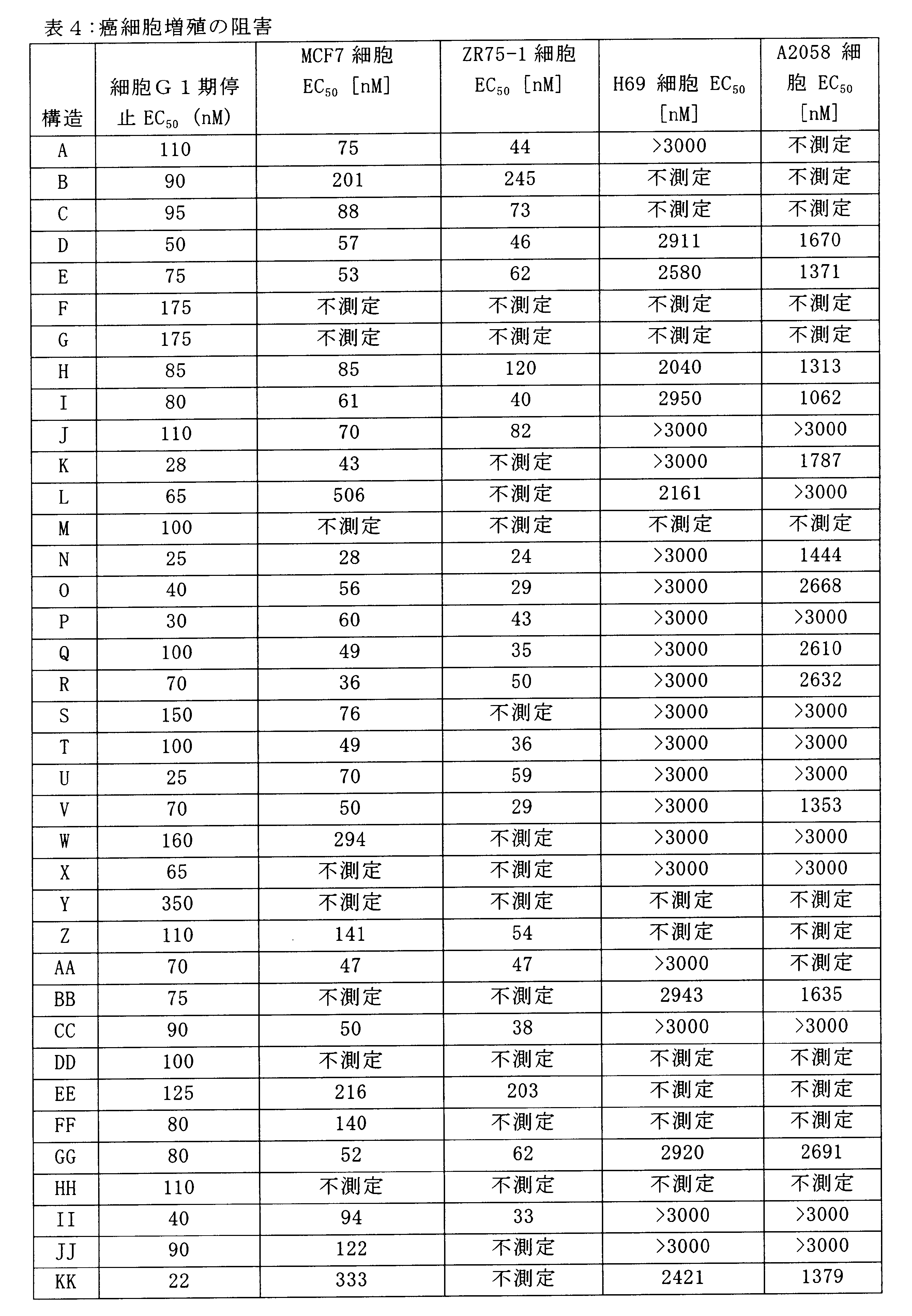
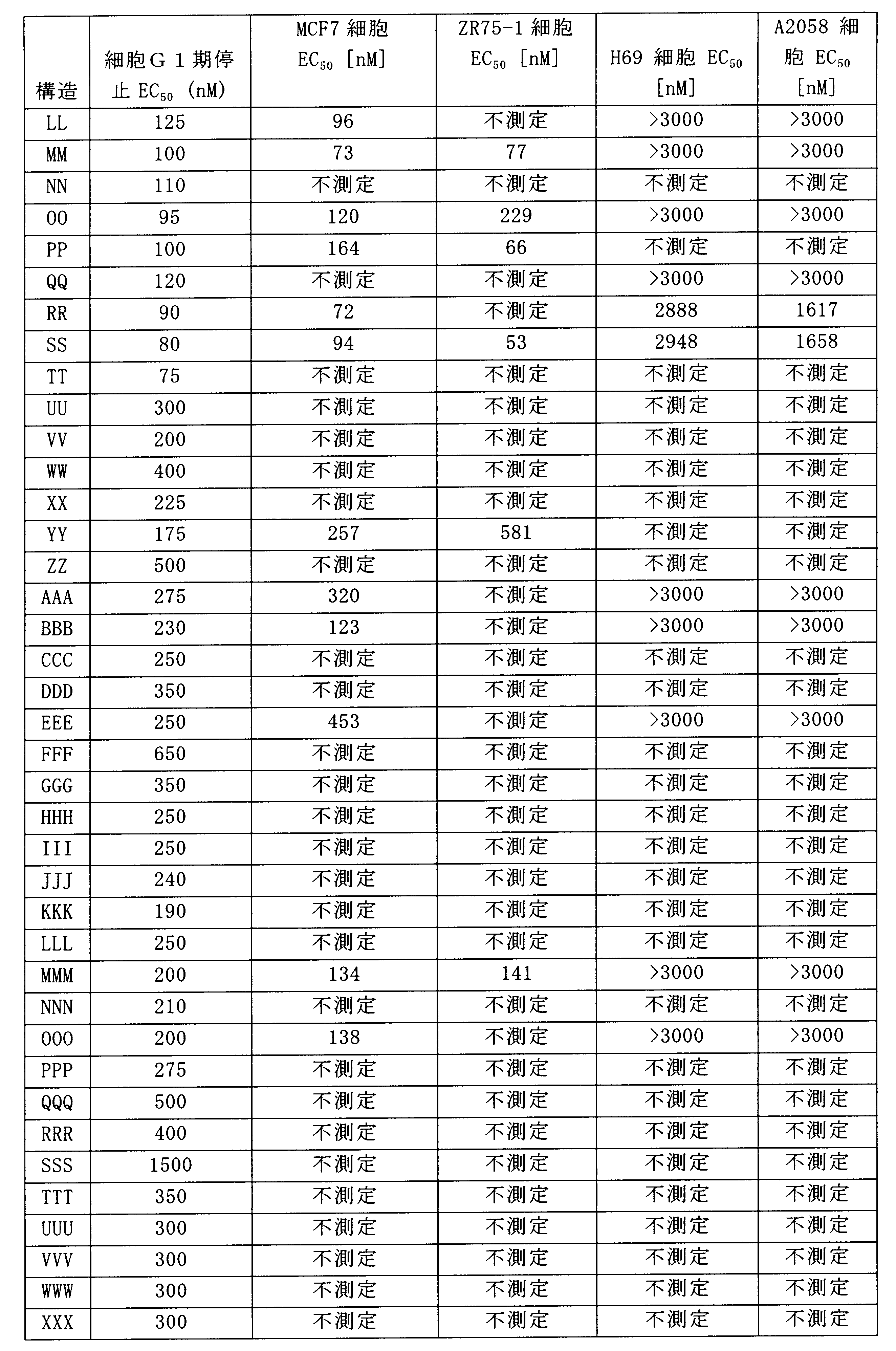
実施例153
HSPC成長抑制の研究
HSPC上のPD0332991の効果を、前もって実証した。
図2は、マウスHSPC及び脊髄前駆細胞のEdU取込みを示し、Roberts et al. Multiple Roles of Cyclin-Dependent Kinase 4/6 Inhibitors in Cancer Therapy. JCNI 2012、104(6):476-487(図2A)で報告されるように、経口薬強制飼養による150mg/kgのPD0332991の単一ドーズの後、骨髄停止に関して過渡的CDK4/6阻害の時間効果を評価する。
図2から分かるように、PD0332991の単一経口薬ドーズにより、36時間を超えてHSPC(LKS+)及び脊髄前駆細胞(LKS-)の低下が維持された。
経口薬ドーズ後48時間経過前に、HSPC及び脊髄前駆細胞は、ベースライン細胞分割に戻っている。
Example 153
HSPC Growth Inhibition Study The effect of PD0332991 on HSPC was previously demonstrated.
Figure 2 shows EdU uptake in mouse HSPCs and spinal cord progenitor cells, as described by Roberts et al. Multiple Roles of Cyclin-
As can be seen in Figure 2, a single oral drug dose of PD0332991 sustained a reduction in HSPCs (LKS+) and spinal progenitor cells (LKS-) over 36 hours.
Before 48 hours after oral drug dose, HSPCs and spinal cord progenitor cells have returned to baseline cell division.
実施例154
抗新生物性化合物の薬物動態及び薬力学的特性
本発明の化合物は、良好な薬物動態及び薬力学的特性を実証する。
化合物T、Q、GG及びUは、経口強制飼養によって30mg/kgで、又は静脈内注射により10mg/kgで、マウスにドーズされた。
血液サンプルを、ドーズ後0、0.25、0.5、1.0、2.0、4.0及び8.0時間で取得し、化合物T、Q、GG又はUの血漿濃度を、HPLCによって決定した。
化合物T、GG及びUが、表5で示すように優れた経口薬物動態及び薬力学的特性を有することが、実証された。
これは、経口生体有用性(F(%))が52 %~80 %と非常に高いこと、及び、経口薬投与後のプラズマ半減期が3~5時間であることを含む。
化合物T、Q、GG及びUは、静脈内投与によって供給された場合に、優れた薬物動態及び薬力学的特性を有することが実証された。
4つの化合物全てに対する代表的なIV及び経口薬PKカーブが、図3に示される。
Example 154
Pharmacokinetic and Pharmacodynamic Properties of Antineoplastic Compounds The compounds of the invention demonstrate good pharmacokinetic and pharmacodynamic properties.
Compounds T, Q, GG and U were dosed to mice at 30 mg/kg by oral gavage or 10 mg/kg by intravenous injection.
Blood samples were obtained at 0, 0.25, 0.5, 1.0, 2.0, 4.0 and 8.0 hours post-dose and plasma concentrations of Compounds T, Q, GG or U were determined by HPLC. determined by
Compounds T, GG and U were demonstrated to have excellent oral pharmacokinetic and pharmacodynamic properties as shown in Table 5.
This includes a very high oral bioavailability (F(%)) of 52%-80% and a plasma half-life of 3-5 hours after oral drug administration.
Compounds T, Q, GG and U were demonstrated to have excellent pharmacokinetic and pharmacodynamic properties when delivered by intravenous administration.
Representative IV and oral drug PK curves for all four compounds are shown in FIG.
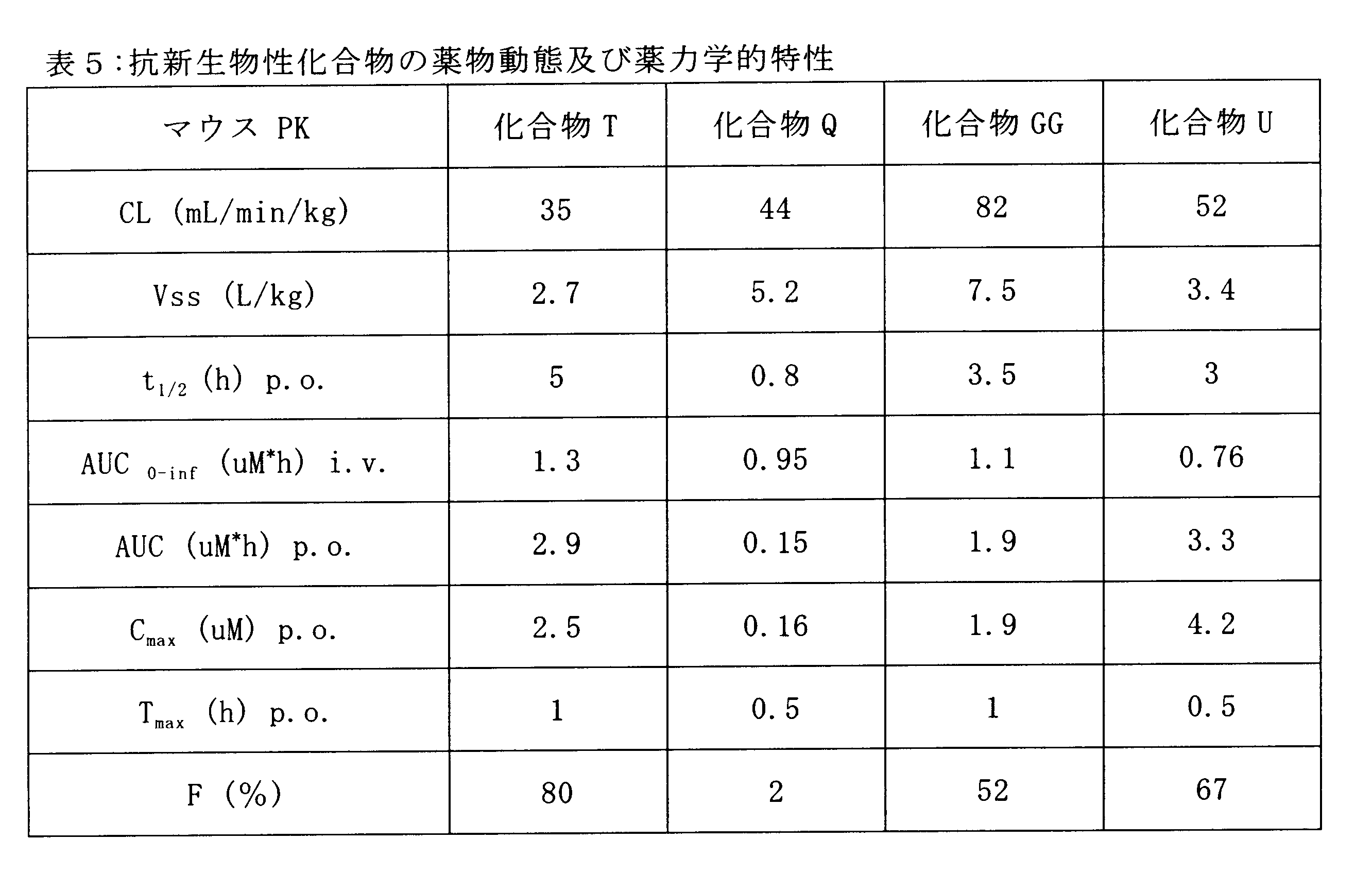
実施例155
細胞ウォッシュアウト実験
HS68細胞は、10 %のウシ胎児血清、100U/mlのペニシリン/ストレプトマイシン及び記載される1x Glutamax(インビトロジェン)を含んだDMEM中で、1日目に60mmのディッシュ中40,000の細胞/ウェルで播種された(Brookes et al. EMBO J, 21(12)2936-2945 (2002) 及び Ruas et al. Mol Cell Biol, 27(12)4273-4282 (2007))。
シーディング24時間後、細胞は、化合物T、化合物Q、化合物GG、化合物U、PD0332991、又はDMSOビヒクル単独で、これら試験化合物の終濃度300nMで、処理された。
3日目に、1セットの処理細胞試料を、三組(0時間のサンプル)で採取した。
残留細胞をPBS-CMF中で2回洗浄し、試験化合物が無い培養基に戻された。
サンプルのセットは、24、40及び48時間に、三組で採取された。
代替的には、同じ実験を、米国菌培養収集所(ATCC、バージニア州マナサス)から得られる通常の腎近位尿細管上皮細胞(Rb-ポジティブ)を用いて、行った。
細胞は、37℃加湿インキュベーター内での腎臓上皮細胞成長キット(ATCC)を追加した腎臓上皮細胞基底培地(ATCC)により、37℃のインキュベーター内で5 %CO2加湿空気中培養された。
細胞を採取して即座に、サンプルを、プロピジウムヨウ化物染色液で染色し、サンプルはDako Cyan Flow Cytometerで実行された。
G0-G1DNA細胞サイクルの細胞の画分対S期DNA細胞サイクルの画分を、FlowJo7.2.2分析により測定した。
図4は、細胞ウォッシュアウト実験を示し、本発明の阻害剤化合物が、異なる細胞型において、短期かつ過渡的なG1期停止効果を有することを、実証した。
ヒト繊維芽細胞細胞(Rb-ポジティブ)(図4A及び4B)又はヒト腎近位尿細管上皮細胞(Rb-ポジティブ)(図4C及び4D)について、化合物T、Q、GG及びUを、PD0332991と比較し、化合物のウォッシュアウト後の細胞サイクルに対する効果を、24、36、40及び48時間で決定した。
Example 155
Cell Washout Experiments HS68 cells were washed in DMEM containing 10% fetal bovine serum, 100 U/ml penicillin/streptomycin and 1x Glutamax (Invitrogen) as indicated on
Twenty-four hours after seeding, cells were treated with Compound T, Compound Q, Compound GG, Compound U, PD0332991, or DMSO vehicle alone at a final concentration of 300 nM of these test compounds.
On day 3, one set of treated cell samples was taken in triplicate (0 hour samples).
Residual cells were washed twice in PBS-CMF and returned to culture medium without test compound.
A set of samples was taken in triplicate at 24, 40 and 48 hours.
Alternatively, the same experiment was performed using normal renal proximal tubular epithelial cells (Rb-positive) obtained from the American Culture Collection (ATCC, Manassas, Va.).
Cells were cultured in 5% CO2 humidified air in a 37°C incubator with Kidney Epithelial Cell Basal Medium (ATCC) supplemented with Kidney Epithelial Cell Growth Kit (ATCC) in a 37°C humidified incubator.
Immediately after harvesting the cells, samples were stained with propidium iodide stain and samples were run on a Dako Cyan Flow Cytometer.
The fraction of cells in the G0-G1 DNA cell cycle versus the fraction in the S phase DNA cell cycle was determined by FlowJo7.2.2 analysis.
FIG. 4 shows cell washout experiments demonstrating that inhibitor compounds of the invention have short-term and transient G1-arresting effects in different cell types.
For human fibroblast cells (Rb-positive) (Figures 4A and 4B) or human renal proximal tubular epithelial cells (Rb-positive) (Figures 4C and 4D), compounds T, Q, GG and U were In comparison, the effects of compounds on the cell cycle after washout were determined at 24, 36, 40 and 48 hours.
図4に示すように、そして、図2に示す生体内の結果と同様に、PD0332991では、細胞が通常のベースライン細胞分裂に戻るためには、ウォッシュアウト後48時間以上を必要とした。
これは、図4A及び図4Bで認められ、G0-G1画分又は細胞分裂のS期のそれぞれに対して、DMSOコントロールに対する等価な値が得られた。
対照的に、本発明の化合物で処理されたHS68細胞は、わずか24時間又は40時間で、通常のベースライン細胞分裂に戻り、これらの同じ時点におけるPD0332991とは異なっていた。
また、ヒト腎近位尿細管上皮細胞を用いた結果(図4C及び4D)では、PD0332991処理した細胞は、化合物T、Q、GG又はUで処理された細胞と比較して、細胞分裂のベースラインレベルに戻るためには著しく長い時間を要したことが示された。
As shown in FIG. 4, and similar to the in vivo results shown in FIG. 2, PD0332991 required more than 48 hours after washout for cells to return to normal baseline cell division.
This was observed in Figures 4A and 4B, where equivalent values to the DMSO control were obtained for the G0-G1 fraction or the S phase of cell division, respectively.
In contrast, HS68 cells treated with compounds of the invention returned to normal baseline cell division in as little as 24 or 40 hours, unlike PD0332991 at these same time points.
Results using human renal proximal tubular epithelial cells (FIGS. 4C and 4D) also showed that PD0332991-treated cells were significantly more susceptible to cell division than cells treated with compounds T, Q, GG, or U. It was shown that it took a significantly longer time to return to line level.
実施例156
EdU取込み及びフローサイトメトリー分析法を用いて評価される骨髄増殖
HSPC増殖実験のため、若い成熟した雌のFVB/Nマウスを、経口強制飼養により、化合物T、化合物Q、化合物GG又はPD0332991で示される単一ドーズで処理した。
その後、指示時間(化合物投与後の0、12、24、36又は48時間)にマウスを解剖し、前述のとおり(Johnson et al. J. Clin. Invest. (2010) 120(7), 2528-2536)、骨髄を採取した(時点当たりのマウス数n = 3)。
骨髄採取の4時間前に、マウスを、腹こう内投与(インビトロジェン)により、100μgのEdUで処理した。
骨髄単核細胞を採取し、前記の方法を用いて免疫表現型を特定し、その後、EdU陽性細胞パーセンテージを決定した(Johnson et al. J. Clin. Invest. (2010) 120(7), 2528-2536)。
手短に言えば、HSPCは、系統マーカー(Lin-)、Sca1(S+)及びc-Kit(K+)の発現によって特定された。
マウスの分析により、化合物T、化合物Q及び化合物GGが、骨髄幹細胞(HSPC)(図5)のドーズ依存的、過渡滴及び可逆的G1期停止を実証したことが決定された。
グループ当たり6匹のマウスに対し、150mg/kgの化合物T、化合物Q、化合物GG又はビヒクルのみ、を経口強制飼養によって投薬した。
4時間前に動物を解剖して骨髄を採取し、マウスを、腹こう内投与によってEdU100μgで処理した。
グループ当たり3匹のマウスを12時間で解剖し、グループ当たり残りの3匹の動物を24時間で解剖した。
Example 156
Bone marrow proliferation assessed using EdU uptake and flow cytometric assays For HSPC proliferation experiments, young adult female FVB/N mice were dosed with Compound T, Compound Q, Compound GG or PD0332991 by oral gavage. treated with a single dose of
Mice were then dissected at the indicated times (0, 12, 24, 36 or 48 hours after compound administration) and analyzed as previously described (Johnson et al. J. Clin. Invest. (2010) 120(7), 2528- 2536) and bone marrow was harvested (n=3 mice per time point).
Four hours before bone marrow harvest, mice were treated with 100 μg EdU by intraperitoneal administration (Invitrogen).
Bone marrow mononuclear cells were harvested and immunophenotyped using methods previously described, followed by determination of EdU-positive cell percentage (Johnson et al. J. Clin. Invest. (2010) 120(7), 2528 -2536).
Briefly, HSPCs were identified by the expression of lineage markers (Lin-), Sca1 (S+) and c-Kit (K+).
Analysis in mice determined that Compound T, Compound Q and Compound GG demonstrated dose-dependent, transient drop and reversible G1 arrest of bone marrow stem cells (HSPC) (FIG. 5).
Six mice per group were dosed by oral gavage with 150 mg/kg Compound T, Compound Q, Compound GG or vehicle alone.
Animals were necropsied 4 hours prior to harvesting bone marrow and mice were treated with 100 μg of EdU by intraperitoneal injection.
Three mice per group were sacrificed at 12 hours and the remaining 3 animals per group were sacrificed at 24 hours.
結果は、コントロールと比較した12又は24時間の時点での処理した動物に対するEdUポジティブ細胞の比として、図5Aに示す。
化合物T及びGGは、12時間でEdU取込みが低下し、それは24時間に正常に戻り始めていたことを、実証した。
また、化合物Qでは、12時間で若干低下し、化合物Qの経口薬生体有用性が低いという事実にもかかわらず24時間でベースラインに戻り始めたことを実証した。
追実験は、化合物Tで完了され、化合物処理のドーズ応答及びより長い期間を検討した。
化合物Tは、経口強制飼養によって50、100又は150mg/kgでドーズされ、骨髄へのEdU取込みは、上記のように12及び24時間で決定された。
代替的には、化合物Tは150mg/kgで経口強制飼養によってドーズされ、骨髄へのEdU取込みは12、24、36及び48時間で決定された。
図5Bおよび5Cから分かるように、また、細胞ウォッシュアウト実験と同様に、多数のドーズの経口強制飼養後24時間でのEdU取込みにより測定されたように、骨髄細胞、及び特にHSPCは正常細胞分裂に戻っていた。
図5C中の化合物Tの150mg/kgの経口薬ドーズは、24及び36時間で細胞は依然分裂せず(EdU取込みが低かったと測定された)48時間でようやくに正常値に戻った図2に示されるPD0332991の同じドーズの結果と、直接比較できる。
Results are shown in Figure 5A as a ratio of EdU positive cells to treated animals at 12 or 24 hours compared to controls.
Compounds T and GG demonstrated a decrease in EdU incorporation at 12 hours, which began to return to normal at 24 hours.
Compound Q also demonstrated a slight decline at 12 hours and began to return to baseline at 24 hours despite the fact that compound Q had poor oral bioavailability.
A follow-up experiment was completed with Compound T to examine the dose response and longer duration of compound treatment.
Compound T was dosed at 50, 100 or 150 mg/kg by oral gavage and EdU incorporation into bone marrow was determined at 12 and 24 hours as described above.
Alternatively, Compound T was dosed by oral gavage at 150 mg/kg and EdU uptake into bone marrow was determined at 12, 24, 36 and 48 hours.
As can be seen from Figures 5B and 5C, and similar to the cell washout experiments, bone marrow cells, and particularly HSPCs, showed normal cell division, as measured by
An oral drug dose of 150 mg/kg of Compound T in FIG. 5C resulted in cells still not dividing at 24 and 36 hours (EdU uptake was measured to be low) and finally returned to normal at 48 hours. A direct comparison can be made with the same dose results of PD0332991 shown.
実施例157
化合物T及びPD0332991を比較したHSPC成長抑制研究
図6は、化合物の投与(時間)の後の、PD0332991(三角)又は化合物T(逆三角)のいずれかで処理されたマウスのEdUポジティブなHSPC細胞のパーセンテージの時間に対するグラフである。
両方の化合物は、経口強制飼養によって150mg/kgで投与された。
骨髄採取の1時間の前、EdUを腹腔内に注入し、サイクリング細胞を標識した。
骨髄は、化合物処理の後12、24、36及び48時間で採取し、EdU陽性HSPC細胞のパーセンテージを各時点で決定した。
図6で理解されるように、PD0332991の単一経口薬ドーズにより、36時間を超えて、HSPCの低下が維持された。
対照的に、化合物Tの単一経口薬ドーズでは、12時間でHSPC増殖が当初低下したが、HSPCの増殖は、化合物Tのドーズの後、24時間で再開した。
Example 157
HSPC Growth Suppression Study Comparing Compound T and PD0332991 FIG. 6. EdU-positive HSPC cells in mice treated with either PD0332991 (triangles) or Compound T (inverted triangles) after administration of compound (time). is a graph of the percentage of .
Both compounds were administered at 150 mg/kg by oral gavage.
One hour before bone marrow harvest, EdU was injected intraperitoneally to label cycling cells.
Bone marrow was harvested at 12, 24, 36 and 48 hours after compound treatment and the percentage of EdU-positive HSPC cells was determined at each time point.
As can be seen in Figure 6, a single oral dose of PD0332991 sustained HSPC reductions beyond 36 hours.
In contrast, a single oral drug dose of Compound T initially reduced HSPC proliferation at 12 hours, but HSPC proliferation resumed at 24 hours after the Compound T dose.
実施例158
代謝安定性
化合物Tの代謝安定性を、PD0332991と比較し、ヒト、犬、ネズミ、猿及びマウス肝ミクロソームで決定した。
ヒト、マウス及び犬肝ミクロソームは、Xenotech社から購入し、スピローグ-ドーリーネズミ肝ミクロソームを、Absorption Systemsにより調製した。
0.5mg/mLの肝ミクロソーム、100mMのリン酸カリウム、pH7.4、5mMのマグネシウムクロリド、及び1uMのテスト化合物を含む反応物混合物を調製した。 テスト化合物を、1uM終濃度で、反応物混合物に加えた。
反応物混合物(共同因子なし)の均等量を、37℃で3分間水浴を振盪して培養した。 コントロール化合物、テストステロン、を、別々の反応物中で、テスト化合物と同時に行った。
共同因子(NADPH)の添加により、反応を開始し、その後、混合物を、37℃で振盪中の水浴中で培養した。
テスト化合物に対しては0、10、20、30及び60分、テストステロンに対しては0、10、30及び60分で、均等量(100μL)を回収した。
テスト化合物サンプルを、内部標準を含む氷冷アセトニトリル100μLと直ちに混合し、反応を終了させた。
テストステロンサンプルは、0.1 %の蟻酸及び内部標準を含む800μLの氷冷50/50アセトニトリル/dH2Oと直ちに混合し、反応を終了させた。
サンプルは、確認されたLC-MS/MS方法を用いてアッセイされた。
Orbitrap高分解能質量分析計を用いてテスト化合物サンプルを分析し、ペアレント試験化合物の消失を定量化するとともに、代謝生成物の出現を検出した。
内部標準に対するピーク面積応答割当量(PARR)を、時間0におけるPARRと比較し、テスト化合物のパーセンテージ又はその時点で残っているポジティブコントロールを決定した。
GraphPadソフトウェアを用いて半減期を計算し、単一相指数関数減衰方程式に当てはめた。
半減期を、t1/2 = 0.693kのベースで計算し、式中、kは、インキュベーション時間に対する残留する自然対数パーセンテージの勾配プロットに基づく排出速度定数である。
計算された半減期が実験の所要時間より長かったとき、半減期は>最も長いインキュベーション時間、と表現された。
計算された半減期は、括弧内にもリストされる。
計算された半減期が>2xの場合は、実験の所要時間、半減期は報告されなかった。
細胞増殖のタイムリーな再開は、組織修復のために必要であり、したがって、あまりに長い期間の停止は、HSPC等の正常細胞に好ましくない。
その停止持続時間に影響するCDK4/6阻害物質の特性は、その薬物動態(PK)及び酵素の半減期である。
一旦開始されれば、循環する化合物が抑制性レベルにとどまる限り、及び、化合物が酵素に係わる限り、G1期停止は生体内で維持される。
PD032991は、たとえば、全PK半減期が長く、酵素オフ速度が非常に低速である。
ヒトでは、PD0332991は、PK半減期は27時間と示される(Schwartz,GK et al.(2011)BJC,104:1862-1868を参照)。
ヒトでは、PD0332991の単一投与は、約1週間続いたHSPCの細胞サイクル進行を停止させる。
これは、化合物(5半減期×27時間の半減期)が消失するために6日かかること、ならびに、酵素のCDK4/6機能の阻害に付加的に1.5~2日がかかることを反映している。
この計算は、通常の骨髄機能が戻るためには合計7+日を要し、その間、新しい血液の生成が低下することを示唆する。
これらの観察は、診療室レベルでPD0332991に認められる深刻な顆粒球減少を説明することができる。
追実験は、化合物T及びPD0332991で完了され、ヒト、犬、ネズミ、猿及びマウス肝ミクロソームの代謝安定性(半減期)を比較した。
Example 158
Metabolic Stability The metabolic stability of Compound T compared to PD0332991 was determined in human, dog, rat, monkey and mouse liver microsomes.
Human, mouse and dog liver microsomes were purchased from Xenotech, and Sprague-Dawley murine liver microsomes were prepared by Absorption Systems.
A reaction mixture was prepared containing 0.5 mg/mL liver microsomes, 100 mM potassium phosphate, pH 7.4, 5 mM magnesium chloride, and 1 uM test compound. Test compounds were added to the reaction mixture at 1 uM final concentration.
Equal volumes of the reaction mixture (without cofactors) were incubated in a shaking water bath for 3 minutes at 37°C. A control compound, testosterone, was run simultaneously with the test compound in separate reactions.
The reaction was initiated by the addition of a cofactor (NADPH), after which the mixture was incubated in a shaking water bath at 37°C.
Equal volumes (100 μL) were collected at 0, 10, 20, 30 and 60 minutes for test compounds and 0, 10, 30 and 60 minutes for testosterone.
Test compound samples were immediately mixed with 100 μL of ice-cold acetonitrile containing an internal standard to terminate the reaction.
Testosterone samples were immediately mixed with 800 μL of ice-cold 50/50 acetonitrile/dH2O containing 0.1% formic acid and an internal standard to terminate the reaction.
Samples were assayed using a validated LC-MS/MS method.
Test compound samples were analyzed using an Orbitrap high resolution mass spectrometer to quantify the disappearance of parent test compounds and detect the appearance of metabolites.
The peak area response ratio (PARR) for the internal standard was compared to the PARR at
Half-lives were calculated using GraphPad software and fitted to a single-phase exponential decay equation.
Half-life was calculated on the basis of t1/2 = 0.693k, where k is the elimination rate constant based on a slope plot of natural logarithmic percentage remaining versus incubation time.
When the calculated half-life was longer than the duration of the experiment, the half-life was expressed as >longest incubation time.
Calculated half-lives are also listed in parentheses.
If the calculated half-life was >2x, the duration of the experiment, the half-life was not reported.
A timely resumption of cell proliferation is necessary for tissue repair, so too long periods of cessation are not favorable for normal cells such as HSPCs.
Properties of CDK4/6 inhibitors that affect their duration of arrest are their pharmacokinetics (PK) and enzyme half-life.
Once initiated, G1 arrest is maintained in vivo as long as circulating compounds remain at inhibitory levels and as long as compounds engage the enzyme.
PD032991, for example, has a long total PK half-life and a very slow enzyme off-rate.
In humans, PD0332991 has been shown to have a PK half-life of 27 hours (see Schwartz, GK et al. (2011) BJC, 104:1862-1868).
In humans, a single dose of PD0332991 halts cell cycle progression in HSPCs that lasted approximately one week.
This reflects that it takes 6 days for the compound (5 half-lives x 27 hour half-life) to disappear, as well as an additional 1.5-2 days for inhibition of the enzyme's CDK4/6 function. are doing.
This calculation suggests that it takes a total of 7+ days for normal bone marrow function to return, during which time new blood production declines.
These observations may explain the severe granulocytopenia seen in PD0332991 at the clinic level.
A follow-up experiment was completed with compound T and PD0332991 to compare the metabolic stability (half-life) of human, dog, rat, monkey and mouse liver microsomes.
図7に示すように、肝ミクロソーム中の化合物の安定性を、種を横断して分析れば、化合物Tの決定できる半減期は、PD0332991について報告されたそれらと比較して、各種についてより短期である。
さらに、上記及び図4中で説明されるように、PD0332991はまた、酵素の半減期が長期であるように思われ、これは、ヒト細胞中に、はっきりした細胞サイクル進行の停止の発生によって明示され、化合物が細胞培養株培地から除去された後(すなわち、インビトロウォッシュアウト実験で)でさえ、40時間以上続いた。
図4にさらに示すように、ここに記載される化合物を培養基から除去すれば、増殖が迅速な再開し、これは高い酵素オフ速度と一致する。
図2、5C及び6に示すように、酵素のオフ速度のこれらの差は、薬力学的(PD)効果の著しい差につながる。
示されるように、PD0332991の単一経口薬ドーズは、ネズミ骨髄中の造血幹細胞及び前駆細胞(HSPC)の36+時間成長停止を生じさせ、これは、マウスにおけるPD0332991の6時間のPK半減期で説明したものよりも長い。
対照的に、化合物Tの効果は非常に短期であり、細胞サイクルへの迅速なリエントリーを与え、HSPC増殖の鋭いインヴィヴォコントロールを提供する。
As shown in Figure 7, a cross-species analysis of compound stability in liver microsomes revealed that the determinable half-lives of compound T were shorter for each species compared to those reported for PD0332991. is.
Furthermore, as illustrated above and in FIG. 4, PD0332991 also appears to have a prolonged half-life of the enzyme, manifested in human cells by the occurrence of a distinct cell cycle progression arrest. and persisted for over 40 hours even after compounds were removed from the cell culture medium (ie, in in vitro washout experiments).
As further shown in FIG. 4, once the compounds described herein are removed from the culture medium, growth resumes rapidly, consistent with high enzyme off-rates.
As shown in Figures 2, 5C and 6, these differences in enzyme off-rates lead to significant differences in pharmacodynamic (PD) effects.
As shown, a single oral drug dose of PD0332991 caused a 36+ hour growth arrest of hematopoietic stem and progenitor cells (HSPCs) in murine bone marrow, which is explained by the 6 hour PK half-life of PD0332991 in mice. longer than the
In contrast, the effects of Compound T are very short-lived, conferring rapid re-entry into the cell cycle and providing sharp in vivo control of HSPC proliferation.
実施例159
CDK4/6阻害物質の有効性、HER2による胸腫瘍中の化合物T
MMTVプロモータによって誘導されるc-neu(ヒトHER2のマウスオーソログ)を発現する乳癌(Rbポジティブ)のHER2誘導モデル(Muller WJ, Sinn E, Pattengale PK, Wallace R, Leder P. Single-step induction of mammary adenocarcinoma in transgenic mice bearing the activated c-neu oncogene. Cell 1988、54: 105-15)が、下記の例で用いられた。
Example 159
Efficacy of CDK4/6 inhibitors, compound T in breast tumors by HER2
HER2 induction model of breast cancer (Rb-positive) expressing c-neu (mouse orthologue of human HER2) induced by the MMTV promoter (Muller WJ, Sinn E, Pattengale PK, Wallace R, Leder P. Single-step induction of mammary Adenocarcinoma in transgenic mice bearing the activated c-neu oncogene. Cell 1988, 54: 105-15) was used in the examples below.
このモデルが選択された理由は、マウスに対する以前の研究(Yu Q, Geng Y, Sicinski P. Specific protection against breast cancers by cyclin D1 ablation. Nature 2001、411: 1017-21、Landis MW, Pawlyk BS, Li T, Sicinski P, Hinds PW. Cyclin D1-dependent kinase activity in murine development and mammary tumorigenesis. Cancer Cell 2006、9: 13-22、Reddy HK, Mettus RV, Rane SG, Grana X, Litvin J, Reddy EP. Cyclin-dependent kinase 4 expression is essential for neu-induced breast tumorigenesis. Cancer Res 2005、65: 10174-8、Yu Q, Sicinska E, Geng Y, Ahnstrom M, Zagozdzon A, Kong Y, et al. Requirement for CDK4 kinase function in breast cancer. Cancer Cell 2006、9: 23-32.)及びヒトHER2-ポジティブ乳癌に対する以前の研究(An HX, Beckmann MW, Reifenberger G, Bender HG, Niederacher D. Gene amplification and overexpression of CDK4 in sporadic breast carcinomas is associated with high tumor cell proliferation. AM J Pathol 1999、154: 113-8、 Samady L, Dennis J, Budhram-Mahadeo V, Latchman DS. Activation of CDK4 gene expression in human breast cancer cells by the Brn-3b POU family transcription factor. Cancer Biol Ther 2004、3: 317-23、 Takano Y, Takenaka H, Kato Y, Masuda M, Mikami T, Saegusa M, et al. Cyclin D1 overexpression in invasive breast cancers: correlation with cyclin-dependent kinase 4 and oestrogen receptor overexpression, and lack of correlation with mitotic activity. J Cancer Res Clin Oncol 1999、125: 505-12)において、これらの腫瘍が、その進行及び維持のためにはCDK4/6及びCCND1を必要とすることが示唆されているからである。
This model was chosen because of previous studies on mice (Yu Q, Geng Y, Sicinski P. Specific protection against breast cancers by cyclin Dl ablation. T, Sicinski P, Hinds PW. Cyclin D1-dependent kinase activity in murine development and mammary tumorigenesis. Cancer Cell 2006、9: 13-22、Reddy HK, Mettus RV, Rane SG, Grana X, Litvin J, Reddy EP. Cyclin -
MMTV-neuマウスを発生させ、ポスト授乳の観察を行い、約25週の中間の潜伏期で腫瘍が観測された。
腫瘍が容易にできる継代評価を許した標準サイズ(50-60のmm3)に着いたとき、マウスは治療研究の中に登録された。
腫瘍保持マウスは、それらの食事に加えられる化合物Tで、連続的に処理された(100mg/kg/d又は150mg/kg/d)。
MMTV-c-neu(コントロール、n = 9;化合物T 100mg/kg、n = 7;化合物T 150mg/kg(n = 6))マウスは、触感によって腫瘍発生を評価するために、毎週検討された。
腫瘍体積は、次の式で計算した。
体積=[(幅)2x長さ]/2。
腫瘍保持マウスは、所定の罹患率、腫瘍潰瘍又は直径1.5cm以上の腫瘍サイズとなった指示時間に安楽死させた。
図8及び9に示すように、化合物Tによる連続治療(100mg/kg/d又は150mg/kg/d)により、28日の治療過程の間、腫瘍体積に際立った減少が現れた。
いくつかの腫瘍では、完全な腫瘍後退を示し、治療の28日の過程の間、化合物tへの耐性が見られなかった。
このHER2誘導マウスモデルは増殖のためのCDK4/6活性に『中毒になって』おり、化合物TはCDK4/6依存的(Rbポジティブ腫瘍)に有効な薬剤であることが、これらのデータから示された。
MMTV-neu mice were developed and observed post-lactation, and tumors were observed with an intermediate latency of approximately 25 weeks.
Mice were enrolled into therapeutic studies when tumors reached a standard size (50-60 mm3) that allowed for facile passage evaluation.
Tumor-bearing mice were treated serially (100 mg/kg/d or 150 mg/kg/d) with Compound T added to their diet.
MMTV-c-neu (control, n = 9;
Tumor volume was calculated by the following formula.
Volume = [(width) 2 x length]/2.
Tumor-bearing mice were euthanized at the indicated times when they had defined morbidity, tumor ulcers, or tumor sizes greater than or equal to 1.5 cm in diameter.
As shown in Figures 8 and 9, continuous treatment with Compound T (100 mg/kg/d or 150 mg/kg/d) resulted in a marked reduction in tumor volume during the 28-day treatment course.
Several tumors showed complete tumor regression and showed no resistance to compound t during the course of 28 days of treatment.
These data indicate that this HER2-induced mouse model is 'addicted' to CDK4/6 activity for proliferation and that Compound T is an effective agent in CDK4/6-dependent (Rb-positive tumors). was done.
実施例160
HER2誘導胸腫瘍におけるCDK4/6阻害物質(化合物T、化合物GG及び化合物U)の有効性
化合物T、化合物GG及び化合物Uの臨床前キャラクタリゼーションによれば、それらは、CDK4及びCDK6を、IC50でそれぞれ0.7~1.0nM及び5~6nMに抑制することが示された。
機能性Rbタンパク質による腫瘍細胞においては、これらの化合物は、G1期停止中に得られたRbリン酸化を強力に抑制する。
CDK4/6阻害物質化合物T、化合物GG及び化合物Uのインヴィヴォ有効性が、管腔乳癌の遺伝子的加工マウスモデルに対して試験された。
腫瘍は、ノギス測定を使用して毎週順次評価された。
腫瘍が40~64mm3に到達すれば、治療的介入が開始された。
腫瘍体積は、式((幅2)×長さ)/2を用いて計算された。
3つの化合物全ては、医薬用食餌(100mg/kg/d)を介して経口で投与された。 医薬用食餌は28日間連続で投与され、その後停止された。
RECIST基準が、客観的奏効率を評価するために用いられた。
客観的奏効率(ORR)は、腫瘍体積のパーセンテージ変化に基づき、以下のカテゴリーを使用して分類された。
CR(完全な応答)= 100 %の応答;
PR(一部分の応答)=少なくとも30 %の低下;
SD(安定した疾病)=変化無し(PRでない及びPDでない);
PD(進行性の疾病)=20 %の上昇。
Example 160
Efficacy of CDK4/6 Inhibitors (Compound T, Compound GG and Compound U) in HER2-Induced Breast Tumors According to preclinical characterization of Compound T, Compound GG and Compound U, they inhibit CDK4 and CDK6 with IC 50 was shown to be suppressed to 0.7-1.0 nM and 5-6 nM, respectively.
In tumor cells with functional Rb protein, these compounds potently inhibit Rb phosphorylation obtained during G1 arrest.
The in vivo efficacy of the CDK4/6 inhibitors Compound T, Compound GG and Compound U were tested against a genetically engineered mouse model of luminal breast cancer.
Tumors were evaluated weekly using vernier caliper measurements.
Therapeutic intervention was initiated once tumors reached 40-64 mm 3 .
Tumor volume was calculated using the formula (( width2 ) x length)/2.
All three compounds were administered orally via a pharmaceutical diet (100 mg/kg/d). The medicated diet was administered for 28 consecutive days and then stopped.
RECIST criteria were used to assess the objective response rate.
Objective response rate (ORR) was based on percentage change in tumor volume and classified using the following categories.
CR (complete response) = 100% response;
PR (partial response) = reduction of at least 30%;
SD (stable disease) = no change (no PR and no PD);
PD (progressive disease) = 20% increase.
図10に示すように、目的の応答が、化合物T、化合物GG及び化合物Uで処理されたマウスに示された。
治療グループは、適切に認容され、毒性の臨床徴候が無く、体重損失が無く、毒性に関係した死が無かった。
線型回帰t検定を用いて、経時的な腫瘍体積成長の統計的有意差が決定された。
3つの一団全ては、未処置の一団と比較して統計的に有意だった。化合物T、p < 0.0001;化合物GG、p=0.0001;化合物U、p < 0.0001。
図10で示すように、各目的のカテゴリー中の動物の数が決定された。
化合物Tは、100%の客観的奏効率(n=7)を有することが見出され、化合物GGは、85%の客観的奏効率(n=7)を有することが見出され、化合物Uは、100%の客観的奏効率(n=8)を有することが見出された。
図11には、化合物T、化合物GG及び化合物Uで処理されるMMTV-Neuマウスからの腫瘍体積が示され、腫瘍体積は7日間毎日計測された。
図12には、最高の応答(14日又はそれ以後)のデータが、個々の腫瘍ごとに示される。
これらを纏めれば、化合物T(100mg/kg)(化合物GG)(100mg/kg)又は化合物U(100mg/kg)を用いた連続治療を行えば、28日間の治療過程の間、腫瘍体積に際立った減少が見られたということを、これらのデータが示している。
As shown in Figure 10, the desired response was demonstrated in Compound T, Compound GG and Compound U treated mice.
The treatment group was well tolerated, with no clinical signs of toxicity, no weight loss, and no toxicity-related deaths.
A linear regression t-test was used to determine statistical significance of tumor volume growth over time.
All three cohorts were statistically significant compared to the untreated cohort. Compound T, p<0.0001; Compound GG, p=0.0001; Compound U, p<0.0001.
The number of animals in each category of interest was determined, as shown in FIG.
Compound T was found to have an objective response rate of 100% (n=7), Compound GG was found to have an objective response rate of 85% (n=7), Compound U were found to have an objective response rate of 100% (n=8).
Figure 11 shows tumor volumes from MMTV-Neu mice treated with Compound T, Compound GG and Compound U, and tumor volumes were measured daily for 7 days.
Figure 12 shows the best response (
Taken together, sequential treatment with Compound T (100 mg/kg) (Compound GG) (100 mg/kg) or Compound U (100 mg/kg) reduced tumor volume to These data indicate that a marked reduction was seen.
実施例161
CDK4/6依存的細胞における化合物Tによる細胞サイクル進行の停止
完全なG1期停止を誘発する CDK4/6阻害剤の能力を試験するため、2つのCDK4/6依存的細胞系統(tHS68及びWM2664;Rb-ポジティブ)及び1つのCDK4/6-非依存的細胞系統(A2058; Rb-ネガティブ)からなる細胞ベースのスクリーニング方法を用いた。
表面被覆の24時間後、用量依存的方法で、各細胞系統を化合物Tで24時間処理した。
実験の末尾で、細胞を採取し、固定し、そして、488nmのライトで励起されると強く赤い蛍光を発する(最大発光637nm)プロピジウムヨウ化物(DNAインターカレータ)で染色した。
サンプルを、Dako Cyanflowcytometerで実行し、そして、>10,000イベントを各サンプルに対して収集した。
TreeStar社によって開発されたFlowJo2.2ソフトウェアを用いて、データを分析した。
Example 161
Cell Cycle Progression Arrest by Compound T in CDK4/6 Dependent Cells To test the ability of CDK4/6 inhibitors to induce complete G1 phase arrest, two CDK4/6 dependent cell lines (tHS68 and WM2664; -positive) and one CDK4/6-independent cell line (A2058; Rb-negative).
Twenty-four hours after surface coating, each cell line was treated with Compound T for 24 hours in a dose-dependent manner.
At the end of the experiment, cells were harvested, fixed and stained with propidium iodide (DNA intercalator), which fluoresces strongly red (emission maximum 637 nm) when excited with 488 nm light.
Samples were run on a Dako Cyanflowcytometer and >10,000 events were collected for each sample.
Data were analyzed using FlowJo2.2 software developed by TreeStar.
図29Aには、化合物Tが強くG1細胞サイクル進行の停止を誘発した結果が示されたが、これは、化合物Tの量を増やして処理した場合に、ほとんど全ての細胞がG0-G1期であると見出されたからである。
図29Aでは、CDK4/6依存的細胞系統において、化合物Tは、強いG1細胞サイクル進行停止を誘発し、tHS68細胞のEC50が80nMであり、これに対応してS期での低下が、示した最も高い濃度でベースラインの28 %から6 %までの範囲にあったことを、この結果が示している。
化合物T(300nM)による治療に際して、S期個体群に同様の低下があり、CDK4/6依存的細胞系統の両方(tHS68(図29Bと29Eを比較)及びWM2664(図29Cと29Fを比較))に、G1停止細胞の増加が見られたが、CDK4/6-非依存的(A2058;図29Dと29Gを比較)細胞系統には見られなかった。
CDK4/6-非依存的細胞系統は、阻害剤の存在下での効果を示さない。
FIG. 29A shows that Compound T strongly induced arrest in G1 cell cycle progression, indicating that almost all cells were in the G0-G1 phase when treated with increasing amounts of Compound T. for it was found to be.
In FIG. 29A, in CDK4/6-dependent cell lines, compound T induced a strong G1 cell cycle progression arrest, with an EC 50 of 80 nM in tHS68 cells, showing a corresponding decrease in S phase. The results show that the highest concentration ranged from 28% to 6% of baseline.
Upon treatment with Compound T (300 nM), there was a similar decline in the S-phase population, both CDK4/6-dependent cell lineages (tHS68 (compare FIGS. 29B and 29E) and WM2664 (compare FIGS. 29C and 29F)). However, an increase in G1 arrested cells was seen in the CDK4/6-independent (A2058; compare FIGS. 29D and 29G) cell line.
CDK4/6-independent cell lines show no effect in the presence of inhibitors.
実施例162
化合物TがRBのリン酸化を抑制する
CDK4/6-サイクリンD錯体は、DNA細胞サイクルのG1からS期まで進行のために必須である。
この錯体は、網膜芽細胞腫腫瘍サプレッサタンパク質(Rb)をリン酸化する。
CDK4/6阻害のRbリン酸化(pRb)への影響を実証するため、化合物Tは、3つの細胞系統、すなわち2つのCDK4/6依存的(tHS68、WM2664; Rb-ポジティブ)及び1つのCDK4/6非依存的(A2058; Rb-ネガティブ)、に曝露された。
シーディングの24時間後、細胞は、4、8、16及び24時間、300nM終濃度で化合物Tにより処理された。
サンプルは溶解され、タンパク質はウェスタンブロット解析によってアッセイされた。 Rbリン酸化は、CDK4/6-サイクリンD錯体、Ser780及びSer807/811によってターゲットにされる2つのサイトで、種特異抗体を用いて計測された。
結果によれば、化合物Tは、16時間のポスト曝露によってRb依存的細胞系統におけるRbリン酸化をブロックする一方で、Rb-非依存的細胞(図30)に対する効果を有していないということが、実証される。
この明細書は、本発明の実施形態に関して記載された。本発明は様々な実施形態に関して記載され、それは付随する実施例により例示される。しかしながら、本発明は、これらとは異なる形態で表されてもよく、ここに記載された実施形態に限定されるように解釈されてはならない。ここに与えられた教示により、当業者は所望された目的のために本発明を変更することができ、この変更は本発明の範囲内であると考えられる。
Example 162
Compound T Suppresses RB Phosphorylation The CDK4/6-cyclin D complex is essential for progression from G1 to S phase of the DNA cell cycle.
This complex phosphorylates the retinoblastoma tumor suppressor protein (Rb).
To demonstrate the effect of CDK4/6 inhibition on Rb phosphorylation (pRb), compound T was administered to three cell lines, two CDK4/6-dependent (tHS68, WM2664; Rb-positive) and one CDK4/6-dependent (tHS68, WM2664; Rb-positive). 6 independent (A2058; Rb-negative).
24 hours after seeding, cells were treated with Compound T at 300 nM final concentration for 4, 8, 16 and 24 hours.
Samples were lysed and proteins were assayed by Western blot analysis. Rb phosphorylation was measured using species-specific antibodies at two sites targeted by the CDK4/6-cyclin D complex, Ser780 and Ser807/811.
Results show that compound T blocks Rb phosphorylation in Rb-dependent cell lines by 16 hours post-exposure, while having no effect on Rb-independent cells (FIG. 30). , is demonstrated.
This specification has been described with respect to embodiments of the present invention. The present invention has been described in terms of various embodiments, which are illustrated by the accompanying examples. This invention may, however, be embodied in different forms and should not be construed as limited to the embodiments set forth herein. Given the teachings provided herein, one skilled in the art will be able to modify the present invention for desired purposes, and such modifications are considered to be within the scope of the present invention.
Claims (32)
有効量の、下記構造を有する選択的サイクリン依存的キナーゼ(CDK)4/6阻害物質又はその薬理学的に許容される塩:
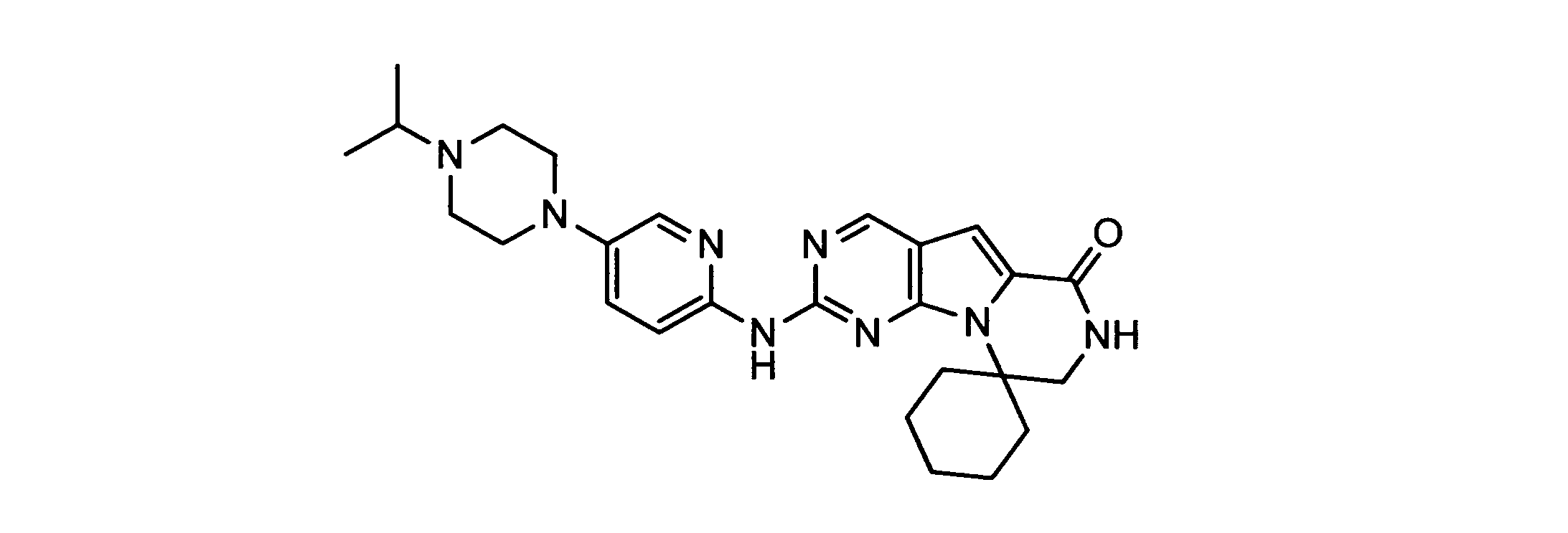
An effective amount of a selective cyclin dependent kinase (CDK) 4/6 inhibitor having the structure or a pharmacologically acceptable salt thereof:
Priority Applications (1)
| Application Number | Priority Date | Filing Date | Title |
|---|---|---|---|
| JP2023044746A JP2023078341A (en) | 2013-03-15 | 2023-03-20 | HSPC-sparing treatment for RB-positive aberrant cell proliferation |
Applications Claiming Priority (8)
| Application Number | Priority Date | Filing Date | Title |
|---|---|---|---|
| US201361798772P | 2013-03-15 | 2013-03-15 | |
| US61/798,772 | 2013-03-15 | ||
| US201361861374P | 2013-08-01 | 2013-08-01 | |
| US61/861,374 | 2013-08-01 | ||
| US201361911354P | 2013-12-03 | 2013-12-03 | |
| US61/911,354 | 2013-12-03 | ||
| US201461949786P | 2014-03-07 | 2014-03-07 | |
| US61/949,786 | 2014-03-07 |
Related Parent Applications (1)
| Application Number | Title | Priority Date | Filing Date |
|---|---|---|---|
| JP2019077828A Division JP6738933B6 (en) | 2013-03-15 | 2019-04-16 | HSPC-conserving treatment for RB positive abnormal cell proliferation |
Related Child Applications (1)
| Application Number | Title | Priority Date | Filing Date |
|---|---|---|---|
| JP2023044746A Division JP2023078341A (en) | 2013-03-15 | 2023-03-20 | HSPC-sparing treatment for RB-positive aberrant cell proliferation |
Publications (2)
| Publication Number | Publication Date |
|---|---|
| JP2020183422A JP2020183422A (en) | 2020-11-12 |
| JP7250737B2 true JP7250737B2 (en) | 2023-04-03 |
Family
ID=51527871
Family Applications (9)
| Application Number | Title | Priority Date | Filing Date |
|---|---|---|---|
| JP2016503092A Active JP6337083B2 (en) | 2013-03-15 | 2014-03-14 | HSPC preservation treatment for RB positive abnormal cell proliferation |
| JP2016502870A Active JP6430483B2 (en) | 2013-03-15 | 2014-03-14 | Temporary protection of normal cells during chemotherapy |
| JP2018089382A Active JP6517401B2 (en) | 2013-03-15 | 2018-05-07 | HSPC-sparing treatment for RB positive abnormal cell proliferation |
| JP2018204234A Active JP6767456B2 (en) | 2013-03-15 | 2018-10-30 | Temporary protection of normal cells during chemotherapy |
| JP2019077828A Active JP6738933B6 (en) | 2013-03-15 | 2019-04-16 | HSPC-conserving treatment for RB positive abnormal cell proliferation |
| JP2020123189A Active JP7250737B2 (en) | 2013-03-15 | 2020-07-17 | HSPC-sparing treatment for RB-positive aberrant cell proliferation |
| JP2020155691A Active JP7213854B2 (en) | 2013-03-15 | 2020-09-16 | Temporary protection of normal cells during chemotherapy |
| JP2023005413A Ceased JP2023052449A (en) | 2013-03-15 | 2023-01-17 | Temporary protection of normal cells during chemotherapy |
| JP2023044746A Withdrawn JP2023078341A (en) | 2013-03-15 | 2023-03-20 | HSPC-sparing treatment for RB-positive aberrant cell proliferation |
Family Applications Before (5)
| Application Number | Title | Priority Date | Filing Date |
|---|---|---|---|
| JP2016503092A Active JP6337083B2 (en) | 2013-03-15 | 2014-03-14 | HSPC preservation treatment for RB positive abnormal cell proliferation |
| JP2016502870A Active JP6430483B2 (en) | 2013-03-15 | 2014-03-14 | Temporary protection of normal cells during chemotherapy |
| JP2018089382A Active JP6517401B2 (en) | 2013-03-15 | 2018-05-07 | HSPC-sparing treatment for RB positive abnormal cell proliferation |
| JP2018204234A Active JP6767456B2 (en) | 2013-03-15 | 2018-10-30 | Temporary protection of normal cells during chemotherapy |
| JP2019077828A Active JP6738933B6 (en) | 2013-03-15 | 2019-04-16 | HSPC-conserving treatment for RB positive abnormal cell proliferation |
Family Applications After (3)
| Application Number | Title | Priority Date | Filing Date |
|---|---|---|---|
| JP2020155691A Active JP7213854B2 (en) | 2013-03-15 | 2020-09-16 | Temporary protection of normal cells during chemotherapy |
| JP2023005413A Ceased JP2023052449A (en) | 2013-03-15 | 2023-01-17 | Temporary protection of normal cells during chemotherapy |
| JP2023044746A Withdrawn JP2023078341A (en) | 2013-03-15 | 2023-03-20 | HSPC-sparing treatment for RB-positive aberrant cell proliferation |
Country Status (18)
| Country | Link |
|---|---|
| US (15) | US9527857B2 (en) |
| EP (4) | EP2968291B1 (en) |
| JP (9) | JP6337083B2 (en) |
| CN (4) | CN108283644B (en) |
| CA (2) | CA2906166C (en) |
| CY (1) | CY1122434T1 (en) |
| DK (1) | DK2968290T3 (en) |
| ES (2) | ES3032492T3 (en) |
| HR (1) | HRP20192168T1 (en) |
| HU (1) | HUE046653T2 (en) |
| LT (1) | LT2968290T (en) |
| ME (1) | ME03557B (en) |
| PL (1) | PL2968290T3 (en) |
| PT (1) | PT2968290T (en) |
| RS (1) | RS59790B1 (en) |
| SI (1) | SI2968290T1 (en) |
| SM (1) | SMT201900681T1 (en) |
| WO (2) | WO2014144847A2 (en) |
Families Citing this family (47)
| Publication number | Priority date | Publication date | Assignee | Title |
|---|---|---|---|---|
| US9259399B2 (en) | 2007-11-07 | 2016-02-16 | Cornell University | Targeting CDK4 and CDK6 in cancer therapy |
| US8691830B2 (en) * | 2010-10-25 | 2014-04-08 | G1 Therapeutics, Inc. | CDK inhibitors |
| AU2013239816B2 (en) | 2012-03-29 | 2017-08-24 | G1 Therapeutics, Inc. | Lactam kinase inhibitors |
| WO2013163239A1 (en) | 2012-04-26 | 2013-10-31 | Francis Xavier Tavares | Synthesis of lactams |
| JP6435315B2 (en) | 2013-03-15 | 2018-12-05 | ジー1、セラピューティクス、インコーポレイテッドG1 Therapeutics, Inc. | Highly active antineoplastic and antiproliferative agents |
| CA2906166C (en) | 2013-03-15 | 2023-03-14 | G1 Therapeutics, Inc. | Hspc-sparing treatments for rb-positive abnormal cellular proliferation |
| US20150297608A1 (en) | 2014-04-17 | 2015-10-22 | G1 Therapeutics, Inc. | Tricyclic Lactams for Use as Anti-Neoplastic and Anti-Proliferative Agents |
| WO2016040858A1 (en) | 2014-09-12 | 2016-03-17 | G1 Therapeutics, Inc. | Combinations and dosing regimes to treat rb-positive tumors |
| WO2016040848A1 (en) | 2014-09-12 | 2016-03-17 | G1 Therapeutics, Inc. | Treatment of rb-negative tumors using topoisomerase inhibitors in combination with cyclin dependent kinase 4/6 inhibitors |
| WO2016126889A1 (en) * | 2015-02-03 | 2016-08-11 | G1 Therapeutics, Inc. | Cdk4/6 inhibitor dosage formulations for the protection of hematopoietic stem and progenitor cells during chemotherapy |
| ES2832893T3 (en) | 2015-06-17 | 2021-06-11 | Pfizer | Tricyclic compounds and their use as phosphodiesterase inhibitors |
| US10328066B2 (en) * | 2015-08-28 | 2019-06-25 | Novartis Ag | Pharmaceutical combination comprising the PI3K inhibitor alpelisib and the CDK4/6 inhibitor ribociclib, and the use thereof in the treatment/prevention of cancer |
| JP6635374B2 (en) * | 2015-12-18 | 2020-01-22 | 京都府公立大学法人 | Irinotecan sensitivity prediction method using phosphorylated RB protein as an index in cancer |
| US11077110B2 (en) * | 2016-03-18 | 2021-08-03 | Tufts Medical Center | Compositions and methods for treating and preventing metabolic disorders |
| EA202092442A3 (en) | 2016-06-07 | 2021-08-31 | Джакобио Фармасьютикалс Ко., Лтд. | NEW HETEROCYCLIC DERIVATIVES USED AS SHP2 INHIBITORS |
| WO2018005863A1 (en) * | 2016-07-01 | 2018-01-04 | G1 Therapeutics, Inc. | Pyrimidine-based compounds for the treatment of cancer |
| BR112018077136A2 (en) * | 2016-07-01 | 2019-04-30 | G1 Therapeutics, Inc. | compound, and methods for treating a disorder associated with abnormal cell proliferation and for reducing the effect of chemotherapy on healthy cells. |
| KR102445288B1 (en) * | 2016-07-01 | 2022-09-19 | 쥐원 쎄라퓨틱스, 인크. | Synthesis of N-(heteroaryl)-pyrrolo[3,2-d]pyrimidin-2-amine |
| WO2018005533A1 (en) | 2016-07-01 | 2018-01-04 | G1 Therapeutics, Inc. | Antiproliferative pyrimidine-based compounds |
| US20190175598A1 (en) | 2016-08-23 | 2019-06-13 | Eisai R&D Management Co., Ltd. | Combination therapies for the treatment of hepatocellular carcinoma |
| EP3538148A1 (en) | 2016-11-08 | 2019-09-18 | Dana-Farber Cancer Institute | Compositions and methods of modulating anti-tumor immunity |
| AU2017372856B9 (en) | 2016-12-05 | 2024-01-04 | Pharmacosmos Holding A/S | Preservation of immune response during chemotherapy regimens |
| AR110728A1 (en) * | 2017-01-06 | 2019-04-24 | G1 Therapeutics Inc | COMBINED THERAPY FOR TREATMENT OF CANCER |
| US11395821B2 (en) | 2017-01-30 | 2022-07-26 | G1 Therapeutics, Inc. | Treatment of EGFR-driven cancer with fewer side effects |
| CN110325191A (en) | 2017-02-22 | 2019-10-11 | G1治疗公司 | With the cancer of less side effect treatment EGFR- driving |
| BR112019019261A2 (en) | 2017-03-16 | 2020-06-16 | Eisai R & D Management Co., Ltd. | COMBINATION THERAPIES FOR THE TREATMENT OF BREAST CANCER |
| WO2018172984A1 (en) | 2017-03-23 | 2018-09-27 | Jacobio Pharmaceuticals Co., Ltd. | Novel heterocyclic derivatives useful as shp2 inhibitors |
| CA3067873A1 (en) | 2017-06-29 | 2019-01-03 | G1 Therapeutics, Inc. | Morphic forms of g1t38 and methods of manufacture thereof |
| JP7233743B2 (en) * | 2017-08-11 | 2023-03-07 | 晟科薬業(江蘇)有限公司 | 1H-pyrazolo[4,3-H]quinazoline compounds as protein kinase inhibitors |
| SG11202005937QA (en) | 2018-01-08 | 2020-07-29 | G1 Therapeutics Inc | G1t38 superior dosage regimes |
| KR20200131246A (en) | 2018-02-15 | 2020-11-23 | 누베이션 바이오 인크. | Heterocyclic compounds as kinase inhibitors |
| AU2019253706A1 (en) * | 2018-04-09 | 2020-11-26 | G1 Therapeutics, Inc. | Treatment of cancers having driving oncogenic mutations |
| CN112703186A (en) | 2018-07-27 | 2021-04-23 | 加利福尼亚技术学院 | CDK inhibitors and uses thereof |
| RS67557B1 (en) | 2018-08-24 | 2026-01-30 | Pharmacosmos Holding As | Improved synthesis of 1,4-diazaspiro[5.5]undecan-3-one |
| CN112839935A (en) | 2018-09-26 | 2021-05-25 | 北京加科思新药研发有限公司 | Novel heterocyclic derivatives useful as SHP2 inhibitors |
| JP2022506829A (en) * | 2018-11-09 | 2022-01-17 | ジー1、セラピューティクス、インコーポレイテッド | A therapeutic regimen for the treatment of cancer using a combination of eribulin and a selective CDK4 / 6 inhibitor |
| WO2020206035A1 (en) * | 2019-04-01 | 2020-10-08 | G1 Therapeutics, Inc. | Treatment of cdk4/6 inhibitor resistant neoplastic disorders |
| KR20220024540A (en) * | 2019-06-18 | 2022-03-03 | 쥐원 쎄라퓨틱스, 인크. | Patient selection for enhancement of anti-tumor immunity in cancer patients |
| TW202128173A (en) * | 2019-10-09 | 2021-08-01 | 美商G1治療公司 | Targeted treatment of cancers with dysregulated fibroblast growth factor receptor signaling |
| CA3173678A1 (en) | 2020-05-19 | 2021-11-25 | Jay Copeland Strum | Cyclin-dependent kinase inhibiting compounds for the treatment of medical disorders |
| MX2022015567A (en) * | 2020-06-11 | 2023-01-19 | Lunella Biotech Inc | Selective cdk4/6 inhibitor cancer therapeutics. |
| US10988479B1 (en) | 2020-06-15 | 2021-04-27 | G1 Therapeutics, Inc. | Morphic forms of trilaciclib and methods of manufacture thereof |
| EP4164653A4 (en) * | 2020-06-15 | 2024-06-19 | G1 Therapeutics, Inc. | MORPHIC FORMS OF TRILACICLIB AND METHODS OF MANUFACTURING THEM |
| CN113788837B (en) * | 2021-08-02 | 2022-08-26 | 深圳湾实验室坪山生物医药研发转化中心 | Trilaciclib synthesis method |
| JP2023148228A (en) * | 2022-03-30 | 2023-10-13 | 東芝ライテック株式会社 | Lighting control device and lighting control system |
| WO2024073507A1 (en) | 2022-09-28 | 2024-04-04 | Theseus Pharmaceuticals, Inc. | Macrocyclic compounds and uses thereof |
| EP4626866A1 (en) * | 2022-11-28 | 2025-10-08 | Assia Chemical Industries Ltd. | Novel trilaciclib intermediates, method of preparation and use thereof |
Citations (1)
| Publication number | Priority date | Publication date | Assignee | Title |
|---|---|---|---|---|
| JP6337083B2 (en) | 2013-03-15 | 2018-06-06 | ジー1、セラピューティクス、インコーポレイテッドG1 Therapeutics, Inc. | HSPC preservation treatment for RB positive abnormal cell proliferation |
Family Cites Families (97)
| Publication number | Priority date | Publication date | Assignee | Title |
|---|---|---|---|---|
| US5591855A (en) | 1994-10-14 | 1997-01-07 | Cephalon, Inc. | Fused pyrrolocarbazoles |
| US5628984A (en) | 1995-07-31 | 1997-05-13 | University Of North Carolina At Chapel Hill | Method of detecting lung disease |
| KR20000070751A (en) | 1997-02-05 | 2000-11-25 | 로즈 암스트롱, 크리스틴 에이. 트러트웨인 | Pyrido[2,3-D]pyrimidines and 4-Aminopyrimidines as Inhibitors of Cellular Proliferation |
| GB9718913D0 (en) | 1997-09-05 | 1997-11-12 | Glaxo Group Ltd | Substituted oxindole derivatives |
| US20040006074A1 (en) | 1998-04-28 | 2004-01-08 | The Government Of The United States Of America | Cyclin dependent kinase (CDK)4 inhibitors and their use for treating cancer |
| AU778735B2 (en) | 1998-06-16 | 2004-12-16 | Centre National De La Recherche Scientifique | Fused azepinone cyclin dependent kinase inhibitors |
| ATE380548T1 (en) | 1999-01-29 | 2007-12-15 | Univ Illinois | USE OF P53 INHIBITORS FOR THE TREATMENT OF ADVERSE SYMPTOMS OF CANCER THERAPY |
| AU6314900A (en) | 1999-07-26 | 2001-02-13 | Banyu Pharmaceutical Co., Ltd. | Biarylurea derivatives |
| US6387900B1 (en) | 1999-08-12 | 2002-05-14 | Pharmacia & Upjohn S.P.A. | 3(5)-ureido-pyrazole derivatives process for their preparation and their use as antitumor agents |
| US6291504B1 (en) | 1999-10-20 | 2001-09-18 | Dupont Pharmaceuticals Company | Acylsemicarbazides and their uses |
| US6867198B2 (en) | 1999-12-16 | 2005-03-15 | Eli Lilly And Company | Agents and methods for the treatment of proliferative diseases |
| US7053070B2 (en) | 2000-01-25 | 2006-05-30 | Warner-Lambert Company | Pyrido[2,3-d]pyrimidine-2,7-diamine kinase inhibitors |
| EA006153B1 (en) | 2000-06-26 | 2005-10-27 | Пфайзер Продактс Инк. | PYRROLO[2,3-d]PYRIMIDINE COMPOUNDS AS IMMUNOSUPPRESSIVE AGENTS |
| DK1325011T3 (en) | 2000-09-29 | 2004-08-16 | Lilly Co Eli | Methods and Compounds for the Treatment of Proliferative Diseases |
| US6706718B2 (en) | 2000-12-01 | 2004-03-16 | Bristol-Myers Squibb Company | 3-(2,4-dimethylthiazol-5-yl)indeno[1,2-c]pyrazol-4-one derivatives and their uses |
| JP4302986B2 (en) | 2001-02-28 | 2009-07-29 | テンプル・ユニバーシティ−オブ・ザ・コモンウェルス・システム・オブ・ハイアー・エデュケイション | Protecting cells and tissues from ionizing radiation with α, β unsaturated aryl sulfones |
| WO2002092127A1 (en) | 2001-05-11 | 2002-11-21 | Board Of Regents, The University Of Texas System | Anti-cd26 monoclonal antibodies as therapy for diseases associated with cells expressing cd26 |
| ATE314370T1 (en) | 2002-01-22 | 2006-01-15 | Warner Lambert Co | 2-(PYRIDINE-2-YLAMINO)-PYRIDO(2,3-D)PYRIMIDINE-7-ONE |
| WO2003093469A2 (en) | 2002-05-01 | 2003-11-13 | Chromos Molecular Systems, Inc. | Methods for delivering nucleic acid molecules into cells and assessment thereof |
| MXPA05007503A (en) | 2003-01-17 | 2005-09-21 | Warner Lambert Co | 2-aminopyridine substituted heterocycles as inhibitors of cellular proliferation. |
| EA010904B1 (en) | 2003-05-22 | 2008-12-30 | НЕРВИАНО МЕДИКАЛ САЙЕНСИЗ С.р.л. | Pyrazolo-quinazoline derivatives, process for their preparation and their use as kinase inhibitors |
| CN1835951B (en) | 2003-07-11 | 2010-06-02 | 沃尼尔·朗伯有限责任公司 | Isethionates of Selective CDK4 Inhibitors |
| ES2297502T3 (en) | 2003-10-23 | 2008-05-01 | F. Hoffmann-La Roche Ag | DERIVATIVES OF TRIAZA-ESPIROPIPERIDINAS FOR USE AS GLYT-1 INHIBITORS IN THE TREATMENT OF NEUROLOGICAL AND NEUROPSYCHIATRIC DISORDERS. |
| GB0327380D0 (en) | 2003-11-25 | 2003-12-31 | Cyclacel Ltd | Method |
| WO2005094830A1 (en) | 2004-03-30 | 2005-10-13 | Pfizer Products Inc. | Combinations of signal transduction inhibitors |
| WO2005100999A2 (en) | 2004-04-08 | 2005-10-27 | Cornell Research Foundation, Inc. | Functional immunohistochemical cell cycle analysis as a prognostic indicator for cancer |
| ITMI20040874A1 (en) | 2004-04-30 | 2004-07-30 | Ist Naz Stud Cura Dei Tumori | INDOLIC AND AZAINDOLIC DERIVATIVES WITH ANTI-TUMORAL ACTION |
| WO2005117908A2 (en) | 2004-05-28 | 2005-12-15 | Gemin X Biotechnologies, Inc. | Triheterocyclic compounds compositions, and methods for treating cancer or viral diseases |
| EP1846408B1 (en) | 2005-01-14 | 2013-03-20 | Janssen Pharmaceutica NV | 5-membered annelated heterocyclic pyrimidines as kinase inhibitors |
| US20080161355A1 (en) | 2005-01-21 | 2008-07-03 | Astex Therapeutics Limited | Combinations of Pyrazole Kinase Inhibitors and Further Antitumor Agents |
| KR20080016659A (en) | 2005-05-20 | 2008-02-21 | 버텍스 파마슈티칼스 인코포레이티드 | Pyrrolopyridines useful as inhibitors of protein kinase |
| US20070049591A1 (en) | 2005-08-25 | 2007-03-01 | Kalypsys, Inc. | Inhibitors of MAPK/Erk Kinase |
| EP1779848A1 (en) | 2005-10-28 | 2007-05-02 | Nikem Research S.R.L. | V-ATPase inhibitors for the treatment of inflammatory and autoimmune diseases |
| WO2007065820A1 (en) | 2005-12-09 | 2007-06-14 | F. Hoffmann-La Roche Ag | Tricyclic amide derivatives useful for treating obesity |
| EP1963273A2 (en) | 2005-12-22 | 2008-09-03 | Wyeth a Corporation of the State of Delaware | Substituted isoquinoline-1,3(2h,4h)-diones, 1-thioxo-1,4-dihydro-2h-isoquinoline-3-ones and 1,4-dihydro-3(2h)-isoquinolones and use thereof as kinase inhibitors |
| JP2009532503A (en) | 2006-04-05 | 2009-09-10 | ノバルティス アクチエンゲゼルシャフト | Combination of therapeutic agents for treating cancer |
| US20070270362A1 (en) | 2006-05-18 | 2007-11-22 | The University Of Washington | Methods and compositions for prevention or treatment of inflammatory-related diseases and disorders |
| EP2043651A2 (en) | 2006-07-05 | 2009-04-08 | Exelixis, Inc. | Methods of using igf1r and abl kinase modulators |
| EP2061469B8 (en) | 2006-09-11 | 2014-02-26 | Curis, Inc. | Quinazoline based egfr inhibitors |
| AU2007333791A1 (en) | 2006-12-14 | 2008-06-26 | Panacea Pharmaceuticals, Inc. | Methods of neuroprotection by cyclin-dependent kinase inhibition |
| WO2008079933A2 (en) | 2006-12-22 | 2008-07-03 | Novartis Ag | Heteroaryl-heteroaryl compounds as cdk inhibitors for the treatment of cancer, inflammation and viral infections |
| AU2008268442A1 (en) | 2007-06-25 | 2008-12-31 | Neurogen Corporation | Piperazinyl oxoalkyl tetrahydro-beta-carbolines and related analogues |
| US9259399B2 (en) | 2007-11-07 | 2016-02-16 | Cornell University | Targeting CDK4 and CDK6 in cancer therapy |
| MX2010006457A (en) | 2007-12-19 | 2010-07-05 | Amgen Inc | Fused pyridine, pyrimidine and triazine compounds as cell cycle inhibitors. |
| US8518930B2 (en) | 2008-07-29 | 2013-08-27 | Nerviano Medical Sciences S.R.L. | Therapeutic combination comprising a CDKS inhibitor and an antineoplastic agent |
| EA019094B1 (en) * | 2008-08-22 | 2014-01-30 | Новартис Аг | Pyrrolopyrimidine compounds and use thereof |
| CA2738909A1 (en) | 2008-10-01 | 2010-05-06 | The University Of North Carolina At Chapel Hill | Hematopoietic protection against ionizing radiation using selective cyclin-dependent kinase 4/6 inhibitors |
| CN102231984A (en) * | 2008-10-01 | 2011-11-02 | 北卡罗来纳大学查珀尔希尔分校 | Hematopoietic protection against chemotherapeutic compounds using selective cyclin-dependent kinase 4/6 inhibitors |
| PA8852901A1 (en) | 2008-12-22 | 2010-07-27 | Lilly Co Eli | PROTEIN CINASE INHIBITORS |
| EP2429566B1 (en) | 2009-05-13 | 2016-01-06 | The University of North Carolina At Chapel Hill | Cyclin dependent kinase inhibitors and methods of use |
| US9040519B2 (en) | 2010-02-18 | 2015-05-26 | Medivation Technologies, Inc. | Fused tetracyclic pyrido [4,3-B] indole and pyrido [3,4-B] indole derivatives and methods of use |
| UY33227A (en) | 2010-02-19 | 2011-09-30 | Novartis Ag | PIRROLOPIRIMIDINE COMPOUNDS AS INHIBITORS OF THE CDK4 / 6 |
| UY33226A (en) | 2010-02-19 | 2011-09-30 | Novartis Ag | PIRROLOPIRIMIDINE COMPUTERS DEUTERATED AS INHIBITORS OF THE CDK4 / 6 |
| FR2957748B1 (en) * | 2010-03-16 | 2012-09-07 | St Microelectronics Grenoble 2 | ELECTRONIC COMPONENT WITH SURFACE MOUNTING |
| CN102299073A (en) | 2010-06-25 | 2011-12-28 | 无锡华润上华半导体有限公司 | Vertical double-diffusion metal oxide semiconductor (VDMOS) device and manufacturing method thereof |
| US8691830B2 (en) | 2010-10-25 | 2014-04-08 | G1 Therapeutics, Inc. | CDK inhibitors |
| CN103429243B (en) * | 2010-10-25 | 2016-06-08 | G1治疗公司 | CDK inhibitors |
| PT2635583E (en) | 2010-11-02 | 2015-09-11 | Promega Corp | Coelenterazine derivatives and methods of using same |
| JP2013545758A (en) | 2010-11-17 | 2013-12-26 | ザ ユニバーシティ オブ ノース カロライナ アット チャペル ヒル | Protection of renal tissue from ischemia by inhibition of the proliferative kinases CDK4 and CDK6 |
| US8815853B2 (en) | 2010-12-23 | 2014-08-26 | Sanofi | Pyrimidinone derivatives, preparation thereof and pharmaceutical use thereof |
| DK2937349T3 (en) | 2011-03-23 | 2017-02-20 | Amgen Inc | CONDENSED TRICYCLIC DUAL INHIBITORS OF CDK 4/6 AND FLT3 |
| TW201733984A (en) | 2011-04-13 | 2017-10-01 | 雅酶股份有限公司 | Substituted benzene compounds |
| PE20141381A1 (en) | 2011-07-01 | 2014-10-21 | Novartis Ag | COMBINATION THERAPY INCLUDING A CDK4 / 6 INHIBITOR AND A PI3K INHIBITOR FOR USE IN THE TREATMENT OF CANCER |
| MY161925A (en) | 2011-07-27 | 2017-05-15 | Astrazeneca Ab | 2 - (2, 4, 5 - substituted -anilino) pyrimidine derivatives as egfr modulators useful for treating cancer |
| AU2013239816B2 (en) | 2012-03-29 | 2017-08-24 | G1 Therapeutics, Inc. | Lactam kinase inhibitors |
| WO2013163239A1 (en) | 2012-04-26 | 2013-10-31 | Francis Xavier Tavares | Synthesis of lactams |
| CA2880764C (en) | 2012-08-03 | 2022-08-30 | Foundation Medicine, Inc. | Human papilloma virus as predictor of cancer prognosis |
| US9241941B2 (en) | 2012-09-20 | 2016-01-26 | Memorial Sloan-Kettering Cancer Center | Methods for treatment of lymphomas with mutations in cell cycle genes |
| BR112015012197A8 (en) | 2012-11-28 | 2019-10-01 | Novartis Ag | cdk mtor inhibitor uses, and pharmaceutical combination comprising the same |
| US20140274896A1 (en) | 2013-03-15 | 2014-09-18 | G1 Therapeutics, Inc. | Transient Protection of Hematopoietic Stem and Progenitor Cells Against Ionizing Radiation |
| JP6435315B2 (en) * | 2013-03-15 | 2018-12-05 | ジー1、セラピューティクス、インコーポレイテッドG1 Therapeutics, Inc. | Highly active antineoplastic and antiproliferative agents |
| AU2014251028A1 (en) | 2013-04-08 | 2015-11-05 | Janssen Pharmaceutica Nv | Ibrutinib combination therapy |
| ES2834638T3 (en) | 2013-05-30 | 2021-06-18 | Infinity Pharmaceuticals Inc | Cancer treatment using PI3 kinase isoform modulators |
| US20160257688A1 (en) | 2013-10-24 | 2016-09-08 | Francis Xavier Tavares | Process for Synthesis of Lactams |
| WO2015084892A1 (en) | 2013-12-02 | 2015-06-11 | Cornell University | Methods for treating b cell proliferative disorders |
| CA2935103C (en) | 2013-12-31 | 2018-08-28 | Xuanzhu Pharma Co., Ltd. | Kinase inhibitor and use thereof |
| CA2935423C (en) | 2014-01-24 | 2023-11-07 | Dana-Farber Cancer Institute, Inc. | Antibody molecules to pd-1 and uses thereof |
| US20150297608A1 (en) | 2014-04-17 | 2015-10-22 | G1 Therapeutics, Inc. | Tricyclic Lactams for Use as Anti-Neoplastic and Anti-Proliferative Agents |
| WO2016040858A1 (en) * | 2014-09-12 | 2016-03-17 | G1 Therapeutics, Inc. | Combinations and dosing regimes to treat rb-positive tumors |
| WO2016040848A1 (en) * | 2014-09-12 | 2016-03-17 | G1 Therapeutics, Inc. | Treatment of rb-negative tumors using topoisomerase inhibitors in combination with cyclin dependent kinase 4/6 inhibitors |
| US9374037B2 (en) | 2014-10-30 | 2016-06-21 | M/A-Com Technology Solutions Holdings, Inc. | Voltage-controlled oscillator with mask-selectable performance |
| WO2016126889A1 (en) | 2015-02-03 | 2016-08-11 | G1 Therapeutics, Inc. | Cdk4/6 inhibitor dosage formulations for the protection of hematopoietic stem and progenitor cells during chemotherapy |
| WO2018005863A1 (en) | 2016-07-01 | 2018-01-04 | G1 Therapeutics, Inc. | Pyrimidine-based compounds for the treatment of cancer |
| KR102445288B1 (en) * | 2016-07-01 | 2022-09-19 | 쥐원 쎄라퓨틱스, 인크. | Synthesis of N-(heteroaryl)-pyrrolo[3,2-d]pyrimidin-2-amine |
| AU2017372856B9 (en) * | 2016-12-05 | 2024-01-04 | Pharmacosmos Holding A/S | Preservation of immune response during chemotherapy regimens |
| AU2017370694A1 (en) * | 2016-12-08 | 2019-07-25 | Icahn School Of Medicine At Mount Sinai | Compositions and methods for treating CDK4/6-mediated cancer |
| AR110728A1 (en) * | 2017-01-06 | 2019-04-24 | G1 Therapeutics Inc | COMBINED THERAPY FOR TREATMENT OF CANCER |
| US11395821B2 (en) * | 2017-01-30 | 2022-07-26 | G1 Therapeutics, Inc. | Treatment of EGFR-driven cancer with fewer side effects |
| TW201835064A (en) * | 2017-02-10 | 2018-10-01 | 美商G1治療公司 | Benzothiophene estrogen receptor modulators |
| CN110325191A (en) * | 2017-02-22 | 2019-10-11 | G1治疗公司 | With the cancer of less side effect treatment EGFR- driving |
| CA3067873A1 (en) * | 2017-06-29 | 2019-01-03 | G1 Therapeutics, Inc. | Morphic forms of g1t38 and methods of manufacture thereof |
| EP3735247A1 (en) | 2018-01-04 | 2020-11-11 | G1 Therapeutics, Inc. | Heterocyclic compounds for the treatment of abnormal cellular proliferation |
| SG11202005937QA (en) * | 2018-01-08 | 2020-07-29 | G1 Therapeutics Inc | G1t38 superior dosage regimes |
| AU2019253706A1 (en) * | 2018-04-09 | 2020-11-26 | G1 Therapeutics, Inc. | Treatment of cancers having driving oncogenic mutations |
| WO2020023502A1 (en) * | 2018-07-23 | 2020-01-30 | Aileron Therapeutics, Inc. | Peptidomimetic macrocycles and uses thereof |
| KR20220024540A (en) * | 2019-06-18 | 2022-03-03 | 쥐원 쎄라퓨틱스, 인크. | Patient selection for enhancement of anti-tumor immunity in cancer patients |
| TW202128173A (en) * | 2019-10-09 | 2021-08-01 | 美商G1治療公司 | Targeted treatment of cancers with dysregulated fibroblast growth factor receptor signaling |
-
2014
- 2014-03-14 CA CA2906166A patent/CA2906166C/en active Active
- 2014-03-14 JP JP2016503092A patent/JP6337083B2/en active Active
- 2014-03-14 SM SM20190681T patent/SMT201900681T1/en unknown
- 2014-03-14 EP EP14765105.3A patent/EP2968291B1/en active Active
- 2014-03-14 US US14/214,048 patent/US9527857B2/en active Active
- 2014-03-14 ES ES14765105T patent/ES3032492T3/en active Active
- 2014-03-14 CN CN201810253672.1A patent/CN108283644B/en active Active
- 2014-03-14 CA CA2906156A patent/CA2906156C/en active Active
- 2014-03-14 HR HRP20192168TT patent/HRP20192168T1/en unknown
- 2014-03-14 HU HUE14762438A patent/HUE046653T2/en unknown
- 2014-03-14 LT LT14762438T patent/LT2968290T/en unknown
- 2014-03-14 US US14/212,911 patent/US9464092B2/en active Active
- 2014-03-14 CN CN201810443050.5A patent/CN108434149B/en active Active
- 2014-03-14 CN CN201480027269.7A patent/CN105407889B/en active Active
- 2014-03-14 WO PCT/US2014/029429 patent/WO2014144847A2/en not_active Ceased
- 2014-03-14 JP JP2016502870A patent/JP6430483B2/en active Active
- 2014-03-14 ME MEP-2019-338A patent/ME03557B/en unknown
- 2014-03-14 PL PL14762438T patent/PL2968290T3/en unknown
- 2014-03-14 ES ES14762438T patent/ES2761406T3/en active Active
- 2014-03-14 SI SI201431380T patent/SI2968290T1/en unknown
- 2014-03-14 DK DK14762438T patent/DK2968290T3/en active
- 2014-03-14 CN CN201480027281.8A patent/CN105473140B/en active Active
- 2014-03-14 US US14/212,430 patent/US9487530B2/en active Active
- 2014-03-14 EP EP14762438.1A patent/EP2968290B1/en active Active
- 2014-03-14 RS RS20191537A patent/RS59790B1/en unknown
- 2014-03-14 EP EP19198057.2A patent/EP3653209A1/en active Pending
- 2014-03-14 WO PCT/US2014/028685 patent/WO2014144326A1/en not_active Ceased
- 2014-03-14 EP EP25170501.8A patent/EP4596051A3/en active Pending
- 2014-03-14 PT PT147624381T patent/PT2968290T/en unknown
-
2016
- 2016-10-07 US US15/288,878 patent/US9931345B2/en active Active
- 2016-11-03 US US15/342,990 patent/US10085992B2/en active Active
- 2016-12-21 US US15/387,083 patent/US10076523B2/en active Active
-
2018
- 2018-04-02 US US15/943,278 patent/US10660896B2/en active Active
- 2018-05-07 JP JP2018089382A patent/JP6517401B2/en active Active
- 2018-08-24 US US16/112,360 patent/US10966984B2/en active Active
- 2018-08-24 US US16/112,362 patent/US10434104B2/en active Active
- 2018-10-30 JP JP2018204234A patent/JP6767456B2/en active Active
- 2018-11-01 US US16/178,419 patent/US10925878B2/en active Active
-
2019
- 2019-04-16 JP JP2019077828A patent/JP6738933B6/en active Active
- 2019-12-11 CY CY20191101306T patent/CY1122434T1/en unknown
-
2020
- 2020-05-28 US US16/886,309 patent/US11040042B2/en active Active
- 2020-07-17 JP JP2020123189A patent/JP7250737B2/en active Active
- 2020-09-16 JP JP2020155691A patent/JP7213854B2/en active Active
-
2021
- 2021-02-22 US US17/181,638 patent/US11654148B2/en active Active
- 2021-04-05 US US17/222,873 patent/US11717523B2/en active Active
-
2023
- 2023-01-17 JP JP2023005413A patent/JP2023052449A/en not_active Ceased
- 2023-03-06 US US18/117,983 patent/US20230364098A1/en active Pending
- 2023-03-20 JP JP2023044746A patent/JP2023078341A/en not_active Withdrawn
- 2023-08-07 US US18/231,091 patent/US20230381189A1/en active Pending
Patent Citations (2)
| Publication number | Priority date | Publication date | Assignee | Title |
|---|---|---|---|---|
| JP6337083B2 (en) | 2013-03-15 | 2018-06-06 | ジー1、セラピューティクス、インコーポレイテッドG1 Therapeutics, Inc. | HSPC preservation treatment for RB positive abnormal cell proliferation |
| JP6738933B2 (en) | 2013-03-15 | 2020-08-12 | ジー1、セラピューティクス、インコーポレイテッドG1 Therapeutics, Inc. | HSPC preservation treatment for RB positive abnormal cell proliferation |
Also Published As
Similar Documents
| Publication | Publication Date | Title |
|---|---|---|
| US11654148B2 (en) | HSPC-sparing treatments for RB-positive abnormal cellular proliferation | |
| US20230241059A1 (en) | Anti-neoplastic combinations and dosing regimens using cdk4/6 inhibitor compounds to treat rb-positive tumors | |
| US12285431B2 (en) | Treatment of Rb-negative tumors using topoisomerase inhibitors in combination with cyclin dependent kinase 4/6 inhibitors | |
| HK1260112B (en) | Hspc-sparing treatments for rb-positive abnormal cellular proliferation | |
| HK1260112A1 (en) | Hspc-sparing treatments for rb-positive abnormal cellular proliferation | |
| HK1222792B (en) | Hspc-sparing treatments for rb-positive abnormal cellular proliferation |
Legal Events
| Date | Code | Title | Description |
|---|---|---|---|
| A521 | Request for written amendment filed |
Free format text: JAPANESE INTERMEDIATE CODE: A523 Effective date: 20200727 |
|
| A621 | Written request for application examination |
Free format text: JAPANESE INTERMEDIATE CODE: A621 Effective date: 20200727 |
|
| A131 | Notification of reasons for refusal |
Free format text: JAPANESE INTERMEDIATE CODE: A131 Effective date: 20210713 |
|
| A601 | Written request for extension of time |
Free format text: JAPANESE INTERMEDIATE CODE: A601 Effective date: 20211012 |
|
| A521 | Request for written amendment filed |
Free format text: JAPANESE INTERMEDIATE CODE: A523 Effective date: 20220113 |
|
| A131 | Notification of reasons for refusal |
Free format text: JAPANESE INTERMEDIATE CODE: A131 Effective date: 20220506 |
|
| A601 | Written request for extension of time |
Free format text: JAPANESE INTERMEDIATE CODE: A601 Effective date: 20220726 |
|
| A521 | Request for written amendment filed |
Free format text: JAPANESE INTERMEDIATE CODE: A523 Effective date: 20221107 |
|
| TRDD | Decision of grant or rejection written | ||
| A01 | Written decision to grant a patent or to grant a registration (utility model) |
Free format text: JAPANESE INTERMEDIATE CODE: A01 Effective date: 20230120 |
|
| A601 | Written request for extension of time |
Free format text: JAPANESE INTERMEDIATE CODE: A601 Effective date: 20230216 |
|
| R155 | Notification before disposition of declining of application |
Free format text: JAPANESE INTERMEDIATE CODE: R155 |
|
| A61 | First payment of annual fees (during grant procedure) |
Free format text: JAPANESE INTERMEDIATE CODE: A61 Effective date: 20230322 |
|
| R150 | Certificate of patent or registration of utility model |
Ref document number: 7250737 Country of ref document: JP Free format text: JAPANESE INTERMEDIATE CODE: R150 |
|
| S111 | Request for change of ownership or part of ownership |
Free format text: JAPANESE INTERMEDIATE CODE: R313111 Free format text: JAPANESE INTERMEDIATE CODE: R313113 |
|
| R371 | Transfer withdrawn |
Free format text: JAPANESE INTERMEDIATE CODE: R371 |
|
| S111 | Request for change of ownership or part of ownership |
Free format text: JAPANESE INTERMEDIATE CODE: R313111 Free format text: JAPANESE INTERMEDIATE CODE: R313113 |
|
| R250 | Receipt of annual fees |
Free format text: JAPANESE INTERMEDIATE CODE: R250 |
|
| R350 | Written notification of registration of transfer |
Free format text: JAPANESE INTERMEDIATE CODE: R350 |