JP7117397B2 - Isobutylene-containing compositions and articles made therefrom - Google Patents
Isobutylene-containing compositions and articles made therefrom Download PDFInfo
- Publication number
- JP7117397B2 JP7117397B2 JP2020564349A JP2020564349A JP7117397B2 JP 7117397 B2 JP7117397 B2 JP 7117397B2 JP 2020564349 A JP2020564349 A JP 2020564349A JP 2020564349 A JP2020564349 A JP 2020564349A JP 7117397 B2 JP7117397 B2 JP 7117397B2
- Authority
- JP
- Japan
- Prior art keywords
- halogenated
- composition
- rubber
- phr
- present
- Prior art date
- Legal status (The legal status is an assumption and is not a legal conclusion. Google has not performed a legal analysis and makes no representation as to the accuracy of the status listed.)
- Active
Links
Classifications
-
- C—CHEMISTRY; METALLURGY
- C08—ORGANIC MACROMOLECULAR COMPOUNDS; THEIR PREPARATION OR CHEMICAL WORKING-UP; COMPOSITIONS BASED THEREON
- C08F—MACROMOLECULAR COMPOUNDS OBTAINED BY REACTIONS ONLY INVOLVING CARBON-TO-CARBON UNSATURATED BONDS
- C08F212/00—Copolymers of compounds having one or more unsaturated aliphatic radicals, each having only one carbon-to-carbon double bond, and at least one being terminated by an aromatic carbocyclic ring
- C08F212/02—Monomers containing only one unsaturated aliphatic radical
- C08F212/04—Monomers containing only one unsaturated aliphatic radical containing one ring
- C08F212/14—Monomers containing only one unsaturated aliphatic radical containing one ring substituted by heteroatoms or groups containing heteroatoms
- C08F212/16—Halogens
- C08F212/21—Bromine
-
- C—CHEMISTRY; METALLURGY
- C08—ORGANIC MACROMOLECULAR COMPOUNDS; THEIR PREPARATION OR CHEMICAL WORKING-UP; COMPOSITIONS BASED THEREON
- C08L—COMPOSITIONS OF MACROMOLECULAR COMPOUNDS
- C08L23/00—Compositions of homopolymers or copolymers of unsaturated aliphatic hydrocarbons having only one carbon-to-carbon double bond; Compositions of derivatives of such polymers
- C08L23/02—Compositions of homopolymers or copolymers of unsaturated aliphatic hydrocarbons having only one carbon-to-carbon double bond; Compositions of derivatives of such polymers not modified by chemical after-treatment
- C08L23/18—Homopolymers or copolymers of hydrocarbons having four or more carbon atoms
- C08L23/20—Homopolymers or copolymers of hydrocarbons having four or more carbon atoms having four to nine carbon atoms
- C08L23/22—Copolymers of isobutene; Butyl rubber; Homopolymers or copolymers of other iso-olefins
-
- B—PERFORMING OPERATIONS; TRANSPORTING
- B60—VEHICLES IN GENERAL
- B60C—VEHICLE TYRES; TYRE INFLATION; TYRE CHANGING; CONNECTING VALVES TO INFLATABLE ELASTIC BODIES IN GENERAL; DEVICES OR ARRANGEMENTS RELATED TO TYRES
- B60C1/00—Tyres characterised by the chemical composition or the physical arrangement or mixture of the composition
- B60C1/0008—Compositions of the inner liner
-
- C—CHEMISTRY; METALLURGY
- C08—ORGANIC MACROMOLECULAR COMPOUNDS; THEIR PREPARATION OR CHEMICAL WORKING-UP; COMPOSITIONS BASED THEREON
- C08F—MACROMOLECULAR COMPOUNDS OBTAINED BY REACTIONS ONLY INVOLVING CARBON-TO-CARBON UNSATURATED BONDS
- C08F210/00—Copolymers of unsaturated aliphatic hydrocarbons having only one carbon-to-carbon double bond
- C08F210/04—Monomers containing three or four carbon atoms
- C08F210/08—Butenes
- C08F210/10—Isobutene
-
- C—CHEMISTRY; METALLURGY
- C08—ORGANIC MACROMOLECULAR COMPOUNDS; THEIR PREPARATION OR CHEMICAL WORKING-UP; COMPOSITIONS BASED THEREON
- C08F—MACROMOLECULAR COMPOUNDS OBTAINED BY REACTIONS ONLY INVOLVING CARBON-TO-CARBON UNSATURATED BONDS
- C08F212/00—Copolymers of compounds having one or more unsaturated aliphatic radicals, each having only one carbon-to-carbon double bond, and at least one being terminated by an aromatic carbocyclic ring
- C08F212/02—Monomers containing only one unsaturated aliphatic radical
- C08F212/04—Monomers containing only one unsaturated aliphatic radical containing one ring
- C08F212/14—Monomers containing only one unsaturated aliphatic radical containing one ring substituted by heteroatoms or groups containing heteroatoms
- C08F212/16—Halogens
- C08F212/18—Chlorine
-
- C—CHEMISTRY; METALLURGY
- C08—ORGANIC MACROMOLECULAR COMPOUNDS; THEIR PREPARATION OR CHEMICAL WORKING-UP; COMPOSITIONS BASED THEREON
- C08K—Use of inorganic or non-macromolecular organic substances as compounding ingredients
- C08K3/00—Use of inorganic substances as compounding ingredients
- C08K3/02—Elements
- C08K3/04—Carbon
-
- C—CHEMISTRY; METALLURGY
- C08—ORGANIC MACROMOLECULAR COMPOUNDS; THEIR PREPARATION OR CHEMICAL WORKING-UP; COMPOSITIONS BASED THEREON
- C08K—Use of inorganic or non-macromolecular organic substances as compounding ingredients
- C08K3/00—Use of inorganic substances as compounding ingredients
- C08K3/34—Silicon-containing compounds
- C08K3/346—Clay
Landscapes
- Chemical & Material Sciences (AREA)
- Health & Medical Sciences (AREA)
- Chemical Kinetics & Catalysis (AREA)
- Medicinal Chemistry (AREA)
- Polymers & Plastics (AREA)
- Organic Chemistry (AREA)
- Engineering & Computer Science (AREA)
- Mechanical Engineering (AREA)
- Compositions Of Macromolecular Compounds (AREA)
Description
関連出願の相互参照
本出願は、2018年5月17日に出願された米国特許仮出願第62/672,851号の優先権およびその利益を主張し、その内容はその全体が参照によって本明細書に組み込まれる。
CROSS-REFERENCE TO RELATED APPLICATIONS This application claims priority to and benefit from U.S. Provisional Patent Application No. 62/672,851, filed May 17, 2018, the contents of which are incorporated herein by reference in their entirety. incorporated into the book.
技術分野
本開示は、C4~C7イソオレフィン、非ハロゲン化アルキルスチレンおよびハロゲン化スチレンを含んでいるエラストマー組成物であって、ハロブチルゴムとブレンドされてインナーライナーのようなタイヤ部材に使用されることができるエラストマー組成物に関する。
TECHNICAL FIELD The present disclosure relates to elastomeric compositions comprising C4 - C7 isoolefins, non-halogenated alkyl styrenes and halogenated styrenes blended with halobutyl rubbers for use in tire components such as innerliners. It relates to an elastomer composition that can
ハロゲン化イソブチレン/イソプレンコポリマーであるハロブチルゴムは、乗用車、トラック、バスおよび航空機等の乗り物のタイヤに最良の空気保持性を与えるのに最適のポリマーである。ブロモブチルゴム、クロロブチルゴムおよびハロゲン化星形分枝状ブチルゴムは、特定のタイヤ用途、たとえばチューブまたはインナーライナー向けの配合物にされることができる。最終的な商業配合物用の成分および添加物の選択は、所望の特性、すなわち加工性およびタイヤ製造工場でのグリーン(未硬化)コンパウンドの粘着性と、硬化タイヤ複合物の供用時性能とのバランスに依存する。これらのエラストマーの例は、ブチル(イソブチレン-イソプレンゴム、すなわちIIR)、ブロモブチル(臭素化イソブチレン-イソプレンゴム、すなわちBIIR)、クロロブチル(塩素化イソブチレン-イソプレンゴム、すなわちCIIR)、星形分枝状ブチル(SBB)、EXXPRO(商標)エラストマー(臭素化イソブチレン-コ-p-メチルスチレンコポリマー、すなわちBIMSM)等である。本出願は、ハロゲン化イソオレフィンポリマー、たとえばBIMSMの加工性に焦点を当てている。 Halobutyl rubber, a halogenated isobutylene/isoprene copolymer, is the polymer of choice for providing the best air retention in tires for vehicles such as cars, trucks, buses and aircraft. Bromobutyl rubber, chlorobutyl rubber and halogenated star-branched butyl rubbers can be formulated for specific tire applications such as tubes or innerliners. The selection of ingredients and additives for the final commercial formulation is the combination of the desired properties, i.e. processability and stickiness of the green (uncured) compound in the tire building, and in-service performance of the cured tire composite. Depends on balance. Examples of these elastomers are butyl (isobutylene-isoprene rubber, or IIR), bromobutyl (brominated isobutylene-isoprene rubber, or BIIR), chlorobutyl (chlorinated isobutylene-isoprene rubber, or CIIR), star-branched butyl (SBB), EXXPRO™ elastomer (brominated isobutylene-co-p-methylstyrene copolymer or BIMSM), and the like. This application focuses on the processability of halogenated isoolefin polymers such as BIMSM.
イソブチレンとパラメチルスチレンとの臭素化コポリマー、およびこのコポリマーと他のポリマーとのブレンドを使用した従来からのタイヤインナーライナーを形成することは知られている。たとえば、米国特許第5,807,629号および第6,034,164を見よ。ハロゲン化ブチルゴムは、接着性能、曲げ強さ、耐用年数についてならびに空気および水の不透過性について特に有利なものであることが証明されている。ハロゲン化ブチルゴムに基くタイヤインナーライナーの使用のおかげで、タイヤカーカスおよびタイヤカーカスに使用されているスチールまたは繊維のコードは、インナーライナーを膨張させるのに使用される空気中に含まれる湿気および酸素による攻撃から保護されている。これは、空気入りタイヤの寿命、たとえば高い応力のかかるトラックタイヤの寿命にプラスの効果を与える。しかし、ハロゲン化ブチルゴムの物理的性質を改善すること、たとえばブチルゴムのハロゲン含有量を増加させること(接着性を向上させること)による改善は、これまでタイヤメーカーによって目標とされて来なかった。 It is known to form conventional tire innerliners using brominated copolymers of isobutylene and paramethylstyrene, and blends of this copolymer with other polymers. See, for example, US Pat. Nos. 5,807,629 and 6,034,164. Halogenated butyl rubber has proven to be particularly advantageous with respect to adhesion performance, bending strength, service life and impermeability to air and water. Thanks to the use of tire innerliners based on halogenated butyl rubber, the tire carcass and the steel or textile cords used in the tire carcass are exposed to moisture and oxygen contained in the air used to inflate the innerliner. Protected from attack. This has a positive effect on the life of pneumatic tires, for example highly stressed truck tires. However, improving the physical properties of halogenated butyl rubber, for example by increasing the halogen content of the butyl rubber (improving adhesion), has not hitherto been targeted by tire manufacturers.
本発明は、インナーライナー用ゴム材料としてハロゲン化ブチルゴムのみを使用する場合の不利益をなくすために、非類似のミクロ構造を有する少なくとも1つの他のブチルゴム成分と混合されたハロゲン化ブチルゴムの使用に関する。本発明者らは驚いたことに、得られる組成物の、経年特性保持、経年硬化、亀裂成長および曲げ疲労のような特性が向上することを発見した。 The present invention relates to the use of halogenated butyl rubber mixed with at least one other butyl rubber component having a dissimilar microstructure to eliminate the disadvantages of using halogenated butyl rubber alone as the rubber material for innerliners. . The inventors have surprisingly discovered that the resulting compositions have improved properties such as aging property retention, aging hardening, crack growth and bending fatigue.
1つの組成物は、ゴム100部当たり約5部(約5phr)~約95phrのハロブチルゴムおよび約5phr~約95phrのエラストマー組成物を含んでいることができ、当該エラストマー組成物は、C4~C7イソオレフィン、非ハロゲン化アルキルスチレンおよびハロゲン化アルキルスチレンを含んでおり、当該非ハロゲン化アルキルスチレンおよびハロゲン化アルキルスチレンは、当該エラストマー組成物中に当該エラストマー組成物に基いて累積的に約3重量%~約15重量%の量で存在し、当該ハロゲン化アルキルスチレンは当該非ハロゲン化アルキルスチレンに対して0.1モル%~2モル%で存在する。このような組成物は、タイヤインナーライナーを含む空気バリア物品に有用であることができる。 One composition can include from about 5 parts per hundred rubber (about 5 phr) to about 95 phr halobutyl rubber and from about 5 phr to about 95 phr of an elastomeric composition, wherein the elastomeric composition comprises C 4 to C7 isoolefins, non - halogenated alkylstyrenes and halogenated alkylstyrenes, wherein the non-halogenated alkylstyrenes and halogenated alkylstyrenes are cumulatively present in the elastomer composition, based on the elastomer composition, to about Present in an amount of 3% to about 15% by weight, the halogenated alkylstyrene is present in 0.1% to 2% by mole relative to the non-halogenated alkylstyrene. Such compositions can be useful in air barrier articles, including tire innerliners.
以下の記載は、本明細書で意図されている本発明実施のベストモードまたは複数のベストモードについてのものである。本明細書の記載は、本発明の一般原則を例示する目的でなされているものであり、限定する意味に取られてはならない。本発明の範囲は、添付された特許請求の範囲を参照することによって最も良く決定される。 The following description is of the best mode or modes of carrying out the invention contemplated herein. The statements herein are made for the purpose of illustrating the general principles of the invention and should not be taken in a limiting sense. The scope of the invention is best determined by reference to the appended claims.
本発明は、加工性を備えた未硬化の、充填剤入りのエラストマー組成物、当該組成物から有用な物品を作るプロセス、およびそのように作られた有用な物品を記載する。1つの実施形態では、当該組成物または物品は、C4~C7イソオレフィン、非ハロゲン化アルキルスチレン、ハロゲン化スチレンおよび任意的にジオレフィン(ここで、当該C4~C7イソオレフィンは当該ジオレフィンと同じものではない。)を含んでいるエラストマー組成物であり、当該エラストマー組成物はハロブチルゴムおよび他の添加物とブレンドされて、空気バリアに(たとえば、インナーライナーまたはインナーチューブとして)使用されることができる。 The present invention describes processable, uncured, filled elastomeric compositions, processes for making useful articles from the compositions, and useful articles so made. In one embodiment, the composition or article comprises C 4 -C 7 isoolefins, non-halogenated alkyl styrenes, halogenated styrenes and optionally diolefins (wherein the C 4 -C 7 isoolefins are is not the same as a diolefin), which is blended with halobutyl rubber and other additives for use in air barriers (e.g., as innerliners or innertubes). can be
本明細書で使用される「ポリマー」とは、ホモポリマー、コポリマー、インターポリマー、ターポリマー等を指すために使用されてもよい。本明細書で使用される用語「コポリマー」とは、2種以上のモノマーを有するポリマーを含むことが意図されている。用語「インターポリマー」とは、少なくとも2種の異なるモノマーの重合またはオリゴマー化によって調製された500以上の数平均分子量を有する任意のポリマーまたはオリゴマーを意味する。本明細書で使用されるように、ポリマーがモノマーを「含んでいる」と呼ばれる場合には、そのモノマーは、そのモノマーの重合された形態でまたはそのモノマーの誘導体の形態でポリマー中に存在する。同様に、触媒成分がその成分の中性の安定な形態を含んでいると記載される場合には、その成分のイオン形態がモノマーと反応してポリマーを製造する形態であることが当業者によって十分に理解されている。 As used herein, "polymer" may be used to refer to homopolymers, copolymers, interpolymers, terpolymers, and the like. As used herein, the term "copolymer" is intended to include polymers having two or more monomers. The term "interpolymer" means any polymer or oligomer having a number average molecular weight of 500 or greater prepared by the polymerization or oligomerization of at least two different monomers. As used herein, when a polymer is referred to as "comprising" a monomer, that monomer is present in the polymer in its polymerized form or in its derivative form. . Similarly, when a catalyst component is described as comprising a neutral stable form of that component, it is understood by those skilled in the art that the ionic form of that component is the form that reacts with the monomer to produce the polymer. Well understood.
本明細書で使用される「ジオレフィン」とは、炭素原子間の少なくとも2つの不飽和結合を有する不飽和炭化水素を指す。通常、ジオレフィンは2つの2重結合を有するだろうけれども、追加の2重結合または1つ以上の3重結合を有する分子もまた、本発明の目的のためのジオレフィンとして機能する場合がある。ジエンへの2重結合または3重結合の単なる付加は、本発明による改善を無効化することはない。現在のところ、大部分の可能な供給材料は、2重結合を2つのみ有する化合物である。しかし、不飽和炭化水素、たとえばn-1,3,5-ヘキサトリエンまたはn-1,4,6-ヘプタトリエンまたはプロピンもまた、本発明の文脈では「ジオレフィン」として機能する要件を満たす。 As used herein, "diolefin" refers to unsaturated hydrocarbons having at least two unsaturated bonds between carbon atoms. Normally diolefins will have two double bonds, but molecules with additional double bonds or one or more triple bonds may also function as diolefins for the purposes of this invention. . Mere addition of a double or triple bond to the diene does not negate the improvement according to the invention. Currently, most possible feedstocks are compounds with only two double bonds. However, unsaturated hydrocarbons such as n-1,3,5-hexatriene or n-1,4,6-heptatriene or propyne also fulfill the requirement to function as "diolefins" in the context of the present invention.
本明細書で使用される用語「ブレンド」とは、2種以上のポリマーの混合物を指す。ブレンドは、たとえば溶液ブレンド、融解物混合、またはせん断ミキサー中での混練によって生成されてもよい。溶液ブレンドすることは、ベール状ブチルゴム、粘着付与剤および油を含んでいる接着性配合物を作るために普通に行われる。それから、溶液ブレンドされたものは布基板上にコーティングされ、溶媒が蒸発されて接着剤が残る。 As used herein, the term "blend" refers to a mixture of two or more polymers. Blends may be produced, for example, by solution blending, melt mixing, or kneading in a shear mixer. Solution blending is commonly done to make adhesive formulations containing veiled butyl rubber, tackifier and oil. The solution blend is then coated onto a fabric substrate and the solvent is evaporated to leave an adhesive.
本明細書で使用される用語「モノマー」または「コモノマー」とは、ポリマーを形成するために使用されるモノマー(すなわち、重合前の形態にある未反応化学化合物)を指すことができ、またポリマーに組み込まれた後のモノマーも指すことができ、また本明細書では「(モノマー)由来単位」も指すことができる。様々なモノマーが本明細書では議論され、たとえばC4~C7イソオレフィンモノマー、非ハロゲン化アルキルスチレンモノマー、ハロゲン化スチレンモノマーおよびジオレフィンモノマーが挙げられるが、これらに限定されない。 As used herein, the term "monomer" or "comonomer" can refer to a monomer (i.e., unreacted chemical compound in pre-polymerized form) used to form a polymer, and can also refer to a polymer can also refer to a monomer after it has been incorporated into a , and can also be referred to herein as a "(monomer)-derived unit". Various monomers are discussed herein, including but not limited to C4 - C7 isoolefin monomers, non-halogenated alkyl styrene monomers, halogenated styrene monomers and diolefin monomers.
本明細書で使用される「phr」とは、「ゴム100部当たりの部」を意味し、「ゴム」とはその組成物の合計ゴム含有量である。本明細書では、本発明のエラストマー組成物および存在する場合の追加のゴムの両方が、合計ゴム含有量に寄与すると考えられる。したがって、たとえば本発明のエラストマー30重量部と第2のゴム(たとえば、ブチルゴム)70重量部を有する組成物は、エラストマー30phrおよび第2のゴム70phrを有すると呼ばれてもよい。その組成物に加えられた他の成分は、phr基準で計算される。すなわち、たとえば油50phrの添加とは、合計ゴム100g当たり油50gがその組成物中に存在することを意味する。特段の指定がない限り、phrは重量基準でのphrと解釈されるべきである。 As used herein, "phr" means "parts per hundred rubber", where "rubber" is the total rubber content of the composition. Both the elastomer composition of the present invention and the additional rubber, if present, are considered herein to contribute to the total rubber content. Thus, for example, a composition having 30 parts by weight of the elastomer of the present invention and 70 parts by weight of a second rubber (eg, butyl rubber) may be referred to as having 30 phr elastomer and 70 phr second rubber. Other ingredients added to the composition are calculated on a phr basis. Thus, for example, the addition of 50 phr oil means that 50 grams of oil per 100 grams of total rubber are present in the composition. Unless otherwise specified, phr should be interpreted as phr by weight.
本明細書で使用される「ムーニー粘度」とは、ポリマーまたはポリマー組成物のムーニー粘度である。ムーニー粘度を決定するために分析されるポリマー組成物は、溶媒を実質的に含んでいないものであるべきである。たとえば、サンプルはフード内の沸騰水スチームテーブルに置かれ、大部分の溶媒および未反応モノマーを蒸発させ、次に、試験室分析手法に従って試験される前に、真空オーブンの中で一晩(12時間、90℃)乾燥されてもよく、または試験用サンプルは脱揮発成分処理されたポリマー(すなわち、工業規模プロセスでの脱揮発成分処理後のポリマー)から取られてもよい。別段の指定がない限り、ムーニー粘度は、ASTM D1646-17に従ってムーニー粘度計を使用して測定されるが、その手順に以下の修正/明確化をを加えて測定した。最初に、サンプルポリマーは、試験の前に圧縮プレス機の2枚のホットプレート間でプレスされる。プレート温度は、ASTM D1646-17で推奨される50℃±5℃の代わりに125℃±10℃である。というのは、50℃では十分に一体化した塊にすることができないからである。さらに、ASTM D1646-17はダイ保護材としていくつかの選択肢を許しているが、任意の2つの選択肢では矛盾する結果となるようであれば、ダイ保護材として36ミクロンPETが使用されるべきである。さらに、ASTM D1646-17は第8章でサンプル重量を指定していない。したがって、結果がサンプル重量に基いて変化する可能性がある範囲内では、D1646-17第8章の手順における21.5±2.7gのサンプル重量を使用して決定されたムーニー粘度が採用されることになる。最後に、D1646-17第8章に規定された試験前の休息手順は23℃±3℃で空気中30分間であり、本明細書に報告されるムーニー値は、23℃±3℃で空気中30分間の休息後に測定された。サンプルはASTM D1646-17試験方法によるローターの一方の側に置かれ、2rpmで粘度計のモーターを回転させるのに必要なトルクが、変換器によって測定されて、ムーニー粘度が決定された。結果はムーニー単位(ML,1+4@125℃またはML,1+8@125℃)として報告され、ここでMはムーニー粘度数であり、Lは大ローター(ASTM D1646-17にMLとして定義されている。)を表し、1は分単位の予備加熱時間であり、4または8はモータ-が始動した後の分単位のサンプル回転時間であり、125℃は試験温度である。したがって、上記の方法によって測定された90のムーニー粘度は、90MU(ML,1+8@125℃)または90MU(ML,1+4@125℃)のムーニー粘度として報告される。あるいは、ムーニー粘度は90MUと報告されてもよい。そのような場合には、特に断りのない限り、上記の(ML,1+4@125℃)の方法が使用されて、そのような粘度が測定されたとみなされるべきである。ある場合には、より低い試験温度が使用されてもよく(たとえば、100℃)、その場合には、ムーニーはムーニー粘度(ML,1+8@100℃)または@T℃として報告され、後者の場合、Tは試験温度である。 As used herein, "Mooney viscosity" is the Mooney viscosity of a polymer or polymer composition. The polymer composition analyzed to determine Mooney viscosity should be substantially free of solvent. For example, samples are placed on a boiling water steam table in a hood to evaporate most of the solvent and unreacted monomers, and then placed in a vacuum oven overnight (12 time, 90° C.), or a sample for testing may be taken from the devolatilized polymer (ie, the polymer after devolatilization in an industrial scale process). Unless otherwise specified, Mooney viscosity is measured using a Mooney viscometer according to ASTM D1646-17, with the following modifications/clarifications to that procedure. First, the sample polymer is pressed between two hot plates of a compression press prior to testing. The plate temperature is 125°C ± 10°C instead of the 50°C ± 5°C recommended by ASTM D1646-17. This is because at 50° C. it is not possible to form a sufficiently integrated mass. Additionally, ASTM D1646-17 allows several choices for the die protect material, but if any two choices give conflicting results, 36 micron PET should be used as the die protect material. be. Additionally, ASTM D1646-17 does not specify sample weight in Section 8. Therefore, to the extent that results may vary based on sample weight, the Mooney viscosity determined using a sample weight of 21.5±2.7 g in the D1646-17 Section 8 procedure is adopted. will be Finally, the pre-test rest procedure specified in Section 8 of D1646-17 is 30 minutes in air at 23°C ± 3°C and the Mooney values reported herein are Measured after 30 minutes of rest. Samples were placed on one side of a rotor according to ASTM D1646-17 test method and the torque required to rotate the viscometer motor at 2 rpm was measured by a transducer to determine Mooney viscosity. Results are reported as Mooney units (ML, 1+4 @ 125°C or ML, 1+8 @ 125°C), where M is the Mooney viscosity number and L is the large rotor (defined as ML in ASTM D1646-17). ), 1 is the preheating time in minutes, 4 or 8 is the sample rotation time in minutes after the motor is started, and 125° C. is the test temperature. Therefore, a Mooney viscosity of 90 measured by the above method is reported as a Mooney viscosity of 90 MU (ML, 1+8 @ 125°C) or 90 MU (ML, 1+4 @ 125°C). Alternatively, the Mooney viscosity may be reported as 90MU. In such cases, unless otherwise specified, the method of (ML, 1+4@125° C.) above should be considered to have been used to measure such viscosities. In some cases, lower test temperatures may be used (e.g., 100°C), in which case Mooney is reported as Mooney Viscosity (ML, 1+8 @ 100°C) or @T°C, in the latter case , T is the test temperature.
本明細書で使用される数値範囲は、その範囲に記載された数値を包含する。たとえば、「1重量%~10重量%」の数値範囲は、記載された範囲内の1重量%および10重量%を包含する。
エラストマー
Numerical ranges used herein are inclusive of the numerical values recited within the range. For example, a numerical range of "1 wt% to 10 wt%" includes 1 wt% and 10 wt% within the stated range.
elastomer
本発明の組成物は、少なくとも1種のC4~C7イソオレフィン由来モノマーを含んでいるエラストマーを含んでいる。エラストマーはハロゲン化されることができる。C4~C7化合物として使用されてもよいイソオレフィンの例としては、イソブチレン、イソブテン、2-メチル-1-ブテン、3-メチル-1-ブテン、2-メチル-2-ブテンおよび4-メチル-1-ペンテンが挙げられるが、これらに限定されない。エラストマーはまた、少なくとも1種の非ハロゲン化アルキルスチレンモノマーおよび少なくとも1種のハロゲン化アルキルスチレンモノマーを含んでいる。非ハロゲン化アルキルスチレンモノマーの例としては、α-メチルスチレン、ターシャリ-ブチルスチレンおよびオルト、メタまたはパラ位がC1~C5アルキルまたは分枝鎖アルキルで置換されたスチレン単位が挙げられるが、これらに限定されない。望ましい実施形態では、非ハロゲン化アルキルスチレンモノマーはp-メチルスチレンである。ハロゲン化アルキルスチレンモノマーの例としては、ハロメチルスチレンおよびオルト、メタまたはパラ位がハロゲン化C1~C5アルキルまたは分枝鎖アルキルで置換されたスチレン単位であって、ハロゲンが塩素または臭素であってもよいものが挙げられるが、これらに限定されない。望ましい実施形態では、ハロゲン化アルキルスチレンモノマーはp-ハロメチルスチレン、好ましくはp-ブロモメチルスチレンまたはp-クロロメチルスチレンである。 The compositions of the present invention comprise elastomers comprising at least one C4 - C7 isoolefin-derived monomer. Elastomers can be halogenated. Examples of isoolefins that may be used as C4 - C7 compounds are isobutylene, isobutene, 2-methyl-1-butene, 3-methyl-1-butene, 2-methyl-2-butene and 4-methyl -1-pentene, including but not limited to; The elastomer also contains at least one non-halogenated alkylstyrene monomer and at least one halogenated alkylstyrene monomer. Examples of non-halogenated alkylstyrene monomers include α-methylstyrene, tertiary-butylstyrene and styrene units substituted with C 1 -C 5 alkyl or branched chain alkyl in the ortho, meta or para positions, It is not limited to these. In a desirable embodiment, the non-halogenated alkylstyrene monomer is p-methylstyrene. Examples of halogenated alkylstyrene monomers include halomethylstyrene and styrene units substituted with halogenated C 1 -C 5 alkyl or branched chain alkyl in the ortho, meta or para positions, wherein the halogen is chlorine or bromine. Examples include, but are not limited to, what may be present. In a desirable embodiment, the halogenated alkylstyrene monomer is p-halomethylstyrene, preferably p-bromomethylstyrene or p-chloromethylstyrene.
本発明の1つの実施形態でのエラストマーは、C4~C7イソオレフィン(たとえば、イソブチレン)、非ハロゲン化アルキルスチレン(たとえば、p-メチルスチレン)およびハロゲン化アルキルスチレン(たとえば、p-ブロモメチルスチレン)、のランダムエラストマーコポリマーである。非ハロゲン化アルキルスチレンモノマーおよびハロゲン化アルキルスチレンモノマーはそれぞれ、対応するパラ-異性体を少なくとも80重量%、より好ましくは少なくとも90重量%含んでいることができる。好ましい材料は、ポリマー鎖に沿ってランダムに間隔を置かれて配置された以下のモノマー単位を含んでいるインターポリマーであると特性付けされてもよい:

官能基Xは、他の基による、ハロゲン、またはベンジルハロゲンの求核置換反応によって取り込まれてもよい他の官能基とハロゲンとの組み合わせであってもよく、他の官能基としては、カルボン酸;カルボン酸塩;カルボン酸エステル、アミドおよびイミド;ヒドロキシ;キサンテート;シアニド;ニトリル;アミノ;およびこれらの混合物が挙げられる。これらの官能化イソオレフィンコポリマー、これらの調製方法、官能化方法および硬化方法は、米国特許第5,162,445号により詳しく開示されており、また特に官能化アミンは以下に記載されている。 Functional group X may be halogen or a combination of halogen with other functional groups that may be incorporated by nucleophilic substitution reactions of benzylic halogens with other groups, other functional groups such as carboxylic acid carboxylates; carboxylic acid esters, amides and imides; hydroxy; xanthates; cyanides; nitriles; These functionalized isoolefin copolymers, their method of preparation, functionalization and curing are disclosed in greater detail in US Pat. No. 5,162,445, and functionalized amines in particular are described below.
そのような官能化された材料の中で最も有用なのは、イソブチレン、p-メチルスチレンおよびp-ブロモメチルスチレンのエラストマーランダムインターポリマーであり、その中にp-メチルスチレンおよびp-ブロモメチルスチレンは0.5~20または0.5~30重量パーセント(重量%)の合計量で存在する。これらのハロゲン化エラストマーは、EXXPRO(商標)エラストマー(米国、テキサス州、ヒューストン、ExxonMobil Chemical社)として商業的に入手可能であり、「BIMSM」と略称される。これらのエラストマーは、所望であれば、ポリマーの少なくとも95重量%が、そのポリマーのp-メチルスチレンおよびp-ブロモメチルスチレンの合計含有量の±15%以内のp-メチルスチレンおよびp-ブロモメチルスチレンの合計含有量を有するような実質的に均一の組成分布を有する。 The most useful of such functionalized materials are elastomeric random interpolymers of isobutylene, p-methylstyrene and p-bromomethylstyrene, in which p-methylstyrene and p-bromomethylstyrene are zero. present in a total amount of 0.5 to 20 or 0.5 to 30 weight percent (wt %). These halogenated elastomers are commercially available as EXXPRO™ elastomers (ExxonMobil Chemical Company, Houston, Tex., USA), abbreviated as "BIMSM." These elastomers, if desired, contain p-methylstyrene and p-bromomethylstyrene in which at least 95% by weight of the polymer is within ±15% of the total p-methylstyrene and p-bromomethylstyrene content of the polymer. It has a substantially uniform composition distribution with a total styrene content.
好ましくは、エラストマー組成物は、ポリマー中の非ハロゲン化およびハロゲン化アルキルスチレンの合計量に対して0.1~7.5モルパーセント(モル%)の非ハロゲン化ハロゲン化アルキルスチレン由来単位を含有している。たとえば、ブロモメチル基の量は、0.2~3.0モル%、0.3~2.8モル%、0.3~2.0モル%または0.4~1.0モル%であり、所望の範囲は任意の上限と任意の下限との任意の組み合わせであってもよい。別の表し方をすると、好ましいコポリマーは、ポリマーの重量に基いて、臭素を0.3~4.5重量%、臭素を0.4~4重量%および臭素を0.6~1.5重量%含有している。本発明の1つの実施形態では、インターポリマーは、C4~C7イソオレフィン(またはイソモノオレフィン)由来単位、p-メチルスチレン由来単位およびp-ハロメチルスチレン由来単位、のコポリマーであり、p-ハロメチルスチレン単位は、p-メチルスチレンとp-ハロメチルスチレン由来単位の合計数に基いてインターポリマー中に0.4~1.0モル%存在し、p-メチルスチレン由来単位は、ポリマーの合計重量に基いて3重量%~15重量%、または10重量%~12重量%存在する。p-ハロメチルスチレンは、たとえばp-ブロモメチルスチレンであることができる。 Preferably, the elastomer composition contains 0.1 to 7.5 mole percent (mole %) non-halogenated halogenated alkylstyrene derived units relative to the total amount of non-halogenated and halogenated alkylstyrenes in the polymer. is doing. For example, the amount of bromomethyl groups is 0.2-3.0 mol %, 0.3-2.8 mol %, 0.3-2.0 mol % or 0.4-1.0 mol %, A desired range can be any combination of any upper limit and any lower limit. Stated another way, preferred copolymers are 0.3-4.5 wt.% bromine, 0.4-4 wt.% bromine and 0.6-1.5 wt. %. In one embodiment of the invention, the interpolymer is a copolymer of C4 - C7 isoolefin (or isomonoolefin) derived units, p-methylstyrene derived units and p-halomethylstyrene derived units, and p -Halomethylstyrene units are present in the interpolymer at 0.4 to 1.0 mol% based on the total number of p-methylstyrene and p-halomethylstyrene-derived units, and the p-methylstyrene-derived units are present in the polymer from 3% to 15%, or from 10% to 12% by weight based on the total weight of the The p-halomethylstyrene can be, for example, p-bromomethylstyrene.
任意的に、エラストマー組成物は1種以上のジオレフィンモノマーをさらに含むことができ、その場合にC4~C7イソオレフィンはジオレフィンと同じものではない。ジオレフィンの例としては、イソプレン;シス-1,3-ペンタジエン;トランス-1,3-ペンタジエン;シクロペンテン;シクロペンタジエン;ベータピネン;リモネンおよびこれらの組み合わせが挙げられるが、これらに限定されない。 Optionally, the elastomeric composition can further comprise one or more diolefin monomers, in which case the C4 - C7 isoolefin is not the same as the diolefin. Examples of diolefins include, but are not limited to, isoprene; cis-1,3-pentadiene; trans-1,3-pentadiene; cyclopentene; cyclopentadiene; beta-pinene;
ジエンモノマーは、エラストマー組成物中にポリマーの0.5重量%~10重量%、または1重量%~8重量%、または2重量%~5重量%の量で存在することができる。 The diene monomer can be present in the elastomer composition in an amount of 0.5% to 10%, or 1% to 8%, or 2% to 5% by weight of the polymer.
代表的なエラストマー組成物は、少なくとも1種のC4~C7イソオレフィン由来モノマー(たとえば、イソブチレン)、少なくとも1種の非ハロゲン化アルキルスチレン由来モノマー(たとえば、p-メチルスチレン)、少なくとも1種のハロゲン化アルキルスチレン由来モノマー(たとえば、p-ブロモメチルスチレン)および少なくとも1種のジエン由来モノマー(たとえば、イソプレン)を含んでいることができる。たとえば、この少なくとも1種のC4~C7イソオレフィン由来モノマーは、約60重量%~約99重量%で存在することができ、この少なくとも1種の非ハロゲン化アルキルスチレン由来モノマーおよびこの少なくとも1種のハロゲン化アルキルスチレン由来モノマーは累積して約0.5重量%~約30重量%で存在することができ、ここでこのハロゲン化アルキルスチレン由来モノマーは、このハロゲン化アルキルスチレン由来モノマーとこの非ハロゲン化アルキルスチレン由来モノマーとの合計含有量の0.1モル%~7.5モル%であり、またこの少なくとも1種のジエン由来モノマーは約0.5重量%~約10重量%で存在することができる。 A typical elastomeric composition comprises at least one C4 - C7 isoolefin-derived monomer (eg, isobutylene), at least one non-halogenated alkylstyrene-derived monomer (eg, p-methylstyrene), at least one of halogenated alkylstyrene-derived monomers (eg, p-bromomethylstyrene) and at least one diene-derived monomer (eg, isoprene). For example, the at least one C 4 -C 7 isoolefin-derived monomer can be present from about 60% to about 99% by weight, the at least one non-halogenated alkylstyrene-derived monomer and the at least one The halogenated alkylstyrene-derived monomer can be present at a cumulative weight percent of from about 0.5 weight percent to about 30 weight percent, wherein the halogenated alkylstyrene-derived monomer is combined with the halogenated alkylstyrene-derived monomer and the 0.1 mol % to 7.5 mol % of the total content with non-halogenated alkylstyrene-derived monomers, and the at least one diene-derived monomer is present at about 0.5 wt % to about 10 wt %. can do.
本発明に従って、エラストマーは65未満、たとえば20~60、25~50、30~45または32~37の(ML、1+8@100℃)のムーニー粘度を有する。 According to the present invention, the elastomer has a Mooney viscosity of less than 65, such as 20-60, 25-50, 30-45 or 32-37 (ML, 1+8@100° C.).
望ましいインターポリマーはまた、5未満、より好ましくは2.5未満の狭い分子量分布(Mw/Mn)によって特性付けられ得る。 Desirable interpolymers can also be characterized by a narrow molecular weight distribution (Mw/Mn) of less than 5, more preferably less than 2.5.
インターポリマーはまた、ゲル透過クロマトグラフィーによって測定された、2,000~2,000,000の範囲の好ましい粘度平均分子量および2500~750,000の範囲の好ましい数平均分子量によって特性付けられ得る。特別の実施形態では、類似した骨格を有する2種以上のインターポリマーを使用することが好ましいことがあり、たとえば150,000未満の重量平均分子量を有する低い分子量のインターポリマーが250,000超の重量平均分子量を有する高い分子量のインターポリマーとブレンドされ得る。 The interpolymers may also be characterized by a preferred viscosity average molecular weight ranging from 2,000 to 2,000,000 and a preferred number average molecular weight ranging from 2500 to 750,000 as determined by gel permeation chromatography. In particular embodiments, it may be preferable to use two or more interpolymers with similar backbones, e.g., lower molecular weight interpolymers with weight average molecular weights below 150,000 and weight It can be blended with high molecular weight interpolymers having average molecular weights.
1つの実施形態では、ポリマーは、モノマー混合物のルイス酸触媒を使用したスラリー重合によって、引き続いてハロゲンおよびラジカル開始剤、たとえば熱および/または光および/または化学開始剤が存在する溶液中でハロゲン化、好ましくは臭素化されることによって、任意的にさらに引き続いて、異なる官能基部分による臭素の求電子置換によって、調製されてもよい。1つの実施形態では、ポリマーは、臭素化工程を経ずに、異なる官能基部分を用いて直接官能化することによって調製されてもよい。
フィラーおよび他の添加物
In one embodiment, the polymer is halogenated in solution in the presence of a halogen and a radical initiator, such as heat and/or light and/or a chemical initiator, by slurry polymerization of the monomer mixture using a Lewis acid catalyst. , preferably brominated, optionally further by subsequent electrophilic substitution of the bromine by different functional moieties. In one embodiment, the polymer may be prepared by direct functionalization with different functional moieties without going through a bromination step.
fillers and other additives
本発明の組成物はまた、任意的に1種以上のフィラー成分、たとえば炭酸カルシウム、クレー、マイカ、シリカおよびケイ酸塩、タルク、二酸化チタンおよびカーボンブラックを含んでいてもよい。本明細書で使用されるフィラーは、無機質クレーおよび/または有機質クレーの粒子を含み得る。1つの実施形態では、フィラーはカーボンブラックまたは変性カーボンブラックである。フィラーは、ブレンドの10~150phr、より好ましくは30~120phr、とりわけ35~100phrのレベルで存在する中程度補強性グレードのカーボンブラックである。Rubber Technology、59~85巻(1995年)に記載されている有用なグレードのカーボンブラックは、N110~N990の範囲にある。より望ましくは、たとえば、タイヤトレッドに有用なカーボンブラックの実施形態は、ASTM(D3037-93、D1510-17およびD3765-04)に規定されるN229、N351、N339、N220、N234およびN110である。たとえば、タイヤのサイドウォールに有用なカーボンブラックの実施形態は、N330、N351、N550、N650、N660およびN762である。たとえば、タイヤのインナーライナーに有用なカーボンブラックの実施形態は、N550、N650、N660、N762およびN990である。 The compositions of the present invention may also optionally contain one or more filler ingredients such as calcium carbonate, clay, mica, silica and silicates, talc, titanium dioxide and carbon black. The fillers used herein may comprise inorganic and/or organoclay particles. In one embodiment, the filler is carbon black or modified carbon black. The filler is a moderately reinforcing grade of carbon black present at a level of 10-150 phr, more preferably 30-120 phr, especially 35-100 phr of the blend. Useful grades of carbon black described in Rubber Technology, Vol. 59-85 (1995) range from N110 to N990. More desirably, embodiments of carbon blacks useful, for example, in tire treads are N229, N351, N339, N220, N234 and N110 as defined in ASTM (D3037-93, D1510-17 and D3765-04). For example, embodiments of carbon black useful in tire sidewalls are N330, N351, N550, N650, N660 and N762. For example, embodiments of carbon blacks useful in tire innerliners are N550, N650, N660, N762 and N990.
エラストマーに加えられる他の可能なフィラーとしては、ナノサイズのタルクが挙げられる。そのようなタルクは、従来のサイズのタルク小板と比較して非常に広い表面積を有する。ナノサイズのタルクは、100~200nmの範囲に最大寸法を有する。 Other possible fillers added to elastomers include nano-sized talc. Such talc has a very large surface area compared to conventionally sized talc platelets. Nano-sized talc has a maximum dimension in the range of 100-200 nm.
本発明の別の実施形態では、インターポリマーの改善された不透過性は、少なくとも1種の多官能性硬化剤の存在によって達成される。そのような多官能性硬化剤の1つの実施形態は、式Z-R17-Z’によって記述されることができ、この式で、R17は、置換または非置換の、C1~C15アルキル、C2~C15アルケニルおよびC6~C12環状芳香族部分のうちの1種であり;ZおよびZ’は同じまたは異なるものであり、かつ不飽和基のような反応性基を有するポリマーの1つ以上の鎖を分子間または分子内で架橋することができるチオサルフェート基、メルカプト基、アルデヒド基、カルボン酸基、パーオキシド基、アルケニル基または他の類似した基のうちの1種である。いわゆるビスチオサルフェート化合物は、上記の式に含まれる望ましい種類の多官能性化合物の例である。ヘキサメチレンビス(チオ硫酸ナトリウム)およびヘキサメチレンビス(桂皮アルデヒド)等のような多官能性硬化剤の非限定的な例は、ゴム配合技術の分野において周知である。これらのおよび他の適当な硬化剤は、たとえば「ブルーブック:ゴムのための材料、配合成分、機械類およびサービス」(D.R.Smith編、Lippincott & Petto社、2001年)に開示されている。多官能性硬化剤は、存在する場合には、1つの実施形態では0.1~8phrで、およびさらに別の実施形態では0.2~5phrで組成物中に存在してもよい。 In another embodiment of the invention, improved impermeability of the interpolymer is achieved through the presence of at least one multifunctional curing agent. One embodiment of such multifunctional curatives can be described by the formula Z—R 17 -Z′, where R 17 is a substituted or unsubstituted C 1 -C 15 one of alkyl, C 2 -C 15 alkenyl and C 6 -C 12 cyclic aromatic moieties; Z and Z′ are the same or different and have reactive groups such as unsaturated groups one of a thiosulfate group, a mercapto group, an aldehyde group, a carboxylic acid group, a peroxide group, an alkenyl group, or other similar group capable of cross-linking one or more chains of the polymer intermolecularly or intramolecularly; be. So-called bisthiosulfate compounds are examples of a desirable class of polyfunctional compounds included in the above formula. Non-limiting examples of multifunctional curatives such as hexamethylenebis(sodium thiosulfate) and hexamethylenebis(cinnamic aldehyde) are well known in the rubber compounding art. These and other suitable curatives are disclosed, for example, in "The Blue Book: Materials, Compounding Ingredients, Machinery and Services for Rubber" (D. R. Smith, ed., Lippincott & Petto, Inc., 2001). there is Multifunctional curatives, when present, may be present in the composition from 0.1 to 8 phr in one embodiment, and from 0.2 to 5 phr in yet another embodiment.
フィラー、たとえば炭酸カルシウム、クレー、マイカ、シリカおよびケイ酸塩、タルク、二酸化チタンおよびカーボンブラックの添加は、エラストマーのムーニー粘度を60未満の最初の値から空気不透過性ゴム配合物を製造するのにしばしば使用される商業的エラストマーのムーニー粘度に匹敵するレベルまで上げる。 The addition of fillers such as calcium carbonate, clay, mica, silica and silicates, talc, titanium dioxide and carbon black can reduce elastomer Mooney viscosities from initial values below 60 to produce air impermeable rubber compounds. to levels comparable to the Mooney viscosities of commercial elastomers often used in
本発明の組成物は、任意的に硬化剤系を含んでいてもよく、この硬化剤系はブレンドの官能化されたエラストマーコポリマー成分を硬化して、加硫可能な組成物を提供することができる。本発明のエラストマーコポリマー成分に適した硬化剤系としては、イオウと組み合わされた、有機過酸化物、ステアリン酸亜鉛またはステアリン酸と組み合わされた酸化亜鉛、および任意的に以下の促進剤または加硫剤の1種以上:PERMALUX(商標)(ホウ酸ジカテコールのジ-オルト-トリルグアニジン塩、DuPont社から入手可能)、HVA-2(商標)(m-フェニレンビスマレイミド、DuPont社から入手可能)、ZISNET(商標)(2,4,6-トリメルカプト-5-トリアジン、三協化成社から入手可能)、ZDEDC(亜鉛ジエチルジチオカーバメート)および他のジチオカーバメート、TETRONE(商標)A(ジペンタ-メチレンチウラムヘキサスルフィド、DuPont社から入手可能)、VULTAC(商標)5(アルキル化フェノールジスルフィド、Arkema社から入手可能)、SP1045(商標)(フェノールホルムアルデヒド樹脂、Akrochem社から入手可能)、SP1056(商標)(臭素化アルキルフェノールホルムアルデヒド樹脂、Akrochem社から入手可能)、DPPD(ジフェニルフェニレンジアミン)、サリチル酸(o-ヒドロキシ安息香酸)、ウッドロジン(アビエチン酸)およびTMTDS(テトラメチルチウラムジスルフィド)が挙げられる。組成物はまた、紫外線または電子線照射を使用して硬化されてもよい。 The compositions of the present invention may optionally include a curative system that cures the functionalized elastomeric copolymer component of the blend to provide a vulcanizable composition. can. Curing agent systems suitable for the elastomeric copolymer component of the present invention include organic peroxides in combination with sulfur, zinc stearate or zinc oxide in combination with stearic acid, and optionally the following accelerators or vulcanizing agents: one or more of the agents: PERMALUX™ (di-ortho-tolylguanidine salt of dicatechol borate, available from DuPont), HVA-2™ (m-phenylene bismaleimide, available from DuPont), ZISNET™ (2,4,6-trimercapto-5-triazine, available from Sankyo Kasei), ZDEDC (zinc diethyldithiocarbamate) and other dithiocarbamates, TETRONE™ A (dipenta-methylenethiuram) Hexasulfide, available from DuPont), VULTAC™ 5 (alkylated phenolic disulfide, available from Arkema), SP1045™ (phenol formaldehyde resin, available from Akrochem), SP1056™ (bromine alkylphenol formaldehyde resins available from Akrochem), DPPD (diphenylphenylenediamine), salicylic acid (o-hydroxybenzoic acid), wood rosin (abietic acid) and TMTDS (tetramethylthiuram disulfide). The composition may also be cured using UV or electron beam radiation.
本発明の組成物はまた、他の慣用の添加物、たとえば染料、顔料、酸化防止剤、熱および光安定剤、可塑剤、油および当該技術分野で知られている他の成分を含有してもよい。 The compositions of this invention may also contain other conventional additives such as dyes, pigments, antioxidants, heat and light stabilizers, plasticizers, oils and other ingredients known in the art. good too.
これらのフィラー、添加物および/または硬化剤成分のブレンドは、所望の成分および本発明の組成物を、任意の適当な混合装置、たとえばBANBURY(商標)ミキサー、BRABENDER(商標)ミキサーまたは好ましくはミキサー/押出機の中で一緒にし、そしてこれらの成分がポリマー内に均一に分散されるのに十分なせん断の条件の下で120℃~300℃の範囲の温度で混合されて、本発明の組成物が形成されることによって実施されてもよい。
組成物の特性
A blend of these filler, additive and/or hardener components is prepared by mixing the desired ingredients and the composition of the present invention with any suitable mixing device such as a BANBURY™ mixer, a BRABENDER™ mixer or preferably a mixer. / extruder together and mixed at a temperature in the range of 120° C. to 300° C. under conditions of shear sufficient to uniformly disperse the ingredients within the polymer to form the composition of the present invention. It may be implemented by forming an object.
Properties of the composition
エラストマーおよびそのブレンドは、改善された空気不透過性、たとえば本明細書に記載された組成物または物品(たとえば、本明細書に記載されたエラストマーおよび/またはこのエラストマーを含んでいる物品、を含んでいる空気バリア物品)について測定された40℃で0.300(mm)・(cc)/[m2・日・mmHg]以下の酸素透過率を有する。あるいは、酸素透過率は本明細書に記載された組成物について測定された40℃で0.295(mm)・(cc)/[m2・日・mmHg]以下であり;酸素透過率は本明細書に記載された組成物について測定された40℃で0.290(mm)・(cc)/[m2・日・mmHg]以下であり;酸素透過率は本明細書に記載された組成物について測定された40℃で0.280(mm)・(cc)/[m2・日・mmHg]以下であり;酸素透過率は本明細書に記載された組成物について測定された40℃で0.270(mm)・(cc)/[m2・日・mmHg]以下であり;酸素透過率は本明細書に記載された組成物について測定された40℃で0.260(mm)・(cc)/[m2・日・mmHg]以下であり;酸素透過率は本明細書に記載された組成物について測定された40℃で0.250(mm)・(cc)/[m2・日・mmHg]以下であり;または、酸素透過率は本明細書に記載された組成物について測定された40℃で0.240(mm)・(cc)/[m2・日・mmHg]以下である。たとえば、形成された組成物は、組成物の改善された空気不透過性をもたらし、たとえば本明細書に記載された組成物または物品について測定された40℃で0.200(mm)・(cc)/[m2・日・mmHg]~0.300(mm)・(cc)/[m2・日・mmHg]または0.220(mm)・(cc)/[m2・日・mmHg]~0.270(mm)・(cc)/[m2・日・mmHg]を有する。 Elastomers and blends thereof include improved air impermeability, such as compositions or articles described herein (e.g., elastomers described herein and/or articles comprising the elastomers). It has an oxygen transmission rate of 0.300 (mm)·(cc)/[m 2 ·day·mmHg] or less at 40°C measured for an air barrier article in which the air is in contact with the air. Alternatively, the oxygen permeability is less than or equal to 0.295 (mm)·(cc)/[ m2 ·day·mmHg] at 40°C measured for the compositions described herein; 0.290 (mm)·(cc)/[m 2 ·day·mmHg] at 40° C. measured for the composition described herein; less than or equal to 0.280 (mm)·(cc)/[m 2 ·day·mmHg] at 40°C measured for the composition described herein; Oxygen permeability is 0.260 (mm) at 40°C measured for the compositions described herein. (cc)/[ m2.day.mmHg ] or less; 2.day.mmHg ] or less; or the oxygen permeability is 0.240 (mm).(cc)/[ m2.day.mmHg at 40°C measured for the compositions described herein. ] below. For example, the composition formed provides an improved air impermeability of the composition, such as 0.200 (mm)·(cc ) / [m 2 · day · mmHg] ~ 0.300 (mm) · (cc) / [m 2 · day · mmHg] or 0.220 (mm) · (cc) / [m 2 · day · mmHg] ~0.270 (mm)·(cc)/[m 2 ·day·mmHg].
エラストマーおよびそのブレンドは、動的機械的熱分析(DMTA)によって測定された改善されたガラス転移温度(Tg)を有する。エラストマーは、約-35℃~約-30℃のTg(タンジェントデルタのピークから決定されたもの)を有することができる。エラストマーと第2のゴムとのブレンドは、約2℃~約4℃だけ低いTg(すなわち、約-39℃~約-32℃)を有する。
第2のゴム成分
The elastomers and blends thereof have improved glass transition temperatures (Tg) as measured by dynamic mechanical thermal analysis (DMTA). The elastomer can have a Tg (as determined from the tangent delta peak) of about -35°C to about -30°C. A blend of the elastomer and the second rubber has a Tg that is about 2° C. to about 4° C. lower (ie, about -39° C. to about -32° C.).
Second rubber component
第2のゴム、すなわち「汎用ゴム」成分が、本発明の開示された組成物および最終用途物品にブレンドされてもよい。これらのゴムとしては、天然ゴム;ポリイソプレンゴム;ポリ(スチレン-コ-ブタジエン)ゴム(SBR);ポリブタジエンゴム(BR);ポリ(イソプレン-コ-ブタジエン)ゴム(IBR);スチレン-イソプレン-ブタジエンゴム(SIBR);エチレン-プロピレンゴム(EPM);エチレン-プロピレン-ジエンゴム(EPDM);ポリスルフィド;ニトリルゴム;酸化プロピレンポリマー;星形分枝状ブチルゴムおよびハロゲン化星形分枝状ブチルゴム;臭素化ブチルゴム;塩素化ブチルゴム;星形分枝状ポリイソブチレンゴム;星形分枝状臭素化ブチル(ポリイソブチレン/イソプレンコポリマー)ゴム;他のポリ(イソブチレン-コ-p-メチルスチレン)およびハロゲン化ポリ(イソブチレン-コ-p-メチルスチレン)エラストマー、たとえばイソブチレン由来単位、p-メチルスチレン由来単位およびp-ブロモメチルスチレン由来単位のターポリマーであって、上記のBIMSMの製品規格を満たさないモノマー含有量、分子量、ムーニー粘度、分枝指数または他の特性を有するもの;およびこれらの混合物が挙げられるが、これらに限定されない。これらのゴムの多くは、SubramanianによってRubber Technology、179~208頁(M.Morton、Chapman & Hall社、1995年)に、The Vanderbilt Rubber Handbook、105~122頁(R.F.Ohm編、R.T.Vanderbilt社、1990年)に、またはE.KresgeおよびH.C.WangによってKirk-Othmer Encyclopedia of Chemical Technology、第8巻、934~955頁(John Wiley&Sons社、第4版、1993年)によって記載されている。 A second rubber, or "general purpose rubber" component, may be blended into the disclosed compositions and end use articles of the present invention. These rubbers include natural rubber; polyisoprene rubber; poly(styrene-co-butadiene) rubber (SBR); polybutadiene rubber (BR); poly(isoprene-co-butadiene) rubber (IBR); Ethylene-Propylene Rubber (EPM); Ethylene-Propylene-Diene Rubber (EPDM); Polysulfide; Nitrile Rubber; Propylene Oxide Polymer; Star-Branched Butyl Rubber and Halogenated Star-Branched Butyl Rubber; chlorinated butyl rubber; star-branched polyisobutylene rubber; star-branched brominated butyl (polyisobutylene/isoprene copolymer) rubber; other poly(isobutylene-co-p-methylstyrene) and halogenated poly(isobutylenes); -co-p-methylstyrene) elastomers, such as terpolymers of isobutylene-derived units, p-methylstyrene-derived units and p-bromomethylstyrene-derived units, with a monomer content, molecular weight that does not meet the above BIMSM product specifications. , Mooney viscosity, branching index or other properties; and mixtures thereof. Many of these rubbers are described by Subramanian in Rubber Technology, pp. 179-208 (M. Morton, Chapman & Hall, 1995) and in The Vanderbilt Rubber Handbook, pp. 105-122 (edited by R.F. Ohm, R.F. Ohm). T. Vanderbilt, 1990) or by E. Kresge and H. C. Wang, Kirk-Othmer Encyclopedia of Chemical Technology, Vol. 8, pp. 934-955 (John Wiley & Sons, 4th Edition, 1993).
存在する第2のゴム成分の望ましい実施形態は天然ゴムである。本発明の天然ゴムの望ましい実施形態は、マレーシアゴム、たとえばSMR CV、SMR 5、SMR 10、SMR 20およびSMR 50およびこれらの混合物から選ばれ、これらの天然ゴムは、30~120、より好ましくは40~65の(ML,1+4@100℃)のムーニー粘度を有する。本明細書で参照されるムーニー粘度試験はASTM D1646-17に従う。 A preferred embodiment of the second rubber component present is natural rubber. A preferred embodiment of the natural rubber of the present invention is selected from Malaysian gums such as SMR CV, SMR 5, SMR 10, SMR 20 and SMR 50 and mixtures thereof, these natural rubbers having a It has a Mooney viscosity of 40-65 (ML, 1+4 @ 100°C). The Mooney Viscosity Test referred to herein follows ASTM D1646-17.
ポリブタジェンゴム(BR)は、本発明の組成物に有用な別の望ましい第2のゴムである。(ML,1+4@100℃)で測定されるポリブタジェンゴムのムーニー粘度は、35~70、別の実施形態では40~約65、さらに別の実施形態では45~60の範囲であってもよい。望ましいゴムは、高いシス-ポリブタジエン(シス-BR)である。「シス-ポリブタジエン」または「高いシス-ポリブタジエン」とは、1,4-シス-ポリブタジエンが使用されることを意味し、その場合にシス成分の量は少なくとも95%である。組成物に使用される高いシス-ポリブタジエンの市販製品の一例は、BUDENE(商標)1207(Goodyear Chemical社から入手可能)である。 Polybutadiene rubber (BR) is another desirable second rubber useful in the compositions of this invention. The Mooney viscosity of the polybutadiene rubber measured at (ML, 1+4 @ 100°C) may range from 35 to 70, in another embodiment from 40 to about 65, and in still another embodiment from 45 to 60. good. A desirable rubber is high cis-polybutadiene (cis-BR). By "cis-polybutadiene" or "high cis-polybutadiene" is meant that 1,4-cis-polybutadiene is used, where the amount of cis component is at least 95%. An example of a commercial product of high cis-polybutadiene used in the composition is BUDENE™ 1207 (available from Goodyear Chemical Company).
エチレンおよびプロピレン由来単位のゴム、たとえばEPMおよびEPDMもまた、第2のゴムとして適している。EPDMを作るのに適したコモノマーの例は、エチリデンノルボルネン、1,4-ヘキサジエン、ジシクロペンタジエンとともに他のものである。適当なエチレン-プロピレンゴムはVISTALON(商標)(ExxonMobil Chemical社)として市販で入手可能である。 Rubbers of ethylene and propylene derived units such as EPM and EPDM are also suitable as the second rubber. Examples of comonomers suitable for making EPDM are ethylidenenorbornene, 1,4-hexadiene, dicyclopentadiene, as well as others. Suitable ethylene-propylene rubbers are commercially available as VISTALON™ (ExxonMobil Chemical Company).
別の実施形態では、第2のゴムはターポリマー組成物の一部としてのハロゲン化ゴムである。ハロゲン化ブチルゴムは、臭素化ブチルゴムであり、別の実施形態では塩素化ブチルゴムである。 In another embodiment, the second rubber is a halogenated rubber as part of the terpolymer composition. The halogenated butyl rubber is brominated butyl rubber, and in another embodiment chlorinated butyl rubber.
本発明の第2のゴム成分としては、臭素化ブチルゴム、塩素化ブチルゴム、星形分枝状ポリイソブチレンゴム、星形分枝状臭素化ブチル(ポリイソブチレン/イソプレンコポリマー)ゴム;ハロゲン化ポリ(イソブチレン-コ-p-メチルスチレン)、たとえばイソブチレン由来単位、p-メチルスチレン由来単位およびp-ブロモメチルスチレン由来単位のターポリマー(BrIBMS)等、および同じ様なハロメチル化芳香族インターポリマーであって、米国特許第5,162,445号、第4,074,035号および第4,395,506号にあるようなもの;ハロゲン化イソプレンおよびハロゲン化イソブチレンコポリマー、ポリクロロプレン等;および上記のいずれかの混合物、の少なくとも1種以上が挙げられるが、これらに限定されない。ハロゲン化ゴム成分のいくつかの実施形態はまた、米国特許番4,703,091号および第4,632,963号に記載されている。 The second rubber component of the present invention includes brominated butyl rubber, chlorinated butyl rubber, star-branched polyisobutylene rubber, star-branched brominated butyl (polyisobutylene/isoprene copolymer) rubber; halogenated poly(isobutylene). -co-p-methylstyrene), such as terpolymers of isobutylene-derived units, p-methylstyrene-derived units and p-bromomethylstyrene-derived units (BrIBMS), and similar halomethylated aromatic interpolymers, such as in U.S. Pat. Nos. 5,162,445, 4,074,035 and 4,395,506; halogenated isoprene and halogenated isobutylene copolymers, polychloroprene, etc.; and any of the above mixtures, but not limited thereto. Some embodiments of halogenated rubber components are also described in US Pat. Nos. 4,703,091 and 4,632,963.
本発明における第2のゴムとして有用なハロゲン化エラストマーとしては、ハロゲン化ブチルゴム成分も挙げられる。本明細書で使用される「ハロゲン化ブチルゴム」は、下に記載される、ブチルゴムおよびいわゆる「星形分枝状」ブチルゴムの両方を指す。本発明の1つの実施形態では、ハロゲン化ゴム成分は、C4~C7イソオレフィンとマルチオレフィンとのハロゲン化コポリマーである。別の実施形態では、ハロゲン化ゴム成分は、ポリジエンまたはブロックコポリマーと、C4~C7イソオレフィンおよび共役または「星形分枝状」ブチルポリマーとのブレンドである。本発明に有用なハロゲン化ブチルポリマーはしたがって、C4~C7イソオレフィン由来単位、マルチオレフィン由来単位およびハロゲン化マルチオレフィン由来単位を含んでいるハロゲン化エラストマーと記載されることができ、「ハロゲン化ブチルゴム」およびいわゆる「ハロゲン化星形分枝状」ブチルゴムの両方を含んでいる。1つの実施形態では、ハロゲン化ブチルゴムは、臭素化ブチルゴムであり、別の実施形態では塩素化ブチルゴムである。 Halogenated elastomers useful as the second rubber in the present invention also include halogenated butyl rubber components. As used herein, "halogenated butyl rubber" refers to both butyl rubber and so-called "star-branched" butyl rubber, described below. In one embodiment of the invention, the halogenated rubber component is a halogenated copolymer of a C4 - C7 isoolefin and a multiolefin. In another embodiment, the halogenated rubber component is a blend of polydienes or block copolymers with C4 - C7 isoolefins and conjugated or "star-branched" butyl polymers. Halogenated butyl polymers useful in the present invention can thus be described as halogenated elastomers containing C4 - C7 isoolefin-derived units, multiolefin-derived units and halogenated multiolefin-derived units, referred to as "halogenated butyl rubber" and so-called "halogenated star-branched" butyl rubber. In one embodiment, the halogenated butyl rubber is brominated butyl rubber, and in another embodiment chlorinated butyl rubber.
本発明のハロゲン化ゴム成分としては、臭素化ブチルゴム、塩素化ブチルゴム、星形分枝状臭素化ブチル(ポリイソブチレン/イソプレンコポリマー)ゴム;イソブチレン-ブロモメチルスチレンコポリマー、たとえばイソブチレン/メタ-ブロモメチルスチレン、イソブチレン/p-ブロモメチルスチレン、イソブチレン/クロロメチルスチレン、ハロゲン化イソブチレンシクロペンタジエンおよびイソブチレン/p-クロロメチルスチレン、および同じ様なハロメチル化芳香族インターポリマーであって、米国特許第4,074,035号および第4,395,506号にあるようなもの;イソプレンおよびハロゲン化イソブチレンコポリマー、ポリクロロプレン等;および上記のいずれかの混合物が挙げられるが、これらに限定されない。ハロゲン化ゴム成分のいくつかの実施形態はまた、米国特許番4,703,091号および第4,632,963号に記載されている。 Halogenated rubber components of the present invention include brominated butyl rubber, chlorinated butyl rubber, star branched brominated butyl (polyisobutylene/isoprene copolymer) rubber; isobutylene-bromomethylstyrene copolymers such as isobutylene/meta-bromomethylstyrene. , isobutylene/p-bromomethylstyrene, isobutylene/chloromethylstyrene, halogenated isobutylene cyclopentadiene and isobutylene/p-chloromethylstyrene, and similar halomethylated aromatic interpolymers, US Pat. No. 4,074, 035 and 4,395,506; isoprene and halogenated isobutylene copolymers, polychloroprene, etc.; and mixtures of any of the above. Some embodiments of halogenated rubber components are also described in US Pat. Nos. 4,703,091 and 4,632,963.
別の実施形態では、第2のゴム成分として使用されるハロゲン化された、ブチルゴムまたは星形分枝状ブチルゴムは、ハロゲン化が主として本質的にアリルであるようにハロゲン化されてもよい。これは典型的には、遊離ラジカル臭素化または遊離ラジカル塩素化のような手段で、または求電子的にハロゲン化されたゴムの二次処理のような方法によって、たとえばゴムを加熱することによって達成されて、アリルハロゲン化された、ブチルゴムおよび星形分枝状ブチルゴムが形成される。アリルハロゲン化されたポリマーを形成する一般的な方法は、Gardnerらによって米国特許第4,632,963号、第4,649,178号および第4,703,091号に開示されている。したがって、本発明の1つの実施形態では、ハロゲン化ブチルゴムは、ハロゲン化されたマルチオレフィン単位が主要なアリルハロゲン化単位であるような状態のものであり、その場合に、主要なアリル配置は1つの実施形態では(ハロゲン化マルチオレフィンの全量に対して)少なくとも20モルパーセントまで、別の実施形態では少なくとも30モルパーセントまで存在する。この配置は以下の構造によって記述されることができる:

本発明の第2のゴム成分として使用されるハロゲン化ブチルゴムの商業的な実施形態は、Bromobutyl 2222(ExxonMobil Chemical社)である。そのムーニー粘度は27~37(ML、1+8@125℃、ASTM 1646-17)であり、臭素含有量はBromobutyl 2222に対して1.8~2.2重量パーセントである。さらに、Bromobutyl 2222の硬化特性は以下のとおりである:MHは28~40dN・mであり、MLは7~18dN・m(ASTM D2084-17)である。第2のゴム成分として使用されるハロゲン化ブチルゴムの別の商業的な実施形態は、Bromobutyl 2255(ExxonMobil Chemical社)である。そのムーニー粘度は41~51(ML、1+8@125℃、ASTM 1646-17)であり、臭素含有量は1.8~2.2重量パーセントである。さらに、Bromobutyl 2255の硬化特性は以下のとおりである:MHは34~48dN・mであり、MLは11~21dN・m(ASTM D2084-17)である。本発明は、ハロゲン化ゴム成分のいずれの商業的な源にも限定されない。ExxonMobil Chemical社から全て入手可能である非ハロゲン化およびハロゲン化ゴムの例が表1に提示され、組成の残余はイソブチレンである。

本発明のエラストマー組成物が第2のゴムと混合されて本発明の組成物を製造する実施形態では、エラストマー組成物は約5phr~約95phrで存在することができ、第2のゴムは約5phr~約95phrで存在することができる。たとえば、エラストマー組成物は約5phr~約75phrで存在することができ、第2のゴムは約25phr~約95phrで存在することができる。別の例では、エラストマー組成物は約5phr~約50phrで存在することができ、第2のゴムは約50phr~約95phrで存在することができる。別の例では、エラストマー組成物は約10phr~約30phrで存在することができ、第2のゴムは約70phr~約90phrで存在することができる。別の例では、エラストマー組成物は約25phr~約95phrで存在することができ、第2のゴムは約5phr~約75phrで存在することができる。別の例では、エラストマー組成物は約50phr~約95phrで存在することができ、第2のゴムは約5phr~約50phrで存在することができる。別の例では、エラストマー組成物は約70phr~約90phrで存在することができ、第2のゴムは約10phr~約30phrで存在することができる。 In embodiments in which the elastomeric composition of the present invention is mixed with a second rubber to produce the composition of the present invention, the elastomeric composition may be present from about 5 phr to about 95 phr, and the second rubber is from about 5 phr. can be present from to about 95 phr. For example, the elastomer composition can be present from about 5 phr to about 75 phr and the second rubber can be present from about 25 phr to about 95 phr. In another example, the elastomeric composition can be present from about 5 phr to about 50 phr and the second rubber can be present from about 50 phr to about 95 phr. In another example, the elastomer composition can be present from about 10 phr to about 30 phr and the second rubber can be present from about 70 phr to about 90 phr. In another example, the elastomer composition can be present from about 25 phr to about 95 phr and the second rubber can be present from about 5 phr to about 75 phr. In another example, the elastomer composition can be present from about 50 phr to about 95 phr and the second rubber can be present from about 5 phr to about 50 phr. In another example, the elastomer composition can be present from about 70 phr to about 90 phr and the second rubber can be present from about 10 phr to about 30 phr.
本発明の組成物は押し出され、圧縮成形され、ブロー成形され、または射出成形されて、様々な形状をした物品、たとえば繊維、フィルム、工業用部品、例として自動車部品、電気器具筐体、消費者製品、包装材料等にされてもよい。得られた物品は、高い衝撃強さおよび低い蒸気透過性の両方を示す。特に、本明細書に記載された組成物は、空気バリア、たとえばブラダ、空気バネスリーブ、および自動車部品(たとえば、トラック、商用車および/または乗用車)、または航空機インナーライナーおよびインナーチューブに有用である。本発明の組成物を使用して作られることができる他の有用な品物としては、ホース、シール、ベルト、型製品、ケーブルハウジング、および「バンダービルトゴムハンドブック」、637~772頁(R.F.Ohm編、R.T.バンダービルト社、1990年)に開示された他の物品が挙げられる。 The compositions of the present invention can be extruded, compression molded, blow molded, or injection molded to produce articles of various shapes, such as fibers, films, industrial parts such as automotive parts, appliance housings, consumer goods. products, packaging materials, etc. The resulting articles exhibit both high impact strength and low vapor permeability. In particular, the compositions described herein are useful for air barriers such as bladders, air spring sleeves, and automotive components (eg, trucks, commercial vehicles and/or passenger cars), or aircraft innerliners and innertubes. . Other useful articles that can be made using the compositions of the present invention include hoses, seals, belts, molded products, cable housings, and the Vanderbilt Rubber Handbook, pages 637-772 (R.F. Ohm, R. T. Vanderbilt, 1990).
空気バリア、より特には、タイヤ硬化ブラダ、インナーライナー、タイヤインナーチューブならびにガスケットおよびリング構造を含む空気スリーブのような物品用に適したエラストマー配合物は、バンベリー(商標)ミキサーを用いるような従来の混合技術を使用することによって調製された。使用される混合および温度のシーケンスは、熟練したゴム配合業者には周知であり、その目標は、過度の発熱を起こさせることなくポリマーマトリクス中にフィラー、促進剤および硬化剤を分散させることである。 Elastomer formulations suitable for air barriers, and more particularly articles such as tire curing bladders, innerliners, tire inner tubes and air sleeves including gaskets and ring structures, can be prepared in a conventional manner, such as using a Banbury™ mixer. Prepared by using a mixing technique. The mixing and temperature sequences used are well known to the skilled rubber compounder and the goal is to disperse the fillers, accelerators and curatives in the polymer matrix without excessive exotherm. .
有用な混合手順は、接線型ローターを備えたBANBURY(商標)ミキサーを使用し、その中にエラストマーおよび追加の成分、たとえばカーボンブラック、クレーまたは可塑剤が加えられ、組成物が所望の時間または特定の温度まで混合されて、成分の適切な分散が達成される。混合は、1つの実施形態では、組成物に使用されるエラストマーおよび/または任意の第2のゴムの融点以上の範囲の温度で、別の実施形態では40℃~250℃、さらに別の実施形態では100℃~200℃で行われる。典型的には、70%~100%のエラストマーまたは複数のエラストマーが最初に20~90秒間または温度が40℃~75℃に達するまで混合される。それから、典型的には、あり得るフィラーの3/4およびもしあれば残りの量のエラストマーがミキサーに加えられ、温度が90℃~150℃に達するまで混合が続けられる。次に、あり得る残りのフィラーとともに加工助剤が加えられ、温度が140℃~190℃に達するまで混合が続けられる。その後、マスターバッチ混合物は、オープンミルでシート状にされることによって仕上げられ、そして、たとえば60℃~100℃まで冷却されるときに硬化剤が加えられる。 A useful mixing procedure employs a BANBURY™ mixer equipped with a tangential rotor into which the elastomer and additional ingredients such as carbon black, clay or plasticizer are added and the composition is allowed to cool for the desired time or specific to achieve a proper dispersion of the ingredients. Mixing is, in one embodiment, at a temperature in the range of at least the melting point of the elastomer and/or any second rubber used in the composition, from 40° C. to 250° C. in another embodiment, and is carried out at 100°C to 200°C. Typically, 70% to 100% elastomer or elastomers are first mixed for 20 to 90 seconds or until the temperature reaches 40°C to 75°C. Typically 3/4 of the possible filler and the remaining amount of elastomer, if any, are then added to the mixer and mixing continued until a temperature of 90°C to 150°C is reached. Processing aids are then added along with any remaining fillers and mixing is continued until a temperature of 140°C to 190°C is reached. The masterbatch mixture is then finished by being sheeted in an open mill and curatives are added as it cools to, for example, 60°C to 100°C.
コンパウンドにされたゴムがインナーライナーとしてタイヤに使用されることになる場合には、コンパウンドにされたゴムをカレンダーにかけておよそ1~2mm(40~80ゲージミル)の厚さを有するシート材料にし、そしてインナーライナー用途に適した幅の細長片へとシート材料をカットすることによって、インナーライナーストックが調製される。製造工程のこの段階でのシートストックは粘着性の未硬化の塊であり、したがってタイヤの製造に伴う取り扱い作業や切断作業の結果として変形や引き裂きを受ける。 If the compounded rubber is to be used in a tire as an innerliner, the compounded rubber is calendered into a sheet material having a thickness of approximately 1-2 mm (40-80 gauge mils) and the inner liner is An inner liner stock is prepared by cutting the sheet material into strips of a width suitable for liner applications. The sheet stock at this stage of the manufacturing process is a tacky, uncured mass and is therefore subject to deformation and tearing as a result of the handling and cutting operations involved in tire manufacturing.
インナーライナーはこうして、空気入りタイヤの製造における1つの要素として使用される準備が整う。空気入りタイヤは、トレッドおよびサイドウォール要素、トレッドの半径方向内側のベルト補強層、ゴム状マトリクスに埋め込まれたタイヤ強化繊維(たとえば、レーヨン、ポリエステル、ナイロンまたは金属繊維)を含有する多数の層を含み、その端部が通常、一対の非伸長性ビードリングのまわりでぐるりと向きを変えられている中間カーカス構造物、およびカーカス構造物の内側表面に積層されたインナーライナーを含む外側表面を有する層状の積層物である。タイヤは通常、1段階または2段階の製造プロセスにおいてタイヤ製造ドラム上で製造される。未硬化のグリーンタイヤが組み立てられた後、未硬化のタイヤは膨張可能なブラダを備える加熱された型に入れられ、ブラダはタイヤの内側へと膨張してタイヤのインナーライナーに接触する。タイヤは次に、加硫温度まで加熱されタイヤが硬化される。加硫温度は一般的に、乗用車タイヤの場合、約100℃~約250℃、より好ましくは125℃~200℃の範囲であり、時間は約1分~数時間、より好ましくは約5~30分間の範囲であってもよい。加硫時間および温度は、複数の要因、たとえばタイヤサイズ、タイヤの厚さ、およびタイヤに使用されるエラストマーに依存する。組み立てられたタイヤの加硫は、タイヤ組み立て物のエラストマー要素の加硫をもたらし、これらの要素間の接着を高めて、硬化された一体的なタイヤが得られる。
実施例の実施形態
The innerliner is now ready for use as a component in the manufacture of pneumatic tires. A pneumatic tire comprises a number of layers containing tread and sidewall elements, a belt reinforcing layer radially inward of the tread, tire reinforcing fibers (e.g., rayon, polyester, nylon or metallic fibers) embedded in a rubbery matrix. an intermediate carcass structure whose ends are generally turned around a pair of inextensible bead rings; and an outer surface comprising an innerliner laminated to the inner surface of the carcass structure. It is a layered laminate. Tires are typically manufactured on tire building drums in a one-stage or two-stage manufacturing process. After the uncured green tire is assembled, the uncured tire is placed in a heated mold with an inflatable bladder that expands into the tire and contacts the innerliner of the tire. The tire is then heated to vulcanization temperatures to cure the tire. Vulcanization temperatures generally range from about 100° C. to about 250° C., more preferably 125° C. to 200° C., for passenger car tires, and times range from about 1 minute to several hours, more preferably from about 5 to 30° C. It may be in the range of minutes. Vulcanization time and temperature depend on several factors, such as tire size, tire thickness, and the elastomer used in the tire. Vulcanization of the assembled tire results in vulcanization of the elastomeric elements of the tire build and enhances adhesion between these elements resulting in a cured unitary tire.
Example embodiment
実施例1:C4~C7イソオレフィン、非ハロゲン化アルキルスチレンおよびハロゲン化アルキルスチレンを含んでいる、エラストマー組成物。 Example 1: Elastomeric composition comprising a C4 - C7 isoolefin, a non-halogenated alkylstyrene and a halogenated alkylstyrene.
実施例2:ジオレフィンをさらに含んでおり、C4~C7イソオレフィンがジオレフィンと同じものではない、実施例1に記載のエラストマー組成物。 Example 2: The elastomeric composition of Example 1, further comprising a diolefin, wherein the C4 - C7 isoolefin is not the same as the diolefin.
実施例3:ジオレフィンがイソプレン、ブタジエン、シクロペンタジエンまたはこれらの組み合わせである、実施例2に記載のエラストマー組成物。 Example 3: The elastomeric composition of Example 2, wherein the diolefin is isoprene, butadiene, cyclopentadiene, or combinations thereof.
実施例4:ジオレフィンがエラストマー組成物中にエラストマー組成物に基いて約10重量%以下の量で存在する、実施例2または3に記載のエラストマー組成物。 Example 4: The elastomer composition of Examples 2 or 3, wherein the diolefin is present in the elastomer composition in an amount of about 10% or less by weight based on the elastomer composition.
実施例5:C4~C7イソオレフィンがハロゲン化されている、実施例1~4のいずれか1つに記載のエラストマー組成物。 Example 5: The elastomeric composition of any one of Examples 1-4, wherein the C4 - C7 isoolefin is halogenated.
実施例6:C4~C7イソオレフィンが臭素でハロゲン化されている、実施例1~5のいずれか1つに記載のエラストマー組成物。 Example 6: The elastomeric composition of any one of Examples 1-5, wherein the C4 - C7 isoolefin is halogenated with bromine.
実施例7:非ハロゲン化アルキルスチレンがp-メチルスチレンである、実施例1~6のいずれか1つに記載のエラストマー組成物。 Example 7: The elastomeric composition of any one of Examples 1-6, wherein the non-halogenated alkylstyrene is p-methylstyrene.
実施例8:非ハロゲン化アルキルスチレンおよびハロゲン化アルキルスチレンが、エラストマー組成物中にエラストマー組成物に基いて累積的に約10重量%以上の量で存在する、実施例1~7のいずれか1つに記載のエラストマー組成物。 Example 8: Any one of Examples 1-7, wherein the non-halogenated alkylstyrene and the halogenated alkylstyrene are present in the elastomer composition in an amount cumulatively greater than or equal to about 10 weight percent based on the elastomer composition The elastomer composition according to 1.
実施例9:ハロゲン化アルキルスチレンが、非ハロゲン化アルキルスチレンに対して0.1モル%~7.5モル%で存在する、実施例1~8のいずれか1つに記載のエラストマー組成物。 Example 9: The elastomeric composition of any one of Examples 1-8, wherein the halogenated alkylstyrene is present at 0.1 mol% to 7.5 mol% relative to the non-halogenated alkylstyrene.
実施例10:C4~C7イソオレフィンが、エラストマー組成物中にエラストマー組成物に基いて約90%重量以下の量で存在する、実施例1~9のいずれか1つに記載のエラストマー組成物。 Example 10: The elastomer composition of any one of Examples 1-9, wherein the C4 - C7 isoolefin is present in the elastomer composition in an amount of about 90% or less by weight based on the elastomer composition. thing.
実施例11:実施例1~10のいずれか1つに記載のエラストマー組成物を含んでいる物品。 Example 11: An article comprising the elastomeric composition of any one of Examples 1-10.
実施例12:実施例1~10のいずれか1つに記載の組成物を含んでいるタイヤインナーライナー。 Example 12: A tire innerliner comprising the composition of any one of Examples 1-10.
実施例13:実施例12に記載のタイヤインナーライナーを含んでいるタイヤ。 Example 13: A tire comprising the tire innerliner of Example 12.
実施例14:ゴム100部当たり約5部(約5phr)~約95phrの、実施例1~10のいずれか1つに記載のエラストマー組成物;および約5phr~約95phrのハロブチルゴムを含んでいる、組成物。 Example 14: from about 5 parts per hundred rubber (about 5 phr) to about 95 phr of the elastomeric composition of any one of Examples 1-10; and from about 5 phr to about 95 phr of halobutyl rubber ,Composition.
実施例15:ハロブチルゴムがブロモブチルゴム、クロロブチルゴムおよびこれらの組み合わせから成る群から選ばれる、実施例14に記載の組成物。 Example 15: The composition of Example 14, wherein the halobutyl rubber is selected from the group consisting of bromobutyl rubber, chlorobutyl rubber and combinations thereof.
実施例16:ハロブチルゴムが、臭素化イソブチレン-イソプレンゴム、塩素化イソブチレン-イソプレンゴム、臭素化イソブチレン-コ-p-メチルスチレンコポリマーおよびこれらの組み合わせから成る群から選ばれる、実施例14または15に記載の組成物。 Example 16: to Example 14 or 15, wherein the halobutyl rubber is selected from the group consisting of brominated isobutylene-isoprene rubber, chlorinated isobutylene-isoprene rubber, brominated isobutylene-co-p-methylstyrene copolymer and combinations thereof. The described composition.
実施例17:加工助剤、硬化剤およびフィラーをさらに含んでいる、実施例14~16のいずれか1つに記載の組成物。 Example 17: The composition of any one of Examples 14-16, further comprising processing aids, curing agents and fillers.
実施例18:
a.第1のリアクター中でC4~C7イソオレフィン、非ハロゲン化アルキルスチレン、ハロゲン化アルキルスチレン、任意的にジオレフィンおよび任意的にイソブチレン-p-メチルスチレンを重合する工程;
b.第2のリアクター中でハロブチルゴムのモノマーを重合する工程;
c.第1および第2のリアクターからの製品流れを一緒にして、ブレンドを製造する工程;および
d.任意的にブレンドと加工助剤、硬化剤およびフィラーとを一緒にする工程;
を含む、実施例14~17のいずれか1つに記載の組成物を作るプロセス。
Example 18:
a. polymerizing C4 - C7 isoolefins, non-halogenated alkylstyrenes, halogenated alkylstyrenes, optionally diolefins and optionally isobutylene-p-methylstyrene in a first reactor;
b. polymerizing halobutyl rubber monomer in a second reactor;
c. combining the product streams from the first and second reactors to produce a blend; and d. optionally combining the blend with processing aids, curatives and fillers;
A process for making the composition of any one of Examples 14-17, comprising:
実施例19:
a.第1のリアクター中でC4~C7イソオレフィン、非ハロゲン化アルキルスチレン、ハロゲン化アルキルスチレン、任意的にジオレフィンおよび任意的にイソブチレン-p-メチルスチレンを重合して、エラストマー組成物を製造する工程;
b.第2のリアクター中でハロブチルゴムのモノマーを重合して、ハロブチルゴムを製造する工程;および
c.任意的に、エラストマー組成物、ハロブチルゴム、任意的に加工助剤、任意的に硬化剤および任意的にフィラーを一緒にする工程
を含む、実施例14~17のいずれか1つに記載の組成物を作るプロセス。
Example 19:
a. Polymerizing a C4 - C7 isoolefin, a non-halogenated alkylstyrene, a halogenated alkylstyrene, optionally a diolefin and optionally isobutylene-p-methylstyrene in a first reactor to produce an elastomeric composition. the step of
b. polymerizing halobutyl rubber monomers in a second reactor to produce halobutyl rubber; and c. The composition of any one of Examples 14-17, comprising optionally combining the elastomeric composition, the halobutyl rubber, optionally the processing aid, optionally the curative and optionally the filler. process of making things.
実施例20:フィラーがカーボンブラックであり、約20~約100phrで存在する、実施例17に記載の組成物。 Example 20: The composition of Example 17, wherein the filler is carbon black and is present from about 20 to about 100 phr.
実施例21:フィラーがクレーであり、約1~約30phrで存在する、実施例17に記載の組成物。 Example 21: The composition of Example 17, wherein the filler is clay and is present from about 1 to about 30 phr.
実施例22:実施例14~17、20および21のいずれか1つに記載の組成物を含んでいる物品。 Example 22: An article comprising the composition of any one of Examples 14-17, 20 and 21.
実施例23:実施例14~17、20および21のいずれか1つに記載の組成物を含んでいるタイヤインナーライナー。 Example 23: A tire innerliner comprising the composition of any one of Examples 14-17, 20 and 21.
実施例24:実施例23に記載のタイヤインナーライナーを含んでいるタイヤ。 Example 24: A tire comprising the tire innerliner of Example 23.
本発明の実施形態のより良い理解を促進するために、好ましいまたは代表的な実施形態の以下の実施例が挙げられる。以下の実施例は、本発明の範囲を制限するようにまたは画定するように読まれてはならない。 In order to facilitate a better understanding of embodiments of the invention, the following examples of preferred or representative embodiments are included. The following examples should not be read to limit or define the scope of the invention.
本発明の3種のエラストマー(ブチルポリマーB~D)および本発明の第2のゴム(ブチルポリマーA)が、表2の組成および特性に従って製造された。

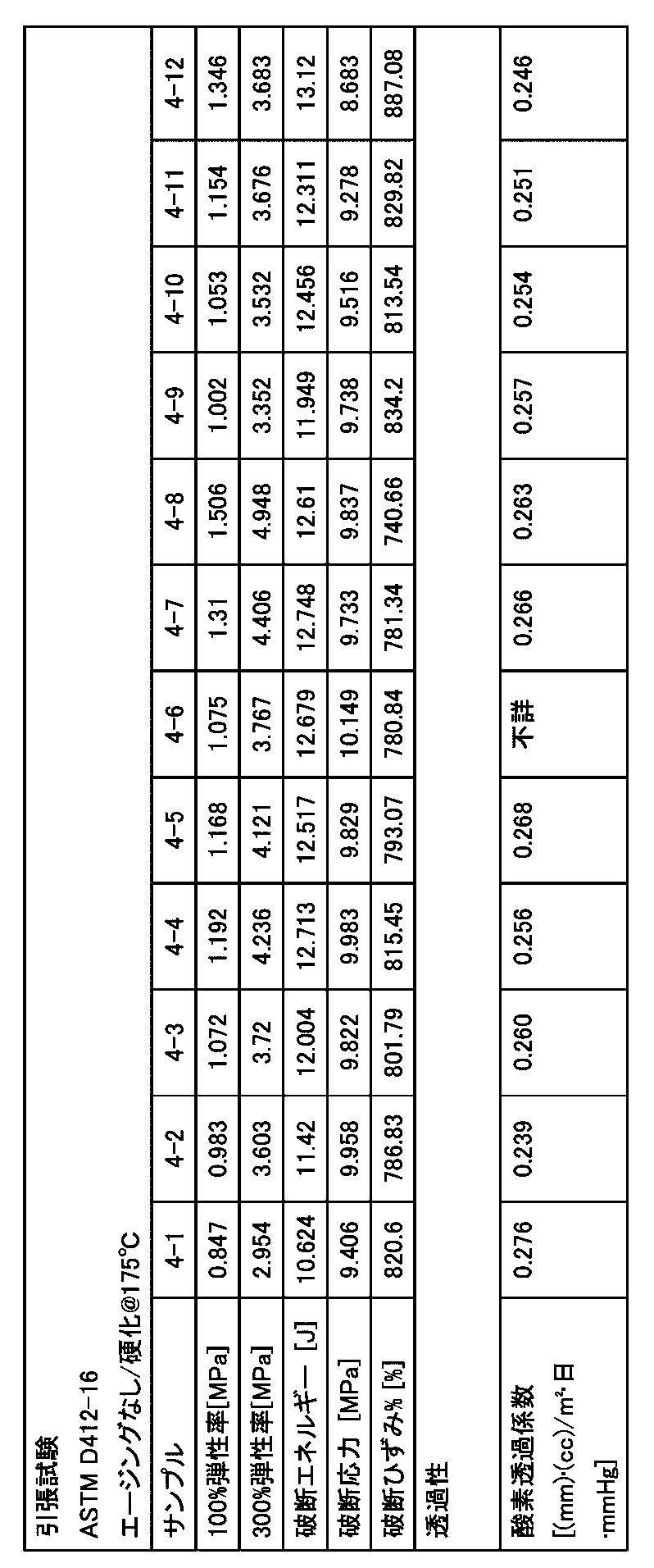
本発明のコンパウンド/ブレンドは、表3および表4の配合物に従って表1のポリマーを使用して製造された。配合物の特性も表3および表4に提示されている。




全ての優先権書類は、参照によって本明細書に完全に組み込まれ、そのような組み込みが許される全ての管轄を対象とする。さらに、本明細書に引用された全ての文書は、試験方法を含めて、参照によって本明細書に完全に組み込まれ、そのような組み込みが許される全ての管轄を対象とする。 All priority documents are fully incorporated herein by reference and are intended for all jurisdictions where such incorporation is permitted. Further, all documents cited herein, including test methods, are fully incorporated herein by reference and are intended for all jurisdictions where such incorporation is permitted.
Claims (9)
前記ハロブチルゴムがハロゲン化イソブチレン-イソプレンコポリマーを含んでおり、
前記エラストマー組成物が
C4~C7イソオレフィン;
非ハロゲン化アルキルスチレン;および
ハロゲン化アルキルスチレン
を含んでいるコポリマーを含んでおり、
前記非ハロゲン化アルキルスチレンおよび前記ハロゲン化アルキルスチレンが、前記エラストマー組成物中に前記エラストマー組成物に基いて累積的に3重量%~15重量%の量で存在し;
前記ハロゲン化アルキルスチレンが前記非ハロゲン化アルキルスチレンに対して0.1モル%~2モル%で存在する、
組成物。 A composition comprising from 60 parts ( 60 phr) to 90 phr of a halobutyl rubber per hundred parts of rubber; and from 10 phr to 40 phr of an elastomeric composition;
the halobutyl rubber comprises a halogenated isobutylene-isoprene copolymer;
said elastomeric composition comprising a C4 - C7 isoolefin;
Non-Halogenated Alkylstyrenes; and Halogenated Alkylstyrenes
containing a copolymer containing
said non-halogenated alkyl styrene and said halogenated alkyl styrene are present in said elastomer composition in an amount cumulatively from 3 % to 15 % by weight based on said elastomer composition;
the halogenated alkylstyrene is present at 0.1 mol% to 2 mol% relative to the non-halogenated alkylstyrene;
Composition.
硬化剤;および
フィラー
をさらに含んでいる、請求項1~7のいずれか1項に記載の組成物。 processing aids;
A composition according to any preceding claim, further comprising a curing agent; and a filler.
a.第1のリアクター中で前記C4~C7イソオレフィン、前記非ハロゲン化アルキルスチレン、前記ハロゲン化アルキルスチレン、任意的に前記ジオレフィンおよび任意的に前記イソブチレン-p-メチルスチレンを重合して、前記エラストマー組成物を製造する工程;
b.第2のリアクター中で前記ハロブチルゴムのモノマーを重合して、前記ハロブチルゴムを製造する工程;および
c.任意的に、前記エラストマー組成物、前記ハロブチルゴム、任意的に前記加工助剤、任意的に前記硬化剤および任意的に前記フィラーを一緒にする工程
を含む、プロセス。 A process for making the composition of any one of claims 1-8 , comprising:
a. polymerizing said C4 - C7 isoolefin, said non-halogenated alkylstyrene, said halogenated alkylstyrene, optionally said diolefin and optionally said isobutylene-p-methylstyrene in a first reactor; producing the elastomer composition;
b. polymerizing monomers of said halobutyl rubber in a second reactor to produce said halobutyl rubber; and c. optionally said elastomeric composition, said halobutyl rubber, optionally said processing aid, optionally said curative and optionally said filler.
Applications Claiming Priority (3)
| Application Number | Priority Date | Filing Date | Title |
|---|---|---|---|
| US201862672851P | 2018-05-17 | 2018-05-17 | |
| US62/672,851 | 2018-05-17 | ||
| PCT/US2019/030350 WO2019221919A1 (en) | 2018-05-17 | 2019-05-02 | Isobutylene-containing compositions and articles made thereof |
Publications (2)
| Publication Number | Publication Date |
|---|---|
| JP2021523967A JP2021523967A (en) | 2021-09-09 |
| JP7117397B2 true JP7117397B2 (en) | 2022-08-12 |
Family
ID=66530532
Family Applications (1)
| Application Number | Title | Priority Date | Filing Date |
|---|---|---|---|
| JP2020564349A Active JP7117397B2 (en) | 2018-05-17 | 2019-05-02 | Isobutylene-containing compositions and articles made therefrom |
Country Status (6)
| Country | Link |
|---|---|
| US (1) | US12252563B2 (en) |
| EP (1) | EP3793843A1 (en) |
| JP (1) | JP7117397B2 (en) |
| CN (1) | CN112334325A (en) |
| SG (1) | SG11202011245QA (en) |
| WO (1) | WO2019221919A1 (en) |
Families Citing this family (2)
| Publication number | Priority date | Publication date | Assignee | Title |
|---|---|---|---|---|
| EP4453093A1 (en) | 2021-12-21 | 2024-10-30 | ExxonMobil Chemical Patents Inc. | Compositions, vulcanizates, and cure processes |
| WO2024059444A1 (en) * | 2022-09-13 | 2024-03-21 | Exxonmobil Chemical Patents Inc. | Tire curing bladders with brominated poly(isobutylene-co-paramethylstyrene) |
Citations (3)
| Publication number | Priority date | Publication date | Assignee | Title |
|---|---|---|---|---|
| JP2009528925A (en) | 2005-10-27 | 2009-08-13 | エクソンモービル ケミカル パテンツ,インコーポレイティド | Structure containing tie layer |
| JP2009298988A (en) | 2008-06-17 | 2009-12-24 | Yokohama Rubber Co Ltd:The | Elastomer composition and pneumatic tire using the same |
| WO2011135668A1 (en) | 2010-04-27 | 2011-11-03 | 横浜ゴム株式会社 | Hose for transporting refrigerant |
Family Cites Families (19)
| Publication number | Priority date | Publication date | Assignee | Title |
|---|---|---|---|---|
| US4074035A (en) | 1975-04-22 | 1978-02-14 | Exxon Research & Engineering Co. | Halomethylated aromatic interpolymers |
| JPS5714636A (en) | 1980-06-13 | 1982-01-25 | Exxon Research Engineering Co | Chlorinated butyl rubber/brominated butyl rubber blend compound with improved adhesive properties |
| US4703091A (en) | 1984-04-05 | 1987-10-27 | Exxon Research & Engineering Co. | Halogenated butyl rubber |
| US4632963A (en) | 1984-04-05 | 1986-12-30 | Exxon Research & Engineering Co. | Halogenated butyl rubber |
| US4649178A (en) | 1984-10-01 | 1987-03-10 | Exxon Research & Engineering Co. | Process for producing brominated butyl rubber high in primary allylic bromine |
| US5162445A (en) | 1988-05-27 | 1992-11-10 | Exxon Chemical Patents Inc. | Para-alkylstyrene/isoolefin copolymers and functionalized copolymers thereof |
| DE19631731A1 (en) | 1996-08-06 | 1998-02-12 | Bayer Ag | Halogenated butyl rubbers with a low halogen content |
| US5807629A (en) | 1996-11-15 | 1998-09-15 | Exxon Research And Engineering Company | Tactoidal elastomer nanocomposites |
| US6034164A (en) | 1997-02-21 | 2000-03-07 | Exxon Research And Engineering Co. | Nanocomposite materials formed from inorganic layered materials dispersed in a polymer matrix |
| CA2282900C (en) * | 1999-09-20 | 2011-02-01 | Bayer Inc. | Halogenated terpolymers of isobutylene, diolefin monomer and styrenic monomer |
| CA2395434C (en) | 1999-12-28 | 2010-04-27 | Donald S. Tracey | Inner tube compositions having improved heat resistance characteristics |
| US7328733B2 (en) | 1999-12-28 | 2008-02-12 | Exxonmobil Chemical Patents Inc. | Inner tube compositions having improved heat resistance characteristics |
| JP2005513178A (en) | 2001-12-10 | 2005-05-12 | エクソンモービル・ケミカル・パテンツ・インク | Elastomer composition |
| RU2303044C2 (en) * | 2001-12-10 | 2007-07-20 | Эксонмобил Кемикэл Пейтентс Инк. | Halogenated isoolefin-based terpolymers and their employment in compositions for use in air bladder such as inner tire cover or pneumatic tire tube |
| AU2002353093A1 (en) | 2001-12-10 | 2003-07-09 | Exxonmobil Chemical Patents Inc. | Elastomeric compositions |
| CA2627338C (en) | 2005-10-27 | 2011-08-02 | Exxonmobil Chemical Patents Inc. | Construction comprising tie layer |
| US8715801B2 (en) * | 2010-09-24 | 2014-05-06 | The Yokohama Rubber Co., Ltd. | Hose for transporting refrigerant |
| US8629209B2 (en) * | 2010-12-02 | 2014-01-14 | 3M Innovative Properties Company | Moisture curable isobutylene adhesive copolymers |
| WO2019164567A1 (en) | 2018-02-20 | 2019-08-29 | Exxonmobil Chemical Patents Inc. | Isobutylene-containing compositions and articles made thereof |
-
2019
- 2019-05-02 JP JP2020564349A patent/JP7117397B2/en active Active
- 2019-05-02 CN CN201980041900.1A patent/CN112334325A/en active Pending
- 2019-05-02 US US17/054,953 patent/US12252563B2/en active Active
- 2019-05-02 EP EP19724024.5A patent/EP3793843A1/en active Pending
- 2019-05-02 SG SG11202011245QA patent/SG11202011245QA/en unknown
- 2019-05-02 WO PCT/US2019/030350 patent/WO2019221919A1/en not_active Ceased
Patent Citations (3)
| Publication number | Priority date | Publication date | Assignee | Title |
|---|---|---|---|---|
| JP2009528925A (en) | 2005-10-27 | 2009-08-13 | エクソンモービル ケミカル パテンツ,インコーポレイティド | Structure containing tie layer |
| JP2009298988A (en) | 2008-06-17 | 2009-12-24 | Yokohama Rubber Co Ltd:The | Elastomer composition and pneumatic tire using the same |
| WO2011135668A1 (en) | 2010-04-27 | 2011-11-03 | 横浜ゴム株式会社 | Hose for transporting refrigerant |
Also Published As
| Publication number | Publication date |
|---|---|
| WO2019221919A1 (en) | 2019-11-21 |
| SG11202011245QA (en) | 2020-12-30 |
| JP2021523967A (en) | 2021-09-09 |
| US12252563B2 (en) | 2025-03-18 |
| CN112334325A (en) | 2021-02-05 |
| EP3793843A1 (en) | 2021-03-24 |
| US20210246242A1 (en) | 2021-08-12 |
Similar Documents
| Publication | Publication Date | Title |
|---|---|---|
| RU2422479C2 (en) | Processable filled curable halogenated isoolefin elastomers | |
| JP5066528B2 (en) | Thermoplastic elastomer composition and process for producing the same | |
| RU2299221C2 (en) | Elastomer composition | |
| JP5002112B2 (en) | Low permeability nanocomposite | |
| CN115449140A (en) | Elastomeric blends comprising high glass transition temperature hydrocarbon resins for tires | |
| EP0539513B1 (en) | Tire innerliner composition | |
| CA2688501C (en) | Processable filled, curable halogenated isoolefin elastomers | |
| CN103347709A (en) | Contoured tire innerliners and methods of making thereof | |
| US12252563B2 (en) | Isobutylene-containing compositions and articles made thereof | |
| WO1992003302A1 (en) | Tire sidewall composition | |
| US12415915B2 (en) | Isobutylene-containing compositions and articles made thereof | |
| WO1994018269A2 (en) | Multilayer tire side wall | |
| CN112512783A (en) | Brominated isobutylene para-methyl-styrene elastomer curing capsules | |
| WO2003011917A1 (en) | Method of curing elastomers | |
| EP4453093A1 (en) | Compositions, vulcanizates, and cure processes | |
| CN121773160A (en) | Elastomer composition and method thereof |
Legal Events
| Date | Code | Title | Description |
|---|---|---|---|
| A521 | Request for written amendment filed |
Free format text: JAPANESE INTERMEDIATE CODE: A523 Effective date: 20210114 |
|
| A621 | Written request for application examination |
Free format text: JAPANESE INTERMEDIATE CODE: A621 Effective date: 20210114 |
|
| A977 | Report on retrieval |
Free format text: JAPANESE INTERMEDIATE CODE: A971007 Effective date: 20220126 |
|
| A131 | Notification of reasons for refusal |
Free format text: JAPANESE INTERMEDIATE CODE: A131 Effective date: 20220201 |
|
| A521 | Request for written amendment filed |
Free format text: JAPANESE INTERMEDIATE CODE: A523 Effective date: 20220428 |
|
| TRDD | Decision of grant or rejection written | ||
| A01 | Written decision to grant a patent or to grant a registration (utility model) |
Free format text: JAPANESE INTERMEDIATE CODE: A01 Effective date: 20220705 |
|
| A61 | First payment of annual fees (during grant procedure) |
Free format text: JAPANESE INTERMEDIATE CODE: A61 Effective date: 20220801 |
|
| R150 | Certificate of patent or registration of utility model |
Ref document number: 7117397 Country of ref document: JP Free format text: JAPANESE INTERMEDIATE CODE: R150 |
|
| R250 | Receipt of annual fees |
Free format text: JAPANESE INTERMEDIATE CODE: R250 |