JP6998917B2 - Methods for Manipulating Allogeneic and Highly Active T Cells for Immunotherapy - Google Patents
Methods for Manipulating Allogeneic and Highly Active T Cells for Immunotherapy Download PDFInfo
- Publication number
- JP6998917B2 JP6998917B2 JP2019114231A JP2019114231A JP6998917B2 JP 6998917 B2 JP6998917 B2 JP 6998917B2 JP 2019114231 A JP2019114231 A JP 2019114231A JP 2019114231 A JP2019114231 A JP 2019114231A JP 6998917 B2 JP6998917 B2 JP 6998917B2
- Authority
- JP
- Japan
- Prior art keywords
- cells
- cell
- tale
- tcrα
- gene
- Prior art date
- Legal status (The legal status is an assumption and is not a legal conclusion. Google has not performed a legal analysis and makes no representation as to the accuracy of the status listed.)
- Active
Links
Images























Classifications
-
- A—HUMAN NECESSITIES
- A61—MEDICAL OR VETERINARY SCIENCE; HYGIENE
- A61K—PREPARATIONS FOR MEDICAL, DENTAL OR TOILETRY PURPOSES
- A61K40/00—Cellular immunotherapy
- A61K40/10—Cellular immunotherapy characterised by the cell type used
- A61K40/11—T-cells, e.g. tumour infiltrating lymphocytes [TIL] or regulatory T [Treg] cells; Lymphokine-activated killer [LAK] cells
-
- A—HUMAN NECESSITIES
- A61—MEDICAL OR VETERINARY SCIENCE; HYGIENE
- A61K—PREPARATIONS FOR MEDICAL, DENTAL OR TOILETRY PURPOSES
- A61K40/00—Cellular immunotherapy
- A61K40/30—Cellular immunotherapy characterised by the recombinant expression of specific molecules in the cells of the immune system
- A61K40/31—Chimeric antigen receptors [CAR]
-
- A—HUMAN NECESSITIES
- A61—MEDICAL OR VETERINARY SCIENCE; HYGIENE
- A61K—PREPARATIONS FOR MEDICAL, DENTAL OR TOILETRY PURPOSES
- A61K40/00—Cellular immunotherapy
- A61K40/30—Cellular immunotherapy characterised by the recombinant expression of specific molecules in the cells of the immune system
- A61K40/32—T-cell receptors [TCR]
-
- A—HUMAN NECESSITIES
- A61—MEDICAL OR VETERINARY SCIENCE; HYGIENE
- A61K—PREPARATIONS FOR MEDICAL, DENTAL OR TOILETRY PURPOSES
- A61K40/00—Cellular immunotherapy
- A61K40/40—Cellular immunotherapy characterised by antigens that are targeted or presented by cells of the immune system
- A61K40/41—Vertebrate antigens
- A61K40/42—Cancer antigens
-
- A—HUMAN NECESSITIES
- A61—MEDICAL OR VETERINARY SCIENCE; HYGIENE
- A61P—SPECIFIC THERAPEUTIC ACTIVITY OF CHEMICAL COMPOUNDS OR MEDICINAL PREPARATIONS
- A61P21/00—Drugs for disorders of the muscular or neuromuscular system
-
- A—HUMAN NECESSITIES
- A61—MEDICAL OR VETERINARY SCIENCE; HYGIENE
- A61P—SPECIFIC THERAPEUTIC ACTIVITY OF CHEMICAL COMPOUNDS OR MEDICINAL PREPARATIONS
- A61P31/00—Antiinfectives, i.e. antibiotics, antiseptics, chemotherapeutics
-
- A—HUMAN NECESSITIES
- A61—MEDICAL OR VETERINARY SCIENCE; HYGIENE
- A61P—SPECIFIC THERAPEUTIC ACTIVITY OF CHEMICAL COMPOUNDS OR MEDICINAL PREPARATIONS
- A61P31/00—Antiinfectives, i.e. antibiotics, antiseptics, chemotherapeutics
- A61P31/12—Antivirals
-
- A—HUMAN NECESSITIES
- A61—MEDICAL OR VETERINARY SCIENCE; HYGIENE
- A61P—SPECIFIC THERAPEUTIC ACTIVITY OF CHEMICAL COMPOUNDS OR MEDICINAL PREPARATIONS
- A61P35/00—Antineoplastic agents
-
- A—HUMAN NECESSITIES
- A61—MEDICAL OR VETERINARY SCIENCE; HYGIENE
- A61P—SPECIFIC THERAPEUTIC ACTIVITY OF CHEMICAL COMPOUNDS OR MEDICINAL PREPARATIONS
- A61P35/00—Antineoplastic agents
- A61P35/02—Antineoplastic agents specific for leukemia
-
- A—HUMAN NECESSITIES
- A61—MEDICAL OR VETERINARY SCIENCE; HYGIENE
- A61P—SPECIFIC THERAPEUTIC ACTIVITY OF CHEMICAL COMPOUNDS OR MEDICINAL PREPARATIONS
- A61P37/00—Drugs for immunological or allergic disorders
-
- A—HUMAN NECESSITIES
- A61—MEDICAL OR VETERINARY SCIENCE; HYGIENE
- A61P—SPECIFIC THERAPEUTIC ACTIVITY OF CHEMICAL COMPOUNDS OR MEDICINAL PREPARATIONS
- A61P37/00—Drugs for immunological or allergic disorders
- A61P37/02—Immunomodulators
-
- A—HUMAN NECESSITIES
- A61—MEDICAL OR VETERINARY SCIENCE; HYGIENE
- A61P—SPECIFIC THERAPEUTIC ACTIVITY OF CHEMICAL COMPOUNDS OR MEDICINAL PREPARATIONS
- A61P37/00—Drugs for immunological or allergic disorders
- A61P37/02—Immunomodulators
- A61P37/04—Immunostimulants
-
- A—HUMAN NECESSITIES
- A61—MEDICAL OR VETERINARY SCIENCE; HYGIENE
- A61P—SPECIFIC THERAPEUTIC ACTIVITY OF CHEMICAL COMPOUNDS OR MEDICINAL PREPARATIONS
- A61P37/00—Drugs for immunological or allergic disorders
- A61P37/02—Immunomodulators
- A61P37/06—Immunosuppressants, e.g. drugs for graft rejection
-
- A—HUMAN NECESSITIES
- A61—MEDICAL OR VETERINARY SCIENCE; HYGIENE
- A61P—SPECIFIC THERAPEUTIC ACTIVITY OF CHEMICAL COMPOUNDS OR MEDICINAL PREPARATIONS
- A61P43/00—Drugs for specific purposes, not provided for in groups A61P1/00-A61P41/00
-
- A—HUMAN NECESSITIES
- A61—MEDICAL OR VETERINARY SCIENCE; HYGIENE
- A61P—SPECIFIC THERAPEUTIC ACTIVITY OF CHEMICAL COMPOUNDS OR MEDICINAL PREPARATIONS
- A61P5/00—Drugs for disorders of the endocrine system
- A61P5/38—Drugs for disorders of the endocrine system of the suprarenal hormones
-
- C—CHEMISTRY; METALLURGY
- C07—ORGANIC CHEMISTRY
- C07K—PEPTIDES
- C07K14/00—Peptides having more than 20 amino acids; Gastrins; Somatostatins; Melanotropins; Derivatives thereof
- C07K14/435—Peptides having more than 20 amino acids; Gastrins; Somatostatins; Melanotropins; Derivatives thereof from animals; from humans
- C07K14/705—Receptors; Cell surface antigens; Cell surface determinants
- C07K14/70503—Immunoglobulin superfamily
- C07K14/7051—T-cell receptor (TcR)-CD3 complex
-
- C—CHEMISTRY; METALLURGY
- C07—ORGANIC CHEMISTRY
- C07K—PEPTIDES
- C07K14/00—Peptides having more than 20 amino acids; Gastrins; Somatostatins; Melanotropins; Derivatives thereof
- C07K14/435—Peptides having more than 20 amino acids; Gastrins; Somatostatins; Melanotropins; Derivatives thereof from animals; from humans
- C07K14/705—Receptors; Cell surface antigens; Cell surface determinants
- C07K14/70503—Immunoglobulin superfamily
- C07K14/70517—CD8
-
- C—CHEMISTRY; METALLURGY
- C07—ORGANIC CHEMISTRY
- C07K—PEPTIDES
- C07K14/00—Peptides having more than 20 amino acids; Gastrins; Somatostatins; Melanotropins; Derivatives thereof
- C07K14/435—Peptides having more than 20 amino acids; Gastrins; Somatostatins; Melanotropins; Derivatives thereof from animals; from humans
- C07K14/705—Receptors; Cell surface antigens; Cell surface determinants
- C07K14/70503—Immunoglobulin superfamily
- C07K14/70521—CD28, CD152
-
- C—CHEMISTRY; METALLURGY
- C07—ORGANIC CHEMISTRY
- C07K—PEPTIDES
- C07K14/00—Peptides having more than 20 amino acids; Gastrins; Somatostatins; Melanotropins; Derivatives thereof
- C07K14/435—Peptides having more than 20 amino acids; Gastrins; Somatostatins; Melanotropins; Derivatives thereof from animals; from humans
- C07K14/705—Receptors; Cell surface antigens; Cell surface determinants
- C07K14/70578—NGF-receptor/TNF-receptor superfamily, e.g. CD27, CD30, CD40, CD95
-
- C—CHEMISTRY; METALLURGY
- C07—ORGANIC CHEMISTRY
- C07K—PEPTIDES
- C07K16/00—Immunoglobulins [IG], e.g. monoclonal or polyclonal antibodies
- C07K16/18—Immunoglobulins [IG], e.g. monoclonal or polyclonal antibodies against material from animals or humans
- C07K16/28—Immunoglobulins [IG], e.g. monoclonal or polyclonal antibodies against material from animals or humans against receptors, cell surface antigens or cell surface determinants
-
- C—CHEMISTRY; METALLURGY
- C07—ORGANIC CHEMISTRY
- C07K—PEPTIDES
- C07K16/00—Immunoglobulins [IG], e.g. monoclonal or polyclonal antibodies
- C07K16/18—Immunoglobulins [IG], e.g. monoclonal or polyclonal antibodies against material from animals or humans
- C07K16/28—Immunoglobulins [IG], e.g. monoclonal or polyclonal antibodies against material from animals or humans against receptors, cell surface antigens or cell surface determinants
- C07K16/2803—Immunoglobulins [IG], e.g. monoclonal or polyclonal antibodies against material from animals or humans against receptors, cell surface antigens or cell surface determinants against the immunoglobulin superfamily
-
- C—CHEMISTRY; METALLURGY
- C12—BIOCHEMISTRY; BEER; SPIRITS; WINE; VINEGAR; MICROBIOLOGY; ENZYMOLOGY; MUTATION OR GENETIC ENGINEERING
- C12N—MICROORGANISMS OR ENZYMES; COMPOSITIONS THEREOF; PROPAGATING, PRESERVING, OR MAINTAINING MICROORGANISMS; MUTATION OR GENETIC ENGINEERING; CULTURE MEDIA
- C12N15/00—Mutation or genetic engineering; DNA or RNA concerning genetic engineering, vectors, e.g. plasmids, or their isolation, preparation or purification; Use of hosts therefor
- C12N15/09—Recombinant DNA-technology
- C12N15/63—Introduction of foreign genetic material using vectors; Vectors; Use of hosts therefor; Regulation of expression
- C12N15/79—Vectors or expression systems specially adapted for eukaryotic hosts
- C12N15/85—Vectors or expression systems specially adapted for eukaryotic hosts for animal cells
-
- C—CHEMISTRY; METALLURGY
- C12—BIOCHEMISTRY; BEER; SPIRITS; WINE; VINEGAR; MICROBIOLOGY; ENZYMOLOGY; MUTATION OR GENETIC ENGINEERING
- C12N—MICROORGANISMS OR ENZYMES; COMPOSITIONS THEREOF; PROPAGATING, PRESERVING, OR MAINTAINING MICROORGANISMS; MUTATION OR GENETIC ENGINEERING; CULTURE MEDIA
- C12N5/00—Undifferentiated human, animal or plant cells, e.g. cell lines; Tissues; Cultivation or maintenance thereof; Culture media therefor
- C12N5/06—Animal cells or tissues; Human cells or tissues
- C12N5/0602—Vertebrate cells
- C12N5/0634—Cells from the blood or the immune system
- C12N5/0636—T lymphocytes
-
- C—CHEMISTRY; METALLURGY
- C12—BIOCHEMISTRY; BEER; SPIRITS; WINE; VINEGAR; MICROBIOLOGY; ENZYMOLOGY; MUTATION OR GENETIC ENGINEERING
- C12N—MICROORGANISMS OR ENZYMES; COMPOSITIONS THEREOF; PROPAGATING, PRESERVING, OR MAINTAINING MICROORGANISMS; MUTATION OR GENETIC ENGINEERING; CULTURE MEDIA
- C12N9/00—Enzymes; Proenzymes; Compositions thereof; Processes for preparing, activating, inhibiting, separating or purifying enzymes
- C12N9/14—Hydrolases (3)
- C12N9/16—Hydrolases (3) acting on ester bonds (3.1)
- C12N9/22—Ribonucleases [RNase]; Deoxyribonucleases [DNase]
-
- A—HUMAN NECESSITIES
- A61—MEDICAL OR VETERINARY SCIENCE; HYGIENE
- A61K—PREPARATIONS FOR MEDICAL, DENTAL OR TOILETRY PURPOSES
- A61K39/00—Medicinal preparations containing antigens or antibodies
- A61K2039/80—Vaccine for a specifically defined cancer
- A61K2039/804—Blood cells [leukemia, lymphoma]
-
- A—HUMAN NECESSITIES
- A61—MEDICAL OR VETERINARY SCIENCE; HYGIENE
- A61K—PREPARATIONS FOR MEDICAL, DENTAL OR TOILETRY PURPOSES
- A61K38/00—Medicinal preparations containing peptides
-
- C—CHEMISTRY; METALLURGY
- C07—ORGANIC CHEMISTRY
- C07K—PEPTIDES
- C07K2317/00—Immunoglobulins specific features
- C07K2317/10—Immunoglobulins specific features characterized by their source of isolation or production
- C07K2317/14—Specific host cells or culture conditions, e.g. components, pH or temperature
-
- C—CHEMISTRY; METALLURGY
- C07—ORGANIC CHEMISTRY
- C07K—PEPTIDES
- C07K2317/00—Immunoglobulins specific features
- C07K2317/20—Immunoglobulins specific features characterized by taxonomic origin
- C07K2317/24—Immunoglobulins specific features characterized by taxonomic origin containing regions, domains or residues from different species, e.g. chimeric, humanized or veneered
-
- C—CHEMISTRY; METALLURGY
- C07—ORGANIC CHEMISTRY
- C07K—PEPTIDES
- C07K2317/00—Immunoglobulins specific features
- C07K2317/50—Immunoglobulins specific features characterized by immunoglobulin fragments
- C07K2317/56—Immunoglobulins specific features characterized by immunoglobulin fragments variable (Fv) region, i.e. VH and/or VL
- C07K2317/569—Single domain, e.g. dAb, sdAb, VHH, VNAR or nanobody®
-
- C—CHEMISTRY; METALLURGY
- C07—ORGANIC CHEMISTRY
- C07K—PEPTIDES
- C07K2317/00—Immunoglobulins specific features
- C07K2317/60—Immunoglobulins specific features characterized by non-natural combinations of immunoglobulin fragments
- C07K2317/62—Immunoglobulins specific features characterized by non-natural combinations of immunoglobulin fragments comprising only variable region components
- C07K2317/622—Single chain antibody (scFv)
-
- C—CHEMISTRY; METALLURGY
- C07—ORGANIC CHEMISTRY
- C07K—PEPTIDES
- C07K2319/00—Fusion polypeptide
-
- C—CHEMISTRY; METALLURGY
- C07—ORGANIC CHEMISTRY
- C07K—PEPTIDES
- C07K2319/00—Fusion polypeptide
- C07K2319/01—Fusion polypeptide containing a localisation/targetting motif
- C07K2319/03—Fusion polypeptide containing a localisation/targetting motif containing a transmembrane segment
-
- C—CHEMISTRY; METALLURGY
- C07—ORGANIC CHEMISTRY
- C07K—PEPTIDES
- C07K2319/00—Fusion polypeptide
- C07K2319/70—Fusion polypeptide containing domain for protein-protein interaction
- C07K2319/74—Fusion polypeptide containing domain for protein-protein interaction containing a fusion for binding to a cell surface receptor
-
- C—CHEMISTRY; METALLURGY
- C12—BIOCHEMISTRY; BEER; SPIRITS; WINE; VINEGAR; MICROBIOLOGY; ENZYMOLOGY; MUTATION OR GENETIC ENGINEERING
- C12N—MICROORGANISMS OR ENZYMES; COMPOSITIONS THEREOF; PROPAGATING, PRESERVING, OR MAINTAINING MICROORGANISMS; MUTATION OR GENETIC ENGINEERING; CULTURE MEDIA
- C12N2501/00—Active agents used in cell culture processes, e.g. differentation
- C12N2501/30—Hormones
- C12N2501/38—Hormones with nuclear receptors
- C12N2501/39—Steroid hormones
-
- C—CHEMISTRY; METALLURGY
- C12—BIOCHEMISTRY; BEER; SPIRITS; WINE; VINEGAR; MICROBIOLOGY; ENZYMOLOGY; MUTATION OR GENETIC ENGINEERING
- C12N—MICROORGANISMS OR ENZYMES; COMPOSITIONS THEREOF; PROPAGATING, PRESERVING, OR MAINTAINING MICROORGANISMS; MUTATION OR GENETIC ENGINEERING; CULTURE MEDIA
- C12N2501/00—Active agents used in cell culture processes, e.g. differentation
- C12N2501/50—Cell markers; Cell surface determinants
- C12N2501/51—B7 molecules, e.g. CD80, CD86, CD28 (ligand), CD152 (ligand)
-
- C—CHEMISTRY; METALLURGY
- C12—BIOCHEMISTRY; BEER; SPIRITS; WINE; VINEGAR; MICROBIOLOGY; ENZYMOLOGY; MUTATION OR GENETIC ENGINEERING
- C12N—MICROORGANISMS OR ENZYMES; COMPOSITIONS THEREOF; PROPAGATING, PRESERVING, OR MAINTAINING MICROORGANISMS; MUTATION OR GENETIC ENGINEERING; CULTURE MEDIA
- C12N2501/00—Active agents used in cell culture processes, e.g. differentation
- C12N2501/50—Cell markers; Cell surface determinants
- C12N2501/515—CD3, T-cell receptor complex
-
- C—CHEMISTRY; METALLURGY
- C12—BIOCHEMISTRY; BEER; SPIRITS; WINE; VINEGAR; MICROBIOLOGY; ENZYMOLOGY; MUTATION OR GENETIC ENGINEERING
- C12N—MICROORGANISMS OR ENZYMES; COMPOSITIONS THEREOF; PROPAGATING, PRESERVING, OR MAINTAINING MICROORGANISMS; MUTATION OR GENETIC ENGINEERING; CULTURE MEDIA
- C12N2501/00—Active agents used in cell culture processes, e.g. differentation
- C12N2501/50—Cell markers; Cell surface determinants
- C12N2501/599—Cell markers; Cell surface determinants with CD designations not provided for elsewhere
-
- C—CHEMISTRY; METALLURGY
- C12—BIOCHEMISTRY; BEER; SPIRITS; WINE; VINEGAR; MICROBIOLOGY; ENZYMOLOGY; MUTATION OR GENETIC ENGINEERING
- C12N—MICROORGANISMS OR ENZYMES; COMPOSITIONS THEREOF; PROPAGATING, PRESERVING, OR MAINTAINING MICROORGANISMS; MUTATION OR GENETIC ENGINEERING; CULTURE MEDIA
- C12N2502/00—Coculture with; Conditioned medium produced by
- C12N2502/99—Coculture with; Conditioned medium produced by genetically modified cells
-
- C—CHEMISTRY; METALLURGY
- C12—BIOCHEMISTRY; BEER; SPIRITS; WINE; VINEGAR; MICROBIOLOGY; ENZYMOLOGY; MUTATION OR GENETIC ENGINEERING
- C12N—MICROORGANISMS OR ENZYMES; COMPOSITIONS THEREOF; PROPAGATING, PRESERVING, OR MAINTAINING MICROORGANISMS; MUTATION OR GENETIC ENGINEERING; CULTURE MEDIA
- C12N2510/00—Genetically modified cells
Landscapes
- Health & Medical Sciences (AREA)
- Life Sciences & Earth Sciences (AREA)
- Chemical & Material Sciences (AREA)
- Organic Chemistry (AREA)
- Immunology (AREA)
- General Health & Medical Sciences (AREA)
- Engineering & Computer Science (AREA)
- Genetics & Genomics (AREA)
- Medicinal Chemistry (AREA)
- Veterinary Medicine (AREA)
- Animal Behavior & Ethology (AREA)
- Public Health (AREA)
- Zoology (AREA)
- Biochemistry (AREA)
- Bioinformatics & Cheminformatics (AREA)
- Molecular Biology (AREA)
- Biophysics (AREA)
- Cell Biology (AREA)
- Biomedical Technology (AREA)
- Proteomics, Peptides & Aminoacids (AREA)
- Pharmacology & Pharmacy (AREA)
- Chemical Kinetics & Catalysis (AREA)
- Nuclear Medicine, Radiotherapy & Molecular Imaging (AREA)
- General Chemical & Material Sciences (AREA)
- Wood Science & Technology (AREA)
- Biotechnology (AREA)
- Toxicology (AREA)
- Gastroenterology & Hepatology (AREA)
- Epidemiology (AREA)
- General Engineering & Computer Science (AREA)
- Microbiology (AREA)
- Hematology (AREA)
- Oncology (AREA)
- Communicable Diseases (AREA)
- Virology (AREA)
- Physics & Mathematics (AREA)
- Plant Pathology (AREA)
- Diabetes (AREA)
- Endocrinology (AREA)
- Neurology (AREA)
Description
発明の分野
本発明は、免疫療法のために操作された非アロ反応性T細胞を開発するための方法に関する。本発明は、免疫応答の能力を最大限に引き出すように、T細胞受容体をコードする遺伝子および少なくとも1種類の免疫チェックポイント遺伝子を不活性化することによってT細胞を改変するための方法に関する。本方法は、ドナーまたは初代細胞培養物から入手可能なT細胞にある、いろいろな重要遺伝子を正確に標的化するために、特定のレアカッティングエンドヌクレアーゼ(rare cutting endonuclease)、特に、TALE-ヌクレアーゼ(TALエフェクターエンドヌクレアーゼ)と、このようなポリペプチドをコードするポリヌクレオチドを使用することを伴う。本発明はまた、このような操作されたT細胞に組み入れることができる、さらなる特性、例えば、プレTCRα(「pTα」)およびその機能的誘導体、キメラ抗原受容体(CAR)、多鎖CAR、ならびに免疫療法の効率を高めるための、これらの使用に関する。本発明は、癌およびウイルス感染症を処置するための標準的で手頃な価格の養子免疫療法戦略への道を開く。
INDUSTRIAL APPLICABILITY The present invention relates to a method for developing non-alloactive T cells engineered for immunotherapy. The present invention relates to a method for modifying T cells by inactivating a gene encoding a T cell receptor and at least one immune checkpoint gene so as to maximize the capacity of the immune response. This method uses specific rare cutting endonucleases, especially TALE-nucleases, to accurately target various important genes in T cells available from donors or primary cell cultures. TAL effector endonucleases) and the use of polynucleotides encoding such polypeptides. The invention also has additional properties that can be incorporated into such engineered T cells, such as pre-TCRα (“pTα”) and its functional derivatives, chimeric antigen receptors (CARs), multi-chain CARs, and Regarding their use to increase the efficiency of immunotherapy. The present invention paves the way for standard and affordable adoptive immunotherapy strategies for treating cancer and viral infections.
発明の背景
エクスビボで生成された自己の抗原特異的T細胞の移入を含む養子免疫治療は、ウイルス感染および癌を処置するための有望な戦略である。養子免疫治療のために使用されるT細胞は、抗原特異的T細胞の増大または遺伝子改変を通したT細胞の向け直しのいずれかによって生成され得る(Park,Rosenberg et al.2011)。ウイルス抗原特異的T細胞の移入は、移植に関連したウイルス感染および稀なウイルス関連悪性疾患の処置のために使用されている、よく確立された手法である。同様に、腫瘍特異的T細胞の単離および移入は、黒色腫の処置において成功が示されている。
Background of the Invention Adoptive immunotherapy, which involves the transfer of self-antigen-specific T cells produced by Exvivo, is a promising strategy for treating viral infections and cancer. T cells used for adoptive immunotherapy can be produced either by antigen-specific T cell augmentation or T cell redirection through genetic modification (Park, Rosenberg et al. 2011). Transplantation of viral antigen-specific T cells is a well-established technique used for the treatment of transplant-related viral infections and rare virus-related malignancies. Similarly, the isolation and transfer of tumor-specific T cells has been shown to be successful in the treatment of melanoma.
T細胞における新規特異性は、トランスジェニックT細胞受容体またはキメラ抗原受容体(CAR)の遺伝子移入を通して、成功裡に生成された(Jena,Dotti et al.2010)。CARは、単一の融合分子として1つ以上のシグナリングドメインと会合したターゲティングモエティからなる合成受容体である。一般に、CARの結合モエティは、フレキシブルリンカーによって結合されたモノクローナル抗体の軽鎖可変断片を含む、単鎖抗体(scFv)の抗原結合ドメインからなる。受容体またはリガンドのドメインに基づく結合モエティも、成功裡に使用されている。第一世代CARのためのシグナリングドメインは、CD3ζ鎖またはFc受容体γ鎖の細胞質領域に由来する。第一世代CARは、T細胞の細胞傷害を成功裡に向け直すことが示されたが、より長期間の増大および抗腫瘍活性をインビボで提供することはできなかった。CARによって改変されたT細胞の生存を増強し、増殖を増加させるため、CD28、OX-40(CD134)、および4-1BB(CD137)を含む共刺激分子に由来するシグナリングドメインが、単独で(第二世代)または組み合わせて(第三世代)付加された。CARは、リンパ腫および固形腫瘍を含む様々な悪性疾患に由来する腫瘍細胞の表面に発現された抗原に対して、T細胞が向け直されることを、成功裡に可能にしている(Jena,Dotti et al.2010)。 Novel specificities in T cells were successfully generated through gene transfer of the transgenic T cell receptor or chimeric antigen receptor (CAR) (Jena, Dotti et al. 2010). CAR is a synthetic receptor consisting of targeting moets associated with one or more signaling domains as a single fusion molecule. In general, the binding moety of CAR consists of the antigen binding domain of a single chain antibody (scFv), which comprises a light chain variable fragment of a monoclonal antibody bound by a flexible linker. Binding moties based on the domain of the receptor or ligand have also been successfully used. The signaling domain for first-generation CAR is derived from the cytoplasmic region of the CD3ζ chain or Fc receptor γ chain. First-generation CARs have been shown to successfully redirect T cell cytotoxicity, but have failed to provide longer-term growth and antitumor activity in vivo. To enhance the survival and proliferation of CAR-modified T cells, signaling domains derived from costimulatory molecules, including CD28, OX-40 (CD134), and 4-1BB (CD137), alone ( Added (2nd generation) or in combination (3rd generation). CAR successfully allows T cells to be redirected against antigens expressed on the surface of tumor cells from a variety of malignancies, including lymphomas and solid tumors (Jena, Dotti et. al.2010).
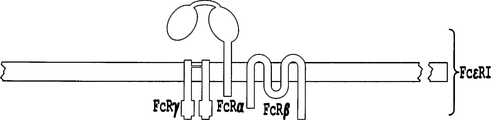
現在のCAR構成は、関係のある全ドメインが1本のポリペプチドの中に含まれる設計図の上に作られている。この設計図は、シグナリングドメインが連続して付加されることを必要とし、従って、いくつかのドメインがその天然の膜近傍位置から移動することを必要とする。従って、リガンドおよびシグナリングドメインが分かれている構造は、原形質膜から離れた位置にある、いくつかのドメインと一緒に付加されるのではなく、正常な膜近傍位置にある異なる鎖に配置された共刺激ドメインの機能の改善を可能にする可能性がある。天然の受容体であるIgEに対する高親和性受容体(FcεRI)は、このような構造をもたらすだろう。マスト細胞および好塩基球に存在するFcεRIは高親和性でIgEに結合する。FcεRIは、リガンド結合αサブユニット、βサブユニット、および2つのシグナル伝達γサブユニットのホモ二量体からなる四量体受容体複合体である(Metzger, Alcaraz et al. 1986)。FcεRIαドメインは、IgEに結合する2つのIg様ドメインを含有する細胞外ドメイン、膜貫通ドメイン、および短い細胞質テールからなる。βサブユニットは、アミノ末端細胞質テールおよびカルボキシ末端細胞質テールを分ける4つの膜貫通セグメントを含有する。γ鎖は、膜貫通領域と、1つの免疫受容体チロシンベース活性化モチーフ(ITAM)を含有する細胞質テールから本質的になる(Cambier 1995)。TCR複合体のζ鎖はγ鎖と密接に関連し、FcεRIのγ鎖の代用になり得る(Howard, Rodewald et al. 1990)。 The current CAR configuration is built on a blueprint in which all relevant domains are contained within a single polypeptide. This blueprint requires that signaling domains be added in succession, and therefore some domains move from their natural near-membrane location. Thus, the structure in which the ligand and signaling domains are separated is located in different strands located near the normal membrane, rather than being added together with some domains, which are located away from the plasma membrane. It may be possible to improve the function of the co-stimulation domain. High affinity receptors (FcεRI) for the natural receptor IgE will result in such a structure. FcεRI present in mast cells and basophils binds to IgE with high affinity. FcεRI is a tetrameric receptor complex consisting of a ligand-binding α subunit, a β subunit, and a homodimer of two signaling γ subunits (Metzger, Alcaraz et al. 1986). The FcεRIα domain consists of an extracellular domain containing two Ig-like domains that bind to IgE, a transmembrane domain, and a short cytoplasmic tail. The β subunit contains four transmembrane segments that separate the amino-terminal cytoplasmic tail and the carboxy-terminal cytoplasmic tail. The gamma chain consists essentially of a transmembrane domain and a cytoplasmic tail containing one immune receptor tyrosine-based activation motif (ITAM) (Cambier 1995). The ζ chain of the TCR complex is closely associated with the γ chain and can be a substitute for the γ chain of FcεRI (Howard, Rodewald et al. 1990).
養子免疫療法を用いて患者を処置する現行のプロトコールは自己細胞移入に基づいている。このアプローチでは、Tリンパ球が患者から回収され、遺伝子組換えされるか、エクスビボで選択され、必要に応じて細胞数を増幅するためにインビトロで培養され、最後に、患者に注入される。リンパ球注入に加えて、宿主は、T細胞の生着または免疫応答へのT細胞の関与を支援する他のやり方、例えば、(放射線または化学療法を用いた)プレコンディショニング(preconditioning)およびリンパ球増殖因子(例えば、IL-2)の投与で操作されてもよい。各患者には、患者自身のリンパ球(すなわち、自家療法)を用いて、個々に作られた処置が与えられる。自家療法は、実際の適用に対して大きな技術的な障害および物流上の障害に直面している。作製するには、高価な専用施設および専門家が必要であり、患者を診断した後、短時間で作製しなければならない。多くの場合、患者の前処置によって免疫機能が低下し、患者のリンパ球は十分に機能せず、非常に少数で存在する可能性がある。これらの障害のために、各患者の自己細胞調製物は事実上新たな製品であり、その結果、効力および安全性の大幅なばらつきが生じる。理想的には、同種異系治療用細胞を予め製造し、詳細に特徴付け、患者に即時に投与することができる標準化された療法を使用したい。同種異系とは、細胞が、同じ種に属する個体から得られているが、遺伝的に似ていないことを意味する。しかしながら、現在、同種異系細胞の使用には多くの欠点がある。免疫能力のある宿主では、同種異系細胞は素早く拒絶される。これは、宿主対移植片拒絶反応(HvG)と呼ばれるプロセスである。このため、導入された細胞の効力は大きく制限される。免疫能力のない宿主では、同種異系細胞は生着することができるが、その内因性TCR特異性は宿主組織を異物として認識し、その結果、移植片対宿主病(GvHD)が起こる。移植片対宿主病(GvHD)は重大な組織損傷および死亡につながる場合がある。同種異系細胞を効果的に使用するためには、これらの問題はいずれも克服しなければならない。 Current protocols for treating patients with adoptive immunotherapy are based on autologous cell transfer. In this approach, T lymphocytes are harvested from the patient, genetically modified or selected in Exvivo, cultured in vitro to increase cell count as needed, and finally infused into the patient. In addition to lymphocyte infusion, the host also supports other methods of supporting T cell engraftment or involvement of T cells in an immune response, such as preconditioning (using radiation or chemotherapy) and lymphocytes. It may be engineered by administration of a growth factor (eg, IL-2). Each patient is given an individually tailored treatment using the patient's own lymphocytes (ie, autologous therapy). Autologous therapy faces major technical and logistics obstacles to its practical application. It requires expensive dedicated facilities and specialists and must be made in a short time after diagnosing the patient. In many cases, the patient's pretreatment reduces immune function, and the patient's lymphocytes are not fully functioning and can be present in very small numbers. Due to these disorders, each patient's autologous preparation is effectively a new product, resulting in significant variability in efficacy and safety. Ideally, we would like to use standardized therapies that allow allogeneic therapeutic cells to be pre-produced, detailed, and immediately administered to the patient. Allogeneic means that cells are obtained from individuals belonging to the same species but are not genetically similar. However, there are currently many drawbacks to the use of allogeneic cells. In immunocompetent hosts, allogeneic cells are rapidly rejected. This is a process called host-versus-graft rejection (HvG). Therefore, the efficacy of the introduced cells is greatly limited. In non-immune-capable hosts, allogeneic cells can engraft, but their endogenous TCR specificity recognizes the host tissue as a foreign body, resulting in graft-versus-host disease (GvHD). Graft-versus-host disease (GvHD) can lead to serious tissue damage and death. All of these problems must be overcome for the effective use of allogeneic cells.
免疫能力のある宿主では、同種異系細胞は宿主免疫系によって素早く拒絶される。放射線照射されていない血液製剤に存在する同種異系白血球はわずか5~6日間しか残らないことが証明されている(Boni, Muranski et al. 2008)。従って、同種異系細胞の拒絶反応を阻止するためには、宿主免疫系を効果的に抑制しなければならない。免疫抑制のためにグルココルチコイドステロイドが治療に広く用いられる(Coutinho and Chapman 2011)。このクラスのステロイドホルモンは、T細胞サイトゾルに存在するグルココルチコイド受容体(GR)に結合し、その結果、核に移行し、免疫プロセスに関与する多数の遺伝子の発現を調節する特定のDNAモチーフに結合する。T細胞をグルココルチコイドステロイドで処理するとサイトカイン産生レベルが低下し、それによって、T細胞アネルギーが発生し、T細胞活性化が妨害される。アレムツズマブはCAMPATH1-Hとも知られ、12アミノ酸のグリコシルホスファチジル-イノシトール-(GPI)結合糖タンパク質であるCD52を標的とするヒト化モノクローナル抗体である(Waldmann and Hale 2005)。CD52はTリンパ球およびBリンパ球において高レベルで発現し、単球では低レベルで発現しているのに対して、顆粒球および骨髄前駆体には存在しない。CD52に対して向けられたヒト化モノクローナル抗体であるアレムツズマブによる処置は循環リンパ球および単球の急速な枯渇を誘導することが示されている。アレムツズマブは、T細胞リンパ腫の処置において、ある特定の場合では移植のための移植前処置の一環として頻繁に用いられる。しかしながら、養子免疫療法の場合、免疫抑制薬物の使用は、導入された治療用T細胞に悪影響も及ぼすことがある。従って、これらの条件で養子免疫療法アプローチを効果的に使用するには、導入された細胞は免疫抑制処置に対して耐性になる必要があるだろう。 In an immune-capable host, allogeneic cells are quickly rejected by the host immune system. Allogeneic leukocytes present in unirradiated blood products have been shown to remain for only 5-6 days (Boni, Muranski et al. 2008). Therefore, in order to prevent the rejection of allogeneic cells, the host immune system must be effectively suppressed. Glucocorticoid steroids are widely used therapeutically for immunosuppression (Coutinho and Chapman 2011). This class of steroid hormones binds to the glucocorticoid receptor (GR) present in the T cell cytosol, resulting in specific DNA motifs that translocate to the nucleus and regulate the expression of many genes involved in immune processes. Combine with. Treatment of T cells with glucocorticoid steroids reduces cytokine production levels, thereby generating T cell anergies and interfering with T cell activation. Alemtuzumab, also known as CAMPATH1-H, is a humanized monoclonal antibody targeting the 12 amino acid glycosylphosphatidyl-inositol- (GPI) -binding glycoprotein CD52 (Waldmann and Hale 2005). CD52 is expressed at high levels in T and B lymphocytes and at low levels in monocytes, whereas it is not present in granulocytes and bone marrow precursors. Treatment with alemtuzumab, a humanized monoclonal antibody directed against CD52, has been shown to induce rapid depletion of circulating lymphocytes and monocytes. Alemtuzumab is frequently used in the treatment of T-cell lymphoma as part of pre-transplant treatment for transplantation in certain cases. However, in the case of adoptive immunotherapy, the use of immunosuppressive drugs can also adversely affect the introduced therapeutic T cells. Therefore, introduced cells will need to be resistant to immunosuppressive treatment in order to effectively use the adoptive immunotherapy approach in these conditions.
他方で、T細胞受容体(TCR)は、抗原提示に応答したT細胞活性化に関与する細胞表面受容体である。TCRは、一般的に、集合してヘテロ二量体を形成する2本のα鎖およびβ鎖から作られ、CD3伝達サブユニットと結合して、細胞表面に存在するT細胞受容体複合体を形成する。TCRのα鎖およびβ鎖はそれぞれ、免疫グロブリンに似たN末端可変(V)領域および定常(C)領域、疎水性膜貫通ドメイン、ならびに短い細胞質領域からなる。免疫グロブリン分子と同様に、α鎖およびβ鎖の可変領域は、T細胞集団内に抗原特異性の大きな多様性を生み出すV(D)J組換えによって生じる。しかしながら、インタクトな抗原を認識する免疫グロブリンとは対照的に、T細胞は、MHC分子と結合した処理ペプチド断片によって活性化される。これによって、MHC拘束と知られる、T細胞による抗原認識にさらなる要素を導入される。T細胞受容体を介してドナーとレシピエントとのMHC不一致が認識されると、T細胞が増殖し、場合によってはGVHDが発症する。正常なTCR表面発現は、複合体の7つ全ての成分の協調した合成および集合に依存することが示されている(Ashwell and Klusnor 1990)。TCRαまたはTCRβを不活性化すると、T細胞表面からTCRが無くなり、それによって、アロ抗原の認識を阻止し、従って、GVHDを阻止することができる。しかしながら、TCRが破壊されるとCD3シグナル伝達成分が無くなり、さらなるT細胞増殖の手段が変化する。 On the other hand, the T cell receptor (TCR) is a cell surface receptor involved in T cell activation in response to antigen presentation. TCRs are generally made up of two α and β chains that aggregate to form a heterodimer and bind to the CD3 transduction subunit to form a T cell receptor complex present on the cell surface. Form. The α and β chains of the TCR consist of an immunoglobulin-like N-terminal variable (V) and constant (C) region, a hydrophobic transmembrane domain, and a short cytoplasmic region, respectively. Similar to immunoglobulin molecules, the variable regions of the α and β chains are generated by V (D) J recombination, which creates a great variety of antigen specificity within the T cell population. However, in contrast to immunoglobulins that recognize intact antigens, T cells are activated by treated peptide fragments bound to MHC molecules. This introduces an additional element in antigen recognition by T cells, known as MHC restraint. When an MHC mismatch between a donor and a recipient is recognized via the T cell receptor, T cells proliferate and, in some cases, develop GVHD. Normal TCR surface expression has been shown to depend on the coordinated synthesis and assembly of all seven components of the complex (Ashwell and Klusnor 1990). Inactivation of TCRα or TCRβ can eliminate TCR from the T cell surface, thereby blocking recognition of alloantigens and thus GVHD. However, when the TCR is disrupted, the CD3 signaling component disappears, changing the means of further T cell proliferation.
T細胞性免疫は、免疫応答を微調整する、共刺激シグナルと阻害シグナルとのバランスによって調節される複数の連続した段階を含む。免疫チェックポイントと呼ばれる阻害シグナルは自己寛容の維持に重要であり、免疫を介した組織への付帯的損害を制限するのにも重要である。腫瘍は免疫チェックポイントタンパク質の発現を調節解除することができる。腫瘍がこれらの阻害経路を勝手に使う能力は免疫耐性における重要な機構であり、免疫療法の成功を制限する。治療的T細胞免疫応答を活性化する有望なアプローチの1つは、これらの免疫チェックポイントの遮断である(Pardoll 2012)。免疫チェックポイントは、癌における機能的細胞免疫の活性化に対する大きな障壁であり、CTLA4およびprogrammed death-1(PD-1)を含むT細胞上にある阻害リガンドに特異的なアンタゴニスト抗体は、クリニックにおいて評価されている標的薬剤の例である。 T-cell-mediated immunity involves multiple consecutive steps regulated by the balance between co-stimulatory and inhibitory signals that fine-tune the immune response. Inhibition signals, called immune checkpoints, are important for maintaining self-tolerance and for limiting incidental damage to tissues via immunity. Tumors can deregulate the expression of immune checkpoint proteins. The ability of tumors to freely use these inhibition pathways is an important mechanism in immune resistance and limits the success of immunotherapy. One of the promising approaches to activate the therapeutic T-cell immune response is the blocking of these immune checkpoints (Pardoll 2012). Immune checkpoints are a major barrier to the activation of functional cell-mediated immunity in cancer, and antagonist antibodies specific for inhibitory ligands on T cells, including CTLA4 and programmed death-1 (PD-1), are available in the clinic. An example of a targeted drug being evaluated.
細胞傷害性Tリンパ球抗原4(CTLA-4; CD152とも知られる)はT細胞活性化の大きさ(amplitude)をダウンレギュレートする。黒色腫患者におけるアンタゴニストCTLA4抗体(イピリムマブ)による処置は生存利益を示した(Robert and Mateus 2011)。Programmed cell death protein 1(PD1またはPDCD1。CD279とも知られる)は、免疫療法のための、別の極めて有望な標的である(Pardoll and Drake 2012; Pardoll 2012)。CTLA-4とは対照的に、PD1は、感染症に対する炎症応答時に末梢組織におけるT細胞エフェクター機能を制限し、自己免疫を制限する。PD1抗体を用いた初の臨床試験は、いくつかの腫瘍退縮症例を示している(Brahmer, Drake et al. 2010)。複数のさらなる免疫チェックポイントタンパク質が、最近の研究に基づく治療的遮断のための有望な標的である。 Cytotoxic T lymphocyte antigen 4 (CTLA-4; also known as CD152) downregulates the magnitude of T cell activation. Treatment with the antagonist CTLA4 antibody (ipilimumab) in melanoma patients showed survival benefits (Robert and Mateus 2011). Programmed cell death protein 1 (PD1 or PDCD1; also known as CD279) is another highly promising target for immunotherapy (Pardoll and Drake 2012; Pardoll 2012). In contrast to CTLA-4, PD1 limits T cell effector function in peripheral tissues and limits autoimmunity during the inflammatory response to infections. The first clinical trials with PD1 antibody have shown several cases of tumor regression (Brahmer, Drake et al. 2010). Several additional immune checkpoint proteins are promising targets for therapeutic blockade based on recent studies.
正常T細胞では、T細胞受容体は、未熟胸腺細胞によって発現され、二重陰性(CD4-CD8-)から二重陽性(CD4+CD8+)段階へのT細胞発達に重要なプレT細胞受容体(pTCR)から生じる。TCRβ遺伝子座の生産的再構成(productive rearrangement)に進んだプレT細胞は、プレTCR複合体を形成するように、インバリアントプレTα鎖およびCD3シグナル伝達成分と対をなす機能的TCRβ鎖を発現する。細胞表面におけるプレTCR発現は、発展途上のT細胞の増殖を誘導し、TCRβ遺伝子座の対立遺伝子排除を強制し、TCRα遺伝子座における再構成を誘導するプロセスであるβ選択を誘発するのに必要である(von Boehmer 2005)。TCRαの生産的再構成およびTCRαによるpTαの置換によって成熟TCRが形成した後、胸腺細胞は、胸腺上皮細胞上に発現した自己ペプチドMHC複合体が結合すると、ポジティブ選択またはTCRα/β選択と呼ばれる第2の選択段階を受ける。従って、成熟T細胞は、そのTCRを介して抗原/MHC複合体を認識し、これに応答する。TCR活性化の最も速い結果は結合CD3サブユニットを介したシグナル伝達経路の開始であり、その結果として、T細胞のクローン増殖、細胞表面にある活性化マーカーのアップレギュレーション、および細胞傷害性またはサイトカイン分泌の誘導を含む複数の事象が起こる。 In normal T cells, the T cell receptor is expressed by immature thymocytes and is a pre-T cell receptor important for T cell development from the double negative (CD4-CD8-) to the double positive (CD4 + CD8 +) stage. It arises from (pTCR). Pre-T cells that have undergone productive rearrangement of the TCRβ locus express a functional TCRβ chain paired with an invariant pre-Tα chain and a CD3 signaling component to form a pre-TCR complex. do. Pre-TCR expression on the cell surface is required to induce β-selection, a process that induces developmental T cell proliferation, forces allelic exclusion at the TCRβ locus, and induces rearrangement at the TCRα locus. (Von Boehmer 2005). After the formation of mature TCRs by productive rearrangement of TCRα and replacement of pTα with TCRα, thymocytes are referred to as positive selection or TCRα / β selection when the autopeptide MHC complex expressed on thymic epithelial cells binds. Take 2 selection steps. Thus, mature T cells recognize and respond to antigen / MHC complexes via their TCR. The fastest result of TCR activation is the initiation of signaling pathways via bound CD3 subunits, resulting in T cell clone proliferation, upregulation of activation markers on the cell surface, and cytotoxicity or cytokines. Multiple events occur, including induction of secretion.
胸腺発達中にプレTαと対をなすことによってTCRβ鎖が選択される性質のために、TCRαが不活性化されているT細胞では、pTαトランスジーンを異種的に導入するとプレTCRを形成することができる。このpTCRは非MHC依存的にT細胞を活性化または刺激する手段として役立つことができ、従って、例えば、TCRα不活性化後にα/β T細胞を継続して増殖することが可能になる。重要なことに、pTCR複合体は結合CD3サブユニットの点でTCRと同様の生化学的組成を示す(Carrasco, Ramiro et al. 2001)。さらに、TCRとは対照的に、プレTCRシグナル伝達は、部分的に、リガンド非依存的事象によって発生する場合がある。pTCR細胞外ドメインの結晶構造は、可能性のあるpTCRシグナル伝達リガンド非依存性の構造上の基盤となった。pTCRは、2つのpTα-TCRβヘテロ二量体が結合するヘッドトゥーテール二量体を形成することが示されている(Pang, Berry et al. 2010)。 Due to the property that the TCRβ chain is selected by pairing with pre-Tα during thymic development, TCRα-inactivated T cells form pre-TCR upon heterologous introduction of the pTα transgene. Can be done. This pTCR can serve as a non-MHC-dependent means of activating or stimulating T cells, thus allowing, for example, continued proliferation of α / β T cells after TCRα inactivation. Importantly, the pTCR complex exhibits a biochemical composition similar to that of the TCR in terms of bound CD3 subunits (Carrasco, Ramiro et al. 2001). Moreover, in contrast to TCR, pre-TCR signaling can be partially caused by ligand-independent events. The crystal structure of the pTCR extracellular domain provided the structural basis for possible pTCR signaling ligand-independent. pTCR has been shown to form a head-to-tail dimer in which two pTα-TCRβ heterodimers bind (Pang, Berry et al. 2010).
本発明において、本発明者らは、現行の免疫療法戦略の限界を克服して、T細胞が非アロ反応性かつ高活性になるのを可能にする、遺伝子組換えT細胞の作製を成し遂げた。免疫チェックポイントの遮断は抗体を用いて現実のものとなったが、阻害を成し遂げる、別の手法は、T細胞内の免疫チェックポイント遺伝子発現の不活性化による手法であり、これによって、理想的には「既製の(off the shelf)」製品として、操作された同種異系T細胞を作製することが可能になる。これは、TCRαまたはTCRβに対して向けられた特異的TALE-ヌクレアーゼを用いた遺伝子不活性化と、PD1およびCTLA-4などの免疫チェックポイントタンパク質をコードする遺伝子の不活性化によって可能になった。 In the present invention, we have overcome the limitations of current immunotherapeutic strategies and have accomplished the production of recombinant T cells that allow T cells to become non-alloreactive and highly active. .. Blocking immune checkpoints has become a reality with antibodies, but another approach to achieving inhibition is by inactivating immune checkpoint gene expression in T cells, which is ideal. Will be able to produce engineered allogeneic T cells as an "off the shelf" product. This was made possible by gene inactivation with specific TALE-nucleases directed at TCRα or TCRβ and inactivation of genes encoding immune checkpoint proteins such as PD1 and CTLA-4. ..
特に、同種異系ドナーに由来するTリンパ球においてTCRαまたはTCRβが不活性化され、免疫チェックポイント遺伝子が不活性化されると、MHC不一致の認識を担うTCRが無くなることでGVHDリスクが大幅に低下すると同時に、導入されたリンパ球の増殖および活性が可能になる。従って、これらの改変された同種異系T細胞は、これらの細胞が腫瘍細胞または感染細胞を標的とすることができる場所である患者の血液中で高活性になると予想される。 In particular, when TCRα or TCRβ is inactivated in T lymphocytes derived from allogeneic donors and the immune checkpoint gene is inactivated, the risk of GVHD is significantly increased by eliminating the TCR responsible for the recognition of MHC mismatch. At the same time as it is reduced, it allows the proliferation and activity of the introduced lymphocytes. Therefore, these modified allogeneic T cells are expected to be highly active in the patient's blood, where these cells can target tumor cells or infected cells.
非アロ反応性かつ高活性になることができる遺伝子組換えT細胞の上述の考えに加えて、本発明者らは特異的TALE-ヌクレアーゼを使用および設計することによって、T細胞の中にある、これらの異なる遺伝子を同時に不活性化し、それによって二重変異体を得た。実際のところ、ある期間にわたってT細胞を培養状態で入手および維持することが難しく、形質転換率が低く、かつ選択手順の間に減少するために、DSBによる二重遺伝子標的化は今までT細胞において成し遂げられていなかった。これらの困難により、このような細胞を得るための成功の可能性は低い。 In addition to the above idea of recombinant T cells that can be non-aroactive and highly active, we are in T cells by using and designing specific TALE-nucleases. These different genes were simultaneously inactivated to give a double mutant. In fact, double gene targeting with DSBs has hitherto been due to the difficulty of obtaining and maintaining T cells in culture over a period of time, low transformation rates, and reduction during selection procedures. Was not accomplished in. Due to these difficulties, the chances of success in obtaining such cells are low.
従って、本発明の重要な一部分は、本発明によるいろいろな遺伝子を標的とすることができる、細胞によって(特に、コトランスフェクション時に)良好に許容される、特異的TALE-ヌクレアーゼを設計したことである。これによりT細胞内でのDSB事象の割合が高くなった。レアカッティングエンドヌクレアーゼ、例えば、本明細書中に記載のTALE-ヌクレアーゼを使用することによって、トランスフェクトされたT細胞において遺伝子の二重不活性化を得る可能性は大幅に高まった。その結果、今では、標準的な手順を用いて、操作された、ドナーから入手可能なT細胞を日常的に作製することが可能なように思われる。 Therefore, an important part of the invention is the design of specific TALE-nucleases that can target a variety of genes according to the invention and are well tolerated by cells (especially during cotransfection). be. This increased the rate of DSB events within T cells. The use of rare transfection endonucleases, such as the TALE-nucleases described herein, has greatly increased the likelihood of obtaining gene double inactivation in transfected T cells. As a result, it now seems possible to routinely generate engineered, donor-available T cells using standard procedures.
さらに、本発明は、TCRαが不活性化されているときにT細胞が増殖するように操作される態様を提案する。TCRサブユニットが不活性化されているT細胞の重大な問題は、この細胞がもはやCD3複合体を介して増殖できないことである。この問題を克服するために、本発明者らは、TCRαが不活性化されているT細胞においてプレTαを発現させることによって、従って、機能的α/βTCRの非存在下で機能的CD3複合体を回復させることによって、TCRαが不活性化されているT細胞をCD3複合体を介して増殖させる手段を実際に提供する。 Furthermore, the present invention proposes an embodiment in which T cells are engineered to proliferate when TCRα is inactivated. A significant problem with T cells in which the TCR subunit is inactivated is that the cells can no longer proliferate via the CD3 complex. To overcome this problem, we present a functional CD3 complex by expressing pre-Tα in T cells in which TCRα is inactivated, and thus in the absence of functional α / βTCR. By restoring TCRα, it actually provides a means to proliferate TCRα-inactivated T cells via the CD3 complex.
最後に、同種異系細胞の特異性を、MHCと無関係の腫瘍関連抗原に再誘導するために、T細胞をCARでさらに形質転換する。特に、本発明は、共刺激ドメインの機能を改善し、その結果、操作されたT細胞の生存率を向上させ、増殖を増やすために、共刺激ドメインが正常な膜近傍位置に配置されている多鎖CARに関する。結果として、本発明は、養子免疫療法のための同種異系T細胞の効果的な形質転換およびその容易な増殖を可能にする、方法、ポリペプチド、およびポリヌクレオチドを提供する。 Finally, T cells are further transformed with CAR to reinduce the specificity of allogeneic cells to tumor-related antigens unrelated to MHC. In particular, the present invention improves the function of the co-stimulation domain, and as a result, the co-stimulation domain is located near the normal membrane in order to improve the viability of the engineered T cells and increase the proliferation. Regarding multi-chain CAR. As a result, the invention provides methods, polypeptides, and polynucleotides that enable effective transformation of allogeneic T cells for adoptive immunotherapy and their easy proliferation.
発明の概要
一局面において、本発明は、T細胞、特に、ドナーから入手可能な同種異系T細胞が免疫療法目的に適するように、前記T細胞を操作する方法を開示する。本発明の方法は、さらに詳細には、MHC認識および/または免疫チェックポイントタンパク質に関与する遺伝子を不活性化または交換することによって、免疫療法に関係のある細胞のゲノムを正確に改変することを可能にする。ある特定の態様において、免疫療法に関係のある改変された細胞は、特異的な細胞認識のために、CARをコードする外因性組換えポリヌクレオチドをさらに含む。このCARは、シグナリングドメインの連続付加を必要とする1個の融合分子である。シグナリングドメインがその自然の膜近傍位置から動くと、その機能が妨げられる可能性がある。従って、この欠点を克服するために、本発明者らは、全ての関係するシグナリングドメインの正常な膜近傍位置を可能にするために、FcεRIに由来する多鎖CARを設計する。FcεRIα鎖の高親和性IgE結合ドメインは、T細胞特異性を細胞標的に再誘導するためにscFvなどの細胞外リガンド結合ドメインと交換され、共刺激シグナルを正常な膜近傍位置に配置するためにFcεRIβ鎖のN末端テールおよび/またはC末端テールが用いられる。
Overview of the Invention In one aspect, the invention discloses a method of manipulating T cells, in particular allogeneic T cells available from a donor, to be suitable for immunotherapeutic purposes. More specifically, the methods of the invention accurately modify the genomes of cells involved in immunotherapy by inactivating or exchanging genes involved in MHC recognition and / or immune checkpoint proteins. enable. In certain embodiments, the modified cells involved in immunotherapy further comprise an exogenous recombinant polynucleotide encoding CAR for specific cell recognition. This CAR is a fusion molecule that requires the continuous addition of signaling domains. Moving the signaling domain from its natural near-membrane position can interfere with its function. Therefore, to overcome this shortcoming, we design a multi-chain CAR derived from FcεRI to allow normal near-membrane locations for all relevant signaling domains. The high-affinity IgE-binding domain of the FcεRIα chain is exchanged for extracellular ligand-binding domains such as scFv to reinduce T cell specificity to cellular targets, in order to place co-stimulation signals near the normal membrane. The N-terminal tail and / or C-terminal tail of the FcεRI β chain is used.
別の局面において、TCRαが不活性化されているT細胞の活性化または刺激を促進するために、操作されたT細胞にpTαまたはその機能的変種が導入される。使用されるpTαまたはその機能的変種は、完全長pTα、スプライスバリアント(Saint-Ruf, Lechner et al. 1998)、プレTCR細胞表面の発現を高めることが示されているC末端切断型バージョン(Carrasco, Ramiro et al. 2001)でもよい。説明したものより小さな、または大きな他のさらなる切断が使用される場合がある。 In another aspect, pTα or a functional variant thereof is introduced into the engineered T cells to promote activation or stimulation of T cells in which TCRα is inactivated. The pTα or functional variant thereof used has been shown to enhance full-length pTα, splicing variants (Saint-Ruf, Lechner et al. 1998), pre-TCR cell surface expression, C-terminal truncated version (Carrasco). , Ramiro et al. 2001). Other further cuts smaller or larger than those described may be used.
様々なプレTαバージョンが、増殖および生存を促進するために、他の分子(CD28、CD137、CD8、TCRαなど)に由来するシグナル伝達部分をさらに含んでもよく、増殖能を減らすために、二量体化する能力に影響を及ぼす変異、例えば、マウスにおいて以前に述べられたD22A、R24A、R102A、もしくはR117A変異(Yamasaki, Ishikawa et al. 2006)またはヒトにおいて述べられたW46R変異(Pang, Berry et al. 2010)を含んでもよい。CARのscFv部分はまた、pTαまたはその機能的変種の細胞外ドメインと融合されてもよく、従って、標的抗原への特異性を、直接、プレTCRの増殖活性と結び付けてもよい。 Various pre-Tα versions may further contain signaling moieties derived from other molecules (CD28, CD137, CD8, TCRα, etc.) to promote proliferation and survival, and dimers to reduce proliferation potential. Mutations that affect the ability to embody, such as the D22A, R24A, R102A, or R117A mutations previously described in mice (Yamasaki, Ishikawa et al. 2006) or the W46R mutations described in humans (Pang, Berry et. Al. 2010) may be included. The scFv portion of the CAR may also be fused to the extracellular domain of pTα or its functional variant, thus linking specificity to the target antigen directly to the proliferative activity of the pre-TCR.
別の局面において、本発明は、関心対象の前述の遺伝子、特に、TCRα、TCRβ、免疫チェックポイント遺伝子を正確に標的化し、それによって、免疫療法のためにT細胞を遺伝子組換えするための、レアカッティングエンドヌクレアーゼをコードする、ポリペプチドおよびポリヌクレオチドに関する。本発明は、さらに詳細には、これらの遺伝子内にある特定の標的配列、およびこれらの遺伝子をそれぞれ標的化するように設計されたTALE-ヌクレアーゼを提供する。 In another aspect, the invention accurately targets the aforementioned genes of interest, in particular the TCRα, TCRβ, immune checkpoint genes, thereby recombinant T cells for immunotherapy. With respect to polypeptides and polynucleotides encoding relaying endonucleases. In more detail, the present invention provides specific target sequences within these genes and TALE-nucleases designed to target each of these genes.
本発明はまた、本明細書に記載のタンパク質、ポリペプチド、またはベクターのいずれかを含む、単離された細胞または細胞株に関する。ある特定の態様において、本発明のT細胞は、免疫療法において本発明のT細胞を使用するために、不活性化されたTCRα、TCRβ、免疫チェックポイント遺伝子を含む。本発明の単離された細胞または細胞株は、外因性組換えポリヌクレオチド、特に、pTαもしくはその機能的変種、CAR、もしくは多鎖CARをコードするポリヌクレオチドをさらに含んでもよい。 The invention also relates to isolated cells or cell lines comprising any of the proteins, polypeptides, or vectors described herein. In certain embodiments, the T cells of the invention comprise an inactivated TCRα, TCRβ, immune checkpoint gene for use of the T cells of the invention in immunotherapy. The isolated cells or cell lines of the invention may further comprise an exogenous recombinant polynucleotide, in particular a polynucleotide encoding pTα or a functional variant thereof, CAR, or multi-chain CAR.
好ましい態様において、改変されたT細胞は、治療製品として、理想的には「既製の」製品として用いられる。 In a preferred embodiment, the modified T cells are used as a therapeutic product, ideally as an "off-the-shelf" product.
別の局面において、本発明は、上述の方法によって入手可能な操作されたT細胞を投与することによって、患者において癌または感染症を処置または予防するための方法に関する。
[本発明1001]
(a)少なくとも、
免疫チェックポイントタンパク質をコードする第1の遺伝子、および
T細胞受容体(TCR)の成分をコードする第2の遺伝子
を不活性化することによってT細胞を改変する工程;ならびに
(b)該T細胞を増殖させる工程
を含む、免疫療法のためにT細胞を調製する方法。
[本発明1002]
(a)免疫チェックポイントタンパク質をコードする遺伝子、および
T細胞受容体(TCR)の1つの成分をコードする少なくとも1種類の遺伝子
をそれぞれDNA切断によって選択的に不活性化することができる少なくとも1種類のレアカッティングエンドヌクレアーゼをT細胞に導入し、かつ
(b)該T細胞を増殖させる
ことによってT細胞を改変する工程を含む、本発明1001の方法。
[本発明1003]
免疫チェックポイント遺伝子が、PD1、CTLA-4、LAG3、Tim3、BTLA、BY55、TIGIT、B7H5、LAIR1、SIGLEC10、および2B4からなる群より選択される、本発明1001の方法。
[本発明1004]
改変されたT細胞が患者の血液中で増殖する、本発明1001の方法。
[本発明1005]
改変されたT細胞がインビボで増殖する、本発明1001の方法。
[本発明1006]
免疫チェックポイント遺伝子がPD1またはCTLA-4である、本発明1001の方法。
[本発明1007]
少なくとも第1および第2の不活性化される遺伝子が、PD1およびTCRα、PD1およびTCRβ、CTLA-4およびTCRα、CTLA-4およびTCRβ、LAG3およびTCRα、LAG3およびTCRβ、Tim3およびTCRα、Tim3およびTCRβ、BTLAおよびTCRα、BTLAおよびTCRβ、BY55およびTCRα、BY55およびTCRβ、TIGITおよびTCRα、TIGITおよびTCRβ、B7H5およびTCRα、B7H5およびTCRβ、LAIR1およびTCRα、LAIR1およびTCRβ、SIGLEC10およびTCRα、SIGLEC10およびTCRβ、2B4およびTCRα、ならびに2B4およびTCRβからなる群より選択される、本発明1001の方法。
[本発明1008]
少なくとも1種類のレアカッティングエンドヌクレアーゼがmRNAによってコードされる、本発明1002の方法。
[本発明1009]
RNAエレクトロポレーションによって、1種または複数種のレアカッティングエンドヌクレアーゼを工程(a)のT細胞に導入する工程を含む、本発明1002の方法。
[本発明1010]
少なくとも1種類のレアカッティングエンドヌクレアーゼがTALE-ヌクレアーゼである、本発明1002の方法。
[本発明1011]
少なくとも1種類のTALE-ヌクレアーゼが、SEQ ID NO:37またはSEQ ID NO:57~SEQ ID NO:60より選択されるTCRαの遺伝子標的配列の1つに対して作られたものである、本発明1010の方法。
[本発明1012]
少なくとも1種類のTALE-ヌクレアーゼが、SEQ ID NO:38およびSEQ ID NO:39からなる群より選択されるTCRβの遺伝子標的配列の1つに対して作られたものである、本発明1010の方法。
[本発明1013]
少なくとも1種類のTALE-ヌクレアーゼが、SEQ ID NO:77 および SEQ ID NO:78からなる群より選択されるPD1の遺伝子標的配列の1つに対して作られたものである、本発明1010の方法。
[本発明1014]
少なくとも1種類のTALE-ヌクレアーゼが、SEQ ID NO:74およびSEQ ID NO:76からなる群より選択されるCTLA-4の遺伝子標的配列の1つに対して作られたものである、本発明1010の方法。
[本発明1015]
キメラ抗原受容体(CAR)をT細胞に導入する工程をさらに含む、本発明1001の方法。
[本発明1016]
工程(a)のT細胞が、炎症性Tリンパ球、細胞傷害性Tリンパ球、制御性Tリンパ球、またはヘルパーTリンパ球に由来する、本発明1001の方法。
[本発明1017]
工程(a)のT細胞がCD4+Tリンパ球および/またはCD8+Tリンパ球に由来する、本発明1001の方法。
[本発明1018]
本発明1001の方法によって入手可能な単離されたT細胞もしくは細胞株、またはその継代培養物。
[本発明1019]
少なくとも2種類の遺伝子が不活性化されており、該遺伝子が、PD1およびTCRα、PD1およびTCRβ、CTLA-4およびTCRα、CTLA-4およびTCRβ、LAG3およびTCRα、LAG3およびTCRβ、Tim3およびTCRα、Tim3およびTCRβ、BTLAおよびTCRα、BTLAおよびTCRβ、BY55およびTCRα、BY55およびTCRβ、TIGITおよびTCRα、TIGITおよびTCRβ、B7H5およびTCRα、B7H5およびTCRβ、LAIR1およびTCRα、LAIR1およびTCRβ、SIGLEC10およびTCRα、SIGLEC10およびTCRβ、2B4およびTCRα、ならびに2B4およびTCRβからなる群より選択される、単離されたT細胞。
[本発明1020]
キメラ抗原受容体をコードする外因性ポリヌクレオチド配列をさらに含む、本発明1019の単離されたT細胞。
[本発明1021]
キメラ抗原受容体が多鎖キメラ抗原受容体である、本発明1020の単離されたT細胞。
[本発明1022]
CD3表面発現を支援するために、少なくともpTαトランスジーン断片を含む外因性核酸をさらに含む、本発明1019の単離されたT細胞。
[本発明1023]
医薬として使用するための、本発明1019の単離されたT細胞。
[本発明1024]
癌またはウイルス感染症を処置するための、本発明1019の単離されたT細胞。
[本発明1025]
リンパ腫を処置するための、本発明1019の単離されたT細胞。
[本発明1026]
本発明1019の少なくとも1つの単離されたT細胞を含む、薬学的組成物。
[本発明1027]
(a)本発明1001の方法に従って改変されたT細胞の集団を調製する工程;および
(b)該改変されたT細胞を患者に投与する工程
を含む、患者を処置するための方法。
[本発明1028]
患者が、癌、ウイルス感染症、自己免疫障害、または移植片対宿主病(GvHD)と診断されている、本発明1027の方法。
In another aspect, the invention relates to a method for treating or preventing cancer or infection in a patient by administering engineered T cells available by the methods described above.
[Invention 1001]
(a) At least
The first gene encoding the immune checkpoint protein, and
The step of modifying T cells by inactivating a second gene that encodes a component of the T cell receptor (TCR);
(b) A method for preparing T cells for immunotherapy, which comprises the step of proliferating the T cells.
[Invention 1002]
(a) Genes encoding immune checkpoint proteins, and
At least one rare cutting endonuclease that can selectively inactivate at least one gene encoding one component of the T cell receptor (TCR) by DNA cleavage is introduced into T cells and
(b) The method of the present invention 1001 comprising the step of modifying T cells by proliferating the T cells.
[Invention 1003]
The method of the present invention 1001 wherein the immune checkpoint gene is selected from the group consisting of PD1, CTLA-4, LAG3, Tim3, BTLA, BY55, TIGIT, B7H5, LAIR1, SIGLEC10, and 2B4.
[Invention 1004]
The method of the present invention 1001 in which modified T cells proliferate in a patient's blood.
[Invention 1005]
The method of the present invention 1001 in which modified T cells proliferate in vivo.
[Invention 1006]
The method of the present invention 1001 in which the immune checkpoint gene is PD1 or CTLA-4.
[Invention 1007]
At least the first and second inactivated genes are PD1 and TCRα, PD1 and TCRβ, CTLA-4 and TCRα, CTLA-4 and TCRβ, LAG3 and TCRα, LAG3 and TCRβ, Tim3 and TCRα, Tim3 and TCRβ. , BTLA and TCRα, BTLA and TCRβ, BY55 and TCRα, BY55 and TCRβ, TIGIT and TCRα, TIGIT and TCRβ, B7H5 and TCRα, B7H5 and TCRβ, LAIR1 and TCRα, LAIR1 and TCRβ, SIGLEC10 and TCRα, SIGLEC10 and TCRβ. And TCRα, as well as the method of the present invention 1001 selected from the group consisting of 2B4 and TCRβ.
[Invention 1008]
The method of the present invention 1002, wherein at least one rare cutting endonuclease is encoded by mRNA.
[Invention 1009]
The method of the present invention 1002 comprising the step of introducing one or more rare cutting endonucleases into the T cells of step (a) by RNA electroporation.
[Invention 1010]
The method of the present invention 1002, wherein at least one rare cutting endonuclease is a TALE-nuclease.
[Invention 1011]
The present invention comprises at least one TALE-nuclease made for one of the gene target sequences for TCRα selected from SEQ ID NO: 37 or SEQ ID NO: 57 to SEQ ID NO: 60. 1010 methods.
[Invention 1012]
The method of the present invention 1010, wherein at least one TALE-nuclease was made for one of the gene target sequences of TCRβ selected from the group consisting of SEQ ID NO: 38 and SEQ ID NO: 39. ..
[Invention 1013]
The method of the present invention 1010, wherein at least one TALE-nuclease was made for one of the gene target sequences of PD1 selected from the group consisting of SEQ ID NO: 77 and SEQ ID NO: 78. ..
[Invention 1014]
At least one TALE-nuclease was made for one of the gene target sequences of CTLA-4 selected from the group consisting of SEQ ID NO: 74 and SEQ ID NO: 76, according to the invention 1010. the method of.
[Invention 1015]
The method of the present invention 1001 further comprising the step of introducing a chimeric antigen receptor (CAR) into T cells.
[Invention 1016]
The method of the present invention 1001 wherein the T cells of step (a) are derived from inflammatory T lymphocytes, cytotoxic T lymphocytes, regulatory T lymphocytes, or helper T lymphocytes.
[Invention 1017]
The method of the present invention 1001 in which the T cells of step (a) are derived from CD4 + T lymphocytes and / or CD8 + T lymphocytes.
[Invention 1018]
An isolated T cell or cell line, or a subculture thereof, available by the method of the present invention 1001.
[Invention 1019]
At least two genes have been inactivated and the genes are PD1 and TCRα, PD1 and TCRβ, CTLA-4 and TCRα, CTLA-4 and TCRβ, LAG3 and TCRα, LAG3 and TCRβ, Tim3 and TCRα, Tim3. And TCRβ, BTLA and TCRα, BTLA and TCRβ, BY55 and TCRα, BY55 and TCRβ, TIGIT and TCRα, TIGIT and TCRβ, B7H5 and TCRα, B7H5 and TCRβ, LAIR1 and TCRα, LAIR1 and TCRβ, SIGLEC10 and TCRα, SIGLEC10 , 2B4 and TCRα, and isolated T cells selected from the group consisting of 2B4 and TCRβ.
[Invention 1020]
An isolated T cell of the invention 1019 further comprising an extrinsic polynucleotide sequence encoding a chimeric antigen receptor.
[Invention 1021]
The isolated T cells of the invention 1020, wherein the chimeric antigen receptor is a multi-chain chimeric antigen receptor.
[Invention 1022]
Isolated T cells of the invention 1019 further comprising an exogenous nucleic acid containing at least a pTα transgene fragment to support CD3 surface expression.
[Invention 1023]
Isolated T cells of the invention 1019 for use as a pharmaceutical.
[Invention 1024]
Isolated T cells of the invention 1019 for treating cancer or viral infections.
[Invention 1025]
Isolated T cells of the invention 1019 for treating lymphoma.
[Invention 1026]
A pharmaceutical composition comprising at least one isolated T cell of the invention 1019.
[Invention 1027]
(a) Preparing a population of T cells modified according to the method of the present invention 1001; and
(b) A method for treating a patient, comprising the step of administering the modified T cells to the patient.
[Invention 1028]
The method of the invention 1027, wherein the patient has been diagnosed with cancer, viral infection, autoimmune disorder, or graft-versus-host disease (GvHD).
図面および表の簡単な説明
前述の特徴に加えて、本発明は、以下の説明ならびに添付の図面から明らかになる他の特徴をさらに含む。本発明とそれに伴う利点の多くのさらに完璧な理解が容易に得られるだろう。同様に、同じことが以下の図面と詳細な説明を参照することによってさらに深く理解される。
Brief Description of Drawings and Tables In addition to the features described above, the invention further includes the following description and other features revealed from the accompanying drawings. A more complete understanding of the invention and many of its benefits will be readily available. Similarly, the same is understood more deeply by reference to the drawings and detailed description below.
表1:免疫療法のために同種異系T細胞が高活性になるように、適宜、本発明者らによって特定された免疫チェックポイント遺伝子のリスト。
表2:GR TALE-ヌクレアーゼおよびヒトGR遺伝子内にあるTALE-ヌクレアーゼ標的部位の配列の説明。
表3:酵母におけるGR TALE-ヌクレアーゼの切断活性。値は0と1の間に含まれる。最大値は1である。
表4:293細胞における内因性TALE-ヌクレアーゼ標的部位での標的変異誘発の割合(%)。
表5:初代Tリンパ球における内因性TALE-ヌクレアーゼ標的部位での標的変異誘発の割合(%)。
表6:CD52 TALE-ヌクレアーゼ、TRAC TALE-ヌクレアーゼ、およびTRBC TALE-ヌクレアーゼならびに対応するヒト遺伝子内にあるTALE-ヌクレアーゼ標的部位の配列の説明。
表7:TRAC TALE-ヌクレアーゼおよびCD52 TALE-ヌクレアーゼのさらなる標的配列。
表8:CD52_T02、TRAC_T01、TRBC_T01、およびTRBC_T02標的を標的とするTALE-ヌクレアーゼについてのインデルの割合(%)。
表9:対応するTALE-ヌクレアーゼ発現ポリヌクレオチドでトランスフェクトした後のCD52陰性Tリンパ球、TCR陰性Tリンパ球、およびCD52/TCR二重陰性Tリンパ球の割合(%)。
表10:TRBC TALE-ヌクレアーゼ発現ポリヌクレオチドでトランスフェクトした後のTCR陰性Tリンパ球の割合(%)。
表11:CTLA4 TALE-ヌクレアーゼおよびPDCD1 TALE-ヌクレアーゼならびに対応するヒト遺伝子内にあるTALE-ヌクレアーゼ標的部位の配列の説明。
表12:pTα構築物のサブセットの説明。
表13: TCRα不活性化ジャーカット細胞における様々なpTα構築物の活性。様々なプレTα構築物でトランスフェクトしたTCRα不活性化ジャーカット細胞におけるCD3発現のフローサイトメトリー分析によって活性を測定した。
表14:PBMC由来T細胞におけるエレクトロポレーションに必要な最低電圧を求めるために使用した様々なcytopulseプログラム
表15:精製T細胞をエレクトロポレーション処理するために使用したCytopulseプログラム
Table 1: A list of immune checkpoint genes identified by us as appropriate to make allogeneic T cells highly active for immunotherapy.
Table 2: Description of sequences of GR TALE-nuclease and TALE-nuclease target sites within the human GR gene.
Table 3: Cleavage activity of GR TALE-nuclease in yeast. The value is between 0 and 1. The maximum value is 1.
Table 4: Percentage of target mutagenesis at endogenous TALE-nuclease target sites in 293 cells.
Table 5: Percentage of target mutagenesis at endogenous TALE-nuclease target sites in primary T lymphocytes.
Table 6: Description of sequences of CD52 TALE-nuclease, TRAC TALE-nuclease, and TRBC TALE-nuclease and TALE-nuclease target sites within the corresponding human genes.
Table 7: Additional target sequences for TRAC TALE-nuclease and CD52 TALE-nuclease.
Table 8: Percentage of indels for TALE-nucleases that target CD52_T02, TRAC_T01, TRBC_T01, and TRBC_T02 targets.
Table 9: Percentage of CD52-negative T lymphocytes, TCR-negative T lymphocytes, and CD52 / TCR double-negative T lymphocytes after transfection with the corresponding TALE-nuclease expressed polynucleotide.
Table 10: Percentage of TCR-negative T lymphocytes after transfection with TRBC TALE-nuclease expressed polynucleotide.
Table 11: Description of sequences of CTLA4 TALE-nuclease and PDCD1 TALE-nuclease and TALE-nuclease target sites within the corresponding human genes.
Table 12: Description of a subset of pTα constructs.
Table 13: Activity of various pTα constructs in TCRα-inactivated Jarkat cells. Activity was measured by flow cytometric analysis of CD3 expression in TCRα-inactivated Jarkat cells transfected with various pre-Tα constructs.
Table 14: Various cytopulse programs used to determine the minimum voltage required for electroporation in PBMC-derived T cells Table 15: Cytopulse programs used to electroporate purified T cells
発明の詳細な説明
本明細書において特に定義されない限り、使用される技術用語および科学用語は、全て、遺伝子治療、生化学、遺伝学、および分子生物学の領域の当業者によって一般的に理解されるのと同一の意味を有する。
Detailed Description of the Invention Unless otherwise defined herein, all technical and scientific terms used are generally understood by those skilled in the art of genetic therapy, biochemistry, genetics, and molecular biology. Has the same meaning as
適当な方法および材料が本明細書に記載されるが、本明細書に記載されたものに類似しているかまたは等価である全ての方法および材料が、本発明の実施または試行において使用され得る。本明細書において言及された刊行物、特許出願、特許、およびその他の参照は全て、特に、参照が引用されている隣接する文章、段落、またはセクションにおける主題に関する各参照によって開示される主題について、参照によってその全体が組み入れられる。矛盾する場合には、定義を含む本明細書が優先されるであろう。さらに、材料、方法、および実施例は、他に特記されない限り、例示的なものに過ぎず、限定するためのものではない。 Suitable methods and materials are described herein, but all methods and materials similar or equivalent to those described herein can be used in the practice or trial of the invention. All publications, patent applications, patents, and other references referred to herein are, in particular, with respect to the subject matter disclosed by each reference to the subject matter in the adjacent text, paragraph, or section in which the reference is cited. The whole is incorporated by reference. In case of conflict, the specification, including the definitions, will prevail. Moreover, the materials, methods, and examples are merely exemplary and are not intended to limit, unless otherwise noted.
本発明の実施は、他に示されない限り、当技術分野の技術の範囲内にある細胞生物学、細胞培養、分子生物学、トランスジェニック生物学、微生物学、組換えDNA、および免疫学の従来の技術を利用するであろう。そのような技術は、文献中に完全に説明されている。例えば、Current Protocols in Molecular Biology(Frederick M.AUSUBEL,2000,Wiley and son Inc,Library of Congress,USA);Molecular Cloning:A Laboratory Manual,Third Edition,(Sambrook et al,2001,Cold Spring Harbor,New York:Cold Spring Harbor Laboratory Press);Oligonucleotide Synthesis(M.J.Gait ed.,1984);Mullisら、米国特許第4,683,195号;Nucleic Acid Hybridization(B.D.Harries & S.J.Higgins eds.1984);Transcription And Translation(B.D.Hames & S.J.Higgins eds.1984);Culture Of Animal Cells(R.I.Freshney,Alan R.Liss,Inc.,1987);Immobilized Cells And Enzymes(IRL Press,1986);B.Perbal,A Practical Guide To Molecular Cloning(1984);the series,Methods In ENZYMOLOGY(J.Abelson and M.Simon,eds.-in-chief,Academic Press,Inc.,New York)、特に、第154巻および第155巻(Wu et al.eds.)および第185巻、"Gene Expression Technology"(D.Goeddel,ed.);Gene Transfer Vectors For Mammalian Cells(J.H.Miller and M.P.Calos eds.,1987,Cold Spring Harbor Laboratory);Immunochemical Methods In Cell And Molecular Biology(Mayer and Walker,eds.,Academic Press,London,1987);Handbook Of Experimental Immunology,Volumes I-IV(D.M.Weir and C.C.Blackwell,eds.,1986);ならびにManipulating the Mouse Embryo,(Cold Spring Harbor Laboratory Press,Cold Spring Harbor,N.Y.,1986)を参照されたい。 Unless otherwise indicated, the practice of the present invention is conventional in cell biology, cell culture, molecular biology, transgenic biology, microbiology, recombinant DNA, and immunology, which are within the scope of the art in the art. Will utilize the technology of. Such techniques are fully described in the literature. For example, Current Protocols in Molecular Biology (Frederick M. AUSUBEL, 2000, Wiley and son Inc, Library of Congress, USA); Molecular Cloning: A Laboratory Manual, Third Edition, (Sambrook et al, 2001, Cold Spring Harbor, New York) : Cold Spring Harbor Laboratory Press); Oligonucleotide Synthesis (MJGait ed., 1984); Mullis et al., US Pat. No. 4,683,195; Nucleic Acid Hybridization (BDHarries & SJHiggins eds.1984); Transcription And Translation (BDHames & SJ) Higgins eds.1984); Culture Of Animal Cells (RI Freshney, Alan R.Liss, Inc., 1987); Immobilized Cells And Enzymes (IRL Press, 1986); B.Perbal, A Practical Guide To Molecular Cloning (1984); the series, Methods In ENZYMOLOGY (J. Abelson and M. Simon, eds.-in-chief, Academic Press, Inc., New York), especially Volumes 154 and 155 (Wu et al. Eds.) And Volume 185, "Gene Expression Technology" (D. Goeddel, ed.); Gene Transfer Vectors For Mammalian Cells (JHMiller and MPCalos eds., 1987, Cold Spring Harbor Laboratory); Immunochemical Methods In Cell And Molecular Biology (Mayer) and Walker, eds., Academic Press, London, 1987); H See andbook Of Experimental Immunology, Volumes I-IV (D.M.Weir and C.C.Blackwell, eds., 1986); and Manipulating the Mouse Embryo, (Cold Spring Harbor Laboratory Press, Cold Spring Harbor, NY, 1986).
一般的な局面において、本発明は、癌および感染症の処置における新たな養子免疫療法戦略のための方法に関する。 In general, the invention relates to methods for new adoptive immunotherapy strategies in the treatment of cancer and infectious diseases.
免疫療法のための非アロ反応性かつ高活性のT細胞
特定の局面において、本発明は、特に免疫療法のために、T細胞を操作する方法に関する。特定の態様において、前記方法は、
(a)T細胞を準備する工程、
(b)免疫チェックポイント遺伝子をDNA切断によって選択的に不活性化することができるレアカッティングエンドヌクレアーゼを前記T細胞に導入する工程、および
(c)前記細胞を増殖させる工程
を含む。
Non-alloactive and highly active T cells for immunotherapy In certain aspects, the invention relates to methods of manipulating T cells, especially for immunotherapy. In certain embodiments, the method is
(a) Step of preparing T cells,
(b) A step of introducing a rare cutting endonuclease capable of selectively inactivating an immune checkpoint gene by DNA cleavage into the T cell, and
(c) The step of proliferating the cells is included.
特に、この方法は、
(a)少なくとも、
-免疫チェックポイントタンパク質をコードする第1の遺伝子、および
-T細胞受容体(TCR)の成分をコードする第2の遺伝子
を不活性化することによってT細胞を改変する工程、ならびに
(b)前記細胞を増殖させる工程
を含む。
In particular, this method
(a) At least
-The first gene encoding the immune checkpoint protein, and
-The process of modifying T cells by inactivating a second gene that encodes a component of the T cell receptor (TCR), as well as
(b) The step of proliferating the cells is included.
T細胞性免疫は、抗原特異的細胞のクローン選択、二次リンパ系組織における抗原特異的細胞の活性化および増殖、抗原部位および炎症部位への抗原特異的細胞の輸送、直接的なエフェクター機能の実行、ならびに数多くのエフェクター免疫細胞のための(サイトカインおよび膜リガンドを介した)補助(help)の提供を伴う連続した複数の段階を含む。これらの段階はそれぞれ、この応答を微調整する刺激シグナルおよび阻害シグナルを釣り合わせることによって調節される。「免疫チェックポイント」という用語は、T細胞が発現する分子の一群を意味することが当業者により理解される。これらの分子は、免疫応答を下方制御または阻害するための「ブレーキ」として効果的に働く。免疫チェックポイント分子には、免疫細胞を直接阻害する、Programmed Death1(PD-1。PDCD1またはCD279とも知られる。アクセッション番号:NM_005018)、細胞傷害性Tリンパ球抗原4(CTLA-4。CD152とも知られる。GenBankアクセッション番号AF414120.1)、LAG3(CD223とも知られる。アクセッション番号:NM_002286.5)、Tim3(HAVCR2とも知られる。GenBankアクセッション番号:JX049979.1)、BTLA(CD272とも知られる。アクセッション番号:NM_181780.3)、BY55(CD160とも知られる。GenBankアクセッション番号:CR541888.1)、TIGIT(VSTM3とも知られる。アクセッション番号:NM_173799)、B7H5(C10orf54とも知られる。マウスvista遺伝子のホモログ。アクセッション番号:NM_022153.1)、LAIR1(CD305とも知られる。GenBankアクセッション番号:CR542051.1)、SIGLEC10(GeneBankアクセッション番号:AY358337.1)、2B4(CD244とも知られる。アクセッション番号:NM_001166664.1)が含まれるが、これに限定されない。例えば、CTLA-4は、ある特定のCD4 T細胞上およびCD8 T細胞上で発現する細胞表面タンパク質であり、抗原提示細胞上に、そのリガンド(B7-1およびB7-2)が結合すると、T細胞活性化およびエフェクター機能が阻害される。従って、本発明は、特に免疫療法のために、T細胞を操作する方法に関し、本方法は、免疫チェックポイントに関与する少なくとも1種類のタンパク質、特にPD1および/またはCTLA-4を不活性化することによってT細胞を遺伝子組換えする工程を含む。 T-cell-mediated immunity is responsible for antigen-specific cell clone selection, activation and proliferation of antigen-specific cells in secondary lymphoid tissues, transport of antigen-specific cells to antigenic and inflammatory sites, and direct effector function. It involves a series of multiple steps with execution, as well as the provision of help (via cytokines and membrane ligands) for numerous effector immune cells. Each of these steps is regulated by balancing stimulatory and inhibitory signals that fine-tune this response. It will be understood by those skilled in the art that the term "immune checkpoint" means a group of molecules expressed by T cells. These molecules effectively act as a "brake" to downregulate or inhibit the immune response. Immune checkpoint molecules include Programmed Death 1 (PD-1, also known as PDCD1 or CD279, accession number: NM_005018), which directly inhibits immune cells, and cytotoxic T lymphocyte antigen 4 (CTLA-4, also known as CD152). Also known as GenBank accession number AF414120.1), LAG3 (also known as CD223. Accession number: NM_002286.5), Tim3 (also known as HAVCR2. GenBank accession number: JX049979.1), BTLA (also known as CD272). Accession number: NM_181780.3), BY55 (also known as CD160. GenBank accession number: CR541888.1), TIGIT (also known as VSTM3. Accession number: NM_173799), B7H5 (also known as C10orf54) Mouse Homolog of the vista gene. Accession number: NM_022153.1), LAIR1 (also known as CD305. GenBank accession number: CR542051.1), SIGLEC10 (GeneBank accession number: AY358337.1), 2B4 (also known as CD244). Accession number: NM_001166664.1) is included, but not limited to this. For example, CTLA-4 is a cell surface protein expressed on certain CD4 T cells and CD8 T cells, and when its ligands (B7-1 and B7-2) bind to antigen-presenting cells, T Inhibits cell activation and effector function. Accordingly, the invention relates to a method of manipulating T cells, especially for immunotherapy, which inactivates at least one protein involved in immune checkpoints, especially PD1 and / or CTLA-4. This involves the step of gene recombination of T cells.
特定の態様において、前記方法の遺伝子組換え工程は、PD1、CTLA-4、LAG3、Tim3、BTLA、BY55、TIGIT、B7H5、LAIR1、SIGLEC10、2B4、TCRα、およびTCRβからなる群より選択される1種類の遺伝子、好ましくは2種類の遺伝子の不活性化に頼る。別の態様において、前記方法の遺伝子組換え工程は、PD1およびTCRα、PD1およびTCRβ、CTLA-4およびTCRα、CTLA-4およびTCRβ、LAG3およびTCRα、LAG3およびTCRβ、Tim3およびTCRα、Tim3およびTCRβ、BTLAおよびTCRα、BTLAおよびTCRβ、BY55およびTCRα、BY55およびTCRβ、TIGITおよびTCRα、TIGITおよびTCRβ、B7H5およびTCRα、B7H5およびTCRβ、LAIR1およびTCRα、LAIR1およびTCRβ、SIGLEC10およびTCRα、SIGLEC10およびTCRβ、2B4およびTCRα、2B4およびTCRβからなる群より選択される2種類の遺伝子の不活性化に頼る。別の態様において、前記方法の遺伝子組換え工程は2種類を超える遺伝子の不活性化に頼る。遺伝子組換えは好ましくはエクスビボで行われる。
In certain embodiments, the genetic recombination step of the method is selected from the group consisting of PD1, CTLA-4, LAG3, Tim3, BTLA, BY55, TIGIT, B7H5, LAIR1, SIGLEC10, 2B4, TCRα, and
以下の表1は網羅的なものではないが、操作されたT細胞の効率および適性を改善するために、本発明の開示に従って不活性化することができる免疫チェックポイント遺伝子を示す。免疫チェックポイント遺伝子は、好ましくは、共抑制(co-inhibitory)受容体機能、細胞死、サイトカインシグナル伝達、アルギニントリプトファン枯渇(arginine tryptophan starvation)、TCRシグナル伝達、誘導性T-reg抑制、疲弊またはアネルギーを制御する転写因子、ならびに低酸素を介した寛容に関与する、この表に列挙した遺伝子と同一性を有するこのような遺伝子より選択される。 Table 1 below shows, although not exhaustive, immune checkpoint genes that can be inactivated according to the disclosure of the present invention to improve the efficiency and aptitude of engineered T cells. The immune checkpoint gene is preferably co-inhibitory receptor function, cell death, cytokine signaling, arginine tryptophan starvation, TCR signaling, inducible T-reg inhibition, exhaustion or anergy. Is selected from transcription factors that control the gene, as well as such genes that have identity with the genes listed in this table and are involved in hypoxia-mediated tolerance.
(表1)免疫療法のために同種異系T細胞を高活性にするのに適した免疫チェックポイント遺伝子

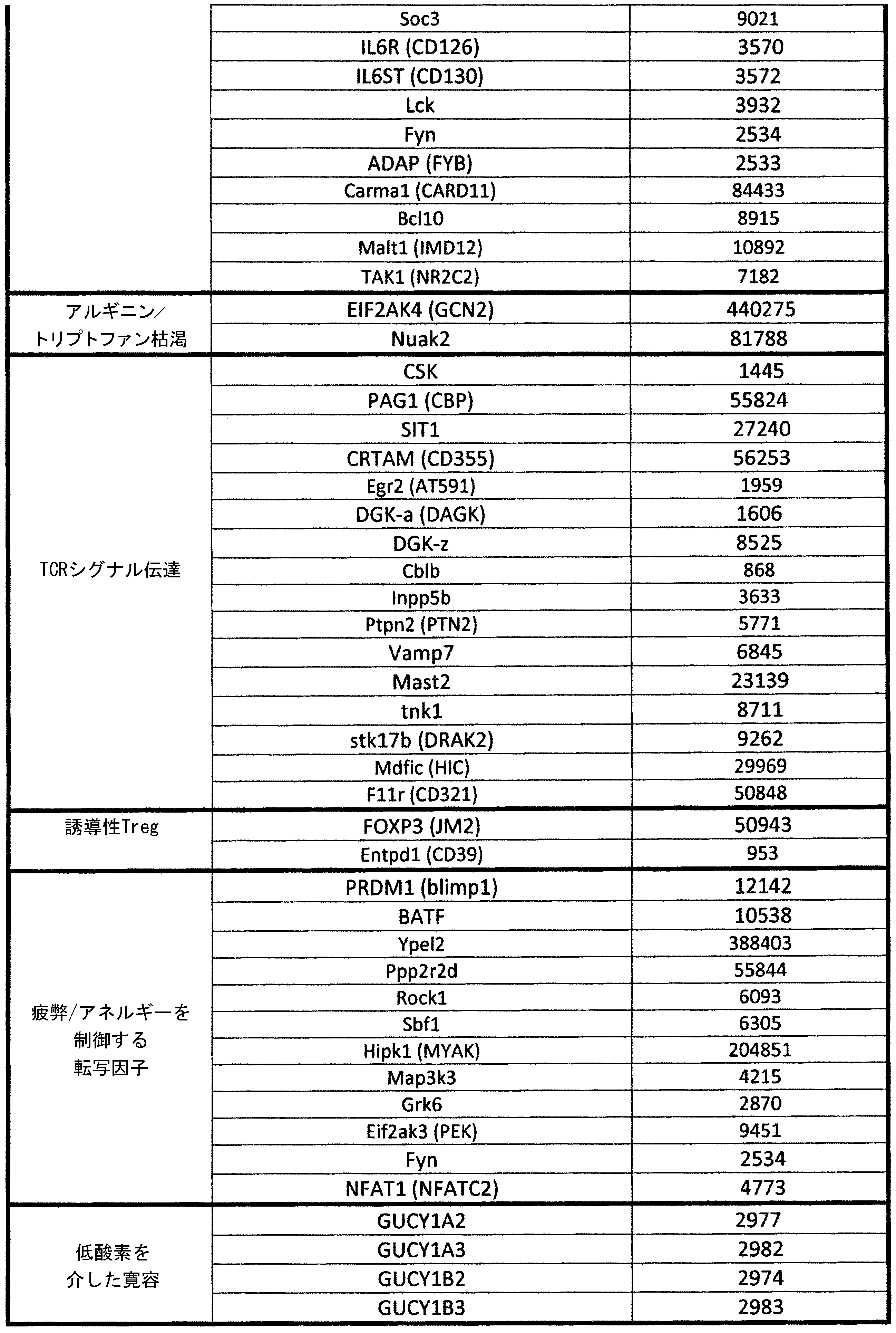
遺伝子を不活性化するとは、関心対象の遺伝子が機能的なタンパク質の形で発現されないことが意図される。特定の態様において、前記方法の遺伝子組換えは、あるレアカッティングエンドヌクレアーゼが、標的とするある遺伝子の切断を特異的に触媒し、それによって、この標的とする遺伝子を不活性化するような、操作しようとする準備された細胞における前記レアカッティングエンドヌクレアーゼの発現に頼る。レアカッティングエンドヌクレアーゼによって引き起こされる核酸鎖切断は、一般的に、相同組換え末端結合または非相同末端結合(NHEJ)の別々の機構によって修復される。しかしながら、NHEJは、切断部位のDNA配列を変えることが多い不完全な修復プロセスである。機構は、直接的な再連結(Critchlow and Jackson 1998)によって、または、いわゆるマイクロホモロジー媒介末端結合(Ma, Kim et al. 2003)を介して2つのDNA末端の残存物を再結合することを伴う。非相同末端結合(NHEJ)を介した修復は小さな挿入または欠失をもたらすことが多く、特異的遺伝子ノックアウトを作り出すことに使用することができる。前記組換えは少なくとも1つのヌクレオチドの置換、欠失、または付加でもよい。切断によって誘導される変異誘発事象、すなわち、NHEJ事象に続く変異誘発事象が起こった細胞は、当技術分野において周知の方法によって特定および/または選択することができる。 Gene inactivation is intended to mean that the gene of interest is not expressed in the form of a functional protein. In certain embodiments, the gene recombination of the method is such that a rare cutting endonuclease specifically catalyzes the cleavage of a target gene, thereby inactivating the target gene. It relies on the expression of the rare cutting endonuclease in the prepared cells to be engineered. Nucleic acid strand breaks caused by rarecating endonucleases are generally repaired by separate mechanisms of homologous recombinant end binding or non-homologous end binding (NHEJ). However, NHEJ is an incomplete repair process that often alters the DNA sequence at the cleavage site. The mechanism involves recombination of two DNA-terminated remnants either by direct recombination (Critchlow and Jackson 1998) or via so-called microhomology-mediated end binding (Ma, Kim et al. 2003). .. Repairs via non-homologous end joining (NHEJ) often result in small insertions or deletions and can be used to create specific gene knockouts. The recombination may be a substitution, deletion, or addition of at least one nucleotide. Cleavage-induced mutagenesis events, i.e., cells in which a mutagenesis event following an NHEJ event has occurred can be identified and / or selected by methods well known in the art.
特定の態様において、細胞を操作する前記方法は、
(a)好ましくは細胞培養物または血液試料から、T細胞を準備する工程、
(b)DNA切断、好ましくは、二本鎖切断によって、
-免疫チェックポイントタンパク質をコードする前記遺伝子、および
-T細胞受容体(TCR)の成分をコードする少なくとも1種類の遺伝子
をそれぞれ選択的に不活性化することができるレアカッティングエンドヌクレアーゼを前記T細胞に導入する工程、
(c)前記細胞を増殖させる工程
の少なくとも1つを含む。
In certain embodiments, the method of manipulating cells comprises the method.
(a) The step of preparing T cells, preferably from cell culture or blood samples,
(b) By DNA cleavage, preferably double-strand breaks
-The gene encoding the immune checkpoint protein, and
-A step of introducing a rare cutting endonuclease into the T cell, which can selectively inactivate at least one gene encoding a component of the T cell receptor (TCR).
(c) comprises at least one step of growing the cells.
さらに好ましい態様において、前記方法は、
(a)好ましくは細胞培養物または血液試料から、T細胞を準備する工程、
(b)DNA切断、好ましくは、二本鎖切断によって、
-免疫チェックポイントタンパク質をコードする前記遺伝子、および
-T細胞受容体(TCR)の成分をコードする少なくとも1種類の遺伝子
をそれぞれ選択的に不活性化することができるレアカッティングエンドヌクレアーゼをコードする核酸によって前記T細胞を形質転換する工程、
(c)前記レアカッティングエンドヌクレアーゼを前記T細胞内で発現させる工程、
(d)細胞表面にTCRを発現しない、形質転換されたT細胞を分別する工程、
(e)前記細胞を増殖させる工程
を含む。
In a more preferred embodiment, the method
(a) The step of preparing T cells, preferably from cell culture or blood samples,
(b) By DNA cleavage, preferably double-strand breaks
-The gene encoding the immune checkpoint protein, and
-The step of transforming T cells with a nucleic acid encoding a rare cutting endonuclease that can selectively inactivate at least one gene encoding a component of the T cell receptor (TCR).
(c) A step of expressing the rare cutting endonuclease in the T cells,
(d) A step of separating transformed T cells that do not express TCR on the cell surface,
(e) Including a step of proliferating the cells.
特定の態様において、前記レアカッティングエンドヌクレアーゼは、PD1、CTLA-4、LAG3、Tim3、BTLA、BY55、TIGIT、B7H5、LAIR1、SIGLEC10、2B4、TCRα、およびTCRβからなる群より選択される1種類の遺伝子を特異的に標的化する。別の態様において、前記方法の遺伝子組換えは、2種類のレアカッティングエンドヌクレアーゼのそれぞれが、PD1およびTCRα、PD1およびTCRβ、CTLA-4およびTCRα、CTLA-4およびTCRβ、LAG3およびTCRα、LAG3およびTCRβ、Tim3およびTCRα、Tim3およびTCRβ、BTLAおよびTCRα、BTLAおよびTCRβ、BY55およびTCRα、BY55およびTCRβ、TIGITおよびTCRα、TIGITおよびTCRβ、B7H5およびTCRα、B7H5およびTCRβ、LAIR1およびTCRα、LAIR1およびTCRβ、SIGLEC10およびTCRα、SIGLEC10およびTCRβ、2B4およびTCRα、2B4およびTCRβからなる群より選択される遺伝子ペアそれぞれの切断を特異的に、かつそれぞれ触媒し、それによって、前記標的とする遺伝子を不活性化するような、操作しようとする準備された細胞における2種類のレアカッティングエンドヌクレアーゼの発現に頼る。別の態様において、2種類を超える遺伝子を標的化および/または不活性化するために、操作しようとする細胞において2種類を超えるレアカッティングエンドヌクレアーゼが発現されてもよい。 In a particular embodiment, the rare cutting endonuclease is one selected from the group consisting of PD1, CTLA-4, LAG3, Tim3, BTLA, BY55, TIGIT, B7H5, LAIR1, SIGLEC10, 2B4, TCRα, and TCRβ. Specific targeting of genes. In another embodiment, the gene recombination of the method is such that each of the two rare cutting endonucleases PD1 and TCRα, PD1 and TCRβ, CTLA-4 and TCRα, CTLA-4 and TCRβ, LAG3 and TCRα, LAG3 and TCRβ, Tim3 and TCRα, Tim3 and TCRβ, BTLA and TCRα, BTLA and TCRβ, BY55 and TCRα, BY55 and TCRβ, TIGIT and TCRα, TIGIT and TCRβ, B7H5 and TCRα, B7H5 and TCRβ, LAIR1 and TCRα, LAIR1 and TCRβ. It specifically and catalyzes the cleavage of each gene pair selected from the group consisting of SIGLEC10 and TCRα, SIGLEC10 and TCRβ, 2B4 and TCRα, 2B4 and TCRβ, thereby inactivating the targeted gene. It relies on the expression of two rare cutting endonucleases in the prepared cells to be manipulated, such as. In another embodiment, more than two rare cutting endonucleases may be expressed in the cell to be engineered in order to target and / or inactivate more than two genes.
別の態様において、前記レアカッティングエンドヌクレアーゼは、メガヌクレアーゼ、ジンクフィンガーヌクレアーゼ、またはTALE-ヌクレアーゼでもよい。好ましい態様において、前記レアカッティングエンドヌクレアーゼはTALE-ヌクレアーゼである。TALE-ヌクレアーゼとは、転写アクチベーター様エフェクター(TALE)に由来するDNA結合ドメインと、核酸標的配列を切断する1つのヌクレアーゼ触媒ドメインからなる融合タンパク質を意図する(Boch, Scholze et al. 2009; Moscou and Bogdanove 2009; Christian, Cermak et al. 2010; Cermak, Doyle et al. 2011; Geissler, Scholze et al. 2011; Huang, Xiao et al. 2011; Li, Huang et al. 2011; Mahfouz, Li et al. 2011; Miller, Tan et al. 2011; Morbitzer, Romer et al. 2011; Mussolino, Morbitzer et al. 2011; Sander, Cade et al. 2011; Tesson, Usal et al. 2011; Weber, Gruetzner et al. 2011; Zhang, Cong et al. 2011; Deng, Yan et al. 2012; Li, Piatek et al. 2012; Mahfouz, Li et al. 2012; Mak, Bradley et al. 2012)。 In another embodiment, the rare cutting endonuclease may be a meganuclease, zinc finger nuclease, or TALE-nuclease. In a preferred embodiment, the rare cutting endonuclease is TALE-nuclease. TALE-nuclease is intended as a fusion protein consisting of a DNA binding domain derived from a transcriptional activator-like effector (TALE) and a single nuclease-catalyzed domain that cleaves nucleic acid target sequences (Boch, Scholze et al. 2009; Moscou). and Bogdanove 2009; Christian, Cermak et al. 2010; Cermak, Doyle et al. 2011; Geissler, Scholze et al. 2011; Huang, Xiao et al. 2011; Li, Huang et al. 2011; Mahfouz, Li et al. 2011; Miller, Tan et al. 2011; Morbitzer, Romer et al. 2011; Mussolino, Morbitzer et al. 2011; Sander, Cade et al. 2011; Tesson, Usal et al. 2011; Weber, Gruetzner et al. 2011; Zhang, Cong et al. 2011; Deng, Yan et al. 2012; Li, Piatek et al. 2012; Mahfouz, Li et al. 2012; Mak, Bradley et al. 2012).
本発明では、養子免疫療法戦略のために、関係のある遺伝子を正確に標的化するように新たなTALE-ヌクレアーゼが設計されている。本発明による好ましいTALE-ヌクレアーゼは、SEQ ID NO:77およびSEQ ID NO:78(PD1)、SEQ ID NO:74~SEQ ID NO:76(CTLA-4)、SEQ ID NO:37、57~60(TCRα)、SEQ ID NO:38または39(TCRβ)からなる群より選択される標的配列を認識および切断するTALE-ヌクレアーゼである。本発明はまた、SEQ ID NO:79~SEQ ID NO:88およびSEQ ID NO:41~46からなる群より選択されるアミノ酸配列を含むTALE-ヌクレアーゼポリペプチドに関する。 In the present invention, new TALE-nucleases are designed to accurately target related genes for adoptive immunotherapy strategies. Preferred TALE-nucleases according to the invention are SEQ ID NO: 77 and SEQ ID NO: 78 (PD1), SEQ ID NO: 74 to SEQ ID NO: 76 (CTLA-4), SEQ ID NO: 37, 57-60. A TALE-nuclease that recognizes and cleaves a target sequence selected from the group consisting of (TCRα), SEQ ID NO: 38 or 39 (TCRβ). The present invention also relates to a TALE-nuclease polypeptide comprising an amino acid sequence selected from the group consisting of SEQ ID NO: 79 to SEQ ID NO: 88 and SEQ ID NO: 41 to 46.
本発明はまた、SEQ ID NO:79~SEQ ID NO:88からなる群より選択されるアミノ酸配列と少なくとも70%、好ましくは少なくとも80%、より好ましくは少なくとも90%、95%、97%、または99%の配列同一性を有するアミノ酸配列を含むポリペプチドに関する。本発明による前記レアカッティングエンドヌクレアーゼをコードするポリヌクレオチド、ベクターも本発明の範囲に含まれる。本方法は、本開示に記載の様々な方法のいずれか1つと関連してもよい。 The invention also comprises an amino acid sequence selected from the group consisting of SEQ ID NO: 79 to SEQ ID NO: 88 and at least 70%, preferably at least 80%, more preferably at least 90%, 95%, 97%, or For a polypeptide containing an amino acid sequence having 99% sequence identity. Polynucleotides and vectors encoding the rare cutting endonuclease according to the present invention are also included in the scope of the present invention. The method may be associated with any one of the various methods described in this disclosure.
別の態様において、標的とする遺伝子を不活性化する細胞の能力を高めるために、変異誘発を高めるように、さらなる触媒ドメインが、前記レアカッティングエンドヌクレアーゼを有する細胞にさらに導入されてもよい。特に、前記さらなる触媒ドメインはDNA末端処理酵素(DNA end-processing enzyme)である。DNA末端処理酵素の非限定的な例には、5-3'エキソヌクレアーゼ、3-5'エキソヌクレアーゼ、5-3'アルカリエキソヌクレアーゼ、5'フラップエンドヌクレアーゼ、ヘリカーゼ、ホスファターゼ、加水分解酵素、および鋳型非依存的DNAポリメラーゼが含まれる。このような触媒ドメインの非限定的な例は、hExoI(EX01_HUMAN)、酵母ExoI(EX01_YEAST)、大腸菌(E.coli)ExoI、ヒトTREX2、マウスTREX1、ヒトTREX1、ウシTREX1、ラットTREX1、TdT(末端デオキシヌクレオチドトランスフェラーゼ)、ヒトDNA2、酵母DNA2(DNA2_YEAST)からなる群より選択されるタンパク質ドメイン、またはこのタンパク質ドメインの触媒活性誘導体を含む。好ましい態様において、前記さらなる触媒ドメインは3'-5'-エキソヌクレアーゼ活性を有し、さらに好ましい態様では、前記さらなる触媒ドメインは、TREX、より好ましくはTREX2触媒ドメイン(WO2012/058458)である。別の好ましい態様において、前記触媒ドメインは単鎖TREXポリペプチド(WO2013/009525)によってコードされる。前記さらなる触媒ドメインは、任意で、ペプチドリンカーによって、本発明によるヌクレアーゼ融合タンパク質またはキメラタンパク質と融合されてもよい。 In another embodiment, additional catalytic domains may be further introduced into the cell carrying the rare cutting endonuclease to enhance mutagenesis in order to enhance the cell's ability to inactivate the target gene. In particular, the additional catalytic domain is a DNA end-processing enzyme. Non-limiting examples of DNA terminating enzymes include 5-3'exonucleases, 3-5'exonucleases, 5-3'alkali exonucleases, 5'flapendonucleases, helicases, phosphatases, hydrolyzing enzymes, and Includes template-independent DNA polymerase. Non-limiting examples of such catalytic domains are hExoI (EX01_HUMAN), yeast ExoI (EX01_YEAST), E. coli (E.coli) ExoI, human TREX2, mouse TREX1, human TREX1, bovine TREX1, rat TREX1, TdT (terminal). Deoxynucleotide transferase), a protein domain selected from the group consisting of human DNA2, yeast DNA2 (DNA2_YEAST), or a catalytically active derivative of this protein domain. In a preferred embodiment, the additional catalytic domain has 3'-5'-exonuclease activity, and in a more preferred embodiment, the additional catalytic domain is TREX, more preferably TREX2 catalytic domain (WO2012 / 058458). In another preferred embodiment, the catalytic domain is encoded by a single chain TREX polypeptide (WO2013 / 009525). The additional catalytic domain may optionally be fused with a nuclease fusion protein or chimeric protein according to the invention by a peptide linker.
ヌクレオチド鎖切断は相同組換えの割合を刺激することが知られている。従って、別の態様において、前記方法の遺伝子組換え工程は、相同組換えが標的核酸配列と外因性核酸との間で発生するように、少なくとも、標的核酸配列の一部に相同な配列を含む外因性核酸を細胞に導入する工程をさらに含む。特定の態様において、前記外因性核酸は、標的核酸配列の5'側の領域と相同な第1の部分および3'側の領域と相同な第2の部分を含む。これらの態様における前記外因性核酸はまた、標的核酸配列の5'側および3'側の領域と相同でない、第1の部分と第2の部分との間に配置される第3の部分も含む。標的核酸配列が切断された後に、標的核酸配列と外因性核酸との間で相同組換え事象が刺激される。好ましくは、少なくとも50bp、好ましくは100bp超、より好ましくは200bp超の相同配列が前記ドナーマトリックス内で用いられる。従って、外因性核酸は、好ましくは、200bp~6000bp、より好ましくは1000bp~2000bpである。実際には、共有される核酸相同性は切断部位の上流および下流に隣接する領域に配置され、導入しようとする核酸配列は、これらの2つのアーム(arm)の間に配置しなければならない。 Nucleotide chain cleavage is known to stimulate the rate of homologous recombination. Thus, in another embodiment, the gene recombination step of the method comprises at least a sequence homologous to a portion of the target nucleic acid sequence such that homologous recombination occurs between the target nucleic acid sequence and the exogenous nucleic acid. It further comprises the step of introducing the exogenous nucleic acid into the cell. In certain embodiments, the exogenous nucleic acid comprises a first portion homologous to the 5'side region and a second portion homologous to the 3'side region of the target nucleic acid sequence. The exogenous nucleic acid in these embodiments also includes a third portion located between the first and second portions that is not homologous to the 5'and 3'regions of the target nucleic acid sequence. .. After the target nucleic acid sequence is cleaved, a homologous recombination event is stimulated between the target nucleic acid sequence and the exogenous nucleic acid. Preferably, a homologous sequence of at least 50 bp, preferably greater than 100 bp, more preferably greater than 200 bp is used within the donor matrix. Therefore, the exogenous nucleic acid is preferably 200 bp to 6000 bp, more preferably 1000 bp to 2000 bp. In practice, the shared nucleic acid homology is located in adjacent regions upstream and downstream of the cleavage site, and the nucleic acid sequence to be introduced must be located between these two arms.
特に、前記外因性核酸は、前記切断の上流側にある配列と相同な第1の領域、免疫チェックポイント遺伝子、TCRα、およびTCRβからなる群より選択される1種類の標的とする遺伝子を不活性化するための配列、ならびに前記切断の下流側にある配列と相同な第2の領域を連続的に含む。前記ポリヌクレオチド導入工程は、前記レアカッティングエンドヌクレアーゼの導入または発現と同時、その前、またはその後でもよい。切断事象が起こった標的核酸配列の場所に応じて、このような外因性核酸は、例えば、外因性核酸が前記遺伝子のオープンリーディングフレーム内部に配置された場合、遺伝子をノックアウトするのに用いられてもよく、関心対象の新たな配列もしくは遺伝子を導入するのに用いられてもよい。このような外因性核酸の使用による配列挿入は、前記遺伝子の訂正または交換(非限定的な例として対立遺伝子の入れ替え)によって、既存の標的とする遺伝子を改変するのに用いられてもよく、前記標的とする遺伝子の訂正または交換(非限定的な例としてプロモーターの入れ替え)によって、標的とする遺伝子の発現をアップレギュレートまたはダウンレギュレートするのに用いられてもよい。好ましい態様において、免疫チェックポイント遺伝子、TCRα、およびTCRβからなる群からの遺伝子の不活性化は、特異的TALE-ヌクレアーゼが標的とする正確なゲノム位置において行われてもよく、前記特異的TALE-ヌクレアーゼは切断を触媒し、前記外因性核酸は、少なくとも、相同な領域、ならびに相同組換えによって組み込まれる、免疫チェックポイント遺伝子、TCRα、およびTCRβからなる群より選択される1種類の標的とする遺伝子を不活性化するための配列を連続的に含む。別の態様において、特異的な遺伝子不活性化のために、1つの規定された遺伝子およびいくつかの特定のポリヌクレオチドをそれぞれ、かつ特異的に標的とする、いくつかのTALE-ヌクレアーゼを使用することによって、いくつかの遺伝子が連続的に不活性化されてもよく、同時に不活性化されてもよい。 In particular, the exogenous nucleic acid inactivates one target gene selected from the group consisting of a first region homologous to the sequence homologous to the sequence upstream of the cleavage, the immune checkpoint gene, TCRα, and TCRβ. Consecutively contains a sequence for conversion and a second region homologous to the sequence downstream of the cleavage. The polynucleotide introduction step may be simultaneous with, before, or after the introduction or expression of the rare cutting endonuclease. Depending on the location of the target nucleic acid sequence at which the cleavage event occurred, such extrinsic nucleic acids may be used, for example, to knock out a gene if the exogenous nucleic acid is placed inside the open reading frame of the gene. It may also be used to introduce a new sequence or gene of interest. Sequence insertion through the use of such exogenous nucleic acids may be used to modify an existing target gene by correcting or exchanging the gene (replacement of alleles as a non-limiting example). It may be used to up-regulate or down-regulate the expression of the target gene by correcting or exchanging the target gene (as a non-limiting example, promoter replacement). In a preferred embodiment, inactivation of the gene from the group consisting of the immune checkpoint gene, TCRα, and TCRβ may be performed at the exact genomic position targeted by the specific TALE-nuclease, said specific TALE-. The nuclease catalyzes cleavage and the exogenous nucleic acid is at least one target gene selected from the group consisting of immune checkpoint genes, TCRα, and TCRβ that are integrated by homologous regions and homologous recombination. Consecutively contains sequences for inactivating. In another embodiment, for specific gene inactivation, several TALE-nucleases are used that specifically target one defined gene and several specific polynucleotides, respectively. Thereby, some genes may be continuously inactivated or may be inactivated at the same time.
さらなるゲノム改変工程とは、免疫チェックポイント遺伝子、TCRα、およびTCRβからなる群より選択される別の遺伝子の不活性化とも意図されてよい。前述のように、前記さらなるゲノム改変工程は、以下を含む不活性化工程でもよい:
(a) レアカッティングエンドヌクレアーゼが前記細胞のゲノムの1つの標的とする配列における切断を特異的に触媒するように、少なくとも1種類のレアカッティングエンドヌクレアーゼを前記細胞に導入する工程、
(b)任意で、前記切断の上流側にある配列と相同な第1の領域、前記細胞のゲノムに挿入しようとする配列、および前記切断の下流側にある配列と相同な第2の領域を連続的に含む外因性核酸を前記細胞に導入する工程であって、前記導入される外因性核酸が遺伝子を不活性化し、関心対象の少なくとも1種類の組換えタンパク質をコードする少なくとも1種類の外因性ポリヌクレオチド配列を組み込む、工程。
別の態様において、前記外因性ポリヌクレオチド配列は、免疫チェックポイント遺伝子、TCRα、およびTCRβからなる群より選択される遺伝子内に組み込まれる。
Further genomic modification steps may also be intended to inactivate another gene selected from the group consisting of immune checkpoint genes, TCRα, and TCRβ. As mentioned above, the further genomic modification step may be an inactivation step including:
(a) A step of introducing at least one rare cutting endonuclease into the cell such that the rare cutting endonuclease specifically catalyzes cleavage in one target sequence of the cell's genome.
(b) Optionally, a first region homologous to the sequence upstream of the cleavage, a sequence attempted to be inserted into the genome of the cell, and a second region homologous to the sequence downstream of the cleavage. In the step of introducing a continuously containing exogenous nucleic acid into the cell, the introduced exogenous nucleic acid inactivates a gene and at least one extrinsic element encoding at least one recombinant protein of interest. A step of incorporating a sex polynucleotide sequence.
In another embodiment, the exogenous polynucleotide sequence is integrated into a gene selected from the group consisting of immune checkpoint genes, TCRα, and TCRβ.
特定の態様において、細胞を操作する前記方法は、さらなるゲノム改変工程をさらに含む。さらなるゲノム改変工程とは、関心対象の1つのタンパク質を操作するための細胞への導入と意図されてもよい。関心対象の前記タンパク質は、非限定的な例として、本開示に記載のような、pTαまたはその機能的変種、キメラ抗原受容体(CAR)、多鎖CAR、二重特異性抗体でもよい。細胞を操作する前記方法はまた、DNA切断によって、本開示に記載のような前記免疫抑制剤の標的をコードする遺伝子を選択的に不活性化することができるレアカッティングエンドヌクレアーゼを導入する工程をさらに含んでもよい。 In certain embodiments, the method of manipulating cells further comprises an additional genome modification step. Further genomic modification steps may be intended for cell introduction to manipulate one protein of interest. The protein of interest may be, as a non-limiting example, pTα or a functional variant thereof, a chimeric antigen receptor (CAR), a multi-chain CAR, a bispecific antibody, as described herein. The method of manipulating cells also involves introducing a rare cutting endonuclease that can selectively inactivate the gene encoding the target of the immunosuppressive agent as described herein by DNA cleavage. Further may be included.
本発明はまたTALE-ヌクレアーゼに関する。一般的に、本発明は、
(a)免疫チェックポイント遺伝子、TCRα、およびTCRβからなる群より選択される遺伝子内の標的配列に結合するように操作されている、転写アクチベーター様エフェクター(TALE)DNA結合ドメイン、
(b)切断ドメインまたは切断半ドメイン
を含む、TALE-ヌクレアーゼに関する。
The present invention also relates to TALE-nuclease. In general, the present invention
(a) Transcription activator-like effector (TALE) DNA-binding domain, engineered to bind to a target sequence within a gene selected from the group consisting of immune checkpoint genes, TCRα, and TCRβ.
(b) With respect to TALE-nucleases, including cleavage domains or cleavage half domains.
本発明による好ましいTALE-ヌクレアーゼは、
-SEQ ID NO:77およびSEQ ID NO:78(PD1)、
-SEQ ID NO:74~SEQ ID NO:76(CTLA-4)、
-SEQ ID NO:37、57~60(TCRα)、および
-SEQ ID NO:38または39(TCRβ)
からなる群より選択される標的配列を認識および切断するTALE-ヌクレアーゼである。
The preferred TALE-nuclease according to the invention is
-SEQ ID NO: 77 and SEQ ID NO: 78 (PD1),
-SEQ ID NO: 74 to SEQ ID NO: 76 (CTLA-4),
-SEQ ID NO: 37, 57-60 (TCRα), and
-SEQ ID NO: 38 or 39 (TCRβ)
A TALE-nuclease that recognizes and cleaves a target sequence selected from the group consisting of.
前記TALE-ヌクレアーゼは、好ましくは、SEQ ID NO:79~SEQ ID NO:88からなる群より選択されるポリペプチド配列を、それぞれの標的SEQ ID NO:74~78およびSEQ ID NO:41~SEQ ID NO:46を切断するために、それぞれの標的配列SEQ ID NO:37~39を切断するために含む。 The TALE-nuclease is preferably a polypeptide sequence selected from the group consisting of SEQ ID NO: 79 to SEQ ID NO: 88, and the target SEQ ID NO: 74 to 78 and SEQ ID NO: 41 to SEQ, respectively. Included to cleave each target sequence SEQ ID NO: 37-39 to cleave ID NO: 46.
これらのポリペプチドが得られたゲノムデータから、いくらかのばらつきが生じ得るので、また、活性が大きく失われることなく、これらのポリペプチドに存在するアミノ酸のうちのいくつかが置換される可能性(機能的変種)も考慮に入れて、本発明は、この特許出願において提供される配列と少なくとも70%、好ましくは少なくとも80%、より好ましくは少なくとも90%、さらにより好ましくは少なくとも95%の同一性を有する、上述のポリペプチドのポリペプチド変種を包含する。 Some variability may occur from the genomic data obtained from these polypeptides, and some of the amino acids present in these polypeptides may be replaced without significant loss of activity (). Taking into account functional variants), the invention is at least 70%, preferably at least 80%, more preferably at least 90%, even more preferably at least 95% identity with the sequences provided in this patent application. Includes polypeptide variants of the above-mentioned polypeptides having.
従って、本発明は、SEQ ID NO:79~SEQ ID NO:88およびSEQ ID NO:41~SEQ ID NO:46からなる群より選択されるアミノ酸配列と少なくとも70%、好ましくは少なくとも80%、より好ましくは少なくとも90%、95%、97%、または99%の配列同一性を有するポリペプチド配列を含むポリペプチドに関する。 Accordingly, the present invention comprises an amino acid sequence selected from the group consisting of SEQ ID NO: 79 to SEQ ID NO: 88 and SEQ ID NO: 41 to SEQ ID NO: 46 and at least 70%, preferably at least 80%, more. Preferably with respect to a polypeptide comprising a polypeptide sequence having at least 90%, 95%, 97%, or 99% sequence identity.
本発明による前記レアカッティングエンドヌクレアーゼをコードするポリヌクレオチド、ベクターも本発明の範囲に含まれる。 Polynucleotides and vectors encoding the rare cutting endonuclease according to the present invention are also included in the scope of the present invention.
本発明の範囲には、免疫チェックポイント遺伝子からなる群より選択される少なくとも1種類の遺伝子、好ましくは、PD1、CTLA-4、LAG3、Tim3、BTLA、BY55、TIGIT、B7H5、LAIR1、SIGLEC10、2B4、TCRα、およびTCRβの群より選択される遺伝子が不活性化されている、好ましくは、PD1およびTCRα、PD1およびTCRβ、CTLA-4およびTCRα、CTLA-4およびTCRβ、LAG3およびTCRα、LAG3およびTCRβ、Tim3およびTCRα、Tim3およびTCRβ、BTLAおよびTCRα、BTLAおよびTCRβ、BY55およびTCRα、BY55およびTCRβ、TIGITおよびTCRα、TIGITおよびTCRβ、B7H5およびTCRα、B7H5およびTCRβ、LAIR1およびTCRα、LAIR1およびTCRβ、SIGLEC10およびTCRα、SIGLEC10およびTCRβ、2B4およびTCRα、2B4およびTCRβからなる群より選択される2種類の遺伝子が不活性化されている、細胞、特に、T細胞を操作する前記方法によって入手することができる、単離された細胞または細胞株も包含される。 Within the scope of the invention is at least one gene selected from the group consisting of immune checkpoint genes, preferably PD1, CTLA-4, LAG3, Tim3, BTLA, BY55, TIGIT, B7H5, LAIR1, SIGLEC10, 2B4. , TCRα, and genes selected from the group of TCRβ are inactivated, preferably PD1 and TCRα, PD1 and TCRβ, CTLA-4 and TCRα, CTLA-4 and TCRβ, LAG3 and TCRα, LAG3 and TCRβ. , Tim3 and TCRα, Tim3 and TCRβ, BTLA and TCRα, BTLA and TCRβ, BY55 and TCRα, BY55 and TCRβ, TIGIT and TCRα, TIGIT and TCRβ, B7H5 and TCRα, B7H5 and TCRβ, LAIR1 and TCRα, LAIR1 and TCRβ, And two genes selected from the group consisting of TCRα, SIGLEC10 and TCRβ, 2B4 and TCRα, 2B4 and TCRβ are inactivated, and can be obtained by the method described above for manipulating cells, in particular T cells. , Isolated cells or cell lines are also included.
本発明によれば、前記遺伝子は、好ましくは、少なくとも1種類のレアカッティングエンドヌクレアーゼによって不活性化される。T細胞において二重不活性化を成し遂げるためにはTALE-ヌクレアーゼを使用することが特に有利であると本発明者らによって示されている。本発明は、少なくとも2種類のポリヌクレオチドを含む単離されたT細胞を包含し、前記ポリヌクレオチドは少なくとも第1のTALE-ヌクレアーゼおよび第2のTALE-ヌクレアーゼをコードし、好ましくは、第1のTALE-ヌクレアーゼは、TCRをコードする遺伝子に対して向けられ、第2のTALE-ヌクレアーゼは、免疫チェックポイントタンパク質、例えば、PD1、CTLA-4、LAG3、Tim3、BTLA、BY55、TIGIT、B7H5、LAIR1、SIGLEC10、2B4をコードする遺伝子に対して向けられている。別の態様において、前記単離された細胞は1つのさらなるゲノム改変をさらに含む。別の態様において、前記さらなるゲノム改変は少なくとも1種類の外因性ポリヌクレオチド配列の組込みである。別の態様において、前記外因性配列は、PD1、CTLA-4、LAG3、Tim3、BTLA、BY55、TIGIT、B7H5、LAIR1、SIGLEC10、2B4、TCRα、およびTCRβからなる群より選択される1種類の遺伝子に組み込まれる。 According to the present invention, the gene is preferably inactivated by at least one rare cutting endonuclease. We have shown that it is particularly advantageous to use TALE-nuclease to achieve double inactivation in T cells. The present invention includes isolated T cells containing at least two types of polynucleotides, said polynucleotides encoding at least a first TALE-nuclease and a second TALE-nuclease, preferably the first. The TALE-nuclease is directed against the gene encoding the TCR, and the second TALE-nuclease is an immune checkpoint protein such as PD1, CTLA-4, LAG3, Tim3, BTLA, BY55, TIGIT, B7H5, LAIR1. , SIGLEC10, directed against genes encoding 2B4. In another embodiment, the isolated cell further comprises one additional genomic modification. In another embodiment, the further genomic modification is the integration of at least one exogenous polynucleotide sequence. In another embodiment, the extrinsic sequence is one gene selected from the group consisting of PD1, CTLA-4, LAG3, Tim3, BTLA, BY55, TIGIT, B7H5, LAIR1, SIGLEC10, 2B4, TCRα, and TCRβ. Will be incorporated into.
非アロ反応性かつ免疫抑制耐性のT細胞:
特定の局面において、本発明は、T細胞を操作する方法、特に、免疫療法のためにT細胞を操作する方法に関する。特に、この方法は、
(a)少なくとも、
-免疫抑制剤の標的を発現する第1の遺伝子、および
-T細胞受容体(TCR)の成分をコードする第2の遺伝子
を不活性化することによってT細胞を改変する工程、
(b)任意で前記免疫抑制剤の存在下で、前記細胞を増殖させる工程
を含む。
Non-alloactive and immunosuppressive resistant T cells:
In certain aspects, the invention relates to methods of manipulating T cells, in particular methods of manipulating T cells for immunotherapy. In particular, this method
(a) At least
-The first gene that expresses the immunosuppressive target, and
-The step of modifying T cells by inactivating a second gene that encodes a component of the T cell receptor (TCR),
(b) optionally comprises the step of growing the cells in the presence of the immunosuppressive agent.
免疫抑制剤は、いくつかの作用機序の1つによって免疫機能を抑制する薬剤である。言い換えると、免疫抑制剤は、免疫応答の程度および/または貪食を減らす能力によって示される化合物が果たす役割である。非限定的な例として、免疫抑制剤は、カルシニューリン阻害剤、ラパマイシン標的、インターロイキン-2α鎖遮断薬、イノシン一リン酸デヒドロゲナーゼ阻害剤、ジヒドロ葉酸還元酵素阻害剤、コルチコステロイド、または免疫抑制性代謝拮抗物質でもよい。古典的な細胞傷害性免疫抑制剤はDNA合成を阻害することによって作用する。その他の免疫抑制剤はT細胞を活性化することによって作用してもよく、ヘルパー細胞の活性化を阻害することによって作用してもよい。本発明による方法を用いると、T細胞内にある免疫抑制剤の標的を不活化することによって、免疫療法のためにT細胞に免疫抑制耐性を付与することが可能になる。非限定的な例として、免疫抑制剤の標的は、免疫抑制剤の受容体、例えば、CD52、グルココルチコイド受容体(GR)、FKBPファミリー遺伝子メンバー、およびシクロフィリンファミリー遺伝子メンバーでもよい。 Immunosuppressants are drugs that suppress immune function by one of several mechanisms of action. In other words, immunosuppressants are the role played by compounds, which are indicated by the degree of immune response and / or the ability to reduce phagocytosis. As a non-limiting example, immunosuppressive agents include calcineurin inhibitors, rapamycin targets, interleukin-2α chain blockers, inosin monophosphate dehydrogenase inhibitors, dihydrofolate reductase inhibitors, corticosteroids, or immunosuppressive agents. It may be a metabolic antagonist. Classic cytotoxic immunosuppressants work by inhibiting DNA synthesis. Other immunosuppressive agents may act by activating T cells or by inhibiting the activation of helper cells. Using the method according to the invention, it becomes possible to confer immunosuppressive resistance on T cells for immunotherapy by inactivating the target of the immunosuppressive agent in the T cells. As a non-limiting example, immunosuppressive agent targets may be immunosuppressive agent receptors such as CD52, glucocorticoid receptor (GR), FKBP family gene members, and cyclophilin family gene members.
特定の態様において、前記方法の遺伝子組換え工程は、CD52、GR、TCRα、およびTCRβからなる群より選択される1種類の遺伝子の不活性化に頼る。別の態様において、前記方法の遺伝子組換え工程は、CD52およびGR、CD52およびTCRα、CDR52およびTCRβ、GRおよびTCRα、GRおよびTCRβ、TCRαおよびTCRβからなる群より選択される2種類の遺伝子の不活性化に頼る。別の態様において、前記方法の遺伝子組換え工程は2種類を超える遺伝子の不活性化に頼る。遺伝子組換えは好ましくはエクスビボで行われる。 In certain embodiments, the genetic recombination step of the method relies on the inactivation of one gene selected from the group consisting of CD52, GR, TCRα, and TCRβ. In another embodiment, the gene recombination step of the method is the absence of two genes selected from the group consisting of CD52 and GR, CD52 and TCRα, CDR52 and TCRβ, GR and TCRα, GR and TCRβ, TCRα and TCRβ. Rely on activation. In another embodiment, the genetic recombination step of the method relies on the inactivation of more than two genes. Genetic recombination is preferably carried out in Exvivo.
遺伝子を不活性化するとは、関心対象の遺伝子が機能的なタンパク質の形で発現されないことが意図される。特定の態様において、前記方法の遺伝子組換えは、あるレアカッティングエンドヌクレアーゼが、標的とするある遺伝子の切断を特異的に触媒し、それによって、この標的とする遺伝子を不活性化するような、操作しようとする準備された細胞における前記レアカッティングエンドヌクレアーゼの発現に頼る。特定の態様において、細胞を操作する前記方法は、
(a)好ましくは細胞培養物または血液試料から、T細胞を準備する工程、
(b)免疫抑制剤の標的を発現する前記T細胞内の遺伝子を選択する工程、
(c)DNA切断、好ましくは、二本鎖切断によって、
-前記免疫抑制剤の標的をコードする前記遺伝子、および
-T細胞受容体(TCR)の成分をコードする少なくとも1種類の遺伝子
をそれぞれ選択的に不活性化することができるレアカッティングエンドヌクレアーゼを前記T細胞に導入する工程、
(d)任意で前記免疫抑制剤の存在下で、前記細胞を増殖させる工程
の少なくとも1つを含む。
Gene inactivation is intended to mean that the gene of interest is not expressed in the form of a functional protein. In certain embodiments, the gene recombination of the method is such that a rare cutting endonuclease specifically catalyzes the cleavage of a target gene, thereby inactivating the target gene. It relies on the expression of the rare cutting endonuclease in the prepared cells to be engineered. In certain embodiments, the method of manipulating cells comprises the method.
(a) The step of preparing T cells, preferably from cell culture or blood samples,
(b) A step of selecting a gene in the T cell expressing a target of an immunosuppressant,
(c) By DNA cleavage, preferably double-strand breaks
-The gene encoding the immunosuppressive target, and
-A step of introducing a rare cutting endonuclease into the T cell, which can selectively inactivate at least one gene encoding a component of the T cell receptor (TCR).
(d) optionally comprises at least one step of growing the cells in the presence of the immunosuppressive agent.
さらに好ましい態様において、前記方法は、
(a)好ましくは細胞培養物または血液試料から、T細胞を準備する工程、
(b)免疫抑制剤の標的を発現する、前記T細胞内の遺伝子を選択する工程、
(c)DNA切断、好ましくは、二本鎖切断によって、
-前記免疫抑制剤の標的をコードする前記遺伝子、および
-T細胞受容体(TCR)の成分をコードする少なくとも1種類の遺伝子
をそれぞれ選択的に不活性化することができるレアカッティングエンドヌクレアーゼをコードする核酸によって、前記T細胞を形質転換する工程、
(d)前記レアカッティングエンドヌクレアーゼを前記T細胞内で発現させる工程、
(e)細胞表面にTCRを発現しない、形質転換されたT細胞を分別する工程、
(f)任意で前記免疫抑制剤の存在下で、前記細胞を増殖させる工程
を含む。
In a more preferred embodiment, the method
(a) The step of preparing T cells, preferably from cell culture or blood samples,
(b) A step of selecting a gene in the T cell that expresses a target of an immunosuppressant,
(c) By DNA cleavage, preferably double-strand breaks
-The gene encoding the immunosuppressive target, and
-The step of transforming T cells with a nucleic acid encoding a rare cutting endonuclease that can selectively inactivate at least one gene encoding a component of the T cell receptor (TCR).
(d) A step of expressing the rare cutting endonuclease in the T cells,
(e) A step of separating transformed T cells that do not express TCR on the cell surface,
(f) optionally comprises the step of growing the cells in the presence of the immunosuppressive agent.
特定の態様において、前記レアカッティングエンドヌクレアーゼは、CD52、GR、TCRα、およびTCRβからなる群より選択される1種類の遺伝子を特異的に標的化する。別の態様において、前記方法の遺伝子組換えは、2種類のレアカッティングエンドヌクレアーゼのそれぞれが、CD52およびGR、CD52およびTCRα、CDR52およびTCRβ、GRおよびTCRα、GRおよびTCRβ、TCRαおよびTCRβからなる群より選択される遺伝子ペアそれぞれの切断を特異的に、かつそれぞれ触媒し、それによって、これらの標的とする遺伝子を不活性化するような、操作しようとする準備された細胞における2種類のレアカッティングエンドヌクレアーゼの発現に頼る。別の態様において、操作しようとする細胞において、2種類を超える遺伝子を標的化および/または不活性化するために、2種類を超えるレアカッティングエンドヌクレアーゼが発現されてもよい。 In certain embodiments, the rare cutting endonuclease specifically targets one gene selected from the group consisting of CD52, GR, TCRα, and TCRβ. In another embodiment, the gene recombination of the method is a group in which each of the two rare cutting endonucleases consists of CD52 and GR, CD52 and TCRα, CDR52 and TCRβ, GR and TCRα, GR and TCRβ, TCRα and TCRβ. Two types of rare cutting in prepared cells to be manipulated that specifically and catalyze the cleavage of each of the more selected gene pairs, thereby inactivating these target genes. Rely on the expression of endonucleases. In another embodiment, more than two rare cutting endonucleases may be expressed in the cell to be engineered to target and / or inactivate more than two genes.
別の態様において、免疫抑制処置に特異的な、工程(b)の前記遺伝子はCD52であり、工程(d)または工程(e)の免疫抑制処置は、CD52抗原を標的とするヒト化抗体を含む。 In another embodiment, the gene of step (b), specific for immunosuppressive treatment, is CD52 and the immunosuppressive treatment of step (d) or step (e) is a humanized antibody targeting the CD52 antigen. include.
別の態様において、免疫抑制処置に特異的な、工程(b)の前記遺伝子はグルココルチコイド受容体(GR)であり、工程(d)または工程(e)の免疫抑制処置は、コルチコステロイド、例えば、デキサメタゾンを含む。 In another embodiment, the gene of step (b), specific for immunosuppressive treatment, is a glucocorticoid receptor (GR) and the immunosuppressive treatment of step (d) or step (e) is a corticosteroid, For example, it includes dexamethasone.
別の態様において、免疫抑制処置に特異的な、工程(b)の前記遺伝子はFKBPファミリー遺伝子メンバーまたはその変種であり、工程(d)または工程(e)の免疫抑制処置は、タクロリムスまたはフジマイシン(fujimycin)とも知られるFK506を含む。別の態様において、前記FKBPファミリー遺伝子メンバーはFKBP12またはその変種である。 In another embodiment, the gene of step (b), specific for immunosuppressive treatment, is a member of the FKBP family gene or a variant thereof, and the immunosuppressive treatment of step (d) or step (e) is tacrolimus or fujimycin. Includes FK506, also known as (fujimycin). In another embodiment, the FKBP family gene member is FKBP12 or a variant thereof.
別の態様において、免疫抑制処置に特異的な、工程(b)の前記遺伝子はシクロフィリンファミリー遺伝子メンバーまたはその変種であり、工程(d)または工程(e)の免疫抑制処置はシクロスポリンを含む。 In another embodiment, the gene of step (b), specific for immunosuppressive treatment, is a member of the cyclophilin family gene or a variant thereof, and the immunosuppressive treatment of step (d) or step (e) comprises cyclosporine.
別の態様において、前記レアカッティングエンドヌクレアーゼは、メガヌクレアーゼ、ジンクフィンガーヌクレアーゼ、またはTALE-ヌクレアーゼでもよい。好ましい態様において、前記レアカッティングエンドヌクレアーゼはTALE-ヌクレアーゼである。本発明による好ましいTALE-ヌクレアーゼは、
-SEQ ID NO:1~6(GR)、
-SEQ ID NO:37、57~60(TCRα)、
-SEQ ID NO:38または39(TCRβ)、および
-SEQ ID NO:40、61~65(CD52)
からなる群より選択される標的配列を認識および切断するTALE-ヌクレアーゼである。
In another embodiment, the rare cutting endonuclease may be a meganuclease, zinc finger nuclease, or TALE-nuclease. In a preferred embodiment, the rare cutting endonuclease is TALE-nuclease. The preferred TALE-nuclease according to the invention is
-SEQ ID NO: 1-6 (GR),
-SEQ ID NO: 37, 57-60 (TCRα),
-SEQ ID NO: 38 or 39 (TCRβ), and
-SEQ ID NO: 40, 61-65 (CD52)
A TALE-nuclease that recognizes and cleaves a target sequence selected from the group consisting of.
前記TALE-ヌクレアーゼは、好ましくは、SEQ ID NO:7~SEQ ID NO:18およびSEQ ID NO:41~SEQ ID NO:48より選択されるポリペプチド配列を、それぞれの標的配列SEQ ID NO:1~6およびSEQ ID NO:37~40を切断するために含む。 The TALE-nuclease is preferably a polypeptide sequence selected from SEQ ID NO: 7 to SEQ ID NO: 18 and SEQ ID NO: 41 to SEQ ID NO: 48, and the respective target sequences SEQ ID NO: 1. Included to cleave ~ 6 and SEQ ID NO: 37-40.
別の態様において、標的とする遺伝子を不活性化する細胞の能力を高めるために、変異誘発を高めるように、さらなる触媒ドメインが、前記レアカッティングエンドヌクレアーゼを有する細胞にさらに導入されてもよい。特に、前記さらなる触媒ドメインはDNA末端処理酵素である。DNA末端処理酵素の非限定的な例には、5-3'エキソヌクレアーゼ、3-5'エキソヌクレアーゼ、5-3'アルカリエキソヌクレアーゼ、5'フラップエンドヌクレアーゼ、ヘリカーゼ、ホスファターゼ、加水分解酵素、および鋳型非依存的DNAポリメラーゼが含まれる。このような触媒ドメインの非限定的な例は、hExoI(EX01_HUMAN)、酵母ExoI(EX01_YEAST)、大腸菌ExoI、ヒトTREX2、マウスTREX1、ヒトTREX1、ウシTREX1、ラットTREX1、TdT(末端デオキシヌクレオチドトランスフェラーゼ)、ヒトDNA2、酵母DNA2(DNA2_YEAST)からなる群より選択されるタンパク質ドメイン、またはこのタンパク質ドメインの触媒活性誘導体を含む。好ましい態様において、前記さらなる触媒ドメインは3'-5'-エキソヌクレアーゼ活性を有し、さらに好ましい態様では、前記さらなる触媒ドメインは、TREX、より好ましくはTREX2触媒ドメイン(WO2012/058458)である。別の好ましい態様において、前記触媒ドメインは単鎖TREXポリペプチドによってコードされる。前記さらなる触媒ドメインは、任意で、ペプチドリンカーによって、本発明によるヌクレアーゼ融合タンパク質またはキメラタンパク質と融合されてもよい。 In another embodiment, additional catalytic domains may be further introduced into the cell carrying the rare cutting endonuclease to enhance mutagenesis in order to enhance the cell's ability to inactivate the target gene. In particular, the additional catalytic domain is a DNA terminator enzyme. Non-limiting examples of DNA terminating enzymes include 5-3'exonucleases, 3-5'exonucleases, 5-3'alkali exonucleases, 5'flapendonucleases, helicases, phosphatases, hydrolyzing enzymes, and Includes template-independent DNA polymerase. Non-limiting examples of such catalytic domains are hExoI (EX01_HUMAN), yeast ExoI (EX01_YEAST), Escherichia coli ExoI, human TREX2, mouse TREX1, human TREX1, bovine TREX1, rat TREX1, TdT (terminal deoxynucleotide transferase), It contains a protein domain selected from the group consisting of human DNA2 and yeast DNA2 (DNA2_YEAST), or a catalytically active derivative of this protein domain. In a preferred embodiment, the additional catalytic domain has 3'-5'-exonuclease activity, and in a more preferred embodiment, the additional catalytic domain is TREX, more preferably TREX2 catalytic domain (WO2012 / 058458). In another preferred embodiment, the catalytic domain is encoded by a single chain TREX polypeptide. The additional catalytic domain may optionally be fused with a nuclease fusion protein or chimeric protein according to the invention by a peptide linker.
ヌクレオチド鎖切断は相同組換えの割合を刺激することが知られている。従って、別の態様において、前記方法の遺伝子組換え工程は、相同組換えが標的核酸配列と外因性核酸との間で発生するように、少なくとも標的核酸配列の一部に相同な配列を含む外因性核酸を細胞に導入する工程をさらに含む。特定の態様において、前記外因性核酸は、標的核酸配列の5'側の領域と相同な第1の部分および3'側の領域と相同な第2の部分を含む。これらの態様における前記外因性核酸はまた、標的核酸配列の5'側および3'側の領域と相同でない、第1の部分と第2の部分との間に配置される第3の部分も含む。標的核酸配列が切断された後に、標的核酸配列と外因性核酸との間で相同組換え事象が刺激される。好ましくは、少なくとも50bp、好ましくは100bp超、より好ましくは200bp超の相同配列が前記ドナーマトリックス内で用いられる。従って、外因性核酸は、好ましくは、200bp~6000bp、より好ましくは1000bp~2000bpである。実際には、共有される核酸相同性は、切断部位の上流および下流に隣接する領域に配置され、導入しようとする核酸配列は、これらの2つのアームの間に配置しなければならない。 Nucleotide chain cleavage is known to stimulate the rate of homologous recombination. Thus, in another embodiment, the gene recombination step of the method comprises an exogenous sequence that comprises at least a portion of the target nucleic acid sequence that is homologous so that homologous recombination occurs between the target nucleic acid sequence and the exogenous nucleic acid. It further comprises the step of introducing the sex nucleic acid into the cell. In certain embodiments, the exogenous nucleic acid comprises a first portion homologous to the 5'side region and a second portion homologous to the 3'side region of the target nucleic acid sequence. The exogenous nucleic acid in these embodiments also includes a third portion located between the first and second portions that is not homologous to the 5'and 3'regions of the target nucleic acid sequence. .. After the target nucleic acid sequence is cleaved, a homologous recombination event is stimulated between the target nucleic acid sequence and the exogenous nucleic acid. Preferably, a homologous sequence of at least 50 bp, preferably greater than 100 bp, more preferably greater than 200 bp is used within the donor matrix. Therefore, the exogenous nucleic acid is preferably 200 bp to 6000 bp, more preferably 1000 bp to 2000 bp. In practice, the shared nucleic acid homology is located in adjacent regions upstream and downstream of the cleavage site, and the nucleic acid sequence to be introduced must be located between these two arms.
特に、前記外因性核酸は、前記切断の上流側にある配列と相同な第1の領域、CD52、GR、TCRα、およびTCRβからなる群より選択される1種類の標的とする遺伝子を不活性化するための配列、ならびに前記切断の下流側にある配列と相同な第2の領域を連続的に含む。前記ポリヌクレオチド導入工程は、前記レアカッティングエンドヌクレアーゼの導入または発現と同時、その前、またはその後でもよい。切断事象が起こった標的核酸配列の場所に応じて、このような外因性核酸は、例えば、外因性核酸が前記遺伝子のオープンリーディングフレーム内部に配置された場合、遺伝子をノックアウトするのに用いられてもよく、関心対象の新たな配列もしくは遺伝子を導入するのに用いられてもよい。このような外因性核酸の使用による配列挿入は、前記遺伝子の訂正または交換(非限定的な例として対立遺伝子の入れ替え)によって、既存の標的とする遺伝子を改変するのに用いられてもよく、前記標的とする遺伝子の訂正または交換(非限定的な例としてプロモーターの入れ替え)によって、標的とする遺伝子の発現をアップレギュレートまたはダウンレギュレートするのに用いられてもよい。好ましい態様において、CD52、GR、TCRα、およびTCRβからなる群からの遺伝子の不活性化は、特異的TALE-ヌクレアーゼが標的とする正確なゲノム位置において行われてもよく、前記特異的TALE-ヌクレアーゼは切断を触媒し、前記外因性核酸は、少なくとも、相同な領域、ならびに相同組換えによって組み込まれる、CD52、GR、TCRα、およびTCRβからなる群より選択される1種類の標的とする遺伝子を不活性化するための配列を連続的に含む。別の態様において、特異的な遺伝子不活性化のために、1つの規定された遺伝子およびいくつかの特定のポリヌクレオチドをそれぞれ、かつ特異的に標的とする、いくつかのTALE-ヌクレアーゼを使用することによって、いくつかの遺伝子が連続的に不活性化されてもよく、同時に不活性化されてもよい。 In particular, the exogenous nucleic acid inactivates one target gene selected from the group consisting of a first region homologous to the sequence upstream of the cleavage, CD52, GR, TCRα, and TCRβ. Consecutively contains a second region homologous to the sequence to be made, as well as the sequence downstream of the cleavage. The polynucleotide introduction step may be simultaneous with, before, or after the introduction or expression of the rare cutting endonuclease. Depending on the location of the target nucleic acid sequence where the cleavage event occurred, such extrinsic nucleic acids may be used, for example, to knock out a gene if the exogenous nucleic acid is placed inside the open reading frame of the gene. It may also be used to introduce a new sequence or gene of interest. Sequence insertion through the use of such exogenous nucleic acids may be used to modify an existing target gene by correcting or exchanging the gene (replacement of alleles as a non-limiting example). It may be used to up-regulate or down-regulate the expression of the target gene by correcting or exchanging the target gene (as a non-limiting example, promoter replacement). In a preferred embodiment, inactivation of the gene from the group consisting of CD52, GR, TCRα, and TCRβ may be performed at the exact genomic position targeted by the specific TALE-nuclease, said specific TALE-nuclease. Catalyzes cleavage, and the exogenous nucleic acid does not contain at least one target gene selected from the group consisting of CD52, GR, TCRα, and TCRβ, which is integrated by homologous regions and homologous recombination. Consecutively contains sequences for activation. In another embodiment, for specific gene inactivation, several TALE-nucleases are used that specifically target one defined gene and several specific polynucleotides, respectively. Thereby, some genes may be continuously inactivated or may be inactivated at the same time.
さらなるゲノム改変工程とは、CD52、GR、TCRα、およびTCRβからなる群より選択される別の遺伝子の不活性化とも意図されてよい。前述のように、前記さらなるゲノム改変工程は、以下を含む不活性化工程でもよい:
(a)前記細胞のゲノムの1つの標的とする配列における切断を特異的に触媒するような少なくとも1種類のレアカッティングエンドヌクレアーゼを前記細胞に導入する工程、
(b)任意で、前記切断の上流側にある配列と相同な第1の領域、前記細胞のゲノムに挿入しようとする配列、および前記切断の下流側にある配列と相同な第2の領域を連続的に含む外因性核酸を前記細胞に導入する工程であって、前記導入された外因性核酸が遺伝子を不活性化し、関心対象の少なくとも1種類の組換えタンパク質をコードする少なくとも1種類の外因性ポリヌクレオチド配列を組み込む、工程。
別の態様において、前記外因性ポリヌクレオチド配列は、CD52、GR、TCRα、およびTCRβからなる群より選択される遺伝子内に組み込まれる。
Further genomic modification steps may also be intended to inactivate another gene selected from the group consisting of CD52, GR, TCRα, and TCRβ. As mentioned above, the further genomic modification step may be an inactivation step including:
(a) A step of introducing into the cell at least one rare cutting endonuclease that specifically catalyzes cleavage in one target sequence of the cell's genome.
(b) Optionally, a first region homologous to the sequence upstream of the cleavage, a sequence attempted to be inserted into the genome of the cell, and a second region homologous to the sequence downstream of the cleavage. In the step of introducing a continuously containing exogenous nucleic acid into the cell, the introduced exogenous nucleic acid inactivates a gene and at least one extrinsic element encoding at least one recombinant protein of interest. A step of incorporating a sex polynucleotide sequence.
In another embodiment, the exogenous polynucleotide sequence is integrated into a gene selected from the group consisting of CD52, GR, TCRα, and TCRβ.
特定の態様において、細胞を操作する前記方法は、さらなるゲノム改変工程をさらに含む。さらなるゲノム改変工程とは、関心対象の1つのタンパク質を操作するための細胞への導入と意図されてもよい。関心対象の前記タンパク質は、非限定的な例として、本開示に記載のような、pTαまたはその機能的変種、キメラ抗原受容体(CAR)、多鎖CAR、二重特異性抗体、またはPDCD1もしくはCTLA-4を標的とするレアカッティングエンドヌクレアーゼでもよい。 In certain embodiments, the method of manipulating cells further comprises an additional genome modification step. Further genomic modification steps may be intended for cell introduction to manipulate one protein of interest. The protein of interest is, as a non-limiting example, pTα or a functional variant thereof, chimeric antigen receptor (CAR), multi-chain CAR, bispecific antibody, or PDCD1 or It may be a rare cutting endonuclease that targets CTLA-4.
本発明はまたTALE-ヌクレアーゼに関する。一般的に、本発明は、
(a)CD52、GR、TCRα、およびTCRβからなる群より選択される遺伝子内の標的配列に結合するように操作されている、転写アクチベーター様エフェクター(TALE)DNA結合ドメイン、
(b)切断ドメインまたは切断半ドメイン
を含む、TALE-ヌクレアーゼに関する。
The present invention also relates to TALE-nuclease. In general, the present invention
(a) Transcription activator-like effector (TALE) DNA-binding domain, engineered to bind to a target sequence within a gene selected from the group consisting of CD52, GR, TCRα, and TCRβ.
(b) With respect to TALE-nucleases, including cleavage domains or cleavage half domains.
本発明による好ましいTALE-ヌクレアーゼは、
-SEQ ID NO:1~6(GR)、
-SEQ ID NO:37、57~60(TCRα)、
-SEQ ID NO:38または39(TCRβ)、および
-SEQ ID NO:40、61~65(CD52)
からなる群より選択される標的配列を認識および切断するTALE-ヌクレアーゼである。
The preferred TALE-nuclease according to the invention is
-SEQ ID NO: 1-6 (GR),
-SEQ ID NO: 37, 57-60 (TCRα),
-SEQ ID NO: 38 or 39 (TCRβ), and
-SEQ ID NO: 40, 61-65 (CD52)
A TALE-nuclease that recognizes and cleaves a target sequence selected from the group consisting of.
前記TALE-ヌクレアーゼは、好ましくは、SEQ ID NO:7~SEQ ID NO:18およびSEQ ID NO:41~SEQ ID NO:48より選択されるポリペプチド配列を、それぞれの標的配列SEQ ID NO:1~6およびSEQ ID NO:37~40を切断するために含む。 The TALE-nuclease is preferably a polypeptide sequence selected from SEQ ID NO: 7 to SEQ ID NO: 18 and SEQ ID NO: 41 to SEQ ID NO: 48, and the respective target sequences SEQ ID NO: 1. Included to cleave ~ 6 and SEQ ID NO: 37-40.
これらのポリペプチドが得られたゲノムデータから、いくらかのばらつきが生じ得るので、また、活性が大きく失われることなく、これらのポリペプチドに存在するアミノ酸のうちのいくつかが置換される可能性(機能的変種)も考慮に入れて、本発明は、この特許出願において提供される配列と少なくとも70%、好ましくは少なくとも80%、より好ましくは少なくとも90%、さらにより好ましくは少なくとも95%の同一性を有する、上述のポリペプチドのポリペプチド変種を包含する。 Some variability may occur from the genomic data obtained from these polypeptides, and some of the amino acids present in these polypeptides may be replaced without significant loss of activity (). Taking into account functional variants), the invention is at least 70%, preferably at least 80%, more preferably at least 90%, even more preferably at least 95% identity with the sequences provided in this patent application. Includes polypeptide variants of the above-mentioned polypeptides having.
従って、本発明は、SEQ ID NO:7~SEQ ID NO:18およびSEQ ID NO:41~SEQ ID NO:48からなる群より選択されるアミノ酸配列と少なくとも70%、好ましくは少なくとも80%、より好ましくは少なくとも90%、95%、97%、または99%の配列同一性を有するポリペプチド配列を含むポリペプチドに関する。 Accordingly, the present invention comprises an amino acid sequence selected from the group consisting of SEQ ID NO: 7 to SEQ ID NO: 18 and SEQ ID NO: 41 to SEQ ID NO: 48 and at least 70%, preferably at least 80%, more. Preferably with respect to a polypeptide comprising a polypeptide sequence having at least 90%, 95%, 97%, or 99% sequence identity.
本発明による前記レアカッティングエンドヌクレアーゼをコードするポリヌクレオチド、ベクターも本発明の範囲に含まれる。 Polynucleotides and vectors encoding the rare cutting endonuclease according to the present invention are also included in the scope of the present invention.
本発明の範囲には、CD52、GR、TCRα、およびTCRβからなる群より選択される少なくとも1種類の遺伝子が不活性化されている、好ましくは、CD52およびGR、CD52およびTCRα、CDR52およびTCRβ、GRおよびTCRα、GRおよびTCRβ、TCRαおよびTCRβからなる群より選択される2種類の遺伝子が不活性化されている、細胞、特に、T細胞を操作する前記方法によって入手することができる、単離された細胞または細胞株も包含される。 Within the scope of the invention, at least one gene selected from the group consisting of CD52, GR, TCRα, and TCRβ is inactivated, preferably CD52 and GR, CD52 and TCRα, CDR52 and TCRβ, Two genes selected from the group consisting of GR and TCRα, GR and TCRβ, TCRα and TCRβ are inactivated, isolated, available by the method described above for manipulating cells, in particular T cells. Also included are cells or cell lines that have been removed.
本発明によれば、前記遺伝子は、好ましくは、少なくとも1種類のレアカッティングエンドヌクレアーゼによって不活性化される。T細胞において二重不活性化を成し遂げるためにはTALE-ヌクレアーゼを使用することが特に有利であると本発明者らによって示されている。本発明は、少なくとも2種類のポリヌクレオチドを含む単離されたT細胞を包含し、前記ポリヌクレオチドは少なくとも第1のTALE-ヌクレアーゼおよび第2のTALE-ヌクレアーゼをコードし、好ましくは、第1のTALE-ヌクレアーゼは、TCRをコードする遺伝子に対して向けられ、第2のTALE-ヌクレアーゼは、免疫抑制剤の受容体、例えば、CD52またはGRをコードする遺伝子に対して向けられている。 According to the present invention, the gene is preferably inactivated by at least one rare cutting endonuclease. We have shown that it is particularly advantageous to use TALE-nuclease to achieve double inactivation in T cells. The present invention includes isolated T cells containing at least two types of polynucleotides, wherein the polynucleotide encodes at least a first TALE-nuclease and a second TALE-nuclease, preferably the first. The TALE-nuclease is directed at the gene encoding the TCR and the second TALE-nuclease is directed at the receptor for the immunosuppressive agent, eg, the gene encoding the CD52 or GR.
別の態様において、前記単離された細胞は1つのさらなるゲノム改変をさらに含む。別の態様において、前記さらなるゲノム改変は、少なくとも1種類の外因性ポリヌクレオチド配列の組込みである。別の態様において、前記外因性配列は、CD52、GR、TCRα、およびTCRβからなる群より選択される1種類の遺伝子に組み込まれる。 In another embodiment, the isolated cell further comprises one additional genomic modification. In another embodiment, the further genomic modification is the integration of at least one exogenous polynucleotide sequence. In another embodiment, the exogenous sequence is integrated into one gene selected from the group consisting of CD52, GR, TCRα, and TCRβ.
プレTα
別の局面において、本発明は、TCRα欠損T細胞を増殖させる方法に関し、本方法は、pTα(プレTCRαとも呼ぶ)またはその機能的変種を前記T細胞に導入する工程、および任意でCD3複合体を刺激することによって、前記細胞を増殖させる工程を含む。好ましい態様において、前記方法は、
a)CD3表面発現を支援するために、少なくともpTα断片をコードする核酸で前記細胞を形質転換する工程、
b)前記pTαを前記細胞内で発現させる工程、
c)任意でCD3複合体を刺激することによって、前記細胞を増殖させる工程
を含む。
Pre-Tα
In another aspect, the invention relates to a method of growing TCRα-deficient T cells, wherein the method introduces pTα (also referred to as pre-TCRα) or a functional variant thereof into the T cells, and optionally a CD3 complex. Includes a step of proliferating the cells by stimulating. In a preferred embodiment, the method
a) The step of transforming the cells with a nucleic acid encoding at least a pTα fragment to support CD3 surface expression,
b) The step of expressing the pTα in the cell,
c) Including the step of proliferating the cells by optionally stimulating the CD3 complex.
本発明はまたT細胞を増殖させるための前記方法の工程を含む、免疫療法のためにT細胞を調製する方法に関する。 The invention also relates to a method of preparing T cells for immunotherapy, comprising the steps of the method for growing T cells.
特定の態様において、pTαポリヌクレオチド配列はランダムに導入されてもよく、そうでなければ相同組換えによって導入されてもよい。特に、この挿入はTCRα遺伝子の不活性化と関連する場合がある。 In certain embodiments, the pTα polynucleotide sequence may be randomly introduced or otherwise introduced by homologous recombination. In particular, this insertion may be associated with the inactivation of the TCRα gene.
本発明によれば、pTαの様々な機能的変種が用いられる。ペプチドの「機能的変種」とは、ペプチド全体またはその断片と実質的に類似する分子を指す。本発明のpTαまたはその機能的変種の「断片」とは、分子の任意のサブセット、すなわち、分子より短いペプチドを指す。好ましいpTαまたは機能的変種は完全長pTαでもよく、C末端切断型pTαバージョンでもよい。C末端切断型pTαはC末端にある1つまたは複数の残基を欠いている。非限定的な例として、C末端切断型pTαバージョンは、タンパク質のC末端から18個、48個、62個、78個、92個、110個、または114個の残基を欠いている(SEQ ID NO:107~SEQ ID NO:114)。さらに、ペプチドのアミノ酸配列変種は、ペプチドをコードするDNA内の変異によって調製することができる。このような機能的変種には、例えば、アミノ酸配列内にある残基からの欠失または残基の挿入もしくは置換が含まれる。最終構築物が望ましい活性、特に、機能的CD3複合体の回復をもつのであれば、最終構築物に到達するために、欠失、挿入、および置換の任意の組み合わせが作られてもよい。好ましい態様において、前記の様々なpTαバージョンにおいて、二量体化に影響を及ぼすように少なくとも1つの変異が導入される。非限定的な例として、変異残基は、少なくとも、ヒトpTαタンパク質のW46R、D22A、K24A、R102A、もしくはR117A、またはpTαファミリーもしくはホモログメンバーにあるCLUSTALW法を用いてアラインメントされた位置でもよい。好ましくは、前記のpTαまたはその変種は、変異残基W46R(SEQ ID NO:123)、または変異残基D22A、K24A、R102A、およびR117A(SEQ ID NO:124)を含む。特定の態様において、前記pTαまたは変種はまた、非限定的な例として、CD28、OX40、ICOS、CD27、CD137(4-1BB)、およびCD8などのシグナル伝達ドメインとも融合される(SEQ ID NO:115~SEQ ID NO:120)。前記のpTαまたは変種の細胞外ドメインは、TCRαタンパク質の断片、特に、TCRαの膜貫通ドメインおよび細胞内ドメインと融合されてもよい(SEQ ID NO:122)。pTα変種はまたTCRαの細胞内ドメインとも融合されてもよい(SEQ ID NO:121)。 According to the present invention, various functional variants of pTα are used. A "functional variant" of a peptide refers to a molecule that is substantially similar to the whole peptide or fragments thereof. A "fragment" of pTα or a functional variant thereof of the invention refers to any subset of molecules, ie peptides shorter than the molecule. The preferred pTα or functional variant may be full-length pTα or a C-terminally truncated pTα version. C-terminal cleaved pTα lacks one or more residues at the C-terminus. As a non-limiting example, the C-terminal cleaved pTα version lacks 18, 48, 62, 78, 92, 110, or 114 residues from the C-terminus of the protein (SEQ). ID NO: 107 to SEQ ID NO: 114). In addition, amino acid sequence variants of the peptide can be prepared by mutations in the DNA encoding the peptide. Such functional variants include, for example, deletions or insertions or substitutions of residues from residues within the amino acid sequence. Any combination of deletions, insertions, and substitutions may be made to reach the final construct, provided that the final construct has the desired activity, in particular the restoration of the functional CD3 complex. In a preferred embodiment, at least one mutation is introduced to affect dimerization in the various pTα versions described above. As a non-limiting example, the mutant residue may be at least a position aligned using the W46R, D22A, K24A, R102A, or R117A of the human pTα protein, or the CLUSTAL W method in the pTα family or homologue members. Preferably, the pTα or variant thereof comprises a mutant residue W46R (SEQ ID NO: 123) or a mutant residue D22A, K24A, R102A, and R117A (SEQ ID NO: 124). In certain embodiments, the pTα or variant is also fused, as a non-limiting example, with signaling domains such as CD28, OX40, ICOS, CD27, CD137 (4-1BB), and CD8 (SEQ ID NO: 115-SEQ ID NO: 120). The extracellular domain of the pTα or variant may be fused with a fragment of the TCRα protein, in particular the transmembrane domain and the intracellular domain of TCRα (SEQ ID NO: 122). The pTα variant may also be fused with the intracellular domain of TCRα (SEQ ID NO: 121).
別の態様において、前記pTαバージョンは細胞外リガンド結合ドメインと融合され、より好ましくは、pTαまたはその機能的変種は、可動性リンカーによってつながっている、標的抗原特異的モノクローナル抗体の軽鎖(VL)可変断片および重鎖(VH)可変断片を含む単鎖抗体断片(scFV)と融合される。非限定的な例として、pTαまたはその機能的変種のアミノ酸配列はSEQ ID NO:107~SEQ ID NO:124からなる群より選択される。 In another embodiment, the pTα version is fused to an extracellular ligand binding domain, more preferably the light chain ( VL ) of a target antigen-specific monoclonal antibody to which pTα or a functional variant thereof is linked by a mobile linker. ) Fused with a single chain antibody fragment (scFV) containing a variable fragment and a heavy chain (V H ) variable fragment. As a non-limiting example, the amino acid sequence of pTα or its functional variant is selected from the group consisting of SEQ ID NO: 107 to SEQ ID NO: 124.
これらのポリペプチドが得られたゲノムデータから、いくらかのばらつきが生じ得るので、また、活性が大きく失われることなく、これらのポリペプチドに存在するアミノ酸のうちのいくつかが置換される可能性(機能的変種)も考慮に入れて、本発明は、この特許出願において提供される配列と少なくとも70%、好ましくは少なくとも80%、より好ましくは少なくとも90%、さらにより好ましくは少なくとも95%の同一性を有する、上述のポリペプチドのポリペプチド変種を包含する。 Some variability may occur from the genomic data obtained from these polypeptides, and some of the amino acids present in these polypeptides may be replaced without significant loss of activity (). Taking into account functional variants), the invention is at least 70%, preferably at least 80%, more preferably at least 90%, even more preferably at least 95% identity with the sequences provided in this patent application. Includes polypeptide variants of the above-mentioned polypeptides having.
従って、本発明は、SEQ ID NO:107~SEQ ID NO:124からなる群より選択されるアミノ酸配列と少なくとも70%、好ましくは少なくとも80%、より好ましくは少なくとも90%、95%、97%、または99%の配列同一性を有するポリペプチド配列を含むポリペプチドに関する。 Accordingly, the present invention comprises an amino acid sequence selected from the group consisting of SEQ ID NO: 107 to SEQ ID NO: 124 and at least 70%, preferably at least 80%, more preferably at least 90%, 95%, 97%. Or related to a polypeptide containing a polypeptide sequence having 99% sequence identity.
TCRα欠損T細胞とは、機能的TCRα鎖が発現しない単離されたT細胞を意図する。これは、様々な手段によって、非限定的な例として、細胞表面に機能的TCRαを全く発現しないようにT細胞を操作することによって成し遂げられてもよく、表面にごくわずかな機能的TCRα鎖しか産生しないようにT細胞を操作することによって成し遂げられてもよく、変異型TCRα鎖または切断型TCRα鎖を発現するようにT細胞を操作することによって成し遂げられてもよい。 TCRα-deficient T cells are intended as isolated T cells that do not express a functional TCRα chain. This may be accomplished by various means, as a non-limiting example, by manipulating the T cells so that they do not express any functional TCRα on the cell surface, with only a few functional TCRα chains on the surface. It may be accomplished by manipulating the T cells so that they do not produce, or by manipulating the T cells to express a mutant TCRα chain or a truncated TCRα chain.
TCRα欠損細胞はもはやCD3複合体を介して増殖することができない。従って、この問題を克服し、かつTCRα欠損細胞の増殖を可能にするために、pTαまたはその機能的変種が前記細胞に導入され、従って、機能的CD3複合体が回復される。好ましい態様において、前記方法は、DNA切断によって、T細胞受容体(TCR)の1つの成分をコードする1種類の遺伝子を選択的に不活性化することができるレアカッティングエンドヌクレアーゼを前記T細胞に導入する工程をさらに含む。特定の態様において、前記レアカッティングエンドヌクレアーゼはTALE-ヌクレアーゼである。非限定的な例として、TALE-ヌクレアーゼは、SEQ ID NO:37およびSEQ ID NO:57~60からなる群より選択されるTCRαの遺伝子標的配列の1つに対して作られたものである。好ましくは、TALE-ヌクレアーゼはSEQ ID NO:41およびSEQ ID NO:42からなる群より選択される。 TCRα-deficient cells can no longer proliferate via the CD3 complex. Therefore, in order to overcome this problem and allow the proliferation of TCRα-deficient cells, pTα or a functional variant thereof is introduced into the cells and thus the functional CD3 complex is restored. In a preferred embodiment, the method provides the T cell with a rare cutting endonuclease that can selectively inactivate one gene encoding one component of the T cell receptor (TCR) by DNA cleavage. Further includes steps to introduce. In certain embodiments, the rare cutting endonuclease is a TALE-nuclease. As a non-limiting example, the TALE-nuclease was made for one of the gene target sequences for TCRα selected from the group consisting of SEQ ID NO: 37 and SEQ ID NO: 57-60. Preferably, the TALE-nuclease is selected from the group consisting of SEQ ID NO: 41 and SEQ ID NO: 42.
特定の態様において、TCRα欠損T細胞を増殖するための前記方法は、さらなるゲノム改変工程を含む。さらなるゲノム改変工程とは、関心対象の1つのタンパク質を操作するための細胞への導入と意図されてもよい。関心対象の前記タンパク質は、非限定的な例として、本開示に記載のような、キメラ抗原受容体(CAR)、特に、アミノ酸配列SEQ ID NO:73を含むCAR、多鎖CAR、特に、アミノ酸配列SEQ ID NO:125を含む多鎖CAR、二重特異性抗体、PDCD1またはCTLA-4を標的とするレアカッティングエンドヌクレアーゼ、特に、核酸配列SEQ ID NO:74~SEQ ID NO:78を標的とするレアカッティングエンドヌクレアーゼまたは免疫抑制剤の標的を標的とするレアカッティングエンドヌクレアーゼでもよい。 In certain embodiments, the method for growing TCRα-deficient T cells comprises an additional genomic modification step. Further genomic modification steps may be intended for cell introduction to manipulate one protein of interest. The protein of interest is, as a non-limiting example, a chimeric antigen receptor (CAR), in particular a CAR comprising the amino acid sequence SEQ ID NO: 73, a multi-chain CAR, in particular an amino acid, as described herein. Multi-chain CARs containing sequence SEQ ID NO: 125, bispecific antibodies, rare cutting-end nucleases targeting PDCD1 or CTLA-4, in particular targeting nucleic acid sequences SEQ ID NO: 74 to SEQ ID NO: 78. Rare cutting end nucleases or rare cutting end nucleases that target the target of immunosuppressive agents.
pTα、特に、前記の機能的変種をコードするポリペプチドも本発明に包含される。好ましい態様において、本発明は、CD28、OX40、ICOS、CD137、およびCD8などのシグナル伝達ドメインと融合したpTαまたはその機能的変種に関する。さらに詳細には、本発明は、SEQ ID NO:107~SEQ ID NO:124からなる群より選択されるアミノ酸配列を含むpTα機能的変種に関する。前記のpTαまたはその機能的変種をコードするポリヌクレオチド、ベクターも本発明に包含される。 Also included in the invention are pTα, in particular the polypeptide encoding the functional variant described above. In a preferred embodiment, the invention relates to pTα or a functional variant thereof fused to a signaling domain such as CD28, OX40, ICOS, CD137, and CD8. More specifically, the present invention relates to a pTα functional variant comprising an amino acid sequence selected from the group consisting of SEQ ID NO: 107 to SEQ ID NO: 124. Polynucleotides and vectors encoding the above-mentioned pTα or functional variants thereof are also included in the present invention.
本発明の範囲には、前記方法によって入手することができる単離された細胞または細胞株も包含される。特に、前記単離された細胞または細胞株は、CD3表面発現を支援するためにpTαまたはその機能的変種を前記細胞に導入する工程によって得られる。好ましい態様において、前記単離された細胞または細胞株は、TCRα遺伝子を不活性化することによってさらに遺伝子組換えされる。この遺伝子は、少なくとも1種類のレアカッティングエンドヌクレアーゼによって不活性化される。好ましい態様において、前記レアカッティングエンドヌクレアーゼはTALE-ヌクレアーゼである。 The scope of the invention also includes isolated cells or cell lines that can be obtained by the method described above. In particular, the isolated cell or cell line is obtained by introducing pTα or a functional variant thereof into the cell to support CD3 surface expression. In a preferred embodiment, the isolated cell or cell line is further genetically modified by inactivating the TCRα gene. This gene is inactivated by at least one rare cutting endonuclease. In a preferred embodiment, the rare cutting endonuclease is TALE-nuclease.
多鎖キメラ抗原受容体(CAR)
別の態様において、本発明は、特に本発明の操作されたT細胞の作製および増殖に合わせられた、多鎖キメラ抗原受容体(CAR)に関する。多鎖CARは、以下の成分:
a)FcεRIα鎖の膜貫通ドメインおよび細胞外リガンド結合ドメインを含む1つのポリペプチド、
b)FcεRIβ鎖のN末端細胞質テールおよびC末端細胞質テールの一部ならびに膜貫通ドメインを含む1つのポリペプチド、ならびに/または
c)それぞれが、FcεRIγ鎖の細胞質内テールの一部および膜貫通ドメイン含む2つのポリペプチド
の少なくとも2つを含み、異なるポリペプチドが自発的に一緒になって多量体化して、二量体CAR、三量体CAR、または四量体CARを形成する。
Multichain Chimeric Antigen Receptor (CAR)
In another aspect, the invention relates to a multi-chain chimeric antigen receptor (CAR) specifically tailored to the production and proliferation of engineered T cells of the invention. Multi-chain CAR has the following components:
a) One polypeptide containing the transmembrane domain and extracellular ligand binding domain of the FcεRI α chain,
b) One polypeptide containing the N-terminal cytoplasmic tail and part of the C-terminal cytoplasmic tail of the FcεRI β chain as well as the transmembrane domain, and / or
c) Each contains at least two of the two polypeptides, including part of the intracytoplasmic tail of the FcεRIγ chain and the transmembrane domain, where different polypeptides spontaneously come together to multimerize and dimer CAR. , Trimer CAR, or tetramer CAR.
四量体CARの一例を図3に図示した。多鎖CARの様々なバージョンを図4に示した。多鎖CARの一例はアミノ酸配列SEQ ID NO:125を含む。本明細書で使用する「の一部」という用語は、分子の任意のサブセット、すなわち、分子より短いペプチドを指す。または、ポリペプチドのアミノ酸配列機能的変種は、ポリペプチドをコードするDNA内の変異によって調製することができる。このような機能的変種には、例えば、アミノ酸配列内にある残基からの欠失または残基の挿入もしくは置換が含まれる。最終構築物が望ましい活性をもつのであれば、特に、特異的な抗標的細胞免疫活性を示すのであれば、最終構築物に到達するために、欠失、挿入、および置換の任意の組み合わせを作ることができる。 An example of tetramer CAR is shown in FIG. Various versions of the multi-chain CAR are shown in Figure 4. An example of a multi-chain CAR comprises the amino acid sequence SEQ ID NO: 125. As used herein, the term "part of" refers to any subset of molecules, ie peptides shorter than the molecule. Alternatively, amino acid sequence functional variants of the polypeptide can be prepared by mutations in the DNA encoding the polypeptide. Such functional variants include, for example, deletions or insertions or substitutions of residues from residues within the amino acid sequence. Any combination of deletions, insertions, and substitutions can be made to reach the final construct, especially if the final construct has the desired activity, especially if it exhibits specific antitarget cell-mediated immune activity. can.
好ましい態様において、前記細胞外リガンド結合ドメインはscFvである。リンパ球の予め規定された標的化のために、scFv以外の結合ドメイン、例えば、非限定的な例として、ラクダ科シングルドメイン抗体断片、または血管内皮増殖因子ポリペプチドのような受容体リガンド、インテグリン結合ペプチド、ヘレグリンまたはIL-13ムテイン、抗体結合ドメイン、抗体超可変ループまたはCDRも使用することができる。 In a preferred embodiment, the extracellular ligand binding domain is scFv. Due to the pre-defined targeting of lymphocytes, binding domains other than scFv, such as, as a non-limiting example, a camel family single domain antibody fragment, or a receptor ligand such as a vascular endothelial growth factor polypeptide, an integrin. Binding peptides, helegrin or IL-13 muthein, antibody binding domains, antibody hypervariable loops or CDRs can also be used.
好ましい態様において、a)の前記ポリペプチドは、前記細胞外リガンド結合ドメインと前記膜貫通ドメインとの間にストーク領域をさらに含む。本明細書で使用する「ストーク領域」という用語は、一般的に、膜貫通ドメインを細胞外リガンド結合ドメインに連結するように機能する任意のオリゴペプチドまたはポリペプチドを意味する。特に、ストーク領域は、細胞外リガンド結合ドメインにさらなる可動性および接近性を与えるために用いられる。ストーク領域は、300個までのアミノ酸、好ましくは10~100個のアミノ酸、最も好ましくは25~50個のアミノ酸を含んでもよい。ストーク領域は、天然分子の全てもしくは一部、例えば、CD8、CD4、もしくはCD28の細胞外領域の全てもしくは一部、または抗体定常領域の全てもしくは一部から得られてもよい。または、ストーク領域は天然ストーク配列に対応する合成配列でもよく、完全に合成のストーク配列でもよい。 In a preferred embodiment, the polypeptide of a) further comprises a stalk region between the extracellular ligand binding domain and the transmembrane domain. As used herein, the term "stoke region" generally means any oligopeptide or polypeptide that functions to link the transmembrane domain to the extracellular ligand binding domain. In particular, the stalk region is used to provide additional mobility and accessibility to the extracellular ligand binding domain. The stalk region may contain up to 300 amino acids, preferably 10-100 amino acids, most preferably 25-50 amino acids. The stalk region may be obtained from all or part of the natural molecule, eg, all or part of the extracellular region of CD8, CD4, or CD28, or all or part of the antibody constant region. Alternatively, the stalk region may be a synthetic sequence corresponding to the native stalk sequence or a fully synthetic stalk sequence.
好ましい態様において、a)、b)、および/またはc)の前記ポリペプチドは少なくとも1つのシグナル伝達ドメインをさらに含む。最も好ましい態様において、前記シグナル伝達ドメインは、CD28、OX40、ICOS、CD137、およびCD8からなる群より選択される。 In a preferred embodiment, the polypeptide of a), b), and / or c) further comprises at least one signaling domain. In the most preferred embodiment, the signaling domain is selected from the group consisting of CD28, OX40, ICOS, CD137, and CD8.
好ましい態様において、FcεRIα鎖、β鎖、および/またはγ鎖断片の前記C末端細胞質テールはTNFR関連因子2(TRAF2)結合モチーフをさらに含む。最も好ましい態様において、FcεRIα鎖、β鎖、および/またはγ鎖の前記C末端細胞質テールは共刺激TNFRメンバーファミリーの細胞質内テールと交換される。共刺激TNFRメンバーファミリーの細胞質テールは、メジャーな保存されたモチーフ(P/S/A)X(Q/E)E)またはマイナーモチーフ(PXQXXD)からなるTRAF2結合モチーフを含有する。式中、Xは任意のアミノ酸である。TRAFタンパク質は、受容体三量体形成に応答して多くのTNFRの細胞内テールに動員される。 In a preferred embodiment, the C-terminal cytoplasmic tail of the FcεRI α-chain, β-chain, and / or γ-chain fragment further comprises a TNFR-related factor 2 (TRAF2) binding motif. In the most preferred embodiment, the C-terminal cytoplasmic tail of the FcεRI α, β, and / or γ chains is replaced with the intracytoplasmic tail of the co-stimulated TNFR member family. The cytoplasmic tail of the co-stimulated TNFR member family contains a TRAF2 binding motif consisting of a major conserved motif (P / S / A) X (Q / E) E) or a minor motif (PXQXXD). In the formula, X is any amino acid. The TRAF protein is recruited to the intracellular tail of many TNFRs in response to receptor trimer formation.
別の好ましい態様において、FcεRIα鎖、β鎖、および/またはγ鎖の前記細胞質内ドメインは、TCRζ鎖(CD3ζとも呼ぶ)の細胞質内ドメインと交換される。別の好ましい態様において、FcεRIα鎖、β鎖、および/またはγ鎖の前記細胞質内ドメインは少なくとも1つのさらなる免疫受容体チロシンベース活性化モチーフ(ITAM)を含む。ITAMは、syk/zap70クラスチロシンキナーゼの結合部位として働く、様々な受容体の細胞質内テールに発見された詳細に明らかにされたシグナル伝達モチーフである。本発明において用いられるITAMの例には、TCRζ、FCRγ、FCRβ、CD3γ、CD3δ、CD3ε、CD5、CD22、CD79a、CD79b、およびCD66dに由来するITAMが含まれる。 In another preferred embodiment, the intracytoplasmic domain of the FcεRI α chain, β chain, and / or γ chain is exchanged for the intracytoplasmic domain of the TCRζ chain (also referred to as CD3ζ). In another preferred embodiment, said intracytoplasmic domain of the FcεRI α chain, β chain, and / or γ chain comprises at least one additional immunoreceptor tyrosine-based activation motif (ITAM). ITAM is a detailed signal transduction motif found in the intracytoplasmic tail of various receptors that acts as a binding site for syk / zap70 class tyrosine kinases. Examples of ITAMs used in the present invention include ITAMs derived from TCRζ, FCRγ, FCRβ, CD3γ, CD3δ, CD3ε, CD5, CD22, CD79a, CD79b, and CD66d.
非限定的な例として、多鎖CARの様々なバージョンを図4に図示した。 As a non-limiting example, various versions of multi-chain CAR are illustrated in Figure 4.
好ましい態様において、多鎖CARはアミノ酸配列SEQ ID NO:125を含む。本発明は、SEQ ID NO:125からなる群より選択されるアミノ酸配列と少なくとも70%、好ましくは少なくとも80%、より好ましくは少なくとも90%、95%、97%、または99%の配列同一性を有するポリペプチド配列を含むポリペプチドに関する。 In a preferred embodiment, the multichain CAR comprises the amino acid sequence SEQ ID NO: 125. The present invention has at least 70%, preferably at least 80%, more preferably at least 90%, 95%, 97%, or 99% sequence identity with the amino acid sequence selected from the group consisting of SEQ ID NO: 125. It relates to a polypeptide containing a polypeptide sequence having.
本発明による前記多鎖CARをコードするポリヌクレオチド、ベクターも本発明の範囲に含まれる。 Polynucleotides and vectors encoding the multi-chain CAR according to the present invention are also included in the scope of the present invention.
包含される特定の態様において、本発明は、免疫療法のためにT細胞を調製する方法に関し、本方法は、前記多鎖CARを含む異なるポリペプチドを前記T細胞に導入する工程、および前記細胞を増殖させる工程を含む。 In certain embodiments comprising, the invention relates to a method of preparing T cells for immunotherapy, wherein the method introduces a different polypeptide containing said multichain CAR into said T cell, and said cell. Includes the step of multiplying.
別の態様において、前記方法は、TCRの1つの成分および/または免疫抑制剤の標的を発現する少なくとも1種類の遺伝子を不活性化することによって前記細胞を遺伝子組換えする工程をさらに含む。好ましい態様において、前記遺伝子は、TCRα、TCRβ、CD52、およびGRからなる群より選択される。好ましい態様において、前記方法は、DNA切断によって前記遺伝子を選択的に不活性化することができるレアカッティングエンドヌクレアーゼを前記T細胞に導入する工程をさらに含む。さらに好ましい態様において、前記レアカッティングエンドヌクレアーゼはTALE-ヌクレアーゼである。本発明による好ましいTALE-ヌクレアーゼは、SEQ ID NO:1~6(GR)、SEQ ID NO:37、57~60(TCRα)、SEQ ID NO:38または39(TCRβ)、およびSEQ ID NO:40、SEQ ID NO:61~SEQ ID NO:65(CD52)からなる群より選択される標的配列を認識および切断するTALE-ヌクレアーゼである。 In another embodiment, the method further comprises the step of genetically modifying the cell by inactivating at least one gene that expresses one component of the TCR and / or the target of an immunosuppressive agent. In a preferred embodiment, the gene is selected from the group consisting of TCRα, TCRβ, CD52, and GR. In a preferred embodiment, the method further comprises the step of introducing into the T cell a rare cutting endonuclease capable of selectively inactivating the gene by DNA cleavage. In a more preferred embodiment, the rare cutting endonuclease is TALE-nuclease. Preferred TALE-nucleases according to the invention are SEQ ID NO: 1-6 (GR), SEQ ID NO: 37, 57-60 (TCRα), SEQ ID NO: 38 or 39 (TCRβ), and SEQ ID NO: 40. , SEQ ID NO: 61-A TALE-nuclease that recognizes and cleaves the target sequence selected from the group consisting of SEQ ID NO: 65 (CD52).
特定の態様において、前記方法は、さらなるゲノム改変工程をさらに含む。さらなるゲノム改変工程とは、関心対象の1つのタンパク質を操作するための細胞への導入と意図されてもよい。関心対象の前記タンパク質は、非限定的な例として、本開示に記載のような、二重特異性抗体、PDCD1またはCTLA-4を標的とするレアカッティングエンドヌクレアーゼ、pTαまたはその機能的変種でもよい。 In certain embodiments, the method further comprises a further genomic modification step. Further genomic modification steps may be intended for cell introduction to manipulate one protein of interest. The protein of interest may be, as a non-limiting example, a bispecific antibody, a rare cutting endonuclease targeting PDCD1 or CTLA-4, pTα or a functional variant thereof, as described herein. ..
本発明はまた、細胞を操作する前記方法によって入手することができる、単離された細胞または細胞株に関する。特に、前記単離された細胞は、前記多鎖CARを含むポリペプチドをコードする外因性ポリヌクレオチド配列を含む。 The invention also relates to isolated cells or cell lines that can be obtained by the method described above in manipulating cells. In particular, the isolated cells contain an exogenous polynucleotide sequence encoding a polypeptide containing said multichain CAR.
二重特異性抗体
さらなる態様によれば、以前に述べた様々な方法によって得られた操作されたT細胞は、二重特異性抗体を用いてさらに曝露されてもよい。前記T細胞は、患者に投与される前にエクスビボで、または患者に投与された後でインビボで、二重特異性抗体に曝露されてもよい。前記二重特異性抗体は、別個の抗原特性をもつ2つの可変領域を含み、これにより、操作された細胞は標的抗原に近接することができる。非限定的な例として、前記二重特異性抗体は、腫瘍マーカーおよびリンパ球抗原、例えば、CD3に対して向けられ、腫瘍に対する任意の循環T細胞を再誘導および活性化する能力を有する。
Bispecific Antibodies According to a further aspect, engineered T cells obtained by the various methods previously described may be further exposed with bispecific antibodies. The T cells may be exposed to bispecific antibodies in vivo prior to administration to the patient or in vivo after administration to the patient. The bispecific antibody comprises two variable regions with distinct antigenic properties, which allow the engineered cells to be in close proximity to the target antigen. As a non-limiting example, said bispecific antibodies are directed against tumor markers and lymphocyte antigens, such as CD3, and have the ability to reinduce and activate any circulating T cells against the tumor.
送達方法
前記の様々な方法は、pTαまたはその機能的変種、レアカッティングエンドヌクレアーゼ、TALE-ヌクレアーゼ、CARまたは多鎖CARを、任意で、DNA末端処理酵素または外因性核酸と共に細胞に導入する工程を伴う。
Delivery Methods The various methods described above involve the introduction of pTα or its functional variants, rare cutting endonucleases, TALE-nucleases, CARs or multi-chain CARs, optionally with DNA terminators or exogenous nucleic acids, into cells. Accompany.
非限定的な例として、前記pTαまたはその機能的変種、レアカッティングエンドヌクレアーゼ、TALE-ヌクレアーゼ、CARまたは多鎖CARは、任意で、DNA末端処理酵素または外因性核酸と共に、1つのプラスミドベクターまたは異なるプラスミドベクターによってコードされるトランスジーンとして導入されてもよい。異なるトランスジーンが、リボソームスキップ(ribosomal skip)配列をコードする核酸配列、例えば、2Aペプチドをコードする配列を含む1つのベクターに入れられてもよい。ピコルナウイルスのアフトウイルス属(Aphthovirus)サブグループにおいて特定された2Aペプチドがあると、リボソームは、コドンによってコードされる2個のアミノ酸間にペプチド結合を形成することなく、あるコドンから次のコドンに「スキップ」する(Donnelly et al., J. of General Virology 82: 1013-1025 (2001); Donnelly et al., J. of Gen. Virology 78: 13-21 (1997); Doronina et al., Mol. And. Cell. Biology 28(13): 4227-4239 (2008); Atkins et al., RNA 13: 803-810 (2007)を参照されたい)。「コドン」とは、リボソームによって、1個のアミノ酸残基に翻訳される、mRNA上にある(またはDNA分子センス鎖上にある)3個のヌクレオチドを意味する。従って、ポリペプチドが、インフレームの2Aオリゴペプチド配列で分けられたとき、mRNAの中にある1つの連続したオープンリーディングフレームから2つのポリペプチドが合成される場合がある。このようなリボソームスキップ機構は当技術分野において周知であり、1つのメッセンジャーRNAによってコードされるいくつかのタンパク質を発現させるために、いくつかのベクターによって用いられることが知られている。非限定的な例として、本発明では、レアカッティングエンドヌクレアーゼおよびDNA末端処理酵素または多鎖CARの異なるポリペプチドを細胞内で発現させるために2Aペプチドが用いられた。 As a non-limiting example, the pTα or functional variants thereof, rare cutting endonucleases, TALE-nucleases, CARs or multi-chain CARs, optionally, together with a DNA terminator enzyme or exogenous nucleic acid, may be a single plasmid vector or different. It may be introduced as a transgene encoded by a plasmid vector. Different transgenes may be placed in one vector containing a nucleic acid sequence encoding a ribosomal skip sequence, eg, a sequence encoding a 2A peptide. With the 2A peptide identified in the Aphthovirus subgroup of picornavirus, the ribosome is from one codon to the next without forming a peptide bond between the two amino acids encoded by the codon. "Skip" to (Donnelly et al., J. of General Virology 82: 1013-1025 (2001); Donnelly et al., J. of Gen. Virology 78: 13-21 (1997); Doronina et al., Mol. And. Cell. Biology 28 (13): 4227-4239 (2008); see Atkins et al., RNA 13: 803-810 (2007)). By "codon" is meant the three nucleotides on the mRNA (or on the sense strand of the DNA molecule) that are translated by the ribosome into a single amino acid residue. Thus, when a polypeptide is divided by an in-frame 2A oligopeptide sequence, two polypeptides may be synthesized from one contiguous open reading frame within the mRNA. Such a ribosome skip mechanism is well known in the art and is known to be used by several vectors to express several proteins encoded by a single messenger RNA. As a non-limiting example, 2A peptides have been used in the present invention to intracellularly express different polypeptides of rare cutting endonucleases and DNA terminators or multi-chain CARs.
前記プラスミドベクターは、前記ベクターを受け取った細胞を特定および/または選択する選択マーカーを含有してもよい。 The plasmid vector may contain a selectable marker that identifies and / or selects the cell that received the vector.
前記ポリペプチドをコードするポリヌクレオチドを細胞に導入した結果として、ポリペプチドはインサイチューで細胞内で合成されてもよい。または、前記ポリペプチドは細胞外で産生され、次いで、細胞に導入される場合がある。ポリヌクレオチド構築物を動物細胞に導入するための方法は当技術分野において公知であり、非限定的な例として、ポリヌクレオチド構築物が細胞ゲノムに組み込まれる安定形質転換法、ポリヌクレオチド構築物が細胞ゲノムに組み込まれない一過的形質転換法、およびウイルスを介した方法を含む。前記ポリヌクレオチドは、例えば、組換えウイルスベクター(例えば、レトロウイルス、アデノウイルス)、リポソームなどによって細胞に導入されてもよい。例えば、一過的形質転換法には、例えば、マイクロインジェクション、エレクトロポレーション、またはパーティクルボンバードメントが含まれる。前記ポリヌクレオチドは、細胞内で発現されることを考えて、ベクター、さらに詳細にはプラスミドまたはウイルスに含まれてもよい。 As a result of introducing the polynucleotide encoding the polypeptide into the cell, the polypeptide may be synthesized intracellularly in situ. Alternatively, the polypeptide may be produced extracellularly and then introduced into the cell. Methods for introducing polynucleotide constructs into animal cells are known in the art, and non-limiting examples include stable transformation methods in which the polynucleotide construct is integrated into the cell genome, and the polynucleotide construct is integrated into the cell genome. Includes transient transformation methods that do not, and virus-mediated methods. The polynucleotide may be introduced into cells by, for example, a recombinant viral vector (eg, retrovirus, adenovirus), liposomes and the like. For example, transient transformation methods include, for example, microinjection, electroporation, or particle bombardment. The polynucleotide may be included in a vector, more particularly a plasmid or virus, given that it is expressed intracellularly.
エレクトロポレーション
本発明のさらに好ましい態様では、本発明によるポリペプチドをコードするポリヌクレオチドは、例えば、エレクトロポレーションによって、細胞に直接導入されるmRNAでもよい。本発明者らは、T細胞におけるmRNAエレクトロポレーションに最適な条件を確かめた。
Electroporation In a further preferred embodiment of the invention, the polynucleotide encoding the polypeptide according to the invention may be, for example, an mRNA that is directly introduced into the cell by electroporation. We have identified optimal conditions for mRNA electroporation in T cells.
本発明者は、パルス電場を用いることで、材料を細胞に送達するために生細胞を一過的に透過処理するのを可能にするcytoPulse技術を使用した。この技術は、PulseAgile(Cellectisの所有権)エレクトロポレーション波形の使用に基づいており、パルス持続時間、強度、ならびにパルス間の間隔の正確な制御を与える(米国特許第6,010,613号および国際PCT出願WO2004083379)。高いトランスフェクション効率と最低限の死のための最高条件に達するために、これらのパラメータは全て変更することができる。基本的には、最初の高電場パルスによって孔が形成するのに対して、その後の低電場パルスによってポリヌクレオチドは細胞内に移動する。本発明の一局面において、本発明者は、T細胞におけるmRNAの>95%トランスフェクション効率の達成につながった工程、およびT細胞において様々な種類のタンパク質を一過的に発現させるためのエレクトロポレーションプロトコールの使用について説明する。特に、本発明は、T細胞を形質転換する方法に関し、本方法は、前記T細胞をRNAと接触させる工程と、
(a)電圧範囲が2250~3000V/センチメートルであり、パルス幅が0.1msであり、工程(a)の電気パルスと(b)の電気パルスとの間のパルス間隔が0.2~10msである、1回の電気パルス、
(b)電圧範囲が2250~3000Vであり、パルス幅が100msであり、工程(b)の電気パルスと工程(c)の最初の電気パルスとの間のパルス間隔が100msである、1回の電気パルス、;および
(c)電圧が325Vであり、パルス幅が0.2msであり、4回それぞれの電気パルス間のパルス間隔が2msである、4回の電気パルス
からなる素早いパルスシーケンスをT細胞に適用する工程を含む。
The inventor has used a cytoPulse technique that allows the transient permeation of living cells to deliver the material to the cells by using a pulsed electric field. This technique is based on the use of PulseAgile (Cellectis ownership) electroporation waveforms, which provides precise control over pulse duration, intensity, and interval between pulses (US Pat. No. 6,010,613 and International PCT Application WO2004083379). ). All of these parameters can be changed to reach the highest conditions for high transfection efficiency and minimum mortality. Basically, the first high-field pulse forms a pore, while the subsequent low-field pulse causes the polynucleotide to move into the cell. In one aspect of the invention, the inventor is a step leading to the achievement of> 95% transfection efficiency of mRNA in T cells, and electroporation for transient expression of various types of proteins in T cells. Describes the use of ration protocols. In particular, the present invention relates to a method for transforming T cells, wherein the method comprises contacting the T cells with RNA.
(a) The voltage range is 2250-3000 V / centimeter, the pulse width is 0.1 ms, and the pulse interval between the electrical pulse in step (a) and the electrical pulse in (b) is 0.2-10 ms. One electric pulse,
(b) A single pulse with a voltage range of 2250-3000V, a pulse width of 100ms, and a pulse interval of 100ms between the electrical pulse in step (b) and the first electrical pulse in step (c). Electric pulse ,; and
(c) Applying a rapid pulse sequence consisting of four electrical pulses to a T cell with a voltage of 325V, a pulse width of 0.2ms, and a pulse interval of 2ms between each of the four electrical pulses. include.
特定の態様において、T細胞を形質転換する方法は、前記T細胞をRNAと接触させる工程と、
(a)電圧が2250V、2300V、2350V、2400V、2450V、2500V、2550V、2400V、2450V、2500V、2600V、2700V、2800V、2900V、または3000V/センチメートルであり、パルス幅が0.1msであり、工程(a)の電気パルスと(b)の電気パルスとの間のパルス間隔が0.2ms、0.5ms、1ms、2ms、3ms、4ms、5ms、6ms、7ms、8ms、9ms、または10msである、1回の電気パルス、;
(b)電圧範囲が2250V、2250V、2300V、2350V、2400V、2450V、2500V、2550V、2400V、2450V、2500V、2600V、2700V、2800V、2900V、または3000Vであり、パルス幅が100msであり、工程(b)の電気パルスと工程(c)の最初の電気パルスとの間のパルス間隔が100msである、1回の電気パルス、および
(c)電圧が325Vであり、パルス幅が0.2msであり、4回それぞれの電気パルス間のパルス間隔が2msである、4回の電気パルス
からなる素早いパルスシーケンスをT細胞に適用する工程とを含む。
In certain embodiments, the method of transforming a T cell comprises contacting the T cell with RNA.
(a) The voltage is 2250V, 2300V, 2350V, 2400V, 2450V, 2500V, 2550V, 2400V, 2450V, 2500V, 2600V, 2700V, 2800V, 2900V, or 3000V / centimeter, the pulse width is 0.1ms, and the process. The pulse interval between the electrical pulse of (a) and the electrical pulse of (b) is 0.2ms, 0.5ms, 1ms, 2ms, 3ms, 4ms, 5ms, 6ms, 7ms, 8ms, 9ms, or 10ms, 1 Time electrical pulse ,;
(b) The voltage range is 2250V, 2250V, 2300V, 2350V, 2400V, 2450V, 2500V, 2550V, 2400V, 2450V, 2500V, 2600V, 2700V, 2800V, 2900V, or 3000V, the pulse width is 100ms, and the process ( A single electrical pulse, and a pulse interval of 100 ms between the electrical pulse in b) and the first electrical pulse in step (c).
(c) A process of applying a quick pulse sequence consisting of four electric pulses to a T cell, with a voltage of 325V, a pulse width of 0.2ms, and a pulse interval of 2ms between each of the four electric pulses. including.
前記の値の範囲に含まれる任意の値が本願において開示される。エレクトロポレーション培地は当技術分野において公知の任意の適切な培地でよい。好ましくは、エレクトロポレーション培地の伝導率は0.01~1.0ミリシーメンスの範囲である。 Any value within the above range of values is disclosed herein. The electroporation medium may be any suitable medium known in the art. Preferably, the conductivity of the electroporation medium is in the range of 0.01 to 1.0 millisiemens.
特定の態様において、非限定的な例として、前記RNAは、レアカッティングエンドヌクレアーゼ、レアカッティングエンドヌクレアーゼの1つの単量体、例えば、半TALE-ヌクレアーゼ、キメラ抗原受容体、多鎖キメラ抗原受容体の少なくとも1つの成分、pTαまたはその機能的変種、外因性核酸、1つのさらなる触媒ドメインをコードする。 In certain embodiments, as a non-limiting example, the RNA is a rare cutting endonuclease, a monomer of a rare cutting endonuclease, eg, a semi-TALE-nuclease, a chimeric antigen receptor, a multi-chain chimeric antigen receptor. Encodes at least one component of, pTα or a functional variant thereof, an exogenous nucleic acid, one additional catalytic domain.
T細胞の活性化および増殖
T細胞を遺伝子組換えする前でも遺伝子組換えした後でも、T細胞は、一般的に、例えば、米国特許第6,352,694号;同第6,534,055号;同第6,905,680号;同第6,692,964号;同第5,858,358号;同第6,887,466号;同第6,905,681号;同第7,144,575号;同第7,067,318号;同第7,172,869号;同第7,232,566号;同第7,175,843号;同第5,883,223号;同第6,905,874号;同第6,797,514号;同第6,867,041号;および米国特許出願公開第20060121005号に記載の方法を用いて活性化および増殖することができる。T細胞はインビトロで増殖させてもよく、インビボで増殖させてもよい。
T cell activation and proliferation
Before and after genetic modification of T cells, T cells are generally referred to, for example, in US Pat. Nos. 6,352,694; 6,534,055; 6,905,680; 6,692,964; 5,858,358. No. 6,887,466; No. 6,905,681; No. 7,144,575; No. 7,067,318; No. 7,172,869; No. 7,232,566; No. 7,175,843; No. 5,883,223; No. 6,905,874; No. 6,867,041; and US Patent Application Publication No. 200601121005 can be used for activation and proliferation. T cells may be grown in vitro or in vivo.
一般的に、本発明のT細胞は、CD3 TCR複合体関連シグナルを刺激する薬剤と、T細胞表面にある共刺激分子を刺激するリガンドが取り付けられている表面と接触させることによって増殖する。 In general, the T cells of the invention proliferate by contacting a drug that stimulates a CD3 TCR complex-related signal with a surface on the surface of the T cell to which a ligand that stimulates a co-stimulator molecule is attached.
特に、T細胞集団は、インビトロでは、例えば、表面に固定化された抗CD3抗体もしくはその抗原結合断片または抗CD2抗体との接触によって刺激されてもよく、プロテインキナーゼCアクチベーター(例えば、ブリオスタチン)とカルシウムイオノフォアとの接触によって刺激されてもよい。T細胞表面にあるアクセサリー分子を同時刺激するために、アクセサリー分子に結合するリガンドが用いられる。例えば、T細胞増殖を刺激するのに適した条件下で、T細胞集団を抗CD3抗体および抗CD28抗体と接触させることができる。CD4+T細胞またはCD8+T細胞の増殖を刺激するために、抗CD3抗体および抗CD28抗体。例えば、それぞれのシグナルを供給する薬剤が溶解状態にあってもよく、表面に結合されてもよい。当業者が容易に理解することができるように、粒子と細胞との比は標的細胞に対する粒径によって決まる場合がある。本発明のさらなる態様において、T細胞などの細胞は薬剤コーティングビーズと組み合わされ、ビーズおよび細胞は後で分離され、次いで、細胞は培養される。別の態様では、培養前に薬剤コーティングビーズおよび細胞は分離されず、一緒に培養される。抗CD3および抗CD28が取り付けられている常磁性ビーズ(3x28ビーズ)がT細胞と接触するのを可能にすることで、細胞表面タンパク質が連結される場合がある。一態様では、細胞(例えば、4~10個のT細胞)およびビーズ(例えば、1:1比のDYNABEADS(登録商標)M-450 CD3/CD28 T常磁性ビーズ)が、緩衝液中、好ましくは、PBS(カルシウムおよびマグネシウムなどの二価カチオンを含まない)の中で組み合わされる。これもまた、任意の細胞濃度を使用できることを当業者は容易に理解することができる。混合物は数時間(約3時間)~約14日間、培養されてもよく、その間の任意の整数値の時間にわたって培養されてもよい。別の態様では、混合物は21日間、培養されてもよい。T細胞培養に適した条件には、血清(例えば、胎仔ウシ血清ウシまたは胎児ヒト血清)、インターロイキン-2(IL-2)、インシュリン、IFN-g、1L-4、1L-7、GM-CSF、-10、-2、1L-15、TGFp、およびTNF-、または当業者に公知の細胞増殖のための他の任意の添加物を含む、増殖および生存に必要な因子を含有し得る適切な培地(例えば、最小必須培地またはRPMI培地1640またはX-vivo 5(Lonza))が含まれる。細胞増殖のための他の添加物には、界面活性剤、プラスマネート(plasmanate)、および還元剤、例えば、N-アセチル-システインおよび2-メルカプトエタノールが含まれるが、これに限定されない。培地には、アミノ酸、ピルビン酸ナトリウム、およびビタミンが添加され、無血清の、あるいは適量の血清(もしくは血漿)、または規定された一組のホルモン、ならびに/またはT細胞の成長および増殖に十分な量のサイトカインが加えられた、RPMI 1640、A1M-V、DMEM、MEM、a-MEM、F-12、X-Vivo 1、およびX-Vivo 20、Optimizerが含まれ得る。抗生物質、例えば、ペニシリンおよびストレプトマイシンは実験的培養物にだけ含まれ、対象に注入される細胞の培養物には含まれない。標的細胞は、増殖を支援するのに必要な条件、例えば、適切な温度(例えば、37℃)および雰囲気(例えば、空気+5%CO2)の下で維持される。異なる刺激時間に曝露されたT細胞は異なる特徴を示す場合がある。
In particular, the T cell population may be stimulated in vitro, for example, by contact with a surface-immobilized anti-CD3 antibody or antigen-binding fragment thereof or anti-CD2 antibody, and a protein kinase C activator (eg, bryostatin). ) May be stimulated by contact with the calcium ionophore. A ligand that binds to the accessory molecule is used to co-stimulate the accessory molecule on the surface of the T cell. For example, the T cell population can be contacted with anti-CD3 and anti-CD28 antibodies under conditions suitable for stimulating T cell proliferation. Anti-CD3 and anti-CD28 antibodies to stimulate the proliferation of CD4 + T cells or CD8 + T cells. For example, the agents that supply each signal may be in a dissolved state or may be bound to the surface. As will be readily appreciated by those of skill in the art, the particle-to-cell ratio may be determined by the particle size relative to the target cell. In a further aspect of the invention, cells such as T cells are combined with drug coated beads, the beads and cells are later separated, and then the cells are cultured. In another embodiment, the drug coated beads and cells are not separated and cultured together prior to culturing. Cell surface proteins may be linked by allowing paramagnetic beads (3x28 beads) to which anti-CD3 and anti-CD28 are attached to contact T cells. In one aspect, cells (eg, 4-10 T cells) and beads (eg, 1: 1 ratio DYNABEADS® M-450 CD3 / CD28 T paramagnetic beads) are preferably in buffer. , Combined in PBS (free of divalent cations such as calcium and magnesium). It can be readily appreciated by those skilled in the art that this too can be used at any cell concentration. The mixture may be cultivated for several hours (about 3 hours) to about 14 days, during which time it may be cultivated for any integer value. In another aspect, the mixture may be cultured for 21 days. Suitable conditions for T cell culture include serum (eg, fetal bovine serum bovine or fetal human serum), interleukin-2 (IL-2), insulin, IFN-g, 1L-4, 1L-7, GM- Suitable for proliferation and survival factors, including CSF, -10, -2, 1L-15, TGFp, and TNF-, or any other additive for cell proliferation known to those of skill in the art. Medium (eg, minimal essential medium or RPMI medium 1640 or X-vivo 5 (Lonza)) is included. Other additives for cell proliferation include, but are not limited to, detergents, plasmanates, and reducing agents such as N-acetyl-cysteine and 2-mercaptoethanol. The medium is supplemented with amino acids, sodium pyruvate, and vitamins, sufficient for serum-free or moderate amounts of serum (or plasma), or a defined set of hormones, and / or T cells. RPMI 1640, A1M-V, DMEM, MEM, a-MEM, F-12,
別の特定の態様において、前記細胞は組織または細胞と共培養することによって増殖させてもよい。前記細胞はまたインビボで増殖させてもよく、例えば、前記細胞を対象に投与した後に対象の血液中で増殖させてもよい。 In another particular embodiment, the cells may be grown by co-culturing with tissue or cells. The cells may also be grown in vivo, for example, the cells may be administered to the subject and then grown in the blood of the subject.
改変されたT細胞
本発明の範囲には、以前に述べられた方法のいずれか一つに従って得られた単離されたT細胞も包含される。本発明による前記T細胞は幹細胞に由来してもよい。幹細胞は、成人幹細胞、胚性幹細胞、さらに詳細には、非ヒト幹細胞、臍帯血幹細胞、前駆細胞、骨髄幹細胞、人工多能性幹細胞、全能性幹細胞、たは造血幹細胞でもよい。代表的なヒト細胞はCD34+細胞である。前記単離された細胞はまた、樹状細胞、NK細胞、B細胞、または炎症性Tリンパ球、細胞傷害性Tリンパ球、制御性Tリンパ球、もしくはヘルパーTリンパ球からなる群より選択されるT細胞でもよい。別の態様において、前記細胞は、CD4+Tリンパ球およびCD8+Tリンパ球からなる群に由来してもよい。本発明の細胞の増殖および遺伝子組換えの前に、様々な非限定的な方法によって対象から細胞供給源を得ることができる。T細胞は、末梢血単核球、骨髄、リンパ節組織、臍帯血、胸腺組織、感染部位に由来する組織、腹水、胸水、脾臓組織、および腫瘍を含む多数の非限定的な供給源から得ることができる。本発明のある特定の態様では、入手可能であり、かつ当業者に公知の任意の数のT細胞株を使用することができる。別の態様において、前記細胞は健常ドナーから得られてもよく、癌と診断された患者または感染症と診断された患者から得られてもよい。別の態様において、前記細胞は、異なる表現型特徴を示す細胞の混合集団の一部でもよい。本発明の範囲には、以前に述べられた方法による形質転換T細胞から得られた細胞株も包含される。免疫抑制処置に対して耐性があり、かつ前記の方法によって入手することができる改変された細胞が本発明の範囲に包含される。
Modified T cells The scope of the invention also includes isolated T cells obtained according to any one of the previously described methods. The T cells according to the present invention may be derived from stem cells. The stem cells may be adult stem cells, embryonic stem cells, and more particularly non-human stem cells, umbilical cord blood stem cells, precursor cells, bone marrow stem cells, artificial pluripotent stem cells, pluripotent stem cells, or hematopoietic stem cells. A typical human cell is a CD34 + cell. The isolated cells are also selected from the group consisting of dendritic cells, NK cells, B cells, or inflammatory T lymphocytes, cytotoxic T lymphocytes, regulatory T lymphocytes, or helper T lymphocytes. It may be a T cell. In another embodiment, the cells may be derived from the group consisting of CD4 + T lymphocytes and CD8 + T lymphocytes. Prior to cell proliferation and recombination of the invention, cell sources can be obtained from the subject by a variety of non-limiting methods. T cells are obtained from a number of non-limiting sources including peripheral blood mononuclear cells, bone marrow, lymph node tissue, cord blood, thymic tissue, tissue from the site of infection, ascites, pleural effusion, spleen tissue, and tumors. be able to. In certain embodiments of the invention, any number of T cell lines available and known to those of skill in the art can be used. In another embodiment, the cells may be obtained from a healthy donor, from a patient diagnosed with cancer or from a patient diagnosed with an infectious disease. In another embodiment, the cell may be part of a mixed population of cells exhibiting different phenotypic characteristics. The scope of the invention also includes cell lines obtained from transformed T cells by the methods previously described. Modified cells that are resistant to immunosuppressive treatment and can be obtained by the methods described above are included within the scope of the invention.
別の態様において、本発明による前記単離された細胞は、CD52、GR、PD1、CTLA-4、LAG3、Tim3、BTLA、BY55、TIGIT、B7H5、LAIR1、SIGLEC10、2B4、TCRα、およびTCRβからなる群より選択される1種類の不活性化された遺伝子を含む、ならびに/またはCAR、多鎖CAR、および/もしくはpTαトランスジーンを発現する。別の態様において、本発明による前記単離された細胞は、CD52およびGR、CD52およびTCRα、CDR52およびTCRβ、GRおよびTCRα、GRおよびTCRβ、TCRαおよびTCRβ、PD1およびTCRα、PD1およびTCRβ、CTLA-4およびTCRα、CTLA-4およびTCRβ、LAG3およびTCRα、LAG3およびTCRβ、Tim3およびTCRα、Tim3およびTCRβ、BTLAおよびTCRα、BTLAおよびTCRβ、BY55およびTCRα、BY55およびTCRβ、TIGITおよびTCRα、TIGITおよびTCRβ、B7H5およびTCRα、B7H5およびTCRβ、LAIR1およびTCRα、LAIR1およびTCRβ、SIGLEC10およびTCRα、SIGLEC10およびTCRβ、2B4およびTCRα、2B4およびTCRβからなる群より選択される2種類の不活性化された遺伝子を含む、ならびに/またはCAR、多鎖CAR、および/もしくはpTαトランスジーンを発現する。 In another embodiment, the isolated cells according to the invention consist of CD52, GR, PD1, CTLA-4, LAG3, Tim3, BTLA, BY55, TIGIT, B7H5, LAIR1, SIGLEC10, 2B4, TCRα, and TCRβ. It contains one inactivated gene selected from the group and / or expresses CAR, multi-chain CAR, and / or pTα transgene. In another embodiment, the isolated cells according to the invention are CD52 and GR, CD52 and TCRα, CDR52 and TCRβ, GR and TCRα, GR and TCRβ, TCRα and TCRβ, PD1 and TCRα, PD1 and TCRβ, CTLA- 4 and TCRα, CTLA-4 and TCRβ, LAG3 and TCRα, LAG3 and TCRβ, Tim3 and TCRα, Tim3 and TCRβ, BTLA and TCRα, BTLA and TCRβ, BY55 and TCRα, BY55 and TCRβ, TIGIT and TCRα, TIGIT and TCRβ, Includes two inactivated genes selected from the group consisting of B7H5 and TCRα, B7H5 and TCRβ, LAIR1 and TCRα, LAIR1 and TCRβ, SIGLEC10 and TCRα, SIGLEC10 and TCRβ, 2B4 and TCRα, 2B4 and TCRβ. And / or CAR, multi-chain CAR, and / or pTα transgene are expressed.
別の態様において、TCRα遺伝子および/またはTCRβ遺伝子を不活性化することによって、TCRは本発明による細胞において機能しなくなる。前述の戦略は、さらに詳細にはGvHDを回避するために用いられる。本発明の特定の局面において、個体に由来する改変された細胞を得る方法であって、前記細胞が主要組織適合遺伝子複合体シグナル伝達経路とは独立して増殖することができる方法がある。前記方法は、:
(a)前記個体から細胞を回収する工程、
(b)TCRα遺伝子またはTCRβ遺伝子を不活性化することによって前記細胞をエクスビボで遺伝子組換えする工程、
(c)遺伝子組換えされたT細胞をインビトロで適切な条件下で培養して、前記細胞を増幅する工程
を含む。
In another embodiment, by inactivating the TCRα gene and / or the TCRβ gene, TCR ceases to function in the cells according to the invention. The strategies described above are used in more detail to avoid GvHD. In a particular aspect of the invention, there is a method of obtaining modified cells derived from an individual, wherein the cells can proliferate independently of the major histocompatibility complex signaling pathway. The method is:
(a) Step of collecting cells from the individual,
(b) A step of genetically modifying the cells with Exvivo by inactivating the TCRα gene or TCRβ gene.
(c) The step of culturing the recombinant T cells in vitro under appropriate conditions and amplifying the cells is included.
この方法によって入手することができる、主要組織適合遺伝子複合体シグナル伝達経路とは独立して増殖することができる改変された細胞が本発明の範囲に包含される。前記改変された細胞は、本発明の特定の局面では、宿主対移植片(HvG)拒絶反応および移植片対宿主病(GvHD)に対する処置を必要とする患者を処置するために使用することができる。従って、宿主対移植片(HvG)拒絶反応および移植片対宿主病(GvHD)に対する処置を必要とする患者を処置する方法であって、不活性化されたTCRα遺伝子および/またはTCRβ遺伝子を含む有効量の改変された細胞を前記患者に投与することによって前記患者を処置する工程を含む方法が本発明の範囲にある。 Modified cells available by this method that can proliferate independently of the major histocompatibility complex signaling pathway are included within the scope of the invention. The modified cells can be used in certain aspects of the invention to treat patients in need of treatment for host-to-graft (HvG) rejection and graft-versus-host disease (GvHD). .. Thus, a method of treating patients in need of treatment for host-to-graft (HvG) rejection and graft-versus-host disease (GvHD), comprising inactivated TCRα and / or TCRβ genes. Within the scope of the invention is a method comprising treating the patient by administering the modified amount of the cells to the patient.
治療用途
別の態様において、以前に述べられた様々な方法によって得られた単離された細胞または前記単離された細胞に由来する細胞株は医薬として使用することができる。別の態様において、前記医薬は、癌または感染症の処置を必要とする患者において癌または感染症を処置するのに使用することができる。別の態様において、本発明による前記単離された細胞または前記単離された細胞に由来する細胞株は、癌またはウイルス感染症の処置を必要とする患者において癌またはウイルス感染症を処置するための医薬の製造において使用することができる。
In another aspect of therapeutic use , isolated cells obtained by the various methods previously described or cell lines derived from said isolated cells can be used as pharmaceuticals. In another embodiment, the drug can be used to treat a cancer or infection in a patient in need of treatment for the cancer or infection. In another embodiment, the isolated cell according to the invention or a cell line derived from the isolated cell is for treating a cancer or viral infection in a patient in need of treatment for the cancer or viral infection. Can be used in the manufacture of pharmaceuticals.
別の局面において、本発明は、処置を必要とする患者において患者を処置するための方法に依拠し、本方法は、
(a)以前に述べた方法のいずれか1つによって入手可能なT細胞を準備する工程、
(b)前記形質転換されたT細胞を前記患者に投与する工程
の少なくとも1つを含む。
In another aspect, the invention relies on a method for treating a patient in a patient in need of treatment, wherein the method.
(a) The step of preparing T cells available by any one of the previously described methods,
(b) include at least one step of administering the transformed T cells to the patient.
一態様において、本発明の前記T細胞は活発にインビボでT細胞増殖することができ、長期間にわたって持続することができる。 In one aspect, said T cells of the invention can actively proliferate in vivo and can persist for extended periods of time.
前記処置は、寛解させる処置でもよく、根治的処置でもよく、予防的処置でもよい。前記処置は自己由来免疫療法の一環でもよく、同種異系免疫療法処置の一環でもよい。自己由来とは、患者の処置に用いられる細胞、細胞株、または細胞集団が前記患者またはヒト白血球抗原(HLA)適合ドナーに由来することを意味する。同種異系とは、患者の処置に用いられる細胞または細胞集団が前記患者に由来しないが、ドナーに由来することを意味する。 The treatment may be a remission treatment, a curative treatment, or a prophylactic treatment. The treatment may be part of autologous immunotherapy or allogeneic immunotherapy treatment. Autologous means that the cells, cell lines, or cell populations used to treat the patient are derived from the patient or human leukocyte antigen (HLA) -matched donor. Allogeneic means that the cells or cell population used to treat a patient are not derived from the patient, but are derived from the donor.
本発明は、T細胞、典型的にはドナーから得られたT細胞を形質転換して非アロ反応性細胞にすることができる限り同種異系免疫療法に特に適している。これは標準的なプロトコール下で行われ、必要に応じて何回でも再現される場合がある。結果として得られた改変されたT細胞はプールされ、1人または数人の患者に投与される場合があり、それによって「既製の」治療製品として利用可能になる。 The present invention is particularly suitable for allogeneic immunotherapy as long as T cells, typically T cells obtained from a donor, can be transformed into non-alloactive cells. This is done under a standard protocol and may be reproduced as many times as needed. The resulting modified T cells are pooled and may be administered to one or several patients, thereby making them available as "off-the-shelf" therapeutic products.
開示された方法と共に使用することができる細胞は前の項において説明されている。前記処置は、癌、ウイルス感染症、自己免疫障害、または移植片対宿主病(GvHD)と診断された患者を処置するのに使用することができる。処置され得る癌には、血管新生していない腫瘍、またはまだ実質的に血管新生していない腫瘍、ならびに血管新生した腫瘍が含まれる。癌は、非固形腫瘍(例えば、血液腫瘍、例えば、白血病、およびリンパ腫)を含んでもよく、固形腫瘍を含んでもよい。本発明のCARを用いて処置される癌のタイプには、癌腫、芽腫、および肉腫、ならびにある特定の白血病またはリンパ系腫瘍、良性腫瘍および悪性腫瘍、ならびに悪性疾患、例えば、肉腫、癌腫、および黒色腫が含まれるが、これに限定されない。成人腫瘍/癌および小児科腫瘍/癌も含まれる。 The cells that can be used with the disclosed methods are described in the previous section. The treatment can be used to treat patients diagnosed with cancer, viral infections, autoimmune disorders, or graft-versus-host disease (GvHD). Cancers that can be treated include tumors that are not angiogenic, or that are not yet substantially angiogenic, as well as tumors that are angiogenic. The cancer may include non-solid tumors (eg, blood tumors such as leukemia, and lymphoma) or may include solid tumors. The types of cancer treated with the CARs of the invention include carcinomas, blastomas, and sarcomas, as well as certain leukemia or lymphoid tumors, benign and malignant tumors, and malignant diseases such as sarcoma, carcinomas. And includes, but is not limited to, melanoma. Also includes adult tumors / cancers and pediatric tumors / cancers.
それは、抗体治療、化学療法、サイトカイン治療、樹状細胞治療、遺伝子治療、ホルモン治療、レーザー光線治療、および放射線治療の群より選択される、癌に対する1種以上の治療との組み合わせ処置であり得る。 It can be a combination of one or more treatments for cancer selected from the group of antibody therapy, chemotherapy, cytokine therapy, dendritic cell therapy, gene therapy, hormone therapy, laser beam therapy, and radiation therapy.
本発明の好ましい態様によると、処置は、免疫抑制処置を受けている患者に施すことができる。実際、本発明は、好ましくは、そのような免疫抑制剤の受容体をコードする遺伝子の不活性化のため、少なくとも1種の免疫抑制剤に対して抵抗性にされた細胞または細胞の集団に依拠する。この局面において、免疫抑制処置は、患者における本発明によるT細胞の選択および増大を支援するべきである。 According to a preferred embodiment of the invention, the treatment can be applied to a patient undergoing immunosuppressive treatment. In fact, the invention preferably comprises cells or populations of cells that have been made resistant to at least one immunosuppressive agent due to the inactivation of the gene encoding the receptor for such immunosuppressive agents. Rely on. In this aspect, immunosuppressive treatment should support the selection and proliferation of T cells according to the invention in the patient.
本発明による細胞または細胞の集団の投与は、エアロゾル吸入、注射、経口、輸液、植え込み、または移植を含む、便利な様式で実施され得る。本明細書に記載された組成物は、皮下に、皮内に、腫瘍内に、結節内に、髄内に、筋肉内に、静脈注射もしくはリンパ内注射によって、または腹腔内に、患者へ投与され得る。一つの態様において、本発明の細胞組成物は、好ましくは、静脈注射によって投与される。 Administration of cells or populations of cells according to the invention can be performed in a convenient manner, including aerosol inhalation, injection, oral, infusion, implantation, or transplantation. The compositions described herein are administered to a patient subcutaneously, intradermally, intratumorally, intranodulely, intramuscularly, by intravenous or intralymphatic injection, or intraperitoneally. Can be done. In one embodiment, the cell composition of the invention is preferably administered by intravenous injection.
細胞または細胞の集団の投与は、これらの範囲内の細胞数の全ての整数値を含む、体重1kg当たり104~109個の細胞、好ましくは、体重1kg当たり105~106個の細胞の投与からなり得る。細胞または細胞の集団は、単回投与されてもよいしまたは複数回投与されてもよい。別の態様において、有効量の細胞が、単回投与される。別の態様において、有効量の細胞が、ある期間にわたり複数回投与される。投与のタイミングは、管理する医師の判断にあり、患者の臨床状態に依る。細胞または細胞の集団は、血液バンクまたはドナーのような任意の起源から入手され得る。個々の必要性は変動するが、特定の疾患または状態のための所定の細胞型の有効量の最適範囲の決定は、当技術分野の技術の範囲内にある。有効量とは、治療的または予防的な利益を提供する量を意味する。投与される投薬量は、レシピエントの年齢、健康、および体重、もしあれば、同時処置の種類、処置の頻度、ならびに望まれる効果の性質に依存するであろう。 Administration of cells or populations of cells includes 10 4-10 9 cells per kg body weight, preferably 10 5-10 6 cells per kg body weight, including all integer values of the number of cells within these ranges. Can consist of administration of. A cell or population of cells may be administered single or multiple times. In another embodiment, an effective amount of cells is administered in a single dose. In another embodiment, an effective amount of cells is administered multiple times over a period of time. The timing of administration is at the discretion of the managing physician and depends on the clinical condition of the patient. A cell or population of cells can be obtained from any source such as a blood bank or donor. Although individual needs vary, determining the optimal range of effective amounts of a given cell type for a particular disease or condition is within the skill of the art. An effective amount means an amount that provides a therapeutic or prophylactic benefit. The dosage administered will depend on the recipient's age, health, and weight, the type of concomitant treatment, if any, the frequency of treatment, and the nature of the desired effect.
別の態様において、有効量の細胞またはそれらの細胞を含む組成物は、非経口投与される。投与は、静脈内投与であり得る。投与は、腫瘍内への注射によって直接行われてもよい。 In another embodiment, an effective amount of cells or a composition comprising those cells is administered parenterally. Administration can be intravenous administration. Administration may be direct by injection into the tumor.
本発明のある種の態様において、細胞は、抗ウイルス治療、シドホビル、およびインターロイキン2、シタラビン(ARA-Cとしても公知)のような薬剤による処置、またはMS患者のためのナタリズマブ処置、または乾癬患者のためのエファリズマブ処置、またはPML患者のためのその他の処置を含むが、これらに限定されない、多数の関連する処置モダリティと共に(例えば、前に、同時に、または後に)患者へ投与される。さらなる態様において、本発明のT細胞は、化学療法、放射線、シクロスポリン、アザチオプリン、メトトレキサート、ミコフェノール酸、およびFK506のような免疫抑制剤、抗体、またはCAMPATH、抗CD3抗体、もしくはその他の抗体治療のようなその他の免疫除去(immunoablative)剤、シトキシン(cytoxin)、フルダラビン、シクロスポリン、FK506、ラパマイシン、ミコフェノール酸、ステロイド、FR901228、サイトカイン、ならびに照射と組み合わせて使用されてもよい。これらの薬物は、カルシウム依存性ホスファターゼカルシニューリンを阻害するか(シクロスポリンおよびFK506)、または増殖因子によって誘導されるシグナリングにとって重要なp70S6キナーゼを阻害する(ラパマイシン)(Liu et al., Cell 66:807-815, 1 1; Henderson et al., Immun. 73:316-321, 1991; Bierer et al., Citrr. Opin. mm n. 5:763-773, 93)。さらなる態様において、本発明の細胞組成物は、骨髄移植、フルダラビン、外部照射治療(XRT)、シクロホスファミドのような化学療法剤、またはOKT3もしくはCAMPATHのような抗体のいずれかを使用したT細胞除去治療と共に(例えば、前に、同時に、または後に)患者へ投与される。別の態様において、本発明の細胞組成物は、CD20と反応する薬剤、例えば、リツキサンのようなB細胞除去治療の後に投与される。例えば、一つの態様において、対象は、高用量化学療法による標準的な処置を受けた後、末梢血幹細胞移植を受けることができる。ある種の態様において、移植の後、対象は、増大させた本発明の免疫細胞の注入を受ける。付加的な態様において、増大させた細胞は、手術の前または後に投与される。本明細書に記載の方法のいずれか1つによって得られた前記改変された細胞は、宿主対移植片(HvG)拒絶反応および移植片対宿主病(GvHD)に対する処置を必要とする患者を処置するために本発明の特定の局面において使用することができる。従って、宿主対移植片(HvG)拒絶反応および移植片対宿主病(GvHD)に対する処置を必要とする患者を処置する方法であって、不活性化されたTCRα遺伝子および/またはTCRβ遺伝子を含む有効量の改変された細胞を前記患者に投与することによって、前記患者を処置する工程を含む方法が本発明の範囲にある。
In certain embodiments of the invention, the cells are treated with antiviral therapy, sidohovir, and agents such as
免疫療法のためにヒト同種異系細胞を操作する方法の例
本発明をさらに深く理解するために、免疫療法のためにヒト同種異系細胞を操作する方法の一例を図5に図示した。この方法は、以下の工程の1つまたはいくつかからなる組み合わせを含む。
1.患者一人一人または血液バンクから入手した細胞培養物または血液試料からT細胞を準備する工程、および抗CD3/C28アクチベータービーズを用いて前記T細胞を活性化する工程。このビーズは、T細胞の活性化および増殖に必要な一次シグナルおよび共刺激シグナルを両方とも供給する。
2.a)CD3表面発現を支援するために、およびCD3複合体刺激を介した細胞の増殖を可能にするために、前記細胞にpTαまたはその機能的変種のトランスジーンを形質導入する工程。TCR破壊はTCR複合体を無くし、アロ反応性(GvHD)を取り除くと予想されるが、CD3シグナル伝達成分が消失するために同種異系細胞増殖を変える可能性がある。形質導入された細胞はpTα鎖またはその機能的変種を発現すると予想される。このpTα鎖はTCRβ鎖およびCD3シグナル伝達成分と対になってプレTCR複合体を形成し、従って、機能的CD3複合体を回復させ、不活性化TCRα細胞の活性化または刺激を支援する。TCRα不活性化前またはTCRα不活性化後に、pTαレンチウイルスベクターがT細胞に形質導入され得る。
b)前記細胞に多鎖CARを形質導入すると、リンパ腫および固形腫瘍を含む様々な悪性疾患に由来する標的細胞の表面に発現している抗原に対してT細胞を再誘導することが可能になる。共刺激ドメインの機能を改善するために、本発明者らは、以前に述べたようにFcεRIに由来する多鎖CARを設計した。形質導入がTCRαおよびCD52遺伝子などの他の遺伝子の不活性化の前に成し遂げられてもよく、TCRαおよびCD52遺伝子などの他の遺伝子の不活性化の後に成し遂げられてもよい。
3.非アロ反応性かつ免疫抑制耐性のT細胞を操作する工程:
a)細胞表面からTCRを無くし、同種異系TCRが宿主組織を異物として認識するのを阻止し、従って、GvHDを回避するために、前記細胞においてTCRαを不活性化することが可能である。
b)移植されたT細胞に影響を及ぼすことなく移植片拒絶反応を阻止するために、前記細胞が免疫抑制処置に対して耐性になるように、免疫抑制剤の標的をコードする1種類の遺伝子を不活性化することも可能である。この例では、免疫抑制剤の標的はCD52であり、免疫抑制剤はヒト化モノクローナル抗CD52抗体である。
T細胞において前述の二重不活性化を成し遂げるためには、T細胞内で高いDSB事象率を可能にすることでTALE-ヌクレアーゼを使用することが特に有利であると本発明者らによって示されている。好ましくは、TCRα遺伝子およびCD52遺伝子を標的とするTALE-ヌクレアーゼをコードするmRNAを用いてT細胞をエレクトロポレーション処理することによって前記遺伝子を不活性化する。高い形質転換率をもたらすmRNAを使用することはT細胞に有害でなく、そのため、T細胞を操作するプロセスにおいて重大な意味を持ったことが本発明者らによって見出された。次いで、磁気ビーズを用いて不活性化T細胞を分別した。例えば、CD52を発現するT細胞は固体表面への固定化によって除去され、不活性化細胞は、カラムを通るストレスに曝露されない。この穏やかな方法によって、正しく操作されたT細胞の濃度が上昇する。
4.操作されたT細胞を、CD3複合体刺激を介して、患者に投与する前にインビトロで増殖させるか、または患者に投与した後にインビボで増殖させる。投与工程の前に、患者を、ヒト化モノクローナル抗体抗CD52であるCAMPATH1-Hなどの免疫抑制処置に供することができる。
5.任意で、操作された細胞を標的抗原に近接させるために、前記細胞を患者に投与する前にエクスビボで二重特異性抗体に曝露するか、または前記細胞を患者に投与した後にインビボで二重特異性抗体に曝露する。
Examples of Methods for Manipulating Human Allogeneic Cells for Immunotherapy In order to better understand the present invention, an example of methods for manipulating human allogeneic cells for immunotherapy is illustrated in FIG. The method comprises a combination of one or several of the following steps:
1. A step of preparing T cells from a cell culture or blood sample obtained from each patient or a blood bank, and a step of activating the T cells using anti-CD3 / C28 activator beads. The beads supply both the primary and co-stimulatory signals required for T cell activation and proliferation.
2.a) The step of transducing pTα or its functional variant transgene into the cells to support CD3 surface expression and to allow cell proliferation via CD3 complex stimulation. TCR disruption is expected to eliminate the TCR complex and remove alloreactivity (GvHD), but may alter allogeneic cell proliferation due to the disappearance of CD3 signaling components. Transduced cells are expected to express the pTα chain or its functional variants. This pTα chain pairs with the TCRβ chain and the CD3 signaling component to form a pre-TCR complex, thus restoring the functional CD3 complex and supporting activation or stimulation of inactivated TCRα cells. The pTα lentiviral vector can be transduced into T cells before or after TCRα inactivation.
b) Transduction of multi-chain CAR into the cells makes it possible to re-induce T cells against antigens expressed on the surface of target cells from various malignancies, including lymphomas and solid tumors. .. To improve the function of the co-stimulation domain, we designed a multi-chain CAR derived from FcεRI as previously mentioned. Transduction may be accomplished prior to inactivation of other genes such as the TCRα and CD52 genes, or after inactivation of other genes such as the TCRα and CD52 genes.
3. Steps to manipulate non-alloactive and immunosuppressive resistant T cells:
a) It is possible to inactivate TCRα in the cell to eliminate TCR from the cell surface, prevent allogeneic TCR from recognizing the host tissue as foreign, and thus avoid GvHD.
b) A gene that encodes a target for immunosuppressive agents so that the cells are resistant to immunosuppressive treatment in order to block graft rejection without affecting the transplanted T cells. It is also possible to inactivate. In this example, the immunosuppressant target is CD52 and the immunosuppressant is a humanized monoclonal anti-CD52 antibody.
In order to achieve the aforementioned double inactivation in T cells, we have shown that it is particularly advantageous to use TALE-nuclease by allowing high DSB event rates within T cells. ing. Preferably, the genes are inactivated by electroporation of T cells with mRNA encoding a TALE-nuclease that targets the TCRα and CD52 genes. It has been found by us that the use of mRNA that results in high transformation rates is not harmful to T cells and therefore has significant implications in the process of manipulating T cells. The inactivated T cells were then separated using magnetic beads. For example, T cells expressing CD52 are removed by immobilization on a solid surface and inactivated cells are not exposed to stress through the column. This gentle method increases the concentration of properly manipulated T cells.
4. Manipulated T cells are grown in vitro prior to administration to the patient or in vivo after administration to the patient via CD3 complex stimulation. Prior to the dosing step, the patient can be subjected to immunosuppressive treatments such as the humanized monoclonal antibody anti-CD52 CAMPATH1-H.
5. Optionally, to bring the engineered cells closer to the target antigen, either expose the cells to a bispecific antibody with Exvivo prior to administration to the patient, or in vivo after administration of the cells to the patient. Exposure to bispecific antibodies.
他の定義
ポリペプチド配列内のアミノ酸残基は、1文字コードによって本明細書において表記され、例えば、QはGln、すなわちグルタミン残基を意味し、RはArg、すなわちアルギニン残基を意味し、DはAsp、すなわちアスパラギン酸残基を意味する。
Other Definitions Amino acid residues within a polypeptide sequence are represented herein by a single letter code, for example, Q for Gln, or glutamine residue, R for Arg, or arginine residue. D means Asp, an aspartic acid residue.
アミノ酸置換とは、あるアミノ酸残基の他のアミノ酸残基への交換を意味し、例えば、ペプチド配列内のアルギニン残基のグルタミン残基への交換は、アミノ酸置換である。 Amino acid substitution means the exchange of one amino acid residue with another amino acid residue, for example, the exchange of an arginine residue with a glutamine residue in a peptide sequence is an amino acid substitution.
ヌクレオチドは以下のように表記される:1文字コードがヌクレオシドの塩基を表記するために使用される:aはアデニンであり、tはチミンであり、cはシトシンであり、gはグアニンである。縮重ヌクレオチドのため、rはgまたはa(プリンヌクレオチド)を表し、kはgまたはtを表し、sはgまたはcを表し、wはaまたはtを表し、mはaまたはcを表し、yはtまたはc(ピリミジンヌクレオチド)を表し、dはg、a、またはtを表し、vはg、a、またはcを表し、bはg、t、またはcを表し、hはa、t、またはcを表し、nはg、a、t、またはcを表す。 Nucleotides are written as follows: One letter code is used to describe the base of a nucleoside: a is adenine, t is thymine, c is cytosine and g is guanine. For degenerate nucleotides, r stands for g or a (purine nucleotide), k stands for g or t, s stands for g or c, w stands for a or t, m stands for a or c, y stands for t or c (pyrimidine nucleotide), d stands for g, a, or t, v stands for g, a, or c, b stands for g, t, or c, h stands for a, t. , Or c, and n represents g, a, t, or c.
本明細書において使用されるように、「核酸」または「ポリヌクレオチド」とは、デオキシリボ核酸(DNA)またはリボ核酸(RNA)のようなヌクレオチドおよび/またはポリヌクレオチド、オリゴヌクレオチド、ポリメラーゼ連鎖反応(PCR)によって生成された断片、ならびにライゲーション、切断、エンドヌクレアーゼ作用、およびエキソヌクレアーゼ作用のいずれかによって生成された断片をさす。核酸分子は、(DNAおよびRNAのような)天然に存在するヌクレオチド、または天然に存在するヌクレオチドの類似体(例えば、天然に存在するヌクレオチドの鏡像異性体)、または両方の組み合わせであるモノマーから構成され得る。修飾型ヌクレオチドは、糖モエティおよび/またはピリミジン塩基モエティもしくはプリン塩基モエティに変化を有し得る。糖修飾には、例えば、1つ以上のヒドロキシル基のハロゲン、アルキル基、アミン、およびアジド基への交換が含まれ、または糖がエーテルもしくはエステルとして官能化されていてもよい。さらに、糖モエティ全体が、アザ糖および炭素環式糖類似体のような立体的かつ電子的に類似した構造に交換されてもよい。塩基モエティの修飾の例には、アルキル化されたプリンおよびピリミジン、アシル化されたプリンもしくはピリミジン、またはその他の周知の複素環式置換基が含まれる。核酸モノマーは、ホスホジエステル結合またはそのような結合の類似体によって連結され得る。核酸は、一本鎖または二本鎖のいずれかであり得る。 As used herein, a "nucleic acid" or "polynucleotide" is a nucleotide such as deoxyribonucleic acid (DNA) or ribonucleic acid (RNA) and / or a polynucleotide, oligonucleotide, polymerase chain reaction (PCR). ), And fragments produced by any of ligation, cleavage, endonuclease action, and exonuclease action. Nucleic acid molecules consist of naturally occurring nucleotides (such as DNA and RNA), or analogs of naturally occurring nucleotides (eg, mirror isomers of naturally occurring nucleotides), or monomers that are a combination of both. Can be done. Modified nucleotides can have changes in sugar and / or pyrimidine base moets or purine base moets. Sugar modifications include, for example, the exchange of one or more hydroxyl groups for halogens, alkyl groups, amines, and azide groups, or the sugar may be functionalized as an ether or ester. In addition, the entire sugar moetity may be exchanged for sterically and electronically similar structures such as bruise sugars and carbocyclic sugar analogs. Examples of base moetity modifications include alkylated purines and pyrimidines, acylated purines or pyrimidines, or other well-known heterocyclic substituents. Nucleic acid monomers can be linked by phosphodiester bonds or analogs of such bonds. The nucleic acid can be either single-stranded or double-stranded.
「前記二本鎖切断の上流側にある配列と相同な第1の領域、前記細胞のゲノムに挿入しようとする配列、および前記二本鎖切断の下流側にある配列と相同な第2の領域を連続的に含むポリヌクレオチド」とは、インサイチューでDNA標的の5'側および3'側の領域と相同な第1の部分および第2の部分を含むDNA構築物またはマトリックスを意味することが意図される。DNA構築物はまた、インサイチューで対応するDNA配列といくらかの相同性を含むか、またはインサイチューでDNA標的の5'側および3'側の領域と相同性を含まない、第1の部分と第2の部分との間に配置される第3の部分も含む。DNA標的が切断された後に、関心対象の遺伝子座に含まれる標的とする遺伝子を含有するゲノムと、このマトリックスとの間で相同組換え事象が刺激され、DNA標的を含有するゲノム配列は、マトリックスの第3の部分ならびに前記マトリックスの第1の部分および第2の部分の可変部と交換される。 "A first region homologous to the sequence upstream of the double-strand break, a sequence attempted to be inserted into the genome of the cell, and a second region homologous to the sequence downstream of the double-strand break. "Continuously Containing Polynucleotides" is intended to mean a DNA construct or matrix containing the first and second parts homologous to the 5'and 3'regions of the DNA target in situ. Will be done. The DNA construct also contains some homology with the corresponding DNA sequence in situ, or does not contain homology with the 5'and 3'regions of the DNA target in situ, the first part and the first. Also includes the third part placed between the second part. After the DNA target is cleaved, a homologous recombination event is stimulated between the genome containing the target gene contained in the locus of interest and this matrix, and the genomic sequence containing the DNA target is a matrix. Is replaced with the variable part of the third part of the matrix and the first and second parts of the matrix.
「DNA標的」、「DNA標的配列」、「標的DNA配列」、「核酸標的配列」、「標的配列」、または「プロセシング部位」とは、本発明によるレアカッティングエンドヌクレアーゼによって標的化および処理することができるポリヌクレオチド配列を意図する。これらの用語は、細胞内にある特定のDNA場所、好ましくは、ゲノム場所だけでなく、遺伝物質の本体とは独立して存在することができる遺伝物質部分、例えば、非限定的な例として、プラスミド、エピソーム、ウイルス、トランスポゾン、またはミトコンドリアなどの細胞小器官の中にある遺伝物質部分も指す。TALE-ヌクレアーゼ標的の非限定的な例として、標的とするゲノム配列は、一般的に、15bpスペーサーで分けられた2つの17bp長の配列(半標的(half target)と呼ぶ)からなる。それぞれの半標的は、EF1-αプロモーターまたはT7プロモーターの制御下でプラスミドにコードされる、非限定的な例として表2、表6、表7、および表11に列挙したTALE-ヌクレアーゼの反復によって認識される。核酸標的配列は、表2、表6、表7、および表11に示したように、前記標的の一方の鎖の5'→3'配列によって規定される。 A "DNA target", "DNA target sequence", "target DNA sequence", "nucleic acid target sequence", "target sequence", or "processing site" is to be targeted and processed by a rare cutting endonuclease according to the invention. Intended to be a polynucleotide sequence capable of. These terms refer to a particular DNA location within a cell, preferably a genomic location, as well as a portion of the genetic material that can exist independently of the body of the genetic material, eg, as a non-limiting example. It also refers to the portion of the genetic material within an organelle such as a plasmid, episome, virus, transposon, or mitochondria. As a non-limiting example of a TALE-nuclease target, the targeted genomic sequence generally consists of two 17 bp long sequences (referred to as half targets) separated by a 15 bp spacer. Each semi-target is encoded by a plasmid under the control of the EF1-α promoter or T7 promoter, by repetition of the TALE-nuclease listed in Table 2, Table 6, Table 7, and Table 11 as non-limiting examples. Be recognized. The nucleic acid target sequence is defined by the 5'→ 3'sequence of one strand of the target, as shown in Table 2, Table 6, Table 7, and Table 11.
キメラ抗原受容体(CAR)とは、特異的な抗標的細胞免疫活性を示すキメラタンパク質を生成するため、標的細胞上に存在する成分に対する結合ドメイン、例えば、所望の抗原(例えば、腫瘍抗原)に対する抗体に基づく特異性を、T細胞受容体を活性化する細胞内ドメインと組み合わせた分子を表す。一般に、CARは、細胞外単鎖抗体(scFvFc)がT細胞抗原受容体複合体ζ鎖の細胞内シグナリングドメインに融合したもの(scFvFc:ζ)からなり、T細胞において発現された時に、モノクローナル抗体の特異性に基づき、抗原認識を向け直す能力を有している。本発明において使用されるCARの一例は、CD19抗原に対するCARであり、非限定的な例として、アミノ酸配列:SEQ ID NO:73を含み得る。 A chimeric antigen receptor (CAR) is a binding domain for a component present on a target cell, eg, a desired antigen (eg, a tumor antigen), to produce a chimeric protein that exhibits specific anti-target cell immunoreactivity. Represents a molecule that combines antibody-based specificity with an intracellular domain that activates the T cell receptor. In general, CAR consists of an extracellular single-chain antibody (scFvFc) fused to the intracellular signaling domain of the T cell antigen receptor complex ζ chain (scFvFc: ζ), and is a monoclonal antibody when expressed in T cells. It has the ability to re-direct antigen recognition based on its specificity. An example of CAR used in the present invention is CAR for the CD19 antigen, which may include, as a non-limiting example, the amino acid sequence: SEQ ID NO: 73.
「送達ベクター」とは、本発明において必要とされる薬剤/化学物質および分子(タンパク質または核酸)を、細胞と接触させるため(即ち、「接触」)、または細胞もしくは細胞内区画へ送達するため(即ち、「導入」)、本発明において使用され得る送達ベクターを表す。それには、リポソーム送達ベクター、ウイルス送達ベクター、薬物送達ベクター、化学的担体、ポリマー担体、リポプレックス、ポリプレックス、デンドリマー、微小気泡(超音波造影剤)、ナノ粒子、乳濁液、またはその他の適切な移入ベクターが含まれるが、これらに限定されない。これらの送達ベクターは、分子、化学物質、高分子(遺伝子、タンパク質)、またはプラスミド、Diatosによって開発されたペプチドのようなその他のベクターの送達を可能にする。これらのケースにおいて、送達ベクターは分子担体である。「送達ベクター」とは、トランスフェクションを実施するための送達方法も表す。 A "delivery vector" is a drug / chemical substance and molecule (protein or nucleic acid) required in the present invention for contact with a cell (ie, "contact") or for delivery to a cell or subcellular compartment. (Ie, "introduction"), representing a delivery vector that can be used in the present invention. These include liposome delivery vectors, virus delivery vectors, drug delivery vectors, chemical carriers, polymer carriers, lipoplexes, polyplexes, dendrimers, microbubbles (ultrasound contrast agents), nanoparticles, emulsions, or other suitable. Import vectors are included, but are not limited to these. These delivery vectors allow delivery of molecules, chemicals, macromolecules (genes, proteins), or plasmids, other vectors such as peptides developed by Diatos. In these cases, the delivery vector is a molecular carrier. "Delivery vector" also refers to a delivery method for performing transfection.
「ベクター」という用語は、それが連結された別の核酸を輸送することができる核酸分子をさす。本発明における「ベクター」には、ウイルスベクター、プラスミド、RNAベクター、または染色体核酸、非染色体核酸、半合成核酸、もしくは合成核酸からなり得る直鎖状もしくは環状のDNA分子もしくはRNA分子が含まれるが、これらに限定されない。好ましいベクターは、それらが連結された核酸の自律複製が可能なもの(エピソームベクター)および/または発現が可能なもの(発現ベクター)である。多数の適当なベクターが、当業者に公知であり、市販されている。 The term "vector" refers to a nucleic acid molecule capable of transporting another nucleic acid to which it is linked. The "vector" in the present invention includes a viral vector, a plasmid, an RNA vector, or a linear or circular DNA molecule or RNA molecule which may consist of a chromosomal nucleic acid, a non-chromic nucleic acid, a semi-synthetic nucleic acid, or a synthetic nucleic acid. , Not limited to these. Preferred vectors are those capable of autonomous replication of the nucleic acids to which they are linked (episome vector) and / or those capable of expression (expression vector). A number of suitable vectors are known to those of skill in the art and are commercially available.
ウイルスベクターには、レトロウイルス、アデノウイルス、パルボウイルス(例えば、アデノ随伴ウイルス)、コロナウイルス、オルソミクソウイルス(例えば、インフルエンザウイルス)、ラブドウイルス(例えば、狂犬病ウイルスおよび水疱性口内炎ウイルス)、パラミクソウイルス(例えば、麻疹およびセンダイ)のようなマイナス鎖RNAウイルス、ピコルナウイルスおよびアルファウイルスのようなプラス鎖RNAウイルス、ならびにアデノウイルス、ヘルペスウイルス(例えば、単純ヘルペスウイルス1型および2型、エプスタインバーウイルス、サイトメガロウイルス)、およびポックスウイルス(例えば、ワクシニア、鶏痘、およびカナリアポックス)を含む二本鎖DNAウイルスが含まれる。他のウイルスには、例えば、ノーウォークウイルス、トガウイルス、フラビウイルス、レオウイルス、パポーバウイルス、ヘパドナウイルス、および肝炎ウイルスが含まれる。レトロウイルスの例には、トリ白血病肉腫、哺乳動物C型、B型ウイルス、D型ウイルス、HTLV-BLV群、レンチウイルス、スプーマウイルスが含まれる(Coffin,J.M.,Retroviridae:The viruses and their replication,In Fundamental Virology,Third Edition,B.N.Fields,et al.,Eds.,Lippincott-Raven Publishers,Philadelphia,1996)。
Viral vectors include retrovirus, adenovirus, parvovirus (eg, adeno-associated virus), coronavirus, orthomixovirus (eg, influenza virus), rabdovirus (eg, mad dog disease virus and bullous stomatitis virus), paramixo. Negative-strand RNA viruses such as viruses (eg, measles and Sendai), plus-strand RNA viruses such as picornavirus and alphavirus, and adenovirus, herpesvirus (eg,
「レンチウイルスベクター」とは、比較的大きいパッケージング能力、低下した免疫原性、および広範囲の異なる細胞型を高い効率で安定的に形質導入する能力のため、遺伝子送達のために極めて有望である、HIVに基づくレンチウイルスベクターを意味する。レンチウイルスベクターは、一般的には、3種(パッケージング、エンベロープ、および移入)またはそれ以上のプラスミドを産生細胞に一過性トランスフェクションした後、生成される。HIVと同様に、レンチウイルスベクターは、ウイルス表面糖タンパク質の細胞表面上の受容体との相互作用を通して標的細胞に侵入する。侵入後、ウイルスRNAが、ウイルス逆転写酵素複合体によって媒介される逆転写を受ける。逆転写の産物は、感染細胞のDNAへのウイルス組み込みのための基質となる二本鎖の直鎖状ウイルスDNAである。「組込みレンチウイルスベクター(またはLV)」とは、非限定的な例として、標的細胞のゲノムに組み込まれ得るそのようなベクターを意味する。反対に、「非組込みレンチウイルスベクター(またはNILV)」とは、ウイルスインテグラーゼの作用を通して標的細胞のゲノムに組み込まれない効率的な遺伝子送達ベクターを意味する。 "Lentiviral vectors" are extremely promising for gene delivery due to their relatively large packaging capacity, reduced immunogenicity, and their ability to stably transduce a wide range of different cell types with high efficiency. , Means an HIV-based lentiviral vector. Lentiviral vectors are typically generated after transient transfection of three or more plasmids (packaging, envelope, and transfer) into producing cells. Similar to HIV, lentiviral vectors invade target cells through the interaction of viral surface glycoproteins with receptors on the cell surface. After invasion, viral RNA undergoes reverse transcriptase mediated by the viral reverse transcriptase complex. The product of reverse transcription is double-stranded linear viral DNA, which serves as a substrate for viral integration into the DNA of infected cells. "Integrated lentiviral vector (or LV)" means, as a non-limiting example, such a vector that can be integrated into the genome of a target cell. Conversely, "non-integrated lentiviral vector (or NILV)" means an efficient gene delivery vector that is not integrated into the genome of the target cell through the action of viral integrase.
送達ベクターおよびベクターは、ソノポレーション(sonoporation)もしくは電気穿孔のような細胞透過処理技術、またはこれらの技術の変法と関連しているかまたは組み合わせられていてよい。 Delivery vectors and vectors may be associated with or combined with cell permeation treatment techniques such as sonoporation or electroporation, or variants of these techniques.
細胞とは、真核生物の生存細胞、初代細胞、およびインビトロ培養のためのこれらの生物に由来する細胞株を表す。 Cells represent living eukaryotic cells, primary cells, and cell lines derived from these organisms for in vitro culture.
「初代細胞」とは、集団倍化をほとんど受けておらず、従って、腫瘍形成性の連続細胞株または人為的に不死化された細胞株と比較して、それが由来した組織の主な機能的成分および特徴をよりよく表している、生存組織(即ち、生検材料)から直接採取され、インビトロでの増殖のために確立された細胞を表す。 "Primary cells" have undergone little population doubling and are therefore the main function of the tissue from which they are derived compared to tumorigenic continuous cell lines or artificially immortalized cell lines. Represents cells taken directly from living tissue (ie, biopsy material) and established for growth in vitro, which better represent the components and characteristics.
非限定的な例として、細胞株は、CHO-K1細胞;HEK293細胞;Caco2細胞;U2-OS 細胞;NIH 3T3細胞;NSO細胞;SP2細胞;CHO-S細胞;DG44細胞;K-562細胞、U-937細胞;MRC5細胞;IMR90細胞;ジャーカット細胞;HepG2細胞;HeLa細胞;HT-1080細胞;HCT-116細胞;Hu-h7細胞;Huvec細胞;Molt 4細胞からなる群より選択される。
As a non-limiting example, the cell lines are CHO-K1 cells; HEK293 cells; Caco2 cells; U2-OS cells; NIH 3T3 cells; NSO cells; SP2 cells; CHO-S cells; DG44 cells; K-562 cells, It is selected from the group consisting of U-937 cells; MRC5 cells; IMR90 cells; Jarkat cells; HepG2 cells; HeLa cells; HT-1080 cells; HCT-116 cells; Hu-h7 cells; Huvec cells;
これらの細胞株は、全て、関心対象の遺伝子またはタンパク質を作製し、発現させ、定量化し、検出し、研究するための細胞株モデルを提供するため、本発明の方法によって改変され得;これらのモデルは、研究および作製、ならびに非限定的な例としての化学物質、生物燃料、治療薬、および農学のような様々な領域において、関心対象の生理活性分子をスクリーニングするためにも使用され得る。 All of these cell lines can be modified by the methods of the invention to provide a cell line model for the production, expression, quantification, detection and study of genes or proteins of interest; Models can also be used to screen for bioactive molecules of interest in various areas such as research and fabrication, as well as non-limiting examples of chemicals, biofuels, therapeutics, and agriculture.
「変異」とは、ポリヌクレオチド(cDNA、遺伝子)またはポリペプチドの配列における1個、2個、3個、4個、5個、6個、7個、8個、9個、10個、11個、12個、13個、14個、15個、20個、25個、30個、40個、50個、またはそれ以上までのヌクレオチド/アミノ酸の置換、欠失、挿入を表す。変異は、遺伝子のコード配列またはその制御配列に影響を与える場合がある。また、ゲノム配列の構造またはコードされたmRNAの構造/安定性に影響を与える場合もある。 "Mutations" are 1, 2, 3, 4, 5, 6, 7, 8, 9, 10, 11 in the sequence of a polynucleotide (cDNA, gene) or polypeptide. Represents nucleotide / amino acid substitutions, deletions, or insertions of 12, 12, 14, 14, 15, 20, 25, 30, 40, 50, or more. Mutations can affect the coding sequence of a gene or its regulatory sequence. It may also affect the structure of the genomic sequence or the structure / stability of the encoded mRNA.
「バリアント」とは、親分子のアミノ酸配列における少なくとも1個の残基の変異または交換によって入手されたリピートバリアント、バリアント、DNA結合バリアント、TALEヌクレアーゼバリアント、ポリペプチドバリアントを表す。 "Variant" refers to a repeat variant, variant, DNA binding variant, TALE nuclease variant, polypeptide variant obtained by mutation or exchange of at least one residue in the amino acid sequence of the parent molecule.
「機能的バリアント」とは、タンパク質またはタンパク質ドメインの触媒活性変異体を表し;そのような変異体は、その親のタンパク質またはタンパク質ドメインと比較して、同一の活性、または付加的な特性、またはより高いかもしくはより低い活性を有し得る。 "Functional variant" refers to a catalytically active variant of a protein or protein domain; such variant has the same activity, or additional properties, or relative to its parental protein or protein domain. May have higher or lower activity.
「遺伝子」とは、特定のタンパク質またはタンパク質セグメントをコードする、染色体に沿って直線的に並べられたDNAセグメントからなる遺伝の基本単位を意味する。遺伝子は、典型的に、プロモーター、5'非翻訳領域、1つまたは複数のコード配列(エキソン)、任意で、イントロン、3'非翻訳領域を含む。遺伝子は、ターミネーター、エンハンサー、および/またはサイレンサーをさらに含んでもよい。 By "gene" is meant the basic unit of inheritance consisting of DNA segments aligned linearly along a chromosome that encode a particular protein or protein segment. The gene typically comprises a promoter, a 5'untranslated region, one or more coding sequences (exons), optionally an intron, a 3'untranslated region. The gene may further comprise a terminator, enhancer, and / or silencer.
本明細書で使用する「遺伝子座」という用語は、染色体上にあるDNA配列(例えば、遺伝子)の特定の物理的な場所である。「遺伝子座」という用語は、染色体上にあるレアカッティングエンドヌクレアーゼ標的配列の特定の物理的な場所を指すことがある。このような遺伝子座は、本発明によるレアカッティングエンドヌクレアーゼによって認識および/または切断される標的配列を含んでもよい。本発明の関心対象の遺伝子座は、細胞の遺伝物質の本体(すなわち、染色体)に存在する核酸配列だけでなく、遺伝物質の前記本体とは独立して存在することができる遺伝物質部分、例えば、非限定的な例として、プラスミド、エピソーム、ウイルス、トランスポゾン、またはミトコンドリアなどの細胞小器官の中にある遺伝物質部分も適格にできる(qualify)ことが理解される。 As used herein, the term "locus" is a specific physical location of a DNA sequence (eg, a gene) on a chromosome. The term "locus" may refer to a specific physical location of a rare cutting endonuclease target sequence on a chromosome. Such a locus may contain a target sequence that is recognized and / or cleaved by the rare cutting endonuclease according to the invention. The loci of interest of the present invention are not only the nucleic acid sequences present in the body of the genetic material of the cell (ie, the chromosomes), but also the genetic material portion that can exist independently of the body of the genetic material, eg. As a non-limiting example, it is understood that a portion of the genetic material within a cellular organ such as a plasmid, episome, virus, transposon, or mitochondria can also be qualified.
「エンドヌクレアーゼ」という用語は、DNA分子またはRNA分子、好ましくは、DNA分子の内部にある、核酸間の結合の加水分解(切断)を触媒することができる任意の野生型酵素または変種酵素を指す。エンドヌクレアーゼは、DNA分子もRNA分子もその配列とは無関係に切断せず、DNA分子またはRNA分子の特定のポリヌクレオチド配列を認識および切断する。この特定のポリヌクレオチド配列は「標的配列」または「標的部位」とさらに呼ばれる。エンドヌクレアーゼは、典型的に、長さ12塩基対(bp)を超える、より好ましくは14~55bpのポリヌクレオチド認識部位を有するときにレアカッティングエンドヌクレアーゼと分類することができる。レアカッティングエンドヌクレアーゼは、規定された遺伝子座においてDNA二本鎖切断(DSB)を誘導することによってHRを大幅に増加させる(Rouet, Smih et al. 1994; Choulika, Perrin et al. 1995; Pingoud and Silva 2007)。レアカッティングエンドヌクレアーゼは、例えば、ホーミングエンドヌクレアーゼ(Paques and Duchateau 2007)、操作されたジンクフィンガードメインとFokIなどの制限酵素の触媒ドメインとの融合に起因するキメラジンクフィンガーヌクレアーゼ(ZFN)(Porteus and Carroll 2005)、または化学的エンドヌクレアーゼ(Eisenschmidt, Lanio et al. 2005; Arimondo, Thomas et al. 2006)でもよい。化学的エンドヌクレアーゼにおいて、化学的クリーバー(cleaver)またはペプチドクリーバーは、核酸ポリマー、または特定の標的配列を認識する別のDNAと結合され、それによって、切断活性を特定の配列に標的化する。化学的エンドヌクレアーゼはまた、特定のDNA配列に結合することが知られている、オルトフェナントロリン結合体のような合成ヌクレアーゼ、DNA切断分子、および三重鎖形成オリゴヌクレオチド(TFO)(Kalish and Glazer 2005)も包含する。このような化学的エンドヌクレアーゼは、本発明による「エンドヌクレアーゼ」という用語に含まれる。 The term "endonuclease" refers to any wild-type or variant enzyme that can catalyze the hydrolysis (cleave) of a bond between nucleic acids inside a DNA or RNA molecule, preferably a DNA molecule. .. Endonucleases do not cleave DNA or RNA molecules independently of their sequences, but recognize and cleave specific polynucleotide sequences of DNA or RNA molecules. This particular polynucleotide sequence is further referred to as a "target sequence" or "target site". Endonucleases can typically be classified as rare cutting endonucleases when they have a polynucleotide recognition site of more than 12 base pairs (bp) in length, more preferably 14-55 bp. Recating endonucleases significantly increase HR by inducing DNA double-strand breaks (DSBs) at defined loci (Rouet, Smih et al. 1994; Choulika, Perrin et al. 1995; Pingoud and Silva 2007). Recating endonucleases are, for example, homing endonucleases (Paques and Duchateau 2007), chimeric zinc finger nucleases (ZFNs) (Porteus and Carroll) resulting from the fusion of engineered zinc finger domains with the catalytic domains of restriction enzymes such as FokI. It may be 2005) or a chemical endonuclease (Eisenschmidt, Lanio et al. 2005; Arimondo, Thomas et al. 2006). In chemical endonucleases, a chemical cleaver or peptide cleaver is bound to a nucleic acid polymer, or another DNA that recognizes a particular target sequence, thereby targeting cleavage activity to the particular sequence. Chemical endonucleases are also known to bind to specific DNA sequences, such as synthetic nucleases such as orthophenanthroline conjugates, DNA cleavage molecules, and triple-strand-forming oligonucleotides (TFOs) (Kalish and Glazer 2005). Also includes. Such chemical endonucleases are included in the term "endonuclease" according to the invention.
レアカッティングエンドヌクレアーゼはまた、例えば、FokI触媒ドメインと、ザントモナス属(Xanthomonas)の植物病原体が感染プロセスにおいて使用するタンパク質ファミリーである転写アクチベーター様エフェクター(TALE)に由来するDNA結合ドメインを用いる新たなクラスのキメラヌクレアーゼであるTALE-ヌクレアーゼでもよい(Boch, Scholze et al. 2009; Moscou and Bogdanove 2009; Christian, Cermak et al. 2010; Li, Huang et al.)。FokIベースのTALE-ヌクレアーゼ(TALE-ヌクレアーゼ)の機能レイアウトは本質的にZFNの機能レイアウトであり、ジンクフィンガーDNA結合ドメインがTALEドメインと交換されている。従って、TALE-ヌクレアーゼによるDNA切断には、不特定の中心領域に隣接する2つのDNA認識領域が必要である。本発明に包含されるレアカッティングエンドヌクレアーゼはまたTALE-ヌクレアーゼに由来してもよい。 Recating endonucleases also use, for example, a novel FokI catalytic domain and a DNA binding domain derived from a transcriptional activator-like effector (TALE), a family of proteins used by phytopathogens of the genus Xanthomonas in the infectious process. It may be a class chimeric nuclease, TALE-nuclease (Boch, Scholze et al. 2009; Moscou and Bogdanove 2009; Christian, Cermak et al. 2010; Li, Huang et al.). The functional layout of FokI-based TALE-nucleases (TALE-nucleases) is essentially the functional layout of ZFNs, where the zinc finger DNA binding domain is exchanged for the TALE domain. Therefore, DNA cleavage by TALE-nuclease requires two DNA recognition regions adjacent to an unspecified central region. The rare cutting endonucleases included in the present invention may also be derived from TALE-nucleases.
レアカッティングエンドヌクレアーゼは、メガヌクレアーゼの名前でも知られるホーミングエンドヌクレアーゼでもよい。このようなホーミングエンドヌクレアーゼは当業者に周知である(Stoddard 2005)。ホーミングエンドヌクレアーゼはDNA標的配列を認識し、一本鎖切断または二本鎖切断を生じる。ホーミングエンドヌクレアーゼは高度に特異的であり、長さが12~45塩基対(bp)、通常、長さが14~40bpのDNA標的部位を認識する。本発明によるホーミングエンドヌクレアーゼは、例えば、LAGLIDADGエンドヌクレアーゼ、HNHエンドヌクレアーゼ、またはGIY-YIGエンドヌクレアーゼに対応してもよい。本発明による好ましいホーミングエンドヌクレアーゼはI-CreI変種でもよい。 The rare endonuclease may be a homing endonuclease, also known as a meganuclease. Such homing endonucleases are well known to those of skill in the art (Stoddard 2005). Homing endonucleases recognize DNA target sequences and result in single-strand or double-strand breaks. Homing endonucleases are highly specific and recognize DNA target sites 12-45 base pairs (bp) in length, usually 14-40 bp in length. The homing endonuclease according to the present invention may correspond to, for example, LAGLIDADG endonuclease, HNH endonuclease, or GIY-YIG endonuclease. The preferred homing endonuclease according to the invention may be an I-CreI variant.
「TALE-ヌクレアーゼ」(TALEN)とは、典型的には転写アクチベーター様エフェクター(TALE)に由来する核酸結合ドメインと、核酸標的配列を切断する1つのヌクレアーゼ触媒ドメインからなる融合タンパク質を意図する。触媒ドメインは好ましくはヌクレアーゼドメインであり、より好ましくは、例えば、I-TevI、ColE7、NucA、およびFok-Iのようなエンドヌクレアーゼ活性を有するドメインである。特定の態様において、TALEドメインは、例えば、I-CreIおよびI-OnuIのようなメガヌクレアーゼまたはその機能的変種と融合されてもよい。さらに好ましい態様において、前記ヌクレアーゼは単量体TALE-ヌクレアーゼである。単量体TALE-ヌクレアーゼは、特異的な認識および切断のために二量体化を必要としないTALE-ヌクレアーゼ、例えば、WO2012138927に記載の操作されたTAL反復とI-TevI触媒ドメインとの融合である。転写アクチベーター様エフェクター(TALE)は細菌種ザントモナス属に由来するタンパク質であり、複数の反復配列を含み、それぞれの反復が、位置12および13に、標的とする核酸配列のそれぞれのヌクレオチド塩基に特異的な、二残基(RVD)を含む。同様のモジュラー塩基対塩基核酸結合特性(modular base-per-base nucleic acid binding property)(MBBBD)を有する結合ドメインが、異なる細菌種において本出願人が最近発見した新たなモジュラータンパク質からも得ることができる。この新たなモジュラータンパク質には、TAL反復より大きな配列可変性を示すという利点がある。好ましくは、異なるヌクレオチドの認識に関連するRVDは、Cを認識する場合はHD、Tを認識する場合はNG、Aを認識する場合はNI、GまたはAを認識する場合はNN、A、C、G、またはTを認識する場合はNS、Tを認識する場合はHG、Tを認識する場合はIG、Gを認識する場合はNK、Cを認識する場合はHA、Cを認識する場合はND、Cを認識する場合はHI、Gを認識する場合はHN、Gを認識する場合はNA、GまたはAを認識する場合はSN、およびTを認識する場合はYG、Aを認識する場合はTL、AまたはGを認識する場合はVT、およびAを認識する場合はSWである。別の態様において、ヌクレオチドA、T、C、およびGに対する特異性を調節するために、特に、この特異性を増強するために、重要なアミノ酸12および13は他のアミノ酸残基に変異されてもよい。TALE-ヌクレアーゼは既に説明されており、遺伝子ターゲティングおよび遺伝子組換えを刺激するために用いられている(Boch, Scholze et al. 2009; Moscou and Bogdanove 2009; Christian, Cermak et al. 2010; Li, Huang et al.)。操作されたTAL-ヌクレアーゼは商品名TALEN(商標)(Cellectis, 8 rue de la Croix Jarry, 75013 Paris, France)で市販されている。
By "TALE-nuclease" (TALEN) is intended a fusion protein consisting of a nucleic acid binding domain, typically derived from a transcriptional activator-like effector (TALE), and a single nuclease-catalyzed domain that cleaves the nucleic acid target sequence. The catalytic domain is preferably a nuclease domain, more preferably a domain having endonuclease activity, such as, for example, I-TevI, ColE7, NucA, and Fok-I. In certain embodiments, the TALE domain may be fused with a meganuclease such as I-CreI and I-OnuI or a functional variant thereof. In a more preferred embodiment, the nuclease is a monomeric TALE-nuclease. Monomeric TALE-nucleases are fused with TALE-nucleases that do not require dimerization for specific recognition and cleavage, eg, the engineered TAL repeats described in WO2012138927 and the I-TevI catalytic domain. be. Transcription activator-like effectors (TALEs) are proteins derived from the bacterial species Zantomonas, which contain multiple repeats, each repeat being specific to the nucleotide base of the target nucleic acid sequence at
「切断」という用語は、ポリヌクレオチドの共有結合バックボーンの破壊を指す。ホスホジエステル結合の酵素的加水分解または化学的加水分解を含むが、これに限定されない様々な方法によって切断を開始することができる。一本鎖切断および二本鎖切断がいずれも可能であり、二本鎖切断は2つの別個の一本鎖切断事象の結果として発生してもよい。二本鎖DNA、RNA、またはDNA/RNAハイブリッド切断によって平滑末端または付着末端のいずれかが生じる可能性がある。 The term "cleavage" refers to the disruption of the covalent backbone of a polynucleotide. Cleavage can be initiated by a variety of methods including, but not limited to, enzymatic or chemical hydrolysis of phosphodiester bonds. Both single-strand breaks and double-strand breaks are possible, and double-strand breaks may occur as a result of two separate single-strand break events. Double-stranded DNA, RNA, or DNA / RNA hybrid cleavage can result in either blunt or attached ends.
「融合タンパク質」とは、元々は別々のタンパク質またはその一部をコードする2種類以上の遺伝子を結合することにある当技術分野において周知のプロセスの結果を意図する。前記「融合遺伝子」が翻訳されると、元のタンパク質のそれぞれに由来する機能的特性を有する1本のポリペプチドが生じる。 "Fusion protein" is intended as the result of a process well known in the art that originally involves binding two or more genes encoding separate proteins or parts thereof. Translation of the "fusion gene" yields a single polypeptide with functional properties derived from each of the original proteins.
「同一性」とは、2種の核酸分子またはポリペプチドの間の配列同一性をさす。同一性は、比較の目的のために整列化され得る各配列の位置を比較することによって決定され得る。比較された配列のある位置が同一の塩基によって占有される時、それらの分子はその位置において同一である。核酸またはアミノ酸配列の間の類似性または同一性の程度は、核酸配列が共有している位置における同一のまたは一致するヌクレオチドの数の関数である。GCG配列分析パッケージ(University of Wisconsin,Madison,Wis.)の一部として入手可能であるFASTAまたはBLASTを含む、様々なアライメントアルゴリズムおよび/またはプログラムが、2種の配列の間の同一性を計算するために使用され得、例えば、デフォルト設定で使用され得る。例えば、本明細書に記載された特定のポリペプチドとの少なくとも70%、85%、90%、95%、98%、または99%の同一性を有しており、好ましくは、実質的に同一の機能を示すポリペプチド、およびそのようなポリペプチドをコードするポリヌクレオチドが、企図される。 "Identity" refers to sequence identity between two nucleic acid molecules or polypeptides. Identity can be determined by comparing the position of each sequence that can be aligned for comparison purposes. When a position in the compared sequence is occupied by the same base, the molecules are identical at that position. The degree of similarity or identity between nucleic acid or amino acid sequences is a function of the number of identical or matching nucleotides at the positions shared by the nucleic acid sequences. Various alignment algorithms and / or programs, including FASTA or BLAST, available as part of the GCG Sequence Analysis Package (University of Wisconsin, Madison, Wis.), Calculate the identity between the two sequences. Can be used for, for example, with default settings. For example, it has at least 70%, 85%, 90%, 95%, 98%, or 99% identity with the particular polypeptide described herein, preferably substantially identical. A polypeptide exhibiting the function of, and a polynucleotide encoding such a polypeptide, are contemplated.
「類似性」とは、2種以上のポリペプチドのアミノ酸配列の間の関係を記載する。BLASTPも、BLOSUM45、BLOSUM62、またはBLOSUM80のような類似性マトリックスを使用して、参照アミノ酸配列との少なくとも70%、75%、80%、85%、87.5%、90%、92.5%、95%、97.5%、98%、99%の配列類似性を有するアミノ酸配列を同定するために使用され得る。他に示されない限り、類似性スコアは、BLOSUM62の使用に基づくであろう。BLASTPが使用される時、類似性の割合(%)は、BLASTP陽性スコアに基づき、配列同一性の割合(%)は、BLASTP同一性スコアに基づく。BLASTP「同一性」は、同一である高スコア配列対における全残基の数および画分を示し;BLASTP「陽性」は、アライメントスコアが正の値を有しており、相互に類似している残基の数および画分を示す。本明細書に開示されたアミノ酸配列との同一性もしくは類似性のこれらの程度または同一性もしくは類似性の中間の程度を有するアミノ酸配列が、本開示によって企図され包含される。類似したポリペプチドのポリヌクレオチド配列は、遺伝暗号を使用して推定され、従来の手段によって入手され得る。たとえば、pTαの機能的バリアントは、SEQ ID NO:107のアミノ酸配列と70%、75%、80%、85%、87.5%、90%、92.5%、95%、97.5%、98%、99%の配列類似性を有し得る。そのような機能的バリアントをコードするポリヌクレオチドは、遺伝暗号を使用して、そのアミノ酸配列を逆翻訳することによって作製されるであろう。 "Similarity" describes the relationship between the amino acid sequences of two or more polypeptides. BLASTP also uses a similarity matrix such as BLOSUM45, BLOSUM62, or BLOSUM80 to at least 70%, 75%, 80%, 85%, 87.5%, 90%, 92.5%, 95%, with reference amino acid sequences. It can be used to identify amino acid sequences with 97.5%, 98%, 99% sequence similarity. Unless otherwise indicated, the similarity score will be based on the use of BLOSUM62. When BLASTP is used, the percentage of similarity is based on the BLASTP positive score and the percentage of sequence identity is based on the BLASTP identity score. BLASTP "identity" indicates the number and fraction of all residues in a pair of high-score sequences that are identical; BLASTP "positive" has a positive alignment score and is similar to each other. Shows the number and fraction of residues. Amino acid sequences having these degrees of identity or similarity to the amino acid sequences disclosed herein or intermediate degrees of identity or similarity are contemplated and encapsulated by the present disclosure. Polynucleotide sequences of similar polypeptides can be deduced using the genetic code and obtained by conventional means. For example, functional variants of pTα include the amino acid sequence of SEQ ID NO: 107 and 70%, 75%, 80%, 85%, 87.5%, 90%, 92.5%, 95%, 97.5%, 98%, 99%. Can have sequence similarity of. Polynucleotides encoding such functional variants will be made by back-translating their amino acid sequences using the genetic code.
「シグナル伝達ドメイン」または「共刺激リガンド」とは、T細胞上の同族共刺激分子に特異的に結合し、それによって、例えば、ペプチドが負荷されたMHC分子とのTCR/CD3複合体の結合によって提供される一次シグナルに加えて、増殖活性化、分化等を含むがこれらに限定されないT細胞応答を媒介するシグナルを提供する抗原提示細胞上の分子をさす。共刺激リガンドには、CD7、B7-1(CD80)、B7-2(CD86)、PD-L1、PD-L2、4-1BBL、OX40L、誘導性共刺激リガンド(ICOS-L)、細胞間接着分子(ICAM、CD30L、CD40、CD70、CD83、HLA-G、MICA、M1CB、HVEM、リンホトキシンβ受容体、3/TR6、ILT3、ILT4、トールリガンド受容体に結合するアゴニストまたは抗体、およびB7-H3に特異的に結合するリガンドが含まれ得るが、これらに限定されない。共刺激リガンドには、とりわけ、以下に限定されないが、CD27、CD28、4-IBB、OX40、CD30、CD40、PD-1、ICOS、リンパ球機能関連抗原1(LFA-1)、CD2、CD7、LTGHT、NKG2C、B7-H3、CD83と特異的に結合するリガンドのような、T細胞上に存在する共刺激分子と特異的に結合する抗体も包含される。 A "signal transduction domain" or "co-stimulatory ligand" specifically binds to a co-stimulatory molecule on a T cell, thereby binding the TCR / CD3 complex to, for example, a peptide-loaded MHC molecule. Refers to molecules on antigen-presenting cells that provide signals that mediate T cell responses, including but not limited to proliferative activation, differentiation, etc., in addition to the primary signals provided by. Co-stimulatory ligands include CD7, B7-1 (CD80), B7-2 (CD86), PD-L1, PD-L2, 4-1BBL, OX40L, inducible costimulatory ligand (ICOS-L), and cell-cell adhesion. Mole (ICAM, CD30L, CD40, CD70, CD83, HLA-G, MICA, M1CB, HVEM, phosphotoxin β receptor, 3 / TR6, ILT3, ILT4, agonist or antibody that binds to the toll ligand receptor, and B7-H3 Ligsins that specifically bind to, but are not limited to, costimulatory ligands include, but are not limited to, CD27, CD28, 4-IBB, OX40, CD30, CD40, PD-1, Specific to co-stimulatory molecules present on T cells, such as ICOS, lymphocyte function-related antigen 1 (LFA-1), CD2, CD7, LTGHT, NKG2C, B7-H3, and ligands that specifically bind to CD83. Also included are antibodies that bind to.
「共刺激分子」とは、共刺激リガンドと特異的に結合し、それによって、これに限定されないが、増殖のような、細胞による共刺激応答を媒介するT細胞上の同族結合パートナーをさす。共刺激分子には、MHCクラスI分子、BTLA、およびトールリガンド受容体が含まれるが、これらに限定されない。 A "co-stimulatory molecule" refers to a homologous binding partner on a T cell that specifically binds to a co-stimulatory ligand, thereby mediating a co-stimulatory response by the cell, such as, but not limited to, proliferation. Co-stimulatory molecules include, but are not limited to, MHC class I molecules, BTLA, and tall ligand receptors.
「共刺激シグナル」とは、本明細書において使用されるように、TCR/CD3ライゲーションのような一次シグナルと組み合わせて、T細胞増殖および/または重要分子のアップレギュレーションもしくはダウンレギュレーションをもたらすシグナルをさす。 "Co-stimulation signal" as used herein refers to a signal that, as used herein, results in T cell proliferation and / or upregulation or downregulation of important molecules in combination with a primary signal such as TCR / CD3 ligation. ..
「二重特異性抗体」とは、1つの抗体分子の中に、2つの異なる抗原に対する結合部位をもつ抗体を指す。標準的な抗体構造に加えて、2つの結合特異性をもつ他の分子が構築され得ることが当業者によって理解されるだろう。二重特異性抗体による抗原結合は同時に起こってもよく、連続して起こってもよいことがさらに理解されるだろう。二重特異性抗体は化学的技法によって作製されてもよく(例えば、Kranz et al. (1981) Proc. Natl. Acad. Sci. USA 78,5807を参照されたい)、「ポリドーマ(polydoma)」法(米国特許第4,474,893号を参照されたい)によって作製されてもよく、組換えDNA法によって作製されてもよい。これらの技法は全てそれ自体が公知である。非限定的な例として、それぞれの結合ドメインは、抗体重鎖に由来する少なくとも1つの可変領域(「VH領域またはH領域」)を含み、第1の結合ドメインのVH領域はCD3などのリンパ球マーカーに特異的に結合し、第2の結合ドメインのVH領域は腫瘍抗原に特異的に結合する。 A "bispecific antibody" refers to an antibody that has binding sites for two different antigens within one antibody molecule. It will be appreciated by those skilled in the art that in addition to the standard antibody structure, other molecules with two binding specificities can be constructed. It will be further understood that antigen binding by bispecific antibodies may occur simultaneously or sequentially. Bispecific antibodies may be made by chemical techniques (see, eg, Kranz et al. (1981) Proc. Natl. Acad. Sci. USA 78,5807), "polydoma" method. It may be made by (see US Pat. No. 4,474,893) or by recombinant DNA methods. All of these techniques are known in their own right. As a non-limiting example, each binding domain contains at least one variable region (“VH or H region”) derived from the antibody heavy chain, and the VH region of the first binding domain is a lymphocyte such as CD3. It specifically binds to the marker, and the VH region of the second binding domain specifically binds to the tumor antigen.
「細胞外リガンド結合ドメイン」という用語は、本明細書において使用されるように、リガンドと結合することができるオリゴペプチドまたはポリペプチドとして定義される。好ましくは、ドメインは、細胞表面分子と相互作用することができるであろう。例えば、細胞外リガンド結合ドメインは、特定の疾患状態に関連した標的細胞上の細胞表面マーカーとして作用するリガンドを認識するよう選択され得る。従って、リガンドとして作用し得る細胞表面マーカーの例には、ウイルス、細菌、および寄生虫の感染、自己免疫疾患、ならびに癌細胞に関連したものが含まれる。 The term "extracellular ligand binding domain" is defined as an oligopeptide or polypeptide capable of binding to a ligand, as used herein. Preferably, the domain will be able to interact with cell surface molecules. For example, extracellular ligand binding domains may be selected to recognize ligands that act as cell surface markers on target cells associated with a particular disease state. Thus, examples of cell surface markers that can act as ligands include those associated with viral, bacterial, and parasitic infections, autoimmune diseases, and cancer cells.
「対象」または「患者」という用語には、本明細書において使用されるように、非ヒト霊長類およびヒトを含む動物界の全てのメンバーが含まれる。 The term "subject" or "patient" includes all members of the animal kingdom, including non-human primates and humans, as used herein.
上記の本発明の説明は、当業者が本発明を作成し使用することが可能になるよう、本発明を作成し使用する様式および過程を提供するものであり、この可能性は、当初明細書の一部を構成する添付の特許請求の範囲の主題のために特に提供される。 The above description of the invention provides a mode and process for creating and using the invention so that those skilled in the art can create and use the invention, the possibility of which is initially described. Provided specifically for the subject matter of the appended claims that form part of.
本明細書において数的な限度または範囲が記述される場合、その終点が含まれる。数的な限度または範囲に含まれる全ての値および部分範囲も、明示的に記載されたかのごとく、具体的に含まれる。 Where numerical limits or ranges are described herein, their endpoints are included. All values and subranges contained within a numerical limit or range are also specifically included, as explicitly stated.
上記の説明は、当業者が本発明を作成し使用することを可能にするために提示され、特定の適用およびその必要条件に関して提供される。好ましい態様に対する様々な改変は、当業者に容易に明白になり、本明細書において定義された一般原理は、本発明の本旨および範囲から逸脱することなく、他の態様および適用に適用され得る。従って、本発明は、示された態様に限定されず、本明細書に開示された原理および特色と一致する最も広い範囲を与えられるものとする。 The above description is presented to allow one of ordinary skill in the art to create and use the invention and is provided with respect to specific applications and requirements thereof. Various modifications to the preferred embodiments will be readily apparent to those of skill in the art, and the general principles defined herein can be applied to other embodiments and applications without departing from the spirit and scope of the invention. Accordingly, the invention is not limited to the embodiments shown, but is given the broadest scope consistent with the principles and features disclosed herein.
本発明を全般的に説明したが、ある種の具体例を参照することによって、さらなる理解を得ることができる。それらの具体例は、例示目的のために本明細書に提供されるに過ぎず、他に特記されない限り、限定するためのものではない。 Although the present invention has been described in general, further understanding can be gained by reference to certain specific examples. These specific examples are provided herein for purposes of illustration only and are not intended to be limiting unless otherwise specified.
実施例1:ヒトGR遺伝子を切断するTALE-ヌクレアーゼ
ヒトGR遺伝子のエキソンを標的とする6つのヘテロ二量体TALE-ヌクレアーゼを設計および作製した。以下の表2は、それぞれのTALE-ヌクレアーゼによって切断される標的配列を示す。GR TALE-ヌクレアーゼは2つの独立した実体(半TALE-ヌクレアーゼと呼ぶ)で構成され、それぞれの実体は、15bpスペーサーで分けられた2つの17bp長の配列(半標的と呼ぶ)からなるGR標的配列に結合し、切断するように操作された反復配列を含有した。
Example 1: TALE-nuclease to cleave the human GR gene Six heterodimer TALE-nucleases targeting exons of the human GR gene were designed and generated. Table 2 below shows the target sequences cleaved by each TALE-nuclease. The GR TALE-nuclease consists of two independent entities (called semi-TALE-nucleases), each entity being a GR target sequence consisting of two 17 bp long sequences (called semi-targets) separated by a 15 bp spacer. It contained repetitive sequences engineered to bind to and cleave.
(表2)GR TALE-ヌクレアーゼおよびヒトGR遺伝子内にあるTALE-ヌクレアーゼ標的部位の配列の説明

N末端ドメイン、C末端ドメイン、および反復からなるアミノ酸配列はAvrBs3 TALE(ref: GenBank: X16130.1)に基づいている。C末端ドメインおよびN末端ドメインは2つのBsmBI制限部位で分けられている。望ましい配列(SEQ ID NO:1~6)を標的とする反復アレイ(SEQ ID NO:7~18)を、連続した制限/連結/洗浄工程で構成される固体支持体法(国際PCT出願WO2013/017950)を用いて合成した。手短に述べると、1番目のブロック(二反復をコードする)をビオチン/ストレプトアビジン相互作用によって固体支持体上に固定化し、次いで、1番目のブロックに2番目のブロック(三反復)を連結し、SfaNI消化後に3番目のブロック(三反復)を結合した。望ましい反復アレイを得るときには三反復ブロックまたは二反復ブロックを用いて、このプロセスを繰り返した。次いで、生成物を、大腸菌において増殖させるために古典的なpAPG10クローニングプラスミドに入れてクローニングし、配列決定した。このように得られた反復アレイ配列を、収容(receiving)プラスミドについてはIIS型制限酵素BsmBI、挿入される反復配列についてはBbvIおよびSfaNIを用いて、酵母発現TALEベクターに入れてサブクローニングした。FokI制限酵素の触媒ドメインと融合したTALE由来DNA結合ドメインを含有する、半TALE-ヌクレアーゼをコードするDNAを大腸菌において増幅し、標準的なミニプレップ法によって回収し、インサートの完全性を評価するために配列決定した。 The amino acid sequence consisting of the N-terminal domain, C-terminal domain, and repetition is based on AvrBs3 TALE (ref: GenBank: X16130.1). The C-terminal domain and the N-terminal domain are separated by two BsmBI restriction sites. A solid support method (international PCT application WO2013 /) in which a repeating array (SEQ ID NO: 7-18) targeting a desired sequence (SEQ ID NO: 1-6) is composed of continuous restriction / linkage / washing steps. 017950) was used for synthesis. Briefly, the first block (encoding two iterations) is immobilized on a solid support by biotin / streptavidin interaction, then the first block is concatenated with the second block (three iterations). , SfaNI Combined a third block (three iterations) after digestion. This process was repeated using three or two iteration blocks to obtain the desired iteration array. The product was then cloned and sequenced into a classic pAPG10 cloning plasmid for growth in E. coli. The repeated array sequences thus obtained were subcloned into a yeast-expressed TALE vector using the IIS type restriction enzyme BsmBI for the receiving plasmid and BbvI and SfaNI for the inserted repeat sequences. DNA encoding a semi-TALE-nuclease containing a TALE-derived DNA-binding domain fused to the catalytic domain of a FokI restriction enzyme is amplified in E. coli and recovered by standard miniprep methods to assess insert integrity. The sequence was determined.
酵母におけるGR TALE-ヌクレアーゼの活性:
以前に述べた本発明者らの酵母SSAアッセイ(国際PCT出願WO2004/067736およびEpinat, Arnould et al. 2003; Chames, Epinat et al. 2005; Arnould, Chames et al. 2006; Smith, Grizot et al. 2006)において、15bpのスペーサーで分けられた、DNA鎖上で互いに向き合っている2つのTALE標的配列を含有してSEQ ID NO:1~6となった、標的に対する6種類のGR-TALE-ヌクレアーゼのヌクレアーゼ活性を37℃および30℃で試験した。TALE-ヌクレアーゼDNA標的配列を含有する酵母標的レポータープラスミドは全て、以前に述べられたように構築した(国際PCT出願WO2004/067736およびEpinat, Arnould et al. 2003; Chames, Epinat et al. 2005; Arnould, Chames et al. 2006; Smith, Grizot et al. 2006)。酵母における、標的に対する個々のクローンのTALE-ヌクレアーゼ切断活性レベルを表3に示した。
GR TALE-nuclease activity in yeast:
The yeast SSA assay of our inventors previously mentioned (International PCT application WO 2004/067736 and Epinat, Arnould et al. 2003; Chames, Epinat et al. 2005; Arnould, Chames et al. 2006; Smith, Grizot et al. In 2006), 6 types of GR-TALE-nuclease against the target, which contained two TALE target sequences facing each other on the DNA strand, separated by a 15 bp spacer and had SEQ ID NO: 1-6. Nuclease activity was tested at 37 ° C and 30 ° C. All yeast target reporter plasmids containing the TALE-nuclease DNA target sequence were constructed as previously described (International PCT application WO 2004/067736 and Epinat, Arnould et al. 2003; Chames, Epinat et al. 2005; Arnould. , Chames et al. 2006; Smith, Grizot et al. 2006). Table 3 shows the levels of TALE-nuclease cleavage activity of individual clones against the target in yeast.
(表3)酵母におけるGR TALE-ヌクレアーゼの切断活性

HEK293細胞におけるGR TALE-ヌクレアーゼの活性:
それぞれのTALE-ヌクレアーゼ構築物を、制限酵素消化を用いて、pEF1αロングプロモーター制御下で哺乳動物発現ベクターに入れてサブクローニングした。
Activity of GR TALE-nuclease in HEK293 cells:
Each TALE-nuclease construct was subcloned into a mammalian expression vector under the control of the pEF1α long promoter using restriction enzyme digestion.
トランスフェクションの1日前に百万個のHEK293細胞を播種した。細胞を、EF1αプロモーター制御下で、GR遺伝子にある関心対象の2つの半標的ゲノム配列を認識する、GRex2、GRex3T2、GRex3T4、GRex5T1、GRex5T2、またはGRex5T3 TALE-ヌクレアーゼの左半分および右半分をコードする、それぞれ2.5μgの2つのプラスミドで、25μLのリポフェクタミン(Invitrogen)を用いて製造業者の説明書に従ってコトランスフェクトした。対照として、細胞を、EF1αプロモーター制御下で、T細胞受容体α定常鎖領域(TRAC_T01)標的部位を標的とするTALE-ヌクレアーゼの左半分および右半分をコードする、それぞれ2.5μgの2つのプラスミド((TRAC_T01-Lおよび-R TALE-ヌクレアーゼ(SEQ ID NO:41およびSEQ ID NO:42、TRAC_T01標的部位(SEQ ID NO:37))でコトランスフェクトした。GRコード配列においてTALE-ヌクレアーゼによって生じる二本鎖切断は、エラープローン(error-prone)機構である非相同末端結合(NHEJ)を誘導する。TALE-ヌクレアーゼの活性は、標的とされたゲノム遺伝子座での挿入または欠失の頻度によって測定される。 One million HEK293 cells were seeded 1 day prior to transfection. The cell encodes the left and right halves of GRex2, GRex3T2, GRex3T4, GRex5T1, GRex5T2, or GRex5T3 TALE-nuclease, which recognizes two semi-target genomic sequences of interest in the GR gene under the control of the EF1α promoter. Two plasmids, 2.5 μg each, were cotransfected with 25 μL of lipofectamine (Invitrogen) according to the manufacturer's instructions. As a control, the cells, under the control of the EF1α promoter, encode two 2.5 μg plasmids, respectively, encoding the left and right halves of the TALE-nuclease that targets the T cell receptor α constant chain region (TRAC_T01) target site. Co-transfected with (TRAC_T01-L and -R TALE-nuclease (SEQ ID NO: 41 and SEQ ID NO: 42, TRAC_T01 target site (SEQ ID NO: 37)). This strand break induces the error-prone mechanism, non-homologous end binding (NHEJ). The activity of the TALE-nuclease is measured by the frequency of insertions or deletions at the targeted genomic loci. Will be done.
トランスフェクションの2日後または7日後に、細胞を収集し、以下のプライマー:






PCR産物を454シークエンシングシステム(454 Life Sciences)によって配列決定した。PCR産物あたり約10,000個の配列を入手し、次いで、部位特異的な挿入事象または欠失事象の存在について分析した。表4は、試料中の配列の総数のうちTALE-ヌクレアーゼ標的部位において挿入または欠失を示した配列の割合(%)を示す。表4には、GRex2、GRex3T2およびGRex3T4について、代表的な実験の結果を列挙した。 PCR products were sequenced by a 454 sequencing system (454 Life Sciences). Approximately 10,000 sequences were obtained per PCR product and then analyzed for the presence of site-specific insertion or deletion events. Table 4 shows the percentage of sequences that were inserted or deleted at the TALE-nuclease target site in the total number of sequences in the sample. Table 4 lists the results of typical experiments for GRex2, GRex3T2 and GRex3T4.
試験した全ての場合において、トランスフェクション後、2日目の試料の1つと比較して7日目の変異誘発の%は類似していた。変異事象がどういったものかも分析した。このことから、全ての場合において、挿入と比較して大多数が欠失であることが明らかになった。
In all cases tested,% of mutagenesis on
(表4)HEK293細胞における内因性TALE-ヌクレアーゼ標的部位での標的変異誘発の割合(%)
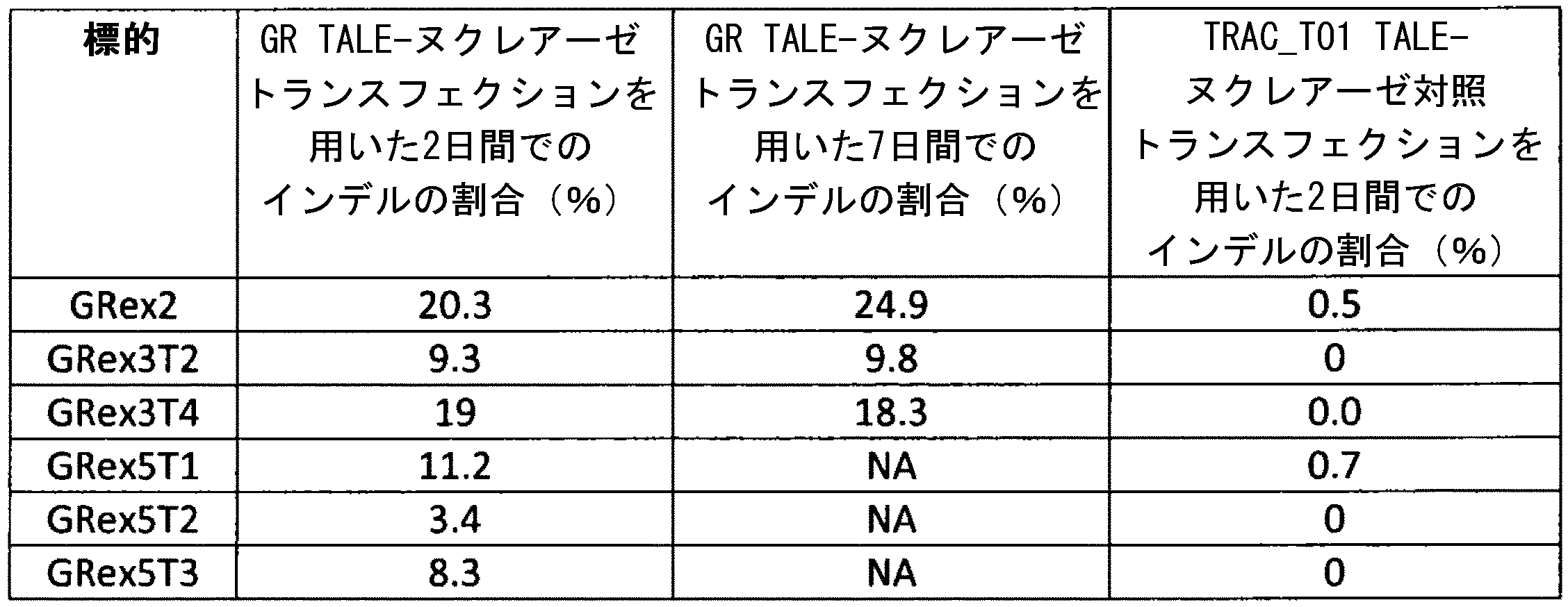
初代Tリンパ球におけるGR TALE-ヌクレアーゼの活性:
それぞれのTALE-ヌクレアーゼ構築物を、制限酵素消化を用いて、T7プロモーター制御下で、発現ベクターに入れてサブクローニングした。
Activity of GR TALE-nuclease in primary T lymphocytes:
Each TALE-nuclease construct was subcloned into an expression vector under T7 promoter control using restriction enzyme digestion.
GRゲノム配列を切断するTALE-ヌクレアーゼをコードするmRNAを、T7プロモーターの下流にコード配列を有する、それぞれのプラスミドから合成した。末梢血から単離したTリンパ球を、抗CD3/CD28アクチベータービーズ(Life technologies)を用いて5日間、活性化し、5百万個の細胞を、CytoLVT-P機器(BTX-Harvard apparatus)を用いてエレクトロポレーションによって、両方とも半TALE-ヌクレアーゼをコードする、それぞれ10μgの2つのmRNAでトランスフェクトした。CD52遺伝子を標的とする、両方とも半TALE-ヌクレアーゼをコードする、それぞれ10μgの2つのmRNA(CD52_T02-Lおよび-R TALEN(SEQ ID NO:55および56)、標的配列CD52_T02 SEQ ID NO:40)でトランスフェクトしたT細胞を対照として使用した。 The mRNA encoding the TALE-nuclease that cleaves the GR genomic sequence was synthesized from each plasmid having the coding sequence downstream of the T7 promoter. T lymphocytes isolated from peripheral blood were activated with anti-CD3 / CD28 activator beads (Life technologies) for 5 days, and 5 million cells were subjected to CytoLVT-P apparatus (BTX-Harvard apparatus). Using electroporation, both were transfected with 10 μg of two mRNAs encoding semi-TALE-nucleases. Two mRNAs of 10 μg each targeting the CD52 gene, both encoding semi-TALE-nucleases (CD52_T02-L and -R TALEN (SEQ ID NO: 55 and 56), target sequence CD52_T02 SEQ ID NO: 40) T cells transfected with the above were used as controls.
トランスフェクションの3日後および7日後に、トランスフェクトされた細胞からゲノムDNAを単離し、前記のプライマーを用いて遺伝子座特異的PCRを行った。PCR産物を454シークエンシングシステム(454 Life Sciences)によって配列決定した。PCR産物あたり約10,000個の配列を入手し、次いで、部位特異的な挿入事象または欠失事象の存在について分析した。結果は表5にある。
Genomic DNA was isolated from the transfected
(表5)初代Tリンパ球における内因性TALE-ヌクレアーゼ標的部位での標的変異誘発の割合(%)

実施例2:ヒトCD52遺伝子、ヒトT細胞受容体α定常鎖(TRAC)、ならびにヒトT細胞受容体β定常鎖1および2(TRBC)を切断するTALE-ヌクレアーゼ
実施例1に記載のように、CD52遺伝子を標的とするヘテロ二量体TALE-ヌクレアーゼ、TRAC遺伝子を標的とするヘテロ二量体TALE-ヌクレアーゼ、およびTRBC遺伝子を標的とするヘテロ二量体TALE-ヌクレアーゼを設計および作製した。標的とするゲノム配列は、11bpスペーサーまたは15bpスペーサーで分けられた2つの17bp長の配列(半標的と呼ぶ)からなる。それぞれの半標的は、表6に列挙した半TALE-ヌクレアーゼの反復によって認識される。ヒトゲノムは2つの機能的T細胞受容体β鎖(TRBC1およびTRBC2)を含有する。α/βTリンパ球が発達している間に、これらの2つの定常鎖のうちの1つが各細胞において選択されてTCR-β可変領域にスプライスされ、機能的完全長β鎖を形成する。対応するTALE-ヌクレアーゼがTRBC1およびTRBC2を両方とも同時に切断するように、2つのTRBC標的はTRBC1とTRBC2との間で保存された配列において選択された。
Example 2: TALE-nuclease that cleaves the human CD52 gene, the human T cell receptor α constant chain (TRAC), and the human T cell receptor β
(表6)CD52 TALE-ヌクレアーゼ、TRAC TALE-ヌクレアーゼ、およびTRBC TALE-ヌクレアーゼ、ならびに対応するヒト遺伝子内にあるTALE-ヌクレアーゼ標的部位の配列の説明

TRAC遺伝子およびCD52遺伝子の中にある他の標的配列が設計されており、表7に示した。 Other target sequences within the TRAC and CD52 genes have been designed and are shown in Table 7.
(表7)TRAC TALE-ヌクレアーゼおよびCD52 TALE-ヌクレアーゼのさらなる標的配列

HEK293細胞におけるCD52-TALE-ヌクレアーゼ、TRAC-TALE-ヌクレアーゼ、およびTRBC-TALE-ヌクレアーゼの活性
それぞれのTALE-ヌクレアーゼ構築物を、制限酵素消化を用いて、pEF1αロングプロモーター制御下で哺乳動物発現ベクターに入れてサブクローニングした。トランスフェクションの1日前に百万個のHEK293細胞を播種した。細胞を、EF1-αプロモーター制御下で、CD52遺伝子、T細胞受容体α定常鎖領域(TRAC)、もしくはT細胞受容体β定常鎖領域(TRBC)にある関心対象のゲノム配列内の2つの半標的を認識するTALE-ヌクレアーゼをコードする、それぞれ2.5μgの2つのプラスミド、または5μgの対照pUCベクター(pCLS0003)で、25μlのリポフェクタミン(Invitrogen)を用いて製造業者の説明書に従ってコトランスフェクトした。CD52コード配列またはTRACコード配列においてTALE-ヌクレアーゼによって生じる二本鎖切断は、生細胞では、エラープローン機構である非相同末端結合(NHEJ)によって修復される。生細胞におけるTALE-ヌクレアーゼの活性は、標的とされたゲノム遺伝子座での挿入または欠失の頻度によって測定される。トランスフェクションの48時間後に、トランスフェクトされた細胞からゲノムDNAを単離し、以下のプライマー:


(表8)CD52_T02、TRAC_T01、TRBC_T01、およびTRBC_T02標的を標的とするTALE-ヌクレアーゼについてのインデルの割合(%)

初代Tリンパ球におけるCD52-TALE-ヌクレアーゼ、TRBC-TALE-ヌクレアーゼ、およびTRAC-TALE-ヌクレアーゼの活性
それぞれのTALE-ヌクレアーゼ構築物を、制限酵素消化を用いて、T7プロモーター制御下で哺乳動物発現ベクターに入れてサブクローニングした。
Activity of CD52-TALE-nuclease, TRBC-TALE-nuclease, and TRAC-TALE-nuclease in primary T lymphocytes TALE-nuclease constructs from each of them into a mammalian expression vector under T7 promoter control using restriction enzyme digestion. It was put in and subcloned.
CD52、TRAC、およびTRBCゲノム配列を切断するTALE-ヌクレアーゼをコードするmRNAを、T7プロモーターから下流に、これらのコード配列を有するプラスミドから合成した。末梢血から単離したTリンパ球を、抗CD3/CD28アクチベータービーズ(Life technologies)を用いて5日間、活性化し、次いで、5百万個の細胞を、CytoLVT-P機器を用いてエレクトロポレーションによって、両方とも半TALE-ヌクレアーゼをコードする、それぞれ10μgの2つのmRNA(または対照として非コードRNA)でトランスフェクトした。NHEJによって誘導された挿入および欠失の結果として、CD52および/またはTRACのコード配列は細胞の一部においてフレーム外(out of frame)になり、その結果、遺伝子が機能しなくなる。エレクトロポレーションの5日後に、細胞表面にCD52またはTCRが存在するかどうかフローサイトメトリーによって、細胞を蛍光色素結合抗CD52抗体または抗TCR抗体で標識した。末梢血から増殖させた全てのTリンパ球は、通常、CD52およびTCRを発現するので、CD52陰性細胞またはTCR陰性細胞の割合はTALE-ヌクレアーゼ活性の直接の尺度である。代表的な実験の結果を表9に列挙した。表10は、TRBC TALE-ヌクレアーゼの効率を試験した代表的な実験の結果を示す。 MRNAs encoding TALE-nucleases that cleave the CD52, TRAC, and TRBC genomic sequences were synthesized from plasmids carrying these coding sequences downstream from the T7 promoter. T lymphocytes isolated from peripheral blood were activated with anti-CD3 / CD28 activator beads (Life technologies) for 5 days, then 5 million cells were electropopolated using a CytoLVT-P instrument. By ration, each was transfected with 10 μg of two mRNAs (or non-coding RNAs as a control), both encoding semi-TALE-nucleases. As a result of NHEJ-induced insertions and deletions, the CD52 and / or TRAC coding sequences are out of frame in parts of the cell, resulting in gene non-functioning. Five days after electroporation, cells were labeled with fluorescent dye-bound anti-CD52 or anti-TCR antibody by flow cytometry for the presence of CD52 or TCR on the cell surface. Since all T lymphocytes grown from peripheral blood usually express CD52 and TCR, the proportion of CD52-negative or TCR-negative cells is a direct measure of TALE-nuclease activity. The results of typical experiments are listed in Table 9. Table 10 shows the results of representative experiments testing the efficiency of TRBC TALE-nuclease.
(表9)対応するTALE-ヌクレアーゼ発現ポリヌクレオチドでトランスフェクトした後のCD52陰性Tリンパ球、TCR陰性Tリンパ球、およびCD52/TCR二重陰性Tリンパ球の割合(%)

(表10)TRBC TALE-ヌクレアーゼ発現ポリヌクレオチドでトランスフェクトした後のTCR陰性Tリンパ球の割合(%)

CD52遺伝子が標的化されたT細胞の機能分析
CD52遺伝子不活性化の目的は、Tリンパ球を抗CD52抗体を介した免疫抑制に対して耐性になるようにすることである。前段落に記載のように、Tリンパ球を、CD52を切断するTALE-ヌクレアーゼをコードするmRNAでトランスフェクトした。トランスフェクションの7日後に、細胞を、30%ウサギ補体(Cedarlane)と共に、または伴わずに、50μg/mlの抗CD52モノクローナル抗体(または対照としてラットIgG)で処理した。37℃で2時間インキュベートした後、細胞を、蛍光生死判別色素(eBioscience)と一緒に蛍光色素結合抗CD52抗体で標識し、生細胞間のCD52陽性細胞およびCD52陰性細胞の頻度を測定するためにフローサイトメトリーによって分析した。図6は代表的な実験の結果を示す。これから、CD52陰性細胞は補体媒介性抗CD52抗体毒性に対して完全に耐性があることが証明された。
Functional analysis of T cells targeted with the CD52 gene
The purpose of CD52 gene inactivation is to make T lymphocytes resistant to anti-CD52 antibody-mediated immunosuppression. As described in the previous paragraph, T lymphocytes were transfected with mRNA encoding a TALE-nuclease that cleaves CD52. Seven days after transfection, cells were treated with 50 μg / ml anti-CD52 monoclonal antibody (or rat IgG as a control) with or without 30% rabbit complement (Cedarlane). After incubating at 37 ° C for 2 hours, cells are labeled with a fluorescent dye-binding anti-CD52 antibody with a fluorescent dye-binding anti-CD52 antibody to measure the frequency of CD52-positive and CD52-negative cells among live cells. Analyzed by flow cytometry. Figure 6 shows the results of a typical experiment. This proved that CD52-negative cells were completely resistant to complement-mediated anti-CD52 antibody toxicity.
TRAC遺伝子が標的化されたT細胞の機能分析
TRAC遺伝子不活性化の目的は、Tリンパ球をT細胞受容体刺激に反応しなくなるようにすることである。前段落に記載のように、Tリンパ球を、TRACまたはCD52を切断するTALE-ヌクレアーゼをコードするmRNAでトランスフェクトした。トランスフェクションの16日後に、細胞を、T細胞受容体を介して作用するT細胞マイトジェンである5μg/mlまでのフィトヘマグルチニン(PHA, Sigma-Aldrich)で処理した。機能的T細胞受容体をもつ細胞のサイズはPHA処理後に大きくなるはずである。3日間インキュベートした後に、細胞を蛍光色素結合抗CD52または抗TCR抗体で標識し、TCR陽性細胞とTCR陰性細胞との間またはCD52陽性細胞とCD52陰性細胞との間で細胞サイズ分布を比較するためにフローサイトメトリーによって分析した。図7は、TCR陽性細胞のサイズがPHA処理後に著しく大きくなるのに対して、TCR陰性細胞のサイズが未処理細胞と同一であることを示す。このことから、TRAC不活性化によって細胞はTCRシグナル伝達に反応しなくなることが分かる。対照的に、CD52陽性およびCD52陰性のサイズは同程度まで大きくなる。
Functional analysis of T cells targeted by the TRAC gene
The purpose of TRAC gene inactivation is to prevent T lymphocytes from responding to T cell receptor stimulation. As described in the previous paragraph, T lymphocytes were transfected with mRNA encoding a TALE-nuclease that cleaves TRAC or CD52. 16 days after transfection, cells were treated with phytohaemagglutinin (PHA, Sigma-Aldrich) up to 5 μg / ml, a T cell mitogen that acts via the T cell receptor. The size of cells with functional T cell receptors should increase after PHA treatment. After incubating for 3 days, cells are labeled with fluorescent dye-bound anti-CD52 or anti-TCR antibody to compare cell size distribution between TCR-positive and TCR-negative cells or between CD52-positive and CD52-negative cells. Was analyzed by flow cytometry. FIG. 7 shows that the size of TCR-positive cells is significantly larger after PHA treatment, whereas the size of TCR-negative cells is the same as untreated cells. This indicates that TRAC inactivation causes cells to become unresponsive to TCR signaling. In contrast, the size of CD52 positive and CD52 negative grows to the same extent.
CD52遺伝子およびTRAC遺伝子が標的化されたT細胞の機能分析
キメラ抗原受容体(CAR)が提供されたときに、T細胞の抗腫瘍活性を示す能力がゲノム操作によって影響を受けなかったことを検証するために、本発明者らは、CD52-TALE-ヌクレアーゼおよびTRAC-TALE-ヌクレアーゼで標的化されているT細胞を、抗CD19 CARをコードするRNA(SEQ ID NO:73)10μgでトランスフェクトした。24時間後に、T細胞をCD19発現ダウジ細胞と4時間インキュベートした。Tリンパ球による細胞傷害性顆粒放出(脱顆粒と呼ぶ)のマーカーであるCD107aの細胞表面アップレギュレーションをフローサイトメトリー分析によって測定した(Betts, Brenchley et al. 2003)。結果を図8に含めた。この結果から、CD52陰性/TCRαβ陰性細胞およびCD52陽性/TCRαβ陽性は、PMA/イオノマイシン(正の対照)またはCD19+ダウジ細胞に応答して脱顆粒する能力が同じであることが分かる。CD107アップレギュレーションはCD19+の存在に依存する。これらのデータから、T細胞の、制御された抗腫瘍応答を開始する能力はゲノム操作によって悪影響を受けないことが示唆される。
Functional analysis of T cells targeted for the CD52 and TRAC genes Validated that genomic manipulation did not affect the ability of T cells to exhibit antitumor activity when chimeric antigen receptors (CARs) were provided. To this end, we transfected T cells targeted with CD52-TALE-nuclease and TRAC-TALE-nuclease with 10 μg of RNA (SEQ ID NO: 73) encoding anti-CD19 CAR. .. After 24 hours, T cells were incubated with CD19-expressing Daudi cells for 4 hours. The cell surface upregulation of CD107a, a marker of cytotoxic granule release (called degranulation) by T lymphocytes, was measured by flow cytometric analysis (Betts, Brenchley et al. 2003). The results are included in Figure 8. The results show that CD52-negative / TCRαβ-negative cells and CD52-positive / TCRαβ-positive cells have the same ability to degranulate in response to PMA / ionomycin (a positive control) or CD19 + Daudi cells. CD107 upregulation depends on the presence of CD19 +. These data suggest that T cells' ability to initiate a controlled antitumor response is not adversely affected by genomic manipulation.
初代Tリンパ球におけるCD52-TALE-ヌクレアーゼおよびTRAC-TALE-ヌクレアーゼのゲノム安全性
本発明者らの構築物はヌクレアーゼサブユニットを含むので、重要な疑問は、複数のTALE-ヌクレアーゼトランスフェクションによって、遺伝毒性および「ぴったり一致する(close match)」標的配列でのオフターゲット切断または半TALE-ヌクレアーゼの誤対合が生じる可能性があるかどうかである。細胞ゲノムの完全性に及ぼすTRAC-TALE-ヌクレアーゼおよびCD52-TALE-ヌクレアーゼの影響を評価するために、本発明者らは、オフサイト切断の可能性を示すヒトゲノム内配列を列挙した。このリストを作成するために、本発明者らは、オリジナルの半標的と比較して4個までの置換を有するゲノム内配列を全て特定し、次いで、互いに9~30bpのスペーサーのある、ヘッドトゥーヘッド方向の潜在的な半標的ペアを特定した。この分析は、1種類の半TALE-ヌクレアーゼ分子からなるホモ二量体、または1種類のCD52半TALE-ヌクレアーゼおよび1種類のTRAC半TALE-ヌクレアーゼによって形成されるヘテロ二量体によって潜在的に標的化される部位を含んだ。本発明者らは、個々の置換のコストおよび置換の位置を考慮して特異性データに基づいて潜在的なオフサイト標的をスコア付けした(半標的の3'末端にある塩基のミスマッチの方が許容される)。本発明者らは切断の可能性の推定値を反映するスコアをもつ173個のユニークな配列を入手した。本発明者らは、上位15位のスコアを選択し、CD52 TALE-ヌクレアーゼおよびTRAC TALE-ヌクレアーゼで同時にトランスフェクトし、CD52陰性、TCRαβ陰性として磁気分離によって精製したT細胞において、ディープシークエンシングによって、これらの遺伝子座において発見された変異の頻度を分析した。結果は図9にある。挿入/欠失の最高頻度は7x10-4である。これらの結果から、推定オフサイト標的が変異している可能性は、意図された標的の少なくとも1/600であることが分かる。従って、この研究において使用したTALE-ヌクレアーゼ試薬は極めて特異的であるように思われる。
Genome Safety of CD52-TALE-nuclease and TRAC-TALE-nuclease in primary T lymphocytes Since our constructs contain nuclease subunits, an important question is genetic toxicity by multiple TALE-nuclease transfections. And whether off-target cleavage or semi-TALE-nuclease mismatch can occur at the "close match" target sequence. To assess the effects of TRAC-TALE-nuclease and CD52-TALE-nuclease on the integrity of the cellular genome, we enumerate sequences within the human genome that indicate the potential for offsite cleavage. To create this list, we identified all in-genome sequences with up to 4 substitutions compared to the original semi-target, then head-to-head with spacers of 9-30 bp each other. A potential semi-target pair in the head direction was identified. This analysis is potentially targeted by a homodimer consisting of one half TALE-nuclease molecule, or a heterodimer formed by one CD52 half TALE-nuclease and one TRAC half TALE-nuclease. Includes the site to be transformed. We scored potential off-site targets based on specificity data, taking into account the cost of individual substitutions and the location of substitutions (mismatch of bases at the 3'end of the semi-target is better. Permissible). We have obtained 173 unique sequences with scores that reflect estimates of cleavage potential. We selected the top 15 scores, co-transfected with CD52 TALE-nuclease and TRAC TALE-nuclease, and purified by magnetic separation as CD52-negative, TCRαβ-negative by deep sequencing. The frequency of mutations found at these loci was analyzed. The results are shown in Figure 9. The highest frequency of insertions / deletions is 7x10 -4 . These results indicate that the putative offsite target is likely to be mutated at least 1/600 of the intended target. Therefore, the TALE-nuclease reagent used in this study appears to be highly specific.
実施例3:ヒトCTLA4遺伝子を切断するTALE-ヌクレアーゼおよびヒトPDCD1遺伝子を切断するTALE-ヌクレアーゼ
実施例1に記載のように、PDCD1遺伝子を標的とするヘテロ二量体TALE-ヌクレアーゼおよびCTLA4遺伝子を標的とするヘテロ二量体TALE-ヌクレアーゼを設計および作製した。標的となるゲノム配列は、11bpスペーサーまたは15bpスペーサーで分けられた2つの17bp長の配列(半標的と呼ぶ)からなる。それぞれの半標的は、表11に列挙した半TALE-ヌクレアーゼの反復によって認識される。
Example 3: TALE-nuclease that cleaves the human CTLA4 gene and TALE-nuclease that cleaves the human PDCD1 gene Target the heterodimer TALE-nuclease and CTLA4 gene that target the PDCD1 gene as described in Example 1. The heterodimer TALE-nuclease was designed and prepared. The target genomic sequence consists of two 17 bp long sequences (called semi-targets) separated by 11 bp spacers or 15 bp spacers. Each semi-target is recognized by the iteration of the semi-TALE-nuclease listed in Table 11.
(表11)CTLA4 TALE-ヌクレアーゼおよびPDCD1 TALE-ヌクレアーゼならびに対応するヒト遺伝子内にあるTALE-ヌクレアーゼ標的部位の配列の説明

HEK293細胞におけるCTLA4-TALE-ヌクレアーゼおよびPDCD1-TALE-ヌクレアーゼの活性
それぞれのTALE-ヌクレアーゼ構築物を、制限酵素消化を用いて、pEF1αロングプロモーター制御下で哺乳動物発現ベクターに入れてサブクローニングした。トランスフェクションの1日前に百万個のHEK293細胞を播種した。細胞を、EF1-αプロモーター制御下で、PDCD1遺伝子およびCTLA-4遺伝子にある関心対象のゲノム配列内の2つの半標的を認識するTALE-ヌクレアーゼをコードする、それぞれ2.5μgの2つのプラスミド、または5μgの対照pUCベクター(pCLS0003)で、25μlのリポフェクタミン(Invitrogen)を用いて製造業者の説明書に従ってコトランスフェクトした。
Activity of CTLA4-TALE-nuclease and PDCD1-TALE-nuclease in HEK293 cells The respective TALE-nuclease constructs were subcloned into a mammalian expression vector under the control of the pEF1α long promoter using restriction enzyme digestion. One million HEK293 cells were seeded 1 day prior to transfection. Two plasmids, 2.5 μg each, encoding TALE-nucleases that recognize cells under the control of the EF1-α promoter, two semi-targets within the genomic sequences of interest in the PDCD1 and CTLA-4 genes, or A 5 μg control pUC vector (pCLS0003) was co-transfected with 25 μl lipofectamine (Invitrogen) according to the manufacturer's instructions.
PDCD1コード配列またはCTLA-4コード配列においてTALE-ヌクレアーゼによって生じる二本鎖切断は、生細胞では、エラープローン機構である非相同末端結合(NHEJ)によって修復される。生細胞におけるTALE-ヌクレアーゼの活性は、標的とされたゲノム遺伝子座での挿入または欠失の頻度によって測定される。トランスフェクションの48時間後に、トランスフェクトされた細胞からゲノムDNAを単離し、以下のプライマー:









PCR産物をT7-エンドヌクレアーゼアッセイによって分析した。簡単に述べると、PCR産物の変性および再アニーリング後に、T7エンドヌクレアーゼは、野生型鎖および変異鎖で構成されるミスマッチDNAを特異的に消化する。次いで、消化産物をポリアクリルアミドゲル電気泳動によって分離する。消化産物の存在は、TALE-ヌクレアーゼによって誘導された変異配列を示している。結果を図10に示した。図10の矢印は、消化されたPCR産物を示している。PDCD1_T1、PDCD1_T3、CTLA4_T1、CTLA4_T3、およびCTLA4_T4 TALE-ヌクレアーゼは全て、これらの標的部位において変異原性ヌクレアーゼ活性を示すことが証明された。 PCR products were analyzed by T7-endonuclease assay. Briefly, after denaturation and reannealing of PCR products, T7 endonuclease specifically digests mismatched DNA composed of wild-type and mutant strands. The digest product is then separated by polyacrylamide gel electrophoresis. The presence of digested products indicates a mutant sequence induced by TALE-nuclease. The results are shown in Fig. 10. The arrows in FIG. 10 indicate digested PCR products. PDCD1_T1, PDCD1_T3, CTLA4_T1, CTLA4_T3, and CTLA4_T4 TALE-nucleases were all demonstrated to exhibit mutagenic nuclease activity at these target sites.
初代T細胞におけるCTLA4不活性化:
ヒト初代T細胞をCD3/28ビーズによって活性化した。5日後に、CTLA4遺伝子について設計された3種類のTALEN(商標)(T1、T2、およびT3)のうちの1つをコードするRNA 20μgを用いて、または対照としてRNAを用いずに5x10⁶個の細胞をエレクトロポレーション処理した。エレクトロポレーションの3日後に、蛍光抗体を用いた細胞内染色およびフローサイトメトリー分析によってCTLA4発現を測定した(図27および図28)。
CTLA4 inactivation in primary T cells:
Primary human T cells were activated by CD3 / 28 beads. After 5 days, 5x10 6 pieces with 20 μg RNA encoding one of the three TALEN ™ (T1, T2, and T3) designed for the CTLA4 gene, or without RNA as a control. Cells were electroporated. Three days after electroporation, CTLA4 expression was measured by intracellular staining with fluorescent antibody and flow cytometric analysis (FIGS. 27 and 28).
3種類全てのTALEN(商標)は、HEK293細胞株での効率と相互に関係する形でCTLA4発現のダウンレギュレーションを誘導した(T1はT3およびT4より効率が高かった)。 All three TALEN ™ induced downregulation of CTLA4 expression in an interrelated manner with efficiency in the HEK293 cell line (T1 was more efficient than T3 and T4).
454技術(Roche)を用いた、トランスフェクト細胞から単離したゲノムDNAのディープシークエンシング分析から、TALEN T1処理細胞ではCTLA4対立遺伝子の96%が変異していたのに対して、TALENを用いなかった対照試料では0.1%が変異していたことが明らかになった。 Deep sequencing analysis of genomic DNA isolated from transfected cells using 454 technique (Roche) showed that 96% of CTLA4 alleles were mutated in TALEN T1-treated cells, whereas TALEN was not used. It was revealed that 0.1% of the control samples were mutated.
初代T細胞におけるPD1不活性化:
ヒト初代T細胞をCD3/28ビーズによって活性化した。5日後に、ヒトPD1遺伝子に特異的な2種類のTALENのうちの1つをコードするRNA 20μgを用いて、または対照としてRNAを用いずに5x10⁶個の細胞をエレクトロポレーション処理した。10日後に細胞を再活性化し、再活性化の3日後に、蛍光抗体を用いた表面染色およびフローサイトメトリー分析によってPD1発現を測定した(図29を参照されたい)。
PD1 inactivation in primary T cells:
Primary human T cells were activated by CD3 / 28 beads. Five days later, 5x10 6 cells were electroporated with 20 μg RNA encoding one of the two TALENs specific for the human PD1 gene, or without RNA as a control. Cells were reactivated 10 days later and PD1 expression was measured by surface staining and flow cytometric analysis with
両TALENともPD1発現の大幅なダウンレギュレーションを誘導した。454技術(Roche)を用いてTALEN T1でトランスフェクトした細胞およびTALEN T03でトランスフェクトした細胞から単離したゲノムDNAのディープシークエンシング分析から、それぞれ、PD1対立遺伝子の34%および39%が変異していたことが明らかになった(結果を図30に示した)。 Both TALENs induced a significant downregulation of PD1 expression. From deep sequencing analysis of genomic DNA isolated from TALEN T1-transfected cells and TALEN T03-transfected cells using 454 technology (Roche), 34% and 39% of PD1 alleles were mutated, respectively. It became clear that it was (results are shown in Figure 30).
PD1-TALEN処理細胞における抗腫瘍活性の上昇:
ヒト初代T細胞をCD3/28ビーズによって活性化した。5日後に、ヒトPD1遺伝子に特異的なTALENをコードするRNA 20μgを用いて、または対照としてRNAを用いずに5x10⁶個の細胞をエレクトロポレーション処理した。一週間後、ヒトCD19に特異的なキメラ抗原受容体をコードするmRNAを用いて、または負の対照としてRNAを用いずに細胞をエレクトロポレーション処理した。翌日、CD19+ダウジ細胞(対して対照としてK562)、またはCD19発現ベクターが形質導入されたPD1リガンド1(PDL1)を発現するHCT116細胞(対して対照として親HCT116細胞)を用いた細胞傷害性アッセイにおいて前記細胞の抗腫瘍活性を測定した。標的細胞および対照細胞の生存率を比較することによって細胞傷害活性を求めた。結果を図31の図に示した。PD1 TALENトランスフェクションは、PDL1発現HCT116細胞に対する細胞傷害活性を報告し、ダウジ細胞に対する細胞傷害活性を改善した。
Increased antitumor activity in PD1-TALEN treated cells:
Primary human T cells were activated by CD3 / 28 beads. Five days later, 5x10 6 cells were electroporated with 20 μg of RNA encoding TALEN specific for the human PD1 gene or without RNA as a control. One week later, cells were electroporated with mRNA encoding a chimeric antigen receptor specific for human CD19 or without RNA as a negative control. The next day, in a cytotoxic assay using CD19 + Daudi cells (as opposed to K562 as a control) or HCT116 cells expressing PD1 ligand 1 (PDL1) transduced with a CD19 expression vector (as opposed to parental HCT116 cells). The antitumor activity of the cells was measured. Cytotoxic activity was determined by comparing the viability of target cells and control cells. The results are shown in Figure 31. PD1 TALEN transfection reported cytotoxic activity against PDL1-expressing HCT116 cells and improved cytotoxic activity against Daudi cells.
実施例4:pTαは不活性化TCRαTリンパ球におけるCD3表面発現を可能にする:
様々なプレTαバージョンの説明:
ヒトpTα遺伝子は、細胞外Ig様ドメイン、疎水性膜貫通ドメイン、および大きなC末端細胞質内テールを含む膜貫通糖タンパク質をコードする。ヒトpTα糖タンパク質に由来する様々なバージョンが設計されており、表12に説明し、図11に示した。
Example 4: pTα enables CD3 surface expression in inactivated TCRαT lymphocytes:
Description of various pre-Tα versions:
The human pTα gene encodes a transmembrane glycoprotein containing an extracellular Ig-like domain, a hydrophobic transmembrane domain, and a large C-terminal intracytoplasmic tail. Various versions derived from human pTα glycoprotein have been designed, described in Table 12 and shown in Figure 11.
(表12)pTα構築物のサブセットの説明

試験した様々なプレTα構築物には以下が含まれる。
1)pTα欠失変異体:ヒトpTαタンパク質の細胞内細胞質テール(114アミノ酸を含む)に様々な欠失を作製した(SEQ ID NO:107)。試験した構築物には、タンパク質の完全長バージョン(FL)、ならびにタンパク質のC末端から18個、48個、62個、78個、92個、110個、および114個のアミノ酸が欠失された変異体(SEQ ID NO:108~SEQ ID NO:114)が含まれる。
2)細胞内活性化ドメインを含有するpTα変異体:C末端においてCD8、CD28、または41BBの細胞内活性化ドメインと融合したFLおよびΔ48変種(SEQ ID NO:115~SEQ ID NO:120)。
3)pTα/TCRαキメラ変異体:構築物のうちの1つでは、TCRα細胞内ドメイン(IC)をpTαのテールレスバージョン(Δ114)と融合させた(SEQ ID NO:121)。pTα細胞外ドメインを、TCRαに由来する膜貫通(TM)ドメインおよびICドメインと融合させた第2の構築物も作製した(SEQ ID NO:122)。
4)pTα二量体化変異体:いくつかの変異が、プレTCR複合体のオリゴマー化/二量体化能力を変えることができると文献において記載されている。これらの変異体は、構成的シグナル伝達を誘導することなく(プレTCRオリゴマー化の際に誘導されると考えられる)、細胞表面でのプレTCR発現を可能にすると提唱された。これらの変異はpTαΔ48変種に導入されており、
-1xMUT: W46R(SEQ ID NO:123)
-4xMUT: D22A、K24A、R102A、R117A(SEQ ID NO:124)
である。
The various pre-Tα constructs tested include:
1) pTα deletion mutants: Various deletions were made in the intracellular cytoplasmic tail (including 114 amino acids) of human pTα protein (SEQ ID NO: 107). The constructs tested included the full-length version of the protein (FL), as well as mutations lacking 18, 48, 62, 78, 92, 110, and 114 amino acids from the C-terminus of the protein. The body (SEQ ID NO: 108 to SEQ ID NO: 114) is included.
2) PTα mutants containing intracellular activation domains: FL and Δ48 variants fused with the intracellular activation domains of CD8, CD28, or 41BB at the C-terminus (SEQ ID NO: 115-SEQ ID NO: 120).
3) pTα / TCRα chimeric mutant: In one of the constructs, the TCRα intracellular domain (IC) was fused with the tailless version of pTα (Δ114) (SEQ ID NO: 121). A second construct was also created in which the pTα extracellular domain was fused with a TCRα-derived transmembrane (TM) domain and an IC domain (SEQ ID NO: 122).
4) pTα dimerization mutants: Several mutations have been described in the literature to be able to alter the oligomerization / dimerization capacity of the pre-TCR complex. It was proposed that these mutants allow pre-TCR expression on the cell surface without inducing constitutive signaling (which is believed to be induced during pre-TCR oligomerization). These mutations have been introduced into the pTαΔ48 variant and have been introduced.
-1xMUT: W46R (SEQ ID NO: 123)
-4xMUT: D22A, K24A, R102A, R117A (SEQ ID NO: 124)
Is.
TRAC不活性化ジャーカット細胞にける様々なプレTα構築物の活性
TCRα不活性化ジャーカット細胞においてCD3表面発現を回復させる能力について様々なpTα変種をスクリーニングするために、TRACを標的とするTALENを用いてTCRα遺伝子が破壊された細胞株を作製した。ジャーカット細胞(T細胞白血病細胞株)を、CytoPulseエレクトロポレーションを用いて、TRACを切断するTALENをコードするプラスミドでトランスフェクトし、次いで、KO細胞(TCRα/β
NEG; CD3NEG)を、CD3磁気ビーズを用いた負の選択によって精製した。KO集団(JKT_KOx3細胞)を増幅し、様々なpTα変種のスクリーニングに使用した。百万個のJKT_KOx3細胞を、EF1αプロモーターの制御下で様々なpTα変種をコードするプラスミド15μgでトランスフェクトし、トランスフェクションの48時間後にCD3細胞表面発現のフローサイトメトリー分析を行うことによってスクリーニングを行った。図12は、フローサイトメトリーによって確かめたCD3+細胞の割合(%)に基づく、JKT_KOx3細胞におけるFL、Δ18、およびΔ48p Tα構築物のトランスフェクション効率(BFP+細胞の%)および活性の代表例である。様々な構築物からの結果を表13にグループ分けした。
Activity of various pre-Tα constructs in TRAC-inactivated Jarkat cells
To screen for various pTα variants for their ability to restore CD3 surface expression in TCRα-inactivated Jarkat cells, TRAC-targeted TALEN was used to generate TCRα gene-disrupted cell lines. Jarkat cells (T-cell leukemia cell line) are transfected with a plasmid encoding TALEN that cleaves TRAC using CytoPulse electroporation, followed by KO cells (TCR α / β NEG ; CD3 NEG ). Purified by negative selection with CD3 magnetic beads. The KO population (JKT_KOx3 cells) was amplified and used to screen for various pTα variants. One million JKT_KOx3 cells were screened by transfecting with 15 μg of plasmid encoding various pTα variants under the control of the EF1α promoter and performing flow cytometric analysis of CD3 cell surface expression 48 hours after transfection. rice field. FIG. 12 is a representative example of transfection efficiency (% of BFP + cells) and activity of FL, Δ18, and Δ48p Tα constructs in JKT_KOx3 cells based on the percentage of CD3 + cells confirmed by flow cytometry. Results from various structures were grouped in Table 13.
(表13)TCRα不活性化ジャーカット細胞における様々なpTα構築物の活性。様々なプレTα構築物でトランスフェクトしたTCRα不活性化ジャーカット細胞において、CD3発現のフローサイトメトリー分析によって活性を測定した。

TCRα不活性化初代Tリンパ球におけるpTα-FLおよびpTα-Δ48の活性:
pTα-FLおよびpTα-Δ48バージョンがTCRα不活性化Tリンパ球においてCD3表面発現を誘導する能力を試験するために、pTα-FLコード配列およびpTα-Δ48コード配列を、SFFVプロモーター下で青色蛍光タンパク質(BFP)をコードし、それに続いて自己切断T2Aペプチドをコードする自己不活性化pLV-SFFV-BFP-2A-PCTRAレンチウイルスベクターに入れてクローニングした(図13)。
Activity of pTα-FL and pTα-Δ48 in TCRα-inactivated primary T lymphocytes:
To test the ability of pTα-FL and pTα-Δ48 versions to induce CD3 surface expression in TCRα-inactivated T lymphocytes, the pTα-FL and pTα-Δ48 coding sequences were subjected to the blue fluorescent protein under the SFFV promoter. (BFP) was encoded and subsequently cloned into a self-inactivating pLV-SFFV-BFP-2A-PCTRA lentiviral vector encoding a self-cleaving T2A peptide (Fig. 13).
末梢血から単離したTリンパ球を、抗CD3/CD28アクチベータービーズ(Life technologies)を用いて72時間、活性化した。450万個の細胞を、CytoLVT-S機器(BTX-Harvard Harbour)を用いてエレクトロポレーションによって、TCRα定常鎖領域(TRAC)を標的とするTALE-ヌクレアーゼをコードするmRNA 10μgでトランスフェクトした。エレクトロポレーションの2日後に、T細胞に、LV-SFFV-BFP-2A-pTα-Δ48またはLV-SFFV-BFP-2A-対照レンチウイルスベクターを形質導入した。次いで、抗CD3磁気ビーズ(Miltenyi Biotech)を用いて、CD3陰性T細胞およびCD3low 細胞を精製した。この実験プロトコールを図14Aに示した。 T lymphocytes isolated from peripheral blood were activated with anti-CD3 / CD28 activator beads (Life technologies) for 72 hours. 4.5 million cells were transfected with 10 μg of mRNA encoding the TALE-nuclease targeting the TCRα constant chain region (TRAC) by electroporation using a CytoLVT-S instrument (BTX-Harvard Harbor). Two days after electroporation, T cells were transduced with the LV-SFFV-BFP-2A-pTα-Δ48 or LV-SFFV-BFP-2A-control lentiviral vector. CD3 negative T cells and CD3 low cells were then purified using anti-CD3 magnetic beads (Miltenyi Biotech). This experimental protocol is shown in Figure 14A.
図14Bは、CD3ビーズによる精製前および精製後の、BFP-2A-pTαΔ48(KO/Δ48)または対照BFPレンチウイルスベクター(KO/BFP)が形質導入されたTCRα不活性化T細胞(KO)における、TCRα/β、CD3細胞表面発現、およびBFP発現のフローサイトメトリー分析を表す。BFP-T2A-pTα-Δ48ベクターが形質導入されたTCRα不活性化細胞(BFP+細胞)は非形質導入細胞(BFP-細胞)と比較して高レベルのCD3を示す。対照BFPベクターが形質導入された細胞間で差違は観察されない。これらの結果から、pTαはTCRα不活性化細胞の細胞表面におけるCD3発現の回復を媒介することが分かる。対照的に、TCRα/β染色は、予想した通り、pTα-Δ48発現ベクターが形質導入された細胞でもpTα-Δ48発現ベクターが形質導入されていない細胞でも変わらない。 FIG. 14B shows TCRα-inactivated T cells (KO) transduced with BFP-2A-pTαΔ48 (KO / Δ48) or control BFP lentiviral vector (KO / BFP) before and after purification with CD3 beads. , TCRα / β, CD3 cell surface expression, and BFP expression flow cytometric analysis. TCRα-inactivated cells (BFP + cells) transduced with the BFP-T2A-pTα-Δ48 vector show higher levels of CD3 compared to non-transduced cells (BFP-cells). No differences were observed between cells transduced with the control BFP vector. These results indicate that pTα mediates the restoration of CD3 expression on the cell surface of TCRα-inactivated cells. In contrast, TCRα / β staining, as expected, remains the same in cells transduced with the pTα-Δ48 expression vector and in cells not transduced with the pTα-Δ48 expression vector.
pTαを介したCD3発現はTCR欠損T細胞の活性化を支援する:
pTαが細胞活性化シグナルを伝達する能力を確かめるために、pTα-Δ48およびpTα-Δ48.41BBが形質導入されたTCRα不活性化T細胞における初期活性化マーカーおよび後期活性化マーカーの発現を分析した。pTα-Δ48およびpTα-Δ48.41BBが形質導入されたTCRα不活性化T細胞は前の項および図14Aに記載のように初代ヒトT細胞から作製した。
CD3 expression mediated by pTα supports activation of TCR-deficient T cells:
To determine the ability of pTα to transduce cell activation signals, we analyzed the expression of early and late activation markers in TCRα-inactivated T cells transduced with pTα-Δ48 and pTα-Δ48.41BB. .. TCRα-inactivated T cells transduced with pTα-Δ48 and pTα-Δ48.41BB were generated from primary human T cells as described in the previous section and FIG. 14A.
CD3を介したシグナル伝達を検出するために、CD3ビーズを用いてTCRα不活性化T細胞を精製して3日後に、抗CD3/CD28コーティングビーズを用いて細胞を再活性化した(図14A)。細胞を、再活性化の24時間後に蛍光色素結合抗CD69(初期活性化マーカー)で染色し、再活性化の48時間後に抗CD25(後期活性化マーカー)で染色し、フローサイトメトリーによって分析した(図15A~B)。図15A~Bに示したように、pTα-Δ48を発現するTCRα不活性化細胞(KO/pTα-Δ48)またはpTα-Δ48.41BBを発現するTCRα不活性化細胞(KO/pTα-Δ48.BB)は、TCRα/βを発現する細胞(NEP:非エレクトロポレーション処理細胞)において観察されるレベルと同様のレベルまで活性化マーカーのアップレギュレーションを示す。
To detect CD3-mediated signal transduction, TCRα-inactivated T cells were purified with CD3 beads and reactivated with anti-CD3 / CD28 coated
T細胞活性化の別の指標は、「ブラスティング(blasting)」と呼ばれることもある細胞サイズの拡大である。プレTCR複合体が「ブラスティング」を誘導する能力は、抗CD3/CD28-ビーズを用いて再活性化した72時間後に細胞サイズをフローサイトメトリー分析することによって測定した(図15C)。抗CD3/CD28ビーズによる刺激は、TCRα/β複合体を発現する細胞対pTα-Δ48またはpTα-Δ48.41BBを発現する細胞において同等の細胞サイズ拡大を誘導した。まとめると、これらの結果から、プレTCR複合体は、活性化マーカーアップレギュレーションを媒介する機構と効率的につながるシグナルを伝達する能力があることが示唆される。 Another indicator of T cell activation is an increase in cell size, sometimes referred to as "blasting." The ability of the pre-TCR complex to induce "blasting" was measured by flow cytometric analysis of cell size 72 hours after reactivation with anti-CD3 / CD28-beads (Fig. 15C). Stimulation with anti-CD3 / CD28 beads induced equivalent cell size expansion in cells expressing the TCRα / β complex vs. cells expressing pTα-Δ48 or pTα-Δ48.41BB. Taken together, these results suggest that the pre-TCR complex is capable of transmitting signals that efficiently link to mechanisms that mediate activation marker upregulation.
pTαを介したCD3発現は、刺激性抗CD3/CD28抗体を用いたTCR欠損初代T細胞の増殖を支援する
プレTCR複合体が長期細胞増殖を支援する能力を評価するために、以前に述べたように作製した細胞の増殖を測定した。初回活性化の10日後に、IL2(非再活性化)の中で、またはIL2と抗CD3/CD28ビーズ(再活性化)の中で細胞を維持した。それぞれの条件について、細胞を計数し、BFP+細胞の数を評価するために様々な時点でフローサイトメトリーによって分析した。BFPまたはBFP-T2A-プレTCRα-Δ48ベクターが形質導入されたTCRα不活性化細胞(KO)の増殖を比較し、これらの細胞の誘導倍率を、再活性化後、2日目に得られた値に対して評価した。図16は2人の無関係のドナーから入手した結果を示す。両方の場合において、pTα-Δ48を発現するTCRα不活性化細胞は、BFP対照ベクターだけ発現するTCRα不活性化細胞より多くの増殖を示した。2人目のドナーについては、pTα-Δ48.41BBまたは完全長pTαを発現するTCRα不活性化細胞も含めた。これらも、BFP対照ベクターだけ発現するTCRα不活性化細胞より多くの増殖を示した。
CD3 expression mediated by pTα was previously mentioned to assess the ability of the pre-TCR complex to support proliferation of TCR-deficient primary T cells with stimulating anti-CD3 / CD28 antibodies to support long-term cell proliferation. The proliferation of the cells prepared as described above was measured. Cells were maintained in IL2 (non-reactivated) or in IL2 and anti-CD3 / CD28 beads (reactivated) 10 days after initial activation. For each condition, cells were counted and analyzed by flow cytometry at various time points to assess the number of BFP + cells. The proliferation of TCRα-inactivated cells (KO) transduced with the BFP or BFP-T2A-pre-TCRα-Δ48 vector was compared and the induction rate of these cells was obtained 2 days after reactivation. Evaluated against the value. Figure 16 shows the results obtained from two unrelated donors. In both cases, TCRα-inactivated cells expressing pTα-Δ48 showed more proliferation than TCRα-inactivated cells expressing only the BFP control vector. For the second donor, TCRα-inactivated cells expressing pTα-Δ48.41BB or full-length pTα were also included. These also showed more proliferation than TCRα-inactivated cells expressing only the BFP control vector.
実施例5:Cytopulse技術を用いたT細胞におけるmRNAトランスフェクションの最適化
最適化されたcytopulseプログラムの決定
細胞をトランスフェクトすることができる電圧範囲を求めるために、非活性化PBMCに対して第1のセットの実験を行った。表14に記載のように5つの異なるプログラムを試験した。
Example 5: Optimization of mRNA transfection in T cells using Cytopulse technology
Determining an optimized cytopulse program
A first set of experiments was performed on deactivated PBMCs to determine the voltage range in which cells could be transfected. Five different programs were tested as described in Table 14.
(表14)PBMC由来T細胞におけるエレクトロポレーションに必要な最低電圧を求めるのに使用した様々なcytopulseプログラム
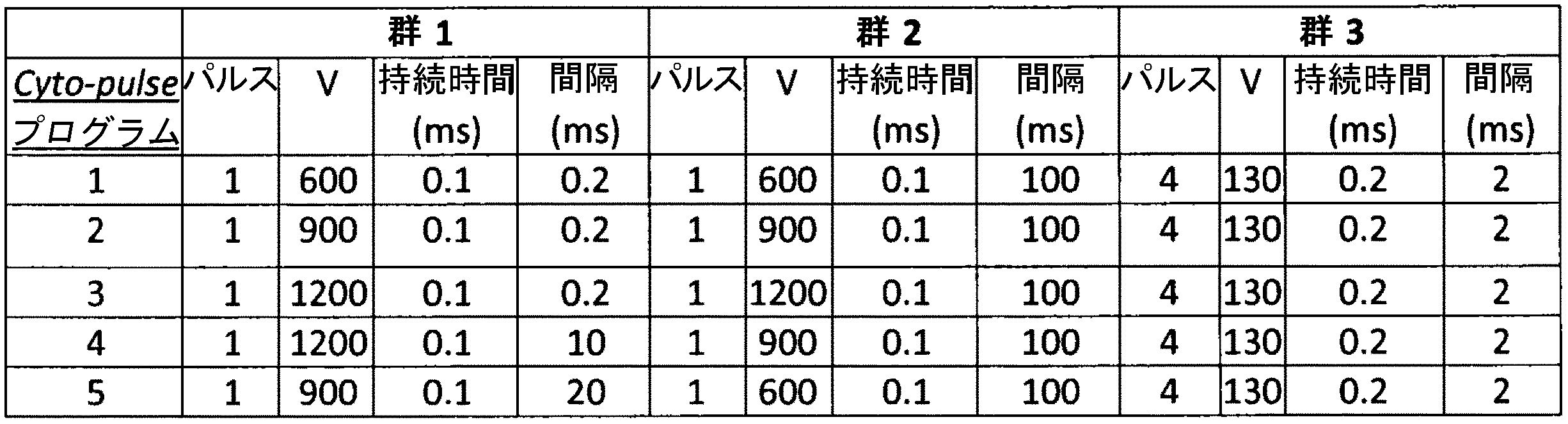
3百万個または6百万個の細胞を、0.4cmギャップ(gap)キュベット(30x106または15x106細胞/ml)に入れて、GFPをコードするプラスミドおよび対照プラスミドpUC20μgと様々なCytopulseプログラムを用いてエレクトロポレーション処理した。エレクトロポレーションの24時間後に、トランスフェクション効率を求めるために、GFP発現をフローサイトメトリーによってエレクトロポレーション処理細胞において分析した。図17に示したデータは、PBMC由来T細胞におけるプラスミドエレクトロポレーションに必要な最低電圧を示している。これらの結果から、cytopulseプログラム3および4は効率的なT細胞形質転換を可能にすることが証明された(EP#3および#4)。
3 or 6 million cells were placed in a 0.4 cm gap (gap) cuvette (30x10 6 or 15x10 6 cells / ml) using a GFP-encoding plasmid and
活性化した精製T細胞へのmRNAのエレクトロポレーション
T細胞の効率的なDNAエレクトロポレーションを可能にする最良のcytopulseプログラムを決定した後に、本発明者らは、この方法がmRNAエレクトロポレーションに適用可能かどうかを試験した。
Electroporation of mRNA into activated purified T cells
After determining the best cytopulse program that enables efficient DNA electroporation of T cells, we tested whether this method is applicable to mRNA electroporation.
PHA/IL2によって6日間、予め活性化した5x106個の精製T細胞をcytoporation buffer T(BTX-Harvard apparatus)に再懸濁し、0.4cmキュベットに入れて、GFPをコードするmRNA 10μgまたはGFPをコードするプラスミドもしくはpUC 20μgと、前の項において決定した好ましいcytopulseプログラムを用いてエレクトロポレーション処理した(表15)。
Pre-activated 5x10 6 purified T cells with PHA / IL2 were resuspended in cytoporation buffer T (BTX-Harvard apparatus) and placed in a 0.4 cm cuvette to encode GFP-encoding
(表15)精製T細胞をエレクトロポレーション処理するために使用したCytopulseプログラム

トランスフェクションの48時間後に、細胞を生死判別色素(eFluor-450)で染色し、細胞の生存率および生GFP+細胞の割合(%)をフローサイトメトリー分析によって求めた(図18)。 Forty-eight hours after transfection, cells were stained with a life-and-death discriminant dye (eFluor-450) and cell viability and live GFP + cell percentage (%) were determined by flow cytometric analysis (FIG. 18).
図18に示したデータから、ここで確かめられた最適条件を用いたRNAエレクトロポレーションは毒性が無く、生細胞の95%超をトランスフェクトできることが分かる。 From the data shown in FIG. 18, it can be seen that RNA electroporation using the optimum conditions confirmed here is non-toxic and can transfect more than 95% of living cells.
合成において、全データセットから、T細胞をDNAまたはRNAで効率的にトランスフェクトできることが分かる。特に、RNAトランスフェクションは細胞の生存率に影響を及ぼさず、細胞集団における関心対象のトランスフェクトされた遺伝子の均一な発現レベルを可能にする。 In synthesis, the entire dataset shows that T cells can be efficiently transfected with DNA or RNA. In particular, RNA transfection does not affect cell viability and allows uniform expression levels of the transfected gene of interest in the cell population.
効率的なトランスフェクションは、使用した活性化方法(PHA/IL-2またはCD3/CD28コーティング-ビーズ)とは独立して、細胞活性化後、早い時点で成し遂げることができる。本発明者らは、活性化の72時間後から>95%の効率で細胞をトランスフェクトすることに成功した。加えて、同じエレクトロポレーションプロトコールを用いて、解凍および活性化後の効率的なT細胞トランスフェクションも得ることができる。 Efficient transfection can be accomplished early after cell activation, independent of the activation method used (PHA / IL-2 or CD3 / CD28 coating-beads). We have succeeded in transfecting cells with an efficiency of> 95% from 72 hours after activation. In addition, the same electroporation protocol can be used to obtain efficient T cell transfection after thawing and activation.
TALE-ヌクレアーゼ機能的発現のための初代ヒトT細胞におけるmRNAエレクトロポレーション
mRNAエレクトロポレーションによって初代ヒトT細胞においてGFPを効率的に発現できることが証明された後に、本発明者らは、この方法が関心対象の他のタンパク質の発現に適用可能かどうかを試験した。転写アクチベーター様エフェクターヌクレアーゼ(TALE-ヌクレアーゼ)は、TAL DNA結合ドメインとDNA切断ドメインとの融合によって作製された部位特異的ヌクレアーゼである。これらは、実質的に任意の望ましいDNA配列において二本鎖切断を誘導するので強力なゲノム編集ツールである。これらの二本鎖切断は、エラープローンDNA修復機構である非相同末端結合(NHEJ)を活性化し、これによって、潜在的に、関心対象の任意の望ましい遺伝子が不活性化される。または、十分な修復テンプレートが細胞に同時に導入されるのであれば、TALE-ヌクレアーゼによって誘導されるDNA切断は相同組換えによって修復することができ、従って、遺伝子配列を好きなように改変する可能性が生じる。
TALE-nuclease mRNA electroporation in primary human T cells for functional expression
After demonstrating that mRNA electroporation can efficiently express GFP in primary human T cells, we tested whether this method could be applied to the expression of other proteins of interest. Transcription activator-like effector nucleases (TALE-nucleases) are site-specific nucleases made by fusion of a TAL DNA binding domain with a DNA cleavage domain. These are powerful genome editing tools as they induce double-strand breaks in virtually any desired DNA sequence. These double-strand breaks activate non-homologous end joining (NHEJ), an error-prone DNA repair mechanism, which potentially inactivates any desired gene of interest. Alternatively, if sufficient repair templates are simultaneously introduced into the cell, the TALE-nuclease-induced DNA cleavage can be repaired by homologous recombination, and thus the gene sequence may be modified as desired. Occurs.
本発明者らは、T細胞抗原受容体α鎖(TRAC)をコードするヒト遺伝子内の配列を特異的に切断するように設計されたTALE-ヌクレアーゼを発現させるためにmRNAエレクトロポレーションを使用した。この配列に含まれる変異は、遺伝子不活性化および細胞表面からのTCRαβ複合体の消失をもたらすと予想される。TRAC TALE-ヌクレアーゼRNAまたは対照として非コードRNAを、Cytopulse技術を用いて活性化初代ヒトTリンパ球にトランスフェクトした。エレクトロポレーションの順序は、表15に記載のように1200Vの2回のパルスに続いて130Vの4回のパルスからなった。 We used mRNA electroporation to express a TALE-nuclease designed to specifically cleave a sequence within a human gene encoding the T cell antigen receptor α chain (TRAC). .. Mutations contained in this sequence are expected to result in gene inactivation and loss of the TCRαβ complex from the cell surface. TRAC TALE-nuclease RNA or non-coding RNA as a control was transfected into activated primary human T lymphocytes using Cytopulse technology. The order of electroporation consisted of two pulses of 1200V followed by four pulses of 130V as shown in Table 15.
エレクトロポレーションして7日後のTCR表面発現のフローサイトメトリー分析によって(図19、上パネル)、本発明者らは、T細胞の44%がTCRαβ発現を失ったことを観察した。本発明者らは、TRAC遺伝子座のPCR増幅、その後に454ハイスループットシークエンシングによって、トランスフェクトされた細胞のゲノムDNAを分析した。配列決定された対立遺伝子のうち33%(2153のうち727)がTALE-ヌクレアーゼ切断部位に挿入または欠失を含んでいた。図19(下パネル)は、変異した対立遺伝子の例を示す。
By flow cytometric analysis of
これらのデータから、cytopulse技術を用いたmRNAエレクトロポレーションによってTRAC TALE-ヌクレアーゼが機能的に発現することが分かる。 From these data, it can be seen that TRAC TALE-nuclease is functionally expressed by mRNA electroporation using cytopulse technology.
抗CD19単鎖キメラ抗原受容体(CAR)をコードするモノシストロニックmRNAを用いたT細胞のエレクトロポレーション:
抗CD3/CD28コーティングビーズおよびIL2によって数日間(3~5日間)、予め活性化した5X106個のT細胞をcytoporation buffer Tに再懸濁し、0.4cmキュベットに入れて、mRNA無しで、または単鎖CARをコードするmRNA(SEQ ID NO:73)10μgと表15に記載のプログラムを用いてエレクトロポレーション処理した。
Electroporation of T cells with monocistronic mRNA encoding anti-CD19 single-stranded chimeric antigen receptor (CAR):
Pre-activated 5X10 6 T cells were resuspended in cytoporation buffer T for several days (3-5 days) with anti-CD3 / CD28 coated beads and IL2 and placed in a 0.4 cm cuvette, without mRNA or simply. It was electroporated using 10 μg of mRNA encoding strand CAR (SEQ ID NO: 73) and the program shown in Table 15.
エレクトロポレーションの24時間後に、細胞を、固定可能な生死判別色素eFluor-780、および生細胞上のCARの細胞表面発現を評価するために特異的なPE結合ヤギ抗マウスIgGF(ab')2断片で染色した。データを図20に示した。Aは、前記のモノシストロニックmRNAでエレクトロポレーション処理した生T細胞の圧倒的多数が表面にCARを発現することを示している。エレクトロポレーションの24時間後に、T細胞をダウジ(CD19+)細胞と6時間、共培養し、表面における脱顆粒マーカーCD107aの発現を検出するためにフローサイトメトリーによって分析した(Betts, Brenchley et al. 2003)。
Twenty-four hours after electroporation, cells are immobilized on the life-and-death discriminant dye eFluor-780, and PE-bound goat anti-mouse IgGF (ab') 2 specific for assessing cell surface expression of CAR on living cells. Stained with fragments. The data is shown in Figure 20. A indicates that the overwhelming majority of live T cells electroporated with the monocistronic mRNA described above express CAR on the surface.
図20に示したデータから、前記のモノシストロニックmRNAでエレクトロポレーション処理した細胞の大多数は、CD19を発現する標的細胞の存在下で脱顆粒することが分かる。これらの結果から、エレクトロポレーション処理済みT細胞の表面に発現したCARには活性があることがはっきりと証明された。 From the data shown in FIG. 20, it can be seen that the majority of cells electroporated with the monocistronic mRNA described above are degranulated in the presence of target cells expressing CD19. These results clearly demonstrated that CAR expressed on the surface of electroporated T cells was active.
抗CD19マルチサブユニットキメラ抗原受容体(CAR)をコードするポリシストロニックmRNAを用いたT細胞のエレクトロポレーション:
抗CD3/CD28コーティングビーズおよびIL2によって数日間(3~5日間)、予め活性化した5X106個のT細胞をcytoporation buffer T中でエレクトロポレーション処理し、0.4cmキュベットに入れて、mRNA無しで、または多鎖CARをコードするmRNA(SEQ ID NO:126によってコードされるSEQ ID NO:125、図21Aおよび図4B(csm4))45μgと表15に記載のプログラムを用いてエレクトロポレーション処理した。
Electroporation of T cells with polycistronic mRNA encoding anti-CD19 multi-subunit chimeric antigen receptor (CAR):
Pre-activated 5X10 6 T cells electroporated in cytoporation buffer T for several days (3-5 days) with anti-CD3 / CD28 coated beads and IL2 and placed in a 0.4 cm cuvette without mRNA. , Or mRNA encoding multi-chain CAR (SEQ ID NO: 125 encoded by SEQ ID NO: 126, FIG. 21A and FIG. 4B (csm4)) 45 μg and electroporated using the program described in Table 15. ..
エレクトロポレーションの24時間後に、細胞を、固定可能な生死判別色素eFluor-780、および生細胞上のCARの細胞表面発現を評価するために特異的なPE結合ヤギ抗マウスIgGF(ab')2断片で染色した。図21に示したデータから、前記のポリシストロニックmRNAでエレクトロポレーション処理した生T細胞の圧倒的多数は表面にCARを発現することが分かる。 Twenty-four hours after electroporation, cells are immobilized on the life-and-death discriminant dye eFluor-780, and PE-bound goat anti-mouse IgGF (ab') 2 specific for assessing cell surface expression of CAR on living cells. Stained with fragments. From the data shown in FIG. 21, it can be seen that the overwhelming majority of live T cells electroporated with the above-mentioned polycistronic mRNA express CAR on the surface.
エレクトロポレーションの24時間後に、T細胞をダウジ(CD19+)と6時間、共培養し、表面における脱顆粒マーカーCD107aの発現を検出するためにフローサイトメトリーによって分析した。図21に示したデータから、前記のポリシストロニックmRNAでエレクトロポレーション処理した細胞の大多数は、CD19を発現する標的細胞の存在下で脱顆粒することが分かる。これらの結果から、エレクトロポレーション処理済みT細胞の表面に発現したCARには活性があることがはっきりと証明された。
T cells were co-cultured with Daudi (CD19 + ) for 6
説明において引用された参考文献のリスト



Claims (9)
-T細胞受容体(TCR)の成分をコードする第2の遺伝子
を不活性化することによってヒトT細胞を遺伝子改変する工程を含む、免疫療法のためにヒトT細胞を調製する方法であって、該遺伝子改変が、
(a)-PD1をコードする前記遺伝子、および
-T細胞受容体(TCR)の1つの成分をコードする少なくとも1種類の遺伝子
をそれぞれDNA切断によって選択的に不活性化することができる少なくとも1種類のレアカッティングエンドヌクレアーゼを前記T細胞に導入し、
(b)該T細胞にキメラ抗原受容体(CAR)を導入し、かつ
(c)該T細胞をインビトロで増殖させる
ことによって実施される、前記方法。 For immunotherapy, including the step of genetically modifying human T cells by inactivating the first gene encoding PD1 and the second gene encoding a component of the T cell receptor (TCR). A method for preparing human T cells, wherein the genetic modification
(a) At least one gene that encodes -PD1 and at least one gene that encodes one component of the -T cell receptor (TCR), each of which can be selectively inactivated by DNA cleavage. Introduced the rare cutting endonuclease of the above into the T cell,
(b) Introduce the chimeric antigen receptor (CAR) into the T cells and
(c) said method, performed by growing the T cells in vitro.
Priority Applications (1)
| Application Number | Priority Date | Filing Date | Title |
|---|---|---|---|
| JP2021182495A JP7479339B2 (en) | 2013-05-13 | 2021-11-09 | Methods for engineering allogeneic and hyperactive T cells for immunotherapy - Patents.com |
Applications Claiming Priority (8)
| Application Number | Priority Date | Filing Date | Title |
|---|---|---|---|
| PCT/US2013/040766 WO2013176916A1 (en) | 2012-05-25 | 2013-05-13 | Use of pre t alpha or functional variant thereof for expanding tcr alpha deficient t cells |
| PCT/US2013/040755 WO2013176915A1 (en) | 2012-05-25 | 2013-05-13 | Methods for engineering allogeneic and immunosuppressive resistant t cell for immunotherapy |
| USPCT/US2013/040755 | 2013-05-13 | ||
| USPCT/US2013/040766 | 2013-05-13 | ||
| US13/892,805 US11603539B2 (en) | 2012-05-25 | 2013-05-13 | Methods for engineering allogeneic and immunosuppressive resistant T cell for immunotherapy |
| US13/892,805 | 2013-05-13 | ||
| US13/942,191 | 2013-07-15 | ||
| US13/942,191 US20150017136A1 (en) | 2013-07-15 | 2013-07-15 | Methods for engineering allogeneic and highly active t cell for immunotherapy |
Related Parent Applications (1)
| Application Number | Title | Priority Date | Filing Date |
|---|---|---|---|
| JP2016513480A Division JP6875124B2 (en) | 2013-05-13 | 2014-05-13 | Methods for Manipulating Allogeneic and Highly Active T Cells for Immunotherapy |
Related Child Applications (1)
| Application Number | Title | Priority Date | Filing Date |
|---|---|---|---|
| JP2021182495A Division JP7479339B2 (en) | 2013-05-13 | 2021-11-09 | Methods for engineering allogeneic and hyperactive T cells for immunotherapy - Patents.com |
Publications (3)
| Publication Number | Publication Date |
|---|---|
| JP2019176869A JP2019176869A (en) | 2019-10-17 |
| JP2019176869A5 JP2019176869A5 (en) | 2020-04-16 |
| JP6998917B2 true JP6998917B2 (en) | 2022-02-04 |
Family
ID=51897833
Family Applications (3)
| Application Number | Title | Priority Date | Filing Date |
|---|---|---|---|
| JP2016513480A Active JP6875124B2 (en) | 2013-05-13 | 2014-05-13 | Methods for Manipulating Allogeneic and Highly Active T Cells for Immunotherapy |
| JP2019114231A Active JP6998917B2 (en) | 2013-05-13 | 2019-06-20 | Methods for Manipulating Allogeneic and Highly Active T Cells for Immunotherapy |
| JP2021182495A Active JP7479339B2 (en) | 2013-05-13 | 2021-11-09 | Methods for engineering allogeneic and hyperactive T cells for immunotherapy - Patents.com |
Family Applications Before (1)
| Application Number | Title | Priority Date | Filing Date |
|---|---|---|---|
| JP2016513480A Active JP6875124B2 (en) | 2013-05-13 | 2014-05-13 | Methods for Manipulating Allogeneic and Highly Active T Cells for Immunotherapy |
Family Applications After (1)
| Application Number | Title | Priority Date | Filing Date |
|---|---|---|---|
| JP2021182495A Active JP7479339B2 (en) | 2013-05-13 | 2021-11-09 | Methods for engineering allogeneic and hyperactive T cells for immunotherapy - Patents.com |
Country Status (13)
| Country | Link |
|---|---|
| US (2) | US20150017136A1 (en) |
| EP (2) | EP2997132B1 (en) |
| JP (3) | JP6875124B2 (en) |
| KR (3) | KR20230144570A (en) |
| CN (1) | CN105378068A (en) |
| AU (1) | AU2014266830B2 (en) |
| BR (1) | BR112015028493A2 (en) |
| CA (1) | CA2912373A1 (en) |
| DK (1) | DK2997132T3 (en) |
| ES (1) | ES2828669T3 (en) |
| MX (1) | MX380738B (en) |
| RU (1) | RU2736616C2 (en) |
| WO (1) | WO2014184741A1 (en) |
Families Citing this family (125)
| Publication number | Priority date | Publication date | Assignee | Title |
|---|---|---|---|---|
| EP2734621B1 (en) | 2011-07-22 | 2019-09-04 | President and Fellows of Harvard College | Evaluation and improvement of nuclease cleavage specificity |
| US20150017136A1 (en) * | 2013-07-15 | 2015-01-15 | Cellectis | Methods for engineering allogeneic and highly active t cell for immunotherapy |
| US20230050345A1 (en) * | 2013-05-13 | 2023-02-16 | Cellectis | Methods for engineering allogeneic and highly active t cell for immunotheraphy |
| US9163284B2 (en) | 2013-08-09 | 2015-10-20 | President And Fellows Of Harvard College | Methods for identifying a target site of a Cas9 nuclease |
| US9359599B2 (en) | 2013-08-22 | 2016-06-07 | President And Fellows Of Harvard College | Engineered transcription activator-like effector (TALE) domains and uses thereof |
| US9340800B2 (en) | 2013-09-06 | 2016-05-17 | President And Fellows Of Harvard College | Extended DNA-sensing GRNAS |
| US9526784B2 (en) | 2013-09-06 | 2016-12-27 | President And Fellows Of Harvard College | Delivery system for functional nucleases |
| US9322037B2 (en) | 2013-09-06 | 2016-04-26 | President And Fellows Of Harvard College | Cas9-FokI fusion proteins and uses thereof |
| JP2016536021A (en) | 2013-11-07 | 2016-11-24 | エディタス・メディシン,インコーポレイテッド | CRISPR-related methods and compositions with governing gRNA |
| US10357515B2 (en) * | 2013-11-22 | 2019-07-23 | Cellectis | Method for generating batches of allogeneic T-cells with averaged potency |
| US20150165054A1 (en) | 2013-12-12 | 2015-06-18 | President And Fellows Of Harvard College | Methods for correcting caspase-9 point mutations |
| EP3808410A1 (en) * | 2013-12-20 | 2021-04-21 | Cellectis | Method of engineering multi-input signal sensitive t cell for immunotherapy |
| CA2943008C (en) | 2014-03-19 | 2021-03-30 | Cellectis | Cd123 specific chimeric antigen receptors for cancer immunotherapy |
| CA2956224A1 (en) | 2014-07-30 | 2016-02-11 | President And Fellows Of Harvard College | Cas9 proteins including ligand-dependent inteins |
| AU2015339743C1 (en) | 2014-10-31 | 2021-04-22 | The Trustees Of The University Of Pennsylvania | Altering gene expression in modified T cells and uses thereof |
| US20180002435A1 (en) | 2015-01-26 | 2018-01-04 | Cellectis | mAb-DRIVEN CHIMERIC ANTIGEN RECEPTOR SYSTEMS FOR SORTING/DEPLETING ENGINEERED IMMUNE CELLS |
| AU2016214301B2 (en) * | 2015-02-06 | 2022-05-19 | Cellectis | Primary hematopoietic cells genetically engineered by slow release of nucleic acids using nanoparticles |
| KR20170137079A (en) | 2015-03-11 | 2017-12-12 | 셀렉티스 | Manipulation of allogeneic T cells to increase their persistence and / or transplantation methods into patients |
| CN115537396A (en) * | 2015-03-27 | 2022-12-30 | 哈佛学院校长同事会 | Modified T cells and methods of making and using the same |
| JP6921001B2 (en) | 2015-04-13 | 2021-08-18 | ファイザー・インク | Chimeric antigen receptor that targets B cell maturation antigens |
| US10441644B2 (en) | 2015-05-05 | 2019-10-15 | The Regents Of The University Of California | H3.3 CTL peptides and uses thereof |
| CN107921148A (en) | 2015-05-08 | 2018-04-17 | 哈佛学院校长同事会 | Universal donor stem cells and related methods |
| MX2017015239A (en) * | 2015-05-29 | 2018-02-19 | Juno Therapeutics Inc | COMPOSITION AND METHODS TO REGULATE INHIBITORY INTERACTIONS IN GENETICALLY MODIFIED CELLS. |
| WO2017001572A1 (en) * | 2015-06-30 | 2017-01-05 | Cellectis | Methods for improving functionality in nk cell by gene inactivation using specific endonuclease |
| IL295616A (en) | 2015-07-31 | 2022-10-01 | Us Health | Modified cells and methods of therapy |
| EP4434589A3 (en) | 2015-10-23 | 2025-05-14 | President and Fellows of Harvard College | Evolved cas9 proteins for gene editing |
| IL259576B (en) | 2015-12-04 | 2022-09-01 | Novartis Ag | Grna molecule comprising tracr and crrna, pharmaceutical composition comprising same and method of preparing cells for immunotherapy |
| WO2017106528A2 (en) | 2015-12-18 | 2017-06-22 | Sangamo Biosciences, Inc. | Targeted disruption of the t cell receptor |
| EA201891641A1 (en) | 2016-01-21 | 2019-01-31 | Пфайзер Инк. | CHEMICAL ANTIGENOUS RECEPTORS AIMED AT OPTION III RECEPTOR EPIDERMAL GROWTH FACTOR |
| WO2017178585A1 (en) | 2016-04-15 | 2017-10-19 | Cellectis | A method of engineering drug-specific hypersensitive t-cells for immunotherapy by gene inactivation |
| US11078481B1 (en) | 2016-08-03 | 2021-08-03 | KSQ Therapeutics, Inc. | Methods for screening for cancer targets |
| JP7231935B2 (en) | 2016-08-03 | 2023-03-08 | プレジデント アンド フェローズ オブ ハーバード カレッジ | Adenosine nucleobase editors and their uses |
| US11661590B2 (en) | 2016-08-09 | 2023-05-30 | President And Fellows Of Harvard College | Programmable CAS9-recombinase fusion proteins and uses thereof |
| MA46059A (en) * | 2016-08-23 | 2019-07-03 | Bluebird Bio Inc | HOMING TIM3 ENDONUCLEASE VARIANTS, COMPOSITIONS AND METHODS FOR USE |
| WO2018039438A1 (en) | 2016-08-24 | 2018-03-01 | President And Fellows Of Harvard College | Incorporation of unnatural amino acids into proteins using base editing |
| US11078483B1 (en) | 2016-09-02 | 2021-08-03 | KSQ Therapeutics, Inc. | Methods for measuring and improving CRISPR reagent function |
| ES2952525T3 (en) * | 2016-09-08 | 2023-11-02 | 2Seventy Bio Inc | PD-1 homing endonuclease variants, compositions and methods of use |
| CN109715199A (en) | 2016-09-14 | 2019-05-03 | 詹森生物科技公司 | Chimeric antigen receptor and application thereof comprising BCMA specificity type III fibronectin domain |
| CA3039797A1 (en) * | 2016-10-11 | 2018-04-19 | Minerva Biotechnologies Corporation | Humanized anti-muc1* antibodies and use of cleavage enzyme |
| AU2017342543B2 (en) | 2016-10-14 | 2024-06-27 | President And Fellows Of Harvard College | AAV delivery of nucleobase editors |
| EP4338799A3 (en) | 2016-10-18 | 2024-06-05 | Regents of the University of Minnesota | Tumor infiltrating lymphocytes and methods of therapy |
| WO2018073393A2 (en) | 2016-10-19 | 2018-04-26 | Cellectis | Tal-effector nuclease (talen) -modified allogenic cells suitable for therapy |
| WO2018119359A1 (en) | 2016-12-23 | 2018-06-28 | President And Fellows Of Harvard College | Editing of ccr5 receptor gene to protect against hiv infection |
| TW201839136A (en) | 2017-02-06 | 2018-11-01 | 瑞士商諾華公司 | Composition and method for treating hemochromatosis |
| ES2969213T3 (en) | 2017-02-15 | 2024-05-17 | 2Seventy Bio Inc | Donor repair templates for multiplex genome editing |
| CN110662556A (en) | 2017-03-09 | 2020-01-07 | 哈佛大学的校长及成员们 | Cancer vaccine |
| US11898179B2 (en) | 2017-03-09 | 2024-02-13 | President And Fellows Of Harvard College | Suppression of pain by gene editing |
| JP2020510439A (en) | 2017-03-10 | 2020-04-09 | プレジデント アンド フェローズ オブ ハーバード カレッジ | Base-editing factor from cytosine to guanine |
| CA3054621A1 (en) | 2017-03-22 | 2018-09-27 | Novartis Ag | Compositions and methods for immunooncology |
| WO2018176009A1 (en) | 2017-03-23 | 2018-09-27 | President And Fellows Of Harvard College | Nucleobase editors comprising nucleic acid programmable dna binding proteins |
| US11560566B2 (en) | 2017-05-12 | 2023-01-24 | President And Fellows Of Harvard College | Aptazyme-embedded guide RNAs for use with CRISPR-Cas9 in genome editing and transcriptional activation |
| US12296012B2 (en) | 2017-06-02 | 2025-05-13 | Pfizer Inc. | Chimeric antigen receptors targeting FLT3 |
| EP4302768A3 (en) * | 2017-06-22 | 2024-05-01 | Board Of Regents, The University Of Texas System | Methods for producing regulatory immune cells and uses thereof |
| SG10201705285SA (en) | 2017-06-27 | 2019-01-30 | Agency Science Tech & Res | Antisense oligonucleotides |
| EP3645021A4 (en) | 2017-06-30 | 2021-04-21 | Intima Bioscience, Inc. | ADENO-ASSOCIATED VIRAL VECTORS FOR GENE THERAPY |
| CA3067914A1 (en) | 2017-06-30 | 2019-01-03 | Cellectis | Cellular immunotherapy for repetitive administration |
| US11161897B2 (en) | 2017-07-17 | 2021-11-02 | Janssen Biotech, Inc. | Antigen binding regions against fibronectin type III domains and methods of using the same |
| WO2019016360A1 (en) | 2017-07-21 | 2019-01-24 | Cellectis | Engineered immune cells resistant to tumor microoenvironment |
| US11903968B2 (en) | 2017-07-21 | 2024-02-20 | Cellectis | Engineered immune cells resistant to tumor microenvironment |
| US11732274B2 (en) | 2017-07-28 | 2023-08-22 | President And Fellows Of Harvard College | Methods and compositions for evolving base editors using phage-assisted continuous evolution (PACE) |
| WO2019139645A2 (en) | 2017-08-30 | 2019-07-18 | President And Fellows Of Harvard College | High efficiency base editors comprising gam |
| CA3076337A1 (en) | 2017-09-19 | 2019-03-28 | Massachusetts Institute Of Technology | Compositions for chimeric antigen receptor t cell therapy and uses thereof |
| WO2019072824A1 (en) | 2017-10-09 | 2019-04-18 | Cellectis | Improved anti-cd123 car in universal engineered immune t cells |
| KR20200121782A (en) | 2017-10-16 | 2020-10-26 | 더 브로드 인스티튜트, 인코퍼레이티드 | Uses of adenosine base editor |
| WO2019078699A2 (en) * | 2017-10-20 | 2019-04-25 | 주식회사 파멥신 | Anti-vista antibody and use thereof |
| US11326156B2 (en) | 2017-11-01 | 2022-05-10 | Allogene Therapeutics, Inc. | Modified caspase-9 polypeptides and methods of use thereof |
| CN111556893A (en) * | 2017-11-06 | 2020-08-18 | 爱迪塔斯医药股份有限公司 | Methods, compositions, and components for CRISPR-CAS9 editing of CBLB in immunotherapy T cells |
| WO2019118508A1 (en) | 2017-12-12 | 2019-06-20 | The Trustees Of The University Of Pennsylvania | Genetically modified immune cells targeting ny-eso-1 and methods of use thereof |
| US12406749B2 (en) | 2017-12-15 | 2025-09-02 | The Broad Institute, Inc. | Systems and methods for predicting repair outcomes in genetic engineering |
| US20210002621A1 (en) * | 2017-12-20 | 2021-01-07 | Bluebird Bio, Inc. | Ctla4 homing endonuclease variants, compositions, and methods of use |
| WO2019129850A1 (en) | 2017-12-29 | 2019-07-04 | Cellectis | Off-the-shelf engineered cells for therapy |
| PE20210708A1 (en) | 2018-02-01 | 2021-04-16 | Pfizer | ANTIBODIES SPECIFIC TO CD70 AND THEIR USES |
| IL276396B2 (en) | 2018-02-01 | 2026-01-01 | Pfizer | Chimeric antigen receptors targeting cd70 |
| EP3759129A1 (en) | 2018-02-28 | 2021-01-06 | Pfizer Inc | Il-15 variants and uses thereof |
| JP2021518160A (en) | 2018-03-15 | 2021-08-02 | ケーエスキュー セラピューティクス, インコーポレイテッド | Gene Regulatory Compositions and Methods for Improving Immunotherapy |
| AU2019236204B2 (en) | 2018-03-15 | 2026-02-26 | KSQ Therapeutics, Inc. | Gene-regulating compositions and methods for improved immunotherapy |
| US12157760B2 (en) | 2018-05-23 | 2024-12-03 | The Broad Institute, Inc. | Base editors and uses thereof |
| EP3817767A1 (en) | 2018-07-02 | 2021-05-12 | Cellectis | Chimeric antigen receptors (car)-expressing cells and combination treatment for immunotherapy of patients with relapse refractory adverse genetic risk aml |
| US12522807B2 (en) | 2018-07-09 | 2026-01-13 | The Broad Institute, Inc. | RNA programmable epigenetic RNA modifiers and uses thereof |
| AU2019327913A1 (en) | 2018-08-29 | 2021-03-18 | Nanjing Legend Biotech Co., Ltd. | Anti-mesothelin chimeric antigen receptor (CAR) constructs and uses thereof |
| US12529041B2 (en) | 2018-09-07 | 2026-01-20 | Beam Therapeutics Inc. | Compositions and methods for delivering a nucleobase editing system |
| US12454694B2 (en) | 2018-09-07 | 2025-10-28 | Beam Therapeutics Inc. | Compositions and methods for improving base editing |
| US12460000B2 (en) | 2018-09-07 | 2025-11-04 | Itabmed (Hk) Limited | Anti-CD19 and anti-CD3 bispecific antigen binding proteins and uses thereof |
| CA3121855A1 (en) * | 2018-09-11 | 2020-03-19 | Board Of Regents, The University Of Texas System | A genetic mouse model of autoimmune adverse events and immune checkpoint blockade therapy |
| MX2021003435A (en) | 2018-09-28 | 2021-06-15 | Massachusetts Inst Technology | IMMUNOMODULATORY MOLECULES LOCATED IN COLLAGEN AND METHODS THEREOF. |
| WO2020092453A1 (en) | 2018-10-29 | 2020-05-07 | The Broad Institute, Inc. | Nucleobase editors comprising geocas9 and uses thereof |
| US20200268797A1 (en) | 2018-11-30 | 2020-08-27 | Janssen Biotech, Inc. | Gamma delta t cells and uses thereof |
| US12404500B2 (en) | 2018-12-10 | 2025-09-02 | Novo Nordisk A/S | Homing endonuclease variants |
| AU2019395334A1 (en) | 2018-12-10 | 2021-06-24 | Regeneron Pharmaceuticals, Inc. | PDCD-1 homing endonuclease variants |
| WO2020132810A1 (en) | 2018-12-24 | 2020-07-02 | Generon (Shanghai) Corporation Ltd. | Multispecific antigen binding proteins capable of binding cd19 and cd3, and use thereof |
| WO2020154500A1 (en) | 2019-01-23 | 2020-07-30 | The Broad Institute, Inc. | Supernegatively charged proteins and uses thereof |
| WO2020163365A2 (en) * | 2019-02-04 | 2020-08-13 | KSQ Therapeutics, Inc. | Combination gene targets for improved immunotherapy |
| EP3693974A1 (en) * | 2019-02-07 | 2020-08-12 | Koninklijke Philips N.V. | Identifying responsiveness to radio-immuno combination therapy |
| MX2021011426A (en) | 2019-03-19 | 2022-03-11 | Broad Inst Inc | METHODS AND COMPOSITIONS FOR EDITING NUCLEOTIDE SEQUENCES. |
| WO2020214842A1 (en) | 2019-04-17 | 2020-10-22 | The Broad Institute, Inc. | Adenine base editors with reduced off-target effects |
| US11642409B2 (en) | 2019-06-26 | 2023-05-09 | Massachusetts Insttute of Technology | Immunomodulatory fusion protein-metal hydroxide complexes and methods thereof |
| MX2022002363A (en) | 2019-08-27 | 2022-06-14 | Janssen Biotech Inc | Chimeric antigen receptor system and uses thereof. |
| WO2021061648A1 (en) | 2019-09-23 | 2021-04-01 | Massachusetts Institute Of Technology | Methods and compositions for stimulation of endogenous t cell responses |
| US12435330B2 (en) | 2019-10-10 | 2025-10-07 | The Broad Institute, Inc. | Methods and compositions for prime editing RNA |
| AU2020371562A1 (en) * | 2019-10-23 | 2022-06-09 | The Council Of The Queensland Institute Of Medical Research | Adoptive immunotherapy |
| PE20230173A1 (en) | 2020-03-03 | 2023-02-01 | Janssen Biotech Inc | T CELLS (gamma-delta) AND THEIR USES |
| WO2021183207A1 (en) | 2020-03-10 | 2021-09-16 | Massachusetts Institute Of Technology | COMPOSITIONS AND METHODS FOR IMMUNOTHERAPY OF NPM1c-POSITIVE CANCER |
| IL296242A (en) | 2020-03-10 | 2022-11-01 | Massachusetts Inst Technology | Methods for generating engineered memory-like nk cells and compositions thereof |
| US12433954B2 (en) | 2020-05-01 | 2025-10-07 | Massachusetts Institute Of Technology | Methods of activating anti-CD19 chimeric antigen receptor (CAR) T cells using amphiphilic ligand conjugates comprising CAR-targeting protein sequence motifs |
| US20210340524A1 (en) | 2020-05-01 | 2021-11-04 | Massachusetts Institute Of Technology | Methods for identifying chimeric antigen receptor-targeting ligands and uses thereof |
| WO2021226558A1 (en) | 2020-05-08 | 2021-11-11 | The Broad Institute, Inc. | Methods and compositions for simultaneous editing of both strands of a target double-stranded nucleotide sequence |
| CN116194488A (en) | 2020-07-21 | 2023-05-30 | 艾洛基治疗公司 | Chimeric antigen receptors with enhanced signaling and activity and uses thereof |
| WO2022067089A1 (en) | 2020-09-25 | 2022-03-31 | Beam Therapeutics Inc. | Fratricide resistant modified immune cells and methods of using the same |
| CN116635064A (en) | 2020-12-18 | 2023-08-22 | 世纪治疗股份有限公司 | A chimeric antigen receptor system with adaptive receptor specificity |
| AU2022224066A1 (en) * | 2021-02-19 | 2023-09-07 | Angeles Therapeutics, Inc. | Single-chain and multi-chain synthetic antigen receptors for diverse immune cells |
| BR112023018948A2 (en) * | 2021-03-19 | 2023-10-17 | Metagenomi Inc | MULTIPLEX EDITING WITH CAS ENZYMES |
| AR125199A1 (en) | 2021-03-23 | 2023-06-21 | Iovance Biotherapeutics Inc | CISH GENE EDITION OF TUMOR-INFILTRATING LYMPHOCYTES AND THEIR USES IN IMMUNOTHERAPY |
| EP4413031A1 (en) | 2021-10-06 | 2024-08-14 | Miltenyi Biotec B.V. & Co. KG | Method for targeted gene insertion into immune cells |
| WO2023081715A1 (en) | 2021-11-03 | 2023-05-11 | Viracta Therapeutics, Inc. | Combination of car t-cell therapy with btk inhibitors and methods of use thereof |
| EP4502177A4 (en) | 2022-03-24 | 2026-03-18 | Nanjing Legend Biotech Co Ltd | METHOD FOR PRODUCING A DNA LIBRARY AND DETECTING A RETROVIRAL INTEGRATION SITE |
| EP4504764A1 (en) | 2022-05-26 | 2025-02-12 | Caribou Biosciences, Inc. | Cytokine-receptor fusions for immune cell stimulation |
| US20250345424A1 (en) | 2022-06-06 | 2025-11-13 | Caribou Biosciences, Inc. | Treatment of autoimmune diseases with engineered immune cells |
| JP2025531877A (en) | 2022-09-09 | 2025-09-25 | アイオバンス バイオセラピューティクス,インコーポレイテッド | Process for generating TIL products using PD-1/TIGIT TALEN double knockdown |
| EP4583890A1 (en) | 2022-09-09 | 2025-07-16 | Iovance Biotherapeutics, Inc. | Processes for generating til products using pd-1/tigit talen double knockdown |
| WO2024088401A1 (en) * | 2022-10-28 | 2024-05-02 | CorrectSequence Therapeutics Co., Ltd | Gene editing systems and methods for reducing immunogenicity and graft versus host response |
| EP4584283A1 (en) | 2022-11-14 | 2025-07-16 | Caribou Biosciences, Inc. | Anti-cll-1 chimeric antigen receptors, engineered cells and related methods |
| KR20240076377A (en) | 2022-11-23 | 2024-05-30 | 가톨릭대학교 산학협력단 | A method for mass production of immune inhibitory T cells using human serum albumin |
| AU2024265453A1 (en) | 2023-05-01 | 2025-09-25 | Caribou Biosciences, Inc. | Treatment of autoimmune diseases with bcma-targeting engineered immune cells |
| WO2025171182A1 (en) | 2024-02-08 | 2025-08-14 | Iovance Biotherapeutics, Inc. | Treatment of cancer patients with tumor infiltrating lymphocyte therapies in combination with cancer vaccine |
| WO2025193386A1 (en) | 2024-03-13 | 2025-09-18 | Caribou Biosciences, Inc. | Treatment regimens for autoimmune disease with cd19-targeting engineered immune cells |
Citations (3)
| Publication number | Priority date | Publication date | Assignee | Title |
|---|---|---|---|---|
| US20110158957A1 (en) | 2009-11-10 | 2011-06-30 | Sangamo Biosciences, Inc. | Targeted disruption of T cell receptor genes using engineered zinc finger protein nucleases |
| WO2012068380A2 (en) | 2010-11-17 | 2012-05-24 | Sangamo Biosciences, Inc. | Methods and compositions for modulating pd1 |
| JP6875124B2 (en) | 2013-05-13 | 2021-05-19 | セレクティスCellectis | Methods for Manipulating Allogeneic and Highly Active T Cells for Immunotherapy |
Family Cites Families (31)
| Publication number | Priority date | Publication date | Assignee | Title |
|---|---|---|---|---|
| FR901228A (en) | 1943-01-16 | 1945-07-20 | Deutsche Edelstahlwerke Ag | Ring gap magnet system |
| US4474893A (en) | 1981-07-01 | 1984-10-02 | The University of Texas System Cancer Center | Recombinant monoclonal antibodies |
| US4683195A (en) | 1986-01-30 | 1987-07-28 | Cetus Corporation | Process for amplifying, detecting, and/or-cloning nucleic acid sequences |
| US6352694B1 (en) | 1994-06-03 | 2002-03-05 | Genetics Institute, Inc. | Methods for inducing a population of T cells to proliferate using agents which recognize TCR/CD3 and ligands which stimulate an accessory molecule on the surface of the T cells |
| US5858358A (en) | 1992-04-07 | 1999-01-12 | The United States Of America As Represented By The Secretary Of The Navy | Methods for selectively stimulating proliferation of T cells |
| US6905680B2 (en) | 1988-11-23 | 2005-06-14 | Genetics Institute, Inc. | Methods of treating HIV infected subjects |
| US6534055B1 (en) | 1988-11-23 | 2003-03-18 | Genetics Institute, Inc. | Methods for selectively stimulating proliferation of T cells |
| US7175843B2 (en) | 1994-06-03 | 2007-02-13 | Genetics Institute, Llc | Methods for selectively stimulating proliferation of T cells |
| US7067318B2 (en) | 1995-06-07 | 2006-06-27 | The Regents Of The University Of Michigan | Methods for transfecting T cells |
| US6692964B1 (en) | 1995-05-04 | 2004-02-17 | The United States Of America As Represented By The Secretary Of The Navy | Methods for transfecting T cells |
| US6010613A (en) | 1995-12-08 | 2000-01-04 | Cyto Pulse Sciences, Inc. | Method of treating materials with pulsed electrical fields |
| AU4328801A (en) | 2000-02-24 | 2001-09-03 | Xcyte Therapies Inc | Simultaneous stimulation and concentration of cells |
| US6867041B2 (en) | 2000-02-24 | 2005-03-15 | Xcyte Therapies, Inc. | Simultaneous stimulation and concentration of cells |
| US6797514B2 (en) | 2000-02-24 | 2004-09-28 | Xcyte Therapies, Inc. | Simultaneous stimulation and concentration of cells |
| US7572631B2 (en) | 2000-02-24 | 2009-08-11 | Invitrogen Corporation | Activation and expansion of T cells |
| GB0018901D0 (en) * | 2000-08-03 | 2000-09-20 | Biovation Ltd | Peptides presented by cells |
| WO2004067753A2 (en) | 2003-01-28 | 2004-08-12 | Cellectis | Use of meganucleases for inducing homologous recombination ex vivo and in toto in vertebrate somatic tissues and application thereof. |
| EP1620537B1 (en) | 2003-03-14 | 2012-10-24 | Cellectis SA | Large volume ex vivo electroporation method |
| EP1696956A4 (en) * | 2003-12-22 | 2007-08-01 | Genzyme Corp | Anti-cd52 antibody treatment for diabetes |
| JP6208580B2 (en) * | 2010-05-17 | 2017-10-04 | サンガモ セラピューティクス, インコーポレイテッド | Novel DNA binding protein and use thereof |
| CA2993567C (en) * | 2010-07-21 | 2022-06-28 | Sangamo Biosciences, Inc. | Methods and compositions for modification of a t-cell receptor gene |
| EP2633040B1 (en) | 2010-10-27 | 2019-07-10 | Cellectis | Method for increasing the efficiency of double-strand break-induced mutagenesis |
| CA3111953C (en) | 2011-04-05 | 2023-10-24 | Cellectis | Method for the generation of compact tale-nucleases and uses thereof |
| WO2013009525A1 (en) | 2011-07-08 | 2013-01-17 | Cellectis S.A. | Method for increasing the efficiency of double-strand break-induced mutagenssis |
| US20140309145A1 (en) | 2011-07-29 | 2014-10-16 | Cellectis Sa | High throughput method for assembly and cloning polynucleotides comprising highly similar polynucleotidic modules |
| JP6144691B2 (en) * | 2011-11-16 | 2017-06-07 | サンガモ セラピューティクス, インコーポレイテッド | Modified DNA binding proteins and uses thereof |
| WO2013074916A1 (en) * | 2011-11-18 | 2013-05-23 | Board Of Regents, The University Of Texas System | Car+ t cells genetically modified to eliminate expression of t- cell receptor and/or hla |
| SG10201806573TA (en) * | 2012-05-25 | 2018-09-27 | Cellectis | Methods for engineering allogeneic and immunosuppressive resistant t cell for immunotherapy |
| AU2013312838B2 (en) * | 2012-09-04 | 2018-11-29 | Cellectis | Multi-chain chimeric antigen receptor and uses thereof |
| AU2013329186B2 (en) * | 2012-10-10 | 2019-02-14 | Sangamo Therapeutics, Inc. | T cell modifying compounds and uses thereof |
| US10322774B2 (en) * | 2015-05-15 | 2019-06-18 | Oru Designs, Llc | Collapsible kayak with large cockpit |
-
2013
- 2013-07-15 US US13/942,191 patent/US20150017136A1/en not_active Abandoned
-
2014
- 2014-05-13 JP JP2016513480A patent/JP6875124B2/en active Active
- 2014-05-13 EP EP14727626.5A patent/EP2997132B1/en active Active
- 2014-05-13 BR BR112015028493A patent/BR112015028493A2/en not_active Application Discontinuation
- 2014-05-13 EP EP20190570.0A patent/EP3936612A1/en active Pending
- 2014-05-13 KR KR1020237030308A patent/KR20230144570A/en active Pending
- 2014-05-13 AU AU2014266830A patent/AU2014266830B2/en active Active
- 2014-05-13 DK DK14727626.5T patent/DK2997132T3/en active
- 2014-05-13 KR KR1020157035331A patent/KR102329704B1/en active Active
- 2014-05-13 US US14/889,686 patent/US11304975B2/en active Active
- 2014-05-13 RU RU2015153245A patent/RU2736616C2/en active
- 2014-05-13 CA CA2912373A patent/CA2912373A1/en active Pending
- 2014-05-13 WO PCT/IB2014/061409 patent/WO2014184741A1/en not_active Ceased
- 2014-05-13 MX MX2015015639A patent/MX380738B/en unknown
- 2014-05-13 ES ES14727626T patent/ES2828669T3/en active Active
- 2014-05-13 KR KR1020217037383A patent/KR20210143926A/en not_active Ceased
- 2014-05-13 CN CN201480039917.0A patent/CN105378068A/en active Pending
-
2019
- 2019-06-20 JP JP2019114231A patent/JP6998917B2/en active Active
-
2021
- 2021-11-09 JP JP2021182495A patent/JP7479339B2/en active Active
Patent Citations (3)
| Publication number | Priority date | Publication date | Assignee | Title |
|---|---|---|---|---|
| US20110158957A1 (en) | 2009-11-10 | 2011-06-30 | Sangamo Biosciences, Inc. | Targeted disruption of T cell receptor genes using engineered zinc finger protein nucleases |
| WO2012068380A2 (en) | 2010-11-17 | 2012-05-24 | Sangamo Biosciences, Inc. | Methods and compositions for modulating pd1 |
| JP6875124B2 (en) | 2013-05-13 | 2021-05-19 | セレクティスCellectis | Methods for Manipulating Allogeneic and Highly Active T Cells for Immunotherapy |
Non-Patent Citations (5)
| Title |
|---|
| J. Immunol. (2000) Vol.165, pp.5566-5572 |
| Mussolino C., et al.,A novel TALE nuclease scaffold enables high genome editing activity in combination with low toxicity,Nucleic Acids Res.,39(21)(2011),9283-9293 |
| Torikai H. et al.,A foundation for universal T-cell based immunotherapy: T cells engineered to express a CD19-specific chimeric-antigen-receptor and eliminate expression of endogenous TCR,Blood,119(24)(2012),5697-5705 |
| Torikai H., et al.,HLA and TCR knockout by zinc finger nucleases: Toward "off-the-shelf" allogeneic T-cell therapy for CD19+ Malignancies,Blood,116(21)(2010),Abstract Number: 3766. |
| Turtle CJ. et al,Engineered T cells for anti-cancer therapy.,Curr Opin Immunol.,24(5)(2012),633-639 |
Also Published As
| Publication number | Publication date |
|---|---|
| JP2019176869A (en) | 2019-10-17 |
| JP7479339B2 (en) | 2024-05-08 |
| JP2022031696A (en) | 2022-02-22 |
| US11304975B2 (en) | 2022-04-19 |
| MX380738B (en) | 2025-03-12 |
| DK2997132T3 (en) | 2020-11-09 |
| KR20230144570A (en) | 2023-10-16 |
| KR20210143926A (en) | 2021-11-29 |
| AU2014266830B2 (en) | 2020-07-02 |
| ES2828669T3 (en) | 2021-05-27 |
| JP6875124B2 (en) | 2021-05-19 |
| KR102329704B1 (en) | 2021-11-22 |
| KR20160029017A (en) | 2016-03-14 |
| CA2912373A1 (en) | 2014-11-20 |
| WO2014184741A1 (en) | 2014-11-20 |
| US20160120905A1 (en) | 2016-05-05 |
| BR112015028493A2 (en) | 2017-09-19 |
| AU2014266830A1 (en) | 2015-11-26 |
| EP2997132B1 (en) | 2020-08-12 |
| RU2015153245A3 (en) | 2018-03-01 |
| CN105378068A (en) | 2016-03-02 |
| US20150017136A1 (en) | 2015-01-15 |
| EP3936612A1 (en) | 2022-01-12 |
| JP2016520308A (en) | 2016-07-14 |
| RU2736616C2 (en) | 2020-11-19 |
| MX2015015639A (en) | 2016-10-28 |
| RU2015153245A (en) | 2017-06-21 |
| EP2997132A1 (en) | 2016-03-23 |
Similar Documents
| Publication | Publication Date | Title |
|---|---|---|
| JP6998917B2 (en) | Methods for Manipulating Allogeneic and Highly Active T Cells for Immunotherapy | |
| JP6991167B2 (en) | Methods for Manipulating Allogeneic and Immunosuppressive Resistant T Cells for Immunotherapy | |
| JP6352920B2 (en) | Multi-chain chimeric antigen receptor and uses thereof | |
| JP6681837B2 (en) | Method for making T cells compatible with allogeneic transplantation | |
| JP2016524464A (en) | Method for manipulating highly active T cells for immunotherapy | |
| US20230050345A1 (en) | Methods for engineering allogeneic and highly active t cell for immunotheraphy | |
| HK40067501A (en) | Methods for engineering allogeneic and highly active t cell for immunotheraphy | |
| HK40071469A (en) | Methods for engineering allogeneic and immunosuppressive resistant t cell for immunotherapy | |
| EA050329B1 (en) | METHODS FOR CONSTRUCTING NONALLOREACTIVE AND IMMUNOSUPPRESSIVE-RESISTANT T CELLS FOR IMMUNOTHERAPY |
Legal Events
| Date | Code | Title | Description |
|---|---|---|---|
| A521 | Request for written amendment filed |
Free format text: JAPANESE INTERMEDIATE CODE: A523 Effective date: 20190719 |
|
| A621 | Written request for application examination |
Free format text: JAPANESE INTERMEDIATE CODE: A621 Effective date: 20190719 |
|
| A521 | Request for written amendment filed |
Free format text: JAPANESE INTERMEDIATE CODE: A523 Effective date: 20190805 |
|
| A521 | Request for written amendment filed |
Free format text: JAPANESE INTERMEDIATE CODE: A523 Effective date: 20200309 |
|
| A131 | Notification of reasons for refusal |
Free format text: JAPANESE INTERMEDIATE CODE: A131 Effective date: 20200629 |
|
| A601 | Written request for extension of time |
Free format text: JAPANESE INTERMEDIATE CODE: A601 Effective date: 20200923 |
|
| A521 | Request for written amendment filed |
Free format text: JAPANESE INTERMEDIATE CODE: A523 Effective date: 20201225 |
|
| RD04 | Notification of resignation of power of attorney |
Free format text: JAPANESE INTERMEDIATE CODE: A7424 Effective date: 20210104 |
|
| A131 | Notification of reasons for refusal |
Free format text: JAPANESE INTERMEDIATE CODE: A132 Effective date: 20210512 |
|
| A601 | Written request for extension of time |
Free format text: JAPANESE INTERMEDIATE CODE: A601 Effective date: 20210721 |
|
| A521 | Request for written amendment filed |
Free format text: JAPANESE INTERMEDIATE CODE: A523 Effective date: 20211109 |
|
| A131 | Notification of reasons for refusal |
Free format text: JAPANESE INTERMEDIATE CODE: A131 Effective date: 20211129 |
|
| A521 | Request for written amendment filed |
Free format text: JAPANESE INTERMEDIATE CODE: A523 Effective date: 20211130 |
|
| TRDD | Decision of grant or rejection written | ||
| A01 | Written decision to grant a patent or to grant a registration (utility model) |
Free format text: JAPANESE INTERMEDIATE CODE: A01 Effective date: 20211208 |
|
| A61 | First payment of annual fees (during grant procedure) |
Free format text: JAPANESE INTERMEDIATE CODE: A61 Effective date: 20211221 |
|
| R150 | Certificate of patent or registration of utility model |
Ref document number: 6998917 Country of ref document: JP Free format text: JAPANESE INTERMEDIATE CODE: R150 |
|
| R250 | Receipt of annual fees |
Free format text: JAPANESE INTERMEDIATE CODE: R250 |
|
| R250 | Receipt of annual fees |
Free format text: JAPANESE INTERMEDIATE CODE: R250 |