JP6996491B2 - Floor decorative sheet and floor decorative board - Google Patents
Floor decorative sheet and floor decorative board Download PDFInfo
- Publication number
- JP6996491B2 JP6996491B2 JP2018508130A JP2018508130A JP6996491B2 JP 6996491 B2 JP6996491 B2 JP 6996491B2 JP 2018508130 A JP2018508130 A JP 2018508130A JP 2018508130 A JP2018508130 A JP 2018508130A JP 6996491 B2 JP6996491 B2 JP 6996491B2
- Authority
- JP
- Japan
- Prior art keywords
- resin
- protective layer
- surface protective
- floor decorative
- decorative sheet
- Prior art date
- Legal status (The legal status is an assumption and is not a legal conclusion. Google has not performed a legal analysis and makes no representation as to the accuracy of the status listed.)
- Active
Links
Images


Classifications
-
- E—FIXED CONSTRUCTIONS
- E04—BUILDING
- E04F—FINISHING WORK ON BUILDINGS, e.g. STAIRS, FLOORS
- E04F15/00—Flooring
- E04F15/02—Flooring or floor layers composed of a number of similar elements
- E04F15/10—Flooring or floor layers composed of a number of similar elements of other materials, e.g. fibrous or chipped materials, organic plastics, magnesite tiles, hardboard, or with a top layer of other materials
- E04F15/107—Flooring or floor layers composed of a number of similar elements of other materials, e.g. fibrous or chipped materials, organic plastics, magnesite tiles, hardboard, or with a top layer of other materials composed of several layers, e.g. sandwich panels
-
- C—CHEMISTRY; METALLURGY
- C08—ORGANIC MACROMOLECULAR COMPOUNDS; THEIR PREPARATION OR CHEMICAL WORKING-UP; COMPOSITIONS BASED THEREON
- C08J—WORKING-UP; GENERAL PROCESSES OF COMPOUNDING; AFTER-TREATMENT NOT COVERED BY SUBCLASSES C08B, C08C, C08F, C08G or C08H
- C08J7/00—Chemical treatment or coating of shaped articles made of macromolecular substances
- C08J7/04—Coating
- C08J7/043—Improving the adhesiveness of the coatings per se, e.g. forming primers
-
- B—PERFORMING OPERATIONS; TRANSPORTING
- B32—LAYERED PRODUCTS
- B32B—LAYERED PRODUCTS, i.e. PRODUCTS BUILT-UP OF STRATA OF FLAT OR NON-FLAT, e.g. CELLULAR OR HONEYCOMB, FORM
- B32B21/00—Layered products comprising a layer of wood, e.g. wood board, veneer, wood particle board
- B32B21/02—Layered products comprising a layer of wood, e.g. wood board, veneer, wood particle board the layer being formed of fibres, chips, or particles, e.g. MDF, HDF, OSB, chipboard, particle board, hardboard
-
- B—PERFORMING OPERATIONS; TRANSPORTING
- B32—LAYERED PRODUCTS
- B32B—LAYERED PRODUCTS, i.e. PRODUCTS BUILT-UP OF STRATA OF FLAT OR NON-FLAT, e.g. CELLULAR OR HONEYCOMB, FORM
- B32B21/00—Layered products comprising a layer of wood, e.g. wood board, veneer, wood particle board
- B32B21/04—Layered products comprising a layer of wood, e.g. wood board, veneer, wood particle board comprising wood as the main or only constituent of a layer, which is next to another layer of the same or of a different material
- B32B21/042—Layered products comprising a layer of wood, e.g. wood board, veneer, wood particle board comprising wood as the main or only constituent of a layer, which is next to another layer of the same or of a different material of wood
-
- B—PERFORMING OPERATIONS; TRANSPORTING
- B32—LAYERED PRODUCTS
- B32B—LAYERED PRODUCTS, i.e. PRODUCTS BUILT-UP OF STRATA OF FLAT OR NON-FLAT, e.g. CELLULAR OR HONEYCOMB, FORM
- B32B21/00—Layered products comprising a layer of wood, e.g. wood board, veneer, wood particle board
- B32B21/04—Layered products comprising a layer of wood, e.g. wood board, veneer, wood particle board comprising wood as the main or only constituent of a layer, which is next to another layer of the same or of a different material
- B32B21/06—Layered products comprising a layer of wood, e.g. wood board, veneer, wood particle board comprising wood as the main or only constituent of a layer, which is next to another layer of the same or of a different material of paper or cardboard
-
- B—PERFORMING OPERATIONS; TRANSPORTING
- B32—LAYERED PRODUCTS
- B32B—LAYERED PRODUCTS, i.e. PRODUCTS BUILT-UP OF STRATA OF FLAT OR NON-FLAT, e.g. CELLULAR OR HONEYCOMB, FORM
- B32B21/00—Layered products comprising a layer of wood, e.g. wood board, veneer, wood particle board
- B32B21/04—Layered products comprising a layer of wood, e.g. wood board, veneer, wood particle board comprising wood as the main or only constituent of a layer, which is next to another layer of the same or of a different material
- B32B21/08—Layered products comprising a layer of wood, e.g. wood board, veneer, wood particle board comprising wood as the main or only constituent of a layer, which is next to another layer of the same or of a different material of synthetic resin
-
- B—PERFORMING OPERATIONS; TRANSPORTING
- B32—LAYERED PRODUCTS
- B32B—LAYERED PRODUCTS, i.e. PRODUCTS BUILT-UP OF STRATA OF FLAT OR NON-FLAT, e.g. CELLULAR OR HONEYCOMB, FORM
- B32B21/00—Layered products comprising a layer of wood, e.g. wood board, veneer, wood particle board
- B32B21/14—Layered products comprising a layer of wood, e.g. wood board, veneer, wood particle board comprising wood board or veneer
-
- B—PERFORMING OPERATIONS; TRANSPORTING
- B32—LAYERED PRODUCTS
- B32B—LAYERED PRODUCTS, i.e. PRODUCTS BUILT-UP OF STRATA OF FLAT OR NON-FLAT, e.g. CELLULAR OR HONEYCOMB, FORM
- B32B27/00—Layered products comprising a layer of synthetic resin
- B32B27/04—Layered products comprising a layer of synthetic resin as impregnant, bonding, or embedding substance
-
- B—PERFORMING OPERATIONS; TRANSPORTING
- B32—LAYERED PRODUCTS
- B32B—LAYERED PRODUCTS, i.e. PRODUCTS BUILT-UP OF STRATA OF FLAT OR NON-FLAT, e.g. CELLULAR OR HONEYCOMB, FORM
- B32B27/00—Layered products comprising a layer of synthetic resin
- B32B27/06—Layered products comprising a layer of synthetic resin as the main or only constituent of a layer, which is next to another layer of the same or of a different material
- B32B27/08—Layered products comprising a layer of synthetic resin as the main or only constituent of a layer, which is next to another layer of the same or of a different material of synthetic resin
-
- B—PERFORMING OPERATIONS; TRANSPORTING
- B32—LAYERED PRODUCTS
- B32B—LAYERED PRODUCTS, i.e. PRODUCTS BUILT-UP OF STRATA OF FLAT OR NON-FLAT, e.g. CELLULAR OR HONEYCOMB, FORM
- B32B27/00—Layered products comprising a layer of synthetic resin
- B32B27/16—Layered products comprising a layer of synthetic resin specially treated, e.g. irradiated
-
- B—PERFORMING OPERATIONS; TRANSPORTING
- B32—LAYERED PRODUCTS
- B32B—LAYERED PRODUCTS, i.e. PRODUCTS BUILT-UP OF STRATA OF FLAT OR NON-FLAT, e.g. CELLULAR OR HONEYCOMB, FORM
- B32B27/00—Layered products comprising a layer of synthetic resin
- B32B27/18—Layered products comprising a layer of synthetic resin characterised by the use of special additives
-
- B—PERFORMING OPERATIONS; TRANSPORTING
- B32—LAYERED PRODUCTS
- B32B—LAYERED PRODUCTS, i.e. PRODUCTS BUILT-UP OF STRATA OF FLAT OR NON-FLAT, e.g. CELLULAR OR HONEYCOMB, FORM
- B32B27/00—Layered products comprising a layer of synthetic resin
- B32B27/18—Layered products comprising a layer of synthetic resin characterised by the use of special additives
- B32B27/20—Layered products comprising a layer of synthetic resin characterised by the use of special additives using fillers, pigments, thixotroping agents
-
- B—PERFORMING OPERATIONS; TRANSPORTING
- B32—LAYERED PRODUCTS
- B32B—LAYERED PRODUCTS, i.e. PRODUCTS BUILT-UP OF STRATA OF FLAT OR NON-FLAT, e.g. CELLULAR OR HONEYCOMB, FORM
- B32B27/00—Layered products comprising a layer of synthetic resin
- B32B27/30—Layered products comprising a layer of synthetic resin comprising vinyl (co)polymers; comprising acrylic (co)polymers
- B32B27/308—Layered products comprising a layer of synthetic resin comprising vinyl (co)polymers; comprising acrylic (co)polymers comprising acrylic (co)polymers
-
- B—PERFORMING OPERATIONS; TRANSPORTING
- B32—LAYERED PRODUCTS
- B32B—LAYERED PRODUCTS, i.e. PRODUCTS BUILT-UP OF STRATA OF FLAT OR NON-FLAT, e.g. CELLULAR OR HONEYCOMB, FORM
- B32B27/00—Layered products comprising a layer of synthetic resin
- B32B27/32—Layered products comprising a layer of synthetic resin comprising polyolefins
-
- B—PERFORMING OPERATIONS; TRANSPORTING
- B32—LAYERED PRODUCTS
- B32B—LAYERED PRODUCTS, i.e. PRODUCTS BUILT-UP OF STRATA OF FLAT OR NON-FLAT, e.g. CELLULAR OR HONEYCOMB, FORM
- B32B27/00—Layered products comprising a layer of synthetic resin
- B32B27/36—Layered products comprising a layer of synthetic resin comprising polyesters
-
- B—PERFORMING OPERATIONS; TRANSPORTING
- B32—LAYERED PRODUCTS
- B32B—LAYERED PRODUCTS, i.e. PRODUCTS BUILT-UP OF STRATA OF FLAT OR NON-FLAT, e.g. CELLULAR OR HONEYCOMB, FORM
- B32B29/00—Layered products comprising a layer of paper or cardboard
- B32B29/06—Layered products comprising a layer of paper or cardboard specially treated, e.g. surfaced, parchmentised
-
- B—PERFORMING OPERATIONS; TRANSPORTING
- B32—LAYERED PRODUCTS
- B32B—LAYERED PRODUCTS, i.e. PRODUCTS BUILT-UP OF STRATA OF FLAT OR NON-FLAT, e.g. CELLULAR OR HONEYCOMB, FORM
- B32B3/00—Layered products comprising a layer with external or internal discontinuities or unevennesses, or a layer of non-planar shape; Layered products comprising a layer having particular features of form
- B32B3/26—Layered products comprising a layer with external or internal discontinuities or unevennesses, or a layer of non-planar shape; Layered products comprising a layer having particular features of form characterised by a particular shape of the outline of the cross-section of a continuous layer; characterised by a layer with cavities or internal voids ; characterised by an apertured layer
- B32B3/30—Layered products comprising a layer with external or internal discontinuities or unevennesses, or a layer of non-planar shape; Layered products comprising a layer having particular features of form characterised by a particular shape of the outline of the cross-section of a continuous layer; characterised by a layer with cavities or internal voids ; characterised by an apertured layer characterised by a layer formed with recesses or projections, e.g. hollows, grooves, protuberances, ribs
-
- B—PERFORMING OPERATIONS; TRANSPORTING
- B32—LAYERED PRODUCTS
- B32B—LAYERED PRODUCTS, i.e. PRODUCTS BUILT-UP OF STRATA OF FLAT OR NON-FLAT, e.g. CELLULAR OR HONEYCOMB, FORM
- B32B7/00—Layered products characterised by the relation between layers; Layered products characterised by the relative orientation of features between layers, or by the relative values of a measurable parameter between layers, i.e. products comprising layers having different physical, chemical or physicochemical properties; Layered products characterised by the interconnection of layers
- B32B7/03—Layered products characterised by the relation between layers; Layered products characterised by the relative orientation of features between layers, or by the relative values of a measurable parameter between layers, i.e. products comprising layers having different physical, chemical or physicochemical properties; Layered products characterised by the interconnection of layers with respect to the orientation of features
-
- B—PERFORMING OPERATIONS; TRANSPORTING
- B32—LAYERED PRODUCTS
- B32B—LAYERED PRODUCTS, i.e. PRODUCTS BUILT-UP OF STRATA OF FLAT OR NON-FLAT, e.g. CELLULAR OR HONEYCOMB, FORM
- B32B7/00—Layered products characterised by the relation between layers; Layered products characterised by the relative orientation of features between layers, or by the relative values of a measurable parameter between layers, i.e. products comprising layers having different physical, chemical or physicochemical properties; Layered products characterised by the interconnection of layers
- B32B7/04—Interconnection of layers
- B32B7/12—Interconnection of layers using interposed adhesives or interposed materials with bonding properties
-
- C—CHEMISTRY; METALLURGY
- C08—ORGANIC MACROMOLECULAR COMPOUNDS; THEIR PREPARATION OR CHEMICAL WORKING-UP; COMPOSITIONS BASED THEREON
- C08J—WORKING-UP; GENERAL PROCESSES OF COMPOUNDING; AFTER-TREATMENT NOT COVERED BY SUBCLASSES C08B, C08C, C08F, C08G or C08H
- C08J7/00—Chemical treatment or coating of shaped articles made of macromolecular substances
- C08J7/04—Coating
- C08J7/0427—Coating with only one layer of a composition containing a polymer binder
-
- C—CHEMISTRY; METALLURGY
- C08—ORGANIC MACROMOLECULAR COMPOUNDS; THEIR PREPARATION OR CHEMICAL WORKING-UP; COMPOSITIONS BASED THEREON
- C08J—WORKING-UP; GENERAL PROCESSES OF COMPOUNDING; AFTER-TREATMENT NOT COVERED BY SUBCLASSES C08B, C08C, C08F, C08G or C08H
- C08J7/00—Chemical treatment or coating of shaped articles made of macromolecular substances
- C08J7/04—Coating
- C08J7/046—Forming abrasion-resistant coatings; Forming surface-hardening coatings
-
- E—FIXED CONSTRUCTIONS
- E04—BUILDING
- E04F—FINISHING WORK ON BUILDINGS, e.g. STAIRS, FLOORS
- E04F15/00—Flooring
- E04F15/02—Flooring or floor layers composed of a number of similar elements
-
- E—FIXED CONSTRUCTIONS
- E04—BUILDING
- E04F—FINISHING WORK ON BUILDINGS, e.g. STAIRS, FLOORS
- E04F15/00—Flooring
- E04F15/02—Flooring or floor layers composed of a number of similar elements
- E04F15/02172—Floor elements with an anti-skid main surface, other than with grooves
-
- E—FIXED CONSTRUCTIONS
- E04—BUILDING
- E04F—FINISHING WORK ON BUILDINGS, e.g. STAIRS, FLOORS
- E04F15/00—Flooring
- E04F15/02—Flooring or floor layers composed of a number of similar elements
- E04F15/10—Flooring or floor layers composed of a number of similar elements of other materials, e.g. fibrous or chipped materials, organic plastics, magnesite tiles, hardboard, or with a top layer of other materials
- E04F15/102—Flooring or floor layers composed of a number of similar elements of other materials, e.g. fibrous or chipped materials, organic plastics, magnesite tiles, hardboard, or with a top layer of other materials of fibrous or chipped materials, e.g. bonded with synthetic resins
-
- B—PERFORMING OPERATIONS; TRANSPORTING
- B32—LAYERED PRODUCTS
- B32B—LAYERED PRODUCTS, i.e. PRODUCTS BUILT-UP OF STRATA OF FLAT OR NON-FLAT, e.g. CELLULAR OR HONEYCOMB, FORM
- B32B2250/00—Layers arrangement
- B32B2250/24—All layers being polymeric
-
- B—PERFORMING OPERATIONS; TRANSPORTING
- B32—LAYERED PRODUCTS
- B32B—LAYERED PRODUCTS, i.e. PRODUCTS BUILT-UP OF STRATA OF FLAT OR NON-FLAT, e.g. CELLULAR OR HONEYCOMB, FORM
- B32B2255/00—Coating on the layer surface
- B32B2255/10—Coating on the layer surface on synthetic resin layer or on natural or synthetic rubber layer
-
- B—PERFORMING OPERATIONS; TRANSPORTING
- B32—LAYERED PRODUCTS
- B32B—LAYERED PRODUCTS, i.e. PRODUCTS BUILT-UP OF STRATA OF FLAT OR NON-FLAT, e.g. CELLULAR OR HONEYCOMB, FORM
- B32B2255/00—Coating on the layer surface
- B32B2255/26—Polymeric coating
-
- B—PERFORMING OPERATIONS; TRANSPORTING
- B32—LAYERED PRODUCTS
- B32B—LAYERED PRODUCTS, i.e. PRODUCTS BUILT-UP OF STRATA OF FLAT OR NON-FLAT, e.g. CELLULAR OR HONEYCOMB, FORM
- B32B2274/00—Thermoplastic elastomer material
-
- B—PERFORMING OPERATIONS; TRANSPORTING
- B32—LAYERED PRODUCTS
- B32B—LAYERED PRODUCTS, i.e. PRODUCTS BUILT-UP OF STRATA OF FLAT OR NON-FLAT, e.g. CELLULAR OR HONEYCOMB, FORM
- B32B2307/00—Properties of the layers or laminate
- B32B2307/40—Properties of the layers or laminate having particular optical properties
- B32B2307/402—Coloured
- B32B2307/4023—Coloured on the layer surface, e.g. ink
-
- B—PERFORMING OPERATIONS; TRANSPORTING
- B32—LAYERED PRODUCTS
- B32B—LAYERED PRODUCTS, i.e. PRODUCTS BUILT-UP OF STRATA OF FLAT OR NON-FLAT, e.g. CELLULAR OR HONEYCOMB, FORM
- B32B2307/00—Properties of the layers or laminate
- B32B2307/40—Properties of the layers or laminate having particular optical properties
- B32B2307/402—Coloured
- B32B2307/4026—Coloured within the layer by addition of a colorant, e.g. pigments, dyes
-
- B—PERFORMING OPERATIONS; TRANSPORTING
- B32—LAYERED PRODUCTS
- B32B—LAYERED PRODUCTS, i.e. PRODUCTS BUILT-UP OF STRATA OF FLAT OR NON-FLAT, e.g. CELLULAR OR HONEYCOMB, FORM
- B32B2307/00—Properties of the layers or laminate
- B32B2307/40—Properties of the layers or laminate having particular optical properties
- B32B2307/412—Transparent
-
- B—PERFORMING OPERATIONS; TRANSPORTING
- B32—LAYERED PRODUCTS
- B32B—LAYERED PRODUCTS, i.e. PRODUCTS BUILT-UP OF STRATA OF FLAT OR NON-FLAT, e.g. CELLULAR OR HONEYCOMB, FORM
- B32B2307/00—Properties of the layers or laminate
- B32B2307/50—Properties of the layers or laminate having particular mechanical properties
- B32B2307/51—Elastic
-
- B—PERFORMING OPERATIONS; TRANSPORTING
- B32—LAYERED PRODUCTS
- B32B—LAYERED PRODUCTS, i.e. PRODUCTS BUILT-UP OF STRATA OF FLAT OR NON-FLAT, e.g. CELLULAR OR HONEYCOMB, FORM
- B32B2307/00—Properties of the layers or laminate
- B32B2307/50—Properties of the layers or laminate having particular mechanical properties
- B32B2307/536—Hardness
-
- B—PERFORMING OPERATIONS; TRANSPORTING
- B32—LAYERED PRODUCTS
- B32B—LAYERED PRODUCTS, i.e. PRODUCTS BUILT-UP OF STRATA OF FLAT OR NON-FLAT, e.g. CELLULAR OR HONEYCOMB, FORM
- B32B2307/00—Properties of the layers or laminate
- B32B2307/50—Properties of the layers or laminate having particular mechanical properties
- B32B2307/558—Impact strength, toughness
-
- B—PERFORMING OPERATIONS; TRANSPORTING
- B32—LAYERED PRODUCTS
- B32B—LAYERED PRODUCTS, i.e. PRODUCTS BUILT-UP OF STRATA OF FLAT OR NON-FLAT, e.g. CELLULAR OR HONEYCOMB, FORM
- B32B2307/00—Properties of the layers or laminate
- B32B2307/50—Properties of the layers or laminate having particular mechanical properties
- B32B2307/584—Scratch resistance
-
- B—PERFORMING OPERATIONS; TRANSPORTING
- B32—LAYERED PRODUCTS
- B32B—LAYERED PRODUCTS, i.e. PRODUCTS BUILT-UP OF STRATA OF FLAT OR NON-FLAT, e.g. CELLULAR OR HONEYCOMB, FORM
- B32B2307/00—Properties of the layers or laminate
- B32B2307/70—Other properties
- B32B2307/73—Hydrophobic
-
- B—PERFORMING OPERATIONS; TRANSPORTING
- B32—LAYERED PRODUCTS
- B32B—LAYERED PRODUCTS, i.e. PRODUCTS BUILT-UP OF STRATA OF FLAT OR NON-FLAT, e.g. CELLULAR OR HONEYCOMB, FORM
- B32B2307/00—Properties of the layers or laminate
- B32B2307/70—Other properties
- B32B2307/744—Non-slip, anti-slip
-
- B—PERFORMING OPERATIONS; TRANSPORTING
- B32—LAYERED PRODUCTS
- B32B—LAYERED PRODUCTS, i.e. PRODUCTS BUILT-UP OF STRATA OF FLAT OR NON-FLAT, e.g. CELLULAR OR HONEYCOMB, FORM
- B32B2310/00—Treatment by energy or chemical effects
- B32B2310/14—Corona, ionisation, electrical discharge, plasma treatment
-
- B—PERFORMING OPERATIONS; TRANSPORTING
- B32—LAYERED PRODUCTS
- B32B—LAYERED PRODUCTS, i.e. PRODUCTS BUILT-UP OF STRATA OF FLAT OR NON-FLAT, e.g. CELLULAR OR HONEYCOMB, FORM
- B32B2419/00—Buildings or parts thereof
- B32B2419/04—Tiles for floors or walls
-
- B—PERFORMING OPERATIONS; TRANSPORTING
- B32—LAYERED PRODUCTS
- B32B—LAYERED PRODUCTS, i.e. PRODUCTS BUILT-UP OF STRATA OF FLAT OR NON-FLAT, e.g. CELLULAR OR HONEYCOMB, FORM
- B32B2451/00—Decorative or ornamental articles
-
- C—CHEMISTRY; METALLURGY
- C08—ORGANIC MACROMOLECULAR COMPOUNDS; THEIR PREPARATION OR CHEMICAL WORKING-UP; COMPOSITIONS BASED THEREON
- C08J—WORKING-UP; GENERAL PROCESSES OF COMPOUNDING; AFTER-TREATMENT NOT COVERED BY SUBCLASSES C08B, C08C, C08F, C08G or C08H
- C08J2300/00—Characterised by the use of unspecified polymers
- C08J2300/22—Thermoplastic resins
Landscapes
- Engineering & Computer Science (AREA)
- Architecture (AREA)
- Chemical & Material Sciences (AREA)
- Life Sciences & Earth Sciences (AREA)
- Wood Science & Technology (AREA)
- Civil Engineering (AREA)
- Structural Engineering (AREA)
- Polymers & Plastics (AREA)
- Organic Chemistry (AREA)
- Health & Medical Sciences (AREA)
- Medicinal Chemistry (AREA)
- Chemical Kinetics & Catalysis (AREA)
- Floor Finish (AREA)
- Laminated Bodies (AREA)
- Compositions Of Macromolecular Compounds (AREA)
Description
本発明は、床用化粧シート及び床用化粧板に関する。 The present invention relates to a floor decorative sheet and a floor decorative board.
従来、様々な物品の表面には、意匠性を付与するために、化粧シートが積層されている。例えば、建築物の壁面に用いられる壁装材、床面に用いられる床用化粧材等には、表面に化粧シートが積層され、用いられている。 Conventionally, decorative sheets have been laminated on the surface of various articles in order to impart designability. For example, a decorative sheet is laminated on the surface of a wall covering material used for a wall surface of a building, a decorative material for a floor used for a floor surface, and the like.
現在の床用化粧シートには、住宅施工後の物件引き渡し前に行われる清掃の際に、大半の汚れは容易に除去できるが、住宅施工時に付着した汚れが取れ難いという問題がある。特に、取れ難い汚れの内の大半の割合を占める石膏の粉は、白いので汚れが目立ち、且つ、粒子が小さい(細かい)。そのため、上記石膏の粉は、清掃しにくい汚染物質といえる。 Most of the stains on the current floor decorative sheet can be easily removed during cleaning performed after the construction of the house and before the delivery of the property, but there is a problem that it is difficult to remove the stains attached during the construction of the house. In particular, gypsum powder, which accounts for most of the hard-to-remove stains, is white, so the stains are conspicuous and the particles are small (fine). Therefore, it can be said that the gypsum powder is a pollutant that is difficult to clean.
従来の技術として、化粧シートの表面凹凸形状を規定することで、上記汚染物質が凹部に入り込みにくくし、結果として易掃性(清掃がしやすい性質)の低下を防ぐ化粧シートが開示されている(特許文献1)。 As a conventional technique, a decorative sheet is disclosed that prevents the above-mentioned contaminants from entering the recesses by defining the surface uneven shape of the decorative sheet, and as a result, prevents deterioration of easy sweepability (property for easy cleaning). (Patent Document 1).
しかしながら、上記化粧シートは、上記汚染物質を除去することは可能であるが、汚れを除去する際の拭き取り性(拭き取り抵抗)については考慮されていない。拭き取る際に抵抗が大きいと引っかかるような感覚となり、汚れを拭き取りにくい。また、油汚れ(皮脂汚れ等)の拭き取り性についても考慮されておらず、多様な易掃性の向上という観点では課題がある。 However, although the decorative sheet can remove the contaminants, the wiping property (wiping resistance) at the time of removing stains is not taken into consideration. If there is a lot of resistance when wiping it off, it feels like it gets caught and it is difficult to wipe off the dirt. In addition, the wiping property of oil stains (sebum stains, etc.) is not taken into consideration, and there is a problem from the viewpoint of improving various easy sweepability.
本発明は、適度に拭き取り抵抗がなく、住宅施工時に発生する汚れだけでなく、油汚れも拭き取り易い床用化粧シートを提供することを目的とする。 An object of the present invention is to provide a decorative sheet for a floor, which has no appropriate wiping resistance and is easy to wipe off not only stains generated during housing construction but also oil stains.
本発明者らは、適度に拭き取り抵抗がなく、住宅施工時に発生する石膏粉等の汚れだけでなく、油汚れも拭き取り易い床用化粧シートを開発すべく鋭意研究を重ねた結果、表面保護層の表面自由エネルギー及び硬度を規定することにより、上記課題を解決できることを見出した。本発明はこのような知見に基づき完成されたものである。 The present inventors have conducted extensive research to develop a floor decorative sheet that does not have moderate wiping resistance and is easy to wipe off not only stains such as gypsum powder generated during housing construction but also oil stains. As a result, the surface protective layer It was found that the above-mentioned problems can be solved by defining the surface free energy and the hardness of the above. The present invention has been completed based on such findings.
即ち、本発明は、下記の床用化粧シート及び床用化粧板に関する。
1.基材シート上に、少なくとも表面保護層を有する床用化粧シートであって、
前記基材シートが熱可塑性樹脂シートであり、
前記表面保護層の表面自由エネルギーが27mJ/m2以上30mJ/m2未満であり、且つ、前記表面保護層のマルテンス硬さが70N/mm2以上であり、
東工大式滑り試験機(O-Y・PSM)を用いて測定した、綿100%の靴下による前記表面保護層の滑り抵抗値(C.S.R値)が、0.3以上である床用化粧シート。
2.前記表面保護層の滑り抵抗値(C.S.R値)が、0.4未満である、項1に記載の床用化粧シート。
3.前記表面保護層が、疎水性無機フィラーを含有する、項1又は2に記載の床用化粧シート。
4.前記疎水性無機フィラーの粒子径が、モード径で1μm以上10μm以下である、項3に記載の床用化粧シート。
5.前記疎水性無機フィラーの含有量が、前記表面保護層を構成する樹脂100質量部に対して、0.5質量部以上30質量部以下である、項3又は4に記載の床用化粧シート。
6.前記疎水性無機フィラーが、疎水性シリカである、項3~5のいずれかに記載の床用化粧シート。
7.前記表面保護層を構成する樹脂が電離放射線硬化型樹脂である、項1~6のいずれかに記載の床用化粧シート。
8.前記表面保護層の厚みが10μm以上である、項1~7のいずれかに記載の床用化粧シート。
9.前記基材シートと前記表面保護層との間に透明性樹脂層を有し、前記透明性樹脂層の弾性回復率が50%以上である、項1~8のいずれかに記載の床用化粧シート。
10.被着材上に、項1~9のいずれかに記載の床用化粧シートを備える床用化粧板。That is, the present invention relates to the following floor decorative sheet and floor decorative board.
1. 1. A floor decorative sheet having at least a surface protective layer on a base sheet.
The base material sheet is a thermoplastic resin sheet, and the base sheet is a thermoplastic resin sheet.
The surface free energy of the surface protective layer is 27 mJ / m 2 or more and less than 30 mJ / m 2 , and the maltens hardness of the surface protective layer is 70 N / mm 2 or more.
Floors with a slip resistance value (CSR value) of the surface protective layer made of 100% cotton socks measured using a Tokyo Institute of Technology slip tester (OY PSM) of 0.3 or more. Cosmetic sheet for.
2. 2.
3. 3.
4.
5.
6.
7.
8.
9.
10. A floor decorative board provided with the floor decorative sheet according to any one of
本発明の床用化粧シートは、適度に拭き取り抵抗がなく、住宅施工時に発生する汚れが拭き取り易いだけでなく、油汚れも拭き取り易い。言い換えれば、本発明の床用化粧シートは、多様な種類の汚れに対する易掃性に優れる。そのため、本発明の床用化粧シートは、床用として好適に使用することができる。 The floor decorative sheet of the present invention has moderate wiping resistance, and not only is it easy to wipe off stains generated during housing construction, but it is also easy to wipe off oil stains. In other words, the floor decorative sheet of the present invention is excellent in easy cleaning against various types of stains. Therefore, the floor decorative sheet of the present invention can be suitably used for floors.
≪1.本発明の床用化粧シート≫
本発明の床用化粧シートは、基材シート上に、少なくとも表面保護層を有する床用化粧シートであって、前記基材シートが熱可塑性樹脂シートであり、前記表面保護層の表面自由エネルギーが27mJ/m2以上30mJ/m2未満であり、且つ、前記表面保護層のマルテンス硬さが70N/mm2以上であり、東工大式滑り試験機(O-Y・PSM)を用いて測定した、綿100%の靴下による前記表面保護層の滑り抵抗値(C.S.R値)が、0.3以上であることを特徴とする。上記特徴を有する床用化粧シートは、適度に拭き取り抵抗がなく、住宅施工時の汚れ(特に汚染物質の内の大半の割合を占める、取り難い石膏粉)が床用化粧シート表面に存在していても、当該汚れが取り易いことに加えて、皮脂汚れ等の油汚れも容易に拭き取ることができる。また、拭いただけでは取りきれない汚れを、スクレーパー等の工具を用いて除去した場合に、床用化粧シート表面に傷が付きにくい。言い換えれば、本発明の床用化粧シートは、多様な種類の汚れに対する易掃性に優れる。そのため、本発明の床用化粧シートは、床用として好適に使用することができる。 ≪1. Floor decorative sheet of the present invention ≫
The floor decorative sheet of the present invention is a floor decorative sheet having at least a surface protective layer on the base sheet, the base sheet is a thermoplastic resin sheet, and the surface free energy of the surface protective layer is high. The martens hardness of the surface protective layer was 70 N / mm 2 or more, which was 27 mJ / m 2 or more and less than 30 mJ / m 2 , and was measured using a Tokyo Tech slip tester (OY / PSM). The surface protective layer made of 100% cotton socks has a slip resistance value (CSR value) of 0.3 or more. The floor decorative sheet having the above characteristics does not have moderate wiping resistance, and stains during housing construction (especially hard-to-remove plaster powder, which accounts for most of the pollutants) are present on the floor decorative sheet surface. However, in addition to being easy to remove the stain, oil stains such as sebum stains can be easily wiped off. In addition, when dirt that cannot be completely removed by wiping is removed using a tool such as a scraper, the surface of the decorative sheet for floor is less likely to be scratched. In other words, the floor decorative sheet of the present invention is excellent in easy cleaning against various types of stains. Therefore, the floor decorative sheet of the present invention can be suitably used for floors.
以下、本発明の床用化粧シートについて詳細に説明する。なお、本発明の床用化粧シートにおいて、表面とは、いわゆる「おもて面」であり、本発明の床用化粧シートが被着材等に積層されて用いられる際に、被着材と接触する面とは反対側の面であり、積層後に視認される面である。また、本明細書では、本発明の床用化粧シートについて、上記表面の方向を「おもて」又は「上」と称し、その反対側を「裏」又は「下」と称する場合がある。また、以下の記載において、「~」で表される数値範囲の下限上限は「以上以下」を意味する(例えば、α~βならば、α以上β以下である)。 Hereinafter, the floor decorative sheet of the present invention will be described in detail. In the floor decorative sheet of the present invention, the surface is a so-called "front surface", and when the floor decorative sheet of the present invention is used by being laminated on an adherend or the like, the surface is referred to as an adherend. It is a surface opposite to the surface that comes into contact with the surface, and is a surface that can be visually recognized after laminating. Further, in the present specification, with respect to the floor decorative sheet of the present invention, the direction of the surface thereof may be referred to as "front" or "top", and the opposite side thereof may be referred to as "back" or "bottom". Further, in the following description, the lower and upper limits of the numerical range represented by "-" mean "greater than or equal to or less than" (for example, if α to β, it is greater than or equal to α and less than or equal to β).
本発明の床用化粧シートは、基材シート上に、少なくとも表面保護層を有する床用化粧シートであって、前記基材シートが熱可塑性樹脂シートであり、前記表面保護層の表面自由エネルギーが27mJ/m2以上30mJ/m2未満であり、且つ、前記表面保護層のマルテンス硬さが70N/mm2以上であり、東工大式滑り試験機(O-Y・PSM)を用いて測定した、綿100%の靴下による前記表面保護層の滑り抵抗値(C.S.R値)が、0.3以上であるという要件を満たせば、具体的な構成(層構成)については限定されない。本発明の床用化粧シートの一例として、図1に示すような、基材シート3上に、絵柄模様層4、接着剤層5、透明性樹脂層6、プライマー層7及び表面保護層8を順に積層し、基材シート3の裏面に裏面プライマー層2を設け、最表面側にエンボス加工が施された床用化粧シートが挙げられる。以下、かかる層構成の床用化粧シートを代表例として、各層について具体的に説明するが、本発明の床用化粧シートは、図2に示すような、基材シート3上に、表面保護層8が積層され、最表面側にエンボス加工が施された床用化粧シートであってもよい。但し、以下の各層の説明においては、符号は省略する。また、本明細書における層厚は、床用化粧シートにエンボス等の凹凸形状がない箇所で測定した値である。The floor decorative sheet of the present invention is a floor decorative sheet having at least a surface protective layer on the base sheet, the base sheet is a thermoplastic resin sheet, and the surface free energy of the surface protective layer is high. The martens hardness of the surface protective layer was 70 N / mm 2 or more, which was 27 mJ / m 2 or more and less than 30 mJ / m 2 , and was measured using a Tokyo Tech slip tester (OY / PSM). As long as the requirement that the slip resistance value (CSR value) of the surface protective layer made of 100% cotton socks is 0.3 or more is satisfied, the specific configuration (layer configuration) is not limited. As an example of the floor decorative sheet of the present invention, a
基材シート
本発明の床用化粧シートは、基材シートを有する。 Base material sheet The floor decorative sheet of the present invention has a base material sheet.
基材シートは、その表面(おもて面)に絵柄模様層等が順次積層される層である。基材シートとしては、熱可塑性樹脂により形成されたシート(フィルム)を使用する。具体的には、ポリエチレン、エチレン-αオレフィン共重合体、ポリプロピレン、ポリメチルペンテン、ポリブテン、エチレン-プロピレン共重合体、プロピレン-ブテン共重合体、エチレン-酢酸ビニル共重合体、エチレン-酢酸ビニル共重合体ケン化物、エチレン-(メタ)アクリル酸共重合体、エチレン-(メタ)アクリル酸エステル共重合体等のオレフィン系樹脂、ポリ塩化ビニル、ポリエチレンテレフタレート、ポリブチレンテレフタレート、ポリアミド、ポリカーボネート、ポリエチレンナフタレート、アイオノマー、アクリル酸エステル系重合体、メタアクリル酸エステル系重合体等が挙げられる。前記基材シートは、これら樹脂を単独で又は2種以上を組み合わせて用いることにより形成される。なお、「(メタ)アクリル酸」は、アクリル酸及び/又はメタクリル酸を意味し、他の(メタ)と記載された部分についても同様である。 The base material sheet is a layer in which a pattern layer or the like is sequentially laminated on the surface (front surface) thereof. As the base sheet, a sheet (film) formed of a thermoplastic resin is used. Specifically, polyethylene, ethylene-α-olefin copolymer, polypropylene, polymethylpentene, polybutene, ethylene-propylene copolymer, propylene-butene copolymer, ethylene-vinyl acetate copolymer, ethylene-vinyl acetate co-polymer. Polymer kendies, ethylene- (meth) acrylic acid copolymers, olefin resins such as ethylene- (meth) acrylic acid ester copolymers, polyvinyl chloride, polyethylene terephthalate, polybutylene terephthalate, polyamide, polycarbonate, polyethylene na Examples thereof include phthalates, ionomers, acrylic acid ester-based polymers, and methacrylic acid ester-based polymers. The base sheet is formed by using these resins alone or in combination of two or more. In addition, "(meth) acrylic acid" means acrylic acid and / or methacrylic acid, and the same applies to other portions described as (meth).
基材シートは、着色されていてもよい。この場合は、上記のような熱可塑性樹脂に対して着色材(顔料又は染料)を添加して着色することができる。着色材としては、例えば、二酸化チタン、カーボンブラック、酸化鉄等の無機顔料、フタロシアニンブルー等の有機顔料のほか、各種の染料も使用することができる。これらは、公知又は市販のものから1種又は2種以上を選ぶことができる。また、着色材の添加量も、所望の色合い等に応じて適宜設定すれば良い。 The base sheet may be colored. In this case, a coloring material (pigment or dye) can be added to the above-mentioned thermoplastic resin to color it. As the coloring material, for example, inorganic pigments such as titanium dioxide, carbon black and iron oxide, organic pigments such as phthalocyanine blue, and various dyes can be used. These can be selected from known or commercially available ones or two or more kinds. Further, the amount of the coloring material added may be appropriately set according to the desired color and the like.
基材シートには、必要に応じて、充填剤、艶消し剤、発泡剤、難燃剤、滑剤、帯電防止剤、酸化防止剤、紫外線吸収剤、光安定化剤等の各種の添加剤が含まれていてもよい。 The base sheet contains various additives such as fillers, matting agents, foaming agents, flame retardants, lubricants, antistatic agents, antioxidants, UV absorbers, light stabilizers, etc., as required. It may be.
基材シートの厚みは、最終製品の用途、使用方法等により適宜設定できるが、一般には20~300μmが好ましい。 The thickness of the base sheet can be appropriately set depending on the intended use, usage method, etc. of the final product, but is generally preferably 20 to 300 μm.
基材シートは、必要に応じて、絵柄模様層等を形成するインキの密着性を高めるために表面(おもて面)にコロナ放電処理を施してもよい。コロナ放電処理の方法・条件は、公知の方法に従って実施すれば良い。また、必要に応じて、基材シートの裏面にコロナ放電処理を施したり、絵柄模様層を形成したり、後述する裏面プライマー層、バッカー層等を形成したりしてもよい。 If necessary, the surface (front surface) of the base sheet may be subjected to a corona discharge treatment in order to enhance the adhesion of the ink forming the pattern layer or the like. The method and conditions of the corona discharge treatment may be carried out according to a known method. Further, if necessary, the back surface of the base material sheet may be subjected to a corona discharge treatment, a pattern layer may be formed, or a back surface primer layer, a backer layer, or the like, which will be described later, may be formed.
絵柄模様層
本発明の床用化粧シートは、絵柄模様層を有していてもよい。 Picture pattern layer The floor decorative sheet of the present invention may have a picture pattern layer.
絵柄模様層は、床用化粧シートに所望の絵柄(意匠)を付与する層であり、絵柄の種類等は限定的ではない。例えば、木目模様、レザー模様、石目模様、砂目模様、タイル貼模様、煉瓦積模様、布目模様、幾何学図形、文字、記号、抽象模様等が挙げられる。 The pattern pattern layer is a layer for imparting a desired pattern (design) to the floor decorative sheet, and the type of pattern and the like are not limited. For example, a wood grain pattern, a leather pattern, a stone grain pattern, a sand grain pattern, a tiled pattern, a brickwork pattern, a cloth grain pattern, a geometric figure, a character, a symbol, an abstract pattern and the like can be mentioned.
絵柄模様層の形成方法は特に限定されず、例えば、公知の着色剤(染料又は顔料)を結着材樹脂とともに溶剤(又は分散媒)中に溶解(又は分散)して得られるインキを用いた印刷法により、基材シート表面に形成すればよい。インキとしては、シートのVOCを低減する観点からは水性組成物を用いることもできる。 The method for forming the pattern layer is not particularly limited, and for example, an ink obtained by dissolving (or dispersing) a known colorant (dye or pigment) in a solvent (or dispersion medium) together with a binder resin is used. It may be formed on the surface of the base sheet by a printing method. As the ink, an aqueous composition can also be used from the viewpoint of reducing VOC of the sheet.
着色剤としては、例えば、カーボンブラック、チタン白、亜鉛華、弁柄、紺青、カドミウムレッド等の無機顔料;アゾ顔料、レーキ顔料、アントラキノン顔料、キナクリドン顔料、フタロシアニン顔料、イソインドリノン顔料、ジオキサジン顔料等の有機顔料;アルミニウム粉、ブロンズ粉等の金属粉顔料;酸化チタン被覆雲母、酸化塩化ビスマス等の真珠光沢顔料;蛍光顔料;夜光顔料等が挙げられる。これらの着色剤は、単独又は2種以上を混合して使用できる。これらの着色剤は、シリカ等のフィラー、有機ビーズ等の体質顔料、中和剤、界面活性剤等とともに用いてもよい。 Examples of the colorant include inorganic pigments such as carbon black, titanium white, zinc flower, petal pattern, dark blue, and cadmium red; azo pigments, lake pigments, anthraquinone pigments, quinacridone pigments, phthalocyanine pigments, isoindolinone pigments, and dioxazine pigments. Organic pigments such as; metal powder pigments such as aluminum powder and bronze powder; pearl luster pigments such as titanium oxide-coated mica and bismuth oxide chloride; fluorescent pigments; luminous pigments and the like. These colorants can be used alone or in admixture of two or more. These colorants may be used together with fillers such as silica, extender pigments such as organic beads, neutralizers, surfactants and the like.
結着材樹脂としては、親水性処理されたポリエステル系ウレタン樹脂のほか、ポリエステル、ポリアクリレート、ポリビニルアセテート、ポリブタジエン、ポリ塩化ビニル、塩素化ポリプロピレン、ポリエチレン、ポリスチレン、ポリスチレン-アクリレート共重合体、ロジン誘導体、スチレン-無水マレイン酸共重合体のアルコール付加物、セルロース系樹脂なども併用できる。より具体的には、例えば、ポリアクリルアミド系樹脂、ポリ(メタ)アクリル酸系樹脂、ポリエチレンオキシド系樹脂、ポリN-ビニルピロリドン系樹脂、水溶性ポリエステル系樹脂、水溶性ポリアミド系樹脂、水溶性アミノ系樹脂、水溶性フェノール系樹脂、その他の水溶性合成樹脂;ポリヌクレオチド、ポリペプチド、多糖類等の水溶性天然高分子;等も使用することができる。また、例えば、天然ゴム、合成ゴム、ポリ酢酸ビニル系樹脂、(メタ)アクリル系樹脂、ポリ塩化ビニル系樹脂、ポリウレタン-ポリアクリル系樹脂等が変性したものないし前記天然ゴム等の混合物、その他の樹脂等も使用することができる。上記結着材樹脂は、単独又は2種以上を組み合わせて用いることができる。 As the binder resin, in addition to the hydrophilically treated polyester-based urethane resin, polyester, polyacrylate, polyvinyl acetate, polybutadiene, polyvinyl chloride, chlorinated polypropylene, polyethylene, polystyrene, polystyrene-acrylate copolymer, and rosin derivative. , Alcohol adduct of styrene-maleic anhydride copolymer, cellulose-based resin and the like can also be used in combination. More specifically, for example, polyacrylamide resin, poly (meth) acrylic acid resin, polyethylene oxide resin, poly N-vinylpyrrolidone resin, water-soluble polyester resin, water-soluble polyamide resin, water-soluble amino. Water-soluble resins, water-soluble phenolic resins, and other water-soluble synthetic resins; water-soluble natural polymers such as polynucleotides, polypeptides, and polysaccharides; and the like can also be used. Further, for example, natural rubber, synthetic rubber, polyvinyl acetate resin, (meth) acrylic resin, polyvinyl chloride resin, polyurethane-polyacrylic resin and the like modified or a mixture of the natural rubber and the like, and others. Resin or the like can also be used. The binder resin can be used alone or in combination of two or more.
溶剤(又は分散媒)としては、例えば、ヘキサン、ヘプタン、オクタン、トルエン、キシレン、エチルベンゼン、シクロヘキサン、メチルシクロヘキサン等の石油系有機溶剤;酢酸エチル、酢酸ブチル、酢酸-2-メトキシエチル、酢酸-2-エトキシエチル等のエステル系有機溶剤;メチルアルコール、エチルアルコール、ノルマルプロピルアルコール、イソプロピルアルコール、イソブチルアルコール、エチレングリコール、プロピレングリコール等のアルコール系有機溶剤;アセトン、メチルエチルケトン、メチルイソブチルケトン、シクロヘキサノン等のケトン系有機溶剤;ジエチルエーテル、ジオキサン、テトラヒドロフラン等のエーテル系有機溶剤;ジクロロメタン、四塩化炭素、トリクロロエチレン、テトラクロロエチレン等の塩素系有機溶剤;水等の無機溶剤等が挙げられる。これらの溶剤(又は分散媒)は、単独又は2種以上を混合して使用できる。 Examples of the solvent (or dispersion medium) include petroleum-based organic solvents such as hexane, heptane, octane, toluene, xylene, ethylbenzene, cyclohexane, and methylcyclohexane; ethyl acetate, butyl acetate, -2-methoxyethyl acetate, and -2 acetate. -Ether-based organic solvents such as ethoxyethyl; alcohol-based organic solvents such as methyl alcohol, ethyl alcohol, normal propyl alcohol, isopropyl alcohol, isobutyl alcohol, ethylene glycol and propylene glycol; ketones such as acetone, methyl ethyl ketone, methyl isobutyl ketone and cyclohexanone. Examples thereof include ether-based organic solvents such as diethyl ether, dioxane, and tetrahydrofuran; chlorine-based organic solvents such as dichloromethane, carbon tetrachloride, trichloroethylene and tetrachloroethylene; and inorganic solvents such as water. These solvents (or dispersion media) can be used alone or in admixture of two or more.
絵柄模様層の形成に用いる印刷法としては、例えば、グラビア印刷法、オフセット印刷法、スクリーン印刷法、フレキソ印刷法、静電印刷法、インクジェット印刷法等が挙げられる。また、全面ベタ状の絵柄模様層を形成する場合には、例えば、ロールコート法、ナイフコート法、エアーナイフコート法、ダイコート法、リップコート法、コンマコート法、キスコート法、フローコート法、ディップコート法等の各種コーティング法が挙げられる。その他、手描き法、墨流し法、写真法、転写法、レーザービーム描画法、電子ビーム描画法、金属等の部分蒸着法、エッチング法等を用いたり、他の形成方法と組み合わせて用いたりしてもよい。 Examples of the printing method used for forming the pattern layer include a gravure printing method, an offset printing method, a screen printing method, a flexographic printing method, an electrostatic printing method, and an inkjet printing method. When forming a solid pattern layer on the entire surface, for example, a roll coat method, a knife coat method, an air knife coat method, a die coat method, a lip coat method, a comma coat method, a kiss coat method, a flow coat method, and a dip. Various coating methods such as a coating method can be mentioned. In addition, the hand-painting method, suminagashi method, photographic method, transfer method, laser beam drawing method, electron beam drawing method, partial vapor deposition method for metals, etching method, etc. may be used, or may be used in combination with other forming methods. good.
絵柄模様層の厚みは特に限定されず、製品特性に応じて適宜設定できるが、層厚は0.1~10μm程度である。 The thickness of the pattern layer is not particularly limited and can be appropriately set according to the product characteristics, but the layer thickness is about 0.1 to 10 μm.
接着剤層
透明性樹脂層と絵柄模様層との密着性を高めるため、絵柄模様層上に接着剤層を形成してもよい。接着剤層は、透明性接着剤層であることが好ましく、当該透明性接着剤層としては、無色透明、着色透明、半透明等のいずれも含む。 Adhesive layer An adhesive layer may be formed on the pattern layer in order to enhance the adhesion between the transparent resin layer and the pattern layer. The adhesive layer is preferably a transparent adhesive layer, and the transparent adhesive layer includes colorless transparent, colored transparent, translucent and the like.
接着剤としては特に限定されず、化粧シートの分野で公知の接着剤が使用できる。化粧シートの分野で公知の接着剤としては、例えば、ポリアミド樹脂、アクリル樹脂、酢酸ビニル樹脂等の熱可塑性樹脂、ウレタン系樹脂等の熱硬化性樹脂等が挙げられる。これら接着剤は1種単独で又は2種以上を組み合わせて用いることができる。また、イソシアネートを硬化剤とする二液硬化型ポリウレタン樹脂又はポリエステル樹脂も適用し得る。 The adhesive is not particularly limited, and an adhesive known in the field of decorative sheets can be used. Examples of the adhesive known in the field of decorative sheets include thermoplastic resins such as polyamide resins, acrylic resins and vinyl acetate resins, and thermosetting resins such as urethane resins. These adhesives can be used alone or in combination of two or more. Further, a two-component curable polyurethane resin or a polyester resin using isocyanate as a curing agent can also be applied.
接着剤層の厚みは特に限定されないが、厚みが0.1~30μm程度、好ましくは1~20μm程度である。 The thickness of the adhesive layer is not particularly limited, but the thickness is about 0.1 to 30 μm, preferably about 1 to 20 μm.
透明性樹脂層
本発明の床用化粧シートは、透明性樹脂層を有していてもよい。 Transparent resin layer The floor decorative sheet of the present invention may have a transparent resin layer.
透明性樹脂層は、透明性のものであれば特に限定されず、無色透明、着色透明、半透明等のいずれも含む。前記透明性樹脂層を構成する樹脂としては、例えば、ポリエチレン、エチレン-αオレフィン共重合体、ホモポリプロピレン、ランダムポリプロピレン等のポリプロピレン、ポリメチルペンテン、ポリブテン、エチレン-プロピレン共重合体、プロピレン-ブテン共重合体、エチレン-酢酸ビニル共重合体、エチレン-酢酸ビニル共重合体ケン化物、エチレン-(メタ)アクリル酸共重合体、エチレン-(メタ)アクリル酸エステル共重合体、オレフィン系エラストマー等のオレフィン系樹脂、ポリエチレンテレフタレート、ポリブチレンテレフタレート、ポリアミド、アイオノマー、アクリル酸エステル系重合体、メタアクリル酸エステル系重合体、ポリカーボネート、セルローストリアセテート等を挙げることができる。これらの樹脂は単独で又は2種以上を組み合わせて用いることができる。 The transparent resin layer is not particularly limited as long as it is transparent, and includes colorless transparent, colored transparent, translucent and the like. Examples of the resin constituting the transparent resin layer include polyethylene, ethylene-α-olefin copolymer, homopolypropylene, polypropylene such as random polypropylene, polymethylpentene, polybutene, ethylene-propylene copolymer, and propylene-butene. Polymers, ethylene-vinyl acetate copolymers, ethylene-vinyl acetate copolymer kendies, ethylene- (meth) acrylic acid copolymers, ethylene- (meth) acrylic acid ester copolymers, olefins such as olefin elastomers Examples thereof include based resins, polyethylene terephthalates, polybutylene terephthalates, polyamides, ionomers, acrylic acid ester-based polymers, methacrylic acid ester-based polymers, polycarbonates, cellulose triacetates and the like. These resins can be used alone or in combination of two or more.
透明性樹脂層は、ポリプロピレン樹脂又はポリエチレン樹脂を代表とするオレフィン系樹脂を含むことが好ましく、透明性樹脂層を構成する樹脂が上記オレフィン系樹脂又はアイオノマー系樹脂であることがより好ましい。 The transparent resin layer preferably contains an olefin resin typified by polypropylene resin or polyethylene resin, and more preferably the resin constituting the transparent resin layer is the olefin resin or ionomer resin.
なお、透明性樹脂層は、透明性を有する限り着色されていても良いが、特に着色剤を配合しない方が望ましい。 The transparent resin layer may be colored as long as it has transparency, but it is particularly desirable not to add a colorant.
透明性樹脂層の厚みは、通常は20~200μm程度であるが、床用化粧シートの用途等に応じて上記範囲を超えてもよい。 The thickness of the transparent resin layer is usually about 20 to 200 μm, but may exceed the above range depending on the use of the floor decorative sheet and the like.
床用化粧シートの耐傷性、耐衝撃性、及び耐えぐれ傷性をより向上させるために、透明性樹脂層のマルテンス硬さは11N/mm2以上であることが好ましい。物を落とした等の際に発生する衝撃傷による床用化粧シートの割れを考慮すると、11N/mm2以上36N/mm2以下がより好ましく、11N/mm2以上31N/mm2以下がさらに好ましい。In order to further improve the scratch resistance, impact resistance, and scratch resistance of the floor decorative sheet, the Martens hardness of the transparent resin layer is preferably 11 N / mm 2 or more. Considering the cracking of the floor decorative sheet due to impact scratches generated when an object is dropped, 11 N / mm 2 or more and 36 N / mm 2 or less is more preferable, and 11 N / mm 2 or more and 31 N / mm 2 or less is further preferable. ..
透明性樹脂層のマルテンス硬さを調整する方法としては、例えば、1)透明性樹脂層を構成する樹脂を異なる硬さの樹脂に変更する、2)透明性樹脂層を構成する樹脂として、異なる硬さを有する2種類以上の樹脂を混合したものを使用する等によって適宜調整することができる。 As a method for adjusting the Martens hardness of the transparent resin layer, for example, 1) the resin constituting the transparent resin layer is changed to a resin having a different hardness, and 2) the resin constituting the transparent resin layer is different. It can be appropriately adjusted by using a mixture of two or more kinds of resins having hardness.
なお、本明細書におけるマルテンス硬さは、表面皮膜物性試験機(PICODENTOR HM-500、株式会社フィッシャー・インストルメンツ製)を用いてナノインデンテーション法にて測定される値であり、具体的な測定方法は次の通りである。この測定方法では、図3(a)に示されるダイヤモンド圧子(ビッカーズ圧子)を用いて、図3(b)に示すように測定試料にダイヤモンド圧子を押し込み、表面にできたピラミッド形のくぼみの対角線の長さからその表面積A(mm2)を計算し、試験荷重F(N)を割ることにより硬さを求める。押し込み条件は、室温(実験室環境温度)において、図3(c)に示される通り、先ず0~5mNまでの負荷を10秒間で加え、次に5mNの負荷で5秒間保持し、最後に5~0mNまでの除荷を10秒間で行う。そして、表面積A、試験荷重Fに基づきF/Aにより求められる硬度が前記マルテンス硬さである。なお、本明細書では、マルテンス硬さを測定したい層以外の層の硬度の影響を回避するために、マルテンス硬さを測定したい層(透明性樹脂層)の断面のマルテンス硬さを測定した。これに際し、床用化粧シートを樹脂(冷間硬化タイプのエポキシ2液硬化樹脂)で埋包し、室温で24時間以上放置して硬化させた後、硬化した埋包サンプルを機械研磨してマルテンス硬さを測定したい層(透明性樹脂層)の断面を露出させ、当該断面にダイヤモンド圧子を押し込むことにより測定対象面の断面のマルテンス硬さを測定した。The Martens hardness in the present specification is a value measured by a nanoindentation method using a surface film physical property tester (PICODETOR HM-500, manufactured by Fisher Instruments Co., Ltd.), and is a specific measurement. The method is as follows. In this measuring method, the diamond indenter (Vickers indenter) shown in FIG. 3 (a) is used to push the diamond indenter into the measurement sample as shown in FIG. 3 (b), and the diagonal line of the pyramid-shaped depression formed on the surface. The surface area A (mm 2 ) is calculated from the length of the test load F (N), and the hardness is obtained by dividing the test load F (N). As for the pushing condition, at room temperature (laboratory environmental temperature), as shown in FIG. 3 (c), a load from 0 to 5 mN is first applied for 10 seconds, then a load of 5 mN is held for 5 seconds, and finally 5 Unloading up to 0 mN is performed in 10 seconds. The hardness obtained by F / A based on the surface area A and the test load F is the Martens hardness. In this specification, in order to avoid the influence of the hardness of the layer other than the layer for which the maltens hardness is to be measured, the maltens hardness of the cross section of the layer (transparent resin layer) for which the maltens hardness is to be measured is measured. At this time, the decorative sheet for the floor is embedded with a resin (cold-curing type epoxy two-component curing resin), left at room temperature for 24 hours or more to cure, and then the cured embedded sample is mechanically polished to form a maltense. The cross section of the layer (transparent resin layer) whose hardness was to be measured was exposed, and the Martens hardness of the cross section of the surface to be measured was measured by pushing a diamond indenter into the cross section.
透明性樹脂層の弾性回復率は、50%以上であることが好ましい。55%以上がより好ましく、60%以上がさらに好ましい。透明性樹脂層の弾性回復率を上記範囲にすることにより、耐傷性に優れた床用化粧シートを得ることができる。 The elastic recovery rate of the transparent resin layer is preferably 50% or more. 55% or more is more preferable, and 60% or more is further preferable. By setting the elastic recovery rate of the transparent resin layer within the above range, a decorative sheet for floors having excellent scratch resistance can be obtained.
透明性樹脂層の弾性回復率は、マルテンス硬さ測定で取得した荷重-変位曲線から押し込み仕事領域、弾性仕事領域、及び塑性仕事領域に分解して面積計算し、押し込み仕事量と弾性仕事量の比から算出した値である。
押し込み仕事量(mN・μm)=弾性仕事量(mN・μm)+塑性仕事量(mN・μm)
弾性回復率(%)=(弾性仕事量/押し込み仕事量)×100
なお、図4に、マルテンス硬さ測定で取得した荷重-変位曲線における弾性仕事領域、及び塑性仕事領域のイメージ図を示す。図4において、(A)で示される領域が弾性仕事領域であり、(B)で示される領域が塑性仕事領域である。The elastic recovery rate of the transparent resin layer is calculated by decomposing the load-displacement curve obtained by the Martens hardness measurement into the indentation work area, elastic work area, and plastic work area, and the indentation work amount and elastic work amount are calculated. It is a value calculated from the ratio.
Pushing work (mN ・ μm) = Elastic work (mN ・ μm) + Plastic work (mN ・ μm)
Elastic recovery rate (%) = (elastic work amount / pushing work amount) x 100
Note that FIG. 4 shows an image diagram of the elastic work region and the plastic work region in the load-displacement curve acquired by the Martens hardness measurement. In FIG. 4, the region shown by (A) is an elastic work region, and the region shown by (B) is a plastic work region.
プライマー層
透明性樹脂層の上には、プライマー層を設けてもよい。プライマー層は、公知のプライマー剤を透明性樹脂層の表面に塗布することにより形成できる。プライマー剤としては、例えば、アクリル変性ウレタン樹脂(アクリルウレタン系樹脂)等からなるウレタン樹脂系プライマー剤、ウレタン-セルロース系樹脂(例えば、ウレタンと硝化綿との混合物にヘキサメチレンジイソシアネートを添加してなる樹脂)からなるプライマー剤、アクリルとウレタンとのブロック共重合体からなる樹脂系プライマー剤等が挙げられる。プライマー剤には、必要に応じて、添加剤を配合してもよい。添加剤としては、例えば、炭酸カルシウム、クレー等の充填剤、水酸化マグネシウム等の難燃剤、酸化防止剤、滑剤、発泡剤、紫外線吸収剤、光安定剤などが挙げられる。添加剤の配合量は、製品特性に応じて適宜設定できる。 Primer layer A primer layer may be provided on the transparent resin layer. The primer layer can be formed by applying a known primer agent to the surface of the transparent resin layer. As the primer agent, for example, a urethane resin-based primer made of an acrylic-modified urethane resin (acrylic urethane-based resin) or the like, or a urethane-cellulose resin (for example, hexamethylene diisocyanate is added to a mixture of urethane and nitrified cotton). Examples thereof include a primer made of resin) and a resin-based primer made of a block copolymer of acrylic and urethane. Additives may be added to the primer, if necessary. Examples of the additive include a filler such as calcium carbonate and clay, a flame retardant such as magnesium hydroxide, an antioxidant, a lubricant, a foaming agent, an ultraviolet absorber, and a light stabilizer. The blending amount of the additive can be appropriately set according to the product characteristics.
プライマー剤の塗布量は特に限定されないが、通常0.1~100g/m2、好ましくは0.1~50g/m2程度である。The amount of the primer applied is not particularly limited, but is usually about 0.1 to 100 g / m 2 , preferably about 0.1 to 50 g / m 2 .
プライマー層の厚みは特に限定されないが、通常0.01~10μm、好ましくは0.1~1μm程度である。 The thickness of the primer layer is not particularly limited, but is usually 0.01 to 10 μm, preferably about 0.1 to 1 μm.
表面保護層
本発明の床用化粧シートは、表面保護層を有する。表面保護層は、床用化粧シートの最表面の層として設けられる。 Surface protective layer The floor decorative sheet of the present invention has a surface protective layer. The surface protective layer is provided as the outermost layer of the floor decorative sheet.
表面保護層を構成する樹脂は、熱硬化型樹脂、電離放射線硬化型樹脂(例えば、電子線硬化型樹脂)等の硬化型樹脂が好ましい。特に、高い表面硬度による耐傷性、凸形状保持性、生産性等の観点から、表面保護層は電離放射線硬化型樹脂を含むことが好ましく、表面保護層を構成する樹脂が電離放射線硬化型樹脂であることがより好ましい。 As the resin constituting the surface protective layer, a curable resin such as a thermosetting resin or an ionizing radiation curable resin (for example, an electron beam curable resin) is preferable. In particular, from the viewpoint of scratch resistance due to high surface hardness, convex shape retention, productivity, etc., the surface protective layer preferably contains an ionizing radiation curable resin, and the resin constituting the surface protective layer is an ionizing radiation curable resin. It is more preferable to have.
熱硬化型樹脂としては、例えば、不飽和ポリエステル樹脂、ポリウレタン樹脂(2液硬化型ポリウレタンも含む)、エポキシ樹脂、アミノアルキッド樹脂、フェノール樹脂、尿素樹脂、ジアリルフタレート樹脂、メラミン樹脂、グアナミン樹脂、メラミン-尿素共縮合樹脂、珪素樹脂、ポリシロキサン樹脂等が挙げられる。 Examples of the thermosetting resin include unsaturated polyester resin, polyurethane resin (including two-component curable polyurethane), epoxy resin, aminoalkyd resin, phenol resin, urea resin, diallyl phthalate resin, melamine resin, guanamine resin, and melamine. -Urea cocondensation resin, silicon resin, polysiloxane resin and the like can be mentioned.
上記樹脂には、架橋剤、重合開始剤等の硬化剤、重合促進剤等を添加することができる。例えば、硬化剤としてはイソシアネート、有機スルホン酸塩等が不飽和ポリエステル樹脂やポリウレタン樹脂等に添加でき、有機アミン等がエポキシ樹脂に添加でき、メチルエチルケトンパーオキサイド等の過酸化物、アゾイソブチルニトリル等のラジカル開始剤が不飽和ポリエステル樹脂に添加できる。 A cross-linking agent, a curing agent such as a polymerization initiator, a polymerization accelerator, or the like can be added to the resin. For example, as a curing agent, isocyanate, organic sulfonate, etc. can be added to unsaturated polyester resin, polyurethane resin, etc., organic amine, etc. can be added to epoxy resin, peroxide such as methyl ethyl ketone peroxide, azoisobutylnitrile, etc. A radical initiator can be added to the unsaturated polyester resin.
熱硬化型樹脂で表面保護層を形成する方法は、例えば、熱硬化型樹脂の溶液をロールコート法、グラビアコート法等の塗布法で塗布し、乾燥・硬化させる方法が挙げられる。 Examples of the method of forming the surface protective layer with the thermosetting resin include a method of applying a solution of the thermosetting resin by a coating method such as a roll coating method and a gravure coating method, and drying and curing the solution.
電離放射線硬化型樹脂は、電離放射線の照射により架橋重合反応を生じ、3次元の高分子構造に変化する樹脂であれば限定されない。例えば、電離放射線の照射により架橋可能な重合性不飽和結合又はエポキシ基を分子中に有するプレポリマー、オリゴマー及びモノマーの1種以上が使用できる。例えば、ウレタンアクリレート、ポリエステルアクリレート、エポキシアクリレート等のアクリレート樹脂;シロキサン等のケイ素樹脂;ポリエステル樹脂;エポキシ樹脂などが挙げられる。 The ionizing radiation curable resin is not limited as long as it is a resin that undergoes a cross-linking polymerization reaction by irradiation with ionizing radiation and changes into a three-dimensional polymer structure. For example, one or more of prepolymers, oligomers and monomers having a polymerizable unsaturated bond or an epoxy group in the molecule that can be crosslinked by irradiation with ionizing radiation can be used. For example, acrylate resins such as urethane acrylates, polyester acrylates and epoxy acrylates; silicon resins such as siloxane; polyester resins; epoxy resins and the like can be mentioned.
電離放射線としては、可視光線、紫外線(近紫外線、真空紫外線等)、X線、電子線、イオン線等があるが、この中でも、紫外線及び/又は電子線が望ましい。 Examples of the ionizing radiation include visible light, ultraviolet rays (near ultraviolet rays, vacuum ultraviolet rays, etc.), X-rays, electron beams, ionizing rays, etc. Among them, ultraviolet rays and / or electron beams are preferable.
紫外線源としては、超高圧水銀灯、高圧水銀灯、低圧水銀灯、カーボンアーク灯、ブラックライト蛍光灯、メタルハライドランプ灯の光源が使用できる。紫外線の波長としては、190~380nm程度である。 As the ultraviolet source, a light source of an ultra-high pressure mercury lamp, a high pressure mercury lamp, a low pressure mercury lamp, a carbon arc lamp, a black light fluorescent lamp, or a metal halide lamp can be used. The wavelength of ultraviolet rays is about 190 to 380 nm.
電子線源としては、例えば、コッククロフトワルト型、バンデグラフト型、共振変圧器型、絶縁コア変圧器型、直線型、ダイナミトロン型、高周波型等の各種電子線加速器が使用できる。電子線のエネルギーとしては、100~1000keV程度が好ましく、100~300keV程度がより好ましい。電子線の照射量は、2~15Mrad程度が好ましい。 As the electron beam source, for example, various electron beam accelerators such as Cockcroft-Walt type, Van de Graaff type, resonance transformer type, insulated core transformer type, linear type, dynamitron type, and high frequency type can be used. The energy of the electron beam is preferably about 100 to 1000 keV, more preferably about 100 to 300 keV. The irradiation amount of the electron beam is preferably about 2 to 15 Mrad.
電離放射線硬化型樹脂は電子線を照射すれば十分に硬化するが、紫外線を照射して硬化させる場合には、光重合開始剤(増感剤)を添加することが好ましい。 The ionizing radiation curable resin is sufficiently cured by irradiating it with an electron beam, but when it is cured by irradiating it with ultraviolet rays, it is preferable to add a photopolymerization initiator (sensitizer).
ラジカル重合性不飽和基を有する樹脂系の場合の光重合開始剤は、例えば、アセトフェノン類、ベンゾフェノン類、チオキサントン類、ベンゾイン、ベンゾインメチルエーテル、ミヒラーベンゾイルベンゾエート、ミヒラーケトン、ジフェニルサルファイド、ジベンジルジサルファイド、ジエチルオキサイド、トリフェニルビイミダゾール、イソプロピル-N,N-ジメチルアミノベンゾエート等の少なくとも1種が使用できる。また、カチオン重合性官能基を有する樹脂系の場合は、例えば、芳香族ジアゾニウム塩、芳香族スルホニウム塩、メタロセン化合物、ベンゾインスルホン酸エステル、フリールオキシスルホキソニウムジアリルヨードシル塩等の少なくとも1種が使用できる。 In the case of a resin system having a radically polymerizable unsaturated group, the photopolymerization initiator is, for example, acetophenone, benzophenone, thioxanthone, benzoin, benzoin methyl ether, Michler benzoyl benzoate, Michler ketone, diphenyl sulfide, dibenzyl disulfide. , Diethyl oxide, triphenylbiimidazole, isopropyl-N, N-dimethylaminobenzoate and the like can be used. In the case of a resin system having a cationically polymerizable functional group, for example, at least one of an aromatic diazonium salt, an aromatic sulfonium salt, a metallocene compound, a benzoin sulfonic acid ester, a freeleoxysulfoxonium diallyl iodosyl salt and the like. Can be used.
光重合開始剤の添加量は特に限定されないが、一般に電離放射線硬化型樹脂100質量部に対して0.1~10質量部程度である。 The amount of the photopolymerization initiator added is not particularly limited, but is generally about 0.1 to 10 parts by mass with respect to 100 parts by mass of the ionizing radiation curable resin.
表面保護層の厚みは、特に限定されず、最終製品の特性に応じて適宜設定できる。表面保護層の厚みは、10μm以上が好ましく、11~30μmがより好ましい。 The thickness of the surface protective layer is not particularly limited and can be appropriately set according to the characteristics of the final product. The thickness of the surface protective layer is preferably 10 μm or more, more preferably 11 to 30 μm.
本発明の床用化粧シートにおける表面保護層は、表面自由エネルギーが27mJ/m2以上30mJ/m2未満であり、且つ、マルテンス硬さが70N/mm2以上である。表面保護層のぬれ張力及びマルテンス硬さを上記範囲に設定することで、適度に拭き取り抵抗がなく、住宅施工時の汚れが拭き取り易く、さらに油汚れも拭き取り易くなる。The surface protective layer in the floor decorative sheet of the present invention has a surface free energy of 27 mJ / m 2 or more and less than 30 mJ / m 2 , and a maltens hardness of 70 N / mm 2 or more. By setting the wetting tension and the Martens hardness of the surface protective layer to the above ranges, there is no appropriate wiping resistance, dirt during housing construction can be easily wiped off, and oil stains can be easily wiped off.
表面保護層の表面自由エネルギーは、27mJ/m2以上30mJ/m2未満であり、27.9mJ/m2以上29.5mJ/m2以下が好ましい。The surface free energy of the surface protective layer is 27 mJ / m 2 or more and less than 30 mJ / m 2 , preferably 27.9 mJ / m 2 or more and 29.5 mJ / m 2 or less.
表面保護層の表面自由エネルギーを27mJ/m2以上30mJ/m2未満にする手法として、例えば、1)表面保護層に無機フィラーを添加する方法、2)表面保護層にシリコーン等の添加剤を適量添加する方法、等が挙げられ、表面保護層に無機フィラー、好ましくは疎水化処理された無機フィラー(疎水性無機フィラー)を添加する方法により表面自由エネルギーを調整することが好ましい。As a method for reducing the surface free energy of the surface protective layer to 27 mJ / m 2 or more and less than 30 mJ / m 2 , for example, 1) a method of adding an inorganic filler to the surface protective layer, and 2) an additive such as silicone to the surface protective layer. Examples thereof include a method of adding an appropriate amount, and it is preferable to adjust the surface free energy by a method of adding an inorganic filler, preferably a hydrophobized inorganic filler (hydrophobic inorganic filler), to the surface protective layer.
なお、本明細書における表面自由エネルギーの測定方法は、以下の通りである。即ち、自動接触角計(協和界面科学株式会社製、ドロップマスター300)を用い、液滴法により、水、エチレングリコール、及びn-ヘキサデカンでの、各化粧シート表面の接触角を測定する。液滴法の測定条件は、液滴量2μL、視野スタンダードでのイメージモニター画面の実線と点線の間隔153、着滴後5秒後測定、環境温度23±3℃、環境湿度50±10%である。測定結果から、北崎-畑理論(日本接着会誌(1972)、J.Adhesion(1987))を参考にして、表面自由エネルギーを求める。
The method for measuring the surface free energy in the present specification is as follows. That is, using an automatic contact angle meter (Dropmaster 300, manufactured by Kyowa Interface Science Co., Ltd.), the contact angle of the surface of each decorative sheet with water, ethylene glycol, and n-hexadecane is measured by the sessile drop method. The measurement conditions of the sessile drop method are:
無機フィラーとしては、例えば、シリカ、酸化アルミニウム、炭化珪素、二酸化珪素、チタン酸カルシウム、チタン酸バリウム、マグネシウムパイロボレート、酸化亜鉛、窒化珪素、酸化ジルコニウム、酸化クロム、酸化鉄、窒化硼素、ダイヤモンド、金剛砂、ガラス繊維等が挙げられる。無機フィラーとして、上記のもの(未処理の無機フィラー)、及び上記のものを疎水化処理したもの(疎水化処理した無機フィラー)のいずれかも使用することができる。無機フィラーとして、疎水化処理した無機フィラーが好ましい。 Examples of the inorganic filler include silica, aluminum oxide, silicon carbide, silicon dioxide, calcium titanate, barium titanate, magnesium pyrobolate, zinc oxide, silicon nitride, zirconium oxide, chromium oxide, iron oxide, boron nitride, diamond, and the like. Examples include Kongo sand and glass fiber. As the inorganic filler, either the above-mentioned one (untreated inorganic filler) or the above-mentioned hydrophobized treatment (hydrophobicized inorganic filler) can be used. As the inorganic filler, a hydrophobized inorganic filler is preferable.
無機フィラーを疎水化処理する方法は特に限定されず、公知の方法で行うことができる。例えば、シリコーンオイル系処理剤によって無機フィラーを疎水化処理する方法;アルキルシラザン系処理剤、トリメチルシリル化剤、及び/又はアルコキシシランで無機フィラーを処理した後に上述のシリコーンオイル系処理剤によって無機フィラーを疎水化処理する方法;シリコーンオイル系処理剤によって無機フィラーを疎水化処理した後に、さらにトリメチルシリル化剤又はアルキルシラザン系処理剤で処理する方法;アルコキシシランによって無機フィラーを疎水化処理する方法;アルコキシシランによって無機フィラーを処理した後に、さらにシリコーンオイル系処理剤、又はシリコーンオイル系処理剤及びアルコキシシランで処理する方法;ダイマージオールシロキサン、及び/又はトリメチルシラノール若しくは環状シロキサンを用いて無機フィラーを処理する方法などが挙げられる。また、上述の疎水化処理の方法だけでなく、シランカップリング剤、チタネート系カップリング剤、アルミネート系カップリング剤等の各種カップリング剤;リン酸系、 脂肪酸系等の界面活性剤;油脂、ステアリン酸等によって処理する方法も、疎水化処理の方法として挙げられる。以下、未処理の無機フィラーを疎水化処理するための上述の各製品(例えば、シリコーンオイル系処理剤等の処理剤、シランカップリング剤、界面活性剤等の全て)を、纏めて疎水化処理剤ともいう。 The method for hydrophobizing the inorganic filler is not particularly limited, and a known method can be used. For example, a method of hydrophobizing an inorganic filler with a silicone oil-based treatment agent; after treating the inorganic filler with an alkylsilazane-based treatment agent, a trimethylsilylating agent, and / or an alkoxysilane, the inorganic filler is treated with the above-mentioned silicone oil-based treatment agent. Method of hydrophobizing treatment; Method of hydrophobizing an inorganic filler with a silicone oil-based treatment agent and then further treating with a trimethylsilylating agent or an alkylsilazane-based treatment agent; Method of hydrophobizing an inorganic filler with an alkoxysilane; After treating the inorganic filler with a silicone oil-based treatment agent, or a method of further treating with a silicone oil-based treatment agent and an alkoxysilane; a method of treating the inorganic filler with dimerdiol siloxane and / or trimethylsilanol or cyclic siloxane. And so on. In addition to the above-mentioned hydrophobization treatment method, various coupling agents such as silane coupling agents, titanate-based coupling agents, and aluminate-based coupling agents; phosphoric acid-based and fatty acid-based surfactants; , A method of treating with stearic acid or the like is also mentioned as a method of hydrophobizing treatment. Hereinafter, each of the above-mentioned products for hydrophobizing an untreated inorganic filler (for example, all treatment agents such as silicone oil-based treatment agents, silane coupling agents, surfactants, etc.) are collectively hydrophobized. Also called an agent.
シリコーンオイル系処理剤としては、特に限定されず、例えば、ジメチルシリコーンオイル、メチルフェニルシリコーンオイル、メチルハイドロジェンシリコーンオイル等のストレートシリコーンオイル;アミノ変性シリコーンオイル、エポキシ変性シリコーンオイル、カルボキシル変性シリコーンオイル、カルビノール変性シリコーンオイル、メタクリル変性シリコーンオイル、メルカプト変性シリコーンオイル、フェノール変性シリコーンオイル、片末端反応性変性シリコーンオイル、異種官能基変性シリコーンオイル、ポリエーテル変性シリコーンオイル、メチルスチリル変性シリコーンオイル、アルキル変性シリコーンオイル、高級脂肪酸エステル変性シリコーンオイル、親水性特殊変性シリコーンオイル、高級アルコキシ変性シリコーンオイル、高級脂肪酸含有変性シリコーンオイル、フッ素変性シリコーンオイル等の変性シリコーンオイル等を用いることができる。 The silicone oil-based treatment agent is not particularly limited, and for example, straight silicone oils such as dimethyl silicone oil, methylphenyl silicone oil, and methylhydrogen silicone oil; amino-modified silicone oil, epoxy-modified silicone oil, carboxyl-modified silicone oil, and the like. Carbinol-modified silicone oil, methacryl-modified silicone oil, mercapto-modified silicone oil, phenol-modified silicone oil, one-ended reactive modified silicone oil, heterogeneous functional group-modified silicone oil, polyether-modified silicone oil, methylstyryl-modified silicone oil, alkyl-modified Modified silicone oils such as silicone oils, higher fatty acid ester-modified silicone oils, hydrophilic special modified silicone oils, higher alkoxy-modified silicone oils, higher fatty acid-containing modified silicone oils, and fluorine-modified silicone oils can be used.
アルキルシラザン系処理剤としては、特に限定されず、例えば、ヘキサメチルジシラザン、ビニルシラザン等が挙げられる。 The alkylsilazane-based treatment agent is not particularly limited, and examples thereof include hexamethyldisilazane and vinylsilazane.
トリメチルシリル化剤としては、特に限定されず、例えば、トリメチルシラノール、トリメチルメトキシシラン、トリメチルクロロシラン、アミノメチルトリメチルシラン、ジメチルアミノトリメチルシラン、ジエチルアミノトリメチルシランが挙げられる。 The trimethylsilylating agent is not particularly limited, and examples thereof include trimethylsilanol, trimethylmethoxysilane, trimethylchlorosilane, aminomethyltrimethylsilane, dimethylaminotrimethylsilane, and diethylaminotrimethylsilane.
アルコキシシランとしては、特に限定されず、例えば、後述のシランカップリング剤中のアルコキシシラン化合物が挙げられる。 The alkoxysilane is not particularly limited, and examples thereof include an alkoxysilane compound in a silane coupling agent described later.
シランカップリング剤としては、特に限定されず、例えば、メチルトリメトキシシラン、ジメチルジメトキシシラン、トリメチルメトキシシラン、メチルトリエトキシシラン、ジメチルジエトキシシラン、トリメチルエトキシシラン、n-ヘキシルトリメトキシシラン、n-ヘキシルトリエトキシシラン、n-オクチルトリエトキシシラン、デシルトリエトキシシラン、フェニルトリメトキシシラン、ベンジルトリエトキシシラン、プロピルトリメトキシシラン、プロピルトリエトキシシラン、ジエトキシメチルフェニルシラン、アリルトリエトキシシラン、ビニルトリメトキシシラン、ビニルトリエトキシシラン、アミノプロピルトリエトキシシラン、アミノプロピルトリメトキシシラン等のアルコキシシラン化合物;トリメチルクロロシラン、ジエチルジクロロシラン等のクロロシラン化合物などが挙げられる。 The silane coupling agent is not particularly limited, and for example, methyltrimethoxysilane, dimethyldimethoxysilane, trimethylmethoxysilane, methyltriethoxysilane, dimethyldiethoxysilane, trimethylethoxysilane, n-hexyltrimethoxysilane, n- Hexyltriethoxysilane, n-octyltriethoxysilane, decyltriethoxysilane, phenyltrimethoxysilane, benzyltriethoxysilane, propyltrimethoxysilane, propyltriethoxysilane, diethoxymethylphenylsilane, allyltriethoxysilane, vinyltri Alkoxysilane compounds such as methoxysilane, vinyltriethoxysilane, aminopropyltriethoxysilane and aminopropyltrimethoxysilane; chlorosilane compounds such as trimethylchlorosilane and diethyldichlorosilane can be mentioned.
チタネート系カップリング剤としては、特に限定されず、イソプロピルトリデシルベンゼンスルホニルチタネート、イソプロピルトリス(ジオクチルパイロホスフェート)チタネート、テトライソプロピルビス(ジオクチルホスファイト)チタネート、テトラオクチルビス(ジトリデシルホスファイト)チタネート、テトラ(2,2-ジアリルオキシメチル-1-ブチル)ビス(ジ-トリデシル)ホスファイトチタネート、ビス(ジオクチルパイロホスフェート)オキシアセテートチタネート、ビス(ジオクチルパイロホスフェート)エチレンチタネート、イソプロピルトリ(N-アミノエチル-アミノエチル)チタネート等が挙げられる。 The titanate-based coupling agent is not particularly limited, and isopropyltridecylbenzenesulfonyl titanate, isopropyltris (dioctylpyrophosphate) titanate, tetraisopropylbis (dioctylphosphite) titanate, tetraoctylbis (ditridecylphosphite) titanate, etc. Tetra (2,2-diallyloxymethyl-1-butyl) bis (di-tridecyl) phosphite titanate, bis (dioctylpyrophosphate) oxyacetate titanate, bis (dioctylpyrophosphate) ethylene titanate, isopropyltri (N-aminoethyl) -Aminoethyl) titanate and the like.
アルミネート系カップリング剤としては、特に限定されず、例えば、アセトアルコキシアルミニウムジイソプロピレート等が挙げられる。 The aluminate-based coupling agent is not particularly limited, and examples thereof include acetalkoxyaluminum diisopropyrate.
界面活性剤としては、特に限定されず、例えば、アニオン性界面活性剤、カチオン性界面活性剤、ノニオン性界面活性剤、両性界面活性剤のいずれも使用することができる。油脂としては、特に限定されず、各種公知の油脂を使用することができる。 The surfactant is not particularly limited, and for example, any of anionic surfactant, cationic surfactant, nonionic surfactant, and amphoteric surfactant can be used. The fats and oils are not particularly limited, and various known fats and oils can be used.
上述の各種疎水化処理剤で無機フィラーを疎水化処理する方法としては、特に限定されず、公知の方法によって行うことができる。例えば、未処理の無機フィラーに疎水化処理剤の原液、又は疎水化処理剤を水若しくは有機溶剤に希釈したものを添加(例えば噴霧)する方法(乾式処理法);未処理の無機フィラーを疎水化処理剤の原液、疎水化処理剤含有水溶液又は疎水化処理剤含有有機溶剤中で処理(例えば浸漬)し、その後、乾燥させる方法(湿式処理法);などが挙げられる。このような処理により、無機フィラー表面の一部若しくは全部が(a)疎水化処理剤で被覆されるか、(b)疎水化処理剤を吸着するか、又は(c)疎水化処理剤で被覆され、且つ吸着する((a)及び(b)の組み合わせとなる)、等が生じる。その結果、疎水化処理された無機フィラーが得られる。なお、上記各種疎水化処理剤は、1種類単独又は2種類以上を組み合わせて使用してもよい。 The method for hydrophobizing the inorganic filler with the above-mentioned various hydrophobizing agents is not particularly limited, and can be carried out by a known method. For example, a method of adding (for example, spraying) a stock solution of a hydrophobic treatment agent or a diluted solution of a hydrophobic treatment agent to water or an organic solvent to an untreated inorganic filler (dry treatment method); the untreated inorganic filler is hydrophobic. Examples thereof include a method of treating (for example, dipping) in a stock solution of a chemical treatment agent, an aqueous solution containing a hydrophobic treatment agent, or an organic solvent containing a hydrophobic treatment agent, and then drying (wet treatment method). By such treatment, a part or all of the surface of the inorganic filler is (a) coated with the hydrophobizing agent, (b) adsorbs the hydrophobizing agent, or (c) is coated with the hydrophobizing agent. And adsorbed (combined with (a) and (b)), etc. occur. As a result, a hydrophobized inorganic filler is obtained. The various hydrophobizing agents may be used alone or in combination of two or more.
無機フィラーは、1種類単独又は2種類以上を組み合わせて使用することができる。また、未処理の無機フィラーと疎水化処理された無機フィラーとを併用することもできる。未処理の無機フィラー及び疎水化処理された無機フィラーは、各種市販品を使用することができる。 The inorganic filler may be used alone or in combination of two or more. Further, the untreated inorganic filler and the hydrophobized inorganic filler can be used in combination. As the untreated inorganic filler and the hydrophobized inorganic filler, various commercially available products can be used.
本発明で使用される無機フィラーの中でも、床用途物性、表面保護層のコーティング適性、化粧シート表面の艶消し効果等の観点から、疎水化処理された無機フィラー(疎水性無機フィラー)が好ましく、疎水化処理されたシリカ(疎水性シリカ)を使用することがより好ましい。 Among the inorganic fillers used in the present invention, hydrophobicized inorganic fillers (hydrophobic inorganic fillers) are preferable from the viewpoints of floor use physical properties, coating suitability of surface protective layer, matting effect of decorative sheet surface, and the like. It is more preferable to use hydrophobized silica (hydrophobic silica).
表面保護層中の疎水化処理された無機フィラーの含有量は、易掃性の観点から、表面保護層を構成する樹脂(樹脂成分)100質量部に対して0.5~30質量部であることが好ましく、1~25質量部であることがより好ましく、5~20質量部であることがさらに好ましい。 The content of the hydrophobized inorganic filler in the surface protective layer is 0.5 to 30 parts by mass with respect to 100 parts by mass of the resin (resin component) constituting the surface protective layer from the viewpoint of easy sweepability. It is preferably 1 to 25 parts by mass, more preferably 5 to 20 parts by mass.
疎水化処理された無機フィラーの形状は、特に限定されず、例えば、球状、立方体状、ロッド状、板状、針状等が挙げられる。 The shape of the hydrophobized inorganic filler is not particularly limited, and examples thereof include a spherical shape, a cubic shape, a rod shape, a plate shape, and a needle shape.
疎水化処理された無機フィラーが球状である場合、疎水化処理された無機フィラーの粒子径(及び平均粒子径)は特に限定されない。例えば、モード径(粒子径分布の極大値を示す粒子径であり、出現比率が最も大きい粒子径)が1~10μm程度である疎水化処理された無機フィラーが好ましく、モード径が2~6μmである疎水化処理された無機フィラーがより好ましい。また、易掃性向上の観点からは、疎水化処理された無機フィラーの粒子径を、表面保護層の厚みの1/2以下とすることが好ましい。例えば、表面保護層の厚みが10μmであれば、無機フィラーの粒子径を5μm以下にすることが好ましい。本発明の疎水化処理された無機フィラーの粒子径(モード径)は、光散乱法で測定された値である。 When the hydrophobized inorganic filler is spherical, the particle size (and average particle size) of the hydrophobized inorganic filler is not particularly limited. For example, a hydrophobicized inorganic filler having a mode diameter (a particle diameter indicating the maximum value of the particle size distribution and having the largest appearance ratio) of about 1 to 10 μm is preferable, and a mode diameter of 2 to 6 μm is preferable. Some hydrophobized inorganic fillers are more preferred. Further, from the viewpoint of improving the ease of sweeping, it is preferable that the particle size of the hydrophobized inorganic filler is ½ or less of the thickness of the surface protective layer. For example, when the thickness of the surface protective layer is 10 μm, it is preferable that the particle size of the inorganic filler is 5 μm or less. The particle diameter (mode diameter) of the hydrophobized inorganic filler of the present invention is a value measured by a light scattering method.
疎水化処理された無機フィラーと未処理の無機フィラーとを併用する場合、未処理の無機フィラーの添加量は、表面保護層を構成する樹脂(樹脂成分)100質量部に対して0.5~15質量部であることが好ましく、1~10質量部であることがより好ましい。また、未処理の無機フィラーの粒子径は、モード径が1~10μm程度であることが好ましい。 When the hydrophobized inorganic filler and the untreated inorganic filler are used in combination, the amount of the untreated inorganic filler added is 0.5 to 100 parts by mass of the resin (resin component) constituting the surface protective layer. It is preferably 15 parts by mass, more preferably 1 to 10 parts by mass. The particle size of the untreated inorganic filler preferably has a mode diameter of about 1 to 10 μm.
表面保護層にシリコーンを添加する場合、シリコーンの添加量は、拭き取り易さと滑りにくさとを両立させる観点から、表面保護層を構成する樹脂(樹脂成分)100質量部に対して0.1~1質量部であることが好ましく、0.1~0.5質量部であることがより好ましい。 When silicone is added to the surface protective layer, the amount of silicone added is 0.1 to 100 parts by mass of the resin (resin component) constituting the surface protective layer from the viewpoint of achieving both ease of wiping and slip resistance. It is preferably 1 part by mass, more preferably 0.1 to 0.5 part by mass.
表面保護層のマルテンス硬さは70N/mm2以上であり、物を落とした等の際に発生する衝撃傷によるシートの割れを考慮すると、70N/mm2以上200N/mm2以下が好ましく、70N/mm2以上140N/mm2以下がより好ましい。The Martens hardness of the surface protective layer is 70 N / mm 2 or more, and considering the cracking of the sheet due to impact scratches generated when an object is dropped, 70 N / mm 2 or more and 200 N / mm 2 or less is preferable, and 70 N More preferably, it is / mm 2 or more and 140 N / mm 2 or less.
表面保護層のマルテンス硬さを調整する方法としては、例えば、1)異なる硬さの樹脂に変更する(異なる硬さを有する2種類以上の硬化型樹脂を混合する)、2)表面保護層に艶消し剤又は充填剤に代表される各種添加剤を加える、等によって適宜調整することができる。 As a method of adjusting the Martens hardness of the surface protective layer, for example, 1) change to a resin having a different hardness (mix two or more types of curable resins having different hardness), and 2) use the surface protective layer. It can be appropriately adjusted by adding various additives such as a matting agent or a filler.
表面保護層のマルテンス硬さは、透明性樹脂層のマルテンス硬さと同様の方法で測定することができる。なお、マルテンス硬さを測定したい層以外の層の硬度の影響を回避するために、マルテンス硬さを測定したい層(表面保護層)の断面のマルテンス硬さを測定した。これに際し、化粧シートを樹脂(冷間硬化タイプのエポキシ2液硬化樹脂)で埋包し、室温で24時間以上放置して硬化させた後、硬化した埋包サンプルを機械研磨してマルテンス硬さを測定したい層(表面保護層)の断面を露出させ、当該断面に(無機充填材等の微粒子が測定対象層中に含まれる場合には当該微粒子を避けた位置に)ダイヤモンド圧子を押し込むことにより測定対象面の断面のマルテンス硬さを測定した。 The Martens hardness of the surface protective layer can be measured by the same method as the Martens hardness of the transparent resin layer. In addition, in order to avoid the influence of the hardness of the layer other than the layer for which the maltens hardness is to be measured, the maltens hardness of the cross section of the layer (surface protection layer) for which the maltens hardness is to be measured was measured. At this time, the decorative sheet is embedded with a resin (cold-curing type epoxy two-component curing resin), left at room temperature for 24 hours or more to be cured, and then the cured embedded sample is mechanically polished to have Martens hardness. By exposing the cross section of the layer (surface protection layer) to be measured and pushing a diamond indenter into the cross section (when fine particles such as an inorganic filler are contained in the layer to be measured, the position avoiding the fine particles). The Martens hardness of the cross section of the surface to be measured was measured.
本発明の床用化粧シートは、表面保護層の滑り抵抗値(C.S.R値)が、0.3以上である。ここで、滑り抵抗値(C.S.R値)は、東工大式滑り試験機(O-Y・PSM)を用いて、綿100%の靴下により測定した値である。滑り抵抗値(C.S.R値)を上記範囲にすることにより、汚れが拭き取り易く、且つ、床用化粧シートを床材とした場合に、その上を歩く人が滑りにくく、安全性が高くなる。また、表面保護層の滑り抵抗値は、0.4未満であることが好ましい。表面保護層の滑り抵抗値を上記範囲とすることにより、より汚れが拭き取り易くなる。 The floor decorative sheet of the present invention has a slip resistance value (CSR value) of the surface protective layer of 0.3 or more. Here, the slip resistance value (CSR value) is a value measured with 100% cotton socks using a Tokyo Institute of Technology slip tester (OY / PSM). By setting the slip resistance value (CSR value) in the above range, dirt can be easily wiped off, and when a floor decorative sheet is used as the floor material, people walking on it are less likely to slip and safety is improved. It gets higher. Further, the slip resistance value of the surface protective layer is preferably less than 0.4. By setting the slip resistance value of the surface protective layer in the above range, it becomes easier to wipe off dirt.
表面保護層には、必要に応じて、溶剤、染料、顔料等の着色剤、艶消し剤、増量剤等の充填剤、消泡剤、レベリング剤、チクソトロピー性付与剤等の各種添加剤を加えることができる。 If necessary, various additives such as colorants such as solvents, dyes and pigments, fillers such as matting agents and bulking agents, defoaming agents, leveling agents and thixotropy-imparting agents are added to the surface protective layer. be able to.
電離放射線硬化型樹脂を含む表面保護層を形成する方法としては、例えば、(1)電離放射線硬化型樹脂等の樹脂、疎水化処理された無機フィラー、並びに(2)必要に応じて、その他の樹脂、紫外線吸収剤、抗菌剤、上記各種添加剤、などを含む溶液(表面保護層形成用樹脂組成物)をグラビアコート法、ロールコート法等の塗工法により塗工した後、電離放射線硬化型樹脂を硬化させることにより表面保護層を形成する方法が挙げられる。 Examples of the method for forming the surface protective layer containing the ionizing radiation curable resin include (1) a resin such as an ionizing radiation curable resin, a hydrophobicized inorganic filler, and (2) other, if necessary. After applying a solution (resin composition for forming a surface protective layer) containing a resin, an ultraviolet absorber, an antibacterial agent, the above various additives, etc. by a coating method such as a gravure coating method or a roll coating method, an ionizing radiation curing type Examples thereof include a method of forming a surface protective layer by curing the resin.
裏面プライマー層
基材シートの裏面(絵柄模様層が積層される面と反対側の面)には、必要に応じて、裏面プライマー層を設けてもよい。例えば、床用化粧シートと被着材とを積層して床用化粧板を作製する際に効果的である。 Backside Primer Layer A backside primer layer may be provided on the back surface of the base sheet (the surface opposite to the surface on which the pattern layer is laminated), if necessary. For example, it is effective when laminating a floor decorative sheet and an adherend to produce a floor decorative board.
裏面プライマー層は、公知のプライマー剤を基材シートに塗布することにより形成できる。プライマー剤としては、例えば、アクリル変性ウレタン樹脂(アクリルウレタン系樹脂)等からなるウレタン樹脂系プライマー剤、ウレタン-セルロース系樹脂(例えば、ウレタンと硝化綿の混合物にヘキサメチレンジイソシアネートを添加してなる樹脂)からなるプライマー剤、アクリルとウレタンのブロック共重合体からなる樹脂系プライマー剤等が挙げられる。プライマー剤には、必要に応じて、添加剤を配合してもよい。添加剤としては、例えば、炭酸カルシウム、クレー等の充填剤、水酸化マグネシウム等の難燃剤、酸化防止剤、滑剤、発泡剤、紫外線吸収剤、光安定剤などが挙げられる。添加剤の配合量は、製品特性に応じて適宜設定できる。 The back surface primer layer can be formed by applying a known primer agent to the base sheet. Examples of the primer agent include a urethane resin-based primer made of an acrylic-modified urethane resin (acrylic urethane-based resin) and the like, and a urethane-cellulose resin (for example, a resin obtained by adding hexamethylene diisocyanate to a mixture of urethane and nitrified cotton. ), A resin-based primer made of a block copolymer of acrylic and urethane, and the like. Additives may be added to the primer, if necessary. Examples of the additive include a filler such as calcium carbonate and clay, a flame retardant such as magnesium hydroxide, an antioxidant, a lubricant, a foaming agent, an ultraviolet absorber, and a light stabilizer. The blending amount of the additive can be appropriately set according to the product characteristics.
プライマー剤の塗布量は特に限定されないが、通常0.1~100g/m2、好ましくは0.1~50g/m2程度である。The amount of the primer applied is not particularly limited, but is usually about 0.1 to 100 g / m 2 , preferably about 0.1 to 50 g / m 2 .
裏面プライマー層の厚みは特に限定されないが、通常0.01~10μm、好ましくは0.1~1μm程度である。 The thickness of the back surface primer layer is not particularly limited, but is usually 0.01 to 10 μm, preferably about 0.1 to 1 μm.
バッカー層
基材シートの裏面(基材シートの裏面に絵柄模様層がある場合には絵柄模様層の裏面)には、バッカー層(耐傷性を高めたり、被着材の影響を緩和したりするための合成樹脂層)を設けてもよい。なお、上記耐傷性は特に部分的に荷重がかかった場合の凹み傷をいう。本発明の床用化粧シートは、バッカー層を設けなくても十分な耐傷性は有しているが、バッカー層を設けることにより耐傷性などの諸性能をより高めることができる。 Backer layer The back surface of the base sheet (or the back surface of the pattern layer if the back surface of the base sheet has a pattern layer) has a backer layer (improves scratch resistance and mitigates the influence of the adherend). A synthetic resin layer for this purpose) may be provided. The scratch resistance refers to a dented scratch, especially when a load is partially applied. The floor decorative sheet of the present invention has sufficient scratch resistance without providing a backer layer, but by providing a backer layer, various performances such as scratch resistance can be further enhanced.
バッカー層を形成する方法としては、溶融樹脂の押出し成形が好適であり、例えば、Tダイを用いた押出し成形が好適である。 As a method for forming the backer layer, extrusion molding of a molten resin is preferable, and for example, extrusion molding using a T-die is suitable.
基材シートの裏面とバッカー層とを接着させる方法としては、基材シートと溶融樹脂を押出し成形することによって得られるバッカー層とを熱融着によって接着する方法、基材シートとバッカー層との間に接着剤層(更に必要に応じてプライマー層)を設けることによって接着する方法等が挙げられる。 As a method of adhering the back surface of the base sheet and the backer layer, a method of adhering the base sheet and the backer layer obtained by extruding the molten resin by heat fusion, and the method of adhering the base sheet and the backer layer. Examples thereof include a method of adhering by providing an adhesive layer (and a primer layer if necessary) between them.
バッカー層を構成する樹脂としては限定的ではないが、熱可塑性樹脂、例えば、ポリエチレン、ポリプロピレン(PP)、ポリビニルアルコール、エチレン-ビニルアルコール共重合体、ポリメチレン、ポリメチルペンテン、ポリエチレンテレフタレート、アモルファスポリエチレンテレフタレート(A-PET)、耐熱性の高いポリアルキレンテレフタレート〔例えば、エチレングリコールの一部を1,4-シクロヘキサンジメタノールやジエチレングリコール等で置換したポリエチレンテレフタレートである、いわゆる商品名PET-G(イーストマンケミカルカンパニー製)〕、ポリブチレンテレフタレート(PBT)、ポリカーボネート、ポリアリレート、ポリエチレンナフタレート、ポリエチレンナフタレート-イソフタレート共重合体、ポリイミド、ポリスチレン、ポリアミド、ABS(アクリロニトリル-ブタジエン-スチレン共重合体)等が挙げられる。これらの樹脂は単独で又は2種以上を組み合わせて使用することができる。 The resin constituting the backer layer is not limited, but is limited to thermoplastic resins such as polyethylene, polypropylene (PP), polyvinyl alcohol, ethylene-vinyl alcohol copolymer, polyethylene, polymethylpentene, polyethylene terephthalate, and amorphous polyethylene terephthalate. (A-PET), Polyalkylene terephthalate having high heat resistance [For example, polyethylene terephthalate in which a part of ethylene glycol is replaced with 1,4-cyclohexanedimethanol, diethylene glycol, etc., so-called trade name PET-G (Eastman Chemical). (Manufactured by Company)], Polybutylene terephthalate (PBT), polycarbonate, polyarylate, polyethylene naphthalate, polyethylene naphthalate-isophthalate copolymer, polyimide, polystyrene, polyamide, ABS (acrylonitrile-butadiene-styrene copolymer), etc. Can be mentioned. These resins can be used alone or in combination of two or more.
バッカー層の厚みは、最終製品の用途、使用方法等により適宜設定でき、一般には100~800μmが好ましい。この中でも、100~600μmがより好ましい。 The thickness of the backer layer can be appropriately set depending on the intended use, usage method, etc. of the final product, and is generally preferably 100 to 800 μm. Of these, 100 to 600 μm is more preferable.
バッカー層には、必要に応じ、コロナ放電処理、プラズマ処理、脱脂処理、表面粗面化処理等の公知の易接着処理を接着面に施すこともできる。また、被着材との接着性を考慮して裏面にプライマー層を更に設けてもよい。 If necessary, the backer layer may be subjected to known easy-adhesion treatments such as corona discharge treatment, plasma treatment, degreasing treatment, and surface roughening treatment on the bonded surface. Further, a primer layer may be further provided on the back surface in consideration of the adhesiveness with the adherend.
エンボス加工
床用化粧シートの最表層側には、必要に応じてエンボス加工を施してもよい。The outermost surface side of the embossed floor decorative sheet may be embossed, if necessary.
エンボス加工方法は特に限定されず、例えば、表面保護層のおもて面を加熱軟化させてエンボス版により加圧及び賦形した後、冷却する方法が好ましい方法として挙げられる。最終製品である床用化粧シート又は表面保護層の材質によっては、例えば、透明性樹脂層のおもて面を加熱軟化させてエンボス版により加圧及び賦形した後、その上に表面保護層を形成してもよい。 The embossing method is not particularly limited, and for example, a method of heating and softening the front surface of the surface protective layer, pressurizing and shaping with an embossing plate, and then cooling is mentioned as a preferable method. Depending on the material of the final product, the floor decorative sheet or the surface protective layer, for example, the front surface of the transparent resin layer is heated and softened, pressed and shaped by an embossed plate, and then the surface protective layer is placed on the front surface. May be formed.
エンボス加工には、公知の枚葉式又は輪転式のエンボス機が用いられる。凹凸形状としては、例えば、木目板導管溝、石板表面凹凸(花崗岩劈開面等)、布表面テクスチャア、梨地、砂目、ヘアライン、万線条溝等が挙げられる。 A known single-wafer type or rotary type embossing machine is used for embossing. Examples of the uneven shape include wood grain conduit grooves, stone plate surface irregularities (granite cleavage surface, etc.), cloth surface texturer, satin finish, sand grain, hairline, and strip groove.
≪2.本発明の床用化粧板≫
上記床用化粧シートを被着材上に積層することにより、床用化粧板とすることができる。被着材は、限定的でなく、公知の床用化粧板に用いられるものと同様のものを用いることができる。上記被着材としては、例えば、木質材、金属、セラミックス、プラスチックス、ガラス等が挙げられる。特に、上記床用化粧シートは、木質材に好適に使用することができる。木質材としては、具体的には、杉、檜、欅、松、ラワン、チーク、メラピー等の各種素材から作られた突板、木材単板、木材合板、パーティクルボード、中密度繊維板(MDF)、チップボード、又はチップボードが積層された複合基材等が挙げられる。上記木質材としては、木材合板、パーティクルボード、中密度繊維板(MDF)を用いることが好ましい。 ≪2. Floor decorative board of the present invention ≫
By laminating the floor decorative sheet on the adherend, a floor decorative board can be obtained. The adherend is not limited, and the same materials as those used for known floor decorative boards can be used. Examples of the adherend include wood materials, metals, ceramics, plastics, glass and the like. In particular, the floor decorative sheet can be suitably used for wood materials. Specific examples of wood materials include veneer, wood veneer, wood plywood, particle board, and medium density fiberboard (MDF) made from various materials such as cedar, cypress, pine, pine, lauan, teak, and melamy. , Chipboard, composite base material on which chipboard is laminated, and the like. As the wood material, it is preferable to use wood plywood, particle board, or medium density fiberboard (MDF).
床用化粧シートと被着材とを積層する積層方法は限定的でなく、例えば接着剤により床用化粧シートを被着材に貼着する方法等を採用することができる。接着剤は、被着材の種類等に応じて公知の接着剤から適宜選択すればよい。例えば、ポリ酢酸ビニル、ポリ塩化ビニル、塩化ビニル-酢酸ビニル共重合体、エチレン-アクリル酸共重合体、アイオノマー等のほか、ブタジエン-アクリロニトリルゴム、ネオプレンゴム、天然ゴム等が挙げられる。これら接着剤は、単独で又は2種以上を組み合わせて用いることができる。 The laminating method for laminating the floor decorative sheet and the adherend is not limited, and for example, a method of adhering the floor decorative sheet to the adherend with an adhesive or the like can be adopted. The adhesive may be appropriately selected from known adhesives according to the type of adherend and the like. For example, polyvinyl acetate, polyvinyl chloride, vinyl chloride-vinyl acetate copolymer, ethylene-acrylic acid copolymer, ionomer and the like, as well as butadiene-acrylonitrile rubber, neoprene rubber, natural rubber and the like can be mentioned. These adhesives can be used alone or in combination of two or more.
以下に実施例及び比較例を示して本発明を具体的に説明する。但し、本発明は実施例の態様に限定されない。 Hereinafter, the present invention will be specifically described with reference to Examples and Comparative Examples. However, the present invention is not limited to the embodiments of the examples.
実施例1
(床用化粧シートの作製)
60μm厚さの着色ポリプロピレンフィルムからなる基材シートの裏面にプライマー層(裏面プライマー層)を設けた。次に、基材シートの表面に絵柄模様層を印刷により形成し、さらに当該絵柄模様層上に接着剤層を形成した。次に、当該接着剤層の上に80μm厚さの透明ポリプロピレン系樹脂(透明ランダムポリプロピレン系樹脂)のシートを押出しラミネート方式で積層し、透明性樹脂層を形成した。次に、透明ランダムポリプロピレン系樹脂シートの表面にコロナ放電処理を施した後、2液硬化型ウレタン樹脂を塗工することによりプライマー層を形成した。次に、当該プライマー層の表面に、2官能ウレタンアクリレートオリゴマーα70質量部、6官能脂肪族ウレタンアクリレートオリゴマー30質量部及びシリコーンオイルで疎水化処理されたシリカ(モード径3μm)14質量部を含む表面保護層形成用樹脂組成物をグラビアコート方式で塗工して塗膜(13μm)を形成した後、酸素濃度200ppm以下の環境下において電子線照射装置を用いて加速電圧175keV、5Mradの条件で電子線を照射することにより上記塗膜を硬化させて表面保護層を形成した。さらに、表面保護層側を赤外線非接触方式のヒーターで加熱し、基材シート及び透明性樹脂層を軟らかくした後、熱圧によるエンボス加工を行うことにより、木目導管模様の凹凸模様を賦形した。これにより、床用化粧シートを作製した。作製した床用化粧シートで測定した表面保護層のマルテンス硬さは130N/mm2であった。 Example 1
(Making a decorative sheet for the floor)
A primer layer (back surface primer layer) was provided on the back surface of a base sheet made of a colored polypropylene film having a thickness of 60 μm. Next, a pattern layer was formed by printing on the surface of the base material sheet, and an adhesive layer was further formed on the pattern layer. Next, a sheet of a transparent polypropylene-based resin (transparent random polypropylene-based resin) having a thickness of 80 μm was laminated on the adhesive layer by an extrusion laminating method to form a transparent resin layer. Next, the surface of the transparent random polypropylene-based resin sheet was subjected to a corona discharge treatment, and then a two-component curable urethane resin was applied to form a primer layer. Next, the surface of the primer layer contains 70 parts by mass of the bifunctional urethane acrylate oligomer α, 30 parts by mass of the hexafunctional aliphatic urethane acrylate oligomer, and 14 parts by mass of silica (
(床用化粧板の作製)
厚みが2.5mmの中密度木質繊維板(MDF)上に水性エマルジョン接着剤(ジャパンコーティングレジン株式会社製 BA-10L(主剤):BA-11B(硬化剤)=100:2.5(質量比))を80g/m2で均一に塗工し、上記で得られた床用化粧シートの裏面プライマー層側に貼り合わせて、室温で3日間養生することにより、実施例1の床用化粧板を作製した。(Making floor veneer)
Aqueous emulsion adhesive (BA-10L (main agent): BA-11B (curing agent) = 100: 2.5 (mass ratio) manufactured by Japan Coating Resin Co., Ltd.) on a medium density wood fiber board (MDF) with a thickness of 2.5 mm. )) Is uniformly applied at 80 g / m 2 , adhered to the back surface primer layer side of the floor decorative sheet obtained above, and cured at room temperature for 3 days to obtain the floor decorative board of Example 1. Was produced.
実施例2
実施例1の疎水化処理化されたシリカ(モード径3μm)に代えて、モード径5μmの疎水化処理化されたシリカを使用する以外は、実施例1と同様にして、床用化粧シート及び床用化粧板を作製した。 Example 2
The floor decorative sheet and the floor decorative sheet are the same as in Example 1 except that the hydrophobized silica having a mode diameter of 5 μm is used instead of the hydrophobized silica (
実施例3
実施例1の表面保護層形成用樹脂組成物に更にシリコーンを0.01質量部添加した以外は、実施例1と同様にして、床用化粧シート及び床用化粧板を作製した。 Example 3
A floor decorative sheet and a floor decorative board were produced in the same manner as in Example 1 except that 0.01 part by mass of silicone was further added to the surface protective layer forming resin composition of Example 1.
実施例4
実施例1の表面保護層のマルテンス硬さを130N/mm2から190N/mm2に代えた以外は、実施例1と同様にして、床用化粧シート及び床用化粧板を作製した。 Example 4
A floor decorative sheet and a floor decorative board were produced in the same manner as in Example 1 except that the Martens hardness of the surface protective layer of Example 1 was changed from 130 N / mm 2 to 190 N / mm 2 .
実施例5
実施例1の表面保護層のマルテンス硬さを130N/mm2から70N/mm2に代えた以外は、実施例1と同様にして、床用化粧シート及び床用化粧板を作製した。 Example 5
A floor decorative sheet and a floor decorative board were produced in the same manner as in Example 1 except that the Martens hardness of the surface protective layer of Example 1 was changed from 130 N / mm 2 to 70 N / mm 2 .
実施例6
実施例1の透明ランダムポリプロピレン系樹脂シートを80μm厚さの透明アイオノマー系樹脂シートに代えた以外は、実施例1と同様にして、床用化粧シート及び床用化粧板を作製した。 Example 6
A floor decorative sheet and a floor decorative board were produced in the same manner as in Example 1 except that the transparent random polypropylene-based resin sheet of Example 1 was replaced with a transparent ionomer-based resin sheet having a thickness of 80 μm.
実施例7
実施例1の透明ランダムポリプロピレン系樹脂シートを80μm厚さの透明ホモポリプロピレン系樹脂シートに代えた以外は、実施例1と同様にして、床用化粧シート及び床用化粧板を作製した。 Example 7
A floor decorative sheet and a floor decorative board were produced in the same manner as in Example 1 except that the transparent random polypropylene resin sheet of Example 1 was replaced with a transparent homopolypropylene resin sheet having a thickness of 80 μm.
実施例8
実施例1の透明ランダムポリプロピレン系樹脂シートを80μm厚さの透明オレフィン系エラストマー樹脂シートに代えた以外は、実施例1と同様にして、床用化粧シート及び床用化粧板を作製した。 Example 8
A floor decorative sheet and a floor decorative board were produced in the same manner as in Example 1 except that the transparent random polypropylene-based resin sheet of Example 1 was replaced with a transparent olefin-based elastomer resin sheet having a thickness of 80 μm.
実施例9
実施例1の化粧板の被着材をMDFから12mm厚さのフォルカタ合板に代えた以外は、実施例1と同様にして、床用化粧シート及び床用化粧板を作製した。 Example 9
A floor decorative sheet and a floor decorative board were produced in the same manner as in Example 1 except that the adherend of the decorative board of Example 1 was replaced with a Forkata plywood having a thickness of 12 mm from MDF.
実施例10
実施例1の疎水化処理化されたシリカ(モード径3μm)に代えて、疎水化処理されていないシリカ(未処理シリカ)(モード径3μm)を使用し、シリコーンを0.01質量部添加した以外は、実施例1と同様にして、床用化粧シート及び床用化粧板を作製した。 Example 10
Instead of the hydrophobized silica (
比較例1
実施例1の疎水化処理されたシリカ(モード径3μm)に代えて、疎水化処理されていないシリカ(未処理シリカ)(モード径11μm)を使用した以外は、実施例1と同様にして、床用化粧シート及び床用化粧板を作製した。 Comparative Example 1
Similar to Example 1, except that non-hydrophobicized silica (untreated silica) (mode diameter 11 μm) was used instead of the hydrophobized silica (
比較例2
実施例1の疎水化処理されたシリカ(モード径3μm)に代えて未処理シリカ(モード径11μm)を使用し、且つ、表面保護層の厚みを13μmから15μmに、マルテンス硬さを130N/mm2から110N/mm2に代えた以外は、実施例1と同様にして、床用化粧シート及び床用化粧板を作製した。 Comparative Example 2
Untreated silica (mode diameter 11 μm) is used instead of the hydrophobically treated silica (
比較例3
実施例1の疎水化処理されたシリカ(モード径3μm)14質量部に代えて未処理シリカ(モード径11μm)を12質量部使用し、且つ、表面保護層の厚みを13μmから15μmに、マルテンス硬さを130N/mm2から60N/mm2に代えた以外は、実施例1と同様にして、床用化粧シート及び床用化粧板を作製した。 Comparative Example 3
Instead of 14 parts by mass of the hydrophobized silica (
比較例4
実施例1の疎水化処理されたシリカ(モード径3μm)に代えて、未処理シリカ(モード径3μm)を使用した以外は、実施例1と同様にして、床用化粧シート及び床用化粧板を作製した。 Comparative Example 4
Floor decorative sheet and floor decorative board in the same manner as in Example 1 except that untreated silica (
比較例5
疎水化処理されたシリカ(モード径3μm)に代えて、未処理シリカ(モード径5μm)を使用した以外は、実施例1と同様にして、床用化粧シート及び床用化粧板を作製した。 Comparative Example 5
A floor decorative sheet and a floor decorative board were produced in the same manner as in Example 1 except that untreated silica (
比較例6
実施例1の疎水化処理されたシリカ(モード径3μm)に代えて未処理シリカ(モード径3μm)を使用し、且つ、表面保護層のマルテンス硬さを130N/mm2から70N/mm2に代えた以外は、実施例1と同様にして、床用化粧シート及び床用化粧板を作製した。 Comparative Example 6
Untreated silica (
比較例7
実施例1の疎水化処理されたシリカ(モード径3μm)に代えて未処理シリカ(モード径3μm)を使用し、且つ、表面保護層のマルテンス硬さを130N/mm2から60N/mm2に代えた以外は、実施例1と同様にして床用化粧シート及び床用化粧板を作製した。 Comparative Example 7
Untreated silica (
比較例8
基材シートとして坪量35g/m2の薄紙の表面に絵柄模様層を印刷により形成し、さらにその表面に2液硬化型ウレタン樹脂を塗工することによりプライマー層を形成した。次に、当該プライマー層の表面に、2官能ウレタンアクリレートオリゴマーα70質量部、6官能脂肪族ウレタンアクリレートオリゴマー30質量部及びシリコーンオイルで疎水化処理されたシリカ(モード径3μm)14質量部を含む表面保護層形成用樹脂組成物をグラビアコート方式で塗工して塗膜(13μm)を形成した後、酸素濃度200ppm以下の環境下において電子線照射装置を用いて加速電圧175keV、5Mradの条件で電子線を照射することにより上記塗膜を硬化させて表面保護層を形成し、床用化粧シートを作製した。当該床用化粧シートを用いた以外は、実施例1と同様にして床用化粧板を作製した。 Comparative Example 8
A pattern layer was formed by printing on the surface of a thin paper having a basis weight of 35 g / m 2 as a base sheet, and a primer layer was formed by applying a two-component curable urethane resin on the surface thereof. Next, the surface of the primer layer contains 70 parts by mass of the bifunctional urethane acrylate oligomer α, 30 parts by mass of the hexafunctional aliphatic urethane acrylate oligomer, and 14 parts by mass of silica (
なお、実施例1~10及び比較例1~8において、表面保護層のマルテンス硬さは、表面皮膜物性試験機(PICODENTOR HM-500、株式会社フィッシャー・インストルメンツ製)を用いて測定した。具体的には、図3(a)に示されるダイヤモンド圧子(ビッカーズ圧子)を用いて、図3(b)に示すように測定試料にダイヤモンド圧子を押し込み、表面にできたピラミッド形のくぼみの対角線の長さからその表面積A(mm2)を計算し、試験荷重F(N)を割ることにより硬さを求めた。押し込み条件は、室温(実験室環境温度)において、図3(c)に示される通り、先ず0~5mNまでの負荷を10秒間で加え、次に5mNの負荷で5秒間保持し、最後に5~0mNまでの除荷を10秒間で行った。そして、表面積A、試験荷重Fに基づきF/Aにより求められる硬度を前記マルテンス硬さとした。なお、マルテンス硬さを測定したい表面保護層以外の層の硬度の影響を回避するために、表面保護層の断面のマルテンス硬さを測定した。これに際し、化粧シートを樹脂(冷間硬化タイプのエポキシ2液硬化樹脂)で埋包し、室温で24時間以上放置して硬化させた後、硬化した埋包サンプルを機械研磨して表面保護層の断面を露出させ、当該断面に(無機充填材等の微粒子が表面保護層中に含まれる場合には当該微粒子を避けた位置に)ダイヤモンド圧子を押し込むことにより表面保護層面の断面のマルテンス硬さを測定した。In Examples 1 to 10 and Comparative Examples 1 to 8, the Martens hardness of the surface protective layer was measured using a surface film physical property tester (PICODETOR HM-500, manufactured by Fisher Instruments Co., Ltd.). Specifically, using the diamond indenter (Vickers indenter) shown in FIG. 3 (a), the diamond indenter is pushed into the measurement sample as shown in FIG. 3 (b), and the diagonal line of the pyramid-shaped depression formed on the surface. The surface area A (mm 2 ) was calculated from the length of the test load F (N), and the hardness was obtained by dividing the test load F (N). As for the pushing condition, at room temperature (laboratory environmental temperature), as shown in FIG. 3 (c), a load from 0 to 5 mN is first applied for 10 seconds, then a load of 5 mN is held for 5 seconds, and finally 5 Unloading to ~ 0 mN was performed in 10 seconds. Then, the hardness obtained by F / A based on the surface area A and the test load F was defined as the Martens hardness. The Martens hardness of the cross section of the surface protection layer was measured in order to avoid the influence of the hardness of the layers other than the surface protection layer for which the Martens hardness was to be measured. At this time, the decorative sheet is embedded with a resin (cold-curing type epoxy two-component curing resin), left at room temperature for 24 hours or more to be cured, and then the cured embedded sample is mechanically polished to form a surface protective layer. Martens hardness of the cross section of the surface protective layer surface by exposing the cross section of the surface and pushing a diamond indenter into the cross section (at a position avoiding the fine particles when the surface protective layer contains fine particles such as an inorganic filler). Was measured.
表面保護層の表面自由エネルギーは、以下の測定方法により測定した。即ち、自動接触角計(協和界面科学株式会社製、ドロップマスター300)を用い、液滴法により、水、エチレングリコール、及びn-ヘキサデカンでの、各化粧シート表面の接触角を測定した。液滴法の測定条件は、液滴量2μL、視野スタンダードでのイメージモニター画面の実線と点線の間隔153、着滴後5秒後測定、環境温度23±3℃、環境湿度50±10%であった。測定結果から、北崎-畑理論(日本接着会誌(1972)、J.Adhesion(1987))を参考にして、表面自由エネルギーを求めた。
The surface free energy of the surface protective layer was measured by the following measuring method. That is, using an automatic contact angle meter (Dropmaster 300, manufactured by Kyowa Interface Science Co., Ltd.), the contact angle of the surface of each decorative sheet with water, ethylene glycol, and n-hexadecane was measured by the sessile drop method. The measurement conditions of the sessile drop method are:
透明性樹脂層のマルテンス硬さは、上記の表面保護層のマルテンス硬さと同様にして測定した。ただし、透明性樹脂層のマルテンス硬さを測定する際には、マルテンス硬さを測定したい透明性樹脂層以外の層の硬度の影響を回避するために、透明性樹脂層の断面のマルテンス硬さを測定した。これに際し、化粧シートを樹脂(冷間硬化タイプのエポキシ2液硬化樹脂)で埋包し、室温で24時間以上放置して硬化させた後、硬化した埋包サンプルを機械研磨して透明性樹脂層の断面を露出させ、当該断面にダイヤモンド圧子を押し込むことにより透明性樹脂層の断面のマルテンス硬さを測定した。 The Martens hardness of the transparent resin layer was measured in the same manner as the Martens hardness of the surface protection layer described above. However, when measuring the Martens hardness of the transparent resin layer, the Martens hardness of the cross section of the transparent resin layer is to avoid the influence of the hardness of the layers other than the transparent resin layer for which the Martens hardness is to be measured. Was measured. At this time, the decorative sheet is embedded in a resin (cold-curing type epoxy two-component curing resin), left at room temperature for 24 hours or more to cure, and then the cured embedded sample is mechanically polished to make a transparent resin. The Martens hardness of the cross section of the transparent resin layer was measured by exposing the cross section of the layer and pushing a diamond indenter into the cross section.
透明性樹脂層の弾性回復率は、マルテンス硬さ測定で取得した荷重-変位曲線から押し込み仕事領域、弾性仕事領域、及び塑性仕事領域に分解して面積計算し、次式に示す押し込み仕事量と弾性仕事量の比から弾性回復率を算出した。
押し込み仕事量(mN・μm)=弾性仕事量(mN・μm)+塑性仕事量(mN・μm)
弾性回復率(%)=(弾性仕事量/押し込み仕事量)×100The elastic recovery rate of the transparent resin layer is calculated by decomposing the load-displacement curve obtained by the Martens hardness measurement into the indentation work area, elastic work area, and plastic work area, and using the indentation work amount shown in the following equation. The elastic recovery rate was calculated from the ratio of elastic work.
Pushing work (mN ・ μm) = Elastic work (mN ・ μm) + Plastic work (mN ・ μm)
Elastic recovery rate (%) = (elastic work amount / pushing work amount) x 100
評価1:石膏粉の易掃性
まず、パテ粉(ヤヨイ化学工業株式会社製、ワイドスーパー60)に適量の水を添加して練ったものを硬化させて、♯180のヤスリにて削ることにより、石膏粉を得た。次に、実施例及び比較例の各床用化粧シートの表面全面に対して、前記石膏粉を約0.5g/尺角散布した。次いで、乾いた雑巾(タオル生地)で前記石膏粉を各床用化粧シート表面上で薄く伸ばした。最後に、前記石膏粉による汚れ残りがなくなるように水で湿らせた雑巾(タオル生地)で2回拭き、その拭いた後の各床用化粧シート表面を評価した。評価基準は、以下の通りであり、1以上を合格とした。
2:汚れ残りなし
1:部分的に軽微な汚れ残りあり
0:全体に軽微な汚れ残りあり
-1:全体に汚れ残りあり Evaluation 1: Easy sweeping of gypsum powder First, putty powder (manufactured by Yayoi Chemical Industry Co., Ltd., Wide Super 60) is kneaded with an appropriate amount of water, hardened, and scraped with a # 180 file. , Gypsum powder was obtained. Next, about 0.5 g / shaku angle of the gypsum powder was sprayed on the entire surface of each floor decorative sheet of Examples and Comparative Examples. Then, the gypsum powder was thinly spread on the surface of each floor decorative sheet with a dry cloth (towel cloth). Finally, it was wiped twice with a rag (towel cloth) moistened with water so as to eliminate the stain residue due to the gypsum powder, and the surface of each floor decorative sheet after the wiping was evaluated. The evaluation criteria are as follows, and 1 or more was regarded as acceptable.
2: No dirt residue 1: There is a slight dirt residue on the part 0: There is a slight dirt residue on the whole -1: There is a dirt residue on the whole
評価2:油(オレイン酸)の易掃性
オレイン酸を、実施例及び比較例の各床用化粧シートの表面全面に対して約10g/m2塗布した。前記オレイン酸による汚れ残りがなくなるように、水で湿らせた雑巾(タオル生地)で1回拭き、その拭いた後の各床用化粧シート表面を評価した。評価2の評価基準は、以下の通りであり、1以上を合格とした。
2:汚れ残りなし
1:汚れが目立たない
0:薄く汚れあり
-1:汚れ残りあり Evaluation 2: Easy-to-clean oleic acid of oil (oleic acid) Approximately 10 g / m 2 was applied to the entire surface of each floor decorative sheet of Examples and Comparative Examples. The surface of each floor decorative sheet after wiping was evaluated once with a rag (towel cloth) moistened with water so that the stain residue due to the oleic acid disappeared. The evaluation criteria for
2: No dirt left 1: Dirt is inconspicuous 0: Lightly dirty -1: Dirt left
評価3:易掃性(滑り性)
東工大式滑り試験機(O-Y・PSM)を用いて、靴下(素材は綿100%)による、床用化粧シートの表面保護層側の滑り抵抗値(C.S.R値)を測定した。評価基準は、以下の通りであり、0.3以上を合格とした。
評価値が0.3未満
評価値が0.3以上0.4未満
評価値が0.4以上 Evaluation 3: Easy sweeping (slipperiness)
Using the Tokyo Institute of Technology slip tester (OY / PSM), measure the slip resistance value (CSR value) on the surface protection layer side of the floor decorative sheet with socks (material is 100% cotton). did. The evaluation criteria are as follows, and 0.3 or higher was regarded as acceptable.
Evaluation value is less than 0.3 Evaluation value is 0.3 or more and less than 0.4 Evaluation value is 0.4 or more
評価4:ワックス塗布適性
床用ワックス(ハイテクフローリングコート:(株)リンレイ製)を実施例及び比較例の各床用化粧シートの表面に塗布し(約10ml/m2)、塗布後の表面状態を目視にて評価した。評価基準は以下の通りであり、+を合格とした。
+:均一にワックスが塗布できている
-:ワックスをはじき、均一に塗布できていない Evaluation 4: Wax application suitability Floor wax (high-tech flooring coat: manufactured by Linley Co., Ltd.) was applied to the surface of each floor decorative sheet of Examples and Comparative Examples (about 10 ml / m 2 ), and the surface condition after application was applied. Was visually evaluated. The evaluation criteria are as follows, and + was regarded as acceptable.
+: Wax can be applied evenly-: Wax is repelled and cannot be applied evenly
評価5:耐傷性(ホフマンスクラッチ試験)
ホフマンスクラッチ試験機(BYK-Gardner社製)を用いて評価した。具体的には、実施例及び比較例の各床用化粧板の床用化粧シートの表面保護層に対して、45度の角度で接するようにスクラッチ刃(直径7mmの円柱のエッジ部)をセットし、該スクラッチ刃を引っ張るように移動させて表面を擦った。その際、100~500g荷重の範囲で100gずつスクラッチ刃にかける荷重を変化させて、表面保護層に傷が発生するか否かを確認した。評価基準は以下の通りであり、+以上を合格とした。
+++:500gにおいて、傷が見られないもの
++:300gにおいて、傷が見られないもの
+:300gにおいて、若干傷が見られるもの
-:300gにおいて、傷が明らかに目立つもの Evaluation 5: Scratch resistance (Hoffman scratch test)
Evaluation was performed using a Hoffman scratch tester (manufactured by BYK-Gardner). Specifically, a scratch blade (edge portion of a cylinder having a diameter of 7 mm) is set so as to be in contact with the surface protective layer of the floor decorative sheet of each floor decorative board of Examples and Comparative Examples at an angle of 45 degrees. Then, the scratch blade was moved so as to be pulled, and the surface was rubbed. At that time, the load applied to the scratch blade was changed by 100 g in the range of 100 to 500 g, and it was confirmed whether or not the surface protective layer was scratched. The evaluation criteria are as follows, and a + or higher is regarded as a pass.
+++: No scratches at 500 g ++: No scratches at 300 g +: Slight scratches at 300 g-: Scratches are clearly noticeable at 300 g
評価6:耐衝撃性(デュポン衝撃試験)
JISK5600-5-3:1999(塗料一般試験方法 第5部:塗膜の機械的性質第3節:耐おもり落下性)に準拠して試験を行った。具体的には、30cmの高さから500gの錘を、実施例及び比較例の各床用化粧板表面に落下させて凹み量を測定することにより評価した。サンプル数=9で行い、9点中で何点に割れが発生したかで評価した。評価基準は、以下の通りであり、+以上を合格とした。
+++:割れ無し
++:割れ1~2個
+:割れ3~8個
-:全て割れ Evaluation 6: Impact resistance (DuPont impact test)
The test was conducted in accordance with JISK5600-5-3: 1999 (General paint test method, Part 5: Mechanical properties of coating film, Section 3: Weight drop resistance). Specifically, a weight of 500 g from a height of 30 cm was dropped on the surface of each floor decorative board of Examples and Comparative Examples, and the amount of dent was measured. The number of samples was 9, and evaluation was made based on how many of the 9 points cracked. The evaluation criteria are as follows, and + or higher was regarded as acceptable.
+++: No cracks ++: 1 to 2 cracks +: 3 to 8 cracks-: All cracks
評価7:耐えぐれ傷性(鉛筆硬度試験)
JISK5600-5-4:1999(塗料一般試験方法 第5部:塗膜の機械的性質第4節:引っかき硬度(鉛筆法))に準拠して各床用化粧板表面に試験を行い、実施例及び比較例の各床用化粧板の表面に傷が発生するか否かを確認した。評価基準は、以下の通りであり、+以上を合格とした。
+++:鉛筆硬度が2H以上である
++:鉛筆硬度がB以上、2H未満である
+:鉛筆硬度が3B以上、B未満である
-:鉛筆硬度が6B以上、3B未満である Evaluation 7: Scratch resistance (pencil hardness test)
Examples were conducted by testing the surface of each decorative board for floors in accordance with JISK5600-5-4: 1999 (General paint test method Part 5: Mechanical properties of coating film Section 4: Scratch hardness (pencil method)). And it was confirmed whether or not the surface of each floor decorative board of the comparative example was scratched. The evaluation criteria are as follows, and + or higher was regarded as acceptable.
+++: Pencil hardness is 2H or more ++: Pencil hardness is B or more and less than 2H +: Pencil hardness is 3B or more and less than B-: Pencil hardness is 6B or more and less than 3B
これらの結果を、以下の表1及び表2に示す。 These results are shown in Tables 1 and 2 below.
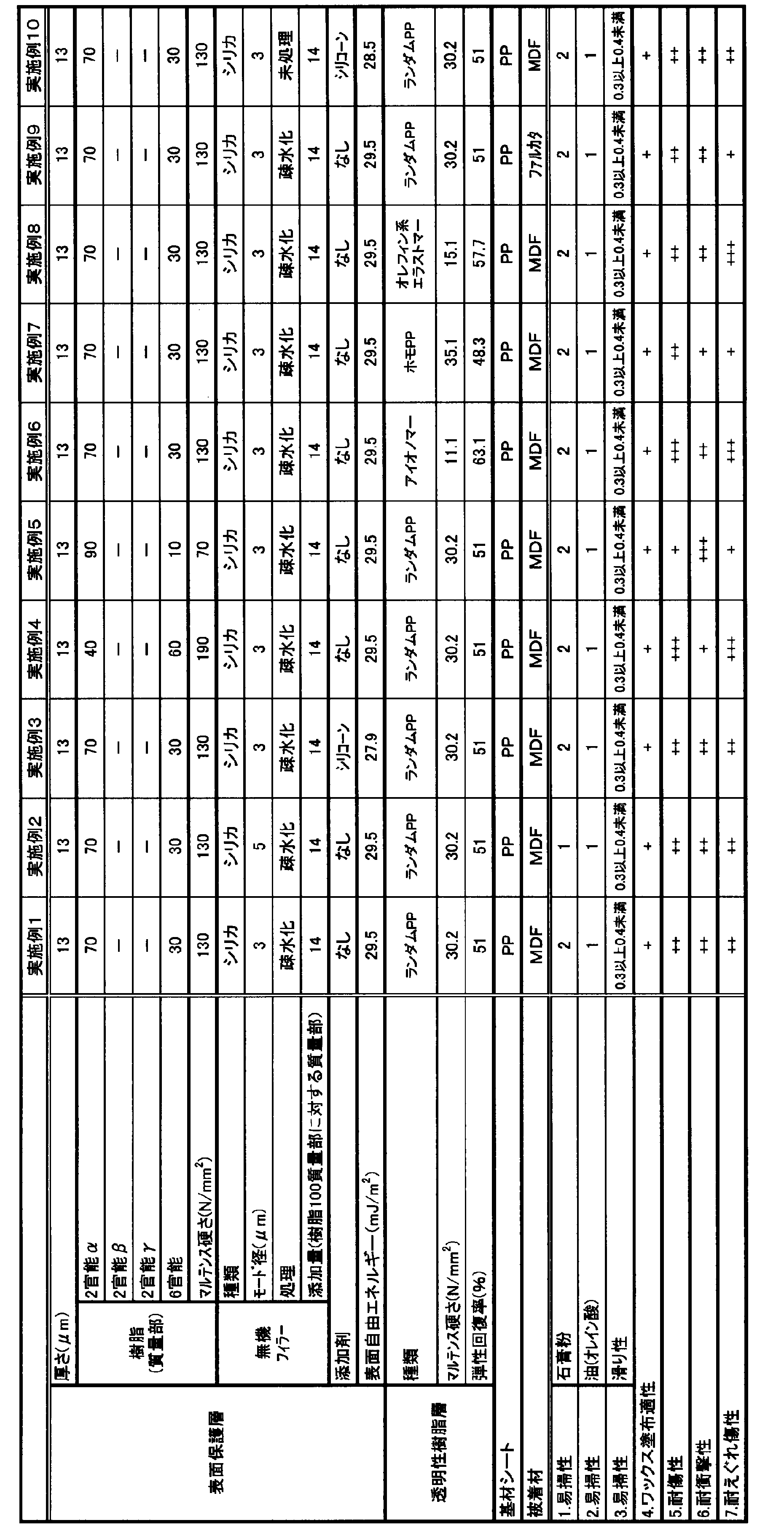

なお、表1及び表2中の樹脂の種類は以下の通りである。
2官能α:2官能ウレタンアクリレートオリゴマー(ポリオール成分がポリエステルジオール、ガラス転移温度:25℃、重量平均分子量1500)
2官能β:2官能ウレタンアクリレートオリゴマー(ポリオール成分がポリエステルジオール、ガラス転移温度:25℃、重量平均分子量1200)
2官能γ:2官能ウレタンアクリレートオリゴマー(ポリオール成分がポリエステルジオール、ガラス転移温度:-55℃、重量平均分子量5000)
6官能 :6官能脂肪族ウレタンアクリレートオリゴマー(ガラス転移温度:200℃以上、重量平均分子量1500、共栄社化学株式会社製UA306H)The types of resins in Tables 1 and 2 are as follows.
Bifunctional α: Bifunctional urethane acrylate oligomer (polyol component is polyester diol, glass transition temperature: 25 ° C, weight average molecular weight 1500)
Bifunctional β: Bifunctional urethane acrylate oligomer (polyol component is polyester diol, glass transition temperature: 25 ° C, weight average molecular weight 1200)
Bifunctional γ: Bifunctional urethane acrylate oligomer (polyol component is polyester diol, glass transition temperature: -55 ° C, weight average molecular weight 5000)
6-functional: 6-functional aliphatic urethane acrylate oligomer (glass transition temperature: 200 ° C. or higher, weight average molecular weight 1500, UA306H manufactured by Kyoeisha Chemical Co., Ltd.)
1. 床用化粧シート
2. 裏面プライマー層
3. 基材シート
4. 絵柄模様層
5. 接着剤層
6. 透明性樹脂層
7. プライマー層
8. 表面保護層
9. エンボス模様(木目板導管溝)1. Floor
Claims (9)
前記基材シートが熱可塑性樹脂シートであり、
前記表面保護層を構成する樹脂が電離放射線硬化型樹脂であり、前記電離放射線硬化型樹脂は、アクリレート樹脂、ケイ素樹脂、ポリエステル樹脂、及び、エポキシ樹脂からなる群より選択される少なくとも1種を含み、
前記表面保護層の表面自由エネルギーが27mJ/m2以上30mJ/m2未満であり、且つ、前記表面保護層のマルテンス硬さが70N/mm2以上であり、
東工大式滑り試験機(O-Y・PSM)を用いて測定した、綿100%の靴下による前記表面保護層の滑り抵抗値(C.S.R値)が、0.3以上であり、
前記表面保護層が、疎水性無機フィラーを含有し、
前記疎水性無機フィラーの粒子径が、表面保護層の厚みの1/2以下である、
床用化粧シート。 A floor decorative sheet having at least a surface protective layer on a base sheet.
The base material sheet is a thermoplastic resin sheet, and the base sheet is a thermoplastic resin sheet.
The resin constituting the surface protective layer is an ionized radiation curable resin, and the ionized radiation curable resin contains at least one selected from the group consisting of an acrylate resin, a silicon resin, a polyester resin, and an epoxy resin. ,
The surface free energy of the surface protective layer is 27 mJ / m 2 or more and less than 30 mJ / m 2 , and the maltens hardness of the surface protective layer is 70 N / mm 2 or more.
The slip resistance value (CSR value) of the surface protective layer made of 100% cotton socks measured using a Tokyo Institute of Technology slip tester (OY / PSM) is 0.3 or more.
The surface protective layer contains a hydrophobic inorganic filler, and the surface protective layer contains a hydrophobic inorganic filler.
The particle size of the hydrophobic inorganic filler is ½ or less of the thickness of the surface protective layer.
Floor decorative sheet.
Applications Claiming Priority (5)
| Application Number | Priority Date | Filing Date | Title |
|---|---|---|---|
| JP2016068380 | 2016-03-30 | ||
| JP2016068380 | 2016-03-30 | ||
| JP2016181476 | 2016-09-16 | ||
| JP2016181476 | 2016-09-16 | ||
| PCT/JP2017/012837 WO2017170656A1 (en) | 2016-03-30 | 2017-03-29 | Decorative sheet for floors and decorative panel for floors |
Publications (2)
| Publication Number | Publication Date |
|---|---|
| JPWO2017170656A1 JPWO2017170656A1 (en) | 2019-02-07 |
| JP6996491B2 true JP6996491B2 (en) | 2022-01-17 |
Family
ID=59965930
Family Applications (1)
| Application Number | Title | Priority Date | Filing Date |
|---|---|---|---|
| JP2018508130A Active JP6996491B2 (en) | 2016-03-30 | 2017-03-29 | Floor decorative sheet and floor decorative board |
Country Status (6)
| Country | Link |
|---|---|
| US (1) | US20190077124A1 (en) |
| EP (1) | EP3437859A4 (en) |
| JP (1) | JP6996491B2 (en) |
| KR (2) | KR102552547B1 (en) |
| CN (1) | CN108883616B (en) |
| WO (1) | WO2017170656A1 (en) |
Families Citing this family (13)
| Publication number | Priority date | Publication date | Assignee | Title |
|---|---|---|---|---|
| CN108732448A (en) | 2017-04-24 | 2018-11-02 | 凹凸电子(武汉)有限公司 | Wire break detection method and broken string in battery management system release detection method |
| WO2019124510A1 (en) * | 2017-12-20 | 2019-06-27 | 大日本印刷株式会社 | Cosmetic sheet and cosmetic plate |
| JP7003667B2 (en) * | 2018-01-05 | 2022-02-10 | 凸版印刷株式会社 | Cosmetic material |
| CN113498380A (en) * | 2018-12-19 | 2021-10-12 | 凸版印刷株式会社 | Decorative sheet |
| JP7537424B2 (en) * | 2019-03-25 | 2024-08-21 | 大日本印刷株式会社 | Decorative sheets and panels |
| WO2020196217A1 (en) | 2019-03-25 | 2020-10-01 | 大日本印刷株式会社 | Decorative sheet and decorative plate |
| CN110180761A (en) * | 2019-05-22 | 2019-08-30 | 琦佳信息科技(珠海市横琴新区)有限公司 | A kind of production method for processing wear-resisting floor with water paint |
| JP7561510B2 (en) * | 2020-03-27 | 2024-10-04 | 株式会社ユポ・コーポレーション | Laminates, labels and printed matter |
| DE202020103699U1 (en) * | 2020-06-26 | 2021-09-28 | Schlüter-Systems Kg | Expansion joint profile system |
| DE202021100478U1 (en) | 2021-02-01 | 2022-05-03 | Schlüter-Systems Kg | profile system |
| EP4316810A4 (en) * | 2021-03-22 | 2025-03-19 | Dai Nippon Printing Co., Ltd. | DECORATIVE SHEET AND DECORATIVE PANEL |
| DE202021106355U1 (en) | 2021-11-22 | 2021-11-29 | Röber Kunststoffe GmbH | Luminous mat |
| ES2981496T3 (en) | 2022-05-19 | 2024-10-09 | Fritz Egger Gmbh & Co Og | Process for the manufacture of a structuring medium for texturing a surface of stampable material, in particular a resin-containing laminate surface, and such a structuring medium |
Citations (4)
| Publication number | Priority date | Publication date | Assignee | Title |
|---|---|---|---|---|
| JP2005319661A (en) | 2004-05-07 | 2005-11-17 | Fuji Photo Film Co Ltd | Hard coat film laminate |
| JP2009262552A (en) | 2008-03-31 | 2009-11-12 | Dainippon Printing Co Ltd | Decorative sheet and decorative material having decorative sheet laminated thereon |
| JP2012215064A (en) | 2011-03-31 | 2012-11-08 | Dainippon Printing Co Ltd | Floor decorative sheet and floor decorative material |
| JP2015108093A (en) | 2013-12-05 | 2015-06-11 | 三菱化学株式会社 | Curable resin composition, cured product and laminate |
Family Cites Families (15)
| Publication number | Priority date | Publication date | Assignee | Title |
|---|---|---|---|---|
| JP2740943B2 (en) * | 1994-10-31 | 1998-04-15 | 大日本印刷株式会社 | Cosmetic material with wear resistance |
| DE10061497B4 (en) * | 2000-12-08 | 2005-08-11 | Treibacher Schleifmittel Gmbh | Wear protection layer based on synthetic resin, process for their preparation and their use |
| JP5417726B2 (en) * | 2007-03-30 | 2014-02-19 | 大日本印刷株式会社 | Decorative sheet for three-dimensional processing and decorative molded product using the same |
| JP2009097325A (en) * | 2007-09-28 | 2009-05-07 | Dainippon Printing Co Ltd | Floor decorative material |
| EP2316643A1 (en) * | 2009-10-27 | 2011-05-04 | Dai Nippon Printing Co., Ltd. | Decorative sheet and decorative material laminated with the same |
| AU2010339321B2 (en) * | 2009-12-28 | 2014-08-14 | Dai Nippon Printing Co., Ltd. | Coating composition and sheet using same |
| JP5999876B2 (en) * | 2011-03-31 | 2016-09-28 | 大日本印刷株式会社 | Decorative sheet and decorative board |
| JP5978668B2 (en) * | 2011-09-29 | 2016-08-24 | 大日本印刷株式会社 | Floor decorative sheet and floor decorative material |
| JP5850165B2 (en) * | 2012-08-31 | 2016-02-03 | 王子ホールディングス株式会社 | Printing sheet, decorative sheet, and adhesive decorative sheet |
| JP6011217B2 (en) | 2012-09-28 | 2016-10-19 | 大日本印刷株式会社 | Decorative sheet and decorative board |
| JP6650662B2 (en) * | 2013-09-27 | 2020-02-19 | 大日本印刷株式会社 | Decorative sheet and decorative plate using the same |
| JP6728568B2 (en) * | 2014-03-27 | 2020-07-22 | 大日本印刷株式会社 | Sheet |
| JP6627768B2 (en) * | 2014-09-26 | 2020-01-08 | 大日本印刷株式会社 | Decorative sheet and veneer |
| JP6720588B2 (en) * | 2015-03-09 | 2020-07-08 | 大日本印刷株式会社 | Decorative sheet and veneer |
| US12128654B2 (en) * | 2016-09-16 | 2024-10-29 | Dai Nippon Printing Co., Ltd. | Cosmetic sheet and cosmetic plate |
-
2017
- 2017-03-29 US US16/084,362 patent/US20190077124A1/en not_active Abandoned
- 2017-03-29 JP JP2018508130A patent/JP6996491B2/en active Active
- 2017-03-29 KR KR1020217041656A patent/KR102552547B1/en active Active
- 2017-03-29 EP EP17775191.4A patent/EP3437859A4/en not_active Withdrawn
- 2017-03-29 CN CN201780021640.2A patent/CN108883616B/en active Active
- 2017-03-29 WO PCT/JP2017/012837 patent/WO2017170656A1/en not_active Ceased
- 2017-03-29 KR KR1020187030969A patent/KR20180129864A/en not_active Ceased
Patent Citations (4)
| Publication number | Priority date | Publication date | Assignee | Title |
|---|---|---|---|---|
| JP2005319661A (en) | 2004-05-07 | 2005-11-17 | Fuji Photo Film Co Ltd | Hard coat film laminate |
| JP2009262552A (en) | 2008-03-31 | 2009-11-12 | Dainippon Printing Co Ltd | Decorative sheet and decorative material having decorative sheet laminated thereon |
| JP2012215064A (en) | 2011-03-31 | 2012-11-08 | Dainippon Printing Co Ltd | Floor decorative sheet and floor decorative material |
| JP2015108093A (en) | 2013-12-05 | 2015-06-11 | 三菱化学株式会社 | Curable resin composition, cured product and laminate |
Also Published As
| Publication number | Publication date |
|---|---|
| KR102552547B1 (en) | 2023-07-05 |
| CN108883616B (en) | 2021-07-20 |
| EP3437859A1 (en) | 2019-02-06 |
| KR20180129864A (en) | 2018-12-05 |
| KR20210157479A (en) | 2021-12-28 |
| WO2017170656A1 (en) | 2017-10-05 |
| US20190077124A1 (en) | 2019-03-14 |
| EP3437859A4 (en) | 2019-11-06 |
| CN108883616A (en) | 2018-11-23 |
| JPWO2017170656A1 (en) | 2019-02-07 |
Similar Documents
| Publication | Publication Date | Title |
|---|---|---|
| KR102552547B1 (en) | Decorative sheet for floors and decorative panel for floors | |
| JP7028177B2 (en) | Decorative sheet and decorative board | |
| JP6720588B2 (en) | Decorative sheet and veneer | |
| JP6627768B2 (en) | Decorative sheet and veneer | |
| JP6753409B2 (en) | Decorative sheet and decorative board | |
| CN1754692B (en) | Decorative board for flooring with excellent impact resistance and scratch resistance | |
| WO2018062340A1 (en) | Decorative sheet and decorative plate | |
| JP5429129B2 (en) | A decorative sheet for flooring that is excellent in impact resistance and scratch resistance | |
| JP6954505B1 (en) | Decorative sheet and decorative board | |
| JP2020037261A (en) | Decorative sheet and decorative material | |
| JP2015066791A (en) | Decorative sheet and decorative material | |
| JP7512899B2 (en) | Cosmetic materials | |
| KR100881006B1 (en) | Method of manufacturing a cosmetic sheet for flooring | |
| TWI826973B (en) | Decorative sheets and decorative panels | |
| JP2021142749A (en) | Decorative sheet and decorative plate | |
| WO2025070642A1 (en) | Decorative sheet | |
| JP2017056606A (en) | Decorative sheet and decorative board |
Legal Events
| Date | Code | Title | Description |
|---|---|---|---|
| A621 | Written request for application examination |
Free format text: JAPANESE INTERMEDIATE CODE: A621 Effective date: 20191213 |
|
| A131 | Notification of reasons for refusal |
Free format text: JAPANESE INTERMEDIATE CODE: A131 Effective date: 20201216 |
|
| A601 | Written request for extension of time |
Free format text: JAPANESE INTERMEDIATE CODE: A601 Effective date: 20210210 |
|
| A521 | Request for written amendment filed |
Free format text: JAPANESE INTERMEDIATE CODE: A523 Effective date: 20210316 |
|
| A131 | Notification of reasons for refusal |
Free format text: JAPANESE INTERMEDIATE CODE: A131 Effective date: 20210421 |
|
| A521 | Request for written amendment filed |
Free format text: JAPANESE INTERMEDIATE CODE: A523 Effective date: 20210621 |
|
| TRDD | Decision of grant or rejection written | ||
| A01 | Written decision to grant a patent or to grant a registration (utility model) |
Free format text: JAPANESE INTERMEDIATE CODE: A01 Effective date: 20211116 |
|
| A61 | First payment of annual fees (during grant procedure) |
Free format text: JAPANESE INTERMEDIATE CODE: A61 Effective date: 20211129 |
|
| R150 | Certificate of patent or registration of utility model |
Ref document number: 6996491 Country of ref document: JP Free format text: JAPANESE INTERMEDIATE CODE: R150 |