JP6996472B2 - Centerline generator, network data generator, and program - Google Patents
Centerline generator, network data generator, and program Download PDFInfo
- Publication number
- JP6996472B2 JP6996472B2 JP2018200184A JP2018200184A JP6996472B2 JP 6996472 B2 JP6996472 B2 JP 6996472B2 JP 2018200184 A JP2018200184 A JP 2018200184A JP 2018200184 A JP2018200184 A JP 2018200184A JP 6996472 B2 JP6996472 B2 JP 6996472B2
- Authority
- JP
- Japan
- Prior art keywords
- center line
- line
- center
- shape
- generated
- Prior art date
- Legal status (The legal status is an assumption and is not a legal conclusion. Google has not performed a legal analysis and makes no representation as to the accuracy of the status listed.)
- Active
Links
Images









Classifications
-
- G—PHYSICS
- G06—COMPUTING OR CALCULATING; COUNTING
- G06T—IMAGE DATA PROCESSING OR GENERATION, IN GENERAL
- G06T11/00—Two-dimensional [2D] image generation
- G06T11/20—Drawing from basic elements
-
- G—PHYSICS
- G06—COMPUTING OR CALCULATING; COUNTING
- G06F—ELECTRIC DIGITAL DATA PROCESSING
- G06F30/00—Computer-aided design [CAD]
- G06F30/10—Geometric CAD
- G06F30/18—Network design, e.g. design based on topological or interconnect aspects of utility systems, piping, heating ventilation air conditioning [HVAC] or cabling
-
- G—PHYSICS
- G06—COMPUTING OR CALCULATING; COUNTING
- G06F—ELECTRIC DIGITAL DATA PROCESSING
- G06F30/00—Computer-aided design [CAD]
- G06F30/10—Geometric CAD
- G06F30/13—Architectural design, e.g. computer-aided architectural design [CAAD] related to design of buildings, bridges, landscapes, production plants or roads
-
- G—PHYSICS
- G06—COMPUTING OR CALCULATING; COUNTING
- G06T—IMAGE DATA PROCESSING OR GENERATION, IN GENERAL
- G06T11/00—Two-dimensional [2D] image generation
- G06T11/20—Drawing from basic elements
- G06T11/23—Drawing from basic elements using straight lines or curves
-
- G—PHYSICS
- G09—EDUCATION; CRYPTOGRAPHY; DISPLAY; ADVERTISING; SEALS
- G09B—EDUCATIONAL OR DEMONSTRATION APPLIANCES; APPLIANCES FOR TEACHING, OR COMMUNICATING WITH, THE BLIND, DEAF OR MUTE; MODELS; PLANETARIA; GLOBES; MAPS; DIAGRAMS
- G09B29/00—Maps; Plans; Charts; Diagrams, e.g. route diagram
Landscapes
- Engineering & Computer Science (AREA)
- Physics & Mathematics (AREA)
- Theoretical Computer Science (AREA)
- General Physics & Mathematics (AREA)
- Geometry (AREA)
- Computer Hardware Design (AREA)
- Pure & Applied Mathematics (AREA)
- General Engineering & Computer Science (AREA)
- Evolutionary Computation (AREA)
- Computational Mathematics (AREA)
- Mathematical Analysis (AREA)
- Mathematical Optimization (AREA)
- Civil Engineering (AREA)
- Structural Engineering (AREA)
- Architecture (AREA)
- Mathematical Physics (AREA)
- Business, Economics & Management (AREA)
- Educational Administration (AREA)
- Educational Technology (AREA)
- Computer Networks & Wireless Communication (AREA)
- Processing Or Creating Images (AREA)
- Image Generation (AREA)
- Instructional Devices (AREA)
Description
本発明は、屋内空間のネットワークデータを生成するための中心線を生成する中心線生成装置、ネットワークデータ生成システム、及びプログラムに関する。 The present invention relates to a centerline generator, a network data generator, and a program for generating a centerline for generating network data in an indoor space.
従来より、ネットワークデータの元となる中心線を生成する従来技術として、ドロネ三角形分割の特性を利用する方法(非特許文献1)やボロノイ図の特性を利用する方法(非特許文献2)が知られている。 Conventionally, as a conventional technique for generating a center line that is the source of network data, a method using the characteristics of Delaunay triangulation (Non-Patent Document 1) and a method using the characteristics of Voronoi diagram (Non-Patent Document 2) have been known. Has been done.
上記非特許文献1、2に記載のどちらの手法でも、生成した中心線に不要な部分が存在するため、それらの補正処理に時間がかかってしまうという課題がある。 Both of the methods described in Non-Patent Documents 1 and 2 have a problem that it takes time to correct them because there are unnecessary parts in the generated center line.
本発明は、上記の事情を鑑みてなされたものであり、計算量を抑えて、屋内空間のネットワークデータを生成するための中心線を生成することができる中心線生成装置、ネットワークデータ生成システム、及びプログラムを提供することを目的とする。 The present invention has been made in view of the above circumstances, and is a center line generator, a network data generation system, which can generate a center line for generating network data in an indoor space while suppressing the amount of calculation. And to provide the program.
上記目的を達成するために、本発明に係る中心線生成装置は、2次元ベクトルデータで表現された屋内空間における移動可能領域である通路の中心線を生成する中心線生成装置であって、少なくとも、前記2次元ベクトルデータを構成する要素である凹角頂点を用いて、前記屋内空間における通路の枠線と交差せず、かつ複数の直線で構成された連続する中心線を生成する中心線生成部を含んで構成されている。 In order to achieve the above object, the center line generator according to the present invention is a center line generator that generates the center line of a passage which is a movable area in an indoor space represented by two-dimensional vector data, and at least. , A center line generator that uses concave vertices, which are elements that make up the two-dimensional vector data, to generate a continuous center line that does not intersect the frame line of the passage in the indoor space and is composed of a plurality of straight lines. Is configured to include.
また、本発明に係るネットワークデータ生成システムは、上記の中心線生成装置と、前記簡素化された前記中心線に基づいて、前記通路を表すリンクおよび前記リンクの起点若しくは終点となるノードからなるネットワークデータを生成するネットワークデータ生成装置と、を含んで構成されている。 Further, the network data generation system according to the present invention is a network including the center line generator, a link representing the passage, and a node serving as a start point or an end point of the link based on the simplified center line. It is configured to include a network data generator that generates data.
また、本発明のプログラムは、コンピュータを、上記の中心線生成装置を構成する各部として機能させるためのプログラムである。 Further, the program of the present invention is a program for making a computer function as each part constituting the above-mentioned center line generator.
以上説明したように、本発明の中心線生成装置、ネットワークデータ生成システム、及びプログラムによれば、計算量を抑えて、屋内空間のネットワークデータを生成するための中心線を生成することができる、という効果が得られる。 As described above, according to the center line generator, the network data generation system, and the program of the present invention, it is possible to generate a center line for generating network data in an indoor space with a reduced amount of calculation. The effect is obtained.
以下、図面を参照して本発明の実施の形態を詳細に説明する。 Hereinafter, embodiments of the present invention will be described in detail with reference to the drawings.
<概要>
まず、ドロネ三角形分割の特性を利用して中心線を生成する方法について説明する。ドロネ三角形分割の特性を利用した方法では、元形状をドロネ三角形分割し、その重心同士をつなぐことで中心線を生成する。
<Overview>
First, a method of generating a center line using the characteristics of Delaunay triangulation will be described. In the method using the characteristics of Delaunay triangulation, the original shape is divided into Delaunay triangles, and the center line is generated by connecting the centers of gravity.
具体的には、図24(A)に示すように、ドロネ三角形分割法を用いて三角形分割し、形状外の三角形が存在していたら再計算する。そして、図24(B)に示すように、三角形の重心にノードを生成する。 Specifically, as shown in FIG. 24 (A), the triangle is divided by using the Delaunay triangulation method, and if a triangle outside the shape exists, it is recalculated. Then, as shown in FIG. 24 (B), a node is generated at the center of gravity of the triangle.
そして図24(C)に示すように、ノードを間引く。このとき、つないだ結果、直線に近いノードを除去する。そして、図24(D)に示すように、ノード間にリンクを生成する。このように、ドロネ三角形分割の特性を利用して中心線を生成する方法では、生成アルゴリズムの特性上、元形状の複雑さによって、ネットワークデータの生成コストが高くなる傾向にある。さらに、元形状によっては、再計算が繰り返され、時間がかかることが実証の結果明らかとなった。 Then, as shown in FIG. 24 (C), the nodes are thinned out. At this time, as a result of connecting, nodes that are close to a straight line are removed. Then, as shown in FIG. 24 (D), a link is generated between the nodes. As described above, in the method of generating the center line by utilizing the characteristics of the Delaunay triangulation, the network data generation cost tends to be high due to the complexity of the original shape due to the characteristics of the generation algorithm. Furthermore, as a result of the demonstration, it became clear that recalculation is repeated and it takes time depending on the original shape.
次に、ボロノイ図の特性を利用して中心線を生成する方法について説明する。ボロノイ図の特性を利用した方法では、元形状の辺上に、一定間隔の点をうち、その点群からボロノイ多角形を生成する。このとき、隣り合う多角形同士を融合し、融合した多角形の辺のうち元形状の内部にある辺を中心線とする。 Next, a method of generating a center line using the characteristics of the Voronoi diagram will be described. In the method using the characteristics of the Voronoi diagram, points at regular intervals are created on the sides of the original shape, and a Voronoi polygon is generated from the point cloud. At this time, adjacent polygons are fused, and the side inside the original shape among the sides of the fused polygon is set as the center line.
具体的には、図25(A)に示すように、形状の枠線に対して、等間隔に点を生成する。そして、図25(B)に示すように、生成した点に対して、ボロノイ多角形を生成する。 Specifically, as shown in FIG. 25 (A), points are generated at equal intervals with respect to the frame line of the shape. Then, as shown in FIG. 25 (B), a Voronoi polygon is generated with respect to the generated points.
そして、図25(C)に示すように、各ボロノイ多角形の辺のうち元形状の枠線と交差しない辺を中心線とする。また、図25(D)に示すように、重複する線分の除去や頂点の間引きを行い、中心線を簡素化する。 Then, as shown in FIG. 25 (C), the side of each Voronoi polygon that does not intersect with the frame line of the original shape is set as the center line. Further, as shown in FIG. 25 (D), overlapping line segments are removed and vertices are thinned out to simplify the center line.
このように、ボロノイ図の特性を利用して生成した中心線は、生成アルゴリズムの特性上、元形状の複雑さによって、ネットワークデータの生成コストが高くなる傾向にある。 As described above, the center line generated by utilizing the characteristics of the Voronoi diagram tends to have a high network data generation cost due to the complexity of the original shape due to the characteristics of the generation algorithm.
上述したように、ドロネ三角形分割の特性を利用した手法も、ボロノイ図の特性を利用した手法も、生成した結果そのままでは、経路探索などのネットワークとして利用するには無駄なノードやリンクを多く含んでいる。従って、中心線を生成した後に、経路探索のネットワークデータとするための必要最低限の補正(ドロネ三角形分割の特性を利用した手法におけるノードの間引き、ボロノイ図の特性を利用した手法における重複線の除去やノードの間引き)処理も時間を要することになる。 As mentioned above, both the method using the characteristics of Delaunay triangulation and the method using the characteristics of Voronoi diagram contain many unnecessary nodes and links to be used as a network for route search etc. as they are generated. I'm out. Therefore, after the center line is generated, the minimum necessary correction for making it network data for route search (thinning of nodes in the method using the characteristics of Delaunay triangulation, overlapping lines in the method using the characteristics of the Voronoi diagram). Removal and thinning of nodes) will also take time.
そこで、本発明の実施の形態に係る中心線生成装置では、従来の手法と比較して、入力データの屋内空間の形状に大きく依存せず、再計算を不要とし、生成コストを抑えて、ネットワークデータを生成できるようにする。 Therefore, the center line generator according to the embodiment of the present invention does not largely depend on the shape of the indoor space of the input data, does not require recalculation, suppresses the generation cost, and is a network, as compared with the conventional method. Allow data to be generated.
具体的には、屋内空間のネットワークデータを生成するために、屋内空間の通路の形状を入力として、その形状の特徴を利用して、ネットワークデータの元となる中心線を生成する。 Specifically, in order to generate network data in the indoor space, the shape of the passage in the indoor space is input, and the characteristics of the shape are used to generate the center line that is the source of the network data.
ここで、生成される中心線は、入力する屋内空間の通路の形状の枠線と交差せず、かつ、その形状の任意の内部の位置から直線でつなげることができる途切れのない線となる。また、入力する屋内空間形状の凹角頂点に着目し中心線を生成することで、生成される中心線は、入力する屋内空間の通路の形状の枠線と交差せず、かつ、その形状の任意の内部の位置から直線でつなげることができる途切れのない線であることを満たす。 Here, the generated center line is an uninterrupted line that does not intersect the frame line of the shape of the passage in the indoor space to be input and can be connected by a straight line from an arbitrary internal position of the shape. In addition, by paying attention to the concave angle vertices of the indoor space shape to be input and generating the center line, the generated center line does not intersect with the frame line of the shape of the passage in the indoor space to be input, and the shape is arbitrary. Satisfy that it is a continuous line that can be connected by a straight line from the internal position of.
また、入力する屋内空間形状の面積が大きい場合や頂点数が多い場合は、グリッドに分割し、グリッド毎に中心線を生成したうえで、各グリッドの中心線を接続し、一つの中心線を生成することで、生成コストを抑える。 If the area of the indoor space shape to be input is large or the number of vertices is large, divide it into grids, generate a center line for each grid, connect the center lines of each grid, and create one center line. By generating it, the generation cost is suppressed.
また、各グリッド間の中心線を接続する際に、通路の枠線と交差してしまう場合は、迂回する中心線を生成することで、入力する屋内空間の形状の枠線と交差せず、かつ、その形状の任意の内部の位置から直線でつなげることができる途切れのない線であることを満たす。 In addition, when connecting the center line between each grid, if it intersects with the frame line of the passage, by generating a detour center line, it does not intersect with the frame line of the shape of the indoor space to be input. Moreover, it satisfies that it is a continuous line that can be connected by a straight line from an arbitrary internal position of the shape.
<本発明の実施の形態に係るネットワークデータ生成システムの構成>
図1は、本発明の実施の形態に係るネットワークデータ生成システム100の構成を示すブロック図である。
<Structure of a network data generation system according to an embodiment of the present invention>
FIG. 1 is a block diagram showing a configuration of a network
一般的に、中心線の生成のために、建築設計時に作成する2Dの建築用CAD(computer-aided design)データや、BIM(Building Information Modeling)データに含まれる3Dモデルといったデジタルベクトルデータを利用する。 Generally, for the generation of the center line, digital vector data such as 2D building CAD (computer-aided design) data created at the time of building design and 3D model included in BIM (Building Information Modeling) data are used. ..
ここで、建築用CADは、建物や構造物などの建築物の立体を平面図・立面図・断面図、あるいは透視図等の図面を作成するソフトウェアである。建築用CADでは、レイヤ定義を有し、一般的に、壁や廊下のほか、柱、店舗、トイレ、エスカレータなどをレイヤで分けて管理することができる。 Here, CAD for architecture is software for creating a drawing such as a plan view, an elevation view, a cross-sectional view, or a perspective view of a three-dimensional building such as a building or a structure. CAD for construction has a layer definition, and in general, in addition to walls and corridors, pillars, stores, toilets, escalators, etc. can be managed by dividing them into layers.
また、BIMは、3次元の建物形状および属性情報が含まれるデジタルモデルを管理するものである。BIMでは、クラス定義を有し、BIMデータの一つのフォーマットであるIFC(Industry Foundation Classes)では、階層、空間、階段、ドア、柱などの構造物毎に定義付けられている。 In addition, BIM manages a digital model that includes three-dimensional building shape and attribute information. BIM has a class definition, and in IFC (Industry Foundation Classes), which is one format of BIM data, it is defined for each structure such as a hierarchy, a space, a staircase, a door, and a pillar.
BIMデータを利用する際は、階層毎に水平投射することで、2Dのベクトルデータとして扱う。 When using BIM data, it is treated as 2D vector data by horizontally projecting each layer.
また、入力データは、部屋や通路や、出入口、階段、エレベータなどの形状があらかじめレイヤやクラス定義などで意味付けられて管理されているものとする。 In addition, it is assumed that the input data is managed by preliminarily defining the shapes of rooms, passages, entrances, stairs, elevators, etc. in layers and class definitions.
本発明の実施形態に係るネットワークデータ生成システム100は、この入力データを記憶する屋内空間データ記憶装置10と、入力データから中心線を生成する中心線生成装置20と、その結果を格納する中心線データ記憶装置30と、生成された中心線からネットワークデータを自動生成するネットワークデータ生成装置40と、生成したネットワークデータを記憶するネットワークデータ記憶装置50とを含む。
The network
<中心線生成装置の構成>
次に、中心線生成装置20の構成について説明する。図2に示すように、中心線生成装置20は、CPUと、RAMと、後述する各処理ルーチンを実行するためのプログラムや各種データを記憶したROMと、を含むコンピュータで構成することが出来る。この中心線生成装置20は、機能的には図2に示すように、入力部22と、演算部24と、出力部26を備えている。
<Configuration of center line generator>
Next, the configuration of the
入力部22は、屋内空間データ記憶装置10から、2次元ベクトルデータで表現された屋内空間における移動可能領域である通路を表す入力データを受け付ける。
The
ここで、通路とは、部屋と部屋を移動するための空間である。空間に接続している出入口数が2つ以上、かつ、空間の形状が凹回(穴あき)多角形の場合、通路に該当する。 Here, the passage is a space for moving between rooms. When the number of entrances and exits connected to the space is two or more and the shape of the space is a concave (perforated) polygon, it corresponds to a passage.
演算部24は、図2に示すように、グリッド分割部240、中心線生成部242、及び中心線接続部244を備えている。
As shown in FIG. 2, the
グリッド分割部240は、入力データにおける2次元ベクトルデータで表現された屋内空間を所定の大きさのグリッドに分割する。グリッド分割部240の処理の詳細については後述する。
The
中心線生成部242は、グリッドごとに、少なくとも、2次元ベクトルデータを構成する要素である凹角頂点を用いて、屋内空間における通路の枠線と交差せず、かつ複数の直線で構成された連続する中心線を生成する。
The center
中心線接続部244は、グリッドごとに生成された中心線を接続する。中心線接続部244の処理の詳細については後述する。
The center
<中心線生成部242による処理の詳細>
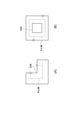
中心線生成部242では、屋内空間のネットワークデータを生成するために必要となる中心線を生成する。まず、ネットワークデータを生成するために、なぜ、中心線が必要となるのかを示す。例えば、図3(A)~(C)で示す形状を用いて説明する。
<Details of processing by the
The center
図3(A)で示す形状は、凹角が存在しないため、例えば、外枠の任意の位置に出入口が複数存在していても、その出入口間は直線で接続することができるため、中心線は不要である。 Since the shape shown in FIG. 3A does not have a concave angle, for example, even if there are a plurality of entrances and exits at arbitrary positions on the outer frame, the entrances and exits can be connected by a straight line, so that the center line is Not needed.
しかし、図3(B)で示す形状は凹角が存在するため、出入口の位置によってはその出入口間を直線で接続することができない場合がある。すわなち、接続した線が形状の外側に出てしまったり、形状の外枠と交差する場合、ネットワークデータとして誤りとなってしまう。 However, since the shape shown in FIG. 3B has a concave angle, it may not be possible to connect the entrances and exits in a straight line depending on the position of the entrance and exit. That is, if the connected line goes out of the shape or intersects with the outer frame of the shape, it will be an error as network data.
また、図3(C)で示す形状は内枠が存在するため、出入口の位置によってはその出入口間を直線で接続することができない場合がある。すわなち、接続した線が形状の内枠と交差する場合、ネットワークデータとして誤りとなってしまう。 Further, since the shape shown in FIG. 3C has an inner frame, it may not be possible to connect the entrances and exits in a straight line depending on the position of the entrance and exit. That is, if the connected line intersects the inner frame of the shape, it will be an error as network data.
従って、中心線生成装置20の入力データとなる屋内空間データの通路の形状が凹角を持つ場合と、内枠を持つ場合は、中心線を生成することで、出入口間で接続した線が形状の外側に出てしまったり、形状の外枠と交差したり、接続した線が形状の内枠と交差することを防ぐ。
Therefore, when the shape of the passage of the indoor space data which is the input data of the
図4(A)、(B)で示す通り、出入口は形状に対する中心線を経由することで、外枠の外に出ず、外枠と交差せず、内枠と交差しない通路のネットワークデータを導出することができるようになる。 As shown in FIGS. 4A and 4B, the entrance / exit passes through the center line for the shape, so that the network data of the passage that does not go out of the outer frame, does not intersect with the outer frame, and does not intersect with the inner frame can be obtained. You will be able to derive it.
ここで、形状に対する中心線を生成するアルゴリズムには、従来、ドロネ三角形分割の特性を利用する方法(非特許文献1)や、ボロノイ図の特性などを利用するアルゴリズム(非特許文献2)が存在するが、どちらの方式も、上述した通り、形状の面積の大きさや、形状の複雑さ(頂点数)に大きく依存するアルゴリズムであり、実データに対して適用するには生成コスト的に厳しいことが、実証の結果、明らかとなった。 Here, as an algorithm for generating a center line for a shape, there are conventionally a method using the characteristics of Delaunay triangulation (Non-Patent Document 1) and an algorithm using the characteristics of the Voronoi diagram (Non-Patent Document 2). However, as described above, both methods are algorithms that largely depend on the size of the area of the shape and the complexity of the shape (number of vertices), and are strict in terms of generation cost to be applied to actual data. However, as a result of the verification, it became clear.
従って、中心線生成部242は、この中心線を生成する際の形状の複雑さに大きく依存しない生成ロジックを用いて中心線を生成する。この生成ロジックを図5に示し、生成ロジックの各Stepの中心線生成の遷移を図6~14に示す。
Therefore, the center
Step1では、凹角頂点を用いて、中心線を構成する第1の直線と第2の直線が交わる点を作成する。具体的には、凹角頂点の各々から角の2等分線を引き、凹角頂点の角の二等分線の中心点、及び、凹角頂点の各々の二等分線が交わる点を、中心線を構成する第1の直線と第2の直線が交わる点として作成する。 In Step 1, the concave angle vertices are used to create a point where the first straight line and the second straight line constituting the center line intersect. Specifically, a bisector of a corner is drawn from each of the concave vertices, and the center point of the bisector of the corner of the concave apex and the point where each bisector of the concave apex intersects are the center lines. It is created as a point where the first straight line and the second straight line constituting the above intersect.
例えば、図6に示す中心線生成対象となる屋内空間の通路の形状から、図7に示すように、形状の凹角頂点(図7の丸印)を抽出し、凹角頂点の角の二等分線を、形状の枠線と交差するまで引いた線(図7の太線)を抽出する(Step1-1)。 For example, as shown in FIG. 7, the concave apex of the shape (circle in FIG. 7) is extracted from the shape of the passage in the indoor space for which the center line is generated as shown in FIG. 6, and the corner of the concave apex is bisected. A line drawn until it intersects the frame line of the shape (thick line in FIG. 7) is extracted (Step1-1).
そして、図8に示すように、Step1-1で抽出した線(図8の太線)の中点と、二等分線同士の交点とを抽出する(図8の丸印、Step1-2)。 Then, as shown in FIG. 8, the midpoint of the line (thick line in FIG. 8) extracted in Step 1-1 and the intersection of the bisectors are extracted (circle in FIG. 8, Step 1-2).
Step2では、上記Step1で作成した点間を線で接続する。このとき、通路の形状の枠線と交差する場合や、他の線と交差する場合には、線で接続しない。 In Step2, connect the points created in Step1 above with a line. At this time, if it intersects with the frame line of the shape of the passage or intersects with another line, it is not connected by a line.
例えば、図9に示すように、Step1-2で抽出した点(図9の丸印)を総当たりで接続している(図9の太線、Step2-1)。その際、通路の形状の枠線と交差する場合、及び既に接続している線(図9の太線)と交差する場合は接続しない。これにより、図10に示すように、Step2-1で接続した接続線(図10の太線)が得られる(Step2-2)。 For example, as shown in FIG. 9, the points extracted in Step 1-2 (circles in FIG. 9) are connected by brute force (thick line in FIG. 9, Step 2-1). At that time, if it intersects with the frame line in the shape of the passage, or if it intersects with the already connected line (thick line in FIG. 9), it is not connected. As a result, as shown in FIG. 10, the connection line (thick line in FIG. 10) connected in Step 2-1 is obtained (Step 2-2).
Step3では、上記Step2で得られた接続線で囲われた閉多角形から、最も長い辺に対応する接続線を削除することを、閉多角形がなくなるまで繰り返す。 In Step 3, the process of deleting the connecting line corresponding to the longest side from the closed polygon surrounded by the connecting line obtained in Step 2 is repeated until the closed polygon disappears.
例えば、図11に示すように、Step2-2で得られた接続線(図11の太線)のうち、閉多角形となっている接続線の組合せを抽出し、その組み合わせの内、一番長い接続線(図11の破線)を抽出する(Step3-1)。 For example, as shown in FIG. 11, from the connection lines (thick lines in FIG. 11) obtained in Step 2-2, the combination of the connection lines having a closed polygon is extracted, and the longest of the combinations is obtained. Extract the connection line (broken line in FIG. 11) (Step3-1).
そして、図12に示すように、Step3-1で抽出した一番長い接続線(図11の破線)を除去する(Step3-2)。 Then, as shown in FIG. 12, the longest connecting line (broken line in FIG. 11) extracted in Step 3-1 is removed (Step 3-2).
Step4では、上記Step3で得られた接続線の各頂点から、通路の形状の枠線にぶつからず、かつ、他の接続線と交差せずに接続できる、一番遠い枠線の中心点が存在する場合に、当該頂点と中心点とを接続する。このとき、中心点と頂点との距離より近い他の接続線が存在した場合は、当該頂点と中心点とを接続しない。 In Step 4, there is a center point of the farthest frame line that can be connected from each vertex of the connection line obtained in Step 3 above without hitting the frame line of the shape of the passage and without intersecting with other connection lines. When doing so, the vertex and the center point are connected. At this time, if there is another connecting line closer than the distance between the center point and the apex, the apex and the center point are not connected.
例えば、図13に示すように、Step3-2で残った接続線(図13の太線)の頂点を抽出し、その各頂点と、形状の枠線(外枠)の各辺の中心点(図13の黒丸)とを接続する(Step4-1)。その際、通路の形状の枠線と交差する場合や、既に接続している接続線(図13の太線)と交差する場合は接続しない。 For example, as shown in FIG. 13, the vertices of the connection line (thick line in FIG. 13) remaining in Step 3-2 are extracted, and each vertex and the center point of each side of the frame line (outer frame) of the shape (FIG. 13). 13 black circles) and are connected (Step4-1). At that time, if it intersects with the frame line in the shape of the passage, or if it intersects with the already connected connection line (thick line in FIG. 13), it is not connected.
また、Step3-2で残った接続線の頂点毎に、辺の中心点との接続線のうち、一番長い接続線のみを候補線として抽出する(図13の破線)。ただし、その候補線(破線)の頂点である辺の中心点と、既に接続している接続線(太線)との最短距離が、当該候補線(破線)の長さより短い場合は、当該候補線を除去し、そうでない場合は当該候補線を残す。 Further, for each vertex of the connection line remaining in Step 3-2, only the longest connection line among the connection lines with the center point of the side is extracted as a candidate line (broken line in FIG. 13). However, if the shortest distance between the center point of the side that is the apex of the candidate line (dashed line) and the already connected connection line (thick line) is shorter than the length of the candidate line (dashed line), the candidate line is concerned. If not, leave the candidate line.
そして、図14に示すように、Step3-2にて抽出した接続線(図14の太線)とStep4-1で残った候補線(図14の破線)が得られる(Step4-2)。これが、中心線生成対象の屋内空間の通路の形状に対して本実施の形態の生成ロジックで生成した中心線となる。 Then, as shown in FIG. 14, the connection line (thick line in FIG. 14) extracted in Step 3-2 and the candidate line (broken line in FIG. 14) remaining in Step 4-1 are obtained (Step 4-2). This is the center line generated by the generation logic of the present embodiment for the shape of the passage in the indoor space for which the center line is generated.
なお、通路の形状に凹角頂点が1つしか存在しない場合、接続線が生成されない。その場合は、図15に示すように、凹角頂点の二等分線の中心点(図15の白丸)から、凹角頂点(図15の黒丸)をなす2つの枠線の辺A,Bと平行な線C,Dを生成して、中心線とすれば良い。 If there is only one concave angle vertex in the shape of the passage, the connecting line is not generated. In that case, as shown in FIG. 15, the center point of the bisector of the concave angle vertex (white circle in FIG. 15) is parallel to the sides A and B of the two frame lines forming the concave angle vertex (black circle in FIG. 15). Lines C and D may be generated and used as the center line.
<グリッド分割部240及び中心線接続部244の処理の詳細>
本実施の形態の生成ロジックの場合、通路の形状の特徴となる凹角頂点のみに着目するため、従来の手法と比べ、大幅に生成コストを削減することができる。
<Details of processing of
In the case of the generation logic of the present embodiment, since only the concave angle vertices that are characteristic of the shape of the passage are focused on, the generation cost can be significantly reduced as compared with the conventional method.
この手法により、1万点ほどの頂点を持った多角形からの中心線生成コストについて、従来の方式では数日たっても中心線を生成できなかったのに対し、上記の生成ロジックを用いると18時間で中心線が生成できることが明らかとなった。 With this method, regarding the cost of generating a center line from a polygon with about 10,000 vertices, the conventional method could not generate a center line even after several days, but using the above generation logic, 18 It became clear that the center line can be generated in time.
しかし、上記のStep3における「接続線で囲われた閉多角形から、最も長い辺に対応する接続線を削除する」ことは、生成した接続線の総当たりで閉多角形を探索する必要がある。 However, in step 3 above, "remove the connecting line corresponding to the longest side from the closed polygon surrounded by the connecting line" requires searching for the closed polygon by brute force of the generated connecting line. ..
また、Step4における「接続線の各頂点から、通路の形状の枠線にぶつからず、かつ、他の接続線と交差せずに接続できる、一番遠い枠線の中心点が存在する場合に、当該頂点と中心点とを接続する」は、生成した中心線の頂点と、通路の形状の枠線のうち外枠の各辺との総当たりで探索する必要がある。 In addition, in Step 4, "when there is a center point of the farthest frame line that can be connected from each vertex of the connection line without hitting the frame line of the shape of the passage and without intersecting with other connection lines. "Connecting the apex and the center point" needs to be searched by brute force between the apex of the generated center line and each side of the outer frame in the frame line of the shape of the passage.
従って、生成済みの中心線の数や、形状の枠線の辺の数に依存して、コストが大きくなる恐れがある。 Therefore, the cost may increase depending on the number of generated center lines and the number of sides of the frame line of the shape.
そこで、本実施の形態では、中心線の生成ロジックを用いた中心線の生成コストの改善手法を用いる。 Therefore, in the present embodiment, a method for improving the center line generation cost using the center line generation logic is used.
上記で述べた通り、中心線の生成ロジックは、凹角頂点に着目することで生成コストを抑える考慮はあるものの、元形状によっては、生成コストを要する可能性を含んでいる。 As described above, the center line generation logic considers suppressing the generation cost by focusing on the concave angle vertices, but includes the possibility that the generation cost may be required depending on the original shape.
従って、生成コストを要する場合(例えば、図16に示すように元形状の頂点数が多い場合や面積が大きい場合など)であっても生成コストを抑えるために、グリッド分割部240は、図17に示すように、屋内空間の通路の形状をグリッドで小さい単位に分割し、中心線生成部242は、その小さい単位のグリッド毎に、上記の中心線生成ロジックを適用して中心線を生成し、中心線接続部244は、各グリッド間の中心線同士を接続する。これにより、図18(A)に示すように、グリッド毎に中心線を生成するため、頂点と中心点が減り、生成コストが下がる。
Therefore, in order to suppress the generation cost even when the generation cost is required (for example, when the number of vertices of the original shape is large or the area is large as shown in FIG. 16), the
中心線接続部244は、グリッドごとに生成された中心線を接続する。具体的には、グリッド切断面の両側それぞれに対し、グリッド切断面の中心点(図18(B)参照)と、既に生成されている中心線の一番近い頂点とを接続する。これにより、グリッド間の中心線が必ずつながるように、グリッド切断面の中心点を頂点とする中心線を必ず生成することができ、切れ目のない一つの中心線を生成することができる。
The center
ここで、グリッド間の切断面の中心点と中心線を接続する際に、通路の形状の枠線と交差してしまっては、中心線の意味を失ってしまう。従って、そのような場合は、迂回する中心線を生成することで、接続した中心線が形状の枠線と交差することを防ぐ。 Here, when connecting the center point and the center line of the cut surface between the grids, if they intersect with the frame line in the shape of the passage, the meaning of the center line is lost. Therefore, in such a case, by generating a detouring center line, it is possible to prevent the connected center line from intersecting the frame line of the shape.
具体的には、図19(A)に示すように、グリッド間の切断面の中心点と、一番近い中心線の頂点と接続したときに、外枠と交差する場合には、図19(B)に示すように、外枠を、切断面の中心点と中心線の頂点とをつないだ線Eで切り、当該線Eと外枠とで形成された、閉じた多角形の形状に対して、大きくするように、多角形の各辺に対して所定距離離れた線Fで囲んだ形状を生成する。そして、図19(C)に示すように、生成した形状の辺のうち、切った当該線Eと平行な線でない辺G、H、Iを採用して、外枠を迂回する中心線を生成する。 Specifically, as shown in FIG. 19 (A), when the center point of the cut surface between the grids is connected to the apex of the nearest center line and intersects with the outer frame, FIG. 19 ( As shown in B), the outer frame is cut by a line E connecting the center point of the cut surface and the apex of the center line, and the shape of the closed polygon formed by the line E and the outer frame is Therefore, a shape surrounded by a line F separated by a predetermined distance from each side of the polygon is generated so as to be large. Then, as shown in FIG. 19C, among the sides of the generated shape, the sides G, H, and I that are not parallel to the cut line E are adopted to generate a center line that bypasses the outer frame. do.
また、図20(A)に示すように、グリッド間の切断面の中心点と、一番近い中心線の頂点と接続したときに、内枠と交差する場合には、図20(B)に示すように、内枠を、切断面の中心点と中心線の頂点とをつないだ線Jで切り、当該線Jと内枠とで形成された、2つの閉じた多角形の形状のうち、面積の小さいほうの多角形の形状に対して、大きくするように、多角形の各辺に対して所定距離離れた線Kで囲んだ形状を生成する。そして、図20(C)に示すように、生成した形状の辺のうち、切った当該線Jと平行な線でない辺L、M、Nを採用して、内枠を迂回する中心線を生成する。 Further, as shown in FIG. 20 (A), when the center point of the cut surface between the grids and the apex of the nearest center line are connected and intersect with the inner frame, it is shown in FIG. 20 (B). As shown, the inner frame is cut by a line J connecting the center point of the cut surface and the apex of the center line, and among the two closed polygonal shapes formed by the line J and the inner frame. A shape surrounded by a line K separated by a predetermined distance from each side of the polygon is generated so as to increase the shape of the polygon having the smaller area. Then, as shown in FIG. 20 (C), among the sides of the generated shape, the sides L, M, and N that are not parallel to the cut line J are adopted to generate a center line that bypasses the inner frame. do.
また、グリッド内の中心線が存在しない(グリッド内の形状に凹角頂点が存在しない)場合は、グリッド内の通路の形状の重心と、グリッド間の切断面の中心点を接続すれば良い。 When the center line in the grid does not exist (the shape in the grid does not have a concave angle vertex), the center of gravity of the shape of the passage in the grid and the center point of the cut surface between the grids may be connected.
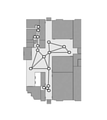
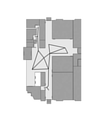
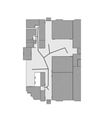
本実施の形態では、上述したようにグリッドに分割する手法により、1万点ほどの頂点を持った多角形からの中心線生成コストについて、例えば、グリッド分割しない場合は18時間かかっていたのが、本実施の形態の手法にて10×10に分割し、100個のグリッドに分割したところ、中心線が切れることなく、計算時間を2分30秒程度まで削減できることを確認した。更に、グリッド分割せずに中心線を生成した場合の中心線(図21参照)と、グリッド分割後に中心線同士を接続した場合の中心線(図22参照)とを比較しても大きく形状は異なっていないことが確認できた。 In the present embodiment, the cost of generating a center line from a polygon having about 10,000 vertices by the method of dividing into a grid as described above takes 18 hours, for example, when the grid is not divided. It was confirmed that the calculation time could be reduced to about 2 minutes and 30 seconds without breaking the center line when the grid was divided into 10 × 10 by the method of the present embodiment and divided into 100 grids. Furthermore, even if the center line when the center line is generated without dividing the grid (see FIG. 21) and the center line when the center lines are connected to each other after the grid division (see FIG. 22) are compared, the shape is large. It was confirmed that they were not different.
<ネットワークデータ生成装置40の構成>
本発明の実施の形態に係るネットワークデータ生成装置40では、入力データから、階層毎に、屋内空間の一部である対象空間の各々を、部屋、通路、出入口、階の接続に振り分けると共に、生成された中心線に基づいて、中心線の頂点、交点にノードを生成し、そのノード間をリンクで接続することで、通路を表すリンクおよびリンクの起点若しくは終点となるノードからなる、屋内空間のネットワークデータを自動生成する。
<Configuration of
In the network
具体的には、対象空間を、入力データが持つクラスやレイヤ定義、形状に付けられた名称や属性情報により振り分け可能な場合は、階層毎に部屋、通路、出入口、階の接続に振り分ける。 Specifically, if the target space can be sorted according to the class and layer definition of the input data, and the name and attribute information attached to the shape, the target space is sorted into rooms, passages, doorways, and floor connections for each floor.
ここで、部屋は、ナビゲーションポイントの目的地となり得る空間である。空間に接続している出入口数が1つの場合、部屋に該当する。また、空間の形状が、凸多角形の場合、部屋に該当する。 Here, the room is a space that can be the destination of the navigation point. When the number of entrances and exits connected to the space is one, it corresponds to a room. If the shape of the space is a convex polygon, it corresponds to a room.
また、空間は、屋内空間を意味のある単位(通路、部屋)に分割した領域である。また、空間は、ネットワークデータの生成対象となる移動可能な領域である。 In addition, the space is an area in which the indoor space is divided into meaningful units (passages, rooms). Further, the space is a movable area for which network data is generated.
また、出入口は、空間と空間とを接続する場所(ドア、壁無し)であり、階の接続は、屋内空間の階層間を接続する場所(階段、エレベータ、エスカレータ等)である。 The doorway is a place that connects the space (without doors and walls), and the floor connection is a place that connects the floors of the indoor space (stairs, elevators, escalators, etc.).
また、リンクは、移動体(人、車いす、ベビーカー、ロボット、ドローン等)がリンク上を移動可能であることを想定し、移動可能な領域に引かれる線である。リンクの両端は必ずノードであり、リンクは、向き、長さという基本的な属性情報に加え、高さ、幅、段差、段数、手すり有といった移動可能領域の特徴を属性情報として持つことができる。また、リンクの途中で分岐がある場合や、リンクの向きを変える場合には、その起点となる点にノードを打ち、リンクを分割する。 Further, the link is a line drawn in a movable area on the assumption that a moving object (person, wheelchair, stroller, robot, drone, etc.) can move on the link. Both ends of the link are always nodes, and in addition to the basic attribute information such as orientation and length, the link can have the characteristics of the movable area such as height, width, step, number of steps, and handrail as attribute information. .. If there is a branch in the middle of the link, or if the direction of the link is changed, a node is struck at the starting point to divide the link.
ノードは、リンクの起点、もしくは終点となる点である。リンクの向きを変える(カーブを作成する)、リンクを分岐させる、などの場合にノードが生成されるほか、出入口の最寄にナビゲーションポイントを設けたい場合などには、意図的にリンクの途中にノードを打って、リンクを分割する場合がある。 A node is a point that is the starting point or ending point of a link. Nodes are created when changing the direction of the link (creating a curve), branching the link, etc., and when you want to set a navigation point near the doorway, intentionally in the middle of the link. You may hit a node to split the link.
また、ネットワークデータを生成する際に、入力データがもつ属性情報を付加することで、より、利用価値が高いデータを効率的に自動生成することができる。 Further, by adding the attribute information of the input data when generating the network data, it is possible to efficiently and automatically generate the data having higher utility value.
ここで、入力データがもつ属性情報には、「部屋」、「通路」、「出入口」、「階の接続」に直接属性情報として含まれる情報や、直接的に含まれていないがそれらの形状の近傍や内部に含まれる形状(例えば、階段における手すりや、トイレにおける便器の数など)や、その形状がもつ属性情報(例えば、空間における床面の素材など)を自動的に抽出することで得られる情報も含まれる。 Here, the attribute information of the input data includes information directly included as attribute information in "room", "passage", "doorway", and "floor connection", and information that is not directly included but has a shape thereof. By automatically extracting the shape contained in the vicinity or inside of (for example, the number of handrails in stairs, the number of toilet bowls in the toilet, etc.) and the attribute information of the shape (for example, the material of the floor surface in the space). The information obtained is also included.
属性情報を付加する際、同一の属性情報を複数のネットワークデータに付加する場合は、別途、POIを生成して、そのIDを属性情報に付加することで、データ量を削減することもできる。ここで、POIはPoint of Interestの略であり、空間(店舗、部屋、トイレ等)が持つ形状に対する代表点と、その属性とを管理するものである。 When adding the same attribute information to a plurality of network data when adding the attribute information, the amount of data can be reduced by separately generating a POI and adding the ID to the attribute information. Here, POI is an abbreviation for Point of Interest, and manages representative points for the shape of a space (store, room, toilet, etc.) and its attributes.
<本発明の実施の形態に係る中心線生成装置の作用>
次に、本発明の実施の形態に係る中心線生成装置20の作用について説明する。
<Operation of the center line generator according to the embodiment of the present invention>
Next, the operation of the
まず、2次元ベクトルデータで表現された屋内空間における移動可能領域である通路を表す入力データが、屋内空間データ記憶装置10に格納されている。そして、屋内空間データ記憶装置10に格納されている入力データを、入力部22によって受け付けると、中心線生成装置20は、図23に示す中心線生成処理ルーチンを実行する。
First, the input data representing the passage, which is a movable area in the indoor space represented by the two-dimensional vector data, is stored in the indoor space
まず、ステップS100において、入力データに基づいて、2次元ベクトルデータで表現された屋内空間を所定の大きさのグリッドに分割する。 First, in step S100, the indoor space represented by the two-dimensional vector data is divided into grids of a predetermined size based on the input data.
そして、ステップS102において、グリッド毎に、上記図5に示す生成ロジックに従って、当該グリッド内の通路の中心線を生成する。 Then, in step S102, the center line of the passage in the grid is generated for each grid according to the generation logic shown in FIG.
ステップS104では、グリッドごとに生成された中心線を接続して、切れ目のない一つの中心線を生成し、出力部26により、中心線データ記憶装置30に格納して、中心線生成処理ルーチンを終了する。
In step S104, the center lines generated for each grid are connected to generate one continuous center line, which is stored in the center line
以上説明したように、本発明の実施の形態に係る中心線生成装置によれば、少なくとも、屋内空間の通路を表現する2次元ベクトルデータを構成する要素である凹角頂点を用いて、屋内空間における通路の枠線と交差せず、かつ複数の直線で構成された連続する中心線を生成することにより、計算量を抑えて、屋内空間のネットワークデータを生成するための中心線を生成することができる。 As described above, according to the center line generator according to the embodiment of the present invention, at least the concave angle vertices which are the elements constituting the two-dimensional vector data representing the passage in the indoor space are used in the indoor space. By generating a continuous center line that does not intersect the border of the passage and is composed of multiple straight lines, it is possible to reduce the amount of calculation and generate a center line for generating network data in the indoor space. can.
また、本発明の実施の形態に係るネットワークデータ生成システムによれば、中心線の生成における計算量を抑えることにより、計算量を抑えて、屋内空間のネットワークデータを生成することができる。 Further, according to the network data generation system according to the embodiment of the present invention, by suppressing the calculation amount in the generation of the center line, the calculation amount can be suppressed and the network data in the indoor space can be generated.
なお、本発明は、上述した実施形態に限定されるものではなく、この発明の要旨を逸脱しない範囲内で様々な変形や応用が可能である。 The present invention is not limited to the above-described embodiment, and various modifications and applications can be made without departing from the gist of the present invention.
例えば、入力する屋内空間形状の面積が小さい場合や頂点数が少ない場合には、グリッド分割せずに中心線を生成してもよい。 For example, when the area of the indoor space shape to be input is small or the number of vertices is small, the center line may be generated without dividing the grid.
また、上述の中心線生成装置20は、内部にコンピュータシステムを有しているが、「コンピュータシステム」は、WWWシステムを利用している場合であれば、ホームページ提供環境(あるいは表示環境)も含むものとする。
Further, the
また、本願明細書中において、プログラムが予めインストールされている実施形態として説明したが、当該プログラムを、コンピュータ読み取り可能な記録媒体に格納して提供することも可能であるし、ネットワークを介して提供することも可能である。 Further, in the specification of the present application, the program has been described as a pre-installed embodiment, but the program can be stored in a computer-readable recording medium and provided, or provided via a network. It is also possible to do.
10 屋内空間データ記憶装置
20 中心線生成装置
22 入力部
24 演算部
26 出力部
30 中心線データ記憶装置
40 ネットワークデータ生成装置
50 ネットワークデータ記憶装置
100 ネットワークデータ生成システム
240 グリッド分割部
242 中心線生成部
244 中心線接続部
10 Indoor space
Claims (8)
少なくとも、前記2次元ベクトルデータを構成する要素である凹角頂点を用いて、前記屋内空間における通路の枠線と交差せず、かつ複数の直線で構成された連続する中心線を生成する中心線生成部
を含むことを特徴とする中心線生成装置。 It is a center line generator that generates the center line of a passage, which is a movable area in an indoor space expressed by two-dimensional vector data.
At least, using the concave angle vertices that are the elements constituting the two-dimensional vector data, a center line generation that does not intersect the frame line of the passage in the indoor space and generates a continuous center line composed of a plurality of straight lines. A centerline generator characterized by including a part.
中心線接続部と、
を更に含み、
前記中心線生成部は、前記グリッドごとに前記中心線を生成し、
前記中心線接続部は、前記グリッドごとに生成された前記中心線を接続する請求項1~請求項5の何れか1項記載の中心線生成装置。 A grid division unit that divides the indoor space represented by the two-dimensional vector data into grids of a predetermined size, and
Center line connection and
Including
The center line generation unit generates the center line for each grid, and the center line generation unit generates the center line.
The center line generator according to any one of claims 1 to 5, wherein the center line connecting portion connects the center lines generated for each grid.
前記生成された前記中心線に基づいて、前記通路を表すリンクおよび前記リンクの起点若しくは終点となるノードからなるネットワークデータを生成するネットワークデータ生成装置と、
を含むネットワークデータ生成システム。 The center line generator according to any one of claims 1 to 6.
A network data generator that generates network data consisting of a link representing the passage and a node serving as a start point or an end point of the link based on the generated center line.
Network data generation system including.
Priority Applications (3)
| Application Number | Priority Date | Filing Date | Title |
|---|---|---|---|
| JP2018200184A JP6996472B2 (en) | 2018-10-24 | 2018-10-24 | Centerline generator, network data generator, and program |
| PCT/JP2019/041209 WO2020085261A1 (en) | 2018-10-24 | 2019-10-18 | Center line generation device, network data generation system and program |
| US17/287,842 US11625868B2 (en) | 2018-10-24 | 2019-10-18 | Center line generation device, network data generation system and program |
Applications Claiming Priority (1)
| Application Number | Priority Date | Filing Date | Title |
|---|---|---|---|
| JP2018200184A JP6996472B2 (en) | 2018-10-24 | 2018-10-24 | Centerline generator, network data generator, and program |
Publications (2)
| Publication Number | Publication Date |
|---|---|
| JP2020067827A JP2020067827A (en) | 2020-04-30 |
| JP6996472B2 true JP6996472B2 (en) | 2022-01-17 |
Family
ID=70331417
Family Applications (1)
| Application Number | Title | Priority Date | Filing Date |
|---|---|---|---|
| JP2018200184A Active JP6996472B2 (en) | 2018-10-24 | 2018-10-24 | Centerline generator, network data generator, and program |
Country Status (3)
| Country | Link |
|---|---|
| US (1) | US11625868B2 (en) |
| JP (1) | JP6996472B2 (en) |
| WO (1) | WO2020085261A1 (en) |
Families Citing this family (1)
| Publication number | Priority date | Publication date | Assignee | Title |
|---|---|---|---|---|
| WO2025070595A1 (en) * | 2023-09-28 | 2025-04-03 | 株式会社Muse | Map generation device, map generation method, and map generation system |
Citations (4)
| Publication number | Priority date | Publication date | Assignee | Title |
|---|---|---|---|---|
| JP2003132353A (en) | 2001-10-29 | 2003-05-09 | Pasuko:Kk | Center line generator |
| JP2011107770A (en) | 2009-11-12 | 2011-06-02 | Hitachi Ltd | Indoor space data creation support system and indoor space data creation support method |
| JP2013058173A (en) | 2011-09-09 | 2013-03-28 | Hitachi Information & Control Solutions Ltd | Object extraction system for two-dimensional cad data, and program |
| JP2015210626A (en) | 2014-04-25 | 2015-11-24 | 株式会社日立ソリューションズ | Map network data automatic generation device, network data automatic generation method, and network data automatic generation program |
Family Cites Families (4)
| Publication number | Priority date | Publication date | Assignee | Title |
|---|---|---|---|---|
| US8699759B2 (en) * | 2009-10-12 | 2014-04-15 | Qualcomm Incorporated | Method and apparatus for automated determination of features on an electronic map |
| US11216599B2 (en) * | 2015-11-24 | 2022-01-04 | Takeshi SHIRABE | Method, apparatus and computer program for designing a corridor |
| US11308246B2 (en) * | 2016-11-14 | 2022-04-19 | Autodesk, Inc. | Generative design for architecture |
| US20220180595A1 (en) * | 2020-06-12 | 2022-06-09 | Boom Interactive, Inc. | System and method for creating three-dimensional renderings of environments from two-dimensional images |
-
2018
- 2018-10-24 JP JP2018200184A patent/JP6996472B2/en active Active
-
2019
- 2019-10-18 US US17/287,842 patent/US11625868B2/en active Active
- 2019-10-18 WO PCT/JP2019/041209 patent/WO2020085261A1/en not_active Ceased
Patent Citations (4)
| Publication number | Priority date | Publication date | Assignee | Title |
|---|---|---|---|---|
| JP2003132353A (en) | 2001-10-29 | 2003-05-09 | Pasuko:Kk | Center line generator |
| JP2011107770A (en) | 2009-11-12 | 2011-06-02 | Hitachi Ltd | Indoor space data creation support system and indoor space data creation support method |
| JP2013058173A (en) | 2011-09-09 | 2013-03-28 | Hitachi Information & Control Solutions Ltd | Object extraction system for two-dimensional cad data, and program |
| JP2015210626A (en) | 2014-04-25 | 2015-11-24 | 株式会社日立ソリューションズ | Map network data automatic generation device, network data automatic generation method, and network data automatic generation program |
Also Published As
| Publication number | Publication date |
|---|---|
| US20210390743A1 (en) | 2021-12-16 |
| US11625868B2 (en) | 2023-04-11 |
| WO2020085261A1 (en) | 2020-04-30 |
| JP2020067827A (en) | 2020-04-30 |
Similar Documents
| Publication | Publication Date | Title |
|---|---|---|
| US11520988B2 (en) | Semantic classification of entities in a building information model based on geometry and neighborhood | |
| Kuligowski | Computer evacuation models for buildings | |
| JP6304771B2 (en) | Route generation program, route generation method and route generation device | |
| Van Toll et al. | Navigation meshes for realistic multi-layered environments | |
| Xu et al. | BIM-based indoor path planning considering obstacles | |
| JP7077913B2 (en) | Centerline simplification device, network data generation system, and program | |
| Koltsova et al. | Visibility analysis for 3D urban environments | |
| Steiner et al. | Integrated structural–architectural design for interactive planning | |
| CN110232741A (en) | Multilayer bounding box determines method, collision detection and motion control method and equipment | |
| CN116628828B (en) | A method, medium and system for determining demolition points of large buildings | |
| CN114777793A (en) | BIM map extraction and path planning method oriented to any navigation subject | |
| KR101810663B1 (en) | Bim data transform apparatus for ununiformed slab member and the method thereof | |
| Barnett et al. | Coordinated crowd simulation with topological scene analysis | |
| Guercke et al. | Aggregation of LoD 1 building models as an optimization problem | |
| US11913804B2 (en) | Network data generator, network data generation method, and program | |
| WO2020085261A1 (en) | Center line generation device, network data generation system and program | |
| JP6623130B2 (en) | ROUTE INFORMATION GENERATION DEVICE, ROUTE COUPLING DEVICE, METHOD, AND PROGRAM | |
| CN113326545B (en) | Light-weight semantic BIM modeling system and method for health detection of typical beam bridge structure | |
| CN119989608A (en) | Computer-aided automated modeling with editable sketches | |
| Lewandowicz et al. | Methodology to generate navigation models in building | |
| JP6814261B2 (en) | Route coupling devices, methods, and programs | |
| JP7848279B2 (en) | Navigation map generation system, navigation map generation method, and navigation map generation program | |
| JP2026081339A (en) | Navigation map generation system, navigation map generation method, and navigation map generation program | |
| CN114556349B (en) | Two-dimensional map data generation device, two-dimensional map data generation method, and two-dimensional map data generation system | |
| Aumann et al. | A modular routing graph generation method for pedestrian simulation |
Legal Events
| Date | Code | Title | Description |
|---|---|---|---|
| A621 | Written request for application examination |
Free format text: JAPANESE INTERMEDIATE CODE: A621 Effective date: 20210122 |
|
| TRDD | Decision of grant or rejection written | ||
| A01 | Written decision to grant a patent or to grant a registration (utility model) |
Free format text: JAPANESE INTERMEDIATE CODE: A01 Effective date: 20211116 |
|
| A61 | First payment of annual fees (during grant procedure) |
Free format text: JAPANESE INTERMEDIATE CODE: A61 Effective date: 20211129 |
|
| R150 | Certificate of patent or registration of utility model |
Ref document number: 6996472 Country of ref document: JP Free format text: JAPANESE INTERMEDIATE CODE: R150 |
|
| S533 | Written request for registration of change of name |
Free format text: JAPANESE INTERMEDIATE CODE: R313533 |
|
| R350 | Written notification of registration of transfer |
Free format text: JAPANESE INTERMEDIATE CODE: R350 |