JP6996443B2 - 4-[18F] Fluoro-4-boronophenylalanine precursor production method, 2- [18F] Fluoro-4-boronophenylalanine production method - Google Patents
4-[18F] Fluoro-4-boronophenylalanine precursor production method, 2- [18F] Fluoro-4-boronophenylalanine production method Download PDFInfo
- Publication number
- JP6996443B2 JP6996443B2 JP2018135799A JP2018135799A JP6996443B2 JP 6996443 B2 JP6996443 B2 JP 6996443B2 JP 2018135799 A JP2018135799 A JP 2018135799A JP 2018135799 A JP2018135799 A JP 2018135799A JP 6996443 B2 JP6996443 B2 JP 6996443B2
- Authority
- JP
- Japan
- Prior art keywords
- group
- general formula
- compound
- boronophenylalanine
- carbon atoms
- Prior art date
- Legal status (The legal status is an assumption and is not a legal conclusion. Google has not performed a legal analysis and makes no representation as to the accuracy of the status listed.)
- Active
Links
- DWHXBEAKNROPNE-UHFFFAOYSA-N C[B]1(OC2)OCC2(C)CO1 Chemical compound C[B]1(OC2)OCC2(C)CO1 DWHXBEAKNROPNE-UHFFFAOYSA-N 0.000 description 2
- 0 Cc1c(CC(C(O*)=O)N)ccc(*)c1 Chemical compound Cc1c(CC(C(O*)=O)N)ccc(*)c1 0.000 description 2
- AXFZXOHZQMVFER-UHFFFAOYSA-N C=C(C(OC1(CCCC1)O1)=O)C1=O Chemical compound C=C(C(OC1(CCCC1)O1)=O)C1=O AXFZXOHZQMVFER-UHFFFAOYSA-N 0.000 description 1
- AIEJHDNUAFFGNX-UHFFFAOYSA-N CC(C(C)C(OC1(CCCCC1)O1)=O)C1=O Chemical compound CC(C(C)C(OC1(CCCCC1)O1)=O)C1=O AIEJHDNUAFFGNX-UHFFFAOYSA-N 0.000 description 1
- BASJNTNUQFBSNW-UHFFFAOYSA-N CC(C)(OC(C1=[I]C)=O)OC1=O Chemical compound CC(C)(OC(C1=[I]C)=O)OC1=O BASJNTNUQFBSNW-UHFFFAOYSA-N 0.000 description 1
- ILMMUDFVWXDZNE-UHFFFAOYSA-N CN(C(C(C(N1C)=O)=[I]C)=O)C1=O Chemical compound CN(C(C(C(N1C)=O)=[I]C)=O)C1=O ILMMUDFVWXDZNE-UHFFFAOYSA-N 0.000 description 1
- NSXGXEIATCXWFH-UHFFFAOYSA-N Cc(cccc1C)c1N(C1[ClH]C)C=CN1c1c(C)cccc1C Chemical compound Cc(cccc1C)c1N(C1[ClH]C)C=CN1c1c(C)cccc1C NSXGXEIATCXWFH-UHFFFAOYSA-N 0.000 description 1
Classifications
-
- Y—GENERAL TAGGING OF NEW TECHNOLOGICAL DEVELOPMENTS; GENERAL TAGGING OF CROSS-SECTIONAL TECHNOLOGIES SPANNING OVER SEVERAL SECTIONS OF THE IPC; TECHNICAL SUBJECTS COVERED BY FORMER USPC CROSS-REFERENCE ART COLLECTIONS [XRACs] AND DIGESTS
- Y02—TECHNOLOGIES OR APPLICATIONS FOR MITIGATION OR ADAPTATION AGAINST CLIMATE CHANGE
- Y02P—CLIMATE CHANGE MITIGATION TECHNOLOGIES IN THE PRODUCTION OR PROCESSING OF GOODS
- Y02P20/00—Technologies relating to chemical industry
- Y02P20/50—Improvements relating to the production of bulk chemicals
- Y02P20/55—Design of synthesis routes, e.g. reducing the use of auxiliary or protecting groups
Landscapes
- Organic Low-Molecular-Weight Compounds And Preparation Thereof (AREA)
Description
本発明は、4-ボロノフェニルアラニン前駆体、2-[18F]フルオロ-4-ボロノフェニルアラニン前駆体の製造方法、2-[18F]フルオロ-4-ボロノフェニルアラニンの製造方法に関する。 The present invention relates to a method for producing 4-boronophenylalanine precursor, a method for producing 2- [ 18 F] fluoro-4-boronophenylalanine precursor, and a method for producing 2- [ 18 F] fluoro-4-boronophenylalanine.
ホウ素中性子捕捉療法(Boron Neutron Capture Therapy:BNCT)は、がん細胞に集積した特定のホウ素化合物に中性子を照射し、核分裂によって生じるα線とリチウム粒子とによってがん細胞を破壊する方法である。 Boron Neutron Capture Therapy (BNCT) is a method of irradiating a specific boron compound accumulated in cancer cells with neutrons and destroying the cancer cells by α rays and lithium particles generated by nuclear fission.
BNCTの効果を上げるには、がん細胞に集積する特定のホウ素化合物の集積量を正確に確認する必要がある。このため、陽電子断層撮影法(Positron Emission Tomography:PET)を用いて特定のホウ素化合物ががん細胞に集積する集積量を確認する。 In order to increase the effect of BNCT, it is necessary to accurately confirm the amount of specific boron compounds accumulated in cancer cells. Therefore, the amount of accumulation of a specific boron compound in cancer cells is confirmed by using positron emission tomography (PET).
ところで、BNCTおよびPETで用いる特定のホウ素化合物として、4-ボロノフェニルアラニン(「BPA」ともいう)を18Fで標識したフルオロボロノフェニルアラニン(「18F-FBPA」ともいう)を用いることが一般的である。 By the way, as a specific boron compound used in BNCT and PET, it is common to use fluoroboronophenylalanine (also referred to as " 18F -FBPA") in which 4-boronophenylalanine (also referred to as "BPA") is labeled with 18F . It is a target.
18F-FBPAの合成方法としては、例えば、BPAを18F2ガスと反応させて18F-FBPAを得る方法が記載されている(例えば、非特許文献1参照)。また、18Fフッ化物イオンを用いた芳香環へのフッ素化反応として、ベンズアルデヒド体から18F-DOPA(3,4-Dihydroxy-6-[18F]Fluoro-L-Phenyl alanine)を標識合成するルートが報告されている(非特許文献2)。 As a method for synthesizing 18 F-FBPA, for example, a method of reacting BPA with 18 F 2 gas to obtain 18 F-FBPA is described (see, for example, Non-Patent Document 1). In addition, as a fluorination reaction to an aromatic ring using 18 F fluoride ion, 18 F-DOPA (3,4-Dihydroxy-6- [ 18 F] Fluoro-L-Phenyl alane) is labeled and synthesized from a benzaldehyde compound. The route has been reported (Non-Patent Document 2).
さらに、BPA誘導体を18Fのフッ化物イオンで求核置換反応させて18F-FBPAを得る方法や(例えば、特許文献1参照)、2-[18F]フルオロ-4-ブロモフェニルアラニン誘導体をビスピナコールジボラン等によりホウ素化して18F-FBPAを合成する方法(例えば、特許文献2~4参照)が記載されている。 Further, a method for obtaining 18 F-FBPA by nucleophilic substitution reaction of a BPA derivative with 18 F fluoride ion (see, for example, Patent Document 1), or a 2- [ 18 F] fluoro-4-bromophenylalanine derivative is used as a screw. A method for synthesizing 18 F-FBPA by boring with pinacole diborane or the like (see, for example, Patent Documents 2 to 4) is described.
しかしながら、非特許文献1の方法では、18F-FBPAの大量合成が困難であり、1回の合成で数名分の量しか合成できないという問題がある。また、特許文献1の方法は、18Fフッ化物イオンがホウ素と反応するため、目的の18F標識前駆体を合成することができないおそれがある。 However, the method of Non-Patent Document 1 has a problem that it is difficult to synthesize a large amount of 18 F-FBPA, and only a few people can be synthesized by one synthesis. Further, in the method of Patent Document 1, since the 18F fluoride ion reacts with boron, there is a possibility that the desired 18F -labeled precursor cannot be synthesized.
また、特許文献2および3の方法では、18F標識反応後に、ホウ素化反応等を実施するため、1工程多くなり、合成時間も長くなる。また、18F標識反応後に、パラジウム触媒を使用するため、この触媒の除去や品質検定に手間がかかり、放射線量の減衰が大きくなるおそれがある。 Further, in the methods of Patent Documents 2 and 3, since the boration reaction and the like are carried out after the 18F labeling reaction, one step is increased and the synthesis time is also lengthened. In addition, since a palladium catalyst is used after the 18F labeling reaction, it takes time and effort to remove the catalyst and perform quality verification, and there is a possibility that the radiation dose will be greatly attenuated.
本発明は、上記に鑑みてなされたものであって、2-[18F]フルオロ-4-ボロノフェニルアラニンの大量合成を可能とする、4-ボロノフェニルアラニン前駆体、2-[18F]フルオロ-4-ボロノフェニルアラニン前駆体の製造方法、2-[18F]フルオロ-4-ボロノフェニルアラニンの製造方法を提供することを課題とする。 INDUSTRIAL APPLICABILITY The present invention has been made in view of the above, and is a 4-boronophenylalanine precursor, 2- [ 18 F], which enables a large amount of synthesis of 2- [ 18 F] fluoro-4-boronophenylalanine. It is an object of the present invention to provide a method for producing a fluoro-4-boronophenylalanine precursor and a method for producing 2- [ 18F ] fluoro-4-boronophenylalanine.
本発明者らの鋭意研究の結果、4-ボロノフェニルアラニン前駆体のボロン酸基について、ホウ素のsp2空軌道に非共有電子対を供与しうる保護基を使用することにより、18Fフッ化物イオンでフッ素化する際に、ボロン酸基のsp2空軌道と反応することなく位置選択的に18F標識が可能となることを見出し、本発明を完成させるに至った。 As a result of diligent research by the present inventors, for the boronic acid group of the 4-boronophenylalanine precursor, 18F fluoride was used by using a protecting group capable of donating an unshared electron pair to the sp2 empty orbital of boron. We have found that 18F labeling is possible in a position-selective manner without reacting with the sp2 empty orbital of the boronic acid group when fluoride is fluorinated with ions, and have completed the present invention.
すなわち、本発明にかかる4-ボロノフェニルアラニン前駆体は、下記一般式(1)で表される4-ボロノフェニルアラニン前駆体である。
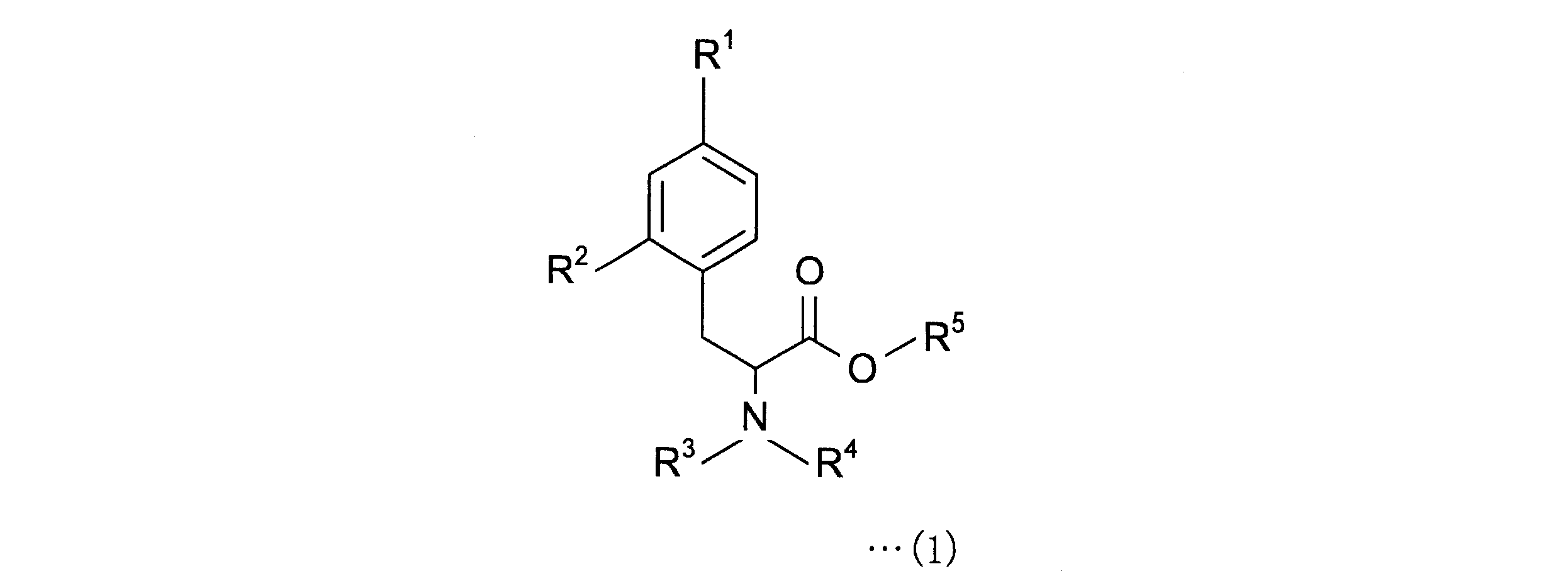
また、本発明にかかる4-ボロノフェニルアラニン前駆体は、上記発明において、上記一般式(1)で表される化合物中、R1は、2,3-ジヒドロ-1H-ナフト[1,8-de]-1,3,2-ジアザボリニル基、トリフルオロボレート基、下記一般式(2)で表されるボロン酸-N-メチルイミノジアセテート基、


また、本発明にかかる4-ボロノフェニルアラニン前駆体は、上記発明において、上記一般式(1)で表される化合物中、ヨードニウムイリド基はスピロ環を有するものであることを特徴とする。 Further, the 4-boronophenylalanine precursor according to the present invention is characterized in that, in the above invention, the iodonium ilide group has a spiro ring in the compound represented by the above general formula (1).
また、本発明にかかる2-[18F]フルオロ-4-ボロノフェニルアラニン前駆体の製造方法は、下記一般式(1)で表される4-ボロノフェニルアラニン前駆体
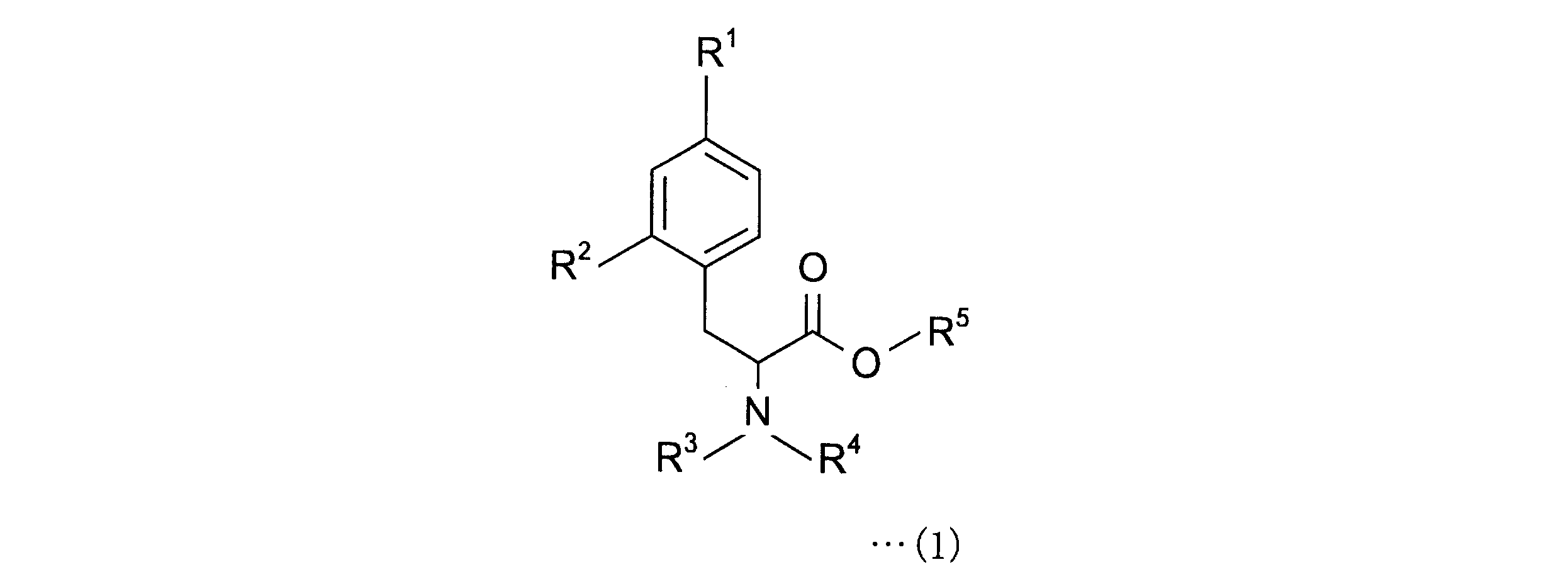
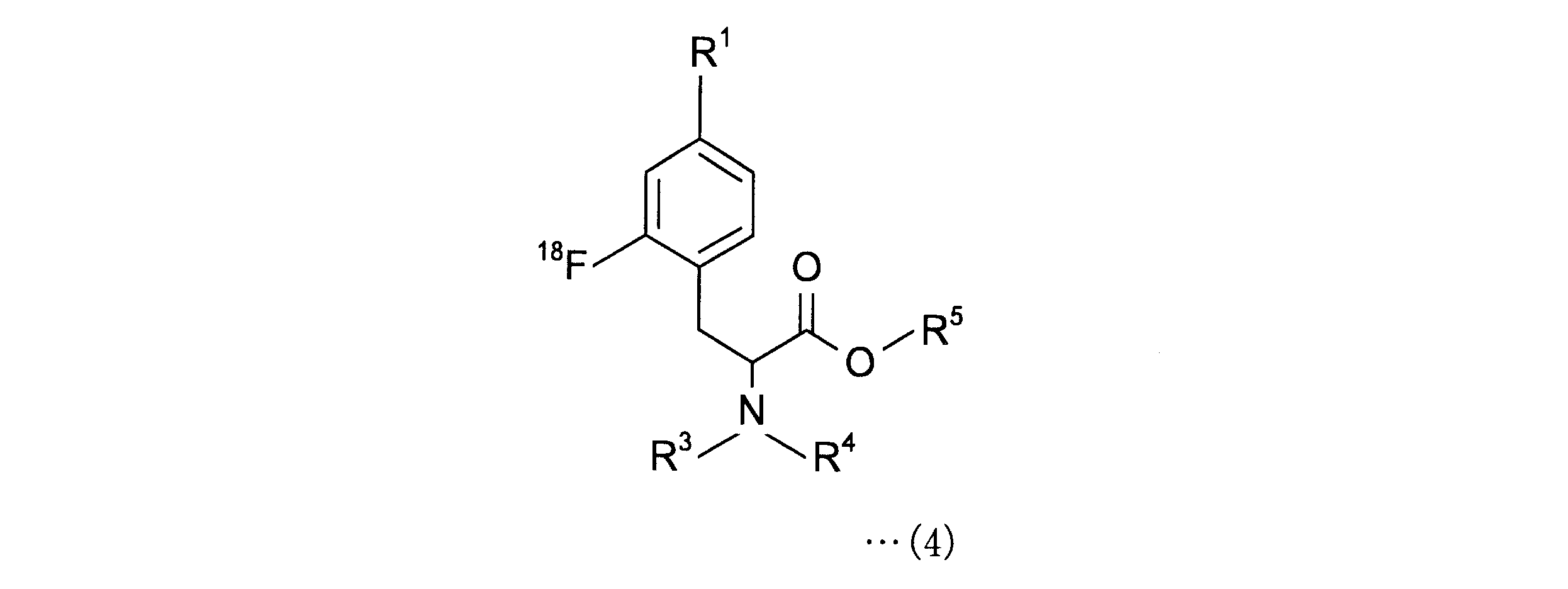
また、本発明にかかる2-[18F]フルオロ-4-ボロノフェニルアラニン前駆体の製造方法は、上記発明において、上記一般式(1)で表される化合物において、R1は、2,3-ジヒドロ-1H-ナフト[1,8-de]-1,3,2-ジアザボリニル基、トリフルオロボレート基、下記一般式(2)で表されるボロン酸-N-メチルイミノジアセテート基、


また、本発明にかかる2-[18F]フルオロ-4-ボロノフェニルアラニン前駆体の製造方法は、上記発明において、上記一般式(1)で表される化合物中、ヨードニウムイリド基はスピロ環を有するものであることを特徴とする。 Further, in the method for producing a 2- [ 18 F] fluoro-4-boronophenylalanine precursor according to the present invention, in the above invention, in the compound represented by the above general formula (1), the iodonium ylide group has a spiro ring. It is characterized by having.
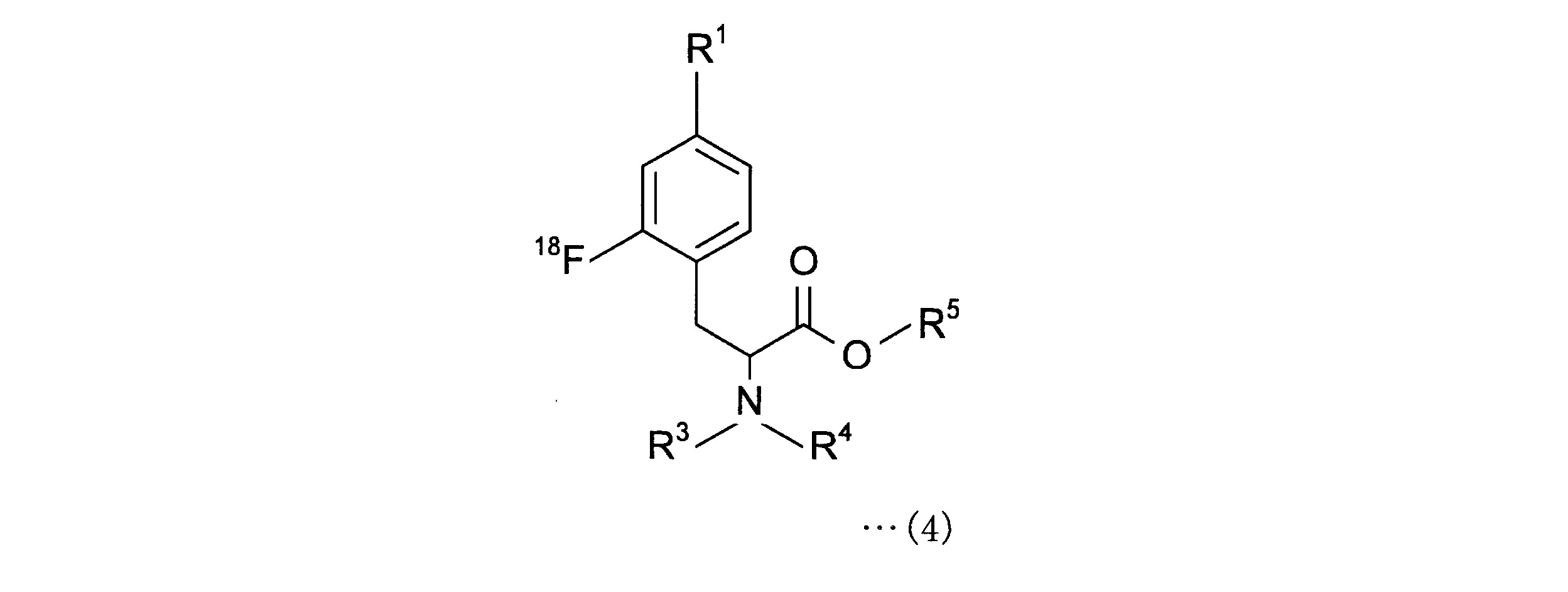
また、本発明にかかる2-[18F]フルオロ-4-ボロノフェニルアラニンの製造方法は、下記一般式(4)で表される2-[18F]フルオロ-4-ボロノフェニルアラニン前駆体
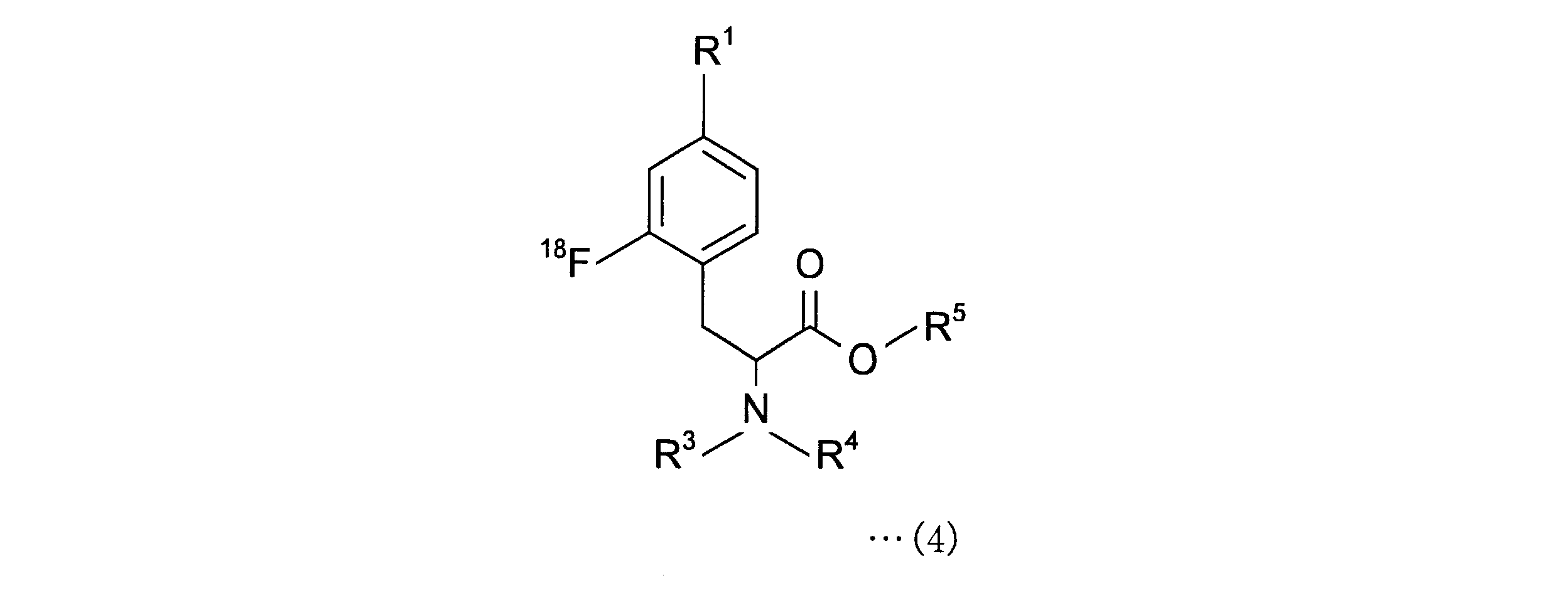
本発明によれば、2-[18F]フルオロ-4-ボロノフェニルアラニンの大量合成を可能とする、4-ボロノフェニルアラニン前駆体、2-[18F]フルオロ-4-ボロノフェニルアラニン前駆体の製造方法、2-[18F]フルオロ-4-ボロノフェニルアラニンの製造方法を提供することが可能となる。 According to the present invention, a 4-boronophenylalanine precursor and a 2- [ 18F] fluoro-4-boronophenylalanine precursor that enable large-scale synthesis of 2- [18 F ] fluoro-4-boronophenylalanine. , A method for producing 2- [ 18 F] fluoro-4-boronophenylalanine can be provided.
以下に、本発明の4-ボロノフェニルアラニン前駆体、2-[18F]フルオロ-4-ボロノフェニルアラニン前駆体の製造方法、2-[18F]フルオロ-4-ボロノフェニルアラニンの製造方法について詳細に説明する。 The following describes the method for producing 4-boronophenylalanine precursor, 2- [ 18 F] fluoro-4-boronophenylalanine precursor, and 2- [ 18 F] fluoro-4-boronophenylalanine of the present invention. It will be explained in detail.
本明細書において、「Cp~Cq」(pおよびqは正の整数であり、p<qを満たす。)という用語は、この用語の直後に記載された有機基の炭素原子数がp~qであることを表す。例えば、「C1~C12アルキル基」という表現は、炭素原子数1~12のアルキル基を示し、「C6~C10アリール基」という表現は、炭素原子数6~10のアリール基を示す。 In the present specification, the term "C p to C q " (p and q are positive integers and satisfy p <q) is described immediately after the term in that the number of carbon atoms of the organic group is p. Indicates that it is ~ q. For example, the expression "C 1 to C 12 alkyl group" indicates an alkyl group having 1 to 12 carbon atoms, and the expression "C 6 to C 10 aryl group" refers to an aryl group having 6 to 10 carbon atoms. show.
本明細書において、「置換基を有していてもよい」という表現は、無置換、若しくは置換基を1~5個(好ましくは1、2若しくは3個)有していることを意味する。なお、複数個の置換基を有する場合、それらの置換基は同一であっても、互いに異なっていてもよい。許容される置換基としては、ハロゲン原子、-OH、-O-C1-6アルキル基、-N(C1-6アルキル基)2、C1-6アルキル基、C6-10アリール基、-NH2、-NH(C1-6アルキル基)、-CN、-C(O)O-C1-6アルキル基、-C(O)H、-NO2等が挙げられる。 As used herein, the expression "may have substituents" means unsubstituted or having 1 to 5 (preferably 1, 2 or 3) substituents. When having a plurality of substituents, the substituents may be the same or different from each other. Acceptable substituents include halogen atom, -OH, -OC 1-6 alkyl group, -N (C 1-6 alkyl group) 2 , C 1-6 alkyl group, C 6-10 aryl group, Examples thereof include -NH 2 , -NH (C 1-6 alkyl group), -CN, -C (O) O-C 1-6 alkyl group, -C (O) H, -NO 2 and the like.
[4-ボロノフェニルアラニン前駆体]
4-ボロノフェニルアラニン前駆体は、下記一般式(1)の化合物である。
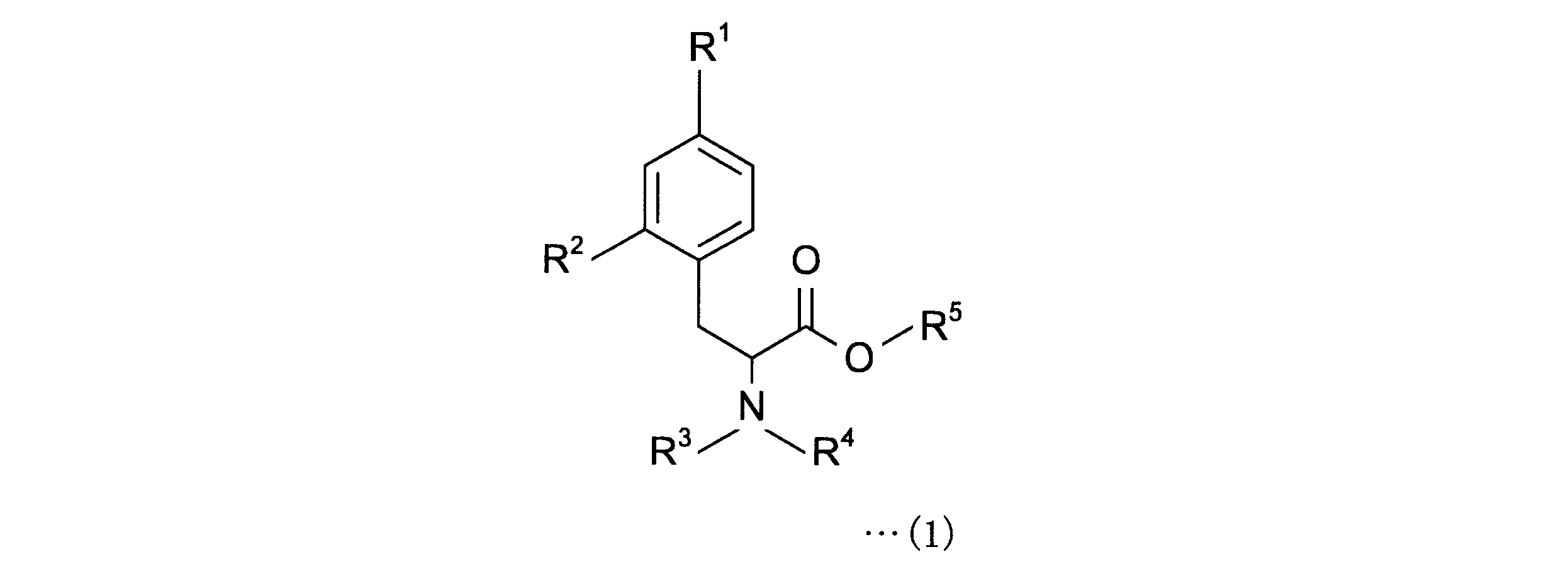
The 4-boronophenylalanine precursor is a compound of the following general formula (1).
R1は、加水分解によりボロン酸基となり、ホウ素のsp2空軌道に非共有電子対を供与しうるボロン酸の保護基を有するボロン酸誘導体基である。R1として、ホウ素のsp2空軌道に非共有電子対を供与しうるボロン酸の保護基を有するボロン酸誘導体基を選択することにより、4-ボロノフェニルアラニン前駆体を18Fフッ化物イオンでフッ素化する際に、R1のボロン酸基のsp2空軌道と反応することなく、位置選択的に18F標識が可能となる。 R 1 is a boronic acid derivative group having a boronic acid protective group which becomes a boronic acid group by hydrolysis and can donate an unshared electron pair to the sp2 empty orbital of boron. By selecting as R1 a boronic acid derivative group having a boronic acid protective group capable of donating an unshared electron pair to the sp2 empty orbital of boron, the 4 -boronophenylalanine precursor is hydrated with 18F fluoride ions. Upon fluoridation, 18F labeling becomes possible in a position-selective manner without reacting with the sp2 empty orbital of the boronic acid group of R1 .
R1として、2,3-ジヒドロ-1H-ナフト[1,8-de]-1,3,2-ジアザボリニル基、トリフルオロボレート基、下記一般式(2)で表されるボロン酸-N-メチルイミノジアセテート基、


R2は、ヒドロキシル基、ボロン酸エステル基またはヨードニウムイリド基である。R2として、ヒドロキシル基、またはヨードニウムイリド基を選択することにより、金属触媒を使用することなく、18Fフッ化物イオンで大量に18F標識が可能となる。 R 2 is a hydroxyl group, a boronic acid ester group or an iodonium ylide group. By selecting a hydroxyl group or an iodonium ylide group as R 2 , a large amount of 18 F fluoride ion can be labeled with 18 F without using a metal catalyst.
ヨードニウムイリド基は、スピロ環を有するものであることが好ましく、下記式(5)~(9)で表されるヨードニウムイリド基等を使用することができる。

R3およびR4は、それぞれ独立に、水素、置換基を有していてもよい炭素原子数2~11のアルキルカルボニル基、または置換基を有していてもよい炭素原子数7~11のアリールカルボニル基である。 R 3 and R 4 are independently hydrogen, an alkylcarbonyl group having 2 to 11 carbon atoms which may have a substituent, or 7 to 11 carbon atoms which may have a substituent. It is an arylcarbonyl group.
置換基を有していてもよい炭素原子数2~11のアルキルカルボニル基は、置換基を有していてもよい炭素原子数2~7のアルキルカルボニル基が好ましく、置換基を有していてもよい炭素原子数2~5のアルキルカルボニル基がより好ましい。置換基を有していてもよい炭素原子数2~11のアルキルカルボニル基としては、例えば、アセチル基、プロピオニル基、ピバロイル基、カプロイル基等が挙げられる。 The alkylcarbonyl group having 2 to 11 carbon atoms which may have a substituent is preferably an alkylcarbonyl group having 2 to 7 carbon atoms which may have a substituent and has a substituent. A good alkylcarbonyl group having 2 to 5 carbon atoms is more preferable. Examples of the alkylcarbonyl group having 2 to 11 carbon atoms which may have a substituent include an acetyl group, a propionyl group, a pivaloyl group, a caproyl group and the like.
置換基を有していてもよい炭素原子数7~11のアリールカルボニル基は、置換基を有していてもよい炭素原子数7~9のアリールカルボニル基が好ましい。置換基を有していてもよい炭素原子数7~11のアリールカルボニル基としては、例えば、ベンゾイル基、ナフトイル基等が挙げられる。 The arylcarbonyl group having 7 to 11 carbon atoms which may have a substituent is preferably an arylcarbonyl group having 7 to 9 carbon atoms which may have a substituent. Examples of the arylcarbonyl group having 7 to 11 carbon atoms which may have a substituent include a benzoyl group and a naphthoyl group.
R3およびR4は、ともに水素ではなく、R3および/またはR4は、それぞれ独立して、置換基を有していてもよい炭素原子数2~11のアルキルカルボニル基、または置換基を有していてもよい炭素原子数7~11のアリールカルボニル基である。 Both R 3 and R 4 are not hydrogen, and R 3 and / or R 4 each independently have an alkylcarbonyl group or a substituent having 2 to 11 carbon atoms which may have a substituent. It is an arylcarbonyl group having 7 to 11 carbon atoms which may be possessed.
R5は、置換基を有していてもよい炭素原子数1~10のアルキル基、または置換基を有していてもよい炭素原子数6~10のアリール基である。 R5 is an alkyl group having 1 to 10 carbon atoms which may have a substituent, or an aryl group having 6 to 10 carbon atoms which may have a substituent.
置換基を有していてもよい炭素原子数1~10のアルキル基は、置換基を有していてもよい炭素原子数1~6のアルキル基が好ましく、置換基を有していてもよい炭素原子数1~4のアルキル基がより好ましい。アルキル基は、直鎖、分岐鎖、または環状のアルキル基であってもよく、環状のアルキル基は、単環、多環のいずれであってもよい。炭素原子数1~10のアルキル基としては、例えば、メチル基、エチル基、プロピル基、イソプロピル基、n-ブチル基、iso-ブチル基、sec-ブチル基、tert-ブチル基、n-ペンチル基、ネオペンチル基等が挙げられ、tert-ブチル基が好ましい。 The alkyl group having 1 to 10 carbon atoms which may have a substituent is preferably an alkyl group having 1 to 6 carbon atoms which may have a substituent, and may have a substituent. Alkyl groups having 1 to 4 carbon atoms are more preferable. The alkyl group may be a linear, branched or cyclic alkyl group, and the cyclic alkyl group may be monocyclic or polycyclic. Examples of the alkyl group having 1 to 10 carbon atoms include a methyl group, an ethyl group, a propyl group, an isopropyl group, an n-butyl group, an iso-butyl group, a sec-butyl group, a tert-butyl group and an n-pentyl group. , Neopentyl group and the like, and tert-butyl group is preferable.
置換基を有していてもよい炭素原子数6~10のアリール基は、置換基を有していてもよい炭素原子数6~8のアリール基が好ましい。アリール基は、フェニル基、ナフチル基、ベンジル基、p-メトキシベンジル基、p-ニトロベンジル基などが挙げられる。 The aryl group having 6 to 10 carbon atoms which may have a substituent is preferably an aryl group having 6 to 8 carbon atoms which may have a substituent. Examples of the aryl group include a phenyl group, a naphthyl group, a benzyl group, a p-methoxybenzyl group, a p-nitrobenzyl group and the like.
一般式(1)の化合物の具体例としては、例えば、tert-ブチル-2-((tert-ブトキシカルボニル)アミノ)-3-(2-((7,9-ジオキソ-6,10-ジオキサスピロ[4.5]デカン-8-イリデン)-3-ヨーダニル)-4-(1H-ナフト[1,8-de][1,3,2]ジアザボリニン-2(3H)-イル)フェニル))プロパノエート、tert-ブチル-2-((tert-ブトキシカルボニル)アミノ)-3-(2-ヒドロキシ-4-(1H-ナフト[1,8-de][1,3,2]ジアザボリニン-2(3H)-イル)フェニル)プロパノエート等が挙げられるが、これに限定されない。 Specific examples of the compound of the general formula (1) include, for example, tert-butyl-2-((tert-butoxycarbonyl) amino) -3-(2-((7,9-dioxo-6,10-dioxaspiro] 4.5] Decane-8-iriden) -3-iodanyl) -4- (1H-naphtho [1,8-de] [1,3,2] diazabolinin-2 (3H) -yl) phenyl)) propanoate, tert-Butyl-2-((tert-butoxycarbonyl) amino) -3- (2-hydroxy-4- (1H-naphtho [1,8-de] [1,3,2] diazabolinin-2 (3H)- Il) phenyl) propanoate and the like, but are not limited to this.
一般式(1)の化合物は、ラセミ体であっても、またはS体(DL表示法ではL体)若しくはR体(DL表示法ではD体)であってもよいが、下記一般式(1’)の化合物のようにS体であることが好ましい。
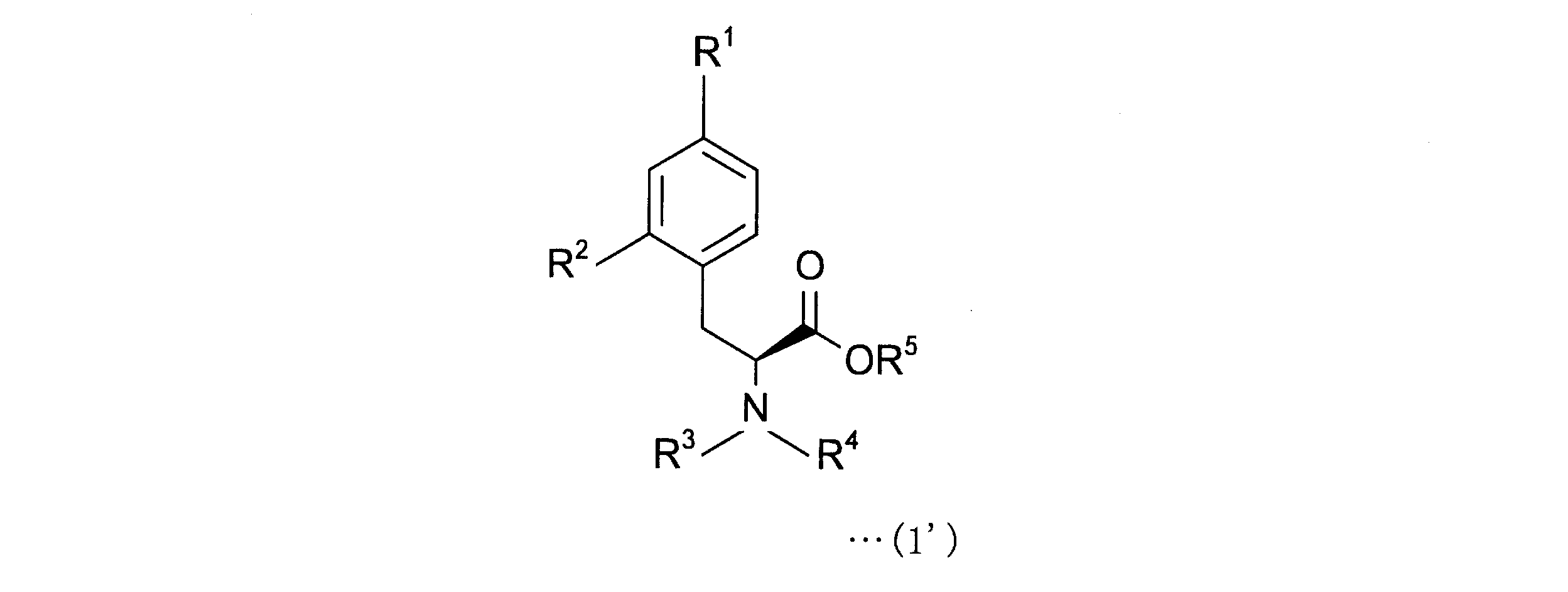
[2-[18F]フルオロ-4-ボロノフェニルアラニン前駆体の製造方法]
以下、2-[18F]フルオロ-4-ボロノフェニルアラニン前駆体の製造方法について説明する。
本発明の製造方法における各工程において、反応終了後、各工程の目的化合物は、常法にしたがって反応混合物から単離され得る。目的化合物は、例えば、(i)必要に応じて触媒等の不要物を濾去し、(ii)反応混合物に水、および水と混和しない溶媒(例えば、酢酸エチル、クロロホルム等)を加えて目的化合物を抽出し、(iii)有機層を水洗して、必要に応じて無水硫酸マグネシウム等の乾燥剤を用いて乾燥させ、(iv)溶媒を留去することによって得られる。得られた目的化合物は、必要に応じて公知の方法(例えば、シリカゲルカラムクロマトグラフィー等)により、さらに精製することができる。また、各工程の目的化合物は、精製することなく次の反応に提供することも可能である。
[Method for producing 2- [ 18 F] fluoro-4-boronophenylalanine precursor]
Hereinafter, a method for producing a 2- [ 18 F] fluoro-4-boronophenylalanine precursor will be described.
In each step of the production method of the present invention, after completion of the reaction, the target compound of each step can be isolated from the reaction mixture according to a conventional method. The target compound is, for example, (i) filtered out unnecessary substances such as a catalyst as necessary, and (ii) water and a solvent immiscible with water (for example, ethyl acetate, chloroform, etc.) are added to the reaction mixture for the purpose. It is obtained by extracting the compound, washing the (iii) organic layer with water, and if necessary, drying it with a desiccant such as anhydrous magnesium sulfate, and distilling off the (iv) solvent. The obtained target compound can be further purified by a known method (for example, silica gel column chromatography or the like), if necessary. Further, the target compound of each step can be provided for the next reaction without purification.
本発明は、一般式(1)で表される4-ボロノフェニルアラニン前駆体
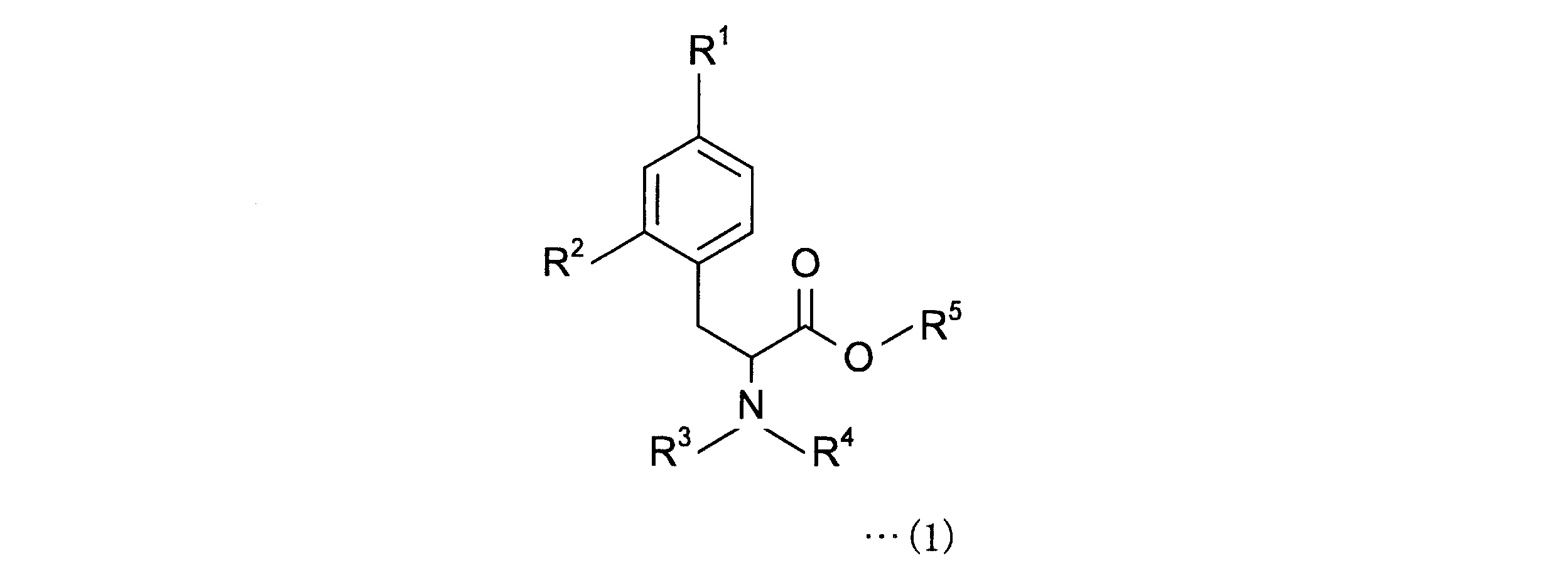
本発明の2-[18F]フルオロ-4-ボロノフェニルアラニン前駆体の製造方法では、一般式(1)で表される4-ボロノフェニルアラニン前駆体のR1として、ホウ素のsp2空軌道に非共有電子対を供与しうるボロン酸の保護基を有するボロン酸誘導体基を選択するため、18Fフッ化物イオンでフッ素化する際に、ホウ素と反応することなく、位置選択的に18F標識が可能となる。 In the method for producing a 2- [ 18 F] fluoro-4-boronophenylalanine precursor of the present invention, sp 2 empty orbital of boron is used as R1 of the 4-boronophenylalanine precursor represented by the general formula (1). In order to select a boronic acid derivative group having a boronic acid protective group capable of donating an unshared electron pair to 18F, when fluorinated with 18F fluoride ion, it does not react with boron and is position-selectively 18F . Signing is possible.
サイクロトロンより生成した[18F]フッ化物イオンをイオン交換樹脂カラムに吸着させ、炭酸カリウム等を含む溶離液で溶出させてK18Fとし、これを求核剤として使用し、一般式(1)で表される4-ボロノフェニルアラニン前駆体を18F標識することができる。または、[18F]フッ化物イオンを吸着したイオン交換樹脂カラムを、一般式(1)で表される4-ボロノフェニルアラニン前駆体を含む溶離液で溶離し、所定条件で反応させることにより、4-ボロノフェニルアラニン前駆体を18F標識してもよい。 [ 18 F] Fluoride ion generated from the cyclotron is adsorbed on an ion exchange resin column and eluted with an eluent containing potassium carbonate or the like to obtain K18 F, which is used as a nucleating agent and is used as a general formula (1). The 4-boronophenylalanine precursor represented by can be labeled with 18F . Alternatively, the ion exchange resin column adsorbing [ 18 F] fluoride ion is eluted with an eluent containing a 4-boronophenylalanine precursor represented by the general formula (1) and reacted under predetermined conditions. The 4-boronophenylalanine precursor may be labeled with 18F .
本発明では、一般式(1)で表される4-ボロノフェニルアラニン前駆体のR2として、ヒドロキシル基、ボロン酸エステル基またはヨードニウムイリド基を選択するため、高収率で4-ボロノフェニルアラニン前駆体を18F標識することができる。 In the present invention, a hydroxyl group, a boronic acid ester group or an iodonium irid group is selected as R2 of the 4-boronophenylalanine precursor represented by the general formula (1), so that 4-boronophenylalanine is produced in high yield. The precursor can be labeled with 18F .
ヒドロキシル基の18Fフッ化物イオンによるフッ素化は、下記一般式(80)で示す脱酸素的フッ素化剤等を介して行う。

なお、上記の18Fフッ化物イオンによるフッ素化は、4-ボロノフェニルアラニン前駆体に限定されるものではなく、例えば、ボロン酸基を有する芳香族化合物、または複素環化合物においても、ボロン酸基が、加水分解によりボロン酸基となるホウ素のsp2空軌道に非共有電子対を供与しうるボロン酸の保護基により保護されたボロン酸誘導体基として存在し、18F標識をする位置にヒドロキシル基、ボロン酸エステル基またはヨードニウムイリド基を有している場合には、位置選択的に18F標識が可能となる。 The above-mentioned fluorination with 18F fluoride ion is not limited to the 4-boronic phenylalanine precursor, and for example, an aromatic compound having a boronic acid group or a heterocyclic compound also has a boronic acid group. Exists as a boronic acid derivative group protected by a protective group of boronic acid that can donate an unshared electron pair to the sp2 empty orbital of boron, which becomes a boronic acid group by hydrolysis, and hydroxylates at the position labeled with 18F . When it has a group, a boronic acid ester group or an iodonium irid group, 18F labeling is possible in a position-selective manner.
例えば、下記スキーム中の化合物(77)を18Fフッ化物イオンによるフッ素化を行う場合にも、ヒドロキシル基を位置選択的に18F標識することができる。
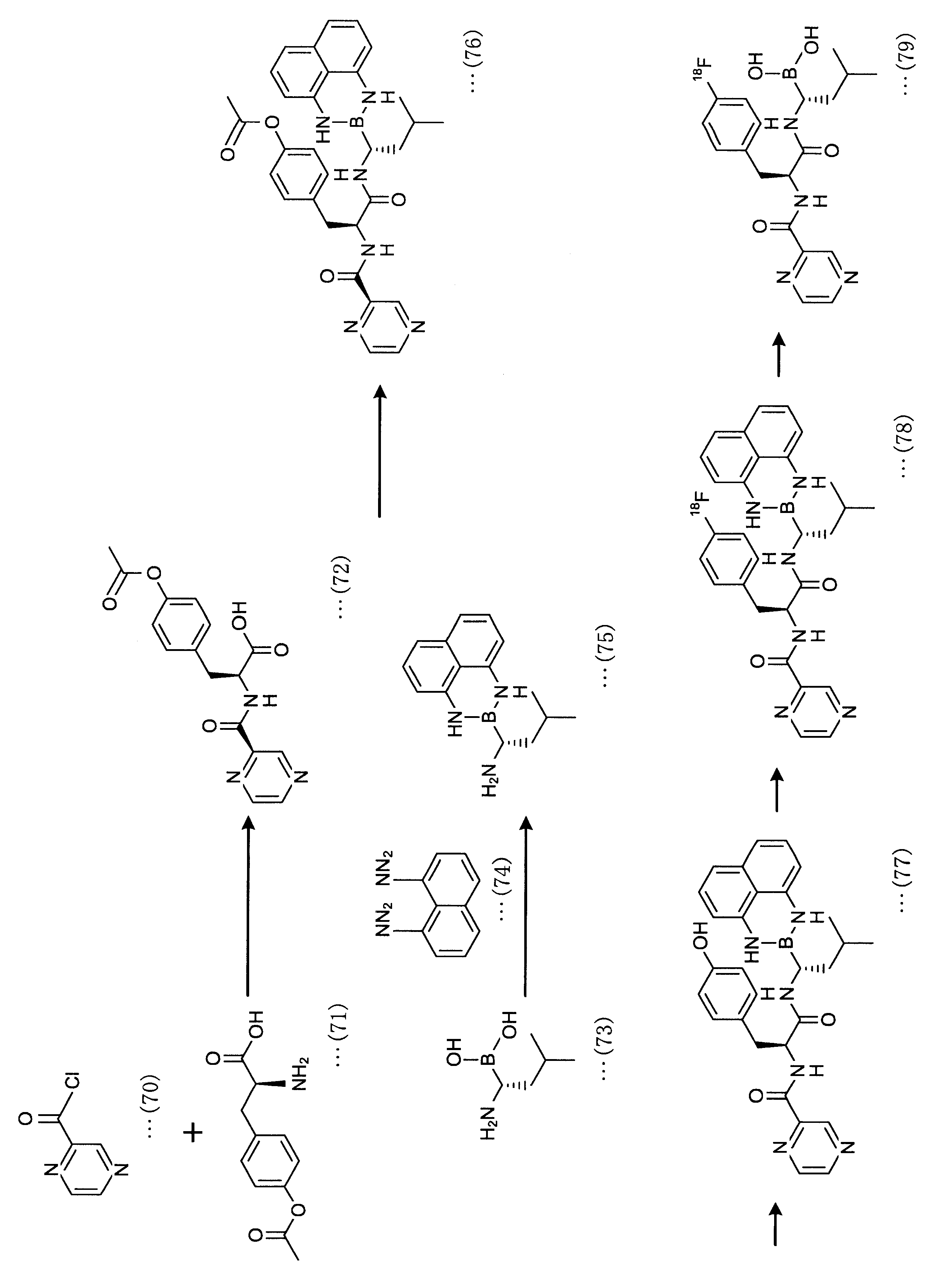
化合物(77)は、2-ピラジンカルボニルクロリド(化合物(70))と4-アセチルオキシフェニルアラニン(化合物(71))から合成した3-(4-アセチルオキシフェニル)-2-((2-ピラジンカルボニル)アミノ)プロパン酸(72)と、1-アミノ-3-メチルブチルボロン酸(化合物(73))と、1,8-ジアミノナフタレン(74)から合成した2-(1-アミノ-3-メチルブチル)-2,3-ジヒドロ-1H-ナフト[1,8-de][1,3,2]ジアザボリニン(化合物(75))により、化合物(76)を合成し、アセチルオキシ基を還元することにより得ることができる。 Compound (77) is 3- (4-acetyloxyphenyl) -2-((2-pyrazinecarbonyl) synthesized from 2-pyrazinecarbonyl chloride (compound (70)) and 4-acetyloxyphenylalanine (compound (71)). ) Amino) propanoic acid (72), 1-amino-3-methylbutylboronic acid (compound (73)), and 2- (1-amino-3-methylbutyl) synthesized from 1,8-diaminonaphthalene (74). ) -2,3-Dihydro-1H-naphtho [1,8-de] [1,3,2] By synthesizing compound (76) with diazaborinine (compound (75)) and reducing the acetyloxy group. Obtainable.
化合物(77)を一般式(80)で示す脱酸素的フッ素化剤等によりフッ素化することにより、化合物(78)が得られ、加水分解により化合物(79)を得ることができる。 Compound (78) can be obtained by fluorinating compound (77) with an oxygen scavenger fluorinating agent represented by the general formula (80), and compound (79) can be obtained by hydrolysis.
また、同様にして、アスタチン(At)の放射性同位体を基質に付加することも可能となる。 Similarly, it is also possible to add a radioactive isotope of astatine (At) to the substrate.
さらに、本発明において、一般式(4)の化合物を脱保護することにより、2-[18F]フルオロ-4-ボロノフェニルアラニンを得ることができる。この工程を行うことにより、3~5個の保護基を一度で効率的に脱離することが可能となる。 Further, in the present invention, 2- [ 18F ] fluoro-4-boronophenylalanine can be obtained by deprotecting the compound of the general formula (4). By performing this step, it is possible to efficiently remove 3 to 5 protecting groups at one time.
脱保護は、一般式(4)のR1、R3、R4、R5の種類に応じた公知の種々の方法により行うことができ、特に限定されないが、一般式(4)の化合物を酸または塩基により処理することが好ましく、酸により処理することがより好ましい。 Deprotection can be performed by various known methods according to the types of R 1 , R 3 , R 4 , and R 5 of the general formula (4), and the compound of the general formula (4) is not particularly limited. Treatment with an acid or base is preferred, and treatment with an acid is more preferred.
脱保護に用いる酸としては、例えば、ハロゲン化水素、ハロゲン化水素酸、硫酸、硝酸、トリフルオロ酢酸(TFA)、スルホン酸、クロム酸等が挙げられ、ハロゲン化水素が好ましい。ハロゲン化水素としては、フッ化水素、塩化水素、臭化水素、ヨウ化水素が挙げられ、臭化水素が好ましい。ハロゲン化水素酸としては、フッ化水素酸、塩酸、臭化水素酸、ヨウ化水素酸が挙げられ、臭化水素酸が好ましい。 Examples of the acid used for deprotection include hydrogen halide, hydrohalic acid, sulfuric acid, nitric acid, trifluoroacetic acid (TFA), sulfonic acid, chromium acid and the like, and hydrogen halide is preferable. Examples of the hydrogen halide include hydrogen fluoride, hydrogen chloride, hydrogen bromide, and hydrogen iodide, and hydrogen bromide is preferable. Examples of the hydrohalogen acid include hydrofluoric acid, hydrochloric acid, hydrobromic acid and hydroiodide, and hydrobromic acid is preferable.
溶媒を使用する場合、使用する溶媒としては、水、ジクロロメタン、アセトン、アセトニトリル、テトラヒドロフラン(「THF」ともいう)、メタノール、エタノール等が挙げられる。これらは1種単独で用いてもよく、2種以上の混合溶媒であってもよい。 When a solvent is used, examples of the solvent used include water, dichloromethane, acetone, acetonitrile, tetrahydrofuran (also referred to as "THF"), methanol, ethanol and the like. These may be used alone or may be a mixed solvent of two or more kinds.
反応温度は、100~250℃が好ましく、120~230℃がより好ましく、130~200℃がさらに好ましい。
反応時間は、1~60分が好ましく、5~30分がより好ましく、10~20分がさらに好ましい。
The reaction temperature is preferably 100 to 250 ° C, more preferably 120 to 230 ° C, still more preferably 130 to 200 ° C.
The reaction time is preferably 1 to 60 minutes, more preferably 5 to 30 minutes, still more preferably 10 to 20 minutes.
一般式(1)の化合物は、ラセミ体であっても、またはS体(DL表示法ではL体)若しくはR体(DL表示法ではD体)であってもよいが、一般式(1’)の化合物のようにS体であることが好ましい。一般式(1’)の化合物は、例えばキラル触媒等を用いて一般式(1’)の化合物を選択的に合成することができる。あるいは、一般式(1’)の化合物は、公知の精製法を用いてラセミ体から精製されてもよい。 The compound of the general formula (1) may be a racemate, an S-form (L-form in the DL representation method) or an R-form (D-form in the DL representation method), but may be in the general formula (1'). ) Is preferably S-form. As the compound of the general formula (1'), the compound of the general formula (1') can be selectively synthesized by using, for example, a chiral catalyst or the like. Alternatively, the compound of the general formula (1') may be purified from the racemate using a known purification method.
2-[18F]フルオロ-4-ボロノフェニルアラニン前駆体の製造方法の好適な一実施形態として、下記の合成スキームが例示される。
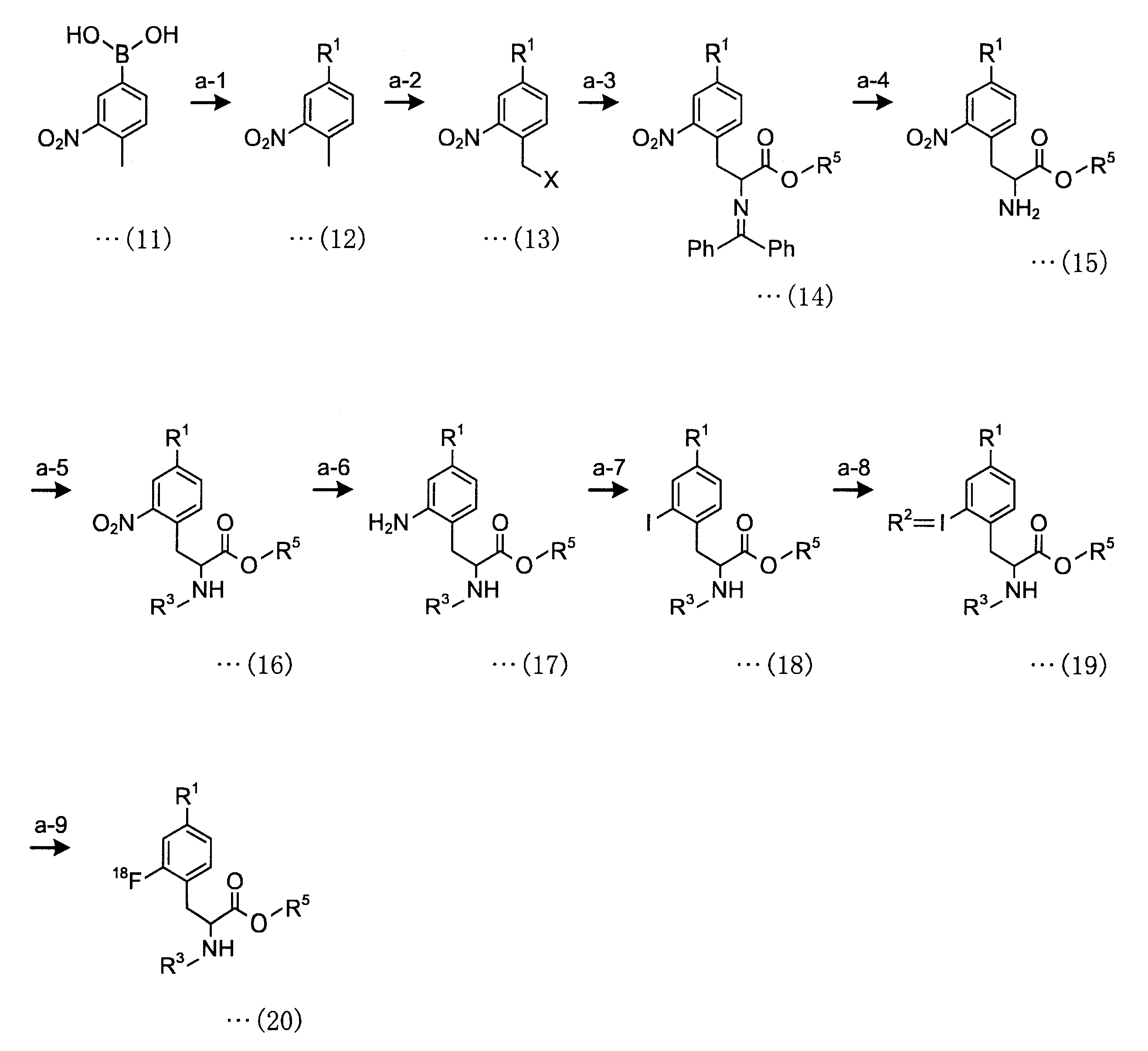
a-9工程は、放射性化合物を含むので例えば、JFEエンジニアリング(株)製のAM-HB01等の自動合成装置を用いて行うことが好ましい。 Since the a-9 step contains a radioactive compound, it is preferable to use an automatic synthesizer such as AM-HB01 manufactured by JFE Engineering Corporation.
<a-1工程>
a-1工程は、一般式(11)の化合物をボラン酸の保護基と反応させ、一般式(12)の化合物を得る工程である。a-1工程で用いるホウ酸の保護基としては、ホウ素のsp2空軌道に非共有電子対を供与しうるものが好ましく、R1としては、2,3-ジヒドロ-1H-ナフト[1,8-de]-1,3,2-ジアザボリニル基、トリフルオロボレート基、ボロン酸-N-メチルイミノジアセテート基、環状トリオールボレート基が例示される。
<A-1 process>
The step a-1 is a step of reacting the compound of the general formula (11) with the protecting group of borane acid to obtain the compound of the general formula (12). As the protective group for boric acid used in the a-1 step, a group capable of donating an unshared electron pair to the sp2 empty orbital of boron is preferable, and as R1 , 2,3-dihydro-1H-naphtho [1, Examples thereof include 8-de] -1,3,2-diazabolinyl group, trifluoroborate group, boronic acid-N-methyliminodiacetate group, and cyclic triolbolate group.
溶媒は、特に限定されないが、N,N-ジメチルホルムアミド(「DMF」ともいう)、ジメチルスルホキシド(「DMSO」ともいう)、テトラヒドロフラン(「THF」ともいう)、トルエン、キシレン、またはこれらの混合溶媒を使用することができる。 The solvent is not particularly limited, but is N, N-dimethylformamide (also referred to as “DMF”), dimethyl sulfoxide (also referred to as “DMSO”), tetrahydrofuran (also referred to as “THF”), toluene, xylene, or a mixed solvent thereof. Can be used.
反応温度は、-20℃~120℃が好ましく、室温~70℃がより好ましい。反応時間は、1~24時間が好ましく、5~18時間がより好ましい。 The reaction temperature is preferably −20 ° C. to 120 ° C., more preferably room temperature to 70 ° C. The reaction time is preferably 1 to 24 hours, more preferably 5 to 18 hours.
トリフルオロボレート基とする場合は、例えば、4-ホルミル-3-フルオロフェニルホウ酸のアセトニトリル懸濁駅液に、フッ化カリウム、フッ化ナトリウム等のフッ化物塩の水溶液を加え、さらにL-酒石酸のTFH溶液等を加え、沈殿物をろ取し、ろ液を減圧濃縮すればよい。反応温度は、0℃~40℃が好ましい。 In the case of using a trifluoroborate group, for example, an aqueous solution of a fluoride salt such as potassium fluoride or sodium fluoride is added to an acetonitrile suspension station solution of 4-formyl-3-fluorophenylboric acid, and then L-tartrate acid is added. The TFH solution and the like may be added, the precipitate may be collected by filtration, and the filtrate may be concentrated under reduced pressure. The reaction temperature is preferably 0 ° C to 40 ° C.
一般式(11)の化合物は、市販品を用いてもよく、公知の合成方法を用いて合成してもよい。 The compound of the general formula (11) may be a commercially available product or may be synthesized by a known synthesis method.
<a-2工程>
a-2工程は、一般式(12)の化合物をハロゲン化試薬と反応させて、一般式(13)の化合物を得る工程である。a-2工程のXは、フッ素、塩素、ヨウ素または臭素であり、入手性の観点から臭素が好ましい。
<A-2 step>
The step a-2 is a step of reacting the compound of the general formula (12) with the halogenating reagent to obtain the compound of the general formula (13). X in step a-2 is fluorine, chlorine, iodine or bromine, and bromine is preferable from the viewpoint of availability.
a-2工程で使用するハロゲン化試薬は、N-ブロモスクシンイミド(「NBS」ともいう)、N-ヨードスクシンイミド、ジブロモイソシアヌル酸、1,3-ジヨード-5,5’-ジメチルヒダントイン等が例示される。触媒としては、過酸化物等が例示される。 Examples of the halogenating reagent used in step a-2 include N-bromosuccinimide (also referred to as "NBS"), N-iodosuccinimide, dibromoisocyanuric acid, 1,3-diiodo-5,5'-dimethylhydantoin and the like. To. Examples of the catalyst include peroxides and the like.
溶媒は、特に限定されないが、ベンゼン、クロロホルム、四塩化炭素等が挙げられ、これらは1種単独で用いてもよく、2種以上の混合溶媒であってもよい。 The solvent is not particularly limited, and examples thereof include benzene, chloroform, carbon tetrachloride, and the like, and these may be used alone or as a mixed solvent of two or more kinds.
反応温度は、室温~120℃が好ましく、80~100℃がより好ましい。反応時間は、1~24時間が好ましく、6~12時間がより好ましい。 The reaction temperature is preferably room temperature to 120 ° C, more preferably 80 to 100 ° C. The reaction time is preferably 1 to 24 hours, more preferably 6 to 12 hours.
<a-3工程>
a-3工程は、一般式(13)の化合物を修飾アミノ酸と反応させ、一般式(14)の化合物を得る工程である。
<A-3 process>
Step a-3 is a step of reacting the compound of the general formula (13) with the modified amino acid to obtain the compound of the general formula (14).
修飾アミノ酸は、特に限定されないが、例えば、N-ジフェニルメチレングリシンメチルエステル、N-ジフェニルメチレングリシンエチルエステル、N-ジフェニルメチレングリシンtert-ブチルエステル、4-クロロベンジリデングリシンtert-ブチルエステル、N-ジフェニルメチレングリシンベンジルエステルエステル等が挙げられ、N-ジフェニルメチレングリシン-tert-ブチルエステルが好ましい。 The modified amino acid is not particularly limited, and is, for example, N-diphenylmethylene glycine methyl ester, N-diphenyl methylene glycine ethyl ester, N-diphenyl methylene glycine tert-butyl ester, 4-chlorobenzylidene glycine tert-butyl ester, N-diphenyl. Examples thereof include methylene glycine benzyl ester ester, and N-diphenyl methylene glycine-tert-butyl ester is preferable.
a-3工程は、塩基の存在下で行うことが好ましい。塩基としては、水酸化リチウム、水酸化ナトリウム、水酸化カリウム、トリエチルアミン等が挙げられ、反応速度の観点から水酸化カリウムが好ましい。 Step a-3 is preferably performed in the presence of a base. Examples of the base include lithium hydroxide, sodium hydroxide, potassium hydroxide, triethylamine and the like, and potassium hydroxide is preferable from the viewpoint of reaction rate.
溶媒は、トルエン、ジクロロメタン、クロロホルム等が挙げられ、トルエンが好ましい。
反応温度は、-20~100℃が好ましく、-10~50℃がより好ましく、-5~10℃がさらに好ましい。反応時間は、1~60分が好ましく、5~45分がより好ましく、10~30分がさらに好ましい。
Examples of the solvent include toluene, dichloromethane, chloroform and the like, and toluene is preferable.
The reaction temperature is preferably −20 to 100 ° C., more preferably −10 to 50 ° C., still more preferably −5 to 10 ° C. The reaction time is preferably 1 to 60 minutes, more preferably 5 to 45 minutes, still more preferably 10 to 30 minutes.
<a-4工程>
a-4工程は、一般式(14)の化合物から、酸性水溶液中にてアミノ酸保護基を脱離させ、一般式(15)の化合物を得る工程である。
<Step a-4>
Step a-4 is a step of removing the amino acid protecting group from the compound of the general formula (14) in an acidic aqueous solution to obtain the compound of the general formula (15).
溶媒は、特に限定されないが、クエン酸、またはシュウ酸水溶液とアセトン、アセトニトリル、DMF、DMSO、THFとの混合溶媒を例示することができる。クエン酸が好ましい。 The solvent is not particularly limited, and examples thereof include a mixed solvent of citric acid or an aqueous solution of oxalic acid and acetone, acetonitrile, DMF, DMSO, and THF. Citric acid is preferred.
反応温度は、室温~100℃が好ましく、室温~70℃がより好ましい。反応時間は、1~24時間が好ましく、1~5時間がより好ましい。 The reaction temperature is preferably room temperature to 100 ° C, more preferably room temperature to 70 ° C. The reaction time is preferably 1 to 24 hours, more preferably 1 to 5 hours.
<a-5工程>
a-5工程は、一般式(15)の化合物のアミノ基に、塩基性条件下で保護基を付加させ、一般式(16)の化合物を得る工程である。使用される保護基は、ジ-tert-ブチルジカルボネート(「Boc2O」ともいう)、ベンジルクロロホルメート等が例示される。
<A-5 process>
Step a-5 is a step of adding a protecting group to the amino group of the compound of the general formula (15) under basic conditions to obtain the compound of the general formula (16). Examples of the protecting group used include di-tert-butyl dicarbonate (also referred to as "Boc 2 O"), benzyl chloroformate and the like.
使用される塩基は、水酸化リチウム、水酸化ナトリウム、水酸化カリウム、炭酸ナトリウム、炭酸ナトリウム、炭酸カリウム等が例示される。炭酸ナトリウム、炭酸カリウムが
好ましい。
Examples of the base used include lithium hydroxide, sodium hydroxide, potassium hydroxide, sodium carbonate, sodium carbonate, potassium carbonate and the like. Sodium carbonate and potassium carbonate are preferable.
溶媒は、特に限定されないが、アセトン、アセトニトリル、DMF、DMSO、THFを例示することができる。アセトン、アセトニトリル、THFが好ましい。 The solvent is not particularly limited, and examples thereof include acetone, acetonitrile, DMF, DMSO, and THF. Acetone, acetonitrile and THF are preferred.
反応温度は、-20~100℃が好ましく、0℃~50℃がより好ましい。反応時間は、1~24時間が好ましく、5~18時間がより好ましい。 The reaction temperature is preferably −20 ° C. to 100 ° C., more preferably 0 ° C. to 50 ° C. The reaction time is preferably 1 to 24 hours, more preferably 5 to 18 hours.
<a-6工程>
a-6工程は、一般式(16)の化合物を、水素還元して一般式(17)の化合物を得る工程である。使用する触媒としては、パラジウム炭素、水酸化パラジウム等が例示される。
<A-6 process>
Step a-6 is a step of reducing the compound of the general formula (16) with hydrogen to obtain the compound of the general formula (17). Examples of the catalyst used include palladium carbon, palladium hydroxide and the like.
溶媒は、特に限定されないが、アセトン、アセトニトリル、THF、メタノール、エタノール等を例示することができる。メタノール、エタノールが好ましい。 The solvent is not particularly limited, and examples thereof include acetone, acetonitrile, THF, methanol, and ethanol. Methanol and ethanol are preferable.
反応温度は、-20~100℃が好ましく、室温~70℃がより好ましい。反応時間は、1~48時間が好ましく、5~36時間がより好ましい。 The reaction temperature is preferably −20 to 100 ° C., more preferably room temperature to 70 ° C. The reaction time is preferably 1 to 48 hours, more preferably 5 to 36 hours.
<a-7工程>
a-7工程は、一般式(17)の化合物を、ジアゾニウムを経てヨウ素化して一般式(18)の化合物を得る工程である。ジアゾニウム反応試薬としては、亜硝酸ナトリム、亜硝酸カリウム、亜硝酸イソブチル等が例示される。ヨウ素化試薬としては、ヨウ化ナトリウム、ヨウ化カリウム等が例示される。
<A-7 process>
Step a-7 is a step of iodizing the compound of the general formula (17) via diazonium to obtain the compound of the general formula (18). Examples of the diazonium reaction reagent include sodium nitrite, potassium nitrite, isobutyl nitrite and the like. Examples of the iodination reagent include sodium iodide, potassium iodide and the like.
溶媒は、特に限定されないが、水、アセトン、アセトニトリル、メタノール、エタノール、THF、またはこれらの混合溶媒を例示することができる。 The solvent is not particularly limited, and water, acetone, acetonitrile, methanol, ethanol, THF, or a mixed solvent thereof can be exemplified.
反応温度は、-20℃~室温が好ましく、-10~10℃がより好ましい。反応時間は、30分~3時間が好ましく、30分~2時間がより好ましい。 The reaction temperature is preferably −20 ° C. to room temperature, more preferably −10 ° C. to 10 ° C. The reaction time is preferably 30 minutes to 3 hours, more preferably 30 minutes to 2 hours.
<a-8工程>
a-8工程は、一般式(18)の化合物を、過酸化物等の酸化剤の存在下、ヨウ素を超原子価ヨードニウムイリドとして一般式(19)の化合物を得る工程である。酸化剤としては、3-クロロ過安息香酸、1-クロロメチル-4-フルオロ-1,4-ジアゾニアビシクロ[2.2.2]オクタン-ビス(テトラフルオロボラート)等が例示される。
<A-8 process>
Step a-8 is a step of obtaining the compound of the general formula (19) from the compound of the general formula (18) in the presence of an oxidizing agent such as a peroxide, using iodine as a hypervalent iodonium ylide. Examples of the oxidizing agent include 3-chloroperbenzoic acid, 1-chloromethyl-4-fluoro-1,4-diazonia bicyclo [2.2.2] octane-bis (tetrafluoroborate) and the like.
溶媒は、クロロホルム等を使用することができる。
反応温度は、0~40℃が好ましく、10~40℃がより好ましい。反応時間は、2時間~12時間が好ましく、2分~8時間がより好ましい。
Chloroform or the like can be used as the solvent.
The reaction temperature is preferably 0 to 40 ° C, more preferably 10 to 40 ° C. The reaction time is preferably 2 hours to 12 hours, more preferably 2 minutes to 8 hours.
<a-9工程>
a-9工程は、一般式(19)の化合物を、[18F]フッ化物イオンでフッ素化して一般式(20)の化合物を得る工程である。
<A-9 process>
Step a-9 is a step of fluorinating the compound of the general formula (19) with [ 18 F] fluoride ion to obtain the compound of the general formula (20).
溶媒は、特に限定されないが、DMF、DMSO、THFを使用することができる。
反応温度は、40℃~150℃が好ましく、60~140℃がより好ましい。反応時間は、1分~1時間が好ましく、5分~30分がより好ましい。
The solvent is not particularly limited, but DMF, DMSO, and THF can be used.
The reaction temperature is preferably 40 ° C to 150 ° C, more preferably 60 to 140 ° C. The reaction time is preferably 1 minute to 1 hour, more preferably 5 minutes to 30 minutes.
なお、一般式(18)の化合物を、アミンとハロゲン原子とのクロスカップリング反応を抑制するためtert-ブトキシカルボニル化試薬(Boc化試薬)等で保護した後に、パラジウム触媒を使用し、ピナコールホウ酸誘導体とした後、銅触媒の存在下、フッ素化試薬と反応させることもできる(国際公開第2015/093469号等参照)。 The compound of the general formula (18) is protected with a tert-butoxycarbonylation reagent (Bocation reagent) or the like in order to suppress the cross-coupling reaction between the amine and the halogen atom, and then a palladium catalyst is used to use pinacol hoe. After making an acid derivative, it can be reacted with a fluorination reagent in the presence of a copper catalyst (see International Publication No. 2015/093469 etc.).
また、2-[18F]フルオロ-4-ボロノフェニルアラニン前駆体の製造方法の好適な他の一実施形態として、下記の合成スキームが例示される。

b-8工程は、放射性化合物を含むので例えば、JFEエンジニアリング(株)製のAM-HB01等の自動合成装置を用いて行うことが好ましい。 Since the b-8 step contains a radioactive compound, it is preferable to use an automatic synthesizer such as AM-HB01 manufactured by JFE Engineering Corporation.
<b-1工程>
b-1工程は、一般式(30)の化合物をボラン酸の保護基と反応させ、一般式(31)の化合物を得る工程である。b-1工程で用いるホウ酸の保護基、溶媒、反応時間、反応温度は、a-1工程と同様である。
<B-1 process>
The b-1 step is a step of reacting the compound of the general formula (30) with the protecting group of borane acid to obtain the compound of the general formula (31). The protecting group, solvent, reaction time, and reaction temperature of boric acid used in the b-1 step are the same as those in the a-1 step.
一般式(30)の化合物は、市販品を用いてもよく、公知の合成方法を用いて合成してもよい。 The compound of the general formula (30) may be a commercially available product or may be synthesized by a known synthesis method.
<b-2工程>
b-2工程は、一般式(31)の化合物の水酸基に、保護基を付加させ一般式(32)の化合物を得る工程である。保護基R6としては、炭素数6~12のアリール基が好ましい。
<B-2 process>
The b-2 step is a step of adding a protecting group to the hydroxyl group of the compound of the general formula (31) to obtain the compound of the general formula (32). As the protecting group R6, an aryl group having 6 to 12 carbon atoms is preferable.
溶媒は、特に限定されないが、DMF等を使用することができる。
反応温度は、0℃~60℃が好ましく、10~40℃がより好ましい。反応時間は、1~24時間が好ましく、3~8時間がより好ましい。
The solvent is not particularly limited, but DMF or the like can be used.
The reaction temperature is preferably 0 ° C to 60 ° C, more preferably 10 to 40 ° C. The reaction time is preferably 1 to 24 hours, more preferably 3 to 8 hours.
<b-3工程>
b-3工程は、一般式(32)の化合物をハロゲン化試薬と反応させて、一般式(33)の化合物を得る工程である。b-3工程のXは、フッ素、塩素、ヨウ素または臭素であり、入手性の観点から臭素が好ましい。b-3工程で用いるハロゲン化試薬、溶媒、反応時間、反応温度は、a-2工程と同様である。
<B-3 process>
Step b-3 is a step of reacting the compound of the general formula (32) with the halogenating reagent to obtain the compound of the general formula (33). X in step b-3 is fluorine, chlorine, iodine or bromine, and bromine is preferable from the viewpoint of availability. The halogenating reagent, solvent, reaction time, and reaction temperature used in step b-3 are the same as in step a-2.
<b-4工程>
b-4工程は、一般式(33)の化合物を修飾アミノ酸と反応させ、一般式(34)の化合物を得る工程である。b-4工程で使用する修飾アミノ酸、塩基、溶媒、反応時間、反応温度は、a-3工程と同様である。
<B-4 step>
The step b-4 is a step of reacting the compound of the general formula (33) with the modified amino acid to obtain the compound of the general formula (34). The modified amino acid, base, solvent, reaction time, and reaction temperature used in step b-4 are the same as in step a-3.
<b-5工程>
b-5工程は、一般式(34)の化合物から、酸性水溶液中にてアミノ酸保護基を脱離させ、一般式(35)の化合物を得る工程である。b-5工程で使用する溶媒、反応時間、反応温度は、a-4工程と同様である。
<B-5 process>
Step b-5 is a step of removing the amino acid protecting group from the compound of the general formula (34) in an acidic aqueous solution to obtain the compound of the general formula (35). The solvent, reaction time, and reaction temperature used in step b-5 are the same as in step a-4.
<b-6工程>
b-6工程は、一般式(35)の化合物のアミノ基に、塩基性条件下で保護基を付加させ、一般式(36)の化合物を得る工程である。b-6工程で使用する保護基、塩基、溶媒、反応時間、反応温度は、a-5工程と同様である。
<B-6 process>
Step b-6 is a step of adding a protecting group to the amino group of the compound of the general formula (35) under basic conditions to obtain the compound of the general formula (36). The protecting group, base, solvent, reaction time, and reaction temperature used in step b-6 are the same as in step a-5.
<b-7工程>
b-7工程は、一般式(36)の化合物を、水素還元して一般式(37)の化合物を得る工程である。b-7工程で使用する溶媒、反応時間、反応温度は、a-6工程と同様である。
<B-7 process>
The b-7 step is a step of reducing the compound of the general formula (36) with hydrogen to obtain the compound of the general formula (37). The solvent, reaction time, and reaction temperature used in step b-7 are the same as in step a-6.
<b-8工程>
b-8工程は、一般式(37)の化合物を、[18F]フッ化物イオンでフッ素化して一般式(38)の化合物を得る工程である。
<B-8 process>
Step b-8 is a step of fluorinating the compound of the general formula (37) with [ 18 F] fluoride ion to obtain the compound of the general formula (38).
一般式(37)の化合物の[18F]フッ化物イオンでのフッ素化は、まず、クロロホルム等の溶媒を使用し、炭酸銀とともに一般式(80)等の脱酸素的フッ素化剤とヒドロキシル基とを反応させた後、[18F]フッ化物イオンで協奏的に置換反応させる。 For fluorination of the compound of the general formula (37) with [ 18 F] fluoride ion, first, a solvent such as chloroform is used, and together with silver carbonate, a deoxidizing fluoride agent of the general formula (80) and a hydroxyl group are used. After reacting with, [ 18 F] is subjected to a concerted substitution reaction with fluoride ions.
以下、本発明を実施例により具体的に説明するが、本発明はこれらの実施例に限定されるものではない。 Hereinafter, the present invention will be specifically described with reference to Examples, but the present invention is not limited to these Examples.
[実施例1]
実施例1は、以下の合成スキームで合成を行った。
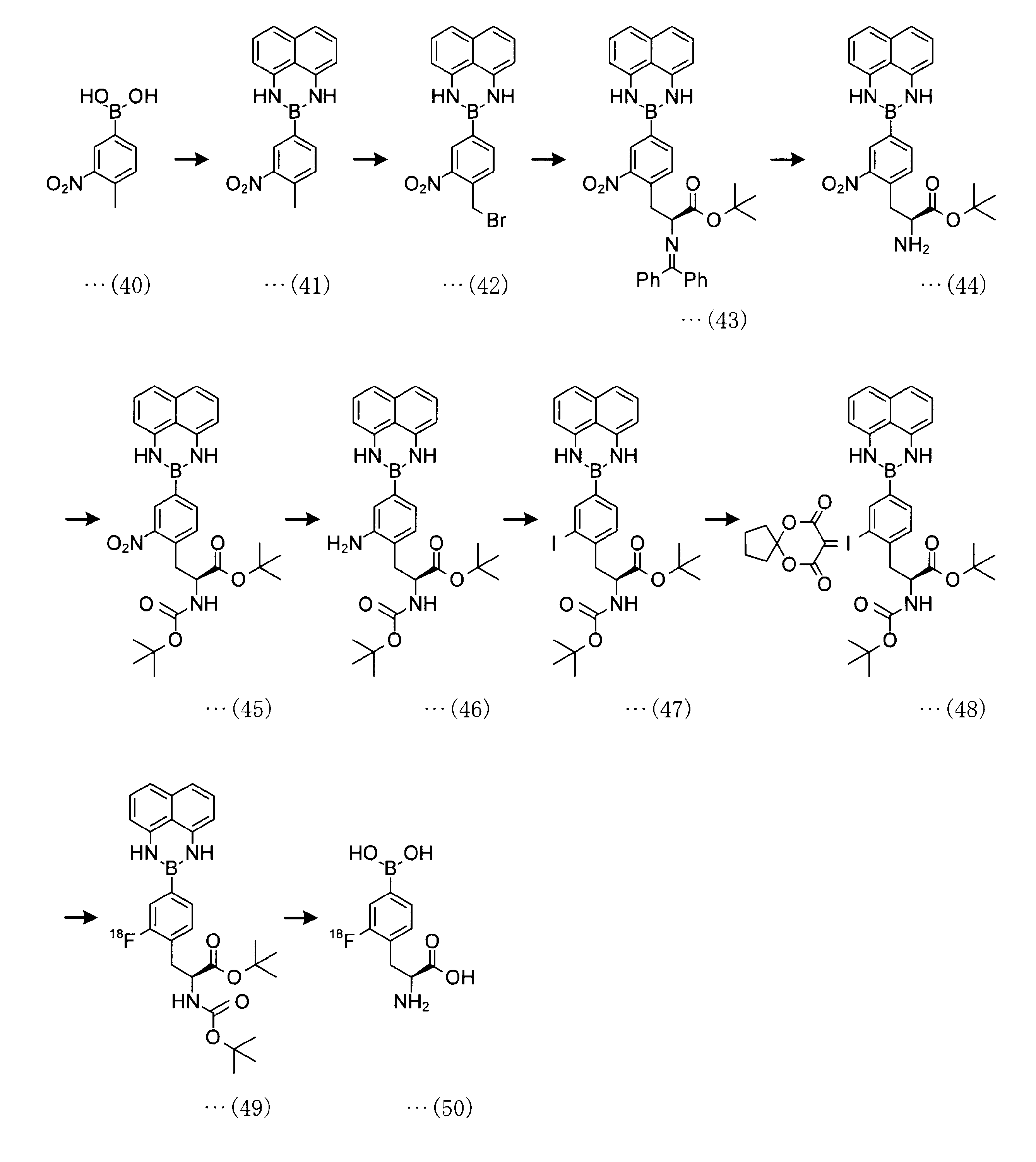
In Example 1, synthesis was performed using the following synthesis scheme.
<合成例1>
2-(4-メチル-3-ニトロフェニル)-2,3-ジヒドロ-1H-ナフト[1,8-de][1,3,2]ジアザボリニン(化合物(41))の合成
アルゴン雰囲気下、(4-メチル-3-ニトロフェニル)ボロン酸(3.62g、20mmol)、1,8-ジアミノナフタレン(4.8g、15mmol)と4Åモレキュラーシーブス500mgをジメチルスルホキシド、トルエンの混合溶液55mL(1:10(v/v))に溶解させ、12時間Dean-Stark装置中で還流した。反応の終了を薄層クロマトグラフィー(thin-layer chromatography、「TLC」ともいう)で確認したのち、反応溶液を室温付近まで冷却した。反応溶液に30mLの水を加え、30mLの酢酸エチルで3回抽出した。有機層を無水硫酸マグネシウム(「MgSO4」ともいう)で乾燥させ、溶媒を留去した。残渣をn-ヘキサン/酢酸エチル=1/1を溶出溶媒とするシリカゲルカラムクロマトグラフィーにより精製することで化合物(41)を得る(5.55g、91.5%)。
<Synthesis example 1>
2- (4-Methyl-3-nitrophenyl) -2,3-dihydro-1H-naphtho [1,8-de] [1,3,2] Synthesis of diazabolinin (compound (41)) Under an argon atmosphere, ( 4-Methyl-3-nitrophenyl) Boronic acid (3.62 g, 20 mmol), 1,8-diaminonaphthalene (4.8 g, 15 mmol) and 4 Å molecular sieves 500 mg in 55 mL (1:10) mixed solution of dimethyl sulfoxide and toluene. (V / v)) was dissolved and refluxed in a Dean-Stark apparatus for 12 hours. After confirming the completion of the reaction by thin-layer chromatography (also referred to as "TLC"), the reaction solution was cooled to around room temperature. 30 mL of water was added to the reaction solution, and the mixture was extracted 3 times with 30 mL of ethyl acetate. The organic layer was dried over anhydrous magnesium sulfate (also referred to as " Л4 "), and the solvent was distilled off. The residue is purified by silica gel column chromatography using n-hexane / ethyl acetate = 1/1 as an elution solvent to obtain compound (41) (5.55 g, 91.5%).
(化合物(41)の1H-NMR、LC-MS)
1H-NMR(300MHz,DMSO-d6):8.21(s,1H),8.09(d,1H),7.53(d,2H),7.42(d,1H),7.40(t,2H),6.96(d,2H),2.54(s,3H)
LC-MS(ESI)m/z:383[M+H]+.
( 1 H-NMR, LC-MS of compound (41))
1H-NMR (300MHz, DMSO-d6): 8.21 (s, 1H), 8.09 (d, 1H), 7.53 (d, 2H), 7.42 (d, 1H), 7.40 (T, 2H), 6.96 (d, 2H), 2.54 (s, 3H)
LC-MS (ESI) m / z: 383 [M + H] +.
<合成例2>
2-(4-(ブロモメチル)-3-ニトロフェニル)-2,3-ジヒドロ-1H-ナフト[1,8-de][1,3,2]ジアザボリニン(化合物(42))の合成
化合物(41)(2.8g、9.2mmol)の四塩化炭素溶液(30mL)に、0.05等量のアザビスイソブチルニトリル、1.1等量のN-ブロモスクシンイミド(「NBS」ともいう)を加え、90℃で一晩加熱還流した。溶媒を留去したのち、n-ヘキサン/酢酸エチル=7/1を溶出溶媒とするシリカゲルカラムクロマトグラフィーにより精製することで化合物(42)を得た(3.1g、87%)。
<Synthesis example 2>
2- (4- (bromomethyl) -3-nitrophenyl) -2,3-dihydro-1H-naphtho [1,8-de] [1,3,2] Synthesis of diazabolinin (compound (42)) Compound (41) ) (2.8 g, 9.2 mmol) of carbon tetrachloride solution (30 mL), add 0.05 equivalent of azabisisobutylnitrile and 1.1 equivalent of N-bromosuccinimide (also referred to as "NBS"). , Heat refluxed overnight at 90 ° C. After distilling off the solvent, the compound (42) was obtained by purification by silica gel column chromatography using n-hexane / ethyl acetate = 7/1 as an elution solvent (3.1 g, 87%).
(化合物(42)の1H-NMR、LC-MS)
1H-NMR(300MHz,DMSO-d6):8.29(s,1H),8.17(d,1H),7.54(d,1H),7.53(d,2H),7.40(d,2H),6.96(d,2H),4.56(s,2H)
LC-MS(ESI)m/z:304[M+H]+.
( 1 H-NMR, LC-MS of compound (42))
1H-NMR (300MHz, DMSO-d6): 8.29 (s, 1H), 8.17 (d, 1H), 7.54 (d, 1H), 7.53 (d, 2H), 7.40 (D, 2H), 6.96 (d, 2H), 4.56 (s, 2H)
LC-MS (ESI) m / z: 304 [M + H] +.
<合成例3>
tert-ブチル-3-(4-(1H-ナフト[1,8-de][1,3,2]ジアザボリニン-2(3H)-イル)-2-ニトロフェニル)-2-((ジフェニルメチレン)アミノ)プロパノエート(化合物(43))の合成
化合物(42)(3.1g、8mmol)、N-(ジフェニルメチレン)グリシン-tert-ブチルエステル(2.6g、1.1等量)、0.05等量の(R)-4,4-ジブチル-2,6-ビス(3,4,5-トリフルオロフェニル)-4,5-ジヒドロ-3H-ジナフト[2,1-c:1’,2’-e]アゼピニウムブロミドをトルエン30mL、9M水酸化カリウム水溶液(「KOH水溶液」ともいう)30mLに溶解させ、0℃で12時間攪拌した。KOH水溶液を除去したのち、トルエン層を30mLのブラインで3回洗浄し、有機層をMgSO4で乾燥させ、溶媒を減圧留去することで化合物(43)の粗精製物を得る。化合物(43)の粗精製物はシリカゲルカラムクロマトグラフィーにより精製した(3.87g、81%)。
<Synthesis example 3>
tert-butyl-3- (4- (1H-naphtho [1,8-de] [1,3,2] diazabolinin-2 (3H) -yl) -2-nitrophenyl) -2-((diphenylmethylene) Synthesis of Amino) Propanoate (Compound (43)) Compound (42) (3.1 g, 8 mmol), N- (diphenylmethylene) glycine-tert-butyl ester (2.6 g, 1.1 equal amount), 0.05 Equal amounts of (R) -4,4-dibutyl-2,6-bis (3,4,5-trifluorophenyl) -4,5-dihydro-3H-dinaphtho [2,1-c: 1', 2 '-E] Azepinium bromide was dissolved in 30 mL of toluene and 30 mL of a 9 M potassium hydroxide aqueous solution (also referred to as "KOH aqueous solution"), and the mixture was stirred at 0 ° C. for 12 hours. After removing the KOH aqueous solution, the toluene layer is washed 3 times with 30 mL of brine, the organic layer is dried over regsvr4, and the solvent is distilled off under reduced pressure to obtain a crude product of compound (43). The crude product of compound (43) was purified by silica gel column chromatography (3.87 g, 81%).
(化合物(43)の1H-NMR、LC-MS)
1H-NMR(300MHz,DMSO-d6):8.26(s,1H),8.14(d,1H),7.95(d,2H),7.60-7.35(m,13H,Ar),6.96(d,2H),4.35(s,1H),3.38(dd,1H,CH2-α),3.13(dd,1H,CH2-β),1.42(s,9H)
LC-MS(ESI)m/z:597[M+H]+.
( 1 H-NMR, LC-MS of compound (43))
1H-NMR (300MHz, DMSO-d6): 8.26 (s, 1H), 8.14 (d, 1H), 7.95 (d, 2H), 7.60-7.35 (m, 13H, Ar), 6.96 (d, 2H), 4.35 (s, 1H), 3.38 (dd, 1H, CH 2 -α), 3.13 (dd, 1H, CH 2 -β), 1 .42 (s, 9H)
LC-MS (ESI) m / z: 597 [M + H] +.
<合成例4>
tert-ブチル-3-(4-(1H-ナフト[1,8-de][1,3,2]ジアザボリニン-2(3H)-イル)-2-ニトロフェニル)-2-アミノプロパノエート(化合物(44))の合成
化合物(43)(3.5g、5.9mmol)を20mLのテトラヒドロフラン(「THF」ともいう)と20mLの20%クエン酸水溶液の混液に溶解させ、2時間室温で攪拌させる。THFを減圧留去したのち、20mLのジエチルエーテルに再溶解させ、20mLのブラインで3回洗浄、MgSO4で乾燥、溶媒を留去することで化合物(44)の粗精製物を得る(2.52g)。
<Synthesis example 4>
tert-Butyl-3- (4- (1H-naphtho [1,8-de] [1,3,2] diazabolinin-2 (3H) -yl) -2-nitrophenyl) -2-aminopropanol ( Synthesis of compound (44)) Compound (43) (3.5 g, 5.9 mmol) is dissolved in a mixture of 20 mL of tetrahydrofuran (also referred to as "THF") and 20 mL of a 20% aqueous citric acid solution, and stirred at room temperature for 2 hours. Let me. After distilling off THF under reduced pressure, it was redissolved in 20 mL of diethyl ether, washed 3 times with 20 mL of brine, dried over ו4, and the solvent was distilled off to obtain a crude product of compound (44) (2.52 g). ).
(化合物(44)の1H-NMR、LC-MS)
1H-NMR(300MHz,DMSO-d6):8.26(s,1H),8.14(d,1H),7.53-7.40(m,5H,Ar(Arは芳香族を表す)),6.96(d,2H),4.14(s,1H),3.54(dd,1H,CH2-α),3.29(dd,1H,CH2-β),1.42(s,9H)
LC-MS(ESI)m/z:433[M+H]+.
( 1 H-NMR, LC-MS of compound (44))
1H-NMR (300MHz, DMSO-d6): 8.26 (s, 1H), 8.14 (d, 1H), 7.53-7.40 (m, 5H, Ar (Ar represents aromatic)) ), 6.96 (d, 2H), 4.14 (s, 1H), 3.54 (dd, 1H, CH 2 -α), 3.29 (dd, 1H, CH 2 -β), 1. 42 (s, 9H)
LC-MS (ESI) m / z: 433 [M + H] +.
<合成例5>
tert-ブチル-3-(4-(1H-ナフト[1,8-de][1,3,2]ジアザボリニン-2(3H)-イル)-2-ニトロフェニル)-2-((tert-ブロキシカルボニル)アミノ)プロパノエート(化合物(45))の合成
化合物(44)(2.52g)の粗精製物を20mLのアセトンに溶解し、10mLの炭酸カリウム水溶液(「K2CO3水溶液」ともいう)を加える。1.2等量のジ-tert-ブチルジカルボネートを反応溶液に加え室温で17時間撹拌する。反応終了をTLCで確認後、アセトンを減圧留去し、酢酸エチルに再溶解し、有機層をブラインで洗浄する。有機層をMgSO4で乾燥させたのち、n-ヘキサン/酢酸エチル=7/1を溶出溶媒とするシリカゲルカラムクロマトグラフィーにより精製し、化合物(45)(2.61g、83%、2steps)を得る。
<Synthesis Example 5>
tert-Butyl-3- (4- (1H-naphtho [1,8-de] [1,3,2] diazabolinin-2 (3H) -yl) -2-nitrophenyl) -2-((tert-bro) Synthesis of xycarbonyl) amino) propanoate (compound (45)) A crude product of compound (44) (2.52 g) is dissolved in 20 mL of acetone and 10 mL of potassium carbonate aqueous solution (also referred to as "K 2 CO 3 aqueous solution"). ) Is added. 1. Add an equal amount of di-tert-butyl dicarbonate to the reaction solution and stir at room temperature for 17 hours. After confirming the completion of the reaction by TLC, acetone is distilled off under reduced pressure, it is redissolved in ethyl acetate, and the organic layer is washed with brine. The organic layer is dried with י4 and then purified by silica gel column chromatography using n-hexane / ethyl acetate = 7/1 as an elution solvent to obtain compound (45) (2.61 g, 83%, 2 steps).
(化合物(45)の1H-NMR、LC-MS)
1H-NMR(300MHz,DMSO-d6):8.26(s,1H),8.14(d,1H),7.53-7.40(m,5H,Ar),6.96(d,2H),4.14(s,1H),3.54(dd,1H,CH2-α),3.29(dd,1H,CH2-β),1.42(s,18H)
LC-MS(ESI)m/z:533[M+H]+.
( 1 H-NMR, LC-MS of compound (45))
1H-NMR (300MHz, DMSO-d6): 8.26 (s, 1H), 8.14 (d, 1H), 7.53-7.40 (m, 5H, Ar), 6.96 (d, 2H), 4.14 (s, 1H), 3.54 (dd, 1H, CH 2 -α), 3.29 (dd, 1H, CH 2 -β), 1.42 (s, 18H)
LC-MS (ESI) m / z: 533 [M + H] +.
<合成例6>
tert-ブチル-3-(2-アミノ-4-(1H-ナフト[1,8-de][1,3,2]ジアザボリニン-2(3H)-イル)フェニル)-2-((tert-ブトキシカルボニル)アミノ)プロパノエート(化合物(46))の合成
アルゴン雰囲気下、化合物(45)(2.5g、4.7mmol)の15mLエタノール溶液を氷冷し、ゆっくりとパラジウム炭素(100mg、21μmol)を加えた。アルゴンを水素に置換後、室温にて30時間攪拌した。アルゴン置換、セライトろ過を行い、ろ液を減圧濃縮した。残渣をn-ヘキサン/酢酸エチル=4/1を溶出溶媒とするシリカゲルカラムクロマトグラフィーで精製することによりオイル状の化合物(46)(1.98g、84%)を得た。
<Synthesis example 6>
tert-Butyl-3- (2-amino-4- (1H-naphtho [1,8-de] [1,3,2] diazabolinin-2 (3H) -yl) phenyl) -2-((tert-butoxy) Synthesis of carbonyl) amino) propanoate (Compound (46)) Under an argon atmosphere, a 15 mL ethanol solution of compound (45) (2.5 g, 4.7 mmol) is ice-cooled, and palladium carbon (100 mg, 21 μmol) is slowly added. rice field. After replacing argon with hydrogen, the mixture was stirred at room temperature for 30 hours. Argon substitution and cerite filtration were performed, and the filtrate was concentrated under reduced pressure. The residue was purified by silica gel column chromatography using n-hexane / ethyl acetate = 4/1 as an elution solvent to obtain an oily compound (46) (1.98 g, 84%).
(化合物(46)の1H-NMR、LC-MS)
1H-NMR(300MHz,DMSO-d6):7.53(d,2H),7.40(t,2H),7.21(d,1H),7.05(d,1H),6.96(d,2H),6.73(s,1H),4.68(s,1H),3.54(dd,1H,CH2-α),3.29(dd,1H,CH2-β),1.42(s,18H)
LC-MS(ESI)m/z:503[M+H]+.
( 1 H-NMR, LC-MS of compound (46))
1H-NMR (300MHz, DMSO-d6): 7.53 (d, 2H), 7.40 (t, 2H), 7.21 (d, 1H), 7.05 (d, 1H), 6.96 (D, 2H), 6.73 (s, 1H), 4.68 (s, 1H), 3.54 (dd, 1H, CH 2 -α), 3.29 (dd, 1H, CH 2 -β) ), 1.42 (s, 18H)
LC-MS (ESI) m / z: 503 [M + H] +.
<合成例7>
tert-ブチル-2-((tert-ブトキシカルボニル)アミノ)-3-(2-ヨード-4-(1H-ナフト[1,8-de][1,3,2]ジアザボリニン-2(3H)-イル)フェニル)プロパノエート(化合物(47))の合成
アルゴン雰囲気下、化合物(46)(1.8g、3.6mmol)の2-プロパノール溶液(5mL)を0℃で撹拌し、3.6Mのテトラフルオロホウ酸水溶液を1.33mL(4.8mmol)加える。反応溶液を0℃で30分撹拌したのち、亜硝酸ナトリウム(3.04g、44mmol)をゆっくりと加え、さらに30分撹拌した。生成した結晶をろ過し、冷メタノールで洗浄後、減圧下乾燥した。結晶をアセトニトリルに再溶解させ、ヨウ化カリウムの水溶液を加え、0℃で30分、続いて室温で30分撹拌した。アセトニトリルを減圧留去後、20mLの酢酸エチルに再溶解させ、有機層を10mLのチオ硫酸ナトリウム水溶液で洗浄後、20mLのブラインでさらに2回洗浄した。有機層をMgSO4で乾燥させたのち、ろ液を減圧濃縮した。残渣をn-ヘキサン/酢酸エチル=10/1を溶出溶媒とするシリカゲルカラムクロマトグラフィーで精製することによりオイル状の化合物(47)(674mg、31%)を得た。
<Synthesis example 7>
tert-Butyl-2- ((tert-butoxycarbonyl) amino) -3- (2-iodo-4- (1H-naphtho [1,8-de] [1,3,2] diazabolinin-2 (3H)- Synthesis of Il) Phenyl) Propanoate (Compound (47)) A 2-propanol solution (5 mL) of compound (46) (1.8 g, 3.6 mmol) was stirred at 0 ° C. under an argon atmosphere, and 3.6 M tetra. Add 1.33 mL (4.8 mmol) of aqueous fluoroboric acid solution. The reaction solution was stirred at 0 ° C. for 30 minutes, sodium nitrite (3.04 g, 44 mmol) was slowly added, and the mixture was further stirred for 30 minutes. The produced crystals were filtered, washed with cold methanol, and dried under reduced pressure. The crystals were redissolved in acetonitrile, an aqueous solution of potassium iodide was added, and the mixture was stirred at 0 ° C. for 30 minutes and then at room temperature for 30 minutes. Acetonitrile was distilled off under reduced pressure, redissolved in 20 mL of ethyl acetate, and the organic layer was washed with 10 mL of sodium thiosulfate aqueous solution and then with 20 mL of brine twice more. After drying the organic layer with י 4 , the filtrate was concentrated under reduced pressure. The residue was purified by silica gel column chromatography using n-hexane / ethyl acetate = 10/1 as an elution solvent to obtain an oily compound (47) (674 mg, 31%).
(化合物(47)の1H-NMR、LC-MS)
1H-NMR(300MHz,DMSO-d6):7.74(d,1H),7.71(s,1H),7.53(d,2H),7.40(t,2H),6.97(d,1H),6.96(d,2H),4.68(s,1H),3.54(dd,1H,CH2-α),3.29(dd,1H,CH2-β),1.42(s,18H)
LC-MS(ESI)m/z:614[M+H]+.
( 1 H-NMR, LC-MS of compound (47))
1H-NMR (300MHz, DMSO-d6): 7.74 (d, 1H), 7.71 (s, 1H), 7.53 (d, 2H), 7.40 (t, 2H), 6.97 (D, 1H), 6.96 (d, 2H), 4.68 (s, 1H), 3.54 (dd, 1H, CH 2 -α), 3.29 (dd, 1H, CH 2 -β) ), 1.42 (s, 18H)
LC-MS (ESI) m / z: 614 [M + H] +.
<合成例8>
tert-ブチル-2-((tert-ブトキシカルボニル)アミノ)-3-(2-((7,9-ジオキソ-6,10-ジオキサスピロ[4.5]デカン-8-イリデン)-3-ヨーダニル)-4-(1H-ナフト[1,8-de][1,3,2]ジアザボリニン-2(3H)-イル)フェニル))プロパノエート(化合物(48))の合成
化合物(47)(613mg、1mmol)のクロロホルム溶液にメタクロロ過安息香酸(「mCPBA」ともいう)を加え、室温で3時間撹拌した。化合物(47)が全て反応したことをTLCにより確認したのち、6,10-ジオキサスピロ[4.5]デカン-7,9-ジオンの10%炭酸ナトリウム溶液(「Na2CO3溶液」ともいう)(w/v、2mL,0.33M溶液)を反応溶液に加える。反応溶液をさらに4時間撹拌し、反応の完結をTLCで確認する。反応溶液に水を加え、クロロホルムで3回抽出した。有機層を集め、MgSO4で乾燥、溶媒を留去した。残渣にヘキサンと酢酸エチルを適量加え、冷蔵庫中で再結晶させた。結晶を集めることで化合物(48)(266mg、34%)を得た。
<Synthesis Example 8>
tert-butyl-2-((tert-butoxycarbonyl) amino) -3-(2-((7,9-dioxo-6,10-dioxaspiro [4.5] decane-8-iriden) -3-iodanyl)) -4- (1H-naphtho [1,8-de] [1,3,2] diazabolinin-2 (3H) -yl) phenyl)) Synthesis of propanoate (compound (48)) Compound (47) (613 mg, 1 mmol) ), Metachloroperbenzoic acid (also referred to as "mCPBA") was added to the chloroform solution, and the mixture was stirred at room temperature for 3 hours. After confirming by TLC that all the compounds (47) had reacted, a 10% sodium carbonate solution of 6,10-dioxaspiro [4.5] decane-7,9-dione (also referred to as "Na 2 CO 3 solution"). (W / v, 2 mL, 0.33 M solution) is added to the reaction solution. The reaction solution is stirred for another 4 hours, and the completion of the reaction is confirmed by TLC. Water was added to the reaction solution, and the mixture was extracted 3 times with chloroform. The organic layer was collected, dried with Л4 , and the solvent was distilled off. Hexane and ethyl acetate were added in appropriate amounts to the residue and recrystallized in a refrigerator. The crystals were collected to give compound (48) (266 mg, 34%).
(化合物(48)の1H-NMR、LC-MS)
1H-NMR(300MHz,DMSO-d6):7.74(d,1H),7.71(s,1H),7.53(d,2H),7.40(t,H),6.97(d,1H),6.96(d,2H),4.68(s,1H),3.54(dd,1H,CH2-α),3.29(dd,1H,CH2-β),2.16(m,4H),1.80(m,4H),1.42(s,18H)
LC-MS(ESI)m/z:782[M+H]+.
( 1 H-NMR, LC-MS of compound (48))
1H-NMR (300MHz, DMSO-d6): 7.74 (d, 1H), 7.71 (s, 1H), 7.53 (d, 2H), 7.40 (t, H), 6.97 (D, 1H), 6.96 (d, 2H), 4.68 (s, 1H), 3.54 (dd, 1H, CH 2 -α), 3.29 (dd, 1H, CH 2 -β) ), 2.16 (m, 4H), 1.80 (m, 4H), 1.42 (s, 18H)
LC-MS (ESI) m / z: 782 [M + H] +.
<合成例9>
tert-ブチル-2-((tert-ブトキシカルボニル)アミノ)-3-(2-[18F]フルオロ-4-(1H-ナフト[1,8-de][1,3,2]ジアザボリニン-2(3H)-イル)フェニル)プロパノエート(化合物(49))の合成
サイクロトロンより生成した[18F]フッ化物イオンをSep-Pak Light Accell Plus QMA Carbonate(46mg)に通しトラップする。トラップした[18F]フッ化物イオンをクリプトフィックス222(3.77mg、10μmol)、K2CO3(691μg、5μmol)のアセトニトリル(960μL)、水(40μL)混液を用いて溶出し、反応バイアルに移送する。この反応バイアルを140℃、3分加熱し乾固した。さらに少量のアセトニトリルを加え3回共沸を行なった。
続いて化合物(48)(10mg、15.5μmol)のDMF(400μL)溶液で溶解し、反応バイアルに加え、80℃で5分反応を行う。
冷却後、反応バイアルに緩衝液2mL、蒸留水16mLを加え希釈し、Sep-Pak C18を通し、未反応の[18F]フッ化物イオンを除去する。さらに蒸留水2mLで洗浄し、エタノール1mLで溶離し、化合物(49)を得た。
<Synthesis example 9>
tert-butyl-2-((tert-butoxycarbonyl) amino) -3- (2- [ 18 F] fluoro-4- (1H-naphtho [1,8-de] [1,3,2] diazabolinin-2) Synthesis of (3H) -yl) phenyl) propanoate (Compound (49)) [ 18 F] Fluoride ions generated from a cyclotron are trapped through Sep-Pak Light Accell Plus QMA Carbonate (46 mg). The trapped [ 18 F] fluoride ion was eluted with a mixture of Cryptofix 222 ( 3.77 mg, 10 μmol), K2 CO 3 ( 691 μg, 5 μmol) acetonitrile (960 μL) and water (40 μL) into a reaction vial. Transfer. The reaction vial was heated at 140 ° C. for 3 minutes to dry. Further, a small amount of acetonitrile was added and azeotrope was performed 3 times.
Subsequently, the compound (48) (10 mg, 15.5 μmol) is dissolved in a DMF (400 μL) solution, added to a reaction vial, and reacted at 80 ° C. for 5 minutes.
After cooling, 2 mL of buffer solution and 16 mL of distilled water are added to the reaction vial to dilute it, and it is passed through Sep-Pak C18 to remove unreacted [ 18 F] fluoride ions. Further, the cells were washed with 2 mL of distilled water and eluted with 1 mL of ethanol to obtain compound (49).
<合成例10>
2-[18F]フルオロ-4-ボロノフェニルアラニン(化合物(50))の合成
化合物(49)の反応溶液に臭化水素(1mL)を加え、150℃で15分加熱した。反応溶液を水で希釈し、フィルターろ過し、HPLCおよびラジオTLCを用いて目的物の生成を確認した。
<Synthesis Example 10>
2- [ 18 F] Synthesis of Fluoro-4-boronophenylalanine (Compound (50)) Hydrogen bromide (1 mL) was added to the reaction solution of compound (49), and the mixture was heated at 150 ° C. for 15 minutes. The reaction solution was diluted with water, filtered and confirmed to produce the desired product using HPLC and radio TLC.
[実施例2]
実施例2は、以下の合成スキームで合成を行った。
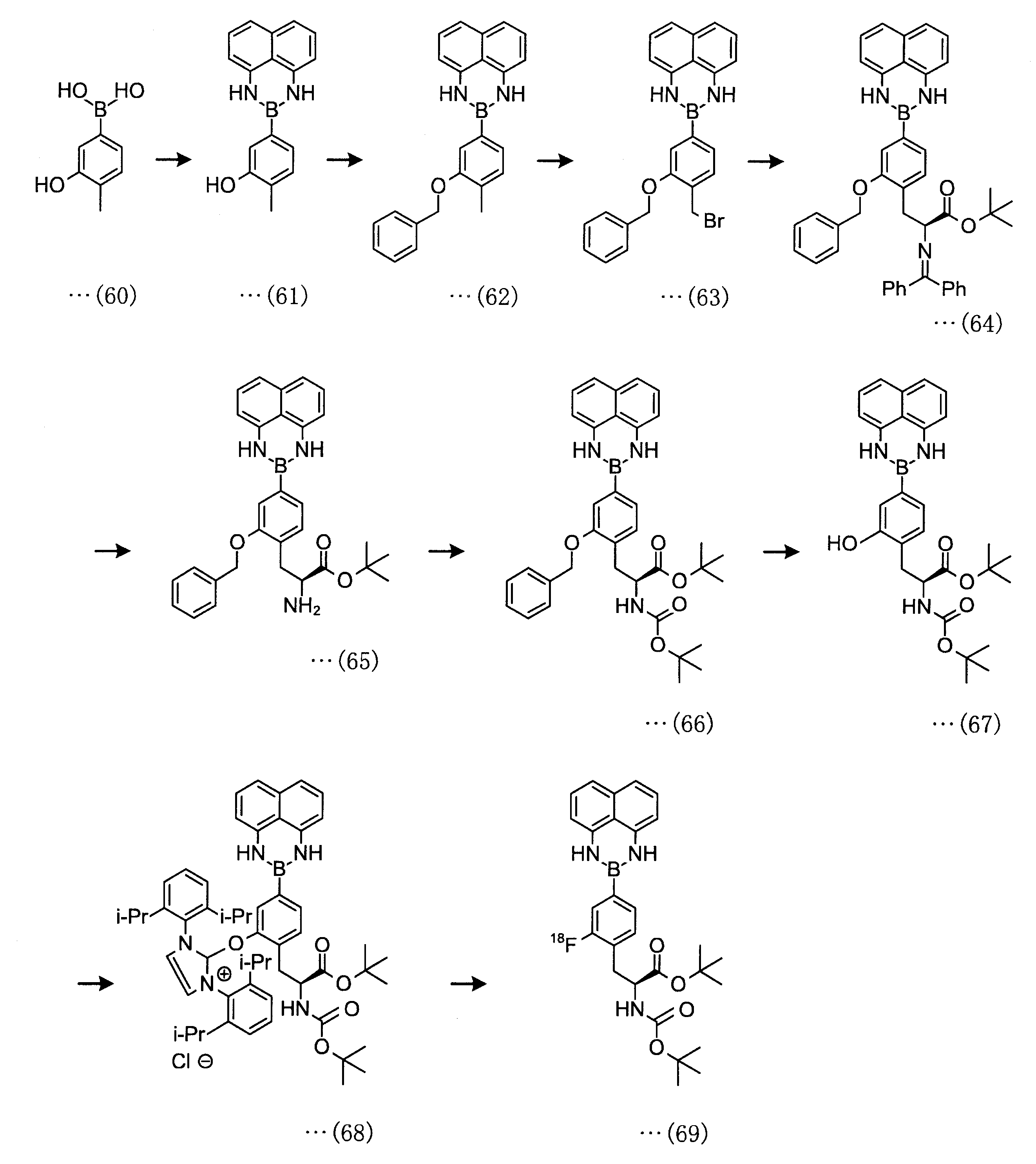
In Example 2, synthesis was performed using the following synthesis scheme.
<合成例11>
2-メチル-5-(1H-ナフト[1,8-de][1,3,2]ジアザボリニン-2(3H)-イル)フェノ-ル(化合物(61))の合成
アルゴン雰囲気下、化合物(60)(3.04g、20mmol)、1,8-ジアミノナフタレン(3.84g、24mmol)と4Åモレキュラーシーブス500mgをDMSO、トルエンの混合溶液44mL(1:10(v/v))に溶解させ、12時間Dean-Stark装置中で還流した。反応の終了をTLCで確認したのち、反応溶液を室温付近まで冷却した。反応溶液に30mLの水を加え、30mLの酢酸エチルで3回抽出した。有機層をMgSO4で乾燥させ、溶媒を留去した。残渣をn-ヘキサン/酢酸エチル=1/1を溶出溶媒とするシリカゲルカラムクロマトグラフィーにより精製することで化合物(61)を得る(4.99g、91%)。
<Synthesis Example 11>
2-Methyl-5- (1H-naphtho [1,8-de] [1,3,2] diazabolinin-2 (3H) -yl) phenol (compound (61)) synthesis Under an argon atmosphere, the compound (compound (61)) 60) (3.04 g, 20 mmol), 1,8-diaminonaphthalene (3.84 g, 24 mmol) and 4 Å molecular sieves 500 mg were dissolved in 44 mL (1:10 (v / v)) of a mixed solution of DMSO and toluene. Reflux in a Dean-Stark apparatus for 12 hours. After confirming the completion of the reaction by TLC, the reaction solution was cooled to around room temperature. 30 mL of water was added to the reaction solution, and the mixture was extracted 3 times with 30 mL of ethyl acetate. The organic layer was dried with י 4 and the solvent was distilled off. The residue is purified by silica gel column chromatography using n-hexane / ethyl acetate = 1/1 as an elution solvent to obtain compound (61) (4.99 g, 91%).
(化合物(61)の1H-NMR、LC-MS)
1H-NMR(300MHz,DMSO-d6):9.68(s,1H),7.53(d,2H),7.40(t,2H),7.26(d,1H),6.99(d,1H),6.96(d,2H),6.75(s,1H),2.15(s,3H)
LC-MS(ESI)m/z:275[M+H]+.
( 1 H-NMR, LC-MS of compound (61))
1H-NMR (300MHz, DMSO-d6): 9.68 (s, 1H), 7.53 (d, 2H), 7.40 (t, 2H), 7.26 (d, 1H), 6.99 (D, 1H), 6.96 (d, 2H), 6.75 (s, 1H), 2.15 (s, 3H)
LC-MS (ESI) m / z: 275 [M + H] +.
<合成例12>
2-(3-(ベンジルオキシ)-4-メチルフェニル)-2,3-ジヒドロ-1H-ナフト[1,8-de][1,3,2]ジアザボリニン(化合物(62))の合成
化合物(61)(4.66g、17mmol)をDMF(50mL)に溶解し、ベンジルブロミド(3.55mL、19mmol)と水素化ナトリウム(456mg、19mmol)を加え、反応溶液を室温で6時間撹拌した。TLCを用いて反応の進行を確認したのち、20mLの炭酸カリウムとメタノール溶液を加え、30分撹拌したのち、有機溶媒を減圧留去後、残渣を50mLのクロロホルムに溶解した。有機層を40mLのブラインで3回洗浄し、有機層をMgSO4で乾燥した。ろ液を減圧留去することで化合物(62)を得た(5.94g、96%)。
<Synthesis Example 12>
2- (3- (Benzyloxy) -4-methylphenyl) -2,3-dihydro-1H-naphtho [1,8-de] [1,3,2] Synthetic compound of diazabolinin (compound (62)) ( 61) (4.66 g, 17 mmol) was dissolved in DMF (50 mL), benzyl bromide (3.55 mL, 19 mmol) and sodium hydride (456 mg, 19 mmol) were added, and the reaction solution was stirred at room temperature for 6 hours. After confirming the progress of the reaction using TLC, 20 mL of potassium carbonate and a methanol solution were added, the mixture was stirred for 30 minutes, the organic solvent was distilled off under reduced pressure, and the residue was dissolved in 50 mL of chloroform. The organic layer was washed 3 times with 40 mL brine and the organic layer was dried with י 4 . The filtrate was distilled off under reduced pressure to obtain compound (62) (5.94 g, 96%).
(化合物(62)の1H-NMR、LC-MS)
1H-NMR(300MHz,DMSO-d6):7.53-7.32(m,10H),7.16(d,1H),6.96(d,2H),6.90(s,1H),5.16(s,2H),2.15(s,3H)
LC-MS(ESI)m/z:365[M+H]+.
( 1 H-NMR, LC-MS of compound (62))
1H-NMR (300MHz, DMSO-d6): 7.53-7.32 (m, 10H), 7.16 (d, 1H), 6.96 (d, 2H), 6.90 (s, 1H) , 5.16 (s, 2H), 2.15 (s, 3H)
LC-MS (ESI) m / z: 365 [M + H] +.
<合成例13>
2-(3-(ベンジルオキシ)-4-(ブロモメチル)フェニル)-2,3-ジヒドロ-1H-ナフト[1,8-de][1,3,2]ジアザボリニン(化合物(63))の合成
化合物(62)(5.83g、16mmol)の四塩化炭素溶液(40mL)に、0.05等量のアゾビスイソブチロニトリル、1.1等量のNBSを加え、100℃で一晩加熱還流した。溶媒を留去したのち、n-ヘキサン/酢酸エチル=6/1を溶出溶媒とするシリカゲルカラムクロマトグラフィーにより精製することで化合物(63)を得る(5.81g、82%)。
<Synthesis Example 13>
Synthesis of 2- (3- (benzyloxy) -4- (bromomethyl) phenyl) -2,3-dihydro-1H-naphtho [1,8-de] [1,3,2] diazabolinine (compound (63)) To a carbon tetrachloride solution (40 mL) of compound (62) (5.83 g, 16 mmol), 0.05 equivalent amount of azobisisobutyronitrile and 1.1 equivalent amount of NBS were added, and the mixture was heated at 100 ° C. overnight. Refluxed. After distilling off the solvent, the compound (63) is obtained by purification by silica gel column chromatography using n-hexane / ethyl acetate = 6/1 as an elution solvent (5.81 g, 82%).
(化合物(63)の1H-NMR、LC-MS)
1H-NMR(300MHz,DMSO-d6):7.53-7.28(m,11H),6.98(s,1H),6.96(d,2H),5.16(s,2H),4.56(s,2H)
LC-MS(ESI)m/z:444[M+H]+.
( 1 H-NMR, LC-MS of compound (63))
1H-NMR (300MHz, DMSO-d6): 7.53-7.28 (m, 11H), 6.98 (s, 1H), 6.96 (d, 2H), 5.16 (s, 2H) , 4.56 (s, 2H)
LC-MS (ESI) m / z: 444 [M + H] +.
<合成例14>
tert-ブチル-3-(2-(ベンジルオキシ)-4-(1H-ナフト[1,8-de][1,3,2]ジアザボリニン-2(3H)-イル)フェニル)-2-((ジフェニルメチレン)アミノ)プロパノエート(化合物(64))の合成
4.43gの化合物(63)(10mmol)、3.25gのN-(ジフェニルメチレン)グリシン-tert-ブチルエステル、0.05等量の(R)-4,4-ジブチル-2,6-ビス(3,4,5-トリフルオロフェニル)-4,5-ジヒドロ-3H-ジナフト[2,1-c:1’,2’-e]アゼピニウムブロミドをトルエン30mL、9MのKOH水溶液30mLに溶解させ、0℃で12時間攪拌する。KOH層を除去したのち、トルエン層を30mLのブラインで3回洗浄し、有機層をMgSO4で乾燥させたのち、溶媒を減圧留去することで化合物(64)の粗精製物を得る。化合物(64)の粗精製物はシリカゲルカラムクロマトグラフィーにより精製した(5.33g、81%)。
<Synthesis Example 14>
tert-Butyl-3- (2- (benzyloxy) -4- (1H-naphtho [1,8-de] [1,3,2] diazabolinin-2 (3H) -yl) phenyl) -2-(( Synthesis of diphenylmethylene) amino) propanoate (compound (64)) 4.43 g of compound (63) (10 mmol), 3.25 g of N- (diphenylmethylene) glycine-tert-butyl ester, 0.05 equal amount ( R) -4,4-dibutyl-2,6-bis (3,4,5-trifluorophenyl) -4,5-dihydro-3H-toluene [2,1-c: 1', 2'-e] Dissolve azepinium bromide in 30 mL of toluene and 30 mL of 9M KOH aqueous solution, and stir at 0 ° C. for 12 hours. After removing the KOH layer, the toluene layer was washed 3 times with 30 mL of brine, the organic layer was dried with Л4 , and the solvent was distilled off under reduced pressure to obtain a crude product of compound (64). The crude product of compound (64) was purified by silica gel column chromatography (5.33 g, 81%).
(化合物(64)の1H-NMR、LC-MS)
1H-NMR(300MHz,DMSO-d6):7.95(d,2H),7.63-7.32(m,18H,Ar),7.20(d,1H),6.96(d,2H),6.95(s,1H),5.16(s,2H),4.35(s,1H),3.38(dd,1H,CH2-α),3.13(dd,1H,CH2-β),1.42(s,9H)
LC-MS(ESI)m/z:659[M+H]+.
( 1 H-NMR, LC-MS of compound (64))
1H-NMR (300MHz, DMSO-d6): 7.95 (d, 2H), 7.63-7.32 (m, 18H, Ar), 7.20 (d, 1H), 6.96 (d, 2H), 6.95 (s, 1H), 5.16 (s, 2H), 4.35 (s, 1H), 3.38 (dd, 1H, CH 2 -α), 3.13 (dd, dd, 1H, CH 2 -β), 1.42 (s, 9H)
LC-MS (ESI) m / z: 659 [M + H] +.
<合成例15>
tert-ブチル-2-アミノ-3-(2-(ベンジルオキシ)-4-(1H-ナフト[1,8-de][1,3,2]ジアザボリニン-2(3H)-イル)フェニル)プロパノエート(化合物(65))の合成
化合物(64)(5.0g、7.6mmol)を50mLのTHFと50mLの20%クエン酸水溶液の混液に溶解させ、2時間室温で攪拌させる。THFを減圧留去したのち、50mLのジエチルエーテルに再溶解させ、50mLのブラインで3回洗浄、MgSO4で乾燥、溶媒を留去することで化合物(65)の粗精製物を得る(3.66g)。
<Synthesis Example 15>
tert-butyl-2-amino-3- (2- (benzyloxy) -4- (1H-naphtho [1,8-de] [1,3,2] diazabolinin-2 (3H) -yl) phenyl) compound) Synthesis of (Compound (65)) Compound (64) (5.0 g, 7.6 mmol) is dissolved in a mixture of 50 mL of THF and 50 mL of a 20% aqueous citric acid solution and stirred at room temperature for 2 hours. After distilling off THF under reduced pressure, it was redissolved in 50 mL of diethyl ether, washed 3 times with 50 mL of brine, dried in regsvr4 , and the solvent was distilled off to obtain a crude product of compound (65) (3. 66g).
(化合物(65)の1H-NMR、LC-MS)
1H-NMR(300MHz,DMSO-d6):7.53-7.32(m,10H,Ar),7.20(d,1H),6.96(d,2H),6.95(s,1H),5.16(s,2H),4.14(s,1H),3.54(dd,1H,CH2-α),3.29(dd,1H,CH2-β),1.42(s,9H)
LC-MS(ESI)m/z:494[M+H]+.
( 1 H-NMR, LC-MS of compound (65))
1H-NMR (300MHz, DMSO-d6): 7.53-7.32 (m, 10H, Ar), 7.20 (d, 1H), 6.96 (d, 2H), 6.95 (s, 1H), 5.16 (s, 2H), 4.14 (s, 1H), 3.54 (dd, 1H, CH 2 -α), 3.29 (dd, 1H, CH 2 -β), 1 .42 (s, 9H)
LC-MS (ESI) m / z: 494 [M + H] +.
<合成例16>
tert-ブチル-3-(2-(ベンジルオキシ)-4-(1H-ナフト[1,8-de][1,3,2]ジアザボリニン-2(3H)-イル)フェニル)-2-((tert-ブトキシカルボニル)アミノ)プロパノエート(化合物(66))の合成
化合物(65)(3.66g)の粗精製物を30mLのアセトンに溶解し、10mLのK2CO3水溶液を加える。1.2等量のBoc2Oを反応溶液に加え室温で17時間撹拌する。反応終了をTLCで確認後、アセトンを減圧留去し、酢酸エチルに再溶解し、有機層をブラインで洗浄する。有機層をMgSO4で乾燥させたのち、n-ヘキサン/酢酸エチル=7/1を溶出溶媒とするシリカゲルカラムクロマトグラフィーにより精製し、化合物(66)(3.74g、83%,2steps)を得る。
<Synthesis example 16>
tert-Butyl-3- (2- (benzyloxy) -4- (1H-naphtho [1,8-de] [1,3,2] diazabolinin-2 (3H) -yl) phenyl) -2-(( Synthesis of tert-butoxycarbonyl) amino) propanoate (compound (66)) A crude product of compound (65) (3.66 g) is dissolved in 30 mL of acetone and 10 mL of K2 CO 3 aqueous solution is added. 1.2 Add an equal volume of Boc 2 O to the reaction solution and stir at room temperature for 17 hours. After confirming the completion of the reaction by TLC, acetone is distilled off under reduced pressure, it is redissolved in ethyl acetate, and the organic layer is washed with brine. The organic layer is dried on י 4 and then purified by silica gel column chromatography using n-hexane / ethyl acetate = 7/1 as an elution solvent to obtain compound (66) (3.74 g, 83%, 2 steps). ..
(化合物(66)の1H-NMR、LC-MS)
1H-NMR(300MHz,DMSO-d6):7.53-7.32(m,10H,Ar),7.20(d,1H),6.96(d,2H),6.95(s,1H),5.16(s,2H),4.68(s,1H),3.54(dd,1H,CH2-α),3.29(dd,1H,CH2-β),1.42(s,18H)
LC-MS(ESI)m/z:595[M+H]+.
( 1 H-NMR, LC-MS of compound (66))
1H-NMR (300MHz, DMSO-d6): 7.53-7.32 (m, 10H, Ar), 7.20 (d, 1H), 6.96 (d, 2H), 6.95 (s, 1H), 5.16 (s, 2H), 4.68 (s, 1H), 3.54 (dd, 1H, CH 2 -α), 3.29 (dd, 1H, CH 2 -β), 1 .42 (s, 18H)
LC-MS (ESI) m / z: 595 [M + H] +.
<合成例17>
tert-ブチル-2-((tert-ブトキシカルボニル)アミノ)-3-(2-ヒドロキシ-4-(1H-ナフト[1,8-de][1,3,2]ジアザボリニン-2(3H)-イル)フェニル)プロパノエート(化合物(67))の合成
アルゴン雰囲気下、化合物(66)(3.5g、5.9mmol)の15mLエタノール溶液を氷冷し、ゆっくりとパラジウム炭素(100mg、21μmol)を加えた。アルゴンを水素に置換後、室温にて30時間攪拌した。アルゴン置換、セライトろ過を行い、ろ液を減圧濃縮した。残渣をn-ヘキサン/酢酸エチル=7/1を溶出溶媒とするシリカゲルカラムクロマトグラフィーで精製することによりオイル状の化合物(67)(2.49g、84%)を得た。
<Synthesis example 17>
tert-butyl-2-((tert-butoxycarbonyl) amino) -3- (2-hydroxy-4- (1H-naphtho [1,8-de] [1,3,2] diazabolinin-2 (3H)- Synthesis of yl) phenyl) propanoate (compound (67)) Under an argon atmosphere, a 15 mL ethanol solution of compound (66) (3.5 g, 5.9 mmol) is ice-cooled, and palladium carbon (100 mg, 21 μmol) is slowly added. rice field. After replacing argon with hydrogen, the mixture was stirred at room temperature for 30 hours. Argon substitution and cerite filtration were performed, and the filtrate was concentrated under reduced pressure. The residue was purified by silica gel column chromatography using n-hexane / ethyl acetate = 7/1 as an elution solvent to obtain an oily compound (67) (2.49 g, 84%).
(化合物(67)の1H-NMR、LC-MS)
1H-NMR(300MHz,DMSO-d6):9.68(s,1H),7.53(d,2H),7.40(t,2H),7.31(d,1H),7.03(d,1H),6.96(d,2H),6.80(s,1H),4.68(s,1H),3.54(dd,1H,CH2-α),3.29(dd,1H,CH2-β),1.42(s,18H)
LC-MS(ESI)m/z:504[M+H]+.
( 1 H-NMR, LC-MS of compound (67))
1H-NMR (300MHz, DMSO-d6): 9.68 (s, 1H), 7.53 (d, 2H), 7.40 (t, 2H), 7.31 (d, 1H), 7.03 (D, 1H), 6.96 (d, 2H), 6.80 (s, 1H), 4.68 (s, 1H), 3.54 (dd, 1H, CH 2 -α), 3.29 (Dd, 1H, CH 2 -β), 1.42 (s, 18H)
LC-MS (ESI) m / z: 504 [M + H] +.
<合成例18>
脱酸素的フッ素化剤(化合物(80))を使用した化合物(68)の合成
クロロイミダゾリウムクロライド(化合物(80))(500mg、1.07mmol、1.00equiv)と炭酸銀(「Ag2CO3」ともいう)(147mg、0.530mmol、0.500equiv)が混合され、脱酸素的フッ素化剤(PhenoFluor、化22の化合物(81))は褐色バイアルに保存された。
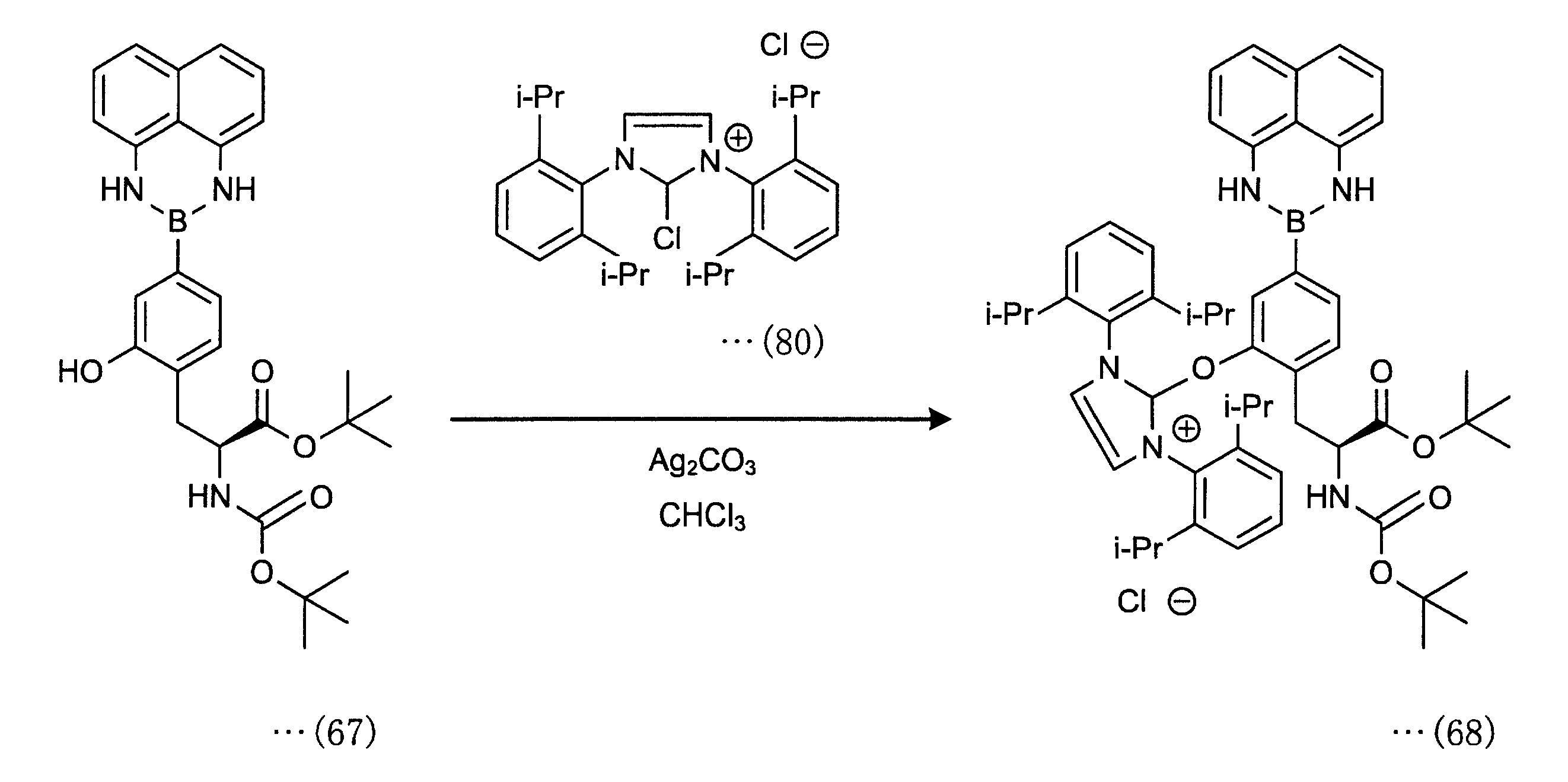
脱酸素的フッ素化剤(化合物(81))(1.00equiv)と化合物(67)(1.00equiv)、クロロホルム(2mL/mmol)をバイアルに入れ、縣濁液を60℃、4時間攪拌した。沈殿物をろ過により除去し、ろ液は濃縮され、化合物(68)が得られた。脱酸素的フッ素化剤(化合物(81))は下記スキームで製造される。
<Synthesis Example 18>
Synthesis of Compound (68) Using Deoxidizing Fluorinating Agent (Compound (80)) Chloroimidazolium chloride (Compound (80)) (500 mg, 1.07 mmol, 1.00 equiv) and silver carbonate ("Ag 2 CO") 3 ”(also referred to as) (147 mg, 0.530 mmol, 0.500 equiv) was mixed, and the deoxidizing fluorinating agent (PhenoFluor, compound (81) of silver carbonate 22) was stored in a brown vial.
A deoxidizing fluorinating agent (compound (81)) (1.00 equiv), compound (67) (1.00 equiv), and chloroform (2 mL / mmol) were placed in a vial, and the suspension was stirred at 60 ° C. for 4 hours. .. The precipitate was removed by filtration and the filtrate was concentrated to give compound (68). The deoxidizing fluorinating agent (Compound (81)) is produced by the following scheme.

<合成例19>
脱酸素的フッ素化剤(化合物(80))を使用した化合物(68)の合成
化合物(68)は、下記スキームのように、脱酸素的フッ素化剤(化合物(80))から直接合成してもよい。クロロイミダゾリウムクロライド(化合物(80))(500mg、1.07mmol、1.00equiv)、Ag2CO3(147mg、0.530mmol、0.500equiv、0.50equiv)、および化合物(67)(1.00equiv)、クロロホルム(2mL/mmol)をバイアルに入れ、縣濁液を60℃、4時間攪拌した。沈殿物をろ過により除去し、ろ液は濃縮され、化合物(68)が得られる。
<Synthesis Example 19>
Synthesis of compound (68) using deoxidizing fluorinating agent (compound (80)) Compound (68) is synthesized directly from deoxidizing fluorinating agent (compound (80)) as shown in the following scheme. May be good. Chloroimidazolium chloride (Compound (80)) (500 mg, 1.07 mmol, 1.00 equiv), Ag 2 CO 3 (147 mg, 0.530 mmol, 0.500 equiv, 0.50 equiv), and compound (67) (1. 00equiv) and chloroform (2 mL / mmol) were placed in a vial, and the suspension was stirred at 60 ° C. for 4 hours. The precipitate is removed by filtration and the filtrate is concentrated to give compound (68).
<合成例20>
tert-ブチル-2-((tert-ブトキシカルボニル)アミノ)-3-(2-[18F]フルオロ-4-(1H-ナフト[1,8-de][1,3,2]ジアザボリニン-2(3H)-イル)フェニル)プロパノエート(化合物(69))の合成
サイクロトロンより生成した[18F]フッ化物イオンをChromafix 30-PS-HCO3 に通しトラップする。2-ブタノン:エタノール=10:1(1mL)により洗浄する。トラップした[18F]フッ化物イオンを化合物(68)(8.0mg)の2-ブタノン:エタノール:NBu3(10:1:0.1)溶液1.0mLを用いて溶離する。溶離液を130℃、15分攪拌し、化合物(69)を得る。化合物(69)(化合物(49)と同一)を、実施例1、合成例10と同様の工程により加水分解することにより、化合物(50)を得ることができる。
<Synthesis Example 20>
tert-butyl-2-((tert-butoxycarbonyl) amino) -3- (2- [ 18 F] fluoro-4- (1H-naphtho [1,8-de] [1,3,2] diazabolinin-2) Synthesis of (3H) -yl) phenyl) propanoate (Compound (69)) [ 18 F] Fluoride ions produced from a cyclotron are trapped through Chromafix 30-PS-HCO 3 . 2-Butanone: Wash with ethanol = 10: 1 (1 mL). The trapped [ 18 F] fluoride ion is eluted with 1.0 mL of 2-butanone: ethanol: NBu 3 (10: 1: 0.1) solution of compound (68) (8.0 mg). The eluent is stirred at 130 ° C. for 15 minutes to give compound (69). Compound (50) can be obtained by hydrolyzing compound (69) (same as compound (49)) in the same steps as in Example 1 and Synthesis Example 10.
Claims (5)










Priority Applications (1)
| Application Number | Priority Date | Filing Date | Title |
|---|---|---|---|
| JP2018135799A JP6996443B2 (en) | 2018-07-19 | 2018-07-19 | 4-[18F] Fluoro-4-boronophenylalanine precursor production method, 2- [18F] Fluoro-4-boronophenylalanine production method |
Applications Claiming Priority (1)
| Application Number | Priority Date | Filing Date | Title |
|---|---|---|---|
| JP2018135799A JP6996443B2 (en) | 2018-07-19 | 2018-07-19 | 4-[18F] Fluoro-4-boronophenylalanine precursor production method, 2- [18F] Fluoro-4-boronophenylalanine production method |
Publications (2)
| Publication Number | Publication Date |
|---|---|
| JP2020011928A JP2020011928A (en) | 2020-01-23 |
| JP6996443B2 true JP6996443B2 (en) | 2022-02-04 |
Family
ID=69168856
Family Applications (1)
| Application Number | Title | Priority Date | Filing Date |
|---|---|---|---|
| JP2018135799A Active JP6996443B2 (en) | 2018-07-19 | 2018-07-19 | 4-[18F] Fluoro-4-boronophenylalanine precursor production method, 2- [18F] Fluoro-4-boronophenylalanine production method |
Country Status (1)
| Country | Link |
|---|---|
| JP (1) | JP6996443B2 (en) |
Families Citing this family (1)
| Publication number | Priority date | Publication date | Assignee | Title |
|---|---|---|---|---|
| US20220356205A1 (en) * | 2020-02-21 | 2022-11-10 | National University Corporation Hokkaido University | Method for producing aromatic astatine compound |
Citations (6)
| Publication number | Priority date | Publication date | Assignee | Title |
|---|---|---|---|---|
| WO2014061508A1 (en) | 2012-10-15 | 2014-04-24 | ステラファーマ株式会社 | Chiral 4-boronophenylalanine (bpa) derivative and method for producing same, and method for producing 18f-labeled bpa using said derivative |
| WO2015093469A1 (en) | 2013-12-17 | 2015-06-25 | ステラファーマ株式会社 | Production method for 2-fluoro-4-borono-l-phenylalanine, and precursor of 2-fluoro-4-borono-l-phenylalanine |
| WO2015129374A1 (en) | 2014-02-28 | 2015-09-03 | ステラファーマ株式会社 | Method for producing 4-borono-l-phenylalanine having 18f atom introduced thereinto, and precursor of 4-borono-l-phenylalanine having 18f atom introduced thereinto |
| JP2016204314A (en) | 2015-04-23 | 2016-12-08 | 国立研究開発法人理化学研究所 | Compound and method for producing 4-boronophenylalanine derivative |
| JP2017513930A (en) | 2014-03-20 | 2017-06-01 | オックスフォード ユニバーシティ イノベーション リミテッドOxford University Innovation Limited | Fluorination method |
| JP2017529312A (en) | 2014-03-07 | 2017-10-05 | ザ ジェネラル ホスピタル コーポレイション | Radiofluorination mediated by iodine (III) |
-
2018
- 2018-07-19 JP JP2018135799A patent/JP6996443B2/en active Active
Patent Citations (6)
| Publication number | Priority date | Publication date | Assignee | Title |
|---|---|---|---|---|
| WO2014061508A1 (en) | 2012-10-15 | 2014-04-24 | ステラファーマ株式会社 | Chiral 4-boronophenylalanine (bpa) derivative and method for producing same, and method for producing 18f-labeled bpa using said derivative |
| WO2015093469A1 (en) | 2013-12-17 | 2015-06-25 | ステラファーマ株式会社 | Production method for 2-fluoro-4-borono-l-phenylalanine, and precursor of 2-fluoro-4-borono-l-phenylalanine |
| WO2015129374A1 (en) | 2014-02-28 | 2015-09-03 | ステラファーマ株式会社 | Method for producing 4-borono-l-phenylalanine having 18f atom introduced thereinto, and precursor of 4-borono-l-phenylalanine having 18f atom introduced thereinto |
| JP2017529312A (en) | 2014-03-07 | 2017-10-05 | ザ ジェネラル ホスピタル コーポレイション | Radiofluorination mediated by iodine (III) |
| JP2017513930A (en) | 2014-03-20 | 2017-06-01 | オックスフォード ユニバーシティ イノベーション リミテッドOxford University Innovation Limited | Fluorination method |
| JP2016204314A (en) | 2015-04-23 | 2016-12-08 | 国立研究開発法人理化学研究所 | Compound and method for producing 4-boronophenylalanine derivative |
Non-Patent Citations (1)
| Title |
|---|
| Neumann, Constanze N.; Hooker, Jacob M.; Ritter, Tobias,Concerted nucleophilic aromatic substitution with 19F- and 18F-,Nature (London, United Kingdom) ,2016年,534(7607),369-373 |
Also Published As
| Publication number | Publication date |
|---|---|
| JP2020011928A (en) | 2020-01-23 |
Similar Documents
| Publication | Publication Date | Title |
|---|---|---|
| JP4981683B2 (en) | Process for the preparation of organic fluoro compounds in alcoholic solvents | |
| EP2537826B1 (en) | Fluorination of aromatic ring systems | |
| EP2417119B1 (en) | No-carrier-added nucleophilic ýf-18¨fluorination of aromatic compounds | |
| EP3838890B1 (en) | Method for preparing 18f-bpa and intermediate | |
| Riss et al. | Direct, nucleophilic radiosynthesis of [18F] trifluoroalkyl tosylates: improved labelling procedures | |
| JP5732198B2 (en) | Method for producing radioactive fluorine-labeled organic compound | |
| JP2016204314A (en) | Compound and method for producing 4-boronophenylalanine derivative | |
| CN119431194B (en) | The method comprises the following steps of18Preparation method of F-DOPA and F-18 labeled precursor thereof | |
| JP6563401B2 (en) | Radioiodinated compounds | |
| CN101316812A (en) | Precursor compounds of radioactive halogen-labeled organic compounds | |
| CN113307758B (en) | P2X7 receptor targeting probe precursor labeled by medical radioactive isotope | |
| Kniess et al. | “Hydrous 18F-fluoroethylation”–Leaving off the azeotropic drying | |
| JP2020011928A (en) | 4-boronophenylalanine precursor, method for producing 2-[18f]fluoro-4-boronophenylalanine precursor, and method for producing 2-[18f]fluoro-4-boronophenylalanine | |
| JP2017078066A (en) | New precursor for glutamic acid derivative | |
| JP2008214319A (en) | PHENYLBORON DERIVATIVE AND METHOD FOR PRODUCING p-BORONOPHENYLALANINE BY USING THE SAME | |
| Kovac et al. | 3D QSAR study, synthesis, and in vitro evaluation of (+)-5-FBVM as potential PET radioligand for the vesicular acetylcholine transporter (VAChT) | |
| WO2014095739A1 (en) | Precursors and process for the production of 18f-labelled amino acids | |
| KR101879181B1 (en) | Precursor of 18f-labeled pet radiopharmaceuticlas and preparation method thereof | |
| WO2024019014A1 (en) | Radiolabeled activated ester and precursor thereof | |
| JPWO2018164043A1 (en) | Radiofluorine-labeled precursor compound and method for producing radiofluorine-labeled compound using the same | |
| KR101478140B1 (en) | Precursor of 18f-labeled pet radiopharmaceuticlas and preparation method thereof | |
| KR101619564B1 (en) | Novel precursor molecules for f-18 labelled pet tracers | |
| US20210205482A1 (en) | Method for preparing fluorine-18-labeled fluoromethyl-substituted radiopharmaceuticals using selective azide substitution reaction and precursor scavenging | |
| JP7159157B2 (en) | Method for producing radioactive fluorine-labeled compound and method for producing radiopharmaceutical | |
| WO2017106340A1 (en) | Isotopic fluorination and applications thereof |
Legal Events
| Date | Code | Title | Description |
|---|---|---|---|
| A621 | Written request for application examination |
Free format text: JAPANESE INTERMEDIATE CODE: A621 Effective date: 20200910 |
|
| A977 | Report on retrieval |
Free format text: JAPANESE INTERMEDIATE CODE: A971007 Effective date: 20210624 |
|
| A131 | Notification of reasons for refusal |
Free format text: JAPANESE INTERMEDIATE CODE: A131 Effective date: 20210713 |
|
| A521 | Request for written amendment filed |
Free format text: JAPANESE INTERMEDIATE CODE: A523 Effective date: 20210910 |
|
| TRDD | Decision of grant or rejection written | ||
| A01 | Written decision to grant a patent or to grant a registration (utility model) |
Free format text: JAPANESE INTERMEDIATE CODE: A01 Effective date: 20211116 |
|
| A61 | First payment of annual fees (during grant procedure) |
Free format text: JAPANESE INTERMEDIATE CODE: A61 Effective date: 20211129 |
|
| R150 | Certificate of patent or registration of utility model |
Ref document number: 6996443 Country of ref document: JP Free format text: JAPANESE INTERMEDIATE CODE: R150 |
|
| S111 | Request for change of ownership or part of ownership |
Free format text: JAPANESE INTERMEDIATE CODE: R313111 |
|
| R350 | Written notification of registration of transfer |
Free format text: JAPANESE INTERMEDIATE CODE: R350 |