JP6889845B2 - Iron-based metallic glass alloy powder - Google Patents
Iron-based metallic glass alloy powder Download PDFInfo
- Publication number
- JP6889845B2 JP6889845B2 JP2018510662A JP2018510662A JP6889845B2 JP 6889845 B2 JP6889845 B2 JP 6889845B2 JP 2018510662 A JP2018510662 A JP 2018510662A JP 2018510662 A JP2018510662 A JP 2018510662A JP 6889845 B2 JP6889845 B2 JP 6889845B2
- Authority
- JP
- Japan
- Prior art keywords
- iron
- metallic glass
- glass alloy
- based metallic
- alloy powder
- Prior art date
- Legal status (The legal status is an assumption and is not a legal conclusion. Google has not performed a legal analysis and makes no representation as to the accuracy of the status listed.)
- Active
Links
Images
Classifications
-
- C—CHEMISTRY; METALLURGY
- C22—METALLURGY; FERROUS OR NON-FERROUS ALLOYS; TREATMENT OF ALLOYS OR NON-FERROUS METALS
- C22C—ALLOYS
- C22C45/00—Amorphous alloys
- C22C45/008—Amorphous alloys with Fe, Co or Ni as the major constituent
-
- B—PERFORMING OPERATIONS; TRANSPORTING
- B22—CASTING; POWDER METALLURGY
- B22F—WORKING METALLIC POWDER; MANUFACTURE OF ARTICLES FROM METALLIC POWDER; MAKING METALLIC POWDER; APPARATUS OR DEVICES SPECIALLY ADAPTED FOR METALLIC POWDER
- B22F1/00—Metallic powder; Treatment of metallic powder, e.g. to facilitate working or to improve properties
-
- B—PERFORMING OPERATIONS; TRANSPORTING
- B22—CASTING; POWDER METALLURGY
- B22F—WORKING METALLIC POWDER; MANUFACTURE OF ARTICLES FROM METALLIC POWDER; MAKING METALLIC POWDER; APPARATUS OR DEVICES SPECIALLY ADAPTED FOR METALLIC POWDER
- B22F1/00—Metallic powder; Treatment of metallic powder, e.g. to facilitate working or to improve properties
- B22F1/06—Metallic powder characterised by the shape of the particles
-
- B—PERFORMING OPERATIONS; TRANSPORTING
- B22—CASTING; POWDER METALLURGY
- B22F—WORKING METALLIC POWDER; MANUFACTURE OF ARTICLES FROM METALLIC POWDER; MAKING METALLIC POWDER; APPARATUS OR DEVICES SPECIALLY ADAPTED FOR METALLIC POWDER
- B22F1/00—Metallic powder; Treatment of metallic powder, e.g. to facilitate working or to improve properties
- B22F1/08—Metallic powder characterised by particles having an amorphous microstructure
-
- B—PERFORMING OPERATIONS; TRANSPORTING
- B22—CASTING; POWDER METALLURGY
- B22F—WORKING METALLIC POWDER; MANUFACTURE OF ARTICLES FROM METALLIC POWDER; MAKING METALLIC POWDER; APPARATUS OR DEVICES SPECIALLY ADAPTED FOR METALLIC POWDER
- B22F1/00—Metallic powder; Treatment of metallic powder, e.g. to facilitate working or to improve properties
- B22F1/10—Metallic powder containing lubricating or binding agents; Metallic powder containing organic material
- B22F1/105—Metallic powder containing lubricating or binding agents; Metallic powder containing organic material containing inorganic lubricating or binding agents, e.g. metal salts
-
- B—PERFORMING OPERATIONS; TRANSPORTING
- B22—CASTING; POWDER METALLURGY
- B22F—WORKING METALLIC POWDER; MANUFACTURE OF ARTICLES FROM METALLIC POWDER; MAKING METALLIC POWDER; APPARATUS OR DEVICES SPECIALLY ADAPTED FOR METALLIC POWDER
- B22F5/00—Manufacture of workpieces or articles from metallic powder characterised by the special shape of the product
-
- B—PERFORMING OPERATIONS; TRANSPORTING
- B22—CASTING; POWDER METALLURGY
- B22F—WORKING METALLIC POWDER; MANUFACTURE OF ARTICLES FROM METALLIC POWDER; MAKING METALLIC POWDER; APPARATUS OR DEVICES SPECIALLY ADAPTED FOR METALLIC POWDER
- B22F9/00—Making metallic powder or suspensions thereof
- B22F9/02—Making metallic powder or suspensions thereof using physical processes
- B22F9/06—Making metallic powder or suspensions thereof using physical processes starting from liquid material
- B22F9/08—Making metallic powder or suspensions thereof using physical processes starting from liquid material by casting, e.g. through sieves or in water, by atomising or spraying
- B22F9/082—Making metallic powder or suspensions thereof using physical processes starting from liquid material by casting, e.g. through sieves or in water, by atomising or spraying atomising using a fluid
-
- C—CHEMISTRY; METALLURGY
- C22—METALLURGY; FERROUS OR NON-FERROUS ALLOYS; TREATMENT OF ALLOYS OR NON-FERROUS METALS
- C22C—ALLOYS
- C22C1/00—Making non-ferrous alloys
- C22C1/11—Making amorphous alloys
-
- C—CHEMISTRY; METALLURGY
- C22—METALLURGY; FERROUS OR NON-FERROUS ALLOYS; TREATMENT OF ALLOYS OR NON-FERROUS METALS
- C22C—ALLOYS
- C22C33/00—Making ferrous alloys
- C22C33/02—Making ferrous alloys by powder metallurgy
-
- C—CHEMISTRY; METALLURGY
- C22—METALLURGY; FERROUS OR NON-FERROUS ALLOYS; TREATMENT OF ALLOYS OR NON-FERROUS METALS
- C22C—ALLOYS
- C22C38/00—Ferrous alloys, e.g. steel alloys
- C22C38/02—Ferrous alloys, e.g. steel alloys containing silicon
-
- C—CHEMISTRY; METALLURGY
- C22—METALLURGY; FERROUS OR NON-FERROUS ALLOYS; TREATMENT OF ALLOYS OR NON-FERROUS METALS
- C22C—ALLOYS
- C22C38/00—Ferrous alloys, e.g. steel alloys
- C22C38/08—Ferrous alloys, e.g. steel alloys containing nickel
-
- C—CHEMISTRY; METALLURGY
- C22—METALLURGY; FERROUS OR NON-FERROUS ALLOYS; TREATMENT OF ALLOYS OR NON-FERROUS METALS
- C22C—ALLOYS
- C22C38/00—Ferrous alloys, e.g. steel alloys
- C22C38/10—Ferrous alloys, e.g. steel alloys containing cobalt
-
- C—CHEMISTRY; METALLURGY
- C22—METALLURGY; FERROUS OR NON-FERROUS ALLOYS; TREATMENT OF ALLOYS OR NON-FERROUS METALS
- C22C—ALLOYS
- C22C45/00—Amorphous alloys
- C22C45/02—Amorphous alloys with iron as the major constituent
-
- H—ELECTRICITY
- H01—ELECTRIC ELEMENTS
- H01F—MAGNETS; INDUCTANCES; TRANSFORMERS; SELECTION OF MATERIALS FOR THEIR MAGNETIC PROPERTIES
- H01F1/00—Magnets or magnetic bodies characterised by the magnetic materials therefor; Selection of materials for their magnetic properties
- H01F1/01—Magnets or magnetic bodies characterised by the magnetic materials therefor; Selection of materials for their magnetic properties of inorganic materials
- H01F1/03—Magnets or magnetic bodies characterised by the magnetic materials therefor; Selection of materials for their magnetic properties of inorganic materials characterised by their coercivity
- H01F1/12—Magnets or magnetic bodies characterised by the magnetic materials therefor; Selection of materials for their magnetic properties of inorganic materials characterised by their coercivity of soft-magnetic materials
- H01F1/14—Magnets or magnetic bodies characterised by the magnetic materials therefor; Selection of materials for their magnetic properties of inorganic materials characterised by their coercivity of soft-magnetic materials metals or alloys
- H01F1/147—Alloys characterised by their composition
- H01F1/153—Amorphous metallic alloys, e.g. glassy metals
- H01F1/15308—Amorphous metallic alloys, e.g. glassy metals based on Fe/Ni
-
- B—PERFORMING OPERATIONS; TRANSPORTING
- B22—CASTING; POWDER METALLURGY
- B22F—WORKING METALLIC POWDER; MANUFACTURE OF ARTICLES FROM METALLIC POWDER; MAKING METALLIC POWDER; APPARATUS OR DEVICES SPECIALLY ADAPTED FOR METALLIC POWDER
- B22F9/00—Making metallic powder or suspensions thereof
- B22F9/02—Making metallic powder or suspensions thereof using physical processes
- B22F9/06—Making metallic powder or suspensions thereof using physical processes starting from liquid material
- B22F9/08—Making metallic powder or suspensions thereof using physical processes starting from liquid material by casting, e.g. through sieves or in water, by atomising or spraying
- B22F9/082—Making metallic powder or suspensions thereof using physical processes starting from liquid material by casting, e.g. through sieves or in water, by atomising or spraying atomising using a fluid
- B22F2009/0824—Making metallic powder or suspensions thereof using physical processes starting from liquid material by casting, e.g. through sieves or in water, by atomising or spraying atomising using a fluid with a specific atomising fluid
- B22F2009/0828—Making metallic powder or suspensions thereof using physical processes starting from liquid material by casting, e.g. through sieves or in water, by atomising or spraying atomising using a fluid with a specific atomising fluid with water
-
- B—PERFORMING OPERATIONS; TRANSPORTING
- B22—CASTING; POWDER METALLURGY
- B22F—WORKING METALLIC POWDER; MANUFACTURE OF ARTICLES FROM METALLIC POWDER; MAKING METALLIC POWDER; APPARATUS OR DEVICES SPECIALLY ADAPTED FOR METALLIC POWDER
- B22F2301/00—Metallic composition of the powder or its coating
- B22F2301/35—Iron
-
- B—PERFORMING OPERATIONS; TRANSPORTING
- B22—CASTING; POWDER METALLURGY
- B22F—WORKING METALLIC POWDER; MANUFACTURE OF ARTICLES FROM METALLIC POWDER; MAKING METALLIC POWDER; APPARATUS OR DEVICES SPECIALLY ADAPTED FOR METALLIC POWDER
- B22F2304/00—Physical aspects of the powder
- B22F2304/10—Micron size particles, i.e. above 1 micrometer up to 500 micrometer
-
- B—PERFORMING OPERATIONS; TRANSPORTING
- B22—CASTING; POWDER METALLURGY
- B22F—WORKING METALLIC POWDER; MANUFACTURE OF ARTICLES FROM METALLIC POWDER; MAKING METALLIC POWDER; APPARATUS OR DEVICES SPECIALLY ADAPTED FOR METALLIC POWDER
- B22F2999/00—Aspects linked to processes or compositions used in powder metallurgy
Landscapes
- Chemical & Material Sciences (AREA)
- Engineering & Computer Science (AREA)
- Mechanical Engineering (AREA)
- Organic Chemistry (AREA)
- Metallurgy (AREA)
- Materials Engineering (AREA)
- Inorganic Chemistry (AREA)
- Nanotechnology (AREA)
- Crystallography & Structural Chemistry (AREA)
- Manufacturing & Machinery (AREA)
- Physics & Mathematics (AREA)
- Electromagnetism (AREA)
- Dispersion Chemistry (AREA)
- Power Engineering (AREA)
- Powder Metallurgy (AREA)
- Manufacture Of Metal Powder And Suspensions Thereof (AREA)
- Soft Magnetic Materials (AREA)
Description
本発明は、インダクタ、チョークコイル等の電子部品の磁性材料等として使用できる、難燃性の鉄基金属ガラス合金粉末に関する。 The present invention relates to a flame-retardant iron-based metallic glass alloy powder that can be used as a magnetic material for electronic parts such as inductors and choke coils.
金属ガラスはアモルファス金属の一種であり、これまでに、鉄基、チタン基など数百種類に及ぶ合金組成が見出されている。なかでも、鉄基金属ガラス合金は、圧粉成形した場合に優れた磁気特性が得られるので、インダクタ、チョークコイル等の電子部品を製造する磁性材料や、電磁波シールド、例えば電子部品のノイズ抑制シート等の材料など、広い用途への利用が期待されている(特許文献1)。
ノイズ抑制シートは、一般的に、発熱する電子装置の近傍に用いられるため難燃性が要求されているところ、多割合の扁平軟磁性材料粉末を含ませることにより難燃性としたノイズ抑制シートが報告されている(特許文献2)。ナノ結晶軟磁性金属粉末とアクリル系バインダー樹脂とを含ませることにより難燃性としたノイズ抑制シートもまた報告されている(特許文献3)。しかし、これら特許文献で評価している難燃性は、シートの難燃性であって、粉末の難燃性ではない。Liquidmetal is a kind of amorphous metal, and hundreds of alloy compositions such as iron group and titanium group have been found so far. Among them, iron-based metal glass alloys can obtain excellent magnetic properties when compacted, so magnetic materials for manufacturing electronic components such as inductors and choke coils, electromagnetic wave shields, for example, noise suppression sheets for electronic components. It is expected to be used for a wide range of purposes such as materials such as (Patent Document 1).
Since the noise suppression sheet is generally used in the vicinity of an electronic device that generates heat, flame retardancy is required. However, the noise suppression sheet is made flame retardant by containing a large proportion of flat soft magnetic material powder. Has been reported (Patent Document 2). A noise suppression sheet made flame-retardant by containing nanocrystalline soft magnetic metal powder and an acrylic binder resin has also been reported (Patent Document 3). However, the flame retardancy evaluated in these patent documents is the flame retardancy of the sheet, not the flame retardancy of the powder.
着火性は、最終製品に特有の問題ではなく、最終製品を形成する前の粉末等の材料の状態でも問題となる。というのは、製造中や製造後の取扱時に材料が着火する危険性をはらむからである。最終製品を形成するまでに材料を保管したり、別の場所で最終製品とするのに運送したりするときにも注意が必要である。
難燃性に優れた粉末として、所定量のAl及び/又はSiと,Crと,Oとを含ませ、D50を10〜40μm、アスペクト比(D50/d)を20〜200とした難燃性磁気シールド用偏平状鉄基合金粉末が報告されている(特許文献4)。所定量のAl及び/又はSiと,Crと,Oと,Nとを含ませ、D50を10〜40μm、アスペクト比(D50/d)を20〜200とした難燃性磁気シールド用偏平状鉄基合金粉末もまた報告されている(特許文献5)。これら特許文献は、粉末の難燃性を評価しているが、その粉末はアモルファス粉末ではない。
他方、インダクタは、スマートフォン等のモバイル機器や、パワーステアリングやエアバッグ等の自動車の電装システムに用いられている。近年、CPUの高速演算処理を目的とした回路の高周波化が進められてきた。高周波化に伴いインダクタへの大電流化が求められる様になった。通常、大電流化に伴いインダクタは大型化するが、飽和磁化の高い材料を用いることでインダクタを小型化できる。このような事情から、インダクタを構成する磁性材料の磁気特性である飽和磁化が重要となった。Ignition is not a problem peculiar to the final product, but also a problem in the state of the material such as powder before forming the final product. This is because there is a risk that the material will ignite during or after manufacturing. Care must also be taken when storing materials before forming the final product or transporting it to the final product elsewhere.
Difficulty in which a predetermined amount of Al and / or Si, Cr, and O are contained as a powder having excellent flame retardancy, the D 50 is 10 to 40 μm, and the aspect ratio (D 50 / d) is 20 to 200. Flat iron-based alloy powders for flammable magnetic shields have been reported (Patent Document 4). Flatness for flame-retardant magnetic shield containing a predetermined amount of Al and / or Si, Cr, O, and N, with a D 50 of 10 to 40 μm and an aspect ratio (D 50 / d) of 20 to 200. Iron-based alloy powders have also been reported (Patent Document 5). These patent documents evaluate the flame retardancy of the powder, but the powder is not an amorphous powder.
On the other hand, inductors are used in mobile devices such as smartphones and in automobile electrical systems such as power steering and airbags. In recent years, the high frequency of circuits for the purpose of high-speed arithmetic processing of CPUs has been promoted. As the frequency increases, it has become necessary to increase the current in the inductor. Normally, the inductor becomes larger as the current increases, but the inductor can be made smaller by using a material with high saturation magnetization. Under these circumstances, saturation magnetization, which is a magnetic characteristic of the magnetic material constituting the inductor, has become important.
飽和磁化の高い材料としてFeを主材料とした金属材料がある。ただし金属材料は高い導電性を持つことから、高周波回路内においてバルク状で用いると渦電流損失が大きくなるためバルク状では使用できない。一般に軟磁性材料の鉄損(インダクタ内の磁性材料によるエネルギー損失の総称)は、下記修正シュタインメッツ式により表すことができる。
軟磁性材料の鉄損=ヒステリシス損失+渦電流損失
渦電流損失は粒径に依存することから、渦電流損失を低減することにより鉄損を低減するには、粒径を小さくすることが効果的である。
一方でアモルファス材料は結晶構造に由来する異方性がないことから、低鉄損の優れた軟磁気特性を示すことが知られている。
モバイル機器や電装システムに搭載するインダクタの小型化をするために、Feを主成分とした鉄基金属ガラス合金粉末であって粒子径の小さなものが求められている。As a material having high saturation magnetization, there is a metal material containing Fe as a main material. However, since the metal material has high conductivity, it cannot be used in the bulk form because the eddy current loss becomes large when it is used in the bulk form in the high frequency circuit. In general, the iron loss of a soft magnetic material (general term for energy loss due to a magnetic material in an inductor) can be expressed by the following modified Steinmetz equation.
Iron loss of soft magnetic materials = Hysteresis loss + Eddy current loss Since eddy current loss depends on the particle size, it is effective to reduce the particle size in order to reduce iron loss by reducing the eddy current loss. Is.
On the other hand, it is known that amorphous materials exhibit excellent soft magnetic properties with low iron loss because they do not have anisotropy derived from the crystal structure.
In order to reduce the size of inductors mounted on mobile devices and electrical systems, iron-based metallic glass alloy powder containing Fe as a main component and having a small particle size is required.
これまでに、アモルファス組成の鉄基金属ガラス合金粉末がいくつか見出されており、本件出願人も、特開2005−290468号公報及び特開2014−169482号公報等により報告した。しかし、鉄基金属ガラス合金粉末が易着火性であることは知られていない。
したがって、本発明は、鉄基金属ガラス合金粉末の易着火性の問題を解決することを課題とし、難燃性の鉄基金属ガラス合金粉末を提供することを目的とする。So far, some iron-based metallic glass alloy powders having an amorphous composition have been found, and the applicant has also reported them in JP-A-2005-290468 and JP-A-2014-169482. However, it is not known that the iron-based metallic glass alloy powder is easily ignitable.
Therefore, an object of the present invention is to solve the problem of easy ignition of an iron-based metallic glass alloy powder, and an object of the present invention is to provide a flame-retardant iron-based metallic glass alloy powder.
本発明者が鋭意検討した結果、鉄基金属ガラス合金粉末の組成を調整することにより難燃性とすることに成功した。すなわち、本発明により、以下の鉄基金属ガラス合金粉末を提供する:
〔1〕鉄基金属ガラス合金粉末であって、
前記鉄基金属ガラス合金が、下記組成式:
(Fe1-s-tCosNit)100-x-y{(SiaBb)m(PcCd)n}xMy
で表され、
鉄基金属元素群Fe、Co及びNiの組成比率が、19≦x≦22、0≦y≦6.0、0≦s≦0.35、0≦t≦0.35、及び、s+t≦0.35であり、
半金属元素群Si、B、P及びCの組成比率が、
(0.5:1)≦(m:n)≦(6:1)、
(2.5:7.5)≦(a:b)≦(5.5:4.5)、及び
(5.5:4.5)≦(c:d)≦(9.5:0.5)であり、
過冷度改善元素群Mが、Nb及びMoからなる群から選ばれる少なくとも1種であり、 前記鉄基金属ガラス合金が、さらに、耐食性改質成分として、Cr及びZrからなる群から選ばれる少なくとも1種を含有し、該耐食性改質成分の含有率が合金成分の全質量を基準として、2.8〜5.5wt%であり、
粒子径が0.5μm以上であって、3μm未満である、
前記鉄基金属ガラス合金粉末。As a result of diligent studies by the present inventor, we have succeeded in making it flame-retardant by adjusting the composition of the iron-based metallic glass alloy powder. That is, the present invention provides the following iron-based metallic glass alloy powders:
[1] Iron-based metallic glass alloy powder
The iron-based metallic glass alloy has the following composition formula:
(Fe 1-st Co s Ni t) 100-xy {(Si a B b) m (P c C d) n} x M y
Represented by
The composition ratios of the iron-based metal element groups Fe, Co and Ni are 19 ≦ x ≦ 22, 0 ≦ y ≦ 6.0, 0 ≦ s ≦ 0.35, 0 ≦ t ≦ 0.35, and s + t ≦ 0. .35,
The composition ratio of the metalloid element groups Si, B, P and C is
(0.5: 1) ≤ (m: n) ≤ (6: 1),
(2.5: 7.5) ≤ (a: b) ≤ (5.5: 4.5) and (5.5: 4.5) ≤ (c: d) ≤ (9.5: 0. 5)
The supercooling degree improving element group M is at least one selected from the group consisting of Nb and Mo, and the iron-based metallic glass alloy is further selected from the group consisting of Cr and Zr as a corrosion resistance modifying component. One type is contained, and the content of the corrosion resistance modifying component is 2.8 to 5.5 wt% based on the total mass of the alloy component.
The particle size is 0.5 μm or more and less than 3 μm.
The iron-based metallic glass alloy powder.
〔2〕鉄基金属ガラス合金粉末であって、
前記鉄基金属ガラス合金が、下記組成式:
(Fe1-s-tCosNit)100-x-y{(SiaBb)m(PcCd)n}xMy
で表され、
鉄基金属元素群Fe、Co及びNiの組成比率が、19≦x≦26、0≦y≦6.0、0≦s≦0.35、0≦t≦0.35、及び、s+t≦0.35であり、
半金属元素群Si、B、P及びCの組成比率が、
(0.5:1)≦(m:n)≦(6:1)、
(2.5:7.5)≦(a:b)≦(5.5:4.5)、及び
(5.5:4.5)≦(c:d)≦(9.5:0.5)であり、
過冷度改善元素群Mが、Nb及びMoからなる群から選ばれる少なくとも1種であり、 前記鉄基金属ガラス合金が、さらに、耐食性改質成分として、Cr及びZrからなる群から選ばれる少なくとも1種を含有し、該耐食性改質成分の含有率が合金成分の全質量を基準として、2.3〜5.5wt%であり、
粒子径が3μm以上であって、10μm未満である、
前記鉄基金属ガラス合金粉末。[2] Iron-based metallic glass alloy powder
The iron-based metallic glass alloy has the following composition formula:
(Fe 1-st Co s Ni t) 100-xy {(Si a B b) m (P c C d) n} x M y
Represented by
The composition ratios of the iron-based metal element groups Fe, Co and Ni are 19 ≦ x ≦ 26, 0 ≦ y ≦ 6.0, 0 ≦ s ≦ 0.35, 0 ≦ t ≦ 0.35, and s + t ≦ 0. .35,
The composition ratio of the metalloid element groups Si, B, P and C is
(0.5: 1) ≤ (m: n) ≤ (6: 1),
(2.5: 7.5) ≤ (a: b) ≤ (5.5: 4.5) and (5.5: 4.5) ≤ (c: d) ≤ (9.5: 0. 5)
The supercooling degree improving element group M is at least one selected from the group consisting of Nb and Mo, and the iron-based metallic glass alloy is further selected from the group consisting of Cr and Zr as a corrosion resistance modifying component. One type is contained, and the content of the corrosion resistance modifying component is 2.3 to 5.5 wt% based on the total mass of the alloy component.
The particle size is 3 μm or more and less than 10 μm.
The iron-based metallic glass alloy powder.
〔3〕鉄基金属ガラス合金粉末であって、
前記鉄基金属ガラス合金が、下記組成式:
(Fe1-s-tCosNit)100-x-y{(SiaBb)m(PcCd)n}xMy
で表され、
鉄基金属元素群Fe、Co及びNiの組成比率が、19≦x≦26、0≦y≦6.0、0≦s≦0.35、0≦t≦0.35、及び、s+t≦0.35であり、
半金属元素群Si、B、P及びCの組成比率が、
(0.5:1)≦(m:n)≦(6:1)、
(2.5:7.5)≦(a:b)≦(5.5:4.5)、及び
(5.5:4.5)≦(c:d)≦(9.5:0.5)であり、
過冷度改善元素群Mが、Nb及びMoからなる群から選ばれる少なくとも1種であり、 粒子径が10〜30μmである、
前記鉄基金属ガラス合金粉末。[3] Iron-based metallic glass alloy powder
The iron-based metallic glass alloy has the following composition formula:
(Fe 1-st Co s Ni t) 100-xy {(Si a B b) m (P c C d) n} x M y
Represented by
The composition ratios of the iron-based metal element groups Fe, Co and Ni are 19 ≦ x ≦ 26, 0 ≦ y ≦ 6.0, 0 ≦ s ≦ 0.35, 0 ≦ t ≦ 0.35, and s + t ≦ 0. .35,
The composition ratio of the metalloid element groups Si, B, P and C is
(0.5: 1) ≤ (m: n) ≤ (6: 1),
(2.5: 7.5) ≤ (a: b) ≤ (5.5: 4.5) and (5.5: 4.5) ≤ (c: d) ≤ (9.5: 0. 5)
The supercooling degree improving element group M is at least one selected from the group consisting of Nb and Mo, and has a particle size of 10 to 30 μm.
The iron-based metallic glass alloy powder.
〔4〕鉄基金属ガラス合金粉末であって、
前記鉄基金属ガラス合金が、下記組成式:
(Fe1-s-tCosNit)100-x-y{(SiaBb)m(PcCd)n}xMy
で表され、
鉄基金属元素群Fe、Co及びNiの組成比率が、19≦x≦22、0≦y≦6.0、0≦s≦0.35、0≦t≦0.35、及び、s+t≦0.35であり、
半金属元素群Si、B、P及びCの組成比率が、
(0.5:1)≦(m:n)≦(6.1:1)、
(2.5:7.5)≦(a:b)≦(5.6:4.4)、及び
(4.2:5.8)≦(c:d)≦(9.5:0.5)であり、
過冷度改善元素群Mが、Nb及びMoからなる群から選ばれる少なくとも1種であり、 前記鉄基金属ガラス合金が、さらに、耐食性改質成分として、Cr及びZrからなる群から選ばれる少なくとも1種を含有し、該耐食性改質成分の含有率が合金成分の全質量を基準として、2.8〜5.5wt%であり、
粒子径が0.5μm以上であって、3μm未満である、
前記鉄基金属ガラス合金粉末。[4] Iron-based metallic glass alloy powder
The iron-based metallic glass alloy has the following composition formula:
(Fe 1-st Co s Ni t) 100-xy {(Si a B b) m (P c C d) n} x M y
Represented by
The composition ratios of the iron-based metal element groups Fe, Co and Ni are 19 ≦ x ≦ 22, 0 ≦ y ≦ 6.0, 0 ≦ s ≦ 0.35, 0 ≦ t ≦ 0.35, and s + t ≦ 0. .35,
The composition ratio of the metalloid element groups Si, B, P and C is
(0.5: 1) ≤ (m: n) ≤ (6.1: 1),
(2.5: 7.5) ≤ (a: b) ≤ (5.6: 4.4) and (4.2: 5.8) ≤ (c: d) ≤ (9.5: 0. 5)
The supercooling degree improving element group M is at least one selected from the group consisting of Nb and Mo, and the iron-based metallic glass alloy is further selected from the group consisting of Cr and Zr as a corrosion resistance modifying component. One type is contained, and the content of the corrosion resistance modifying component is 2.8 to 5.5 wt% based on the total mass of the alloy component.
The particle size is 0.5 μm or more and less than 3 μm.
The iron-based metallic glass alloy powder.
〔5〕鉄基金属ガラス合金粉末であって、
前記鉄基金属ガラス合金が、下記組成式:
(Fe1-s-tCosNit)100-x-y{(SiaBb)m(PcCd)n}xMy
で表され、
鉄基金属元素群Fe、Co及びNiの組成比率が、19≦x≦26、0≦y≦6.0、0≦s≦0.35、0≦t≦0.35、及び、s+t≦0.35であり、
半金属元素群Si、B、P及びCの組成比率が、
(0.5:1)≦(m:n)≦(6.1:1)、
(2.5:7.5)≦(a:b)≦(5.6:4.4)、及び
(4.2:5.8)≦(c:d)≦(9.5:0.5)であり、
過冷度改善元素群Mが、Nb及びMoからなる群から選ばれる少なくとも1種であり、 前記鉄基金属ガラス合金が、さらに、耐食性改質成分として、Cr及びZrからなる群から選ばれる少なくとも1種を含有し、該耐食性改質成分の含有率が合金成分の全質量を基準として、2.3〜5.5wt%であり、
粒子径が3μm以上であって、10μm未満である、
前記鉄基金属ガラス合金粉末。[5] Iron-based metallic glass alloy powder
The iron-based metallic glass alloy has the following composition formula:
(Fe 1-st Co s Ni t) 100-xy {(Si a B b) m (P c C d) n} x M y
Represented by
The composition ratios of the iron-based metal element groups Fe, Co and Ni are 19 ≦ x ≦ 26, 0 ≦ y ≦ 6.0, 0 ≦ s ≦ 0.35, 0 ≦ t ≦ 0.35, and s + t ≦ 0. .35,
The composition ratio of the metalloid element groups Si, B, P and C is
(0.5: 1) ≤ (m: n) ≤ (6.1: 1),
(2.5: 7.5) ≤ (a: b) ≤ (5.6: 4.4) and (4.2: 5.8) ≤ (c: d) ≤ (9.5: 0. 5)
The supercooling degree improving element group M is at least one selected from the group consisting of Nb and Mo, and the iron-based metallic glass alloy is further selected from the group consisting of Cr and Zr as a corrosion resistance modifying component. One type is contained, and the content of the corrosion resistance modifying component is 2.3 to 5.5 wt% based on the total mass of the alloy component.
The particle size is 3 μm or more and less than 10 μm.
The iron-based metallic glass alloy powder.
〔6〕鉄基金属ガラス合金粉末であって、
前記鉄基金属ガラス合金が、下記組成式:
(Fe1-s-tCosNit)100-x-y{(SiaBb)m(PcCd)n}xMy
で表され、
鉄基金属元素群Fe、Co及びNiの組成比率が、19≦x≦26、0≦y≦6.0、0≦s≦0.35、0≦t≦0.35、及び、s+t≦0.35であり、
半金属元素群Si、B、P及びCの組成比率が、
(0.5:1)≦(m:n)≦(6.1:1)、
(2.5:7.5)≦(a:b)≦(5.6:4.4)、及び
(4.2:5.8)≦(c:d)≦(9.5:0.5)であり、
過冷度改善元素群Mが、Nb及びMoからなる群から選ばれる少なくとも1種であり、 粒子径が10〜30μmである、
前記鉄基金属ガラス合金粉末。[6] Iron-based metallic glass alloy powder
The iron-based metallic glass alloy has the following composition formula:
(Fe 1-st Co s Ni t) 100-xy {(Si a B b) m (P c C d) n} x M y
Represented by
The composition ratios of the iron-based metal element groups Fe, Co and Ni are 19 ≦ x ≦ 26, 0 ≦ y ≦ 6.0, 0 ≦ s ≦ 0.35, 0 ≦ t ≦ 0.35, and s + t ≦ 0. .35,
The composition ratio of the metalloid element groups Si, B, P and C is
(0.5: 1) ≤ (m: n) ≤ (6.1: 1),
(2.5: 7.5) ≤ (a: b) ≤ (5.6: 4.4) and (4.2: 5.8) ≤ (c: d) ≤ (9.5: 0. 5)
The supercooling degree improving element group M is at least one selected from the group consisting of Nb and Mo, and has a particle size of 10 to 30 μm.
The iron-based metallic glass alloy powder.
〔7〕前記鉄基金属ガラス合金が、さらに、耐食性改質成分として、Cr及びZrからなる群から選ばれる少なくとも1種を、合金成分の全質量を基準として、0wt%を超え、5.5wt%以下の割合で含有する〔3〕又は〔6〕記載の鉄基金属ガラス合金粉末。
〔8〕耐食性改質成分がCrである〔1〕,〔2〕,〔4〕,〔5〕又は〔7〕記載の鉄基金属ガラス合金粉末。
〔9〕〔1〕〜〔8〕のいずれか1項記載の鉄基金属ガラス合金粉末を用いて作成された成形品。[7] The iron-based metallic glass alloy further contains at least one selected from the group consisting of Cr and Zr as a corrosion resistance modifying component, exceeding 0 wt% and 5.5 wt based on the total mass of the alloy component. The iron-based metallic glass alloy powder according to [3] or [6], which is contained in a proportion of% or less.
[8] The iron-based metallic glass alloy powder according to [1], [2], [4], [5] or [7], wherein the corrosion resistance modifying component is Cr.
[9] A molded product produced by using the iron-based metallic glass alloy powder according to any one of [1] to [8].
本発明により、難燃性の鉄基金属ガラス合金粉末を提供することができる。製造中や製造後の取扱時に材料が着火するリスクをなくすことで、最終製品を形成するまでの保管や、運送方法を簡易にできるため、安全にかつ低価格の材料使用が可能となる。
また本発明の鉄基金属ガラス合金粉末は、高い磁気特性を維持している。このため各種電子部品の圧粉成形用材料や電子回路基板等に磁性膜を形成するための塗料用材料として好適に用いることができる。INDUSTRIAL APPLICABILITY According to the present invention, a flame-retardant iron-based metallic glass alloy powder can be provided. By eliminating the risk of material ignition during manufacturing and handling after manufacturing, storage until the final product is formed and the transportation method can be simplified, making it possible to use materials safely and at low cost.
Further, the iron-based metallic glass alloy powder of the present invention maintains high magnetic properties. Therefore, it can be suitably used as a powder forming material for various electronic parts and a coating material for forming a magnetic film on an electronic circuit substrate or the like.
本明細書において、「鉄基金属元素群」を構成する元素は、Fe、Co、Niである。
本明細書において、「半金属元素群」を構成する元素は、Si、B、P、Cである。
本明細書において、「過冷度改善元素群」を構成する元素は、Nb、Moである。
本明細書において、合金の成分元素の「含有率」は、前記組成式に対して添加元素(耐食性改質成分、耐食性改質副成分)を含有ませた鉄基ガラス合金粉末の全質量を基準とする成分元素の含有率(wt%)を示す。また、前記組成式における組成比率は特に断りのない限り原子%(at%)又は原子比を示す。
本明細書において、用語「粒子径」は、特に断りのない限り平均粒子径(メディアン径、D50)を指す。In the present specification, the elements constituting the "iron-based metal element group" are Fe, Co, and Ni.
In the present specification, the elements constituting the "metalloid element group" are Si, B, P, and C.
In the present specification, the elements constituting the "supercooling degree improving element group" are Nb and Mo.
In the present specification, the "content rate" of the constituent elements of the alloy is based on the total mass of the iron-based glass alloy powder containing the additive elements (corrosion resistance modifying component, corrosion resistance modifying auxiliary component) with respect to the composition formula. The content rate (wt%) of the component element to be used is shown. Further, the composition ratio in the above composition formula indicates atomic% (at%) or atomic ratio unless otherwise specified.
In the present specification, the term "particle size" refers to an average particle size (median size, D 50 ) unless otherwise specified.
前記組成式(基本組成)において、各組成比率を調整することにより、従来品より粒子径が小さくても難燃性である鉄基金属ガラス合金が得られる。本発明は、組成比率と粒径とにより分類される第一から第三の態様を含む。なお、本明細書において、特に断りのない限り、「本発明」は全態様を指す。
第一態様は、19≦x≦22、耐食性改質成分が、合金成分の全質量を基準として2.8〜5.5wt%であり、粒子径が0.5μm以上、3μm未満であることを主たる特徴とする鉄基金属ガラス合金粉末に関する。
第二態様は、19≦x≦26、耐食性改質成分が、合金成分の全質量を基準として2.3〜5.5wt%であり、粒子径が3μm以上、10μm未満であることを主たる特徴とする鉄基金属ガラス合金粉末に関する。
第三態様は、19≦x≦26、耐食性改質成分が、合金成分の全質量を基準として0〜5.5wt%であり、粒子径が10〜30μmであることを主たる特徴とする鉄基金属ガラス合金粉末に関する。
先ず、全態様に共通する事項を、次に、各態様に個別の事項を、以下に説明する。By adjusting each composition ratio in the composition formula (basic composition), an iron-based metallic glass alloy that is flame-retardant even if the particle size is smaller than that of the conventional product can be obtained. The present invention includes the first to third aspects classified according to composition ratio and particle size. In addition, in this specification, "the present invention" refers to all aspects unless otherwise specified.
The first aspect is that 19 ≦ x ≦ 22, the corrosion resistance modifying component is 2.8 to 5.5 wt% based on the total mass of the alloy component, and the particle size is 0.5 μm or more and less than 3 μm. It relates to an iron-based metallic glass alloy powder which is a main feature.
The second aspect is mainly characterized in that 19 ≦ x ≦ 26, the corrosion resistance modifying component is 2.3 to 5.5 wt% based on the total mass of the alloy component, and the particle size is 3 μm or more and less than 10 μm. Regarding iron-based metallic glass alloy powder.
In the third aspect, the iron group is mainly characterized in that 19 ≦ x ≦ 26, the corrosion resistance modifying component is 0 to 5.5 wt% based on the total mass of the alloy component, and the particle size is 10 to 30 μm. Regarding metallic glass alloy powder.
First, matters common to all aspects will be described below, and then items individual to each aspect will be described below.
1.全態様に関する組成比率
1-1.鉄基金属元素群の組成比率(s、t、s+t)
前記基本組成において、鉄基金属元素群の組成比率は、0≦s≦0.35、0≦t≦0.35、かつ、s+t≦0.35である。
s及びtはゼロでも良い。つまり、Fe以外の鉄基金属元素であるCoやNiを含まなくてもよい。CoやNiは高価であるが、これらを含まなくても、優れた磁気特性と耐食性とを備え、さらに、40K以上の過冷度を得ることができるため、より安価に鉄基金属ガラス合金粉末を得ることができる。
s+t>0.35では、CoやNiの含有量が増加し材料コストが増加するばかりでなく、過冷度が実測できないほど小さくなる。その結果、アモルファス組成を形成する条件である40K以上の過冷度を得ることができない。1. 1. Composition ratio for all aspects 1-1. Composition ratio of iron-based metal element group (s, t, s + t)
In the basic composition, the composition ratio of the iron-based metal element group is 0 ≦ s ≦ 0.35, 0 ≦ t ≦ 0.35, and s + t ≦ 0.35.
s and t may be zero. That is, it does not have to contain Co or Ni, which are iron-based metal elements other than Fe. Although Co and Ni are expensive, even if they are not contained, they have excellent magnetic properties and corrosion resistance, and a supercooling degree of 40 K or more can be obtained, so that the iron-based metallic glass alloy powder is cheaper. Can be obtained.
When s + t> 0.35, not only the content of Co and Ni increases and the material cost increases, but also the supercooling degree becomes so small that it cannot be measured. As a result, it is not possible to obtain a supercooling degree of 40 K or higher, which is a condition for forming an amorphous composition.
1-2.半金属元素群の組成比率(a、b、m、c、d、n)
半金属元素群を構成する各元素の組成比率(a、b、m、c、d、n)の範囲は、前記総和の組成比率(x)の範囲内において、
(0.5:1)≦(m:n)≦(6.1:1)、
(2.5:7.5)≦(a:b)≦(5.6:4.4)、及び
(4.2:5.8)≦(c:d)≦(9.5:0.5)
とする。好ましくは、
(0.5:1)≦(m:n)≦(6:1)、
(2.5:7.5)≦(a:b)≦(5.5:4.5)、及び
(5.5:4.5)≦(c:d)≦(9.5:0.5)
とする。
半金属元素群の組成比率が上記の範囲外の場合、△Tx≧40Kの過冷度が得難い。1-2. Composition ratio of metalloid element group (a, b, m, c, d, n)
The range of the composition ratios (a, b, m, c, d, n) of each element constituting the metalloid element group is within the range of the total composition ratio (x).
(0.5: 1) ≤ (m: n) ≤ (6.1: 1),
(2.5: 7.5) ≤ (a: b) ≤ (5.6: 4.4) and (4.2: 5.8) ≤ (c: d) ≤ (9.5: 0. 5)
And. Preferably,
(0.5: 1) ≤ (m: n) ≤ (6: 1),
(2.5: 7.5) ≤ (a: b) ≤ (5.5: 4.5) and (5.5: 4.5) ≤ (c: d) ≤ (9.5: 0. 5)
And.
When the composition ratio of the metalloid element group is out of the above range, it is difficult to obtain a supercooling degree of ΔTx ≧ 40K.
半金属元素群の組成比率は、
(1.5:1)≦(m:n)≦(5.5:1)、
(3.5:6.5)≦(a:b)≦(6.5:3.5)、及び
(6.0:4.0)≦(c:d)≦(8.5:1.5)とするのが好ましい。
より好ましくは、
(2.5:1)≦(m:n)≦(3.5:1)、
(4.3:5.7)≦(a:b)≦(5.2:4.8)、及び
(6.5:3.5)≦(c:d)≦(7.0:3.0)である。
半金属元素群の比率をこのような範囲に設定することにより、鉄基金属ガラス合金粉末の磁気特性及び耐食性を更に向上させることができる。The composition ratio of the metalloid element group is
(1.5: 1) ≤ (m: n) ≤ (5.5: 1),
(3.5: 6.5) ≤ (a: b) ≤ (6.5: 3.5) and (6.0: 4.0) ≤ (c: d) ≤ (8.5: 1. 5) is preferable.
More preferably
(2.5: 1) ≤ (m: n) ≤ (3.5: 1),
(4.3: 5.7) ≤ (a: b) ≤ (5.2: 4.8), and (6.5: 3.5) ≤ (c: d) ≤ (7.0: 3. 0).
By setting the ratio of the metalloid element group in such a range, the magnetic properties and corrosion resistance of the iron-based metallic glass alloy powder can be further improved.
1-3.過冷度改善元素群の組成比率(y)
過冷度改善元素群の組成比率は、0≦y≦6.0、好ましくは0.05≦y≦2.4、より好ましくは0.15≦y≦1.3である。過冷度改善元素群の組成比率をこのような範囲に設定することにより、磁気特性を向上させることができる。ただし、Nb又はMoは高価なレアメタルであるので、Nb又はMoの組成比率は、所要の磁気特性が得られる範囲内において、可及的に低いほうが望ましい。過冷度改善元素群の組成比率が過多であると、過冷度の改善効果が飽和値に達するとともに、相対的に磁気特性が低下する傾向がある。
なお、Nb又はMoのいずれか一方の組成比率と両方の合計の組成比率とを同一とするのは、両元素は、化学的特性が類似するとともに原子半径・原子量が近似しているためである。1-3. Composition ratio of supercooled degree improving element group (y)
The composition ratio of the supercooled degree improving element group is 0 ≦ y ≦ 6.0, preferably 0.05 ≦ y ≦ 2.4, and more preferably 0.15 ≦ y ≦ 1.3. By setting the composition ratio of the supercooled degree improving element group in such a range, the magnetic characteristics can be improved. However, since Nb or Mo is an expensive rare metal, it is desirable that the composition ratio of Nb or Mo is as low as possible within the range in which the required magnetic properties can be obtained. If the composition ratio of the supercooling degree improving element group is excessive, the supercooling degree improving effect reaches the saturation value, and the magnetic characteristics tend to be relatively lowered.
The composition ratio of either Nb or Mo and the total composition ratio of both elements are the same because the two elements have similar chemical properties and similar atomic radii and atomic weights. ..
2.各態様に関する組成比率と粒径
2-1.第一の態様
2-1-1.半金属元素群の組成比率(x)
第一の態様における半金属元素群の総和の組成比率(x)は、19≦x≦22である。
難燃性と過冷度と磁気特性との観点からは、21≦x≦22の範囲が好ましい。
なお、xの下限は、△Tx≧40Kの過冷度を得、アモルファス単相を得る観点から設定した。xの上限は、第一に難燃性の観点から、第二にFe量の減少に伴う磁気特性低下の阻止と材料コストの抑制を考慮して設定した。2. Composition ratio and particle size for each aspect 2-1. First aspect 2-1-1. Composition ratio of metalloid element group (x)
The composition ratio (x) of the sum of the metalloid element groups in the first aspect is 19 ≦ x ≦ 22.
From the viewpoint of flame retardancy, supercooling degree, and magnetic characteristics, the range of 21 ≦ x ≦ 22 is preferable.
The lower limit of x was set from the viewpoint of obtaining a supercooling degree of ΔTx ≧ 40K and obtaining an amorphous single phase. The upper limit of x was set in consideration of firstly from the viewpoint of flame retardancy, secondly, prevention of deterioration of magnetic properties due to a decrease in the amount of Fe, and suppression of material cost.
2-1-2.耐食性改質成分
第一の態様における耐食性改質成分の含有率は、合金成分の全質量を基準として、2.8〜5.5wt%、好ましくは2.8〜4.0wt%である。鉄基金属ガラス合金粉末中に含まれるCr、Zrによって、鉄基金属ガラス合金粉末の表面に酸化皮膜が形成されるので、耐食性が向上する。耐食性改質成分としては、経済的な理由からCrが好ましい。2-1-2. Corrosion-Resistant Modified Component The content of the corrosion-resistant modified component in the first aspect is 2.8 to 5.5 wt%, preferably 2.8 to 4.0 wt%, based on the total mass of the alloy component. Cr and Zr contained in the iron-based metallic glass alloy powder form an oxide film on the surface of the iron-based metallic glass alloy powder, so that the corrosion resistance is improved. Cr is preferable as the corrosion resistance modifying component for economic reasons.
本発明の第一の態様の鉄基金属ガラス合金粉末は、耐食性改質成分として、さらにAlを含んでも良い。Alも鉄基金属ガラス合金粉末の表面に酸化皮膜を形成するが、Cr及び/又はZrによって形成された酸化皮膜の硬度を高くする効果がある。酸化皮膜の硬度が高くなると、耐食性がより向上する。また、後述のアトマイズ法によって鉄基金属ガラス合金粉末を製造する際に、Alは粉末の球状化に寄与する。 The iron-based metallic glass alloy powder according to the first aspect of the present invention may further contain Al as a corrosion resistance modifying component. Al also forms an oxide film on the surface of the iron-based metallic glass alloy powder, but has the effect of increasing the hardness of the oxide film formed by Cr and / or Zr. The higher the hardness of the oxide film, the better the corrosion resistance. Further, when the iron-based metallic glass alloy powder is produced by the atomizing method described later, Al contributes to the spheroidization of the powder.
Alを含む場合、本発明の第一の態様の鉄基金属ガラス合金粉末の全質量を基準として、Alの含有率が0.01〜0.75wt%であり、かつ、Alを含む耐食性改質成分の含有率が1.0〜5.0wt%であるのが好ましい。さらには、Alの含有率が0.03〜0.50wt%で、かつ、Alを含む耐食性改質成分の含有率が1.5〜1.9wt%とするのが望ましい。後者の組成とした場合は、耐食性ばかりでなく、磁気特性がさらに向上する。 When Al is contained, the Al content is 0.01 to 0.75 wt% and the corrosion resistance modification containing Al is based on the total mass of the iron-based metallic glass alloy powder according to the first aspect of the present invention. The content of the component is preferably 1.0 to 5.0 wt%. Further, it is desirable that the content of Al is 0.03 to 0.50 wt% and the content of the corrosion resistance modifying component containing Al is 1.5 to 1.9 wt%. When the latter composition is used, not only corrosion resistance but also magnetic properties are further improved.
本発明の第一の態様の鉄基金属ガラス合金粉末は、耐食性改質副成分として、さらにV、Ti、Ta、Cu及びMnからなる群から選ばれる少なくとも一種を含んでもよい。これにより、前記耐食性改質成分の含有量を低くしながら優れた磁気特性が得られる。耐食性改質副成分の合計含有率は、本発明の第一の態様の鉄基金属ガラス合金粉末の全質量を基準として、0.03〜0.70wt%、さらには0.05〜0.50wt%、よりさらには0.10〜0.30wt%とするのが望ましい。Alと同様、前記耐食性改質副成分も、鉄基金属ガラス合金粉末の表面に酸化皮膜を形成して耐食性を向上させることができる。さらに、前記耐食性改質成分との相乗効果によって、鉄基金属ガラス合金粉末の比抵抗を向上させることができる。 The iron-based metallic glass alloy powder according to the first aspect of the present invention may further contain at least one selected from the group consisting of V, Ti, Ta, Cu and Mn as a corrosion resistance modifying subcomponent. As a result, excellent magnetic properties can be obtained while reducing the content of the corrosion resistance modifying component. The total content of the corrosion-resistant modified auxiliary components is 0.03 to 0.70 wt%, and further 0.05 to 0.50 wt%, based on the total mass of the iron-based metallic glass alloy powder according to the first aspect of the present invention. %, More preferably 0.10 to 0.30 wt%. Similar to Al, the corrosion resistance modification subcomponent can also improve the corrosion resistance by forming an oxide film on the surface of the iron-based metallic glass alloy powder. Further, the specific resistance of the iron-based metallic glass alloy powder can be improved by the synergistic effect with the corrosion resistance modifying component.
2-1-3.粒子径
本発明の第一の態様の鉄基金属ガラス合金粉末の粒子径は、0.5μm以上であって、3μm未満である。一般的に、粒径が小さいほど、鉄損中の渦電流損失を下げられ、優れた磁気特性を有する点で有利であるが、比表面積が大きくなるため反応性が高くなり、材料の信頼性が低下してしまう点で不利である。しかし、本発明の第一の態様の組成の鉄基金属ガラス合金粉末であれば、このような欠点を除くことができる。また、一般的に、粒子径が小さいと鉄基金属ガラス合金粉末は腐蝕しやすくなるが、本発明の第一の態様の鉄基金属ガラス合金粉末は、0.5μm以上であって、3μm未満のような小さな粒子径であっても耐食性が良好である。2-1-3. Particle size The particle size of the iron-based metallic glass alloy powder according to the first aspect of the present invention is 0.5 μm or more and less than 3 μm. In general, the smaller the particle size, the lower the eddy current loss during iron loss, which is advantageous in that it has excellent magnetic properties, but the larger the specific surface area, the higher the reactivity, and the reliability of the material. Is disadvantageous in that it decreases. However, such a defect can be eliminated if the iron-based metallic glass alloy powder having the composition of the first aspect of the present invention is used. Further, in general, when the particle size is small, the iron-based metallic glass alloy powder is easily corroded, but the iron-based metallic glass alloy powder according to the first aspect of the present invention is 0.5 μm or more and less than 3 μm. Corrosion resistance is good even with a small particle size such as.
2-2.第二の態様
2-2-1.半金属元素群の組成比率(x)
第二の態様における半金属元素群の総和の組成比率(x)は、19≦x≦26である。難燃性と過冷度と磁気特性との観点からは、21≦x≦26の範囲が好ましい。
なお、xの下限は、△Tx≧40Kの過冷度を得、アモルファス単相を得る観点から設定した。xの上限は、第一に難燃性の観点から、第二にFe量の減少に伴う磁気特性低下の阻止と材料コストの抑制を考慮して設定した。2-2. Second aspect 2-2-1. Composition ratio of metalloid element group (x)
The composition ratio (x) of the sum of the metalloid element groups in the second aspect is 19 ≦ x ≦ 26. From the viewpoint of flame retardancy, supercooling degree, and magnetic characteristics, the range of 21 ≦ x ≦ 26 is preferable.
The lower limit of x was set from the viewpoint of obtaining a supercooling degree of ΔTx ≧ 40K and obtaining an amorphous single phase. The upper limit of x was set in consideration of firstly from the viewpoint of flame retardancy, secondly, prevention of deterioration of magnetic properties due to a decrease in the amount of Fe, and suppression of material cost.
2-2-2.耐食性改質成分
第二の態様における耐食性改質成分の含有率は、合金成分の全質量を基準として、2.3〜5.5wt%、好ましくは2.3〜4.0wt%である。鉄基金属ガラス合金粉末中に含まれるCr、Zrによって、鉄基金属ガラス合金粉末の表面に酸化皮膜が形成されるので、耐食性が向上する。耐食性改質成分としては、経済的な理由からCrが好ましい。2-2-2. Corrosion resistance modifying component The content of the corrosion resistance modifying component in the second aspect is 2.3 to 5.5 wt%, preferably 2.3 to 4.0 wt%, based on the total mass of the alloy component. Cr and Zr contained in the iron-based metallic glass alloy powder form an oxide film on the surface of the iron-based metallic glass alloy powder, so that the corrosion resistance is improved. Cr is preferable as the corrosion resistance modifying component for economic reasons.
さらなる耐食性改質成分(Al)及び耐食性改質副成分(V、Ti、Ta、Cu及びMnからなる群から選ばれる少なくとも一種)についての説明は、第一の態様についての記載を援用する。 Further description of the corrosion resistance modifying component (Al) and the corrosion resistance modifying subcomponent (at least one selected from the group consisting of V, Ti, Ta, Cu and Mn) incorporates the description of the first aspect.
2-2-3.粒子径
本発明の第二の態様の鉄基金属ガラス合金粉末の粒子径は、3μm以上であって、10μm未満である。一般的に、粒径が小さいほど、鉄損中の渦電流損失を下げられ、優れた磁気特性を有する点で有利であるが、比表面積が大きくなるため反応性が高くなり、材料の信頼性が低下してしまう点で不利である。しかし、本発明の第二の態様の組成の鉄基金属ガラス合金粉末であれば、このような欠点を除くことができる。また、一般的に、粒子径が小さいと鉄基金属ガラス合金粉末は腐蝕しやすくなるが、本発明の第二の態様の鉄基金属ガラス合金粉末は、3μm以上であって、10μm未満のような小さな粒子径であっても耐食性が良好である。2-2-3. Particle size The particle size of the iron-based metallic glass alloy powder according to the second aspect of the present invention is 3 μm or more and less than 10 μm. In general, the smaller the particle size, the lower the eddy current loss during iron loss, which is advantageous in that it has excellent magnetic properties, but the larger the specific surface area, the higher the reactivity, and the reliability of the material. Is disadvantageous in that it decreases. However, such a defect can be eliminated if the iron-based metallic glass alloy powder having the composition of the second aspect of the present invention is used. Further, in general, when the particle size is small, the iron-based metallic glass alloy powder is easily corroded, but the iron-based metallic glass alloy powder of the second aspect of the present invention is 3 μm or more and less than 10 μm. Corrosion resistance is good even with a small particle size.
2-3.第三の態様
2-3-1.半金属元素群の組成比率(x)
第三の態様における半金属元素群の総和の組成比率(x)は、19≦x≦26である。難燃性と過冷度と磁気特性との観点からは、21≦x≦26の範囲が好ましい。
なお、xの下限は、△Tx≧40Kの過冷度を得、アモルファス単相を得る観点から設定した。xの上限は、第一に難燃性の観点から、第二にFe量の減少に伴う磁気特性低下の阻止と材料コストの抑制を考慮して設定した。2-3. Third aspect 2-3-1. Composition ratio of metalloid element group (x)
The composition ratio (x) of the sum of the metalloid element groups in the third aspect is 19 ≦ x ≦ 26. From the viewpoint of flame retardancy, supercooling degree, and magnetic characteristics, the range of 21 ≦ x ≦ 26 is preferable.
The lower limit of x was set from the viewpoint of obtaining a supercooling degree of ΔTx ≧ 40K and obtaining an amorphous single phase. The upper limit of x was set in consideration of firstly from the viewpoint of flame retardancy, secondly, prevention of deterioration of magnetic properties due to a decrease in the amount of Fe, and suppression of material cost.
2-3-2.耐食性改質成分
第三の態様における耐食性改質成分の含有率は、合金成分の全質量を基準として、0〜5.5wt%、好ましくは3.0〜4.0wt%である。鉄基金属ガラス合金粉末中に含まれるCr、Zrによって、鉄基金属ガラス合金粉末の表面に酸化皮膜が形成されるので、耐食性が向上する。耐食性改質成分としては、経済的な理由からCrが好ましい。2-3-2. Corrosion resistance modifying component The content of the corrosion resistance modifying component in the third aspect is 0 to 5.5 wt%, preferably 3.0 to 4.0 wt% based on the total mass of the alloy component. Cr and Zr contained in the iron-based metallic glass alloy powder form an oxide film on the surface of the iron-based metallic glass alloy powder, so that the corrosion resistance is improved. Cr is preferable as the corrosion resistance modifying component for economic reasons.
さらなる耐食性改質成分(Al)及び耐食性改質副成分(V、Ti、Ta、Cu及びMnからなる群から選ばれる少なくとも一種)についての説明は、第一の態様についての記載を援用する。 Further description of the corrosion resistance modifying component (Al) and the corrosion resistance modifying subcomponent (at least one selected from the group consisting of V, Ti, Ta, Cu and Mn) incorporates the description of the first aspect.
2-3-3.粒子径
本発明の第三の態様の鉄基金属ガラス合金粉末の粒子径は、10〜30μmである。一般的に、粒径が小さいほど、鉄損中の渦電流損失を下げられ、優れた磁気特性を有する点で有利であるが、比表面積が大きくなるため反応性が高くなり、材料の信頼性が低下してしまう点で不利である。しかし、本発明の第三の態様の組成の鉄基金属ガラス合金粉末であれば、このような欠点を除くことができる。また、一般的に、粒子径が小さいと鉄基金属ガラス合金粉末は腐蝕しやすくなるが、本発明の第三の態様の鉄基金属ガラス合金粉末は、10〜30μmのような小さな粒子径であっても耐食性が良好である。2-3-3. Particle size The particle size of the iron-based metallic glass alloy powder according to the third aspect of the present invention is 10 to 30 μm. In general, the smaller the particle size, the lower the eddy current loss during iron loss, which is advantageous in that it has excellent magnetic properties, but the larger the specific surface area, the higher the reactivity, and the reliability of the material. Is disadvantageous in that it decreases. However, such a defect can be eliminated if the iron-based metallic glass alloy powder having the composition of the third aspect of the present invention is used. In general, when the particle size is small, the iron-based metallic glass alloy powder is easily corroded, but the iron-based metallic glass alloy powder according to the third aspect of the present invention has a small particle size such as 10 to 30 μm. Even if there is, the corrosion resistance is good.
3.製造方法
本発明の鉄基金属ガラス合金粉末は、水アトマイズ法により製造することができる。水アトマイズ法は、鉄基金属ガラス合金粉末を大気中で製造可能とした方式であり、且つ設備費および製造コストを低価格にして製造できる。3. 3. Production Method The iron-based metallic glass alloy powder of the present invention can be produced by the water atomization method. The water atomization method is a method in which an iron-based metallic glass alloy powder can be produced in the air, and can be produced at a low equipment cost and a production cost.
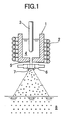
水アトマイズ法のアトマイズ装置は、図1に示すように、円筒形状に立設した側板に溶湯オリフィス5を下方へ向けて穿設した底板を一体に形成した溶解坩堝1と、該溶解坩堝1の前記側板の外周全面に螺旋状に配置した誘導加熱コイル2と、前記溶解坩堝1を開閉する溶解坩堝1内に装入された溶湯ストッパー3と、前記溶湯オリフィス5の下方に配置されるアトマイズノズル6とを備える。
As shown in FIG. 1, the atomizing apparatus of the water atomizing method includes a melting crucible 1 in which a bottom plate in which a molten metal orifice 5 is bored downward is integrally formed on a side plate erected in a cylindrical shape, and the melting crucible 1. An
前記溶解坩堝1内に、本発明の鉄基金属ガラス合金粉末に相当する溶融原材料4(基本組成と、耐食性改質成分と、必要に応じて耐食性改質副成分)を、鉄基金属ガラス合金粉末が所定の組成になるように割合を調整して装入する。次いで、該溶融原材料4を前記誘導加熱コイル2によって融点以上に加熱することで、溶融して溶湯にする。次いで、前記溶湯ストッパー3で前記溶湯オリフィス5を開いて、前記溶湯(溶融原材料4)を溶湯オリフィス5より落下させる。アトマイズノズル6は、前記溶湯オリフィス5の下方に水膜を形成するように水を噴射している。溶湯オリフィス5より落下した溶湯は該水膜に衝突して破砕されると共に急冷されて凝固する。凝固して粉末となった溶湯は、前記アトマイズノズルの下方に配置された水槽(図示せず)中の水8に落下し、さらに冷却される。この粉末を回収し、乾燥工程および分級工程を経て、目的とする組成および粒度の鉄基金属ガラス合金粉末が得られる。
In the melting crucible 1, a molten raw material 4 (basic composition, corrosion-resistant modifying component, and if necessary, corrosion-resistant modified auxiliary component) corresponding to the iron-based metallic glass alloy powder of the present invention is placed in the iron-based metallic glass alloy. The powder is charged in an adjusted ratio so as to have a predetermined composition. Next, the molten raw material 4 is heated above the melting point by the
本発明の鉄基金属ガラス合金粉末は、従来の鉄基金属ガラス合金に比べて、より遅い冷却速度で鉄基金属ガラス合金粉末を製造した場合であっても、結晶化することがない。すなわち、冷却速度が遅い汎用の大量生産設備であっても、結晶相を含まないアモルファス単相の鉄基金属ガラス合金粉末を容易に製造することが可能となる。これは、結晶開始温度Txとガラス転移温度Tgの差で表される過冷度△Txが大きく、アモルファス形成能が向上したためである。 The iron-based metallic glass alloy powder of the present invention does not crystallize even when the iron-based metallic glass alloy powder is produced at a slower cooling rate than the conventional iron-based metallic glass alloy. That is, even in a general-purpose mass production facility having a slow cooling rate, it is possible to easily produce an amorphous single-phase iron-based metallic glass alloy powder that does not contain a crystal phase. This is because the supercooling degree ΔTx represented by the difference between the crystal start temperature Tx and the glass transition temperature Tg is large, and the amorphous forming ability is improved.
以上の工程を経て得られた鉄基金属ガラス合金粉末は真球度が高いので、例えば鉄基金属ガラス合金粉末を成形型に充填して成形して磁芯を得る等、鉄基金属ガラス合金粉末より電子部品等の製品を形成した際に、該鉄基金属ガラス合金粉末の充填密度を高くすることができるから、優れた磁気特性を備えた電子部品等の製品を製造することができる。
本発明において、鉄基金属ガラス合金粉末の粒子径は、水アトマイズ法の製造条件を変更することにより制御することもできるし、篩等を用いて分級することにより所望の粒径の粉末を得ることもできる。Since the iron-based metallic glass alloy powder obtained through the above steps has a high sphericity, for example, the iron-based metallic glass alloy powder is filled in a molding die and molded to obtain a magnetic core. When a product such as an electronic part is formed from the powder, the filling density of the iron-based metallic glass alloy powder can be increased, so that the product such as an electronic part having excellent magnetic characteristics can be manufactured.
In the present invention, the particle size of the iron-based metallic glass alloy powder can be controlled by changing the production conditions of the water atomization method, or the powder having a desired particle size can be obtained by classifying with a sieve or the like. You can also do it.
基本組成および耐食性改質成分を、耐食性改質成分が下記表に示す含有率となるように調整し、得られた材料混合物を高周波誘導炉にて溶融し、下記条件の水アトマイズ法により、目的の組成を有する粉末を得た。 The basic composition and the corrosion-resistant modified component were adjusted so that the content of the corrosion-resistant modified component was as shown in the table below, the obtained material mixture was melted in a high-frequency induction furnace, and the purpose was achieved by the water atomization method under the following conditions. A powder having the composition of was obtained.
<水アトマイズ条件>
・水圧:100MPa
・水量:100L/min
・水温:20℃
・オリフィス径:φ4mm
・溶湯原材料温度:1,500℃<Water atomization conditions>
・ Water pressure: 100 MPa
・ Amount of water: 100 L / min
・ Water temperature: 20 ℃
・ Orifice diameter: φ4 mm
・ Molten raw material temperature: 1,500 ℃
得られた鉄基金属ガラス合金粉末を、気流分級装置(日清エンジニアリング製:ターボグラシファイア)を用いて、D50=2±0.3μmに分級した。粒子径は、レーザー回折式粒度分布測定装置(日機装製:Microtrac MT3300EX II(湿式))により測定した。半金属元素及び過冷度改善元素の含有率は、ICP発光分析装置(日立ハイテクサイエンス製:SPS3500DD)により測定した。 The obtained iron-based metallic glass alloy powder was classified into D 50 = 2 ± 0.3 μm using an air flow classifier (manufactured by Nisshin Engineering Co., Ltd .: turbo glassifier). The particle size was measured with a laser diffraction type particle size distribution measuring device (Nikkiso Co., Ltd .: Microtrac MT3300EX II (wet)). The contents of the metalloid element and the supercooling degree improving element were measured by an ICP emission spectrometer (manufactured by Hitachi High-Tech Science: SPS3500DD).
<難燃性の評価>
得られた第一から第三の態様の鉄基金属ガラス合金粉末を、消防法に定められる危険物第2類試験方法の小ガス炎着火試験により着火性を調べた。具体的には、評価粉体を幅30mm×高15mmの半球状に広げる。火炎長さを70mmにした簡易着火器具(携帯用簡易ガスライター)を用い、30度の接触角度で、10秒間試料に炎を接触させる。燃焼が継続しない場合にはこの操作を10回繰り返し行う。1度でも着火し、かつ炎を離した後も有炎燃焼、または無煙燃焼を続けた試料のうち、3秒以内で着火した場合には易着火性(第1種可燃性固体)、3秒を超え10秒以内で着火した場合には着火性(第2種可燃性固体)と判断されるが、本評価では10秒以内に着火した場合は危険物となるため着火性と判断した。10秒を超えて着火したか、または燃焼を継続しなかった場合は着火性なしと判断した。着火の有無を下記の評価区分に基づいて評価した。結果を下記表に併記する。
<評価区分>
○:不着火
×:着火<Evaluation of flame retardancy>
The obtained iron-based metallic glass alloy powders of the first to third aspects were examined for ignitability by a small gas flame ignition test of the
<Evaluation category>
○: Non-ignition ×: Ignition

表4は、第二の実施態様の鉄基金属ガラス合金粉末の組成であり、粒径は3μm以上であって10μm未満である。これらの粉末については、粒径が小さいもので不着火であれば粒径が大きいものでも不着火であることが表1〜表3の結果から予想できるため、難燃性試験は行わなかった。
なお、「例」欄の数字の右肩に付した記号「*」は、比較例であることを示す。また、y欄の数字の右肩に付した記号「*」は、MがMoであることを示す。 The symbol "*" attached to the right shoulder of the number in the "Example" column indicates that it is a comparative example. The symbol "*" attached to the right shoulder of the number in the y column indicates that M is Mo.
本発明の鉄基金属ガラス合金粉末は、インダクタ、チョークコイル等の電子部品を製造する磁性材料や、電磁波シールド、ノイズ抑制シートやノイズ抑制フィルタ等の材料としても好適に用いることができる。本発明の鉄基金属ガラス合金粉末はまた、投射材や研磨材にも使用できる。 The iron-based metallic glass alloy powder of the present invention can be suitably used as a magnetic material for manufacturing electronic components such as inductors and choke coils, and as a material for electromagnetic wave shields, noise suppression sheets, noise suppression filters, and the like. The iron-based metallic glass alloy powder of the present invention can also be used as a projection material and an abrasive material.
1・・・溶解坩堝
2・・・誘導加熱コイル
3・・・溶湯ストッパー
4・・・溶融原材料
5・・・オリフィス
6・・・アトマイズノズル
7・・・水膜
8・・・水1 ... Melting
Claims (4)
前記鉄基金属ガラス合金が、下記組成式:
(Fe1-s-tCosNit)100-x-y{(SiaBb)m(PcCd)n}xMy
で表され、
鉄基金属元素群Fe、Co及びNiの組成比率が、19≦x≦22、0≦y≦6.0、0≦s≦0.35、0≦t≦0.35、及び、s+t≦0.35であり、
半金属元素群Si、B、P及びCの組成比率が、
(0.5:1)≦(m:n)≦(6:1)、
(2.5:7.5)≦(a:b)≦(5.5:4.5)、及び
(5.5:4.5)≦(c:d)≦(9.5:0.5)であり、
過冷度改善元素群Mが、Nb及びMoからなる群から選ばれる少なくとも1種であり、 前記鉄基金属ガラス合金が、さらに、耐食性改質成分として、Cr及びZrからなる群から選ばれる少なくとも1種を含有し、該耐食性改質成分の含有率が合金成分の全質量を基準として、2.8〜5.5wt%であり、
粒子径が0.5μm以上であって、3μm未満である、
前記鉄基金属ガラス合金粉末。 Iron-based metallic glass alloy powder
The iron-based metallic glass alloy has the following composition formula:
(Fe 1-st Co s Ni t) 100-xy {(Si a B b) m (P c C d) n} x M y
Represented by
The composition ratios of the iron-based metal element groups Fe, Co and Ni are 19 ≦ x ≦ 22, 0 ≦ y ≦ 6.0, 0 ≦ s ≦ 0.35, 0 ≦ t ≦ 0.35, and s + t ≦ 0. .35,
The composition ratio of the metalloid element groups Si, B, P and C is
(0.5: 1) ≤ (m: n) ≤ (6: 1),
(2.5: 7.5) ≤ (a: b) ≤ (5.5: 4.5) and (5.5: 4.5) ≤ (c: d) ≤ (9.5: 0. 5)
The supercooling degree improving element group M is at least one selected from the group consisting of Nb and Mo, and the iron-based metallic glass alloy is further selected from the group consisting of Cr and Zr as a corrosion resistance modifying component. One type is contained, and the content of the corrosion resistance modifying component is 2.8 to 5.5 wt% based on the total mass of the alloy component.
The particle size is 0.5 μm or more and less than 3 μm.
The iron-based metallic glass alloy powder.
前記鉄基金属ガラス合金が、下記組成式:
(Fe1-s-tCosNit)100-x-y{(SiaBb)m(PcCd)n}xMy
で表され、
鉄基金属元素群Fe、Co及びNiの組成比率が、19≦x≦22、0≦y≦6.0、0≦s≦0.35、0≦t≦0.35、及び、s+t≦0.35であり、
半金属元素群Si、B、P及びCの組成比率が、
(0.5:1)≦(m:n)≦(6.1:1)、
(2.5:7.5)≦(a:b)≦(5.6:4.4)、及び
(4.2:5.8)≦(c:d)≦(9.5:0.5)であり、
過冷度改善元素群Mが、Nb及びMoからなる群から選ばれる少なくとも1種であり、 前記鉄基金属ガラス合金が、さらに、耐食性改質成分として、Cr及びZrからなる群から選ばれる少なくとも1種を含有し、該耐食性改質成分の含有率が合金成分の全質量を基準として、2.8〜5.5wt%であり、
粒子径が0.5μm以上であって、3μm未満である、
前記鉄基金属ガラス合金粉末。 Iron-based metallic glass alloy powder
The iron-based metallic glass alloy has the following composition formula:
(Fe 1-st Co s Ni t) 100-xy {(Si a B b) m (P c C d) n} x M y
Represented by
The composition ratios of the iron-based metal element groups Fe, Co and Ni are 19 ≦ x ≦ 22, 0 ≦ y ≦ 6.0, 0 ≦ s ≦ 0.35, 0 ≦ t ≦ 0.35, and s + t ≦ 0. .35,
The composition ratio of the metalloid element groups Si, B, P and C is
(0.5: 1) ≤ (m: n) ≤ (6.1: 1),
(2.5: 7.5) ≤ (a: b) ≤ (5.6: 4.4) and (4.2: 5.8) ≤ (c: d) ≤ (9.5: 0. 5)
The supercooling degree improving element group M is at least one selected from the group consisting of Nb and Mo, and the iron-based metallic glass alloy is further selected from the group consisting of Cr and Zr as a corrosion resistance modifying component. One type is contained, and the content of the corrosion resistance modifying component is 2.8 to 5.5 wt% based on the total mass of the alloy component.
The particle size is 0.5 μm or more and less than 3 μm.
The iron-based metallic glass alloy powder.
Applications Claiming Priority (3)
| Application Number | Priority Date | Filing Date | Title |
|---|---|---|---|
| JP2016076599 | 2016-04-06 | ||
| JP2016076599 | 2016-04-06 | ||
| PCT/JP2017/014380 WO2017175831A1 (en) | 2016-04-06 | 2017-04-06 | Iron-based metallic glass alloy powder |
Publications (2)
| Publication Number | Publication Date |
|---|---|
| JPWO2017175831A1 JPWO2017175831A1 (en) | 2019-02-28 |
| JP6889845B2 true JP6889845B2 (en) | 2021-06-18 |
Family
ID=60001234
Family Applications (1)
| Application Number | Title | Priority Date | Filing Date |
|---|---|---|---|
| JP2018510662A Active JP6889845B2 (en) | 2016-04-06 | 2017-04-06 | Iron-based metallic glass alloy powder |
Country Status (7)
| Country | Link |
|---|---|
| US (1) | US20190119797A1 (en) |
| EP (1) | EP3441160A4 (en) |
| JP (1) | JP6889845B2 (en) |
| KR (1) | KR102280574B1 (en) |
| CN (1) | CN109070205A (en) |
| TW (1) | TWI732849B (en) |
| WO (1) | WO2017175831A1 (en) |
Families Citing this family (6)
| Publication number | Priority date | Publication date | Assignee | Title |
|---|---|---|---|---|
| JP6575723B1 (en) * | 2017-12-07 | 2019-09-18 | Jfeスチール株式会社 | Method for producing atomized metal powder |
| JP7367310B2 (en) * | 2019-02-28 | 2023-10-24 | 新東工業株式会社 | Iron-based metal glass alloy powder |
| TWI710648B (en) * | 2019-11-21 | 2020-11-21 | 國立中央大學 | Fe-BASED METALLIC GLASS ALLOY |
| CN111057969B (en) * | 2020-01-16 | 2022-02-11 | 郑州大学 | A FeCoNi-based amorphous alloy and its application |
| TWI764843B (en) * | 2021-10-15 | 2022-05-11 | 中佑精密材料股份有限公司 | Iron-based metallic glass alloy powder and use thereof in coating |
| CN116043138B (en) * | 2023-01-03 | 2024-09-13 | 深圳市铂科新材料股份有限公司 | Iron-based amorphous soft magnetic material and preparation method thereof |
Family Cites Families (16)
| Publication number | Priority date | Publication date | Assignee | Title |
|---|---|---|---|---|
| JPH104004A (en) | 1996-06-17 | 1998-01-06 | Mitsubishi Materials Corp | Flat Fe-based alloy powder for flame-retardant magnetic shield |
| JPH10121103A (en) | 1996-10-11 | 1998-05-12 | Mitsubishi Materials Corp | Flat Fe-based alloy powder for flame-retardant magnetic shield |
| EP0899754A1 (en) * | 1997-08-27 | 1999-03-03 | Alps Electric Co., Ltd. | Matgnetic core including Fe-based glassy alloy |
| JP2004288941A (en) | 2003-03-24 | 2004-10-14 | Hitachi Metals Ltd | Noise suppression sheet |
| EP2479309B1 (en) * | 2004-03-25 | 2016-05-11 | Tohoku Techno Arch Co., Ltd. | Metallic glass laminates, production methods and applications thereof |
| JP4358016B2 (en) | 2004-03-31 | 2009-11-04 | 明久 井上 | Iron-based metallic glass alloy |
| JP4562022B2 (en) * | 2004-04-22 | 2010-10-13 | アルプス・グリーンデバイス株式会社 | Amorphous soft magnetic alloy powder and powder core and electromagnetic wave absorber using the same |
| KR100690281B1 (en) * | 2004-11-22 | 2007-03-09 | 경북대학교 산학협력단 | Iron-based multi-element amorphous alloy composition |
| JP2009059753A (en) | 2007-08-30 | 2009-03-19 | Hitachi Chem Co Ltd | Flame-retardant noise suppressing sheet |
| CN101148712B (en) * | 2007-10-18 | 2010-12-08 | 同济大学 | A method for preparing iron-based bulk amorphous alloy |
| WO2010084900A1 (en) * | 2009-01-23 | 2010-07-29 | アルプス電気株式会社 | Iron-based soft magnetic alloy and dust core comprising the iron-based soft magnetic alloy |
| TWI441929B (en) * | 2011-01-17 | 2014-06-21 | 阿爾卑斯綠色器件股份有限公司 | Fe-based amorphous alloy powder, and a powder core portion using the Fe-based amorphous alloy, and a powder core |
| EP2738282B1 (en) * | 2011-07-28 | 2016-09-07 | Alps Green Devices Co., Ltd. | Fe-BASED AMORPHOUS ALLOY, AND DUST CORE OBTAINED USING Fe-BASED AMORPHOUS ALLOY POWDER |
| JP5912349B2 (en) * | 2011-09-02 | 2016-04-27 | Necトーキン株式会社 | Soft magnetic alloy powder, nanocrystalline soft magnetic alloy powder, manufacturing method thereof, and dust core |
| CN103060724B (en) * | 2013-01-04 | 2015-02-18 | 大连理工大学 | Iron-based bulk metallic glass alloy with large supercooled liquid phase region |
| JP6260086B2 (en) * | 2013-03-04 | 2018-01-17 | 新東工業株式会社 | Iron-based metallic glass alloy powder |
-
2017
- 2017-04-06 US US16/091,359 patent/US20190119797A1/en not_active Abandoned
- 2017-04-06 TW TW106111537A patent/TWI732849B/en active
- 2017-04-06 CN CN201780021696.8A patent/CN109070205A/en active Pending
- 2017-04-06 WO PCT/JP2017/014380 patent/WO2017175831A1/en not_active Ceased
- 2017-04-06 KR KR1020187032076A patent/KR102280574B1/en active Active
- 2017-04-06 EP EP17779209.0A patent/EP3441160A4/en not_active Withdrawn
- 2017-04-06 JP JP2018510662A patent/JP6889845B2/en active Active
Also Published As
| Publication number | Publication date |
|---|---|
| KR102280574B1 (en) | 2021-07-23 |
| TW201805447A (en) | 2018-02-16 |
| CN109070205A (en) | 2018-12-21 |
| WO2017175831A1 (en) | 2017-10-12 |
| US20190119797A1 (en) | 2019-04-25 |
| JPWO2017175831A1 (en) | 2019-02-28 |
| TWI732849B (en) | 2021-07-11 |
| EP3441160A1 (en) | 2019-02-13 |
| EP3441160A4 (en) | 2019-11-06 |
| KR20180133459A (en) | 2018-12-14 |
Similar Documents
| Publication | Publication Date | Title |
|---|---|---|
| KR102280574B1 (en) | iron base metal glass alloy powder | |
| JP6260086B2 (en) | Iron-based metallic glass alloy powder | |
| US11011305B2 (en) | Powder magnetic core, and coil component | |
| JP2020056107A (en) | Crystalline Fe-based alloy powder, method for producing the same, and magnetic core | |
| JP6881617B2 (en) | Powder for magnetic core, magnetic core and coil parts using it, and powder for magnetic core | |
| JP6493639B1 (en) | Fe-based nanocrystalline alloy powder and method for producing the same, Fe-based amorphous alloy powder, and magnetic core | |
| CN111128504B (en) | Soft magnetic alloy powder, powder magnetic core, magnetic components and electronic equipment | |
| JP2005064444A (en) | Method for producing nano-scale grain metal powder having excellent high-frequency characteristic and method for manufacturing high-frequency soft magnetic core using the same | |
| CN112105472B (en) | Powder for magnetic core, magnetic core using same, and coil component | |
| KR20190115456A (en) | FE-based soft magnetic alloy | |
| WO2017086102A1 (en) | Method of producing dust core | |
| JP2020094278A (en) | Insulation coating soft magnetic alloy powder | |
| KR102574343B1 (en) | Iron-based soft magnetic powder and manufacturing method thereof, article containing iron-based soft magnetic alloy powder, and manufacturing method thereof | |
| JP7367310B2 (en) | Iron-based metal glass alloy powder | |
| KR102620616B1 (en) | Flame retardant powder and polymer composition for magnetic members | |
| JP2023079830A (en) | Soft magnetic metal powders, magnetic cores, magnetic components and electronic devices | |
| JP2002231514A (en) | Powder for electromagnetic wave absorber |
Legal Events
| Date | Code | Title | Description |
|---|---|---|---|
| A621 | Written request for application examination |
Free format text: JAPANESE INTERMEDIATE CODE: A621 Effective date: 20190419 |
|
| A131 | Notification of reasons for refusal |
Free format text: JAPANESE INTERMEDIATE CODE: A131 Effective date: 20200622 |
|
| A02 | Decision of refusal |
Free format text: JAPANESE INTERMEDIATE CODE: A02 Effective date: 20201210 |
|
| A521 | Request for written amendment filed |
Free format text: JAPANESE INTERMEDIATE CODE: A523 Effective date: 20210310 |
|
| C60 | Trial request (containing other claim documents, opposition documents) |
Free format text: JAPANESE INTERMEDIATE CODE: C60 Effective date: 20210310 |
|
| A911 | Transfer to examiner for re-examination before appeal (zenchi) |
Free format text: JAPANESE INTERMEDIATE CODE: A911 Effective date: 20210317 |
|
| C21 | Notice of transfer of a case for reconsideration by examiners before appeal proceedings |
Free format text: JAPANESE INTERMEDIATE CODE: C21 Effective date: 20210318 |
|
| TRDD | Decision of grant or rejection written | ||
| A01 | Written decision to grant a patent or to grant a registration (utility model) |
Free format text: JAPANESE INTERMEDIATE CODE: A01 Effective date: 20210422 |
|
| A61 | First payment of annual fees (during grant procedure) |
Free format text: JAPANESE INTERMEDIATE CODE: A61 Effective date: 20210505 |
|
| R150 | Certificate of patent or registration of utility model |
Ref document number: 6889845 Country of ref document: JP Free format text: JAPANESE INTERMEDIATE CODE: R150 |
|
| R250 | Receipt of annual fees |
Free format text: JAPANESE INTERMEDIATE CODE: R250 |
|
| R250 | Receipt of annual fees |
Free format text: JAPANESE INTERMEDIATE CODE: R250 |
|
| R250 | Receipt of annual fees |
Free format text: JAPANESE INTERMEDIATE CODE: R250 |