JP6889824B2 - Biocompatible materials, coating compositions, coating films and articles - Google Patents
Biocompatible materials, coating compositions, coating films and articles Download PDFInfo
- Publication number
- JP6889824B2 JP6889824B2 JP2017525289A JP2017525289A JP6889824B2 JP 6889824 B2 JP6889824 B2 JP 6889824B2 JP 2017525289 A JP2017525289 A JP 2017525289A JP 2017525289 A JP2017525289 A JP 2017525289A JP 6889824 B2 JP6889824 B2 JP 6889824B2
- Authority
- JP
- Japan
- Prior art keywords
- biocompatible material
- cells
- article
- coating
- vinyl
- Prior art date
- Legal status (The legal status is an assumption and is not a legal conclusion. Google has not performed a legal analysis and makes no representation as to the accuracy of the status listed.)
- Active
Links
Images



Classifications
-
- A—HUMAN NECESSITIES
- A61—MEDICAL OR VETERINARY SCIENCE; HYGIENE
- A61L—METHODS OR APPARATUS FOR STERILISING MATERIALS OR OBJECTS IN GENERAL; DISINFECTION, STERILISATION OR DEODORISATION OF AIR; CHEMICAL ASPECTS OF BANDAGES, DRESSINGS, ABSORBENT PADS OR SURGICAL ARTICLES; MATERIALS FOR BANDAGES, DRESSINGS, ABSORBENT PADS OR SURGICAL ARTICLES
- A61L27/00—Materials for grafts or prostheses or for coating grafts or prostheses
-
- A—HUMAN NECESSITIES
- A61—MEDICAL OR VETERINARY SCIENCE; HYGIENE
- A61L—METHODS OR APPARATUS FOR STERILISING MATERIALS OR OBJECTS IN GENERAL; DISINFECTION, STERILISATION OR DEODORISATION OF AIR; CHEMICAL ASPECTS OF BANDAGES, DRESSINGS, ABSORBENT PADS OR SURGICAL ARTICLES; MATERIALS FOR BANDAGES, DRESSINGS, ABSORBENT PADS OR SURGICAL ARTICLES
- A61L29/00—Materials for catheters, medical tubing, cannulae, or endoscopes or for coating catheters
-
- A—HUMAN NECESSITIES
- A61—MEDICAL OR VETERINARY SCIENCE; HYGIENE
- A61L—METHODS OR APPARATUS FOR STERILISING MATERIALS OR OBJECTS IN GENERAL; DISINFECTION, STERILISATION OR DEODORISATION OF AIR; CHEMICAL ASPECTS OF BANDAGES, DRESSINGS, ABSORBENT PADS OR SURGICAL ARTICLES; MATERIALS FOR BANDAGES, DRESSINGS, ABSORBENT PADS OR SURGICAL ARTICLES
- A61L31/00—Materials for other surgical articles, e.g. stents, stent-grafts, shunts, surgical drapes, guide wires, materials for adhesion prevention, occluding devices, surgical gloves, tissue fixation devices
-
- A—HUMAN NECESSITIES
- A61—MEDICAL OR VETERINARY SCIENCE; HYGIENE
- A61L—METHODS OR APPARATUS FOR STERILISING MATERIALS OR OBJECTS IN GENERAL; DISINFECTION, STERILISATION OR DEODORISATION OF AIR; CHEMICAL ASPECTS OF BANDAGES, DRESSINGS, ABSORBENT PADS OR SURGICAL ARTICLES; MATERIALS FOR BANDAGES, DRESSINGS, ABSORBENT PADS OR SURGICAL ARTICLES
- A61L33/00—Antithrombogenic treatment of surgical articles, e.g. sutures, catheters, prostheses, or of articles for the manipulation or conditioning of blood; Materials for such treatment
-
- C—CHEMISTRY; METALLURGY
- C08—ORGANIC MACROMOLECULAR COMPOUNDS; THEIR PREPARATION OR CHEMICAL WORKING-UP; COMPOSITIONS BASED THEREON
- C08F—MACROMOLECULAR COMPOUNDS OBTAINED BY REACTIONS ONLY INVOLVING CARBON-TO-CARBON UNSATURATED BONDS
- C08F214/00—Copolymers of compounds having one or more unsaturated aliphatic radicals, each having only one carbon-to-carbon double bond, and at least one being terminated by a halogen
- C08F214/18—Monomers containing fluorine
-
- C—CHEMISTRY; METALLURGY
- C08—ORGANIC MACROMOLECULAR COMPOUNDS; THEIR PREPARATION OR CHEMICAL WORKING-UP; COMPOSITIONS BASED THEREON
- C08F—MACROMOLECULAR COMPOUNDS OBTAINED BY REACTIONS ONLY INVOLVING CARBON-TO-CARBON UNSATURATED BONDS
- C08F226/00—Copolymers of compounds having one or more unsaturated aliphatic radicals, each having only one carbon-to-carbon double bond, and at least one being terminated by a single or double bond to nitrogen or by a heterocyclic ring containing nitrogen
- C08F226/06—Copolymers of compounds having one or more unsaturated aliphatic radicals, each having only one carbon-to-carbon double bond, and at least one being terminated by a single or double bond to nitrogen or by a heterocyclic ring containing nitrogen by a heterocyclic ring containing nitrogen
-
- C—CHEMISTRY; METALLURGY
- C12—BIOCHEMISTRY; BEER; SPIRITS; WINE; VINEGAR; MICROBIOLOGY; ENZYMOLOGY; MUTATION OR GENETIC ENGINEERING
- C12M—APPARATUS FOR ENZYMOLOGY OR MICROBIOLOGY; APPARATUS FOR CULTURING MICROORGANISMS FOR PRODUCING BIOMASS, FOR GROWING CELLS OR FOR OBTAINING FERMENTATION OR METABOLIC PRODUCTS, i.e. BIOREACTORS OR FERMENTERS
- C12M1/00—Apparatus for enzymology or microbiology
-
- C—CHEMISTRY; METALLURGY
- C12—BIOCHEMISTRY; BEER; SPIRITS; WINE; VINEGAR; MICROBIOLOGY; ENZYMOLOGY; MUTATION OR GENETIC ENGINEERING
- C12M—APPARATUS FOR ENZYMOLOGY OR MICROBIOLOGY; APPARATUS FOR CULTURING MICROORGANISMS FOR PRODUCING BIOMASS, FOR GROWING CELLS OR FOR OBTAINING FERMENTATION OR METABOLIC PRODUCTS, i.e. BIOREACTORS OR FERMENTERS
- C12M3/00—Tissue, human, animal or plant cell, or virus culture apparatus
Landscapes
- Health & Medical Sciences (AREA)
- Chemical & Material Sciences (AREA)
- Life Sciences & Earth Sciences (AREA)
- Engineering & Computer Science (AREA)
- Organic Chemistry (AREA)
- General Health & Medical Sciences (AREA)
- Bioinformatics & Cheminformatics (AREA)
- Zoology (AREA)
- Wood Science & Technology (AREA)
- Public Health (AREA)
- Medicinal Chemistry (AREA)
- Veterinary Medicine (AREA)
- Animal Behavior & Ethology (AREA)
- Epidemiology (AREA)
- Biomedical Technology (AREA)
- Biotechnology (AREA)
- Genetics & Genomics (AREA)
- Chemical Kinetics & Catalysis (AREA)
- Microbiology (AREA)
- Surgery (AREA)
- Biochemistry (AREA)
- General Engineering & Computer Science (AREA)
- Sustainable Development (AREA)
- Polymers & Plastics (AREA)
- Dermatology (AREA)
- Vascular Medicine (AREA)
- Hematology (AREA)
- Virology (AREA)
- Oral & Maxillofacial Surgery (AREA)
- Transplantation (AREA)
- Heart & Thoracic Surgery (AREA)
- Cell Biology (AREA)
- Materials For Medical Uses (AREA)
- Apparatus Associated With Microorganisms And Enzymes (AREA)
- Paints Or Removers (AREA)
- Application Of Or Painting With Fluid Materials (AREA)
- Laminated Bodies (AREA)
- Addition Polymer Or Copolymer, Post-Treatments, Or Chemical Modifications (AREA)
- Medical Preparation Storing Or Oral Administration Devices (AREA)
Description
本発明は、生体適合性材料に関する。また、本発明は、上記生体適合性材料からなるコーティング組成物、コーティング膜及び物品にも関する。 The present invention relates to biocompatible materials. The present invention also relates to a coating composition, a coating film and an article made of the above biocompatible material.
人工材料を生体成分と接触させると、タンパク質や血小板などが表面に付着し、材料の性能低下や生体反応への悪影響等の問題が生じるおそれがある。そのため、生体成分と接触させる用途に用いられる人工材料には表面の生体適合性が強く求められる。 When an artificial material is brought into contact with a biological component, proteins, platelets, etc. may adhere to the surface, causing problems such as deterioration of material performance and adverse effects on biological reactions. Therefore, the biocompatibility of the surface is strongly required for the artificial material used for the purpose of contacting with the biological component.
非特許文献1には、クロロトリフルオロエチレンとN−ビニルピロリドンとの共重合体及びポリビニルピロリドンからなるフッ素化両親媒性ブロック共重合体が良好な生体適合性を示すことが記載されている。 Non-Patent Document 1 describes that a copolymer of chlorotrifluoroethylene and N-vinylpyrrolidone and a fluorinated amphipathic block copolymer composed of polyvinylpyrrolidone exhibit good biocompatibility.
特許文献1には、フッ素化モノマーと親水性モノマーを有する生体適合性ポリマーが記載されており、上記親水性モノマーとして、ビニルピロリドン等が例示されている。 Patent Document 1 describes a biocompatible polymer having a fluorinated monomer and a hydrophilic monomer, and vinylpyrrolidone and the like are exemplified as the hydrophilic monomer.
このように、非特許文献1及び特許文献1には、生体適合性を有する人工材料として、フッ素化モノマーとビニルピロリドンとの共重合体が記載されている。これらの他、フッ素化モノマーとビニルピロリドンとの共重合体としては、次の共重合体が公知であるが、生体適合性の有無は不明である。 As described above, Non-Patent Document 1 and Patent Document 1 describe a copolymer of a fluorinated monomer and vinylpyrrolidone as a biocompatible artificial material. In addition to these, the following copolymers are known as copolymers of the fluorinated monomer and vinylpyrrolidone, but the presence or absence of biocompatibility is unknown.
例えば、特許文献2には、フルオロオレフィン、N−ビニル−ラクタム化合物、架橋可能な官能基を有する単量体およびこれらと共重合可能な単量体がそれぞれ30〜70モル%、70〜5モル%、2〜40モル%、0〜63モル%の割合で共重合した含フッ素共重合体が記載されている。 For example, Patent Document 2 describes that fluoroolefin, N-vinyl-lactam compound, a monomer having a crosslinkable functional group, and a monomer copolymerizable with these are 30 to 70 mol% and 70 to 5 mol, respectively. Fluorine-containing copolymers copolymerized at a ratio of%, 2 to 40 mol%, and 0 to 63 mol% are described.
非特許文献2には、クロロトリフルオロエチレンとN−ビニルピロリドンとの共重合体が記載されている。 Non-Patent Document 2 describes a copolymer of chlorotrifluoroethylene and N-vinylpyrrolidone.
本発明は、改善された生体適合性を有する新規な生体適合性材料、コーティング膜及び物品を提供することを目的とする。 It is an object of the present invention to provide novel biocompatible materials, coating films and articles with improved biocompatibility.
より詳細には、本発明は、タンパク質、血液成分、細胞又は細菌が付着しにくい生体適合性材料、コーティング膜及び物品を提供することを目的とする。 More specifically, it is an object of the present invention to provide biocompatible materials, coating membranes and articles to which proteins, blood components, cells or bacteria are less likely to adhere.
更に、本発明は、生体適合性を有するコーティング膜を形成することができるコーティング組成物を提供することも目的とする。 Furthermore, it is also an object of the present invention to provide a coating composition capable of forming a biocompatible coating film.
本発明者らは、フルオロオレフィン単位及びアミド結合を有する重合性ビニル化合物単位を極めて限定された量で含むフルオロポリマーが、優れた生体適合性を示すことを見出し、本発明に到達した。 The present inventors have found that a fluoropolymer containing a fluoroolefin unit and a polymerizable vinyl compound unit having an amide bond in a very limited amount exhibits excellent biocompatibility, and arrived at the present invention.
すなわち本発明は、フルオロポリマーからなる生体適合性材料であって、上記フルオロポリマーは、フルオロオレフィンとアミド結合を有する重合性ビニル化合物との共重合体であり、フルオロオレフィン単位が65〜5モル%であり、アミド結合を有する重合性ビニル化合物単位が35〜95モル%であることを特徴とする生体適合性材料である。 That is, the present invention is a biocompatible material made of a fluoropolymer, wherein the fluoropolymer is a copolymer of a fluoroolefin and a polymerizable vinyl compound having an amide bond, and the fluoroolefin unit is 65 to 5 mol%. It is a biocompatible material characterized by having a polymerizable vinyl compound unit having an amide bond in an amount of 35 to 95 mol%.
上記フルオロオレフィンは、テトラフルオロエチレン及びヘキサフルオロプロピレンからなる群より選択される少なくとも1種であることが好ましい。 The fluoroolefin is preferably at least one selected from the group consisting of tetrafluoroethylene and hexafluoropropylene.
本発明は、上述の生体適合性材料及び有機溶剤からなることを特徴とするコーティング組成物でもある。 The present invention is also a coating composition comprising the above-mentioned biocompatible material and an organic solvent.
本発明は、上述の生体適合性材料からなることを特徴とする物品でもある。 The present invention is also an article characterized by being made of the above-mentioned biocompatible material.
本発明は、上述の生体適合性材料を成形して得られることを特徴とする物品でもある。 The present invention is also an article characterized in that it is obtained by molding the above-mentioned biocompatible material.
本発明は、上述の生体適合性材料、又は、上述のコーティング組成物を塗布して得られることを特徴とするコーティング膜でもある。 The present invention is also a coating film obtained by applying the above-mentioned biocompatible material or the above-mentioned coating composition.
本発明は、上述の生体適合性材料、又は、上述のコーティング組成物を塗布して得られるコーティング膜を備えることを特徴とする物品でもある。 The present invention is also an article characterized by comprising the above-mentioned biocompatible material or a coating film obtained by applying the above-mentioned coating composition.
上記物品は、医療用具又は医療用容器であることが好ましい。 The article is preferably a medical device or a medical container.
本発明は、上述の物品であって、抗血栓用、バイオ医薬用、抗菌用、細胞培養用、又は、抗タンパク吸着用に使用することを特徴とする物品でもある。 The present invention is the above-mentioned article, which is characterized by being used for antithrombotic use, biopharmacy use, antibacterial use, cell culture use, or antiprotein adsorption use.
本発明は、上述の物品であって、フィルム、シート、チューブ、バッグ、シャーレ、ディッシュ、ウェル、又は、バイアル瓶であることを特徴とする物品でもある。 The present invention is the above-mentioned article, which is a film, a sheet, a tube, a bag, a petri dish, a dish, a well, or a vial.
本発明は、上述の生体適合性材料、又は、上述のコーティング組成物を塗布する工程を含むことを特徴とするコーティング方法でもある。 The present invention is also a coating method comprising the step of applying the above-mentioned biocompatible material or the above-mentioned coating composition.
本発明の生体適合性材料は、上記構成を有することから、改善された生体適合性を有しており、特に、タンパク質、血液成分、細胞又は細菌が付着しにくい。また、本発明の物品及びコーティング膜は、上記構成を有することから、生体適合性に優れており、特に、タンパク質、血液成分、細胞又は細菌が付着しにくい。 Since the biocompatible material of the present invention has the above-mentioned constitution, it has improved biocompatibility, and in particular, proteins, blood components, cells or bacteria are less likely to adhere to it. Further, since the article and the coating film of the present invention have the above-mentioned constitution, they are excellent in biocompatibility, and in particular, proteins, blood components, cells or bacteria are hard to adhere to them.
本発明のコーティング組成物は、物品に生体適合性を与えるコーティング膜を形成することができる。
本発明のコーティング方法は、物品に生体適合性を与えるコーティング膜を形成することができる。The coating composition of the present invention can form a coating film that imparts biocompatibility to an article.
The coating method of the present invention can form a coating film that imparts biocompatibility to an article.
以下、本発明を具体的に説明する。 Hereinafter, the present invention will be specifically described.
本発明の生体適合性材料は、フルオロポリマーからなり、上記フルオロポリマーがフルオロオレフィンとアミド結合を有する重合性ビニル化合物との共重合体であって、上記共重合体が65〜5モル%のフルオロオレフィン単位、及び、35〜95モル%のアミド結合を有する重合性ビニル化合物単位を含むことを特徴とする。これらの特徴によって、本発明の生体適合性材料は、優れた生体適合性を有している。 The biocompatible material of the present invention comprises a fluoropolymer, wherein the fluoropolymer is a copolymer of a fluoroolefin and a polymerizable vinyl compound having an amide bond, and the copolymer contains 65 to 5 mol% of fluoro. It is characterized by containing an olefin unit and a polymerizable vinyl compound unit having a amide bond of 35 to 95 mol%. Due to these characteristics, the biocompatible material of the present invention has excellent biocompatibility.
上記フルオロオレフィン単位は、上記共重合体を構成する全単量体単位に対して65〜5モル%である。一層優れた生体適合性を示すことから、上記フルオロオレフィン単位は、10モル%以上であることが好ましく、20モル%以上であることがより好ましく、30モル%以上が更に好ましく、55モル%以下であることが好ましく、45モル%以下であることがより好ましく、40モル%以下であることが更に好ましい。 The fluoroolefin unit is 65 to 5 mol% with respect to all the monomer units constituting the copolymer. The fluoroolefin unit is preferably 10 mol% or more, more preferably 20 mol% or more, further preferably 30 mol% or more, and 55 mol% or less, because it exhibits more excellent biocompatibility. It is preferably 45 mol% or less, more preferably 40 mol% or less.
上記アミド結合を有する重合性ビニル化合物単位は、上記共重合体を構成する全単量体単位に対して35〜95モル%である。一層優れた生体適合性を示すことから、上記アミド結合を有する重合性ビニル化合物単位は、45モル%以上であることが好ましく、55モル%以上であることがより好ましく、60モル%以上であることが更に好ましく、90モル%以下であることが好ましく、80モル%以下であることがより好ましく、70モル%以下であることが更に好ましい。 The polymerizable vinyl compound unit having the amide bond is 35 to 95 mol% with respect to all the monomer units constituting the copolymer. The polymerizable vinyl compound unit having the amide bond is preferably 45 mol% or more, more preferably 55 mol% or more, and more preferably 60 mol% or more, because it exhibits more excellent biocompatibility. More preferably, it is 90 mol% or less, more preferably 80 mol% or less, and further preferably 70 mol% or less.
フルオロオレフィン単位が上記範囲より少なく、アミド結合を有する重合性ビニル化合物単位が多い場合は、上記共重合体が水に可溶となり、実際の使用中に共重合体が水中に溶出するため好ましくない。 When the number of fluoroolefin units is less than the above range and the number of polymerizable vinyl compound units having an amide bond is large, the copolymer becomes soluble in water and the copolymer elutes in water during actual use, which is not preferable. ..
本明細書において、フルオロオレフィン単位及びアミド結合を有する重合性ビニル化合物単位を含む共重合体を、フルオロオレフィン/アミド結合を有する重合性ビニル化合物共重合体と記載することがある。 In the present specification, a copolymer containing a fluoroolefin unit and a polymerizable vinyl compound unit having an amide bond may be referred to as a polymerizable vinyl compound copolymer having a fluoroolefin / amide bond.
上記フルオロオレフィン/アミド結合を有する重合性ビニル化合物共重合体において、良好な生体適合性を得られることから、フルオロオレフィン単位とアミド結合を有する重合性ビニル化合物単位とのモル比(フルオロオレフィン単位/アミド結合を有する重合性ビニル化合物単位)が、1.80〜0.05であることが好ましく、0.11以上であることがより好ましく、0.25以上であることが更に好ましく、0.43以上であることがより更に好ましく、1.00以下であることがより好ましく、0.82以下であることが更に好ましく、0.67以下であることがより更に好ましい。 Since good biocompatibility can be obtained in the above-mentioned polymerizable vinyl compound copolymer having a fluoroolefin / amide bond, the molar ratio of the fluoroolefin unit to the polymerizable vinyl compound unit having an amide bond (fluoroolefin unit /). The polymerizable vinyl compound unit having an amide bond) is preferably 1.80 to 0.05, more preferably 0.11 or more, further preferably 0.25 or more, and 0.43. More preferably, it is more preferably 1.00 or less, further preferably 0.82 or less, and further preferably 0.67 or less.
上記フルオロオレフィンとしては、テトラフルオロエチレン(TFE)、ヘキサフルオロプロピレン(HFP)、クロロトリフルオロエチレン(CTFE)、フッ化ビニリデン、トリフルオロエチレン、モノフルオロエチレン、フルオロアルキルビニルエーテル、フルオロアルキルエチレン、トリフルオロプロピレン、ペンタフルオロプロピレン、トリフルオロブテン、テトラフルオロイソブテン、ヘキサフルオロイソブテン、トリフルオロスチレン、及び、一般式:CH2=CFRf(式中、Rfは炭素数1〜12の直鎖又は分岐したフルオロアルキル基)で表されるフルオロオレフィンからなる群より選択される少なくとも1種であることが好ましく、TFE、CTFE、フッ化ビニリデン及びHFPからなる群より選択される少なくとも1種であることがより好ましく、耐熱性及び耐薬品性により一層優れ、タンパク質、血液成分、細胞又は細菌がより一層付着しにくいことから、TFE及びHFPからなる群より選択される少なくとも1種であることが更に好ましい。
上記耐熱性は、次の方法により評価する。熱重量分析装置を用いて、上記フルオロポリマーを空気雰囲気下、10℃/minで600℃まで昇温する。一定重量部と重量減少部からそれぞれ接線を引き、交点を熱分解温度とする。
上記耐薬品性は、次の方法による重量減少率で評価する。上記重量減少率は、次の計算式により算出する値である。
重量減少率=100―(次亜塩素酸ナトリウム(NaClO)水溶液に浸漬した後のフルオロポリマーの重量)/(NaClO水溶液に浸漬させる前のフルオロポリマーの重量)×100
NaClO水溶液に浸漬した後の重量は、フルオロポリマー(サンプル)を、5000ppmのNaClOを含む水溶液(pH13となる様に水酸化ナトリウムを添加して調製する)に、20℃で168時間浸漬させた後、フルオロポリマーを回収し、60℃で15時間乾燥して得られるフルオロポリマーの重量である。
なお、サンプルは13質量%のフルオロポリマーを含むポリマー溶液から、直径約58mmのシャーレ上にキャスト成膜したフィルムを使用する。Examples of the fluoroolefin include tetrafluoroethylene (TFE), hexafluoropropylene (HFP), chlorotrifluoroethylene (CTFE), vinylidene fluoride, trifluoroethylene, monofluoroethylene, fluoroalkyl vinyl ether, fluoroalkylethylene, and trifluoro. Propylene, pentafluoropropylene, trifluorobutene, tetrafluoroisobutene, hexafluoroisobutene, trifluorostyrene, and general formula: CH 2 = CFRf (in the formula, Rf is a linear or branched fluoroalkyl having 1 to 12 carbon atoms. It is preferably at least one selected from the group consisting of fluoroolefins represented by (group), and more preferably at least one selected from the group consisting of TFE, CTFE, vinylidene fluoride and HFP. It is more preferably at least one selected from the group consisting of TFE and HFP because it is more excellent in heat resistance and chemical resistance and more difficult for proteins, blood components, cells or bacteria to adhere to it.
The heat resistance is evaluated by the following method. Using a thermogravimetric analyzer, the fluoropolymer is heated to 600 ° C. at 10 ° C./min in an air atmosphere. Tangent lines are drawn from the constant weight part and the weight reduction part, respectively, and the intersection is set as the thermal decomposition temperature.
The chemical resistance is evaluated by the weight reduction rate by the following method. The weight reduction rate is a value calculated by the following formula.
Weight loss rate = 100- (weight of fluoropolymer after immersion in sodium hypochlorite (NaClO) aqueous solution) / (weight of fluoropolymer before immersion in NaClO aqueous solution) x 100
The weight after immersion in the NaClO aqueous solution is that the fluoropolymer (sample) is immersed in an aqueous solution containing 5000 ppm of NaClO (prepared by adding sodium hydroxide so as to have a pH of 13) at 20 ° C. for 168 hours. , The weight of the fluoropolymer obtained by recovering the fluoropolymer and drying it at 60 ° C. for 15 hours.
As the sample, a film cast and formed on a petri dish having a diameter of about 58 mm from a polymer solution containing 13% by mass of a fluoropolymer is used.
上記重合性ビニル化合物は、アミド結合を有しており、アミド結合に加えて重合性ビニル基を有していることが好ましい。上記アミド結合は、カルボニル基と窒素原子の間の結合をいう。
上記重合性ビニル基としては、ビニル基、アリル基、ビニルエーテル基、ビニルエステル基、アクリル基等が挙げられる。The polymerizable vinyl compound has an amide bond, and preferably has a polymerizable vinyl group in addition to the amide bond. The amide bond refers to a bond between a carbonyl group and a nitrogen atom.
Examples of the polymerizable vinyl group include a vinyl group, an allyl group, a vinyl ether group, a vinyl ester group, an acrylic group and the like.
上記アミド結合を有する重合性ビニル化合物としては、N−ビニル−β−プロピオラクタム、N−ビニル−2−ピロリドン、N−ビニル−γ−バレロラクタム、N−ビニル−2−ピペリドン、N−ビニル−ヘプトラクタムなどのN−ビニルラクタム化合物、N−ビニルホルムアミド、N−メチル−N−ビニルアセトアミドなどの非環状のN−ビニルアミド化合物、N−アリル−N−メチルホルムアミド、アリル尿素などの非環状のN−アリルアミド化合物、1−(2−プロペニル)−2−ピロリドンなどのN−アリルラクタム化合物、(メタ)アクリルアミド、N,N−ジメチルアクリルアミド、N−イソプロピルアクリルアミド等のアクリルアミド化合物が挙げられる。 Examples of the polymerizable vinyl compound having an amide bond include N-vinyl-β-propiolactam, N-vinyl-2-pyrrolidone, N-vinyl-γ-valerolactam, N-vinyl-2-piperidone, and N-vinyl. N-vinyllactam compounds such as −heptactam, acyclic N-vinylamide compounds such as N-vinylformamide and N-methyl-N-vinylacetamide, and acyclic N such as N-allyl-N-methylformamide and allylurea. Examples thereof include -allylamide compounds, N-allyllactam compounds such as 1- (2-propenyl) -2-pyrrolidone, and acrylamide compounds such as (meth) acrylamide, N, N-dimethylacrylamide, and N-isopropylacrylamide.
上記アミド結合を有する重合性ビニル化合物としては、また、
なかでも、N−ビニルラクタム化合物又は非環状のN−ビニルアミド化合物が好ましく、N−ビニル−β−プロピオラクタム、N−ビニル−2−ピロリドン、N−ビニル−γ−バレロラクタム、N−ビニル−2−ピペリドン、及び、N−ビニル−ヘプトラクタムからなる群より選択される少なくとも1種がより好ましく、N−ビニル−2−ピロリドン、及び、N−ビニル−2−ピペリドンからなる群より選択される少なくとも1種が更に好ましく、N−ビニル−2−ピロリドンが特に好ましい。 Of these, N-vinyllactam compounds or acyclic N-vinylamide compounds are preferable, and N-vinyl-β-propiolactam, N-vinyl-2-pyrrolidone, N-vinyl-γ-valerolactam, N-vinyl- At least one selected from the group consisting of 2-piperidone and N-vinyl-heptalactam is more preferable, and at least one selected from the group consisting of N-vinyl-2-pyrrolidone and N-vinyl-2-piperidone. One is more preferable, and N-vinyl-2-pyrrolidone is particularly preferable.
上記フルオロオレフィン/アミド結合を有する重合性ビニル化合物共重合体は、本発明の効果を損なわない範囲で、フルオロオレフィン単位及びアミド結合を有する重合性ビニル化合物単位以外の他の単量体単位を有していてもよい。他の単量体単位としては、ビニルエステルモノマー単位、ビニルエーテルモノマー単位、ポリエチレングリコールを側鎖に有する(メタ)アクリルモノマー単位、ポリエチレングリコールを側鎖に有するビニルモノマー単位、長鎖炭化水素基を有する(メタ)アクリルモノマー単位、長鎖炭化水素基を有するビニルモノマー単位等が挙げられる。他の単量体単位の合計は、0〜50モル%であってもよく、0〜40モル%であることが好ましく、0〜30モル%であることがより好ましく、0〜20モル%であることが更に好ましく、0〜15モル%であることがより更に好ましく、0〜10モル%であることが特に好ましく、0〜5モル%であることが最も好ましい。 The above-mentioned polymerizable vinyl compound copolymer having a fluoroolefin / amide bond has a monomer unit other than the fluoroolefin unit and the polymerizable vinyl compound unit having an amide bond as long as the effect of the present invention is not impaired. You may be doing it. Other monomer units include a vinyl ester monomer unit, a vinyl ether monomer unit, a (meth) acrylic monomer unit having polyethylene glycol in the side chain, a vinyl monomer unit having polyethylene glycol in the side chain, and a long-chain hydrocarbon group. Examples thereof include a (meth) acrylic monomer unit and a vinyl monomer unit having a long-chain hydrocarbon group. The total of the other monomeric units may be 0 to 50 mol%, preferably 0 to 40 mol%, more preferably 0 to 30 mol%, and 0 to 20 mol%. It is even more preferably 0 to 15 mol%, particularly preferably 0 to 10 mol%, and most preferably 0 to 5 mol%.
上記フルオロオレフィン/アミド結合を有する重合性ビニル化合物共重合体は、実質的にフルオロオレフィン単位及びアミド結合を有する重合性ビニル化合物単位のみからなることが好ましい。 It is preferable that the polymerizable vinyl compound copolymer having a fluoroolefin / amide bond is substantially composed of only a fluoroolefin unit and a polymerizable vinyl compound unit having an amide bond.
上記フルオロオレフィン/アミド結合を有する重合性ビニル化合物共重合体は、重量平均分子量が10000以上であることが好ましい。より好ましくは、15000〜500000であり、更に好ましくは、20000〜300000である。上記重量平均分子量は、ゲル浸透クロマトグラフィー(GPC)により求めることができる。 The polymerizable vinyl compound copolymer having a fluoroolefin / amide bond preferably has a weight average molecular weight of 10,000 or more. It is more preferably 1500 to 500000, and even more preferably 2000 to 300000. The weight average molecular weight can be determined by gel permeation chromatography (GPC).
上記フルオロオレフィン/アミド結合を有する重合性ビニル化合物共重合体は、ラジカル重合によって製造できる。製造プロセスの種類や媒体の種類・有無、重合反応系内の均一性等に関して特に限定されることはないが、例えば、溶液重合、乳化重合、ソープフリー重合、懸濁重合、沈殿重合、分散重合、塊状重合などにより製造できる。 The polymerizable vinyl compound copolymer having a fluoroolefin / amide bond can be produced by radical polymerization. The type of production process, the type / presence / absence of a medium, the uniformity in the polymerization reaction system, etc. are not particularly limited, but for example, solution polymerization, emulsion polymerization, soap-free polymerization, suspension polymerization, precipitation polymerization, dispersion polymerization, etc. , Can be produced by bulk polymerization or the like.
上記生体適合性材料からは生体適合性に優れた物品を製造できる。また、上記生体適合性材料は、物品の表面に生体適合性の膜を形成することができる。上記生体適合性材料は、コーティング膜であることが好適な態様の一つである。上記コーティング膜とは、上記生体適合性材料又は上記生体適合性材料からなるコーティング組成物を塗布することにより得られる膜をいう。上記コーティング膜の製膜方法としては、スピンコート法、ドロップキャスト法、ディップニップ法、スプレーコート法、刷毛塗り法、浸漬法、静電塗装法、インクジェットプリント法等が挙げられる。中でも、簡便性の点で、スピンコート法、ドロップキャスト法、浸漬法が好ましい。 An article having excellent biocompatibility can be produced from the above biocompatible material. In addition, the biocompatible material can form a biocompatible film on the surface of the article. One of the preferred embodiments of the biocompatible material is a coating film. The coating film refers to a film obtained by applying the biocompatible material or a coating composition made of the biocompatible material. Examples of the coating film forming method include a spin coating method, a drop casting method, a dip nip method, a spray coating method, a brush coating method, a dipping method, an electrostatic coating method, an inkjet printing method and the like. Among them, the spin coating method, the drop casting method, and the dipping method are preferable from the viewpoint of convenience.
上記コーティング膜の膜厚は0.1〜50μmであることが好ましく、0.5〜30μmであることがより好ましく、1.0〜20μmであることが更に好ましい。 The film thickness of the coating film is preferably 0.1 to 50 μm, more preferably 0.5 to 30 μm, and even more preferably 1.0 to 20 μm.
上記生体適合性材料及び有機溶剤からなることを特徴とするコーティング組成物も本発明の一つである。上記コーティング膜は、上記コーティング組成物を塗布することにより得られることが好ましい。 A coating composition comprising the biocompatible material and an organic solvent is also one of the present inventions. The coating film is preferably obtained by applying the coating composition.
上記有機溶剤としては、メタノール、エタノール、2−プロパノール、2−ブタノール、1−ブタノール、1−ヘキサノール、アセトン、テトラヒドロフラン、メチルエチルケトン、ジメチルアセトアミド、ジメチルホルムアミド等が使用できる。なかでも、透明で均一なコーティング膜が容易に得られる点で、2−ブタノール、1−ブタノール、1−ヘキサノール、テトラヒドロフランが好ましい。また、上記生体適合性材料の溶解性の観点からは、メタノール、エタノール、2−プロパノール、テトラヒドロフラン、ジメチルアセトアミド、ジメチルホルムアミドが好ましい。 As the organic solvent, methanol, ethanol, 2-propanol, 2-butanol, 1-butanol, 1-hexanol, acetone, tetrahydrofuran, methyl ethyl ketone, dimethylacetamide, dimethylformamide and the like can be used. Of these, 2-butanol, 1-butanol, 1-hexanol, and tetrahydrofuran are preferable because a transparent and uniform coating film can be easily obtained. From the viewpoint of solubility of the biocompatible material, methanol, ethanol, 2-propanol, tetrahydrofuran, dimethylacetamide and dimethylformamide are preferable.
上記生体適合性材料は、優れた生体適合性を有することから、医療用具又は医療用容器を形成するための材料として好適に使用できる。また、上記生体適合性材料は、タンパク質、血液成分、細胞又は細菌が付着しにくいことから、タンパク質、血液成分、細胞又は細菌の付着を避けることが要求される種々の物品に適用できる。 Since the biocompatible material has excellent biocompatibility, it can be suitably used as a material for forming a medical device or a medical container. Further, since the biocompatible material is difficult to adhere to proteins, blood components, cells or bacteria, it can be applied to various articles required to avoid adhesion of proteins, blood components, cells or bacteria.
上記タンパク質としては、血漿タンパク質、後述するバイオ医薬等を挙げることができる。上記血漿タンパク質としては、アルブミン、グロブリン、フィブリノーゲン等が挙げられる。上記血液成分としては、血小板等を挙げることができる。 Examples of the protein include plasma proteins and biopharmacy described later. Examples of the plasma protein include albumin, globulin, fibrinogen and the like. Examples of the blood component include platelets and the like.
上記物品は、上記生体適合性材料を公知の成形方法により成形して得られたものであってもよいし、上記生体適合性材料又は上記生体適合性材料からなるコーティング組成物を、医療用具又は医療用容器等の物品に塗布することにより得られたものであってもよい。また、上記物品は、上記コーティング膜を備えるものであってもよく、物品の表面に上記コーティング膜を備えるものであってもよい。 The article may be obtained by molding the biocompatible material by a known molding method, or a medical device or a coating composition composed of the biocompatible material or the biocompatible material. It may be obtained by applying it to an article such as a medical container. Further, the article may be provided with the coating film, or may be provided with the coating film on the surface of the article.
上記生体適合性材料の成形方法及び塗布方法は特に限定されず、スピンコート法、ドロップキャスト法、ディップニップ法、スプレーコート法、刷毛塗り法、浸漬法、インクジェットプリント法、静電塗装法、圧縮成形法、押出成形法、カレンダー成形法、トランスファー成形法、射出成形法、ロト成形法、ロトライニング成形法、熱誘起相分離法、非溶媒誘起相分離法等が採用できる。 The molding method and coating method of the biocompatible material are not particularly limited, and are spin coating method, drop casting method, dip nip method, spray coating method, brush coating method, dipping method, inkjet printing method, electrostatic coating method, and compression. A molding method, an extrusion molding method, a calendar molding method, a transfer molding method, an injection molding method, a roto molding method, a lotining molding method, a heat-induced phase separation method, a non-solvent-induced phase separation method and the like can be adopted.
上記生体適合性材料からなることを特徴とする物品、上記生体適合性材料を成形して得られることを特徴とする物品、上記生体適合性材料又は上記コーティング組成物を塗布して得られることを特徴とするコーティング膜、及び、上記生体適合性材料又は上記コーティング組成物を塗布して得られるコーティング膜を備えることを特徴とする物品は、いずれも、生体適合性に優れている。上記物品は、医療用具又は医療用容器として好適に利用できる。 An article characterized by being made of the biocompatible material, an article characterized by being obtained by molding the biocompatible material, being obtained by applying the biocompatible material or the coating composition. The characteristic coating film and the article characterized by comprising the coating film obtained by applying the biocompatible material or the coating composition are all excellent in biocompatibility. The above-mentioned article can be suitably used as a medical device or a medical container.
上記生体適合性材料又は上記コーティング組成物を塗布する工程を含むことを特徴とするコーティング方法も本発明の一つである。上記コーティング方法において、上記生体適合性材料又は上記コーティング組成物を物品の表面に塗布することが好ましい。上記コーティング方法によって、物品の表面に生体適合性に優れたコーティング膜を付与することができる。 A coating method comprising the step of applying the biocompatible material or the coating composition is also one of the present inventions. In the coating method, it is preferable to apply the biocompatible material or the coating composition to the surface of the article. By the above coating method, a coating film having excellent biocompatibility can be applied to the surface of an article.
上記物品の形状は特に限定されず、フィルム、シート、チューブ、バッグ、シャーレ、ディッシュ、ウェル、又は、バイアル瓶であってよい。 The shape of the article is not particularly limited and may be a film, a sheet, a tube, a bag, a petri dish, a dish, a well, or a vial.
上記物品は、抗血栓用、バイオ医薬用、抗菌用、細胞培養用、又は、抗タンパク吸着用に好適に使用できる。上記物品であって、抗血栓用、バイオ医薬用、抗菌用、細胞培養用、又は、抗タンパク吸着用に使用することを特徴とする物品も本発明の一つである。 The above-mentioned article can be suitably used for antithrombotic use, biopharmacy use, antibacterial use, cell culture use, or antiprotein adsorption use. An article characterized by being used for antithrombotic use, biopharmacy use, antibacterial use, cell culture use, or antiprotein adsorption use is also one of the present inventions.
上記抗血栓用物品としては、バイアル瓶、人工血管、ステント、カテーテル、人工心臓、人工肺、人工心弁、血液保存バッグ等が好ましい。 As the antithrombotic article, vials, artificial blood vessels, stents, catheters, artificial hearts, artificial lungs, artificial heart valves, blood storage bags and the like are preferable.
上記バイオ医薬用物品としては、バイオ医薬用シート、バイオ医薬用フィルム、バイオ医薬用バイアル瓶、バイオ医薬用シャーレ、バイオ医薬用フラスコ等が挙げられる。 Examples of the biopharmacy article include biopharmacy sheets, biopharmacy films, biopharmacy vials, biopharmacy petri dishes, biopharmacy flasks and the like.
バイオ医薬を保管するための器具やバイオ医薬を使用するための器具にバイオ医薬が吸着しやすいと、バイオ医薬を正確に定量できなかったり、正確な分析が困難になったりする。また、バイオ医薬は高価であるため、経済的損失も大きい。バイオ医薬用バッグ、バイオ医薬用シート、バイオ医薬用フィルム、バイオ医薬用バイアル瓶、バイオ医薬用シャーレ、又は、バイオ医薬用フラスコが、上述の生体適合性材料からなるものであると、バイオ医薬が吸着しにくく、バイオ医薬を高い回収率で回収することができる。 If the biopharmacy is easily adsorbed on the device for storing the biopharmacy or the device for using the biopharmacy, the biopharmacy cannot be accurately quantified or accurate analysis becomes difficult. Moreover, since biopharmacy is expensive, the economic loss is also large. When a biopharmacy bag, a biopharmacy sheet, a biopharmacy film, a biopharmacy vial, a biopharmacy chalet, or a biopharmacy flask is made of the above-mentioned biocompatible material, the biopharmacy It is difficult to adsorb and biopharmacy can be recovered with a high recovery rate.
上記バイオ医薬としては、タンパク質医薬品、遺伝子組み換えウイルス、細胞性治療薬、核酸医薬品等が挙げられる。 Examples of the biopharmacy include protein drugs, genetically modified viruses, cell therapeutic drugs, nucleic acid drugs and the like.
上記タンパク質医薬品としては、(1)酵素類のタンパク質:アルテラーゼ、モンテブラーゼ、イミグルセラーゼ、ベラグルセラーゼ アルファ、アガルシダーゼ アルファ、アガルシダーゼ ベータ、ラロニダーゼ、アルグルコシダーゼ アルファ、イデュルスルファーゼ、ガルスルファーゼ、ラスブリカーゼ、ドルナーゼ アルファ、(2)血液凝固線溶系因子類のタンパク質:オクトコグ アルファ、ルリオクトコグ アルファ、エプタコグ アルファ(活性型)、ノナコグアルファ、ツロクトコグ アルファ、エフトレノナコグ アルファ、トロンボモデュリン アルファ、(3)血清タンパク質類:人血清アルブミン、(4)ホルモン類のタンパク質:ヒトインスリン、インスリン リスプロ、インスリン アスパルト、インスリン グラルギン、インスリン デテミル、インスリン グルリジン、インスリン デグルデク、インスリン デグルデク及びインスリン アスパルト、ソマトロピン、ペグビソマント、メカセルミン、カルペリチド、グルカゴン、ホリトロピン アルファ、フォリトロピン ベータ、リラグルチド、テリパラチド、メトレレプチン、(5)ワクチン類のタンパク質:組換え沈降B型肝炎ワクチン(酵母由来)、乾燥細胞培養不活化A型肝炎ワクチン、組換え沈降2価ヒトパピローマウイルス様粒子ワクチン(イラクサギンウワバ細胞由来)、組換え沈降4価ヒトパピローマウイルス様粒ワクチン(酵母由来)、(6)インターフェロン類のタンパク質:インターフェロン アルファ(NAMALWA)、インターフェロン アルファ−2b、インターフェロン アルファ(BALL−1)、インターフェロン アルファコン−1、インターフェロン ベータ、インターフェロン ベータ−1a、インターフェロン ベータ−1b、インターフェロン ガンマ−1a、ペグインターフェロン アルファ−2a、ペグインターフェロン アルファ−2b、(7)エリスロポエチン類のタンパク質:エポエチン アルファ、エポエチン ベータ、ダルベポエチン アルファ、エポエチン ベータ ペゴル、エポエチン カッパ、(8)サイトカイン類のタンパク質:フィルグラスチム、ペグフィルグラスチム、レノグラスチム、ナルトグラスチム、セルモロイキン、テセロイキン、トラフェルミン、(9)抗体類のタンパク質:ムロモナブ−CD3、トラスツズマブ、リツキシマブ、パリビズマブ、インフリキシマブ、バシリキシマブ、トシリズマブ、ゲムツズマブ オゾガマイシン、ベバシズマブ、イブリツモマブ チウキセタン、アダリムマブ、セツキシマブ、ラニビズマブ、オマリズマブ、エクリズマブ、パニツムマブ、ウステキヌマブ、ゴリムマブ、カナキヌマブ、デノスマブ、モガムリズマブ、セルトリズマブ ペゴル、オファツムマブ、ペルツズマブ、トラスツズマブ エムタンシン、ブレンツキシマブ ベドチン、ナタリズマブ、ニボルマブ、アレムツズマブ、(10)融合タンパク質類:エタネルセプト、アバタセプト、ロミプロスチム、アフリベルセプト等が挙げられる。 Examples of the above protein drugs include (1) enzymes of enzymes: interferonase, montebrase, imiglucerase, veragulcerase alpha, agarcidase alpha, agarcidase beta, laronidase, alglucosidase alpha, idur sulfase, galsulfase, lasbricase, dorunase alpha, (2). ) Blood coagulation / fibrinolytic factor proteins: Octocog alpha, Lurioctocog alpha, Eptacog alpha (active form), Nonacog alpha, Turoctocog alpha, Eftrenonacog alpha, Thrombomodulin alpha, (3) Serum proteins: Human serum albumin, (4) Hormonal proteins: human insulin, insulin lispro, insulin aspart, insulin glargine, insulin detemil, insulin glulysine, insulin degludec, insulin degludec and insulin aspart, somatropin, pegbisomant, mechacermin, carperitide, glucagon, horitropin alpha, follitropin Beta, liraglutide, teriparatide, metrereptin, (5) Proteins of vaccines: recombinant precipitated hepatitis B vaccine (derived from yeast), dry cell culture inactivated hepatitis A vaccine, recombinant precipitated divalent human papillomavirus-like particle vaccine (Iraxa) (Derived from Ginuwaba cells), recombinant precipitated tetravalent human papillomavirus-like granule vaccine (derived from yeast), (6) Interferon proteins: interferon alpha (NAMALWA), interferon alpha-2b, interferon alpha (BALL-1), interferon alpha Con-1, Interferon Beta, Interferon Beta-1a, Interferon Beta-1b, Interferon Gamma-1a, Peg Interferon Alpha-2a, Peg Interferon Alpha-2b, (7) Erythropoetin Proteins: Epoetin Alpha, Epoetin Beta, Dalbepoetin Alpha , Epoetin beta pegol, epoetin kappa, (8) cytokine proteins: Philgrastim, pegfilgrastim, lenograstim, naltograstim, selmoloikin, teseloykin, trafermin, (9) anti Body such protein: muromonab -CD3, trastuzumab, rituximab, palivizumab, infliximab, basiliximab, tocilizumab, gemtuzumab ozogamicin, bevacizumab, ibritumomab tiuxetan, adalimumab, cetuximab, ranibizumab, omalizumab, eculizumab, panitumumab, Usutekinumabu, golimumab, Kanakinumabu, denosumab, mogamulizumab , Celtrizumab Pegor, Ofatumumab, Pertuzumab, Trustuzumab Emtancin, Brentuximab Bedotin, Natalizumab, Nivormab, Alemtuzumab, (10) Fusion proteins: Etanelcept, Abatacept, Lomiprostim, Aflibercept, etc.
また、核酸医薬品としては、アンチセンス、siRNA、デコイ核酸、核酸アプタマー、リボザイム、miRNAアンチセンス、miRNAmimic、CpGオリゴデオキシヌクレオチドが挙げられる。 Examples of nucleic acid drugs include antisense, siRNA, decoy nucleic acid, nucleic acid aptamer, ribozyme, miRNA antisense, miRNAmic, and CpG oligodeoxynucleotide.
上記抗菌用物品としては、コンタクトレンズ、トイレタリー用品、キッチン水回り器具、エアコン、食品工場設備、下水処理場設備、排水管等が挙げられる。 Examples of the antibacterial article include contact lenses, toiletry supplies, kitchen water supply appliances, air conditioners, food factory equipment, sewage treatment plant equipment, drainage pipes, and the like.
上記細胞培養用物品としては、細胞培養用バッグ、細胞培養用シート、細胞培養用フィルム、細胞培養用バイアル瓶、細胞培養用シャーレ、細胞培養用フラスコ等が挙げられる。 Examples of the cell culture article include a cell culture bag, a cell culture sheet, a cell culture film, a cell culture vial, a cell culture dish, a cell culture flask, and the like.
上記細胞培養用物品としては、また、胚様体形成用培養容器も挙げられる。上記胚様体形成用培養容器は、2個以上のウェルを有することが好ましい。各ウェルの形状は特に限定されないが、垂直方向における断面が略U字形状の底部、及び、略円形の開口部を有することが好ましい。更に、上記底部内面の曲率半径(R’)が、1.0mm以上、3.5mm以下であることが好ましく、3.0mm以下とすることがより好ましい。上記開口部の直径は4.0〜11.0mmとすることが好ましい。各ウェルの容量は80〜500μLとすることができる。上記胚様体形成用培養容器は、少なくともウェルの内面が上記生体適合性材料からなるものであることが好ましい。 Examples of the cell culture article also include a culture vessel for embryoid body formation. The embryoid body-forming culture vessel preferably has two or more wells. The shape of each well is not particularly limited, but it is preferable that the well has a bottom having a substantially U-shaped cross section in the vertical direction and a substantially circular opening. Further, the radius of curvature (R') of the inner surface of the bottom is preferably 1.0 mm or more and 3.5 mm or less, and more preferably 3.0 mm or less. The diameter of the opening is preferably 4.0 to 11.0 mm. The volume of each well can be 80-500 μL. In the culture vessel for embryoid body formation, it is preferable that at least the inner surface of the well is made of the biocompatible material.
細胞を培養するために使用する器具に細胞が付着しやすいと、培養した細胞の回収率が低下したり、細胞が増殖している形状のまま回収できなかったり、細胞の性質が変化してしまったりする。細胞培養用バッグ、細胞培養用シート、細胞培養用フィルム、細胞培養用バイアル瓶、細胞培養用シャーレ又は細胞培養用フラスコが、上述の生体適合性材料からなるものであると、細胞が付着しにくく、培養により得られた細胞を高い回収率で、かつ細胞の形状や性質を好ましい状態で回収することができる。 If cells tend to adhere to the equipment used to culture the cells, the recovery rate of the cultured cells will decrease, the cells cannot be recovered in the proliferating shape, or the properties of the cells will change. Relax. If the cell culture bag, cell culture sheet, cell culture film, cell culture vial, cell culture chalet or cell culture flask are made of the above-mentioned biocompatible material, cells are less likely to adhere. , The cells obtained by culturing can be recovered at a high recovery rate and in a preferable state in the shape and properties of the cells.
上記細胞としては、造血幹細胞、神経幹細胞、間葉系肝細胞、中胚葉系幹細胞、肝幹細胞、膵幹細胞、胚性幹細胞等の幹細胞や、幹細胞を目的の細胞に分化させた細胞、あるいは免疫系細胞、血球系細胞、神経細胞、血管内皮細胞、繊維芽細胞、上皮細胞、角化細胞、角膜細胞、骨芽細胞、軟骨細胞、脂肪細胞、表皮細胞、肝細胞、膵β細胞、心筋細胞、骨髄細胞、羊膜細胞、臍帯血細胞などの生体由来の細胞、あるいはNIH3T3(エヌアイエイチスリーティースリー)細胞、3T3−L1(スリーティースリーエルワン)細胞、3T3−E1(スリーティースリーイーワン)細胞、HeLa(ヒーラ)細胞、PC−12(ピーシーツェルブ)細胞、P19(ピーナインティーン)細胞、CHO(チャイニーズハムスター卵母)細胞、COS(シーオーエス)細胞、HEK(エッチイーケー)細胞、Hep−G2(ヘップジーツー)細胞、L929(エルナインツーナイン)細胞、C2C12(シーツーシーツェルブ)細胞、Daudi(ダウディ)細胞、Jurkat(ジャーカット)細胞、KG−1a(ケージーワンエー)細胞、CTLL−2(シーティーエルエルツー)細胞、NS−1(エヌエスワン)細胞、MOLT−4(エムオーエルティーフォー)細胞、HUT78(エッチユーティーセブンティエイト)細胞、MT−4(エムティーフォー)細胞などの株化細胞、あるいは抗体産生細胞である各種ハイブリドーマ細胞株、あるいはこれら細胞を遺伝子工学的に改変した細胞が挙げられる。 Examples of the above cells include stem cells such as hematopoietic stem cells, nerve stem cells, mesenchymal hepatocytes, mesenchymal stem cells, hepatic stem cells, pancreatic stem cells, and embryonic stem cells, cells obtained by differentiating stem cells into target cells, or immune system. Cells, blood cell lineage cells, nerve cells, vascular endothelial cells, fibroblasts, epithelial cells, keratinized cells, corneal cells, osteoblasts, cartilage cells, fat cells, epidermal cells, hepatocytes, pancreatic β cells, myocardial cells, Living body-derived cells such as bone marrow cells, sheep membrane cells, and umbilical cord blood cells, or NIH3T3 (NIH3T3) cells, 3T3-L1 (3T3-L1) cells, 3T3-E1 (3T3-E1) cells, HeLa ( Healer cells, PC-12 cells, P19 cells, CHO cells, COS cells, HEK cells, Hep-G2 (Hep-G2) Hepzy-two cells, L929 (ernine-to-nine) cells, C2C12 (sea-to-sie-zelb) cells, Daudi cells, Jurkat cells, KG-1a (cage-one-a) cells, CTLL-2 ( Established cells such as CTL2 cells, NS-1 cells, MALT-4 cells, HUT78 cells, MT-4 cells, or Examples thereof include various hybridoma cell lines that are antibody-producing cells, and cells obtained by genetically modifying these cells.
特に高分子材料に付着しやすい細胞である接着性細胞を培養する場合であっても、上記細胞培養用物品であれば、培養した細胞の付着を抑制することができる。 Even when adhering cells, which are cells that easily adhere to a polymer material, are cultured, the above-mentioned cell culture article can suppress the adhesion of the cultured cells.
上記細胞としては、胚性幹細胞(ES細胞)や人工多能性幹細胞(iPS細胞)などの胚様体(embryoid body:EB)も挙げられる。 Examples of the cells include embryoid bodies (EB) such as embryonic stem cells (ES cells) and induced pluripotent stem cells (iPS cells).
胚様体形成は、ES細胞をはじめとする多能性幹細胞をin vitroで分化誘導する際に有効であるため、広く採用されている手法である。胚様体形成はES細胞やiPS細胞を培養容器に接着させない浮遊状態で培養することが重要であり、通常の培養容器を使用した接着培養では胚様体は形成されにくい。上記胚様体形成用培養器が、上述の生体適合性材料からなるものであると、均一で、効率よく、質の高い胚様体を形成することができる。 Embryoid body formation is a widely adopted method because it is effective in inducing differentiation of pluripotent stem cells such as ES cells in vitro. For embryoid body formation, it is important to culture ES cells and iPS cells in a floating state without adhering them to the culture vessel, and it is difficult for embryoid bodies to be formed by adhesive culture using a normal culture vessel. When the embryoid body forming incubator is made of the biocompatible material described above, uniform, efficient and high quality embryoid bodies can be formed.
上記抗タンパク吸着用物品としては、上述した抗血栓用物品、バイオ医薬用物品、抗菌用物品、細胞培養用物品等が挙げられる。 Examples of the anti-protein adsorption article include the above-mentioned antithrombotic article, biopharmacy article, antibacterial article, cell culture article and the like.
上記生体適合性材料を上記物品に適用する工程を含むことを特徴とする、上記物品へのタンパク質、血液成分、細胞又は細菌の付着を防止する方法は、上記生体適合性材料の使用方法として好ましい。上記生体適合性材料を適用する方法は、特に限定されず、物品の少なくとも表面の一部を上記生体適合性材料で覆うことができる方法であれば特に限定されない。例えば、上記生体適合性材料又は上記生体適合性材料を含むコーティング組成物を塗布することによりコーティング膜を形成させる方法が挙げられる。 A method for preventing the adhesion of proteins, blood components, cells or bacteria to the article, which comprises the step of applying the biocompatible material to the article, is preferable as a method for using the biocompatible material. .. The method of applying the biocompatible material is not particularly limited, and is not particularly limited as long as at least a part of the surface of the article can be covered with the biocompatible material. For example, a method of forming a coating film by applying the biocompatible material or a coating composition containing the biocompatible material can be mentioned.
上記物品表面の大腸菌の増殖を阻害する方法であって、上記物品の表面に上記生体適合性材料を適用することを特徴とする方法も、上記生体適合性材料の使用方法として好ましい。上記生体適合性材料を適用する方法は、特に限定されず、物品の少なくとも表面の一部を上記生体適合性材料で覆うことができる方法であれば特に限定されない。例えば、上記生体適合性材料又は上記生体適合性材料を含むコーティング組成物を塗布することによりコーティング膜を形成させる方法が挙げられる。 A method for inhibiting the growth of Escherichia coli on the surface of the article, which comprises applying the biocompatible material to the surface of the article, is also preferable as a method for using the biocompatible material. The method of applying the biocompatible material is not particularly limited, and is not particularly limited as long as at least a part of the surface of the article can be covered with the biocompatible material. For example, a method of forming a coating film by applying the biocompatible material or a coating composition containing the biocompatible material can be mentioned.
つぎに本発明を実施例をあげて説明するが、本発明はかかる実施例のみに限定されるものではない。 Next, the present invention will be described with reference to examples, but the present invention is not limited to such examples.
実施例の各数値は以下の方法により測定した。 Each numerical value of the example was measured by the following method.
モノマーのモル比
元素分析により測定した。It was measured by molar elemental analysis of the monomer.
分子量の測定はゲル浸透クロマトグラフィー(GPC)測定により行った。 The molecular weight was measured by gel permeation chromatography (GPC) measurement.
製造例1
テトラフルオロエチレンとN−ビニルピロリドンの共重合体(1)の調製
気密検査済みの耐圧性反応容器内を十分に窒素置換した後、脱酸素処理したアセトン(752g)及びN−ビニルピロリドン(27.2g)を添加した。続いてテトラフルオロエチレン(100g)を加圧添加し、攪拌しながら混合物の内温を60℃となる様に調整した上で、t−ブチルパーオキシピバレート1.7gを加えて反応を開始した。反応開始から35分後、残存するテトラフルオロエチレンを除去し、精製、乾燥することで目的の共重合体(1)を15g得た。得られた共重合体(1)は、重量平均分子量6.4×10⁴、分子量分布1.9、50モル%のテトラフルオロエチレン単位及び50モル%のN−ビニルピロリドン単位を含む共重合体であることが分かった。テトラフルオロエチレン単位/N−ビニルピロリドン単位のモル比は1であり、フッ素含有率は36質量%であった。Manufacturing example 1
Preparation of Copolymer of Tetrafluoroethylene and N-Vinylpyrrolidone (1) Acetone (752 g) and N-vinylpyrrolidone (27.) were deoxidized after sufficient nitrogen substitution in the pressure-resistant reaction vessel that had been airtightly tested. 2 g) was added. Subsequently, tetrafluoroethylene (100 g) was added under pressure, and the internal temperature of the mixture was adjusted to 60 ° C. with stirring, and then 1.7 g of t-butylperoxypivalate was added to initiate the reaction. .. After 35 minutes from the start of the reaction, the remaining tetrafluoroethylene was removed, purified and dried to obtain 15 g of the desired copolymer (1). The obtained copolymer (1) is a copolymer containing a weight average molecular weight of 6.4 × 10 4 , a molecular weight distribution of 1.9, 50 mol% of tetrafluoroethylene units and 50 mol% of N-vinylpyrrolidone units. It turned out to be. The molar ratio of tetrafluoroethylene unit / N-vinylpyrrolidone unit was 1, and the fluorine content was 36% by mass.
製造例2
テトラフルオロエチレンとN−ビニルピロリドンの共重合体(2)の調製
気密検査済みの耐圧性反応容器内を十分に窒素置換した後、脱酸素処理したメチルイソブチルケトン(90.3g)及びN−ビニルピロリドン(9.80g)を添加した。続いてテトラフルオロエチレンを加圧添加し、スターラーで攪拌しながら混合物の内温を60℃となる様に調整した上で、アゾビスイソブチロニトリル(0.197g)を加えて反応を開始した。反応開始から1時間後、残存するテトラフルオロエチレンを除去し、ヒドロキノン(0.132g)を添加した。次いで反応混合物を精製、乾燥させ目的の共重合体(2)を3.3g得た。得られた共重合体(2)は、重量平均分子量6.5×10⁴、分子量分布2.0、34モル%のテトラフルオロエチレン単位及び66モル%のN−ビニルピロリドン単位を含む共重合体であった。テトラフルオロエチレン単位/N−ビニルピロリドン単位のモル比は0.52であり、フッ素含有率は24質量%であった。Manufacturing example 2
Preparation of Copolymer (2) of Tetrafluoroethylene and N-Vinylpyrrolidone Methyl isobutyl ketone (90.3 g) and N-vinyl that have been deoxidized after sufficient nitrogen substitution in the pressure-resistant reaction vessel that has been airtightly tested. Pyrrolidone (9.80 g) was added. Subsequently, tetrafluoroethylene was added under pressure, and the internal temperature of the mixture was adjusted to 60 ° C. while stirring with a stirrer, and then azobisisobutyronitrile (0.197 g) was added to initiate the reaction. .. After 1 hour from the start of the reaction, the remaining tetrafluoroethylene was removed and hydroquinone (0.132 g) was added. Then, the reaction mixture was purified and dried to obtain 3.3 g of the desired copolymer (2). The obtained copolymer (2) is a copolymer containing a weight average molecular weight of 6.5 × 10 4 , a molecular weight distribution of 2.0, 34 mol% of tetrafluoroethylene units and 66 mol% of N-vinylpyrrolidone units. Met. The molar ratio of tetrafluoroethylene unit / N-vinylpyrrolidone unit was 0.52, and the fluorine content was 24% by mass.
共重合体(1)及び(2)について表1に示す。
実施例1
共重合体(1)の0.1質量%メタノール溶液を室温でPETコーティング済みQCMチップ(円盤状:直径1.4cm)の片側反応面へスピンコートした。具体的には、上記溶液30μLをPETコーティング済みQCMチップ上に滴下し、60秒間、2000rpm回転させた。その後、室温にて3時間、ロータリー真空ポンプにて減圧乾燥し、コーティング膜(QCMチップ)を得た。得られたコーティング膜をQCM−Dに組み込み、以下の方法でコーティング膜上のタンパク質吸着試験(ウシ血清アルブミン)を評価した。実験の結果を表2〜4に示す。Example 1
A 0.1% by mass methanol solution of the copolymer (1) was spin-coated on one side reaction surface of a PET-coated QCM chip (disk-shaped: 1.4 cm in diameter) at room temperature. Specifically, 30 μL of the above solution was dropped onto a PET-coated QCM chip and rotated at 2000 rpm for 60 seconds. Then, it was dried under reduced pressure with a rotary vacuum pump for 3 hours at room temperature to obtain a coating film (QCM chip). The obtained coating membrane was incorporated into QCM-D, and the protein adsorption test (bovine serum albumin) on the coating membrane was evaluated by the following method. The results of the experiment are shown in Tables 2-4.
〔タンパク質吸着試験〕
上記の方法でPETコーティング済みQCMチップに重ねて共重合体(1)をコーティングしたQCMチップをQCM−Dに装着させ、23.4℃環境下のリン酸緩衝生理食塩水(PBS)中で安定化を行った。[Protein adsorption test]
The QCM chip coated with the copolymer (1) on top of the PET-coated QCM chip by the above method is mounted on the QCM-D and stabilized in phosphate buffered saline (PBS) in an environment of 23.4 ° C. It was made into a polymer.
周波数のベースラインが水平であることを確認した上、タンパク質を含むリン酸緩衝生理食塩水溶液(タンパク質の濃度0.05mg/mL)を0.5mL注入し、吸着時間30分間の周波数の変化量を測定した。タンパク質としては、ウシ血清アルブミン(BSA)またはウシ血漿フィブリノーゲン(BPF)およびウシ血清由来免疫グロブリンG(IgG)を使用した。 After confirming that the frequency baseline is horizontal, inject 0.5 mL of a phosphate buffered saline solution containing protein (protein concentration 0.05 mg / mL), and adjust the amount of frequency change for an adsorption time of 30 minutes. It was measured. As proteins, bovine serum albumin (BSA) or bovine plasma fibrinogen (BPF) and bovine serum-derived immunoglobulin G (IgG) were used.
コーティング膜に吸着したタンパク質量は、実験から得られた吸着時間30分後の周波数を解析ソフトQToolsに導入されているSauerbreyの式からAreal mass[ng/cm2]の解析を行い算出した。The amount of protein adsorbed on the coating film was calculated by analyzing the area mass [ng / cm 2 ] from the Sauerbury formula introduced in the analysis software QTools using the frequency obtained from the experiment after the adsorption time of 30 minutes.
実施例2〜6
実施例1と同様にQCM−Dを用いて、表2〜4に記載したように、共重合体(1)または(2)について、ウシ血清アルブミン(BSA)またはウシ血漿フィブリノーゲン(BPF)およびグロブリン(IgG)の吸着を評価した。実験の結果を表2〜4に示す。Examples 2-6
Using QCM-D as in Example 1, for the copolymers (1) or (2), bovine serum albumin (BSA) or bovine plasma fibrinogen (BPF) and globulin, as described in Tables 2-4. Adsorption of (IgG) was evaluated. The results of the experiment are shown in Tables 2-4.
比較例1〜3(PET)
ポリエチレンテレフタレート(PET)の1.0質量%溶液(トリフルオロ酢酸、ジクロロメタンと1,1,2,2−テトラクロロエタンの混合溶剤(混合比1/4/45)に溶解させたもの)を室温でQCMチップ(円盤状:直径1.4cm)の片側反応面へスピンコートした。具体的には、上記溶液30μLをQCMチップ上に滴下し、60秒間、2000rpm回転させた。その後、50℃にて3時間以上、ロータリー真空ポンプにて減圧乾燥し、コーティング膜を得た。
得られたコーティング膜について実施例1〜6と同様にタンパク質の吸着試験を実施した。実験の結果を表2〜4に示す。Comparative Examples 1 to 3 (PET)
A 1.0% by mass solution of polyethylene terephthalate (PET) (dissolved in a mixed solvent of trifluoroacetic acid, dichloromethane and 1,1,2,2-tetrachloroethane (mixing ratio 1/4/45)) at room temperature. The QCM chip (disk-shaped: 1.4 cm in diameter) was spin-coated on one side reaction surface. Specifically, 30 μL of the above solution was dropped onto the QCM chip and rotated at 2000 rpm for 60 seconds. Then, it was dried under reduced pressure with a rotary vacuum pump at 50 ° C. for 3 hours or more to obtain a coating film.
A protein adsorption test was carried out on the obtained coating film in the same manner as in Examples 1 to 6. The results of the experiment are shown in Tables 2-4.
実施例7
共重合体(1)の0.1質量%メタノール溶液を室温でPETフィルム(1cm×1cm)上へスピンコートした。具体的には、上記溶液30μLをPETフィルム上に滴下し200rpmで10秒間回転した。その後、室温にて、ロータリー真空ポンプにて減圧乾燥し、コーティング膜を得た。さらにこのコーティングされたPETフィルムを0.5cm×0.5cmにカットしコーティング膜(PETフィルムの表面に形成されたコーティング膜)を得た。得られたコーティング膜について、以下の方法で抗血栓性(30分間)を評価した。結果を表5に示す。Example 7
A 0.1% by mass methanol solution of the copolymer (1) was spin-coated onto a PET film (1 cm × 1 cm) at room temperature. Specifically, 30 μL of the above solution was dropped onto a PET film and rotated at 200 rpm for 10 seconds. Then, at room temperature, it was dried under reduced pressure with a rotary vacuum pump to obtain a coating film. Further, the coated PET film was cut into 0.5 cm × 0.5 cm to obtain a coating film (a coating film formed on the surface of the PET film). The obtained coating film was evaluated for antithrombotic property (30 minutes) by the following method. The results are shown in Table 5.
〔血小板粘着性及び血小板の活性化(30分間)〕
得られたコーティング膜を直径3.3cmの秤量瓶の底に少量のシリコン接着剤で固定した。これを純水で3回洗浄後、リン酸塩緩衝生理食塩液(PBS)に12時間浸漬した。PBSを除いた後、PBSで3倍希釈した0.1%クエン酸ナトリウムを含む多血小板血漿(PRP、血小板数:2×10⁵個/μL)を上記秤量瓶に2.0mL加え、37℃で30分間静置した。PRPを除き、PBSでコーティング膜を3回洗浄した。2%グルタルアルデヒドを含むPBSを加え4℃で2時間静置し、コーティング膜表面に粘着した血小板を固定化した。サンプルをPBSで3回、純水で1回洗浄し、1晩減圧乾燥を行った。得られたサンプルを金スパッタ装置で金コートし、走査型電子顕微鏡を用いてコーティング膜表面を倍率400倍で5視野任意に観察し、粘着した血小板数をカウントした。粘着した血小板の活性化が抑制され血小板形態が球状の場合(−)、わずかに偽足化または偏平化の場合(±)、明らかな偽足化または偏平化の場合(+)、明らかな偽足化または偏平化があり血小板同士の凝集が認められた場合(++)とした。[Platelet stickiness and platelet activation (30 minutes)]
The obtained coating film was fixed to the bottom of a weighing bottle having a diameter of 3.3 cm with a small amount of silicone adhesive. This was washed 3 times with pure water and then immersed in phosphate buffered saline (PBS) for 12 hours. After removing PBS, 2.0 mL of platelet-rich plasma (PRP, platelet count: 2 × 10 5 cells / μL) containing 0.1% sodium citrate diluted 3-fold with PBS was added to the weighing bottle to 37 ° C. It was allowed to stand for 30 minutes. The PRP was removed and the coating film was washed 3 times with PBS. PBS containing 2% glutaraldehyde was added, and the mixture was allowed to stand at 4 ° C. for 2 hours to immobilize platelets adhering to the surface of the coating film. The sample was washed 3 times with PBS and 1 time with pure water, and dried under reduced pressure overnight. The obtained sample was gold-coated with a gold sputtering apparatus, and the surface of the coating film was arbitrarily observed in 5 fields at a magnification of 400 times using a scanning electron microscope, and the number of adhered platelets was counted. When the activation of sticky platelets is suppressed and the platelet morphology is spherical (-), when there is slight pseudopodia or flattening (±), when there is obvious pseudopodia or flattening (+), there is obvious pseudopodia. It was defined as the case where there was pseudopodia or flattening and aggregation of platelets was observed (++).
実施例8
実施例7と同様の方法で共重合体(2)のコーティング膜を得た。得られたコーティング膜について実施例7と同様の方法で抗血栓性(30分間)を評価した。結果を表5に示す。Example 8
A coating film of the copolymer (2) was obtained in the same manner as in Example 7. The obtained coating film was evaluated for antithrombotic property (30 minutes) in the same manner as in Example 7. The results are shown in Table 5.
比較例4
実施例7で用いたものと同様のPETフィルム(コーティング無)について実施例7と同様の方法で抗血栓性(30分間)を評価した。結果を表5に示す。Comparative Example 4
The antithrombotic property (30 minutes) of the PET film (without coating) similar to that used in Example 7 was evaluated by the same method as in Example 7. The results are shown in Table 5.
実施例9
共重合体(1)の0.1質量%メタノール溶液を室温でPETフィルム(1.0cm×1.0cm)上へスピンコートした。具体的には、上記溶液30μLをPETフィルム上に滴下し、60秒間、2000rpm回転させた。その後、室温にて3時間、ロータリー真空ポンプにて減圧乾燥し、コーティング膜を得た。得られたコーティング膜について、以下の方法で細胞の接着試験を評価した。結果を表6に示す。Example 9
A 0.1% by mass methanol solution of the copolymer (1) was spin-coated on a PET film (1.0 cm × 1.0 cm) at room temperature. Specifically, 30 μL of the above solution was dropped onto a PET film and rotated at 2000 rpm for 60 seconds. Then, it was dried under reduced pressure with a rotary vacuum pump for 3 hours at room temperature to obtain a coating film. The cell adhesion test of the obtained coating film was evaluated by the following method. The results are shown in Table 6.
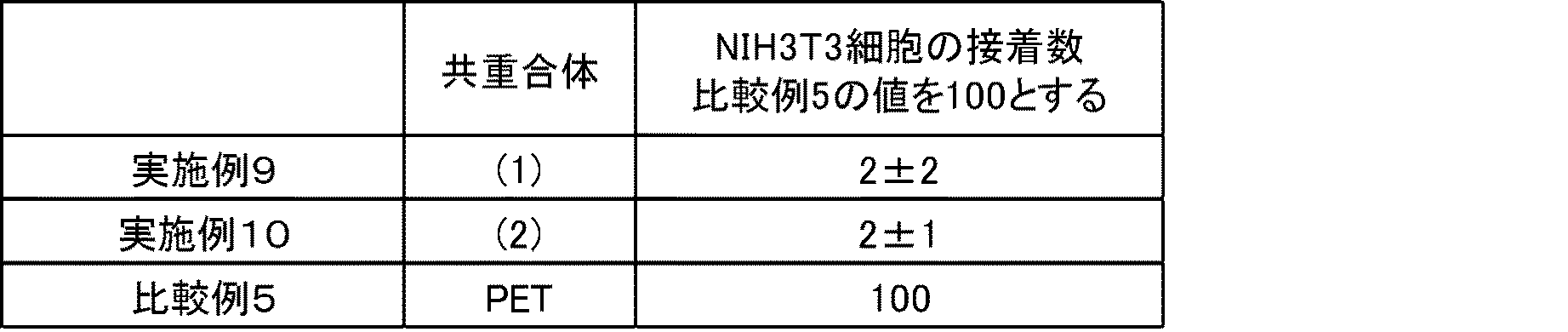
〔細胞接着試験〕
PETフィルム(1.0cm×1.0cm)上に共重合体(1)をスピンコートしたコーティング膜を24穴の細胞培養プレートの底に少量のシリコン接着剤で固定した。超純水で3回洗浄した後に37℃環境下のPBS中で12時間浸漬させた。[Cell adhesion test]
A coating film in which the copolymer (1) was spin-coated on a PET film (1.0 cm × 1.0 cm) was fixed to the bottom of a 24-well cell culture plate with a small amount of silicon adhesive. After washing 3 times with ultrapure water, it was immersed in PBS under a 37 ° C. environment for 12 hours.
マウス繊維芽細胞(NIH3T3)を5%CO2、37℃環境下で10%ウシ胎児血清(FCS)を含有するダルベッコ改変イーグル培地(FCS含有DMEM)中で培養した。培養したNIH3T3細胞を滅菌PBSで一回洗浄し、1mLの0.02% エチレンジアミン四酢酸(EDTA)溶液と1mLの0.25%トリプシン溶液を加え細胞培養プレートから剥がした。その細胞懸濁液を遠心してNIH3T3細胞を回収した後、FCS含有DMEMで再懸濁し61.2×10⁴個/mLの溶液を得た。Mouse fibroblasts (NIH3T3) were cultured in Dulbecco's modified Eagle's medium (DMEM containing FCS) containing 10% fetal bovine serum (FCS) in an environment of 5% CO 2 and 37 ° C. The cultured NIH3T3 cells were washed once with sterile PBS, 1 mL of 0.02% ethylenediaminetetraacetic acid (EDTA) solution and 1 mL of 0.25% trypsin solution were added, and the cells were peeled off from the cell culture plate. The cell suspension was centrifuged to collect NIH3T3 cells, and then resuspended in DMEM containing FCS to obtain a solution of 61.2 × 10 4 cells / mL.
細胞懸濁液は、コーティング膜を固定した細胞培養プレートの各ウェルに対して1×10⁴個/cm2に培地で調製し、コーティング膜上に播種した。5%CO2、37℃環境下で1時間培養した後、コーティング膜をPBSで3回洗浄し、4%パラホルムアルデヒド PBS溶液を用いてコーティング膜上の接着細胞を固定化した。超純水で3回洗浄した後、ロータリー真空ポンプにて減圧乾燥した。1質量%濃度のクリスタルバイオレット PBS染色液で接着細胞を染色し、光学顕微鏡を用いて5視野任意に観察を行い接着細胞の数を数えた。 The cell suspension was prepared in a medium at 1 × 10 4 cells / cm 2 for each well of the cell culture plate on which the coating membrane was fixed, and seeded on the coating membrane. After culturing in an environment of 5% CO 2 and 37 ° C. for 1 hour, the coating membrane was washed 3 times with PBS and adherent cells on the coating membrane were immobilized with 4% paraformaldehyde PBS solution. After washing with ultrapure water three times, it was dried under reduced pressure with a rotary vacuum pump. Adherent cells were stained with a crystal violet PBS staining solution having a concentration of 1% by mass, and the number of adherent cells was counted by arbitrarily observing 5 fields of view using an optical microscope.
実施例10
実施例9と同様の方法で共重合体(2)のコーティング膜を得た。得られたコーティング膜について実施例9と同様の方法で細胞接着試験を実施した。結果を表6に示す。Example 10
A coating film of the copolymer (2) was obtained in the same manner as in Example 9. A cell adhesion test was carried out on the obtained coating film in the same manner as in Example 9. The results are shown in Table 6.
比較例5
実施例9で用いたものと同様のPETフィルム(コーティング無)について、実施例9と同様の方法で細胞接着試験を実施した。結果を表6に示す。Comparative Example 5
A cell adhesion test was carried out on a PET film (without coating) similar to that used in Example 9 by the same method as in Example 9. The results are shown in Table 6.
実施例11
共重合体(1)の0.1質量%メタノール溶液を室温でPETフィルム(1cm×1cm)上へスピンコートした。具体的には、上記溶液30μLをPETフィルム上に滴下し2000rpmで60秒間回転した。その後、室温にて、ロータリー真空ポンプにて減圧乾燥し、コーティング膜(PETフィルムの表面に形成されたコーティング膜)を得た。Example 11
A 0.1% by mass methanol solution of the copolymer (1) was spin-coated onto a PET film (1 cm × 1 cm) at room temperature. Specifically, 30 μL of the above solution was dropped onto a PET film and rotated at 2000 rpm for 60 seconds. Then, it dried under reduced pressure with a rotary vacuum pump at room temperature to obtain a coating film (a coating film formed on the surface of a PET film).
得られたコーティング膜について、以下の方法で大腸菌の接着性を評価した。結果を表7に示す。 The adhesiveness of Escherichia coli was evaluated for the obtained coating film by the following method. The results are shown in Table 7.
〔大腸菌の接着性:化学発光法による定量〕
得られたコーティング膜を24穴細胞培養ディッシュの底に少量のシリコン接着剤で固定した。これを純水で3回洗浄後、リン酸塩緩衝生理食塩液(PBS)に12時間浸漬した。PBSを除いた後、対数増殖期にある大腸菌(E.coli ATCC(R) 25922TM)を含む10質量% Muller−Hinton II (MH)培地でOD600=0.003に調製した分散液を上記細胞培養ディッシュに2.0mL加え、37℃で20時間静置培養した。上清を96穴の細胞培養ディッシュに100μLずつ加え、OD590を測定し大腸菌分散液の濃度を求めた。大腸菌が接着したコーティング膜は、24穴細胞培養ディッシュから取り出し、PBSで3回洗浄した後に新しい24穴細胞培養ディッシュに移した。接着した大腸菌の定量はBacTiter−GloTM Microbial Cell Viability Assayを用いて行った。10% BacTiter−GloTM Reagent水溶液500μLを大腸菌が接着したコーティング膜に添加し、5分間室温で静置した。その後、添加した水溶液を化学発光用96穴マイクロプレートに100μLずつ加え、プレートリーダーを用いて化学発光強度を測定した。[Adhesion of E. coli: Quantification by chemiluminescence method]
The resulting coating film was fixed to the bottom of a 24-well cell culture dish with a small amount of silicone adhesive. This was washed 3 times with pure water and then immersed in phosphate buffered saline (PBS) for 12 hours. After removing PBS, a dispersion prepared to OD 600 = 0.003 in 10% by mass Mueller-Hinton II (MH) medium containing E. coli ATCC (R) 25922 TM ) in the logarithmic growth phase was prepared as described above. 2.0 mL was added to the cell culture dish, and the cells were statically cultured at 37 ° C. for 20 hours. The supernatant was added to a cell culture dish of 96 holes by 100 μL, and OD590 was measured to determine the concentration of the E. coli dispersion. The coating film adhered with E. coli was removed from the 24-well cell culture dish, washed 3 times with PBS, and then transferred to a new 24-well cell culture dish. The quantification of the adhered Escherichia coli was performed using the BacTiter-Glo TM Microbial Cell Viability Assay. 500 μL of a 10% BacTiter-Glo TM Reagent aqueous solution was added to the coating film adhered with E. coli, and the mixture was allowed to stand at room temperature for 5 minutes. Then, 100 μL of the added aqueous solution was added to each of the 96-well microplates for chemiluminescence, and the chemiluminescence intensity was measured using a plate reader.
〔接着大腸菌のコロニー形成:SEM観察〕
得られたコーティング膜を24穴細胞培養ディッシュの底に少量のシリコン接着剤で固定した。これを純水で3回洗浄後、リン酸塩緩衝生理食塩液(PBS)に12時間浸漬した。PBSを除いた後、対数増殖期にある大腸菌(E.coli ATCC(R) 25922TM)を含む10質量% Muller−Hinton II (MH)培地でOD600=0.003に調製した分散液を上記細胞培養ディッシュに2.0mL加え、37℃で20時間静置培養した。上清を除き、PBSでコーティング膜を3回洗浄した。2%グルタルアルデヒドを含むPBSを加え4℃で2時間静置し、コーティング膜表面に接着した大腸菌を固定化した。サンプルをPBSで3回、純水で1回洗浄し、1晩減圧乾燥を行った。得られたサンプルを金スパッタ装置で金コートし、走査型電子顕微鏡を用いてコーティング膜表面を倍率400倍及び2500倍で3視野任意に観察し、大腸菌の接着性、コロニー形成を評価した。大腸菌のコロニー形成が全く確認できないものを−、大腸菌数が400cells未満の小さなコロニーが分散して存在するもの±、大腸菌数が400cells以上の大きなコロニーが存在するものを+、大腸菌数が400cells以上の大きなコロニーが存在し、かつ広範囲にコロニー形成が広がっているものを++と表7に記す。[Colonization of adherent E. coli: SEM observation]
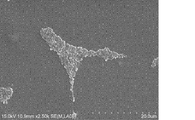
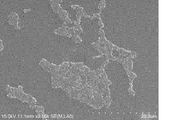
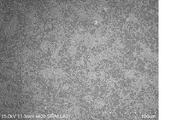
The resulting coating film was fixed to the bottom of a 24-well cell culture dish with a small amount of silicone adhesive. This was washed 3 times with pure water and then immersed in phosphate buffered saline (PBS) for 12 hours. After removing PBS, a dispersion prepared to OD 600 = 0.003 in 10% by mass Mueller-Hinton II (MH) medium containing E. coli ATCC (R) 25922 TM ) in the logarithmic growth phase was prepared as described above. 2.0 mL was added to the cell culture dish, and the cells were statically cultured at 37 ° C. for 20 hours. The supernatant was removed and the coating membrane was washed 3 times with PBS. PBS containing 2% glutaraldehyde was added, and the mixture was allowed to stand at 4 ° C. for 2 hours to immobilize Escherichia coli adhering to the surface of the coating film. The sample was washed 3 times with PBS and 1 time with pure water, and dried under reduced pressure overnight. The obtained sample was gold-coated with a gold sputtering apparatus, and the surface of the coating film was arbitrarily observed in three fields at a magnification of 400 times and 2500 times using a scanning electron microscope to evaluate the adhesion of Escherichia coli and colony formation. Those in which colonization of E. coli cannot be confirmed at all-, those in which small colonies with an E. coli number of less than 400 cells are dispersed ±, those in which large colonies with an E. coli number of 400 cells or more are present +, and those with an E. coli number of 400 cells or more Table 7 shows ++ where large colonies exist and colonization is widespread.
実施例12
実施例11と同様の方法で共重合体(2)のコーティング膜を得た。得られたコーティング膜について実施例11と同様の方法で大腸菌の接着性および接着大腸菌のコロニー形成を評価した。結果を表7に示す。Example 12
A coating film of the copolymer (2) was obtained in the same manner as in Example 11. The obtained coating film was evaluated for the adhesiveness of Escherichia coli and the colonization of adherent Escherichia coli in the same manner as in Example 11. The results are shown in Table 7.
比較例6
実施例11で用いたものと同様のPETフィルム(コーティング無)について、実施例11と同様の方法で大腸菌の接着性および接着大腸菌のコロニー形成を評価した。結果を表7に示す。Comparative Example 6
For the same PET film (without coating) used in Example 11, the adhesiveness of E. coli and the colonization of adherent E. coli were evaluated by the same method as in Example 11. The results are shown in Table 7.
実施例11、実施例12、比較例6で得られた接着大腸菌のSEM写真を図1〜6に示す。 The SEM photographs of the adherent Escherichia coli obtained in Example 11, Example 12, and Comparative Example 6 are shown in FIGS. 1 to 6.
製造例3
テトラフルオロエチレンとN−ビニルピロリドンの共重合体(3)の調製
気密検査済みの耐圧性反応容器内を十分に窒素置換した後、脱酸素処理したアセトン(890g)及びN−ビニルピロリドン(NVP)(60.1g)を添加した。続いてテトラフルオロエチレン(TFE)(74g)を加圧添加し、攪拌しながら混合物の内温を60℃となる様に調整した上で、t−ブチルパーオキシピバレート(2.6g)を加えて反応を開始した。反応圧の低下に応じて、TFEとNVPを追加仕込みをおこない、圧が一定になるようにした。追加仕込みしたTFEは合計91g、NVPは200gであった。反応開始から218分後、残存するTFEを除去し、反応を完了させた。次いで反応混合物を精製、乾燥させ、目的の共重合体(3)を1284g得た。得られた共重合体(3)は、重量平均分子量4.3×10⁴、分子量分布1.9、35モル%のTFE単位及び65モル%のNVP単位を含む共重合体であることが分かった。Manufacturing example 3
Preparation of Copolymer of Tetrafluoroethylene and N-Vinylpyrrolidone (3) Deoxidized acetone (890 g) and N-vinylpyrrolidone (NVP) after sufficient nitrogen substitution in the pressure-resistant reaction vessel that has been airtightly tested. (60.1 g) was added. Subsequently, tetrafluoroethylene (TFE) (74 g) was added under pressure, and the internal temperature of the mixture was adjusted to 60 ° C. with stirring, and then t-butylperoxypivalate (2.6 g) was added. And started the reaction. TFE and NVP were additionally charged according to the decrease in the reaction pressure so that the pressure became constant. The total amount of TFE charged was 91 g, and the total amount of NVP was 200 g. After 218 minutes from the start of the reaction, the remaining TFE was removed to complete the reaction. Then, the reaction mixture was purified and dried to obtain 1284 g of the desired copolymer (3). The obtained copolymer (3) was found to be a copolymer containing a weight average molecular weight of 4.3 × 10 4 , a molecular weight distribution of 1.9, 35 mol% of TFE units and 65 mol% of NVP units. It was.
製造例4
テトラフルオロエチレンとN−ビニルピロリドンの共重合体(4)の調製
製造例3と同じ条件で重合をおこなった。ただし、追加仕込みしたTFEは合計88g、NVPは188gであった。反応開始から214分後、残存するTFEを除去し、反応を完了させた。次いで反応混合物を精製、乾燥させ、目的の共重合体(4)を1273g得た。得られた共重合体(4)は、重量平均分子量4.5×10⁴、分子量分布1.9、37モル%のTFE単位及び63モル%のNVP単位を含む共重合体であることが分かった。Manufacturing example 4
Preparation of Copolymer of Tetrafluoroethylene and N-Vinylpyrrolidone (4) Polymerization was carried out under the same conditions as in Production Example 3. However, the total amount of TFE charged was 88 g, and the total amount of NVP was 188 g. After 214 minutes from the start of the reaction, the remaining TFE was removed to complete the reaction. Then, the reaction mixture was purified and dried to obtain 1273 g of the desired copolymer (4). The obtained copolymer (4) was found to be a copolymer containing a weight average molecular weight of 4.5 × 10 4 , a molecular weight distribution of 1.9, 37 mol% of TFE units and 63 mol% of NVP units. It was.
製造例5
ヘキサフルオロプロピレンとN−ビニルピロリドンの共重合体(5)の調製
気密検査済みの耐圧性反応容器内を十分に窒素置換した後、脱酸素処理したアセトン(890g)及びN−ビニルピロリドン(NVP)(135g)を添加した。続いてヘキサフルオロプロピレン(HFP)(147g)を加圧添加し、撹拌しながら混合物の内温を60℃となる様に調整した上で、t−ブチルパーオキシピバレート(2.2g)を加えて反応を開始した。反応開始から164分後、残存するヘキサフルオロプロピレンを除去し、反応を完了させた。次いで反応混合物を精製、乾燥させ、目的の共重合体(5)を1157g得た。得られた共重合体(5)は、重量平均分子量1.1×10⁴、分子量分布1.7、29モル%のHFP単位及び71モル%のNVP単位を含む共重合体であることが分かった。Production example 5
Preparation of Copolymer of Hexafluoropropylene and N-Vinylpyrrolidone (5) Acetone (890 g) and N-vinylpyrrolidone (NVP) deoxidized after sufficient nitrogen substitution in the pressure-resistant reaction vessel that has been airtightly tested. (135 g) was added. Subsequently, hexafluoropropylene (HFP) (147 g) was added under pressure, and the internal temperature of the mixture was adjusted to 60 ° C. with stirring, and then t-butylperoxypivalate (2.2 g) was added. And started the reaction. After 164 minutes from the start of the reaction, the remaining hexafluoropropylene was removed to complete the reaction. Then, the reaction mixture was purified and dried to obtain 1157 g of the desired copolymer (5). The obtained copolymer (5) was found to be a copolymer containing a weight average molecular weight of 1.1 × 10 4 , a molecular weight distribution of 1.7, 29 mol% of HFP units and 71 mol% of NVP units. It was.
製造例6
トリフルオロクロロエチレンとN−ビニルピロリドンの共重合体(6)の調製
気密検査済みの耐圧性反応容器内を十分に窒素置換した後、脱酸素処理したアセトン(751g)及びN−ビニルピロリドン(26.0g)を添加した。続いてトリフルオロクロロエチレン(116g)を加圧添加し、攪拌しながら混合物の内温を60℃となる様に調整した上で、t−ブチルパーオキシピバレート(1.8g)を加えて反応を開始した。反応開始から120分後、残存するトリフルオロクロロエチレンを除去し、ヒドロキノン(1.1g)を添加した。次いで反応混合物を精製、乾燥させ、目的の共重合体(6)を3g得た。得られた共重合体(6)は、重量平均分子量4.7×10⁴、分子量分布4.3、64モル%のトリフルオロクロロエチレン単位及び36モル%のN−ビニルピロリドン単位を含む共重合体であることが分かった。Production example 6
Preparation of Copolymer (6) of Trifluorochloroethylene and N-Vinylpyrrolidone Deoxidized acetone (751 g) and N-vinylpyrrolidone (26) after sufficient nitrogen substitution in the pressure-resistant reaction vessel that has been airtightly tested. .0 g) was added. Subsequently, trifluorochloroethylene (116 g) was added under pressure, the internal temperature of the mixture was adjusted to 60 ° C. with stirring, and then t-butylperoxypivalate (1.8 g) was added for the reaction. Started. After 120 minutes from the start of the reaction, the remaining trifluorochloroethylene was removed and hydroquinone (1.1 g) was added. Then, the reaction mixture was purified and dried to obtain 3 g of the desired copolymer (6). The obtained copolymer (6) has a weight average molecular weight of 4.7 × 10 4 , a molecular weight distribution of 4.3, and a copolymer weight containing 64 mol% of trifluorochloroethylene units and 36 mol% of N-vinylpyrrolidone units. It turned out to be a coalescence.
実施例13〜16及び比較例7
BSA吸着量評価実験
製造例3〜6でえられた共重合体に関し、タンパク質吸着試験(ウシ血清アルブミン)をおこなった。Examples 13 to 16 and Comparative Example 7
BSA Adsorption Amount Evaluation Experiment A protein adsorption test (bovine serum albumin) was performed on the copolymers obtained in Production Examples 3 to 6.
共重合体(3)〜(6)およびPVDFをジメチルアセトアミド溶液に溶解させ、1質量%のポリマー溶液とした。このポリマー溶液をQCMチップであるAuセンサー(円盤状、直径1.4cm)表面に1滴垂らし、2000rpmで30秒スピンコートを行った。このセンサーを80℃、真空中で3時間乾燥させ、共重合体(3)〜(6)又はPVDFで表面がコーティングされたセンサーを作製した。この作製したセンサーをQCMにセットし、0.1M PBS(リン酸緩衝液)に溶解させた100ppm ウシ血清アルブミン(BSA)を供給することで吸着挙動を測定した。 The copolymers (3) to (6) and PVDF were dissolved in a dimethylacetamide solution to prepare a 1% by mass polymer solution. One drop of this polymer solution was dropped on the surface of an Au sensor (disk-shaped, diameter 1.4 cm), which is a QCM chip, and spin coating was performed at 2000 rpm for 30 seconds. This sensor was dried at 80 ° C. in vacuum for 3 hours to prepare a sensor whose surface was coated with the copolymers (3) to (6) or PVDF. The prepared sensor was set in a QCM, and the adsorption behavior was measured by supplying 100 ppm bovine serum albumin (BSA) dissolved in 0.1 M PBS (phosphate buffer).
コーティング膜に吸着したタンパク質量は、実験から得られた吸着時間30分後の周波数を解析ソフトQToolsに導入されているSauerbreyの式からAreal mass[ng/cm2]の解析を行い算出した。The amount of protein adsorbed on the coating film was calculated by analyzing the area mass [ng / cm 2 ] from the Sauerbury formula introduced in the analysis software QTools using the frequency obtained from the experiment after the adsorption time of 30 minutes.
結果は、比較例7の値を100として表8に示す。 The results are shown in Table 8 with the value of Comparative Example 7 as 100.
比較としてダイキン工業社製ポリフッ化ビニリデン(PVDF) VW410を用いた。 For comparison, polyvinylidene fluoride (PVDF) VW410 manufactured by Daikin Industries, Ltd. was used.
製造例7
テトラフルオロエチレンとN−ビニルピロリドンの共重合体(7)の調製
気密検査済みの耐圧性反応容器内を十分に窒素置換した後、脱酸素処理したアセトン(890g)及びN−ビニルピロリドン(NVP)(36.0g)を添加した。続いてテトラフルオロエチレン(TFE)(131g)を加圧添加し、攪拌しながら混合物の内温を60℃となる様に調整した上で、t−ブチルパーオキシピバレート(2.6g)を加えて反応を開始した。反応圧の低下に応じて、TFEとNVPを追加仕込みをおこない、圧が一定になるようにした。追加仕込みしたTFEは合計90g、NVPは100gであった。反応開始から5時間後、残存するTFEを除去し、反応を完了させた。次いで反応混合物を精製、乾燥させ、目的の共重合体(7)を229g得た。得られた共重合体(7)は、重量平均分子量5.0×10⁴、分子量分布2.0、46モル%のTFE単位及び54モル%のNVP単位を含む共重合体であることが分かった。Production example 7
Preparation of Copolymer (7) of Tetrafluoroethylene and N-Vinylpyrrolidone Deoxidized acetone (890 g) and N-vinylpyrrolidone (NVP) after sufficient nitrogen substitution in the pressure-resistant reaction vessel that has been airtightly tested. (36.0 g) was added. Subsequently, tetrafluoroethylene (TFE) (131 g) was added under pressure, and the internal temperature of the mixture was adjusted to 60 ° C. with stirring, and then t-butylperoxypivalate (2.6 g) was added. And started the reaction. TFE and NVP were additionally charged according to the decrease in the reaction pressure so that the pressure became constant. The total amount of TFE charged was 90 g, and the total amount of NVP was 100 g. After 5 hours from the start of the reaction, the remaining TFE was removed to complete the reaction. Then, the reaction mixture was purified and dried to obtain 229 g of the desired copolymer (7). The obtained copolymer (7) was found to be a copolymer containing a weight average molecular weight of 5.0 × 10 4 , a molecular weight distribution of 2.0, 46 mol% of TFE units and 54 mol% of NVP units. It was.
実施例17〜19
実施例1と同様にQCM−Dを用いて、表9に記載したように、共重合体(5)、(3)、又は(7)について、ウシ血漿フィブリノーゲン(BPF)の吸着を評価した。実験の結果を表9に示す。結果は比較例2の値を100として表9に示す。Examples 17-19
Using QCM-D in the same manner as in Example 1, the adsorption of bovine plasma fibrinogen (BPF) was evaluated for the copolymers (5), (3), or (7) as shown in Table 9. The results of the experiment are shown in Table 9. The results are shown in Table 9 with the value of Comparative Example 2 as 100.
実施例20〜22
実施例1と同様にQCM−Dを用いて、表10に記載したように、共重合体(5)、(3)、又は(7)について、グロブリン(IgG)の吸着を評価した。実験の結果を表10に示す。結果は比較例3の値を100として表10に示す。Examples 20-22
Using QCM-D in the same manner as in Example 1, the adsorption of globulin (IgG) was evaluated for the copolymers (5), (3), or (7) as shown in Table 10. The results of the experiment are shown in Table 10. The results are shown in Table 10 with the value of Comparative Example 3 as 100.
Claims (11)
前記フルオロポリマーは、フルオロオレフィンとアミド結合を有する重合性ビニル化合物との共重合体であり、フルオロオレフィン単位が65〜5モル%であり、アミド結合を有する重合性ビニル化合物単位が35〜95モル%であり、ゲル浸透クロマトグラフィーにより求める重量平均分子量が15000〜500000であり、ランダムポリマーであり、
前記フルオロオレフィンは、テトラフルオロエチレン、フッ化ビニリデン及びヘキサフルオロプロピレンからなる群より選択される少なくとも1種であり、
前記アミド結合を有する重合性ビニル化合物は、N−ビニル−β−プロピオラクタム、N−ビニル−2−ピロリドン、N−ビニル−γ−バレロラクタム、N−ビニル−2−ピペリドン、及び、N−ビニル−ヘプトラクタムからなる群より選択される少なくとも1種であることを特徴とする生体適合性材料。 A biocompatible material made of fluoropolymer,
The fluoropolymer is a copolymer of a fluoroolefin and a polymerizable vinyl compound having an amide bond, and has a fluoroolefin unit of 65 to 5 mol% and a polymerizable vinyl compound unit having an amide bond of 35 to 95 mol. a%, the weight-average molecular weight determined by gel permeation chromatography Ri der 15,000 to 500,000, a random polymer,
The fluoroolefin is at least one selected from the group consisting of tetrafluoroethylene, vinylidene fluoride and hexafluoropropylene.
The polymerizable vinyl compound having an amide bond includes N-vinyl-β-propiolactam, N-vinyl-2-pyrrolidone, N-vinyl-γ-valerolactam, N-vinyl-2-piperidone, and N-vinyl-2-piperidone. vinyl - biocompatible material characterized at least Tanedea Rukoto selected from the group consisting of Heputorakutamu.
A coating method comprising the step of applying the biocompatible material according to claim 1 or 2 or the coating composition according to claim 3.
Applications Claiming Priority (3)
| Application Number | Priority Date | Filing Date | Title |
|---|---|---|---|
| JP2015121356 | 2015-06-16 | ||
| JP2015121356 | 2015-06-16 | ||
| PCT/JP2016/067907 WO2016204217A1 (en) | 2015-06-16 | 2016-06-16 | Biocompatible material, coating composition, coating film, and article |
Related Child Applications (1)
| Application Number | Title | Priority Date | Filing Date |
|---|---|---|---|
| JP2021016373A Division JP7123346B2 (en) | 2015-06-16 | 2021-02-04 | Biocompatible materials, coating compositions, coating films and articles |
Publications (2)
| Publication Number | Publication Date |
|---|---|
| JPWO2016204217A1 JPWO2016204217A1 (en) | 2018-04-05 |
| JP6889824B2 true JP6889824B2 (en) | 2021-06-18 |
Family
ID=57545345
Family Applications (2)
| Application Number | Title | Priority Date | Filing Date |
|---|---|---|---|
| JP2017525289A Active JP6889824B2 (en) | 2015-06-16 | 2016-06-16 | Biocompatible materials, coating compositions, coating films and articles |
| JP2021016373A Active JP7123346B2 (en) | 2015-06-16 | 2021-02-04 | Biocompatible materials, coating compositions, coating films and articles |
Family Applications After (1)
| Application Number | Title | Priority Date | Filing Date |
|---|---|---|---|
| JP2021016373A Active JP7123346B2 (en) | 2015-06-16 | 2021-02-04 | Biocompatible materials, coating compositions, coating films and articles |
Country Status (2)
| Country | Link |
|---|---|
| JP (2) | JP6889824B2 (en) |
| WO (1) | WO2016204217A1 (en) |
Families Citing this family (4)
| Publication number | Priority date | Publication date | Assignee | Title |
|---|---|---|---|---|
| JP7148998B2 (en) * | 2018-04-09 | 2022-10-06 | 株式会社サイフューズ | Tubular cell structure culture and maintenance device and tubular cell structure maintenance aid |
| US20210198453A1 (en) * | 2018-09-14 | 2021-07-01 | Daikin Industries, Ltd. | Composition and multilayer body |
| DE102019102597A1 (en) * | 2019-02-01 | 2020-08-06 | DC Diagnostics Concept UG (haftungsbeschränkt) | Container for storing a body fluid |
| CN112280103B (en) * | 2020-10-29 | 2022-03-15 | 巢湖学院 | A kind of antibacterial packaging film and preparation method thereof |
Family Cites Families (4)
| Publication number | Priority date | Publication date | Assignee | Title |
|---|---|---|---|---|
| US5100689A (en) * | 1987-04-10 | 1992-03-31 | University Of Florida | Surface modified surgical instruments, devices, implants, contact lenses and the like |
| US5443455A (en) * | 1993-07-27 | 1995-08-22 | Target Therapeutics, Inc. | Guidewire and method of pretreating metal surfaces for subsequent polymer coating |
| US7244443B2 (en) * | 2004-08-31 | 2007-07-17 | Advanced Cardiovascular Systems, Inc. | Polymers of fluorinated monomers and hydrophilic monomers |
| US8668919B2 (en) | 2009-03-03 | 2014-03-11 | Abbott Cardiovascular Systems Inc. | Polymer for creating hemocompatible surface |
-
2016
- 2016-06-16 JP JP2017525289A patent/JP6889824B2/en active Active
- 2016-06-16 WO PCT/JP2016/067907 patent/WO2016204217A1/en not_active Ceased
-
2021
- 2021-02-04 JP JP2021016373A patent/JP7123346B2/en active Active
Also Published As
| Publication number | Publication date |
|---|---|
| JP7123346B2 (en) | 2022-08-23 |
| JPWO2016204217A1 (en) | 2018-04-05 |
| WO2016204217A1 (en) | 2016-12-22 |
| JP2021091908A (en) | 2021-06-17 |
Similar Documents
| Publication | Publication Date | Title |
|---|---|---|
| JP7123346B2 (en) | Biocompatible materials, coating compositions, coating films and articles | |
| US11441120B2 (en) | Cell culture substrate | |
| US10669445B2 (en) | Ion complex material having function of inhibiting adhesion of biological substance and method for manufacturing the same | |
| US9701939B2 (en) | Thermoresponsive cell culture supports | |
| JP6810386B2 (en) | Low protein adsorptive material, low protein adsorptive article, low cell adhesion material and low cell adhesion article | |
| Gottenbos et al. | Initial adhesion and surface growth of Pseudomonas aeruginosa on negatively and positively charged poly (methacrylates) | |
| US12534637B2 (en) | Coating film having thinly-spreading and irregularity-conforming properties, and structural base having such film | |
| WO2015115568A1 (en) | Temperature-responsive base material, method for producing same, and method for evaluating same | |
| EP3719113A1 (en) | Cell culture container capable of long-term culture, and method for manufacturing same | |
| JP6214583B2 (en) | Polymer substrate, use thereof and production method thereof | |
| KR20100049532A (en) | Cell culture substrate | |
| JP6447787B2 (en) | Cell culture substrate | |
| Salehi-Nik et al. | Surface modification of silicone tubes by functional carboxyl and amine, but not peroxide groups followed by collagen immobilization improves endothelial cell stability and functionality | |
| JP2016026520A (en) | Compound for preventing protein adhesion, coating solution and medical device | |
| US12291701B2 (en) | Cell culture container having minute volume | |
| JP2018123275A (en) | Cell adhesion inhibitor | |
| US20240287322A1 (en) | Composition for forming coating film, coating film, and cell culture vessel | |
| US20240336891A1 (en) | Base material for cell culture in serum-free medium | |
| US20250011602A1 (en) | Adhesion suppressing material of biological substances | |
| US11246966B2 (en) | Copolymer-comprising antimicrobial, cell culture, antithrombotic, or biopharmaceutical article | |
| US20220135806A1 (en) | Method for producing polymer compatible with biomaterials | |
| TW201602260A (en) | Ion complex material having function for preventing adherence to biological material | |
| Bittrich et al. | Control of Protein Adsorption and Cell Adhesion by Mixed Polymer Brushes Made by the “Grafting-To” Approach | |
| Serbetci et al. | Proteins and cells on polyurethane surfaces | |
| US20230392037A1 (en) | Biological substance low adhesion material comprising copolymer |
Legal Events
| Date | Code | Title | Description |
|---|---|---|---|
| RD01 | Notification of change of attorney |
Free format text: JAPANESE INTERMEDIATE CODE: A7426 Effective date: 20171226 |
|
| A521 | Request for written amendment filed |
Free format text: JAPANESE INTERMEDIATE CODE: A821 Effective date: 20171226 |
|
| A621 | Written request for application examination |
Free format text: JAPANESE INTERMEDIATE CODE: A621 Effective date: 20190426 |
|
| A131 | Notification of reasons for refusal |
Free format text: JAPANESE INTERMEDIATE CODE: A131 Effective date: 20200331 |
|
| A601 | Written request for extension of time |
Free format text: JAPANESE INTERMEDIATE CODE: A601 Effective date: 20200601 |
|
| A521 | Request for written amendment filed |
Free format text: JAPANESE INTERMEDIATE CODE: A523 Effective date: 20200716 |
|
| A02 | Decision of refusal |
Free format text: JAPANESE INTERMEDIATE CODE: A02 Effective date: 20201104 |
|
| A521 | Request for written amendment filed |
Free format text: JAPANESE INTERMEDIATE CODE: A523 Effective date: 20210204 |
|
| C60 | Trial request (containing other claim documents, opposition documents) |
Free format text: JAPANESE INTERMEDIATE CODE: C60 Effective date: 20210204 |
|
| A911 | Transfer to examiner for re-examination before appeal (zenchi) |
Free format text: JAPANESE INTERMEDIATE CODE: A911 Effective date: 20210216 |
|
| C21 | Notice of transfer of a case for reconsideration by examiners before appeal proceedings |
Free format text: JAPANESE INTERMEDIATE CODE: C21 Effective date: 20210224 |
|
| TRDD | Decision of grant or rejection written | ||
| A01 | Written decision to grant a patent or to grant a registration (utility model) |
Free format text: JAPANESE INTERMEDIATE CODE: A01 Effective date: 20210420 |
|
| A61 | First payment of annual fees (during grant procedure) |
Free format text: JAPANESE INTERMEDIATE CODE: A61 Effective date: 20210428 |
|
| R150 | Certificate of patent or registration of utility model |
Ref document number: 6889824 Country of ref document: JP Free format text: JAPANESE INTERMEDIATE CODE: R150 |
|
| R250 | Receipt of annual fees |
Free format text: JAPANESE INTERMEDIATE CODE: R250 |
|
| R250 | Receipt of annual fees |
Free format text: JAPANESE INTERMEDIATE CODE: R250 |