JP6861445B2 - Electron integrated multi-electrode detection system based on potential measurement - Google Patents
Electron integrated multi-electrode detection system based on potential measurement Download PDFInfo
- Publication number
- JP6861445B2 JP6861445B2 JP2019543796A JP2019543796A JP6861445B2 JP 6861445 B2 JP6861445 B2 JP 6861445B2 JP 2019543796 A JP2019543796 A JP 2019543796A JP 2019543796 A JP2019543796 A JP 2019543796A JP 6861445 B2 JP6861445 B2 JP 6861445B2
- Authority
- JP
- Japan
- Prior art keywords
- electrode
- detection system
- electron
- electrodes
- integrated multi
- Prior art date
- Legal status (The legal status is an assumption and is not a legal conclusion. Google has not performed a legal analysis and makes no representation as to the accuracy of the status listed.)
- Active
Links
Images
Classifications
-
- G—PHYSICS
- G01—MEASURING; TESTING
- G01N—INVESTIGATING OR ANALYSING MATERIALS BY DETERMINING THEIR CHEMICAL OR PHYSICAL PROPERTIES
- G01N27/00—Investigating or analysing materials by the use of electric, electrochemical, or magnetic means
- G01N27/26—Investigating or analysing materials by the use of electric, electrochemical, or magnetic means by investigating electrochemical variables; by using electrolysis or electrophoresis
- G01N27/416—Systems
- G01N27/49—Systems involving the determination of the current at a single specific value, or small range of values, of applied voltage for producing selective measurement of one or more particular ionic species
-
- G—PHYSICS
- G01—MEASURING; TESTING
- G01R—MEASURING ELECTRIC VARIABLES; MEASURING MAGNETIC VARIABLES
- G01R17/00—Measuring arrangements involving comparison with a reference value, e.g. bridge
- G01R17/20—AC or DC potentiometric measuring arrangements
-
- G—PHYSICS
- G01—MEASURING; TESTING
- G01N—INVESTIGATING OR ANALYSING MATERIALS BY DETERMINING THEIR CHEMICAL OR PHYSICAL PROPERTIES
- G01N27/00—Investigating or analysing materials by the use of electric, electrochemical, or magnetic means
- G01N27/26—Investigating or analysing materials by the use of electric, electrochemical, or magnetic means by investigating electrochemical variables; by using electrolysis or electrophoresis
- G01N27/416—Systems
-
- G—PHYSICS
- G01—MEASURING; TESTING
- G01R—MEASURING ELECTRIC VARIABLES; MEASURING MAGNETIC VARIABLES
- G01R19/00—Arrangements for measuring currents or voltages or for indicating presence or sign thereof
- G01R19/10—Measuring sum, difference or ratio
-
- G—PHYSICS
- G01—MEASURING; TESTING
- G01N—INVESTIGATING OR ANALYSING MATERIALS BY DETERMINING THEIR CHEMICAL OR PHYSICAL PROPERTIES
- G01N27/00—Investigating or analysing materials by the use of electric, electrochemical, or magnetic means
- G01N27/26—Investigating or analysing materials by the use of electric, electrochemical, or magnetic means by investigating electrochemical variables; by using electrolysis or electrophoresis
- G01N27/28—Electrolytic cell components
- G01N27/30—Electrodes, e.g. test electrodes; Half-cells
- G01N27/333—Ion-selective electrodes or membranes
Landscapes
- Life Sciences & Earth Sciences (AREA)
- Chemical & Material Sciences (AREA)
- Health & Medical Sciences (AREA)
- General Physics & Mathematics (AREA)
- Physics & Mathematics (AREA)
- Chemical Kinetics & Catalysis (AREA)
- Molecular Biology (AREA)
- Electrochemistry (AREA)
- Analytical Chemistry (AREA)
- Biochemistry (AREA)
- General Health & Medical Sciences (AREA)
- Immunology (AREA)
- Pathology (AREA)
- Power Engineering (AREA)
- Engineering & Computer Science (AREA)
- Investigating Or Analyzing Materials By The Use Of Electric Means (AREA)
Description
<関連出願の相互参照>
この出願は、2017年2月15日に出願された「電位差測定に基づく電気的統合多電極検出システム」と題する中国特許出願第201710079915.Xの優先権を主張する。その全内容は参照により本明細書に組み込まれる。
<Cross-reference of related applications>
This application claims the priority of Chinese Patent Application No. 201710079915.X entitled "Electrical Integrated Multi-Electrode Detection System Based on Potentiometric Titration" filed on February 15, 2017. The entire contents are incorporated herein by reference.
本発明は、分析検出機器に関し、生命科学、環境科学、薬物臨床などを含む分析および検出の分野に関し、特に、微量イオン濃度の変化を伴うサンプルの分析に使用できる検出に関し、汎用的な電位測定に基づく電子集積多電極検出システムである。 The present invention relates to an analytical detection device, and is used in the fields of analysis and detection including life science, environmental science, drug clinical practice, etc., and in particular, with respect to detection that can be used for analysis of a sample with a change in trace ion concentration, general-purpose potential measurement. It is an electron integrated multi-electrode detection system based on.
電位差分析は、分析化学の重要な分野であり、溶液中の物質の電位の変化を検出するための分析方法である。イオン選択電極などの電位ベースの電極検出は、電位差分析で広く使用されている検出技術である。電位ベースの電極検出は、選択性が良く、検出が便利で速く、価格が安く、シンプル機器のため、持ち運びが簡単であるという利点を持ち、リアルタイムおよびオンライン分析に使用することができ、科学研究、臨床診断、環境モニタリングで広く使用されてある。それにもかかわらず、イオン選択性電極には、実際の応用において多くの挑戦と制限がある。まず、イオン選択電極は、感応膜で構成される、イオンに対しネルンスト応答を選択的に生成できる表示電極の一種であるため、ネルンストの関係に従って測定されるイオンの活性を取得する。ネルンストの式の理論的な勾配値は59.2/nmV(nは電極反応に関与する電子の数を指す)であることがよく知られ、ネルンスト応答の勾配値の理論値によって制限されるため、イオン選択性電極の感度は実際の作業でこの値を突破することが困難である。ただし、多くのサンプルのイオン分析では、検出感度に高い要求がある。環境科学、特に生命科学研究と臨床診断では、イオン検出の感度に対する要求がとても高い。これは、イオン選択電極の検出感度よりも高い要求を提出し、同時に検出結果の確度と精度に高い要求を提出する。従来の電極検出の場合、理論的な勾配値(59.2/n mV)により、測定精度に起因する相対濃度誤差は0.17%に達する。誤差に対し比較的に高い要求を提出する検出及び一定と慣習のサンプルの分析検出では、この相対誤差は比較的に大きく、正確な測定の要件を満たすことができない。 Potential difference analysis is an important field of analytical chemistry and is an analytical method for detecting changes in the potential of substances in solution. Potential-based electrode detection, such as an ion-selective electrode, is a detection technique widely used in potential difference analysis. Potential-based electrode detection has the advantages of good selectivity, convenient and fast detection, low price, easy portability due to its simple equipment, and can be used for real-time and online analysis, scientific research. Widely used in clinical diagnosis and environmental monitoring. Nevertheless, ion-selective electrodes have many challenges and limitations in practical applications. First, since the ion selection electrode is a kind of display electrode composed of a sensitive membrane and capable of selectively generating a Nernst response to ions, the activity of ions measured according to the Nernst relationship is acquired. It is well known that the theoretical gradient value of the Nernst equation is 59.2 / nmV (n refers to the number of electrons involved in the electrode reaction), which is limited by the theoretical gradient value of the Nernst response, so the ion. It is difficult for the sensitivity of the selective electrode to exceed this value in actual work. However, in ion analysis of many samples, there is a high demand for detection sensitivity. Environmental science, especially life science research and clinical diagnosis, has very high demands on the sensitivity of ion detection. This submits a requirement higher than the detection sensitivity of the ion-selective electrode, and at the same time submits a requirement for accuracy and accuracy of the detection result. In the case of conventional electrode detection, the theoretical gradient value (59.2 / n mV) causes the relative concentration error due to the measurement accuracy to reach 0.17%. For detections that submit relatively high requirements for error and analytical detection of constant and customary samples, this relative error is relatively large and cannot meet the requirements for accurate measurement.
最初のイオン選択電極であるフッ化セシウム単結晶電極が1966年に導入された以来、イオン選択電極関連センサーの研究は、急速に発展し、さまざまなイオン検出用の選択電極が次々に発売され、イオン検出に関するセンサー研究の波を開始する。これは、検出限界を下げて電極選択性を改善するために、主に新しい膜材料の開発、新しい分析モードの導入などを含む。もちろん、これらの研究は検出感度を改善するための幾つかの研究を含むが、報告された研究では検出感度がそれほど改善されない。知られるように、検出感度が向上し、同時に高い確度と精度を達するという報告はあらない。上記の報告から、人間社会の発展、環境の変化などにより、イオン濃度とその変化の監視がますます注目されていることを確認することは難しくあらない。しかし、日常生活活動や臨床などの多くの場合、イオン濃度の変化は非常に小さいため、このような小さな変化を検出するには、高感度の検出方法だけでなく、信頼できる正確な検出結果も必要である。そして、これは、イオンセンサー検出技術に対し今もなお挑戦である。 Since the introduction of the first ion-selective electrode, the cesium fluoride single crystal electrode, in 1966, research on ion-selective electrode-related sensors has evolved rapidly, and various ion-selective electrodes have been released one after another. Start a wave of sensor research on ion detection. This mainly involves the development of new membrane materials, the introduction of new analytical modes, etc., in order to lower the detection limit and improve electrode selectivity. Of course, these studies include some studies to improve the detection sensitivity, but the reported studies do not improve the detection sensitivity so much. As is known, there are no reports that the detection sensitivity is improved and at the same time high accuracy and accuracy are achieved. From the above report, it is not difficult to confirm that the monitoring of ion concentration and its change is attracting more and more attention due to the development of human society and changes in the environment. However, in many cases such as activities of daily living and clinical practice, changes in ion concentration are very small, so in order to detect such small changes, not only a highly sensitive detection method but also reliable and accurate detection results are required. is necessary. And this is still a challenge to ion sensor detection technology.
本発明により解決される技術的問題は、電位測定に基づく電子統合多電極検出システムを提供することである。検出システムは、複数の電極の同時測定によりネルンスト応答の勾配値を大幅に改善し、検出感度を大幅に向上させることができる。電子集積回路ユニットは、バックグラウンド干渉を低く抑えながら感度を大幅に向上させ、それにより検出結果の確度と精度を向上させる。本発明の電子集積多電極検出システムは、測定精度に起因する相対濃度誤差を従来の方法の±0.2%から±0.006%に低減することができ、電極数が増加するにつれて誤差が減少するため、一定と慣習のサンプルの分析及びライフサイエンス、環境科学などの分野において、誤差に対し比較的に高い要求を提出する分析検出に使用でき、電位測定に基づく汎用検出システムであり、広い応用の可能性がある。 A technical problem solved by the present invention is to provide an electronically integrated multi-electrode detection system based on potential measurement. The detection system can significantly improve the gradient value of the Nernst response by simultaneously measuring a plurality of electrodes, and can greatly improve the detection sensitivity. The electronic integrated circuit unit significantly improves sensitivity while keeping background interference low, thereby improving the accuracy and accuracy of detection results. The electron-integrated multi-electrode detection system of the present invention can reduce the relative concentration error due to the measurement accuracy from ± 0.2% of the conventional method to ± 0.006%, and the error decreases as the number of electrodes increases. It is a general-purpose detection system based on potential measurement that can be used for analysis and detection of constant and customary samples and for submitting relatively high requirements for errors in fields such as life science and environmental science, and has wide application potential. There is.
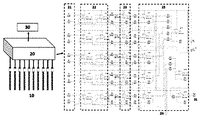
技術的問題を解決するために本発明に採用される解決手段は、多電極の単純な直列接続の代わりに、電子集積モジュール回路により多電極が位相シフトされ、フィルタされた後、加算されることである。電位測定に基づく電子集積多電極検出システムはマルチ電極アレイ(10)、回路ユニット(20)、総信号出力および収集(30)を含む。マルチ電極アレイからの出力信号は、回路ユニット内の位相シフトフィルター回路を通過し、加算回路を通過して総出力信号を取得する。 The solution adopted in the present invention to solve a technical problem is to phase-shift, filter, and then add the multi-electrodes by an electronic integrated module circuit instead of a simple series connection of the multi-electrodes. Is. The electron-integrated multi-electrode detection system based on potential measurement includes a multi-electrode array (10), circuit units (20), total signal output and acquisition (30). The output signal from the multi-electrode array passes through the phase shift filter circuit in the circuit unit and passes through the adder circuit to acquire the total output signal.
本発明の回路ユニットには位相シフトフィルタ回路技術が採用されており、電力周波数AC信号を主要部分とする干渉信号を除去し、バックグラウンドノイズを低減し、検出の安定性と精度を改善する。 The circuit unit of the present invention employs a phase shift filter circuit technique, which eliminates interference signals whose main part is a power frequency AC signal, reduces background noise, and improves detection stability and accuracy.
本発明の検出感度は、電極の数の増加に比例して増加するため、拡張モジュール(24)は、他の同一または異なる多電極検出回路モジュールから信号を入力するように設計されている。 Since the detection sensitivity of the present invention increases in proportion to the increase in the number of electrodes, the expansion module (24) is designed to input signals from other identical or different multi-electrode detection circuit modules.
本発明は、ネルンスト応答の勾配値が大幅に改善され、検出感度が著しく向上し、検出結果の確度と精度が改善されるという有益な効果を有する。m本の電極で構成される電子集積多電極検出システムを使用すると、単電極の勾配値の59.2/nmVから59.2m/nmVに増加し、感度も単電極のm倍に増加する。濃度誤差は、単電極の1/m倍に減少する。本発明の電子集積多電極システムは、生命科学、環境科学、薬物臨床などを含む多くの分野で、微量イオン濃度の変化を広く監視することができ、一定と慣習のサンプルの分析で使用することができ、電位測定に基づく汎用検出システムである。 The present invention has the beneficial effect of significantly improving the gradient value of the Nernst response, significantly improving the detection sensitivity, and improving the accuracy and accuracy of the detection results. Using an electron-integrated multi-electrode detection system consisting of m electrodes, the gradient value of the single electrode increases from 59.2 / nmV to 59.2 m / nmV, and the sensitivity also increases m times that of the single electrode. The concentration error is reduced to 1 / m times that of a single electrode. The electron-integrated multi-electrode system of the present invention can widely monitor changes in trace ion concentration in many fields including life science, environmental science, drug clinical science, etc., and can be used in the analysis of constant and customary samples. It is a general-purpose detection system based on potential measurement.
本発明を、図面および実施形態と相まって以下にさらに説明する。 The present invention, in combination with the drawings and embodiments, will be further described below.
本発明の電位測定に基づく電子集積多電極検出システムは、マルチ電極アレイ(10)、回路ユニット(20)、総信号出力および収集(30)を含む。図1を参照すると、前記回路ユニットは、主に、マルチ電極アレイ信号入力端子(21)、高入力インピーダンスの電圧フォロワー(22)、位相シフトフィルタ回路(23)、拡張可能モジュールの入力端子(24)、加算回路(25)及び総出力信号端子(26)を含む。 An electronically integrated multi-electrode detection system based on potential measurements of the present invention includes a multi-electrode array (10), circuit units (20), total signal output and acquisition (30). Referring to FIG. 1, the circuit unit mainly includes a multi-electrode array signal input terminal (21), a high input impedance voltage follower (22), a phase shift filter circuit (23), and an expandable module input terminal (24). ), Addition circuit (25) and total output signal terminal (26).
飽和カロメル電極は参照電極として使用され、マルチ電極アレイは作用電極であり、多電極内の各電極の出力信号は電子集積多電極検出システムにカップリングし、総出力信号はシステムの回路ユニットを検出することにより得られ、電位コレクターにカップリングし、信号を収集する。 The saturated calomel electrode is used as the reference electrode, the multi-electrode array is the working electrode, the output signal of each electrode in the multi-electrode is coupled to the electron integrated multi-electrode detection system, and the total output signal detects the circuit unit of the system. Obtained by coupling to the potential collector and collecting the signal.
位相シフトフィルター回路(23)は、2つの電極からの一対の信号を反転するために回路ユニットで使用される。これにより、電源周波数AC信号を主要部分とする干渉信号を除去し、バックグラウンドノイズを低減し、検出の安定性を向上させることができる。 The phase shift filter circuit (23) is used in a circuit unit to invert a pair of signals from two electrodes. As a result, it is possible to remove the interference signal whose main part is the power frequency AC signal, reduce the background noise, and improve the stability of detection.
回路ユニットでは、加算回路を利用してマルチ電極の信号を加算し、位相シフトフィルター回路と相まって、低バックグラウンドノイズを維持しながら検出感度を大幅に高める。これにより、サンプル中の微量イオン濃度の変動を正確に監視できる。 In the circuit unit, the signal of the multi-electrode is added by using the addition circuit, and in combination with the phase shift filter circuit, the detection sensitivity is greatly improved while maintaining low background noise. As a result, fluctuations in the trace ion concentration in the sample can be accurately monitored.
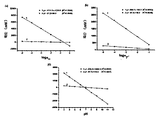
実施例1:線形関係の実験。図2は、本発明の検出システムにおいて、作用電極として塩化物イオン電極、フッ化物イオン電極、およびpH電極を使用し、参照電極として飽和カロメル電極を使用することにより得られる異なるイオン濃度の線形関係図である。単電極の線形関係と比較して、30本の塩化物イオン―電子集積多電極検出システムの勾配値(1711.2 mV)(図2a、曲線1)は単電極の勾配値(57.2 mV)(図2a、 曲線2)約30倍であり、10本のフッ化物イオン電極―電子集積多電極検出システムの勾配値(564.7mV)(図2b、曲線1)および10 本のpH電極―電子集積多電極検出システムの勾配値(576.2mV)(図2c、曲線1)は、単フッ化物イオン電極(57.3 mV)(図2b、曲線2)および単pH電極(57.7 mV)(図2c、曲線2)の約10倍であることが分かる。実験により、本発明の電位測定に基づく電子集積多電極検出システムの感度が著しく向上し、その向上の程度は電極数の増加に比例することが証明されている。m本の電極の感度は、単電極の感度の約m倍である。
実施例2:本発明の検出システムにおける異なる溶液中の異なるイオン電極の滴定実験。
Example 1: Linear relationship experiment. FIG. 2 shows the linear relationship of different ion concentrations obtained by using a chloride ion electrode, a fluoride ion electrode, and a pH electrode as working electrodes and a saturated calomel electrode as a reference electrode in the detection system of the present invention. It is a figure. Compared to the linear relationship of the single electrode, the gradient value (1711.2 mV) (Fig. 2a, curve 1) of the 30 chloride ion-electron integrated multi-electrode detection system is the gradient value of the single electrode (57.2 mV) (Fig. 2a). , Curve 2) Approximately 30 times, 10 fluoride ion electrodes-slope value of electron integrated multi-electrode detection system (564.7 mV) (Fig. 2b, curve 1) and 10 pH electrodes-electron integrated multi-electrode detection The gradient value of the system (576.2 mV) (Fig. 2c, curve 1) is approximately that of the monofluoride ion electrode (57.3 mV) (Fig. 2b, curve 2) and the single pH electrode (57.7 mV) (Fig. 2c, curve 2). It turns out that it is 10 times. Experiments have shown that the sensitivity of the electron-integrated multi-electrode detection system based on the potential measurement of the present invention is significantly improved, and the degree of improvement is proportional to the increase in the number of electrodes. The sensitivity of m electrodes is about m times that of a single electrode.
Example 2: Titration experiments of different ion electrodes in different solutions in the detection system of the present invention.
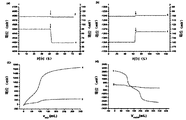
図3aは、飽和カロメル電極が参照電極とし、30本の塩化物イオン電極と単塩化物イオン電極が作用電極とする条件で、一滴の0.1 mol/L塩化カリウムを100 mLの1.0×10⁻³ mol/L塩化カリウム溶液に滴下する変化の曲線図。30本の塩化物イオン電極の変化は約30 mV(理論値29 mV)であり、単塩化物電極の変化は0.8 mV(理論値0.9 mV)である。 Figure 3a shows a drop of 0.1 mol / L potassium chloride in 100 mL of 1.0 × 10 -3 under the condition that the saturated calomel electrode is the reference electrode and the 30 chloride ion electrodes and the monochloride ion electrode are the working electrodes. The curve diagram of the change dropped in the mol / L potassium chloride solution. The change in the 30 chloride ion electrodes is about 30 mV (theoretical value 29 mV), and the change in the monochloride electrode is 0.8 mV (theoretical value 0.9 mV).
図3bは、飽和カロメル電極を参照電極とし、10本のpH電極と単pH電極を作用電極とする条件で、一滴の1mol塩酸を100mLの緩衝液(pH9)に滴下する変化の曲線図。10本のpH電極の変化は24 mV(理論値23 mV)であり、単pH電極の変化は2 mV(理論値2 mV)である。
Figure 3b is a curve diagram of the change in which a drop of 1 mol hydrochloric acid is dropped into 100 mL of a buffer solution (pH 9) under the condition that a saturated calomel electrode is used as a reference electrode and 10 pH electrodes and a single pH electrode are used as working electrodes. The change in the 10 pH electrodes is 24 mV (theoretical value 23 mV), and the change in the single pH electrode is 2 mV (
図3cは、飽和カロメル電極を参照電極とし、10本のpH電極と単pH電極を作用電極とする条件で、1.0×10⁻³ mol/L塩酸溶液を100mLの1.0×10-3 mol/Lヒスチジン溶液に一滴ずつ滴下する変化の曲線図。
Figure 3c is a saturated calomel electrode as a reference electrode, a pH electrode and a
図3dは、飽和カロメル電極を参照電極とし、10本のpH電極と単pH電極を作用電極とする条件で、1.0×10⁻³ mol/L水酸化ナトリウム溶液を100mLの1.0×10-3 mol/Lリン酸溶液に一滴ずつ滴下する変化の曲線図。 Figure 3d shows 100 mL of 1.0 × 10 -3 mol 1.0 × 10 -3 mol / L sodium hydroxide solution with a saturated calomel electrode as the reference electrode and 10 pH electrodes and a single pH electrode as the working electrode. / L Curved diagram of changes dropped onto the phosphoric acid solution drop by drop.
この実験は、マルチ電極―電子集積多電極検出システム(図3a、b、c、dの曲線1)で、滴定線の変化が単電極の変化(図3a、b、c、dの曲線2)よりも著しく高いことを証明する。本発明の検出システムは、検体中のイオン濃度の微量変化の検出に対して明らかな利点を有することが示されている。
In this experiment, a multi-electrode-electron integrated multi-electrode detection system (
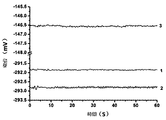
実施例3:ベースラインノイズの比較実験。図4から、単pH電極(図4、曲線3)および位相シフトフィルター回路なしの2つのpH電極(図4、曲線1)のベースラインノイズは、位相シフトフィルター回路(図4、曲線2)による2つのpH電極のベースラインノイズよりも大幅に大きいことがわかる。実験により、電位測定に基づく電子集積多電極検出システムの検出システムは、バックグラウンド干渉を有効的に低減し、検出の安定性を改善できることが示されている。低バックグラウンド干渉を維持しながら検出感度を大幅に改善することにより、正確な検出結果を得ることができる。 Example 3: Comparative experiment of baseline noise. From Fig. 4, the baseline noise of the single pH electrode (Fig. 4, curve 3) and the two pH electrodes without the phase shift filter circuit (Fig. 4, curve 1) is due to the phase shift filter circuit (Fig. 4, curve 2). It can be seen that it is significantly larger than the baseline noise of the two pH electrodes. Experiments have shown that the detection system of an electron-integrated multi-electrode detection system based on potential measurement can effectively reduce background interference and improve detection stability. Accurate detection results can be obtained by significantly improving the detection sensitivity while maintaining low background interference.
Claims (5)
マルチ電極アレイ信号入力端子(21)、高入力インピーダンスの電圧フォロワー(22)、位相シフトフィルタ回路(23)、拡張可能モジュールの入力端子(24)、加算回路(25)及び総出力信号端子(26)を含む回路ユニット(20)と、を備え、
前記マルチ電極アレイの出力信号は、前記回路ユニットにカップリングし、回路ユニット内の位相シフトフィルタ回路により反転され、加算回路で加算されて総出力信号が取得され、
前記総出力信号を収集することを特徴とする電位測定に基づく電子集積多電極検出システム。 Multi-electrode array (10) and
Multi-electrode array signal input terminal (21), high input impedance voltage follower (22), phase shift filter circuit (23), expandable module input terminal (24), adder circuit (25) and total output signal terminal (26) ) and circuit unit (20) comprising, provided with,
The output signal of the multi-electrode array, coupled to said circuit unit, is inverted by the phase shift filter circuitry within the circuit units, the total output signal is added by the adding circuit is obtained,
An electron-integrated multi-electrode detection system based on potential measurement, which comprises collecting the total output signal.
Applications Claiming Priority (3)
| Application Number | Priority Date | Filing Date | Title |
|---|---|---|---|
| CN201710079915.XA CN106841363B (en) | 2017-02-15 | 2017-02-15 | Electronics based on potential measurement integrates multi-electrode detection system |
| CN201710079915.X | 2017-02-15 | ||
| PCT/CN2018/076326 WO2018149380A1 (en) | 2017-02-15 | 2018-02-11 | Electronic integrated multi-electrode detection system based on potential measurement |
Publications (2)
| Publication Number | Publication Date |
|---|---|
| JP2020506398A JP2020506398A (en) | 2020-02-27 |
| JP6861445B2 true JP6861445B2 (en) | 2021-04-21 |
Family
ID=59128340
Family Applications (1)
| Application Number | Title | Priority Date | Filing Date |
|---|---|---|---|
| JP2019543796A Active JP6861445B2 (en) | 2017-02-15 | 2018-02-11 | Electron integrated multi-electrode detection system based on potential measurement |
Country Status (5)
| Country | Link |
|---|---|
| US (1) | US11486908B2 (en) |
| EP (1) | EP3581927A4 (en) |
| JP (1) | JP6861445B2 (en) |
| CN (1) | CN106841363B (en) |
| WO (1) | WO2018149380A1 (en) |
Families Citing this family (1)
| Publication number | Priority date | Publication date | Assignee | Title |
|---|---|---|---|---|
| CN116486945B (en) * | 2023-03-30 | 2026-01-09 | 四川大学 | A method for calculating the constitutive relation of temperature-dependent additive manufacturing titanium-aluminum alloys |
Family Cites Families (21)
| Publication number | Priority date | Publication date | Assignee | Title |
|---|---|---|---|---|
| US4133732A (en) * | 1976-06-10 | 1979-01-09 | Jan Boeke | Combination electrode system |
| US4189367A (en) * | 1978-10-19 | 1980-02-19 | Leeds & Northrup Company | Method for testing ion selective electrodes in continuous measuring systems |
| US4468608A (en) * | 1981-12-11 | 1984-08-28 | Instrumentation Laboratory Inc. | Electrochemical sensor instrumentation |
| EP0241601B1 (en) * | 1986-04-15 | 1990-02-07 | Yokogawa Europe B.V. | Device for testing the integrity of an electrode in a potentiometric measuring electrode system |
| JP3502466B2 (en) * | 1995-02-08 | 2004-03-02 | 株式会社エイアンドティー | Method for measuring electrolyte solution and electrolyte measuring device |
| EP0730149A3 (en) * | 1995-03-02 | 1997-05-21 | Orion Research | Linearized potentiometric electrode |
| GB9726348D0 (en) * | 1997-12-13 | 1998-02-11 | Eastman Kodak Co | Ion concentration and pH measurement |
| JP4729030B2 (en) * | 2002-07-31 | 2011-07-20 | 株式会社東芝 | Base sequence detector |
| JP4214232B2 (en) * | 2004-03-25 | 2009-01-28 | 独立行政法人産業技術総合研究所 | Neural network electrical activity regulator |
| US7544979B2 (en) * | 2004-04-16 | 2009-06-09 | Technion Research & Development Foundation Ltd. | Ion concentration transistor and dual-mode sensors |
| JP2007097019A (en) | 2005-09-30 | 2007-04-12 | Sanyo Electric Co Ltd | Delay circuit and video signal processing circuit using the same |
| JP2007097020A (en) | 2005-09-30 | 2007-04-12 | Sanyo Electric Co Ltd | Delay circuit and video signal processing circuit using the same |
| JP4822903B2 (en) * | 2006-03-30 | 2011-11-24 | 株式会社東芝 | Bimolecular film forming apparatus and method |
| CN101135662B (en) * | 2006-08-30 | 2010-11-10 | 梅特勒-托利多仪器(上海)有限公司 | Electric potential analyse electric pole measuring method and apparatus |
| JP4931025B2 (en) * | 2009-01-13 | 2012-05-16 | 独立行政法人産業技術総合研究所 | Stabilized reference electrode circuit |
| CN101846699A (en) | 2010-05-28 | 2010-09-29 | 青岛特锐德电气股份有限公司 | Electrical parameter measuring device, system and method |
| TW201202692A (en) * | 2010-07-05 | 2012-01-16 | Univ Nat Yunlin Sci & Tech | Measurement device and measurement method utilizing the same |
| CN103140737B (en) | 2010-09-30 | 2015-09-16 | 西铁城控股株式会社 | Physical quantity transducer |
| CN103424444B (en) * | 2013-07-22 | 2015-03-25 | 中国地质调查局水文地质环境地质调查中心 | System and method for realizing automatic monitoring of pH value of deep level solution based on electrochemical ion selective electrode method |
| CN203688495U (en) * | 2013-12-17 | 2014-07-02 | 中霖中科环境科技(安徽)股份有限公司 | Electric potential detection circuit for detecting ion-selective electrode of water |
| US9571121B2 (en) * | 2014-07-24 | 2017-02-14 | Atlas Scientific LLC | Electrochemical sensing module |
-
2017
- 2017-02-15 CN CN201710079915.XA patent/CN106841363B/en active Active
-
2018
- 2018-02-11 EP EP18754212.1A patent/EP3581927A4/en active Pending
- 2018-02-11 JP JP2019543796A patent/JP6861445B2/en active Active
- 2018-02-11 US US16/486,203 patent/US11486908B2/en active Active
- 2018-02-11 WO PCT/CN2018/076326 patent/WO2018149380A1/en not_active Ceased
Also Published As
| Publication number | Publication date |
|---|---|
| CN106841363B (en) | 2019-05-14 |
| WO2018149380A1 (en) | 2018-08-23 |
| EP3581927A1 (en) | 2019-12-18 |
| US20200057023A1 (en) | 2020-02-20 |
| EP3581927A4 (en) | 2021-01-06 |
| US11486908B2 (en) | 2022-11-01 |
| JP2020506398A (en) | 2020-02-27 |
| CN106841363A (en) | 2017-06-13 |
Similar Documents
| Publication | Publication Date | Title |
|---|---|---|
| Mousavi et al. | Ion sensing with thread-based potentiometric electrodes | |
| Yan et al. | Review of progresses on clinical applications of ion selective electrodes for electrolytic ion tests: from conventional ISEs to graphene-based ISEs | |
| Karikalan et al. | Electrochemical properties of the acetaminophen on the screen printed carbon electrode towards the high performance practical sensor applications | |
| CN105806915B (en) | A kind of nutrient solution potassium, Na ion concentration detector and detection method | |
| Ross Jr | SOLID-STATE AND LIQUID MEMBRANE | |
| CN103675460A (en) | Measurement device of capacitive coupling type non-contact conductance based on phase-sensitive demodulation and method thereof | |
| CN102980918A (en) | Reinforcing steel bar corrosion quantitative comprehensive detector | |
| CN101413917A (en) | Electrochemical fast detecting method of melamine in dairy produce | |
| US9488611B2 (en) | Low-conductivity contacting-type conductivity measurement | |
| Lai et al. | Carbon fiber-based multichannel solid-contact potentiometric ion sensors for real-time sweat electrolyte monitoring | |
| Metters et al. | Electrochemistry provides a point-of-care approach for the marker indicative of Pseudomonas aeruginosa infection of cystic fibrosis patients | |
| Singh et al. | Voltammetry based handheld measurement system for soil pH | |
| Cardwell et al. | A multi-ion sensor cell and data-acquisition system for flow injection analysis | |
| Gross et al. | Nitrite/nitrate detection in serum based on dual-plate generator–collector currents in a microtrench | |
| CN209342650U (en) | Electrochemical-based detection device for trace elements in water environment | |
| Liu et al. | Implementation of a microfluidic conductivity sensor—A potential sweat electrolyte sensing system for dehydration detection | |
| CN109060888A (en) | A kind of sampling method and device | |
| CN102645477A (en) | Iterative operation method for measuring concentration by aid of ion-selective electrode | |
| Pokhrel et al. | Water quality monitoring system using IOT | |
| JP2020506398A (en) | Electronic integrated multi-electrode detection system based on potential measurement | |
| CN118425240B (en) | Conductivity measurement circuit and method of electrode-type conductivity sensor | |
| Ping et al. | Screen-printed potentiometric strip for calcium ion determination in water and milk | |
| CN202956358U (en) | Potential of hydrogen (PH) detector | |
| CN103018295A (en) | Constant-potential solid pH detector | |
| Liu et al. | Detection of sodium and potassium ions in human sweat using electrochemical system |
Legal Events
| Date | Code | Title | Description |
|---|---|---|---|
| A621 | Written request for application examination |
Free format text: JAPANESE INTERMEDIATE CODE: A621 Effective date: 20191012 |
|
| A977 | Report on retrieval |
Free format text: JAPANESE INTERMEDIATE CODE: A971007 Effective date: 20200826 |
|
| A131 | Notification of reasons for refusal |
Free format text: JAPANESE INTERMEDIATE CODE: A131 Effective date: 20200901 |
|
| A521 | Request for written amendment filed |
Free format text: JAPANESE INTERMEDIATE CODE: A523 Effective date: 20201125 |
|
| RD02 | Notification of acceptance of power of attorney |
Free format text: JAPANESE INTERMEDIATE CODE: A7422 Effective date: 20201125 |
|
| A521 | Request for written amendment filed |
Free format text: JAPANESE INTERMEDIATE CODE: A523 Effective date: 20201203 |
|
| TRDD | Decision of grant or rejection written | ||
| A01 | Written decision to grant a patent or to grant a registration (utility model) |
Free format text: JAPANESE INTERMEDIATE CODE: A01 Effective date: 20210302 |
|
| A61 | First payment of annual fees (during grant procedure) |
Free format text: JAPANESE INTERMEDIATE CODE: A61 Effective date: 20210323 |
|
| R150 | Certificate of patent or registration of utility model |
Ref document number: 6861445 Country of ref document: JP Free format text: JAPANESE INTERMEDIATE CODE: R150 |
|
| R250 | Receipt of annual fees |
Free format text: JAPANESE INTERMEDIATE CODE: R250 |
|
| S531 | Written request for registration of change of domicile |
Free format text: JAPANESE INTERMEDIATE CODE: R313531 |
|
| R350 | Written notification of registration of transfer |
Free format text: JAPANESE INTERMEDIATE CODE: R350 |
|
| R250 | Receipt of annual fees |
Free format text: JAPANESE INTERMEDIATE CODE: R250 |
|
| R250 | Receipt of annual fees |
Free format text: JAPANESE INTERMEDIATE CODE: R250 |