JP6777576B2 - Manufacturing method of tantalum nitride - Google Patents
Manufacturing method of tantalum nitride Download PDFInfo
- Publication number
- JP6777576B2 JP6777576B2 JP2017060801A JP2017060801A JP6777576B2 JP 6777576 B2 JP6777576 B2 JP 6777576B2 JP 2017060801 A JP2017060801 A JP 2017060801A JP 2017060801 A JP2017060801 A JP 2017060801A JP 6777576 B2 JP6777576 B2 JP 6777576B2
- Authority
- JP
- Japan
- Prior art keywords
- tantalum nitride
- tantalum
- nitriding
- tantalum oxide
- nitride
- Prior art date
- Legal status (The legal status is an assumption and is not a legal conclusion. Google has not performed a legal analysis and makes no representation as to the accuracy of the status listed.)
- Active
Links
Landscapes
- Catalysts (AREA)
Description
本発明は、光吸収率の高い窒化タンタルの製造方法に関する。 The present invention relates to a method for producing tantalum nitride having a high light absorption rate.
窒化タンタルは、顔料、誘電体や超電導体などとして使用される金属窒化物である。さらに、近年では炭酸ガス排出削減、再生可能エネルギーの観点から、太陽光エネルギーを利用して、光触媒により水を分解して、水素や酸素を製造する技術に注目が集まっており、窒化タンタルは光触媒として利用可能である(特許文献1)。 Tantalum nitride is a metal nitride used as a pigment, a dielectric, a superconductor, and the like. Furthermore, in recent years, from the viewpoint of reducing carbon dioxide emissions and renewable energy, attention has been focused on technology for producing hydrogen and oxygen by decomposing water with a photocatalyst using solar energy, and tantalum nitride is a photocatalyst. It can be used as (Patent Document 1).
光触媒は、吸収波長や光吸収率により性能が変わるため、可視光における吸収波長の長波長化、光吸収率の高い窒化タンタルが求められている。また、窒化タンタル中に酸素が含まれると、水素の発生が阻害され、酸素含有量が多くなると波長が低波長側にシフトする傾向があるため、酸素を含まない高純度の窒化タンタルが求められている。
非特許文献1では、酸化タンタルをアンモニアで800℃で窒化反応させることにより、窒化タンタルを得ている。特許文献1では、酸化タンタルをアンモニア気流中、850℃で25時間窒化することで窒化タンタルを得て、光触媒に用いている。
特許文献2では、酸化タンタル水和物をアンモニアで750〜950℃で窒化反応させることにより、酸化タンタルの窒化反応により得られる窒化タンタルより高い光吸収率を有する窒化タンタルを得ている。
Since the performance of a photocatalyst changes depending on the absorption wavelength and the light absorption rate, tantalum nitride having a longer absorption wavelength in visible light and a high light absorption rate is required. In addition, if oxygen is contained in tantalum nitride, hydrogen generation is inhibited, and if the oxygen content is high, the wavelength tends to shift to the lower wavelength side. Therefore, high-purity tantalum nitride that does not contain oxygen is required. ing.
In Non-Patent Document 1, tantalum nitride is obtained by nitriding tantalum oxide with ammonia at 800 ° C. In Patent Document 1, tantalum nitride is obtained by nitriding tantalum oxide in an ammonia stream at 850 ° C. for 25 hours and used as a photocatalyst.
In Patent Document 2, tantalum nitride hydrate is nitrided with ammonia at 750 to 950 ° C. to obtain tantalum nitride having a higher light absorption rate than tantalum nitride obtained by the nitride reaction of tantalum oxide.
非特許文献1では、酸化タンタルをアンモニアで800℃で窒化反応させることにより、窒化タンタルを得ている。しかし、得られる窒化タンタルは、酸素を含む窒化タンタルであり、酸素含有量の低い窒化タンタルは得られない。特許文献1記載の酸化タンタルとアンモニアの製造方法を追試したところ、窒化タンタル以外に酸窒化タンタルが生成し、酸素量が多く、純度が低いことが判明した。酸窒化タンタルの吸収波長は400〜450nmであり、窒化タンタルより短波長である。これより、吸収波長は窒化タンタルのみより短波長となり、吸収波長の長波長側へのシフト効果は得られないと考えられる。 In Non-Patent Document 1, tantalum nitride is obtained by nitriding tantalum oxide with ammonia at 800 ° C. However, the obtained tantalum nitride is tantalum nitride containing oxygen, and tantalum nitride having a low oxygen content cannot be obtained. When the method for producing tantalum oxide and ammonia described in Patent Document 1 was retested, it was found that tantalum oxynitride was produced in addition to tantalum nitride, the amount of oxygen was large, and the purity was low. The absorption wavelength of tantalum oxynitride is 400 to 450 nm, which is shorter than that of tantalum nitride. From this, it is considered that the absorption wavelength is shorter than that of tantalum nitride alone, and the effect of shifting the absorption wavelength to the longer wavelength side cannot be obtained.
特許文献2は、酸化タンタル水和物をアンモニアで750〜950℃で窒化反応して、窒化タンタルを得ている。この窒化タンタルは、酸化タンタルの窒化反応で得られる窒化タンタルより光吸収率が高くなる。しかし、酸化タンタル水和物は市販品がないため、入手が難しく、使用するためには製造しなければならない。
また、酸化タンタルの窒化反応において、酸素と水が存在すると、窒化タンタルが酸化され、酸化タンタルや酸窒化タンタルを生成する。酸化タンタル水和物の水分量から、水酸化タンタル(Ta(OH)5)であり、式(1)に示す窒化反応が起きる。酸化タンタルを原料としたときと同量の窒化タンタルを得るために、酸化タンタル水和物(水酸化タンタル)を原料したとき、式(2)と比較すると、酸化タンタルより酸素が多く、発生する水も多くなるため、窒化タンタルの酸化が起こりやすくなる。そのため、酸素含有量が多く、純度が低くなり、吸収波長の長波長側へのシフトは起こらないと考えられる。
Patent Document 2 obtains tantalum nitride by nitriding tantalum oxide hydrate with ammonia at 750 to 950 ° C. This tantalum nitride has a higher light absorption rate than tantalum nitride obtained by the nitriding reaction of tantalum oxide. However, tantalum pentoxide hydrate is difficult to obtain because there is no commercial product, and it must be manufactured for use.
Further, in the nitriding reaction of tantalum oxide, the presence of oxygen and water oxidizes tantalum nitride to produce tantalum oxide and tantalum oxynitride. From the water content of tantalum oxide hydrate, it is tantalum hydroxide (Ta (OH) 5 ), and the nitriding reaction represented by the formula (1) occurs. When tantalum oxide hydrate (tantalum hydroxide) is used as a raw material in order to obtain the same amount of tantalum nitride as when tantalum oxide is used as a raw material, more oxygen is generated than tantalum oxide as compared with the formula (2). Since the amount of water increases, tantalum nitride is likely to be oxidized. Therefore, it is considered that the oxygen content is high, the purity is low, and the absorption wavelength is not shifted to the long wavelength side.
6Ta(OH)5+10NH3→2Ta3N5+30H2O ・・・ 式(1)
3Ta2O5+10NH3→2Ta3N5+15H2O ・・・ 式(2)
6Ta (OH) 5 + 10NH 3 → 2Ta 3 N 5 + 30H 2 O ・ ・ ・ Equation (1)
3Ta 2 O 5 + 10NH 3 → 2 Ta 3 N 5 + 15H 2 O ・ ・ ・ Equation (2)
従って、本発明の課題は、吸収波長が長く、光吸収率の高い窒化タンタルであり、かつ酸素含有量が少なく、単一相の窒化タンタルの工業的な製造方法を提供することにある。 Therefore, an object of the present invention is to provide an industrial method for producing a single-phase tantalum nitride having a long absorption wavelength and a high light absorption rate and a low oxygen content.
そこで本発明者は、前記課題を解決すべく検討した結果、酸化タンタルを1400〜1850℃で焼成した酸化タンタルを出発原料として用い、800〜950℃という特定の温度で一定の流量のアンモニアガスを反応させることにより、従来の窒化タンタルとは異なり、光吸収率が60%以上であり、620〜750nmという可視光を吸収し、酸素含有量が少なく、かつ単相の窒化タンタルが選択的に得られることを見出した。 Therefore, as a result of studies to solve the above problems, the present inventor uses tantalum oxide obtained by firing tantalum oxide at 1400 to 1850 ° C. as a starting material, and uses ammonia gas at a specific flow rate at a specific temperature of 800 to 950 ° C. By reacting, unlike conventional tantalum nitride, a light absorption rate of 60% or more, absorption of visible light of 620 to 750 nm, low oxygen content, and single-phase tantalum nitride can be selectively obtained. I found that it was possible.
すなわち、本発明は、次の〔1〕〜〔3〕を提供するものである。
〔1〕酸化タンタルを1400〜1850℃で焼成後、800〜950℃で、アンモニアガス下、アンモニアガス流量がTa2O51gあたり0.05〜0.8L/minで窒化することを特徴とする窒化タンタルの製造方法。
〔2〕加熱温度(℃)と加熱時間(hr)の積が10000〜25000になる時間、アンモニアガス下窒化する請求項1記載の製造方法。
〔3〕光吸収率が60%以上であり、620〜750nmの波長の可視光を吸収する窒化タンタル。
That is, the present invention provides the following [1] to [3].
[1] After firing tantalum oxide at 1400 to 1850 ° C., tantalum nitride is nitrided at 800 to 950 ° C. under ammonia gas at an ammonia gas flow rate of 0.05 to 0.8 L / min per 1 g of Ta 2 O 5. A method for producing tantalum nitride.
[2] The production method according to claim 1, wherein nitriding under ammonia gas is performed for a time when the product of the heating temperature (° C.) and the heating time (hr) becomes 1000 to 25000.
[3] Tantalum nitride having a light absorption rate of 60% or more and absorbing visible light having a wavelength of 620 to 750 nm.
本発明方法によれば、長波長の吸収波長と高い光吸収率を有する高純度の窒化タンタルが工業的に有利に製造できる。また、本発明の窒化タンタルは、光吸収率が60%以上で、620〜750nmの波長の可視光を吸収波長と有するだけでなく、酸素含有量が少なく高純度である窒化タンタルであり、光触媒として有用である。 According to the method of the present invention, high-purity tantalum nitride having a long absorption wavelength and a high light absorption rate can be industrially advantageously produced. Further, the tantalum nitride of the present invention is a tantalum nitride having a light absorption rate of 60% or more and not only having visible light having a wavelength of 620 to 750 nm as an absorption wavelength but also having a low oxygen content and high purity, and is a photocatalyst. It is useful as.
本発明の窒化タンタルの製造方法は、酸化タンタル(Ta2O5)を1400〜1850℃で焼成後、酸化タンタルを800〜950℃で、アンモニアガス下で窒化することを特徴とする。 The method for producing tantalum nitride according to the present invention is characterized in that tantalum oxide (Ta 2 O 5 ) is calcined at 1400 to 1850 ° C. and then tantalum oxide is nitrided at 800 to 950 ° C. under ammonia gas.
本発明の窒化反応に用いる原料は、酸化タンタルを1400〜1850℃で焼成した酸化タンタル(Ta2O5)である。このように酸化タンタルを原料として用いるにもかかわらず、本発明においては、酸化タンタルの焼成温度、アンモニアガスとの反応温度及びアンモニアガスの流量を調整することにより、最大吸収波長と光吸収率が高い窒化タンタルが得られる。 The raw material used for the nitriding reaction of the present invention is tantalum oxide (Ta 2 O 5 ) obtained by calcining tantalum oxide at 1400 to 1850 ° C. In spite of using tantalum oxide as a raw material in this way, in the present invention, the maximum absorption wavelength and the light absorption rate can be adjusted by adjusting the firing temperature of tantalum oxide, the reaction temperature with ammonia gas, and the flow rate of ammonia gas. High tantalum nitride is obtained.
酸化タンタルの焼成温度は、1400〜1850℃であり、好ましくは1400〜1800℃であり、より好ましくは1400〜1600℃である。1400℃未満では得られる窒化タンタルの光吸収率が高くならない。1850℃を超えると酸化タンタルが溶融し、得られる窒化タンタルの酸素含有量が1質量%を超えることがある。 The firing temperature of tantalum oxide is 1400 to 1850 ° C, preferably 1400 to 1800 ° C, and more preferably 1400 to 1600 ° C. Below 1400 ° C, the light absorption rate of the obtained tantalum nitride does not increase. If the temperature exceeds 1850 ° C., the tantalum oxide melts, and the oxygen content of the obtained tantalum nitride may exceed 1% by mass.
酸化タンタルの焼成後、好ましくは冷却する。酸化タンタルの焼成から連続して窒化反応を行う場合は、冷却温度は窒化温度未満、例えば500℃程度であればよい。また、窒化反応前に酸化タンタルの粉砕、計量などを行う場合は、常温(約25℃)まで冷却してもよい。 After firing the tantalum oxide, it is preferably cooled. When the nitriding reaction is continuously carried out from the firing of tantalum oxide, the cooling temperature may be lower than the nitriding temperature, for example, about 500 ° C. When tantalum oxide is pulverized or weighed before the nitriding reaction, it may be cooled to room temperature (about 25 ° C.).
1400〜1850℃で焼成した酸化タンタル(Ta2O5)を窒化する際のアンモニアガス量は、酸化タンタル(Ta2O5)1gあたり0.05L/min以上0.8L/min以下が好ましい。さらに好ましくは、0.1L/min以上0.5L/min以下である。0.05L/min未満だと窒化時間が長く、工業的ではない。0.8L/min超だと、得られる窒化タンタルの酸素含有量が高くなる場合がある。また、窒化に使用されないアンモニアガス量が多くなり、製造コストが高くなる。 The amount of ammonia gas when nitriding tantalum pentoxide (Ta 2 O 5 ) calcined at 1400 to 1850 ° C. is preferably 0.05 L / min or more and 0.8 L / min or less per 1 g of tantalum pentoxide (Ta 2 O 5 ). More preferably, it is 0.1 L / min or more and 0.5 L / min or less. If it is less than 0.05 L / min, the nitriding time is long and it is not industrial. If it exceeds 0.8 L / min, the oxygen content of the obtained tantalum nitride may increase. In addition, the amount of ammonia gas not used for nitriding increases, and the manufacturing cost increases.
窒化する温度(加熱温度)は、800℃以上950℃以下である。800℃未満の場合、窒化が十分に進行しない。950℃超の場合、窒化タンタルから窒素が放出され金属Taとなるため高純度の窒化タンタルが得られない。より好ましい窒化温度は、800℃以上900℃以下である。窒化温度を高くすることで、焼成温度が同じ酸化タンタルを原料として用いても、得られる窒化タンタルの光吸収率を高くすることができる。 The nitriding temperature (heating temperature) is 800 ° C. or higher and 950 ° C. or lower. If the temperature is lower than 800 ° C., nitriding does not proceed sufficiently. When the temperature exceeds 950 ° C., nitrogen is released from tantalum nitride to form metal Ta, so that high-purity tantalum nitride cannot be obtained. A more preferable nitriding temperature is 800 ° C. or higher and 900 ° C. or lower. By increasing the nitriding temperature, the light absorption rate of the obtained tantalum nitride can be increased even if tantalum oxide having the same firing temperature is used as a raw material.
また、加熱時間は、加熱温度との関係で決定され、窒化を十分に進行させる点、及び窒化タンタルより窒素量の少ないタンタル窒化物の生成を防止する点から、加熱温度(℃)と加熱時間(hr)の積が、10000〜25000になる時間が好ましい。より好ましい前記積は12000〜20000であり、さらに好ましくは16000〜20000である。 In addition, the heating time is determined in relation to the heating temperature, and the heating temperature (° C.) and the heating time are determined from the viewpoint of sufficiently advancing nitriding and preventing the formation of tantalum nitride having a smaller amount of nitrogen than tantalum nitride. The time when the product of (hr) becomes 1000 to 25000 is preferable. The more preferable product is 12,000 to 20,000, and even more preferably 16,000 to 20,000.
具体的な加熱時間は13〜30時間が好ましく、15〜30時間がより好ましい。なお、ここで加熱時間は、800〜950℃の範囲に加熱されている時間である。 The specific heating time is preferably 13 to 30 hours, more preferably 15 to 30 hours. Here, the heating time is the time during which the heating is performed in the range of 800 to 950 ° C.
反応装置は、1000℃程度の熱に耐えられる装置であればよく、例えば、管状炉、電気炉、バッチ式キルン、ロータリーキルンを用いれば良い。
上記の反応により、反応容器中には高純度の窒化タンタルのみが残存するので回収が容易である。
The reaction apparatus may be any apparatus that can withstand heat of about 1000 ° C., and for example, a tubular furnace, an electric furnace, a batch kiln, or a rotary kiln may be used.
Due to the above reaction, only high-purity tantalum nitride remains in the reaction vessel, so that recovery is easy.
本発明の製造方法により得られた窒化タンタル(Ta3N5)の吸収スペクトルを紫外・可視分光光度計にて測定したところ、窒化タンタルの光吸収率は、60%以上である。光吸収率(%)は、紫外・可視分光光度計にて測定したときの最小反射率(%)を100%から引いた値(100−最小反射率)である。本発明の窒化タンタルの光吸収率(%)は、60%以上が好ましく、62%以上がより好ましく、65%以上がさらに好ましい。 When the absorption spectrum of tantalum nitride (Ta 3 N 5 ) obtained by the production method of the present invention was measured with an ultraviolet / visible spectrophotometer, the light absorption rate of tantalum nitride was 60% or more. The light absorption rate (%) is a value (100-minimum reflectance) obtained by subtracting the minimum reflectance (%) measured by an ultraviolet / visible spectrophotometer from 100%. The light absorption rate (%) of the tantalum nitride of the present invention is preferably 60% or more, more preferably 62% or more, still more preferably 65% or more.
また、本発明の窒化タンタル(Ta3N5)は、620〜750nmの波長の可視光を吸収波長とする。吸収波長とは、吸収できる波長領域を表しており、紫外・可視分光光度計にて測定したときの反射率が最小となる波長である。この波長が高くなることにより、光触媒として吸収する可視光の範囲を広くすることができ、光触媒の効率も向上する。光触媒として有用であることが報告されている特許文献1記載の窒化タンタルの吸収波長は紫外部から620nmまでである。従って、本発明の620〜750nmの波長の可視光を吸収する窒化タンタルは、新規な窒化タンタルであり、可視光を利用できる光触媒として有用である。 Further, the tantalum nitride (Ta 3 N 5 ) of the present invention uses visible light having a wavelength of 620 to 750 nm as an absorption wavelength. The absorption wavelength represents a wavelength region in which absorption can be performed, and is a wavelength at which the reflectance is minimized when measured by an ultraviolet-visible spectrophotometer. By increasing this wavelength, the range of visible light absorbed as a photocatalyst can be widened, and the efficiency of the photocatalyst is also improved. The absorption wavelength of tantalum nitride described in Patent Document 1, which has been reported to be useful as a photocatalyst, is from ultraviolet to 620 nm. Therefore, the tantalum nitride that absorbs visible light having a wavelength of 620 to 750 nm of the present invention is a novel tantalum nitride and is useful as a photocatalyst that can utilize visible light.
また、本発明の窒化タンタル(Ta3N5)としては、吸収波長が550〜700nmにあるのが好ましく、600〜700nmにあるのがより好ましく、620〜700nmにあるのがさらに好ましく、620〜680nmにあるのが特に好ましい。
本発明の窒化タンタルの吸収波長は、酸素含有量の低下及び純度の高度化とともに長波長側にシフトする傾向にあり、酸素含有量及び純度が高いことが好ましい。従って、窒化タンタルの純度は90%以上が好ましく、95%以上であるのがより好ましい。また、窒化タンタル中の酸素含有量は1質量%以下が好ましく、0.85質量%以下であるのがより好ましい。
Further, as the tantalum nitride (Ta 3 N 5 ) of the present invention, the absorption wavelength is preferably 550 to 700 nm, more preferably 600 to 700 nm, further preferably 620 to 700 nm, and 620 to 620 nm. It is particularly preferably at 680 nm.
The absorption wavelength of the tantalum nitride of the present invention tends to shift to the longer wavelength side as the oxygen content decreases and the purity increases, and it is preferable that the oxygen content and purity are high. Therefore, the purity of tantalum nitride is preferably 90% or more, more preferably 95% or more. The oxygen content in tantalum nitride is preferably 1% by mass or less, more preferably 0.85% by mass or less.
次に実施例を挙げて、本発明を詳細に説明する。 Next, the present invention will be described in detail with reference to examples.
実施例1
酸化タンタル(三井金属鉱業(株)製、白色粉末)30gをアルミナボートに入れ、電気炉で1400℃で20時間焼成した。電気炉内の温度が室温程度(約25℃程度)になってから、アルミナボードを取り出し、焼成した酸化タンタルを回収した。
焼成した酸化タンタル5gをアルミナボートに入れ、アルミナ製の炉芯管内に置き、両端にガスフロー口とバルブの付いた栓をして、管状炉に設置した。アンモニアガス流量1L/min、850℃で20時間窒化反応を行った。窒化反応後、冷却し、室温程度(約25℃程度)になってから、アルミナボードを取り出し、窒化タンタルを回収した。
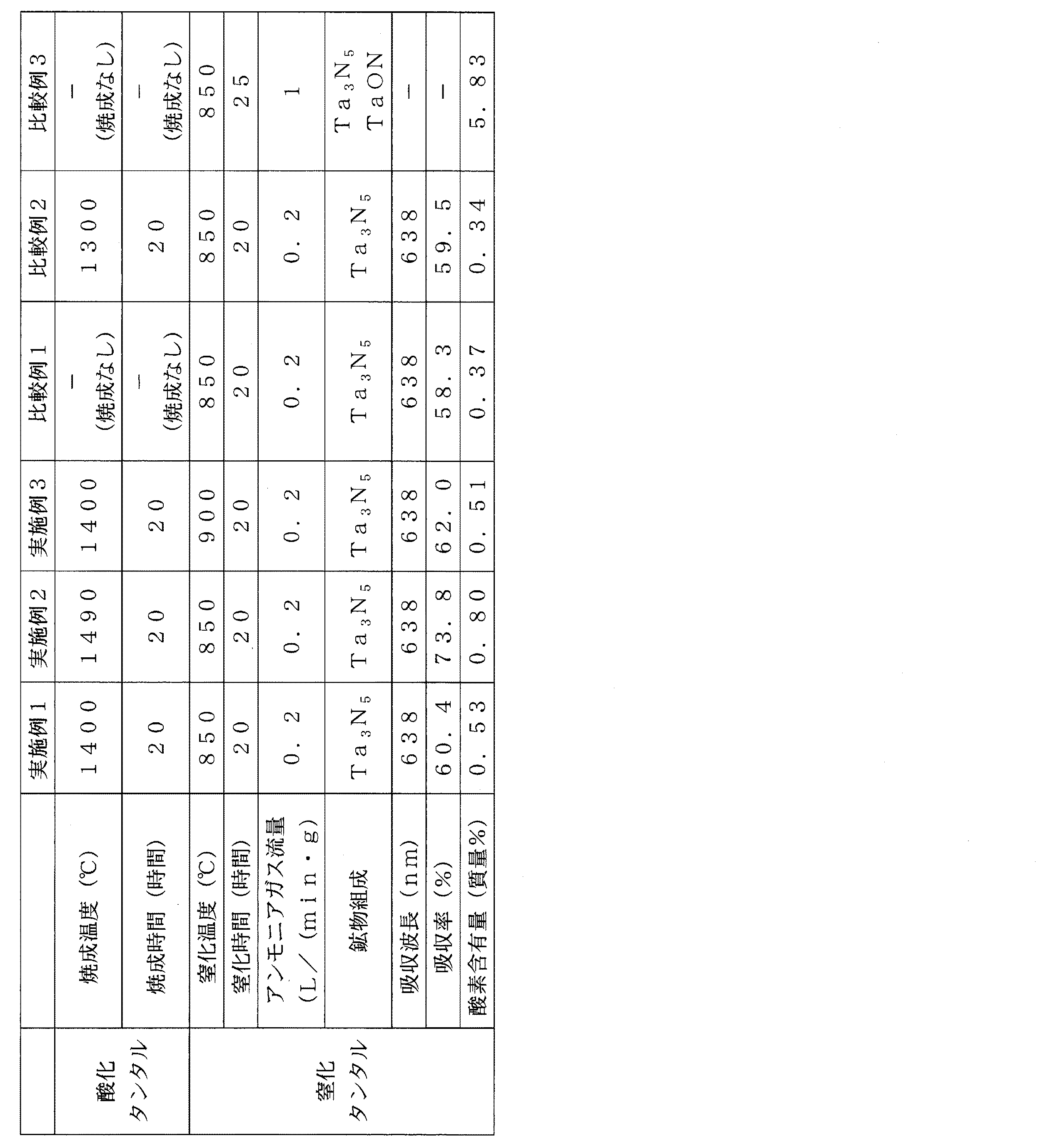
得られた窒化タンタルは、粉末X線回折(XRD)による鉱物組成の同定、紫外・可視分光光度計による吸収波長、吸収率の測定、窒素酸素同時分析計による酸素含有量の定量を行った。測定結果を表1に示す。
Example 1
30 g of tantalum oxide (white powder manufactured by Mitsui Metal Mining Co., Ltd.) was placed in an alumina boat and fired in an electric furnace at 1400 ° C. for 20 hours. After the temperature in the electric furnace reached about room temperature (about 25 ° C.), the alumina board was taken out and the calcined tantalum oxide was recovered.
5 g of calcined tantalum oxide was placed in an alumina boat, placed in an alumina furnace core tube, plugged with gas flow ports and valves at both ends, and installed in a tube furnace. The nitriding reaction was carried out at an ammonia gas flow rate of 1 L / min at 850 ° C. for 20 hours. After the nitriding reaction, the mixture was cooled to about room temperature (about 25 ° C.), and then the alumina board was taken out to recover the tantalum nitride.
The obtained tantalum nitride was identified by powder X-ray diffraction (XRD) to identify the mineral composition, measured the absorption wavelength and absorption rate by an ultraviolet / visible spectrophotometer, and quantified the oxygen content by a nitrogen-oxygen simultaneous analyzer. The measurement results are shown in Table 1.
実施例2
酸化タンタル30gの焼成温度を1490℃にした以外は、実施例1と同様に焼成、窒化反応を行った。得られた窒化タンタルも同様に分析を行った。測定結果を表1に示す。
Example 2
The calcination and nitriding reaction were carried out in the same manner as in Example 1 except that the calcination temperature of 30 g of tantalum oxide was set to 1490 ° C. The obtained tantalum nitride was also analyzed in the same manner. The measurement results are shown in Table 1.
実施例3
実施例1で焼成した酸化タンタル5gを原料とし、窒化温度を900℃にした以外は、実施例1と同様に行った。得られた窒化タンタルも同様に分析を行った。測定結果を表1に示す。
Example 3
The same procedure as in Example 1 was carried out except that 5 g of tantalum oxide fired in Example 1 was used as a raw material and the nitriding temperature was set to 900 ° C. The obtained tantalum nitride was also analyzed in the same manner. The measurement results are shown in Table 1.
比較例1
焼成していない酸化タンタルを用いた以外、実施例1と同様に行った。得られた窒化タンタルも同様に分析を行った。測定結果を表1に示す。
Comparative Example 1
The procedure was the same as in Example 1 except that uncalcined tantalum oxide was used. The obtained tantalum nitride was also analyzed in the same manner. The measurement results are shown in Table 1.
比較例2
酸化タンタル30gの焼成温度を1300℃にした以外は、実施例1と同様に焼成、窒化反応を行った。得られた窒化タンタルも同様に分析を行った。測定結果を表1に示す。
Comparative Example 2
The calcination and nitriding reaction were carried out in the same manner as in Example 1 except that the calcination temperature of 30 g of tantalum oxide was set to 1300 ° C. The obtained tantalum nitride was also analyzed in the same manner. The measurement results are shown in Table 1.
比較例3
焼成していない酸化タンタル1gを入れ、アンモニアガスを1.0L/min雰囲気下で、反応温度850℃、25時間で窒化した。得られた合成物をXRDにより鉱物組成の同定を行ったところ、窒化タンタルと酸窒化タンタル(TaON)の混合相であり、酸素含有量は5.83質量%であった。窒化タンタルの単相が得られず酸素含有量も多かったため、紫外・可視分光光度計による吸収波長、吸収率の測定は行わなかった。
Comparative Example 3
1 g of uncalcined tantalum oxide was added, and ammonia gas was nitrided in an atmosphere of 1.0 L / min at a reaction temperature of 850 ° C. for 25 hours. When the mineral composition of the obtained composite was identified by XRD, it was a mixed phase of tantalum nitride and tantalum oxynitride (TaON), and the oxygen content was 5.83% by mass. Since a single phase of tantalum nitride could not be obtained and the oxygen content was high, the absorption wavelength and absorption rate were not measured by an ultraviolet / visible spectrophotometer.
窒化条件が同じ実施例1と2、比較例1と2を比較すると、酸化タンタルの焼成温度が高いほど吸収率が高くなることが確認できた。
酸化タンタルの焼成温度が同じ実施例1と実施例3を比較すると、窒化温度の高い実施例3の方が吸収率が高くなることが確認できた。
実施例1〜3、比較例1〜2は、638nmと従来の窒化タンタルより長波長の吸収波長をもつ窒化タンタルである。
本発明の酸化タンタルを焼成した酸化タンタルを窒化タンタルの原料とすることにより、光吸収率が高く、本発明の窒化反応条件とすることにより吸収波長を長波長側へシフトすることができた。これより、本発明の窒化タンタルは、光触媒として有用であると考えられる。
Comparing Examples 1 and 2 and Comparative Examples 1 and 2 with the same nitriding conditions, it was confirmed that the higher the firing temperature of tantalum oxide, the higher the absorption rate.
Comparing Example 1 and Example 3 in which the firing temperature of tantalum oxide is the same, it was confirmed that the absorption rate of Example 3 having a higher nitriding temperature was higher.
Examples 1 to 3 and Comparative Examples 1 to 2 are tantalum nitride having an absorption wavelength of 638 nm, which is longer than that of the conventional tantalum nitride.
By using the tantalum oxide obtained by firing the tantalum oxide of the present invention as a raw material of the tantalum nitride, the light absorption rate is high, and the absorption wavelength can be shifted to the longer wavelength side by using the nitride reaction conditions of the present invention. From this, it is considered that the tantalum nitride of the present invention is useful as a photocatalyst.
Claims (3)
Priority Applications (1)
| Application Number | Priority Date | Filing Date | Title |
|---|---|---|---|
| JP2017060801A JP6777576B2 (en) | 2017-03-27 | 2017-03-27 | Manufacturing method of tantalum nitride |
Applications Claiming Priority (1)
| Application Number | Priority Date | Filing Date | Title |
|---|---|---|---|
| JP2017060801A JP6777576B2 (en) | 2017-03-27 | 2017-03-27 | Manufacturing method of tantalum nitride |
Publications (2)
| Publication Number | Publication Date |
|---|---|
| JP2018162188A JP2018162188A (en) | 2018-10-18 |
| JP6777576B2 true JP6777576B2 (en) | 2020-10-28 |
Family
ID=63860763
Family Applications (1)
| Application Number | Title | Priority Date | Filing Date |
|---|---|---|---|
| JP2017060801A Active JP6777576B2 (en) | 2017-03-27 | 2017-03-27 | Manufacturing method of tantalum nitride |
Country Status (1)
| Country | Link |
|---|---|
| JP (1) | JP6777576B2 (en) |
Families Citing this family (1)
| Publication number | Priority date | Publication date | Assignee | Title |
|---|---|---|---|---|
| WO2023238387A1 (en) * | 2022-06-10 | 2023-12-14 | 日本電信電話株式会社 | Nitride semiconductor photoelectrode and production method therefor |
Family Cites Families (2)
| Publication number | Priority date | Publication date | Assignee | Title |
|---|---|---|---|---|
| JP2007022858A (en) * | 2005-07-19 | 2007-02-01 | Univ Of Tokyo | Nitride having pore structure and method for producing the same |
| JP6339046B2 (en) * | 2015-06-12 | 2018-06-06 | 富士フイルム株式会社 | Photocatalyst, method for producing thin film photocatalyst, and visible light responsive photocatalytic device |
-
2017
- 2017-03-27 JP JP2017060801A patent/JP6777576B2/en active Active
Also Published As
| Publication number | Publication date |
|---|---|
| JP2018162188A (en) | 2018-10-18 |
Similar Documents
| Publication | Publication Date | Title |
|---|---|---|
| Abu-Zied et al. | Pure and Ni-substituted Co3O4 spinel catalysts for direct N2O decomposition | |
| US11691882B2 (en) | Supported perovskite-oxide composites for enhanced low temperature thermochemical conversion of CO2 to CO | |
| CN101939099A (en) | Low temperature water gas shift catalyst | |
| WO2009021292A1 (en) | Titanate photocatalyst | |
| US20230347319A1 (en) | Multi-cationic aluminate spinels | |
| CN107552059B (en) | A kind of preparation method of iron-doped cerium-based solid solution flue gas denitration catalyst | |
| JP6745164B2 (en) | Method for producing tantalum nitride (Ta3N5) | |
| KR102132779B1 (en) | Adsorbent for carbon dioxide, method preparing the same and capure module for carbon dioxide | |
| TW201440887A (en) | Carbon absorbent, manufacturing method and using method thereof | |
| JP4837651B2 (en) | Method for producing nickel oxide | |
| Drouet et al. | Synthesis and characterization of non-stoichiometric nickel–copper manganites | |
| JP2017081812A (en) | Manganese-zirconium composite oxide, method for producing the same, and use thereof | |
| EP3768640B1 (en) | Method for synthesis of gamma-aluminium oxide using plasma - modified aluminium and water reaction | |
| Czajka et al. | Investigation of 5-chloro-2-methoxybenzoates of La (III), Gd (III) and Lu (III) Complexes | |
| AU2003266780A1 (en) | A method for producing titanium oxide | |
| Pan et al. | Hydrothermally-mediated preparation and photoluminescent properties of Sr3Al2O6: Eu3+ phosphor | |
| JP2018162188A (en) | Method for producing tantalum nitride | |
| KR101728517B1 (en) | Preparation of aluminum nitride using wet-mixed boehmite slurry | |
| Suino et al. | Thermal analysis and mechanism of α-Zn2SiO4: Mn2+ formation from zinc oxalate dihydrate under hydrothermal conditions | |
| JP6812910B2 (en) | Method for producing lanthanum aluminate compound having perovskite type structure | |
| US20170121182A1 (en) | Calcination processes for preparing various types of alumina | |
| WO2015176166A1 (en) | Processes for decomposing aluminum chloride into alumina | |
| CN112569992B (en) | Precipitated χ iron carbide composition, preparation method, catalyst and application thereof, and Fischer-Tropsch synthesis method | |
| JP6815246B2 (en) | Tantalum nitride particles | |
| CN112569983B (en) | Supported χ -iron carbide-containing composition, preparation method thereof, catalyst and application thereof, and Fischer-Tropsch synthesis method |
Legal Events
| Date | Code | Title | Description |
|---|---|---|---|
| A621 | Written request for application examination |
Free format text: JAPANESE INTERMEDIATE CODE: A621 Effective date: 20190924 |
|
| A977 | Report on retrieval |
Free format text: JAPANESE INTERMEDIATE CODE: A971007 Effective date: 20200624 |
|
| A131 | Notification of reasons for refusal |
Free format text: JAPANESE INTERMEDIATE CODE: A131 Effective date: 20200721 |
|
| A521 | Request for written amendment filed |
Free format text: JAPANESE INTERMEDIATE CODE: A523 Effective date: 20200902 |
|
| TRDD | Decision of grant or rejection written | ||
| A01 | Written decision to grant a patent or to grant a registration (utility model) |
Free format text: JAPANESE INTERMEDIATE CODE: A01 Effective date: 20201006 |
|
| A61 | First payment of annual fees (during grant procedure) |
Free format text: JAPANESE INTERMEDIATE CODE: A61 Effective date: 20201008 |
|
| R150 | Certificate of patent or registration of utility model |
Ref document number: 6777576 Country of ref document: JP Free format text: JAPANESE INTERMEDIATE CODE: R150 |
|
| R250 | Receipt of annual fees |
Free format text: JAPANESE INTERMEDIATE CODE: R250 |
|
| R250 | Receipt of annual fees |
Free format text: JAPANESE INTERMEDIATE CODE: R250 |
|
| R250 | Receipt of annual fees |
Free format text: JAPANESE INTERMEDIATE CODE: R250 |